CN102395331A - Detachment mechanism for implantable fixation devices - Google Patents
Detachment mechanism for implantable fixation devices Download PDFInfo
- Publication number
- CN102395331A CN102395331A CN2009801587072A CN200980158707A CN102395331A CN 102395331 A CN102395331 A CN 102395331A CN 2009801587072 A CN2009801587072 A CN 2009801587072A CN 200980158707 A CN200980158707 A CN 200980158707A CN 102395331 A CN102395331 A CN 102395331A
- Authority
- CN
- China
- Prior art keywords
- fixation device
- catheter
- attachment portion
- distal
- proximal
- Prior art date
- Legal status (The legal status is an assumption and is not a legal conclusion. Google has not performed a legal analysis and makes no representation as to the accuracy of the status listed.)
- Granted
Links
Images






Classifications
-
- A—HUMAN NECESSITIES
- A61—MEDICAL OR VETERINARY SCIENCE; HYGIENE
- A61B—DIAGNOSIS; SURGERY; IDENTIFICATION
- A61B17/00—Surgical instruments, devices or methods
- A61B17/00234—Surgical instruments, devices or methods for minimally invasive surgery
-
- A—HUMAN NECESSITIES
- A61—MEDICAL OR VETERINARY SCIENCE; HYGIENE
- A61B—DIAGNOSIS; SURGERY; IDENTIFICATION
- A61B17/00—Surgical instruments, devices or methods
- A61B17/04—Surgical instruments, devices or methods for suturing wounds; Holders or packages for needles or suture materials
- A61B17/0469—Suturing instruments for use in minimally invasive surgery, e.g. endoscopic surgery
-
- A—HUMAN NECESSITIES
- A61—MEDICAL OR VETERINARY SCIENCE; HYGIENE
- A61B—DIAGNOSIS; SURGERY; IDENTIFICATION
- A61B17/00—Surgical instruments, devices or methods
- A61B17/08—Wound clamps or clips, i.e. not or only partly penetrating the tissue ; Devices for bringing together the edges of a wound
-
- A—HUMAN NECESSITIES
- A61—MEDICAL OR VETERINARY SCIENCE; HYGIENE
- A61B—DIAGNOSIS; SURGERY; IDENTIFICATION
- A61B17/00—Surgical instruments, devices or methods
- A61B17/10—Surgical instruments, devices or methods for applying or removing wound clamps, e.g. containing only one clamp or staple; Wound clamp magazines
-
- A—HUMAN NECESSITIES
- A61—MEDICAL OR VETERINARY SCIENCE; HYGIENE
- A61B—DIAGNOSIS; SURGERY; IDENTIFICATION
- A61B17/00—Surgical instruments, devices or methods
- A61B17/12—Surgical instruments, devices or methods for ligaturing or otherwise compressing tubular parts of the body, e.g. blood vessels or umbilical cord
- A61B17/122—Clamps or clips, e.g. for the umbilical cord
-
- A—HUMAN NECESSITIES
- A61—MEDICAL OR VETERINARY SCIENCE; HYGIENE
- A61F—FILTERS IMPLANTABLE INTO BLOOD VESSELS; PROSTHESES; DEVICES PROVIDING PATENCY TO, OR PREVENTING COLLAPSING OF, TUBULAR STRUCTURES OF THE BODY, e.g. STENTS; ORTHOPAEDIC, NURSING OR CONTRACEPTIVE DEVICES; FOMENTATION; TREATMENT OR PROTECTION OF EYES OR EARS; BANDAGES, DRESSINGS OR ABSORBENT PADS; FIRST-AID KITS
- A61F2/00—Filters implantable into blood vessels; Prostheses, i.e. artificial substitutes or replacements for parts of the body; Appliances for connecting them with the body; Devices providing patency to, or preventing collapsing of, tubular structures of the body, e.g. stents
- A61F2/02—Prostheses implantable into the body
- A61F2/24—Heart valves ; Vascular valves, e.g. venous valves; Heart implants, e.g. passive devices for improving the function of the native valve or the heart muscle; Transmyocardial revascularisation [TMR] devices; Valves implantable in the body
- A61F2/2442—Annuloplasty rings or inserts for correcting the valve shape; Implants for improving the function of a native heart valve
- A61F2/246—Devices for obstructing a leak through a native valve in a closed condition
-
- A—HUMAN NECESSITIES
- A61—MEDICAL OR VETERINARY SCIENCE; HYGIENE
- A61B—DIAGNOSIS; SURGERY; IDENTIFICATION
- A61B17/00—Surgical instruments, devices or methods
- A61B17/04—Surgical instruments, devices or methods for suturing wounds; Holders or packages for needles or suture materials
-
- A—HUMAN NECESSITIES
- A61—MEDICAL OR VETERINARY SCIENCE; HYGIENE
- A61B—DIAGNOSIS; SURGERY; IDENTIFICATION
- A61B17/00—Surgical instruments, devices or methods
- A61B17/04—Surgical instruments, devices or methods for suturing wounds; Holders or packages for needles or suture materials
- A61B17/0401—Suture anchors, buttons or pledgets, i.e. means for attaching sutures to bone, cartilage or soft tissue; Instruments for applying or removing suture anchors
-
- A—HUMAN NECESSITIES
- A61—MEDICAL OR VETERINARY SCIENCE; HYGIENE
- A61B—DIAGNOSIS; SURGERY; IDENTIFICATION
- A61B17/00—Surgical instruments, devices or methods
- A61B17/04—Surgical instruments, devices or methods for suturing wounds; Holders or packages for needles or suture materials
- A61B17/0482—Needle or suture guides
-
- A—HUMAN NECESSITIES
- A61—MEDICAL OR VETERINARY SCIENCE; HYGIENE
- A61B—DIAGNOSIS; SURGERY; IDENTIFICATION
- A61B17/00—Surgical instruments, devices or methods
- A61B17/064—Surgical staples, i.e. penetrating the tissue
-
- A—HUMAN NECESSITIES
- A61—MEDICAL OR VETERINARY SCIENCE; HYGIENE
- A61B—DIAGNOSIS; SURGERY; IDENTIFICATION
- A61B17/00—Surgical instruments, devices or methods
- A61B17/064—Surgical staples, i.e. penetrating the tissue
- A61B17/0643—Surgical staples, i.e. penetrating the tissue with separate closing member, e.g. for interlocking with staple
-
- A—HUMAN NECESSITIES
- A61—MEDICAL OR VETERINARY SCIENCE; HYGIENE
- A61B—DIAGNOSIS; SURGERY; IDENTIFICATION
- A61B17/00—Surgical instruments, devices or methods
- A61B17/068—Surgical staplers, e.g. containing multiple staples or clamps
-
- A—HUMAN NECESSITIES
- A61—MEDICAL OR VETERINARY SCIENCE; HYGIENE
- A61B—DIAGNOSIS; SURGERY; IDENTIFICATION
- A61B17/00—Surgical instruments, devices or methods
- A61B17/12—Surgical instruments, devices or methods for ligaturing or otherwise compressing tubular parts of the body, e.g. blood vessels or umbilical cord
- A61B17/12022—Occluding by internal devices, e.g. balloons or releasable wires
-
- A—HUMAN NECESSITIES
- A61—MEDICAL OR VETERINARY SCIENCE; HYGIENE
- A61B—DIAGNOSIS; SURGERY; IDENTIFICATION
- A61B17/00—Surgical instruments, devices or methods
- A61B17/12—Surgical instruments, devices or methods for ligaturing or otherwise compressing tubular parts of the body, e.g. blood vessels or umbilical cord
- A61B17/12022—Occluding by internal devices, e.g. balloons or releasable wires
- A61B17/12099—Occluding by internal devices, e.g. balloons or releasable wires characterised by the location of the occluder
- A61B17/12122—Occluding by internal devices, e.g. balloons or releasable wires characterised by the location of the occluder within the heart
-
- A—HUMAN NECESSITIES
- A61—MEDICAL OR VETERINARY SCIENCE; HYGIENE
- A61B—DIAGNOSIS; SURGERY; IDENTIFICATION
- A61B17/00—Surgical instruments, devices or methods
- A61B17/12—Surgical instruments, devices or methods for ligaturing or otherwise compressing tubular parts of the body, e.g. blood vessels or umbilical cord
- A61B17/122—Clamps or clips, e.g. for the umbilical cord
- A61B17/1227—Spring clips
-
- A—HUMAN NECESSITIES
- A61—MEDICAL OR VETERINARY SCIENCE; HYGIENE
- A61B—DIAGNOSIS; SURGERY; IDENTIFICATION
- A61B17/00—Surgical instruments, devices or methods
- A61B17/12—Surgical instruments, devices or methods for ligaturing or otherwise compressing tubular parts of the body, e.g. blood vessels or umbilical cord
- A61B17/128—Surgical instruments, devices or methods for ligaturing or otherwise compressing tubular parts of the body, e.g. blood vessels or umbilical cord for applying or removing clamps or clips
- A61B17/1285—Surgical instruments, devices or methods for ligaturing or otherwise compressing tubular parts of the body, e.g. blood vessels or umbilical cord for applying or removing clamps or clips for minimally invasive surgery
-
- A—HUMAN NECESSITIES
- A61—MEDICAL OR VETERINARY SCIENCE; HYGIENE
- A61B—DIAGNOSIS; SURGERY; IDENTIFICATION
- A61B17/00—Surgical instruments, devices or methods
- A61B17/00234—Surgical instruments, devices or methods for minimally invasive surgery
- A61B2017/00238—Type of minimally invasive operation
- A61B2017/00243—Type of minimally invasive operation cardiac
-
- A—HUMAN NECESSITIES
- A61—MEDICAL OR VETERINARY SCIENCE; HYGIENE
- A61B—DIAGNOSIS; SURGERY; IDENTIFICATION
- A61B17/00—Surgical instruments, devices or methods
- A61B2017/00477—Coupling
-
- A—HUMAN NECESSITIES
- A61—MEDICAL OR VETERINARY SCIENCE; HYGIENE
- A61B—DIAGNOSIS; SURGERY; IDENTIFICATION
- A61B17/00—Surgical instruments, devices or methods
- A61B17/0057—Implements for plugging an opening in the wall of a hollow or tubular organ, e.g. for sealing a vessel puncture or closing a cardiac septal defect
- A61B2017/00575—Implements for plugging an opening in the wall of a hollow or tubular organ, e.g. for sealing a vessel puncture or closing a cardiac septal defect for closure at remote site, e.g. closing atrial septum defects
-
- A—HUMAN NECESSITIES
- A61—MEDICAL OR VETERINARY SCIENCE; HYGIENE
- A61B—DIAGNOSIS; SURGERY; IDENTIFICATION
- A61B17/00—Surgical instruments, devices or methods
- A61B2017/00743—Type of operation; Specification of treatment sites
- A61B2017/00778—Operations on blood vessels
- A61B2017/00783—Valvuloplasty
-
- A—HUMAN NECESSITIES
- A61—MEDICAL OR VETERINARY SCIENCE; HYGIENE
- A61B—DIAGNOSIS; SURGERY; IDENTIFICATION
- A61B17/00—Surgical instruments, devices or methods
- A61B17/04—Surgical instruments, devices or methods for suturing wounds; Holders or packages for needles or suture materials
- A61B17/0401—Suture anchors, buttons or pledgets, i.e. means for attaching sutures to bone, cartilage or soft tissue; Instruments for applying or removing suture anchors
- A61B2017/0409—Instruments for applying suture anchors
-
- A—HUMAN NECESSITIES
- A61—MEDICAL OR VETERINARY SCIENCE; HYGIENE
- A61B—DIAGNOSIS; SURGERY; IDENTIFICATION
- A61B17/00—Surgical instruments, devices or methods
- A61B17/04—Surgical instruments, devices or methods for suturing wounds; Holders or packages for needles or suture materials
- A61B17/0401—Suture anchors, buttons or pledgets, i.e. means for attaching sutures to bone, cartilage or soft tissue; Instruments for applying or removing suture anchors
- A61B2017/0417—T-fasteners
-
- A—HUMAN NECESSITIES
- A61—MEDICAL OR VETERINARY SCIENCE; HYGIENE
- A61B—DIAGNOSIS; SURGERY; IDENTIFICATION
- A61B17/00—Surgical instruments, devices or methods
- A61B17/04—Surgical instruments, devices or methods for suturing wounds; Holders or packages for needles or suture materials
- A61B17/0401—Suture anchors, buttons or pledgets, i.e. means for attaching sutures to bone, cartilage or soft tissue; Instruments for applying or removing suture anchors
- A61B2017/0419—H-fasteners
-
- A—HUMAN NECESSITIES
- A61—MEDICAL OR VETERINARY SCIENCE; HYGIENE
- A61B—DIAGNOSIS; SURGERY; IDENTIFICATION
- A61B17/00—Surgical instruments, devices or methods
- A61B17/04—Surgical instruments, devices or methods for suturing wounds; Holders or packages for needles or suture materials
- A61B17/0469—Suturing instruments for use in minimally invasive surgery, e.g. endoscopic surgery
- A61B2017/0472—Multiple-needled, e.g. double-needled, instruments
-
- A—HUMAN NECESSITIES
- A61—MEDICAL OR VETERINARY SCIENCE; HYGIENE
- A61B—DIAGNOSIS; SURGERY; IDENTIFICATION
- A61B17/00—Surgical instruments, devices or methods
- A61B17/04—Surgical instruments, devices or methods for suturing wounds; Holders or packages for needles or suture materials
- A61B17/0469—Suturing instruments for use in minimally invasive surgery, e.g. endoscopic surgery
- A61B2017/0474—Knot pushers
-
- A—HUMAN NECESSITIES
- A61—MEDICAL OR VETERINARY SCIENCE; HYGIENE
- A61B—DIAGNOSIS; SURGERY; IDENTIFICATION
- A61B17/00—Surgical instruments, devices or methods
- A61B17/04—Surgical instruments, devices or methods for suturing wounds; Holders or packages for needles or suture materials
- A61B17/06—Needles ; Sutures; Needle-suture combinations; Holders or packages for needles or suture materials
- A61B17/06066—Needles, e.g. needle tip configurations
- A61B2017/061—Needles, e.g. needle tip configurations hollow or tubular
-
- A—HUMAN NECESSITIES
- A61—MEDICAL OR VETERINARY SCIENCE; HYGIENE
- A61B—DIAGNOSIS; SURGERY; IDENTIFICATION
- A61B17/00—Surgical instruments, devices or methods
- A61B17/12—Surgical instruments, devices or methods for ligaturing or otherwise compressing tubular parts of the body, e.g. blood vessels or umbilical cord
- A61B17/12022—Occluding by internal devices, e.g. balloons or releasable wires
- A61B2017/1205—Introduction devices
- A61B2017/12054—Details concerning the detachment of the occluding device from the introduction device
-
- A—HUMAN NECESSITIES
- A61—MEDICAL OR VETERINARY SCIENCE; HYGIENE
- A61B—DIAGNOSIS; SURGERY; IDENTIFICATION
- A61B17/00—Surgical instruments, devices or methods
- A61B17/28—Surgical forceps
- A61B17/29—Forceps for use in minimally invasive surgery
- A61B2017/2926—Details of heads or jaws
- A61B2017/2931—Details of heads or jaws with releasable head
-
- A—HUMAN NECESSITIES
- A61—MEDICAL OR VETERINARY SCIENCE; HYGIENE
- A61F—FILTERS IMPLANTABLE INTO BLOOD VESSELS; PROSTHESES; DEVICES PROVIDING PATENCY TO, OR PREVENTING COLLAPSING OF, TUBULAR STRUCTURES OF THE BODY, e.g. STENTS; ORTHOPAEDIC, NURSING OR CONTRACEPTIVE DEVICES; FOMENTATION; TREATMENT OR PROTECTION OF EYES OR EARS; BANDAGES, DRESSINGS OR ABSORBENT PADS; FIRST-AID KITS
- A61F2/00—Filters implantable into blood vessels; Prostheses, i.e. artificial substitutes or replacements for parts of the body; Appliances for connecting them with the body; Devices providing patency to, or preventing collapsing of, tubular structures of the body, e.g. stents
- A61F2/02—Prostheses implantable into the body
- A61F2/24—Heart valves ; Vascular valves, e.g. venous valves; Heart implants, e.g. passive devices for improving the function of the native valve or the heart muscle; Transmyocardial revascularisation [TMR] devices; Valves implantable in the body
- A61F2/2442—Annuloplasty rings or inserts for correcting the valve shape; Implants for improving the function of a native heart valve
Landscapes
- Health & Medical Sciences (AREA)
- Life Sciences & Earth Sciences (AREA)
- Surgery (AREA)
- General Health & Medical Sciences (AREA)
- Public Health (AREA)
- Biomedical Technology (AREA)
- Heart & Thoracic Surgery (AREA)
- Veterinary Medicine (AREA)
- Engineering & Computer Science (AREA)
- Animal Behavior & Ethology (AREA)
- Molecular Biology (AREA)
- Nuclear Medicine, Radiotherapy & Molecular Imaging (AREA)
- Medical Informatics (AREA)
- Vascular Medicine (AREA)
- Cardiology (AREA)
- Reproductive Health (AREA)
- Oral & Maxillofacial Surgery (AREA)
- Transplantation (AREA)
- Surgical Instruments (AREA)
- Prostheses (AREA)
Abstract
Description
技术领域 technical field
本发明整体涉及医学方法、设备和系统。特别地,本发明涉及用于血管内、经皮或者微创手术治疗身体组织,例如组织接近或瓣膜修复的方法、设备和系统。更特别地,本发明涉及用于将可植入设备可分离地连接到输送导管的机构。The present invention generally relates to medical methods, devices and systems. In particular, the present invention relates to methods, devices and systems for endovascular, percutaneous or minimally invasive surgical treatment of bodily tissues, such as tissue access or valve repair. More particularly, the present invention relates to mechanisms for detachably connecting implantable devices to delivery catheters.
手术修复身体组织常常涉及组织接近及将这种组织紧固到接近的装置上。在修复瓣膜时,组织接近包括将瓣叶接合在治疗装置中,随后通过紧固或固定瓣叶来保持该治疗装置。这种接合可用来治疗最常发生在二尖瓣中的反流。Surgical repair of body tissue often involves tissue approximation and securing such tissue to an approximating device. In repairing a valve, tissue approximation involves engagement of the leaflets in a therapeutic device, followed by securing or securing the leaflets to retain the therapeutic device. This coaptation can be used to treat regurgitation, which most commonly occurs in the mitral valve.
二尖瓣反流的特征是通过机能不健全的二尖瓣从心脏的左心室到左心房的逆行流动。在正常的心脏收缩(心脏收缩)周期期间,二尖瓣作为止回阀,以防止含氧血液回流进左心房。这样,含氧血液通过主动脉瓣泵送到主动脉。瓣膜反流会显著降低心脏的泵送效率,从而将患者置于严重的、渐进的心脏衰竭的风险。Mitral regurgitation is characterized by retrograde flow from the left ventricle of the heart to the left atrium through a dysfunctional mitral valve. During the normal systolic (systolic) cycle, the mitral valve acts as a check valve to prevent backflow of oxygenated blood into the left atrium. This way, oxygenated blood is pumped through the aortic valve into the aorta. Valvular regurgitation can significantly reduce the heart's pumping efficiency, putting patients at risk for severe, progressive heart failure.
二尖瓣反流起因于二尖瓣或左心室壁中的一些不同的机械缺陷。瓣叶、将瓣叶连接到乳头肌的瓣膜腱索、乳头肌或左心室壁可能会受到损坏或其他功能失调。一般情况下,瓣环可能会受到损坏、扩张、或弱化,从而限制二尖瓣克服左心室的高压而充分关闭的能力。Mitral regurgitation results from a number of different mechanical defects in the mitral valve or left ventricular wall. The leaflets, the valve chordae that connect the leaflets to the papillary muscles, the papillary muscles, or the wall of the left ventricle may be damaged or otherwise dysfunctional. Typically, the annulus may become damaged, dilated, or weakened, limiting the ability of the mitral valve to close adequately against the high pressure in the left ventricle.
最常见的治疗二尖瓣反流依赖瓣膜置换或修复,包括瓣叶和环重塑,后者一般称为瓣膜成形术。用于二尖瓣修复的最新技术依赖将相对瓣叶的相邻片段缝合到一起,这被称为“蝴蝶结”或“缘对缘”技术。尽管所有这些技术可以非常有效,但它们通常依赖开心脏术,通常通过胸骨切开术打开患者的胸部,并将患者置于体外循环。同时打开胸部和将患者置于体外循环的需要是有创伤性的并具有相关的高发病率和死亡率。The most common treatment for mitral regurgitation relies on valve replacement or repair, including leaflet and annulus remodeling, which is commonly referred to as valvuloplasty. The latest technology for mitral valve repair relies on suturing together adjacent segments of opposing leaflets, known as the "bow-tie" or "edge-to-edge" technique. Although all of these techniques can be very effective, they typically rely on open heart surgery, usually through a sternotomy, to open the patient's chest and place the patient on extracorporeal circulation. The need to simultaneously open the chest and place the patient on extracorporeal circulation is traumatic and has associated high morbidity and mortality.
基于这些原因,希望的是提供用于执行二尖瓣和其他心脏瓣膜修复的替代和额外的方法、设备和系统。优选地,这种方法、设备和系统宜不要求开放的胸部路径,并能够血管内执行或者通过微创方法执行,血管内执行即使用从患者远离心脏的脉管推进到心脏的设备来执行。此外,这些设备和系统应该提供允许在固定之前重新定位和随意移除固定设备的特征,以确保最佳布置。这种设备还应该容易输送和部署。更优选地,该方法、设备和系统将用于修复心脏瓣膜以外的身体组织。这些目标中的至少一些将通过下文描述的本发明来满足。For these reasons, it would be desirable to provide alternative and additional methods, devices and systems for performing mitral and other heart valve repairs. Preferably, such methods, devices and systems should not require an open chest approach and can be performed endovascularly, ie using a device advanced to the heart from the patient's vessel away from the heart, or by minimally invasive methods. Additionally, these devices and systems should provide features that allow repositioning and random removal of the fixation device prior to fixation to ensure optimal placement. Such devices should also be easy to transport and deploy. More preferably, the method, device and system will be used to repair body tissue other than heart valves. At least some of these objectives will be met by the present invention described hereinafter.
背景技术 Background technique
用于接合和修正二尖瓣瓣叶以治疗二尖瓣反流的微创经皮技术在公开号为WO98/35638、WO99/00059、WO99/01377和WO 00/03759的PCT公布文献中有所描述。Minimally invasive percutaneous techniques for coapting and modifying mitral valve leaflets to treat mitral regurgitation are described in PCT publications WO 98/35638, WO 99/00059, WO 99/01377 and
Maisano等人(1998)的Eur.J.Cardiothorac.Sure.13:240-246、Fucci等人(1995)的Eur.J.Cardiothorac.Surg.9:621-627以及Umana等人(1998)的Ann.Thorac.Surg.66:1640-1646描述了用于执行“缘对缘”或“蝴蝶结”二尖瓣修复的开放外科手术,其中相对瓣叶的边缘被缝合到一起以减少反流。Dec和Fuster的(1994)N. Engl.J.Med.331:1564-1575和Alvarez等人(1996)的J.Thorac. Cardiovasc.Surg.112:238-247是讨论扩张型心肌病的性质和治疗的评论文章。 Eur.J.Cardiothorac.Sure.13 :240-246 by Maisano et al. (1998), Eur.J.Cardiothorac.Surg.9 :621-627 by Fucci et al. (1995) and Ann by Umana et al. (1998) Thorac. Surg. 66: 1640-1646 describes an open surgical procedure for performing "edge-to-edge" or "bow-tie" mitral valve repair in which the edges of opposing leaflets are sutured together to reduce regurgitation. Dec and Fuster's (1994) N. Engl.J.Med .331: 1564-1575 and Alvarez et al. (1996) J.Thorac. Cardiovasc.Surg. 112: 238-247 discuss the nature and nature of dilated cardiomyopathy Treatment review article.
以下出版物中描述了二尖瓣成形术:Bach和Bolling的(1996)Am.J.Cardiol.78:966-969;Kameda等人(1996)的Ann.Thorac. Surg.61:1829-1832;Bach和Bolling的(1995)Am.Heart J.129:1165-1170;以及Bolling等人(1995)的109:676-683。用于二尖瓣修复的线性分段成形在Ricchi等人(1997)的Ann.Thorac.Surg.63:1805-1806中有所描述。McCarthy和Cosgrove(1997)的Ann. Thorac.Surg.64:267-268、Tager等人(1998)的Am.J.Cardiol.81:1013-1016、以及Abe等人(1989)的Ann.Thorac.Surg.48:670-676中描述了三尖瓣成形术。Mitral valvuloplasty is described in the following publications: Bach and Bolling (1996) Am. J. Cardiol. 78: 966-969; Kameda et al. (1996) Ann. Thorac. Surg. 61: 1829-1832; Bach and Bolling (1995) Am. Heart J. 129:1165-1170; and Bolling et al. (1995) 109:676-683. Linear segmental angioplasty for mitral valve repair is described in Ricchi et al. (1997) Ann. Thorac. Surg. 63: 1805-1806. McCarthy and Cosgrove (1997) Ann. Thorac. Surg. 64: 267-268, Tager et al. (1998) Am. J. Cardiol. 81: 1013-1016, and Abe et al. (1989) Ann. Thorac. Tricuspid annuloplasty is described in Surg. 48:670-676.
Park等人(1978)的Circulation 58:600-608、Uchida等人(1991)的Am.Heart J.121:1221-1224、以及Ali Khan等人(1991)的Cathet. Cardiovasc.Diagn.23:257-262中描述了经皮经腔心脏修复手术。 Circulation 58:600-608 by Park et al. (1978), Am. Heart J. 121:1221-1224 by Uchida et al. (1991), and Cathet. Cardiovasc. Diagn. 23:257 by Ali Khan et al. (1991) -262 describes percutaneous transluminal heart repair surgery.
美国专利5,840,081、5,411,552、5,554,185、5,332,402、4,994,077、以及4,056,854中描述了血管内心脏瓣膜置换。还可参见描述了用于临时放置人造心脏瓣膜的导管的美国专利3,671,979。Endovascular heart valve replacements are described in US Patents 5,840,081, 5,411,552, 5,554,185, 5,332,402, 4,994,077, and 4,056,854. See also US Patent 3,671,979 describing a catheter for the temporary placement of an artificial heart valve.
美国专利4,917,089、4,484,579和3,874,338以及PCT公布文献WO 91/01689中描述了其他经皮和血管内心脏修复手术。Other percutaneous and endovascular heart repair procedures are described in US Patents 4,917,089, 4,484,579 and 3,874,338 and PCT Publication WO 91/01689.
美国专利5,855,614、5,829,447、5,823,956、5,797,960、5,769,812、以及5,718,725中描述了胸腔镜的和其他微创心脏瓣膜修复和置换手术。Thoracoscopic and other minimally invasive heart valve repair and replacement procedures are described in US Pat.
发明内容 Contents of the invention
本发明总地提供用于组织接近和在治疗部位进行修复的设备、系统和方法。本发明的设备、系统和方法可在多种治疗手术中使用,包括血管内、微创和开放式外科手术,并可以在多种解剖区域使用,包括腹部、胸腔、心血管系统、心脏、肠道、胃、尿道、膀胱、肺和其他器官、脉管和组织。本发明在那些需要到达远处的组织位置的微创伤或血管内通路的手术中特别有用,其中使用的器械必须通过长的、狭窄且弯曲的路径到达治疗部位。另外,本发明的很多设备和系统适于被倒转并从患者的任何位置处移除,而不与内部组织干涉或损伤内部组织。The present invention generally provides devices, systems and methods for tissue access and repair at a treatment site. The devices, systems and methods of the present invention can be used in a variety of therapeutic procedures, including endovascular, minimally invasive and open surgery, and in a variety of anatomical areas, including abdominal, thoracic, cardiovascular system, heart, bowel tract, stomach, urethra, bladder, lungs and other organs, vessels and tissues. The present invention is particularly useful in those procedures requiring minimally invasive or intravascular access to distant tissue sites where the instruments used must travel long, narrow and tortuous paths to the treatment site. Additionally, many of the devices and systems of the present invention are adapted to be inverted and removed from any location on the patient without interfering with or damaging internal tissues.
在本发明的第一方面,用于输送可植入固定设备的系统包括在近端具有附接部分的可植入固定设备,附接部分还具有内部。介入导管具有能够接合固定设备的附接部分的附接部分,介入导管的附接部分具有内部。至少一个附接部分被偏置以与另一附接部分脱离,杆至少部分地布置在两个内部内并控制介入导管和固定设备的附接部分之间的接合。In a first aspect of the invention, a system for delivering an implantable fixation device includes an implantable fixation device having an attachment portion at a proximal end, the attachment portion also having an interior. The interventional catheter has an attachment portion capable of engaging the attachment portion of the fixation device, the attachment portion of the interventional catheter having an interior. At least one attachment portion is biased to disengage from the other attachment portion, a rod is disposed at least partially within the two interiors and controls engagement between the interventional catheter and the attachment portion of the fixation device.
介入导管和固定设备的附接部分可以是基本管状的形状并限定互补的S形曲面。有时介入导管的附接部分可以铰接地联接到导管。杆和固定设备设有配合的螺纹部分。杆至少部分可滑动地置设在两个内部中。固定设备的附接部分和介入导管的附接部分中的至少一个在径向向内方向上被偏置,使得在杆至少部分地设置在两个内部时,所述至少一个附接部分被保持在径向向外方向上,从而防止固定设备与介入导管脱离。The attachment portion of the interventional catheter and fixation device may be substantially tubular in shape and define complementary S-shaped surfaces. Sometimes the attachment portion of the interventional catheter may be hingedly coupled to the catheter. The rod and fixture are provided with cooperating threaded portions. A rod is at least partially slidably disposed in both interiors. At least one of the attachment portion of the fixation device and the attachment portion of the interventional catheter is biased in a radially inward direction such that the at least one attachment portion is retained when the rod is at least partially disposed inside both in a radially outward direction, thereby preventing disengagement of the fixation device from the interventional catheter.
有时,导管附接部分可包括至少一个弹簧臂,弹簧臂在其远端具有接合表面,固定设备附接部分能够与弹簧臂的接合表面配合。弹簧臂可以与导管附接部分成一体,且弹簧臂还可被偏置以与固定设备的附接部分脱离。在杆将弹簧臂的接合表面推动成与固定设备的附接部分接合时,弹簧臂可与固定设备接合。接合防止导管与固定设备分离。固定设备的附接部分可包括棘爪。棘爪可包括至少部分延伸经过固定设备的壁的容座或孔。在一些实施方式中,导管附接部分还包括用于接合可植入固定设备的一部分的远侧轴环。远侧轴环可从至少一个弹簧臂向远侧延伸,并且,轴环使可植入固定设备相对于介入导管的横向运动最小。一对细长臂可将远侧轴环与导管附接部分联接。Sometimes the catheter attachment portion may comprise at least one spring arm having an engagement surface at its distal end, the fixation device attachment portion being capable of cooperating with the engagement surface of the spring arm. The spring arm may be integral with the catheter attachment portion, and the spring arm may also be biased to disengage from the attachment portion of the fixation device. The spring arm is engageable with the fixation device when the lever pushes the engagement surface of the spring arm into engagement with the attachment portion of the fixation device. Engagement prevents separation of the catheter from the fixation device. The attachment portion of the fixation device may comprise a detent. The detent may comprise a receptacle or aperture extending at least partially through a wall of the securing device. In some embodiments, the catheter attachment portion further includes a distal collar for engaging a portion of the implantable fixation device. A distal collar can extend distally from the at least one spring arm, and the collar minimizes lateral movement of the implantable fixation device relative to the interventional catheter. A pair of elongate arms can couple the distal collar with the catheter attachment portion.
在其他实施方式中,介入导管可包括与附接部分轴向间隔的腰部,腰部限定内径减小区域。导管的附接部分被朝着导管的内部偏置。杆通常具有小于腰部的内径的外径,使得杆可自由穿过腰部。杆可包括靠近其远端的扩大部分,扩大部分具有略大于腰部的内径的外径,使得在扩大部分定位在腰部内时,导管附接部分可偏离所述内部,由此便于介入导管与固定设备分离。In other embodiments, the interventional catheter may include a waist portion axially spaced from the attachment portion, the waist portion defining a region of reduced inner diameter. The attachment portion of the catheter is biased towards the interior of the catheter. The rod typically has an outer diameter that is smaller than the inner diameter of the waist so that the rod can pass freely through the waist. The rod may include near its distal end an enlarged portion having an outer diameter slightly larger than the inner diameter of the waist such that when the enlarged portion is positioned within the waist, the catheter attachment portion may be offset from said interior, thereby facilitating access to the catheter and securing Device separation.
有时,系统的导管附接部分包括可面向内的凸缘,固定设备附接部分包括尺寸能够接合导管附接部分的凸缘的周向槽。介入导管还可以包括至少在导管附接部分和腰部之间延伸的至少一个纵向切口。凸缘可形成跨过导管的内部周边的连续唇缘,或者凸缘可包括沿着导管的内部周边隔开的多个离散部分。Sometimes the catheter attachment portion of the system includes an inwardly facing flange and the fixation device attachment portion includes a circumferential groove sized to engage the flange of the catheter attachment portion. The interventional catheter may also include at least one longitudinal slit extending at least between the catheter attachment portion and the waist. The flange may form a continuous lip across the inner perimeter of the conduit, or the flange may comprise a plurality of discrete portions spaced along the inner perimeter of the conduit.
在其他实施方式中,导管的附接部分包括在其远端附近附接到导管的弹簧臂轴环,弹簧臂轴环包括至少一个向内偏置的弹簧臂。每个弹簧臂可在其远端处具有扩大突出部,固定设备附接部分可包括能够接收所述弹簧臂的一部分的至少一个径向狭槽,由此防止弹簧臂轴环和导管之间的相对转动。固定设备附接部分还可包括能够可释放地接合扩大突出部的至少一个棘爪。棘爪包括至少部分延伸经过固定设备的壁的容座或孔。弹簧臂轴环可包括向内偏置的第二弹簧臂,其远端处具有扩大突出部,固定设备附接部分还可包括能够接收第二弹簧臂的一部分的第二径向狭槽,由此防止弹簧臂轴环和导管之间的相对转动。固定设备附接部分还可包括能够可释放地接合第二弹簧臂的扩大突出部的第二棘爪。第二棘爪可包括至少部分延伸经过固定设备的壁的容座或孔。弹簧臂轴环可移除地附接到导管。有时导管包括周向槽,弹簧臂轴环就座在该槽内。棘爪可包括至少部分延伸经过可植入固定设备的壁的孔,扩大的突出部可包括至少被卷成圆柱状形状的弹簧臂的远侧部分。通常,至少一个附接部分可包括形状记忆合金。In other embodiments, the attachment portion of the catheter includes a spring arm collar attached to the catheter near its distal end, the spring arm collar including at least one inwardly biased spring arm. Each spring arm may have an enlarged protrusion at its distal end, and the fixation device attachment portion may include at least one radial slot capable of receiving a portion of the spring arm, thereby preventing interference between the spring arm collar and the catheter. relative rotation. The fixation device attachment portion may also include at least one detent releasably engageable with the enlarged protrusion. The pawl includes a receptacle or aperture extending at least partially through a wall of the fixture. The spring arm collar may include an inwardly biased second spring arm having an enlarged protrusion at a distal end thereof, and the fixation device attachment portion may further include a second radial slot configured to receive a portion of the second spring arm by This prevents relative rotation between the spring arm collar and the catheter. The fixation device attachment portion may also include a second detent releasably engageable with the enlarged protrusion of the second spring arm. The second detent may comprise a receptacle or aperture extending at least partially through a wall of the securing device. A spring arm collar is removably attached to the catheter. Sometimes the catheter includes a circumferential groove in which the spring arm collar is seated. The detent may include an aperture extending at least partially through a wall of the implantable fixation device, and the enlarged protrusion may include at least a distal portion of the spring arm rolled into a cylindrical shape. Typically, at least one attachment portion may comprise a shape memory alloy.
在本发明的另一方面,用于输送可植入的固定设备的系统包括近端具有附接特征的可植入的固定设备以及具有能够与固定设备的附接特征联接的附接部分的介入导管。介入导管的附接部分设置在其远端附近。系统还包括可释放地设置在固定设备的附接特征和介入导管的附接部分之间的键。键能够防止固定设备相对于介入导管转动。键通过附接特征和附接部分可滑动地接收。In another aspect of the invention, a system for delivering an implantable fixation device includes an implantable fixation device having an attachment feature at a proximal end and an intervening fixation device having an attachment portion engageable with the attachment feature of the fixation device. catheter. The attachment portion of the interventional catheter is disposed near its distal end. The system also includes a key releasably disposed between the attachment feature of the fixation device and the attachment portion of the interventional catheter. The key prevents rotation of the fixation device relative to the interventional catheter. A key is slidably received by the attachment feature and the attachment portion.
固定设备的附接特征可包括沿着固定设备的内表面或外表面设置的第一槽区域。第一槽区域具有与键的至少一部分互补的轮廓,并且键至少部分设置在第一槽区域中。介入导管的附接部分包括沿着介入导管的内表面或外表面设置的第二槽区域。第二槽区域具有与键的至少一部分互补的轮廓,并且键至少部分设置在第二槽区域中。The attachment feature of the fixation device may include a first slot region disposed along an inner surface or an outer surface of the fixation device. The first groove region has a complementary profile to at least a portion of the key, and the key is at least partially disposed in the first groove region. The attachment portion of the interventional catheter includes a second groove region disposed along the inner or outer surface of the interventional catheter. The second groove region has a complementary profile to at least a portion of the key, and the key is at least partially disposed in the second groove region.
附接特征和附接部分还可包括卡口连接器。固定设备的附接特征可包括能够接收介入导管的附接部分的至少一部分的狭槽区域。狭槽区域可包括L形狭槽或螺旋形狭槽。介入导管的附接部分可包括能够与固定设备的附接部分接合的凸耳。凸耳可以从介入导管向外径向突出或向内径向突出。The attachment features and attachment portions may also include bayonet connectors. The attachment feature of the fixation device may include a slot region configured to receive at least a portion of the attachment portion of the interventional catheter. The slotted area may comprise an L-shaped slot or a helical slot. The attachment portion of the interventional catheter may include lugs engageable with the attachment portion of the fixation device. The lugs may project radially outward or radially inward from the interventional catheter.
本发明的其他方面的本质和优点结合附图在以下的详细描述中进行阐述。The nature and advantages of other aspects of the invention are set forth in the following detailed description, taken in conjunction with the accompanying drawings.
附图说明 Description of drawings
图1示出了心脏收缩期间心脏的左心室和左心房。Figure 1 shows the left ventricle and left atrium of the heart during systole.
图2A示出了正常接合中的小叶的自由边缘;图2B示出了反流接合中的自由边缘。Figure 2A shows the free edge of the leaflet in normal coaptation; Figure 2B shows the free edge in regurgitant coaptation.
图3A-3C分别示出了利用固定设备抓取小叶、倒转固定设备的远侧元件以及移除固定设备。3A-3C illustrate grasping of leaflets with a fixation device, inversion of the distal element of the fixation device, and removal of the fixation device, respectively.
图4示出了固定设备相对于小叶定位在希望取向。Figure 4 shows the positioning of the fixation device in a desired orientation relative to the leaflets.
图5A-5B、6A-6D示出了本申请的联接机构的示例性实施方式。5A-5B, 6A-6D illustrate exemplary embodiments of the coupling mechanism of the present application.
图7A-7D示出了处于各种位置的固定设备的实施方式。7A-7D illustrate embodiments of a fixation device in various positions.
图8A-8B示出了固定设备的其中一些或所有部件被模制为一个零件的实施方式。8A-8B illustrate embodiments in which some or all components of the fixation device are molded as one piece.
图9示出了本发明的固定设备的另一种实施方式。FIG. 9 shows another embodiment of the fixing device of the present invention.
图10A-10B、11A-11B、12A-12B、13A-13B、14-16示出了固定设备的处于其被引入和放置到身体内以执行治疗手术的过程中的多个可能位置的多种实施方式。10A-10B, 11A-11B, 12A-12B, 13A-13B, 14-16 illustrate a variety of possible positions of the immobilization device during its introduction and placement into the body to perform a therapeutic procedure. implementation.
图17A-17C示出了固定设备上的罩,其中,该设备处于多个位置。Figures 17A-17C illustrate a cover on a securing device with the device in various positions.
图18示出了包括近侧元件和锁定机构的固定设备的实施方式。Figure 18 shows an embodiment of a fixation device comprising a proximal element and a locking mechanism.
图19提供了图18的锁定机构的剖面图。FIG. 19 provides a cross-sectional view of the locking mechanism of FIG. 18 .
图20-21分别提供了锁定机构处于解锁位置和锁定位置的剖面图。20-21 provide cross-sectional views of the locking mechanism in the unlocked and locked positions, respectively.
图22A-22B示出了固定设备的变型,以便于捕获更宽地分开的小叶或其他组织瓣。Figures 22A-22B illustrate a modification of the fixation device to facilitate capture of wider separated leaflets or other flaps of tissue.
图23、24A-24B示出了锁定机构的另一种实施方式。Figures 23, 24A-24B illustrate another embodiment of the locking mechanism.
图25、26A-26B示出了锁定机构的又一种实施方式。Figures 25, 26A-26B illustrate yet another embodiment of the locking mechanism.
图27-28示出了固定设备的又一种实施方式,其中分离的联接器允许远侧元件围绕销转动。Figures 27-28 illustrate yet another embodiment of a fixation device in which a separate coupler allows rotation of the distal element about a pin.
图29-30示出了具有例如倒钩和缓冲器的额外特征的图27-28的固定设备。Figures 29-30 show the fixation device of Figures 27-28 with additional features such as barbs and bumpers.
图31示出了固定设备的一种实施方式,其具有带锯齿状边缘的接合表面并且其中固定设备被安装成用以从心室接近二尖瓣。Figure 31 illustrates an embodiment of a fixation device having an engagement surface with serrated edges and wherein the fixation device is mounted for accessing the mitral valve from the ventricle.
图32-34示出了固定设备的另一实施方式,其允许组织在远侧元件彼此平行的布置中被抓取在远侧元件和近侧元件之间。32-34 illustrate another embodiment of a fixation device that allows tissue to be captured between the distal and proximal elements in an arrangement where the distal elements are parallel to each other.
图35-39、40A-40D、41-42、43A-43C示出了固定设备的另一实施方式,其中固定设备包括具有植入纱布的远侧元件。35-39, 40A-40D, 41-42, 43A-43C illustrate another embodiment of a fixation device wherein the fixation device includes a distal element with implanted gauze.
图44A-44B、45-46示出了固定设备的另一实施方式,其中远侧元件由具有折叠形状的半刚性材料构成。44A-44B, 45-46 illustrate another embodiment of a fixation device in which the distal element is constructed of a semi-rigid material with a folded shape.
图47是用于固定设备的输送导管的一种实施方式的立体图。Figure 47 is a perspective view of one embodiment of a delivery catheter for a fixation device.
图48示出了联接到输送导管的远端的固定设备的实施方式。Figure 48 shows an embodiment of a fixation device coupled to the distal end of a delivery catheter.
图49示出了输送导管的一部分和能够与导管联接的固定设备。Figure 49 shows a portion of a delivery catheter and a fixation device coupleable to the catheter.
图50-52是输送导管的轴的实施方式的截面图。50-52 are cross-sectional views of embodiments of a shaft of a delivery catheter.
图52A-52B示出了输送导管的轴的突出部的实施方式。52A-52B illustrate an embodiment of a protrusion of a shaft of a delivery catheter.
图53A-53C示出了接合锁定机构的释放套具的锁定线的多种布置。53A-53C illustrate various arrangements of locking wires of the release sheath engaging the locking mechanism.
图54A-54B示出了接合固定设备的近侧元件的近侧元件线的多种布置。54A-54B illustrate various arrangements of proximal element wires engaging proximal elements of a fixation device.
图55示出了输送导管的手柄的实施方式。Figure 55 shows an embodiment of a handle of a delivery catheter.
图56是手柄的主体的截面图。Figure 56 is a cross-sectional view of the main body of the handle.
图57示出了锁定线手柄的实施方式。Figure 57 shows an embodiment of a locking wire handle.
图57A示出了图57的锁定线手柄,其定位在设置于密封腔室内的半管内。Figure 57A shows the locking wire handle of Figure 57 positioned within a half-pipe disposed within a sealed chamber.
图58A-58B示出了用于向锁定线施加张力的机构。58A-58B illustrate a mechanism for applying tension to a locking wire.
图59、59A-59B示出了致动杆控制器和手柄的特征。Figures 59, 59A-59B illustrate features of the actuation lever controller and handle.
图60是本发明的多导管引导系统和经过该系统定位的介入导管的实施方式的立体图。Figure 60 is a perspective view of an embodiment of the multi-catheter guidance system of the present invention and an interventional catheter positioned through the system.
图61A示出了外引导导管的主要弯曲。Figure 61A shows the major bends of the outer guide catheter.
图61B示出了内引导导管的次要弯曲。Figure 61B shows a minor bend of the inner guide catheter.
图61C-61D示出了内引导导管经角度θ的示例性运动。61C-61D illustrate exemplary movement of the inner guide catheter through angle Θ.
图62A示出了在外引导导管中具有另外弯曲的多导管引导系统的立体侧视图。Figure 62A shows a perspective side view of a multiple catheter guide system with additional bends in the outer guide catheter.
图62B示出了外引导导管由于图62A中的另外弯曲而抬高。Figure 62B shows the elevation of the outer guide catheter due to the additional bend in Figure 62A.
图63A-63D示出了使用用于接近二尖瓣的多导管引导系统的方法。63A-63D illustrate a method of using a multi-catheter guidance system for mitral valve access.
图64A-64D示出了本发明的引导导管通过致动一个或多个拉丝的弯曲部分。64A-64D illustrate a guide catheter of the present invention through actuation of one or more drawstring bends.
图64E示出了拉丝附接到末端环。Figure 64E shows the attachment of the pull wire to the end ring.
图65A-65I示出了包括通过包含编织或线圈构造的部分的本发明的实施方式。Figures 65A-65I illustrate an embodiment of the invention comprising a portion constructed by including a braid or coil.
图66A-66C示出了本发明的键特征。Figures 66A-66C illustrate key features of the present invention.
图67A-67B是包括一系列关节运动构件的引导导管的立体图。67A-67B are perspective views of a guide catheter including a series of articulation members.
图68示出了手柄的实施方式。Figure 68 shows an embodiment of a handle.
图69示出了图68的手柄,其中去除了一部分壳体。Figure 69 shows the handle of Figure 68 with a portion of the housing removed.
图70示出了手柄内的转向机构。Figure 70 shows the steering mechanism within the handle.
图71示出了拉丝附接到盘。Figure 71 shows the wiredraw attached to the disc.
图72A-72B示出了限制盘转动的硬停止栓。Figures 72A-72B illustrate a hard stop that limits rotation of the disc.
图73A-73C示出了硬停止齿轮组件的一部分。73A-73C illustrate a portion of a hard stop gear assembly.
图74A-74F示出了限制盘转动的球。Figures 74A-74F show a ball restricting the rotation of the disc.
图75示出了摩擦组件的实施方式。Figure 75 shows an embodiment of a friction assembly.
图76示出了本发明的介入系统的实施方式。Figure 76 shows an embodiment of the interventional system of the present invention.
图76A示出了用于与本发明一起使用的止血阀的实施方式。Figure 76A shows an embodiment of a hemostatic valve for use with the present invention.
图76B示出了固定设备引入器的实施方式。Figure 76B shows an embodiment of a fixture introducer.
图77示出了本发明的介入系统的另一种实施方式。Figure 77 shows another embodiment of the interventional system of the present invention.
图78-80示出了用于与本发明一起使用的稳定底座的实施方式。78-80 illustrate embodiments of stabilizing mounts for use with the present invention.
图81示出了根据本发明的原理构造的套件。Figure 81 shows a kit constructed in accordance with the principles of the present invention.
图82A-82B示出了用来可分离地联接固定设备的锁定机构的一种实施方式。82A-82B illustrate one embodiment of a locking mechanism for detachably coupling a fixation device.
图83A-83E示出了用于可分离地联接固定设备的锁定机构的替代实施方式。83A-83E illustrate an alternative embodiment of a locking mechanism for detachably coupling a fixation device.
图84示出了用于可分离地联接固定设备的锁定机构的替代实施方式。Figure 84 shows an alternative embodiment of a locking mechanism for detachably coupling a fixation device.
图85A和85B示出了用于可分离地联接固定设备的锁定机构的替代实施方式。Figures 85A and 85B illustrate an alternative embodiment of a locking mechanism for detachably coupling a fixation device.
图86A-86C示出了用于与固定设备可分离地联接的锁定机构的另一种实施方式。86A-86C illustrate another embodiment of a locking mechanism for detachable coupling with a fixation device.
图87A-87D示出了用于与固定设备可分离地联接的锁定机构的另一种实施方式。87A-87D illustrate another embodiment of a locking mechanism for detachable coupling with a fixation device.
图88A-88H示出了用于与固定设备可分离地联接的锁定机构的又一种实施方式。88A-88H illustrate yet another embodiment of a locking mechanism for detachable coupling with a fixation device.
具体实施方式 Detailed ways
I.心脏生理学。图1示出了收缩中的正常心脏H的左心室LV。左心室LV收缩并且血液沿着箭头的方向向外流经三尖(主动脉)瓣AV。由于二尖瓣被构造为在左心室中的压力高于左心房LA中的压力时防止回流的“止回阀”,因此防止了血液经过二尖瓣MV的回流或“反流”。二尖瓣MV包括一对具有自由边缘FE的小叶,自由边缘FE均匀接触以关闭,如图1所示。小叶LF的相对端沿着被称为环AN的环状区域附接到周围心脏结构。小叶LF的自由边缘FE经腱索CT(下文称为腱)固定到左心室LV的下部,腱索包括固定到每个瓣叶LF的下表面上的多个分支的腱。腱索CT又附接到从左心室的下部和心室内隔膜IVS向上延伸的乳头肌PM。 I. Cardiac Physiology . Figure 1 shows the left ventricle LV of a normal heart H in contraction. The left ventricle LV contracts and blood flows outward through the tricuspid (aortic) valve AV in the direction of the arrow. Backflow or "regurgitation" of blood through the mitral valve MV is prevented because the mitral valve is configured as a "check valve" that prevents backflow when the pressure in the left ventricle is higher than the pressure in the left atrium LA. The mitral valve MV consists of a pair of leaflets with free edges FE that evenly touch to close, as shown in Figure 1. The opposite ends of the leaflets LF attach to surrounding cardiac structures along an annular region called the annulus AN. The free edges FE of the leaflets LF are secured to the lower part of the left ventricle LV via the chordae CT (hereafter referred to as tendons), which comprise multi-branched tendons secured to the lower surface of each leaflet LF. The chordae CT are in turn attached to the papillary muscle PM extending upward from the inferior portion of the left ventricle and the intraventricular septum IVS.
心脏中的一些结构缺陷会造成二尖瓣反流。当瓣叶没有适当地关闭从而允许从心室到心房的泄漏时发生反流。如图2A所示,前瓣叶和后瓣叶的自由边缘通常沿着接合线C接触。图2B中显示了一个导致反流的缺陷的例子。这里,心脏的扩张造成二尖瓣环扩张,使得自由边缘FE不能在收缩过程中接触。这造成允许血液在心室收缩期间通过瓣膜泄漏的间隔G。被破坏和伸长的腱也会造成瓣叶脱垂,因为没有足够的张力经腱传递到小叶。尽管其它小叶保持正常外形,但这两个瓣叶并不适当接触,因此将会发生从左心室到左心房的泄漏。这种反流也会在患有局部缺血性心脏病的患者中发生,在这种病中,左心室并不充分地收缩以实现合适的关闭。Several structural defects in the heart can cause mitral regurgitation. Regurgitation occurs when the valve leaflets do not close properly, allowing leakage from the ventricles to the atria. The free edges of the anterior and posterior leaflets generally meet along a line of commissure C, as shown in FIG. 2A . An example of a defect that causes regurgitation is shown in Figure 2B. Here, dilation of the heart causes the mitral annulus to expand such that the free edges FE cannot touch during systole. This creates a gap G that allows blood to leak through the valve during ventricular systole. A damaged and elongated tendon can also cause leaflet prolapse because insufficient tension is transmitted through the tendon to the leaflet. Although the other leaflets retain their normal shape, the two leaflets do not touch properly, so there will be a leak from the left ventricle to the left atrium. This regurgitation also occurs in patients with ischemic heart disease, in which the left ventricle does not contract sufficiently to achieve proper closure.
II.概述。本发明提供用于抓取、接近和固定例如瓣叶的组织以治疗心脏瓣膜反流、特别是二尖瓣反流的方法和设备。本发明还提供允许希望时重新定位和移除设备的特征,特别是在移除受到例如腱索CT的解剖学特征妨碍的区域中。这种移除允许医生在希望时以新的方式重新接近瓣膜。 II. Overview . The present invention provides methods and apparatus for grasping, approximating, and immobilizing tissue, such as valve leaflets, for the treatment of heart valve regurgitation, particularly mitral valve regurgitation. The present invention also provides features that allow repositioning and removal of the device if desired, particularly in areas where removal is hampered by anatomical features such as chordal CT. This removal allows the doctor to reapproach the valve in a new way if desired.
优选地,抓取是无创伤的,这提供了多种好处。无创伤,意思是本发明的设备和方法可以适用于瓣叶,然后移除,而不对瓣叶结构或功能造成任何明显的临床损害。小叶和瓣膜继续与应用本发明之前基本相同地起作用。因此,使用本发明可能发生瓣叶的一些微小穿透或缺口,但仍然符合“无创伤”的定义。这使得本发明的设备能够适用于病变的瓣膜,并且如果需要,能够移除和重新定位,而不会负面地影响瓣膜功能。另外,将会理解,在一些情况下,可能需要或希望在抓取或固定或者抓取和固定两者中穿刺或者以其他方式永久地影响瓣叶。在一些这种情况中,抓取和固定可通过单个设备来完成。尽管提供了一些实施方式来实现这些结果,但将在这里给出基本特征的概述。这些特征并不意于限制本发明的范围,并且是以为稍后在本申请中描述各个实施方式提供基础的目的给出的。Preferably, the grasping is atraumatic, which provides several benefits. By atraumatic, it is meant that the devices and methods of the present invention can be applied to leaflets and then removed without causing any significant clinical damage to leaflet structure or function. The leaflets and valve continue to function essentially the same as before application of the present invention. Thus, some minor penetration or breaching of the leaflets may occur using the present invention and still meet the definition of "atraumatic". This enables the device of the present invention to be adapted to diseased valves and, if required, removed and repositioned without negatively affecting valve function. Additionally, it will be appreciated that in some instances it may be necessary or desirable to puncture or otherwise permanently affect the leaflets in either capture or fixation or both. In some such cases, grasping and securing can be accomplished by a single device. Although some embodiments are provided to achieve these results, an overview of the basic features will be given here. These features are not intended to limit the scope of the invention, and are presented for the purpose of providing a basis for describing various embodiments later in this application.
本发明的设备和方法依赖介入工具的使用,其定位在希望的治疗部位附近并用来抓取目标组织。在血管内应用中,介入工具通常是介入导管。在外科应用中,介入工具通常是介入器械。在优选实施方式中,通过利用作为植入物留下的介入工具的一部分保持抓取来完成对抓取的组织的固定。尽管本发明可以具有用于遍及身体的组织接近和固定的多种应用,但其特别好地适用于修复瓣膜,尤其是例如二尖瓣的心脏瓣膜。参照图3A,显示了介入工具10已经从心房侧接近二尖瓣MV并抓取瓣叶LF,该介入工具10具有例如轴12的输送设备和固定设备14。二尖瓣可以以外科手术方式或者使用血管内技术来接近,或者通过经心室的逆行接近或者经心房的顺行接近来接近,如上面所述的。为了说明,对顺行接近进行描述。The devices and methods of the present invention rely on the use of an interventional tool that is positioned near the desired treatment site and used to grasp the target tissue. In intravascular applications, the interventional tool is usually an interventional catheter. In surgical applications, interventional tools are often interventional instruments. In a preferred embodiment, fixation of the grasped tissue is accomplished by maintaining the grasp with a portion of the interventional tool that remains as the implant. While the present invention may have a variety of applications for tissue approximation and fixation throughout the body, it is particularly well suited for repairing valves, especially heart valves such as the mitral valve. Referring to FIG. 3A , an
固定设备14可释放地附接到介入工具10的轴12的远端。在描述本发明的设备时,“近侧”意为朝着该设备的由患者体外的使用者操纵的端部的方向;“远侧”意为朝着该设备的被定位在治疗部位并远离使用者的工作端的方向。对于二尖瓣,近侧指的是瓣叶的心房或上游侧,远侧指的是瓣叶的心室或下游侧。A
固定设备14通常包括向外径向伸出并能够定位在瓣叶LF的相对侧上(如图所示)以将瓣叶捕获或保持在其间的近侧元件16(或夹紧元件)和远侧元件18(或固定元件)。近侧元件16优选包括钴铬、镍或不锈钢,远侧元件18优选包括钴铬或不锈钢,但也可使用任何合适的材料。固定设备14能够通过联接机构17联接到轴12。联接机构17允许固定设备14分离并作为植入物留下以将瓣叶在接合位置保持在一起。The
在一些情形中,可能希望在近侧元件16、远侧元件18或者两者已经部署好以捕获瓣叶LF之后重新定位或移除固定设备14。出于多种原因,这种重新定位或移除可能是希望的,例如仅仅列出一些这种原因:重新接近瓣膜以试图实现更好的瓣膜功能;将设备14更理想地定位瓣叶上,更好地抓紧在瓣叶上,以将设备14从例如腱索的周围组织解放出来;利用具有不同设计的设备更换设备14;或者中止固定程序。为了便于重新定位或移除固定设备14,远侧元件18是可释放的且任选可转换成适于设备14从瓣膜撤回而不纠缠或干涉或损害腱索、瓣叶或其他组织的构型。图3B示出了这种转换,其中远侧元件18能够在箭头40的方向上运动到转换位置。同样,如果希望,可以抬起近侧元件16。在转换位置,设备14可重新定位到希望取向,其中远侧元件然后可恢复到图3A所示的贴靠瓣叶的抓取位置。替代地,固定设备14可如图3C所示从瓣叶撤回(由箭头42指示的)。这种转换减少了对瓣叶的损伤并使设备与周围组织的任何纠缠最小化。一旦设备14经瓣叶撤回,近侧元件和远侧元件可被运动到适合从身体移除或者经二尖瓣重新插入的关闭位置或构型。In some instances, it may be desirable to reposition or remove
图4示出了固定设备14处于相对于瓣叶LF的希望取向的位置。这是二尖瓣MV从心房侧的短轴视图,因此近侧元件16以实线显示,远侧元件18以虚线显示。近侧元件16和远侧元件18被定位成基本垂直于接合线C。设备14可基本沿着接合线运动到反流位置。瓣叶LF被保持就位,使得在心脏舒张过程中,瓣叶LF保持在位于元件16、18之间并由舒张压力梯度造成的开口O环绕的位置,如图4所示。有利地,瓣叶LF被接合,使得其近侧或上游表面在竖直取向上彼此面对,竖直取向平行于血液流经二尖瓣MV的方向。上游表面可被拉到一起以彼此接触或者保持稍微分开,但优选地保持在竖直取向,其中,上游表面在接合点处彼此面对。这模拟标准外科蝴蝶结修复的双孔几何结构。彩色多普勒回声将显示是否减少了瓣膜反流。如果得到的二尖瓣流动形式令人满意,则瓣叶可在该取向固定到一起。如果得到的彩色多普勒图像显示二尖瓣反流没有充分改善,则可以重新定位介入工具10。可以重复此过程直到产生其中瓣叶LF保持就位的最理想结果。Figure 4 shows the position of the
一旦瓣叶被以希望的布置方式接合,固定设备14可然后与轴12分离,并作为植入物留下以在接合位置将瓣叶保持在一起。如前所述,固定设备14通过联接机构17联接到轴12。图5A-5B、6A-6B示出了这种联接机构的示例性实施方式。图5A显示了上部轴20和可分离的下部轴22,其在结合线或配合表面24处相互锁定。配合表面24可具有允许或便于互锁和随后分离的任何形状或曲度。贴靠配合的外护套26定位在轴20、22上以覆盖配合表面24,如图所示。图5B示出了下部轴22与上部轴20分离。这通过收回外护套26,使得配合表面24露出从而允许轴20、22分离来实现。Once the leaflets are engaged in the desired arrangement, the
类似地,图6A示出了具有在配合表面32处互锁的附接部分的管状上部轴28和可分离的下部轴30。同样,配合表面32可具有允许或便于互锁和随后分离的任何形状或曲度。管状上部轴28和管状下部轴30形成具有轴向通道或内部的外部构件。贴靠配合的杆34或内部构件插入经过管状轴28、30以桥接配合表面32,如图所示。图6B示出了下部轴30与上部轴28分离。这是通过将杆34收回到配合表面32以上的位置从而允许轴28、30分离来实现的。Similarly, FIG. 6A shows a tubular
在一种实施方式中,配合表面24(或图6A中的配合表面32)是S形曲面,其限定上部轴20上的互锁元件20A(或上部轴28上的28A),该互锁元件20A与下部轴22上的相应互锁元件22A(或下部轴30上的30A)互锁。互锁元件20A和22A(或者28A和30A)具有互补的形状,见图5B和6B。通常,下部轴22是固定设备14的一部分(或者附接到固定设备14),见图7A。因此,选择的配合表面的形状优选地提供横向于下部轴22(或下部轴30)的轴向轴线的至少一些配合表面,以便于向固定设备14施加压力和拉力,又在固定设备14要从上部轴20(或上部轴28)释放时引起最小干涉。In one embodiment, mating surface 24 (or
前述的实施方式可以任选地包括这样的特征,即共同配合地限定配合表面24(或配合表面32)的互锁元件由形状记忆合金(例如镍钛合金,像镍钛锘,或者回火弹簧不锈钢)形成或者包括由其形成的部分,并且被铰接或者偏置以在引起互锁元件脱离的方向偏转。在使用中,互锁元件28A、30A通过杆34保持接合,见图6C。当杆34通过远离下部轴22滑动而移除时,互锁元件28、30之一或两者都弹离并脱离另一互锁元件28、30。图6D显示了其中只有下互锁元件30A被偏置脱离的实施方式。应当理解,本发明覆盖只有上互锁元件28被偏置脱离的实施方式以及上下互锁元件28、30都被偏置脱离的实施方式。The foregoing embodiments may optionally include the feature that the interlocking elements that cooperatively define mating surface 24 (or mating surface 32) are made of a shape memory alloy (e.g., a nickel-titanium alloy, like Nitinol, or a tempered spring stainless steel) or include portions formed therefrom, and are hinged or biased to deflect in a direction that causes disengagement of the interlocking elements. In use, the interlocking
图82A示出了图6A所示的配合表面32的一种替代实施方式。这里,上部轴500利用棘爪机构504、508可释放地与下部轴506联接。该实施方式的上部轴和下部轴通常是管状形状,但本领域技术人员可理解,其他构型也是可以的。本示例性实施方式中的棘爪机构包括一体地形成在管状上部轴500上的一个或多个弹簧臂502和尺寸能够接收弹簧臂502的一个或多个容座508。管状上部轴500与一个或多个弹簧臂502一体地形成,弹簧臂502在其远端具有凸缘状的接合表面504。弹簧臂502优选被向内偏置,即朝着轴500的内部偏置。可分离的管状下部轴506具有一个或多个能够接收并与弹簧臂502的接合表面504配合的容座,这里为孔508。孔508可部分或者完全延伸经过下部轴506的壁。贴靠地配合的杆34或内部构件插入经过管状轴500、506,将被向内偏置的弹簧臂502向外偏转,使得接合表面504被推动成与相应的容座508接合,由此防止上部轴500与下部轴506分离。在图82A中,示出了两个弹簧臂502,然而,可以使用任何数量的弹簧臂。因此,本发明应当被理解为包含具有单个弹簧臂502的实施方式以及具有三个或更多个弹簧臂502的实施方式。Figure 82A shows an alternative embodiment of the
图82B示出了下部轴506从上部轴500分离。这是通过将杆34收回到弹簧臂502以上的位置,从而允许被向内偏置的接合表面504与容座508脱离使得轴500、506分开来实现的。FIG. 82B shows the
图82A和82B所示的实施方式描述了弹簧臂502位于上部轴500上且容座508位于下部轴506上。然而,尽管没有示出,但这些特征也可以颠倒,即,使弹簧臂502位于下部轴506上,使容座位于上部轴500上。The embodiment shown in FIGS. 82A and 82B depicts the
图83A示出了图82A所示的实施方式的修改。这里,弹簧臂是单独的部件。更具体地,管状的上部轴600具有能够接收弹簧夹605的轴环604的任选周向槽或缝602。在替代的实施方式中,轴环604可粘合、焊接、压配合、螺接或以其它方式附接到上部轴。至少一个被向内偏置(即,朝着轴600的中心偏置)的弹簧臂606连接到弹簧臂轴环604。图83A描绘了两个弹簧臂606,然而,读者应当认识到本发明包括至少一个弹簧臂606。使用任何数量的弹簧臂606都是可以预见的,并且落入本发明的范围。Figure 83A shows a modification of the embodiment shown in Figure 82A. Here, the spring arm is a separate component. More specifically, the tubular
在管状轴600的远端限定两个或多个径向狭槽608。径向狭槽608适于使下部轴614与上部轴600接合和对准。每个弹簧臂606的远端包括扩大的突出部或接合部分610,其能够与下部轴614中形成的凹口或棘爪612可释放地接合(见图83C)。突出部可由被卷成圆柱状形状的弹簧臂的远侧区域形成。Two or more
贴靠配合的杆或内部构件34(图83D)插入通过上部轴和下部轴,将被向内偏置的弹簧臂606向外推,使得接合部分610被推动成与相应的棘爪612接合,由此防止上部轴600从下部轴614分离。Insertion of the snug fit rod or inner member 34 (FIG. 83D) through the upper and lower shafts pushes the inwardly biased
图83E示出了下部轴614与上部轴600分离。这是通过将杆34收回到弹簧臂606以上的位置,由此允许被向内偏置的接合表面610与棘爪612脱离使得轴600、614分开来实现的。FIG. 83E shows the
在替代实施方式中,图83A-83E的弹簧臂606可与上部轴600一体。图86A-86C示出了与图83A-83E的类似的分离机构,主要区别在于弹簧臂606与上部轴600一体。图86A显示了每个弹簧臂606被向内径向偏置并在弹簧臂的远端具有隆起的接合表面或突片610a。弹簧臂606可使用放电加工(EDM)由具有内部通道的镍钛锘管加工,然后进行热处理以固定臂的向内偏置。图86B显示了贴靠配合的杆或内部构件34可滑动地接合在通道中以使弹簧臂606向外径向位移的方式。图86C示出了当突片610a向外位移并与容座612a接合时,上部轴600与下部轴614接合。上部轴600和下部轴614使用图83A-83E或图86A-86C的弹簧臂的接合帮助提供两个轴之间的转动稳定性以及轴向稳定性。In an alternative embodiment, the
图84示出了图6A所示的配合表面32的另一种替代实施方式。这里,管状的上部轴700具有腰部702和夹紧部分704。上部轴700在腰部702处的内径X0小于该轴在腰部以上区域的直径X1或腰部以下区域的直径X2。夹紧部分704是形成在轴700的远端处或者远端附近的面向内的凸缘或突出部分。夹紧部分704可形成连续唇缘或者由多个离散的不连续突片形成。Fig. 84 shows another alternative embodiment of the
轴700的靠近夹紧部分704的远端被朝着轴700的中空内部偏置。夹紧部分704适于接合形成在可分离的管状下部轴708上的周向槽706,或者如果夹紧部分包括不连续突片,则多个不连续的棘爪706可以任选地代替槽706。The distal end of the
夹紧部分704和周向槽706(或者不连续棘爪)之间的接合阻止下部轴708与上部轴700分离。具有扩大的致动器部分712的杆710或内部构件用来促进下部轴708与上部轴700的附接/分离。更具体地,杆710通常具有的直径D1小于腰部部分702的直径X0,使得杆710可自由运动通过腰部部分702。杆710包括致动器712,致动器包括具有稍微大于腰部部分702的直径X0的直径D2的扩大部分。Engagement between clamping
当致动器712被置于腰部部分702中时,夹紧部分704被向外偏转,由此使夹紧部分704与槽706脱离,从而下部轴708可以与上部轴700分离。为了促进当致动器712被定位在腰部702中时夹紧部分704的偏转,上部轴700的远端可任选地包括形成类似于图85A和85B中的臂902的一个或多个臂的一个或多个轴向切口。优选地,轴向切口从上部轴的远端延伸到至少腰部部分702,更优选地延伸超过腰部部分702。When the
图85A和85B示出了对图6A所示的配合表面32的另一种替代。这里,管状上部轴900具有一个或多个与管状轴一体地形成的挠性臂902。臂902的近端连接到管状轴900,在臂902的远端处设置扩大的突起910或类似物。臂902优选被朝着轴900的中空内部偏置。85A and 85B show another alternative to the
下部轴908包括尺寸能够贴靠地接合突起910的一个或多个窗口904。贴靠配合的杆或内部构件34插入通过管状轴900、908,向外推动被向内偏置的臂902,使得接合部分910被推动成与相应的棘爪或窗口904接合,由此防止上部轴900与下部轴908分离。为了使上部轴900和下部轴908脱离,撤回内部构件34,由此允许被向内偏置的臂与棘爪904脱离。Lower shaft 908 includes one or more windows 904 sized to snugly engage protrusion 910 . The snug fit rod or
每个前述实施方式中的下部轴可以是可植入固定设备14的一部分。下部轴和杆(其防止下部杆与上部杆脱离)可包括配合的螺纹部分。配合的螺纹部分防止杆和下部轴之间的相对轴向运动。当可植入的固定设备14准备好部署时,杆从下部轴旋下并移除,由此便于上部轴与下部轴(可植入固定设备14)分离。The inferior shaft in each of the preceding embodiments may be part of the
图87A-87C示出了用于可释放地联接介入导管与固定设备的分离机构的另一种实施方式。在图87A中,介入导管轴872包括轴872的远端附近的凸耳、销或其他突起878。固定设备轴876的近端包括L形的狭槽880。因此,导管轴872由固定设备轴876可滑动地接收并且凸耳878沿着狭槽880的竖直部分滑动。介入导管轴872相对于固定设备轴876的少量转动(例如,半圈或者四分之一圈)允许凸耳沿着狭槽880的水平部分就座,由此形成卡口状连接。本领域技术人员将会认识到,狭槽880可具有类似于图87D中可见的BNC连接器的其他构型,例如螺旋螺纹880a。键874可移除地插入在介入导管轴872的外表面与固定设备轴876的内表面之间。任选的槽或通道882、884加工或以其他方式形成在两个轴以在形状上与键互补并容纳键874。键874可以是金属、聚合物或者其他材料并且可以具有任意形状,例如圆柱形、矩形、椭圆形等,只要其能够在两个轴之间形成干涉配合,通过防止轴相对于另一个转动而进一步将两个轴锁定在一起。因此,键帮助将卡口状连接器保持在锁定位置。在使用中,键874可以从两个轴之间撤回,然后使轴相对于另一个转动,以将凸耳878从狭槽880释放,如图87C所示。图87B示出了沿着线A-A截取的图87A的剖视图。87A-87C illustrate another embodiment of a decoupling mechanism for releasably coupling an interventional catheter with a fixation device. In FIG. 87A , the
在其他实施方式中,凸耳和狭槽的布置可以调换,使得凸耳布置在固定设备轴876上,狭槽880布置在介入导管轴872上。当凸耳和狭槽调换时,与图87A的实施方式的凸耳向外径向伸出相反,凸耳向内径向伸出。In other embodiments, the arrangement of the lugs and slots may be reversed such that the lugs are disposed on the
图88A-88H示出了用于可释放地联接介入导管与固定设备的分离机构的又一种实施方式。图88A显示了介入导管轴881的远端。远端881包括近侧主体881d、一对弹簧臂882、一对侧向支撑883、以及设置在远端881的最远部分上的远侧轴环884。侧向支撑883将主体881d与远侧轴环884联接。每个弹簧臂882从主体881d延伸并邻近侧向支撑883,在该示例性实施方式中,每个弹簧臂882被布置成与成对弹簧臂的另一个臂以180度相对,且该示例性实施方式中每个侧向支撑883布置成与成对侧向支撑的另一个侧向支撑以180度相对。每个弹簧臂882包括远侧弹簧臂键882a。每个弹簧臂882也被向内径向偏置,并且也平行于远端881的纵向轴线延伸。远侧轴环884还可包括远侧轴环突块884a。远端881是中空的。88A-88H illustrate yet another embodiment of a decoupling mechanism for releasably coupling an interventional catheter with a fixation device. FIG. 88A shows the distal end of an
图88B显示了输送导管的远端881联接到固定设备14的固定设备轴889。固定设备轴889通常与远端881的内部互补。固定设备轴889限定一对孔888,远侧弹簧臂突片882a可延伸通过孔888。当远端881与固定设备轴889在一起且杆R被推进经过弹簧臂882时,弹簧臂882将向外径向移位,使得突片882a延伸经过并接合孔888,从而将远端881与固定设备889锁定就位。移去杆R将允许弹簧臂882返回其径向向内偏置的位置,由此将固定设备889与输送导管断开。在远端881和固定设备轴889联接在一起时,远侧轴环884环绕固定设备轴889的一部分并提供额外的机械支撑。如图88A和88B所示,远侧轴环884具有矩形形状,并且限定矩形孔。然而,远侧轴环884可以具有其他形状并限定其它形状的孔。例如远侧轴环884可以是圆形并限定圆形孔,可以是矩形但限定圆形孔,反之亦然。远侧轴环884及其限定的孔的形状通常取决于固定设备轴889的外部部分的几何形状。远端881通常在箭头885指示的Y-Z平面中具有挠性度,且轴环884帮助使该方向的运动最小化。FIG. 88B shows the
图88C显示了远端881的透视图。图88D显示了弹簧臂882的长侧面对观察者时远端881的侧视图。图88E显示了侧向支撑883的长侧面对观察者时远端881的侧视图。远端881可以与介入导管轴881一体。在一些实施方式中,远端881可以与介入导管轴881分离。远端881可包括用于经过与上面描述的类似的卡口状连接或者本领域技术人员已知的其他联接机构与介入导管轴881联接的近侧突块881a。Figure 88C shows a perspective view of the
在一些实施方式中,例如图88F所示的实施方式中,远端881的近侧主体881d可包括更加远侧的矩形部分881b和更加近侧的圆形部分881c。为了制造远端881,浸入式EDM(放电加工)可以用来在圆柱形金属(例如,不锈钢、Elgiloy
固定设备fixed equipment
I.固定设备的引入和布置。固定设备14使用输送设备输送到瓣膜或希望的组织。根据应用,输送设备可以是刚性或者挠性的。针对血管内应用,输送设备包括后面描述的挠性输送导管。然而,通常这种导管包括具有近端和远端的轴以及可释放地附接到其远端的固定设备。轴通常是细长且挠性的,适合用于血管内引入。替代地,输送设备可包括更短和更少挠性的介入器械,其可用于经心脏壁的经胸腔外科引入,尽管一些挠性度和最小轮廓通常是希望的。固定设备能够与输送设备可释放地联接,如图3A所示。固定设备可具有多种形式,这里将介绍其中一些实施方式。 I. Introduction and arrangement of fixed equipment.
图7A-7D示出了处于多种位置或构型的固定设备14的实施方式。图7A示出了处于关闭构型的固定设备14,以用于经过患者的血管输送,在本例中为经过二尖瓣输送。固定设备14包括联接构件19,其允许分离固定设备14以便植入。在本例中,联接构件19被显示为包括图5A-5B的下部轴22和配合表面24,因此联接构件19可如上面所述类似地作用。固定设备14还包括一对相对的远侧元件18,每个远侧元件18具有在关闭构型向内面向相对的远侧元件18的接合表面50。远侧元件18优选包括细长臂53,每个臂具有自由端54和可转动地连接到联接构件19的近端52。用于将臂53连接到联接构件19的合适连接件包括销、活铰链或者其他已知的转动连接机构。在图7A的关闭构型,自由端54指向第一方向,使得臂53和接合表面50几乎彼此平行且与轴线21平行,并且优选地向内朝着彼此略微倾斜。在优选实施方式中,当臂53之间不存在组织时,臂53可以关闭,直到自由端54彼此接触或者在附接固定设备14时接合轴12,由此使固定设备14的轮廓最小,以便经过输送设备。7A-7D illustrate embodiments of the
图7B-7C示出了固定设备14处于打开位置,其中接合表面50被布置成分开分离角56,分离角56通常上至大约180度,优选地上至90-180度,并且臂53被布置成相对于轴线21基本对称。臂53能够通过多种致动机构运动到打开位置。例如,柱塞或致动杆可被推进经过联接构件19,如箭头62指示地,以接合附接到远侧元件18的弹簧或弹簧加载的致动机构58。通过向致动机构58施加力,远侧元件18相对于联接构件19转动。在远侧元件18以小于180度分开时,远侧元件18可通过克服将远侧元件18朝着图7A的关闭位置偏置的致动机构58的弹簧提供的阻力保持在该打开位置。致动机构58的弹簧加载抵抗致动机构58的向外运动并朝着关闭位置压迫设备14。Figures 7B-7C show the securing
在该实施方式中,近侧元件16包括弹性的圈形线形式,其被向外偏置并附接到联接构件19以被偏置到图7C所示的打开位置但能够在臂53关闭时向内转动地运动。线形式可以具有足够的灵活性,以刚性附接到联接构件19并能够向内弹性地偏转,或者它们可通过例如销或活动铰链的转动联接件附接。在使用中,瓣叶LF定位在近侧元件16和远侧元件18之间。一旦瓣叶LF被定位在近侧元件16和远侧元件18之间,远侧元件18可被关闭,从而压缩接合表面50和近侧元件18之间的瓣叶。根据瓣叶的厚度、瓣叶的配置、固定设备在瓣叶上的位置以及其他因素,臂53可保持在图7B的打开位置、运动到图7A的完全关闭位置、或者被放置在打开和关闭位置之间的各个位置中的任意位置,以利用希望程度的力接合瓣叶LF并将其保持在希望位置。在任何情况下,固定设备14将在从输送导管分离之后作为植入物保持就位。In this embodiment, the
在如前所述的一些情形中,可能希望在最初布置后重新打开固定设备14。为了重新打开设备14,致动杆可以被重新推进或重新插入经过联接构件19并被重新推进以压向致动机构58,如图7B中的箭头62指示的。同样,这种推进以上面描述的方式对致动机构58施加力,由此使臂53向外运动以释放对瓣叶的力并使接合表面50运动离开近侧元件16。于是,瓣叶相对于固定设备14自由运动。接着,固定设备14可以按希望重新定位,并缩回致动杆以重新关闭远侧元件18来接合瓣叶。In some situations, as previously described, it may be desirable to reopen the
在一些情况下,可能进一步希望在最初插入经过瓣膜后将固定设备14经瓣膜撤回或者完全从患者撤回。如果利用图7A-7C所示的关闭或打开位置的夹具来进行这种尝试,则存在着臂53会干涉或者纠缠腱索、瓣叶或其他组织的风险。为了避免这种风险,固定设备14优选能够倒转臂53使得自由端54指向与第一方向相反的第二方向,在第二方向,自由端54指向关闭位置,每个臂53相对于轴线21形成图7D所示的钝角。臂53可以转动使得接合表面50布置在上至360度并优选为至少上至270度的分离角56。这可以通过如上所述地利用延伸经过联接构件19的推杆或柱塞向致动机构58施加力来实现。在该实施方式中,一旦远侧元件18已经转动成分开超过180度,弹簧加载的致动机构58朝着倒转位置偏置远侧元件18。弹簧加载的致动机构58抵抗致动机构58的向外运动并朝着倒转位置压迫设备14。In some instances, it may further be desirable to withdraw the
通过臂53在倒转位置,接合表面50提供在固定设备撤回时偏转组织的无创伤表面。这允许设备经过瓣环缩回而没有损伤瓣膜和其他组织的风险。在一些情况下,一旦固定设备14已经经过瓣膜拉回,将希望使设备返回关闭位置,以便将设备从身体撤回(经过血管或者经过外科开口)。With
图7A-7D所示的实施方式是由包括生物相容材料的单独部件组装的。这些部件可以由相同或不同的材料形成,包括但不限于不锈钢或其他金属、Elgiloy
在其他实施方式,一些或所有这些部件可模制为一个零件,如图8A-8B所示。这里,固定设备14的联接构件19、远侧元件18和致动机构58都由聚合物材料模制为一可动件。图8A显示了固定设备14处于打开位置。致动杆64的推进使远侧元件18通过活铰链或者通过元件18和联接构件19之间的连接点处的塑料的弹性变形而相对于联接构件19转动。通常,该连接点包括较薄的聚合物片段以便于这种弯曲。同样,致动机构58以相同方式联接到远侧元件18。图8B显示了处于倒转位置的固定设备14。In other embodiments, some or all of these components may be molded as one piece, as shown in Figures 8A-8B. Here, the
图9示出了固定设备14的另一实施方式。这里,固定设备14被显示为联接到轴12以形成介入工具10。固定设备14包括联接构件19和一对相对的远侧元件18。远侧元件18包括细长臂53,每个臂具有自由端54和可转动地连接到联接构件19的近端52。自由端54具有圆化的形状以使与周围组织结构的干涉与损伤最小化。优选地,每个自由端54关于两个轴线限定弯曲部分,一个轴线是垂直于臂53的纵向轴线的轴线66。因此,接合表面50具有杯形或者凹入的形状以使表面区域接触组织和辅助抓取和保持瓣叶。这进一步允许臂53在关闭位置围绕轴12套叠,以最小化设备的轮廓。优选地,臂53围绕其纵向轴线66至少部分向内成杯状或向内弯曲。同样优选地,每个自由端54围绕垂直于轴线66的轴线67或臂53的纵向轴线限定一弯曲部分。该弯曲部分是沿着自由端54的最远侧部分的反向弯曲部分。同样,自由端54的纵向边缘可向外展开。反向弯曲部分和展开使得对与其接合的组织的损伤最小。FIG. 9 shows another embodiment of the
在适用于二尖瓣修复的优选实施方式中,跨过接合表面50的横向宽度(其确定接合的组织的宽度)为至少约2mm,通常为3-10mm,并且优选为大约4-6mm。在一些情形下,更宽的接合是希望的,其中接合表面50更大,例如为大约2cm,或者多个固定设备彼此相邻地使用。臂53和接合表面50被构造成沿着臂53的纵向轴线接合长度大约为4-10mm,并且优选为约6-8mm的组织。臂53进一步包括多个开口,以增强夹紧并促进植入后组织向内生长。In a preferred embodiment suitable for mitral valve repair, the transverse width across the coaptation surface 50 (which defines the width of the coapted tissue) is at least about 2 mm, typically 3-10 mm, and preferably about 4-6 mm. In some cases a wider joint is desired, where the
瓣叶被抓取在远侧元件18和近侧元件16之间。在一些实施方式中,近侧元件16是挠性的、弹性的、并从联接构件19悬伸。近侧元件优选朝着远侧元件弹性地偏置。每个近侧元件16被形成和定位成在不存在组织时至少部分凹入远侧元件18的凹面内。当固定设备14处于打开位置时,近侧元件16的形状使得每个近侧元件16在臂53的近端52附近与接合表面50分离并在自由端54附近朝着接合表面50倾斜,且近侧元件的自由端接触接合表面50,如图9所示。近侧元件16的形状适应不同厚度的瓣叶或其它组织。The leaflets are captured between the
近侧元件16包括多个开口63和圆齿状侧边缘61,以增加对组织的夹紧。近侧元件16可选地包括摩擦附件、摩擦特征或夹紧增加元件,以辅助抓取和/或保持瓣叶。在优选实施方式中,摩擦附件包括具有朝着接合表面50延伸的逐渐变细末端的倒钩60。可以认识到,可以使用任何合适的摩擦附件,例如叉、绕组、带、倒钩、槽、通道、凸块、表面粗化、烧结、高摩擦垫、覆盖件、涂层或其组合。任选地,在近侧元件和/或远侧元件中可以存在磁体。可以认识到,配合表面可以由相反磁荷材料或者包括相反磁荷材料以通过磁力引起吸引。例如,近侧元件和远侧元件可以均包括相反磁荷的磁性材料,使得组织在恒定压缩下保持在近侧元件和远侧元件之间,以促进组织更快愈合和向内生长。同样,除了或替代将近侧元件朝着远侧元件偏置,磁力可用来将近侧元件16拉向远侧元件19。这可辅助部署近侧元件16。在另一例子中,远侧元件18均包括相反磁荷的磁性材料,使得定位在远侧元件18之间的组织通过磁力保持在其间。
近侧元件16可覆盖有织物或下面描述的其他挠性材料以增强夹紧和植入后组织的向内生长。优选地,当使用织物或覆盖物结合倒钩或其他摩擦特征时,这些特征将经过这些织物或其他覆盖物伸出以接触由近侧元件16接合的任何组织。
在示例性实施方式中,近侧元件16由使用冲压操作形成开口63、圆齿状边缘62以及倒钩60的弹簧状材料的金属片形成。替代地,近侧元件16可包括弹簧状材料或由生物相容聚合物模制。应当注意,尽管本发明中可以使用的一些类型的摩擦附件可使由此接合的组织永久地改变或对其造成一些损伤,但在优选实施方式中,摩擦附件是无创伤的,因此将不损伤或不以其他方式在临床上显著影响组织。例如,在倒钩60的情况下,已经说明了在通过固定设备14接合二尖瓣瓣叶之后,如果设备稍后要在手术过程中移除,倒钩60不会留下明显的永久疤痕或对瓣叶组织的其他损伤,并且因此被认为是无创伤的。In an exemplary embodiment,
固定设备14还包括致动机构58。在该实施方式中,致动机构58包括两个连杆构件或腿部68,每个腿部68具有在铆接接头76处与远侧元件18之一可转动接合的第一端70和与销柱74可转动接合的第二端72。腿部68优选包括刚性或半刚性金属或聚合物,例如Elgiloy
在这里公开的固定设备14的任何实施方式中,希望的是为关闭位置的远侧元件18和/或近侧元件16提供一些活动性或灵活性,以使这些元件与瓣叶的打开或关闭一起运动或挠曲。这提供了振动吸收,由此减小了瓣叶上的力并使撕扯或对瓣叶的其他损伤的可能性最小。这种活动性或灵活性可通过使用合适厚度的挠性、弹性金属或聚合物构建远侧元件18来提供。同样,固定设备的锁定机构(下面描述的)可由挠性材料构造以允许近侧元件和远侧元件即使被锁定也具有少许的一些运动。此外,远侧元件18通过将远侧构件向关闭位置(向内)偏置但允许臂响应于瓣叶施加的力略微打开的机构连接到联接构件19或连接到致动机构58。例如,不是在单个位置处销接,这些部件可通过经过狭槽销来销接,所述狭槽允许销响应于向着臂的力少量平移。弹簧用来将销接部件朝着狭槽的一端偏置。In any of the embodiments of the
图10A-10B、11A-11B、12A-12B、13A-13B和图14-16示出了图9的固定设备14在该设备14被引入和布置在身体内以执行治疗手术的过程中处于多种可能位置的实施方式。图10A示出了经导管86输送的介入工具10的实施方式。可以认识到,介入工具10可采取导管的形式,同样,导管86可采取引导导管或护套的形式。然而,在该实施方式中,使用术语介入工具10和导管86。介入工具10包括联接到轴12的固定设备14,固定设备14被显示为处于关闭位置。图10B以更大的视图示出了图10A的固定设备的类似实施方式。在关闭位置,相对的远侧元件18对被定位成使得接合表面50面对彼此。每个远侧元件18包括细长臂53,细长臂具有成杯状或凹的形状使得臂53一起包围轴12并可选地在轴的相对侧上接触彼此。这为固定设备14提供能够容易经过导管86和经过例如二尖瓣的任何解剖结构的小轮廓。另外,图10B进一步包括致动机构58。在该实施方式中,致动机构58包括均可动地联接到基部69的两个腿部68。基部69与延伸经过轴12并用来操纵固定设备14的致动杆64接合。在一些实施方式中,致动杆64直接附接到致动机构58,特别是基部69。然而,致动杆64可替代地附接到销柱74,销柱继而附接到基部69。在一些实施方式中,销柱74是带螺纹的,使得致动杆64通过螺纹作用附接到销柱74。然而,杆64和销柱74可通过可释放的任何机构接合,以允许固定设备14从轴12分离。10A-10B, 11A-11B, 12A-12B, 13A-13B, and 14-16 illustrate the
图11A-11B示出了固定设备14处于打开位置。在该打开位置,远侧元件18转动,使得接合表面50面对第一方向。销柱74通过致动杆64的作用相对于联接构件19的远侧推进对远侧元件18施加力,从而远侧元件18由于在该方向具有运动自由度而开始围绕接头76转动。远侧元件18的这种转动和径向向外运动引起腿部68围绕接头80转动,从而腿部68直接略微向外。销柱74可被推进至与远侧元件18的希望分离有关的任何希望距离。在打开位置,接合表面50被布置成相对于轴12成锐角,并且优选相对于彼此成90度和180度之间的角度。在一个实施方式中,在打开位置,臂53的自由端54之间具有大约10-20mm、通常大约12-18mm且优选大约14-16mm的跨度。11A-11B show the securing
近侧元件16通常朝着臂53向外偏置。近侧元件16可朝着轴12向内运动并在近侧元件线90的帮助下保持抵靠轴12,近侧元件线90可以是缝线、金属丝、镍钛锘丝、杆、缆线、聚合物线或者其他合适的结构。近侧元件线90可以通过以各种方式穿线90而与近侧元件16连接。当近侧元件16具有圈形,如图11A所示时,线90可穿过圈并对折回来。当近侧元件16具有细长实体形状,如图11B所示时,线90可穿过元件16中的一个或多个开口。此外,线圈48可形成在近侧元件16上,同样如图11B所示,近侧元件线90可穿过线圈48并对折回来。这种线圈48在减小近侧元件线90上的摩擦或者在近侧元件16是近侧元件线90可经过其附接的实体或空的其他圈或开口时很有用。近侧元件线90可通过可分离装置附接到近侧元件16,可分离装置允许单个线90不经过对折就附接到近侧元件16并且允许单个线90在希望时直接与近侧元件16分离。这种可分离装置的例子包括钩、圈套器、夹子或可破坏联接件等。通过向近侧元件线90施加足够的张力,可分离装置可以例如通过破坏联接件而与近侧元件16分离。也可以使用用于分离的其他机构。类似地,锁定线92可通过类似的可分离装置与锁定机构附接和分离。
在打开位置,固定设备14可接合待接近或治疗的组织。图9-11所示的实施方式适用于使用从左心房的顺行方法修复二尖瓣。介入工具10经过二尖瓣从左心房推进到左心室。远侧元件18被取向为垂直于接合线,然后被定位成使得接合表面50接触瓣叶的心室表面,由此抓取瓣叶。近侧元件16保持在瓣叶的心房侧,使得瓣叶位于近侧元件和远侧元件之间。在该实施方式中,近侧元件16具有摩擦附件,例如指向远侧元件18的倒钩60。然而,此时,近侧元件16和倒钩60都不接触瓣叶。In the open position,
介入工具10可被反复地操纵来重新定位固定设备14,使得瓣叶被合适地接触或抓取在希望位置。重新定位通过处于打开位置的固定设备来实现。在一些情况下,还可以在设备14处于打开位置时检查反流。如果还没有令人满意地减少反流,则可以重新定位设备并再次检查反流,直到实现希望的结果。The
可能还希望倒转固定设备14来帮助重新定位或移除固定设备14。图12A-12B示出了固定设备14处于倒转位置。通过相对于联接构件19进一步推进销柱74,远侧元件18被进一步转动,使得接合表面50面向外,且自由端54指向远侧,每个臂53相对于轴12形成钝角。臂53之间的角度优选在大约270-360度的范围。销柱74的进一步推进进一步绕着接头76转动远侧元件18。远侧元件18的这种转动和径向向外运动引起腿部68绕着接头80转动,使得腿部68朝其初始位置返回,基本彼此平行。销柱74可以被推进到与远侧元件18的希望倒转有关的任何希望距离。优选地,在完全倒转位置,自由端54之间的跨度不大于大约20mm,通常小于大约16mm,并优选为大约12-14mm。在该说明中,通过在近侧元件线90上施加张力而保持近侧元件16抵靠轴12定位。因此,可以在元件16、18之间形成相对大的空间用以重新定位。另外,倒转位置允许固定设备14经瓣膜撤回而使对瓣叶的创伤最小化。接合表面50提供在固定设备向近侧缩回时用于偏转组织的无创伤表面。还应当注意,倒钩60在远侧方向上略微倾斜(偏离近侧元件16的自由端),减小了在撤回固定设备时倒钩挂住或撕裂组织的风险。It may also be desirable to invert the
一旦固定设备14已经被定位在抵靠瓣叶的希望位置,瓣叶接着就可被捕获在近侧元件16和远侧元件18之间。图13A-13B示出了处于这种位置的固定设备14。这里,近侧元件16朝着接合表面50降低,使得瓣叶被保持在其间。在图13B中,近侧元件16被显示为包括可用来提供瓣叶的无创伤夹紧的倒钩60。替代地,更大、更尖锐的倒钩或其他穿透结构可用来穿刺瓣叶以更加主动地帮助将其保持就位。该位置类似于图11A-11B的打开位置,然而,近侧元件16现在通过释放近侧元件线90上的张力而朝着臂53降低,以将瓣叶组织压在其间。在任何时候,如果反流没有被充分减少,可以抬高近侧元件16并调节或倒转远侧元件18以重新定位固定设备14。Once the
在瓣叶以希望布置被捕获在近侧元件16和远侧元件18之间后,远侧元件18可被锁定以将瓣叶保持在该位置,或者固定设备14可返回到或朝着关闭位置。下文将将描述这种锁定。图14示出了固定设备14处于关闭位置,其中瓣叶(未示出)被捕获和接合。这是通过销柱74相对于联接构件19向近侧缩回使得致动机构58的腿部68向远侧元件18施加向上的力继而转动远侧元件18使得接合表面50再次面对彼此来实现的。被朝着远侧元件18向外偏置的释放的近侧元件16同时被远侧元件18向内压迫。固定设备14然后可被锁定以将瓣叶保持在该关闭位置,如下所述。After the leaflet is captured between the
如图15所示,固定设备14然后可从轴12释放。如已提到的,固定设备14能够通过联接构件19可释放地联接到轴12。图15示出了联接结构,固定设备14的联接构件19附接到轴12的一部分。如图所示,在近侧元件16与轴12分离后,近侧元件线90可保持附接到近侧元件16以用作系绳保持固定设备14与导管86连接。任选地,联接在轴12和固定设备14之间的单独系绳可在近侧元件线90被去除时用作该目的。在任何情况下,可通过非侵入的可视化技术,例如超声心动描记术观察瓣叶或组织的修复,以确保希望的结果。如果修复不是希望的,可使用系绳或近侧元件线90恢复固定设备14以将联接构件19与轴12重新连接。The
在一种示例性实施方式中,近侧元件线90是延伸经过轴12、绕过近侧元件16并经轴12延伸回到其近端的细长的挠性细纱、金属丝、缆线、缝线或线。当希望分离时,可在轴12的近端释放每个线的一端,并拉动另一端以将线的自由端向远侧拉动经过轴12并经过近侧元件16,由此释放固定设备。In one exemplary embodiment, the
图16示出了处于关闭位置的释放的固定设备14。如图所示,联接构件19保持与介入工具10的轴12分离,并且近侧元件16被部署,使得组织(未示出)可位于近侧元件16和远侧元件18之间。Figure 16 shows the released securing
尽管上面描述的本发明的实施方式利用推动打开、拉动关闭的机构来打开和关闭远侧元件18,但应当理解,拉动打开、推动关闭的机构也同样是可行的。例如,远侧元件18可在其近端连接到销柱74而不是联接构件19,且腿部68可在其近端连接到联接构件19而不是销柱74。在该例子中,当销柱74相对于联接构件19被向远侧推动时,远侧元件18会关闭,而朝着联接构件19向近侧拉动销柱74则会打开远侧元件18。Although the embodiments of the invention described above utilize a push-to-open, pull-to-close mechanism to open and close the
II.固定设备上的覆盖物。固定设备14可任选地包括覆盖物。覆盖物可帮助抓取组织并在之后提供用于组织向内生长的表面。周围组织,例如瓣叶的向内生长为固定设备14提供稳定性,因为其进一步锚固就位并可利用天然组织覆盖该设备,因此减小免疫反应的可能性。覆盖物可包括任何生物相容材料,例如聚聚对苯二甲酸乙二(醇)酯、聚脂、棉、聚氨酯、膨体聚四氟乙烯(ePTFE)、硅或各种聚合物或纤维,并且具有任何合适的形式,例如织物、网状、镂空编织、毡的、圈的或多孔的结构。一般地,覆盖物具有小轮廓以不与经引入护套的输送或者瓣叶或组织的抓取和接合干涉。II. Overlays on fixed equipment .
图17A-17C示出了固定设备14上的覆盖物100,其中设备14处于多种位置。图17A显示了在设备14处于打开位置时封装远侧元件18和致动机构58的覆盖物100。因此,接合表面50被覆盖物100覆盖,这帮助减小组织上的创伤并提供另外的摩擦来帮助抓取和保持组织。图17B显示了图17A的设备14处于倒转位置。覆盖物100松散地装配和/或是挠性或弹性的,使得设备14可自由地运动到多个位置,且覆盖物100与设备14的轮廓吻合并保持可靠地附接在所有位置。图17C显示了设备14处于关闭位置。因此,当固定设备14作为植入物留在关闭位置时,设备14的暴露表面基本被覆盖物100覆盖。可以认识到,覆盖物100可覆盖固定设备14的特定部分,而留下其他部分暴露。例如,覆盖物100可包括配合在远侧元件18上但不在致动机构58上的套管、配合在远侧元件18的远端54上的盖或者覆盖接合表面50的垫等。可以认识到,覆盖物100可允许例如倒钩的任何摩擦附件暴露。同样,覆盖物100可覆盖近侧元件16和/或固定设备14的任何其他表面。在任何情况下,覆盖物100应当耐用以承受多次引入周期并且在被植入在心脏内时可承受心动周期的寿命。17A-17C illustrate the covering 100 over the securing
覆盖物100可替代地包括浸泡、喷洒、涂覆或以其他方式附着到固定设备14的表面的聚合物或其他合适材料。任选地,聚合物涂层可包括孔或轮廓以帮助抓取组织和/或促进组织生长。The covering 100 may alternatively comprise a polymer or other suitable material that is soaked, sprayed, coated, or otherwise adhered to the surface of the
任何覆盖物100可任选地包括药物、抗生素、抗血栓药剂或抗血小板药剂,例如肝素、COUMADIN
III.固定设备锁定机构。如前面所述,固定设备14可任选地包括用于将设备14锁定在特定位置、例如打开位置、关闭位置或倒转位置或者这些位置之间的任何位置的锁定机构。可以认识到,锁定机构包括允许设备被锁定和解锁的解锁机构。图18-21示出了锁定机构106的实施方式。参照图18,在该实施方式中,锁定机构106设置在联接构件19和致动机构58的基部69之间。基部69固定地附接到延伸经过锁定机构106的销柱74。销柱74可释放地附接到经过联接构件19和介入工具10的轴12的致动杆64。基部69也连接到致动机构58的腿部68,腿部68继而连接到远侧元件18。 III. Secure device locking mechanism . As previously mentioned, the securing
图18还示出了近侧元件16,其在该实施方式中跨立锁定机构并接合下面的锁定机构106。近侧元件16被显示为由近侧元件线90支撑。近侧元件16通过操纵近侧元件线90来抬高和降低。另外,锁定线92被显示为与锁定机构106的释放套具108连接。锁定线92用来如下所述地锁定和解锁锁定机构106。近侧元件线90和锁定线92可包括任何合适的材料,通常是金属丝、镍钛锘丝、缆线、缝线或细纱等。另外,近侧元件线90和/或锁定线92可包括涂层,例如聚对二甲苯基。聚对二甲苯基是蒸汽沉积的不含小孔的保护膜,其能够保形并且是生物相容的。它是惰性的,因此能够抵抗湿气、化学物质和电荷。Figure 18 also shows the
图19提供了图18的锁定机构106的前视图。然而,这里,近侧元件16通过经过两个近侧元件16的单个近侧元件线90支撑。在该布置中,两个元件通过单个近侧元件线90的作用同时抬高和降低。不论近侧元件16通过分开的近侧元件线90各自操纵还是通过单个近侧元件线90共同地操纵,近侧元件线90可直接延伸经过近侧元件中的开口和/或经过近侧元件上的覆盖物100的层或部分,或者经过覆盖物100上方或下方的缝线圈。FIG. 19 provides a front view of the
图20-21示出了锁定机构106,显示了锁定机构106分别处于解锁位置和锁定位置。参照图20,锁定机构106包括一个或多个楔入元件,例如滚动元件。在该实施方式中,滚动元件包括布置在销柱74的相对侧上的一对杠铃,每个杠铃具有一对大体圆柱形的盖和之间的轴。杠铃110和销柱74优选包括钴化铬或不锈钢,然而可以使用任何材料。杠铃110通过释放套具108的带钩端112操纵。当通过锁定线92向套具108施加向上的力(图18中所示)时,带钩端112克服弹簧114抬起杠铃110,如图20所示。这沿着侧壁或者倾斜表面116向上拉动杠铃110,将杠铃110从抵靠销柱74释放。在该位置,销柱74能够自由运动。因此,当锁定线92抬起或提升套具108时,锁定机构106处于解锁位置,其中销柱74能够自由将致动机构58以及因此将远侧元件18运动到任何希望位置。通过锁定线92释放套具108将使锁定机构106转变到锁定位置,如图21所示。通过利用带钩端112释放杠铃110上的向上力,弹簧114迫使杠铃112向下,并将杠铃110楔入在倾斜表面116和销柱74之间。这限制销柱74的运动,继而将致动机构58和远侧元件18锁定就位。另外,销柱74可包括接收杠铃110的一个或多个槽82或凹入部。通过使得杠铃110置于限定的位置上,可以提供更加快速和可靠的锁定,通过进一步防止杠铃110的运动来增加锁定特征的稳定性,并且为使用者提供杠铃已经达到锁定位置的可感受到的指示。另外,槽82可用来指示远侧元件18的相对位置,特别是远侧元件18之间的距离。例如,每个槽82可定位成与远侧元件18之间的距离减小0.5或1.0mm对应。随着销柱74运动,杠铃110将接触槽82,通过数出随着销柱74的运动所感觉到的槽82的数量,使用者可确定远侧元件18之间的距离并可根据瓣叶厚度、几何形状、间隔、血流动态和其他因素提供希望的接合度。因此,槽82可为使用者提供触觉反馈。20-21 illustrate the
锁定机构106允许在固定设备14于抓取和重新定位过程中被附接到介入工具时将其保持在解锁位置并在其被作为植入物留下时将其保持在锁定位置。然而,可以认识到如果希望,锁定机构106可在布置固定设备14其间反复地锁定和解锁。一旦确定了最终布置,锁定线92和近侧元件线90就可移除并且留下固定设备。The
图23、24A-24B示出了锁定机构106的另一实施方式。参照图23,在该实施方式中,锁定机构106同样布置在联接构件19和致动机构58的基部69之间。基部69连接到延伸经过锁定机构106的销柱74,连接到延伸经过介入工具10的联接构件19和轴12的致动杆。基部69还连接到致动机构58的腿部68,腿部68继而连接到远侧元件18。图23还示出了在该实施方式中操纵锁定机构106的近侧元件16。锁定机构106包括具有重叠部分124a、124b的折叠叶片结构124,每个折叠结构124附接到近侧元件16。在图23和图24A中,为了清楚起见,显示了折叠结构124而没有锁定机构106的其他部分。近侧元件16是挠性和弹性的,并被向外偏置。折叠叶片结构124包括在每个重叠部分124a、124b中的孔125(图24B),使得销柱74如图所示经过部分124a、124b的孔125。锁定机构包括狭槽,折叠叶片结构124的端部123固定到狭槽中。当近侧元件16处于未部署位置,如图23所示时,折叠叶片结构124基本垂直于销柱74,使得每个重叠部分中的孔125竖直对准。这允许销柱74自由经过这些孔,且锁定机构106被认为处于解锁位置。Another embodiment of the
近侧元件16如图24A所示的部署使得折叠叶片结构124倾斜以相对于销柱74布置在非垂直取向,孔125不再彼此竖直对准。在该布置,销柱74由于与折叠叶片结构124的孔的摩擦而不能自由运动。图24B提供了折叠结构124在该位置处的更大透视图。因此,锁定机构106被认为处于锁定位置。该布置允许固定设备14在抓取和重新定位过程中保持解锁位置,然后在近侧元件16部署时保持锁定位置并作为植入物留下。然而可以认识到,如果希望,锁定机构106可以在布置固定设备14时反复锁定和解锁。The deployment of the
图25、26A-26B示出了锁定机构106的另一实施方式。参照图25,在该实施方式中,锁定机构106同样布置在联接构件19和致动机构58的基部69之间。并且,基部69连接到延伸经过锁定机构106的销柱74,并连接到延伸经过介入工具10的联接构件19和轴的致动杆。图25还示出了在该实施方式中操纵锁定机构106的近侧元件16。锁定机构106包括C形结构128,每个C形结构128附接到近侧元件16。C形结构128钩住销柱74,使得销柱74如图26A-26B所示经过每个结构128的“C”。如图所示,结构128彼此交叉,且每个结构128的“C”彼此面对。弹簧130将C形机构偏置成彼此接合。当近侧元件处于未部署位置,如图26A所示时,C形结构128被推动到与销柱74限定的轴向方向更加正交的取向,由此使每个结构128的“C”更接近轴向对准。这允许销柱74自由经过每个结构128的“C”。近侧元件16的部署将C形结构向外推动到相对于销柱74更加倾斜、非正交的取向,引起每个结构128的“C”的侧壁更加有力地接合销柱74。在该布置,销柱74由于与C形结构128的摩擦而不能自由运动。Another embodiment of the
IV.固定设备的其它实施方式。图22A-22B示出了上面描述的固定设备14的变型,其中固定设备两侧上的远侧元件16和近侧元件18能够朝着和远离彼此侧向运动,以便于捕获更宽地分开的瓣叶或其他组织瓣。联接构件19被构造成两个弹性且挠性的分支19A、19B,其被向外偏置到图22A所示的位置,但其能够运动到图22B所示的位置。作为替代,分支19A、19B可以是通过销或铰链连接到联接构件19以能够朝着和离开彼此枢转的更加刚性的构件。近侧元件16和远侧元件18均在其近端联接到联接构件19的一个分支19A或19B。腿部68在其近端联接到基部69并因此联接到销柱74,并且在其远端联接到远侧元件18,如上所述。销柱74相对于联接构件19向远侧或近侧的平移如前面描述的实施方式打开或关闭远侧元件18。轴环131可滑动地布置在联接构件19上并在其内壁上具有能够在分支19A、19B上的棘爪135上滑动并摩擦地与其接合的环形槽133。护套137同轴布置在轴12上并能够相对于轴12滑动以便于在联接构件19上向远侧推动轴环131。 IV. Other Embodiments of Fixtures . Figures 22A-22B show a variation of the
在使用中,利用处于关闭位置的远侧元件18和近侧元件16来介绍图22A-22B的实施方式。轴环131被向远侧推动,但不推动到棘爪135上,使得分支19A、19B布置在一起,且固定设备14具有最小轮廓。当使用者准备好捕获目标组织(例如瓣叶)时,缩回护套137,使得轴环131向近侧滑动到联接构件19上。这允许分支19A、19B分离到图22A的位置。向远侧推动致动器64以打开远侧元件18。在近侧元件线90上保持拉力(图22A-22B中未显示)使得近侧元件16保持与远侧元件18分离。当组织被定位在近侧元件和远侧元件之间时,释放近侧元件线90上的拉力,从而允许组织被捕获在近侧元件和远侧元件之间。然后,推进护套137使得轴环131将分支19A、19B压迫到一起。推进护套137,直到轴环131中的槽133滑动到棘爪135上,并摩擦地保持在其上,如图22B所示。护套137然后可从轴环131缩回。远侧元件18可通过借助致动器64推进或缩回销柱74而打开、关闭或倒转,如上述实施方式所述。应当理解,图22A-22B的实施方式优选包括上面所述的锁定机构,为了清楚起见,其在附图中被省略了。In use, the embodiment of Figures 22A-22B is described with the
在图22A-22B的实施方式的另一种替代中,固定设备14可被构造成允许每个侧向分支19A、19B和/或远侧元件18的独立致动。在一种示例性实施方式中,轴12和联接构件19可纵向分成两个相同的半部,使得第一分支19A可独立于第二分支19B被拉入到轴环131中。类似地,致动杆64被纵向分开使得每个半部可独立于另一半部滑动,由此允许一个远侧元件18独立于另一远侧元件18关闭。该构型允许使用者将一个瓣叶捕获在一个远侧元件18和近侧元件16之间,然后将相应分支19A拉到轴环131中。固定设备14可然后被重新定位以将第二瓣叶捕获在另一近侧元件16和远侧元件18之间,然后将第二分支19B拉到轴环131中以完成接合。当然,远侧元件18的关闭可在分支19A、19B被拉入轴环131之前或之后进行。In another alternative to the embodiment of FIGS. 22A-22B ,
图27-28示出了固定设备14的另一实施方式。如图27所示,固定设备14包括将设备14联接到介入工具10的轴12的联接构件19。这里,设备14还包括附接到联接构件19的顶部联接件150和附接到销柱74的底部联接件152,使得两个联接件能够相对于另一个轴向运动。远侧元件18通过上部销156可转动地附接到顶部联接件150并通过下部销160可转动地附接到底部联接件152。当底部联接件152被推进时,销156、160被拉开。上部销156如图所示布置在狭槽158内。当底部联接件152相对于顶部联接件150被向远侧推进时,销156、160被拉开。狭槽158的角度引起远侧元件18随着销156、160被拉开而朝着联接构件19转动。联接件150、152的相对运动可通过包括滑动或螺纹的任何合适机构实现。Another embodiment of the
图28示出了固定设备14处于关闭位置。这里,设备14具有小轮廓(与轴12/销柱74限定的轴向方向正交的宽度在约0.140-0.160英寸之间)使得设备14可容易地经过导管和任何组织结构。然后,为了打开设备14,缩回底部联接件152或者将联接件150、152拉向彼此以向外转动远侧元件18。固定设备14的部件可由不锈钢或其他合适的金属例如通过机加工形成,或者由聚合物例如通过的注射模制形成。另外,固定设备14的特别是远侧元件18部分可利用例如上面描述的覆盖物覆盖,以促进组织向内生长、减小创伤、增强摩擦和/或释放药剂。替代地,设备14可具有防止轴环附着的平滑表面,由此降低可能形成栓子的细胞的积累。Figure 28 shows the securing
任选地,固定设备14可包括例如倒钩170和/或缓冲件172等组织保持特征,如图29-30所示。倒钩170可从远侧元件18的接合表面50延伸,如图所示,并且可具有任何数量和任何布置。因此,倒钩170将在抓取期间接合瓣叶或组织,以根据选择的倒钩170的长度和形状帮助通过摩擦接合、小的表面穿透或者通过完全穿刺组织保持组织。替代地或另外地,缓冲件172可从远侧元件18延伸。如图29所示,每个缓冲件172可从远侧元件18的近端52延伸并朝着远侧元件18的自由端54弯曲。或者如图30所示,每个缓冲件172可从自由端54延伸并朝着近端52弯曲。缓冲件172优选由弹性金属或聚合物构造并可具有多种几何形状的任何一种,包括实心薄片或者圈形线的形式。缓冲件172可在固定设备14的打开和关闭过程中帮助将组织有效地与倒钩170接合和脱离。此外,为了辅助抓取组织,接合表面50可具有任何纹理或形式以增加与抓取组织的摩擦。例如,表面50可包括锯齿状突起、鳞片、毛毡、倒钩、聚合物摩擦元件、滚花或槽等。Optionally,
图31示出了具有锯齿状边缘174以提高对接合的组织的夹紧的接合表面50。图31还示出了固定设备14安装在介入工具10或输送导管上用于从心室接近二尖瓣的实施方式。这里,设备14安装在轴12上,且接合表面50相对于轴12面对远侧(相对于二尖瓣面对上游)。因此,当从心室侧接近二尖瓣时,接合表面50可被压向瓣膜的下游表面,而不经过瓣膜。可以认识到,这里描述的任何实施方式的固定设备14可以沿该取向安装在轴12上,用以接近任何瓣膜或组织,包括具有远侧元件和近侧元件的实施方式。FIG. 31 shows the
可以认识到,当固定设备14以图31所示的取向安装在轴12上时,远侧元件和近侧元件的位置颠倒。在这种情况下,记住使远侧元件接触瓣叶的远侧表面或下游表面并使近侧元件接触瓣叶的近侧表面或上游表面是有用的。因此,不论接近瓣膜的方法以及近侧元件和远侧元件在固定设备上的相对位置,近侧元件和远侧元件关于瓣膜保持一致。It will be appreciated that when the
图32-34示出了固定设备14的另一实施方式。如图32所示,固定设备14包括联接构件19、近侧元件16和均连接到一组基座部件186的远侧元件18。远侧元件18通过延伸臂188连接到基座部件186(顶部基座部件186a和底部基座部件186b)。在该实施方式中,每个远侧元件18通过两个延伸臂188以交叉布置连接,使得一个延伸臂188将远侧元件18连接到顶部基座部件186a,另一个延伸臂188′将远侧元件18连接到底部基座部件186b。顶部基座部件186a可通过可以是转矩驱动、弹簧驱动或推/拉的任何合适方法与底部基座部件186b分开。增加基座部件186之间的分开距离,使得朝着基座部件186向内拉动远侧元件18,如图33所示。这允许组织被抓取在远侧元件18和近侧元件16之间,其中该布置中远侧元件18彼此平行。这可防止组织的不一致压缩并可更好地适应不同厚度的组织或瓣叶。如图34所示,远侧元件18可被拉到一起,且近侧元件16可缩回以形成小轮廓固定设备14。Another embodiment of the
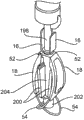
图35-39、40A-40D、41-42、43A-43C示出了固定设备14的其他实施方式。在该实施方式中,设备14能够以倒转的位置输送并能够运动到打开位置以抓取组织。图35示出了处于倒转位置的固定设备14。固定设备14包括轴198、近侧元件16和远侧元件18。每个远侧元件18具有自由端54和可转动地连接到轴198的近端52。固定设备14还包括致动杆204、基部202和附接到基部202的一对展开臂200,如图所示。在倒转位置,延伸器204延伸,且展开臂200布置在致动杆204和远侧元件18之间。如图36所示,致动杆204可被缩回使得展开臂200压靠远侧元件18,使远侧元件18从倒转位置转动到打开位置。远侧元件18的角度可通过缩回或延伸致动杆204多个距离来调节。如图37所示,进一步缩回致动杆204将进一步抬高远侧元件18。35-39, 40A-40D, 41-42, 43A-43C illustrate other embodiments of the
在打开位置,组织或瓣叶可被抓取在远侧元件18和近侧元件16之间。图38示出了处于其释放位置的近侧元件16,其中组织或瓣叶可能存在于其间。以下,组织将被称为瓣叶。在该实施方式中,每个远侧元件18包括植入纱布210,通常压配合或者嵌入在每个远侧元件18内。植入纱布210将通过系绳,例如缝线或丝附接到瓣叶,并用来以希望接合保持瓣叶。植入纱布210然后可与固定设备14分离并作为植入物保留。In the open position, tissue or leaflets can be captured between the
为了将植入纱布210附接到瓣叶,瓣叶和植入纱布210通过固定工具220穿刺,如图39所示。固定工具220从导管86延伸并经过瓣叶并穿刺植入纱布210。因此,纱布210包括可穿刺材料,例如结构性网状物。固定工具220用来输送锚固件222,如图40A-40D的放大图所示。图40A显示了固定工具220,其包括围绕固定工具220的套管224和位于两者之间的锚固件222。在该实施方式中,锚固件包括保持在套管224内的一个或多个翼片。可以认识到,锚固件222可以具有任何合适的形式。锚固件的其他示例性实施方式在共同受让的美国专利申请No.09/894463(律师卷号为No.020489-000400US)中提供,该申请出于所有目的合并在此。缝线226附接到锚固件222并延伸经过套管224或在套管224的外侧上延伸到导管86,如图所示。推进固定工具220,使得锚固件222经过瓣叶(未显示)和纱布210,如图41所示。To attach the
现在参照图40B,然后缩回套管224以暴露翼片228,将锚固件222从套管224的限制中释放。翼片228通过弹簧加载、形状记忆或其他自扩张机构向外径向延伸,如图40C所示。因此,翼片228抵靠纱布210的远侧定位,缝线226经过纱布210和瓣叶,如图41所示。此时,纱布210可从远侧元件18移除。通过向远侧延伸致动杆204,基部202向远侧拉动展开臂200,使得远侧元件18返回倒转位置,如图42所示。由于纱布210已经被固定工具220穿刺,且锚固件222已经部署,纱布210和瓣叶与远侧元件18脱离并保留就位。近侧元件16也可使用上面结合其他实施方式描述的多种机构的任何一种如图所示返回其初始位置。现在参照图40D,接下来移除固定工具220,同时利用附接的缝线226将锚固件222保留就位。Referring now to FIG. 40B , the
然后将植入纱布210与固定设备14分离并将其留下以将瓣叶接合保持在希望位置。图43A-43C示出了植入纱布210的多个立体图。图43A提供了立体的俯视图,显示了纱布210通过允许纱布210从固定设备14的一侧释放的链接件230连接。另外,缝线226通过打结或者如图所示放置缝线紧固件232固定在一起。可以认识到,缝线紧固件232可具有任何合适的形式。缝线紧固件232的其他示例性实施方式在2002年3月1日提交的共同转让的美国专利申请No.10/087004(律师卷号No.020489-000500US)中提供,该申请出于所有目的通过引用合并在此。图43B提供了立体的仰视图,显示了锚固件222抵靠纱布210的底侧定位。同样,图43C提供了立体的侧视图,也显示了锚固件222抵靠纱布210的底侧定位。
图44A-44B、45-46示出了固定设备14的另一实施方式。如图44A所示,固定设备14安装在轴12上并包括远侧元件18和保持夹36,保持夹36由具有折叠形状的半刚性材料构成。该材料可以是提供具有反弹属性的刚性的任何合适的材料,例如各种金属或塑料。折叠形状使得折叠252指向远侧且自由端254朝着远侧元件18向近侧指向。穿透元件256设置在自由端254附接并指向轴12。另外,开口258定位在折叠252附近,如提供设备14的立体图的图44B所示。回来参照图44A,折叠252附接到经过轴12的致动杆74,且箭头形结构260设置在轴12上,在自由端254之间并在开口258近侧,如图所示。在该布置中,固定设备14被推进经过瓣膜使得远侧元件18设置在瓣叶下方。然后,设备被向近侧缩回以将瓣叶捕获在远侧元件18内。如图45所示,致动杆74的缩回将保持夹36朝着远侧元件18拉动,使得箭头形结构260的倾斜侧将自由端254向外压迫,远离轴12。致动杆74的进一步缩回使得箭头形结构260的倾斜侧落入保持夹36的开口258中,引起保持夹36反弹回到如图46所示的关闭位置,且自由端254延伸经过远侧元件18。这允许穿透元件256穿透瓣叶(未显示)以与其可靠接合。然后,将致动杆74与保持夹36分离,轴12与远侧元件18分离,保持夹36和远侧元件18被留在该位置以将瓣叶保持在接合布置。Another embodiment of the
可以认识到,前述的实施方式也可以包括被构造成定位在瓣叶上游侧上以辅助捕获和固定的近侧元件16。该近侧元件可安装在轴12上以在固定瓣叶后移除,或者近侧元件可以连接到远侧元件18和/或保持夹36与其一起植入。It will be appreciated that the foregoing embodiments may also include a
在其他实施方式中,可以操纵近侧元件来增强夹紧。例如,可以降低近侧元件以将瓣叶或组织抓取在近侧元件和远侧元件之间,然后运动近侧元件以将瓣叶或组织拖拉到固定设备中。在另一例子中,可独立地降低近侧元件以抓取瓣叶或组织。这对顺序抓取是有用的。在顺序抓取中,降低一个近侧元件来将瓣叶或组织部分捕获在近侧元件和远侧元件之间。然后,将固定设备运动、调节、操纵到用于将另一瓣叶或组织部分抓取在另一组近侧元件和远侧元件之间的位置。在该位置,接着降低第二近侧元件来抓取该另一瓣叶或组织部分。In other embodiments, the proximal element can be manipulated to enhance grip. For example, the proximal element can be lowered to capture the leaflet or tissue between the proximal and distal elements, and then moved to draw the leaflet or tissue into the fixation device. In another example, the proximal elements can be independently lowered to grasp leaflets or tissue. This is useful for sequential fetching. In sequential capture, one proximal element is lowered to capture the leaflet or tissue portion between the proximal and distal elements. The fixation device is then moved, adjusted, manipulated into position for capturing another leaflet or tissue portion between another set of proximal and distal elements. In this position, the second proximal element is then lowered to grasp the other leaflet or tissue portion.
输送设备Conveying equipment
I.输送设备概述。图47提供了可用来如上所述引入和定位固定设备的输送设备或输送导管300的一种实施方式的立体图。输送导管300包括具有近端322和远端324的轴302以及附接到近端322的手柄304。固定设备(未显示)能够可移除地联接到远端324以输送到身体内的部位,特别是经血管输送到二尖瓣。因此,联接结构320从远端324延伸以与固定设备联接。致动杆64也从远端324延伸。致动杆64能够与固定设备连接并作用以操纵固定设备,特别是打开和关闭远侧元件。图48中示出了到固定设备的这种联接。 I. Overview of conveying equipment . Figure 47 provides a perspective view of one embodiment of a delivery device or
图48示出了联接到输送导管300的远端324的固定设备14的一种实施方式。轴302被显示为在其远端324附近具有突出部318。在该实施方式中,突出部318具有凸缘形状。该凸缘形状防止突出部318被缩回到引导导管或引入器中,如下面所述。然而,可以认识到,突出部318可具有任何形状,包括子弹、圆化的、钝的或尖的形状等。压圈326从突出部318延伸,联接结构320和致动杆64从压圈326经过。如图所示,致动杆64能够与固定设备14的销柱74联接。图49中示出了这种联接。FIG. 48 shows one embodiment of the
图49示出了输送导管300的轴302的一部分和能够与导管300联接的固定设备14。致动杆64经过轴302。在该实施方式中,致动杆64包括近侧末端303和远侧末端328,远侧末端328由线圈330围绕。近侧末端303通常由不锈钢、镍钛锘或Elgiloy

回头参照图48,固定设备14还包括锁定机构,其如上面关于图18-21描述地包括释放套具108。锁定线92与释放套具108连接以如前面所述地锁定和解锁锁定机构106。锁定线92延伸经过输送导管300的轴302并以各种布置与释放套具108连接,如下面所述。类似地,近侧元件线90延伸经过输送导管300的轴302并与近侧元件16连接。近侧元件16通过如前所述操纵近侧元件线90抬起和降低。近侧元件线90以多种布置与近侧元件16连接,如下所述。Referring back to FIG. 48 , the
回头参照图47,附接到轴302的近端332的手柄304用来操纵联接的固定设备14并任选地断开固定设备以永久植入。如所描述地,固定设备14主要通过致动杆64、近侧元件线90和锁定线92操纵。致动杆64操纵远侧元件18,近侧元件线90操纵近侧元件16,锁定线92操纵锁定机构。在该实施方式中,致动杆64可以被平移(延伸或缩回)以操纵远侧元件18。这是通过使用致动杆控制器314实现的,如下所述。致动杆64还被转动以使带螺纹的接合件与带螺纹的销柱74接合或脱离。这是通过使用以下描述的致动杆手柄316实现的。此外,锁定线92可利用不同大小的张力延伸、缩回、加载或者使用锁定线手柄310移除。这些手柄310、312将在下文详细描述。致动杆手柄316、致动杆控制器314、近侧元件线手柄312和锁定线手柄310都与主体308接合,致动杆64、近侧元件线90和锁定线92在主体内被引导到轴302中。手柄304还包括与主体308连接的支撑基部306。主体308能够沿着支撑基部306滑动以提供轴302的平移。此外,主体308能够绕着支撑基部306转动以转动轴。Referring back to Fig. 47, the
II.输送导管轴。图50示出了图47的输送导管轴302的截面图。在该实施方式中,轴302具有带内腔348的管状形状并由提供环向强度又保持可挠性和抗纽绞性的材料构成,例如编织层压材料。这种材料可包括不锈钢编织或螺旋线嵌入聚合物,如聚氨酯、聚酯、Pebax、Grilamid TR55、和AESNO等。为了提供进一步的支持和环向强度,支持圈346设置在轴302的内腔348内,如图50所示。 II. Delivery Catheter Shaft . FIG. 50 shows a cross-sectional view of the
包括管状引导件和圆柱形杆的多个细长体经过支持圈346。例如,一种管状引导件是经过内腔348从轴302的近端322延伸到远端324的压缩圈326,且致动杆64延伸经过压缩圈326。因此,压缩圈通常具有48-60英寸范围的长度和0.020-0.035英寸范围的内径,以允许致动杆64从其经过。致动杆64能够操纵以在压缩圈326内转动并相对于压缩圈326平移。压缩圈326允许致动杆64和轴302的侧向可挠性,同时抗扭曲并在压缩下提供裂断强度。压缩圈可由304V不锈钢构成以提供这些特性。A plurality of elongated bodies comprising tubular guides and cylindrical rods pass through
为了为轴302提供额外的拉伸强度并使伸长率最小,拉伸缆线344也经过支持圈346。拉伸缆线344经过内腔348从轴302的近端322延伸到远端324。因此,拉伸缆线344通常具有在0.005-0.010英寸范围的直径和在48-60英寸范围的长度。在优选实施方式中,拉伸缆线344由304V不锈钢构成。In order to provide additional tensile strength to
另外,具有管状形状的至少一个锁定线轴341可具有锁定线内腔340,锁定线92可在锁定线手柄310和锁定机构106之间经过该锁定线内腔340。锁定线轴341经过内腔348从轴302的近端322延伸到远端324。因此,锁定线轴341通常具有在48-60英寸范围的长度和在0.016-0.030英寸范围的内径,以及在0.018-0.034英寸范围的外径。在优选实施方式中,锁定线轴341由304V不锈钢圈构成,但也可以使用提供抗纽绞性和压缩强度的其他结构或材料。Additionally, at least one
类似地,具有管状形状的至少一个近侧元件线轴343可具有近侧元件线内腔342。近侧元件线90在近侧元件线手柄312和近侧元件16之间经过该内腔342。因此,近侧元件线轴343经过内腔348从轴302的近端322延伸到远端324。因此,近侧元件线轴343通常具有在48-60英寸范围的长度和在0.016-0.030英寸范围的内径,以及在0.018-0.034英寸范围的外径。在优选实施方式中,近侧元件线轴343由304V不锈钢圈构成,但也可以使用提供抗纽绞性和压缩强度的其他结构或材料。Similarly, at least one
在该实施方式中,细长体(由压缩圈326围绕的致动杆64、拉伸缆线344、锁定线轴342、近侧元件线轴343)均在支持圈346内自由“飘浮”在内腔348中,只在轴302的近端322和远端324处固定。在使用过程中,内腔348通常用肝素化(生理)盐水填充和冲洗。替代地或另外地,内腔348可填充有一个或多个填料,例如挠性杆、珠子、挤出部分、凝胶或其他流体。优选地,填料允许细长体在内腔348内有一些侧向运动或偏转,但在一些情况下可限制这种运动。通常,细长体固定在轴的近端和远端并在其间自由地侧向运动和转动。细长体的这种运动自由度为轴302提供了增加的灵活性,因为细长体在轴302的弯曲和/或扭转过程中自调节和重新定位。可以认识到,细长体可不固定在近端和远端。细长体可简单地在至少一个位置相对于轴302不受限制,以能够在内腔348内侧向运动。优选地,细长体在导管的至少远侧部分,例如距远端324为5-15cm的部分中不受限制以在该远侧部分提供最大灵活性。In this embodiment, the elongated body (
然而可以认识到,也可以使用替代的轴302设计。例如,参照图51,在该实施方式中,轴302同样具有带内腔348的管状形状,支持圈346设置在轴302的内腔348内。填充在支持圈326的内腔348内的是挤出件334,其具有包括由压缩圈326围绕的致动杆64、拉伸缆线344、锁定线轴342和近侧元件线轴343的多个细长体可经过的多个内腔,如图所示。支持圈346和细长体可具有相同的几何形状并由上面关于图50描述的相同材料构成。It will be appreciated, however, that
替代地,如图52所示,轴302可包括内部分隔件350以在轴302内形成多个内腔。例如,分隔件350可具有中心内腔352,用于致动杆64经过,致动杆64可选地由压缩圈326包围。另外,分隔件350还可形成用于锁定线92经过的至少一个锁定线内腔340和用于近侧元件线90经过的至少一个近侧元件线内腔341。任选地,分隔件350限定的每个内腔可以排列有抗纽绞元件,例如前面的实施方式中的圈。Alternatively, as shown in FIG. 52 , the
图52A-52C示出了轴302的突出部318的实施方式。在图52A中,突出部318包括末端环280和锁定环282。在优选实施方式中,环氧树脂和尼龙弹性体可沉积在末端环280和锁定环282之间以将其结合在一起。锁定环282的几何形状与末端环280匹配以在两者之间保持相对对准。图52B示出了轴302的突出部318的另一实施方式。这里,末端环280由软末端284覆盖以提供更加无创伤的末端和到轴更加平滑的过渡。52A-52C illustrate an embodiment of the
III.锁定线布置。如前所述,当存在锁定线92时,线92在锁定线手柄310和锁定机构106之间经过至少一个锁定线内腔340。锁定线92接合锁定机构106的释放套具108以如前所述锁定和解锁锁定机构106。锁定线92可以各种布置接合释放套具108,其例子在图53A-53C中示出。在每个实施方式中,两个锁定线内腔340存在于输送导管300的终止于突出部318的轴302内。内腔340设置在致动杆64的两侧上以使得每个内腔340指向释放套具108。 III. Locking wire arrangement. As previously described, when a
图53A示出了一种实施方式,其中两个锁定线92、92′经过单个锁定线内腔340并在致动杆64的一侧上穿过释放套具108(为了清楚起见,致动杆64被显示为没有包围的壳体,例如联接结构)。然后,锁定线92、92′分离使得每个锁定线在致动杆64的相对侧上经过。锁定线92、92′然后在致动杆64的相对侧上经过释放套具108并继续一起经过另外的单个锁定线内腔340′。该锁定线布置与图48所示的布置相同。Figure 53A shows an embodiment in which two locking
图53B示出了一种实施方式,其中一个锁定线92经过单个锁定线内腔340、然后在致动杆64的一侧上穿过释放套具108并返回到锁定线内腔340。类似地,另一锁定线92′经过另外的单个锁定线内腔340′,穿过位于致动杆64的相对侧上的不同释放套具108′,返回该另外的单个锁定线内腔340′。FIG. 53B shows an embodiment in which one
图53C示出了一种实施方式,其中两个锁定线92、92′经过单个锁定线内腔340。一个锁定线92穿过致动杆64的一侧上的释放套具108,然后经过致动杆64的相对侧上的另一锁定线内腔340′。另一锁定线92′穿过致动杆64′的另一侧上的释放套具108′,然后与前一锁定线92经过另一锁定线内腔340′。FIG. 53C shows an embodiment in which two locking
可以认识到,可以使用多种锁定线布置,并不局限于上面说明和描述的布置。多种布置允许套具108被独立或共同地操纵,允许施加多个拉伸量,并允许改变留下固定设备时去除锁定线所需的力。例如,经过一个或两个内腔的单个锁定线可连接到两个释放套具,以同时施加拉伸。It will be appreciated that a variety of locking wire arrangements may be used and are not limited to the arrangements illustrated and described above. The various arrangements allow the
IV.近侧元件线布置。如前所述,当存在近侧元件线90时,线90在近侧元件线手柄312和至少一个近侧元件16之间经过至少一个近侧元件线内腔342。近侧元件线90接合近侧元件16以如前所述抬高或降低元件16。近侧元件线90可以以多种布置接合近侧元件16,其例子在图54A-54B中示出。在每个实施方式中,两个近侧元件线内腔342存在于输送导管300的终止于突出部318的轴302内。内腔342设置在致动杆64的两侧上(为了清楚起见,致动杆64被显示为没有包围的壳体,例如联接结构),使得每个内腔342指向近侧元件16。 IV. Proximal element wire placement . As previously described, when a
图54A示出了一种实施方式,其中一个近侧元件线90经过单个近侧元件线内腔342。近侧元件线90穿过致动杆64一侧上的近侧元件16的孔眼360,绕过致动杆64并穿过致动杆64的另一侧上的另一近侧元件16′的孔眼360′。近侧元件线90然后经过另外的单个近侧元件线内腔342′。该近侧元件线布置是图48所示的相同布置。FIG. 54A shows an embodiment in which one
图54B示出了一种实施方式,其中一个近侧元件线90经过单个近侧元件线内腔342,穿过致动杆64一侧上的近侧元件16的孔眼360,并返回近侧元件线内腔342。类似地,另一近侧元件线90′经过致动杆64的相对侧上的另外的单个近侧元件线内腔342′,并返回该另外的单个近侧元件线内腔342′。Figure 54B shows an embodiment in which a
可以认识到,可以使用多种近侧元件线布置,并不局限于上面说明和描述的布置。多种布置允许近侧元件被独立或共同地操纵,允许施加多个拉伸量,并允许改变留下固定设备时去除近侧元件线所需的力。例如,经过轴302中的一个或两个内腔的单个近侧元件线可用于同时作用两个近侧元件。It will be appreciated that a variety of proximal element wire arrangements may be used and are not limited to the arrangements illustrated and described above. The various arrangements allow the proximal elements to be manipulated independently or collectively, allow multiple amounts of stretch to be applied, and allow for varying forces required to remove the proximal element wires while leaving the fixation device. For example, a single proximal element wire passing through one or both lumens in
V.手柄的主体。图55示出了输送导管300的手柄304的实施方式。如前所述,致动杆手柄316、致动杆控制器314、近侧元件线手柄312和锁定线手柄310都与主体318接合。手柄304还包括与主体308连接的支持基部306。主体308可沿着支持基部306滑动以提供轴302的平移,且主体308能够围绕支持基部306转动以转动轴。 V. The body of the handle . FIG. 55 shows an embodiment of the
图56提供了图55中描绘的手柄304的主体308的部分截面图。如图所示,主体308包括密封腔室370,致动杆64、近侧元件线90和锁定线92在该腔室内被引导到轴302中。密封腔室370与轴302的内腔348流体连通并通常填充生理盐水并用肝素或肝素生理盐水冲洗。密封腔室370沿着其周边具有密封件372以防止泄露和将空气引入到腔室370内。腔室370内的任何空气可通过一个或多个鲁尔接头374排出腔室370,鲁尔接头374经过主体308进入腔室370,如图55所示。在该实施方式中,手柄304包括两个这样的鲁尔接头374,主体308的一侧一个(第二鲁尔接头对称地定位在图55中的主体308的背面侧,挡住不可见)。现在参照图56,密封腔室370还具有多个另外的密封件,例如在致动杆64进入密封腔室370处环绕致动杆64的致动杆密封件376和在轴302进入密封腔室370处环绕轴302的轴密封件378。FIG. 56 provides a partial cross-sectional view of the
VI.锁定线手柄和近侧元件线手柄。如前所述,锁定线92可使用锁定线手柄310延伸、缩回、加载多个拉伸量或移除。同样,近侧元件线90可以使用近侧元件线手柄312延伸、缩回、加载多个拉伸量或移除。这两个手柄310、312在设计上类似以操纵经过其的合适的线90、92。 VI. Locking wire handle and proximal element wire handle . As previously described, the
图57示出了其中延伸有锁定线92的锁定线手柄310的实施方式。锁定线手柄310具有远端384、近端382和位于两者之间的细长轴383。远端382能够定位在密封腔室370内使得近端382延伸出腔室370,超过主体308。锁定线92的自由端设置在近端382附近,在带螺纹凸起390附近经过手柄310的壁。手柄310还包括能够定位在凸起390上的帽388。帽388的内螺纹与带螺纹的凸起390上的螺纹配合使得帽388通过摩擦将锁定线92的自由端保持在帽388和凸起390之间和/或手柄310的其他部分之间。锁定线92经过细长轴383的中心内腔(未显示),延伸经过密封腔室370(如图56所示),并延伸经过轴302到锁定机构106。Figure 57 shows an embodiment of a locking wire handle 310 with a
至少一个翼392设置在手柄310的远端384附近。在图57的实施方式中,具有两个翼392,每个翼392设置在细长轴383的相对侧上。翼392向外径向延伸并向近侧弯曲使得一部分平行于细长轴383,如图所示。可以认识到,翼392可替代地具有径向延伸的实体或连续突出的形状并具有平行于细长轴383的一部分。翼392用来将锁定线手柄310保持在希望位置,继而在希望拉伸载荷下保持锁定,如下所述。手柄310还包括近端382附近的指握386,其向外径向延伸成与至少一个翼392的径向延伸部分对准。因此,使用者可从主体308外侧的指握386的取向确定翼392在密封腔室370内的取向。指握386还可用作工效学目的以辅助操纵手柄310。At least one
翼392平行于细长轴383的部分具有槽或者锯齿394。锯齿394用来向锁定线92施加张力。如图57A所示,锁定线手柄310定位在设置于密封腔室370内的半管400内。半管400包括上半部分402和下半部分404,每个半部402、404具有与翼392的锯齿394匹配的槽或锯齿406。因此,在翼392被转动以如图58A所示配合锯齿394、406时,细长轴383保持就位。同样,翼392可被转动,如图58B所示,使得翼392设置在半部402、404之间,且锯齿394、406脱离。在该位置,轴383可平移以施加或释放锁定线92中的张力。因此,通过转动轴383以使锯齿394、406脱离,平移轴383,然后将轴383转动回以重新接合锯齿394、406,可以调节线92中的张力。替代地,可拉动指握386以向锁定线90施加张力。拉动指握386使得锁定线手柄310在半管400内平移。这种平移可由于锯齿394、406的倾斜和翼382的可挠性实现。然而,锯齿394、406的倾斜防止相对方向上的平移,即通过推动指握386的平移。因此,为了从锁定线92释放张力,转动轴383以使锯齿394、406脱离,从而允许轴383平移,然后将轴383转回以重新接合锯齿394、406。The portion of the
为了去除锁定线92,将帽388从带螺纹的凸起390去除,暴露锁定线92的自由端。如果存在具有两个自由端的一个锁定线92,继续拉动其中一个自由端,将锁定线92的整个长度拉出导管300。如果存在多于一个锁定线92,每个锁定线92将具有两个自由端。继续拉动每个锁定线92的其中一个自由端,将每个锁定线92的整个长度拉出导管300。To remove locking
可以认识到,近侧元件线手柄312具有与锁定线手柄310相应的特征并且以图57A、58A-58B所示的相同方式操作。还可以认识到,可以使用其他机构来操纵锁定线92和近侧元件线90,例如包括按钮、弹簧、杠杆和旋钮。It will be appreciated that the proximal element wire handle 312 has corresponding features as the
VII.致动杆控制器和手柄。致动杆64可使用致动杆控制器314和致动杆手柄316来操纵。图59提供了包括致动杆控制器314和致动杆手柄316的手柄304的一部分的截面图。致动杆手柄316位于手柄314的近端。致动杆手柄316固定地附接到致动杆64的近端。致动杆64经过设置在保持件428内的夹头426插入。保持件428具有与致动杆控制器314的内螺纹432配合的外螺纹。因此,致动杆控制器314的转动通过螺纹作用引起保持件428沿着致动杆控制器314平移,如下更加详细所述。致动杆控制器314可转动地与手柄304的主体308联接并通过唇缘430保持就位。 VII. Actuation Lever Controller and Handle .
参照图59A,致动杆控制器314可在顺时针或逆时针方向上手动转动,如箭头436指示。致动杆控制器314的转动使得致动杆64平移(延伸或缩回)以操纵固定设备14的远侧元件18。具体地,致动杆控制器314的转动引起相邻的保持件428的外螺纹434沿着致动杆控制器314的匹配的内螺纹432平移。保持件428自身的转动通过从保持件428伸出并嵌入手柄304的主体308中的槽438内的保持销424来防止。随着保持件428平移,每个保持销424沿着其相应的槽438平移。由于夹头426附接到保持件428,夹头426与保持件428一起平移。为了同时平移致动杆64,致动杆64通过销422可移除地附接到夹头426。销422可具有任何合适的形式,包括如图59所示部分环绕夹头426的夹子形。因此,致动杆控制器314的转动提供致动杆64的平移的精细控制以及定位远侧元件18的精细控制。Referring to FIG. 59A , the
参照图59B,如图所示,销422的去除允许致动杆手柄316和固定地附接的致动杆64与夹头426脱离。一旦脱离,致动杆64通过手动转动致动杆手柄316转动,如箭头440所指示的。如前所述,致动杆64的转动使得输送导管300的带螺纹的接合件332与固定设备14的带螺纹的销柱74接合或脱离。这用来将固定设备14与输送导管300附接或分离。另外,当致动杆64处于脱离状态时,致动杆64可以通过拉动致动杆手柄316和从手柄304撤回致动杆64可选地被缩回和可选地从导管300去除。Referring to FIG. 59B , removal of
根据应用、目标部位的位置和选择的接近途径,本发明的设备可以本领域技术人员已知的方式修改或者与本领域已知的其他设备结合使用。例如,针对希望的应用,可修改输送导管的长度、刚度、形状和转向性能。同样,固定设备相对于输送导管的取向可以被颠倒或以其他方式改变。致动机构可以被改变成以交替方向驱动(推动打开、拉动关闭或者拉动打开、推动关闭)。材料和设计例如可以改变成更加挠性或更加刚性。并且固定设备部件可以被改变成具有不同的尺寸或形状。此外,本发明的输送导管可用来输送其他类型的设备,特别是血管成形术、旋切术、支架输送、栓塞过滤和清除、室间隔缺损修补术、组织接近和修复、血管夹紧和结扎、缝合、动脉瘤修复、血管闭塞和电映射和消融等中使用的血管内和微创外科设备。因此,本发明的输送导管可用于希望具有高压缩、拉伸和扭转强度的高度挠性、抗纽绞设备的应用场合。Depending on the application, the location of the target site and the chosen route of access, the device of the present invention may be modified in a manner known to those skilled in the art or used in combination with other devices known in the art. For example, the length, stiffness, shape and steering properties of the delivery catheter can be modified for the desired application. Likewise, the orientation of the fixation device relative to the delivery catheter may be reversed or otherwise altered. The actuation mechanism can be changed to drive in alternate directions (push to open, pull to close or pull to open, push to close). Materials and designs can be changed to be more flexible or more rigid, for example. And the fixture components may be changed to have different sizes or shapes. In addition, the delivery catheters of the present invention may be used to deliver other types of devices, particularly angioplasty, atherectomy, stent delivery, embolic filtration and removal, ventricular septal defect repair, tissue access and repair, vessel clamping and ligation, Endovascular and minimally invasive surgical devices used in suturing, aneurysm repair, vascular occlusion, and electrical mapping and ablation, among others. Accordingly, the delivery catheters of the present invention are useful in applications where a highly flexible, kink-resistant device having high compressive, tensile, and torsional strength is desired.
多导管引导系统Multiple Catheter Guidance System
I.引导系统概述。参照图60,示出了本发明的多导管引导系统1的一种实施方式。该系统1包括具有近端1014、远端1016以及经过其的中心内腔1018的外引导导管1000、以及具有近端1024、远端1026以及经过其的中心内腔1028的内引导导管1020,其中内引导导管1020同轴地定位在外引导导管1000的中心内腔1018内,如图所示。导管1000、1020的远端1016、1026的尺寸分别能够经过体腔,特别是经过例如血管腔的体腔。因此,远端1016优选具有在约0.040-0.500英寸范围、更优选在0.130-0.320英寸范围内的外径。中心内腔1018的尺寸能够使得内引导导管1020经过,远端1026优选具有在约0.035-0.280英寸范围、更优选在0.120-0.200英寸范围内的外径。中心内腔1028的尺寸能够使得多种设备经过其中。因此,中心内腔1028优选具有在约0.026-0.450英寸范围、更优选在0.100-0.080英寸范围内的内径。 I. Boot System Overview . Referring to Figure 60, one embodiment of the
图60示出了定位于可选地包括在系统1中的内引导导管1020内的介入导管1030,然而,可以使用其他介入设备。介入导管1030具有近端1034和远端1036。其中介入工具1040定位在远端1036处。在该实施方式中,介入工具1040包括可分离的固定设备或夹子。可选地,介入导管1030还可包括具有止档1043的鼻状件1042,如图所示。止档1043防止介入工具1040进入内引导导管1020的中心内腔1028。因此,介入导管1030可以被推进和缩回,直到止档1043接触内引导导管1020的远端1026,从而防止进一步缩回。这可在一些过程中提供一些好处。可以认识到,在包括这种止档1043的实施方式中,介入导管1030可预先加载在内引导导管1020内,用于经外引导导管1000推进,或者介入导管1030和内引导导管1020都可预先加载在外引导导管1000内,用于推进到目标组织。这是因为止档1043防止介入导管1030经内引导导管1020推进。Figure 60 shows an
外引导导管1000和/或内引导导管1020被预先弯曲和/或具有转向机构以将远端1016、1026定位在希望方向,转向机构的实施方式将在下文详细描述。外引导导管1000的预先弯曲或者转向将在第一方向上引导远端1016以形成主要弯曲,而内引导导管1020的预先弯曲或转向将在不同于第一方向的第二方向上引导远端1026以形成次要弯曲。主要弯曲和次要弯曲一起形成合成弯曲。介入导管1030经同轴的引导导管1000、1020的推进将经过合成弯曲朝着希望方向引导介入导管1030,该希望方向通常为允许介入导管到达其目标的方向。The
外引导导管1000和内引导导管1020的转向可通过致动一个或多个转向机构来实现。使用通常定位在与每个导管1000、1020连接的手柄上的致动器来实现转向机构的致动。如图60所示,手柄1056连接到外引导导管1000的近端1014并在使用过程中保持在患者身体外部。手柄1056包括可用来使外引导导管1000弯曲、形成弧形或重新成形以形成主要弯曲的转向致动器1050。手柄1057连接到内引导导管1020的近端(未显示)并可选地与手柄1056接合以形成一个较大的手柄,如图所示。手柄1057包括用来使内引导导管1020弯曲、形成弧形或重新成形以形成次要弯曲并且运动内引导导管1020的远端1026经过角度θ的转向致动器1052,如下文描述的。Steering of
另外,锁定致动器1058、1060可用来致动锁定机构以将导管1000、1020锁定在特定位置。致动器1050、1052、1058、1060被示出为按钮,但可以认识到,这些和定位在手柄1056、1057上的任何附加致动器可具有任何合适的形式,包括旋钮、指轮、杠杆、开关、套环、传感器或其他设备。手柄的其他实施方式将在下文中详细描述。Additionally, locking
另外,手柄1056可包括例如指示导管1000、1020的位置或者致动器上的力的信息的数字或图形显示器1061。还可以认识到,致动器1050、1052、1058、1060和任何其他按钮或屏可设置在与两个导管1000、1020都连接的单个手柄上。In addition, the
II.示例性位置。图61A-61D示出了导管1000、1020可保持在的位置的例子。参照图61A,外引导导管1000可被预先弯曲和/或转向到包括主要弯曲1100的位置。该主要弯曲1100通常具有在约0.125-1.000英寸范围内、优选在约0.250-0.500英寸范围内的曲率半径1102,或者形成在约0-120度范围内的弯曲。如图所示,当该位置仅包括主要弯曲1100时,远端16位于单个平面X中。在远端16处横穿中心内腔18的中心的轴线x位于平面X内。 II. Exemplary Locations . 61A-61D illustrate examples of positions in which
参照图61B,内引导导管1020延伸经过外引导导管1000的中心内腔1018。内引导导管1020可被预先弯曲和/或转向到包括次要弯曲1104的位置。次要弯曲1104通常具有在约0.050-0.750英寸范围、优选在约0.125-0.250英寸范围内的曲率半径1106,或者形成在约0-180度范围内的弯曲。次要弯曲1104可与主要弯曲1100位于相同的平面,即平面X内,或者其可位于不同的平面,例如所示的平面Z中。在该例子中,平面Z基本与平面X正交。在远端1026处横穿内引导导管1020的中心内腔1028的中心的轴线z位于平面Z内。在该例子中,轴线x和轴线z彼此成基本90度的角度,然而可以认识到,轴线x和轴线z可相对于彼此成任何角度。同样,尽管在该例子中主要弯曲1100和次要弯曲1104位于不同的平面,特别是基本正交的平面中,但弯曲1100、1104可替代地位于相同的平面中。Referring to FIG. 61B , the
现在参照图61C,内引导导管1020可被进一步操纵成允许远端1026运动经过角度θ1070。角度θ1070在约-180°至+180°的范围,通常在-90°至+90°的范围,也可能在-60°至+60°、-45°至+45°、-30°至+30°或更小的范围。如图所示,角度θ1070位于平面Y内。特别是,在远端1026处延伸经过中心内腔1028的中心的轴线y与轴线z形成角度θ1070。在该例子中,平面Y与平面X和平面Z都正交。轴线x、y、z都在中心内腔1028内的位置交叉,该位置也与平面X、Y、Z的交叉点重合。Referring now to FIG. 61C ,
类似地,图61D示出了远端1026在轴线z的相反侧上运动经过角度θ1070。同样,角度θ1070是从轴线z到在远端1026处延伸经过中心内腔1016的中心的轴线y测量的。如图所示,角度θ1070位于平面Y中。因此,主要弯曲1100、次要弯曲1104和角度θ1070都可位于不同的平面中,可选地位于正交的平面中。然而,可以认识到,主要弯曲1100、次要弯曲1104和角度θ1070所在的平面可相互关联,因此可允许其中一些位于相同的平面内。Similarly, FIG. 61D shows that the
另外,外引导导管1000可被预先形成和/或可转向以提供另外的弯曲或形状。例如,如图62A所示,可通过主要弯曲1100近侧的外引导导管1000形成另外的弯曲1110。在该例子中,弯曲1110提升或抬高外引导导管1000的远端1016,这继而抬高内引导导管1020的远端1026。这种提升在图62B中示出。这里,系统1在提升之前以虚线显示,其中轴线y′经过轴线z和轴线x′的交叉点。在应用弯曲1110后,系统1的远侧部分在轴线z的方向上提升,使得轴线x′被抬高到轴线x″,轴线y′被抬高到轴线y″。这将远端1026抬高到希望高度。Additionally,
图61A-61D和图62A-62B所示的多导管引导系统1的关节运动位置特别用于接近二尖瓣。图63A-63D示出了使用系统1接近二尖瓣MV的方法。为了接近二尖瓣,外引导导管1000可在扩张器和导丝上从股静脉中的穿孔前进、经过内部的腔静脉进入右心房。如图63A所示,外引导导管1000可以刺穿房间隔S的小窝F。然后,外引导导管1000被推进经过小窝F并通过主要弯曲1100弯曲,使得远端1016被引导到二尖瓣MV上方。同样可以认识到,这种接近仅仅用作示例,可以使用其他接近方法,例如经过颈静脉、股动脉、端口接近或直接接近等。将远端1016定位在二尖瓣MV上方可通过外引导导管1000的预先弯曲实现,其中导管1000在扩张器和导丝缩回时采取该位置,和/或通过将外引导导管1000转向到希望位置来实现。在该例子中,主要弯曲1100的形式使得远端1016在相应于前面的平面X且基本平行于瓣膜表面的主要平面内运动。这使得远端1016沿着二尖瓣MV的短轴侧向运动,并允许远端1016载瓣叶LF之间的开口O的上方对中。The articulation positions of the
参照图63B,内引导导管1020被推进经过外引导导管1000的中心内腔1018且远端1026被定位成使得中心内腔1028指向目标组织,即二尖瓣MV。特别是,中心内腔1028被指向二尖瓣MV的具体区域,例如朝着瓣叶LF之间的开口O,使得可以执行特定的介入手术。在图63B中,内引导导管1020被显示为处于包括与前面的平面Z对应的次要平面中的次要弯曲1104的位置。次要弯曲1104的形成使得远端1026在接合处C之间竖直和有角度地运动,将中心内腔1028指向二尖瓣MV。在该位置,经过中心内腔1028的介入设备或导管1030可朝着和/或经过开口O引导。尽管可以改变主要弯曲1100和次要弯曲1104来适应二尖瓣MV的不同解剖变化和不同的外科手术,但在这两个弯曲以外进一步调节以合适地定位系统1可能是希望的。Referring to Figure 63B, the
参照图63C,内引导导管1020的远端1026可被定位成经过角度θ1070。这使得远端1026竖直和有角度地运动经过对应于前面的平面Y的θ平面。图63B中的虚线显示了远端1026在任一方向上运动经过角度θ1070。这种运动可通过预先弯曲和/或通过转向导管1020来实现。因此,中心内腔1028可在不同于次要平面的平面内朝着二尖瓣MV引导。在这种运动后,内引导导管1020将处于使得中心内腔1028在端部1016处的开口面对希望方向的位置。在该情况下,所述希望方向朝着二尖瓣的中心并与二尖瓣正交。Referring to FIG. 63C , the
在一些情况下,希望抬高或降低远端1026使得其相对于二尖瓣MV处于希望高度。这是通过预先弯曲和/或通过转向外引导导管1000以形成另外的弯曲1110完成的。通常,这用来将远端1026提升到二尖瓣MV以上,其中这种提升在图62B中示出。In some cases, it may be desirable to raise or lower the
当通过转向机构形成导管1000、1020中的弯曲部分时,转向机构可通过锁定特征锁定就位。锁定可在引导系统1中提供额外的刚度和稳定性,以用于使介入设备或导管1030从其经过,如图60所示。介入导管1030可朝着目标组织(本案中为二尖瓣MV)经过中心内腔1028。如果希望的话,将远端1026如上所述定位在开口O上方允许导管1030经过瓣叶LF之间的开口O,如图63D所示。此时,可以对二尖瓣应用任何希望的手术,以纠正反流或任何其他失调。When the bend in the
III.转向机构。如前所述,可通过预先弯曲、转向或任何合适手段在导管1000、1020中形成弯曲部分。预先弯曲涉及在使用前在导管中设置特定的弯曲部分,例如通过热定型聚合物或者通过利用形状记忆合金。由于导管通常是挠性的,将导管加载在导丝、扩张闭塞器或者其他引入设备使得导管的弯曲区域变直。一旦导管被定位在解剖结构中,就去除引入设备,从而允许导管放松回预先弯曲的定型。 III. Steering mechanism . As previously mentioned, the bends may be formed in the
为了提供更高程度的控制和多种可能的弯曲部分,可使用转向机构来形成弯曲部分和定位导管。在一些实施方式中,转向机构包括导管的壁内的缆线或拉丝。如图64A所示,外引导导管1000可包括可滑动地设置在导管1000的壁内的内腔中且延伸到远端1016的拉丝1120。通过在近侧方向上向拉丝1120施加张力,远端1016如箭头1122所示在拉丝1120的方向上弯曲。同样,如图64A所示,当向拉丝1120施加张力时,拉丝1120沿着导管1000的相对侧的布置将允许远端1016如箭头1124所示在相反方向上弯曲。因此,参照图64C,将拉丝1120沿直径方向相对地布置在导管1000的壁内允许远端1016在相反的方向上转向。这提供了修改或调节弯曲部分的手段。例如,如果向一个拉丝施加张力来形成弯曲部分,通过向沿直径方向相对的拉丝施加张力可使该弯曲部分变小。现在参照图64D,另外组的相对导丝1120′可如图所示在导管1000的壁内延伸。导丝1120、1120′的结合使得远端能够在箭头1122、1124、1126、1128指示的至少4个方向弯曲。在该例子中,拉丝1120形成外引导导管1000的主要弯曲1100,拉丝1120′形成提升。可以认识到,图64A-64D也适合内引导导管1020。例如,在图64D中,拉丝1120可形成内引导导管1020的次要弯曲1104,拉丝1120′形成角度θ1070。To provide a higher degree of control and multiple possible bends, a steering mechanism may be used to form the bend and position the catheter. In some embodiments, the steering mechanism includes a cable or wire within the wall of the catheter. As shown in FIG. 64A , the
这些拉丝1120和/或拉丝1120′和相关的内腔可以布置成任何配置,单个或成对、对称或不对称,并且可以具有任何数量的拉丝。这可允许在任何方向和围绕多个轴线形成弯曲部分。拉丝1120、1120′可通过例如胶粘、捆绑、焊接、铸封等任何合适的方法固定到沿着导管长度的任何位置。当向拉丝施加张力时,弯曲部分从拉丝附接点朝着近侧方向形成。因此,根据拉丝附接点的位置,弯曲部分在导管长度的各处形成。然而,拉丝通常在导管的远端附近可选地附接到嵌入的末端环280,如图64E所示。如图所示,拉丝1120经过末端环280中的孔286,形成图形,然后回来经过孔286并经导管壁(未显示)行进。另外,容纳拉丝的内腔可以是直的,如图64A-64D所示,或者可以是弯的。These
Ⅳ.导管构造。外引导导管1000和内引导导管1020可具有相同或不同的构造,可包括任何合适的材料或者材料组合以形成上述的弯曲部分。为了清楚起见,将关于外引导导管1000提供例子,然而可以理解,这些例子也适用于内引导导管1020。 Ⅳ. Catheter construction.
在导管被预先弯曲而非可转向或者除了可转向还被预先弯曲的实施方式中,导管1000可包括能够例如通过热定型定型在希望曲率的聚合物或共聚物。同样,导管1000可包括形状记忆合金。In embodiments where the catheter is pre-bent rather than steerable or pre-bent in addition to steerable,
在导管可转向的实施方式中,导管1000可沿着导管1000的长度或者在多个片段中包括多种材料中的一种或多种。示例性的材料包括聚氨酯、Pebax、尼龙、聚酯、聚乙烯、聚酰亚胺、聚对苯二甲酸乙二醇酯(PET)、聚醚醚酮(PEEK)。另外,导管1000的壁可利用多种结构加强,例如金属编织物或圈。这种加强可以沿着导管1000的长度或者在多个片段中。In catheter steerable embodiments,
例如,参照图65A,导管1000具有近侧编织片段1150、盘绕片段1152和远端编织片段1154。近侧编织片段1150提供增加的断裂强度和扭矩转递。盘绕片段1152提供增加的转向性。远侧编织片段1154既提供转向性也提供扭转/断裂强度。在其他实施例中,参照图65B,外引导导管1000具有近侧双层编织片段1151和远侧编织片段1154。因此,近侧双层片段1151包括多内腔管1160(具有用于拉丝的转向内腔1162,转向内腔1151的远端可选地嵌有用于加强的不锈钢圈,以及中心内腔1163)、内编织层1164和外编织层1166,如图65C的截面图所示。类似地,图65D提供了包括多内腔管1160和单个编织层1168的远侧编织片段1154的截面图。在另一实施例中,参照图65E,内引导导管1020包括在其近端没有加强件的多内腔管1160、单编织层中间片段1170和单编织层远侧片段1171。每个单编织层片段1170、1171具有多内腔管1160和单层编织物1168,如图65F的截面图所示。然而,片段1170、1171包括不同硬度的聚合物,硬度通常朝着远端减小。For example, referring to FIG. 65A ,
图65G示出了外引导导管1000的远侧片段的截面的另一例子。这里,层1130包括55D Pebax并具有约0.0125英寸的厚度。层1131包括30ppi编织物并具有约0.002英寸×0.065英寸的厚度。层1132包括55D Pebax并具有约0.006英寸的厚度。层1133包括30ppi编织物并具有约0.002英寸×0.065英寸的厚度。最后,层1134包括Nylon 11并包括用于约0.105英寸直径拉丝1120的转向内腔。中心内腔1163具有足够的尺寸以使设备经过。FIG. 65G shows another example of a cross-section of the distal segment of
图65H-65I示出了内引导导管1020的截面的另外例子,图65I示出了远端的一部分的截面,且图65I示出了远端的更加远侧部分的截面。参照图65H,层1135包括40D聚合物并具有约0.0125英寸的厚度。层1136包括30ppi编织物并具有约0.002英寸×0.065英寸的厚度。层1137包括40D聚合物并具有约0.006英寸的厚度。层1138包括40D聚合物层并具有约0.0035英寸的厚度。最后,层1139包括55D衬里。另外,包括用于大约0.0105英寸直径拉丝1120的盘绕的转向内腔。并且,中心内腔1163具有足够的尺寸以使设备经过。参照图65I,层1140包括40D聚合物,层1141包括35D聚合物,层1142包括编织物,并且层1143包括衬里。另外,包括用于拉丝的盘绕的转向内腔。并且,中心内腔1163具有足够的尺寸以使设备经过。65H-65I show additional examples of cross-sections of the
图66A-66C示出了可结合在导管轴中的键连接特征的实施方式。键连接特征用来保持内引导导管和外引导导管之间的关系以辅助转向能力。如图66A所示,内引导导管1020包括向外径向延伸的一个或多个突起1400。在该例子中,具有4个突起1400,围绕导管1020的外部等距隔开。同样,外引导导管1000包括与突起1400对准的相应凹口1402。因此,在该例中,导管1000包括绕着其中心内腔1018等距隔开的4个凹口。因此,内引导导管1020能够在外引导导管1000内平移。但内引导导管1020在外引导导管1000内的转动通过键连接特征(即互锁的突起1400和凹口1402)阻止。这种键连接帮助保持内引导导管1020和外引导导管1000之间的已知位置关系。由于内引导导管1020和外引导导管1000在不同方向形成弯曲部分,这种键有益于确保内引导导管1020和外引导导管1000中的单独弯曲部分形成的合成弯曲部分是预期的合成弯曲部分。键连接也可增加弯曲部分保持在合适位置的稳定性,从而降低彼此补偿的可能性。66A-66C illustrate an embodiment of a keying feature that may be incorporated into a catheter shaft. A keying feature is used to maintain the relationship between the inner and outer guide catheters to aid in steering capability. As shown in Figure 66A, the
图66B示出了图66A的外引导导管1000的截面图。这里,导管1000包括沿着中心内腔1018的内表面的凹口层1404。凹口层1404包括任何尺寸、形状、布置和数量的凹口1402。可选地,凹口层1404可包括内腔1406,通常用于拉丝1120经过。然而,内腔1406可替代或另外地用作其他用途。也可以认识到,凹口层1404可例如通过挤出结合到导管1000的壁中,或者可以是位于导管1000内的单独的层。此外,可以认识到,凹口层1404可以延伸导管1000的整个长度或者导管1000的长度的一个或多个部分,包括仅仅是位于沿着导管1000的长度的指定位置处的一小条。Figure 66B shows a cross-sectional view of the
图66C示出了图66A的内引导导管1020的截面图。这里,导管1020包括沿着导管1020的外表面的突起1400。突起1400可以是任何尺寸、形状、布置和数量。可以认识到,突起1400可以例如通过挤出结合到导管1020的壁,或者可以包括在导管1020的外表面上的单独的筒状层中,或者突起1400可以单独附着到导管1020的外表面。此外,可以认识到,突起1400可以延伸导管1000的整个长度或者导管1020的长度的一个或多个部分,包括仅仅是位于沿着导管1020的长度的指定位置处的一小条。Figure 66C shows a cross-sectional view of the
因此,键连接特征可以沿着导管1000、1020的一个或多个特定部分存在或者沿着导管1000、1020的整个长度延伸。同样,凹口1402可沿着外引导导管1020的整个长度延伸,而突起1400沿着内引导导管1000的离散部分延伸,或者相反。可以进一步认识到,突起1400可以存在于外引导导管1000的内表面上,而凹口1402沿着内引导导管1020的外表面形成。Accordingly, the keying feature may be present along one or more specific portions of the
替代地或另外,导管1000的一个或多个可转向部分可包括如图67A所示的一系列关节运动构件1180。包括这种关节运动构件1180的导管的可转向部分的示例性实施方式在美国专利申请No.10/441753(律师卷号No.020489-001200US)中有所描述,该申请通过引用合并在此。图67B示出了在其远端1016处具有包括关节运动构件1180的可转向部分的外引导导管1000。Alternatively or additionally, one or more steerable portions of
简要地,参照图67A,每个关节运动构件1180可具有任何形状,特别是允许如图所示地相互配合或嵌套的形状。另外,希望的是每个构件1180具有相对于相邻的关节运动构件1180独立转动的能力。在该实施方式中,关节运动构件1180包括相互配合的圆顶环1184。圆顶环1184均包括基部1188和圆顶1186。基部1188和圆顶1186具有中空的内部,在圆顶环1184相互串联配合时,中空的内部形成中心内腔1190。另外,圆顶1186允许每个关节运动构件1180与相邻圆顶环1184的内表面配合。Briefly, referring to FIG. 67A, each
相互配合的圆顶环1184通过至少一个拉丝1120连接。拉丝通常经过导管1000的长度和相互配合的圆顶环1184的至少一个延伸到固定地附接拉丝1120的固定点。通过向拉丝1120施加张力,拉丝1120使附接点近侧的一系列相互配合的圆顶环1184成拱状,以形成弯曲。因此,拉动或者在至少一个拉丝上施加张力使得导管1000在该拉丝1120的方向上转向或者偏转。通过将多个拉丝1120遍布圆顶环1184的周长定位,导管1000可以指向任何数量的方向。The interfitting dome rings 1184 are connected by at least one
同样如图67A所示,每个相互配合的圆顶环1184可包括一个或多个拉丝内腔1182,拉丝1120穿过拉丝内腔1182。替代地,拉丝1120可穿过中心内腔1190。在任何情况下,拉丝在形成希望弯曲的位置附接到导管1000。拉丝1120可通过任何合适的方法固定就位,例如锡焊、胶接、捆绑、焊接或者铸封等。固定方法通常取决于使用的材料。关节运动构件1180可由任何合适的材料构成,包括不锈钢、各种金属、各种聚合物或共聚物。同样,拉丝1120可由任何合适的材料构成,例如纤维、缝线、金属丝、金属编织物或者聚合物编织。As also shown in FIG. 67A , each cooperating
V.手柄。如前所述,引导导管1000、1020的操纵是利用附接到导管1000、1020近端的手柄1056、1057实现的。图68示出了手柄1056、1057的一种优选实施方式。如图所示,手柄1056附接到引导导管1000的近端1014,手柄1057附接到引导导管1020的近端1024。内引导导管1020经过手柄1056插入并同轴地定位在外引导导管1000内。在该实施方式中,手柄1056、1057没有像图60所示的实施方式那样连接在一起。可以认识到,手柄1056、1057可替代地通过外部连接杆、条、板或通过其他的外部稳定座连接。下面将描述稳定座的实施方式。回来参照图68,介入导管经过手柄1057插入并同轴地定位在内引导导管1020和外引导导管1000内。 V. handle . As before, steering of
每个手柄1056、1057包括从手柄壳体1302暴露的两个转向旋钮1300a、1300b,以由使用者操纵。转向旋钮1300a设置在壳体1302的侧面,转向旋钮1300b设置在壳体1302的正面上。然而,可以认识到,这种布置可根据多种因素而改变,这些因素包括转向机构的类型、手柄的尺寸和形状、手柄内的部件的类型和布置以及工效学等。Each
图69示出了图68的手柄1056、1057,其中去除了壳体1302的一部分以显示手柄的组件。每个旋钮1300a、1300b控制用来在所附接的导管中形成弯曲部分的转向机构。每个转向机构包括硬停止齿轮组件1304和摩擦组件1306。通过硬停止齿轮组件的作用向一个或多个拉丝施加张力以在导管中形成弯曲。张力通过摩擦组件保持。当张力从一个或多个拉丝释放时,导管恢复到变直的位置。Figure 69 shows the
图70示出了手柄内的转向机构,为了清楚起见移除了壳体1302。这里,转向旋钮1300a附接到硬停止齿轮组件1304和摩擦组件(不在视图中),转向旋钮1300b附接到单独的硬停止齿轮组件1304和摩擦组件1306。转向旋钮1300a附接到经过底座1308终止于旋钮齿轮1310的旋钮柱1318。旋钮齿轮1310致动硬停止齿轮组件1304,由此向一个或多个拉丝1120施加张力。Figure 70 shows the steering mechanism within the handle with
旋钮齿轮1310是接合盘齿轮1312的带齿的轮。转向旋钮1300a的转动使得旋钮柱1318和旋钮齿轮1310转动,继而转动盘齿轮1312。盘齿轮1312的转动向延伸经过附接的导管(本例中为外引导导管1000)的一个或多个拉丝施加张力。如图所示,外引导导管1000经过底座1308,其中延伸经过导管1000的一个或多个拉丝1120附接到盘1314。图71中示意性地示出了这种附接。导管1000被显示为经过底座1308。经过导管1000中的转向内腔1162的拉丝1120从导管1000的壁出来,经过盘1314中的孔1320并附接到盘1314上的锚固栓1316。盘1314通过盘齿轮1312的作用绕着盘柱1315的转动(箭头1328指示的)通过拉动经过孔1320的拉丝1120并随着其转动将拉丝1120绕着盘1314缠绕而向拉丝1120施加张力。盘1314的另外转动向拉丝1120施加增加的张力。为了限制向拉丝1120施加的张力量,盘1314的转动可通过附接到盘1314并延伸到底座1308中的硬停止栓1322来限制。
图72A-72B示出了硬停止栓1322用来限制盘1314的转动的方式。图72A-72B提供了俯视图,其中盘1314设置在底座1308上。锚固拴1316被显示为附接有拉丝1120。槽1326形成在盘1314下的底座1308中并形成弧形。硬停止栓1322从盘1314延伸进入底座1308中的槽1326内。现在参照图72B,盘1314如箭头1330所示绕着旋钮柱1318的转动如前所述地拉动经过孔1320的拉丝1120并绕着盘1314缠绕拉丝1120。随着盘1314转动,硬停止栓1322沿着槽1326跟随,如图所示。盘1314继续转动,直到硬停止栓1322到达硬停止件1324。硬停止件1324定位在槽1326中并防止硬停止栓1322进一步经过。因此,可通过定位硬停止件1324将盘1314的转动限制到小于等于360度的任何转动程度。72A-72B illustrate the manner in which the
在一些例子中,希望将盘1314的转动限制到大于360度的转动程度。这是利用另一实施方式的硬停止齿轮组件1304实现的。现在参照图73A-73B,显示了这种硬停止齿轮组件1304的一部分。图73A示出了底座1308和经过其定位的盘柱1315。底座1308中还显示有孔1334和通道1336,旋钮柱1318、旋钮齿轮1310和摩擦组件1306经过孔1344,导管1000经过通道1336。在硬停止齿轮组件1304的实施方式中,也具有围绕盘柱1315的弧形的槽1326,但球1332而不是硬停止栓1322定位在槽1326中。盘1314定位在槽1326和球1322上,如图73B所示。图73C所示的盘1314的表面上具有邻近底座1308定位的槽1356,槽1356具有与底座1308中的槽1326类似的弧形。球1322不固定地附接到底座1308或者盘1314,因此能够沿着底座1308中的槽1326和盘1314中的槽形成的通道自由运动。In some instances, it may be desirable to limit the rotation of
图74A-74F示出了通过球1332将盘1314的转动限制到大于360度的转动程度的方式。图74A-74F示出了底座1308中的槽1326,其中槽1326为绕着盘柱1315的弧形。槽1326并不形成完整的圆形,第一槽端1350a和第二槽端1350b形成防止球1332经过的壁。可以认识到,槽端1350a、1350b可以以任何距离分开,缩短槽1326的长度一定的量,允许球1332运动并因此允许导管偏转被调节任何希望的量。开始时,参照图74A,球1332靠近第一槽端1350a定位在槽1326内。盘1314具有包括第一槽端1354a和第二槽端1354b的匹配的槽1352(形状以虚线示出)。盘1314定位在球1332上使得球1332靠近第二槽端1354b。74A-74F illustrate the manner in which the rotation of the
现在参照图74B,盘1314可在球1332保持就位的同时转动。这里,盘1314和槽端1354a、1354b的位置转动90度,如箭头1360指示的。现在参照图74C,盘1314可在球1332保持就位的同时进一步转动。这里,盘1314和槽端1354a、1354b的位置转动270度,如箭头136所示。盘1314可继续转动到360度,如图74D所示并如箭头136指示。这里,盘1314中的第一槽端1354a已经接触球1332并沿着底座中的槽1326推动球1332。现在参照图74E,盘1314可以在球1332通过盘1314中的第一槽端1354a沿着底座1308中的槽1326推动时被进一步转动。这里,盘1314被显示为已经转动了540度。参照图74F,盘1314转动,直到球1332到达底座1308的第二槽端1350b,提供硬停止。在该位置,球1332保持在盘1314的第一槽端1354a和底座1308的第二槽端1350b之间,防止盘1314进一步转动。因此,盘1314在此例子中转动了大约660度。转动的任何最大程度可通过定位槽端1350a、1350b和/或槽端1354a、1354b来设定。另外,在一些实施方式中,可通过向槽1326添加多于一个球1332来限制,例如两个、三个、四个、五个、六个、七个、八个、九个、十个或更多个球可用来限制行程和曲率。Referring now to FIG. 74B, the
可以认识到,一个或多个拉丝1120以类似于图71所示的方式附接到盘1314。因此,随着盘1314通过盘齿轮1312的作用绕着盘柱1315转动,通过经过孔1320拉动拉丝1120并随着其转动绕着盘1314缠绕拉丝1120,张力被施加到拉丝1120。盘1314的另外转动向拉丝1120施加增加的张力。如上所述地限制转动将限制向拉丝1120施加的张力量、限制导管的曲率和/或避免拉丝1120的可能断裂。It can be appreciated that one or more pullwires 1120 are attached to
如所述地,每个转向机构包括至少硬停止齿轮组件1304和摩擦组件1306。如上所述,通过硬停止齿轮组件的作用向一个或多个拉丝施加张力以在导管中形成弯曲。张力通过摩擦组件保持。图75示出了摩擦组件1306的一种实施方式。摩擦组件1306将转向旋钮(在本例中为转向旋钮1300b)和相关的旋钮柱1318保持在转动位置。这里,旋钮1300b和柱1318的转动使附接的旋钮齿轮1310转动。旋钮齿轮1310致动硬停止齿轮组件1304,由此向一个或多个拉丝1310施加张力。旋钮齿轮1310是接合盘齿轮1312的带齿的轮。转向旋钮1300b的转动使旋钮柱1318和旋钮齿轮1310转动,继而使盘齿轮1312转动。盘齿轮1312的转动将张力施加到延伸经过附接的导管(本例中为外引导导管1000)的一个或多个拉丝。As noted, each steering mechanism includes at least a hard
转向旋钮1300b和旋钮柱1318通过摩擦垫1370提供的摩擦保持在转动位置。摩擦垫1370定位在附接到旋钮柱1318的环1372和附接到底座1308的板1374之间。旋钮柱1318从旋钮1300b延伸,经过环1372、摩擦垫1370和板1374。板1374具有与旋钮柱1318上的螺纹配合的内螺纹。随着旋钮柱1318转动,柱1318上的螺纹推进板1374上的螺纹。这拉动环1372更靠近板1374,压缩两者之间的摩擦垫1370。摩擦垫1370可包括任何O型环或者具有希望摩擦和压缩性能的板材,例如硅橡胶、天然橡胶或者合成橡胶等。在优选实施方式中,使用EPDM橡胶O形环。旋钮柱1318的反向转动被摩擦垫1370与环1372的摩擦阻止。摩擦垫1370的压缩越大,摩擦保持就越强。因此,随着转向旋钮1300b转动,施加到拉丝1120的张力量增加,施加到环1372的摩擦力的量也增加,从而将旋钮1300b保持就位。
转向旋钮1300b的手动反向转动释放拉丝1120上的张力并将环1372拉离板1374,由此降低摩擦载荷。当张力从拉丝1120释放时,导管1000朝变直的位置返回。Manual reverse rotation of steering
可以认识到,每个手柄1056、1057包括用于在附接的导管中形成每个弯曲的转向机构。因此,如图69所示,手柄1056包括在外引导导管1000中形成主要弯曲1100的转向机构和形成另外的弯曲1110的转向机构。同样,手柄1057包括在内引导导管1020中形成次要弯曲1104的转向机构和形成角度θ1070的转向机构。It will be appreciated that each
一些弯曲(例如主要弯曲1100、次要弯曲1104和另外的弯曲1110)均在单个方向上在直构型和弯曲构型之间改变曲率。这种运动可利用单组硬停止齿轮组件1304和摩擦组件1306实现。然而,其他弯曲(例如角度θ1070)可以如图61C-61D所示在两个方向上形成。这种运动可利用两组硬停止齿轮组件1304和摩擦组件1306实现,每组控制单个方向上的曲率。Some bends, such as
图75示出了存在另外组的摩擦组件1306′。在导管1000的壁内延伸的一个或多个拉丝1120′(例如图64D中示出的相对组)以拉丝1120附接到盘1314的相同方式附接到盘1314′。盘1314、1314′布置成使转向旋钮1300b在一个方向上的转动经过盘1314将张力施加到拉丝1120,而转向旋钮1300b在相反方向上的转动经过盘1314′将张力施加到拉丝1120′。同样,另外的摩擦组件1306′被显示为具有附接到旋钮柱1318的环1372′和设置在环1372′和板1374的相对侧之间的摩擦垫1370′。因此,随着转向旋钮1300b在相反方向的转动经过盘1314′将张力施加到拉丝1120′,摩擦垫1370′将张力施加到环1372′,从而将旋钮柱1318′保持就位。Figure 75 shows that there is an additional set of friction assemblies 1306'. One or more pullwires 1120' extending within the wall of catheter 1000 (such as the opposing set shown in FIG. The
可以认识到,可以使用用于张紧和保持拉丝1120就位的各种其他机构。可替代地使用的示例性机构包括离合器、棘轮、杠杆、旋钮、齿条和小齿轮以及可变形手柄等。It will be appreciated that various other mechanisms for tensioning and holding the
VI.介入系统。图76示出了本发明的介入系统3的实施方式。本发明的多导管引导系统1的一种实施方式被显示为包括具有近端1014和远端1016的外引导导管1000、具有近端1024和远端1026的内引导导管1020,其中,内引导导管1020同轴地定位在外引导导管1000内,如图所示。另外,止血阀1090设置在手柄1056内或者如图所示设置在手柄1056外部以在内引导导管1020就位或不就位时提供无泄露的密封。阀1090还在经过外引导导管1000插入内引导导管1020时防止血液回流并减小引入空气的可能性。止血阀1090的例子在图76A中示出,然而也可使用任何合适的阀或止血阀来提供类似的功能。在图76A中,阀1090具有第一端1091、第二端1092和经过其的内腔1093。内腔1093的内壁优选朝着端部1091渐缩并进一步包括能够接收内引导导管1020上的突起1400的多个渐缩的轴向通道。第一端1091附接到外引导导管1000,第二端1092自由。现在回来参照图76,导管1000、1020的远端1016、1026的尺寸分别为能够经过体腔,通常是例如血管腔的体腔。 VI. Intervention System . Figure 76 shows an embodiment of the interventional system 3 of the invention. One embodiment of the
为了帮助经止血阀1090插入固定设备14,可以使用固定设备引入器。例如,当固定设备14加载在输送导管300和内引导导管1020上时,经外引导导管1000插入固定设备14、输送导管300和内引导导管1020涉及使固定设备14经过外引导导管1000上的止血阀1090。为了减少止血阀1090对固定设备14的任何损伤,可以使用固定设备引入器。图76B示出了固定设备引入器1420的一种实施方式。引入器1420包括加载主体1422和插入端件1424。固定设备14被加载到加载主体1422和插入端件1424中的大约虚线1428。插入端件1424具有形成多个分裂部分1430,本例中为4个分裂部分1430的分裂端部。通过压缩分裂部分1430,端件1424形成锥形。然后该锥形被插入经过止血阀1090,使得插入端件1424形成经过固定设备14的阀的平滑通路。一旦插入端件1424被插入经过阀1090,固定设备14和附接的输送导管300和内引导导管1020可被推进经过固定设备引入器1420。固定设备引入器1420还包括加载主体1422内的止血阀以防止经过引入器1420的血液回流或者泄露。To facilitate insertion of the
引导导管1000、1020的操纵可通过使用附接到导管1000、1020的近端的手柄1056、1057来实现。如图所示,手柄1056附接到外引导导管1000的近端1014,手柄1057附接到内引导导管1020的近端1024。内引导导管1020经过手柄1056插入并同轴定位在外引导导管1000内。Steering of
本发明的输送导管300的一种实施方式经过手柄1057插入并同轴定位在内引导导管1020和外引导导管1000内。因此,止血阀1090设置在手柄1057内或者如图所示设置在手柄1057外部以在输送导管300就位或不就位时提供无泄露的密封。阀1090如上所示地起作用。输送导管300包括具有近端322和远端324的轴302、以及附接到近端322的手柄304。固定设备14可移除地联接到远端324以输送到身体内的部位。One embodiment of the
外引导导管1000和/或内引导导管1020被预先弯曲和/或具有转向机构以将远端1016、1026定位在希望方向。外引导导管1000的预先弯曲或转向在第一方向上引导远端1016以形成主要弯曲,而内引导导管1020的预先弯曲和/或转向在不同于第一方向的第二方向上引导远端1026以形成次要弯曲。主要弯曲和次要弯曲一起形成合成弯曲。经过同轴的引导导管1000、1020推进输送导管300将使得输送导管300经过合成弯曲朝着希望方向引导,该希望方向通常是将固定设备14定位在身体内的希望位置的方向。The
图77示出了本发明的介入系统3的另一实施方式的一部分。显示了本发明的多导管引导系统1的手柄1056、1057。每个手柄1056、1057包括一组转向旋钮1300a、1300b,如图所示。引导导管1000、1020的操纵通过使用附接到导管1000、1020的近端的转向旋钮1300a、1300b实现。输送导管310的手柄304也被显示为包括近侧元件线手柄312、锁定线手柄310、致动杆控制器314和致动杆手柄316。手柄304通过连接到手柄1057的支持基部306支持。Fig. 77 shows a part of another embodiment of the interventional system 3 of the invention. The
可以认识到,上面描述的系统3并不意在限制本发明的范围。系统3可包括所描述的发明的任何或全部部件。另外,本发明的多导管引导系统1可用来引入其他输送导管、介入导管或其他设备。同样,输送导管300可经过其他引入器或者引导系统引入。还有,输送导管300可用来将其他类型的设备输送到身体内的目标部位,包括内窥镜缝合器、用于电生理学映射或消融的设备、隔膜缺陷修复设备、心脏瓣膜、瓣环成形环以及其他设备。It will be appreciated that the system 3 described above is not intended to limit the scope of the invention. System 3 may include any or all components of the described invention. In addition, the
另外,系统3的很多部件可包括一个或多个亲水涂层。亲水涂层受湿时变得很滑,从而不需要单独的润滑剂。因此,这种涂层可存在于多导管引导系统、输送导管和固定设备上,包括近侧元件和远侧元件等。Additionally, many components of system 3 may include one or more hydrophilic coatings. Hydrophilic coatings become slippery when wet, eliminating the need for a separate lubricant. Accordingly, such coatings may be present on multiple catheter guide systems, delivery catheters, and fixation devices, including proximal and distal elements, among others.
此外,系统3可通过外部稳定底座1440支持,图78示出了一种实施方式。稳定底座1440保持外引导导管、内引导导管和输送导管在手术期间的相对位置。在该实施方式中,底座1440包括平台1442,其具有用于在例如桌子或工作台的平表面上定位或者抵靠该平表面定位的平面形状。底座1440进一步包括一对手柄托架1444、1448,它们都附接到平台1442并从平台1442向上倾斜或者垂直地延伸。手柄托架1444包括用于如图79所示地保持外引导导管1000的凹口1446,由此支持手柄1056。图79示出了附接到外引导导管1000的手柄1056定位成使得外引导导管1000的近端1014靠在凹口1446中。回头参照图78,手柄支架1448包括具有槽1450和带钩端1454的细长部分1452。如图80所示,手柄1057靠在细长部分1452上,手柄304靠在带钩端1454上使得内引导导管1020从手柄1057延伸到手柄1056并继续在外引导导管1000内延伸。手柄304另外通过支持基部306支持,如图所示。Additionally, the system 3 may be supported by an external stabilizing
可以认识到,稳定底座1440可采取多种形式并可包括不同结构设计以适应手柄的各种类型、形状、布置和数量。It will be appreciated that stabilizing
Ⅶ.套件。现在参照图81,根据本发明的套件1500包括关于本发明描述的任何部件。套件1500可包括上面描述的任何部件,例如包括手柄1056的外引导导管1000、包括手柄1057的内引导导管1020、输送导管300和固定设备14以及用于使用IFU的指令。可选地,任何套件还可包括上面描述的任何其他系统部件,例如各种介入工具1040,或者与将设备定位在体腔中相关的部件,例如导丝1202、扩张器1206或针1204。用于使用IFU的指令将设置上面描述的任何方法,所有套件部件通常被包装在袋1505或者其他常规的医疗设备包装中。通常,将用来在患者上执行手术的那些套件部件消毒并保持在套件内。可选地,单独的袋、包、盘或其他包装可设置在更大的包装内,其中可以单独打开小的包装以无菌方式单独保持部件。 VII. Kit . Referring now to FIG. 81 , a
尽管前面是本发明的优选实施方式的完整描述,但多种替代、置换、添加、修改和等同是可能的,不超出本发明的范围。例如,在很多上面描述的实施方式中,本发明是在从上游侧、即二尖瓣情况下的心房侧接近瓣膜结构的背景下描述的。应当理解,前面的任何实施方式也可以用在其他接近方法中,包括从心室侧或瓣膜的下游侧以及使用经过心脏的外科接近。而且,本发明可用在除了心脏瓣膜之外的多种其他组织结构的治疗中,并且对各种组织接近、附接、关闭、夹紧和结扎应用、一些血管内手术、一些内窥镜手术和一些开放式手术非常有用。While the foregoing is a complete description of the preferred embodiments of the present invention, various substitutions, permutations, additions, modifications and equivalents are possible without departing from the scope of the present invention. For example, in many of the embodiments described above, the invention is described in the context of accessing the valve structure from the upstream side, ie the atrial side in the case of the mitral valve. It should be appreciated that any of the preceding embodiments may also be used in other access methods, including from the ventricular side or the downstream side of the valve and using transcardiac surgical access. Furthermore, the present invention can be used in the treatment of a variety of other tissue structures besides heart valves, and for various tissue approximation, attachment, closure, clamping and ligation applications, some endovascular procedures, some endoscopic procedures and Some open surgeries are very helpful.
再有,尽管出于清楚理解的目的已经通过说明和例子详细地描述了前述的发明,但显然可以使用多种替代、修改和等同,并且上面的描述不应作为对权利要求书限定的本发明的范围的限制。Furthermore, while the foregoing invention has been described in detail by way of illustration and example for purposes of clarity of understanding, it will be apparent that various alternatives, modifications and equivalents may be used, and the above description should not be taken as limiting the invention to the claims limits of the range.
Claims (39)
Applications Claiming Priority (3)
| Application Number | Priority Date | Filing Date | Title |
|---|---|---|---|
| US12/393,452 | 2009-02-26 | ||
| US12/393,452 US8216256B2 (en) | 1999-04-09 | 2009-02-26 | Detachment mechanism for implantable fixation devices |
| PCT/US2009/068023 WO2010098804A1 (en) | 2009-02-26 | 2009-12-15 | Detachment mechanism for implantable fixation devices |
Publications (2)
| Publication Number | Publication Date |
|---|---|
| CN102395331A true CN102395331A (en) | 2012-03-28 |
| CN102395331B CN102395331B (en) | 2014-05-14 |
Family
ID=42665800
Family Applications (1)
| Application Number | Title | Priority Date | Filing Date |
|---|---|---|---|
| CN200980158707.2A Active CN102395331B (en) | 2009-02-26 | 2009-12-15 | Detachment mechanism for implantable fixation devices |
Country Status (5)
| Country | Link |
|---|---|
| US (1) | US8216256B2 (en) |
| EP (2) | EP2400922B1 (en) |
| CN (1) | CN102395331B (en) |
| ES (1) | ES2906168T3 (en) |
| WO (1) | WO2010098804A1 (en) |
Cited By (36)
| Publication number | Priority date | Publication date | Assignee | Title |
|---|---|---|---|---|
| CN102860846A (en) * | 2012-09-05 | 2013-01-09 | 中国人民解放军第一0一医院 | Tricuspid valve edge-to-edge clip device capable of being implanted through catheter |
| CN104367351A (en) * | 2014-12-03 | 2015-02-25 | 李鸿雁 | Artificial tendon intervention apparatus |
| CN104799894A (en) * | 2015-05-13 | 2015-07-29 | 上海申淇医疗科技有限公司 | Release device |
| CN105640620A (en) * | 2015-12-31 | 2016-06-08 | 先健科技(深圳)有限公司 | Interventional medical instrument, conveying device and interventional medical system |
| CN106794017A (en) * | 2014-10-15 | 2017-05-31 | 史密夫和内修有限公司 | Arthroscope meniscus tear prosthetic device |
| CN106999187A (en) * | 2015-09-17 | 2017-08-01 | 奥林巴斯株式会社 | Treatment instrument for endoscope |
| CN107714243A (en) * | 2017-09-29 | 2018-02-23 | 翎秀生物科技(上海)有限公司 | The intranasal support of self-expansion type |
| CN108013953A (en) * | 2017-11-08 | 2018-05-11 | 中国医学科学院阜外医院 | Valve forming ring regulating device and its forming ring |
| CN108883219A (en) * | 2016-03-30 | 2018-11-23 | 心脏器械股份有限公司 | Flanged type heart tissue block device |
| CN109310439A (en) * | 2016-05-13 | 2019-02-05 | 瑞士Vx静脉治疗和研究公司 | Non-implantable device for temporary closure of blood vessels and use thereof |
| CN109350324A (en) * | 2018-12-06 | 2019-02-19 | 南京法迈特科技发展有限公司 | Distally flexible stenter to implant device |
| CN109715111A (en) * | 2016-09-15 | 2019-05-03 | 爱德华兹生命科学公司 | Heart valve clamping device and delivery system |
| CN109771094A (en) * | 2017-11-14 | 2019-05-21 | 杭州德晋医疗科技有限公司 | Artificial cords implant system with position detecting device |
| CN110251184A (en) * | 2019-06-10 | 2019-09-20 | 拓普微创医疗科技常州有限公司 | A high-strength anti-skid and anti-falling hemostatic clip |
| CN110418623A (en) * | 2017-04-18 | 2019-11-05 | 爱德华兹生命科学公司 | heart valve sealing device and delivery device thereof |
| CN110916851A (en) * | 2019-11-29 | 2020-03-27 | 复旦大学附属中山医院 | Universal heart valve intervention forming system |
| CN111163711A (en) * | 2017-11-28 | 2020-05-15 | 波士顿科学国际有限公司 | Self-Aligning Pull Wires for Reloadable Hemostatic Clip Devices |
| CN111315305A (en) * | 2017-08-15 | 2020-06-19 | 波士顿科学国际有限公司 | Occlusion medical device system |
| CN111437068A (en) * | 2014-12-04 | 2020-07-24 | 爱德华兹生命科学公司 | Percutaneous clamp for repairing heart valve |
| CN111920550A (en) * | 2020-10-19 | 2020-11-13 | 上海介入医疗器械有限公司 | Valve repair device, delivery device and valve repair system |
| CN112535552A (en) * | 2020-12-22 | 2021-03-23 | 科凯(南通)生命科学有限公司 | Valve repair clamp and application thereof |
| CN112842415A (en) * | 2015-10-09 | 2021-05-28 | 埃瓦尔维公司 | Handle for a delivery catheter and method of using the same |
| CN113164255A (en) * | 2018-10-06 | 2021-07-23 | 铸造公司 | Modular valve replacement systems and related devices and methods of use |
| US11207181B2 (en) | 2018-04-18 | 2021-12-28 | Edwards Lifesciences Corporation | Heart valve sealing devices and delivery devices therefor |
| CN113940791A (en) * | 2021-12-22 | 2022-01-18 | 科瑞迈吉(北京)医疗科技有限公司 | Mitral valve forceps holder and mitral valve forceps holder conveying device |
| CN114617673A (en) * | 2020-12-11 | 2022-06-14 | 杭州德晋医疗科技有限公司 | Valve clip delivery device |
| WO2022121527A1 (en) * | 2020-12-11 | 2022-06-16 | 杭州德晋医疗科技有限公司 | Valve clip delivery device |
| WO2022127561A1 (en) * | 2020-12-18 | 2022-06-23 | 宁波健世生物科技有限公司 | Mitral valve clip having locking mechanism |
| CN114681142A (en) * | 2020-12-30 | 2022-07-01 | 沛嘉医疗科技(苏州)有限公司 | Fixing device for clamping tissues |
| CN114681141A (en) * | 2020-12-30 | 2022-07-01 | 沛嘉医疗科技(苏州)有限公司 | Tissue closing device with clutch mechanism |
| CN115227450A (en) * | 2015-07-21 | 2022-10-25 | 埃瓦尔维公司 | Tissue clamping device and related method |
| CN115429491A (en) * | 2021-11-30 | 2022-12-06 | 瀚芯医疗科技(深圳)有限公司 | Mitral Annulus System |
| CN115804670A (en) * | 2021-09-14 | 2023-03-17 | 应脉医疗科技(上海)有限公司 | Delivery system for implantable tissue fixation devices |
| CN116172750A (en) * | 2021-11-27 | 2023-05-30 | 瀚芯医疗科技(深圳)有限公司 | Delivery Devices and Valve Clamping Systems |
| RU2814942C1 (en) * | 2020-12-18 | 2024-03-06 | Дженскеа Сайнтифик Ко., Лтд. | Mitral valve clamp with locking mechanism |
| CN119279864A (en) * | 2018-01-09 | 2025-01-10 | 爱德华兹生命科学公司 | Native valve repair devices and procedures |
Families Citing this family (319)
| Publication number | Priority date | Publication date | Assignee | Title |
|---|---|---|---|---|
| FR2768324B1 (en) | 1997-09-12 | 1999-12-10 | Jacques Seguin | SURGICAL INSTRUMENT FOR PERCUTANEOUSLY FIXING TWO AREAS OF SOFT TISSUE, NORMALLY MUTUALLY REMOTE, TO ONE ANOTHER |
| US7666204B2 (en) | 1999-04-09 | 2010-02-23 | Evalve, Inc. | Multi-catheter steerable guiding system and methods of use |
| US6752813B2 (en) | 1999-04-09 | 2004-06-22 | Evalve, Inc. | Methods and devices for capturing and fixing leaflets in valve repair |
| US7811296B2 (en) | 1999-04-09 | 2010-10-12 | Evalve, Inc. | Fixation devices for variation in engagement of tissue |
| US20040044350A1 (en) | 1999-04-09 | 2004-03-04 | Evalve, Inc. | Steerable access sheath and methods of use |
| CA2369641C (en) | 1999-04-09 | 2009-02-10 | Evalve, Inc. | Methods and apparatus for cardiac valve repair |
| US7662161B2 (en) | 1999-09-13 | 2010-02-16 | Rex Medical, L.P | Vascular hole closure device |
| US7048754B2 (en) | 2002-03-01 | 2006-05-23 | Evalve, Inc. | Suture fasteners and methods of use |
| US8172856B2 (en) | 2002-08-02 | 2012-05-08 | Cedars-Sinai Medical Center | Methods and apparatus for atrioventricular valve repair |
| US10646229B2 (en) | 2003-05-19 | 2020-05-12 | Evalve, Inc. | Fixation devices, systems and methods for engaging tissue |
| EP1750592B1 (en) | 2004-05-14 | 2016-12-28 | Evalve, Inc. | Locking mechanisms for fixation devices |
| EP1793745B2 (en) | 2004-09-27 | 2022-03-16 | Evalve, Inc. | Devices for tissue grasping and assessment |
| US8052592B2 (en) | 2005-09-27 | 2011-11-08 | Evalve, Inc. | Methods and devices for tissue grasping and assessment |
| CN101495049B (en) | 2005-01-21 | 2010-12-15 | 梅约医学教育与研究基金会 | Thoracoscopic heart valve repair method and device |
| US10195014B2 (en) | 2005-05-20 | 2019-02-05 | Neotract, Inc. | Devices, systems and methods for treating benign prostatic hyperplasia and other conditions |
| US7758594B2 (en) | 2005-05-20 | 2010-07-20 | Neotract, Inc. | Devices, systems and methods for treating benign prostatic hyperplasia and other conditions |
| US8092525B2 (en) | 2005-10-26 | 2012-01-10 | Cardiosolutions, Inc. | Heart valve implant |
| US8778017B2 (en) | 2005-10-26 | 2014-07-15 | Cardiosolutions, Inc. | Safety for mitral valve implant |
| US9259317B2 (en) | 2008-06-13 | 2016-02-16 | Cardiosolutions, Inc. | System and method for implanting a heart implant |
| US8216302B2 (en) | 2005-10-26 | 2012-07-10 | Cardiosolutions, Inc. | Implant delivery and deployment system and method |
| US7785366B2 (en) | 2005-10-26 | 2010-08-31 | Maurer Christopher W | Mitral spacer |
| US8852270B2 (en) | 2007-11-15 | 2014-10-07 | Cardiosolutions, Inc. | Implant delivery system and method |
| US8449606B2 (en) | 2005-10-26 | 2013-05-28 | Cardiosolutions, Inc. | Balloon mitral spacer |
| EP3167847B1 (en) | 2005-11-10 | 2020-10-14 | Edwards Lifesciences CardiAQ LLC | Heart valve prosthesis |
| US20070135826A1 (en) | 2005-12-01 | 2007-06-14 | Steve Zaver | Method and apparatus for delivering an implant without bias to a left atrial appendage |
| WO2008013915A2 (en) * | 2006-07-28 | 2008-01-31 | Arshad Quadri | Percutaneous valve prosthesis and system and method for implanting same |
| US10624621B2 (en) | 2006-11-07 | 2020-04-21 | Corvia Medical, Inc. | Devices and methods for the treatment of heart failure |
| US20110257723A1 (en) | 2006-11-07 | 2011-10-20 | Dc Devices, Inc. | Devices and methods for coronary sinus pressure relief |
| US11660190B2 (en) | 2007-03-13 | 2023-05-30 | Edwards Lifesciences Corporation | Tissue anchors, systems and methods, and devices |
| US8480730B2 (en) | 2007-05-14 | 2013-07-09 | Cardiosolutions, Inc. | Solid construct mitral spacer |
| EP2219530B1 (en) | 2007-10-18 | 2013-06-19 | Neochord Inc. | A device for minimially invasive repair of a valve leaflet in a beating heart |
| US8597347B2 (en) | 2007-11-15 | 2013-12-03 | Cardiosolutions, Inc. | Heart regurgitation method and apparatus |
| US9226738B2 (en) | 2008-02-15 | 2016-01-05 | Rex Medical, L.P. | Vascular hole closure delivery device |
| US8491629B2 (en) * | 2008-02-15 | 2013-07-23 | Rex Medical | Vascular hole closure delivery device |
| US8920462B2 (en) | 2008-02-15 | 2014-12-30 | Rex Medical, L.P. | Vascular hole closure device |
| US8070772B2 (en) | 2008-02-15 | 2011-12-06 | Rex Medical, L.P. | Vascular hole closure device |
| US8920463B2 (en) | 2008-02-15 | 2014-12-30 | Rex Medical, L.P. | Vascular hole closure device |
| US20110029013A1 (en) | 2008-02-15 | 2011-02-03 | Mcguckin James F | Vascular Hole Closure Device |
| US11013599B2 (en) | 2008-04-16 | 2021-05-25 | Heart Repair Technologies, Inc. | Percutaneous transvalvular intraannular band for mitral valve repair |
| US8591460B2 (en) | 2008-06-13 | 2013-11-26 | Cardiosolutions, Inc. | Steerable catheter and dilator and system and method for implanting a heart implant |
| US8652202B2 (en) | 2008-08-22 | 2014-02-18 | Edwards Lifesciences Corporation | Prosthetic heart valve and delivery apparatus |
| EP4541320A3 (en) | 2008-09-29 | 2025-07-09 | Edwards Lifesciences CardiAQ LLC | Heart valve |
| US8337541B2 (en) | 2008-10-01 | 2012-12-25 | Cardiaq Valve Technologies, Inc. | Delivery system for vascular implant |
| WO2012176195A2 (en) | 2011-06-23 | 2012-12-27 | Valtech Cardio, Ltd. | Closure element for use with annuloplasty structure |
| US10517719B2 (en) | 2008-12-22 | 2019-12-31 | Valtech Cardio, Ltd. | Implantation of repair devices in the heart |
| AU2010233217A1 (en) | 2009-04-09 | 2011-10-27 | Cardiovascular Systems, Inc. | Tissue closure devices, device and systems for delivery, kits and methods therefor |
| US8414644B2 (en) | 2009-04-15 | 2013-04-09 | Cardiaq Valve Technologies, Inc. | Vascular implant and delivery system |
| US9968452B2 (en) | 2009-05-04 | 2018-05-15 | Valtech Cardio, Ltd. | Annuloplasty ring delivery cathethers |
| WO2011019374A1 (en) * | 2009-08-14 | 2011-02-17 | St. Jude Medical Puerto Rico Llc | Carrier tube for vascular closure device and methods |
| US8652203B2 (en) | 2010-09-23 | 2014-02-18 | Cardiaq Valve Technologies, Inc. | Replacement heart valves, delivery devices and methods |
| US9730790B2 (en) | 2009-09-29 | 2017-08-15 | Edwards Lifesciences Cardiaq Llc | Replacement valve and method |
| JP5626738B2 (en) | 2009-11-09 | 2014-11-19 | カーディオバスキュラー テクノロジーズ、インク. | Tissue suturing device, transfer device and system, kit and method therefor |
| US8449599B2 (en) | 2009-12-04 | 2013-05-28 | Edwards Lifesciences Corporation | Prosthetic valve for replacing mitral valve |
| US8870950B2 (en) | 2009-12-08 | 2014-10-28 | Mitral Tech Ltd. | Rotation-based anchoring of an implant |
| CA2785246C (en) * | 2009-12-22 | 2014-10-21 | Cook Medical Technologies Llc | Medical devices with detachable pivotable jaws |
| US12070224B2 (en) | 2009-12-22 | 2024-08-27 | Cook Medical Technologies Llc | Medical devices with detachable pivotable jaws |
| US10010336B2 (en) | 2009-12-22 | 2018-07-03 | Cook Medical Technologies, Inc. | Medical devices with detachable pivotable jaws |
| US8545519B2 (en) | 2009-12-22 | 2013-10-01 | Cook Medical Technologies Llc | Medical devices with detachable pivotable jaws |
| US20110224785A1 (en) | 2010-03-10 | 2011-09-15 | Hacohen Gil | Prosthetic mitral valve with tissue anchors |
| US8579964B2 (en) | 2010-05-05 | 2013-11-12 | Neovasc Inc. | Transcatheter mitral valve prosthesis |
| US11653910B2 (en) | 2010-07-21 | 2023-05-23 | Cardiovalve Ltd. | Helical anchor implantation |
| US9763657B2 (en) | 2010-07-21 | 2017-09-19 | Mitraltech Ltd. | Techniques for percutaneous mitral valve replacement and sealing |
| US10076327B2 (en) | 2010-09-14 | 2018-09-18 | Evalve, Inc. | Flexible actuator mandrel for tissue apposition systems |
| PL2627268T3 (en) | 2010-10-11 | 2017-10-31 | Cook Medical Technologies Llc | Medical devices with detachable pivotable jaws |
| EP2627263B1 (en) * | 2010-10-11 | 2016-12-07 | Cook Medical Technologies LLC | Medical devices with pivotable jaws |
| JP5676772B2 (en) | 2010-10-11 | 2015-02-25 | クック メディカル テクノロジーズ エルエルシーCook Medical Technologies Llc | Medical device with removable and pivotable jaws |
| US8968335B2 (en) * | 2010-10-27 | 2015-03-03 | Mitralign, Inc. | Hand operated device for controlled deployment of a tissue anchor and method of using the same |
| JP5681814B2 (en) | 2010-12-15 | 2015-03-11 | クック メディカル テクノロジーズ エルエルシーCook Medical Technologies Llc | Medical device with removable pivotable jaws |
| WO2012141757A1 (en) | 2010-12-29 | 2012-10-18 | Neochord, Inc. | Exchangeable system for minimally invasive beating heart repair of heart valve leaflets |
| US8845717B2 (en) | 2011-01-28 | 2014-09-30 | Middle Park Medical, Inc. | Coaptation enhancement implant, system, and method |
| US8888843B2 (en) | 2011-01-28 | 2014-11-18 | Middle Peak Medical, Inc. | Device, system, and method for transcatheter treatment of valve regurgitation |
| US12303119B2 (en) | 2011-02-10 | 2025-05-20 | Corvia Medical, Inc. | Apparatus and methods to create and maintain an intra-atrial pressure relief opening |
| EP3275390B1 (en) | 2011-02-10 | 2019-06-19 | Corvia Medical, Inc. | Apparatus to create and maintain an intra-atrial pressure relief opening |
| US9308087B2 (en) | 2011-04-28 | 2016-04-12 | Neovasc Tiara Inc. | Sequentially deployed transcatheter mitral valve prosthesis |
| US9554897B2 (en) | 2011-04-28 | 2017-01-31 | Neovasc Tiara Inc. | Methods and apparatus for engaging a valve prosthesis with tissue |
| WO2012167120A2 (en) | 2011-06-01 | 2012-12-06 | Neochord, Inc. | Minimally invasive repair of heart valve leaflets |
| US9364326B2 (en) | 2011-06-29 | 2016-06-14 | Mitralix Ltd. | Heart valve repair devices and methods |
| US9545261B2 (en) * | 2011-07-29 | 2017-01-17 | Smith & Nephew, Inc. | Instrument guide |
| WO2013021375A2 (en) | 2011-08-05 | 2013-02-14 | Mitraltech Ltd. | Percutaneous mitral valve replacement and sealing |
| US8852272B2 (en) | 2011-08-05 | 2014-10-07 | Mitraltech Ltd. | Techniques for percutaneous mitral valve replacement and sealing |
| WO2013021374A2 (en) | 2011-08-05 | 2013-02-14 | Mitraltech Ltd. | Techniques for percutaneous mitral valve replacement and sealing |
| US8945177B2 (en) | 2011-09-13 | 2015-02-03 | Abbott Cardiovascular Systems Inc. | Gripper pusher mechanism for tissue apposition systems |
| US9011468B2 (en) * | 2011-09-13 | 2015-04-21 | Abbott Cardiovascular Systems Inc. | Independent gripper |
| US10531892B2 (en) | 2012-03-13 | 2020-01-14 | Smith & Nephew, Inc. | Surgical needle |
| US9044241B2 (en) | 2012-05-09 | 2015-06-02 | Boston Scientific Scimed, Inc. | Bushing arm deformation mechanism |
| US9345573B2 (en) | 2012-05-30 | 2016-05-24 | Neovasc Tiara Inc. | Methods and apparatus for loading a prosthesis onto a delivery system |
| US10130353B2 (en) | 2012-06-29 | 2018-11-20 | Neotract, Inc. | Flexible system for delivering an anchor |
| US20140067048A1 (en) | 2012-09-06 | 2014-03-06 | Edwards Lifesciences Corporation | Heart Valve Sealing Devices |
| CA2885354A1 (en) | 2012-09-29 | 2014-04-03 | Mitralign, Inc. | Plication lock delivery system and method of use thereof |
| US9233225B2 (en) | 2012-11-10 | 2016-01-12 | Curvo Medical, Inc. | Coaxial bi-directional catheter |
| US9549666B2 (en) | 2012-11-10 | 2017-01-24 | Curvo Medical, Inc. | Coaxial micro-endoscope |
| US9681952B2 (en) | 2013-01-24 | 2017-06-20 | Mitraltech Ltd. | Anchoring of prosthetic valve supports |
| US9301842B2 (en) | 2013-01-31 | 2016-04-05 | St. Jude Medical, Inc. | Method and device for heart valve repair |
| US9439763B2 (en) | 2013-02-04 | 2016-09-13 | Edwards Lifesciences Corporation | Prosthetic valve for replacing mitral valve |
| US10080657B2 (en) | 2013-03-07 | 2018-09-25 | Cedars-Sinai Medical Center | Catheter based apical approach heart prostheses delivery system |
| WO2014138482A1 (en) | 2013-03-07 | 2014-09-12 | Cedars-Sinai Medical Center | Method and apparatus for percutaneous delivery and deployment of a cardiovascular prosthesis |
| US10583002B2 (en) | 2013-03-11 | 2020-03-10 | Neovasc Tiara Inc. | Prosthetic valve with anti-pivoting mechanism |
| US9681951B2 (en) | 2013-03-14 | 2017-06-20 | Edwards Lifesciences Cardiaq Llc | Prosthesis with outer skirt and anchors |
| US9730791B2 (en) | 2013-03-14 | 2017-08-15 | Edwards Lifesciences Cardiaq Llc | Prosthesis for atraumatically grasping intralumenal tissue and methods of delivery |
| US9232998B2 (en) | 2013-03-15 | 2016-01-12 | Cardiosolutions Inc. | Trans-apical implant systems, implants and methods |
| US10675039B2 (en) | 2013-03-15 | 2020-06-09 | Embo Medical Limited | Embolisation systems |
| AU2014227806A1 (en) | 2013-03-15 | 2015-10-01 | Smith & Nephew, Inc. | Surgical needle |
| NZ713123A (en) | 2013-03-15 | 2018-05-25 | Embo Medical Ltd | Embolisation systems |
| US10660645B2 (en) | 2013-03-15 | 2020-05-26 | Embo Medical Limited | Embolization systems |
| US9289297B2 (en) | 2013-03-15 | 2016-03-22 | Cardiosolutions, Inc. | Mitral valve spacer and system and method for implanting the same |
| WO2014152503A1 (en) | 2013-03-15 | 2014-09-25 | Mitralign, Inc. | Translation catheters, systems, and methods of use thereof |
| US9572665B2 (en) | 2013-04-04 | 2017-02-21 | Neovasc Tiara Inc. | Methods and apparatus for delivering a prosthetic valve to a beating heart |
| JP6731339B2 (en) | 2013-06-14 | 2020-07-29 | カーディオソリューションズ インコーポレイテッドCardiosolutions, Inc. | Mitral valve spacer and implantation system and method thereof |
| US9724083B2 (en) | 2013-07-26 | 2017-08-08 | Edwards Lifesciences Cardiaq Llc | Systems and methods for sealing openings in an anatomical wall |
| US10070857B2 (en) | 2013-08-31 | 2018-09-11 | Mitralign, Inc. | Devices and methods for locating and implanting tissue anchors at mitral valve commissure |
| US10166098B2 (en) | 2013-10-25 | 2019-01-01 | Middle Peak Medical, Inc. | Systems and methods for transcatheter treatment of valve regurgitation |
| US9622863B2 (en) | 2013-11-22 | 2017-04-18 | Edwards Lifesciences Corporation | Aortic insufficiency repair device and method |
| USD755384S1 (en) | 2014-03-05 | 2016-05-03 | Edwards Lifesciences Cardiaq Llc | Stent |
| US10390943B2 (en) | 2014-03-17 | 2019-08-27 | Evalve, Inc. | Double orifice device for transcatheter mitral valve replacement |
| US9572666B2 (en) * | 2014-03-17 | 2017-02-21 | Evalve, Inc. | Mitral valve fixation device removal devices and methods |
| US10500048B2 (en) | 2014-06-18 | 2019-12-10 | Polares Medical Inc. | Mitral valve implants for the treatment of valvular regurgitation |
| US10251635B2 (en) | 2014-06-24 | 2019-04-09 | Middle Peak Medical, Inc. | Systems and methods for anchoring an implant |
| US9700412B2 (en) | 2014-06-26 | 2017-07-11 | Mitralix Ltd. | Heart valve repair devices for placement in ventricle and delivery systems for implanting heart valve repair devices |
| EP3174502B1 (en) | 2014-07-30 | 2022-04-06 | Cardiovalve Ltd | Apparatus for implantation of an articulatable prosthetic valve |
| WO2016040526A1 (en) | 2014-09-10 | 2016-03-17 | Cedars-Sinai Medical Center | Method and apparatus for percutaneous delivery and deployment of a cardiac valve prosthesis |
| WO2016040760A1 (en) * | 2014-09-12 | 2016-03-17 | Cook Medical Technologies Llc | Medical devices with detachable pivotable jaws |
| GB2536538B (en) * | 2014-09-17 | 2018-07-18 | Cardiomech As | Anchor for implantation in body tissue |
| EP3206592B1 (en) | 2014-10-15 | 2024-07-31 | Smith & Nephew, Inc | Anchor/ implant deployment device |
| US9700445B2 (en) | 2014-11-04 | 2017-07-11 | Abbott Cardiovascular Systems, Inc. | One-way actuator knob |
| US10758265B2 (en) | 2014-11-14 | 2020-09-01 | Cedars-Sinai Medical Center | Cardiovascular access and device delivery system |
| US10188392B2 (en) | 2014-12-19 | 2019-01-29 | Abbott Cardiovascular Systems, Inc. | Grasping for tissue repair |
| EP3253333B1 (en) | 2015-02-05 | 2024-04-03 | Cardiovalve Ltd | Prosthetic valve with axially-sliding frames |
| US9974651B2 (en) | 2015-02-05 | 2018-05-22 | Mitral Tech Ltd. | Prosthetic valve with axially-sliding frames |
| EP3253302B1 (en) * | 2015-02-05 | 2023-10-18 | Boston Scientific Scimed, Inc. | Detachable implantable devices |
| WO2016133996A1 (en) | 2015-02-17 | 2016-08-25 | Smith & Nephew, Inc. | Anchor insertion system and method of use thereof |
| US10524912B2 (en) | 2015-04-02 | 2020-01-07 | Abbott Cardiovascular Systems, Inc. | Tissue fixation devices and methods |
| EP4591832A3 (en) | 2015-05-14 | 2025-10-22 | Edwards Lifesciences Corporation | Heart valve sealing devices and delivery devices therefor |
| US10376673B2 (en) | 2015-06-19 | 2019-08-13 | Evalve, Inc. | Catheter guiding system and methods |
| US10238494B2 (en) | 2015-06-29 | 2019-03-26 | Evalve, Inc. | Self-aligning radiopaque ring |
| WO2017015632A1 (en) | 2015-07-23 | 2017-01-26 | Cedars-Sinai Medical Center | Device for securing heart valve leaflets |
| US10413408B2 (en) | 2015-08-06 | 2019-09-17 | Evalve, Inc. | Delivery catheter systems, methods, and devices |
| US10172733B2 (en) | 2015-09-01 | 2019-01-08 | Cook Medical Technologies Llc | Modular handle for a prosthesis delivery device |
| JP6129439B1 (en) | 2015-09-17 | 2017-05-17 | オリンパス株式会社 | Endoscopic treatment tool |
| US10765517B2 (en) | 2015-10-01 | 2020-09-08 | Neochord, Inc. | Ringless web for repair of heart valves |
| USD809139S1 (en) | 2015-10-09 | 2018-01-30 | Evalve, Inc. | Handle for a medical device |
| US9592121B1 (en) | 2015-11-06 | 2017-03-14 | Middle Peak Medical, Inc. | Device, system, and method for transcatheter treatment of valvular regurgitation |
| US10631984B2 (en) | 2015-12-15 | 2020-04-28 | Neovasc Tiara Inc. | Transseptal delivery system |
| US11833034B2 (en) | 2016-01-13 | 2023-12-05 | Shifamed Holdings, Llc | Prosthetic cardiac valve devices, systems, and methods |
| EP4183372A1 (en) | 2016-01-29 | 2023-05-24 | Neovasc Tiara Inc. | Prosthetic valve for avoiding obstruction of outflow |
| US10531866B2 (en) | 2016-02-16 | 2020-01-14 | Cardiovalve Ltd. | Techniques for providing a replacement valve and transseptal communication |
| WO2019241777A1 (en) | 2018-06-15 | 2019-12-19 | Dura Llc | Heart valve leaflet replacement device and multi-stage, multi-lumen heart valve delivery system and method for the same |
| US11219746B2 (en) | 2016-03-21 | 2022-01-11 | Edwards Lifesciences Corporation | Multi-direction steerable handles for steering catheters |
| US10799675B2 (en) | 2016-03-21 | 2020-10-13 | Edwards Lifesciences Corporation | Cam controlled multi-direction steerable handles |
| US10835714B2 (en) | 2016-03-21 | 2020-11-17 | Edwards Lifesciences Corporation | Multi-direction steerable handles for steering catheters |
| US10799677B2 (en) | 2016-03-21 | 2020-10-13 | Edwards Lifesciences Corporation | Multi-direction steerable handles for steering catheters |
| US10799676B2 (en) | 2016-03-21 | 2020-10-13 | Edwards Lifesciences Corporation | Multi-direction steerable handles for steering catheters |
| EP3471628B8 (en) | 2016-06-20 | 2021-04-21 | Evalve, Inc. | Transapical removal device |
| US10736632B2 (en) | 2016-07-06 | 2020-08-11 | Evalve, Inc. | Methods and devices for valve clip excision |
| US10973638B2 (en) * | 2016-07-07 | 2021-04-13 | Edwards Lifesciences Corporation | Device and method for treating vascular insufficiency |
| US11185413B2 (en) | 2016-07-13 | 2021-11-30 | Medfree, Inc. | Tissue grasping devices and related methods |
| US10478304B2 (en) * | 2016-07-20 | 2019-11-19 | Abbott Cardiovascular Systems Inc. | Independent system for tricuspid valve repair |
| US10646689B2 (en) | 2016-07-29 | 2020-05-12 | Cephea Valve Technologies, Inc. | Mechanical interlock for catheters |
| US11324495B2 (en) | 2016-07-29 | 2022-05-10 | Cephea Valve Technologies, Inc. | Systems and methods for delivering an intravascular device to the mitral annulus |
| US10639151B2 (en) | 2016-07-29 | 2020-05-05 | Cephea Valve Technologies, Inc. | Threaded coil |
| US10661052B2 (en) | 2016-07-29 | 2020-05-26 | Cephea Valve Technologies, Inc. | Intravascular device delivery sheath |
| US10974027B2 (en) | 2016-07-29 | 2021-04-13 | Cephea Valve Technologies, Inc. | Combination steerable catheter and systems |
| US20190231525A1 (en) | 2016-08-01 | 2019-08-01 | Mitraltech Ltd. | Minimally-invasive delivery systems |
| CN109789018B (en) | 2016-08-10 | 2022-04-26 | 卡迪尔维尔福股份有限公司 | Prosthetic valve with coaxial frame |
| CA3027258C (en) * | 2016-08-22 | 2021-01-05 | Boston Scientific Limited | Hemostasis reloadable clipping device with sleeve engagement |
| US10751485B2 (en) | 2016-08-29 | 2020-08-25 | Cephea Valve Technologies, Inc. | Methods, systems, and devices for sealing and flushing a delivery system |
| US11109967B2 (en) | 2016-08-29 | 2021-09-07 | Cephea Valve Technologies, Inc. | Systems and methods for loading and deploying an intravascular device |
| US11045315B2 (en) | 2016-08-29 | 2021-06-29 | Cephea Valve Technologies, Inc. | Methods of steering and delivery of intravascular devices |
| US10933216B2 (en) | 2016-08-29 | 2021-03-02 | Cephea Valve Technologies, Inc. | Multilumen catheter |
| US10874512B2 (en) | 2016-10-05 | 2020-12-29 | Cephea Valve Technologies, Inc. | System and methods for delivering and deploying an artificial heart valve within the mitral annulus |
| US11071564B2 (en) | 2016-10-05 | 2021-07-27 | Evalve, Inc. | Cardiac valve cutting device |
| US10653862B2 (en) | 2016-11-07 | 2020-05-19 | Edwards Lifesciences Corporation | Apparatus for the introduction and manipulation of multiple telescoping catheters |
| US10363138B2 (en) | 2016-11-09 | 2019-07-30 | Evalve, Inc. | Devices for adjusting the curvature of cardiac valve structures |
| US10398553B2 (en) | 2016-11-11 | 2019-09-03 | Evalve, Inc. | Opposing disk device for grasping cardiac valve tissue |
| US10398552B2 (en) | 2016-11-15 | 2019-09-03 | Abbott Cardiovascular Systems Inc. | Fixation devices, systems and methods for heart valve leaf repair |
| US10426616B2 (en) | 2016-11-17 | 2019-10-01 | Evalve, Inc. | Cardiac implant delivery system |
| CN113893064A (en) | 2016-11-21 | 2022-01-07 | 内奥瓦斯克迪亚拉公司 | Methods and systems for rapid retrieval of transcatheter heart valve delivery systems |
| US10548614B2 (en) * | 2016-11-29 | 2020-02-04 | Evalve, Inc. | Tricuspid valve repair system |
| US10779837B2 (en) | 2016-12-08 | 2020-09-22 | Evalve, Inc. | Adjustable arm device for grasping tissues |
| CA3046087A1 (en) | 2016-12-09 | 2018-06-14 | Zenflow, Inc. | Systems, devices, and methods for the accurate deployment of an implant in the prostatic urethra |
| US11033391B2 (en) | 2016-12-22 | 2021-06-15 | Heart Repair Technologies, Inc. | Percutaneous delivery systems for anchoring an implant in a cardiac valve annulus |
| US10905554B2 (en) | 2017-01-05 | 2021-02-02 | Edwards Lifesciences Corporation | Heart valve coaptation device |
| EP3573581B9 (en) | 2017-01-25 | 2023-12-13 | Cedars-Sinai Medical Center | Device for securing heart valve leaflets |
| US10478303B2 (en) | 2017-03-13 | 2019-11-19 | Polares Medical Inc. | Device, system, and method for transcatheter treatment of valvular regurgitation |
| CN114587711A (en) | 2017-03-13 | 2022-06-07 | 宝来瑞斯医疗有限公司 | Devices, systems, and methods for transcatheter treatment of valve regurgitation |
| CN110621239A (en) * | 2017-03-13 | 2019-12-27 | 波士顿科学国际有限公司 | Occlusive medical device system |
| US10653524B2 (en) | 2017-03-13 | 2020-05-19 | Polares Medical Inc. | Device, system, and method for transcatheter treatment of valvular regurgitation |
| DE102017002974B4 (en) * | 2017-03-28 | 2024-08-08 | Immanuel Albertinen Diakonie Ggmbh | Heart valve implant, suitable for use in minimally invasive surgery to repair a heart valve and/or a heart valve leaflet on the beating heart and heart valve implant system |
| US10213306B2 (en) | 2017-03-31 | 2019-02-26 | Neochord, Inc. | Minimally invasive heart valve repair in a beating heart |
| IL302989B2 (en) | 2017-04-18 | 2025-11-01 | Edwards Lifesciences Corp | Heart valve sealing devices and devices for their delivery |
| US10799312B2 (en) | 2017-04-28 | 2020-10-13 | Edwards Lifesciences Corporation | Medical device stabilizing apparatus and method of use |
| US10959846B2 (en) | 2017-05-10 | 2021-03-30 | Edwards Lifesciences Corporation | Mitral valve spacer device |
| WO2018209313A1 (en) | 2017-05-12 | 2018-11-15 | Evalve, Inc. | Long arm valve repair clip |
| WO2018237165A1 (en) | 2017-06-21 | 2018-12-27 | Troy Thornton | DISTRIBUTION SYSTEM FOR MITRAL VALVE APPLICATION DEVICE |
| EP3648678A4 (en) | 2017-07-06 | 2021-03-24 | Raghuveer Basude | TISSUE GRIPPING DEVICES AND RELATED PROCEDURES |
| US11191927B2 (en) | 2017-07-31 | 2021-12-07 | Boston Scientific Scimed, Inc. | Dilator with engagement region |
| US11793633B2 (en) | 2017-08-03 | 2023-10-24 | Cardiovalve Ltd. | Prosthetic heart valve |
| US11246704B2 (en) | 2017-08-03 | 2022-02-15 | Cardiovalve Ltd. | Prosthetic heart valve |
| US12064347B2 (en) | 2017-08-03 | 2024-08-20 | Cardiovalve Ltd. | Prosthetic heart valve |
| US10888421B2 (en) | 2017-09-19 | 2021-01-12 | Cardiovalve Ltd. | Prosthetic heart valve with pouch |
| CA3073834A1 (en) | 2017-08-25 | 2019-02-28 | Neovasc Tiara Inc. | Sequentially deployed transcatheter mitral valve prosthesis |
| US11051940B2 (en) | 2017-09-07 | 2021-07-06 | Edwards Lifesciences Corporation | Prosthetic spacer device for heart valve |
| US11065117B2 (en) | 2017-09-08 | 2021-07-20 | Edwards Lifesciences Corporation | Axisymmetric adjustable device for treating mitral regurgitation |
| US11040174B2 (en) | 2017-09-19 | 2021-06-22 | Edwards Lifesciences Corporation | Multi-direction steerable handles for steering catheters |
| US12458493B2 (en) | 2017-09-19 | 2025-11-04 | Cardiovalve Ltd. | Prosthetic heart valve and delivery systems and methods |
| US10905548B2 (en) | 2017-09-19 | 2021-02-02 | Cardio Valve Ltd. | Prosthetic valve with protective sleeve around an outlet rim |
| DE202017105870U1 (en) * | 2017-09-27 | 2017-10-09 | H & B Electronic Gmbh & Co. Kg | Anchor for surgical tissue repair |
| US10874402B2 (en) | 2017-10-10 | 2020-12-29 | Boston Scientific Scimed, Inc. | Detachable RF energized occlusive device |
| US9895226B1 (en) | 2017-10-19 | 2018-02-20 | Mitral Tech Ltd. | Techniques for use with prosthetic valve leaflets |
| GB201720803D0 (en) | 2017-12-13 | 2018-01-24 | Mitraltech Ltd | Prosthetic Valve and delivery tool therefor |
| AU2018389236B2 (en) * | 2017-12-23 | 2021-05-20 | Teleflex Life Sciences Llc | Expandable tissue engagement apparatus and method |
| US10123873B1 (en) | 2018-01-09 | 2018-11-13 | Edwards Lifesciences Corporation | Native valve repair devices and procedures |
| US10231837B1 (en) | 2018-01-09 | 2019-03-19 | Edwards Lifesciences Corporation | Native valve repair devices and procedures |
| US10159570B1 (en) | 2018-01-09 | 2018-12-25 | Edwards Lifesciences Corporation | Native valve repair devices and procedures |
| US10105222B1 (en) * | 2018-01-09 | 2018-10-23 | Edwards Lifesciences Corporation | Native valve repair devices and procedures |
| US10507109B2 (en) * | 2018-01-09 | 2019-12-17 | Edwards Lifesciences Corporation | Native valve repair devices and procedures |
| US10111751B1 (en) | 2018-01-09 | 2018-10-30 | Edwards Lifesciences Corporation | Native valve repair devices and procedures |
| US10076415B1 (en) | 2018-01-09 | 2018-09-18 | Edwards Lifesciences Corporation | Native valve repair devices and procedures |
| US10136993B1 (en) | 2018-01-09 | 2018-11-27 | Edwards Lifesciences Corporation | Native valve repair devices and procedures |
| US10130475B1 (en) | 2018-01-09 | 2018-11-20 | Edwards Lifesciences Corporation | Native valve repair devices and procedures |
| US10238493B1 (en) | 2018-01-09 | 2019-03-26 | Edwards Lifesciences Corporation | Native valve repair devices and procedures |
| US10973639B2 (en) | 2018-01-09 | 2021-04-13 | Edwards Lifesciences Corporation | Native valve repair devices and procedures |
| US10245144B1 (en) | 2018-01-09 | 2019-04-02 | Edwards Lifesciences Corporation | Native valve repair devices and procedures |
| GB201800399D0 (en) | 2018-01-10 | 2018-02-21 | Mitraltech Ltd | Temperature-control during crimping of an implant |
| EP3740135A4 (en) | 2018-01-16 | 2021-10-27 | Medfree, Inc. | FABRIC PREHENSION DEVICES AND ASSOCIATED PROCESSES |
| US11284902B2 (en) | 2018-02-01 | 2022-03-29 | Boston Scientific Scimed, Inc. | Method of making a vascular occlusion device |
| EP3746007A1 (en) | 2018-02-01 | 2020-12-09 | Boston Scientific Scimed, Inc. | Medical device release system |
| WO2019152598A2 (en) | 2018-02-02 | 2019-08-08 | Cedars-Sinai Medical Center | Delivery platforms, devices, and methods for tricuspid valve repair |
| US11026791B2 (en) | 2018-03-20 | 2021-06-08 | Medtronic Vascular, Inc. | Flexible canopy valve repair systems and methods of use |
| US11285003B2 (en) | 2018-03-20 | 2022-03-29 | Medtronic Vascular, Inc. | Prolapse prevention device and methods of use thereof |
| US10646325B2 (en) * | 2018-03-21 | 2020-05-12 | Medtronic Vascular, Inc. | Stent migration device and method |
| US10588620B2 (en) | 2018-03-23 | 2020-03-17 | Neochord, Inc. | Device for suture attachment for minimally invasive heart valve repair |
| US11389297B2 (en) | 2018-04-12 | 2022-07-19 | Edwards Lifesciences Corporation | Mitral valve spacer device |
| US11173030B2 (en) | 2018-05-09 | 2021-11-16 | Neochord, Inc. | Suture length adjustment for minimally invasive heart valve repair |
| US11253360B2 (en) | 2018-05-09 | 2022-02-22 | Neochord, Inc. | Low profile tissue anchor for minimally invasive heart valve repair |
| US11224418B2 (en) * | 2018-06-15 | 2022-01-18 | Edwards Lifesciences Corporation | Papillary muscle approximation pads |
| EP3840696B1 (en) | 2018-08-21 | 2024-10-02 | Shifamed Holdings, LLC | Prosthetic cardiac valve devices and systems |
| JP7300198B2 (en) | 2018-09-07 | 2023-06-29 | ネオコード インコーポレイテッド | Suture Attachment Device for Minimally Invasive Heart Valve Repair |
| US10779946B2 (en) | 2018-09-17 | 2020-09-22 | Cardiovalve Ltd. | Leaflet-testing apparatus |
| JP7528068B2 (en) | 2018-10-05 | 2024-08-05 | シファメド・ホールディングス・エルエルシー | Prosthetic Heart Valve Devices, Systems, and Methods |
| US10945844B2 (en) | 2018-10-10 | 2021-03-16 | Edwards Lifesciences Corporation | Heart valve sealing devices and delivery devices therefor |
| CN113056302B (en) | 2018-10-19 | 2023-03-28 | 施菲姆德控股有限责任公司 | Adjustable medical device |
| US12102531B2 (en) | 2018-10-22 | 2024-10-01 | Evalve, Inc. | Tissue cutting systems, devices and methods |
| WO2020096827A1 (en) | 2018-11-07 | 2020-05-14 | Neotract, Inc. | System for delivery of a fiducial marker |
| US11737872B2 (en) | 2018-11-08 | 2023-08-29 | Neovasc Tiara Inc. | Ventricular deployment of a transcatheter mitral valve prosthesis |
| US11724068B2 (en) | 2018-11-16 | 2023-08-15 | Cephea Valve Technologies, Inc. | Intravascular delivery system |
| CA3118722A1 (en) | 2018-11-20 | 2020-05-28 | Edwards Lifesciences Corporation | Deployment tools and methods for delivering a device to a native heart valve |
| JP2022509627A (en) | 2018-11-21 | 2022-01-21 | エドワーズ ライフサイエンシーズ コーポレイション | Heart valve sealing device, delivery device for it, and recovery device |
| EP3886688B1 (en) | 2018-11-29 | 2024-08-07 | Edwards Lifesciences Corporation | Catheterisation apparatus |
| JP7526726B2 (en) | 2018-11-29 | 2024-08-01 | カーディオメク アクティーゼルスカブ | Anchor, catheter device, and method of manufacturing the anchor - Patents.com |
| US11504105B2 (en) | 2019-01-25 | 2022-11-22 | Rex Medical L.P. | Vascular hole closure device |
| US12364604B2 (en) * | 2019-02-11 | 2025-07-22 | Heart Repair Technologies, Inc. | Percutaneous delivery systems for anchoring an implant in a cardiac valve annulus |
| GB201901887D0 (en) | 2019-02-11 | 2019-04-03 | Cardiovalve Ltd | Device for conditioning ex vivo pericardial tissue |
| AU2020221912A1 (en) * | 2019-02-11 | 2021-08-19 | Edwards Lifesciences Corporation | Heart valve sealing devices and delivery devices therefor |
| KR20250156820A (en) | 2019-02-14 | 2025-11-03 | 에드워즈 라이프사이언시스 코포레이션 | Heart valve sealing devices and delivery devices therefor |
| US11547411B2 (en) * | 2019-02-22 | 2023-01-10 | Covidien Lp | Anastomosis wound protector |
| SG11202108606PA (en) | 2019-02-25 | 2021-09-29 | Edwards Lifesciences Corp | Heart valve sealing devices |
| CA3132873C (en) | 2019-03-08 | 2024-07-02 | Neovasc Tiara Inc. | Retrievable prosthesis delivery system |
| EP4505968A3 (en) | 2019-03-19 | 2025-05-07 | Shifamed Holdings, LLC | Prosthetic cardiac valve devices, systems |
| CN113811265B (en) | 2019-04-01 | 2024-11-29 | 内奥瓦斯克迪亚拉公司 | Prosthetic valve capable of being deployed in a controlled manner |
| WO2020210652A1 (en) | 2019-04-10 | 2020-10-15 | Neovasc Tiara Inc. | Prosthetic valve with natural blood flow |
| CN114206265A (en) | 2019-04-16 | 2022-03-18 | 尼奥绰德有限公司 | Transverse spiral cardiac anchor for minimally invasive cardiac valve repair |
| EP4585166A3 (en) * | 2019-04-22 | 2025-10-15 | Edwards Lifesciences Corporation | Heart valve repair |
| CA3140925C (en) | 2019-05-20 | 2025-12-09 | Neovasc Tiara Inc. | Introducer with hemostasis mechanism |
| CN114072104B (en) * | 2019-05-20 | 2026-03-24 | 爱德华兹生命科学公司 | Heart valve sealing device, delivery device for it, and retrieval device. |
| US11534303B2 (en) | 2020-04-09 | 2022-12-27 | Evalve, Inc. | Devices and systems for accessing and repairing a heart valve |
| US20200367871A1 (en) * | 2019-05-22 | 2020-11-26 | Evalve, Inc. | Devices and systems for accessing and repairing a heart valve |
| US11311376B2 (en) | 2019-06-20 | 2022-04-26 | Neovase Tiara Inc. | Low profile prosthetic mitral valve |
| US11850151B2 (en) | 2019-07-15 | 2023-12-26 | Evalve, Inc. | Proximal element actuator fixation and release mechanisms |
| JP7543391B2 (en) | 2019-07-15 | 2024-09-02 | エバルブ,インコーポレイティド | Method of Actuating Individual Proximal Elements |
| EP3998994A1 (en) | 2019-07-15 | 2022-05-25 | Evalve, Inc. | Wide clip with nondeformable wings |
| KR102688422B1 (en) * | 2019-07-29 | 2024-07-29 | 보스톤 싸이엔티픽 싸이메드 인코포레이티드 | tissue clipping device |
| EP4014894A4 (en) * | 2019-08-13 | 2022-08-31 | Hangzhou Valgen Medtech Co., Ltd. | Adjustable valve clamping device and valve clamping system |
| US11497506B2 (en) * | 2019-08-28 | 2022-11-15 | Shanghai Huihe Healthcare Technology Co., Ltd. | Clamping instrument and clamping assembly |
| US11672946B2 (en) | 2019-09-24 | 2023-06-13 | Boston Scientific Scimed, Inc. | Protection and actuation mechanism for controlled release of implantable embolic devices |
| WO2021062103A1 (en) | 2019-09-26 | 2021-04-01 | Evalve, Inc. | Systems for intra-procedural cardiac pressure monitoring |
| CA3142034A1 (en) * | 2019-09-30 | 2021-04-08 | Edwards Lifesciences Corporation | Heart valve sealing devices and delivery devices therefor |
| CN110742657B (en) * | 2019-10-10 | 2025-01-14 | 广东脉搏医疗科技有限公司 | Mitral valve clamping device and mitral valve surgical system having the same |
| EP4041136A1 (en) | 2019-10-11 | 2022-08-17 | Evalve, Inc. | Repair clip for variable tissue thickness |
| WO2021092107A1 (en) | 2019-11-06 | 2021-05-14 | Evalve, Inc. | Stabilizer for a medical delivery system |
| WO2021092460A1 (en) | 2019-11-08 | 2021-05-14 | Evalve, Inc. | Medical device delivery system with locking system |
| US11801140B2 (en) | 2019-11-14 | 2023-10-31 | Evalve, Inc. | Catheter assembly with coaptation aid and methods for valve repair |
| US11701229B2 (en) | 2019-11-14 | 2023-07-18 | Evalve, Inc. | Kit with coaptation aid and fixation system and methods for valve repair |
| WO2021101951A1 (en) | 2019-11-19 | 2021-05-27 | Zenflow, Inc. | Systems, devices, and methods for the accurate deployment and imaging of an implant in the prostatic urethra |
| WO2021118978A1 (en) * | 2019-12-09 | 2021-06-17 | Boston Scientific Scimed, Inc. | Edge to edge repair device for valves |
| EP4076285B1 (en) | 2019-12-18 | 2026-03-18 | Evalve, Inc. | Wide clip with deformable width |
| AU2021208019B2 (en) | 2020-01-16 | 2023-10-26 | Neochord, Inc. | Helical cardiac anchors for minimally invasive heart valve repair |
| US20230157819A1 (en) * | 2020-03-18 | 2023-05-25 | Hangzhou Valgen Medtech Co., Ltd | Valve clamping device and valve clamping system |
| US12171485B2 (en) | 2020-05-06 | 2024-12-24 | Evalve, Inc. | Systems and methods for leaflet cutting using a hook catheter |
| US12414811B2 (en) | 2020-05-06 | 2025-09-16 | Evalve, Inc. | Devices and methods for leaflet cutting |
| US12171486B2 (en) | 2020-05-06 | 2024-12-24 | Evalve, Inc. | Devices and methods for clip separation |
| US12178444B2 (en) | 2020-05-06 | 2024-12-31 | Evalve, Inc. | Clip removal systems and methods |
| US12048448B2 (en) | 2020-05-06 | 2024-07-30 | Evalve, Inc. | Leaflet grasping and cutting device |
| US11969347B2 (en) | 2020-05-13 | 2024-04-30 | Evalve, Inc. | Methods, systems, and devices for deploying an implant |
| IT202000012562A1 (en) | 2020-05-27 | 2021-11-27 | Milano Politecnico | DEVICE AND ASSEMBLY FOR REPAIRING A HEART VALVE |
| US12133799B2 (en) * | 2020-06-24 | 2024-11-05 | Medtronic Vascular, Inc. | Ligating devices and methods for heart valve repair |
| US12053371B2 (en) | 2020-08-31 | 2024-08-06 | Shifamed Holdings, Llc | Prosthetic valve delivery system |
| EP4018968B1 (en) * | 2020-09-29 | 2025-12-10 | Shanghai HanYu Medical Technology Co., Ltd | Clamping device |
| US12121439B2 (en) | 2020-10-15 | 2024-10-22 | Evalve, Inc. | Biased distal assemblies with locking mechanism |
| WO2022098932A1 (en) | 2020-11-09 | 2022-05-12 | Agile Devices, Inc. | Devices for steering catheters |
| US12357459B2 (en) | 2020-12-03 | 2025-07-15 | Cardiovalve Ltd. | Transluminal delivery system |
| EP4255351A4 (en) | 2020-12-04 | 2024-10-16 | Shifamed Holdings, LLC | Flared prosthetic cardiac valve delivery devices and systems |
| US11464634B2 (en) | 2020-12-16 | 2022-10-11 | Polares Medical Inc. | Device, system, and method for transcatheter treatment of valvular regurgitation with secondary anchors |
| CN114099071B (en) * | 2020-12-18 | 2025-08-05 | 宁波健世科技股份有限公司 | An integrally detachable valve clip and its delivery system |
| EP4297698A4 (en) | 2021-02-26 | 2025-01-22 | Heart Repair Technologies, Inc. | TRANSVALVULAR INTRAANNULAR IMPLANT FOR VALVE REPAIR |
| US12201521B2 (en) | 2021-03-22 | 2025-01-21 | Shifamed Holdings, Llc | Anchor position verification for prosthetic cardiac valve devices |
| AU2022266737A1 (en) * | 2021-04-28 | 2023-10-19 | Edwards Lifesciences Corporation | Delivery devices for heart valve treatment devices |
| US12138169B2 (en) | 2021-04-30 | 2024-11-12 | Evalve, Inc. | Fixation device having a flexure portion |
| US11759321B2 (en) | 2021-06-25 | 2023-09-19 | Polares Medical Inc. | Device, system, and method for transcatheter treatment of valvular regurgitation |
| CN113679512A (en) * | 2021-08-11 | 2021-11-23 | 上海傲流医疗科技有限公司 | Repair device for treating tricuspid valve regurgitation |
| CN114099076B (en) | 2021-11-19 | 2024-09-06 | 上海傲流医疗科技有限公司 | Clamp holder for positioning and fixing valve and narrow environment alignment system thereof |
| JP7773646B2 (en) * | 2021-12-17 | 2025-11-19 | メリル・ライフ・サイエンシーズ・ピーブイティー・リミテッド | Conically expandable mitral valve repair device |
| WO2023181048A1 (en) * | 2022-03-21 | 2023-09-28 | Sahajanand Medical Technologies Limited | Implant detachment mechanism |
| CN119235506B (en) | 2022-08-29 | 2025-09-26 | 应脉医疗科技(上海)有限公司 | Prosthesis system and delivery device |
| EP4595924A1 (en) | 2022-09-30 | 2025-08-06 | Enlight Medical Technologies (Shanghai) Co., Ltd. | Prosthesis system |
| US12478474B2 (en) | 2023-05-04 | 2025-11-25 | Polares Medical Inc. | Device, system, and method with an adaptive leaflet |
| USD1071198S1 (en) | 2023-06-28 | 2025-04-15 | Edwards Lifesciences Corporation | Cradle |
| US20250073034A1 (en) * | 2023-08-31 | 2025-03-06 | Evalve, Inc. | Fixation system with leaflet capture assessment |
| US12171662B1 (en) | 2023-10-26 | 2024-12-24 | Approxima Srl | Heart chamber reshaping and valve repair system |
| WO2026058085A1 (en) * | 2024-09-10 | 2026-03-19 | Medtronic, Inc. | Delivery and retrieval system for a medical device |
Family Cites Families (415)
| Publication number | Priority date | Publication date | Assignee | Title |
|---|---|---|---|---|
| US2097018A (en) | 1936-07-17 | 1937-10-26 | Coleman R Chamberlin | Multiple purpose guide and retention clip |
| US2108206A (en) * | 1937-03-09 | 1938-02-15 | Lillian Pearl Mecker | Tenaculum |
| US3296668A (en) * | 1965-03-03 | 1967-01-10 | Winthrop J Aiken | Clip for sheets and the like |
| US3378010A (en) * | 1965-07-28 | 1968-04-16 | Coldling | Surgical clip with means for releasing the clamping pressure |
| US3671979A (en) | 1969-09-23 | 1972-06-27 | Univ Utah | Catheter mounted artificial heart valve for implanting in close proximity to a defective natural heart valve |
| US3874338A (en) * | 1972-10-09 | 1975-04-01 | Fritz Happel | Milking cup |
| US3874388A (en) * | 1973-02-12 | 1975-04-01 | Ochsner Med Found Alton | Shunt defect closure system |
| GB1486351A (en) | 1975-06-06 | 1977-09-21 | Rocket Of London Ltd | Surgical clip applicator |
| US4007743A (en) * | 1975-10-20 | 1977-02-15 | American Hospital Supply Corporation | Opening mechanism for umbrella-like intravascular shunt defect closure device |
| US4112951A (en) | 1976-01-26 | 1978-09-12 | Research Corporation | Surgical clip |
| US4056854A (en) | 1976-09-28 | 1977-11-08 | The United States Of America As Represented By The Department Of Health, Education And Welfare | Aortic heart valve catheter |
| AU521676B2 (en) | 1977-02-23 | 1982-04-22 | Clark, Richard Edwin | Heart valve prosthesis |
| US4297749A (en) | 1977-04-25 | 1981-11-03 | Albany International Corp. | Heart valve prosthesis |
| US4235238A (en) | 1978-05-11 | 1980-11-25 | Olympus Optical Co., Ltd. | Apparatus for suturing coeliac tissues |
| US4578061A (en) * | 1980-10-28 | 1986-03-25 | Lemelson Jerome H | Injection catheter and method |
| US4498476A (en) * | 1981-08-27 | 1985-02-12 | Ethicon, Inc. | Non-metallic, bio-compatible hemostatic clips with interlocking latch means |
| US4944295A (en) | 1981-10-21 | 1990-07-31 | Owen Gwathmay | Suturing assembly |
| US4809695A (en) | 1981-10-21 | 1989-03-07 | Owen M. Gwathmey | Suturing assembly and method |
| US4425908A (en) * | 1981-10-22 | 1984-01-17 | Beth Israel Hospital | Blood clot filter |
| US4487205A (en) | 1982-04-26 | 1984-12-11 | Ethicon, Inc. | Non-metallic, bio-compatible hemostatic clips |
| US4484579A (en) | 1982-07-19 | 1984-11-27 | University Of Pittsburgh | Commissurotomy catheter apparatus and method |
| US4458682A (en) | 1982-08-02 | 1984-07-10 | Ethicon, Inc. | Non-metallic, bio-compatible hemostatic clips (ring lock clips) |
| US4510934A (en) * | 1983-05-13 | 1985-04-16 | Batra Subhash K | Suture |
| US4531522A (en) | 1983-06-20 | 1985-07-30 | Ethicon, Inc. | Two-piece tissue fastener with locking top and method for applying same |
| DE3344934A1 (en) | 1983-12-13 | 1985-06-20 | Richard Wolf Gmbh, 7134 Knittlingen | ENDOSCOPE WITH DISTALLY DEFLECTABLE AUXILIARY INSTRUMENT |
| GB8424582D0 (en) | 1984-09-28 | 1984-11-07 | Univ Glasgow | Heart valve prosthesis |
| JPS6187434A (en) * | 1984-10-04 | 1986-05-02 | Nec Corp | Portable radio equipment |
| DE3504292C1 (en) | 1985-02-08 | 1986-07-24 | Richard Wolf Gmbh, 7134 Knittlingen | Instrument for endoscopic interventions, especially for percutaneous gallstone removal or gallbladder surgery |
| CA1303298C (en) | 1986-08-06 | 1992-06-16 | Alain Carpentier | Flexible cardiac valvular support prosthesis |
| US4777951A (en) | 1986-09-19 | 1988-10-18 | Mansfield Scientific, Inc. | Procedure and catheter instrument for treating patients for aortic stenosis |
| US5542949A (en) | 1987-05-14 | 1996-08-06 | Yoon; Inbae | Multifunctional clip applier instrument |
| US5478353A (en) | 1987-05-14 | 1995-12-26 | Yoon; Inbae | Suture tie device system and method for suturing anatomical tissue proximate an opening |
| US5059211A (en) | 1987-06-25 | 1991-10-22 | Duke University | Absorbable vascular stent |
| JPH088933B2 (en) | 1987-07-10 | 1996-01-31 | 日本ゼオン株式会社 | Catheter |
| US5019096A (en) * | 1988-02-11 | 1991-05-28 | Trustees Of Columbia University In The City Of New York | Infection-resistant compositions, medical devices and surfaces and methods for preparing and using same |
| WO1989009029A1 (en) | 1989-02-16 | 1989-10-05 | Taheri Syde A | Method and apparatus for removing venous valves |
| US5447966A (en) | 1988-07-19 | 1995-09-05 | United States Surgical Corporation | Treating bioabsorbable surgical articles by coating with glycerine, polalkyleneoxide block copolymer and gelatin |
| US4917089A (en) * | 1988-08-29 | 1990-04-17 | Sideris Eleftherios B | Buttoned device for the transvenous occlusion of intracardiac defects |
| US5108368A (en) * | 1990-01-04 | 1992-04-28 | Pilot Cardiovascular System, Inc. | Steerable medical device |
| US4994077A (en) * | 1989-04-21 | 1991-02-19 | Dobben Richard L | Artificial heart valve for implantation in a blood vessel |
| US5092872A (en) | 1989-07-28 | 1992-03-03 | Jacob Segalowitz | Valvulotome catheter |
| US5047041A (en) | 1989-08-22 | 1991-09-10 | Samuels Peter B | Surgical apparatus for the excision of vein valves in situ |
| GB8924806D0 (en) | 1989-11-03 | 1989-12-20 | Neoligaments Ltd | Prosthectic ligament system |
| US5049153A (en) | 1989-12-26 | 1991-09-17 | Nakao Naomi L | Endoscopic stapling device and method |
| US5015249A (en) * | 1989-12-26 | 1991-05-14 | Nakao Naomi L | Endoscopic stapling device and method |
| US6033378A (en) * | 1990-02-02 | 2000-03-07 | Ep Technologies, Inc. | Catheter steering mechanism |
| US5195968A (en) * | 1990-02-02 | 1993-03-23 | Ingemar Lundquist | Catheter steering mechanism |
| EP0474887B1 (en) | 1990-04-02 | 1994-06-15 | Kanji Inoue | Device for closing shunt opening by nonoperative method |
| DK124690D0 (en) * | 1990-05-18 | 1990-05-18 | Henning Rud Andersen | FAT PROTECTION FOR IMPLEMENTATION IN THE BODY FOR REPLACEMENT OF NATURAL FLEET AND CATS FOR USE IN IMPLEMENTING A SUCH FAT PROTECTION |
| US5411552A (en) * | 1990-05-18 | 1995-05-02 | Andersen; Henning R. | Valve prothesis for implantation in the body and a catheter for implanting such valve prothesis |
| US5389102A (en) | 1990-09-13 | 1995-02-14 | United States Surgical Corporation | Apparatus and method for subcuticular stapling of body tissue |
| US5282845A (en) * | 1990-10-01 | 1994-02-01 | Ventritex, Inc. | Multiple electrode deployable lead |
| US5042707A (en) | 1990-10-16 | 1991-08-27 | Taheri Syde A | Intravascular stapler, and method of operating same |
| US5125758A (en) | 1990-12-06 | 1992-06-30 | Dewan Thomas E | Piercing clamp |
| US5275578A (en) | 1991-01-11 | 1994-01-04 | Adams Andy W | Clip |
| US5171252A (en) | 1991-02-05 | 1992-12-15 | Friedland Thomas W | Surgical fastening clip formed of a shape memory alloy, a method of making such a clip and a method of using such a clip |
| US5329923A (en) | 1991-02-15 | 1994-07-19 | Lundquist Ingemar H | Torquable catheter |
| US5251611A (en) | 1991-05-07 | 1993-10-12 | Zehel Wendell E | Method and apparatus for conducting exploratory procedures |
| US5226429A (en) | 1991-06-20 | 1993-07-13 | Inamed Development Co. | Laparoscopic gastric band and method |
| US5304131A (en) * | 1991-07-15 | 1994-04-19 | Paskar Larry D | Catheter |
| US5571215A (en) | 1993-02-22 | 1996-11-05 | Heartport, Inc. | Devices and methods for intracardiac procedures |
| US5769812A (en) | 1991-07-16 | 1998-06-23 | Heartport, Inc. | System for cardiac procedures |
| US5370685A (en) | 1991-07-16 | 1994-12-06 | Stanford Surgical Technologies, Inc. | Endovascular aortic valve replacement |
| CA2078530A1 (en) | 1991-09-23 | 1993-03-24 | Jay Erlebacher | Percutaneous arterial puncture seal device and insertion tool therefore |
| US5226911A (en) | 1991-10-02 | 1993-07-13 | Target Therapeutics | Vasoocclusion coil with attached fibrous element(s) |
| DE4137218C1 (en) | 1991-11-13 | 1993-02-11 | Heidmueller, Harald, 5000 Koeln, De | |
| US5271381A (en) | 1991-11-18 | 1993-12-21 | Vision Sciences, Inc. | Vertebrae for a bending section of an endoscope |
| US5242456A (en) | 1991-11-21 | 1993-09-07 | Kensey Nash Corporation | Apparatus and methods for clamping tissue and reflecting the same |
| US5261916A (en) | 1991-12-12 | 1993-11-16 | Target Therapeutics | Detachable pusher-vasoocclusive coil assembly with interlocking ball and keyway coupling |
| US5234437A (en) | 1991-12-12 | 1993-08-10 | Target Therapeutics, Inc. | Detachable pusher-vasoocclusion coil assembly with threaded coupling |
| US5522873A (en) | 1991-12-26 | 1996-06-04 | Webster Laboratories, Inc. | Catheter having electrode with annular recess and method of using same |
| AU3803193A (en) | 1991-12-30 | 1994-09-26 | Wellesley Research Associates, Inc. | Dental implant system and apparatus |
| US5489297A (en) | 1992-01-27 | 1996-02-06 | Duran; Carlos M. G. | Bioprosthetic heart valve with absorbable stent |
| US5417700A (en) | 1992-03-30 | 1995-05-23 | Thomas D. Egan | Automatic suturing and ligating device |
| US5314424A (en) * | 1992-04-06 | 1994-05-24 | United States Surgical Corporation | Surgical instrument locking mechanism |
| US5190554A (en) * | 1992-04-08 | 1993-03-02 | Eastern Virginia Medical School | Appendix extractor |
| US5318525A (en) | 1992-04-10 | 1994-06-07 | Medtronic Cardiorhythm | Steerable electrode catheter |
| US5254130A (en) | 1992-04-13 | 1993-10-19 | Raychem Corporation | Surgical device |
| US5368601A (en) | 1992-04-30 | 1994-11-29 | Lasersurge, Inc. | Trocar wound closure device |
| US5332402A (en) | 1992-05-12 | 1994-07-26 | Teitelbaum George P | Percutaneously-inserted cardiac valve |
| US5389098A (en) | 1992-05-19 | 1995-02-14 | Olympus Optical Co., Ltd. | Surgical device for stapling and/or fastening body tissues |
| US5658300A (en) | 1992-06-04 | 1997-08-19 | Olympus Optical Co., Ltd. | Tissue fixing surgical instrument, tissue-fixing device, and method of fixing tissues |
| US5325845A (en) | 1992-06-08 | 1994-07-05 | Adair Edwin Lloyd | Steerable sheath for use with selected removable optical catheter |
| US5306283A (en) * | 1992-06-30 | 1994-04-26 | American Cyanamid Company | Two-part surgical ligation clip |
| US5368606A (en) | 1992-07-02 | 1994-11-29 | Marlow Surgical Technologies, Inc. | Endoscopic instrument system |
| US5383886A (en) * | 1992-10-13 | 1995-01-24 | Kensey Nash Corporation | Methods and instruments for performing medical procedures percutaneously without a trocar |
| US6048351A (en) * | 1992-09-04 | 2000-04-11 | Scimed Life Systems, Inc. | Transvaginal suturing system |
| US5713910A (en) | 1992-09-04 | 1998-02-03 | Laurus Medical Corporation | Needle guidance system for endoscopic suture device |
| US5250071A (en) | 1992-09-22 | 1993-10-05 | Target Therapeutics, Inc. | Detachable embolic coil assembly using interlocking clasps and method of use |
| US5312415A (en) * | 1992-09-22 | 1994-05-17 | Target Therapeutics, Inc. | Assembly for placement of embolic coils using frictional placement |
| US5350397A (en) | 1992-11-13 | 1994-09-27 | Target Therapeutics, Inc. | Axially detachable embolic coil assembly |
| CA2106126A1 (en) | 1992-09-23 | 1994-03-24 | Ian M. Scott | Bipolar surgical instruments |
| US5500180A (en) | 1992-09-30 | 1996-03-19 | C. R. Bard, Inc. | Method of making a distensible dilatation balloon using a block copolymer |
| US5330442A (en) | 1992-10-09 | 1994-07-19 | United States Surgical Corporation | Suture retaining clip |
| US5718725A (en) * | 1992-12-03 | 1998-02-17 | Heartport, Inc. | Devices and methods for intracardiac procedures |
| US6283127B1 (en) | 1992-12-03 | 2001-09-04 | Wesley D. Sterman | Devices and methods for intracardiac procedures |
| US5462527A (en) | 1993-06-29 | 1995-10-31 | C.R. Bard, Inc. | Actuator for use with steerable catheter |
| US6036699A (en) | 1992-12-10 | 2000-03-14 | Perclose, Inc. | Device and method for suturing tissue |
| US5417699A (en) | 1992-12-10 | 1995-05-23 | Perclose Incorporated | Device and method for the percutaneous suturing of a vascular puncture site |
| US5403312A (en) * | 1993-07-22 | 1995-04-04 | Ethicon, Inc. | Electrosurgical hemostatic device |
| US5702825A (en) | 1992-12-22 | 1997-12-30 | Essilor International (Compagnie Generale D'optique) | Low yellow index polymer compositions, polymerizable compositions and lenses using said compositions |
| US5368564A (en) | 1992-12-23 | 1994-11-29 | Angeion Corporation | Steerable catheter |
| US5403326A (en) | 1993-02-01 | 1995-04-04 | The Regents Of The University Of California | Method for performing a gastric wrap of the esophagus for use in the treatment of esophageal reflux |
| US5425705A (en) | 1993-02-22 | 1995-06-20 | Stanford Surgical Technologies, Inc. | Thoracoscopic devices and methods for arresting the heart |
| US5980455A (en) | 1993-02-22 | 1999-11-09 | Heartport, Inc. | Method for manipulating a tissue structure within a thoracic cavity |
| US5797960A (en) * | 1993-02-22 | 1998-08-25 | Stevens; John H. | Method and apparatus for thoracoscopic intracardiac procedures |
| US5972030A (en) | 1993-02-22 | 1999-10-26 | Heartport, Inc. | Less-invasive devices and methods for treatment of cardiac valves |
| US5569274A (en) | 1993-02-22 | 1996-10-29 | Heartport, Inc. | Endoscopic vascular clamping system and method |
| US5636634A (en) | 1993-03-16 | 1997-06-10 | Ep Technologies, Inc. | Systems using guide sheaths for introducing, deploying, and stabilizing cardiac mapping and ablation probes |
| US5456400A (en) | 1993-04-22 | 1995-10-10 | United States Surgical Corporation | Apparatus and clip for fastening body tissue |
| DE4319829C1 (en) | 1993-06-16 | 1994-08-25 | Lerch Karl Dieter | Set for treating vascular deformities |
| US5715817A (en) * | 1993-06-29 | 1998-02-10 | C.R. Bard, Inc. | Bidirectional steering catheter |
| US5549565A (en) | 1993-07-13 | 1996-08-27 | Symbiosis Corporation | Reusable surgical trocar with disposable valve assembly |
| US5527321A (en) | 1993-07-14 | 1996-06-18 | United States Surgical Corporation | Instrument for closing trocar puncture wounds |
| US5450860A (en) | 1993-08-31 | 1995-09-19 | W. L. Gore & Associates, Inc. | Device for tissue repair and method for employing same |
| US5423858A (en) | 1993-09-30 | 1995-06-13 | United States Surgical Corporation | Septoplasty fasteners and device for applying same |
| US5472044A (en) | 1993-10-20 | 1995-12-05 | E. I. Du Pont De Nemours And Company | Method and apparatus for interacting a gas and liquid on a convoluted array of tubes |
| US5423857A (en) | 1993-11-02 | 1995-06-13 | Ethicon, Inc. | Three piece surgical staple |
| US6203531B1 (en) * | 1993-11-03 | 2001-03-20 | Daig Corporation | Guiding introducers for use in the treatment of accessory pathways around the mitral valve using a retrograde approach |
| US5640955A (en) | 1995-02-14 | 1997-06-24 | Daig Corporation | Guiding introducers for use in the treatment of accessory pathways around the mitral valve using a retrograde approach |
| US5527322A (en) * | 1993-11-08 | 1996-06-18 | Perclose, Inc. | Device and method for suturing of internal puncture sites |
| US5437681A (en) | 1994-01-13 | 1995-08-01 | Suturtek Inc. | Suturing instrument with thread management |
| GB9400739D0 (en) | 1994-01-15 | 1994-03-16 | Femcare Ltd | Medical clip |
| US5741280A (en) | 1994-01-18 | 1998-04-21 | Coral Medical | Knot tying method and apparatus |
| US5359994A (en) | 1994-01-24 | 1994-11-01 | Welch Allyn, Inc. | Proximal steering cable adjustment |
| US5501698A (en) * | 1994-02-14 | 1996-03-26 | Heartport, Inc. | Endoscopic microsurgical instruments and methods |
| US5431666A (en) | 1994-02-24 | 1995-07-11 | Lasersurge, Inc. | Surgical suture instrument |
| CA2141911C (en) | 1994-02-24 | 2002-04-23 | Jude S. Sauer | Surgical crimping device and method of use |
| US5476470A (en) | 1994-04-15 | 1995-12-19 | Fitzgibbons, Jr.; Robert J. | Trocar site suturing device |
| US5478309A (en) | 1994-05-27 | 1995-12-26 | William P. Sweezer, Jr. | Catheter system and method for providing cardiopulmonary bypass pump support during heart surgery |
| DE4418766C2 (en) | 1994-05-28 | 1996-11-07 | Karlsruhe Forschzent | Surgical thread for creating a surgical suture |
| US5732872A (en) | 1994-06-17 | 1998-03-31 | Heartport, Inc. | Surgical stapling instrument |
| US5554185A (en) | 1994-07-18 | 1996-09-10 | Block; Peter C. | Inflatable prosthetic cardiovascular valve for percutaneous transluminal implantation of same |
| US5593435A (en) * | 1994-07-29 | 1997-01-14 | Baxter International Inc. | Distensible annuloplasty ring for surgical remodelling of an atrioventricular valve and nonsurgical method for post-implantation distension thereof to accommodate patient growth |
| US5593424A (en) * | 1994-08-10 | 1997-01-14 | Segmed, Inc. | Apparatus and method for reducing and stabilizing the circumference of a vascular structure |
| US5601576A (en) | 1994-08-10 | 1997-02-11 | Heartport Inc. | Surgical knot pusher and method of use |
| US5456684A (en) | 1994-09-08 | 1995-10-10 | Hutchinson Technology Incorporated | Multifunctional minimally invasive surgical instrument |
| US5599305A (en) | 1994-10-24 | 1997-02-04 | Cardiovascular Concepts, Inc. | Large-diameter introducer sheath having hemostasis valve and removable steering mechanism |
| US5814029A (en) | 1994-11-03 | 1998-09-29 | Daig Corporation | Guiding introducer system for use in ablation and mapping procedures in the left ventricle |
| US5487746A (en) * | 1994-11-23 | 1996-01-30 | Yu; George W. | Surgical clip having a longitudinal opening through which clamped tissue protrudes |
| US5690671A (en) | 1994-12-13 | 1997-11-25 | Micro Interventional Systems, Inc. | Embolic elements and methods and apparatus for their delivery |
| US5620452A (en) * | 1994-12-22 | 1997-04-15 | Yoon; Inbae | Surgical clip with ductile tissue penetrating members |
| US5609598A (en) * | 1994-12-30 | 1997-03-11 | Vnus Medical Technologies, Inc. | Method and apparatus for minimally invasive treatment of chronic venous insufficiency |
| US6540755B2 (en) * | 1995-02-14 | 2003-04-01 | Daig Corporation | Guiding introducers for use in the treatment of accessory pathways around the mitral valve using a retrograde approach |
| US5695504A (en) | 1995-02-24 | 1997-12-09 | Heartport, Inc. | Devices and methods for performing a vascular anastomosis |
| JPH08231444A (en) | 1995-02-28 | 1996-09-10 | Daikin Ind Ltd | Method for producing 1,1,1,3,3-pentafluoropropane |
| US5695505A (en) * | 1995-03-09 | 1997-12-09 | Yoon; Inbae | Multifunctional spring clips and cartridges and applicators therefor |
| US5571085A (en) | 1995-03-24 | 1996-11-05 | Electro-Catheter Corporation | Steerable open lumen catheter |
| AU708976B2 (en) | 1995-03-30 | 1999-08-19 | Edwards Lifesciences Ag | System and methods for performing endovascular procedures |
| US5849005A (en) | 1995-06-07 | 1998-12-15 | Heartport, Inc. | Method and apparatus for minimizing the risk of air embolism when performing a procedure in a patient's thoracic cavity |
| US5639277A (en) | 1995-04-28 | 1997-06-17 | Target Therapeutics, Inc. | Embolic coils with offset helical and twisted helical shapes |
| US5540705A (en) | 1995-05-19 | 1996-07-30 | Suturtek, Inc. | Suturing instrument with thread management |
| US6019757A (en) | 1995-07-07 | 2000-02-01 | Target Therapeutics, Inc. | Endoluminal electro-occlusion detection apparatus and method |
| US5846253A (en) | 1995-07-14 | 1998-12-08 | C. R. Bard, Inc. | Wound closure apparatus and method |
| WO1997007745A1 (en) | 1995-08-24 | 1997-03-06 | Nobles-Lai Engineering, Inc. | Method and apparatus for suturing |
| US6117144A (en) | 1995-08-24 | 2000-09-12 | Sutura, Inc. | Suturing device and method for sealing an opening in a blood vessel or other biological structure |
| US6562052B2 (en) | 1995-08-24 | 2003-05-13 | Sutura, Inc. | Suturing device and method |
| DE19534112A1 (en) | 1995-09-14 | 1997-03-20 | Wolf Gmbh Richard | Endoscopic instrument with steerable distal end |
| US5722421A (en) * | 1995-09-15 | 1998-03-03 | Symbiosis Corporation | Clevis having deflection limiting stops for use in an endoscopic biopsy forceps instrument |
| US5797927A (en) | 1995-09-22 | 1998-08-25 | Yoon; Inbae | Combined tissue clamping and suturing instrument |
| US5810876A (en) | 1995-10-03 | 1998-09-22 | Akos Biomedical, Inc. | Flexible forceps device |
| US5634932A (en) | 1995-10-10 | 1997-06-03 | Industrial & Scientific Designs, Ltd. | Cantilever aneurysm clip system |
| US6283951B1 (en) * | 1996-10-11 | 2001-09-04 | Transvascular, Inc. | Systems and methods for delivering drugs to selected locations within the body |
| JP3293118B2 (en) | 1995-10-18 | 2002-06-17 | ニプロ株式会社 | Catheter assembly for endocardial suture surgery |
| WO1997016119A1 (en) * | 1995-10-30 | 1997-05-09 | Children's Medical Center Corporation | Self-centering umbrella-type septal closure device |
| US5855271A (en) * | 1995-11-03 | 1999-01-05 | T. K. F., Inc. | Noise and wear reducing apparatus for endless conveyors |
| US5823955A (en) | 1995-11-20 | 1998-10-20 | Medtronic Cardiorhythm | Atrioventricular valve tissue ablation catheter and method |
| JP2963037B2 (en) | 1995-11-30 | 1999-10-12 | 三洋電機株式会社 | Disk recording and playback device |
| US5662704A (en) | 1995-12-01 | 1997-09-02 | Medtronic, Inc. | Physiologic mitral valve bioprosthesis |
| US5725556A (en) * | 1995-12-15 | 1998-03-10 | M & R Medical, Inc. | Suture locking apparatus |
| US5749828A (en) * | 1995-12-22 | 1998-05-12 | Hewlett-Packard Company | Bending neck for use with invasive medical devices |
| US5810853A (en) | 1996-01-16 | 1998-09-22 | Yoon; Inbae | Knotting element for use in suturing anatomical tissue and methods therefor |
| US6015417A (en) | 1996-01-25 | 2000-01-18 | Reynolds, Jr.; Walker | Surgical fastener |
| US6182664B1 (en) * | 1996-02-19 | 2001-02-06 | Edwards Lifesciences Corporation | Minimally invasive cardiac valve surgery procedure |
| US6162233A (en) | 1996-02-23 | 2000-12-19 | Cardiovascular Technologies, Llc | Wire fasteners for use in minimally invasive surgery and means and methods for handling those fasteners |
| US6402780B2 (en) | 1996-02-23 | 2002-06-11 | Cardiovascular Technologies, L.L.C. | Means and method of replacing a heart valve in a minimally invasive manner |
| US5891160A (en) * | 1996-02-23 | 1999-04-06 | Cardiovascular Technologies, Llc | Fastener delivery and deployment mechanism and method for placing the fastener in minimally invasive surgery |
| US5879307A (en) | 1996-03-15 | 1999-03-09 | Pulse Metric, Inc. | Non-invasive method and apparatus for diagnosing and monitoring aortic valve abnormalities, such a aortic regurgitation |
| US5853422A (en) | 1996-03-22 | 1998-12-29 | Scimed Life Systems, Inc. | Apparatus and method for closing a septal defect |
| US5769859A (en) | 1996-04-09 | 1998-06-23 | Dorsey; William R. | Umbilical scissors |
| US5738649A (en) | 1996-04-16 | 1998-04-14 | Cardeon Corporation | Peripheral entry biventricular catheter system for providing access to the heart for cardiopulmonary surgery or for prolonged circulatory support of the heart |
| US6110145A (en) | 1996-04-16 | 2000-08-29 | Cardeon Corporation | Catheter system for surgical access and circulatory support of the heart |
| US5662681A (en) | 1996-04-23 | 1997-09-02 | Kensey Nash Corporation | Self locking closure for sealing percutaneous punctures |
| US5706824A (en) * | 1996-05-20 | 1998-01-13 | Symbiosis Corporation | Endoscopic biopsy forceps instrument having a constant force spring biasing the jaws closed |
| US5833671A (en) | 1996-06-17 | 1998-11-10 | Cardeon Corporation | Triple lumen catheter with controllable antegrade and retrograde fluid flow |
| US6059757A (en) | 1996-06-18 | 2000-05-09 | Cardeon | Single lumen catheter with controlled antegrade and retrograde flow |
| EP0914064A2 (en) | 1996-06-17 | 1999-05-12 | Cardeon Corporation | Externally valved catheter for controlled antegrade and retrograde fluid flow |
| US5827237A (en) | 1996-06-17 | 1998-10-27 | Cardeon Corporation | Dual lumen catheter with controlled antegrade and retrograde fluid flow |
| US6001796A (en) | 1996-07-03 | 1999-12-14 | Alliedsignal Inc. | Azeotrope-like compositions of 1,1,1,3,3-pentafluoropropane and hydrogen fluoride |
| US5820592A (en) | 1996-07-16 | 1998-10-13 | Hammerslag; Gary R. | Angiographic and/or guide catheter |
| US5782845A (en) | 1996-07-31 | 1998-07-21 | Shewchuk; Dwight | Trocar site suturing device |
| US5820631A (en) | 1996-08-01 | 1998-10-13 | Nr Medical, Inc. | Device and method for suturing tissue adjacent to a blood vessel |
| US6068628A (en) | 1996-08-20 | 2000-05-30 | Oratec Interventions, Inc. | Apparatus for treating chondromalacia |
| AU4082497A (en) | 1996-08-22 | 1998-03-06 | Trustees Of Columbia University, The | Endovascular flexible stapling device |
| US5713911A (en) * | 1996-10-03 | 1998-02-03 | United States Surgical Corporation | Surgical clip |
| IL119911A (en) | 1996-12-25 | 2001-03-19 | Niti Alloys Tech Ltd | Surgical clip |
| US6406420B1 (en) | 1997-01-02 | 2002-06-18 | Myocor, Inc. | Methods and devices for improving cardiac function in hearts |
| US6050936A (en) | 1997-01-02 | 2000-04-18 | Myocor, Inc. | Heart wall tension reduction apparatus |
| US6077214A (en) | 1998-07-29 | 2000-06-20 | Myocor, Inc. | Stress reduction apparatus and method |
| US5928224A (en) | 1997-01-24 | 1999-07-27 | Hearten Medical, Inc. | Device for the treatment of damaged heart valve leaflets and methods of using the device |
| US5916213A (en) | 1997-02-04 | 1999-06-29 | Medtronic, Inc. | Systems and methods for tissue mapping and ablation |
| US6056769A (en) | 1997-02-11 | 2000-05-02 | Biointerventional Corporation | Expansile device for use in blood vessels and tracts in the body and tension application device for use therewith and method |
| US5972020A (en) | 1997-02-14 | 1999-10-26 | Cardiothoracic Systems, Inc. | Surgical instrument for cardiac valve repair on the beating heart |
| US5989284A (en) | 1997-02-18 | 1999-11-23 | Hearten Medical, Inc. | Method and device for soft tissue modification |
| US5885271A (en) | 1997-03-14 | 1999-03-23 | Millennium Cardiac Strategies, Inc. | Device for regional immobilization of a compliant body |
| US5957949A (en) | 1997-05-01 | 1999-09-28 | World Medical Manufacturing Corp. | Percutaneous placement valve stent |
| US5876399A (en) * | 1997-05-28 | 1999-03-02 | Irvine Biomedical, Inc. | Catheter system and methods thereof |
| US5810849A (en) | 1997-06-09 | 1998-09-22 | Cardiologics, L.L.C. | Device and method for suturing blood vessels and the like |
| US6014417A (en) * | 1997-06-11 | 2000-01-11 | National Semiconductor Corporation | On-chip phase step generator for a digital phase locked loop |
| AU8265598A (en) | 1997-06-27 | 1999-01-19 | Trustees Of Columbia University In The City Of New York, The | Method and apparatus for circulatory valve repair |
| IT1293068B1 (en) | 1997-07-01 | 1999-02-11 | Kempro Italiana S R L | PROCEDURE FOR OBTAINING A HIGH CONCENTRATION COLLOIDAL SILICA SUSPENSION AND PRODUCT SO OBTAINED |
| US5944733A (en) | 1997-07-14 | 1999-08-31 | Target Therapeutics, Inc. | Controlled detachable vasoocclusive member using mechanical junction and friction-enhancing member |
| US5910148A (en) | 1997-08-06 | 1999-06-08 | Mitek Surgical Products, Inc. | Suture retrograder |
| US6088889A (en) | 1997-09-03 | 2000-07-18 | Edward Elson | Clamp operable as a hemostasis valve |
| WO1999011201A2 (en) | 1997-09-04 | 1999-03-11 | Endocore, Inc. | Artificial chordae replacement |
| US6123699A (en) | 1997-09-05 | 2000-09-26 | Cordis Webster, Inc. | Omni-directional steerable catheter |
| US5954732A (en) | 1997-09-10 | 1999-09-21 | Hart; Charles C. | Suturing apparatus and method |
| FR2768324B1 (en) | 1997-09-12 | 1999-12-10 | Jacques Seguin | SURGICAL INSTRUMENT FOR PERCUTANEOUSLY FIXING TWO AREAS OF SOFT TISSUE, NORMALLY MUTUALLY REMOTE, TO ONE ANOTHER |
| US6019722A (en) | 1997-09-17 | 2000-02-01 | Guidant Corporation | Device to permit offpump beating heart coronary bypass surgery |
| US6063106A (en) | 1997-09-19 | 2000-05-16 | Gibson; William Frits Stewart | Surgical spacer |
| US5916147A (en) | 1997-09-22 | 1999-06-29 | Boury; Harb N. | Selectively manipulable catheter |
| US6086600A (en) | 1997-11-03 | 2000-07-11 | Symbiosis Corporation | Flexible endoscopic surgical instrument for invagination and fundoplication |
| US6187003B1 (en) * | 1997-11-12 | 2001-02-13 | Sherwood Services Ag | Bipolar electrosurgical instrument for sealing vessels |
| US6332893B1 (en) | 1997-12-17 | 2001-12-25 | Myocor, Inc. | Valve to myocardium tension members device and method |
| DE69833882T2 (en) * | 1998-01-30 | 2006-08-17 | St. Jude Medical ATG, Inc., Maple Grove | MEDICAL TRANSPLANTER CONNECTOR OR STOPPING AND PROCESS FOR THEIR MANUFACTURE |
| US6562037B2 (en) | 1998-02-12 | 2003-05-13 | Boris E. Paton | Bonding of soft biological tissues by passing high frequency electric current therethrough |
| US6126658A (en) | 1998-02-19 | 2000-10-03 | Baker; James A. | Radiofrequency medical instrument and methods for vessel welding |
| US20020087148A1 (en) | 1998-02-24 | 2002-07-04 | Brock David L. | Flexible instrument |
| US6190408B1 (en) | 1998-03-05 | 2001-02-20 | The University Of Cincinnati | Device and method for restructuring the heart chamber geometry |
| US6099553A (en) | 1998-05-21 | 2000-08-08 | Applied Medical Resources Corporation | Suture clinch |
| US6143024A (en) | 1998-06-04 | 2000-11-07 | Sulzer Carbomedics Inc. | Annuloplasty ring having flexible anterior portion |
| US6165164A (en) | 1999-03-29 | 2000-12-26 | Cordis Corporation | Catheter for injecting therapeutic and diagnostic agents |
| US6599311B1 (en) | 1998-06-05 | 2003-07-29 | Broncus Technologies, Inc. | Method and assembly for lung volume reduction |
| US6283962B1 (en) | 1998-06-08 | 2001-09-04 | Quantum Therapeutics Corp. | Device for valvular annulus treatment and methods thereof |
| US6250308B1 (en) | 1998-06-16 | 2001-06-26 | Cardiac Concepts, Inc. | Mitral valve annuloplasty ring and method of implanting |
| US6630001B2 (en) | 1998-06-24 | 2003-10-07 | International Heart Institute Of Montana Foundation | Compliant dehyrated tissue for implantation and process of making the same |
| US6066146A (en) | 1998-06-24 | 2000-05-23 | Carroll; Brendan J. | Laparascopic incision closure device |
| US6322559B1 (en) | 1998-07-06 | 2001-11-27 | Vnus Medical Technologies, Inc. | Electrode catheter having coil structure |
| US7569062B1 (en) | 1998-07-15 | 2009-08-04 | St. Jude Medical, Inc. | Mitral and tricuspid valve repair |
| US6165183A (en) | 1998-07-15 | 2000-12-26 | St. Jude Medical, Inc. | Mitral and tricuspid valve repair |
| AU5101699A (en) | 1998-07-15 | 2000-02-07 | Corazon Technologies, Inc. | Methods and devices for reducing the mineral content of vascular calcified lesions |
| US6547821B1 (en) | 1998-07-16 | 2003-04-15 | Cardiothoracic Systems, Inc. | Surgical procedures and devices for increasing cardiac output of the heart |
| US6260552B1 (en) | 1998-07-29 | 2001-07-17 | Myocor, Inc. | Transventricular implant tools and devices |
| US6159240A (en) | 1998-08-31 | 2000-12-12 | Medtronic, Inc. | Rigid annuloplasty device that becomes compliant after implantation |
| US6267781B1 (en) | 1998-08-31 | 2001-07-31 | Quantum Therapeutics Corp. | Medical device and methods for treating valvular annulus |
| WO2000012168A1 (en) | 1998-09-01 | 2000-03-09 | Cardeon Corporation | System and methods for catheter procedures with circulatory support in high risk patients |
| US6203553B1 (en) * | 1999-09-08 | 2001-03-20 | United States Surgical | Stapling apparatus and method for heart valve replacement |
| US6355030B1 (en) * | 1998-09-25 | 2002-03-12 | Cardiothoracic Systems, Inc. | Instruments and methods employing thermal energy for the repair and replacement of cardiac valves |
| US6368326B1 (en) * | 1998-09-28 | 2002-04-09 | Daos Limited | Internal cord fixation device |
| US6685627B2 (en) | 1998-10-09 | 2004-02-03 | Swaminathan Jayaraman | Modification of properties and geometry of heart tissue to influence heart function |
| US6319250B1 (en) | 1998-11-23 | 2001-11-20 | C.R. Bard, Inc | Tricuspid annular grasp catheter |
| US6210419B1 (en) * | 1998-12-18 | 2001-04-03 | Aesculap Ag & Co. Kg | Surgical clip |
| US6558418B2 (en) | 1999-01-26 | 2003-05-06 | Edwards Lifesciences Corporation | Flexible heart valve |
| AU764886B2 (en) | 1999-01-27 | 2003-09-04 | Viacor Incorporated | Cardiac valve procedure methods and devices |
| US6701929B2 (en) | 1999-03-03 | 2004-03-09 | Hany Hussein | Device and method for treatment of congestive heart failure |
| US6136010A (en) | 1999-03-04 | 2000-10-24 | Perclose, Inc. | Articulating suturing device and method |
| US6267746B1 (en) | 1999-03-22 | 2001-07-31 | Biosense Webster, Inc. | Multi-directional steerable catheters and control handles |
| JP3425387B2 (en) | 1999-03-29 | 2003-07-14 | 有限会社タカタデザインラボ | Fixture for goods |
| AU4055700A (en) | 1999-04-01 | 2000-10-23 | David B. Bjerken | Vacuum-assisted remote suture placement system |
| US6752813B2 (en) | 1999-04-09 | 2004-06-22 | Evalve, Inc. | Methods and devices for capturing and fixing leaflets in valve repair |
| US7811296B2 (en) * | 1999-04-09 | 2010-10-12 | Evalve, Inc. | Fixation devices for variation in engagement of tissue |
| US20040044350A1 (en) | 1999-04-09 | 2004-03-04 | Evalve, Inc. | Steerable access sheath and methods of use |
| US7666204B2 (en) | 1999-04-09 | 2010-02-23 | Evalve, Inc. | Multi-catheter steerable guiding system and methods of use |
| CA2369641C (en) | 1999-04-09 | 2009-02-10 | Evalve, Inc. | Methods and apparatus for cardiac valve repair |
| US10327743B2 (en) * | 1999-04-09 | 2019-06-25 | Evalve, Inc. | Device and methods for endoscopic annuloplasty |
| US6860179B2 (en) * | 1999-05-03 | 2005-03-01 | Irwin Industrial Tool Company | Clamp device |
| US6709382B1 (en) | 1999-05-04 | 2004-03-23 | Simon Marcus Horner | Cardiac assist method and apparatus |
| US6206907B1 (en) * | 1999-05-07 | 2001-03-27 | Cardia, Inc. | Occlusion device with stranded wire support arms |
| AU5003100A (en) | 1999-05-11 | 2000-11-21 | Craig Berky | Surgical clamp devices and methods especially useful in cardiac surgery |
| US6165204A (en) | 1999-06-11 | 2000-12-26 | Scion International, Inc. | Shaped suture clip, appliance and method therefor |
| ATE470414T1 (en) | 1999-06-25 | 2010-06-15 | Vahid Saadat | TISSUE TREATMENT DEVICE |
| US6626899B2 (en) | 1999-06-25 | 2003-09-30 | Nidus Medical, Llc | Apparatus and methods for treating tissue |
| SE514718C2 (en) * | 1999-06-29 | 2001-04-09 | Jan Otto Solem | Apparatus for treating defective closure of the mitral valve apparatus |
| US6997951B2 (en) | 1999-06-30 | 2006-02-14 | Edwards Lifesciences Ag | Method and device for treatment of mitral insufficiency |
| US7192442B2 (en) | 1999-06-30 | 2007-03-20 | Edwards Lifesciences Ag | Method and device for treatment of mitral insufficiency |
| DE19932565A1 (en) | 1999-07-13 | 2001-01-18 | Henkel Kgaa | Agent for dyeing keratin fibers |
| US6299637B1 (en) | 1999-08-20 | 2001-10-09 | Samuel M. Shaolian | Transluminally implantable venous valve |
| US6231561B1 (en) * | 1999-09-20 | 2001-05-15 | Appriva Medical, Inc. | Method and apparatus for closing a body lumen |
| US6306133B1 (en) | 1999-10-02 | 2001-10-23 | Quantum Cor Incorporated | Ablation catheter system and methods for repairing a valvular annulus |
| US20030069570A1 (en) | 1999-10-02 | 2003-04-10 | Witzel Thomas H. | Methods for repairing mitral valve annulus percutaneously |
| US6485489B2 (en) | 1999-10-02 | 2002-11-26 | Quantum Cor, Inc. | Catheter system for repairing a mitral valve annulus |
| FR2799364B1 (en) | 1999-10-12 | 2001-11-23 | Jacques Seguin | MINIMALLY INVASIVE CANCELING DEVICE |
| US6312447B1 (en) | 1999-10-13 | 2001-11-06 | The General Hospital Corporation | Devices and methods for percutaneous mitral valve repair |
| AU5598300A (en) | 1999-10-13 | 2001-04-23 | Jeffrey E. Yeung | Non-invasive and minimally invasive methods and devices for treating urinary incontinence or obstruction |
| US6491511B1 (en) | 1999-10-14 | 2002-12-10 | The International Heart Institute Of Montana Foundation | Mold to form stent-less replacement heart valves from biological membranes |
| US6352708B1 (en) | 1999-10-14 | 2002-03-05 | The International Heart Institute Of Montana Foundation | Solution and method for treating autologous tissue for implant operation |
| US7004970B2 (en) * | 1999-10-20 | 2006-02-28 | Anulex Technologies, Inc. | Methods and devices for spinal disc annulus reconstruction and repair |
| EP1674040A3 (en) | 1999-10-21 | 2007-09-19 | Edwards Lifesciences Corporation | Minimally invasive mitral valve repair |
| US6626930B1 (en) | 1999-10-21 | 2003-09-30 | Edwards Lifesciences Corporation | Minimally invasive mitral valve repair method and apparatus |
| US6533767B2 (en) | 2000-03-20 | 2003-03-18 | Corazon Technologies, Inc. | Methods for enhancing fluid flow through an obstructed vascular site, and systems and kits for use in practicing the same |
| US6926730B1 (en) | 2000-10-10 | 2005-08-09 | Medtronic, Inc. | Minimally invasive valve repair procedure and apparatus |
| US6641592B1 (en) | 1999-11-19 | 2003-11-04 | Lsi Solutions, Inc. | System for wound closure |
| US6458153B1 (en) | 1999-12-31 | 2002-10-01 | Abps Venture One, Ltd. | Endoluminal cardiac and venous valve prostheses and methods of manufacture and delivery thereof |
| EP1239795B1 (en) | 1999-12-23 | 2006-12-06 | Edwards Lifesciences Corporation | Enhanced visualization of medical implants |
| CN1243520C (en) | 2000-01-14 | 2006-03-01 | 维亚科公司 | tissue annuloplasty band |
| US20010010005A1 (en) | 2000-01-24 | 2001-07-26 | Kammerer Gene W. | Meniscal repair device |
| US7507252B2 (en) | 2000-01-31 | 2009-03-24 | Edwards Lifesciences Ag | Adjustable transluminal annuloplasty system |
| US6402781B1 (en) | 2000-01-31 | 2002-06-11 | Mitralife | Percutaneous mitral annuloplasty and cardiac reinforcement |
| US6797002B2 (en) | 2000-02-02 | 2004-09-28 | Paul A. Spence | Heart valve repair apparatus and methods |
| CA2398948C (en) | 2000-02-02 | 2009-08-11 | Robert V. Snyders | Artificial heart valve |
| TW465542U (en) | 2000-03-14 | 2001-11-21 | Tange Seiki Taichung Co Ltd | Improved structure for bearing alignment of concealed operation head joint of bicycle |
| WO2001070320A1 (en) | 2000-03-20 | 2001-09-27 | Corazon Technologies, Inc. | Methods and systems for enhancing fluid flow through an obstructed vascular site |
| US6530897B2 (en) | 2000-04-28 | 2003-03-11 | Mahase Nardeo | Steerable medical catheter with bendable encapsulated metal spring tip fused to polymeric shaft |
| US7083628B2 (en) * | 2002-09-03 | 2006-08-01 | Edwards Lifesciences Corporation | Single catheter mitral valve repair device and method for use |
| US6743239B1 (en) | 2000-05-25 | 2004-06-01 | St. Jude Medical, Inc. | Devices with a bendable tip for medical procedures |
| US6730016B1 (en) | 2000-06-12 | 2004-05-04 | Acorn Cardiovascular, Inc. | Cardiac disease treatment and device |
| US6902522B1 (en) | 2000-06-12 | 2005-06-07 | Acorn Cardiovascular, Inc. | Cardiac disease treatment and device |
| US6840246B2 (en) | 2000-06-20 | 2005-01-11 | University Of Maryland, Baltimore | Apparatuses and methods for performing minimally invasive diagnostic and surgical procedures inside of a beating heart |
| US6358277B1 (en) * | 2000-06-21 | 2002-03-19 | The International Heart Institute Of Montana Foundation | Atrio-ventricular valvular device |
| DE60132005T2 (en) | 2000-06-23 | 2008-12-04 | Viacor Inc., Wilmington | AUTOMATIC WRINKLE FOLDING FOR MITRAL LAPPEN REPAIR |
| WO2002001999A2 (en) | 2000-06-30 | 2002-01-10 | Viacor, Incorporated | Method and apparatus for performing a procedure on a cardiac valve |
| SE0002878D0 (en) | 2000-08-11 | 2000-08-11 | Kimblad Ola | Device and method of treatment of atrioventricular regurgitation |
| US6572652B2 (en) * | 2000-08-29 | 2003-06-03 | Venpro Corporation | Method and devices for decreasing elevated pulmonary venous pressure |
| US6846325B2 (en) | 2000-09-07 | 2005-01-25 | Viacor, Inc. | Fixation band for affixing a prosthetic heart valve to tissue |
| US20020035381A1 (en) * | 2000-09-18 | 2002-03-21 | Cameron Health, Inc. | Subcutaneous electrode with improved contact shape for transthoracic conduction |
| WO2004030570A2 (en) | 2002-10-01 | 2004-04-15 | Ample Medical, Inc. | Devices for retaining native heart valve leaflet |
| US8956407B2 (en) | 2000-09-20 | 2015-02-17 | Mvrx, Inc. | Methods for reshaping a heart valve annulus using a tensioning implant |
| US20050228422A1 (en) | 2002-11-26 | 2005-10-13 | Ample Medical, Inc. | Devices, systems, and methods for reshaping a heart valve annulus, including the use of magnetic tools |
| US7033374B2 (en) | 2000-09-26 | 2006-04-25 | Microvention, Inc. | Microcoil vaso-occlusive device with multi-axis secondary configuration |
| US6723038B1 (en) | 2000-10-06 | 2004-04-20 | Myocor, Inc. | Methods and devices for improving mitral valve function |
| US6616684B1 (en) | 2000-10-06 | 2003-09-09 | Myocor, Inc. | Endovascular splinting devices and methods |
| US6918917B1 (en) | 2000-10-10 | 2005-07-19 | Medtronic, Inc. | Minimally invasive annuloplasty procedure and apparatus |
| US6533796B1 (en) | 2000-10-11 | 2003-03-18 | Lsi Solutions, Inc. | Loader for surgical suturing instrument |
| JP2004517652A (en) * | 2000-10-18 | 2004-06-17 | エヌエムティー メディカル インコーポレイテッド | Interlock installation / separation mechanism over wire |
| US6508828B1 (en) * | 2000-11-03 | 2003-01-21 | Radi Medical Systems Ab | Sealing device and wound closure device |
| US20020077687A1 (en) | 2000-12-14 | 2002-06-20 | Ahn Samuel S. | Catheter assembly for treating ischemic tissue |
| US7591826B2 (en) | 2000-12-28 | 2009-09-22 | Cardiac Dimensions, Inc. | Device implantable in the coronary sinus to provide mitral valve therapy |
| WO2002060352A1 (en) | 2001-01-30 | 2002-08-08 | Ev3 Santa Rosa, Inc. | Medical system and method for remodeling an extravascular tissue structure |
| US6810882B2 (en) | 2001-01-30 | 2004-11-02 | Ev3 Santa Rosa, Inc. | Transluminal mitral annuloplasty |
| US6790231B2 (en) | 2001-02-05 | 2004-09-14 | Viacor, Inc. | Apparatus and method for reducing mitral regurgitation |
| CN100342829C (en) | 2001-02-05 | 2007-10-17 | 维亚科公司 | Method and apparatus for improving mitral valve function |
| JP2001239212A (en) | 2001-02-06 | 2001-09-04 | Matsushita Electric Ind Co Ltd | Vibration generating motor |
| US20020107531A1 (en) | 2001-02-06 | 2002-08-08 | Schreck Stefan G. | Method and system for tissue repair using dual catheters |
| US7842050B2 (en) | 2001-02-26 | 2010-11-30 | Diduch David R | Suture passing devices |
| JP4295925B2 (en) | 2001-03-01 | 2009-07-15 | Hoya株式会社 | Bipolar high-frequency treatment instrument for endoscope |
| US6585761B2 (en) | 2001-03-01 | 2003-07-01 | Syde A. Taheri | Prosthetic vein valve and method |
| US6619291B2 (en) * | 2001-04-24 | 2003-09-16 | Edwin J. Hlavka | Method and apparatus for catheter-based annuloplasty |
| AU2002311944A1 (en) | 2001-05-17 | 2002-11-25 | The Regents Of The University Of California | Retrieval catheter |
| DE10129525A1 (en) | 2001-06-21 | 2003-01-09 | Basf Ag | Multimodal polyamides, polyesters and polyester amides |
| US20030078654A1 (en) | 2001-08-14 | 2003-04-24 | Taylor Daniel C. | Method and apparatus for improving mitral valve function |
| US6726716B2 (en) | 2001-08-24 | 2004-04-27 | Edwards Lifesciences Corporation | Self-molding annuloplasty ring |
| DE60225303T2 (en) | 2001-08-31 | 2009-02-26 | Mitral Interventions, Redwood City | DEVICE FOR A HEART LAPSE REPAIR |
| US20030050693A1 (en) | 2001-09-10 | 2003-03-13 | Quijano Rodolfo C. | Minimally invasive delivery system for annuloplasty rings |
| FR2829922B1 (en) * | 2001-09-21 | 2004-06-18 | Sofradim Production | COMPLETE AND UNIVERSAL IMPLANT FOR THE REPAIR OF HERNIA BY ANTERIOR |
| EP1434542A2 (en) | 2001-10-01 | 2004-07-07 | Ample Medical, Inc. | Methods and devices for heart valve treatments |
| US7144363B2 (en) | 2001-10-16 | 2006-12-05 | Extensia Medical, Inc. | Systems for heart treatment |
| US7052487B2 (en) | 2001-10-26 | 2006-05-30 | Cohn William E | Method and apparatus for reducing mitral regurgitation |
| US6949122B2 (en) | 2001-11-01 | 2005-09-27 | Cardiac Dimensions, Inc. | Focused compression mitral valve device and method |
| US6805710B2 (en) | 2001-11-13 | 2004-10-19 | Edwards Lifesciences Corporation | Mitral valve annuloplasty ring for molding left ventricle geometry |
| US6575971B2 (en) | 2001-11-15 | 2003-06-10 | Quantum Cor, Inc. | Cardiac valve leaflet stapler device and methods thereof |
| US6908478B2 (en) | 2001-12-05 | 2005-06-21 | Cardiac Dimensions, Inc. | Anchor and pull mitral valve device and method |
| US6976995B2 (en) | 2002-01-30 | 2005-12-20 | Cardiac Dimensions, Inc. | Fixed length anchor and pull mitral valve device and method |
| US6740107B2 (en) | 2001-12-19 | 2004-05-25 | Trimedyne, Inc. | Device for treatment of atrioventricular valve regurgitation |
| US20030120341A1 (en) | 2001-12-21 | 2003-06-26 | Hani Shennib | Devices and methods of repairing cardiac valves |
| US20030120340A1 (en) | 2001-12-26 | 2003-06-26 | Jan Liska | Mitral and tricuspid valve repair |
| US6764510B2 (en) | 2002-01-09 | 2004-07-20 | Myocor, Inc. | Devices and methods for heart valve treatment |
| US7150750B2 (en) | 2002-01-10 | 2006-12-19 | Boston Scientific Scimed, Inc. | Method and device for endoscopic suturing |
| US7125420B2 (en) | 2002-02-05 | 2006-10-24 | Viacor, Inc. | Method and apparatus for improving mitral valve function |
| EP2172165B1 (en) | 2002-02-27 | 2013-06-26 | DENTSPLY International Inc. | dental handpiece with improved grease retention |
| US7048754B2 (en) | 2002-03-01 | 2006-05-23 | Evalve, Inc. | Suture fasteners and methods of use |
| US7004958B2 (en) | 2002-03-06 | 2006-02-28 | Cardiac Dimensions, Inc. | Transvenous staples, assembly and method for mitral valve repair |
| US6797001B2 (en) | 2002-03-11 | 2004-09-28 | Cardiac Dimensions, Inc. | Device, assembly and method for mitral valve repair |
| US7094244B2 (en) | 2002-03-26 | 2006-08-22 | Edwards Lifesciences Corporation | Sequential heart valve leaflet repair device and method of use |
| US7335221B2 (en) | 2002-04-12 | 2008-02-26 | Ethicon, Inc. | Suture anchoring and tensioning device and method for using same |
| US7497822B1 (en) * | 2003-04-10 | 2009-03-03 | Torax Medical, Inc. | Stomach reduction methods and apparatus |
| EP1521550A4 (en) | 2002-06-12 | 2011-02-23 | Mitral Interventions Inc | Method and apparatus for tissue connection |
| AU2003245507A1 (en) * | 2002-06-13 | 2003-12-31 | Guided Delivery Systems, Inc. | Devices and methods for heart valve repair |
| US8287555B2 (en) | 2003-02-06 | 2012-10-16 | Guided Delivery Systems, Inc. | Devices and methods for heart valve repair |
| US8348963B2 (en) | 2002-07-03 | 2013-01-08 | Hlt, Inc. | Leaflet reinforcement for regurgitant valves |
| US8172856B2 (en) | 2002-08-02 | 2012-05-08 | Cedars-Sinai Medical Center | Methods and apparatus for atrioventricular valve repair |
| JP4929428B2 (en) | 2002-08-13 | 2012-05-09 | ロバート・エー・レヴィン | Cardiac device and method for percutaneous repair of atrioventricular valve |
| CN1684644B (en) | 2002-08-29 | 2011-04-13 | 米特尔溶剂有限公司 | Implantable device for controlling the inner perimeter of an anatomical hole or chamber |
| US7734316B2 (en) | 2002-08-30 | 2010-06-08 | Motorola, Inc. | User-specified outputs in mobile wireless communication devices and methods therefor |
| AU2003277116A1 (en) | 2002-10-01 | 2004-04-23 | Ample Medical, Inc. | Devices, systems, and methods for reshaping a heart valve annulus |
| US20040133062A1 (en) | 2002-10-11 | 2004-07-08 | Suresh Pai | Minimally invasive cardiac force transfer structures |
| US7087064B1 (en) | 2002-10-15 | 2006-08-08 | Advanced Cardiovascular Systems, Inc. | Apparatuses and methods for heart valve repair |
| DE10249415B3 (en) | 2002-10-23 | 2004-03-25 | Siemens Ag | Motor vehicle has occupant medical support system with system controlling and/or interrogating data processor, arrangement for requesting person to carry out action and/or identification arrangement |
| AU2003285943B2 (en) | 2002-10-24 | 2008-08-21 | Boston Scientific Limited | Venous valve apparatus and method |
| US20040097979A1 (en) | 2002-11-14 | 2004-05-20 | Oleg Svanidze | Aortic valve implantation device |
| US7485143B2 (en) | 2002-11-15 | 2009-02-03 | Abbott Cardiovascular Systems Inc. | Apparatuses and methods for heart valve repair |
| AU2003290979A1 (en) | 2002-11-15 | 2004-06-15 | The Government Of The United States Of America As Represented By The Secretary Of Health And Human Services | Method and device for catheter-based repair of cardiac valves |
| US6945978B1 (en) | 2002-11-15 | 2005-09-20 | Advanced Cardiovascular Systems, Inc. | Heart valve catheter |
| US20040133240A1 (en) | 2003-01-07 | 2004-07-08 | Cardiac Dimensions, Inc. | Electrotherapy system, device, and method for treatment of cardiac valve dysfunction |
| US7381210B2 (en) | 2003-03-14 | 2008-06-03 | Edwards Lifesciences Corporation | Mitral valve repair system and method for use |
| WO2004082538A2 (en) | 2003-03-18 | 2004-09-30 | St. Jude Medical, Inc. | Body tissue remodeling apparatus |
| US20040220593A1 (en) | 2003-05-01 | 2004-11-04 | Secant Medical, Llc | Restraining clip for mitral valve repair |
| US20040220657A1 (en) | 2003-05-02 | 2004-11-04 | Cardiac Dimensions, Inc., A Washington Corporation | Tissue shaping device with conformable anchors |
| US20050004665A1 (en) * | 2003-07-02 | 2005-01-06 | Lishan Aklog | Annuloplasty rings and methods for repairing cardiac valves |
| US8052751B2 (en) | 2003-07-02 | 2011-11-08 | Flexcor, Inc. | Annuloplasty rings for repairing cardiac valves |
| US7160322B2 (en) | 2003-08-13 | 2007-01-09 | Shlomo Gabbay | Implantable cardiac prosthesis for mitigating prolapse of a heart valve |
| JP4805162B2 (en) * | 2003-11-25 | 2011-11-02 | ボストン サイエンティフィック リミテッド | Hemostatic device |
| US20050159810A1 (en) | 2004-01-15 | 2005-07-21 | Farzan Filsoufi | Devices and methods for repairing cardiac valves |
| WO2005069850A2 (en) | 2004-01-15 | 2005-08-04 | Macoviak John A | Trestle heart valve replacement |
| ITTO20040135A1 (en) | 2004-03-03 | 2004-06-03 | Sorin Biomedica Cardio Spa | CARDIAC VALVE PROSTHESIS |
| US7641686B2 (en) | 2004-04-23 | 2010-01-05 | Direct Flow Medical, Inc. | Percutaneous heart valve with stentless support |
| EP1750592B1 (en) | 2004-05-14 | 2016-12-28 | Evalve, Inc. | Locking mechanisms for fixation devices |
| US7601117B2 (en) | 2004-06-30 | 2009-10-13 | Ethicon, Inc. | Systems and methods for assisting cardiac valve coaptation |
| US7556632B2 (en) | 2004-07-09 | 2009-07-07 | Reza Zadno | Device and method for repairing tissue |
| US7402134B2 (en) * | 2004-07-15 | 2008-07-22 | Micardia Corporation | Magnetic devices and methods for reshaping heart anatomy |
| WO2006032051A2 (en) * | 2004-09-14 | 2006-03-23 | Edwards Lifesciences Ag | Device and method for treatment of heart valve regurgitation |
| US7651502B2 (en) * | 2004-09-24 | 2010-01-26 | Jackson Roger P | Spinal fixation tool set and method for rod reduction and fastener insertion |
| US8052592B2 (en) * | 2005-09-27 | 2011-11-08 | Evalve, Inc. | Methods and devices for tissue grasping and assessment |
| EP1793745B2 (en) | 2004-09-27 | 2022-03-16 | Evalve, Inc. | Devices for tissue grasping and assessment |
| US20060089711A1 (en) * | 2004-10-27 | 2006-04-27 | Medtronic Vascular, Inc. | Multifilament anchor for reducing a compass of a lumen or structure in mammalian body |
| EP3539508B1 (en) | 2005-02-07 | 2021-07-28 | Evalve, Inc. | Devices for cardiac valve repair |
| WO2006105008A1 (en) | 2005-03-25 | 2006-10-05 | Ample Medical, Inc. | Device, systems, and methods for reshaping a heart valve annulus |
| US7708754B2 (en) | 2005-06-02 | 2010-05-04 | Codman & Shurtleff, Pc | Stretch resistant embolic coil delivery system with mechanical release mechanism |
| US20070135826A1 (en) | 2005-12-01 | 2007-06-14 | Steve Zaver | Method and apparatus for delivering an implant without bias to a left atrial appendage |
| WO2007078772A1 (en) | 2005-12-15 | 2007-07-12 | The Cleveland Clinic Foundation | Apparatus and method for treating a regurgitant valve |
| US8157837B2 (en) * | 2006-03-13 | 2012-04-17 | Pneumrx, Inc. | Minimally invasive lung volume reduction device and method |
| WO2008019394A2 (en) | 2006-08-11 | 2008-02-14 | The Government Of The United States Of America As Represented By The Secretary, Dept Of Health And Human Services | Methods for treatment and diagnosis of psychiatric disorders |
| US20080039935A1 (en) * | 2006-08-14 | 2008-02-14 | Wally Buch | Methods and apparatus for mitral valve repair |
| US7533790B1 (en) | 2007-03-08 | 2009-05-19 | Cardica, Inc. | Surgical stapler |
| EP2131755B1 (en) * | 2007-03-08 | 2011-10-05 | Boston Scientific Limited | System for delivering a detachable implantable device |
| US8457968B2 (en) | 2009-12-08 | 2013-06-04 | At&T Intellectual Property I, L.P. | System and method for efficient tracking of multiple dialog states with incremental recombination |
-
2009
- 2009-02-26 US US12/393,452 patent/US8216256B2/en not_active Expired - Fee Related
- 2009-12-15 CN CN200980158707.2A patent/CN102395331B/en active Active
- 2009-12-15 WO PCT/US2009/068023 patent/WO2010098804A1/en not_active Ceased
- 2009-12-15 EP EP09840949.3A patent/EP2400922B1/en active Active
- 2009-12-15 EP EP19198393.1A patent/EP3607896B1/en active Active
- 2009-12-15 ES ES09840949T patent/ES2906168T3/en active Active
Cited By (58)
| Publication number | Priority date | Publication date | Assignee | Title |
|---|---|---|---|---|
| CN102860846A (en) * | 2012-09-05 | 2013-01-09 | 中国人民解放军第一0一医院 | Tricuspid valve edge-to-edge clip device capable of being implanted through catheter |
| CN102860846B (en) * | 2012-09-05 | 2015-08-12 | 中国人民解放军第一0一医院 | A kind of Tricuspid valve edge-to-edge jaw device can implanted through conduit |
| CN106794017A (en) * | 2014-10-15 | 2017-05-31 | 史密夫和内修有限公司 | Arthroscope meniscus tear prosthetic device |
| CN104367351A (en) * | 2014-12-03 | 2015-02-25 | 李鸿雁 | Artificial tendon intervention apparatus |
| CN111437068A (en) * | 2014-12-04 | 2020-07-24 | 爱德华兹生命科学公司 | Percutaneous clamp for repairing heart valve |
| CN104799894A (en) * | 2015-05-13 | 2015-07-29 | 上海申淇医疗科技有限公司 | Release device |
| CN115227450A (en) * | 2015-07-21 | 2022-10-25 | 埃瓦尔维公司 | Tissue clamping device and related method |
| CN106999187A (en) * | 2015-09-17 | 2017-08-01 | 奥林巴斯株式会社 | Treatment instrument for endoscope |
| CN112842415A (en) * | 2015-10-09 | 2021-05-28 | 埃瓦尔维公司 | Handle for a delivery catheter and method of using the same |
| CN112842415B (en) * | 2015-10-09 | 2024-09-13 | 埃瓦尔维公司 | Handle for delivery catheter and method of use |
| CN105640620A (en) * | 2015-12-31 | 2016-06-08 | 先健科技(深圳)有限公司 | Interventional medical instrument, conveying device and interventional medical system |
| US11058852B2 (en) | 2015-12-31 | 2021-07-13 | Shenzhen Lifetech Respiration Scientific Co. Ltd. | Interventional medical instrument, delivery apparatus, and interventional medical system |
| EP3398567A4 (en) * | 2015-12-31 | 2019-08-07 | Lifetech Scientific (Shenzhen) Co., Ltd. | INTERVENTIONAL MEDICAL INSTRUMENT, INVESTMENT APPARATUS AND INTERVENTIONAL MEDICAL SYSTEM |
| WO2017113667A1 (en) * | 2015-12-31 | 2017-07-06 | 先健科技(深圳)有限公司 | Interventional medical instrument, delivery apparatus, and interventional medical system |
| US11364374B2 (en) | 2016-03-30 | 2022-06-21 | Heartware, Inc. | Flanged heart tissue blocker |
| CN108883219A (en) * | 2016-03-30 | 2018-11-23 | 心脏器械股份有限公司 | Flanged type heart tissue block device |
| CN109310439A (en) * | 2016-05-13 | 2019-02-05 | 瑞士Vx静脉治疗和研究公司 | Non-implantable device for temporary closure of blood vessels and use thereof |
| CN109715111A (en) * | 2016-09-15 | 2019-05-03 | 爱德华兹生命科学公司 | Heart valve clamping device and delivery system |
| US11844692B2 (en) | 2016-09-15 | 2023-12-19 | Edwards Lifesciences Corporation | Heart valve pinch devices and delivery systems |
| US11253361B2 (en) | 2016-09-15 | 2022-02-22 | Edwards Lifesciences Corporation | Heart valve pinch devices and delivery systems |
| CN113827300B (en) * | 2017-04-18 | 2025-08-29 | 爱德华兹生命科学公司 | Heart valve sealing device and delivery device thereof |
| CN110418623A (en) * | 2017-04-18 | 2019-11-05 | 爱德华兹生命科学公司 | heart valve sealing device and delivery device thereof |
| US11096784B2 (en) | 2017-04-18 | 2021-08-24 | Edwards Lifesciences Corporation | Heart valve sealing devices and delivery devices therefor |
| CN113827300A (en) * | 2017-04-18 | 2021-12-24 | 爱德华兹生命科学公司 | Heart valve sealing device and delivery device therefor |
| CN111315305A (en) * | 2017-08-15 | 2020-06-19 | 波士顿科学国际有限公司 | Occlusion medical device system |
| CN111315305B (en) * | 2017-08-15 | 2023-09-22 | 波士顿科学国际有限公司 | Blocking medical device systems |
| CN107714243A (en) * | 2017-09-29 | 2018-02-23 | 翎秀生物科技(上海)有限公司 | The intranasal support of self-expansion type |
| CN107714243B (en) * | 2017-09-29 | 2021-05-07 | 依奈德医疗技术(上海)有限公司 | Self-expansion type nasal stent |
| CN108013953A (en) * | 2017-11-08 | 2018-05-11 | 中国医学科学院阜外医院 | Valve forming ring regulating device and its forming ring |
| CN109771094B (en) * | 2017-11-14 | 2020-12-29 | 杭州德晋医疗科技有限公司 | Artificial chordae tendineae implantation system with position detection device |
| CN109771094A (en) * | 2017-11-14 | 2019-05-21 | 杭州德晋医疗科技有限公司 | Artificial cords implant system with position detecting device |
| CN111163711B (en) * | 2017-11-28 | 2023-09-08 | 波士顿科学国际有限公司 | Self-aligning pull wire for reloadable hemostatic clip device |
| CN111163711A (en) * | 2017-11-28 | 2020-05-15 | 波士顿科学国际有限公司 | Self-Aligning Pull Wires for Reloadable Hemostatic Clip Devices |
| CN119279864A (en) * | 2018-01-09 | 2025-01-10 | 爱德华兹生命科学公司 | Native valve repair devices and procedures |
| US11207181B2 (en) | 2018-04-18 | 2021-12-28 | Edwards Lifesciences Corporation | Heart valve sealing devices and delivery devices therefor |
| CN113164255A (en) * | 2018-10-06 | 2021-07-23 | 铸造公司 | Modular valve replacement systems and related devices and methods of use |
| CN109350324A (en) * | 2018-12-06 | 2019-02-19 | 南京法迈特科技发展有限公司 | Distally flexible stenter to implant device |
| CN109350324B (en) * | 2018-12-06 | 2023-11-14 | 南京法迈特科技发展有限公司 | Distal bendable stent implantation device |
| CN110251184A (en) * | 2019-06-10 | 2019-09-20 | 拓普微创医疗科技常州有限公司 | A high-strength anti-skid and anti-falling hemostatic clip |
| CN110916851A (en) * | 2019-11-29 | 2020-03-27 | 复旦大学附属中山医院 | Universal heart valve intervention forming system |
| CN110916851B (en) * | 2019-11-29 | 2021-04-27 | 复旦大学附属中山医院 | A universal heart valve interventional angioplasty system |
| CN111920550A (en) * | 2020-10-19 | 2020-11-13 | 上海介入医疗器械有限公司 | Valve repair device, delivery device and valve repair system |
| CN111920550B (en) * | 2020-10-19 | 2021-01-19 | 上海介入医疗器械有限公司 | Valve repair device, delivery device and valve repair system |
| CN114617673A (en) * | 2020-12-11 | 2022-06-14 | 杭州德晋医疗科技有限公司 | Valve clip delivery device |
| WO2022121527A1 (en) * | 2020-12-11 | 2022-06-16 | 杭州德晋医疗科技有限公司 | Valve clip delivery device |
| WO2022127561A1 (en) * | 2020-12-18 | 2022-06-23 | 宁波健世生物科技有限公司 | Mitral valve clip having locking mechanism |
| RU2814942C1 (en) * | 2020-12-18 | 2024-03-06 | Дженскеа Сайнтифик Ко., Лтд. | Mitral valve clamp with locking mechanism |
| CN112535552A (en) * | 2020-12-22 | 2021-03-23 | 科凯(南通)生命科学有限公司 | Valve repair clamp and application thereof |
| CN114681141B (en) * | 2020-12-30 | 2024-03-29 | 沛嘉医疗科技(苏州)有限公司 | A tissue closure device with a clutch mechanism |
| CN114681141A (en) * | 2020-12-30 | 2022-07-01 | 沛嘉医疗科技(苏州)有限公司 | Tissue closing device with clutch mechanism |
| CN114681142A (en) * | 2020-12-30 | 2022-07-01 | 沛嘉医疗科技(苏州)有限公司 | Fixing device for clamping tissues |
| CN115804670A (en) * | 2021-09-14 | 2023-03-17 | 应脉医疗科技(上海)有限公司 | Delivery system for implantable tissue fixation devices |
| CN115804670B (en) * | 2021-09-14 | 2026-01-16 | 应脉医疗科技(上海)有限公司 | A delivery system for implantable tissue fixation devices |
| CN116172750A (en) * | 2021-11-27 | 2023-05-30 | 瀚芯医疗科技(深圳)有限公司 | Delivery Devices and Valve Clamping Systems |
| CN115429491A (en) * | 2021-11-30 | 2022-12-06 | 瀚芯医疗科技(深圳)有限公司 | Mitral Annulus System |
| CN115429491B (en) * | 2021-11-30 | 2025-12-09 | 瀚芯医疗科技(深圳)有限公司 | Mitral valve annuloplasty system |
| CN113940791A (en) * | 2021-12-22 | 2022-01-18 | 科瑞迈吉(北京)医疗科技有限公司 | Mitral valve forceps holder and mitral valve forceps holder conveying device |
| CN113940791B (en) * | 2021-12-22 | 2023-02-28 | 科瑞迈吉(北京)医疗科技有限公司 | Mitral valve forceps holder and mitral valve forceps holder conveying device |
Also Published As
| Publication number | Publication date |
|---|---|
| EP3607896A1 (en) | 2020-02-12 |
| WO2010098804A1 (en) | 2010-09-02 |
| CN102395331B (en) | 2014-05-14 |
| EP2400922A4 (en) | 2015-09-30 |
| US20090163934A1 (en) | 2009-06-25 |
| EP3607896B1 (en) | 2023-09-20 |
| EP2400922B1 (en) | 2022-01-26 |
| US8216256B2 (en) | 2012-07-10 |
| EP2400922A1 (en) | 2012-01-04 |
| ES2906168T3 (en) | 2022-04-13 |
Similar Documents
| Publication | Publication Date | Title |
|---|---|---|
| CN102395331B (en) | Detachment mechanism for implantable fixation devices | |
| US10828042B2 (en) | Fixation devices, systems and methods for engaging tissue | |
| US7226467B2 (en) | Fixation device delivery catheter, systems and methods of use |
Legal Events
| Date | Code | Title | Description |
|---|---|---|---|
| C06 | Publication | ||
| PB01 | Publication | ||
| C10 | Entry into substantive examination | ||
| SE01 | Entry into force of request for substantive examination | ||
| C14 | Grant of patent or utility model | ||
| GR01 | Patent grant |