CN102372586B - Fluidized catalytic method of p-xylene by methylation of aromatic hydrocarbon - Google Patents
Fluidized catalytic method of p-xylene by methylation of aromatic hydrocarbon Download PDFInfo
- Publication number
- CN102372586B CN102372586B CN201010261540.7A CN201010261540A CN102372586B CN 102372586 B CN102372586 B CN 102372586B CN 201010261540 A CN201010261540 A CN 201010261540A CN 102372586 B CN102372586 B CN 102372586B
- Authority
- CN
- China
- Prior art keywords
- reaction
- aromatic hydrocarbon
- toluene
- xylene
- catalyst
- Prior art date
- Legal status (The legal status is an assumption and is not a legal conclusion. Google has not performed a legal analysis and makes no representation as to the accuracy of the status listed.)
- Active
Links
- URLKBWYHVLBVBO-UHFFFAOYSA-N Para-Xylene Chemical group CC1=CC=C(C)C=C1 URLKBWYHVLBVBO-UHFFFAOYSA-N 0.000 title claims abstract description 54
- 150000004945 aromatic hydrocarbons Chemical class 0.000 title claims abstract description 38
- 238000000034 method Methods 0.000 title claims abstract description 29
- 238000007069 methylation reaction Methods 0.000 title claims abstract description 19
- 230000003197 catalytic effect Effects 0.000 title claims abstract description 12
- 230000011987 methylation Effects 0.000 title claims abstract description 12
- 238000006243 chemical reaction Methods 0.000 claims abstract description 47
- 239000003054 catalyst Substances 0.000 claims abstract description 32
- LCGLNKUTAGEVQW-UHFFFAOYSA-N Dimethyl ether Chemical compound COC LCGLNKUTAGEVQW-UHFFFAOYSA-N 0.000 claims abstract description 25
- 238000005804 alkylation reaction Methods 0.000 claims abstract description 19
- 230000029936 alkylation Effects 0.000 claims abstract description 11
- YXFVVABEGXRONW-UHFFFAOYSA-N Toluene Chemical compound CC1=CC=CC=C1 YXFVVABEGXRONW-UHFFFAOYSA-N 0.000 claims description 71
- UHOVQNZJYSORNB-UHFFFAOYSA-N Benzene Chemical compound C1=CC=CC=C1 UHOVQNZJYSORNB-UHFFFAOYSA-N 0.000 claims description 48
- CTQNGGLPUBDAKN-UHFFFAOYSA-N O-Xylene Chemical compound CC1=CC=CC=C1C CTQNGGLPUBDAKN-UHFFFAOYSA-N 0.000 claims description 15
- 238000000926 separation method Methods 0.000 claims description 13
- OKTJSMMVPCPJKN-UHFFFAOYSA-N Carbon Chemical compound [C] OKTJSMMVPCPJKN-UHFFFAOYSA-N 0.000 claims description 11
- 229910052799 carbon Inorganic materials 0.000 claims description 11
- 238000002425 crystallisation Methods 0.000 claims description 10
- 239000002808 molecular sieve Substances 0.000 claims description 10
- URGAHOPLAPQHLN-UHFFFAOYSA-N sodium aluminosilicate Chemical compound [Na+].[Al+3].[O-][Si]([O-])=O.[O-][Si]([O-])=O URGAHOPLAPQHLN-UHFFFAOYSA-N 0.000 claims description 10
- 230000008025 crystallization Effects 0.000 claims description 9
- 239000011541 reaction mixture Substances 0.000 claims description 9
- 239000008096 xylene Substances 0.000 claims description 9
- 125000002496 methyl group Chemical group [H]C([H])([H])* 0.000 claims description 8
- 238000001179 sorption measurement Methods 0.000 claims description 8
- 229910052739 hydrogen Inorganic materials 0.000 claims description 7
- 239000001257 hydrogen Substances 0.000 claims description 7
- 239000000203 mixture Substances 0.000 claims description 7
- 239000008346 aqueous phase Substances 0.000 claims description 6
- 238000010574 gas phase reaction Methods 0.000 claims description 6
- UFHFLCQGNIYNRP-UHFFFAOYSA-N Hydrogen Chemical compound [H][H] UFHFLCQGNIYNRP-UHFFFAOYSA-N 0.000 claims description 5
- 239000012071 phase Substances 0.000 claims description 5
- PNEYBMLMFCGWSK-UHFFFAOYSA-N aluminium oxide Inorganic materials [O-2].[O-2].[O-2].[Al+3].[Al+3] PNEYBMLMFCGWSK-UHFFFAOYSA-N 0.000 claims description 4
- 238000006317 isomerization reaction Methods 0.000 claims description 4
- 239000003607 modifier Substances 0.000 claims description 4
- VYPSYNLAJGMNEJ-UHFFFAOYSA-N silicon dioxide Inorganic materials O=[Si]=O VYPSYNLAJGMNEJ-UHFFFAOYSA-N 0.000 claims description 4
- CSDREXVUYHZDNP-UHFFFAOYSA-N alumanylidynesilicon Chemical compound [Al].[Si] CSDREXVUYHZDNP-UHFFFAOYSA-N 0.000 claims description 3
- 229910052782 aluminium Inorganic materials 0.000 claims description 3
- 229910052681 coesite Inorganic materials 0.000 claims description 3
- 229910052906 cristobalite Inorganic materials 0.000 claims description 3
- 238000011068 loading method Methods 0.000 claims description 3
- 239000000377 silicon dioxide Substances 0.000 claims description 3
- 229910052682 stishovite Inorganic materials 0.000 claims description 3
- 229910052905 tridymite Inorganic materials 0.000 claims description 3
- 229910052593 corundum Inorganic materials 0.000 claims description 2
- 238000010992 reflux Methods 0.000 claims description 2
- 229910001845 yogo sapphire Inorganic materials 0.000 claims description 2
- 239000003921 oil Substances 0.000 claims 2
- XAGFODPZIPBFFR-UHFFFAOYSA-N aluminium Chemical compound [Al] XAGFODPZIPBFFR-UHFFFAOYSA-N 0.000 claims 1
- 150000002431 hydrogen Chemical class 0.000 claims 1
- 125000004435 hydrogen atom Chemical group [H]* 0.000 claims 1
- 229910052710 silicon Inorganic materials 0.000 claims 1
- 239000010703 silicon Substances 0.000 claims 1
- 238000007086 side reaction Methods 0.000 abstract description 9
- 239000003153 chemical reaction reagent Substances 0.000 abstract description 5
- 238000002156 mixing Methods 0.000 abstract description 4
- 238000009776 industrial production Methods 0.000 abstract 1
- OKKJLVBELUTLKV-UHFFFAOYSA-N Methanol Chemical compound OC OKKJLVBELUTLKV-UHFFFAOYSA-N 0.000 description 48
- 125000003118 aryl group Chemical group 0.000 description 10
- 239000002168 alkylating agent Substances 0.000 description 8
- 229940100198 alkylating agent Drugs 0.000 description 8
- 238000011156 evaluation Methods 0.000 description 8
- 238000005516 engineering process Methods 0.000 description 5
- 239000000463 material Substances 0.000 description 5
- 230000008569 process Effects 0.000 description 5
- 230000000694 effects Effects 0.000 description 4
- LYCAIKOWRPUZTN-UHFFFAOYSA-N Ethylene glycol Chemical compound OCCO LYCAIKOWRPUZTN-UHFFFAOYSA-N 0.000 description 3
- 230000002152 alkylating effect Effects 0.000 description 3
- 230000000052 comparative effect Effects 0.000 description 3
- 230000009849 deactivation Effects 0.000 description 3
- 238000007323 disproportionation reaction Methods 0.000 description 3
- 238000004519 manufacturing process Methods 0.000 description 3
- 239000005020 polyethylene terephthalate Substances 0.000 description 3
- 239000002994 raw material Substances 0.000 description 3
- KKEYFWRCBNTPAC-UHFFFAOYSA-N Terephthalic acid Chemical compound OC(=O)C1=CC=C(C(O)=O)C=C1 KKEYFWRCBNTPAC-UHFFFAOYSA-N 0.000 description 2
- 229920004933 Terylene® Polymers 0.000 description 2
- 125000004432 carbon atom Chemical group C* 0.000 description 2
- 230000006872 improvement Effects 0.000 description 2
- BKBMACKZOSMMGT-UHFFFAOYSA-N methanol;toluene Chemical compound OC.CC1=CC=CC=C1 BKBMACKZOSMMGT-UHFFFAOYSA-N 0.000 description 2
- 229920000728 polyester Polymers 0.000 description 2
- 230000008016 vaporization Effects 0.000 description 2
- XLYOFNOQVPJJNP-UHFFFAOYSA-N water Substances O XLYOFNOQVPJJNP-UHFFFAOYSA-N 0.000 description 2
- 230000015572 biosynthetic process Effects 0.000 description 1
- 230000000903 blocking effect Effects 0.000 description 1
- 239000013064 chemical raw material Substances 0.000 description 1
- 239000003795 chemical substances by application Substances 0.000 description 1
- 238000004939 coking Methods 0.000 description 1
- 238000010960 commercial process Methods 0.000 description 1
- 238000009826 distribution Methods 0.000 description 1
- 230000007613 environmental effect Effects 0.000 description 1
- 239000012530 fluid Substances 0.000 description 1
- ZZUFCTLCJUWOSV-UHFFFAOYSA-N furosemide Chemical compound C1=C(Cl)C(S(=O)(=O)N)=CC(C(O)=O)=C1NCC1=CC=CO1 ZZUFCTLCJUWOSV-UHFFFAOYSA-N 0.000 description 1
- 238000010438 heat treatment Methods 0.000 description 1
- 239000011964 heteropoly acid Substances 0.000 description 1
- 239000012022 methylating agents Substances 0.000 description 1
- 230000001035 methylating effect Effects 0.000 description 1
- 238000002715 modification method Methods 0.000 description 1
- 229910052680 mordenite Inorganic materials 0.000 description 1
- 238000005457 optimization Methods 0.000 description 1
- 230000003647 oxidation Effects 0.000 description 1
- 238000007254 oxidation reaction Methods 0.000 description 1
- 239000005022 packaging material Substances 0.000 description 1
- 238000006068 polycondensation reaction Methods 0.000 description 1
- -1 polyethylene terephthalate Polymers 0.000 description 1
- 229920000139 polyethylene terephthalate Polymers 0.000 description 1
- 239000002861 polymer material Substances 0.000 description 1
- 239000011148 porous material Substances 0.000 description 1
- 238000011084 recovery Methods 0.000 description 1
- 230000009467 reduction Effects 0.000 description 1
- 239000007787 solid Substances 0.000 description 1
- 239000011973 solid acid Substances 0.000 description 1
- 239000011343 solid material Substances 0.000 description 1
- 239000003930 superacid Substances 0.000 description 1
- 238000003786 synthesis reaction Methods 0.000 description 1
- 230000002194 synthesizing effect Effects 0.000 description 1
- 239000004753 textile Substances 0.000 description 1
- 238000010555 transalkylation reaction Methods 0.000 description 1
- 238000009827 uniform distribution Methods 0.000 description 1
Classifications
-
- Y—GENERAL TAGGING OF NEW TECHNOLOGICAL DEVELOPMENTS; GENERAL TAGGING OF CROSS-SECTIONAL TECHNOLOGIES SPANNING OVER SEVERAL SECTIONS OF THE IPC; TECHNICAL SUBJECTS COVERED BY FORMER USPC CROSS-REFERENCE ART COLLECTIONS [XRACs] AND DIGESTS
- Y02—TECHNOLOGIES OR APPLICATIONS FOR MITIGATION OR ADAPTATION AGAINST CLIMATE CHANGE
- Y02P—CLIMATE CHANGE MITIGATION TECHNOLOGIES IN THE PRODUCTION OR PROCESSING OF GOODS
- Y02P20/00—Technologies relating to chemical industry
- Y02P20/50—Improvements relating to the production of bulk chemicals
- Y02P20/52—Improvements relating to the production of bulk chemicals using catalysts, e.g. selective catalysts
Landscapes
- Organic Low-Molecular-Weight Compounds And Preparation Thereof (AREA)
Abstract
The invention relates to a fluidized catalytic method of p-xylene by methylation of aromatic hydrocarbon, and mainly solves the problems of high temperature rise of a reaction bed, poor catalyst stability, more side reaction of an alkylation reagent and low utilization rate in the prior art. According to the technical scheme, dimethyl ether and aromatic hydrocarbon are used as mixing feeds and dimethyl ether is used as the methylation reagent. The technical scheme greatly solves the problems and can be applied in the industrial production of p-xylene by methylation reaction of aromatic hydrocarbon.
Description
Technical Field
The invention relates to a fluidized catalytic method for preparing paraxylene by methylation of aromatic hydrocarbon.
Background
Paraxylene is an important organic chemical raw material, and is mainly used for synthesizing terephthalic acid through oxidation and then carrying out polycondensation reaction with ethylene glycol to produce a high polymer material polyethylene terephthalate (namely terylene), and the terylene is a polyester material with excellent performance and great demand and is widely applied to the fields of textile and packaging materials.
Currently, the most common commercial processes for para-xylene production are toluene disproportionation and carbon nonaarene transalkylation, which typically produce a C-octaarene product containing only about 24% para-xylene due to thermodynamic equilibrium limitations, and the para-xylene demand on the xylene demand market is greater than 60%, and thus this concentration composition does not meet the demand for commercial polyester material production. In order to obtain high-concentration p-xylene and improve the yield of p-xylene, the mixed C-eight aromatic hydrocarbons need to be further treated by an isomerization and adsorption separation or crystallization separation combined technology, and the subsequent treatment brings about the loss of raw materials and the improvement of cost.
In view of the above, many researchers are dedicated to developing a new p-xylene synthesis technology, and it is expected that a product with a high p-xylene content can be obtained in the production link, and the shape-selective disproportionation of toluene and the shape-selective alkylation of toluene and methanol are the technologies, wherein the shape-selective disproportionation of toluene has also been successfully developed and has been put into industrialization.
Because methanol is introduced into an alkylation reaction system, the methanol is easy to generate coking reaction under the alkylation reaction condition to cause catalyst deactivation, and the problem is always a difficult problem for restricting the development of the toluene methanol alkylation technology. The fluidized bed reaction process can regenerate the deactivated catalyst in real time, and can effectively solve the problem of fast deactivation of the fixed bed catalyst. There have been reports of toluene methanol methylation using fluid catalytic processes, such as the fluidized bed aromatic alkylation process provided in patent CN1326430A, wherein the alkylation agent is introduced into the fluidized bed reaction zone from multiple locations, so that the alkylation reaction occurs relatively uniformly in various parts of the reactor, rather than being concentrated in a small region at the reactor inlet. By adopting the method, the aromatic alkylation reaction can be carried out with high conversion and high selectivity, and is particularly suitable for the reaction for producing dimethylbenzene by alkylation of methylbenzene and methanol. However, this method, while obtaining a uniform distribution of methanol inside the reactor, inevitably leads to a non-uniform mixing of the alkylating agent with the aromatic hydrocarbon, increasing the possibility of the alkylating agent reacting itself; and the strong exotherm of the reaction and the higher temperature rise of the catalyst bed cannot be improved, so that the side reactions can be controlled and the methyl utilization of the alkylating agent can be increased only to a limited extent.
The fluidized catalytic method for preparing p-xylene by methylation of aromatic hydrocarbon adopts the existing mature technology in the separation part, wherein the separation system of the primary product comprises a light component removal tower, a benzene/toluene recovery tower and a xylene tower, and the light component with less than six carbon atoms, the benzene/toluene, the carbon octa-arene and the heavy aromatic hydrocarbon product with more than nine carbon atoms are obtained after the separation of the system. The carbon octaarene is further separated and converted to obtain a high-purity paraxylene product, the operation process and the operation conditions of the method are according to Chinese patent (application number: 200480035152.X), the adsorption separation step in the process can be replaced by a crystallization separation step, and the crystallization separation step can be carried out according to the Chinese patent (application number: 95197157.3); the adsorption-crystallization combined process can be used instead, and the specific scheme can refer to Chinese patent (application number: 92111073.1).
The catalyst used in the fluidized catalytic method of the present invention is a solid acid catalyst, and solid materials with acidity can be applied in the method, such as alumina, heteropolyacid, solid super acid, molecular sieve, etc., wherein the most common molecular sieve material containing silica-alumina is used, and the applicable molecular sieve materials include ZSM-5, ZSM-11, ZSM-12, ZSM-23, EU-1, MCM-22, USY, Mordenite, Beta, SAPO-5, SAPO-11, SAPO-31, SAPO-34, etc., and can be modified appropriately on the basis of the molecular sieve materials to improve the performance of the catalyst, and common modification methods include (hydro) heat treatment, oxide loading, etc.
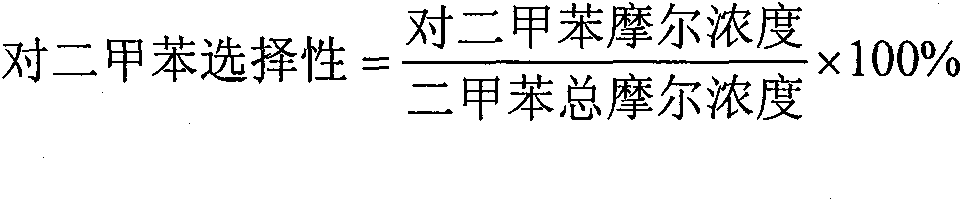
The performance index used in the present invention is defined as follows:


temperature rise of catalyst bed (inlet temperature of fluidized bed reactor-outlet temperature of fluidized bed reactor)
Disclosure of Invention
The invention aims to solve the problems of large temperature rise of a reaction bed layer, poor catalyst stability, more side reactions of an alkylating reagent and low utilization rate in the prior art, and provides a novel fluidized catalytic method for preparing p-xylene through methylation of aromatic hydrocarbon. The method has the advantages of less reaction heat release, slower catalyst deactivation, small bed temperature rise, effective side reaction control and high methyl utilization rate.
In order to solve the technical problems, the technical scheme adopted by the invention is as follows: a fluidized catalytic method for preparing paraxylene by methylation of aromatic hydrocarbon comprises the following steps:
a) mixing aromatic hydrocarbon feed to obtain a reaction mixture I, wherein the aromatic hydrocarbon is selected from toluene or a mixture of benzene and toluene;
b) i, vaporizing, preheating to a reaction temperature, then introducing into a fluidized bed reactor to contact with an alkylation catalyst containing a silicon-aluminum molecular sieve, and reacting to obtain an oil phase reaction effluent II rich in xylene, a gas phase reaction effluent III and an aqueous phase effluent IV, wherein the gas phase reaction effluent III and the aqueous phase effluent IV are discharged after separation and environmental protection treatment;
c) separating the reaction effluent II to obtain unconverted aromatic hydrocarbon fraction containing benzene and toluene, mixed carbon eight fraction and heavy aromatic hydrocarbon fraction with carbon number more than nine;
d) the eight fractions enter an adsorption, crystallization or adsorption/crystallization combined separation and isomerization system to obtain a p-xylene product, and an unconverted toluene fraction containing a small amount of benzene is refluxed and combined with the reaction mixture I to enter a fluidized bed reactor for conversion;
e) and refluxing the alkylated aromatic hydrocarbon fraction, and combining the refluxed aromatic hydrocarbon fraction with the reaction mixture I to enter a fluidized bed reactor for conversion.
In the technical scheme, the mole ratio of benzene to benzene in the toluene mixture is 0.1-99.9%; the molar ratio of the dimethyl ether to the aromatic hydrocarbon is 0.05-5: 1, preferably 0.1-0.5: 1; the aromatic methylation reaction conditions are as follows: the reaction temperature is 300-500 ℃, the reaction pressure is 0.1-5.0 MPa, the hydrogen/aromatic hydrocarbon molar ratio is 0-8, and the aromatic hydrocarbon weight space velocity is 0.5-10.0 h-1。
In the fluidized catalytic method for preparing the p-xylene by methylating the aromatic hydrocarbon, dimethyl ether is selected to replace methanol to be used as a methylating agent, and the reaction temperature can be more stable by controlling the reaction heat resistance. The temperature is a key factor for controlling the reaction and the side reaction, and the proper and stable reaction temperature condition is maintained, so that the normal operation of the main alkylation reaction can be ensured, the side reaction of the alkylation reagent can be effectively controlled, and the methyl utilization rate, the xylene selectivity and the selectivity of p-xylene in xylene are obviously improved. The reduction of temperature rise and the addition of benzene in the raw material both reduce the content of heavy aromatics in the aromatic hydrocarbon product, thereby reducing the speed of blocking the catalyst pore channels and prolonging the service life of the catalyst. In addition, the dimethyl ether generates less water than methanol in the methylation reaction process, and the stability of the catalyst can be improved, because the water is an important factor for damaging the structure of the catalyst. Therefore, the method can better solve the problems of large temperature rise of a reaction bed layer, poor catalyst stability, more side reactions of an alkylating reagent and low utilization rate in the prior art.
The invention is further illustrated by the following examples.
Detailed Description
[ COMPARATIVE EXAMPLE 1 ]
Mixing methanol and pure toluene to obtain a reaction mixture I, vaporizing, preheating to a reaction temperature, introducing into a fluidized bed reactor, and contacting with an alkylation catalyst containing a silicon-aluminum molecular sieve under the following reaction conditions: the catalyst loading is 2000 g, the feeding temperature is 400 ℃, and the toluene weight space velocity is 4.0h-1The mol ratio of methanol to toluene is 0.5, no hydrogen exists, the reaction pressure is 0.5MPa, and the used alkylation catalyst contains 20 percent of Al by weight2O3Modifier and 15% SiO2Modifier, the balance being hydrogen type ZSM-5 molecular sieve (Si/Al molar ratio SiO)2/Al2O350), reacting to obtain an oil-phase reaction effluent II rich in xylene, a gas-phase reaction effluent III and an aqueous-phase effluent IV, wherein the gas-phase reaction effluent III and the aqueous-phase effluent IV are separated and subjected to environment-friendly treatment and then discharged; separating the oil phase reaction effluent II to obtain unconverted aromatic hydrocarbon fraction containing benzene and toluene, mixed carbon eight fraction and heavy aromatic hydrocarbon fraction with carbon number more than nine; the mixed carbon eight fraction enters an adsorption, crystallization or adsorption/crystallization combined separation and isomerization system to obtain a paraxylene product; the unconverted aromatic fraction is refluxed and combined with the reaction mixture I to enter a fluidized bed reactor for conversion. The results of the reaction evaluations are shown in Table 1 for comparison.
[ examples 1 to 4 ]
The aromatics methylation reaction was carried out according to the procedure and conditions described in comparative example 1, wherein pure toluene feed was replaced by benzene and toluene mixture feed, dimethyl ether was used as alkylating agent instead of methanol, and the molar ratio of dimethyl ether to aromatics was 0.25. The specific reaction conditions and evaluation results are shown in Table 1 for comparison.
TABLE 1

The data in Table 1 show that dimethyl ether as the alkylating agent results in a significant decrease in the catalyst bed temperature rise compared to methanol. Benzene and toluene are used as mixed aromatic hydrocarbon feed, although the effect on the control of the temperature rise of a catalyst bed layer is not achieved, the side reaction and the deep alkylation reaction of methanol are still obviously inhibited, the methyl utilization rate and the xylene selectivity are obviously improved, the xylene selectivity is slightly improved, and the conversion rate of aromatic hydrocarbon is reduced to a certain extent.
[ examples 5 to 8 ]
The aromatic methylation reaction was carried out according to the procedure and conditions described in example 3, with the molar ratio of dimethyl ether to aromatic feed varied, and the specific reaction conditions and evaluation results are shown in Table 2 for comparison.
TABLE 2

The data in Table 2 show that the amount of alkylating agent used has a greater effect on the performance criteria, with greater amounts giving higher aromatics conversion but poorer product selectivity and methyl utilization.
[ examples 9 to 14 ]
The aromatic methylation reaction was carried out according to the procedure and conditions described in example 3, with the reaction temperature, space velocity, hydrogen/aromatic molar ratio and reaction pressure being adjusted, and the specific reaction conditions and evaluation results are shown in Table 3 for comparison.
TABLE 3

The data in Table 3 show that the alkylation reaction conditions have a greater effect on the product distribution and also on the catalyst bed temperature rise. The process optimization can ensure that the highest selectivity of the dimethylbenzene is increased to 91.67 percent, the highest selectivity of the p-dimethylbenzene is 88.17 percent, the highest utilization rate of the methanol is 78.89 percent, and the lowest temperature rise is 17.5 ℃.
[ example 15 ]
The aromatic methylation reaction was evaluated for a longer period of time according to the procedure and conditions described in example 13, and the results of the evaluation are shown in Table 4 for comparison.
Comparative example 2
A longer time aromatic methylation evaluation was conducted following the procedure and conditions described in example 13, except that the alkylating agent dimethyl ether was replaced with methanol, the molar ratio of methanol to aromatic hydrocarbon was 0.5, and the results of the reaction evaluations are shown in Table 4 for comparison.
TABLE 4

The data in Table 4 show that the method for alkylating benzene and toluene mixed aromatic hydrocarbon raw material and dimethyl ether partially replacing methanol can effectively improve the performance of the catalyst and prolong the service life of the catalyst.
Comparing the data of the above examples, we found that the fluidized catalytic method for preparing p-xylene by methylation of aromatic hydrocarbon according to the present invention can reduce the temperature rise of the fluidized bed reactor from 85.6 ℃ to 13.3 ℃, the selectivity of p-xylene to the maximum is 88.17%, the methyl utilization rate of the alkylating agent to the maximum is 83.63%, and in addition, the catalyst performance is basically unchanged after 50 hours of evaluation. The method has good application effects in the aspects of reaction heat release, side reaction control, catalyst stability and methyl utilization rate improvement.
Claims (1)
1. A fluidized catalytic method for preparing paraxylene by aromatics methylation comprises the following steps:
the dimethyl ether and aromatic hydrocarbon mixture is fed and mixed, wherein the aromatic hydrocarbon is a mixture of benzene and toluene, the benzene accounts for 50.0 percent of the aromatic hydrocarbon in terms of mole percentage to obtain a reaction mixture I, then the reaction mixture I is vaporized and preheated to the reaction temperature, and the reaction mixture I is introduced into a fluidized bed reactor to contact with an alkylation catalyst containing a silicon-aluminum molecular sieve, and the reaction conditions are as follows: the catalyst loading is 2000 g, the feeding temperature is 400 ℃, and the toluene weight space velocity is 4.0h-1Dimethyl ether to aromatic hydrocarbon molar ratio0.10, no hydrogen, a reaction pressure of 0.5MPa, 20% Al in the alkylation catalyst2O3Modifier and 15% SiO2The balance of the modifier is hydrogen type ZSM-5 molecular sieve, and the mole ratio of silicon to aluminum in the hydrogen type ZSM-5 molecular sieve is SiO2/Al2O3=50, obtaining an oil phase reaction effluent II, a gas phase reaction effluent III and an aqueous phase effluent IV which are rich in dimethylbenzene through reaction, wherein the gas phase reaction effluent III and the aqueous phase effluent IV are discharged after separation and environment-friendly treatment; separating the oil phase reaction effluent II to obtain unconverted aromatic hydrocarbon fraction containing benzene and toluene, mixed carbon eight fraction and heavy aromatic hydrocarbon fraction with carbon number more than nine; the mixed carbon eight fraction enters an adsorption, crystallization or adsorption/crystallization combined separation and isomerization system to obtain a paraxylene product; refluxing unconverted aromatic hydrocarbon fraction, combining the aromatic hydrocarbon fraction with the reaction mixture I, and introducing the mixture into a fluidized bed reactor for conversion;
the reaction result is:
the temperature of a catalyst bed layer rises to 13.3 ℃;
benzene conversion, 13.92%;
toluene conversion, 11.19%;
xylene selectivity, 89.44%;
para-xylene selectivity, 85.87%;
methyl utilization, 83.63%;
wherein,



catalyst bed temperature rise = fluidized bed reactor inlet temperature-fluidized bed reactor outlet temperature.
Priority Applications (1)
| Application Number | Priority Date | Filing Date | Title |
|---|---|---|---|
| CN201010261540.7A CN102372586B (en) | 2010-08-23 | 2010-08-23 | Fluidized catalytic method of p-xylene by methylation of aromatic hydrocarbon |
Applications Claiming Priority (1)
| Application Number | Priority Date | Filing Date | Title |
|---|---|---|---|
| CN201010261540.7A CN102372586B (en) | 2010-08-23 | 2010-08-23 | Fluidized catalytic method of p-xylene by methylation of aromatic hydrocarbon |
Publications (2)
| Publication Number | Publication Date |
|---|---|
| CN102372586A CN102372586A (en) | 2012-03-14 |
| CN102372586B true CN102372586B (en) | 2014-03-26 |
Family
ID=45791876
Family Applications (1)
| Application Number | Title | Priority Date | Filing Date |
|---|---|---|---|
| CN201010261540.7A Active CN102372586B (en) | 2010-08-23 | 2010-08-23 | Fluidized catalytic method of p-xylene by methylation of aromatic hydrocarbon |
Country Status (1)
| Country | Link |
|---|---|
| CN (1) | CN102372586B (en) |
Cited By (2)
| Publication number | Priority date | Publication date | Assignee | Title |
|---|---|---|---|---|
| US10427993B2 (en) | 2017-08-31 | 2019-10-01 | Uop Llc | Process for recovering benzene and fuel gas in an aromatics complex |
| US10793493B2 (en) | 2017-08-31 | 2020-10-06 | Uop Llc | Process for recovering benzene and fuel gas in an aromatics complex |
Families Citing this family (1)
| Publication number | Priority date | Publication date | Assignee | Title |
|---|---|---|---|---|
| US11643375B2 (en) * | 2019-03-28 | 2023-05-09 | Exxonmobil Chemical Patents Inc. | Processes for converting benzene and/or toluene via methylation |
Citations (3)
| Publication number | Priority date | Publication date | Assignee | Title |
|---|---|---|---|---|
| CN101208409A (en) * | 2005-06-21 | 2008-06-25 | Sk能源株式会社 | A method of increasing the yield of benzene from hydrocarbon mixtures |
| CN101456786A (en) * | 2007-12-12 | 2009-06-17 | 中国科学院大连化学物理研究所 | Method for preparing p-xylene and co-producing light olefins by toluene and methylating reagent |
| CN101602648A (en) * | 2009-07-24 | 2009-12-16 | 中国海洋石油总公司 | A kind of method that methyl alcohol/dimethyl ether transforms and prepares p-xylene |
-
2010
- 2010-08-23 CN CN201010261540.7A patent/CN102372586B/en active Active
Patent Citations (3)
| Publication number | Priority date | Publication date | Assignee | Title |
|---|---|---|---|---|
| CN101208409A (en) * | 2005-06-21 | 2008-06-25 | Sk能源株式会社 | A method of increasing the yield of benzene from hydrocarbon mixtures |
| CN101456786A (en) * | 2007-12-12 | 2009-06-17 | 中国科学院大连化学物理研究所 | Method for preparing p-xylene and co-producing light olefins by toluene and methylating reagent |
| CN101602648A (en) * | 2009-07-24 | 2009-12-16 | 中国海洋石油总公司 | A kind of method that methyl alcohol/dimethyl ether transforms and prepares p-xylene |
Non-Patent Citations (2)
| Title |
|---|
| Aleksander Szechenyi et al..Dimethyl ether as a source of reactive species for alkylation of benzene.《Catal. Lett.》.2008,第127卷page: 13-19. |
| Dimethyl ether as a source of reactive species for alkylation of benzene;Aleksander Szechenyi et al.;《Catal. Lett.》;20081111;第127卷;page: 13-19 * |
Cited By (2)
| Publication number | Priority date | Publication date | Assignee | Title |
|---|---|---|---|---|
| US10427993B2 (en) | 2017-08-31 | 2019-10-01 | Uop Llc | Process for recovering benzene and fuel gas in an aromatics complex |
| US10793493B2 (en) | 2017-08-31 | 2020-10-06 | Uop Llc | Process for recovering benzene and fuel gas in an aromatics complex |
Also Published As
| Publication number | Publication date |
|---|---|
| CN102372586A (en) | 2012-03-14 |
Similar Documents
| Publication | Publication Date | Title |
|---|---|---|
| CN102372585B (en) | The bed process of alkylating aromatic hydrocarbon p-Xylol | |
| US11179714B2 (en) | In-situ preparation method for catalyst for preparing at least one of toluene, para-xylene and light olefins, and reaction process | |
| KR101917491B1 (en) | Process for the production of xylene | |
| CN103664482B (en) | A kind of reaction process using moving bed technique oxygenatedchemicals to be converted into aromatic hydrocarbons | |
| KR101568859B1 (en) | Process for the production of liquid hydrocarbon from light alkanes | |
| KR101917490B1 (en) | Process for the production of para-xylene | |
| CN106854135B (en) | Method for producing p-xylene by alkylation of benzene and methanol | |
| US7196237B2 (en) | Method of preparing an alkyl aromatic product | |
| CN102372582A (en) | Fluidized catalytic method for toluene methylation | |
| CN101596461A (en) | A light hydrocarbon aromatization catalyst and its preparation method | |
| CN102372586B (en) | Fluidized catalytic method of p-xylene by methylation of aromatic hydrocarbon | |
| CN103588612B (en) | Production method of p-xylene | |
| CN114286808B (en) | Process for isomerizing C8 aromatic hydrocarbons | |
| CN102372584B (en) | Fluidized catalytic method for preparing p-xylene by alkylating aromatic hydrocarbon | |
| CN102001907B (en) | Method for synthetizing 2,6-dimethylnaphthalene with methanol, C10 arene and 2-methylnaphthalene through alkylation | |
| CN102875319B (en) | The methylated moving-bed catalysis process of aromatic hydrocarbons | |
| CN102464565B (en) | Method for producing isopropylbenzene by using benzene and propylene | |
| CN102372583B (en) | Fluidized catalytic method for preparing p-xylene by alkylating toluene | |
| US7875756B2 (en) | Process for producing lower olefins under negative pressure | |
| CN102372588B (en) | Method for preparing moving bed of para-xylene by aromatics alkylation | |
| WO2022071942A1 (en) | Transalkylation of alkylated phenols | |
| CN102372589B (en) | Moving bed catalytic process for preparing p-xylene by alkylating aromatic hydrocarbon | |
| EP1831136B1 (en) | Process for the production of 2,6-dimethylnaphthalene | |
| US11078133B2 (en) | Aromatic alkylation process | |
| CN1067040C (en) | Toluene disproportionation and alkyl transfering process |
Legal Events
| Date | Code | Title | Description |
|---|---|---|---|
| C06 | Publication | ||
| PB01 | Publication | ||
| C10 | Entry into substantive examination | ||
| SE01 | Entry into force of request for substantive examination | ||
| GR01 | Patent grant | ||
| GR01 | Patent grant |