CN102272102A - Technetium-and rhenium-bis(heteroaryl)complexes and methods of use thereof - Google Patents
Technetium-and rhenium-bis(heteroaryl)complexes and methods of use thereof Download PDFInfo
- Publication number
- CN102272102A CN102272102A CN2009801538786A CN200980153878A CN102272102A CN 102272102 A CN102272102 A CN 102272102A CN 2009801538786 A CN2009801538786 A CN 2009801538786A CN 200980153878 A CN200980153878 A CN 200980153878A CN 102272102 A CN102272102 A CN 102272102A
- Authority
- CN
- China
- Prior art keywords
- compound
- receptors
- amino
- aryl
- formula
- Prior art date
- Legal status (The legal status is an assumption and is not a legal conclusion. Google has not performed a legal analysis and makes no representation as to the accuracy of the status listed.)
- Pending
Links
- 0 *CN(C*)C(CNC(CI)=I)=O Chemical compound *CN(C*)C(CNC(CI)=I)=O 0.000 description 7
- QNIFLUBAVKUINH-AFEGWXKPSA-N CC(C)(C)OC(CC[C@@H](C(OC(C)(C)C)=O)NC(N[C@@H](CCC(N[C@@H](CCCCN(Cc1ncc[n]1CC(OC(C)(C)C)=O)Cc1ncc[n]1CC(OC(C)(C)C)=O)C(O)=O)=O)C(OC(C)(C)C)=O)=O)=O Chemical compound CC(C)(C)OC(CC[C@@H](C(OC(C)(C)C)=O)NC(N[C@@H](CCC(N[C@@H](CCCCN(Cc1ncc[n]1CC(OC(C)(C)C)=O)Cc1ncc[n]1CC(OC(C)(C)C)=O)C(O)=O)=O)C(OC(C)(C)C)=O)=O)=O QNIFLUBAVKUINH-AFEGWXKPSA-N 0.000 description 1
- VEVDLEHBPWVRTQ-UHFFFAOYSA-N CC(C)(C)OC(C[n]1c(CN(CCc(cc2)ccc2S(N)(=O)=O)Cc2ncc[n]2CC(OC(C)(C)C)=O)ncc1)=O Chemical compound CC(C)(C)OC(C[n]1c(CN(CCc(cc2)ccc2S(N)(=O)=O)Cc2ncc[n]2CC(OC(C)(C)C)=O)ncc1)=O VEVDLEHBPWVRTQ-UHFFFAOYSA-N 0.000 description 1
Images




Classifications
-
- C—CHEMISTRY; METALLURGY
- C07—ORGANIC CHEMISTRY
- C07D—HETEROCYCLIC COMPOUNDS
- C07D213/00—Heterocyclic compounds containing six-membered rings, not condensed with other rings, with one nitrogen atom as the only ring hetero atom and three or more double bonds between ring members or between ring members and non-ring members
- C07D213/02—Heterocyclic compounds containing six-membered rings, not condensed with other rings, with one nitrogen atom as the only ring hetero atom and three or more double bonds between ring members or between ring members and non-ring members having three double bonds between ring members or between ring members and non-ring members
- C07D213/04—Heterocyclic compounds containing six-membered rings, not condensed with other rings, with one nitrogen atom as the only ring hetero atom and three or more double bonds between ring members or between ring members and non-ring members having three double bonds between ring members or between ring members and non-ring members having no bond between the ring nitrogen atom and a non-ring member or having only hydrogen or carbon atoms directly attached to the ring nitrogen atom
- C07D213/24—Heterocyclic compounds containing six-membered rings, not condensed with other rings, with one nitrogen atom as the only ring hetero atom and three or more double bonds between ring members or between ring members and non-ring members having three double bonds between ring members or between ring members and non-ring members having no bond between the ring nitrogen atom and a non-ring member or having only hydrogen or carbon atoms directly attached to the ring nitrogen atom with substituted hydrocarbon radicals attached to ring carbon atoms
- C07D213/36—Radicals substituted by singly-bound nitrogen atoms
- C07D213/38—Radicals substituted by singly-bound nitrogen atoms having only hydrogen or hydrocarbon radicals attached to the substituent nitrogen atom
-
- A—HUMAN NECESSITIES
- A61—MEDICAL OR VETERINARY SCIENCE; HYGIENE
- A61K—PREPARATIONS FOR MEDICAL, DENTAL OR TOILETRY PURPOSES
- A61K31/00—Medicinal preparations containing organic active ingredients
- A61K31/16—Amides, e.g. hydroxamic acids
- A61K31/18—Sulfonamides
-
- A—HUMAN NECESSITIES
- A61—MEDICAL OR VETERINARY SCIENCE; HYGIENE
- A61K—PREPARATIONS FOR MEDICAL, DENTAL OR TOILETRY PURPOSES
- A61K31/00—Medicinal preparations containing organic active ingredients
- A61K31/33—Heterocyclic compounds
- A61K31/395—Heterocyclic compounds having nitrogen as a ring hetero atom, e.g. guanethidine or rifamycins
- A61K31/41—Heterocyclic compounds having nitrogen as a ring hetero atom, e.g. guanethidine or rifamycins having five-membered rings with two or more ring hetero atoms, at least one of which being nitrogen, e.g. tetrazole
- A61K31/4192—1,2,3-Triazoles
-
- A—HUMAN NECESSITIES
- A61—MEDICAL OR VETERINARY SCIENCE; HYGIENE
- A61K—PREPARATIONS FOR MEDICAL, DENTAL OR TOILETRY PURPOSES
- A61K31/00—Medicinal preparations containing organic active ingredients
- A61K31/33—Heterocyclic compounds
- A61K31/395—Heterocyclic compounds having nitrogen as a ring hetero atom, e.g. guanethidine or rifamycins
- A61K31/435—Heterocyclic compounds having nitrogen as a ring hetero atom, e.g. guanethidine or rifamycins having six-membered rings with one nitrogen as the only ring hetero atom
- A61K31/44—Non condensed pyridines; Hydrogenated derivatives thereof
- A61K31/4427—Non condensed pyridines; Hydrogenated derivatives thereof containing further heterocyclic ring systems
- A61K31/444—Non condensed pyridines; Hydrogenated derivatives thereof containing further heterocyclic ring systems containing a six-membered ring with nitrogen as a ring heteroatom, e.g. amrinone
-
- A—HUMAN NECESSITIES
- A61—MEDICAL OR VETERINARY SCIENCE; HYGIENE
- A61K—PREPARATIONS FOR MEDICAL, DENTAL OR TOILETRY PURPOSES
- A61K31/00—Medicinal preparations containing organic active ingredients
- A61K31/33—Heterocyclic compounds
- A61K31/555—Heterocyclic compounds containing heavy metals, e.g. hemin, hematin, melarsoprol
-
- A—HUMAN NECESSITIES
- A61—MEDICAL OR VETERINARY SCIENCE; HYGIENE
- A61K—PREPARATIONS FOR MEDICAL, DENTAL OR TOILETRY PURPOSES
- A61K51/00—Preparations containing radioactive substances for use in therapy or testing in vivo
- A61K51/02—Preparations containing radioactive substances for use in therapy or testing in vivo characterised by the carrier, i.e. characterised by the agent or material covalently linked or complexing the radioactive nucleus
- A61K51/04—Organic compounds
- A61K51/0402—Organic compounds carboxylic acid carriers, fatty acids
-
- A—HUMAN NECESSITIES
- A61—MEDICAL OR VETERINARY SCIENCE; HYGIENE
- A61K—PREPARATIONS FOR MEDICAL, DENTAL OR TOILETRY PURPOSES
- A61K51/00—Preparations containing radioactive substances for use in therapy or testing in vivo
- A61K51/02—Preparations containing radioactive substances for use in therapy or testing in vivo characterised by the carrier, i.e. characterised by the agent or material covalently linked or complexing the radioactive nucleus
- A61K51/04—Organic compounds
- A61K51/041—Heterocyclic compounds
-
- A—HUMAN NECESSITIES
- A61—MEDICAL OR VETERINARY SCIENCE; HYGIENE
- A61K—PREPARATIONS FOR MEDICAL, DENTAL OR TOILETRY PURPOSES
- A61K51/00—Preparations containing radioactive substances for use in therapy or testing in vivo
- A61K51/02—Preparations containing radioactive substances for use in therapy or testing in vivo characterised by the carrier, i.e. characterised by the agent or material covalently linked or complexing the radioactive nucleus
- A61K51/04—Organic compounds
- A61K51/0474—Organic compounds complexes or complex-forming compounds, i.e. wherein a radioactive metal (e.g. 111In3+) is complexed or chelated by, e.g. a N2S2, N3S, NS3, N4 chelating group
-
- A—HUMAN NECESSITIES
- A61—MEDICAL OR VETERINARY SCIENCE; HYGIENE
- A61K—PREPARATIONS FOR MEDICAL, DENTAL OR TOILETRY PURPOSES
- A61K51/00—Preparations containing radioactive substances for use in therapy or testing in vivo
- A61K51/02—Preparations containing radioactive substances for use in therapy or testing in vivo characterised by the carrier, i.e. characterised by the agent or material covalently linked or complexing the radioactive nucleus
- A61K51/04—Organic compounds
- A61K51/0474—Organic compounds complexes or complex-forming compounds, i.e. wherein a radioactive metal (e.g. 111In3+) is complexed or chelated by, e.g. a N2S2, N3S, NS3, N4 chelating group
- A61K51/0478—Organic compounds complexes or complex-forming compounds, i.e. wherein a radioactive metal (e.g. 111In3+) is complexed or chelated by, e.g. a N2S2, N3S, NS3, N4 chelating group complexes from non-cyclic ligands, e.g. EDTA, MAG3
-
- A—HUMAN NECESSITIES
- A61—MEDICAL OR VETERINARY SCIENCE; HYGIENE
- A61K—PREPARATIONS FOR MEDICAL, DENTAL OR TOILETRY PURPOSES
- A61K51/00—Preparations containing radioactive substances for use in therapy or testing in vivo
- A61K51/02—Preparations containing radioactive substances for use in therapy or testing in vivo characterised by the carrier, i.e. characterised by the agent or material covalently linked or complexing the radioactive nucleus
- A61K51/04—Organic compounds
- A61K51/0497—Organic compounds conjugates with a carrier being an organic compounds
-
- A—HUMAN NECESSITIES
- A61—MEDICAL OR VETERINARY SCIENCE; HYGIENE
- A61P—SPECIFIC THERAPEUTIC ACTIVITY OF CHEMICAL COMPOUNDS OR MEDICINAL PREPARATIONS
- A61P13/00—Drugs for disorders of the urinary system
- A61P13/08—Drugs for disorders of the urinary system of the prostate
-
- A—HUMAN NECESSITIES
- A61—MEDICAL OR VETERINARY SCIENCE; HYGIENE
- A61P—SPECIFIC THERAPEUTIC ACTIVITY OF CHEMICAL COMPOUNDS OR MEDICINAL PREPARATIONS
- A61P25/00—Drugs for disorders of the nervous system
- A61P25/18—Antipsychotics, i.e. neuroleptics; Drugs for mania or schizophrenia
-
- A—HUMAN NECESSITIES
- A61—MEDICAL OR VETERINARY SCIENCE; HYGIENE
- A61P—SPECIFIC THERAPEUTIC ACTIVITY OF CHEMICAL COMPOUNDS OR MEDICINAL PREPARATIONS
- A61P29/00—Non-central analgesic, antipyretic or antiinflammatory agents, e.g. antirheumatic agents; Non-steroidal antiinflammatory drugs [NSAID]
-
- A—HUMAN NECESSITIES
- A61—MEDICAL OR VETERINARY SCIENCE; HYGIENE
- A61P—SPECIFIC THERAPEUTIC ACTIVITY OF CHEMICAL COMPOUNDS OR MEDICINAL PREPARATIONS
- A61P35/00—Antineoplastic agents
-
- C—CHEMISTRY; METALLURGY
- C07—ORGANIC CHEMISTRY
- C07C—ACYCLIC OR CARBOCYCLIC COMPOUNDS
- C07C275/00—Derivatives of urea, i.e. compounds containing any of the groups, the nitrogen atoms not being part of nitro or nitroso groups
- C07C275/04—Derivatives of urea, i.e. compounds containing any of the groups, the nitrogen atoms not being part of nitro or nitroso groups having nitrogen atoms of urea groups bound to acyclic carbon atoms
- C07C275/06—Derivatives of urea, i.e. compounds containing any of the groups, the nitrogen atoms not being part of nitro or nitroso groups having nitrogen atoms of urea groups bound to acyclic carbon atoms of an acyclic and saturated carbon skeleton
- C07C275/16—Derivatives of urea, i.e. compounds containing any of the groups, the nitrogen atoms not being part of nitro or nitroso groups having nitrogen atoms of urea groups bound to acyclic carbon atoms of an acyclic and saturated carbon skeleton being further substituted by carboxyl groups
-
- C—CHEMISTRY; METALLURGY
- C07—ORGANIC CHEMISTRY
- C07C—ACYCLIC OR CARBOCYCLIC COMPOUNDS
- C07C311/00—Amides of sulfonic acids, i.e. compounds having singly-bound oxygen atoms of sulfo groups replaced by nitrogen atoms, not being part of nitro or nitroso groups
- C07C311/15—Sulfonamides having sulfur atoms of sulfonamide groups bound to carbon atoms of six-membered aromatic rings
- C07C311/16—Sulfonamides having sulfur atoms of sulfonamide groups bound to carbon atoms of six-membered aromatic rings having the nitrogen atom of at least one of the sulfonamide groups bound to hydrogen atoms or to an acyclic carbon atom
-
- C—CHEMISTRY; METALLURGY
- C07—ORGANIC CHEMISTRY
- C07D—HETEROCYCLIC COMPOUNDS
- C07D403/00—Heterocyclic compounds containing two or more hetero rings, having nitrogen atoms as the only ring hetero atoms, not provided for by group C07D401/00
- C07D403/02—Heterocyclic compounds containing two or more hetero rings, having nitrogen atoms as the only ring hetero atoms, not provided for by group C07D401/00 containing two hetero rings
- C07D403/06—Heterocyclic compounds containing two or more hetero rings, having nitrogen atoms as the only ring hetero atoms, not provided for by group C07D401/00 containing two hetero rings linked by a carbon chain containing only aliphatic carbon atoms
-
- C—CHEMISTRY; METALLURGY
- C07—ORGANIC CHEMISTRY
- C07D—HETEROCYCLIC COMPOUNDS
- C07D403/00—Heterocyclic compounds containing two or more hetero rings, having nitrogen atoms as the only ring hetero atoms, not provided for by group C07D401/00
- C07D403/02—Heterocyclic compounds containing two or more hetero rings, having nitrogen atoms as the only ring hetero atoms, not provided for by group C07D401/00 containing two hetero rings
- C07D403/12—Heterocyclic compounds containing two or more hetero rings, having nitrogen atoms as the only ring hetero atoms, not provided for by group C07D401/00 containing two hetero rings linked by a chain containing hetero atoms as chain links
-
- C—CHEMISTRY; METALLURGY
- C07—ORGANIC CHEMISTRY
- C07F—ACYCLIC, CARBOCYCLIC OR HETEROCYCLIC COMPOUNDS CONTAINING ELEMENTS OTHER THAN CARBON, HYDROGEN, HALOGEN, OXYGEN, NITROGEN, SULFUR, SELENIUM OR TELLURIUM
- C07F13/00—Compounds containing elements of Groups 7 or 17 of the Periodic Table
- C07F13/005—Compounds without a metal-carbon linkage
Landscapes
- Health & Medical Sciences (AREA)
- Chemical & Material Sciences (AREA)
- Organic Chemistry (AREA)
- Life Sciences & Earth Sciences (AREA)
- Medicinal Chemistry (AREA)
- Pharmacology & Pharmacy (AREA)
- Animal Behavior & Ethology (AREA)
- General Health & Medical Sciences (AREA)
- Public Health (AREA)
- Veterinary Medicine (AREA)
- Epidemiology (AREA)
- Proteomics, Peptides & Aminoacids (AREA)
- Physics & Mathematics (AREA)
- Optics & Photonics (AREA)
- General Chemical & Material Sciences (AREA)
- Nuclear Medicine, Radiotherapy & Molecular Imaging (AREA)
- Chemical Kinetics & Catalysis (AREA)
- Bioinformatics & Cheminformatics (AREA)
- Engineering & Computer Science (AREA)
- Neurosurgery (AREA)
- Urology & Nephrology (AREA)
- Pain & Pain Management (AREA)
- Neurology (AREA)
- Biomedical Technology (AREA)
- Psychiatry (AREA)
- Rheumatology (AREA)
- Medicines Containing Antibodies Or Antigens For Use As Internal Diagnostic Agents (AREA)
- Pharmaceuticals Containing Other Organic And Inorganic Compounds (AREA)
- Pyridine Compounds (AREA)
- Plural Heterocyclic Compounds (AREA)
- Quinoline Compounds (AREA)
- Organic Low-Molecular-Weight Compounds And Preparation Thereof (AREA)
- Medicines That Contain Protein Lipid Enzymes And Other Medicines (AREA)
- Acyclic And Carbocyclic Compounds In Medicinal Compositions (AREA)
- Other In-Based Heterocyclic Compounds (AREA)
- Peptides Or Proteins (AREA)
- Thiazole And Isothizaole Compounds (AREA)
- Heterocyclic Carbon Compounds Containing A Hetero Ring Having Nitrogen And Oxygen As The Only Ring Hetero Atoms (AREA)
Abstract
Description
相关申请交叉引用Related Application Cross Reference
本申请要求2008年12月5日提交的美国临时专利申请第61/120,226号、2009年1月8日提交的美国专利申请第12/350,894号和2009年5月21日提交的美国临时专利申请第61/180,341号的优先权,所有这些申请为任何和所有目的在此通过引用整体并入。This application claims U.S. Provisional Patent Application No. 61/120,226, filed December 5, 2008, U.S. Provisional Patent Application No. 12/350,894, filed January 8, 2009, and U.S. Provisional Patent Application No. 12/350,894, filed May 21, 2009 Priority No. 61/180,341, all of these applications are hereby incorporated by reference in their entirety for any and all purposes.
背景background
由于其成分放射性核素的物理性质,放射性药物可用作诊断剂或治疗剂。因此,它们的效用不是基于其本身的任何药理作用。大多数这类临床药物是包含发射γ射线的核素的诊断剂,由于其配位的配体的物理、代谢或生化性质,在静脉注射后定位于特定器官。所得的影像可以反映器官的结构或功能。这些影像是借助检测放射性分子发射的电离辐射的分布的γ照相机获得的。Due to the physical properties of their constituent radionuclides, radiopharmaceuticals are used as diagnostic or therapeutic agents. Therefore, their utility is not based on any pharmacological action per se. Most of these clinical drugs are diagnostic agents containing gamma-ray-emitting nuclides that, due to the physical, metabolic or biochemical properties of their coordinating ligands, localize to specific organs after intravenous injection. The resulting images can reflect the structure or function of an organ. These images are obtained with the aid of a gamma camera that detects the distribution of ionizing radiation emitted by radioactive molecules.
在放射成像中,放射性标记是发射γ射线的放射性核素,并且放射性示踪剂可用γ放射检测照相机定位(这种方法通常称为γ闪烁照相术)。成像部位是可检测的,因为放射性示踪剂被选择为定位于病理部位(称为阳性造影(positive contrast),或者可选地,放射性示踪剂特别被选择为不定位于这样的病理部位(称为阴性造影(negative contrast)。In radiography, the radiolabel is a gamma-ray emitting radionuclide, and the radiotracer can be localized with a gamma radiation detecting camera (this method is commonly called gamma scintigraphy). The imaging site is detectable because the radiotracer is chosen to localize to pathology (called positive contrast), or alternatively, the radiotracer is specifically chosen not to localize to such pathology (called positive contrast). It is negative contrast.
目前在核医学领域中实施的许多方法涉及放射性药物,所述放射性药物提供在主要器官和肿瘤内血流(灌流)的诊断影像。这些放射性药物在所关注器官内的区域性摄取与流量成比例;高流量区域将显示出最高的放射性药物浓度,而流量小或无流量的区域则具有相对低的浓度。显示这些区域差异的诊断影像用于鉴定灌流差的区域,但不提供明显低的灌流区域内组织状态的生化或代谢信息。Many of the methods currently practiced in the field of nuclear medicine involve radiopharmaceuticals that provide diagnostic imaging of blood flow (perfusion) within major organs and tumors. Regional uptake of these radiopharmaceuticals within the organ of interest is proportional to flow; areas of high flow will exhibit the highest radiopharmaceutical concentrations, while areas of little or no flow will have relatively low concentrations. Diagnostic imaging showing these regional differences is useful to identify areas of poor perfusion but does not provide biochemical or metabolic information on the state of tissues in markedly hypoperfused areas.
众所周知,肿瘤可以表达与其恶性表型相关的独特蛋白,或者可以过表达数量多于正常细胞的正常组成型蛋白。特殊蛋白在肿瘤细胞表面上的表达提供了通过探测肿瘤的表型特征和生化组成和活性来诊断和鉴定疾病的可能性。选择性结合特定肿瘤细胞表面蛋白的放射性分子允许使用非侵袭性的成像技术,例如分子成像或核医学,用于检测肿瘤相关蛋白的存在和数量,从而提供有关疾病诊断和程度、预后和治疗管理选项的重要信息。此外,因为可以制备不仅能够显影疾病而且能够将治疗性放射性核素递送至患病组织的放射性药物,可以实现治疗、特别是癌症治疗。肽受体和其他配体受体在肿瘤上的表达使它们成为用于非侵袭性成像以及靶向放射疗法的有吸引力的靶标。It is well known that tumors can express unique proteins associated with their malignant phenotype, or can overexpress normal constitutive proteins in greater numbers than normal cells. The expression of specific proteins on the surface of tumor cells offers the possibility to diagnose and characterize the disease by probing the tumor's phenotypic characteristics and biochemical composition and activity. Radioactive molecules that selectively bind to specific tumor cell surface proteins allow the use of non-invasive imaging techniques, such as molecular imaging or nuclear medicine, to detect the presence and quantity of tumor-associated proteins, thereby providing information on disease diagnosis and extent, prognosis and treatment management Important information about options. Furthermore, therapy, especially cancer therapy, can be achieved because radiopharmaceuticals can be prepared that not only visualize disease but also deliver therapeutic radionuclides to diseased tissue. The expression of peptide receptors and other ligand receptors on tumors makes them attractive targets for non-invasive imaging as well as targeted radiation therapy.
已知许多放射性核素可用于放射成像,包括Ga-67、Tc-99m、In-111、I-123和I-131。也许最普遍用于医学成像的放射性同位素是Tc-99m。其140keV的γ-光子适合用于普遍使用的γ照相机。它具有短的(6小时)半衰期,这在考虑患者放射剂量时是希望的。Tc-99m容易通过商业化生产的99Mo/Tc-99m发生器系统以相对低的成本获得。A number of radionuclides are known to be useful in radiographic imaging, including Ga-67, Tc-99m, In-111, I-123, and I-131. Perhaps the most commonly used radioisotope for medical imaging is Tc-99m. Its 140keV gamma-photon is suitable for commonly used gamma cameras. It has a short (6 hour) half-life, which is desirable when considering patient radiation dose. Tc-99m is readily available at relatively low cost through commercially produced 99Mo/Tc-99m generator systems.
由于它们的配位化学相似性和它们优良的物理衰变特征分别能够实现成像和治疗,医学上有用的放射性核素锝-99m(99mTc)和铼-186/188(186/188Re)的组合对于开发分子成像和分子放射治疗是有吸引力的。99mTc和186/188Re的配位化学就M(CO)3L3中心而言惊人地相似,其中99mTc和186/188Re的配位络合物是同结构的。即使在1000倍过量竞争螯合剂和配体存在下,得到的络合物在极端pH条件下显示强大的稳定性,并持续延长的时段。Combinations of radionuclides technetium-99m ( 99m Tc ) and rhenium-186/188 ( 186/188 Re ) are medically useful due to their coordination chemical similarity and their excellent physical decay characteristics enabling imaging and therapy, respectively Attractive for developing molecular imaging and molecular radiation therapy. The coordination chemistries of 99m Tc and 186/188 Re are surprisingly similar for the M(CO) 3 L 3 center, where the coordination complexes of 99m Tc and 186/188 Re are isostructural. Even in the presence of a 1000-fold excess of competing chelators and ligands, the resulting complexes exhibit robust stability under extreme pH conditions for extended periods of time.
概述overview
总体上,提供了具有杂环基团(例如吡啶基和咪唑基)的配体,和所述配体与锝(Tc)和铼(Re)的络合物。杂环配体是亲水的,允许与更亲油的类似物相比增强的肾脏排泄。还提供了所述配体及其金属络合物在用于许多临床诊断应用的放射成像中以及用于治疗性应用的放射性药物中的用途。所述配体还可用于将诸如Tc和Re的金属连接至诸如肽的生物分子和小分子拮抗剂而用于成像和治疗性应用,所述生物分子包括促生长素抑制素,所述小分子拮抗剂包括PSMA、CA-IX或Seprase。还描述了用于制备所述配体、锝和铼络合物、以及标记的生物分子的方法。另外,提供了使用所述络合物对哺乳动物区域成像的方法。In general, ligands having heterocyclic groups such as pyridyl and imidazolyl, and complexes of said ligands with technetium (Tc) and rhenium (Re) are provided. The heterocyclic ligands are hydrophilic, allowing enhanced renal excretion compared to more lipophilic analogs. Also provided is the use of said ligands and their metal complexes in radioimaging for many clinical diagnostic applications and in radiopharmaceuticals for therapeutic applications. The ligands are also useful for linking metals such as Tc and Re to biomolecules such as peptides, including somatostatin, and small molecule antagonists for imaging and therapeutic applications. Antagonists include PSMA, CA-IX or Seprase. Methods for preparing the ligands, technetium and rhenium complexes, and labeled biomolecules are also described. Additionally, methods of imaging regions of mammals using the complexes are provided.
附图说明 Description of drawings
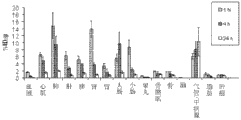
图1是SSRT2受体介导的111In-DOTA-依度曲肽(上)与99mTc-DpK-依度曲肽(中)和99mTc-COOH-咪唑(化合物2)-依度曲肽(下)在AR42J小鼠肿瘤模型中的组织生物分布图。Figure 1 is the SSRT2 receptor-mediated 111 In-DOTA-eldreptide (upper) and 99m Tc-DpK-eldretide (middle) and 99m Tc-COOH-imidazole (compound 2)-eldretide (Bottom) Tissue biodistribution map in AR42J mouse tumor model.
图2是化合物22的99mTc络合物在HeLa异种移植中的组织生物分布图,表示为%ID/g±(SEM)。Figure 2 is a graph of the tissue biodistribution of the99mTc complex of Compound 22 in HeLa xenografts expressed as %ID/g±(SEM).
图3是化合物48的99mTc络合物在正常小鼠中的组织生物分布图,表示为%ID/g±(SEM)。Fig. 3 is a tissue biodistribution graph of 99m Tc complex of compound 48 in normal mice, expressed as %ID/g±(SEM).
图4是关于化合物80和48A与seprase+/-细胞饱和结合的饱和结合实验图。Fig. 4 is a graph of saturation binding experiments on the saturated binding of compounds 80 and 48A to seprase+/- cells.
图5是化合物80的化合物在FaDu异种移植小鼠中的组织分布图(%ID/g)。Fig. 5 is a graph showing the tissue distribution (%ID/g) of Compound 80 in FaDu xenografted mice.
图6、7和8分别是化合物80的化合物在FaDu、H22(+)和H17(-)异种移植小鼠中的组织分布图,表示为(%ID/g)。Figures 6, 7 and 8 are graphs showing the tissue distribution of Compound 80 in FaDu, H22(+) and H17(-) xenograft mice, respectively, expressed as (%ID/g).
图9是化合物16A的99mTc络合物在HeLa异种移植小鼠中的组织分布图(%ID/g)。Fig. 9 is a graph showing the tissue distribution (%ID/g) of the 99m Tc complex of Compound 16A in HeLa xenograft mice.
图10是化合物26的化合物的99mTc络合物在HeLa异种移植小鼠中的组织分布图(%ID/g)。Fig. 10 is the tissue distribution diagram (%ID/g) of the 99m Tc complex of compound 26 in HeLa xenograft mice.
图11是各种化合物的络合物在HeLa异种移植小鼠中的组织分布图(%ID/g)。Fig. 11 is a graph showing tissue distribution (%ID/g) of complexes of various compounds in HeLa xenograft mice.
图12是化合物36的化合物的99mTc络合物在LNCaP异种移植小鼠中的组织分布图(%ID/g)。Fig. 12 is the tissue distribution graph (%ID/g) of the 99m Tc complex of compound 36 in LNCaP xenograft mice.
图13是各种化合物的络合物在LNCaP异种移植小鼠中的组织分布图(%ID/g)。Fig. 13 is a graph showing tissue distribution (%ID/g) of complexes of various compounds in LNCaP xenografted mice.
具体实施方式Detailed ways
一方面,提供了作为三齿单氨基酸螯合剂(SAAC)配体的化合物。根据一些实施方案,此类配体可用于正电子发射断层摄影(PET)和单光子发射计算机断层摄影(SPECT)。所述化合物提供具有改善的动力学特征和降低的亲油性的成像,这允许金属中性的快速有力螯合。例如,在一些实施方案中,金属中心是M(CO)3基团。在其他实施方案中,螯合在温和条件下发生,例如,在室温、中性pH和/或基于水的溶剂中。In one aspect, compounds that are tridentate single amino acid chelator (SAAC) ligands are provided. According to some embodiments, such ligands are useful in positron emission tomography (PET) and single photon emission computed tomography (SPECT). The compounds provide imaging with improved kinetic characteristics and reduced lipophilicity, which allow rapid and robust chelation of metal neutrals. For example, in some embodiments, the metal center is an M(CO) 3 group. In other embodiments, chelation occurs under mild conditions, eg, at room temperature, neutral pH, and/or in water-based solvents.
一般而言,SAAC化合物含有作为螯合基团的官能化的极性杂环,以减少螯合剂在偶联至小分子或并入肽(包括SSTR2肽)时的总体亲油性。此类化合物定位至肿瘤异种移植物,并且明显增强肾清除并减少肝胆摄取。SAAC化合物证明用放射性金属的简易标记,并且表现出强大的络合物稳定性。因为SAAC化合物是氨基酸类似物,它们可以被直接并入肽序列。In general, SAAC compounds contain a functionalized polar heterocycle as a chelating group to reduce the overall lipophilicity of the chelating agent when coupled to small molecules or incorporated into peptides, including SSTR2 peptides. These compounds localize to tumor xenografts and significantly enhance renal clearance and reduce hepatobiliary uptake. SAAC compounds demonstrate facile labeling with radioactive metals and exhibit robust complex stability. Because SAAC compounds are amino acid analogs, they can be incorporated directly into peptide sequences.
另一方面,提供了此类SAAC配体衍生和改变与它们连接的99mTc放射性标记化合物的药代动力学特征。此类衍生的化合物可以形成99mTc-标记的放射性药物的基础。在一个实施方案中,赖氨酸在ε胺用两组不同的具有一个或多个环基团的供电子原子官能修饰,以产生由于连接至所述环原子的氧和氮而具有减少的亲油性的三齿螯合剂。例如,在一些实施方案中,所述还原子是咪唑基和/或吡啶基衍生物。此类衍生的化合物可以表现出增强的肾清除和快速的背景清除。In another aspect, such SAAC ligands are provided for derivatizing and altering the pharmacokinetic profile of99mTc radiolabeled compounds linked to them. Such derived compounds may form the basis of99mTc -labeled radiopharmaceuticals. In one embodiment, the lysine in the ε amine is functionally modified with two different sets of electron-donating atoms having one or more ring groups to produce a compound with reduced affinity due to the oxygen and nitrogen attached to the ring atoms. Oily tridentate chelating agent. For example, in some embodiments, the reducing atom is an imidazolyl and/or pyridyl derivative. Such derived compounds may exhibit enhanced renal clearance and rapid background clearance.
定义definition
为了方便,本文和所附权利要求书中使用的某些术语集中在这里。For convenience, certain terms used herein and in the appended claims are grouped here.
如本文使用的,“约”会被本领域普通技术人员所理解,并且在一定程度上根据其使用的上下文而变化。如果该术语的使用对于本领域普通技术人员而言不清楚,考虑其使用的上下文,“约”将表示特定界限的最多加或减10%。As used herein, "about" will be understood by those of ordinary skill in the art and will vary to some extent depending on the context in which it is used. If the use of this term is unclear to one of ordinary skill in the art, given the context in which it is used, "about" will mean up to plus or minus 10% of the specified limit.
本文示例描述的实施方案可以适合在本文未明确公开的任何一个元素或多个元素、一个限制或多个限制不存在下实施。因此,例如,术语“包含”、“包括”、“含有”等应该被扩展性地且无限制地解读。此外,本文使用的术语和表达作为描述术语而非限制术语而使用,并且此类术语和表达的使用不是要排除所示和描述的特征或其部分的任何等同物,而是要理解,在要求保护的技术范围内的各种修改是可能的。此外,短语“基本由......组成”将被理解为包括明确提到的那些元素以及那些不实质影响要求保护的技术的基本和新特征的其他元素。术语“由......组成”排除未指明的任何元素。Embodiments exemplified herein may suitably be practiced in the absence of any element or elements, limitation or limitations not expressly disclosed herein. Thus, for example, the terms "comprises," "including," "containing," etc. should be read expansively and without limitation. Furthermore, the terms and expressions used herein are used as terms of description rather than limitation, and the use of such terms and expressions is not to exclude any equivalents of the features shown and described or parts thereof, but it is to be understood that, in the required Various modifications are possible within the technical scope of protection. Furthermore, the phrase "consisting essentially of" will be understood to include those elements explicitly mentioned as well as those other elements that do not materially affect the basic and novel characteristics of the claimed technology. The term "consisting of" excludes any element not specified.
术语“一个”和“一种”和“所述”和类似指称对象在描述元素的上下文中(特别是在下述权利要求上下文中)的使用将被解释为涵盖单数和复数,除非本文另外指明或上下文明显矛盾。Use of the terms "a" and "an" and "the" and similar referents in the context of describing elements (especially in the context of the following claims) are to be construed to encompass both the singular and the plural unless otherwise indicated herein or The context is clearly contradictory.
本文使用的术语“亲油基”和“亲油部分”指对非极性或非水性环境比对极性或水性环境具有更大亲和性的基团、部分或取代基。例如,韦氏在线词典定义“亲油的”为“对脂质(作为脂肪)具有亲和性”。示例性亲油部分包括脂肪族烃基(例如烷基)、芳族烃基和长链酰基;它们都随着组成碳数目的增加而具有增加的亲油性。一般而言,亲油部分添加至特定化合物将增加化合物在标准辛醇/水分配系数测定方案中对辛醇的亲和性,所述方案可用于测量化合物的相对疏水性(亲油性)和亲水性。As used herein, the terms "lipophilic group" and "lipophilic moiety" refer to a group, moiety or substituent that has a greater affinity for a non-polar or non-aqueous environment than for a polar or aqueous environment. For example, Webster's Online Dictionary defines "lipophilic" as "having an affinity for lipids (as fats). Exemplary lipophilic moieties include aliphatic hydrocarbon groups (eg, alkyl groups), aromatic hydrocarbon groups, and long-chain acyl groups; all of which have increased lipophilicity with increasing number of constituent carbons. In general, the addition of a lipophilic moiety to a particular compound will increase the affinity of the compound for octanol in the standard octanol/water partition coefficient determination protocol, which can be used to measure a compound's relative hydrophobicity (lipophilicity) and affinity for octanol. watery.
术语“路易斯碱”和“路易斯碱性的”指能够在某些反应条件下供给一对电子的化学部分。根据路易斯碱和金属离子的性质,路易斯碱在某些络合物中的特征可能是供给单个电子,但对于大多数目的而言,路易斯碱被最佳理解为双电子供体。路易斯碱性部分的实例包括不带电的化合物(例如醇、硫醇和胺)和带电部分(例如醇盐、硫醇盐、负碳离子和许多其他有机阴离子)。在某些实例中,路易斯碱可以由单原子组成,例如氧化物(O2 -)。在某些不常见的情况下,路易斯碱或配体可以带正电。路易斯碱在与金属离子配位时经常被称为配体。The terms "Lewis base" and "Lewis basic" refer to chemical moieties that are capable of donating a pair of electrons under certain reaction conditions. Depending on the nature of the Lewis base and the metal ion, a Lewis base may be characterized in some complexes as donating a single electron, but for most purposes a Lewis base is best understood as a two-electron donor. Examples of Lewis basic moieties include uncharged compounds such as alcohols, thiols, and amines, and charged moieties such as alkoxides, thiolates, carbanions, and many other organic anions. In some instances, Lewis bases may consist of single atoms, such as oxides (O 2 − ). In some unusual cases, Lewis bases or ligands can be positively charged. Lewis bases are often referred to as ligands when they coordinate to metal ions.
术语“配体”指以一定方式与另一物类相互作用的物类。在一个实例中,配体可以是能够与路易斯酸形成配位键的路易斯碱。在其他实例中,配体是与金属离子形成配位键的物类,通常是有机物类。配体与金属离子配位时可以具有本领域技术人员已知的多种结合模式,包括例如末端(即,结合至单个金属离子)和桥接(即,路易斯碱的一个原子结合至不止一个金属离子)。The term "ligand" refers to a species that interacts with another species in a certain manner. In one example, the ligand can be a Lewis base capable of forming a coordinate bond with a Lewis acid. In other examples, the ligand is a species, typically an organic species, that forms a coordinate bond with the metal ion. Ligands, when coordinated to a metal ion, can have a variety of binding modes known to those skilled in the art, including, for example, terminal (i.e., binding to a single metal ion) and bridging (i.e., one atom of a Lewis base binds to more than one metal ion). ).
术语“螯合剂”指具有两个或多个可用于供给至金属离子的非共用电子对的分子,通常是有机分子,并且通常是路易斯碱。金属离子通常通过两个或多个电子对配位至螯合剂。术语“双齿螯合剂”、“三齿螯合剂”和“四齿螯合剂”指分别具有两个、三个和四个电子对的螯合剂,所述电子对容易用于同时供给至由螯合剂配位的金属离子。通常,螯合剂的电子对与单个金属离子形成配位键;然而,在某些实例中,螯合剂可以与不止一个金属离子形成配位键,多种结合模式是可能的。The term "chelating agent" refers to a molecule, usually an organic molecule, and usually a Lewis base, having two or more unshared electron pairs available to donate to a metal ion. Metal ions usually coordinate to chelating agents through two or more electron pairs. The terms "bidentate chelating agent", "tridentate chelating agent" and "tetradentate chelating agent" refer to chelating agents having two, three and four electron pairs, respectively, readily available for simultaneous donation to Mixture coordinated metal ions. Typically, the electron pairs of a chelating agent form a coordinate bond with a single metal ion; however, in certain instances, a chelating agent can form a coordinate bond with more than one metal ion, and multiple binding modes are possible.
术语“配位”指其中一个多电子对供体配位结合(“配位”)至一个金属离子的相互作用。The term "coordination" refers to an interaction in which a multi-electron pair donor is coordinately bound ("coordinated") to a metal ion.
术语“络合物”指通过一个或多个能够独立存在的多电子和少电子分子或原子与一个或多个也能独立存在的少电子分子或原子连接形成的化合物。The term "complex" refers to a compound formed by linking one or more electron-rich and electron-poor molecules or atoms capable of independently existing with one or more electron-poor molecules or atoms also capable of independently existing.
本文使用的短语“治疗有效量”表示在动物的至少一个细胞亚群中以适用于任何内科治疗的合理益处/风险比有效产生某种希望的治疗效应的化合物、材料或包含化合物的组合物的量。As used herein, the phrase "therapeutically effective amount" means an amount of a compound, material, or composition comprising a compound effective to produce a desired therapeutic effect in at least a subpopulation of cells in an animal at a reasonable benefit/risk ratio applicable to any medical treatment. quantity.
本文使用的术语“治疗(treating)”或“治疗(treatment)”预期也涵盖诊断、预防、治疗和治愈。接受这种治疗的患者是有需要的任何动物,包括灵长类动物,特别是人,和其他哺乳动物,例如马、牛、猪和绵羊;和家禽和一般宠物。As used herein, the term "treating" or "treatment" is intended to also encompass diagnosis, prevention, treatment and cure. Patients receiving this treatment are any animal in need thereof, including primates, especially humans, and other mammals such as horses, cows, pigs, and sheep; and poultry and pets in general.
术语“药学可接受的”在本文用于指在合理的医疗判断范围内适合用于与人类和动物组织接触、没有过度毒性、刺激、过敏反应或其他问题或并发症、符合合理的益处/风险比的那些化合物、材料、组合物和/或剂型。The term "pharmaceutically acceptable" is used herein to mean, within the scope of sound medical judgment, suitable for use in contact with human and animal tissues, without undue toxicity, irritation, allergic reaction or other problems or complications, consistent with reasonable benefits/risks than those compounds, materials, compositions and/or dosage forms.
本文使用的短语“药学可接受的载体”表示参与将本发明化合物从一个器官或身体部分携带或运送至另一器官或身体部分的药学可接受的材料、组合物或媒介物,例如液体或固体填充剂、稀释剂、赋形剂或包封材料的溶剂。每种载体必须是在与制剂中其他成分相容和对患者无害的意义上“可接受的”。可用作药学可接受载体的材料的一些实例包括:(1)糖,例如乳糖、葡萄糖和蔗糖;(2)淀粉,例如玉米淀粉和马铃薯淀粉;(3)纤维素及其衍生物,例如羧甲基纤维素钠,乙基纤维素和醋酸纤维素;(4)黄蓍胶粉末;(5)麦芽;(6)明胶;(7)滑石;(8)赋形剂,例如可可脂和栓剂蜡;(9)油,例如花生油、棉籽油、红花油、芝麻油、橄榄油、玉米油和豆油;(10)二醇,例如丙二醇;(11)多元醇,例如甘油、山梨糖醇、甘露糖醇和聚乙二醇;(12)酯,例如油酸乙酯和月桂酸乙酯;(13)琼脂;(14)缓冲剂,例如氢氧化镁和氢氧化铝;(15)藻酸;(16)无热原水;(17)等渗盐水;(18)林格氏溶液;(19)乙醇;(20)pH缓冲溶液;(21)聚酯,例如聚碳酸酯和/或聚酐;和(22)药物制剂中使用的其他无毒相容物质。The phrase "pharmaceutically acceptable carrier" as used herein means a pharmaceutically acceptable material, composition or vehicle, such as a liquid or solid, involved in carrying or transporting a compound of the invention from one organ or body part to another Solvents for fillers, diluents, excipients or encapsulating materials. Each carrier must be "acceptable" in the sense of being compatible with the other ingredients of the formulation and not injurious to the patient. Some examples of materials that can be used as pharmaceutically acceptable carriers include: (1) sugars, such as lactose, glucose, and sucrose; (2) starches, such as corn starch and potato starch; (3) cellulose and its derivatives, such as carboxyl Sodium methylcellulose, ethylcellulose, and cellulose acetate; (4) Powdered tragacanth; (5) Malt; (6) Gelatin; (7) Talc; (8) Excipients such as cocoa butter and suppositories Waxes; (9) oils such as peanut oil, cottonseed oil, safflower oil, sesame oil, olive oil, corn oil, and soybean oil; (10) glycols such as propylene glycol; (11) polyols such as glycerin, sorbitol, manna Sugar alcohols and polyethylene glycols; (12) esters such as ethyl oleate and ethyl laurate; (13) agar; (14) buffers such as magnesium hydroxide and aluminum hydroxide; (15) alginic acid; 16) pyrogen-free water; (17) isotonic saline; (18) Ringer's solution; (19) ethanol; (20) pH buffer solution; (21) polyesters, such as polycarbonates and/or polyanhydrides; (22) Other non-toxic compatible substances used in pharmaceutical preparations.
本文使用的短语“胃肠外施用”和“胃肠外地施用”表示不同于肠内和局部施用的施用方式,通常通过注射,并且包括但不限于静脉内、肌肉内、动脉内、鞘内、囊内、眼眶内、心内、真皮内、腹膜内、经气管、皮下、表皮下、关节突点内、囊下、蛛网膜下、脊柱内和胸骨内注射和输注。As used herein, the phrases "parenteral administration" and "parenterally administered" denote modes of administration other than enteral and topical administration, usually by injection, and include, but are not limited to, intravenous, intramuscular, intraarterial, intrathecal, Intracapsular, intraorbital, intracardiac, intradermal, intraperitoneal, transtracheal, subcutaneous, subepidermal, intraarticular, subcapsular, subarachnoid, intraspinal, and intrasternal injections and infusions.
本文使用的短语“全身施用”、“全身地施用”、“外周施用”和“外周地施用”表示化合物、药物或其他材料不同于直接进入中枢神经系统的施用,使得它进入患者全身,并因此经受代谢作用和其他类似过程,例如皮下施用。As used herein, the phrases "systemic administration," "systemically administered," "peripherally administered," and "peripherally administered" mean that a compound, drug, or other material is administered other than directly into the central nervous system, so that it enters the patient's body, and thus Subject to metabolic and other similar processes, such as subcutaneous administration.
术语“氨基酸”指同时包括氨基官能和酸官能的天然或合成的所有化合物,包括氨基酸类似物和衍生物。The term "amino acid" refers to all compounds, natural or synthetic, including amino acid analogs and derivatives, including both amino and acid functions.
术语“杂原子”指不同于碳或氢的任何元素的原子。示例性杂原子包括硼、氮、氧、磷、硫和硒。The term "heteroatom" refers to an atom of any element other than carbon or hydrogen. Exemplary heteroatoms include boron, nitrogen, oxygen, phosphorus, sulfur, and selenium.
一般而言,“取代的”指如下定义的烷基或烯基(例如,烷基),其中一个或多个至其中包含的氢原子的键被至非氢或非碳原子的键替代。取代的基团还包括其中一个或多个至碳或氢原子的键被一个或多个至杂原子的键(包括双键或三键)替代。因此,除非另外规定,取代的基团将被一个或多个取代基取代。在一些实施方案中,取代的基团被1、2、3、4、5或6个取代基取代。取代基的实例包括:卤素(即,F、Cl、Br和I);羟基;烷氧基、烯氧基、烯氧基(alkynoxy)、芳氧基、芳烷基氧基、杂环基氧基和杂环基烷氧基;羰基(氧代);羧基;酯;尿烷;肟;羟胺;烷氧基胺;芳烷氧基胺;硫醇;硫化物;硫氧化物;砜;磺酰基;磺酰胺;胺;N-氧化物;肼;酰肼;腙;叠氮化物;酰胺;脲;脒;胍;烯胺;酰亚胺;异氰酸酯;异硫氰酸酯;氰酸酯;硫氰酸酯;亚胺;硝基;腈(即CN);等。In general, "substituted" refers to an alkyl or alkenyl group (eg, alkyl) as defined below in which one or more bonds to a hydrogen atom contained therein is replaced by a bond to a non-hydrogen or non-carbon atom. Substituted groups also include groups in which one or more bonds to a carbon or hydrogen atom are replaced by one or more bonds to a heteroatom, including double or triple bonds. Thus, unless otherwise specified, a substituted group will be substituted with one or more substituents. In some embodiments, a substituted group is substituted with 1, 2, 3, 4, 5, or 6 substituents. Examples of substituents include: halogen (i.e., F, Cl, Br, and I); hydroxyl; alkoxy, alkenyloxy, alkynoxy, aryloxy, aralkyloxy, heterocyclyloxy Hydroxyl and heterocyclylalkoxy; carbonyl (oxo); carboxyl; ester; urethane; oxime; hydroxylamine; alkoxyamine; aralkoxyamine; thiol; sulfide; sulfur oxide; sulfone; sulfone acyl; sulfonamide; amine; N-oxide; hydrazine; hydrazide; hydrazone; azide; amide; urea; amidine; guanidine; enamine; imide; isocyanate; isothiocyanate; cyanate; Thiocyanate; imine; nitro; nitrile (ie CN);
烷基包括具有1至12个碳原子和通常1至10个碳原子或在一些实施方案中1至8、1至6或1至4个碳原子的直链和支链烷基。直链烷基的实例包括如下基团:甲基、乙基、正丙基、正丁基、正戊基、正己基、正庚基和正辛基。支链烷基的实例包括但不限于异丙基、异丁基、仲丁基、叔丁基、新戊基、异戊基和2,2-二甲基丙基。烷基可以是取代的或未取代的。除非另外规定碳数目,“低级烷基”指如上定义的但在其主链结构中具有1至约10个、可选1至约6个碳原子的烷基。同样,“低级烯基”和“低级炔基”具有相似的链长。Alkyl groups include straight and branched chain alkyl groups having 1 to 12 carbon atoms, and typically 1 to 10 carbon atoms, or in some
术语“环状烷基”或“环烷基”指3至14个碳原子的饱和或部分饱和的非芳族环状烷基,无环杂原子并且具有单环或多环,包括稠合和桥接的环系统。环烷基可以是取代的或未取代。环烷基或环状烷基包括单-、双-或三环烷基,环中具有3至14个碳原子或在一些实施方案中3至12、3至10、3至8或3至4、5、6或7个碳原子。示例性单环环烷基包括但不限于环丙基、环丁基、环戊基、环己基、环庚基和环辛基。双-和三环环系统包括桥接环烷基和稠合环,例如但不限于双环[2.1.1]庚烷、金刚烷基、萘烷基等。The term "cyclic alkyl" or "cycloalkyl" refers to a saturated or partially saturated non-aromatic cyclic alkyl group of 3 to 14 carbon atoms, having no ring heteroatoms and having monocyclic or polycyclic rings, including fused and Bridged ring system. Cycloalkyl groups can be substituted or unsubstituted. Cycloalkyl or cyclic alkyl groups include mono-, bi- or tricycloalkyl groups having 3 to 14 carbon atoms in the ring or in some
烯基包括上文定义的直链和支链和环烷基,除了两个碳原子之间存在至少一个双键。因此,烯基在一些实施方案中具有2至约12个碳原子、在其他实施方案中2至10个碳原子、在其他实施方案中2至8个碳原子。实例包括但不限于乙烯基、烯丙基、-CH=CH(CH3)、-CH=C(CH3)2、-C(CH3)=CH2、-C(CH3)=CH(CH3)、-C(CH2CH3)=CH2、环己烯基、环戊烯基、环己二烯基、丁二烯基、戊二烯基和己二烯基、及其他。烯基可以是取代的或未取代的。代表性的取代烯基可以是单取代的或不止一次取代的,例如但不限于用诸如上述那些取代基单-、双-或三取代的。Alkenyl includes straight and branched chain and cycloalkyl groups as defined above, except that there is at least one double bond between two carbon atoms. Thus, alkenyl groups have 2 to about 12 carbon atoms in some embodiments, 2 to 10 carbon atoms in other embodiments, 2 to 8 carbon atoms in still other embodiments. Examples include, but are not limited to, vinyl, allyl, -CH=CH(CH 3 ), -CH=C(CH 3 ) 2 , -C(CH 3 )=CH 2 , -C(CH 3 )=CH( CH3 ), -C( CH2CH3 )= CH2 , cyclohexenyl, cyclopentenyl , cyclohexadienyl, butadienyl, pentadienyl and hexadienyl, and others. Alkenyl groups can be substituted or unsubstituted. Representative substituted alkenyl groups can be mono-substituted or more than once substituted, for example, but not limited to, mono-, di- or trisubstituted with substituents such as those described above.
芳基是不含杂原子的环状芳族烃。芳基包括单环、双环和多环环系统。因此,芳基包括但不限于苯基、薁基、庚搭烯基、亚联苯基、引达省基(indacenyl)、芴基、菲基、苯并菲基、芘基、四并苯基、
芳烷基是如上定义的氨基,其中烷基的氢或碳键被如上定义的芳基键替代。在一些实施方案中,芳烷基含有7至20个碳原子、7至14个碳原子或7至10个碳原子。Aralkyl is an amino group as defined above, wherein a hydrogen or carbon bond of the alkyl group is replaced by an aryl bond as defined above. In some embodiments, the aralkyl group contains 7 to 20 carbon atoms, 7 to 14 carbon atoms, or 7 to 10 carbon atoms.
杂环基包括含有3或多个环成员的非芳族环化合物,所述环成员中的一个或多个是杂原子,例如但不限于N、O和S。在一些实施方案中,杂环基包括3至20个环成员,而其他此类基团具有3至6、3至10、3至12、或3至15个还原子。杂环基包括不饱和的、部分饱和的和饱和的环系统,例如咪唑基、咪唑啉基和咪唑烷基。杂环基可以是取代的或未取代的。杂环基包括但不限于氮丙啶基、吖丁啶基、吡咯烷基、咪唑烷基、吡唑烷基、噻唑烷基、四氢苯硫基、四氢呋喃基、间二氧杂环戊烯基、呋喃基、苯硫基、吡咯基、吡咯啉基、咪唑基、咪唑啉基、吡唑基、吡唑啉基、三唑基、四唑基、噁唑基、异噁唑基、噻唑基、噻唑啉基、异噻唑基、噻二唑基、噁二唑基、哌啶基、哌嗪基、吗啉基、硫代吗啉基、四氢吡喃基、四氢硫代吡喃基、氧硫杂环己烷、二噁烷基(dioxyl)、二噻烷基、吡喃基、吡啶基、嘧啶基、哒嗪基、吡嗪基、三嗪基、二氢吡啶基、二氢二噻基、二氢二硫酮基、高哌嗪基、奎宁基、吲哚基、二氢吲哚基、异吲哚基、氮杂吲哚基(吡咯并吡啶基)、吲唑基、吲嗪基、苯并三唑基、苯并咪唑基、苯并呋喃基、苯并苯硫基、苯并噻唑基、苯并噁二唑基、苯并噁嗪基、苯并二噻基、苯并噁噻基(benzoxathiinyl)、苯并噻嗪基、苯并噁唑基、苯并噻唑基、苯并噻二唑基、苯并[1,3]间二氧杂环戊烯基、吡唑并吡啶基、咪唑并吡啶基(氮杂苯并咪唑基)、三唑并吡啶基、异噁唑吡啶基、嘌呤基、黄嘌呤基、腺嘌呤基、鸟嘌呤基、喹啉基、异喹啉基、喹嗪基、喹喔啉基、喹唑啉基、噌啉基、酞嗪基、萘啶基、蝶啶基、二硫杂萘基、二氢苯并噻嗪基、二氢苯并呋喃基、二氢吲哚基、二氢苯并二噁烯基、四氢吲哚基、四氢吲唑基、四氢苯并咪唑基、四氢苯并三唑基、四氢吡咯并吡啶基、四氢吡唑并吡啶基、四氢咪唑并吡啶基、四氢三唑并吡啶基和四氢喹啉基。杂环基可以是取代的或未取代的。代表性的取代的杂环基可以是单取代的或不止一次取代的,例如但不限于吡啶基或吗啉基,其用诸如上述那些各种取代基2-、3-、4-、5-或6-取代或二取代。Heterocyclyl includes non-aromatic ring compounds containing 3 or more ring members, one or more of which is a heteroatom such as, but not limited to, N, O, and S. In some embodiments, heterocyclyl groups include 3 to 20 ring members, while other such groups have 3 to 6, 3 to 10, 3 to 12, or 3 to 15 reducing atoms. Heterocyclyl includes unsaturated, partially saturated and saturated ring systems such as imidazolyl, imidazolinyl and imidazolidinyl. A heterocyclyl group can be substituted or unsubstituted. Heterocyclic groups include, but are not limited to, aziridinyl, azetidinyl, pyrrolidinyl, imidazolidinyl, pyrazolidinyl, thiazolidinyl, tetrahydrophenylthio, tetrahydrofuranyl, dioxolyl, Furanyl, thiophenyl, pyrrolyl, pyrrolinyl, imidazolyl, imidazolinyl, pyrazolyl, pyrazolyl, triazolyl, tetrazolyl, oxazolyl, isoxazolyl, thiazolyl, Thiazolyl, isothiazolyl, thiadiazolyl, oxadiazolyl, piperidinyl, piperazinyl, morpholinyl, thiomorpholinyl, tetrahydropyranyl, tetrahydrothiopyranyl, Oxythiane, dioxyl, dithianyl, pyranyl, pyridyl, pyrimidinyl, pyridazinyl, pyrazinyl, triazinyl, dihydropyridyl, dihydrodi Thiyl, dihydrodithione, homopiperazinyl, quinyl, indolyl, indolinyl, isoindolyl, azaindolyl (pyrrolopyridyl), indazolyl, Indolazinyl, benzotriazolyl, benzimidazolyl, benzofuryl, benzothiophenyl, benzothiazolyl, benzoxadiazolyl, benzoxazinyl, benzodithiyl, Benzoxathiinyl (benzoxathiinyl), benzothiazinyl, benzoxazolyl, benzothiazolyl, benzothiadiazolyl, benzo[1,3]dioxolyl, pyr Azolopyridyl, imidazopyridyl (azabenzimidazolyl), triazolopyridyl, isoxazolpyridyl, purinyl, xanthinyl, adeninyl, guanine, quinolinyl, iso Quinolinyl, quinazinyl, quinoxalinyl, quinazolinyl, cinnolinyl, phthalazinyl, naphthyridinyl, pteridinyl, dithionaphthyl, dihydrobenzothiazinyl, dihydro Benzofuryl, Dihydroindolyl, Dihydrobenzodioxenyl, Tetrahydroindolyl, Tetrahydroindazolyl, Tetrahydrobenzimidazolyl, Tetrahydrobenzotriazolyl, Tetrahydropyrrole pyridyl, tetrahydropyrazolopyridyl, tetrahydroimidazopyridyl, tetrahydrotriazolopyridyl and tetrahydroquinolinyl. A heterocyclyl group can be substituted or unsubstituted. Representative substituted heterocyclyl groups may be monosubstituted or more than once substituted, such as but not limited to pyridyl or morpholinyl, with various substituents such as those described above 2-, 3-, 4-, 5- Or 6-substituted or disubstituted.
杂芳基是含有5个或更多个环成员的芳族环化合物,所述环成员的一个或多个是杂原子,例如但不限于N、O和S。杂芳基可以是取代的或未取代的。杂芳基包括但不限于诸如以下的基团:吡咯基、吡唑基、三唑基、四唑基、噁唑基、异噁唑基、噻唑基、吡啶基、哒嗪基、嘧啶基、吡嗪基、苯硫基、苯并苯硫基、呋喃基、苯并呋喃基、吲哚基、氮杂吲哚基(吡咯并吡啶基)、吲唑基、苯并咪唑基、咪唑并吡啶基(氮杂苯并咪唑基)、吡唑并吡啶基、三唑并吡啶基、苯并三唑基、苯并噁唑基、苯并噻唑基、苯并噻二唑基、咪唑并吡啶基、异噁唑吡啶基、二硫杂萘基、嘌呤基、黄嘌呤基、腺嘌呤基、鸟嘌呤基、喹啉基、异喹啉基、四氢喹啉基、喹喔啉基和喹唑啉基。Heteroaryl is an aromatic ring compound containing 5 or more ring members, one or more of which is a heteroatom such as, but not limited to, N, O, and S. Heteroaryl groups can be substituted or unsubstituted. Heteroaryl groups include, but are not limited to, groups such as pyrrolyl, pyrazolyl, triazolyl, tetrazolyl, oxazolyl, isoxazolyl, thiazolyl, pyridyl, pyridazinyl, pyrimidinyl, Pyrazinyl, phenylthio, benzophenylthio, furyl, benzofuryl, indolyl, azaindolyl (pyrrolopyridyl), indazolyl, benzimidazolyl, imidazopyridine Base (azabenzimidazolyl), pyrazolopyridyl, triazolopyridyl, benzotriazolyl, benzoxazolyl, benzothiazolyl, benzothiadiazolyl, imidazopyridyl , isoxazolyl, dithionaphthyl, purinyl, xanthyl, adenyl, guaninyl, quinolinyl, isoquinolinyl, tetrahydroquinolinyl, quinoxalinyl, and quinazole Linyl.
烷氧基是其中氢原子键被如上定义的取代或未取代烷基的碳原子键替代的羟基(-OH)。线性烷氧基的实例包括但不限于甲氧基、乙氧基、丙氧基、丁氧基、戊氧基、己氧基等。支链烷氧基的实例包括但不限于异丙氧基、仲丁氧基、叔丁氧基、异戊氧基、异己氧基等。环烷氧基的实例包括但不限于环丙氧基、环丁氧基、环戊氧基、环己氧基等。烷氧基可以是取代的或未取代的。代表性的取代的烷氧基可以用诸如上述那些取代基取代一次或多次。Alkoxy is a hydroxyl group (—OH) in which a hydrogen atom bond is replaced by a carbon atom bond of a substituted or unsubstituted alkyl group as defined above. Examples of linear alkoxy include, but are not limited to, methoxy, ethoxy, propoxy, butoxy, pentyloxy, hexyloxy, and the like. Examples of branched alkoxy include, but are not limited to, isopropoxy, sec-butoxy, tert-butoxy, isopentyloxy, isohexyloxy, and the like. Examples of cycloalkoxy include, but are not limited to, cyclopropoxy, cyclobutoxy, cyclopentyloxy, cyclohexyloxy, and the like. Alkoxy groups can be substituted or unsubstituted. Representative substituted alkoxy groups may be substituted one or more times with substituents such as those described above.
术语“多环基”或“多环基团”指两个或多个环(例如环烷基、环烯基、环炔基、芳基和/或杂环基),其中两个或多个碳是两个相邻环共用的,例如环是“稠合环”。通过非相邻原子连接的环被称为“桥接”环。多环的每个环可以用上述那类取代基所取代,例如卤素、烷基、芳烷基、烯基、炔基、环烷基、羟基、氨基、一烷基氨基、二烷基氨基、硝基、巯基、亚胺基、酰氨基、膦酸酯、亚膦酸酯、羰基、羧基、甲硅烷基、醚、烷硫基、磺酰基、酮、醛、酯、杂环基、芳族或杂芳族部分、-CF3、-CN等。The term "polycyclic group" or "polycyclic group" refers to two or more rings (such as cycloalkyl, cycloalkenyl, cycloalkynyl, aryl and/or heterocyclyl), wherein two or more Carbons are common to two adjacent rings, eg, the rings are "fused rings". Rings joined through non-adjacent atoms are termed "bridged" rings. Each ring of the polycyclic ring may be substituted with substituents of the type described above, such as halogen, alkyl, aralkyl, alkenyl, alkynyl, cycloalkyl, hydroxy, amino, monoalkylamino, dialkylamino, Nitro, mercapto, imino, amido, phosphonate, phosphonite, carbonyl, carboxyl, silyl, ether, alkylthio, sulfonyl, ketone, aldehyde, ester, heterocyclyl, aromatic Or heteroaromatic moieties, -CF3 , -CN, etc.
术语“碳环”指其中环的每个原子是碳的芳族或非芳族环。The term "carbocycle" refers to an aromatic or non-aromatic ring in which each atom of the ring is carbon.
术语“硝基”指-NO2;术语“卤素”指-F、-Cl、-Br或-I;术语“巯基”指-SH;术语“羟基”表示-OH;并且术语“磺酰基”指-SO2 -。“卤化物”指卤素的相应阴离子,并且“拟卤化物”具有Cotton和Wilkinson的“Advanced Inorganic Chemistry”的560上提出的定义。The term "nitro" refers to -NO2 ; the term "halogen" refers to -F, -Cl, -Br, or -I; the term "mercapto" refers to -SH; the term "hydroxy" refers to -OH; -SO 2 - . "Halide" refers to the corresponding anion of a halogen, and "pseudohalide" has the definition set forth at 560 of " Advanced Inorganic Chemistry " by Cotton and Wilkinson.
术语“胺”和“氨基”是未取代和取代的胺,例如,可由通式-NRαRβ和-[NRαRβRγ]+表示的部分,其中Rα、Rβ和Rγ各自独立代表氢、烷基、烯基、-(CH2)m-Rδ,或者Rα和Rβ与它们连接的N原子一起形成环结构中具有4至8个原子的杂环;Rδ代表芳基、环烷基、环烯基、杂环或多环;并且m是零或1至8的整数。在其他实施方案中,Rα和Rβ(和任选地Rγ)各自独立代表氢、烷基、烯基或-(CH2)m-Rδ。因此,术语“烷基胺”包括具有与之连接的取代或未取代的烷基的如上定义的胺基,即,Rα和Rβ的至少一个是烷基。The terms "amine" and "amino" are unsubstituted and substituted amines, for example, moieties that can be represented by the general formula -NR α R β and -[NR α R β R γ ] + , where R α , R β and R γ Each independently represents hydrogen, alkyl, alkenyl, -(CH 2 ) m -R δ , or R α and R β together with the N atom to which they are attached form a heterocyclic ring having 4 to 8 atoms in the ring structure; R δ represents aryl, cycloalkyl, cycloalkenyl, heterocycle or polycycle; and m is zero or an integer of 1 to 8. In other embodiments, R α and R β (and optionally R γ ) each independently represent hydrogen, alkyl, alkenyl, or —(CH 2 ) m —R δ . Thus, the term "alkylamine" includes an amine group as defined above having a substituted or unsubstituted alkyl group attached thereto, ie at least one of R and R is an alkyl group.
术语“酰胺基”指可以由通式-N(Rα)C(O)Rβ表示的部分,其中Rα和Rβ如上定义。The term "amido" refers to a moiety which may be represented by the general formula -N( Rα )C(O) Rβ , wherein Rα and Rβ are as defined above.
术语“酰氨基”是氨基取代的羰基,并且包括可由通式-C(O)NRαRβ表示的部分,其中Rα、Rβ和m如上定义。根据一些实施方案,酰胺不包括可能不稳定的酰亚胺。The term "acylamino" is an amino-substituted carbonyl group and includes moieties which may be represented by the general formula -C(O) NRαRβ , wherein Rα , Rβ and m are as defined above. According to some embodiments, amides exclude potentially unstable imides.
术语“烷硫基”指具有与之连接的硫基的如上定义的烷基。在某些实施方案中,“烷硫基”部分由-S-烷基、-S-烯基、-S-炔基和-S-(CH2)m-Rδ表示,其中m和Rδ如上定义。代表性的烷硫基包括甲硫基、乙硫基等。The term "alkylthio" refers to an alkyl group as defined above having a thio group attached thereto. In certain embodiments, "alkylthio" moieties are represented by -S-alkyl, -S-alkenyl, -S-alkynyl, and -S-(CH 2 ) m -R δ , where m and R δ as defined above. Representative alkylthio groups include methylthio, ethylthio, and the like.
术语“羧基”和“羧酸酯”包括可由以下通式表示的部分:The terms "carboxy" and "carboxylate" include moieties that can be represented by the general formula:

其中E’是键、O或S;并且Rα和Rβ如上定义。当E’是O且Rα和Rβ不是氢时,所述式代表酯。当E’是O且Rα如上定义时,所述部分在本文称为羧基,并且特别当Rα是氢时,所述式代表羧酸。当E’是O且Rβ是氢时,所述式代表甲酸酯。一般而言,当上式的O被S替代时,该式代表硫醇羰基。当E’是S且Rα和Rβ不是氢时,所述式代表硫醇酯。当E’是S且Rα是氢时,所述式代表硫醇羧酸。当E’是S且Rβ是氢时,所述式代表甲酸硫醇酯。另一方面,当E’是键且Rα不是氢时,上式代表酮。当E’是键且Rα是氢时,上式代表醛。wherein E' is a bond, O or S; and R α and R β are as defined above. When E' is O and Rα and Rβ are other than hydrogen, the formula represents an ester. When E' is O and Rα is as defined above, the moiety is referred to herein as carboxyl, and especially when Rα is hydrogen, the formula represents a carboxylic acid. When E' is O and R β is hydrogen, the formula represents formate. In general, when O of the above formula is replaced by S, the formula represents a thiolcarbonyl group. When E' is S and R and R are not hydrogen, the formula represents a thiol ester. When E' is S and Ra is hydrogen, the formula represents a thiol carboxylic acid. When E' is S and R β is hydrogen, the formula represents thiol formate. On the other hand, when E' is a bond and R is not hydrogen, the above formula represents a ketone. When E' is a bond and Rα is hydrogen, the above formula represents an aldehyde.
术语“氨基甲酰基”指-O(C=O)NRεRκ,其中Rε和Rκ独立为H、脂肪族基团、芳基或杂芳基。术语“氧代”指羰基氧(=O)。The term "carbamoyl" refers to -O(C=O) NRεRκ , where Rε and Rκ are independently H, aliphatic, aryl, or heteroaryl. The term "oxo" refers to carbonyl oxygen (=O).
术语“肟”和“肟醚”指可由以下通式表示的部分:The terms "oxime" and "oxime ether" refer to moieties that can be represented by the general formula:
其中R是氢、烷基、环烷基、烯基、炔基、芳基、芳烷基或-(CH2)m-Rδ,并且Rδ如上定义。当R是H时,所述部分是“肟”;并且当Rω是烷基、环烷基、烯基、炔基、芳基、芳烷基或-(CH2)m-Rδ时,所述部分是“肟醚”。wherein R is hydrogen, alkyl, cycloalkyl, alkenyl, alkynyl, aryl, aralkyl, or -(CH 2 ) m -R δ , and R δ is as defined above. When R is H, the moiety is "oxime"; and when R ω is alkyl, cycloalkyl, alkenyl, alkynyl, aryl, aralkyl, or -(CH 2 ) m -R δ , Said moieties are "oxime ethers".
术语“烷氧基”或“烷氧基”指具有与之连接的氧基的如上定义的烷基。代表性的烷氧基包括甲氧基、乙氧基、丙氧基、丁氧基、叔丁氧基等。“醚”是通过氧共价连接的两个烃。相应地,使烷基变成醚的烷基取代基是或类似烷氧基,例如可由-O-烷基、-O-烯基、-O-炔基或-(CH2)m-Rδ之一表示,其中m和Rδ如上定义。“醚”还涵盖聚醚,其中超过一个醚基团或键合可以存在于给定基团中。“醚”还涵盖环醚和冠醚,其中醚键合在环基团内。The term "alkoxy" or "alkoxy" refers to an alkyl group as defined above having an oxy group attached thereto. Representative alkoxy groups include methoxy, ethoxy, propoxy, butoxy, tert-butoxy, and the like. An "ether" is two hydrocarbons covalently linked by an oxygen. Correspondingly, an alkyl substituent that converts an alkyl into an ether is or resembles an alkoxy group, for example, -O-alkyl, -O-alkenyl, -O-alkynyl or -(CH 2 ) m -R δ One of the representations, where m and R δ are as defined above. "Ether" also encompasses polyethers in which more than one ether group or linkage may be present in a given group. "Ether" also encompasses cyclic ethers and crown ethers, wherein the ether is bonded within a cyclic group.
术语“硫酸酯”指可由通式-S(O)2ORπ表示的部分,其中Rπ是电子对、键、氢、烷基、环烷基或芳基。术语“硫酸酯”包括可由通式-OS(O)2ORπ表示的部分。术语“亚磺酰氨基”包括可由通式-N(Rα)S(O)2ORδ表示的部分,其中Rα和Rδ如上定义。术语“氨磺酰”至可由通式-S(O)2NRαRβ表示的部分,其中Rα和Rδ和Rβ如上定义。术语“磺酰基”指可由通式-S(O)2Rη表示的部分,其中Rη是氢、烷基、烯基、炔基、环烷基、杂环基、芳基或杂芳基。术语“亚砜基(sulfoxido)”指可由通式-S(O)Rη表示的部分,其中Rη如上定义。The term "sulfate" refers to a moiety which may be represented by the general formula -S(O) 2OR π , where R π is an electron pair, bond, hydrogen, alkyl, cycloalkyl, or aryl. The term "sulfate ester" includes moieties which may be represented by the general formula -OS(O) 2 OR π . The term "sulfonamido" includes moieties which may be represented by the general formula -N(R α )S(O) 2 OR δ , wherein R α and R δ are as defined above. The term "sulfamoyl" refers to a moiety which may be represented by the general formula -S(O) 2NRαRβ , wherein Rα and Rδ and Rβ are as defined above. The term "sulfonyl" refers to a moiety which may be represented by the general formula -S(O) 2Rn , where Rn is hydrogen, alkyl, alkenyl, alkynyl , cycloalkyl, heterocyclyl, aryl, or heteroaryl . The term "sulfoxido" refers to a moiety which may be represented by the general formula -S(O) Rn , wherein Rn is as defined above.
术语“磷酰基”一般可由下式表示:The term "phosphoryl" can generally be represented by the following formula:

其中E’是S或O,并且RΦ代表氢、低级烷基或芳基。当用于取代例如烷基时,磷酰基烷基的磷酰基可由以下通式表示:wherein E' is S or O, and RΦ represents hydrogen, lower alkyl or aryl. When used to replace, for example, an alkyl group, the phosphoryl group of a phosphorylalkyl group can be represented by the general formula:

其中E’和RΦ各自独立地如上定义,并且E”代表O、S或N。当E’是S时,磷酰基部分是“硫代磷酸酯”。wherein E' and RΦ are each independently as defined above, and E" represents O, S or N. When E' is S, the phosphoryl moiety is a "phosphorothioate".
当在任何结构中出现不止一次时,每种表达例如烷基、m、n等的定义预期独立于其在相同结构中其他地方的定义。When occurring more than once in any structure, the definition of each expression such as alkyl, m, n, etc. is intended to be independent of its definition elsewhere in the same structure.
术语三氟甲磺酰基、甲苯磺酰基、甲磺酰基和九氟甲磺酰基(nonaflyl)分别指三氟甲烷磺酰基、对甲苯磺酰基、甲烷磺酰基和九氟丁烷磺酰基。术语三氟甲基磺酸酯、甲苯磺酸酯、甲磺酸酯和九氟甲基磺酸酯分别指三氟甲烷硫酸酯、对甲苯硫酸酯、甲烷硫酸酯和九氟丁烷硫酸酯官能团和含有所述基团的分子。缩写Me、Et、Ph、Tf、Nf、Ts和Ms分别代表甲基、乙基、苯基、三氟甲烷磺酰基、九氟丁烷磺酰基、对甲苯磺酰基和甲烷磺酰基。有机化学领域普通技术人员利用的缩写的更完整列表见于Journal of Organic Chemistry的每一卷的第一期;该列表通常以表格提出,命名为Standard List of Abbreviations。The terms trifluoromethanesulfonyl, toluenesulfonyl, methanesulfonyl and nonaflyl refer to trifluoromethanesulfonyl, p-toluenesulfonyl, methanesulfonyl and nonaflyl, respectively. The terms triflate, tosylate, mesylate and nonafluoromethanesulfonate refer to trifluoromethanesulfate, p-toluenesulfate, methanesulfate and nonafluorobutanesulfate functional groups, respectively and molecules containing said groups. The abbreviations Me, Et, Ph, Tf, Nf, Ts and Ms stand for methyl, ethyl, phenyl, trifluoromethanesulfonyl, nonafluorobutanesulfonyl, p-toluenesulfonyl and methanesulfonyl, respectively. A more complete list of abbreviations utilized by those of ordinary skill in the art of organic chemistry can be found in the first issue of each volume of the Journal of Organic Chemistry ; the list is usually presented in a table entitled Standard List of Abbreviations .
组合物中含有的某些化合物可以特定的几何或立体异构形式存在。此外,化合物还可以是旋光的。化合物还可以包括顺式和反式异构体、R-和S-对映体、非对映体、(D)-异构体、(L)-异构体、其外消旋混合物、及其其他混合物。其他不对称碳原子可以存在于诸如烷基的取代基中。例如,如果需要化合物的特定对映体,它可以通过不对称合成或通过使用手性助剂衍生来制备,其中得到的非对映体混合物被分离并且辅助基团被裂解以提供纯的所需对映体。可选地,当分子含有碱性官能团(例如氨基)或酸性官能团(例如羧基)时,非对映体盐用适当的旋光酸或碱生成,由此生成的非对映体随后通过本领域公知的分级结晶或色谱方法拆分,随后回收纯的对映体。Certain compounds contained in the compositions may exist in particular geometric or stereoisomeric forms. In addition, compounds may also be optically active. Compounds may also include cis and trans isomers, R- and S-enantiomers, diastereomers, (D)-isomers, (L)-isomers, racemic mixtures thereof, and other mixtures. Other asymmetric carbon atoms may be present in substituents such as alkyl groups. For example, if a specific enantiomer of a compound is desired, it can be prepared by asymmetric synthesis or by derivatization using a chiral auxiliary, wherein the resulting diastereomeric mixture is separated and the auxiliary group is cleaved to provide the pure desired Enantiomer. Alternatively, when the molecule contains a basic functional group (such as an amino group) or an acidic functional group (such as a carboxyl group), the diastereomeric salts are formed using an appropriate optically active acid or base, and the diastereoisomers thus formed are subsequently synthesized by methods known in the art. Fractional crystallization or chromatographic resolution followed by recovery of the pure enantiomers.
本文使用的短语“保护基”表示保护潜在反应性官能团免受不希望的化学转化的临时取代基。此类保护基的实例包括羧酸的酯、醇的甲硅烷基醚、醛的缩醛、和酮的缩酮。已经综述了保护基化学领域(Greene,T.W.;Wuts,P.G.M.Protective Groups in Organic Synthesis,第3版;Wiley:New York,1999)。The phrase "protecting group" as used herein denotes a temporary substituent that protects a potentially reactive functional group from undesired chemical transformations. Examples of such protecting groups include esters of carboxylic acids, silyl ethers of alcohols, acetals of aldehydes, and ketals of ketones. The field of protecting group chemistry has been reviewed (Greene, T.W.; Wuts, P.G.M. Protective Groups in Organic Synthesis, 3rd ed.; Wiley: New York, 1999).
一方面,提供了式I化合物:In one aspect, compounds of formula I are provided:
其中,R是H、烷基、羟基烷基、烷氧基烷基、氨基烷基、硫代烷基、烯基、炔基、芳基、杂芳基、芳烷基、杂芳烷基、酰基、氨基酰基、羟基酰基、硫代酰基、-CO2H、-(CH2)d-R80或氨基酸基团;R80在每次出现时独立为羧醛、羧酸酯、羧酰胺基、烷氧基羧基、芳氧基羧基、铵、芳基、杂芳基、环烷基、环烯基、杂环基、多环基、氨基酸、肽、糖、核糖核酸、(脱氧)核糖核酸、G蛋白偶联受体、氧化还原酶、转移酶、水解酶、连接酶、异构酶(osomerase)、连接酶、GPCR、直接配体门控通道受体、细胞因子受体、整联蛋白受体、酪氨酸激酶相关受体、核受体、肽受体、跨膜受体、转录因子、细胞骨架蛋白、结构蛋白或信号传导蛋白的配体;d是0至12的整数;m是0至6的整数;n是0至6的整数;并且R70、R71、R72、R73、R74、R75、R76和R77各自独立为氢、卤素、烷基、烯基、炔基、羟基、烷氧基、酰基、酰氧基、酰胺基、甲硅烷氧基、氨基、一烷基氨基、二烷基氨基、硝基、巯基、烷硫基、亚胺基、酰氨基、磷酰基、膦酸酯、磷化氢、羰基、羧基、氨甲酰、酸酐、甲硅烷基、硫代烷基、烷基磺酰基、芳基磺酰基、硒烷基、酮、醛、酯、杂烷基、氰基、胍、脒、缩醛、缩酮、氧化胺、芳基、杂芳基、芳烷基、杂芳烷基、叠氮基、氮丙啶、氨基甲酰基、环氧化物、异羟肟酸、酰亚胺、肟、磺酰胺、硫代酰胺、硫代氨基甲酸酯、脲、硫脲或-(CH2)d-R80。可选地,R70和R71;R71和R72;或R72和R73可以连接形成环;并且R74和R75;R75和R76;或R76和R77可以连接形成环。在一些实施方案中,式I化合物服从如下条件:R70、R71、R72或R73的至少一个不是氢,并且R74、R75、R76或R77的至少一个不是氢。wherein R is H, alkyl, hydroxyalkyl, alkoxyalkyl, aminoalkyl, thioalkyl, alkenyl, alkynyl, aryl, heteroaryl, aralkyl, heteroaralkyl, Acyl, aminoacyl, hydroxyacyl, thioacyl, -CO2H , -( CH2 ) d - R80 or an amino acid group; R80 at each occurrence is independently carboxaldehyde, carboxylate, carboxamide , alkoxycarboxyl, aryloxycarboxyl, ammonium, aryl, heteroaryl, cycloalkyl, cycloalkenyl, heterocyclyl, polycyclic, amino acid, peptide, sugar, ribonucleic acid, (deoxy)ribonucleic acid , G protein-coupled receptors, oxidoreductases, transferases, hydrolases, ligases, isomerases (osomerases), ligases, GPCRs, direct ligand-gated channel receptors, cytokine receptors, integrins A ligand for a receptor, tyrosine kinase-associated receptor, nuclear receptor, peptide receptor, transmembrane receptor, transcription factor, cytoskeletal protein, structural protein, or signaling protein; d is an integer from 0 to 12; m is an integer from 0 to 6; n is an integer from 0 to 6; and R 70 , R 71 , R 72 , R 73 , R 74 , R 75 , R 76 and R 77 are each independently hydrogen, halogen, alkyl, alkene group, alkynyl group, hydroxyl group, alkoxy group, acyl group, acyloxy group, amido group, silyloxy group, amino group, monoalkylamino group, dialkylamino group, nitro group, mercapto group, alkylthio group, imino group, Amide, phosphoryl, phosphonate, phosphine, carbonyl, carboxyl, carboxamide, anhydride, silyl, thioalkyl, alkylsulfonyl, arylsulfonyl, selenyl, ketone, aldehyde , ester, heteroalkyl, cyano, guanidine, amidine, acetal, ketal, amine oxide, aryl, heteroaryl, aralkyl, heteroaralkyl, azido, aziridine, carbamoyl , epoxide, hydroxamic acid, imide, oxime, sulfonamide, thioamide, thiocarbamate, urea, thiourea, or -(CH 2 ) d -R 80 . Alternatively, R 70 and R 71 ; R 71 and R 72 ; or R 72 and R 73 may be linked to form a ring; and R 74 and R 75 ; R 75 and R 76 ; or R 76 and R 77 may be linked to form a ring . In some embodiments, compounds of formula I are subject to the proviso that at least one of R 70 , R 71 , R 72 or R 73 is not hydrogen, and at least one of R 74 , R 75 , R 76 or R 77 is not hydrogen.
在一些实施方案中,式I化合物具有根据以下任何一个的通用结构:In some embodiments, compounds of Formula I have the general structure according to any of the following:
其中,Rv是烷基。根据一些实施方案,Rv是甲基、乙基、正丙基、异丙基、正丁基、异丁基或叔丁基。在其他实施方案中,Rv是甲基。在一些实施方案中,R是羟基烷基、烷氧基烷基、氨基烷基、硫代烷基、芳烷基、杂芳烷基、酰基、氨基酰基、羟基酰基、硫代酰基、-CO2H、-(CH2)d-R80或氨基酸基团;R80在每次出现时独立为羧醛、羧酸酯、羧酰胺基、烷氧基羧基、芳氧基羧基、铵、芳基、杂芳基、环烷基、环烯基、杂环基、多环基、氨基酸、肽、糖、核糖核酸、(脱氧)核糖核酸、或G蛋白偶联受体、氧化还原酶、转移酶、水解酶、连接酶、异构酶、连接酶、GPCR、直接配体门控通道受体、细胞因子受体、整联蛋白受体、酪氨酸激酶相关受体、核受体、肽受体、跨膜受体、转录因子、细胞骨架蛋白、结构蛋白或信号传导蛋白的配体;d是0至12的整数;m是0至6的整数;n是0至6的整数。Wherein, R v is an alkyl group. According to some embodiments, Rv is methyl, ethyl, n-propyl, isopropyl, n-butyl, isobutyl or tert-butyl. In other embodiments, Rv is methyl. In some embodiments, R is hydroxyalkyl, alkoxyalkyl, aminoalkyl, thioalkyl, aralkyl, heteroaralkyl, acyl, aminoacyl, hydroxyacyl, thioacyl, -CO 2 H, -(CH 2 ) d -R 80 or an amino acid group; R 80 is independently at each occurrence carboxaldehyde, carboxylate, carboxamide, alkoxycarboxyl, aryloxycarboxyl, ammonium, aryl group, heteroaryl, cycloalkyl, cycloalkenyl, heterocyclyl, polycyclic, amino acid, peptide, sugar, ribonucleic acid, (deoxy)ribonucleic acid, or G protein-coupled receptor, oxidoreductase, transfer Enzymes, hydrolases, ligases, isomerases, ligases, GPCRs, direct ligand-gated channel receptors, cytokine receptors, integrin receptors, tyrosine kinase-associated receptors, nuclear receptors, peptides A ligand for a receptor, a transmembrane receptor, a transcription factor, a cytoskeletal protein, a structural protein or a signaling protein; d is an integer from 0 to 12; m is an integer from 0 to 6; n is an integer from 0 to 6.
另一方面,提供了式II化合物:In another aspect, compounds of formula II are provided:

其中R、m和n如上文针对式I化合物所定义。在式II中,Z是硫代烷基、羧酸酯、2-(羧基)芳基、2-(羧基)杂芳基、2-(羟基)芳基、2-(羟基)杂芳基、2-(硫醇)芳基或2-(硫醇)杂芳基;并且R70、R71、R72和R73各自独立为氢、卤素、烷基、烯基、炔基、羟基、烷氧基、酰基、酰氧基、酰胺基、甲硅烷氧基、氨基、一烷基氨基、二烷基氨基、硝基、巯基、烷硫基、亚胺基、酰氨基、磷酰基、膦酸酯、磷化氢、羰基、羧基、氨甲酰、酸酐、甲硅烷基、硫代烷基、烷基磺酰基、芳基磺酰基、硒烷基、酮、醛、酯、杂烷基、氰基、胍、脒、缩醛、缩酮、氧化胺、芳基、杂芳基、芳烷基、杂芳烷基、叠氮基、氮丙啶、氨基甲酰基、环氧化物、异羟肟酸、酰亚胺、肟、磺酰胺、硫代酰胺、硫代氨基甲酸酯、脲、硫脲或-(CH2)d-R80。可选地,R70和R71;R71和R72;或R72和R73可以连接形成环。在一些实施方案中,式II化合物服从如下条件:R70、R71、R72和R73的至少一个不是氢,并且R74、R75、R76和R77的至少一个不是氢。wherein R, m and n are as defined above for the compound of formula I. In formula II, Z is thioalkyl, carboxylate, 2-(carboxy)aryl, 2-(carboxy)heteroaryl, 2-(hydroxyl)aryl, 2-(hydroxyl)heteroaryl, 2-(thiol)aryl or 2-(thiol)heteroaryl; and R 70 , R 71 , R 72 and R 73 are each independently hydrogen, halogen, alkyl, alkenyl, alkynyl, hydroxyl, alkane Oxygen, acyl, acyloxy, amido, siloxy, amino, monoalkylamino, dialkylamino, nitro, mercapto, alkylthio, imino, amido, phosphoryl, phosphonic acid Esters, phosphine, carbonyl, carboxyl, carboxamide, anhydride, silyl, thioalkyl, alkylsulfonyl, arylsulfonyl, selenyl, ketone, aldehyde, ester, heteroalkyl, cyanide group, guanidine, amidine, acetal, ketal, amine oxide, aryl, heteroaryl, aralkyl, heteroaralkyl, azido, aziridine, carbamoyl, epoxide, hydroximide acid, imide, oxime, sulfonamide, thioamide, thiocarbamate, urea, thiourea, or -(CH 2 ) d -R 80 . Alternatively, R 70 and R 71 ; R 71 and R 72 ; or R 72 and R 73 may be joined to form a ring. In some embodiments, the compound of formula II is subject to the proviso that at least one of R 70 , R 71 , R 72 and R 73 is not hydrogen, and at least one of R 74 , R 75 , R 76 and R 77 is not hydrogen.
在一些实施方案中,式II化合物具有如下通用结构In some embodiments, the compound of formula II has the following general structure
其中,Rt是H、C1-C8烷基、铵离子、碱金属离子或碱土金属离子。根据一些实施方案,Rt是H或叔丁基。而在其他实施方案中,Rt是H。Wherein, R t is H, C 1 -C 8 alkyl, ammonium ion, alkali metal ion or alkaline earth metal ion. According to some embodiments, Rt is H or t-butyl. While in other embodiments, Rt is H.
在一些实施方案中,式I或式II化合物与放射性核素络合。In some embodiments, the compound of Formula I or Formula II is complexed with a radionuclide.
在一些实施方案中,式I或式II化合物与放射性核素络合,其中放射性核素是锝或铼。In some embodiments, the compound of formula I or formula II is complexed with a radionuclide, wherein the radionuclide is technetium or rhenium.
在一些实施方案中,在式I或式II化合物中,m是1。在一些实施方案中,在式I或式II化合物中,n是1。在一些实施方案中,在式I或式II化合物中,m是1;且n是1。In some embodiments, m is 1 in a compound of Formula I or Formula II. In some embodiments, n is 1 in a compound of Formula I or Formula II. In some embodiments, m is 1; and n is 1 in the compound of Formula I or Formula II.
在一些实施方案中,在式I或式II化合物中,R70、R71、R72或R73的至少一个是氨基。在一些实施方案中,在式I或式II化合物中,R74、R75、R76或R77的至少一个是氨基。在一些实施方案中,在式I或式II化合物中,R70、R71、R72或R73的至少一个是氨基,并且R74、R75、R76或R77的至少一个是氨基。在一些实施方案中,在式I或式II化合物中,R71是氨基。在一些实施方案中,在式I或式II化合物中,R72是氨基。在一些实施方案中,在式I或式II化合物中,R75是氨基。在一些实施方案中,在式I或式II化合物中,R76是氨基。在一些实施方案中,在式I或式II化合物中,R72是-N(CH3)2。在一些实施方案中,在式I或式II化合物中,R75是-N(CH3)2。在一些实施方案中,在式I或式II化合物中,R71是-N(R90)2。在一些实施方案中,在式I或式II化合物中,R76是-N(R90)2。在一些实施方案中,-N(R90)2是:In some embodiments, in the compound of Formula I or Formula II, at least one of R 70 , R 71 , R 72 or R 73 is amino. In some embodiments, in the compound of Formula I or Formula II, at least one of R 74 , R 75 , R 76 or R 77 is amino. In some embodiments, in the compound of Formula I or Formula II, at least one of R 70 , R 71 , R 72 or R 73 is amino, and at least one of R 74 , R 75 , R 76 or R 77 is amino. In some embodiments, in the compound of Formula I or Formula II, R 71 is amino. In some embodiments, in the compound of Formula I or Formula II, R 72 is amino. In some embodiments, in the compound of Formula I or Formula II, R 75 is amino. In some embodiments, in the compound of Formula I or Formula II, R 76 is amino. In some embodiments, in a compound of Formula I or Formula II, R 72 is -N(CH 3 ) 2 . In some embodiments, in a compound of Formula I or Formula II, R 75 is -N(CH 3 ) 2 . In some embodiments, in the compound of formula I or formula II, R 71 is -N(R 90 ) 2 . In some embodiments, in the compound of formula I or formula II, R 76 is -N(R 90 ) 2 . In some embodiments, -N(R 90 ) 2 is:
在一些实施方案中,在式I或式II化合物中,R是-(CH2)d-R80。在一些实施方案中,在式I或式II化合物中,m是1;n是1;并且R是-(CH2)d-R80。在一些实施方案中,在式I或式II化合物中,R是氨基酸基团。在一些实施方案中,氨基酸基团是-CH2CH2CH2CH2CH(NH2)CO2H、-CH(CO2H)CH2CH2CH2CH2NH2、-CH2CH2CO2H,-CH2CH2CH2CO2H、-CH2(CH2)xCO2H、-CH2(CH2)xCH(NH2)CO2H或-CH(CO2H)(CH2)xCH(NH2)CO2H,其中x是3至9的整数。In some embodiments, in the compound of Formula I or Formula II, R is -(CH 2 ) d -R 80 . In some embodiments, in a compound of Formula I or Formula II, m is 1; n is 1; and R is -(CH 2 ) d -R 80 . In some embodiments, in the compound of Formula I or Formula II, R is an amino acid group. In some embodiments, the amino acid group is -CH2CH2CH2CH2CH ( NH2 ) CO2H , -CH ( CO2H ) CH2CH2CH2CH2NH2 , -CH2CH 2 CO 2 H, -CH 2 CH 2 CH 2 CO 2 H, -CH 2 (CH 2 ) x CO 2 H, -CH 2 (CH 2 ) x CH(NH 2 )CO 2 H, or -CH(CO 2 H)(CH 2 ) x CH(NH 2 )CO 2 H, wherein x is an integer from 3 to 9.
在一些实施方案中,在式II化合物中,Z是羧酸酯。在一些实施方案中,在式II化合物化合物中,Z是羧酸酯;m是1;并且n是1。In some embodiments, in the compound of Formula II, Z is a carboxylate. In some embodiments, in the compound of Formula II, Z is a carboxylate; m is 1; and n is 1.
另一方面,提供了包含式I或式II化合物和药学可接受赋形剂的制剂。In another aspect, there is provided a formulation comprising a compound of formula I or formula II and a pharmaceutically acceptable excipient.
另一方面,对患者一个区域成像的方法包括给患者施用诊断有效量的式I或式II化合物的步骤。在一些实施方案中,所述方法还包括获得所述患者的所述区域的影像的步骤。In another aspect, a method of imaging an area of a patient comprises the step of administering to the patient a diagnostically effective amount of a compound of Formula I or Formula II. In some embodiments, the method further comprises the step of obtaining an image of the region of the patient.
另一方面,制备包含式I或式II化合物的肽结合物的方法包括使用固相肽合成技术合成肽结合物的步骤。In another aspect, a method of preparing a peptide conjugate comprising a compound of Formula I or Formula II comprises the step of synthesizing the peptide conjugate using solid phase peptide synthesis techniques.
另一方面,提供了式III化合物:In another aspect, there is provided a compound of formula III:

其中R是H、烷基、羟基烷基、烷氧基烷基、氨基烷基、硫代烷基、烯基、炔基、芳基、杂芳基、芳烷基、杂芳烷基、酰基、氨基酰基、羟基酰基、硫代酰基、-CO2H、-(CH2)d-R80或氨基酸基团;R80在每次出现时独立为羧醛、羧酸酯、羧酰胺基、烷氧基羧基、芳氧基羧基、铵、芳基、杂芳基、环烷基、环烯基、杂环基、多环基、氨基酸、肽、糖、核糖核酸、(脱氧)核糖核酸、或G蛋白偶联受体、氧化还原酶、转移酶、水解酶、连接酶、异构酶、连接酶、GPCR、直接配体门控通道受体、细胞因子受体、整联蛋白受体、酪氨酸激酶相关受体、核受体、肽受体、跨膜受体、转录因子、细胞骨架蛋白、结构蛋白或信号传导蛋白的配体;d是0至12的整数;m是0至6的整数;n是0至6的整数;D是where R is H, alkyl, hydroxyalkyl, alkoxyalkyl, aminoalkyl, thioalkyl, alkenyl, alkynyl, aryl, heteroaryl, aralkyl, heteroaralkyl, acyl , aminoacyl, hydroxyacyl, thioacyl, -CO 2 H, -(CH 2 ) d -R 80 or an amino acid group; R 80 is independently at each occurrence carboxaldehyde, carboxylate, carboxamide, Alkoxycarboxyl, aryloxycarboxyl, ammonium, aryl, heteroaryl, cycloalkyl, cycloalkenyl, heterocyclyl, polycyclic, amino acid, peptide, sugar, ribonucleic acid, (deoxy)ribonucleic acid, or G protein-coupled receptors, oxidoreductases, transferases, hydrolases, ligases, isomerases, ligases, GPCRs, direct ligand-gated channel receptors, cytokine receptors, integrin receptors, Ligands for tyrosine kinase-associated receptors, nuclear receptors, peptide receptors, transmembrane receptors, transcription factors, cytoskeletal proteins, structural proteins, or signaling proteins; d is an integer from 0 to 12; m is an integer from 0 to 12 An integer of 6; n is an integer from 0 to 6; D is

R70、R71、R72、R73、R74、R75、R76和R77在每次出现时独立为氢、卤素、烷基、烯基、炔基、羟基、烷氧基、酰基、酰氧基、酰胺基、甲硅烷氧基、氨基、一烷基氨基、二烷基氨基、硝基、巯基、烷硫基、亚胺基、酰氨基、磷酰基、膦酸酯、磷化氢、羰基、羧基、氨甲酰、酸酐、甲硅烷基、硫代烷基、烷基磺酰基、芳基磺酰基、硒烷基、酮、醛、酯、杂烷基、氰基、胍、脒、缩醛、缩酮、氧化胺、芳基、杂芳基、芳烷基、杂芳烷基、叠氮基、氮丙啶、氨基甲酰基、环氧化物、异羟肟酸、酰亚胺、肟、磺酰胺、硫代酰胺、硫代氨基甲酸酯、脲、硫脲或-(CH2)d-R80;R 70 , R 71 , R 72 , R 73 , R 74 , R 75 , R 76 , and R 77 are independently, at each occurrence, hydrogen, halogen, alkyl, alkenyl, alkynyl, hydroxy, alkoxy, acyl , acyloxy, amido, silyloxy, amino, monoalkylamino, dialkylamino, nitro, mercapto, alkylthio, imino, amido, phosphoryl, phosphonate, phosphide Hydrogen, carbonyl, carboxyl, carboxamide, anhydride, silyl, thioalkyl, alkylsulfonyl, arylsulfonyl, selenyl, ketone, aldehyde, ester, heteroalkyl, cyano, guanidine, Amidine, acetal, ketal, amine oxide, aryl, heteroaryl, aralkyl, heteroaralkyl, azido, aziridine, carbamoyl, epoxide, hydroxamic acid, acylidene Amine, oxime, sulfonamide, thioamide, thiocarbamate, urea, thiourea or -(CH 2 ) d -R 80 ;
另一方面,提供了式IV化合物:In another aspect, compounds of formula IV are provided:

其中R是H、烷基、羟基烷基、烷氧基烷基、氨基烷基、硫代烷基、烯基、炔基、芳基、杂芳基、芳烷基、杂芳烷基、酰基、氨基酰基、羟基酰基、硫代酰基、-CO2H、-(CH2)d-R80或氨基酸基团;R80在每次出现时独立为羧醛、羧酸酯、羧酰胺基、烷氧基羧基、芳氧基羧基、铵、芳基、杂芳基、环烷基、环烯基、杂环基、多环基、氨基酸、肽、糖、核糖核酸、(脱氧)核糖核酸、或G蛋白偶联受体、氧化还原酶、转移酶、水解酶、连接酶、异构酶、连接酶、GPCR、直接配体门控通道受体、细胞因子受体、整联蛋白受体、酪氨酸激酶相关受体、核受体、肽受体、跨膜受体、转录因子、细胞骨架蛋白、结构蛋白或信号传导蛋白的配体;d是0至12的整数;m是0至6的整数;n是0至6的整数;Z是硫代烷基、羧酸酯、2-(羧基)芳基、2-(羧基)杂芳基、2-(羟基)芳基、2-(羟基)杂芳基、2-(硫醇)芳基或2-(硫醇)杂芳基;D是where R is H, alkyl, hydroxyalkyl, alkoxyalkyl, aminoalkyl, thioalkyl, alkenyl, alkynyl, aryl, heteroaryl, aralkyl, heteroaralkyl, acyl , aminoacyl, hydroxyacyl, thioacyl, -CO 2 H, -(CH 2 ) d -R 80 or an amino acid group; R 80 is independently at each occurrence carboxaldehyde, carboxylate, carboxamide, Alkoxycarboxyl, aryloxycarboxyl, ammonium, aryl, heteroaryl, cycloalkyl, cycloalkenyl, heterocyclyl, polycyclic, amino acid, peptide, sugar, ribonucleic acid, (deoxy)ribonucleic acid, or G protein-coupled receptors, oxidoreductases, transferases, hydrolases, ligases, isomerases, ligases, GPCRs, direct ligand-gated channel receptors, cytokine receptors, integrin receptors, Ligands for tyrosine kinase-associated receptors, nuclear receptors, peptide receptors, transmembrane receptors, transcription factors, cytoskeletal proteins, structural proteins, or signaling proteins; d is an integer from 0 to 12; m is an integer from 0 to 12 Integer of 6; n is an integer of 0 to 6; Z is thioalkyl, carboxylate, 2-(carboxy) aryl, 2-(carboxy) heteroaryl, 2-(hydroxyl) aryl, 2- (Hydroxy)heteroaryl, 2-(thiol)aryl or 2-(thiol)heteroaryl; D is

R70、R71、R72、R73、R74、R75、R76和R77在每次出现时独立为氢、卤素、烷基、烯基、炔基、羟基、烷氧基、酰基、酰氧基、酰胺基、甲硅烷氧基、氨基、一烷基氨基、二烷基氨基、硝基、巯基、烷硫基、亚胺基、酰氨基、磷酰基、膦酸酯、磷化氢、羰基、羧基、氨甲酰、酸酐、甲硅烷基、硫代烷基、烷基磺酰基、芳基磺酰基、硒烷基、酮、醛、酯、杂烷基、氰基、胍、脒、缩醛、缩酮、氧化胺、芳基、杂芳基、芳烷基、杂芳烷基、叠氮基、氮丙啶、氨基甲酰基、环氧化物、异羟肟酸、酰亚胺、肟、磺酰胺、硫代酰胺、硫代氨基甲酸酯、脲、硫脲或-(CH2)d-R80。R 70 , R 71 , R 72 , R 73 , R 74 , R 75 , R 76 , and R 77 are independently, at each occurrence, hydrogen, halogen, alkyl, alkenyl, alkynyl, hydroxy, alkoxy, acyl , acyloxy, amido, silyloxy, amino, monoalkylamino, dialkylamino, nitro, mercapto, alkylthio, imino, amido, phosphoryl, phosphonate, phosphide Hydrogen, carbonyl, carboxyl, carboxamide, anhydride, silyl, thioalkyl, alkylsulfonyl, arylsulfonyl, selenyl, ketone, aldehyde, ester, heteroalkyl, cyano, guanidine, Amidine, acetal, ketal, amine oxide, aryl, heteroaryl, aralkyl, heteroaralkyl, azido, aziridine, carbamoyl, epoxide, hydroxamic acid, acylidene Amine, oxime, sulfonamide, thioamide, thiocarbamate, urea, thiourea or -(CH 2 ) d -R 80 .
在一些实施方案中,式III或式IV化合物与放射性核素络合。In some embodiments, the compound of Formula III or Formula IV is complexed with a radionuclide.
在一些实施方案中,式III或式IV化合物与放射性核素络合,其中放射性核素是锝或铼。In some embodiments, the compound of formula III or formula IV is complexed with a radionuclide, wherein the radionuclide is technetium or rhenium.
在一些实施方案中,在式III或式IV化合物中,m是1。在一些实施方案中,在式III或式IV化合物中,n是1。在一些实施方案中,在式III或式IV化合物中,m是1;且n是1。In some embodiments, m is 1 in the compound of Formula III or Formula IV. In some embodiments, n is 1 in the compound of Formula III or Formula IV. In some embodiments, m is 1; and n is 1 in the compound of Formula III or Formula IV.
在一些实施方案中,在式III或式IV化合物中,R70、R71、R72或R73的至少一个是氨基。在一些实施方案中,在式III或式IV化合物中,R74、R75、R76或R77的至少一个是氨基。在一些实施方案中,在式III或式IV化合物中,R70、R71、R72或R73的至少一个是氨基,并且R74、R75、R76或R77的至少一个是氨基。在一些实施方案中,在式III或式IV化合物中,R71是氨基。在一些实施方案中,在式III或式IV化合物中,R72是氨基。在一些实施方案中,在式III或式IV化合物中,R75是氨基。在一些实施方案中,在式III或式IV化合物中,R76是氨基。在一些实施方案中,在式III或式IV化合物中,R72是-N(CH3)2。在一些实施方案中,在式III或式IV化合物中,R75是-N(CH3)2。在一些实施方案中,在式III或式IV化合物中,R71是-N(R90)2。在一些实施方案中,在式III或式IV化合物中,R76是-N(R90)2。在一些实施方案中,-N(R90)2是:In some embodiments, in the compound of Formula III or Formula IV, at least one of R 70 , R 71 , R 72 or R 73 is amino. In some embodiments, in the compound of Formula III or Formula IV, at least one of R 74 , R 75 , R 76 or R 77 is amino. In some embodiments, in the compound of Formula III or Formula IV, at least one of R 70 , R 71 , R 72 or R 73 is amino, and at least one of R 74 , R 75 , R 76 or R 77 is amino. In some embodiments, in the compound of Formula III or Formula IV, R 71 is amino. In some embodiments, in the compound of Formula III or Formula IV, R 72 is amino. In some embodiments, in the compound of Formula III or Formula IV, R 75 is amino. In some embodiments, in the compound of Formula III or Formula IV, R 76 is amino. In some embodiments, in a compound of Formula III or Formula IV, R 72 is -N(CH 3 ) 2 . In some embodiments, in a compound of Formula III or Formula IV, R 75 is —N(CH 3 ) 2 . In some embodiments, in the compound of Formula III or Formula IV, R 71 is -N(R 90 ) 2 . In some embodiments, in the compound of Formula III or Formula IV, R 76 is -N(R 90 ) 2 . In some embodiments, -N(R 90 ) 2 is:

在一些实施方案中,在式III或式IV化合物中,R是-(CH2)d-R80。在一些实施方案中,在式III或式IV化合物中,m是1;n是1;并且R是-(CH2)d-R80。在一些实施方案中,在式III或式IV化合物中,R是氨基酸基团。在一些实施方案中,氨基酸基团是-CH2CH2CH2CH2CH(NH2)CO2H、-CH(CO2H)CH2CH2CH2CH2NH2、-CH2CH2CO2H,-CH2CH2CH2CO2H、-CH2(CH2)xCO2H、-CH2(CH2)xCH(NH2)CO2H或-CH(CO2H)(CH2)xCH(NH2)CO2H,其中x是3至9的整数。In some embodiments, in the compound of Formula III or Formula IV, R is -(CH 2 ) d -R 80 . In some embodiments, in a compound of Formula III or Formula IV, m is 1; n is 1; and R is -(CH 2 ) d -R 80 . In some embodiments, in the compound of Formula III or Formula IV, R is an amino acid group. In some embodiments , the amino acid group is -CH2CH2CH2CH2CH ( NH2 ) CO2H , -CH ( CO2H ) CH2CH2CH2CH2NH2 , -CH2CH 2 CO 2 H, -CH 2 CH 2 CH 2 CO 2 H, -CH 2 (CH 2 ) x CO 2 H, -CH 2 (CH 2 ) x CH(NH 2 )CO 2 H, or -CH(CO 2 H)(CH 2 ) x CH(NH 2 )CO 2 H, wherein x is an integer from 3 to 9.
在一些实施方案中,在式IV化合物中,Z是羧酸酯。在一些实施方案中,在式IV化合物化合物中,Z是羧酸酯;m是1;并且n是1。In some embodiments, in the compound of Formula IV, Z is a carboxylate. In some embodiments, in the compound of Formula IV, Z is a carboxylate; m is 1; and n is 1.
另一方面,提供了包含式III或式IV化合物和药学可接受赋形剂的制剂。In another aspect, there is provided a formulation comprising a compound of Formula III or Formula IV and a pharmaceutically acceptable excipient.
另一方面,提供了对患者一个区域成像的方法,包括给患者施用诊断有效量的式III或式IV化合物的步骤。在一些实施方案中,所述方法还包括获得所述患者的所述区域的影像的步骤。In another aspect, there is provided a method of imaging an area of a patient comprising the step of administering to the patient a diagnostically effective amount of a compound of Formula III or Formula IV. In some embodiments, the method further comprises the step of obtaining an image of the region of the patient.
另一方面,制备包含式III或式IV化合物的肽结合物的方法包括使用固相肽合成技术合成肽结合物的步骤。In another aspect, a method of preparing a peptide conjugate comprising a compound of Formula III or Formula IV comprises the step of synthesizing the peptide conjugate using solid phase peptide synthesis techniques.
另一方面,提供了式V化合物:In another aspect, compounds of formula V are provided:
其中,R是H、或取代或未取代的烷基、羟基烷基、烷氧基烷基、氨基烷基、硫代烷基、烯基、炔基、芳基、杂芳基、芳烷基、杂芳烷基、酰基、氨基酰基、羟基酰基、硫代酰基、烷基酮基、氨基烷氧基烷基、硼酰氧基烷基(boratoalkyl)、膦酰氧基烷基(phosphonatoalkyl)、次膦酰氧基烷基(phosphinatoalkyl)、(CH2)4CH(NH2)CO2H、(CH2)3CH(NH2)CO2H、(CH2)2CH(NH2)CO2H、C(O)CH2(CH)NH2CO2H、C(O)(CH2)2(CH)NH2CO2H、(CC)(CH2)2CH(NH2)CO2H、(CHCH)(CH2)2CHNH2CO2H、(CH2)2(CHOH)(CH2)CHNH2CO2H或(CH2)(CHOH)(CH2)2CHNH2CO2H、(CO2H)2、-CO2H、-(CH2)d-R80、-C(O)(CH2)d-R80或氨基酸基团;R80在每次出现时独立为羧醛、羧酸酯、羧酰胺基、烷氧基羧基、芳氧基羧基、铵、芳基、杂芳基、环烷基、环烯基、杂环基、多环基、氨基酸、CH2CH2OCH2CH3、CH2C(OCH3)2、(CH2CH2O)dCH2CH3、(CH2)dNH2、CH2CH2C(O)NH2、(CH2)dN(CH3)2、CH2CH2OH、(CH2)dC(CO2H)2、(CH2)dP(O)(OH)2、(CH2)dB(OH)2、肽、糖、核糖核酸、(脱氧)核糖核酸、或G蛋白偶联受体、氧化还原酶、转移酶、水解酶、连接酶、异构酶、连接酶、GPCR、直接配体门控通道受体、细胞因子受体、整联蛋白受体、酪氨酸激酶相关受体、核受体、肽受体、跨膜受体、转录因子、细胞骨架蛋白、结构蛋白或信号传导蛋白的配体;d是0至12的整数;m是0至6的整数;n是0至6的整数;R81、R82、R83、R84、R85和R86各自独立为氢、卤素、或取代或未取代的烷基、烯基、炔基、羟基、烷氧基、酰基、酰氧基、酰胺基、甲硅烷氧基、氨基、一烷基氨基、二烷基氨基、硝基、巯基、烷硫基、亚胺基、酰氨基、磷酰基、膦酸酯、磷化氢、羰基、羧基、氨甲酰、酸酐、甲硅烷基、硫代烷基、烷基磺酰基、芳基磺酰基、硒烷基、酮、醛、醚、酯、杂烷基、氰基、胍、脒、缩醛、缩酮、氧化胺、芳基、杂芳基、芳烷基、芳基醚、杂芳烷基、叠氮基、氮丙啶、氨基甲酰基、环氧化物、异羟肟酸、酰亚胺、肟、磺酰胺、硫代酰胺、硫代氨基甲酸酯、脲、硫脲、-(CH2)d-R80、(CH2)d(CO2H)2、CH2CH2OCH2CH3、CH2C(OCH3)2、(CH2CH2O)dCH2CH3、(CH2)dNH2、CH2CH2C(O)NH2、(CH2)dN(CH3)2、CH2CH2OH、(CH2)nC(CO2H)2、(CH2)dP(O)(OH)2、(CH2)dB(OH)2、-(CH2)d-R80、(CH2)dR87或-(CH2)d-R88;并且,R87和R88各自独立为15-冠醚-5、18-冠醚-6、四唑、噁唑、氮丙啶、三唑、咪唑、吡唑、噻唑、异羟肟酸、膦酸酯、亚膦酸酯、硫醇、硫醚、多糖、糖、核苷酸或寡核苷酸。在一些实施方案中,式V化合物服从如下条件:R81、R82或R83的至少一个是亲水基团。在一些实施方案中,式V化合物服从如下条件:R84、R85或R86的至少一个是亲水基团。在一些实施方案中,式V化合物服从如下条件:R81、R82或R83的至少一个是亲水基团,并且R84、R85或R86的至少一个是亲水基团。在一些实施方案中,式V化合物服从R81和R84的至少一个是亲水基团。在一些实施方案中,亲水基团是醚、烷氧基芳烷基、羧酸酯、醇或酰胺。在一些实施方案中,式V化合物服从如下条件:R81、R82或R83的至少一个是亲水基团。Wherein, R is H, or substituted or unsubstituted alkyl, hydroxyalkyl, alkoxyalkyl, aminoalkyl, thioalkyl, alkenyl, alkynyl, aryl, heteroaryl, aralkyl , heteroaralkyl, acyl, aminoacyl, hydroxyacyl, thioacyl, alkylketo, aminoalkoxyalkyl, boratoalkyl, phosphonoalkyl, Phosphinatoalkyl, (CH 2 ) 4 CH(NH 2 )CO 2 H, (CH 2 ) 3 CH(NH 2 )CO 2 H, (CH 2 ) 2 CH(NH 2 )CO 2 H, C(O)CH 2 (CH)NH 2 CO 2 H, C(O)(CH 2 ) 2 (CH)NH 2 CO 2 H, (CC)(CH 2 ) 2 CH(NH 2 )CO 2 H, (CHCH)(CH 2 ) 2 CHNH 2 CO 2 H, (CH 2 ) 2 (CHOH)(CH 2 )CHNH 2 CO 2 H or (CH 2 )(CHOH)(CH 2 ) 2 CHNH 2 CO 2 H, (CO 2 H) 2 , -CO 2 H, -(CH 2 ) d -R 80 , -C(O)(CH 2 ) d -R 80 , or an amino acid group; R 80 at each occurrence Independently carboxaldehyde, carboxylate, carboxamide, alkoxycarboxyl, aryloxycarboxyl, ammonium, aryl, heteroaryl, cycloalkyl, cycloalkenyl, heterocyclyl, polycyclic, amino acid, CH 2 CH 2 OCH 2 CH 3 , CH 2 C(OCH 3 ) 2 , (CH 2 CH 2 O) d CH 2 CH 3 , (CH 2 ) d NH 2 , CH 2 CH 2 C(O)NH 2 , (CH 2 ) d N(CH 3 ) 2 , CH 2 CH 2 OH, (CH 2 ) d C(CO 2 H) 2 , (CH 2 ) d P(O)(OH) 2 , (CH 2 ) d B(OH) 2 , peptide, sugar, ribonucleic acid, (deoxy)ribonucleic acid, or G protein-coupled receptor, oxidoreductase, transferase, hydrolase, ligase, isomerase, ligase, GPCR, direct Ligand-gated channel receptors, cytokine receptors, integrin receptors, tyrosine kinase-associated receptors, nuclear receptors, peptide receptors, transmembrane receptors, transcription factors, cytoskeletal proteins, structural proteins or A ligand for a signaling protein; d is an integer from 0 to 12; m is an integer from 0 to 6; n is an integer from 0 to 6; R 81 , R 82 , R 83 , R 84 , R 85 and R 86 are each independently is hydrogen, halogen, or substituted or unsubstituted alkyl, alkenyl, alkynyl, hydroxyl, alkoxy, acyl, acyloxy, amide silyloxy, amino, monoalkylamino, dialkylamino, nitro, mercapto, alkylthio, imino, amido, phosphoryl, phosphonate, phosphine, carbonyl, carboxyl, Carbamyl, anhydride, silyl, thioalkyl, alkylsulfonyl, arylsulfonyl, selenyl, ketone, aldehyde, ether, ester, heteroalkyl, cyano, guanidine, amidine, acetal , ketal, amine oxide, aryl, heteroaryl, aralkyl, aryl ether, heteroaralkyl, azido, aziridine, carbamoyl, epoxide, hydroxamic acid, acyl Amine, oxime, sulfonamide, thioamide, thiocarbamate, urea, thiourea, -(CH 2 ) d -R 80 , (CH 2 ) d (CO 2 H) 2 , CH 2 CH 2 OCH 2 CH 3 , CH 2 C(OCH 3 ) 2 , (CH 2 CH 2 O) d CH 2 CH 3 , (CH 2 ) d NH 2 , CH 2 CH 2 C(O)NH 2 , (CH 2 ) d N(CH 3 ) 2 , CH 2 CH 2 OH, (CH 2 ) n C(CO 2 H) 2 , (CH 2 ) d P(O)(OH) 2 , (CH 2 ) d B(OH) 2 , -(CH 2 ) d -R 80 , (CH 2 ) d R 87 or -(CH 2 ) d -R 88 ; and, R 87 and R 88 are each independently 15-crown-5, 18-crown ether -6, tetrazole, oxazole, aziridine, triazole, imidazole, pyrazole, thiazole, hydroxamic acid, phosphonate, phosphonite, thiol, thioether, polysaccharide, sugar, nucleotide or oligonucleotides. In some embodiments, the compound of formula V is subject to the proviso that at least one of R 81 , R 82 or R 83 is a hydrophilic group. In some embodiments, the compound of Formula V is subject to the proviso that at least one of R 84 , R 85 , or R 86 is a hydrophilic group. In some embodiments, the compound of Formula V is subject to the proviso that at least one of R 81 , R 82 , or R 83 is a hydrophilic group, and at least one of R 84 , R 85 , or R 86 is a hydrophilic group. In some embodiments, the compound of formula V is such that at least one of R 81 and R 84 is a hydrophilic group. In some embodiments, the hydrophilic group is an ether, alkoxyaralkyl, carboxylate, alcohol, or amide. In some embodiments, the compound of formula V is subject to the proviso that at least one of R 81 , R 82 or R 83 is a hydrophilic group.
在一些实施方案中,R是H、CH3、(CH2)dCH3、CH2CH2OCH2CH3、(CH2)dC(O)NH2、CH2C(OCH3)2、CH2(18-冠醚-6)、CH2(15-冠醚-5)、C(O)(CH2)d(CH)(NH2)CO2H、(CH2CH2O)dCH2CH3、(CH2)dPh(SO2NH2)、(CH2)dP(O)OH2、(CH2)dOCH2NH2、(CH2)dNHCH2NH2、(CH2)dNHCH2CO2H、(CH2)dNH2、(CH2)dN(CH3)2、(CH2)dCO2H 、(CH2)dCO2H 、(CH2)dCH(CO2H)(NHC(S)NH)Ph(SO2NH2)、(CH2)dC(CO2H)2、(CH2)dB(OH)3、(CH2)d(三唑)、(CH2)d(硫醇)、(CH2)d(硫醚)、(CH2)d(噻唑)、(CH2)d(四唑)、(CH2)d(糖)、(CH2)d(吡唑)、(CH2)d(多糖)、(CH2)d(膦酸酯)、(CH2)d(亚膦酸酯)、(CH2)d(噁唑)、(CH2)d(寡核苷酸)、(CH2)d(核苷酸)、(CH2)d(咪唑)、(CH2)d(异羟肟酸)、(CH2)d(CO2H)2、(CH2)d(CHOH)(CH2)dCH(NH2)CO2H、(CH2)d(氮丙啶)、(CH2)dOH、(CH2)dOCH2CO2H、(CH2)dO(CH2)nCH3、(CH2)dNH2、(CH2)dCH(NH2)CO2H、(CH2)(CHOH)(CH2)dCH(NH2)CO2H、(CH=CH)(CH2)dCH(NH2)CO2H、(C≡C)(CH2)dCH(NH2)CO2H;并且R81、R82、R83、R84、R85和R86各自独立为H、F、Cl、Br、I、NO2、CH3、(CH2)dCH3、CH2CH2OCH2CH3、(CH2)dC(O)NH2、CH2C(OCH3)2、CH2(18-冠醚-6)、CH2(15-冠醚-5)、C(O)(CH2)d(CH)(NH2)CO2H 、(CH2CH2O)dCH2CH3、(CH2)dPh(SO2NH2)、(CH2)dP(O)OH2、(CH2)dOCH2NH2、(CH2)dNHCH2NH2、(CH2)dNHCH2CO2H、(CH2)dNH2、(CH2)dN(CH3)2、(CH2)dCO2H、(CH2)dCO2H、(CH2)dCH(CO2H)(NHC(S)NH)Ph(SO2NH2)、(CH2)dC(CO2H)2、(CH2)dB(OH)3、(CH2)d(三唑)、(CH2)d(硫醇)、(CH2)d(硫醚)、(CH2)d(噻唑)、(CH2)d(四唑)、(CH2)d(糖)、(CH2)d(吡唑)、(CH2)d(多糖)、(CH2)d(膦酸酯)、(CH2)d(亚膦酸酯)、(CH2)d(噁唑)、(CH2)d(寡核苷酸)、(CH2)d(核苷酸)、(CH2)d(咪唑)、(CH2)d(异羟肟酸)、(CH2)d(CO2H)2、(CH2)d(CHOH)(CH2)dCH(NH2)CO2H、(CH2)d(氮丙啶)、(CH2)dOH、(CH2)dOCH2CO2H、(CH2)dO(CH2)nCH3、(CH2)dNH2、(CH2)dCH(NH2)CO2H、(CH2)(CHOH)(CH2)dCH(NH2)CO2H、(CH=CH)(CH2)dCH(NH2)CO2H、(C≡C)(CH2)dCH(NH2)CO2H;每个d独立为0至6的整数。In some embodiments, R is H , CH3 , ( CH2 ) dCH3 , CH2CH2OCH2CH3 , ( CH2 ) dC (O) NH2 , CH2C ( OCH3 ) 2 , CH 2 (18-crown-6), CH 2 (15-crown-5), C(O)(CH 2 ) d (CH)(NH 2 )CO 2 H, (CH 2 CH 2 O) d CH 2 CH 3 , (CH 2 ) d Ph(SO 2 NH 2 ), (CH 2 ) d P(O)OH 2 , (CH 2 ) d OCH 2 NH 2 , (CH 2 ) d NHCH 2 NH 2 , (CH 2 ) d NHCH 2 CO 2 H, (CH 2 ) d NH 2 , (CH 2 ) d N(CH 3 ) 2 , (CH 2 ) d CO 2 H , (CH 2 ) d CO 2 H , (CH 2 ) d CH(CO 2 H)(NHC(S)NH)Ph(SO 2 NH 2 ), (CH 2 ) d C(CO 2 H) 2 , (CH 2 ) d B(OH) 3 , (CH 2 ) d (triazole), (CH 2 ) d (thiol), (CH 2 ) d (thioether), (CH 2 ) d (thiazole), (CH 2 ) d (tetrazole), ( CH 2 ) d (sugar), (CH 2 ) d (pyrazole), (CH 2 ) d (polysaccharide), (CH 2 ) d (phosphonate), (CH 2 ) d (phosphonite), (CH 2 ) d (oxazole), (CH 2 ) d (oligonucleotide), (CH 2 ) d (nucleotide), (CH 2 ) d (imidazole), (CH 2 ) d (isohydroxy xamic acid), (CH 2 ) d (CO 2 H) 2 , (CH 2 ) d (CHOH)(CH 2 ) d CH(NH 2 )CO 2 H, (CH 2 ) d (aziridine), ( CH 2 ) d OH, (CH 2 ) d OCH 2 CO 2 H, (CH 2 ) d O(CH 2 ) n CH 3 , (CH 2 ) d NH 2 , (CH 2 ) d CH(NH 2 ) CO 2 H, (CH 2 )(CHOH)(CH 2 ) d CH(NH 2 )CO 2 H, (CH=CH)(CH 2 ) d CH(NH 2 )CO 2 H, (C≡C)(CH 2 ) d CH(NH 2 )CO 2 H; and R 81 , R 82 , R 83 , R 84 , R 85 and R 86 are each independently H, F, Cl, Br, I, NO 2 , CH 3 , (CH 2 ) d CH 3 , CH 2 CH 2 OCH 2 CH 3 , (CH 2 ) d C(O)NH 2 , CH 2 C(OCH 3 ) 2 , CH 2 (18-crown-6), CH 2 (15-crown-5), C(O)(CH 2 ) d (CH) (NH 2 )CO 2 H , (CH 2 CH 2 O) d CH 2 CH 3 , (CH 2 ) d Ph(SO 2 NH 2 ), (CH 2 ) d P(O)OH 2 , (CH 2 ) d OCH 2 NH 2 , (CH 2 ) d NHCH 2 NH 2 , (CH 2 ) d NHCH 2 CO 2 H, (CH 2 ) d NH 2 , (CH 2 ) d N(CH 3 ) 2 , (CH 2 ) d CO 2 H, (CH 2 ) d CO 2 H, (CH 2 ) d CH(CO 2 H)(NHC(S)NH)Ph(SO 2 NH 2 ), (CH 2 ) d C(CO 2 H) 2 , (CH 2 ) d B(OH) 3 , (CH 2 ) d (triazole), (CH 2 ) d (mercaptan), (CH 2 ) d (thioether), (CH 2 ) d (thiazole), (CH 2 ) d (tetrazole), (CH 2 ) d (sugar), (CH 2 ) d (pyrazole), ( CH 2 ) d (polysaccharide), (CH 2 ) d (phosphonic acid ester), (CH 2 ) d (phosphonite), (CH 2 ) d (oxazole), (CH 2 ) d (oligonucleotide), (CH 2 ) d (nucleotide), (CH 2 ) d (imidazole), (CH 2 ) d (hydroxamic acid), (CH 2 ) d (CO 2 H) 2 , (CH 2 ) d (CHOH)(CH 2 ) d CH(NH 2 ) CO 2 H, (CH 2 ) d (aziridine), (CH 2 ) d OH, (CH 2 ) d OCH 2 CO 2 H, (CH 2 ) d O(CH 2 ) n CH 3 , (CH 2 ) d NH 2 , (CH 2 ) d CH(NH 2 )CO 2 H, (CH 2 )(CHOH)(CH 2 ) d CH(NH 2 )CO 2 H, (CH=CH)(CH 2 ) d CH (NH 2 )CO 2 H, (C≡C)(CH 2 ) d CH(NH 2 )CO 2 H; each d is independently an integer from 0 to 6.
另一方面,提供了式VI化合物:In another aspect, compounds of formula VI are provided:

其中R是H、烷基、羟基烷基、烷氧基烷基、氨基烷基、硫代烷基、烯基、炔基、芳基、杂芳基、芳烷基、杂芳烷基、酰基、氨基酰基、羟基酰基、硫代酰基、(CH2)4CH(NH2)CO2H、(CH2)3CH(NH2)CO2H、(CH2)2CH(NH2)CO2H、C(O)CH2(CH)NH2CO2H、C(O)(CH2)2(CH)NH2CO2H、(CC)(CH2)2CH(NH2)CO2H、(CHCH)(CH2)2CHNH2CO2H、(CH2)2(CHOH)(CH2)CHNH2CO2H或(CH2)(CHOH)(CH2)2CHNH2CO2H、(CO2H)2、-CO2H、-(CH2)d-R80或氨基酸基团;R80在每次出现时独立为羧醛、羧酸酯、羧酰胺基、烷氧基羧基、芳氧基羧基、铵、芳基、杂芳基、环烷基、环烯基、杂环基、多环基、氨基酸、CH2CH2OCH2CH3、CH2C(OCH3)2、(CH2CH2O)dCH2CH3、(CH2)dNH2、(CH2)dC(O)NH2、(CH2)dN(CH3)2、CH2CH2OH、(CH2)dC(CO2H)2、(CH2)dP(O)(OH)2、(CH2)dB(OH)2、肽、糖、核糖核酸、(脱氧)核糖核酸、或G蛋白偶联受体、氧化还原酶、转移酶、水解酶、连接酶、异构酶、连接酶、GPCR、直接配体门控通道受体、细胞因子受体、整联蛋白受体、酪氨酸激酶相关受体、核受体、肽受体、跨膜受体、转录因子、细胞骨架蛋白、结构蛋白或信号传导蛋白的配体;d是0至12的整数;m是0至6的整数;n是0至6的整数;并且Z是取代或未取代的硫代烷基、羧酸酯、2-(羧基)芳基、2-(羧基)杂芳基、2-(羟基)芳基、2-(羟基)杂芳基、2-(硫醇)芳基、2-吡咯烷硼酸或2-(硫醇)杂芳基;R81、R82和R83各自独立为氢、卤素、烷基、烯基、炔基、羟基、烷氧基、酰基、酰氧基、酰胺基、甲硅烷氧基、氨基、一烷基氨基、二烷基氨基、硝基、巯基、烷硫基、亚胺基、酰氨基、磷酰基、膦酸酯、磷化氢、羰基、羧基、氨甲酰、酸酐、甲硅烷基、硫代烷基、烷基磺酰基、芳基磺酰基、硒烷基、酮、醛、醚、酯、杂烷基、氰基、胍、脒、缩醛、缩酮、氧化胺、芳基、杂芳基、芳烷基、芳基醚、杂芳烷基、叠氮基、氮丙啶、氨基甲酰基、环氧化物、异羟肟酸、酰亚胺、肟、磺酰胺、硫代酰胺、硫代氨基甲酸酯、脲、硫脲、-(CH2)d-R80、(CH2)d(CO2H)2、CH2CH2OCH2CH3、CH2C(OCH3)2、(CH2CH2O)dCH2CH3、(CH2)dNH2、(CH2)dC(O)NH2、(CH2)dN(CH3)2、CH2CH2OH、(CH2)dC(CO2H)2、(CH2)dP(O)(OH)2、(CH2)dB(OH)2、-(CH2)d-R80、(CH2)dR87或-(CH2)d-R88;并且R87和R88各自独立为15-冠醚-5、18-冠醚-6、四唑、噁唑、氮丙啶、三唑、咪唑、吡唑、噻唑、异羟肟酸、膦酸酯、亚膦酸酯、硫醇、硫醚、多糖、糖、核苷酸或寡核苷酸。在一些实施方案中,式VI化合物服从如下条件:R81、R82或R83的至少一个是亲水基团。在一些实施方案中,式VI化合物服从如下条件:R81是亲水基团。在一些实施方案中,亲水基团是醚、烷氧基芳烷基、羧酸酯、醇或酰胺。where R is H, alkyl, hydroxyalkyl, alkoxyalkyl, aminoalkyl, thioalkyl, alkenyl, alkynyl, aryl, heteroaryl, aralkyl, heteroaralkyl, acyl , aminoacyl, hydroxyacyl, thioacyl, (CH 2 ) 4 CH(NH 2 )CO 2 H, (CH 2 ) 3 CH(NH 2 )CO 2 H, (CH 2 ) 2 CH(NH 2 )CO 2 H, C(O)CH 2 (CH)NH 2 CO 2 H, C(O)(CH 2 ) 2 (CH)NH 2 CO 2 H, (CC)(CH 2 ) 2 CH(NH 2 )CO 2 H, (CHCH)(CH 2 ) 2 CHNH 2 CO 2 H, (CH 2 ) 2 (CHOH)(CH 2 )CHNH 2 CO 2 H or (CH 2 )(CHOH)(CH 2 ) 2 CHNH 2 CO 2 H, (CO 2 H) 2 , —CO 2 H, —(CH 2 ) d —R 80 or an amino acid group; R 80 is independently at each occurrence carboxaldehyde, carboxylate, carboxamido, alkane Oxycarboxyl, aryloxycarboxyl, ammonium, aryl, heteroaryl, cycloalkyl, cycloalkenyl, heterocyclyl, polycyclic, amino acid, CH 2 CH 2 OCH 2 CH 3 , CH 2 C(OCH 3 ) 2 , (CH 2 CH 2 O) d CH 2 CH 3 , (CH 2 ) d NH 2 , (CH 2 ) d C(O)NH 2 , (CH 2 ) d N(CH 3 ) 2 , CH 2 CH 2 OH, (CH 2 ) d C(CO 2 H) 2 , (CH 2 ) d P(O)(OH) 2 , (CH 2 ) d B(OH) 2 , peptide, sugar, ribonucleic acid, (deoxy)ribonucleic acid, or G protein-coupled receptors, oxidoreductases, transferases, hydrolases, ligases, isomerases, ligases, GPCRs, direct ligand-gated channel receptors, cytokine receptors, Ligand for an integrin receptor, tyrosine kinase-associated receptor, nuclear receptor, peptide receptor, transmembrane receptor, transcription factor, cytoskeletal protein, structural protein, or signaling protein; d is 0 to 12 Integer; m is an integer from 0 to 6; n is an integer from 0 to 6; and Z is a substituted or unsubstituted thioalkyl, carboxylate, 2-(carboxy)aryl, 2-(carboxy)heteroaryl 2-(hydroxy)aryl, 2-(hydroxy)heteroaryl, 2-(thiol)aryl, 2-pyrrolidineboronic acid or 2-(thiol)heteroaryl; R 81 , R 82 and Each R is independently hydrogen, halogen, alkyl, alkenyl, alkynyl, hydroxy, alkoxy, acyl, acyloxy, amido, siloxy, amino, monoalkylamino, dialkylamino, Nitro, mercapto, alkylthio, imino, amido, phosphoryl, phosphonate, phosphine, carbonyl, Carboxyl, carboxamide, anhydride, silyl, thioalkyl, alkylsulfonyl, arylsulfonyl, selenyl, ketone, aldehyde, ether, ester, heteroalkyl, cyano, guanidine, amidine, Acetal, ketal, amine oxide, aryl, heteroaryl, aralkyl, aryl ether, heteroaralkyl, azido, aziridine, carbamoyl, epoxide, hydroxamic acid, Imide, oxime, sulfonamide, thioamide, thiocarbamate, urea, thiourea, -(CH 2 ) d -R 80 , (CH 2 ) d (CO 2 H) 2 , CH 2 CH 2 OCH 2 CH 3 , CH 2 C(OCH 3 ) 2 , (CH 2 CH 2 O) d CH 2 CH 3 , (CH 2 ) d NH 2 , (CH 2 ) d C(O)NH 2 , (CH 2 ) d N(CH 3 ) 2 , CH 2 CH 2 OH, (CH 2 ) d C(CO 2 H) 2 , (CH 2 ) d P(O)(OH) 2 , (CH 2 ) d B( OH) 2 , -(CH 2 ) d -R 80 , (CH 2 ) d R 87 or -(CH 2 ) d -R 88 ; and R 87 and R 88 are each independently 15-crown-5, 18 - crown ether-6, tetrazole, oxazole, aziridine, triazole, imidazole, pyrazole, thiazole, hydroxamic acid, phosphonate, phosphonite, thiol, thioether, polysaccharide, sugar, Nucleotides or oligonucleotides. In some embodiments, the compound of formula VI is subject to the proviso that at least one of R 81 , R 82 or R 83 is a hydrophilic group. In some embodiments, the compound of Formula VI is subject to the proviso that R 81 is a hydrophilic group. In some embodiments, the hydrophilic group is an ether, alkoxyaralkyl, carboxylate, alcohol, or amide.
在一些实施方案中,R是H、CH3、(CH2)dCH3、CH2CH2OCH2CH3、(CH2)dC(O)NH2、CH2C(OCH3)2、CH2(18-冠醚-6)、CH2(15-冠醚-5)、C(O)(CH2)d(CH)(NH2)CO2H、(CH2CH2O)dCH2CH3、(CH2)dPh(SO2NH2)、(CH2)dP(O)OH2、(CH2)dOCH2NH2、(CH2)dNHCH2NH2、(CH2)dNHCH2CO2H、(CH2)dNH2、(CH2)dN(CH3)2、(CH2)dCO2H、(CH2)dCO2H 、(CH2)dCH(CO2H)(NHC(S)NH)Ph(SO2NH2)、(CH2)dC(CO2H)2、(CH2)dB(OH)3、(CH2)d(三唑)、(CH2)d(硫醇)、(CH2)d(硫醚)、(CH2)d(噻唑)、(CH2)d(四唑)、(CH2)d(糖)、(CH2)d(吡唑)、(CH2)d(多糖)、(CH2)d(膦酸酯)、(CH2)d(亚膦酸酯)、(CH2)d(噁唑)、(CH2)d(寡核苷酸)、(CH2)d(核苷酸)、(CH2)d(咪唑)、(CH2)d(异羟肟酸)、(CH2)d(CO2H)2、(CH2)d(CHOH)(CH2)dCH(NH2)CO2H、(CH2)d(氮丙啶)、(CH2)dOH、(CH2)dOCH2CO2H、(CH2)dO(CH2)nCH3、(CH2)dNH2、(CH2)dCH(NH2)CO2H、(CH2)(CHOH)(CH2)dCH(NH2)CO2H、(CH=CH)(CH2)dCH(NH2)CO2H、(C≡C)(CH2)dCH(NH2)CO2H;R81、R82和R83各自独立为H、F、Cl、Br、I、NO2、CH3、(CH2)dCH3、CH2CH2OCH2CH3、(CH2)dC(O)NH2、CH2C(OCH3)2、CH2(18-冠醚-6)、CH2(15-冠醚-5)、C(O)(CH2)d(CH)(NH2)CO2H、(CH2CH2O)dCH2CH3、(CH2)dPh(SO2NH2)、(CH2)dP(O)OH2、(CH2)dOCH2NH2、(CH2)dNHCH2NH2、(CH2)dNHCH2CO2H、(CH2)dNH2、(CH2)dN(CH3)2、(CH2)dCO2H、(CH2)dCO2H、(CH2)dCH(CO2H)(NHC(S)NH)Ph(SO2NH2)、(CH2)dC(CO2H)2、(CH2)dB(OH)3、(CH2)d(三唑)、(CH2)d(硫醇)、(CH2)d(硫醚)、(CH2)d(噻唑)、(CH2)d(四唑)、(CH2)d(糖)、(CH2)d(吡唑)、(CH2)d(多糖)、(CH2)d(膦酸酯)、(CH2)d(亚膦酸酯)、(CH2)d(噁唑)、(CH2)d(寡核苷酸)、(CH2)d(核苷酸)、(CH2)d(咪唑)、(CH2)d(异羟肟酸)、(CH2)d(CO2H)2、(CH2)d(CHOH)(CH2)dCH(NH2)CO2H、(CH2)d(氮丙啶)、(CH2)dOH、(CH2)dOCH2CO2H、(CH2)dO(CH2)nCH3、(CH2)dNH2、(CH2)dCH(NH2)CO2H、(CH2)(CHOH)(CH2)dCH(NH2)CO2H、(CH=CH)(CH2)dCH(NH2)CO2H、(C≡C)(CH2)dCH(NH2)CO2H;并且每个d独立为0至6的整数。In some embodiments, R is H , CH3 , ( CH2 ) dCH3 , CH2CH2OCH2CH3 , ( CH2 ) dC (O) NH2 , CH2C ( OCH3 ) 2 , CH 2 (18-crown-6), CH 2 (15-crown-5), C(O)(CH 2 ) d (CH)(NH 2 )CO 2 H, (CH 2 CH 2 O) d CH 2 CH 3 , (CH 2 ) d Ph(SO 2 NH 2 ), (CH 2 ) d P(O)OH 2 , (CH 2 ) d OCH 2 NH 2 , (CH 2 ) d NHCH 2 NH 2 , (CH 2 ) d NHCH 2 CO 2 H, (CH 2 ) d NH 2 , (CH 2 ) d N(CH 3 ) 2 , (CH 2 ) d CO 2 H, (CH 2 ) d CO 2 H , (CH 2 ) d CH(CO 2 H)(NHC(S)NH)Ph(SO 2 NH 2 ), (CH 2 ) d C(CO 2 H) 2 , (CH 2 ) d B(OH) 3 , (CH 2 ) d (triazole), (CH 2 ) d (thiol), (CH 2 ) d (thioether), (CH 2 ) d (thiazole), (CH 2 ) d (tetrazole), ( CH 2 ) d (sugar), (CH 2 ) d (pyrazole), (CH 2 ) d (polysaccharide), (CH 2 ) d (phosphonate), (CH 2 ) d (phosphonite), (CH 2 ) d (oxazole), (CH 2 ) d (oligonucleotide), (CH 2 ) d (nucleotide), (CH 2 ) d (imidazole), (CH 2 ) d (isohydroxy xamic acid), (CH 2 ) d (CO 2 H) 2 , (CH 2 ) d (CHOH)(CH 2 ) d CH(NH 2 )CO 2 H, (CH 2 ) d (aziridine), ( CH 2 ) d OH, (CH 2 ) d OCH 2 CO 2 H, (CH 2 ) d O(CH 2 ) n CH 3 , (CH 2 ) d NH 2 , (CH 2 ) d CH(NH 2 ) CO 2 H, (CH 2 )(CHOH)(CH 2 ) d CH(NH 2 )CO 2 H, (CH=CH)(CH 2 ) d CH(NH 2 )CO 2 H, (C≡C)(CH 2 ) d CH(NH 2 )CO 2 H; R 81 , R 82 and R83 are each independently H, F, Cl, Br, I, NO 2 , CH 3 , (CH 2 ) d CH 3 , CH 2 CH 2 OCH 2 CH 3 , (CH 2 ) d C(O)NH 2 , CH 2 C(OCH 3 ) 2. CH 2 (18-crown-6), CH 2 (15-crown-5), C(O)(CH 2 ) d (CH)(NH 2 )CO 2 H, (CH 2 CH 2 O ) d CH 2 CH 3 , (CH 2 ) d Ph(SO 2 NH 2 ), (CH 2 ) d P(O)OH 2 , (CH 2 ) d OCH 2 NH 2 , (CH 2 ) d NHCH 2 NH 2 , (CH 2 ) d NHCH 2 CO 2 H, (CH 2 ) d NH 2 , (CH 2 ) d N(CH 3 ) 2 , (CH 2 ) d CO 2 H, (CH 2 ) d CO 2 H , (CH 2 ) d CH(CO 2 H)(NHC(S)NH)Ph(SO 2 NH 2 ), (CH 2 ) d C(CO 2 H) 2 , (CH 2 ) d B(OH) 3 , (CH 2 ) d (triazole), (CH 2 ) d (thiol), (CH 2 ) d (thioether), (CH 2 ) d (thiazole), (CH 2 ) d (tetrazole), (CH 2 ) d (sugar), (CH 2 ) d (pyrazole), (CH 2 ) d (polysaccharide), (CH 2 ) d (phosphonate), (CH 2 ) d (phosphonite) , (CH 2 ) d (oxazole), (CH 2 ) d (oligonucleotide), (CH 2 ) d (nucleotide), (CH 2 ) d (imidazole), (CH 2 ) d (iso hydroxamic acid), (CH 2 ) d (CO 2 H) 2 , (CH 2 ) d (CHOH)(CH 2 ) d CH(NH 2 )CO 2 H, (CH 2 ) d (aziridine), (CH 2 ) d OH, (CH 2 ) d OCH 2 CO 2 H, (CH 2 ) d O(CH 2 ) n CH 3 , (CH 2 ) d NH 2 , (CH 2 ) d CH(NH 2 ) CO 2 H, (CH 2 )(CHOH)(CH 2 ) d CH(NH 2 )CO 2 H, (CH=CH)(CH 2 ) d CH(NH 2 )CO 2 H, (C≡C)( CH 2 ) d CH(NH 2 )CO 2 H; and each d is independently an integer from 0 to 6.
在一些实施方案中,式V化合物具有根据以下任何一个的通用结构:In some embodiments, the compound of Formula V has a general structure according to any of the following:

其中Rt是H、C1-C8烷基、铵离子、碱金属离子或碱土金属离子;并且Rv是烷基。根据一些实施方案,Rv是甲基、乙基、正丙基、异丙基、正丁基、异丁基或叔丁基。在其他实施方案中,Rv是甲基。在一些实施方案中,每个Rt独立为H或叔丁基。而在其他实施方案中,Rt是H。在一些实施方案中,R是羟基烷基、烷氧基烷基、氨基烷基、硫代烷基、芳烷基、杂芳烷基、羟基酰基、CH2)d-R80或氨基酸基团;R80在每次出现时独立为羧酸酯、羧酰胺基、烷氧基羧基、芳氧基羧基、氨基、氨基酸、肽、糖、核糖核酸、(脱氧)核糖核酸、或G蛋白偶联受体的配体、或氧化还原酶、转移酶、水解酶、连接酶、异构酶、连接酶、直接配体门控通道受体、细胞因子受体、整联蛋白受体、酪氨酸激酶相关受体、核受体、肽受体、跨膜受体、转录因子、细胞骨架蛋白、结构蛋白或信号传导蛋白的配体;d是0至12的整数;m是0至6的整数;n是0至6的整数。wherein R t is H, C 1 -C 8 alkyl, ammonium ion, alkali metal ion or alkaline earth metal ion; and R v is alkyl. According to some embodiments, Rv is methyl, ethyl, n-propyl, isopropyl, n-butyl, isobutyl or tert-butyl. In other embodiments, Rv is methyl. In some embodiments, each R t is independently H or t-butyl. While in other embodiments, Rt is H. In some embodiments, R is hydroxyalkyl, alkoxyalkyl, aminoalkyl, thioalkyl, aralkyl, heteroaralkyl, hydroxyacyl, CH2 ) d - R80 , or an amino acid group ; R is independently at each occurrence carboxylate, carboxamide, alkoxycarboxyl, aryloxycarboxyl, amino, amino acid, peptide, sugar, ribonucleic acid, (deoxy)ribonucleic acid, or G protein coupling Ligands for receptors, or oxidoreductases, transferases, hydrolases, ligases, isomerases, ligases, direct ligand-gated channel receptors, cytokine receptors, integrin receptors, tyrosine A ligand for a kinase-associated receptor, nuclear receptor, peptide receptor, transmembrane receptor, transcription factor, cytoskeletal protein, structural protein, or signaling protein; d is an integer from 0 to 12; m is an integer from 0 to 6 ; n is an integer from 0 to 6.
在一些实施方案中,式VI化合物具有根据以下任何一个的通用结构:In some embodiments, the compound of formula VI has the general structure according to any of the following:

其中Rt是H、C1-C8烷基、铵离子、碱金属离子或碱土金属离子;并且Rv是H或烷基。根据一些实施方案,Rv是H、甲基、乙基、正丙基、异丙基、正丁基、异丁基或叔丁基。其他实施方案中,Rv是甲基。在一些实施方案中,每个Rt独立为H或叔丁基。而在其他实施方案中,Rt是H。在一些实施方案中,R是羟基烷基、烷氧基烷基、氨基烷基、硫代烷基、芳烷基、杂芳烷基、羟基酰基、CH2)d-R80或氨基酸基团;R80在每次出现时独立为羧酸酯、羧酰胺基、烷氧基羧基、芳氧基羧基、氨基、氨基酸、肽、糖、核糖核酸、(脱氧)核糖核酸、或G蛋白偶联受体的配体、或氧化还原酶、转移酶、水解酶、连接酶、异构酶、连接酶、直接配体门控通道受体、细胞因子受体、整联蛋白受体、酪氨酸激酶相关受体、核受体、肽受体、跨膜受体、转录因子、细胞骨架蛋白、结构蛋白或信号传导蛋白的配体;d是0至12的整数;m是0至6的整数;n是0至6的整数。wherein R t is H, C 1 -C 8 alkyl, ammonium ion, alkali metal ion or alkaline earth metal ion; and R v is H or alkyl. According to some embodiments, Rv is H, methyl, ethyl, n-propyl, isopropyl, n-butyl, isobutyl or tert-butyl. In other embodiments, R v is methyl. In some embodiments, each R t is independently H or t-butyl. While in other embodiments, Rt is H. In some embodiments, R is hydroxyalkyl, alkoxyalkyl, aminoalkyl, thioalkyl, aralkyl, heteroaralkyl, hydroxyacyl, CH2 ) d - R80 , or an amino acid group ; R is independently at each occurrence carboxylate, carboxamide, alkoxycarboxyl, aryloxycarboxyl, amino, amino acid, peptide, sugar, ribonucleic acid, (deoxy)ribonucleic acid, or G protein coupling Ligands for receptors, or oxidoreductases, transferases, hydrolases, ligases, isomerases, ligases, direct ligand-gated channel receptors, cytokine receptors, integrin receptors, tyrosine A ligand for a kinase-associated receptor, nuclear receptor, peptide receptor, transmembrane receptor, transcription factor, cytoskeletal protein, structural protein, or signaling protein; d is an integer from 0 to 12; m is an integer from 0 to 6 ; n is an integer from 0 to 6.
在一些实施方案中,式V或VI化合物与放射性核素络合。在一些实施方案中,式V或VI化合物与放射性核素络合,其中放射性核素是锝或铼。In some embodiments, the compound of Formula V or VI is complexed with a radionuclide. In some embodiments, the compound of formula V or VI is complexed with a radionuclide, wherein the radionuclide is technetium or rhenium.
在一些实施方案中,在式V或VI化合物中,m是1。在一些实施方案中,在式V或VI化合物中,n是1。在一些实施方案中,在式V或VI化合物中,m是1;且n是1。In some embodiments, m is 1 in a compound of Formula V or VI. In some embodiments, n is 1 in a compound of Formula V or VI. In some embodiments, m is 1; and n is 1 in the compound of Formula V or VI.
在一些实施方案中,在式V或VI化合物中,R81、R82或R83的至少一个是醚、烷氧基芳烷基、羧酸酯、醇或酰胺。在一些实施方案中,在式V化合物中,R84、R85或R86的至少一个是醚、烷氧基芳烷基、羧酸酯、醇或酰胺。在一些实施方案中,在式V化合物中,R81、R82或R83的至少一个和R84、R85或R86的至少一个是醚、烷氧基芳烷基、羧酸酯、醇或酰胺。在一些实施方案中,在式V或VI化合物中,R81是醚、烷氧基芳烷基、羧酸酯、醇或酰胺。在一些实施方案中,在式V化合物中,R84是醚、烷氧基芳烷基、羧酸酯、醇或酰胺。在一些实施方案中,R81和/或R84独立为2-乙氧基乙基、2-(乙氧基甲氧基甲氧基)乙基、2,2-二甲氧基乙基、二甲氧基苯基甲基、2-羟基乙醇基团、3-丙酸、3-丙氧基酰胺基团或15-冠醚-5-醚基团。In some embodiments, in the compound of Formula V or VI, at least one of R 81 , R 82 or R 83 is ether, alkoxyaralkyl, carboxylate, alcohol or amide. In some embodiments, in the compound of Formula V, at least one of R 84 , R 85 , or R 86 is an ether, alkoxyaralkyl, carboxylate, alcohol, or amide. In some embodiments, in the compound of Formula V, at least one of R 81 , R 82 or R 83 and at least one of R 84 , R 85 or R 86 are ether, alkoxyaralkyl, carboxylate, alcohol or amides. In some embodiments, in the compound of Formula V or VI, R 81 is ether, alkoxyaralkyl, carboxylate, alcohol or amide. In some embodiments, in the compound of Formula V, R 84 is ether, alkoxyaralkyl, carboxylate, alcohol or amide. In some embodiments, R and /or R are independently 2-ethoxyethyl, 2-(ethoxymethoxymethoxy)ethyl, 2,2-dimethoxyethyl, Dimethoxyphenylmethyl group, 2-hydroxyethanol group, 3-propionic acid, 3-propoxyamide group or 15-crown-5-ether group.
具有赖氨酸残基的基础式V的示例性化合物显示如下:Exemplary compounds of basic formula V having a lysine residue are shown below:


在一些实施方案中,在式V或VI化合物中,R是-(CH2)d-R80。在一些实施方案中,在式V或VI化合物中,m是1;n是1;并且R是-(CH2)d-R80。在一些实施方案中,在式V或VI化合物中,R是氨基酸基团。在一些实施方案中,氨基酸基团是-CH2CH2CH2CH2CH(NH2)CO2H、-CH(CO2H)CH2CH2CH2CH2NH2、-CH2CH2CO2H、-CH2CH2CH2CO2H、-CH2(CH2)xCO2H、-CH2(CH2)xCH(NH2)CO2H或-CH(CO2H)(CH2)xCH(NH2)CO2H,其中x是3至9的整数。In some embodiments, in the compound of Formula V or VI, R is -(CH 2 ) d -R 80 . In some embodiments, in a compound of Formula V or VI, m is 1; n is 1; and R is -(CH 2 ) d -R 80 . In some embodiments, in the compound of formula V or VI, R is an amino acid group. In some embodiments, the amino acid group is -CH2CH2CH2CH2CH ( NH2 ) CO2H , -CH ( CO2H ) CH2CH2CH2CH2NH2 , -CH2CH 2 CO 2 H, -CH 2 CH 2 CH 2 CO 2 H, -CH 2 (CH 2 ) x CO 2 H, -CH 2 (CH 2 ) x CH(NH 2 )CO 2 H, or -CH(CO 2 H)(CH 2 ) x CH(NH 2 )CO 2 H, wherein x is an integer from 3 to 9.
在一些实施方案中,在式VI化合物中,Z是羧酸酯。在一些实施方案中,在式VI化合物中,Z是羧酸酯;m是1;并且n是1。In some embodiments, in the compound of Formula VI, Z is a carboxylate. In some embodiments, in the compound of Formula VI, Z is a carboxylate; m is 1; and n is 1.
另一方面,提供了包含式V或VI化合物和药学可接受的赋形剂的制剂。In another aspect, there is provided a formulation comprising a compound of formula V or VI and a pharmaceutically acceptable excipient.
另一方面,提供对哺乳动物组织成像的方法,包括:给哺乳动物施用成像剂,所述成像剂包含与含有取代的或未取代的二(咪唑基烷基)胺、具有至少一个亲水性取代基的化合物螯合的放射性核素;并检测所述成像剂在哺乳动物中的空间分布。In another aspect, there is provided a method for imaging a mammalian tissue, comprising: administering to the mammal an imaging agent comprising a compound containing a substituted or unsubstituted bis(imidazolylalkyl)amine having at least one hydrophilic the radionuclide chelated by the compound of the substituent; and detecting the spatial distribution of the imaging agent in the mammal.
另一方面,对患者一个区域成像的方法包括给患者施用诊断有效量的式V或VI化合物的步骤。在一些实施方案中,所述方法还包括获得所述患者的所述区域的影像的步骤。In another aspect, a method of imaging an area of a patient comprises the step of administering to the patient a diagnostically effective amount of a compound of formula V or VI. In some embodiments, the method further comprises the step of obtaining an image of the region of the patient.
另一方面,制备包含式V或VI化合物的肽结合物的方法包括使用固相肽合成技术合成肽结合物的步骤。In another aspect, a method of preparing a peptide conjugate comprising a compound of formula V or VI comprises the step of synthesizing the peptide conjugate using solid phase peptide synthesis techniques.
另一方面,提供了式VII化合物,其包含基于1,4,7,10-四氮杂环十二烷-1,4,7,10-四乙酸(DOTA)的螯合剂。In another aspect, there is provided a compound of formula VII comprising a chelating agent based on 1,4,7,10-tetraazacyclododecane-1,4,7,10-tetraacetic acid (DOTA).
在VII表示的化合物中,R是烷氧基烷基、氨基烷基、硫代烷基、烯基、炔基、芳基、杂芳基、芳烷基、杂芳烷基、酰基、氨基酰基、羟基酰基、硫代酰基、(CH2)4CH(NH2)CO2H、(CH2)3CH(NH2)CO2H、(CH2)2CH(NH2)CO2H、C(O)CH2(CH)NH2CO2H、C(O)(CH2)2(CH)NH2CO2H、(CC)(CH2)2CH(NH2)CO2H、(CHCH)(CH2)2CHNH2CO2H、(CH2)2(CHOH)(CH2)CHNH2CO2H或(CH2)(CHOH)(CH2)2CHNH2CO2H、(CO2H)2、-CO2H、-(CH2)d-R80或氨基酸基团;R80在每次出现时独立为羧醛、羧酸酯、羧酰胺基、烷氧基羧基、芳氧基羧基、铵、芳基、杂芳基、环烷基、环烯基、杂环基、多环基、氨基酸、CH2CH2OCH2CH3、CH2C(OCH3)2、(CH2CH2O)dCH2CH3、(CH2)dNH2、(CH2)dC(O)NH2、(CH2)dN(CH3)2、CH2CH2OH、(CH2)dC(CO2H)2、(CH2)dP(O)(OH)2、(CH2)dB(OH)2、肽、糖、核糖核酸、(脱氧)核糖核酸、或G蛋白偶联受体、氧化还原酶、转移酶、水解酶、连接酶、异构酶、连接酶、GPCR、直接配体门控通道受体、细胞因子受体、整联蛋白受体、酪氨酸激酶相关受体、核受体、肽受体、跨膜受体、转录因子、细胞骨架蛋白、结构蛋白或信号传导蛋白的配体;d是0至12的整数;并且R84、R85和R86独立为H或烷基。In the compound represented by VII, R is alkoxyalkyl, aminoalkyl, thioalkyl, alkenyl, alkynyl, aryl, heteroaryl, aralkyl, heteroaralkyl, acyl, aminoacyl , hydroxyacyl, thioacyl, (CH 2 ) 4 CH(NH 2 )CO 2 H, (CH 2 ) 3 CH(NH 2 )CO 2 H, (CH 2 ) 2 CH(NH 2 )CO 2 H, C(O)CH 2 (CH)NH 2 CO 2 H, C(O)(CH 2 ) 2 (CH)NH 2 CO 2 H, (CC)(CH 2 ) 2 CH(NH 2 )CO 2 H, (CHCH)(CH 2 ) 2 CHNH 2 CO 2 H, (CH 2 ) 2 (CHOH)(CH 2 )CHNH 2 CO 2 H or (CH 2 )(CHOH)(CH 2 ) 2 CHNH 2 CO 2 H, (CO 2 H) 2 , -CO 2 H, -(CH 2 ) d -R 80 , or an amino acid group; R 80 is independently at each occurrence carboxaldehyde, carboxylate, carboxamide, alkoxycarboxyl , aryloxycarboxyl, ammonium, aryl, heteroaryl, cycloalkyl, cycloalkenyl, heterocyclyl, polycyclic, amino acid, CH 2 CH 2 OCH 2 CH 3 , CH 2 C(OCH 3 ) 2 , (CH 2 CH 2 O) d CH 2 CH 3 , (CH 2 ) d NH 2 , (CH 2 ) d C(O)NH 2 , (CH 2 ) d N(CH 3 ) 2 , CH 2 CH 2 OH, (CH 2 ) d C(CO 2 H) 2 , (CH 2 ) d P(O)(OH) 2 , (CH 2 ) d B(OH) 2 , peptide, sugar, ribonucleic acid, (deoxy) RNA, or G protein-coupled receptors, oxidoreductases, transferases, hydrolases, ligases, isomerases, ligases, GPCRs, direct ligand-gated channel receptors, cytokine receptors, integrins a ligand for a receptor, tyrosine kinase-associated receptor, nuclear receptor, peptide receptor, transmembrane receptor, transcription factor, cytoskeletal protein, structural protein, or signaling protein; d is an integer from 0 to 12; and R 84 , R 85 and R 86 are independently H or alkyl.
一些实施方案中,R是CH2CH2OCH2CH3、(CH2)dC(O)NH2、CH2C(OCH3)2、CH2(18-冠醚-6)、CH2(15-冠醚-5)、C(O)(CH2)d(CH)(NH2)CO2H、(CH2CH2O)dCH2CH3、(CH2)dPh(SO2NH2)、(CH2)dP(O)OH2、(CH2)dOCH2NH2、(CH2)dNHCH2NH2、(CH2)dNHCH2CO2H、(CH2)dNH2、(CH2)dN(CH3)2、(CH2)dCO2H、(CH2)dCO2H、(CH2)dCH(CO2H)(NHC(S)NH)Ph(SO2NH2)、(CH2)dC(CO2H)2、(CH2)dB(OH)3、(CH2)d(三唑)、(CH2)d(硫醇)、(CH2)d(硫醚)、(CH2)d(噻唑)、(CH2)d(四唑)、(CH2)d(糖)、(CH2)d(吡唑)、(CH2)d(多糖)、(CH2)d(膦酸酯)、(CH2)d(亚膦酸酯)、(CH2)d(噁唑)、(CH2)d(寡核苷酸)、(CH2)d(核苷酸)、(CH2)d(咪唑)、(CH2)d(异羟肟酸)、(CH2)d(CO2H)2、(CH2)d(CHOH)(CH2)dCH(NH2)CO2H、(CH2)d(氮丙啶)、(CH2)dOH、(CH2)dOCH2CO2H、(CH2)dO(CH2)nCH3、(CH2)dNH2、(CH2)dCH(NH2)CO2H、(CH2)(CHOH)(CH2)dCH(NH2)CO2H和(CH=CH)(CH2)dCH(NH2)CO2H、(C≡C)(CH2)dCH(NH2)CO2H。在一些实施方案中,R84、R85和R86是H。In some embodiments, R is CH2CH2OCH2CH3 , ( CH2 ) dC (O) NH2 , CH2C ( OCH3 ) 2 , CH2 (18 - crown - 6), CH2 (15-crown-5), C(O)(CH 2 ) d (CH)(NH 2 )CO 2 H, (CH 2 CH 2 O) d CH 2 CH 3 , (CH 2 ) d Ph(SO 2 NH 2 ), (CH 2 ) d P(O)OH 2 , (CH 2 ) d OCH 2 NH 2 , (CH 2 ) d NHCH 2 NH 2 , (CH 2 ) d NHCH 2 CO 2 H, (CH 2 ) d NH 2 , (CH 2 ) d N(CH 3 ) 2 , (CH 2 ) d CO 2 H, (CH 2 ) d CO 2 H, (CH 2 ) d CH(CO 2 H)(NHC( S)NH)Ph(SO 2 NH 2 ), (CH 2 ) d C(CO 2 H) 2 , (CH 2 ) d B(OH) 3 , (CH 2 ) d (triazole), (CH 2 ) d (thiol), (CH 2 ) d (thioether), (CH 2 ) d (thiazole), (CH 2 ) d (tetrazole), (CH 2 ) d (sugar), (CH 2 ) d ( pyrazole), (CH 2 ) d (polysaccharide), (CH 2 ) d (phosphonate), (CH 2 ) d (phosphonite), (CH 2 ) d (oxazole), (CH 2 ) d (oligonucleotide), (CH 2 ) d (nucleotide), (CH 2 ) d (imidazole), (CH 2 ) d (hydroxamic acid), (CH 2 ) d (CO 2 H) 2 , (CH 2 ) d (CHOH) (CH 2 ) d CH (NH 2 ) CO 2 H, (CH 2 ) d (aziridine), (CH 2 ) d OH, (CH 2 ) d OCH 2 CO 2 H, (CH 2 ) d O(CH 2 ) n CH 3 , (CH 2 ) d NH 2 , (CH 2 ) d CH(NH 2 )CO 2 H, (CH 2 )(CHOH)(CH 2 ) dCH ( NH2 ) CO2H and (CH=CH)( CH2 ) dCH ( NH2 ) CO2H , (C≡C)( CH2 ) dCH ( NH2 ) CO2H . In some embodiments, R 84 , R 85 , and R 86 are H.
在一些实施方案中,此类基于DOTA的螯合剂可用于螯合金属,包括但不限于钇、镥、镓和铟。此类金属螯合的化合物可以具有通式VII-M,其中M是Y、Lu、Ga或In:In some embodiments, such DOTA-based chelators can be used to chelate metals including, but not limited to, yttrium, lutetium, gallium, and indium. Such metal chelating compounds may have the general formula VII-M, wherein M is Y, Lu, Ga or In:

另一方面,提供了包含式VII或式VII-M化合物和药学可接受的赋形剂的制剂。In another aspect, there is provided a formulation comprising a compound of formula VII or formula VII-M and a pharmaceutically acceptable excipient.
另一方面,对患者一个区域成像的方法包括给患者施用诊断有效量的式VII或式VII-M化合物的步骤。在一些实施方案中,所述方法还包括获得所述患者的所述区域的影像的步骤。In another aspect, a method of imaging an area of a patient comprises the step of administering to the patient a diagnostically effective amount of a compound of Formula VII or Formula VII-M. In some embodiments, the method further comprises the step of obtaining an image of the region of the patient.
另一方面,制备包含式VII或式VII-M化合物的肽结合物的方法包括使用固相肽合成技术合成肽结合物的步骤。In another aspect, a method of preparing a peptide conjugate comprising a compound of Formula VII or Formula VII-M comprises the step of synthesizing the peptide conjugate using solid phase peptide synthesis techniques.
上述配体/螯合剂可以作为放射照相成像剂并入放射性核素络合物。而且,这些配体或络合物可以共价或非共价连接至生物活性载体分子,例如抗体、酶、肽、肽模拟物、激素等。所述络合物通过使前述配体的一种与含有放射性核素的溶液在放射性核素络合物形成反应条件下反应而制备。特别是,如果需要锝剂,反应在锝-99m络合物形成反应条件下用酸盐溶液进行。然后可以通过任何适当方式例如蒸发去除溶剂。然后通过溶解或悬浮于药学可接受的媒介物中制备用于施用给患者的络合物。The ligands/chelators described above can be incorporated into radionuclide complexes as radiographic imaging agents. Furthermore, these ligands or complexes can be covalently or non-covalently linked to biologically active carrier molecules such as antibodies, enzymes, peptides, peptidomimetics, hormones, and the like. The complex is prepared by reacting one of the aforementioned ligands with a solution containing a radionuclide under radionuclide complex-forming reaction conditions. In particular, if a technetium agent is desired, the reaction is carried out with an acid salt solution under technetium-99m complex-forming reaction conditions. The solvent can then be removed by any suitable means such as evaporation. The complex is then prepared for administration to the patient by dissolving or suspending in a pharmaceutically acceptable vehicle.
另一方面,提供含有足够成像的量的上述放射性核素络合物和药学可接受的放射性媒介物的成像剂。放射性媒介物应该适合注射或抽吸,例如人血清白蛋白;水性缓冲溶液,例如三(羟甲基)氨基甲烷(及其盐)、磷酸盐、柠檬酸盐、碳酸氢盐等;无菌水;生理盐水;和含有盐酸盐和或碳酸氢盐或正常血浆阳离子例如钙、钾、钠和镁的平衡离子溶液。In another aspect, there is provided an imaging agent comprising a radionuclide complex as described above and a pharmaceutically acceptable radioactive vehicle in an amount sufficient for imaging. Radioactive media should be suitable for injection or aspiration, such as human serum albumin; aqueous buffer solutions such as tris(hydroxymethyl)aminomethane (and its salts), phosphate, citrate, bicarbonate, etc.; sterile water ; physiological saline; and counter ion solutions containing hydrochloride and or bicarbonate or normal plasma cations such as calcium, potassium, sodium and magnesium.
成像剂在放射性媒介物中的浓度应该足以提供满意的成像。例如,当使用水溶液时,剂量是约1.0至50毫居里。成像剂应该被施用为在患者中保持约1至3小时,但更长和更短的时段也是可接受的。因此,可以准备含有1至10mL水溶液的常规安瓿。The concentration of the imaging agent in the radioactive medium should be sufficient to provide satisfactory imaging. For example, when using an aqueous solution, the dose is about 1.0 to 50 mCi. The imaging agent should be administered to remain in the patient for about 1 to 3 hours, although longer and shorter periods are also acceptable. Therefore, conventional ampoules containing 1 to 10 mL of aqueous solution can be prepared.
成像可以正常方式进行,例如通过注射足量的成像组合物以提供足够成像,然后用适当仪器例如γ照相机扫描。在某些实施方案中,对患者一个区域成像的方法包括如下步骤:给患者施用诊断有效量的与放射性核素络合的化合物;使所述患者的区域暴露于放射;并获得所述患者的所述区域的影像。在对患者一个区域成像的方法的某些实施方案中,所述患者的所述区域是心脏或胸膛。Imaging may be performed in the normal manner, for example by injecting a sufficient amount of the imaging composition to provide sufficient imaging, followed by scanning with a suitable instrument such as a gamma camera. In certain embodiments, a method of imaging a region of a patient comprises the steps of: administering to the patient a diagnostically effective amount of a compound complexed with a radionuclide; exposing the region of the patient to radiation; and obtaining an image of the patient. An image of the area in question. In certain embodiments of the method of imaging a region of a patient, said region of said patient is the heart or chest.
另一方面,改善放射性药物化合物从患者的肾清除的方法包括给受试者施用式I、II、III、IV、VI或VII的络合物。在一些实施方案中,所述化合物具有式V或VI。在其他实施方案中,R是亲水基团。在一些实施方案中,所述化合物具有下式:In another aspect, a method of improving renal clearance of a radiopharmaceutical compound from a patient comprises administering to the subject a complex of Formula I, II, III, IV, VI or VII. In some embodiments, the compound has Formula V or VI. In other embodiments, R is a hydrophilic group. In some embodiments, the compound has the formula:

另一方面,提供式化合物-靶,其中Y源于由式I、II、III、IV、VI和VII表示的化合物,所述靶是关注的药物靶,包括但不限于以下:氧化还原酶,例如但不限于环氧合酶、芳香酶、二氢叶酸还原酶、黄嘌呤氧化酶和5-α睾酮还原酶;转移酶,例如但不限于蛋白酶C、DNA和RNA聚合酶、和酪氨酸激酶;水解酶,例如但不限于天冬氨酰蛋白酶、丝氨酸蛋白酶(例如血纤蛋白溶酶原、凝血酶)、金属蛋白酶(例如ACE、Seprase、PSMA、DPPIV)、半胱氨酸蛋白酶(胱天蛋白酶)、明胶酶(MMP-9)、脂肪酶、磷酸酶、磷酸化酶和GTP酶;裂解酶,例如但不限于碳酸酐酶,特别是CA-IX和鸟苷酰环化酶;异构酶,例如但不限于DNA旋转酶和拓扑异构酶;连接酶,还称为合酶,例如但不限于胸苷酸合酶和mTOR;GPCR,例如但不限于肽受体,例如促生长素抑制素受体和GRP/铃蟾肽受体、血管紧张肽受体、大麻素受体、腺苷受体、GLP-1受体、阿片样物质受体、肾上腺素受体、前列腺素类激素受体、5-羟色胺受体、多巴胺受体和加压素受体;直接配体门控通道受体,例如但不限于GABA受体和谷氨酸受体;细胞因子受体,例如但不限于TNF-α受体;整联蛋白受体,例如但不限于VLA-4、糖蛋白IIb/IIIa、αvβ3和αvβ6;酪氨酸激酶相关受体,例如但不限于胰岛素受体;核受体(类固醇激素受体),例如但不限于孕酮受体、雌激素受体和雄激素受体;肽受体,例如但不限于促生长素抑制素受体、GRP/铃蟾肽受体、粘着蛋白;跨膜受体,例如Notch;转录因子;细胞骨架蛋白;结构蛋白;和信号传导蛋白。In another aspect, there is provided a compound-target of formula wherein Y is derived from a compound represented by formulas I, II, III, IV, VI and VII, said target being a drug target of interest, including but not limited to the following: oxidoreductase, such as but not limited to cyclooxygenase, aromatase, dihydrofolate reductase, xanthine oxidase, and 5-alpha testosterone reductase; transferases such as but not limited to proteinase C, DNA and RNA polymerases, and tyrosine Kinases; hydrolases such as, but not limited to, aspartyl proteases, serine proteases (e.g., plasminogen, thrombin), metalloproteases (e.g., ACE, Seprase, PSMA, DPPIV), cysteine proteases (cyst caspase), gelatinase (MMP-9), lipase, phosphatase, phosphorylase and GTPase; lyases such as but not limited to carbonic anhydrase, especially CA-IX and guanylyl cyclase; Syntheses such as, but not limited to, DNA gyrase and topoisomerase; Ligases, also known as synthases, such as but not limited to thymidylate synthase and mTOR; GPCRs, such as but not limited to peptide receptors, such as growth-promoting Inhibin receptors and GRP/bombesin receptors, angiotensin receptors, cannabinoid receptors, adenosine receptors, GLP-1 receptors, opioid receptors, adrenoceptors, prostaglandins Hormone receptors, serotonin receptors, dopamine receptors, and vasopressin receptors; direct ligand-gated channel receptors, such as, but not limited to, GABA receptors and glutamate receptors; cytokine receptors, such as but not limited to Not limited to TNF-alpha receptors; Integrin receptors such as, but not limited to, VLA-4, Glycoprotein IIb/IIIa, αvβ3, and αvβ6; Tyrosine kinase-associated receptors, such as but not limited to insulin receptors; Nuclear receptors receptors (steroid hormone receptors) such as but not limited to progesterone receptors, estrogen receptors and androgen receptors; peptide receptors such as but not limited to somatostatin receptors, GRP/bombesin receptors, Adhesion proteins; transmembrane receptors, such as Notch; transcription factors; cytoskeletal proteins; structural proteins; and signaling proteins.
另一方面,提供了式Y化合物-靶。在一些实施方案中,所述靶是促生长素抑制素,从而Y-靶是式Y化合物-促生长素抑制素。在此类实施方案中,Y源于由式I、II、III、IV、VI和VII表示的化合物。在一些实施方案中,促生长素抑制素是奥曲肽或3-tyr-奥曲肽。在一些实施方案中,在衍生的式I、II、III、IV、VI和VII的每一个中的R衍生自-CH2CH2CH2CH2CH(NH2)CO2H。作为一个实例,衍生的Tyr-3-奥曲肽(依度曲肽)可以具有式DpK-依度曲肽:In another aspect, there is provided a compound of formula Y-target. In some embodiments, the target is somatostatin, whereby the Y-target is the compound of formula Y-somatostatin. In such embodiments, Y is derived from compounds represented by Formulas I, II, III, IV, VI and VII. In some embodiments, the somatostatin is octreotide or 3-tyr-octreotide. In some embodiments, R in each of the derived formulas I, II , III, IV, VI, and VII is derived from -CH2CH2CH2CH2CH ( NH2 ) CO2H . As an example, a derivatized Tyr-3-octreotide (eldreotide) may have the formula DpK-eldreretide:

在该实例中,DpK是[ε-{N,N-二(吡啶基-2-甲基)}α-赖氨酸]的缩写,不管其他SAAC衍生物,例如二(吡啶甲基)胺(DPMA)和二(咪唑基甲基)胺(DIMA)衍生物。促生长素抑制素(例如依度曲肽和奥曲肽)的其他SAAC衍生物包括DOTA的那些,In this example, DpK is an abbreviation for [ε-{N,N-bis(pyridyl-2-methyl)}α-lysine], regardless of other SAAC derivatives such as bis(pyridylmethyl)amine ( DPMA) and bis(imidazolylmethyl)amine (DIMA) derivatives. Other SAAC derivatives of somatostatins (such as edritretide and octreotide) include those of DOTA,

此类化合物可以具有通用结构SAAC-依度曲肽:Such compounds may have the general structure SAAC-eldoretide:

在一些实施方案中,提供了螯合的-Tc-99m标记药物或生物分子,其中所述药物或生物分子的生物学行为未改变。在这些标记方法中,螯合的放射性核素通过受体结合位点远端的悬垂链结合至生物分子。该设计的优点包括改变悬垂链的长度和位置的能力以及改变螯合部分的能力。In some embodiments, a chelated-Tc-99m labeled drug or biomolecule is provided, wherein the biological behavior of the drug or biomolecule is unchanged. In these labeling methods, a chelated radionuclide is bound to the biomolecule via a dangling strand distal to the receptor binding site. Advantages of this design include the ability to vary the length and position of the pendant chain and the ability to vary the chelating moiety.
在一些方面,所述化合物被设计为提供从患者肾清除。根据一些实施方案,提供了其中亲油性降低的化合物。在一些实施方案中,亲油性的降低通过将各种醚、胺、酸和其他水溶性官能并入SAAC配体的环系统来实现。通过并入水溶性官能,可以实现SAAC配体以及与SAAC配体连接的生物相关分子的药动学性质。In some aspects, the compound is designed to provide renal clearance from the patient. According to some embodiments, there is provided a compound wherein lipophilicity is reduced. In some embodiments, the reduction in lipophilicity is achieved by incorporating various ether, amine, acid, and other water-soluble functionalities into the ring system of the SAAC ligand. The pharmacokinetic properties of SAAC ligands as well as biorelevant molecules linked to SAAC ligands can be achieved by incorporation of water-soluble functionality.
在式Y化合物-促生长素抑制素的一些实施方案中,所述化合物具有下式:In some embodiments of the compound of formula Y - somatostatin, the compound has the formula:

在此类实施方案中,Y是:In such embodiments, Y is:

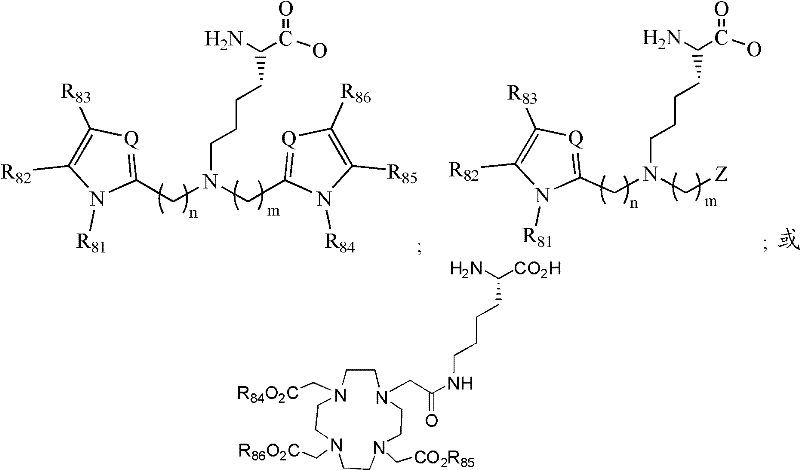
本领域技术人员将发现,上述络合物经羧基的连接只是一种连接方式,因为赖氨酸或其他氨基酸残基具有或可以具有可用于连接的氨基官能。与通过羧基连接至促生长素抑制素的上文所示那些络合物类似,其他与肽或促生长素抑制素的连接可以通过氨基实现。Those skilled in the art will find that the linkage of the above complexes via the carboxyl group is only one way of linkage, since lysine or other amino acid residues have or can have amino functions available for linkage. Other linkages to peptides or somatostatin can be achieved through amino groups similar to those shown above for complexes linked to somatostatin through a carboxyl group.
另一方面,提供了包含药学可接受的赋形剂的化合物Y-促生长素抑制素的制剂。In another aspect, there is provided a formulation of Compound Y-somatostatin comprising a pharmaceutically acceptable excipient.
另一方面,提供了对患者一个区域成像的方法,包括如下步骤:给患者施用诊断有效量的给患者施用诊断有效量的式I或式II化合物的步骤,并获得所述患者的所述区域的影像。In another aspect, there is provided a method of imaging a region of a patient, comprising the steps of: administering to a patient a diagnostically effective amount of a compound of formula I or formula II, and obtaining said region of said patient of the image.
在制备式I或式II化合物的一个非限制性实例中,合成可以通过制备吡啶醛而开始,如方案1所示:In a non-limiting example of preparing a compound of formula I or formula II, the synthesis can be initiated by preparing pyridine aldehyde, as shown in Scheme 1:
方案1:反应物/条件:(i)与二甲胺在110℃下反应;(ii)二氧化锰。Scheme 1: Reactants/Conditions: (i) reaction with dimethylamine at 110°C; (ii) manganese dioxide.

如方案2所示,方案1的产物然后可以被进一步官能化以生成SAAC配体。As shown in
方案2:通过受保护的赖氨酸残基的还原性烷基化从2当量的4-二甲基氨基吡啶-2-羧醛合成DPMA。Scheme 2: Synthesis of DPMA from 2 equivalents of 4-dimethylaminopyridine-2-carboxaldehyde by reductive alkylation of a protected lysine residue.

其他DPMA类似物可以根据不同实施方案来合成。例如,还可以制备卤化吡啶基类似物。例如,4-溴-3-氯-1-羟基甲醇吡啶、4-氟-3-氯-1-羟基甲醇吡啶、3,4-二氯-1-羟基甲醇吡啶和3-氯-2-氟-1-羟基甲醇吡啶可用作方案1示例的醛制备的起始材料。方案3说明了通过Buchwald-Hartwig胺化作用制备DPMA类似物的替代路线。Other DPMA analogs can be synthesized according to different embodiments. For example, halogenated pyridyl analogs can also be prepared. For example, 4-bromo-3-chloro-1-hydroxymethanolpyridine, 4-fluoro-3-chloro-1-hydroxymethanolpyridine, 3,4-dichloro-1-hydroxymethanolpyridine and 3-chloro-2-fluoro -1-Hydroxymethanolpyridine can be used as starting material for the preparation of aldehydes illustrated in
方案3:反应物/条件:(iii)Pd(O),NH(R90)2。Scheme 3: Reactants/Conditions: (iii) Pd(O), NH(R 90 ) 2 .
本领域技术人员已知,方案1、2和3中说明的吡啶基由于氨基取代而比未取代的吡啶基更富含电子。缘于这种取代的吡啶基的极性也增加所述化合物的水溶性。所述化合物还表现出增加的金属螯合。It is known to those skilled in the art that the pyridyl groups illustrated in
氮原子络合锝的能力可能与参与络合作用的供体氮的pKa有关。具有比未取代的2-吡啶环系统更富含电子的环系统的杂环可能具有更大的pKa,由此它们会是更弱的酸和因此更强的碱(方案4)。额外的供给能力会提高99mTc和/或Re结合,导致更高比活性的化合物,具有同样强大的稳定性。The ability of nitrogen atoms to complex technetium may be related to the pKa of the donor nitrogen involved in the complexation. Heterocycles with more electron-rich ring systems than unsubstituted 2-pyridine ring systems are likely to have larger pKa's whereby they would be weaker acids and thus stronger bases (Scheme 4). The additional donating capacity would enhance 99m Tc and/or Re binding, resulting in higher specific activity compounds with equally robust stability.
方案4:额外的环氮和氮取代对吡啶环系统pKa的影响。Scheme 4: Effect of additional ring nitrogen and nitrogen substitution on the pKa of the pyridine ring system.

与其中由I表示的二吡啶基化合物被并入DPMA类似物的方案2和3中说明的那些化合物类似,由II表示的化合物也一样。其中R是赖氨酰的此类相应化合物可以由VIII表示:Similar to those compounds illustrated in

其中R70、R71、R72、R73、m、n和Z如上文定义,并且其中NH2基团如所示或可以受保护。在一些实施方案中,Z是羧酸基团。由于Z基团与吡啶基相比较小的立体轮廓,此类SAAC配体更小并且在金属中心受阻较小。wherein R 70 , R 71 , R 72 , R 73 , m, n and Z are as defined above, and wherein the NH 2 group is as shown or may be protected. In some embodiments, Z is a carboxylic acid group. Due to the smaller steric profile of the Z group compared to the pyridyl group, such SAAC ligands are smaller and less hindered at the metal center.
还可以使用式II、IV或VI的化合物的替代合成方案。例如,当R是赖氨酸时,此类化合物可以通过双还原性烷基化受保护的赖氨酸上的序列来制备。添加第一醛,随后还原,可以提供式II、IV或VI化合物以生成式IX化合物。随后用草酸处理IX,然后脱保护,得到式II、IV或VI化合物,其中R是赖氨酸基团。这在方案5中说明,如下:Alternative synthetic schemes for compounds of formula II, IV or VI may also be used. For example, when R is lysine, such compounds can be prepared by double reductive alkylation of the sequence on the protected lysine. Addition of a first aldehyde, followed by reduction, can provide a compound of formula II, IV or VI to generate a compound of formula IX. Subsequent treatment of IX with oxalic acid followed by deprotection affords compounds of formula II, IV or VI wherein R is a lysine group. This is illustrated in
方案5:如II、IV或VI表示的化合物中所示,X’代表咪唑基或吡啶基。Scheme 5: As shown in the compound represented by II, IV or VI, X' represents imidazolyl or pyridyl.
在一个实施方案中,咪唑醚被衍生化生成赖氨酸咪唑醚(LIMES)。一个示例性合成方案列于方案6。上文所述的和由V和VI表示的化合物的实施方案所表示的LIMES化合物可以随示例描述的V的具体化合物一起制备,其中R81和R84是其中乙烯基将醇、醚、酸或酰胺基团连接至咪唑环的基团。In one embodiment, imidazole ethers are derivatized to form lysine imidazole ethers (LIMES). An exemplary synthetic scheme is listed in
方案6:LIMES化合物的制备。Scheme 6: Preparation of LIMES compounds.

另一方面,提供了具有含有至少一个亲水性取代基的取代或未取代的二(咪唑基烷基)胺的化合物,或其药学可接受的盐,和生理上可接受的载体。In another aspect, there is provided a compound having a substituted or unsubstituted bis(imidazolylalkyl)amine containing at least one hydrophilic substituent, or a pharmaceutically acceptable salt thereof, and a physiologically acceptable carrier.
另一方面,提供了包含与一种或多种药学可接受载体(添加剂)和/或稀释剂一起配制的治疗有效量的一种或多种上述化合物的药学可接受组合物。如下文详细描述的,所述药物组合物可以被特别配制以固体或液体形式施用,包括适于以下的那些:(1)口服施用,例如灌药(水性或非水性溶液或悬液)、片剂(例如针对口腔、舌下和全身吸收的那些)、大丸剂、粉剂、颗粒剂、应用于舌的糊剂;(2)胃肠外施用,例如通过皮下、肌肉内、静脉内或硬膜外注射,作为例如无菌溶液或悬液、或持续释放制剂;(3)局部应用,例如,作为乳油、软膏或控制释放的贴片或应用于皮肤的喷雾剂;(4)阴道内或直肠内,例如作为阴道栓、乳油或泡沫剂;(5)舌下;(6)经眼;(7)透皮;或(8)经鼻。In another aspect, there is provided a pharmaceutically acceptable composition comprising a therapeutically effective amount of one or more of the compounds described above formulated together with one or more pharmaceutically acceptable carriers (additives) and/or diluents. As described in detail below, the pharmaceutical compositions may be specially formulated for administration in solid or liquid form, including those suitable for: (1) oral administration, such as drench (aqueous or non-aqueous solution or suspension), tablet (such as those for buccal, sublingual and systemic absorption), boluses, powders, granules, pastes applied to the tongue; (2) parenteral administration, such as by subcutaneous, intramuscular, intravenous or epidural External injection, as, for example, a sterile solution or suspension, or a sustained-release formulation; (3) topical application, for example, as a cream, ointment, or controlled-release patch or spray applied to the skin; (4) intravaginally or rectally Internally, eg, as a pessary, cream, or foam; (5) sublingually; (6) ocularly; (7) transdermally; or (8) nasally.
所述化合物的制剂可以部分地基于脂质体。脂质体由磷脂双层组成,磷脂双层形成围绕水性核心的外壳。用于制备给患者施用的脂质体的方法是本领域技术人员已知的;例如美国专利第4,798,734号描述了将生物材料包封于脂质体中的方法。将所述生物材料溶解于水溶液中,添加适当的磷脂和脂质,如果需要,一起添加表面活性剂。然后必要时,对材料进行透析和声处理。已知方法的综述提供于G.Gregoriadis,Chapter 14(“Liposomes”),Drug Carriers in Biology and Medicine,pp.287-341(AcademicPress,1979)。Formulations of the compounds may be based in part on liposomes. Liposomes consist of a phospholipid bilayer that forms a shell around an aqueous core. Methods for preparing liposomes for administration to patients are known to those skilled in the art; for example, US Patent No. 4,798,734 describes methods for encapsulating biological materials in liposomes. The biological material is dissolved in an aqueous solution, and the appropriate phospholipids and lipids are added, together with surfactants, if necessary. The material is then dialyzed and sonicated as necessary. A review of known methods is provided in G. Gregoriadis, Chapter 14 ("Liposomes"), Drug Carriers in Biology and Medicine, pp. 287-341 (Academic Press, 1979).
所述化合物的制剂部分地基于聚合体微粒。聚合物或蛋白形成的微球也是本领域技术人员公知的,并且可以被设计以穿过胃肠道,例如描述于美国专利第4,906,474、4,925,673和3,625,214号。有许多用于制备微球的公知方法,包括溶剂蒸发和凝聚/相分离。可生物蚀解的微球可以使用为制备用于药物递送的微球而开发的方法的任何一种来制备,描述于例如Mathiowitz等,J.Appl.Polymer Sci.35,755-774(1988),和P.Deasy,Microencapsulation and Related Drug Processes,pp.61-193,(Dekker,1984),其教导内容在此并入。方法的选择是根据药物性质和聚合物的选择以及所需要的尺寸、外形和结晶度,例如讨论于Benita等,J.Pharm.Sci.73,1721-1724(1984),Jalil和Nixon,J.Microencapsulation,7,297-325(1990),和Mathiowitz等,Scanning Microscopy 4,329-340(1990),其教导内容在此并入。The formulation of the compounds is based in part on polymeric microparticles. Microspheres formed of polymers or proteins are also well known to those skilled in the art and can be designed to pass through the gastrointestinal tract as described, for example, in US Patent Nos. 4,906,474, 4,925,673 and 3,625,214. There are a number of well-known methods for preparing microspheres, including solvent evaporation and coacervation/phase separation. Bioerodible microspheres can be prepared using any of the methods developed for the preparation of microspheres for drug delivery, described e.g. in Mathiowitz et al., J. Appl. Polymer Sci. 35, 755-774 (1988) , and P. Deasy, Microencapsulation and Related Drug Processes, pp.61-193, (Dekker, 1984), the teachings of which are incorporated herein. The choice of method is based on the nature of the drug and the choice of polymer as well as the desired size, shape and crystallinity, as discussed for example in Benita et al., J.Pharm.Sci.73, 1721-1724 (1984), Jalil and Nixon, J. Microencapsulation, 7, 297-325 (1990), and Mathiowitz et al.,
在例如Mathiowitz等,(1990),Benita,和美国专利第4,272,398号(Jaffe)中描述的溶剂蒸发中,聚合物被溶解于挥发性有机溶剂。可溶或粒子形式的药物被添加至聚合物溶液并将混合物悬浮于含有表面活性剂(例如聚乙烯醇)的水相中。搅拌得到的乳状液,直至大部分有机溶剂蒸发,剩下固体微球。可以通过该方法获得各种尺寸(1-1000微米)和形态的微球,其可用于非不稳定的聚合物。In solvent evaporation such as described in Mathiowitz et al., (1990), Benita, and US Patent No. 4,272,398 (Jaffe), the polymer is dissolved in a volatile organic solvent. Drug in soluble or particulate form is added to the polymer solution and the mixture is suspended in an aqueous phase containing a surfactant such as polyvinyl alcohol. The resulting emulsion was stirred until most of the organic solvent evaporated, leaving solid microspheres. Microspheres of various sizes (1-1000 microns) and morphologies can be obtained by this method, which can be used for non-labile polymers.
凝聚/相分离技术已经被用于使用各种聚合物包衣包封固体和液体核心材料。例如,Green和Schleichter的美国专利第2,730,456、2,730,457和2,800,457号描述了明胶和明胶-金合欢胶(阿拉伯树胶)包衣系统。简单的凝聚材料单一胶体(例如,明胶水溶液)并且涉及通过对水具有更高亲和性的物质(例如醇和盐)从分散胶体周围去除结合水。络合物凝聚采用不止一种胶体,并且分离主要通过携带相反电荷的胶体的电荷中和而非通过脱水来进行。凝聚还可以使用非水性媒介物诱导,例如描述于Nakano等,Int.J.Pharm,4,29-298(1980)。Coacervation/phase separation techniques have been used to encapsulate solid and liquid core materials with various polymer coatings. For example, US Patent Nos. 2,730,456, 2,730,457, and 2,800,457 to Green and Schleichter describe gelatin and gelatin-accacia (gum arabic) coating systems. Simple coagulated materials are single colloids (eg, aqueous gelatin solutions) and involve the removal of bound water from the surrounding dispersoids by substances with a higher affinity for water, such as alcohols and salts. Complex coacervation employs more than one colloid, and separation proceeds primarily by charge neutralization of oppositely charged colloids rather than by dehydration. Aggregation can also be induced using non-aqueous vehicles, eg as described in Nakano et al., Int. J. Pharm, 4, 29-298 (1980).
由明胶型聚合物例如藻酸盐或聚磷腈或其他二羧基聚合物制成的水凝胶微球可以通过如下进行:将聚合物溶解于水溶液,悬浮待并入混合物的材料,并通过装配有氮气喷咀的微滴形成装置挤出聚合物混合物。得到的微球落入缓慢搅拌的离子硬化浴,例如描述于Salib,等,PharmazeutischeIndustrie 40-11A,1230(1978),其教导内容在此并入。该系统的优点是在制造后通过用聚阳离子聚合物(例如聚赖氨酸)包裹它们而进一步修饰微球表面的能力,描述于例如Lim等,J.Pharm Sci.70,351-354(1981)。微球粒度取决于挤出器尺寸以及聚合物和气体流速。Hydrogel microspheres made from gelatin-type polymers such as alginate or polyphosphazene or other dicarboxylated polymers can be produced by dissolving the polymer in an aqueous solution, suspending the material to be incorporated into the mixture, and assembling by A droplet forming unit with a nitrogen jet extruded the polymer mixture. The resulting microspheres are dropped into a slowly stirred ion hardening bath, such as described in Salib, et al., Pharmazeutische Industrie 40-11A, 1230 (1978), the teachings of which are incorporated herein. The advantage of this system is the ability to further modify the surface of the microspheres after manufacture by coating them with polycationic polymers (e.g. polylysine), described e.g. in Lim et al., J.Pharm Sci.70, 351-354 (1981 ). Microsphere particle size depends on extruder size as well as polymer and gas flow rates.
可以使用的聚合物的实例包括聚酰胺、聚碳酸酯、聚亚烷基及其衍生物(包括聚亚烷基二醇、聚烷撑氧、聚对酞酸亚烷基酯)、丙烯酸和甲基丙烯酸酯的聚合物(包括聚甲基丙烯酸甲酯、聚甲基丙烯酸乙酯、聚甲基丙烯酸丁酯、聚甲基丙烯酸异丁酯、聚甲基丙烯酸己酯、聚甲基丙烯酸异癸酯、聚甲基丙烯酸月桂酯、聚甲基丙烯酸苯酯、聚丙烯酸甲酯、聚丙烯酸异丙酯、聚丙烯酸异丁酯和聚丙烯酸十八烷基酯)、聚乙烯聚合物(包括聚乙烯醇、聚乙烯醚、聚乙烯酯、聚乙烯卤化物、聚乙酸乙烯酯和聚乙烯吡咯烷酮)、聚乙醇酸交酯、聚硅氧烷、聚氨酯及其共聚物、纤维素(包括烷基纤维素、羟基烷基纤维素、纤维素醚、纤维素酯、硝基纤维素、甲基纤维素、乙基纤维素、羟丙基纤维素、羟丙基甲基纤维素、羟丁基甲基纤维素、醋酸纤维素、丙酸纤维素、醋酸丁酸纤维素、醋酸酞酸纤维素、羧基乙基纤维素、三乙酸纤维素和硫酸纤维素钠盐)、聚丙烯、聚乙烯(包括聚乙二醇、聚氧化乙烯和聚对苯二甲酸乙二酯)和聚苯乙烯。Examples of polymers that can be used include polyamides, polycarbonates, polyalkylenes and their derivatives (including polyalkylene glycols, polyalkylene oxides, polyalkylene terephthalates), acrylic and methacrylic acid Acrylate-based polymers (including polymethyl methacrylate, polyethyl methacrylate, polybutyl methacrylate, polyisobutyl methacrylate, polyhexyl methacrylate, polyisodecyl methacrylate esters, polylauryl methacrylate, polyphenyl methacrylate, polymethyl acrylate, polyisopropyl acrylate, polyisobutyl acrylate and polyoctadecyl acrylate), polyethylene polymers (including polyethylene alcohols, polyvinyl ethers, polyvinyl esters, polyvinyl halides, polyvinyl acetates and polyvinylpyrrolidones), polyglycolides, polysiloxanes, polyurethanes and their copolymers, celluloses (including alkylcelluloses , hydroxyalkyl cellulose, cellulose ether, cellulose ester, nitrocellulose, methyl cellulose, ethyl cellulose, hydroxypropyl cellulose, hydroxypropyl methyl cellulose, hydroxybutyl methyl cellulose, Cellulose acetate, cellulose propionate, cellulose acetate butyrate, cellulose acetate phthalate, carboxyethyl cellulose, cellulose triacetate and sodium cellulose sulfate), polypropylene, polyethylene (including polyethylene glycol , polyethylene oxide and polyethylene terephthalate) and polystyrene.
可生物降解聚合物的实例包括合成聚合物和天然聚合物,所述合成聚合物例如乳酸和乙醇酸的聚合物、聚原酸酯、聚氨酯、聚丁酸、聚戊酸和丙交酯-己交酯共聚物,所述天然聚合物例如藻酸盐和其他多糖,包括葡聚糖和纤维素、胶原、其化学衍生物(化学基团例如烷基、亚烷基的取代、添加、羟基化、氧化和本领域技术人员常规进行的其他修饰)、白蛋白和其他亲水蛋白、玉米醇溶蛋白和其他谷醇溶蛋白和疏水蛋白、其共聚物和混合物。一般而言,这些材料通过酶促水解或体内暴露于水、通过表面或主题蚀解而降解。Examples of biodegradable polymers include synthetic polymers such as polymers of lactic and glycolic acids, polyorthoesters, polyurethanes, polybutyric acid, polyvaleric acid, and lactide-caproic acid, and natural polymers. Copolymers of lactide, natural polymers such as alginate and other polysaccharides, including dextran and cellulose, collagen, chemical derivatives thereof (substitution, addition, hydroxylation of chemical groups such as alkyl, alkylene , oxidation and other modifications routinely performed by those skilled in the art), albumin and other hydrophilic proteins, zein and other prolamins and hydrophobins, copolymers and mixtures thereof. Generally, these materials degrade by enzymatic hydrolysis or exposure to water in vivo, by surface or subject erosion.
特别关注的生物粘附聚合物包括可生物蚀解的水凝胶(描述于H.S.Sawhney,C.P.Pathak和J.A.Hubbell,Macromolecules,1993,26,581-587,其教导内容在此并入)、聚透明质酸、酪蛋白、明胶、明胶蛋白、聚酐、聚丙烯酸、藻酸盐、脱乙酰壳多糖、甲基丙烯酸甲酯、聚甲基丙烯酸乙酯、聚甲基丙烯酸丁酯、聚甲基丙烯酸异丁酯、聚甲基丙烯酸己酯、聚甲基丙烯酸异癸酯、聚甲基丙烯酸月桂酯、聚甲基丙烯酸苯酯、聚丙烯酸甲酯、聚丙烯酸异丙酯、聚丙烯酸异丁酯和聚丙烯酸十八烷基酯。Bioadhesive polymers of particular interest include bioerodible hydrogels (described in H.S. Sawhney, C.P. Pathak and J.A. Hubbell, Macromolecules, 1993, 26, 581-587, the teachings of which are incorporated herein), polytransparent Hyaluronic acid, casein, gelatin, gelatin protein, polyanhydride, polyacrylic acid, alginate, chitosan, methyl methacrylate, polyethyl methacrylate, polybutyl methacrylate, polymethacrylic acid Isobutyl, polyhexyl methacrylate, polyisodecyl methacrylate, polylauryl methacrylate, polyphenyl methacrylate, polymethyl acrylate, polyisopropyl acrylate, polyisobutyl acrylate and Polyoctadecyl acrylate.
组合物中使用的稀释剂可以是能够能够稠化活性成分以产生所需质量的一种或多种化合物。优选的稀释剂是矿物磷酸盐,例如磷酸钙;糖,例如水合乳糖或无水乳糖、或甘露糖醇;和纤维素或纤维素衍生物,例如微晶纤维素、淀粉、玉米淀粉或预胶化淀粉。特别优选的稀释剂是乳糖一水合物、甘露糖醇、微晶纤维素和玉米淀粉,单独或混合使用,例如乳糖一水合物和玉米淀粉的混合物,或乳糖一水合物、玉米淀粉和微晶纤维素的混合物。The diluent used in the composition can be one or more compounds capable of thickening the active ingredient to give it the desired mass. Preferred diluents are mineral phosphates, such as calcium phosphate; sugars, such as lactose hydrate or anhydrous lactose, or mannitol; and cellulose or cellulose derivatives, such as microcrystalline cellulose, starch, cornstarch or pregelatin Starch. Particularly preferred diluents are lactose monohydrate, mannitol, microcrystalline cellulose and corn starch, alone or in combination, such as a mixture of lactose monohydrate and corn starch, or lactose monohydrate, corn starch and microcrystalline A mixture of cellulose.
组合物中使用的粘合剂可以是能够密实式(I)化合物、将它转化成具有更好流动性的更粗和更致密粒子的一种或多种化合物。优选的粘合剂是藻酸或藻酸钠;纤维素和纤维素衍生物,例如羧甲基纤维素钠、乙基纤维素、羟乙基纤维素、羟丙基纤维素、羟丙基甲基纤维素或甲基纤维素、明胶;丙烯酸聚合物;和聚乙烯吡咯烷酮,例如聚维酮K-30;羟丙基甲基纤维素和聚维酮K-30是特别优选的粘合剂。The binder used in the composition may be one or more compounds capable of compacting the compound of formula (I), converting it into coarser and denser particles with better flowability. Preferred binders are alginic acid or sodium alginate; cellulose and cellulose derivatives such as sodium carboxymethylcellulose, ethylcellulose, hydroxyethylcellulose, hydroxypropylcellulose, hypromellose Acrylic acid polymers; and polyvinylpyrrolidones, such as povidone K-30; hydroxypropyl methylcellulose and povidone K-30 are particularly preferred binders.
崩解剂可以包含在组合物中,并且包括当制备的制剂放入水性介质中时促进它崩解的一种或多种化合物。优选的崩解剂是纤维素或纤维素衍生物,例如羧甲基纤维素钠、交联的羧甲基纤维素钠、微晶纤维素、纤维素粉末、交聚维酮;预胶化淀粉、葡糖酸淀粉钠、羧甲基淀粉钠或淀粉。交聚维酮、交联的羧甲基纤维素钠和羧甲基淀粉钠是优选的崩解剂。Disintegrants may be included in the composition and include one or more compounds that facilitate the disintegration of the prepared formulation when it is placed in an aqueous medium. Preferred disintegrants are cellulose or cellulose derivatives such as sodium carboxymethylcellulose, croscarmellose sodium, microcrystalline cellulose, cellulose powder, crospovidone; pregelatinized starch , Sodium Starch Gluconate, Sodium Starch Carboxymethyl or Starch. Crospovidone, croscarmellose sodium and sodium starch glycolate are preferred disintegrants.
组合物中使用的抗粘着剂可以是能够降低制剂粘性特征的一种或多种化合物,例如,能够防止对金属表面的粘着。适合的抗粘着剂包括含有硅例如二氧化硅或滑石的化合物。The anti-adhesive agent used in the composition may be one or more compounds capable of reducing the adhesive characteristics of the formulation, for example, capable of preventing adhesion to metal surfaces. Suitable anti-sticking agents include compounds containing silicon such as silicon dioxide or talc.
根据一些实施方案,流动促进剂可以包含在组合物中。流动促进剂可以是能够促进所制备的制剂流动的一种或多种化合物。适合的促进剂包括含有硅例如无水胶体二氧化硅或沉淀二氧化硅的化合物。According to some embodiments, a flow enhancer may be included in the composition. A flow enhancer can be one or more compounds capable of improving the flow of the prepared formulation. Suitable accelerators include compounds containing silicon such as anhydrous colloidal or precipitated silica.
根据一些实施方案,润滑剂可以包含在组合物中。润滑剂可以是能够防止与制备干形式相关的问题,例如压制或填充期间机械中发生的粘着和/或束缚问题的一种或多种化合物。适合的润滑剂包括脂肪酸或脂肪酸衍生物,例如硬质酸钙、单硬脂酸甘油酯、棕榈酸硬脂酸甘油酯、硬脂酸镁、月桂基硫酸钠、硬脂酰富马酸钠、硬脂酸锌或硬脂酸;氢化植物油,例如氢化蓖麻油;聚亚烷基二醇或聚乙二醇;苯甲酸钠;或滑石。在一些实施方案中,润滑剂是硬脂酸镁或硬脂酰富马酸钠。According to some embodiments, a lubricant may be included in the composition. A lubricant may be one or more compounds capable of preventing problems associated with the preparation of dry forms, such as sticking and/or binding problems that occur in machinery during pressing or filling. Suitable lubricants include fatty acids or fatty acid derivatives such as calcium stearate, glyceryl monostearate, glyceryl palmitostearate, magnesium stearate, sodium lauryl sulfate, sodium stearyl fumarate, Zinc stearate or stearic acid; hydrogenated vegetable oils, such as hydrogenated castor oil; polyalkylene glycols or polyethylene glycols; sodium benzoate; or talc. In some embodiments, the lubricant is magnesium stearate or sodium stearyl fumarate.
根据一些实施方案,使用的着色剂可以包含在组合物中。着色剂可以是能够赋予所制备的制剂所需颜色的一种或多种化合物。着色剂的添加可以用于例如区分含有不同剂量活性成分的制剂。优选的着色剂是氧化铁。According to some embodiments, the colorant used may be included in the composition. A colorant can be one or more compounds capable of imparting the desired color to the prepared formulation. The addition of coloring agents can be used, for example, to differentiate formulations containing different doses of active ingredient. A preferred colorant is iron oxide.
如上所列出的,本发明化合物的某些实施方案可以含有碱性官能团,例如氨基或烷基氨基,并因此能够与药学可接受的酸生成药学可接受的盐。所述盐可以在施用媒介物或剂型生产过程中原位制备,或者通过单独地使纯化的化合物以其游离碱形式与适合的有机酸或无机酸反应并在随后纯化过程中分离由此生成的盐。代表性的盐包括氢溴化物、盐酸盐、硫酸盐、硫酸氢盐、磷酸盐、硝酸盐、乙酸盐、戊酸盐、油酸盐、棕榈酸盐、硬脂酸盐、月桂酸盐、苯甲酸盐、乳酸盐、磷酸盐、甲苯磺酸盐、柠檬酸盐、马来酸盐、富马酸盐、琥珀酸盐、酒石酸盐、萘酸盐(napthylate)、甲磺酸盐、葡庚糖酸盐、乳糖醛酸盐和月桂基磺酸盐等。(参见例如Berge等(1977)“Pharmaceutical Salts”,J.Pharm.Sci.66:1-19)。As listed above, certain embodiments of the compounds of the present invention may contain basic functional groups, such as amino or alkylamino groups, and are thus capable of forming pharmaceutically acceptable salts with pharmaceutically acceptable acids. The salts can be prepared in situ during the administration vehicle or dosage form manufacture, or by separately reacting the purified compound in its free base form with a suitable organic or inorganic acid and isolating the salt thus formed during subsequent purification. . Representative salts include hydrobromide, hydrochloride, sulfate, bisulfate, phosphate, nitrate, acetate, valerate, oleate, palmitate, stearate, laurate , benzoate, lactate, phosphate, tosylate, citrate, maleate, fumarate, succinate, tartrate, napthylate, mesylate , Glucoheptonate, Lacturonate and Lauryl Sulfonate etc. (See eg Berge et al. (1977) "Pharmaceutical Salts", J. Pharm. Sci. 66: 1-19).
药学可接受的盐包括所述化合物的无毒盐或季铵盐,例如用无毒有机酸或无机酸制备。例如,此类无毒盐包括衍生自无机酸的那些,所述无机酸例如盐酸、氢溴酸、硫酸、氨基磺酸、磷酸、硝酸等;和用有机酸制备的盐,所述有机酸例如乙酸、丙酸、琥珀酸、乙醇酸、硬脂酸、乳酸、苹果酸、酒石酸、柠檬酸、抗坏血酸、棕榈酸、马来酸、羟基马来酸、苯乙酸、谷氨酸、苯甲酸、水杨酸、磺胺酸、2-乙酸基苯甲酸、富马酸、甲苯磺酸、甲磺酸、乙磺酸、草酸、异硫羰酸等。Pharmaceutically acceptable salts include non-toxic or quaternary ammonium salts of the compounds, prepared, for example, with non-toxic organic or inorganic acids. For example, such nontoxic salts include those derived from inorganic acids such as hydrochloric, hydrobromic, sulfuric, sulfamic, phosphoric, nitric, and the like; and salts prepared with organic acids such as Acetic, propionic, succinic, glycolic, stearic, lactic, malic, tartaric, citric, ascorbic, palmitic, maleic, hydroxymaleic, phenylacetic, glutamic, benzoic, water Salicylic acid, sulfanilic acid, 2-acetoxybenzoic acid, fumaric acid, toluenesulfonic acid, methanesulfonic acid, ethanesulfonic acid, oxalic acid, isothiocarbonic acid, etc.
在一些实施方案中,所述化合物含有一个或多个酸性官能团,因此能够与药学可接受的碱生成药学可接受的盐。这些盐同样可以在施用媒介物或剂型生产过程中原位制备,或者通过单独地使纯化的化合物以其游离酸形式与适合的碱、氨或药学可接受的有机伯胺、仲胺或叔胺反应,所述碱例如药学可接受的金属阳离子的氢氧化物、碳酸盐或碳酸氢盐。代表性的碱金属盐或碱土金属盐包括锂盐、钠盐、钾盐、钙盐、镁盐和铝盐等。用于生成碱加成盐的代表性有机胺包括乙胺、二乙胺、乙二胺、乙醇胺、二乙醇胺、哌嗪等。参见Berge等,同上.In some embodiments, the compounds contain one or more acidic functional groups and are thus capable of forming pharmaceutically acceptable salts with pharmaceutically acceptable bases. These salts can likewise be prepared in situ during the administration vehicle or dosage form manufacture, or by separately reacting the purified compound in its free acid form with a suitable base, ammonia, or a pharmaceutically acceptable organic primary, secondary, or tertiary amine. , the base such as a hydroxide, carbonate or bicarbonate of a pharmaceutically acceptable metal cation. Representative alkali or alkaline earth metal salts include lithium, sodium, potassium, calcium, magnesium, and aluminum salts, and the like. Representative organic amines useful in forming base addition salts include ethylamine, diethylamine, ethylenediamine, ethanolamine, diethanolamine, piperazine, and the like. See Berge et al., supra.
组合物中还可以存在润湿剂、乳化剂和润滑剂(例如月桂基硫酸钠和硬脂酸镁)以及着色剂、释放剂、包衣剂、增甜剂、调味剂和芳香剂、防腐剂和抗氧化剂。Wetting agents, emulsifiers and lubricants, such as sodium lauryl sulfate and magnesium stearate, as well as coloring agents, release agents, coating agents, sweetening, flavoring and perfuming agents, preservatives, can also be present in the compositions. and antioxidants.
药学可接受的抗氧化剂的实例包括:(1)水溶性抗氧化剂,例如抗坏血酸、盐酸半胱氨酸、硫酸氢钠、焦亚硫酸钠、亚硫酸钠等;(2)油溶性抗氧化剂,例如棕榈酸抗坏血酸酯、丁羟基茴香醚(BHA)、丁羟基甲苯(BHT)、卵磷脂、没食子酸丙酯、α-生育酚等;和(3)金属螯合剂,例如柠檬酸、乙二胺四乙酸(EDTA)、山梨糖醇、酒石酸、磷酸等。Examples of pharmaceutically acceptable antioxidants include: (1) water-soluble antioxidants such as ascorbic acid, cysteine hydrochloride, sodium bisulfate, sodium metabisulfite, sodium sulfite, etc.; (2) oil-soluble antioxidants such as ascorbyl palmitate , butylated hydroxyanisole (BHA), butylated hydroxytoluene (BHT), lecithin, propyl gallate, α-tocopherol, etc.; and (3) metal chelating agents such as citric acid, ethylenediaminetetraacetic acid (EDTA) , sorbitol, tartaric acid, phosphoric acid, etc.
所述化合物的制剂包括适合口服、鼻、局部(包括口腔和舌下)、直肠、阴道和/或胃肠外施用的那些。制剂可以单位剂量形式存在,并且可以通过药学领域公知的任何方法制备。可以与载体材料组合产生单剂量形式的活性成分的量将根据治疗宿主、具体施用方式而改变。可以与载体材料组合产生单剂量形式的活性成分的量一般是产生治疗效应的化合物的量。一般,以百分比表示,该量范围是约1%至约99%的活性成分,约5%至约70%的活性成分,或约10%至约30%的活性成分。Formulations of the compounds include those suitable for oral, nasal, topical (including buccal and sublingual), rectal, vaginal and/or parenteral administration. The formulations may be presented in unit dosage form and may be prepared by any of the methods well known in the art of pharmacy. The amount of active ingredient which can be combined with a carrier material to produce a single dosage form will vary depending upon the host treated, the particular mode of administration. The amount of active ingredient which can be combined with a carrier material to produce a single dosage form will generally be that amount of the compound which produces a therapeutic effect. Generally, expressed as a percentage, the amount will range from about 1% to about 99% active ingredient, from about 5% to about 70% active ingredient, or from about 10% to about 30% active ingredient.
在某些实施方案中,所述化合物的制剂包括选自环糊精、脂质体、胶束形成剂(例如胆汁酸)和聚合体载体(例如聚酯或聚酐)的赋形剂。在某些实施方案中,前述制剂使化合物可口服生物利用。In certain embodiments, formulations of the compounds include excipients selected from cyclodextrins, liposomes, micelle formers (eg, bile acids), and polymeric carriers (eg, polyesters or polyanhydrides). In certain embodiments, the aforementioned formulations render the compounds orally bioavailable.
制备这些制剂或组合物的方法包括使化合物与载体和任选地一种或多种助剂结合的步骤。一般而言,制剂的制备是通过使化合物与液体载体、细碎固体载体或两者均匀且紧密结合,然后必要时使产品成形。Methods of preparing these formulations or compositions include the step of bringing into association the compound with a carrier and, optionally, one or more accessory ingredients. In general, the formulations are prepared by uniformly and intimately bringing into association the compound with liquid carriers, finely divided solid carriers or both, and then, if necessary, shaping the product.
适合胃肠外施用的药物组合物可以包括与一种或多种药学可接受的无菌等渗水或非水溶液、分散液、悬液或乳状液组合的一种或多种化合物,或可以在即将使用前重构成无菌注射溶液或分散液的无菌粉末,其可以含有糖、醇、抗氧化剂、缓冲剂、抑菌剂、使制剂与预期接受者的血液等渗的溶质、或悬浮剂或增稠剂。Pharmaceutical compositions suitable for parenteral administration may comprise one or more compounds in combination with one or more pharmaceutically acceptable sterile isotonic aqueous or non-aqueous solutions, dispersions, suspensions or emulsions, or may be prepared immediately before Sterile powders for reconstitution into sterile injectable solutions or dispersions prior to use, which may contain sugars, alcohols, antioxidants, buffers, bacteriostats, solutes to render the formulation isotonic with the blood of the intended recipient, or suspending agents or thickener.
可用于药物组合物的适合的水载体和非水载体的实例包括水、乙醇、多元醇(例如甘油、丙二醇、聚乙二醇等)及其适合的混合物、植物油(例如橄榄油)和可注射的有机酯(例如油酸乙酯)。可以例如通过使用包衣材料(例如卵磷脂),在分散体情况下保持所需粒度,和通过使用表面活性剂,来保持适当的流动性。Examples of suitable aqueous and non-aqueous carriers that can be used in pharmaceutical compositions include water, ethanol, polyols (such as glycerol, propylene glycol, polyethylene glycol, etc.) and suitable mixtures thereof, vegetable oils (such as olive oil), and injectable organic esters (such as ethyl oleate). Proper fluidity can be maintained, for example, by the use of coating materials such as lecithin, by maintaining the desired particle size in the case of dispersions, and by the use of surfactants.
这些组合物还可以含有佐剂,例如防腐剂、润湿剂、乳化剂和分散剂。防止微生物对本发明化合物的作用可以通过加入各种抗细菌和抗真菌剂来实现,所述抗细菌和抗真菌剂例如对羟基苯甲酸酯、氯代丁醇、苯酚山梨酸等。可能还需要向组合物中加入等渗剂,例如糖、氯化钠等。此外,注射药物形式的延长吸收可以通过加入延迟吸收剂(例如单硬脂酸铝和明胶)来实现。These compositions may also contain adjuvants such as preservatives, wetting agents, emulsifying agents and dispersing agents. Prevention of the action of microorganisms on the compounds of this invention can be achieved by the inclusion of various antibacterial and antifungal agents, for example, parabens, chlorobutanol, phenol sorbic acid, and the like. It may also be desirable to add isotonic agents, for example sugars, sodium chloride, and the like, to the compositions. In addition, prolonged absorption of the injectable pharmaceutical forms is brought about by the inclusion of agents delaying absorption such as aluminum monostearate and gelatin.
在一些情况下,为了延长药物作用,需要减缓皮下或肌内注射药物的吸收。这可以通过使用具有差的水溶性的结晶或无定形材料的液体悬液来实现。药物吸收速率则取决于其溶出速率,而溶出速率可以取决于晶体大小和晶形。可选地,胃肠外施用的药物形式的延迟吸收通过将药物溶解或悬浮于橄榄油媒介物来实现。In some cases, in order to prolong the action of the drug, it is necessary to slow the absorption of the drug injected subcutaneously or intramuscularly. This can be achieved by using liquid suspensions of crystalline or amorphous materials with poor water solubility. The rate of absorption of the drug then depends upon its rate of dissolution, which can depend upon crystal size and crystalline form. Alternatively, delayed absorption of a parenterally administered drug form is accomplished by dissolving or suspending the drug in an olive oil vehicle.
可注射的贮库形式可以通过形成本发明化合物在可生物降解聚合物(例如聚交酯-聚乙醇酸交酯)中的微囊基质来制备。根据药物与聚合物的比例和采用的具体聚合物的性质,可以控制药物释放速率。其他可生物降解聚合物的实例包括聚原酸酯和聚酐。可注射的贮库制剂还可以通过将药物包埋于可与身体组织相容的脂质体或微乳液中来制备。Injectable depot forms are made by forming microencapsule matrices of the compounds of the invention in biodegradable polymers such as polylactide-polyglycolide. Depending upon the ratio of drug to polymer and the nature of the particular polymer employed, the rate of drug release can be controlled. Examples of other biodegradable polymers include polyorthoesters and polyanhydrides. Depot injectable formulations are also prepared by entrapping the drug in liposomes or microemulsions which are compatible with body tissues.
当化合物作为药物施用给人和动物时,可以使用它们本身或含有与药物可接受载体组合的例如0.1至99.5%(更优选0.5至90%)活性成分的药物组合物。When the compounds are administered as medicines to humans and animals, they can be used as such or as pharmaceutical compositions containing, for example, 0.1 to 99.5% (more preferably 0.5 to 90%) of the active ingredient in combination with a pharmaceutically acceptable carrier.
药物制剂可以口服、胃肠外、局部或直肠给予。当然,它们以适合各自施用途径的形式给予。例如,它们以片剂或胶囊形式通过注射、吸入、洗眼液、软膏、栓剂等施用,通过注射、输注或吸入施用;通过洗液或软膏局部施用;和通过栓剂直肠施用。在一些实施方案中,制剂被口服施用。Pharmaceutical formulations can be administered orally, parenterally, topically or rectally. Of course, they are administered in a form suitable for the respective route of administration. For example, they are administered in tablet or capsule form by injection, inhalation, eye lotion, ointment, suppository, etc., by injection, infusion or inhalation; topical by lotion or ointment; and rectal by suppositories. In some embodiments, the formulation is administered orally.
不考虑所选择的施用途径,通过本领域技术人员已知的常规方法,化合物可以适当的水合形式使用,和/或药物组合物被配制成药学可接受的剂型。Irrespective of the chosen route of administration, the compounds may be used in suitably hydrated form and/or the pharmaceutical compositions formulated into pharmaceutically acceptable dosage forms by conventional methods known to those skilled in the art.
药物组合物中活性成分的实际剂量水平可以被改变以获得有效实现特定患者、组合物和施用方式所需的治疗反应而对患者无毒性的活性成分的量。选择的剂量水平将取决于许多因素,包括采用的特定化合物或其酯、盐或酰胺的活性,施用途径,施用时间,排泄率或采用的特定化合物的代谢,治疗持续时间,与采用的特定化合物组合使用的其他药物、化合物和/或材料,被治疗患者的年龄、性别、体重、状态、健康情况和先前医疗史,以及医学领域公知的类似因素。一般而言,化合物适合的日剂量可以是有效产生治疗效应的最低剂量的化合物的量。这种有效剂量一般取决于上述因子。一般,当用于标示的镇痛作用时,化合物对患者的静脉内、脑室内和皮下剂量范围是每天每千克体重约0.0001至约100mg。如果需要,活性化合物的有效日剂量可以一天内以适当间隔分开施用的两个、三个、四个、五个、六个或更多个亚剂量施用,任选地以单位剂量形式。Actual dosage levels of the active ingredients in the pharmaceutical compositions may be varied to obtain an amount of the active ingredient effective to achieve the desired therapeutic response for a particular patient, composition and mode of administration without being toxic to the patient. The selected dosage level will depend on a number of factors, including the activity of the particular compound employed or its ester, salt or amide, the route of administration, time of administration, the rate of excretion or metabolism of the particular compound employed, duration of treatment, and the specific compound employed. Other drugs, compounds and/or materials used in combination, age, sex, weight, condition, health and previous medical history of the patient being treated, and similar factors well known in the medical field. In general, a suitable daily dose of a compound will be that amount of the compound which is the lowest dose effective to produce a therapeutic effect. Such effective dosage will generally depend on the factors mentioned above. Generally, when used for the indicated analgesic effect, the intravenous, intracerebroventricular and subcutaneous doses of the compounds to patients range from about 0.0001 to about 100 mg per kilogram body weight per day. The effective daily dose of an active compound may, if desired, be administered as two, three, four, five, six or more sub-doses administered at appropriate intervals throughout the day, optionally in unit dose form.
另一方面,提供了药学可接受的组合物。根据一些实施方案,药学可接受的组合物包括治疗有效量的与一种或多种药学可接受载体(添加剂)和/或稀释剂一起配制的式I、II、III、IV、V、VI、VII或VIII化合物的一种或多种。如下文详细描述的,药物组合物可以被特别配制用于以固体或液体形式施用,包括适合以下的那些:(1)口服施用,例如灌药(水性或非水性溶液或悬液)、片剂、大丸剂、粉剂、颗粒剂、应用于舌的糊剂;(2)胃肠外施用,例如通过皮下、肌肉内或静脉内注射,作为例如无菌溶液或悬液;(3)局部应用,例如,作为乳油、软膏、或应用于皮肤、肺或口腔的喷雾剂;(4)阴道内或直肠内,例如作为阴道栓、乳油或泡沫剂;(5)舌下;(6)经眼;(7)透皮;或(8)经鼻。In another aspect, a pharmaceutically acceptable composition is provided. According to some embodiments, a pharmaceutically acceptable composition comprises a therapeutically effective amount of formula I, II, III, IV, V, VI, formulated together with one or more pharmaceutically acceptable carriers (additives) and/or diluents. One or more of compounds VII or VIII. As described in detail below, the pharmaceutical compositions may be specially formulated for administration in solid or liquid form, including those suitable for: (1) oral administration, such as drench (aqueous or non-aqueous solution or suspension), tablet , boluses, powders, granules, pastes for application to the tongue; (2) parenteral administration, e.g. by subcutaneous, intramuscular or intravenous injection, as e.g. sterile solutions or suspensions; (3) topical application, For example, as a cream, ointment, or spray applied to the skin, lungs, or mouth; (4) intravaginally or intrarectally, such as as pessaries, creams, or foams; (5) sublingually; (6) ocularly; (7) transdermal; or (8) nasal.
式I、II、III、IV、V、VI、VII或VIII化合物可以本身或与药学可接受的载体混合施用,还可以与抗微生物剂组合施用,所述抗微生物剂例如青霉素、头孢菌素、氨基糖苷类和糖肽类。因此,组合疗法提供了活性化合物的连续、同时和单独施用,方式是当随后活性化合物施用时首先施用的活性化合物的治疗效应还没有完全消失。The compound of formula I, II, III, IV, V, VI, VII or VIII can be administered by itself or mixed with a pharmaceutically acceptable carrier, and can also be administered in combination with antimicrobial agents such as penicillins, cephalosporins, Aminoglycosides and glycopeptides. Combination therapy thus provides for the sequential, simultaneous and separate administration of the active compounds in such a way that the therapeutic effect of the first administered active compound has not completely disappeared when the active compounds are administered subsequently.
一方面,提供了治疗性治疗,包括给有相应需要的哺乳动物施用在药学可接受载体中的、包含取代的或未取代的二(咪唑基烷基)胺、具有至少一个亲水性取代基的治疗剂。In one aspect, there is provided a therapeutic treatment comprising administering to a mammal in need thereof, in a pharmaceutically acceptable carrier, a bis(imidazolylalkyl)amine comprising a substituted or unsubstituted bis(imidazolylalkyl)amine having at least one hydrophilic substituent therapeutic agent.
通过参考下述实施例将更容易理解如此大体描述的本发明,下述实施例仅作为示例说明而提供,而不是要限制本发明。The invention thus generally described will be understood more readily by reference to the following examples, which are given by way of illustration only, and are not intended to be limiting of the invention.
实施例Example
本公开内容由以下实施例和实例化合物进一步说明,其不应以任何方式被解释是限制性的。The disclosure is further illustrated by the following examples and example compounds, which should not be construed as limiting in any way.
一般方法.所有反应在氩气氛下干燥玻璃器皿中进行。反应通过在中等压力下使用Biotage SP4的柱色谱纯化,或通过使用配备了与VarianProstar型320 UV-可见光检测器连接并在254nm波长监测的半制备型Vydac C18反相柱(250mmx10mmx5μm)的Varian Prostar 210制备型HPLC系统的制备型高效液相色谱纯化。最终锝络合物的纯化使用5-50% B的二元溶剂梯度经21分钟实现(A=三乙基磷酸铵(TEAP)pH 3,B=甲醇)。放射性碘化的化合物的分析型HPLC使用相同方法进行,使用分析型VydacC18反相柱(250mmx4.6mmx5μm)。1H NMR光谱在Bruker 400MHz仪器上获得。光谱报道为ppm并称为在CDCl3、DMSO-d6或甲醇-d4中的溶剂共振。元素分析由revalere Life Sciences,Inc.进行。99mTc以的Na99mTcO4盐水溶液使用,作为商品化99Mo/99mTc发生器洗脱剂(Cardinal Health)。含有99mTc的溶液总是保持在足够的铅屏蔽之后。[99mTc(CO)3(H2O)3]+的使用从可商业途径获得的IsolinkTM试剂盒(Mallinckrodt)来制备。所有溶剂购自SigmaAldrich。反应物购自Sigma Aldrich(St.Louis,MO)、Bachem(Switzerland)、Akaal(Long Beach,CA)或Anaspec(San Jose,CA)。使用下述缩写:Fmoc=芴甲氧羰基,DPMA=N,N-二甲基氨基吡啶,DMF=N,N-二甲基甲酰胺,DCM=二氯甲烷,NaOH=氢氧化钠,ID/g=每克注射剂量,PBS=磷酸盐缓冲盐水,RCP=放射化学纯度,RCY=放射化学产额。General Methods. All reactions were performed in dry glassware under an argon atmosphere. Reactions were purified by column chromatography using a Biotage SP4 at moderate pressure, or by using a Varian Prostar 210 equipped with a semi-preparative Vydac C18 reverse phase column (250mmx10mmx5μm) coupled to a VarianProstar Model 320 UV-Visible detector and monitored at 254nm wavelength. Preparative HPLC Purification with Preparative HPLC System. Purification of the final technetium complex was achieved using a binary solvent gradient of 5-50% B over 21 minutes (A = triethylammonium phosphate (TEAP)
上文方案6说明了已经用于或可以用于制备SAAC类似物的一般方法。在该方案中,碱可以是本领域技术人员已知的碱,例如胺碱。示例性的胺碱包括氨;三烷基胺,例如三甲胺、三乙胺、三(正-或异-)丙胺、三(正-、异-或叔-)丁胺;混合的三烷基胺,例如二乙基甲基胺;杂环胺,例如取代或未取代的必定和哌啶(piperadine)、或二氮杂双环十一碳烯。R是亲水基团。
向2-咪唑羧醛的DMF(1mL)溶液添加各自1eq的烷基溴和碳酸钾和催化量的碘化钾。反应在大约110℃加热18小时,随后蒸发至干。然后,使用DCM中5-50%甲醇梯度方法,利用Biotage SP4纯化粗制R-烷基咪唑基羧基醛产物。To a solution of 2-imidazolecarboxaldehyde in DMF (1 mL) was added 1 eq each of alkyl bromide and potassium carbonate and a catalytic amount of potassium iodide. The reaction was heated at about 110°C for 18 hours and then evaporated to dryness. The crude R-alkylimidazolyl carboxyaldehyde product was then purified using the Biotage SP4 using a gradient method of 5-50% methanol in DCM.
向L-Fmoc-赖氨酸-OH HCl(90mg,0.185mmol)的二氯乙烷(DCE)(2mL)溶液添加2.1eq.的R-烷基咪唑基羧基醛。反应在大约50℃加热1小时,随后添加三乙酸基硼氢化钠(36mg,0.185mmol)。然后,反应混合物在室温搅拌12小时,然后蒸发至干。然后,使用DCM中5-50%甲醇梯度方法,利用Biotage SP4纯化fmoc保护的化合物。然后,通过用哌啶的DMF溶液(“碱”,1∶1,1mL)处理对纯化的fmoc保护的化合物(24mg,0.034mmol)脱保护,反应在室温搅拌2小时。在挥发性组分蒸发之后,对残渣进行水提取,并用过量二氯甲烷洗涤,得到作为灰白色固体的想要的化合物。To a solution of L-Fmoc-lysine-OH HCl (90 mg, 0.185 mmol) in dichloroethane (DCE) (2 mL) was added 2.1 eq. of R-alkylimidazolylcarboxaldehyde. The reaction was heated at approximately 50° C. for 1 hour, followed by the addition of sodium triacetoxyborohydride (36 mg, 0.185 mmol). The reaction mixture was then stirred at room temperature for 12 hours, then evaporated to dryness. The fmoc-protected compounds were then purified using Biotage SP4 using a gradient method of 5-50% methanol in DCM. The purified fmoc protected compound (24 mg, 0.034 mmol) was then deprotected by treatment with piperidine in DMF ("base", 1:1, 1 mL) and the reaction was stirred at room temperature for 2 hours. After evaporation of the volatile components, the residue was subjected to water extraction and washed with excess dichloromethane to afford the desired compound as an off-white solid.
化合物1:2-(2-甲酰-1H-咪唑-1-基)乙酸叔丁酯Compound 1: tert-butyl 2-(2-formyl-1H-imidazol-1-yl)acetate
向2-咪唑羧醛(1.00g,10.4mmol)的DMF(1mL)溶液添加1eq.溴乙酸叔丁酯、碳酸钾和催化量的碘化钾。反应在110℃加热18小时,随后蒸发至干,并使用DCM中5-50%甲醇梯度方法利用Biotage SP4纯化,得到想要的化合物(850mg,4.03mmol,39%收率)。1H NMR(400MHz,DMSO-d6)δ7.6(s,H),7.23(s,H),5.15(s,2H),1.40(s,9H)。To a solution of 2-imidazolecarboxaldehyde (1.00 g, 10.4 mmol) in DMF (1 mL) was added 1 eq. tert-butyl bromoacetate, potassium carbonate and a catalytic amount of potassium iodide. The reaction was heated at 110° C. for 18 hours, then evaporated to dryness and purified on Biotage SP4 using a gradient method of 5-50% methanol in DCM to afford the desired compound (850 mg, 4.03 mmol, 39% yield). 1 H NMR (400 MHz, DMSO-d 6 ) δ 7.6 (s, H), 7.23 (s, H), 5.15 (s, 2H), 1.40 (s, 9H).
化合物2:2,2′-(2,2′-(5-氨基-5-羧基戊基氮烷二基)双(亚甲基)双(1H-咪唑-2,1-二基))二乙酸:Compound 2: 2,2'-(2,2'-(5-amino-5-carboxypentylazanediyl)bis(methylene)bis(1H-imidazole-2,1-diyl))bis Acetic acid:

向L-Fmoc-赖氨酸-OH HCl(200mg,0.494mmol)的DCE(20mL)溶液添加2-(2-甲酰-1H-咪唑-1-基)乙酸叔丁酯(219mg,1.04mmol)。反应在50℃加热1小时,然后添加三乙酸基硼氢化钠(219mg,1.04mmol)。反应在室温搅拌12小时,随后蒸发至干,并使用DCM中5-50%甲醇梯度方法利用Biotage SP4纯化为Fmoc保护的产物(155mg,0.205mmol,42%收率)。1HNMR(400MHz,DMSO-d6)δ7.67(d,2H),7.35(m,4H),7.30(m,2H),7.05(s,H),6.7(s,H),4.70(s,4H),4.2(m,4H),3.4(d,2H),2.4(m,2H),1.8(s,2H),1.39(s,18H).1.2(m,2H).ESMS m/z:758(M+H)+。纯化的化合物通过用哌啶/DMF 1∶1(1mL)处理而被脱保护,反应在室温搅拌18小时。在蒸发至残渣之后,从二氯甲烷水提取,得到作为灰白色固体的想要的产物(25mg,0.047mmol,25%收率)。1H NMR(400MHz,DMSO-d6)δ7.0(s,2H),6.65(s,H),4.70(s,4H),4.2(m,4H),3.2(d,2H),2.4(m,2H),1.8(s,2H),1.39(s,18H).1.15(m,2H).ESMS m/z:535(M+H)+.To a solution of L-Fmoc-lysine-OH HCl (200 mg, 0.494 mmol) in DCE (20 mL) was added tert-butyl 2-(2-formyl-1H-imidazol-1-yl)acetate (219 mg, 1.04 mmol) . The reaction was heated at 50°C for 1 hour, then sodium triacetoxyborohydride (219 mg, 1.04 mmol) was added. The reaction was stirred at room temperature for 12 hours, then evaporated to dryness and purified to the Fmoc protected product (155 mg, 0.205 mmol, 42% yield) using Biotage SP4 using a 5-50% methanol in DCM gradient method. 1 HNMR (400MHz, DMSO-d 6 ) δ7.67(d, 2H), 7.35(m, 4H), 7.30(m, 2H), 7.05(s, H), 6.7(s, H), 4.70(s , 4H), 4.2(m, 4H), 3.4(d, 2H), 2.4(m, 2H), 1.8(s, 2H), 1.39(s, 18H). 1.2(m, 2H).ESMS m/z : 758(M+H) + . The purified compound was deprotected by treatment with piperidine/DMF 1:1 (1 mL) and the reaction was stirred at room temperature for 18 hours. After evaporation to a residue, aqueous extraction from dichloromethane afforded the desired product (25 mg, 0.047 mmol, 25% yield) as an off-white solid. 1 H NMR (400MHz, DMSO-d 6 ) δ7.0(s, 2H), 6.65(s, H), 4.70(s, 4H), 4.2(m, 4H), 3.2(d, 2H), 2.4( m, 2H), 1.8(s, 2H), 1.39(s, 18H). 1.15(m, 2H). ESMS m/z: 535(M+H) + .
化合物3:1-(2-乙氧基乙基)-1H-咪唑-2-甲醛Compound 3: 1-(2-ethoxyethyl)-1H-imidazole-2-carbaldehyde

向咪唑-2-羧醛(2.00g,21mmol)的DMF(1mL)溶液添加1.1eq.1-溴-2-乙氧基乙烷(3.51g,22mmol)、碳酸钾和催化量的碘化钾。反应在110℃加热18小时,然后蒸发至干,并使用DCM中5-50%甲醇梯度方法利用Biotage SP4纯化,得到想要的化合物(580mg,3.56mmol,17%收率)。1HNMR(400MHz,DMSO-d6)δ9.63(s,H),7.6(s,H),7.21(s,H),4.45(dd,2H),3.62(dd,2H),3.38(m,2H),1.05(t,3H).To a solution of imidazole-2-carboxaldehyde (2.00 g, 21 mmol) in DMF (1 mL) was added 1.1 eq. 1-bromo-2-ethoxyethane (3.51 g, 22 mmol), potassium carbonate and a catalytic amount of potassium iodide. The reaction was heated at 110° C. for 18 hours, then evaporated to dryness and purified on Biotage SP4 using a gradient method of 5-50% methanol in DCM to afford the desired compound (580 mg, 3.56 mmol, 17% yield). 1 HNMR (400MHz, DMSO-d 6 ) δ9.63(s, H), 7.6(s, H), 7.21(s, H), 4.45(dd, 2H), 3.62(dd, 2H), 3.38(m , 2H), 1.05(t, 3H).
化合物4:2-氨基-6-(双((1-(2-乙氧基乙基)-1H-咪唑-2-基)甲基)氨基)己酸Compound 4: 2-amino-6-(bis((1-(2-ethoxyethyl)-1H-imidazol-2-yl)methyl)amino)hexanoic acid

向L-Fmoc-赖氨酸-OH HCl(200mg,0.494mmol)的DCE(20mL)溶液添加1-(2-乙氧基乙基)-1H-咪唑-2-甲醛(169mg,1.04mmol)。反应在50℃加热1小时,然后添加三乙酸基硼氢化钠(219mg,1.04mmol)。反应在室温搅拌12小时,随后蒸发至干,并使用DCM中5-50%甲醇梯度方法利用Biotage SP4纯化为Fmoc保护的产物(141mg,0.210mmol,44%收率)。1HNMR(400MHz,DMSO-d6)δ7.67(d,2H),7.35(m,4H),7.30(m,2H),7.05(s,H),6.75(s,H),3.95(m,4H),3.58(d,4H),3.55(s,4H),3.3(s,4H),2.30(m,2H),2.15(m,2H),1.50(m,2H).1.15(s,2H),1.05(t,6H).ESMS m/z:674(M+H)+。纯化的化合物通过用哌啶/DMF 1∶1(1mL)处理而被脱保护,反应在室温搅拌18小时。在蒸发至残渣之后,从二氯甲烷水提取,得到作为灰白色固体的想要的产物(31mg,0.069mmol,91%收率)。1H NMR(400MHz,DMSO-d6)δ8.35(s,H),7.98(s,H),7.05(s,H),6.75(s,H),3.95(m,4H),3.58(d,4H),3.55(s,4H),3.3(s,4H),2.30(m,2H),2.15(m,2H),1.50(m,2H).1.15(s,2H),1.05(t,6H).ESMS m/z:451(M+H)+.To a solution of L-Fmoc-lysine-OH HCl (200 mg, 0.494 mmol) in DCE (20 mL) was added 1-(2-ethoxyethyl)-1 H-imidazole-2-carbaldehyde (169 mg, 1.04 mmol). The reaction was heated at 50°C for 1 hour, then sodium triacetoxyborohydride (219 mg, 1.04 mmol) was added. The reaction was stirred at room temperature for 12 hours, then evaporated to dryness and purified to the Fmoc protected product (141 mg, 0.210 mmol, 44% yield) using Biotage SP4 using a gradient method of 5-50% methanol in DCM. 1 HNMR (400MHz, DMSO-d 6 ) δ7.67(d, 2H), 7.35(m, 4H), 7.30(m, 2H), 7.05(s, H), 6.75(s, H), 3.95(m , 4H), 3.58(d, 4H), 3.55(s, 4H), 3.3(s, 4H), 2.30(m, 2H), 2.15(m, 2H), 1.50(m, 2H).1.15(s, 2H), 1.05(t, 6H). ESMS m/z: 674 (M+H) + . The purified compound was deprotected by treatment with piperidine/DMF 1:1 (1 mL) and the reaction was stirred at room temperature for 18 hours. After evaporation to a residue, aqueous extraction from dichloromethane afforded the desired product (31 mg, 0.069 mmol, 91% yield) as an off-white solid. 1 H NMR (400 MHz, DMSO-d 6 ) δ8.35 (s, H), 7.98 (s, H), 7.05 (s, H), 6.75 (s, H), 3.95 (m, 4H), 3.58 ( d, 4H), 3.55(s, 4H), 3.3(s, 4H), 2.30(m, 2H), 2.15(m, 2H), 1.50(m, 2H). 1.15(s, 2H), 1.05(t , 6H). ESMS m/z: 451(M+H) + .
化合物5:1-(2,2-二甲氧基乙基)-1H-咪唑-2-甲醛Compound 5: 1-(2,2-dimethoxyethyl)-1H-imidazole-2-carbaldehyde

向咪唑-2-甲醛(0.41g,4.27mmol)的DMF(1mL)溶液添加1.1eq.2-溴-1,1-二甲氧基乙烷(0.79g,4.69mmol)、碳酸钾和催化量的碘化钾。反应在110℃加热18小时,然后蒸发至干,并使用DCM中5-50%甲醇梯度方法利用Biotage SP4纯化,得到想要的化合物(248mg,1.35mmol,32%收率)。1H NMR(400MHz,DMSO-d6)δ9.9(s,H),7.85(s,H),7.55(s,H),5.82(m,H),4.75(d,2H),3.45(s,6H).To a solution of imidazole-2-carbaldehyde (0.41 g, 4.27 mmol) in DMF (1 mL) was added 1.1 eq. 2-bromo-1,1-dimethoxyethane (0.79 g, 4.69 mmol), potassium carbonate and catalytic of potassium iodide. The reaction was heated at 110° C. for 18 hours, then evaporated to dryness and purified on Biotage SP4 using a gradient method of 5-50% methanol in DCM to afford the desired compound (248 mg, 1.35 mmol, 32% yield). 1 H NMR (400MHz, DMSO-d 6 ) δ9.9(s, H), 7.85(s, H), 7.55(s, H), 5.82(m, H), 4.75(d, 2H), 3.45( s, 6H).
化合物6:2-氨基-6-(双((1-(2,2-二甲氧基乙基)-1H-咪唑-2-基)甲基)氨基)己酸Compound 6: 2-amino-6-(bis((1-(2,2-dimethoxyethyl)-1H-imidazol-2-yl)methyl)amino)hexanoic acid

向L-Fmoc-赖氨酸-OH HCl(100mg,0.250mmol)的DCE(20mL)溶液添加1-(2,2-二甲氧基乙基)-1H-咪唑-2-甲醛(95mg,0.52mmol)。反应在50℃加热1小时,然后添加三乙酸基硼氢化钠(110mg,0.52mmol)。反应在室温搅拌12小时,随后蒸发至干,并使用DCM中5-50%甲醇梯度方法利用Biotage SP4纯化为Fmoc保护的产物(93mg,0.132mmol,54%收率)。1HNMR(400MHz,DMSO-d6)δ7.90(d,2H),7.72(d,2H),7.41(m,2H),7.30(m,2H),7.05(s,H),6.75(s,H),4.45(m,3H),4.2(m,4H),3.95(d,2H),3.80(m,H),3.55(s,2H),3.2(s,6H),2.3(m,2H),1.60(m,H),1.35(m,H)1.15(m,2H).ESMS m/z:705(M+H)+。纯化的化合物通过用哌啶/DMF 1∶1(1mL)处理而被脱保护,反应在室温搅拌18小时。在蒸发至残渣之后,从二氯甲烷水提取,得到作为灰白色固体的想要的产物(44mg,0.093mmol,76%收率)。1HNMR(400MHz,DMSO-d6)δ7.98(s,H),7.05(s,H),6.85(s,H),4.45(s,2H),3.95(m,4H),3.55(s,2H),3.2(s,6H),2.85(m,2H),2.15(m,2H),1.40(m,2H).1.15(m,2H).ESMS m/z:483(M+H)+.To a solution of L-Fmoc-lysine-OH HCl (100 mg, 0.250 mmol) in DCE (20 mL) was added 1-(2,2-dimethoxyethyl)-1H-imidazole-2-carbaldehyde (95 mg, 0.52 mmol). The reaction was heated at 50°C for 1 hour, then sodium triacetoxyborohydride (110 mg, 0.52 mmol) was added. The reaction was stirred at room temperature for 12 hours, then evaporated to dryness and purified to the Fmoc protected product (93mg, 0.132mmol, 54% yield) using Biotage SP4 using a gradient method of 5-50% methanol in DCM. 1 HNMR (400MHz, DMSO-d 6 ) δ7.90(d, 2H), 7.72(d, 2H), 7.41(m, 2H), 7.30(m, 2H), 7.05(s, H), 6.75(s , H), 4.45(m, 3H), 4.2(m, 4H), 3.95(d, 2H), 3.80(m, H), 3.55(s, 2H), 3.2(s, 6H), 2.3(m, 2H), 1.60 (m, H), 1.35 (m, H) 1.15 (m, 2H). ESMS m/z: 705 (M+H) + . The purified compound was deprotected by treatment with piperidine/DMF 1:1 (1 mL) and the reaction was stirred at room temperature for 18 hours. After evaporation to a residue, aqueous extraction from dichloromethane gave the desired product as an off-white solid (44 mg, 0.093 mmol, 76% yield). 1 HNMR (400MHz, DMSO-d 6 ) δ7.98(s, H), 7.05(s, H), 6.85(s, H), 4.45(s, 2H), 3.95(m, 4H), 3.55(s , 2H), 3.2(s, 6H), 2.85(m, 2H), 2.15(m, 2H), 1.40(m, 2H). 1.15(m, 2H). ESMS m/z: 483(M+H) + .
化合物7:2,2′-(5-氨基-5-羧基戊基氮烷二基)二乙酸Compound 7: 2,2'-(5-Amino-5-carboxypentylazanediyl)diacetic acid

向L-Fmoc-赖氨酸-OH HCl(200mg,0.494mmol)的DCE(20mL)添加2-乙醛酸叔丁酯(134mg,1.04mmol)。反应在50℃加热1小时,然后添加三乙酸基硼氢化钠(219mg,1.04mmol)。反应在室温搅拌12小时,随后蒸发至干,并使用DCM中5-50%甲醇梯度方法利用Biotage SP4纯化为Fmoc保护的产物(100mg,0.168mmol,34%收率)。1H NMR(400MHz,DMSO-d6)δ7.67(d,2H),7.35(m,4H),7.30(m,2H),4.70(m,2H),4.55(m,2H),3.3(d,2H),2.4(m,2H),1.8(s,2H),1.45(m,2H).ESMS m/z:484(M+H)+。纯化的化合物通过用哌啶/DMF 1∶1(1mL)处理而被脱保护,反应在室温搅拌18小时。在蒸发至残渣之后,从二氯甲烷水提取,得到作为灰白色固体的想要的产物(3mg,0.11mmol,55%收率)。1H NMR(400MHz,DMSO-d6)δ7.9(s,2H),3.5(m,H),3.3(d,2H),2.4(m,2H),1.8(s,2H),1.45(m,2H).1.15(m,2H).ESMS m/z:263(M+H)+.To L-Fmoc-lysine-OH HCl (200 mg, 0.494 mmol) in DCE (20 mL) was added tert-butyl 2-glyoxylate (134 mg, 1.04 mmol). The reaction was heated at 50°C for 1 hour, then sodium triacetoxyborohydride (219 mg, 1.04 mmol) was added. The reaction was stirred at room temperature for 12 hours, then evaporated to dryness and purified to the Fmoc protected product (100 mg, 0.168 mmol, 34% yield) using Biotage SP4 using a gradient method of 5-50% methanol in DCM. 1 H NMR (400MHz, DMSO-d 6 ) δ7.67(d, 2H), 7.35(m, 4H), 7.30(m, 2H), 4.70(m, 2H), 4.55(m, 2H), 3.3( d, 2H), 2.4 (m, 2H), 1.8 (s, 2H), 1.45 (m, 2H). ESMS m/z: 484 (M+H) + . The purified compound was deprotected by treatment with piperidine/DMF 1:1 (1 mL) and the reaction was stirred at room temperature for 18 hours. After evaporation to a residue, aqueous extraction from dichloromethane afforded the desired product (3 mg, 0.11 mmol, 55% yield) as an off-white solid. 1 H NMR (400MHz, DMSO-d 6 ) δ7.9(s, 2H), 3.5(m, H), 3.3(d, 2H), 2.4(m, 2H), 1.8(s, 2H), 1.45( m,2H).1.15(m,2H).ESMS m/z: 263(M+H) + .
化合物8:(S)-1-(9H-芴-9-基)-14,14-二甲基-3,12-二氧代-10-(吡啶-2-基甲基)-2,13-二氧杂-4,10-二氮杂十五烷-5-羧酸(PAMA-K)Compound 8: (S)-1-(9H-fluoren-9-yl)-14,14-dimethyl-3,12-dioxo-10-(pyridin-2-ylmethyl)-2,13 -Dioxa-4,10-diazapentadecane-5-carboxylic acid (PAMA-K)

Fmoc-Lys-OH·HCl(4.859g,12mmol)和2-吡啶羧醛(1.285g,12mmol)在DCE(100mL)中的悬液在氮气下回流30min。反应混合物被冷却至0℃,并依次用NaBH(OAc)3(6.36g,30mmol)和粗制乙醛酸叔丁酯(2.34g,18mmol)处理。反应混合物在室温搅拌过夜,并用水分解。反应混合物用DCM萃取。有机层被干燥并减压浓缩。残渣通过硅胶快速色谱纯化,得到((S)-1-(9H-芴-9-基)-14,14-二甲基-3,12-二氧代-10-(吡啶-2-基甲基)-2,13-二氧杂-4,10-二氮杂十五烷-5-羧酸(1.924g,28%)。1H NMR(400MHz,CDCl3)8.89(d,J=4.4Hz,1H),8.06(d,J=8.0Hz,1H),8.02(d,J=7.6Hz,2H),7.88(t,J=5.8Hz,2H),7.81(d,J=7.6Hz,1H),7.66(t,J=7.4Hz,2H),7.60-7.53(m,4H),6.03(d,J=7.2Hz,1H),4.67-4.22(m,8H),3.64-3.53(m,2H),3.12(t,J=6.8Hz,2H),2.19-2.08(m,2H),1.92-1.79(m,2H),1.73(s,9H);MS(ESI),564(M+H)+.A suspension of Fmoc-Lys-OH·HCl (4.859 g, 12 mmol) and 2-pyridinecarboxaldehyde (1.285 g, 12 mmol) in DCE (100 mL) was refluxed under nitrogen for 30 min. The reaction mixture was cooled to 0 °C and treated with NaBH(OAc) 3 (6.36 g, 30 mmol) followed by crude tert-butyl glyoxylate (2.34 g, 18 mmol). The reaction mixture was stirred overnight at room temperature and decomposed with water. The reaction mixture was extracted with DCM. The organic layer was dried and concentrated under reduced pressure. The residue was purified by flash chromatography on silica gel to give ((S)-1-(9H-fluoren-9-yl)-14,14-dimethyl-3,12-dioxo-10-(pyridin-2-ylmethyl) base)-2,13-dioxa-4,10-diazapentadecane-5-carboxylic acid (1.924g, 28%). 1 H NMR (400MHz, CDCl 3 ) 8.89 (d, J=4.4 Hz, 1H), 8.06(d, J=8.0Hz, 1H), 8.02(d, J=7.6Hz, 2H), 7.88(t, J=5.8Hz, 2H), 7.81(d, J=7.6Hz, 1H), 7.66(t, J=7.4Hz, 2H), 7.60-7.53(m, 4H), 6.03(d, J=7.2Hz, 1H), 4.67-4.22(m, 8H), 3.64-3.53(m , 2H), 3.12(t, J=6.8Hz, 2H), 2.19-2.08(m, 2H), 1.92-1.79(m, 2H), 1.73(s, 9H); MS(ESI), 564(M+ H) + .
化合物9:(S)-10-(2-叔丁氧基-2-氧代乙基)-1-(9H-芴-9-基)-14,14-二甲基-3,12-二氧代-2,13-二氧杂-4,10-二氮杂十五烷-5-羧酸Compound 9: (S)-10-(2-tert-butoxy-2-oxoethyl)-1-(9H-fluoren-9-yl)-14,14-dimethyl-3,12-di Oxo-2,13-dioxa-4,10-diazapentadecane-5-carboxylic acid

Fmoc-Lys-OH(1.47g,4.0mmol)和粗制乙醛酸叔丁酯(3.60g)的DCE(50mL)溶液在氮气下在75℃搅拌30min。反应混合物被冷却至0℃,并用NaBH(OAc)3(2.12g,10mmol)处理。反应混合物在室温搅拌3小时,并用水分解。反应混合物用DCM萃取,有机层被干燥并减压浓缩。残渣通过硅胶快速色谱纯化,得到(S)-10-(2-叔丁氧基-2-氧代乙基)-1-(9H-芴-9-基)-14,14-二甲基-3,12-二氧代-2,13-二氧杂-4,10-二氮杂十五烷-5-羧酸(1.70g,71%).1H NMR(400MHz,CDCl3)7.76(d,J=7.2Hz,2H),7.60(d,J=7.2Hz,2H),7.40(t,J=7.2Hz,2H),7.30(t,J=7.2Hz,2H),6.63(d,J=7.6Hz,1H),4.40-4.34(m,3H),4.22(t,J=7.2Hz,1H),3.49(s,4H),2.83-2.64(m,4H),1.96-1.77(m,4H),1.40(s,18H);MS(ESI),564(M+H)+.A solution of Fmoc-Lys-OH (1.47 g, 4.0 mmol) and crude tert-butyl glyoxylate (3.60 g) in DCE (50 mL) was stirred at 75 °C for 30 min under nitrogen. The reaction mixture was cooled to 0 °C and treated with NaBH(OAc) 3 (2.12 g, 10 mmol). The reaction mixture was stirred at room temperature for 3 hours and decomposed with water. The reaction mixture was extracted with DCM, the organic layer was dried and concentrated under reduced pressure. The residue was purified by flash chromatography on silica gel to give (S)-10-(2-tert-butoxy-2-oxoethyl)-1-(9H-fluoren-9-yl)-14,14-dimethyl- 3,12-dioxo-2,13-dioxa-4,10-diazapentadecane-5-carboxylic acid (1.70g, 71%). 1 H NMR (400MHz, CDCl 3 ) 7.76( d, J=7.2Hz, 2H), 7.60(d, J=7.2Hz, 2H), 7.40(t, J=7.2Hz, 2H), 7.30(t, J=7.2Hz, 2H), 6.63(d, J=7.6Hz, 1H), 4.40-4.34(m, 3H), 4.22(t, J=7.2Hz, 1H), 3.49(s, 4H), 2.83-2.64(m, 4H), 1.96-1.77(m , 4H), 1.40(s, 18H); MS(ESI), 564(M+H) + .
化合物10:(S)-1-(9H-芴-9-基)-14,14-二甲基-3,12-二氧代-10-(噻唑-2-基甲基)-2,13-二氧杂-4,10-二氮杂十五烷-5-羧酸(MTMA-K)Compound 10: (S)-1-(9H-fluoren-9-yl)-14,14-dimethyl-3,12-dioxo-10-(thiazol-2-ylmethyl)-2,13 -Dioxa-4,10-diazapentadecane-5-carboxylic acid (MTMA-K)

Fmoc-Lys-OH·HCl(6.07g,15mmol)和噻唑-2-甲醛(1.697g,15mmol)在DCE(100mL)中的悬液在氮气下回流30min。反应混合物被冷却至0℃,并依次用NaBH(OAc)3(7.95g,37.5mmol)和粗制乙醛酸叔丁酯(3.53g)处理。反应混合物在室温搅拌过夜,并用水分解。反应混合物用DCM萃取。有机层被干燥并减压浓缩。残渣通过硅胶快速色谱纯化,得到(S)-1-(9H-芴-9-基)-14,14-二甲基-3,12-二氧代-10-(噻唑-2-基甲基)-2,13-二氧杂-4,10-二氮杂十五烷-5-羧酸(1.85g,21%).MS(ESI),580(M+H)+.A suspension of Fmoc-Lys-OH·HCl (6.07 g, 15 mmol) and thiazole-2-carbaldehyde (1.697 g, 15 mmol) in DCE (100 mL) was refluxed under nitrogen for 30 min. The reaction mixture was cooled to 0 °C and treated with NaBH(OAc) 3 (7.95 g, 37.5 mmol) followed by crude tert-butyl glyoxylate (3.53 g). The reaction mixture was stirred overnight at room temperature and decomposed with water. The reaction mixture was extracted with DCM. The organic layer was dried and concentrated under reduced pressure. The residue was purified by flash chromatography on silica gel to give (S)-1-(9H-fluoren-9-yl)-14,14-dimethyl-3,12-dioxo-10-(thiazol-2-ylmethyl )-2,13-dioxa-4,10-diazapentadecane-5-carboxylic acid (1.85g, 21%). MS (ESI), 580 (M+H) + .
化合物11:(S)-2-氨基-6-((2-叔丁氧基-2-氧代乙基)(噻唑-2-基甲基)氨基)己酸Compound 11: (S)-2-amino-6-((2-tert-butoxy-2-oxoethyl)(thiazol-2-ylmethyl)amino)hexanoic acid

向(S)-1-(9H-芴-9-基)-14,14-二甲基-3,12-二氧代-10-(噻唑-2-基甲基)-2,13-二氧杂-4,10-二氮杂十五烷-5-羧酸(72.5mg,0.125mmol)的DMF(1.0mL)溶液添加哌啶(0.20mL)。混合物在室温搅拌2小时。溶剂在减压下蒸发得到残渣,残渣通过硅胶快速色谱纯化,得到(S)-2-氨基-6-((2-叔丁氧基-2-氧代乙基)(噻唑-2-基甲基)氨基)己酸(25mg,35%).1H NMR(400MHz,CD3OD)7.70(d,J=3.6Hz,1H),7.53(d,J=3.2Hz,1H),4.15(s,2H),3.52(dd,J=7.2,5.2Hz,1H),3.38(s,2H),2.73(t,J=7.2Hz,2H),1.91-1.76(m,2H),1.60-1.44(m,13H);MS(ESI),358(M+H)+.To (S)-1-(9H-fluoren-9-yl)-14,14-dimethyl-3,12-dioxo-10-(thiazol-2-ylmethyl)-2,13-di To a solution of oxa-4,10-diazapentadecane-5-carboxylic acid (72.5 mg, 0.125 mmol) in DMF (1.0 mL) was added piperidine (0.20 mL). The mixture was stirred at room temperature for 2 hours. The solvent was evaporated under reduced pressure to give a residue, which was purified by flash chromatography on silica gel to give (S)-2-amino-6-((2-tert-butoxy-2-oxoethyl)(thiazol-2-ylmethyl) (yl)amino)caproic acid (25mg, 35%). 1 H NMR (400MHz, CD 3 OD) 7.70(d, J=3.6Hz, 1H), 7.53(d, J=3.2Hz, 1H), 4.15(s , 2H), 3.52(dd, J=7.2, 5.2Hz, 1H), 3.38(s, 2H), 2.73(t, J=7.2Hz, 2H), 1.91-1.76(m, 2H), 1.60-1.44( m, 13H); MS (ESI), 358 (M+H) + .
化合物12:(S)-2-(((9H-芴-9-基)甲氧基)羰基氨基)-6-(双((1-甲基-1H-咪唑-2-基)甲基)氨基)己酸Compound 12: (S)-2-(((9H-fluoren-9-yl)methoxy)carbonylamino)-6-(bis((1-methyl-1H-imidazol-2-yl)methyl) Amino) caproic acid

Fmoc-Lys-OH·HCl(1.822g,4.5mmol)和1-甲基-1H-咪唑-2-甲醛(1.10g,10mmol)的DCE(50mL)溶液在氮气下75℃搅拌30min。反应混合物被冷却至0℃,并用NaBH(OAc)3(3.165g,15mmol)处理。反应混合物在室温搅拌过夜,并用水分解。反应混合物用DCM萃取,有机层被干燥并减压浓缩。残渣通过硅胶快速色谱纯化,得到(S)-2-(((9H-芴-9-基)甲氧基)羰基氨基)-6-(双((1-甲基-1H-咪唑-2-基)甲基)氨基)己酸(2.30g,92%).MS(ESI),557(M+H)+.A solution of Fmoc-Lys-OH·HCl (1.822 g, 4.5 mmol) and 1-methyl-1H-imidazole-2-carbaldehyde (1.10 g, 10 mmol) in DCE (50 mL) was stirred at 75° C. for 30 min under nitrogen. The reaction mixture was cooled to 0 °C and treated with NaBH(OAc) 3 (3.165 g, 15 mmol). The reaction mixture was stirred overnight at room temperature and decomposed with water. The reaction mixture was extracted with DCM, the organic layer was dried and concentrated under reduced pressure. The residue was purified by flash chromatography on silica gel to give (S)-2-(((9H-fluoren-9-yl)methoxy)carbonylamino)-6-(bis((1-methyl-1H-imidazol-2- Base) methyl) amino) hexanoic acid (2.30g, 92%). MS (ESI), 557 (M+H) + .
化合物13:(S)-2-氨基-6-(双((1-甲基-1H-咪唑-2-基)甲基)氨基)己酸Compound 13: (S)-2-amino-6-(bis((1-methyl-1H-imidazol-2-yl)methyl)amino)hexanoic acid

向(S)-2-(((9H-芴-9-基)甲氧基)羰基氨基)-6-(双((1-甲基-1H-咪唑-2-基)甲基)氨基)己酸(556mg,1.00mmol)的DMF(4.0mL)溶液添加哌啶(0.80mL)。混合物在室温搅拌2小时。溶剂在减压下蒸发得到残渣,残渣通过Amberchrom纯化,得到(S)-2-氨基-6-(双((1-甲基-1H-咪唑-2-基)甲基)氨基)己酸(330mg,99%).1H NMR(400MHz,DMSO-d6)7.94(s,1H),7.04(d,J=3=1.2Hz,2H),6.74(d,J=1.2Hz,2H),3.54(s,4H),3.98(brs,1H),2.88(s,3H),2.72(s,3H),2.35(t,J=6.8Hz,2H),1.60-1.54(m,1H),1.43-1.29(m,3H),1.16-1.11(m,2H);MS(ESI),335(M+H)+.To (S)-2-(((9H-fluoren-9-yl)methoxy)carbonylamino)-6-(bis((1-methyl-1H-imidazol-2-yl)methyl)amino) To a solution of hexanoic acid (556 mg, 1.00 mmol) in DMF (4.0 mL) was added piperidine (0.80 mL). The mixture was stirred at room temperature for 2 hours. The solvent was evaporated under reduced pressure to give a residue which was purified by Amberchrom to give (S)-2-amino-6-(bis((1-methyl-1H-imidazol-2-yl)methyl)amino)hexanoic acid ( 330mg, 99%). 1 H NMR (400MHz, DMSO-d 6 ) 7.94(s, 1H), 7.04(d, J=3=1.2Hz, 2H), 6.74(d, J=1.2Hz, 2H), 3.54(s, 4H), 3.98(brs, 1H), 2.88(s, 3H), 2.72(s, 3H), 2.35(t, J=6.8Hz, 2H), 1.60-1.54(m, 1H), 1.43 -1.29(m, 3H), 1.16-1.11(m, 2H); MS(ESI), 335(M+H) + .
化合物14:(S)-1-(9H-芴-9-基)-14,14-二甲基-10-((1-甲基-1H-咪唑-2-基)甲基)-3,12-二氧代-2,13-二氧杂-4,10-二氮杂十五烷-5-羧酸Compound 14: (S)-1-(9H-fluoren-9-yl)-14,14-dimethyl-10-((1-methyl-1H-imidazol-2-yl)methyl)-3, 12-Dioxo-2,13-dioxa-4,10-diazapentadecane-5-carboxylic acid

按照与化合物1的制备中描述的相同的方法制备标题化合物,除了使用1-甲基-1H-咪唑-2-甲醛替代2-吡啶羧醛。1H NMR(400MHz,CDCl3)7.88(d,J=7.2Hz,2H),7.71(dd,J=7.2,2.4Hz,2H),7.55(d,J=8.0Hz,1H),7.40(t,J=7.6Hz,2H),7.31(t,J=7.6Hz,4H),7.01(s,1H),6.71(s,1H),4.27-4.18(m,3H),3.88-3.83(m,1H),3.72(s,2H),3.14(s,2H),1.62-1.50(m,2H),1.38(s,9H),1.33-1.21(m,4H);MS(ESI),577(M+H)+.The title compound was prepared following the same method as described in the preparation of
化合物15:(S)-2-氨基-6-((2-叔丁氧基-2-氧代乙基)((1-甲基-1H-咪唑-2-基)甲基)氨基)己酸Compound 15: (S)-2-amino-6-((2-tert-butoxy-2-oxoethyl)((1-methyl-1H-imidazol-2-yl)methyl)amino)hexyl acid

向(S)-1-(9H-芴-9-基)-14,14-二甲基-10-((1-甲基-1H-咪唑-2-基)甲基)-3,12-二氧代-2,13-二氧杂-4,10-二氮杂十五烷-5-羧酸(190mg,0.33mmol)的DMF(2.0mL)溶液添加哌啶(0.40mL)。混合物在室温搅拌2小时。溶剂在减压下蒸发得到残渣,残渣通过Amberchrom纯化,得到(S)-2-氨基-6-((2-叔丁氧基-2-氧代乙基)((1-甲基-1H-咪唑-2-基)甲基)氨基)己酸(115mg,100%).1H NMR(400MHz,DMSO)7.27(brs,1H),7.04(s,1H),6.72(s,1H),3.73(s,2H),3.64(s,3H),3.15(s,2H),3.04(dd,J=6.8,5.2Hz,1H),2.47(t,J=7.2Hz,2H),1.65-1.46(m,2H),1.39(s,9H),1.30-1.21(m,4H);MS(ESI),355(M+H)+.To (S)-1-(9H-fluoren-9-yl)-14,14-dimethyl-10-((1-methyl-1H-imidazol-2-yl)methyl)-3,12- To a solution of dioxo-2,13-dioxa-4,10-diazapentadecane-5-carboxylic acid (190 mg, 0.33 mmol) in DMF (2.0 mL) was added piperidine (0.40 mL). The mixture was stirred at room temperature for 2 hours. The solvent was evaporated under reduced pressure to give a residue which was purified by Amberchrom to give (S)-2-amino-6-((2-tert-butoxy-2-oxoethyl)((1-methyl-1H- Imidazol-2-yl)methyl)amino)hexanoic acid (115mg, 100%). 1 H NMR (400MHz, DMSO) 7.27(brs, 1H), 7.04(s, 1H), 6.72(s, 1H), 3.73 (s, 2H), 3.64(s, 3H), 3.15(s, 2H), 3.04(dd, J=6.8, 5.2Hz, 1H), 2.47(t, J=7.2Hz, 2H), 1.65-1.46( m, 2H), 1.39(s, 9H), 1.30-1.21(m, 4H); MS(ESI), 355(M+H) + .
化合物16(受保护的):2,2′-(2,2′-(4-氨磺酰苯乙基氮烷二基)-双(亚甲基)双(1H-咪唑-2,1-二基))二乙酸.Compound 16 (protected): 2,2'-(2,2'-(4-sulfamoylphenethylazanediyl)-bis(methylene)bis(1H-imidazole-2,1- Diyl)) diacetic acid.

4-(2-氨基乙基)苯磺酰胺(110mg,0.55mmol)、AcOH(0.10mL)和2-(2-甲酰-1H-咪唑-1-基)乙酸叔丁酯(250mg,1.19mmol)的DCE(20mL)溶液在氮气下80℃搅拌30min。反应混合物被冷却至0℃,并用NaBH(OAc)3(3.165g,15mmol)处理。反应混合物在室温搅拌过夜,并用水分解。反应混合物用DCM萃取,有机层被干燥并减压浓缩。残渣通过硅胶快速色谱纯化,得到2,2′-(2,2′-(4-氨磺酰苯乙基氮烷二基)双(亚甲基)双(1H-咪唑-2,1-二基))二乙酸叔丁酯(132mg,41%).1H NMR(400MHz,CD3OD)7.75(d,J=8.4Hz,2H),7.18(d,J=8.4Hz,2H),7.07(s,2H),6.93(s,2H),4.58(s,4H),3.68(s,4H),2.84-2.74(m,4H),1.44(s,18H);MS(ESI),589.4(M+H)+.4-(2-Aminoethyl)benzenesulfonamide (110mg, 0.55mmol), AcOH (0.10mL) and tert-butyl 2-(2-formyl-1H-imidazol-1-yl)acetate (250mg, 1.19mmol ) in DCE (20 mL) was stirred at 80 °C for 30 min under nitrogen. The reaction mixture was cooled to 0 °C and treated with NaBH(OAc) 3 (3.165 g, 15 mmol). The reaction mixture was stirred overnight at room temperature and decomposed with water. The reaction mixture was extracted with DCM, the organic layer was dried and concentrated under reduced pressure. The residue was purified by flash chromatography on silica gel to give 2,2'-(2,2'-(4-sulfamoylphenethylazanediyl)bis(methylene)bis(1H-imidazole-2,1-bis base)) tert-butyl diacetate (132mg, 41%). 1 H NMR (400MHz, CD 3 OD) 7.75 (d, J=8.4Hz, 2H), 7.18 (d, J=8.4Hz, 2H), 7.07 (s, 2H), 6.93 (s, 2H), 4.58 (s, 4H), 3.68 (s, 4H), 2.84-2.74 (m, 4H), 1.44 (s, 18H); MS (ESI), 589.4 ( M+H) + .
化合物17(在金属络合之前受保护):2-(2-(((羧基甲基)(4-氨磺酰苯乙基)氨基)甲基)-1H-咪唑-1-基)乙酸.Compound 17 (protected prior to metal complexation): 2-(2-(((carboxymethyl)(4-sulfamoylphenethyl)amino)methyl)-1H-imidazol-1-yl)acetic acid.

4-(2-氨基乙基)苯磺酰胺(0.70g,3.5mmol)、AcOH(0.20mL)和2-(2-甲酰-1H-咪唑-1-基)乙酸叔丁酯(0.735g,3.5mmol)的DCE(20mL)溶液在氮气下80℃搅拌30min。反应混合物被冷却至0℃,并依次用NaBH(OAc)3(2.25g,10.5mmol)和粗制乙醛酸叔丁酯1(1.80g)处理。反应混合物在室温搅拌过夜,并用水分解。反应混合物用DCM萃取,有机层被干燥并减压浓缩。残渣通过硅胶快速色谱纯化,得到2-(((1-甲基-1H-咪唑-2-基)甲基)(4-氨磺酰苯乙基)氨基)乙酸叔丁酯(0.63g,35%).%).1H NMR(400MHz,DMSO-d6)7.67(d,J=8.4Hz,2H),7.25(s,2H),7.23(d,J=8.4Hz,2H),7.04(d,J=1.2Hz,1H),6.76(d,J=1.2Hz,1H),4.82(s,2H),3.74(s,2H),3.24(s,2H),2.69-2.66(m,4H),1.41(s,9H),1.40(s,9H);MS(ESI),509(M+H)+.4-(2-Aminoethyl)benzenesulfonamide (0.70g, 3.5mmol), AcOH (0.20mL) and tert-butyl 2-(2-formyl-1H-imidazol-1-yl)acetate (0.735g, 3.5 mmol) in DCE (20 mL) was stirred at 80° C. for 30 min under nitrogen. The reaction mixture was cooled to 0° C. and treated successively with NaBH(OAc) 3 (2.25 g, 10.5 mmol) and crude tert-butyl glyoxylate 1 (1.80 g). The reaction mixture was stirred overnight at room temperature and decomposed with water. The reaction mixture was extracted with DCM, the organic layer was dried and concentrated under reduced pressure. The residue was purified by flash chromatography on silica gel to give tert-butyl 2-(((1-methyl-1H-imidazol-2-yl)methyl)(4-sulfamoylphenethyl)amino)acetate (0.63 g, 35 %).%). 1 H NMR (400MHz, DMSO-d 6 ) 7.67(d, J=8.4Hz, 2H), 7.25(s, 2H), 7.23(d, J=8.4Hz, 2H), 7.04( d, J=1.2Hz, 1H), 6.76(d, J=1.2Hz, 1H), 4.82(s, 2H), 3.74(s, 2H), 3.24(s, 2H), 2.69-2.66(m, 4H ), 1.41(s, 9H), 1.40(s, 9H); MS(ESI), 509(M+H) + .
如上所述,并且由上述受保护的实例16和17表明,下表1的化合物可以或可以不是分离的。相反,所或其他基团可以被保护。As noted above, and as demonstrated by the above-mentioned Protected Examples 16 and 17, the compounds of Table 1 below may or may not be isolated. Conversely, all or other groups can be protected.
化合物24:4-(2-(双(异喹啉-1-基甲基)氨基)乙基)苯-磺酰胺:Compound 24: 4-(2-(bis(isoquinolin-1-ylmethyl)amino)ethyl)benzene-sulfonamide:

4-(2-氨基乙基)苯磺酰胺(1.0g,5.0mmol)、AcOH(1.0mL)和异喹啉-1-甲醛(2.09g,13.3mmol)的DCE(50mL)溶液在氮气下75℃搅拌30min。反应混合物被冷却至0℃,并用NaBH(OAc)3(3.165g,15mmol)处理。反应混合物在室温搅拌过夜,并用水分解。反应混合物用DCM萃取,有机层被干燥并减压浓缩。残渣通过硅胶快速色谱纯化,得到4-(2-(双(异喹啉-1-基甲基)氨基)乙基)苯磺酰胺(1.86g,77%).1H NMR(400MHz,DMSO-d6)8.24(d,J=8.8Hz,2H),7.96(d,J=8.4Hz,2H),7.91(d,J=8.0Hz,2H),7.72(t,J=7.8Hz,2H),7.65(d,J=8.4Hz,2H),7.55(t,J=7.6Hz,2H),7.50(d,J=8.4Hz,2H),7.30(d,J=6.0Hz,2H),7.29(s,2H),4.01(s,4H),2.94(t,J=7.0Hz,2H),2.78(t,J=7.0Hz,2H);MS(ESI),483.3(M+H)+.A solution of 4-(2-aminoethyl)benzenesulfonamide (1.0 g, 5.0 mmol), AcOH (1.0 mL) and isoquinoline-1-carbaldehyde (2.09 g, 13.3 mmol) in DCE (50 mL) was under nitrogen for 75 °C and stirred for 30 min. The reaction mixture was cooled to 0 °C and treated with NaBH(OAc) 3 (3.165 g, 15 mmol). The reaction mixture was stirred overnight at room temperature and decomposed with water. The reaction mixture was extracted with DCM, the organic layer was dried and concentrated under reduced pressure. The residue was purified by flash chromatography on silica gel to give 4-(2-(bis(isoquinolin-1-ylmethyl)amino)ethyl)benzenesulfonamide (1.86 g, 77%). 1 H NMR (400 MHz, DMSO- d 6 ) 8.24(d, J=8.8Hz, 2H), 7.96(d, J=8.4Hz, 2H), 7.91(d, J=8.0Hz, 2H), 7.72(t, J=7.8Hz, 2H) , 7.65(d, J=8.4Hz, 2H), 7.55(t, J=7.6Hz, 2H), 7.50(d, J=8.4Hz, 2H), 7.30(d, J=6.0Hz, 2H), 7.29 (s, 2H), 4.01(s, 4H), 2.94(t, J=7.0Hz, 2H), 2.78(t, J=7.0Hz, 2H); MS(ESI), 483.3(M+H) + .
以下实例通过上述方法制备,分离的或如上针对保护基所述原位的:The following examples were prepared by the methods described above, isolated or in situ as described above for protecting groups:


化合物214:[Re(CO)3][(S)-6-(双((1-(羧基甲基)-1H-咪唑-2-基)甲基)氨基)-2-(3-((S)-1-羧基-4-氧代-4-(4-氨磺酰苯乙基氨基)丁基)脲基)己酸](214-Re)Compound 214: [Re(CO) 3 ][(S)-6-(bis((1-(carboxymethyl)-1H-imidazol-2-yl)methyl)amino)-2-(3-(( S)-1-carboxy-4-oxo-4-(4-sulfamoylphenethylamino)butyl)ureido)hexanoic acid](214-Re)

步骤1.(9S,13S)-15-苄基13,9-二叔丁基3,11-二氧代-1-苯基-2-氧杂-4,10,12-三氮杂十五烷-9,13,15-三羧酸酯

在氮气下,向冷却至-78℃的L-Glu(OBn)-OtBu盐酸盐(3.13mg,9.49mmol)和三光气(923mg,3.13mmol)的DCE(70mL)溶液添加三乙胺(2.80mL)。在-78℃搅拌2小时后,添加L-Lys(z)-OtBu(3.88g,10.40mmol)和TEA(1.5mL)的DCE(10mL)溶液。使混合物经1小时达到室温,并在室温搅拌过夜。反应用1N HCl猝灭,并用DCM萃取。有机层被干燥并减压浓缩,残渣利用Biotage SP4纯化,得到作为无色油的(9S,13S)-15-苄基13,9-二叔丁基3,11-二氧代-1-苯基-2-氧杂-4,10,12-三氮杂十五烷-9,13,15-三羧酸酯(4.71g,76%)。1H NMR(400MHz,CDCl3)δ7.34-7.29(m,10H),5.13-5.04(m,6H),4.97(brs,1H),4.38-4.28(m,2H),3.18-3.14(m,2H),2.50-2.35(m,2H),2.19-2.10(m,1H),1.94-1.85(m,1H),1.79-1.72(m,1H),1.58-1.33(m,21H).To a solution of L-Glu(OBn)-OtBu hydrochloride (3.13 mg, 9.49 mmol) and triphosgene (923 mg, 3.13 mmol) in DCE (70 mL) cooled to -78°C was added triethylamine (2.80 mL) under nitrogen. mL). After stirring at -78°C for 2 hours, a solution of L-Lys(z)-OtBu (3.88 g, 10.40 mmol) and TEA (1.5 mL) in DCE (10 mL) was added. The mixture was allowed to reach room temperature over 1 hour and stirred at room temperature overnight. The reaction was quenched with 1N HCl and extracted with DCM. The organic layer was dried and concentrated under reduced pressure, and the residue was purified using Biotage SP4 to give (9S,13S)-15-benzyl13,9-di-tert-butyl3,11-dioxo-1-benzene as a colorless oil Ethyl-2-oxa-4,10,12-triazapentadecane-9,13,15-tricarboxylate (4.71 g, 76%). 1 H NMR (400MHz, CDCl 3 ) δ7.34-7.29(m, 10H), 5.13-5.04(m, 6H), 4.97(brs, 1H), 4.38-4.28(m, 2H), 3.18-3.14(m , 2H), 2.50-2.35(m, 2H), 2.19-2.10(m, 1H), 1.94-1.85(m, 1H), 1.79-1.72(m, 1H), 1.58-1.33(m, 21H).
步骤2.(S)-4-(3-((S)-6-氨基-1-叔丁氧基-1-氧代己-2-基)脲基)-5-叔丁氧基-5-氧代戊酸

(9S,13S)-15-苄基13,9-二叔丁基3,11-二氧代-1-苯基-2-氧杂-4,10,12-三氮杂十五烷-9,13,15-三羧酸酯(4.30g,6.64mmol)、10%Pd/C(1.0g)和甲酸铵(4.0g)在EtOH(70mL)中的悬液在空气球下室温搅拌过夜。反应混合物经硅藻土垫过滤并用EtOAc洗涤。蒸发溶剂,得到(S)-4-(3-((S)-6-氨基-1-叔丁氧基-1-氧代己-2-基)脲基)-5-叔丁氧基-5-氧代戊酸(4.07g,70%),其无需进一步纯化而使用。ESMS m/z:432.3(M/2+H)+.(9S,13S)-15-benzyl 13,9-di-tert-
步骤3.(S)-4-(3-((S)-6-(双((1-(2-叔丁氧基-2-氧代乙基)-1H-咪唑-2-基)甲基)氨基)-1-叔丁氧基-1-氧代己-2-基)脲基)-5-叔丁氧基-5-氧代戊酸

(S)-4-(3-((S)-6-氨基-1-叔丁氧基-1-氧代己-2-基)脲基)-5-叔丁氧基-5-氧代戊酸(432mg,70%纯,0.70mmol)、AcOH(0.10mL)和2-(2-甲酰-1H-咪唑-1-基)乙酸叔丁酯(470mg,2.0mmol)的DCE(20mL)溶液在氮气下75℃搅拌30min。反应混合物被冷却至0℃,并用NaBH(OAc)3(0.633g,3.0mmol)处理。使反应在室温搅拌下进行过夜。反应混合物用水猝灭并减压浓缩,得到残渣,残渣通过利用DCM中5-50% MeOH梯度在Biotage SP4上纯化,得到作为无色油的(S)-4-(3-((S)-6-(双((1-(2-叔丁氧基-2-氧代乙基)-1H-咪唑-2-基)甲基)氨基)-1-叔丁氧基-1-氧代己-2-基)脲基)-5-叔丁氧基-5-氧代戊酸(300mg,52%)。1H NMR(400MHz,CDCl3)δ6.99(s,2H),6.84(s,2H),4.57(s,4H),4.29-4.19(m,2H),3.66-3.56(m,4H),2.98-2.90(m,2H),2.49-2.37(m,4H),1.95-1.41(m,42H);ESMS m/z:410.8(M/2+H)+.(S)-4-(3-((S)-6-Amino-1-tert-butoxy-1-oxohex-2-yl)ureido)-5-tert-butoxy-5-oxo Valeric acid (432 mg, 70% pure, 0.70 mmol), AcOH (0.10 mL) and tert-butyl 2-(2-formyl-1H-imidazol-1-yl)acetate (470 mg, 2.0 mmol) in DCE (20 mL) The solution was stirred at 75 °C for 30 min under nitrogen. The reaction mixture was cooled to 0 °C and treated with NaBH(OAc) 3 (0.633 g, 3.0 mmol). The reaction was allowed to stir overnight at room temperature. The reaction mixture was quenched with water and concentrated under reduced pressure to give a residue which was purified on Biotage SP4 using a gradient of 5-50% MeOH in DCM to give (S)-4-(3-((S)- 6-(bis((1-(2-tert-butoxy-2-oxoethyl)-1H-imidazol-2-yl)methyl)amino)-1-tert-butoxy-1-oxohexane -2-yl)ureido)-5-tert-butoxy-5-oxopentanoic acid (300 mg, 52%). 1 H NMR (400MHz, CDCl 3 ) δ6.99(s, 2H), 6.84(s, 2H), 4.57(s, 4H), 4.29-4.19(m, 2H), 3.66-3.56(m, 4H), 2.98-2.90(m, 2H), 2.49-2.37(m, 4H), 1.95-1.41(m, 42H); ESMS m/z: 410.8(M/2+H) + .
步骤4.(S)-6-(双((1-(2-叔丁氧基-2-氧代乙基)-1H-咪唑-2-基)甲基)氨基)-2-(3-((S)-1-叔丁氧基-1,5-二氧代-5-(4-氨磺酰苯乙基氨基)戊-2-基)脲基)己酸叔丁酯

(S)-4-(3-((S)-6-(双((1-(2-叔丁氧基-2-氧代乙基)-1H-咪唑-2-基)甲基)氨基)-1-叔丁氧基-1-氧代己-2-基)脲基)-5-叔丁氧基-5-氧代戊酸(80mg,0.098mmol)、4-(2-氨基乙基)苯磺酰胺(30mg,0.15mmol)、2-(1-H-7-氮杂苯并三唑-1-基)-1,1,3,3-四甲基脲六氟磷酸甲烷亚胺(HATU,50mg,0.17mmol)和DIPEA(0.50mL)的DMF(5mL)溶液在40℃搅拌过夜。减压下蒸发溶剂得到残渣,残渣通过使用DCM中0-20% MeOH梯度的Biotage SP4纯化,得到(S)-6-(双((1-(2-叔丁氧基-2-氧代乙基)-1H-咪唑-2-基)甲基)氨基)-2-(3-((S)-1-叔丁氧基-1,5-二氧代-5-(4-氨磺酰苯乙基氨基)戊-2-基)脲基)己酸叔丁酯(100mg,100%).ESMS m/z:501.9(M/2+H)+.(S)-4-(3-((S)-6-(bis((1-(2-tert-butoxy-2-oxoethyl)-1H-imidazol-2-yl)methyl)amino )-1-tert-butoxy-1-oxohex-2-yl)ureido)-5-tert-butoxy-5-oxopentanoic acid (80mg, 0.098mmol), 4-(2-aminoethyl Base) benzenesulfonamide (30mg, 0.15mmol), 2-(1-H-7-azabenzotriazol-1-yl)-1,1,3,3-tetramethyluronium hexafluoromethanide A solution of the amine (HATU, 50 mg, 0.17 mmol) and DIPEA (0.50 mL) in DMF (5 mL) was stirred at 40 °C overnight. Evaporation of the solvent under reduced pressure gave a residue which was purified by Biotage SP4 using a gradient of 0-20% MeOH in DCM to afford (S)-6-(bis((1-(2-tert-butoxy-2-oxoethane Base)-1H-imidazol-2-yl)methyl)amino)-2-(3-((S)-1-tert-butoxy-1,5-dioxo-5-(4-sulfamoyl Phenylethylamino)pent-2-yl)ureido)hexanoic acid tert-butyl ester (100mg, 100%).ESMS m/z: 501.9(M/2+H) + .
步骤5.[Re(CO)3][(S)-6-(双((1-(羧基甲基)-1H-咪唑-2-基)甲基)氨基)-2-(3-((S)-1-羧基-4-氧代-4-(4-氨磺酰苯乙基氨基)丁基)脲基)己酸](214)。(S)-6-(双((1-(2-叔丁氧基-2-氧代乙基)-1H-咪唑-2-基)甲基)氨基)-2-(3-((S)-1-叔丁氧基-1,5-二氧代-5-(4-氨磺酰苯乙基氨基)戊-2-基)脲基)己酸叔丁酯(60mg,0.060mmol)和[NEt4]2[ReBr3(CO)3](60mg,0.077mmol)的MeOH(4.0mL)溶液在密封压力管中80℃搅拌过夜。减压下蒸发溶剂,得到残渣。上述分离的残渣的溶液溶解于DCM(2.0mL),添加三氟乙酸(TFA)(2.0mL),反应混合物在室温搅拌2小时。减压下除去溶剂,得到残渣,残渣通过HPLC纯化得到作为白色固体的[Re(CO)3][(S)-6-(双((1-(羧基甲基)-1H-咪唑-2-基)甲基)氨基)-2-(3-((S)-1-羧基-4-氧代-4-(4-氨磺酰苯乙基氨基)丁基)脲基)己酸](16mg,两步收率25%)。1H NMR(400MHz,DMSO-d6)δ7.94(brs,1H),7.71(d,J=8.4Hz,2H),7.35(d,J=8.4Hz,2H),7.26(s,2H),7.17(s,2H),7.03(s,2H),6.37-6.33(m,2H),4.83(s,4H),4.55(d,J=16.4Hz,2H),4.39(d,J=16.4Hz,2H),4.14-4.02(m,2H),3.65-3.61(m,2H),3.25-3.22(m,2H),2.74(t,J=7.0Hz,2H),2.05-1.30(m,10H);ESMS m/z:524.8(M/2+H)+.
化合物217-220、230和231a、b和c全部按照方案7所示路线以20-40%范围的总收率制备。在0℃惰性条件下进行的第一步利用谷氨酸的二叔丁酯与CDI在碱存在下生成中间体Glu-脲-咪唑衍生物2。该中间体使用MeOTf在碱性条件下活化,提供在惰性条件下容易与胺反应的甲基化咪唑3。使用20%TFA的DCM溶液在室温下去除叔丁酯保护基1至4小时。在脱保护完成时,反应在旋转蒸发器上浓缩或用氮气吹干,ing在二氧化硅柱上纯化或重结晶。最终产物在体外和体内测试。Compounds 217-220, 230 and 231a, b and c were all prepared according to the route shown in Scheme 7 with overall yields in the range of 20-40%. The first step, carried out under inert conditions at 0°C, utilizes di-tert-butyl glutamic acid and CDI in the presence of a base to generate the intermediate Glu-urea-
方案7Option 7

化合物217:[Re(CO)3{(S)-2-(3-((R)-5-(双((1-(羧基甲基)-1H-咪唑-2-基)甲基)氨基)-1-羧基戊基)脲基)戊二酸}].Compound 217: [Re(CO) 3 {(S)-2-(3-((R)-5-(bis((1-(carboxymethyl)-1H-imidazol-2-yl)methyl)amino )-1-carboxypentyl)ureido)glutaric acid}].
(S)-2-(3-((R)-5-(双((1-(羧基甲基)-1H-咪唑-2-基)甲基)氨基)-1-羧基戊基)脲基)戊二酸采用与方案7所示相同的一般方法制备,使用2-[3-(5-氨基-1-羧基-戊基)-脲基]-戊二酸二叔丁酯。铼酯络合物采用与一般铼实验中描述的相同方法制备。化合物使用之前描述的采用TFA的方法脱保护,得到作为灰白色固体的想要的产物(4.0mg,29%)。1H NMR(400MHz,DMSO-d6)δ7.2(s,2H),7.0(s,2H),6.3(s,2H),4.85(s,4H),4.55(d,2H),4.4(d,2H),4.10(s,2H),3.5(s,2H),2.2(m,2H),1.7(m,6H),1.25(m,2H).ESMS m/z:866(M+H)+.(S)-2-(3-((R)-5-(bis((1-(carboxymethyl)-1H-imidazol-2-yl)methyl)amino)-1-carboxypentyl)ureido ) glutaric acid was prepared using the same general method as shown in Scheme 7, using di-tert-butyl 2-[3-(5-amino-1-carboxy-pentyl)-ureido]-glutaric acid. Rhenium ester complexes were prepared using the same methods as described in the general rhenium experiments. The compound was deprotected using the previously described method with TFA to afford the desired product (4.0 mg, 29%) as an off-white solid. 1 H NMR (400MHz, DMSO-d 6 ) δ7.2(s, 2H), 7.0(s, 2H), 6.3(s, 2H), 4.85(s, 4H), 4.55(d, 2H), 4.4( d, 2H), 4.10(s, 2H), 3.5(s, 2H), 2.2(m, 2H), 1.7(m, 6H), 1.25(m, 2H). ESMS m/z: 866(M+H ) + .
化合物218:[Re(CO)3{(14R,18S)-1-(1-(羧基甲基)-1H-咪唑-2-基)-2-((1-(羧基甲基)-1H-咪唑-2-基)甲基)-8,16-二氧代-2,9,15,17-四氮杂二十烷-14,18,20-三羧酸}].Compound 218: [Re(CO) 3 {(14R, 18S)-1-(1-(carboxymethyl)-1H-imidazol-2-yl)-2-((1-(carboxymethyl)-1H- imidazol-2-yl)methyl)-8,16-dioxo-2,9,15,17-tetraazaeicosane-14,18,20-tricarboxylic acid}].
(14R,18S)-1-(1-(羧基甲基)-1H-咪唑-2-基)-2-((1-(羧基甲基)-1H-咪唑-2-基)甲基)-8,16-二氧代-2,9,15,17-四氮杂二十烷-14,18,20-三羧酸采用与方案7所示相同的一般方法制备,使用之前制备和保护的2-[3-(5-氨基-1-羧基-戊基)-脲基]-戊二酸二叔丁酯。铼酯络合物采用与一般铼实验中描述的相同方法制备。化合物使用之前描述的采用TFA的方法脱保护,得到作为灰白色固体的想要的产物(8.0mg,13%)。1H NMR(400MHz,DMSO-d6)δ7.9(s,H),7.2(s,2H),7.0(2,2H),6.3(s,2H),4.85(s,4H),4.55(d,2H),4.4(d,2H),4.1(m,2H),3.5(s,2H),2.9(s,4H),2.2(m,2H),2.05(m,2H),1.85(m,2H),1.6(m,6H),1.3(m,4H).ESMS m/z:979(M+H)+.(14R, 18S)-1-(1-(carboxymethyl)-1H-imidazol-2-yl)-2-((1-(carboxymethyl)-1H-imidazol-2-yl)methyl)- 8,16-dioxo-2,9,15,17-tetraazaeicosane-14,18,20-tricarboxylic acid was prepared using the same general method as shown in Scheme 7, using previously prepared and protected 2-[3-(5-Amino-1-carboxy-pentyl)-ureido]-di-tert-butyl glutarate. Rhenium ester complexes were prepared using the same methods as described in the general rhenium experiments. The compound was deprotected using the previously described method with TFA to afford the desired product (8.0 mg, 13%) as an off-white solid. 1 H NMR (400MHz, DMSO-d 6 ) δ7.9(s, H), 7.2(s, 2H), 7.0(2, 2H), 6.3(s, 2H), 4.85(s, 4H), 4.55( d, 2H), 4.4(d, 2H), 4.1(m, 2H), 3.5(s, 2H), 2.9(s, 4H), 2.2(m, 2H), 2.05(m, 2H), 1.85(m , 2H), 1.6(m, 6H), 1.3(m, 4H). ESMS m/z: 979(M+H) + .
化合物219:[Re(CO)3{(19R,23S)-1-(1-(羧基甲基)-1H-咪唑-2-基)-2-((1-(羧基甲基)-1H-咪唑-2-基)甲基)-13,21-二氧代-2,14,20,22-四氮杂二十五烷-19,23,25-三羧酸}].Compound 219: [Re(CO) 3 {(19R, 23S)-1-(1-(carboxymethyl)-1H-imidazol-2-yl)-2-((1-(carboxymethyl)-1H- imidazol-2-yl)methyl)-13,21-dioxo-2,14,20,22-tetraazapentacosane-19,23,25-tricarboxylic acid}].
(19R,23S)-1-(1-(羧基甲基)-1H-咪唑-2-基)-2-((1-(羧基甲基)-1H-咪唑-2-基)甲基)-13,21-二氧代-2,14,20,22-四氮杂二十五烷-19,23,25-三羧酸采用与方案7所示相同的一般方法制备,使用之前制备和保护的2-[3-(5-氨基-1-羧基-戊基)-脲基]-戊二酸二叔丁酯。铼酯络合物采用与一般铼实验中描述的相同方法制备。化合物使用之前描述的采用TFA的方法脱保护,得到作为灰白色固体的想要的产物(7.0mg,24%)。1H NMR(400MHz,DMSO-d6)δ7.8(s,H),7.2(s,2H),7.0(2,2H),6.3(s,2H),4.8(s,4H),4.55(d,2H),4.4(d,2H),4.1(m,2H),3.5(m,2H),2.9(m,2H),2.2(m,2H),2.05(m,4H),1.9(m,4H),1.6(m,4H),1.4(m,2H)1.3(m,16H).ESMS m/z:525(M/2).(19R, 23S)-1-(1-(carboxymethyl)-1H-imidazol-2-yl)-2-((1-(carboxymethyl)-1H-imidazol-2-yl)methyl)- 13,21-dioxo-2,14,20,22-tetraazapentacosane-19,23,25-tricarboxylic acid was prepared using the same general method as shown in Scheme 7, prepared and protected before use 2-[3-(5-Amino-1-carboxy-pentyl)-ureido]-di-tert-butyl glutarate. Rhenium ester complexes were prepared using the same methods as described in the general rhenium experiments. The compound was deprotected using the previously described method with TFA to afford the desired product (7.0 mg, 24%) as an off-white solid. 1 H NMR (400MHz, DMSO-d 6 ) δ7.8(s,H), 7.2(s,2H), 7.0(2,2H), 6.3(s,2H), 4.8(s,4H), 4.55( d, 2H), 4.4(d, 2H), 4.1(m, 2H), 3.5(m, 2H), 2.9(m, 2H), 2.2(m, 2H), 2.05(m, 4H), 1.9(m , 4H), 1.6(m, 4H), 1.4(m, 2H) 1.3(m, 16H). ESMS m/z: 525(M/2).
化合物230:[Re(CO)3{(19R,23S)-13,21-二氧代-2-(吡啶-2-基甲基)-2,14,20,22-四氮杂二十五烷-1,19,23,25-四羧酸}].Compound 230: [Re(CO) 3 {(19R, 23S)-13,21-dioxo-2-(pyridin-2-ylmethyl)-2,14,20,22-tetraaza25 Alkane-1,19,23,25-tetracarboxylic acid}].

C11-PAMA化合物(19R,23S)-13,21-二氧代-2-(吡啶-2-基甲基)-2,14,20,22-四氮杂二十五烷-1,19,23,25-四羧酸采用与方案7所示相同的一般方法制备,使用之前制备和保护的2-[3-(5-氨基-1-羧基-戊基)-脲基]-戊二酸二叔丁酯。铼酯络合物采用与一般铼实验中描述的相同方法制备。化合物使用之前描述的方法脱保护,得到作为灰白色固体的想要的产物(3.0mg,75%)。ESMS m/z:922(M+H)+.C11-PAMA compound (19R,23S)-13,21-dioxo-2-(pyridin-2-ylmethyl)-2,14,20,22-tetraazapentacosa-1,19, 23,25-Tetracarboxylic acid was prepared using the same general method as shown in Scheme 7, using previously prepared and protected 2-[3-(5-amino-1-carboxy-pentyl)-ureido]-glutaric acid Di-tert-butyl ester. Rhenium ester complexes were prepared using the same methods as described in the general rhenium experiments. The compound was deprotected using previously described methods to afford the desired product (3.0 mg, 75%) as an off-white solid. ESMS m/z: 922(M+H) + .
化合物220:[Re(CO)3{(17R,21S)-1-(1-(羧基甲基)-1H-咪唑-2-基)-2-((1-(羧基甲基)-1H-咪唑-2-基)甲基)-11,19-二氧代-5,8-二氧杂-2,12,18,20-四氮杂二十三烷-17,21,23-三羧酸}].Compound 220: [Re(CO) 3 {(17R, 21S)-1-(1-(carboxymethyl)-1H-imidazol-2-yl)-2-((1-(carboxymethyl)-1H- Imidazol-2-yl)methyl)-11,19-dioxo-5,8-dioxa-2,12,18,20-tetraazatricosane-17,21,23-tricarboxylic acid}].
(17R,21S)-1-(1-(羧基甲基)-1H-咪唑-2-基)-2-((1-(羧基甲基)-1H-咪唑-2-基)甲基)-11,19-二氧代-5,8-二氧杂-2,12,18,20-四氮杂二十三烷-17,21,23-三羧酸采用与方案7所示相同的一般方法制备,使用之前制备和保护的2-[3-(5-氨基-1-羧基-戊基)-脲基]-戊二酸二叔丁酯。铼酯络合物采用与一般铼实验中描述的相同方法制备。化合物使用之前描述的采用TFA的方法脱保护,得到作为灰白色固体的想要的产物(6.0mg,38%)。1H NMR(400MHz,DMSO-d6)δ7.9(s,H),7.2(s,2H),7.0(s,2H),6.3(s,2H),4.85(s,4H),4.6(d,2H),4.5(d,2H),3.80(m,12H),3.5(m,10H),2.4(m,4H).ESMS m/z:738(M+H)+.(17R, 21S)-1-(1-(carboxymethyl)-1H-imidazol-2-yl)-2-((1-(carboxymethyl)-1H-imidazol-2-yl)methyl)- 11,19-dioxo-5,8-dioxa-2,12,18,20-tetraazatricosane-17,21,23-tricarboxylic acid using the same general scheme as shown in Scheme 7 Method Preparation using previously prepared and protected 2-[3-(5-amino-1-carboxy-pentyl)-ureido]-di-tert-butyl glutarate. Rhenium ester complexes were prepared using the same methods as described in the general rhenium experiments. The compound was deprotected using the previously described method with TFA to afford the desired product (6.0 mg, 38%) as an off-white solid. 1 H NMR (400MHz, DMSO-d 6 ) δ7.9(s, H), 7.2(s, 2H), 7.0(s, 2H), 6.3(s, 2H), 4.85(s, 4H), 4.6( d, 2H), 4.5(d, 2H), 3.80(m, 12H), 3.5(m, 10H), 2.4(m, 4H). ESMS m/z: 738(M+H) + .
化合物231a、b和c:Compounds 231a, b and c:

化合物231a(n=2):Glu-脲-Lys-PEG2-ReDP:[Re(CO)3{(17R,21S)-11,19-二氧代-1-(吡啶-2-基)-2-(吡啶-2-基甲基)-5,8-二氧杂-2,12,18,20-四氮杂二十三烷-17,21,23-三羧酸}][Br]。PEG2二吡啶基化合物(17R,21S)-11,19-二氧代-1-(吡啶-2-基)-2-(吡啶-2-基甲基)-5,8-二氧杂-2,12,18,20-四氮杂二十三烷-17,21,23-三羧酸采用与化合物220相同的一般方法制备,使用之前制备和保护的2-[3-(5-氨基-1-羧基-戊基)-脲基]-戊二酸二叔丁酯。铼酯络合物采用与一般铼实验中描述的相同方法制备。化合物使用之前描述的方法脱保护,得到作为灰白色固体的想要的产物(2mg,20%)。1H NMR(400MHz,DMSO-d6)δ8.8(d),8.00(dd),7.55(d),7.42(dd),6.45(s),3.95(m),3.4-3.6(m),2.45(m),1.25(m),1.1(m),0.8(m).ESMSm/z:931(M+H)+.Compound 231a (n=2): Glu-urea-Lys-PEG2-ReDP: [Re(CO) 3 {(17R,21S)-11,19-dioxo-1-(pyridin-2-yl)-2 -(pyridin-2-ylmethyl)-5,8-dioxa-2,12,18,20-tetraazatricosane-17,21,23-tricarboxylic acid}][Br]. PEG2 dipyridyl compound (17R,21S)-11,19-dioxo-1-(pyridin-2-yl)-2-(pyridin-2-ylmethyl)-5,8-dioxa-2 , 12,18,20-tetraazatricosane-17,21,23-tricarboxylic acid was prepared by the same general method as compound 220, using previously prepared and protected 2-[3-(5-amino- 1-Carboxy-pentyl)-ureido]-di-tert-butyl glutarate. Rhenium ester complexes were prepared using the same methods as described in the general rhenium experiments. The compound was deprotected using previously described methods to afford the desired product (2 mg, 20%) as an off-white solid. 1 H NMR (400MHz, DMSO-d 6 ) δ8.8(d), 8.00(dd), 7.55(d), 7.42(dd), 6.45(s), 3.95(m), 3.4-3.6(m), 2.45(m), 1.25(m), 1.1(m), 0.8(m). ESMS m/z: 931(M+H) + .
化合物231b(n=4):Glu-脲-Lys-PEG4-ReDP:[Re(CO)3{(23R,27S)-17,25-二氧代-1-(吡啶-2-基)-2-(吡啶-2-基甲基)-5,8,11,14-四氧杂-2,18,24,26-四氮杂二十九烷-23,27,29-三羧酸}][Br]。PEG4二吡啶基化合物(23R,27S)-17,25-二氧代-1-(吡啶-2-基)-2-(吡啶-2-基甲基)-5,8,11,14-四氧杂-2,18,24,26-四氮杂二十九烷-23,27,29-三羧酸采用与化合物231a相同的一般方法制备,使用之前制备和保护的2-[3-(5-氨基-1-羧基-戊基)-脲基]-戊二酸二叔丁酯。铼酯络合物采用与一般铼实验中描述的相同方法制备。化合物使用之前描述的方法脱保护,得到作为白色固体的想要的产物(5.1mg,29.6%)。ESMS m/z:1019(M+H)+.Compound 231b (n=4): Glu-urea-Lys-PEG4-ReDP: [Re(CO) 3 {(23R,27S)-17,25-dioxo-1-(pyridin-2-yl)-2 -(pyridin-2-ylmethyl)-5,8,11,14-tetraoxa-2,18,24,26-tetraazanonacosa-23,27,29-tricarboxylic acid}] [Br]. PEG4 dipyridyl compound (23R, 27S)-17,25-dioxo-1-(pyridin-2-yl)-2-(pyridin-2-ylmethyl)-5,8,11,14-tetra Oxa-2,18,24,26-tetraazanonacane-23,27,29-tricarboxylic acid was prepared by the same general method as compound 231a, using previously prepared and protected 2-[3-( 5-Amino-1-carboxy-pentyl)-ureido]-di-tert-butyl glutarate. Rhenium ester complexes were prepared using the same methods as described in the general rhenium experiments. The compound was deprotected using the method described previously to afford the desired product (5.1 mg, 29.6%) as a white solid. ESMS m/z: 1019(M+H) + .
化合物231c(n=8):Glu-脲-Lys-PEG8-ReDP:[Re(CO)3{(35R,39S)-29,37-二氧代-1-(吡啶-2-基)-2-(吡啶-2-基甲基)-5,8,11,14,17,20,23,26-八氧杂-2,30,36,38-四氮杂四十一烷-35,39,41-三羧酸}][Br]。PEG8二吡啶基化合物(35R,39S)-29,37-二氧代-1-(吡啶-2-基)-2-(吡啶-2-基甲基)-5,8,11,14,17,20,23,26-八氧杂-2,30,36,38-四氮杂四十一烷-35,39,41-三羧酸采用与化合物231a相同的一般方法制备,使用之前制备和保护的2-[3-(5-氨基-1-羧基-戊基)-脲基]-戊二酸二叔丁酯。铼酯络合物采用与一般铼实验中描述的相同方法制备。化合物使用之前描述的方法脱保护,得到作为白色固体的想要的产物(8.0mg,30.4%)。ESMS m/z:1195(M+H)+.Compound 231c (n=8): Glu-urea-Lys-PEG8-ReDP: [Re(CO) 3 {(35R,39S)-29,37-dioxo-1-(pyridin-2-yl)-2 -(pyridin-2-ylmethyl)-5,8,11,14,17,20,23,26-octaoxa-2,30,36,38-tetraazatetraundecane-35,39 , 41-tricarboxylic acid}] [Br]. PEG8 dipyridyl compound (35R, 39S)-29,37-dioxo-1-(pyridin-2-yl)-2-(pyridin-2-ylmethyl)-5,8,11,14,17 , 20,23,26-Octaoxa-2,30,36,38-Tetraazatetraicane-35,39,41-tricarboxylic acid was prepared by the same general method as compound 231a, using previously prepared and Protected di-tert-butyl 2-[3-(5-amino-1-carboxy-pentyl)-ureido]-glutarate. Rhenium ester complexes were prepared using the same methods as described in the general rhenium experiments. The compound was deprotected using previously described methods to afford the desired product (8.0 mg, 30.4%) as a white solid. ESMS m/z: 1195(M+H) + .
化合物221:[Re(CO)3][(19S,23S)-2-((1-(羧基甲基)-1H-咪唑-2-基)甲基)-13,21-二氧代-2,14,20,22-四氮杂二十五烷-1,19,23,25-四羧酸]Compound 221: [Re(CO) 3 ][(19S,23S)-2-((1-(carboxymethyl)-1H-imidazol-2-yl)methyl)-13,21-dioxo-2 , 14, 20, 22-tetraazapentacosa-1, 19, 23, 25-tetracarboxylic acid]

步骤1.11-((2-叔丁氧基-2-氧代乙基)((1-(2-叔丁氧基-2-氧代乙基)-1H-咪唑-2-基)-甲基)氨基)十一烷酸Step 1.11-((2-tert-butoxy-2-oxoethyl)((1-(2-tert-butoxy-2-oxoethyl)-1H-imidazol-2-yl)-methyl )amino)undecanoic acid

11-氨基十一烷酸(603mg,3.0mmol)、2-吡啶羧醛(630mg,3.0mmol)和AcOH(0.20mL)在DCE(20mL)中的悬液在氮气下回流30min。反应混合物被冷却至0℃,并依次用NaBH(OAc)3(1.908g,9.0mmol)和粗制乙醛酸叔丁酯(1.50g,11.5mmol)处理。反应混合物在室温搅拌过夜,并用水分解。反应混合物用DCM萃取。有机层被干燥并减压浓缩。残渣通过硅胶柱biotage纯化,得到作为黄色油的11-((2-叔丁氧基-2-氧代乙基)((1-(2-叔丁氧基-2-氧代乙基)-1H-咪唑-2-基)甲基)氨基)十一烷酸(343mg,22%)。1HNMR(400MHz,CDCl3)7.01(d,J=1.2Hz,0.46H),6.99(d,J=1.2Hz,0.54H),6.88(d,J=1.2Hz,0.54H),6.86(d,J=1.2Hz,0.46H),5.30(s,1.08H),5.07(s,0.92H),4.67(s,2H),4.66(s,2H),3.83(s,0.92H),3.17(s,1.08H),2.41-2.32(m,2H),1.66-1.63(m,2H),1.47(s,9H),1.45(s,9H),1.42-1.10(m,14H);MS(ESI),510(M+H)+.A suspension of 11-aminoundecanoic acid (603 mg, 3.0 mmol), 2-pyridinecarboxaldehyde (630 mg, 3.0 mmol) and AcOH (0.20 mL) in DCE (20 mL) was refluxed under nitrogen for 30 min. The reaction mixture was cooled to 0 °C and treated successively with NaBH(OAc) 3 (1.908 g, 9.0 mmol) and crude tert-butyl glyoxylate (1.50 g, 11.5 mmol). The reaction mixture was stirred overnight at room temperature and decomposed with water. The reaction mixture was extracted with DCM. The organic layer was dried and concentrated under reduced pressure. The residue was purified by silica gel column biotage to give 11-((2-tert-butoxy-2-oxoethyl)((1-(2-tert-butoxy-2-oxoethyl)- 1H-imidazol-2-yl)methyl)amino)undecanoic acid (343 mg, 22%). 1 HNMR (400MHz, CDCl 3 ) 7.01(d, J=1.2Hz, 0.46H), 6.99(d, J=1.2Hz, 0.54H), 6.88(d, J=1.2Hz, 0.54H), 6.86(d , J=1.2Hz, 0.46H), 5.30(s, 1.08H), 5.07(s, 0.92H), 4.67(s, 2H), 4.66(s, 2H), 3.83(s, 0.92H), 3.17( s, 1.08H), 2.41-2.32(m, 2H), 1.66-1.63(m, 2H), 1.47(s, 9H), 1.45(s, 9H), 1.42-1.10(m, 14H); MS (ESI ), 510(M+H) + .
步骤2.(19S,23S)-2-((1-(2-叔丁氧基-2-氧代乙基)-1H-咪唑-2-基)-甲基)-13,21-二氧代-2,14,20,22-四氮杂二十五烷-1,19,23,25-四羧酸四叔丁酯

(S)-2-(3-((S)-6-氨基-1-叔丁氧基-1-氧代己-2-基)脲基)戊二酸二叔丁酯(85mg,0.175mmol)、11-((2-叔丁氧基-2-氧代乙基)((1-(2-叔丁氧基-2-氧代乙基)-1H-咪唑-2-基)甲基)氨基)十一烷酸(89mg,0.175mmol)、EDCI(38mg,0.20mmol)、HOBt(26mg,0.20)和DIPEA(0.30mL)的DCM(5.0mL)溶液在室温搅拌3天。反应混合物通过用在DCM中1%至10%MeOH洗脱的biotage纯化,得到作为黄色油的(19S,23S)-2-((1-(2-叔丁氧基-2-氧代乙基)-1H-咪唑-2-基)甲基)-13,21-二氧代-2,14,20,22-四氮杂二十五烷-1,19,23,25-四羧酸四叔丁酯(111mg,65%)。MS(ESI),490.5(M/2+H)+.(S)-Di-tert-butyl 2-(3-((S)-6-amino-1-tert-butoxy-1-oxohex-2-yl)ureido)glutarate (85mg, 0.175mmol ), 11-((2-tert-butoxy-2-oxoethyl)((1-(2-tert-butoxy-2-oxoethyl)-1H-imidazol-2-yl)methyl )amino)undecanoic acid (89 mg, 0.175 mmol), EDCI (38 mg, 0.20 mmol), HOBt (26 mg, 0.20) and DIPEA (0.30 mL) in DCM (5.0 mL) was stirred at room temperature for 3 days. The reaction mixture was purified by biotage eluting with 1% to 10% MeOH in DCM to give (19S,23S)-2-((1-(2-tert-butoxy-2-oxoethyl )-1H-imidazol-2-yl)methyl)-13,21-dioxo-2,14,20,22-tetraazapentacosane-1,19,23,25-tetracarboxylic acid tetra tert-Butyl ester (111 mg, 65%). MS(ESI), 490.5(M/2+H) + .
步骤3.[Re(CO)3][(19S,23S)-2-((1-(羧基甲基)-1H-咪唑-2-基)甲基)-13,21-二氧代-2,14,20,22-四氮杂二十五烷-1,19,23,25-四羧酸](221)。(19S,23S)-2-((1-(2-叔丁氧基-2-氧代乙基)-1H-咪唑-2-基)甲基)-13,21-二氧代-2,14,20,22-四氮杂二十五烷-1,19,23,25-四羧酸四叔丁酯(18.8mg,0.019mmol)的TFA(1.0mL)/DCM(1.0mL)溶液在室温搅拌过夜。蒸发溶剂,得到作为无色油的19S,23S)-2-((1-(羧基甲基)-1H-咪唑-2-基)甲基)-13,21-二氧代-2,14,20,22-四氮杂二十五烷-1,19,23,25-四羧酸。向通过2N NaOH调节至pH=9的、上述脱保护的产物的水(1.0mL)溶液添加Re(CO)3(H2O)OTf(0.50mL,0.10mL/mmol)。反应混合物在室温搅拌过夜,并通过HPLC纯化得到作为白色固体的标题化合物(4.0mg,19%)。1H NMR(400MHz,DMSO-d6)7.70(t,J=5.6Hz,1H),7.33(s,1H),7.13(s,2H),6.29(d,J=8.4Hz,1H),6.26(d,J=8.4Hz,1H),4.96(d,J=4.8Hz,2H),4.56(d,J=16.4Hz,1H),4.12(d,J=16.8Hz,1H),4.07-3.90(m,2H),3.70(d,J=17.2Hz,1H),3.40(d,J=17.2Hz,1H),2.98-2.94(m,4H),2.21(q,J=7.73,2H),1.99(t,J=7.6Hz,2H),1.70-1.22(m,24H);MS(ESI),485.2(M/2+H)+.
化合物222:[Re(CO)3][(7S,14S,18S)-7-氨基-1-(1-(羧基甲基)-1H-咪唑-2-基)-2-((1-(羧基甲基)-1H-咪唑-2-基)甲基)-8,16-二氧代-2,9,15,17-四氮杂二十烷-14,18,20-三羧酸]Compound 222: [Re(CO) 3 ][(7S, 14S, 18S)-7-amino-1-(1-(carboxymethyl)-1H-imidazol-2-yl)-2-((1-( Carboxymethyl)-1H-imidazol-2-yl)methyl)-8,16-dioxo-2,9,15,17-tetraazaeicosane-14,18,20-tricarboxylic acid]

步骤1.(5S,12S,16S)-5-(4-(双((1-(2-叔丁氧基-2-氧代乙基)-1H-咪唑-2-基)甲基)氨基)丁基)-1-(9H-芴-9-基)-3,6,14-三氧代-2-氧杂-4,7,13,15-四氮杂-十八烷-12,16,18-三羧酸三叔丁酯
(S)-2-(3-((S)-6-氨基-1-叔丁氧基-1-氧代己-2-基)脲基)戊二酸二叔丁酯(97mg,0.20mmol)、化合物2(151mg,0.20mmol)、EDCI(38mg,0.20mmol)、HOBt(26mg,0.20)和DIPEA(0.30mL)的DCM(5.0mL)溶液在室温搅拌过夜。反应混合物通过用在DCM中1%至10%MeOH洗脱的biotage纯化,得到作为白色固体的(5S,12S,16S)-5-(4-(双((1-(2-叔丁氧基-2-氧代乙基)-1H-咪唑-2-基)甲基)氨基)丁基)-1-(9H-芴-9-基)-3,6,14-三氧代-2-氧杂-4,7,13,15-四氮杂十八烷-12,16,18-三羧酸三叔丁酯(85.7mg,35%)。1HNMR(400MHz,CDCl3)7.75(d,J=7.6Hz,2H),7.64(d,J=7.6Hz,2H),7.38(t,J=7.4Hz,2H),7.29(dd,J=7.6,4.4Hz,2H),7.02(brs,1H),6.93(s,2H),6.80(s,2H),6.08(d,J=8.0Hz,1H),5.75(d,J=8.8Hz,1H),5.67(d,J=7.6Hz,1H),4.58(s,2H),4.56(s,2H),4.55-4.52(m,1H),4.36-4.29(m,3H),4.21(d,J=7.0Hz,1H),4.13(t,J=6.8Hz,1H),3.63(s,4H),3.48-3.46(m,1H),3.05-3.01(m,1H),2.53(t,J=7.2Hz,2H),2.33-2.26(m,2H),2.07-2.00(m,2H),1.77-1.26(m,55H);MS(ESI),614.0(M/2+H)+.(S)-Di-tert-butyl 2-(3-((S)-6-amino-1-tert-butoxy-1-oxohex-2-yl)ureido)glutarate (97mg, 0.20mmol ), compound 2 (151 mg, 0.20 mmol), EDCI (38 mg, 0.20 mmol), HOBt (26 mg, 0.20) and DIPEA (0.30 mL) in DCM (5.0 mL) was stirred overnight at room temperature. The reaction mixture was purified by biotage eluting with 1% to 10% MeOH in DCM to afford (5S,12S,16S)-5-(4-(bis((1-(2-tert-butoxy -2-oxoethyl)-1H-imidazol-2-yl)methyl)amino)butyl)-1-(9H-fluoren-9-yl)-3,6,14-trioxo-2- Tri-tert-butyl oxa-4,7,13,15-tetraazaoctadecane-12,16,18-tricarboxylate (85.7 mg, 35%). 1 HNMR (400MHz, CDCl 3 ) 7.75 (d, J = 7.6Hz, 2H), 7.64 (d, J = 7.6Hz, 2H), 7.38 (t, J = 7.4Hz, 2H), 7.29 (dd, J = 7.6, 4.4Hz, 2H), 7.02(brs, 1H), 6.93(s, 2H), 6.80(s, 2H), 6.08(d, J=8.0Hz, 1H), 5.75(d, J=8.8Hz, 1H), 5.67(d, J=7.6Hz, 1H), 4.58(s, 2H), 4.56(s, 2H), 4.55-4.52(m, 1H), 4.36-4.29(m, 3H), 4.21(d , J=7.0Hz, 1H), 4.13(t, J=6.8Hz, 1H), 3.63(s, 4H), 3.48-3.46(m, 1H), 3.05-3.01(m, 1H), 2.53(t, J=7.2Hz, 2H), 2.33-2.26(m, 2H), 2.07-2.00(m, 2H), 1.77-1.26(m, 55H); MS(ESI), 614.0(M/2+H) + .
步骤2.(7S,14S,18S)-7-氨基-1-(1-(2-叔丁氧基-2-氧代乙基)-1H-咪唑-2-基)-2-((1-(2-叔丁氧基-2-氧代乙基)-1H-咪唑-2-基)甲基)-8,16-二氧代-2,9,15,17-四氮杂二十烷-14,18,20-三羧酸三叔丁酯.
向(5S,12S,16S)-5-(4-(双((1-(2-叔丁氧基-2-氧代乙基)-1H-咪唑-2-基)甲基)氨基)丁基)-1-(9H-芴-9-基)-3,6,14-三氧代-2-氧杂-4,7,13,15-四氮杂十八烷-12,16,18-三羧酸三叔丁酯(84mg,0.069mmol)的DMF(0.50mL)溶液添加哌啶(0.50mL)。混合物在室温搅拌2小时。减压下蒸发溶剂得到残渣,残渣通过用在DCM中5%至25%MeOH洗脱的biotage纯化,得到(7S,14S,18S)-7-氨基-1-(1-(2-叔丁氧基-2-氧代乙基)-1H-咪唑-2-基)-2-((1-(2-叔丁氧基-2-氧代乙基)-1H-咪唑-2-基)甲基)-8,16-二氧代-2,9,15,17-四氮杂二十烷-14,18,20-三羧酸三叔丁酯(59mg,86%)。1H NMR(400MHz,,CDCl3)6.96(d,J=0.8Hz,2H),6.85(d,J=0.8Hz,2H),5.55(brs,1H),5.43(brs,1H),4.59(s,4H),4.37-4.28(m,2H),3.61(s,4H),3.35-3.27(m,2H),3.18-3.12(m,1H),2.53(t,J=7.4Hz,2H),2.34-2.28(m,2H),2.10-2.00(m,2H),1.85-1.26(m,55H);MS(ESI),503.0(M/2+H)+.To (5S, 12S, 16S)-5-(4-(bis((1-(2-tert-butoxy-2-oxoethyl)-1H-imidazol-2-yl)methyl)amino)butyl Base)-1-(9H-fluoren-9-yl)-3,6,14-trioxo-2-oxa-4,7,13,15-tetraazaoctadecane-12,16,18 - A solution of tri-tert-butyltricarboxylate (84 mg, 0.069 mmol) in DMF (0.50 mL) was added with piperidine (0.50 mL). The mixture was stirred at room temperature for 2 hours. Evaporation of the solvent under reduced pressure gave a residue which was purified by biotage eluting with 5% to 25% MeOH in DCM to give (7S,14S,18S)-7-amino-1-(1-(2-tert-butoxy Base-2-oxoethyl)-1H-imidazol-2-yl)-2-((1-(2-tert-butoxy-2-oxoethyl)-1H-imidazol-2-yl)methyl yl)-8,16-dioxo-2,9,15,17-tetraazaeicosane-14,18,20-tricarboxylic acid tri-tert-butyl ester (59 mg, 86%). 1 H NMR (400 MHz, CDCl 3 ) 6.96 (d, J=0.8 Hz, 2H), 6.85 (d, J=0.8 Hz, 2H), 5.55 (brs, 1H), 5.43 (brs, 1H), 4.59 ( s, 4H), 4.37-4.28(m, 2H), 3.61(s, 4H), 3.35-3.27(m, 2H), 3.18-3.12(m, 1H), 2.53(t, J=7.4Hz, 2H) , 2.34-2.28(m, 2H), 2.10-2.00(m, 2H), 1.85-1.26(m, 55H); MS(ESI), 503.0(M/2+H) + .
步骤3.[Re(CO)3][(7S,14S,18S)-7-氨基-1-(1-(羧基甲基)-1H-咪唑-2-基)-2-((1-(羧基甲基)-1H-咪唑-2-基)甲基)-8,16-二氧代-2,9,15,17-四氮杂二十烷-14,18,20-三羧酸]。(7S,14S,18S)-7-氨基-1-(1-(2-叔丁氧基-2-氧代乙基)-1H-咪唑-2-基)-2-((1-(2-叔丁氧基-2-氧代乙基)-1H-咪唑-2-基)甲基)-8,16-二氧代-2,9,15,17-四氮杂二十烷-14,18,20-三羧酸三叔丁酯(42mg,0.042mmol)和[NEt4]2[Re(CO)3Br3](42mg,0.055mmol)的MeOH(5mL)溶液在压力管中90℃搅拌4小时。蒸发溶剂得到残渣,残渣直接用于下一步骤。上述产物的TFA(3.0mL)/DCM(3.0mL)溶液在室温搅拌过夜。蒸发溶剂得到粗制产物,粗制产物通过HPLC纯化得到作为白色固体的标题化合物(27.9mg,两步收率67%)。1H NMR(400MHz,DMSO-d6)8.42(brs,1H),8.10(brs,2H),7.18(s,2H),7.04(s,2H),6.32(d,J=8.4Hz,1H),6.29(d,J=8.0Hz,1H),4.02(s,4H),4.56-4.37(m,4H),4.08-4.01(m,2H),3.68-3.61(m,3H),3.11-3.08(m,2H),2.23-1.29(m,16H);MS(ESI),497.7(M/2+H)+.
化合物223:[Re(CO)3][(19S,23S)-1-(1-(2-(双(羧基甲基)氨基)-2-氧代乙基)-1H-咪唑-2-基)-2-((1-(2-(双(羧基甲基)氨基)-2-氧代乙基)-1H-咪唑-2-基)甲基)-13,21-二氧代-2,14,20,22-四氮杂二十五烷-19,23,25-三羧酸].Compound 223: [Re(CO) 3 ][(19S,23S)-1-(1-(2-(bis(carboxymethyl)amino)-2-oxoethyl)-1H-imidazol-2-yl )-2-((1-(2-(bis(carboxymethyl)amino)-2-oxoethyl)-1H-imidazol-2-yl)methyl)-13,21-dioxo-2 , 14,20,22-tetraazapentacosa-19,23,25-tricarboxylic acid].

步骤1.2,2′-(2-溴代乙酰基氮烷二基)二乙酸叔丁酯。在室温下,向2,2′-氮烷二基二乙酸叔丁酯(3.00g,12.24mmol)和2-溴乙酰溴(1.39mL,3.23g,16.00mmol)的DCM(100mL)溶液添加Et3N(2.0mL)。反应混合物在室温搅拌2小时。反应混合物用DCM(300mL)稀释,用水洗涤,并经Na2SO4干燥。减压下蒸发溶剂得到残渣,残渣通过用10%己烷的EtOAc溶液至50%己烷的EtOAc溶液洗脱的biotage纯化,得到2,2′-(2-溴代乙酰基氮烷二基)二乙酸叔丁酯(4.68g,100%)。1H NMR(400MHz,CDCl3)4.09(s,2H),4.07(s,2H),3.86(s,2H),1.49(s,9H),1.46(s,9H);MS(ESI),388,390(M+Na)+.
步骤2.2,2′-(2-(2-甲酰-1H-咪唑-1-基)乙酰基氮烷二基)二乙酸叔丁酯。Step 2.2, tert-butyl 2'-(2-(2-formyl-1H-imidazol-1-yl)acetylazanediyl)diacetate.

2,2′-(2-溴代乙酰基氮烷二基)二乙酸叔丁酯(4.55g,12.43mmol)、1H-咪唑-2-甲醛(1.536g,16.0mmol)、DIPEA(5.0mL)和KI(0.64g,4.0mmol)的溶液在80℃搅拌过夜。在减压下蒸发溶剂之后,反应混合物用DCM稀释,用水洗涤,并干燥。减压下蒸发溶剂得到残渣,残渣通过用DCM至3%MeOH的DCM溶液洗脱的biotage纯化,得到2,2′-(2-(2-甲酰-1H-咪唑-1-基)乙酰基氮烷二基)二乙酸叔丁酯(3.96g,84%)。1H NMR(400MHz,CDCl3)9.76(s,1H),7.31(s,1H),7.25(s,1H),5.30(s,2H),4.14(s,2H),4.07(s,2H),1.51(s,9H),1.43(s,9H);MS(ESI),382(M+H)+.2,2′-(2-Bromoacetylazanediyl)tert-butyl diacetate (4.55g, 12.43mmol), 1H-imidazole-2-carbaldehyde (1.536g, 16.0mmol), DIPEA (5.0mL) and KI (0.64 g, 4.0 mmol) was stirred overnight at 80°C. After evaporation of the solvent under reduced pressure, the reaction mixture was diluted with DCM, washed with water, and dried. Evaporation of the solvent under reduced pressure gave a residue which was purified by biotage eluting with DCM to 3% MeOH in DCM to afford 2,2'-(2-(2-formyl-1H-imidazol-1-yl)acetyl Azanediyl) tert-butyl diacetate (3.96 g, 84%). 1 H NMR (400MHz, CDCl 3 ) 9.76(s, 1H), 7.31(s, 1H), 7.25(s, 1H), 5.30(s, 2H), 4.14(s, 2H), 4.07(s, 2H) , 1.51(s, 9H), 1.43(s, 9H); MS(ESI), 382(M+H) + .
步骤3.11-(双((1-(2-(双(2-叔丁氧基-2-氧代乙基)氨基)-2-氧代乙基)-1H-咪唑-2-基)甲基)氨基)十一烷酸Step 3.11-(Bis((1-(2-(bis(2-tert-butoxy-2-oxoethyl)amino)-2-oxoethyl)-1H-imidazol-2-yl)methyl )amino)undecanoic acid

11-氨基十一烷酸(100mg,0.50mmol)、2,2′-(2-(2-甲酰-1H-咪唑-1-基)乙酰基氮烷二基)二乙酸叔丁酯(381mg,1.0mmol)和AcOH(0.02mL)的DCE(30mL)溶液在氮气下75℃搅拌30min。反应混合物被冷却至0℃,并用NaBH(OAc)3(0.3165g,1.5mmol)处理。反应混合物在室温搅拌过夜,并用水分解。减压下蒸发溶剂得到残渣,残渣通过用1-10%MeOH的DCM溶液洗脱的biotage纯化,得到11-(双((1-(2-(双(2-叔丁氧基-2-氧代乙基)氨基)-2-氧代乙基)-1H-咪唑-2-基)甲基)氨基)十一烷酸(368mg,79%)。1HNMR(400MHz,DMSO-d6)6.93(s,2H),6.76(s,2H),5.02(s,4H),4.29(s,4H),3.93(s,4H),3.44(s,4H),2.30(t,J=7.6Hz,2H),2.09(t,J=7.6Hz,2H),1.43(s,18H),1.35(s,18H),1.29-1.00(m,16H);MS(ESI),466.9(M/2+H)+.11-aminoundecanoic acid (100mg, 0.50mmol), tert-
步骤4.(19S,23S)-1-(1-(2-(双(2-叔丁氧基-2-氧代乙基)氨基)-2-氧代乙基)-1H-咪唑-2-基)-2-((1-(2-(双(2-叔丁氧基-2-氧代乙基)氨基)-2-氧代乙基)-1H-咪唑-2-基)甲基)-13,21-二氧代-2,14,20,22-四氮杂二十五烷-19,23,25-三羧酸三叔丁酯

(S)-2-(3-((S)-6-氨基-1-叔丁氧基-1-氧代己-2-基)脲基)戊二酸二叔丁酯(85mg,0.174mmol)、11-(双((1-(2-(双(2-叔丁氧基-2-氧代乙基)氨基)-2-氧代乙基)-1H-咪唑-2-基)甲基)氨基)十一烷酸(118mg,0.127mmol)、EDCI(38mg,0.20mmol)、HOBt(26mg,0.20)和DIPEA(0.30mL)的DCM(5.0mL)溶液在室温搅拌过夜。反应混合物通过用1%至10%MeOH的DCM溶液洗脱的biotage纯化,得到作为无色油的(19S,23S)-1-(1-(2-(双(2-叔丁氧基-2-氧代乙基)氨基)-2-氧代乙基)-1H-咪唑-2-基)-2-((1-(2-(双(2-叔丁氧基-2-氧代乙基)氨基)-2-氧代乙基)-1H-咪唑-2-基)甲基)-13,21-二氧代-2,14,20,22-四氮杂二十五烷-19,23,25-三羧酸三叔丁酯(38mg,21%)。1H NMR(400MHz,CDCl3)6.95(d,J=1.2Hz,2H),6.83(d,J=0.80Hz,2H),5.97(s,1H),5.28(d,J=7.6Hz,1H),5.23(d,J=8.4Hz,1H),4.94(s,4H),4.33-4.25(m,2H),4.12(s,4H),4.03(s,4H),3.63(s,4H),3.25-3.16(m,2H),2.53(t,J=7.4Hz,2H),2.33-2.24(m,2H),2.15(t,J=7.6Hz,2H),2.08-2.03(m,2H),2.02-1.20(m,85H);MS(ESI),701.6(M/2+H)+.(S)-Di-tert-butyl 2-(3-((S)-6-amino-1-tert-butoxy-1-oxohex-2-yl)ureido)glutarate (85mg, 0.174mmol ), 11-(bis((1-(2-(bis(2-tert-butoxy-2-oxoethyl)amino)-2-oxoethyl)-1H-imidazol-2-yl)methyl (1)amino)undecanoic acid (118 mg, 0.127 mmol), EDCI (38 mg, 0.20 mmol), HOBt (26 mg, 0.20) and DIPEA (0.30 mL) in DCM (5.0 mL) was stirred overnight at room temperature. The reaction mixture was purified by biotage eluting with 1% to 10% MeOH in DCM to afford (19S,23S)-1-(1-(2-(bis(2-tert-butoxy-2 -Oxoethyl)amino)-2-oxoethyl)-1H-imidazol-2-yl)-2-((1-(2-(bis(2-tert-butoxy-2-oxoethyl Base) amino)-2-oxoethyl)-1H-imidazol-2-yl)methyl)-13,21-dioxo-2,14,20,22-tetraazapentacosane-19 , 23,25-Tri-tert-butyl tricarboxylate (38 mg, 21%). 1 H NMR (400MHz, CDCl 3 ) 6.95(d, J=1.2Hz, 2H), 6.83(d, J=0.80Hz, 2H), 5.97(s, 1H), 5.28(d, J=7.6Hz, 1H ), 5.23(d, J=8.4Hz, 1H), 4.94(s, 4H), 4.33-4.25(m, 2H), 4.12(s, 4H), 4.03(s, 4H), 3.63(s, 4H) , 3.25-3.16(m, 2H), 2.53(t, J=7.4Hz, 2H), 2.33-2.24(m, 2H), 2.15(t, J=7.6Hz, 2H), 2.08-2.03(m, 2H ), 2.02-1.20(m, 85H); MS(ESI), 701.6(M/2+H) + .
步骤5.[Re(CO)3][(19S,23S)-1-(1-(2-(双(羧基甲基)氨基)-2-氧代乙基)-1H-咪唑-2-基)-2-((1-(2-(双(羧基甲基)氨基)-2-氧代乙基)-1H-咪唑-2-基)甲基)-13,21-二氧代-2,14,20,22-四氮杂二十五烷-19,23,25-三羧酸](223)。(19S,23S)-1-(1-(2-(双(2-叔丁氧基-2-氧代乙基)氨基)-2-氧代乙基)-1H-咪唑-2-基)-2-((1-(2-(双(2-叔丁氧基-2-氧代乙基)氨基)-2-氧代乙基)-1H-咪唑-2-基)甲基)-13,21-二氧代-2,14,20,22-四氮杂二十五烷-19,23,25-三羧酸三叔丁酯(28mg,0.02mmol)和[NEt4]2[Re(CO)3Br3](30mg,0.039mmol)的MeOH(5mL)溶液在压力管中90℃搅拌过夜。蒸发溶剂得到残渣,残渣直接用于下一步骤。上述产物的TFA(3.0mL)/DCM(3.0mL)溶液在室温搅拌3小时。蒸发溶剂得到粗制产物,粗制产物通过HPLC纯化得到作为白色固体的标题化合物(17.6mg,两步收率69%)。1H NMR(400MHz,DMSO-d6)7.70(t,J=4.8Hz,1H),7.10(s,2H),7.03(s,2H),6.29(d,J=8.4Hz,1H),6.26(d,J=8.4Hz,1H),5.02(s,4H),4.37-3.97(m,14H),3.60-3.57(m,2H),3.01-2.94(m,2H),2.24-1.22(m,28H);MS(ESI),640.3(M/2+H)+.
化合物224:[Re(CO)3][(7S,14S,18S)-7-氨基-1-(1-(2-(双(羧基甲基)氨基)-2-氧代乙基)-1H-咪唑-2-基)-2-((1-(2-(双(羧基甲基)氨基)-2-氧代乙基)-1H-咪唑-2-基)甲基)-8,16-二氧代-2,9,15,17-四氮杂二十烷-14,18,20-三羧酸]Compound 224: [Re(CO) 3 ][(7S, 14S, 18S)-7-amino-1-(1-(2-(bis(carboxymethyl)amino)-2-oxoethyl)-1H -Imidazol-2-yl)-2-((1-(2-(bis(carboxymethyl)amino)-2-oxoethyl)-1H-imidazol-2-yl)methyl)-8,16 -dioxo-2,9,15,17-tetraazaeicosane-14,18,20-tricarboxylic acid]

步骤1.2-(((9H-芴-9-基)甲氧基)羰基氨基)-6-(双((1-(2-(双(2-叔丁氧基-2-氧代乙基)氨基)-2-氧代乙基)-1H-咪唑-2-基)甲基)氨基)己酸.

L-Fmoc-赖氨酸-OH(0.202g,0.50mmol)、2,2′-(2-(2-甲酰-1H-咪唑-1-基)乙酰基氮烷二基)二乙酸叔丁酯(0.381g,1.00mmol)在DCE(30mL)中的悬液在80℃加热30min。反应混合物被冷却至0℃,并用NaBH(OAc)3(0.3165g,1.50mmol)处理。反应混合物在室温搅拌12小时,并用水分解。反应混合物用DCM萃取。有机层被干燥并减压浓缩。残渣通过使用在DCM中5-25%甲醇梯度方法的Biotage SP4纯化,得到作为白色固体的2-(((9H-芴-9-基)甲氧基)羰基氨基)-6-(双((1-(2-(双(2-叔丁氧基-2-氧代乙基)氨基)-2-氧代乙基)-1H-咪唑-2-基)甲基)氨基)己酸(0.408g,74%收率)。1H NMR(400MHz,CDCl3)7.74(d,J=7.6Hz,2H),7.67(t,J=6.0Hz,2H),7.38(t,J=7.4Hz,2H),7.29(d,J=7.6Hz,2H),6.92(s,2H),6.29(s,2H),6.19(brs,1H),5.09-5.04(m,2H),4.81-4.79(m,1H),4.39-4.30(m,4H),4.23(t,J=7.2Hz,1H),4.22-3.58(m,10H),3.48(s,2H),2.34-2.30(m,2H),1.67-1.26(m,6H),1.50(s,18H),1.42(s,18H).ESMS m/z:550.5(M/2+H)+.L-Fmoc-lysine-OH (0.202g, 0.50mmol), tert-
步骤2.(7S,14S,18S)-7-氨基-1-(1-(2-(双(2-叔丁氧基-2-氧代乙基)氨基)-2-氧代乙基)-1H-咪唑-2-基)-2-((1-(2-(双(2-叔丁氧基-2-氧代乙基)氨基)-2-氧代乙基)-1H-咪唑-2-基)甲基)-g,16-二氧代-2,9,15,17-四氮杂二十烷-14,18,20-三羧酸三叔丁酯

(S)-2-(3-((S)-6-氨基-1-叔丁氧基-1-氧代己-2-基)脲基)戊二酸二叔丁酯(97mg,0.20mmol)、2-(((9H-芴-9-基)甲氧基)羰基氨基)-6-(双((1-(2-(双(2-叔丁氧基-2-氧代乙基)氨基)-2-氧代乙基)-1H-咪唑-2-基)甲基)氨基)己酸(132mg,0.12mmol)、EDCI(38mg,0.20mmol)、HOBt(26mg,0.20)和DIPEA(0.30mL)的DCM(5.0mL)溶液在室温搅拌2天。反应混合物通过用1%MeOH的DCM溶液洗脱的biotage纯化,得到作为油的(5S,12S,16S)-5-(4-(双((1-(2-(双(2-叔丁氧基-2-氧代乙基)氨基)-2-氧代乙基)-1H-咪唑-2-基)甲基)氨基)丁基)-1-(9H-芴-9-基)-3,6,14-三氧代-2-氧杂-4,7,13,15-四氮杂十八烷-12,16,18-三羧酸三叔丁酯(不纯)。(S)-Di-tert-butyl 2-(3-((S)-6-amino-1-tert-butoxy-1-oxohex-2-yl)ureido)glutarate (97mg, 0.20mmol ), 2-(((9H-fluoren-9-yl)methoxy)carbonylamino)-6-(bis((1-(2-(bis(2-tert-butoxy-2-oxoethyl )amino)-2-oxoethyl)-1H-imidazol-2-yl)methyl)amino)hexanoic acid (132mg, 0.12mmol), EDCI (38mg, 0.20mmol), HOBt (26mg, 0.20) and DIPEA (0.30 mL) in DCM (5.0 mL) was stirred at room temperature for 2 days. The reaction mixture was purified by biotage eluting with 1% MeOH in DCM to afford (5S,12S,16S)-5-(4-(bis((1-(2-(bis(2-tert-butoxy Base-2-oxoethyl)amino)-2-oxoethyl)-1H-imidazol-2-yl)methyl)amino)butyl)-1-(9H-fluoren-9-yl)-3 , tert-
向上述产物(5S,12S,16S)-5-(4-(双((1-(2-(双(2-叔丁氧基-2-氧代乙基)氨基)-2-氧代乙基)-1H-咪唑-2-基)甲基)氨基)丁基)-1-(9H-芴-9-基)-3,6,14-三氧代-2-氧杂-4,7,13,15-四氮杂十八烷-12,16,18-三羧酸三叔丁酯的DMF(1.0mL)溶液添加哌啶(0.50mL)。混合物在室温搅拌2小时。减压下蒸发溶剂得到残渣,残渣通过用5%MeOH至50%MeOH的DCM溶液洗脱的biotage纯化,得到作为白色固体的(7S,14S,18S)-7-氨基-1-(1-(2-(双(2-叔丁氧基-2-氧代乙基)氨基)-2-氧代乙基)-1H-咪唑-2-基)-2-((1-(2-(双(2-叔丁氧基-2-氧代乙基)氨基)-2-氧代乙基)-1H-咪唑-2-基)甲基)-8,16-二氧代-2,9,15,17-四氮杂二十烷-14,18,20-三羧酸三叔丁酯(40mg,25%)。1H NMR(400MHz,,CDCl3)6.96(s,2H),6.83(d,2H),6.37(brs,1H),6.33(brs,1H),5.05(s,4H),4.87(brs,2H),4.27-4.24(m,2H),4.18(s,4H),4.10(s,4H),3.88(d,J=15.2Hz,2H),3.62(d,J=15.2Hz,2H),3.14-3.12(m,1H),2.30-1.24(m,83H);MS(ESI),674.1(M/2+H)+.To the above product (5S, 12S, 16S)-5-(4-(bis((1-(2-(bis(2-tert-butoxy-2-oxoethyl) amino)-2-oxoethyl Base)-1H-imidazol-2-yl)methyl)amino)butyl)-1-(9H-fluoren-9-yl)-3,6,14-trioxo-2-oxa-4,7 , A solution of tri-tert-butyl 13,15-tetraazaoctadecane-12,16,18-tricarboxylate in DMF (1.0 mL) was added with piperidine (0.50 mL). The mixture was stirred at room temperature for 2 hours. Evaporation of the solvent under reduced pressure gave a residue which was purified by biotage eluting with 5% MeOH to 50% MeOH in DCM to afford (7S,14S,18S)-7-amino-1-(1-( 2-(bis(2-tert-butoxy-2-oxoethyl)amino)-2-oxoethyl)-1H-imidazol-2-yl)-2-((1-(2-(bis (2-tert-butoxy-2-oxoethyl)amino)-2-oxoethyl)-1H-imidazol-2-yl)methyl)-8,16-dioxo-2,9, Tri-tert-
步骤3.[Re(CO)3][(7S,14S,18S)-7-氨基-1-(1-(2-(双(羧基甲基)氨基)-2-氧代乙基)-1H-咪唑-2-基)-2-((1-(2-(双(羧基甲基)氨基)-2-氧代乙基)-1H-咪唑-2-基)甲基)-8,16-二氧代-2,9,15,17-四氮杂二十烷-14,18,20-三羧酸](224)。(7S,14S,18S)-7-氨基-1-(1-(2-(双(2-叔丁氧基-2-氧代乙基)氨基)-2-氧代乙基)-1H-咪唑-2-基)-2-((1-(2-(双(2-叔丁氧基-2-氧代乙基)氨基)-2-氧代乙基)-1H-咪唑-2-基)甲基)-8,16-二氧代-2,9,15,17-四氮杂二十烷-14,18,20-三羧酸三叔丁酯(19mg,0.014mmol)和[NEt4]2[Re(CO)3Br3](19mg,0.024mmol)的MeOH(3mL)溶液在压力管中90℃搅拌3小时。蒸发溶剂得到残渣,残渣直接用于下一步骤。上述产物的TFA(3.0mL)/DCM(3.0mL)溶液在室温搅拌过夜。蒸发溶剂得到粗制产物,粗制产物通过HPLC纯化得到作为白色固体的[Re(CO)3][(7S,14S,18S)-7-氨基-1-(1-(2-(双(羧基甲基)氨基)-2-氧代乙基)-1H-咪唑-2-基)-2-((1-(2-(双(羧基甲基)氨基)-2-氧代乙基)-1H-咪唑-2-基)甲基)-8,16-二氧代-2,9,15,17-四氮杂二十烷-14,18,20-三羧酸](14.1mg,两步收率82%)。1H NMR(400MHz,DMSO-d6)8.43(brs,1H),8.09(brs,3H),7.10(s,2H),7.03(s,2H),6.51(brs,1H),6.31(d,J=8.0Hz,1H),6.28(d,J=8.4Hz,1H),5.00(s,4H),4.40-4.01(m,14H),3.70-3.64(m,3H),3.11-3.08(m,2H),2.26-1.29(m,16H);MS(ESI),612.8(M+H)/2+.
化合物225:Re(CO)3][(7S,12S,16S)-1-(1-(羧基甲基)-1H-咪唑-2-基)-2-((1-(羧基甲基)-1H-咪唑-2-基)甲基)-9,14-二氧代-2,8,13,15-四氮杂十八烷-7,12,16,18-四羧酸]Compound 225: Re(CO) 3 ][(7S, 12S, 16S)-1-(1-(carboxymethyl)-1H-imidazol-2-yl)-2-((1-(carboxymethyl)- 1H-imidazol-2-yl)methyl)-9,14-dioxo-2,8,13,15-tetraazaoctadecane-7,12,16,18-tetracarboxylic acid]

步骤1.(S)-2-(3-((S)-1-叔丁氧基-5-(2,5-二氧代吡咯烷-1-基氧基)-1,5-二氧代戊-2-基)脲基)戊二酸二叔丁酯

(S)-5-叔丁氧基-4-(3-((S)-1,5-二叔丁氧基-1,5-二氧代戊-2-基)脲基)-5-氧代戊酸(Kularatne,S.A.;等.Mol.Pharmaceutics,2009,6,790-800)(164mg0.336mmol)、N,N’-二琥珀酰亚胺基碳酸酯(128mg,0.50mmol)和吡啶(0.10mL)的CH3CN(5.0mL)溶液在室温搅拌过夜。减压除去溶剂得到残渣,残渣通过用10%至70% EtOAc的己烷溶液洗脱的biotage纯化,得到作为白色固体的(S)-2-(3-((S)-1-叔丁氧基-5-(2,5-二氧代吡咯烷-1-基氧基)-1,5-二氧代戊-2-基)脲基)戊二酸二叔丁酯(190mg,97%)。(S)-5-tert-butoxy-4-(3-((S)-1,5-di-tert-butoxy-1,5-dioxopent-2-yl)ureido)-5- Oxopentanoic acid (Kularatne, SA; et al. Mol. Pharmaceutics, 2009, 6, 790-800) (164 mg 0.336 mmol), N,N'-disuccinimidyl carbonate (128 mg, 0.50 mmol) and pyridine (0.10 mL) in CH3CN (5.0 mL) was stirred at room temperature overnight. Removal of the solvent under reduced pressure gave a residue which was purified by biotage eluting with 10% to 70% EtOAc in hexanes to afford (S)-2-(3-((S)-1-tert-butoxy Di-tert-butyl-5-(2,5-dioxopyrrolidin-1-yloxy)-1,5-dioxopent-2-yl)ureido)glutarate (190mg, 97% ).
步骤2.(2S,7S,11S)-2-(4-(双((1-(2-叔丁氧基-2-氧代乙基)-1H-咪唑-2-基甲基)氨基)丁基)-7,11-双(叔丁氧基羰基)-16,16-二甲基-4,9,14-三氧代-15-氧杂-3,8,10-三氮杂十七烷-1-酸

(S)-2-(3-((S)-1-叔丁氧基-5-(2,5-二氧代吡咯烷-1-基氧基)-1,5-二氧代戊-2-基)脲基)戊二酸二叔丁酯(138mg,0.236mmol)、(S)-2-氨基-6-(双((1-(2-叔丁氧基-2-氧代乙基)-1H-咪唑-2-基)甲基)氨基)己酸(127mg,0.237mmol)和DIPEA(0.50mL)的DMF(1.0mL)溶液在室温搅拌过夜。减压除去溶剂得到残渣,残渣通过用1%至50% MeOH的DCM溶液洗脱的biotage纯化,得到作为白色固体的(2S,7S,11S)-2-(4-(双((1-(2-叔丁氧基-2-氧代乙基)-1H-咪唑-2-基)甲基)氨基)丁基)-7,11-双(叔丁氧基羰基)-16,16-二甲基-4,9,14-三氧代-15-氧杂-3,8,10-三氮杂十七烷-1-酸(203mg,86%)。1H NMR(400MHz,CDCl3)7.40(brs,1H),6.99(s,2H),6.79(s,2H),6.12(brs,1H),5.62(brs,1H),4.67-4.28(m,7H),3.68(d,J=14.0Hz,2H),3.62(d,J=14.0Hz,2H),2.62-2.53(m,2H),2.34-2.02(m,8H),1.83-1.42(m,51H);MS(ESI),503.5(M/2+H)+.(S)-2-(3-((S)-1-tert-butoxy-5-(2,5-dioxopyrrolidin-1-yloxy)-1,5-dioxopentyl- 2-yl)ureido)di-tert-butyl glutarate (138mg, 0.236mmol), (S)-2-amino-6-(bis((1-(2-tert-butoxy-2-oxoethyl A solution of (127 mg, 0.237 mmol) and DIPEA (0.50 mL) in DMF (1.0 mL) was stirred overnight at room temperature. Removal of the solvent under reduced pressure gave a residue which was purified by biotage eluting with 1% to 50% MeOH in DCM to afford (2S,7S,11S)-2-(4-(bis((1-( 2-tert-butoxy-2-oxoethyl)-1H-imidazol-2-yl)methyl)amino)butyl)-7,11-bis(tert-butoxycarbonyl)-16,16-di Methyl-4,9,14-trioxo-15-oxa-3,8,10-triazaheptadecan-1-oic acid (203 mg, 86%). 1 H NMR (400MHz, CDCl 3 ) 7.40(brs, 1H), 6.99(s, 2H), 6.79(s, 2H), 6.12(brs, 1H), 5.62(brs, 1H), 4.67-4.28(m, 7H), 3.68(d, J=14.0Hz, 2H), 3.62(d, J=14.0Hz, 2H), 2.62-2.53(m, 2H), 2.34-2.02(m, 8H), 1.83-1.42(m , 51H); MS(ESI), 503.5(M/2+H) + .
步骤3.[Re(CO)3][(7S,12S,16S)-1-(1-(羧基甲基)-1H-咪唑-2-基)-2-((1-(羧基甲基)-1H-咪唑-2-基)甲基)-9,14-二氧代-2,8,13,15-四氮杂十八烷-7,12,16,18-四羧酸](225)。((2S,7S,11S)-2-(4-(双((1-(2-叔丁氧基-2-氧代乙基)-1H-咪唑-2-基)甲基)氨基)丁基)-7,11-双(叔丁氧基羰基)-16,16-二甲基-4,9,14-三氧代-15-氧杂-3,8,10-三氮杂十七烷-1-酸(45mg,0.0448mmol)和[NEt4]2[Re(CO)3Br3](45mg,0.058mmol)的MeOH(5mL)溶液在压力管下90℃搅拌4小时。蒸发溶剂得到残渣,残渣直接用于下一步骤。上述产物的TFA(2.0mL)/DCM(3.0mL)溶液在室温搅拌过夜。蒸发溶剂得到粗制产物,粗制产物通过HPLC纯化得到作为白色固体的[Re(CO)3][(7S,12S,16S)-1-(1-(羧基甲基)-1H-咪唑-2-基)-2-((1-(羧基甲基)-1H-咪唑-2-基)甲基)-9,14-二氧代-2,8,13,15-四氮杂十八烷-7,12,16,18-四羧酸](30mg,两步收率67%)。1H NMR(400MHz,DMSO-d6)8.14(d,J=7.2Hz,1H),7.19(d,J=0.8Hz,2H),7.05(d,J=1.2Hz,2H),6.37-6.34(m,2H),4.85(s,4H),4.58(dd,J=16.4,2.8Hz,2H),4.40(dd,J=16.0,2.8Hz,2H),4.22-4.04(m,3H),3.65(t,J=7.6Hz,2H),2.25-1.32(m,16H);MS(ESI),995.3M+.
化合物226:[Re(CO)3][(7S,12S,16S)-1-(1-(2-(双(羧基甲基)氨基)-2-氧代乙基)-1H-咪唑-2-基)-2-((1-(2-(双(羧基甲基)氨基)-2-氧代乙基)-1H-咪唑-2-基)甲基)-9,14-二氧代-2,8,13,15-四氮杂十八烷-7,12,16,18-四羧酸]Compound 226: [Re(CO) 3 ][(7S, 12S, 16S)-1-(1-(2-(bis(carboxymethyl)amino)-2-oxoethyl)-1H-imidazole-2 -yl)-2-((1-(2-(bis(carboxymethyl)amino)-2-oxoethyl)-1H-imidazol-2-yl)methyl)-9,14-dioxo -2,8,13,15-tetraazaoctadecane-7,12,16,18-tetracarboxylic acid]

步骤1.(S)-2-氨基-6-(双((1-(2-(双(2-叔丁氧基-2-氧代乙基)氨基)-2-氧代乙基)-1H-咪唑-2-基)甲基)氨基)己酸
2-(((9H-芴-9-基)甲氧基)羰基氨基)-6-(双((1-(2-(双(2-叔丁氧基-2-氧代乙基)氨基)-2-氧代乙基)-1H-咪唑-2-基)甲基)氨基)己酸(190mg,0.173mmol)和哌啶(0.50mL)的DMF(0.50mL)溶液在室温搅拌1小时。减压蒸发溶剂得到粗制产物。粗制产物通过使用在DCM中5-50%甲醇梯度方法的Biotage SP4纯化,得到(S)-2-氨基-6-(双((1-(2-(双(2-叔丁氧基-2-氧代乙基)氨基)-2-氧代乙基)-1H-咪唑-2-基)甲基)氨基)己酸(0.120g,79%)。1H NMR(400MHz,DMSO-d6).6.92(s,2H),6.76(s,2H),5.01(s,4H),4.32(s,2H),4.31(s,2H),3.92(s,4H),3.44(s,4H),3.01-2.99(m,1H),2.30(t,J=7.2Hz,2H),1.60-1.57(m,2H),1.43(s,18H),1.35(m,18H).1.30-1.12(m,4H);MS(ESI),439.4(M/2+H)+.2-(((9H-fluoren-9-yl)methoxy)carbonylamino)-6-(bis((1-(2-(bis(2-tert-butoxy-2-oxoethyl)amino )-2-oxoethyl)-1H-imidazol-2-yl)methyl)amino)hexanoic acid (190 mg, 0.173 mmol) and piperidine (0.50 mL) in DMF (0.50 mL) were stirred at room temperature for 1 hour . The solvent was evaporated under reduced pressure to obtain crude product. The crude product was purified by Biotage SP4 using a gradient method of 5-50% methanol in DCM to give (S)-2-amino-6-(bis((1-(2-(bis(2-tert-butoxy- 2-oxoethyl)amino)-2-oxoethyl)-1H-imidazol-2-yl)methyl)amino)hexanoic acid (0.120 g, 79%). 1 H NMR (400MHz, DMSO-d 6 ). 6.92(s, 2H), 6.76(s, 2H), 5.01(s, 4H), 4.32(s, 2H), 4.31(s, 2H), 3.92(s , 4H), 3.44(s, 4H), 3.01-2.99(m, 1H), 2.30(t, J=7.2Hz, 2H), 1.60-1.57(m, 2H), 1.43(s, 18H), 1.35( m, 18H).1.30-1.12(m, 4H); MS(ESI), 439.4(M/2+H) + .
步骤2.(2S,7S,11S)-2-(4-(双((1-(2-(双(2-叔丁氧基-2-氧代乙基)氨基)-2-氧代乙基)-1H-咪唑-2-基)甲基)氨基)丁基)-7,11-双(叔丁氧基羰基)-16,16-二甲基-4,9,14-三氧代-15-氧杂-3,8,10-三氮杂十七烷-1-酸.

(S)-2-(3-((S)-1-叔丁氧基-5-(2,5-二氧代吡咯烷-1-基氧基)-1,5-二氧代戊-2-基)脲基)戊二酸二叔丁酯(82mg,0.14mmol)、((S)-2-氨基-6-(双((1-(2-(双(2-叔丁氧基-2-氧代乙基)氨基)-2-氧代乙基)-1H-咪唑-2-基)甲基)氨基)己酸(98mg,0.11mmol)和DIPEA(0.50mL)的DMF(2.0mL)溶液在室温搅拌过夜。减压除去溶剂得到残渣,残渣通过用1%至40%MeOH的DCM溶液洗脱的biotage纯化,得到作为白色固体的(2S,7S,11S)-2-(4-(双((1-(2-(双(2-叔丁氧基-2-氧代乙基)氨基)-2-氧代乙基)-1H-咪唑-2-基)甲基)氨基)丁基)-7,11-双(叔丁氧基羰基)-16,16-二甲基-4,9,14-三氧代-15-氧杂-3,8,10-三氮杂十七烷-1-酸(125mg,84%)。MS(ESI),674.6(M/2+H)+.(S)-2-(3-((S)-1-tert-butoxy-5-(2,5-dioxopyrrolidin-1-yloxy)-1,5-dioxopentyl- 2-yl)ureido)di-tert-butylglutarate (82mg, 0.14mmol), ((S)-2-amino-6-(bis((1-(2-(bis(2-tert-butoxy DMF (2.0 mL) solution was stirred overnight at room temperature. The solvent was removed under reduced pressure to give a residue which was purified by biotage eluting with 1% to 40% MeOH in DCM to give (2S,7S,11S)-2-(4 -(bis((1-(2-(bis(2-tert-butoxy-2-oxoethyl)amino)-2-oxoethyl)-1H-imidazol-2-yl)methyl)amino )Butyl)-7,11-bis(tert-butoxycarbonyl)-16,16-dimethyl-4,9,14-trioxo-15-oxa-3,8,10-triaza Heptadecan-1-acid (125 mg, 84%). MS (ESI), 674.6 (M/2+H) + .
步骤3.[Re(CO)3][(7S,12S,16S)-1-(1-(2-(双(羧基甲基)氨基)-2-氧代乙基)-1H-咪唑-2-基)-2-((1-(2-(双(羧基甲基)氨基)-2-氧代乙基)-1H-咪唑-2-基)甲基)-9,14-二氧代-2,8,13,15-四氮杂十八烷-7,12,16,18-四羧酸](226)。(2S,7S,11S)-2-(4-(双((1-(2-(双(2-叔丁氧基-2-氧代乙基)氨基)-2-氧代乙基)-1H-咪唑-2-基)甲基)氨基)丁基)-7,11-双(叔丁氧基羰基)-16,16-二甲基-4,9,14-三氧代-15-氧杂-3,8,10-三氮杂十七烷-1-酸(54mg,0.040mmol)和[NEt4]2[Re(CO)3Br3](47mg,0.060mmol)的MeOH(5mL)溶液在压力管中90℃搅拌4小时。蒸发溶剂得到残渣,残渣直接用于下一步骤。上述产物的TFA(2.0mL)/DCM(3.0mL)溶液在室温搅拌过夜。蒸发溶剂得到粗制产物,粗制产物通过HPLC纯化得到作为白色固体的标题化合物(44.8mg,两步收率91%)。1H NMR(400MHz,DMSO-d6)8.17(d,J=7.6Hz,1H),7.11(d,J=1.2Hz,2H),7.03(d,J=1.2Hz,2H),6.37-6.33(m,2H),5.02(s,4H),4.40-3.98(m,15H),3.65(t,J=7.6Hz,2H),2.25-1.32(m,14H);MS(ESI),613.3(M+H)/2+.
使用适当反应物选择,通过上述方法制备的其他化合物包括以下的化合物32-37和50。Other compounds prepared by the methods described above, using appropriate reactant selection, include compounds 32-37 and 50 below.
化合物32:(7S,22S,26S)-9,16,24-三氧代-1-(喹啉-2-基)-2-(喹啉-2-基甲基)-2,8,17,23,25-五氮杂二十八烷-7,22,26,28-四羧酸Compound 32: (7S, 22S, 26S)-9,16,24-trioxo-1-(quinolin-2-yl)-2-(quinolin-2-ylmethyl)-2,8,17 , 23,25-pentaazaoctadecane-7,22,26,28-tetracarboxylic acid
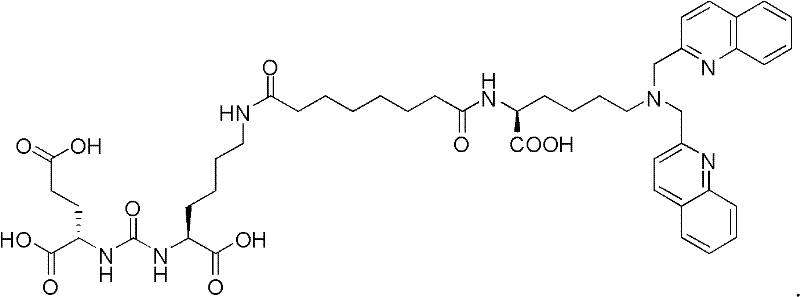
化合物33:(7S,22S,26S)-9,16,24-三氧代-1-(吡啶-2-基)-2-(吡啶-2-基甲基)-2,8,17,23,25-五氮杂二十八烷-7,22,26,28-四羧酸Compound 33: (7S, 22S, 26S)-9,16,24-trioxo-1-(pyridin-2-yl)-2-(pyridin-2-ylmethyl)-2,8,17,23 , 25-pentaazaoctadecane-7,22,26,28-tetracarboxylic acid
化合物34:(22S,26S)-9,16,24-三氧代-2-(吡啶-2-基甲基)-2,8,17,23,25-五氮杂二十八烷-1,7,22,26,28-五羧酸Compound 34: (22S,26S)-9,16,24-trioxo-2-(pyridin-2-ylmethyl)-2,8,17,23,25-pentaazaoctadecane-1 , 7,22,26,28-pentacarboxylic acid

化合物35:(7S,22S,26S)-1-(1-(羧基甲基)-1H-咪唑-2-基)-2-((3-(羧基甲基)-3H-吡咯-2-基)甲基)-9,16,24-三氧代-2,8,17,23,25-五氮杂二十八烷-7,22,26,28-四羧酸Compound 35: (7S, 22S, 26S)-1-(1-(carboxymethyl)-1H-imidazol-2-yl)-2-((3-(carboxymethyl)-3H-pyrrol-2-yl )methyl)-9,16,24-trioxo-2,8,17,23,25-pentaazaoctadecane-7,22,26,28-tetracarboxylic acid
化合物36:(19S,23S)-1-(1-(羧基甲基)-1H-咪唑-2-基)-2-((1-(羧基甲基)-1H-咪唑-2-基)甲基)-13,21-二氧代-2,14,20,22-四氮杂二十五烷-19,23,25-三羧酸Compound 36: (19S, 23S)-1-(1-(carboxymethyl)-1H-imidazol-2-yl)-2-((1-(carboxymethyl)-1H-imidazol-2-yl)methyl base)-13,21-dioxo-2,14,20,22-tetraazapentacosa-19,23,25-tricarboxylic acid

化合物50:(7S,11S,26S)-26-(4-(双((1-甲基-1H-咪唑-2-基)甲基)氨基)丁基)-7,11-双(叔丁氧基羰基)-2,2-二甲基-4,9,17,24-四氧代-3-氧杂-8,10,16,25-四氮杂二十七烷-27-酸Compound 50: (7S, 11S, 26S)-26-(4-(bis((1-methyl-1H-imidazol-2-yl)methyl)amino)butyl)-7,11-bis(tert-butyl Oxycarbonyl)-2,2-dimethyl-4,9,17,24-tetraoxo-3-oxa-8,10,16,25-tetraazaheptakacan-27-oic acid
可以制备并入基于1,4,7,10-四氮杂环十二烷-1,4,7,10-四乙酸(DOTA)的螯合剂的其他化合物。此类基于DOTA的螯合剂可用于螯合成像金属,包括但不限于钇、镥、镓和铟。基于DOTA的螯合剂可以如上所述制备,利用DOTA的酸性基团的一个连接至其他R基团。示例性的基于DOTA的化合物包括但不限于以下,其中M是Y、Lu、Ga或In;并且n是0至20:Other compounds can be prepared that incorporate chelating agents based on 1,4,7,10-tetraazacyclododecane-1,4,7,10-tetraacetic acid (DOTA). Such DOTA-based chelators are useful for chelating imaging metals including, but not limited to, yttrium, lutetium, gallium, and indium. DOTA-based chelators can be prepared as described above, utilizing one of DOTA's acidic groups linked to the other R group. Exemplary DOTA-based compounds include, but are not limited to, the following, wherein M is Y, Lu, Ga, or In; and n is 0 to 20:

99mTc和Re络合物的一般制备.99mTc-SAAC的放射性标记. 使用类似方法完成SAAC系统的放射性标记,以在任一自由α-氨基酸上形成络合物或作为适当N保护的氨基酸衍生物,说明了制备容易性和SAAC系统设计的灵活性。99mTc(I)(CO)3 +放射性标记分两步进行,使用可商业途径获得的IsoLinkTM试剂盒(Covidien)以生成[99mTc(CO)3(H2O)3]+中间体,该中间体与适当SAAC配体(10-6M-10-4M)在1∶1等体积的乙腈和磷酸盐缓冲液的混合物中反应。密封管形瓶在100℃加热30分钟。冷却后,通过RP-HPLC分析反应纯度。导致“无载体”产物的HPLC纯化后的放射化学纯度通过HPLC测定并显示始终≥95%。尽管最初结果证明了在低至10-6M的浓度下的放射性标记,但RCY≤80%。为了在75℃实现RCY>95%,反应浓度需要增加至10-4M。在许多情况下,相应Re络合物被制备并如Tc络合物测试,以制备用于测试和操作目的的非放射性类似物。因此,当可能Re被明确显示时,要理解也包括Tc络合物。General preparation of 99mT c and Re complexes. Radiolabeling of 99mT c-SAAC. Radiolabeling of the SAAC system is accomplished using similar methods to form complexes on either free α-amino acid or as an appropriately N-protected amino acid derivative , illustrating the ease of preparation and the flexibility of SAAC system design. 99m Tc(I)(CO) 3 + radiolabeling was performed in two steps using the commercially available IsoLink ™ kit (Covidien) to generate [ 99m Tc(CO) 3 (H 2 O) 3 ] + intermediate, This intermediate was reacted with the appropriate SAAC ligand (10 −6 M to 10 −4 M) in a 1:1 mixture of equal volumes of acetonitrile and phosphate buffer. The sealed vial was heated at 100°C for 30 minutes. After cooling, the reaction purity was analyzed by RP-HPLC. The radiochemical purity after HPLC purification leading to the "carrier-free" product was determined by HPLC and shown to be consistently >95%. Although initial results demonstrated radiolabeling at concentrations as low as 10 -6 M, RCY was ≤ 80%. To achieve RCY >95% at 75°C, the reaction concentration needs to be increased to 10 -4 M. In many cases, corresponding Re complexes were prepared and tested as Tc complexes to prepare non-radioactive analogs for testing and manipulation purposes. Therefore, when possible Re is explicitly indicated, it is understood that Tc complexes are also included.
化合物16-Re.实例16化合物的Re(CO)3络合物。2,2′-(2,2′-(4-氨磺酰苯乙基氮烷二基)双(亚甲基)双(1H-咪唑-2,1-二基))二乙酸叔丁酯(65mg,0.11mmol)和[NEt4]2[ReBr3(CO)3](92.4mg,0.12mmol)的MeOH(3.0mL)溶液在压力管中95℃搅拌4小时。反应混合物通过用MeOH/H2O洗脱的Amberchrom纯化,得到作为白色固体的[Re(CO)3][2,2′-(2,2′-(4-氨磺酰苯乙基-氮烷二基)双(亚甲基)双(1H-咪唑-2,1-二基))二乙酸叔丁酯](51mg,54%)。1H NMR(400MHz,DMSO-d6)7.81(d,J=8.4Hz,2H),7.60(d,J=8.4Hz,2H),7.31(s,2H),7.26(d,J=1.2Hz,2H),7.12(d,J=1.2Hz,2H),4.95(s,4H),4.74(d,J=16.4Hz,2H),4.62(d,J=16.4Hz,2H),3.90-3.86(m,2H),3.16-3.14(m,2H),1.45(s,18H);MS(ESI),859.3M+。然后,[Re(CO)3][2,2′-(2,2′-(4-氨磺酰苯乙基-氮烷二基)双(亚甲基)双(1H-咪唑-2,1-二基))二乙酸叔丁酯](20mg)的TFA(1.0mL)和DCM(1.0mL)溶液在室温搅拌4小时。然后减压除去溶剂,得到[Re(CO)3][2,2′-(2,2′-(4-氨磺酰苯乙基氮烷二基)双(亚甲基)双(1H-咪唑-2,1-二基))二乙酸](21.5mg)。1H NMR(400MHz,DMSO-d6)7.81(d,J=8.0Hz,2H),7.60(d,J=8.4Hz,2H),7.30(s,2H),7.23(d,J=1.2Hz,2H),7.08(d,J=1.2Hz,2H),4.91(s,4H),4.72(s,4H),3.89-3.85(m,2H),3.18-3.14(m,2H);MS(ESI),747.2M+.Compound 16-Re. Re(CO) 3 complex of the compound of Example 16. tert-
化合物17-Re.实例17化合物的Re(CO)3络合物Re(CO) 3 complexes of compound 17-Re. example 17 compound
步骤1.4-(2-氨基乙基)苯磺酰胺(0.70g,3.5mmol),AcOH(0.20mL)和2-(2-甲酰-1H-咪唑-1-基)乙酸叔丁酯(0.735g,3.5mmol)的DCE(20mL)溶液在氮气下80℃加热30min。反应混合物被冷却至0℃,并依次用NaBH(OAc)3(2.25g,10.5mmol)和粗制乙醛酸叔丁酯1(1.80g)处理。反应混合物在室温搅拌过夜,并用水分解。反应混合物用DCM萃取。有机层被干燥并减压浓缩。残渣通过硅胶快速色谱纯化,得到2-(((1-甲基-1H-咪唑-2-基)甲基)(4-氨磺酰苯乙基)氨基)乙酸叔丁酯(0.63g,35%).%).1H NMR(400MHz,DMSO-d6)7.67(d,J=8.4Hz,2H),7.25(s,2H),7.23(d,J=8.4Hz,2H),7.04(d,J=1.2Hz,1H),6.76(d,J=1.2Hz,1H),4.82(s,2H),3.74(s,2H),3.24(s,2H),2.69-2.66(m,4H),1.41(s,9H),1.40(s,9H);MS(ESI),509(M+H)+.
步骤2.2-(((1-甲基-1H-咪唑-2-基)甲基)(4-氨磺酰苯乙基)氨基)乙酸叔丁酯(40mg,0.079mmol)的DCM(2.0mL)和TFA(2.0mL)溶液在室温搅拌3小时。减压除去溶剂,得到2-(2-(((羧基甲基)(4-氨磺酰苯乙基)氨基)甲基)-1H-咪唑-1-基)乙酸。2-(2-(((羧基甲基)(4-氨磺酰苯乙基)氨基)甲基)-1H-咪唑-1-基)乙酸和[NEt4]2[ReBr3(CO)3](70mg,0.09mmol)的MeOH(2.0mL)和H2O(2.0mL)溶液使用2N NaOH调节至pH=9。混合物在压力管中95℃搅拌过夜。反应混合物通过HPLC纯化得到作为白色固体的[Re(CO)3][2-(2-(((羧基甲基)(4-氨磺酰苯乙基)氨基)甲基)-1H-咪唑-1-基)乙酸](20mg,38%)。1HNMR(400MHz,DMSO-d6)7.76(d,J=8.0Hz,2H),7.57(d,J=8.0Hz,2H),7.36(d,J=1.6Hz,1H),7.26(s,2H),7.16(d,J=1.6Hz,1H),5.05(d,J=16.4Hz,1H),4.98(d,J=16.4Hz,1H),4.73(d,J=16.0Hz,1H),4.43(d,J=16.0Hz,1H),4.00(d,J=16.8Hz,1H),3.60-3.51(m,3H),3.10-3.05(m,2H);MS(ESI),667.2(M+H)+.
化合物23-Re.实例23的Re(CO)3络合物Compound 23-Re. The Re(CO) 3 complex of example 23

步骤1.4-(2-氨基乙基)苯磺酰胺(1.60g,8.0mmol)、AcOH(0.30mL)和2-吡啶羧醛(0.76mL,8.0mmol)的DCE(50mL)溶液在氮气下75℃加热30min。反应混合物被冷却至0℃,并依次用NaBH(OAc)3(6.36g,30mmol)和粗制乙醛酸叔丁酯1(2.08g)处理。反应混合物在室温搅拌过夜,并用水分解。反应混合物用DCM萃取。有机层被干燥并减压浓缩。残渣通过硅胶快速色谱纯化,得到2-((吡啶-2-基甲基)(4-氨磺酰苯乙基)氨基)乙酸叔丁酯(1.04g,32%)和2,2′-(4-氨磺酰苯乙基氮烷二基)二乙酸叔丁酯(0.624g,18%)。2-((吡啶-2-基甲基)(4-氨磺酰苯乙基)氨基)乙酸叔丁酯:1H NMR(400MHz,CD3OD)8.45(d,J=4.8Hz,0.42H),8.40(d,J=4.8Hz,0.58H),7.83(t,J=6.4Hz,0.42H),7.77(d,J=8.4Hz,1.58H),7.69(t,J=8.0Hz,0.58H),7.56(d,J=7.6Hz,0.58H),7.34-7.24(m,4H),5.49(s,1H),4.70(s,1H),3.93(s,2H),2.91(t,J=6.8Hz,2H),2.83(t,J=6.8Hz,2H),1.47(s,9H);MS(ESI),406(M+H)+;2,2′-(4-氨磺酰苯乙基氮烷二基)二乙酸叔丁酯:1HNMR(400MHz,CD3Cl3)7.83(d,J=8.4Hz,2H),3.45(s,4H),2.97(t,J=5.6Hz,2H),2.87(t,J=6.0Hz,2H),1.49(s,18H);MS(ESI),429(M+H)+.
步骤2.2-((吡啶-2-基甲基)(4-氨磺酰-苯乙基)氨基)乙酸叔丁酯(150mg,0.37mmol)的DCM(3.0mL)和TFA(3.0mL)溶液在室温搅拌过夜。减压除去溶剂,得到2-((吡啶-2-基甲基)(4-氨磺酰苯乙基)氨基)乙酸(129mg,100%).1H NMR(400MHz,CD3OD)8.73(d,J=5.6Hz,0.46H),8.58(d,J=4.4Hz,1H),8.57(t,J=8.0Hz,0.46H),8.16(t,J=7.6Hz,1H),8.01(d,J=8.4Hz,0.54H),7.96(t,J=6.8Hz,0.54H),7.79(d,J=8.4Hz,2H),7.66(d,J=7.2Hz,2H),7.35(d,J=8.4Hz,2H),4.51(s,2H),4.06(s,2H),3.36(t,J=7.6Hz,2H),3.05(t,J=7.6Hz,2H);MS(ESI),355(M+H)+.
步骤3.2-((吡啶-2-基甲基)(4-氨磺酰苯乙基)氨基)乙酸(61mg,0.173mmol)、[NEt4]2[ReBr3(CO)3](192mg,0.25mmol)和K2CO3(30mg)的MeOH(6.0mL)溶液在压力管中100℃搅拌5小时。反应混合物通过用MeOH/H2O洗脱的Amberchrom(CG-161)纯化,得到作为白色固体的[Re(CO)3][2-((吡啶-2-基甲基)(4-氨磺酰苯乙基)氨基)乙酸](18.9mg,18%)。1H NMR(400MHz,DMSO-d6)8.77(d,J=5.6Hz,1H),8.17(t,J=7.8Hz,1H),7.79(d,J=8.0Hz,2H),7.74(d,J=7.6Hz,1H),7.59(d,J=8.0Hz,2H),7.58(d,J=6.0Hz,1H),7.29(s,2H),4.92(d,J=16.0Hz,1H),4.77(d,J=16.0Hz,1H),4.10(d,J=16.4Hz,1H),3.74-3.68(m,1H),3.64-3.58(m,1H),3.53(d,J=16.8Hz,1H),3.14-3.08(m,2H),;MS(ESI),620(M+H)+.
化合物24-Re.实例24化合物的Re(CO)3络合物Compound 24-Re.Re(CO) 3 complex of example 24 compound
化合物24(230mg,0.477mmol)和[NEt4]2[ReBr3(CO)3](367mg,0.477mmol)的MeOH(6.0mL)溶液在压力管中100℃搅拌3小时。反应混合物通过用MeOH/H2O洗脱的Amberchrom纯化,得到作为黄色固体的[Re(CO)3][4-(2-(双(异喹啉-1-基甲基)氨基)乙基)苯磺酰胺](173mg,48%)。1H NMR(400MHz,DMSO-d6)8.69(d,J=8.4Hz,2H),8.36(d,J=8.8Hz,2H),8.12(d,J=8.4Hz,2H),7.95(t,J=7.4Hz,2H),7.82(d,J=8.4Hz,2H),7.75(t,J=7.6Hz,2H),7.70(d,J=8.4Hz,2H),7.62(d,J=8.4Hz,2H),7.34(s,2H),5.46(d,J=18.0Hz,2H),5.25(d,J=18.0Hz,2H),4.07-4.03(m,2H),3.32-2.99(m,2H);MS(ESI),753.2M+.A solution of compound 24 (230 mg, 0.477 mmol) and [NEt 4 ] 2 [ReBr 3 (CO) 3 ] (367 mg, 0.477 mmol) in MeOH (6.0 mL) was stirred at 100° C. for 3 hours in a pressure tube. The reaction mixture was purified by Amberchrom eluting with MeOH/ H2O to afford [Re(CO) 3 ][4-(2-(bis(isoquinolin-1-ylmethyl)amino)ethyl as a yellow solid )Benzenesulfonamide] (173 mg, 48%). 1 H NMR (400MHz, DMSO-d 6 ) 8.69(d, J=8.4Hz, 2H), 8.36(d, J=8.8Hz, 2H), 8.12(d, J=8.4Hz, 2H), 7.95(t , J=7.4Hz, 2H), 7.82(d, J=8.4Hz, 2H), 7.75(t, J=7.6Hz, 2H), 7.70(d, J=8.4Hz, 2H), 7.62(d, J =8.4Hz, 2H), 7.34(s, 2H), 5.46(d, J=18.0Hz, 2H), 5.25(d, J=18.0Hz, 2H), 4.07-4.03(m, 2H), 3.32-2.99 (m, 2H); MS (ESI), 753.2M + .
化合物25-Re.实例25的Re(CO)3络合物Compound 25-Re. The Re(CO) 3 complex of example 25

步骤1.4-(2-氨基乙基)苯磺酰胺(1.40g,7.0mmol)、AcOH(0.30mL)和1-甲基-1H-咪唑-2-甲醛(0.77g,7.0mmol)的DCE(40mL)溶液在氮气下80℃加热30min。反应混合物被冷却至0℃,并依次用NaBH(OAc)3(4.45g,21mmol)和粗制乙醛酸叔丁酯1(1.80g)处理。反应混合物在室温搅拌过夜,并用水分解。反应混合物用DCM萃取。有机层被干燥并减压浓缩。残渣通过硅胶快速色谱纯化,得到2-(((1-甲基-1H-咪唑-2-基)甲基)(4-氨磺酰苯乙基)氨基)乙酸叔丁酯(0.63g,22%)。1H NMR(400MHz,DMSO-d6)7.65(d,J=8.4Hz,2H),7.26(s,2H),7.21(d,J=8.0Hz,2H),6.99(d,J=0.8Hz,1H),6.73(d,J=0.8Hz,1H),3.76(s,2H),3.38(s,3H),3.28(s,2H),2.79(t,J=7.2Hz,2H),2.69(t,J=6.8Hz,2H),1.40(s,9H);MS(ESI),409(M+H)+.
步骤2.2-(((1-甲基-1H-咪唑-2-基)甲基)(4-氨磺酰苯乙基)氨基)乙酸叔丁酯(110mg,0.27mmol)的DCM(3.0mL)和TFA(3.0mL)溶液在室温搅拌过夜。减压除去溶剂,得到2-(((1-甲基-1H-咪唑-2-基)甲基)(4-氨磺酰苯乙基)氨基)乙酸。2-(((1-甲基-1H-咪唑-2-基)甲基)(4-氨磺酰苯乙基)氨基)乙酸、[NEt4]2[ReBr3(CO)3](270mg,0.35mmol)和K2CO3(78mg)的MeOH(6.0mL)溶液在压力管中90℃搅拌4小时。反应混合物通过用MeOH/H2O洗脱的Amberchrom(CG-161)纯化,得到作为白色固体的[Re(CO)3][2-(((1-甲基-1H-咪唑-2-基)甲基)(4-氨磺酰苯乙基)-氨基)乙酸](105mg,63%)。1H NMR(400MHz,DMSO-d6)7.79(d,J=8.0Hz,2H),7.57(d,J=8.0Hz,2H),7.36(d,J=0.8Hz,1H),7.25(s,2H),7.15(d,J=1.2Hz,1H),4.76(d,J=16.4Hz,1H),4.58(d,J=16.0Hz,1H),4.03(d,J=16.8Hz,1H),3.67(d,J=16.8Hz,1H),3.65-3.49(m,2H),3.17-3.09(m,2H);MS(ESI),623(M+H)+.
化合物34-Re.实例34化合物的Re(CO)3络合物Compound 34-Re. Example 34 compound Re (CO) 3 complexes

PAMA-K(0.600g,1.047mmol)和哌啶(1.0mL)的DMF(5.0mL)溶液在室温搅拌3小时。减压除去溶剂得到残渣,残渣通过用MeOH/H2O洗脱的Amberchrom(CG-161)纯化,得到(S)-2-氨基-6-((2-叔丁氧基-2-氧代乙基)(吡啶-2-基甲基)氨基)己酸(0.256g,70%).MS(ESI),352(M+H)+.A solution of PAMA-K (0.600 g, 1.047 mmol) and piperidine (1.0 mL) in DMF (5.0 mL) was stirred at room temperature for 3 hours. Removal of the solvent under reduced pressure gave a residue which was purified by Amberchrom (CG-161) eluting with MeOH/ H2O to afford (S)-2-amino-6-((2-tert-butoxy-2-oxo Ethyl)(pyridin-2-ylmethyl)amino)hexanoic acid (0.256g, 70%). MS (ESI), 352 (M+H) + .
(S)-2-(3-((S)-1-叔丁氧基-6-(8-(2,5-二氧代吡咯烷-1-基氧基)-8-氧代辛酰氨基)-1-氧代己-2-基)脲基)戊二酸二叔丁酯(0.528g,0.712mmol)、(S)-2-氨基-6-((2-叔丁氧基-2-氧代乙基)(吡啶-2-基甲基)氨基)己酸(0.25g,0.712mmol)和DIPEA(1.0mL)的DMF(5.0mL)溶液在室温搅拌过夜。蒸发溶剂得到残渣,残渣通过用DCM/MeOH洗脱的Biotage纯化,得到(7S,11S,26S)-26-(4-((2-叔丁氧基-2-氧代乙基)(吡啶-2-基甲基)氨基)丁基)-7,11-双(叔丁氧基羰基)-2,2-二甲基-4,9,17,24-四氧代-3-氧杂-8,10,16,25-四氮杂二十七烷-27-酸(0.226g,32%).MS(ESI),489.5(M/2+H)+.(S)-2-(3-((S)-1-tert-butoxy-6-(8-(2,5-dioxopyrrolidin-1-yloxy)-8-oxoctanoyl Amino)-1-oxohex-2-yl)ureido)di-tert-butyl glutarate (0.528g, 0.712mmol), (S)-2-amino-6-((2-tert-butoxy- A solution of 2-oxoethyl)(pyridin-2-ylmethyl)amino)hexanoic acid (0.25 g, 0.712 mmol) and DIPEA (1.0 mL) in DMF (5.0 mL) was stirred at room temperature overnight. Evaporation of the solvent gave a residue which was purified by Biotage eluting with DCM/MeOH to afford (7S,11S,26S)-26-(4-((2-tert-butoxy-2-oxoethyl)(pyridine- 2-ylmethyl)amino)butyl)-7,11-bis(tert-butoxycarbonyl)-2,2-dimethyl-4,9,17,24-tetraoxo-3-oxa- 8,10,16,25-tetraazahexacanoic-27-oic acid (0.226g, 32%). MS (ESI), 489.5 (M/2+H) + .
(7S,11S,26S)-26-(4-((2-叔丁氧基-2-氧代乙基)(吡啶-2-基甲基)氨基)丁基)-7,11-双(叔丁氧基羰基)-2,2-二甲基-4,9,17,24-四氧代-3-氧杂-8,10,16,25-四氮杂二十七烷-27-酸(56.5mg,0.075mmol)的TFA(1.0ml)和DCM(1.0mL)溶液在室温搅拌。减压蒸发溶剂得到残渣。上述残渣的MeOH(1.0mL)和H2O(1.0mL)溶液用N NaOH调节至pH=9。[NEt4]2[Re(CO)3Br3](50mg,0.064mmol)被添加至反应混合物并在压力管中95℃搅拌4小时。蒸发溶剂得到残渣,残渣通过HPLC纯化得到作为白色固体的[Re(CO)3][(7S,22S,26S)-9,16,24-三氧代-2-(吡啶-2-基甲基)-2,8,17,23,25-五氮杂二十八烷-1,7,22,26,28-五羧酸](13.3mg)。1H NMR(400MHz,DMSO-d6)12.5(brs,4H),8.74(d,J=5.2Hz,1H),8.13(td,J=7.8,1.2Hz,1H),8.06(d,J=8.0Hz,1H),7.72-7.68(m,2H),7.57(t,J=6.6Hz,1H),6.31(d,J=8.0Hz,1H),6.28(d,J=8.4Hz,1H),4.74(d,J=16.0Hz,1H),4.52(d,J=16.0Hz,1H),4.24-3.98(m,3H),3.80(d,J=16.8Hz,1H),3.38(d,J=16.8Hz,1H),2.97-2.95(m,2H),2.22(q,J=7.7Hz,2H),2.11(t,J=7.4Hz,2H),2.00(t,J=7.2Hz,2H),1.78-1.60(m,8H),1.52-1.19(m,16H);MS(ESI),512.3(M/2+H)+.(7S, 11S, 26S)-26-(4-((2-tert-butoxy-2-oxoethyl)(pyridin-2-ylmethyl)amino)butyl)-7,11-bis( tert-butoxycarbonyl)-2,2-dimethyl-4,9,17,24-tetraoxo-3-oxa-8,10,16,25-tetraazaheptacane-27- A solution of the acid (56.5 mg, 0.075 mmol) in TFA (1.0 mL) and DCM (1.0 mL) was stirred at room temperature. The solvent was evaporated under reduced pressure to obtain a residue. A solution of the above residue in MeOH (1.0 mL) and H2O (1.0 mL) was adjusted to pH=9 with N NaOH. [NEt 4 ] 2 [Re(CO) 3 Br 3 ] (50 mg, 0.064 mmol) was added to the reaction mixture and stirred in a pressure tube at 95° C. for 4 hours. Evaporation of the solvent gave a residue which was purified by HPLC to give [Re(CO) 3 ][(7S,22S,26S)-9,16,24-trioxo-2-(pyridin-2-ylmethyl) as a white solid )-2,8,17,23,25-pentaazaoctadecane-1,7,22,26,28-pentacarboxylic acid] (13.3 mg). 1 H NMR (400MHz, DMSO-d 6 ) 12.5(brs, 4H), 8.74(d, J=5.2Hz, 1H), 8.13(td, J=7.8, 1.2Hz, 1H), 8.06(d, J= 8.0Hz, 1H), 7.72-7.68(m, 2H), 7.57(t, J=6.6Hz, 1H), 6.31(d, J=8.0Hz, 1H), 6.28(d, J=8.4Hz, 1H) , 4.74(d, J=16.0Hz, 1H), 4.52(d, J=16.0Hz, 1H), 4.24-3.98(m, 3H), 3.80(d, J=16.8Hz, 1H), 3.38(d, J=16.8Hz, 1H), 2.97-2.95(m, 2H), 2.22(q, J=7.7Hz, 2H), 2.11(t, J=7.4Hz, 2H), 2.00(t, J=7.2Hz, 2H), 1.78-1.60(m, 8H), 1.52-1.19(m, 16H); MS(ESI), 512.3(M/2+H) + .
化合物35-Re.实例35化合物的Re(CO)3络合物Re(CO) 3 complexes of compound 35-Re. example 35 compound

化合物2的化合物(300mg,0.396mmol)和哌啶(0.40mL)的DMF(2.0mL)溶液在室温搅拌2小时。减压蒸发溶剂得到粗制产物。粗制产物通过使用H2O/AcCN洗脱的Amberchrom(CG-161C)纯化,得到(S)-2-氨基-6-(双((1-(2-叔丁氧基-2-氧代乙基)-1H-咪唑-2-基)甲基)氨基)己酸(0.211g,100%).1H NMR(400MHz,DMSO-d6) 7.0(s,2H),6.65(s,2H),4.70(s,4H),4.2(m,4H),3.2(d,2H),2.4(m,2H),1.8(s,2H),1.39(s,18H).1.15(m,2H);MS(ESI),535.4(M+H)+.A solution of compound 2 (300 mg, 0.396 mmol) and piperidine (0.40 mL) in DMF (2.0 mL) was stirred at room temperature for 2 hours. The solvent was evaporated under reduced pressure to obtain crude product. The crude product was purified by Amberchrom (CG-161C) eluting with H 2 O/AcCN to afford (S)-2-amino-6-(bis((1-(2-tert-butoxy-2-oxo Ethyl)-1H-imidazol-2-yl)methyl)amino)hexanoic acid (0.211g, 100%). 1 H NMR (400MHz, DMSO-d 6 ) 7.0(s, 2H), 6.65(s, 2H ), 4.70(s, 4H), 4.2(m, 4H), 3.2(d, 2H), 2.4(m, 2H), 1.8(s, 2H), 1.39(s, 18H). 1.15(m, 2H) ; MS(ESI), 535.4(M+H) + .
通过注射泵向辛二酸双(N-羟基琥珀酰亚胺酯)(1.47g,4.0mmol)的DMF(80mL)溶液滴加(S)-2-(3-((S)-6-氨基-1-叔丁氧基-1-氧代己-2-基)脲基)戊二酸二叔丁酯(0.488g,1.0mmol)的DMF(20mL)溶液。2小时后,减压蒸发溶剂得到残渣,残渣通过使用AcCN/DCM洗脱的硅胶快速色谱纯化,得到(S)-2-(3-((S)-1-叔丁氧基-6-(8-(2,5-二氧代吡咯烷-1-基氧基)-8-氧代辛酰氨基)-1-氧代己-2-基)脲基)戊二酸二叔丁酯(0.54g,73%).MS(ESI),741.6(M+H)+.To a solution of bis(N-hydroxysuccinimide suberate) (1.47 g, 4.0 mmol) in DMF (80 mL) was added dropwise (S)-2-(3-((S)-6-amino - A solution of di-tert-butyl 1-tert-butoxy-1-oxohexan-2-yl)ureido)glutarate (0.488 g, 1.0 mmol) in DMF (20 mL). After 2 hours, the solvent was evaporated under reduced pressure to give a residue which was purified by flash chromatography on silica gel eluting with AcCN/DCM to afford (S)-2-(3-((S)-1-tert-butoxy-6-( 8-(2,5-dioxopyrrolidin-1-yloxy)-8-oxoctanoylamino)-1-oxohex-2-yl)ureido)di-tert-butyl glutarate ( 0.54g, 73%). MS (ESI), 741.6 (M+H) + .
(S)-2-(3-((S)-1-叔丁氧基-6-(8-(2,5-二氧代吡咯烷-1-基氧基)-8-氧代辛酰氨基)-1-氧代己-2-基)脲基)戊二酸二叔丁酯(0.291g,0.45mmol)、(S)-2-氨基-6-(双((1-(2-叔丁氧基-2-氧代乙基)-1H-咪唑-2-基)甲基)氨基)己酸(0.22g,0.412mmol)和DIPEA(1.0mL)的DMF(4.0mL)溶液在室温搅拌过夜。蒸发溶剂得到残渣,残渣通过使用DCM/MeOH洗脱的Biotage纯化,得到(7S,11S,26S)-26-(4-(双((1-(2-叔丁氧基-2-氧代乙基)-1H-咪唑-2-基)甲基)氨基)丁基)-7,11-双(叔丁氧基羰基)-2,2-二甲基-4,9,17,24-四氧代-3-氧杂-8,10,16,25-四氮杂二十七烷-27-酸(0.1089g,21%).MS(ESI),581(M/2+H)+.(S)-2-(3-((S)-1-tert-butoxy-6-(8-(2,5-dioxopyrrolidin-1-yloxy)-8-oxoctanoyl Amino)-1-oxohex-2-yl)ureido)di-tert-butyl glutarate (0.291g, 0.45mmol), (S)-2-amino-6-(bis((1-(2- A solution of tert-butoxy-2-oxoethyl)-1H-imidazol-2-yl)methyl)amino)hexanoic acid (0.22 g, 0.412 mmol) and DIPEA (1.0 mL) in DMF (4.0 mL) at room temperature Stir overnight. Evaporation of the solvent gave a residue which was purified by Biotage eluting with DCM/MeOH to afford (7S,11S,26S)-26-(4-(bis((1-(2-tert-butoxy-2-oxoethane Base)-1H-imidazol-2-yl)methyl)amino)butyl)-7,11-bis(tert-butoxycarbonyl)-2,2-dimethyl-4,9,17,24-tetra Oxo-3-oxa-8,10,16,25-tetraazaheptakacan-27-oic acid (0.1089g, 21%). MS (ESI), 581 (M/2+H) + .
(7S,11S,26S)-26-(4-(双((1-(2-叔丁氧基-2-氧代乙基)-1H-咪唑-2-基)甲基)氨基)丁基)-7,11-双(叔丁氧基羰基)-2,2-二甲基-4,9,17,24-四氧代-3-氧杂-8,10,16,25-四氮杂二十七烷-27-酸(30mg,0.029mmol)和[NEt4]2[Re(CO)3Br3](30mg,0.039mmol)的MeOH(4mL)溶液在压力管中95℃搅拌4小时。蒸发溶剂得到残渣,残渣直接用于下一步骤。上述产物的TFA/DCM溶液在室温搅拌5小时。蒸发溶剂得到粗制产物,粗制产物通过HPLC纯化得到作为白色固体的[Re(CO)3][(22S,26S)-1-(1-(羧基甲基)-1H-咪唑-2-基)-2-((1-(羧基甲基)-1H-咪唑-2-基)甲基)-9,16,24-三氧代-2,8,17,23,25-五氮杂二十八烷-7,22,26,28-四羧酸](2.2mg)。1H NMR(400MHz,DMSO-d6)8.06(d,J=8.0Hz,1H),7.71(d,J=5.6Hz,1H),7.17(d,J=1.2Hz,2H),7.04(d,J=1.2Hz,2H),6.30(d,J=8.4Hz,1H),6.27(d,J=8.0Hz,1H),4.84(s,4H),4.56(d,J=16.8Hz,2H),4.38(d,J=16.4Hz,2H),4.30-4.18(m,1H),4.01-3.98(m,2H),3.60-3.58(m,2H),2.97-2.92(m,2H),2.24-2.11(m,2H),2.07(t,J=8.0Hz,2H),1.99(t,J=7.6Hz,2H),1.80-1.19(m,22H);MS(ESI),575.9(M/2+H)+.(7S, 11S, 26S)-26-(4-(bis((1-(2-tert-butoxy-2-oxoethyl)-1H-imidazol-2-yl)methyl)amino)butyl )-7,11-bis(tert-butoxycarbonyl)-2,2-dimethyl-4,9,17,24-tetraoxo-3-oxa-8,10,16,25-tetraza A solution of heterohexacanoic-27-oic acid (30 mg, 0.029 mmol) and [NEt 4 ] 2 [Re(CO) 3 Br 3 ] (30 mg, 0.039 mmol) in MeOH (4 mL) was stirred in a pressure tube at 95 °C for 4 Hour. Evaporation of the solvent gave a residue which was used directly in the next step. A TFA/DCM solution of the above product was stirred at room temperature for 5 hours. Evaporation of solvent gave crude product which was purified by HPLC to give [Re(CO) 3 ][(22S,26S)-1-(1-(carboxymethyl)-1H-imidazol-2-yl as a white solid )-2-((1-(carboxymethyl)-1H-imidazol-2-yl)methyl)-9,16,24-trioxo-2,8,17,23,25-pentaazadi octadecane-7,22,26,28-tetracarboxylic acid] (2.2 mg). 1 H NMR (400MHz, DMSO-d 6 ) 8.06(d, J=8.0Hz, 1H), 7.71(d, J=5.6Hz, 1H), 7.17(d, J=1.2Hz, 2H), 7.04(d , J=1.2Hz, 2H), 6.30(d, J=8.4Hz, 1H), 6.27(d, J=8.0Hz, 1H), 4.84(s, 4H), 4.56(d, J=16.8Hz, 2H ), 4.38(d, J=16.4Hz, 2H), 4.30-4.18(m, 1H), 4.01-3.98(m, 2H), 3.60-3.58(m, 2H), 2.97-2.92(m, 2H), 2.24-2.11(m, 2H), 2.07(t, J=8.0Hz, 2H), 1.99(t, J=7.6Hz, 2H), 1.80-1.19(m, 22H); MS(ESI), 575.9(M /2+H) + .
化合物49-Tc:放射性标记的化合物49。化合物49用Tc-99m放射性标记,通过Tc(CO)3与双-咪唑化合物络合,络合为丁基受保护的二酸,其随后用TFA脱保护,提供以下想要的络合物。Compound 49-Tc: Radiolabeled Compound 49. Compound 49 was radiolabeled with Tc-99m and complexed with the bis-imidazole compound via Tc(CO) 3 to the butyl protected diacid, which was subsequently deprotected with TFA to provide the desired complex below.
化合物50-Re.实例50化合物的Re(CO)3络合物Re(CO) 3 complexes of compound 50-

(S)-2-(3-((S)-1-叔丁氧基-6-(8-(2,5-二氧代吡咯烷-1-基氧基)-8-氧代辛酰氨基)-1-氧代己-2-基)脲基)戊二酸二叔丁酯(0.356g,0.48mmol)、化合物13的化合物(0.16g,0.48mmol)和DIPEA(1.0mL)的DMF(5.0mL)溶液在室温搅拌过夜。蒸发溶剂得到残渣,残渣通过用DCM/MeOH洗脱的Biotage纯化,得到(7S,11S,26S)-26-(4-(双((1-甲基-1H-咪唑-2-基)甲基)氨基)丁基)-7,11-双(叔丁氧基羰基)-2,2-二甲基-4,9,17,24-四氧代-3-氧杂-8,10,16,25-四氮杂二十七烷-27-酸(81mg,18%).MS(ESI),481(M/2+H)+.(S)-2-(3-((S)-1-tert-butoxy-6-(8-(2,5-dioxopyrrolidin-1-yloxy)-8-oxoctanoyl Amino)-1-oxohexan-2-yl)ureido)di-tert-butyl glutarate (0.356 g, 0.48 mmol), compound 13 (0.16 g, 0.48 mmol) and DIPEA (1.0 mL) in DMF (5.0 mL) the solution was stirred overnight at room temperature. Evaporation of the solvent gave a residue which was purified by Biotage eluting with DCM/MeOH to afford (7S,11S,26S)-26-(4-(bis((1-methyl-1H-imidazol-2-yl)methyl )amino)butyl)-7,11-bis(tert-butoxycarbonyl)-2,2-dimethyl-4,9,17,24-tetraoxo-3-oxa-8,10,16 , 25-tetraazahexacanoic-27-oic acid (81mg, 18%). MS (ESI), 481 (M/2+H) + .
(7S,11S,26S)-26-(4-(双((1-甲基-1H-咪唑-2-基)甲基)氨基)丁基)-7,11-双(叔丁氧基羰基)-2,2-二甲基-4,9,17,24-四氧代-3-氧杂-8,10,16,25-四氮杂二十七烷-27-酸(72mg,0.075mmol)和[NEt4]2[Re(CO)3Br3](72mg,0.094mmol)的MeOH(4mL)溶液在压力管中95℃搅拌4小时。蒸发溶剂得到残渣,残渣直接用于下一步骤。上述产物的TFA/DCM溶液在室温搅拌过夜。蒸发溶剂得到粗制产物,粗制产物通过HPLC纯化得到作为白色固体的[Re(CO)3][(7S,22S,26S)-1-(1-甲基-1H-咪唑-2-基)-2-((1-甲基-1H-咪唑-2-基)甲基)-9,16,24-三氧代-2,8,17,23,25-五氮杂二十八烷-7,22,26,28-四羧酸](4.0mg)。1H NMR(400MHz,DMSO-d6)8.08(d,J=8.0Hz,1H),7.72(t,J=5.4Hz,1H),7.24(d,J=1.2Hz,2H),7.05(d,J=1.2Hz,2H),6.31(d,J=8.4Hz,1H),6.28(d,J=8.0Hz,1H),4.69(d,J=16.8Hz,2H),4.54(d,J=16.8Hz,2H),4.28-4.23(m,1H),4.11-4.03(m,2H),3.78(s,6H),2.97-2.92(m,2H),2.26-2.20(m,2H),2.11(t,J=7.2Hz,2H),1.99(t,J=7.6Hz,2H),1.90-1.20(m,24H);MS(ESI),531.8(M/2+H)+.(7S, 11S, 26S)-26-(4-(bis((1-methyl-1H-imidazol-2-yl)methyl)amino)butyl)-7,11-bis(tert-butoxycarbonyl )-2,2-Dimethyl-4,9,17,24-tetraoxo-3-oxa-8,10,16,25-tetraazaheptakacan-27-oic acid (72mg, 0.075 mmol) and [NEt 4 ] 2 [Re(CO) 3 Br 3 ] (72 mg, 0.094 mmol) in MeOH (4 mL) was stirred in a pressure tube at 95° C. for 4 hours. Evaporation of the solvent gave a residue which was used directly in the next step. A TFA/DCM solution of the above product was stirred overnight at room temperature. Evaporation of solvent gave crude product which was purified by HPLC to give [Re(CO) 3 ][(7S,22S,26S)-1-(1-methyl-1H-imidazol-2-yl) as white solid -2-((1-methyl-1H-imidazol-2-yl)methyl)-9,16,24-trioxo-2,8,17,23,25-pentaazaoctadecane- 7,22,26,28-tetracarboxylic acid] (4.0 mg). 1 H NMR (400MHz, DMSO-d 6 ) 8.08(d, J=8.0Hz, 1H), 7.72(t, J=5.4Hz, 1H), 7.24(d, J=1.2Hz, 2H), 7.05(d , J=1.2Hz, 2H), 6.31(d, J=8.4Hz, 1H), 6.28(d, J=8.0Hz, 1H), 4.69(d, J=16.8Hz, 2H), 4.54(d, J =16.8Hz, 2H), 4.28-4.23(m, 1H), 4.11-4.03(m, 2H), 3.78(s, 6H), 2.97-2.92(m, 2H), 2.26-2.20(m, 2H), 2.11(t, J=7.2Hz, 2H), 1.99(t, J=7.6Hz, 2H), 1.90-1.20(m, 24H); MS(ESI), 531.8(M/2+H) + .
可以通过上文示例的方法制备铼标记的、锝标记的或其他金属标记的化合物的其他化合物。已经制备的化合物包括诸如表2所列的那些化合物。由于镧系收缩,铼和锝具有类似的大小和反应性,然而,铼具有许多非放射性的稳定同位素,因此,铼化合物成为相应放射性锝化合物行为的良好的合成和测试模型。因此,表2化合物的每一个也可以制备为Tc类似物,然而,出于对材料操作者的安全考虑,它可能没有实际制备。Other compounds that are rhenium-labeled, technetium-labeled or other metal-labeled compounds can be prepared by the methods exemplified above. Compounds that have been prepared include those listed in Table 2, for example. Due to the lanthanide contraction, rhenium and technetium have similar sizes and reactivities, however, rhenium has many stable isotopes that are not radioactive, and rhenium compounds thus make good synthetic and tested models for the behavior of the corresponding radioactive technetium compounds. Thus, each of the compounds of Table 2 can also be prepared as a Tc analog, however, it may not be actually prepared due to safety concerns for material handlers.
表2:示例性Re-和Tc-螯合的化合物Table 2: Exemplary Re- and Tc-chelated compounds


实施例1:Log P值的测定。99mTc(I)的Log P值如下测定。制备99mTc-SAAC络合物并通过RP-HPLC纯化。收集想要的峰,样品在氮气流下蒸发。残渣溶解于25μL盐水并放入等体积正辛醇(3mL)和25mM pH=7.4磷酸盐缓冲液(3mL)。样品在涡旋下混合20min,在8000rpm离心5min,从水层和有机层分别取出三个100μL小份在γ计数器(Wallac 1282)上分析。随后,取出1mL磷酸盐-Tc-络合物溶液,用新鲜正辛醇重复该过程,共六次萃取以保证所有有机组分的完全萃取。使用如下方程式计算分配系数:P=(正辛醇中的放射性浓度)/(水层中的放射性浓度)。报道的Log P值根据不同测量的平均值来计算。Embodiment 1: Determination of Log P value. The Log P value of99mTc (I) was determined as follows. The99mTc -SAAC complex was prepared and purified by RP-HPLC. The desired peak was collected and the sample was evaporated under nitrogen flow. The residue was dissolved in 25 μL of saline and put into an equal volume of n-octanol (3 mL) and 25 mM pH=7.4 phosphate buffer (3 mL). Samples were vortex mixed for 20 min, centrifuged at 8000 rpm for 5 min, and three 100 μL aliquots were taken from the aqueous and organic layers and analyzed on a gamma counter (Wallac 1282). Subsequently, 1 mL of the phosphate-Tc-complex solution was withdrawn and the process was repeated with fresh n-octanol for a total of six extractions to ensure complete extraction of all organic components. The partition coefficient was calculated using the following equation: P=(radioactivity concentration in n-octanol)/(radioactivity concentration in aqueous layer). Reported Log P values were calculated from the mean of different measurements.
表3.99mTc-SAAC络合物的分配系数(Log P)和HPLC保留时间的比较。Table 3. Comparison of partition coefficients (Log P) and HPLC retention times of 99m Tc-SAAC complexes.
n.d.=未检测n.d. = not detected
实施例2:大鼠组织分布研究。在正常雄性Sprague Dawley大鼠(180-200克)中评价选定的99mTc-SAAC络合物的分布和药代动力学,选定的99mTc-SAAC络合物作为快速浓注(大约10μCi/大鼠)以0.1ml的恒定体积经尾静脉施用。在注射后5、30、60和120min,动物(每个时间点n=5)通过用二氧化碳窒息而被安乐死。组织(血液、心脏、肺、肝、脾、肾、肾上腺、胃、肠(及内容物)、睾丸、骨骼肌、骨和脑)被解剖,切离,称湿重,并在自动γ-计数器(LKB Model 1282,Wallac Oy,Finland)中计数。测定了组织时间放射性水平,表示为每克组织的百分比注射剂量(%ID/g)。Example 2: Rat tissue distribution study. The distribution and pharmacokinetics of selected 99m Tc-SAAC complexes were evaluated in normal male Sprague Dawley rats ( 180-200 g) as bolus injections (approximately 10 μCi /rat) was administered via the tail vein in a constant volume of 0.1 ml. Animals (n=5 per time point) were euthanized by carbon dioxide asphyxiation at 5, 30, 60 and 120 min post-injection. Tissues (blood, heart, lung, liver, spleen, kidney, adrenal gland, stomach, intestine (and contents), testis, skeletal muscle, bone, and brain) were dissected, excised, wet-weighted, and analyzed in an automated gamma-counter (LKB Model 1282, Wallac Oy, Finland). Tissue temporal radioactivity levels were determined and expressed as percent injected dose per gram of tissue (%ID/g).
实施例3:化合物51和Tc-99m标记研究的准备。Example 3: Preparation of compound 51 and Tc-99m labeling studies.
步骤1.[ε-{N,N-二(吡啶基-2-甲基)}α-(fmoc)赖氨酸](Fmoc-DpK).

fmoc-赖氨酸、2-吡啶羧醛和三乙酸基硼氢化钠在1,2-二氯乙烷中混合。悬液在氩气氛下室温搅拌1小时。反应混合物在氯仿和水之间分配。残渣通过使用甲醇-氯仿的硅胶垫纯化,得到85%收率的产物。Fmoc-脱保护采用在25℃搅拌DMF/甲醇中的4-二甲基氨基吡啶12小时。结构确认通过1H和13C NMR进行。1H NMR(CDCl3):δ10.85(bs,1H,CO2H),8.50(d,J=5.10Hz,2H,PyH),7.70(d,J=7.24Hz,2H,FlH),7.55(m,4H,PyH,FlH),7.46(d,J=7.24,2H,FlH),7.32(t,J=7.72,2H,Py),7.22(t,J=7.52,2H,Py),7.09(t,J=6.20,2H,FlH),6.0(d,J=9.31,1H,NH),4.29(m,3H,OCH2,NCHCO2),4.17(t,J=6.20,1H,CH),3.86(s,4H,PyCH2),2.57(t,2H,NCH2),1.90-1.20(m,6H,CH2).13C NMR(CDCl3):δ175.96(C,CO2H),157.74(2C,Py),156.15(C,CONH),148.29(2CH,Py),144.12(2C,Fl),141.27(2C,Fl),137.38(2CH,Py),127.68(2CH,Py),127.08(2CH,Py),125.26(2CH,Fl),123.92(2CH,Fl),122.64(2CH,Fl),119.96(2CH,Fl),66.81(1C,OCH2),59.03(2C,PyCH2),54.48(C,NCHCO2),53.87(C,NCH2),47.24(C,Fl),32.54(C,CH2),26.04(C,CH2),22.86(C,CH2).fmoc-lysine, 2-pyridinecarboxaldehyde and sodium triacetoxyborohydride were mixed in 1,2-dichloroethane. The suspension was stirred at room temperature under argon atmosphere for 1 hour. The reaction mixture was partitioned between chloroform and water. The residue was purified by a pad of silica gel using methanol-chloroform to obtain the product in 85% yield. Fmoc-deprotection employs 4-dimethylaminopyridine in DMF/methanol stirred at 25°C for 12 hours. Structural confirmation was by1H and13C NMR. 1 H NMR (CDCl 3 ): δ10.85 (bs, 1H, CO 2 H), 8.50 (d, J=5.10Hz, 2H, PyH), 7.70 (d, J=7.24Hz, 2H, FlH), 7.55 (m, 4H, PyH, FlH), 7.46 (d, J=7.24, 2H, FlH), 7.32 (t, J=7.72, 2H, Py), 7.22 (t, J=7.52, 2H, Py), 7.09 (t, J=6.20, 2H, FlH), 6.0 (d, J=9.31, 1H, NH), 4.29 (m, 3H, OCH2 , NCHCO2 ), 4.17 (t, J=6.20, 1H, CH) , 3.86 (s, 4H, PyCH 2 ), 2.57 (t, 2H, NCH 2 ), 1.90-1.20 (m, 6H, CH 2 ). 13 C NMR (CDCl 3 ): δ175.96 (C, CO 2 H ), 157.74 (2C, Py), 156.15 (C, CONH), 148.29 (2CH, Py), 144.12 (2C, Fl), 141.27 (2C, Fl), 137.38 (2CH, Py), 127.68 (2CH, Py) , 127.08 (2CH, Py), 125.26 (2CH, Fl), 123.92 (2CH, Fl), 122.64 (2CH, Fl), 119.96 (2CH, Fl), 66.81 (1C, OCH 2 ), 59.03 (2C, PyCH 2 ), 54.48 (C, NCHCO 2 ), 53.87 (C, NCH 2 ), 47.24 (C, Fl), 32.54 (C, CH 2 ), 26.04 (C, CH 2 ), 22.86 (C, CH 2 ).
步骤2.[Re(CO)3{η3-ε-[(N,N-二(吡啶基-2-甲基)]α(fmoc)赖氨酸}][Br].化合物51.向搅拌的[NEt4]2[Re(CO)3Br3](1.12g,1.45mmol)的甲醇(20mL)溶液添加[ε-{N,N-二(吡啶基-2-甲基)}α-(fmoc)赖氨酸](0.8g,1.45mmol)的甲醇(2mL)溶液,然后溶液被搅拌5小时并浓缩。残渣溶解于氯仿,用水洗涤,干燥(NaSO4)并蒸发至干,得到无色产物(1.04g,80%).1H NMR(MeOH-d4):δ8.88(d,J=5.29,2H),8.02-7.37(m,14H),5.05(d,J=17.64Hz,2H,PyCH2),4.82(d,J=17.64Hz,2H,PyCH2),4.44-4.35(m,4H),3.88(m,2H),2.20-1.50(m,6H,CH2).13C NMR(MeOH-d4):δ197.47,196.44(fac-Re-CO3),175.42(C,CO2H),161.82(2C,Py),158.30(C,CONH),152.87(2CH,Py),145.13(2C,FlH),142.29(2C,FlH),141.48(2CH,Py),129.07(2CH,Py),128.46(2CH,Py),126.94(2CH,FlH),126.58(2CH,FlH),124.83(2CH,FlH),121.23(2CH,FlH),71.66(NCH2),68.72(2C,PyCH2),67.70(C,OCH2),55.27(NCHCO2),32.15(C,CH2),25.71(2C,CH2),24.39(C,CH2).
3.Tc-99m标记.[99mTc(CO)3(H2O)3]+与[ε-{N,N-二(吡啶基-2-甲基)}α-(fmoc)赖氨酸](DpK)在0.5mL(1mg/mL)甲醇中100℃加热30分钟。通过C18 HPLC分析的纯度显示>99% RCY。在攻击实验中,HPLC纯化的产物显示在100mM半胱氨酸或组氨酸的PBS溶液(pH 7.2)中37℃下18小时无降解。在低至2μg/mL的水平下可实现>50% RCY的标记收率。3. Tc-99m labeling. [ 99m Tc(CO) 3 (H 2 O) 3 ] + with [ε-{N, N-bis(pyridyl-2-methyl)}α-(fmoc)lysine ](DpK) was heated in 0.5 mL (1 mg/mL) methanol at 100° C. for 30 minutes. Purity by C18 HPLC analysis showed >99% RCY. In challenge experiments, HPLC purified products showed no degradation in 100 mM cysteine or histidine in PBS (pH 7.2) at 37°C for 18 hours. Labeling yields of >50% RCY were achieved at levels as low as 2 μg/mL.
表4.Tc99m-DpK络合物的标记结果。Table 4. Labeling results of Tc99m-DpK complex.
实施例4:使用基于Tc(V)-氧代和Tc(I)(CO)3L3中心的标记方法用Tc-99m标记DPMA类似物。(a)Tc(V)-氧代中心:Tc-99m-标记的DPMA衍生物的制品通过向DPMA衍生物的0.9%盐水溶液(200mg/3mL)添加10mCi的TcO4 -来实现。混合物在80℃加热30min。根据生物配体,溶液按需要使用,或者混合物用乙酸乙酯萃取(3,1mL份),经硫酸钠干燥,并在氮气下干燥。然后将残渣再次溶解于乙醇(400uL),通过Vydac C18(5mm,25cm)柱使用甲醇洗脱反应产物的HPLC检测纯度。Example 4: Labeling of DPMA analogs with Tc-99m using Tc(V)-oxo and Tc(I)(CO) 3 L 3 center based labeling methods. (a) Tc(V)-oxo center: Preparation of Tc-99m-labeled DPMA derivatives was achieved by adding 10 mCi of TcO 4 - to 0.9% saline solution (200 mg/3 mL) of DPMA derivatives. The mixture was heated at 80 °C for 30 min. Depending on the bioligand, the solution was used as needed, or the mixture was extracted with ethyl acetate (3, 1 mL portions), dried over sodium sulfate, and dried under nitrogen. The residue was then redissolved in ethanol (400uL), and the purity was checked by HPLC through a Vydac C18 (5mm, 25cm) column using methanol to elute the reaction product.
(b)Tc(I)(CO)3 +中心:Tc(I)羰基化学允许生成稳定99mTc-DPMA络合物的替代路线的可能性。为了探索这种标记方法,我们首先将Na2CO3(0.004g,0.038mmol)、NaBH4(0.005g,0.13mmol)和2mg DPMA衍生物放入管形瓶。接下来,密封管形瓶并用CO冲洗10min。向管形瓶添加1mL Na99mTcO4 -盐水溶液。最后,溶液在100℃加热30分钟。冷却后,通过VydacC18(5mm,25cm)柱使用甲醇洗脱反应产物的HPLC检测反应纯度。(b) Tc(I)(CO) 3 + center: Tc(I) carbonyl chemistry allows the possibility of alternative routes to generate stable99mTc -DPMA complexes. To explore this labeling method, we first put Na 2 CO 3 (0.004 g, 0.038 mmol), NaBH 4 (0.005 g, 0.13 mmol) and 2 mg of DPMA derivative into a vial. Next, the vial was sealed and flushed with CO for 10 min. Add 1 mL of Na99mTcO4 - saline solution to the vial. Finally, the solution was heated at 100°C for 30 minutes. After cooling, the purity of the reaction was checked by HPLC through a Vydac C18 (5 mm, 25 cm) column using methanol to elute the reaction product.
可选地,可以进行‘两锅’合成,其中在[99mTc(OH2)3(CO)3]+生成后添加DPMA衍生物。冷却后,添加0.3mL 1M PBS溶液(pH 7.4),导致[99mTc(OH2)3(CO)3]+的稳定生成。然后将该Tc(I)三羰基物类与DPMA衍生物在75℃加热30分钟,以生成99mTc-DPMA络合物。然后通过Vydac C18(5mm,25cm)柱使用甲醇洗脱反应产物的HPLC检测反应纯度。反应通用性允许许多敏感的生物DPMA衍生配体的反应保持在理想条件下。Alternatively, a 'two-pot' synthesis can be performed in which DPMA derivatives are added after [ 99m Tc(OH 2 ) 3 (CO) 3 ] + formation. After cooling, 0.3 mL of 1M PBS solution (pH 7.4) was added, resulting in a stable formation of [ 99m Tc(OH 2 ) 3 (CO) 3 ] + . The Tc(I) tricarbonyl species was then heated with a DPMA derivative at 75° C. for 30 minutes to form a 99m Tc-DPMA complex. The purity of the reaction was then checked by HPLC through a Vydac C18 (5 mm, 25 cm) column using methanol to elute the reaction product. Reaction versatility allows reactions with many sensitive biological DPMA-derived ligands to be kept under ideal conditions.
实施例5:SAAC配体的制备。用于制备SAAC配体的化学是基于如上所述还原性烷基化反应的使用。化合物可以通过柱色谱纯化而得到纯原型SAAC系统、(二吡啶基)赖氨酸(DpK)、(二噻唑)赖氨酸(DTK)、(吡啶基胺)单乙酸赖氨酸(PAMAK)和联苯酚赖氨酸(联苯酚K)。SAAC并入肽序列或结合至小分子通过偶联至SAAC的羧酸或胺官能团的标准酰胺键来实现。Example 5: Preparation of SAAC ligand. The chemistry used to prepare the SAAC ligands is based on the use of reductive alkylation reactions as described above. The compounds can be purified by column chromatography to obtain the pure prototype SAAC system, (dipyridyl)lysine (DpK), (dithiazole)lysine (DTK), (pyridylamine) monoacetate lysine (PAMAK) and Biphenol Lysine (Biphenol K). Incorporation of SAACs into peptide sequences or conjugation to small molecules is accomplished through standard amide linkages coupled to the carboxylic acid or amine functional groups of SAACs.
实施例6:SAAC的放射性标记(99mTc-SAAC络合物)。SAAC配体的放射性标记可以使用类似的方法在自由氨基酸上或作为适当N保护的氨基酸衍生物实现,说明了制备容易性和SAAC配体设计的灵活性。99mTc(I)(CO)3 +放射性标记分两步完成,使用可商业途径获得的IsoLinkTM试剂盒(Mallinckrodt)以生成[99mTc(CO)3(H2O)3]+中间体,该中间体与适当SAAC(1x10⁻⁴M)在0.5mL乙腈中反应。密封管形瓶在75℃加热30分钟。冷却后,通过使用Vydac C18(4.6mm,25cm)柱的HPLC分析反应纯度。放射化学纯度(RCP)通过C18高效液相色谱(HPLC)测定并显示为85%。尽管最初结果证明了在某些情况低至10-6M的浓度下的放射性标记,但放射化学产额(RCY)仅是普通的,充其量≤55%。Example 6: Radiolabeling of SAAC ( 99m Tc-SAAC complex). Radiolabeling of SAAC ligands can be achieved using similar methods on free amino acids or as appropriately N-protected amino acid derivatives, illustrating the ease of preparation and flexibility in SAAC ligand design. 99m Tc(I)(CO) 3 + radiolabeling was accomplished in two steps using the commercially available IsoLink ™ kit (Mallinckrodt) to generate the [ 99m Tc(CO) 3 (H 2 O) 3 ] + intermediate, This intermediate was reacted with the appropriate SAAC (1×10 −4 M) in 0.5 mL of acetonitrile. The sealed vial was heated at 75°C for 30 minutes. After cooling, the reaction purity was analyzed by HPLC using a Vydac C18 (4.6 mm, 25 cm) column. Radiochemical purity (RCP) was determined by C18 high performance liquid chromatography (HPLC) and indicated to be 85%. Although initial results demonstrated radiolabeling at concentrations as low as 10 −6 M in some cases, radiochemical yields (RCY) were only mediocre, ≤55% at best.
实施例7:络合物稳定性:99mTc攻击实验.通过HPLC分析络合物针对半胱氨酸和组氨酸攻击随时间的稳定性。通过HPLC分析显示,产物(无载体)在与100mM半胱氨酸或100mM组氨酸的pH 7.2磷酸盐溶液(PBS)37℃孵育18小时后无降解。对于DpK、DTK和PAMAK螯合剂,99mTc-SAAC络合物对于37℃下超过18小时的过量组氨酸和半胱氨酸攻击是稳定的,然而阴离子络合物99mTc-联苯酚K不稳定得多。Example 7: Complex stability: 99m Tc challenge experiment. The stability of the complex over time against cysteine and histidine challenge was analyzed by HPLC. Analysis by HPLC showed no degradation of the product (without carrier) after incubation with 100 mM cysteine or 100 mM histidine in pH 7.2 phosphate solution (PBS) for 18 hours at 37°C. For DpK, DTK, and PAMAK chelators, the 99m Tc-SAAC complex was stable against excess histidine and cysteine challenge over 18 hours at 37°C, whereas the anionic complex 99m Tc-biphenol K was not. Much more stable.
实施例8:肽合成和鉴定.肽在Advanced ChemTech 348Ω肽合成仪上制备,使用p-苯并三唑-N,N,N’,N’-四甲基脲六氟磷酸盐(HBTU)作为偶联剂。Fmoc保护的螯合剂或其有机金属络合物作为氢溴酸盐溶解于DMF并使用约4倍过量的配体偶联至成长的肽链。提供完全转化的偶联步骤的持续时间通过使取自反应混合物的树脂样品暴露于含有水合茚三酮的溶液来确定。在两种情况下,胺完全转化为酰胺的时间与用于天然氨基酸衍生物的条件相同。结果,标准肽偶联方案的修改不是必要的。使用含有乙二硫醇(EDT,2%)、水(2%)和三异丙基硅烷(TIS,2%)的TFA溶液从树脂裂解肽。因为甲硫氨酸的存在,排除氧和使用新鲜蒸馏的EDT是避免硫醚氧化为亚砜所必要的。通过用冷醚研磨,使肽TFA盐的沉淀。通过离心收集得到的固体,并用冷醚洗涤。溶解于蒸馏水并冷冻干燥之后,收集固体化合物。Example 8: Peptide synthesis and identification. Peptides were prepared on an Advanced ChemTech 348Ω peptide synthesizer using p-benzotriazole-N,N,N',N'-tetramethyluronium hexafluorophosphate (HBTU) as coupling agent. Fmoc-protected chelators or their organometallic complexes were dissolved in DMF as hydrobromide salts and coupled to growing peptide chains using about a 4-fold excess of ligand. The duration of the coupling step to provide complete conversion was determined by exposing a sample of the resin taken from the reaction mixture to a solution containing ninhydrin. In both cases, the time for complete conversion of amines to amides was the same as for natural amino acid derivatives. As a result, no modification of standard peptide coupling protocols is necessary. Peptides were cleaved from the resin using a TFA solution containing ethanedithiol (EDT, 2%), water (2%) and triisopropylsilane (TIS, 2%). Exclusion of oxygen and use of freshly distilled EDT were necessary to avoid oxidation of thioethers to sulfoxides because of the presence of methionine. Precipitate the peptide TFA salt by trituration with cold ether. The resulting solid was collected by centrifugation and washed with cold ether. After dissolving in distilled water and freeze-drying, the solid compound was collected.
实施例9:正常大鼠组织分布研究.在注射后5、30、60和120分钟,在雄性Sprague Dawley大鼠组(n=4/组,每只180-200克)中进行[99mTc(CO)3{η3-(DpK)}]、[Tc(CO)3{η3-(DTK)}]和[Tc(CO)3{η3-(PAMAK)}]的正常大鼠组织分布研究。化合物在盐水中(10μCi/100μl)通过尾静脉注射。从选定组织的清除显示于表5。三种SAAC配体[99mTc(CO)3{η3-(DPK)}]、[Tc(CO)3{η3-(DTK)}]和[Tc(CO)3{η3-(PAMAK)}]的每一种在肾和肝中表现出显著不同的药代动力学特征和清除模式。[Tc(CO)3{η3-(DTK)}]从血液的清除比[99mTc(CO)3{η3-(DPK)}]或[Tc(CO)3{η3-(PAMAK)}]更缓慢。所有三种SAAC配体在胃肠(GI)道中具有非常高的累积和保留。这些数据说明,一般而言,具有亲油性取代的SAAC配体表现出高的肝胆排泄。亲水性SAAC配体的设计可以改变药代动力学,通过减少络合物的亲油性和潜在促进肾、肝和GI清除。这样的结果可以帮助开发具有所需药代动力学性质的临床相关分子成像放射性药物。Example 9: Study on tissue distribution in normal rats. At 5, 30, 60 and 120 minutes after injection, [ 99m Tc( Normal rat tissue distribution of CO) 3 {η 3 -(DpK)}], [Tc(CO) 3 {η 3 -(DTK)}] and [Tc(CO) 3 {η 3 -(PAMAK)}] Research. Compounds were injected via tail vein in saline (10 μCi/100 μl). Clearance from selected tissues is shown in Table 5. Three SAAC ligands [ 99m Tc(CO) 3 {η 3 -(DPK)}], [Tc(CO) 3 {η 3 -(DTK)}] and [Tc(CO) 3 {η 3 -(PAMAK )}] each exhibited significantly different pharmacokinetic profiles and clearance patterns in the kidney and liver. Clearance ratio of [Tc(CO) 3 {η 3 -(DTK)}] from blood [ 99m Tc(CO) 3 {η 3 -(DPK)}] or [Tc(CO) 3 {η 3 -(PAMAK) }] more slowly. All three SAAC ligands have very high accumulation and retention in the gastrointestinal (GI) tract. These data demonstrate that, in general, SAAC ligands with lipophilic substitutions exhibit high hepatobiliary excretion. The design of hydrophilic SAAC ligands can alter the pharmacokinetics by reducing the complex's lipophilicity and potentially promoting renal, hepatic, and GI clearance. Such results could aid in the development of clinically relevant molecular imaging radiopharmaceuticals with desirable pharmacokinetic properties.
表5.99mTc-SAAC络合物的选定组织分布结果,表示为平均%ID/g±(SEM)Table 5. Selected tissue distribution results for 99m Tc-SAAC complex expressed as mean %ID/g±(SEM)


实施例10:在AR42J肿瘤携带小鼠中评价SAAC和DOTA促生长素抑制素的药代动力学性质。SAAC DpK已经被并入促生长素抑制素受体II(SSTRII)选择性肽激动剂yr-3-奥曲肽的N末端。已经比较了SAAC DpK与用于类癌和其他神经内分泌肿瘤检测的成像剂111In-DOTA-Tyr-3-奥曲肽在携带AR42J异种移植物的小鼠中的组织分布、肿瘤吸收和保留、清除和排泄途径。结果显示于图1。虽然99mTc-DpK-Tyr-3-奥曲肽和111In-DOTA-Tyr-3-奥曲肽表现出在靶组织例如肿瘤和胰脏中的吸收和保留,但99mTc-DpK-Tyr-3-奥曲肽的肝和GI吸收显著大于111In-DOTA-Tyr-3-奥曲肽。该结果与单独使用螯合剂在大鼠中获得的数据类似,从而突出了开发具有利于肾清除的药代动力学特征的SAAC配体的必要性。Example 10: Evaluation of the pharmacokinetic properties of SAAC and DOTA somatostatin in AR42J tumor bearing mice. SAAC DpK has been incorporated into the N-terminus of the somatostatin receptor II (SSTRII) selective peptide agonist yr-3-octreotide. have compared tissue distribution, tumor uptake and retention, clearance and excretion route. The results are shown in Figure 1. Although 99m Tc-DpK-Tyr-3-octreotide and 111 In-DOTA-Tyr-3-octreotide exhibit uptake and retention in target tissues such as tumors and pancreas, 99m Tc-DpK-Tyr-3-octreotide Liver and GI absorption were significantly greater than 111 In-DOTA-Tyr-3-octreotide. This result is similar to the data obtained in rats with the chelator alone, thus highlighting the need to develop SAAC ligands with pharmacokinetic profiles that favor renal clearance.
实施例11:Sprague-Dawley大鼠中各种实例配体的99mTc络合物。数据提供于表6:Example 11: 99m Tc complexes of various example ligands in Sprague-Dawley rats. The data are provided in Table 6:
表6:Table 6:

实施例12:碳酸酐酶活性的选择性抑制。在体外测试化合物抑制碳酸酐酶同工酶II和IX的能力。纯化的人类酶来自R&D Systems(Minneapolis,MN)。对CA-II和CA-IX的抑制常数(Ki)通过Pocker和Stone的方法测定。由不同碳酸酐酶同工酶催化的4-硝基苯基乙酸酯水解的最初速率在400nm分光光度测量。底物溶液(1x10⁻²至1x10⁻⁶M)在无水乙腈中制备。在实验条件(9mM Tris-HCl,81mM NaCl,pH 7.4,25℃)下水解生成的4-硝基苯酚盐使用18,000M-1·cm-1的摩尔消光系数。对于CA-IX的酶浓度是100nM,而对于CA-II的酶浓度是30nM。所测量的速率减去在无添加酶下测定的非酶促水解速率。抑制剂的贮液在含有10-20% DMSO的去离子水(其不抑制酶促活性)中制成。将抑制剂的稀释液添加至酶溶液并预孵育10min以允许在添加底物之前生成E-I络合物。所有测定中包括乙酰唑胺作为阳性对照。几个实例的结果提供于表7。Example 12: Selective inhibition of carbonic anhydrase activity. Compounds were tested in vitro for their ability to inhibit carbonic anhydrase isozymes II and IX. Purified human enzymes were from R&D Systems (Minneapolis, MN). Inhibition constants (K i ) for CA-II and CA-IX were determined by the method of Pocker and Stone. The initial rate of hydrolysis of 4-nitrophenyl acetate catalyzed by different carbonic anhydrase isozymes was measured spectrophotometrically at 400 nm. Substrate solutions (1x10 -2 to 1x10 -6 M) were prepared in anhydrous acetonitrile. The molar extinction coefficient of 18,000M -1 ·cm -1 was used for the 4-nitrophenolate formed by hydrolysis under the experimental conditions (9mM Tris-HCl, 81mM NaCl, pH 7.4, 25°C). The enzyme concentration was 100 nM for CA-IX and 30 nM for CA-II. The measured rate is subtracted from the rate of non-enzymatic hydrolysis determined without added enzyme. Stock solutions of inhibitors were made in deionized water containing 10-20% DMSO (which does not inhibit enzymatic activity). Dilutions of inhibitors were added to the enzyme solution and pre-incubated for 10 min to allow the formation of the El complex before adding the substrate. Acetazolamide was included in all assays as a positive control. The results of several examples are provided in Table 7.
表7:CA-IX测定总结Table 7: CA-IX Assay Summary
实施例13:对化合物22的组织分布研究。使用化合物22-Re的99mTc类似物螯合剂在HeLa异种移植小鼠中产生组织分布数据。数据提供于图2。Example 13: Tissue distribution study of compound 22. Tissue distribution data were generated in HeLa xenograft mice using the 99m Tc analog chelator of compound 22-Re. Data are presented in Figure 2.
实施例14:对化合物16的组织分布研究。使用化合物16-Re的99mTc螯合剂类似物在HeLa异种移植小鼠中产生组织分布数据。数据提供于图9。Example 14: Tissue distribution study of
实施例15:对化合物80和化合物48-Re与seprase+/-细胞的饱和结合进行饱和结合实验。结果图示于图4。123I-标记的化合物80具有以下结构:Example 15: A saturation binding experiment was performed on the saturation binding of compound 80 and compound 48-Re to seprase+/- cells. The results are shown graphically in FIG. 4 . 123 I-labeled compound 80 has the following structure:

实施例16:测定Seprase酶,对几种化合物的结果提供于表8。Example 16: Determination of Seprase enzyme, the results are provided in Table 8 for several compounds.
表8:Table 8:

实施例17:使用化合物48-Re的Tc螯合剂类似物在正常小鼠中产生组织分布数据。结果提供于图3。Example 17: Tissue distribution data were generated in normal mice using a Tc chelator analog of compound 48-Re. The results are provided in Figure 3.
实施例18:在FaDu异种移植小鼠中产生123I-化合物80的组织分布数据,表示为(%ID/g)。结果提供于图5。Example 18: Generation of tissue distribution data for123I -compound 80 in FaDu xenograft mice expressed as (%ID/g). The results are provided in Figure 5.
实施例19:图6、7和8分别提供了123I-化合物80在FaDu、H22(+)和H17(-)异种移植小鼠中的组织分布数据的比较(%ID/g)。数据在阻断1小时产生。Example 19: Figures 6, 7 and 8 provide a comparison of tissue distribution data (%ID/g) for123I -compound 80 in FaDu, H22(+) and H17(-) xenograft mice, respectively. Data were generated at 1 hour of blocking.
实施例20:使用化合物26-Re的99mTc螯合剂类似物(即,26-Tc)在HeLa异种移植小鼠中产生组织分布数据。数据提供于图10。Example 20: Generation of tissue distribution data in HeLa xenograft mice using a99mTc chelator analog of compound 26-Re (ie, 26-Tc). Data are presented in Figure 10.
实施例21:提供Tc-PSMA络合物的许多自由配体实例的IC50值,并提供于表9。Example 21: IC50 values for a number of free ligand examples of Tc-PSMA complexes are provided and are provided in Table 9.
表9:IC50值Table 9: IC50 values
实施例22:化合物36在LNCaP异种移植小鼠中组织分布数据的比较(表示为%ID/g)提供于图12。Example 22: Comparison of tissue distribution data for compound 36 in LNCaP xenograft mice (expressed as % ID/g) is provided in FIG. 12 .
实施例23:化合物85、76-Re、77-Re、78-Re、33-Re和36-Re在LNCaP异种移植小鼠中的组织分布数据比较提供于图13。123I-标记的化合物85是2-{3-[1-羧基-5-(4-碘代-苄基氨基)-戊基]-脲基}-戊二酸:Example 23: Comparison of tissue distribution data for compounds 85, 76-Re, 77-Re, 78-Re, 33-Re and 36-Re in LNCaP xenograft mice is presented in FIG. 13 . 123 I-labeled compound 85 is 2-{3-[1-carboxy-5-(4-iodo-benzylamino)-pentyl]-ureido}-glutaric acid:
下表(表10)是式VII、VIII、IX和X化合物的列表,一般可以使用上述方法制备。预期这些化合物将表现出与上文示例的那些类似的性质和活性。The following table (Table 10) is a listing of compounds of formula VII, VIII, IX and X, which can generally be prepared using the methods described above. These compounds are expected to exhibit similar properties and activities to those exemplified above.
表10.式VIII、IX、X、XI和XIII的化合物,其中R100、R101、R102和X可如下所示互换使用,其中n等于1-12。Table 10. Compounds of formula VIII, IX, X, XI and XIII, wherein R 100 , R 101 , R 102 and X can be used interchangeably as shown below, wherein n is equal to 1-12.


等同替代equivalent replacement
虽然已经说明和描述了某些实施方案,但应理解,可以根据本领域普通技术对其进行改变和修改而不背离以下权利要求限定的较宽范围的技术。While certain embodiments have been illustrated and described, it should be understood that changes and modifications may be made thereto according to ordinary skill in the art without departing from the broader art as defined in the following claims.
本公开不受本申请中描述的特定实施方案的限制。可以做出不背离其精神和范围的许多修改和变化,这对本领域技术人员而言是明显的。除了本文列举的,本公开范围内功能上等同的方法和组合物对于参考前述说明书的本领域技术人员而言是明显的。此类修改和变化预期落入所附权利要求的范围。本公开仅受所附权利要求以及这些权利要求等同替代的完整范围所限制。要理解,本公开不限于特定方法、反应物、化合物、组合物或生物系统,这些当然可以改变。还要理解,本文使用的术语是仅仅是为了描述特定实施方案,而不是要限制。The present disclosure is not to be limited by the particular embodiments described in this application. Many modifications and changes can be made without departing from its spirit and scope, as will be apparent to those skilled in the art. Functionally equivalent methods and compositions within the scope of the present disclosure, in addition to those enumerated herein, will be apparent to those skilled in the art upon reference to the foregoing description. Such modifications and changes are intended to fall within the scope of the appended claims. The present disclosure is to be limited only by the appended claims, along with the full scope of equivalents to which such claims are equivalent. It is to be understood that this disclosure is not limited to particular methods, reactants, compounds compositions or biological systems, which can, of course, vary. It is also to be understood that terminology used herein is for the purpose of describing particular embodiments only and is not intended to be limiting.
此外,当本公开特征或方面以马库什组描述时,本领域技术人员会理解,所公开的内容也由此以马库什组的任何个体成员或成员子集来描述。Furthermore, where features or aspects of the present disclosure are described in terms of Markush groups, those skilled in the art will understand that the disclosure is also thereby described in terms of any individual member or subset of members of the Markush group.
本领域技术人员将理解,出于任何和所有目的,特别就提供书面说明而言,本文公开的所有范围也涵盖其任何和所有可能的子范围和子范围组合。任何列出的范围可被容易地认为充分描述和使相同范围能够分成至少二等分、三等分、四等分、五等分、十等分、等等。作为非限制实例,本文讨论的每个范围可容易分成较小的三分之一、中等的三分之一和较大的三分之一、等等。本领域技术人员还将理解,诸如“至多”、“至少”、“大于”、“小于”及类似语言的所有语言包括所提的数值,并且指可随后被分成上述子范围的范围。最后,本领域技术人员将理解,一个范围包括每个个体成员。It will be understood by those skilled in the art that for any and all purposes, particularly in terms of providing a written description, all ranges disclosed herein also encompass any and all possible subranges and combinations of subranges thereof. Any listed range can readily be considered as sufficiently descriptive and to enable division of the same range into at least two, thirds, quarters, fifths, tenths, etc. As a non-limiting example, each of the ranges discussed herein can be easily divided into smaller thirds, middle thirds, and larger thirds, etc. Those skilled in the art will also understand that all language such as "at most," "at least," "greater than," "less than," and similar language includes the numerical value recited and refers to ranges that may then be divided into the subranges described above. Finally, as will be understood by those skilled in the art, a range includes each individual member.
本说明书提及的所有出版物、专利申请、授权专利和其他文件在此通过引用并入,如同每个个体出版物、专利申请、授权专利和其他文件明确且单独地被指明通过引用整体并入。参考文献并入的文本中含有的定义与本公开的定义相冲突时被排除。All publications, patent applications, issued patents, and other documents mentioned in this specification are hereby incorporated by reference as if each individual publication, patent application, issued patent, and other document were specifically and individually indicated to be incorporated by reference in their entirety . Definitions contained in text of incorporated references that conflict with definitions in the present disclosure are excluded.
以下权利要求列出了其他实施方案。The following claims set forth other embodiments.
Claims (30)


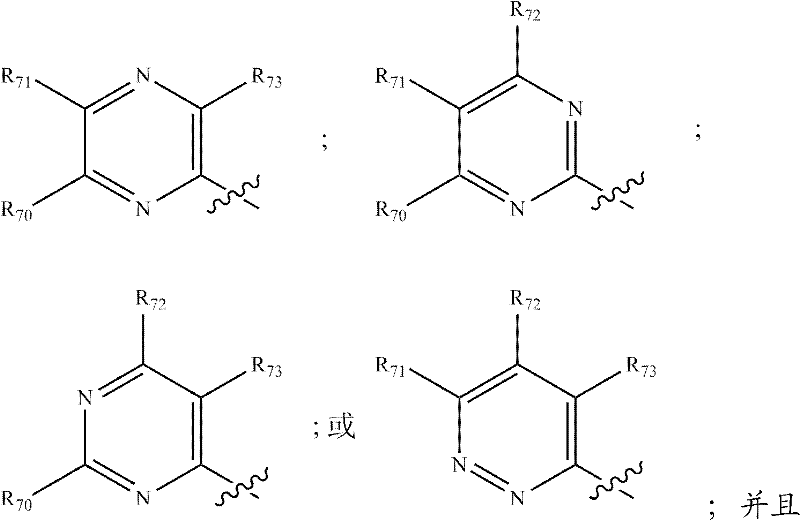


Applications Claiming Priority (7)
| Application Number | Priority Date | Filing Date | Title |
|---|---|---|---|
| US12022608P | 2008-12-05 | 2008-12-05 | |
| US61/120,226 | 2008-12-05 | ||
| US12/350,894 US8877970B2 (en) | 2008-01-09 | 2009-01-08 | Inhibitors of carbonic anhydrase IX |
| US12/350,894 | 2009-01-08 | ||
| US18034109P | 2009-05-21 | 2009-05-21 | |
| US61/180,341 | 2009-05-21 | ||
| PCT/US2009/066832 WO2010065899A2 (en) | 2008-12-05 | 2009-12-04 | Technetium-and rhenium-bis(heteroaryl)complexes and methods of use thereof |
Publications (1)
| Publication Number | Publication Date |
|---|---|
| CN102272102A true CN102272102A (en) | 2011-12-07 |
Family
ID=42076951
Family Applications (3)
| Application Number | Title | Priority Date | Filing Date |
|---|---|---|---|
| CN200980153722.8A Active CN102272100B (en) | 2008-12-05 | 2009-12-04 | Technetium- and rhenium-bis(heteroaryl) complexes for inhibiting PSMA and methods of use thereof |
| CN2009801538771A Pending CN102272101A (en) | 2008-12-05 | 2009-12-04 | CA-IX-specific radiopharmaceuticals for cancer therapy and imaging |
| CN2009801538786A Pending CN102272102A (en) | 2008-12-05 | 2009-12-04 | Technetium-and rhenium-bis(heteroaryl)complexes and methods of use thereof |
Family Applications Before (2)
| Application Number | Title | Priority Date | Filing Date |
|---|---|---|---|
| CN200980153722.8A Active CN102272100B (en) | 2008-12-05 | 2009-12-04 | Technetium- and rhenium-bis(heteroaryl) complexes for inhibiting PSMA and methods of use thereof |
| CN2009801538771A Pending CN102272101A (en) | 2008-12-05 | 2009-12-04 | CA-IX-specific radiopharmaceuticals for cancer therapy and imaging |
Country Status (13)
| Country | Link |
|---|---|
| US (1) | US8211401B2 (en) |
| EP (4) | EP2389361B1 (en) |
| JP (4) | JP2012511024A (en) |
| CN (3) | CN102272100B (en) |
| AU (3) | AU2009322171A1 (en) |
| BR (3) | BRPI0922840A2 (en) |
| CA (3) | CA2745958A1 (en) |
| ES (2) | ES2595128T3 (en) |
| HU (2) | HUE030681T2 (en) |
| PL (2) | PL2706057T3 (en) |
| RU (3) | RU2539584C2 (en) |
| TW (3) | TW201034691A (en) |
| WO (1) | WO2010065902A2 (en) |
Cited By (6)
| Publication number | Priority date | Publication date | Assignee | Title |
|---|---|---|---|---|
| CN102272101A (en) * | 2008-12-05 | 2011-12-07 | 分子制药洞察公司 | CA-IX-specific radiopharmaceuticals for cancer therapy and imaging |
| US8840865B2 (en) | 2008-01-09 | 2014-09-23 | Molecular Insight Pharmaceuticals, Inc. | Technetium- and rhenium-bis(heteroaryl) complexes and methods of use thereof |
| US8877970B2 (en) | 2008-01-09 | 2014-11-04 | Molecular Insight Pharmaceuticals, Inc. | Inhibitors of carbonic anhydrase IX |
| US9120837B2 (en) | 2012-01-06 | 2015-09-01 | Molecular Insight Pharmaceuticals | Metal complexes of poly(carboxyl)amine-containing ligands having an affinity for carbonic anhydrase IX |
| US9149547B2 (en) | 2009-06-15 | 2015-10-06 | Molecular Insight Pharmaceuticals, Inc. | Process for production of heterodimers of glutamic acid |
| US9447121B2 (en) | 2013-01-14 | 2016-09-20 | Molecular Insight Pharmaceuticals, Inc. | Triazine based radiopharmaceuticals and radioimaging agents |
Families Citing this family (55)
| Publication number | Priority date | Publication date | Assignee | Title |
|---|---|---|---|---|
| EP4464384A3 (en) | 2007-08-17 | 2025-01-08 | Purdue Research Foundation | Psma binding ligand-linker conjugates and methods for using |
| USRE47609E1 (en) | 2007-12-28 | 2019-09-17 | Exini Diagnostics Ab | System for detecting bone cancer metastases |
| WO2010065906A2 (en) | 2008-12-05 | 2010-06-10 | Molecular Insight Pharmaceuticals, Inc. | Ca-ix specific radiopharmaceuticals for the treatment and imaging of cancer |
| US9951324B2 (en) | 2010-02-25 | 2018-04-24 | Purdue Research Foundation | PSMA binding ligand-linker conjugates and methods for using |
| US9687572B2 (en) | 2010-12-06 | 2017-06-27 | Molecular Insight Pharmaceuticals, Inc. | PSMA-targeted dendrimers |
| WO2013022797A1 (en) * | 2011-08-05 | 2013-02-14 | Molecular Insight Pharmaceuticals | Radiolabeled prostate specific membrane antigen inhibitors |
| WO2013028664A1 (en) | 2011-08-22 | 2013-02-28 | Siemens Medical Solutions Usa, Inc. | Psma imaging agents |
| CN113149921B (en) | 2011-11-30 | 2024-11-29 | 约翰霍普金斯大学 | Homologous multivalent inhibitors and heterologous multivalent inhibitors of Prostate Specific Membrane Antigen (PSMA) and uses thereof |
| FR2989085A1 (en) * | 2012-04-05 | 2013-10-11 | Commissariat Energie Atomique | RADIOTRACTERS, METHODS OF PREPARATION AND APPLICATIONS |
| BR112015011118B1 (en) * | 2012-11-15 | 2022-12-13 | Endocyte, Inc | CONJUGATE; PHARMACEUTICAL COMPOSITION; AND USE OF A CONJUGATE |
| AU2014257164B2 (en) * | 2013-04-22 | 2018-10-11 | Abbvie Inc. | Thiazoles and uses thereof |
| LT4095130T (en) | 2013-10-18 | 2024-04-25 | Novartis Ag | Labeled inhibitors of prostate specific membrane antigen (psma), their use as imaging agents and pharmaceutical agents for the treatment of prostate cancer |
| WO2015058151A2 (en) * | 2013-10-18 | 2015-04-23 | Molecular Insight Pharmaceuticals, Inc. | Methods of using spect/ct analysis for staging cancer |
| BR112016010927A2 (en) | 2013-11-14 | 2017-08-08 | Endocyte Inc | FORMULA CONJUGATE |
| EP2993171A1 (en) * | 2014-09-04 | 2016-03-09 | Max-Planck-Gesellschaft zur Förderung der Wissenschaften e.V. | Method for the production of 18F-labeled PSMA-specific PET-tracers |
| AU2015315465B2 (en) | 2014-09-08 | 2019-08-29 | Molecular Insight Pharmaceuticals, Inc. | Organ protection in PSMA-targeted radionuclide therapy of prostate cancer |
| US10188759B2 (en) | 2015-01-07 | 2019-01-29 | Endocyte, Inc. | Conjugates for imaging |
| AU2016333334B2 (en) * | 2015-09-30 | 2019-07-25 | Deutsches Krebsforschungszentrum | 18F-tagged inhibitors of prostate specific membrane antigen (PSMA) and their use as imaging agents for prostate cancer |
| KR101639599B1 (en) * | 2015-11-09 | 2016-07-14 | 서울대학교산학협력단 | Peptide thiourea derivatives, their radioisotope labeled compounds and pharmaceutical composition for treatment or diagnosis of prostate cancer comprising the same as an active ingredient |
| EP3192810A1 (en) * | 2016-01-14 | 2017-07-19 | Deutsches Krebsforschungszentrum | Psma binding antibody and uses thereof |
| CN105510511B (en) * | 2016-01-23 | 2017-04-12 | 河北科技大学 | HPLC (High Performance Liquid Chromatography) separation and detection method of 2-aminobutanol enantiomer |
| HRP20240215T1 (en) * | 2016-03-22 | 2024-04-26 | The Johns Hopkins University | HIGH-AFFINITY AGENTS FOR TARGETING PROSTATE-SPECIFIC MEMBRANE ANTIGEN FOR PROSTATE CANCER ENDORADIOTHERAPY |
| CN109843339B (en) | 2016-06-23 | 2023-07-07 | 康奈尔大学 | Dual targeting constructs affecting tumor killing |
| US10806806B2 (en) | 2016-06-23 | 2020-10-20 | Cornell University | Trifunctional constructs with tunable pharmacokinetics useful in imaging and anti-tumor therapies |
| CN113035327B (en) | 2016-10-27 | 2025-02-07 | 普罗热尼奇制药公司 | Networks, decision support systems, and related graphical user interface (GUI) applications for medical image analysis |
| IL315062A (en) | 2017-04-05 | 2024-10-01 | Univ Cornell | Trifunctional constructs with tunable pharmacokinetics used in imaging and antitumor therapies |
| WO2018222778A1 (en) * | 2017-05-30 | 2018-12-06 | The Johns Hopkins University | Prostate-specific membrane antigen targeted high-affinity agents for endoradiotherapy of prostate cancer |
| SG11202005511VA (en) | 2017-12-13 | 2020-07-29 | Sciencons AS | Complex comprising a psma-targeting compound linked to a lead or thorium radionuclide |
| US10973486B2 (en) | 2018-01-08 | 2021-04-13 | Progenics Pharmaceuticals, Inc. | Systems and methods for rapid neural network-based image segmentation and radiopharmaceutical uptake determination |
| US12602772B2 (en) | 2018-01-08 | 2026-04-14 | Progenics Pharmaceuticals, Inc. | Systems and methods for rapid neural network-based image segmentation and radiopharmaceutical uptake determination |
| JP7448476B2 (en) | 2018-01-08 | 2024-03-12 | プロジェニクス ファーマシューティカルズ, インコーポレイテッド | System and method for fast neural network-based image segmentation and radiopharmaceutical uptake determination |
| KR20250126870A (en) * | 2018-02-06 | 2025-08-25 | 더 존스 홉킨스 유니버시티 | Psma targeted radiohalogenated urea-polyaminocarboxylates for cancer radiotherapy |
| RU2692126C1 (en) * | 2018-02-13 | 2019-06-21 | Федеральное государственное бюджетное научное учреждение "Томский национальный исследовательский медицинский центр Российской академии наук" (Томский НИМЦ) | Method of producing a urea derivative with a chelate centre, tropic to a prostate-specific membrane antigen for binding technetium-99m / rhenium for diagnosing / treating prostate cancer |
| US12208102B2 (en) | 2018-04-17 | 2025-01-28 | Endocyte, Inc. | Methods of treating cancer |
| WO2019246445A1 (en) * | 2018-06-20 | 2019-12-26 | The Research Foundation For The State University Of New York | Triazamacrocycle-derived chelator compositions for coordination of imaging and therapy metal ions and methods of using same |
| WO2020045638A1 (en) * | 2018-08-30 | 2020-03-05 | 日本メジフィジックス株式会社 | Radioactive imidazothiadiazole derivative compound |
| JP7568628B2 (en) | 2019-01-07 | 2024-10-16 | エクシーニ ディアグノスティクス アーべー | System and method for platform independent whole body image segmentation - Patents.com |
| EP4564288A3 (en) | 2019-04-24 | 2025-09-17 | Progenics Pharmaceuticals, Inc. | Systems and methods for automated and interactive analysis of bone scan images for detection of metastases |
| JP7539921B2 (en) | 2019-04-24 | 2024-08-26 | プロジェニクス ファーマシューティカルズ, インコーポレイテッド | System and method for bidirectional adjustment of intensity windowing in nuclear medicine images - Patents.com |
| CN114096264B (en) | 2019-05-20 | 2025-03-14 | 因多塞特股份有限公司 | Method for preparing PSMA conjugates |
| US12417533B2 (en) | 2019-09-27 | 2025-09-16 | Progenics Pharmaceuticals, Inc. | Systems and methods for artificial intelligence-based image analysis for cancer assessment |
| US11900597B2 (en) | 2019-09-27 | 2024-02-13 | Progenics Pharmaceuticals, Inc. | Systems and methods for artificial intelligence-based image analysis for cancer assessment |
| US11564621B2 (en) | 2019-09-27 | 2023-01-31 | Progenies Pharmacenticals, Inc. | Systems and methods for artificial intelligence-based image analysis for cancer assessment |
| US11544407B1 (en) | 2019-09-27 | 2023-01-03 | Progenics Pharmaceuticals, Inc. | Systems and methods for secure cloud-based medical image upload and processing |
| US11386988B2 (en) | 2020-04-23 | 2022-07-12 | Exini Diagnostics Ab | Systems and methods for deep-learning-based segmentation of composite images |
| US11321844B2 (en) | 2020-04-23 | 2022-05-03 | Exini Diagnostics Ab | Systems and methods for deep-learning-based segmentation of composite images |
| US11721428B2 (en) | 2020-07-06 | 2023-08-08 | Exini Diagnostics Ab | Systems and methods for artificial intelligence-based image analysis for detection and characterization of lesions |
| WO2022008374A1 (en) | 2020-07-06 | 2022-01-13 | Exini Diagnostics Ab | Systems and methods for artificial intelligence-based image analysis for detection and characterization of lesions |
| EP4326246A4 (en) * | 2021-04-23 | 2026-04-15 | Wisconsin Alumni Res Found | Psma-targeting ligands with optimal properties for imaging and therapy |
| US12597127B2 (en) | 2021-10-08 | 2026-04-07 | Exini Diagnostics Ab | Systems and methods for automated identification and classification of lesions in local lymph and distant metastases |
| EP4439713A4 (en) * | 2021-12-24 | 2025-04-30 | LG Energy Solution, Ltd. | Positive electrode active material, and positive electrode and lithium secondary battery comprising same |
| AU2023282844A1 (en) | 2022-06-08 | 2024-11-28 | Exini Diagnostics Ab | Systems and methods for assessing disease burden and progression |
| US20240285248A1 (en) | 2023-02-13 | 2024-08-29 | Progenics Pharmaceuticals, Inc. | Systems and methods for predicting biochemical progression free survival in prostate cancer patients |
| WO2024211651A1 (en) | 2023-04-07 | 2024-10-10 | Progenics Pharmaceuticals, Inc. | Systems and methods for facilitating lesion inspection and analysis |
| WO2025072177A1 (en) | 2023-09-25 | 2025-04-03 | Progenics Pharmaceuticals, Inc. | Systems and methods for automated cancer staging and risk prediction |
Citations (2)
| Publication number | Priority date | Publication date | Assignee | Title |
|---|---|---|---|---|
| WO2003077727A2 (en) * | 2002-03-11 | 2003-09-25 | Biostream, Inc. | Technetium-dipyridine complexes, and methods of use thereof |
| US20040209921A1 (en) * | 2003-04-11 | 2004-10-21 | Gary Bridger | CXCR4 chemokine receptor binding comounds |
Family Cites Families (42)
| Publication number | Priority date | Publication date | Assignee | Title |
|---|---|---|---|---|
| US2730456A (en) * | 1953-06-30 | 1956-01-10 | Ncr Co | Manifold record material |
| US2730457A (en) * | 1953-06-30 | 1956-01-10 | Ncr Co | Pressure responsive record materials |
| US2800457A (en) * | 1953-06-30 | 1957-07-23 | Ncr Co | Oil-containing microscopic capsules and method of making them |
| US3625214A (en) * | 1970-05-18 | 1971-12-07 | Alza Corp | Drug-delivery device |
| US4272398A (en) * | 1978-08-17 | 1981-06-09 | The United States Of America As Represented By The Secretary Of Agriculture | Microencapsulation process |
| US4906474A (en) * | 1983-03-22 | 1990-03-06 | Massachusetts Institute Of Technology | Bioerodible polyanhydrides for controlled drug delivery |
| JPS6131056A (en) * | 1984-07-25 | 1986-02-13 | K Baiorojikaru Sci Lab:Kk | Preparation of processed soybean food |
| EP0545913B1 (en) * | 1986-08-18 | 1999-02-24 | Emisphere Technologies, Inc. | Delivery systems for pharmacological agents |
| JP3051497B2 (en) * | 1991-05-17 | 2000-06-12 | 株式会社第一ラジオアイソトープ研究所 | Radiodiagnostic agent using technetium complex of sulfanilamide derivative |
| US6359120B1 (en) * | 1991-10-29 | 2002-03-19 | Bracco International B.V. | Rhenium and technetium complexes containing a hypoxia-localizing moiety |
| SG46598A1 (en) * | 1991-12-10 | 1998-02-20 | Dow Chemical Co | Bicycloazamacroyclophosphonic acid conjugates contrast agents and preparation |
| ES2200617B1 (en) * | 2001-01-19 | 2005-05-01 | Almirall Prodesfarma, S.A. | DERIVATIVES OF UREA AS ANTAGONISTS OF INTEGRINAS ALPHA 4. |
| WO2002094261A1 (en) * | 2001-05-24 | 2002-11-28 | Kureha Chemical Industry Company, Limited | Cxcr4-antagonistic drugs comprising nitrogen-containing compound |
| DE10127581A1 (en) * | 2001-05-29 | 2003-01-02 | Schering Ag | New 2-anilino-pyrimidine derivatives, are potent cyclin dependent kinase inhibitors, useful e.g. for treating cancer, autoimmune, cardiovascular or neurodegenerative diseases or viral infections |
| DE10135355C1 (en) * | 2001-07-20 | 2003-04-17 | Schering Ag | Conjugates of macrocyclic metal complexes with biomolecules and their use in the preparation of NMR and radiodiagnostic agents and radiotherapy |
| US20030100594A1 (en) | 2001-08-10 | 2003-05-29 | Pharmacia Corporation | Carbonic anhydrase inhibitor |
| WO2003053932A1 (en) * | 2001-12-21 | 2003-07-03 | Tohru Koike | Zinc complexes capable of scavenging substances bearing anionic substituents |
| CA2372731A1 (en) * | 2002-02-22 | 2003-08-22 | Claudiu T. Supuran | Oligo-amine/oligo-carboxy sulfonamides |
| DE10231799B4 (en) * | 2002-07-10 | 2006-10-05 | Schering Ag | Use of perfluoroalkyl-containing metal complexes as contrast agents in MR imaging for the presentation of intravascular thrombi |
| CN100528846C (en) * | 2002-09-11 | 2009-08-19 | 株式会社吴羽 | Amine compounds and use thereof |
| CA2691447A1 (en) | 2002-11-26 | 2004-06-10 | Institute Of Virology | Ca ix-specific inhibitors |
| US7833734B2 (en) * | 2002-11-26 | 2010-11-16 | Institute Of Virology Of The Slovak Academy Of Sciences | CA IX-specific inhibitors |
| CA2547863A1 (en) | 2003-12-12 | 2005-06-23 | Oy Juvantia Pharma Ltd | Somatostatin receptor subtype 1 (sstr1) active compounds and their use in therapy |
| KR20070029148A (en) * | 2004-02-12 | 2007-03-13 | 몰레큘러 인사이트 파마슈티칼스, 인크. | Technetium- and rhenium-bis(heteroaryl) complexes, and methods of use thereof |
| US7932281B2 (en) * | 2004-03-10 | 2011-04-26 | Kureha Corporation | Amine-based compound and use thereof |
| WO2006080993A1 (en) | 2004-12-08 | 2006-08-03 | Purdue Research Foundation | Novel cationic metal complex radiopharmaceuticals |
| WO2006137092A1 (en) * | 2005-06-23 | 2006-12-28 | Supuran Claudiu T | Fluorescent sulfonamide derivatives having carbonic anhydrase inhibiting activity and their use as theapeutic and diagnostic agents |
| FR2890657B1 (en) * | 2005-09-15 | 2007-11-09 | Commissariat Energie Atomique | PROCESS FOR OBTAINING COMPLEXES OF HIGHLY LUMINESCENT LANTHANIDES |
| WO2007058322A1 (en) * | 2005-11-18 | 2007-05-24 | Ono Pharmaceutical Co., Ltd. | Basic group-containing compound and use thereof |
| CN101415493A (en) | 2006-02-06 | 2009-04-22 | 西巴控股公司 | Use of metal complexes as oxidation catalysts |
| ES2370534T3 (en) | 2006-06-20 | 2011-12-19 | Ishihara Sangyo Kaisha, Ltd. | PEST CONTROL AGENT CONTAINING A NEW PIRIDIL-METHANAMINE DERIVATIVE OR ONE OF ITS SALTS. |
| WO2008016006A1 (en) * | 2006-07-31 | 2008-02-07 | Ono Pharmaceutical Co., Ltd. | Compound having cyclic group bound thereto through spiro binding and use thereof |
| BRPI0716368A2 (en) * | 2006-08-29 | 2013-10-01 | Molecular Insight Pharm Inc | Radio-imaging Portions Coupled to Peptidase Binding Portions for Imaging Tissues and Peptidases Expressing Organs |
| ES2847275T3 (en) | 2006-11-08 | 2021-08-02 | Molecular Insight Pharm Inc | Glutamic acid heterodimers |
| CA2676413A1 (en) * | 2007-01-19 | 2008-07-31 | Mallinckrodt Inc. | Diagnostic and therapeutic cyclooxygenase-2 binding ligands |
| WO2008098056A2 (en) * | 2007-02-06 | 2008-08-14 | Epix Pharmaceuticals, Inc. | High relaxivity chelates |
| WO2009076434A1 (en) | 2007-12-12 | 2009-06-18 | Molecular Insight Pharmaceuticals, Inc. | Inhibitors of integrin vla-4 |
| CA2711678A1 (en) * | 2008-01-09 | 2009-07-16 | Molecular Insight Pharmaceuticals, Inc. | Inhibitors of carbonic anhydrase ix |
| WO2010036814A1 (en) * | 2008-09-25 | 2010-04-01 | Molecular Insight Pharmaceuticals, Inc. | Selective seprase inhibitors |
| WO2010065906A2 (en) | 2008-12-05 | 2010-06-10 | Molecular Insight Pharmaceuticals, Inc. | Ca-ix specific radiopharmaceuticals for the treatment and imaging of cancer |
| TW201034691A (en) * | 2008-12-05 | 2010-10-01 | Molecular Insight Pharm Inc | Technetium-and rhenium-bis(heteroaryl) complexes and methods of use thereof |
| WO2010065899A2 (en) * | 2008-12-05 | 2010-06-10 | Molecular Insight Pharmaceuticals, Inc. | Technetium-and rhenium-bis(heteroaryl)complexes and methods of use thereof |
-
2009
- 2009-12-04 TW TW098141540A patent/TW201034691A/en unknown
- 2009-12-04 CN CN200980153722.8A patent/CN102272100B/en active Active
- 2009-12-04 EP EP09775429.5A patent/EP2389361B1/en active Active
- 2009-12-04 WO PCT/US2009/066836 patent/WO2010065902A2/en not_active Ceased
- 2009-12-04 AU AU2009322171A patent/AU2009322171A1/en not_active Abandoned
- 2009-12-04 US US12/631,337 patent/US8211401B2/en active Active
- 2009-12-04 ES ES09775429.5T patent/ES2595128T3/en active Active
- 2009-12-04 CN CN2009801538771A patent/CN102272101A/en active Pending
- 2009-12-04 ES ES13195617.9T patent/ES2574514T3/en active Active
- 2009-12-04 JP JP2011539757A patent/JP2012511024A/en not_active Ceased
- 2009-12-04 HU HUE09775429A patent/HUE030681T2/en unknown
- 2009-12-04 HU HUE13195617A patent/HUE029940T2/en unknown
- 2009-12-04 CA CA2745958A patent/CA2745958A1/en not_active Abandoned
- 2009-12-04 JP JP2011539752A patent/JP2012511022A/en active Pending
- 2009-12-04 BR BRPI0922840A patent/BRPI0922840A2/en active IP Right Grant
- 2009-12-04 EP EP14155382.6A patent/EP2759535A1/en not_active Withdrawn
- 2009-12-04 RU RU2011127462/04A patent/RU2539584C2/en active
- 2009-12-04 JP JP2011539755A patent/JP5220203B2/en active Active
- 2009-12-04 PL PL13195617.9T patent/PL2706057T3/en unknown
- 2009-12-04 TW TW098141536A patent/TW201034690A/en unknown
- 2009-12-04 TW TW098141532A patent/TW201034689A/en unknown
- 2009-12-04 RU RU2011127467/04A patent/RU2539565C2/en not_active IP Right Cessation
- 2009-12-04 CA CA2745955A patent/CA2745955C/en active Active
- 2009-12-04 RU RU2011127468/04A patent/RU2532912C2/en active
- 2009-12-04 AU AU2009322167A patent/AU2009322167B2/en active Active
- 2009-12-04 EP EP09765209A patent/EP2373621A2/en not_active Withdrawn
- 2009-12-04 BR BRPI0922779A patent/BRPI0922779A8/en active Search and Examination
- 2009-12-04 PL PL09775429T patent/PL2389361T3/en unknown
- 2009-12-04 BR BRPI0922839-0A patent/BRPI0922839A2/en not_active IP Right Cessation
- 2009-12-04 AU AU2009322164A patent/AU2009322164B2/en active Active
- 2009-12-04 EP EP09775430A patent/EP2373622A2/en not_active Withdrawn
- 2009-12-04 CN CN2009801538786A patent/CN102272102A/en active Pending
- 2009-12-04 CA CA2745918A patent/CA2745918C/en active Active
-
2014
- 2014-07-15 JP JP2014145241A patent/JP5856247B2/en active Active
Patent Citations (2)
| Publication number | Priority date | Publication date | Assignee | Title |
|---|---|---|---|---|
| WO2003077727A2 (en) * | 2002-03-11 | 2003-09-25 | Biostream, Inc. | Technetium-dipyridine complexes, and methods of use thereof |
| US20040209921A1 (en) * | 2003-04-11 | 2004-10-21 | Gary Bridger | CXCR4 chemokine receptor binding comounds |
Cited By (13)
| Publication number | Priority date | Publication date | Assignee | Title |
|---|---|---|---|---|
| US8840865B2 (en) | 2008-01-09 | 2014-09-23 | Molecular Insight Pharmaceuticals, Inc. | Technetium- and rhenium-bis(heteroaryl) complexes and methods of use thereof |
| US8877970B2 (en) | 2008-01-09 | 2014-11-04 | Molecular Insight Pharmaceuticals, Inc. | Inhibitors of carbonic anhydrase IX |
| US8962799B2 (en) | 2008-01-09 | 2015-02-24 | Molecular Insight Pharmaceuticals, Inc. | Technetium—and rhenium-bis(heteroaryl) complexes and methods of use thereof |
| US9433594B2 (en) | 2008-01-09 | 2016-09-06 | Molecular Insight Pharmaceuticals, Inc. | Technetium- and rhenium-bis(heteroaryl) complexes and methods of use thereof |
| CN102272101A (en) * | 2008-12-05 | 2011-12-07 | 分子制药洞察公司 | CA-IX-specific radiopharmaceuticals for cancer therapy and imaging |
| US9149547B2 (en) | 2009-06-15 | 2015-10-06 | Molecular Insight Pharmaceuticals, Inc. | Process for production of heterodimers of glutamic acid |
| US9422251B2 (en) | 2012-01-06 | 2016-08-23 | Molecular Insight Pharmaceuticals, Inc. | Metal complexes of poly(carboxyl)amine-containing ligands having an affinity for carbonic anhydrase IX |
| US9120837B2 (en) | 2012-01-06 | 2015-09-01 | Molecular Insight Pharmaceuticals | Metal complexes of poly(carboxyl)amine-containing ligands having an affinity for carbonic anhydrase IX |
| US9447121B2 (en) | 2013-01-14 | 2016-09-20 | Molecular Insight Pharmaceuticals, Inc. | Triazine based radiopharmaceuticals and radioimaging agents |
| US10086096B2 (en) | 2013-01-14 | 2018-10-02 | Molecular Insight Pharmaceuticals, Inc. | Triazine based radiopharmaceuticals and radioimaging agents |
| US10201624B2 (en) | 2013-01-14 | 2019-02-12 | Molecular Insight Pharmaceuticals, Inc. | Triazine based radiopharmaceuticals and radioimaging agents |
| US10898598B2 (en) | 2013-01-14 | 2021-01-26 | Molecular Insight Pharmaceuticals, Inc. | Triazine based radiopharmaceuticals and radioimaging agents |
| US11712485B2 (en) | 2013-01-14 | 2023-08-01 | Molecular Insight Pharmaceuticals, Inc. | Triazine based radiopharmaceuticals and radioimaging agents |
Also Published As
Similar Documents
| Publication | Publication Date | Title |
|---|---|---|
| CN102272102A (en) | Technetium-and rhenium-bis(heteroaryl)complexes and methods of use thereof | |
| US8840865B2 (en) | Technetium- and rhenium-bis(heteroaryl) complexes and methods of use thereof | |
| AU2018382479B2 (en) | PSMA ligands for imaging and endoradiotherapy | |
| CA2969551C (en) | Bifunctional do2pa derivatives, chelates with metallic cations and use thereof | |
| HUE035739T2 (en) | Triazine based radiopharmaceuticals and radioimaging agents | |
| JP2005519957A (en) | Technetium-diviridine complex and method of use thereof | |
| TW200936169A (en) | N-alkoxyamide conjugates as imaging agents | |
| US20240252693A1 (en) | Folate receptor-targeted radiotherapeutic agents and their use | |
| BRPI0922840B1 (en) | TECHNOLOGY AND HYDROARILY COMPOUNDS AND COMPOUNDS (HETEROARIL) |
Legal Events
| Date | Code | Title | Description |
|---|---|---|---|
| C06 | Publication | ||
| PB01 | Publication | ||
| C10 | Entry into substantive examination | ||
| SE01 | Entry into force of request for substantive examination | ||
| C12 | Rejection of a patent application after its publication | ||
| RJ01 | Rejection of invention patent application after publication |
Application publication date: 20111207 |