CN102250861A - Protease variants - Google Patents
Protease variants Download PDFInfo
- Publication number
- CN102250861A CN102250861A CN2011101376244A CN201110137624A CN102250861A CN 102250861 A CN102250861 A CN 102250861A CN 2011101376244 A CN2011101376244 A CN 2011101376244A CN 201110137624 A CN201110137624 A CN 201110137624A CN 102250861 A CN102250861 A CN 102250861A
- Authority
- CN
- China
- Prior art keywords
- protease
- positions
- blc
- amino acid
- variant
- Prior art date
- Legal status (The legal status is an assumption and is not a legal conclusion. Google has not performed a legal analysis and makes no representation as to the accuracy of the status listed.)
- Pending
Links
Images

Classifications
-
- C—CHEMISTRY; METALLURGY
- C12—BIOCHEMISTRY; BEER; SPIRITS; WINE; VINEGAR; MICROBIOLOGY; ENZYMOLOGY; MUTATION OR GENETIC ENGINEERING
- C12N—MICROORGANISMS OR ENZYMES; COMPOSITIONS THEREOF; PROPAGATING, PRESERVING, OR MAINTAINING MICROORGANISMS; MUTATION OR GENETIC ENGINEERING; CULTURE MEDIA
- C12N9/00—Enzymes; Proenzymes; Compositions thereof; Processes for preparing, activating, inhibiting, separating or purifying enzymes
- C12N9/14—Hydrolases (3)
- C12N9/48—Hydrolases (3) acting on peptide bonds (3.4)
- C12N9/50—Proteinases, e.g. Endopeptidases (3.4.21-3.4.25)
- C12N9/52—Proteinases, e.g. Endopeptidases (3.4.21-3.4.25) derived from bacteria or Archaea
- C12N9/54—Proteinases, e.g. Endopeptidases (3.4.21-3.4.25) derived from bacteria or Archaea bacteria being Bacillus
-
- C—CHEMISTRY; METALLURGY
- C07—ORGANIC CHEMISTRY
- C07K—PEPTIDES
- C07K2299/00—Coordinates from 3D structures of peptides, e.g. proteins or enzymes
Landscapes
- Life Sciences & Earth Sciences (AREA)
- Chemical & Material Sciences (AREA)
- Health & Medical Sciences (AREA)
- Genetics & Genomics (AREA)
- Organic Chemistry (AREA)
- Zoology (AREA)
- Engineering & Computer Science (AREA)
- Bioinformatics & Cheminformatics (AREA)
- Wood Science & Technology (AREA)
- Microbiology (AREA)
- Biotechnology (AREA)
- Biomedical Technology (AREA)
- Molecular Biology (AREA)
- Biochemistry (AREA)
- General Engineering & Computer Science (AREA)
- General Health & Medical Sciences (AREA)
- Medicinal Chemistry (AREA)
- Enzymes And Modification Thereof (AREA)
- Micro-Organisms Or Cultivation Processes Thereof (AREA)
- Detergent Compositions (AREA)
- General Preparation And Processing Of Foods (AREA)
- Treatment And Processing Of Natural Fur Or Leather (AREA)
Abstract
本发明涉及蛋白酶变体,具体的涉及生产亲本RP-II蛋白酶的变体和与亲本RP-II蛋白酶相比具有改变性能的变体的方法。

The present invention relates to protease variants, and in particular to methods of producing variants of the parent RP-II protease and variants having altered properties compared to the parent RP-II protease.
Description
本申请是申请日为2005年02月14日,申请号为“200580010941.2”(国际申请号为“PCT/DK2005/000097”),名称为“蛋白酶变体”的发明专利申请的分案申请。This application is a divisional application of an invention patent application named "Protease Variant" with an application date of February 14, 2005, application number "200580010941.2" (international application number "PCT/DK2005/000097"), and a title of "Protease Variant".
发明领域 field of invention
本发明涉及属于RP-II或C-组分型蛋白酶的变体,以及构建具有改变性能的这些变体的方法,如稳定性(例如,热稳定性或贮藏稳定性)、Ca2+依赖和pH依赖活性。The present invention relates to variants of proteases belonging to the RP-II or C-component type, and methods of constructing these variants with altered properties, such as stability (e.g., thermostability or storage stability), Ca2+ dependence and pH dependence active.
发明背景Background of the invention
酶在洗涤剂工业内用作洗涤制剂的一部分已有30多年。从商业角度来看,在这些制剂中蛋白酶是最恰当的酶,但是也常使用其它酶,包括脂肪酶、淀粉酶、纤维素酶、半纤维素酶或酶混合物。蛋白酶也用于其它领域,如日用品的生产、兽皮的加工、饲料加工等。Enzymes have been used in the detergent industry as part of detergent formulations for over 30 years. From a commercial point of view, proteases are the most suitable enzymes in these formulations, but other enzymes are often used including lipases, amylases, cellulases, hemicellulases or enzyme mixtures. Protease is also used in other fields, such as the production of daily necessities, the processing of animal skins, and feed processing.
为了提高蛋白酶的价值和/或性能,人们一直在探寻具有改变性能的蛋白酶,如在低温时活性增加、热稳定性增加、在给定的pH下比活增加、Ca2+依赖改变、在其它洗涤剂成分(例如,漂白剂、表面活性剂等)存在时稳定性增加、在底物特异性方面发生改变等。Proteases with altered properties, such as increased activity at low temperatures, increased thermostability, increased specific activity at a given pH, altered Ca 2+ dependence, changes in other Increased stability in the presence of detergent ingredients (eg, bleach, surfactants, etc.), changes in substrate specificity, etc.
对具有改变性能的蛋白酶的探寻既包括发现天然存在的蛋白酶,即所谓的野生型蛋白酶,也包括例如,通过对编码所述蛋白酶的核酸序列的基因操作来改变公知的蛋白酶。蛋白质三维结构和功能之间关系的知识提高了人们评估要改变哪些蛋白质区域以影响该蛋白质特性的能力。The search for proteases with altered properties includes both the discovery of naturally occurring proteases, so-called wild-type proteases, and the modification of known proteases, for example by genetic manipulation of the nucleic acid sequences encoding said proteases. Knowledge of the relationship between protein three-dimensional structure and function improves one's ability to assess which regions of a protein to alter to affect that protein's properties.
已表明适用于洗涤剂、食品加工、饲料加工的一组蛋白酶是属于蛋白酶家族S1B谷氨酸特异性内肽酶的RP-II蛋白酶或C-组分蛋白酶。该家族迄今为止仅受到相对较少的关注而且尚未被进一步分成不同的亚组。然而,从所分离的RP-II蛋白酶的氨基酸序列来看,显然存在着亚组。RP-II型芽孢杆菌属蛋白酶是丝氨酸蛋白酶,其在一级结构上类似于胰凝乳蛋白酶。A group of proteases that have been shown to be suitable for use in detergents, food processing, feed processing are the RP-II proteases or C-component proteases belonging to the protease family S1B glutamate-specific endopeptidases. This family has received relatively little attention so far and has not been further divided into different subgroups. However, from the amino acid sequences of the isolated RP-II proteases, it is clear that subgroups exist. RP-II type Bacillus proteases are serine proteases that are similar in primary structure to chymotrypsin.
在美国专利No.4,266,031(Tang等,Novo Industri A/S)中第一次描述了芽孢杆菌属蛋白酶RP-II家族的蛋白酶,文中该酶被称作组分C,临时性地(并且是不正确地)被表征为不属于丝氨酸蛋白酶和金属蛋白酶。组分C被认为是地衣芽孢杆菌(Bacillus licheniformis)碱性蛋白酶即枯草杆菌素(subtilisin)Carlsberg生产中的污染物。Proteases of the RP-II family of Bacillus proteases were first described in U.S. Patent No. 4,266,031 (Tang et al., Novo Industri A/S), referred to herein as component C, provisionally (and not correctly) is characterized as not belonging to serine proteases and metalloproteases. Component C is considered a contaminant in the production of Bacillus licheniformis alkaline protease, subtilisin Carlsberg.
在EP 369 817(Omnigene Bioproducts,Inc.)中,RP-II家族的枯草芽孢杆菌(B.subtilis)成员通过其氨基酸和DNA序列得以鉴定。该酶再次被认为不是丝氨酸蛋白酶,并被命名为RP-II家族(残余蛋白酶II)。EP 369 817的发明人进一步将该酶表征为金属蛋白酶(Rufo等,1990,J.Bacteriol.21019-1023以及Sloma等,1990,J.Bacteriol.1721024-1029),将该酶称作mpr。In EP 369 817 (Omnigene Bioproducts, Inc.), members of the RP-II family of B. subtilis (B. subtilis) were identified by their amino acid and DNA sequences. This enzyme is again considered not to be a serine protease and has been named the RP-II family (residual protease II). The inventors of EP 369 817 further characterized the enzyme as a metalloprotease (Rufo et al., 1990, J. Bacteriol. 21019-1023 and Sloma et al., 1990, J. Bacteriol. 1721024-1029), calling the enzyme mpr.
在WO 91/13553(Novozymes A/S)中,公开了C组分的氨基酸序列,阐明其是特异于谷氨酸和天冬氨酸的丝氨酸蛋白酶,而EP 482 879(Shionogi&Co.Ltd.)公开了来自地衣芽孢杆菌ATCC No.14580的酶和编码C组分的DNA序列,命名为酶Blase。在EP 482 879中,该蛋白酶被描述为特异于谷氨酸(还参见Kakudo等“Purification,characterization,cloning,and expression of aglutamic acid-specific protease from Bacillus licheniformis ATCC 14580”.J.Biol.Chem.267:23782(1992))。In
在1997年,Okamoto等(Appl.Microbiol.Biotechnol.(1997)4827-33)发现Blase的枯草芽孢杆菌同系物(命名为BSase)与上述酶mpr/RP-II完全相同。In 1997, Okamoto et al. (Appl. Microbiol. Biotechnol. (1997) 4827-33) found that the Bacillus subtilis homologue of Blase (named BSase) was identical to the aforementioned enzyme mpr/RP-II.
在1999年,Rebrikov等(Journal of Protein Chemistry,Vol.18,No.1,1999)公开了也属于RP-II家族的来自于中间型芽孢杆菌(B.intermedius)的Glu特异性蛋白酶。In 1999, Rebrikov et al. (Journal of Protein Chemistry, Vol. 18, No. 1, 1999) disclosed a Glu-specific protease from B. intermedius which also belongs to the RP-II family.
在WO 01/16285中,公开了许多其它的RP-II蛋白酶,连同DNA和氨基酸序列。这些RP-II蛋白酶分离自短小芽孢杆菌(B.pumilus)、哈乌帕拉斯芽孢杆菌(B.halmapalus)和地衣芽孢杆菌。WO 01/16285也公开了许多RP-II蛋白酶变体。这些变体是建立在与RP-II蛋白酶的一级结构(氨基酸序列)有关的各种概念的基础上的。In WO 01/16285 a number of other RP-II proteases are disclosed, along with DNA and amino acid sequences. These RP-II proteases were isolated from B. pumilus, B. halmapalus and B. licheniformis. WO 01/16285 also discloses a number of RP-II protease variants. These variants are based on various concepts related to the primary structure (amino acid sequence) of RP-II protease.
下表1中的同源性矩阵清楚地表明了RP-II蛋白酶1至8是与矩阵中其它Glu特异性蛋白酶明显有别的独特的一组Glu特异性蛋白酶。The homology matrix in Table 1 below clearly shows that RP-II
表1Table 1
矩阵中,序列以首先公开的专利公开或者序列数据库登录号来标识。In the matrix, sequences are identified by the first published patent publication or sequence database accession number.
1.芽孢杆菌属菌种JA96谷氨酸特异性内肽酶,JA96,WO 01/162851. Bacillus sp. JA96 glutamate-specific endopeptidase, JA96, WO 01/16285
2.1p3e中间型芽孢杆菌,谷氨酸特异性内肽酶,BIP,EMBL No.Y5136,Rebrikov等,Journal of Protein Chemistry,Vol.18,No.1,19992.1p3e Bacillus intermedia, glutamate-specific endopeptidase, BIP, EMBL No.Y5136, Rebrikov et al., Journal of Protein Chemistry, Vol.18, No.1, 1999
3.芽孢杆菌属菌种BO32谷氨酸特异性内肽酶,BO32,WO 01/162853. Bacillus sp. BO32 glutamate-specific endopeptidase, BO32, WO 01/16285
4.地衣芽孢杆菌,BLC,WO 01/16285(参见美国专利4,266,031)4. Bacillus licheniformis, BLC, WO 01/16285 (see US Patent 4,266,031)
5.芽孢杆菌属菌种CDJ31谷氨酸特异性内肽酶,CDJ31,WO 01/162855. Bacillus sp. CDJ31 glutamate-specific endopeptidase, CDJ31, WO 01/16285
6.芽孢杆菌属菌种AC116谷氨酸特异性内肽酶,AC116,WO 01/162856. Bacillus sp. AC116 glutamate-specific endopeptidase, AC116, WO 01/16285
7.mpr_bacsu枯草芽孢杆菌丝氨酸蛋白酶,MPR,EP 369 8177.mpr_bacsu Bacillus subtilis serine protease, MPR, EP 369 817
8.芽孢杆菌属菌种AA513谷氨酸特异性内肽酶,AA513,WO 01/162858. Bacillus sp. AA513 glutamate-specific endopeptidase, AA513, WO 01/16285
9.eta_staau金黄色葡萄球菌(Staphylococcus aureus)表皮剥脱毒素A(Lee等Sequence determination and comparison of the exfoliative toxin A andtoxin B genes from Staphylococcus aureus;J.Bacteriol.169:3904(1987))9.eta_staau Staphylococcus aureus (Staphylococcus aureus) epidermis exfoliation toxin A
10.etb_staau金黄色葡萄球菌表皮剥脱毒素B(Jackson,M.P.;landolo,J.J.;Sequence of the exfoliative toxin B gene of Staphylococcus aureus;J.Bacteriol.167:726(1986))10. etb_staau Staphylococcus aureus epidermis exfoliation toxin B (Jackson, M.P.; landolo, J.J.; Sequence of the exfoliative toxin B gene of Staphylococcus aureus; J.Bacteriol.167:726 (1986))
11.q53781金黄色葡萄球菌(Mu50/ATCC 700699株)(Rieneck等;提交于EMBL/GenBank/DDBJ数据库(1996年6月))11. q53781 Staphylococcus aureus (Mu50/ATCC 700699 strain) (Rieneck et al; submitted to EMBL/GenBank/DDBJ database (June 1996))
12.q53782金黄色葡萄球菌(Mu50/ATCC 700699株)(Rieneck等,“Molecular cloning and expression of a novel Staphylococcus aureus antigen”.Biochim.Biophys.Acta 1350:128(1997)12. q53782 Staphylococcus aureus (Mu50/ATCC 700699 strain) (Rieneck et al., "Molecular cloning and expression of a novel Staphylococcus aureus antigen". Biochim. Biophys. Acta 1350: 128 (1997)
13.stsp_staau葡萄球菌丝氨酸内肽酶V8Glu-C(Gray,“Nucleotidesequence of the serine protease gene of Staphylococcus aureus,strain V8”Nucleic Acids Res.15:6757(1987)13.stsp_staau Staphylococcus serine endopeptidase V8Glu-C (Gray, "Nucleotidesequence of the serine protease gene of Staphylococcus aureus, strain V8" Nucleic Acids Res.15: 6757 (1987)
已由Cavarelli,J.等Structure Vol.5,p.813 1997确定了属于S1B家族的金黄色葡萄球菌蛋白酶毒素A的三维结构。The three-dimensional structure of S. aureus protease toxin A belonging to the S1B family has been determined by Cavarelli, J. et al. Structure Vol.5, p.813 1997.
然而,尽管属于RP-II蛋白酶的蛋白酶和金黄色葡萄球菌毒素A之间存在序列同源性,但是由于结构的差异,尤其是由于与RP-II蛋白酶同源序列上的显著差异,以金黄色葡萄球菌毒素A三维结构为基础的RP-II蛋白酶三维结构的建模可能导致不正确的三维结构。However, despite the sequence homology between proteases belonging to RP-II proteases and Staphylococcus aureus toxin A, due to structural differences, especially due to significant differences in sequences homologous to RP-II proteases, in golden yellow The modeling of the 3D structure of RP-II protease based on the 3D structure of staphylococcal toxin A may result in an incorrect 3D structure.
本发明的发明人阐明了地衣芽孢杆菌的C组分蛋白酶的三维结构,并且发现这和也属于蛋白酶S1B亚组的金黄色葡萄球菌毒素A的三维结构之间存在着若干的不同。结构上的这种令人惊奇的差别利于我们使用BLC结构作为RP-II蛋白酶的同源性建模的基础,这依次又将提高我们通过蛋白质工程获得在功能性方面发生期望改变的能力。The inventors of the present invention elucidated the three-dimensional structure of component C proteases of Bacillus licheniformis and found several differences between this and the three-dimensional structure of Staphylococcus aureus toxin A, which also belongs to the subgroup of protease S1B. This surprising difference in structure facilitates our use of the BLC structure as the basis for homology modeling of the RP-II protease, which in turn will improve our ability to obtain desired changes in functionality through protein engineering.
发明概述Summary of the invention
基于C组分的三维结构,发明人修饰了RP-II蛋白酶的氨基酸序列,获得了性能改良的变体。变体将具有改变的性能,如在低温时活性增加、热稳定性增加、在给定的pH下比活增加、Ca2+依赖改变、在其它洗涤剂成分(例如,漂白剂、表面活性剂等)存在时稳定性增加等。Based on the three-dimensional structure of the C component, the inventors modified the amino acid sequence of RP-II protease and obtained variants with improved performance. The variants will have altered properties such as increased activity at low temperatures, increased thermostability, increased specific activity at a given pH, altered Ca2 + dependence, changes in other detergent ingredients (e.g., bleach, surfactants) etc.) in the presence of increased stability etc.
从而本发明的目的是提供一种构建具有改变性能的RP-II蛋白酶的方法,特别是提供一种构建具有上述改变性能的RP-II蛋白酶的方法。Therefore, the object of the present invention is to provide a method for constructing RP-II protease with altered properties, especially to provide a method for constructing RP-II protease with the above-mentioned altered properties.
因此,就最广义的方面而言,本发明涉及一种构建亲本RP-II蛋白酶变体的方法,其中与所述的亲本RP-II蛋白酶相比,变体具有至少一种改变的性能,该方法包括:Thus, in its broadest aspect, the present invention relates to a method of constructing a variant of a parent RP-II protease, wherein the variant has at least one altered property compared to said parent RP-II protease, the Methods include:
i)分析RP-II蛋白酶的三维结构,以根据结构考虑的评估,鉴定RP-II蛋白酶中至少一个与改变所述性能相关的氨基酸残基或至少一个结构区;i) analyzing the three-dimensional structure of the RP-II protease to identify at least one amino acid residue or at least one structural region in the RP-II protease that is relevant to altering said property, based on an assessment of structural considerations;
ii)构建RP-II蛋白酶的变体,与亲本RP-II蛋白酶相比,其已在i)中所鉴定的氨基酸残基或结构部分进行修饰以便改变所述性能;和ii) constructing variants of the RP-II protease that have been modified in the amino acid residues or structural moieties identified in i) in order to alter said properties compared to the parent RP-II protease; and
iii)检验所得RP-II蛋白酶变体的所述性能。iii) Testing the resulting RP-II protease variants for said properties.
尽管在下面已经描述了预期亲本RP-II蛋白酶在某些区域和/或位置的修饰将会对由此所产生的RP-II蛋白酶变体带来特别的效果,但是应当指出,亲本RP-II蛋白酶在这些区域中的任何一处的修饰也可能产生上述效果外的任何其它效果。例如,所提及的在例如热稳定性提高方面特别有意义的区域和/或位置中任何一处的修饰,也可能引起例如,在更低pH时的更高活性、改变的最佳pH,或者比活增加,如肽酶活性增加。Although it has been described below that modifications of certain regions and/or positions of the parent RP-II protease are expected to have particular effects on the resulting RP-II protease variants, it should be noted that the parent RP-II protease Modification of the protease in any of these regions may also produce any other effect than the one described above. For example, modifications anywhere in the mentioned regions and/or positions that are particularly interesting in terms of e.g. increased thermostability may also lead to e.g. higher activity at lower pH, altered pH optima, Or specific activity increased, such as peptidase activity increased.
本发明的另一方面涉及RP-II蛋白酶的变体、编码这些变体的DNA和制备变体的方法。又在本发明的另一方面,涉及变体用于各种工业目的的用途,特别是作为洗涤组合物中的添加剂。本发明的其它方面将由于下面的描述以及所附的权利要求而变得显而易见。Another aspect of the invention relates to variants of RP-II proteases, DNA encoding these variants and methods of making the variants. Yet another aspect of the invention relates to the use of the variants for various industrial purposes, in particular as additives in washing compositions. Other aspects of the invention will become apparent from the following description and appended claims.
本发明还涉及如下方面:The present invention also relates to the following aspects:
1、一种构建RP-II蛋白酶变体的方法,其中与亲本RP-II蛋白酶相比,变体具有至少一种改变的性能,该方法包括:1. A method of constructing a RP-II protease variant, wherein the variant has at least one altered property compared to the parent RP-II protease, the method comprising:
a)分析RP-II蛋白酶的三维结构,以根据结构考虑的评估,鉴定RP-II蛋白酶中至少一个与改变所述性能相关的氨基酸残基或至少一个结构区;a) analyzing the three-dimensional structure of the RP-II protease to identify at least one amino acid residue or at least one structural region in the RP-II protease that is relevant to altering said property, based on an assessment of structural considerations;
b)修饰编码亲本的多核苷酸的DNA,以构建编码变体RP-II蛋白酶的多核苷酸,与亲本RP-II蛋白酶相比,其通过在a)中所鉴定的氨基酸残基或结构部分的缺失、取代或插入进行修饰以改变所述性能;b) modifying the DNA encoding the polynucleotide of the parent to construct a polynucleotide encoding a variant RP-II protease that differs from the parent RP-II protease by the amino acid residues or structural moieties identified in a) modification by deletion, substitution or insertion to alter said properties;
c)在适当的宿主中表达变体RP-II蛋白酶,和c) expressing the variant RP-II protease in a suitable host, and
d)检验所得的RP-II蛋白酶变体的所述性能。d) Testing the resulting RP-II protease variants for said properties.
2、一种生产BLC样RP-II蛋白酶变体的方法,其中与亲本BLC样RP-II蛋白酶相比,变体具有至少一种改变的性能,该方法包括:2. A method of producing a BLC-like RP-II protease variant, wherein the variant has at least one altered property compared to the parent BLC-like RP-II protease, the method comprising:
a)基于BLC三维结构产生亲本BLC样RP-II蛋白酶的模型结构,a) generation of a model structure of the parental BLC-like RP-II protease based on the BLC three-dimensional structure,
b)通过匹配活性位点残基的CA、CB、C、O和N原子,进行结构叠加,将亲本BLC样RP-II蛋白酶的模型三维结构与BLC结构进行比较,b) Comparing the model 3D structure of the parent BLC-like RP-II protease with the BLC structure by matching the CA, CB, C, O and N atoms of the active site residues, performing structural superposition,
c)在步骤a)比较的基础上鉴定亲本BLC样RP-II蛋白酶中的至少一个结构部分,其中预测所述结构部分的改变将会导致改变的性能;c) identifying at least one structural portion in the parental BLC-like RP-II protease on the basis of the comparison in step a), wherein changes in said structural portion are predicted to result in altered properties;
d)修饰编码亲本BLC样RP-II蛋白酶的核酸序列,产生这样的核酸序列,其在与所述结构部分对应位置上编码一个或多个氨基酸的至少一个缺失或取代,或者在与所述结构部分对应位置上编码一个或多个氨基酸残基的至少一个插入;d) modify the nucleic acid sequence encoding the parental BLC-like RP-II protease to produce a nucleic acid sequence that encodes at least one deletion or substitution of one or more amino acids at a position corresponding to the structural part, or at a position corresponding to the structural part At least one insertion encoding one or more amino acid residues at partially corresponding positions;
e)重复进行步骤c)和d)N次,其中N是1或1以上的整数;e) repeat steps c) and d) N times, wherein N is an integer of 1 or more;
f)制备由步骤a)-e)所得的变体;f) preparing the variant resulting from steps a)-e);
g)检验所述变体的稳定性;和g) testing the stability of the variant; and
h)任选地循环重复步骤a)-g);和h) optionally cyclically repeating steps a)-g); and
i)选择与亲本RP-II蛋白酶相比具有至少一种改变的性能的RP-II蛋白酶变体;i) selecting a RP-II protease variant having at least one altered property compared to the parent RP-II protease;
j)在宿主细胞中表达修饰的核酸序列以生产变体RP-II蛋白酶;j) expressing the modified nucleotide sequence in a host cell to produce variant RP-II protease;
k)分离所生产的蛋白酶;k) isolating the protease produced;
l)纯化所分离的蛋白酶,和l) purifying the isolated protease, and
m)回收所纯化的RP-II蛋白酶变体。m) recovering the purified RP-II protease variant.
3、项2的方法,其中步骤(c)鉴定与RP-II蛋白酶亲本的离子结合位点相距10

4、项2的方法,其中步骤(c)鉴定RP-II蛋白酶亲本中这样的氨基酸残基位置,所述位置的修饰通过修饰至少一个所鉴定的位置确保除去离子结合位点。4. The method of
5、项2的方法,其中步骤(c)鉴定RP-II蛋白酶亲本高度活动区域中的氨基酸残基位置。5. The method of
7、项2的方法,其中步骤(c)鉴定RP-II蛋白酶亲本的活动区域中的氨基酸残基位置。7. The method of
8、项2的方法,其中步骤(c)鉴定亲本RP-II蛋白酶中这样的氨基酸残基位置,所述位置的修饰通过至少一个Cys残基的插入或取代可产生至少一个二硫桥。8. The method of
9、项2的方法,其中步骤(c)和(d)通过如下操作构建具有修饰的表面电荷分布的亲本RP-II蛋白酶变体:9. The method of
c’)鉴定亲本RP-II蛋白酶表面上至少一个带电荷的氨基酸残基;c') identifying at least one charged amino acid residue on the surface of the parent RP-II protease;
d’)通过缺失或用不带电荷的氨基酸残基取代,修饰在步骤(a)中所鉴定的带电荷残基。d') modifying the charged residues identified in step (a) by deletion or substitution with uncharged amino acid residues.
10、项2的方法,其中步骤(c)和(d)通过如下操作构建具有修饰的表面电荷分布的亲本RP-II蛋白酶变体:10. The method of
c”)鉴定亲本RP-II蛋白酶表面上至少一个为不带电荷的氨基酸残基所占据的位置;c") identifying at least one position on the surface of the parent RP-II protease that is occupied by an uncharged amino acid residue;
d”)通过用带电荷氨酸残基取代不带电荷氨基酸残基,或者通过在该位置上插入带电荷氨基酸残基,对该位置上的电荷进行修饰。d") Modification of the charge at this position by substituting a charged amino acid residue for an uncharged amino acid residue, or by inserting a charged amino acid residue at this position.
11、项2的方法,其中步骤(c)和(d)通过如下操作构建具有修饰的表面电荷分布的亲本RP-II蛋白酶变体:11. The method of
c’”)鉴定亲本RP-II蛋白酶表面上至少一个带电荷的氨基酸残基;c'") identification of at least one charged amino acid residue on the surface of the parental RP-II protease;
d’”)用具有相反电荷的氨基酸残基取代在步骤(a)中所鉴定的带电荷氨基酸残基。d'") replacing the charged amino acid residue identified in step (a) with an amino acid residue having an opposite charge.
12、项2的方法,其中步骤(c)鉴定亲本RP-II蛋白酶中这样的氨基酸残基位置,其中将所述位置修饰为Pro可产生显示改良稳定性的RP-II蛋白酶变体。12. The method of
13、项2的方法,其中步骤(c)鉴定亲本RP-II蛋白酶中与活性位点残基相距小于10
14、项2至13中一项或多项的方法,其中步骤(e)中的N是1与50、45、40、35、30、25、20、15、14、13、12、11、10、9、8、7、6、5、4、3或2之间的整数。14. The method of one or more of
15、RP-II蛋白酶变体,其包含与离子结合位点相距10
16、项15的变体,其中在至少一个如下的位置上进行修饰:1、2、3、4、5、6、7、8、143、144、145、146、158、159、160、161、162、194、199、200和201,优选地在位置2、3、4、5、6、7、144、159、160和161上进行修饰,尤其是BLC(SEQ ID NO:2)中D7E和D7Q的修饰,其中的位置是指BLC或对应的位置。16. The variant of
17、项15或16的变体,其中的修饰包括用中性或带负电荷的残基取代带正电荷的氨基酸残基,或者用带负电荷的残基取代中性残基,或者缺失带正电荷的或中性残基。17. The variant of
18、项15的变体,其中通过至少一个与BLC位置144和/或161相对应的位置上的修饰除去离子结合位点,尤其是BLC(SEQ ID NO:2)中H144R和/或D161R,K+H144Q,N的修饰。18. The variant of
19、RP-II蛋白酶变体,其包含高度活动区域中氨基酸残基的至少一种修饰,所述区域处于至少一个与BLC的如下位置相对应的位置中:26-31(26、27、28、29、30和31)、89-91(89、90和91)、216-221(216、217、218、219、220和221)。19. RP-II protease variant comprising at least one modification of an amino acid residue in a highly active region in at least one position corresponding to the following position of BLC: 26-31 (26, 27, 28 , 29, 30 and 31), 89-91 (89, 90 and 91), 216-221 (216, 217, 218, 219, 220 and 221).
20、项19的变体,其中亲本是BLC,而修饰包括G30A和/或G91A。20. The variant of item 19, wherein the parent is BLC and the modification comprises G30A and/or G91A.
21、RP-II蛋白酶变体,其包含在活动区域中进行的至少一种修饰,所述区域处于至少一个与BLC的如下位置相对应的位置中:51-56(51、52、53、54、55、56)、88-94(88、89、90、91、92、93、94)、118-122(118、119、120、121、122)和173-183(173、174、175、176、177、178、179、180、181、182、183),优选地在区域51-56和118-122中。21. RP-II protease variant comprising at least one modification in the active region in at least one position corresponding to the following position of BLC: 51-56 (51, 52, 53, 54 , 55, 56), 88-94 (88, 89, 90, 91, 92, 93, 94), 118-122 (118, 119, 120, 121, 122) and 173-183 (173, 174, 175, 176, 177, 178, 179, 180, 181, 182, 183), preferably in regions 51-56 and 118-122.
22、RP-II蛋白酶变体,具有至少一个通过将BLC位置128和145或对应位置上的氨基酸残基修饰为Cys所提供的二硫桥,优选地是BLC或对应位置上的S145C和T128C取代。22. RP-II protease variant having at least one disulfide bridge provided by modifying amino acid residues at positions 128 and 145 of BLC or corresponding positions to Cys, preferably S145C and T128C substitutions at BLC or corresponding positions .
23、RP-II蛋白酶变体,与亲本RP-II蛋白酶相比具有修饰的表面电荷分布,其包含至少一个与BLC的如下位置相对应位置上的修饰:7、17、95、109、143、174、209、216,尤其是BLC(SEQ ID NO.1)如下的修饰:23. A RP-II protease variant having a modified surface charge distribution compared to the parent RP-II protease comprising at least one modification at a position corresponding to the following positions of the BLC: 7, 17, 95, 109, 143, 174, 209, 216, especially BLC (SEQ ID NO.1) as follows:
D7N,S,TD7N,S,T
Y17R,K,HY17R, K, H
Y95R,K,HY95R, K, H
T109R,K,HT109R, K, H
Q143R,K,HQ143R, K, H
Q174R,K,HQ174R, K, H
E209Q,NE209Q,N
N216R,K,H。N216R, K, H.
24、RP-II蛋白酶变体,与亲本RP-II蛋白酶相比显示改良的稳定性,其包含至少一个与BLC的位置18、115、185、269和293相对应位置上的Pro取代,尤其是BLC(SEQ ID NO.1)如下取代中的一个或多个:T60P、S221P、G193P、V194P。24. RP-II protease variants showing improved stability compared to the parent RP-II protease comprising at least one Pro substitution at a position corresponding to positions 18, 115, 185, 269 and 293 of the BLC, especially BLC (SEQ ID NO. 1) substituted one or more of the following: T60P, S221P, G193P, V194P.
25、RP-II蛋白酶变体,其包含与活性位点残基相距小于10
26、项15至25中任一项的RP-II蛋白酶变体,进一步包含如下修饰中的至少一种:(i)形成Asn-Gly序列部分的位置上的氨基酸残基通过缺失或取代,优选地用Asp、Gln、Ser、Pro、Thr或Tyr取代所进行的修饰;(ii)Trp占据的位置上的氨基酸残基用Phe、Thr、Gln或Gly取代所进行的修饰;(iii)Glu或Asp占据的位置上的氨基酸残基用Ala取代所进行的修饰;(iv)Glu或Asp残基占据的位置之后第一位或第二位上的氨基酸残基用Pro取代所进行的修饰;或者(v)Met占据的位置上的氨基酸残基通过缺失或取代,优选地用Ser或Ala取代所进行的修饰。26. The RP-II protease variant according to any one of
27、项15至26中任一项的RP-II蛋白酶,其在许多位置上被修饰,范围从至少1个和多达50个位置,或者从1到45个位置,或者从1到40个位置,或者从1到35个位置,或者从1到30个位置,或者从1到25个位置,或者从1到20个位置,或者从1到15个位置,或者从1到14个位置,或者从1到13个位置,或者从1到12个位置,或者从1到11个位置,或者从1到10个位置,或者从1到9个位置,或者从1到8个位置,或者从1到7个位置,或者从1到6个位置,或者从1到5个位置,或者从1到4个位置,或者从1到3个位置,或者从1到2个位置,这些修饰包括在所示数目位置上的取代、缺失、插入以及它们的组合。27. The RP-II protease of any one of
28、分离的多核苷酸,包含编码前述项中任一项所定义或生产的RP-II蛋白酶变体的核酸序列。28. An isolated polynucleotide comprising a nucleic acid sequence encoding a RP-II protease variant as defined or produced in any one of the preceding items.
29、项28的多核苷酸,其中核酸序列与SEQ ID NO:1、3、5、7、9、11、13或SEQ ID NO:15所示的核酸序列具有至少50%、至少55%、至少60%、至少65%、至少70%、至少75%、至少80%、至少85%、至少90%、至少91%、至少92%、至少93%、至少94%、至少95%、至少96%、至少97%、至少98%或者至少99%的同源性。29. The polynucleotide of item 28, wherein the nucleic acid sequence shares at least 50%, at least 55%, At least 60%, at least 65%, at least 70%, at least 75%, at least 80%, at least 85%, at least 90%, at least 91%, at least 92%, at least 93%, at least 94%, at least 95%, at least 96 %, at least 97%, at least 98%, or at least 99% homology.
30、分离的核酸构建体,其包含如项28-29中任一项所定义的核酸序列,有效地连接于一个或多个能够指导多肽在适宜的表达宿主中表达的控制序列。30. An isolated nucleic acid construct comprising a nucleic acid sequence as defined in any one of items 28-29 operably linked to one or more control sequences capable of directing the expression of the polypeptide in a suitable expression host.
31、包含项30的核酸构建体的重组宿主细胞。31. A recombinant host cell comprising the nucleic acid construct of item 30.
32、一种生产如项1至27中任一项所定义或生产的RP-II变体的方法,该方法包括:32. A method of producing a RP-II variant as defined or produced in any one of
a)在益于生产RP-II蛋白酶变体的条件下培养项31的重组宿主细胞;和a) culturing the recombinant host cell of
b)回收变体。b) Recover variants.
33、洗涤制剂组合物,其包含项1至27中任一项所定义或生产的RP-II蛋白酶变体。33. A detergent formulation composition comprising a RP-II protease variant as defined or produced according to any one of
34、项1至27中任一项所定义或生产的RP-II蛋白酶变体在洗涤或清洁目的中的用途。34. Use of a RP-II protease variant as defined or produced according to any one of
35、项1至27中任一项所定义或生产的RP-II蛋白酶变体在加工食品中的用途。35. Use of a RP-II protease variant as defined or produced in any one of
36、项1至27中任一项所定义或生产的RP-II蛋白酶变体在加工饲料中的用途。36. Use of a RP-II protease variant as defined or produced in any one of
37、项1至27中任一项所定义或生产的RP-II蛋白酶变体在处理兽皮中的用途。37. Use of a RP-II protease variant as defined or produced in any one of
附图简述Brief description of the drawings
图1提供了地衣芽孢杆菌的RP-II蛋白酶BLC的结构示意图。Figure 1 provides a schematic diagram of the structure of the RP-II protease BLC of Bacillus licheniformis.
图2显示了表1野生型RP-II蛋白酶1至8基于3D结构的序列比对。Figure 2 shows the sequence alignment based on the 3D structure of wild-type RP-II
图3显示了用黑色表示的BLC蛋白酶的带状结构,标出了活性位点残基、结合的肽和离子结合位点。钙离子是位于图底部的球体,活性位点残基是浅灰色的并以棒状模型显示,结合的肽DAFE是中等灰色并以棒状模型显示。Figure 3 shows the ribbon structure of the BLC protease in black with active site residues, bound peptide and ion binding site indicated. Calcium ions are spheres at the bottom of the figure, active site residues are light gray and shown as stick models, and bound peptide DAFE is medium gray and shown as stick models.
附录简述Brief description of the appendix
附录1以标准的pdf格式提供了BLC RP-II蛋白酶溶解晶体的3D结构的结构坐标。将残基编号从1到217,钙离子编号为301,底物DAFE编号为401-404。
定义definition
在更详细讨论本发明前,将首先定义下列术语和约定。Before discussing the present invention in more detail, the following terms and conventions will first be defined.
为了详细描述通过基因操作在多肽或蛋白质中,尤其是在RP-II蛋白酶中所引入的氨基酸和核酸以及修饰的命名法,我们引用WO 01/16285第5-15页,在此并入作为参考。For a detailed description of the nomenclature of amino acids and nucleic acids and modifications introduced by genetic manipulation in polypeptides or proteins, especially in RP-II proteases, we cite pages 5-15 of WO 01/16285, incorporated herein by reference .
术语“RP-II蛋白酶”指丝氨酸蛋白酶亚组,属于蛋白酶家族S1B谷氨酸特异性内肽酶。丝氨酸蛋白酶或丝氨酸肽酶是特征为在活性位点上具有丝氨酸的蛋白酶的亚组,其与底物形成共价加合物。此外,RP-II蛋白酶(和丝氨酸蛋白酶)的特征还在于除了丝氨酸外还具有两个活性位点氨基酸残基,即组氨酸和天冬氨酸残基。The term "RP-II protease" refers to a subgroup of serine proteases belonging to the protease family S1B glutamate-specific endopeptidases. Serine proteases or serine peptidases are a subgroup of proteases characterized by having a serine in the active site, which forms covalent adducts with substrates. In addition, RP-II proteases (and serine proteases) are also characterized by two active site amino acid residues in addition to serine, namely histidine and aspartic acid residues.
RP-II蛋白酶与S1B蛋白酶家族的其余成员有大约50%的同源性(使用第8版UWGCG软件的GAP程序),或者更优选地同源性高于55%。表1显示了多种S1B蛋白酶之间的同源性。1-8号的RP-II蛋白酶在表1中用粗体表示,9-13号的其它S1B蛋白酶用粗斜体表示。表1证明了RP-II蛋白酶与其它S1B蛋白酶之间明显不同,但同样显然的是,在RP-II蛋白酶中存在着亚组。一个亚组包括1、2和3号蛋白酶;而另一个亚组包括第4、5和6号蛋白酶。所列RP-II蛋白酶的长度从215到222个氨基酸残基不等,有关枯草杆菌蛋白酶(subtilases)的枯草杆菌素亚组的经验显示,长度的这种变化可能对这些和其它RP-II蛋白酶亚组的三维结构仅有很小的影响。The RP-II protease has approximately 50% homology (using the GAP program of the UWGCG software version 8), or more preferably greater than 55% homology to the remaining members of the SlB protease family. Table 1 shows the homology between various S1B proteases. RP-II protease numbers 1-8 are shown in bold in Table 1, and other S1B protease numbers 9-13 are shown in bold italics. Table 1 demonstrates clear differences between RP-II proteases and other S1B proteases, but it is also clear that there are subgroups within RP-II proteases. One subgroup includes Protease Nos. 1, 2 and 3; while the other subgroup includes Protease Nos. 4, 5 and 6. The RP-II proteases listed vary in length from 215 to 222 amino acid residues, and experience with the subtilisin subgroup of subtilases has shown that this variation in length may be critical for these and other RP-II proteases. The three-dimensional structure of the subgroups had only a small effect.
亲本Parents
在本发明的上下文中,术语“亲本”应理解为蛋白质,对其进行修饰以产生蛋白质变体。亲本蛋白质可以是天然存在的(野生型)多肽或者其可以是通过任何适宜手段制备的其变体。例如,亲本蛋白质可以是天然存在的蛋白质的变体,其通过天然存在的多肽的氨基酸序列中的一个或多个氨基酸残基的取代、化学修饰、缺失或截短,或者添加或插入一个或多个氨基酸残基进行修饰。因此,术语“亲本RP-II蛋白酶”指对其进行修饰以产生RP-II蛋白酶变体的RP-II蛋白酶。In the context of the present invention, the term "parent" is to be understood as a protein, which is modified to produce a protein variant. The parent protein may be a naturally occurring (wild-type) polypeptide or it may be a variant thereof prepared by any suitable means. For example, a parent protein may be a variant of a naturally occurring protein by substitution, chemical modification, deletion or truncation of one or more amino acid residues in the amino acid sequence of a naturally occurring polypeptide, or by the addition or insertion of one or more Amino acid residues are modified. Thus, the term "parent RP-II protease" refers to the RP-II protease that has been modified to produce a variant RP-II protease.
变体Variants
在本发明的上下文中,术语“变体”应理解为与亲本蛋白质相比已在一个或多个氨基酸残基上被修饰的蛋白质。In the context of the present invention, the term "variant" is understood as a protein which has been modified in one or more amino acid residues compared to the parent protein.
修饰modify
在本发明的上下文中,术语“修饰”或“修饰的”应理解为包括蛋白质的化学修饰以及编码蛋白质的DNA的基因操作。修饰可以是氨基酸侧链的替换、目的氨基酸处的取代、缺失和/或插入。因此,术语“修饰的蛋白质”,例如,“修饰的RP-II蛋白酶”应理解为与亲本蛋白质例如RP-II蛋白酶相比,含有修饰的蛋白质。In the context of the present invention, the term "modification" or "modified" is understood to include the chemical modification of a protein as well as the genetic manipulation of the DNA encoding the protein. Modifications may be substitutions of amino acid side chains, substitutions, deletions and/or insertions at amino acids of interest. Thus, the term "modified protein", eg "modified RP-II protease" is understood to contain a modified protein compared to the parent protein eg RP-II protease.
同源性homology
在本发明的上下文中,“同源性”或“与...同源的”应理解为其常规含义,两氨基酸序列之间的“同源性”应当使用由威斯康星大学遗传学计算机组(UWGCG)软件包中的GAP程序所定义的“相似性”参数确定,使用缺省设置的比对参数、比较矩阵、空位和空位延伸罚分。GAP罚分的默认值,即GAP建立罚分为3.0和GAP延伸罚分为0.1(威斯康星软件包的程序指南,第8版,1994年8月,遗传学计算机组,575 Science Drive,Madison,Wisconsin,USA53711)。该方法也描述于S.B.Needleman和C.D.Wunsch,Journal ofMolecular Biology,48,443-445(1970)中。可从相同的计算中求取同一性。两氨基酸序列之间的同源性也可利用9.1版UWGCG软件包的GAP常规程序通过“同一性”或“相似性”确定,采用缺省设置的比对参数、比较矩阵、空位和空位延伸罚分为默认设置,也可使用下列参数:空位建立罚分=8,空位延伸罚分=8,而所有其它参数保持其默认值。除氨基酸序列比对外,常规程序的输出是两序列之间的“同一性百分比”和“相似性”的计算结果。使用9.1版UWGCG软件包所计算的数值与第8版的略微不同。In the context of the present invention, "homology" or "homologous to" should be understood in its conventional meaning, and "homology" between two amino acid sequences should be defined using the method developed by the University of Wisconsin Genetics Computer Group ( The "similarity" parameters defined by the GAP program in the UWGCG) software package were determined using default settings for alignment parameters, comparison matrix, gaps, and gap extension penalties. Default values for GAP penalties, namely GAP establishment penalty 3.0 and GAP extension penalty 0.1 (Program Guide for Wisconsin Software Package, 8th Edition, August 1994, Genetics Computer Group, 575 Science Drive, Madison, Wisconsin , USA53711). This method is also described in S.B. Needleman and C.D. Wunsch, Journal of Molecular Biology, 48, 443-445 (1970). Identity can be derived from the same calculation. The homology between two amino acid sequences can also be determined by "identity" or "similarity" using the GAP routine program of the UWGCG software package version 9.1, using default settings for alignment parameters, comparison matrix, gaps, and gap extension penalties. Apart from the default settings, the following parameters can also be used: Gap Creation Penalty = 8, Gap Extension Penalty = 8, while all other parameters remain at their default values. In addition to amino acid sequence alignments, the output of conventional programs is the calculation of "percent identity" and "similarity" between two sequences. Values calculated using version 9.1 of the UWGCG software package differ slightly from
RP-II蛋白酶的命名Nomenclature of RP-II protease
在描述本发明RP-II蛋白酶过程中,为了便于引用,使用下列缩写:In describing the RP-II protease of the present invention, for ease of reference, the following abbreviations are used:
BLC=地衣芽孢杆菌的RP-II蛋白酶(美国专利No.4,266,031),BLC = RP-II protease from Bacillus licheniformis (US Patent No. 4,266,031 ),
AA513=哈乌帕拉斯芽孢杆菌AA513的RP-II蛋白酶(WO01/16285),AA513 = RP-II protease from Bacillus haupalasis AA513 (WO01/16285),
AC116=地衣芽孢杆菌AC116的RP-II蛋白酶(WO 01/16285),AC116 = RP-II protease from Bacillus licheniformis AC116 (WO 01/16285),
BO32=短小芽孢杆菌BO32的RP-II蛋白酶(WO 01/16285),BO32 = RP-II protease from Bacillus pumilus BO32 (WO 01/16285),
CDJ31=地衣芽孢杆菌CDJ31的RP-II蛋白酶(WO 01/16285),CDJ31 = RP-II protease from Bacillus licheniformis CDJ31 (WO 01/16285),
JA96=短小芽孢杆菌JA96的RP-II蛋白酶(WO01/16285),JA96 = RP-II protease of Bacillus pumilus JA96 (WO01/16285),
MPR=枯草芽孢杆菌IS75的RTI RP-II蛋白酶(EP 369 817 B1),MPR = RTI RP-II protease from Bacillus subtilis IS75 (EP 369 817 B1 ),
BIP=中间型芽孢杆菌的RP-II蛋白酶(Rebrikov等,Journal of ProteinChemistry,Vol.18,No.1,1999)。BIP = RP-II protease of Bacillus intermedius (Rebrikov et al., Journal of Protein Chemistry, Vol. 18, No. 1, 1999).
序列表sequence listing
在所附的序列表中,RP-II蛋白酶表示为:In the attached sequence listing, RP-II protease is represented as:
SEQ.ID.NO.1=BLC(DNA),SEQ.ID.NO.2=BLC(AA),SEQ.ID.NO.1=BLC(DNA), SEQ.ID.NO.2=BLC(AA),
SEQ.ID.NO.3=AA513(DNA),SEQ.ID.NO.4=AA513(AA),SEQ.ID.NO.3=AA513(DNA), SEQ.ID.NO.4=AA513(AA),
SEQ.ID.NO.5=AC116(DNA),SEQ.ID.NO.6=AC116(AA)SEQ.ID.NO.5=AC116(DNA), SEQ.ID.NO.6=AC116(AA)
SEQ.ID.NO.7=BO32(DNA),SEQ.ID.NO.8=BO32(AA)SEQ.ID.NO.7=BO32(DNA), SEQ.ID.NO.8=BO32(AA)
SEQ.ID.NO.9=CDJ31(DNA),SEQ.ID.NO.10=CDJ31(AA)SEQ.ID.NO.9=CDJ31(DNA), SEQ.ID.NO.10=CDJ31(AA)
SEQ.ID.NO.11=JA96(DNA),SEQ.ID.NO.12=JA96(AA)SEQ.ID.NO.11=JA96(DNA), SEQ.ID.NO.12=JA96(AA)
SEQ.ID.NO.13=BSMPR(DNA),SEQ.ID.NO.14=BSMPR(AA)SEQ.ID.NO.13=BSMPR(DNA), SEQ.ID.NO.14=BSMPR(AA)
SEQ.ID.NO.15=BIP(DNA),SEQ.ID.NO.16=BIP(AA)SEQ.ID.NO.15=BIP(DNA), SEQ.ID.NO.16=BIP(AA)
位置Location
在本发明的上下文中,术语“位置”应理解为当从肽/多肽/蛋白质的N末端开始计数时,所述肽、多肽或蛋白质中氨基酸残基的编号。这里所使用的位置编号正常地直接指不同的RP-II蛋白酶。In the context of the present invention, the term "position" is understood as the numbering of amino acid residues in a peptide, polypeptide or protein when counting from the N-terminus of the peptide/polypeptide/protein. The position numbers used here normally refer directly to the different RP-II proteases.
根据SEQ ID NO:2、4、6、8、10、12、14和16中的每一个序列对RP-II蛋白酶单独进行编号。RP-II proteases are individually numbered according to each of SEQ ID NO: 2, 4, 6, 8, 10, 12, 14 and 16.
对应位置Corresponding location
不过,本发明并不限于这些特定RP-II蛋白酶的变体,而是可扩展到含有在位置上与在地衣芽孢杆菌RP-II蛋白酶中所鉴定的特定残基“等同”的氨基酸残基的亲本蛋白酶。在本发明的一些优选的实施方案中,亲本蛋白酶是JA96或BIP RP-II蛋白酶,并且取代是在JA96或BIP中在与上面所列那些对应的等同氨基酸残基位置上进行的。However, the present invention is not limited to variants of these particular RP-II proteases, but extends to variants containing amino acid residues that are "equivalent" in position to specific residues identified in the Bacillus licheniformis RP-II protease. parent protease. In some preferred embodiments of the invention, the parent protease is the JA96 or BIP RP-II protease, and the substitutions are made in JA96 or BIP at equivalent amino acid residue positions corresponding to those listed above.
如果某RP-II蛋白酶的残基(氨基酸)位置与地衣芽孢杆菌RP-II蛋白酶的特定残基或该特定残基的部分同源(即在一级或三级结构的位置上相对应)或类似(即具有相同或相似的能进行化学结合、反应或相互作用的功能),那么该RP-II蛋白酶的残基(氨基酸)位置与地衣芽孢杆菌RP-II蛋白酶的残基(位置)等同。If the residue (amino acid) position of a certain RP-II protease is homologous to the specific residue of the bacillus licheniformis RP-II protease or the part of the specific residue (that is, corresponding to the position of the primary or tertiary structure) or Similar (that is, having the same or similar chemical binding, reaction or interaction function), then the residue (amino acid) position of the RP-II protease is equivalent to the residue (position) of the Bacillus licheniformis RP-II protease.
为了建立与一级结构的同源性,通过将分离的或亲本野生型酶的氨基酸序列与界定参照框架的同组或同类酶中的适当公知酶进行比对,将前体蛋白酶的氨基酸序列直接与地衣芽孢杆菌RP-II蛋白酶BLC的一级序列进行比较。在WO 01/16285中使用了这种类型的编号方式。如果文中没有其它说明,在本案中选择地衣芽孢杆菌RP-II蛋白酶作为标准,其最初被命名为组分C,因此这里缩写为BLC。To establish homology to primary structure, the amino acid sequence of the precursor protease was directly aligned by aligning the amino acid sequence of the isolated or parental wild-type enzyme with an appropriate known enzyme from the same group or class of enzymes defining a frame of reference. Comparison with the primary sequence of Bacillus licheniformis RP-II protease BLC. This type of numbering is used in WO 01/16285. If not stated otherwise in the text, the Bacillus licheniformis RP-II protease was chosen as standard in the present case, which was originally named component C and is therefore abbreviated here as BLC.
为了建立与BLC三级结构(3D结构)的同源性,已在图2中提供了基于3D结构的比对。通过使用这种比对,可直接将前体RP-II蛋白酶的氨基酸序列与地衣芽孢杆菌RP-II蛋白酶BLC的一级序列联系起来。对于一个新的RP-II蛋白酶序列,通过下列步骤寻找与BLC中位置对应的(基于3D的)位置:In order to establish homology to the BLC tertiary structure (3D structure), a 3D structure based alignment has been provided in FIG. 2 . By using this alignment, the amino acid sequence of the precursor RP-II protease can be directly linked to the primary sequence of the Bacillus licheniformis RP-II protease BLC. For a new RP-II protease sequence, the (3D-based) position corresponding to the position in the BLC is found by the following steps:
i)由图2的比对鉴定与新序列最同源的RP-II蛋白酶,i) identification of the RP-II protease most homologous to the new sequence from the alignment of Figure 2,
ii)将新序列与所鉴定的序列进行比对以寻找图2中RP-II蛋白酶的对应位置,和ii) aligning the new sequence with the identified sequence to find the corresponding position of the RP-II protease in Figure 2, and
iii)由图2建立BLC的对应位置。iii) Establish the corresponding position of the BLC from FIG. 2 .
为了比较和寻找最同源的序列,使用如下所述的GCG软件包的GAP程序。To compare and find the most homologous sequences, the GAP program of the GCG software package is used as described below.
可通过第8版GCG软件包的GAP常规程序使用下列参数对变体进行编号获得如上所示的比对:空位建立罚分=3,空位延伸罚分=0.1,而所有其它参数保持其默认值。The alignment shown above can be obtained by numbering variants with the GAP routine of
图2的比对明确了相对于BLC序列的许多缺失和插入。在序列比对中,参照序列中的缺失用星号(*)表示,且认为参照酶在所讨论的位置上具有一个空位。BLC序列中的插入以星号(*)表示,而参照酶中的位置指定为标准酶中存在对应氨基酸残基处的最后一个氨基酸残基的位置编号,并按字母顺序后附小写字母,例如82a、82b、82c、82d,见图2。The alignment of Figure 2 clarified numerous deletions and insertions relative to the BLC sequence. In the sequence alignment, deletions in the reference sequence are indicated by an asterisk (*), and the reference enzyme is considered to have a gap at the position in question. Insertions in the BLC sequence are indicated by an asterisk (*), while positions in the reference enzyme are assigned the position number of the last amino acid residue in the standard enzyme where the corresponding amino acid residue occurs, followed by a lowercase letter in alphabetical order, e.g. 82a, 82b, 82c, 82d, see FIG. 2 .
如果与BLC相比,参照酶含有N-或C-末端延伸,那么在N-末端方向上给予N末端延伸0a、0b等位置编号;而C-末端延伸将给予按字母顺序后附小写字母的BLC的C-末端氨基酸残基的位置编号,或者简单地继续连续编号。If the reference enzyme contains an N- or C-terminal extension compared to BLC, then the N-terminal extension will be given position numbers 0a, 0b, etc. in the N-terminal direction; The positions of the C-terminal amino acid residues of the BLC are numbered, or simply continued consecutive numbering.
因此,为了比较的目的,通过参照如图2中所提供的BLC RP-II蛋白酶(SEQ ID NO:2)的位置对RP-II蛋白酶进行编号。然后将所述位置表述为“与BLC对应”。Therefore, for comparison purposes, the RP-II proteases were numbered by reference to the position of the BLC RP-II protease (SEQ ID NO: 2) as provided in Figure 2. The position is then expressed as "corresponding to the BLC".
发明详述Detailed description of the invention
本发明的发明人通过X-射线晶体学阐明了BLC即SEQ ID NO:2的三维结构,并且发现与其它蛋白酶如RP-II蛋白酶的已知结构相比,在该BLC蛋白酶的结构中有几个有趣的特征。这些特征既包括相似性也包括差异。The inventors of the present invention have elucidated the three-dimensional structure of BLC, namely SEQ ID NO: 2, by X-ray crystallography, and found that there are several differences in the structure of this BLC protease compared with the known structures of other proteases such as RP-II protease. an interesting feature. These characteristics include both similarities and differences.
RP-II蛋白酶RP-II protease
如上所述,在本发明的上下文中RP-II蛋白酶应理解为与BLC(SEQ IDNO:2)具有至少50%同源性的蛋白酶。特别是,所述蛋白酶可以与BLC,即与SEQ ID NO:2具有至少55%的同源性。本发明因此涉及与BLC具有至少50%同源性的变体RP-II蛋白酶。As mentioned above, RP-II protease in the context of the present invention is understood as a protease having at least 50% homology to BLC (SEQ ID NO: 2). In particular, the protease may have at least 55% homology to BLC, i.e. to SEQ ID NO:2. The present invention thus relates to variant RP-II proteases having at least 50% homology to BLC.
具体地,本发明的变体可以包括含有许多修饰或者许多位置上的修饰的RP-II蛋白酶,范围从至少1个和多达50个,或从1到45个,或从1到40个,或从1到35个,或从1到30个,或从1到25个,或从1到20个,或从1到15个,或从1到14个,或从1到13个,或从1到12个,或从1到11个,或从1到10个,或从1到9个,或从1到8个,或从1到7个,或从1到6个,或从1到5个,或从1到4个,或从1到3个,或从1到2个的修饰或位置。这种修饰包括用所示数字或位置数表示的取代、缺失和插入。In particular, variants of the invention may comprise RP-II proteases comprising a number of modifications or modifications at a number of positions, ranging from at least 1 and as many as 50, or from 1 to 45, or from 1 to 40, or from 1 to 35, or from 1 to 30, or from 1 to 25, or from 1 to 20, or from 1 to 15, or from 1 to 14, or from 1 to 13, or From 1 to 12, or from 1 to 11, or from 1 to 10, or from 1 to 9, or from 1 to 8, or from 1 to 7, or from 1 to 6, or from 1 to 5, or from 1 to 4, or from 1 to 3, or from 1 to 2 modifications or positions. Such modifications include substitutions, deletions and insertions indicated by the indicated numbers or position numbers.
本发明的RP-II蛋白酶变体由分离的多核苷酸编码,该核酸序列与SEQID NO:1所示的核酸序列具有至少50%的同源性,且其中多核苷酸编码与亲本蛋白酶有关的变体RP-II蛋白酶。The RP-II protease variant of the present invention is encoded by an isolated polynucleotide, the nucleic acid sequence has at least 50% homology to the nucleic acid sequence shown in SEQ ID NO: 1, and wherein the polynucleotide encoding is related to the parent protease Variant RP-II protease.
在本发明的第一个实施方案中,适于本文所述目的的RP-II蛋白酶可以是与BLC的三维结构同源的RP-II蛋白酶,即其可能因为包含下文所定义的结构元件而与由附录1中的结构坐标所定义的三维结构同源。In a first embodiment of the invention, the RP-II protease suitable for the purposes described herein may be an RP-II protease homologous to the three-dimensional structure of BLC, i.e. it may be related to The three-dimensional structure is homologous as defined by the structural coordinates in
本领域技术人员众所周知的是,蛋白质或其一部分的结构坐标集合是定义三维形状的点的相关集合;完全不同的坐标集合可能定义完全相同或相似的形状。而且,个别坐标中的轻微改变可能对整体形状影响很小或者没有影响。It is well known to those skilled in the art that a set of structural coordinates of a protein or part thereof is a related set of points that define a three-dimensional shape; completely different sets of coordinates may define exactly the same or similar shapes. Also, slight changes in individual coordinates may have little or no effect on the overall shape.
坐标的这些变化可能是因结构坐标的数学处理产生的。例如,附录1的结构坐标(BLC结构)可通过结构坐标的晶体排列、将结构坐标分成几部分、结构坐标集合的整数加减(integer additions or substractions)、结构坐标的倒置或者上述改变的任意组合进行操作。可选地,所述改变可能是由于一级氨基酸序列的差异。These changes in coordinates may result from mathematical manipulation of structure coordinates. For example, the structure coordinates (BLC structure) of
在本发明的上下文内,当与附录1的结构坐标相比,这些变化是在可接受的标准误差之内时,所述三维结构应理解为与附录1的结构同源。标准误差可通常表示为(例如保守主链残基的)均方根差,其中术语“均方根差”(RMS)意思是均值误差平方的算术平均数的平方根。Within the context of the present invention, said three-dimensional structure is understood to be homologous to the structure of
同样为本领域技术人员众所周知的是,在具有同源结构的一组蛋白质内,在结构的某些区域或结构域例如环中,三维结构可能有变化,其对结构的功能域不重要,或者至少重要性很小,但是其可能导致所述结构之间保守残基主链原子的很大的均方根差。It is also well known to those skilled in the art that within a group of proteins with a homologous structure, there may be variations in the three-dimensional structure in certain regions or domains of the structure, such as loops, which are not important for the functional domains of the structure, or At least the importance is small, but it can lead to large root mean square differences of conserved residue backbone atoms between the structures.
因此结构坐标集合对于结晶蛋白质是唯一的,这是公知的。没有其它的三维结构将具有精确相同的坐标集合,不管是同源结构或者甚至还是以不同方式结晶的同一蛋白质。坐标有天然的波动。可以发现整体结构和原子间关系是相似的。可根据结构中每个原子与另一结构中的每个“同源”原子之间的均方根差讨论相似性。然而,只有完全相同的蛋白质具有完全相同数量的原子。因此,相似性低于100%的蛋白质常常将具有不同数量的原子,因此可能不对所有原子都计算均方根差,而是仅计算被认为是“同源”原子的均方根差。因此很难根据坐标精确描述相似性,并且很难对同源蛋白质进行计算。关于本发明,可通过同源结构元件的内容,和/或氨基酸或DNA序列的相似性,描述不同RP-II蛋白酶3D结构的相似性。It is therefore well known that the set of structure coordinates is unique to crystallized proteins. No other three-dimensional structure will have the exact same set of coordinates, be it a homologous structure or even the same protein crystallized in a different way. Coordinates have natural fluctuations. It can be found that the overall structure and interatomic relationships are similar. Similarity can be discussed in terms of the root mean square difference between each atom in a structure and each "homologous" atom in another structure. However, only identical proteins have exactly the same number of atoms. Thus, proteins with less than 100% similarity will often have a different number of atoms, so the root mean square difference may not be calculated for all atoms, but only for atoms considered "homologous". It is therefore difficult to describe the similarity precisely in terms of coordinates, and it is difficult to perform calculations on homologous proteins. With respect to the present invention, the similarity in the 3D structure of different RP-II proteases can be described by the content of homologous structural elements, and/or similarity in amino acid or DNA sequence.
BLC样RP-II蛋白酶的实例包括BLC=地衣芽孢杆菌的RP-II蛋白酶(参见美国专利No.4,266,031)、AA513=哈乌帕拉斯芽孢杆菌AA513的RP-II蛋白酶(NP000368)、AC116=地衣芽孢杆菌AC116的RP-II蛋白酶(NP000364)、BO32=短小芽孢杆菌BO32的RP-II蛋白酶(NP000366)、CDJ31=地衣芽孢杆菌CDJ31的RP-II蛋白酶(NP000365)、JA96=短小芽孢杆菌JA96的RP-II蛋白酶(NP000367)、MPR=枯草芽孢杆菌IS75的RTI RP-II蛋白酶(参见EP 369817B1)、BIP=中间型芽孢杆菌的RP-II蛋白酶(EMBL No.Y5136,Rebrikov等,Journal of Protein Chemistry,Vol.18,No.1,1999)。Examples of BLC-like RP-II proteases include BLC = RP-II protease of Bacillus licheniformis (see U.S. Patent No. 4,266,031), AA513 = RP-II protease of Bacillus jaupalas AA513 (NP000368), AC116 = lichen RP-II protease from Bacillus AC116 (NP000364), BO32 = RP-II protease from Bacillus pumilus BO32 (NP000366), CDJ31 = RP-II protease from Bacillus licheniformis CDJ31 (NP000365), JA96 = RP from Bacillus pumilus JA96 -II protease (NP000367), MPR = RTI RP-II protease of Bacillus subtilis IS75 (see EP 369817B1), BIP = RP-II protease of Bacillus intermedius (EMBL No. Y5136, Rebrikov et al., Journal of Protein Chemistry, Vol.18, No.1, 1999).
因此,本发明优选的实施方案是亲本RP-II蛋白酶的变体或RP-II蛋白酶变体,其与SEQ ID NO 2的序列至少50%同源,优选地至少55%,优选地与SEQ ID NO:2、4、6、8、10、12、14或16的序列至少65%、至少70%、至少74%、至少80%、至少83%、至少90%、至少91%、至少92%、至少93%、至少94%、至少95%、至少96%、至少97%、至少98%或者至少99%同源。Therefore, a preferred embodiment of the invention is a variant of the parent RP-II protease or a RP-II protease variant which is at least 50% homologous to the sequence of
本发明的另一实施方案是包含下列结构特征的RP-II蛋白酶变体:Another embodiment of the invention is a RP-II protease variant comprising the following structural features:
a)两个β桶结构域,每个域包括六个反平行结构的长链,a) Two β-barrel domains, each comprising six long chains in antiparallel structure,
b)三个α螺旋,b) three alpha helices,
c)至少一个离子结合位点,c) at least one ion binding site,
d)包含氨基酸残基His、Asp和Ser的活性位点。d) The active site comprising the amino acid residues His, Asp and Ser.
潜在的离子结合位点定义为与BLC的3D结构类似的配位或配位排列,其中BLC的3D结构具有一个与Ile 3羧基O原子、Ser 5羧基O原子配位、并与Asp 161羧酸根双配位的钙离子,以及由水构成的其它配位。可用水取代结构中的钙,但仍然具有相同的配位。A potential ion-binding site is defined as a coordination or coordination arrangement similar to the 3D structure of BLC, which has a carboxyl O atom coordinated to
本发明的RP-II蛋白酶变体由分离的多核苷酸编码,其中核酸序列与SEQID NO:1、3、5、7、9、11、13或15所示的核酸序列至少45%、至少50%、至少55%、至少60%、至少65%、至少70%、至少75%、至少80%、至少85%、至少90%、至少91%、至少92%、至少93%、至少94%、至少95%、至少96%、至少97%、至少98%,或者至少99%同源,其中多核苷酸编码与亲本蛋白酶相关的变体RP-II蛋白酶。The RP-II protease variant of the present invention is encoded by an isolated polynucleotide, wherein the nucleic acid sequence is at least 45%, at least 50% of the nucleic acid sequence shown in SEQ ID NO: 1, 3, 5, 7, 9, 11, 13 or 15 %, at least 55%, at least 60%, at least 65%, at least 70%, at least 75%, at least 80%, at least 85%, at least 90%, at least 91%, at least 92%, at least 93%, at least 94%, At least 95%, at least 96%, at least 97%, at least 98%, or at least 99% homologous, wherein the polynucleotide encodes a variant RP-II protease that is related to the parent protease.
此外,编码本发明RP-II蛋白酶变体的分离的核酸序列与SEQ ID NO:1所示的核酸序列的互补链杂交,优选地在低严格条件下、至少在中等严格条件下、至少在中等/高度严格条件下、至少在高度严格条件下、至少在极高严格条件下。In addition, the isolated nucleic acid sequence encoding the RP-II protease variant of the present invention is hybridized with the complementary strand of the nucleic acid sequence shown in SEQ ID NO: 1, preferably under low stringency conditions, at least under medium stringency conditions, at least in medium / under highly stringent conditions, at least under highly stringent conditions, at least under very high stringency conditions.
确定核苷酸探针和同源DNA或RNA序列之间在低、中等或高度严格条件下杂交的适当的实验条件包括将含有待杂交DNA片段或RNA的滤膜在5×SSC(氯化钠/柠檬酸钠,Sambrook等1989)中预浸渍10分钟,并将滤膜在5×SSC、5×Denhardt’s液(Sambrook等1989)、0.5%SDS和100μg/ml超声变性鲑鱼精DNA(Sambrook等1989)的溶液中预杂交,随后在含有10ng/ml浓度的随机引物(Feinberg,A.P.和Vogelstein,B.(1983)Anal.Biochem.132:6-13)、32P-dCTP标记(比活>1×109cpm/μg)探针的相同溶液中于45℃左右杂交12小时。然后将滤膜在2×SSC、0.5%SDS中于至少55℃(低严格条件)、更优选地在至少60℃(中等严格条件),更优选地在至少65℃(中等/高度严格条件),甚至更优选地在至少70℃(高度严格条件),甚至更优选地在至少75℃(极高严格条件)洗涤两次共30分钟。Appropriate experimental conditions for determining hybridization between a nucleotide probe and a homologous DNA or RNA sequence under low, medium or high stringency conditions include placing the filter membrane containing the DNA fragment or RNA to be hybridized in 5×SSC (sodium chloride Sodium citrate, Sambrook et al. 1989) pre-soaked for 10 minutes, and the filter was soaked in 5 × SSC, 5 × Denhardt's solution (Sambrook et al. 1989), 0.5% SDS and 100 μg/ml ultrasonic denatured salmon sperm DNA (Sambrook et al. ), followed by random primers (Feinberg, AP and Vogelstein, B. (1983) Anal. Biochem. 132:6-13), 32 P-dCTP labeling (specific activity > 1 ×10 9 cpm/μg) probes were hybridized at about 45°C for 12 hours in the same solution. The filters are then incubated in 2×SSC, 0.5% SDS at least 55°C (low stringent conditions), more preferably at least 60°C (medium stringent conditions), more preferably at least 65°C (medium/high stringent conditions) , even more preferably at least 70°C (highly stringent conditions), even more preferably at least 75°C (very stringent conditions) twice for 30 minutes.
RP-II蛋白酶的三维结构Three-dimensional structure of RP-II protease
使用BLC RP-II蛋白酶阐明构成本发明基础的三维结构。The three-dimensional structure forming the basis of the present invention was elucidated using the BLC RP-II protease.
根据X-射线晶体学方法的原理解决了BLC的结构,例如,如在X-RayStructure Determination,Stout,G.K.和Jensen,L H.,John Wiley & Sons,Inc.NY,1989中所给出的原理。The structure of the BLC was solved according to the principles of X-ray crystallographic methods, e.g., as given in X-Ray Structure Determination, Stout, G.K. and Jensen, L H., John Wiley & Sons, Inc. NY, 1989 .
在附录1中以标准PDB格式给出了所解决的BLC的晶体结构的结构坐标(Protein Data Bank,Brookhaven National Laboratory,Brook-haven,CT)。应当理解的是,附录1构成本申请的一部分。在附录1的上下文中,使用下列缩写:CA指c-α(碳原子)或指钙离子(然而为了避免误会,我们在本说明书中正常使用全称“c-α原子”、“钙”、“Ca”或“离子”)。氨基酸残基以其标准的三字母代码或标准的单字母代码形式给出。附录1中的结构坐标含有这样的蛋白酶结构,其中活性丝氨酸被丙氨酸取代,并与肽DAFE(=Asp-Ala-Phe-Glu)以及水分子络合。蛋白酶坐标具有称作A的链,其中肽称作B,钙离子称作C,水称作W。在下文,所述残基的位置是指如SEQ ID NO:2所公开的BLC序列。The structural coordinates of the crystal structure of the solved BLC are given in standard PDB format in Appendix 1 (Protein Data Bank, Brookhaven National Laboratory, Brook-haven, CT). It should be understood that
BLC的整体结构落入S1组蛋白酶的范畴(MEROPS;http://merops.sanger.ac.uk/)。结构为具有两个β-桶结构域的胰蛋白酶折叠型。每个β-桶由折叠成β-桶的六个反平行的β-片层构成。两个β-桶中链的拓扑结构都可描述为S1-S2-S3-S6-S5-S4。假定所有RP-II蛋白酶都落入相同的总的整体结构内。The overall structure of the BLC falls into the category of S1 histones (MEROPS; http://merops.sanger.ac.uk/). The structure is a trypsin fold with two β-barrel domains. Each β-barrel consists of six antiparallel β-sheets folded into a β-barrel. The topology of the chains in both β-barrels can be described as S1-S2-S3-S6-S5-S4. All RP-II proteases are assumed to fall within the same general overall structure.
地衣芽孢杆菌C组分丝氨酸蛋白酶的3D结构有16条链,其中12条较长的链组成两个β-桶和3个螺旋。4个极短的链是从N-末端开始计数的1、5、6和10号链,由编号为9-10、50-51、56-57和114-115的残基组成。其它链的残基编号是22-26、31-36、41-44、62-65、77-83、99-102、126-131、142-151、156-159、171-177、182-192和201-205。一个主要的螺旋是C-末端残基数编号208-219。两个非常小的螺旋是由86-90和106-110位的残基组成的。The 3D structure of the B. licheniformis C component serine protease has 16 chains, of which 12 longer chains form two β-barrels and three helices. The four very short strands are
活性位点由包括167位的Ser、47位的His和96位的Asp的三联体构成。The active site consists of a triplet including Ser at position 167, His at position 47 and Asp at position 96.
BLC的3D结构有一个与第3位Ile的羧基氧原子、第5位Ser的羧基氧原子配位、并与第161位上的Asp的羧酸根双配位的钙离子。其它的配位由水分子形成。The 3D structure of BLC has a calcium ion that coordinates with the carboxyl oxygen atom of the 3rd position Ile, the carboxyl oxygen atom of the 5th Ser, and double coordinates with the carboxylate group of Asp at the 161st position. The other coordination is formed by water molecules.
钙离子位于与活性位点CA原子和168位Gly相距如下所示的距离处:Calcium ions are located at the distances shown below from the active site CA atom and the 168-position Gly:
Ser 167CA原子到Ca离子:16.07
His 47CA原子到Ca离子:24.27
Asp 96CA原子到Ca离子:23.72
Gly 168CA原子到Ca离子:19.20
离子结合位点的位置可定义为到核心结构中四个特定原子的距离来定义。已选取了离子结合位点到三个活性位点残基的c-α原子的距离。在所有RP-II蛋白酶中,活性位点中的Ser、His和Asp残基高度保守。在BLC中,它们是Asp96、His47和Ser167。所选取的第4个距离是到序列中活性位点丝氨酸残基后第一个出现的氨基酸残基(下文称之为“邻近Ser”)的c-α原子的距离;在BLC的3D结构中为Gly168。The position of the ion binding site can be defined as the distance to four specific atoms in the core structure. The distances from the ion-binding site to the c-alpha atoms of the three active site residues have been chosen. The Ser, His and Asp residues in the active site are highly conserved among all RP-II proteases. In BLC these are Asp96, His47 and Ser167. The 4th distance was chosen to be the distance to the c-alpha atom of the first amino acid residue occurring after the active site serine residue in the sequence (hereinafter referred to as "adjacent Ser"); in the 3D structure of BLC for Gly168.
在本发明的优选实施方案中,离子结合位点和i)Asp c-α原子之间的距离是22.50-24.00


然而,这些距离可能在一种RP-II蛋白酶到另一种蛋白酶之间有变化,如上所述,离子结合位点可能也结合钠离子。本发明的距离是就结构中的钙离子给出的。如果结合钠离子,那么距离将移动一点点。通常距离可变化±0.8优选地±0.7±0.6


此外,在RP-II蛋白酶中,界定离子结合位点的肽结构由位于1-7、159-162和143-145位的氨基酸残基构成,配位原子是I3、S5、D161残基的主链羧基氧原子以及水分子。Furthermore, in RP-II protease, the peptide structure defining the ion-binding site is composed of amino acid residues located at positions 1-7, 159-162, and 143-145, and the coordinating atoms are the main groups of I3, S5, and D161 residues. Chain carboxyl oxygen atoms and water molecules.
可使用相关蛋白酶的已知结构和如实施例1所示的通用建模工具建立RP-II蛋白酶3D结构的模型。获得逼真的3D模型结构的先决条件是模型要基于与结构已知蛋白酶序列的同源性高于50%、优选地高于55%、甚至更优选地高于60%的足够的序列同源性。可基于图2中BLC的3D引导的序列比对构建RP-II蛋白酶模型。The 3D structure of RP-II protease can be modeled using known structures of related proteases and general modeling tools as shown in Example 1. A prerequisite for obtaining a realistic 3D model structure is that the model is based on a sufficient sequence homology of higher than 50%, preferably higher than 55%, and even more preferably higher than 60% with the structurally known protease sequence . A model of the RP-II protease can be constructed based on the 3D-guided sequence alignment of the BLCs in FIG. 2 .
因此原则上通过使用建模工具和蛋白酶Exf家族金黄色葡萄球菌毒素A蛋白酶已知的3D结构(Cavarelli等(1997)The Structure of Staphylococcus aureusEpidermolytic Toxin A,an atypic serine protease,at 1.7
如果与金黄色葡萄球菌毒素A蛋白酶的结构相比,RP-II蛋白酶的结构以BLC为代表,可分成“蛋白酶共有”区、“中间”区和“非同源”区。If compared with the structure of Staphylococcus aureus toxin A protease, the structure of RP-II protease is represented by BLC, which can be divided into "protease common" region, "intermediate" region and "non-homologous" region.
活性位点可见于蛋白酶的共有区中,其在结构上与毒素A结构密切相关。蛋白酶共有区由残基58、70-83组成。蛋白酶共有区的RMS低于1.2。The active site can be found in the consensus region of the protease, which is structurally closely related to the toxin A structure. The protease consensus region consists of residues 58, 70-83. The RMS of the protease consensus is below 1.2.
蛋白酶共有区之外,RP-II蛋白酶BLC的结构在很大程度上与毒素A结构不同。Outside of the protease consensus region, the structure of the RP-II protease BLC differs largely from that of toxin A.
中间区由残基14-28、29-51、94-104、155-175构成。中间区的RMS高于1.2,低于1.8。可能很难根据金黄色葡萄球菌3D结构的模型在RP-II蛋白酶的该区域中预测三维结构和功能性之间的任何关系。The middle region consists of residues 14-28, 29-51, 94-104, 155-175. The RMS in the middle zone is higher than 1.2 and lower than 1.8. It may be difficult to predict any relationship between three-dimensional structure and functionality in this region of the RP-II protease from models of the 3D structure of S. aureus.
共有区和中间区构成了两个中心β-桶的大部分,尤其是β-桶的链。The consensus region and the intermediate region make up most of the two central β-barrels, especially the strands of the β-barrels.
非同源区由残基1-6、7-13、52-57、59-69、84-88、89-93、105-153构成。非同源区的RMS高于1.5。极难根据金黄色葡萄球菌3D结构的模型在RP-II蛋白酶的该区域中预测三维结构和功能性之间的任何关系。The region of non-homology consists of residues 1-6, 7-13, 52-57, 59-69, 84-88, 89-93, 105-153. The RMS of non-homologous regions is higher than 1.5. It is extremely difficult to predict any relationship between three-dimensional structure and functionality in this region of the RP-II protease from models of the 3D structure of S. aureus.
基于金黄色葡萄球菌毒素A的3D结构建模的RP-II蛋白酶3D结构所推断的结构-功能关系因此将非常不确定并且很难推测。The structure-function relationship inferred from the RP-II protease 3D structure modeled on the basis of the 3D structure of S. aureus toxin A would therefore be very uncertain and difficult to speculate.
RP-II蛋白酶的同源构模Homology modeling of RP-II proteases
可这样建立RP-II蛋白酶的模型结构,使用附录1的BLC结构,或者与BLC结构类似的结构,其包括结构元件(a)两个β-桶结构域,每个域包括反平行结构的六条长链,(b)三个α螺旋,(c)至少一个低亲和力的离子结合位点,和(d)包括氨基酸残基His、Asp和Ser的活性位点,或者其它3D RP-II蛋白酶结构,例如,由X-射线结构测定法建立的未来可能利用的结构,以及通过HOMOlogyTM程序或与之相当的程序,例如,ModellerTM(两者都来自Molecular Simulations,Inc.,San Diego,CA)所建立的结构。原理是将3D结构已知的蛋白质的氨基酸序列与需要构建模型3D结构的蛋白质的氨基酸序列进行比对。然后可根据共有序列建立结构上保守的区域。在缺乏同源性的区域,可插入环结构,或者可缺失序列,随后使用例如Homology程序键合必需的残基。应当使用Homology或者其它的分子模拟程序例如MolecularSimulations的CHARNMmTM进行随后的松弛和结构的优化。The model structure of RP-II protease can be established by using the BLC structure of
设计BLC和RP-II或S1B家族蛋白酶变体的方法Method for designing BLC and RP-II or S1B family protease variants
不同蛋白质的分子动力学的比较可能会给出关于哪些结构域很重要或者与各蛋白质的某些性能相关的暗示。Comparison of the molecular dynamics of different proteins may give hints as to which domains are important or related to certain properties of the respective proteins.
本发明包括生产亲本BLC样RP-II蛋白酶变体的方法,与亲本BLC样RP-II蛋白酶相比,变体具有至少一种改变的性能,所述方法包括:The present invention includes a method of producing a variant of a parent BLC-like RP-II protease having at least one altered property compared to the parent BLC-like RP-II protease, the method comprising:
a)基于BLC的三维结构产生亲本BLC样RP-II蛋白酶的模型结构,a) generation of a model structure of the parental BLC-like RP-II protease based on the three-dimensional structure of BLC,
b)通过匹配活性位点残基的CA、CB、C、O和N原子,进行结构叠加,将亲本BLC样RP-II蛋白酶的模型三维结构与BLC结构进行比较,b) Comparing the model 3D structure of the parent BLC-like RP-II protease with the BLC structure by matching the CA, CB, C, O and N atoms of the active site residues, performing structural superposition,
c)在步骤a)比较的基础上鉴定亲本BLC样RP-II蛋白酶中的至少一个结构部分,其中预测所述结构部分的改变将会导致改变的性能;c) identifying at least one structural portion in the parental BLC-like RP-II protease on the basis of the comparison in step a), wherein changes in said structural portion are predicted to result in altered properties;
d)修饰编码亲本BLC样RP-II蛋白酶的核酸序列,产生这样的核酸序列,其在与所述结构部分对应位置上编码一个或多个氨基酸的缺失或取代,或者在与所述结构部分对应位置上编码一个或多个氨基酸残基的插入;d) modifying the nucleic acid sequence encoding the parental BLC-like RP-II protease to produce a nucleic acid sequence that encodes a deletion or substitution of one or more amino acids at a position corresponding to the structural part, or at a position corresponding to the structural part Insertion of one or more amino acid residues at positions encoding;
e)在宿主细胞中表达修饰的核酸序列以产生变体RP-II蛋白酶;E) express the nucleic acid sequence of modification in host cell to produce variant RP-II protease;
f)分离所产生的蛋白酶;f) isolating the protease produced;
g)纯化分离的蛋白酶,和g) purifying the isolated protease, and
h)回收纯化的RP-II蛋白酶。h) recovering the purified RP-II protease.
离子结合位点的稳定性改变Altered stability of the ion-binding site
离子结合位点是酶很重要的特征。因此,靠近离子结合位点的氨基酸残基的改变可能将导致酶的稳定性改变。尤其是影响该位点处或其附近的电荷分配和/或静电场强度的修饰很重要。Ion binding sites are an important feature of enzymes. Therefore, changes in amino acid residues close to the ion-binding site will likely lead to changes in the stability of the enzyme. In particular modifications affecting charge distribution and/or electrostatic field strength at or near this site are important.
提高的稳定性Improved stability
可通过邻近离子结合位点的位置上的修饰实现RP-II蛋白酶离子结合位点的稳定化。Stabilization of the ion-binding site of RP-II protease can be achieved by modification at positions adjacent to the ion-binding site.
这种修饰可包括在邻近离子结合位点的位置上用中性或带负电荷的残基取代带正电荷的氨基酸残基,或者用带负电荷的残基取代中性残基,或者缺失带正电荷或中性的残基。Such modifications may include substituting neutral or negatively charged residues for positively charged amino acid residues at positions adjacent to the ion binding site, or substituting negatively charged residues for neutral residues, or deleting Positively charged or neutral residues.
与BLC离子结合位点相距10

可使用文中图2鉴定其它RP-II蛋白酶中的对应位置。Corresponding positions in other RP-II proteases can be identified using Figure 2 herein.
BLC中D7E和D7Q的修饰是对这些位置之一进行适当修饰的实例。The modification of D7E and D7Q in the BLC is an example of an appropriate modification of one of these positions.
BLC中离子结合位点的去除Removal of ion-binding sites in BLC
通过去除离子结合位点,可能改变酶对溶液中钙或其它离子的依赖。By removing ion binding sites, it is possible to alter the enzyme's dependence on calcium or other ions in solution.
可通过H144R和/或D161R,K+H144Q,N取代(SEQID NO:2)除去BLC中的钙(结合)位点。可对其它RP-II蛋白酶中结构上对应的残基进行类似的修饰。The calcium (binding) site in the BLC can be removed by H144R and/or D161R, K+H144Q, N substitution (SEQ ID NO: 2). Similar modifications can be made to structurally corresponding residues in other RP-II proteases.
热稳定性的改变Changes in Thermal Stability
可通过修饰所鉴定区域的活动性获得稳定性提高(一般是热稳定性增加)的变体,如通过引入二硫键、用脯氨酸取代、氢键接触的改变、改变电荷分布、引入盐桥、用一个或多个具有更庞大侧链基团的氨基酸填充内部结构腔(在例如,结构上活动的区域)、用其它氨基酸取代组氨酸残基、除去脱酰胺作用位点或者通过螺旋加帽。Variants with increased stability (generally increased thermal stability) can be obtained by modifying the mobility of the identified regions, such as by introduction of disulfide bonds, substitution with prolines, alteration of hydrogen bond contacts, alteration of charge distribution, introduction of salts Bridges, filling internal structural cavities (in e.g., structurally active regions) with one or more amino acids with more bulky side chain groups, replacing histidine residues with other amino acids, removing deamidation sites, or through helical Add a cap.
活动性增加的区域areas of increased activity
下面所示的BLC区域在该酶的结晶结构中具有增强的活动性,目前认为这些区域可能负责BLC及其它RP-II蛋白酶的稳定性或活性。尤其是可通过改变高度活动区域获得热稳定性。通常,可通过使这些区域更少活动而提高热稳定性。可通过在下面所鉴定的区域和位置上进行修饰而实现酶的改善。引入例如更大的残基或者在侧链中具有更多原子的残基可提高稳定性,或者,例如,引入侧链中具有更少原子的残基可能对于活动性很重要,并从而影响酶的活性类型。可通过分析从附录1的坐标文件和/或从各向同性波动的分子动力学计算结果中所采集的B因子寻找该区域。这些可通过使用MSI的程序CHARMm(Molecular Simulations Inc.)实现。The regions of BLC shown below have enhanced mobility in the crystal structure of the enzyme and it is currently believed that these regions may be responsible for the stability or activity of BLC and other RP-II proteases. In particular thermal stability can be obtained by altering the highly active regions. Generally, thermal stability can be improved by making these regions less mobile. Enzyme improvements can be achieved by making modifications at the regions and positions identified below. The introduction of e.g. larger residues or residues with more atoms in the side chain can improve stability, or, for example, the introduction of residues with fewer atoms in the side chain may be important for mobility and thus affect the enzyme type of activity. This region can be found by analyzing B-factors collected from the coordinate files in
BLC在300K和400K处的分子动力学模拟显示下列高度活动的区域:Molecular dynamics simulations of BLC at 300K and 400K revealed the following highly active regions:
分别是26-31、50-55、89-91和193-198,以及4-5、11-12、26-31、50-55、69-70、89-91、178-183、195-199和216-221。26-31, 50-55, 89-91 and 193-198 respectively, and 4-5, 11-12, 26-31, 50-55, 69-70, 89-91, 178-183, 195-199 and 216-221.
考虑到这些区域中的修饰可能影响RP-II蛋白酶的热稳定性。修饰优选地在区域26-31(26、27、28、29、30、31);89-91(89、90、91);216-221(216、217、218、219、220、221)中进行,尤其在BLC中进行G30A和G91A取代。可对其它RP-II蛋白酶中结构上对应的残基进行类似的修饰。Consider that modifications in these regions may affect the thermostability of RP-II protease. Modifications are preferably in regions 26-31 (26, 27, 28, 29, 30, 31); 89-91 (89, 90, 91); 216-221 (216, 217, 218, 219, 220, 221) Do, especially G30A and G91A substitutions in BLC. Similar modifications can be made to structurally corresponding residues in other RP-II proteases.
结晶学数据B因子(见“X-Ray Structure Determination,Stout,G K.和Jensen,L H.,John Wiley & Sons,Inc.NY,1989”)也表明BLC(RP-II蛋白酶)结构中下列区域更易活动:Crystallographic data B-factor (see "X-Ray Structure Determination, Stout, G K. and Jensen, L H., John Wiley & Sons, Inc. NY, 1989") also shows that in the BLC (RP-II protease) structure the following Areas that are easier to move about:
51-56(即51、52、53、54、55、56),51-56 (ie 51, 52, 53, 54, 55, 56),
88-94(即88、89、90、91、92、93、94),88-94 (i.e. 88, 89, 90, 91, 92, 93, 94),
118-122(即118、119、120、121、122),118-122 (i.e. 118, 119, 120, 121, 122),
173-183(即173、174、175、176、177、178、179、180、181、182、183)。173-183 (
考虑到这些区域的修饰可能影响RP-II蛋白酶的热稳定性。优选地在区域51-56和118-122中进行修饰。Consider that modifications in these regions may affect the thermostability of RP-II protease. Modifications are preferably made in regions 51-56 and 118-122.
二硫键disulfide bond
可通过引入新的域间或域内键以提供更刚性的和稳定的结构,如通过建立域间或域内二硫桥,以获得与亲本RP-II蛋白酶相比,具有改善的稳定性如热稳定性的本发明的RP-II蛋白酶变体。这可通过在RP-II分子的适当位置上通过取代或插入引入半胱氨酸来完成。A more rigid and stable structure can be provided by introducing new inter- or intra-domain bonds, such as by establishing inter- or intra-domain disulfide bridges, to obtain improved stability, such as thermostability, compared to the parent RP-II protease. RP-II protease variants of the invention. This can be accomplished by introducing cysteines by substitution or insertion at appropriate positions in the RP-II molecule.
根据上述指导方针,认为下面所提到的在SEQ ID NO:2的氨基酸序列中所鉴定的氨基酸残基适于半胱氨酸置换。一个或多个这样的半胱氨酸取代可在BLC变体中形成二硫桥。通过下列取代可构建稳定的二硫桥:S145C和T128C。According to the above guidelines, the amino acid residues identified in the amino acid sequence of SEQ ID NO: 2 mentioned below are considered suitable for cysteine substitution. One or more such cysteine substitutions may form a disulfide bridge in the BLC variant. A stable disulfide bridge can be constructed by the following substitutions: S145C and T128C.
表面电荷分布Surface charge distribution
可通过改变RP-II蛋白酶的表面电荷分布获得与亲本RP-II蛋白酶相比稳定性提高(一般是热稳定性或贮藏稳定性提高)的变体。例如,当pH降至大约5或以下时,组氨酸残基一般带有正电荷,结果在蛋白表面可能发生不利的静电相互作用。通过基因改造RP-II蛋白酶的表面电荷,可以避免这种不利的静电相互作用,其反过来可能导致RP-II蛋白酶的稳定性更高。Variants with increased stability (generally increased thermostability or storage stability) compared to the parent RP-II protease can be obtained by altering the surface charge distribution of the RP-II protease. For example, when the pH drops to about 5 or below, histidine residues are generally positively charged, with the result that adverse electrostatic interactions can occur on protein surfaces. By genetically modifying the surface charge of RP-II protease, this unfavorable electrostatic interaction can be avoided, which in turn may lead to a higher stability of RP-II protease.
带电荷的氨基酸残基是(a)带正电荷的:Lys、Arg、His(pH<5)、Tyr(pH>9)和Cys(pH>10)以及(b)带负电荷的:Asp和Glu。Charged amino acid residues are (a) positively charged: Lys, Arg, His (pH<5), Tyr (pH>9) and Cys (pH>10) and (b) negatively charged: Asp and Glu.
表面电荷分布可以如下修饰:(a)通过缺失带电荷的残基,或者用不带电荷的残基取代带电荷的残基,从表面除去带电荷的残基,(b)通过插入带电荷的残基,或者用带电荷的残基取代不带电荷的残基,向表面添加带电荷的残基,或者(c)通过用带正电荷的残基取代带负电荷的残基,或者用带负电荷的残基取代带正电荷的残基,以逆转残基的电荷。The surface charge distribution can be modified by (a) removing charged residues from the surface by deleting charged residues, or replacing charged residues with uncharged residues, (b) by inserting charged residues. residues, either by substituting charged residues for uncharged residues, adding charged residues to the surface, or (c) by replacing negatively charged residues with positively charged residues, or with charged A negatively charged residue replaces a positively charged residue to reverse the charge of the residue.
因此,本发明的另一方面涉及构建具有修饰的表面电荷分布的亲本RP-II蛋白酶变体的方法,该方法包括:Accordingly, another aspect of the present invention relates to a method of constructing a parent RP-II protease variant with a modified surface charge distribution, the method comprising:
a)鉴定亲本RP-II蛋白酶表面上至少一个带电荷的氨基酸残基;a) identifying at least one charged amino acid residue on the surface of the parent RP-II protease;
b)通过缺失或者用不带电荷的氨基酸残基取代,修饰在步骤(a)中所鉴定的带电荷的残基;b) modifying the charged residue identified in step (a) by deletion or substitution with an uncharged amino acid residue;
c)任选地循环重复步骤a)和b);c) optionally cyclically repeating steps a) and b);
d)制备由步骤a)-c)所得的变体;d) preparing the variant resulting from steps a)-c);
e)检验所述变体的稳定性;和e) testing the stability of the variant; and
f)任选地循环重复步骤a)-e);和f) optionally cyclically repeating steps a)-e); and
g)选择与亲本RP-II蛋白酶相比稳定性增加的RP-II蛋白酶变体。g) Selection of RP-II protease variants with increased stability compared to the parent RP-II protease.
正如技术人员将会理解的那样,在一些情况中用带电荷的氨基酸残基取代不带电荷的氨基酸残基可能也是有利的,或者,可选地,在一些情况中用带相反符号电荷的氨基酸残基取代带电荷的氨基酸残基可能是有利的。因此为这些目的计,技术人员也可采用上述方法。在用带有电荷的氨基酸残基取代不带电荷的氨基酸残基的情况中,可使用上述方法,差别仅在步骤a)和b),叙述如下:As the skilled artisan will understand, it may also be advantageous in some cases to substitute a charged amino acid residue for an uncharged amino acid residue, or, alternatively, in some cases, an amino acid of opposite sign charge. It may be advantageous to substitute residues for charged amino acid residues. For these purposes, therefore, the skilled person can also use the methods described above. In case of substitution of an uncharged amino acid residue by a charged amino acid residue, the above method can be used, differing only in steps a) and b), as described below:
a)鉴定亲本RP-II蛋白酶表面上至少一个为不带电荷的氨基酸残基所占据的位置;a) identifying at least one position on the surface of the parent RP-II protease that is occupied by an uncharged amino acid residue;
b)通过用带电荷的氨基酸残基取代不带电荷的氨基酸残基,或者通过在该位置上插入带电荷的氨基酸残基,修饰该位置上的电荷。b) modifying the charge at that position by substituting a charged amino acid residue for an uncharged amino acid residue, or by inserting a charged amino acid residue at that position.
在改变RP-II蛋白酶表面上存在的氨基酸残基(电荷)符号的情况中也可使用上述方法。与上述方法相比,在这种情况中差别再次仅在于步骤a)和b),叙述如下:The method described above can also be used in the case of changing the sign of the amino acid residues (charges) present on the surface of the RP-II protease. Compared to the method described above, the difference in this case is again only steps a) and b), as described below:
a)鉴定亲本RP-II蛋白酶表面上至少一个带电荷的氨基酸残基;a) identifying at least one charged amino acid residue on the surface of the parent RP-II protease;
b)用具有相反电荷的氨基酸残基取代步骤(a)中所鉴定的带电荷氨基酸残基。b) replacing the charged amino acid residue identified in step (a) with an amino acid residue having an opposite charge.
为了确定存在于酶表面上的蛋白酶的氨基酸残基,使用DSSP程序测量表面可及区(Kabsch和Sander,Biopolymers(1983),22,2577-2637)。所有表面可接近性高于0、0.10、0.20、0.30、0.35、0.40、0.45、0.50、0.55或0.60的残基都被认为是表面残基。To determine the amino acid residues of the protease present on the surface of the enzyme, the surface accessible region was measured using the DSSP program (Kabsch and Sander, Biopolymers (1983), 22, 2577-2637). All residues with surface accessibility higher than 0, 0.10, 0.20, 0.30, 0.35, 0.40, 0.45, 0.50, 0.55 or 0.60 were considered surface residues.
使用上述方法在BLC的表面上寻找到的氨基酸残基是T109,并认为T109R,K,H的取代特别有益。The amino acid residue found on the surface of the BLC using the method described above was T109, and the T109R, K, H substitutions were considered particularly beneficial.
可在其它RP-II蛋白酶的等同位置上引入类似的取代。Similar substitutions can be introduced at equivalent positions in other RP-II proteases.
为了提供显示改良洗涤性能的RP-II蛋白酶变体的目的,可如WO91/00345(Novozymes A/S)和/或WO 99/20771(Genencor International,Inc.)中所指出的那样,通过修饰表面电荷来修饰RP-II蛋白酶的pI。For the purpose of providing RP-II protease variants exhibiting improved wash performance, it may be possible by modifying the surface charge to modify the pI of RP-II protease.
改变RP-II蛋白酶的pI尤其有益。Altering the pi of RP-II protease is particularly beneficial.
BLC中的改变:Changes in BLC:
T109R,K,HT109R, K, H
Q143R,K,HQ143R, K, H
E209Q,NE209Q,N
D7N,S,TD7N,S,T
Q174R,K,HQ174R, K, H
N216R,K,HN216R, K, H
Y17R,K,HY17R, K, H
Y95R,K,HY95R, K, H
可在其它RP-II蛋白酶的对应位置上进行相应的修饰。Corresponding modifications can be made at the corresponding positions of other RP-II proteases.
用脯氨酸残基的取代Substitution with proline residues
可通过对所讨论的RP-II蛋白酶的二级结构进行分析,鉴定RP-II蛋白酶中两面角φ(phi)和ψ



计算氨基酸的两面角φ(phi)和ψ

由于这些结构的原因,脯氨酸残基通常不与α-螺旋和β-片层二级构象共存。Because of these structures, proline residues generally do not coexist with the α-helical and β-sheet secondary conformations.
如果脯氨酸残基并非已经存在于所鉴定的位置上,那么用脯氨酸残基取代天然存在的氨基酸残基,优选地通过在编码该RP-II蛋白酶的基因上应用定点诱变。If a proline residue is not already present at the identified position, then the naturally occurring amino acid residue is substituted with a proline residue, preferably by applying site-directed mutagenesis on the gene encoding the RP-II protease.
在BLC-样蛋白酶类中,可在位置18、115、185、269和293上引入脯氨酸残基。因此,优选的BLC变体具有如下的一个或多个取代:T60P、S221P、G193P和V194P。In BLC-like proteases, proline residues can be introduced at positions 18, 115, 185, 269 and 293. Thus, preferred BLC variants have one or more of the following substitutions: T60P, S221P, G193P and V194P.
活性的改变activity change
与活性位点残基的距离小于10
底物结合位点substrate binding site
底物结合位点是通过与底物模型如DAFE接触的残基鉴定的。可在附录1中找到活性位点中与DAFE结合的BLC蛋白酶的3D结构坐标。不受任何理论束缚,目前据信底物和酶之间的结合收到距底物分子10

BLC蛋白酶(SEQID NO:1)的下列残基在离肽DAFE 10
BLC蛋白酶(SEQID NO:1)的下列残基在离肽DAFE 6
螺旋加帽screw cap
对于RP-II蛋白酶,螺旋加帽可通过修饰与BLC位置221结构上对应的位置,特别是通过BLC中A221N,T的修饰实现。For RP-II protease, capping of the helix can be achieved by modifying the position structurally corresponding to position 221 of the BLC, in particular by modification of A221N,T in the BLC.
除去脱酰胺作用位点removal of deamidation sites
对于RP-II蛋白酶,可通过修饰与BLC位置213、216和222结构上对应的位置,特别是在BLC中的修饰除去脱酰胺作用位点。For the RP-II protease, the deamidation site can be removed by modifying the positions structurally corresponding to
N213A,C,D,E,F,G,H,I,K,L,P,Q,R,S,T,V,Y,M,W优选N213L,T,SN213A, C, D, E, F, G, H, I, K, L, P, Q, R, S, T, V, Y, M, W preferably N213L, T, S
N216A,C,D,E,F,G,H,I,K,L,P,Q,R,S,T,V,Y,M,W优选N216L,T,SN216A, C, D, E, F, G, H, I, K, L, P, Q, R, S, T, V, Y, M, W preferably N216L, T, S
N222A,C,D,E,F,G,H,I,K,L,P,Q,R,S,T,V,Y,M,W优选N222L,T,SN222A, C, D, E, F, G, H, I, K, L, P, Q, R, S, T, V, Y, M, W preferably N222L, T, S
联合修饰co-modification
本发明也涵盖任何这样的上述RP-II蛋白酶变体,其联合了该氨基酸序列的任何其它修饰。设想尤其是与本领域中其它已知修饰的联合将为酶提供改良的性能。下面举例说明了待与上述修饰中的任何一种结合的这类修饰。The present invention also encompasses any such variant of the above-mentioned RP-II protease combined with any other modification of the amino acid sequence. It is envisaged that improved performance of the enzyme will be provided, especially in combination with other modifications known in the art. Such modifications to be combined with any of the above-mentioned modifications are exemplified below.
除去关键的氧化位点Remove key oxidation sites
为了增加RP-II蛋白酶的稳定性,用不易氧化的其它氨基酸残基取代或缺失关键的氧化位点,如甲硫氨酸,可能是有利的。To increase the stability of the RP-II protease, it may be advantageous to substitute or delete key oxidation sites, such as methionine, with other amino acid residues that are not readily oxidizable.
因此,在另一实施方案中,本发明涉及RP-II蛋白酶变体,其中一个或多个易被氧化的氨基酸残基,尤其是暴露于分子表面的甲硫氨酸残基,被缺失或者被用不易被氧化的其它氨基酸残基置换。例如,不易被氧化的氨基酸残基可选自A、E、N、Q、I、L、S或K。Therefore, in another embodiment, the present invention relates to RP-II protease variants, wherein one or more amino acid residues susceptible to oxidation, especially methionine residues exposed on the surface of the molecule, are deleted or replaced by Replacement with other amino acid residues that are not easily oxidized. For example, amino acid residues that are not susceptible to oxidation can be selected from A, E, N, Q, I, L, S or K.
具体的这样的变体包括至少一个如下的缺失或取代:M36{*,S,A,N,Q,K};BLC蛋白酶的M160{*,S,A,N,Q,K};AC116和CDJ31蛋白酶的M144{*,S,A,N,Q,K};BO32、BIP和JA96蛋白酶的M67{*,S,A,N,Q,K}、M79{*,S,A,N,Q,K}、M137{*,S,A,N,Q,K}、M144{*,S,A,N,Q,K}和M171{*,S,A,N,Q,K};BO32蛋白酶的M159{*,S,A,N,Q,K};MPR蛋白酶的M81{*,S,A,N,Q,K}和M141{*,S,A,N,Q,K};以及AA513蛋白酶的M17{*,S,A,N,Q,K}、M67{*,S,A,N,Q,K}、M144{*,S,A,N,Q,K}、M160{*,S,A,N,Q,K}、M186{*,S,A,N,Q,K}和M217{*,S,A,N,Q,K}(位置相对于图2所示的BLC蛋白酶表示)。Particular such variants include at least one of the following deletions or substitutions: M36 {*, S, A, N, Q, K}; M160 {*, S, A, N, Q, K} of BLC protease; AC116 and M144{*, S, A, N, Q, K} for CDJ31 protease; M67{*, S, A, N, Q, K}, M79{*, S, A, N, Q, K}, M137{*, S, A, N, Q, K}, M144{*, S, A, N, Q, K} and M171{*, S, A, N, Q, K}; M159{*, S, A, N, Q, K} for BO32 protease; M81{*, S, A, N, Q, K} and M141{*, S, A, N, Q, K} for MPR protease and M17{*, S, A, N, Q, K}, M67{*, S, A, N, Q, K}, M144{*, S, A, N, Q, K}, M160{*, S, A, N, Q, K}, M186{*, S, A, N, Q, K} and M217{*, S, A, N, Q, K} (positions relative to Figure 2 BLC protease indicated).
蛋白酶中Asn-Gly序列的修饰Modification of Asn-Gly sequence in protease
已知在碱性pH下,Asn的侧链可与连续的邻近氨基酸的NH基团相互作用形成isoAsp残基,其中主链穿过Asp侧链。这将使主链更易于蛋白水解。如果随后的残基是Gly,那么更有可能发生脱酰胺作用。改变Gly前的Asn或所述Gly将防止这种情况的发生,从而提高稳定性,尤其是关于热稳定性和贮藏稳定性。It is known that at alkaline pH, the side chain of Asn can interact with the NH groups of consecutive adjacent amino acids to form isoAsp residues, where the backbone passes through the Asp side chain. This will make the backbone more susceptible to proteolysis. Deamidation is more likely to occur if the subsequent residue is Gly. Changing the Asn before the Gly or the Gly will prevent this from happening, thereby improving stability, especially with regard to thermal and storage stability.
本发明因此还涉及RP-II蛋白酶变体,其中亲本RP-II蛋白酶的氨基酸序列中出现的Asn-Gly序列中的任一或两个残基被缺失或者用不同的氨基酸残基取代。The present invention thus also relates to RP-II protease variants in which either or both residues in the Asn-Gly sequence occurring in the amino acid sequence of the parent RP-II protease are deleted or substituted with different amino acid residues.
例如,Asn和/或Gly残基可用选自A、Q、S、P、T或Y的氨基酸残基取代。For example, Asn and/or Gly residues may be substituted with amino acid residues selected from A, Q, S, P, T or Y.
更具体地,可缺失或者用选自A、Q、S、P、T或Y的氨基酸残基取代占据如下位置处的Asn-Gly的Asn或Gly残基中的任何一个:BLC蛋白酶位置68-69、182-183和/或192-193;AC116和CDJ-31蛋白酶位置68-69和/或192-193;BO32、JA96和BIP蛋白酶位置45-46、74-75、196-197和/或201-202;MPR蛋白酶位置68-69、103-104和/或192-196;以及AA513蛋白酶的位置90-91和/或201-202(位置相对于图2所示的BLC蛋白酶表示)。More specifically, any one of the Asn or Gly residues occupying Asn-Gly at the following positions may be deleted or substituted with an amino acid residue selected from A, Q, S, P, T or Y: BLC protease position 68- 69, 182-183 and/or 192-193; AC116 and CDJ-31 protease positions 68-69 and/or 192-193; BO32, JA96 and BIP protease positions 45-46, 74-75, 196-197 and/or 201-202; positions 68-69, 103-104, and/or 192-196 for the MPR protease; and positions 90-91 and/or 201-202 for the AA513 protease (positions indicated relative to the BLC protease shown in Figure 2).
BLC的具体变体有:Specific variants of BLC are:
N68{*,A,Q,S,P,T,Y};G69{*,A,Q,S,P,T,Y}N68{*, A, Q, S, P, T, Y}; G69{*, A, Q, S, P, T, Y}
N68{*,A,Q,S,P,T,Y}+G69{*,A,Q,S,P,T,Y}N68{*, A, Q, S, P, T, Y}+G69{*, A, Q, S, P, T, Y}
N182{*,A,Q,S,P,T,Y};G183{*,A,Q,S,P,T,Y}N182{*, A, Q, S, P, T, Y}; G183{*, A, Q, S, P, T, Y}
N182{*,A,Q,S,P,T,Y}+G183{*,A,Q,S,P,T,Y}N182{*, A, Q, S, P, T, Y}+G183{*, A, Q, S, P, T, Y}
N192{*,A,Q,S,P,T,Y};G193{*,A,Q,S,P,T,Y}N192{*, A, Q, S, P, T, Y}; G193{*, A, Q, S, P, T, Y}
N192{*,A,Q,S,P,T,Y}+G193{*,A,Q,S,P,T,Y}N192{*, A, Q, S, P, T, Y}+G193{*, A, Q, S, P, T, Y}
以及它们的组合。and their combinations.
AC116和CDJ-31蛋白酶的具体变体有:Specific variants of the AC116 and CDJ-31 proteases are:
N68{*,A,Q,S,P,T,Y};G69{*,A,Q,S,P,T,Y}N68{*, A, Q, S, P, T, Y}; G69{*, A, Q, S, P, T, Y}
N68{*,A,Q,S,P,T,Y}+G69{*,A,Q,S,P,T,Y}N68{*, A, Q, S, P, T, Y}+G69{*, A, Q, S, P, T, Y}
N192{*,A,Q,S,P,T,Y};G193{*,A,Q,S,P,T,Y}N192{*, A, Q, S, P, T, Y}; G193{*, A, Q, S, P, T, Y}
N192{*,A,Q,S,P,T,Y}+G193{*,A,Q,S,P,T,Y}N192{*, A, Q, S, P, T, Y}+G193{*, A, Q, S, P, T, Y}
N68{*,A,Q,S,P,T,Y}+N192{*,A,Q,S,P,T,Y}N68{*, A, Q, S, P, T, Y}+N192{*, A, Q, S, P, T, Y}
以及它们的组合。and their combinations.
BO32、JA96和BIP蛋白酶的具体变体有:Specific variants of BO32, JA96 and BIP proteases are:
N45{*,A,Q,S,P,T,Y};G46{*,A,Q,S,P,T,Y}N45{*, A, Q, S, P, T, Y}; G46{*, A, Q, S, P, T, Y}
N45{*,A,Q,S,P,T,Y}+G46{*,A,Q,S,P,T,Y}N45{*, A, Q, S, P, T, Y}+G46{*, A, Q, S, P, T, Y}
N74{*,A,Q,S,P,T,Y};G75{*,A,Q,S,P,T,Y}N74{*, A, Q, S, P, T, Y}; G75{*, A, Q, S, P, T, Y}
N74{*,A,Q,S,P,T,Y}+G75{*,A,Q,S,P,T,Y}N74{*, A, Q, S, P, T, Y}+G75{*, A, Q, S, P, T, Y}
N196{*,A,Q,S,P,T,Y};G197{*,A,Q,S,P,T,Y}N196{*, A, Q, S, P, T, Y}; G197{*, A, Q, S, P, T, Y}
N196{*,A,Q,S,P,T,Y}+G197{*,A,Q,S,P,T,Y}N196{*, A, Q, S, P, T, Y}+G197{*, A, Q, S, P, T, Y}
N201{*,A,Q,S,P,T,Y};G202{*,A,Q,S,P,T,Y}N201{*, A, Q, S, P, T, Y}; G202{*, A, Q, S, P, T, Y}
N201{*,A,Q,S,P,T,Y}+G202{*,A,Q,S,P,T,Y}N201{*, A, Q, S, P, T, Y}+G202{*, A, Q, S, P, T, Y}
N45{*,A,Q,S,P,T,Y}+N74{*,A,Q,S,P,T,Y}N45{*, A, Q, S, P, T, Y}+N74{*, A, Q, S, P, T, Y}
N45{*,A,Q,S,P,T,Y}+N196{*,A,Q,S,P,T,Y}N45{*, A, Q, S, P, T, Y}+N196{*, A, Q, S, P, T, Y}
N45{*,A,Q,S,P,T,Y}+N201{*,A,Q,S,P,T,Y}N45{*, A, Q, S, P, T, Y}+N201{*, A, Q, S, P, T, Y}
N74{*,A,Q,S,P,T,Y}+N196{*,A,Q,S,P,T,Y}N74{*, A, Q, S, P, T, Y}+N196{*, A, Q, S, P, T, Y}
N74{*,A,Q,S,P,T,Y}+N201{*,A,Q,S,P,T,Y}N74{*, A, Q, S, P, T, Y}+N201{*, A, Q, S, P, T, Y}
N196{*,A,Q,S,P,T,Y}+N201{*,A,Q,S,P,T,Y}N196{*, A, Q, S, P, T, Y}+N201{*, A, Q, S, P, T, Y}
N45{*,A,Q,S,P,T,Y}+N74{*,A,Q,S,P,T,Y}+N196{*,A,Q,S,P,T,Y}N45{*, A, Q, S, P, T, Y}+N74{*, A, Q, S, P, T, Y}+N196{*, A, Q, S, P, T, Y}
N45{*,A,Q,S,P,T,Y}+N74{*,A,Q,S,P,T,Y}+N201{*,A,Q,S,P,T,Y}N45{*, A, Q, S, P, T, Y}+N74{*, A, Q, S, P, T, Y}+N201{*, A, Q, S, P, T, Y}
N45{*,A,Q,S,P,T,Y}+N196{*,A,Q,S,P,T,Y}+N201{*,A,Q,S,P,T,Y}N45{*, A, Q, S, P, T, Y}+N196{*, A, Q, S, P, T, Y}+N201{*, A, Q, S, P, T, Y}
N74{*,A,Q,S,P,T,Y}+N196{*,A,Q,S,P,T,Y}+N201{*,A,Q,S,P,T,Y}N74{*, A, Q, S, P, T, Y}+N196{*, A, Q, S, P, T, Y}+N201{*, A, Q, S, P, T, Y}
N45{*,A,Q,S,P,T,Y}+N74{*,A,Q,S,P,T,Y}+N196{*,A,Q,S,P,T,Y}+201{*,A,Q,S,P,T,Y}N45{*, A, Q, S, P, T, Y}+N74{*, A, Q, S, P, T, Y}+N196{*, A, Q, S, P, T, Y} +201{*,A,Q,S,P,T,Y}
以及它们的组合。and their combinations.
AA513的具体变体有:Specific variants of AA513 are:
N90{*,A,Q,S,P,T,Y};G91{*,A,Q,S,P,T,Y}N90{*, A, Q, S, P, T, Y}; G91{*, A, Q, S, P, T, Y}
N90{*,A,Q,S,P,T,Y}+G91{*,A,Q,S,P,T,Y}N90{*, A, Q, S, P, T, Y}+G91{*, A, Q, S, P, T, Y}
N201{*,A,Q,S,P,T,Y};G202{*,A,Q,S,P,T,Y}N201{*, A, Q, S, P, T, Y}; G202{*, A, Q, S, P, T, Y}
N201{*,A,Q,S,P,T,Y}+G202{*,A,Q,S,P,T,Y}N201{*, A, Q, S, P, T, Y}+G202{*, A, Q, S, P, T, Y}
N90{*,A,Q,S,P,T,Y}+N201{*,A,Q,S,P,T,Y}N90{*, A, Q, S, P, T, Y}+N201{*, A, Q, S, P, T, Y}
以及它们的组合。and their combinations.
MPR的具体变体有:Specific variants of MPR are:
N68{*,A,Q,S,P,T,Y};G69{*,A,Q,S,P,T,Y}N68{*, A, Q, S, P, T, Y}; G69{*, A, Q, S, P, T, Y}
N68{*,A,Q,S,P,T,Y}+G69{*,A,Q,S,P,T,Y}N68{*, A, Q, S, P, T, Y}+G69{*, A, Q, S, P, T, Y}
N103{*,A,Q,S,P,T,Y};G104{*,A,Q,S,P,T,Y}N103{*, A, Q, S, P, T, Y}; G104{*, A, Q, S, P, T, Y}
N103{*,A,Q,S,P,T,Y}+G104{*,A,Q,S,P,T,Y}N103{*, A, Q, S, P, T, Y}+G104{*, A, Q, S, P, T, Y}
N192{*,A,Q,S,P,T,Y};G196{*,A,Q,S,P,T,Y}N192{*, A, Q, S, P, T, Y}; G196{*, A, Q, S, P, T, Y}
N192{*,A,Q,S,P,T,Y}+G196{*,A,Q,S,P,T,Y}N192{*, A, Q, S, P, T, Y}+G196{*, A, Q, S, P, T, Y}
N68{*,A,Q,S,P,T,Y}+N103{*,A,Q,S,P,T,Y}N68{*, A, Q, S, P, T, Y}+N103{*, A, Q, S, P, T, Y}
N68{*,A,Q,S,P,T,Y}+N192{*,A,Q,S,P,T,Y}N68{*, A, Q, S, P, T, Y}+N192{*, A, Q, S, P, T, Y}
N103{*,A,Q,S,P,T,Y}+N192{*,A,Q,S,P,T,Y}N103{*, A, Q, S, P, T, Y}+N192{*, A, Q, S, P, T, Y}
N68{*,A,Q,S,P,T,Y}+N103{*,A,Q,S,P,T,Y}+N192{*,A,Q,S,P,T,Y}N68{*, A, Q, S, P, T, Y}+N103{*, A, Q, S, P, T, Y}+N192{*, A, Q, S, P, T, Y}
以及它们的组合。and their combinations.
除去自溶位点removal of autolytic sites
根据本发明的另一方面,可通过改变自溶位点上的氨基酸除去自溶位点。由于RP-II蛋白酶在Glu和Asp残基处裂解,因此优选修饰具有相同或相似特异性的亲本RP-II蛋白酶的这些残基,优选地通过用除Glu外的任何其它氨基酸取代。According to another aspect of the invention, the autolytic site can be removed by changing the amino acid on the autolytic site. Since RP-II protease cleaves at Glu and Asp residues, it is preferred to modify these residues of the parent RP-II protease with the same or similar specificity, preferably by substitution with any other amino acid than Glu.
亲本RP-II蛋白酶主要是对Glu特异的,在较小程度上对Asp残基特异。因此可优选地通过将Glu变为其它氨基酸残基(包括Asp)来修饰亲本(胰蛋白酶样)RP-II蛋白酶。实验已经表明用Ala取代Asp或Glu提供了良好的结果。The parental RP-II protease is primarily specific for Glu and to a lesser extent for Asp residues. The parent (trypsin-like) RP-II protease may therefore be modified preferably by changing Glu to other amino acid residues, including Asp. Experiments have shown that replacing Asp or Glu with Ala provides good results.
在BLC、CDJ31和AC116蛋白酶的E101、E152、E173、E209、D6、D51、D96、D135、D161和D212位上发现有Glu和Asp残基。BLC还有E104位上的Glu和D7位上的Asp。Glu and Asp residues were found at positions E101, E152, E173, E209, D6, D51, D96, D135, D161 and D212 of BLC, CDJ31 and AC116 proteases. BLC also has Glu at position E104 and Asp at position D7.
因而具体的BLC、CDJ31和AC116变体有E101A、E152A、E173A、E209A、D6A、D51A、D135A、D161A、D212A,以及它们中的两个、三个、四个等的组合。其它具体的BLC变体有E104A和D7A。Specific BLC, CDJ31 and AC116 variants are thus E101A, E152A, E173A, E209A, D6A, D51A, D135A, D161A, D212A, and combinations of two, three, four, etc. thereof. Other specific BLC variants are E104A and D7A.
在JA96、BO32和BIP的E81、E143、E151、E209、D5、D6、D69、D96、D103、D135、D152、D161和D173位上发现有Glu和Asp。Glu and Asp were found at positions E81, E143, E151, E209, D5, D6, D69, D96, D103, D135, D152, D161 and D173 of JA96, BO32 and BIP.
因而具体的JA96、B032和BIP变体有E81A、E143A、E151A、E202A、D5A、D6A、D69A、D96A、D103A、D135A、D152A、D161A、D173A,以及它们中的两个、三个、四个等的组合。Specific JA96, B032 and BIP variants are thus E81A, E143A, E151A, E202A, D5A, D6A, D69A, D96A, D103A, D135A, D152A, D161A, D173A, and two, three, four, etc. of them The combination.
在MPR的E7、E89a、E152、D6、D54、D92、D96、D135、D144、D161、D177和D209位上发现有Glu和Asp。Glu and Asp are found at positions E7, E89a, E152, D6, D54, D92, D96, D135, D144, D161, D177 and D209 of MPR.
因而具体的MPR变体有E7A、E89aA、E152A、D6A、D54A、D92A、D96A、D135A、D144A、D161A、D177A和D209A,以及它们中的两个、三个、四个等的组合。Specific MPR variants are thus E7A, E89aA, E152A, D6A, D54A, D92A, D96A, D135A, D144A, D161A, D177A, and D209A, and combinations of two, three, four, etc. thereof.
在AA513的E26、E55、E94、E117、E123、E137b、E199、D40、D96、D103b、D103d、D135、D149、D154、D161、D184和D209位上发现有Glu和Asp。Glu and Asp were found at positions E26, E55, E94, E117, E123, E137b, E199, D40, D96, D103b, D103d, D135, D149, D154, D161, D184 and D209 of AA513.
因而具体的AA513变体有E26A、E55A、E94A、E117A、E123A、E137bA、E199A、D40A、D96A、D103bA、D103dA、D135A、D149A、D154A、D161A、D184A和D209A,以及它们中的两个、三个、四个等的组合。Specific AA513 variants are thus E26A, E55A, E94A, E117A, E123A, E137bA, E199A, D40A, D96A, D103bA, D103dA, D135A, D149A, D154A, D161A, D184A, and D209A, and two, three of them , four and so on.
可以很容易地在任何其它RP-II蛋白酶中鉴定相应的变体。Corresponding variants can be readily identified in any other RP-II protease.
可选择地,可通过将该Glu或Asp残基后的第一和/或第二位上的氨基酸残基变为Pro来防止自溶。例如,这可在BLC、CDJ31和AC116中174和/或175位上进行如下修饰:Alternatively, autolysis can be prevented by changing the amino acid residue in the first and/or second position after the Glu or Asp residue to Pro. For example, this can be modified at positions 174 and/or 175 in BLC, CDJ31 and AC116 as follows:
Q174P;S175P;Q174P+S175P;Q174P; S175P; Q174P+S175P;
或者在JA96、BO32或BIP的152和/或153位上以类似的方式修饰,如D152P;T153P;或D152P+T153P。Or modify in a similar manner at positions 152 and/or 153 of JA96, BO32 or BIP, such as D152P; T153P; or D152P+T153P.
可以很容易地在这些和任何其它RP-II蛋白酶中鉴定相应的变体。Corresponding variants can readily be identified in these and any other RP-II proteases.
色氨酸残基的修饰Modification of tryptophan residues
为了稳定蛋白质,例如,如在US 5,118,623中所述,取代或缺失蛋白质表面上的色氨酸残基可能是有利的。色氨酸残基可有利地被F、T、Q或G取代。因此,在另一实施方案中,本发明涉及一种包括下列取代中的一个或多个的RP-II变体:To stabilize proteins, it may be advantageous to substitute or delete tryptophan residues on the surface of the protein, for example as described in US 5,118,623. Tryptophan residues may advantageously be substituted by F, T, Q or G. Accordingly, in another embodiment, the invention relates to a RP-II variant comprising one or more of the following substitutions:
BLC和AC116:BLC and AC116:
W35{F,T,Q,G};W88{F,T,Q,G};W142{F,T,Q,G};W217{F,T,Q,G}W35{F, T, Q, G}; W88{F, T, Q, G}; W142{F, T, Q, G}; W217{F, T, Q, G}
CDJ31:CDJ31:
W142{F,T,Q,G};W217{F,T,Q,G};W142{F,T,Q,G};W217{F,T,Q,G};
B032,JA96和BIP:B032, JA96 and BIP:
W142{F,T,Q,G};W142{F,T,Q,G};
AA513:AA513:
W30{F,T,Q,G};W72{F,T,Q,G};W142{F,T,Q,G}W30{F, T, Q, G}; W72{F, T, Q, G}; W142{F, T, Q, G}
MPR:MPR:
W57{F,T,Q,G};W88{F,T,Q,G};W112{F,T,Q,G};W142{F,T,Q,G};W217{F,T,Q,G}。W57{F,T,Q,G};W88{F,T,Q,G};W112{F,T,Q,G};W142{F,T,Q,G};W217{F,T, Q, G}.
酪氨酸的修饰Modification of tyrosine
关于洗涤性能,已发现某些酪氨酸残基修饰为苯丙氨酸将提供改良的洗涤性能。不受任何特殊理论的束缚,据信这些Tyr残基在碱性洗液中的滴定具有负效应,用其它残基,尤其是Phe或Trp,特别是Phe取代Tyr残基将会减轻这种负效应。With regard to wash performance, it has been found that modification of certain tyrosine residues to phenylalanine will provide improved wash performance. Without being bound by any particular theory, it is believed that these Tyr residues have a negative effect on titration in alkaline washes and that substitution of Tyr residues with other residues, especially Phe or Trp, especially Phe, will alleviate this negative effect. effect.
在BLC、AC116和CDJ31亲本RP-II蛋白酶中,可修饰下列酪氨酸残基:In the BLC, AC116, and CDJ31 parental RP-II proteases, the following tyrosine residues can be modified:
19、50、72、74、82、95、97、112、115、117、132、154、163、195、200。也可修饰BLC和CDJ31中17和158位上的酪氨酸,以及AC116和CDJ31中的172位的酪氨酸。19, 50, 72, 74, 82, 95, 97, 112, 115, 117, 132, 154, 163, 195, 200. Tyrosines at positions 17 and 158 in BLC and CDJ31, and tyrosine 172 in AC116 and CDJ31 can also be modified.
具体变体的实例包括下列取代中的一种或多种:Examples of specific variants include one or more of the following substitutions:
Y17{F,W}、Y19{F,W}、Y50{F,W}、Y72{F,W}、Y74{F,W}、Y82{F,W}、Y88{F,W}、Y95{F,W}、Y97{F,W}、Y112{F,W}、Y115{F,W}、Y117{F,W}、Y132{F,W}、Y154{F,W}、Y158{F,W}、Y163{F,W}、Y172{F,W}、Y195{F,W}、Y200{F,W}。Y17{F,W}, Y19{F,W}, Y50{F,W}, Y72{F,W}, Y74{F,W}, Y82{F,W}, Y88{F,W}, Y95 {F,W}, Y97{F,W}, Y112{F,W}, Y115{F,W}, Y117{F,W}, Y132{F,W}, Y154{F,W}, Y158{ F,W}, Y163{F,W}, Y172{F,W}, Y195{F,W}, Y200{F,W}.
在JA96、B032和BIP亲本RP-II蛋白酶中,可修饰下列酪氨酸残基:In the JA96, B032 and BIP parent RP-II proteases, the following tyrosine residues can be modified:
19、24、50、57、64、83、88、95、112、132、157、158、195、216。19, 24, 50, 57, 64, 83, 88, 95, 112, 132, 157, 158, 195, 216.
具体分JA96、B032和BIP变体的实例包括下列取代中的一个或多个:Examples of specific sub-JA96, B032 and BIP variants include one or more of the following substitutions:
Y19{F,W}、Y24{F,W}、Y50{F,W}、Y57{F,W}、Y64{F,W}、Y83{F,W}、Y88{F,W}、Y95{F,W}、Y112{F,W}、Y132{F,W}、Y157{F,W}、Y158{F,W}、Y195{F,W}和Y216{F,W}。Y19{F,W}, Y24{F,W}, Y50{F,W}, Y57{F,W}, Y64{F,W}, Y83{F,W}, Y88{F,W}, Y95 {F,W}, Y112{F,W}, Y132{F,W}, Y157{F,W}, Y158{F,W}, Y195{F,W}, and Y216{F,W}.
在AA513亲本RP-II蛋白酶中,可修饰下列酪氨酸残基:In the AA513 parent RP-II protease, the following tyrosine residues can be modified:
24、74、77、84、88、97、130、132、158、163、193a24, 74, 77, 84, 88, 97, 130, 132, 158, 163, 193a
具体AA513变体的实例包括下列取代中的一个或多个:Examples of specific AA513 variants include one or more of the following substitutions:
Y24{F,W}、Y74{F,W}、Y77{F,W}、Y84{F,W}、Y88{F,W}、Y97{F,W}、Y130{F,W}、Y132{F,W}、Y158{F,W}、Y163{F,W}、Y193A{F,W}Y24{F,W}, Y74{F,W}, Y77{F,W}, Y84{F,W}, Y88{F,W}, Y97{F,W}, Y130{F,W}, Y132 {F, W}, Y158{F, W}, Y163{F, W}, Y193A{F, W}
在MPR亲本RP-II蛋白酶中,可修饰下列酪氨酸残基:In the MPR parent RP-II protease, the following tyrosine residues can be modified:
19、28a、30、50、72、74、77、83、95、97、113、115、154、158、163、172、175、200、216。19, 28a, 30, 50, 72, 74, 77, 83, 95, 97, 113, 115, 154, 158, 163, 172, 175, 200, 216.
具体MPR变体的实例包括下列取代中的一个或多个:Examples of specific MPR variants include one or more of the following substitutions:
Y19{F,W}、Y28Ad{F,W}、Y30{F,W}、Y50{F,W}、Y72{F,W}、Y74{F,W}、Y77{F,W}、Y83{F,W}、Y95{F,W}、Y97{F,W}、Y113{F,W}、115{F,W}、Y154{F,W}、Y158{F,W}、Y163{F,W}、Y172{F,W}、Y175{F,W}、Y200{F,W}、Y216{F,W}。Y19{F,W}, Y28Ad{F,W}, Y30{F,W}, Y50{F,W}, Y72{F,W}, Y74{F,W}, Y77{F,W}, Y83 {F,W}, Y95{F,W}, Y97{F,W}, Y113{F,W}, 115{F,W}, Y154{F,W}, Y158{F,W}, Y163{ F,W}, Y172{F,W}, Y175{F,W}, Y200{F,W}, Y216{F,W}.
其它联合修饰Other co-modifications
具体BLC变体的实例包括下列取代中的一个或多个:Examples of specific BLC variants include one or more of the following substitutions:
E152{A、R、K、G}E152 {A, R, K, G}
E173AE173A
E209AE209A
E152G+G164R。E152G+G164R.
制备RP-II蛋白酶变体的方法Method for preparing RP-II protease variants
可通过本领域内的任何已知方法生产本发明的RP-II蛋白酶变体。本发明也涉及编码本发明RP-II蛋白酶变体的多核苷酸、包含这种多核苷酸的DNA构建体以及包含这种构建体或多核苷酸的宿主细胞。The RP-II protease variants of the invention can be produced by any method known in the art. The invention also relates to polynucleotides encoding RP-II protease variants of the invention, DNA constructs comprising such polynucleotides, and host cells comprising such constructs or polynucleotides.
一般地,可通过培养表达蛋白质的生物体和随后纯化蛋白质来生产天然存在的蛋白,或者通过重组方法将多核苷酸,例如,编码蛋白质的基因组DNA或cDNA克隆到表达载体中,将所述的表达载体导入到宿主细胞内,培养宿主细胞并纯化所表达的蛋白质。Generally, a naturally occurring protein can be produced by culturing an organism expressing the protein and subsequent purification of the protein, or by cloning a polynucleotide, e.g., genomic DNA or cDNA encoding the protein, into an expression vector by recombinant means, incorporating the The expression vector is introduced into the host cell, the host cell is cultured and the expressed protein is purified.
定点诱变site-directed mutagenesis
蛋白质变体通常可通过定点诱变编码亲本蛋白质的基因、将突变的基因导入到表达载体、宿主细胞中等步骤生产。编码亲本蛋白质的基因可从产生多肽的菌株或者从表达文库中克隆,即可从基因组DNA中分离或者从cDNA中制备,或者它们的组合。该基因甚至可能是完全通过合成所产生的基因。Protein variants can usually be produced by site-directed mutagenesis of the gene encoding the parent protein, introduction of the mutated gene into expression vectors, host cells, and the like. The gene encoding the parent protein can be cloned from a polypeptide-producing strain or from an expression library, ie, isolated from genomic DNA or prepared from cDNA, or a combination thereof. The gene may even be a gene produced entirely synthetically.
通常为了获得亲本RP-II蛋白酶,或者本发明的RP-II蛋白酶变体,可使用克隆基因和/或向所述基因中导入突变(随机的和/或定点的)的标准操作。为了进一步描述适宜的技术,参见Molecular cloning:A laboratory manual(Sambrook等(1989),Cold Spring Harborlab.,Cold Spring Harbor,NY;Ausubel,F.M.等(编));Current protocols in Molecular Biology(John Wiley和Sons,1995;Harwood,C.R.,和Cutting,S.M.(编));Molecular Biological Methodsfor Bacillus(John Wiley和Sons,1990);DNA Cloning:A Practical Approach,Volumes I and 11(D.N.Glover编1985);Oligonucleotide Synthesis(M.J.Gait编1984);Nucleic Acid Hybridization(B.D.Hames&S.J.Higgins编(1985));Transcription And Translation(B.D.Hames&S.J.Higgins,编(1984));AnimalCell Culture(R.I.Freshney,编(1986));Immobilized Cells And Enzymes(IRLPress,(1986));A Practical Guide To Molecular Cloning(B.PRTI Perbal,(1984))以及WO 96/34946。In general, to obtain the parent RP-II protease, or the RP-II protease variants of the invention, standard procedures of cloning a gene and/or introducing mutations (random and/or site-directed) into said gene can be used. For a further description of suitable techniques, see Molecular cloning: A laboratory manual (Sambrook et al. (1989), Cold Spring Harborlab., Cold Spring Harbor, NY; Ausubel, F.M. et al. (eds.)); Current protocols in Molecular Biology (John Wiley and Sons, 1995; Harwood, C.R., and Cutting, S.M. (eds.)); Molecular Biological Methods for Bacillus (John Wiley and Sons, 1990); DNA Cloning: A Practical Approach, Volumes I and 11 (D.N. Glover, eds. 1985); Oligonucleotide Synthesis (M.J.Gait, Ed. 1984); Nucleic Acid Hybridization (B.D.Hames & S.J.Higgins, Ed. (1985)); Transcription And Translation (B.D.Hames & S.J.Higgins, Ed. (1984)); Animal Cell Culture (R.I.Freshney, Ed. (1986) ); Immobilized Cells And Enzymes (IRLPress, (1986)); A Practical Guide To Molecular Cloning (B.PRTI Perbal, (1984)) and WO 96/34946.
局部和区域特异的随机诱变Local and region-specific random mutagenesis
随机诱变适宜在翻译成讨论所示氨基酸序列的基因的至少三个部分中,或者在整个基因内进行局部或区域特异的随机诱变。Random Mutagenesis Local or region-specific random mutagenesis is suitably performed in at least three portions of the gene that translate into the amino acid sequences shown in discussion, or within the entire gene.
可通过使用本领域中的任何已知方法,便利地对编码亲本RP-II蛋白酶的DNA序列进行随机诱变。Random mutagenesis of the DNA sequence encoding the parental RP-II protease can be conveniently performed by using any method known in the art.
就上述诱变而言,本发明的另一方面涉及一种产生亲本RP-II蛋白酶变体的方法,其中变体显示改变的性能,如相对于亲本RP-II蛋白酶,热稳定性增加、在低pH和在低钙浓度时稳定性增加,该方法包括:With respect to the mutagenesis described above, another aspect of the present invention relates to a method of producing a variant of the parent RP-II protease, wherein the variant exhibits altered properties, such as increased thermostability, relative to the parent RP-II protease, Low pH and increased stability at low calcium concentrations, the method includes:
a)对编码亲本蛋白酶的DNA序列进行局部或区域特异的随机诱变,a) local or region-specific random mutagenesis of the DNA sequence encoding the parental protease,
b)在宿主细胞中表达步骤(a)中所获得的突变DNA序列,和b) expressing the mutant DNA sequence obtained in step (a) in a host cell, and
c)筛选表达RP-II蛋白酶变体的宿主细胞,其中相对于亲本RP-II蛋白酶,变体具有改变的性能。c) Screening for host cells expressing a variant of RP-II protease, wherein the variant has altered properties relative to the parent RP-II protease.
优选地使用掺杂引物进行本发明上述方法的步骤(a)。Step (a) of the above method of the invention is preferably carried out using doped primers.
当使用寡核苷酸进行诱变时,可在寡核苷酸合成期间在寡核苷酸待改变的位置上掺杂或者掺合三种非亲本核苷酸。可如此进行掺杂或者掺合以避免不需要的氨基酸的密码子。可通过任何公开的技术将掺杂或掺合的寡核苷酸掺入到编码RP-II蛋白酶的DNA中,使用例如,PCR、LCR或者认为合适的任何DNA聚合酶和连接酶。When using oligonucleotides for mutagenesis, three non-parental nucleotides can be doped or incorporated during oligonucleotide synthesis at the position of the oligonucleotide to be altered. Doping or blending can be done so as to avoid codons for undesired amino acids. Doping or blending oligonucleotides can be incorporated into DNA encoding RP-II protease by any of the published techniques, using, for example, PCR, LCR, or any DNA polymerase and ligase deemed suitable.
优选地,使用“恒定的随机掺杂”进行掺杂,其中预设每个位置上野生型和修饰的百分比。此外,掺杂可定向为优先引入某些核苷酸,因而优先引入一种或多种特定的氨基酸残基。例如,可进行掺杂以便能够在每个位置上引入90%野生型和10%修饰。在选择掺杂方案方面另外的考虑建立在遗传以及蛋白质-结构约束的基础上。可使用DOPE程序制订掺杂方案,尤其确保避免引入终止密码子(L.J.Jensen等Nucleic Acid Research,26,697-702(1998)。Preferably, doping is performed using "constant random doping", where the percentages of wild type and modification at each position are preset. In addition, doping can be directed to preferentially introduce certain nucleotides, thus preferentially introducing one or more specific amino acid residues. For example, doping can be done so that 90% wild type and 10% modification can be introduced at each position. Additional considerations in choosing a doping scheme are based on genetic as well as protein-structural constraints. Doping protocols can be drawn up using the DOPE program, in particular ensuring that the introduction of stop codons is avoided (L.J. Jensen et al. Nucleic Acid Research, 26, 697-702 (1998).
待诱变的DNA序列可方便地存在于从表达亲本RP-II蛋白酶的生物体中制备的基因组或cDNA文库上。可选择地,DNA序列可能存在于适当的载体上,如质粒或噬菌体,这样其可与诱变剂孵育或者以其它方式接触。通过整合到宿主细胞的基因组中,或者通过存在于所述细胞内所含的载体上,待诱变的DNA也可能存在于宿主细胞中。最后,待诱变的DNA可以是分离的形式。应当理解的是,待进行随机诱变的DNA序列优选地是cDNA或基因组DNA序列。The DNA sequence to be mutagenized may conveniently be present on a genomic or cDNA library prepared from an organism expressing the parental RP-II protease. Alternatively, the DNA sequence may be present on a suitable vector, such as a plasmid or bacteriophage, so that it can be incubated or otherwise contacted with a mutagen. The DNA to be mutagenized may also be present in the host cell, by integration into the genome of the host cell, or by being present on a vector contained within said cell. Finally, the DNA to be mutagenized may be in isolated form. It will be appreciated that the DNA sequence to be subjected to random mutagenesis is preferably a cDNA or a genomic DNA sequence.
在有些情况中,在进行表达步骤b)或者筛选步骤c)前,扩增突变的DNA序列可能更方便。可根据本领域中的已知方法进行这种扩增,目前优选的方法是使用根据亲本酶的DNA或氨基酸序列所制备的寡核苷酸引物通过PCR所产生的扩增。In some cases it may be more convenient to amplify the mutated DNA sequence before carrying out the expression step b) or the screening step c). Such amplification can be performed according to methods known in the art, the currently preferred method being amplification by PCR using oligonucleotide primers prepared from the DNA or amino acid sequence of the parent enzyme.
与诱变剂孵育或接触后,在允许发生表达的条件下,通过培养携带该DNA序列的适当的宿主细胞表达突变的DNA。用于这个目的的宿主细胞可以是已用突变的DNA序列转化过的宿主细胞,任选地(突变的DNA序列)存在于载体上,或者是在诱变处理期间携带编码亲本酶的DNA序列的宿主细胞。适当宿主细胞的实例如下:革兰氏阳性细菌如枯草芽孢杆菌、地衣芽孢杆菌、迟缓芽孢杆菌(Bacillus lentus)、短芽孢杆菌(Bacillus brevis)、嗜热脂肪芽孢杆菌(Bacillus stearothermophilus)、嗜碱芽孢杆菌(Bacillusalkalophilus)、解淀粉芽孢杆菌(Bacillus amyloliquefaciens)、凝结芽孢杆菌(Bacillus coagulants)、环状芽孢杆菌(Bacillus circulans)、灿烂芽孢杆菌(Bacillus lautus)、巨大芽孢杆菌(Bacillus megatermm)、苏云金芽孢杆菌(Bacillus thuringiensis)、浅青紫链霉菌(Streptomyces lividans)或鼠灰链霉菌(Streptomyces murinus);以及革兰氏阴性细菌如大肠杆菌。Following incubation or contact with the mutagen, the mutated DNA is expressed by culturing an appropriate host cell carrying the DNA sequence under conditions that allow expression to occur. The host cell used for this purpose may be a host cell which has been transformed with a mutated DNA sequence, optionally present on a vector, or which, during the mutagenesis treatment, carries the DNA sequence encoding the parental enzyme host cell. Examples of suitable host cells are as follows: Gram-positive bacteria such as Bacillus subtilis, Bacillus licheniformis, Bacillus lentus, Bacillus brevis, Bacillus stearothermophilus, Bacillus alkalophilus Bacillus alkalophilus, Bacillus amyloliquefaciens, Bacillus coagulants, Bacillus circulans, Bacillus lautus, Bacillus megatermm, Bacillus thuringiensis (Bacillus thuringiensis), Streptomyces lividans, or Streptomyces murinus; and Gram-negative bacteria such as Escherichia coli.
突变的DNA序列可进一步包括编码具有容许突变DNA序列表达功能的DNA序列。The mutated DNA sequence may further include a DNA sequence encoding a function that allows expression of the mutated DNA sequence.
局部随机诱变local random mutagenesis
随机诱变可能有利地是局限于所讨论亲本RP-II蛋白酶的一部分。例如,当酶的某些区域已被鉴定为对于酶的给定性能特别重要时,并且预期修饰会产生具有改良性能的变体时,这可能是有利的。当亲本酶的三级结构已被阐明且与酶的功能有关时,可正常地鉴定出这些区域。Random mutagenesis may advantageously be limited to a portion of the parent RP-II protease in question. This may be advantageous, for example, when certain regions of the enzyme have been identified as being particularly important for a given property of the enzyme, and modifications are expected to result in variants with improved properties. These regions are normally identified when the tertiary structure of the parent enzyme has been elucidated and are relevant to the function of the enzyme.
通过使用上述PCR产生诱变的技术或者本领域中已知的任何其它适当的技术,可很方便地进行局部的或区域特异的随机诱变。可选择地,可分离编码待修饰部分DNA序列的DNA序列,例如,通过插入到适当的载体中,随后可使用上述诱变方法中的任何一种对所述部分进行诱变。Local or region-specific random mutagenesis is conveniently carried out by using the techniques for generating mutagenesis by PCR described above, or any other suitable technique known in the art. Alternatively, the DNA sequence encoding the portion of the DNA sequence to be modified can be isolated, for example, by insertion into an appropriate vector, and said portion can subsequently be mutagenized using any of the mutagenesis methods described above.
使用DOPE程序进行局部随机诱变的一般方法General method for localized random mutagenesis using the DOPE procedure
可通过下列步骤进行局部随机诱变:Localized random mutagenesis can be performed by the following steps:
1、在亲本酶中选择用于修饰的目的区域;1. Select the target region for modification in the parent enzyme;
2、在所选择的区域中决定突变位点和非突变的位点;2. Determine the mutation site and the non-mutation site in the selected region;
3、决定将要进行何种突变,例如,就待构建变体期望的稳定性和/或性能而言;3. Deciding what mutations will be made, for example, in terms of the desired stability and/or performance of the variant to be constructed;
4、选择基于结构的突变;4. Selection of mutations based on structure;
5、考虑到步骤4,调整在步骤3中所选择的残基;5. Adjust the residues selected in
6、使用适当的掺杂算法分析核苷酸的分布;6. Analyze the distribution of nucleotides using appropriate doping algorithms;
7、必要的话,调整所需的残基使之适于遗传密码子现实性,例如,考虑由于遗传密码子引起的约束,例如,为了避免引入终止密码子;技术人员将会意识到一些密码子组合在实践中不能使用而需要进行修改;7. If necessary, adapt the required residues to the genetic code reality, e.g., take into account constraints due to the genetic code, e.g., to avoid the introduction of stop codons; the skilled person will be aware of some codons The combination cannot be used in practice and needs to be modified;
8、制备引物;8. Prepare primers;
9、使用引物进行局部随机诱变;9. Local random mutagenesis using primers;
10、筛选所期望的改良性能,选择所得的RP-II蛋白酶变体。10. Screen for desired improved properties and select the resulting RP-II protease variants.
用于步骤6的适当的掺杂算法是本领域中公知的。一种这样的算法由Tomandl,D.等,1997,Journal of Computer-Aided Molecular Design 11:29-38所描述。另一种算法是DOPE(Jensen,LJ,Andersen,KV,Svendsen,A和Kretzschmar,T(1998)Nucleic Acids Research 26:697-702)。Suitable doping algorithms for step 6 are well known in the art. One such algorithm is described by Tomandl, D. et al., 1997, Journal of Computer-Aided Molecular Design 11:29-38. Another algorithm is DOPE (Jensen, LJ, Andersen, KV, Svendsen, A and Kretzschmar, T (1998) Nucleic Acids Research 26:697-702).
表达载体Expression vector
包含编码本发明RP-II蛋白酶变体的核酸序列的重组表达载体可以是任何可很方便地进行重组DNA操作并且可使核酸序列表达的载体。The recombinant expression vector comprising the nucleic acid sequence encoding the RP-II protease variant of the present invention can be any vector that can conveniently perform recombinant DNA manipulation and express the nucleic acid sequence.
载体的选择常常将取决于其将被引入的宿主细胞。适当载体的实例包括线性的或闭合的质粒或病毒。载体可以是自主复制的载体,即作为染色体外实体存在的载体,其复制不依赖染色体的复制,例如,质粒,染色体外元件,微型染色体或者人工染色体。载体可能含有确保自我复制的任何部件。细菌复制起点的实例有质粒pBR322、pUC19、pACYC177、pACYC184、pUB110、pE194、pTA1060和pAMβ1的复制起点。用于酵母宿主细胞的复制起点的实例有2微米复制起点、CEN6和ARS4的组合,以及CEN3和RS1的组合。复制起点可以是具有突变的复制起点,其中突变使得复制起点在宿主细胞中对温度敏感(例如参见Ehrlich,1978,Proceedings of the National Academy ofSciences USA 75:1433)。The choice of vector will often depend on the host cell into which it is to be introduced. Examples of suitable vectors include linear or closed plasmids or viruses. A vector may be an autonomously replicating vector, ie a vector that exists as an extrachromosomal entity whose replication is independent of the replication of a chromosome, eg, a plasmid, an extrachromosomal element, a minichromosome or an artificial chromosome. A vector may contain any components that ensure self-replication. Examples of bacterial origins of replication are the origins of replication of plasmids pBR322, pUC19, pACYC177, pACYC184, pUB110, pE194, pTA1060 and pAMβ1. Examples of origins of replication for yeast host cells are the 2 micron origin of replication, the combination of CEN6 and ARS4, and the combination of CEN3 and RS1. The origin of replication may be one with a mutation that renders the origin of replication temperature sensitive in the host cell (see for example Ehrlich, 1978, Proceedings of the National Academy of Sciences USA 75:1433).
可选择地,载体可以是一种当被引入到宿主细胞中时,被整合到基因组内并与被整合到其中的染色体一同复制的载体。被整合到宿主细胞基因组内的载体可含有能使之整合到染色体内的任何核酸序列;特别是其可包含便于通过同源或非同源重组整合到基因组内的核酸序列。载体系统可以是单个载体,例如,质粒或病毒,或者是两个或多个载体,例如,多个质粒或多个病毒,它们一起包含将被引入到宿主细胞基因组内的总DNA,或者转座子。Alternatively, the vector may be one that, when introduced into a host cell, is integrated into the genome and replicated together with the chromosome into which it has been integrated. A vector to be integrated into the genome of a host cell may contain any nucleic acid sequence that enables its chromosomal integration; in particular it may contain a nucleic acid sequence that facilitates integration into the genome by homologous or non-homologous recombination. A vector system can be a single vector, such as a plasmid or virus, or two or more vectors, such as multiple plasmids or multiple viruses, which together contain the total DNA to be introduced into the host cell genome, or a transposition son.
载体可特别地是表达载体,其中编码本发明RP-II蛋白酶变体的DNA序列有效地连接于DNA转录所需的另外的片段或控制序列。术语“有效地连接于”表示将片段如此排列,从而它们协同作用,以达到其预期目的,例如,转录从启动子开始并且持续到整个编码P-II蛋白酶变体的DNA序列。另外的片段或控制序列包括启动子、多聚腺苷酸化序列、前肽序列、信号序列和转录终止子。控制序列最低限度包括启动子以及转录和翻译终止信号。The vector may in particular be an expression vector wherein the DNA sequence encoding the RP-II protease variant of the invention is operably linked to additional fragments or control sequences required for DNA transcription. The term "operably linked to" means that the fragments are arranged so that they cooperate to achieve their intended purpose, eg, transcription begins at the promoter and continues throughout the DNA sequence encoding the P-II protease variant. Additional fragments or control sequences include promoter, polyadenylation sequence, propeptide sequence, signal sequence and transcription terminator. Control sequences include, at a minimum, a promoter and transcriptional and translational stop signals.
启动子可以是在所选宿主细胞中显示转录活性的任何DNA序列,可来自编码与宿主细胞同源或异源的蛋白质的基因。The promoter can be any DNA sequence that shows transcriptional activity in the host cell of choice, and can be from a gene encoding a protein either homologous or heterologous to the host cell.
用于细菌宿主细胞的适当的启动子的实例包括枯草芽孢杆菌果聚糖蔗糖酶基因(sacB)、嗜热脂肪芽孢杆菌生麦芽糖(maltogenic)淀粉酶基因(amyM)、地衣芽孢杆菌α-淀粉酶基因(amyL)、解淀粉芽孢杆菌α-淀粉酶基因(amyQ)、枯草芽孢杆菌碱性蛋白酶基因、或者短小芽孢杆菌木糖苷酶基因、解淀粉芽孢杆菌BAN淀粉酶基因、地衣芽孢杆菌青霉素酶基因(penP)、枯草芽孢杆菌xylA和xylB基因、以及原核β-内酰胺酶基因(Villa-Kamaroff等,1978,Proceedings of the National Academy of Sciences USA 75:3727-3731)的启动子。其它实例包括噬菌体入PR或PL启动子或者大肠杆菌lac、trp或tac启动子或者天蓝色链霉菌(Streptomyces coelicolor)琼脂糖酶基因(dagA)的启动子。其它的启动子描述于“Useful proteins from recombinant bacteria”inScientific American,1980,242:74-94;和Sambrook等,1989,同前。Examples of suitable promoters for use in bacterial host cells include the Bacillus subtilis levansucrase gene (sacB), the Bacillus stearothermophilus maltogenic (amyM) amylase gene (amyM), the Bacillus licheniformis alpha-amylase gene (amyL), Bacillus amyloliquefaciens alpha-amylase gene (amyQ), Bacillus subtilis alkaline protease gene, or Bacillus pumilus xylosidase gene, Bacillus amyloliquefaciens BAN amylase gene, Bacillus licheniformis penicillinase gene (penP), the Bacillus subtilis xylA and xylB genes, and the prokaryotic β-lactamase gene (Villa-Kamaroff et al., 1978, Proceedings of the National Academy of Sciences USA 75:3727-3731). Other examples include the phage PR or PL promoter or the E. coli lac, trp or tac promoter or the Streptomyces coelicolor agarase gene (dagA) promoter. Other promoters are described in "Useful proteins from recombinant bacteria" in Scientific American, 1980, 242:74-94; and Sambrook et al., 1989, supra.
用于丝状真菌宿主细胞的适当的启动子的实例有从编码米曲霉(Aspergillus oryzae)TAKA淀粉酶、米黑根霉(Rhizomucor miehei)天冬氨酸蛋白酶、黑曲霉(Aspergillus niger)中性α-淀粉酶、黑曲霉酸稳定的α-淀粉酶、黑曲霉或泡盛曲霉(Aspergillus awamori)葡糖淀粉酶(glaA)、米黑根霉脂肪酶、米曲霉碱性蛋白酶、米曲霉丙糖磷酸异构酶、构巢曲霉(Aspergillus nidulans)乙酰胺酶、尖孢镰孢菌(Fusarium oxysporum)胰蛋白酶样蛋白酶的基因中获得的启动子(如美国专利No.4,288,627中所述,其在此引入作为参考),以及它们的杂合体。用于丝状真菌宿主细胞的特别优选的启动子有TAKA淀粉酶、NA2-tpi(编码黑曲霉中性α-淀粉酶和米曲霉丙糖磷酸异构酶的基因的启动子的杂合体),以及glaA启动子。用于丝状真菌宿主细胞的其它适当的启动子有ADH3启动子(McKnight等,The EMBO J.4(1985),2093-2099)或者tpiA启动子。Examples of suitable promoters for use in filamentous fungal host cells are genes encoding Aspergillus oryzae TAKA amylase, Rhizomucor miehei aspartic protease, Aspergillus niger neutral alpha - Amylase, Aspergillus niger acid-stabilized alpha-amylase, Aspergillus niger or Aspergillus awamori (Aspergillus awamori) glucoamylase (glaA), Rhizopus oryzae lipase, Aspergillus oryzae alkaline protease, Aspergillus oryzae triose phosphate isophosphate promoters obtained from the genes for constitutive enzyme, Aspergillus nidulans acetamidase, Fusarium oxysporum trypsin-like protease (as described in U.S. Patent No. 4,288,627, which is incorporated herein as reference), and their hybrids. Particularly preferred promoters for use in filamentous fungal host cells are TAKA amylase, NA2-tpi (a hybrid of the promoters of the genes encoding Aspergillus niger neutral alpha-amylase and Aspergillus oryzae triose phosphate isomerase), and the glaA promoter. Other suitable promoters for use in filamentous fungal host cells are the ADH3 promoter (McKnight et al., The EMBO J. 4 (1985), 2093-2099) or the tpiA promoter.
用于酵母宿主细胞的适当的启动子的实例包括酵母糖酵解基因(Hitzeman等,J.Biol.Chem.255(1980),12073-12080;Alber和Kawasaki,J.Mol.Appl.Gen.1(1982),419-434)或者乙醇脱氢酶基因(Young等,在GeneticEngineering of Microorganisms for Chemicals(Hollaender等,编),Plenum Press,New York,1982)的启动子,或者TPI1(US 4,599,311)或ADH2-4c(Russell等,Nature 304(1983),652-654)启动子。Examples of suitable promoters for use in yeast host cells include yeast glycolytic genes (Hitzeman et al., J. Biol. Chem. 255 (1980), 12073-12080; Alber and Kawasaki, J. Mol. Appl. Gen. 1 (1982), 419-434) or the promoter of the alcohol dehydrogenase gene (Young et al., in Genetic Engineering of Microorganisms for Chemicals (Hollaender et al., ed.), Plenum Press, New York, 1982), or TPI1 (US 4,599,311) or ADH2-4c (Russell et al., Nature 304 (1983), 652-654) promoter.
其它有用的启动子是从酿酒酵母(Saccharomyces cerevisiae)烯醇化酶(ENO-1)基因、酿酒酵母半乳糖激酶基因(GAL1)、酿酒酵母醇脱氢酶/甘油醛-3-磷酸脱氢酶基因(ADH2/GAP),以及酿酒酵母3-磷酸甘油激酶基因中获得的。用于酵母宿主细胞的其它有用的启动子由Romanos等,1992,Yeast 8:423-488描述。在哺乳动物宿主细胞中,有用的启动子包括病毒启动子如那些来自猿猴病毒40(SV40)、Rous肉瘤病毒(RSV)、腺病毒以及牛乳头瘤病毒(BPV)的启动子。Other useful promoters are from Saccharomyces cerevisiae enolase (ENO-1) gene, S. cerevisiae galactokinase gene (GAL1), S. cerevisiae alcohol dehydrogenase/glyceraldehyde-3-phosphate dehydrogenase gene (ADH2/GAP), and from the Saccharomyces cerevisiae 3-phosphoglycerol kinase gene. Other useful promoters for yeast host cells are described by Romanos et al., 1992, Yeast 8:423-488. In mammalian host cells, useful promoters include viral promoters such as those from Simian Virus 40 (SV40), Rous Sarcoma Virus (RSV), Adenovirus, and Bovine Papilloma Virus (BPV).
用于哺乳动物细胞的适当的启动子的实例是SV40启动子(Subramani等,Mol.Cell Biol.1(1981),854-864)、MT-1(金属硫蛋白基因)启动子(Palmiter等,Science 222(1983),809-814)或者腺病毒2主要晚期启动子。Examples of suitable promoters for use in mammalian cells are the SV40 promoter (Suramani et al., Mol. Cell Biol. 1 (1981), 854-864), the MT-1 (metallothionein gene) promoter (Palmiter et al., Science 222 (1983), 809-814) or the
用于昆虫细胞的适当的启动子的实例是多角体蛋白启动子(US4,745,051;Vasuvedan等,FEBS Lett.311,(1992)7-11)、P10启动子(J.M.Vlak等,J.Gen.Virology 69,1988,第765-776页)、苜蓿银纹夜蛾(Autographacalifornica)多角体病毒碱性蛋白质启动子(EP 397 485)、杆状病毒即早期基因1启动子(US 5,155,037;US 5,162,222)或者杆状病毒39K晚早期基因启动子(US 5,155,037;US 5,162,222)。Examples of suitable promoters for insect cells are the polyhedrin promoter (US4,745,051; Vasuvedan et al., FEBS Lett. 311, (1992) 7-11), the P10 promoter (J.M.Vlak et al., J.Gen. Virology 69, 1988, pages 765-776), Autographa californica polyhedrosis virus basic protein promoter (EP 397 485), baculovirus
如有必要,编码本发明RP-II蛋白酶变体的DNA序列也可以,有效地连于适当的终止子。If necessary, the DNA sequence encoding the RP-II protease variant of the present invention can also be operatively linked to an appropriate terminator.
本发明的重组载体可进一步包括能使载体在所讨论宿主细胞中进行复制的DNA序列。The recombinant vectors of the present invention may further comprise DNA sequences enabling the replication of the vector in the host cell in question.
载体也可以包含选择标记,例如,其产物补偿宿主细胞缺陷的基因,或者编码如下抗性的基因:例如,氨苄青霉素、卡那霉素、氯霉素、红霉素、四环素、壮观霉素、新霉素、潮霉素、氨甲蝶呤抗生素抗性,或者重金属、病毒或者除草剂抗性,或者提供原养型或营养缺陷型的基因。细菌选择标记的实例有枯草芽孢杆菌或地衣芽孢杆菌的dal抗性基因。频繁使用的哺乳动物标记是二氢叶酸还原酶基因(DHFR)。酵母宿主细胞的适当标记是ADE2、HIS3、LEU2、LYS2、MET3、TRP1和URA3。用于丝状真菌宿主细胞的选择标记可选自如下,包括但不限于:amdS(乙酰胺酶)、argB(鸟氨酸氨甲酰基转移酶)、bar(膦丝菌素乙酰转移酶)、hygB(潮霉素磷酸转移酶)、niaD(硝酸还原酶)、pyrG(乳清酸核苷-5′-磷酸脱羧酶)、sC(硫酸腺苷转移酶)、trpC(邻氨基苯甲酸合成酶)和草铵膦(glufosinate)抗性标记,以及来自其它物种的等同物。特别是,用于曲霉属细胞的选择标记是构巢曲霉或米曲霉的amdS和pyrG标记以及吸水链霉菌(Streptomyces hygroscopicus)的bar标记。此外,选择可通过共转化实现,例如,如在WO 91/17243中所描述的,其中选择标记位于单独的载体上。The vector may also contain a selectable marker, for example, a gene whose product compensates for a defect in the host cell, or a gene encoding resistance to, for example, ampicillin, kanamycin, chloramphenicol, erythromycin, tetracycline, spectinomycin, Neomycin, hygromycin, methotrexate antibiotic resistance, or heavy metal, virus or herbicide resistance, or genes that provide prototrophy or auxotrophy. Examples of bacterial selectable markers are the dal resistance genes of B. subtilis or B. licheniformis. A frequently used mammalian marker is the dihydrofolate reductase gene (DHFR). Suitable markers for yeast host cells are ADE2, HIS3, LEU2, LYS2, MET3, TRP1 and URA3. Selectable markers for filamentous fungal host cells may be selected from the following, including but not limited to: amdS (acetamidase), argB (ornithine carbamoyltransferase), bar (phosphinothricin acetyltransferase), hygB (hygromycin phosphotransferase), niaD (nitrate reductase), pyrG (orotidine-5′-phosphate decarboxylase), sC (sulfate adenosyltransferase), trpC (anthranilate synthase ) and glufosinate resistance markers, and equivalents from other species. In particular, selection markers for Aspergillus cells are the amdS and pyrG markers for A. nidulans or A. oryzae and the bar marker for Streptomyces hygroscopicus. Furthermore, selection can be achieved by co-transformation, e.g. as described in WO 91/17243, in which selectable markers are located on separate vectors.
为了将本发明的RP-II蛋白酶变体定向到宿主细胞的分泌通路中,可在重组载体中提供分泌信号序列(也称作前导序列,前原序列或前序列)。将分泌信号序列以正确的阅读框连于编码酶的DNA序列上。分泌信号序列通常位于编码酶的DNA序列的5′端。分泌信号序列可以是正常地与该酶结合的序列,或者可以来自编码其它分泌蛋白的基因。To direct the RP-II protease variants of the invention into the secretory pathway of a host cell, a secretion signal sequence (also known as a leader sequence, preprosequence or presequence) can be provided in the recombinant vector. The secretory signal sequence is linked to the DNA sequence encoding the enzyme in the correct reading frame. Secretory signal sequences are usually located 5' to the DNA sequence encoding the enzyme. The secretion signal sequence may be the sequence normally associated with the enzyme, or may be derived from genes encoding other secreted proteins.
如下操作是本领域技术人员公知的:分别将编码本发明酶的DNA序列、启动子和任选地终止子和/或分泌信号序列连接起来,或者通过适当的PCR扩增方案将这些序列装配起来,以及将它们插入到含有复制或整合所需信息的适当载体内(例如参见Sambrook等)。The following operations are well known to those skilled in the art: respectively linking the DNA sequence encoding the enzyme of the invention, the promoter and optionally the terminator and/or the secretion signal sequence, or assembling these sequences by an appropriate PCR amplification protocol , and insert them into an appropriate vector containing the information required for replication or integration (see, eg, Sambrook et al.).
可将编码本发明酶的核酸序列的一个以上拷贝插入到宿主细胞内以扩大核酸序列的表达。可使用本领域中的公知方法,通过将序列的至少一个附加拷贝整合到宿主细胞基因组内从而获得核酸序列的稳定扩增。More than one copy of a nucleic acid sequence encoding an enzyme of the invention can be inserted into a host cell to amplify expression of the nucleic acid sequence. Stable amplification of a nucleic acid sequence can be obtained by integrating at least one additional copy of the sequence into the genome of the host cell using methods well known in the art.
本发明的核酸构建体也可包括一个或多个这样的核酸序列,其编码一个或多个利于多肽表达的因子,例如激活剂(例如,反式作用因子)、蛋白伴侣以及加工蛋白酶。任何在所选的宿主细胞中有功能的因子都可在本发明中使用。编码一种或多种这些因子的核酸不必与编码多肽的核酸序列串连。The nucleic acid constructs of the invention may also include one or more nucleic acid sequences encoding one or more factors that facilitate expression of the polypeptide, such as activators (eg, trans-acting factors), chaperones, and processing proteases. Any factor that is functional in the host cell of choice may be used in the present invention. A nucleic acid encoding one or more of these factors need not be concatenated with a nucleic acid sequence encoding a polypeptide.
宿主细胞host cell
编码本发明RP-II蛋白酶变体的DNA序列与将要被引入的宿主细胞可以同源或异源。如果与宿主细胞同源,即由宿主细胞天然产生的,那么其通常将被有效地连接于其它启动子序列或者,如果适用的话,连接于并非其天然环境中的其它分泌信号序列和/或终止子序列。术语“同源的”旨在包括编码所讨论宿主生物体的天然酶的DNA序列。术语“异源的”旨在包括不被宿主细胞天然所表达的DNA序列。因此,DNA序列可能来自另一种生物体,或者其可能是合成的序列。The DNA sequence encoding the RP-II protease variant of the present invention may be homologous or heterologous to the host cell to be introduced. If homologous to, i.e. naturally produced by, the host cell, it will usually be operably linked to other promoter sequences or, if applicable, to other secretion signal sequences and/or termination sequences not in its natural environment subsequence. The term "homologous" is intended to include DNA sequences encoding enzymes native to the host organism in question. The term "heterologous" is intended to include DNA sequences not naturally expressed by the host cell. Thus, the DNA sequence may be from another organism, or it may be a synthetic sequence.
本发明的DNA构建体或重组载体被引入其中的宿主细胞可以是能够产生亲本RP-II蛋白酶变体的任何细胞,如原核细胞,例如,细菌或者真核细胞,如真菌细胞,例如酵母或丝状真菌、昆虫细胞、植物细胞或哺乳动物细胞。The host cell into which the DNA construct or recombinant vector of the present invention is introduced may be any cell capable of producing a variant of the parent RP-II protease, such as a prokaryotic cell, e.g., a bacterium or a eukaryotic cell, such as a fungal cell, e.g. yeast or silk like fungi, insect cells, plant cells or mammalian cells.
经培养,能产生本发明RP-II蛋白酶变体的细菌宿主细胞的实例有革兰氏阳性细菌,如芽孢杆属菌株,例如枯草芽孢杆菌株、地衣芽孢杆菌株、迟缓芽孢杆菌株、短芽孢杆菌株、嗜热脂肪芽孢杆菌株、嗜碱芽孢杆菌株、解淀粉芽孢杆菌株、凝结芽孢杆菌株、环状芽孢杆菌株、灿烂芽孢杆菌株、巨大芽孢杆菌株或苏云金芽孢杆菌株,或者链霉菌株,如浅青紫链霉菌或鼠灰链霉菌,或者是革兰氏阴性细菌如大肠杆菌或假单孢菌属菌种(Pseudomonas sp)。Examples of bacterial host cells capable of producing RP-II protease variants of the invention upon culture are Gram-positive bacteria such as Bacillus strains, e.g. Bacillus subtilis, Bacillus licheniformis, Bacillus lentus, Brevispora Bacillus, Bacillus stearothermophilus, Bacillus alkalophilus, Bacillus amyloliquefaciens, Bacillus coagulans, Bacillus circulans, Bacillus brilliantis, Bacillus megaterium, or Bacillus thuringiensis, or chain Mold strains such as Streptomyces lividans or Streptomyces grinotis, or Gram-negative bacteria such as Escherichia coli or Pseudomonas sp.
细菌的转化可通过原生质体转化、电穿孔、接合,或者通过其本身已知的方式使用感受态细胞来完成(参考Sambrook等,同前)。Transformation of bacteria can be accomplished by protoplast transformation, electroporation, conjugation, or by using competent cells in a manner known per se (cf. Sambrook et al., supra).
当在细菌如大肠杆菌中表达RP-II蛋白酶变体时,酶可保留在细胞质中,一般地作为不溶的颗粒(称作包涵体),或者其可通过细菌的分泌序列定向到胞质空间中。在前者的情况下,溶解细胞,回收颗粒并变性,其后通过稀释变性剂使酶重折叠。在后者的情况下,可通过裂解细胞从胞质空间中回收酶,例如,通过超声处理或渗透休克以释放胞质空间的内容物并回收酶。When expressing RP-II protease variants in bacteria such as E. coli, the enzyme can be retained in the cytoplasm, generally as insoluble granules (called inclusion bodies), or it can be directed to the cytoplasmic space by the secretory sequence of the bacterium . In the former case, the cells are lysed, the pellet recovered and denatured, after which the enzyme is refolded by diluting the denaturant. In the latter case, the enzyme can be recovered from the cytoplasmic space by lysing the cells, eg, by sonication or osmotic shock to release the contents of the cytoplasmic space and recover the enzyme.
当在革兰氏阳性细菌如芽孢杆菌属或链霉菌属菌株中表达RP-II蛋白酶变体时,酶可被保留在细胞质中,或者其可通过细菌的分泌序列被定向到细胞外的培养基中。在后者的情况下,可根据下面的描述从培养基中回收酶。When expressing RP-II protease variants in Gram-positive bacteria such as Bacillus or Streptomyces strains, the enzyme can be retained in the cytoplasm, or it can be directed to the extracellular medium via the bacterial secretory sequence middle. In the latter case, the enzyme can be recovered from the culture medium as described below.
酵母宿主细胞的实例包括假丝酵母(Candida)、克鲁维斯酵母(Kluyveromyces)、酵母菌(Saccharomyces)、裂殖酵母(Schizosaccharomyces)、毕赤酵母(Pichia)、汉逊酵母(Hansehula)或亚罗酵母(Yarrowia)菌种的细胞。在特定的实施方案中,酵母宿主细胞是卡尔斯伯酵母(Saccharomycescarlsbergensis)、酿酒酵母(Saccharomyces cerevisiae)、糖化酵母(Saccharomyces diastaticu)、Saccharomyces douglasii、克氏酵母(Saccharomyces kluyveri)、Saccharomyces norbensis或卵形酵母(Saccharomyces oviformis)细胞。其它有用的酵母宿主细胞是乳酸克鲁维斯酵母(Kluyveromyces lactis)、脆壁克鲁维斯酵母(Kluyveromyces fragilis)、多形汉逊酵母(Hansehula polymorpha)、巴斯德毕赤酵母(Pichia pastors)、解酯亚罗酵母(Yarrowia lipolytica)、栗酒裂殖酵母(Schizosaccharomycespombe)、Ustilgo maylis、麦芽糖假丝酵母(Candida maltose)、Pichiaguillermondii和Pichia methanolio细胞(参见Gleeson等,J.Gen.Microbiol.132,1986,pp.3459-3465;US 4,882,279和US 4,879,231)。由于酵母的分类将来可能会改变,因此对于本发明的目的而言,将根据在Biology and Activities ofYeast(Skinner,F.A.,Passmore,S.M.和Davenport,R.R.编,Soc.App.Bacteriol.Symposium Series No.9,1980中所描述的对酵母进行定义。酵母的生物学和酵母遗传学的操作是本领域公知的(例如见,Biochemistry andGenetics of Yeast,Bacil,M.,Horecker,B.J.和Stopani,A.O.M.编辑,第二版,1987;The Yeasts,Rose,A.H.和Harrison,J.S.编辑,第二版,1987;以及TheMolecular Biology of the Yeast Saccharomyces,Strathem等编辑,1981)。可使用由Becker和Guarente,In Abelson,J.N.和SimoB,M.I.编辑,Guide toYeast Genetics and Molecular Biology,Methods in Enzymology,Volume 194,pp182-187,Academic Press,Inc.,New York;Ito等,1983,Journal of Bacteriology153:163;以及Hinnen等,1978,Proceedings of the National Academy ofSciences USA 75:1920所描述的方法转化酵母。Examples of yeast host cells include Candida, Kluyveromyces, Saccharomyces, Schizosaccharomyces, Pichia, Hansehula or sub Cells of the Yarrowia species. In particular embodiments, the yeast host cell is Saccharomyces carlsbergensis, Saccharomyces cerevisiae, Saccharomyces diastaticu, Saccharomyces douglasii, Saccharomyces kluyveri, Saccharomyces norbensis, or Saccharomyces ovale (Saccharomyces oviformis) cells. Other useful yeast host cells are Kluyveromyces lactis, Kluyveromyces fragilis, Hansehula polymorpha, Pichia pastors , Yarrowia lipolytica, Schizosaccharomycespombe, Ustilgo maylis, Candida maltose, Pichiaguillermondii and Pichia methanolio cells (see Gleeson et al., J. Gen. Microbiol. 132, 1986, pp. 3459-3465; US 4,882,279 and US 4,879,231). Since the classification of yeast may change in the future, for the purpose of the present invention, it will be based on the classification in Biology and Activities of Yeast (Skinner, F.A., Passmore, S.M. and Davenport, R.R. eds., Soc. App. Bacteriol. Yeast is defined as described in , 1980. The biology of yeast and the manipulation of yeast genetics are well known in the art (see, for example, Biochemistry and Genetics of Yeast, Bacil, M., Horecker, B.J. and Stopani, A.O.M. eds., pp. ed., 1987; The Yeasts, edited by Rose, A.H. and Harrison, J.S., ed., 1987; and The Molecular Biology of the Yeast Saccharomyces, edited by Strathem, 1981). Available from Becker and Guarente, In Abelson, J.N. and SimoB, M.I. ed., Guide to Yeast Genetics and Molecular Biology, Methods in Enzymology, Volume 194, pp182-187, Academic Press, Inc., New York; Ito et al., 1983, Journal of Bacteriology 153:163; and Hinnen et al., 1978, Proceedings Yeast was transformed by the method described in the National Academy of Sciences USA 75:1920.
丝状真菌细胞的实例包括真菌门(Eumycota)和卵菌门(Oomycota)亚门的丝状体(如由Hawksworth等,1995,同前,所定义的),特别是其可以是枝顶孢霉属(Acremonium),如产黄顶孢霉菌(A.chrysogenum),曲霉(Aspergillus),如泡盛曲霉、臭曲霉(A.Foetidus)、日本曲霉(A.Japonicus)、黑曲霉、构巢曲霉或米曲霉,镰孢菌(Fusarium),如F.bactridioides、谷物镰孢菌(F.cereals)、弯钩镰孢菌(F.crookwellense)、黄色镰刀菌(F.culmorum)、禾谷镰孢菌(F.graminearum)、F.graminum、异孢镰刀菌(F.heterosporum)、F.negundi、网状镰孢菌(F.reticulatum)、粉红镰孢(F.roseum)、接骨木镰刀菌(F.sambucinum)、F.sarcochroum、硫色镰孢菌(F.sulphureum)、F.trichothecioides或者尖孢镰孢菌(F.oxysporum),腐质霉(Humicola),如特异腐质霉(H.insolerns)或H.Lanuginose,毛霉菌(Mucor),如米黑毛霉(M.Miehei),毁丝霉(Myceliophthora),如嗜热毁丝霉(M.Thermophilum),脉孢霉(Neurospora),如粗糙脉孢霉(N.Crassa),青霉菌(Penicillium),如产紫青霉菌(P.Purpurogenum),梭孢壳(Thielaviav),如栖土梭孢壳(T.Terrestris),弯颈霉(Tolypocladium),或者木霉(Trichoderma),如哈茨木霉(T.harzianum)、康氏木霉(T.koningii)、长枝木霉(T.Longibrachiatum)、里氏木霉(T.Reesei)或者绿色木霉(T.Viride),或者有性型或其同义词菌种细胞的丝状体。在例如EP 272 277、EP 230 023中描述了曲霉属在蛋白质表达中的用途。Examples of filamentous fungal cells include filaments of the subdivision Eumycota and Oomycota (as defined by Hawksworth et al., 1995, supra), which in particular may be of the genus Acremonium (Acremonium), such as A. chrysogenum, Aspergillus, such as A. awamori, A. Foetidus, A. Japonicus, A. niger, A. nidulans or A. oryzae , Fusarium (Fusarium), such as F.bactridioides, grain Fusarium (F.cereals), curved hook Fusarium (F.crookwellense), yellow Fusarium (F.culmorum), Fusarium graminearum (F. .graminearum), F.graminum, F.heterosporum, F.negundi, F.reticulatum, F.roseum, F.sambucinum ), F. sarcochroum, F. sulphureum, F. trichothecioides or F. oxysporum, Humicola, such as H. insolens or H.Lanuginose, Mucor, such as M.Miehei, Myceliophthora, such as M.Thermophilum, Neurospora, such as crassa N.Crassa, Penicillium, such as P.Purpurogenum, Thielaviv, such as T.Terrestris, Tolypocladium , or Trichoderma, such as T. harzianum, T. koningii, T. Longibrachiatum, T. Reesei or green wood Mold (T.Viride), or the filamentous body of the cell of the sexual type or its synonym. The use of Aspergillus in protein expression is described, for example, in EP 272 277, EP 230 023.
昆虫细胞的实例包括鳞翅目细胞系,如草地夜蛾(Spodoptera frugiperda)细胞或粉纹夜蛾(Trichoplusia ni)细胞(参见US 5,077,214)。培养条件可适当地如WO 89/01029或WO 89/01028中所描述的条件。可如在US 4,745,051;US4,775,624;US 4,879,236;US 5,155,037;US 5,162,222;EP 397,485中所描述的方法进行昆虫细胞的转化和在其中生产异种多肽。Examples of insect cells include Lepidoptera cell lines such as Spodoptera frugiperda cells or Trichoplusia ni cells (see US 5,077,214). The culture conditions may be suitably those described in WO 89/01029 or WO 89/01028. Transformation of insect cells and production of heterologous polypeptides therein can be performed as described in US 4,745,051; US 4,775,624; US 4,879,236; US 5,155,037; US 5,162,222;
哺乳动物细胞的实例包括中国仓鼠卵巢(CHO)细胞、HeLa细胞、幼仓鼠肾(BHK)细胞、COS细胞或者其它可利用的永生化细胞系的任何成员,例如,获自美国典型培养物保藏中心的哺乳动物细胞。转染哺乳动物细胞和在细胞中表达所引入的DNA序列的方法描述于例如,Kaufman和Sharp,J.Mol.Biol.159(1982),601-621;Southem和Berg,J.Mol.Appl.Genet.1(1982),327-341;Loyter等,Proc.Natl.Acad.Sci.USA 79(1982),422-426;Wigler等,Cell 14(1978),725;Corsaro和Pearson,Somatic Cell Genetics 7(1981),603,Ausubel等,Current Protocols in Molecular Biology,John Wiley和Sons,Inc.,N.Y.,1987,Hawley-Nelson等,Focus 15(1993),73;Ciccarone等,Focus 15(1993),80;Graham和van der Eb,Virology 52(1973),456;以及Neumann等,EMBO J.1(1982),841-845。可使用Graham和Van der Eb(1978,Virology 52:546)的磷酸钙沉淀法,通过直接摄入转染哺乳动物细胞。Examples of mammalian cells include Chinese hamster ovary (CHO) cells, HeLa cells, baby hamster kidney (BHK) cells, COS cells, or any member of other available immortalized cell lines, e.g., from the American Type Culture Collection of mammalian cells. Methods for transfecting mammalian cells and expressing introduced DNA sequences in the cells are described, for example, in Kaufman and Sharp, J. Mol. Biol. 159 (1982), 601-621; Southem and Berg, J. Mol. Appl. Genet.1(1982), 327-341; Loyter et al., Proc.Natl.Acad.Sci.USA 79(1982), 422-426; Wigler et al., Cell 14(1978), 725; Corsaro and Pearson, Somatic Cell Genetics 7(1981), 603, Ausubel et al., Current Protocols in Molecular Biology, John Wiley and Sons, Inc., N.Y., 1987, Hawley-Nelson et al., Focus 15(1993), 73; Ciccarone et al., Focus 15(1993), 80; Graham and van der Eb, Virology 52 (1973), 456; and Neumann et al., EMBO J.1 (1982), 841-845. Mammalian cells can be transfected by direct uptake using the calcium phosphate precipitation method of Graham and Vander Eb (1978, Virology 52:546).
蛋白质表达和分离的方法Methods for Protein Expression and Isolation
为了表达本发明的酶,一般地在适当的营养培养基中,在允许产生期望分子的条件下培养用含有编码本发明酶的核酸序列的载体转化或转染的上述宿主细胞,其后从细胞或者从培养肉汤中回收这些酶。In order to express the enzyme of the present invention, the above-mentioned host cells transformed or transfected with the vector containing the nucleic acid sequence encoding the enzyme of the present invention are generally cultured in an appropriate nutrient medium under conditions that allow the production of the desired molecule, and then obtained from the cells Alternatively the enzymes are recovered from the culture broth.
用于培养宿主细胞的培养基可以是适于培养宿主细胞的任何常规培养基,如含有适当补充物的基本培养基或者复合培养基。适当培养基可从商品供应商获得或者可根据公开的配方(例如,在美国典型培养物保藏中心的目录中)进行制备。培养基可使用本领域中的已知方法进行制备(例如参见,关于细菌和酵母的参考资料;Bennett,J.W.和LaSure,L.编辑,More GeneManipulations in Fungi,Academic Press,CA,1991)。The medium used for culturing host cells may be any conventional medium suitable for culturing host cells, such as minimal medium or complex medium with appropriate supplements. Suitable media are available from commercial suppliers or may be prepared according to published recipes (eg, in catalogs of the American Type Culture Collection). Culture media can be prepared using methods known in the art (see, for example, References on Bacteria and Yeast; Bennett, J.W. and LaSure, L. eds., More Gene Manipulations in Fungi, Academic Press, CA, 1991).
如果本发明的酶分泌到营养培养基中,那么它们可直接从培养基中回收。如果它们不被分泌,那么它们可从细胞裂解物中回收。本发明的酶可通过常规方法从培养基中回收,包括通过离心或过滤从培养基中分离宿主细胞,利用盐例如硫酸铵沉淀上清液或滤液的蛋白原性组分,通过多种层析方法进行纯化,例如,离子交换层析、凝胶过滤层析、亲和层析等,视所讨论的酶而定。If the enzymes of the invention are secreted into the nutrient medium, they can be recovered directly from the medium. If they are not secreted, they can be recovered from cell lysates. The enzymes of the present invention can be recovered from the culture medium by conventional methods, including separation of host cells from the culture medium by centrifugation or filtration, precipitation of proteinogenic components of the supernatant or filtrate using salts such as ammonium sulfate, by various chromatographic Methods for purification, eg, ion exchange chromatography, gel filtration chromatography, affinity chromatography, etc., depend on the enzyme in question.
可使用本领域中特异于这些蛋白质的已知方法检测本发明的酶。这些检测方法包括特异性抗体的使用、产物的形成或者底物的消失。例如,可使用酶测定法测定分子的活性。测定多种活性的方法是本领域中已知的。The enzymes of the invention can be detected using methods known in the art specific for these proteins. These detection methods include the use of specific antibodies, the formation of products, or the disappearance of substrates. For example, enzymatic assays can be used to determine the activity of a molecule. Methods for assaying various activities are known in the art.
可通过本领域中已知的各种方法纯化本发明的酶,包括但不限于:层析(例如,离子交换层析、亲和层析、疏水层析、色谱聚焦层析以及大小排阻层析)、电泳法(例如,制备型等电聚焦(IEF)、差异溶解(例如,硫酸铵沉淀)或者萃取(例如参见,Protein Purification,J-C Janson和Lars Ryden编辑,VCH Publishers,New York,1989)。Enzymes of the invention can be purified by various methods known in the art, including, but not limited to, chromatography (e.g., ion exchange chromatography, affinity chromatography, hydrophobic chromatography, chromatographic focusing chromatography, and size exclusion chromatography). analysis), electrophoresis (e.g., preparative isoelectric focusing (IEF), differential dissolution (e.g., ammonium sulfate precipitation), or extraction (see, e.g., Protein Purification, edited by J-C Janson and Lars Ryden, VCH Publishers, New York, 1989) .
当将含有编码本发明酶的DNA序列的表达载体转化/转染到异源宿主细胞中时,有可能进行酶的异源重组生产。使用异源宿主细胞的好处是能得到高度纯化的酶组合物,特点是没有通常当蛋白质或肽在同源宿主细胞中表达时所存在的同源杂质。在本上下文中,同源杂质是指任何杂质(例如,与本发明的酶不同的其它多肽),其来自本发明的酶最初获自的同源细胞。When an expression vector containing a DNA sequence encoding an enzyme of the present invention is transformed/transfected into a heterologous host cell, heterologous recombinant production of the enzyme is possible. An advantage of using a heterologous host cell is that a highly purified enzyme composition is obtained, characterized by the absence of homologous impurities normally present when the protein or peptide is expressed in a homologous host cell. In this context, a homologous impurity refers to any impurity (eg, other polypeptides different from the enzyme of the invention) originating from the homologous cell from which the enzyme of the invention was originally obtained.
洗涤剂应用Detergent application
本发明的酶可添加到洗涤剂组合物中而成为其中的组分。The enzymes of the present invention can be added to detergent compositions as components thereof.
本发明的洗涤剂组合物可例如配制成手洗或机洗洗衣洗涤剂组合物,包括适用于预处理污染织物的洗衣添加剂组合物和漂洗时添加的织物柔软剂组合物,或制成用于普通家庭硬表面清洁操作的洗涤剂组合物,或配制以用于手洗或机洗洗盘操作。The detergent compositions of the present invention may, for example, be formulated as hand or machine laundry detergent compositions, including laundry additive compositions suitable for pre-treating soiled fabrics and rinse-added fabric softener compositions, or formulated for use in general Detergent compositions for household hard surface cleaning operations, or formulated for hand or machine dishwashing operations.
在一特定的方面,本发明提供包含本发明酶的洗涤添加剂。所述的洗涤添加剂和洗涤剂组合物可以包含一种或多种其它的酶如蛋白酶、脂肪酶、角质酶、淀粉酶、糖酶、纤维素酶、果胶酶、甘露聚糖酶、阿拉伯糖酶、半乳聚糖酶、木聚糖酶、氧化酶例如漆酶,和/或过氧化物酶。In a particular aspect, the invention provides a detergent additive comprising an enzyme of the invention. The detergent additive and detergent composition may contain one or more other enzymes such as protease, lipase, cutinase, amylase, carbohydrase, cellulase, pectinase, mannanase, arabinose Enzymes, galactanases, xylanases, oxidases such as laccases, and/or peroxidases.
一般来说,所选择的酶的性质应当与所选择的洗涤剂相适应(即最适pH,与其它酶和非酶组分具相容性等),且所述的酶应以有效量存在。In general, the properties of the enzyme chosen should be compatible with the detergent chosen (i.e. pH optimum, compatibility with other enzyme and non-enzyme components, etc.), and said enzyme should be present in an effective amount .
蛋白酶:Protease:
合适的蛋白酶包括动物、植物或微生物来源的那些蛋白酶。优选微生物来源的蛋白酶。包括经化学修饰或蛋白质工程化的突变体。蛋白酶可以是丝氨酸蛋白酶或金属蛋白酶,优选碱性微生物蛋白酶或胰蛋白酶样蛋白酶。碱性蛋白酶的实例是枯草杆菌素,尤其是来自芽孢杆菌的那些,例如,枯草杆菌素Novo、枯草杆菌素Carlsberg、枯草杆菌素309、枯草杆菌素147和枯草杆菌素168(描述于WO 89/06279)。胰蛋白酶样蛋白酶的实例是胰蛋白酶(例如,猪或牛来源的)和在WO 89/06270和WO 94/25583中所描述的镰孢菌蛋白酶。Suitable proteases include those of animal, vegetable or microbial origin. Proteases of microbial origin are preferred. Chemically modified or protein engineered mutants are included. The protease may be a serine protease or a metalloprotease, preferably an alkaline microbial protease or a trypsin-like protease. Examples of alkaline proteases are subtilisins, especially those from Bacillus, e.g., subtilisin Novo, subtilisin Carlsberg, subtilisin 309, subtilisin 147 and subtilisin 168 (described in WO 89/ 06279). Examples of trypsin-like proteases are trypsin (e.g. of porcine or bovine origin) and the Fusarium protease described in WO 89/06270 and WO 94/25583.
有用的蛋白酶的实例是在WO 92/19729、WO 98/20115、WO 98/20116和WO 98/34946中所描述的变体,特别是在一个或多个下述位置发生取代的变体:27、36、57、68、76、87、97、101、104、106、120、123、167、170、194、206、218、222、224、235、245、252和274。Examples of useful proteases are the variants described in WO 92/19729, WO 98/20115, WO 98/20116 and WO 98/34946, especially variants with substitutions at one or more of the following positions: 27 ,36,57,68,76,87,97,101,104,106,120,123,167,170,194,206,218,222,224,235,245,252 and 274.
优选地可商购的蛋白酶包括AlcalaseTM、SavinaseTM、PrimaseTM、DuralaseTM、EsperaseTM、CoronaseTM和KannaseTM(Novozymes A/S)、MaxataseTM、M axacalTM、M axapemTM、ProperaseTM、PurafectTM、Purafect OxPTM、FN2TM和FN3TM(Genencor International Inc.)。Preferred commercially available proteases include Alcalase ™ , Savinase ™ , Primase ™ , Duralase ™ , Esperase ™ , Coronase ™ and Kannase ™ (Novozymes A/S), Maxatase ™ , Maxacal ™ , Maxapem ™ , Properase ™ , Purafect ™ , Purafect OxP ™ , FN2 ™ and FN3 ™ (Genencor International Inc.).
脂肪酶:Lipase:
适当的脂肪酶包括细菌或真菌来源的那些脂肪酶。包括经化学修饰或蛋白质工程化的突变体。有用的脂肪酶的实例包括来自腐质酶(Humicola)(Thermomyces与之同物异名)的脂肪酶,例如,如在EP 258 068和EP 305216中所描述的来自H.lanuginosa(T.lanuginosus)的脂肪酶或者如在WO96/13580中所描述的来自特异腐质霉(H.Insolens)的脂肪酶,假单孢菌(Pseudomonas)脂肪酶,例如,来自产碱假单孢菌(P.alcaligenes)或类产碱假单孢菌(P.pseudoalcaligenes)(EP 218 272)、洋葱假单孢菌(P.cepacia)(EP331 376)、施氏假单孢菌(P.stutzeri)(GB 1,372,034)、荧光假单孢菌(P.fluorescens)、假单孢菌株SD 705(WO 95/06720和WO 96/27002)、P.wisconsinensis(WO 96/12012)的脂肪酶,芽孢杆菌脂肪酶,例如,来自枯草芽孢杆菌(Dartois等(1993),Biochemica et Biophysica Acta,1131,253-360)、嗜热脂肪芽孢杆菌(JP 64/744992)或短小芽孢杆菌(WO 91/16422)的脂肪酶。Suitable lipases include those of bacterial or fungal origin. Chemically modified or protein engineered mutants are included. Examples of useful lipases include lipases from Humicola (synonyms of Thermomyces), e.g. from H. lanuginosa (T. lanuginosus) as described in EP 258 068 and EP 305 216 or from H. insolens as described in WO96/13580, Pseudomonas lipase, for example, from P. alcaligenes ) or Pseudoalcaligenes (P.pseudoalcaligenes) (EP 218 272), Pseudomonas cepacia (P.cepacia) (EP331 376), Pseudomonas stutzeri (P.stutzeri) (GB 1,372,034) , Pseudomonas fluorescens (P.fluorescens), Pseudomonas strain SD 705 (WO 95/06720 and WO 96/27002), P. wisconsinensis (WO 96/12012) lipase, Bacillus lipase, for example, Lipase from Bacillus subtilis (Dartois et al. (1993), Biochemica et Biophysica Acta, 1131, 253-360), Bacillus stearothermophilus (JP 64/744992) or Bacillus pumilus (WO 91/16422).
其它实例为如在WO 92/05249、WO 94/01541、EP 407 225、EP 260 105、WO 95/35381、WO 96/00292、WO 95/30744、WO 94/25578、WO 95/14783、WO 95/22615、WO 97/04079和WO 97/07202中所述的脂肪酶变体。Other examples are as in WO 92/05249, WO 94/01541, EP 407 225, EP 260 105, WO 95/35381, WO 96/00292, WO 95/30744, WO 94/25578, WO 95/14783, WO 95 /22615, the lipase variants described in WO 97/04079 and WO 97/07202.
优选的可商购的脂肪酶包括LipolaseTM、Lipolase UltraTM和LipexTM(Novozymes A/S)。Preferred commercially available lipases include Lipolase ™ , Lipolase Ultra ™ and Lipex ™ (Novozymes A/S).
淀粉酶:Amylase:
合适的淀粉酶(α和/或β)包括细菌或真菌来源的那些淀粉酶。包括经化学修饰或蛋白质工程化的变体。淀粉酶包括例如从芽孢杆菌中获得的α-淀粉酶,例如来自地衣芽孢杆菌的特定菌株,详细内容参见GB 1,296,839。Suitable amylases (alpha and/or beta) include those of bacterial or fungal origin. Chemically modified or protein engineered variants are included. Amylases include, for example, alpha-amylases obtained from Bacillus, such as a specific strain of Bacillus licheniformis, see GB 1,296,839 for details.
有用的淀粉酶的实例是在WO 94/02597、WO 94/18314、WO 96/23873和WO 97/43424中所描述的变体,尤其是在一个或多个下述位置发生取代的变体:15、23、105、106、124、128、133、154、156、181、188、190、197、202、208、209、243、264、304、305、391、408和444。Examples of useful amylases are the variants described in WO 94/02597, WO 94/18314, WO 96/23873 and WO 97/43424, especially variants with substitutions at one or more of the following positions: 15, 23, 105, 106, 124, 128, 133, 154, 156, 181, 188, 190, 197, 202, 208, 209, 243, 264, 304, 305, 391, 408, and 444.
可商购的淀粉酶是DuramylTM、TermamylTM、StainzymeTM、FungamylTM和BANTM(Novozymes A/S)、RapidaseTM和PurastarTM(来自GenencorInternational Inc.)。Commercially available amylases are Duramyl ™ , Termamyl ™ , Stainzyme ™ , Fungamyl ™ and BAN ™ (Novozymes A/S), Rapidase ™ and Purastar ™ (from Genencor International Inc.).
纤维素酶:Cellulase:
合适的纤维素酶包括细菌或真菌来源的那些纤维素酶。包括经化学修饰或蛋白质工程化的变体。合适的纤维素酶包括来自芽孢杆菌属、假单孢菌属、腐质霉属、镰孢霉属、梭孢壳属、枝顶孢霉属的纤维素酶,例如,在US4,435,307、US 5,648,263、US 5,691,178、US 5,776,757和WO 89/09259中公开的由特异腐质霉(Humicola insolens)、嗜热毁丝霉(Myceliophthorathermophila)和尖孢镰孢菌(Fusarium oxysporum)产生的真菌纤维素酶。Suitable cellulases include those of bacterial or fungal origin. Chemically modified or protein engineered variants are included. Suitable cellulases include cellulases from Bacillus, Pseudomonas, Humicola, Fusarium, Thielavia, Acremonium, for example, in US 4,435,307, US Fungal cellulases produced by Humicola insolens, Myceliophthorathermophila and Fusarium oxysporum disclosed in 5,648,263, US 5,691,178, US 5,776,757 and WO 89/09259.
特别合适的纤维素酶是具有颜色保护优势的碱性或中性纤维素酶。这些纤维素酶的实例是在EP 0 495 257、EP 0 531 372、WO 96/11262、WO96/29397、WO 98/08940中所描述的纤维素酶。其它实例为如那些在WO94/07998、EP 0 531 315、US 5,457,046、US 5,686,593、US 5,763,254、WO95/24471、WO 98/12307和PCT/DK98/00299中所述的纤维素酶变体。Particularly suitable cellulases are alkaline or neutral cellulases with color protection advantages. Examples of such cellulases are the cellulases described in EP 0 495 257, EP 0 531 372, WO 96/11262, WO 96/29397, WO 98/08940. Further examples are cellulase variants such as those described in WO 94/07998, EP 0 531 315, US 5,457,046, US 5,686,593, US 5,763,254, WO 95/24471, WO 98/12307 and PCT/DK98/00299.
可商购的纤维素酶包括RenozymeTM、CelluzymeTM和CarezymeTM(Novozymes A/S)、ClazinaseTM和Puradax HATM(Genencor International Inc.)以及KAC-500(B)TM(Kao Corporation)。Commercially available cellulases include Renozyme ™ , Celluzyme ™ and Carezyme ™ (Novozymes A/S), Clazinase ™ and Puradax HA ™ (Genencor International Inc.), and KAC-500(B) ™ (Kao Corporation).
过氧化物酶/氧化酶:Peroxidase/Oxidase:
适当的过氧化物酶/氧化酶包括植物、细菌或真菌来源的那些氧化物酶/氧化酶。包括经化学修饰或蛋白质工程化的突变体。有用的过氧化物酶的实例包括如在WO 93/24618、WO 95/10602和WO 98/15257中所描述的来自鬼伞属(Coprinus)(例如来自灰盖鬼伞(C.cinereus))的过氧化物酶,以及它们的变体。Suitable peroxidases/oxidases include those of plant, bacterial or fungal origin. Chemically modified or protein engineered mutants are included. Examples of useful peroxidases include those from the genus Coprinus (e.g. from C. cinereus) as described in WO 93/24618, WO 95/10602 and WO 98/15257. Peroxidases, and their variants.
可商购的过氧化物酶包括GuardzymeTM(Novozymes A/S)。Commercially available peroxidases include Guardzyme ™ (Novozymes A/S).
这些洗涤剂酶可以通过添加含一种或多种酶的独立添加剂,或通过添加含所有这些酶的组合添加剂而被包含于洗涤剂组合物中。本发明的洗涤剂添加剂,也就是独立添加剂或组合添加剂可以制成例如颗粒状、液体、浆状等等。优选的洗涤剂添加剂制剂为颗粒(特别是无粉尘颗粒)、液体(特别是被稳定化的液体)或浆。These detergent enzymes may be included in the detergent composition by addition of individual additives comprising one or more enzymes, or by addition of a combined additive comprising all of these enzymes. The detergent additives of the present invention, that is, individual additives or combined additives, can be formulated, for example, in the form of granules, liquids, slurries, and the like. Preferred detergent additive formulations are granules (especially non-dusting granules), liquids (especially stabilized liquids) or slurries.
无粉尘颗粒可依照例如US 4,106,991和4,661,452所述进行生产并可任选地用本领域已知的方法加包衣。蜡质包衣材料的实例是平均分子量为1000到20000的聚(环氧乙烷)产物(聚乙二醇,PEG);含有16到50个环氧乙烷单位的乙氧基化的壬基酚;乙氧基化脂肪醇,其中,醇含12到20个碳原子且其中存在15到80个环氧乙烷单位;脂肪醇;脂肪酸;和脂肪酸的单-、二-和三酸甘油酯。GB 1483591中给出了适合于通过流化床技术应用的成膜包衣材料的实例。液体酶制剂可以例如依照现成的方法通过添加多元醇如丙二醇、糖或糖醇、乳酸或硼酸得以稳定。受保护的酶可依照EP 238,216中所公开的方法进行制备。Dust-free granules may be produced as described, for example, in US 4,106,991 and 4,661,452 and may optionally be coated by methods known in the art. Examples of waxy coating materials are poly(ethylene oxide) products (polyethylene glycol, PEG) with an average molecular weight of 1,000 to 20,000; ethoxylated nonyl Phenols; ethoxylated fatty alcohols, wherein the alcohol contains 12 to 20 carbon atoms and in which 15 to 80 ethylene oxide units are present; fatty alcohols; fatty acids; and mono-, di- and triglycerides of fatty acids . Examples of film-forming coating materials suitable for application by fluidized bed techniques are given in GB 1483591. Liquid enzyme preparations can be stabilized, for example, by addition of polyols such as propylene glycol, sugar or sugar alcohols, lactic acid or boric acid according to established methods. Protected enzymes can be prepared as disclosed in EP 238,216.
本发明的洗涤剂组合物可以是任何方便的形式,例如块状、片状、粉末、颗粒、膏状或液体。液体洗涤剂可以是含水的,一般含高达70%的水和0-30%的有机溶剂,或是不含水的。The detergent compositions of the present invention may be in any convenient form such as bars, tablets, powders, granules, pastes or liquids. Liquid detergents can be aqueous, typically containing up to 70% water and 0-30% organic solvent, or non-aqueous.
洗涤剂组合物包括一种或多种表面活性剂,它们可以是非离子(包括半极性的)和/或阴离子和/或阳离子和/或两性离子表面活性剂。表面活性剂一般占到0.1%到60%的重量。The detergent composition comprises one or more surfactants, which may be nonionic (including semi-polar) and/or anionic and/or cationic and/or zwitterionic. Surfactants generally comprise from 0.1% to 60% by weight.
当包含在所述洗涤剂中时,洗涤剂通常包含约1%到约40%的阴离子表面活性剂,如直链烷基苯磺酸盐、α-烯属磺酸盐、烷基硫酸盐(脂肪醇硫酸盐)、醇乙氧化硫酸盐、仲链烷磺酸盐、α-磺基脂肪酸甲酯、烷基-或链烯基琥珀酸或皂。When included in the detergent, the detergent typically contains from about 1% to about 40% of anionic surfactants such as linear alkylbenzene sulfonates, alpha-olefin sulfonates, alkyl sulfates ( fatty alcohol sulfates), alcohol ethoxylated sulfates, secondary alkanesulfonates, alpha-sulfo fatty acid methyl esters, alkyl- or alkenyl succinic acids or soaps.
当包含在所述洗涤剂中时,通常含有约0.2%到约40%的非离子表面活性剂,例如醇乙氧基化物、壬基酚乙氧基化物、烷基多苷、烷基二甲基胺氧化物、乙氧基化脂肪酸单乙醇酰胺、脂肪酸单乙醇酰胺、多羟基烷基脂肪酰胺或葡糖胺的N-酰基N-烷基衍生物(“葡糖酰胺”)。When included in the detergent, it typically contains from about 0.2% to about 40% of nonionic surfactants such as alcohol ethoxylates, nonylphenol ethoxylates, alkyl polyglycosides, alkyl dimethyl ethoxylated fatty acid monoethanolamides, fatty acid monoethanolamides, polyhydroxyalkyl fatty acid amides, or N-acyl N-alkyl derivatives of glucosamine ("glucamides").
洗涤剂可以包含0-65%的洗涤剂助洗剂或络合剂例如沸石、二磷酸盐、三磷酸盐、膦酸酯、碳酸盐、柠檬酸盐、次氮基三乙酸、乙二胺四乙酸、二亚乙基三胺五乙酸、烷基-或链烯基琥珀酸、可溶性硅酸盐或层叠式硅酸盐(例如购自Hoechst的SKS-6)。Detergents may contain 0-65% of detergent builders or complexing agents such as zeolites, diphosphates, triphosphates, phosphonates, carbonates, citrates, nitrilotriacetic acid, ethylenediamine Tetraacetic acid, diethylenetriaminepentaacetic acid, alkyl- or alkenylsuccinic acid, soluble silicates or layered silicates (eg SKS-6 from Hoechst).
洗涤剂可以包含一种或多种聚合物。实例为羧甲基纤维素、聚(乙烯吡咯烷酮)、聚(乙二醇)、聚(乙烯醇)、聚(乙烯基吡啶-N-氧化物)、聚(乙烯基咪唑)、聚羧酸酯如聚丙烯酸酯、马来酸/丙烯酸共聚物和甲基丙烯酸月桂醇酯/丙烯酸共聚物。Detergents may contain one or more polymers. Examples are carboxymethylcellulose, poly(vinylpyrrolidone), poly(ethylene glycol), poly(vinyl alcohol), poly(vinylpyridine-N-oxide), poly(vinylimidazole), polycarboxylates Such as polyacrylates, maleic/acrylic acid copolymers and lauryl methacrylate/acrylic acid copolymers.
洗涤剂可以含有漂白体系,所述漂白体系可以包含H2O2来源如过硼酸盐或过碳酸盐,其可以与形成过酸的漂白活化剂如四乙酰基乙二胺或壬酰氧基苯磺酸盐相结合。可选择地,所述的漂白体系可以包含例如酰胺、酰亚胺或砜类的过氧酸。Detergents may contain a bleaching system which may contain a source of H2O2 such as perborate or percarbonate which may be combined with a peracid forming bleach activator such as tetraacetylethylenediamine or nonanoyloxy Base benzene sulfonate combination. Alternatively, the bleaching system may comprise peroxyacids such as amides, imides or sulfones.
本发明的洗涤剂组合物中的酶可以通过诸如以下的常规稳定剂稳定:多元醇如丙二醇或丙三醇、糖或糖醇、乳酸、硼酸或硼酸衍生物如芳香硼酸酯或苯基硼酸衍生物如4-甲酰基苯基硼酸,且所述的组合物可以按例如WO 92/19709和WO 92/19708中所述配制。The enzymes in the detergent compositions of the present invention can be stabilized by conventional stabilizers such as polyols such as propylene glycol or glycerol, sugars or sugar alcohols, lactic acid, boric acid or boric acid derivatives such as aromatic borates or phenylboronic acid derivatives such as 4-formylphenylboronic acid, and the composition can be formulated as described in, for example, WO 92/19709 and WO 92/19708.
洗涤剂还可以包含其它的常规洗涤剂成分,例如织物调理剂包括粘土、发泡剂、泡沫抑制剂、防腐蚀剂、污垢悬浮剂、抗污物再沉淀剂、染料、杀菌剂、光学增白剂、水助溶剂、晦暗抑制剂或香料。The detergent may also contain other conventional detergent ingredients such as fabric conditioners including clays, sudsing agents, suds suppressors, anti-corrosion agents, soil-suspending agents, anti-soil redeposition agents, dyes, bactericides, optical brighteners , hydrotrope, tarnish inhibitor or fragrance.
目前认为在所述洗涤剂组合物中任何酶,特别是本发明的酶可以以相当于每升洗涤液中具有0.01-100mg酶蛋白质,优选每升洗涤液0.05-5mg酶蛋白质,特别优选每升洗涤液中具有0.1-1mg酶蛋白质的量加入。It is presently believed that any enzyme in said detergent composition, especially the enzyme of the present invention, may have an amount equivalent to 0.01-100 mg enzyme protein per liter of wash liquor, preferably 0.05-5 mg enzyme protein per liter of wash liquor, particularly preferably per liter of wash liquor The washing solution is added in an amount of 0.1-1 mg enzyme protein.
本发明的酶可以额外地添加到如WO 97/07202所公开的洗涤剂制剂中,该文献引入本文作为参考。The enzymes of the invention may additionally be added to detergent formulations as disclosed in WO 97/07202, which is incorporated herein by reference.
食物加工应用food processing applications
本发明的RP-II蛋白酶变体也可用于食物的加工,尤其是用于乳制品(diary product)领域,如奶、奶油和乳酪,但也用于肉和蔬菜的加工。The RP-II protease variants of the invention are also useful in the processing of food, especially in the field of diary products, such as milk, cream and cheese, but also in the processing of meat and vegetables.
饲料加工应用Feed Processing Application
本发明的RP-II蛋白酶变体也可用于牛、家禽和猪饲料的加工,尤其用于宠物食品的饲料加工。The RP-II protease variants of the present invention can also be used in the processing of cattle, poultry and pig feed, especially in the processing of pet food.
兽皮的处理Treatment of hides
本发明的RP-II蛋白酶变体也可用于兽皮的处理。The RP-II protease variants of the invention are also useful in the treatment of animal hides.
可能污染的材料的消毒Disinfection of potentially contaminated materials
为了分解朊病毒或其它传染剂,本发明的RP-II蛋白酶变体也可用于仪器、表面以及医院、诊所和肉加工厂中的其它材料等的消毒。The RP-II protease variants of the invention may also be used in the disinfection of instruments, surfaces, and other materials in hospitals, clinics, and meat processing plants, etc., for the purpose of breaking down prions or other infectious agents.
材料和方法Materials and methods
菌株:Strains:
枯草芽孢杆菌DN1885:在WO 01/16285中公开。Bacillus subtilis DN1885: disclosed in WO 01/16285.
质粒:Plasmid:
pNM1003:在WO01/16285中公开pNM1003: disclosed in WO01/16285
pSX222:在WO 96/34946中公开pSX222: disclosed in WO 96/34946
pNM 1008:见实施例2pNM 1008: See Example 2
生产蛋白酶变体的方法Method for producing protease variants
本发明提供了生产根据本发明的分离的酶的方法,其中在允许生产酶的条件下培养已用编码酶的DNA序列转化的适当的宿主细胞,并从培养物中回收所得的酶。The invention provides a method of producing an isolated enzyme according to the invention, wherein a suitable host cell which has been transformed with a DNA sequence encoding the enzyme is cultured under conditions permitting production of the enzyme, and the resulting enzyme is recovered from the culture.
当将包含编码酶的DNA序列的表达载体转化到异源宿主细胞内时,有可能进行本发明酶的异源重组生产。因此有可能制备高度纯化的RP-II蛋白酶组合物,特征是无异源杂质。Heterologous recombinant production of the enzyme of the invention is possible when an expression vector comprising a DNA sequence encoding the enzyme is transformed into a heterologous host cell. It is thus possible to prepare highly purified RP-II protease compositions characterized by the absence of xenogeneic impurities.
用于培养转化的宿主细胞的培养基可以是适于培养该宿主细胞的任何常规培养基。所表达的RP-II蛋白酶可常规地被分泌到培养基中,并可用公知的方法从其中回收,方法包括通过离心或过滤从培养基中分离细胞,利用盐如硫酸铵沉淀培养基的蛋白原性成分,接下来进行层析操作如离子交换层析、亲和层析等。The medium used for culturing transformed host cells may be any conventional medium suitable for culturing the host cells. The expressed RP-II protease is routinely secreted into the culture medium and can be recovered therefrom by known methods including separation of the cells from the culture medium by centrifugation or filtration, precipitation of the proteinogens from the culture medium using salts such as ammonium sulfate Sexual components, followed by chromatographic operations such as ion exchange chromatography, affinity chromatography, etc.
蛋白水解活性proteolytic activity
可使用PNA试验测量酶活性,使用琥珀酰-丙氨酸-丙氨酸-脯氨酸-谷氨酸-对硝基苯胺作为底物。在Journal of American Oil Chemists Society,Rothgeb,T.M.,Goodlander,B.D.,Garrison,P.H.和Smith,L.A.,(1988)中描述了PNA试验的原理。Enzyme activity can be measured using the PNA assay, using succinyl-alanine-alanine-proline-glutamic acid-p-nitroaniline as substrate. The principles of the PNA test are described in the Journal of American Oil Chemists Society, Rothgeb, T.M., Goodlander, B.D., Garrison, P.H. and Smith, L.A., (1988).
织物the fabric
标准织物片获得自瑞士的EMPA St.Gallen,Lerchfeldstrasse 5,CH-9014St.Gallen。尤其是类型EMPA116(污有血液、奶和墨水的棉织物)和EMPA117(污有血液、奶和墨水的聚酯/棉织物)。可将织物切成更小的5×3cm或13×3cm的织物片。Standard fabric sheets were obtained from EMPA St. Gallen, Lerchfeldstrasse 5, CH-9014 St. Gallen, Switzerland. Especially types EMPA116 (cotton fabric stained with blood, milk and ink) and EMPA117 (polyester/cotton fabric stained with blood, milk and ink). The fabric can be cut into smaller 5 x 3 cm or 13 x 3 cm fabric pieces.
也可使用其它的相关蛋白酶污渍,例如,荷兰Vlaardingen CFT(试验材料中心)的C-03、C-05和C-10。Other relevant protease stains can also be used, eg C-03, C-05 and C-10 from Vlaardingen CFT (Centre for Test Materials), The Netherlands.
洗涤条件washing conditions
*°dH:通过向milli-Q水中添加CaCl2*2H2O;MgCl2*6H2O;NaHCO3(Ca2+∶Mg2+∶HCO3-之比=2∶1∶6)进行调整。*°dH: Adjusted by adding CaCl 2 *2H 2 O; MgCl 2 *6H 2 O; NaHCO 3 (ratio of Ca 2+ : Mg 2+ : HCO 3- =2:1:6) to milli-Q water .
洗涤剂detergent
本发明的酶可在WO 97/07202所公开的洗涤剂制剂或者在从wfktestgewebe GmbH或类似供应商购买的洗涤剂制剂中测试。The enzymes of the invention can be tested in detergent formulations as disclosed in WO 97/07202 or in detergent formulations purchased from wfktestgewebe GmbH or similar suppliers.
wfk testgewebe的测试洗涤剂列表List of test detergents by wfk testgewebe
·IEC 60456A型*碱性洗涤剂·IEC 60456A Type * Alkaline Detergent
·IEC 60456B型碱性洗涤剂·IEC 60456B type alkaline detergent
·IEC 60456C型洗涤剂·IEC 60456C type detergent
·有磷酸盐的ECE参照洗涤剂(1977)· ECE reference detergents with phosphates (1977)
·无磷酸盐的ECE参照洗涤剂(1998)· Phosphate-free ECE reference detergent (1998)
·AHAM标准洗涤剂·AHAM Standard Detergent
·EU ECOLABEL(洗涤剂)轻垢型洗涤剂·EU ECOLABEL (detergent) light-duty detergent
·EU ECOLABEL(洗涤剂)PVP·EU ECOLABEL (detergent) PVP
不过,也可在洗涤试验中使用下列商品化洗涤剂之一,例如However, one of the following commercial detergents can also be used in the wash test, e.g.
·Omo Multi Acao HDP,Unilever(联合利华),巴西· Omo Multi Acao HDP, Unilever (Unilever), Brazil
·Tide HDL,P&G (宝洁),US· Tide HDL, P&G (Procter & Gamble), US
·Wisk HDL,Unilever(联合利华),美国· Wisk HDL, Unilever (Unilever), USA
·TOP HDP,Lion,日本· TOP HDP, Lion, Japan
·Attack HDP,Kao(花王),日本· Attack HDP, Kao (Kao), Japan
·Ariel Regular HDP,P&G(宝洁),欧洲· Ariel Regular HDP, P&G (Procter & Gamble), Europe
·Ariel Compact HDPC,P&G(宝洁),欧洲· Ariel Compact HDPC, P&G (Procter & Gamble), Europe
·Persil Megaperls,Henkel,德国· Persil Megaperls, Henkel, Germany
·Persil,Unilever(联合利华),英国· Persil, Unilever (Unilever), UK
此外,也可使用上述洗涤剂的品牌延伸或彩装/浓缩装。In addition, brand extensions or color packs/concentrates of the above detergents are also available.
如果洗涤剂含有酶,那么为了除去已在洗涤剂中存在的酶活性,洗涤剂在使用前应当是灭活的。这通过将洗涤剂原液在微波炉中加热到85℃,持续5分钟。微波炉中洗涤剂原液的浓度在4-20g/l之间。If the detergent contains enzymes, the detergent should be inactivated before use in order to remove enzyme activity already present in the detergent. This was done by heating the detergent stock solution in a microwave oven to 85°C for 5 minutes. The concentration of the detergent stock solution in the microwave oven is between 4-20g/l.
实施例 Example
实施例1:Example 1:
根据BLC的3D结构对RP-II蛋白酶建模Modeling of RP-II protease from the 3D structure of BLC
地衣芽孢杆菌蛋白酶BLC与其它RP-II蛋白酶的总同源性很高。表1中提供了不同RP-II蛋白酶之间的相似性。使用图2的序列比对,使用适当的建模工具象Accellrys同源性软件,或Modeller(也来自Accellrys),或者象Nest的其它软件,可建立JA96蛋白酶的模型。这些程序提供作为最初粗糙模型的结果,在Modeller和Nest程序中进行某些优化。The overall homology of Bacillus licheniformis protease BLC with other RP-II proteases is high. Similarities between different RP-II proteases are provided in Table 1. Using the sequence alignment of Figure 2, the JA96 protease can be modeled using an appropriate modeling tool like Accellrys homology software, or Modeller (also from Accellrys), or other software like Nest. These programs provide results as an initial rough model, with certain optimizations in the Modeller and Nest programs.
最初的粗糙模型确保JA96蛋白酶模型和BLC的3D结构之间紧密的结构同源性,因为模型结构中没有重叠侧链。为优化结构,可将计算机芯片上的蛋白质浸在水盒中并使能量减少到最低,使用例如Accelrys的CHARMmTM软件,进一步进行分子动力学模拟。通过在Insight II程序(购自Accelrys)中添加盒体积为75*75*75
实施例2:Example 2:
RP-II蛋白酶变体文库的构建Construction of RP-II protease variant library
BLC的构建和表达Construction and expression of BLC
构建了适于编码RP-II蛋白酶BLC及其突变体基因的枯草芽孢杆菌-大肠杆菌穿梭载体pNM1003。其衍生自如在WO 01/16285中所描述的枯草芽孢杆菌表达载体pSX222(描述于WO 96/34946)。为了便于克隆,通过在Hind III位点下游引入kpn I限制性位点构建pNM1008,以便于片段克隆到载体内。为进行芽孢杆菌内的转化,将pNM1008用Hind III进行酶切,分离并连接4350bp的DNA片段。使用连接混合物转化感受态枯草芽孢杆菌DN1885,如WO01/16285所述,对蛋白酶活性进行选择。The Bacillus subtilis-Escherichia coli shuttle vector pNM1003 suitable for encoding RP-II protease BLC and its mutant genes was constructed. It is derived from the Bacillus subtilis expression vector pSX222 (described in WO 96/34946) as described in WO 01/16285. In order to facilitate cloning, pNM1008 was constructed by introducing a kpn I restriction site downstream of the Hind III site to facilitate cloning of the fragment into the vector. For transformation in Bacillus, pNM1008 was digested with Hind III, and a 4350 bp DNA fragment was isolated and ligated. The ligation mix was used to transform competent Bacillus subtilis DN1885 and select for protease activity as described in WO 01/16285.
定点诱变site-directed mutagenesis
通过由含有期望修饰的寡核苷酸所产生的PCR片段的常规克隆(Sambrook等,Molecular Cloning:A Laboratory Manual,第二版,Cold SpringHarbor),制备分子中包含特异性取代、插入或缺失的本发明的BLC定点变体。使用pNM1008作为模板。在使用突变引物(反义)的第一次PCR中,使用MluI位点下游的适当的相反有义引物(如,5′-CTGTGCCCTTTAACCGCACAGC(SEQ ID No.17))。在第二次PCR中,使用所得的DNA片段作为有义引物,连同KpnI消化位点上游的适当的反义引物(例如5′-GCATAAGCTTTTACAGGTACCGGC(SEQ ID No.18))。将该所得的PCR产物用KpnI和MluI消化,并连于用相应的酶消化的pNM1008中。Molecular clones containing specific substitutions, insertions, or deletions were prepared by routine cloning of PCR fragments generated from oligonucleotides containing the desired modification (Sambrook et al., Molecular Cloning: A Laboratory Manual, 2nd Edition, Cold Spring Harbor). Invented BLC site-directed variant. pNM1008 was used as template. In the first PCR using the mutated primer (antisense), an appropriate opposite sense primer downstream of the MluI site (eg, 5'-CTGTGCCCTTTAACCGCACAGC (SEQ ID No. 17)) was used. In a second PCR, the resulting DNA fragment was used as a sense primer, together with an appropriate antisense primer upstream of the KpnI digestion site (e.g. 5'-GCATAAGCTTTTACAGGTACCGGC (SEQ ID No. 18)). The resulting PCR product was digested with KpnI and MluI, and ligated into pNM1008 digested with the corresponding enzymes.
通过公知技术将连接反应物转化到大肠杆菌内,对5个随机选取的菌落进行测序以证实所设计的突变。The ligation reaction was transformed into E. coli by known techniques, and 5 randomly selected colonies were sequenced to confirm the designed mutations.
为了表达本发明的BLC变体,将含有变体的从pNM1008衍生的质粒用Hind III消化,连接并转化到感受态枯草芽孢杆菌株内,对蛋白酶的活性进行选择。To express the BLC variants of the present invention, plasmids derived from pNM1008 containing the variants were digested with Hind III, ligated and transformed into competent Bacillus subtilis strains and selected for protease activity.
实施例3:Example 3:
酶和变体的纯化Purification of enzymes and variants
本操作涉及在芽孢杆菌宿主细胞中生产本发明蛋白酶RP-II的2升规模发酵的纯化。This procedure involves the purification of a 2 liter scale fermentation producing the protease RP-II of the invention in Bacillus host cells.
将大约1.6升发酵肉汤在1升烧杯以在5000rpm离心35分钟。使用10%乙酸将上清液调整到pH 7并通过Seitz Supra S100过滤板进行过滤。Approximately 1.6 liters of fermentation broth was centrifuged at 5000 rpm for 35 minutes in a 1 liter beaker. The supernatant was adjusted to
在室温下,将滤液施加到用0.01M二甲基戊二酸、0.1M硼酸和0.002M氯化钙(缓冲液A)平衡的100ml杆菌肽亲和柱上,缓冲液用氢氧化钠调整到pH 7。用缓冲液A洗涤柱以除去未结合的蛋白质,使用补充了25%2-丙醇和1M氯化钠的缓冲液A将蛋白酶从杆菌肽柱中洗脱下来。At room temperature, the filtrate was applied to a 100 ml bacitracin affinity column equilibrated with 0.01M dimethylglutaric acid, 0.1M boric acid and 0.002M calcium chloride (buffer A), and the buffer was adjusted to
汇集从杆菌肽纯化步骤中洗脱的具有蛋白酶活性的级分,并施加到用缓冲液A平衡的750ml葡聚糖凝胶G25柱(直径5cm)上。Fractions with protease activity eluted from the bacitracin purification step were pooled and applied to a 750 ml Sephadex G25 column (5 cm diameter) equilibrated with buffer A.
汇集从葡聚糖凝胶G25柱中洗脱的具有蛋白水解活性的级分,用10%乙酸将pH调整到pH 6,并施加到用含有0.01M二甲基戊二酸、0.1M硼酸以及0.002M氯化钙的缓冲液平衡的150ml CM琼脂糖CL 6B阳离子交换柱(直径5cm)上,其中缓冲液用氢氧化钠调整到pH 6。Fractions with proteolytic activity eluted from the Sephadex G25 column were pooled, adjusted to pH 6 with 10% acetic acid, and applied to a solution containing 0.01M dimethylglutaric acid, 0.1M boric acid and On the 150ml CM Sepharose CL 6B cation exchange column (diameter 5cm) that the buffer solution of 0.002M calcium chloride equilibrates, wherein buffer solution is adjusted to pH 6 with sodium hydroxide.
将蛋白酶用溶于2升相同缓冲液的0-0.2M氯化钠的线性梯度洗脱。The protease was eluted with a linear gradient of 0-0.2M sodium chloride in 2 liters of the same buffer.
最后,汇集从CM琼脂糖柱中洗脱的含有蛋白酶的级分,通过0.2μ滤器进行过滤。Finally, the protease-containing fractions eluted from the CM Sepharose column were pooled and filtered through a 0.2 μ filter.
通过使用实施例2中用于变体的构建和发酵的技术以及上述分离操作,可生产和分离下列RP-II蛋白酶和变体:By using the techniques used in Example 2 for the construction and fermentation of variants and the isolation procedures described above, the following RP-II proteases and variants can be produced and isolated:
实施例4:Example 4:
包含修饰酶的洗涤剂组合物的洗涤性能Wash performance of detergent compositions comprising modified enzymes
AMSAAMSA
本申请的酶变体使用自动机械应力试验(AMSA)测试。使用AMSA试验可检查大量的小体积酶洗涤剂溶液的洗涤性能。AMSA板具有许多装受试溶液的槽和将织物布样紧紧挤压以使之在槽中洗涤并防止所有的槽打开的盖子。在洗涤期间,将板、受试溶液、织物和盖子剧烈摇动,以使受试溶液与织物接触并施加机械应力。进一步的描述见WO02/42740,尤其见第23-24页“特定方法的实施方案”。Enzyme variants of the present application were tested using the Automated Mechanical Stress Assay (AMSA). The wash performance of large volumes of small volume enzyme detergent solutions can be checked using the AMSA test. The AMSA plate has a number of wells for the test solution and a cover that squeezes the fabric swatches tightly to allow washing in the wells and prevents opening of all wells. During washing, the plate, test solution, fabric and cover are shaken vigorously to bring the test solution into contact with the fabric and to apply mechanical stress. See WO 02/42740 for further description, especially "Specific method embodiments" on pages 23-24.
试验在下述试验条件下进行。就所使用的洗涤剂而言,上面在“材料和方法”中所列的所有洗涤剂都可以使用:The test was carried out under the following test conditions. In terms of detergents used, all detergents listed above in Materials and methods can be used:
洗涤后织物片用自来水冲洗并风干。After washing the fabric pieces were rinsed with tap water and air dried.
酶变体的洗涤性能测量为用特定酶变体洗涤的织物样本颜色的亮度。亮度也可表示为当用白色光照射时自织物样本反射的光强度。当织物有污渍时,反射光的强度较干净的织物低。因此反射光的强度可用于测量酶变体的洗涤性能。The wash performance of an enzyme variant is measured as the brightness of the color of a fabric swatch washed with a particular enzyme variant. Brightness can also be expressed as the intensity of light reflected from a fabric sample when illuminated with white light. When the fabric is stained, the intensity of the reflected light is lower than that of a clean fabric. The intensity of reflected light can therefore be used to measure the wash performance of the enzyme variant.
颜色测量用专业的平台扫描仪(PFU DL2400pro)进行,该仪器用于捕捉经洗涤织物样本的成像。使用分辨率200dpi和输出色浓度24比特进行扫描。为了获得准确的结果,将扫描仪经常用柯达反射性IT8靶标校正。Color measurements were performed with a professional flatbed scanner (PFU DL2400pro), which was used to capture images of washed fabric samples. Scan with a resolution of 200dpi and an output color density of 24 bits. For accurate results, the scanner is often calibrated with Kodak reflective IT8 targets.
为了从扫描图像获取光强度的值,使用了专门设计的软件(Novozymes颜色向量分析仪)。该程序自图像获取24比特像素值,并将它们转化为红、绿和蓝(RGB)的值。通过将作为向量的RGB值相加然后得到向量长度而计算强度值(Int):To obtain the values of the light intensity from the scanned images, specially designed software (Novozymes Color Vector Analyzer) was used. The program takes 24-bit pixel values from an image and converts them to red, green, and blue (RGB) values. The intensity value (Int) is calculated by adding the RGB values as a vector and then getting the length of the vector:
根据下式计算变体的洗涤性能(P):The wash performance (P) of the variants is calculated according to the following formula:
P=Int(v)-Int(r)P=Int(v)-Int(r)
其中in
其中Int(v)为用酶变体洗涤的织物表面的光强度值,且Int(r)为用参照酶BLC洗涤的织物表面的光强度值。Where Int(v) is the light intensity value of the fabric surface washed with the enzyme variant and Int(r) is the light intensity value of the fabric surface washed with the reference enzyme BLC.
根据如下定义,给出性能分值作为小型洗涤的结果:A performance score is given as a result of a small wash according to the following definitions:
性能分值(S)将受试酶变体的性能(P)概括为:The performance score (S) summarizes the performance (P) of the tested enzyme variant as:
S=2表明在所有三个浓度(5、10和30nM)下变体表现出优于参照物,和S=2 indicates that the variant outperforms the reference at all three concentrations (5, 10 and 30 nM), and
S=1表明在一个或两个浓度下变体表现出优于参照物。S=1 indicates that the variant outperforms the reference at one or two concentrations.
如果在至少一种洗涤剂组合物中表现出优于参照物,则认为变体显示改良的洗涤性能。A variant is considered to exhibit improved wash performance if it exhibits an advantage over the reference in at least one detergent composition.
小型洗涤试验small wash test
在下列条件下进行毫升级洗涤性能试验:The milliliter level washing performance test is carried out under the following conditions:
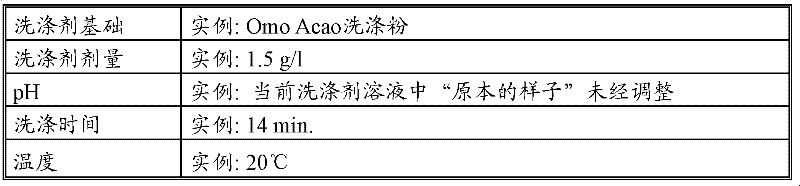

洗涤后将织物片用自来水冲洗并风干,使用Zeiss MCS 521VIS分光光度计在460nm处测量受试材料的好转。根据生产商的方案进行测量。After washing the fabric pieces were rinsed with tap water and air dried and the improvement of the test material was measured at 460nm using a Zeiss MCS 521VIS spectrophotometer. Measurements were performed according to the manufacturer's protocol.
根据如下定义,给出性能分值作为小型洗涤的结果:A performance score is given as a result of a small wash according to the following definitions:
性能分值(S)将受试酶变体的性能(P)概括为:The performance score (S) summarizes the performance (P) of the tested enzyme variant as:
S=2表明在所有三个浓度(5、10和30nM)下变体表现出优于参照物,和S=2 indicates that the variant outperforms the reference at all three concentrations (5, 10 and 30 nM), and
S=1表明在一个或两个浓度下变体表现出优于参照物。S=1 indicates that the variant outperforms the reference at one or two concentrations.
性能分值高于1表明较好的洗涤性能。A performance score higher than 1 indicates better wash performance.
如果在至少一种洗涤剂组合物中表现出优于参照物,则认为变体显示改良的洗涤性能。A variant is considered to exhibit improved wash performance if it exhibits an advantage over the reference in at least one detergent composition.
如实施例2所示构建了下列RP-II变体,以根据实施例3进行纯化,并根据上述方法进行测试:The following RP-II variants were constructed as shown in Example 2 for purification according to Example 3 and tested as described above:
离子结合修饰:Ion binding modification:
D7E;D7Q;H144R;D161R;D161K;D7E; D7Q; H144R; D161R; D161K;
H144Q+D161RH144Q+D161R
活动性修饰:Active modification:
G30A;G91AG30A; G91A
Cys桥形成:Cys bridge formation:
S145C+T128CS145C+T128C
表面电荷修饰:Surface charge modification:
D7N,S,T;Y17R,K,H;Y95R,K,H;T109R,K,H;Q143R,K,H;Q174R,K,H;E209Q,N;N216R,K,HD7N, S, T; Y17R, K, H; Y95R, K, H; T109R, K, H; Q143R, K, H; Q174R, K, H; E209Q, N; N216R, K, H
脯氨酸稳定性:Proline Stability:
T60P;S221P;G193P;V194PT60P; S221P; G193P; V194P
实施例5:Example 5:
修饰酶的贮藏稳定性Storage Stability of Modified Enzymes
通过在规律的时间间隔内测量亲本和变体的“残余活性”,确定本发明变体的贮藏稳定性。贮藏稳定性通常表达为半衰期T1/2,活性为最初值一半时所流逝的时间。The storage stability of the variants of the invention is determined by measuring the "residual activity" of the parent and the variant at regular time intervals. Storage stability is usually expressed as the half-life T 1/2 , the time elapsed at which the activity is half of its original value.
残余活性=(在t=i时的活性)/((在t=0时的活性)×100)%Residual activity=(activity at t=i)/((activity at t=0)×100)%
蛋白水解活性根据上述方法(PNA试验)测量。Proteolytic activity was measured according to the method described above (PNA assay).
实施例6:Embodiment 6:
修饰酶的热稳定性Modifying the thermostability of enzymes
本发明蛋白酶变体的热稳定性通过差示扫描量热法(DSC)测定,加热速率在含大约2mg/ml变体的溶液中一般为每分钟0.5℃。The thermal stability of the protease variants of the invention is determined by differential scanning calorimetry (DSC) at a heating rate of typically 0.5° C. per minute in solutions containing about 2 mg/ml of the variant.
实施例7:Embodiment 7:
修饰酶的自我水解稳定性Self-hydrolytic stability of modified enzymes
对比发酵实验Comparative fermentation experiment
在发酵实验中将本发明的RP-II变体与亲本RP-II蛋白酶进行比较。The RP-II variants of the invention were compared to the parent RP-II protease in fermentation experiments.
将变体和亲本都克隆到pNM1008表达载体背景中并在适当的培养基中进行发酵。Both the variant and parent were cloned into the pNM1008 expression vector background and fermented in appropriate media.
发酵5天后,将1.5ml发酵培养基进行离心,根据上述方法使用上清液测量蛋白水解活性(KPNU)。After 5 days of fermentation, 1.5 ml of the fermentation medium was centrifuged and the supernatant was used to measure the proteolytic activity (KPNU) according to the method described above.
认为与亲本的活性相比蛋白水解活性增加的变体具有相对于亲本的改良的自我水解稳定性。Variants with increased proteolytic activity compared to the activity of the parent are believed to have improved autohydrolytic stability relative to the parent.
实施例8:Embodiment 8:
修饰酶的氧化稳定性Modifying the Oxidative Stability of Enzymes
将变体在0.01M过乙酸中于50℃pH 7处理20分钟后,测试变体的氧化稳定性。使用亲本蛋白酶作为参照。The oxidative stability of the variants was tested after treatment of the variants in 0.01 M peracetic acid at 50 °
结果表示为热处理标本相对于未用氧化剂或热处理的标本的残余蛋白水解活性。Results are expressed as residual proteolytic activity of heat-treated specimens relative to specimens not treated with oxidizing agent or heat.
附录1
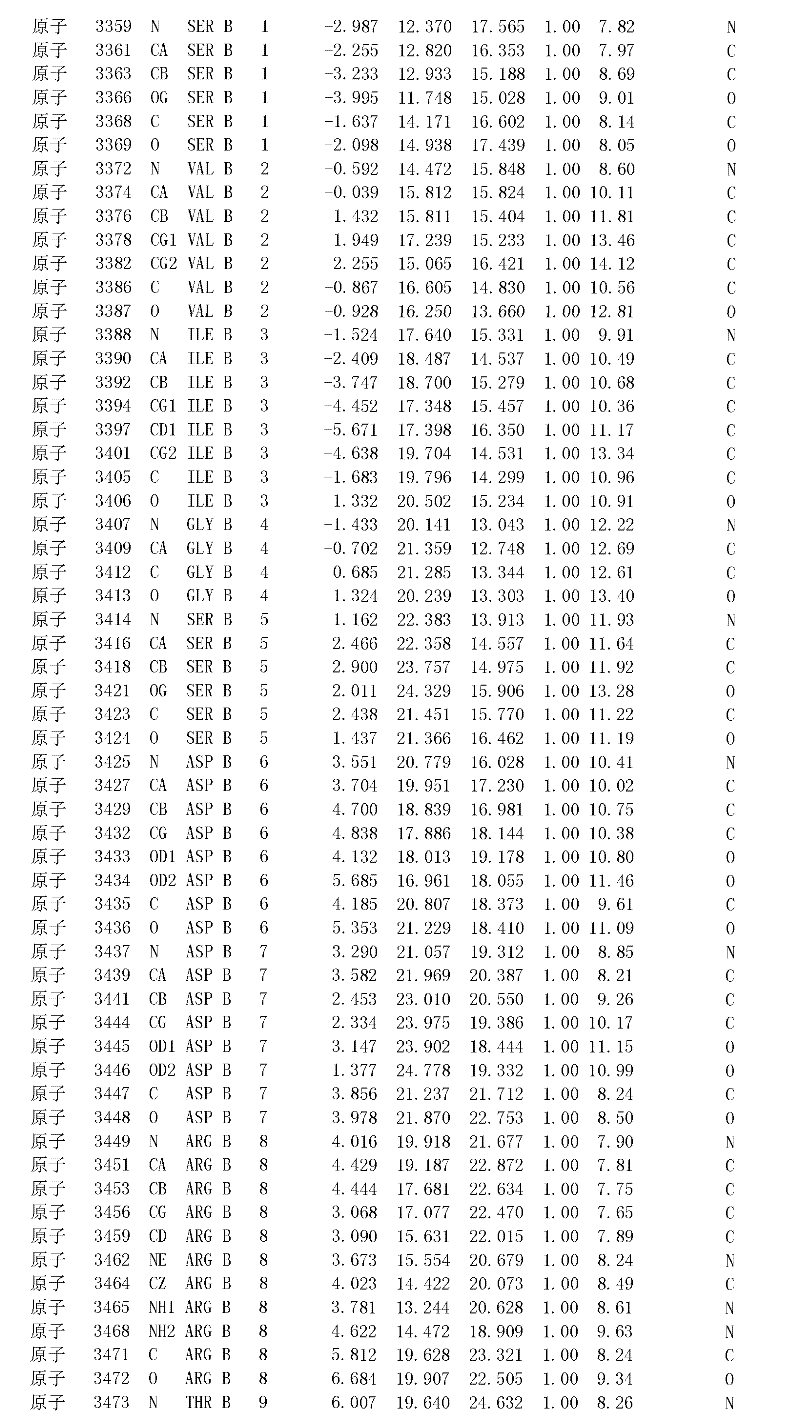


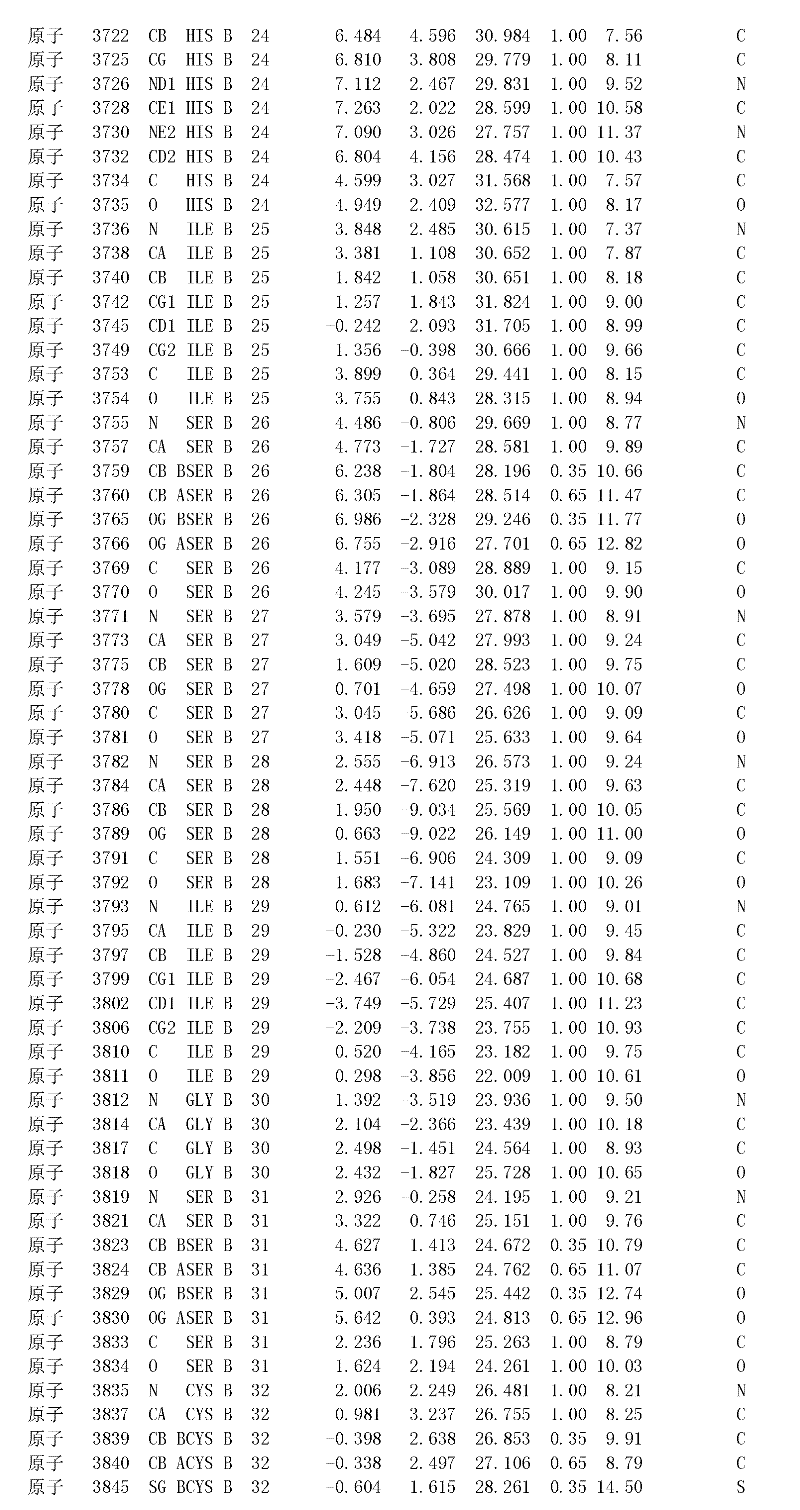

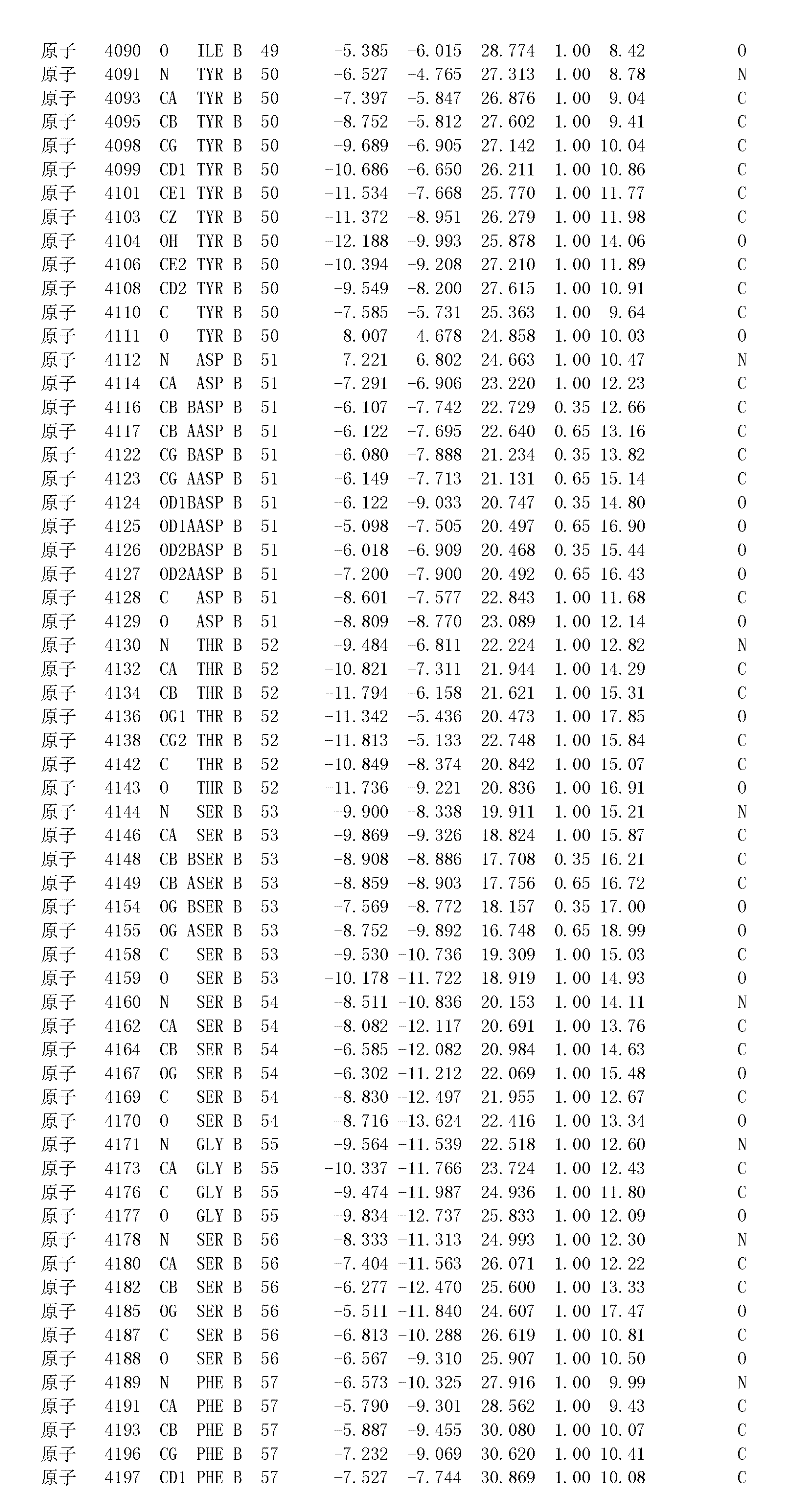

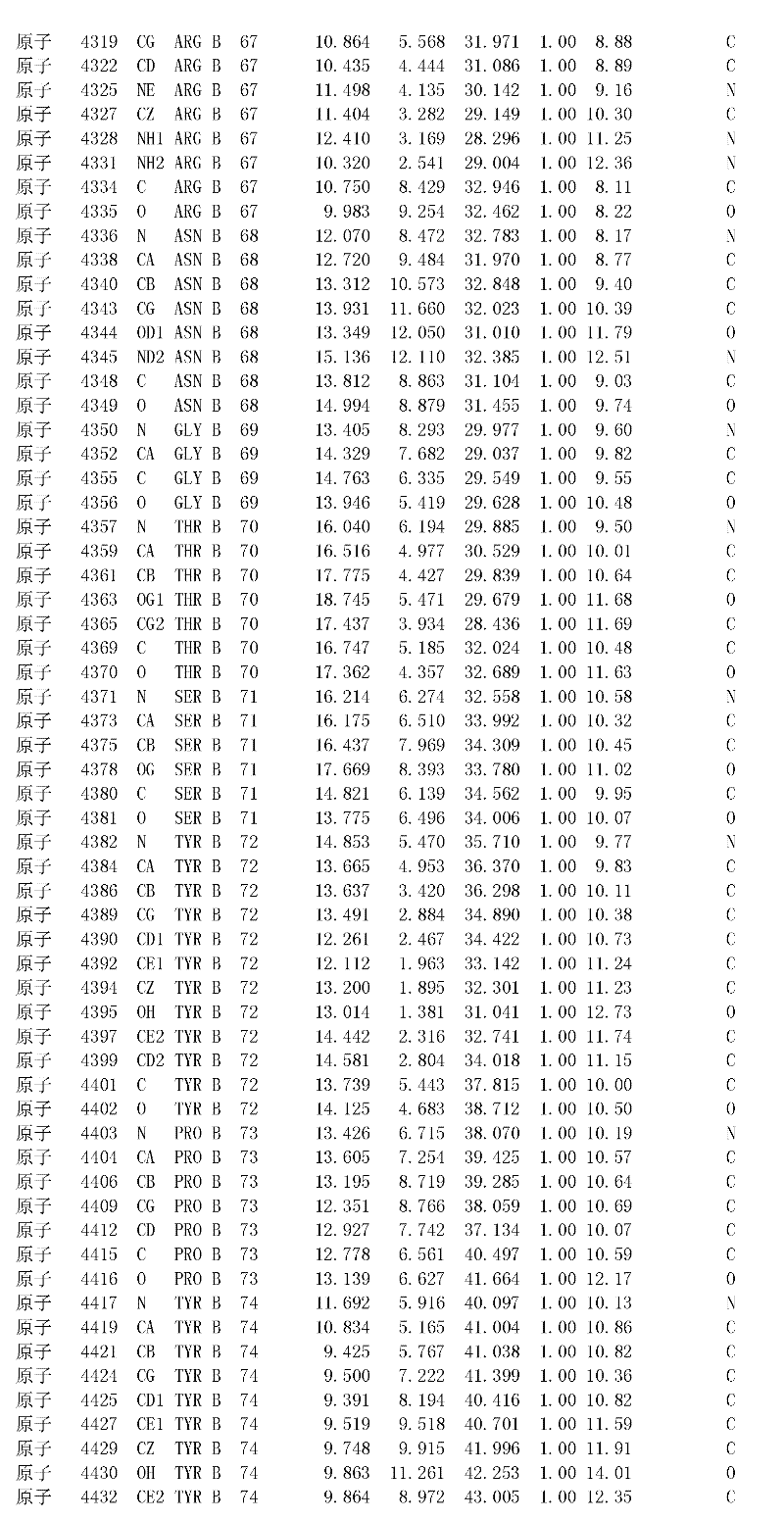

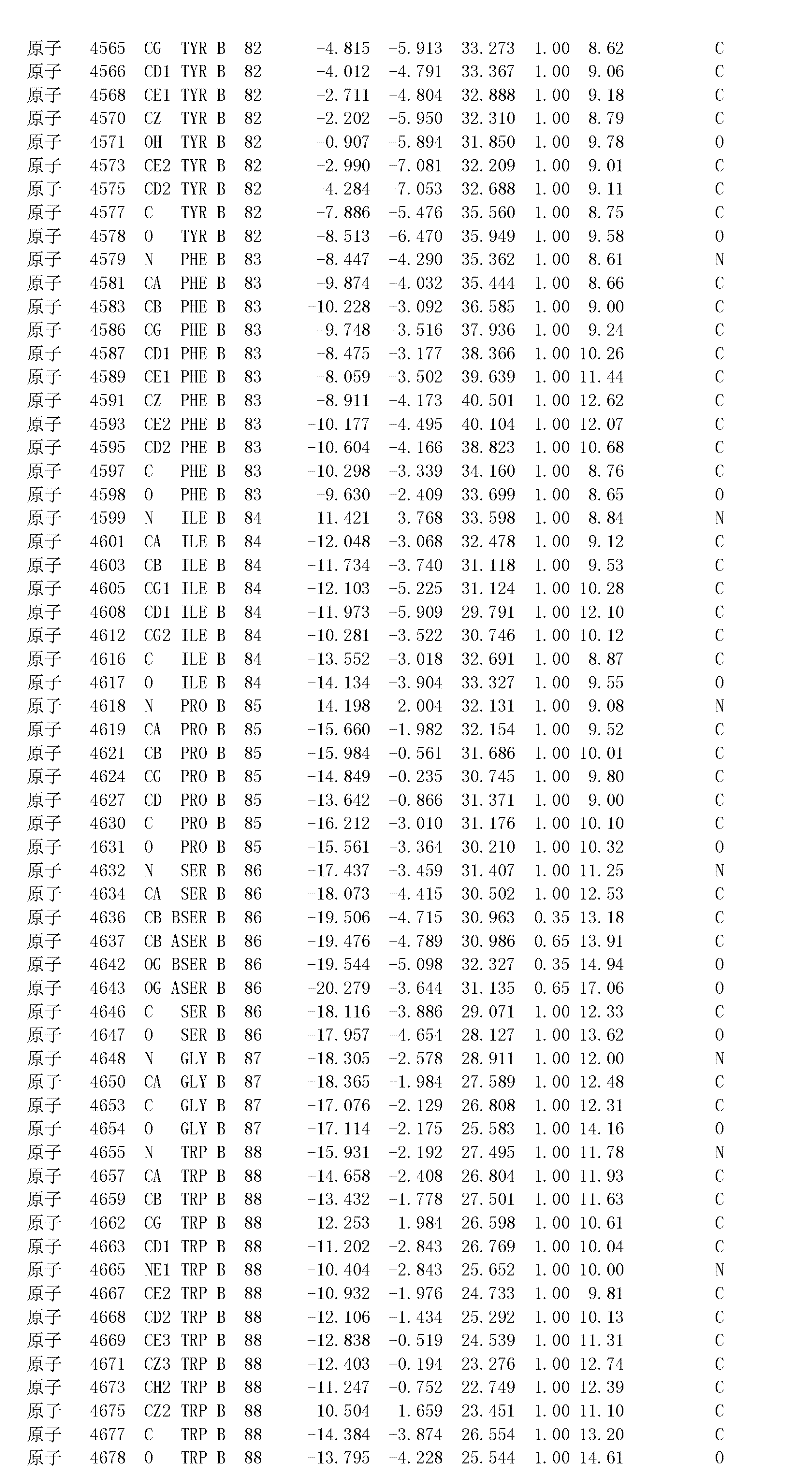

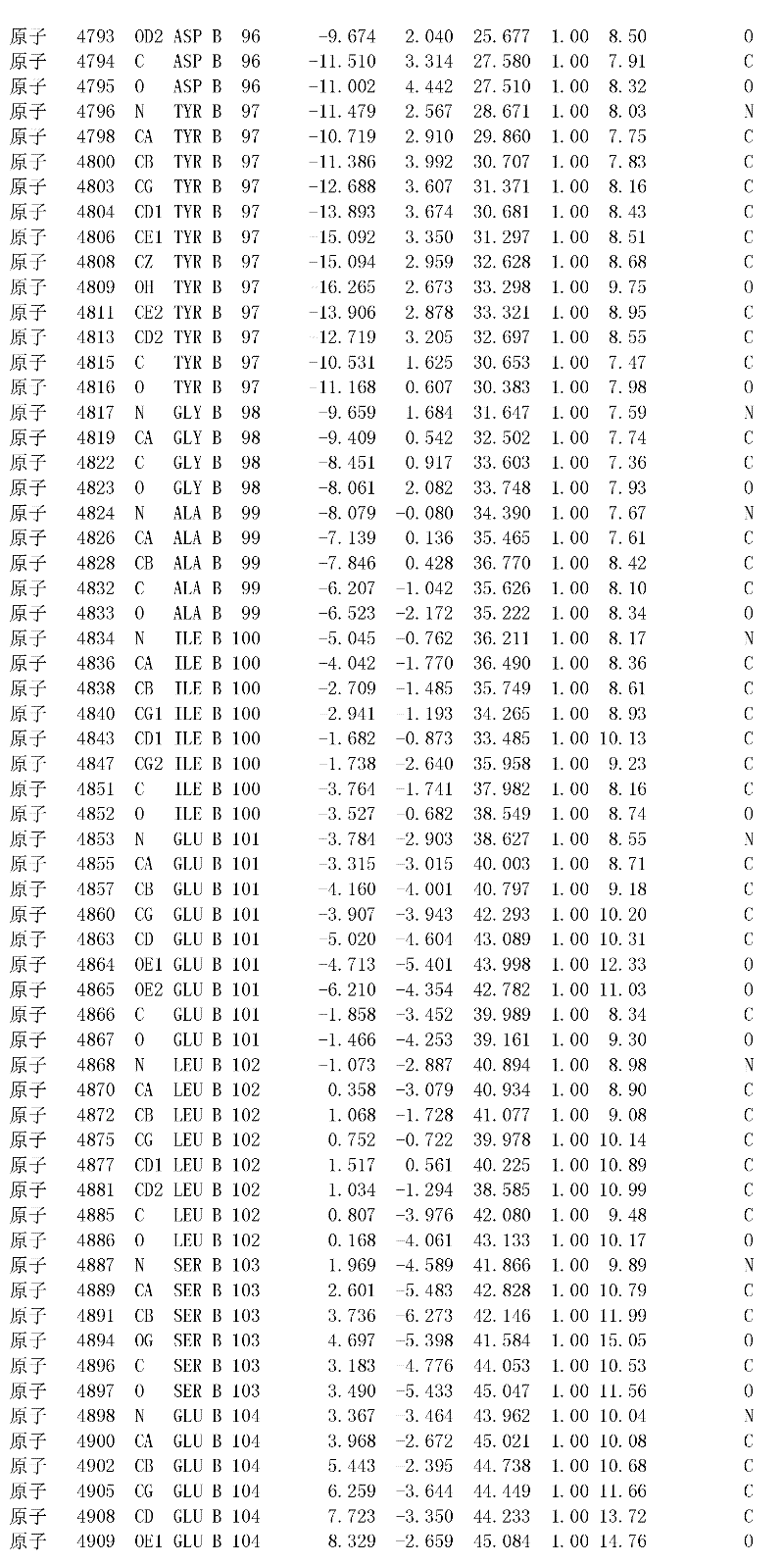
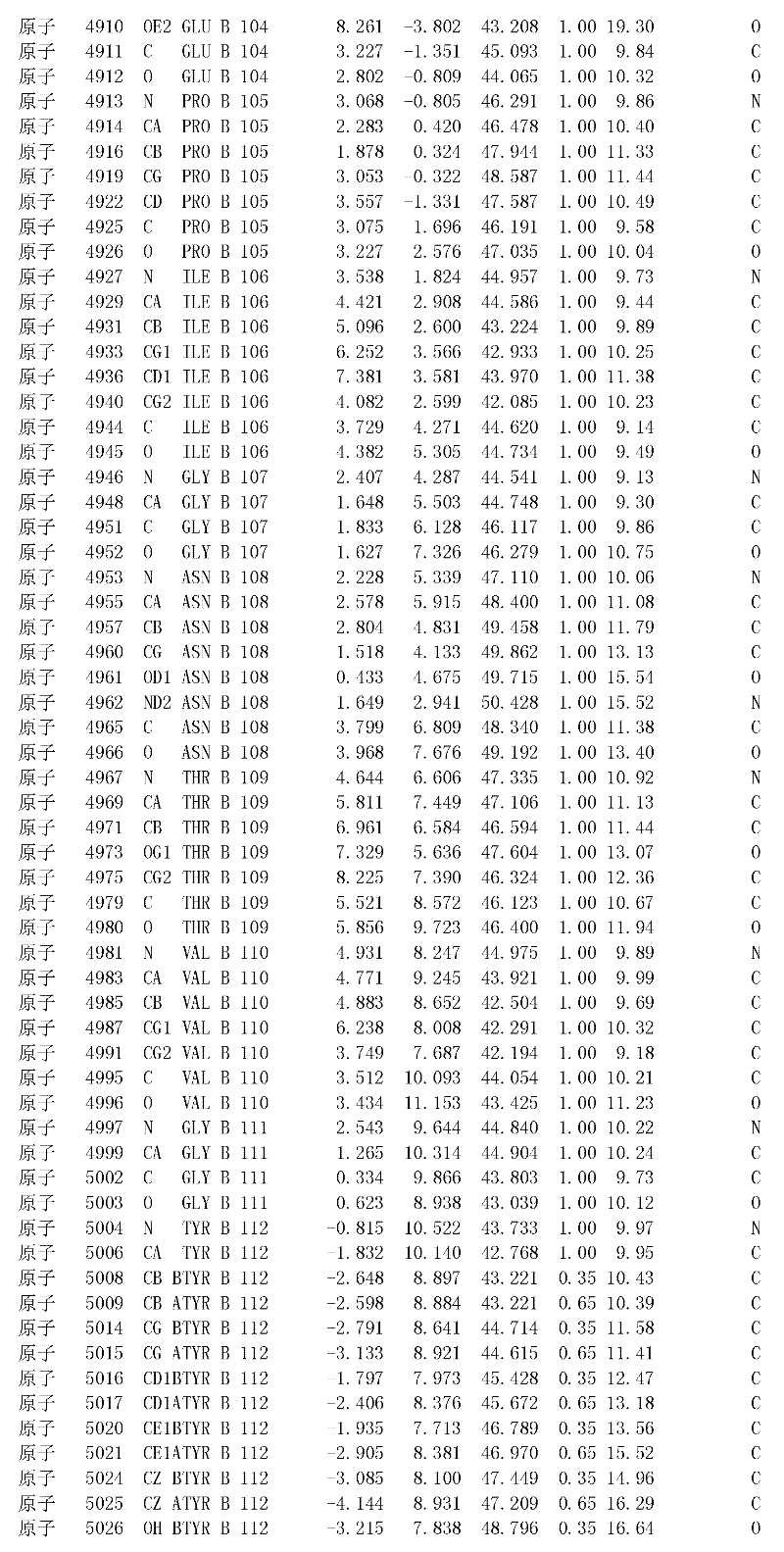


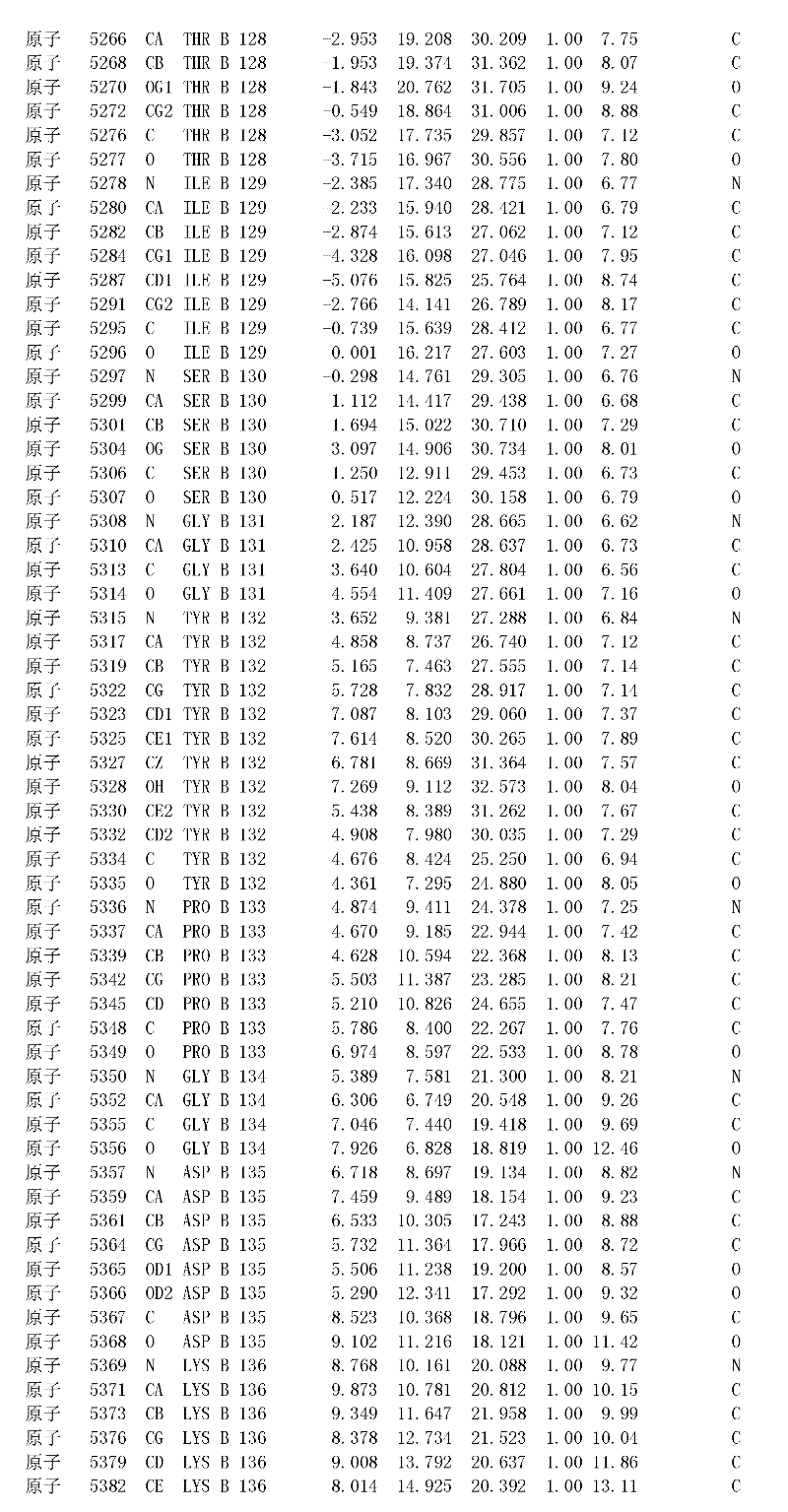

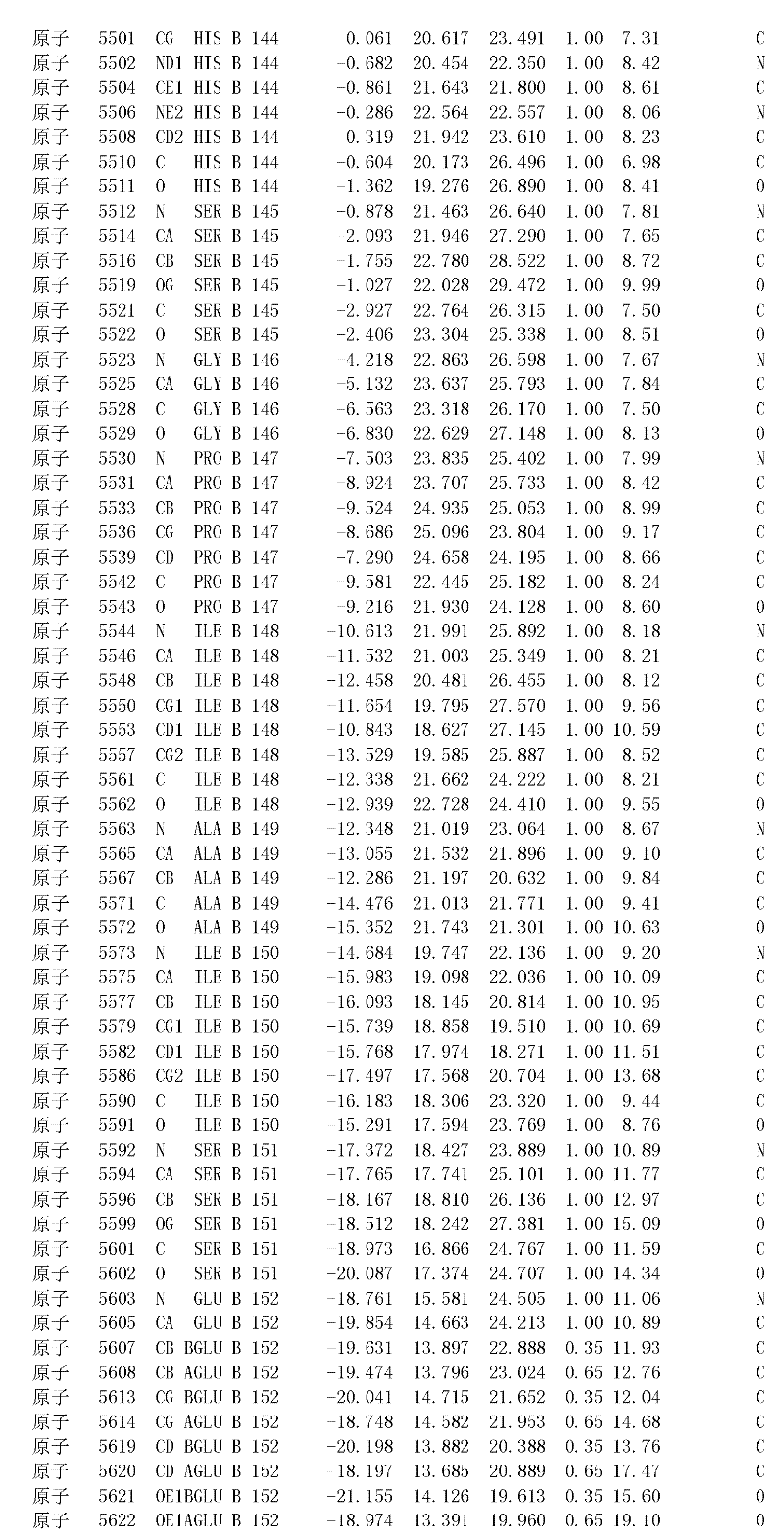


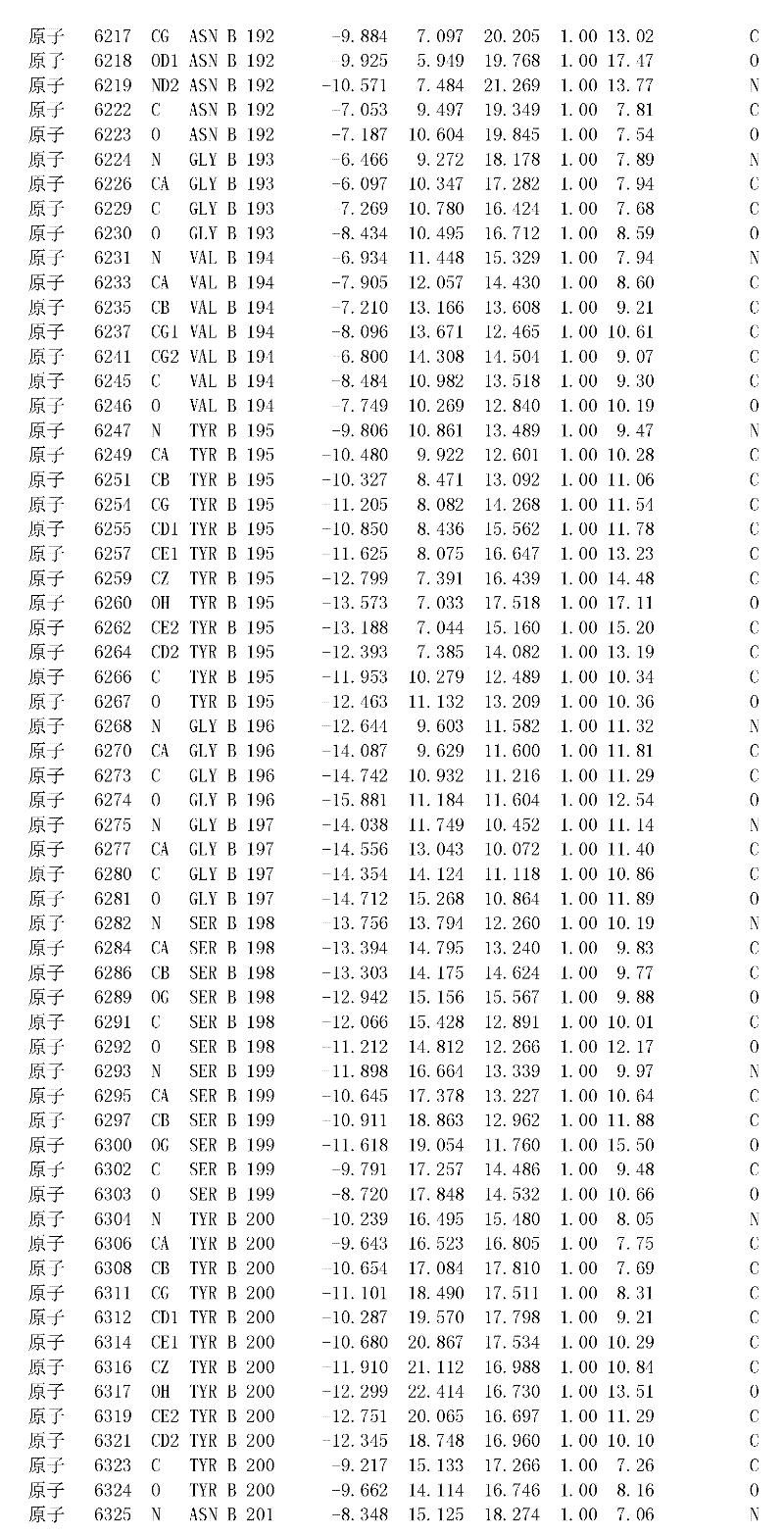
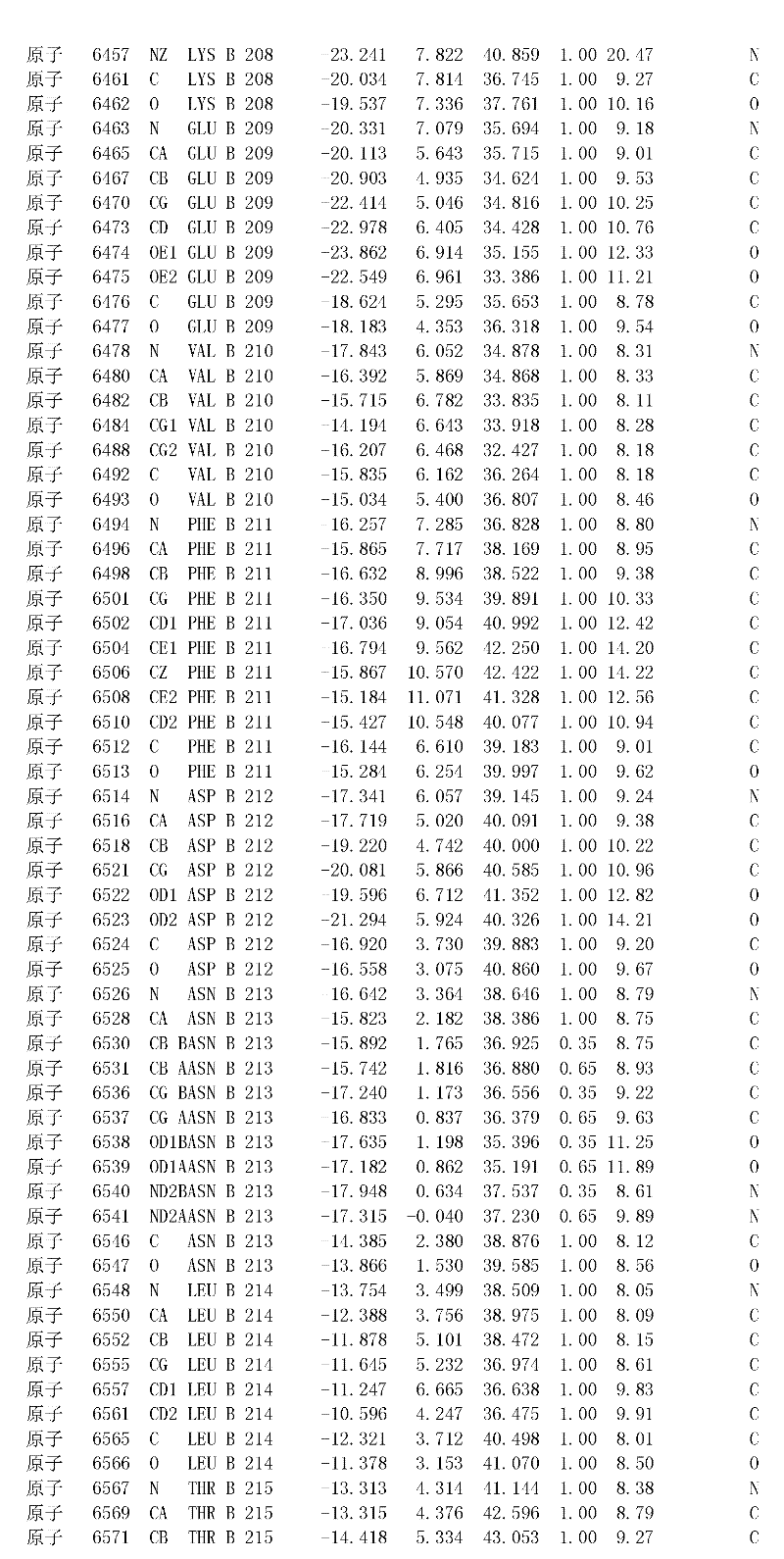
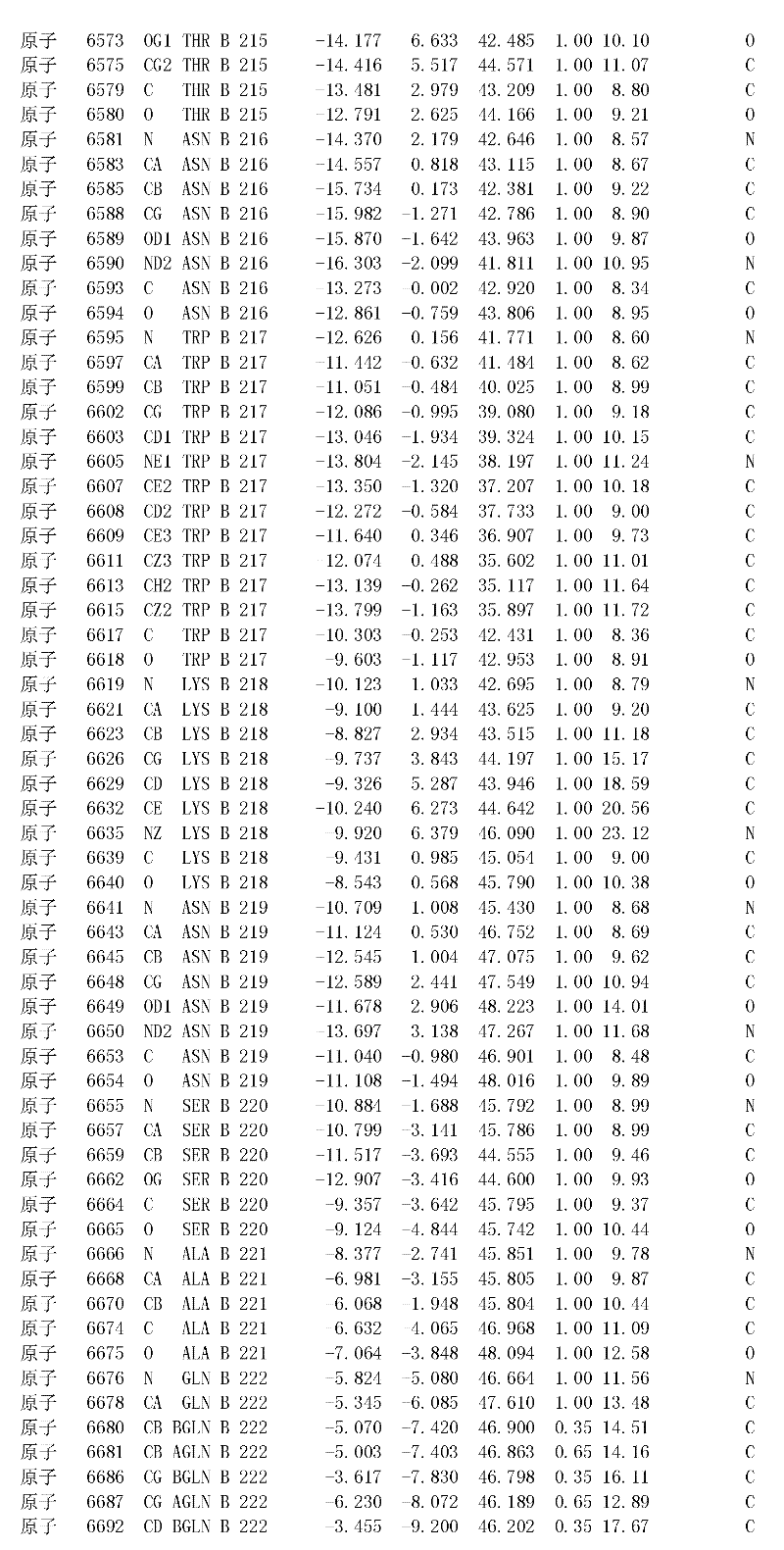
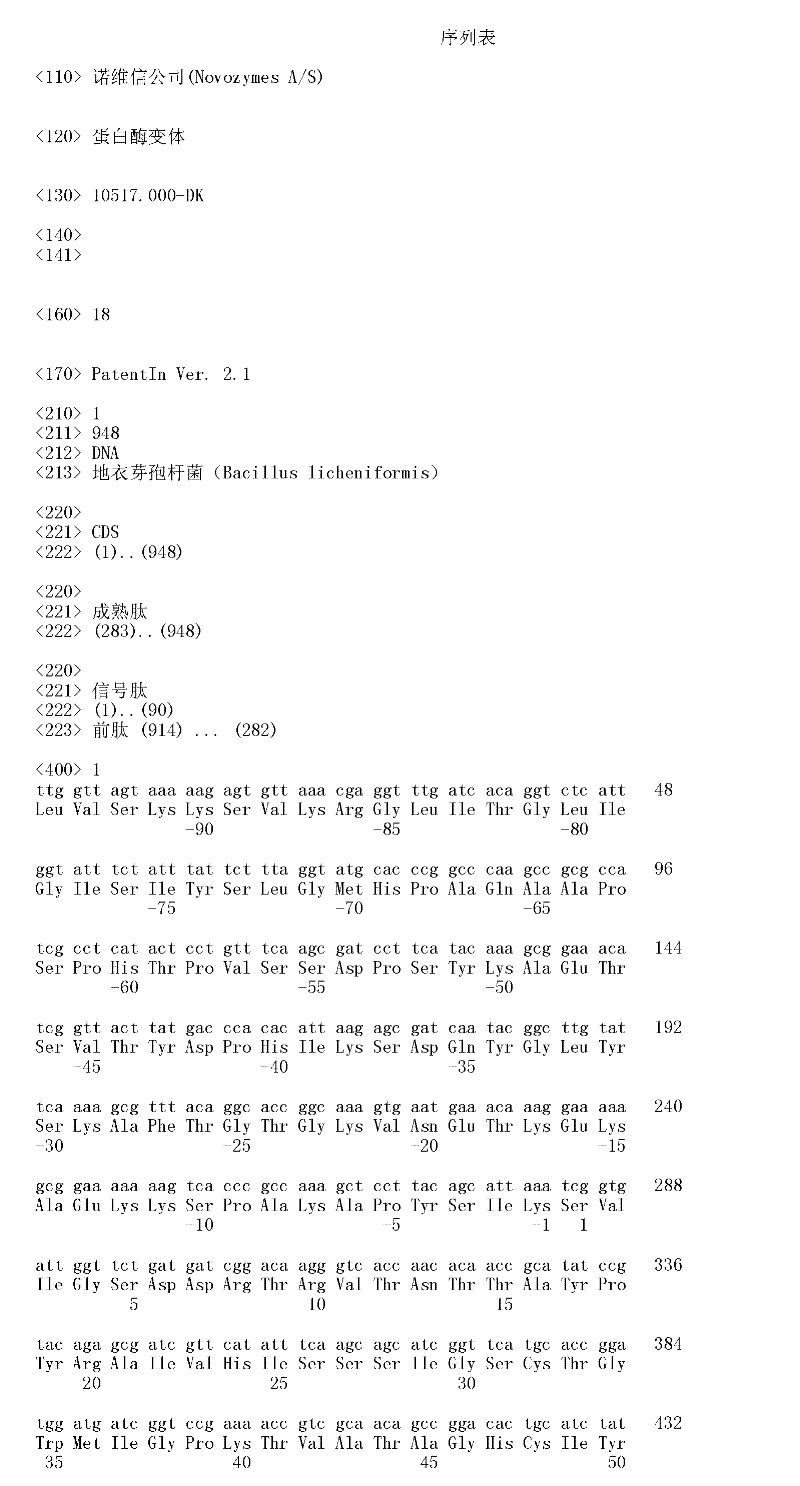

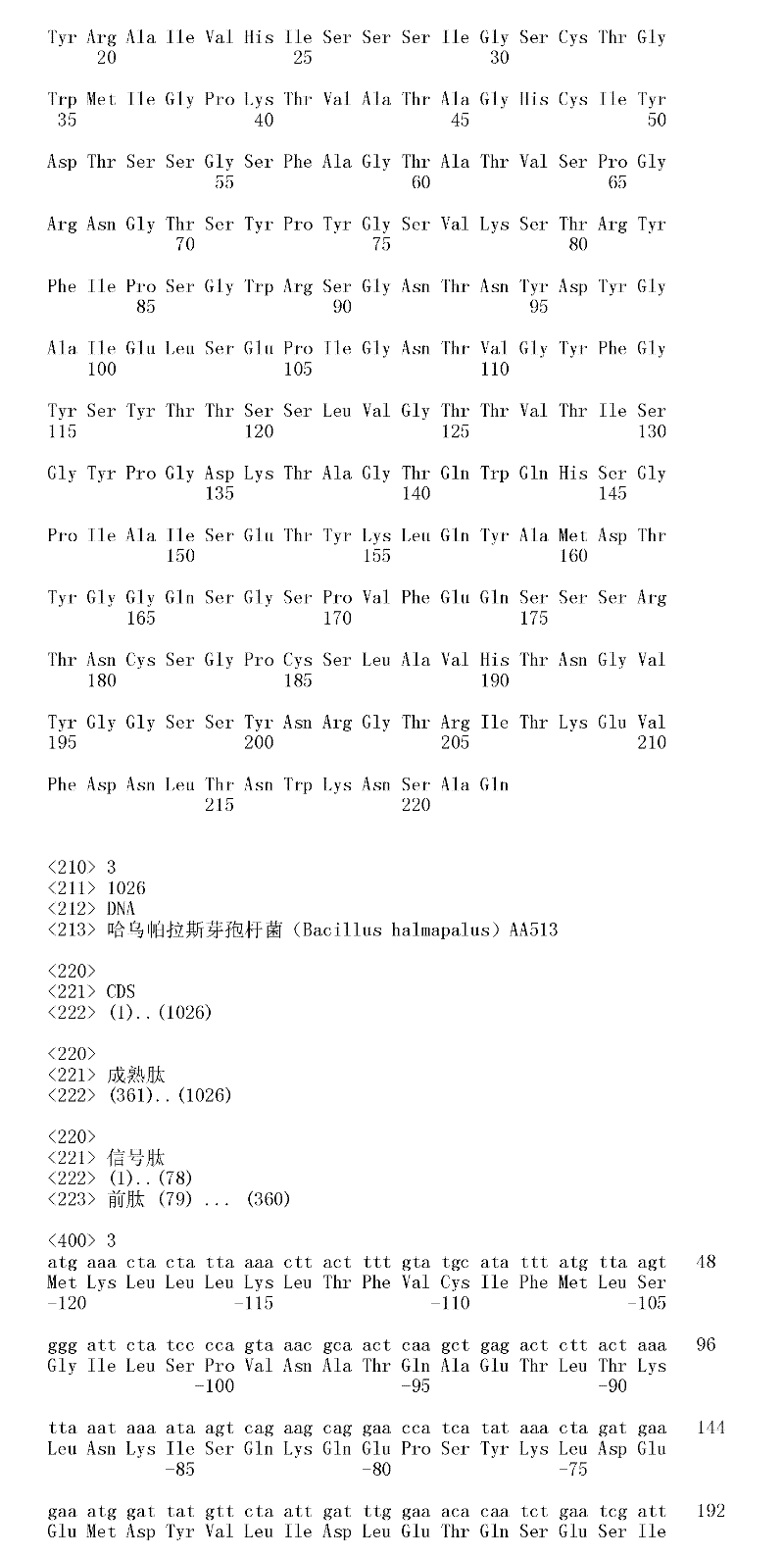


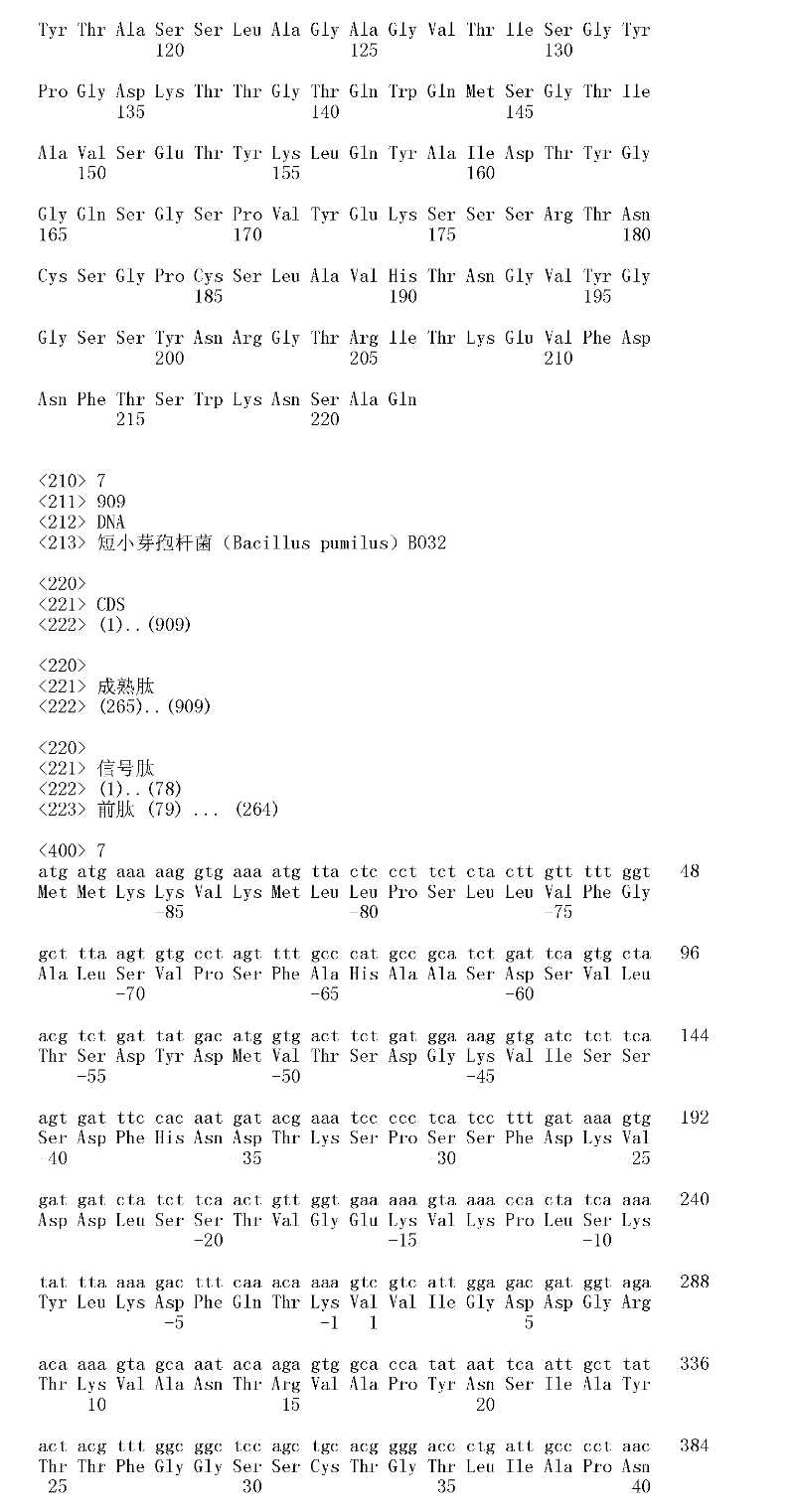


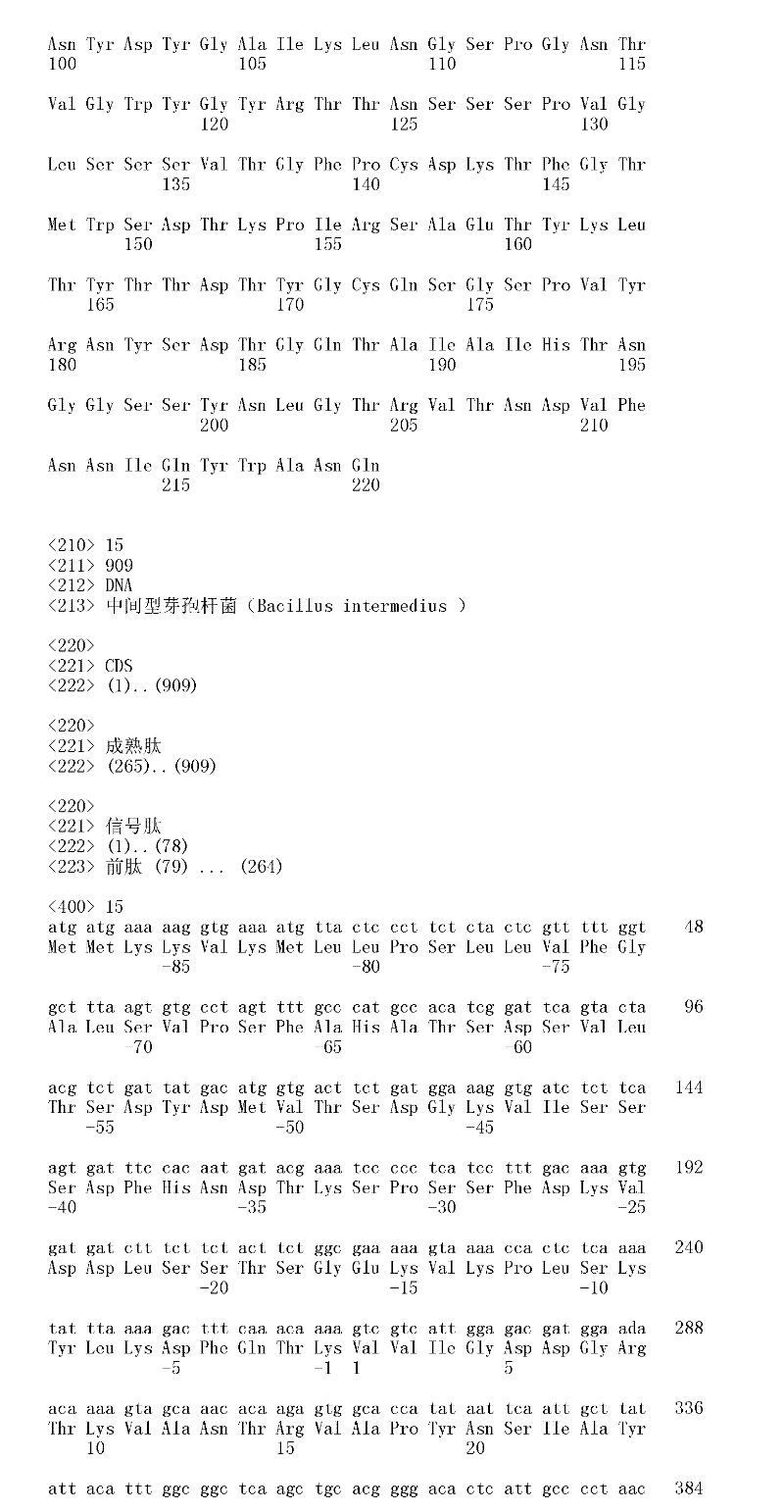
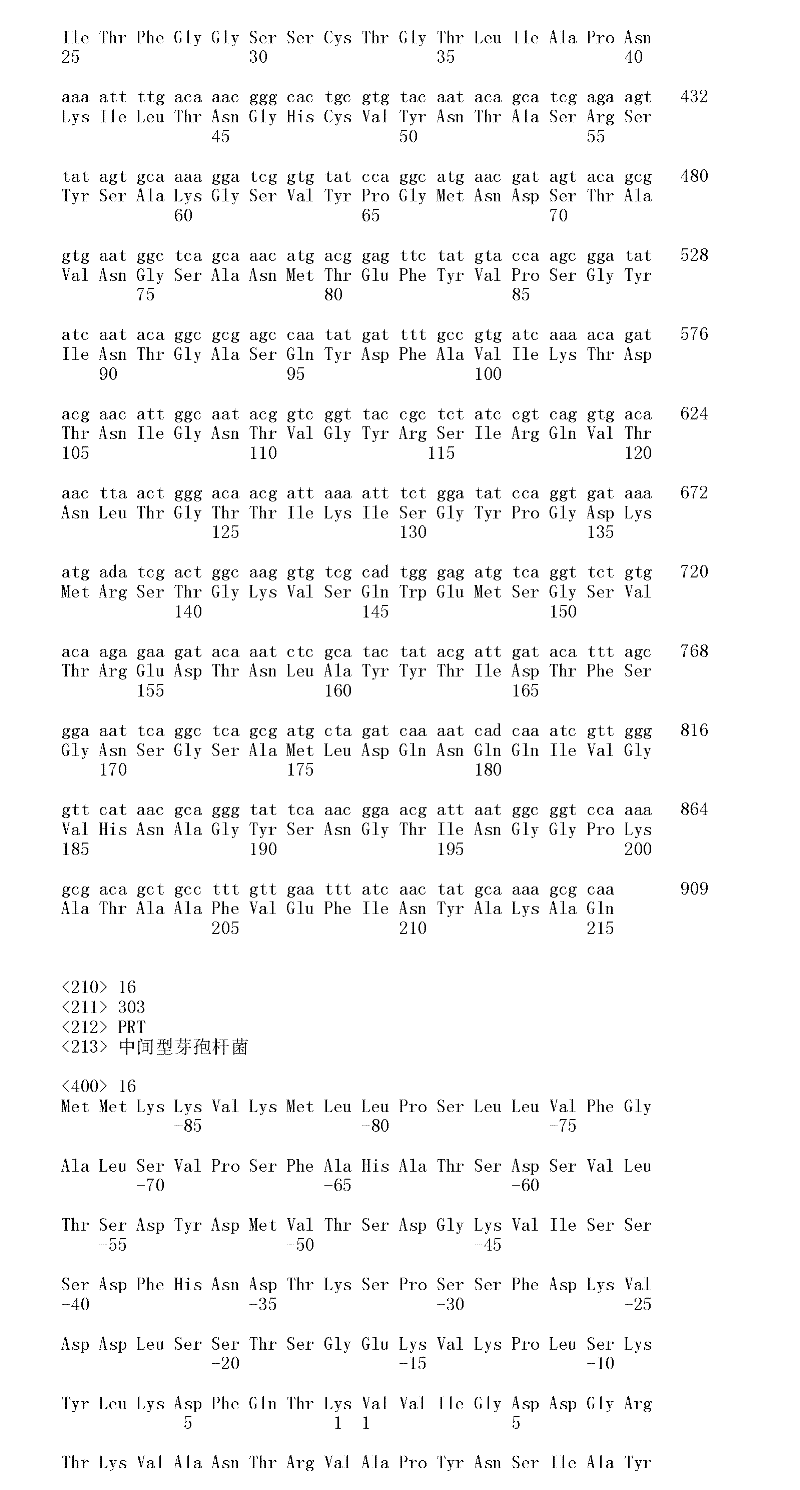

Claims (23)


Applications Claiming Priority (2)
| Application Number | Priority Date | Filing Date | Title |
|---|---|---|---|
| DKPA200400226 | 2004-02-13 | ||
| DKPA200400226 | 2004-02-13 |
Related Parent Applications (1)
| Application Number | Title | Priority Date | Filing Date |
|---|---|---|---|
| CN2005800109412A Division CN1942584B (en) | 2004-02-13 | 2005-02-14 | Protease variants |
Publications (1)
| Publication Number | Publication Date |
|---|---|
| CN102250861A true CN102250861A (en) | 2011-11-23 |
Family
ID=34854485
Family Applications (2)
| Application Number | Title | Priority Date | Filing Date |
|---|---|---|---|
| CN2011101376244A Pending CN102250861A (en) | 2004-02-13 | 2005-02-14 | Protease variants |
| CN2005800109412A Expired - Fee Related CN1942584B (en) | 2004-02-13 | 2005-02-14 | Protease variants |
Family Applications After (1)
| Application Number | Title | Priority Date | Filing Date |
|---|---|---|---|
| CN2005800109412A Expired - Fee Related CN1942584B (en) | 2004-02-13 | 2005-02-14 | Protease variants |
Country Status (5)
| Country | Link |
|---|---|
| US (2) | US20070281332A1 (en) |
| EP (3) | EP2325318A1 (en) |
| JP (1) | JP2007521823A (en) |
| CN (2) | CN102250861A (en) |
| WO (1) | WO2005078074A2 (en) |
Cited By (2)
| Publication number | Priority date | Publication date | Assignee | Title |
|---|---|---|---|---|
| CN105358685A (en) * | 2013-07-29 | 2016-02-24 | 诺维信公司 | Protease variants and polynucleotides encoding same |
| CN105358686A (en) * | 2013-07-29 | 2016-02-24 | 诺维信公司 | Protease variants and polynucleotides encoding same |
Families Citing this family (17)
| Publication number | Priority date | Publication date | Assignee | Title |
|---|---|---|---|---|
| WO2001016285A2 (en) * | 1999-08-31 | 2001-03-08 | Novozymes A/S | Novel proteases and variants thereof |
| JP5396270B2 (en) * | 2006-06-02 | 2014-01-22 | プレジデント アンド フェロウズ オブ ハーバード カレッジ | Protein surface remodeling |
| EP2030015B1 (en) | 2006-06-02 | 2016-02-17 | President and Fellows of Harvard College | Protein surface remodeling |
| NZ577510A (en) * | 2006-12-20 | 2012-06-29 | Danisco | Milk protein hydrolyzates with reduced immunogenic potential |
| AU2008334945C1 (en) | 2007-12-13 | 2013-09-05 | Danisco Us Inc. | Compositions and methods for producing isoprene |
| AU2009240505B2 (en) | 2008-04-23 | 2013-09-05 | Danisco Us Inc. | Isoprene synthase variants for improved microbial production of isoprene |
| AU2010238770A1 (en) * | 2009-04-23 | 2011-11-03 | Danisco Us Inc. | Three-dimensional structure of isoprene synthase and its use thereof for generating variants |
| EP2424877A4 (en) | 2009-04-28 | 2013-01-02 | Harvard College | SUPERCHARGED PROTEINS FOR CELL PENETRATION |
| CA2816306A1 (en) | 2010-10-27 | 2012-05-03 | Danisco Us Inc. | Isoprene synthase variants for improved production of isoprene |
| US9163263B2 (en) | 2012-05-02 | 2015-10-20 | The Goodyear Tire & Rubber Company | Identification of isoprene synthase variants with improved properties for the production of isoprene |
| US11306328B2 (en) | 2013-07-26 | 2022-04-19 | President And Fellows Of Harvard College | Genome engineering |
| US10402358B2 (en) * | 2014-09-30 | 2019-09-03 | Honeywell International Inc. | Module auto addressing in platform bus |
| CN104561075A (en) * | 2014-11-13 | 2015-04-29 | 广东省微生物研究所 | Bacillus licheniformis for recombinant expression of glutamate-specific endopeptidase and construction method of bacillus licheniformis |
| CA3088793A1 (en) | 2018-02-06 | 2019-08-15 | Novozymes Bioag A/S | Methods of protecting a plant from fungal pests |
| EP4525615A2 (en) | 2022-05-14 | 2025-03-26 | Novozymes A/S | Compositions and methods for preventing, treating, supressing and/or eliminating phytopathogenic infestations and infections |
| CN121420051A (en) * | 2023-07-07 | 2026-01-27 | 诺维信公司 | Washing methods for removing protein stains |
| WO2026017381A1 (en) | 2024-07-17 | 2026-01-22 | Novozymes A/S | Optimized bacillus host cells |
Family Cites Families (88)
| Publication number | Priority date | Publication date | Assignee | Title |
|---|---|---|---|---|
| US53711A (en) | 1866-04-03 | Improvement in the construction of pulleys | ||
| GB1296839A (en) | 1969-05-29 | 1972-11-22 | ||
| GB1372034A (en) | 1970-12-31 | 1974-10-30 | Unilever Ltd | Detergent compositions |
| GB1483591A (en) | 1973-07-23 | 1977-08-24 | Novo Industri As | Process for coating water soluble or water dispersible particles by means of the fluid bed technique |
| GB1590432A (en) | 1976-07-07 | 1981-06-03 | Novo Industri As | Process for the production of an enzyme granulate and the enzyme granuate thus produced |
| FR2430453B1 (en) | 1978-07-04 | 1986-04-18 | Novo Industri As | PROTEASTIC PRODUCT WITH REDUCED ALLERGIZING POWER |
| US4288627A (en) | 1980-02-12 | 1981-09-08 | Phillips Petroleum Company | Oxidation of thiols employing cobalt molybdate/triethylamine catalyst |
| DK187280A (en) | 1980-04-30 | 1981-10-31 | Novo Industri As | RUIT REDUCING AGENT FOR A COMPLETE LAUNDRY |
| US4599311A (en) | 1982-08-13 | 1986-07-08 | Kawasaki Glenn H | Glycolytic promotersfor regulated protein expression: protease inhibitor |
| US4745051A (en) | 1983-05-27 | 1988-05-17 | The Texas A&M University System | Method for producing a recombinant baculovirus expression vector |
| US4879236A (en) | 1984-05-16 | 1989-11-07 | The Texas A&M University System | Method for producing a recombinant baculovirus expression vector |
| DK263584D0 (en) | 1984-05-29 | 1984-05-29 | Novo Industri As | ENZYMOUS GRANULATES USED AS DETERGENT ADDITIVES |
| US4879231A (en) | 1984-10-30 | 1989-11-07 | Phillips Petroleum Company | Transformation of yeasts of the genus pichia |
| US4775624A (en) | 1985-02-08 | 1988-10-04 | Eli Lilly And Company | Vectors and compounds for expression of human protein C |
| JPH0697997B2 (en) | 1985-08-09 | 1994-12-07 | ギスト ブロカデス ナ−ムロ−ゼ フエンノ−トチヤツプ | New enzymatic detergent additive |
| US4882279A (en) | 1985-10-25 | 1989-11-21 | Phillips Petroleum Company | Site selective genomic modification of yeast of the genus pichia |
| AU607690B2 (en) | 1985-12-24 | 1991-03-14 | Marion Laboratories, Inc. | Use of synthetic sulfated saccharides to enhance wound healing |
| US4935349A (en) | 1986-01-17 | 1990-06-19 | Zymogenetics, Inc. | Expression of higher eucaryotic genes in aspergillus |
| EG18543A (en) | 1986-02-20 | 1993-07-30 | Albright & Wilson | Protected enzyme systems |
| DE3750450T2 (en) | 1986-08-29 | 1995-01-05 | Novo Industri As | Enzyme-based detergent additive. |
| NZ221627A (en) | 1986-09-09 | 1993-04-28 | Genencor Inc | Preparation of enzymes, modifications, catalytic triads to alter ratios or transesterification/hydrolysis ratios |
| DE3856593D1 (en) * | 1987-04-06 | 2007-10-04 | Novozymes As | Control of electrostatic interactions at metal ion binding sites to stabilize proteins |
| US4914031A (en) * | 1987-04-10 | 1990-04-03 | Amgen, Inc. | Subtilisin analogs |
| CA1309680C (en) | 1987-07-24 | 1992-11-03 | David Harano | Airlift insect cell culture |
| US5024947A (en) | 1987-07-24 | 1991-06-18 | Cetus Corporation | Serum free media for the growth on insect cells and expression of products thereby |
| EP0305216B1 (en) | 1987-08-28 | 1995-08-02 | Novo Nordisk A/S | Recombinant Humicola lipase and process for the production of recombinant humicola lipases |
| JPS6474992A (en) | 1987-09-16 | 1989-03-20 | Fuji Oil Co Ltd | Dna sequence, plasmid and production of lipase |
| DK6488D0 (en) | 1988-01-07 | 1988-01-07 | Novo Industri As | ENZYMES |
| DE68924654T2 (en) | 1988-01-07 | 1996-04-04 | Novonordisk As | Specific protease. |
| JP3079276B2 (en) | 1988-02-28 | 2000-08-21 | 天野製薬株式会社 | Recombinant DNA, Pseudomonas sp. Containing the same, and method for producing lipase using the same |
| JP2728531B2 (en) | 1988-03-24 | 1998-03-18 | ノボ ノルディスク アクティーゼルスカブ | Cellulase preparation |
| US5648263A (en) | 1988-03-24 | 1997-07-15 | Novo Nordisk A/S | Methods for reducing the harshness of a cotton-containing fabric |
| US5118623A (en) | 1988-05-27 | 1992-06-02 | Solvay Enzymes, Inc. | Bleach stable enzymes |
| CA2003078A1 (en) | 1988-11-18 | 1990-05-18 | Biotechnica International, Inc. | Protease deletion |
| GB8910962D0 (en) | 1989-05-12 | 1989-06-28 | Natural Environment Res | Novel baculovirus expression vectors and use thereof in the expression of foreign proteins in insects or insect cells |
| DK316989D0 (en) | 1989-06-26 | 1989-06-26 | Novo Nordisk As | ENZYMES |
| US5162222A (en) | 1989-07-07 | 1992-11-10 | Guarino Linda A | Use of baculovirus early promoters for expression of foreign genes in stably transformed insect cells or recombinant baculoviruses |
| GB8915658D0 (en) | 1989-07-07 | 1989-08-23 | Unilever Plc | Enzymes,their production and use |
| US5077214A (en) | 1989-07-07 | 1991-12-31 | The Texas A&M University System | Use of baculovirus early promoters for expression of foreign genes in stably transformed insect cells |
| US5155037A (en) | 1989-08-04 | 1992-10-13 | The Texas A&M University System | Insect signal sequences useful to improve the efficiency of processing and secretion of foreign genes in insect systems |
| DK63490D0 (en) | 1990-03-09 | 1990-03-09 | Novo Nordisk As | METHOD OF PRODUCING CHEESE |
| KR100236540B1 (en) | 1990-04-14 | 2000-01-15 | 레클로우크스 라우에르 | Alkaline bacillus lipases, coding dna sequences thereof and bacilli which produce these lipases |
| DK0531372T4 (en) | 1990-05-09 | 2004-08-09 | Novozymes As | Cellulase preparation comprising an endoglucanase enzyme |
| DK115890D0 (en) | 1990-05-09 | 1990-05-09 | Novo Nordisk As | ENZYME |
| AU657278B2 (en) | 1990-09-13 | 1995-03-09 | Novo Nordisk A/S | Lipase variants |
| JP3046344B2 (en) * | 1990-10-24 | 2000-05-29 | 塩野義製薬株式会社 | New protease |
| ES2174820T3 (en) | 1991-01-16 | 2002-11-16 | Procter & Gamble | COMPOSITIONS OF COMPACT DETERGENTS WITH HIGH ACTIVITY CELL. |
| CZ285148B6 (en) | 1991-04-30 | 1999-05-12 | The Procter And Gamble Company | Liquid detergent mixture |
| EP0511456A1 (en) | 1991-04-30 | 1992-11-04 | The Procter & Gamble Company | Liquid detergents with aromatic borate ester to inhibit proteolytic enzyme |
| ES2121014T3 (en) | 1991-05-01 | 1998-11-16 | Novo Nordisk As | STABILIZED ENZYMES AND DETERGENT COMPOSITIONS. |
| DK72992D0 (en) | 1992-06-01 | 1992-06-01 | Novo Nordisk As | ENZYME |
| DK88892D0 (en) | 1992-07-06 | 1992-07-06 | Novo Nordisk As | CONNECTION |
| WO1994002597A1 (en) | 1992-07-23 | 1994-02-03 | Novo Nordisk A/S | MUTANT α-AMYLASE, DETERGENT, DISH WASHING AGENT, AND LIQUEFACTION AGENT |
| ATE262035T1 (en) | 1992-10-06 | 2004-04-15 | Novozymes As | CELLULOSE VARIANTS |
| PT867504E (en) | 1993-02-11 | 2003-08-29 | Genencor Int | ALPHA-AMYLASE ESTABLISHING OXIDACAO |
| KR950702240A (en) | 1993-04-27 | 1995-06-19 | 한스 발터 라벤 | New lipase variant for use as a detergent |
| DK52393D0 (en) | 1993-05-05 | 1993-05-05 | Novo Nordisk As | |
| JP2859520B2 (en) | 1993-08-30 | 1999-02-17 | ノボ ノルディスク アクティーゼルスカブ | Lipase, microorganism producing the same, method for producing lipase, and detergent composition containing lipase |
| US5817495A (en) | 1993-10-13 | 1998-10-06 | Novo Nordisk A/S | H2 O2 -stable peroxidase variants |
| JPH07143883A (en) | 1993-11-24 | 1995-06-06 | Showa Denko Kk | Lipase gene and mutant lipase |
| DE69527835T2 (en) | 1994-02-22 | 2003-04-10 | Novozymes A/S, Bagsvaerd | METHOD FOR PRODUCING A VARIANT OF A LIPOLYTIC ENZYME |
| DE69536145D1 (en) | 1994-03-08 | 2011-04-07 | Novozymes As | Novel alkaline cellulases |
| WO1995030744A2 (en) | 1994-05-04 | 1995-11-16 | Genencor International Inc. | Lipases with improved surfactant resistance |
| WO1995035381A1 (en) | 1994-06-20 | 1995-12-28 | Unilever N.V. | Modified pseudomonas lipases and their use |
| AU2884695A (en) | 1994-06-23 | 1996-01-19 | Unilever Plc | Modified pseudomonas lipases and their use |
| DE69535733T2 (en) | 1994-10-06 | 2009-04-23 | Novozymes A/S | An enzymatic with endoglucanase activity |
| BE1008998A3 (en) | 1994-10-14 | 1996-10-01 | Solvay | Lipase, microorganism producing the preparation process for the lipase and uses thereof. |
| US5827719A (en) | 1994-10-26 | 1998-10-27 | Novo Nordisk A/S | Enzyme with lipolytic activity |
| AR000862A1 (en) | 1995-02-03 | 1997-08-06 | Novozymes As | VARIANTS OF A MOTHER-AMYLASE, A METHOD TO PRODUCE THE SAME, A DNA STRUCTURE AND A VECTOR OF EXPRESSION, A CELL TRANSFORMED BY SUCH A DNA STRUCTURE AND VECTOR, A DETERGENT ADDITIVE, DETERGENT COMPOSITION, A COMPOSITION FOR AND A COMPOSITION FOR THE ELIMINATION OF |
| JPH08228778A (en) | 1995-02-27 | 1996-09-10 | Showa Denko Kk | Novel lipase gene and method for producing lipase using the same |
| CN102080070B (en) | 1995-03-17 | 2016-01-20 | 诺沃奇梅兹有限公司 | new endoglucanase |
| US6682924B1 (en) * | 1995-05-05 | 2004-01-27 | Novozymes A/S | Protease variants and compositions |
| ATE429490T1 (en) | 1995-05-05 | 2009-05-15 | Novozymes As | PROTEASE VARIANTS AND COMPOUNDS |
| EP0839186B1 (en) | 1995-07-14 | 2004-11-10 | Novozymes A/S | A modified enzyme with lipolytic activity |
| AU6655196A (en) | 1995-08-11 | 1997-03-12 | Novo Nordisk A/S | Novel lipolytic enzymes |
| US5763385A (en) | 1996-05-14 | 1998-06-09 | Genencor International, Inc. | Modified α-amylases having altered calcium binding properties |
| AU3938997A (en) | 1996-08-26 | 1998-03-19 | Novo Nordisk A/S | A novel endoglucanase |
| EP1726644A1 (en) * | 1996-09-17 | 2006-11-29 | Novozymes A/S | Cellulase variants |
| WO1998015257A1 (en) | 1996-10-08 | 1998-04-16 | Novo Nordisk A/S | Diaminobenzoic acid derivatives as dye precursors |
| EP0932667B1 (en) | 1996-11-04 | 2008-10-01 | Novozymes A/S | Subtilase variants and compositions |
| JP4044143B2 (en) | 1996-11-04 | 2008-02-06 | ノボザイムス アクティーゼルスカブ | Subtilase variants and compositions |
| WO1998034946A1 (en) | 1997-02-12 | 1998-08-13 | Massachusetts Institute Of Technology | Daxx, a novel fas-binding protein that activates jnk and apoptosis |
| AR015977A1 (en) | 1997-10-23 | 2001-05-30 | Genencor Int | PROTEASA VARIANTS MULTIPLY SUBSTITUTED WITH ALTERED NET LOAD FOR USE IN DETERGENTS |
| WO2001016285A2 (en) * | 1999-08-31 | 2001-03-08 | Novozymes A/S | Novel proteases and variants thereof |
| US6558939B1 (en) * | 1999-08-31 | 2003-05-06 | Novozymes, A/S | Proteases and variants thereof |
| US6350599B1 (en) | 2000-01-12 | 2002-02-26 | Novozymes A/S | Pullulanase variants and methods for preparing such variants with predetermined properties |
| AU2002223020B2 (en) | 2000-11-27 | 2006-07-06 | Novozymes A/S | Automated mechanical stress assay for screening cleaning ingredients |
| EP1995319B1 (en) * | 2002-04-10 | 2011-08-31 | Novozymes A/S | Bacillus licheniformis mutant host cell |
-
2005
- 2005-02-14 CN CN2011101376244A patent/CN102250861A/en active Pending
- 2005-02-14 US US10/588,555 patent/US20070281332A1/en not_active Abandoned
- 2005-02-14 CN CN2005800109412A patent/CN1942584B/en not_active Expired - Fee Related
- 2005-02-14 EP EP10180123A patent/EP2325318A1/en not_active Ceased
- 2005-02-14 WO PCT/DK2005/000097 patent/WO2005078074A2/en not_active Ceased
- 2005-02-14 EP EP10180138A patent/EP2305821A3/en not_active Ceased
- 2005-02-14 EP EP05700647A patent/EP1713919A2/en not_active Ceased
- 2005-02-14 JP JP2006552463A patent/JP2007521823A/en active Pending
-
2010
- 2010-04-13 US US12/758,943 patent/US8563289B2/en active Active
Cited By (2)
| Publication number | Priority date | Publication date | Assignee | Title |
|---|---|---|---|---|
| CN105358685A (en) * | 2013-07-29 | 2016-02-24 | 诺维信公司 | Protease variants and polynucleotides encoding same |
| CN105358686A (en) * | 2013-07-29 | 2016-02-24 | 诺维信公司 | Protease variants and polynucleotides encoding same |
Also Published As
| Publication number | Publication date |
|---|---|
| EP2305821A2 (en) | 2011-04-06 |
| US20100196990A1 (en) | 2010-08-05 |
| EP1713919A2 (en) | 2006-10-25 |
| EP2305821A3 (en) | 2011-04-13 |
| US8563289B2 (en) | 2013-10-22 |
| EP2325318A1 (en) | 2011-05-25 |
| WO2005078074A2 (en) | 2005-08-25 |
| CN1942584A (en) | 2007-04-04 |
| US20070281332A1 (en) | 2007-12-06 |
| JP2007521823A (en) | 2007-08-09 |
| WO2005078074A3 (en) | 2005-11-03 |
| CN1942584B (en) | 2011-07-27 |
Similar Documents
| Publication | Publication Date | Title |
|---|---|---|
| US8563289B2 (en) | Protease variants | |
| US10144922B2 (en) | Subtilase variants and compositions comprising the same | |
| KR101394294B1 (en) | Subtilase variant | |
| US7507569B2 (en) | Variant subtilisin enzymes (subtilases) | |
| US8008057B2 (en) | Subtilases | |
| JP2012045000A (en) | Subtilase | |
| EP1590454A2 (en) | Subtilases | |
| US20040147008A1 (en) | Subtilase variants | |
| US6777218B1 (en) | Subtilase enzymes having an improved wash performance on egg stains | |
| AU2001239214A1 (en) | Novel subtilase enzymes having an improved wash performance on egg stains | |
| EP1914307A2 (en) | Subtilases |
Legal Events
| Date | Code | Title | Description |
|---|---|---|---|
| C06 | Publication | ||
| PB01 | Publication | ||
| C10 | Entry into substantive examination | ||
| SE01 | Entry into force of request for substantive examination | ||
| C02 | Deemed withdrawal of patent application after publication (patent law 2001) | ||
| WD01 | Invention patent application deemed withdrawn after publication |
Application publication date: 20111123 |