CN102216415B - Thermoplastic cellulosic fiber blends as lost circulation materials - Google Patents
Thermoplastic cellulosic fiber blends as lost circulation materials Download PDFInfo
- Publication number
- CN102216415B CN102216415B CN200980141323XA CN200980141323A CN102216415B CN 102216415 B CN102216415 B CN 102216415B CN 200980141323X A CN200980141323X A CN 200980141323XA CN 200980141323 A CN200980141323 A CN 200980141323A CN 102216415 B CN102216415 B CN 102216415B
- Authority
- CN
- China
- Prior art keywords
- lost circulation
- fluid
- ethylene
- circulation material
- mass
- Prior art date
- Legal status (The legal status is an assumption and is not a legal conclusion. Google has not performed a legal analysis and makes no representation as to the accuracy of the status listed.)
- Expired - Fee Related
Links
Classifications
-
- C—CHEMISTRY; METALLURGY
- C09—DYES; PAINTS; POLISHES; NATURAL RESINS; ADHESIVES; COMPOSITIONS NOT OTHERWISE PROVIDED FOR; APPLICATIONS OF MATERIALS NOT OTHERWISE PROVIDED FOR
- C09K—MATERIALS FOR MISCELLANEOUS APPLICATIONS, NOT PROVIDED FOR ELSEWHERE
- C09K8/00—Compositions for drilling of boreholes or wells; Compositions for treating boreholes or wells, e.g. for completion or for remedial operations
- C09K8/50—Compositions for plastering borehole walls, i.e. compositions for temporary consolidation of borehole walls
- C09K8/501—Compositions for plastering borehole walls, i.e. compositions for temporary consolidation of borehole walls using spacer compositions
-
- C—CHEMISTRY; METALLURGY
- C04—CEMENTS; CONCRETE; ARTIFICIAL STONE; CERAMICS; REFRACTORIES
- C04B—LIME, MAGNESIA; SLAG; CEMENTS; COMPOSITIONS THEREOF, e.g. MORTARS, CONCRETE OR LIKE BUILDING MATERIALS; ARTIFICIAL STONE; CERAMICS; REFRACTORIES; TREATMENT OF NATURAL STONE
- C04B18/00—Use of agglomerated or waste materials or refuse as fillers for mortars, concrete or artificial stone; Treatment of agglomerated or waste materials or refuse, specially adapted to enhance their filling properties in mortars, concrete or artificial stone
- C04B18/02—Agglomerated materials, e.g. artificial aggregates
- C04B18/022—Agglomerated materials, e.g. artificial aggregates agglomerated by an organic binder
-
- C—CHEMISTRY; METALLURGY
- C09—DYES; PAINTS; POLISHES; NATURAL RESINS; ADHESIVES; COMPOSITIONS NOT OTHERWISE PROVIDED FOR; APPLICATIONS OF MATERIALS NOT OTHERWISE PROVIDED FOR
- C09K—MATERIALS FOR MISCELLANEOUS APPLICATIONS, NOT PROVIDED FOR ELSEWHERE
- C09K8/00—Compositions for drilling of boreholes or wells; Compositions for treating boreholes or wells, e.g. for completion or for remedial operations
- C09K8/02—Well-drilling compositions
- C09K8/03—Specific additives for general use in well-drilling compositions
- C09K8/035—Organic additives
-
- C—CHEMISTRY; METALLURGY
- C09—DYES; PAINTS; POLISHES; NATURAL RESINS; ADHESIVES; COMPOSITIONS NOT OTHERWISE PROVIDED FOR; APPLICATIONS OF MATERIALS NOT OTHERWISE PROVIDED FOR
- C09K—MATERIALS FOR MISCELLANEOUS APPLICATIONS, NOT PROVIDED FOR ELSEWHERE
- C09K8/00—Compositions for drilling of boreholes or wells; Compositions for treating boreholes or wells, e.g. for completion or for remedial operations
- C09K8/42—Compositions for cementing, e.g. for cementing casings into boreholes; Compositions for plugging, e.g. for killing wells
- C09K8/46—Compositions for cementing, e.g. for cementing casings into boreholes; Compositions for plugging, e.g. for killing wells containing inorganic binders, e.g. Portland cement
- C09K8/467—Compositions for cementing, e.g. for cementing casings into boreholes; Compositions for plugging, e.g. for killing wells containing inorganic binders, e.g. Portland cement containing additives for specific purposes
- C09K8/487—Fluid loss control additives; Additives for reducing or preventing circulation loss
-
- C—CHEMISTRY; METALLURGY
- C09—DYES; PAINTS; POLISHES; NATURAL RESINS; ADHESIVES; COMPOSITIONS NOT OTHERWISE PROVIDED FOR; APPLICATIONS OF MATERIALS NOT OTHERWISE PROVIDED FOR
- C09K—MATERIALS FOR MISCELLANEOUS APPLICATIONS, NOT PROVIDED FOR ELSEWHERE
- C09K8/00—Compositions for drilling of boreholes or wells; Compositions for treating boreholes or wells, e.g. for completion or for remedial operations
- C09K8/50—Compositions for plastering borehole walls, i.e. compositions for temporary consolidation of borehole walls
- C09K8/504—Compositions based on water or polar solvents
- C09K8/506—Compositions based on water or polar solvents containing organic compounds
- C09K8/508—Compositions based on water or polar solvents containing organic compounds macromolecular compounds
- C09K8/514—Compositions based on water or polar solvents containing organic compounds macromolecular compounds of natural origin, e.g. polysaccharides, cellulose
-
- C—CHEMISTRY; METALLURGY
- C09—DYES; PAINTS; POLISHES; NATURAL RESINS; ADHESIVES; COMPOSITIONS NOT OTHERWISE PROVIDED FOR; APPLICATIONS OF MATERIALS NOT OTHERWISE PROVIDED FOR
- C09K—MATERIALS FOR MISCELLANEOUS APPLICATIONS, NOT PROVIDED FOR ELSEWHERE
- C09K8/00—Compositions for drilling of boreholes or wells; Compositions for treating boreholes or wells, e.g. for completion or for remedial operations
- C09K8/50—Compositions for plastering borehole walls, i.e. compositions for temporary consolidation of borehole walls
- C09K8/516—Compositions for plastering borehole walls, i.e. compositions for temporary consolidation of borehole walls characterised by their form or by the form of their components, e.g. encapsulated material
-
- C—CHEMISTRY; METALLURGY
- C04—CEMENTS; CONCRETE; ARTIFICIAL STONE; CERAMICS; REFRACTORIES
- C04B—LIME, MAGNESIA; SLAG; CEMENTS; COMPOSITIONS THEREOF, e.g. MORTARS, CONCRETE OR LIKE BUILDING MATERIALS; ARTIFICIAL STONE; CERAMICS; REFRACTORIES; TREATMENT OF NATURAL STONE
- C04B2103/00—Function or property of ingredients for mortars, concrete or artificial stone
- C04B2103/46—Water-loss or fluid-loss reducers, hygroscopic or hydrophilic agents, water retention agents
-
- C—CHEMISTRY; METALLURGY
- C09—DYES; PAINTS; POLISHES; NATURAL RESINS; ADHESIVES; COMPOSITIONS NOT OTHERWISE PROVIDED FOR; APPLICATIONS OF MATERIALS NOT OTHERWISE PROVIDED FOR
- C09K—MATERIALS FOR MISCELLANEOUS APPLICATIONS, NOT PROVIDED FOR ELSEWHERE
- C09K2208/00—Aspects relating to compositions of drilling or well treatment fluids
- C09K2208/08—Fiber-containing well treatment fluids
-
- C—CHEMISTRY; METALLURGY
- C09—DYES; PAINTS; POLISHES; NATURAL RESINS; ADHESIVES; COMPOSITIONS NOT OTHERWISE PROVIDED FOR; APPLICATIONS OF MATERIALS NOT OTHERWISE PROVIDED FOR
- C09K—MATERIALS FOR MISCELLANEOUS APPLICATIONS, NOT PROVIDED FOR ELSEWHERE
- C09K2208/00—Aspects relating to compositions of drilling or well treatment fluids
- C09K2208/18—Bridging agents, i.e. particles for temporarily filling the pores of a formation; Graded salts
-
- Y—GENERAL TAGGING OF NEW TECHNOLOGICAL DEVELOPMENTS; GENERAL TAGGING OF CROSS-SECTIONAL TECHNOLOGIES SPANNING OVER SEVERAL SECTIONS OF THE IPC; TECHNICAL SUBJECTS COVERED BY FORMER USPC CROSS-REFERENCE ART COLLECTIONS [XRACs] AND DIGESTS
- Y02—TECHNOLOGIES OR APPLICATIONS FOR MITIGATION OR ADAPTATION AGAINST CLIMATE CHANGE
- Y02W—CLIMATE CHANGE MITIGATION TECHNOLOGIES RELATED TO WASTEWATER TREATMENT OR WASTE MANAGEMENT
- Y02W30/00—Technologies for solid waste management
- Y02W30/50—Reuse, recycling or recovery technologies
- Y02W30/91—Use of waste materials as fillers for mortars or concrete
Landscapes
- Chemical & Material Sciences (AREA)
- Engineering & Computer Science (AREA)
- Life Sciences & Earth Sciences (AREA)
- General Life Sciences & Earth Sciences (AREA)
- Materials Engineering (AREA)
- Organic Chemistry (AREA)
- Ceramic Engineering (AREA)
- Civil Engineering (AREA)
- Structural Engineering (AREA)
- Inorganic Chemistry (AREA)
- Compositions Of Macromolecular Compounds (AREA)
- Environmental & Geological Engineering (AREA)
- Investigation Of Foundation Soil And Reinforcement Of Foundation Soil By Compacting Or Drainage (AREA)
- Wood Science & Technology (AREA)
Abstract
Description
本申请根据美国35U.S.C.§119(e)要求2008年8月12日提交的美国临时专利申请61/088,222的权益,并受所有国家的适用条约和公约保护。This application claims the benefit of U.S. Provisional Patent Application 61/088,222, filed August 12, 2008, under 35 U.S.C. § 119(e), and is protected by applicable treaties and conventions in all countries.
本发明的研究由美国政府根据农业部授予的68-3A75-6-508经费部分资助。美国政府拥有本发明的某些权利。Research on this invention was funded in part by the United States Government under grant 68-3A75-6-508 awarded by the Department of Agriculture. The US Government has certain rights in this invention.
技术领域 technical field
本发明涉及堵漏材料,具体地讲,涉及包含热塑性材料和纤维素纤维共混物复合材料的堵漏材料。The present invention relates to lost circulation materials, in particular to lost circulation materials comprising thermoplastic materials and cellulose fiber blend composite materials.
背景技术 Background technique
钻探流体,在石油工业中通常称为钻探泥浆,用于钻井作业。钻探流体,可以为水基、油基或合成基配制物,在井孔内循环,将岩屑带到地面,润滑钻探设备,并作为冷却剂。在钻探流体或泥浆进入多孔或裂隙结构时,发生所谓的“漏失”,并且损失到钻探作业,而不是返回到地面循环和再利用。漏失是显著的工业问题。据估计,漏失单在美国就消耗工业约$800,000,000/年,漏失产品可达另外的$200,000,000/年。漏失可导致试井失败,也可导致降低生产率。Drilling fluid, commonly referred to in the petroleum industry as drilling mud, is used in drilling operations. Drilling fluids, which can be water-, oil-, or synthetic-based formulations, circulate within the wellbore, bringing cuttings to the surface, lubricating drilling equipment, and acting as a coolant. So-called "lost flow" occurs when drilling fluid or mud enters a porous or fractured structure and is lost to the drilling operation rather than being returned to the surface for circulation and reuse. Dropouts are a significant industry problem. It is estimated that leaks cost the industry approximately $800,000,000/year in the US alone, and missing products can add another $200,000,000/year. Lost leaks can lead to failed well tests and can also lead to reduced productivity.
现已用多种“堵漏材料”减少漏失水平。这些“堵漏材料”包括这些物质,如粗纤维素纤维、细纤维素纤维、粗坚果壳、合成石墨、纤维素衍生物、矿物纤维、细碳酸钙(例如,1mm直径)、中等大小的碳酸钙(例如,2mm直径)和粗碳酸钙(例如,3mm直径)。堵漏材料通常包括不同颗粒类型和大小,以针对不同大小的裂隙。如果材料的一部分为刚性但在压力下可压缩或可膨胀,该材料就可能经自身模塑进入裂隙,以帮助封漏。单独纤维素纤维通常缺乏所需的刚性。为了补偿较低刚性,可能需要用较大材料浓度以有效抑制漏失。由于纤维素的低密度,通常在作为堵漏材料减少运输、储存和处理成本时,通常使纤维素纤维微粒化。纤维素材料在储存期间可能经受腐烂、霉和昆虫(例如白蚁)降解。非弹性材料,如堵漏材料中使用的废塑料和橡胶,一般没有较佳堵塞裂纹和裂隙所需的膨胀/扩展性质。不同大小的弹性石墨碳(RGC)由于其弹性已用于堵漏组合物,但RGC可能昂贵。A variety of "Lost Loss Materials" have been used to reduce loss levels. These "loophole materials" include materials such as coarse cellulose fibers, fine cellulose fibers, coarse nutshells, synthetic graphite, cellulose derivatives, mineral fibers, fine calcium carbonate (eg, 1 mm diameter), medium-sized Calcium (eg, 2mm diameter) and coarse calcium carbonate (eg, 3mm diameter). LCMs often include different particle types and sizes to target fractures of different sizes. If a portion of the material is rigid but compressible or expandable under pressure, the material may mold itself into the fracture to help seal the leak. Cellulose fibers alone generally lack the required rigidity. To compensate for lower stiffness, higher material concentrations may be required to effectively suppress leakage. Due to cellulose's low density, cellulose fibers are often micronized when used as a lost circulation material to reduce shipping, storage and handling costs. Cellulosic materials may be subject to rot, mildew, and insect (eg, termite) degradation during storage. Non-elastomeric materials, such as waste plastics and rubber used in lost circulation materials, generally do not have the swelling/expanding properties needed to optimally plug cracks and fissures. Resilient graphitic carbon (RGC) of different sizes has been used in lost circulation compositions due to its elasticity, but RGC can be expensive.
美国专利申请公布2006/0096759公开一种堵漏组合物,所述组合物的第一部分颗粒具有小于约20微米重均粒径,第二部分颗粒具有约25微米至约400微米重均粒径,第三部分颗粒具有约450微米至约1,500微米重均粒径。U.S. Patent Application Publication 2006/0096759 discloses a lost circulation composition in which a first portion of particles of the composition has a weight average particle size of less than about 20 microns, a second portion of particles has a weight average particle size of from about 25 microns to about 400 microns, The third portion of particles has a weight average particle size of about 450 microns to about 1,500 microns.
美国专利4,422,948公开一种堵漏材料,所述堵漏材料包括柔性薄片、纤维和由碎纸、矿物棉和碳酸钙制成的粒状颗粒的混合物。US Patent 4,422,948 discloses a lost circulation material comprising a mixture of flexible sheets, fibers and granular particles made of shredded paper, mineral wool and calcium carbonate.
美国专利7,229,492公开一种井水泥组合物,所述组合物包含水硬水泥、水和由粒状废材料(如聚乙烯、聚苯乙烯或聚丙烯)制成的非弹性堵漏材料颗粒。US Patent 7,229,492 discloses a well cement composition comprising hydraulic cement, water and non-elastic lost circulation material particles made from granular waste material such as polyethylene, polystyrene or polypropylene.
美国专利3,375,888公开一种三组分堵漏材料,所述堵漏材料包含坚果壳、碎毛毯和漆再生纤维素。US Patent 3,375,888 discloses a three-component lost circulation material comprising nut shells, shredded wool and lacquered regenerated cellulose.
美国专利3,574,099公开用坚果壳和石棉纤维作为堵漏材料的用途。US Patent No. 3,574,099 discloses the use of nut shells and asbestos fibers as a leakage stoppage material.
美国专利4,526,240公开使用一种堵漏材料的用途,所述堵漏材料含有包含纤维吸收剂和水溶胀亲水聚合物吸收剂的亲水吸收剂复合材料。压实纤维材料,如分层织物或纸层压材料,机械碎成松散的软纤维块(“绒毛”),与溶胀性聚合物组合用于漏失控制。US Patent 4,526,240 discloses the use of a lost circulation material comprising a hydrophilic absorbent composite comprising a fibrous absorbent and a water-swellable hydrophilic polymer absorbent. Compacted fibrous materials, such as layered fabrics or paper laminates, are mechanically broken into loose soft fibrous masses ("fluff"), combined with a swellable polymer for leak control.
美国专利3,629,102公开用粗坚果壳、细坚果壳和糖甘蔗纤维的三组分混合物作为堵漏材料。US Patent 3,629,102 discloses a three-component mixture of coarse nut shells, fine nut shells, and sugar cane fibers as a lost circulation material.
美国专利4,579,668公开一种由废湿式电池壳得到的双组分堵漏材料。第一组分为柔性伸长形式的热塑性聚合物,第二组分为具有1.2-1.4比重的粒状热固性塑料。US Patent 4,579,668 discloses a two-component leak-stopping material obtained from spent wet battery casings. The first component is a thermoplastic polymer in flexible elongated form, and the second component is a granular thermosetting plastic with a specific gravity of 1.2-1.4.
美国专利5,826,669公开将弹性石墨材料用于防流体损失和润滑用途。US Patent 5,826,669 discloses the use of elastic graphite materials for fluid loss prevention and lubrication applications.
美国专利申请公布2008/0113879公开用塑性颗粒(例如,聚丙烯)作为钻探流体中的堵漏添加剂的用途。US Patent Application Publication 2008/0113879 discloses the use of plastic particles (eg, polypropylene) as a lost circulation additive in drilling fluids.
美国专利申请2009/0054269 A1公开用含纤维素纤维和填料的所谓的“复合颗粒”作为堵漏材料的用途。纤维素纤维的实例包括来自树和植物、甜菜、糖甘蔗、柑橘渣、马铃薯、谷物、花生壳、玉米穗轴、烟草茎、苹果渣、天然草、棉和泥炭的纤维。填料的实例包括高岭土、碳酸钙、重晶石、二氧化钛和磨细的热固性聚合物层压材料。例如,在含纤维素纤维和填料的“复合颗粒”中,纤维素纤维可以为纸纤维,填料可以为含纸或织物和蜜胺树脂的磨细的层压材料。US patent application 2009/0054269 A1 discloses the use of so-called "composite particles" containing cellulose fibers and fillers as a lost circulation material. Examples of cellulosic fibers include fibers from trees and plants, sugar beets, sugar cane, citrus pomace, potatoes, corn, peanut hulls, corn cobs, tobacco stalks, apple pomace, natural grasses, cotton, and peat. Examples of fillers include kaolin, calcium carbonate, barite, titanium dioxide, and finely ground thermoset polymer laminates. For example, in a "composite particle" comprising cellulose fibers and a filler, the cellulose fibers may be paper fibers and the filler may be a finely divided laminate comprising paper or fabric and a melamine resin.
需要减少井中漏失的改进的、有效且经济的组合物及方法。There is a need for improved, effective and economical compositions and methods for reducing lost circulation in wells.
发明详述Detailed description of the invention
发明人发现一种减小钻井中漏失的新方法。新方法用复合材料作为堵漏材料。该材料经济,且更快、更有效且在比一般大多数市售可得的堵漏材料更高的温度密封裂隙和裂纹。The inventors have discovered a new method of reducing lost circulation in drilling. The new method uses composite materials as the plugging material. The material is economical and seals fissures and cracks faster, more effectively and at higher temperatures than most commercially available lost circulation materials in general.
在新方法中利用的复合材料包含热塑性聚合物和纤维素纤维。重要的是聚合物和纤维组合成复合材料,而不只是简单的混合物。“复合材料”为由具有显著不同物理或化学性质的二种或更多种组分材料制成的工程固相材料,其中所述组分在完成的固相结构内在宏观水平保持分离和区分。复合材料也可任选包含另外的组分。优选的实施方案包括纤维素纤维、热塑性聚合物基质、碳酸钙和粘土的挤出共混物。碳酸钙可提高材料的密度并增加刚性。复合材料也可任选包含油和其他共混(或粘合)剂,以改进性能特征(例如,刚性、溶胀和润滑)或材料处理性质。例如,通过挤出、磨细挤出材料和其他在本领域已知用于形成复合材料的技术,可使热塑性纤维素-纤维共混物(TCB)复合材料制成粒料或不同大小的颗粒状,以适合不同的裂隙大小(例如,1至5,000微米)。颗粒的杨氏模量优选为~0.5至~3.0GPa,更优选颗粒包括具有~0.5至~10.0GPa杨氏模量的颗粒的混合物,这给予混合物渐进性变形能力,以适应不同条件下裂隙的开放和关闭。优选材料只与水、含水混合物、含水浆料或含水泥浆混合,随即作为钻探流体的一部分泵送入井孔中。在裂隙结构中,颗粒可沉下、吸收水并且尺寸上膨胀,同时保持刚性。溶胀性质(尤其来自纤维素纤维)帮助将颗粒锁入裂隙结构,并使裂隙密封而防止钻探流体渗漏。一旦材料与水接触,任选的油组分将浸出。浸出的油帮助减小材料摩擦,并使其适用于钻探润滑剂,甚至可代替更昂贵的润滑剂材料,如玻璃珠。组合物可任选用具有不同熔融温度的塑料制备,以适合多种不同的结构。组合物具有超过简单混合物性质的优良性质(参见以下表3和4)。堵漏材料的粒度分布应适应具体结构的性质。使用复合材料允许操作者比单独组分的混合物更容易地控制粒度分布,单独组分混合物一般变化更大,除非在材料处理时采取特殊的操作(增加成本)。The composite material utilized in the new method contains thermoplastic polymers and cellulose fibers. It is important that polymers and fibers combine to form composites, not just simple mixtures. A "composite" is an engineered solid-phase material made from two or more component materials having substantially different physical or chemical properties, wherein the components remain separated and distinct at the macroscopic level within the finished solid-phase structure. The composite material may also optionally contain additional components. A preferred embodiment comprises an extruded blend of cellulosic fibers, thermoplastic polymer matrix, calcium carbonate and clay. Calcium carbonate increases the density of the material and increases rigidity. The composites may also optionally contain oils and other blending (or binding) agents to improve performance characteristics (eg, stiffness, swelling, and lubrication) or material handling properties. For example, thermoplastic cellulose-fiber blend (TCB) composites can be made into pellets or particles of various sizes by extrusion, milling extruded material, and other techniques known in the art for forming composites Shaped to suit different slit sizes (eg, 1 to 5,000 microns). The Young's modulus of the particles is preferably ~0.5 to ~3.0 GPa, more preferably the particles comprise a mixture of particles having a Young's modulus of ~0.5 to ~10.0 GPa, which gives the mixture progressive deformation capability to adapt to the fracture under different conditions open and close. Preferably the material is simply mixed with water, aqueous mixture, aqueous slurry or cementitious slurry and then pumped into the wellbore as part of the drilling fluid. In a fractured structure, particles can sink, absorb water, and expand in size while remaining rigid. The swelling properties (especially from the cellulose fibers) help to lock the particles into the fractured structure and seal the fractures against drilling fluid leakage. The optional oil component will leach out once the material comes into contact with water. The leached oil helps reduce material friction and makes it suitable for use in drilling lubricants, even replacing more expensive lubricant materials such as glass beads. The composition can optionally be prepared with plastics having different melting temperatures to accommodate a variety of different configurations. The composition has superior properties beyond the properties of a simple mixture (see Tables 3 and 4 below). The particle size distribution of the lost circulation material should be adapted to the nature of the specific structure. The use of composite materials allows the operator to control the particle size distribution more easily than a mixture of individual components, which is generally more variable unless special handling (increased cost) is taken in material handling.
热塑性聚合物形成基质,以使其他组分结合到复合材料颗粒中。热塑性聚合物可以为在本领域已知的任何不同的热塑性材料,新鲜或循环、普通或工程聚合物,包括例如丙烯腈丁二烯苯乙烯(ABS)、聚甲基丙烯酸甲酯(PMMA)、丙烯腈(AN)、聚四氟乙烯(PTFE)、聚偏二氟乙烯(PVDF)、尼龙6、尼龙66、聚碳酸酯(PC)、聚对苯二甲酸丁二酯(PBT)、聚对苯二甲酸乙二酯(PET)、聚醚醚酮(PEEK)、聚醚酰亚胺(PEI)、低密度聚乙烯(LDPE)、高密度聚乙烯(HDPE)、聚酰亚胺(PI)、聚苯醚(PPO)、聚苯硫醚(PPS)、聚丙烯(PP)、聚苯乙烯(PS)、聚砜(PSO)、聚醚砜(PES)、聚氯乙烯(PVC)、淀粉基塑料、聚乳酸(PLA)塑料、聚3-羟基丁酸酯(PHB)、聚酰胺11(PA 11)、生物衍生聚乙烯及任何以上材料相互或与其他聚合物的混合物。热塑性材料的一个功能是提供纤维素纤维和其他添加剂所用的基质材料。出于经济和环境考虑,通常优选使用循环材料,如废的基于HDPE的车用机油容器。在制备复合材料前,通常优选热塑性材料为粉末、粒料或颗粒状。如果还不是这种形式,可用在本领域已知的标准聚合物研磨机磨细这些循环聚合物。根据将堵漏材料用于其中的结构的性质,通常优选利用“普通”塑料(熔融温度低于200℃)和“工程塑料”(熔融温度约250-270℃)两者的混合物,以扩展材料的可用温度范围。在利用多于一种聚合物时,它们可作为熔融物混合,或者可被共挤出。热塑性材料可占全部堵漏材料约10%至约90%质量。The thermoplastic polymer forms the matrix to enable the incorporation of other components into the composite particles. The thermoplastic polymer can be any of the various thermoplastic materials known in the art, fresh or recycled, conventional or engineered polymers, including for example acrylonitrile butadiene styrene (ABS), polymethyl methacrylate (PMMA), Acrylonitrile (AN), polytetrafluoroethylene (PTFE), polyvinylidene fluoride (PVDF), nylon 6, nylon 66, polycarbonate (PC), polybutylene terephthalate (PBT), polyparaffin Polyethylene phthalate (PET), polyetheretherketone (PEEK), polyetherimide (PEI), low-density polyethylene (LDPE), high-density polyethylene (HDPE), polyimide (PI) , polyphenylene oxide (PPO), polyphenylene sulfide (PPS), polypropylene (PP), polystyrene (PS), polysulfone (PSO), polyethersulfone (PES), polyvinyl chloride (PVC), starch Polylactic acid (PLA) plastic, poly 3-hydroxybutyrate (PHB), polyamide 11 (PA 11), bio-derived polyethylene and any mixture of the above materials with each other or with other polymers. One function of thermoplastics is to provide a matrix material for cellulose fibers and other additives. For economical and environmental reasons, it is generally preferred to use recycled materials, such as spent HDPE-based motor oil containers. It is generally preferred that the thermoplastic material is in powder, pellet or granular form prior to preparation of the composite material. If not already in this form, the recycled polymers can be ground using standard polymer grinders known in the art. Depending on the nature of the structure in which the lost circulation material will be used, it is generally preferred to utilize a mixture of both "ordinary" plastics (melting temperatures below 200°C) and "engineering plastics" (melting temperatures around 250-270°C) to expand the material available temperature range. When more than one polymer is utilized, they can be mixed as a melt, or can be coextruded. The thermoplastic material may comprise from about 10% to about 90% by mass of the total lost circulation material.
堵漏材料的纤维素纤维部分可包括任何纤维素材料,包括例如来自软木(例如,南方松)、硬木(例如,槭树)、竹、藤、稻草、麦秸、稻壳、甘蔗渣、棉杆、黄麻、大麻、亚麻、洋麻、乳草、草和香蕉树的纤维或颗粒。纤维为组合物提供刚性、强度、硬挺度和溶胀性质。材料应为颗粒、薄片或刨花形式。纤维素纤维可占全部堵漏材料约10%至约80%质量。The cellulosic fiber portion of the lost circulation material may comprise any cellulosic material, including, for example, those derived from softwoods (e.g., southern pine), hardwoods (e.g., maple), bamboo, rattan, straw, wheat straw, rice hulls, bagasse, cotton stalks , jute, hemp, flax, kenaf, milkweed, grass and the fibers or pellets of the banana tree. Fibers provide rigidity, strength, stiffness and swelling properties to the composition. The material should be in the form of granules, flakes or shavings. Cellulosic fibers may comprise from about 10% to about 80% by mass of the total lost circulation material.
堵漏材料也可包含牡蛎壳、其他碳酸钙形式、云母、滑石、陶瓷、其他矿物和一种或多种以上材料相互或与其他组分的混合物。这些添加剂可为组合物提供额外的强度和硬挺度,或给予其他有用性质。一种这样有用的性质是增加材料的密度,以便组合物更容易地在水中沉降。碳酸钙为用于这些用途的优选添加剂。碳酸钙可得自很多源。经济的碳酸钙来源是来自糖厂或炼糖厂的沉淀碳酸钙(PCC)。糖源的PCC,一般被称为石灰残渣或碳酸盐浆,为得自甜菜或蔗汁经浸灰及随后的碳酸化进行纯化的无机沉淀。糖源的PCC一般具有浅灰色粉状外观。它们容易附聚成团块。PCC作为糖工业副产物大量产生,通常PCC作为填料用于砾石矿、废堆等,在某些情况下,已用于有过度粘土状结构土壤的调整或提高土壤pH。PCC粒径一般为10-3000微米,虽然大小不关键。碳酸钙或其他矿物添加剂可占全部堵漏材料约0%至约30%质量。Lost circulation materials may also include oyster shells, other forms of calcium carbonate, mica, talc, ceramics, other minerals, and mixtures of one or more of the above materials with each other or with other components. These additives can provide additional strength and stiffness to the composition, or impart other useful properties. One such useful property is to increase the density of the material so that the composition settles more easily in water. Calcium carbonate is a preferred additive for these uses. Calcium carbonate is available from many sources. An economical source of calcium carbonate is precipitated calcium carbonate (PCC) from sugar mills or refineries. PCC of sugar origin, commonly known as lime residue or carbonate slurry, is an inorganic precipitate obtained from the purification of sugar beet or cane juice by liming and subsequent carbonation. Sugar-derived PCC generally has a light gray powdery appearance. They tend to agglomerate into clumps. PCC is produced in large quantities as a by-product of the sugar industry. Usually, PCC is used as a filler in gravel mines, waste dumps, etc., and in some cases, has been used to adjust soils with excessive clay-like structure or to increase soil pH. PCC particle sizes generally range from 10-3000 microns, although size is not critical. Calcium carbonate or other mineral additives may comprise from about 0% to about 30% by mass of the total lost circulation material.
堵漏材料的任选组分是例如具有高吸水性和溶胀能力的粘土或淀粉。一个实例是粒状吸收剂,如漂白土(Fullers Earth)或蒙脱土(Montmorillonite),具有33微米的平均粒径,平均孔径30-70纳米,Oil-Dri Corporation of America销售。此任选组分可占全部堵漏材料约0%至约10%质量。Optional components of the lost circulation material are, for example, clays or starches with high water absorption and swelling capacity. An example is a granular absorbent, such as Fullers Earth or Montmorillonite, with an average particle size of 33 microns and an average pore size of 30-70 nm, sold by Oil-Dri Corporation of America. This optional component can comprise from about 0% to about 10% by mass of the total lost circulation material.
另一种任选的组分为油,用于增强润滑性,如用过的食油、用过或残余车用机油,或者其他用过或残余车用流体。油的优选源为在用过车用机油容器中的残油,尤其在那些相同容器用作热塑性聚合物源处。任选油组分可占全部堵漏材料约0%至约12%质量。Another optional component is an oil for enhanced lubricity, such as used cooking oil, used or residual motor oil, or other used or residual automotive fluid. A preferred source of oil is residual oil in used motor oil containers, especially where those same containers are used as a source of thermoplastic polymer. The optional oil component may comprise from about 0% to about 12% by mass of the total lost circulation material.
另外的任选组分为选自硬脂酸、有机钛酸盐(例如Ken-React LICA09)、马来酸化乙烯、马来酸酐、苯乙烯/乙烯-丁二烯/苯乙烯三嵌段共聚物(SEBS)、乙烯/丙烯/二烯三元共聚物(EPDM)、乙烯/辛烯共聚物(EOR)、乙烯/丙烯酸甲酯共聚物(EMA)、乙烯/丙烯酸丁酯/甲基丙烯酸甘油醚酯共聚物(EBA-GMA)、Surlyn离子交联聚合物、马来酸化乙烯/丙烯弹性体(EPR-g-MAs)、滑石、弹性石墨碳、热稳定剂和其他添加剂的添加剂。此任选添加剂可占全部堵漏材料约0%至约12%质量。Additional optional components are selected from stearic acid, organic titanates (e.g. Ken-React LICA09), maleated ethylene, maleic anhydride, styrene/ethylene-butadiene/styrene triblock copolymers (SEBS), ethylene/propylene/diene terpolymer (EPDM), ethylene/octene copolymer (EOR), ethylene/methyl acrylate copolymer (EMA), ethylene/butyl acrylate/glyceryl methacrylate Additives for ester copolymers (EBA-GMA), Surlyn ionomers, maleated ethylene/propylene elastomers (EPR-g-MAs), talc, elastic graphitic carbon, heat stabilizers and other additives. This optional additive can comprise from about 0% to about 12% by mass of the total lost circulation material.
新的堵漏材料不只为数种组分的混合物。进一步地,它们是组分的复合材料(除了复合材料外,也可存在简单混合物,虽然优选只使用复合材料)。可通过其他在本领域已知用于制备复合材料的技术制备该复合材料。一种这样的方法为熔融混合,例如使用相互啮合型逆向/同向旋转双螺杆挤出机。配制物中的材料经计量并以合适温度送到挤出机。挤出物优选在冷水浴或在空气中淬火,然后可被微粒化或研磨成合适大小的颗粒。另一种技术是用高速动力混合机(例如,LEXTechnologies,Brampton,Ontario,Canada制造并由EcoLEX,Inc ofBurlington,Ontario提供的混合机)制备共混物,随后研磨得到所需的粒径。The new plugging material is not just a mixture of several components. Further, they are composites of components (in addition to composites, simple mixtures are also possible, although preferably only composites are used). The composite can be prepared by other techniques known in the art for preparing composites. One such method is melt mixing, for example using intermeshing counter/co-rotating twin screw extruders. The materials in the formulation are metered and sent to the extruder at the appropriate temperature. The extrudate is preferably quenched in a cold water bath or in air, and may then be micronized or ground into particles of suitable size. Another technique is to prepare the blend with a high speed dynamic mixer (e.g., a mixer manufactured by LEX Technologies, Brampton, Ontario, Canada and supplied by EcoLEX, Inc of Burlington, Ontario), followed by grinding to obtain the desired particle size.
组合了普通和工程聚合物(例如,HDPE/PET)两者的共混物可通过新的二步混合方法制备。第一挤出在较高温度(即,使工程聚合物熔融的温度)进行,以得到具有组合的普通(例如,HDPE)和工程聚合物(例如,PET、尼龙)的基质。第二挤出在较低温度(即,使普通聚合物熔融而不使工程聚合物熔融的温度)进行,在此点,也将纤维素纤维加入到共混物,避免纤维热降解或使热降解最大限度地减小。例如,在第一步骤期间,循环HDPE、循环PET和任何添加剂通过在约250-270℃挤出混合。在第二步骤,在第二挤出在约160-180℃将纤维素纤维加入到HDPE-PET添加剂混合物。在第二较冷挤出期间,PET保持固态。使挤出物在冷水浴中淬火,或经空气冷却,然后经微粒化制成粒。Blends combining both conventional and engineering polymers (eg HDPE/PET) can be prepared by a new two-step mixing process. The first extrusion is performed at a higher temperature (ie, the temperature at which the engineering polymer melts) to obtain a matrix with a combination of common (eg, HDPE) and engineering polymers (eg, PET, nylon). The second extrusion is performed at a lower temperature (i.e., a temperature that melts the normal polymer but not the engineering polymer), at which point the cellulosic fibers are also added to the blend, avoiding thermal degradation of the fibers or exposure to heat. Degradation is minimized. For example, during the first step, recycled HDPE, recycled PET and any additives are mixed by extrusion at about 250-270°C. In a second step, the cellulose fibers are added to the HDPE-PET additive mixture in a second extrusion at about 160-180°C. During the second, cooler extrusion, the PET remained solid. The extrudate was quenched in a cold water bath, or air cooled, and then micronized to form pellets.
新的堵漏材料可与在本领域已知的其他添加剂一起用于形成油基、水基或合成油基钻探流体,或者可与其他井流体(如水泥、隔离流体、完井流体和油井维修流体)使用,。其他添加剂的实例包括例如增粘剂、滤液减少剂、增重剂和水泥。新的堵漏材料优选以~2ppb(磅/桶)和~50ppb之间的浓度水平用于流体中(注:2磅/桶≈5.7g/L,50磅/桶≈143g/L)。The new lost circulation materials can be used with other additives known in the art to form oil-based, water-based or synthetic oil-based drilling fluids, or can be combined with other well fluids such as cement, barrier fluids, completion fluids and well workover fluids. Fluid) use,. Examples of other additives include, for example, viscosifiers, filtrate reducers, weighting agents, and cement. The new lost circulation material is preferably used in fluids at concentration levels between ~2 ppb (pounds per barrel) and ~50 ppb (Note: 2 lbs/barrel ≈5.7 g/L, 50 lbs/barrel ≈143 g/L).
在本发明中用作堵漏材料的复合材料可为特定目的制备。或者,可通过粉碎或研磨含合适组分的复合材料来制备,且这些复合材料可最初已为不同目的制备,例如建筑材料,如木-聚合物复合材料、碎料板、纤维板和其他类型工程木。为此,可使用废物(例如,锯末或碎屑),或者可在本发明中循环使用的旧材料,而不是将其废弃。Composite materials used as lost circulation materials in the present invention may be purpose-made. Alternatively, it can be prepared by crushing or grinding composite materials with suitable components, and these composite materials may have been prepared originally for different purposes, such as construction materials, such as wood-polymer composites, particleboard, fiberboard and other types of engineering Wood. For this purpose, waste materials such as sawdust or chips, or old materials that can be recycled in the present invention can be used instead of being discarded.
本发明的堵漏材料可任选与在本领域已知的其他堵漏材料组合,例如,纤维素纤维、碳酸钙、粒状生胶颗粒、石墨、热固性材料、热塑性材料或粘土。The lost circulation materials of the present invention may optionally be combined with other lost circulation materials known in the art, for example, cellulose fibers, calcium carbonate, granulated rubber particles, graphite, thermosetting materials, thermoplastic materials or clays.
材料可进行预处理以抑制差别粘着、渗漏或两者。优选将约2.0ppb(磅/桶)至约6.0ppb浓缩物加入到整个钻探流体系统。在钻探通过特定地质区域时可泵送约5.0ppb至约15.0ppb浓度清扫物(Sweeps),以抑制渗漏,。可根据需要调节清扫物的浓度和体积。如果发生渗漏,可作出或调节每小时加入量。如果发生漏失,材料可以较高速率加入,直至损失停止,例如20-35ppb(注意:2ppb≈5.7g/L;6ppb≈17.2g/L等)。The material can be pretreated to inhibit differential sticking, leakage, or both. Preferably, from about 2.0 ppb (pounds per barrel) to about 6.0 ppb concentrate is added to the overall drilling fluid system. Sweeps may be pumped at a concentration of about 5.0 ppb to about 15.0 ppb to contain seepage while drilling through specific geological areas. The concentration and volume of the sweeping material can be adjusted as needed. If leakage occurs, hourly additions can be made or adjusted. If leakage occurs, material can be added at a higher rate until the loss ceases, for example 20-35ppb (note: 2ppb≈5.7g/L; 6ppb≈17.2g/L, etc.).
例如,用于水基钻探流体的含水流体可选自淡水、海水、盐水、水溶性有机化合物及以上的混合物。For example, aqueous fluids for water-based drilling fluids may be selected from fresh water, sea water, brine, water soluble organic compounds, and mixtures thereof.
形成油基或合成基流体的天然或合成油可选自例如柴油、矿物油、聚烯烃、聚二有机硅氧烷、酯基油及以上的混合物。The natural or synthetic oil forming the oil-based or synthetic-based fluid may be selected from, for example, diesel oil, mineral oil, polyolefins, polydiorganosiloxanes, ester-based oils, and mixtures thereof.
发明实施方式Embodiment of the invention
实施例1.热塑性纤维素-纤维共混物1Example 1. Thermoplastic Cellulose-Fiber Blend 1
制备热塑性纤维素-纤维共混物1(TCB1)使用循环、薄膜级、低密度聚乙烯(38%质量)、20目木松纤维(来自American Wood FiberCompany,Madison,WI))(40%质量)、具有约20微米平均直径的沉淀碳酸钙(Domino Sugar Corp.,Chalmette,LA)(20%质量)和2%质量共混剂(马来酸化聚乙烯,PE-g-MA,G-2608,Eastman ChemicalCompany,Kingsport,TN)。用以50rpm操作的逆向旋转双螺杆挤出机CTSE-V/MARKII(C.W.Brabender Instruments Inc.,SouthGackensack,NJ,USA)进行混合,沿着挤出机桶长度温度分布为140、160、170和170℃。挤出物在冷水浴中淬火,然后制成颗粒状。Thermoplastic cellulose-fiber blend 1 (TCB1) was prepared using recycled, film grade, low density polyethylene (38% by mass), 20 mesh wood pine fibers (from American Wood Fiber Company, Madison, WI)) (40% by mass) , precipitated calcium carbonate (Domino Sugar Corp., Chalmette, LA) (20% by mass) with an average diameter of about 20 microns and 2% by mass of a blending agent (maleated polyethylene, PE-g-MA, G-2608, Eastman Chemical Company, Kingsport, TN). Mixing was carried out with a counter-rotating twin-screw extruder CTSE-V/MARKII (C.W. Brabender Instruments Inc., South Gackensack, NJ, USA) operating at 50 rpm with temperature profiles of 140, 160, 170 and 170 along the length of the extruder barrel. ℃. The extrudate is quenched in a cold water bath and then pelletized.
实施例2.热塑性纤维素-纤维共混物2Example 2. Thermoplastic Cellulose-Fiber Blend 2
用循环高密度聚乙烯制备热塑性纤维素-纤维共混物2(TCB2),循环高密度聚乙烯来自用过的车用机油容器,具有约6%(聚合物质量)残余车用机油。具有残油的HDPE占全部混合物约43%质量,并与20目木松纤维(来自American Wood Fiber Company)(45%质量)、具有20微米平均直径的沉淀碳酸钙(10%质量)和2%质量共混剂(马来酸化聚乙烯,PE-g-MA,G-2608)混合。混合的材料通过Micro-27挤出机混合,挤出机来自American Leistritz Extruder Corporation(Somerville,NJ,USA),沿进料区域到模的挤出机筒长度的温度分布为130-160-160-170-180-180-180-180-180-180-180℃,螺杆旋转速度为100rpm。挤出物在冷水浴中淬火,然后制成颗粒状。Thermoplastic cellulose-fiber blend 2 (TCB2) was prepared from recycled high density polyethylene from a used motor oil container with about 6% (polymer mass) residual motor oil. HDPE with residual oil accounts for about 43% by mass of the total mixture, and is mixed with 20 mesh wood pine fibers (from American Wood Fiber Company) (45% by mass), precipitated calcium carbonate with an average diameter of 20 microns (10% by mass) and 2% Mass blending agent (maleinated polyethylene, PE-g-MA, G-2608) was mixed. The mixed materials were mixed by a Micro-27 extruder from American Leistritz Extruder Corporation (Somerville, NJ, USA) with a temperature profile of 130-160-160°C along the length of the extrusion barrel from the feed zone to the die. 170-180-180-180-180-180-180-180°C, the screw rotation speed is 100rpm. The extrudate is quenched in a cold water bath and then pelletized.
实施例3.热塑性纤维素-纤维共混物3Example 3. Thermoplastic Cellulose-Fiber Blend 3
制备热塑性纤维素-纤维共混物3(TCB3)使用混合的循环高密度聚乙烯(25%质量,混合物包含等量分步熔融高密度聚乙烯和箱状(crate)高密度聚乙烯,但不含残油)、8目木松纤维(来自AmericanWood Fiber Company,Madison,WI)(50%质量)、碳酸钙(23%质量)和2%质量共混剂(马来酸化聚乙烯,PE-g-MA,G-2608)。混合的材料通过Micro-27挤出机混合,温度分布为130-150-160-170-180-180-180-180-180-180-180℃,螺杆旋转速度为100rpm。挤出物在空气中冷却,然后制成颗粒状。The preparation of thermoplastic cellulose-fiber blend 3 (TCB3) uses mixed recycled HDPE (25% by mass, the mixture contains equal parts of step-melting HDPE and crate HDPE, but not Contains residual oil), 8 mesh wood pine fiber (from AmericanWood Fiber Company, Madison, WI) (50% mass), calcium carbonate (23% mass) and 2% mass blending agent (maleated polyethylene, PE-g -MA, G-2608). The mixed materials were mixed by a Micro-27 extruder with a temperature profile of 130-150-160-170-180-180-180-180-180-180-180°C and a screw rotation speed of 100 rpm. The extrudate is cooled in air and then pelletized.
实施例4.热塑性纤维素-纤维共混物4Example 4. Thermoplastic Cellulose-Fiber Blends 4
制备热塑性纤维素-纤维共混物4(TCB4)使用混合的循环聚乙烯(25%质量,聚合物混合物包含两份分步熔融高密度聚乙烯、一份线性低密度聚乙烯和一份箱状高密度聚乙烯,没有残油)、南方松木刨花(来自木刨床)(50%质量)和碳酸钙(25%质量)。材料通过串联放置的两个Bausano MD72和Bausano MD90逆向旋转平行双螺杆挤出机混合。聚合物和碳酸钙用MD90在180℃和70RPM螺杆速度熔融共混,木纤维用MD72从这一侧向熔融物的下游加入。挤出物在空气中冷却,然后制成颗粒状。The preparation of thermoplastic cellulose-fiber blend 4 (TCB4) used mixed recycled polyethylene (25% by mass, polymer mixture containing two parts of step-melting high-density polyethylene, one part of linear low-density polyethylene and one part High-density polyethylene without residual oil), southern pine wood shavings (from a wood planer) (50% by mass) and calcium carbonate (25% by mass). The materials were compounded by means of two Bausano MD72 and Bausano MD90 counter-rotating parallel twin-screw extruders placed in series. The polymer and calcium carbonate were melt blended with MD90 at 180°C and 70 RPM screw speed, and the wood fiber was fed downstream of the melt with MD72 from this side. The extrudate is cooled in air and then pelletized.
实施例5.热塑性纤维素-纤维共混物5Example 5. Thermoplastic Cellulose-Fiber Blends 5
在二步挤出过程中从循环PET、循环HDPE、木纤维和其他添加剂制备热塑性纤维素-纤维共混物5(TCB5)。第一挤出在高温进行,以产生HDPE/PET基质,第二挤出将木纤维加到共混物,同时避免纤维热降解。对于第一挤出,使HDPE、PET和E-GMA(粘合剂)翻滚混合,然后熔融共混,然后在Micro 27同向旋转双螺杆挤出机中挤出。沿着挤出机桶长度的挤出温度分布为130、160、190、250、270、270、270、260、260和250℃,高得足以使PET熔融。螺杆的旋转速度固定在150rpm。挤出股由制粒机拉伸,并在冷水浴中冷却,随后微粒化。HDPE/PET比固定在75/25(w/w)。E-GMA粘合剂的填充水平基于HDPE和PET总重量为1.0%质量。在第二挤出中,由第一挤出制成的粒料与干燥木粉熔融共混,然后用相同Micro27挤出机挤出,温度分布为130、150、160、170、180、180、170、170、160和160℃(即,用于HDPE/木复合材料的典型温度分布)。木粉通过以100rpm操作的侧进料机在下游进料。挤出机螺杆自身速度设定在150rpm。木粉与聚合物基质比为40/60(w/w)。马来酸化聚乙烯(PE-g-MA,G-2608,纤维和聚合物总重量的1%)在第二挤出期间加入,以帮助将木纤维粘合到聚合物基质。挤出的材料在水浴中冷却,然后切成粒料。Thermoplastic cellulose-fiber blend 5 (TCB5) was prepared from recycled PET, recycled HDPE, wood fibers and other additives in a two-step extrusion process. The first extrusion is performed at high temperature to create the HDPE/PET matrix and the second extrusion adds wood fibers to the blend while avoiding thermal degradation of the fibers. For the first extrusion, HDPE, PET, and E-GMA (binder) were tumble mixed, then melt blended, and then extruded in a Micro 27 co-rotating twin-screw extruder. The extrusion temperature profile along the length of the extruder barrel was 130, 160, 190, 250, 270, 270, 270, 260, 260 and 250°C, high enough to melt the PET. The rotational speed of the screw was fixed at 150 rpm. The extruded strand is drawn by a pelletizer and cooled in a cold water bath before micronization. The HDPE/PET ratio was fixed at 75/25 (w/w). The filling level of the E-GMA adhesive was 1.0% by mass based on the combined weight of HDPE and PET. In the second extrusion, the pellets made from the first extrusion were melt blended with dry wood flour and then extruded with the same Micro27 extruder with a temperature profile of 130, 150, 160, 170, 180, 180, 170, 170, 160 and 160°C (ie typical temperature profiles for HDPE/wood composites). Wood flour was fed downstream by a side feeder operating at 100 rpm. The speed of the extruder screw itself was set at 150 rpm. The wood flour to polymer matrix ratio was 40/60 (w/w). Maleated polyethylene (PE-g-MA, G-2608, 1% of total fiber and polymer weight) was added during the second extrusion to help bond the wood fibers to the polymer matrix. The extruded material is cooled in a water bath and cut into pellets.
实施例6-10.TCB1至TCB5机械性能的表征.The characterization of embodiment 6-10.TCB1 to TCB5 mechanical property.
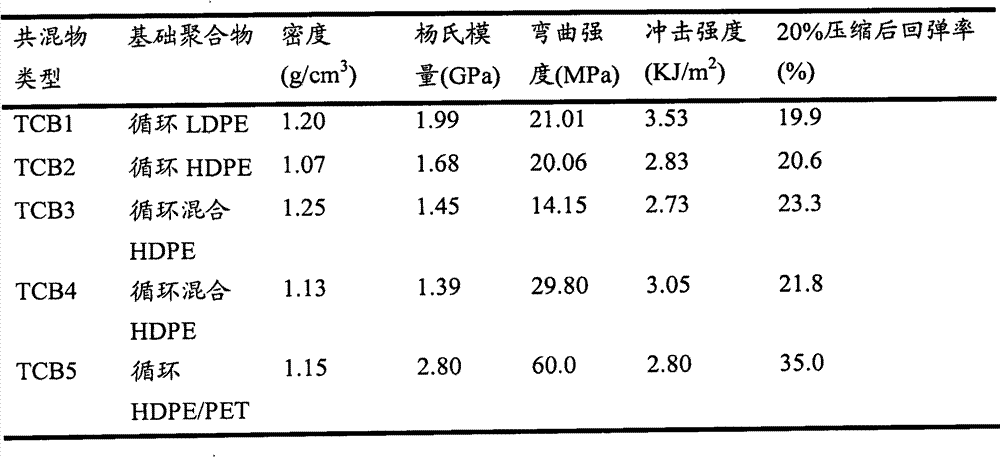
将如上所述制备的TCB1至TCB5每种两个40克各样品在170℃压模成两个4英寸×6英寸×0.2英寸试件,由此切割试样,以测试复合材料的性能。使用InstronTM 5582 Testing Machine(Instron Co.,GroveCity,PA,USA),根据ASTM D790-03检测复合材料样品的弯曲性能。悬臂梁式冲击试验使用TiniusTM 92T冲击试验机(Testing MachineCompany,Horsham,PA)。根据ASTM D256,所有样品在一个纵向侧边的中点切口。在用INSTRON 5582机和数字卡尺通过压缩前和压缩后测量样品厚度检测20%压缩后材料回弹情况。结果显示于表1中。Two 40 gram samples of each of TCB1 to TCB5, prepared as described above, were compression molded at 170° C. into two 4 inch by 6 inch by 0.2 inch test pieces, from which test specimens were cut to test the properties of the composites. The flexural properties of the composite samples were tested according to ASTM D790-03 using an Instron ™ 5582 Testing Machine (Instron Co., Grove City, PA, USA). Izod impact testing uses a Tinius ™ 92T impact testing machine (Testing Machine Company, Horsham, PA). All samples were notched at the midpoint of one longitudinal side according to ASTM D256. The springback of the material after 20% compression was detected by measuring the thickness of the sample before and after compression with INSTRON 5582 machine and digital caliper. The results are shown in Table 1.
表1Table 1
实施例11-15.粒度分布Examples 11-15. Particle Size Distribution
使用USA标准8目筛,用工业制粒机将挤出的TCB3和TCB4材料制粒。然后用USA标准实验筛网和Ro-Tap摇动器将材料过筛。组合多个筛网,较小筛号筛在顶上。每次过筛200g样品。过筛后,收集各筛上保留的材料,并用分析天平称重精确到0.01克。粒度分布(PSD)用测量的重量数据测定。TCB3和TCB4的PSD列于表2中。The extruded TCB3 and TCB4 materials were pelletized with an industrial pelletizer using a USA standard 8 mesh screen. The material was then sieved using a USA standard laboratory sieve and a Ro-Tap shaker. Combine multiple sieves with the smaller sieve on top. 200 g of samples were sieved each time. After sieving, the material retained on each sieve was collected and weighed to the nearest 0.01 gram using an analytical balance. Particle size distribution (PSD) was determined using measured gravimetric data. The PSDs of TCB3 and TCB4 are listed in Table 2.
表2Table 2

为了与具体结构中遇到的天然不均匀性的相容性,一般优选选择PSD范围。在工业中一般以不同的原则选择PSD,以形成有效的外部滤饼,并使结构损伤最大限度地减小。例如,“阿勃拉姆规则”(Abram’srule)说明,桥接材料的中值粒径应等于或略大于结构的中值孔径的三分之一。“韩式规则”(Hand’s rule)说明,PSD的D90(尺寸x,90%重量的颗粒小于尺寸x)应等于结构的孔径。通过适当选择研磨参数和TCB颗粒过筛所用的筛目大小,可选择用于本发明复合材料的不同PSD。表2显示针对0.04、0.08和0.12英寸中值裂纹尺寸的TCB3材料制成的三种配制的PSD尺寸(分别对于PSD-S1、PSD-S2和PSD-S3)。与PSD-S1比较,PSD-S2和PSD-S3改变到更大粒径。通过适当组合不同的TCB组合物或颗粒,可形成另外的PSD。其他材料(例如,碳酸钙、纤维素纤维、石墨等)也可加入到TCB,以对所给结构形成所需的PSD(注:0.04英寸≈1mm;0.08英寸≈2mm;0.12英寸≈3mm)。It is generally preferred to select a PSD range for compatibility with the natural inhomogeneities encountered in a particular structure. PSDs are generally selected in industry on different principles to form an effective external filter cake and minimize structural damage. For example, Abram's rule states that the median particle size of the bridging material should be equal to or slightly larger than one third of the median pore size of the structure. The "Hand's rule" states that the D90 (size x, 90% by weight of particles smaller than size x) of the PSD should be equal to the pore diameter of the structure. By appropriate selection of the milling parameters and the mesh size through which the TCB particles are sieved, different PSDs can be selected for the composites of the invention. Table 2 shows the PSD sizes for three formulations made of TCB3 material of 0.04, 0.08, and 0.12 inch median crack size (for PSD-S1 , PSD-S2, and PSD-S3, respectively). Compared to PSD-S1, PSD-S2 and PSD-S3 were changed to a larger particle size. Additional PSDs can be formed by appropriate combinations of different TCB compositions or particles. Other materials (eg, calcium carbonate, cellulose fibers, graphite, etc.) can also be added to the TCB to form the desired PSD for a given structure (Note: 0.04 inches ≈ 1 mm; 0.08 inches ≈ 2 mm; 0.12 inches ≈ 3 mm).
实施例16-23.水基泥浆应用Examples 16-23. Water-based mud applications
用水、苛性钠、钠膨润土(GEL)、褐煤、聚阴离子纤维素(PC)和Rev Dust制备水基泥浆。典型配制物包含2加仑水、5.44克苛性钠、432.00克GEL、21.56克褐煤、10.76克PC和108.00克Rev Dust,得到38秒泥浆杯式粘度。用另外的胶调节泥浆粘度。Water-based mud was prepared with water, caustic soda, sodium bentonite (GEL), lignite, polyanionic cellulose (PC) and Rev Dust. A typical formulation contained 2 gallons of water, 5.44 grams of caustic soda, 432.00 grams of GEL, 21.56 grams of lignite, 10.76 grams of PC, and 108.00 grams of Rev Dust, giving a mud cup viscosity of 38 seconds. Adjust mud viscosity with additional glue.
使用渗透性堵塞装置(PPA),用具有不同粘度的此配制泥浆测试TCB堵漏材料的性能。(1)从大的充分混合泥浆桶取得具有特定泥浆杯式粘度水平(例如,52秒)的泥浆样品350ml。(2)将一部分LCM(20、15、10或5克)与350ml泥浆样品组合。(3)通过可变速混合机将制备的LCM与350ml泥浆样品共混5分钟。(4)然后将具有LCM的泥浆倒入PPA圆筒,并插入具有0.04英寸×2.0英寸槽的铝盘(注:0.04英寸×2.0英寸≈1mm×5cm)。(5)将PPA盖固定到PPA圆筒上。(6)将PPA组合体放入具有加热和温度控制系统的隔热室中,并连接液压管线。(7)在顶部泥浆出口封闭下施加500psi压力。(8)在达到500psi压力后,打开出口,并启动计时器,使压力坡升至1000psi。(9)在压力刚达到1000psi(t=0)时记录漏失到“初始喷出”的泥浆量。(10)将1000psi压力保持30分钟,并在7.5、15和30分钟记录流体损失。(11)在30分钟结束时,增加压力使密封体破裂,并记录最大压力(注:500psi≈3.45MPa;1000psi≈6.89MPa.)。The performance of the TCB lost circulation material was tested with this formulated mud having different viscosities using a permeable plugging apparatus (PPA). (1) Take a mud sample 350ml from a large well-mixed mud bucket with a specific mud cup viscosity level (eg, 52 seconds). (2) Combine a portion of LCM (20, 15, 10 or 5 grams) with 350ml mud sample. (3) The prepared LCM was blended with 350ml mud sample by variable speed mixer for 5 minutes. (4) The slurry with LCM is then poured into the PPA cylinder and inserted into an aluminum pan with a 0.04 inch x 2.0 inch slot (note: 0.04 inch x 2.0 inch ≈ 1 mm x 5 cm). (5) Fix the PPA cap to the PPA cylinder. (6) Put the PPA assembly into an insulated chamber with a heating and temperature control system, and connect the hydraulic lines. (7) Apply 500 psi pressure with top mud outlet closed. (8) After reaching 500psi pressure, open the outlet and start the timer to ramp up the pressure to 1000psi. (9) Record the amount of mud lost to "initial blowout" just after the pressure reaches 1000 psi (t=0). (10) Hold 1000 psi pressure for 30 minutes and record fluid loss at 7.5, 15 and 30 minutes. (11) At the end of 30 minutes, increase the pressure to rupture the seal, and record the maximum pressure (note: 500 psi ≈ 3.45 MPa; 1000 psi ≈ 6.89 MPa.).
使用其他方面相同的方法,在相同四种填充水平(20、15、10和5克材料/350ml泥浆)测试来自Prolog Inc.(New Iberia,LA)的“木弹”(Wood bullets)(WB)。"Wood bullets" (WB) from Prolog Inc. (New Iberia, LA) were tested at the same four fill levels (20, 15, 10 and 5 grams material/350ml mud) using otherwise identical methods .
表3和4列出了TCB和木弹两者的PPA试验数据。TCB材料显示利用水基泥浆的更高的密封能力。在低填充水平,纯木材料破坏掉或具有大的渗漏损失,尤其在低泥浆粘度水平。相反,新TCB材料可成功地以降低的填充水平使用(低至5克/350ml泥浆≈5ppb)。使用较低填充水平允许以减少的材料、运输和处理成本得到较佳性能。Tables 3 and 4 list the PPA test data for both TCB and wood bombs. TCB material exhibits higher sealing ability with water-based mud. At low fill levels, pure wood materials break down or have large seepage losses, especially at low mud viscosity levels. In contrast, the new TCB material can be successfully used at reduced fill levels (down to 5 g/350 ml mud ≈ 5 ppb). Using lower fill levels allows for better performance at reduced material, shipping and handling costs.
表3table 3
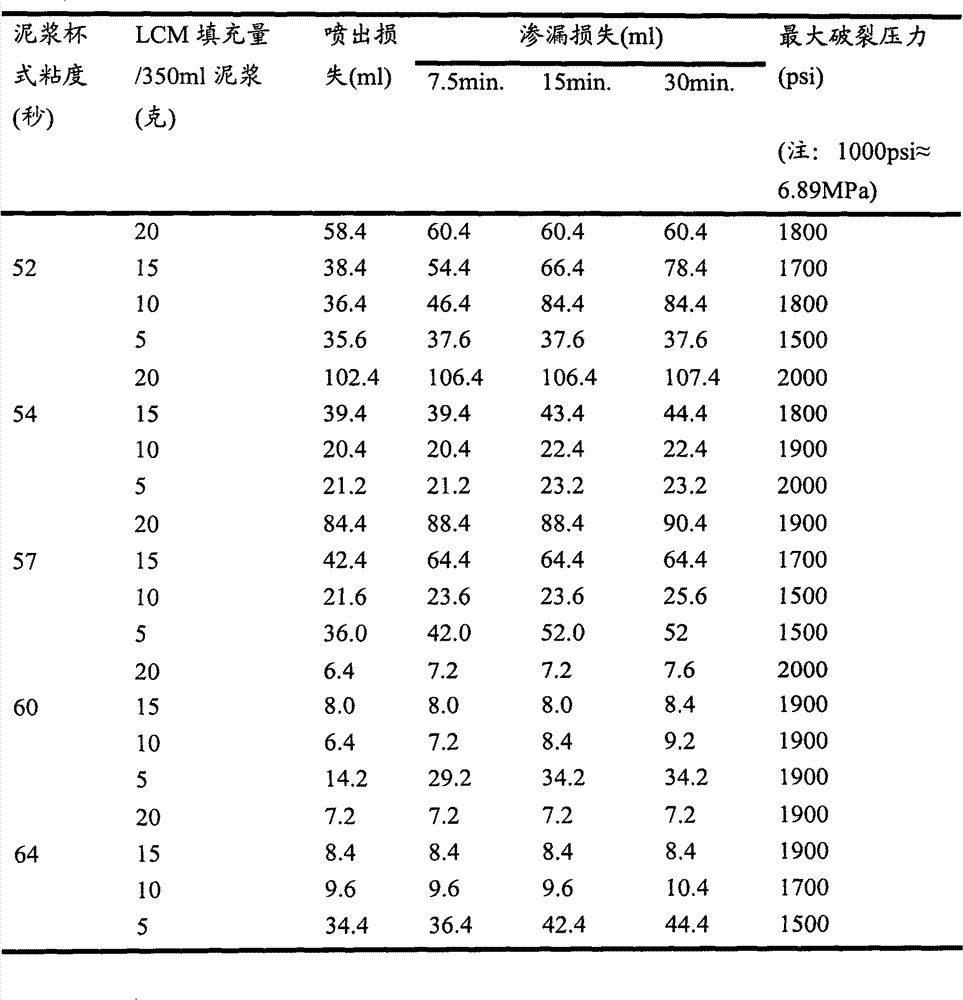
表4Table 4

PPA试验也用TCB4以10克/350mL(即,10ppb)填充水平进行,利用铝的多孔槽盘,其他方面遵循上述方法。喷出损失为2.4ml。在7.5、15和30分钟的渗漏损失分别为2.80、4.40和4.40ml,最大密封破裂压力~4,000psi,表明TCB材料具有强且快速的密封能力(注:4000psi≈28MPa)。PPA tests were also performed with TCB4 at a 10 g/350 mL (ie, 10 ppb) fill level, using aluminum perforated pans, otherwise following the method described above. Squirt loss was 2.4 ml. The leakage losses at 7.5, 15 and 30 minutes were 2.80, 4.40 and 4.40ml, respectively, and the maximum seal rupture pressure was ~4,000psi, indicating that the TCB material has a strong and rapid sealing ability (Note: 4000psi≈28MPa).
实施例24-27 合成泥浆的电稳定性Embodiment 24-27 The electrical stability of synthetic mud
在含氯化钙、烯烃、硫酸钡、结晶二氧化硅、方石英、结晶二氧化硅、鳞石英和石英的市售的合成泥浆中测试新LCM。基础泥浆性质用具有Fann热杯的Baroid粘度检验仪和Fann 23D电稳定性检验仪检测,包括:油/水比=72/28;泥浆重量=13.3PPG;在600RPM/120℉的塑性粘度(PV)=98;在300RPM/120℉的塑性粘度(PV)=56;PV/软化点=42/14;在120℉(3秒)凝胶强度=7;在120℉(10分钟)凝胶强度=16;电稳定性=463伏(注:120℉≈49℃)。The new LCM was tested in a commercially available synthetic slurry containing calcium chloride, olefin, barium sulfate, crystalline silica, cristobalite, crystalline silica, tridymite and quartz. Base mud properties were tested with a Baroid viscosity tester with a Fann hot cup and a Fann 23D electrical stability tester, including: oil/water ratio = 72/28; mud weight = 13.3PPG; plastic viscosity (PV) at 600RPM/120°F ) = 98; Plastic Viscosity (PV) = 56 at 300RPM/120°F; PV/Softening Point = 42/14; Gel Strength at 120°F (3 seconds) = 7; Gel Strength at 120°F (10 minutes) = 16; electrical stability = 463 volts (Note: 120°F ≈ 49°C).
电稳定性用350ml泥浆与不同的TCB材料(各10克)组合检测。表5显示电稳定性数据(10个数据点的平均值,标准偏差在括号内显示)。数据显示,TCB材料对合成泥浆的电稳定性没有不利影响。Electrical stability was tested with 350ml of mud combined with different TCB materials (10 grams each). Table 5 shows electrical stability data (average of 10 data points, standard deviation shown in parentheses). The data showed that the TCB material had no adverse effect on the electrical stability of the synthetic mud.
表5table 5
实施例28-34 合成泥浆的试验Embodiment 28-34 The test of synthetic mud
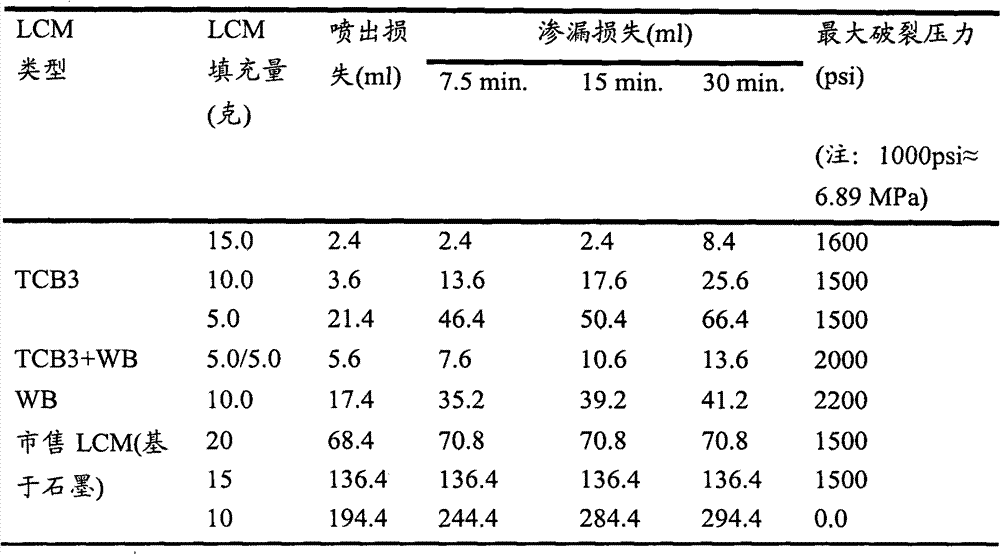
遵循以上对水基泥浆所述的方法,使用渗透性堵塞装置(PPA)和具有单个0.04英寸×2.0英寸槽的铝盘,用合成泥浆测试TCB堵漏材料的性能(注:0.04英寸×2.0英寸≈1mm×5.1cm)。在350ml泥浆中测试15、10和5.0克填充水平的纯TCB3材料或TCB3(5克)和木弹(5克)的组合。对各填充水平的TCB3材料使用PSD-S1(如表2所示)测试。为了比较,也用350ml泥浆测试10克填充水平的木弹和20、15和10克填充水平的市售LCM(石墨)。The performance of the TCB LCM was tested with synthetic mud using the Permeable Plugging Apparatus (PPA) and an aluminum pan with a single 0.04" x 2.0" slot (Note: 0.04" x 2.0" ≈1mm×5.1cm). 15, 10 and 5.0 gram fill levels of pure TCB3 material or a combination of TCB3 (5 grams) and wood bullets (5 grams) were tested in 350 ml of mud. The PSD-S1 (shown in Table 2) was used to test TCB3 materials at various filling levels. For comparison, 10 gram fill level wood bullets and 20, 15 and 10 gram fill levels of commercially available LCM (graphite) were also tested with 350 ml of mud.
结果显示于表6中。与纯木弹或市售LCM比较,TCB3(单独或与木弹组合)与合成泥浆在控制渗漏损失方面表现良好。市售含石墨的LCM具有较小粒径,导致大的渗漏损失,甚至在20克填充水平(20ppb)。The results are shown in Table 6. TCB3 (alone or in combination with wood bullets) and synthetic mud performed well in controlling seepage losses compared to pure wood bullets or commercially available LCM. Commercially available graphite-containing LCMs have smaller particle sizes, resulting in large percolation losses, even at the 20 gram fill level (20 ppb).
表6Table 6
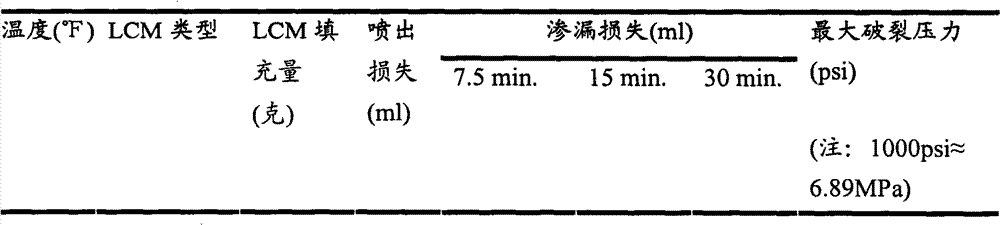
也在两种不同温度水平(120℉和250℉)进行测试。将不同填充水平的TCB4和木弹的组合样品与350ml泥浆共混,其他方面如上所述。在测试前,将PPA圆筒加热到目标温度(120℉或250℉)。TCB4(5克)和木弹(WB 5克)的组合样品在120℉几乎使槽完全密封。温度升高至250℉导致某种程度增加的渗漏损失。在250℉将TCB4填充量从5增至10克显著减少渗漏损失。TCB在升高的温度水平表现良好(注:250℉≈121℃)。Testing was also performed at two different temperature levels (120°F and 250°F). Combination samples of TCB4 and wood bullets at various fill levels were blended with 350ml of mud, otherwise as described above. The PPA cylinder was heated to the target temperature (120°F or 250°F) prior to testing. A combined sample of TCB4 (5 grams) and wood bullet (WB 5 grams) almost completely sealed the groove at 120°F. An increase in temperature to 250°F resulted in somewhat increased seepage losses. Increasing the TCB4 loading from 5 to 10 grams at 250°F significantly reduced seepage losses. TCB performed well at elevated temperature levels (Note: 250°F ≈ 121°C).
表7Table 7
实施例35-34 用于柴油泥浆Examples 35-34 are used in diesel mud
也用市售柴油泥浆测试新的LCM。此泥浆包含柴油、水、增重材料、氯化钙、乳化剂、石灰、渗漏控制剂和胶凝剂。基础泥浆性质用具有Fann热杯的Baroid粘度检验仪和Fann 23D电稳定性检验仪检测:柴油分数=80%;泥浆重量=16.5PPB;在600rpm/120℉的塑性粘度(PV)=135;在300rpm/120℉的塑性粘度(PV)=72;PV/软化点=63/9;在120℉(3秒)凝胶强度=16;在120℉(10分钟)凝胶强度=31;电稳定性=429伏。The new LCM was also tested with commercially available diesel mud. This slurry contains diesel oil, water, weighting material, calcium chloride, emulsifiers, lime, seepage control agents and gelling agents. Base mud properties were tested with a Baroid viscometer with a Fann hot cup and a Fann 23D electrical stability tester: diesel fraction = 80%; mud weight = 16.5 PPB; plastic viscosity (PV) = 135 at 600rpm/120°F; Plastic Viscosity (PV) at 300rpm/120°F = 72; PV/Softening Point = 63/9; Gel Strength at 120°F (3 seconds) = 16; Gel Strength at 120°F (10 minutes) = 31; Electrically stable Sex = 429 volts.
电稳定性用350ml泥浆与不同的TCB材料(各10克)组合检测。表8显示电稳定性数据(10个数据点的平均值,标准偏差在括号内显示)。数据显示,TCB材料对柴油泥浆的电稳定性没有不利影响。Electrical stability was tested with 350ml of mud combined with different TCB materials (10 grams each). Table 8 shows electrical stability data (mean of 10 data points, standard deviation shown in parentheses). The data showed that the TCB material had no adverse effect on the electrical stability of diesel mud.
表8Table 8

使用PPA和具有0.04英寸×2.0英寸槽的铝盘,其他方面如上所述,在柴油泥浆中测试新TCB的性能。在350ml柴油泥浆中,测试10、7.5和5.0克填充水平的单独TCB3以及TCB3(5克)和木弹(2.5克)的组合。在各填充水平使用TCB3材料的PSD-S1分布。为了比较,也在350ml泥浆中10克LCM填充水平测试市售石墨基LCM。The performance of the new TCB was tested in diesel mud using PPA and aluminum pans with 0.04 inch by 2.0 inch grooves, otherwise as described above. TCB3 alone and combinations of TCB3 (5 grams) and wood bullets (2.5 grams) were tested at 10, 7.5 and 5.0 gram fill levels in 350 ml of diesel slurry. PSD-S1 distribution using TCB3 material at each fill level. For comparison, a commercially available graphite-based LCM was also tested at a 10 gram LCM fill level in 350 ml slurry.
结果显示于表9中。TCB3单独或与木弹组合在柴油泥浆中控制渗漏损失方面作用良好。市售石墨LCM具有较小粒径,这使渗漏损失很大。The results are shown in Table 9. TCB3 alone or in combination with wood bombs works well in controlling seepage losses in diesel slurries. Commercially available graphite LCMs have a small particle size, which results in large leakage losses.
表9Table 9

实施例41.用市售木-塑料复合材料作为原料Example 41. Using Commercially Available Wood-Plastic Composite Materials as Raw Materials
本发明的一个供选实施方案用市售木-塑料复合材料(即,为用作建筑材料销售的复合材料)作为原料。选择由40%聚合物(20%原生HDPE和20%循环LDPE)、55%木纤维和5%加工助剂和着色剂制成的市售木塑料复合材料(WPC)共混物的样品。使用逆向旋转双螺杆挤出机(CTSE-V/MARKII,来自C.W.Brabender Instruments Inc.,SouthGackensack,NJ,USA),在170℃使材料重新熔融,并与20%沉淀碳酸钙(基于WPC共混物总重量)混合。使挤出的材料经水冷却,制粒,并过筛成8、12、16、20、40、60、100和200目粒度等级。An alternative embodiment of the present invention uses commercially available wood-plastic composites (ie, composites that are marketed as construction materials) as starting materials. A sample of a commercial wood plastic composite (WPC) blend made of 40% polymer (20% virgin HDPE and 20% recycled LDPE), 55% wood fiber and 5% processing aids and colorants was selected. Using a counter-rotating twin-screw extruder (CTSE-V/MARKII, from C.W. Brabender Instruments Inc., South Gackensack, NJ, USA), the material was remelted at 170°C and blended with 20% precipitated calcium carbonate (based on WPC total weight) mixed. The extruded material was water cooled, pelletized, and sieved into 8, 12, 16, 20, 40, 60, 100 and 200 mesh particle size grades.
在350ml 16.5ppb柴油泥浆中使用10克(10ppb)填充水平的“重混合”市售WPC共混物进行PPA试验,其他方面如上所述。检测的初始喷出损失为4.8ml。在7.5、15和30分钟的渗漏损失分别为4.8、4.8和4.8ml,最大密封破裂压力~1800psi,表明材料具有极佳的密封能力。数据显示,重新研磨的市售WPC材料(新或已用过)可被改性,并用于配制堵漏材料。因此,本发明提供了降级或不合格的WPC共混物、用过的WPC产品和WPC碎屑和其他废物提供了经济的再循环途径(注:1800psi≈12.4MPa)。PPA tests were conducted in 350ml of 16.5ppb diesel slurry using a 10 gram (10ppb) fill level of a "heavy mix" commercial WPC blend, otherwise as described above. The initial shot loss detected was 4.8 ml. The leakage losses at 7.5, 15 and 30 minutes were 4.8, 4.8 and 4.8 ml, respectively, and the maximum seal rupture pressure was ~1800 psi, indicating that the material has excellent sealing ability. The data show that reground commercially available WPC materials (new or used) can be modified and used to formulate lost circulation materials. Thus, the present invention provides an economical recycling path for downgraded or off-spec WPC blends, used WPC products, and WPC scrap and other waste (Note: 1800 psi ≈ 12.4 MPa).
实施例42-45.油田试验Example 42-45. Oil field test
在地下井钻探、完成和修补中一般使用水泥。例如,在最初的水泥胶结中,在井孔中胶结套管柱。将水硬水泥泵送到井孔壁和套管柱外侧之间的空间。水泥在环形空间中凝固,并形成硬化不渗透水泥护套。硬化水泥物理支撑套管柱并使其定位于井孔中并使其结合到井孔壁。Cement is commonly used in subterranean well drilling, completion and repair. For example, in an initial cement bond, a string of casing is cemented in the wellbore. Hydraulic cement is pumped into the space between the wellbore wall and the outside of the casing string. The cement sets in the annulus and forms a hardened impermeable cement sheath. The hardened cement physically supports and positions the casing string in the wellbore and bonds it to the wellbore wall.
通常需要的是,泵送进入井孔的“未用过的”水泥应完全返回到地面,即,该水泥不应漏失进入裂缝中。在生产区,在成功钻探后一般用较小的生产设备代替较大的钻探设备,因为操作较大设备的花费一般会多得多。合乎需要的是在钻探期间能够快速安装较小设备,并且能通过用堵漏材料充分密封裂隙以泵送较少水泥。It is generally desired that "virgin" cement pumped into the wellbore should be fully returned to the surface, ie, that the cement should not be lost into fractures. In production areas, larger drilling rigs are generally replaced with smaller production rigs after successful drilling because it is generally much more expensive to operate the larger rigs. It would be desirable to be able to install smaller equipment quickly during drilling and to be able to pump less cement by adequately sealing the fracture with a leak blocking material.
用工业规模的挤出机制备具有与TCB4基本相同配料的46,000lb填充量的TCB。将挤出的材料制粒,并用8目筛分级,以制备类似于PSD-S2的材料(以上详述)。A 46,000 lb loading of TCB with essentially the same formulation as TCB4 was prepared using an industrial scale extruder. The extruded material was pelletized and classified with an 8 mesh screen to prepare material similar to PSD-S2 (detailed above).
此材料在Ignacio Blanco field,La Plata County,CO的商品油/天然气井中测试。在相当于煤层顶部的深度(~2,663英尺或812米),每15分钟用一袋40磅TCB4/PSD-S2类型材料预处理水基钻探泥浆。将井钻到3,549英尺或1,082米总深度,没有实质损失或渗漏。操作人员报告材料容易现场处理。钻头上的转矩随加入TCB材料而减小,并且未观察到渗漏。很多年来在大致相同位置的先前井钻探一直不用处理,或者用其他堵漏材料预处理。操作人员报告这些以前的井存在损失或渗漏,而用新材料见不到该现象。This material was tested in commercial oil/gas wells in the Ignacio Blanco field, La Plata County, CO. At a depth equivalent to the top of the coal seam (~2,663 feet or 812 meters), the water-based drilling mud was pretreated with a 40-pound bag of TCB4/PSD-S2 type material every 15 minutes. The well was drilled to a total depth of 3,549 feet or 1,082 meters without substantial losses or seepage. Operators report that the material is easily handled on-site. The torque on the bit decreased with the addition of TCB material and no leakage was observed. Previous wells drilled at approximately the same location over many years had been left untreated or pretreated with other lost circulation materials. Operators reported loss or leakage from these previous wells, which was not seen with the new material.
此材料在Ignacio Blanco Field,La Plata,CO的另一处井中测试。在钻探通过Fruitland煤带和Picture Cliffs结构时每小时用一袋40磅PSD-S2类型材料预处理水基钻探流体,。将井钻到3,317英尺或1,011米总深度。没有观察到实质渗漏或泥浆损失。很多年来在大致相同位置的先前井钻探一直不用处理,或者用其他堵漏材料预处理。操作人员报告这些以前的井存在损失或渗漏,而用新材料见不到该现象。This material was tested in another well at the Ignacio Blanco Field, La Plata, CO. Water-based drilling fluid was pretreated with a 40 lb. bag of PSD-S2 type material per hour while drilling through the Fruitland Coal Belt and Picture Cliffs formation. The well was drilled to a total depth of 3,317 feet or 1,011 meters. No substantial seepage or mud loss was observed. Previous wells drilled at approximately the same location over many years had been left untreated or pretreated with other lost circulation materials. Operators reported loss or leakage from these previous wells, which was not seen with the new material.
此材料也在Fayetteville Shale,White County,Arkansas的商品油/天然气井中用油基泥浆测试。在观察到渗漏损失时,定期泵送TCB4类材料(10.0ppb)粒料。在孔钻到6,675英尺(2035米)总深度时,渗漏成功地减少到可接受水平。在套已运行到孔底部时,开始胶结过程。在整个过程中观察到基本上全部的完全钻探流体和水泥返回。TCB4类材料成功地密封裂隙,并使水泥能够根据需要被泵送回到地面。This material was also tested with oil-based mud in a commercial oil/gas well in the Fayetteville Shale, White County, Arkansas. Pellets of TCB4 type material (10.0 ppb) were periodically pumped when leakage losses were observed. Seepage was successfully reduced to acceptable levels when the hole was drilled to a total depth of 6,675 feet (2,035 meters). After the sleeve has run to the bottom of the hole, the cementing process begins. Substantially complete return of complete drilling fluid and cement was observed throughout. The TCB4 class of materials successfully sealed the fissures and allowed the cement to be pumped back to the surface as needed.
此材料在Fayetteville Shale,Cleburne County,Arkansas的另一处的商品油/天然气井中测试。在观察到渗漏损失时,定期泵送TCB4类材料(10.0ppb)粒料。渗漏减少。在9,900英尺(3018米)总深度,经历全部水泥返回。材料容易现场识别和起作用。This material was tested in another commercial oil/gas well in the Fayetteville Shale, Cleburne County, Arkansas. Pellets of TCB4 type material (10.0 ppb) were periodically pumped when leakage losses were observed. Leakage is reduced. At a total depth of 9,900 feet (3018 meters), a full cement return was experienced. Materials are readily identifiable and functional on site.
在本说明书中引用的所有参考文献的完全公开内容通过引用结合到本文中。然而,如果有另外的矛盾冲突,应以本说明书为准。The complete disclosures of all references cited in this specification are hereby incorporated by reference. However, if there is another conflict, this specification shall prevail.
Claims (16)
Applications Claiming Priority (4)
| Application Number | Priority Date | Filing Date | Title |
|---|---|---|---|
| US8822208P | 2008-08-12 | 2008-08-12 | |
| US61/088222 | 2008-08-12 | ||
| US61/088,222 | 2008-08-12 | ||
| PCT/US2009/053346 WO2010019535A2 (en) | 2008-08-12 | 2009-08-11 | Thermoplastic cellulosic fiber blends as lost circulation materials |
Publications (2)
| Publication Number | Publication Date |
|---|---|
| CN102216415A CN102216415A (en) | 2011-10-12 |
| CN102216415B true CN102216415B (en) | 2013-11-06 |
Family
ID=41669602
Family Applications (1)
| Application Number | Title | Priority Date | Filing Date |
|---|---|---|---|
| CN200980141323XA Expired - Fee Related CN102216415B (en) | 2008-08-12 | 2009-08-11 | Thermoplastic cellulosic fiber blends as lost circulation materials |
Country Status (8)
| Country | Link |
|---|---|
| US (1) | US9453156B2 (en) |
| EP (1) | EP2324094B1 (en) |
| CN (1) | CN102216415B (en) |
| BR (1) | BRPI0918009A2 (en) |
| CA (1) | CA2734032C (en) |
| EA (1) | EA020348B1 (en) |
| MX (1) | MX2011001638A (en) |
| WO (1) | WO2010019535A2 (en) |
Cited By (2)
| Publication number | Priority date | Publication date | Assignee | Title |
|---|---|---|---|---|
| CN105086973A (en) * | 2015-09-02 | 2015-11-25 | 中国石油集团渤海钻探工程有限公司 | Self-decomposition temporary plugging agent for workover fluid and using method of temporary plugging agent |
| CN106479456A (en) * | 2016-08-31 | 2017-03-08 | 成都西油华巍科技有限公司 | A kind of drilling fluid polynary vinyl polymer emulsion film forming sealing agent and preparation method thereof |
Families Citing this family (136)
| Publication number | Priority date | Publication date | Assignee | Title |
|---|---|---|---|---|
| EP2261458A1 (en) | 2009-06-05 | 2010-12-15 | Services Pétroliers Schlumberger | Engineered fibres for well treatments |
| PL2566344T3 (en) * | 2010-05-03 | 2016-10-31 | Natural chewing gum including cellulose materials | |
| MX337486B (en) | 2010-12-15 | 2016-03-08 | 3M Innovative Properties Co | Controlled degradation fibers. |
| BR112013023276A2 (en) | 2011-03-11 | 2016-12-20 | Lenzing Plastics Gmbh | borehole fluid comprising dispersed synthetic polymeric fibers |
| US9688899B2 (en) | 2011-05-10 | 2017-06-27 | Dow Global Technologies Llc | Curable composition for use as lost circulation material |
| US9109992B2 (en) * | 2011-06-10 | 2015-08-18 | Halliburton Energy Services, Inc. | Method for strengthening a wellbore of a well |
| CN102560891B (en) * | 2011-12-19 | 2014-02-05 | 安吉振兴布业有限公司 | Method for preparing degradable hemp agricultural mulching material |
| WO2013116072A1 (en) * | 2012-02-02 | 2013-08-08 | Board Of Supervisors Of Louisiana State University And Agricultural And Mechanical College | Engineering plastic/ inorganic fiber blends as lost circulation materials |
| US20130284518A1 (en) * | 2012-04-27 | 2013-10-31 | 3M Innovative Properties Company | Method of using multi-component fibers as lost-circulation material |
| CN102703043B (en) * | 2012-05-23 | 2014-04-09 | 成都欧美克石油科技有限公司 | Plugging material |
| CN102703044B (en) * | 2012-05-23 | 2014-09-10 | 成都欧美克石油科技有限公司 | Novel cement slurry plugging fluid |
| WO2014039479A1 (en) | 2012-09-04 | 2014-03-13 | Cpg International, Inc. | Use of recycled packaging in polymer composite products |
| US9976018B2 (en) | 2012-09-04 | 2018-05-22 | CPG International, LLC | Use of recycled packaging in polymer composite products |
| WO2014042548A1 (en) * | 2012-09-13 | 2014-03-20 | Schlumberger, Canada Limited | Hydraulic fracturing with shapeable particles |
| WO2014042552A1 (en) * | 2012-09-13 | 2014-03-20 | Schlumberger, Canada Limited | Shapeable particles in oilfield fluids |
| US20150307766A1 (en) | 2012-11-09 | 2015-10-29 | Dow Global Technologies Llc | Curable cross-linkable composition for use as lost circulation material |
| CN103013151B (en) * | 2012-12-27 | 2015-01-21 | 熊雪平 | Banana stem fiber-based wood-plastic composite and preparation method thereof |
| JP6207529B2 (en) * | 2013-01-11 | 2017-10-04 | 株式会社クレハ | Application of poly-L-lactic acid solidified extruded product and production method of poly-L-lactic acid solidified extruded product |
| US20140209307A1 (en) * | 2013-01-29 | 2014-07-31 | Halliburton Energy Services, Inc. | Wellbore Fluids Comprising Mineral Particles and Methods Relating Thereto |
| CN105026515A (en) * | 2013-01-29 | 2015-11-04 | 普拉德研究及开发股份有限公司 | Method for enhancing fiber bridging |
| US8739872B1 (en) | 2013-03-01 | 2014-06-03 | Halliburton Energy Services, Inc. | Lost circulation composition for fracture sealing |
| CN103224653B (en) * | 2013-04-01 | 2015-09-09 | 中广核俊尔新材料有限公司 | A kind of Biodegradable nylon 6/ starch composite material and preparation method thereof |
| CN103319112A (en) * | 2013-07-02 | 2013-09-25 | 内蒙古大学 | Method for preparing plugging agent by utilizing waste polystyrene foam |
| GB2533488A (en) * | 2013-08-22 | 2016-06-22 | Halliburton Energy Services Inc | Compositions including a particulate bridging agent and fibers and methods of treating a subterranean formation with the same |
| CN103740340B (en) * | 2013-12-31 | 2016-02-24 | 东营泰尔石油技术有限公司 | Expansion consolidation type plugging agent |
| CA2936909C (en) * | 2014-02-18 | 2020-04-21 | Halliburton Energy Services, Inc. | Multi-modal particle size distribution lost circulation material |
| CN103865503B (en) * | 2014-03-10 | 2016-08-17 | 东北石油大学 | High temperature resistant inorganic granulated gel compounds double-liquid seal blocking agent and method for blocking thereof |
| US9797212B2 (en) | 2014-03-31 | 2017-10-24 | Schlumberger Technology Corporation | Method of treating subterranean formation using shrinkable fibers |
| CN105219364A (en) * | 2014-06-17 | 2016-01-06 | 成都棕通石油配件有限公司 | Drilling well patching materials |
| CN105441044B (en) * | 2014-09-17 | 2018-08-07 | 中国石油化工股份有限公司 | A kind of oil base drilling fluid sealing agent |
| CA2966596C (en) * | 2014-12-11 | 2019-10-01 | Halliburton Energy Services, Inc. | Resilient carbon-based materials as lost circulation materials and related methods |
| CN104498000B (en) * | 2014-12-23 | 2017-09-12 | 成都得道实业有限公司 | A kind of drilling well organic synthesis alloy fiber sealing agent and its preparation method and application |
| CN104531109B (en) * | 2014-12-23 | 2017-03-22 | 成都得道实业有限公司 | Organic synthetic plugging granules for well drilling, and preparation method and application thereof |
| CN104774598A (en) * | 2015-03-07 | 2015-07-15 | 中石化石油工程技术服务有限公司 | High-temperature-resistant plugging agent for drilling fluid and preparation method thereof |
| CN104726077B (en) * | 2015-04-08 | 2017-07-07 | 广汉市福客科技有限公司 | A kind of drilling fluid pressure-bearing crams agent |
| US10822752B2 (en) | 2015-06-15 | 2020-11-03 | Board Of Supervisors Of Louisiana State University And Agricultural And Mechanical College | Thermoplastic cellulosic fiber granules useful as infill materials for artificial turf |
| CN104962052A (en) * | 2015-07-13 | 2015-10-07 | 中国石油大学(北京) | Degradable resin nano-composite material for oil and gas field operation and preparation method thereof |
| CN105062440B (en) * | 2015-08-31 | 2018-06-29 | 天津中油渤星工程科技有限公司 | A kind of leak stopping leakproofing material |
| US10457846B2 (en) | 2015-11-17 | 2019-10-29 | Saudi Arabian Oil Company | Date palm seed-based lost circulation material (LCM) |
| US11795377B2 (en) * | 2015-12-21 | 2023-10-24 | Schlumberger Technology Corporation | Pre-processed fiber flocks and methods of use thereof |
| CN105647496A (en) * | 2016-01-30 | 2016-06-08 | 张向南 | Expandable biopolymer temporary plug profile control agent and preparation method thereof |
| US10023781B2 (en) | 2016-04-13 | 2018-07-17 | Saudi Arabian Oil Company | Rapidly dehydrating lost circulation material (LCM) |
| US11434404B2 (en) | 2016-04-13 | 2022-09-06 | Saudi Arabian Oil Company | Rapidly dehydrating lost circulation material (LCM) |
| US10544345B2 (en) | 2016-06-30 | 2020-01-28 | Saudi Arabian Oil Company | Flaky date fruit CAP for moderate to severe loss control |
| US11713407B2 (en) | 2016-06-30 | 2023-08-01 | Saudi Arabian Oil Company | Date tree waste-based compound fibrous LCMs |
| US10800959B2 (en) | 2016-06-30 | 2020-10-13 | Saudi Arabian Oil Company | Date tree waste-based compound fibrous LCMs |
| EA201990227A1 (en) * | 2016-07-06 | 2019-07-31 | ДРАЙЛЕТ, ЭлЭлСи | COMPOSITIONS AND METHODS FOR INCREASING SURVIVAL AND CATTLE GROWTH |
| US10479918B2 (en) | 2016-07-06 | 2019-11-19 | Saudi Arabian Oil Company | Two-component lost circulation pill for seepage to moderate loss control |
| WO2018009791A1 (en) * | 2016-07-07 | 2018-01-11 | Hppe, Llc | Cross-linked levan blends as lost circulation materials |
| US10259982B2 (en) | 2016-07-12 | 2019-04-16 | Saudi Arabian Oil Company | Date seed-based multi-modal particulate admixture for moderate to severe loss control |
| CN106010490B (en) * | 2016-07-27 | 2019-07-12 | 大港油田集团有限责任公司 | A kind of underground blown rubber profile control agent |
| US10392549B2 (en) | 2016-08-31 | 2019-08-27 | Saudi Arabian Oil Company | Date tree trunk-based fibrous loss circulation materials |
| US10800960B2 (en) | 2016-09-27 | 2020-10-13 | Saudi Arabian Oil Company | Date tree leaflet-based flaky lost circulation material |
| US10266793B2 (en) | 2016-09-30 | 2019-04-23 | Novaflux, Inc. | Compositions for cleaning and decontamination |
| US10487253B2 (en) | 2016-11-08 | 2019-11-26 | Saudi Arabian Oil Company | Date tree spikelet-based additive for mechanical reinforcement of weak and unstable lost circulation material (LCM) seals/plugs |
| US10336930B2 (en) | 2016-12-19 | 2019-07-02 | Saudi Arabian Oil Company | Date tree waste-based binary fibrous mix for moderate to severe loss control |
| WO2018170305A1 (en) * | 2017-03-17 | 2018-09-20 | Bastlab, Llc | Method and composition of matter for reducing loss of circulation |
| CN106867483B (en) * | 2017-04-01 | 2019-05-17 | 新疆华油能源工程服务有限公司 | A kind of environment-friendly oil-based filtrate reducer for drilling fluid resistant to high temperatures |
| US10081756B1 (en) | 2017-05-17 | 2018-09-25 | Saudi Arabian Oil Company | Loss circulation material composition comprising oil-swellable and desolvated polymer gels |
| US10619432B2 (en) | 2017-05-17 | 2020-04-14 | Saudi Arabian Oil Company | Oil-swellable, surface-treated elastomeric polymer and methods of using the same for controlling losses of non-aqueous wellbore treatment fluids to the subterranean formation |
| US10479920B2 (en) | 2017-05-30 | 2019-11-19 | Saudi Arabian Oil Company | Date tree trunk and rachis-based superfine fibrous materials for seepage loss control |
| US10167420B1 (en) | 2017-07-20 | 2019-01-01 | Saudi Arabian Oil Company | Loss circulation compositions (LCM) having portland cement clinker |
| CN107674662A (en) * | 2017-10-13 | 2018-02-09 | 贵州涂建材科技有限公司 | It is a kind of from cementing blocking agent and blocking method |
| US10421892B2 (en) * | 2017-10-30 | 2019-09-24 | Clean Slurry Technology, Inc. | Drilling fluids and methods for making the same |
| US10508978B2 (en) * | 2017-11-03 | 2019-12-17 | Saudi Arabian Oil Company | Strain energy-based method and apparatus to determine the coefficient of resilience of lost circulation materials |
| US10352116B2 (en) * | 2017-11-16 | 2019-07-16 | Saudi Arabian Oil Company | ARC perm-squeeze RDF—a permeable plug forming rapidly dehydrating fluid |
| US10266742B1 (en) | 2018-02-06 | 2019-04-23 | Saudi Arabian Oil Company | ARC hybrid particle mix for seal and plug quality enhancement |
| CA3033195A1 (en) * | 2018-02-09 | 2019-08-09 | Ecolab Usa Inc. | Flowability testing systems and methods |
| US10240411B1 (en) | 2018-03-22 | 2019-03-26 | Saudi Arabian Oil Company | Trimodal hybrid loss prevention material (LPM) for preventative and curative loss control |
| CN108384520B (en) * | 2018-04-02 | 2020-08-11 | 中国石油天然气集团有限公司 | Degradable fiber plugging agent for drilling fluid and preparation method thereof |
| EP3775133B1 (en) | 2018-04-03 | 2024-10-09 | Novaflux, Inc. | Cleaning composition with superabsorbent polymer |
| US12365825B2 (en) * | 2018-05-02 | 2025-07-22 | Sharp-Rock Technologies, Inc. | Methods and systems to determine a concentration of sealing particulates in drilling fluid |
| CN110551491B (en) * | 2018-05-31 | 2021-11-26 | 中国石油化工股份有限公司 | Coating plugging agent, preparation method thereof and plugging slurry |
| CN110872494A (en) * | 2018-09-04 | 2020-03-10 | 中石化石油工程技术服务有限公司 | High-strength pressure-bearing plugging agent for well drilling and application thereof |
| CN108913108B (en) * | 2018-09-14 | 2020-11-03 | 前郭县正泰化工有限公司 | Well killing fluid, composition thereof and preparation process thereof |
| CN109735311B (en) * | 2019-01-22 | 2021-09-07 | 北京宏勤石油助剂有限公司 | Environment-friendly plugging agent for drilling fluid and preparation method thereof |
| CN109762544A (en) * | 2019-03-14 | 2019-05-17 | 中国科学院理化技术研究所 | A kind of high temperature resistant temporary plugging agent and preparation method and application thereof |
| CN109942941A (en) * | 2019-03-22 | 2019-06-28 | 广东宝利兴科技有限公司 | A kind of formula and manufacture production technology for plastic additive |
| US10619090B1 (en) | 2019-04-15 | 2020-04-14 | Saudi Arabian Oil Company | Fracturing fluid compositions having Portland cement clinker and methods of use |
| CN111892915A (en) * | 2019-05-06 | 2020-11-06 | 陕西圣岚石油科技有限公司 | Film-forming plugging agent for drilling fluid and application |
| CN110295030A (en) * | 2019-06-05 | 2019-10-01 | 中国石油集团渤海钻探工程有限公司 | A kind of oil base drilling fluid sealing agent and preparation method thereof |
| CN110147644B (en) * | 2019-06-12 | 2020-03-03 | 西南石油大学 | A design method for particle size distribution of fractured leakage bridging and plugging granular materials |
| US20220266259A1 (en) * | 2019-07-12 | 2022-08-25 | Technique Co., Ltd. | Method for grinding plastic waste and method for manufacturing synthetic resin molded product using plastic waste |
| WO2021034451A1 (en) * | 2019-08-16 | 2021-02-25 | Exxonmobil Upstream Research Company | Hydrocarbon wells including crosslinked polymer granules as lost circulation material and methods of drilling the hydrocarbon wells |
| US11105180B2 (en) | 2019-08-19 | 2021-08-31 | Saudi Arabian Oil Company | Plugging formation fractures |
| WO2021046294A1 (en) | 2019-09-05 | 2021-03-11 | Saudi Arabian Oil Company | Propping open hydraulic fractures |
| US10738549B1 (en) * | 2019-09-30 | 2020-08-11 | Halliburton Energy Services, Inc. | Methods to manage water influx suitable for pulsed electrical discharge drilling |
| US12064495B2 (en) | 2019-10-03 | 2024-08-20 | Protegera, Inc. | Oral cavity cleaning composition, method, and apparatus |
| US11918677B2 (en) | 2019-10-03 | 2024-03-05 | Protegera, Inc. | Oral cavity cleaning composition method and apparatus |
| US11078749B2 (en) | 2019-10-21 | 2021-08-03 | Saudi Arabian Oil Company | Tubular wire mesh for loss circulation and wellbore stability |
| US11136849B2 (en) | 2019-11-05 | 2021-10-05 | Saudi Arabian Oil Company | Dual string fluid management devices for oil and gas applications |
| US11230904B2 (en) | 2019-11-11 | 2022-01-25 | Saudi Arabian Oil Company | Setting and unsetting a production packer |
| CN112300763A (en) * | 2019-12-26 | 2021-02-02 | 四川省贝特石油技术有限公司 | High-temperature-resistant automatic degradation crack temporary plugging agent for well drilling and preparation method thereof |
| US11156052B2 (en) | 2019-12-30 | 2021-10-26 | Saudi Arabian Oil Company | Wellbore tool assembly to open collapsed tubing |
| US11260351B2 (en) | 2020-02-14 | 2022-03-01 | Saudi Arabian Oil Company | Thin film composite hollow fiber membranes fabrication systems |
| US11136487B2 (en) | 2020-02-25 | 2021-10-05 | Saudi Arabian Oil Company | Date seed-based chips lost circulation material |
| US11041347B1 (en) | 2020-04-07 | 2021-06-22 | Saudi Arabian Oil Company | Composition and method of manufacturing of whole and ground date palm seed lost circulation material (LCM) |
| US11253819B2 (en) | 2020-05-14 | 2022-02-22 | Saudi Arabian Oil Company | Production of thin film composite hollow fiber membranes |
| US11254851B2 (en) | 2020-06-25 | 2022-02-22 | Saudi Arabian Oil Company | Vulcanized rubber and date tree based lost circulation material (LCM) blend |
| US11655685B2 (en) | 2020-08-10 | 2023-05-23 | Saudi Arabian Oil Company | Downhole welding tools and related methods |
| US11326092B2 (en) | 2020-08-24 | 2022-05-10 | Saudi Arabian Oil Company | High temperature cross-linked fracturing fluids with reduced friction |
| US11492873B2 (en) | 2020-09-03 | 2022-11-08 | Baker Hughes Oilfield Operations, Llc | Method of removing non-aqueous drilling mud with banana containing fluid |
| US11976239B2 (en) | 2020-09-03 | 2024-05-07 | Baker Hughes Oilfield Operations Llc | Method of removing non-aqueous drilling mud with banana containing fluid |
| US11505732B2 (en) | 2020-11-04 | 2022-11-22 | Saudi Arabian Oil Company | Shape-adaptable lost circulation material for moderate and severe loss control |
| US11549329B2 (en) | 2020-12-22 | 2023-01-10 | Saudi Arabian Oil Company | Downhole casing-casing annulus sealant injection |
| US20220213375A1 (en) * | 2021-01-04 | 2022-07-07 | Saudi Arabian Oil Company | Spent jet-engine oil as drilling lubricant |
| US11828128B2 (en) | 2021-01-04 | 2023-11-28 | Saudi Arabian Oil Company | Convertible bell nipple for wellbore operations |
| US11598178B2 (en) | 2021-01-08 | 2023-03-07 | Saudi Arabian Oil Company | Wellbore mud pit safety system |
| US12054999B2 (en) | 2021-03-01 | 2024-08-06 | Saudi Arabian Oil Company | Maintaining and inspecting a wellbore |
| CN115141612A (en) * | 2021-03-31 | 2022-10-04 | 中国石油化工股份有限公司 | Supporting particle for drilling plugging agent and preparation method and application thereof |
| CN113136186B (en) * | 2021-04-07 | 2022-07-01 | 西安石油大油气科技有限公司 | Self-degradation temporary plugging agent capable of adjusting degradation aging for oil exploitation and preparation process thereof |
| CN115247055B (en) * | 2021-04-28 | 2024-03-26 | 中国石油天然气股份有限公司 | Plugging agent for petroleum drilling and preparation method thereof |
| US11448026B1 (en) | 2021-05-03 | 2022-09-20 | Saudi Arabian Oil Company | Cable head for a wireline tool |
| US11859815B2 (en) | 2021-05-18 | 2024-01-02 | Saudi Arabian Oil Company | Flare control at well sites |
| US11905791B2 (en) | 2021-08-18 | 2024-02-20 | Saudi Arabian Oil Company | Float valve for drilling and workover operations |
| US12071589B2 (en) | 2021-10-07 | 2024-08-27 | Saudi Arabian Oil Company | Water-soluble graphene oxide nanosheet assisted high temperature fracturing fluid |
| US11913298B2 (en) | 2021-10-25 | 2024-02-27 | Saudi Arabian Oil Company | Downhole milling system |
| CN113863892B (en) * | 2021-10-28 | 2023-02-24 | 四川省地质矿产勘查开发局四0三地质队 | Drilling plugging ball and preparation method thereof |
| US12116326B2 (en) | 2021-11-22 | 2024-10-15 | Saudi Arabian Oil Company | Conversion of hydrogen sulfide and carbon dioxide into hydrocarbons using non-thermal plasma and a catalyst |
| US12025589B2 (en) | 2021-12-06 | 2024-07-02 | Saudi Arabian Oil Company | Indentation method to measure multiple rock properties |
| US12012550B2 (en) | 2021-12-13 | 2024-06-18 | Saudi Arabian Oil Company | Attenuated acid formulations for acid stimulation |
| CN115287049A (en) * | 2021-12-23 | 2022-11-04 | 新奥科技发展有限公司 | High-temperature compression-resistant temporary plugging material and preparation method thereof |
| CN115287053A (en) * | 2021-12-24 | 2022-11-04 | 新奥科技发展有限公司 | Degradable temporary plugging material and preparation method thereof |
| US12276190B2 (en) | 2022-02-16 | 2025-04-15 | Saudi Arabian Oil Company | Ultrasonic flow check systems for wellbores |
| CN117304894B (en) * | 2022-06-22 | 2025-04-25 | 中国科学院理化技术研究所 | High-temperature-resistant temporary plugging agent and preparation method and application thereof |
| CN117304895B (en) * | 2022-06-22 | 2025-04-25 | 中国科学院理化技术研究所 | High-temperature-resistant temporary plugging agent capable of being degraded by controllable acidification, and preparation method and application thereof |
| US11993992B2 (en) | 2022-08-29 | 2024-05-28 | Saudi Arabian Oil Company | Modified cement retainer with milling assembly |
| CN115418203B (en) * | 2022-09-06 | 2023-10-10 | 库尔勒同益工贸有限责任公司 | Fiber polymer plugging agent for drilling fluid and preparation method thereof |
| US11879089B1 (en) * | 2022-11-22 | 2024-01-23 | Halliburton Energy Services, Inc. | Lost circulation material package with tailored particle size distribution |
| US12037869B1 (en) | 2023-01-20 | 2024-07-16 | Saudi Arabian Oil Company | Process of water shut off in vertical wells completed with electrical submersible pumps |
| CN116875288B (en) * | 2023-06-07 | 2025-04-29 | 新奥科技发展有限公司 | A composite temporary plugging agent material and preparation method thereof |
| US12084926B1 (en) | 2023-10-02 | 2024-09-10 | Saudi Arabian Oil Company | Remedying lost circulation |
| CN117511521A (en) * | 2023-10-19 | 2024-02-06 | 北京大地高科地质勘查有限公司 | Self-adaptive plugging system and preparation method thereof |
| WO2025085710A1 (en) * | 2023-10-20 | 2025-04-24 | Lyondellbasell Advanced Polymers Inc. | Nylon 66 as a high temperature diverter material |
| CN117777968A (en) * | 2023-12-01 | 2024-03-29 | 九江蓝卓新材料科技有限公司 | A leak-stopping agent with high anti-seepage and filtration-reducing properties |
| CN118325589A (en) * | 2024-03-11 | 2024-07-12 | 河南易发石油工程技术有限公司 | A kind of acid-soluble high-temperature and high-filtration-loss plugging agent for oil-based drilling fluid |
Citations (6)
| Publication number | Priority date | Publication date | Assignee | Title |
|---|---|---|---|---|
| US4117184A (en) * | 1976-06-07 | 1978-09-26 | The Dow Chemical Company | Absorbent films and laminates |
| US4526240A (en) * | 1983-10-17 | 1985-07-02 | The Dow Chemical Company | Method of inhibiting lost circulation from a wellbore |
| CN1064096A (en) * | 1991-02-11 | 1992-09-02 | 江西省萍乡市麻山化工厂 | Drilling plugging agent |
| US20060079408A1 (en) * | 2002-01-30 | 2006-04-13 | Turbo-Chem International, Inc. | Composition for decreasing lost circulation during well operation |
| WO2006040578A1 (en) * | 2004-10-14 | 2006-04-20 | M-I L.L.C. | Lost circulation additive for drilling fluids |
| US20070244013A1 (en) * | 2006-03-30 | 2007-10-18 | Hre Ltd. | Drilling fluid and method for reducing lost circulation |
Family Cites Families (17)
| Publication number | Priority date | Publication date | Assignee | Title |
|---|---|---|---|---|
| US2912380A (en) * | 1953-07-17 | 1959-11-10 | American Viscose Corp | Drilling fluids and method of preventing loss thereof from well holes |
| US3375888A (en) | 1965-06-07 | 1968-04-02 | Pan American Petroleum Corp | Lost circulation material |
| US3629102A (en) | 1967-06-29 | 1971-12-21 | Pan American Petroleum Corp | Preventing loss of drilling fluid to drilled formations |
| US3574099A (en) | 1967-07-06 | 1971-04-06 | Pan American Petroleum Corp | Stopping lost circulation in well drilling |
| US3496902A (en) * | 1968-04-24 | 1970-02-24 | Atlantic Richfield Co | Preventing lost circulation during earth borehole drilling |
| US4422948A (en) | 1981-09-08 | 1983-12-27 | Mayco Wellchem, Inc. | Lost circulation material |
| US4629575A (en) | 1982-09-03 | 1986-12-16 | Sbp, Inc. | Well drilling and production fluids employing parenchymal cell cellulose |
| US4579668A (en) * | 1983-05-27 | 1986-04-01 | The Western Company Of North America | Well servicing agents and processes |
| US5691281A (en) * | 1994-10-06 | 1997-11-25 | Mobil Oil Corporation | Well fluids based on low viscosity synthetic hydrocarbons |
| EG21132A (en) | 1995-12-15 | 2000-11-29 | Super Graphite Co | Drilling fluid loss prevention and lubrication additive |
| US6169134B1 (en) * | 1997-12-12 | 2001-01-02 | Nalco/Exxon Energy Chemicals, L.P. | Viscosifying hydrocarbon liquids |
| US20020147113A1 (en) * | 1999-07-26 | 2002-10-10 | Grinding & Sizing Co., Inc. | Method for creating dense drilling fluid additive and composition therefor |
| US7297662B2 (en) * | 2004-01-29 | 2007-11-20 | Turbo-Chem International, Inc. | Method and composition for inhibiting lost circulation during well operation |
| US6902002B1 (en) | 2004-03-17 | 2005-06-07 | Halliburton Energy Services, Inc. | Cement compositions comprising improved lost circulation materials and methods of use in subterranean formations |
| US7284611B2 (en) | 2004-11-05 | 2007-10-23 | Halliburton Energy Services, Inc. | Methods and compositions for controlling lost circulation in subterranean operations |
| WO2009006731A1 (en) * | 2007-07-06 | 2009-01-15 | Canadian Energy Services L.P. | Drilling fluid additive for reducing lost circulation in a drilling operation |
| US7612021B2 (en) | 2007-08-24 | 2009-11-03 | Halliburton Energy Services, Inc. | Methods and compositions utilizing lost-circulation materials comprising composite particulates |
-
2009
- 2009-08-11 US US13/058,136 patent/US9453156B2/en active Active
- 2009-08-11 EA EA201170331A patent/EA020348B1/en not_active IP Right Cessation
- 2009-08-11 EP EP09807146.7A patent/EP2324094B1/en not_active Not-in-force
- 2009-08-11 CA CA2734032A patent/CA2734032C/en active Active
- 2009-08-11 BR BRPI0918009A patent/BRPI0918009A2/en not_active Application Discontinuation
- 2009-08-11 MX MX2011001638A patent/MX2011001638A/en active IP Right Grant
- 2009-08-11 WO PCT/US2009/053346 patent/WO2010019535A2/en not_active Ceased
- 2009-08-11 CN CN200980141323XA patent/CN102216415B/en not_active Expired - Fee Related
Patent Citations (6)
| Publication number | Priority date | Publication date | Assignee | Title |
|---|---|---|---|---|
| US4117184A (en) * | 1976-06-07 | 1978-09-26 | The Dow Chemical Company | Absorbent films and laminates |
| US4526240A (en) * | 1983-10-17 | 1985-07-02 | The Dow Chemical Company | Method of inhibiting lost circulation from a wellbore |
| CN1064096A (en) * | 1991-02-11 | 1992-09-02 | 江西省萍乡市麻山化工厂 | Drilling plugging agent |
| US20060079408A1 (en) * | 2002-01-30 | 2006-04-13 | Turbo-Chem International, Inc. | Composition for decreasing lost circulation during well operation |
| WO2006040578A1 (en) * | 2004-10-14 | 2006-04-20 | M-I L.L.C. | Lost circulation additive for drilling fluids |
| US20070244013A1 (en) * | 2006-03-30 | 2007-10-18 | Hre Ltd. | Drilling fluid and method for reducing lost circulation |
Cited By (3)
| Publication number | Priority date | Publication date | Assignee | Title |
|---|---|---|---|---|
| CN105086973A (en) * | 2015-09-02 | 2015-11-25 | 中国石油集团渤海钻探工程有限公司 | Self-decomposition temporary plugging agent for workover fluid and using method of temporary plugging agent |
| CN106479456A (en) * | 2016-08-31 | 2017-03-08 | 成都西油华巍科技有限公司 | A kind of drilling fluid polynary vinyl polymer emulsion film forming sealing agent and preparation method thereof |
| CN106479456B (en) * | 2016-08-31 | 2019-01-29 | 成都西油华巍科技有限公司 | A kind of drilling fluid polynary vinyl polymer emulsion film forming sealing agent and preparation method thereof |
Also Published As
| Publication number | Publication date |
|---|---|
| US20120108472A1 (en) | 2012-05-03 |
| EA201170331A1 (en) | 2011-08-30 |
| EA020348B1 (en) | 2014-10-30 |
| MX2011001638A (en) | 2011-08-03 |
| WO2010019535A2 (en) | 2010-02-18 |
| EP2324094A4 (en) | 2012-12-19 |
| EP2324094B1 (en) | 2018-07-11 |
| WO2010019535A3 (en) | 2010-05-27 |
| BRPI0918009A2 (en) | 2017-06-27 |
| CN102216415A (en) | 2011-10-12 |
| US9453156B2 (en) | 2016-09-27 |
| CA2734032A1 (en) | 2010-02-18 |
| CA2734032C (en) | 2016-06-21 |
| EP2324094A2 (en) | 2011-05-25 |
Similar Documents
| Publication | Publication Date | Title |
|---|---|---|
| CN102216415B (en) | Thermoplastic cellulosic fiber blends as lost circulation materials | |
| US9366098B2 (en) | Engineering plastic / inorganic fiber blends as lost circulation materials | |
| US10280358B2 (en) | Non-invasive cement spacer fluid compositions, spacer fluid products, methods of well operation and well apparatus | |
| CN102676141B (en) | Deformable plugging and anti-sloughing agent for drilling fluid | |
| US7405182B2 (en) | Composition for decreasing lost circulation during well operation | |
| CA2882957C (en) | Wellbore servicing compositions and methods of making and using same | |
| CN102083939B (en) | Methods and aqueous based wellbore fluids for reducing wellbore fluid loss and filtrate loss | |
| US7612021B2 (en) | Methods and compositions utilizing lost-circulation materials comprising composite particulates | |
| Jaf et al. | The state-of-the-art review on the lost circulation phenomenon, its mechanisms, and the application of nano and natural LCM in the water-based drilling fluid | |
| US20040023815A1 (en) | Lost circulation additive, lost circulation treatment fluid made therefrom, and method of minimizing lost circulation in a subterranean formation | |
| US20110214870A1 (en) | Lost circulation composition | |
| CN1788066A (en) | Oil well treatment method for preventing or treating lost circulation | |
| US20040129460A1 (en) | Method for using coconut coir as a lost circulation material for well drilling | |
| CN103740346A (en) | Plugging flexibilizer | |
| CN103819801A (en) | Polyolefin wood-plastic composite and preparation method thereof | |
| US20020147113A1 (en) | Method for creating dense drilling fluid additive and composition therefor | |
| JP7061239B1 (en) | Manufacturing method of resin composite material, resin composite material and molded product | |
| CN104531109A (en) | Organic synthetic plugging granules for well drilling, and preparation method and application thereof | |
| CN1690161A (en) | Follow-drilling plugging agent and its preparation method and use | |
| Khoshmardan et al. | Experimental investigation of mechanical behavior and microstructural analysis of bagasse fiber-reinforced polypropylene (BFRP) composites to control lost circulation in water-based drilling mud | |
| CN112745814B (en) | Plugging agent for oil-based drilling fluid and application | |
| US12325823B2 (en) | Composition for making a drilling fluid a non-invasive drilling fluid | |
| CN109415620A (en) | The levulan blend of crosslinking as lost circulation material | |
| US11753883B2 (en) | Lost circulation material having tentacles | |
| WO2022230962A1 (en) | Diverting agent and method for filling fracture of winze with same |
Legal Events
| Date | Code | Title | Description |
|---|---|---|---|
| C06 | Publication | ||
| PB01 | Publication | ||
| C10 | Entry into substantive examination | ||
| SE01 | Entry into force of request for substantive examination | ||
| C14 | Grant of patent or utility model | ||
| GR01 | Patent grant | ||
| CF01 | Termination of patent right due to non-payment of annual fee | ||
| CF01 | Termination of patent right due to non-payment of annual fee |
Granted publication date: 20131106 Termination date: 20180811 |