CN102099243B - bicycle - Google Patents
bicycle Download PDFInfo
- Publication number
- CN102099243B CN102099243B CN2009801276995A CN200980127699A CN102099243B CN 102099243 B CN102099243 B CN 102099243B CN 2009801276995 A CN2009801276995 A CN 2009801276995A CN 200980127699 A CN200980127699 A CN 200980127699A CN 102099243 B CN102099243 B CN 102099243B
- Authority
- CN
- China
- Prior art keywords
- front vehicle
- wheel
- vehicle wheel
- bicycle
- collapsible bicycle
- Prior art date
- Legal status (The legal status is an assumption and is not a legal conclusion. Google has not performed a legal analysis and makes no representation as to the accuracy of the status listed.)
- Expired - Fee Related
Links
Images







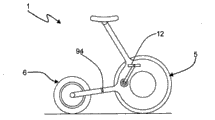
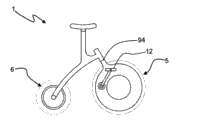


Classifications
-
- B—PERFORMING OPERATIONS; TRANSPORTING
- B62—LAND VEHICLES FOR TRAVELLING OTHERWISE THAN ON RAILS
- B62K—CYCLES; CYCLE FRAMES; CYCLE STEERING DEVICES; RIDER-OPERATED TERMINAL CONTROLS SPECIALLY ADAPTED FOR CYCLES; CYCLE AXLE SUSPENSIONS; CYCLE SIDE-CARS, FORECARS, OR THE LIKE
- B62K3/00—Bicycles
- B62K3/02—Frames
-
- B—PERFORMING OPERATIONS; TRANSPORTING
- B62—LAND VEHICLES FOR TRAVELLING OTHERWISE THAN ON RAILS
- B62K—CYCLES; CYCLE FRAMES; CYCLE STEERING DEVICES; RIDER-OPERATED TERMINAL CONTROLS SPECIALLY ADAPTED FOR CYCLES; CYCLE AXLE SUSPENSIONS; CYCLE SIDE-CARS, FORECARS, OR THE LIKE
- B62K15/00—Collapsible or foldable cycles
- B62K15/006—Collapsible or foldable cycles the frame being foldable
- B62K15/008—Collapsible or foldable cycles the frame being foldable foldable about 2 or more axes
-
- B—PERFORMING OPERATIONS; TRANSPORTING
- B62—LAND VEHICLES FOR TRAVELLING OTHERWISE THAN ON RAILS
- B62J—CYCLE SADDLES OR SEATS; AUXILIARY DEVICES OR ACCESSORIES SPECIALLY ADAPTED TO CYCLES AND NOT OTHERWISE PROVIDED FOR, e.g. ARTICLE CARRIERS OR CYCLE PROTECTORS
- B62J25/00—Foot-rests; Knee grips; Passenger hand-grips
- B62J25/06—Bar-type foot rests
-
- B—PERFORMING OPERATIONS; TRANSPORTING
- B62—LAND VEHICLES FOR TRAVELLING OTHERWISE THAN ON RAILS
- B62K—CYCLES; CYCLE FRAMES; CYCLE STEERING DEVICES; RIDER-OPERATED TERMINAL CONTROLS SPECIALLY ADAPTED FOR CYCLES; CYCLE AXLE SUSPENSIONS; CYCLE SIDE-CARS, FORECARS, OR THE LIKE
- B62K15/00—Collapsible or foldable cycles
-
- B—PERFORMING OPERATIONS; TRANSPORTING
- B62—LAND VEHICLES FOR TRAVELLING OTHERWISE THAN ON RAILS
- B62M—RIDER PROPULSION OF WHEELED VEHICLES OR SLEDGES; POWERED PROPULSION OF SLEDGES OR SINGLE-TRACK CYCLES; TRANSMISSIONS SPECIALLY ADAPTED FOR SUCH VEHICLES
- B62M1/00—Rider propulsion of wheeled vehicles
- B62M1/36—Rider propulsion of wheeled vehicles with rotary cranks, e.g. with pedal cranks
-
- B—PERFORMING OPERATIONS; TRANSPORTING
- B62—LAND VEHICLES FOR TRAVELLING OTHERWISE THAN ON RAILS
- B62M—RIDER PROPULSION OF WHEELED VEHICLES OR SLEDGES; POWERED PROPULSION OF SLEDGES OR SINGLE-TRACK CYCLES; TRANSMISSIONS SPECIALLY ADAPTED FOR SUCH VEHICLES
- B62M7/00—Motorcycles characterised by position of motor or engine
- B62M7/12—Motorcycles characterised by position of motor or engine with the engine beside or within the driven wheel
-
- B—PERFORMING OPERATIONS; TRANSPORTING
- B62—LAND VEHICLES FOR TRAVELLING OTHERWISE THAN ON RAILS
- B62K—CYCLES; CYCLE FRAMES; CYCLE STEERING DEVICES; RIDER-OPERATED TERMINAL CONTROLS SPECIALLY ADAPTED FOR CYCLES; CYCLE AXLE SUSPENSIONS; CYCLE SIDE-CARS, FORECARS, OR THE LIKE
- B62K2204/00—Adaptations for driving cycles by electric motor
Landscapes
- Engineering & Computer Science (AREA)
- Mechanical Engineering (AREA)
- Chemical & Material Sciences (AREA)
- Combustion & Propulsion (AREA)
- Transportation (AREA)
- Automatic Cycles, And Cycles In General (AREA)
- Motorcycle And Bicycle Frame (AREA)
Abstract
Description
技术领域 technical field
本发明涉及脚踏车,尤其涉及新颖且改良精巧的脚踏车。This invention relates to bicycles, and more particularly to new and improved bicycles.
背景技术 Background technique
脚踏车是最风行且有效率的个人交通工具。脚踏车的起源便产生”便士法尼(Penny Farthing)”脚踏车,具有超大的前车轮与较小的稳定后车轮。便士法尼(Penny-Farthing)脚踏车的这种设计具有许多缺点,包括因直接驱动前车轮的速度/效率限制、很难骑上/骑下以及受限的可移度性。这些缺点造成目前建造良好的钻石框架、链条驱动后轮的脚踏车配置。虽然在材料与辅助设备方面已有大幅的进展,比如煞车、悬吊与齿轮,但是这种脚踏车配置经在后续的120年间少有进展。Bicycles are the most popular and efficient form of personal transportation. The origin of the bicycle was the "Penny Farthing" bicycle, which had an oversized front wheel and a smaller stable rear wheel. This design of the Penny-Farthing bicycle has a number of disadvantages, including speed/efficiency limitations due to direct drive to the front wheel, difficult riding on/off, and limited mobility. These shortcomings lead to the current well-built diamond-frame, chain-driven rear-wheel bicycle configurations. While there have been substantial advances in materials and ancillary equipment such as brakes, suspension and gears, little has been done with this bicycle configuration over the next 120 years.
当代脚踏车设计已经大幅受到越野骑乘或街道/车道竞速的影响,而且相对应的脚踏车设计单元大大影响到由脚踏车制造商行销的消费者产品。虽然偏离针对这些运动原意的最佳化设计,但是绝大部分脚踏车是使用在通勤及一般交通工具的城市环境中的非竞赛性应用。城市使用的最佳化脚踏车也已经产生,虽然这些脚踏车是走向具道路导向轮胎的登山脚踏车设计,但是比起竞赛/运动导向的脚踏车还要简化或没有悬吊以及更加直立的座位。他们也能承受稳重、老式以及与更加激烈运动/探险活动相关的缺乏无形替代信任性格的社会观感。Contemporary bicycle design has been heavily influenced by off-road riding or street/track racing, and corresponding bicycle design elements have greatly influenced consumer products marketed by bicycle manufacturers. Although deviated from optimal design for these sporting purposes, the vast majority of bicycles are used in non-racing applications in urban environments for commuting and general transportation. Optimized bikes for urban use have also been produced, although these bikes are designed towards mountain bikes with road oriented tires, but with less or no suspension and a more upright seat than race/sport oriented bikes. They can also live with the staid, old-fashioned, social perceptions associated with more intense sports/adventures that lack an invisible vicarious trusting personality.
然而,增加中的城市拥挤、无法改变的燃料成本增加以及位于市区的工作地的优越性,已经对摩托车交通工具运输造成很大的利益。对城市摩托车交通工具运输的这些缺点,大众运输必须展现其他解决方案,尤其是通勤。然而,很多市府当局的挫折是,失去个别交通工具所提供的移动自由性,在个别旅行者中有很大的不愿意。这种不愿意在许多个人也是非常的根深蒂固,使得他们将忍受更加的交通拥挤、加长的旅行时间以及不方便及/或昂贵的停车选择以保持所认知的自由性。However, increasing urban congestion, inescapable increases in fuel costs, and the predominance of work places located in urban areas have brought great benefits to motorcycle transportation. To these shortcomings of urban motorbike transport, mass transport must present other solutions, especially for commuting. A frustration for many municipalities, however, is that there is considerable reluctance among individual travelers to lose the freedom of movement afforded by individual modes of transportation. This reluctance is also so ingrained in many individuals that they will endure increased traffic congestion, extended travel times, and inconvenient and/or expensive parking options in order to maintain their perceived freedom.
骑脚踏车对城市运输提供相当吸引人的选项,而且造成可忽略的交通阻塞、零燃料成本、最小维修花费与环境冲击。然而,大量的潜在使用者考虑以下情形而不敢使用城市脚踏车:Cycling offers a rather attractive option for urban transportation, and causes negligible traffic congestion, zero fuel costs, minimal maintenance costs, and environmental impact. However, a large number of potential users are afraid to use city bicycles considering the following situations:
1.对没有大众交通工具辅助的广泛通勤距离的不实用性;1. Impracticability for extensive commuting distances unaided by mass transit;
2.对大部分大众交通工具的不相容性;2. Incompatibility with most public transportation;
3.当不骑乘及/或携带到大众交通工具上时的存放及/或安全问题;3. Storage and/or safety issues when not riding and/or carrying on public transportation;
4.结合汽车进行多模式旅行时的不方便性;以及4. Inconvenience when combining a car for multi-modal travel; and
5.无辅助脚踏垫脚踏车旅行所需要的体能运动。5. Physical activity required for bicycle travel without assisted pedals.
结合脚踏车旅行以及大众交通工具或私人车辆对二种运输模式提供潜在协同作用的优点,也即:Combining bicycle travel with mass transport or private vehicles offers potential synergistic advantages for the two modes of transport, namely:
使用者保有在旅途的中点都能移动自由,而公交车、火车、电车、汽车或相类似的交通工具则提供其间的快速远距涵盖范围;以及The user retains freedom of movement at midpoints in the journey, with buses, trains, trams, cars or similar means of transport providing rapid long-distance coverage in between; and
这二种交通工具比起汽车旅行皆为低成本、低个人环境冲击。These two means of transportation are both low cost and low personal environmental impact compared to car travel.
进一步的优点还包括市内生活的效率提升,提供移动自由,而没有大众运输工具路线与时间表所造成的困扰。Further advantages include increased efficiency of inner-city living, providing freedom of movement without the hassle of mass transit routes and timetables.
不幸的是,脚踏车在不骑乘时,对于装载、携带或一般操控来说也是不方便且笨重的物体。此外,大部分的大众运输工具是设计给携带很少的手提行李且实质上可装载/可携带性的个人。脚踏车对于使用者在进入/走出巴士、火车或电车时会造成很大的处理困难,可能会阻碍大门或通道,妨碍其他旅客,且可能造成轻微撞伤及/或因接触到非弹性的突起物、链条或类似部分而让衣服沾到泥土。许多大众交通工具型式完全无法容纳传统的脚踏车、摩托滑板车、摩托车,或它们必须放在特定的货物柜里。Unfortunately, bicycles are also inconvenient and bulky objects to load, carry or generally maneuver when not being ridden. Furthermore, most mass transit vehicles are designed for individuals with little hand luggage and substantial stowage/portability. Bicycles can cause significant handling difficulties for users entering/exiting buses, trains or trams, may obstruct gates or passageways, obstruct other passengers, and may cause minor bruises and/or contact with non-resilient protrusions , chains, or similar parts and allow clothing to get soiled. Many forms of public transportation simply cannot accommodate traditional bicycles, motorcycle scooters, motorcycles, or they must be placed in specific cargo bins.
虽然占用比摩托交通工具还少的空见,但是传统脚踏车在不使用时对旅行者会有安全问题。不同的锁具、链条以及类似部分被骑乘者经常使用以避免失窃。不幸的是,比较起可调整又快速松脱的配件/附件(比如座垫、车轮、车灯、挂篮、旅行电脑等等),相当可调整性与简易的脚踏车常常需要骑乘者部分拆解脚踏车,固定每个配件及/或从锁在架子、柱子等的锁紧脚踏车中将构件完全间隔开。很明显地,共通步骤,比如必须间隔开前车轮并安置相邻的后车轮以使得安全链条/锁具能穿过车轮且必须携带脚踏车座垫、车灯或类似部分,是非常的不方便或不需要。然而,将传统脚踏车带到一般办公室建筑以及商讨楼梯间、升降梯、狭窄走道或办公室隔间,也是充满困难的。Although occupying less space than motorized transportation, traditional bicycles pose safety concerns for travelers when not in use. Various locks, chains and the like are frequently used by riders to avoid theft. Unfortunately, compared to adjustable and quick release accessories/accessories (such as saddles, wheels, lights, hanging baskets, travel computers, etc.), fairly adjustable and simple bicycles often require the rider to partially disassemble. Unlock the bike, secure each accessory and/or completely space the components from the locking bike locked to a rack, post, etc. Clearly, common steps, such as having to space the front wheels and position the adjacent rear wheels so that safety chains/locks can pass through the wheels and having to carry bicycle saddles, lights or the like, are very inconvenient or inconvenient. need. However, it is also fraught with difficulties to bring traditional bicycles into general office buildings and discuss stairwells, lifts, narrow walkways or office cubicles.
对于在高级办公室、客户服务或任何需要良好个人表现的环境内的受雇人员,骑脚踏车运动产生进一步的抑制因素。额外的淋浴及/或更衣所伴随的花费,以维持可接受的工作场所,个人表现与卫生,常常被视为太不方便而无法保证脚踏车通勤的努力。电动脚踏车与踏板辅助电动脚踏车都已经发展到辅助骑乘者的腿力。一般,添加电力驱动机构会大幅增加成本以及脚踏车重量,而本身没有对上述城市脚踏车使用的前三大威慑因素。Cycling creates a further disincentive for those employed in high-level offices, customer service, or any environment where good personal performance is required. The attendant costs of extra showers and/or changing clothes to maintain acceptable workplace, personal performance and hygiene are often seen as too inconvenient to justify bicycle commuting efforts. Both pedelecs and pedal assist pedelecs have been developed to assist the rider's leg strength. Typically, the addition of an electric drive mechanism adds substantially to the cost and weight of the cycle without, by itself, the top three deterrents to urban cycle use mentioned above.
在此并不意外,已经有经常且一致的努力以产生实用的折叠、可折叠或其他精巧的脚踏车,以改善上述问题。It is no surprise here that there have been frequent and concerted efforts to produce practical folding, collapsible or otherwise compact bicycles that ameliorate the above-mentioned problems.
对传统脚踏车框架设计要产生实用性折叠系统实质上的复杂度包括许多突出物,在大部分方位上缺乏稳定性,以及在折叠/直立时需要避免拆解驱动机构(尤其是上油链条驱动器)。虽然这些缺点是城市交通工具选项所面临的较重大问题,以及在城市环境中空间上越为稀少,涵盖拥挤道路、有限停车位、个人工作场所以及城市家庭,折叠脚踏车已经变成日益普遍。因此在产生能提供城市交通工具的精巧脚踏车上也有明显的优点,当不骑乘时也可由个人随时运送及收存。Substantial complexity of the folding system to produce practicality for traditional bicycle frame designs including many protrusions, lack of stability in most orientations, and the need to avoid disassembly of the drive mechanism (especially oiled chain drive) when folded/upright . While these disadvantages are the more significant problems faced by urban transportation options, and the increasingly scarce space in urban environments, including congested roads, limited parking spaces, individual workplaces, and urban homes, folding bicycles have become increasingly common. There is therefore also a distinct advantage in producing a compact bicycle that can provide urban transport, and can be transported and stored by individuals at any time when not riding.
然而数个因素已经阻碍到大众对现有技术可折叠脚踏车的接受度,也即:与典型设计特点妥协的性能,包括小直径的车轮,缺乏框架坚硬度;笨重的尺寸、重量以及“全”尺寸折叠脚踏车框架与车轮组合体的最终折叠配置;以及陷阱及/或衣服由链条、齿轮、煞车机构沾上泥土的危险。However several factors have hampered popular acceptance of current art collapsible bicycles, namely: compromised performance with typical design features, including small diameter wheels, lack of frame stiffness; cumbersome size, weight and "full" Dimensions Folding The final folded configuration of the bicycle frame and wheel assembly; and the danger of traps and/or clothing being soiled by chains, gears, brakes.
现有的折叠脚踏车可依据车轮直径分类成三类:Existing folding bicycles can be classified into three categories according to the wheel diameter:
1.全尺寸脚踏车,具有与传统道路脚踏车相当的车轮直径(也即26”),常常具有单一框架铰链,用以将脚踏车折成一半。几乎不受限制的道路性能是来自最小的成本,如果折叠脚踏车空间以及额外成本有任何缩减;1. Full-size bicycles, with wheel diameters comparable to conventional road bicycles (i.e. 26"), often have a single frame hinge to fold the bicycle in half. Virtually unlimited road performance comes from minimal cost if Any reduction in folding bike space and additional costs;
2.小型(直径24-16”)车轮,具有更精巧的折叠机构。通常直径20”的车轮被视为有效改善城市骑乘风险的临界大小,比如路边、限速凸块、凹洞以及类似地方;以及2. Smaller (24-16” diameter) wheels with a more ingenious folding mechanism. Typically 20” diameter wheels are considered critical size to effectively improve urban riding hazards such as curbs, speed limit bumps, potholes, and similar places; and
3.小于直径16”的车轮,对折叠后的体积比起道路性能具有优点。常常牵涉到复杂的折叠机构,这些脚踏车一般很难做远距离骑乘,或在速度上,而且一般会造成高度复杂的骑乘功能性、效率与舒适性。3. Wheels smaller than 16" in diameter have advantages for folded volume compared to road performance. Often involving complex folding mechanisms, these bicycles are generally difficult to ride long distances, or in terms of speed, and generally cause height Sophisticated riding functionality, efficiency and comfort.
这三类脚踏车的目标市场分别在于:间歇性娱乐性使用者,很高兴对加强骑乘性能与舒适性的可折叠性的容易性与速度妥协;城市通勤者,经常旅行且针对可到达距离,可能结合大众交通工具的混合模式通勤;以及具有空间稀少环境的使用者(比如公寓住户、汽车驾驶),有可能经常使用的需求、短距离且高度可携带性需求、混合模式通勤、船用载具以及类似通勤工具。The target markets for these three categories of bikes are: intermittent recreational users, happy to compromise on ease and speed of foldability for enhanced ride performance and comfort; urban commuters, who travel a lot and aim for distance Mixed-mode commuting, possibly combined with mass transit; and users with space-scarce environments (e.g., apartment dwellers, car drivers), likely frequent use needs, short distances and high portability needs, mixed-mode commuting, marine vehicles and similar commuting tools.
可自我证明的说,最大的潜在市场是在经常性的城市通勤者,需要脚踏车的性能以及有效的折叠,以购买上述第二类为代表。在该类中一般目的设计的可折叠脚踏车包含铰链框架,让二半的框架折叠在一起,使得二车轮实质上相邻。此外,折叠技术常常包括折叠踏板、转动/可拆解座垫以及类似部分。最后的折叠脚踏车还是很大的物件,具有许多突出物与机构,变成缠住使用者或外部物件。此外,车轮直径在不拆解车轮本身时对可能的紧密程度提供基本限制。Arguably, the largest potential market is the frequent urban commuter, who needs the performance of a bicycle as well as efficient folding, represented by the purchase of the second category above. A general purpose design collapsible cycle in this class includes a hinged frame that allows the two frame halves to fold together so that the two wheels are substantially adjacent. Additionally, folding techniques often include folding pedals, pivoting/detachable seat cushions, and the like. The last collapsible bicycles were also large objects with many protrusions and mechanisms that became entangled to the user or external objects. Furthermore, the wheel diameter provides a fundamental limit on how tight it can be without dismantling the wheel itself.
理想化的城市脚踏车中的一些特点包括:保留超步行速度的能力,不论城市环境中高速的最小需求如何(比如超过20km/h-30km/h);可折叠配置与尺寸大小,足够精巧且容易当作实用性的日常背包、手提袋,或小背包来携带;在折叠状态时最少的突出物或突出体;最小的维修需求;足够直径的车轮,用以在遇到如路缘与坑洞的城市障碍时能骑乘舒适以及惯常的跨骑;显眼且高度可视性的骑乘者座垫位置;高度可操控性,尤其是在低速时;足够的稳定性供低阶/中阶技巧的骑乘者骑乘;安全停止装置;无需工具快速精巧;以及重量轻。Some of the features in an idealized urban bicycle include: the ability to retain super-walking speeds regardless of the minimum demand for high speeds in an urban environment (e.g. over 20km/h-30km/h); a collapsible configuration and size that is compact enough and easy to Carry as a practical everyday backpack, tote, or small backpack; minimal protrusions or protrusions when folded; minimal maintenance requirements; wheels of sufficient diameter for use in encounters such as curbs and potholes Comfortable and customary straddle over urban obstacles; prominent and highly visible rider saddle position; high manoeuvrability, especially at low speeds; enough stability for low/intermediate skills Rider ride; safety stop; tool-free fast and compact; and light weight.
现代脚踏车设计(包括折叠脚踏车)已经大部分落在完善建立的配置上,前车轮操控、后车轮链条驱动(经由链条驱动位于二车轮之间的偏移曲柄),让骑乘者坐在二相同尺寸大小的车轮之间,具有大约在上腹部高度连接到前车轮的把手操纵。大部分的动力脚踏车与摩托车也采用相同的一般配置。然而这种配置是无法与许多上述折叠脚踏车所需特性相容。典型的折叠脚踏车保留连接到框架的二车轮,绕着实质上中心铰链点大约折叠一半。结果,使用小直径的车轮一般是用来减少折叠脚踏车的体积,因而具有上述的缺点。Modern bicycle design (including folding bicycles) has largely settled on a well-established configuration, front wheel steering, rear wheel chain drive (via a chain that drives an offset crank located between the two wheels), allowing the rider to sit on two identical wheels. Between the oversized wheels, steer with a handlebar attached to the front wheel at about midsection height. Most powered bicycles and motorcycles use the same general configuration. This configuration, however, is not compatible with many of the above-mentioned desirable characteristics of a collapsible cycle. A typical collapsible cycle retains the two wheels attached to the frame, folded approximately in half about a substantially central hinge point. As a result, the use of small diameter wheels is generally used to reduce the bulk of collapsible bicycles, thus having the above-mentioned disadvantages.
此外,对于踏板驱动脚踏车,从缩小车轮尺寸达成相当程度精巧会在人体工程学有效使用上产生不切实际的小踏板曲柄长度,或需要使用在车轮外部具踏板曲柄的传统链条驱动。在后者的配置中,使用大小适合成人使用的曲柄必须将踏板轴定位在比驱动车轮的旋转轴还高的水平面,以避免在踩踏时接触到地面。Furthermore, for pedal-actuated bicycles, going from reduced wheel size to a considerable degree of compactness would result in impractically small pedal crank lengths for ergonomically efficient use, or would require the use of a traditional chain drive with pedal cranks on the outside of the wheel. In the latter configuration, the use of adult-sized cranks necessitates positioning the pedal axle at a higher level than the axis of rotation driving the wheel to avoid touching the ground when pedalling.
曝露链条的出现进一步降低携带折叠脚踏车当作背包或小背包而不会弄脏使用者衣服风险的实用性。与拆解并重新连接链条到车轮有关的复杂性,阻碍到当作实用且方便步骤以克服这些缺点的行动。The presence of exposed chains further reduces the practicality of carrying a collapsible bicycle as a backpack or small backpack without the risk of soiling the user's clothing. The complications associated with dismantling and reattaching the chain to the wheel hinder what is considered a practical and convenient step to overcome these disadvantages.
缩小脚踏车的车轮轮距能缩小折叠的尺寸大小。然而,缩小后的稳定性在煞车时或撞到障碍物时会因骑乘者高重心而增加翻覆的可能性。把手在骑乘者前方以及在膝盖上方的传统安置会使与上述骑乘者有关的风险恶化,造成骑乘者撞到把手或受困于机器中被把手卡住。Reducing the wheel track of the bicycle can reduce the folded size. However, reduced stability increases the likelihood of rollovers due to the rider's high center of gravity when braking or hitting an obstacle. The traditional placement of the handlebars in front of the rider and above the knees exacerbates the risks associated with such riders, causing the rider to bump into the handlebars or become trapped in the machine and get caught by the handlebars.
早期脚踏车的设计开发出多种配置,包括“便士法尼(Penny Farthing)”脚踏车配置、非对称车轮大小、直接踏板曲柄驱动(也即没有链条与齿轮)及非常大前车轮直径。然而,尤其是从静止起动时,该型具有直接前车轮驱动、前车轮方向踏板脚踏车的困难是,施加到踏板上的压力会产生不稳定的方向效应。绕者前车轮中心驱动踏板曲柄轴也会将人体工学上的限制施加到:框架配置的型式;可能的座垫位置;最大可能踏板曲柄尺寸,没有接触到地面的风险;以及最大与最小车轮直径。Early bicycle designs developed a variety of configurations, including "Penny Farthing" bicycle configurations, asymmetrical wheel sizes, direct pedal crank drive (ie, no chain and gears), and very large front wheel diameters. However, a difficulty with this type of direct front wheel drive, front wheel directional pedal cycle, especially when starting from rest, is that the pressure applied to the pedals can have erratic directional effects. Driving the pedal crank axle around the center of the front wheel also imposes ergonomic constraints on: type of frame configuration; possible seat cushion positions; maximum possible pedal crank size without risk of touching the ground; and maximum and minimum wheel diameters .
动力脚踏车可使用辅助动力单元,以补充踏板动力(比如在爬坡时)或单独由电力单元提供动力,比如燃烧引擎或电力驱动。现有技术的动力脚踏车承受上述踏板脚踏车的缺点,加上与结合动力单元至可折叠脚踏车配置相关的额外复杂度、成本及重量。因此很需要一种精巧的脚踏车,具有至少一些上述所需的特点,而减轻至少一些所提出的缺点。尤其是提供这种也可随时折叠到用以存放或运输的精巧包装内的脚踏车。Power cycles may use an auxiliary power unit to supplement pedal power (such as when climbing hills) or be powered solely by an electric unit, such as a combustion engine or electric drive. Prior art power cycles suffer from the disadvantages of pedal cycles described above, plus the additional complexity, cost and weight associated with incorporating a power unit into a collapsible cycle configuration. There is therefore a great need for a compact bicycle having at least some of the above-mentioned desired features while alleviating at least some of the identified disadvantages. Especially to provide such a cycle that can also be folded at any time into a compact package for storage or transport.
Ampaglas的DE 2804993A1文献公开了一种依据权利要求1前序的脚踏车。The DE 2804993A1 document of Ampaglas discloses a kind of bicycle according to the preamble of
发明内容 Contents of the invention
本发明的目的是指出上述的问题或至少提供有用的选择给一般大众。It is an object of the present invention to address the above problems or at least to provide useful options to the general public.
发明的进一步特点与优点将从随后只是实例的说明中而变得明显。Further features and advantages of the invention will become apparent from the ensuing description, which is by way of example only.
要注意的是,“方向组件”与“第二轴”在此为了容易的可读性也是分别称为当作“方向叉杆”与“方向控制轴”。It should be noted that the “direction component” and the “second axis” are referred to here as “direction fork” and “direction control axis” respectively for easy readability.
如同在此所使用的名词:As nouns used here:
“框架”包括与脚踏车的车轮、方向机构、方向组件及座垫相互联结的任何结构、外壳、本体、单元或元件,以及任何其他未被独立描述的元件,且包括如车轮座垫、托架与类似部分的的配件。"Frame" includes any structure, housing, body, unit or element interconnected with the wheel, steering mechanism, steering assembly and seat of a cycle, and any other element not separately described, and includes, for example, wheel seats, brackets Accessories with similar parts.
“车轮”包括完整的车轮组合体,包括地面啮合套管轮胎、安置轮胎的可转动或固定边缘部、无毂车轮、具中心转轴的有毂车轮、辐轮、实心轮、偏心驱动轮、轮缘及/或连接到方向组件的任何其他单元。"Wheel" includes complete wheel assemblies, including ground-engaging casing tires, rotatable or fixed rims for mounting tires, hubless wheels, hub wheels with a central pivot, spoke wheels, solid wheels, eccentrically driven wheels, wheels edge and/or any other elements connected to the direction component.
“座垫”包括配置以支撑坐着的骑乘者的任何结构、突出物、平台或凹处,还包括任何相关的支撑单元、配件、结构与任何位置调整机构或设备或类似构件,以及在可拆解座垫中的“座垫”一词包括座位连接点、结构或配件。"Seat Cushion" includes any structure, protrusion, platform or recess configured to support a seated rider, and any associated support unit, fittings, structure and any position adjustment mechanism or device or similar The term "seat cushion" in detachable cushions includes seat attachment points, structures or accessories.
“方向组件”包括保持前车轮的任何可转动结构,包括单边或双边叉杆、方向管及/或可旋转连接前车轮至框架的任何其他结构。"Steering assembly" includes any rotatable structure that holds the front wheels, including single or double forks, steering tubes, and/or any other structure that rotatably connects the front wheels to the frame.
“方向机构”包括连接到方向组件用以同向旋转的任何机构、结构,配件,包括连接杆、把手、操纵杆、滑轮、杠杆或类似构件。"Steering mechanism" includes any mechanism, structure, accessory, including connecting rods, handles, joysticks, pulleys, levers or the like, attached to a steering assembly for co-rotation.
“驱动机构”包括任何机构,用以提供移动力给脚踏车。"Drive mechanism" includes any mechanism for providing moving force to a cycle.
依据一方面,本发明提供一种脚踏车,用以供骑乘者在地面上使用,该脚踏车包括:According to one aspect, the present invention provides a bicycle for use by a rider on the ground, the bicycle comprising:
框架,具有框架前部与框架尾部;a frame having a frame front and a frame tail;
座垫,连接到该框架;a seat cushion, connected to the frame;
纵轴,是与一实质上垂直定向并且贯穿脚踏车行进的向前与向后方向的第二平面相符;a longitudinal axis coincident with a second plane oriented substantially vertically and extending through the forward and rearward directions of travel of the bicycle;
横轴,正交于该纵轴;a transverse axis, orthogonal to the longitudinal axis;
前车轮,连接至一方向组件,该前车轮可在绕着主轴的第一平面上转动,该方向组件枢接至该框架的前部,用以绕着正交于该主轴的第二轴旋转;a front wheel connected to a steering assembly rotatable in a first plane about a primary axis, the steering assembly being pivotally connected to the front of the frame for rotation about a second axis orthogonal to the primary axis ;
使用者可操作的方向机构,联结至该方向组件;a user-operable steering mechanism coupled to the steering assembly;
后车轮,可转动地连接至该框架的尾部,且可在绕着四元轴的第三平面上转动,其中该前车轮与后车轮具有不同的直径,以及a rear wheel rotatably connected to the rear of the frame and rotatable in a third plane around the quad axis, wherein the front wheel and the rear wheel have different diameters, and
驱动机构,可操作地联结至该前车轮及/或后车轮;a drive mechanism operatively coupled to the front and/or rear wheels;
该脚踏车的特征在于在一个所述的车轮中包含一凹部或孔洞,在该折叠配置中能够至少部分接收另一个车轮的插入。The cycle is characterized by the inclusion in one of said wheels of a recess or hole capable of at least partially receiving the insertion of the other wheel in the folded configuration.
当代非斜躺式脚踏车的传统骑乘位置使骑乘者具有弯腰驱干的姿势,部分弯腰而具有较低的头部。对于较高速具有更好的气体动力学优点,这种位置会对骑乘者体形更加拉紧并减轻骑乘者的周边注意力及其他交通的道路现况。The traditional riding position of contemporary non-recumbent bicycles places the rider in a bent over stem position, partially stooped with a low head. With better aerodynamic advantages for higher speeds, this position tightens the rider's frame more and reduces the rider's attention to peripheral and other traffic on the road.
骑乘者腿部在骑乘者臀部前方的未紧绷配置中,自然的垂直座位对传统脚踏车配置是不实用。In an untightened configuration with the rider's legs in front of the rider's hips, a naturally vertical seat is impractical for conventional bicycle configurations.
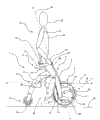
较佳地,该脚踏车包括至少一脚踏板在该前车轮上,配置成使得当脚踏车在行进时,坐在座垫上于操作接触该方向组件及脚踏板的骑乘者是定位在未拉紧且实质上垂直的姿势而没有实质上躯干倾斜,而在脚踏车静止时,让坐着的骑乘者的脚能到达地面。Preferably, the bicycle includes at least one pedal on the front wheel, configured so that when the bicycle is moving, the rider sitting on the seat cushion and operating the steering assembly and the pedal is positioned in the opposite direction. A taut and substantially vertical stance without substantial torso leaning allows a seated rider's feet to reach the ground when the bicycle is stationary.
因此,骑乘者能以人体工学平衡且未拉紧的稳定坐姿骑乘上述的脚踏车,骑乘者的腿部向前伸直到前车轮脚踏板,而非放在骑乘者臀部的底下及/或后面。与传统骑乘姿势比较起来,这种垂直的骑乘姿势对城市交通工具提供许多优点,包括:给骑乘者绝佳的视野以及高的视线;展现较大的视觉特征或其他道路使用者的现况;降低肌肉与骨胳的紧绷;以及将骑乘者的腿部放在臀部前稳定且自然的位置,降低所需的最小座垫高度,并因而降低重心且改善稳定性。Thus, the rider can ride the aforementioned bicycle in an ergonomically balanced and untensioned stable sitting position, with the rider's legs stretched forward to the front wheel pedals, rather than being placed under the rider's buttocks and/or behind. This upright riding position offers many advantages to urban vehicles compared to a traditional riding position, including: giving the rider excellent visibility and a high line of sight; exhibiting greater visual identity or other road users condition; reduces muscular and skeletal tension; and places the rider's legs in a stable and natural position in front of the hips, lowering the minimum required saddle height and thus lowering the center of gravity and improving stability.
这种骑乘者位置是非常明显对比于绝大部分目前的及历史上的脚踏车设计。传统的骑乘位置会迫使骑乘者经由骑乘者的背部、肩膀与手臂支撑一部分的躯干重量到前把手上。速度最佳化的道路竞赛型脚踏车配置成将骑乘者安置为躯干与头部实质上是在容易斜躺的位置。这种骑乘姿势完全不适合低平均速度且需要高可视度与操控性的城市骑乘/通勤。竞赛脚踏车也很难配置成有效折叠/精巧的设计。This rider position is in stark contrast to most current and historical bicycle designs. The traditional riding position forces the rider to support a portion of the torso weight onto the front handlebars via the rider's back, shoulders and arms. Speed-optimized road racing bicycles are configured to position the rider with the torso and head in an essentially recumbent position. This riding position is totally unsuitable for urban riding/commuting where low average speeds require high visibility and handling. Competition bikes are also difficult to configure into an efficient folding/compact design.
登山脚踏车与城市特定变化具有更加垂直的躯干骑乘姿势,虽然骑乘者的躯干仍需要倾斜以便使骑乘者到达方向机构与煞车。某种形式的倾斜躯干对脚踏车设计者来说很难避免后车轮踏板曲柄驱动的传统脚踏车所固有的动力学/人体工学,关联到人体比例的限制。Mountain bikes and city-specific variations have a more vertical torso riding position, although the rider's torso still needs to be tilted in order for the rider to reach the steering mechanism and brakes. Some form of sloping torso makes it difficult for cycle designers to avoid the dynamics/ergonomics inherent in rear wheel pedal crank driven conventional cycles, linked to the constraints of human body proportions.
要了解的是,驱动机构可分成二类,也即由人类使用者/骑乘者(比如踏板曲柄)提供动力的机构或具有独立或使用者/骑乘者外部的动力源(比如电动马达、引擎或类似装置)的机构,在此分别定义成“使用者动力”与“外部动力”。如在此所使用的,“脚踏板”包括在骑乘时用以让使用者放置双脚的任何配件,以及包括可移动物(比如踏板曲柄)、笼状物、可褶迭且固定的踏垫。It will be appreciated that drive mechanisms can be divided into two categories, namely those powered by a human user/rider (such as a pedal crank) or those with a power source that is independent or external to the user/rider (such as an electric motor, engine or similar device), are defined herein as "user power" and "external power", respectively. As used herein, "pedals" include any accessory that allows the user to position the feet while riding, and includes movable objects (such as pedal cranks), cages, collapsible and fixed Mats.
较佳地,该驱动机构包括至少电动马达、发电机、踏板曲柄及链条驱动器、内燃机或外燃机及/或相同的任何结合的其中之一。这些驱动机构在以下随后的段落中会个别地更加完整考虑。Preferably, the drive mechanism comprises at least one of an electric motor, a generator, a pedal crank and chain drive, an internal or external combustion engine and/or any combination of the same. These drive mechanisms are considered more fully individually in the following subsequent paragraphs.
因此本发明提供在观念上与现有脚踏车设计不同的框架配置/座垫,具有最接近且可相比于由上一世纪便士法尼脚踏车设计所展现出来的骑乘姿势。然而,已知的便士法尼脚踏车设计对以下所解释的本发明来说具有许多关系密切的差异。The present invention thus provides a frame configuration/saddle that is conceptually different from existing bicycle designs, with a riding position that is closest and comparable to that exhibited by Penny Farney bicycle designs of the last century. However, known Penny Farney bicycle designs have a number of differences that are relevant to the present invention as explained below.
最早的便士法尼脚踏车是由踏板曲柄经由前车轮轴所直接带动的,且因此需要相当大直径的前车轮以提供曲柄转一圈时有足够的速度。然而,大的前车轮直径妨碍到骑乘者坐着时踏到地面上。此外,高的骑乘位置产生高的重心,低的可操纵性及差的煞车性能。便士法尼脚踏车的骑乘者位置会曝露出骑乘者(尤其是在快速减速时)实质上易受伤于:被把手绊住;很难跨骑;“因高座位所产生的力矩绕着前车轮轴的弹弓效应”与非常短的轮距;以及在低速骑乘时因前车轮的不易操控尺寸与无法在地面上使用稳定用的脚而摔落。The earliest Penny Farney bicycles were directly driven by the pedal crank via the front wheel axle, and thus required a fairly large diameter front wheel to provide sufficient speed for one revolution of the crank. However, the large front wheel diameter prevents the rider from stepping on the ground while seated. In addition, a high riding position produces a high center of gravity, low maneuverability and poor braking performance. The rider position on a Penny Farney bike can reveal that the rider (especially when decelerating rapidly) is substantially vulnerable to: getting caught in the handlebars; being difficult to straddle; The "slingshot effect" of the wheel axle and the very short wheelbase; and when riding at low speeds due to the unmanageable size of the front wheel and the inability to use stabilizing feet on the ground.
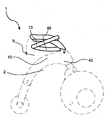
对照相比,当配置且尺寸化以安置骑乘者的脚接触到地面的距离时,本发明的某些实施例会减轻上述每个缺点。这些配置包括结合特定脚踏车框架几何形状/尺寸大小以及很小于传统便士法尼脚踏车的前车轮直径,以产生实际上的迷你脚踏车(Mini-Farthing)。为了区别现有技术的便士法尼脚踏车设计与本发明的实施例,迷你脚踏车(Mini-Farthing)将用来指后者,其中虽然前车轮大于后车轮,不过骑乘者仍能在静止时用双脚接触到地面,并用双脚在前车轮脚踏板/踏板上骑乘脚踏车。In contrast, certain embodiments of the present invention mitigate each of the aforementioned disadvantages when configured and sized to accommodate the distance that the rider's feet contact the ground. These configurations include combining specific bike frame geometries/sizing and front wheel diameters that are much smaller than traditional penny farthings to create what is effectively a Mini-Farthing. To distinguish prior art penny-farthing bicycle designs from embodiments of the present invention, Mini-Farthing will be used to refer to the latter, in which although the front wheels are larger than the rear wheels, the rider can still use them while stationary. With both feet touching the ground, ride the bike with both feet on the front wheel pedals/pedals.
此外,对于“使用者动力”与“外部动力”驱动机构,在骑乘时将骑乘者的双脚放在前车轮脚踏板上也提供:增加的动态稳定性;互动性骑乘者参与;以及触觉回馈。Additionally, for both "user powered" and "external powered" drive trains, placing the rider's feet on the front wheel pedals while riding also provides: increased dynamic stability; interactive rider participation ; and haptic feedback.
很明显地,骑乘者可经由一个或二个脚踏板以帮助将方向控制输入至前车轮。在某些情形下,脚踏车的方向控制可藉由脚踏板的骑乘者输入单独进行。这种情形会间歇性的在骑乘者的双手被占用时发生,或在某一实施例中,当作主要方向控制的方法时,也即前车轮脚踏板本身是联结至方向组件的使用者可操作方向机构。虽然手动的方向机构在可操控性、可骑乘性与使用难易上最为优越,但是单独的脚控制方向的实施例提供潜在性更加简单而能缩到较小体积的结构。Obviously, the rider can input directional control to the front wheels via one or two foot pedals to help. In some cases, directional control of the bicycle may be provided solely by rider input from the pedals. This situation occurs intermittently when the rider's hands are occupied, or in one embodiment, as the primary method of steering control, ie the front wheel pedals themselves are coupled to the use of the steering assembly. The operator can operate the direction mechanism. While manual steering mechanisms are superior in terms of maneuverability, rideability, and ease of use, individual foot-controlled steering embodiments offer potentially simpler structures that can be scaled down to a smaller size.
可用本发明及其个别性能参数实现的特定方向机构变化的更加完整考量是在后续中会更深入讨论。然而,联结到方向组件的方向机构的位置是特别有关于骑乘者位置的问题。当作对脚踏车性能具有相关影响力的其他配置参数,对本发明而言,是可从以下考量中而辨识出:将手动方向机构安置在从座垫可轻易触及的距离内;座垫高度不超过骑乘者内侧腿部长度;以及脚踏板从座垫位置的平移会使前车轮方向移动而不会被骑乘者双脚干扰或从骑乘者双脚脱离开。A more complete consideration of the specific directional mechanism changes achievable with the present invention and its individual performance parameters is discussed in greater depth hereinafter. However, the position of the steering mechanism coupled to the steering assembly is an issue particularly relevant to the rider's position. Other configuration parameters that have a relevant influence on the performance of the bicycle are, for the present invention, identifiable from the following considerations: placing the manual steering mechanism within easy reach of the saddle; The length of the inside leg of the rider; and the translation of the footpegs from the seat cushion position will allow the front wheel to move in direction without being interfered by or disengaged from the rider's feet.
一般人体具有与不同四肢、身体特征与单元的比例有关的某些相关性已被广泛的建立。例如,相对面伸直手臂的指尖之间的距离大约等于人的高度,而相互链结二组指尖会将双手放在与鼠蹊部相同的高度。因此,虽然有人体型态与大小的自然性变动,但是这些相互关系可用来当作设计参数,以最佳化脚踏车的人体工学,藉以适合大部分的人体骨架。The general human body has certain correlations with the proportions of different extremities, body features and units that have been widely established. For example, the distance between the fingertips of opposing straight arms is approximately equal to the height of a person, and interlocking two sets of fingertips will place the hands at the same height as the groin. Thus, while there are natural variations in body shape and size, these interrelationships can be used as design parameters to optimize the ergonomics of a bicycle to fit most human anatomy.
如上所述,对于使用前车轮脚踏板的本发明实施例,在座垫位置与脚踏板之间具有清楚的物理关系。后车轮的配置与位置对脚踏车性能与精巧性具有某些关系,但并不直接牵涉到骑乘者人体工学与前车轮脚踏板的互相影响以及方相机构。随着人体形的大幅变动,对于配置/骑乘者位置的脚踏车发明性特点,本发明实施例的优点是可定义于相对比例,比率与角度,且不是单独由特定尺寸所定义。结果,适合骑乘者的脚踏车,比如小孩或体形较小的成人,都可以只做适当的改变大小而不脱离本发明的范围。虽然如此,本发明特点的另一优点是,大范围体形的骑乘者可使用相同的配置,而不需调整脚踏车。As noted above, for embodiments of the invention using front wheel footrests, there is a clear physical relationship between the seat cushion location and the footrests. The configuration and position of the rear wheel has some bearing on the performance and refinement of the bicycle, but is not directly involved in the interaction of the rider's ergonomics with the front wheel's pedals and phasing mechanism. As the body shape varies widely, the inventive features of the cycle for configuration/rider position, advantageously of embodiments of the present invention, are definable in relative proportions, ratios and angles, and are not defined solely by specific dimensions. As a result, a bicycle suitable for a rider, such as a child or a smaller adult, can be appropriately sized without departing from the scope of the present invention. Nevertheless, another advantage of the features of the present invention is that a wide range of rider sizes can use the same configuration without the need for adjustments to the bicycle.
最大座垫高度是受限于骑乘者内侧腿部长度,因此紧接着,脚踏板从座垫间隔开必须是在不大于骑乘者内侧腿部长度的半径弧形内。方向控制脚踏车前车轮以及安置骑乘者双脚到前车轮上的优点是,更加立即的感知到脚踏车的动态、方向控制以及感觉。在传统框架的脚踏车中,前车轮是远离骑乘者的双脚,而且绕着方向控制轴转动方向控制装置(比如把手),会绕着离开骑乘者重心的转轴而动作。实际上,大部分现有技术脚踏车的方向控制轴是朝向骑乘者的座位,使得与骑乘者躯干的交叉会很小,如果有的话。The maximum saddle height is limited by the length of the rider's inner leg, so then the footrests must be spaced from the saddle within an arc of radius no greater than the length of the rider's inner leg. The advantage of steering the front wheel of a bicycle and placing the rider's feet on the front wheel is a more immediate perception of the dynamics, steering and feel of the bicycle. In a traditional frame bicycle, the front wheel is away from the rider's feet, and turning the directional control device (such as a handlebar) about a directional control axis will act about a pivot axis away from the rider's center of gravity. In fact, the directional control axis of most prior art bicycles is towards the rider's seat so that there is little, if any, intersection with the rider's torso.
对照相比,本发明的实施例让骑乘者垂直坐在座垫上,其躯干是与该方向控制轴或该第二轴交叉。较佳情形是,该交叉上是发生在直立骑乘者的肩膀。在另一实施例中,手控制该方向机构在实质上是垂直对齐于该方向轴。在另一实施例中,该脚踏板也是位于垂直相邻于该方向轴,或实质上对齐于该方向轴。In contrast, embodiments of the present invention seat the rider vertically on the seat cushion with their torso intersecting either the directional control axis or the second axis. Preferably, this crossover occurs at the shoulders of an upright rider. In another embodiment, the hand control of the directional mechanism is substantially vertically aligned with the directional axis. In another embodiment, the footrest is also located vertically adjacent to, or substantially aligned with, the directional axis.
提供实质上绕着一个或多个骑乘者的在前车轮脚踏板上的双脚、膝盖、在方向组件上的双手、肩膀的方向轴而对齐的配置产生高度相互性的可控制及精巧的脚踏车,其中方向组件有效的“穿过”或“绕着”骑乘者身体。骑乘者身体相邻或在方向轴上的这种安置,会让骑乘者对于脚踏车的移动产生更强的立即感与参与感,且类似于其他动态活动或运动(比如滑雪板运动或溜冰板运动),其中旋转移动是绕着靠近骑乘者/使用者重心的转轴而进行。Provides a configuration that is substantially aligned about the steering axis of one or more rider's feet on the front wheel pedals, knees, hands on the steering assembly, shoulders resulting in a high degree of reciprocal controllability and delicacy A bicycle in which the steering assembly effectively "passes through" or "around" the rider's body. This placement of the rider's body adjacent or on the directional axis gives the rider a greater sense of immediacy and involvement with the movement of the bike, similar to other dynamic activities or sports such as snowboarding or skateboarding. motion) in which rotational movement is about an axis close to the rider/user's center of gravity.
要了解的是,方向轴角度是脚踏车方向几何的影响因素,对脚踏车的实际性能具直接影响力。结合前车轮直径以及方向叉杆偏移,方向轴角度(在脚踏车界中也称作“倾角”)定义出影响方向稳定性与反应之间平衡的“拖曳”程度。It is to be understood that the steering axis angle is a factor in the steering geometry of the bike and has a direct impact on the actual performance of the bike. Combined with the front wheel diameter and steering fork offset, the steering axis angle (also called "loft" in cycling circles) defines the degree of "drag" that affects the balance between directional stability and response.
在一实施例中,已经发现本发明能容纳在70(+/-10)度之间的方向轴角度θ,是由平面水平地面所量测。In one embodiment, it has been found that the present invention can accommodate an orientation axis angle Θ of between 70 (+/- 10) degrees, as measured from a flat level ground.
因此,在一实施例中,本发明提供实质上以下所述的脚踏车,其中第二轴相对于平面水平地面张开70(+/-10)度,该脚踏车最好是配置成使得骑乘者双脚、骑乘者双手及/或骑乘者肩膀的至少其中之一是绕着或实质上是相邻于纵向垂直平面中的该方向轴。结合骑乘者能安置其双脚在前车轮脚踏板上的需求,这种方向角度范围所隐含的意义是很重要的,如同定义出骑乘者的坐姿及方向轴的附近。现有技术的脚踏车使用较陡的方向角(不会穿过或相邻于使用者的四肢/躯干)或更浅的方向角,产生“斧头型”的前车轮组合体,结果对可实施脚踏板安置而言是距离太远。Thus, in one embodiment, the present invention provides a cycle substantially as follows, wherein the second axis is spread out at 70 (+/- 10) degrees relative to the flat horizontal ground, the cycle preferably being configured such that the rider At least one of the feet, the rider's hands and/or the rider's shoulders is about or substantially adjacent to the orientation axis in the longitudinal vertical plane. Combined with the rider's need to be able to place their feet on the front wheel pedals, the implications of this range of directional angles are important, as is defining the rider's sitting position and proximity to the directional axis. Prior art bicycles use steeper steering angles (not passing through or adjacent to the user's extremities/torso) or shallower steering angles, resulting in an "axe-shaped" front wheel assembly, with the result that the foot can be implemented. Too far away for pedal placement.
对于人体工学的需求,坐着的骑乘者必须能将其双脚安置在前车轮脚踏板上,这种情形限制坐着的骑乘者与前车轮之间的纵向间隔,以及与方向轴之间的纵向间隔。For ergonomic requirements, the seated rider must be able to place their feet on the front wheel treads, which limits the longitudinal separation between the seated rider and the front wheel, as well as the relationship with the steering axis. vertical interval between.
最大座垫高度Ymax与骑乘者内侧腿部长度之间具有直接关系。相类似的,前车轮脚踏板的最大间隔与座垫之间具有内部关系,用座垫的高度Y以及座垫与方向轴的水平间隔X表示。当作参考点,坐着的骑乘者的位置可视为由通过骑乘者骨盆及脊柱的垂直线或后面座垫边缘的垂直线所代表。There is a direct relationship between the maximum saddle height Y max and the length of the rider's inner leg. Similarly, the maximum spacing of the front wheel pedals has an internal relationship to the seat cushion, represented by the height Y of the seat cushion and the horizontal spacing X of the seat cushion from the steering axis. As a point of reference, the seated rider's position may be considered represented by a vertical line through the rider's pelvis and spine or a vertical line at the edge of the rear seat cushion.
已经发现到,对于给定的座垫高度Y1,以及方向轴角度θ=70°,距垂直线的方向轴的水平间隔X1大约等于0.24Y1。因此,在几何形状上紧接是,到与方向轴交叉的垂直高度Y2是表示成:It has been found that for a given seat cushion height Y 1 , and a directional axis angle θ = 70°, the horizontal separation X 1 of the directional axis from the vertical is approximately equal to 0.24Y 1 . So, geometrically immediately, the vertical height Y2 to the intersection with the orientation axis is expressed as:
Y2=0.24Y1tanθ+Y1 (1)Y 2 =0.24Y 1 tanθ+Y 1 (1)
而且紧接着,方向轴与地面交叉以及该垂直线之间的水平距离X3是表示成:And then, the direction axis crosses the ground and the horizontal distance x3 between this vertical line is expressed as:
X3=tanθ/(0.24Y1tanθ+Y1)(2)X 3 =tanθ/(0.24Y 1 tanθ+Y 1 )(2)
因此,依据一实施例,本发明提供一种具有第二轴角度70°(+/-10°)以及被定位来承受骑乘者直立躯干的脚踏车座垫的脚踏车,其中骑乘者直立躯干是在离该第二轴与地面的交叉为水平距离X1(+/-20%)上,而该地面是由X3=tanθ/(0.24Y1tanθ+Y1)所给定,其中Y1是垂直座垫高度。Thus, according to one embodiment, the present invention provides a bicycle having a second axis angle of 70° (+/- 10°) and a bicycle seat positioned to receive the rider's upright torso, wherein the rider's upright torso is At a horizontal distance X 1 (+/-20%) from the intersection of the second axis with the ground given by X 3 =tanθ/(0.24Y 1 tanθ+Y 1 ), where Y 1 is the vertical seat height.
在定义出方向轴与骑乘者座垫之间相互关系的另一方式中,该垂直线可当作座垫座垫的后面边缘。虽然骑乘者可有意的进一步朝方向轴向后坐下,但是如此做有性能上的结果,即使骑乘者仍无法到达前车轮脚踏板。坐在进一步离开方向轴会对后车轮增加重量,并相称的减轻施加到前车轮的力量,降低前车轮的抓地力与转弯能力。此外,对于用绕着在方向轴上或相邻于方向轴的枢轴而枢接于框架的座垫所构成的脚踏车,增加后面座垫位置会增加施加到座垫枢轴上的力矩。因此需要适当的加强以容纳这些可能增加整体脚踏车重量的增加力量。所以,座垫的后面能提供适当的参考点给相邻于骑乘者背部、脊柱与肩膀的垂直平面的位置。In another way of defining the relationship between the directional axis and the rider's seat cushion, the vertical line may serve as the rear edge of the seat cushion seat cushion. Although the rider can intentionally sit further back toward the steering axis, there are performance consequences to doing so, even if the rider still cannot reach the front wheel pedals. Sitting further away from the steering axle will add weight to the rear wheels and reduce the force applied to the front wheels commensurately, reducing the grip and cornering ability of the front wheels. Furthermore, for a cycle constructed with a seat pivoted to the frame about a pivot on or adjacent to the steering axis, increasing the rear seat position increases the moment applied to the seat pivot. Proper reinforcement is therefore required to accommodate these added forces which can increase the overall weight of the cycle. Therefore, the rear of the seat cushion provides the proper reference point for the position adjacent to the vertical plane of the rider's back, spine and shoulders.
考虑后面座垫边的另一参考点,方向轴18离该座垫边缘的相对应水平间隔X2等于约0.28Y1.。Considering another point of reference for the edge of the rear cushion, the corresponding horizontal spacing X 2 of the
因此,依据另一实施例,在方向轴与地面的交叉以及座垫后面边缘之间的水平距离X4为:Thus, according to another embodiment, the horizontal distance X4 between the intersection of the directional axis and the ground and the rear edge of the seat cushion is:
X4=tanθ/(0.28Y1tanθ+Y1)X 4 =tanθ/(0.28Y 1 tanθ+Y 1 )
其中θ是方向轴角度,Y1是垂直座垫高度。where θ is the orientation axis angle and Y1 is the vertical seat height.
了解到骑乘者体形、座位与个人风格的变化,在另一实施例中,方向轴与地面的交叉以及该垂直线之间的水平距离X2是在正或负20%范围内变动。In another embodiment, the intersection of the directional axis with the ground and the horizontal distance X2 between the vertical line is varied by plus or minus 20%, in recognition of variations in rider size, seating and personal style.
便士法尼脚踏车的配置几乎已经完全落在主流使用之外超过一世纪。虽然许多以往的实例仍能被骑乘,但是为了新奇及娱乐目的,现代的复制品已被产制,且不是实用的交通工具,尤其是对于城市运输/通勤。虽然是出自喜好,但是比后车轮大很多的前车轮的便士法尼脚踏车配置,提供许多优点给实际城市专用迷你法尼脚踏车,当结合本发明的折叠特点而调整时,包括:预设的方向机构;外部驱动机构;以及无毂车轮结构。The Penny Farney configuration has almost entirely fallen out of mainstream use for over a century. While many past examples can still be ridden, modern replicas have been produced for novelty and entertainment purposes, and are not practical vehicles, especially for urban transportation/commuting. Although a matter of preference, the penny farney configuration of the front wheels, which are much larger than the rear wheels, offers a number of advantages to practical city-specific mini-farneys, when tuned in conjunction with the folding features of the present invention, including: Preset orientation mechanisms; external drive mechanisms; and hubless wheel structures.
将了解到,这不会排除利用非迷你法尼脚踏车配置的本发明实施例(如同在此所描述),比如与前车轮相同直径或比前车轮还大直径的后车轮。It will be appreciated that this does not preclude embodiments of the invention (as described herein) utilizing non-mini-Farney configurations, such as a rear wheel of the same diameter or a larger diameter than the front wheel.
较佳地,该前车轮可具有超过该后车轮的直径。Preferably, the front wheel may have a larger diameter than the rear wheel.
为了将脚踏车折叠成精巧且可携带的配置,可使用不偏离本发明的精神的数种方法,并在此做更加详细的探究。然而,将会很明显的,迷你法尼脚踏车配置提供特定地利用二车轮之间尺寸大小的相对差异性的良机,以方便折叠脚踏车的精巧化。In order to fold the cycle into a compact and portable configuration, several methods can be used without departing from the spirit of the invention and are explored in more detail here. However, it will be apparent that the mini-Farney configuration provides an excellent opportunity to specifically take advantage of the relative differences in size between the two wheels to facilitate the compactness of the collapsible bicycle.
与一般小型车轮可折叠城市通勤/运输脚踏车比较,迷你法尼脚踏车配置提供数个潜在性的优点,包括:缩小的体积(直立的与折叠的),是与具有迷你法尼脚踏车的前车轮相同直径的二车轮的脚踏车比较;优于小型车轮脚踏车的加强的可骑乘性,当前车轮是控制可骑乘性的主要车轮,尤其是骑过障碍物与不平的路面时;前车轮外缘内额外的体积,用于驱动机构及/或存放;以及将脚踏板安置在前车轮上的潜力。Compared to typical small-wheel collapsible urban commuter/transportation bikes, the mini-farney configuration offers several potential advantages, including: reduced size (upright and folded), is the same as with a mini-farney front wheel Compared to bicycles with two wheels in diameter; enhanced rideability over small-wheel bicycles, with the front wheel being the primary wheel controlling rideability, especially when riding over obstacles and uneven surfaces; inside the outer rim of the front wheel Extra volume for the drive mechanism and/or storage; and the potential to place the footrests on the front wheels.
然而,如上所述,精巧化不只是迷你法尼脚踏车配置的优点而已。较佳地,该脚踏车可包括以下至少其中之一:一手动方向机构,配置并定位以提供实质上在骑乘者腿部前面不会阻碍或妨碍的区域;至少一无毂车轮;及/或至少一外部动力驱动机构,可操作地联结至前车轮及/或后车轮。However, as mentioned above, compactness is not just an advantage of the minivani configuration. Preferably, the cycle may include at least one of: a manual steering mechanism configured and positioned to provide an area substantially unobstructed or obstructed in front of the rider's legs; at least one hubless wheel; and/or At least one externally powered drive mechanism is operatively coupled to the front wheels and/or the rear wheels.
如上所述,本发明也可很有利的利用一迷你法尼脚踏车配置,结合无毂前车轮、外部动力驱动机构及/或后车轮驱动机构。无毂前车轮特别有利的是结合精巧化脚踏车作为提供让脚踏车的元件可被精巧化的存放体积的装置。无毂前车轮可以用前车轮中心的孔洞而形成,但不一定是如此。除了存放的可能性以外,前车轮中心孔洞还可容纳驱动机构与悬吊组件,以及贯穿车轮平面的类似装置。此外,由驱动机构所施加的移动动力不需要经由传统车轮方式的中心轴施加。As noted above, the present invention can also be advantageously utilized in a miniature fanny configuration, incorporating hubless front wheels, externally powered drive mechanisms and/or rear wheel drive mechanisms. A hubless front wheel is particularly advantageous in conjunction with a downsized cycle as a means of providing storage volume allowing the components of the cycle to be downsized. A hubless front wheel can be formed with a hole in the center of the front wheel, but it doesn't have to be. In addition to storage possibilities, the front wheel center wells accommodate drive train and suspension components, and similar devices that run through the plane of the wheel. Furthermore, the movement power applied by the drive mechanism does not need to be applied via the central axle in the conventional wheel manner.
联结驱动机构至车轮的这种自由性,在与偏心前车轮驱动机构有关的后续段落中会更加完整的利用。相类似地,边缘驱动无毂前车轮以及使用外部动力驱动机构给本发明迷你法尼脚踏车配置的前车轮及/或后车轮的益处,会在以下段落中更加完整的讨论。This freedom of coupling the drive mechanism to the wheels will be exploited more fully in the subsequent paragraphs relating to the eccentric front wheel drive mechanism. Similarly, the benefits of edge-driven hubless front wheels and the use of externally powered drive mechanisms for the front and/or rear wheels of the minivani of the present invention are discussed more fully in the following paragraphs.
本发明的可折叠脚踏车在数个方面不同于现有技术的折叠脚踏车,包括折叠方法的速度与简化,以及所达成的精巧化程度。现有技术的脚踏车精巧化落在数个如下的广泛类别中。The collapsible cycle of the present invention differs from prior art collapsible cycles in several respects, including the speed and simplicity of the folding method, and the degree of compactness achieved. Prior art bicycle refinements fall into several broad categories as follows.
实质上全尺寸且“传统”踏板驱动的现有技术脚踏车是将框架铰链折叠,其中脚踏车实质上是对折成一半,紧接着将延伸座垫杆以及可能的把手做伸缩性的精巧化。虽然这会沿着原始纵向脚踏车轴缩小脚踏车的尺寸大小,但是脚踏车很明显不可避免的在横向上较大,常常伴随着恼人的踏板、把手、煞车线与类似构件的突出物。这种折叠脚踏车的笨重本性会被传统前车轮与后车轮以及防止二折叠车轮组合物密接啮合的相关链条/踏板驱动繁复手续所恶化。A substantially full-sized, "traditional" pedal-driven prior art bicycle is a hinged frame fold where the bicycle is essentially folded in half, followed by telescopic refinement of the extended seatpost and possibly handlebars. While this reduces the size of the cycle along the original longitudinal cycle axis, the cycle is clearly and unavoidably larger laterally, often with annoying protrusions from pedals, handlebars, brake lines and the like. The cumbersome nature of such folding bicycles is exacerbated by the traditional front and rear wheels and the associated chain/pedal drive complications that prevent tight meshing of the two folding wheel combinations.
其他现有技术的可折叠脚踏车已经连锁住脚踏车框架大约一个或多个铰链框架折叠,类似于将折叠婴儿车/婴儿车折叠的方式。虽然这也会缩小脚踏车的原始纵向长度,但是一般来说高度会相对等的增加,导致脚踏车体积只是重新分布而不是大幅度的缩减。Other prior art collapsible bicycles have interlocked the bicycle frame about one or more hinges to fold the frame, similar to the way a folding stroller/pram is folded. While this also reduces the bike's original longitudinal length, there is generally a commensurate increase in height, resulting in a redistribution of bike volume rather than a substantial reduction.
伸缩性的框架精巧化也被用在现有技术中,虽然这会产生相当大的框架收缩、稳定性与坚固性的问题。结果,虽然经由精巧化的体积缩小可能很重要,但是直立脚踏车一般只适合不常使用、在平坦的地面上短距离旅程。Resilient frame miniaturization is also used in the prior art, although this creates considerable frame shrinkage, stability and robustness issues. As a result, upright bikes are generally only suitable for infrequent use, short distance journeys on flat ground, although size reduction through compactness may be important.
在直立骑乘配置以及折叠配置中脚踏车所占用的体积,可由具有接触到脚踏车末端的平面侧边的长方体“盒”体积来定义。可比较的长方体体积是对每个主要脚踏车元件都可定义的,包括车轮、方向装置以及框架组合体。比较形成长方体盒侧边的平面位置的改变,不只是定量出体积的改变,而且还有折叠脚踏车形状的本性。The volume occupied by the cycle in the upright riding configuration as well as in the folded configuration may be defined by a cuboid "box" volume with planar sides touching the ends of the cycle. Comparable cuboid volumes are definable for each major bicycle component, including wheels, steering and frame assemblies. Comparing the changes in the positions of the planes forming the sides of the cuboid box not only quantifies the changes in volume, but also the nature of the shape of the folding bicycle.
该脚踏车是以体积方式由相互正交的平行对的垂直与水平平面(当脚踏车是直立时)所定义,区分出相对面的纵向、横向与垂直边界平面,分别位于该脚踏车以及该前车轮、后车轮、方向机构、座垫与框架的纵向、横向与垂直末端。The cycle is volumetrically defined by mutually orthogonal parallel pairs of vertical and horizontal planes (when the cycle is upright), distinguishing longitudinal, transverse, and vertical boundary planes of opposite faces, located respectively on the cycle and the front wheel, Longitudinal, transverse and vertical ends of rear wheels, steering gear, seat cushions and frames.
较佳地,该脚踏车配置成从直立骑乘配置折叠成折叠配置,藉由:Preferably, the cycle is configured to fold from an upright riding configuration to a folded configuration by:
重新定位前车轮与框架成相互靠近,使得前车轮的至少一横向边界平面至少部分重迭于框架横向边界平面之间的区域;repositioning the front wheel and the frame close to each other such that at least one lateral boundary plane of the front wheel at least partially overlaps the area between the frame lateral boundary planes;
重新定位前车轮与框架成相互靠近,使得框架的至少一横向边界平面至少部分重迭于前车轮横向边界平面之间的区域;repositioning the front wheels and the frame close to each other such that at least one lateral boundary plane of the frame at least partially overlaps the area between the front wheel lateral boundary planes;
重新定位后车轮与框架成相互靠近,使得后车轮的至少一横向边界平面至少部分重迭于框架横向边界平面之间的区域;repositioning the rear wheel and the frame close to each other such that at least one lateral boundary plane of the rear wheel at least partially overlaps the area between the frame lateral boundary planes;
重新定位前车轮、后车轮与框架成相互靠近,使得每个前车轮与后车轮的至少一横向边界平面至少部分重迭于框架横向边界平面之间的区域;repositioning the front wheels, the rear wheels, and the frame closer to each other such that at least one lateral boundary plane of each front wheel and rear wheel at least partially overlaps the area between the frame lateral boundary planes;
重新定位前车轮与框架成相互靠近,使得前车轮的两横向边界平面重迭于框架横向边界平面之间的区域;repositioning the front wheels and frame close to each other so that the two lateral boundary planes of the front wheels overlap the area between the frame lateral boundary planes;
重新定位前车轮与框架成相互靠近,使得框架的两横向边界平面重迭于前车轮横向边界平面之间的区域;Repositioning the front wheels and the frame close to each other so that the two transverse boundary planes of the frame overlap the area between the front wheel transverse boundary planes;
重新定位后车轮与框架成相互靠近,使得后车轮的两横向边界平面位于框架横向边界平面之间的区域;repositioning the rear wheels and the frame close to each other so that the two lateral boundary planes of the rear wheels are located in the area between the lateral boundary planes of the frame;
重新定位前车轮与后车轮成相互靠近,使得后车轮的至少一横向边界平面至少部分重迭于前车轮横向边界平面之间的区域;repositioning the front wheel and the rear wheel close to each other such that at least one lateral boundary plane of the rear wheel at least partially overlaps the area between the lateral boundary planes of the front wheels;
重新定位前车轮与后车轮成相互靠近,使得后车轮的至少一纵向边界平面至少部分重迭于前车轮纵向边界平面之间的区域;repositioning the front and rear wheels close to each other such that at least one longitudinal boundary plane of the rear wheel at least partially overlaps the area between the longitudinal boundary planes of the front wheels;
重新定位前车轮与后车轮成相互靠近,使得后车轮的两横向边界平面位于前车轮横向边界平面之间的区域;repositioning the front and rear wheels close to each other so that the two lateral boundary planes of the rear wheels lie in the area between the lateral boundary planes of the front wheels;
重新定位前车轮与后车轮成相互靠近,使得后车轮的两纵向边界平面位于前车轮纵向边界平面之间的区域;repositioning the front and rear wheels close to each other so that the longitudinal boundary planes of the rear wheels lie in the area between the longitudinal boundary planes of the front wheels;
重新定位前车轮与后车轮成相互靠近,使得前车轮的至少一横向边界平面至少部分重迭于后车轮横向边界平面之间的区域;repositioning the front and rear wheels close to each other such that at least one lateral boundary plane of the front wheels at least partially overlaps the area between the lateral boundary planes of the rear wheels;
重新定位前车轮与后车轮成相互靠近,使得前车轮的至少一纵向边界平面至少部分重迭于后车轮纵向边界平面之间的区域;repositioning the front wheel and the rear wheel close to each other such that at least one longitudinal boundary plane of the front wheel at least partially overlaps the area between the longitudinal boundary planes of the rear wheels;
重新定位前车轮与后车轮成相互靠近,使得前车轮的两横向边界平面位于后车轮横向边界平面之间的区域;Repositioning the front and rear wheels close to each other so that the two transverse boundary planes of the front wheels are located in the area between the transverse boundary planes of the rear wheels;
重新定位前车轮与后车轮成相互靠近,使得前车轮的两纵向边界平面位于后车轮纵向边界平面之间的区域;repositioning the front and rear wheels close to each other so that the two longitudinal boundary planes of the front wheels lie in the area between the longitudinal boundary planes of the rear wheels;
重新定位前车轮、后车轮与框架成相互靠近,在脚踏车的垂直边界平面之间保持一固定或缩减的间隔;Repositioning the front wheels, rear wheels and frame closer to each other, maintaining a fixed or reduced spacing between the vertical boundary planes of the cycle;
重新定位前车轮、后车轮与框架成相互靠近,在脚踏车的纵向边界平面之间保持一固定或缩减的间隔;Repositioning the front wheels, rear wheels and frame closer to each other, maintaining a fixed or reduced spacing between the longitudinal boundary planes of the cycle;
重新定位前车轮、后车轮与框架成相互靠近,在脚踏车的横向边界平面之间保持一固定或缩减的间隔;repositioning the front wheels, rear wheels and frame closer to each other, maintaining a fixed or reduced spacing between the lateral boundary planes of the cycle;
重新定位前车轮、后车轮与框架成相互靠近,在脚踏车的纵向与垂直边界平面之间皆保持一固定或缩减的间隔;Repositioning the front wheels, rear wheels and frame closer to each other, maintaining a fixed or reduced spacing between the longitudinal and vertical boundary planes of the cycle;
重新定位前车轮与框架成相互靠近,使得前车轮的至少部分定位于框架中凹部、围壁、开口、外壳或凹口内;repositioning the front wheel and the frame close to each other such that at least part of the front wheel is positioned within a recess, wall, opening, housing or recess in the frame;
重新定位方向机构与框架成相互靠近,使得方向机构的至少部分定位于框架中凹部、围壁、开口、外壳或凹口内;repositioning the steering mechanism and the frame closer together such that at least part of the steering mechanism is positioned within a recess, wall, opening, housing or recess in the frame;
重新定位方向组件与框架成相互靠近,使得方向组件的至少部分定位于框架中凹部、围壁、开口、外壳或凹口内;repositioning the orientation assembly and the frame closer together such that at least a portion of the orientation assembly is positioned within a recess, wall, opening, housing or recess in the frame;
重新定位座垫与框架成相互靠近,使得座垫的至少部分定位于框架中凹部、围壁、开口、外壳或凹口内;或or
以上相同方式的任何结合或排列组合。Any combination or permutation of the above in the same manner.
在一实施例中,该脚踏车配置成从直立骑乘配置折叠成折叠配置,藉由重新定位:前车轮、后车轮、方向机构、座垫与框架的至少其中之二成相互靠近,使得纵向、横向与垂直脚踏车边界平面定义出缩小体积的长方体;前车轮、后车轮、方向机构、座垫与框架的任意其中之二成相互靠近,使得纵向、横向与垂直脚踏车边界平面定义出缩小体积的长方体;及/或所有前车轮、后车轮、方向机构、座垫与框架成相互靠近,使得纵向、横向与垂直脚踏车边界平面定义出缩小体积的长方体。In one embodiment, the cycle is configured to fold from an upright riding configuration to a folded configuration by repositioning at least two of: the front wheel, the rear wheel, the steering mechanism, the seat, and the frame, so that the longitudinal, The horizontal and vertical bicycle boundary planes define a cuboid with reduced volume; any two of the front wheels, rear wheels, steering mechanism, seat cushion and frame are close to each other, so that the longitudinal, horizontal and vertical bicycle boundary planes define a reduced volume cuboid ; and/or all the front wheels, rear wheels, steering mechanism, seat cushion and frame are close to each other so that the longitudinal, transverse and vertical bicycle boundary planes define a cuboid with reduced volume.
对照相比,许多现有技术的脚踏车在从直立骑乘配置折叠时实际上会产生较大的总长方体体积,主要是因为缺少相互锁住的元件。即使针对至少某些主要脚踏车框架元件做最佳化特定设计成共同操作匹配,但是脚踏车的总体积不会减少,尤其是如果只有二个或三个元件被重新定位至其折叠配置时。By contrast, many prior art cycles actually create a larger overall cuboid volume when folded from an upright riding configuration, primarily due to the lack of interlocking elements. Even with optimized specific design for at least some of the major cycle frame elements to operatively match together, the overall volume of the cycle will not be reduced, especially if only two or three elements are repositioned to their collapsed configuration.
要注意的是,边界平面(垂直、纵向与横向)的个别描述是指关于相对于脚踏车的其空间位置,而非平面本身的向位,也即边界平面分别是在脚踏车附近垂直、纵向与横向分隔开。It should be noted that the individual descriptions of the boundary planes (vertical, longitudinal and transverse) refer to their spatial positions relative to the bicycle, rather than the orientation of the plane itself, that is, the boundary planes are vertical, longitudinal and transverse in the vicinity of the bicycle, respectively. separated.
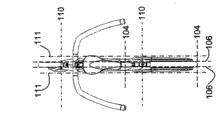
在一实施例中,该方向机构包括连接杆,配置成具有二基座端,该连接杆在一基座端上连接至方向组件且在另一基座端上连接至一对把手。依据一特点,连接杆是从方向组件朝向后面。In one embodiment, the steering mechanism includes a connecting rod configured to have two base ends, the connecting rod being connected on one base end to the steering assembly and on the other base end to a pair of handles. According to one feature, the connecting rod is directed from the direction assembly towards the rear.
较佳地,连接杆及/或把手可转动的重新定位而与框架及/或前车轮相互靠近,让脚踏车横向边界平面之间的间隔保持固定或变小。Preferably, the connecting rods and/or handlebars are rotatably repositioned closer to the frame and/or front wheel so that the spacing between the lateral boundary planes of the cycle remains fixed or reduced.
较佳地,连接杆及/或把手可转动的重新定位而与框架及/或前车相互靠近,让脚踏车纵向边界平面之间的间隔保持固定或变小。Preferably, the connecting rods and/or the handlebars are rotatably repositioned closer to the frame and/or the front bike so that the distance between the bike's longitudinal boundary planes remains constant or becomes smaller.
较佳地,该对把手是形成双杆棒,横向安置而对称于连接杆的二边,每个杆棒能被藉插入框架中相对应接合凹部而重新定位成与框架相互靠近。Preferably, the pair of handles are formed as double rods, arranged transversely and symmetrically to the two sides of the connecting rod, each rod being repositionable mutually close to the frame by insertion into a corresponding engagement recess in the frame.
本发明提供很多选择,依据脚踏车特点及/或框架/车轮几合形状的特定需要以折叠该脚踏车。相类似的,为脚踏车定义出边界平面的位置及其元件,可被调整为适合折叠程序中元件之间交互作用的本性。The present invention provides many options for folding the cycle depending on the specific needs of the cycle characteristics and/or frame/wheel geometry. Similarly, the location of the boundary planes and its components that define the bicycle can be adjusted to suit the nature of the interaction between components in the folding program.
例如,虽然后车轮可只部分插入前车轮的凹部内,但是与后车轮匹配的轮胎可被视为完全插入横向前车轮边界平面之间,藉定义出在横向轮胎周边边缘上后车轮横向边界平面,而非后车轮结构。For example, although a rear wheel may be inserted only partially into the recess of a front wheel, a tire mating to a rear wheel may be considered to be completely inserted between the transverse front wheel boundary planes, by defining the rear wheel transverse boundary plane on the transverse tire peripheral edge , rather than the rear wheel structure.
藉由原本特性,与每个车轮相匹配的转动地面啮合套管轮胎是每个脚踏车车轮的共同特征。轮胎不需要是橡胶、充气的或甚至可挠曲的。在某些实施例中,轮胎可由硬质、非弹性或半非弹性材料而形成,及/或配置成没有任何孔洞、空气袋、充气或类似结构。相类似的,道路啮合轮胎可形成可由车轮边缘部移动的慎重的物件,或者可以是车轮不可或缺、不可分割及连续的部份。不论轮胎的特定性能与构造,都需要展现出均衡转动的轮廓。结果,较好的是使用轮胎边界平面的位置当作与现有技术脚踏车之间有效比较的辅助,以说明本发明折叠过程中的显著差异。By nature, rotating ground-engaging casing tires matched to each wheel are a common feature of every bicycle wheel. Tires need not be rubber, inflatable, or even flexible. In certain embodiments, the tire may be formed from a rigid, non-elastic, or semi-elastic material, and/or configured without any holes, air pockets, air inflation, or the like. Similarly, road-engaging tires may form a discreet object movable from the rim of the wheel, or may be an integral, integral and continuous part of the wheel. Regardless of the specific performance and construction of the tire, it needs to exhibit a balanced rolling profile. As a result, it is preferable to use the position of the tire boundary plane as an aid in valid comparisons with prior art bicycles to account for the significant differences in the folding process of the present invention.
较佳地,框架配置成具有一个或多个凹部或孔洞而能接受前车轮、后车轮、方向机构及/或座垫的至少部分插入。Preferably, the frame is configured with one or more recesses or holes to receive at least partial insertion of the front wheels, rear wheels, steering mechanism and/or seat cushion.
为了达到有意义的脚踏车精巧化,框架与元件(也即车轮、方向机构及座垫)必须用某种方式相互插其中,或脚踏车的有效体积仍保持不变,即使脚踏车形状已重新配置。元件可藉由二主要方法而相互插入其内,缩小或经由铰链/枢接安排,让铰链部配置成具有匹配表面而能某种形式的共同操作。可折叠脚踏车本质上是关于减少脚踏车重量以加强折叠脚踏车的可携带性。因此,比起全尺寸的传统脚踏车,可折叠脚踏车框架是制造得非常小,而座垫、踏板及把手的位置都用相当长的管状伸缩延伸物保持住。In order to achieve meaningful cycle compaction, the frame and components (ie, wheels, steering and seat) must be inserted into each other in some way, or the effective volume of the cycle remains the same even if the shape of the cycle is reconfigured. Components can be inserted into each other by two main methods, narrowing or via a hinge/pivot arrangement where the hinge parts are configured with mating surfaces for some form of interoperability. Foldable bikes are essentially about reducing the weight of the bike to enhance the portability of the foldable bike. Thus, the collapsible bicycle frame is made very small compared to a full size conventional bicycle, while the seat, pedals and handlebars are held in place by relatively long tubular telescopic extensions.
在其直立骑乘配置中,比起铰链框架,这种伸缩延伸物很容易弯得太大,且本质上提供较差的结构完整性。当直立时,铰链元件能形成坚固的结构,而提供可靠、可重复及可反向限制的路径给元件以经过其折叠与直立配置之间。然而,在框架及/或车轮中没有适当的凹部或孔洞时,铰链折叠无法产生折叠脚踏车总体积的缩小。为了让车轮插入另一车轮内,很明显的车轮必须具有比另一车轮还小的直径。这会无可避免的导致”斧头”型较大后车轮/较小前车轮安排或便士法尼脚踏车配置,如上所述。不过显示出任一车轮中央的潜在性可使用体积已经在可折叠脚踏车的研发领域中被大大的忽略。这种内部车轮体积尤其适合接收其他车轮,假如具有较小直径且较大车轮最好是无毂车轮。In its upright riding configuration, such telescoping extensions tend to bend too far and inherently provide less structural integrity than hinged frames. When upright, the hinge element forms a strong structure while providing a reliable, repeatable and reversibly constrained path for the element to pass between its folded and upright configuration. However, without appropriate recesses or holes in the frame and/or wheels, hinged folding cannot produce a reduction in the overall volume of the folding cycle. In order for a wheel to be inserted into another wheel, obviously the wheel must have a smaller diameter than the other wheel. This would inevitably lead to the "axe" larger rear wheel/smaller front wheel arrangement or penny farney bike configuration, as described above. However, it appears that the potential usable volume at the center of either wheel has been largely ignored in the field of collapsible bicycle development. This internal wheel volume is especially suitable for receiving other wheels, preferably hubless wheels, given the smaller diameter and larger wheels.
较佳地,该重新定位包括枢接、铰链、脱离与再连接、伸缩机构、装置、连接物、配件及操控,但并不受限于此。Preferably, the repositioning includes, but is not limited to, pivoting, hinges, disconnection and reconnection, telescoping mechanisms, devices, connectors, accessories and manipulations.
较佳地,该前车轮与框架可枢接在一起,将前车轮至少部分插入框架中的凹部或孔洞内。Preferably, the front wheel is pivotably connected to the frame, and the front wheel is at least partially inserted into a recess or hole in the frame.
较佳地,当脚踏车是朝向垂直直立时,该前车轮重新定位是藉让实质上在垂直平面上的前车轮绕着横向向位的第一折叠轴转动而实现。Preferably, when the cycle is oriented vertically, the front wheel repositioning is achieved by pivoting the front wheel substantially in a vertical plane about a first fold axis of transverse orientation.
较佳地,该后车轮重新定位是藉让实质上在水平平面上的后车轮绕着正交于第一折叠轴的第二折叠轴转动而实现。在另一实施例中,该后车轮重新定位是藉结合让实质上在垂直平面上的后车轮绕着第二折叠轴而转动及线性移动而实现。Preferably, the rear wheels are repositioned by rotating the rear wheels in a substantially horizontal plane about a second folding axis orthogonal to the first folding axis. In another embodiment, the rear wheel repositioning is achieved by a combination of rotational and linear movement of the rear wheels in a substantially vertical plane about the second folding axis.
要了解的是,较小直径的前车轮被折叠到后车轮中的孔洞或凹部内的相反情形,可在相对应方式中达成。在折叠时,其中一车轮被插入一另车轮的所有情况里,需要较小车轮的某种程度的横向移动与纵向移动,以移动到较大车轮的相同平面之外且然后移回,藉以移动围绕较大车轮之孔洞/凹部的车轮周围。It will be appreciated that the reverse, where the smaller diameter front wheels are folded into holes or recesses in the rear wheels, can be achieved in a corresponding manner. In all cases where one wheel is inserted into the other when folded, some lateral and longitudinal movement of the smaller wheel is required to move out of the same plane as the larger wheel and then back, whereby the Around the wheel around the hole/recess of the larger wheel.
依据一实施例,后车轮是可释放的绕着位于框架上的铰链而转动,并且当脚踏车是直立配置时具有朝向垂直平面的第二轴。According to one embodiment, the rear wheel is releasable to rotate about a hinge located on the frame and has a second axis oriented towards a vertical plane when the cycle is in the upright configuration.
在一实施例中,方向机构与座垫是都可绕着第三轴转动。另一方式是,方向机构与座垫是分别地可绕着分开的折叠轴转动。较佳情形是,第三折叠轴是位于第二轴上,也即方向轴,或实质上相邻且正交于第二轴。In one embodiment, both the steering mechanism and the seat cushion are rotatable around a third axis. Another way is that the steering mechanism and the seat cushion are respectively rotatable around separate folding axes. Preferably, the third folding axis is located on the second axis, that is, the direction axis, or substantially adjacent to and perpendicular to the second axis.
较佳地,前车轮是可释放的被限制不绕着该第二轴(或方向轴)转动,是藉由将方向机构及/或前车轮分别转动到框架中匹配方向机构保持凹部以及前车轮保持凹部内。如果允许前车轮与方向组件绕着方向轴自由转动,则脚踏车的稳定性在折叠时会减弱。将至少部分的方向机构、前车轮及/或方向组件插入框架上的相对应匹配凹部内,以有效的锁住前车轮而不会在折叠时发生不需要的转动以稳定脚踏车。Preferably, the front wheels are releasably restrained from rotation about the second axis (or steering axis) by turning the steering mechanism and/or the front wheels respectively into the frame to match the steering mechanism holding recesses and the front wheels Keep inside the recess. If the front wheel and steering assembly were allowed to rotate freely about the steering axis, the stability of the cycle would be reduced when folded. Insert at least part of the steering mechanism, front wheels and/or steering components into corresponding matching recesses on the frame to effectively lock the front wheels without unwanted rotation during folding to stabilize the bicycle.
可选择地,脚踏车可包括栓锁,可释放地牢固住分别在方向机构保持凹部与前车轮保持凹部内的方向机构及/或前车轮。转动座垫与方向机构以使用单一牢固栓锁。较佳情形是,从直立骑乘配置到折叠配的折叠是由三栓锁而可释放的获得。Optionally, the cycle may include latches to releasably secure the steering mechanism and/or the front wheel within the steering mechanism retaining recess and the front wheel retaining recess respectively. Turn the seat cushion and steering mechanism to use a single secure latch. Preferably, the folding from the upright riding configuration to the folded configuration is releasably obtained by a three-latch lock.
较佳地,方向机构保持凹部与前车轮保持凹部分别是配置成在框架底部中纵向延长且部分拱形的槽缝以及在框架上部中的纵向槽缝。Preferably, the steering mechanism retaining recess and the front wheel retaining recess are respectively configured as a longitudinally elongated and partially arcuate slot in the bottom portion of the frame and a longitudinal slot in the upper portion of the frame.
虽然已经说明本发明可配置成用很广范围的配置方式进行折叠,如同在此所述,但是某些方法与结果提供更加容易、快速及/或简单的折叠。While it has been shown that the present invention can be configured to fold in a wide variety of configurations, as described herein, certain methods and results provide for easier, faster and/or simpler folding.
实质上如上所述的从直立骑乘配置到折叠配置的折叠脚踏车的一个示例包括四步骤,以减少横向、纵向与垂直脚踏车边界平面之间的间隔。One example of a folding cycle from an upright riding configuration to a folded configuration substantially as described above includes four steps to reduce the separation between the lateral, longitudinal, and vertical cycle boundary planes.
较佳地,该四步骤包括将方向机构、前车轮、后车轮与座垫转动到相互靠近框架。Preferably, the four steps include turning the steering mechanism, the front wheel, the rear wheel and the seat cushion to be close to the frame.
现有技术折叠脚踏车的缺点包括:Disadvantages of prior art folding bicycles include:
需要许多步骤(大于四步骤)以便在所有三个相互正交的边界平面中减少脚踏车的体积;以及需要结合转动及伸缩动作以折叠脚踏车的元件。Many steps (greater than four) are required to reduce the bike's bulk in all three mutually orthogonal boundary planes; and a combined pivoting and telescoping action is required to fold the bike's elements.
较佳地,实质上如上所述的从直立骑乘配置到折叠配置的该折叠脚踏车的方法包括以下次序:Preferably, the method of folding the cycle from an upright riding configuration to a folded configuration substantially as described above comprises the following sequence:
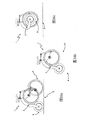
1.绕着第一折叠轴转动前车轮与框架而相互靠近,使得前车轮的至少一横向边界平面至少部分重迭于该框架横向边界平面之间的区域;1. Rotate the front wheel and the frame around the first folding axis to approach each other, so that at least one transverse boundary plane of the front wheel at least partially overlaps the area between the transverse boundary planes of the frame;
2.绕着第三折叠轴转动方向机构与框架而相互靠近,使得至少部分的方向机构是定位在框架中的凹部、围壁、开口、外壳或凹口内,藉以避免方向机构与所连接的方向组件相对于框架绕着该第二轴转动;以及2. Rotate the steering mechanism and the frame around the third folding axis to approach each other so that at least part of the steering mechanism is positioned in a recess, wall, opening, housing or recess in the frame, thereby preventing the steering mechanism from being connected to the connected steering mechanism. the assembly rotates about the second axis relative to the frame; and
3.绕着第二折叠轴转动后车轮与框架而相互靠近,使得后车轮的至少一横向边界平面至少部分重迭于该框架横向边界平面之间的区域。3. Rotating the rear wheel and frame about the second folding axis towards each other such that at least one lateral boundary plane of the rear wheel at least partially overlaps the area between the frame lateral boundary planes.
依据另一实例,实质上如上所述的从直立骑乘配置到折叠配置的该折叠脚踏车的方法包括以下次序:According to another example, the method of folding the cycle from an upright riding configuration to a folded configuration substantially as described above includes the following sequence:
1.绕着第三折叠轴转动方向机构与框架而相互靠近,使得至少部分的方向机构是定位在框架中的凹部、围壁、开口、外壳或凹口内,藉以避免方向机构与所连接的方向组件相对于框架绕着该第二轴转动;1. Rotate the steering mechanism and the frame around the third folding axis to approach each other so that at least part of the steering mechanism is positioned in a recess, wall, opening, housing or recess in the frame, thereby preventing the steering mechanism from being connected to the connected steering mechanism. the assembly rotates about the second axis relative to the frame;
2.绕着第一折叠轴转动前车轮与框架而相互靠近,使得前车轮的至少一横向边界平面至少部分重迭于该框架横向边界平面之间的区域;以及2. rotating the front wheel and the frame around the first folding axis to approach each other such that at least one lateral boundary plane of the front wheel at least partially overlaps the area between the frame lateral boundary planes; and
3.绕着第二折叠轴转动后车轮与框架而相互靠近,使得后车轮的至少一横向边界平面至少部分重迭于该框架横向边界平面之间的区域。3. Rotating the rear wheel and frame about the second folding axis towards each other such that at least one lateral boundary plane of the rear wheel at least partially overlaps the area between the frame lateral boundary planes.
可以看出来,藉由先转动方向机构到框架凹部内或先转动前车轮到框架凹部内,脚踏车可以配置成牢固住前车轮而不会在折叠时绕着方向轴转动。It can be seen that by first turning the steering mechanism into the frame recess or first turning the front wheel into the frame recess, the cycle can be configured to secure the front wheel without turning about the steering axis when folded.
较佳地,该方法也包括第四步骤,绕着第四折叠轴转动方向机构把手而相互靠近至框架。Preferably, the method also includes a fourth step of rotating the handle of the steering mechanism around the fourth folding axis to approach each other to the frame.
较佳地,该等把手是转动到该框架及/或该后车轮的匹配把手凹部内。在实施例中,把手是藉由磁铁可释放地保持在该把手凹部内。较佳情形是,把手凹部是配置成使得后车轮能避免从折叠位置被释放开,而把手是定位在框架把手凹部中。Preferably, the handles are pivoted into matching handle recesses of the frame and/or the rear wheel. In an embodiment, the handle is releasably retained within the handle recess by a magnet. Preferably, the handle recess is configured such that the rear wheel is prevented from being released from the folded position while the handle is positioned in the frame handle recess.
较佳地,上述折叠方法的至少其中之一进一步包括以下步骤:Preferably, at least one of the above-mentioned folding methods further includes the following steps:
重新定位一个或多个脚踏板以及框架相互靠近,该步骤可在该方法的任何时间点进行。The step of repositioning one or more footrests and the frame closer to each other can be performed at any point in the method.
较佳地,该脚踏板新定位是藉转动而实现。较佳情形是,转动一个或一对脚踏板同时转动其他脚踏板。Preferably, the new positioning of the pedal is achieved by rotation. Preferably, one or a pair of pedals is turned while turning the other pedals.
要注意的,脚踏板可个别应用在实质上垂直于前车轮平面延伸或折叠直立且实质上与前车轮表面齐平的骑乘位置。脚踏板也可转动的啮合在一起,使得他们都藉移动任一脚踏板而同时上升与下降。It is to be noted that the footrests may respectively be used in a riding position extending substantially perpendicular to the plane of the front wheel or folded upright and substantially flush with the surface of the front wheel. The footrests are also rotatably engaged together so that they are both raised and lowered simultaneously by moving either footrest.
在另一实施例中,该方法可包括绕着第三折叠轴转动座垫与框架至相互靠近的步骤,使得至少部分的座垫是重新定位在框架中的凹部、围壁、开口、外壳或凹口内,藉以避免方向机构与所连接的方向组件相对于框架绕着该第二轴而转动。In another embodiment, the method may include the step of rotating the cushion and frame about a third fold axis closer to each other such that at least part of the cushion is repositioned in a recess, wall, opening, shell or shell in the frame. In the notch, so as to prevent the steering mechanism and the connected steering assembly from rotating around the second axis relative to the frame.
本发明因此可立即配置成从直立配置折叠到折叠配置,而只使用枢轴或铰链,而没有不同脚踏车元件的任何伸缩或滑动的内部移动。The present invention is thus instantly configurable to fold from an upright configuration to a folded configuration using only pivots or hinges without any telescoping or sliding internal movement of the different cycle elements.
如上所述,对不同脚踏车元件,就边界平面而言,适当的定位可依据元件的本质以及与其他元件的相互关系而定义。例如,针对前车轮及后车轮的先前定义包括数个组合体、次元件及类似构件。例如,可方便辨别出折叠时前车轮的体积缩小与位置移动,以安置每个车轮的纵向边界平面到转动轮胎的横向边缘上。这立即显示出本发明能至少部分安置一车轮到另一车轮内及/或一车轮到框架内的方式。As mentioned above, for different cycle components, proper positioning in terms of boundary planes can be defined depending on the nature of the component and its interrelationship with other components. For example, previous definitions for front and rear wheels included several assemblies, sub-elements, and the like. For example, it is convenient to discern the reduction in volume and shift in position of the front wheels when folded to accommodate the longitudinal boundary planes of each wheel to the lateral edges of the rolling tires. This immediately shows the manner in which the invention can at least partially accommodate one wheel within another and/or one wheel within a frame.
因此依据实施例,该纵向、垂直与横向的边界平面分别定义出结合在每个前车轮与后车轮的地面啮合套管轮胎的横向垂直与纵向末端。Thus according to an embodiment, the longitudinal, vertical and transverse boundary planes define respectively the transverse vertical and longitudinal ends of the ground engaging tubular tires incorporated in each of the front and rear wheels.
较佳地,脚踏车是可折叠成精巧化的交通工具配置,其中该前车轮方向组件是被可释放地铰链转动而让前车轮朝框架转动。在较佳实施例中,该框架在实质上是拱形,被配置并按规格尺寸切割以配合至少部分前车轮。较佳情形是,框架实质上在横切面上是U形,能接收插入至少部分前车轮周围及可选性的驱动机构。Preferably, the cycle is collapsible into a compact vehicle configuration wherein the front wheel direction assembly is releasably hinged to allow the front wheels to rotate towards the frame. In a preferred embodiment, the frame is arched in nature, configured and cut to size to fit at least a portion of the front wheel. Preferably, the frame is substantially U-shaped in cross section to receive insertion around at least part of the front wheel and optionally the drive mechanism.
在实施例中,脚踏车可折叠成精巧化的交通工具配置,其中框架的尾部是被可释放地铰链转动而让后车轮朝前车轮及/或框架转动。较佳情形是,后车轮被制成让转动的后车轮被定位于前车轮中心的内侧或相邻的尺寸。另一实施例中,后车轮是可脱离的能从框架移动,并配合前车轮内。因为后车轮未被传统链条驱动以及相关配件所阻挡,所以上述藉移动该后车轮而折叠脚踏车的任一方式都是立即进行。In an embodiment, the cycle can be folded into a compact vehicle configuration in which the rear of the frame is releasably hinged to allow the rear wheels to rotate towards the front wheels and/or the frame. Preferably, the rear wheels are sized such that the rotating rear wheels are positioned inboard or adjacent to the center of the front wheels. In another embodiment, the rear wheels are detachable to move from the frame and fit within the front wheels. Any of the above methods of folding the bicycle by moving the rear wheel is immediate because the rear wheel is not blocked by a conventional chain drive and associated accessories.
很明显地,方向控制是脚踏车性能的关键参数,而且已经是超过一世纪的重大考量主题。本发明的特定方向控制几何形状以及相关框架配置会在稍后作进一步解说。然而,用广泛的用词来看,脚踏车方向控制是被细分成以下的广泛类别:Clearly, directional control is a key parameter of bicycle performance and has been the subject of significant consideration for more than a century. The specific directional control geometry and associated frame configurations of the present invention will be further explained later. However, in broad terms, bicycle steering is subdivided into the following broad categories:
座垫上-直接;on the seat cushion - directly;
座垫上-间接;On the seat cushion - indirect;
座垫下-直接;以及under the seat cushion - directly; and
座垫下-间接。Under the seat cushion - indirect.
很明显地,上述分类说明分别是有关于:Obviously, the above classification descriptions are respectively related to:
方向机构(比如把手)的位置,相对于为骑乘者座位(也即在座垫上或在座垫下)的垂直位置;以及The position of the steering mechanism (such as the handlebars) relative to the vertical position of the rider's seat (ie, on or under the seat cushion); and
骑乘者的方向控制输入是否直接或间接(比如经由连结物、齿轮、滑轮等)由任何单元、结构或类似机构(比如把手、杠杆、车轮或类似构件)所构成,以转动连接至前车轮的方向组件。Whether the rider's directional control input is constituted directly or indirectly (such as via linkages, gears, pulleys, etc.) The orientation component.
在本发明的不同实施例中,每个这些方向控制类别都可使用。前二类(座垫上)反应出传统脚踏车方向机构(在前者情形中)以及在后者中的更复杂变化。Each of these directional control categories may be used in various embodiments of the invention. The first two categories (on the seat) reflect traditional bicycle steering mechanisms (in the case of the former) and more complex variations in the latter.
使用座垫上直接方向控制提供简单、可靠及容易使用的已建立完备的益处。大部分骑乘者熟悉上述座垫上直接方向控制连接至前车轮叉杆的把手,且能立即将其技巧用在其他这类的方向机构。然而,缺点包括在发生碰撞或快速减速足以让骑乘者往前朝向把手时,会对骑乘者产生坚硬、缠绕性、潜在伤害性障碍。碰撞或骑乘者摔落而下车到把手上或把手内都会无可避免的造成受伤。这种受伤的主要原因是骑乘者在向前跌倒时无法移动双腿离开把手。被把手缠绕会因相关齿轮、煞车杠杆、煞车线、车灯、车铃以及类似元件的出现而恶化。Using the direct directional control on the saddle provides the well-established benefits of simplicity, reliability and ease of use. Most riders are familiar with the above-mentioned handlebars on the saddle that connect direct steering controls to the front wheel yokes, and can immediately apply their skills to other steering mechanisms of this type. However, disadvantages include creating a hard, tangled, potentially injurious barrier to the rider in the event of a collision or rapid deceleration sufficient to send the rider forward toward the handlebars. Injuries are unavoidable due to collisions or riders falling off onto or into the handlebars. The main cause of this injury is the rider's inability to move their legs off the handlebars when falling forward. Getting tangled up in the handlebars is exacerbated by the presence of associated gears, brake levers, brake cables, lights, bells, and the like.
使用座垫上间接方向控制是很不吸引人的选项,除非脚踏车框架配置特别能保护有效操作定位在方向轴或在方向轴上的把手的骑乘者。间接方向控制牵涉到某种形式,将由骑乘者施加到把手、杠杆或相邻于骑乘者的类似元件的方向控制输入转送到可转动方向组件。由于一般拉长的配置,这种方向控制输入常常在斜躺脚踏车上使用。如上所述,对于城市使用,本发明的数个特征加强其效用,尤其是可折叠脚踏车。然而,这些特征很不适合斜躺脚踏车。对小型、可精巧化框架、封闭驱动机构、高度可视性骑乘位置及灵活可操控性的需求并不是斜躺脚踏车的特点。相反的,低倾斜空气动力学座垫位置、高速容量及远距离舒适性对于城市使用来说是不重要或甚至危险。结果,上述座垫上间接方向控制的机构对于折叠城市专用脚踏车来说不是主要选项。The use of indirect directional controls on the saddle is a very unattractive option unless the cycle frame configuration is specifically designed to protect the rider from effectively manipulating the handlebars positioned on or on the directional axis. Indirect directional control involves some form of relaying directional control input applied by the rider to a handlebar, lever, or similar element adjacent to the rider to a rotatable steering assembly. This directional control input is often used on recumbent bikes due to the generally elongated configuration. As mentioned above, several features of the present invention enhance its utility, especially for collapsible bicycles, for urban use. However, these features are very unsuitable for a recumbent bike. The need for a small, compact frame, enclosed drive mechanism, highly visible riding position, and nimble maneuverability are not hallmarks of recumbent bikes. Conversely, the low-slope aerodynamic seat position, high-speed capacity, and long-distance comfort are unimportant or even dangerous for urban use. As a result, the aforementioned mechanism for indirect directional control on the saddle is not a primary option for folding city bikes.
使用座垫下间接或直接方向控制提供很大的机会给城市专用脚踏车设计,尤其是通勤折脚踏车。城市骑乘不牵涉高速或低矮、弯腰身体位置以极小化空气动力学拖曳力的需求。长车轮基座、大前车轮、后车轮以及具有由手臂产生的部分骑乘者重量的半弯腰骑乘位置,都是可精巧化、可操控城市脚踏车,提供高度骑乘者可视性及注意力。The use of under-seat indirect or direct directional control offers great opportunity for urban bike designs, especially commuter bikes. Urban riding does not involve high speeds or the need for a low, hunched body position to minimize aerodynamic drag. The long wheel base, large front wheels, rear wheels, and semi-bend riding position with some of the rider's weight generated by the arms are compact, maneuverable city bikes that provide high rider visibility and attention.
在足以让骑乘者从座垫往前扑的快速减速下,不论是骑乘者煞车及/或意外,对于骑乘者来说,很重要的优点是能很容易的下车而不会被方向机构缠绕住。对现有的直立非斜躺脚踏车,这需要实质上不同的方向控制配置。移动方向机构离开骑乘者的前进路径需要方向机构及最好任何其他潜在障碍被定位在骑乘者、躯干及双腿后面。很清楚地,这对驱动机构与框架设计以及方向机构具有隐含的意义。关于方向机构,导向无阻碍向前下车的脚踏车配置的所需准则包括:At decelerations fast enough for the rider to jump forward from the saddle, whether due to rider braking and/or accident, it is an important advantage for the rider to be able to get off the bike easily without being caught Steering mechanism winds up. This requires a substantially different directional control configuration to existing upright, non-recumbent bicycles. Moving the steering mechanism out of the rider's forward path requires that the steering mechanism and preferably any other potential obstructions be positioned behind the rider, torso and legs. Clearly, this has implications for the drive mechanism and frame design as well as for the steering mechanism. With regard to the steering mechanism, the required criteria for a bicycle configuration that leads to unimpeded forward alighting include:
任何手动方向机构位于:骑乘者的座垫底下,及/或骑乘者的背部后面,及/或骑乘者的臀部底下及骑乘者的小腿后面,及/或骑乘者的躯干宽度的横向外面。Any manual steering mechanism located: under the rider's seat cushion, and/or behind the rider's back, and/or under the rider's buttocks and behind the rider's calves, and/or across the width of the rider's torso outside of the landscape.
任何手动方向机构是:容易脱离开双脚,及定位在双脚/小腿底下及/或后面。Any manual directional mechanism is: easily disengaged from the feet, and positioned under and/or behind the feet/shin.
因道路安全与可操控制性的结果,将方向机够横向安置在骑乘者的宽度之外会产生具有比一般脚踏车大很多的宽度的不稳定结构。因此,虽然对这种配置没有无法克服的工程阻碍,但是没有如上述的选项吸引人。将方向机构放在骑乘者后面,对经由全范围的方向控制移动以轻易到达并控制方向机构的使用者说,也具有人体工学的复杂性。虽然对本发明方向控制而言脚动方向控制是可实现的方法,无辅助的或结合手动方向控制,但却是主要适合非主流城市使用。脚动方向控制的可能性及缺点已在上述讨论中详细解释。Locating the steering gear laterally beyond the width of the rider creates an unstable structure with a width that is much larger than typical bicycles, as a result of road safety and maneuverability. Thus, while there are no insurmountable engineering hurdles to such a configuration, options such as those described above are less attractive. Placing the steering mechanism behind the rider also presents ergonomic complications for the user who moves through the full range of steering controls to easily reach and control the steering mechanism. Although foot-operated directional control is an achievable method for directional control of the present invention, without assistance or in combination with manual directional control, it is mainly suitable for use in non-mainstream cities. The possibilities and disadvantages of foot directional control have been explained in detail in the discussion above.
因此,对于主要的城市使用脚踏车,将方向机构放在骑乘者的脚胫后面及骑乘者的大腿底下提供很大的协同人体工学的、功能的及可配置的优点。Thus, for primarily urban use bicycles, placing the steering mechanism behind the rider's shin and under the rider's thigh provides great synergistic ergonomic, functional and configurable advantages.
因此,较佳地,该方向机构配置并定位以提供实质上未受阻挡或未受妨碍的区域给该骑乘者的腿部及/或该骑乘者向前。Thus, preferably, the steering mechanism is configured and positioned to provide a substantially unobstructed or unobstructed area for the rider's legs and/or forward of the rider.
依据本实施例,该方向机构是定位于该座垫底下及/或后面。According to this embodiment, the directional mechanism is positioned under and/or behind the seat cushion.
较佳地,该方向机构包括一对把手,定位于该座垫底下及/或后面。较佳情形是,该把手是中心地安置于该框架,用以绕着四元轴转动。Preferably, the steering mechanism includes a pair of handles positioned under and/or behind the seat cushion. Preferably, the handle is centrally positioned on the frame for rotation about a quadrature axis.
在实施例中,该四元轴是与第二轴(或方向轴)同轴。较佳情形是,该把手是藉连接杆移离第二轴。连接杆可用任何形式配置,比如单一横梁、管条、杆棒、外壳、棒条、单元、框架或类似构件,并为了人体工学上更加有效的方向控制输入,具有移动把手位置比第二轴还要相互靠近于骑乘者的效果。In an embodiment, the quad axis is coaxial with the second axis (or orientation axis). Preferably, the handle is moved away from the second shaft by means of a connecting rod. The link may be configured in any form, such as a single beam, tube, rod, shell, bar, unit, frame or similar member, and has the ability to move the handle position further than the second axis for ergonomically more efficient directional control input To be close to each other the effect of the rider.
将把手定位在座垫底下是将把手安置在非常自然的操作位置,骑乘者放松的手臂是在躯干任一侧未拉紧的位置。结合骑乘者的腿部放在前车轮脚踏板上,这会将方向机构安置在骑乘者整个身体的底下与后面。结果,在紧急情况而需要下车时,骑乘者只要释放开方向机构并向前或甚至横向下车,而不会变成被脚踏车的任何部分缠绕住,包括方向机构。此外,本发明所提供的直立骑乘位置及高可视性与注意力将骑乘者安置在绝佳身体倾向,用以快速下车及转移脚上的移动。Positioning the handlebars under the seat cushion places the handlebars in a very natural operating position, with the rider's relaxed arms in an untensioned position on either side of the torso. Combined with the rider's legs resting on the front wheel pedals, this places the steering mechanism under and behind the rider's entire body. As a result, in an emergency requiring dismounting, the rider can simply release the steering mechanism and dismount forward or even sideways without becoming entangled with any part of the bicycle, including the steering mechanism. Additionally, the upright riding position and high visibility and attention afforded by the present invention place the rider in excellent body orientation for quick alighting and diversion of foot movement.
为了安置把手(或相对等构件)到理想位置而由骑乘者接近,从第二轴延伸到把手的连接杆提供简单且可靠的配置,以转移骑乘者的转动移动到方向组件/前车轮。如前所述,在一实施例中,方向机构连接杆是配置成具有二基座端,该连接杆是在一基座端上连接至方向组件,并在另一基座端上连接至一对把手。因为连接杆提供直接连接至方向组件,所以不需要改变把手的转动方向,以符合所需的前车轮转动。然而,为了产生前车轮所必需的转动角度,由连接杆的基座端上的把手外接到方向轴的弧形,对某些骑乘者来说可能会不太舒服的到达。结果,加上棒端手柄或尖端到每个把手的外端以经过骑乘者大腿外部及/或臀部附近,是在方向控制移动的整个范围内,将棒端手柄安置成相互靠近至骑乘者身体。因此依据一特点,该把手包括外端部,朝向延伸在骑乘者大腿的附近。在实施例中,把手的外端部实质上是朝向水平行于该连接杆。To position the handlebars (or equivalent member) in the desired position accessible by the rider, a connecting rod extending from the second shaft to the handlebars provides a simple and reliable arrangement to transfer the rider's rotational movement to the steering assembly/front wheel . As previously mentioned, in one embodiment, the steering mechanism linkage is configured to have two base ends, the linkage being connected to the steering assembly at one base end and to a steering assembly at the other base end. on the handle. Because the connecting rod provides a direct connection to the steering assembly, there is no need to change the direction of rotation of the handlebars to match the desired front wheel rotation. However, the arc circumscribed by the handle on the base end of the connecting rod to the steering axis in order to produce the necessary turning angle of the front wheels may be uncomfortable for some riders to reach. As a result, adding the stick-end handle or tip to the outer end of each handlebar to pass near the outer thighs and/or buttocks of the rider is to position the stick-end handles close to each other for the entire range of directional control movement. the body. Thus according to a feature, the handle comprises an outer end extending towards the vicinity of the thigh of the rider. In an embodiment, the outer end of the handle is substantially horizontally parallel to the connecting rod.
要了解的是,具有条棒端外端部的每个把手的形状可涵盖从连续弯曲条棒至两实质上正交的剖面。以赞美传统脚踏车的方式,把手的末端提供方便的位置以安置任何脚踏车控制装置,比如煞车、节流(外部动力的实施例)车灯等等。It will be appreciated that the shape of each handle having a rod end outer end may range from a continuously curved rod to two substantially orthogonal cross-sections. In a way that compliments traditional bicycles, the ends of the handlebars provide a convenient location to house any bicycle controls such as brakes, throttle (externally powered embodiments) lights, etc.
在另一实施中,该四元轴是从该方向控制角移开。在这个实施例中,方向机构进一步包括传送连接,以传送方向机构的转动移动而产生绕着第二轴与方向组件同方向的相对应转动移动给方向阻件与前车轮。In another implementation, the quad axis is moved away from the steering angle. In this embodiment, the steering mechanism further includes a transmission connection for transmitting rotational movement of the steering mechanism to produce a corresponding rotational movement about the second axis in the same direction as the steering assembly to the steering member and the front wheels.
该传送连接也可由许多机构形成,包括一个或多个方向杆、滑轮、齿轮、万用接头(比如一对虎克(Hooke)或贾伯汉(Chobham)万用接头)或类似构件。该传送连接可依据一特点至少被部分的该框架包围住。在实施例中,该传送连接配置成提供机械优点,藉此,方向机构的给定转动移动会产生一减低的方向组件转动移动。The transfer link may also be formed by any number of mechanisms including one or more directional rods, pulleys, gears, universal joints (such as a pair of Hooke or Chobham universal joints), or similar members. According to a feature, the transmission connection can be at least partially surrounded by the frame. In embodiments, the transfer connection is configured to provide a mechanical advantage whereby a given rotational movement of the steering mechanism results in a reduced rotational movement of the steering assembly.
除了把手以外,方向机构还可从任何方便的机构而配置,包括杠杆、滑轮或类似构件。然而,要了解的是,方向机构不需要一定操作在固定的实质上水平平面中,如同传统的把手,也不需要对称的连接至框架。例如,由缆线以及连接至手动手柄的滑轮所形成的方向机构可被移动而经过弯曲移动(主要是骑乘者的前臂)的范围,类似于举起哑铃。在另一实施例中,方向机构可以是可单手操作的。这会让操纵杆型控制的形式被定位在前乘者腿部之间或定位在使用者的一侧上。这些实施例可让骑乘者的自由手/手臂用在许多运动或其他活动中,比如邮件投递。In addition to handles, the directional mechanism may be configured from any convenient mechanism including levers, pulleys or the like. However, it will be appreciated that the steering mechanism need not necessarily operate in a fixed substantially horizontal plane, like a conventional handle, nor need it be symmetrically attached to the frame. For example, a directional mechanism formed by cables and pulleys attached to a manual handle can be moved through a range of flexural movements (mainly the rider's forearm), similar to lifting a dumbbell. In another embodiment, the direction mechanism may be operable with one hand. This would allow a form of joystick type control to be positioned between the front occupant's legs or on the user's side. These embodiments allow the rider's free hand/arm to be used in many sports or other activities, such as mail delivery.
在不偏离本发明的范围下,本发明让许多不同的框架配置与构造能被使用。精巧的车轮基座、新颖的座垫/方向安排及迷你法尼脚踏车车轮安排的实施例产生不同的框架需求及对传统脚踏车的限制。The present invention enables many different frame configurations and configurations to be used without departing from the scope of the invention. Embodiments of sophisticated wheel bases, novel saddle/orientation arrangements, and mini-fanny wheel arrangements create different frame requirements and constraints than conventional bicycles.
在一实施例中,框架实质上是拱形,具有对应于前车轮外围且形状为凹部的中心区段。较佳情形是,框架也结合能承接方向组件、方向机构及/或后车轮插入的凹部。因为前车轮是最大的元件,所以将了解的是,精巧化的效果在折叠时是取决于框架及其他元件与前车轮之间的相互作用。拱形框架因此提供实质上是镜面外观的形状给前车轮的外部,以帮助共同操作的匹配。In one embodiment, the frame is substantially arched, having a central section corresponding to the periphery of the front wheel and shaped as a recess. Preferably, the frame also incorporates recesses capable of receiving the insertion of the steering assembly, steering mechanism and/or rear wheels. Since the front wheel is the largest element, it will be appreciated that the effect of compaction is dependent on the interaction between the frame and other elements and the front wheel when folded. The arched frame thus provides an essentially mirror-looking shape to the exterior of the front wheels to aid in interoperable matching.
然而,另一框架形状与构造可包括实质上为管状的框架构造或横向对称框架,其中前车轮及/或后车轮是沿着框架转动,而不是插入框架内。However, alternative frame shapes and configurations may include substantially tubular frame configurations or laterally symmetrical frames where the front and/or rear wheels rotate along the frame rather than being inserted into the frame.
此外,其他方式包括具直线、横梁及/或突出形框架区段外观的框架。Additionally, other approaches include frames having the appearance of rectilinear, beam, and/or protruding frame sections.
如上所述,驱动机构可分成二类,“使用者动力”,也即由使用者/骑乘者提供动力的机构(比如塔板曲柄),或具有独立或“外部动力”的动力源的机构,也即在使用者/骑乘者的外部,比如电动马达、引擎或类似构件。此外,“脚踏板”一词包括配置以让使用者在骑乘时安置其双脚的任何配件,并包括可移动物(比如踏板曲柄)、笼状物、可折叠及固定的踏垫。As mentioned above, drive mechanisms can be divided into two categories, "user powered", that is, mechanisms that are powered by the user/rider (such as a tray crank), or mechanisms that have an independent or "externally powered" power source , ie external to the user/rider, such as an electric motor, engine or similar. In addition, the term "pedals" includes any accessory configured to allow a user to position his or her feet while riding, and includes movable objects such as pedal cranks, cages, collapsible and fixed mats.
如上所述,驱动机构可采取许多形式,包括电动马达、发电机、塔俺曲柄、踏板曲柄及齿轮链条驱动器、内燃机或外燃机及/或任何上述相同构件的组合。As noted above, the drive mechanism may take many forms, including electric motors, generators, tower cranks, pedal cranks, and gear chain drives, internal or external combustion engines, and/or combinations of any of the foregoing.
考虑“外部动力”的驱动机构,比如电动马达,现有技术已开发出数种方式,虽然与使用者动力的传统脚踏车的体积比较起来,商品化成功已经减少。这种市场反应的理由是受到不直接与驱动机构有关的因素的结合所影响。主要是,要具有有效的外部驱动便需要足够的骑乘性能,需要具相当耐久力的足够动力驱动。此外,当专用于城市使用时,如上所述,这是有关于折叠脚踏车的效用。脚踏车性能与折叠脚踏车的可携带性(以及可视性)都直接受到脚踏车重量的影响。如同现有技术折叠脚踏车设计的缺点,无可避免的导致较重的可折叠脚踏车,提供非可折叠脚踏车可比较的功能性与性能,外部驱动(比如电动马达)的问题已经专注于补充移动辅助上。Consideration of "externally powered" drive mechanisms, such as electric motors, has been developed in several ways in the prior art, although commercial success has diminished compared to the bulk of user powered conventional bicycles. The reason for this market reaction is influenced by a combination of factors not directly related to the driving mechanism. Mainly, to have effective external drive requires sufficient rideability, adequate power drive with considerable durability. Also, when dedicated to urban use, as mentioned above, this is about the utility of folding bikes. Both bicycle performance and the portability (and visibility) of a folding bicycle are directly affected by the weight of the bicycle. As with the shortcomings of prior art collapsible bicycle designs, which inevitably lead to heavier collapsible bicycles that offer comparable functionality and performance to non-collapsible bicycles, the issue of external drives (such as electric motors) has focused on supplemental mobility aids superior.
然而,本发明所达成的精巧化、轻量化与性能的实质益处,使得脚踏车的实施例能完全由具电池电源的电力驱动提供动力。尤其,结合可折叠迷你法尼脚踏车车轮配置的无毂前车轮的封装优点,能使用小很多的框架,可被特定配置成配合折叠车轮内车轮的配置。使用其中一车轮(最好是前车轮)的边缘内的可用体积大部分用无毂车轮进行有效的改善。如果另一较小车轮(比如后车轮)在实用上做得尽可能的小时,在较大车轮的体积内给驱动机构的可用必需体积是很容易被发现。这也排除对折叠/转动元件之间驱动连结物的需求。结果,藉位于相同车轮的驱动机构以驱动较大车轮的可转动边缘部是很有利的。这应用于外部与内部动力驱动机构。较大无毂车轮的可用内部体积也让由驱动机构的其他配件与机构,比如电池、踏板座、链条、齿轮及类似构件,被适当外壳包围住。这不只提供平滑的外表面及保护免于污物与湿气进入,而且还避免骑乘者或其衣物的不预期干扰。However, the substantial benefits of compactness, light weight, and performance achieved by the present invention allow embodiments of the cycle to be fully powered by electric drive with battery power. In particular, combining the packaging advantages of a hubless front wheel with a collapsible minivani wheel configuration enables the use of a much smaller frame that can be specifically configured to fit a collapsible wheel-in-wheel configuration. Use the available volume within the rim of one of the wheels (preferably the front wheel) to effectively improve mostly with hubless wheels. If the other smaller wheel (say the rear wheel) is made as small as practically possible, the necessary volume available for the drive mechanism within the volume of the larger wheel is easily found. This also eliminates the need for drive linkages between the folding/rotating elements. Consequently, it is advantageous to drive the rotatable edge portion of the larger wheel by means of the drive mechanism at the same wheel. This applies to both external and internal powered drive mechanisms. The available internal volume of the larger hubless wheel also allows other accessories and mechanisms driven by the drive mechanism, such as batteries, pedal mounts, chains, gears and the like, to be enclosed by suitable housings. This not only provides a smooth outer surface and protection from the ingress of dirt and moisture, but also avoids unintended disturbance of the rider or his clothing.
较佳地,该前车轮是一无毂前车轮,具有可旋转的外轮框部,并且该驱动机构操作地连接该前车轮到该外轮框部,以造成前车轮转动。Preferably, the front wheel is a hubless front wheel having a rotatable outer rim portion, and the drive mechanism operatively connects the front wheel to the outer rim portion to cause rotation of the front wheel.
这种外缘驱动配置对如电力驱动的外部驱动机构以及如踏板曲柄机构的动力驱动都是很有利的。This rim drive configuration is advantageous for both external drive mechanisms such as electric drives as well as power drives such as pedal crank mechanisms.
较佳地,该驱动机构是操作性的连接至前车轮,用以绕着平行于该主轴的四元轴转动。Preferably, the drive mechanism is operatively connected to the front wheel for rotation about a quadrature axis parallel to the main shaft.
较佳地,该四元轴是定位于与主轴偏心的前一车轮内。Preferably, the quad axle is positioned within the preceding wheel off-center from the main shaft.
较佳地,该四元轴是位于主轴与前车轮的尾部之间。Preferably, the quad shaft is located between the main shaft and the rear of the front wheel.
在实施例中,驱动机构是经齿轮、皮带驱动、链条或类似构件的一个或多个而连结至外轮框部。In an embodiment, the drive mechanism is coupled to the outer rim portion via one or more of gears, belt drives, chains or the like.
上述的脚踏车因此比现有技术的脚踏车提供许多优点。脚踏车的前车轮驱动能省略掉传统外部后车轮链条驱动,也简化对框架的尺寸、结构及几何形状的要求。然而,直接藉安置在主轴上的驱动机构以驱动前车轮会限制最大实际车轮大小、座垫位置及可操控性。驱动机构的偏心安置会有这些缺点,并让最佳化前车轮尺寸被使用而不包含关于地面及骑乘者的最佳人体工学效用的安置及脚踏板的尺寸及/或踏板曲柄。The cycle described above thus offers a number of advantages over prior art cycles. The front wheel drive of the bicycle can omit the traditional external rear wheel chain drive, and also simplify the size, structure and geometry requirements of the frame. However, driving the front wheels directly by means of a drive mechanism mounted on the main shaft limits the maximum practical wheel size, seat position and maneuverability. The off-centre placement of the drive mechanism suffers from these disadvantages and allows the optimal front wheel size to be used without including placement for optimum ergonomics with respect to the ground and rider and the size of the pedals and/or pedal cranks.
要了解的是,可能有数种其他的驱动配置。在实施例中,单一外部驱动机构将推动力应用到前车轮与后车轮。另一方式是,分离的驱动机构分别驱动前车轮与后车轮。这些实施例都提供全车轮驱动给脚踏车,藉此,潜在性的扩展车轮之间的推动力,降低车轮旋转的可能性,并改善摩擦力。在后一实施例中,也提供冗余度,如果有一驱动器无法操作时。在另一实施例中,后车轮可单独的由外部驱动提供动力。It is to be understood that several other drive configurations are possible. In an embodiment, a single external drive mechanism applies propulsion to the front and rear wheels. Alternatively, separate drive mechanisms drive the front and rear wheels respectively. Both of these embodiments provide all wheel drive to the bicycle, thereby potentially extending the propulsive force between the wheels, reducing the possibility of wheel spin, and improving friction. In the latter embodiment, redundancy is also provided should a drive fail. In another embodiment, the rear wheels may be individually powered by an external drive.
如上所述,主要的“使用者动力”驱动机构,也即踏板曲柄,以及“外部动力”驱动机构之间的明显差异是需要骑乘者的脚部安置。踩踏踏板曲柄很自然的需要骑乘者的双脚位于可移动的踏板上,而“外部动力”驱动机构让骑乘者的双脚安置于某种型式的静态脚踏板上。由于人体工学上的考量,这种脚踏板的位置实质上可配合踏板曲柄的所需位置。再一次,虽然未在每个实例中重做,但是为了可读性的理由,必须要了解的是,参考脚踏板与踏板曲柄的位置是被解读成可相互改变的预期,其中被相反的明确的描述。As mentioned above, the obvious difference between the primary "user powered" drive mechanism, ie the pedal crank, and the "external powered" drive mechanism is the rider's foot placement requirement. Pedal cranks naturally require the rider's feet to be on movable pedals, whereas "externally powered" drive mechanisms place the rider's feet on some type of static pedals. Due to ergonomic considerations, the position of this pedal essentially matches the desired position of the pedal crank. Again, while not redone in every instance, for readability reasons it is important to understand that reference to the position of the pedal and the pedal crank are interpreted as mutually alterable expectations, where the opposite clear description.
针对前轮驱动脚踏车考虑到踏板动力驱动机构的特定情形,可折叠城市脚踏车的最佳车轮尺寸是取决于数个因数。绝佳骑乘性能通常是包含在小直径车轮,尤其经过粗糙道路表面时。然而,在城市环境中,道路表面可属于具坑洞、铁丝网及其他危险的变动品质,而与越野表面比较起来,一般来说还是属于高标准。因此,比全能可折叠脚踏车,城市专用踏板动力脚踏车可使用较小的前车轮。城市用最小车轮尺寸的际限制是,车轮大到足够骑上/骑下路边,而不用骑乘者离座。然而,对于踏板曲柄驱动机构,不可能使用最小实际直径到直接被中心安置踏板曲柄所驱动的车轮上。足够成年人踩踏所需的曲柄长度定义出最小实际车轮尺寸,低于此时,踏板会接触到地面,尤其在转弯时。The optimum wheel size for a foldable city bike depends on several factors considering the specific situation of the pedal powered drive mechanism for a front wheel drive bike. Great ride performance is often included with small diameter wheels, especially over rough road surfaces. However, in an urban environment, road surfaces can be of varying quality with potholes, barbed wire and other hazards, and are generally of a high standard compared to off-road surfaces. Therefore, a city-specific pedal-powered bicycle can use a smaller front wheel than an all-purpose collapsible bicycle. The practical limit on the smallest wheel size for urban use is that the wheel is large enough to ride on/off the curb without the rider leaving the seat. However, with a pedal crank drive it is not possible to use the smallest practical diameter to the wheel driven directly by the centrally located pedal crank. The crank length needed for an adult to pedal defines the minimum practical wheel size below which the pedals will touch the ground, especially when cornering.
相反地,如果需要具有大车轮直径的脚踏车实施例,中心踏板曲柄再次对可能的最大尺寸造成限制,而不会让骑乘者无法有效的操作踏板及/或在静止时到达地面。Conversely, if a bicycle embodiment with a large wheel diameter is desired, the central pedal crank again places a limit on the maximum size possible without preventing the rider from effectively manipulating the pedals and/or reaching the ground while stationary.
本发明中使用偏心驱动机构位置免除这些限制,并让最佳车轮直径被选取给外部动力及使用者动力驱动机构。安置踏板曲柄在前车轮上部区间让缩减的车轮直径能被使用,而安置在下部区间能使用较大车轮直径而不包含踩踏效率。The use of an eccentric drive mechanism location in the present invention removes these constraints and allows the optimum wheel diameter to be selected for both externally powered and user powered drive mechanisms. Placing the pedal crank in the upper section of the front wheel allows a reduced wheel diameter to be used, while placing it in the lower section enables the use of a larger wheel diameter without compromising pedaling efficiency.
虽然驱动机构可连结而经由在主轴上动作的机构以转动前车轮,但是这会塞满车轮跨度的中心体积,被用来极大化折叠脚踏车的精巧化。因此,驱动机构最好是连结踏板曲柄至车轮边缘,让驱动机构立即被包围在外壳内,而没有陷害骑乘者或骑乘者衣服的突出物或类似构件,尤其是在折叠配置中。为了帮助精巧化,在实施例中,踏板曲柄/脚踏板被配置成可移动的及/或可转动的,实质上朝向齐平于驱动机构外壳。Although the drive mechanism could be linked to turn the front wheel via a mechanism acting on the spindle, this would fill the central volume of the wheel span and be used to maximize the compactness of the collapsible bike. Accordingly, the drive mechanism is preferably attached to the pedal crank to the wheel rim, allowing the drive mechanism to be immediately enclosed within the housing without protrusions or the like entrapping the rider or rider's clothing, especially in the folded configuration. To aid in compactness, in an embodiment, the pedal crank/pedal is configured to be movable and/or rotatable, oriented substantially flush with the drive mechanism housing.
驱动机构可包括一个或多个使用者可选择齿轮或,简单配置成具有单一齿轮比。假设脚踏车主要是用于城市使用,单一齿轮比不一定会有竞赛或登山脚踏车相同的阻碍。也提供能被小型外壳包围住的较轻及简化的驱动机构。The drive mechanism may comprise one or more user selectable gears or, simply configured with a single gear ratio. Assuming the bike is primarily intended for urban use, a single gear ratio doesn't necessarily have the same setbacks as a racing or mountain bike. It also provides a lighter and simplified drive mechanism that can be enclosed by a small housing.
在实施例中,驱动机构,比如连接至曲柄齿轮的踏板曲柄,是经由中间齿轮可转动的被啮合住,以驱动齿轮而驱动该转动的外缘。该外缘与驱动齿轮可被配置成具有锯齿状啮合介面,或平滑摩擦接触。中间齿轮需要确保曲柄踏板转动的方向配合前车轮的方向,虽然要了解的是,如果能达到令人满意的齿轮比,极端简化的配置可直接从齿轮曲柄驱动边缘部。In an embodiment, a drive mechanism, such as a pedal crank connected to a crank gear, is rotatably engaged via an intermediate gear to drive the rotating outer rim through the drive gear. The outer rim and the drive gear can be configured to have a serrated meshing interface, or a smooth frictional contact. The intermediate gear is needed to ensure that the direction of crank pedal rotation matches the direction of the front wheel, although it is understood that an extremely simplified configuration could drive the rim directly from the gear crank if a satisfactory gear ratio can be achieved.
为进一步确保折叠脚踏车表现出圆滑、密封的脚踏车,没有曝露的链条、齿轮及类似构件,所以外缘部(及相关的驱动机构)可包围在绕着前车轮延伸当作套管环的一般外壳之内。较佳情形是,方向组件连接至该外壳。很明显的,对于熟知该技术领域的人士,连接至前车轮的方向组件连接物可为叉杆配置,叉杆臂穿过任一车轮,或在前车轮单一侧上的非对称连接物。润滑油、捕捉到的污物及一般与曝露的外部链条驱动有关的类似物质因此都被挡开以保护骑乘者,让折叠脚踏车能在骑乘者背部上携带,而没有弄脏的疑虑。To further ensure that the collapsible cycle appears to be a sleek, sealed cycle, with no exposed chains, gears, and the like, the outer rim (and associated drive mechanism) may be enclosed in a general casing extending around the front wheel as a sleeve ring within. Preferably, a directional assembly is attached to the housing. It will be apparent to those skilled in the art that the steering assembly attachment to the front wheels may be a wishbone configuration with the wishbone arms passing through either wheel, or an asymmetric attachment on a single side of the front wheel. Lubricant, entrapped dirt, and the like generally associated with exposed external chain drives are thus kept out to protect the rider, allowing the foldable bike to be carried on the rider's back without the fear of getting dirty.
较佳地,外缘部包括或连接至地面啮合轮胎部,通常是充气型轮胎。Preferably, the outer rim portion includes or is connected to a ground engaging tire portion, typically a pneumatic tire.
如上所述,具穿过主轴的踏板曲柄的前车轮驱动踏板脚踏车,承受方向力矩的效应,尤其是从静止开始时。将曲柄踏板从主轴向后扳开,提供数种关键性益处,包括增加稳定性(增大的车轮座的帮助)及减小的方向力矩。对具穿过主轴的踏板曲柄的前车轮踏板驱动脚踏车的人体工学限制,需要骑乘者实质上被定位在前车轮顶部。虽然这从非常直立的骑乘位置上提供良好的可视性,但是却增加脚踏车的感测(及实际)的不稳定性,类似于单轮脚踏车。在本发明中将曲柄踏板从主轴向后扳开让骑乘者座垫位置也能向后移动,因此提供较大的稳定性,而保持所需的高可视性的特性及缩短的框架。As mentioned above, the front wheel drive pedal cycle with the pedal crank passing through the main shaft is subject to the effect of directional moments, especially when starting from rest. Moving the crank pedals back from the spindle provides several key benefits, including increased stability (helped by enlarged wheel mounts) and reduced directional moments. Ergonomic constraints on front wheel pedal driven bicycles with pedal cranks passing through the spindle require the rider to be positioned substantially on top of the front wheels. While this provides good visibility from a very upright riding position, it increases the perceived (and actual) instability of the cycle, similar to a unicycle. In the present invention cranking the pedals back from the spindle allows the rider seat position to also move rearwards, thus providing greater stability while maintaining the desired high visibility features and shortened frame .
还要了解的是,上述实施例的数种变化都可不偏离本发明的精神。例如,脚踏车可进一步包括结合使用者动力及外部动力机构。通常,使用额外的驱动机构是当作辅助性驱动机构,比如辅助主要踏板动力脚踏的车外部动力机构,或相反。辅助性外部动力驱动机构可提供动力给前车轮或后车轮,且可选取自任何传统上已知的动力驱动机构,包括电力驱动(电池及燃料电池动力)、内燃引擎等等。这种主辅助性的驱动器可帮助在向上陡坡的骑乘者,以及可选择性的被配置成在下坡时/或煞车时提供阻挡及/或电气动力的产生。It should also be understood that several variations of the above-described embodiments are possible without departing from the spirit of the invention. For example, a cycle may further include a mechanism that combines user power and external power. Typically, the use of an additional drive mechanism is as a secondary drive mechanism, such as an off-vehicle power mechanism that assists the main pedal-powered pedals, or vice versa. The auxiliary external power drive mechanism can provide power to the front or rear wheels, and can be selected from any conventionally known power drive mechanism, including electric drive (battery and fuel cell power), internal combustion engine and the like. This primary auxiliary drive can assist the rider on steep upward slopes and can optionally be configured to provide blocking and/or electric power generation when descending and/or braking.
较佳地,该辅助性动力驱动器是位于该驱动机构外壳之内。Preferably, the auxiliary power drive is located within the drive mechanism housing.
虽然因偏心曲柄踏板的定位而稳定性加强,但是在精巧化框架上实质上直立的骑乘者位置仍有在猛烈的施加前车轮煞车时将骑乘者向前推的危险。骑乘者前方的传统把手的安置在骑乘者被向前推时会有危险。相对的,本发明某些实施例藉安置把手到骑乘者的底下及/或后面而克服这些困难。因此,骑乘者可轻易的在脚踏车的前部上离开脚踏车,而没有任何阻碍。这种下车方式会发生在紧急煞车或甚至以从容不迫的相当慢速度时。这种减速技术对滑板及踏板车的骑乘者已经很普遍。While stability is enhanced by the positioning of the eccentric crank pedals, the substantially upright rider position on the compact frame still risks pushing the rider forward when the front wheel brakes are applied sharply. The placement of conventional handlebars in front of the rider presents a hazard when the rider is pushed forward. In contrast, certain embodiments of the present invention overcome these difficulties by placing the handlebars under and/or behind the rider. Therefore, the rider can easily get off the bicycle on the front of the bicycle without any hindrance. This type of disembarkation can occur during hard braking or even at a leisurely rather slow speed. This deceleration technique is already common to riders of skateboards and scooters.
脚踏车因此可选择性的配合前煞车及/后煞车。没有煞车的实施例对脚踏车是使用在不超过人类跑步速度的速度下且下车当作速度控制装置使用的城市应用是可能的。The bicycle can therefore optionally be fitted with a front brake and/or a rear brake. Embodiments without brakes are possible for urban applications where the bicycle is used at speeds not exceeding human running speed and is dismounted to be used as a speed control device.
本发明因此提供一种可折叠脚踏车,能方便城市交通,可折叠成精巧化体积供交通工具与存放,对变成缠绕住使用者或其衣服具最小危险性。The present invention therefore provides a collapsible bicycle that is convenient for urban transportation and can be folded into a compact volume for transportation and storage with minimal risk of becoming entangled in the user or his clothing.
附图说明 Description of drawings
图1显示本发明一实施例的可折叠式脚踏车的侧视图;Figure 1 shows a side view of a foldable bicycle according to an embodiment of the present invention;
图2显示图1的脚踏车与现有现代脚踏车比较的侧视图;Figure 2 shows a side view of the bicycle of Figure 1 compared with existing modern bicycles;
图3显示图1的脚踏车与便士法尼脚踏车比较的侧视图;Figure 3 shows a side view of the cycle of Figure 1 compared to the Penny Farney cycle;
图4显示图1的脚踏车与迷你便士法尼脚踏车(迷你法尼脚踏车)比较的侧视图;Figure 4 shows a side view of the bicycle of Figure 1 compared to a miniature penny farney bicycle (miniature farney bicycle);
图5显示图1的脚踏车与另一种已知的便士法尼脚踏车比较的侧视图;Figure 5 shows a side view of the cycle of Figure 1 compared to another known Penny Farney cycle;
图6显示图1的脚踏车以及脚踏车的尺寸的侧视图;Figure 6 shows a side view of the bicycle of Figure 1 and its dimensions;
图7a、7b、7c显示具有不同方向轴角度的图1的脚踏车的侧视图;Figures 7a, 7b, 7c show side views of the cycle of Figure 1 with different orientation axis angles;
图8a与图8b分别显示比图1至图5中较小的骑乘者及较大的骑乘者;Figures 8a and 8b show a smaller rider and a larger rider than in Figures 1 to 5, respectively;
图9显示图1的脚踏车以及折叠轴的侧视图;Figure 9 shows a side view of the cycle of Figure 1 and the folding axle;
图10a显示在直立配置中具有方向机构与坐垫的图1的脚踏车的侧视图;Figure 10a shows a side view of the cycle of Figure 1 with the steering mechanism and seat in an upright configuration;
图10b显示在折叠配置中具有方向机构与坐垫的图1的脚踏车的侧视图;Figure 10b shows a side view of the cycle of Figure 1 with the steering mechanism and seat in a folded configuration;
图11a显示图1的脚踏车以把手和脚踏板于直立配置的侧视图;Figure 11a shows a side view of the bicycle of Figure 1 with handlebars and pedals in an upright configuration;
图11b显示图1的脚踏车以把手和脚踏板于折叠配置的侧视图;Figure 11b shows a side view of the bicycle of Figure 1 with the handlebars and pedals in a collapsed configuration;
图12显示具有在直立与折叠配置之间移动的前车轮及后车轮的图1的脚踏车的侧视图;Figure 12 shows a side view of the cycle of Figure 1 with the front and rear wheels moving between upright and folded configurations;
图13显示图1的脚踏车以前轮和后轮于折叠配置的侧视图;Figure 13 shows a side view of the front and rear wheels of the bicycle of Figure 1 in a folded configuration;
图14a至图14e分别显示图1的脚踏车于直立配置的前视图、后视图、侧视图、平面视图以及底面视图;Figures 14a to 14e show, respectively, a front view, a rear view, a side view, a plan view and a bottom view of the bicycle of Figure 1 in an upright configuration;
图15a至图15e分别显示图1的脚踏车于折叠配置的前视图、后视图、侧视图、平面视图以及底面视图;Figures 15a to 15e show, respectively, a front view, a rear view, a side view, a plan view and a bottom view of the bicycle of Figure 1 in a folded configuration;
图16a与图16b分别显示骑乘者以折叠配置携带脚踏车的侧视图及后视图;Figures 16a and 16b show a side view and a rear view, respectively, of a rider carrying a bicycle in a folded configuration;
图17a至图17f显示图1的脚踏车由直立配置(图17a)至折叠配置(图17e)的重合顺序的侧视图;Figures 17a to 17f show side views of the bicycle of Figure 1 in the overlapping sequence from the upright configuration (Figure 17a) to the folded configuration (Figure 17e);
图18a至图18f显示图1的脚踏车由直立配置(图18a)至折叠配置(图18f)的重合顺序的平面视图;Figures 18a to 18f show plan views of the bicycle of Figure 1 in a sequence of coincidences from the upright configuration (Figure 18a) to the folded configuration (Figure 18f);
图19a至图19f显示图1的脚踏车的折叠顺序以及前车轮和后车轮的垂直及纵向边界平面的侧视图;Figures 19a to 19f show the folding sequence of the cycle of Figure 1 and side views of the vertical and longitudinal boundary planes of the front and rear wheels;
图19g至图19l显示图1的脚踏车的折叠顺序以及前车轮和后车轮的横向及纵向边界平面的平面视图;Figures 19g to 19l show the folding sequence of the cycle of Figure 1 and a plan view of the transverse and longitudinal boundary planes of the front and rear wheels;
图20a至图20f显示图1的脚踏车的折叠顺序以及前、后车轮及框架的横向及纵向边界平面的平面视图;Figures 20a to 20f show the folding sequence of the bicycle of Figure 1 and a plan view of the transverse and longitudinal boundary planes of the front and rear wheels and frame;
图20g至图20l显示图1的脚踏车折叠顺序以及前、后车轮及框架的横向边界平面的前视图;Figures 20g to 20l show the front view of the bicycle of Figure 1 in the order of folding and the transverse boundary planes of the front and rear wheels and frame;
图21a至图21f显示图1的脚踏车沿着前、后车轮及框架的横向边界平面,在脚踏车折叠顺序的不同阶段的底面视图;Figures 21a to 21f show bottom views of the cycle of Figure 1 along the lateral boundary planes of the front and rear wheels and frame, at different stages of the cycle's folding sequence;
图21g至图21l显示图1的脚踏车折叠顺序以及前、后车轮及框架的横向边界平面的后视图;Figures 21g to 21l show the folding sequence of the bicycle of Figure 1 and a rear view of the lateral boundary planes of the front and rear wheels and frame;
图22a至图22e显示使用在图1脚踏车的方向机构的变化;Figures 22a to 22e show variations of the steering mechanism used on the bicycle of Figure 1;
图23a至图23e显示交替的方向机构位置与图1的脚踏车方向机构比较的侧视图;Figures 23a to 23e show side views of alternate steering mechanism positions compared to the bicycle steering mechanism of Figure 1;
图24a与图24b分别显示使用在图1的脚踏车交替的垂直方向机构;Figure 24a and Figure 24b respectively show the alternate vertical orientation mechanism used in the bicycle of Figure 1;
图25a与图25b分别显示本发明两个进一步实施例脚踏车框架与图1的脚踏车比较的象征性表示;Fig. 25a and Fig. 25b respectively show a symbolic representation of the cycle frame of two further embodiments of the invention compared with the cycle of Fig. 1;
图26显示本发明另一实施例的脚踏车并与图1的脚踏车比较;Fig. 26 shows a cycle of another embodiment of the present invention and compares it with the cycle of Fig. 1;
图27a至27e显示图1的脚踏车以不同车轮尺寸示例的侧视图;Figures 27a to 27e show side views of the bicycle of Figure 1 with examples of different wheel sizes;
图28a与28b显示本发明更一实施例的脚踏车并与图1的脚踏车比较;Figures 28a and 28b show a bicycle according to a further embodiment of the present invention and compare it with the bicycle of Figure 1;
图29显示图1的脚踏车之前车轮承轴的侧视图;Figure 29 shows a side view of the front wheel bearing axle of the bicycle of Figure 1;
图30a与图30b分别显示使用在图1脚踏车上的前轮的侧视图及横截面图;Figures 30a and 30b show a side view and a cross-sectional view, respectively, of the front wheel used on the bicycle of Figure 1;
图31a至图31c分别显示使用在图1脚踏车外加动力、使用者动力以及外加动力和使用者动力的结合的驱动机构;Fig. 31a to Fig. 31c respectively show the driving mechanism used in the bicycle of Fig. 1 with external power, user power and combination of external power and user power;
图32a与图32b分别显示使用在图1脚踏车的踏板辅助驱动机构的侧视图及上视图;Fig. 32a and Fig. 32b respectively show the side view and the top view of the pedal auxiliary drive mechanism used in the bicycle of Fig. 1;
图33显示本发明另一实施例的可折叠式脚踏车;Figure 33 shows a collapsible bicycle according to another embodiment of the present invention;
图34a至图34c显示图33的脚踏车的重合顺序的侧视图;Figures 34a to 34c show side views of the overlapping sequence of the cycle of Figure 33;
图35a至图35c显示本发明另一方面的脚踏车的三个实施例;Figures 35a to 35c show three embodiments of a cycle according to another aspect of the invention;
图36a与图36b分别显示使用在图33脚踏车的使用者动力踏板驱动机构的侧视图及前视图;Figures 36a and 36b show a side view and a front view, respectively, of the user powered pedal drive mechanism used on the bicycle of Figure 33;
图37显示使用在脚踏车的使用者动力踏板驱动机构的一种齿轮系统的可能实施例的侧视图;Figure 37 shows a side view of a possible embodiment of a gear system for use in a user powered pedal drive mechanism of a bicycle;
具体实施方式 Detailed ways
图1至图21l显示本发明代表实施例的一种脚踏车1。1 to 21l show a
广义上,用于骑乘者11的脚踏车1,具有一框架2,该框架具有:一框架的前部3、一框架的尾部4、一前车轮5,与该框架的前部3连接、一后车轮6,与该框架的尾部4连接、一方向组件,为方向叉杆7的形式,可枢接至框架的前部3,并可旋转固定住前车轮5、一方向机构8,设置成把手9和连接杆10的形式、一脚踏板12,连接至前车轮5、以及一个座垫13。Broadly speaking, a
脚踏车1具有使用上的自然定位,例如,以在垂直平面直立的框架2具有一实质地纵向轴14,与脚踏车行进的前后方向成一直线以及一横向轴15,正交于该纵向轴14。The
座垫13透过座垫固定夹连接于框架的前部3。在显示于图中的较优实施例中,将会察觉该座垫13固定于框架上,也可以相似于当代的座垫固定夹方式,将该座垫13释放连接至后座垫或固定夹。The
虽然不是基本必须的,显示于图1-图36b的实施例中,藉由将前车轮5及后车轮6的重新定位与框架2相互靠近,脚踏车1也直立配置和折叠配置之间折叠。座垫13、把手9以及方向叉杆7也可重新定位与框架2相互靠近,而减少脚踏车1所占据的整体体积。脚踏车的折叠方法会分别详细讨论。Although not essential, in the embodiment shown in Figures 1-36b, the
前车轮5连接于以方向叉杆7形式提供的方向组件。前车轮5可在绕着主轴17的第一平面转动,而方向叉杆7枢接至框架的前部3,用以绕着与主轴17正交的第二轴18转动。后车轮6旋转连接至框架的尾部4,并在绕着第三轴19的第三平面转动。框架2具有一实质地弧形部20,该弧形部具有尺寸符合前轮最小部分的实质地U型横截面。后车轮6有小于前车轮5的直径,使得后车轮6可插入前车轮孔径39中。The
该前车轮5具有一地面啮合套管轮胎73以及一设置于轮胎73上的旋转轮框部74。The
一种使用者可操作的方向机构8被提供且包含一对把手9,该等把手9透过配置两端点的连接杆10连接至方向叉杆7。连接杆10在一端点连接方向叉杆7,并在另一端点连接一对把手9。把手9的旋转透过连接杆10以及所连接的方向叉杆7而转动前车轮5,以在动作时实施骑乘者11的方向控制输入。把手9形成为双杆棒,横向对称的设置于连接杆10的各一侧。A user-
驱动机制38以电动马达的方式提供(如图31a至图31c所示的82,虽然在图1中被前车轮中心外壳76所遮盖),透过无毂齿轮系统等,该电动马达82有效地联结至前车轮5。The
脚踏板12被提供于前轮5的每一侧,用以在脚踏车1运行时,支撑骑乘者的脚部。A
脚踏车1被配置为骑乘者可以坐在座垫13上,当脚踏车1进行时,透过把手9及脚踏板12与方向叉杆7有效地接触,并在脚踏车1静止时,允许使坐姿骑乘者的脚部28接触地面。显而易见地,脚踏车1被配置以支撑骑乘者11在静止或进行时以无压迫基本的直立姿势,而不需要基本躯干的倾斜。The
直立且无压迫的骑乘者位置,明显不同于现在典型及历史上的脚踏车。现有的脚踏车总是要求骑乘者在方向机构上去忍受他们重量的位置,同时倾斜他们的躯干。图2-图5显示一系列适当代表现有技术的脚踏车配置,并虚线迭合于本发明代表性的一实施例。显示于图2-图4的骑乘者11与图1相同,并且所有附图(除了图8a与图8b)都说明尺寸的差异以及框架和车轮设计差异的比较。The upright and uncompressed rider position is distinctly different from typical and historical bicycles today. Existing bicycles always require the rider to bear the position of their weight on the steering mechanism while leaning their torso. Figures 2-5 show a series of bicycle configurations suitably representative of the prior art, superimposed in dotted lines on a representative embodiment of the present invention. The
虽然登山脚踏车、旅行脚踏车以及其他型态在骑乘者姿势有微量的变化,如图2所示的现代公路竞速脚踏车22是当代脚踏车框架配置的代表。如图2所示的骑乘位置作为无斜靠式脚踏车,使得骑乘者处于躯干倾斜的姿势,部分是以低头的蜷伏状,比对于图1所示本发明实施例的骑乘位置,当代的骑乘位置(图2)透过减少空气阻力被改良用于高速。然而,因此造成骑乘者身体上的更多负担,并且减低了骑乘者对于周围环境的察觉以及交通的路面现况。相反地,图1中脚踏车1的骑乘者,以骑乘者的腿延伸至前车轮脚踏板12或踏板,而不在使用者臀部的下方或后方,处于人体工学平衡、无压迫稳定的姿势。与现有的骑乘姿势(图2)比较,直立的位置对于都会交通的提供多个优点,包含:对于骑乘者11有优良的视野及较高的视线;对于其他用路人,表现出明显的视觉特征及存在感;减少肌肉与骨胳的负担;放置骑乘者的脚部28于臀部48前方稳定且自然的位置;减少所需最低座垫的高度,以降低重心且改善稳定性。While mountain bikes, touring bikes, and others have minor variations in rider posture, the modern
脚踏车1具有比后车轮6大的前车轮5,是明显不同于现存脚踏车的框架/座垫配置,而最为接近从20世纪初期便士法尼设计所展示的骑乘姿势。便士法尼脚踏车23的示例如图3所示并与脚踏车1比较。然而,如之前所指出,便士法尼设计有许多内在问题,而无法在现代的脚踏车中继续存在。相反地,图1的脚踏车以车轮5、6及框架2尺寸配置为允许坐姿骑乘者的脚部可以碰触地面,使得前述便士法尼设计的问题因此减少或消除。The
前车轮上脚踏板12的供应也提供了加强的动态稳定性、骑乘者之间的互动以及触觉的回应。进一步地,脚踏板12可被使用者11用为控制前轮方向补助,或者使用者欲将手放开时,作为单独的方向输入。The provision of
一种便士法尼设计小型化的现代变化24如图4所显示并与脚踏车1比较,以企图藉由前车轮的尺寸而允许骑乘者11可以脚部28接触地面,以减缓原先传统便士法尼脚踏车的问题,然而包含缺点如:脚踏车不可折叠;方向轴角度过高(可能会避免旋转上的费力,使得大车轮具有较小或较投机的方向轴角度);方向机构把手位于骑乘者的座垫的前方和上方;以及驱动机构是一通过前车轮中心轴的固定曲柄。A modern variation 24 of the miniaturization of the Penny Farney design is shown in Figure 4 and compared to the
另一种更现代的便士法尼设计25如图5所示,包含比原尺寸便士法尼较投机的方向轴角度以及较小的前车轮尺寸。然而,其仍然使平均的骑乘者在静止时位置过高而不能以放置双脚在地面上,并包含了上述图4所显示的脚踏车所给予的全部其他缺点。Another more modern
联结至方向组件的方向机构位置不论如何是特定相关于骑乘位置的问题,其他相关于配置参数包括:设置一手动操作的方向机构8在从座垫13可轻易进入的距离之内;座垫高度不要超过骑乘者脚内部的长度;从座垫位置安装脚踏板,允许前车轮方向不受到骑乘者脚部的干扰,或从脚部28分离。The position of the steering mechanism coupled to the steering assembly is however a matter specific to the riding position, other relevant configuration parameters include: positioning a manually operated
典型人体支配关于不同肢体的比率、身体特征及零件的相互关系被广泛的建立。不论人体在于形式、身材的天生不同,这些相互关系可能被使用为设计参数以优化脚踏车的人体工学以适合大多数人的人体外型。如以上讨论,对于利用前车轮脚踏板的本发明任一实施例,在座垫13位置和脚踏板12之间具有清楚的物理关系。Typical human anatomy is extensively established with respect to the ratios of different limbs, body characteristics, and interrelationships of parts. Regardless of the inherent differences in the human body in terms of form and stature, these interrelationships may be used as design parameters to optimize the ergonomics of a bicycle to fit most human body shapes. As discussed above, there is a clear physical relationship between the
图6-图8b显示骑乘者11与脚踏车1框架-车轮内部关系的关键参数间的相互关系,特别是第二轴的位置和关系到骑乘者11与座垫13的方向轴18。Figures 6-8b show the interrelationships between key parameters of the
所给予的最大座垫高度受到骑乘者脚内部长度的限制,因此随后脚踏板12从座垫13的分离必须放置在不大于骑乘者脚内部长度半径的弧度内。本发明有助于放置方向轴18于一角度,并有效接近以穿过骑乘者的躯干26与肢体。现有技术上,如图2-图5所示可以明显看见方向轴位于远离直立骑乘者的躯干26。即使骑乘者11有效的倾斜躯干,用以使方向轴穿过接近他们头部27或上胸部的区域,骑乘者剩下的部份包含脚部28、膝盖29以及躯干26则明显的移开。如果骑乘者11以未受压迫垂直位置直立而坐,则方向轴18完全不与骑乘者11相交。The maximum seat height given is limited by the inner length of the rider's foot, so subsequent separation of the
图6显示方向轴17接近的侧视图,当方向轴17穿过骑乘者的脚部28、膝盖29最后至躯干26,而延伸穿过肩膀31。图8a与图8b绘出即使骑乘者有明显不同的身材,方向轴18如何维持接近骑乘者的肢体与躯干26。图8a与图8b并同时绘出一个固定高度座垫13,如何仍然使骑乘者能够使用脚踏车1而不需要调整。FIG. 6 shows a side view of the approach of the steering
方向轴角度θ也是在脚踏车中的脚踏车方向几何影响性的参数,对于脚踏车的操纵、稳定度及反应性具有直接的效果。可以在一实施例中发现,为了维持所需的表现以及操控特性,对于方向轴角度θ所允许的范围为70(+/-10)度之间的向后倾斜的方向轴角度θ,是由一水平地面所测量。图7a至图7c显示以方向轴角度值θ60度至80度,以每10度增加的脚踏车。Steering axis angle Θ is also a geometrically influential parameter of the bike's steering in a bike, having a direct effect on the handling, stability and responsiveness of the bike. It can be found in one embodiment that in order to maintain the desired performance and handling characteristics, the allowable range for the steering axis angle θ is between 70 (+/- 10) degrees for the steering axis angle θ of the rearward tilt, given by Measured on a level ground. Figures 7a to 7c show the bicycle with the steering axis angle value θ 60 degrees to 80 degrees, increasing by 10 degrees.
给予的人体工学需求为坐姿的骑乘者必须能够将他们的脚部28放置在前车轮脚踏板12上,而约束座垫13和前车轮5的纵向分离,并因此约束方向轴18。The ergonomic requirements given are that a seated rider must be able to place their
最大座垫高度与骑乘者的腿内部长度有一直接的关系。相似地,在前车轮脚踏板12和座垫13之间的最大分离也有一相互关系-两者以座垫高度和座垫和方向轴水平分离的形式。作为一参考点,坐姿骑乘者的位置可能被考虑以一通过骑乘者骨盆及脊椎垂直线32表示,或以一后面座垫边缘的垂直线33替代。The maximum saddle height has a direct relationship to the inside length of the rider's legs. Similarly, there is also a correlation between the maximum separation between the front wheel treads 12 and the seat cushion 13 - both in the form of seat cushion height and seat cushion and steering axis horizontal separation. As a point of reference, the seated rider's position may be considered represented by a
可以发现对于已给予的座垫高度Y1,以及方向轴角度θ为70度,该方向轴18从该垂直线32的水平分离X1近似于0.24Y1,因此接下来几何上,线32与方向轴18交叉处34的垂直高度Y2以给予的数式表示:It can be found that for a given seat cushion height Y 1 , and a directional axis angle θ of 70 degrees, the horizontal separation X 1 of the
Y2=0.24Y1tanθ+Y1 (1)Y 2 =0.24Y 1 tanθ+Y 1 (1)
接下来,对应水平面36方向轴18交叉处35和线32的水平距离X3,以给予的数式表示:Next, the horizontal distance X 3 corresponding to the
X3=tanθ/(0.24Y1tanθ+Y1) (2)X 3 =tanθ/(0.24Y 1 tanθ+Y 1 ) (2)
因此,本发明的另一方面提供一种脚踏车1,第二轴角度为70(+/-10)度且脚踏车座垫13位置从该第二轴18和水平面36交叉处35的水平距离X3(+/-20%)在X3=tanθ/(0.24Y1tanθ+Y1)时,用以承受骑乘者的直立躯干,其中Y1为垂直座垫高度。Therefore, another aspect of the present invention provides a
考虑后面座垫边的替换参考线,从座垫边33对应方向轴18的水平分离X2相近似于0.28Y1。Considering the replacement reference line of the rear cushion edge, the horizontal separation X 2 from the
因此,对应水平面36方向轴18交叉处35和座垫边33的水平距离X4,以给予的数式表示为X4=tanθ/(0.28Y1tanθ+Y1),其中θ为方向轴角度,Y1为垂直座垫高度。Therefore, the horizontal distance X 4 corresponding to the
为了分辨骑乘者的身材、座垫位置以及个人型态,在更一步的实施例中,对应水平面方向轴交叉处和线Y1的水平距离X4,以+/-20%变化,如图7a至图7c所示。In order to distinguish the figure of the rider, the position of the seat cushion and the personal shape, in a further embodiment, the horizontal distance X 4 corresponding to the intersection of the axes in the horizontal plane direction and the line Y 1 is changed by +/- 20%, as shown in the figure 7a to 7c.
前车轮相对大于后车轮的便士法尼配置,对于实际都会焦点的迷你法尼脚踏车,具有许多优点,本发明利用便士法尼配置连结:可折叠脚踏车配置;预设的方向机构,如下座垫方向控制;额外的驱动机构,如电驱动;以及无毂车轮构造。The penny farney configuration with the front wheels relatively larger than the rear wheels has many advantages for the mini fanny bicycles that are actually the focus of the city. The present invention utilizes the penny farney configuration to link: foldable bicycle configuration; preset direction mechanism, such as the seat cushion direction controls; additional drive mechanisms, such as electric drive; and hubless wheel construction.
每个特征和容积将透过图9-图37如下所述。Each feature and volume will be described below with reference to Figures 9-37.
因此,这里本发明不同的实施被提供例如前文所述的脚踏车1,其中该前车轮5的直径大于后车轮6。Thus, here a different implementation of the invention is provided such as the
被配置为至少包含:藉由移动该等车轮5、6彼此互相接近,可从直立配置折叠至折叠配置;一手动可操作的方向机构8,配置并定位以提供医无障碍或无负担的区域于骑乘车腿部37的前方;至少一个无毂车轮;以及/或至少一个外部动力驱动机构以有效地偶合前车轮及后车轮6。Configured to include at least: collapsible from an upright configuration to a folded configuration by moving the
如上所述,本发明也可更优势地利用迷你法尼配置且连接一无毂前车轮5(如图1所示)、一外部动力驱动机构38(如图31a至图31c所示)以及/或一后轮驱动机构,无毂前车轮5特别的优势在于结合精巧的脚踏车,作为提供将脚踏车可能精巧零件贮藏体积的装置。无毂车轮可以,但不必须形成一孔洞于车轮中心,作为如图1-图37所示,脚踏车1前车轮5。As mentioned above, the present invention can also more advantageously utilize the mini Fanny configuration and connect a hubless front wheel 5 (as shown in FIG. 1 ), an external power drive mechanism 38 (as shown in FIGS. 31a to 31c ) and/or Or a rear wheel drive mechanism, the special advantage of hubless
除了贮藏的可能性,车轮的中心孔洞39允许驱动装置、悬吊构件或其他穿过车轮的平面。In addition to storage possibilities, the
在其中说明的每个迷你法尼实施例(具有大于后车轮的前车轮),可配置为最少一个脚踏板12在前车轮5上,以及/或组态为使坐姿的骑乘者可以在静止时以双脚接触地面,也可在脚踏车1动作时碰触方向机构8以及脚踏板12。Each of the Mini Farney embodiments described therein (with a front wheel that is larger than the rear wheel) can be configured with a minimum of one
如上所述,脚踏车1可以由直立、骑乘配置藉由将前车轮5、后车轮6、方向机构8、脚踏板12以及方向组件7与框架2相互靠近重新定位而重新配置成折叠配置。As mentioned above, the
图8a至图13显示脚踏车1的第二实施例,并且指出其中设置折叠轴,并且关于不同脚踏车零件在直立配置与折叠配置以重新定位重合。Figures 8a to 13 show a second embodiment of the
第一折叠轴40(如图9所示)被设置在前车轮5与方向叉杆7枢接处,并允许前车轮5和框架2彼此相互枢接。第一折叠轴40平行于主轴17,该主轴17穿过前车轮5的几何中心,且前车轮5绕着该主轴17旋转。The first folding shaft 40 (as shown in FIG. 9 ) is arranged at the pivot joint between the
第二折叠轴41被设置在后车轮6与框架2的连接处,并允许后车轮6和框架2彼此相互枢接,而靠进框架2及前车轮5。第二折叠轴41方向平行于第一折叠轴40,且后车轮6的重新定位藉由绕着第二折叠轴41的垂直平面旋转以及后车轮6线性转换的结合而执行。The
第一折叠轴40以及第二折叠轴41分别枢接于前车轮5以及后车轮6,如图9-图13所示。座垫13以及方向机构8都可枢接于在用于座垫的固定夹的第三折叠轴42上,该固定夹包含一旋转连接以允许座垫13绕着框架2枢接。如图6所示,方向机构8包含一通用接头50使连接杆10可以枢接。图10a与图10b显示座垫13和方向机构8从直立配置(图10a)到折叠配置(图10b)的重新定位。The
第四折叠轴43位于方向机构的把手9和连接杆10之间,并在方向上实质地与连接杆10的纵向轴平行或共轴,使得把手9可以枢接于由直立配置(图11a)到如图11b所示的折叠配置的垂直平面。图11a及图11b也显示脚踏板12分别绕着第五折叠轴44重新定位,第五折叠轴44被调准为平行于前车轮5的平面。The
图12以虚线直立的脚踏车1显示后车轮6重新定位于前车轮5的内部,而图13显示脚踏车1的前车轮5和后车轮6折叠配置的定位。Figure 12 shows the
图9显示栓锁45代表的位置,该等栓锁45用以在直立配置固定前车轮5、后车轮6、脚踏车座垫13/方向机构8以及把手9,并可释放以允许前车轮5、后车轮6、脚踏车座垫13/方向机构8以及把手9分别绕着第一折叠轴40、第二折叠轴41、第三折叠轴42、第四折叠轴43的旋转。可以明显的察觉,脚踏板12不需要栓锁,在直立配置(图11a)运动时,骑乘者脚部压力将明显的固定缴踏板12。将脚踏车座垫13及方向机构8枢接在一起,使得能够使用单一个固定栓锁45。Figure 9 shows the position represented by the
图14a至图14e以及图15a至图15e,显示脚踏车1第一实施例在直立配置(图14a至图14e)以及折叠配置(图15a至图15e)。第一实施例在图1-图17的折叠轴(40、41、42、43、44)与图8a-图13所示的第二实施例相似,仅差也于绕着后车轮6重合的第二折叠轴41,在脚踏车1直立时,定向于关于水平面近乎六十度的垂直平面。第二折叠轴41因此允许后车轮6藉由超出脚踏车1的纵向平面旋转,然后回归脚踏车1的平面,再插入前车轮5的孔径39中而重新定位。在图15a至图15e中,当脚踏车1在折叠配置时,第二折叠轴41可更清楚看见。Figures 14a-14e and Figures 15a-15e show the first embodiment of the
当如图15a至图15e所示的折叠配置时,脚踏车1明显的具有较小的体积,因此当不骑乘时,可易于运输及储藏。关于成人骑乘者的脚踏车1规格显示于图16a与图16b中的代表图示,其中显示骑乘者11站立以及以连接脚踏车1的背带150携带脚踏车1。When in the folded configuration as shown in Figures 15a to 15e, the
脚踏车1在直立配置以及折叠配置所占据的体积,可由平面侧边接触到脚踏车外部的长方体盒子体积来定义。可比较的长方体体积可对于脚踏车主要零件如车轮5、6、方向机构8以及框架2的组合而定义。形成盒子侧边的平面位置变化的比较不只量化体积的变化,也量化折叠脚踏车的性质。如图17a-图21l所显示,可以藉由垂直与水平平面的相互-正交、平行对(当脚踏车1为直立)而定出反向的纵向、横向及垂直边界平面,分别位于脚踏车1及各个前车轮5、后车轮6、方向机构8、座垫13以及框架2的纵向、横向及垂直极限,而将脚踏车1体积定义。一实施例中,前车轮5及后车轮6的纵向、垂直及横向边界平面分别藉由包含于前车轮5和后车轮6的地面啮合套管轮胎的横向、垂直及纵向极限而定义。The volume occupied by the
一实施例脚踏车1由直立配置到折叠配置重新配置的顺序如图17至图18分别以侧视图和平面视图所显示。The reconfiguration sequence of an
如前面所指出,脚踏车1藉由将方向机构8、前车轮5、后车轮6、座垫13以及框架2旋转而彼此相互靠近,配置为由直立配置到折叠配置而折叠。As previously indicated, the
显而易见地,脚踏车分别的零件重新定位的顺序可能改变,一种脚踏车折叠的较佳方法如图17a-图18f所示,包含以下顺序:Obviously, the sequence of repositioning of the respective parts of the bicycle may be changed, a preferred method of bicycle folding is shown in Figures 17a-18f, including the following sequence:
(1)绕着第五折叠轴44旋转脚踏板12,并插入相符的凹部16,大致平放齐平于前车轮5的表面。然而,可以察觉当骑乘者携带脚踏车1时,为了折叠脚踏车,透过重合脚踏板12而消除与骑乘者之间的潜在干扰,此步骤不需要。(1) Rotate the
(2)绕着第一折叠轴40一起旋转前车轮5及框架2,使得前车轮5的纵向边界平面104及横向边界平面106分别重迭于框架横向边界平面111及纵向边界平面110之间的区域。将前车轮5和框架2枢接在一起以将前车轮5的一部份插入提供在框架2底面上的弧形凹部69。(2) Rotate the
(3)绕着第二折叠轴41一起旋转后车轮6及框架2,使得后车轮6的横向边界平面109及纵向边界平面107分别重迭于前车轮横向边界平面106及纵向边界平面104之间的区域,因此也重迭于框架横向边界平面103及纵向边界平面101。(3) Rotate the
(4)绕着第三折叠轴42一起旋转方向机构8及框架2,使得方向机构连接杆10定位于框架2纵向拉杆70的内部,因而避免方向机构8以及连接的方向叉杆7绕着与框架2相关的第二轴旋转。(4) Rotate the
(5)绕着第四折叠轴43旋转并一起朝向框架2的旋转把手9。把手9可绕着第四折叠轴43旋转以及插入框架2中相符的框架把手凹部71而与框架2彼此接近而重新定位。把手9被固定于框架把手凹部71,也因而防止后车轮6由折叠位置松脱。(5) Rotate around the
可选择地,脚踏车藉由将步骤2及步骤3或步骤3及步骤4相互交换也可折叠。Alternatively, the cycle can also be folded by exchanging
脚踏车1配置为在折叠时固定前车轮5以防止绕着方向轴18旋转,可藉由先旋转方向机构8至凹部70,或事先旋转前车轮5至对应的框架凹部69。可察觉的是,如果前车轮5和方向叉杆7被允许绕着方向轴18自由旋转,则脚踏车1在折叠过程的稳定性将会受损。因此,将方向机构8以及/或前车轮5的至少一部分插入框架2上对应相符的凹部70中,以有效地锁住前车轮5以避免不必要的旋转。The
如图17a及图18f所示,使用这些方法将脚踏车1重新定位成折叠配置,导致前车轮5、后车轮6、方向机构8以及框架2被重新定位为相互靠近,同时维持脚踏车横向边界平面103、纵向边界平面101以及垂直边界平面102之间的固定或减少的分离。此外,前车轮5、后车轮6、方向机构8、座垫13以及框架2被重新定位为相互靠近使得脚踏车纵向边界平面101、横向边界平面103以及垂直边界平面102被限定成一减少体积的长方体。As shown in Figures 17a and 18f, using these methods to reposition the
脚踏板12被分别配置于从实质上垂直于前车轮5平面延伸的骑乘位置,或直立重合且插入相符凹部16,实质上齐平于前车轮表面。多个脚踏板12以传动装置枢接在一起,使得藉由运行时各个踏板而同时上升及下降,因此关于分别地重合脚踏板,可减少脚踏车1折叠的步骤数量。The
脚踏车1被配置为由直立配置到折叠配至折叠,仅需要枢轴或铰链,而不需要伸缩套筒或各种脚踏车零件的滑移相对运动。The
图17a至图17f也显示在折叠顺序每个阶段脚踏车的垂直边界平面102及纵向边界平面101对。如图17a-图17f的过程可见,当脚踏车1由直立配置(图17a)被重新配制为折叠配置(图17f)时,在垂直边界平面102与纵向边界平面101之间具有明显的距离缩短。Figures 17a to 17f also show the pair of vertical boundary planes 102 and
图18a-图18f以平面视图显示与图17a-图17f相同的顺序,并且显示横向边界平面103与纵向边界平面101之间的距离缩短。因此可以看见,藉由将前车轮5、后车轮6、方向机构8、座垫13以及框架2藉由对于折叠轴40、41、42旋转重新定位而彼此互相接近,纵向边界平面101、横向边界平面103以及垂直边界平面102定义出减少体积的立方体。可以察觉的是,只需要藉由将前述的两个脚踏车零件重新定位,藉由该等边界平面所定义的立方体体积结果也会减小。Figures 18a-18f show the same sequence as Figures 17a-17f in plan view and show a shortened distance between the
图19a-图19f显示在脚踏车折叠顺序中,前车轮5和后车轮6的垂直边界平面105、108和纵向边界平面104、107。脚踏车1被配置为使前车轮5和后车轮6重新定位而彼此互相接近,导致后车轮6的垂直边界平面108和纵向边界平面107的折叠导致分别位于前车轮5垂直边界平面105和纵向边界平面104之间的区域时。此外,可以在图19g-图19l中所见,脚踏车1被配置为使前车轮5和后车轮6重新定位而彼此互相接近,导致使后车轮6的横向边界平面109位于前车轮横向平面106的区域。在折叠配置时后车轮6完全被包含在前车轮5的垂直边界平面105、纵向边界平面104以及横向边界平面106之间,因此车轮5、6被共同定义为与前车轮5自身相同的相同体积长方体。Figures 19a-19f show the vertical boundary planes 105, 108 and the longitudinal boundary planes 104, 107 of the
图20a-图20f显示脚踏车1在折叠顺序中的平面视图,同时图20g-图201显示了前视图。图20a-图20l也显示了前车轮5和框架2的横向边界平面106、111。可以明显察觉的是,前车轮5和框架2彼此相互接近的重新定位导致前车轮5的横向边界平面106重迭于框架2横向边界平面111的区域。更确切地,在折叠顺序的每个阶段,前车轮5的横向边界平面106重迭于框架2横向边界平面111。Figures 20a-20f show plan views of the
图21a-图21f显示脚踏车1在折叠顺序中的底面视图,同时图21g-图21l显示了后视图。以图21a-图21l相似的方式,图22a-图22l显示了后车轮6的横向边界平面109重迭于框架2横向边界平面111。Figures 21a-21f show bottom views of the
如前所述,脚踏车的方向控制可次分为下列的主要项目:As mentioned earlier, the steering control of a bicycle can be subdivided into the following main items:
座垫上-直接;座垫上-间接;座垫下-直接;以及座垫下-间接。On the cushion - direct; on the cushion - indirect; under the cushion - direct; and under the cushion - indirect.
现有的,如图2所示的当代脚踏车利用座垫上-直接方式以连结前车轮交叉的把手控制方向。Existing contemporary bicycles as shown in Figure 2 utilize a saddle-direct approach with handlebars linked to the front wheel cross for steering.
相反地,如同图1-图21l显示脚踏车1的第一脚踏车和第二脚踏车实施例以方向机构8具有座垫下-直接的配置,包含位于座垫13后方的把手9和连接杆10。然而,为了产生前车轮5必须的旋转程度,藉由连接杆10末端46的把手9所限定的弧度,可能对于一些骑乘者是一个不舒服的范围。因此,如同图1-图21l中显示的实施例,将把手9延伸而包含外端部或从把手9外端部延伸的杆端手握把46,并且定位于穿过骑乘者11大腿或臀部的外侧。这种把手配置设置杆端手握把46更接近骑乘者11且贯穿方向控制动作的范围。这种第一和第二实施例的把手配置,藉由骑乘者11身材的最广范围。设置把手在使用上的理想位置。Conversely, as shown in FIGS. 1-21 l, the first and second embodiments of the
在现有脚踏车的现代方式中,杆端握把46的终端也提供方便位置以放置任意脚踏车操控器,如煞车、油门(用于外部动力驱动实施例)、灯光等。In modern fashion for existing bicycles, the terminal end of the
在方向机构8中使用细长的连接杆10,具有取代直接连接于方向轴18,而将把手9的移动位置更接近骑乘者11的效果。这创造了人体工学上更有效的方向输入,同时提供一种简单、可靠的配置以传送骑乘者手动输入的旋转动作至方向叉杆7以及前车轮5。坐在座垫13上的骑乘者11在脚踏车1运行时,可以操作性的接触方向叉杆7(透过把手9及连接杆10)以及脚踏板12,使得处于直立的姿势而不需要将躯干26倾斜。此外,在此配置中,坐姿的骑乘者11在脚踏车1静止时,骑乘者11的双脚28可以同时接触地面。The use of an elongated connecting
包含任意及杆端握把46的把手9横向地向骑乘者躯干宽度外部延伸至一明显的延长,以允许骑乘者对于连接杆10以及方向叉杆7提供一足够的力矩以控制脚踏车方向,同时容易被骑乘者手部30触及。可以察觉的是,把手位置提供一种非常自然的位置,用以藉由骑乘者放松的手臂和躯干26的各一侧,在一无压迫的位置下操作。把手9也位于骑乘者小腿47的后方以及骑乘者大腿48的下方。方向机构8因此提供一种在骑乘者腿部前方具有实质上无阻碍区域的脚踏车1。因此,当骑乘者11将她们的脚28放置在脚踏板12上,方向机构8位于骑乘者整个身体的下方及后方,因而确保骑乘者腿部前方没有障碍或阻碍,该等障碍或阻碍会妨碍脚踏车装设或拆卸以及在碰撞或快速减速时提供纠结的危险。The
如前面所指出,方向控制也可藉由骑乘者推动脚踏板12以及/或前车轮5的侧边以提供方向输入而部份或全部影响。这可以轻易预期,然而仅使用脚踏板12作为方向控制需要比使用把手9更多的熟练性以及强度。As previously noted, directional control may also be effected in part or in whole by the rider pushing the side of the
把手9、连接杆10以及座垫13被置中设置在框架2中,绕着由取代方向轴18的第三折叠轴42旋转,在图14中更清楚显示。把手9藉由从方向轴18延伸至把手9的连接杆10连接方向叉杆7。连接杆10藉由封闭于框架2中的通用接头50连接至方向叉杆7。通用接头50传送杆端握把46、把手9以及连接杆10的旋转运动至方向叉杆7,以产生绕着第二轴18在把手9的同一方向对应的方向叉杆7及前轮5的旋转运动。The
连接杆10提供一种对于方向叉杆7的直接连接,如同间接方向配置,不需要改变把手的旋转方向以对应所要求的前轮旋转。通用的联结件50也允许连接杆10以及座垫13都在折叠时绕着相同的第三折叠轴42旋转。The connecting
当方向机构把手9被配置为绕着一分离轴旋转至方向轴18,一传送联结件被使用为传送把手9的旋转运动至方向叉杆7,同时维持枢轴旋转方向之间的迭合。传送联结件51的三个实施例被显示于图22、图22a以及图22b,传送联结件51以连接于短桩53的一对实质上平行相连杆52的形式显示,该短桩53位于四元枢轴49处可旋转轴环54的相反侧上,在一对把手9绕着四元枢轴49转动而使方向控制有效。When the steering mechanism handle 9 is configured to rotate about a disengagement axis to the steering
把手9的旋转运动透过相连杆52被传输至前车轮5,也被连接于其相反端,以对应连接至方向叉杆7上部的短桩53。The rotational movement of the
图22c-图22d概要地显示替代的传送联结件51实施例,以铰链连接55的形式是从限制绕着中心针57旋转的中央连杆56形成,并且在两端透过枢接滑动零件58连接至连接环轴60及方向组件7的短桩轴59。Figures 22c-22d schematically show an
图22e显示更好设置的传送联结件以三个反向旋转表面62、63、64的形式,被连接用以分别在四元轴组49、中间轴65以及方向轴18上旋转。反向旋转表面62、63、64对于方向控制提供一个机械式的优点,其中藉由方向机制绕着四元轴49所给的旋转运动,而产生方向叉杆7绕着方向轴18减少的旋转运动。Figure 22e shows a better arrangement of the transfer coupling in the form of three
可以明显察觉的是,多个进一步取代性配置将用以转换方向机制的运动为包含齿轮轴、通用接头、皮带以及滑轮等的前车轮5相对应的运动。此外,方向机构不是必须为一对把手9,也可以由推拉杆、滑轮、具有使用者手柄的缆线等所形成。这些非硬性的方向机构当重合脚踏车时,提供自身的精巧化,同时呈现最小化的阻碍或是在碰撞或紧急分解时的最小化的纠结危险。连接取代性方向机构的运动可配置用与实质上水平平面现有把手的运动比较,对骑乘者提供非正统身体运动的范围。It is evident that a number of further alternative arrangements would be used to switch the movement of the steering mechanism to the corresponding movement of the
可以明显察觉的是,多个取代性把手9的配置可以被使用,且图23a-图23e显示五个实施例,为了比较目的,以虚线方式重迭于本发明脚踏车1较佳实施例。It will be evident that a number of
图23a显示一种固定座垫上、直接的把手配置66,与现有的脚踏车把手比较,具有一个中心连接杆10与把手对9延伸正交于骑乘者11的前方。然而,将很快的察觉到,这种配置导致前述现有脚踏车把手配置的在快速拆卸的事件的缺点。Figure 23a shows a fixed seat,
图23b显示一种位于座垫13后面且从连接杆10正交延伸的一对把手9。这种配置具有座垫下方向控制并结合更简单、可精巧化的把手9的许多优点。然而,这减少了可能的方向弧度,因而骑乘者的手臂运动受到躯干26的限制。相反地,第一及第二实施例具有从把手9延伸的杆端手握把46以避免这种问题。从骑乘者身体各一侧延伸的杆端手握把46的提供允许骑乘者握住对应杆端手握把46的每只手,从她们的躯干后方跨过她们的大腿,超过脚踏车框架2纵向轴的另一侧,而划出大于180度的方向弧度。Figure 23b shows a pair of
图23c显示一种具有短的杆端手握把46的把手9,允许骑乘者以绕着大于图23b所示的直把手9的弧度旋转把手9。Figure 23c shows a
图23d显示一种具有可折叠、座垫上、直接的把手配置67的实施例,与图23a所显示的接近,但具有一把手连接杆10,可相对于框架2枢接以允许把手9在折叠配置时向下重合以缩小脚踏车的体积。连接杆10在折叠配置被弯曲以沿着前车轮5和框架2平放。然而此把手配置仍然具有如前所述现有座垫上脚踏车把手配置的缺点。Figure 23d shows an embodiment with a foldable, on-seat,
图23e显示一种进一步具有操控杆68的方向配置的实施例,操控杆68位于座垫13前方骑乘者的两腿之间。替换地,操控杆68也可位于骑乘者的一侧。操控杆68的使用允许方向机构8藉由单手操作,尽管包含了透过复杂性增加,以及减少可利用的机械力矩的缺点。FIG. 23e shows an embodiment of a further directional arrangement with a
另一个在图24a与图24b中所显示的方向机构8的实施例,利用把手9连接至连接杆10,该连接杆10绕着共轴于连接杆10的纵向轴的四元轴49旋转。传送联结件(未显示)被提供以连接该连接杆10以及方向叉杆7,并具有依网状传动装置连接以将绕着四元轴49的杆端握把46的旋转运动(见图24b)传送为绕着方向轴18的方向叉杆7的旋转运动。因此,骑乘者可以推动或抬起在框架各一侧的杆端握把46以旋转方向叉杆7而转动车轮5。Another embodiment of the
可以再次明显察觉的是,被证明的实施例仅为示范,并且多个取代性实施例可以被配置为包含本发明的发明性观点。因此,在取代性的实施例(未显示)中,脚踏车1可配置有在前车轮5及/或后车轮6上动作的方向机构8。这将很容易使在此领域中具有技术者了解,然而,后车轮-方向控制难以配置达到静止的稳定性。It will again be evident that the demonstrated embodiments are exemplary only and that alternative embodiments may be configured to incorporate the inventive aspects of the present invention. Thus, in an alternative embodiment (not shown), the
如前所述,本发明第一以及第二较佳实施例具有一框架2,实质上为栱形,形成具有对应前车轮5外圆周的的凹部69(如图14a至图14e所显示)的中心截面。前车轮5具有用以固定脚踏板12的脚踏板凹部16(如图14a至图14e所示),以及用以固定后车轮6的孔洞39。框架2也具有凹部70,71(如图14a至图14e所示),用以分别接收连接杆10以及把手9的插入。As mentioned above, the first and second preferred embodiments of the present invention have a
同时拱形的框架形状对于前车轮5的外部提供一种实质上镜射的外观形状,以助于共同操作的匹配,将明显察觉的是,在不背离本发明的发明性的范围,也可能有取代性的框架外型或构造。举例来说,两个取代性的框架形状大致在图25a及图25b中显示,且具有管状的骨架构造。因此在一实施例中,在折叠配置时,前车轮5和后车轮6可沿着框架2边缘枢接,而不是插入框架2的凹部配置。Whilst the arched frame shape provides a substantially mirrored appearance to the exterior of the
图26显示另一个取代性的实施例,其中前车轮5及后车轮6是相同尺寸,且框架横向地不对称,其中前车轮5及/或后车轮6可设置为沿着彼此的边缘枢接,而不是插入框架2中。Figure 26 shows another alternative embodiment in which the
车轮尺寸进一步可能的变化显示于图中27a-图27e中,分别关于以虚线显示第二脚踏车实施例车轮尺寸的变化。与该第二实施例比较,这些变化分别显示:Further possible variations in wheel size are shown in Figures 27a-27e, respectively with regard to the variation in wheel size for the second cycle embodiment shown in dashed lines. Compared with this second embodiment, these changes show respectively:
(a)较小的前车轮(图27a);(b)较大的前车轮(图27b);(c)明显较小的前车轮(图27c);(d)较小的后车轮(图27d);以及(e)较大的后车轮(图27e)。(a) smaller front wheels (Fig. 27a); (b) larger front wheels (Fig. 27b); (c) significantly smaller front wheels (Fig. 27c); (d) smaller rear wheels (Fig. 27d); and (e) larger rear wheels (Fig. 27e).
在图27a至图27e所显示的每个前述实施例中,前车轮5大于后车轮6,也因此被认为可比较于之前所提及的“迷你法尼”车轮配置。然而,也将被察觉的也可能具有一种后车轮6大于前车轮5的反向配置。In each of the preceding embodiments shown in Figures 27a to 27e, the
在不背离本发明发明性的范围,框架尺寸和车轮轴距也可能变化。两个框架变化的示例如图28a及28b所显示。其中藉由分别地延伸后车轮6及前车轮5的前部,使得脚踏车1的轴距增加。图28b显示脚踏车1的一个实施例,脚踏车1对于用以比较的第二实施例(如虚线所示)具有相对细长的框架2,以及倾斜于较平缓角度的方向轴18。这种配置因此提供一种具有长车轮轴距的脚踏车1,可适用于高速应用或美学理由。然而,较长的框架导致在重合时具有较大的体积。Frame dimensions and wheelbases may also vary without departing from the inventive scope of the invention. Two examples of frame changes are shown in Figures 28a and 28b. Wherein by extending the front portions of the
图28a显示脚踏车1的另一种实施例,具有与图28b所示的脚踏车1相似的车轮轴具长度,但具有透过两个折叠轴连接于框架2的后车轮6。此脚踏车1对于用以比较的第二实施例(如虚线所示)提供较长的车轮轴距,同时在折叠配置时,对于所占据的体积仍然提供一种明显的缩减。Figure 28a shows another embodiment of a
在不背离本发明的发明性的范围,因此可以明显的察觉,以框架和车轮配置制造出变化。Without departing from the inventive scope of the present invention, it is therefore apparent that variations can be made in the frame and wheel configurations.
同时,在图中并未明确显示的是,脚踏车1可以选择的安装所知的前轮煞车及/或后轮煞车,以有效减速。At the same time, what is not clearly shown in the figure is that the
图1-图37所示的本发明实施例具有无毂前车轮5,该无毂前车轮5具有一孔径39在折叠配置时将后车轮6插入。将明显察觉的是,本发明可以利用多个无毂车轮设计,尤其是作为较大的前车轮5时。然而,通常无毂前车轮5具有延伸轮状的外车轮轮框部74的轮胎73,该外车轮轮框部74提供以绕着前车轮5的中心部份76的圆周周围的承轴上75旋转,且该前车轮5连接于方向叉杆7。The embodiment of the invention shown in Figures 1-37 has a hubless
图29至图30b显示两种对于无毂前车轮5的承轴配置的取代性实施例。图29的前车轮5具有位于前车轮中心部76的圆周周围、在前车轮5的上端前方及后方的五个滚珠承轴77。承轴77中的两个位于前车轮5的下方,在此轮胎73与地形表面啮合,并用以适应由车轮轮框74此部分所遭受的额外负载。因此,轮框部74及轮胎73绕着以绕着主轴17的中心部份76旋转。Figures 29 to 30b show two alternative embodiments of the bearing arrangement for the hubless
在图30a及30b的实施例中所示的无毂前车轮5具有四个环形承轴78,在该等环形承轴78之上,将环状轮框部74旋转地支撑。该等承轴78位于前车轮5的上、前、后及下方。图30b显示前车轮5一部分的垂直横截面,并显示轮胎73连接于环状轮框部74。该环状轮框部74具有两个横向凸缘79,并在中心部份圆周对应内的槽缝80匹配且滑移。相似地,在中心部份圆周的一环状凸缘81匹配于环状轮框部74的环状槽缝。在轮框部74绕着承轴78旋转时,该等匹配的凸缘79及槽缝80用以绕着中心部份76导引并固定轮框部74。轮框部74可以滑移或旋转地连接至该中央部份76,以绕着主轴17旋转。The hubless
本发明脚踏车1的第一和第二实施例,具有外部动力驱动机构38,用以驱动前车轮5而推动脚踏车1。在此叙述的较佳实施例中,驱动机构38包含一电力马达82,装设在前车轮5在驱动机构外壳或前车轮中心部份76中。然而,可以察觉的是,内燃机或是更加复杂的动力引擎也可以使用。The first and second embodiments of the
与脚踏车1一同使用的驱动机构38大致如图31a所显示,并且包含具有转子83的电力马达82,透过皮带84连接联结至前车轮轮框74的轮框啮合驱动齿轮85,以在电力马达82启动时,使前车轮5的转动有效。电力马达82位在偏心于前车轮5绕着旋转的主轴17,并且电力马达82被连接以使驱动齿轮85绕着一轴旋转,该轴平行于主轴17,而在主轴之后。在一取代性实施例(未显示)中,驱动机构38可以透过一中间齿轮与驱动齿轮旋转地啮合,以驱动可旋转的外部轮框。外部轮框以及驱动齿轮都可以齿轮啮合介面或平滑摩擦接触面配置。The
为了更进一步确保折叠式脚踏车呈现雅致,密封的脚踏车将不会有曝露在外的链条、皮带、齿轮等,外轮框部74以及所连接的驱动机构38被密闭于一通常的外壳之中,被当作前轮组5的中心部份76的一部份,并以方向叉杆7连接此外壳76。同时也被包含在该外壳76中的一电源86(如电池或燃料电池)以及一控制电路87,用以分别供电以及控制该电力马达82。控制电路87可操作地连接至可由骑承者11操作的加速器(且可选择地连接至煞车)控制(图中未示)。In order to further ensure that the foldable bicycle is elegant, the sealed bicycle will not have exposed chains, belts, gears, etc., and the outer
以迷你法尼车轮配置结合的脚踏车1的无毂前车轮5,能够有明显较小的可利用的框架,可以被特定的配置以匹配为折叠后轮中轮的配置。此外,在电池科技以及最小化的近期优势,已将能够输出实质电能以操作电力马达82的电池,达到更长的时间周期。因此,藉由将精巧化、轻量以及性能的固有优势结合,本发明的某些实施例提供一种完全以具有电池电源的电力马达82提供能量的脚踏车1。The hubless
也将明显察觉的是,脚踏车1的前车轮驱动,能够省略现有的外加后车轮链条,同时也简化了对于框架2尺寸上、结构上以及几何上的需求。然而,藉由在主轴17少设置驱动机构38而直接驱动前车轮5,迫使实际的车轮尺寸、座垫位置及可调遣性的最大化。It will also be apparent that the front wheel drive of the
因此,驱动机构的偏心设置满足了这些缺点,并且能够使用优化的车轮尺寸,而不需要对最佳的人体工学效率配置、关于地面的脚踏板12的尺寸以及骑乘者妥协。Thus, the off-centre arrangement of the drive mechanism satisfies these disadvantages and enables the use of optimized wheel sizes without compromising on optimum ergonomic efficiency configuration,
然而应该察觉得是,取代性的驱动配置也是可能的。举例来说,脚踏车1可以被配置为具有单一外部动力驱动机构,用以施加动力于前车轮5及后车轮6,或是分开的驱动机构以供电至前车轮5及/或后车轮6。It should be appreciated, however, that alternative drive configurations are also possible. For example, the
图31b显示一种具有驱动机构38的脚踏车1的实施例,该驱动机构38被提供为一个绕着一轴旋转的踏板曲柄机构88的形式,该轴偏心于主轴17。该踏板曲柄机构88可以数种方法与环状轮框部74偶合,该等方法以下将进一步讨论。FIG. 31 b shows an embodiment of a
图31c显示一种结合图31a的电力驱动机构82以及图31b的踏板曲柄机构88的脚踏车1实施例。此配置允许骑乘者使用其中一种或两种该等驱动机构82、88以对该脚踏车1供能。典型地,一种额外的驱动机构的使用将作为驱动机构的补强,举例来说,电力驱动机构82补强踏板驱动机构或反之。这种补强驱动机构可以辅助使用者在陡坡爬升,或是选择性地配置以提供在下坡或煞车时的减速以及/或电动能量的产生。Figure 31c shows an embodiment of the
在图32a与图32b中显示另一种取代性的驱动机构配置,显示一种具有驱动电力机构(未显示)以及踏板曲柄机构88的脚踏车1,踏板曲柄机构88使用延伸的曲柄以连接从前车轮5横向设置的脚踏板12,并且在上位置89及下位置90之间可动。踏板曲柄88绕着中心枢轴91旋转,且使得连接于依序偶合于前车轮轮框的驱动齿轮(未显示)的凸轮(未显示)往复运动。线性脚踏板运动因此转换为前车轮5的旋转运动。这一种踏板-辅助配置可以使用以提供补强的动力,而不需要如图31c所示的大型突起的踏板曲柄机构。Another alternative drive mechanism configuration is shown in Figures 32a and 32b, showing a
图33显示本发明另一实施例的一种脚踏车1。这种脚踏车1是藉由骑乘者的踏板动力,并具有以踏板曲柄机构88联结至前车轮5外轮框74的前车轮5,由踏板曲柄88的骑乘者旋转,产生外轮框74的旋转。该踏板曲柄组合88包含设置在一曲柄轴93上的前车轮5相反侧的一对踏板92,该曲柄轴93位在一轴上,而该轴偏心于主轴17,且平行于主轴17。踏板曲柄机构88被密闭于前轮中心部份实质上环形的驱动机构外壳76中,用以不论在使用或折叠配置时,防止连接在踏板曲柄机构88任何的油污或灰尘接触到骑乘者。Fig. 33 shows a
来自骑乘者的方向控制输入,透过枢接至框架的把手9形式,绕着四元轴49旋转生效。把手9透过相连杆52形式的传送联结件与方向叉杆7连接。方向叉杆7藉由将叉杆7的支臂穿过前轮的各一侧而连接环形外壳76,尽管可以察觉到,将叉杆7连接至前轮的单一侧的不对称配置也是可能的。Directional control input from the rider is effected through rotation about
后车轮6旋转地连接后框架部4,绕着第三轴19旋转。The
方向机构的内含物(如图33的实施例所示)能使骑乘者控制脚踏车1的方向、稳定性、加速及减速更好。可将察觉的是,传送联结件52(未显示)可以被配置而用以在框架2的一部份内操作,以进一步达到最小化外部配件及其他妨碍折叠及运送潜能的脚踏车1的雅致性。为了提供直觉的方向控制,重要的是将藉由把手9旋转的方向由方向组件转换,而不造成逆转选。The inclusion of a steering mechanism (as shown in the embodiment of Fig. 33) enables the rider to better control the direction, stability, acceleration and deceleration of the
图34a至图34c完整显示图33脚踏车实施例的折叠的关联顺序,其中藉由前车轮5及后车轮6以图11a-图12所示的相同顺序,对于彼此及框架2互相旋转靠近。Figures 34a to 34c completely show the associated sequence of folding of the bicycle embodiment of Figure 33, wherein the
图35a-图35c显示本发明进一步的实施例,其中将框架2连接以使得前车轮5和后车轮6彼此绕着连接点94运动。如图35a至图35c所示实施例的配置准许上述的方向机构以及关联的传送联结件可以省略,而提供一种简化的配置。方向控制由使用者在踏板曲柄12的脚部28与膝盖29输入,以及对应使用者的重量分布的转移所一起提供。Figures 35a-35c show a further embodiment of the invention in which the
将会察觉相同的方向控制方法,可外部驱动机构如电力马达而提供。It will be appreciated that the same method of directional control may be provided by an external drive mechanism such as an electric motor.
图35a显示一种脚踏车1具有紧临后车轮6与框架2的连接处的连接点94,同时图35b显示一实施例,具有在前车轮5和后车轮6之间、框架2上的中间位置的连接点94。图35c显示一实施例,具有直接在前轮方向组件7和框架2之间的连接点94。Figure 35a shows a
可以再次明显察觉的是,被证明的实施例仅为示范,并且多个取代性实施例可以被配置为包含本发明的发明性观点。因此,在取代性的实施例(未显示)中,在图35a-图35c中所显示的脚踏车1可被设置在前车轮5和后车轮6上作用的方向机构。如之前所讨论,可以明显了解的是后车轮-方向控制难以配置达到静止的稳定性。以图35a至图35c的配置提供一种最低的稳定性,而图35c最高。It will again be evident that the demonstrated embodiments are exemplary only and that alternative embodiments may be configured to incorporate the inventive aspects of the present invention. Thus, in an alternative embodiment (not shown), the
图36a和图36b的实施例中,可以看见踏板曲柄93的旋转轴位于前车轮5的尾部,因而有效地伸长脚踏车1的车轮轴距,并且增加绕着第二方向轴18方向运动的范围,不需要前车轮/踏板曲柄机构和框架2及骑乘者腿部(未显示)之间的介面而可以进行。偏心踏板曲柄设置也提供力矩方向控制的效应的减少,否则直接地通过主旋转轴17驱动而影响车轮,尤其在慢速移动以及/或从静止开始时。In the embodiment of Fig. 36a and Fig. 36b, it can be seen that the rotation axis of the pedal crank 93 is located at the tail of the
可藉由将前车轮方向组件7与外壳的连接点移位至更后面位置,将轴距进一步伸长。移动第二方向轴18向后穿过前车轮5的主轴17,也增加脚踏车1的稳定性,尽管在代价上需要更大的骑乘者输入以改变方向。The wheelbase can be further extended by shifting the connection point of the front
如上所讨论,具有穿过主轴17的踏板曲柄的前车轮驱动踏板脚踏车遭受力矩方向控制的效应,尤其是从静止开始时。因此,如实施例所显示,将踏板曲柄96从主轴17向后移开提供数个关键的优势,包含增加的稳定性(藉由增加的轴距之助),以及减少的力矩方向控制。此外,踏板曲柄96从主轴17向后移开,能够使骑乘者位置也向后移动,因此提供更好的稳定性,还有固定满意的高度视觉特征以及缩短的框架。As discussed above, front wheel drive pedal cycles with the pedal crank passing through the
在图36a和图36b所示的实施例中,前车轮5是一个以中心轴95配置的车轮,被配置为相对于放大的方向叉杆7绕着主轴17旋转。方向叉杆7位于前车轮5附近,且旋转固定踏板曲柄机构93以及轮轴95。踏板曲柄93具有一个曲柄齿轮96透过一驱动皮带97而连接轮轴95,以透过曲柄齿轮96通过轮轴95旋转而使前车轮的旋转有效。图36a与图36b的实施例因此提供一种藉由中央轴或轮毂95旋转驱动前轮的便士法尼形式的配置。然而,比对现有的便士法尼配置,偏心曲柄齿轮机构88准许使用传动装置,并且提供许多电力装设驱动机构的优点。In the embodiment shown in Figures 36a and 36b, the
图37显示一种用以驱动无毂车轮5的传动曲柄齿轮机构88的实施例。如图37仅显示有一个驱动机构的侧边,将单一个踏板92及一个踏板曲柄93作为参考,透过此将更加明白两个踏板及踏板曲柄将典型地提供。此驱动机构88具有一个踏板92,旋转连接至对应的踏板曲柄93的一端,骑乘者可以他们的脚部操作以旋转连接至踏板曲柄93另一端的曲柄齿轮98。曲柄齿轮98与一较小的中间齿轮99旋转啮合,该中间齿轮99依序与驱动齿轮100旋转啮合以驱动可旋转的外轮框74。FIG. 37 shows an embodiment of a transmission crank
外轮框74和驱动齿轮100以具有驱动齿轮100及轮框部74的齿状啮合介面配置,该驱动齿轮100具有齿状外圆周,而该轮框部74具有齿状环形内表面101,也可透过平滑摩擦接触面使用。中间齿轮99被需求以确保曲柄踏板旋转配对的方向,如果达到满意的齿轮比例,前车轮5的曲柄踏板旋转配对的方向,将可察觉的是,可藉由直接从曲柄齿轮98驱动轮框部74,而使极端简化配置成为可能。The
在此领域中具有现有技术者将很快的了解,组合的齿轮比例是藉由曲柄齿轮98、中间齿轮99及驱动齿轮100产生,可以变化以提供一比例范围。多个取代性偶合驱动机构到前车轮5的外轮框74的方法可能包含滑轮组、皮带以及其他可以使此领域者的很快明了的方法。对于驱动机构88的联结方法也可以包含齿轮变化机构(未显示),以变化在曲柄齿轮98和车轮轮框74之间组合的驱动比例。Those skilled in the art will quickly appreciate that the combined gear ratios produced by
图33至图36b中的脚踏车实施例对于主要预期用于都会使用的折叠式脚踏车提供多个优点。现有技术的折叠式脚踏车通常使用相对较小的车轮,以最小化折叠的脚踏车体积。然而,现有技术使用较小的车轮,也需要使用踏板曲柄以及位于驱动车轮外部的链条驱动机构。在踏板脚踏车的例子中,因为车轮的小尺寸为了防止位于踏板曲柄的中心而不使踏板碰撞地面,链条驱动不受欢迎的复杂性迄今无法避免。The cycle embodiment in Figures 33-36b offers several advantages for a collapsible cycle intended primarily for urban use. Prior art collapsible bicycles typically use relatively small wheels to minimize the folded bicycle volume. However, the prior art uses smaller wheels and also requires the use of pedal cranks and a chain drive mechanism external to the drive wheels. In the case of pedal bicycles, the unwelcome complexity of chain drives has hitherto been unavoidable because of the small size of the wheels in order to prevent them from being centered on the pedal cranks without the pedals hitting the ground.
因此,虽然配置脚踏车具有前车轮操作的驱动机构(例如设置于车轮几何中心的踏板曲柄)减少了脚踏车整体的复杂性,以及重合时有效的精巧化,对于最小化车轮则设置了限制。此外,这种前轮踏板驱动机构也在上车轮尺寸的上产生了限制,例如,骑乘者不能够轻易触碰大车轮的踏板曲柄或不能在静止时将他们的腿部放置于地上,同时小车轮被限制使用对应的小踏板以避免地面啮合的危险,尤其在转弯时。这些缺点在本发明踏板驱动实施例中,藉由使用偏心踏板曲柄轴88而解决。Thus, while configuring a cycle with a front wheel-operated drive mechanism (such as a pedal crank located at the geometric center of the wheel) reduces the overall cycle complexity and effectively compacts the coincidence, there is a limit to the miniaturization of the wheel. In addition, this front wheel pedal drive mechanism also creates limitations on the size of the upper wheel, for example, the rider cannot easily touch the pedal crank of the large wheel or place their legs on the ground while stationary, while The small wheels are restricted to the corresponding small pedals to avoid the danger of ground engagement, especially when cornering. These disadvantages are addressed by the use of an
将很快察觉的是,可能有多个框架配置、车轮尺寸及设置,以及方向机构。举例来说,这里所述的较佳实施例涉及脚踏车及单轮车配置,可以察觉本发明的脚踏车可以包含进一步的车轮而给予三个、四个或更多个车轮。应该察觉到,以上的实施例仅为范例,可能有多个取代性的配置。It will quickly be appreciated that there may be multiple frame configurations, wheel sizes and settings, and steering mechanisms. By way of example, the preferred embodiments described herein relate to cycle and unicycle configurations, it being appreciated that the cycle of the present invention may comprise further wheels giving three, four or more wheels. It should be appreciated that the above embodiments are examples only and that many alternative configurations are possible.
本发明各方面已仅藉由示例的方法说明,在不背离其范围下,可以在其中改良或新增是可察觉的。Aspects of the invention have been described by way of example only, and modifications or additions may be perceived therein without departing from its scope.
Claims (33)
Applications Claiming Priority (3)
| Application Number | Priority Date | Filing Date | Title |
|---|---|---|---|
| NZ569837A NZ569837A (en) | 2008-07-17 | 2008-07-17 | A collapsible cycle with wheels of different diameter, one of the wheels having a recess capable of accepting the other wheel |
| NZ569837 | 2008-07-17 | ||
| PCT/IB2009/006267 WO2010007516A1 (en) | 2008-07-17 | 2009-07-17 | Cycle |
Related Child Applications (1)
| Application Number | Title | Priority Date | Filing Date |
|---|---|---|---|
| CN201310367203XA Division CN103466025A (en) | 2008-07-17 | 2009-07-17 | Cycle |
Publications (2)
| Publication Number | Publication Date |
|---|---|
| CN102099243A CN102099243A (en) | 2011-06-15 |
| CN102099243B true CN102099243B (en) | 2013-08-28 |
Family
ID=41066764
Family Applications (2)
| Application Number | Title | Priority Date | Filing Date |
|---|---|---|---|
| CN201310367203XA Pending CN103466025A (en) | 2008-07-17 | 2009-07-17 | Cycle |
| CN2009801276995A Expired - Fee Related CN102099243B (en) | 2008-07-17 | 2009-07-17 | bicycle |
Family Applications Before (1)
| Application Number | Title | Priority Date | Filing Date |
|---|---|---|---|
| CN201310367203XA Pending CN103466025A (en) | 2008-07-17 | 2009-07-17 | Cycle |
Country Status (17)
| Country | Link |
|---|---|
| US (1) | US8523212B2 (en) |
| EP (2) | EP2628673A1 (en) |
| JP (1) | JP5462873B2 (en) |
| KR (1) | KR101667268B1 (en) |
| CN (2) | CN103466025A (en) |
| AU (1) | AU2009272359B2 (en) |
| BR (1) | BRPI0910376A2 (en) |
| CA (1) | CA2731135A1 (en) |
| DK (1) | DK2315696T3 (en) |
| EA (1) | EA020895B1 (en) |
| ES (1) | ES2430944T3 (en) |
| IL (1) | IL210684A (en) |
| MX (1) | MX2011000438A (en) |
| NZ (1) | NZ569837A (en) |
| TW (1) | TWI495593B (en) |
| WO (1) | WO2010007516A1 (en) |
| ZA (1) | ZA201100717B (en) |
Families Citing this family (51)
| Publication number | Priority date | Publication date | Assignee | Title |
|---|---|---|---|---|
| TWI392616B (en) * | 2010-05-14 | 2013-04-11 | Cycling & Health Tech Ind R&D | Light-duty vehicle with adjustable wheelbase |
| KR101219699B1 (en) * | 2010-10-27 | 2013-01-21 | 현대자동차주식회사 | A scooter using a spare tire of vehicles |
| IT1403030B1 (en) * | 2010-11-19 | 2013-09-27 | Falzari | BICYCLE FRAME. |
| FR2976548B1 (en) * | 2011-06-17 | 2013-06-07 | Univ Paris Sud 11 | GYROPODE "HUBLESS" OF SIMPLIFIED STRUCTURE |
| US8523213B2 (en) * | 2011-08-19 | 2013-09-03 | Thomas Raphael | Orthopedic mobility device |
| EP2604497A1 (en) * | 2011-12-14 | 2013-06-19 | Mondo S.p.A. | Scooter |
| US8967636B2 (en) * | 2012-03-02 | 2015-03-03 | Wonderland Nurserygoods Company Limited | Hubless wheel and related stroller |
| NL2010082C2 (en) * | 2012-04-24 | 2013-11-18 | Alink | Walker device with sitting assembly. |
| HUP1200416A2 (en) * | 2012-07-11 | 2014-01-28 | Soma Gabor Ungar | Foot-propelled wheeled hobby and/or sport device |
| CN103640426B (en) * | 2012-12-22 | 2017-01-11 | 摩尔动力(北京)技术股份有限公司 | Steering mechanism of wheel |
| TWI488768B (en) * | 2013-03-07 | 2015-06-21 | Nat Univ Tsing Hua | Self-balancing single-wheel transportation device |
| US10435107B2 (en) | 2013-03-15 | 2019-10-08 | Robert B. Dodds | Pole propelled velocipede |
| WO2014151541A2 (en) * | 2013-03-15 | 2014-09-25 | Dodds Robert B | Pole propelled velocipede |
| US9266579B2 (en) * | 2014-02-12 | 2016-02-23 | Fook Fah Yap | Compact folding bicycle with single frame hinge |
| US10202162B2 (en) | 2014-03-12 | 2019-02-12 | Bert Vermeulen | System for packing a human-powerable wheeled vehicle |
| US9440486B1 (en) | 2014-03-12 | 2016-09-13 | Bert Vermeulen | System and method for packing spoked wheels for a human-powerable vehicle |
| CN105035233A (en) * | 2014-04-22 | 2015-11-11 | 叶福华 | Compact folding bicycle with single frame hinge |
| US9469364B2 (en) * | 2014-06-27 | 2016-10-18 | Ford Global Technologies, Llc | Foldable electric bicycle |
| MX2014008110A (en) * | 2014-07-01 | 2015-12-31 | Univ Nac Autónoma De México | Foldable vehicle of two wheels for urban transport and method for folding same. |
| US9381973B2 (en) | 2014-07-17 | 2016-07-05 | Ford Global Technologies, Llc | Modular bicycle |
| GB201512713D0 (en) * | 2014-08-01 | 2015-08-26 | Ford Global Tech Llc | Electric bicycle |
| KR101627932B1 (en) * | 2014-09-25 | 2016-06-07 | 김태진 | Electric collapsible bicycles |
| US20160185411A1 (en) | 2014-12-23 | 2016-06-30 | Razor Usa Llc | Powered unicycle with handle |
| EP3292001A4 (en) | 2015-05-04 | 2019-01-16 | Orbis Wheels, Inc. | Centerless wheel assembly |
| US10492964B2 (en) | 2015-05-04 | 2019-12-03 | Orbis Wheels, Inc. | Spokeless wheel |
| US9440699B1 (en) * | 2015-06-19 | 2016-09-13 | GM Global Technology Operations LLC | Foldable scooter/bike concept and folding mechanism |
| WO2017043978A1 (en) * | 2015-09-09 | 2017-03-16 | Levicle Limited | Improvements in and relating to personal transportation devices |
| US10112071B2 (en) | 2015-10-16 | 2018-10-30 | Michael Joseph Dooner | Rear handlebar assembly for a stationary bike |
| US9707437B2 (en) * | 2015-10-16 | 2017-07-18 | Michael Joseph Dooner | Rear handlebar assembly for a stationary bike |
| US10226683B2 (en) * | 2016-01-26 | 2019-03-12 | Shane Chen | In-line wheeled board device |
| US10392072B2 (en) | 2016-02-24 | 2019-08-27 | Bert Vermeulen | System and method for packing a human-powerable wheeled vehicle |
| US9840305B1 (en) * | 2016-05-30 | 2017-12-12 | Shimano Inc. | Bicycle control device and bicycle control system |
| EP3487753A1 (en) * | 2016-07-20 | 2019-05-29 | Urban626, LLC | Convertible scooter |
| CN106184561A (en) * | 2016-09-09 | 2016-12-07 | 深圳市晟邦设计咨询有限公司 | A kind of intelligence following vehicle |
| US20180079464A1 (en) * | 2016-09-16 | 2018-03-22 | Alex Morgan Bell | Compact front wheel drive bicycle |
| WO2018102788A1 (en) * | 2016-12-01 | 2018-06-07 | Shane Chen | Learning aid for central wheel structure auto-balancing device and auto-balancing device having same |
| CN106926952A (en) * | 2017-05-02 | 2017-07-07 | 周永谦 | A electric bicycle for integrating body-building and riding instead of walk |
| JP6338231B1 (en) * | 2017-05-08 | 2018-06-06 | 有限会社Kimori | bicycle |
| GB2563292B (en) * | 2017-06-10 | 2019-12-18 | Rallings Alan | Foldable bicycle |
| WO2019032545A1 (en) | 2017-08-07 | 2019-02-14 | Urban626, Llc | Compactible scooter with tensioned body |
| JP6949642B2 (en) * | 2017-09-28 | 2021-10-13 | 株式会社クボタ | Mobile |
| USD831123S1 (en) | 2017-12-09 | 2018-10-16 | Niftly Mobility Llc | Kick scooter |
| USD834099S1 (en) | 2017-12-09 | 2018-11-20 | Niftly Mobility Llc | Kick scooter rear wheel and support |
| US10556464B2 (en) | 2018-01-21 | 2020-02-11 | Bert Vermeulen | Spoked human-powerable vehicle wheel with user-removable hub and plurality of conical hub-to-annulus attachment elements |
| JP7030188B2 (en) * | 2018-06-20 | 2022-03-04 | 本田技研工業株式会社 | Mobile |
| FR3088297B1 (en) | 2018-11-12 | 2020-11-27 | Jerome Delaye | ELECTRICALLY ASSISTED TRANSMISSION DEVICE FOR BIKES AND ELECTRICAL ASSISTED BIKES EQUIPPED WITH THIS DEVICE |
| CN110341842A (en) * | 2019-07-15 | 2019-10-18 | 东莞市台铃车业有限公司 | A single-double-seat conversion mechanism for a bicycle and the bicycle |
| FR3111112A1 (en) | 2020-06-06 | 2021-12-10 | Jérôme DELAYE | Motor-assisted transmission system for bicycles and bicycles equipped with said system |
| WO2022029296A1 (en) * | 2020-08-06 | 2022-02-10 | Volker Heise | Bicycle-type vehicle |
| AT524246A1 (en) * | 2020-09-22 | 2022-04-15 | Petutschnig Hubert | Drive and frame geometry for bicycles |
| RU2751254C1 (en) * | 2020-11-09 | 2021-07-12 | Игнат Игоревич Иванов | Controlled wheel module |
Family Cites Families (45)
| Publication number | Priority date | Publication date | Assignee | Title |
|---|---|---|---|---|
| NL286409A (en) * | 1900-01-01 | |||
| US378253A (en) * | 1888-02-21 | Velocipede | ||
| US669201A (en) * | 1899-09-23 | 1901-03-05 | John G Hehr | Bicycle. |
| NL1007924C2 (en) * | 1997-12-29 | 1999-06-30 | Langenberg Bv | Two- or three-wheeled vehicle. |
| US1476732A (en) * | 1922-05-10 | 1923-12-11 | Smith Mfg Co Inc | Article of manufacture |
| US2505464A (en) * | 1943-11-16 | 1950-04-25 | Debuit Louis | Bicycle or motorcycle carrying a single steering wheel and transmission gears and connections therefor |
| DE1738906U (en) * | 1956-08-08 | 1957-01-31 | Max Jahns | RIM DRIVE. |
| US3329444A (en) * | 1966-11-22 | 1967-07-04 | Lidov Arthur | Vehicle frame and spokeless wheel arrangement |
| FR2256070A1 (en) * | 1973-12-28 | 1975-07-25 | Sahuc Auguste | Folding tricycle for child - has handlebar and wheel portion swinging into horiz. position on saddle |
| FR2335393A1 (en) * | 1975-12-15 | 1977-07-15 | Grammatico Roger | Bicycle powered by arm movements - has rear wheel smaller than front to lower centre of gravity and foot operated brakes at front |
| US4045096A (en) * | 1976-03-29 | 1977-08-30 | The Spokeless Wheel Patent Proceeds Partnership | Spokeless wheel and shroud therefor |
| DE2804993A1 (en) | 1977-02-16 | 1978-08-17 | Ampaglas Spa | FOLDING BIKE |
| AU534927B2 (en) * | 1979-11-15 | 1984-02-23 | Acrow Pty. Limited | Bicycle |
| DE8108584U1 (en) * | 1981-03-24 | 1981-07-02 | IBEK Spielwarenfabrik GmbH Spiel- und Sportgeräte KG, 6253 Hadamar | BICYCLE |
| HU185269B (en) * | 1982-03-16 | 1984-12-28 | Lajos Csizmadia | Collapsible bicycle |
| DE3700388A1 (en) * | 1987-01-08 | 1988-07-21 | Michael Schelowsky | Type of design for building and converting bicycles for more road safety, utility and convenience |
| KR900008145Y1 (en) * | 1988-06-16 | 1990-09-03 | 장영길 | A collapsible bicycle |
| DD284200A5 (en) * | 1988-11-21 | 1990-11-07 | Veb Mechanisierung Wismar,Dd | TWOWZW. TRICYCLE |
| JPH05139356A (en) * | 1991-11-22 | 1993-06-08 | Zenjiro Arita | Different diameter wheel bicycle |
| JPH0699871A (en) * | 1992-09-17 | 1994-04-12 | Fuji Heavy Ind Ltd | Portable bicycle |
| US5419619A (en) * | 1993-12-17 | 1995-05-30 | Wear And Tear, Inc. | Hubless wheel |
| NL9400257A (en) * | 1994-02-21 | 1995-10-02 | Bastiaan Andreas D Herripon | Bicycle |
| NL9400950A (en) * | 1994-06-10 | 1996-01-02 | Jan Huls | Bicycle. |
| AU3542797A (en) * | 1996-07-09 | 1998-02-02 | Friedrich Grimm | Single track two-wheeled vehicle |
| NL1007115C2 (en) * | 1997-09-25 | 1999-03-26 | Holding Schmit Parkeersystemen | Means of transport. |
| GB9804231D0 (en) * | 1998-02-28 | 1998-04-22 | Fallon Vincent | Portable folding vehicle |
| AU1140199A (en) * | 1998-11-13 | 2000-06-05 | Paul Hsin-Chieh Fang | Foldable bicycle |
| US6224080B1 (en) * | 1999-10-22 | 2001-05-01 | Bennett Ross | Spokeless bicycle system |
| SK284821B6 (en) * | 1999-11-26 | 2005-12-01 | Pavel P. Mikk | Universal folding bicycle |
| US6595536B1 (en) * | 1999-12-29 | 2003-07-22 | Timothy R. Tucker | Collapsible vehicle |
| JP2002059884A (en) * | 2000-08-16 | 2002-02-26 | Izumi Kosuke | Hub-less wheel having internally installed crank |
| TW532349U (en) * | 2001-09-14 | 2003-05-11 | Hamba Res & Dev Co Ltd | Folding type power-driven traveling vehicle |
| JP3647406B2 (en) * | 2001-10-04 | 2005-05-11 | ジェイディジャパン株式会社 | Motorcycle with auxiliary motor |
| US6530589B1 (en) * | 2002-03-22 | 2003-03-11 | New Art City Industrial Co., Ltd. | Structure of a bicycle for children |
| DE10229698A1 (en) * | 2002-07-02 | 2004-01-29 | Martin Hoerdum | Folding |
| DE10355869A1 (en) * | 2002-11-28 | 2004-06-17 | Frenzen, Sebastian, Dipl.-Ing. | Bicycle for altering seat position to improve and optimize driving system has handlebars, a pedal crank drive, a height-adjustable seat and a frame structure for fastening front and rear wheels |
| TWM255206U (en) * | 2003-05-30 | 2005-01-11 | Hung-Chang Chao | Stretchable bicycle |
| JP2005112126A (en) * | 2003-10-07 | 2005-04-28 | Shinobu Yasutomi | Foldable bicycle |
| DE202004006903U1 (en) * | 2004-04-29 | 2004-07-01 | Heinz Kettler Gmbh & Co Kg | Foldable frame for a tricycle, balance bike or children's bike |
| DE102004058447A1 (en) * | 2004-06-14 | 2006-01-05 | Bernhard Niedermayr | Three-wheeled motor vehicle has side-stick control linked under chassis frame to front wheel steering mechanism |
| KR200361980Y1 (en) * | 2004-06-16 | 2004-09-13 | 김현수 | A front wheel driving scooter without chain |
| TWM284608U (en) * | 2005-07-22 | 2006-01-01 | Liang-Feng Pan | Up-down foldable bicycle |
| US7651109B2 (en) * | 2006-06-15 | 2010-01-26 | Dynacraft Bsc Llc | Folding mechanism and land vehicle comprising same |
| JP2008044565A (en) * | 2006-08-21 | 2008-02-28 | Sanyo Electric Co Ltd | Electric vehicle and electrically assisted bicycle |
| CN201049698Y (en) * | 2007-05-16 | 2008-04-23 | 王毅 | Electric bicycle |
-
2008
- 2008-07-17 NZ NZ569837A patent/NZ569837A/en not_active IP Right Cessation
-
2009
- 2009-07-15 TW TW098124042A patent/TWI495593B/en not_active IP Right Cessation
- 2009-07-17 CN CN201310367203XA patent/CN103466025A/en active Pending
- 2009-07-17 DK DK09786020.9T patent/DK2315696T3/en active
- 2009-07-17 CN CN2009801276995A patent/CN102099243B/en not_active Expired - Fee Related
- 2009-07-17 WO PCT/IB2009/006267 patent/WO2010007516A1/en not_active Ceased
- 2009-07-17 EA EA201170216A patent/EA020895B1/en not_active IP Right Cessation
- 2009-07-17 BR BRPI0910376A patent/BRPI0910376A2/en not_active IP Right Cessation
- 2009-07-17 MX MX2011000438A patent/MX2011000438A/en active IP Right Grant
- 2009-07-17 AU AU2009272359A patent/AU2009272359B2/en not_active Ceased
- 2009-07-17 US US13/003,994 patent/US8523212B2/en not_active Expired - Fee Related
- 2009-07-17 JP JP2011518024A patent/JP5462873B2/en not_active Expired - Fee Related
- 2009-07-17 EP EP13164626.7A patent/EP2628673A1/en not_active Withdrawn
- 2009-07-17 EP EP09786020.9A patent/EP2315696B1/en not_active Not-in-force
- 2009-07-17 KR KR1020117003732A patent/KR101667268B1/en not_active Expired - Fee Related
- 2009-07-17 CA CA2731135A patent/CA2731135A1/en not_active Abandoned
- 2009-07-17 ES ES09786020T patent/ES2430944T3/en active Active
-
2011
- 2011-01-16 IL IL210684A patent/IL210684A/en not_active IP Right Cessation
- 2011-01-28 ZA ZA2011/00717A patent/ZA201100717B/en unknown
Also Published As
| Publication number | Publication date |
|---|---|
| MX2011000438A (en) | 2011-05-24 |
| JP2011527972A (en) | 2011-11-10 |
| JP5462873B2 (en) | 2014-04-02 |
| CA2731135A1 (en) | 2010-01-21 |
| EP2628673A1 (en) | 2013-08-21 |
| EA201170216A1 (en) | 2011-06-30 |
| EA020895B1 (en) | 2015-02-27 |
| CN102099243A (en) | 2011-06-15 |
| CN103466025A (en) | 2013-12-25 |
| NZ569837A (en) | 2011-06-30 |
| TWI495593B (en) | 2015-08-11 |
| IL210684A0 (en) | 2011-03-31 |
| ZA201100717B (en) | 2011-10-26 |
| US20110181014A1 (en) | 2011-07-28 |
| AU2009272359B2 (en) | 2014-08-28 |
| KR20110044232A (en) | 2011-04-28 |
| EP2315696A1 (en) | 2011-05-04 |
| ES2430944T3 (en) | 2013-11-22 |
| AU2009272359A1 (en) | 2010-01-21 |
| EP2315696B1 (en) | 2013-04-24 |
| IL210684A (en) | 2015-07-30 |
| TW201004836A (en) | 2010-02-01 |
| BRPI0910376A2 (en) | 2015-10-06 |
| KR101667268B1 (en) | 2016-10-19 |
| DK2315696T3 (en) | 2013-07-08 |
| US8523212B2 (en) | 2013-09-03 |
| WO2010007516A1 (en) | 2010-01-21 |
Similar Documents
| Publication | Publication Date | Title |
|---|---|---|
| CN102099243B (en) | bicycle | |
| US9114843B2 (en) | Collapsible cycle | |
| US12545352B2 (en) | Powered personal mobility vehicle with rotating wheels | |
| JP2011527972A5 (en) | ||
| EP1950126B1 (en) | Collapsible scooter with tri-footboard | |
| US9394027B2 (en) | Frame for a human-powered vehicle | |
| US20030052471A1 (en) | Three-wheeled scooter apparatus | |
| CN2504177Y (en) | A miniature bicycle that can be steered by feet | |
| CN223494676U (en) | Motorcycle | |
| RU1782856C (en) | Bio-vehicle | |
| CN120621559A (en) | Front-drive rear-steering bicycle for two persons | |
| JP2021520315A (en) | Three-wheel pedal car | |
| KR20080004778U (en) | Couple cycling |
Legal Events
| Date | Code | Title | Description |
|---|---|---|---|
| C06 | Publication | ||
| PB01 | Publication | ||
| C10 | Entry into substantive examination | ||
| SE01 | Entry into force of request for substantive examination | ||
| C14 | Grant of patent or utility model | ||
| GR01 | Patent grant | ||
| CF01 | Termination of patent right due to non-payment of annual fee | ||
| CF01 | Termination of patent right due to non-payment of annual fee |
Granted publication date: 20130828 Termination date: 20190717 |