CN101964695B - Method and system for precoding multi-user multi-input multi-output downlink - Google Patents
Method and system for precoding multi-user multi-input multi-output downlink Download PDFInfo
- Publication number
- CN101964695B CN101964695B CN 201010504800 CN201010504800A CN101964695B CN 101964695 B CN101964695 B CN 101964695B CN 201010504800 CN201010504800 CN 201010504800 CN 201010504800 A CN201010504800 A CN 201010504800A CN 101964695 B CN101964695 B CN 101964695B
- Authority
- CN
- China
- Prior art keywords
- matrix
- vector
- precoding
- precoding matrix
- mmse
- Prior art date
- Legal status (The legal status is an assumption and is not a legal conclusion. Google has not performed a legal analysis and makes no representation as to the accuracy of the status listed.)
- Active
Links
- 238000000034 method Methods 0.000 title claims abstract description 58
- 239000011159 matrix material Substances 0.000 claims abstract description 195
- 239000013598 vector Substances 0.000 claims abstract description 136
- 238000000354 decomposition reaction Methods 0.000 claims abstract description 22
- 238000004364 calculation method Methods 0.000 claims description 22
- 230000000295 complement effect Effects 0.000 claims description 10
- 230000008054 signal transmission Effects 0.000 claims description 3
- 238000005516 engineering process Methods 0.000 abstract description 6
- 238000004422 calculation algorithm Methods 0.000 description 10
- 238000010586 diagram Methods 0.000 description 9
- 238000005562 fading Methods 0.000 description 8
- 238000010606 normalization Methods 0.000 description 5
- 230000005540 biological transmission Effects 0.000 description 4
- 238000013461 design Methods 0.000 description 3
- 239000000654 additive Substances 0.000 description 2
- 230000000996 additive effect Effects 0.000 description 2
- 238000013459 approach Methods 0.000 description 2
- 238000004891 communication Methods 0.000 description 2
- 238000002347 injection Methods 0.000 description 2
- 239000007924 injection Substances 0.000 description 2
- 238000012986 modification Methods 0.000 description 2
- 230000004048 modification Effects 0.000 description 2
- XLYOFNOQVPJJNP-UHFFFAOYSA-N water Substances O XLYOFNOQVPJJNP-UHFFFAOYSA-N 0.000 description 2
- 238000000342 Monte Carlo simulation Methods 0.000 description 1
- 238000010420 art technique Methods 0.000 description 1
- 230000001413 cellular effect Effects 0.000 description 1
- 238000001514 detection method Methods 0.000 description 1
- 238000002474 experimental method Methods 0.000 description 1
- 238000005457 optimization Methods 0.000 description 1
Images


Landscapes
- Radio Transmission System (AREA)
Abstract
The invention discloses a method and a system for precoding a multi-user multi-input multi-output downlink. The method comprises the following steps of: calculating a block diagonalizable precoding matrix by using a channel matrix by a BS (Base Station) to eliminate MUI (Multi-User Interference); obtaining an equivalent channel matrix at the same time; eliminating the precoding matrix of ISI (Data Stream Interference) as a MMSE (Minimum Mean Square Error) precoding matrix aiming at an equivalent channel; carrying out Cholesky decomposition, and carrying out MMSE vector disturbance on a data symbol vector according to a decomposition result; carrying out the left multiplication of disturbed vector on the obtained matrix cascade; summing the obtained K results; then, transmitting the obtained K results from an antenna terminal; carrying out the module taking operation on the received signals by an MS (Mobile Station) terminal; and estimating initial data. On the basis of a precoding technology of block diagonalization and MMSE vector disturbance, the method and the system for precoding the multi-user multi-input multi-output downlink do not need a mobile station to estimate an equivalent channel or do not need the base station to transmit collaborative information, thereby greatly reducing system overhead and a receiver structure and eliminating the MUI interference while ensuring system performance.
Description
Technical Field
The invention relates to the technical field of communication, in particular to a Multi-user multiple-Input multiple-Output (MIMO) downlink precoding method and system based on block diagonalization and Minimum Mean Square Error (MMSE) vector disturbance.
Background
The multi-user MIMO downlink is a Base Station (BS) configured with multiple antennas that communicates with multiple Mobile Stations (MS) at the same time with the same frequency. The MS may be configured with a single antenna or with multiple antennas. In a cellular wireless communication system, when a Base Station (BS) and a Mobile Station (MS) both have multiple antennas and the BS and MSs are simultaneously communicating in the same frequency band, multi-user interference (MUI) and data stream interference (ISI) between the users' own multiple antennas may occur. Because the BS transmits data to a plurality of MSs at the same time, the performance of the system is determined by eliminating interference.
In order to solve the problem, in the prior art, a precoding technology may be used at the BS end to eliminate interference at the MS end, so as to improve system performance. Specifically, assuming that the BS is configured with M antennas and each MS is configured with 1 antenna, there are currently K MSs. And satisfies the condition M ≧ K. K × 1 vector b ═ b1,b2,…,bK]TDenotes a data symbol vector to be transmitted by the BS, of which the k-th element bkIs a data symbol sent to the kth MS, bkAre all complex. In this system, since the respective MSs are spatially separated, antennas at the MS end cannot cooperate with each other. For interference cancellation, an MxK precoding matrix is used at the BS endThe matrix F is left-multiplied by the data vector b to obtain an M × 1 output vector x ═ Fb. In order to satisfy the power constraint at the BS side, x is normalized to u ═ β x, is a normalization factor, and E (-) represents the mathematical expectation. U is then transmitted by the BS, i.e. the mth element u of umAnd transmitting from the m antenna. We assume that the channel is flat fading, and the channel between the BS and all the MSs is represented as a K M matrix H, whose (K, M) th element Hk,mRepresenting the channel fading coefficients between the mth transmit antenna of the BS and the kth MS. All fading coefficients are complex gaussian random variables with zero mean unit variance that are independent and identically distributed. Writing the received signal of the MS as a K × 1 vector r: r, Hu + n, β HFb + n; wherein the kth element r of rkIs the receiving signal of the kth MS, n is a K multiplied by 1 additive white Gaussian noise vector, and the elements in the vector are mutually independent zero mean and varianceGaussian random variable of (2).
The precoding matrix F may be obtained based on different ways, and the performance may be different between these ways. We consider two precoding matrices as follows: f based on Zero Forcing (ZF) criterionZF=H*(HH*)-1(ii) a Based on Minimum Mean Square Error (MMSE) criterion IKIs a K × K identity matrix. Both precoding modes are simple and can effectively eliminate interference. ZF precoding forces all interference to zero, but because of the singularity of the values of the H matrix realizations at a time, a very small normalization factor β (very large | | D)ZFThe probability of occurrence of b | |) is high. Therefore ZF is not energy efficient and performance is limited. MMSE precoding uses a unit matrix IKThe operation of H inversion is adjusted, so that the occurrence of very small beta is avoided, the energy efficiency is improved, and the performance is improved compared with ZF. But still off-optimallyHave a gap in performance margin.
To avoid | | Fb | | | becoming very large (β becoming very small), a vector perturbation technique is introduced. The vector perturbation is to perturb the data symbol vector b with another vector after obtaining the precoding matrix F, so that the new data symbol vector after perturbation Energy after treatment with F
 As small as possible. In order to enable the MS to recover the original data b after receiving the signal without the BS sending the MS additional information about the perturbation vector, which needs to be specially designed. If the real part and the imaginary part of the elements of the disturbance vector are both integer multiples of τ (τ is a positive real number), after the MS receives the signal, the MS only needs to modulo τ on the received signal to recover the original data without any information about the disturbance vector. The vector perturbation technique is expressed by a mathematical formula (three perturbation techniques are ZF vector perturbation, regularized vector perturbation and MMSE vector perturbation).
Perturbation of ZF vector: the perturbation vector is τ y, and the real part and the imaginary part of each element of the K multiplied by 1 vector y are both integer values. y is calculated according to the following criteria:
wherein The calculation of equation (1) is to find a lattice point closest to a given point in the infinite lattice space, and a sphere coding algorithm can be used. Obtaining a disturbed data vector after calculating y
 Precoding matrix F with ZFZFLeft ride
 And transmitting after normalization. The signals received by the MSs are:
since both β and τ can be told to the MS by the BS during the initialization phase, the kth MS pair bkCan be estimated according to the following equation (2):
regularized vector perturbation: is to use MMSE precoding matrix FMMSEY is calculated in the same way as ZF vector perturbation:
obtaining the disturbed data vector by FMMSEPrecoding, energy normalization, and then transmitting. The MS is still estimated using equation (2).
MMSE vector perturbation: the method is a technology for unifying two processes of precoding and vector perturbation by using an MMSE optimization criterion. Of the three vector perturbation techniques, there is the best performance. In MMSE vector perturbation, the precoding matrix is FMMSEAnd y is calculated according to the following criteria:
wherein the L matrix is composed of pairs FMMSECholesky decomposition to FMMSE=L*L。
Obtaining the disturbed data vector by FMMSEPrecoding, energy normalization, and then transmitting. The MS is still estimated using equation (2).
Block diagonalization technique: block diagonalization, a precoding technique commonly used in multi-user MIMO downlink when the MSs all configure multiple antennas. Let BS configure M antennas, Kth MS configure NkThere are currently K MSs per antenna. The number of antennas satisfies the relationship LkX 1 vector
 Indicating a data symbol vector to be transmitted by the BS to the kth MS. This data symbol vector will be multiplied by M LkIs precoding matrix FkPre-multiplying, then adding all K data symbol vectors processed by the pre-coding matrix together and transmitting by M transmission daysThe lines are simultaneously transmitted and the transmitted signal is written in the form of an mx 1 vector:
we assume that the channel is flat fading, and the channel between the kth MS and the BS is denoted as NkX M matrix Hk。HkThe (i, j) th element of (a) Representing the channel fading coefficients between the jth transmit antenna of the BS and the ith receive antenna of the kth MS. All fading coefficients are complex gaussian random variables with zero mean unit variance that are independent and identically distributed. The received signal of the kth MS can be written as NkX 1 vector:
wherein n iskIs NkX 1 additive white Gaussian noise vector, in which the elements are all independent zero mean and variance Gaussian random variable of (2). In equation (3), the first part is the useful signal component and the data stream Interference (ISI), and the second part is the multi-User Interference (MUI). The purpose of the precoding technique is through design
 To eliminate ISI and MUI. It should also be noted that the BS side should satisfy certain power constraints, such as
 In general FkIs a concatenation of two matrices Fk=BkDkIn which B iskFor eliminating MUI, and DkTo eliminate ISI.
The block diagonalization technique is a precoding matrix B designed to eliminate MUIkThe technique of (1). The complementary channel matrix for the kth MS is defined as:
MUI cancellation precoding matrix BkCan be selected from Is obtained in the null space of (1). To pair
 Singular Value Decomposition (SVD) may yield:
whereinIs that The left-hand singular vector matrix of (a),
 is thatThe matrix of singular values of (a) is,
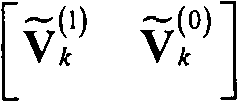 is that
 Right singular vector matrix.
 The right singular vectors in (a) correspond to non-zero singular values,
 the right singular vector in (1) corresponds to a zero singular value. It is obvious thatThe column vector of (a) constitutesThe orthogonal basis of the null space. Therefore, let us say the precoding matrix BkIs composed of
 Front L ofkThe method comprises the following steps:
using the above BkThe formula (3) becomes:
rk=HkFkbk+nk=HkBkDkbk+nk
it can be seen that the MUI is cancelled, leaving only each user's own ISI. At this time, each MS and BS is equivalently a point-to-point MIMO system, and the input-output relationship is as follows:
rk=Heff,kDkbk+nk
wherein Heff,k=HkFkIs an equivalent channel matrix. If the channels between all antennas of the BS and all MSs are written as a complete channel matrix After the above operation, the equivalent channel matrix becomes a block diagonalized matrix:
since each MS and BS base station is equivalent to a point-to-point MIMO system, various techniques for point-to-point MIMO systems can be introduced after block diagonalization for Heff,kAn operation is performed to further remove ISI.
The prior art techniques based on block diagonalization and linear precoding are as follows: when the MS is configured with a plurality of antennas, each MS and the BS base station can be converted into a point-to-point MIMO system by using the block diagonalization technology,and an equivalent channel matrix H is obtainedeff,k=HkBkWherein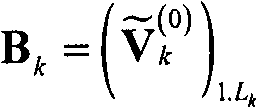 Is a block diagonalized precoding matrix that eliminates MUIs. To further remove ISI after MUI cancellation by block diagonalization, we continue to design the ISI-removing precoding matrix Dk. Under the framework of block diagonalization, to continue to eliminate ISI, the capacity-optimal algorithm is an iterative waterflooding algorithm, which mainly includes the following steps:
step 1, block diagonalization and iterative water injection: h is to beeff,k=HkBkSingular value decomposition is performed as:
wherein Is composed of right singular vectors corresponding to non-zero singular values, UkIs a left singular vector matrix, ΛkIs a diagonal matrix composed of singular values. From Heff,kThe singular value decomposition of (c) can be seen if the left multiplication continues after the block diagonalization at the BS end
 And the received signal is pre-multiplied at the MS
 The point-to-point MIMO between the MS and BS may be further channelized into ISI-free parallel channels with channel fading coefficients of ΛkOf (1). Thus can give
 QkIs according to ΛkThe power distribution matrix calculated by the equivalent channel fading coefficient in (1) is also a diagonal matrix. The optimal power allocation is iterative waterflooding.
Fig. 1 shows a system block diagram of a precoding algorithm based on block diagonalization and iterative waterflooding in the prior art. As shown in fig. 1, in the multi-user MIMO downlink system diagram based on the block diagonalization and iterative waterflood precoding algorithm, the iterative waterflood algorithm with the optimal capacity needs to be used by the MS receiving end To operate on the received signal.
 Is according to Heff,k=HkBkObtained, and BkIs determined by the channel matrix between the other MSs and the BS. MS to obtain
 Must make a pair of H again by itselfeff,kThe estimation is performed, or the BS sends the kth MS the channel matrix of the BS and other MSs, this part of information is called cooperation information. Additional pairs Heff,kThe estimation or cooperation information is performed, so that the system overhead is greatly increased and the MS complexity is raised, and therefore the precoding practicality based on block diagonalization and iterative waterflooding is very low. Design D using some linear precoding techniqueskISI can be effectively eliminated and the MS receiver can be kept simple. Commonly used ISI cancellation matrix D based on ZF and MMSEkAnd (5) designing a scheme.
Step 3, block diagonalization + MMSE: getLikewise, no receive matrix is required at the MS.
It is to be noted in particular that: in all prior art approaches, the transmitted signal is properly normalized to meet the power constraints. The block diagonalization and linear precoding based approach is simple but has poor performance.
Precoding based on block diagonalization and ZF vector perturbation (block diagonalization + ZF vector perturbation): to avoid MS-to-equivalent channel Heff,k=HkBkOr the transmission of cooperation information, while further improving system performance, precoding based on block diagonalization and ZF vector perturbation is introduced. ISI-canceling precoding matrix DkTaken as ZF matrix Then carrying out vector disturbance on the sent data vector to obtain
 Wherein y iskIs calculated as follows
 And at the k MS, directly operating as followskMake an estimation
In summary, the present invention provides a technique for encoding a multi-user MIMO downlink that is simple and can effectively avoid interference, and ensure system performance.
Disclosure of Invention
The invention provides a multi-user multi-input multi-output downlink precoding method and a system, which are based on block diagonalization and MMSE vector disturbance precoding technologies, greatly reduce system overhead and a receiver structure, eliminate interference and ensure system performance.
One aspect of the present invention provides a multi-user multiple-input multiple-output downlink precoding method, including: using channel matricesTo calculate a block diagonalized precoding matrix And obtaining an equivalent channel matrix Heff,k(ii) a Wherein K represents the number of mobile stations; using equivalent channel matrix Heff,kCalculating a Minimum Mean Square Error (MMSE) precoding matrix:
 wherein N iskIndicates the number of antennas configured for the kth mobile station,
 representing the variance of the noise; precoding matrix D for minimum mean square errorkCholesky decomposition was performed:by means of LkFor data symbol vector bkMinimum mean square error MMSE vector perturbation is executed to obtain perturbed data vector
 Wherein,
 diagonalizing the block by pre-coding BkSum minimum mean square error MMSE precoding matrix DkCascading to obtain a total precoding matrix: fk=BkDkAnd using the total precoding matrix FkFor disturbed data vector
 Carrying out pre-coding; adding the K results obtained in the previous step to form an MX 1 transmitting vector t, and transmitting the transmitting vector t from M antennas of the base station; wherein,
 and the mobile station performs a modulo operation on the received signal to estimate the original data.
In one embodiment of the multi-user multiple-input multiple-output downlink precoding method provided by the invention, a channel matrix is utilizedTo calculate a block diagonalized precoding matrix And obtaining an equivalent channel matrix Heff,kThe method specifically comprises the following steps:
complementary channel matrixTo the complementary channel matrix of the k mobile stationPerforming singular value decomposition to obtain Calculating an equivalent point-to-point multiple-input multiple-output channel matrix: heff,k=HkBk(ii) a Wherein,
 is that
 The left-hand singular vector matrix of (a),
 is thatThe matrix of singular values of (a) is,is that
 A right singular vector matrix;
 the right singular vector in (1) corresponds to a non-zero singular
 The right singular vector in (1) corresponds to a zero singular value; precoding matrix BkIs composed of
 Front L ofkThe method comprises the following steps:
in an embodiment of the method for precoding the downlink with multiple users and multiple inputs and multiple outputs provided by the present invention, the mobile station performs a modulo operation on the received signal, and the estimating of the original data specifically includes: signal received to k mobile station Directly carrying out a modulus taking operation to obtain a pair bkEstimation of (2):wherein n iskIs the noise vector at the kth mobile station.
In one embodiment of the multi-user multiple-input multiple-output downlink precoding method provided by the invention, a channel matrix is utilized To calculate a block diagonalized precoding matrixThereby eliminating multi-user interference.
In one embodiment of the multi-user multiple-input multiple-output downlink precoding method provided by the invention, an equivalent channel matrix H is utilizedeff,kComputing minimum mean square error MMSE precoding matrix DkThereby further eliminating data flow interference of the equivalent point-to-point multiple-input multiple-output channel.
Another aspect of the present invention provides a multi-user multiple-input multiple-output downlink precoding system, including: an equivalent channel matrix calculation module for using the channel matrixTo calculate a block diagonalized precoding matrix And obtaining an equivalent channel matrix Heff,k(ii) a Wherein K represents the number of mobile stations; MMSE precoding matrix calculation module for utilizing equivalent channel matrix Heff,kCalculating a Minimum Mean Square Error (MMSE) precoding matrix:
 wherein N iskIndicates the number of antennas configured for the kth mobile station,representing the variance of the noise; cholesky decomposition module for precoding the minimum mean square error matrix DkCholesky decomposition was performed:
 MMSE vector perturbation module for utilizing LkFor data symbol vector bkMinimum mean square error MMSE vector perturbation is executed to obtain perturbed data vectorWherein,
 a total pre-coding matrix calculation module for diagonalizing the block to pre-coding matrix BkSum minimum mean square error MMSE precoding matrix DkCascading to obtain a total precoding matrix: fk=BkDkAnd using the total precoding matrix FkFor disturbed data vector
 Carrying out pre-coding; a signal transmitting module, configured to add the K results obtained in the foregoing steps to form an mx 1 transmitting vector t, and transmit the transmitting vector t from M antennas of the base station; wherein,
 and a raw data estimation module for receiving signal transmissionThe module transmits the signal and performs a modulo operation on the signal to estimate the original data.
In an embodiment of the multi-user mimo downlink precoding system provided in the present invention, the equivalent channel matrix calculation module is specifically configured to: complementary channel matrix for kth mobile station Performing singular value decomposition to obtainCalculating an equivalent point-to-point multiple-input multiple-output channel matrix: heff,k=HkBk(ii) a Wherein,
 is that
 The left-hand singular vector matrix of (a),
 is that
 The matrix of singular values of (a) is,
 is that
 A right singular vector matrix;
 the right singular vectors in (a) correspond to non-zero singular values,
 the right singular vector in (1) corresponds to a zero singular value; precoding matrix BkIs composed of
 Front L ofkThe method comprises the following steps:
in an embodiment of the multi-user mimo downlink precoding system provided in the present invention, the raw data estimation module is specifically configured to: for the signal received by the kth mobile station:


In one embodiment of the multi-user mimo downlink precoding system provided by the present invention, the equivalent channel matrix calculation module utilizes the channel matrix To calculate a block diagonalized precoding matrix
 Thereby eliminating multi-user interference.
In an embodiment of the multi-user mimo downlink precoding system provided in the present invention, the MMSE precoding matrix calculation module utilizes an equivalent channel matrix Heff,kComputing minimum mean square error MMSE precoding matrix DkThereby further eliminating data flow interference of the equivalent point-to-point multiple-input multiple-output channel.
The micro-beam detection system and the multi-user multi-input multi-output downlink precoding method and system provided by the invention are based on the precoding technology of block diagonalization and MMSE vector disturbance, and do not need a mobile station to estimate an equivalent channel or a base station to transmit cooperation information, thereby greatly reducing the system overhead and the structure of a receiver, eliminating interference and simultaneously ensuring the system performance.
Drawings
FIG. 1 illustrates a block diagram of a prior art precoding algorithm based on block diagonalization and iterative waterflooding;
fig. 2 is a flowchart illustrating a method for precoding a multi-user multiple-input multiple-output downlink according to an embodiment of the present invention;
fig. 3 is a schematic structural diagram of a multi-user multiple-input multiple-output downlink precoding system provided by an embodiment of the present invention;
fig. 4 shows a system block diagram of a block diagonalization and MMSE vector perturbation precoding algorithm based on the embodiments of the present invention;
fig. 5 shows a performance comparison diagram of error bit rate of the multi-user mimo downlink precoding method provided by the present invention and other related arts.
Detailed Description
The present invention now will be described more fully hereinafter with reference to the accompanying drawings, in which exemplary embodiments of the invention are shown.
The present invention is directed to the case when multiple antennas are configured per user for a multi-user MIMO downlink system. In the system, a base station is configured with M antennas, and a k-th MS is configured with N antennaskA root antenna, currently having K MSs; wherein, the number of antennas satisfies the relation:


Fig. 2 shows a flowchart of a method for precoding a multi-user multiple-input multiple-output downlink according to an embodiment of the present invention.
As shown in fig. 2, a method flow 200 of multi-user multiple-input multiple-output downlink precoding based on block diagonalization and MMSE vector perturbation includes:


the mobile station performs a modulo operation on the received signal to estimate the raw data, step 214.
In an embodiment of the method for precoding the downlink with multiple users and multiple inputs and multiple outputs provided by the present invention, the precoding is performed by using a channel matrix To calculate a block diagonalized precoding matrixAnd obtaining an equivalent channel matrix Heff,kThe method specifically comprises the following steps: the complementary channel matrix is the complementary channel matrix for the kth mobile station
 Performing singular value decomposition to obtain
 Calculating an equivalent point-to-point multiple-input multiple-output channel matrix: heff,k=HkBk(ii) a Wherein,is that
 The left-hand singular vector matrix of (a),
 is that
 The matrix of singular values of (a) is,
 is that
 A right singular vector matrix;
 right singular vector in (1) corresponds to nonThe singular value of zero is the sum of the values,
 the right singular vector in (1) corresponds to a zero singular value; precoding matrix BkIs composed of
 Front L ofkThe method comprises the following steps:
in an embodiment of the method for precoding the downlink with multiple users and multiple inputs and multiple outputs provided by the present invention, the step of performing a modulo operation on the received signal by the mobile station to estimate the original data specifically includes: signal received to k mobile station Directly carrying out a modulus taking operation to obtain a pair bkEstimation of (2):wherein n iskIs the noise vector at the kth mobile station.
The embodiment of the multi-user multi-input multi-output downlink precoding method provided by the invention utilizes a channel matrix To calculate a block diagonalized precoding matrix
 Thereby eliminating multi-user interference; using the equivalent channel matrix Heff,kComputing minimum mean square error MMSE precoding matrix DkThereby further eliminating data flow interference of the equivalent point-to-point multiple-input multiple-output channel.
Fig. 3 shows a schematic structural diagram of a multi-user multiple-input multiple-output downlink precoding system provided by an embodiment of the present invention.
As shown in fig. 3, the multi-user multiple-input multiple-output downlink precoding system 100 includes: an equivalent channel matrix calculation module 302, an MMSE precoding matrix calculation module 304, a Cholesky decomposition module 306, an MMSE vector perturbation module 308, a total precoding matrix calculation module 310, a signal transmission module 312 and an original data estimation module 314; wherein
An equivalent channel matrix calculation module 302 for utilizing the channel matrixTo calculate a block diagonalized precoding matrix And obtaining an equivalent channel matrix Heff,k(ii) a Where K represents the number of mobile stations.
An MMSE precoding matrix calculation module 304 for utilizing the equivalent channel matrix Heff,kCalculating a Minimum Mean Square Error (MMSE) precoding matrix: wherein N iskThe number of antennas allocated to the kth mobile station is shown.
A Cholesky decomposition module 306 for decomposing the minimum mean square error precoding matrix DkCholesky decomposition was performed:
MMSE vector perturbation module 308 to utilize LkFor data symbol vector bkMinimum mean square error MMSE vector perturbation is executed to obtain perturbed data vector Wherein,
a total pre-coding matrix calculation module 310 for diagonalizing the block pre-coding matrix BkAnd the minimum mean square error MMSE precoding matrix DkCascading to obtain a total precoding matrix:
Fk=BkDkand using the total precoding matrix FkFor the perturbed data vector

A signal transmitting module 312 for transmitting the signals obtained by the previous stepsAdding the K results to form an Mx 1 transmitting vector t, and transmitting the transmitting vector t from M antennas of the base station; wherein,
and a raw data estimation module 314, configured to receive the signal transmitted by the signal transmission module, and perform a modulo operation on the signal to estimate raw data.
In an embodiment of the multi-user mimo downlink precoding system provided in the present invention, the equivalent channel matrix calculation module is specifically configured to: complementary channel matrix for kth mobile station Performing singular value decomposition to obtain
 Calculating an equivalent point-to-point multiple-input multiple-output channel matrix:
 is that
 The left-hand singular vector matrix of (a),
 is that
 The matrix of singular values of (a) is,is that
 A right singular vector matrix;the right singular vectors in (a) correspond to non-zero singular values,
 the right singular vector in (1) corresponds to a zero singular value; precoding matrix BkIs composed of
 Front L ofkThe method comprises the following steps:
in an embodiment of the multi-user mimo downlink precoding system provided in the present invention, the raw data estimation module is specifically configured to: for the signal received by the kth mobile station: directly carrying out a modulus taking operation to obtain bkEstimation of the pair:
fig. 4 shows a system block diagram of a block diagonalization and MMSE vector perturbation precoding algorithm according to an embodiment of the present invention. In the embodiment of the multi-user MIMO downlink precoding system provided by the invention, the equivalent channel matrix calculation module utilizes the channel matrix To calculate a block diagonalized precoding matrix
 Thereby eliminating multi-user interference; the MMSE precoding matrix calculation module utilizes the equivalent channel matrix Heff,kComputing minimum mean square error MMSE precoding matrix DkThereby further eliminating equivalent point-to-point Multiple Input Multiple Output (MIMO) signalsThe data stream of the track interferes.
Taking a multi-user MIMO downlink system as an example, the system parameters are set as follows: m is 4, K is 2, N1=N2=2,L1=L 22. The system adopts QPSK modulation mode and does not adopt channel coding. We implement the block-diagonalization and MMSE vector perturbation based precoding we propose (block-diagonalization + MMSE vector perturbation) and the prior art block-diagonalization + ZF linear precoding, block-diagonalization + MMSE linear precoding, block-diagonalization + ZF vector perturbation, respectively, in this system. Using a monte carlo simulation experiment, the Bit Error Rate (BER) of the system is calculated.
Fig. 5 shows a performance comparison diagram of error bit rate of the multi-user mimo downlink precoding method provided by the present invention and other related arts. As shown in fig. 5, BER is plotted on the ordinate, and SNR is plotted on the abscissa. The results show that: the method for multi-user MIMO downlink precoding based on block diagonalization and MMSE vector disturbance provided by the invention has the lowest error bit rate under the same Signal-to-Noise Ratio (SNR), so that the method has the best performance compared with the method in the prior art.
With reference to the foregoing description of exemplary embodiments of the invention, it will be clear to those skilled in the art that the invention has the following advantages:
1. compared with a precoding algorithm based on block diagonalization and iterative water injection, the multi-user multi-input multi-output downlink precoding method and the system provided by the invention do not need an MS to estimate an equivalent channel or a BS to transmit cooperation information, so that the system overhead is reduced and the complexity of the MS is reduced.
2. The embodiment of the multi-user multi-input multi-output downlink precoding method and the system provided by the invention is better than the existing block diagonalization + ZF linear precoding, block diagonalization + MMSE linear precoding and block diagonalization + ZF vector disturbance in the aspect of error rate performance.
3. The embodiment of the multi-user multi-input multi-output downlink precoding method and the system thereof solves the problem of eliminating MUI and ISI well on the premise that an MS does not need to know Channel State Information (CSI), and has better performance than other existing methods.
The description of the present invention has been presented for purposes of illustration and description, and is not intended to be exhaustive or limited to the invention in the form disclosed. Many modifications and variations will be apparent to practitioners skilled in this art. The functional modules and the division of the functional modules described in the present invention are only for illustrating the idea of the present invention, and those skilled in the art can freely change the division of the functional modules and the module structure thereof to realize the same function according to the teaching of the present invention and the requirement of practical application; the embodiment was chosen and described in order to best explain the principles of the invention and the practical application, and to enable others of ordinary skill in the art to understand the invention for various embodiments with various modifications as are suited to the particular use contemplated.
Claims (10)
1. A multi-user multiple-input multiple-output downlink precoding method, the method comprising:
using channel matricesTo calculate a block diagonalized precoding matrix And obtaining an equivalent channel matrix Heff,k(ii) a WhereinAnd K represents the number of mobile stations;
using the equivalent channel matrix Heff,kCalculating a Minimum Mean Square Error (MMSE) precoding matrix: wherein N iskIndicates the number of antennas configured for the kth mobile station,
 representing the variance of the noise;
precoding the minimum mean square error precoding matrix DkCholesky decomposition was performed:
by means of LkFor data symbol vector bkMinimum mean square error MMSE vector perturbation is executed to obtain perturbed data vectorWherein,
diagonalizing the block by a pre-coding matrix BkAnd the minimum mean square error MMSE precoding matrix DkCascading to obtain a total precoding matrix: fk=BkDkAnd using the total precoding matrix FkFor the perturbed data vector Carrying out pre-coding;
adding the K results obtained in the previous step to form an Mx 1 transmitting vector t, and transmitting the transmitting vector t from M antennas of the base station; wherein, and
and
the mobile station performs a modulo operation on the received signal to estimate the raw data.
2. The method of claim 1, wherein the utilizing a channel matrix To calculate a block diagonalized precoding matrixAnd obtaining an equivalent channel matrix Heff,kThe method specifically comprises the following steps:
the complementary channel matrix is complementary to the kth mobile stationChannel matrix Performing singular value decomposition to obtain
Calculating an equivalent point-to-point multiple-input multiple-output channel matrix: heff,k=HkBk;
Wherein, is that
 The left-hand singular vector matrix of (a),
 is that
 The matrix of singular values of (a) is,
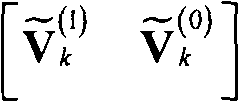 is that
 A right singular vector matrix;the right singular vectors in (a) correspond to non-zero singular values,
 the right singular vector in (1) corresponds to a zero singular value; precoding matrix BkIs composed of
 Front L ofkThe method comprises the following steps:
3. the method of claim 1, wherein the mobile station performs a modulo operation on the received signal, and wherein estimating the raw data comprises: signal received to k mobile station Directly carrying out a modulus taking operation to obtain a pair bkEstimation of (2):wherein n iskIs the noise vector at the kth mobile station.
4. Method according to claim 1, characterized in that a channel matrix is used To calculate a block diagonalized precoding matrix
 Thereby eliminating multi-user interference.
5. Method according to claim 1, characterized in that said equivalent channel matrix H is utilizedeff,kComputing minimum mean square error MMSE precoding matrix DkThereby further eliminating data flow interference of the equivalent point-to-point multiple-input multiple-output channel.
6. A multi-user multiple-input multiple-output downlink precoding system, the system comprising:
an equivalent channel matrix calculation module for using the channel matrix To calculate a block diagonalized precoding matrix
 And obtaining an equivalent channel matrix Heff,k(ii) a Wherein K represents the number of mobile stations;
MMSE precoding matrix calculation module for utilizing the equivalent channel matrix Heff,kCalculating a Minimum Mean Square Error (MMSE) precoding matrix: wherein N iskIndicates the number of antennas configured for the kth mobile station,
 representing the variance of the noise;
a Cholesky decomposition module, configured to perform Cholesky decomposition on the minimum mean square error precoding matrix Dk:
MMSE vector perturbation module for utilizing LkFor data symbol vector bkMinimum mean square error MMSE vector perturbation is executed to obtain perturbed data vector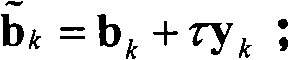 Wherein,
a total pre-coding matrix calculation module for diagonalizing the block pre-coding matrix BkAnd the minimum mean square error MMSE precoding matrix DkCascading to obtain a total precoding matrix: fk=BkDkAnd using the total precoding matrix FkFor the perturbed data vector Carrying out pre-coding;
a signal transmitting module, configured to add the K results obtained in the foregoing steps to form an mx 1 transmitting vector t, and transmit the transmitting vector t from M antennas of the base station; wherein, and
and
and the original data estimation module is used for receiving the signal transmitted by the signal transmission module, and performing modulus operation on the signal to estimate original data.
7. The system of claim 6, wherein the equivalent channel matrix calculation module is specifically configured to: complementary channel matrix for kth mobile station Performing singular value decomposition to obtainCalculating an equivalent point-to-point multiple-input multiple-output channel matrix: heff,k=HkBk(ii) a Wherein,
 is that
 The left-hand singular vector matrix of (a),is thatThe matrix of singular values of (a) is,
 is that
 A right singular vector matrix;
 the right singular vectors in (a) correspond to non-zero singular values,
 the right singular vector in (1) corresponds to a zero singular value; precoding matrix BkIs composed of
 Front L ofkThe method comprises the following steps:
8. the system of claim 6, wherein the raw data estimation module is specifically configured to: for the signal received by the kth mobile station:
directly carrying out a modulus taking operation to obtain a pair bkEstimation of (2):wherein n iskIs the noise vector at the kth mobile station.
9. The system of claim 6, wherein the equivalent channel matrix calculation module utilizes a channel matrix To calculate a block diagonalized precoding matrix
 Thereby eliminating multi-user interference.
10. The system of claim 6, wherein the MMSE precoding matrix calculation module utilizes the equivalent channel matrix Heff,kComputing minimum mean square error MMSE precoding matrix DkThereby further eliminating equivalent point-to-point multipleData stream interference for input multiple output channels.
Priority Applications (1)
| Application Number | Priority Date | Filing Date | Title |
|---|---|---|---|
| CN 201010504800 CN101964695B (en) | 2010-10-08 | 2010-10-08 | Method and system for precoding multi-user multi-input multi-output downlink |
Applications Claiming Priority (1)
| Application Number | Priority Date | Filing Date | Title |
|---|---|---|---|
| CN 201010504800 CN101964695B (en) | 2010-10-08 | 2010-10-08 | Method and system for precoding multi-user multi-input multi-output downlink |
Publications (2)
| Publication Number | Publication Date |
|---|---|
| CN101964695A CN101964695A (en) | 2011-02-02 |
| CN101964695B true CN101964695B (en) | 2013-06-05 |
Family
ID=43517448
Family Applications (1)
| Application Number | Title | Priority Date | Filing Date |
|---|---|---|---|
| CN 201010504800 Active CN101964695B (en) | 2010-10-08 | 2010-10-08 | Method and system for precoding multi-user multi-input multi-output downlink |
Country Status (1)
| Country | Link |
|---|---|
| CN (1) | CN101964695B (en) |
Families Citing this family (10)
| Publication number | Priority date | Publication date | Assignee | Title |
|---|---|---|---|---|
| CN103299570B (en) * | 2011-02-28 | 2016-07-06 | 日电(中国)有限公司 | Method and device for predicting precoding matrix in MIMO system |
| CN102158857B (en) * | 2011-05-27 | 2013-07-10 | 中国人民解放军信息工程大学 | Wireless channel encryption method under disturbance condition and device |
| CN102983934B (en) * | 2011-09-06 | 2015-12-02 | 华为技术有限公司 | The method of multiuser mimo system neutral line precoding and device |
| CN103905163A (en) * | 2012-12-27 | 2014-07-02 | 上海贝尔股份有限公司 | Multi-user eigen-mode transmission method and apparatus |
| CN104079333B (en) * | 2014-06-24 | 2017-06-20 | 哈尔滨工业大学 | The double-deck heterogeneous network down collaboration transmission method of energy efficient |
| CN106302301A (en) * | 2015-06-24 | 2017-01-04 | 北京三星通信技术研究有限公司 | FBMC signal based on complex modulation send and receive method and device |
| CN106792872B (en) * | 2016-11-15 | 2020-05-01 | 电子科技大学 | A low-complexity detection method for ultra-dense networks |
| EP3654558B1 (en) * | 2018-09-18 | 2021-10-06 | Guangdong Oppo Mobile Telecommunications Corp., Ltd. | Signal processing method and device and storage medium |
| EP4128558B1 (en) * | 2020-04-01 | 2025-10-15 | Telefonaktiebolaget LM Ericsson (publ) | Multi-user pre-coding |
| CN118612021A (en) * | 2024-05-21 | 2024-09-06 | 毛帅 | Crosstalk suppression method based on MIMO channel |
Citations (3)
| Publication number | Priority date | Publication date | Assignee | Title |
|---|---|---|---|---|
| EP1619809A2 (en) * | 2004-07-20 | 2006-01-25 | Samsung Electronics Co., Ltd. | Feeding back antenna shuffling information in a multiple-input multiple-output system using a multiple space-time block coding technique and a method therefor |
| CN101374034A (en) * | 2007-08-20 | 2009-02-25 | 中兴通讯股份有限公司 | Downlink and uplink multi-user MIMO precoding method and its codebook |
| CN101729460A (en) * | 2008-10-24 | 2010-06-09 | 华为技术有限公司 | Multi-user precoding method and device |
-
2010
- 2010-10-08 CN CN 201010504800 patent/CN101964695B/en active Active
Patent Citations (3)
| Publication number | Priority date | Publication date | Assignee | Title |
|---|---|---|---|---|
| EP1619809A2 (en) * | 2004-07-20 | 2006-01-25 | Samsung Electronics Co., Ltd. | Feeding back antenna shuffling information in a multiple-input multiple-output system using a multiple space-time block coding technique and a method therefor |
| CN101374034A (en) * | 2007-08-20 | 2009-02-25 | 中兴通讯股份有限公司 | Downlink and uplink multi-user MIMO precoding method and its codebook |
| CN101729460A (en) * | 2008-10-24 | 2010-06-09 | 华为技术有限公司 | Multi-user precoding method and device |
Non-Patent Citations (1)
| Title |
|---|
| 李新民,白宝明.基于最小均方误差的多用户MIMO系统下行链路预编码.《重庆邮电大学学报》.2010,第22卷(第1期),11-13页. * |
Also Published As
| Publication number | Publication date |
|---|---|
| CN101964695A (en) | 2011-02-02 |
Similar Documents
| Publication | Publication Date | Title |
|---|---|---|
| CN101964695B (en) | Method and system for precoding multi-user multi-input multi-output downlink | |
| Zhang et al. | A deep learning-based framework for low complexity multiuser MIMO precoding design | |
| CN101984571B (en) | Pre-coding method for multi-user MIMO system | |
| CN102104404B (en) | Multi-user MIMO transmission method in wireless communication system, base station and user terminal | |
| CN103957086B (en) | MU MIMO precoding implementation methods | |
| US20100014617A1 (en) | Method and apparatus for singular value decomposition of a channel matrix | |
| US8649457B2 (en) | Precoding process for a transmitter of a MU-MIMO communication system | |
| CN102104453A (en) | Precoding method and device and decoding method and device | |
| CN101834646B (en) | User selection method, user selection device and base station | |
| CN102946267B (en) | QR (quadrature rectangle) decomposition-based low-complexity MIMO (multi-input multi-output) detecting algorithm | |
| CN103490804A (en) | Method for selecting multi-user MIMO system antenna based on priority genetic simulated annealing | |
| CN102291166B (en) | Precoding method for minimum mean square error in multi-user multi-input multi-output system | |
| CN101471712A (en) | Method, apparatus and base station for processing precoding of multi-input multi-output broadcast channel | |
| CN105049100A (en) | A double-layer precoding method for multi-cell MIMO system | |
| CN105227226A (en) | Based on the ZF of interference synthesis and the multi-user reception method of serial interference elimination | |
| CN101242381B (en) | Linear pre-coding method for multi-input and multi-output system | |
| CN102510324A (en) | Signal transmission method based on network coding in multi-input and multi-output Y channel | |
| CN102647220B (en) | MIMO (multiple input multiple output) precoding control method based on lattice-basis reduction | |
| CN102215073B (en) | Multipoint-multiuser uplink low-complexity MIMO (Multiple Input Multiple Output) detection method | |
| CN102332946B (en) | Cooperated multipoint (CoMP) downlink joint transmission method capable of eliminating inter-cell interference and inter-flow interference at same time | |
| Chen et al. | Multi-user multi-stream vector perturbation precoding | |
| CN103117839A (en) | Pre-coding method under non-accurate channel information of multi-user multiple-input-multiple-output system | |
| CN107659348A (en) | One kind is based on letter leakage noise ratio SLNR and precoding THP mixed self-adapting Precoding Design methods | |
| CN102404090A (en) | Downlink Transmission Method of Multi-user MIMO System Based on Singular Value Decomposition | |
| Simarro et al. | Block diagonalization aided precoding algorithm for large MU-MIMO systems |
Legal Events
| Date | Code | Title | Description |
|---|---|---|---|
| C06 | Publication | ||
| PB01 | Publication | ||
| C10 | Entry into substantive examination | ||
| SE01 | Entry into force of request for substantive examination | ||
| C53 | Correction of patent for invention or patent application | ||
| CB02 | Change of applicant information |
Address after: 100102 Beijing City, Chaoyang District Lize two Road No. 2 three floor, four floor of the South Applicant after: BEIJING STARPOINT TECHNOLOGY CO., LTD. Address before: 100083, Haidian District, Xueyuan Road, No. 40 research, 1-1 floor, two floor, Beijing Applicant before: Xingheliangdian Communication Software Co., Ltd., Beijing |
|
| COR | Change of bibliographic data |
Free format text: CORRECT: APPLICANT; FROM: XINGHELIANGDIAN COMMUNICATION SOFTWARE CO LTD, BEIJING TO: BEIJING STARPOINT TECHNOLOGY CO., LTD. |
|
| C14 | Grant of patent or utility model | ||
| GR01 | Patent grant |