CN101933278B - Method of resource allocation for hybrid-automatic repeat request - Google Patents
Method of resource allocation for hybrid-automatic repeat request Download PDFInfo
- Publication number
- CN101933278B CN101933278B CN200880126031.4A CN200880126031A CN101933278B CN 101933278 B CN101933278 B CN 101933278B CN 200880126031 A CN200880126031 A CN 200880126031A CN 101933278 B CN101933278 B CN 101933278B
- Authority
- CN
- China
- Prior art keywords
- information
- burst
- sub
- harq
- message
- Prior art date
- Legal status (The legal status is an assumption and is not a legal conclusion. Google has not performed a legal analysis and makes no representation as to the accuracy of the status listed.)
- Expired - Fee Related
Links
Images


Classifications
-
- H—ELECTRICITY
- H04—ELECTRIC COMMUNICATION TECHNIQUE
- H04L—TRANSMISSION OF DIGITAL INFORMATION, e.g. TELEGRAPHIC COMMUNICATION
- H04L1/00—Arrangements for detecting or preventing errors in the information received
- H04L1/12—Arrangements for detecting or preventing errors in the information received by using return channel
- H04L1/16—Arrangements for detecting or preventing errors in the information received by using return channel in which the return channel carries supervisory signals, e.g. repetition request signals
- H04L1/18—Automatic repetition systems, e.g. Van Duuren systems
- H04L1/1812—Hybrid protocols; Hybrid automatic repeat request [HARQ]
-
- H—ELECTRICITY
- H04—ELECTRIC COMMUNICATION TECHNIQUE
- H04L—TRANSMISSION OF DIGITAL INFORMATION, e.g. TELEGRAPHIC COMMUNICATION
- H04L1/00—Arrangements for detecting or preventing errors in the information received
- H04L1/12—Arrangements for detecting or preventing errors in the information received by using return channel
- H04L1/16—Arrangements for detecting or preventing errors in the information received by using return channel in which the return channel carries supervisory signals, e.g. repetition request signals
- H04L1/18—Automatic repetition systems, e.g. Van Duuren systems
-
- H—ELECTRICITY
- H04—ELECTRIC COMMUNICATION TECHNIQUE
- H04L—TRANSMISSION OF DIGITAL INFORMATION, e.g. TELEGRAPHIC COMMUNICATION
- H04L1/00—Arrangements for detecting or preventing errors in the information received
- H04L1/12—Arrangements for detecting or preventing errors in the information received by using return channel
- H04L1/16—Arrangements for detecting or preventing errors in the information received by using return channel in which the return channel carries supervisory signals, e.g. repetition request signals
- H04L1/18—Automatic repetition systems, e.g. Van Duuren systems
- H04L1/1867—Arrangements specially adapted for the transmitter end
- H04L1/1887—Scheduling and prioritising arrangements
Landscapes
- Engineering & Computer Science (AREA)
- Computer Networks & Wireless Communication (AREA)
- Signal Processing (AREA)
- Mobile Radio Communication Systems (AREA)
Abstract
Description
技术领域 technical field
本发明涉及用于混合自动重复请求(HARQ)的资源分配方法,并且更具体地涉及用于仅仅传送在能够由从先前的帧接收到的媒体访问协议(MAP)消息识别的信息和重传的子突发之间的差异,从而实现资源分配的方法。The present invention relates to resource allocation methods for Hybrid Automatic Repeat Request (HARQ), and more particularly to methods for transmitting only information and retransmissions that can be identified by a Medium Access Protocol (MAP) message received from a previous frame The difference between the sub-bursts, thereby implementing the method of resource allocation.
背景技术 Background technique
在下文中将详细描述发送端或者接收端的数据重传方法。无线通信系统使用有限的资源量提供高速率数据服务。对于这种高速数据服务,使用能够有效地利用资源的自动重复请求(ARQ)。即,如果从发送端产生的数据未能传送给接收端,则接收端请求重传这个失败的数据。在这种情况下,自动重复请求(ARQ)方案已经广泛地用于自动地重传数据。The data retransmission method of the sending end or the receiving end will be described in detail below. Wireless communication systems provide high rate data services using a limited amount of resources. For such a high-speed data service, Automatic Repeat Request (ARQ) which can efficiently utilize resources is used. That is, if data generated from the sending end fails to be delivered to the receiving end, the receiving end requests retransmission of this failed data. In this case, an automatic repeat request (ARQ) scheme has been widely used to automatically retransmit data.
按照ARQ方案,在接收端已经从发送端接收到数据之后,它将肯定应答(ACK)信号和/或否定应答(NACK)信号发送到发送端,使得接收端通知发送端是否已经正确地接收到数据。如果发送端从接收端接收到NACK信号,则它确定在传送给接收端的数据中出现错误,使得它将数据重传给接收端。ARQ方案具有三种ARQ方案,即,停止和等待(SAW)ARQ方案、后退N步(GBN)ARQ方案和选择性重复(SR)ARQ方案。According to the ARQ scheme, after the receiving end has received data from the sending end, it sends an acknowledgment (ACK) signal and/or a negative acknowledgment (NACK) signal to the sending end, so that the receiving end informs the sending end whether it has correctly received data. If the transmitting end receives a NACK signal from the receiving end, it determines that an error has occurred in the data transmitted to the receiving end, so that it retransmits the data to the receiving end. The ARQ scheme has three kinds of ARQ schemes, namely, a stop and wait (SAW) ARQ scheme, a step back N (GBN) ARQ scheme, and a selective repeat (SR) ARQ scheme.
根据SAW ARQ方案,发送端将原始数据发送给接收端,并且等待从接收端接收ACK或者NACK信号。一旦从接收端接收到ACK信号,发送端就发送与下一个数据相对应的新数据。否则,如果发送端从接收端接收到NACK信号,则它重传原始数据而不是下一个数据。换句话说,SAW ARQ方案一次仅发送一个帧。在发送端识别到该帧已经成功地传送给接收端之后,它发送下一个帧。According to the SAW ARQ scheme, the transmitter sends raw data to the receiver, and waits to receive an ACK or NACK signal from the receiver. Upon receiving the ACK signal from the receiving end, the transmitting end transmits new data corresponding to the next data. Otherwise, if the sending end receives a NACK signal from the receiving end, it retransmits the original data instead of the next data. In other words, SAW ARQ schemes only send one frame at a time. After the sender recognizes that the frame has been successfully delivered to the receiver, it sends the next frame.
根据GBN ARQ方案,不管来自接收端的响应消息(例如,ACK或者NACK消息),它使得发送端能够连续地发送数据。如果接收端不接收特定帧的数据,而从发送端接收数据,则它不能将特定帧的ACK信号发送给发送端。因此,发送端不从接收端接收特定帧的ACK信号,使得它从特定帧重传数据。According to the GBN ARQ scheme, it enables the transmitting end to continuously transmit data regardless of a response message (eg, ACK or NACK message) from the receiving end. If the receiving end does not receive data of a specific frame but receives data from the sending end, it cannot send an ACK signal of the specific frame to the sending end. Therefore, the transmitting end does not receive the ACK signal of the specific frame from the receiving end, so that it retransmits data from the specific frame.
根据SR ARQ方案,如果发送端从接收端接收NACK信号,同时将数据连续地发送给接收端,则它仅仅将遇到NACK信号的特定数据重传给接收端。如果发送端从接收端接收到NACK信号,则它仅仅将由NACK信号表示的帧的数据重传给接收端,使得它可以成功地将所有的数据发送给接收端。SR ARQ方案必须给各个帧分配唯一的序列号,并且必须管理各个帧。因此,难以实现SR ARQ方案。According to the SR ARQ scheme, if the transmitting end receives a NACK signal from the receiving end while continuously sending data to the receiving end, it retransmits only the specific data that encountered the NACK signal to the receiving end. If the transmitting end receives a NACK signal from the receiving end, it retransmits only the data of the frame indicated by the NACK signal to the receiving end so that it can successfully transmit all the data to the receiving end. The SR ARQ scheme must assign a unique sequence number to each frame and must manage each frame. Therefore, it is difficult to realize the SR ARQ scheme.
根据用于以分组的形式配置数据并且发送这个分组格式数据的方案,较高的数据速率是这个基于分组的数据传输方案需要的。为了防止在高速传输环境下产生任何错误,正在集中开发新的编码速率或者新的调制方法,并且将其应用于通信系统。还提出了一种适用于高速传输环境的混合ARQ(HARQ)方案。Depending on the scheme for configuring data in the form of packets and transmitting this packet-formatted data, a higher data rate is required for this packet-based data transmission scheme. In order to prevent any errors in a high-speed transmission environment, new coding rates or new modulation methods are being intensively developed and applied to communication systems. A hybrid ARQ (HARQ) scheme suitable for high-speed transmission environment is also proposed.
根据ARQ方案,如果数据有毛病,或者是错误的数据,则ARQ方案丢弃这个数据。但是,根据HARQ方案,接收端在缓冲器中存储错误的数据,将所存储的数据与所重传的数据组合,并且将前向纠错(FEC)方案应用于所组合的结果数据。换句话说,HARQ方案设想FEC方案与ARQ方案组合。在这种情况下,HARQ方案可以分类为四个类型,即,以下的第一至第四类型。According to the ARQ scheme, if the data is faulty, or is wrong data, the ARQ scheme discards this data. However, according to the HARQ scheme, a receiving end stores erroneous data in a buffer, combines the stored data with retransmitted data, and applies a Forward Error Correction (FEC) scheme to the combined resultant data. In other words, the HARQ scheme assumes a combination of the FEC scheme and the ARQ scheme. In this case, the HARQ scheme can be classified into four types, ie, the following first to fourth types.
第一类型的HARQ方案如下。根据第一类型的HARQ方案,接收端总是检查在数据中存在或者不存在错误检测码,并且首先将FEC方案应用于已检查的结果。如果在接收端中接收到的分组具有剩余错误,则接收端请求发送端重传没有错误的原始数据。接收端丢弃错误的分组,发送端将与所丢弃的分组相同的FEC码应用于要重传的另一个分组,并且发送结果分组。The HARQ scheme of the first type is as follows. According to the first type of HARQ scheme, the receiving end always checks the presence or absence of an error detection code in data, and first applies the FEC scheme to the checked result. If the packet received in the receiving end has remaining errors, the receiving end requests the sending end to retransmit the original data without errors. The receiving end discards the erroneous packet, the transmitting end applies the same FEC code to the discarded packet to another packet to be retransmitted, and transmits the resulting packet.
第二类型的HARQ方案如下。这个第二类型HARQ方案也可以被称作递增冗余(IR)ARQ方案。根据这个IR ARQ方案,接收端不丢弃第一发送分组,在缓冲器中存储第一发送分组,并且将所存储的第一发送分组与所重传的冗余位组合。在数据重传时间期间,发送端除数据位以外仅仅重传奇偶位。每当数据被重传时,由发送端重传的该奇偶位被转变为其他的。The second type of HARQ scheme is as follows. This second type of HARQ scheme may also be called an Incremental Redundancy (IR) ARQ scheme. According to this IR ARQ scheme, the receiving end does not discard the first transmission packet, stores the first transmission packet in a buffer, and combines the stored first transmission packet with the retransmitted redundant bits. During the data retransmission time, the sender only retransmits the odd and even bits in addition to the data bits. Every time the data is retransmitted, the parity bit retransmitted by the sender is changed to something else.
第三类型的HARQ方案如下。第三类型的HARQ方案是以上提及的第二类型的特定的情形。每个分组可以是自动可解码的。如果发送端重传数据,则它配置包括错误的部分和数据部分两者的分组,并且然后重传所配置的分组。这个第三类型的HARQ方案可以比以上第二类型的HARQ方案更加正确地执行解码处理,而它具有比第二类型的HARQ方案的编码增益更小的编码增益。The third type of HARQ scheme is as follows. The third type of HARQ scheme is a specific case of the above-mentioned second type. Each packet may be automatically decodable. If the transmitting end retransmits data, it configures a packet including both an error part and a data part, and then retransmits the configured packet. This third type of HARQ scheme can more correctly perform a decoding process than the above second type of HARQ scheme, while it has a coding gain smaller than that of the second type of HARQ scheme.
第四类型的HARQ方案如下。根据第四类型的HARQ方案,特定功能被增加给第一类型的HARQ方案。更详细地,这个特定功能使得接收端能够存储第一接收数据,并且允许这个第一接收数据与所重传的数据组合。这个第四类型的HARQ方案被称作度量组合(MC)方案或者跟踪(chase)组合(CC)方案。以上的第四类型的HARQ方案对于信号干扰噪声比(SINR)方面是有利的,并且总是使用重传数据的相同的奇偶位。The fourth type of HARQ scheme is as follows. According to the fourth type of HARQ scheme, a specific function is added to the first type of HARQ scheme. In more detail, this specific function enables the receiving end to store the first received data and to allow this first received data to be combined with the retransmitted data. This fourth type of HARQ scheme is called a metric combining (MC) scheme or a chase combining (CC) scheme. The above fourth type of HARQ scheme is advantageous in terms of Signal-to-Interference-Noise Ratio (SINR) and always uses the same parity bits of the retransmitted data.
但是,为了允许当前的系统支持HARQ方案,基站经由MAP消息将子突发相关联的信息发送给移动站。在这种情况下,如果存在大量的HARQ业务,则基站必须连续地发送MAP消息,使得MAP消息的开销量可能不可避免地提高。However, in order to allow the current system to support the HARQ scheme, the base station transmits sub-burst-associated information to the mobile station via a MAP message. In this case, if there is a large amount of HARQ traffic, the base station must continuously send MAP messages, so that the overhead amount of MAP messages may inevitably increase.
发明内容 Contents of the invention
技术问题technical problem
通常,为了支持HARQ方案,基站经由MAP消息将HARQ相关联的信息发送给移动站。在这种情况下,当存在大量HARQ业务的时候,发送所有的HARQ相关联的信息可能不可避免地遇到大量的开销。因此,本发明的实施例提供一种用于基于最初已经从基站接收到的MAP信息仅仅传送差异信息的方法。优选地,本发明的基站可以基于MAP信息仅仅通知移动站在位置信息方面的差异。因此,可以降低与HARQ相关联的MAP开销的量,从而改善系统性能。Generally, in order to support a HARQ scheme, a base station transmits HARQ-associated information to a mobile station via a MAP message. In this case, when there is a large amount of HARQ traffic, sending all HARQ-associated information may inevitably encounter a large amount of overhead. Accordingly, embodiments of the present invention provide a method for transmitting only difference information based on MAP information that has been initially received from a base station. Preferably, the base station of the present invention can only notify the mobile station of the difference in location information based on the MAP information. Accordingly, the amount of MAP overhead associated with HARQ can be reduced, thereby improving system performance.
本发明被设计成解决以上提及的技术问题。本发明的一个目的是提供一种用于基于通过初始发送动作获取的MAP信息仅仅重传在位置信息方面的差异的方法。The present invention is designed to solve the technical problems mentioned above. An object of the present invention is to provide a method for retransmitting only a difference in location information based on MAP information acquired through an initial transmission action.
本发明的另一个目的是提供一种用于基于包含在预先发送的MAP消息中的MAP信息仅仅传送在位置信息方面的差异,从而降低与HARQ相关联的MAP开销的量的方法。Another object of the present invention is to provide a method for transmitting only a difference in location information based on MAP information contained in a pre-transmitted MAP message, thereby reducing the amount of MAP overhead associated with HARQ.
技术解决方案technical solution
为了解决以上提及的技术问题,本发明提供一种用于HARQ的资源分配方法。In order to solve the technical problems mentioned above, the present invention provides a resource allocation method for HARQ.
为了实现这些目的和其他优点,和按照本发明的目的,如在此处体现和广义描述的,一种用于混合自动重复请求(HARQ)的资源分配方法,该方法包括:发送具有指示是否支持差异分配的特定信息的MAP消息;在预定帧期间存储包含在MAP消息中的MAP信息;以及一旦在预定帧期间接收到否定应答(NACK)消息,则发送具有与要重传的子突发相关联的差异分配信息的子突发信息。To achieve these objects and other advantages, and in accordance with the object of the present invention, as embodied and broadly described herein, a resource allocation method for hybrid automatic repeat request (HARQ), the method comprising: sending a a MAP message of specific information for differential allocation; storing the MAP information contained in the MAP message during a predetermined frame; and upon receiving a negative acknowledgment (NACK) message during a predetermined frame, sending The sub-burst information of the linked differential allocation information.
该差异分配信息可以包括指示要重传的基准帧数目的信息、基于基准帧的数目的基准帧偏移信息、指示基准子突发的数目的信息和指示基准子突发的数目的信息。The differential allocation information may include information indicating the number of reference frames to be retransmitted, reference frame offset information based on the number of reference frames, information indicating the number of reference sub-bursts, and information indicating the number of reference sub-bursts.
指示基准子突发的数目的信息可以包括基准子突发的索引信息和重复编码指示信息。The information indicating the number of reference sub-bursts may include index information of the reference sub-bursts and repetition coding indication information.
指示基准子突发的数目的信息可以包括基准子突发的索引信息和子突发简档信息。The information indicating the number of reference sub-bursts may include index information and sub-burst profile information of the reference sub-bursts.
MAP消息可以是SBC消息、DSx消息或者REG消息。The MAP message can be an SBC message, a DSx message or a REG message.
MAP信息可以包括混合自动重复请求(HARQ)子突发的位置信息。The MAP information may include location information of a Hybrid Automatic Repeat Request (HARQ) sub-burst.
在本发明的另一个方面中,提供了一种用于混合自动重复请求(HARQ)的资源分配方法,该方法包括:接收具有指示是否支持差异分配的特定信息的MAP消息;在预定帧期间存储包含在MAP消息中的MAP信息;如果在预定帧期间接收到的数据分组中出现任何错误,则将否定应答(NACK)消息发送给基站;以及从基站接收子突发信息,子突发信息具有与用于重传数据分组的子突发相关的差异分配信息。In another aspect of the present invention, a resource allocation method for Hybrid Automatic Repeat Request (HARQ) is provided, the method comprising: receiving a MAP message with specific information indicating whether differential allocation is supported; storing during a predetermined frame MAP information contained in the MAP message; if any error occurs in a data packet received during a predetermined frame, a negative acknowledgment (NACK) message is sent to the base station; and sub-burst information is received from the base station, the sub-burst information having Differential allocation information related to sub-bursts used for retransmission of data packets.
该差异分配信息可以包括指示要重传的基准帧的数目的信息、基于基准帧的数目的基准帧偏移信息、指示基准突发的数目的信息和指示基准子突发的数目的信息。The differential allocation information may include information indicating the number of reference frames to be retransmitted, reference frame offset information based on the number of reference frames, information indicating the number of reference bursts, and information indicating the number of reference sub-bursts.
指示基准子突发的数目的信息可以包括基准子突发的索引信息和重复编码指示信息。The information indicating the number of reference sub-bursts may include index information of the reference sub-bursts and repetition coding indication information.
指示基准子突发的数目的信息可以包括基准子突发的索引信息和子突发简档信息。The information indicating the number of reference sub-bursts may include index information and sub-burst profile information of the reference sub-bursts.
有益效果Beneficial effect
本发明具有以下的第一和第二效果。The present invention has the following first and second effects.
根据第一效果,如果存在大量的HARQ业务,当HARQ子突发被重传的时候,本发明的每个实施例基于初始MAP消息的MAP信息仅仅发送差异信息。According to the first effect, if there is a large amount of HARQ traffic, each embodiment of the present invention only transmits difference information based on the MAP information of the initial MAP message when the HARQ sub-burst is retransmitted.
根据第二效果,如果本发明的每个实施例使用差异分配方法执行HARQ资源分配,则它可以降低MAP消息的大小。例如,假设一个突发包括16个子突发,并且在16个子突发之中的2个子突发被重传。在这种情况下,如果“RCID”的值是11,则常规重传的子突发信息单元(IE)每个突发需要60位。但是,如果使用差异分配方法,则一个突发仅仅需要32位。According to the second effect, if each embodiment of the present invention performs HARQ resource allocation using a differential allocation method, it can reduce the size of the MAP message. For example, assume that one burst includes 16 sub-bursts, and 2 sub-bursts among the 16 sub-bursts are retransmitted. In this case, if the value of "RCID" is 11, the sub-burst information element (IE) of a conventional retransmission requires 60 bits per burst. However, if the differential allocation method is used, only 32 bits are required for a burst.
而且,如果使用由本发明提出的差异分配方法,则可以有效地降低MAP消息的大小,并且大大提高数据传送速率。Moreover, if the differential allocation method proposed by the present invention is used, the size of the MAP message can be effectively reduced, and the data transfer rate can be greatly increased.
附图说明 Description of drawings
附图被包括以提供对本发明进一步的理解,附图图示了本发明的实施例,并且与该说明书一起用于解释本发明的原理。The accompanying drawings, which are included to provide a further understanding of the invention, illustrate embodiments of the invention and together with the description serve to explain the principle of the invention.
在附图中:In the attached picture:
图1是图示供IEEE 802.16系统中使用的MAP结构的示意图;FIG. 1 is a schematic diagram illustrating a MAP structure for use in an IEEE 802.16 system;
图2是图示HARQ下行链路分配结构的示意图;FIG. 2 is a schematic diagram illustrating a HARQ downlink allocation structure;
图3是图示根据本发明的一个实施例,用于基于能够由从先前的帧接收到的MAP消息识别的特定信息仅仅传送要重传的信息的差异的方法的流程图;3 is a flowchart illustrating a method for transmitting only differences in information to be retransmitted based on specific information that can be identified from a MAP message received from a previous frame according to one embodiment of the present invention;
图4是图示根据本发明的一个实施例,用于使用在基站和移动站之间的差异分配方法来执行HARQ的方法的流程图;4 is a flowchart illustrating a method for performing HARQ using a differential allocation method between a base station and a mobile station according to one embodiment of the present invention;
图5是图示根据本发明的一个实施例,用于使用差异分配方法供重传给移动站的分组使用的资源分配方法的示意图;5 is a schematic diagram illustrating a resource allocation method for packets retransmitted to a mobile station using a differential allocation method according to an embodiment of the present invention;
图6是图示使用由本发明的实施例限定的子突发信息单元(IE)的资源分配方法的示意图;以及6 is a schematic diagram illustrating a resource allocation method using a sub-burst information element (IE) defined by an embodiment of the present invention; and
图7是图示根据本发明的另一个实施例,用于使用在基站和移动站之间的差异分配方法来执行HARQ的方法的流程图。FIG. 7 is a flowchart illustrating a method for performing HARQ using a differential allocation method between a base station and a mobile station according to another embodiment of the present invention.
具体实施方式 Detailed ways
现在将详细地参考本发明的优选实施例,其例子在附图中被图示。Reference will now be made in detail to the preferred embodiments of the invention, examples of which are illustrated in the accompanying drawings.
为了解决以上提及的问题,本发明提供了一种用于HARQ的资源分配方法。换句话说,本发明提供一种用于仅仅传送在能够由从先前的帧接收到的MAP消息识别的信息和重传的子突发之间的差异,从而实现资源分配的方法。In order to solve the above-mentioned problems, the present invention provides a resource allocation method for HARQ. In other words, the present invention provides a method for transmitting only a difference between information that can be identified by a MAP message received from a previous frame and a retransmitted sub-burst, thereby realizing resource allocation.
以下的实施例根据预定的格式通过组合本发明的构成组件和特征提出。在没有附加说明的条件下,各个构成组件或特性应当被认为是可选因素。如果需要的话,各个构成组件或者特性可能不与其他组件或者特性组合。而且,某些构成组件和/或特性可以组合以实现本发明的实施例。在本发明的实施例中公开的操作顺序可以改变成另外的。任何实施例的一些组件或者特性还可以包括在其他实施例中,或者可以根据需要用其他实施例替换。The following embodiments are proposed by combining constituent components and features of the present invention according to a predetermined format. Each constituent component or characteristic should be considered as an optional factor under the condition that there is no additional description. Each constituent component or characteristic may not be combined with other components or characteristics, if necessary. Also, certain constituent components and/or characteristics may be combined to realize the embodiments of the present invention. The order of operations disclosed in the embodiments of the present invention may be changed otherwise. Some components or characteristics of any embodiment may also be included in other embodiments, or may be replaced with other embodiments as desired.
本发明的以上提及的实施例基于在基站和移动站之间的数据通信关系而公开。在这种情况下,基站用作网络的终端节点,经由网络基站可以直接与移动站通信。在本发明中由基站进行的特定操作也可以根据需要由基站的上层节点来进行。The above-mentioned embodiments of the present invention are disclosed based on a data communication relationship between a base station and a mobile station. In this case, the base station acts as a terminal node of the network via which the base station can communicate directly with the mobile station. The specific operations performed by the base station in the present invention can also be performed by the upper layer nodes of the base station as required.
换句话说,对于本领域技术人员来说将显而易见,用于使得基站能够与在由包括该基站的若干网络节点组成的网络中的移动站通信的各种操作将由基站或者除基站以外的其他网络节点来进行。术语“基站”可以根据需要用固定站、节点B、e节点B(eNB)或者接入点替换。术语“移动站”也可以根据需要用用户设备(UE)、移动站(MS)或者移动订户站(MSS)替换。In other words, it will be apparent to those skilled in the art that the various operations for enabling a base station to communicate with a mobile station in a network consisting of several network nodes including the base station will be implemented by the base station or other network nodes other than the base station. node to proceed. The term "base station" may be replaced with a fixed station, Node B, eNode B (eNB), or access point as appropriate. The term "mobile station" may also be replaced with User Equipment (UE), Mobile Station (MS) or Mobile Subscriber Station (MSS) as appropriate.
本发明以下的实施例可以通过例如,硬件、固件、软件或者其组合的各种各样的手段来实现。The following embodiments of the present invention can be realized by various means such as hardware, firmware, software or combinations thereof.
在通过硬件实现本发明的情况下,本发明可以通过专用集成电路(ASIC)、数字信号处理器(DSP)、数字信号处理设备(DSPD)、可编程逻辑设备(PLD)、现场可编程门阵列(FPGA)、处理器、控制器、微控制器、微处理器等等来实现。In the case of implementing the present invention by hardware, the present invention can be implemented by application-specific integrated circuits (ASICs), digital signal processors (DSPs), digital signal processing devices (DSPDs), programmable logic devices (PLDs), field programmable gate arrays (FPGA), processors, controllers, microcontrollers, microprocessors, etc. to achieve.
如果本发明的操作或者功能是通过固件或者软件实现的,本发明可以以各种各样格式的形式来实现,例如,模块、步骤、功能等等。软件代码可以存储在存储单元中,使得它可以由处理器驱动。存储单元设置在处理器的内部或者外部,使得它可以经由各种各样公知部分与前面提到的处理器通信。If the operations or functions of the present invention are realized by firmware or software, the present invention can be realized in various formats such as modules, steps, functions, and so on. Software codes can be stored in a memory unit such that it can be driven by a processor. The storage unit is provided inside or outside the processor so that it can communicate with the aforementioned processor via various well-known parts.
下面的本发明的实施例可以由在例如IEEE 802系统、3GPP系统、3GPP LTE系统和3GPP2系统的各种无线接入系统中的至少一个中公开的标准文献支持。换句话说,用于明确地公开本发明的技术想法的未解释的步骤或者部分可以由以上提及的文献支持。而且,在本发明中公开的所有措词或者术语可以通过以上提及的标准文献解释。The following embodiments of the present invention may be supported by standard documents disclosed in at least one of various wireless access systems such as IEEE 802 system, 3GPP system, 3GPP LTE system, and 3GPP2 system. In other words, unexplained steps or parts for explicitly disclosing the technical idea of the present invention may be supported by the above-mentioned documents. Also, all words or terms disclosed in the present invention can be interpreted by the above-mentioned standard documents.
在描述本发明之前,应当注意到,在本发明中公开的特定的术语是为了便于描述和更好的理解本发明而提出的,并且这些特定的术语的使用可以改变为在本发明的技术范围或者精神内的另外的格式。Before describing the present invention, it should be noted that the specific terms disclosed in the present invention are proposed for the convenience of description and better understanding of the present invention, and the use of these specific terms can be changed within the technical scope of the present invention Or another format within the spirit.
在下文中将参考附图描述本发明的实施例。Hereinafter, embodiments of the present invention will be described with reference to the accompanying drawings.
图1是图示供IEEE 802.16系统使用的MAP结构的示意图。FIG. 1 is a schematic diagram illustrating a MAP structure for use in an IEEE 802.16 system.
为了支持HARQ方案,IEEE 802.16系统使用“HARQ_DL_MAP_IE”字段和“HARQ_UL_MAP_IE”字段。在这种情况下,每个信息单元(IE)可以分配多个突发。To support the HARQ scheme, the IEEE 802.16 system uses a 'HARQ_DL_MAP_IE' field and a 'HARQ_UL_MAP_IE' field. In this case, multiple bursts can be allocated per information element (IE).
参考图1,“HARQ_MAP_Pointer_IE”字段可以分配下行链路(DL)MAP子突发或者上行链路(UL)MAP子突发。“HARQ_DL_MAP_IE”字段可以表示下行链路的各个突发。“HARQ_UL_MAP_IE”字段可以表示上行链路的各个突发。Referring to FIG. 1 , the 'HARQ_MAP_Pointer_IE' field may allocate a downlink (DL) MAP sub-burst or an uplink (UL) MAP sub-burst. A 'HARQ_DL_MAP_IE' field may indicate each burst of downlink. A 'HARQ_UL_MAP_IE' field may indicate each burst of uplink.
“HARQ_DL_MAP_IE”字段可以支持各种各样的HARQ模式,例如,跟踪组合HARQ模式、IR-CTC HARQ模式和用作供卷积码的IR HARQ的IR-CC HARQ模式。根据跟踪组合HARQ模式,突发简档由DIUC表示。根据IR-CTC HARQ模式,突发简档由NEP和NSCH参数表示。IR-CC HARQ模式适于表示非HARQ传输。The 'HARQ_DL_MAP_IE' field may support various HARQ modes, for example, track-combined HARQ mode, IR-CTC HARQ mode, and IR-CC HARQ mode used as IR HARQ for convolutional codes. The burst profile is denoted by DIUC according to the tracking combined HARQ mode. According to the IR-CTC HARQ mode, the burst profile is represented by N EP and NSCH parameters. The IR-CC HARQ mode is suitable for representing non-HARQ transmissions.
图2是图示HARQ下行链路分配结构的示意图。FIG. 2 is a schematic diagram illustrating a HARQ downlink allocation structure.
参考图2,一个突发可以由至少一个子突发IE定义。各个子突发可以具有不同的连接标识符(CID)。“HARQ_DL_MAP_IE”字段定义至少一个两维的数据区。根据HARQ分配,预定的时隙数分配给每个突发,使得该数据区可以被分成向其分配独特名称的突发和子突发。包含在数据区中的所有子突发可以仅仅支持一个HARQ模式。在这种情况下,时隙数由持续时间或者NSCH字段表示。根据分配的时隙的顺序,时隙编号从具有最低符号编号和最低信道的特定时隙开始,并且以具有提高子信道编号的时隙的顺序提高。即,时隙以频率优先的顺序顺序地分配。各个子突发可以相互独立地编码。Referring to FIG. 2, one burst can be defined by at least one sub-burst IE. Each sub-burst may have a different connection identifier (CID). The 'HARQ_DL_MAP_IE' field defines at least one two-dimensional data area. According to the HARQ allocation, a predetermined number of time slots is allocated to each burst so that the data area can be divided into bursts and sub-bursts to which unique names are assigned. All sub-bursts included in the data region may support only one HARQ mode. In this case, the number of slots is indicated by the Duration or N SCH field. According to the order of allocated slots, the slot numbers start with the specific slot with the lowest symbol number and lowest channel, and increase in order of slots with increasing subchannel numbers. That is, time slots are allocated sequentially in order of frequency priority. Each sub-burst can be coded independently of each other.
例如,为了分配HARQ下行链路资源,基站可以通知每个移动站分配给单个子突发的区域的大小和位置信息。换句话说,第一子突发最初被分配给HARQ下行链路区域的第一时隙,并且然后顺序地分配给除第一时隙以外的剩余时隙。第二子突发最初被分配给已经分配给第一子突发的时隙的下一个时隙,并且然后顺序地分配给剩余时隙。以这种方法,子突发可以顺序地分配给多个时隙。换句话说,如果每个移动站接收先前的子突发的HARQ区域信息和大小信息,则它可以识别已经分配给移动站本身的HARQ区域的时隙。For example, in order to allocate HARQ downlink resources, the base station may notify each mobile station of size and location information of a region allocated to a single sub-burst. In other words, the first sub-burst is initially allocated to the first slot of the HARQ downlink region, and then sequentially allocated to the remaining slots except the first slot. The second sub-burst is initially allocated to the next slot to the slot already allocated to the first sub-burst, and then sequentially allocated to the remaining slots. In this way, sub-bursts can be sequentially assigned to multiple slots. In other words, if each mobile station receives the HARQ region information and size information of the previous sub-burst, it can recognize the slots that have been allocated to the HARQ region of the mobile station itself.
各个子突发可以具有不同的突发简档。因此,在跟踪组合HARQ模式和/或IR-CC HARQ模式之下,基站将DIUC和重复编码指示参数发送给每个移动站。而且,在IR-CTC HARQ模式之下,基站将NEP和NSCH参数发送给每个移动站。Each sub-burst may have a different burst profile. Therefore, under the tracking combination HARQ mode and/or the IR-CC HARQ mode, the base station sends the DIUC and repetition coding indication parameters to each mobile station. Also, under IR-CTC HARQ mode, the base station transmits N EP and NSCH parameters to each mobile station.
在HARQ模式之下,单个移动站可以具有多个HARQ信道,并且经由各个信道在子突发单元中被管理。为了在若干HARQ信道当中区别开,基站必须将ACID发送给每个子突发。ACID能够在子突发单元中管理HARQ信道。ACID字段将被设置为HARQ信道标识符的初始值。Under the HARQ mode, a single mobile station can have multiple HARQ channels and be managed in sub-burst units via each channel. In order to distinguish among several HARQ channels, the base station has to send ACID to each sub-burst. ACID is able to manage the HARQ channel in sub-burst units. The ACID field shall be set to the initial value of the HARQ channel identifier.
而且,为了在初始传输和重传之间区别开,AL_SN消息被发送。这个AL_SN消息可以适于在ARQ序列号当中区别。AL-SN字段值将被设置成用于每个HARQ信道的初始ARQ标识符序列号。Also, in order to distinguish between initial transmission and retransmission, AL_SN message is sent. This AL_SN message may be adapted to distinguish among ARQ sequence numbers. The AL-SN field value shall be set to the initial ARQ identifier sequence number for each HARQ channel.
如果基站的HARQ模式是IR HARQ模式,则基站必须将SPID(子分组标识符)发送给移动站,以便划分不同的冗余版本。基站可以接收用于每个子突发的ACK信号。为了确定是否接收ACK信号,基站必须发送ACK禁用信息。在MAP结构中,根据具有“0”的ACK禁用的子突发的顺序来确定HARQ ACK信道的顺序。换句话说,ACK信道最初被分配给在MAP结构中具有最低阶的第一子突发,并且然后顺序地分配给除第一子突发以外的剩余子突发。If the HARQ mode of the base station is IR HARQ mode, the base station must send SPID (subpacket identifier) to the mobile station in order to divide different redundancy versions. The base station may receive an ACK signal for each sub-burst. In order to determine whether to receive the ACK signal, the base station must transmit ACK disable information. In the MAP structure, the order of HARQ ACK channels is determined according to the order of sub-bursts with ACK disabled with "0". In other words, the ACK channel is initially allocated to the first sub-burst having the lowest order in the MAP structure, and then sequentially allocated to the remaining sub-bursts except the first sub-burst.
由基站传送给每个子突发以支持HARQ的信息如下。基站可以发送连接标识符(CID)信息、持续时间信息、突发简档信息、控制信息(例如,ACID、AI_SN和SPID)或者ACK禁用信息。Information transmitted by the base station to each sub-burst to support HARQ is as follows. The base station may transmit connection identifier (CID) information, duration information, burst profile information, control information (eg, ACID, AI_SN, and SPID), or ACK disable information.
IEEE 802.16系统支持各种各样的HARQ模式。例如,IEEE 802.16系统支持如上描述的跟踪组合HARQ模式、IR-CC HARQ模式、IR-CTCHARQ模式、MIMO跟踪组合HARQ模式、MIMO IR-CC HARQ模式、MIMO IR-CTC HARQ模式和MIMO STC HARQ模式。IEEE 802.16 systems support various HARQ modes. For example, the IEEE 802.16 system supports the tracking combined HARQ mode, IR-CC HARQ mode, IR-CT CHARQ mode, MIMO tracking combined HARQ mode, MIMO IR-CC HARQ mode, MIMO IR-CTC HARQ mode, and MIMO STC HARQ mode as described above.
各个HARQ模式执行不同的操作,并且可以具有传送给基站的不同参数。跟用通常的跟踪组合HARQ模式,初始传输的突发简档必须始终等于重传的突发简档,而初始传输的时隙重复率可以不同于重传的时隙重复率。而且,通常的跟踪组合HARQ模式的冗余版本总是被设置成“00”,使得不需要将SPID发送给每个移动站。Each HARQ mode performs different operations and may have different parameters communicated to the base station. With the usual tracking combined HARQ mode, the burst profile of the initial transmission must always be equal to the burst profile of the retransmission, while the slot repetition rate of the initial transmission can be different from that of the retransmission. Also, the redundancy version of the general tracking combined HARQ mode is always set to "00", so that there is no need to send the SPID to each mobile station.
根据IR HARQ模式,该突发简档(例如,调制顺序、编码类型和编码速率)和冗余版本可以其他每个传输动作改变为其他的。根据IR-CTC HARQ模式,突发简档经由NEP和NSCH参数来发送。在剩余的HARQ模式中,突发简档可以经由DIUC和重复编码指示参数来发送。Depending on the IR HARQ mode, the burst profile (eg, modulation order, coding type, and coding rate) and redundancy version can be changed to other per transmission action. According to IR-CTC HARQ mode, the burst profile is sent via N EP and NSCH parameters. In the remaining HARQ modes, burst profiles may be sent via DIUC and repetition coding indication parameters.
以下的表1示出供下行链路使用的示例性HARQ_DL_MAP_IE格式。Table 1 below shows an exemplary HARQ_DL_MAP_IE format for downlink use.
[表1][Table 1]


HARQ_DL_MAP_IE格式使用第二扩展的2DIUC。而且,基站可以使用降低的CID(RCID),而不是基本CID或者多播CID,使得它可以降低HARQ MAP消息的大小。RCID类型(RCID_Type)是用于指示在HARQ_DL_MAP_IE中使用的CID类型的参数。因此,如果RCID_Type参数是“0b00”,则这指的是使用正常的CID。如果RCID_Type参数是“0b01”,则这指的是使用由11位组成的RCID。如果RCID_Type参数是“0b10”,则这指的是使用由7位组成的RCID。如果RCID_Type参数是“0b11”,则这指的是使用由3位组成的RCID。The HARQ_DL_MAP_IE format uses the second extended 2DIUC. Also, the base station can use a reduced CID (RCID) instead of the basic CID or the multicast CID, so that it can reduce the size of the HARQ MAP message. RCID type (RCID_Type) is a parameter for indicating a CID type used in HARQ_DL_MAP_IE. Therefore, if the RCID_Type parameter is "0b00", this means that the normal CID is used. If the RCID_Type parameter is "0b01", this means to use an RCID consisting of 11 bits. If the RCID_Type parameter is "0b10", this means to use an RCID consisting of 7 bits. If the RCID_Type parameter is "0b11", this means to use an RCID consisting of 3 bits.
增强参数表示当分配HARQ MAP消息的时候应用于数据子载波的功率增强。如果该分配是在利用专用导频的区域中使用AMC或者PUSC-ASCA置换来执行的,该增强参数被设置为“0b000”。分配给每个数据子载波的功率增强的大小可以通过在表1中示出的“增强”字段来识别。The boost parameter indicates the power boost applied to the data subcarriers when assigning the HARQ MAP message. If the allocation is performed using AMC or PUSC-ASCA permutation in a region using a dedicated pilot, the enhancement parameter is set to '0b000'. The size of the power boost allocated to each data subcarrier can be identified by the "Boost" field shown in Table 1.
如果表1的“Region_ID使用指示符”参数是“1”,则这指的是使用“区域标识符”参数。如果表1的“Region_ID使用指示符”参数是“0”,则这指的是未使用“区域标识符”参数。If the "Region_ID usage indicator" parameter of Table 1 is "1", this means that the "Region ID" parameter is used. If the "Region_ID Usage Indicator" parameter of Table 1 is "0", this means that the "Region Identifier" parameter is not used.
如果“区域标识符”参数没有使用,则由“HARQ_DL_MAP_IE”表示的资源区域必须单独地表示。因此,指示OFDMA符号偏移和OFDMA符号数目的第一信息、指示子信道偏移和子信道数目的第二信息和矩形子突发指示参数必须被指示。If the "area identifier" parameter is not used, the resource area indicated by "HARQ_DL_MAP_IE" must be indicated separately. Therefore, the first information indicating the OFDMA symbol offset and the number of OFDMA symbols, the second information indicating the subchannel offset and the number of subchannels, and the rectangular subburst indication parameter must be indicated.
如果使用了“区域标识符”参数,则区域标识符参数指示在下行链路信道描述符(DCD)消息中在下行链路信道中定义的下行链路资源区域。If the "region identifier" parameter is used, the region identifier parameter indicates a downlink resource region defined in a downlink channel in a downlink channel descriptor (DCD) message.
表1的“模式”字段指示HARQ模式。因此,如果模式字段是“0b0000”,则这指的是CTC-IR HARQ模式。如果模式字段是“0b0001”,则这指的是CTC-IR HARQ模式。如果模式字段是“0b0010”,则这指的是CC-IR HARQ模式。如果模式字段是“0b0011”,则这指的是MIMO跟踪HARQ模式。如果模式字段是“0b0100”,则这指的是MIMO IR HARQ模式。如果模式字段是“0b0101”,则这指的是MIMO CC-IR HARQ模式。如果模式字段是“0b0110”,则这指的是MIMO STC HARQ模式。在这种情况下,“0b0111-0b1111”指示用于其他的HARQ模式的预留的字段。A 'Mode' field of Table 1 indicates a HARQ mode. Therefore, if the mode field is "0b0000", this refers to the CTC-IR HARQ mode. If the mode field is "0b0001", this refers to the CTC-IR HARQ mode. If the mode field is "0b0010", this refers to CC-IR HARQ mode. If the mode field is '0b0011', this refers to MIMO tracking HARQ mode. If the mode field is "0b0100", this refers to MIMO IR HARQ mode. If the mode field is "0b0101", this refers to MIMO CC-IR HARQ mode. If the mode field is "0b0110", this refers to MIMO STC HARQ mode. In this case, '0b0111-0b1111' indicates reserved fields for other HARQ modes.
表1的“子突发IE长度”参数指示在相应的HARQ模式中的子突发长度。如果移动站不支持由基站使用的HARQ模式,则移动站可以忽略传送给相应HARQ模式的DL HARQ子突发。但是,每个移动站必须解码DL_HARQ子突发IE的NACK信道字段,以便确定上行链路ACK信道。The "sub-burst IE length" parameter of Table 1 indicates the sub-burst length in the corresponding HARQ mode. If the mobile station does not support the HARQ mode used by the base station, the mobile station can ignore the DL HARQ sub-burst transmitted to the corresponding HARQ mode. However, each mobile station must decode the NACK channel field of the DL_HARQ sub-burst IE in order to determine the uplink ACK channel.
以下的表2示出示例性下行链路跟踪HARQ子突发格式。Table 2 below shows an exemplary downlink tracking HARQ sub-burst format.
[表2][Table 2]
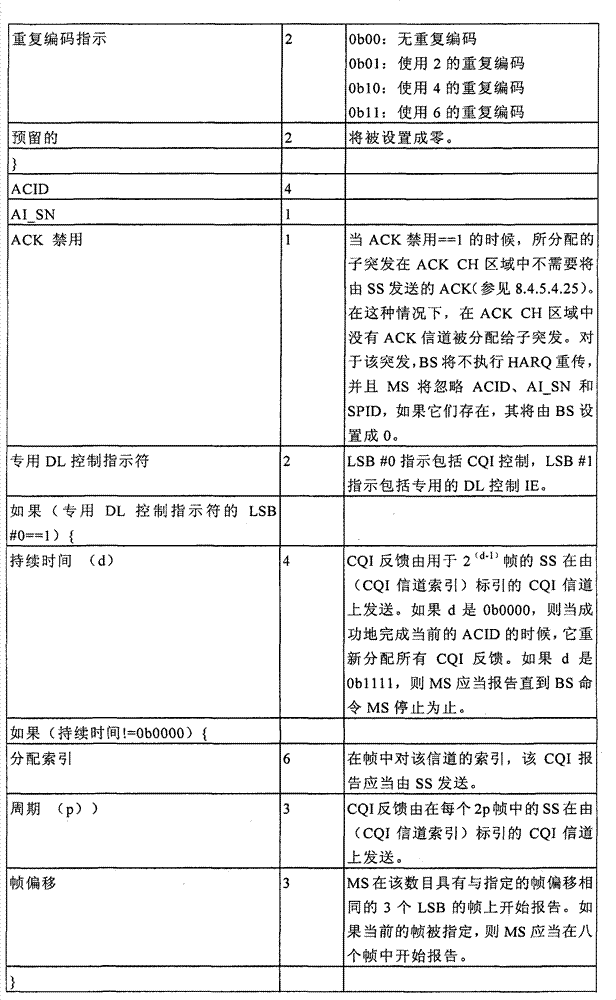

“DL_HARQ_Chase_Sub-Burst_IE”字段可以包含在表1的HARQMAP消息中。即,如果表1的“Mode(模式)”字段是“0b0000”,则由基站使用的该HARQ模式是跟踪HARQ模式。A 'DL_HARQ_Chase_Sub-Burst_IE' field may be included in the HARQMAP message of Table 1. That is, if the 'Mode' field of Table 1 is '0b0000', the HARQ mode used by the base station is a tracking HARQ mode.
参考表2,“N子突发[ISI]”字段指示在两维的矩形区域中的子突发的数目。“N ACK信道”字段指示在两维的区域中能够分配给HARQACK传输的子突发的数目。Referring to Table 2, the 'N sub-burst [ISI]' field indicates the number of sub-bursts in a two-dimensional rectangular area. The 'N ACK channel' field indicates the number of sub-bursts that can be allocated to HARQ ACK transmission in a two-dimensional area.
分配给表2的无线电资源的大小与子突发的数目成比例地提高。The size of radio resources allocated to Table 2 increases in proportion to the number of sub-bursts.
降低的CID(RCID_IE)指示由基站使用的RCID的类型。“持续时间”参数是每个子突发的时隙有效间隔。如果“子突发DIUC指示符”字段被设置成“1”,则这指的是DIUC被明确地分配给相应的子突发。如果“子突发DIUC指示符”字段被设置成“0”,则这指的是相应的子突发使用与先前的子突发相同的DIUC。The reduced CID (RCID_IE) indicates the type of RCID used by the base station. The "duration" parameter is the effective interval of slots for each sub-burst. If the 'sub-burst DIUC indicator' field is set to '1', this means that DIUC is explicitly allocated to the corresponding sub-burst. If the 'sub-burst DIUC indicator' field is set to '0', this means that the corresponding sub-burst uses the same DIUC as the previous sub-burst.
如果“子突发指示符”字段被设置成“1”,则基于子突发分配DIUC,并且“重复编码指示”字段指示用于所分配的突发的重复编码。如果“重复编码指示”字段被设置成“0b00”,则这指的是无重复编码。如果“重复编码指示”字段被设置成“0b01”,则这指的是该重复编码被使用两次。如果“重复编码指示”字段被设置成“0b10”,则这指的是该重复编码被使用四次。如果“重复编码指示”字段被设置成“0b11”,则这指的是该重复编码被使用六次。If the 'Subburst Indicator' field is set to '1', the DIUC is allocated on a subburst basis, and the 'Repetition Code Indication' field indicates the repetition code for the allocated burst. If the "repetition coding indication" field is set to "0b00", this means no repetition coding. If the 'repeat code indication' field is set to '0b01', this means that the repeat code is used twice. If the 'Repeat Code Indication' field is set to '0b10', this means that the repeat code is used four times. If the "repetition code indication" field is set to "0b11", this means that the repetition code is used six times.
“ACID”字段被用于管理HARQ信道,并且被以子突发为单位分配。“AI_SN”字段被用于区分初始发送和重传,使得它可以识别ARQ序列号。如果“ACK禁用”字段被设置成“1”,则该分配的子突发在所分配的ACK区域内不请求由移动站传送的ACK信号。在这种情况下,在ACK区域中没有ACK信道被分配给子突发。基站不对以上的突发执行HARQ重传,并且移动站忽略与这个突发相关的“ACID”、“AI_SN”和“SIPD”参数。The 'ACID' field is used to manage the HARQ channel, and is allocated in units of sub-bursts. The 'AI_SN' field is used to distinguish between initial transmission and retransmission so that it can identify the ARQ sequence number. If the 'ACK disabled' field is set to '1', the allocated sub-burst does not request an ACK signal transmitted by the mobile station within the allocated ACK region. In this case, no ACK channel is allocated to the sub-burst in the ACK region. The base station does not perform HARQ retransmission for the above burst, and the mobile station ignores the "ACID", "AI_SN" and "SIPD" parameters related to this burst.
“专用DL控制指示符”参数的“LSB #0”位指示是否包括CQI控制,并且“LSB #1”位指示是否包括专用的下行链路控制指示符。The "LSB #0" bit of the "Dedicated DL Control Indicator" parameter indicates whether CQI control is included, and the "
如果“专用DL控制指示符”参数的“LSB #0”位是“1”,则每2(d-1)帧在标引到CQI信道索引的信道上发送CQI反馈。If the "LSB #0" bit of the "Dedicated DL Control Indicator" parameter is "1", then the CQI feedback is sent on the channel indexed to the CQI channel index every 2 (d-1) frames.
如果“持续时间”字段没有设置成“0b0000”,则“分配索引”参数指示在该帧中将由移动站向其转发CQI报告的信道索引。If the "Duration" field is not set to "0b0000", the "Assignment Index" parameter indicates the channel index to which the CQI report will be forwarded by the mobile station in this frame.
而且,将CQI反馈每2P帧发送给由CQI信道索引标引的CQI信道。在这种情况下,“周期”参数指示表示CQI反馈的发送周期(p)。Also, CQI feedback is sent every 2P frame to the CQI channel indexed by the CQI channel index. In this case, the "Period" parameter indicates a transmission period (p) representing CQI feedback.
该移动站(MS)在指定的帧偏移中在与三个LSB相对应的帧上开始报告。在这种情况下,“帧偏移”参数指示MS报告开始点。如果当前帧是指定的帧,则移动站在第八帧上开始发送。The mobile station (MS) starts reporting on the frame corresponding to the three LSBs in the specified frame offset. In this case, the "frame offset" parameter indicates the MS reporting start point. If the current frame is the designated frame, the mobile station starts transmission on the eighth frame.
以下的表3示出示例性CTC-IR HARQ子突发格式。Table 3 below shows an exemplary CTC-IR HARQ sub-burst format.
[表3][table 3]


表3的“DL_HARQ_IR_CTC_Sub-Burst_IE”字段可以包含在表的HARQ MAP消息中。即,如果表1的“模式”字段是“0b0001”,则由基站使用的HARQ模式是IR-CTC HARQ模式。The "DL_HARQ_IR_CTC_Sub-Burst_IE" field of Table 3 may be included in the HARQ MAP message of the table. That is, if the "Mode" field of Table 1 is "0b0001", the HARQ mode used by the base station is the IR-CTC HARQ mode.
参考表3,“N子突发[ISI]”字段指示在两维垂直区域中的子突发的数目。“N ACK信道”字段指示在两维区域中能够分配给HARQACK发送的子突发的数目。Referring to Table 3, the 'N sub-burst [ISI]' field indicates the number of sub-bursts in a two-dimensional vertical area. The 'N ACK channel' field indicates the number of sub-bursts that can be allocated to HARQ ACK transmission in a two-dimensional area.
分配给表3的无线电资源的大小与子突发的数目成比例提高。降低的CID(RCID_IE)参数指示分配给每个移动站的RCID的类型。NEP和NSCH参数指示IR-CTC HARQ突发简档。而且,SPID参数指示服务流程标识符,ACID参数是基于子突发分配的。即,用于每个子突发的ACID参数用于管理若干HARQ信道。AI_SN参数用于区分初始发送和重传。The size of radio resources allocated to Table 3 increases in proportion to the number of sub-bursts. A reduced CID (RCID_IE) parameter indicates the type of RCID allocated to each mobile station. The N EP and NSCH parameters indicate the IR-CTC HARQ burst profile. Also, the SPID parameter indicates a service flow identifier, and the ACID parameter is allocated based on sub-bursts. That is, ACID parameters for each sub-burst are used to manage several HARQ channels. The AI_SN parameter is used to distinguish between initial transmission and retransmission.
如果“ACK禁用”字段被设置成“1”,则该分配的子突发在所分配的ACK区域内不请求由移动站传送的ACK信号。在这种情况下,在ACK区域中没有ACK信道被分配给子突发。基站不对以上的突发执行HARQ重传,并且移动站忽略与这个突发相关的“ACID”、“AI_SN”和“SIPD”参数。在这种情况下,不管ACK禁用位,CRC参数可以被增加到每个子突发的末端。If the 'ACK disabled' field is set to '1', the allocated sub-burst does not request an ACK signal transmitted by the mobile station within the allocated ACK region. In this case, no ACK channel is allocated to the sub-burst in the ACK region. The base station does not perform HARQ retransmission for the above burst, and the mobile station ignores the "ACID", "AI_SN" and "SIPD" parameters related to this burst. In this case, CRC parameters may be added to the end of each sub-burst regardless of the ACK disable bit.
“专用DL控制指示符”参数的“LSB #0”位指示是否包括CQI控制,并且“LSB #1”位指示是否包括专用的下行链路控制指示符。The "LSB #0" bit of the "Dedicated DL Control Indicator" parameter indicates whether CQI control is included, and the "
如果“专用DL控制指示符”参数的“LSB #0”位是“1”,则每2(d-1)帧在标引成CQI信道索引的信道上发送CQI反馈。If the "LSB #0" bit of the "Dedicated DL Control Indicator" parameter is "1", then the CQI feedback is sent on the channel indexed as the CQI channel index every 2 (d-1) frames.
如果“持续时间”字段没有设置成“0b0000”,则“分配索引”参数指示在该帧中将由移动站向其转送CQI报告的信道索引。该CQI反馈被每2P帧发送给由CQI信道索引标引的CQI信道。在这种情况下,“周期”参数指示CQI反馈的发送周期(p)。If the "Duration" field is not set to "0b0000", the "Assignment Index" parameter indicates the channel index to which the CQI report will be forwarded by the mobile station in this frame. The CQI feedback is sent every 2 P frames to the CQI channel indexed by the CQI channel index. In this case, the "Period" parameter indicates the transmission period (p) of the CQI feedback.
移动站(MS)在指定的帧偏移中在与三个LSB相对应的帧上开始报告。在这种情况下,“帧偏移”参数指示MS报告开始点。如果当前帧是指定的帧,则移动站在八个帧上开始发送。A mobile station (MS) begins reporting on the frame corresponding to the three LSBs in the specified frame offset. In this case, the "frame offset" parameter indicates the MS reporting start point. If the current frame is the designated frame, the mobile station starts transmitting on eight frames.
通常,为了支持HARQ方案,基站经由MAP消息将HARQ相关联的信息发送给移动站。在这种情况下,当存在大量HARQ业务的时候,发送所有的HARQ相关联的信息可能不可避免地遇到大量的开销。因此,本发明的实施例提供一种用于基于从基站已经最初地接收到的MAP信息仅仅传送差异信息的方法。结果,可以降低与HARQ相关联的MAP开销的量,从而改善系统性能。Generally, in order to support a HARQ scheme, a base station transmits HARQ-associated information to a mobile station via a MAP message. In this case, when there is a large amount of HARQ traffic, sending all HARQ-associated information may inevitably encounter a large amount of overhead. Accordingly, embodiments of the present invention provide a method for transmitting only difference information based on MAP information that has been initially received from a base station. As a result, the amount of MAP overhead associated with HARQ can be reduced, thereby improving system performance.
图3是图示根据本发明的一个实施例,用于基于能够由从先前的帧接收到的MAP消息识别的特定信息仅仅发送要重传的信息的差异的方法的流程图。FIG. 3 is a flowchart illustrating a method for transmitting only a difference of information to be retransmitted based on specific information that can be identified from a MAP message received from a previous frame according to one embodiment of the present invention.
图3的这个实施例涉及用于重传给移动站的分组的资源分配方法。为了便于描述,由本发明提出的这个方法在下文中将称为差异分配方法。This embodiment of FIG. 3 relates to a resource allocation method for packets retransmitted to a mobile station. For convenience of description, this method proposed by the present invention will be referred to as a differential allocation method hereinafter.
参考图3,基站在步骤S301将具有MAP IE字段的MAP消息发送给包含在其自己的小区区域中的至少一个移动站。Referring to FIG. 3, the base station transmits a MAP message having a MAP IE field to at least one mobile station contained in its own cell area in step S301.
在步骤S301,MAP消息可以是SBC(SS基本能力)消息、DSx(动态服务添加/改变/删除)消息或者REG(注册)消息。而且,指示是否将使用差异分配方法的特定信息包含在MAP消息中,使得结果的MAP消息可以传送给移动站。In step S301, the MAP message may be a SBC (SS Basic Capability) message, a DSx (Dynamic Service Add/Change/Delete) message or a REG (Registration) message. Also, specific information indicating whether to use the differential allocation method is included in the MAP message so that the resulting MAP message can be transmitted to the mobile station.
基站在步骤S302存储包含在由基站本身在预定的帧期间传送的MAP IE字段中的RQ(重复请求)相关联的信息(例如,MAP信息)。在步骤S302,MAP信息可以包括要在步骤S302重传的子突发的位置信息(或者索引信息)。The base station stores information (for example, MAP information) associated with RQ (repeat request) included in the MAP IE field transmitted by the base station itself during a predetermined frame at step S302. In step S302, the MAP information may include position information (or index information) of the sub-burst to be retransmitted in step S302.
在步骤S302,假设指定的帧是n个帧。指定的帧的数目可以根据移动站和基站之间的通信环境或者用户请求而改变为另外的。在步骤S302,已经从基站接收到MAP IE消息的移动站可以在n个帧期间存储包含在MAP IE中的重传相关联的信息。In step S302, it is assumed that the specified frames are n frames. The number of designated frames may be changed to another according to a communication environment between the mobile station and the base station or a user's request. In step S302, the mobile station having received the MAP IE message from the base station may store retransmission-associated information contained in the MAP IE during n frames.
移动站和基站可以在n个帧期间存储MAP信息。在这种情况下,基站在步骤S303监视在n个帧期间是否已经从移动站接收到NACK信号。Mobile stations and base stations can store MAP information during n frames. In this case, the base station monitors whether a NACK signal has been received from the mobile station during n frames at step S303.
如果在步骤S304基站在n个帧内从移动站接收到NACK信号,则基站能够检查突发和子帧,其将在步骤S305响应于NACK信号重传。If the base station receives a NACK signal from the mobile station within n frames at step S304, the base station can check the burst and subframe, which will be retransmitted in response to the NACK signal at step S305.
基站在n个帧期间存储包含在MAP信息中用于重传的子突发的索引信息,使得基站仅仅选择重传需要的特定信息,而不是所有MAP IE,并且在步骤S306将所选择的信息发送给移动站。The base station stores the index information of sub-bursts included in the MAP information for retransmission during n frames, so that the base station only selects the specific information required for retransmission, rather than all MAP IEs, and transfers the selected information in step S306 sent to the mobile station.
换句话说,在步骤S306,基站仅仅选择重传需要的子突发IE,并且将所选择的子突发IE发送给移动站。在这种情况下,可以使用差异分配方法。In other words, in step S306, the base station only selects sub-burst IEs required for retransmission, and sends the selected sub-burst IEs to the mobile station. In this case, the differential allocation method can be used.
如果在n个帧期间没有接收到NACK信号,则基站可以在步骤S307将用于HARQ的另一个MAP IE发送给移动站。If no NACK signal is received during n frames, the base station may transmit another MAP IE for HARQ to the mobile station in step S307.
图4是图示根据本发明的一个实施例,用于使用基站和移动站之间的差异分配方法来执行HARQ的方法的流程图。FIG. 4 is a flowchart illustrating a method for performing HARQ using a differential allocation method between a base station and a mobile station according to one embodiment of the present invention.
参考图4,如果基站使用HARQ与移动站通信,则基站可以使用MAP消息将HARQ相关联的参数发送给MAP消息。在这种情况下,MAP消息可以是SBC消息、DSx消息和REG消息,诸如MAC管理消息。而且,基站在MAP消息中包括差异分配使用信息,并且在步骤S401将结果的MAP消息发送给移动站。Referring to FIG. 4, if the base station communicates with the mobile station using HARQ, the base station may transmit HARQ-associated parameters to the MAP message using the MAP message. In this case, the MAP messages may be SBC messages, DSx messages, and REG messages, such as MAC management messages. Also, the base station includes differential allocation usage information in the MAP message, and transmits the resulting MAP message to the mobile station at step S401.
假设本发明的实施例使用该差异分配方法。因此,基站和移动站存储当前帧的MAP信息,并且在指定帧期间存储MAP信息。在本发明的这个实施例中,指定帧可以是16个帧。不必说,帧的数目可以由系统环境或者用户请求来确定。It is assumed that an embodiment of the present invention uses this differential allocation method. Therefore, the base station and the mobile station store the MAP information of the current frame, and store the MAP information during a specified frame. In this embodiment of the present invention, the specified frame may be 16 frames. Needless to say, the number of frames may be determined by system circumstances or user requests.
在这种情况下,基站和移动站存储当前帧的MAP信息,并且然后在16个帧期间保持MAP信息。因此,基站和移动站可以在指定帧上具有有关最大16个帧的MAP信息。In this case, the base station and the mobile station store the MAP information of the current frame, and then maintain the MAP information during 16 frames. Therefore, the base station and the mobile station can have MAP information on a maximum of 16 frames on a given frame.
如果在从基站传送的数据分组中出现意外错误,同时该数据分组在移动站和基站之间传送,则移动站可以在步骤S402将NACK信号发送给基站。If an unexpected error occurs in a data packet transmitted from the base station while the data packet is transmitted between the mobile station and the base station, the mobile station may transmit a NACK signal to the base station at step S402.
由于已经在传送MAP消息之后在16个帧内接收到NACK信号,所以一旦接收到所存储的MAP信息,该基站可以识别哪一个先前的帧已经接收到重传的子帧。在这种情况下,基站可以选择向其重传最大数目的子突发的预定数目的帧。而且,在步骤S403,基站不仅可以识别具有要重传给所选择的帧的子突发的突发的顺序,而且可以识别在相应的突发上的子突发的顺序。Since the NACK signal has been received within 16 frames after the transmission of the MAP message, upon receiving the stored MAP information, the base station can identify which previous frame has received the retransmitted subframe. In this case, the base station may select a predetermined number of frames to which to retransmit the maximum number of sub-bursts. Also, in step S403, the base station can identify not only the order of bursts having sub-bursts to be retransmitted to the selected frame, but also the order of sub-bursts on the corresponding burst.
基站从所存储的MAP信息选择有关由NACK信号指示的分组的子突发分配信息,并且可以将所选择的信息发送给移动站。在这种情况下,该基站可以使用该差异分配方法通知移动站要重传的分组的位置(即,索引)。即,在步骤S404,该基站可以将具有差异分配信息的子突发IE发送给移动站。The base station selects subburst allocation information on the packet indicated by the NACK signal from the stored MAP information, and can transmit the selected information to the mobile station. In this case, the base station can notify the mobile station of the location (ie, index) of the packet to be retransmitted using the differential allocation method. That is, in step S404, the base station may send the sub-burst IE with differential allocation information to the mobile station.
在步骤S404,为了将要重传的分组发送给移动站,基站可以将子突发IE发送给移动站,其中子突发IE包括预先发送的分配位置信息的信息,和要重传的子突发的重复编码指示参数。In step S404, in order to send the packet to be retransmitted to the mobile station, the base station may send the sub-burst IE to the mobile station, wherein the sub-burst IE includes the information of the allocated location information sent in advance, and the sub-burst to be retransmitted The repetition encoding indicates the parameter.
在步骤S404,包含在子突发IE中的该差异分配信息可以包括“N帧基准”参数和“基准帧偏移”参数。“N帧基准”参数指示哪一个帧已经接收到要重传的子突发。而且,该差异分配信息可以进一步包括基于“基准帧偏移”参数的“基准突发数目”信息,指示使用哪一个子突发的“N基准子突发”信息,和指示子突发索引的“基准子突发索引”信息。In step S404, the differential allocation information contained in the sub-burst IE may include a "N frame reference" parameter and a "reference frame offset" parameter. The "N frame reference" parameter indicates which frame has received the sub-burst to be retransmitted. Moreover, the differential allocation information may further include "reference burst number" information based on the "reference frame offset" parameter, "N reference subburst" information indicating which subburst to use, and information indicating the subburst index "Reference Subburst Index" information.
该差异分配方法可以应用于各种各样的HARQ模式。本发明的这个实施例将示出一个示例性情形,其中该差异分配方法应用于跟踪组合HARQ模式和IR-CTC HARQ模式。不必说,其他HARQ方法也可以根据通信环境或者用户请求应用于跟踪组合HARQ模式和IR-CTCHARQ模式。在下文中将参考表4和5描述在以上的步骤S404能够使用的子突发IE格式的例子。This differential allocation method can be applied to various HARQ modes. This embodiment of the invention will show an exemplary situation where the differential allocation method is applied to track combined HARQ mode and IR-CTC HARQ mode. Needless to say, other HARQ methods can also be applied to track combined HARQ mode and IR-CTCHARQ mode according to communication environment or user request. Examples of sub-burst IE formats that can be used in the above step S404 will be described below with reference to Tables 4 and 5 .
以下的表4示出在应用了差异分配方法的跟踪组合HARQ模式之下具有差异分配信息的子突发IE格式的例子。Table 4 below shows an example of a sub-burst IE format with differential allocation information under the tracking combining HARQ mode to which the differential allocation method is applied.
[表4][Table 4]


表4基本上类似于表2。表4示出应用了该差异分配方法的“Diff_DL_HARQ_Chase_Sub-Burst_IE”格式。因此,为了便于描述,为了将该差异分配方法适用于以上提及的“Diff_DL_HARQ_Chase_Sub-Burst_IE”子突发,在下文中将仅仅详细描述附加信息。其他参数的解释可以参考表2的解释。Table 4 is substantially similar to Table 2. Table 4 shows the "Diff_DL_HARQ_Chase_Sub-Burst_IE" format to which this difference allocation method is applied. Therefore, for convenience of description, in order to apply the differential allocation method to the above-mentioned 'Diff_DL_HARQ_Chase_Sub-Burst_IE' sub-burst, only additional information will hereinafter be described in detail. The explanation of other parameters can refer to the explanation of Table 2.
参考图4,如果“差异分配指示符”参数被设置成“1”,则这指的是该差异分配方法应用于以上提及的“Diff_DL_HARQ_Chase_Sub-Burst_IE”子突发。在这种情况下,“N帧基准”参数可以指示哪一个帧包括要重传的分组的子突发。根据帧基准参数的数目,“基准帧偏移”参数指示相应的帧的偏移信息。在这种情况下,“基准突发数目”参数指示由帧偏移定义的帧的突发的数目。而且,“N基准子突发”参数可以指示基准子突发的数目。Referring to FIG. 4, if the 'differential allocation indicator' parameter is set to '1', this means that the differential allocation method is applied to the above-mentioned 'Diff_DL_HARQ_Chase_Sub-Burst_IE' sub-burst. In this case, the "N frame reference" parameter may indicate which frame comprises a sub-burst of packets to be retransmitted. According to the number of frame reference parameters, the 'reference frame offset' parameter indicates offset information of a corresponding frame. In this case, the "base number of bursts" parameter indicates the number of bursts of the frame defined by the frame offset. Also, the "N reference sub-burst" parameter may indicate the number of reference sub-bursts.
根据子突发的数目,“基准子突发索引”参数可以指示子突发的索引,即,子突发的位置信息。在这种情况下,子突发索引可以由“基准突发数目”参数和“基准帧偏移”参数定义。而且,各个子突发可以具有不同的编码速率。因此,“重复编码指示”参数可以通知给每个子突发。According to the number of sub-bursts, the 'reference sub-burst index' parameter may indicate the index of the sub-burst, that is, the location information of the sub-burst. In this case, the sub-burst index may be defined by the "reference burst number" parameter and the "reference frame offset" parameter. Also, individual sub-bursts may have different encoding rates. Therefore, the "repetition coding indication" parameter may be notified for each sub-burst.
以下的表5示出在应用了差异分配方法的IR-CTC模式之下具有差异分配信息的子突发IE格式的例子。Table 5 below shows an example of a sub-burst IE format with differential allocation information under the IR-CTC mode to which the differential allocation method is applied.
[表5][table 5]


表5基本上类似于表3。表5示出应用了该差异分配方法的“Diff_DL_HARQ_IR_CTC_Sub-Burst_IE”格式。因此,为了将该差异分配方法应用于以上提及的“Diff_DL_HARQ_Chase_Sub-Burst_IE”子突发,在下文中将仅仅详细描述附加信息。其他参数的解释可以参考表3的解释。Table 5 is substantially similar to Table 3. Table 5 shows the "Diff_DL_HARQ_IR_CTC_Sub-Burst_IE" format to which this differential allocation method is applied. Therefore, in order to apply the differential allocation method to the above-mentioned 'Diff_DL_HARQ_Chase_Sub-Burst_IE' sub-burst, only additional information will be described in detail hereinafter. The explanation of other parameters can refer to the explanation of Table 3.
参考图5,如果“差异分配指示符”参数被设置成“1”,则这指的是差异分配方法应用于HARQ模式。因此,在下文中将描述表示差异分配信息的参数。“N帧基准”参数可以指示哪一个帧包括要重传的分组的子突发。根据帧基准参数的数目,“基准帧偏移”参数指示相应的帧的偏移信息。在这种情况下,“基准突发数目”参数指示由帧偏移定义的帧的突发的数目。而且此外,“N基准子突发”参数可以指示基准子突发的数目。Referring to FIG. 5, if the 'differential allocation indicator' parameter is set to '1', this means that the differential allocation method is applied to the HARQ mode. Therefore, parameters representing differential allocation information will be described hereinafter. The "N frame reference" parameter may indicate which frame comprises a sub-burst of packets to be retransmitted. According to the number of frame reference parameters, the 'reference frame offset' parameter indicates offset information of a corresponding frame. In this case, the "base number of bursts" parameter indicates the number of bursts of the frame defined by the frame offset. And furthermore, the "N reference sub-burst" parameter may indicate the number of reference sub-bursts.
根据子突发的数目,“基准子突发索引”参数可以指示子突发的索引,即,子突发的位置信息。在这种情况下,子突发索引可以由“基准突发数目”参数和“基准帧偏移”参数定义。According to the number of sub-bursts, the 'reference sub-burst index' parameter may indicate the index of the sub-burst, that is, the location information of the sub-burst. In this case, the sub-burst index may be defined by the "reference burst number" parameter and the "reference frame offset" parameter.
在IR-CTC HARQ模式之下,每个移动站的突发简档(例如,调制顺序、编码类型或者编码速率)和冗余版本可以每个传输改变。因此,突发简档可以使用NEP和NSCH参数通知给每个移动站。而且,为了识别每个服务,基站可以进一步在子突发IE中包括服务流程标识符(SPID)参数,使得结果的子突发IE可以传送给各个移动站。Under IR-CTC HARQ mode, the burst profile (eg, modulation order, coding type, or coding rate) and redundancy version of each mobile station may change per transmission. Therefore, the burst profile can be notified to each mobile station using the N EP and NSCH parameters. Also, in order to identify each service, the base station may further include a Service Flow Identifier (SPID) parameter in the sub-burst IE so that the resulting sub-burst IE may be transmitted to each mobile station.
返回参考图4,如果在表4和5中示出的子突发IE在步骤S404被传送给移动站,则移动站可以在步骤S405使用差异分配信息来提取解码信息。Referring back to FIG. 4, if the sub-burst IEs shown in Tables 4 and 5 are transmitted to the mobile station at step S404, the mobile station may extract decoding information using the differential allocation information at step S405.
在步骤S405,移动站可以使用所存储的MAP信息和包含在从基站接收到的子突发IE中的差异分配信息来提取重传的分组的解码信息。即,移动站可以在所存储的MAP信息中以帧->突发->子突发的顺序跟踪分组,并且可以提取所重传的分组的解码信息。移动站能够使用从先前的帧的MAP信息提取的信息,和在当前帧的MAP上发送的突发简档两者来解码分组。In step S405, the mobile station may extract decoding information of the retransmitted packet using the stored MAP information and the differential allocation information included in the sub-burst IE received from the base station. That is, the mobile station can track packets in the order of frame->burst->sub-burst in the stored MAP information, and can extract decoding information of the retransmitted packets. The mobile station is able to decode the packet using both the information extracted from the previous frame's MAP information, and the burst profile sent on the current frame's MAP.
表4和5示出示例性情况,其中差异分配方法应用于跟踪组合HARQ模式和IR-CTC HARQ模式。但是,应当注意到,差异分配方法也可以应用于其他HARQ模式。例如,为了选择和添加新的子突发IE,HARQ_DL_MAP_IE格式的模式被选择成“0b0111”~“0b1111”的任何一个。与表4和5相同的方法不仅可以应用于下行链路的其他HARQ模式,而且可以应用于上行链路的HARQ模式,使得可以配置子突发IE。Tables 4 and 5 show exemplary cases where the differential allocation method is applied to track combined HARQ mode and IR-CTC HARQ mode. However, it should be noted that the differential allocation method can also be applied to other HARQ modes. For example, in order to select and add a new sub-burst IE, the mode of the HARQ_DL_MAP_IE format is selected as any one of '0b0111'˜0b1111'. The same method as in Tables 4 and 5 can be applied not only to other HARQ modes of the downlink, but also to the HARQ mode of the uplink, so that sub-burst IEs can be configured.
参考图4,移动站在指定的帧(例如,16个帧)期间存储在步骤S401接收到的MAP信息。移动站接收在步骤S404应用了所接收到的差异分配方法的子突发IE,使得它可以在所存储的MAP信息中识别具有要重传的当前分组的解码信息的位置信息(即,索引信息)。因此,移动站可以使用MAP信息和差异分配信息来提取重传的分组的解码信息。Referring to FIG. 4, the mobile station stores the MAP information received in step S401 during a specified frame (eg, 16 frames). The mobile station receives the sub-burst IE to which the received differential allocation method is applied in step S404, so that it can identify, in the stored MAP information, the location information (ie, the index information) having the decoding information of the current packet to be retransmitted. ). Accordingly, the mobile station can extract decoding information of the retransmitted packet using the MAP information and the differential allocation information.
图5是图示根据本发明的一个实施例,使用差异分配方法供重传给移动站的分组使用的资源分配方法的示意图。FIG. 5 is a schematic diagram illustrating a resource allocation method for packets retransmitted to a mobile station using a differential allocation method according to one embodiment of the present invention.
参考图5,要重传的分组出现在第10-第11个帧(FN10和FN11)中。因此,基站可以使用图4的差异分配方法通知移动站具有要重传的分组的解码信息的该索引。因此,基站能够在第15帧上分配用于重传分组的HARQ子突发。Referring to FIG. 5, packets to be retransmitted appear in the 10th-11th frames (FN10 and FN11). Therefore, the base station can notify the mobile station of the index having the decoding information of the packet to be retransmitted using the differential allocation method of FIG. 4 . Therefore, the base station can allocate a HARQ sub-burst for retransmitting packets on the 15th frame.
图6是图示使用由本发明的实施例定义的子突发IE的资源分配方法的示意图。FIG. 6 is a schematic diagram illustrating a resource allocation method using a sub-burst IE defined by an embodiment of the present invention.
图6示出该突发的一些部分。如图6所示,如常规子突发IE所定义的,用于初始发送或者重传的子突发可以顺序地分配给该突发的前面区域。如应用了差异分配方法的子突发IE所定义的,仅仅重传的子突发可以分配给该突发的后面区域。在这种情况下,用于重传的子突发的突发区域是由虚线表示的。而且,在应用该差异分配方法的情况下,ACK信道分配可以在当前的MAP区域中以突发的顺序实现。Figure 6 shows some parts of this burst. As shown in FIG. 6 , as defined by the regular sub-burst IE, sub-bursts for initial transmission or retransmission may be sequentially allocated to the front area of the burst. As defined by the Sub-Burst IE to which the differential allocation method is applied, only retransmitted sub-bursts may be allocated to the latter region of the burst. In this case, the burst region of the sub-burst for retransmission is indicated by a dotted line. Also, in the case of applying the differential allocation method, ACK channel allocation can be realized in burst order in the current MAP area.
图7是图示根据本发明的另一个实施例,用于使用在基站和移动站之间的差异分配方法来执行HARQ的方法的流程图。FIG. 7 is a flowchart illustrating a method for performing HARQ using a differential allocation method between a base station and a mobile station according to another embodiment of the present invention.
图7示出示例性情形,其中基站的小区区域包括至少一个移动站。即,该系统可以由基站(BS)、第一移动站(MS#1)和第二移动站(MS#2)组成。Fig. 7 shows an exemplary situation where a cell area of a base station includes at least one mobile station. That is, the system may consist of a base station (BS), a first mobile station (MS#1) and a second mobile station (MS#2).
参考图7,如果基站(BS)使用HARQ与移动站(MS#1和MS#2)通信,则基站可以使用MAP消息将HARQ相关联的参数发送给移动站(MS#1和MS#2)。在这种情况下,每个MAP消息可以是当协商在移动站和基站之间的基本能力的时候使用的SBC消息,DSx消息或者用作MAC管理消息的REG消息。而且,基站可以进一步包括指示在MAP消息中是否使用差异分配方法的特定信息,使得它可以在步骤S701和S702将具有特定信息的结果MAP消息发送给移动站。Referring to FIG. 7, if a base station (BS) communicates with mobile stations (
假设本发明的实施例使用差异分配方法。因此,基站和移动站存储当前帧的MAP信息,并且在预定帧期间存储MAP信息。在本发明的这个实施例中,该预定帧可以是16个帧。不必说,帧的数目可以由系统环境或者用户请求来确定。It is assumed that an embodiment of the present invention uses a differential allocation method. Therefore, the base station and the mobile station store the MAP information of the current frame, and store the MAP information during a predetermined frame. In this embodiment of the invention, the predetermined frame may be 16 frames. Needless to say, the number of frames may be determined by system circumstances or user requests.
根据图7的差异分配方法,基站和移动站可以存储当前帧的MAP信息,并且还可以在最大16个帧期间保持所存储的MAP信息。因此,基站和移动站可以在指定帧上具有最大16个帧的MAP信息。According to the differential allocation method of FIG. 7, the base station and the mobile station can store the MAP information of the current frame, and can also maintain the stored MAP information during a maximum of 16 frames. Therefore, the base station and the mobile station can have MAP information of a maximum of 16 frames on a given frame.
当数据分组在每个移动站和基站之间传送时,在从基站传送的数据分组中可能出现意外错误。根据本发明的另一个实施例,假设第一移动站(MS#1)的数据分组没有错误,并且第二移动站(MS#2)的另一个数据分组具有错误。因此,第二移动站(MS#2)可以在步骤S703将NACK信号发送给基站。As data packets are transferred between each mobile station and the base station, unexpected errors may occur in the data packets transferred from the base station. According to another embodiment of the present invention, it is assumed that a data packet of a first mobile station (MS#1) has no errors and another data packet of a second mobile station (MS#2) has errors. Therefore, the second mobile station (MS#2) can transmit a NACK signal to the base station at step S703.
由于已经在传送MAP消息之后在16个帧内接收到NACK信号,所以基站可以基于所存储的MAP信息来识别所重传的子突发信息。在这种情况下,基站可以选择向其重传了最大数木的子突发的预定数目的帧。而且,在步骤S704,基站不仅可以识别具有要重传给所选择的帧的子突发的突发的顺序,而且可以识别在相应的突发上的子突发的顺序。Since the NACK signal has been received within 16 frames after transmitting the MAP message, the base station can identify the retransmitted sub-burst information based on the stored MAP information. In this case, the base station may select a predetermined number of frames to which the maximum number of sub-bursts are retransmitted. Also, in step S704, the base station can identify not only the order of bursts having sub-bursts to be retransmitted to the selected frame, but also the order of sub-bursts on the corresponding burst.
基站从所存储的MAP信息选择有关由NACK信号指示的分组的子突发分配信息,并且可以将所选择的信息发送给移动站。在这种情况下,基站可以使用该差异分配方法通知第二移动站要重传的分组的位置(即,索引)。即,在步骤S705,基站可以将具有差异分配信息的子突发IE发送给第二移动站。The base station selects subburst allocation information on the packet indicated by the NACK signal from the stored MAP information, and can transmit the selected information to the mobile station. In this case, the base station can notify the second mobile station of the location (ie, index) of the packet to be retransmitted using the differential allocation method. That is, in step S705, the base station may send the sub-burst IE with the differential allocation information to the second mobile station.
在步骤S705,包含在子突发IE中的该差异分配信息可以包括“N帧基准”参数和“基准帧偏移”参数。“N帧基准”参数指示哪一个帧已经接收到要重传的子突发。而且,该差异分配信息可以进一步包括基于“基准帧偏移”参数的“基准突发数目”信息,指示使用哪一个子突发的“N基准子突发”信息,和指示子突发索引的“基准子突发索引”信息。In step S705, the differential allocation information included in the sub-burst IE may include a "N frame reference" parameter and a "reference frame offset" parameter. The "N frame reference" parameter indicates which frame has received the sub-burst to be retransmitted. Moreover, the differential allocation information may further include "reference burst number" information based on the "reference frame offset" parameter, "N reference subburst" information indicating which subburst to use, and information indicating the subburst index "Reference Subburst Index" information.
在步骤S705,应用了该差异分配方法的子突发IE可以是由表4和5定义的任何子突发IE。而且,该差异分配方法可以应用于各种各样的HARQ模式。本发明的另一个实施例将示出示例性情形,其中该差异分配方法应用于跟踪合成HARQ模式和IR-CTC HARQ模式。不必说,应当注意到,该差异分配方法根据通信环境或者用户请求应用于其他HARQ方法。In step S705, the sub-burst IE to which the differential allocation method is applied may be any sub-burst IE defined in Tables 4 and 5. Also, the differential allocation method can be applied to various HARQ modes. Another embodiment of the present invention will show an exemplary situation where the differential allocation method is applied to track synthetic HARQ mode and IR-CTC HARQ mode. Needless to say, it should be noted that this differential allocation method is applied to other HARQ methods according to communication environments or user requests.
参考图7,在步骤S705,如果表4和5的子突发IE被发送给第二移动站,则第二移动站可以在步骤S706使用包含在子突发IE中的该差异分配信息来提取要重传的分组的解码信息。Referring to FIG. 7, in step S705, if the sub-burst IE of tables 4 and 5 is sent to the second mobile station, the second mobile station can use the difference allocation information contained in the sub-burst IE to extract The decoding information of the packet to be retransmitted.
在步骤S706,第二移动站可以使用所存储的MAP信息和包含在从基站接收到的子突发IE中的差异分配信息来提取所重传的分组的解码信息。即,第二移动站可以在所存储的MAP信息中以帧->突发->子突发的顺序跟踪分组,并且可以提取所重传的分组的解码信息。第二移动站能够使用从先前的帧的MAP信息提取的信息,和在当前帧的MAP上发送的突发简档两者来解码分组。In step S706, the second mobile station may extract decoding information of the retransmitted packet using the stored MAP information and the differential allocation information included in the sub-burst IE received from the base station. That is, the second mobile station can track packets in the order of frame->burst->sub-burst in the stored MAP information, and can extract decoding information of the retransmitted packets. The second mobile station is able to decode the packet using both the information extracted from the previous frame's MAP information, and the burst profile sent on the current frame's MAP.
在经过预定的帧之后,基站可以在步骤S707和S708上将具有新的MAP信息的消息发送给包含在其自己的小区区域中的所有移动站。此后,还可以连续地应用差异分配方法,使得HARQ子突发可以分配给该移动站。After a predetermined frame, the base station may transmit a message with new MAP information to all mobile stations contained in its own cell area at steps S707 and S708. Thereafter, the differential allocation method can also be continuously applied so that the HARQ sub-burst can be allocated to the mobile station.
目前,在WiMAX论坛正在讨论的对于语音网际协议(VoIP)的持久分配的情况下,基站在初始发送期间仅仅发送一个IE,使得它可以在若干帧期间将资源定期地分配给移动站。如果帧偏移值被设置成“0”以支持持久分配,则移动站可以识别这个帧偏移值“0”为在持久分配中重传所分配的分组。因此,如果本发明以上提及的实施例应用于VoIP,则将在持久分配IE上的该分组索引信息(即,分组位置信息)传送给每个移动站,使得基站可以在VoIP的情况下使用用于重传的差异分配方法。Currently, in the case of persistent allocation for Voice over Internet Protocol (VoIP) being discussed at the WiMAX Forum, the base station sends only one IE during the initial transmission so that it can periodically allocate resources to the mobile station during several frames. If the frame offset value is set to '0' to support persistent allocation, the mobile station can recognize this frame offset value '0' to retransmit allocated packets in persistent allocation. Therefore, if the above-mentioned embodiment of the present invention is applied to VoIP, this packet index information (ie, packet location information) on the persistent allocation IE is transmitted to each mobile station so that the base station can use Differential allocation method for retransmissions.
对于本领域技术人员来说将显而易见,不脱离本发明的精神或者范围的情况下,可以在本发明中进行各种修改和变化。因此,本发明意欲覆盖本发明的修改和变化,只有它们归入权利要求和其等同物的范围之内。因此,仅仅为了说明性的目的,而不是限制性的目的,必须考虑以上提及的详细说明。本发明的范围必须由权利要求的合理分析来决定,并且在本发明的等同范围内的所有修改包含在本发明的范围中。对于本领域技术人员来说显而易见的是,没有明确的引证关系的权利要求相互组合以实现实施例,或者不脱离本发明的范围和精神的情况下,在专利申请之后通过修改获得的新的权利要求也可以包含在本发明中。It will be apparent to those skilled in the art that various modifications and variations can be made in the present invention without departing from the spirit or scope of the inventions. Thus, it is intended that the present invention cover the modifications and variations of this invention provided they come within the scope of the claims and their equivalents. Accordingly, the above-mentioned detailed description must be considered for illustrative purposes only and not for restrictive purposes. The scope of the present invention must be determined by a reasonable analysis of the claims, and all modifications within the equivalent scope of the present invention are included in the scope of the present invention. It is obvious to those skilled in the art that claims without an explicit citation relationship are combined with each other to realize an embodiment, or new rights are acquired through amendment after a patent application without departing from the scope and spirit of the present invention Requirements may also be included in the invention.
工业实用性Industrial Applicability
如从以上的描述中显而易见的,本发明的实施例可以应用于各种各样的无线接入系统,例如,第三代合作项目(3GPP)、3GPP2和/或IEEE 802.xx(电子和电气工程师协会802)系统。本发明的实施例不仅可以应用于各种无线接入系统,而且可以适用于通过应用这些无线接入系统获取的所有技术领域。As is apparent from the above description, embodiments of the present invention can be applied to various wireless access systems, for example, Third Generation Partnership Project (3GPP), 3GPP2 and/or IEEE 802.xx (Electronic and Electrical Institution of Engineers 802) system. Embodiments of the present invention can be applied not only to various wireless access systems, but also to all technical fields acquired by applying these wireless access systems.
Claims (10)
Applications Claiming Priority (3)
| Application Number | Priority Date | Filing Date | Title |
|---|---|---|---|
| KR1020070140770A KR101387530B1 (en) | 2007-12-28 | 2007-12-28 | Method of resouce allocation for HARQ |
| KR10-2007-0140770 | 2007-12-28 | ||
| PCT/KR2008/007678 WO2009084865A1 (en) | 2007-12-28 | 2008-12-24 | Method of resource allocation for hybrid-automatic repeat request |
Publications (2)
| Publication Number | Publication Date |
|---|---|
| CN101933278A CN101933278A (en) | 2010-12-29 |
| CN101933278B true CN101933278B (en) | 2014-05-21 |
Family
ID=40824509
Family Applications (1)
| Application Number | Title | Priority Date | Filing Date |
|---|---|---|---|
| CN200880126031.4A Expired - Fee Related CN101933278B (en) | 2007-12-28 | 2008-12-24 | Method of resource allocation for hybrid-automatic repeat request |
Country Status (4)
| Country | Link |
|---|---|
| US (1) | US8301952B2 (en) |
| KR (1) | KR101387530B1 (en) |
| CN (1) | CN101933278B (en) |
| WO (1) | WO2009084865A1 (en) |
Families Citing this family (15)
| Publication number | Priority date | Publication date | Assignee | Title |
|---|---|---|---|---|
| KR100934656B1 (en) | 2006-02-06 | 2009-12-31 | 엘지전자 주식회사 | Radio Resource Allocation Method in Multi-Carrier System |
| US8412998B1 (en) * | 2008-04-02 | 2013-04-02 | Marvell International Ltd | Restart operation with logical blocks in queued commands |
| KR101634666B1 (en) * | 2008-04-18 | 2016-06-29 | 삼성전자주식회사 | Apparatus and method for supporting synchronous hybride automatic repeat request in a boradband wireless communication system |
| US8301177B2 (en) * | 2009-03-03 | 2012-10-30 | Intel Corporation | Efficient paging operation for femtocell deployment |
| US8654661B2 (en) * | 2009-05-04 | 2014-02-18 | Industrial Technology Research Institute | Method and apparatus for multicast and broadcast retransmission in wireless communication systems |
| KR101757296B1 (en) * | 2009-08-18 | 2017-07-13 | 엘지전자 주식회사 | The apparatus and method for performing HARQ procedure |
| KR20110037431A (en) * | 2009-10-06 | 2011-04-13 | 주식회사 팬택 | Signal transmission method and transmission device in wireless communication system, receiving device corresponding thereto |
| EP2341656B1 (en) * | 2009-12-29 | 2019-06-05 | Acer Incorporated | Resource allocation method, resource indication method and mobile station using the same |
| US20110299442A1 (en) * | 2010-06-04 | 2011-12-08 | Sairamesh Nammi | Methods and apparatus for controlling location for starting decoding of sub-packets of a communication packet |
| JP2012095087A (en) * | 2010-10-27 | 2012-05-17 | Kyocera Corp | Communication apparatus and communication method |
| US10686709B2 (en) * | 2014-07-14 | 2020-06-16 | Qualcomm Incorporated | Methods and apparatus for channel usage indication |
| US10455611B2 (en) * | 2015-09-16 | 2019-10-22 | Lg Electronics Inc. | Method for transceiving data in wireless communication system and apparatus for same |
| CN109802772B (en) * | 2017-11-17 | 2020-12-08 | 华为技术有限公司 | Method and device for sending information |
| JP7458839B2 (en) * | 2020-03-18 | 2024-04-01 | キヤノン株式会社 | Communication device, communication device control method, and program |
| CN114362899B (en) * | 2020-10-13 | 2024-12-13 | 北京三星通信技术研究有限公司 | Method executed by user terminal or base station, user terminal and base station |
Citations (2)
| Publication number | Priority date | Publication date | Assignee | Title |
|---|---|---|---|---|
| CN1423869A (en) * | 1999-11-17 | 2003-06-11 | 艾利森电话股份有限公司 | Link Layer acknowledgement and retransmission for cellular telecommunications |
| CN1689262A (en) * | 2002-08-13 | 2005-10-26 | 松下电器产业株式会社 | Multiple Hybrid Auto-Repeat Request Process Handling Method |
Family Cites Families (12)
| Publication number | Priority date | Publication date | Assignee | Title |
|---|---|---|---|---|
| US6308294B1 (en) * | 1999-11-17 | 2001-10-23 | Motorola, Inc. | Adaptive hybrid ARQ using turbo code structure |
| US7310336B2 (en) * | 2001-05-18 | 2007-12-18 | Esa Malkamaki | Hybrid automatic repeat request (HARQ) scheme with in-sequence delivery of packets |
| KR20060016466A (en) * | 2004-08-17 | 2006-02-22 | 삼성전자주식회사 | Map Message Composing Method for Complex Retransmission in Orthogonal Frequency Division System Using Multiple Antennas and Al-Q Allocation Method |
| US7554985B2 (en) * | 2004-08-17 | 2009-06-30 | Lg Electronics Inc. | Packet transmission in a wireless communication system using multiple antennas |
| CA2590856C (en) * | 2004-12-27 | 2013-06-11 | Lg Electronics Inc. | Allocating data bursts and supporting hybrid auto retransmission request in orthogonal frequency division multiplexing access radio access system |
| JP4616357B2 (en) * | 2005-01-11 | 2011-01-19 | サムスン エレクトロニクス カンパニー リミテッド | Method and system for indicating data burst allocation in a wireless communication system |
| KR100703287B1 (en) * | 2005-07-20 | 2007-04-03 | 삼성전자주식회사 | System and method for transmitting / receiving resource allocation information in communication system |
| US8000326B2 (en) * | 2007-02-01 | 2011-08-16 | Qualcomm Incorporated | Method and apparatus for fragmenting a control message in wireless communication system |
| US20090077444A1 (en) * | 2007-09-17 | 2009-03-19 | Nokia Corporation | Method and apparatus for providing acknowledgement signaling to support an error control mechanism |
| US20090092076A1 (en) * | 2007-10-04 | 2009-04-09 | Nokia Siemens Networks Oy | Method and apparatus to reduce system overhead |
| US7924757B2 (en) * | 2007-10-15 | 2011-04-12 | Intel Corporation | Method for improving power efficiency of subscriber stations |
| US20090168708A1 (en) * | 2007-12-26 | 2009-07-02 | Motorola, Inc. | Techniques for maintaining quality of service for connections in wireless communication systems |
-
2007
- 2007-12-28 KR KR1020070140770A patent/KR101387530B1/en not_active Expired - Fee Related
-
2008
- 2008-12-24 CN CN200880126031.4A patent/CN101933278B/en not_active Expired - Fee Related
- 2008-12-24 WO PCT/KR2008/007678 patent/WO2009084865A1/en not_active Ceased
- 2008-12-24 US US12/344,059 patent/US8301952B2/en not_active Expired - Fee Related
Patent Citations (2)
| Publication number | Priority date | Publication date | Assignee | Title |
|---|---|---|---|---|
| CN1423869A (en) * | 1999-11-17 | 2003-06-11 | 艾利森电话股份有限公司 | Link Layer acknowledgement and retransmission for cellular telecommunications |
| CN1689262A (en) * | 2002-08-13 | 2005-10-26 | 松下电器产业株式会社 | Multiple Hybrid Auto-Repeat Request Process Handling Method |
Also Published As
| Publication number | Publication date |
|---|---|
| CN101933278A (en) | 2010-12-29 |
| WO2009084865A1 (en) | 2009-07-09 |
| US8301952B2 (en) | 2012-10-30 |
| US20090177937A1 (en) | 2009-07-09 |
| KR20090072607A (en) | 2009-07-02 |
| KR101387530B1 (en) | 2014-04-21 |
Similar Documents
| Publication | Publication Date | Title |
|---|---|---|
| CN101933278B (en) | Method of resource allocation for hybrid-automatic repeat request | |
| US10057913B2 (en) | System and method for hybrid automatic repeat request timing for device-to-device communication overlaid on a cellular network | |
| US9319200B2 (en) | System and method for message acknowledgment feedback for device-to-device communication overlaid on a cellular network | |
| US9763272B2 (en) | System and method for time resource allocation for device-to-device communication overlaid on a cellular network | |
| EP3240222B1 (en) | Method for effectively transmitting control signal in wireless communication system | |
| CN102017506A (en) | Method of performing hybrid automatic repeat request (HARQ) in wireless communication system | |
| KR101632217B1 (en) | Method of allocating acknowledgement channel | |
| HK40041409B (en) | Method for effectively transmitting control signal in wireless communication system | |
| HK40041409A (en) | Method for effectively transmitting control signal in wireless communication system | |
| HK1246049B (en) | Method for effectively transmitting control signal in wireless communication system | |
| CN101174928A (en) | Short bitmap reporting method, system and device |
Legal Events
| Date | Code | Title | Description |
|---|---|---|---|
| C06 | Publication | ||
| PB01 | Publication | ||
| C10 | Entry into substantive examination | ||
| SE01 | Entry into force of request for substantive examination | ||
| C14 | Grant of patent or utility model | ||
| GR01 | Patent grant | ||
| CF01 | Termination of patent right due to non-payment of annual fee | ||
| CF01 | Termination of patent right due to non-payment of annual fee |
Granted publication date: 20140521 Termination date: 20171224 |