CN101836492B - Method of allocating radio resources - Google Patents
Method of allocating radio resources Download PDFInfo
- Publication number
- CN101836492B CN101836492B CN200780101226.9A CN200780101226A CN101836492B CN 101836492 B CN101836492 B CN 101836492B CN 200780101226 A CN200780101226 A CN 200780101226A CN 101836492 B CN101836492 B CN 101836492B
- Authority
- CN
- China
- Prior art keywords
- node
- cell
- radio
- radio resource
- travelling carriage
- Prior art date
- Legal status (The legal status is an assumption and is not a legal conclusion. Google has not performed a legal analysis and makes no representation as to the accuracy of the status listed.)
- Expired - Fee Related
Links
Images

Classifications
-
- H—ELECTRICITY
- H04—ELECTRIC COMMUNICATION TECHNIQUE
- H04W—WIRELESS COMMUNICATION NETWORKS
- H04W72/00—Local resource management
- H04W72/50—Allocation or scheduling criteria for wireless resources
- H04W72/51—Allocation or scheduling criteria for wireless resources based on terminal or device properties
Landscapes
- Engineering & Computer Science (AREA)
- Computer Networks & Wireless Communication (AREA)
- Signal Processing (AREA)
- Mobile Radio Communication Systems (AREA)
Abstract
Description
技术领域 technical field
本发明涉及用于分配无线电资源的方法和设备。特别地,本发明涉及用于在利用时分复用的蜂窝无线电系统中分配无线电资源的方法和设备。The present invention relates to methods and devices for allocating radio resources. In particular, the invention relates to a method and a device for allocating radio resources in a cellular radio system utilizing time division multiplexing.
背景技术 Background technique
在3G时分同步码分多址TD-SCDMA系统中,时隙是在为无线电网络控制器RNC设计高效无线电资源管理算法时也要考虑的无线电资源,所述无线电网络控制器RNC是负责向诸如TD-SCDMA之类的蜂窝无线电系统中的移动台分配无线电资源的实体。In 3G Time Division Synchronous Code Division Multiple Access TD-SCDMA system, time slot is a radio resource that is also considered when designing an efficient radio resource management algorithm for the radio network controller RNC, which is responsible for providing - An entity that allocates radio resources to mobile stations in a cellular radio system like SCDMA.
因此,在TD-SCDMA系统的典型小区中,可能有若干载波被分配用于服务该小区。而且,每个载波具有分配给它的大量时隙,并且那些时隙中的每一个可以与大量码相关联。Therefore, in a typical cell of a TD-SCDMA system, there may be several carriers allocated to serve the cell. Also, each carrier has a large number of time slots allocated to it, and each of those time slots may be associated with a large number of codes.
所有这些无线电资源即载波、时隙和码的分配通常在移动台需要接入无线电资源时进行,例如在使用随机接入过程建立新连接时或在从邻近小区进入小区而引起到新小区的移交时。这种对无线电资源的初始分配还可以在到移动台的连接是活动的时被改变以实现更好性能。All these allocations of radio resources i.e. carriers, timeslots and codes are usually done when a mobile station needs access to radio resources, for example when establishing a new connection using random access procedures or when entering a cell from a neighboring cell resulting in a handover to a new cell hour. This initial allocation of radio resources can also be changed to achieve better performance while the connection to the mobile station is active.
向用户合适地分配时隙由于时分的缘故能够有效地减少彼此的干扰,以使得整体系统性能将受益于有效时隙分配。已经提出许多不同的无线电资源管理算法来向用户分配包括载波、时隙和码的无线电资源以提高服务特定区域的蜂窝无线电系统的效率。Proper allocation of time slots to users can effectively reduce mutual interference due to time division, so that the overall system performance will benefit from efficient time slot allocation. Many different radio resource management algorithms have been proposed to allocate radio resources including carriers, time slots and codes to users to improve the efficiency of cellular radio systems serving a specific area.
蜂窝时分同步码分多址系统的另一方面是对智能天线技术的广泛使用。例如,最新的TD-SCDMA标准已经定义了随机接入信道RACH和上行链路专用信道DCH上的到达角AoA测量。这些信道上的测量被从无线电基站无线电网络控制器报告。因此,RNC现在可以使用AoA信息。Another aspect of cellular TDSCDMA systems is the widespread use of smart antenna technology. For example, the latest TD-SCDMA standard has defined the AoA measurement on random access channel RACH and uplink dedicated channel DCH. Measurements on these channels are reported from the radio base station radio network controller. Therefore, the RNC can now use the AoA information.
此外,在现有用于TD-SCDMA的无线电基站中,主要使用扇区化无线电基站。对于由一个这样的无线电基站服务的每个扇区,存在天线阵列并且智能天线技术被用来减少一个扇区中的用户之间的干扰。Furthermore, among existing radio base stations for TD-SCDMA, sectorized radio base stations are mainly used. For each sector served by one such radio base station, there is an antenna array and smart antenna techniques are used to reduce interference between users in a sector.
然而,在扇区之间的移交区域中,不同扇区中的用户将彼此干扰。如果两个这样的移动台被分配了相同频率,则这将会尤其麻烦。因而,TD-SCDMA系统中的频率内移交性能当前需要改善。提出了一些高级算法来解决该问题,例如多小区联合检测。然而,现有解决方案的复杂度很高并且实施已经被证明是很困难的。However, in a handover area between sectors, users in different sectors will interfere with each other. This would be particularly troublesome if two such mobile stations were allocated the same frequency. Thus, intra-frequency handover performance in TD-SCDMA systems currently needs to be improved. Some advanced algorithms are proposed to solve this problem, such as multi-cell joint detection. However, the complexity of existing solutions is high and implementation has proven difficult.
因此,需要以下的方法和系统,所述方法和系统能够改进诸如TD-SCDMA系统之类的蜂窝无线电系统的性能并且尤其是改进这样的蜂窝无线电系统中的频率内移交性能。Therefore, there is a need for methods and systems that can improve the performance of cellular radio systems such as TD-SCDMA systems and in particular improve the performance of intra-frequency handovers in such cellular radio systems.
发明内容 Contents of the invention
本发明的目的是克服或至少减少与诸如TD-SCDMA之类的现有蜂窝无线电系统相关联的一些问题。It is an object of the present invention to overcome or at least reduce some of the problems associated with existing cellular radio systems such as TD-SCDMA.
本发明的另一目的是提供一种方法和设备,所述方法和设备能够减少位于时分复用蜂窝无线电系统中的移交区域中的用户之间的干扰。Another object of the present invention is to provide a method and a device capable of reducing interference between users located in a handover area in a time division multiplexed cellular radio system.
这些目的及其他目的通过在所附权利要求中阐释的方法和设备来获得。These objects and others are achieved by methods and devices as set forth in the appended claims.
因此,根据本发明的一个实施例,到达角信息或另一定位方法被用作输入以确定特定移动台是否将接收到来自移交区域内其他移动台的干扰。Therefore, according to one embodiment of the invention, angle of arrival information or another positioning method is used as input to determine whether a particular mobile station will receive interference from other mobile stations within the handover area.
根据本发明的另一实施例,无线电网络控制器-即负责在小区内分配资源的实体适于在资源分配中向在移交区域中可能彼此干扰的不同移动台分配时隙以避免这样的干扰。According to another embodiment of the invention, the radio network controller, ie the entity responsible for allocating resources within the cell, is adapted to allocate time slots in the resource allocation to different mobile stations which may interfere with each other in the handover area to avoid such interference.
根据本发明的一个实施例,无线电网络控制器适于实施无线电资源管理算法,该算法向位于接近于相邻小区-即在移交区域或小区边界区域中的移动台的不同时隙分配高优先级。According to one embodiment of the invention, the radio network controller is adapted to implement a radio resource management algorithm that assigns high priority to different time slots of mobile stations located close to neighboring cells, i.e. in handover areas or cell border areas .
在一个实施例中,到达角被用来确定将被用于第一用户的时隙以使得该时隙不同于分配给与第一用户位于相同区域中的另一用户的时隙。这例如能够通过以下方式实现:向其到达角与位于移交区域中的用户相对应的用户的时隙分配赋予高权重。这在基站被设计成以扇区化图案服务许多小区的情况下尤其有利。因此,利用AoA,来自相邻区域但是在不同扇区中的用户将会有更大的可能性具有与相邻区域内其他用户不同的时隙,从而减少了干扰。In one embodiment, the angle of arrival is used to determine the time slot to be used for the first user such that the time slot is different from the time slot allocated to another user located in the same area as the first user. This can be achieved, for example, by assigning a high weight to the slot assignments of users whose angles of arrival correspond to users located in the handover area. This is especially advantageous where the base station is designed to serve many cells in a sectorized pattern. Thus, with AoA, a user from a neighboring area but in a different sector will have a greater probability of having a different time slot than other users in the neighboring area, thereby reducing interference.
根据一个实施例,通过为相同NodeB所服务的每个扇区定义小区边界区域,在考虑AoA信息的情况下RNC能够更高效地分配无线电资源以避免NodeB内干扰并且为每个小区边界区域分配一些特定时隙。According to one embodiment, by defining a cell border area for each sector served by the same NodeB, the RNC can allocate radio resources more efficiently in consideration of AoA information to avoid intra-NodeB interference and allocate some specific time slot.
该方法能够被用于所有的资源分配,例如随机接入、移交或动态信道分配。This method can be used for all resource allocations, such as random access, handover or dynamic channel allocation.
因此,根据本发明的方法和设备实现了使用AoA信息或其他位置信息来分配无线电资源。因此,有可能减少接近于小区边界的区域中的用户之间的干扰以使得蜂窝无线电系统的性能得以改进。例如移交成功率将极大地提高。Thus, the methods and devices according to the invention enable the allocation of radio resources using AoA information or other location information. Thus, it is possible to reduce interference between users in areas close to cell borders so that the performance of the cellular radio system is improved. For example, the handover success rate will be greatly improved.
附图说明 Description of drawings
现在将参考附图并且通过非限制性示例来更详细地描述本发明,其中:The invention will now be described in more detail, by way of non-limiting examples, with reference to the accompanying drawings, in which:
-图1是图示出蜂窝无线电系统的视图。- Figure 1 is a view illustrating a cellular radio system.
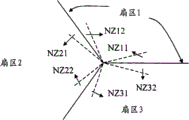
-图2是扇区化无线电小区图案(cell pattern)的视图,并且- Figure 2 is a view of a sectorized radio cell pattern (cell pattern), and
-图3是图示出在蜂窝无线电系统中分配无线电资源时执行的一些步骤的流程图。- Figure 3 is a flow chart illustrating some steps performed when allocating radio resources in a cellular radio system.
具体实施方式 Detailed ways
在图1中,描绘了图示出利用时分复用的示例性蜂窝无线电系统100的视图。该系统100能够例如是时分同步码分多址TD-SCDMA系统。系统100包括基站(节点B)101。基站101服务位于由基站101和或其他基站覆盖的区域内的多个移动台,也称为用户设备(UE)103。基站101还连接到无线电网络控制器节点(RNC)105。In FIG. 1 , a diagram illustrating an exemplary cellular radio system 100 utilizing time division multiplexing is depicted. The system 100 can eg be a Time Division Synchronous Code Division Multiple Access TD-SCDMA system. System 100 includes a base station (Node B) 101 . The base station 101 serves a number of mobile stations, also referred to as user equipment (UE) 103 , located within the area covered by the base station 101 and or other base stations. The base station 101 is also connected to a Radio Network Controller Node (RNC) 105 .
此外,蜂窝无线电系统包括用于测量在由蜂窝无线电系统覆盖的区域内移动的移动台的到达角的功能。到达角测量通常由节点B执行,例如由单元109执行,即它是节点B功能之一。在可替换的实施例中,单元109可以是用于确定由无线电基站101服务的移动台的位置的全球定位系统GPS单元。RNC 105能够将所得到的测量转发到无线电网络控制器,RNC 105。RNC 105与无线电资源管理RRM单元107相关联,即它是RNC功能之一,用于在蜂窝无线电系统100内并且尤其是在由与连接到RNC105的基站相关联的小区所覆盖的区域内分配无线电资源。RRM单元107通常是计算机实施的,并且所应用的特定RRM算法能够由装入RRM模块中的计算机程序产品111来确定。此外,图1中的RRM单元107在分配资源时能够使用到达角信息或与用户位置有关的其他信息(例如GPS),如以下将要描述的那样。Furthermore, cellular radio systems include functionality for measuring the angle of arrival of mobile stations moving within the area covered by the cellular radio system. Angle of arrival measurement is usually performed by the Node B, eg by unit 109, ie it is one of the Node B functions. In an alternative embodiment, unit 109 may be a Global Positioning System GPS unit for determining the position of mobile stations served by radio base station 101 . The RNC 105 can forward the resulting measurements to the Radio Network Controller, RNC 105. The RNC 105 is associated with a Radio Resource Management RRM unit 107, i.e. it is one of the RNC functions for allocating radio within the cellular radio system 100 and in particular within the area covered by the cells associated with the base stations connected to the RNC 105 resource. The RRM unit 107 is typically computer-implemented, and the particular RRM algorithm applied can be determined by a computer program product 111 loaded into the RRM module. Furthermore, the RRM unit 107 in FIG. 1 can use angle of arrival information or other information related to user location (eg GPS) when allocating resources, as will be described below.
在示例性实施例中,在随机接入过程期间由特定基站101在随机接入信道RACH上测量的到达角AoA被从基站101报告给RNC 105。在接收到这样的AoA信息时,RNC 105使用到达角信息来确定是否从相邻分区或扇区(其还可以被称为小区边界区域)发起了随机接入过程。如果RNC105确定从小区边界区域发起了随机接入过程,则所应用的无线电资源分配算法的预定义时隙被设为较高优先级。因此,结合诸如功率评估、干扰评估、码数评估等之类的分配方案,RNC 105的RRM算法能够正如通过AoA信息所确定的那样在考虑到用户位于特定区域中的何处的情况下为该新用户做出最终的载波、时隙和码分配。In an exemplary embodiment, the angle of arrival AoA measured by a particular base station 101 on the random access channel RACH during the random access procedure is reported from the base station 101 to the RNC 105. Upon receiving such AoA information, the RNC 105 uses the angle of arrival information to determine whether a random access procedure has been initiated from a neighboring partition or sector (which may also be referred to as a cell border area). If the RNC 105 determines that the random access procedure is initiated from the cell border area, the predefined time slot of the applied radio resource allocation algorithm is set to a higher priority. Therefore, in conjunction with allocation schemes such as power estimation, interference estimation, code number estimation, etc., the RRM algorithm of the RNC 105 is able to provide the user with the consideration of where in a particular area it is as determined by the AoA information. New users make final carrier, slot and code assignments.
根据一个实施例,如果用户处于连接模式,则所使用的上行链路信道(例如上行链路专用信道DCH)的到达角AoA被从基站101报告给RNC105。在接收到上行链路信道的这样的AoA信息时,RNC 105确定AoA是否对应于小区边界区域中的用户。如果RNC 105确定该连接来自小区边界区域,则所应用的无线电资源分配算法的预定义时隙被设为较高优先级。因此,结合诸如功率评估、干扰评估、码数评估等之类的分配方案,RNC 105的RRM算法能够正如通过AoA信息所确定的那样在考虑到用户位于何处的情况下为该新用户做出最终的载波、时隙和码分配。因此,干扰将被减少。According to one embodiment, the angle of arrival AoA of the used uplink channel (eg uplink dedicated channel DCH) is reported from the base station 101 to the RNC 105 if the user is in connected mode. Upon receiving such AoA information of the uplink channel, RNC 105 determines whether the AoA corresponds to a user in the cell border area. If the RNC 105 determines that the connection is from the cell border area, the predefined time slots of the applied radio resource allocation algorithm are set to a higher priority. Therefore, in combination with allocation schemes such as power estimation, interference estimation, code number estimation, etc., the RRM algorithm of the RNC 105 can make a decision for the new user taking into account where the user is located as determined by the AoA information. Final carrier, slot and code assignments. Therefore, interference will be reduced.
在图2中,示出具有三个扇区的无线电基站。每个扇区具有接近于另一扇区的小区边界区域/相邻分区。小区边界区域的形状能够以任何适当方式来确定,包括当前使用的波束形成和与小区图案相关的形状。例如,对于常规小区图案和具有约12.5度的3dB带宽的8单元天线阵列,可以将距扇区边界12.5度偏差设置为相邻分区。In Fig. 2 a radio base station with three sectors is shown. Each sector has a cell border area/adjacent partition close to another sector. The shape of the cell border region can be determined in any suitable way, including currently used beamforming and cell pattern related shapes. For example, for a conventional cell pattern and an 8-element antenna array with a 3dB bandwidth of about 12.5 degrees, a 12.5 degree offset from the sector boundary may be set as an adjacent sector.
例如,对于扇区1,可以向相邻分区11NZ11分配时隙4并且向相邻分区12NZ12分配时隙5。对于扇区2,可以向相邻分区11NZ11分配时隙6并且向相邻分区22NZ22分配时隙4。对于扇区3,可以向相邻分区31NZ31分配时隙5并且向相邻分区32NZ32分配时隙6。在图2中所示的这种示例性实施例中,所有邻近小区边界区域相邻分区都已经被分配了不同的时隙。在这种分配中,相同区域中的用户之间的时间划分将行动来减少那些用户之间的干扰。For example, for sector 1, time slot 4 may be assigned to adjacent partition 11NZ11 and time slot 5 to adjacent partition 12NZ12. For sector 2, time slot 6 may be assigned to adjacent partition 11NZ11 and time slot 4 to adjacent partition 22NZ22. For sector 3, time slot 5 may be assigned to adjacent partition 31NZ31 and time slot 6 to adjacent partition 32NZ32. In such an exemplary embodiment shown in Fig. 2, all adjacent cell border area adjacent sectors have been assigned different time slots. In this allocation, the division of time between users in the same area will act to reduce interference between those users.
在图3中,流程图图示出在节点中执行的一些步骤,所述节点例如时分小区的RNC 105。首先,在步骤301中,RNC 105确定为特定用户分配无线电资源。步骤301能够通过许多不同事件来触发,例如当新用户发起随机接入过程时或当连接被从一个小区移交到另一小区时或当用户在小区内移动时。接下来,在步骤303中,RNC确定将被分配新无线电资源的用户是否处于接近于小区边界的预定义区域内。用户的定位能够例如通过使用AoA或以任何其他适当方式(例如GPS定位)来进行。In Fig. 3, a flow diagram illustrates some steps performed in a node, such as the RNC 105 of a time division cell. First, in
如果在步骤303中RNC确定用户在预定义区域内,则在步骤305中RNC应用无线电资源管理RRM算法,这增加了向该用户分配与可以处于如在上文中所描述的相同小区边界区域中的其他用户不同的时隙的可能性。例如,RRM算法可以被设置为向这样的用户分配预定时隙。特别地,RRM算法可以适于使用定位信息结合功率评估、干扰评估、码数评估等来针对小区边界区域中的移动台进行无线电资源分配。RNC 105的RRM算法于是能够正如通过AoA信息或其他定位信息所确定的那样在考虑到用户位于特定区域中的何处的情况下为这样的用户做出最终的载波、时隙和码分配。If in
如果在步骤303中用户没有被确定在小区边界区域内,则RNC对该用户应用正常RRM算法,步骤307。If in
利用在此所描述的方法和系统,于是RRM算法能够使用AoA信息或其他位置信息来分配无线电资源。由此可以减少接近于小区边界的区域中的用户之间的干扰以使得蜂窝无线电系统的性能得以改进。例如,移交成功率将极大地提高。此外,所述方法和系统能够与其他资源分配算法一起应用,例如基于功率的评估、基于干扰的评估等等。通过考虑所有无线电测量,诸如RNC之类的处理RRM的节点能够改进无线电资源分配以使得整体系统性能得以改进。With the methods and systems described herein, the RRM algorithm can then use AoA information or other location information to allocate radio resources. Interference between users in areas close to cell boundaries can thereby be reduced so that the performance of the cellular radio system is improved. For example, the handover success rate will be greatly improved. Furthermore, the methods and systems can be applied with other resource allocation algorithms, such as power-based estimation, interference-based estimation, and the like. By considering all radio measurements, a node handling RRM, such as the RNC, can improve radio resource allocation such that the overall system performance is improved.
Claims (10)
Applications Claiming Priority (1)
| Application Number | Priority Date | Filing Date | Title |
|---|---|---|---|
| PCT/SE2007/050779 WO2009054763A1 (en) | 2007-10-25 | 2007-10-25 | A method of allocating radio resources |
Publications (2)
| Publication Number | Publication Date |
|---|---|
| CN101836492A CN101836492A (en) | 2010-09-15 |
| CN101836492B true CN101836492B (en) | 2014-02-05 |
Family
ID=40579753
Family Applications (1)
| Application Number | Title | Priority Date | Filing Date |
|---|---|---|---|
| CN200780101226.9A Expired - Fee Related CN101836492B (en) | 2007-10-25 | 2007-10-25 | Method of allocating radio resources |
Country Status (2)
| Country | Link |
|---|---|
| CN (1) | CN101836492B (en) |
| WO (1) | WO2009054763A1 (en) |
Families Citing this family (1)
| Publication number | Priority date | Publication date | Assignee | Title |
|---|---|---|---|---|
| CN101925182B (en) * | 2009-06-15 | 2014-04-02 | 大唐移动通信设备有限公司 | Resource management method, system and equipment |
Citations (3)
| Publication number | Priority date | Publication date | Assignee | Title |
|---|---|---|---|---|
| CN1525782A (en) * | 2003-02-27 | 2004-09-01 | 西门子移动通讯公司 | Radio resource management method in cellular telephone networks |
| CN1541493A (en) * | 2001-05-31 | 2004-10-27 | ���˹���Ѷ��� | Method and apparatus for managing orthogonal codes in a code division multiple access system employing smart antenna technology |
| CN101242623A (en) * | 2007-02-08 | 2008-08-13 | 大唐移动通信设备有限公司 | Wireless resource managing method, wireless network controller and base station |
Family Cites Families (4)
| Publication number | Priority date | Publication date | Assignee | Title |
|---|---|---|---|---|
| SE513221C2 (en) * | 1998-04-17 | 2000-07-31 | Net Insight Ab | Method and apparatus for allocating time slots to a channel in a circuit-switched time multiplexed network |
| CN1787679B (en) * | 2004-12-09 | 2010-07-28 | 北京三星通信技术研究有限公司 | A positioning method for a radio network controller to determine a user equipment to be positioned |
| US7835383B2 (en) * | 2005-09-30 | 2010-11-16 | Robert Bosch Gmbh | Method and system for providing a modified timed division multiple access (TDMA) for reduced delay |
| CN101043693B (en) * | 2006-03-23 | 2011-05-11 | 华为技术有限公司 | Method and system for inter-cell eliminating interference |
-
2007
- 2007-10-25 WO PCT/SE2007/050779 patent/WO2009054763A1/en not_active Ceased
- 2007-10-25 CN CN200780101226.9A patent/CN101836492B/en not_active Expired - Fee Related
Patent Citations (3)
| Publication number | Priority date | Publication date | Assignee | Title |
|---|---|---|---|---|
| CN1541493A (en) * | 2001-05-31 | 2004-10-27 | ���˹���Ѷ��� | Method and apparatus for managing orthogonal codes in a code division multiple access system employing smart antenna technology |
| CN1525782A (en) * | 2003-02-27 | 2004-09-01 | 西门子移动通讯公司 | Radio resource management method in cellular telephone networks |
| CN101242623A (en) * | 2007-02-08 | 2008-08-13 | 大唐移动通信设备有限公司 | Wireless resource managing method, wireless network controller and base station |
Also Published As
| Publication number | Publication date |
|---|---|
| WO2009054763A1 (en) | 2009-04-30 |
| CN101836492A (en) | 2010-09-15 |
Similar Documents
| Publication | Publication Date | Title |
|---|---|---|
| EP1968336B1 (en) | Method and apparatus for mitigating interference in a wireless communication system | |
| US20100087203A1 (en) | Method and apparatus for interference control in a wireless communication system with hierarchical cell layout | |
| EP3557916B1 (en) | Method, performed by a user equipment, for accessing a network and corresponding user equipment | |
| EP2630729B1 (en) | Methods and apparatus for inter-cell interference coordination self-organized network | |
| US20100002725A1 (en) | System and method for using resources in a communication system | |
| JP2004201137A (en) | Directional beam communication system, directional beam communication method, base station, and control device | |
| US7474895B1 (en) | Frequency reuse in wireless communication networks | |
| US20050207373A1 (en) | Method and system for allocating time slots for a common control channel | |
| EP1925172B1 (en) | Communication resource allocation method of base station | |
| US6907228B1 (en) | Allocating carrier frequencies for communicating beacon control signaling | |
| CN101836492B (en) | Method of allocating radio resources | |
| CN101606409A (en) | Method for managing radio resources based on cell mode | |
| Berg et al. | A Radio Resource Management Concept for “Bunched” Personal Communication Systems | |
| CN1980464A (en) | Wireless resource distribution method and apparatus | |
| KR100735345B1 (en) | Transmission Antenna Beam Pattern Allocation Method According to Downlink Common Physical Channel Status in Mobile Communication System | |
| KR101999663B1 (en) | Method for allocating radio resource of small cell base station and small cell base station | |
| CN101146330A (en) | Channel Allocation System for Multi-carrier Cells in TD-SCDMA System | |
| CN101145827A (en) | Channel allocation method for multi-carrier frequency cell in TD-SCDMA system | |
| CN101437236B (en) | Method, equipment and system for distributing time slot | |
| US20100214915A1 (en) | Resource allocation / management method and device based on block repeat division multiple access | |
| CN100596348C (en) | Channelization code allocation method | |
| KR101340830B1 (en) | Channel localization method for solving ripple effect problem in small-sized wifi networks and apparatus thereof | |
| KR101818878B1 (en) | Sector grouping method in wireless backhaul apparatus and resource allocating method in wireless backhaul apparatus | |
| EP2739104A1 (en) | A cellular telecommunications base station and a method of allocating a spreading code | |
| Udgata et al. | Channel Assignment and Reassignment Using Co-channel Cells in Mobile Communication Networks |
Legal Events
| Date | Code | Title | Description |
|---|---|---|---|
| C06 | Publication | ||
| PB01 | Publication | ||
| C10 | Entry into substantive examination | ||
| SE01 | Entry into force of request for substantive examination | ||
| C14 | Grant of patent or utility model | ||
| GR01 | Patent grant | ||
| CF01 | Termination of patent right due to non-payment of annual fee | ||
| CF01 | Termination of patent right due to non-payment of annual fee |
Granted publication date: 20140205 |