Background
In a wireless communication system, if a transmitting end and a receiving end both use multiple antennas, a spatial multiplexing mode can be adopted to obtain a higher rate. Compared with a general spatial multiplexing method, an enhanced technology is that a receiving end feeds back channel information to a sending end, and the sending end uses some transmitting pre-coding technologies according to the obtained channel information, so that the transmission performance can be greatly improved. The simple utilization method is to directly use the channel feature vector information for precoding, which is mainly used in single-user MIMO (multiple input multiple output), and there are other preferable but more complex methods, which are mainly used in multi-user MIMO. However, these methods require relatively accurate channel information.
In Long Term Evolution (LTE), feedback of channel information mainly utilizes a simpler single codebook feedback method, and performance of MIMO transmission precoding technology mainly depends on accuracy of codebook feedback therein. The basic principle of the channel information quantization feedback based on the codebook is as follows: assuming a limited feedback channel capacity of B bps/Hz, the number of available codewords isN=2
BAnd (4) respectively. The characteristic vector space of the channel matrix is quantized to form a codebook space
The transmitting end and the receiving end jointly store or generate the codebook in real time (the same as the transmitting end and the receiving end). For each channel, H is realized, and the receiving end follows a certain criterion
Selects a code word which is matched with the channel most
And feeding back the code word serial number i to the transmitting end. Here, the codeword sequence number is referred to as PMI (Precoding Matrix Indicator). The transmitting end finds out the corresponding pre-coding code word according to the sequence number i
Thereby obtaining the information on the channel in the radio communication system,
the feature vector information of the channel is represented.
In general terms, the term "a" or "an" is used to describe a device that is capable of generating a signal
The method can be further divided into a codebook corresponding to a plurality of ranks (layers), and each Rank is corresponding to a plurality of code words to quantize a precoding matrix formed by the channel feature vectors in the Rank. Since the number of Rank and non-zero eigenvector of a channel is equal, in general, when the Rank is N, there are N columns of code words. Therefore, the code book
The codebook can be divided into a plurality of sub-codebooks according to the Rank, as shown in table 1.
TABLE 1
When Rank > 1, the codewords required to be stored are all in a matrix form, for example, a codebook in the LTE protocol is a codebook quantization feedback method, and as shown in table 2, the codebook is a precoding codebook of downlink 4 antennas. In the following, for the sake of uniformity, a vector can also be seen as a matrix with a dimension 1.
TABLE 2
In the context of Table 2, the following examples are,
i is a unit matrix, W
k {j}A representation matrix W
kThe (j) th column of vectors,
a representation matrix W
kJ (d) of
1,j
2,...,j
nA matrix of columns.
As Long term evolution Advanced (LTE-a), which is a continuous evolution of LTE, needs to support a larger system bandwidth (up to 100MHz), and needs to improve average spectrum efficiency and spectrum efficiency of cell edge users, the LTE-a needs to enhance some technologies, such as improving feedback efficiency and further improving accuracy of codebook feedback. Based on the requirements of LTE-a, the idea of adaptive codebooks is proposed. The main idea of the adaptive codebook is to use the channel related information to the codebook CbMaking an adjustment and then using the adjusted codebook CBChannel characteristic information is quantized. The advantage is that it can effectively improve codes in relevant channel scenariosThe feedback precision further effectively improves the spectrum efficiency of the channel. Here, the channel-related information is a long-term statistical information, and thus needs to be fed back for a long period.
The form of the relevant adaptive codebook technique can be expressed as: cB=F(R,Cb) Namely, one of the specific forms of the channel related information is utilized: "channel correlation matrix R", and a function F for a codebook CbAdjusting to obtain codebook C adapted to current channel feature vector distributionB。
In particular, an adaptive codebook CBThe following mathematical form can be described:
C
B=RC
b/norm(RC
b) Or
Here, a codebook C is formed using a channel correlation matrix R or an R function f (R)
bPerforming rotation operation (left multiplication or right multiplication), and then performing normalization processing on all code words in the obtained codebook to obtain C
B. The channel correlation matrix R is typically one N
t×N
tHermitian matrix, can be represented by H
HH is obtained on average from long-term statistics. H is a channel matrix formed between the transmit and receive antennas.
Is generally defined using Cholesky decomposition or eigen decomposition. Namely: cholesky decomposition definition:
and
are all triangular matrices. Feature decomposition definition:
or
Where V represents a unitary matrix of eigenvectors and Σ represents a diagonal matrix of eigenvalues.
In fact, the physical meaning of an adaptive codebook can be understood as: because of the correlation of the channels, the eigenvectors are not uniformly distributed in the whole space, but the probability distribution density around the eigenvector corresponding to the larger eigenvalue after R characteristic decomposition is larger, so that an original codebook C is subjected to correlation matrix R or R function f (R) of the channelsbMake C after performing a rotation operation (left or right multiplication)bThe number of codewords is larger in the region with higher distribution density of the feature vectors.
More specifically, R has N feature vectors V
1~V
NRespectively corresponding to the characteristic value lambda
1~λ
NI.e. by
One form of RC in existing adaptive codebook technology
bIt can be understood that:
step 1, codebook CbTo each feature vector V of RnProjecting;
step 2, obtaining a projection component V'1~V′NRespectively multiplied by a weight (i.e., a characteristic value λ)1~λn) Then summing;
step 3, normalizing the summed vector to obtain CBThe codeword of (1).
At this time, if each eigenvalue λ in R1~λNAnd the vectors synthesized after projection are not equal, the vectors are closer to the eigenvectors corresponding to the large eigenvalues and are farther from the vectors corresponding to the small eigenvalues.
The distribution condition of the characteristic vectors can be obtained by adopting the self-adaptive codebook according to the relevant information of the channel, and then all the codewords are rotated to adapt to the distribution of the characteristic vectors, so that the quantization precision can be effectively improved, and good performance can be obtained under the relevant channel.
In the LTE-a system, the simplest and most effective application method in the related adaptive codebook technology is to rotate the codeword of the original 4Tx (4 transmit antenna) fixed codebook.
The inventor finds that, because the code word in the LTE system has the characteristic of constant modulus of elements, that is, the modulus value of each element is equal and is an element in the 8PSK alphabet set, the following problems occur:
since the LTE codebook is designed considering that the distances of the entire 4-dimensional vectors are uniform, that is, the similarity of the 4-dimensional vectors is small, but does not consider the similarity of 2-dimensional vectors composed of the 1 st and 2 nd elements, the two-dimensional vectors composed of the 1 st and 2 nd elements with more codewords are equal. After being acted on by the channel related information, the similarity degree of the 1 st and 2 nd elements largely determines the similarity degree of the acted code words. Therefore, the distances between some of the rotated codewords (the distances can be measured by the chord distances) are always small, and sometimes even the chord distances approach 0. Since the chord distance is very small or 0, these code words are actually equivalent code words, that is, the same effect of using multiple code words can be obtained by using one of them. Therefore, unnecessary waste of some codewords in the codebook is caused, resulting in low quantization efficiency.
Detailed Description
The invention will be described in detail hereinafter with reference to the accompanying drawings in conjunction with embodiments. It should be noted that the embodiments and features of the embodiments in the present application may be combined with each other without conflict.
Fig. 1 is a flowchart of a feedback method of channel quantization information according to an embodiment of the present invention, including the following steps:
step S102, a receiving end uses channel related information to process a first codebook to obtain a second codebook;
step S104, the receiving end sends the indication information (namely PMI) corresponding to the code word in the second codebook to the sending end;
wherein vectors formed by the first X elements of each code word in the first codebook are different, and the elements in the code words meet 8PSK or 16PSK characteristics,
N
tis the number of transmit antennas at the transmitting end,
the rounding-up operator.
Codebook C in correlation techniqueBHas a very small distance between each other or is 0, and in this embodiment, the codebook CbThe first in each codeword (i.e., the first codebook)(NtNumber of antennas) of the vector formed by the elements are different, so that the codebook C acted on by the channel-related information processing is enabledBThe similarity degree of the code words in the second codebook is reduced, the distance between every two code words is increased, and the codebook C of the related technology is solvedBThe problem of unnecessary waste of some code words and low quantization efficiency is solved, and the embodiment reduces the codebook CBThe similarity of the code words in the method increases the distance between every two code words and improves the quantization efficiency.
Wherein 8PSK characteristics or 16PSK characteristics are satisfied, i.e., all elements of the vector, matrix, codeword, etc. are elements in the 8PSK or 16PSK alphabet set.
(1) Number of antennas NtWhen the number of the channel quantization information is 4, the receiving end feeds back the channel quantization information to the sending end based on the codebook mode, wherein the fed-back PMI information indicates the codebook CBCode word of (1), the codebook CBIs a codebook C of channel related informationbObtained after treatment.
Wherein the codebook CbThe code words in (2) may include K4-dimensional vectors, the K4-dimensional vectors are formed by elements in a 16PSK alphabet, and two-dimensional vectors formed by the 1 st element and the 2 nd element of the K vectors are different from each other; wherein K is 2BAnd B is a non-negative integer.
Preferably, the codebook C isbIt is also possible to include K4-dimensional vectors, the K4-dimensional vectors being composed of elements in an 8PSK alphabet, and the 1 st sum of the K4-dimensional vectorsThe two-dimensional vectors formed by the 2 nd elements are different; wherein K is 2BAnd B is a non-negative integer. The elements in the 8PSK alphabet set are commonly used elements for forming code words in a codebook, and the codebook C meeting the requirements of the preferred embodiment is formed by using the elementsbThe code word in (1) can be more suitable for practical application.
Preferably, the codebook C isbThe codebook may also be a codebook formed by partial codeword vectors in a Rank1 codebook (i.e., a layer 1 codebook) in the LTE system, and 2-dimensional vectors formed by the 1 st element and the 2 nd element of each codeword vector are different from each other. The code words in the code book in the related art can be utilized to form the code book C meeting the requirementb。
Preferably, the codebook C is
bThe method can also comprise the following steps: w
4 {1},W
5 {1},W
6 {1},W
7 {1}A codebook of vectors from the set a1, vectors from the set a2, vectors from the set A3, and vectors from the set a 4; wherein, the A1 set is { W }
0 {1} W
8 {1} W
12 {1} W
13 {1}The set of A2 is { W }
1 {1} W
9 {1}The set of A3 is { W }
2 {1} W
10 {1} W
14 {1} W
15 {1}The set of A4 is { W }
3 {1} W
11 {1}},
I is an identity matrix, u
nIs the base vector, n is 0, 1. u. of
nSee table 2 for specific values of (a). More commonly used vectors may be used to construct the satisfactory codebook C
bThereby making it more suitable for practical use.
Preferably, the codebook C isbIt may further include M vectors selected from the group consisting of W4 {1}、W5 {1}、W6 {1}、W7 {1}A set of vectors consisting of one vector from the set a1, one vector from the set a2, one vector from the set A3, and one vector from the set a4, wherein 0 < M < 8. More commonly used vectors may be used to construct the satisfactory codebook CbThereby making it more suitable for practical use.
The channel related information may be N
t×N
tThe matrix may further be a channel correlation matrix R or
For codebook C
bThe processing operation performed may be a linear or non-linear function process, which may be denoted as F (R, C)
b) And F is a function. The above-mentioned channel-related information may also be obtained by a plurality of matrix operations. Such as: polarization correlation matrix and polarization direction
And the root antenna correlation matrix is obtained by Kronecker product, or the eigenvalue matrix is obtained by multiplying the eigenvector matrix.
After the receiving end sends the PMI information to the sending end, the sending end sends the PMI information to the codebook CBAnd obtaining the channel quantization information, and using the channel quantization information for transmitting and precoding.
The above-mentioned 8PSK alphabet set is
The above 16PSK alphabet set is
The same applies below.
(2) Number of antennas NtWhen the number is 8, the receiving end feeds back channel quantization information based on the codebook to the transmitting end, wherein the fed-back PMI informationIndicating a codebook CBCode word of (1), the codebook CBIs a codebook C of channel related informationbObtained after treatment.
Wherein the codebook CbThe code words in (1) may include K8-dimensional vectors, the K8-dimensional vectors are composed of elements in a 16PSK alphabet, and four-dimensional vectors composed of 1 st, 2 nd, 3 th, and 4 th elements of the K8-dimensional vectors are different from each other; wherein K is 2BAnd B is a non-negative integer. The elements in the 16PSK alphabet set are commonly used elements constituting codewords in the codebook, and the codebook C is constituted by using the elementsbThe code word in (1) can be more suitable for practical application.
The channel related information may be Nt×NtThe matrix, specifically, the above-mentioned channel related information may refer to a channel related matrix R or R expressed in the form of a plurality of matrices, to a codebook CbThe processing operation performed may be a linear or non-linear function processing F (R, C)b) And F is a function. The channel correlation matrix R may further be a block matrix.
The elements in the alphabet set are commonly used elements constituting codewords in the codebook, and the codebook C is constituted using these elementsbThe code word in (1) can be more suitable for practical application.
Preferably, the codebook C isbK8-dimensional vectors can be included, the K8-dimensional vectors are formed by elements in a 16PSK letter set, and three-dimensional vectors formed by the 1 st, 2 nd and 3 rd elements of the K8-dimensional vectors are different; wherein K is 2BAnd B is a non-negative integer. The elements in the 16PSK alphabet set are commonly used elements constituting codewords in the codebook, and the codebook C is constituted by using the elementsbThe code word in (1) can be more suitable for practical applications.
Preferably, the codebook C isbK8-dimensional vectors can be included, the K8-dimensional vectors are formed by elements in a 16PSK letter set, and two-dimensional vectors formed by the 1 st and 2 nd elements of the K8-dimensional vectors are different; wherein K is 2BAnd B is a non-negative integer. 16The elements in PSK alphabet set are commonly used elements constituting codewords in a codebook, and the codebook C is constituted by using the elementsbThe code word in (1) can be more suitable for practical application.
After the receiving end sends the PMI information to the sending end, the sending end sends the PMI information to the codebook CBAnd obtaining the channel quantization information, and using the channel quantization information for transmitting and precoding.
It should be noted that: multiplying or dividing a vector or matrix of codewords by a constant, or multiplying or dividing columns of codewords by a constant when there are multiple columns, does not change the properties of the codewords, are equivalent transformations to the above embodiments.
In the above embodiment, the transmitting end may be a base station, and the receiving end may be a user equipment; the transmitting end may also be a user equipment, and the receiving end may also be a base station.
The following examples detail the technical solutions of the above-described preferred embodiments.
Example 1:
to make codebook C
bThe channel can be quantized well when no channel correlation matrix R rotates, better mode compatibility is ensured, and the codebook C is paired with the channel correlation matrix R
bThe code word after being rotated in the rotation process can still ensure to adapt to the good structure of the dual-polarized channel, namely the codebook C
bSome or all of the codewords in (a) may have the following structure:
(Rank 1), wherein u
1Is a 4-dimensional vector, and a and b are constants. Preferably, u
1Is an element or 0 in the 16PSK alphabet set, and a, b is an element or 0 in the 16PSK alphabet set. Preferably, u
1Is any column vector in a code word matrix in a Rank4 code book in the LTE system. Preferably, u
1Is a code word in a Rank1 codebook in an LTE system. The code meeting the requirements of the preferred embodiment can be formed by using the code words in the existing code bookThis C
b。
Preferably, the codebook C is
bSome or all of the codewords in (a) may have the following structure:
(Rank 2), wherein u
1,u
2Is a 4-dimensional vector, and a, b, c and d are constants. Preferably, u
1,u
2Is an element in the 16PSK alphabet set or 0, and a, b, c, d is an element in the 16PSK alphabet set or 0. Preferably, u
1,u
2The vector is any column vector in a code word matrix in a Rank4 codebook in an LTE system; preferably, u
1,u
2For the same or different codewords in the Rank1 codebook in the LTE system,
is a unitary matrix, e.g.
(other equivalent transformations may also be included, such as antenna number changes, multiplying each column by a constant), when u
1,u
2When the two-dimensional images are orthogonal to each other,
may be any 2 x 2 matrix. The preferred embodiment provides codebook C
bThe code word in (1) has another structural characteristic that some common elements can be utilizedElements forming codebook C
bIn such a way that codebook C
bThe composition of (a) is more suitable for practical application.
Preferably, the codebook C isbK8-dimensional vectors can be included, the K8-dimensional vectors are formed by elements in an 8PSK letter set, and two-dimensional vectors formed by the 1 st and 2 nd elements of the K8-dimensional vectors are different; wherein K is 2BAnd B is a non-negative integer. 8PSK
And the UE obtains a current channel matrix H and a long-term statistical channel correlation matrix R according to the pilot frequency. UE and base station define a same codebook CbThe codebook CbCan be as follows: any vector in the A1 set, any vector in the A2 set, any vector in the A3 set, and any vector in the A4 set.
Wherein, the A1 set is { W }0 {1} W8 {1} W12 {1} W13 {1}The set of A2 is { W }1 {1} W9 {1}The set of A3 is { W }2 {1} W10 {1} W14 {1} W15 {1}The set of A4 is { W }3 {1} W11 {1}}。
E.g. CbIs W4 {1} W5 {1} W6 {1} W7 {1}A constructed 2-bit codebook;
Cbmay also be W0 {1} W1 {1} W2 {1} W3 {1}A constructed 2-bit codebook;
or, CbIs W0 {1} W1 {1} W2 {1} W3 {1} W4 {1} W5 {1} W6 {1} W7 {1}A constructed 3-bit codebook;
Cbmay also be W4 {1} W5 {1} W6 {1} W7 {1} W8 {1} W9 {1} W10 {1} W11 {1}And forming a 3-bit codebook.
Wherein,i is a unit matrix, unFor the base vector, the specific values can be found in table 2, the same below.
The UE feeds back the R information for a long period, so that the receiving and transmitting ends together guide the R information, or the base station obtains the long-term statistical R information according to the reciprocity of the uplink and downlink channels.
UE and base station agree to utilize adaptive codebook technology and channel correlation matrix R to codebook CbProcessing to obtain an adaptive codebook CB。
UE slave adaptive codebook C for current channel matrix HBFinding a code word as the quantization of the current channel matrix H, and feeding back to the base station in the form of PMI. The base station slave self-adaptive code book C according to the PMIBAnd finding a code word vector representing the channel information, and precoding the data to be transmitted by using the code word vector.
Example 2:
and the UE terminal obtains a current channel matrix H and a long-term statistical channel correlation matrix R according to the pilot frequency.
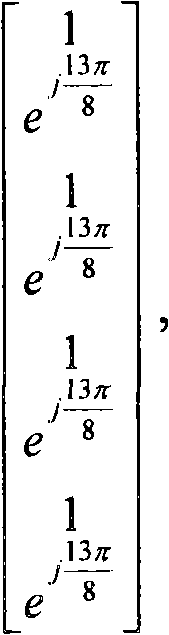
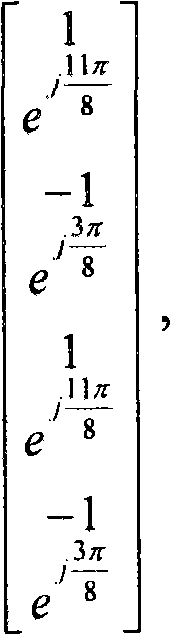
UE end and base station end define a same codebook Cb. The codebook CbCan be as follows:
a codebook of 16 vectors.
The following steps can be also included:
The method can also comprise the following steps:
The UE feeds back the R information for a long period, so that the receiving and transmitting ends know the R information together, or the base station obtains the long-term statistical R information according to the reciprocity of the uplink and downlink channels.
UE and base station agree to utilize adaptive codebook technology and channel correlation matrix R to codebook CbProcessing to obtain an adaptive codebook CB。
UE slave C for current channel matrix HBFinding a code word as the quantization of the current channel matrix H, and feeding back to the base station in the form of PMI. The base station slave codebook C according to PMIBFinding out a code word vector for representing the channel information, and precoding by using the code word vector.
Example 3
And the UE obtains a current channel matrix H and a long-term statistical channel correlation matrix R according to the pilot frequency.
UE and base station define a same codebook Cb. The codebook CbCan be as follows:
a codebook of 16 vectors;
the following steps can be also included:
the following steps can be also included:
the method can also comprise the following steps:
The UE feeds back the R information for a long period, so that the receiving and transmitting ends together guide the R information, or the base station obtains the long-term statistical R information according to the reciprocity of the uplink and downlink channels.
UE and base station agree to codebook C using channel correlation matrix using existing adaptive codebook techniquesbProcessing to obtain an adaptive codebook CB。
UE slave adaptive codebook C for current channel matrix HBFinding a code word as the quantization of the current channel matrix H, and feeding back to the base station in the form of PMI. Base station slave self-adaptive codebook C according to PMIBFinding out a code word vector for representing the channel information, and precoding by using the code word vector.
Example 4
And the UE obtains a current channel matrix H and a long-term statistical channel correlation matrix R according to the pilot frequency.
UE and base station define a same codebook Cb. Part of the code words in the codebook are:
wherein a and b are elements in a 16PSK alphabet set or are 0.
The above 16PSK alphabet set is the following 16 elementsThe same applies below.
UE and base station define a same codebook Cb. The codebook CbThe partial code words in (1) are:
the codebook CbThe partial code words in (1) may also be:
wherein at least a1≠a2Or b1≠b2,a1,a2,b1,b2Is a 16PSK alphabet element or is 0.
The above code words are code words of dual-polarized antenna channels adapting to mainstream, and since it is often desired to cover various situations, C, with one codebook in communication technologybThe other code words in (a) may be increased appropriately according to the accuracy requirements and the channel specific characteristics that need to be taken into account.
The UE feeds back the R information for a long period, so that the receiving and transmitting ends together guide the R information, or the base station obtains the long-term statistical R information according to the reciprocity of the uplink and downlink channels.
UE and base station agree to utilize adaptive codebook technology and channel correlation matrix R to codebook CbProcessing to obtain an adaptive codebook CB。
UE slave adaptive codebook C for current channel matrix HBFinding a code word as the quantization of the current channel matrix H, and feeding back to the base station in the form of PMI. Base station slave self-adaptive codebook C according to PMIBFinding out a code word vector for representing the channel information, and precoding by using the code word vector.
Example 5
And the UE obtains a current channel matrix H and a long-term statistical channel correlation matrix R according to the pilot frequency.
UE and base station define a same codebook Cb. The codebook CbThe partial code words in (1) are:
wherein a, b, c and d are elements in a 16PSK letter set or are 0.
Specifically, a is 1, b is 1, c is 1, d is-1, or a is 1, b is-1, c is 1, d is 1, or a is 1, b is 0, c is 0, d is 1.
Or, the codebook CbThe partial code words in (1) are:
wherein a, b, c and d are elements in a 16PSK letter set or are 0.
Specifically, a is 1, b is 1, c is 1, d is-1, or a is 1, b is-1, c is 1, d is 1, or a is 1, b is 0, c is 0, d is 1.
The above codebook CbThe code word in (C) is the code word of the dual-polarized antenna channel adapting to the mainstream, and because one code book is often expected to cover various situations in the communication technology, CbThe other code words may be increased appropriately according to the accuracy requirement or the specific characteristics of the channel to be considered.
The UE feeds back the R information for a long period, so that the receiving and transmitting ends together guide the R information, or the base station obtains the long-term statistical R information according to the reciprocity of the uplink and downlink channels.
UE and base station agree to utilize adaptive codebook technology and channel correlation matrix R to codebook CbProcessing to obtain an adaptive codebook CB。
And for the current channel matrix H, the UE is from the adaptive codebook CBFinding a code word as the quantization of the current channel matrix H, and feeding back to the base station in the form of PMI. Base station slave self-adaptive codebook C according to PMIBFinding out a code word vector for representing the channel information, and precoding by using the code word vector.
Example 6
And the UE obtains a current channel matrix H and a long-term statistical channel correlation matrix R according to the pilot frequency.
UE and base station define a same codebook Cb. The codebook CbThe partial codewords in (a) may be:
wherein a, b, c and d are elements in a 16PSK letter set or are 0.
Specifically, a is 1, b is 1, c is 1, d is-1, or a is 1, b is-1, c is 1, d is 1, or a is 1, b is 0, c is 0, d is 1, or any other matrix.
Or, the codebook CbThe partial code words in (1) are:
wherein a, b, c and d are elements in a 16PSK letter set or are 0.
Specifically, a is 1, b is 1, c is 1, d is-1, or a is 1, b is-1, c is 1, d is 1, or a is 1, b is 0, c is 0, d is 1.
The above code words are code words of dual-polarized antenna channels adapting to mainstream, and since it is often desired to cover various situations, C, with one codebook in communication technologybThe other code words may be increased appropriately according to the accuracy requirement or the specific characteristics of the channel to be considered.
The UE feeds back the R information in a long period, so that a transmitting and receiving end guides the R information together, or the base station obtains the long-term statistical R information according to the reciprocity of the uplink and downlink channels.
UE and base station agree to utilize adaptive codebook technique and channel correlation matrix pair codebook CbProcessing to obtain an adaptive codebook CB。
UE slave adaptive codebook C for current channel matrix HBFinding a code word as the quantization of the current channel matrix H, and feeding back to the base station in the form of PMI. Base station slave self-adaptive codebook C according to PMIBFinding out a code word vector for representing the channel information, and precoding by using the code word vector.
Fig. 2 is a schematic diagram of a feedback apparatus for channel quantization information according to an embodiment of the present invention, including:
a processing module 10, configured to process the first codebook using the channel related information to obtain a second codebook;
a feedback module 20, configured to send, to the sending end, indication information corresponding to a codeword in the second codebook;
wherein vectors formed by the first X elements of each code word in the first codebook are different, and the elements in the code words meet 8PSK or 16PSK characteristics,
N
tis the number of transmit antennas at the transmitting end,
the rounding-up operator.
Wherein 8PSK characteristics or 16PSK characteristics are satisfied, i.e., all elements of the vector, matrix, codeword, etc. are elements in the 8PSK or 16PSK alphabet set.
The first codebook (i.e., codebook C)b) Codebook C in the embodiment of the feedback method with the above channel quantization informationbThe characteristics of (1). The matrix used by the processing module 10 may have the characteristics of the matrix in the embodiment of the feedback method of the channel quantization information.
The feedback device of the channel quantization information may be a base station or a user equipment.
From the above description, it can be seen that the present invention achieves the following technical effects: codebook CbNot only has the characteristic of different overall vectors, but also has the front in each code word(NtNumber of antennas) of different vectors, the codebook C processed by the channel related information can be obtainedBThe distribution in the compressed quantization space is more reasonable, so that the channel information is quantized more effectively, and the quantization efficiency is improved.
It will be apparent to those skilled in the art that the modules or steps of the present invention described above may be implemented by a general purpose computing device, they may be centralized on a single computing device or distributed across a network of multiple computing devices, and alternatively, they may be implemented by program code executable by a computing device, such that they may be stored in a storage device and executed by a computing device, and in some cases, the steps shown or described may be performed in an order different than that described herein, or they may be separately fabricated into individual integrated circuit modules, or multiple ones of them may be fabricated into a single integrated circuit module. Thus, the present invention is not limited to any specific combination of hardware and software.
The above description is only a preferred embodiment of the present invention and is not intended to limit the present invention, and various modifications and changes may be made by those skilled in the art. Any modification, equivalent replacement, or improvement made within the spirit and principle of the present invention should be included in the protection scope of the present invention.