Embodiment
The present invention is described in further detail below in conjunction with accompanying drawing, but following explanation do not limit the present invention, any to distortion of the present invention and change, only otherwise break away from spirit of the present invention, all should belong to the defined scope of claims of the present invention.
Medicine and reagent in the invention process example is not specifically described is homemade conventional chemical reagent, the equal reference that the material method is not specifically described " molecular cloning experiment guide " (Sambrook and Russell, 2001).
The extraction of embodiment 1:DNA
1.1DNA extraction damping fluid
(1) fungal DNA extracts damping fluid
Tris-HCl(pH?7.5)0.2mol/L,NaCl?0.5mol/L,EDTA?0.01mol/L,SDS?1%(w/v)。
(2) DNA of plants is extracted damping fluid
CTAB extracting solution: 100mmol/L Tris-HCl (pH8.0), 20mmol/L EDTA (pH8.0), 1.5mol/LNaCl, 2%CTAB (w/v), 4%PVP40 (w/v) and 2% mercaptoethanol (v/v) add before PVP and mercaptoethanol use.
(3) the alkaline lysis plasmid extracts damping fluid
STE:0.1mol/L?NaCl,10mmol/L?Tris-HCl(pH?8.0),1mmol/L?EDTA(pH?8.0)。
Solution I: 50mmol/L glucose, 25mmol/L Tris-HCl (pH 8.0), 10mmol/L EDTA (pH8.0).
Solution II: 0.2mol/L NaOH, 1% (w/v) SDS.
Solution III: 50mL 5mol/L potassium acetate, 11.5mL Glacial acetic acid, 28.5mL water.
1.2 the extracting method of beauveria bassiana genomic dna
1.5ml centrifuge tube is collected bacterium liquid, the centrifugal 5min of 10000rpm abandons supernatant liquor, adds fungal DNA extracting solution 500 μ l, in the abundant mixing of vortice, add isopyknic phenol (pH8.0) behind 65 ℃ of water-bath 30min: chloroform, the centrifugal 10min of 10000rpm gets supernatant liquor then, add equal-volume chloroform extracting 1-2 time, get supernatant liquor, add the dehydrated alcohol of 2 times of volumes ,-20 ℃ of precipitation 30min.The centrifugal 5min of 10000rpm abandons supernatant liquor, and 75% washing with alcohol precipitation 2 times is air-dry then.Precipitation distilled water dissolving back adds an amount of RNaseA (RNA enzyme A), and 37 ℃ leave standstill 3h, and the centrifugal 5min of 10000rpm gets its supernatant liquor and is genomic dna solution.
1.3 the extraction of plasmid DNA
The extraction of agrobacterium tumefaciens plasmid DNA is by a holy method (1993) slightly modified of Lu.
Get agrobacterium tumefaciens bacterium liquid 1mL, the centrifugal 1min of 10000r/min collects thalline; Behind the resuspended thalline of 200 μ L STE, centrifugal (10000r/min 1min) collects thalline; Add 180 μ L solution I and the resuspended thalline of 20 μ L N,O-Diacetylmuramidases, 37 ℃ of temperature are bathed 30min, add 400 μ L solution II, turn upside down repeatedly, and ice bath is no more than 3min; Add the solution III of 300 μ L ice precooling again, turn upside down repeatedly ice bath 3min.12000r/min, 4 ℃ of centrifugal 10min change supernatant liquor in another centrifuge tube over to; Isopyknic phenol: chloroform: primary isoamyl alcohol (25: 24: 1) and isopyknic chloroform: primary isoamyl alcohol (24: 1) each extracting successively once; Supernatant liquor is changed over to another centrifuge tube again, add the dehydrated alcohol of 2 times of volumes, room temperature leaves standstill 2min behind the mixing; 12000r/min, 4 ℃ of centrifugal 10min collecting precipitation DNA, then once with 75% washing with alcohol precipitation; Drying at room temperature, 50 μ L TE dissolution precipitations promptly obtain plasmid DNA.
1.4 the extracting method of tomato and cotton genomic dna
Adopt improved method of CTAB (Doyle, 1987; Xiao Yuehua etc. 2002a) extract tomato and cotton tissue DNA, and method is:
Plant such as tomato and cotton tender tissue 0.5-1g, rapid grinding powder in liquid nitrogen, the CTAB extracting solution of 65 ℃ of preheatings of adding 3mL, the quick oscillation mixing, 65 ℃ of water-bath 30min add 1mL 5mol/L KAc ice bath 20min.Use isopyknic chloroform: primary isoamyl alcohol (24: 1) extracting 1 time, 10,000rpm, 4 ℃ of centrifugal 5min, supernatant liquor adds the Virahol of 2/3 times of volume-20 ℃ precooling, mixing,-20 ℃ leave standstill 30min, choose flocks with glass rod, and rinsing is for several times repeatedly with 75% ethanol, use the dehydrated alcohol rinsing more once, be resuspended in 500 μ L TE solution after air-dry.The RNaseA 2 μ L that add 10mg/mL, handle 1h for 37 ℃, use phenol (pH8.0) then: chloroform: primary isoamyl alcohol (25: 24: 1) and chloroform: each extracting of primary isoamyl alcohol (24: 1) once, 10,000rpm, 4 ℃ of centrifugal 5min, the dehydrated alcohol that supernatant liquor adds 2 times of volumes precipitates the centrifugal supernatant liquor of abandoning.Precipitate ethanol rinsing with 75%, air-dry, be dissolved in 200 μ l TE ,-20 ℃ of preservations are standby.μ L embodiment 2: the extraction of cotton RNA
2.1RNA extraction damping fluid
CTAB extracts damping fluid: 2%CTAB (w/v), 2% polyvinylpyrrolidone PVP40 (w/v), 100mmol/LTris-HCl (pH8.0, the water preparation that DEPC handles), 25mmol/L EDTA, 0.5g/L spermidine Spermidine, 2.0mol/LNaCl, 2% mercaptoethanol (v/v adds before using).
SSTE lysate: 1mol/L NaCl, 0.5%SDS (w/v), 10mmol/L Tris-HCl (pH8.0), 1.0mmol/LEDTA.
2.2RNA extracting method
Extract total RNA of cotton tissue with the CTAB method.Get about 3g cotton tissue fresh material, rapid grinding powder in liquid nitrogen, pack into the 50ml centrifuge tube of DEPC water treatment, the RNA extracting solution that adds 65 ℃ of preheatings of 15ml then, put upside down 65 ℃ of water-bath 3min behind the mixing, 8,000rpm, 4 ℃ of centrifugal 10min, change supernatant liquor the 50ml centrifuge tube of a new DEPC water treatment over to, use isopyknic chloroform: twice of primary isoamyl alcohol (24: 1) extracting.10,000rpmm gets supernatant liquor behind the centrifugal 5min of room temperature, adds 1/4 volume 10mol/L LiCl solution, place more than the 6h for 4 ℃, and 10,000rpm, 4 ℃ of centrifugal 10min abandon supernatant liquor, and precipitation is dissolved with 500 μ L SSTE.Use isopyknic phenol (pH4.5) again: chloroform: primary isoamyl alcohol (25: 24: 1) and chloroform: each extracting of primary isoamyl alcohol (24: 1) once, 10,000rpm, the centrifugal 5min of room temperature, supernatant liquor adds the dehydrated alcohol of 2 times of volume-70 ℃ precoolings, more than-70 ℃ of precipitation 30min.12,000rpm, 4 ℃ of centrifugal 10min abandon supernatant liquor, and precipitation is dissolved with the DEPC treating water of 200 μ L, and after native gel electrophoresis and ultraviolet spectrophotometer scanning detected the RNA quality ,-80 ℃ of preservations were standby.
The structure of embodiment 3:Bbchit1 plant expression vector
3.1 the structure of constitutive expression Bbchit1 gene plant expression vector
With the beauveria bassiana genome DNA is template, is that primer carries out pcr amplification with sequence 6 and sequence 7, reclaims amplified production and is connected with the pUC-T carrier, and transformed into escherichia coli DH5 α competent cell, screening positive clone obtain Bbchit1 gene (sequence 1).
With the plant expression vector p5 that contains NPTII selection markers gene and gus reporter gene is basic framework, and the Bbchit1 gene is connected into the multiple clone site of carrier, makes up the plant expression vector of constitutive expression, and called after p5-35S-Bbchit1.P5-35S-Bbchit1 plant expression vector construction schema is seen Fig. 1.All restriction enzymes are finished according to the working instructions operation all available from Roche company.
The P5 plant expression vector is to reelect pBI121 carrier commonly used to get, and the schema of reelecting is seen Fig. 2.
3.2 plant expression carrier plasmid changes agrobacterium tumefaciens lba4404 over to
With reference to Bio-RAD MicroPulser instruction manual book, the plant expression vector P5-35S-Bbchit1 of the constitutive expression chitinase Bbchit1 gene that makes up is imported agrobacterium tumefaciens lba4404 by the electric shock conversion method.
Embodiment 4: the genetic transformation of tomato
4.1 tomato genetic transformation substratum
Minimum medium: MSB0 (MS is inorganic+and B5 is organic+30g/L sucrose, pH5.8).Solid medium adds agar (Murashige and Skoog, 1962 of 6g/L; Gamborg etc., 1968);
Be total to culture medium MSB1:MSB0+2.0mg/L 6-BA (6-benzyl aminopurine)+0.2mg/L IAA (indolylacetic acid)+100uMAS (Syringylethanone)+6g/L agar, pH5.4;
Screening culture medium MSB2:MSB1+500mg/L cb (Pyocianil)+100mg/L Km (kantlex)+6g/L agar, pH5.8;
Subculture medium MSB3:MSB0+200mg/Lcb+100mg/L Km+6g/L agar, pH5.8;
Root media MSB4:MSB0+0.5mg/L IAA+200mg/L Cef+50mg/L Km+6g/L agar, pH6.0.
4.2 the genetic transformation of tomato
(1) transforms the preparation of using During Agrobacterium liquid
Picking contains the single bacterium colony of agrobacterium tumefaciens of P5-35S-Bbchit1 carrier, inoculation goes into to add 50mg/L Km (kantlex) and 125mg/L Sm (Streptomycin sulphate) 10mL liquid YEB (5g/L sucrose, the 1g/L bacterium is used yeast extract, and the 10g/L bacterium is used tryptone, 0.5g/L MgSO
47H
2O, pH7.0), 28 ℃, 200rpm overnight incubation are inoculated bacterium liquid into 20mL in 5% ratio then and are not contained antibiotic liquid YEB, and 28 ℃, 200rpm are cultured to OD600 and are about 0.8.Get the centrifugal 5min of 5mL bacterium liquid 6000rpm, the supernatant liquor that inclines, with the resuspended thalline of 10mL MSB0 liquid nutrient medium, resuspended bacterium liquid is the During Agrobacterium liquid of contaminating explant.
(2) tomato genetic transformation
(2004,76 (3): method 269-275) is an explant with the cotyledon of about 10d aseptic seedling of growing, and utilizes agrobacterium tumefaciens-mediated transformation to carry out genetic transformation for Plant Cell, Tissue and Organ Culture with reference to Cortina etc.
Concrete operations are: the tomato seeds 1% chlorine bleach liquor 10-15min that sterilizes, aseptic tap water flushing 5-6 time, 25 ℃, photoperiod of 16h illumination/8h dark are sprouted about 10d in solid MSB0, and the aseptic seedlings cotyledon of robust growth is as the explant of agriculture bacillus mediated genetic transformation.During Agrobacterium liquid is contaminated explant 10min hypsokinesis and is removed bacterium liquid, and aseptic thieving paper is inhaled and removed the unnecessary bacterium liquid in explant surface, and inoculation goes into to be covered with the common culture medium MSB1 of one deck aseptic filter paper then, secretly cultivates 2d altogether for 25 ℃.Cultivate altogether finish after, explant inoculated carries out differentiation culture among the screening culture medium MSB2,25 ℃, photoperiod of 16h illumination/8h dark cultivated for 2 weeks, then the explant subculture were gone into MSB3 substratum callus induction and generated, per 2 all subcultures are once.After producing Km resistance young shoot, young shoot is downcut inoculation go into the MSB4 root media, obtain Km resistance regeneration plant.The regeneration seedling of the long 3-5cm of root is transplanted into the greenhouse and grows into seedling.
Embodiment 5: the molecular biology identification of transgenic Fructus Lycopersici esculenti
5.1 transgenic Fructus Lycopersici esculenti GUS histochemical stain
With reference to the method for (1987) such as Jefferson, a little puts GUS staining fluid (500mg/L X-Gluc, 0.1mol/L K to get tender root of regeneration plant children and blade
3Fe (CN)
6, 0.1mol/L K4Fe (CN) 6,1%Triton X-100 (v/v), 0.01mol/LNa
2EDTA, 0.1mol/L phosphoric acid buffer (pH7.0)) in, 37 ℃ of insulation 2h.After the dyeing, 75% ethanol decolorization, every 2h changes a destainer, takes off fully until the color of coloured part not.It is the non-transgenic plant that root and blade all do not have the blue twice-laid stuff that occurs, and dyes the blue transfer-gen plant that is.
5.2 the PCR of transgenic Fructus Lycopersici esculenti Bbchit1 gene checking
With the transgenic Fructus Lycopersici esculenti genomic dna is template, is primer with sequence 2 and sequence 3, amplification Bbchit1 gene fragment.
PCR 25 μ l reaction systems comprise: 1 * PCR buffer, the MgCl of 1.5mmol/L
2, the dNTPs of 0.2mmol/L, upstream and downstream primer are 0.2 μ mol/L, 25ng Template DNA, 1U Taq archaeal dna polymerase.
PCR reaction parameter: 94 ℃ of pre-amplification 5min, 94 ℃ then, 30s; 55 ℃, 30s; 72 ℃, 60s; 30 circulations, last 72 ℃ are extended 10min.Amplified production 1.0% agarose gel electrophoresis detects.
The pcr amplification result shows that the plant of all GUS positive reactions can both amplify the special band of target of Bbchit1 gene 840bp.Illustrate that the GUS positive plant all is the Bbchit1 transfer-gen plant.The part amplification is seen Fig. 3.
Embodiment 6: transgenic Fructus Lycopersici esculenti is to the resistance of early blight
In order to study the resistance of transgenic Fructus Lycopersici esculenti, with the T of 4~6 true leaves to blade disease early blight
1Launching spire fully for GUS positive plant top is material, with reference to Emani etc. (Plant Biotechnology Journal, 2003,1 (5): method 321-336), utilize excised leaf to transgenic Fructus Lycopersici esculenti T
1In generation, carries out the early blight resistance and detects.Early blight germ monospore bacterium colony is inoculated in the PDA flat board, 26 ℃ of dark 7d that cultivate, cut the bacterium piece at mycelial growth edge with the aseptic punch tool of 9mm, be inoculated in the dull and stereotyped central authorities of PDA respectively, secretly cultivate 10d for 26 ℃, cut the lawn of 9mm size then in the mycelial growth edge, symmetry is inoculated in the vein place, middle part of 3 leaflets of every vane tip, inoculate back 26 ℃ and preserve moisture and cultivate 10d, press (0 grade: anosis of 6 grade standard of 0-5 level; 1 grade: lesion area accounts for 0~3% of blade area; 2 grades: lesion area accounts for 3~6% of blade area; 3 grades: lesion area accounts for 6~12% of blade area; 4 grades: lesion area accounts for 12~25% of blade area; 5 grades: lesion area accounts for more than 25% of blade area) add up the sick level of blade, and press following formula and calculate disease index.
Disease index=∑ (sick progression * strain number)/(the total strain number of 4*) * 100
1 leaf in every plant clip top, every strain are to detect 10 strains, are contrast with wild-type and unloaded carrier transfer-gen plant, and test repeats 3 times.Repeat the mean value of disease index for three times and see Fig. 4, the result shows that the disease index of Bb3 strain system is 21.2, and the disease index of Bb15 strain system is 0, and all the utmost point is markedly inferior to the disease index (97.7) (p<0.01) of wild-type plant; Though the disease index of Bb5 has reached 42.5, compare with the disease index (97.7) of wild-type plant, also significantly be lower than contrast (0.01<P<0.05).All wild-type plant leafs of inoculation 10d all have obvious illness, and extend to whole blade, even blade is downright bad because of infection, and disease-resistant plant leaf does not have chlorosis and tissue necrosis phenomenon (Fig. 5).Presentation of results utilizes the Bbchit1 gene can significantly improve the resistance of tomato to early blight.
Embodiment 7: the cotton genetic transformation
With aseptic hypocotyl is acceptor, utilizes agrobacterium tumefaciens-mediated transformation to carry out the genetic transformation of cotton, and the P5-35S-Bbchit1 plant expression vector is integrated into the cotton gene group.
7.1 Agrobacterium tumefaciens mediated cotton genetic transformation is used substratum always
Minimum medium: MSB (MS inorganic salt+B5 is organic) (T.Murashige, 1962; O.L.Gamborg, 1968);
Seed germination substratum: 1/2MSB+20g/L sucrose+6g/L agar, tap water preparation, natural pH;
Be total to culture medium: MSB+0.5mg/LIAA (indolylacetic acid)+0.1mg/LKT (6-chaff aminopurine)+30g/L glucose+100 μ mol/L Syringylethanones+2.0g/L Gelrite (Sigma), pH5.4;
Bacterium culture medium: MSB+0.5mg/L IAA+0.1mg/L KT+75mg/L Km (kantlex)+500mg/Lcef (cephamycin)+30g/L glucose+2.0g/L Gelrite, pH5.8 are taken off in screening;
Callus of induce substratum: MSB+0.5mg/L IAA+0.1mg/L KT+30g/L glucose+2.0g/L Gelrite, pH5.8;
Embryo callus subculture inducing culture: MSB+0.1mg/L KT+30g/L glucose+2.0g/L Gelrite, pH5.8;
Fluid suspension culture base: MSB+1.91g/L saltpetre+0.1mg/L KT+30g/L glucose, pH5.8;
Body embryo maturation medium: MSB+15g/L sucrose+15g/L glucose+0.1mg/L KT+2.5g/L Gelrite, pH6.0;
Become the seedling substratum: SH+0.4g/L activated carbon+20g/L sucrose, pH6.0.(Schenk?&?Hildebrandt,1972)
7.2 cotton genetic transformation concrete operation method
(1) transforms the cultivation of using Agrobacterium
Picking contains the single bacterium colony of Agrobacterium LBA4404 of p5-35S-Bbchit1 expression vector, and the YEB liquid nutrient medium of additional 50mg/L kantlex (Km) of 5ml and 125mg/L Streptomycin sulphate (Sm) is gone in inoculation, and 28 ℃, the 180rpm shaking culture is to OD
600Be about 1.0, get 100 μ L bacterium liquid and inoculate the additional antibiotic YEB liquid nutrient medium into 100mL, 28 ℃, 180rpm shaking culture spend the night, to nutrient solution OD
600Be about 1.0, the centrifugal 5min of bacterium liquid chamber temperature 8000rpm, abandon supernatant liquor under the aseptic condition, with the resuspended thalline of aseptic MSB liquid nutrient medium (the not additional Gelrite solidifying agent of culture medium altogether) of original bacteria liquid volume and additional 100 μ mol/L Syringylethanones (AS), standby.
(2) acquisition of conversion explant
Cotton No. 14 seeds in upland cotton cultivar Ji shell, and seed benevolence 0.1% mercuric chloride sterilization 10min after rinsed with sterile water 5-6 time, is inoculated in the seed germination substratum, 28 ℃ of dark cultivation 5-7d.Aseptic hypocotyl is cut into the long segment of 3-5mm, as transforming explant.
(3) hypocotylar genetic transformation and embryo callus subculture induces
During Agrobacterium liquid is contaminated 3-5mm hypocotyl segment 20min, bacterium liquid inclines, inhale with aseptic filter paper again and remove the unnecessary bacterium liquid in explant surface, hypocotyl segment after the dip-dye is inoculated in common culture medium, 26 ℃ of dark 2d that cultivate, hypocotyl is seeded to screening takes off bacterium culture medium, the callus of induce substratum of additional kantlex (Km) of the follow-up substitution of 20d and cephamycin (cef) carries out inducing of callus, the 20d subculture once at interval, the follow-up substitution embryo callus subculture of 60d inducing culture, obtain to carry out fluid suspension culture behind the embryo callus subculture, to obtain the embryo callus subculture of raised growth unanimity.
(4) the body embryo induces and becomes seedling to cultivate
The embryo callus subculture of fluid suspension culture, 30 order stainless steel sift net filtrations, body embryo maturation medium is gone in the inoculation of undersized embryo callus subculture homodisperse ground, after a large amount of body embryo of about 15d produces, the body embryo subculture is gone into the SH substratum, promotes body embryo Cheng Miao.The greenhouse is gone in the regenerate embryo transplantation of seedlings of 3-4 sheet true leaf, then growth and breeding in the greenhouse.
The molecular biology identification of embodiment 8:Bbchit1 transgene cotton
8.1 the GUS histological chemistry of transfer-gen plant is detected
With reference to the method for Jefferson (1987), cut tender root of a little regeneration of transgenic plant children and leaf tissue and put into the amplification pipe, add a little GUS histochemical stain liquid (500mg/L X-Gluc, 0.1mol/L K
3Fe (CN)
6, 0.1mol/LK
4Fe (CN)
6, 1%Triton X-100 (v/v), 0.01mol/LNa
2EDTA, 0.1mol/L phosphoric acid buffer (pH7.0)), 37 ℃ of dark place reason 1h use 75% ethanol decolorization, the painted situation of tissues observed under root after the decolouring and the leaf tissue stereoscope again.With wild-type plant material is contrast.Tissue is dyed blue positive transfer-gen plant, otherwise negative non-transgenic plant.
8.2 the PCR of Bbchit1 gene detects in the transgenic cotton plant
With the cotton young leaflet tablet is material, extracts total DNA of transfer-gen plant and wild-type plant, is template with total DNA then, Bbchit1 target gene special primer (sequence 2 and sequence 3) amplification Bbchit1 gene fragment.Pcr amplification adopts 25 μ l reaction systems to carry out.
PCR reacts the total system of 25 μ l and comprises: 1 * PCR buffer, the MgCl of 1.5mmol/L
2, the dNTPs of 0.2mmol/L, upstream and downstream primer are 0.2 μ mol/L, 25ng DNA, 1U Taq archaeal dna polymerase.
PCR reaction parameter: 94 ℃ of pre-amplification 5min, 94 ℃ then, 30s; 55 ℃, 30s; 72 ℃, 60s; 30 circulations, at last again 72 ℃ extend 10min.Amplified production 1.0% agarose gel electrophoresis detects.
The result shows that all transfer-gen plants through the GUS test positive can both increase and obtain the special band of Bbchit1 target of 840bp, and the part amplification is seen Fig. 6.Illustrate that the Bbchit1 gene all has been integrated into the cotton gene group in the GUS positive plant.
8.3 the RT-PCR of Bbchit1 gene transcript expression detects in the transgenic cotton plant
With the transgene cotton young leaflet tablet is material, extracts plant RNA, uses the chain cDNA of synthetic each the sample RNA of cDNA one chain synthetic agent box (MBI company product) then, and operation is all undertaken by the test kit specification sheets.Utilize a chain product cDNA to carry out pcr amplification for template, 25 μ L pcr amplification systems comprise: cDNA one chain product 1 μ L, 10 * PCR damping fluid (no Mg
2+) 2.5 μ L, each 1 μ L of 5.0mmol/L dNTP 1 μ L, sequence 2 and sequence 3 primers (5.0 μ mol/L), Taq archaeal dna polymerase 1.0U, 25mmol/L MgCl
22 μ L add ddH
2O (distilled water) is to 25 μ L.Make interior mark with cotton histone HIS3 gene, to detect the consistence of RNA quality.The primer of HIS3 is sequence 4 and sequence 5 (Zhu YQ etc., 2003).The linear amplification program: 94 ℃, 5min; 94 ℃, 30s, 55 ℃, 30s, 72 ℃, 1min, 30 circulations; 72 ℃ are extended 10min.The result shows, foreign gene effective transcriptional expression in the GUS positive plant, and part RT-PCR detected result is seen Fig. 7.
Embodiment 9: transgene cotton resisting verticillium authentication method
9.1 the disease-resistant evaluation inoculation preparation of pathogenic bacterium
Defoliation and non-defoliation verticillium wilt pathogen that a little solid PDA of picking preserves are inoculated the substratum into liquid PD, 180rpm, 25 ℃ of shaking culture 7d, inoculate substratum in the ratio of 10% (bacterium liquid/PD substratum) again into fresh sterile PD, 180rpm, 25 ℃ of shaking culture 10d filter mycelia and the impurity that goes in the bacteria-removing liquid with two-layer aseptic coarse cloth, and deionized water is adjusted defoliation verticillium wilt pathogen spore concentration and reached 10
8Individual spore/ml, non-defoliation verticillium wilt pathogen spore concentration reaches 10
9Individual spore/ml is as inoculation bacterium liquid.
9.2 the indoor disease-resistant evaluation inoculation method of artificial climate
T
0For transgene cotton 4-6 sheet true leaf, all the other are 3-4 sheet true leaf from generation to generation, and growth phase adopts the seedling plant of unanimity hinders root filling bacterium liquid method inoculation pathogenic bacterium.Bacterium liquid 100mL is slowly watered in every strain when transplanting the engagement alms bowl, allows the moistening soil group that cotton plants is arranged of bacterium liquid as far as possible, and inoculation is watered permeable two days later, to keep the humidity of soil in the basin alms bowl.The inoculation back is in 20 ℃ of (night)-25 ℃ (daytime), and humidity is grown under the dark photoperiod condition of cultivating of 14h illumination/10h more than 80%, and (0 grade: the cotton plants appearance does not have illness to inoculation 15d by 5 grade standards; 1 grade: the cotton plant blade shows illness below 1/3; 2 grades: cotton plant blade 1/3-2/3 shows illness; 3 grades: the cotton plant blade shows illness more than 2/3; 4 grades: illness all appears in the cotton plant blade, blade and flower abscission serious or plant polished rod even death) the sick level of statistics plant, and the disease index of calculating plant.T
0In generation,, each inoculation was contrast with wild-type and unloaded transgene cotton seedling all.All the other each from generation to generation with wild-type and not the isolating GUS feminine gender of homozygous lines non-transgenic plant be contrast.Defoliation verticillium wilt pathogen inoculum density is 10
8Individual spore/ml, non-defoliation verticillium wilt pathogen inoculum density is 10
9Individual spore/ml.
Disease index=[∑ (sick progression * strain number)/(the total strain number of 4*)] * 100
9.3 disease-resistant evaluation inoculation method in the greenhouse
T isozygotys
3For strain is 3-4 sheet true leaf seedling replanting when going into the greenhouse, adopts to hinder root and irritate bacterium liquid method and inoculate defoliation and non-defoliation verticillium wilt pathogen respectively.By the plantation of the density of 2500 strain/mus, every strain pouring verticillium wilt pathogen liquid 200ml during transplanting allows the bacterium liquid nutrition group that drench as far as possible, holds up moistening soil then around seedling, and transplanting is watered permeable two days later, with seedling normal growth in the assurance greenhouse.The disease index of statistics plant behind the inoculation 30d.And cane is divided into upper, middle and lower three parts in the plant strain growth later stage, (0 grade: xylem does not have variable color by the Pyatyi standard to cut open bar then; 1 grade: cane deepening brown partly accounts for below 25% of section; 2 grades: variable color partly accounts for 25%-50%; 3 grades: variable color partly accounts for 50%-70%; 4 grades: variable color partly accounts for more than 70%, or the whole deepening brown of cane xylem) add up the sick level of cane different sites interior tissue, and calculate disease index.The negative plant of GUS and the wild-type plant that are located away from the transgenic line that do not isozygoty with inoculation are contrast, and the contrast of wild-type plant is not inoculated in setting.District's group arrangement is at random pressed in inoculation test in the greenhouse, each material triplicate, and each repeats 30 strain seedling.Defoliation verticillium wilt pathogen inoculum density is 10
8Individual spore/ml, non-defoliation verticillium wilt pathogen inoculum density is 10
9Individual spore/ml.
Embodiment 10: the indoor Bbchit1 transgene cotton of the artificial climate T that isozygotys
2For the resistance of strain system to verticillium
Transgene cotton T
0And T
1In generation, carried out disease-resistant evaluation and screening respectively at the indoor inoculation defoliation of artificial climate verticillium wilt pathogen, and disease-resistant plant breeds in the greenhouse, the results selfed seed.And utilize the screening of GUS histochemical staining method to obtain to isozygoty T
2For strain be.
The T 10.1 transgenosis is isozygotied
2Strain system is to the resistance of defoliation verticillium
Artificial climate is indoor, and T isozygotys
2For strain is plant high dosage inoculation defoliation verticillium wilt pathogen spore suspension 15d, and the disease index of Bb21 and Bb23 strain system is respectively 68.6 and 56.7, compares obvious difference (Fig. 8) with 100.0 of non-transgenic contrast.Inoculation 15d, adjoining tree seriously falls ill, and most blades come off because of morbidity, and disease-resistant plant strain growth is normal, does not have leaf abscission phenomenon (Fig. 9).
The T 10.2 transgenosis is isozygotied
2Strain system is to the resistance of non-defoliation verticillium
Artificial climate is indoor, and T isozygotys
2For strain is that the plant high dosage is inoculated non-defoliation verticillium wilt pathogen spore suspension 20d, and the disease index of Bb21 and Bb23 strain system is respectively 41.7 and 50.0 (Figure 10), and all the utmost point is markedly inferior to non-transgenic contrast (100.0) (P<0.01).Inoculation 20d, adjoining tree seriously falls ill, and tangible illness all appears in all blades, and the plant strain growth of disease-resistant or anti-disease normal (Figure 11).
Behind inoculation defoliation and the non-defoliation verticillium wilt pathogen, the disease index and the illness of Bbchit1 transgene cotton strain system illustrate that Bbchit1 gene constitutive expression in cotton can obviously improve the resistance of cotton to verticillium in the artificial climate.
Embodiment 11: the transgene cotton T that isozygotys in the greenhouse
3For the resistance of strain system to verticillium
The T 11.1 transgene cotton isozygotys
3For the resistance of strain system to the defoliation verticillium
Greenhouse inoculation defoliation verticillium wilt pathogen 30d, the disease index of two strain systems of Bb21 and Bb23 all is lower than contrast.The disease index of Bb21 is 41.5, and the utmost point is markedly inferior to 96.9 (p<0.01) of non-transgenic contrast.The disease index of Bb23 is 79.6, also is starkly lower than contrast (Figure 12).Non-transgenic inoculation adjoining tree blade all has illness, and the leaf abscission phenomenon occurs.And disease-resistant plant does not have notable difference with inoculation contrast, and growth is normal, leaf look bud green (Figure 13).
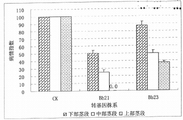
In the plant strain growth later stage, the Bb21 strain is that the disease index of plant cane bottom, middle part and upper interior portion tissue is respectively 50.0,25.0 and 0.0, compares with non-transgenic contrast (100.0), and difference is (P<0.01) extremely significantly.Reach 87.5 though the Bb23 strain is the disease index of plant bottom, compare with 100 of contrast, difference is not remarkable, and the disease index at its top and middle part (the 37.5 and 50.0) utmost point is markedly inferior to contrast (100.0) (Figure 14).The non-transgenic adjoining tree growth blade in early stage of inoculation all comes off and is dead, and each position of interior tissue all serious browning occurred because of infecting of verticillium wilt pathogen after this part plant was cutd open bar.And transfer-gen plant at later stages just the center vascular tissue illness is arranged, xylem does not partly have browning phenomenon (Figure 15) on every side.
The strain of Bbchit1 transgene cotton is the illness explanation of disease index, plant leaf illness and the stem inside of plant in the greenhouse, and Bbchit1 gene constitutive expression in cotton can obviously improve the resistance of cotton to the defoliation verticillium.
The T 11.2 transgene cotton isozygotys
3For the resistance of strain system to non-defoliation verticillium
Non-defoliation verticillium wilt pathogen spore 30d is inoculated in the greenhouse, and the disease index of Bb21 and Bb23 is respectively 19.1 and 24.6, compares with the disease index 94.3 of non-transgenic cotton contrast, and difference all reaches utmost point conspicuous level (P<0.01) (Figure 16).Inoculation 30d, the adjoining tree blade all has tangible illness, and disease-resistant plant does not have notable difference (Figure 17) with inoculation contrast.In the plant strain growth later stage, the disease index of adjoining tree the lower portion of the stem, middle part and upper interior portion tissue is respectively 100.0,92.1 and 89.4; The Bb21 strain be plant then be respectively 26.4,10.3 and 3.9, all extremely significantly be lower than non-transgenic inoculation contrast (P<0.01) (Figure 18).The xylem of adjoining tree stem inside has been all because of serious browning has appearred in infecting of verticillium wilt pathogen, and the disease-resistant plant of transgenosis to be the center vascular tissue have a little brown spot to produce (Figure 19).
Behind the non-defoliation verticillium wilt pathogen of inoculation, the strain of Bbchit1 transgene cotton is that the illness of disease index, plant leaf illness and the stem inside of plant shows in the greenhouse: constitutive expression Bbchit1 gene can effectively improve the resistance of cotton to non-defoliation verticillium in the cotton.
Above-mentioned embodiment shows that the present invention utilizes beauveria bassiana chitinase gene Bbchit1 to improve the method for disease resistance of plant, can realize Bbchit1 gene constitutive expression in transgenic plant, effectively improves the resistance of transfer-gen plant to fungal disease.The transgene cotton that obtains through the present invention can improve the resistance to defoliation and non-defoliation verticillium simultaneously.The inventive method is simple and easy to do, and effect is remarkable, has good market outlook.
Sequence table
Sequence 1Bbchit1 gene nucleotide series, long 1047bp
1 ATGGCTCCTT?TTCTTCAAAC?CAGCCTCGCG?CTCCTTCCAT?TGTTGGCTTC?CACCATGGTC
61 AGCGCCTCGC?CCTTGGCGCC?GCGAGCCGGC?ACCTGCGCCA?CCAAAGGCCG?GCCGGCCGGC
121 AAAGTGCTCC?AGGGCTACTG?GGAGAACTGG?GACGGTGCCA?AGAACGGGGT?GCACCCTCCG
181 TTTGGCTGGA?CGCCCATCCA?AAACCCCGAC?ATTCGCAAGC?ACGGCTACAA?CGTCATCAAT
241 GCTGCCTTTC?CCATCATCCA?GCCTGACGGC?ACCGCGCTCT?GGGAGGACGG?CATGGACACG
301 GGCGTCAAGG?TGGCGAGCCC?GGCCGACATG?TGCGAGGCCA?AGGCAGCAGG?TGCCACCATC
361 TTGATGTCGA?TTGGCGGTGC?TACTGCGGCC?ATTGACCTGA?GCTCGTCGGC?TGTGGCTGAC
421 AAGTTTGTCT?CGACCATTGT?GCCGATTCTG?AAAAAGTACA?ACTTTGACGG?CATTGATATC
481 GACATTGAAT?CCGGCCTCAC?AGGCAGCGGA?AACATAAACA?CCCTGTCCAC?CTCGCAGACC
541 AACCTGATTA?GAATCATTGA?CGGCGTTCTC?GCGCAGATGC?CCGCCAACTT?TGGCTTGACC
601 ATGGCGCCAG?AGACTGCCTA?CGTTACCGGT?GGGACTATTA?CGTACGGATC?AATCTGGGGC
661 TCTTACCTCC?CCATTATCAA?AAAGTACCTG?GACAATGGTC?GTCTCTGGTG?GCTCAACATG
721 CAGTACTACA?ATGGCGAAAT?GTACGGCTGC?TCCGGCGACT?CGCACAAGGC?CGGTACTGTC
781 GAAGGATTCA?TTGCTCAGAC?CGACTGCCTG?AACAAGGGAC?TTAGTATTCA?GGGCGTGACA
841 ATCACGATTC?CCTATGACAA?GCAAGTGCCT?GGCCTTCCTG?CCCAGCCTGG?GGCTGGCGGC
901 GGCCACATGT?CCCCGTCCAA?CGTGGCGCAA?GTTCTCTCCC?ACTACAAGGG?CGCTTTGAAG
961 GGATTGATGA?CTTGGTCTCT?GAACTGGGAC?GGCTCCAAGA?ATTGGACATT?TGGCGACAAT
1021?GTCAAGGGGA?CTTTGGGGAC?TGCGTAA
Sequence 2: Bbchit1 gene amplification primer 1 in the transfer-gen plant
5’-TGC?ACA?ATG?CTG?ATC?GCG-3’
Sequence 3: Bbchit1 gene amplification primer 2 in the transfer-gen plant
5’-TGG?CAA?GCG?TTT?TCA?GGC-3’
Sequence 4: GhHIS3 gene amplification primer 1 in the transfer-gen plant
5’-GAA?GCC?TCA?TCG?ATA?CCG?TC-3’
Sequence 5: GhHIS3 gene amplification primer 2 in the transfer-gen plant
5’-CTA?CCA?CTA?CCA?TCA?TGG?C-3
Sequence 6: Bbchit1 gene amplification primer 1 in the genome
5’-CGG?GGT?ACC?ATG?GCT?CCT?TTT?CTT?CAA?ACC?A-3’
Sequence 7: Bbchit1 gene amplification primer 2 in the genome
5’-CG?GAA?TTC?TTA?CGC?AGT?CCC?CAA?AGT?CCC?CTT-3’