CN101622234A - Bicyclic organic compounds suitable for the treatment of inflammatory or allergic conditions - Google Patents
Bicyclic organic compounds suitable for the treatment of inflammatory or allergic conditions Download PDFInfo
- Publication number
- CN101622234A CN101622234A CN200880007015A CN200880007015A CN101622234A CN 101622234 A CN101622234 A CN 101622234A CN 200880007015 A CN200880007015 A CN 200880007015A CN 200880007015 A CN200880007015 A CN 200880007015A CN 101622234 A CN101622234 A CN 101622234A
- Authority
- CN
- China
- Prior art keywords
- alkyl
- group
- groups
- nitrogen
- oxygen
- Prior art date
- Legal status (The legal status is an assumption and is not a legal conclusion. Google has not performed a legal analysis and makes no representation as to the accuracy of the status listed.)
- Granted
Links
Classifications
-
- C—CHEMISTRY; METALLURGY
- C07—ORGANIC CHEMISTRY
- C07D—HETEROCYCLIC COMPOUNDS
- C07D495/00—Heterocyclic compounds containing in the condensed system at least one hetero ring having sulfur atoms as the only ring hetero atoms
- C07D495/12—Heterocyclic compounds containing in the condensed system at least one hetero ring having sulfur atoms as the only ring hetero atoms in which the condensed system contains three hetero rings
- C07D495/14—Ortho-condensed systems
-
- A—HUMAN NECESSITIES
- A61—MEDICAL OR VETERINARY SCIENCE; HYGIENE
- A61K—PREPARATIONS FOR MEDICAL, DENTAL OR TOILETRY PURPOSES
- A61K31/00—Medicinal preparations containing organic active ingredients
- A61K31/33—Heterocyclic compounds
- A61K31/395—Heterocyclic compounds having nitrogen as a ring hetero atom, e.g. guanethidine or rifamycins
- A61K31/495—Heterocyclic compounds having nitrogen as a ring hetero atom, e.g. guanethidine or rifamycins having six-membered rings with two or more nitrogen atoms as the only ring heteroatoms, e.g. piperazine or tetrazines
- A61K31/505—Pyrimidines; Hydrogenated pyrimidines, e.g. trimethoprim
- A61K31/517—Pyrimidines; Hydrogenated pyrimidines, e.g. trimethoprim ortho- or peri-condensed with carbocyclic ring systems, e.g. quinazoline, perimidine
-
- A—HUMAN NECESSITIES
- A61—MEDICAL OR VETERINARY SCIENCE; HYGIENE
- A61P—SPECIFIC THERAPEUTIC ACTIVITY OF CHEMICAL COMPOUNDS OR MEDICINAL PREPARATIONS
- A61P11/00—Drugs for disorders of the respiratory system
-
- A—HUMAN NECESSITIES
- A61—MEDICAL OR VETERINARY SCIENCE; HYGIENE
- A61P—SPECIFIC THERAPEUTIC ACTIVITY OF CHEMICAL COMPOUNDS OR MEDICINAL PREPARATIONS
- A61P11/00—Drugs for disorders of the respiratory system
- A61P11/06—Antiasthmatics
-
- A—HUMAN NECESSITIES
- A61—MEDICAL OR VETERINARY SCIENCE; HYGIENE
- A61P—SPECIFIC THERAPEUTIC ACTIVITY OF CHEMICAL COMPOUNDS OR MEDICINAL PREPARATIONS
- A61P27/00—Drugs for disorders of the senses
- A61P27/02—Ophthalmic agents
-
- A—HUMAN NECESSITIES
- A61—MEDICAL OR VETERINARY SCIENCE; HYGIENE
- A61P—SPECIFIC THERAPEUTIC ACTIVITY OF CHEMICAL COMPOUNDS OR MEDICINAL PREPARATIONS
- A61P29/00—Non-central analgesic, antipyretic or antiinflammatory agents, e.g. antirheumatic agents; Non-steroidal antiinflammatory drugs [NSAID]
-
- A—HUMAN NECESSITIES
- A61—MEDICAL OR VETERINARY SCIENCE; HYGIENE
- A61P—SPECIFIC THERAPEUTIC ACTIVITY OF CHEMICAL COMPOUNDS OR MEDICINAL PREPARATIONS
- A61P31/00—Antiinfectives, i.e. antibiotics, antiseptics, chemotherapeutics
-
- A—HUMAN NECESSITIES
- A61—MEDICAL OR VETERINARY SCIENCE; HYGIENE
- A61P—SPECIFIC THERAPEUTIC ACTIVITY OF CHEMICAL COMPOUNDS OR MEDICINAL PREPARATIONS
- A61P35/00—Antineoplastic agents
-
- A—HUMAN NECESSITIES
- A61—MEDICAL OR VETERINARY SCIENCE; HYGIENE
- A61P—SPECIFIC THERAPEUTIC ACTIVITY OF CHEMICAL COMPOUNDS OR MEDICINAL PREPARATIONS
- A61P37/00—Drugs for immunological or allergic disorders
-
- A—HUMAN NECESSITIES
- A61—MEDICAL OR VETERINARY SCIENCE; HYGIENE
- A61P—SPECIFIC THERAPEUTIC ACTIVITY OF CHEMICAL COMPOUNDS OR MEDICINAL PREPARATIONS
- A61P37/00—Drugs for immunological or allergic disorders
- A61P37/08—Antiallergic agents
-
- A—HUMAN NECESSITIES
- A61—MEDICAL OR VETERINARY SCIENCE; HYGIENE
- A61P—SPECIFIC THERAPEUTIC ACTIVITY OF CHEMICAL COMPOUNDS OR MEDICINAL PREPARATIONS
- A61P43/00—Drugs for specific purposes, not provided for in groups A61P1/00-A61P41/00
-
- C—CHEMISTRY; METALLURGY
- C07—ORGANIC CHEMISTRY
- C07D—HETEROCYCLIC COMPOUNDS
- C07D215/00—Heterocyclic compounds containing quinoline or hydrogenated quinoline ring systems
- C07D215/02—Heterocyclic compounds containing quinoline or hydrogenated quinoline ring systems having no bond between the ring nitrogen atom and a non-ring member or having only hydrogen atoms or carbon atoms directly attached to the ring nitrogen atom
- C07D215/16—Heterocyclic compounds containing quinoline or hydrogenated quinoline ring systems having no bond between the ring nitrogen atom and a non-ring member or having only hydrogen atoms or carbon atoms directly attached to the ring nitrogen atom with hetero atoms or with carbon atoms having three bonds to hetero atoms with at the most one bond to halogen, e.g. ester or nitrile radicals, directly attached to ring carbon atoms
- C07D215/36—Sulfur atoms
-
- C—CHEMISTRY; METALLURGY
- C07—ORGANIC CHEMISTRY
- C07D—HETEROCYCLIC COMPOUNDS
- C07D239/00—Heterocyclic compounds containing 1,3-diazine or hydrogenated 1,3-diazine rings
- C07D239/02—Heterocyclic compounds containing 1,3-diazine or hydrogenated 1,3-diazine rings not condensed with other rings
- C07D239/24—Heterocyclic compounds containing 1,3-diazine or hydrogenated 1,3-diazine rings not condensed with other rings having three or more double bonds between ring members or between ring members and non-ring members
- C07D239/28—Heterocyclic compounds containing 1,3-diazine or hydrogenated 1,3-diazine rings not condensed with other rings having three or more double bonds between ring members or between ring members and non-ring members with hetero atoms or with carbon atoms having three bonds to hetero atoms with at the most one bond to halogen, directly attached to ring carbon atoms
- C07D239/46—Two or more oxygen, sulphur or nitrogen atoms
- C07D239/52—Two oxygen atoms
- C07D239/54—Two oxygen atoms as doubly bound oxygen atoms or as unsubstituted hydroxy radicals
-
- C—CHEMISTRY; METALLURGY
- C07—ORGANIC CHEMISTRY
- C07D—HETEROCYCLIC COMPOUNDS
- C07D239/00—Heterocyclic compounds containing 1,3-diazine or hydrogenated 1,3-diazine rings
- C07D239/70—Heterocyclic compounds containing 1,3-diazine or hydrogenated 1,3-diazine rings condensed with carbocyclic rings or ring systems
- C07D239/72—Quinazolines; Hydrogenated quinazolines
- C07D239/78—Quinazolines; Hydrogenated quinazolines with hetero atoms directly attached in position 2
- C07D239/80—Oxygen atoms
-
- C—CHEMISTRY; METALLURGY
- C07—ORGANIC CHEMISTRY
- C07D—HETEROCYCLIC COMPOUNDS
- C07D239/00—Heterocyclic compounds containing 1,3-diazine or hydrogenated 1,3-diazine rings
- C07D239/70—Heterocyclic compounds containing 1,3-diazine or hydrogenated 1,3-diazine rings condensed with carbocyclic rings or ring systems
- C07D239/72—Quinazolines; Hydrogenated quinazolines
- C07D239/95—Quinazolines; Hydrogenated quinazolines with hetero atoms directly attached in positions 2 and 4
- C07D239/96—Two oxygen atoms
-
- C—CHEMISTRY; METALLURGY
- C07—ORGANIC CHEMISTRY
- C07D—HETEROCYCLIC COMPOUNDS
- C07D401/00—Heterocyclic compounds containing two or more hetero rings, having nitrogen atoms as the only ring hetero atoms, at least one ring being a six-membered ring with only one nitrogen atom
- C07D401/02—Heterocyclic compounds containing two or more hetero rings, having nitrogen atoms as the only ring hetero atoms, at least one ring being a six-membered ring with only one nitrogen atom containing two hetero rings
- C07D401/12—Heterocyclic compounds containing two or more hetero rings, having nitrogen atoms as the only ring hetero atoms, at least one ring being a six-membered ring with only one nitrogen atom containing two hetero rings linked by a chain containing hetero atoms as chain links
-
- C—CHEMISTRY; METALLURGY
- C07—ORGANIC CHEMISTRY
- C07D—HETEROCYCLIC COMPOUNDS
- C07D403/00—Heterocyclic compounds containing two or more hetero rings, having nitrogen atoms as the only ring hetero atoms, not provided for by group C07D401/00
- C07D403/02—Heterocyclic compounds containing two or more hetero rings, having nitrogen atoms as the only ring hetero atoms, not provided for by group C07D401/00 containing two hetero rings
- C07D403/06—Heterocyclic compounds containing two or more hetero rings, having nitrogen atoms as the only ring hetero atoms, not provided for by group C07D401/00 containing two hetero rings linked by a carbon chain containing only aliphatic carbon atoms
-
- C—CHEMISTRY; METALLURGY
- C07—ORGANIC CHEMISTRY
- C07D—HETEROCYCLIC COMPOUNDS
- C07D403/00—Heterocyclic compounds containing two or more hetero rings, having nitrogen atoms as the only ring hetero atoms, not provided for by group C07D401/00
- C07D403/02—Heterocyclic compounds containing two or more hetero rings, having nitrogen atoms as the only ring hetero atoms, not provided for by group C07D401/00 containing two hetero rings
- C07D403/12—Heterocyclic compounds containing two or more hetero rings, having nitrogen atoms as the only ring hetero atoms, not provided for by group C07D401/00 containing two hetero rings linked by a chain containing hetero atoms as chain links
-
- C—CHEMISTRY; METALLURGY
- C07—ORGANIC CHEMISTRY
- C07D—HETEROCYCLIC COMPOUNDS
- C07D405/00—Heterocyclic compounds containing both one or more hetero rings having oxygen atoms as the only ring hetero atoms, and one or more rings having nitrogen as the only ring hetero atom
- C07D405/02—Heterocyclic compounds containing both one or more hetero rings having oxygen atoms as the only ring hetero atoms, and one or more rings having nitrogen as the only ring hetero atom containing two hetero rings
- C07D405/12—Heterocyclic compounds containing both one or more hetero rings having oxygen atoms as the only ring hetero atoms, and one or more rings having nitrogen as the only ring hetero atom containing two hetero rings linked by a chain containing hetero atoms as chain links
-
- C—CHEMISTRY; METALLURGY
- C07—ORGANIC CHEMISTRY
- C07D—HETEROCYCLIC COMPOUNDS
- C07D417/00—Heterocyclic compounds containing two or more hetero rings, at least one ring having nitrogen and sulfur atoms as the only ring hetero atoms, not provided for by group C07D415/00
- C07D417/02—Heterocyclic compounds containing two or more hetero rings, at least one ring having nitrogen and sulfur atoms as the only ring hetero atoms, not provided for by group C07D415/00 containing two hetero rings
- C07D417/12—Heterocyclic compounds containing two or more hetero rings, at least one ring having nitrogen and sulfur atoms as the only ring hetero atoms, not provided for by group C07D415/00 containing two hetero rings linked by a chain containing hetero atoms as chain links
-
- C—CHEMISTRY; METALLURGY
- C07—ORGANIC CHEMISTRY
- C07D—HETEROCYCLIC COMPOUNDS
- C07D471/00—Heterocyclic compounds containing nitrogen atoms as the only ring hetero atoms in the condensed system, at least one ring being a six-membered ring with one nitrogen atom, not provided for by groups C07D451/00 - C07D463/00
- C07D471/02—Heterocyclic compounds containing nitrogen atoms as the only ring hetero atoms in the condensed system, at least one ring being a six-membered ring with one nitrogen atom, not provided for by groups C07D451/00 - C07D463/00 in which the condensed system contains two hetero rings
- C07D471/04—Ortho-condensed systems
-
- C—CHEMISTRY; METALLURGY
- C07—ORGANIC CHEMISTRY
- C07D—HETEROCYCLIC COMPOUNDS
- C07D495/00—Heterocyclic compounds containing in the condensed system at least one hetero ring having sulfur atoms as the only ring hetero atoms
- C07D495/02—Heterocyclic compounds containing in the condensed system at least one hetero ring having sulfur atoms as the only ring hetero atoms in which the condensed system contains two hetero rings
- C07D495/04—Ortho-condensed systems
Landscapes
- Chemical & Material Sciences (AREA)
- Organic Chemistry (AREA)
- Health & Medical Sciences (AREA)
- Veterinary Medicine (AREA)
- General Health & Medical Sciences (AREA)
- Medicinal Chemistry (AREA)
- Public Health (AREA)
- Pharmacology & Pharmacy (AREA)
- Life Sciences & Earth Sciences (AREA)
- Animal Behavior & Ethology (AREA)
- General Chemical & Material Sciences (AREA)
- Chemical Kinetics & Catalysis (AREA)
- Nuclear Medicine, Radiotherapy & Molecular Imaging (AREA)
- Bioinformatics & Cheminformatics (AREA)
- Engineering & Computer Science (AREA)
- Pulmonology (AREA)
- Immunology (AREA)
- Oncology (AREA)
- Communicable Diseases (AREA)
- Pain & Pain Management (AREA)
- Rheumatology (AREA)
- Ophthalmology & Optometry (AREA)
- Epidemiology (AREA)
- Pharmaceuticals Containing Other Organic And Inorganic Compounds (AREA)
- Plural Heterocyclic Compounds (AREA)
- Nitrogen Condensed Heterocyclic Rings (AREA)
- Heterocyclic Carbon Compounds Containing A Hetero Ring Having Oxygen Or Sulfur (AREA)
Abstract
Description
本发明涉及有机化合物、它们的制备和它们作为药物的用途。The present invention relates to organic compounds, their preparation and their use as medicines.
在第一方面,本发明提供了游离或盐形式的式(I)化合物:In a first aspect, the present invention provides a compound of formula (I) in free or salt form:

其中:in:
Q选自CH2、C(O)和C(S);Q is selected from CH2 , C(O) and C(S);
Qa和Qb独立地选自N和CH; Qa and Qb are independently selected from N and CH;

R1选自任选被-OH、卤素、CN、O-C1-C8-烷基、NR1cR1d、羧基-C1-C8-烷基和COOH取代的C1-C8-烷基,-C(R1aR1b)mC(O)CR1cR1dR1e,-C(R1aR1b)mC(O)NR1cR1d,-C(R1aR1b)tNR1cR1d,C(R1aR1b)mCR1cR1dR1e,C(R1aR1b)mSO2R1f,C(R1aR1b)mSOR1g,和C(R1aR1b)mSR1h;R 1 is selected from C 1 -C 8 -alkyl optionally substituted by -OH, halogen, CN, OC 1 -C 8 -alkyl, NR 1c R 1d , carboxy-C 1 -C 8 -alkyl and COOH , -C(R 1a R 1b ) m C(O)CR 1c R 1d R 1e , -C(R 1a R 1b ) m C(O)NR 1c R 1d , -C(R 1a R 1b ) t NR 1c R 1d , C(R 1a R 1b ) m CR 1c R 1d R 1e , C(R 1a R 1b ) m SO 2 R 1f , C(R 1a R 1b ) m SOR 1g , and C(R 1a R 1b ) m SR 1h ;
R1f、R1g和R1h独立地选自C1-C8-烷基、C1-C8-羟烷基、C1-C8-烷基氨基(C1-C8-烷基)、二(C1-C8-烷基)氨基(C1-C8-烷基)、C1-C8-氰基烷基、C6-C15-芳香族碳环基团、C3-C15-碳环基团、C1-C8-卤代烷基和具有一个或多个选自氧、氮和硫的杂原子的4至10元杂环基团;R 1f , R 1g and R 1h are independently selected from C 1 -C 8 -alkyl, C 1 -C 8 -hydroxyalkyl, C 1 -C 8 -alkylamino(C 1 -C 8 -alkyl) , di(C 1 -C 8 -alkyl)amino(C 1 -C 8 -alkyl), C 1 -C 8 -cyanoalkyl, C 6 -C 15 -aromatic carbocyclic group, C 3 -C 15 -carbocyclic groups, C 1 -C 8 -haloalkyl groups and 4 to 10 membered heterocyclic groups with one or more heteroatoms selected from oxygen, nitrogen and sulfur;
R1a和R1b各自独立地选自H、-OH和任选被-OH和卤素取代的C1-C8-烷基;R 1a and R 1b are each independently selected from H, -OH and C 1 -C 8 -alkyl optionally substituted by -OH and halogen;
R1c和R1d独立地选自:H;R 1c and R 1d are independently selected from: H;
C6-C15-芳香族碳环基团、C7-C15-芳烷基、C3-C15-碳环基团、具有一个或多个选自氧、氮和硫的杂原子的4至15元杂环基团;C 6 -C 15 -aromatic carbocyclic group, C 7 -C 15 -aralkyl group, C 3 -C 15 -carbocyclic group, with one or more heteroatoms selected from oxygen, nitrogen and sulfur 4 to 15 membered heterocyclic groups;
C1-C8-烷氧基,任选被OH、-CN、卤素、NR4R5、C6-C15-芳香族碳环基团、C3-C15-碳环基团和具有一个或多个选自氧、氮和硫的杂原子的4至15元杂环基团所取代;C 1 -C 8 -alkoxy, optionally OH, -CN, halogen, NR 4 R 5 , C 6 -C 15 -aromatic carbocyclic groups, C 3 -C 15 -carbocyclic groups and with Substituted by one or more 4- to 15-membered heterocyclic groups selected from heteroatoms of oxygen, nitrogen and sulfur;
C2-C8-链烯基,任选被-OH、-CN、卤素、NR4R5、C6-C15-芳香族碳环基团、C3-C15-碳环基团和具有一个或多个选自氧、氮和硫的杂原子的4至15元杂环基团所取代;C 2 -C 8 -alkenyl, optionally replaced by -OH, -CN, halogen, NR 4 R 5 , C 6 -C 15 -aromatic carbocyclic group, C 3 -C 15 -carbocyclic group and Substituted by a 4- to 15-membered heterocyclic group having one or more heteroatoms selected from oxygen, nitrogen and sulfur;
C2-C8-炔基,任选被-OH、-CN、卤素、NR4R5、C6-C15-芳香族碳环基团、C3-C15-碳环基团和具有一个或多个选自氧、氮和硫的杂原子的4至15元杂环基团所取代;和C 2 -C 8 -alkynyl, optionally replaced by -OH, -CN, halogen, NR 4 R 5 , C 6 -C 15 -aromatic carbocyclic group, C 3 -C 15 -carbocyclic group and with substituted by one or more heteroatoms selected from oxygen, nitrogen and sulfur with a 4 to 15 membered heterocyclic group; and
C1-C8-烷基,任选被-OH、-CN、卤素、NR4R5、C1-C8-烷氧基羰基、COOH、C6-C15-芳香族碳环基团、C3-C15-碳环基团和具有一个或多个选自氧、氮和硫的杂原子的4至15元杂环基团所取代;C 1 -C 8 -Alkyl, optionally replaced by -OH, -CN, halogen, NR 4 R 5 , C 1 -C 8 -alkoxycarbonyl, COOH, C 6 -C 15 -aromatic carbocyclic group , C 3 -C 15 -carbocyclic group and a 4 to 15-membered heterocyclic group with one or more heteroatoms selected from oxygen, nitrogen and sulfur are substituted;
R1e选自H和C1-C8-烷基;R 1e is selected from H and C 1 -C 8 -alkyl;
R3选自任选被-C(R3aR3b)nC(O)NR3cR3d或-C(R3aR3b)nC(O)OH取代的C6-C15-芳香族碳环基团,C7-C15-芳烷基,被C3-C15-碳环基团取代的C1-C8-烷基,C3-C15-碳环基团,具有一个或多个选自氧、氮和硫的杂原子的4至15元杂环基团,C1-C8-烷基氨基羰基,二(C1-C8-烷基)氨基羰基,C1-C8-烷基氨基,二(C1-C8-烷基)氨基,-C(R3aR3b)nC(O)NR3cR3d,和-C(R3aR3b)nC(O)OH;R 3 is selected from C 6 -C 15 -aromatic carbon optionally substituted by -C(R 3a R 3b ) n C(O)NR 3c R 3d or -C(R 3a R 3b ) n C(O)OH Cyclic groups, C 7 -C 15 -aralkyl groups, C 1 -C 8 -alkyl groups substituted by C 3 -C 15 -carbocyclic groups, C 3 -C 15 -carbocyclic groups, having one or A 4- to 15-membered heterocyclic group with a plurality of heteroatoms selected from oxygen, nitrogen and sulfur, C 1 -C 8 -alkylaminocarbonyl, di(C 1 -C 8 -alkyl)aminocarbonyl, C 1 - C 8 -alkylamino, di(C 1 -C 8 -alkyl)amino, -C(R 3a R 3b ) n C(O)NR 3c R 3d , and -C(R 3a R 3b ) n C( O)OH;
R3a和R3b独立地选自H、-OH和任选被-OH和卤素取代的C1-C8-烷基;R 3a and R 3b are independently selected from H, -OH and C 1 -C 8 -alkyl optionally substituted by -OH and halogen;
R3c和R3d独立地选自:H;R 3c and R 3d are independently selected from: H;
C6-C15-芳香族碳环基团、C3-C15-碳环基团,或者R3c和R3d与它们所连接的N一起形成具有一个或多个选自氧、氮和硫的杂原子的4至15元杂环基团;C 6 -C 15 -aromatic carbocyclic group, C 3 -C 15 -carbocyclic group, or R 3c and R 3d together with the N they are attached to form A 4- to 15-membered heterocyclic group of heteroatoms;
具有一个或多个选自氧、氮和硫的杂原子的4至15元杂环基团;A 4 to 15 membered heterocyclic group having one or more heteroatoms selected from oxygen, nitrogen and sulfur;
任选被C6-C15-芳香族碳环基团、C3-C15-碳环基团和具有一个或多个选自氧、氮和硫的杂原子的4至15元杂环基团所取代的C1-C8-烷氧基,任选被C6-C15-芳香族碳环基团、C3-C15-碳环基团和具有一个或多个选自氧、氮和硫的杂原子的4至15元杂环基团所取代的C1-C8-烷氧基羰基;和Optionally C 6 -C 15 -aromatic carbocyclic groups, C 3 -C 15 -carbocyclic groups and 4 to 15 membered heterocyclic groups having one or more heteroatoms selected from oxygen, nitrogen and sulfur C 1 -C 8 -alkoxy groups substituted by C 1 -C 8 -alkoxy groups, optionally by C 6 -C 15 -aromatic carbocyclic groups, C 3 -C 15 -carbocyclic groups and having one or more selected from oxygen, C 1 -C 8 -alkoxycarbonyl substituted by a 4- to 15-membered heterocyclic group of heteroatoms of nitrogen and sulfur; and
C1-C8-烷基,任选被-OH、-CN、卤素、NR4R5、C6-C15-芳香族碳环基团、C3-C15-碳环基团和具有一个或多个选自氧、氮和硫的杂原子的4至15元杂环基团所取代;C 1 -C 8 -Alkyl, optionally replaced by -OH, -CN, halogen, NR 4 R 5 , C 6 -C 15 -aromatic carbocyclic group, C 3 -C 15 -carbocyclic group and with Substituted by one or more 4- to 15-membered heterocyclic groups selected from heteroatoms of oxygen, nitrogen and sulfur;
R4和R5独立地选自H和C1-C8-烷基;R 4 and R 5 are independently selected from H and C 1 -C 8 -alkyl;
m和n独立地选自整数0、1、2和3;且m and n are independently selected from the integers 0, 1, 2 and 3; and
t是选自1、2和3的整数;t is an integer selected from 1, 2 and 3;
其中,除非另有说明,所述的C6-C15-芳香族碳环基团、C7-C15-芳烷基、C3-C15-碳环基团和具有一个或多个选自氧、氮和硫的杂原子的4至15元杂环基团各自任选被如下取代基所取代:C7-C15-芳烷基、C1-C8-烷基、CN、C1-C8-烷基磺酰基、C1-C8-卤代烷基磺酰基、卤素、C1-C8-烷氧基、OH、C1-C8-烷基羰基、-C(O)-C6-C15-芳香族碳环基团、-C(O)-C3-C15-碳环基团、-C(O)-具有一个或多个选自氧、氮和硫的杂原子的4至15元杂环基团、C1-C8-氰基烷基、C1-C8-氰基烷氧基、C1-C8-卤代烷基、C1-C8-卤代烷氧基、C1-C8-烷基氨基羰基、二(C1-C8-烷基)氨基羰基、C1-C8-烷基氨基、二(C1-C8-烷基)氨基、COOH、C1-C8-烷氧基羰基,任选被C7-C15-芳烷基、C1-C8-烷基、CN、C1-C8-烷基磺酰基、C1-C8-卤代烷基磺酰基、卤素、C1-C8-烷氧基、OH、C1-C8-烷基羰基、C1-C8-氰基烷基、C1-C8-氰基烷氧基、C1-C8-卤代烷基、C1-C8-卤代烷氧基、C1-C8-烷基氨基羰基、二(C1-C8-烷基)氨基羰基、C1-C8-烷基氨基、二(C1-C8-烷基)氨基、COOH或C1-C8-烷氧基羰基所取代的具有一个或多个选自氧、氮和硫的杂原子的4至15元杂环基团,任选被C7-C15-芳烷基、C1-C8-烷基、CN、卤素、C1-C8-烷氧基、OH、C1-C8-烷基羰基、C1-C8-烷基氨基羰基、二(C1-C8-烷基)氨基羰基、C1-C8-烷基氨基、二(C1-C8-烷基)氨基、COOH、CF3或C1-C8-烷氧基羰基所取代的C6-C15-芳香族碳环基团,或者任选被C7-C15-芳烷基、C1-C8-烷基、CN、卤素、C1-C8-烷氧基、OH、C1-C8-烷基羰基、C1-C8-烷基氨基羰基、二(C1-C8-烷基)氨基羰基、C1-C8-烷基氨基、二(C1-C8-烷基)氨基、COOH、CF3或C1-C8-烷氧基羰基所取代的C3-C15-碳环基团,Wherein, unless otherwise specified, the C 6 -C 15 -aromatic carbocyclic group, C 7 -C 15 -aralkyl group, C 3 -C 15 -carbocyclic group and one or more optional The 4- to 15-membered heterocyclic radicals from heteroatoms of oxygen, nitrogen and sulfur are each optionally substituted by the following substituents: C 7 -C 15 -aralkyl, C 1 -C 8 -alkyl, CN, C 1 -C 8 -Alkylsulfonyl, C 1 -C 8 -Haloalkylsulfonyl, Halogen, C 1 -C 8 -Alkoxy, OH, C 1 -C 8 -Alkylcarbonyl, -C(O) -C 6 -C 15 -aromatic carbocyclic group, -C(O)-C 3 -C 15 -carbocyclic group, -C(O)-has one or more selected from oxygen, nitrogen and sulfur 4- to 15-membered heterocyclic group of heteroatoms, C 1 -C 8 -cyanoalkyl, C 1 -C 8 -cyanoalkoxy, C 1 -C 8 -haloalkyl, C 1 -C 8 - Haloalkoxy, C 1 -C 8 -alkylaminocarbonyl, di(C 1 -C 8 -alkyl)aminocarbonyl, C 1 -C 8 -alkylamino, di(C 1 -C 8 -alkyl) Amino, COOH, C 1 -C 8 -alkoxycarbonyl, optionally replaced by C 7 -C 15 -aralkyl, C 1 -C 8 -alkyl, CN, C 1 -C 8 -alkylsulfonyl, C 1 -C 8 -haloalkylsulfonyl, halogen, C 1 -C 8 -alkoxy, OH, C 1 -C 8 -alkylcarbonyl, C 1 -C 8 -cyanoalkyl, C 1 -C 8 -cyanoalkoxy, C 1 -C 8 -haloalkyl, C 1 -C 8 -haloalkoxy, C 1 -C 8 -alkylaminocarbonyl, di(C 1 -C 8 -alkyl)amino Carbonyl, C 1 -C 8 -alkylamino, di(C 1 -C 8 -alkyl)amino, COOH or C 1 -C 8 -alkoxycarbonyl substituted with one or more selected from oxygen, nitrogen 4- to 15-membered heterocyclic radicals of heteroatoms of sulfur and optionally C 7 -C 15 -aralkyl, C 1 -C 8 -alkyl, CN, halogen, C 1 -C 8 -alkoxy , OH, C 1 -C 8 -alkylcarbonyl, C 1 -C 8 -alkylaminocarbonyl, di(C 1 -C 8 -alkyl)aminocarbonyl, C 1 -C 8 -alkylamino, di( C 1 -C 8 -alkyl)amino, COOH, CF 3 or C 1 -C 8 -alkoxycarbonyl substituted C 6 -C 15 -aromatic carbocyclic groups, or optionally by C 7 -C 15 -Aralkyl, C 1 -C 8 -alkyl, CN, halogen, C 1 -C 8 -alkoxy, OH, C 1 -C 8 -alkylcarbonyl, C 1 -C 8 -alkylamino Carbonyl, di(C 1 -C 8 -alkyl)aminocarbonyl, C 1 -C 8 -alkylamino, di(C 1 -C 8 -alkyl)amino, COOH, CF 3 or C 1 -C 8 - C 3 -C 15 -carbocyclic radicals substituted by alkoxycarbonyl,
条件是所述的式(I)化合物不是3-{1-[(5-氯-2-甲氧基-苯基氨甲酰基)-甲基]-2,4-二氧代-1,4-二氢-2H-喹唑啉-3-基}-N-环戊基-丙酰胺、N-(5-氯-2,4-二甲氧基-苯基)-2-[2,4-二氧代-3{[(四氢-呋喃-2-基甲基)-氨甲酰基]-甲基}-苯基)-3,4-二氢-2H-喹唑啉-1-基]-乙酰胺、4-{6-氯-1-[2-(3-氯-4-乙氧基-苯基)-2-氧代乙基]-2,4-二氧代-1,4-二氢-2H-喹唑啉-3-基}-N-环戊基-丁酰胺、2-{1-[(5-氯-2,4-二甲氧基-苯基氨甲酰基)-甲基]-2,4-二氧代-1,4-二氢-2H-喹唑啉-3-基}-N-呋喃-2-基甲基-乙酰胺、4-(2-{2,4-二氧代-3-[4-(苯乙基氨甲酰基-甲基)-苯基]-3,4-二氢-2H-喹唑啉-1-基}-乙酰氨基)-苯甲酸乙酯、N-(3,5-二氯-苯基)-2-{2,4-二氧代-3-[4-(苯乙基氨甲酰基-甲基)-苯基]-3,4-二氢-2H-喹唑啉-1-基}-乙酰胺、2-{1-[(4-氯-2-甲氧基-5-甲基-苯基氨甲酰基)-甲基]-2,4-二氧代-1,4-二氢-2H-喹唑啉-3-基}-N-环戊基-乙酰胺、2-{1-[(5-氯-2,4-二甲氧基-苯基氨甲酰基)-甲基]-2,4-二氧代-1,4-二氢-2H-喹唑啉-3-基}-N-苯乙基-乙酰胺和1-[(5-氯-2,4-二甲氧基-苯基氨甲酰基)-甲基]-2,4-二氧代-3-苯基-1,3,4,5,6,8-六氢-2H-吡啶并[4′,3′:4,5]噻吩并[2,d]嘧啶-7-甲酸乙酯。Provided that said compound of formula (I) is not 3-{1-[(5-chloro-2-methoxy-phenylcarbamoyl)-methyl]-2,4-dioxo-1,4 -Dihydro-2H-quinazolin-3-yl}-N-cyclopentyl-propionamide, N-(5-chloro-2,4-dimethoxy-phenyl)-2-[2,4 -Dioxo-3{[(tetrahydro-furan-2-ylmethyl)-carbamoyl]-methyl}-phenyl)-3,4-dihydro-2H-quinazolin-1-yl ]-acetamide, 4-{6-chloro-1-[2-(3-chloro-4-ethoxy-phenyl)-2-oxoethyl]-2,4-dioxo-1, 4-Dihydro-2H-quinazolin-3-yl}-N-cyclopentyl-butanamide, 2-{1-[(5-chloro-2,4-dimethoxy-phenylcarbamoyl )-methyl]-2,4-dioxo-1,4-dihydro-2H-quinazolin-3-yl}-N-furan-2-ylmethyl-acetamide, 4-(2- {2,4-dioxo-3-[4-(phenethylcarbamoyl-methyl)-phenyl]-3,4-dihydro-2H-quinazolin-1-yl}-acetylamino )-ethyl benzoate, N-(3,5-dichloro-phenyl)-2-{2,4-dioxo-3-[4-(phenethylcarbamoyl-methyl)-benzene base]-3,4-dihydro-2H-quinazolin-1-yl}-acetamide, 2-{1-[(4-chloro-2-methoxy-5-methyl-phenylaminomethyl Acyl)-methyl]-2,4-dioxo-1,4-dihydro-2H-quinazolin-3-yl}-N-cyclopentyl-acetamide, 2-{1-[(5 -Chloro-2,4-dimethoxy-phenylcarbamoyl)-methyl]-2,4-dioxo-1,4-dihydro-2H-quinazolin-3-yl}-N -Phenylethyl-acetamide and 1-[(5-chloro-2,4-dimethoxy-phenylcarbamoyl)-methyl]-2,4-dioxo-3-phenyl-1 , 3,4,5,6,8-Hexahydro-2H-pyrido[4',3':4,5]thieno[2,d]pyrimidine-7-carboxylic acid ethyl ester.
定义definition
说明书中所用的术语具有以下含义:The terms used in this specification have the following meanings:
如本文所用的“任选被取代”表示所指的基团可以在一个或多个位置上被其后所列的基团中的任意一个或任意组合所取代。"Optionally substituted" as used herein means that the indicated group may be substituted at one or more positions by any one or any combination of the groups listed thereafter.
“卤素”或“卤代(基)”可以是氟、氯、溴或碘;优选是溴或氯或氟。"Halogen" or "halo" may be fluorine, chlorine, bromine or iodine; preferably bromine or chlorine or fluorine.
“C1-C8-烷基”表示直链或支链C1-C8-烷基,它可以例如是甲基、乙基、正丙基、异丙基、正丁基、异丁基、仲丁基、叔丁基、直链或支链戊基、直链或支链己基、直链或支链庚基或者直链或支链辛基。"C 1 -C 8 -Alkyl" denotes straight chain or branched C 1 -C 8 -alkyl, which may be, for example, methyl, ethyl, n-propyl, isopropyl, n-butyl, isobutyl , sec-butyl, tert-butyl, straight or branched pentyl, straight or branched hexyl, straight or branched heptyl or straight or branched octyl.
如本文所用的“C3-C15-碳环基团”或“C5-C15-碳环基团”表示具有3至15个环碳原子的碳环基团,例如,单环基团,环脂肪族单环基团,例如C3-C8-环烷基和C5-C10-环烷基,如环丙基、环丁基、环戊基、环己基、环庚基或环辛基;或者二环基团,例如二环辛基、二环壬基和二环癸基、包括萘基。"C 3 -C 15 -carbocyclic group" or "C 5 -C 15 -carbocyclic group" as used herein denotes a carbocyclic group having 3 to 15 ring carbon atoms, for example, a monocyclic group , cycloaliphatic monocyclic radicals, such as C 3 -C 8 -cycloalkyl and C 5 -C 10 -cycloalkyl, such as cyclopropyl, cyclobutyl, cyclopentyl, cyclohexyl, cycloheptyl or Cyclooctyl; or bicyclic groups such as bicyclooctyl, bicyclononyl and bicyclodecyl, including naphthyl.
如本文所用的“C6-C15-芳香族碳环基团”表示具有6至15个环碳原子的芳香族基团,例如苯基、亚苯基、次苯基(benzenetriyl)、萘基、亚萘基或次萘基(naphthalenetriyl)。"C 6 -C 15 -aromatic carbocyclic group" as used herein denotes an aromatic group having 6 to 15 ring carbon atoms, for example phenyl, phenylene, benzenetriyl, naphthyl , naphthylene or naphthyl (naphthalenetriyl).
“C1-C8-烷氧基”表示直链或支链C1-C8-烷氧基,它可以例如是甲氧基、乙氧基、正丙氧基、异丙氧基、正丁氧基、异丁氧基、仲丁氧基、叔丁氧基、直链或支链戊氧基、直链或支链己氧基、直链或支链庚氧基或者直链或支链辛氧基。优选C1-C8-烷氧基是C1-C4-烷氧基。"C 1 -C 8 -alkoxy" denotes straight-chain or branched C 1 -C 8 -alkoxy, which may be, for example, methoxy, ethoxy, n-propoxy, isopropoxy, n- Butoxy, isobutoxy, sec-butoxy, tert-butoxy, straight or branched pentyloxy, straight or branched hexyloxy, straight or branched heptyloxy or straight or branched chain octyloxy. Preferably C 1 -C 8 -alkoxy is C 1 -C 4 -alkoxy.
“C1-C8-卤代烷基”和“C1-C8-卤代烷氧基”表示被一个或多个卤素原子、优选1、2或3个卤素原子所取代的如上文定义的C1-C8-烷基和C1-C8-烷氧基,所述卤素原子优选是氟、溴或氯原子。优选C1-C8-卤代烷基是被1、2或3个氟、溴或氯原子所取代的C1-C4-烷基。优选C1-C8-卤代烷氧基是被1、2或3个氟、溴或氯原子所取代的C1-C4-烷氧基。“C1-C8-羟烷基”表示被至少一个羟基所取代的如上文定义的C1-C8-烷基。"C 1 -C 8 -haloalkyl" and "C 1 -C 8 -haloalkoxy" represent C 1 - as defined above substituted by one or more halogen atoms, preferably 1, 2 or 3 halogen atoms C 8 -Alkyl and C 1 -C 8 -alkoxy, the halogen atom is preferably a fluorine, bromine or chlorine atom. Preferably C 1 -C 8 -haloalkyl is C 1 -C 4 -alkyl substituted by 1, 2 or 3 fluorine, bromine or chlorine atoms. Preferably C 1 -C 8 -haloalkoxy is C 1 -C 4 -alkoxy substituted by 1, 2 or 3 fluorine, bromine or chlorine atoms. "C 1 -C 8 -hydroxyalkyl" denotes a C 1 -C 8 -alkyl group as defined above, substituted by at least one hydroxy group.
“C1-C8-氰基烷基”表示被至少一个氰基所取代的如上文定义的C1-C8-烷基。"C 1 -C 8 -cyanoalkyl" denotes a C 1 -C 8 -alkyl group as defined above substituted by at least one cyano group.
“C1-C8-氰基烷氧基”表示被至少一个氰基所取代的如上文定义的C1-C8-烷氧基。"C 1 -C 8 -cyanoalkoxy" denotes a C 1 -C 8 -alkoxy group as defined above substituted by at least one cyano group.
如本文所用的“C1-C8-烷基磺酰基”表示与-SO2-连接的如上文定义的C1-C8-烷基。优选C1-C8-烷基磺酰基是C1-C4-烷基磺酰基。"C 1 -C 8 -alkylsulfonyl" as used herein denotes a C 1 -C 8 -alkyl group as defined above attached to -SO 2 -. Preferably C 1 -C 8 -alkylsulfonyl is C 1 -C 4 -alkylsulfonyl.
如本文所用的“C1-C8-卤代烷基磺酰基”表示与-SO2-连接的如上文定义的C1-C8-卤代烷基。优选C1-C8-卤代烷基磺酰基是C1-C4-卤代烷基磺酰基,尤其是三氟甲基磺酰基。"C 1 -C 8 -haloalkylsulfonyl" as used herein denotes a C 1 -C 8 -haloalkyl as defined above attached to -SO 2 -. Preferred C 1 -C 8 -haloalkylsulfonyl is C 1 -C 4 -haloalkylsulfonyl, especially trifluoromethylsulfonyl.
“氨基-C1-C8-烷基”和“氨基-C1-C8-烷氧基”分别表示通过氮原子与如上文定义的C1-C8-烷基连接的氨基如NH2-(C1-C8)-或者与如上文定义的C1-C8-烷氧基连接的氨基如NH2-(C1-C8)-O-。优选氨基-C1-C8-烷基和氨基-C1-C8-烷氧基分别是氨基-C1-C4-烷基和氨基-C1-C4-烷氧基。"Amino-C 1 -C 8 -alkyl" and "amino- C 1 -C 8 -alkoxy" respectively denote an amino group such as NH 2 attached via a nitrogen atom to a C 1 -C 8 -alkyl group as defined above -(C 1 -C 8 )- or amino linked to C 1 -C 8 -alkoxy as defined above such as NH 2 -(C 1 -C 8 )-O-. Preferred amino-C 1 -C 8 -alkyl and amino- C 1 -C 8 -alkoxy groups are amino-C 1 -C 4 -alkyl and amino-C 1 -C 4 -alkoxy, respectively.
“C1-C8-烷基氨基”和“二(C1-C8-烷基)氨基”表示分别被一个或两个如上文定义的C1-C8-烷基所取代的氨基,所述的C1-C8-烷基可以相同或不同。优选C1-C8-烷基氨基和二(C1-C8-烷基)氨基分别是C1-C4-烷基氨基和二(C1-C4-烷基)氨基。"C 1 -C 8 -alkylamino" and "di(C 1 -C 8 -alkyl)amino" represent amino groups which are respectively substituted by one or two C 1 -C 8 -alkyl groups as defined above, The C 1 -C 8 -alkyl groups can be identical or different. Preferably C 1 -C 8 -alkylamino and di(C 1 -C 8 -alkyl)amino are C 1 -C 4 -alkylamino and di(C 1 -C 4 -alkyl)amino, respectively.
“氨基-(羟基)-C1-C8-烷基”表示通过氮原子与C1-C8-烷基连接的氨基和通过氧原子与同一C1-C8-烷基连接的羟基。优选氨基-(羟基)-C1-C8-烷基是氨基-(羟基)-C2-C4-烷基。"Amino-(hydroxy)-C 1 -C 8 -alkyl" denotes an amino group bound via a nitrogen atom to a C 1 -C 8 -alkyl group and a hydroxy group bound via an oxygen atom to the same C 1 -C 8 -alkyl group. Preferably amino-(hydroxy)-C 1 -C 8 -alkyl is amino-(hydroxy)-C 2 -C 4 -alkyl.
“羧基-C1-C8-烷基”和“羧基-C1-C8-烷氧基”分别表示通过碳原子与如上文定义的C1-C8-烷基或C1-C8-烷氧基连接的羧基。优选羧基-C1-C8-烷基和羧基-C1-C8-烷氧基分别是羧基-C1-C4-烷基和羧基-C1-C4-烷氧基。"Carboxy-C 1 -C 8 -alkyl" and "carboxy-C 1 -C 8 -alkoxy" respectively denote a combination of C 1 -C 8 -alkyl or C 1 -C 8 as defined above through a carbon atom - an alkoxy-linked carboxyl group. Preferably carboxy-C 1 -C 8 -alkyl and carboxy-C 1 -C 8 -alkoxy are carboxy-C 1 -C 4 -alkyl and carboxy-C 1 -C 4 -alkoxy, respectively.
“C1-C8-烷基羰基”、“C1-C8-烷氧基羰基”和“C1-C8-卤代烷基羰基”分别表示通过碳原子与羰基连接的如上文定义的C1-C8-烷基、C1-C8-烷氧基或C1-C8-卤代烷基。“C1-C8-烷氧基羰基”表示其中烷氧基的氧与羰基碳连接的如上文定义的C1-C8-烷氧基。优选C1-C8-烷基羰基、C1-C8-烷氧基羰基和C1-C8-卤代烷基羰基分别是C1-C4-烷基羰基、C1-C4-烷氧基羰基和C1-C4-卤代烷基羰基。"C 1 -C 8 -Alkylcarbonyl", "C 1 -C 8 -Alkoxycarbonyl" and "C 1 -C 8 -Haloalkylcarbonyl" respectively represent C as defined above attached via a carbon atom to a carbonyl group 1 -C 8 -Alkyl, C 1 -C 8 -alkoxy or C 1 -C 8 -haloalkyl. "C 1 -C 8 -alkoxycarbonyl" denotes a C 1 -C 8 -alkoxy group as defined above wherein the oxygen of the alkoxy group is attached to the carbonyl carbon. Preferably C 1 -C 8 -alkylcarbonyl, C 1 -C 8 -alkoxycarbonyl and C 1 -C 8 -haloalkylcarbonyl are respectively C 1 -C 4 -alkylcarbonyl, C 1 -C 4 -alk Oxycarbonyl and C 1 -C 4 -haloalkylcarbonyl.
“C1-C8-烷基氨基”和“二(C1-C8-烷基)氨基”表示通过碳原子与氨基连接的如上文定义的C1-C8-烷基。二(C1-C8-烷基)氨基中的C1-C8-烷基可以相同或不同。优选C1-C8-烷基氨基和二(C1-C8-烷基)氨基分别是C1-C4-烷基氨基和二(C1-C4-烷基)氨基。"C 1 -C 8 -alkylamino" and "di(C 1 -C 8 -alkyl)amino" represent a C 1 -C 8 -alkyl group as defined above attached to the amino group via a carbon atom. The C 1 -C 8 -alkyl groups in di(C 1 -C 8 -alkyl)amino groups can be identical or different. Preferably C 1 -C 8 -alkylamino and di(C 1 -C 8 -alkyl)amino are C 1 -C 4 -alkylamino and di(C 1 -C 4 -alkyl)amino, respectively.
“C1-C8-烷基氨基羰基”和“二(C1-C8-烷基)氨基羰基”分别表示通过氮原子与羰基的碳原子连接的如上文定义的C1-C8-烷基氨基和二(C1-C8-烷基)氨基。优选C1-C8-烷基氨基羰基和二(C1-C8-烷基)-氨基羰基分别是C1-C4-烷基氨基羰基和二(C1-C4-烷基)-氨基羰基。"C 1 -C 8 -alkylaminocarbonyl" and "di(C 1 -C 8 -alkyl)aminocarbonyl" respectively represent a C 1 -C 8 - Alkylamino and di(C 1 -C 8 -alkyl)amino. Preferably C 1 -C 8 -alkylaminocarbonyl and di(C 1 -C 8 -alkyl)-aminocarbonyl are respectively C 1 -C 4 -alkylaminocarbonyl and di(C 1 -C 4 -alkyl) -aminocarbonyl.
如本文所用的“含有至少一个选自氮、氧和硫的环杂原子的4至15元杂环基团”可以是单环或二环,例如呋喃、四氢呋喃、吡咯、吡咯烷、吡唑、咪唑、三唑、异三唑、四唑、噻二唑、异噻唑、噁二唑、吡啶、噁唑、异噁唑、吡嗪、哒嗪、嘧啶、哌啶、哌嗪、吗啉、三嗪、噁嗪、噻唑、喹啉、异喹啉、苯并噻吩、苯并噁唑、苯并异噁唑、苯并噻唑、苯并异噻唑、苯并呋喃、吲哚、吲唑、苯并二氧杂环戊烯或苯并咪唑。优选的杂环基团包括哌嗪、吗啉、咪唑、异三唑、吡唑、吡啶、呋喃、噁唑、噁二唑、异噁唑、噻唑、四唑、苯并噻吩、苯并噁唑、苯并噻唑、苯并二氧杂环戊烯和苯并呋喃。As used herein, the "4 to 15 membered heterocyclic group containing at least one ring heteroatom selected from nitrogen, oxygen and sulfur" may be monocyclic or bicyclic, such as furan, tetrahydrofuran, pyrrole, pyrrolidine, pyrazole, Imidazole, triazole, isotriazole, tetrazole, thiadiazole, isothiazole, oxadiazole, pyridine, oxazole, isoxazole, pyrazine, pyridazine, pyrimidine, piperidine, piperazine, morpholine, tri Oxazine, oxazine, thiazole, quinoline, isoquinoline, benzothiophene, benzoxazole, benzisoxazole, benzothiazole, benzisothiazole, benzofuran, indole, indazole, benzo dioxole or benzimidazole. Preferred heterocyclic groups include piperazine, morpholine, imidazole, isotriazole, pyrazole, pyridine, furan, oxazole, oxadiazole, isoxazole, thiazole, tetrazole, benzothiophene, benzoxazole , benzothiazole, benzodioxole and benzofuran.
当与嘧啶二酮衍生物稠合时,


本发明的另一方面提供了游离或盐形式的式(I)化合物:Another aspect of the present invention provides a compound of formula (I) in free or salt form:

其中:in:
Q选自CH2和C(O);Q is selected from CH and C(O);
Qa和Qb独立地选自N和CH; Qa and Qb are independently selected from N and CH;

R1是-C(R1aR1b)mC(O)NR1cR1d、-C(R1aR1b)mC(O)CR1cR1dR1e、-C(R1aR1b)tNR1cR1d、C(R1aR1b)mCR1cR1dR1e、C(R1aR1b)mSO2R1f;R 1 is -C(R 1a R 1b ) m C(O)NR 1c R 1d , -C(R 1a R 1b ) m C(O)CR 1c R 1d R 1e , -C(R 1a R 1b ) t NR 1c R 1d , C(R 1a R 1b ) m CR 1c R 1d R 1e , C(R 1a R 1b ) m SO 2 R 1f ;
R1a和R1b独立地选自H、-OH和任选被-OH和卤素取代的C1-C8-烷基;R 1a and R 1b are independently selected from H, -OH and C 1 -C 8 -alkyl optionally substituted by -OH and halogen;
R1c选自:H;R 1c is selected from: H;
C6-C15-芳香族碳环基团、C7-C15-芳烷基、C3-C15-碳环基团、具有一个或多个选自氧、氮和硫的杂原子的4至15元杂环基团;C 6 -C 15 -aromatic carbocyclic group, C 7 -C 15 -aralkyl group, C 3 -C 15 -carbocyclic group, with one or more heteroatoms selected from oxygen, nitrogen and sulfur 4 to 15 membered heterocyclic groups;
C1-C8-烷氧基,任选被OH、-CN、卤素、NR4R5、C6-C15-芳香族碳环基团、C3-C15-碳环基团和具有一个或多个选自氧、氮和硫的杂原子的4至15元杂环基团所取代;C 1 -C 8 -alkoxy, optionally OH, -CN, halogen, NR 4 R 5 , C 6 -C 15 -aromatic carbocyclic groups, C 3 -C 15 -carbocyclic groups and with Substituted by one or more 4- to 15-membered heterocyclic groups selected from heteroatoms of oxygen, nitrogen and sulfur;
C2-C8-链烯基,任选被-OH、-CN、卤素、NR4R5、C6-C15-芳香族碳环基团、C3-C15-碳环基团和具有一个或多个选自氧、氮和硫的杂原子的4至15元杂环基团所取代;C 2 -C 8 -alkenyl, optionally replaced by -OH, -CN, halogen, NR 4 R 5 , C 6 -C 15 -aromatic carbocyclic group, C 3 -C 15 -carbocyclic group and Substituted by a 4- to 15-membered heterocyclic group having one or more heteroatoms selected from oxygen, nitrogen and sulfur;
C2-C8-炔基,任选被-OH、-CN、卤素、NR4R5、C6-C15-芳香族碳环基团、C3-C15-碳环基团和具有一个或多个选自氧、氮和硫的杂原子的4至15元杂环基团所取代;和C 2 -C 8 -alkynyl, optionally replaced by -OH, -CN, halogen, NR 4 R 5 , C 6 -C 15 -aromatic carbocyclic group, C 3 -C 15 -carbocyclic group and with substituted by one or more heteroatoms selected from oxygen, nitrogen and sulfur with a 4 to 15 membered heterocyclic group; and
C1-C8-烷基,任选被-OH、-CN、卤素、NR4R5、C1-C8-烷氧基羰基、COOH、C6-C15-芳香族碳环基团、C3-C15-碳环基团和具有一个或多个选自氧、氮和硫的杂原子的4至15元杂环基团所取代;C 1 -C 8 -Alkyl, optionally replaced by -OH, -CN, halogen, NR 4 R 5 , C 1 -C 8 -alkoxycarbonyl, COOH, C 6 -C 15 -aromatic carbocyclic group , C 3 -C 15 -carbocyclic group and a 4 to 15-membered heterocyclic group with one or more heteroatoms selected from oxygen, nitrogen and sulfur are substituted;
R1d和R1e是H;R 1d and R 1e are H;
R1f是C6-C15-芳香族碳环基团、C3-C15-碳环基团、C1-C8-卤代烷基和具有一个或多个选自氧、氮和硫的杂原子的4至10元杂环基团;R 1f is a C 6 -C 15 -aromatic carbocyclic group, a C 3 -C 15 -carbocyclic group, a C 1 -C 8 -halogenated alkyl group and one or more heterocyclic groups selected from oxygen, nitrogen and sulfur Atomic 4- to 10-membered heterocyclic groups;
R3选自C6-C15-芳香族碳环基团、C3-C15-碳环基团、烷基氨基羰基和-C(R3aR3b)nC(O)NR3cR3d;R 3 is selected from C 6 -C 15 -aromatic carbocyclic group, C 3 -C 15 -carbocyclic group, alkylaminocarbonyl and -C(R 3a R 3b ) n C(O)NR 3c R 3d ;
R3a和R3b独立地选自H、-OH和任选被-OH、卤素取代的C1-C8-烷基;R 3a and R 3b are independently selected from H, -OH and C 1 -C 8 -alkyl optionally substituted by -OH, halogen;
R3c和R3d独立地选自:H;R 3c and R 3d are independently selected from: H;
C6-C15-芳香族碳环基团、C3-C15-碳环基团;C 6 -C 15 -aromatic carbocyclic groups, C 3 -C 15 -carbocyclic groups;
具有一个或多个选自氧、氮和硫的杂原子的4至15元杂环基团,以及A 4 to 15 membered heterocyclic group having one or more heteroatoms selected from oxygen, nitrogen and sulfur, and
C1-C8-烷基,任选被-OH、-CN、卤素、NR4R5、C6-C15-芳香族碳环基团、C3-C15-碳环基团和具有一个或多个选自氧、氮和硫的杂原子的4至15元杂环基团所取代;C 1 -C 8 -Alkyl, optionally replaced by -OH, -CN, halogen, NR 4 R 5 , C 6 -C 15 -aromatic carbocyclic group, C 3 -C 15 -carbocyclic group and with Substituted by one or more 4- to 15-membered heterocyclic groups selected from heteroatoms of oxygen, nitrogen and sulfur;
m和n独立地选自整数0、1和2;且m and n are independently selected from the integers 0, 1 and 2; and
t是选自1和2的整数;t is an integer selected from 1 and 2;
其中,除非另有说明,所述的C6-C15-芳香族碳环基团、C7-C15-芳烷基、C3-C15-碳环基团和具有一个或多个选自氧、氮和硫的杂原子的4至15元杂环基团各自任选被如下取代基所取代:C7-C15-芳烷基、C1-C8-烷基、CN、C1-C8-烷基磺酰基、C1-C8-卤代烷基磺酰基、卤素、C1-C8-烷氧基、OH、C1-C8-烷基羰基、-C(O)-C6-C15-芳香族碳环基团、-C(O)-C3-C15-碳环基团、-C(O)-具有一个或多个选自氧、氮和硫的杂原子的4至15元杂环基团、C1-C8-氰基烷基、C1-C8-氰基烷氧基、C1-C8-卤代烷基、C1-C8-卤代烷氧基、C1-C8-烷基氨基羰基、二(C1-C8-烷基)氨基羰基、C1-C8-烷基氨基、二(C1-C8-烷基)氨基、COOH、C1-C8-烷氧基羰基,任选被C7-C15-芳烷基、C1-C8-烷基、CN、C1-C8-烷基磺酰基、C1-C8-卤代烷基磺酰基、卤素、C1-C8-烷氧基、OH、C1-C8-烷基羰基、C1-C8-氰基烷基、C1-C8-氰基烷氧基、C1-C8-卤代烷基、C1-C8-卤代烷氧基、C1-C8-烷基氨基羰基、二(C1-C8-烷基)氨基羰基、C1-C8-烷基氨基、二(C1-C8-烷基)氨基、COOH或C1-C8-烷氧基羰基所取代的具有一个或多个选自氧、氮和硫的杂原子的4至15元杂环基团,任选被C7-C15-芳烷基、C1-C8-烷基、CN、卤素、C1-C8-烷氧基、OH、C1-C8-烷基羰基、C1-C8-烷基氨基羰基、二(C1-C8-烷基)氨基羰基、C1-C8-烷基氨基、二(C1-C8-烷基)氨基、COOH、CF3或C1-C8-烷氧基羰基所取代的C6-C15-芳香族碳环基团,或者任选被C7-C15-芳烷基、C1-C8-烷基、CN、卤素、C1-C8-烷氧基、OH、C1-C8-烷基羰基、C1-C8-烷基氨基羰基、二(C1-C8-烷基)氨基羰基、C1-C8-烷基氨基、二(C1-C8-烷基)氨基、COOH、CF3或C1-C8-烷氧基羰基所取代的C3-C15-碳环基团。Wherein, unless otherwise specified, the C 6 -C 15 -aromatic carbocyclic group, C 7 -C 15 -aralkyl group, C 3 -C 15 -carbocyclic group and one or more optional The 4- to 15-membered heterocyclic radicals from heteroatoms of oxygen, nitrogen and sulfur are each optionally substituted by the following substituents: C 7 -C 15 -aralkyl, C 1 -C 8 -alkyl, CN, C 1 -C 8 -Alkylsulfonyl, C 1 -C 8 -Haloalkylsulfonyl, Halogen, C 1 -C 8 -Alkoxy, OH, C 1 -C 8 -Alkylcarbonyl, -C(O) -C 6 -C 15 -aromatic carbocyclic group, -C(O)-C 3 -C 15 -carbocyclic group, -C(O)-has one or more selected from oxygen, nitrogen and sulfur 4- to 15-membered heterocyclic group of heteroatoms, C 1 -C 8 -cyanoalkyl, C 1 -C 8 -cyanoalkoxy, C 1 -C 8 -haloalkyl, C 1 -C 8 - Haloalkoxy, C 1 -C 8 -alkylaminocarbonyl, di(C 1 -C 8 -alkyl)aminocarbonyl, C 1 -C 8 -alkylamino, di(C 1 -C 8 -alkyl) Amino, COOH, C 1 -C 8 -alkoxycarbonyl, optionally replaced by C 7 -C 15 -aralkyl, C 1 -C 8 -alkyl, CN, C 1 -C 8 -alkylsulfonyl, C 1 -C 8 -haloalkylsulfonyl, halogen, C 1 -C 8 -alkoxy, OH, C 1 -C 8 -alkylcarbonyl, C 1 -C 8 -cyanoalkyl, C 1 -C 8 -cyanoalkoxy, C 1 -C 8 -haloalkyl, C 1 -C 8 -haloalkoxy, C 1 -C 8 -alkylaminocarbonyl, di(C 1 -C 8 -alkyl)amino Carbonyl, C 1 -C 8 -alkylamino, di(C 1 -C 8 -alkyl)amino, COOH or C 1 -C 8 -alkoxycarbonyl substituted with one or more selected from oxygen, nitrogen 4- to 15-membered heterocyclic radicals of heteroatoms of sulfur and optionally C 7 -C 15 -aralkyl, C 1 -C 8 -alkyl, CN, halogen, C 1 -C 8 -alkoxy , OH, C 1 -C 8 -alkylcarbonyl, C 1 -C 8 -alkylaminocarbonyl, di(C 1 -C 8 -alkyl)aminocarbonyl, C 1 -C 8 -alkylamino, di( C 1 -C 8 -alkyl)amino, COOH, CF 3 or C 1 -C 8 -alkoxycarbonyl substituted C 6 -C 15 -aromatic carbocyclic groups, or optionally by C 7 -C 15 -Aralkyl, C 1 -C 8 -alkyl, CN, halogen, C 1 -C 8 -alkoxy, OH, C 1 -C 8 -alkylcarbonyl, C 1 -C 8 -alkylamino Carbonyl, di(C 1 -C 8 -alkyl)aminocarbonyl, C 1 -C 8 -alkylamino, di(C 1 -C 8 -alkyl)amino, COOH, CF 3 or C 1 -C 8 - C 3 -C 15 -carbocyclic radicals substituted by alkoxycarbonyl.
本发明的另一方面提供了游离或盐形式的根据权利要求1的化合物,其中所述的化合物是式(Ia)化合物:Another aspect of the present invention provides a compound according to claim 1 in free or salt form, wherein said compound is a compound of formula (Ia):
其中:in:
R1选自-C(R1aR1b)mC(O)NR1cR1d、-C(R1aR1b)tNR1cR1d和-C(R1aR1b)mC(O)NR1cR1d;R 1 is selected from -C(R 1a R 1b ) m C(O)NR 1c R 1d , -C(R 1a R 1b ) t NR 1c R 1d and -C(R 1a R 1b ) m C(O)NR 1c R 1d ;
R1a、R1b和R1c独立地选自H和OH;R 1a , R 1b and R 1c are independently selected from H and OH;
R1d是C6-C15-芳香族碳环基团或具有一个或多个选自氧、氮和硫的杂原子的4至15元杂环基团或被C6-C15-芳香族碳环基团所取代的C1-C8-烷基;R 1d is a C 6 -C 15 -aromatic carbocyclic group or a 4 to 15 membered heterocyclic group having one or more heteroatoms selected from oxygen, nitrogen and sulfur or is replaced by a C 6 -C 15 -aromatic C 1 -C 8 -alkyl substituted by a carbocyclic group;
m是选自0、1和2的整数;m is an integer selected from 0, 1 and 2;
R3是被-C(R3aR3b)nC(O)NR3cR3d取代的C6-C15-芳香族碳环基团,C(R3aR3b)nC(O)NR3cR3d,具有一个或多个选自氧、氮和硫的杂原子的4至15元杂环基团;R 3 is a C 6 -C 15 -aromatic carbocyclic group substituted by -C(R 3a R 3b ) n C(O)NR 3c R 3d , C(R 3a R 3b ) n C(O)NR 3c R 3d , a 4- to 15-membered heterocyclic group having one or more heteroatoms selected from oxygen, nitrogen and sulfur;
R3a、R3b和R3c是H;R 3a , R 3b and R 3c are H;
R3d是C3-C15-碳环基团、C6-C15-芳香族基团或具有一个或多个选自氧、氮和硫的杂原子的4至15元杂环基团;或者是任选被OH、C3-C15-碳环基团、C6-C15-芳香族基团或具有一个或多个选自氧、氮和硫的杂原子的4至15元杂环基团所取代的C1-C8-烷基;R 3d is a C 3 -C 15 -carbocyclic group, a C 6 -C 15 -aromatic group or a 4- to 15-membered heterocyclic group having one or more heteroatoms selected from oxygen, nitrogen and sulfur; or a 4- to 15-membered heterocyclic group optionally replaced by OH, a C 3 -C 15 -carbocyclic group, a C 6 -C 15 -aromatic group or with one or more heteroatoms selected from oxygen, nitrogen and sulfur C 1 -C 8 -alkyl substituted by a ring group;
n是0、1或2,n is 0, 1 or 2,
t是1,或者t is 1, or
R3c和R3d与它们连接的N原子一起形成具有一个或多个选自氧、氮和硫的杂原子的4至15元杂环基团;且R 3c and R 3d together with the N atom to which they are attached form a 4 to 15 membered heterocyclic group having one or more heteroatoms selected from oxygen, nitrogen and sulfur; and

其中:in:
R7选自H和C1-C8-烷氧基羰基;R 7 is selected from H and C 1 -C 8 -alkoxycarbonyl;
R8各自选自H、卤代基、CN、CO2H、CH2NH2和C1-C8-烷基;R 8 are each selected from H, halo, CN, CO 2 H, CH 2 NH 2 and C 1 -C 8 -alkyl;
p是选自1至3的整数;且p is an integer selected from 1 to 3; and
q是选自1至4的整数。q is an integer selected from 1-4.
本发明的另一方面提供了其中R1适宜地是-C(R1aR1b)mC(O)NR1cR1d的式(I)化合物,其中R1a、R1b和R1c适宜地是H,R1d适宜地是C6-C15-芳香族碳环基团或具有一个或多个选自氧、氮和硫的杂原子的4至15元杂环基团。优选C6-C15-芳香族碳环基团是苯基,被如下取代基所取代:卤素(例如Cl),任选被具有一个或多个选自氧、氮和硫的杂原子的4至15元杂环基团所取代的C1-C8-烷基(例如甲基),C1-C8-烷氧基(例如甲氧基),CN,C1-C8-烷基氨基羰基(例如
此外,当R1d适宜地是具有一个或多个选自氧、氮和硫的杂原子的4至15元杂环基团如吡啶、吡嗪、哌啶和苯并噻唑时。该杂环基团适宜地被C1-C8-烷基(例如甲基)、OH和卤素(例如Cl)所取代。Furthermore, when R 1d is suitably a 4 to 15 membered heterocyclic group having one or more heteroatoms selected from oxygen, nitrogen and sulfur such as pyridine, pyrazine, piperidine and benzothiazole. The heterocyclic group is suitably substituted by C 1 -C 8 -alkyl (eg methyl), OH and halogen (eg Cl).
此外,R1适宜地是-C(R1aR1b)mNR1cR1d,其中R1a和R1c适宜地是H,R1b适宜地是H或OH且m适宜地是1。R1d适宜地是C6-C15-芳香族碳环基团或具有一个或多个选自氧、氮和硫的杂原子的4至15元杂环基团。优选C6-C15-芳香族碳环基团是苯基,被如下取代基所取代:卤素(例如Cl),任选被具有一个或多个选自氧、氮和硫的杂原子的4至15元杂环基团所取代的C1-C8-烷基(例如甲基),C1-C8-烷氧基(例如甲氧基),CN,C1-C8-烷基氨基羰基(例如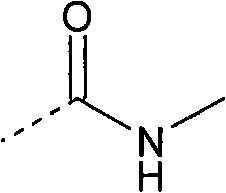

此外,R1d适宜地是具有一个或多个选自氧、氮和硫的杂原子的4至15元杂环基团,例如吡啶、吡嗪、哌啶和苯并噻唑。该杂环基团适宜地被C1-C8-烷基(例如甲基)、OH和卤素(例如Cl)所取代。Furthermore, R 1d is suitably a 4 to 15 membered heterocyclic group having one or more heteroatoms selected from oxygen, nitrogen and sulfur, such as pyridine, pyrazine, piperidine and benzothiazole. The heterocyclic group is suitably substituted by C 1 -C 8 -alkyl (eg methyl), OH and halogen (eg Cl).
R1适宜地是C(R1aR1b)mC(O)NR1cR1d,其中R1a、R1b和R1c适宜地是H,R1d是被C6-C15-芳香族碳环基团所取代的C1-C8-烷基。例如,R1适宜地是R 1 is suitably C(R 1a R 1b ) m C(O)NR 1c R 1d , wherein R 1a , R 1b and R 1c are suitably H, and R 1d is C 6 -C 15 -aromatic carbocyclic C 1 -C 8 -alkyl substituted by radicals. For example, R is suitably
R3适宜地是被-C(R3aR3b)nC(O)NR3cR3d所取代的C6-C15-芳香族碳环基团。优选C6-C15-芳香族基团是苯基。优选R3a和R3b是H,n是1,R3c是H且R3d是被苯基所取代的C1-C8-烷基。例如,R3适宜地是R 3 is suitably a C 6 -C 15 -aromatic carbocyclic group substituted by —C(R 3a R 3b ) n C(O)NR 3c R 3d . A preferred C 6 -C 15 -aromatic group is phenyl. Preferably R 3a and R 3b are H, n is 1, R 3c is H and R 3d is C 1 -C 8 -alkyl substituted by phenyl. For example, R3 is suitably

R3还适宜地是C(R3aR3b)nC(O)NR3cR3d。优选R3a和R3b是H,n是0、1或2,R3c是H且R3d适宜地是C3-C15-碳环基团或被苯基所取代的C1-C8-烷基。例如,R3适宜地是R 3 is also suitably C(R 3a R 3b ) n C(O)NR 3c R 3d . Preferably R 3a and R 3b are H, n is 0, 1 or 2, R 3c is H and R 3d is suitably a C 3 -C 15 -carbocyclic group or C 1 -C 8 - substituted by phenyl alkyl. For example, R3 is suitably

此外,R3d适宜地是C3-C15-碳环基团如环戊基、环己基和环丙基、C6-C15-芳香族基团如苯基或者具有一个或多个选自氧、氮和硫的杂原子的4至15元杂环基团如吡啶、哌啶、异噁唑和吗啉。R3d还适宜地是被C3-C15-碳环基团、C6-C15-芳香族基团和具有一个或多个选自氧、氮和硫的杂原子的4至15元杂环基团和OH所取代的C1-C8-烷基。例如,R3适宜地是Furthermore, R 3d is suitably a C 3 -C 15 -carbocyclic group such as cyclopentyl, cyclohexyl and cyclopropyl, a C 6 -C 15 -aromatic group such as phenyl or has one or more groups selected from 4- to 15-membered heterocyclic groups of heteroatoms of oxygen, nitrogen and sulfur such as pyridine, piperidine, isoxazole and morpholine. R 3d is also suitably a C 3 -C 15 -carbocyclic group, a C 6 -C 15 -aromatic group and a 4 to 15 membered heteroatom having one or more heteroatoms selected from oxygen, nitrogen and sulfur Cyclic groups and OH-substituted C 1 -C 8 -alkyl groups. For example, R3 is suitably

R3还适宜地是具有一个或多个选自氧、氮和硫的杂原子的4至15元杂环基团,例如吡咯烷。该4至15元杂环基团优选被C(O)-C3-C15-碳环基团如环戊基所取代。例如,R3适宜地是 R3 is also suitably a 4 to 15 membered heterocyclic group having one or more heteroatoms selected from oxygen, nitrogen and sulphur, eg pyrrolidine. The 4- to 15-membered heterocyclic group is preferably substituted by a C(O)-C 3 -C 15 -carbocyclic group such as cyclopentyl. For example, R3 is suitably
R3d还适宜地是C1-C8-烷氧基、C1-C8-烷基、C1-C8-烷基氨基和二(C1-C8-烷基)氨基。R 3d is also suitably C 1 -C 8 -alkoxy, C 1 -C 8 -alkyl, C 1 -C 8 -alkylamino and di(C 1 -C 8 -alkyl)amino.
此外,R3d和R3c与它们连接的N原子一起形成具有一个或多个选自氧、氮和硫的杂原子的4至15元杂环基团,例如吗啉或哌嗪。当该杂环基团是哌嗪时,它适宜地被甲基所取代。Furthermore, R 3d and R 3c together with the N atom to which they are attached form a 4 to 15 membered heterocyclic group having one or more heteroatoms selected from oxygen, nitrogen and sulfur, such as morpholine or piperazine. When the heterocyclic group is piperazine it is suitably substituted with methyl.



优选适宜地选自:preferred Suitably selected from:

本发明的另一方面提供了有条件的以下式(I)化合物的用途。这些化合物是游离或盐形式的3-{1-[(5-氯-2-甲氧基-苯基氨甲酰基)-甲基]-2,4-二氧代-1,4-二氢-2H-喹唑啉-3-基}-N-环戊基-丙酰胺、N-(5-氯-2,4-二甲氧基-苯基)-2-[2,4-二氧代-3{[(四氢-呋喃-2-基甲基)-氨甲酰基]-甲基}-苯基)-3,4-二氢-2H-喹唑啉-1-基]-乙酰胺、4-{6-氯-1-[2-(3-氯-4-乙氧基-苯基)-2-氧代乙基]-2,4-二氧代-1,4-二氢-2H-喹唑啉-3-基}-N-环戊基-丁酰胺、2-{1-[(5-氯-2,4-二甲氧基-苯基氨甲酰基)-甲基]-2,4-二氧代-1,4-二氢-2H-喹唑啉-3-基}-N-呋喃-2-基甲基-乙酰胺、4-(2-{2,4-二氧代-3-[4-(苯乙基氨甲酰基-甲基)-苯基]-3,4-二氢-2H-喹唑啉-1-基}-乙酰氨基)-苯甲酸乙酯、N-(3,5-二氯-苯基)-2-{2,4-二氧代-3-[4-(苯乙基氨甲酰基-甲基)-苯基]-3,4-二氢-2H-喹唑啉-1-基}-乙酰胺、2-{1-[(4-氯-2-甲氧基-5-甲基-苯基氨甲酰基)-甲基]-2,4-二氧代-1,4-二氢-2H-喹唑啉-3-基}-N-环戊基-乙酰胺、2-{1-[(5-氯-2,4-二甲氧基-苯基氨甲酰基)-甲基]-2,4-二氧代-1,4-二氢-2H-喹唑啉-3-基}-N-苯乙基-乙酰胺和1-[(5-氯-2,4-二甲氧基-苯基氨甲酰基)-甲基]-2,4-二氧代-3-苯基-1,3,4,5,6,8-六氢-2H-吡啶并[4′,3′:4,5]噻吩并[2,d]嘧啶-7-甲酸乙酯,它们用于制备用于治疗炎性或变应性病症、特别是炎性或阻塞性气道疾病的药物。Another aspect of the present invention provides conditionally the use of a compound of the following formula (I). These compounds are 3-{1-[(5-chloro-2-methoxy-phenylcarbamoyl)-methyl]-2,4-dioxo-1,4-dihydro in free or salt form -2H-quinazolin-3-yl}-N-cyclopentyl-propionamide, N-(5-chloro-2,4-dimethoxy-phenyl)-2-[2,4-dioxo Generation-3{[(tetrahydro-furan-2-ylmethyl)-carbamoyl]-methyl}-phenyl)-3,4-dihydro-2H-quinazolin-1-yl]-ethyl Amide, 4-{6-chloro-1-[2-(3-chloro-4-ethoxy-phenyl)-2-oxoethyl]-2,4-dioxo-1,4-di Hydrogen-2H-quinazolin-3-yl}-N-cyclopentyl-butyramide, 2-{1-[(5-chloro-2,4-dimethoxy-phenylcarbamoyl)-methanol Base]-2,4-dioxo-1,4-dihydro-2H-quinazolin-3-yl}-N-furan-2-ylmethyl-acetamide, 4-(2-{2, 4-Dioxo-3-[4-(phenethylcarbamoyl-methyl)-phenyl]-3,4-dihydro-2H-quinazolin-1-yl}-acetylamino)-benzene Ethyl formate, N-(3,5-dichloro-phenyl)-2-{2,4-dioxo-3-[4-(phenylethylcarbamoyl-methyl)-phenyl]- 3,4-Dihydro-2H-quinazolin-1-yl}-acetamide, 2-{1-[(4-chloro-2-methoxy-5-methyl-phenylcarbamoyl)- Methyl]-2,4-dioxo-1,4-dihydro-2H-quinazolin-3-yl}-N-cyclopentyl-acetamide, 2-{1-[(5-chloro- 2,4-Dimethoxy-phenylcarbamoyl)-methyl]-2,4-dioxo-1,4-dihydro-2H-quinazolin-3-yl}-N-phenylethyl Base-acetamide and 1-[(5-chloro-2,4-dimethoxy-phenylcarbamoyl)-methyl]-2,4-dioxo-3-phenyl-1,3, 4,5,6,8-Hexahydro-2H-pyrido[4',3':4,5]thieno[2,d]pyrimidine-7-carboxylic acid ethyl esters, which are used in the preparation of or drugs for allergic conditions, especially inflammatory or obstructive airway diseases.
此外,本发明的一方面还提供了用于如对本文的式(I)化合物所描述的这些化合物的任意用途。Furthermore, an aspect of the present invention also provides for any use of these compounds as described herein for the compounds of formula (I).
在另外的方面,本发明提供了游离或盐形式的任意上述实施方案中的式(I)化合物在制备用于治疗炎性或变应性病症、特别是炎性或阻塞性气道疾病的药物中的用途。In a further aspect, the present invention provides a compound of formula (I) in any of the above embodiments in free or salt form in the manufacture of a medicament for the treatment of inflammatory or allergic disorders, especially inflammatory or obstructive airway diseases use in .
本发明的优选的实施方案提供了游离或可药用盐形式的任意上述实施方案中的式(I)化合物在制备用于治疗选自如下的炎性或变应性病症的药物中的用途:囊性纤维化、原发性睫运动障碍、慢性支气管炎、慢性阻塞性肺疾病、哮喘、呼吸道感染、肺癌、口干燥症和keratoconjunctivitis sire(干燥性角结膜炎)。A preferred embodiment of the present invention provides the use of the compound of formula (I) in any of the above embodiments in free or pharmaceutically acceptable salt form for the preparation of a medicament for the treatment of an inflammatory or allergic disorder selected from: Cystic fibrosis, primary ciliary dyskinesia, chronic bronchitis, chronic obstructive pulmonary disease, asthma, respiratory infections, lung cancer, xerostomia, and keratoconjunctivitis sire (keratoconjunctivitis sicca).
可以理解,本发明的任意和所有实施方案均可以与任意其它实施方案一起被采用来描述本发明的另外的实施方案。而且,实施方案的任意要素意欲与来自任意实施方案的任意和所有其它要素组合来描述另外的实施方案。本领域技术人员可以理解,取代基的组合在不可能时不是本发明的方面。It is understood that any and all embodiments of the invention may be taken with any other embodiment to describe further embodiments of the invention. Furthermore, any element of an embodiment is intended to be combined with any and all other elements from any embodiment to describe an additional embodiment. Those skilled in the art will appreciate that combinations of substituents when not possible are not aspects of the invention.
盐和异构体salts and isomers
多种由式(I)表示的化合物能够形成酸成盐,特别是可药用的酸加成盐。式(I)化合物的可药用的酸加成盐包括无机酸和有机酸的那些,所述的无机酸例如有氢卤酸如盐酸或氢溴酸、硝酸、硫酸、磷酸;所述的有机酸例如有:脂肪族一元羧酸,例如甲酸、乙酸、二苯基乙酸、三苯基乙酸、辛酸、二氯乙酸、三氟乙酸、马尿酸、丙酸和丁酸;脂肪族羟酸,例如乳酸、枸橼酸、葡糖酸、扁桃酸、酒石酸或苹果酸;二元羧酸,例如己二酸、门冬氨酸、富马酸、谷氨酸、马来酸、丙二酸、癸二酸或琥珀酸;芳香族羧酸,例如苯甲酸、对氯苯甲酸或烟酸;芳香族羟酸,例如邻羟基苯甲酸、对羟基苯甲酸、1-羟基-萘-2-甲酸或3-羟基萘-2-甲酸;和磺酸,例如乙磺酸、乙烷-1,2-二磺酸、2-羟基乙磺酸、甲磺酸、(+)-樟脑-10-磺酸、苯磺酸、萘-2-磺酸、萘-1,5-二磺酸或对甲苯磺酸。这些盐可以由式(I)化合物通过已知的成盐方法来制备。Many compounds represented by formula (I) are capable of forming acid salts, especially pharmaceutically acceptable acid addition salts. Pharmaceutically acceptable acid addition salts of compounds of formula (I) include those of inorganic acids and organic acids, such as hydrohalic acids such as hydrochloric acid or hydrobromic acid, nitric acid, sulfuric acid, phosphoric acid; Examples of acids are: aliphatic monocarboxylic acids such as formic acid, acetic acid, diphenylacetic acid, triphenylacetic acid, caprylic acid, dichloroacetic acid, trifluoroacetic acid, hippuric acid, propionic acid and butyric acid; aliphatic hydroxy acids such as Lactic, citric, gluconic, mandelic, tartaric, or malic acids; dicarboxylic acids such as adipic, aspartic, fumaric, glutamic, maleic, malonic, capric Diacids or succinic acids; aromatic carboxylic acids such as benzoic acid, p-chlorobenzoic acid or nicotinic acid; aromatic hydroxyacids such as o-hydroxybenzoic acid, p-hydroxybenzoic acid, 1-hydroxy-naphthalene-2-carboxylic acid or 3 - hydroxynaphthalene-2-carboxylic acid; and sulfonic acids such as ethanesulfonic acid, ethane-1,2-disulfonic acid, 2-hydroxyethanesulfonic acid, methanesulfonic acid, (+)-camphor-10-sulfonic acid, Benzenesulfonic acid, naphthalene-2-sulfonic acid, naphthalene-1,5-disulfonic acid or p-toluenesulfonic acid. These salts can be prepared from compounds of formula (I) by known salt-forming methods.
含有酸性基团如羧基的式(I)化合物还能够与碱、特别是可药用碱、例如本领域众所周知的那些形成盐;适宜的这类盐包括:金属盐,特别是碱金属或碱土金属盐,例如钠、钾、镁、钙或锌盐,或者与氨或可药用的有机胺或杂环碱、例如苯乙苄胺、精氨酸、苄星(benzathine)、二乙醇胺、乙醇胺、4(2-羟基-乙基)吗啉、1-(2-羟基乙基)吡咯烷、N-甲基葡糖胺、哌嗪、三乙醇胺或氨基丁三醇形成的盐。这些盐可以由式(I)化合物通过已知的成盐方法来制备。Compounds of formula (I) containing acidic groups such as carboxyl groups are also capable of forming salts with bases, especially pharmaceutically acceptable bases, such as those well known in the art; suitable such salts include: metal salts, especially alkali or alkaline earth metals salts, such as sodium, potassium, magnesium, calcium or zinc salts, or with ammonia or pharmaceutically acceptable organic amines or heterocyclic bases, such as phenethylbenzylamine, arginine, benzathine, diethanolamine, ethanolamine, Salts of 4(2-hydroxy-ethyl)morpholine, 1-(2-hydroxyethyl)pyrrolidine, N-methylglucamine, piperazine, triethanolamine or tromethamine. These salts can be prepared from compounds of formula (I) by known salt-forming methods.
在其中有不对称碳原子或手性轴的那些化合物中,化合物以单独的旋光活性异构形式或者作为其混合物、例如作为外消旋或非对映异构体混合物而存在。本发明包括单独的旋光活性R和S异构体以及其混合物、例如外消旋或非对映异构体混合物。In those compounds in which there are asymmetric carbon atoms or chiral axes, the compounds exist in individual optically active isomeric forms or as mixtures thereof, for example as racemic or diastereomeric mixtures. The present invention includes the individual optically active R and S isomers as well as mixtures thereof, eg racemic or diastereomeric mixtures.
当式(I)化合物的互变异构体是可能的时,其也是本发明的方面。这类互变异构体包括但不限于如本领域技术人员所理解的酮/烯醇互变异构体。When tautomers of the compounds of formula (I) are possible, this is also an aspect of the invention. Such tautomers include, but are not limited to, keto/enol tautomers as understood by those skilled in the art.
具体的优选的式(I)化合物在下文实施例中有描述。Specific preferred compounds of formula (I) are described in the Examples below.
本发明的另一项实施方案提供了制备游离或可药用盐形式的式(I)化合物的方法,该方法包括如下步骤:Another embodiment of the present invention provides a method for preparing a compound of formula (I) in free or pharmaceutically acceptable salt form, the method comprising the steps of:
(i)使式(II)化合物(i) make formula (II) compound

其中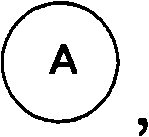
X-R′(III)X-R'(III)
其中X是离去基团且R’选自C1-C8-烷基或C1-C8-烷氧基羰基,得到式(IV)化合物,wherein X is a leaving group and R' is selected from C 1 -C 8 -alkyl or C 1 -C 8 -alkoxycarbonyl, giving compounds of formula (IV),

其中当R’是C1-C8-烷氧基羰基时,该烷氧基羰基水解为各自的酸并且使产生的化合物与胺反应,产生酰胺衍生物,和wherein when R' is C 1 -C 8 -alkoxycarbonyl, the alkoxycarbonyl is hydrolyzed to the respective acid and the resulting compound is reacted with an amine to produce an amide derivative, and
(ii)除去任何保护基团,以游离或可药用盐形式回收产生的式(I)化合物。(ii) removing any protecting groups and recovering the resulting compound of formula (I) in free or pharmaceutically acceptable salt form.
可以例如使用在下文和实施例中描述的反应和技术来制备式(I)化合物。反应可以在适合于所采用的试剂和材料并且适用于实施转化的溶剂中进行。有机合成领域的技术人员将理解,在分子上存在的官能团应该与所提出的转化一致。为了获得预期的本发明化合物,这有时将需要判断来更改合成步骤的顺序或者选择超过另一种方法流程的一种特定方法流程。Compounds of formula (I) can be prepared, for example, using the reactions and techniques described below and in the Examples. The reactions can be performed in solvents appropriate to the reagents and materials employed and suitable for effecting the transformations. Those skilled in the art of organic synthesis will understand that the functional groups present on the molecule should be consistent with the proposed transformation. Judgment will sometimes be required to alter the order of synthetic steps or to select one particular method scheme over another in order to obtain the desired compound of the invention.
在以下反应流程中所示的合成中间体和终产物上的各种取代基可以以其完全制成的形式存在,这些形式在需要时带有适宜的保护基团(如本领域技术人员所理解的那样),或者以前体形式存在,所述前体形式可以在以后通过本领域技术人员熟悉的方法被制成其最终的形式。还可以在整个合成序列中的不同阶段或者在合成序列完成后加入取代基。在许多情况下,可以使用常用的官能团处理将一种中间体转化为另一种中间体,或者将一种式(I)化合物转化为另一种式(I)化合物。这类处理的实例有酯或酮转化为醇;酯转化为酮;酯、酸和酰胺的相互转化;醇和胺的烷基化、酰化和磺酰化;和许多其它处理。还可以使用常见的反应如烷基化、酰化、卤化或氧化来加入取代基。这类处理是本领域众所周知的,许多参考著作总结了用于这类处理的步骤和方法。一些参考著作给出了很多官能团处理的有机合成原始文献的实例和参考以及有机合成领域常用的其它转化,这些著作有:《玛氏有机化学》(March’s Organic Chemistry,第5版,Wiley和Chichester编辑,2001);《综合有机转化》(Comprehensive OrganicTransformations,Larock编辑,VCH,1989);《综合有机官能团转化》(Comprehensive Organic Functional Group Transformations,Katritzky等人(系列编者),Pergamon,1995);和《综合有机合成》(Comprehensive OrganicSynthesis,Trost和Fleming(系列编者),Pergamon,1991)。还将认可,在该领域中设计任何合成途径的另一个主要考虑是明智地选择用于保护在本发明所描述的化合物中存在的反应活性官能团的保护基团。可以对同一分子内的多个保护基团进行选择以便这些保护基团可以各自被除去而不除去在同一分子内的其它保护基团,或者可以使用相同的反应步骤来除去数个保护基团,这取决于预期的结果。为受过训练的实践者描述了许多供选方法的权威性报道是T.W.Greene和P.G.M.Wuts,《有机合成中的保护基团》(Protective Groups In Organic Synthesis),威利父子公司(Wiley and Sons)(1999)。The various substituents on the synthetic intermediates and final products shown in the following reaction schemes may be present in their fully prepared form, with appropriate protecting groups (as will be understood by those skilled in the art) where required ), or in a precursor form which can be made into its final form at a later time by methods familiar to those skilled in the art. Substituents can also be added at various stages throughout the synthetic sequence or after completion of the synthetic sequence. In many cases, it is possible to convert one intermediate into another intermediate, or one compound of formula (I) into another compound of formula (I), using commonly used functional group manipulations. Examples of such treatments are conversion of esters or ketones to alcohols; conversion of esters to ketones; interconversion of esters, acids and amides; alkylation, acylation and sulfonylation of alcohols and amines; and many others. Substituents can also be added using common reactions such as alkylation, acylation, halogenation or oxidation. Such treatments are well known in the art and numerous reference works summarize procedures and methods for such treatments. Several reference works give examples and references to organic synthesis primary literature for many functional group manipulations and other transformations commonly used in the field of organic synthesis: March's Organic Chemistry, 5th edition, edited by Wiley and Chichester, 2001); Comprehensive Organic Transformations (Edited by Larock, VCH, 1989); Comprehensive Organic Functional Group Transformations (Comprehensive Organic Functional Group Transformations, Katritzky et al. (series editors), Pergamon, 1995); and Comprehensive Organic Transformations Synthesis" (Comprehensive Organic Synthesis, Trost and Fleming (series editors), Pergamon, 1991). It will also be recognized that another major consideration in designing any synthetic route in this field is the judicious choice of protecting groups used to protect the reactive functional groups present in the compounds described in this invention. Multiple protecting groups within the same molecule can be selected so that each of these protecting groups can be removed without removing other protecting groups within the same molecule, or the same reaction procedure can be used to remove several protecting groups, It depends on the desired outcome. Authoritative reports describing many alternative approaches for the trained practitioner are T.W. Greene and P.G.M. Wuts, Protective Groups In Organic Synthesis, Wiley and Sons ( 1999).
通常,在本专利申请的范围内描述的化合物可以通过在流程1和2以及实施例中描述的途径来合成。以下流程是说明性的,不应该被解释为限制本发明。In general, compounds described within the scope of this patent application can be synthesized by the routes described in Schemes 1 and 2 and in the Examples. The following schemes are illustrative and should not be construed as limiting the invention.
例如,在流程1中,化合物1与胺反应,随后通过光气或其等效物如三光气进行环化,得到化合物2。化合物2水解为羧酸并与胺如苄胺或环戊胺偶联,得到化合物3。用乙酸衍生物如溴乙酸甲酯将化合物3烷基化,得到化合物4。化合物4水解并且使产生的羧酸与胺如芳基胺偶联,得到化合物5。For example, in Scheme 1, compound 1 is reacted with an amine followed by cyclization by phosgene or its equivalent such as triphosgene to give compound 2. Compound 2 is hydrolyzed to the carboxylic acid and coupled with an amine such as benzylamine or cyclopentylamine to afford compound 3. Alkylation of compound 3 with an acetic acid derivative such as methyl bromoacetate affords compound 4. Hydrolysis of compound 4 and coupling of the resulting carboxylic acid with an amine such as an arylamine affords compound 5.
流程1Process 1
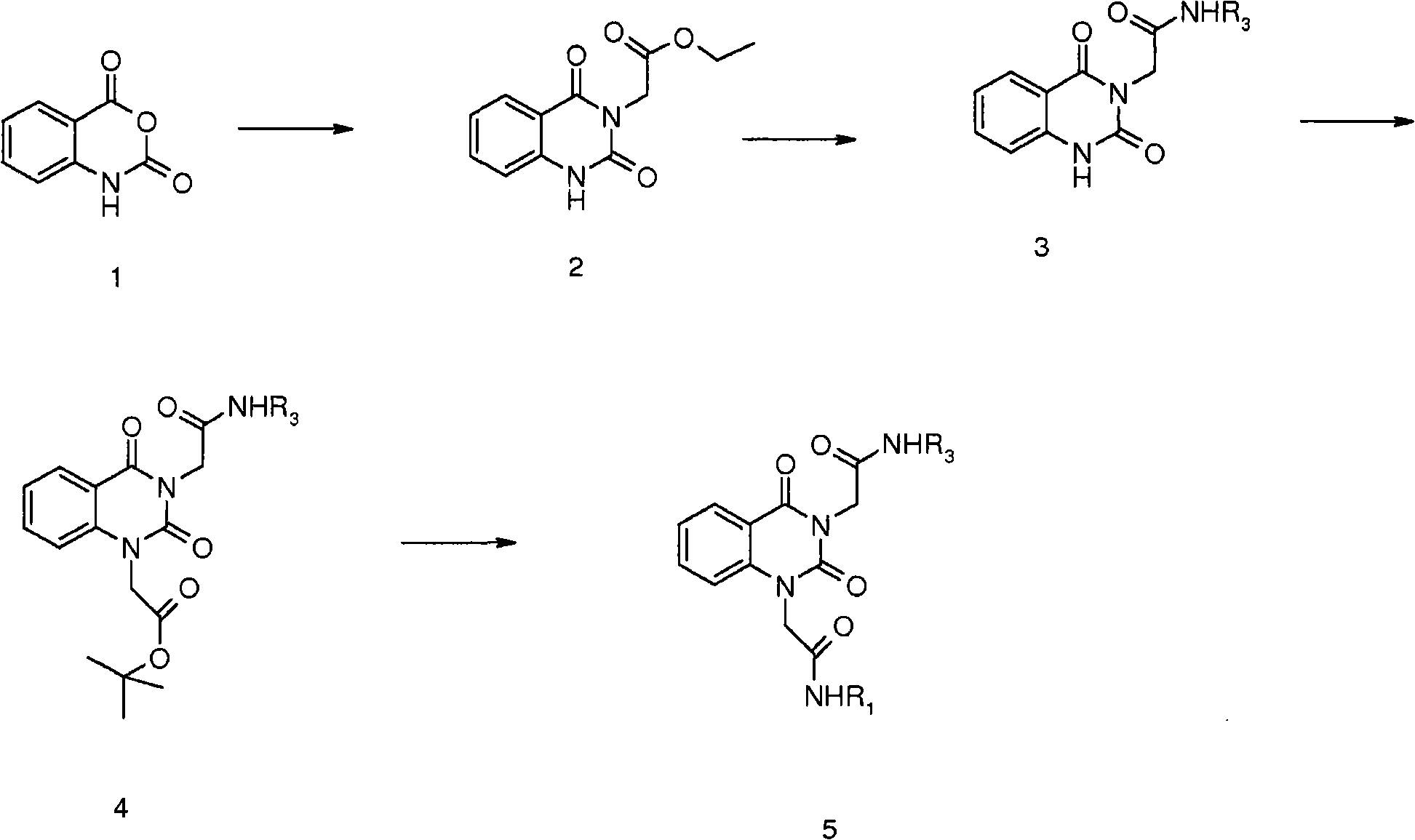
流程2强调了得到吡啶并稠合的嘧啶-2,4-二酮的途径。例如,化合物6与脲衍生物如脲基-乙酸乙酯通过由钯(0)催化的单罐反应法进行反应,得到化合物7。化合物7可以通过流程1中描述的方法被进一步衍生,得到化合物8。Scheme 2 highlights a route to pyrido-fused pyrimidine-2,4-diones. For example, reaction of compound 6 with a urea derivative such as ureido-ethyl acetate provides compound 7 via a palladium(0)-catalyzed one-pot reaction. Compound 7 can be further derivatized by the method described in Scheme 1 to give compound 8.
流程2Process 2
药学用途pharmaceutical use
溶血磷脂(LPL)如1-磷酸鞘氨醇(S1P)是源自细胞膜相关前体的脂质信号分子(Stunff等人,J Cell Biochem,92:882-899(2004))。S1P是鞘脂的代谢产物,而鞘脂是在所有真核细胞类型中发现的普遍存在的磷脂。S1P在细胞内产生,经适当的刺激后被释放出来。S1P的主要细胞来源包括血小板和组织肥大细胞。S1P合成开始于内源性膜衍生的鞘磷脂通过鞘磷脂酶转化为神经酰胺(CER)、然后通过神经酰胺酶转化为鞘氨醇。然后鞘氨醇通过两种鞘氨醇激酶(SphK1或SphK2)之一、经磷酸化转化为S1P(Spiegel和Milstien,Nat Rev Mol Cell Biol,4:397-407(2003))。鉴于神经酰胺和鞘氨醇已经与细胞生长停止和细胞凋亡相关联,S1P已经被证明在细胞生长和存活中是重要的。S1P是不寻常的脂质,因为它既可以在细胞内、也可以在细胞外起作用。细胞内S1P与推定的内质网相关受体结合以在细胞激活过程中帮助细胞内的钙贮存释放。这些磷脂化合物中的大部分不能有效地辨别不同的S1P受体并且具有差的物理化学性质,这限制了它们作为药物物质的潜在用途。因此,需要有可结合或在其它方面调节S1P受体并且还可以选择性地与特异性S1P受体结合的不是磷脂的化合物。Lysophospholipids (LPLs) such as sphingosine-1-phosphate (S1P) are lipid signaling molecules derived from cell membrane-associated precursors (Stunff et al., J Cell Biochem, 92:882-899 (2004)). S1P is a metabolite of sphingolipids, ubiquitous phospholipids found in all eukaryotic cell types. S1P is produced intracellularly and released upon appropriate stimulation. Major cellular sources of S1P include platelets and tissue mast cells. S1P synthesis begins with the conversion of endogenous membrane-derived sphingomyelin to ceramide (CER) by sphingomyelinase and then to sphingosine by ceramidase. Sphingosine is then phosphorylated to S1P by one of two sphingosine kinases, SphK1 or SphK2 (Spiegel and Milstien, Nat Rev Mol Cell Biol, 4:397-407 (2003)). Given that ceramide and sphingosine have been associated with cell growth arrest and apoptosis, S1P has been shown to be important in cell growth and survival. S1P is an unusual lipid because it can function both inside and outside the cell. Intracellular S1P binds to putative endoplasmic reticulum-associated receptors to facilitate the release of intracellular calcium stores during cellular activation. Most of these phospholipid compounds cannot efficiently discriminate between different S1P receptors and have poor physicochemical properties, which limit their potential use as pharmaceutical substances. Accordingly, there is a need for compounds other than phospholipids that bind to or otherwise modulate S1P receptors and that also selectively bind to specific S1P receptors.
细胞外S1P充当G-蛋白偶联受体(GPCR)家族的有效配体。S1P的最佳表征作用通过其与称为内皮分化基因-1(EDG-1)家族的一类GPCR结合来介导。迄今,总共有五种EDG受体(EDG-1、EDG-5、EDG-3、EDG-6和EDG-8)已经显示出以高亲和性和特异性与S1P结合。这些受体也分别称为S1P1、S1P2、S1P3、S1P4和S1P5(Sanchez和Hla,J Cell Biochem,92:913-922(2004))。S1P的多种受体的存在表明其功能可以相当地不同。S1P受体具有广泛的细胞和组织分布并且在人和啮齿类中是良好保守的(Spiegel和Milstien,Biochim Biophys Acta,484:107-116(2000);和Hla,Prostaglandins Other Lipid Mediat,64:135-142(2001))。S1P受体可以与不同的G-蛋白偶联而引起多种细胞响应(Goetzl和Rosen,J Clin Invest,114:1531-1537(2004);和Spiegel和Milstien,Nat Rev Mol Cell Biol,4:397-407(2003))。用转染细胞进行的研究已经表明,除了磷脂酶C(PLC)的PTX敏感性激活外,S1P1受体排他性地通过Gi蛋白进行信号传导来抑制腺苷酸环化酶和刺激促分裂原活化蛋白激酶(MAPK)。S1P2和S1P3受体可以通过多种Gα亚型、包括Gi、Gq和G12/13来进行信号传导。S1P2通过Gi激活Ras/MAPK,但是不同的S1P1通过非PTX敏感性Gq刺激PLC和激活Rho。S1P4主要通过Gi来激活MAPK途径,而S1P5与Gi和G12偶联来抑制腺苷酸环化酶但是不激活MAPK。Extracellular SlP acts as a potent ligand for the G-protein coupled receptor (GPCR) family. The best characterized role of S1P is mediated through its binding to a class of GPCRs known as the endothelial differentiation gene-1 (EDG-1) family. To date, a total of five EDG receptors (EDG-1, EDG-5, EDG-3, EDG-6 and EDG-8) have been shown to bind S1P with high affinity and specificity. These receptors are also referred to as S1P1, S1P2, S1P3, S1P4 and S1P5, respectively (Sanchez and Hla, J Cell Biochem, 92:913-922 (2004)). The existence of multiple receptors for SlP suggests that their functions can vary considerably. The S1P receptor has a broad cellular and tissue distribution and is well conserved in humans and rodents (Spiegel and Milstien, Biochim Biophys Acta, 484:107-116 (2000); and Hla, Prostaglandins Other Lipid Mediat, 64:135 -142 (2001)). S1P receptors can be coupled to different G-proteins to elicit a variety of cellular responses (Goetzl and Rosen, J Clin Invest, 114:1531-1537 (2004); and Spiegel and Milstien, Nat Rev Mol Cell Biol, 4:397 -407 (2003)). Studies with transfected cells have shown that, in addition to the PTX-sensitive activation of phospholipase C (PLC), S1P1 receptors signal exclusively through G i proteins to inhibit adenylyl cyclase and stimulate mitogen activation protein kinase (MAPK). S1P2 and S1P3 receptors can signal through multiple Gα subtypes, including Gi , Gq and G12 /13 . S1P2 activates Ras/MAPK through Gi, but distinctly S1P1 stimulates PLC and activates Rho through non-PTX-sensitive Gq . S1P4 mainly activates the MAPK pathway through Gi, while S1P5 couples Gi and G12 to inhibit adenylyl cyclase but not activate MAPK.
数项研究已经表明,许多细胞类型表达一种以上的S1P受体亚型并且多种S1P受体可以联合引起对S1P的特定生物反应。结果,S1P参与大量生理功能。S1P的受体在免疫系统的细胞类型、包括单核细胞、B和T淋巴细胞、树突细胞、肥大细胞、天然杀伤细胞和嗜酸性粒细胞上广泛地表达(Lin和Broyce,Adv Immunol,89:141-167(2006))。研究最多的S1P作用之一是其在淋巴细胞迁移中的作用。S1P与数种类型的S1P受体结合可以在体外调节免疫细胞的迁移,但是S1P对淋巴细胞迁移、组织归巢和再循环的体内作用仅受S1P1介导(Brinkmann和Baumruker,Curr Opin Pharmacol,6:1-7(2006))。S1P受体的药理学激动剂在体内的主要结果是淋巴细胞在次级淋巴结中隐蔽。在肥大细胞中,FcepsilonRI触发可引起S1P释放,而这又可激活在肥大细胞上表达的其S1P1和S1P2受体(Jolly等人,J Exp Med,199:959-970(2004);和Jolly等人,Mol Immunol,38:1239-1245(2001))。S1P1和S1P2的激活是正常的肥大细胞脱颗粒和趋化性所需要的。增长迅速的文献表明,S1P可介导心血管功能的数个方面(Brinkmann和Baumruker,CurrOpin Pharmacol,6:1-7(2006))。体外研究表明,S1P施用可以使多种培养的和新鲜分离的平滑肌细胞类型收缩(Watterson等人,Cell Signal,17:289-298(2005))。已经测定了S1P在大鼠和犬心脏中的心血管作用(Sugiyama等人,Jpn J Pharmacol,82:338-42(2000);Sugiyama等人,Cardiovasc Res,46:199-25(2000);Yatomi等人,J Biochem,121:969-73(1997);和Forrest等人,J Pharm Exp Therap,309:758-768(2004))。已经发现S1P3在啮齿类中可介导脑动脉的血管收缩并且引起心动过缓和高血压(Salomone等人,Eur J Pharmacol,469:125-34(2003))。在血管内皮细胞中,S1P可在体外刺激细胞增殖和迁移以及在体内刺激血管生成(Lee等人,Cell,99:301-21(1999))。这些S1P作用是通过S1P1和S1P3受体所介导的。S1P1还已经参与肿瘤血管发生和肿瘤生长。与其相比,S1P2在体内对内皮迁移、形态发生和血管生成施加抑制作用。此外,肺内皮屏障作用通过S1P1的S1P激活而增强,内皮渗透性通过S1P2的激活而增加。在上皮细胞中,S1P3受体已经表明可引起紧密连接的重组并因此损害肺屏障完整性。虽然S1P4和S1P5的功能还不十分了解,但是已经表明S1P4受体局限在造血细胞和组织中(Graeler等人,Curr Top Microbiol Immunol,246:131-6(1999)),并且已经表明S1P5受体主要是神经受体,其在啮齿类的淋巴样组织中具有一些表达但是在人组织中具有更广泛的表达方式(Im等人,J Biol Chem,275(19):14281-6(2000);Neidernberg等人,Biochem Pharmacol,64:1243-50(2002))。Several studies have shown that many cell types express more than one S1P receptor subtype and that multiple S1P receptors can combine to elicit specific biological responses to S1P. As a result, S1P is involved in a number of physiological functions. Receptors for S1P are widely expressed on cell types of the immune system, including monocytes, B and T lymphocytes, dendritic cells, mast cells, natural killer cells, and eosinophils (Lin and Broyce, Adv Immunol, 89 : 141-167 (2006)). One of the most studied roles of S1P is its role in lymphocyte migration. S1P binding to several types of S1P receptors can regulate immune cell migration in vitro, but the in vivo effects of S1P on lymphocyte migration, tissue homing, and recycling are only mediated by S1P1 (Brinkmann and Baumruker, Curr Opin Pharmacol, 6 : 1-7 (2006)). The main consequence of pharmacological agonists of the S1P receptor in vivo is the sequestering of lymphocytes in secondary lymph nodes. In mast cells, FcepsilonRI triggering causes S1P release, which in turn activates its S1P1 and S1P2 receptors expressed on mast cells (Jolly et al., J Exp Med, 199:959-970 (2004); and Jolly et al. People, Mol Immunol, 38:1239-1245 (2001)). Activation of S1P1 and S1P2 is required for normal mast cell degranulation and chemotaxis. A rapidly growing literature suggests that SlP can mediate several aspects of cardiovascular function (Brinkmann and Baumruker, Curr Opin Pharmacol, 6:1-7 (2006)). In vitro studies have shown that SIP administration can contract various cultured and freshly isolated smooth muscle cell types (Watterson et al., Cell Signal, 17:289-298 (2005)). Cardiovascular effects of S1P have been determined in rat and canine hearts (Sugiyama et al., Jpn J Pharmacol, 82:338-42 (2000); Sugiyama et al., Cardiovasc Res, 46:199-25 (2000); Yatomi et al, J Biochem, 121:969-73 (1997); and Forrest et al, J Pharm Exp Therap, 309:758-768 (2004)). S1P3 has been found to mediate vasoconstriction of cerebral arteries and cause bradycardia and hypertension in rodents (Salomone et al., Eur J Pharmacol, 469:125-34 (2003)). In vascular endothelial cells, SlP can stimulate cell proliferation and migration in vitro and angiogenesis in vivo (Lee et al., Cell, 99:301-21 (1999)). These S1P actions are mediated through the S1P1 and S1P3 receptors. S1P1 has also been involved in tumor angiogenesis and tumor growth. In contrast, S1P2 exerts inhibitory effects on endothelial migration, morphogenesis and angiogenesis in vivo. Furthermore, lung endothelial barrier function is enhanced by S1P activation of S1P1, and endothelial permeability is increased by S1P2 activation. In epithelial cells, S1P3 receptors have been shown to cause reorganization of tight junctions and thus compromise lung barrier integrity. Although the functions of S1P4 and S1P5 are not well understood, it has been shown that the S1P4 receptor is localized in hematopoietic cells and tissues (Graeler et al., Curr Top Microbiol Immunol, 246:131-6 (1999)), and it has been shown that the S1P5 receptor Primarily neuroreceptors, with some expression in rodent lymphoid tissues but a more widespread expression pattern in human tissues (Im et al., J Biol Chem, 275(19):14281-6 (2000); Neidernberg et al., Biochem Pharmacol, 64:1243-50 (2002)).
S1P2是七跨膜G蛋白偶联受体(GPCR)[Okamoto H等人(2000),Mazurais D等人(2002),An S等人(2000),Ancellin N,Hla T.(1999),US5585476、WO 200056135和WO 9954351]。许多具有医学重要性的生物过程通过涉及G-蛋白的信号转导途径介导[Lefkowitz(1991)]。GPCR的家族包括激素、神经递质、生长因子和病毒的受体。GPCR的具体实例包括如下的这类不同物质的受体:多巴胺、降钙素、肾上腺素能激素、内皮素、cAMP、腺苷、乙酰胆碱、血清素、组胺、凝血酶、激肽、促卵泡激素、视蛋白、内皮分化基因-1、视紫质、增味物质(odorants)、巨细胞病毒、G-蛋白本身、效应器蛋白如磷脂酶C、腺苷酸环化酶和磷酸二酯酶以及执行蛋白(actuator proteins)如蛋白激酶A和蛋白激酶C。S1P2 is a seven transmembrane G protein-coupled receptor (GPCR) [Okamoto H et al. (2000), Mazurais D et al. (2002), An S et al. (2000), Ancellin N, Hla T. (1999), US5585476 , WO 200056135 and WO 9954351]. Many biological processes of medical importance are mediated through signal transduction pathways involving G-proteins [Lefkowitz (1991)]. The family of GPCRs includes receptors for hormones, neurotransmitters, growth factors, and viruses. Specific examples of GPCRs include receptors for such diverse substances as: dopamine, calcitonin, adrenergic hormone, endothelin, cAMP, adenosine, acetylcholine, serotonin, histamine, thrombin, kinin, follicle stimulating Hormones, opsins, endothelial differentiation gene-1, rhodopsin, odorants, cytomegalovirus, G-protein itself, effector proteins such as phospholipase C, adenylate cyclase, and phosphodiesterase and actuator proteins such as protein kinase A and protein kinase C.
本发明提供了这样的化合物,它是人S1P2和S1P4或者s1P2及S1P4二者的调节剂,其与心血管疾病、胃肠系统紊乱、生殖疾病、外周和中枢神经系统紊乱以及呼吸系统疾病有关。本发明还提供了鉴别可用于治疗或预防心血管疾病、胃肠系统紊乱、生殖疾病、外周和中枢神经系统紊乱以及呼吸系统疾病的化合物的试验。本发明还表征了与S1P2和S1P4结合和/或激活或抑制其活性的化合物以及包含这类化合物的药物组合物。The present invention provides compounds that are modulators of human S1P2 and S1P4 or both s1P2 and S1P4, which are associated with cardiovascular diseases, gastrointestinal disorders, reproductive diseases, peripheral and central nervous system disorders, and respiratory diseases. The invention also provides assays for identifying compounds useful in the treatment or prevention of cardiovascular disease, gastrointestinal disorders, reproductive disease, peripheral and central nervous system disorders, and respiratory disease. The invention also features compounds that bind to and/or activate or inhibit the activity of S1P2 and S1P4 and pharmaceutical compositions comprising such compounds.
S1P2:S1P2:
已经证明在多种细胞类型上有S1P2表达。已经表明它参与血管生成和血管渗透性。另外已经表明它可通过激活成纤维细胞而参与创伤愈合。本发明表征了与S1P2结合和/或激活或抑制S1P2活性的化合物以及包含这类化合物的药物组合物。因此,本发明的化合物可用于治疗和/或预防:S1P2 expression has been demonstrated on a variety of cell types. It has been shown to be involved in angiogenesis and vascular permeability. It has also been shown to participate in wound healing by activating fibroblasts. The present invention features compounds that bind to S1P2 and/or activate or inhibit the activity of S1P2, as well as pharmaceutical compositions comprising such compounds. Accordingly, the compounds of the invention are useful in the treatment and/or prevention of:
血管疾病Vascular disease
血管收缩引起的疾病,例如蛛网膜下出血或脑梗塞后脑血管痉挛性疾病、心血管痉挛性疾病、高血压、肾脏疾病、心肌梗塞、心绞痛、心律失常、与硬化有关的门静脉高压和与硬化有关的静脉曲张。Diseases caused by vasoconstriction, such as subarachnoid hemorrhage or cerebral vasospastic disease after cerebral infarction, cardiovascular spastic disease, hypertension, renal disease, myocardial infarction, angina pectoris, arrhythmia, portal hypertension associated with sclerosis and sclerosis of varicose veins.
血管扩张引起的疾病,例如慢性头痛如偏头痛、紧张性头痛、混合型头痛、丛集性头痛、痔和心脏病。Conditions caused by dilated blood vessels, such as chronic headaches such as migraines, tension headaches, mixed headaches, cluster headaches, hemorrhoids, and heart disease.
胃肠系统紊乱Gastrointestinal Disorders
胃肠疾病包括胃肠道器官的原发性或继发性、急性或慢性疾病,它们可以是获得性或遗传性的、良性或恶性的或者化生性的,并且可以影响胃肠道器官或者将影响整个身体。它们包括但不限于:1)食道紊乱,如失弛缓症、剧烈失弛缓症(vigorous achalasia)、吞咽困难、环咽共济失调、食管前吞咽困难、弥漫性食管痉挛、球感觉(globus sensation)、巴雷特化生(Barrett′s metaplasia)、胃食管反流,2)胃和十二指肠紊乱,如功能性消化不良、胃粘膜炎症、胃炎、应激性胃炎、胃溃疡、十二指肠溃疡、胃瘤,3)胰腺紊乱,如急性或慢性胰腺炎、胰腺的外分泌或内分泌组织功能不全如脂肪泻、糖尿病、外分泌或内分泌胰腺瘤如3.1)多发性内分泌肿瘤综合征、导管腺癌、囊腺癌、胰岛细胞肿瘤、胰岛素瘤、胃泌素瘤、类癌瘤、胰升糖素瘤(glucogonoma)、佐-埃(Zollinger-Ellison)综合征、血管活性肠肽瘤综合征、吸收不良综合征,4)肠紊乱,如慢性炎性肠病、节段性回肠炎、肠梗阻、腹泻和便秘、结肠无力、巨结肠、吸收不良综合征、溃疡性结肠炎,4.1)功能性肠病,如肠易激惹综合征,4.2)肠瘤,如家族性肠息肉病、腺癌、原发性恶性淋巴瘤、类癌瘤、卡波西肉瘤、息肉、结肠和直肠癌。医学病症还包括肠易激惹综合征、慢性便秘、功能性消化不良、胃排空延迟、胃食管反流病、胃轻瘫、术后肠梗阻、假性肠梗塞和药物引起的通过迟缓(delayed transit)。Gastrointestinal disorders include primary or secondary, acute or chronic diseases of gastrointestinal organs, which may be acquired or hereditary, benign or malignant, or metaplastic, and which may affect gastrointestinal organs or will affect the whole body. They include but are not limited to: 1) Esophageal disorders such as achalasia, vigorous achalasia, dysphagia, cricopharyngeal ataxia, preesophageal dysphagia, diffuse esophageal spasm, globus sensation , Barrett's metaplasia, gastroesophageal reflux, 2) gastric and duodenal disorders, such as functional dyspepsia, gastric mucosal inflammation, gastritis, stress gastritis, gastric ulcer, duodenal Ductal ulcer, gastric tumor, 3) Pancreatic disorders, such as acute or chronic pancreatitis, pancreatic exocrine or endocrine tissue insufficiency such as steatorrhea, diabetes, exocrine or endocrine pancreatic tumors, such as 3.1) multiple endocrine neoplasia syndrome, ductal gland Carcinoma, cystadenocarcinoma, islet cell tumor, insulinoma, gastrinoma, carcinoid tumor, glucagonoma (glucogonoma), Zollinger-Ellison syndrome, vasoactive intestinal peptide tumor syndrome, Malabsorption syndrome, 4) bowel disorders such as chronic inflammatory bowel disease, Crohn's disease, ileus, diarrhea and constipation, colonic weakness, megacolon, malabsorption syndrome, ulcerative colitis, 4.1) functional Intestinal diseases, such as irritable bowel syndrome, 4.2) Intestinal neoplasms, such as familial intestinal polyposis, adenocarcinoma, primary malignant lymphoma, carcinoid tumor, Kaposi's sarcoma, polyp, colon and rectal cancer. Medical conditions also include irritable bowel syndrome, chronic constipation, functional dyspepsia, delayed gastric emptying, gastroesophageal reflux disease, gastroparesis, postoperative ileus, intestinal pseudo-obstruction, and drug-induced transit delay ( delayed transit).
眼紊乱eye disorder
视网膜病,包括单纯性或非增殖性视网膜病和增殖性视网膜病如镰状细胞贫血、高血压性视网膜病、糖尿病性视网膜病、糖尿病性黄斑水肿、糖尿病增殖性视网膜病变、囊样黄斑水肿、视网膜静脉和动脉阻塞、所有形式的视神经炎、年龄相关性黄斑变性、视网膜脱离、色素性视网膜炎、斯塔加特病、贝斯特卵黄状视网膜变性(Best’s viteliform retinaldegreneration)、莱伯先天性黑矇病以及其它遗传性视网膜变性、病理性近视、早产儿视网膜病和莱伯遗传性视神经病、角膜移植或屈光性角膜手术的后作用、干燥性角膜结膜炎或干眼和疱疹性角膜炎。Retinopathy, including simple or nonproliferative retinopathy and proliferative retinopathy such as sickle cell anemia, hypertensive retinopathy, diabetic retinopathy, diabetic macular edema, diabetic proliferative retinopathy, cystoid macular edema, Retinal vein and artery occlusion, all forms of optic neuritis, age-related macular degeneration, retinal detachment, retinitis pigmentosa, Stargardt's disease, Best's viteliform retinal degreneration, Leber congenital amaurosis and other hereditary retinal degenerations, pathological myopia, retinopathy of prematurity and Leber hereditary optic neuropathy, aftereffects of corneal transplantation or refractive corneal surgery, keratoconjunctivitis sicca or dry eye, and herpetic keratitis.
创伤愈合wound healing
用作独立地或与磷酸鞘氨醇联合来促进创伤愈合的血管生成剂或者用作S1P功能调节剂、尤其是用于治疗糖尿病创伤的S1P功能调节剂。Use as an angiogenic agent alone or in combination with sphingosine phosphate to promote wound healing or as a modulator of S1P function, especially for the treatment of diabetic wounds.
呼吸系统疾病Respiratory diseases
本发明的物质、特别是具有S1P2和/或S1P4活性的那些可特别用于治疗炎性或阻塞性气道疾病,导致例如减少组织损伤、气道炎症、支气管高反应性、重塑或疾病进程。本发明适用的炎性或阻塞性气道疾病包括任何类型或起因的哮喘,包括内源性(非变应性)哮喘和外源性(变应性)哮喘、轻度哮喘、中度哮喘、重度哮喘、支气管炎性哮喘、运动诱发型哮喘、职业性哮喘和细菌感染诱发的哮喘。对哮喘的治疗还应理解为包括对例如小于4岁或5岁的个体的治疗,这些个体表现出喘鸣症状且被诊断或可诊断为“喘鸣婴儿(wheezy infants)”,这是一种已确立的医学上十分关注的患者类别,目前通常鉴定为初期或早期哮喘。哮喘治疗中的预防功效可以通过诸如急性哮喘或支气管收缩发作的症状发作的频率或严重程度的降低、肺功能的改善或气道高反应性的改善得以证实。这种功效可以进一步通过对其它对症疗法的需求的减少得以证实,所述的其它对症疗法即用于或旨在用于在症状发生时限制症状发作或使其停止的疗法,例如抗炎药(例如皮质类固醇)或支气管扩张药。预防哮喘的有益作用在倾向于“早间发作(morningdipping)”的个体中特别明显。“早间发作”是一种公认的哮喘综合征,在相当大比例的哮喘中非常常见且特征在于在例如约早上4至6点的几小时之间哮喘发作,即哮喘在通常离任何预先给予的对症哮喘疗法都相当远的时间点发作。The substances according to the invention, in particular those with S1P2 and/or S1P4 activity, are particularly useful in the treatment of inflammatory or obstructive airway diseases, resulting in, for example, reduction of tissue damage, airway inflammation, bronchial hyperresponsiveness, remodeling or disease progression . Inflammatory or obstructive airway diseases to which the present invention is applicable include asthma of any type or origin, including intrinsic (non-allergic) asthma and exogenous (allergic) asthma, mild asthma, moderate asthma, Severe asthma, bronchitis-induced asthma, exercise-induced asthma, occupational asthma, and asthma induced by bacterial infection. The treatment of asthma is also understood to include the treatment of individuals, e.g. less than 4 or 5 years of age, who exhibit symptoms of wheezing and who have been or can be diagnosed as "wheezy infants", which is a type of An established class of patients of medical interest, currently generally identified as incipient or early-stage asthma. Prophylactic efficacy in asthma treatment may be demonstrated by a reduction in the frequency or severity of symptomatic episodes such as acute asthmatic or bronchoconstrictive episodes, an improvement in lung function, or an improvement in airway hyperresponsiveness. This efficacy may further be evidenced by a reduction in the need for other symptomatic therapies that are used or intended to limit the onset of symptoms or stop them when they occur, such as anti-inflammatory drugs ( such as corticosteroids) or bronchodilators. The beneficial effect of preventing asthma is particularly pronounced in individuals prone to "morning dipping". "Morning onset" is a well-recognized asthma syndrome that is very common in a substantial proportion of asthmatics and is characterized by asthmatic attacks between the hours, for example, about 4 to 6 am, i. The symptomatic asthma treatments are quite distant from the point in time of onset.
本发明适用的其它炎性或阻塞性气道疾病和病症包括:急性肺损伤(ALI)、成人/急性呼吸窘迫综合征(ARDS)、慢性阻塞性肺病、气道疾病或肺疾病(COPD、COAD或COLD),包括慢性支气管炎或与之相关的呼吸困难、肺气肿以及其它药物治疗、特别是其它吸入药物治疗导致的气道高反应性加剧。本发明还适用于治疗任何类型或起因的支气管炎,包括例如急性支气管炎、花生仁吸入性支气管炎、卡他性支气管炎、格鲁布性支气管炎、慢性支气管炎或结核性支气管炎。本发明适用的其它炎性或阻塞性气道疾病包括任何类型或起因的肺尘埃沉着病(无论是慢性的还是急性的,该疾病常伴随有气道阻塞且因反复吸入尘埃引起,是一种炎性且通常为职业性的肺病),例如包括矾土肺、炭肺、石棉肺、石末肺、鸵鸟毛尘肺、肺铁末沉着病、硅肺、烟尘肺和棉尘肺。Other inflammatory or obstructive airway diseases and conditions to which the present invention is applicable include: acute lung injury (ALI), adult/acute respiratory distress syndrome (ARDS), chronic obstructive pulmonary disease, airway disease or lung disease (COPD, COAD or COLD), including chronic bronchitis or associated dyspnea, emphysema, and exacerbated airway hyperresponsiveness with other drug therapy, especially other inhaled drug therapy. The present invention is also applicable to the treatment of bronchitis of any type or origin including, for example, acute bronchitis, peanut aspiration bronchitis, catarrhal bronchitis, Grubb's bronchitis, chronic bronchitis, or tuberculous bronchitis. Other inflammatory or obstructive airway diseases to which the invention is applicable include pneumoconiosis of any type or origin (whether chronic or acute, which is often accompanied by airway obstruction and is caused by repeated inhalation of dust, is a Inflammatory and often occupational lung diseases) including, for example, alumina lung, anthracosis, asbestosis, lithosis, ostrich pneumoconiosis, pulmonary siderosis, silicosis, pneumoconiosis, and cotton pneumoconiosis.
S1P4:S1P4:
S1P4受体主要在免疫系统细胞上存在提供了靶向于该生长因子受体的唯一机会。S1P4表达主要在脾脏和外周血细胞中发现。S1P4被声称参与由人淋巴细胞产生细胞因子(Wang等人,FASEB 19:1731-1733(2005)。由于其在淋巴组织中的特异性表达,所以它在移植中以及在炎性和免疫紊乱中具有治疗潜能。The presence of the S1P4 receptor primarily on immune system cells provides a unique opportunity to target this growth factor receptor. S1P4 expression was mainly found in spleen and peripheral blood cells. S1P4 is claimed to be involved in the production of cytokines by human lymphocytes (Wang et al., FASEB 19:1731-1733 (2005). Due to its specific expression in lymphoid tissues, it is important in transplantation and in inflammatory and immune disorders Has therapeutic potential.
因此,本发明的化合物可用于治疗和/或预防通过淋巴细胞相互作用介导的疾病或紊乱,例如,移植,如细胞、组织或器官同种异体或异种移植物急性或慢性排斥或者移植物功能延迟(delayed graft function)、移植物抗宿主病,自身免疫性疾病如类风湿性关节炎、全身性红斑狼疮、桥本甲状腺炎、多发性硬化症、重症肌无力、I型或II型糖尿病及与其有关的紊乱、脉管炎、恶性贫血、舍格伦综合征、眼色素层炎、银屑病、格雷夫斯眼病、局限性脱发及其它,变应性疾病,例如变应性哮喘、特应性皮炎、变应性鼻炎、变应性结膜炎、变应性接触性皮炎,任选具有潜在异常反应的炎性疾病,例如炎性肠病、节段性回肠炎或溃疡性结肠炎、内源性哮喘、炎性肺损伤、炎性肝损伤、炎性肾小球损伤、动脉粥样硬化、骨关节炎、刺激性接触性皮炎和还有湿疹性皮炎、脂溢性皮炎、免疫学上介导的紊乱的皮肤表现、炎性眼病、角结膜炎、心肌炎或肝炎,缺血/再灌注损伤,例如心肌梗塞、中风、肠缺血、肾衰竭或出血性休克、创伤性休克、其它,癌症,例如T细胞淋巴瘤或T细胞白血病;感染性疾病,例如中毒性休克(例如超抗原引起的)、败血症性休克、成人呼吸窘迫综合征或病毒感染如AIDS、病毒性肝炎或慢性细菌感染。细胞、组织或实体器官移植物的实例包括胰岛、干细胞、骨髓、角膜组织、神经组织、心脏、肺、心-肺联合、肾脏、肝脏、肠、胰、气管或食管。Accordingly, the compounds of the present invention are useful in the treatment and/or prevention of diseases or disorders mediated by lymphocyte interactions, for example, transplantation, such as acute or chronic rejection of cell, tissue or organ allografts or xenografts or graft function Delayed graft function, graft versus host disease, autoimmune diseases such as rheumatoid arthritis, systemic lupus erythematosus, Hashimoto's thyroiditis, multiple sclerosis, myasthenia gravis, type I or type II diabetes and Disorders associated with it, vasculitis, pernicious anemia, Sjögren's syndrome, uveitis, psoriasis, Graves' ophthalmopathy, alopecia areata and others, allergic diseases such as allergic asthma, idiopathic Allergic dermatitis, allergic rhinitis, allergic conjunctivitis, allergic contact dermatitis, optionally inflammatory diseases with underlying abnormal reactions, such as inflammatory bowel disease, Crohn's disease or ulcerative colitis, Intrinsic asthma, inflammatory lung injury, inflammatory liver injury, inflammatory glomerular injury, atherosclerosis, osteoarthritis, irritant contact dermatitis and also eczematous dermatitis, seborrheic dermatitis, immunology Skin manifestations of neurologically mediated disorders, inflammatory eye disease, keratoconjunctivitis, myocarditis or hepatitis, ischemia/reperfusion injury such as myocardial infarction, stroke, intestinal ischemia, renal failure or hemorrhagic shock, traumatic shock, other , cancer such as T-cell lymphoma or T-cell leukemia; infectious disease such as toxic shock (e.g. caused by superantigens), septic shock, adult respiratory distress syndrome or viral infection such as AIDS, viral hepatitis or chronic bacterial Infect. Examples of cell, tissue or solid organ transplants include islets, stem cells, bone marrow, corneal tissue, nerve tissue, heart, lung, combined heart-lung, kidney, liver, intestine, pancreas, trachea, or esophagus.
用于由血管收缩或扩张引起的疾病的治疗和/或预防包括S1P2调节剂。S1P2调节剂可特异性地与S1P2结合并显示出拮抗作用或激动作用。因此,S1P2拮抗剂可用于治疗和/或预防由血管收缩引起的疾病,例如蛛网膜下出血或脑梗塞后脑血管痉挛性疾病、心血管痉挛性疾病、高血压、肾脏疾病、心肌梗塞、心绞痛、心律失常、与硬化有关的门静脉高压和与硬化有关的静脉曲张。另一方面,S1P2激动剂可用于治疗和/或预防由血管扩张引起的疾病,例如慢性头痛如偏头痛、紧张性头痛、混合型头痛、丛集性头痛、痔和心脏病。For use in the treatment and/or prevention of diseases caused by vasoconstriction or dilation include S1P2 modulators. S1P2 modulators can specifically bind to S1P2 and exhibit antagonism or agonism. Therefore, S1P2 antagonists can be used for the treatment and/or prevention of diseases caused by vasoconstriction, such as subarachnoid hemorrhage or cerebral vasospasm disease after cerebral infarction, cardiovascular spastic disease, hypertension, kidney disease, myocardial infarction, angina pectoris, Cardiac arrhythmias, cirrhosis-related portal hypertension, and cirrhosis-related varices. In another aspect, S1P2 agonists are useful in the treatment and/or prevention of diseases caused by vasodilation, such as chronic headaches such as migraine, tension headache, mixed headache, cluster headache, hemorrhoids and heart disease.
本发明包括包含S1P2表达或活性的调节剂(和/或在S1P2信号传导途径中的蛋白质的活性或表达的调节剂)的药物组合物以及通过将一种或多种这类调节剂与可药用载体合并来制备这类组合物的方法。本发明还包括包含采用本发明的筛选试验鉴别出的调节剂并包装有使用指示书的药物组合物。对于是S1P2活性拮抗剂或减少S1P2表达的调节剂而言,指示书将具体说明药物组合物在治疗血液学和心血管疾病、外周和中枢神经系统紊乱、COPD、哮喘、生殖-泌尿学紊乱和炎性疾病中的用途。对于是S1P2活性激动剂或增加S1P2表达的调节剂而言,指示书将具体说明药物组合物在治疗血液学和心血管疾病、外周和中枢神经系统紊乱、COPD、哮喘、生殖-泌尿学紊乱和炎性疾病中的用途。The present invention includes pharmaceutical compositions comprising modulators of S1P2 expression or activity (and/or modulators of activity or expression of proteins in the S1P2 signaling pathway) Methods of preparing such compositions are combined with the carrier. The invention also includes pharmaceutical compositions comprising modulators identified using the screening assays of the invention and packaged with instructions for use. For agents that are antagonists of S1P2 activity or modulators that reduce S1P2 expression, the instructions will specify that the pharmaceutical composition is useful in the treatment of hematological and cardiovascular diseases, peripheral and central nervous system disorders, COPD, asthma, genitourinary disorders, and Use in inflammatory diseases. For agents that are agonists of S1P2 activity or modulators that increase S1P2 expression, the instructions will specify that the pharmaceutical composition is useful in the treatment of hematological and cardiovascular diseases, peripheral and central nervous system disorders, COPD, asthma, genitourinary disorders and Use in inflammatory diseases.
胃肠疾病包括胃肠道器官的原发性或继发性、急性或慢性疾病,它们可以是获得性或遗传性的、良性或恶性的或者化生性的,并且可以影响胃肠道器官或者将影响整个身体。它们包括但不限于:1)食道紊乱,如失弛缓症、剧烈失弛缓症(vigorous achalasia)、吞咽困难、环咽共济失调、食管前吞咽困难、弥漫性食管痉挛、球感觉、巴雷特化生和胃食管反流,2)胃和十二指肠紊乱,如功能性消化不良、胃粘膜炎症、胃炎、应激性胃炎、胃溃疡、十二指肠溃疡和胃瘤,3)胰腺紊乱,如急性或慢性胰腺炎、胰腺的外分泌或内分泌组织功能不全如脂肪泻、糖尿病、外分泌或内分泌胰腺瘤如:3.1)多发性内分泌肿瘤综合征、导管腺癌、囊腺癌、胰岛细胞肿瘤、胰岛素瘤、胃泌素瘤、类癌瘤、胰升糖素瘤、佐-埃综合征、血管活性肠肽瘤综合征和吸收不良综合征,4)肠紊乱,如慢性炎性肠病、节段性回肠炎、肠梗阻、腹泻和便秘、结肠无力、巨结肠、吸收不良综合征、溃疡性结肠炎,4.1)功能性肠病,如肠易激惹综合征,4.2)肠瘤,如家族性肠息肉病、腺癌、原发性恶性淋巴瘤、类癌瘤、卡波西肉瘤、息肉、结肠或直肠癌。Gastrointestinal disorders include primary or secondary, acute or chronic diseases of gastrointestinal organs, which may be acquired or hereditary, benign or malignant, or metaplastic, and which may affect gastrointestinal organs or will affect the whole body. They include but are not limited to: 1) Esophageal disorders such as achalasia, vigorous achalasia, dysphagia, cricopharyngeal ataxia, preesophageal dysphagia, diffuse esophageal spasm, bulbar sensation, Barrett's Metaplasia and gastroesophageal reflux, 2) gastric and duodenal disorders such as functional dyspepsia, gastric mucosal inflammation, gastritis, stress gastritis, gastric ulcer, duodenal ulcer and gastric tumor, 3) pancreatic Disorders, such as acute or chronic pancreatitis, insufficiency of exocrine or endocrine pancreas such as steatorrhea, diabetes, exocrine or endocrine pancreatic tumors such as: 3.1) Multiple endocrine neoplasia syndrome, ductal adenocarcinoma, cystadenocarcinoma, islet cell tumor , insulinoma, gastrinoma, carcinoid tumor, glucagonoma, Zoe-Eck syndrome, vasoactive intestinal peptide tumor syndrome and malabsorption syndrome, 4) bowel disorders, such as chronic inflammatory bowel disease, Crohn's disease, ileus, diarrhea and constipation, colonic weakness, megacolon, malabsorption syndrome, ulcerative colitis, 4.1) functional bowel disease such as irritable bowel syndrome, 4.2) bowel neoplasia such as Familial bowel polyposis, adenocarcinoma, primary malignant lymphoma, carcinoid tumor, Kaposi's sarcoma, polyp, colon or rectal cancer.
医学病症还包括肠易激惹综合征、慢性便秘、功能性消化不良、胃排空延迟、胃食管反流病、胃轻瘫、术后肠梗阻、假性肠梗塞和药物引起的通过迟缓。Medical conditions also include irritable bowel syndrome, chronic constipation, functional dyspepsia, delayed gastric emptying, gastroesophageal reflux disease, gastroparesis, postoperative ileus, intestinal pseudo-obstruction, and drug-induced transit delay.
这些化合物可以比目前已知的S1P受体配体具有更特异性的药理学作用方式。本发明提供了抑制S1P3受体介导的生物活性的方法。本发明还提供了在需要这类治疗或预防的受治疗者中使用S1P3调节剂(激动剂和拮抗剂)来治疗或预防疾病的方法,所述疾病例如有卵巢癌、腹膜癌、子宫内膜癌、子宫颈癌、乳癌、结肠直肠癌、子宫癌、胃癌、小肠癌、甲状腺癌、肺癌、肾癌、胰腺癌和前列腺癌;急性肺病、成人呼吸窘迫综合征(ARDS)、慢性肺病如哮喘的急性炎性转剧、表面上皮细胞损伤(例如经角膜冷冻(transcomeal freezing)或皮肤灼伤)和心血管疾病(例如局部缺血)。另外,本发明还提供了可例如用于调节S1P3受体介导的生物活性或者用于治疗或预防疾病、例如以上提到的那些的化合物和组合物。These compounds may have a more specific pharmacological mode of action than currently known S1P receptor ligands. The present invention provides methods of inhibiting S1P3 receptor-mediated biological activity. The present invention also provides methods of using S1P3 modulators (agonists and antagonists) to treat or prevent diseases, such as ovarian cancer, peritoneal cancer, endometrial cancer, in a subject in need of such treatment or prevention cancer, cervical cancer, breast cancer, colorectal cancer, uterine cancer, stomach cancer, small bowel cancer, thyroid cancer, lung cancer, kidney cancer, pancreatic cancer and prostate cancer; acute lung disease, adult respiratory distress syndrome (ARDS), chronic lung disease such as asthma Acute inflammatory exacerbations, surface epithelial injury (eg, transcomeal freezing or skin burns), and cardiovascular disease (eg, ischemia). In addition, the present invention also provides compounds and compositions useful, for example, in modulating S1P3 receptor-mediated biological activity or in treating or preventing diseases, such as those mentioned above.
受S1P3受体介导的生物活性可以包括例如钙动员、VEGF合成、IL-8合成、血小板激活、细胞迁移、磷酯酰肌醇水解、cAMP形成抑制或肌动蛋白聚合。受S1P3受体介导的生物活性优选包括但不限于细胞凋亡、血管生成、创伤愈合抑制、炎症、癌症侵袭或粥样化形成。受S1P3受体介导的生物活性最优选是细胞增殖,细胞增殖可以导致卵巢癌、腹膜癌、子宫内膜癌、子宫颈癌、乳癌、结肠癌或前列腺癌。在一项实施方案中,细胞增殖受LPA所刺激。Biological activities mediated by the S1P3 receptor can include, for example, calcium mobilization, VEGF synthesis, IL-8 synthesis, platelet activation, cell migration, phosphatidylinositol hydrolysis, inhibition of cAMP formation, or actin polymerization. Biological activities mediated by S1P3 receptors preferably include, but are not limited to, apoptosis, angiogenesis, inhibition of wound healing, inflammation, cancer invasion, or atheroma formation. The biological activity mediated by the S1P3 receptor is most preferably cell proliferation, which can lead to cancer of the ovary, peritoneum, endometrium, cervix, breast, colon or prostate. In one embodiment, cell proliferation is stimulated by LPA.
在另一项实施方案中,受S1P3受体介导的生物活性可以包括脂肪酸水平(例如游离脂肪酸和溶血磷脂酰胆碱)升高,脂肪酸水平升高可导致急性肺病如ARDS和慢性肺病如哮喘的急性炎性转剧。In another embodiment, the biological activity mediated by the S1P3 receptor may include elevated levels of fatty acids (e.g., free fatty acids and lysophosphatidylcholine), which can lead to acute lung diseases such as ARDS and chronic lung diseases such as asthma Acute inflammatory exacerbation.
在另一项实施方案中,阻断S1P3的化合物可以是潜在有效的免疫抑制剂,因为激活的T细胞具有S1P3受体。S1P3拮抗剂可用于多种自身免疫紊乱和相关的免疫紊乱,包括但不限于全身性红斑狼疮(SLE)、类风湿性关节炎、非肾小球肾病、银屑病、慢性活动性肝炎、溃疡性结肠炎、节段性回肠炎、贝赫切特病、慢性肾小球性肾炎、慢性血小板减少性紫癜和自身免疫性溶血性贫血。此外,S1P3拮抗剂还可以用于器官移植。In another embodiment, compounds that block S1P3 can be potentially effective immunosuppressants because activated T cells have S1P3 receptors. S1P3 antagonists are useful in a variety of autoimmune and related immune disorders, including but not limited to systemic lupus erythematosus (SLE), rheumatoid arthritis, non-glomerular nephropathy, psoriasis, chronic active hepatitis, ulcer Acute colitis, Crohn's disease, Behcet's disease, chronic glomerulonephritis, chronic thrombocytopenic purpura, and autoimmune hemolytic anemia. In addition, S1P3 antagonists can also be used in organ transplantation.
本发明提供了抑制S1P3受体介导的生物活性的方法。本发明还提供了使用S1P3调节剂(激动剂和拮抗剂)来治疗或预防疾病的方法,所述疾病例如有卵巢癌、腹膜癌、子宫内膜癌、子宫颈癌、乳癌、结肠直肠癌、子宫癌、胃癌、小肠癌、甲状腺癌、肺癌、肾癌、胰腺癌和前列腺癌;急性肺病、ARDS、慢性肺病如哮喘的急性炎性转剧、表面上皮细胞损伤(例如经角膜冷冻或皮肤灼伤)和心血管疾病(例如局部缺血)。The present invention provides methods of inhibiting S1P3 receptor-mediated biological activity. The present invention also provides methods of using S1P3 modulators (agonists and antagonists) to treat or prevent diseases such as ovarian cancer, peritoneal cancer, endometrial cancer, cervical cancer, breast cancer, colorectal cancer, Cancers of the uterus, stomach, small intestine, thyroid, lung, kidney, pancreas, and prostate; acute lung disease, ARDS, acute inflammatory exacerbations of chronic lung disease such as asthma, superficial epithelial injury (e.g., transcorneal freezing or skin burns) ) and cardiovascular disease (such as ischemia).
哮喘被认为是由于多种遗传和环境因素之间相互作用而出现的,其以三种主要特点为特征:1)由支气管缩窄、粘液产生增加和导致气道变窄的气道壁增厚引起的间歇和可逆的气道阻塞,2)气道高反应性,和3)气道炎症。某些细胞对于哮喘的炎性反应是关键的,它们包括T细胞和抗原呈递细胞、产生IgE的B细胞以及肥大细胞、嗜碱细胞、嗜酸性粒细胞和其它结合IgE的细胞。这些效应细胞聚积在气道中的变应性反应部位,释放出引起急性病理学并最终引起与紊乱有关的组织破坏的毒性产物。其它驻留细胞(resident cells)如平滑肌细胞、肺上皮细胞、产粘液细胞和神经细胞在哮喘个体中也可以是异常的,并且可以引起其病理学。虽然在临床上表现为间歇性喘鸣和呼吸短促的哮喘的气道阻塞通常是需要即刻治疗的最迫切的疾病症状,但是与该疾病有关的炎症和组织破坏可以导致不可逆变化,其最终使哮喘成为需要长期管理的慢性和使患者失去能力的紊乱。Asthma is thought to arise due to the interaction between multiple genetic and environmental factors and is characterized by three main features: 1) Constriction of the bronchi, increased mucus production, and thickening of the airway walls leading to narrowing of the airways causing intermittent and reversible airway obstruction, 2) airway hyperresponsiveness, and 3) airway inflammation. Certain cells are critical to the inflammatory response in asthma, including T cells and antigen-presenting cells, IgE-producing B cells, and mast cells, basophils, eosinophils, and other IgE-binding cells. These effector cells accumulate at sites of allergic response in the airways, releasing toxic products that cause the acute pathology and ultimately the tissue destruction associated with the disorder. Other resident cells such as smooth muscle cells, lung epithelial cells, mucus-producing cells, and nerve cells can also be abnormal in individuals with asthma and can contribute to its pathology. Although airway obstruction in asthma clinically manifested by intermittent wheezing and shortness of breath is often the most urgent disease symptom requiring immediate treatment, the inflammation and tissue destruction associated with the disease can lead to irreversible changes that ultimately make asthma Becomes a chronic and disabling disorder that requires long-term management.
慢性阻塞性肺(或气道)疾病(COPD)是在生理学上定义为气流阻塞的病症,其通常由气肿和外周气道阻塞(由于慢性支气管炎)共同引起[Botstein(1980)]。气肿以导致肺气室异常扩大的肺泡壁破坏为特征。慢性支气管炎在临床上定义为在连续两年的每一年中存在慢性排痰性咳嗽达三个月。在COPD中,气流阻塞通常是进行性的并且仅是部分可逆的。目前,COPD发展的最重要的危险因数是吸烟,虽然该疾病确实也发生在不吸烟者中。Chronic obstructive pulmonary (or airway) disease (COPD) is a condition physiologically defined by airflow obstruction, usually caused by a combination of emphysema and peripheral airway obstruction (due to chronic bronchitis) [Botstein (1980)]. Emphysema is characterized by destruction of the alveolar walls leading to abnormal enlargement of the air spaces of the lungs. Chronic bronchitis was clinically defined as the presence of a chronic productive cough for three months in each of two consecutive years. In COPD, airflow obstruction is usually progressive and only partially reversible. Currently, the most important risk factor for the development of COPD is smoking, although the disease does occur in non-smokers as well.
本发明还适用于治疗任何类型或起因的支气管炎,包括例如急性支气管炎、花生仁吸入性支气管炎、卡他性支气管炎、格鲁布性支气管炎、慢性支气管炎或结核性支气管炎。本发明适用的其它炎性或阻塞性气道疾病包括任何类型或起因的肺尘埃沉着病(无论是慢性的还是急性的,该疾病常伴随有气道阻塞且因反复吸入尘埃引起,是一种炎性且通常为职业性的肺病),例如包括矾土肺、炭肺、石棉肺、石末肺、鸵鸟毛尘肺、肺铁末沉着病、硅肺、烟尘肺和棉尘肺。The present invention is also applicable to the treatment of bronchitis of any type or origin including, for example, acute bronchitis, peanut aspiration bronchitis, catarrhal bronchitis, Grubb's bronchitis, chronic bronchitis, or tuberculous bronchitis. Other inflammatory or obstructive airway diseases to which the invention is applicable include pneumoconiosis of any type or origin (whether chronic or acute, which is often accompanied by airway obstruction and is caused by repeated inhalation of dust, is a Inflammatory and often occupational lung diseases) including, for example, alumina lung, anthracosis, asbestosis, lithosis, ostrich pneumoconiosis, pulmonary siderosis, silicosis, pneumoconiosis, and cotton pneumoconiosis.
本发明适用的其它炎性或阻塞性气道疾病包括任何类型或起因的哮喘,包括内源性(非变应性)哮喘和外源性(变应性)哮喘、轻度哮喘、中度哮喘、重度哮喘、支气管炎性哮喘、运动诱发型哮喘、职业性哮喘和细菌感染诱发的哮喘。对哮喘的治疗还应理解为包括对例如小于4岁或5岁的个体的治疗,这些个体表现出喘鸣症状且被诊断或可诊断为“喘鸣婴儿”,这是一种已确立的医学上十分关注的患者类别,目前通常鉴定为初期或早期哮喘。(为方便起见,将这种特定的哮喘病症称作“喘鸣婴儿综合征”)。肺纤维化和相关疾病如囊性纤维化也可应用于本发明。Other inflammatory or obstructive airway diseases for which the invention is applicable include asthma of any type or origin, including intrinsic (non-allergic) asthma and extrinsic (allergic) asthma, mild asthma, moderate asthma , severe asthma, bronchitis-induced asthma, exercise-induced asthma, occupational asthma and asthma induced by bacterial infection. The treatment of asthma is also understood to include the treatment of individuals, e.g. A patient category of great concern in the United States, currently generally identified as incipient or early-stage asthma. (For convenience, this particular asthma condition is referred to as "wheezing baby syndrome"). Pulmonary fibrosis and related diseases such as cystic fibrosis are also applicable to the present invention.
哮喘治疗中的预防功效可以通过诸如急性哮喘或支气管收缩发作的症状发作的频率或严重程度的降低、肺功能的改善或气道高反应性的改善得以证实。这种功效可以进一步通过对其它对症疗法的需求的减少得以证实,所述的其它对症疗法即用于或旨在用于在症状发生时限制症状发作或使其停止的疗法,例如抗炎药(例如皮质类固醇)或支气管扩张药。预防哮喘的有益作用在倾向于“早间发作”的个体中特别明显。“早间发作”是一种公认的哮喘综合征,在相当大比例的哮喘中非常常见且特征在于在例如约早上4至6点的几小时之间哮喘发作,即哮喘在通常离任何预先给予的对症哮喘疗法都相当远的时间点发作。Prophylactic efficacy in asthma treatment may be demonstrated by a reduction in the frequency or severity of symptomatic episodes such as acute asthmatic or bronchoconstrictive episodes, an improvement in lung function, or an improvement in airway hyperresponsiveness. This efficacy may further be evidenced by a reduction in the need for other symptomatic therapies that are used or intended to limit the onset of symptoms or stop them when they occur, such as anti-inflammatory drugs ( such as corticosteroids) or bronchodilators. The beneficial effect of preventing asthma was particularly pronounced in individuals prone to "morning attacks". "Morning onset" is a well-recognized asthma syndrome that is very common in a substantial proportion of asthmatics and is characterized by asthmatic attacks between the hours, for example, about 4 to 6 am, i. The symptomatic asthma treatments are quite distant from the point in time of onset.
考虑到它们的抗炎活性,尤其是与抑制嗜酸性粒细胞活化相关的抗炎活性,本发明的物质还可用于治疗嗜酸性粒细胞相关性紊乱,例如嗜酸性粒细胞增多,尤其是气道的嗜酸性粒细胞相关性紊乱(例如包括肺组织的病态嗜酸性粒细胞浸润),包括嗜酸细胞过多(因为其影响气道和/或肺),以及例如由勒夫勒综合征引起或与之并发的气道嗜酸性粒细胞相关性紊乱,嗜酸细胞性肺炎,寄生物(特别是后生动物)侵扰(包括热带嗜酸细胞增多症),支气管肺曲霉病,结节性多动脉炎(包括丘-斯(Churg-Strauss)综合征),嗜酸细胞性肉芽肿,和药物反应引起的影响气道的嗜酸性粒细胞相关性紊乱。In view of their anti-inflammatory activity, especially in connection with the inhibition of eosinophil activation, the substances according to the invention are also useful in the treatment of eosinophil-associated disorders, such as eosinophilia, especially in the airway eosinophil-associated disorders (e.g. including pathological eosinophilic infiltration of lung tissue), including eosinophilia (as it affects the airways and/or lungs), and e.g. caused by Loeffler syndrome or Concomitant airway eosinophilia-related disorders, eosinophilic pneumonia, parasitic (especially metazoan) infestation (including tropical eosinophilia), bronchopulmonary aspergillosis, polyarteritis nodosa (including Churg-Strauss syndrome), eosinophilic granuloma, and eosinophil-related disorders affecting the airways due to drug reactions.
S1P2在各种呼吸组织如胎儿肺成纤维细胞IMR-90细胞和肺中高度表达。在上述组织中的表达表明S1P2与呼吸系统疾病相关。S1P2可以用于治疗或诊断呼吸系统疾病。S1P2 is highly expressed in various respiratory tissues such as fetal lung fibroblast IMR-90 cells and lung. Expression in the above tissues indicates that S1P2 is associated with respiratory diseases. S1P2 can be used to treat or diagnose respiratory diseases.
本发明的物质在抑制炎性病症如炎性气道疾病中的效力可以在气道炎症或其它炎性病症的动物模型如小鼠或大鼠模型中来证明,例如按照如下文献所述的方法来证明:Szarka等人,J Immunol Methods,202:49-57(1997);Renzi等人,Am Rev Respir Dis,148:932-939(1993);Tsuyuki等人,JClin Invest,96:2924-2931(1995);Cernadas等人,Am JRespir Cell Mol Biol,20:1-8(1999);和Fozard等人,Eur J Pharmacol,438:183-188(2002)。The efficacy of the substances according to the invention in inhibiting inflammatory disorders such as inflammatory airway diseases can be demonstrated in animal models of airway inflammation or other inflammatory disorders, such as mouse or rat models, for example according to the methods described in the following documents To demonstrate: Szarka et al., J Immunol Methods, 202:49-57 (1997); Renzi et al., Am Rev Respir Dis, 148:932-939 (1993); Tsuyuki et al., JClin Invest, 96:2924-2931 (1995); Cernadas et al., Am J Respir Cell Mol Biol, 20: 1-8 (1999); and Fozard et al., Eur J Pharmacol, 438: 183-188 (2002).
疾病包括肾小球肾炎、糖尿病性肾病、狼疮性肾炎、高血压引起的肾病、肾间质性纤维变性、由药物接触的并发症引起的肾纤维变性、HIV相关性肾病、移植物肾病(necropathy)、由所有病因学引起的肝纤维变性、归因于感染的肝功能障碍、酒精引起的肝炎、胆道系统紊乱、肺纤维变性、肺动脉高压、急性肺损伤、ARDS、特发性肺纤维变性、慢性阻塞性肺疾病、由传染物或毒性物引起的肺疾病、梗塞后心纤维变性、充血性心力衰竭、扩张型心肌病、心肌炎、血管狭窄、再狭窄、动脉粥样硬化、眼瘢痕形成、角膜瘢痕形成、增殖性玻璃体视网膜病、在由创伤或外科伤口引起的创伤愈合过程中发生的在真皮中过量或肥厚性瘢痕或者瘢痕瘤形成、腹膜和皮下粘连、硬皮病、纤维硬化、进行性全身性硬化症、皮肌炎、多肌炎、关节炎、溃疡、神经系统功能受损、男性勃起功能障碍、阿尔茨海默病、雷诺综合征、纤维变性癌、肿瘤转移生长、辐射诱发的纤维变性、血栓形成。Diseases include glomerulonephritis, diabetic nephropathy, lupus nephritis, nephropathy due to hypertension, renal interstitial fibrosis, renal fibrosis due to complications of drug exposure, HIV-associated nephropathy, necropathy ), hepatic fibrosis due to all etiologies, liver dysfunction due to infection, alcohol-induced hepatitis, biliary system disorders, pulmonary fibrosis, pulmonary hypertension, acute lung injury, ARDS, idiopathic pulmonary fibrosis, Chronic obstructive pulmonary disease, pulmonary disease caused by infectious or toxic agents, post-infarct cardiac fibrosis, congestive heart failure, dilated cardiomyopathy, myocarditis, vascular stenosis, restenosis, atherosclerosis, eye scarring, Corneal scarring, proliferative vitreoretinopathy, excessive or hypertrophic scarring or keloid formation in the dermis, peritoneal and subcutaneous adhesions, scleroderma, fibrosclerosis, progressive systemic sclerosis, dermatomyositis, polymyositis, arthritis, ulcers, impaired nervous system function, male erectile dysfunction, Alzheimer's disease, Raynaud's syndrome, fibrotic carcinoma, tumor metastatic growth, radiation-induced fibrosis, thrombosis.
本发明的物质还可用作与其它药物如抗炎、支气管扩张或抗组胺或镇咳药物物质组合使用来特别治疗阻塞性或炎性气道疾病、例如上文提到的那些疾病的共用治疗剂,例如用作这类药物的治疗活性增强剂或者用作减少这类药物的所需剂量或可能副作用的方法。本发明的物质可以与其它药物在固定药物组合物中混合,或者它可以单独、在其它药物之前、与其它药物同时或在其它药物之后施用。The substances according to the invention can also be used as a combination in combination with other pharmaceutical substances, such as anti-inflammatory, bronchodilatory or antihistamine or antitussive pharmaceutical substances, especially for the treatment of obstructive or inflammatory airway diseases, such as those mentioned above. Therapeutic agents, for example, are used as enhancers of the therapeutic activity of such drugs or as means of reducing the required dosage or possible side effects of such drugs. The agent of the invention may be mixed with other drugs in a fixed pharmaceutical composition, or it may be administered alone, before, simultaneously with, or after the other drugs.
因此,本发明包括如上文所述的本发明的物质与抗炎、支气管扩张、抗组胺或镇咳药物物质的组合,所述的本发明的物质和所述的药物物质在同一或不同药物组合物中。Accordingly, the present invention includes combinations of a substance according to the invention as described above with an anti-inflammatory, bronchodilator, antihistamine or antitussive drug substance, said substance according to the invention and said drug substance in the same or different drug substances. composition.
适宜的这类抗炎药物包括:类固醇,特别是糖皮质激素,例如布地奈德、丙酸倍氯米松、丙酸氟替卡松、环索奈德或糠酸莫米松;或在WO02/88167、WO 02/12266、WO 02/100879、WO 02/00679(尤其是实施例3、11、14、17、19、26、34、37、39、51、60、67、72、73、90、99和101的那些)、WO 03/035668、WO 03/048181、WO 03/062259、WO 03/064445、WO 03/072592、WO 04/39827和WO04/66920中所述的类固醇;非类固醇糖皮质激素受体激动剂,例如在DE 10261874、WO 00/00531、WO02/10143、WO 03/82280、WO 03/82787、WO 03/86294、WO 03/104195、WO 03/101932、WO 04/05229、WO 04/18429、WO 04/19935和WO 04/26248中所述的那些;LTB4拮抗剂,例如BIIL 284、CP-195543、DPC11870、LTB4乙醇酰胺、LY 293111、LY 255283、CGS025019C、CP-195543、ONO-4057、SB 209247、SC-53228和在US 5451700中描述的那些;LTD4拮抗剂,例如孟鲁司特、普仑司特、扎鲁司特、安可来、SR2640、Wy-48,252、ICI 198615、MK-571、LY-171883、Ro 24-5913和L-648051;PDE4抑制剂,例如西洛司特(

以及WO 04/16601的游离或盐或溶剂化物形式的式(I)化合物,还有如下文献的化合物:EP 1440966、JP 05025045、WO 93/18007、WO 99/64035、US 2002/0055651、US 2005/0133417、US 2005/5159448、WO 01/42193、WO 01/83462、WO 02/66422、WO 02/70490、WO 02/76933、WO 03/24439、WO 03/42160、WO 03/42164、WO 03/72539、WO 03/91204、WO 03/93219、WO 03/99764、WO 04/16578、WO 04/22547、WO 04/32921、WO 04/33412、WO 04/37768、WO 04/37773、WO 04/37807、WO 04/39762、WO 04/39766、WO 04/45618WO 04/46083、WO 04/80964、EP1460064、WO 04/087142、WO 04/089892、EP 01477167、US 2004/0242622、US 2004/0229904、WO04/108675、WO 04/108676、WO 05/033121、WO 05/040103、WO 05/044787、WO 05/058867、WO 05/065650、WO 05/066140、WO 05/07908、US 2005/5159448、US 2005/171147、WO 05/077361、WO 05/084640、WO05/089760、WO 05/090287、WO 05/090288、WO 05/092860、WO 05/092887、US 2005/182091、US 2005/209227、US 2005/215542、US 2005/215590、EP1574501、US 05/256115、WO 05/102350和US 05/277632。And the compound of formula (I) in free or salt or solvate form of WO 04/16601, and the compound of following documents: EP 1440966, JP 05025045, WO 93/18007, WO 99/64035, US 2002/0055651, US 2005 /0133417, US 2005/5159448, WO 01/42193, WO 01/83462, WO 02/66422, WO 02/70490, WO 02/76933, WO 03/24439, WO 03/42160, WO 03/42164, WO 03 /72539, WO 03/91204, WO 03/93219, WO 03/99764, WO 04/16578, WO 04/22547, WO 04/32921, WO 04/33412, WO 04/37768, WO 04/37773, WO 04 /37807, WO 04/39762, WO 04/39766, WO 04/45618WO 04/46083, WO 04/80964, EP1460064, WO 04/087142, WO 04/089892, EP 01477167, US 2004/0242622, US4022904/ , WO 04/108675, WO 04/108676, WO 05/033121, WO 05/040103, WO 05/044787, WO 05/058867, WO 05/065650, WO 05/066140, WO 05/07908, US 2005/5159448, US 2005/171147, WO 05/077361, WO 05/084640, WO 05/089760, WO 05/090287, WO 05/090288, WO 05/092860, WO 05/092887, US 2005/182091, US 2005/209227, 2005/215542, US 2005/215590, EP1574501, US 05/256115, WO 05/102350 and US 05/277632.
适宜的支气管扩张药物包括抗胆碱能剂或抗毒蕈碱剂,特别是异丙托溴铵、氧托溴铵、噻托铵盐和CHF 4226(凯西(Chiesi)公司)以及格隆铵,还包括在EP 424021、US 3714357、US 5171744、US 2005/171147、US2005/182091、WO 01/04118、WO 02/00652、WO 02/51841、WO 02/53564、WO 03/00840、WO 03/33495、WO 03/53966、WO 03/87094、WO 04/018422、WO 04/05285和WO 05/077361中所述的那些。Suitable bronchodilators include anticholinergic or antimuscarinic agents, especially ipratropium bromide, oxitropium bromide, tiotropium salts and CHF 4226 (Chiesi) and glycopyrronium , also included in EP 424021, US 3714357, US 5171744, US 2005/171147, US2005/182091, WO 01/04118, WO 02/00652, WO 02/51841, WO 02/53564, WO 03/00840, WO 03/ 33495, WO 03/53966, WO 03/87094, WO 04/018422, WO 04/05285 and those described in WO 05/077361.
适宜的双重抗炎和支气管扩张药物包括双重β-2肾上腺素受体激动剂/毒蕈碱拮抗剂,例如在US 2004/0167167、US 2004/0242622、US2005/182092、WO 04/74246、WO 04/74812、WO 04/089892和US 05/256114中公开的那些:。Suitable dual anti-inflammatory and bronchodilatory drugs include dual beta-2 adrenoceptor agonists/muscarinic antagonists as described for example in US 2004/0167167, US 2004/0242622, US 2005/182092, WO 04/74246, WO 04 /74812, WO 04/089892 and those disclosed in US 05/256114:.
适宜的抗组胺药物物质包括盐酸西替利嗪、对乙酰氨基酚、富马酸氯马斯汀、异丙嗪、氯雷他定、地氯雷他定、苯海拉明和盐酸非索非那定、阿伐斯汀(activastine)、阿司咪唑、氮
本发明的物质与抗炎药物的其它有用的组合是与趋化因子受体如CCR-1、CCR-2、CCR-3、CCR-4、CCR-5、CCR-6、CCR-7、CCR-8、CCR-9、CCR-10、CXCR1、CXCR2、CXCR3、CXCR4和CXCR5的拮抗剂的那些组合,特别是CCR-5拮抗剂,例如:先灵-葆雅拮抗剂SC-351125、SCH-55700和SCH-D;武田(Takeda)拮抗剂,例如N-[[4-[[[6,7-二氢-2-(4-甲基苯基)-5H-苯并环庚三烯-8-基]羰基]氨基]苯基]-甲基]四氢-N,N-二甲基-2H-吡喃-4-氯化铵(TAK-770);以及在US 6166037(特别是权利要求18和19)、WO 00/66558(特别是权利要求8)和WO 00/66559(特别是权利要求9)、WO 04/018425和WO 04/026873中所述的CCR-5拮抗剂。Other useful combinations of the substances of the invention with anti-inflammatory drugs are with chemokine receptors such as CCR-1, CCR-2, CCR-3, CCR-4, CCR-5, CCR-6, CCR-7, CCR -8. Those combinations of antagonists of CCR-9, CCR-10, CXCR1, CXCR2, CXCR3, CXCR4 and CXCR5, especially CCR-5 antagonists, for example: Schering-Plough antagonist SC-351125, SCH- 55700 and SCH-D; Takeda antagonists such as N-[[4-[[[6,7-dihydro-2-(4-methylphenyl)-5H-benzocycloheptatriene- 8-yl]carbonyl]amino]phenyl]-methyl]tetrahydro-N,N-dimethyl-2H-pyran-4-ammonium chloride (TAK-770); and in US 6166037 (especially rights 18 and 19), WO 00/66558 (in particular claim 8) and WO 00/66559 (in particular claim 9), WO 04/018425 and WO 04/026873.
根据上文,本发明还提供了用于治疗由对S1P受体激活的响应所介导的病症、例如炎性或变应性病症、特别是炎性或阻塞性气道疾病的方法,该方法包括给需要其的受治疗者、特别是人受治疗者施用游离形式或可药用盐形式的式(I)化合物。在另一方面,本发明提供了游离形式或可药用盐形式的式(II)化合物,其用于制备用于治疗由对S1P受体激活的响应所介导的病症、特别是炎性或阻塞性气道疾病的药物。In light of the above, the present invention also provides a method for the treatment of disorders, such as inflammatory or allergic disorders, in particular inflammatory or obstructive airway diseases, mediated by a response to S1P receptor activation, the method It includes administering a compound of formula (I) in free form or in the form of a pharmaceutically acceptable salt to a subject in need thereof, particularly a human subject. In another aspect, the present invention provides a compound of formula (II) in free form or in the form of a pharmaceutically acceptable salt for use in the manufacture of a condition mediated in response to S1P receptor activation, in particular inflammatory or Drugs for obstructive airway disease.
制剂和施用Formulation and Administration
本发明的物质可以通过任意适宜的途径来施用,例如:经口服施用,如以片剂或胶囊剂的形式施用;经胃肠道外施用,例如经静脉内施用;通过吸入施用,例如用于治疗炎性或阻塞性气道疾病;经鼻内施用,例如用于治疗变应性鼻炎;局部施用于皮肤,例如用于治疗特应性皮炎;或经直肠施用,例如用于治疗炎性肠病。The substances of the invention may be administered by any suitable route, for example: orally, for example in the form of tablets or capsules; parenterally, for example intravenously; by inhalation, for example for therapeutic Inflammatory or obstructive airway disease; intranasally, e.g. for the treatment of allergic rhinitis; topically applied to the skin, e.g. for the treatment of atopic dermatitis; or rectally, e.g. for the treatment of inflammatory bowel disease .
在其它方面,本发明还提供了包含游离形式或可药用盐形式的式(I)化合物以及任选的可药用稀释剂或载体的药物组合物。该组合物可以含有共用治疗剂,例如如上文所述的抗炎、支气管扩张或抗组胺药物。可以使用常规的稀释剂或赋形剂和盖仑领域中已知的技术来制备这类组合物。因此,口服剂型可以包括片剂和胶囊剂。用于局部施用的制剂可以采用乳膏剂、软膏剂、凝胶剂或透皮传递系统如贴片的形式。用于吸入的组合物可以包含气雾剂或其它可雾化的制剂或干粉制剂。In other aspects, the present invention also provides pharmaceutical compositions comprising a compound of formula (I) in free form or in the form of a pharmaceutically acceptable salt, and optionally a pharmaceutically acceptable diluent or carrier. The composition may contain a co-therapeutic agent such as an anti-inflammatory, bronchodilatory or antihistamine drug as described above. Such compositions may be prepared using conventional diluents or excipients and techniques known in the galenic art. Accordingly, oral dosage forms can include tablets and capsules. Formulations for topical administration may take the form of creams, ointments, gels or transdermal delivery systems such as patches. Compositions for inhalation may comprise aerosol or other nebulizable formulations or dry powder formulations.
当组合物包含气溶胶制剂时,其优选包含例如氢氟烷(HFA)抛射剂,如HFA134a或HFA227或它们的混合物,并且可以包含一种或多种本领域已知的助溶剂(如乙醇(最多20重量%))和/或一种或多种表面活性剂(如油酸或三油酸脱水山梨醇)和/或一种或多种填充剂(如乳糖)。当组合物包含干粉制剂时,其优选含有例如粒径至多10微米的式(I)化合物,任选地还含有具有所需粒度分布的稀释剂或载体(如乳糖)和有助于防止由潮湿引起的产品性能降低的化合物(如硬脂酸镁)。当组合物包含喷雾制剂时,其优选含有例如溶于或混悬于含有水、助溶剂(如乙醇或丙二醇)和稳定剂(其可以是表面活性剂)的溶媒中的式(I)化合物。When the composition comprises an aerosol formulation, it preferably comprises, for example, a hydrofluoroalkane (HFA) propellant, such as HFA134a or HFA227 or mixtures thereof, and may comprise one or more co-solvents known in the art (such as ethanol ( up to 20% by weight)) and/or one or more surfactants (such as oleic acid or sorbitan trioleate) and/or one or more fillers (such as lactose). When the composition comprises a dry powder formulation, it preferably contains, for example, a compound of formula (I) having a particle size of up to 10 microns, optionally with a diluent or carrier (e.g. lactose) having the desired particle size distribution and to help prevent damage from moisture. Compounds that cause reduced product properties (such as magnesium stearate). When the composition comprises a spray formulation, it preferably contains a compound of formula (I) eg dissolved or suspended in a vehicle comprising water, a co-solvent such as ethanol or propylene glycol and a stabilizer which may be a surfactant.
本发明包括:The present invention includes:
(a)可吸入形式、例如气雾剂或其它可雾化组合物或可吸入颗粒如微粒化形式的式(I)化合物;(a) a compound of formula (I) in inhalable form, such as an aerosol or other nebulizable composition, or in respirable particles, such as micronized form;
(b)包含可吸入形式的式(I)化合物的可吸入药物;(b) inhalable medicaments comprising a compound of formula (I) in inhalable form;
(c)包含可吸入形式的式(I)化合物以及吸入装置的药物产品;和(c) pharmaceutical products comprising a compound of formula (I) in inhalable form together with an inhalation device; and
(d)含有可吸入形式的式(I)化合物的吸入装置。(d) Inhalation devices containing a compound of formula (I) in inhalable form.
在实施本发明中采用的式(I)化合物的剂量当然将根据例如所治疗的具体病症、所需的作用和施用方式而改变。通常,适于吸入施用的日剂量为0.005-10mg的级别,而适于口服施用的日剂量为0.05-100mg的级别。Dosages of compounds of formula (I) employed in practicing the invention will of course vary depending, for example, on the particular condition to be treated, the effect desired and the mode of administration. In general, suitable daily dosages are of the order of 0.005-10 mg for inhalational administration and of the order of 0.05-100 mg for oral administration.
药学测定法Pharmacological assay
使用GTPγS结合试验检查了化合物在S1P2和S1P3受体上拮抗S1P活性的能力。Compounds were examined for their ability to antagonize S1P activity at S1P2 and S1P3 receptors using the GTPyS binding assay.
由表达人S1P2或S1P3受体的CHO细胞、通过将细胞混悬液匀化并于4℃以40000g离心30分钟而产生了膜制备物。移去上层液,将沉淀物重新混悬在10mM HEPES、10mM EDTA缓冲液中,按照以上方法离心。将沉淀物重新混悬,于-80℃储存备用。Membrane preparations were generated from CHO cells expressing human S1P2 or S1P3 receptors by homogenizing the cell suspension and centrifuging at 4000Og for 30 minutes at 4°C. Remove the supernatant, resuspend the pellet in 10mM HEPES, 10mM EDTA buffer, and centrifuge as above. The pellet was resuspended and stored at -80°C until use.
使用亲近闪烁分析法(SPA)技术进行GTPγS结合试验。将受试化合物的系列稀释液置于96孔光学板(optiplate)中,其中每孔含有5nM S1P、1.25μg膜、0.5mg SPA珠、0.3μM GDP和100μM原钒酸钠。将试验组分孵育2小时以保证达到平衡。每孔加入300pM[35S]GTPγS使试验开始,孵育60分钟,然后以3000rpm离心3分钟,用Packard TopCount读数。GTPyS binding assays were performed using proximity scintillation assay (SPA) technology. Serial dilutions of test compounds were placed in 96-well optiplates containing 5nM S1P, 1.25 μg membrane, 0.5 mg SPA beads, 0.3 μM GDP and 100 μM sodium orthovanadate per well. The assay components were incubated for 2 hours to ensure equilibrium. Assays were initiated with the addition of 300 pM [ 35S ]GTPyS per well, incubated for 60 minutes, then centrifuged at 3000 rpm for 3 minutes and read with a Packard TopCount.
使用Activity Base(IDBS,UK)、通过拟合4参数对数曲线分析了数据,产生了各化合物的IC50值。Data were analyzed using Activity Base (IDBS, UK) by fitting a 4 parameter logarithmic curve, generating IC50 values for each compound.
CHOGα16 S1P4:CHOGα16 S1P4:
试验测定了在CHO S1P4/Gα16细胞克隆中受内源性激动剂S1P所介导的细胞内Ca2+变化:在37℃、5%CO2和95%相对湿度下,将稳定表达人S1P4cDNA(HSEDG4;GenBankTM登记号AJ000479)和泛宿主性Gα16的CHO(中国仓鼠卵巢)细胞进行培养。将细胞铺在384孔黑色板中(10'000个细胞/孔)。24小时后,于37℃将细胞用Fluo4-AM(1.6μM(在HBSS中)和2.5mM丙磺舒(probenicid))装载1小时。洗涤后,将细胞转移到FLIPR中。在终浓度为0.1%的BSA的存在下加入在HBSS中的不同浓度(≤100μM)的受试化合物,记录荧光变化(表明激动作用)。20-30分钟后,以引起最大活性80%的浓度(EC80)将S1P加入到孔中。在每次加入后,如下收集时间点:在加入激动剂前20个时间点(2秒)(Fbase)以及在加入激动剂后60个时间点(1或2秒)。这可测定最大荧光(Fmax)。将比值(Fmax-Fbase)/Fbase对受试化合物浓度的对数(log)作图,使用XLfit-4软件测定IC50(相对拮抗作用)。具有抑制<20%的化合物被认为是“无活性的”。在每块板上平行测定激动剂的剂量响应曲线。The experiment measured the change of intracellular Ca 2+ mediated by the endogenous agonist S1P in the CHO S1P4/Gα16 cell clone: at 37°C, 5% CO 2 and 95% relative humidity, the stable expression of human S1P4 cDNA ( HSEDG4; GenBank TM accession number AJ000479) and panhost Gα16 CHO (Chinese Hamster Ovary) cells were cultured. Cells were plated in 384-well black plates (10'000 cells/well). After 24 hours, cells were loaded with Fluo4-AM (1.6 μM (in HBSS) and 2.5 mM probenicid) for 1 hour at 37°C. After washing, cells were transferred into FLIPR. Test compounds were added at different concentrations (≤100 μM) in HBSS in the presence of BSA at a final concentration of 0.1%, and changes in fluorescence (indicating agonism) were recorded. After 20-30 minutes, S1P was added to the wells at a concentration that caused 80% of maximal activity (EC 80 ). After each addition, time points were collected as follows: 20 time points (2 sec) before agonist addition (Fbase) and 60 time points (1 or 2 sec) after agonist addition. This determines the maximum fluorescence (Fmax). The ratio (Fmax-Fbase)/Fbase was plotted against the logarithm (log) of the test compound concentration, and the IC 50 (relative antagonism) was determined using XLfit-4 software. Compounds with <20% inhibition were considered "inactive". Agonist dose response curves were run in parallel on each plate.
下文实施例的化合物在GTP-γ-S结合试验中具有的S1P2KB值通常在10μM以下。例如,实施例1-1、1-13、2-1和3-4的化合物具有的S1P2 KB值分别为0.0008、0.0019、0.0036和0.0048μM。下文实施例的化合物在GTPCHO Gα16 S1P4试验中具有的S1P4 IC50值通常在10μM以下。例如,实施例1-1、1-35和1-37的化合物具有的S1P4 IC50值分别为0.42、0.015和0.88μM。The compounds of the Examples below generally have S1P2KB values below 10 μM in the GTP-γ-S binding assay. For example, the compounds of Examples 1-1, 1-13, 2-1 and 3-4 had S1P2 KB values of 0.0008, 0.0019, 0.0036 and 0.0048 μM, respectively. The compounds of the examples below typically have S1P4 IC50 values in the GTPCHO Gα16 S1P4 assay below 10 μΜ. For example, the compounds of Examples 1-1, 1-35, and 1-37 had S1P4 IC 50 values of 0.42, 0.015, and 0.88 μM, respectively.
本发明的优选的化合物如下表1中所示。Preferred compounds of the present invention are shown in Table 1 below.
实施例1-1至1-37:Examples 1-1 to 1-37:
表1Table 1
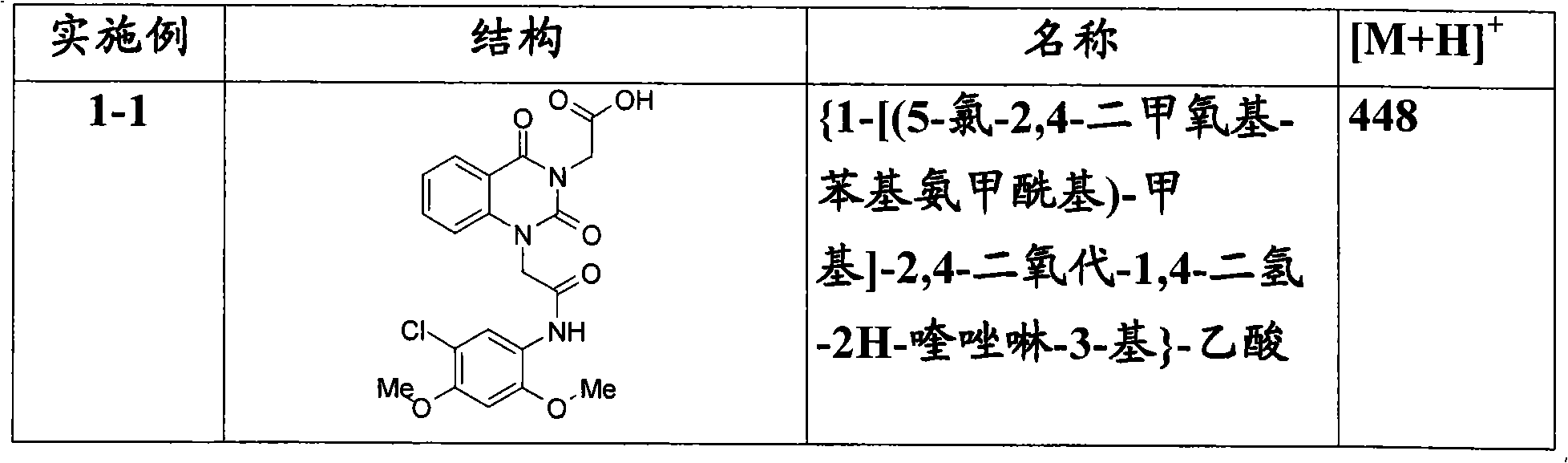


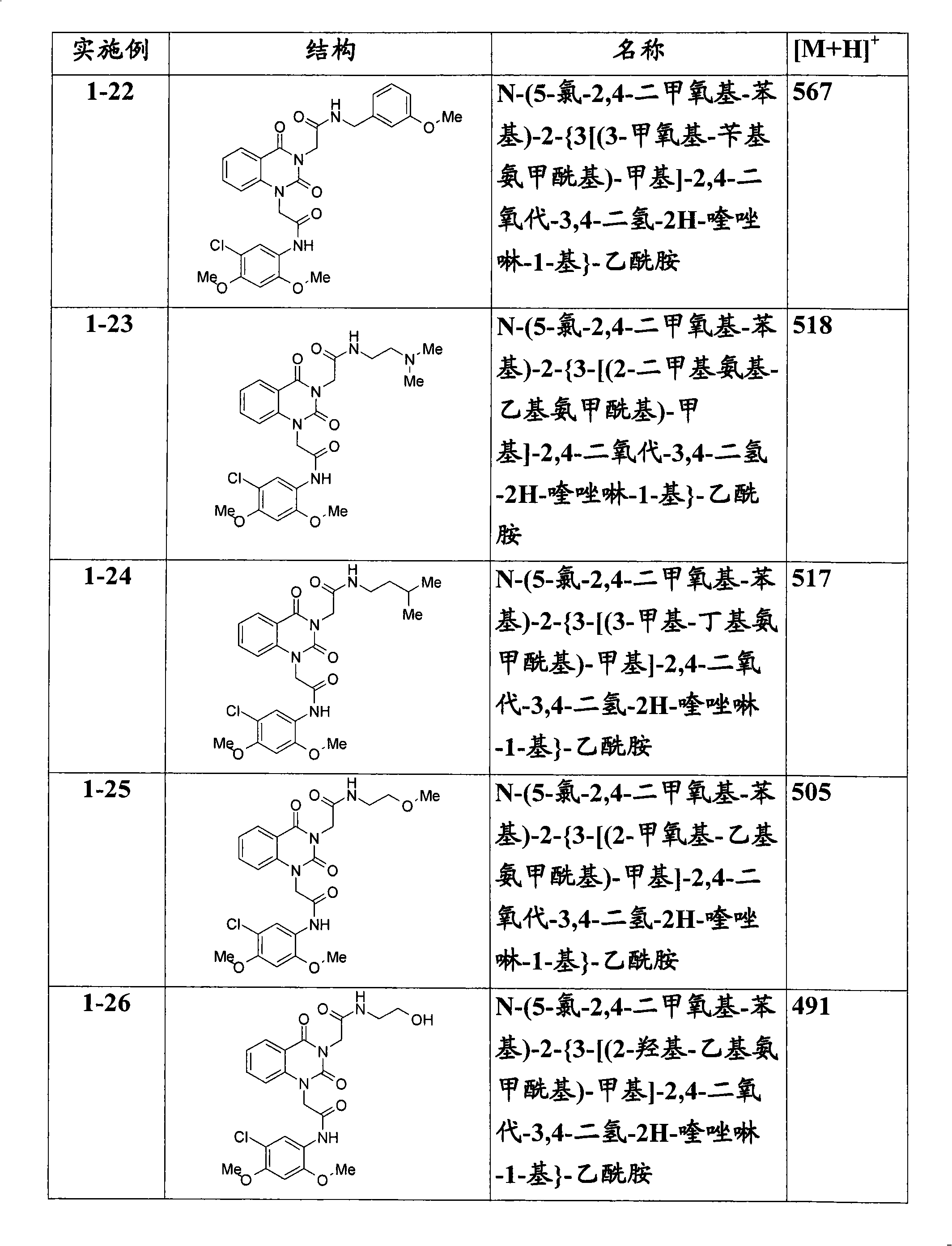


本发明的另外的优选化合物如下表2中所示。Additional preferred compounds of the invention are shown in Table 2 below.
实施例2-1至2-4:Embodiment 2-1 to 2-4:
表2Table 2
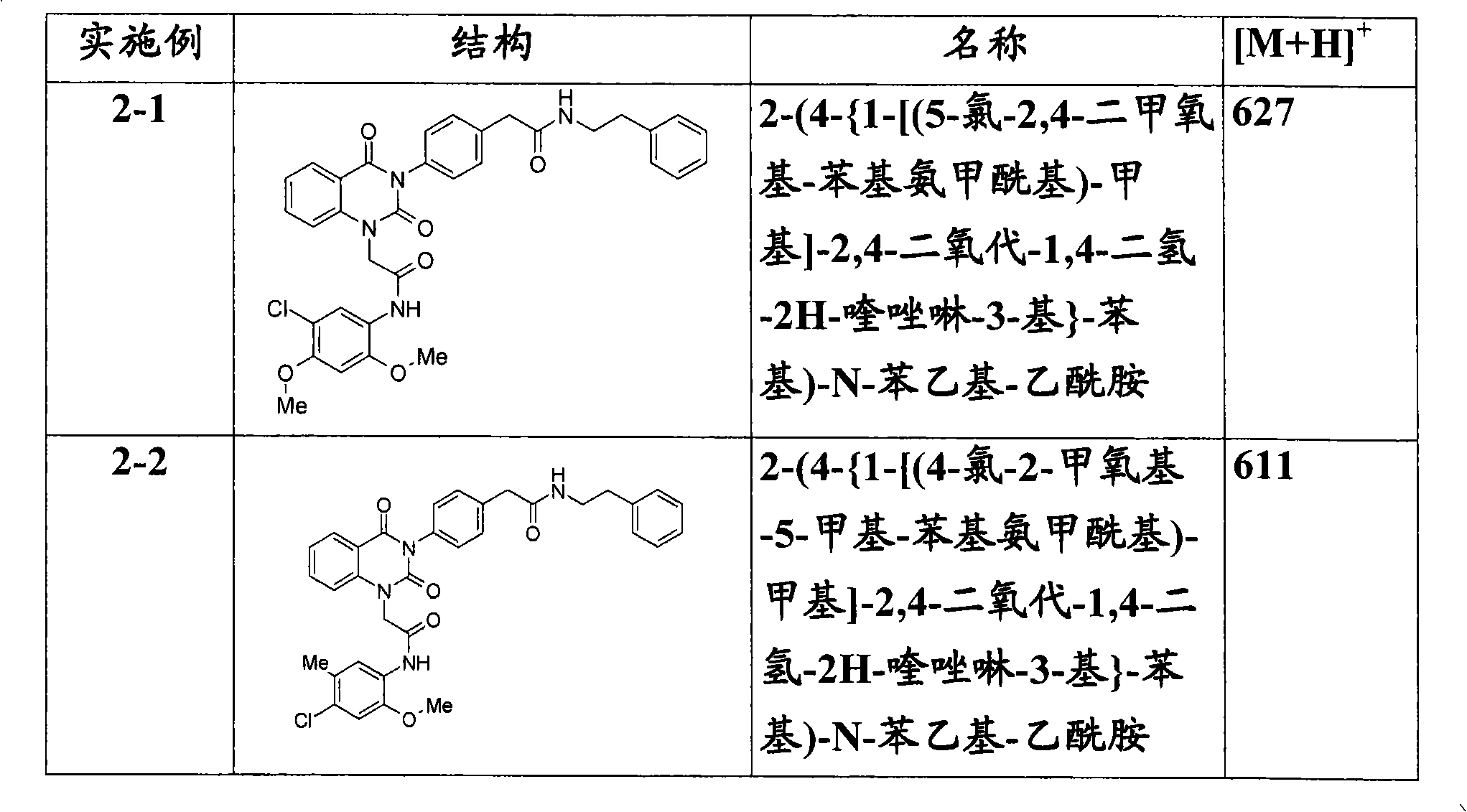

本发明的另外的优选化合物如下表3中的实施例3-1和3-10至3-17所示。化合物3-2至3-9是已知的化合物。Additional preferred compounds of the invention are shown in Table 3 below as Examples 3-1 and 3-10 to 3-17. Compounds 3-2 to 3-9 are known compounds.
化合物3-2至3-9以及实施例3-1和3-10至3-17:Compounds 3-2 to 3-9 and Examples 3-1 and 3-10 to 3-17:
表3table 3
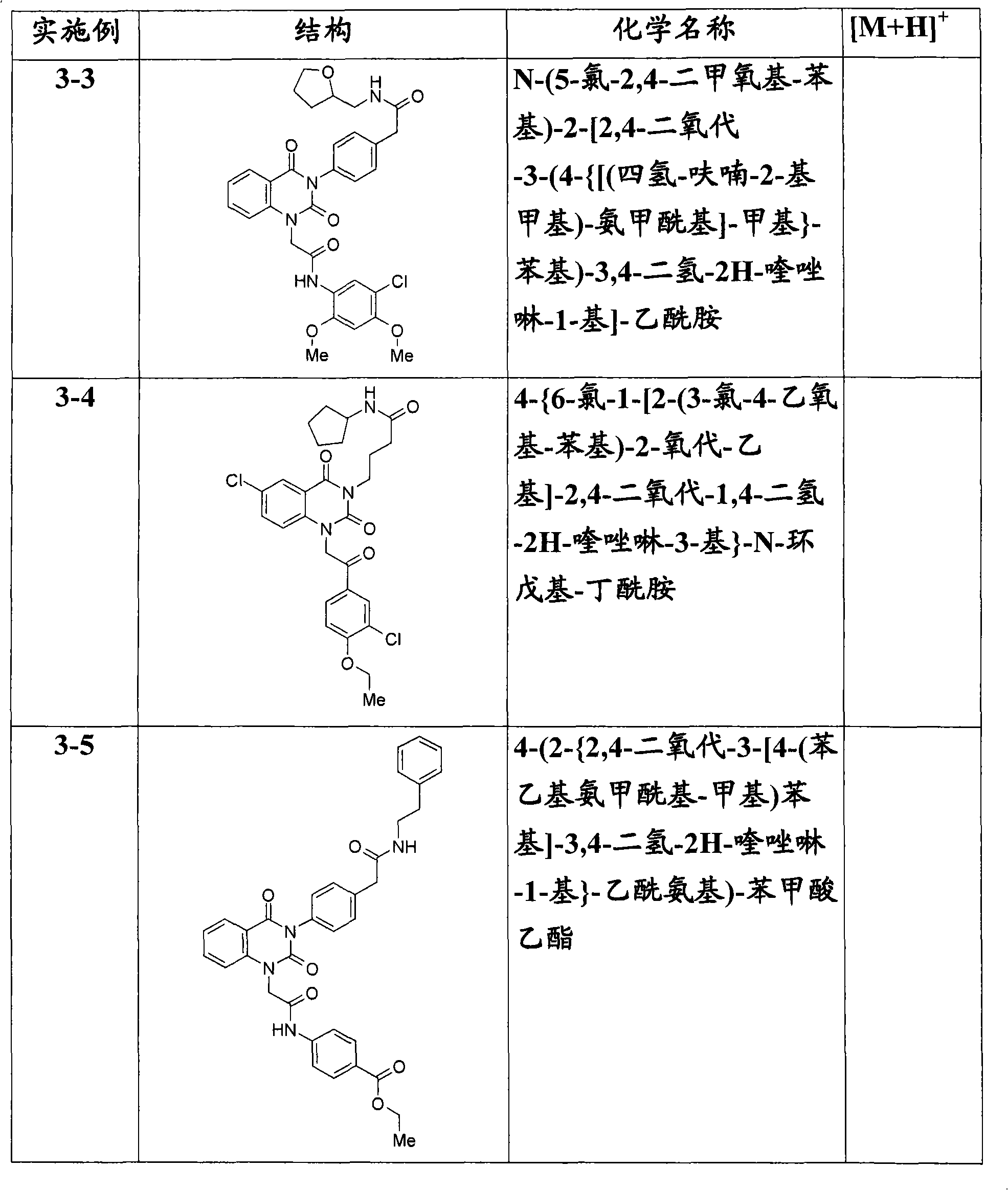


本发明的另外的优选化合物如下表5中所示。Additional preferred compounds of the invention are shown in Table 5 below.
实施例5-1至5-10:Embodiment 5-1 to 5-10:
表5table 5

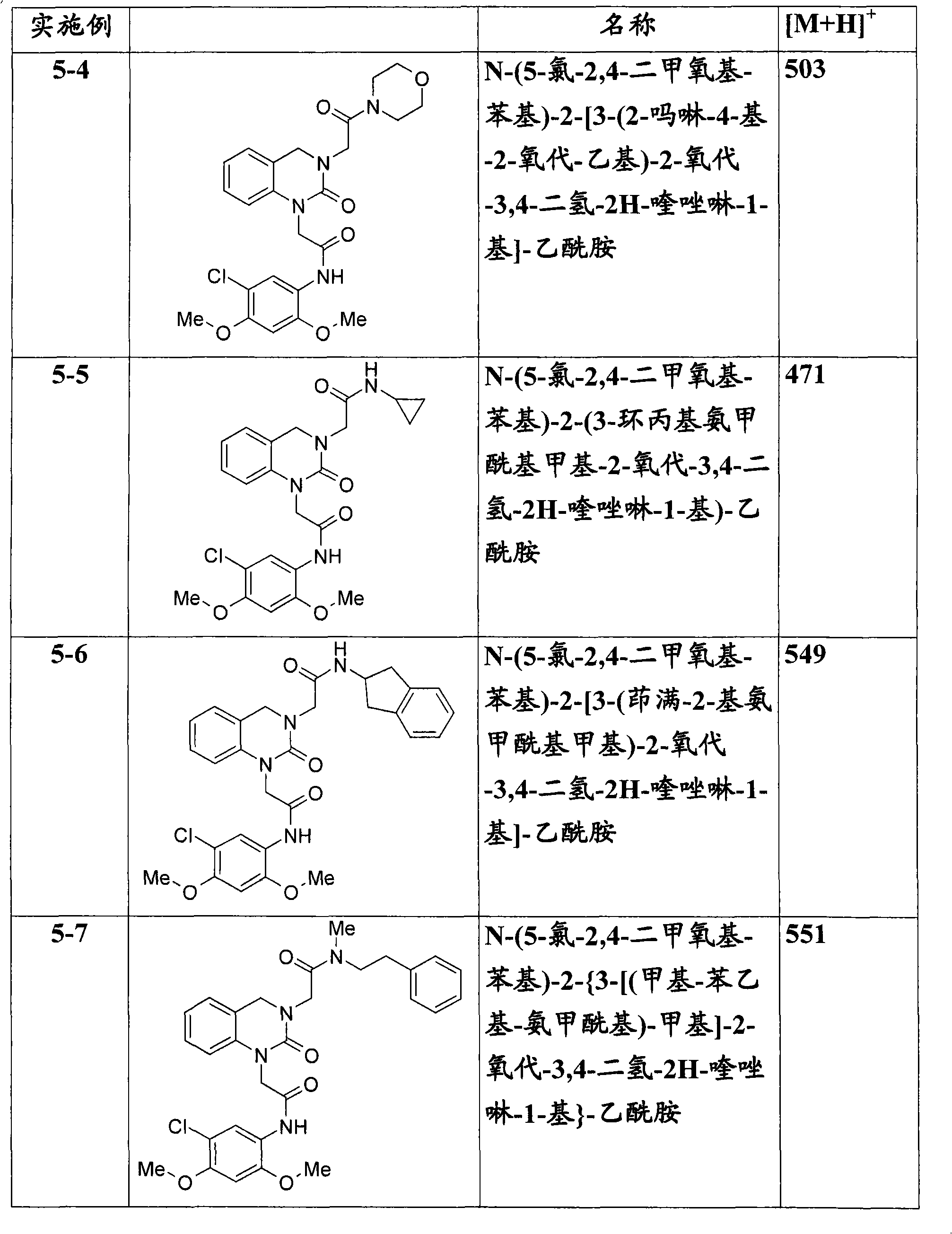
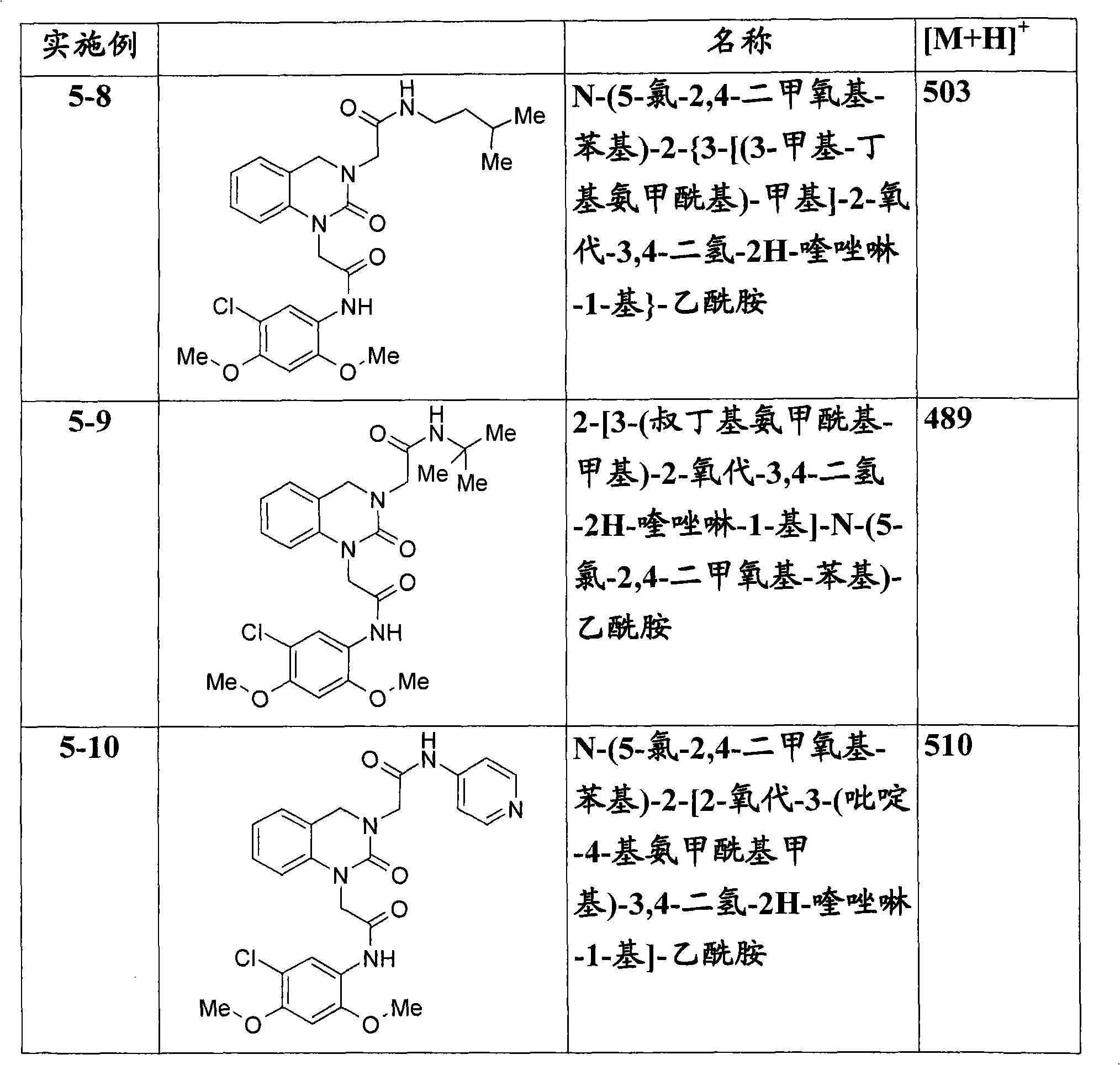
另外的化合物如下表6中所示。Additional compounds are shown in Table 6 below.
化合物6-1至6-3:Compounds 6-1 to 6-3:
表6Table 6
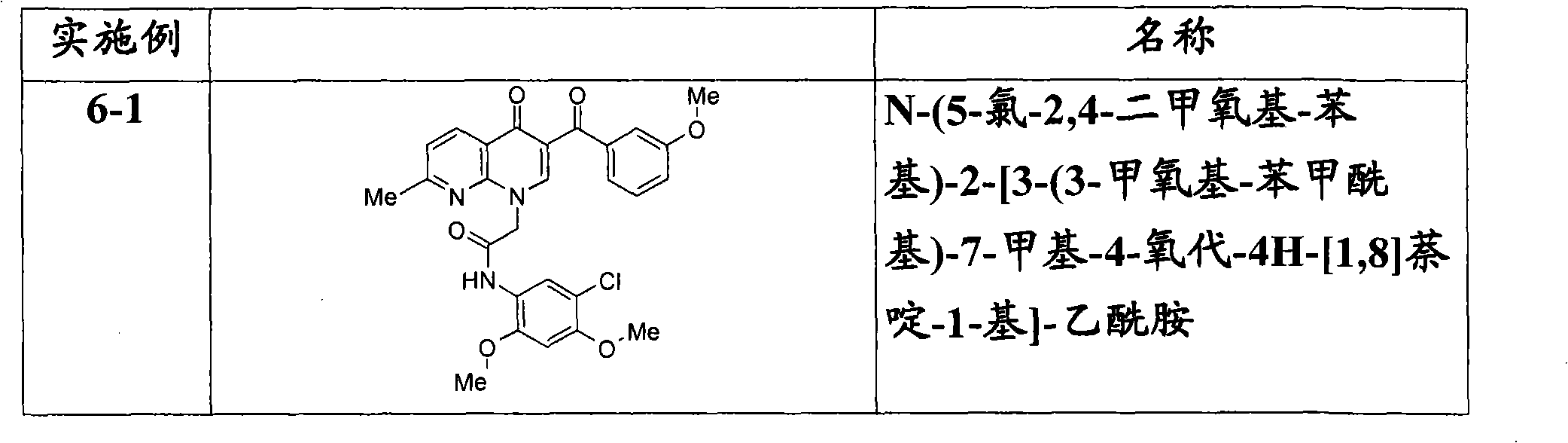
本发明的另外的优选化合物如下表7中所示。Additional preferred compounds of the invention are shown in Table 7 below.
实施例7-1至7-6:Embodiment 7-1 to 7-6:
表7Table 7
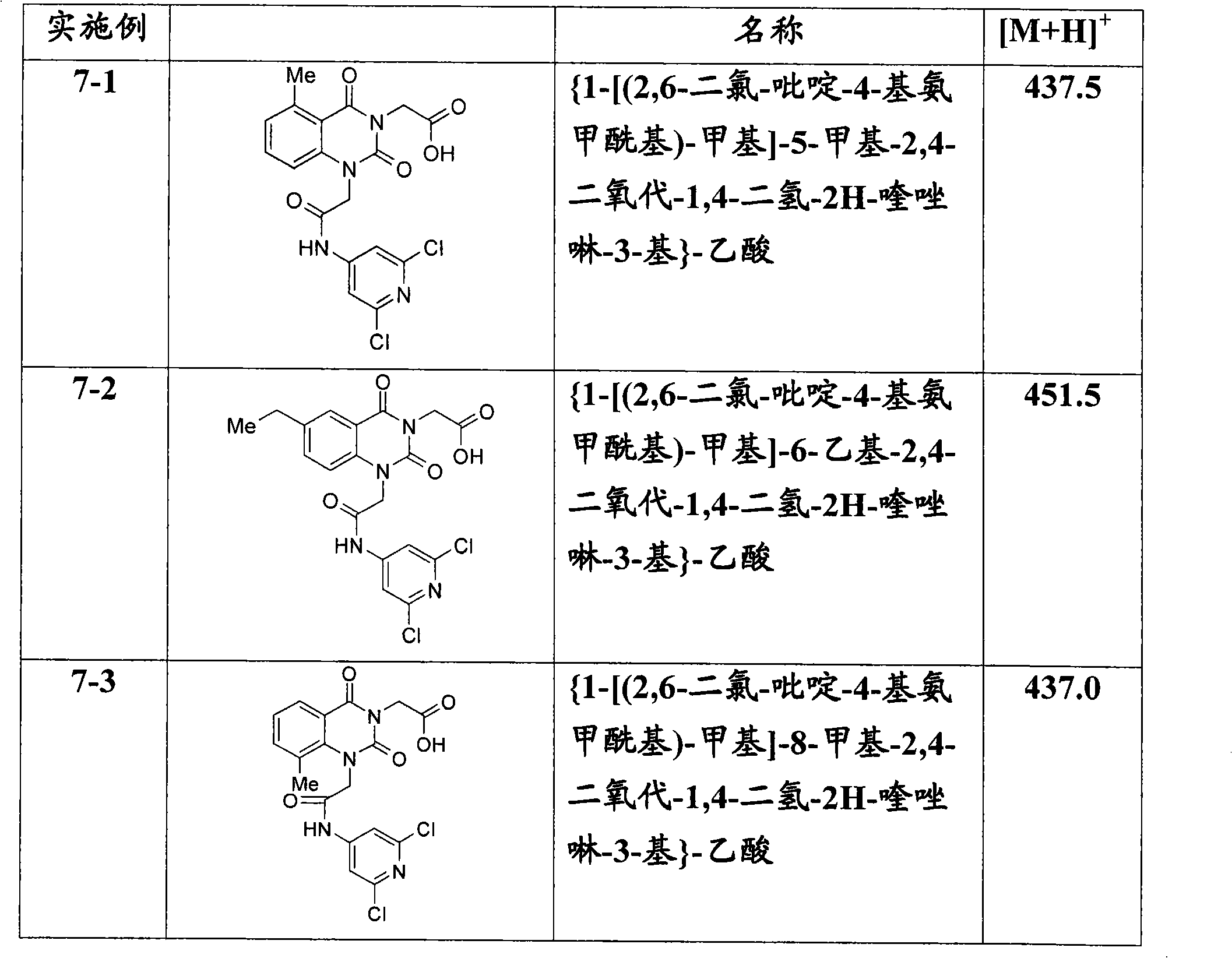
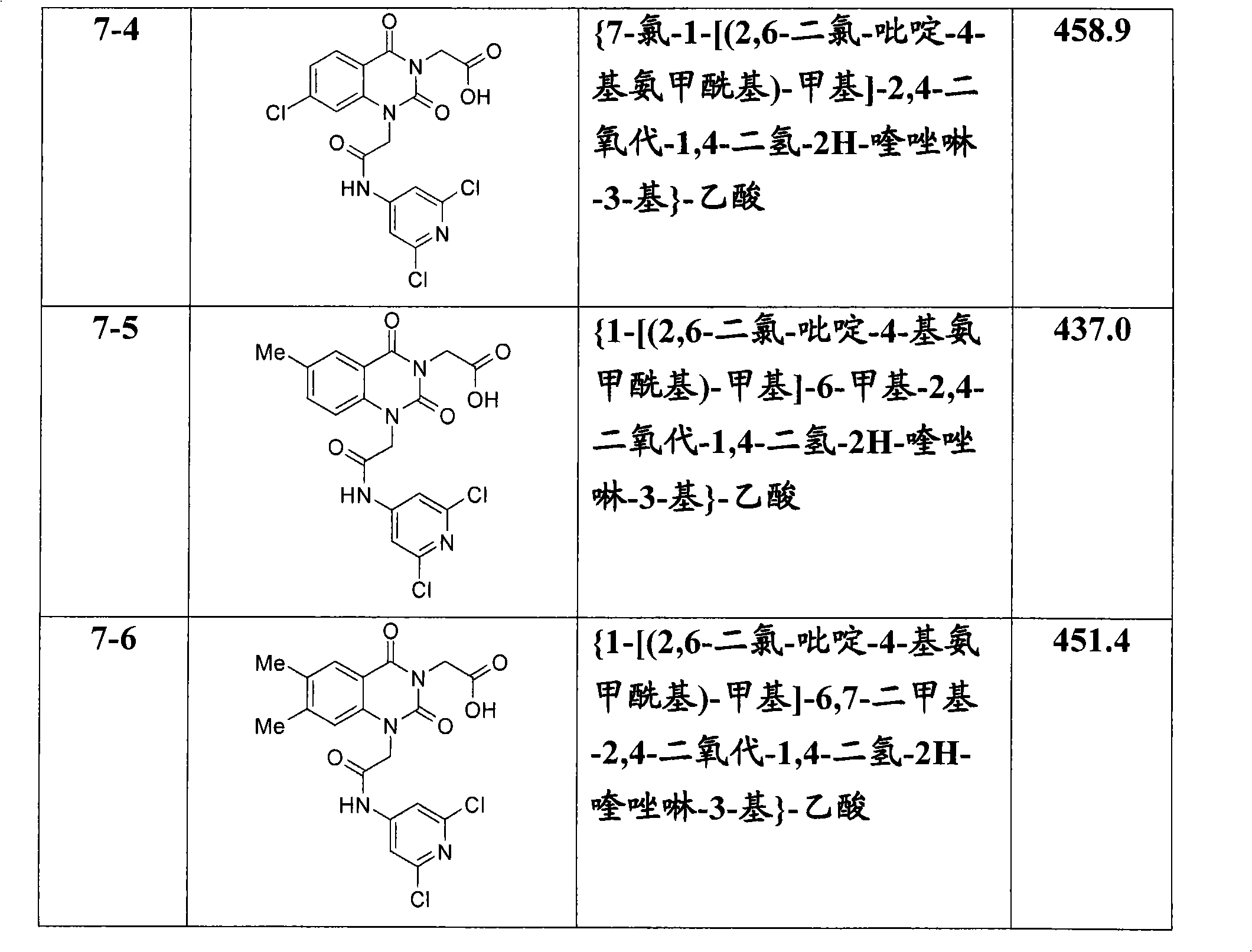
参照以下实施例,使用本文描述的方法或者本领域已知的其它方法合成了实施方案的化合物。Referring to the following examples, compounds of the embodiments were synthesized using the methods described herein or otherwise known in the art.
应该理解,某些实施方案的有机化合物可以显示出互变异构现象。尽管在本说明书内的化学结构可以仅代表可能的互变异构形式之一,但是应该理解,优选的实施方案包括所绘结构的任意互变异构形式。It is to be understood that the organic compounds of certain embodiments may exhibit tautomerism. Although the chemical structures within this specification may represent only one of the possible tautomeric forms, it should be understood that the preferred embodiments include any tautomeric form of the drawn structure.
应该理解,本发明不受限于本文用于说明而提出的实施方案,而是包括如在以上公开内容的范围内的其所有这类形式。It should be understood that the invention is not limited to the embodiments presented herein for illustration, but includes all such forms thereof as within the scope of the above disclosure.
通用条件: General conditions :
在LCMS系统上、使用电雾离子化进行质谱。这些是Agilent 1100HPLC/Mieromass平台质谱仪联合或者带有SQD质谱仪的Waters AcquityUPLC。[M+H]+指单同位素分子量。Mass spectrometry was performed on an LCMS system using electrospray ionization. These are Agilent 1100HPLC/Mieromass platform mass spectrometer combinations or Waters AcquityUPLC with SQD mass spectrometer. [M+H]+ refers to monoisotopic molecular weight.
在开放通路Bruker AVANCE 400NMR光谱仪上、使用ICON-NMR进行NMR光谱。光谱在298K下测定并使用溶剂峰进行参照。NMR spectra were performed using ICON-NMR on an open access Bruker AVANCE 400 NMR spectrometer. Spectra were measured at 298K and referenced using solvent peaks.
在适当时可以使用常规技术如沉淀、过滤、结晶、蒸发、蒸馏和色谱法来分离和纯化优选实施方案的不同的原料、中间体和化合物。除非另有说明,所有原料均获自商品供应商并且未经进一步纯化进行使用。盐可以由化合物通过已知的成盐方法来制备。The various starting materials, intermediates and compounds of the preferred embodiments can be separated and purified where appropriate using conventional techniques such as precipitation, filtration, crystallization, evaporation, distillation and chromatography. All starting materials were obtained from commercial suppliers and used without further purification unless otherwise stated. Salts can be prepared from compounds by known salt-forming methods.
此外,还已经采用了可得到的不同的商品试剂和材料。这类试剂和材料包括:[包括实例例如IsoluteTM(可获自百特基公司(Biotage))]并且可以容易地由所示的供应商获得。In addition, various commercially available reagents and materials have been employed. Such reagents and materials include: [including examples such as Isolute ™ (available from Biotage)] and are readily available from the suppliers indicated.
对于以下以及整个申请中的实施例,以下缩写具有以下含义。如果没有定义,则术语具有其通常接受的含义。For the examples below and throughout the application, the following abbreviations have the following meanings. If not defined, terms have their generally accepted meanings.
所用的缩写如下:The abbreviations used are as follows:
Cs2CO3 碳酸铯 K2CO3 碳酸钾Cs 2 CO 3 cesium carbonate K 2 CO 3 potassium carbonate
DCM 二氯甲烷 LCMS 液相色谱质谱法DCM Dichloromethane LCMS Liquid Chromatography Mass Spectrometry
DIPEA 二异丙基乙胺 MeOH 甲醇DIPEA Diisopropylethylamine MeOH Methanol
DMAP 4-二甲基氨基吡啶 NaHCO3 碳酸氢钠DMAP 4-Dimethylaminopyridine NaHCO 3 Sodium bicarbonate
DMF 二甲基甲酰胺 NMP 1-甲基-2-吡咯烷酮DMF Dimethylformamide NMP 1-methyl-2-pyrrolidone
DMSO 二甲基亚砜 NMR 核磁共振DMSO Dimethyl Sulfoxide NMR Nuclear Magnetic Resonance
EtOAc 乙酸乙酯 RT 室温EtOAc Ethyl Acetate RT RT
EtOH 乙醇 TEA 三乙胺EtOH Ethanol TEA Triethylamine
HATU 六氟磷酸O-(7-氮杂苯并 TFA 三氟乙酸HATU Hexafluorophosphate O-(7-azabenzo TFA Trifluoroacetic acid
三唑-1-基)-N,N,N′,N′-四 THF 氢呋喃 Triazol-1-yl)-N,N,N',N'-tetra THF hydrofuran
甲基脲鎓Methyluronium
HCl 盐酸HCl hydrochloric acid
实施例的制备Preparation of Examples
实施例1-1:{1-[(5-氯-2,4-二甲氧基-苯基氨甲酰基)-甲基]-2,4-二氧代-1,4-二 氢-2H-喹唑啉-3-基}-乙酸 Example 1-1 : {1-[(5-chloro-2,4-dimethoxy-phenylcarbamoyl)-methyl]-2,4-dioxo-1,4- dihydro- 2H-Quinazolin-3-yl}-acetic acid
将{1-[(5-氯-2,4-二甲氧基-苯基氨甲酰基)-甲基]-2,4-二氧代-1,4-二氢-2H-喹唑啉-3-基}-乙酸甲酯(中间体B)(10mg)在MeOH(300μL)中的白色混悬液用5M KOH(200μL)处理。于室温将白色混悬液搅拌过夜。将反应混合物用水稀释,得到稠厚的白色沉淀物,将其滤出,用水洗涤,真空干燥。将水相用稀HCl酸化至pH4,然后用EtOAc(3×)萃取。将有机相通过Na2SO4干燥,过滤,真空浓缩,得到灰白色固态的标题化合物。将其加入到最少量的DMF中,通过反相柱色谱法(IsoluteTM C18,0-100%MeCN水溶液-0.1%TFA)进一步纯化,得到标题化合物,[M+H]+448。{1-[(5-chloro-2,4-dimethoxy-phenylcarbamoyl)-methyl]-2,4-dioxo-1,4-dihydro-2H-quinazoline A white suspension of methyl-3-yl}-acetate (Intermediate B) (10 mg) in MeOH (300 μL) was treated with 5M KOH (200 μL). The white suspension was stirred overnight at room temperature. The reaction mixture was diluted with water to give a thick white precipitate which was filtered off, washed with water and dried in vacuo. The aqueous phase was acidified to pH 4 with dilute HCl, then extracted with EtOAc (3x). The organic phase was dried over Na2SO4 , filtered and concentrated in vacuo to afford the title compound as an off-white solid. This was added to a minimal amount of DMF and further purified by reverse phase column chromatography (Isolute ™ C18, 0-100% MeCN in water-0.1% TFA) to afford the title compound, [M+H] +448 .
实施例1-2:N-(5-氯-2,4-二甲氧基-苯基)-2-(3-环戊基氨甲酰基甲基-2,4-二氧 代-3,4-二氢-2H-喹唑啉-1-基)-乙酰胺 Embodiment 1-2 : N-(5-chloro-2,4-dimethoxy-phenyl)-2-(3-cyclopentylcarbamoylmethyl-2,4-dioxo -3, 4-Dihydro-2H-quinazolin-1-yl)-acetamide
将(20mg,44.74mmol)、环戊胺(4mg,46.98mmol)和HATU(18.7mg,49.21mmol)置于小瓶中,用DMSO(1ml)处理。将DIPEA(19.4μL,111.9mmol)加入到该混悬液中,于室温将反应混合物搅拌24小时。LCMS分析表明有主产物形成。真空过夜除去DMSO。将残余物用1M HCl稀释,用DCM(2×15ml)萃取。将分离的有机相用饱和NaHCO3水溶液洗涤,过滤,真空除去溶剂,得到标题化合物。(20 mg, 44.74 mmol), cyclopentylamine (4 mg, 46.98 mmol) and HATU (18.7 mg, 49.21 mmol) were placed in a vial and treated with DMSO (1 ml). DIPEA (19.4 μL, 111.9 mmol) was added to the suspension and the reaction mixture was stirred at room temperature for 24 hours. LCMS analysis indicated major product formation. DMSO was removed in vacuo overnight. The residue was diluted with 1M HCl and extracted with DCM (2 x 15ml). The separated organic phase was washed with saturated aqueous NaHCO 3 , filtered and the solvent was removed in vacuo to afford the title compound.
实施例1-3至1-7、1-9至1-29、1-31、1-32、1-35和1-37Examples 1-3 to 1-7, 1-9 to 1-29, 1-31, 1-32, 1-35 and 1-37
类似于实施例1-2、通过用适当的商品胺代替环戊胺制得这些化合物。These compounds were prepared analogously to Examples 1-2 by substituting the appropriate commercial amine for cyclopentylamine.
实施例1-8:N-(5-氯-2,4-二甲氧基-苯基)-2-{3-[2-(4-甲基-哌嗪-1-基)-2-氧代- 乙基]-2,4-二氧代-3,4-二氢-2H-喹唑啉-1-基}-乙酰胺 Embodiment 1-8 : N-(5-chloro-2,4-dimethoxy-phenyl)-2-{3-[2-(4-methyl-piperazin-1-yl)-2- Oxo- ethyl]-2,4-dioxo-3,4-dihydro-2H-quinazolin-1-yl}-acetamide
向{1-[(5-氯-2,4-二甲氧基-苯基氨甲酰基)-甲基]-2,4-二氧代-1,4-二氢-2H-喹唑啉-3-基}-乙酸(0.515g,1.14mmol)在NMP(8ml)中的溶液中加入三乙胺(0.166ml,1.26mmol),然后加入HATU(0.452g,1.26mmol)。于室温将该混合物搅拌5分钟,然后用1-甲基哌嗪(140.3μL,1.26mmol)处理。于室温5分钟后,将反应混合物在EtOAc(25ml)和水(25ml)之间分配。分离相,将水相用EtOAc(2×20ml)进一步洗涤。合并有机萃取液,将其用饱和NaHCO3(40ml)、盐水(40ml)洗涤,干燥(MgSO4),过滤,浓缩,得到褐色油状物。将残余物加入到MeCN(5ml)中并通过10g Varian预填充二氧化硅筒、用MeCN洗脱、然后用EtOAc洗脱,以除去杂质。从柱中用MeOH洗脱出产物。合并MeOH级分,将其真空浓缩,干燥,得到标题化合物,[M+H]+530。To {1-[(5-chloro-2,4-dimethoxy-phenylcarbamoyl)-methyl]-2,4-dioxo-1,4-dihydro-2H-quinazoline To a solution of -3-yl}-acetic acid (0.515g, 1.14mmol) in NMP (8ml) was added triethylamine (0.166ml, 1.26mmol) followed by HATU (0.452g, 1.26mmol). The mixture was stirred at room temperature for 5 minutes, then treated with 1-methylpiperazine (140.3 μL, 1.26 mmol). After 5 minutes at room temperature, the reaction mixture was partitioned between EtOAc (25ml) and water (25ml). The phases were separated and the aqueous phase was further washed with EtOAc (2 x 20ml). The combined organic extracts were washed with saturated NaHCO3 (40ml), brine (40ml), dried ( MgSO4 ), filtered and concentrated to give a brown oil. The residue was taken up in MeCN (5ml) and passed through a 1Og Varian prepacked silica cartridge, eluting with MeCN and then EtOAc to remove impurities. The product was eluted from the column with MeOH. The combined MeOH fractions were concentrated in vacuo and dried to give the title compound, [M+H] +530 .
实施例1-30:N-(5-氯-2,4-二甲氧基-苯基)-2-{3-[2-((S)-3-二甲基氨基-吡咯烷 -1-基)-2-氧代-乙基]-2,4-二氧代-3,4-二氢-2H-喹唑啉-1-基}-乙酰胺 Example 1-30 : N-(5-chloro-2,4-dimethoxy-phenyl)-2-{3-[2-((S)-3-dimethylamino-pyrrolidine -1 -yl)-2-oxo-ethyl]-2,4-dioxo-3,4-dihydro-2H-quinazolin-1-yl}-acetamide
向加有{1-[(5-氯-2,4-二甲氧基-苯基氨甲酰基)-甲基]-2,4-二氧代-1,4-二氢-2H-喹唑啉-3-基}-乙酸(50mg,0.11mmol)、HATU(46.6mg,0.12mmol)和二甲基-(S)-吡咯烷-3-基-胺(14.0mg,0.12mmol)的小瓶中加入DCM(2ml)。将该混合物用DIPEA(48.6μL,2.79mmol)处理,于室温搅拌1小时。将DCM(5ml)加入到混合物中,用1M HCl洗涤。将酸性水相用1M NaOH处理直到将pH调至pH7-8。从水相中用EtOAc(3×10ml)萃取出产物。合并有机部分,用水(10ml)洗涤,干燥(MgSO4),过滤,浓缩,得到标题化合物,[M+H]+544。Added {1-[(5-chloro-2,4-dimethoxy-phenylcarbamoyl)-methyl]-2,4-dioxo-1,4-dihydro-2H-quinone Vials of oxazolin-3-yl}-acetic acid (50 mg, 0.11 mmol), HATU (46.6 mg, 0.12 mmol) and dimethyl-(S)-pyrrolidin-3-yl-amine (14.0 mg, 0.12 mmol) DCM (2ml) was added. The mixture was treated with DIPEA (48.6 μL, 2.79 mmol) and stirred at room temperature for 1 hour. DCM (5ml) was added to the mixture, washed with 1M HCl. The acidic aqueous phase was treated with 1M NaOH until the pH was adjusted to pH 7-8. The product was extracted from the aqueous phase with EtOAc (3 x 10ml). The combined organic fractions were washed with water (10ml), dried ( MgSO4 ), filtered and concentrated to afford the title compound, [M+H] +544 .
实施例1-33:[(R)-1-(2-{1-[(5-氯-2,4-二甲氧基-苯基氨甲酰基)-甲基]-2,4-二 氧代-1,4-二氢-2H-喹唑啉-3-基}-乙酰基)-吡咯烷-3-基]-氨基甲酸叔丁酯 Example 1-33 : [(R)-1-(2-{1-[(5-chloro-2,4-dimethoxy-phenylcarbamoyl)-methyl]-2,4-di Oxo-1,4-dihydro-2H-quinazolin-3-yl}-acetyl)-pyrrolidin-3-yl]-tert-butyl carbamate
向加有{1-[(5-氯-2,4-二甲氧基-苯基氨甲酰基)-甲基]-2,4-二氧代-1,4-二氢-2H-喹唑啉-3-基}-乙酸(50.9mg,0.11mmol)、HATU(49.4mg,0.12mmol)和(R)-吡咯烷-3-基-氨基甲酸叔丁酯(25.7mg,0.12mmol)的小瓶中加入DMF(3ml)。将搅拌的混合物用DIPEA(33μL,0.275mmol)处理,于室温搅拌1小时。在搅拌下将水加入到该混合物中,产生固体。将其滤出,用水洗涤,得到标题化合物,[M+H]+616。Added {1-[(5-chloro-2,4-dimethoxy-phenylcarbamoyl)-methyl]-2,4-dioxo-1,4-dihydro-2H-quinone Azolin-3-yl}-acetic acid (50.9 mg, 0.11 mmol), HATU (49.4 mg, 0.12 mmol) and (R)-pyrrolidin-3-yl-carbamic acid tert-butyl ester (25.7 mg, 0.12 mmol) DMF (3ml) was added to the vial. The stirred mixture was treated with DIPEA (33 μL, 0.275 mmol) and stirred at room temperature for 1 hour. Water was added to the mixture with stirring resulting in a solid. It was filtered off and washed with water to give the title compound, [M+H] +616 .
实施例1-34:[(S)-1-(2-{1-[(5-氯-2,4-二甲氧基-苯基氨甲酰基)-甲基]-2,4-二 氧代-1,4-二氢-2H-喹唑啉-3-基}-乙酰基)-吡咯烷-3-基]-氨基甲酸叔丁酯 Example 1-34 : [(S)-1-(2-{1-[(5-chloro-2,4-dimethoxy-phenylcarbamoyl)-methyl]-2,4-di Oxo-1,4-dihydro-2H-quinazolin-3-yl}-acetyl)-pyrrolidin-3-yl]-tert-butyl carbamate
向加有{1-[(5-氯-2,4-二甲氧基-苯基氨甲酰基)-甲基]-2,4-二氧代-1,4-二氢-2H-喹唑啉-3-基}-乙酸(50.1mg,0.11mmol)、HATU(50.1mg,0.12mmol)和(R)-吡咯烷-3-基-氨基甲酸叔丁酯(22.8mg,0.12mmol)的小瓶中加入DMF(3ml)。将搅拌的混合物用DIPEA(33μL,0.275mmol)处理,于室温搅拌。在搅拌下将水加入到该混合物中,产生固体。将其滤出,用水洗涤,得到标题化合物;[M+H]+616。Added {1-[(5-chloro-2,4-dimethoxy-phenylcarbamoyl)-methyl]-2,4-dioxo-1,4-dihydro-2H-quinone Azolin-3-yl}-acetic acid (50.1 mg, 0.11 mmol), HATU (50.1 mg, 0.12 mmol) and (R)-pyrrolidin-3-yl-carbamic acid tert-butyl ester (22.8 mg, 0.12 mmol) DMF (3ml) was added to the vial. The stirred mixture was treated with DIPEA (33 μL, 0.275 mmol) and stirred at room temperature. Water was added to the mixture with stirring resulting in a solid. It was filtered off and washed with water to give the title compound; [M+H] +616 .
实施例1-37:{2-[(5-氯-2,4-二甲氧基-苯基氨甲酰基)-甲基]-2,4-二氧代-1,4- 二氢-2H-喹唑啉-3-基}-乙酸叔丁酯 Example 1-37 : {2-[(5-chloro-2,4-dimethoxy-phenylcarbamoyl)-methyl]-2,4-dioxo-1,4- dihydro- 2H-Quinazolin-3-yl}-tert-butyl acetate
类似于实施例3-10、通过用2-溴-N-(5-氯-2,4-二甲氧基-苯基)-乙酰胺(中间体C)代替2-溴-N-(2,6-二氯-吡啶-4-基)-乙酰胺(中间体N)制得实施例1-37。Similar to Example 3-10, by substituting 2-bromo-N-(5-chloro-2,4-dimethoxy-phenyl)-acetamide (intermediate C) for 2-bromo-N-(2 , 6-Dichloro-pyridin-4-yl)-acetamide (Intermediate N) Examples 1-37 were prepared.
实施例2-1:N-(5-氯-2,4-二甲氧基-苯基)-2-{2,4-二氧代-3-[4-(苯乙基氨甲酰 基-甲基)-苯基]-3,4-二氢-2H-喹唑啉-1-基}-乙酰胺 Example 2-1 : N-(5-chloro-2,4-dimethoxy-phenyl)-2-{2,4-dioxo-3-[4-( phenylethylcarbamoyl -methyl)-phenyl]-3,4-dihydro-2H-quinazolin-1-yl}-acetamide
类似于实施例1-2、通过用({2,4-二氧代-3-[4-(苯乙基氨甲酰基-甲基)-苯基]-3,4-二氢-2H-喹唑啉-1-基}-乙酸)(中间体D)代替{1-[(5-氯-2,4-二甲氧基-苯基氨甲酰基)-甲基]-2,4-二氧代-1,4-二氢-2H-喹唑啉-3-基}-乙酸(中间体A)并且用5-氯-2,4-二甲氧基-苯胺代替环戊胺制备该化合物,得到标题化合物。使用DMF作为溶剂进行反应。Similar to Example 1-2, by using ({2,4-dioxo-3-[4-(phenethylcarbamoyl-methyl)-phenyl]-3,4-dihydro-2H- Quinazolin-1-yl}-acetic acid) (Intermediate D) instead of {1-[(5-chloro-2,4-dimethoxy-phenylcarbamoyl)-methyl]-2,4- Dioxo-1,4-dihydro-2H-quinazolin-3-yl}-acetic acid (Intermediate A) and 5-chloro-2,4-dimethoxy-aniline was used instead of cyclopentylamine to prepare this compound to give the title compound. The reaction was carried out using DMF as solvent.
实施例2-2至2-3: Embodiment 2-2 to 2-3 :
类似于实施例2-1、通过用适当的商品胺代替5-氯-2,4-二甲氧基-苯胺制得这些化合物。These compounds were prepared analogously to Example 2-1 by substituting an appropriate commercial amine for 5-chloro-2,4-dimethoxy-aniline.
实施例2-4:(4-{1-[(5-氯-2,4-二甲氧基-苯基氨甲酰基)-甲基]-2,4-二氧代-1,4- 二氢-2H-喹唑啉-3-基}-苯基)-乙酸 Embodiment 2-4 : (4-{1-[(5-chloro-2,4-dimethoxy-phenylcarbamoyl)-methyl]-2,4-dioxo-1,4- Dihydro-2H-quinazolin-3-yl}-phenyl)-acetic acid
将(4-[1-[(5-氯-2,4-二甲氧基-苯基氨甲酰基)-甲基]-2,4-二氧代-1,4-二氢-2H-喹唑啉-3-基}-苯基)-乙酸乙酯(中间体K)(105.4mg,0.19mmol)加入到搅拌的双(三丁基锡)氧化物(2当量,0.38mmol,193.1μL)在甲苯(10ml)中的溶液中。于120℃将该混合物加热回流72小时。真空除去甲苯,将红色/褐色油状残余物在EtOAc和饱和NaHCO3(5ml)之间分配。将产生的沉淀物滤出,用NaHCO3、EtOAc、1M HCl、水洗涤,干燥,得到标题化合物,[M+H]+524。(4-[1-[(5-chloro-2,4-dimethoxy-phenylcarbamoyl)-methyl]-2,4-dioxo-1,4-dihydro-2H- Quinazolin-3-yl}-phenyl)-ethyl acetate (Intermediate K) (105.4 mg, 0.19 mmol) was added to stirred bis(tributyltin) oxide (2 equiv, 0.38 mmol, 193.1 μL) in solution in toluene (10ml). The mixture was heated to reflux at 120°C for 72 hours. Toluene was removed in vacuo and the red/brown oily residue was partitioned between EtOAc and saturated NaHCO3 (5ml). The resulting precipitate was filtered off, washed with NaHCO3 , EtOAc, 1M HCl, water and dried to afford the title compound, [M+H] +524 .
实施例3-1:(2-{1-[(5-氯-2,4-二甲氧基-苯基氨甲酰基)-甲基]-2,4-二氧代-1,4- 二氢-2H-喹唑啉-3-基}-乙基)-氨基甲酸叔丁酯 Example 3-1 : (2-{1-[(5-chloro-2,4-dimethoxy-phenylcarbamoyl)-methyl]-2,4-dioxo-1,4- Dihydro-2H-quinazolin-3-yl}-ethyl)-tert-butyl carbamate
类似于实施例1-2、通过用[3-(2-叔丁氧基羰基氨基-乙基)-2,4-二氧代-3,4-二氢-2H-喹唑啉-1-基]-乙酸代替中间体A并且用5-氯-2,4-二甲氧基苯胺代替环戊胺制备该化合物,得到标题化合物。反应在DCM中进行。Similar to Example 1-2, by using [3-(2-tert-butoxycarbonylamino-ethyl)-2,4-dioxo-3,4-dihydro-2H-quinazoline-1- This compound was prepared by substituting intermediate A for intermediate A and substituting 5-chloro-2,4-dimethoxyaniline for cyclopentylamine to afford the title compound. The reaction was carried out in DCM.
化合物3-2至3-9Compounds 3-2 to 3-9
这些化合物及其制备方法是已知的。These compounds and their preparation methods are known.
实施例3-10:{1-[(2,6-二氯-吡啶-4-基氨甲酰基)-甲基]-2,4-二氧代-1,4-二氢 -2H-喹唑啉-3-基}-乙酸叔丁酯 Embodiment 3-10 : {1-[(2,6-dichloro-pyridin-4-ylcarbamoyl)-methyl]-2,4-dioxo-1,4-dihydro- 2H-quinone Azolin-3-yl}-tert-butyl acetate
于室温将包含在DMF(5ml)中的(2,4-二氧代-1,4-二氢-2H-喹唑啉-3-基)-乙酸叔丁酯(中间体L)(226.7mg,0.82mmol)、2-溴-N-(2,6-二氯-吡啶-4-基)-乙酰胺(中间体N)(256.5mg,0.902mmol)和Cs2CO3(545.1mg,1.64mmol)的混合物搅拌3小时。将产生的混合物用水处理,将沉淀物在真空下过滤。将固体用水、异己烷洗涤,然后干燥,得到标题化合物,[M+H]+479。(2,4-Dioxo-1,4-dihydro-2H-quinazolin-3-yl)-tert-butyl acetate (Intermediate L) (226.7 mg , 0.82mmol), 2-bromo-N-(2,6-dichloro-pyridin-4-yl)-acetamide (Intermediate N) (256.5mg, 0.902mmol) and Cs 2 CO 3 (545.1mg, 1.64 mmol) was stirred for 3 hours. The resulting mixture was treated with water and the precipitate was filtered under vacuum. The solid was washed with water, isohexane and dried to give the title compound, [M+H] +479 .
实施例3-11:{1-[(2,6-二氯-吡啶-4-基氨甲酰基)-甲基]-2,4-二氧代-1,4-二氢 -2H-喹唑啉-3-基}-乙酸 Embodiment 3-11 : {1-[(2,6-dichloro-pyridin-4-ylcarbamoyl)-methyl]-2,4-dioxo-1,4-dihydro- 2H-quinone Azolin-3-yl}-acetic acid
向圆底烧瓶中加入{1-[(2,6-二氯-吡啶-4-基氨甲酰基)-甲基]-2,4-二氧代-1,4-二氢-2H-喹唑啉-3-基}-乙酸叔丁酯(50.9mg,0.106mmol),用DCM(1.5ml)和TFA(1.5ml)处理。于室温将该反应混合物搅拌2小时,然后真空浓缩。将残余物加入到最少量的DCM中,真空浓缩。将该过程用EtOAc重复2次,用MeOH重复2次,得到标题化合物,[M+H]+422。Add {1-[(2,6-dichloro-pyridin-4-ylcarbamoyl)-methyl]-2,4-dioxo-1,4-dihydro-2H-quinolin to a round bottom flask Azolin-3-yl}-tert-butyl acetate (50.9mg, 0.106mmol), treated with DCM (1.5ml) and TFA (1.5ml). The reaction mixture was stirred at room temperature for 2 hours, then concentrated in vacuo. The residue was added to a minimum amount of DCM and concentrated in vacuo. This process was repeated 2 times with EtOAc and 2 times with MeOH to afford the title compound, [M+H] +422 .
实施例3-12:N-(2,6-二氯-吡啶-4-基)-2-{3-[2-(4-甲基-哌嗪-1-基)-2-氧代-乙 基]-2,4-二氧代-3,4-二氢-2H-喹唑啉-1-基}-乙酰胺 Embodiment 3-12 : N-(2,6-dichloro-pyridin-4-yl)-2-{3-[2-(4-methyl-piperazin-1-yl)-2-oxo- Ethyl ]-2,4-dioxo-3,4-dihydro-2H-quinazolin-1-yl}-acetamide
向{1-[(2,6-二氯-吡啶-4-基氨甲酰基)-甲基]-2,4-二氧代-1,4-二氢-2H-喹唑啉-3-基}-乙酸(13.5mg,0.0318mmol)在无水NMP(1.5ml)中的溶液中加入HATU(13.3mg,0.035mmol),然后加入三乙胺(4.89μL,0.035mmol)。于室温将橙色溶液搅拌10分钟,然后用1-甲基哌嗪(3.89μL,0.035mmol)处理。于室温将反应混合物搅拌,通过HPLC/LCMS监测直到原料耗尽。将反应混合物在EtOAc(5ml)和水(5ml)之间分配。分离有机层,将其用盐水(5ml)洗涤,干燥(MgSO4),过滤,真空浓缩。将粗产物通过5g IsoluteTM SCX2(固体支持的磺酸树脂)筒、用DCM(20ml)、MeOH(20ml)和在MeOH中的7NNH3洗脱进行纯化。将碱性氨洗涤液真空浓缩,得到白色固态的标题化合物,[M+H]+505。To {1-[(2,6-dichloro-pyridin-4-ylcarbamoyl)-methyl]-2,4-dioxo-1,4-dihydro-2H-quinazoline-3- To a solution of ]-acetic acid (13.5 mg, 0.0318 mmol) in dry NMP (1.5 ml) was added HATU (13.3 mg, 0.035 mmol) followed by triethylamine (4.89 μL, 0.035 mmol). The orange solution was stirred at room temperature for 10 minutes, then treated with 1-methylpiperazine (3.89 μL, 0.035 mmol). The reaction mixture was stirred at room temperature, monitored by HPLC/LCMS until the starting material was consumed. The reaction mixture was partitioned between EtOAc (5ml) and water (5ml). The organic layer was separated, washed with brine (5ml), dried ( MgSO4 ), filtered and concentrated in vacuo. The crude product was purified by 5 g Isolute ™ SCX2 (solid supported sulfonic acid resin) cartridge, eluting with DCM (20 ml), MeOH (20 ml) and 7NNH3 in MeOH. The basic ammonia washes were concentrated in vacuo to afford the title compound, [M+H] +505 , as a white solid.
实施例3-13:2-[3-(2-氨基-乙基)-2,4-二氧代-3,4-二氢-2H-喹唑啉-1-基]-N-(5- 氯-2,4-二甲氧基-苯基)-乙酰胺三氟乙酸盐 Embodiment 3-13 : 2-[3-(2-amino-ethyl)-2,4-dioxo-3,4-dihydro-2H-quinazolin-1-yl]-N-(5 -Chloro -2,4-dimethoxy-phenyl)-acetamide trifluoroacetate
将(2-{1-[(5-氯-2,4-二甲氧基-苯基氨甲酰基)-甲基]-2,4-二氧代-1,4-二氢-2H-喹唑啉-3-基}-乙基)-氨基甲酸叔丁酯(100mg,1.88mmol)加入到DCM(2ml)中,用TFA(2ml)处理。于室温将反应物搅拌2小时,然后用EtOAc(20ml)处理。5分钟后,将存在的白色固体滤出,用EtOAc、乙醚洗涤,在真空下干燥,得到白色固态的标题化合物;[M+H]+433。(2-{1-[(5-chloro-2,4-dimethoxy-phenylcarbamoyl)-methyl]-2,4-dioxo-1,4-dihydro-2H- Quinazolin-3-yl}-ethyl)-tert-butylcarbamate (100mg, 1.88mmol) was added to DCM (2ml) and treated with TFA (2ml). The reaction was stirred at room temperature for 2 hours then treated with EtOAc (20ml). After 5 minutes, the white solid present was filtered off, washed with EtOAc, diethyl ether and dried under vacuum to afford the title compound as a white solid; [M+H] +433 .
实施例3-14:N-(2-{1-[(5-氯-2,4-二甲氧基-苯基氨甲酰基)-甲基]-2,4-二氧代 -1,4-二氢-2H-喹唑啉-3-基}-乙基)-3-甲基-丁酰胺 Embodiment 3-14 : N-(2-{1-[(5-chloro-2,4-dimethoxy-phenylcarbamoyl)-methyl]-2,4-dioxo -1, 4-Dihydro-2H-quinazolin-3-yl}-ethyl)-3-methyl-butanamide
向2-[3-(2-氨基-乙基)-2,4-二氧代-3,4-二氢-2H-喹唑啉-1-基]-N-(5-氯-2,4-二甲氧基-苯基)-乙酰胺三氟乙酸盐(75mg,0.17mmol)在THF(1ml)中的混悬液中加入三乙胺(0.06ml,0.43mmol),然后加入异戊酰氯(30mg,0.26mmol)。于室温将该混合物搅拌过夜,然后用水(3ml)处理。将产生的固体滤出,用水洗涤,得到标题化合物;[M+H]+517.3。To 2-[3-(2-amino-ethyl)-2,4-dioxo-3,4-dihydro-2H-quinazolin-1-yl]-N-(5-chloro-2, To a suspension of 4-dimethoxy-phenyl)-acetamide trifluoroacetate (75mg, 0.17mmol) in THF (1ml) was added triethylamine (0.06ml, 0.43mmol) followed by iso Valeryl chloride (30mg, 0.26mmol). The mixture was stirred overnight at room temperature, then treated with water (3ml). The resulting solid was filtered off and washed with water to give the title compound; [M+H] + 517.3.
实施例3-15:环丁烷甲酸(2-{1-[(5-氯-2,4-二甲氧基-苯基氨甲酰基)-甲 基]-2,4-二氧代-1,4-二氢-2H-喹唑啉-3-基}-乙基)-酰胺 Embodiment 3-15 : Cyclobutanecarboxylic acid (2-{1-[(5-chloro-2,4-dimethoxy-phenylcarbamoyl) -methyl ] -2,4-dioxo- 1,4-Dihydro-2H-quinazolin-3-yl}-ethyl)-amide
向2-[3-(2-氨基-乙基)-2,4-二氧代-3,4-二氢-2H-喹唑啉-1-基]-N-(5-氯-2,4-二甲氧基-苯基)-乙酰胺三氟乙酸盐(75mg,0.17mmol)在THF(1ml)中的混悬液中加入三乙胺(0.06ml,0.43mmol),然后加入环丁烷碳酰氯(30mg,0.26mmol)。于室温将该混合物搅拌过夜。将水(3ml)加入到该混合物中,然后加入EtOAc,得到混悬液,将其过滤以除去固体。将滤液用水洗涤,干燥,蒸发,得到标题化合物,[M+H]+515。To 2-[3-(2-amino-ethyl)-2,4-dioxo-3,4-dihydro-2H-quinazolin-1-yl]-N-(5-chloro-2, To a suspension of 4-dimethoxy-phenyl)-acetamide trifluoroacetate (75mg, 0.17mmol) in THF (1ml) was added triethylamine (0.06ml, 0.43mmol) followed by cyclic Butanecarbonyl chloride (30 mg, 0.26 mmol). The mixture was stirred overnight at room temperature. Water (3ml) was added to the mixture followed by EtOAc to give a suspension which was filtered to remove solids. The filtrate was washed with water, dried and evaporated to give the title compound, [M+H] +515 .
实施例3-16:N-(3,5-二氯-苯基)-2-(3-乙基-2,4-二氧代-3,4-二氢-2H-喹唑啉 -1-基)-乙酰胺 Example 3-16 : N-(3,5-dichloro-phenyl)-2-(3-ethyl-2,4-dioxo-3,4-dihydro-2H-quinazoline -1 -yl)-acetamide
向加有在DCM(1.5ml)中的(3-乙基-2,4-二氧代-3,4-二氢-2H-喹唑啉-1-基)-乙酸(72mg,0.26mmol)和二异丙基乙胺(Hunig氏碱;0.11ml,0.63mmol)的圆底烧瓶中加入3,5-二氯苯胺(47mg,0.29mmol)和HATU(109mg,0.29mmol)。将该反应混合物搅拌过夜,然后用水(3ml)和乙醚(2ml)处理。将产生的固体滤出,用水(3×)、乙醚洗涤,然后干燥。用MeOH研磨,得到标题化合物。To (3-ethyl-2,4-dioxo-3,4-dihydro-2H-quinazolin-1-yl)-acetic acid (72mg, 0.26mmol) in DCM (1.5ml) was added A round bottom flask with diisopropylethylamine (Hunig's base; 0.11 ml, 0.63 mmol) was charged with 3,5-dichloroaniline (47 mg, 0.29 mmol) and HATU (109 mg, 0.29 mmol). The reaction mixture was stirred overnight then treated with water (3ml) and diethyl ether (2ml). The resulting solid was filtered off, washed with water (3x), diethyl ether, and dried. Trituration with MeOH gave the title compound.
实施例3-17:N-(2,6-二氯-吡啶-4-基)-2-(3-乙基-2,4-二氧代-3,4-二氢-2H-喹 唑啉-1-基)-乙酰胺 Example 3-17 : N-(2,6-dichloro-pyridin-4-yl)-2-(3-ethyl-2,4-dioxo-3,4-dihydro-2H- quinazole (Phenyl-1-yl)-acetamide
向加有在DCM(1.5ml)中的(3-乙基-2,4-二氧代-3,4-二氢-2H-喹唑啉-1-基)-乙酸(72mg,0.26mmol)和二异丙基乙胺(Hunig氏碱;0.11ml,0.63mmol)的圆底烧瓶中加入2,6-二氯-吡啶-4-基胺(47mg,0.29mmol)和HATU(109mg,0.29mmol)。将该反应混合物搅拌过夜,然后加入水(3ml)和乙醚(2ml)。将产生的混合物通过制备型HPLC进行纯化,得到标题化合物;[M+H]+393。To (3-ethyl-2,4-dioxo-3,4-dihydro-2H-quinazolin-1-yl)-acetic acid (72mg, 0.26mmol) in DCM (1.5ml) was added and diisopropylethylamine (Hunig's base; 0.11ml, 0.63mmol) in a round bottom flask was added 2,6-dichloro-pyridin-4-ylamine (47mg, 0.29mmol) and HATU (109mg, 0.29mmol) ). The reaction mixture was stirred overnight, then water (3ml) and diethyl ether (2ml) were added. The resulting mixture was purified by preparative HPLC to afford the title compound; [M+H] +393 .
实施例4-1:{1-[(5-氯-2,4-二甲氧基-苯基氨甲酰基)-甲基]-2,4-二氧代-1,4-二 氢-2H-吡啶并[3,2-d]嘧啶-3-基}-乙酸 Example 4-1 : {1-[(5-chloro-2,4-dimethoxy-phenylcarbamoyl)-methyl]-2,4-dioxo-1,4- dihydro- 2H-pyrido[3,2-d]pyrimidin-3-yl}-acetic acid
将搅拌的{1-[(5-氯-2,4-二甲氧基-苯基氨甲酰基)-甲基]-2,4-二氧代-1,4-二氢-2H-吡啶并[3,2-d]嘧啶-3-基}-乙酸叔丁酯(中间体R)(22.1mg,0.044mmol)在DCM(1ml)中的溶液用TFA(1ml)处理。于室温将该反应混合物搅拌,通过HPLC/LCMS监测直到原料耗尽。3小时后,将反应混合物用最少量的DCM稀释,真空浓缩。将残余物加入到最少量的MeOH中,真空浓缩,再次加入到最少量的EtOAc中,真空浓缩,得到灰白色固态的标题化合物;[M+H]+449。The stirred {1-[(5-chloro-2,4-dimethoxy-phenylcarbamoyl)-methyl]-2,4-dioxo-1,4-dihydro-2H-pyridine A solution of [3,2-d]pyrimidin-3-yl}-acetic acid tert-butyl ester (Intermediate R) (22.1 mg, 0.044 mmol) in DCM (1 ml) was treated with TFA (1 ml). The reaction mixture was stirred at room temperature, monitored by HPLC/LCMS until the starting material was consumed. After 3 hours, the reaction mixture was diluted with a minimal amount of DCM and concentrated in vacuo. The residue was taken up in a minimum amount of MeOH, concentrated in vacuo, added again in a minimum amount of EtOAc, and concentrated in vacuo to afford the title compound as an off-white solid; [M+H] +449 .
实施例4-2:{5-氯-1-[(5-氯-2,4-二甲氧基-苯基氨甲酰基)-甲基]-2,4-二氧代 -1,4-二氢-2H-吡啶并[4,3-d]嘧啶-3-基}-乙酸 Example 4-2 : {5-chloro-1-[(5-chloro-2,4-dimethoxy-phenylcarbamoyl)-methyl]-2,4-dioxo -1,4 -Dihydro-2H-pyrido[4,3-d]pyrimidin-3-yl}-acetic acid
向含有{5-氯-1-[(5-氯-2,4-二甲氧基-苯基氨甲酰基)-甲基]-2,4-二氧代-1,4-二氢-2H-吡啶并[4,3-d]嘧啶-3-基}-乙酸叔丁酯(中间体T)(10.1mg,0.019mmol)在DCM(1ml)中的溶液的小瓶中加入TFA(1ml)。于室温将该反应混合物搅拌2小时,转移到10ml圆底烧瓶中,用最少量的DCM稀释,真空浓缩。将残余物加入到最少量的DCM中,真空浓缩。将该过程用DCM重复1次,用EtOAc重复2次,用MeOH重复1次,每次将溶剂真空浓缩,最后得到标题化合物。To containing {5-chloro-1-[(5-chloro-2,4-dimethoxy-phenylcarbamoyl)-methyl]-2,4-dioxo-1,4-dihydro- 2H-Pyrido[4,3-d]pyrimidin-3-yl}-acetic acid tert-butyl ester (Intermediate T) (10.1 mg, 0.019 mmol) in DCM (1 ml) A vial was added with TFA (1 ml) . The reaction mixture was stirred at room temperature for 2 hours, transferred to a 10 ml round bottom flask, diluted with a minimal amount of DCM, and concentrated in vacuo. The residue was added to a minimum amount of DCM and concentrated in vacuo. This process was repeated once with DCM, twice with EtOAc and once with MeOH, each time the solvent was concentrated in vacuo to finally afford the title compound.
实施例4-3:{1-[(5-氯-2,4-二甲氧基-苯基氨甲酰基)-甲基]-2,4-二氧代-1,4-二 氢-2H-吡啶并[3,4-d]嘧啶-3-基}-乙酸 Example 4-3 : {1-[(5-chloro-2,4-dimethoxy-phenylcarbamoyl)-methyl]-2,4-dioxo-1,4- dihydro- 2H-pyrido[3,4-d]pyrimidin-3-yl}-acetic acid
向含有{1-[(5-氯-2,4-二甲氧基-苯基氨甲酰基)-甲基]-2,4-二氧代-1,4-二氢-2H-吡啶并[3,4-d]嘧啶-3-基}-乙酸叔丁酯(中间体V)(15mg,0.029mmol)在DCM(1ml)中的溶液的小瓶中加入TFA(1ml)。于室温将该混合物搅拌过夜。然后将反应混合物转移到10ml圆底烧瓶中,用最少量的DCM稀释,真空浓缩。将该过程用DCM重复1次,用EtOAc重复2次,用MeOH重复1次,每次将溶剂真空浓缩,最后得到标题化合物,[M+H]+448.93。To the containing {1-[(5-chloro-2,4-dimethoxy-phenylcarbamoyl)-methyl]-2,4-dioxo-1,4-dihydro-2H-pyrido [3,4-d]pyrimidin-3-yl}-acetic acid tert-butyl ester (Intermediate V) (15 mg, 0.029 mmol) in DCM (1 ml) A vial was added with TFA (1 ml). The mixture was stirred overnight at room temperature. The reaction mixture was then transferred to a 10 ml round bottom flask, diluted with a minimal amount of DCM, and concentrated in vacuo. This process was repeated once with DCM, twice with EtOAc and once with MeOH, each time the solvent was concentrated in vacuo to finally afford the title compound, [M+H] + 448.93.
实施例5-1:{1-[(5-氯-2,4-二甲氧基-苯基氨甲酰基)-甲基]-2-氧代-1,4-二氢 -2H-喹唑啉-3-基}-乙酸 Example 5-1 : {1-[(5-chloro-2,4-dimethoxy-phenylcarbamoyl)-methyl]-2-oxo-1,4-dihydro- 2H-quinone Azolin-3-yl}-acetic acid
将{1-[(5-氯-2,4-二甲氧基-苯基氨甲酰基)-甲基]-2-氧代-1,4-二氢-2H-喹唑啉-3-基}-乙酸甲酯(中间体I)(400mg,0.893mmol)在MeOH(10ml)中的灰白色混悬液用5M KOH(5ml)处理。于室温将产生的白色混悬液搅拌过夜,得到澄清溶液。将水性反应混合物用稀HCl(1M)酸化至pH4,得到稠厚的白色沉淀物,将其过滤,用水洗涤,真空干燥,得到淡黄色固态的标题化合物;[M+H]+434。{1-[(5-chloro-2,4-dimethoxy-phenylcarbamoyl)-methyl]-2-oxo-1,4-dihydro-2H-quinazoline-3- An off-white suspension of )-methyl acetate (Intermediate I) (400 mg, 0.893 mmol) in MeOH (10 ml) was treated with 5M KOH (5 ml). The resulting white suspension was stirred overnight at room temperature to give a clear solution. The aqueous reaction mixture was acidified to pH 4 with dilute HCl (1M) to give a thick white precipitate which was filtered, washed with water and dried in vacuo to give the title compound as a light yellow solid; [M+H] +434 .
实施例5.2:N-(5-氯-2,4-二甲氧基-苯基)-2-(3-环戊基氨甲酰基甲基-2-氧代 -3,4-二氢-2H-喹唑啉-1-基)-乙酰胺 Example 5.2 : N-(5-chloro-2,4-dimethoxy-phenyl)-2-(3-cyclopentylcarbamoylmethyl-2-oxo- 3,4-dihydro- 2H-quinazolin-1-yl)-acetamide
将{1-[(5-氯-2,4-二甲氧基-苯基氨甲酰基)-甲基]-2-氧代-1,4-二氢-2H-喹唑啉-3-基}-乙酸(实施例5-1)(20mg,0.046mmol)在DMSO(1ml)中的溶液用HATU(19.3mg,0.05mmol)在DMSO(2ml)中的溶液处理。然后将该反应混合物用环戊胺(4.12mg,0.048mmol)处理,于室温将反应物放置过夜。将反应物通过HPLC/LCMS进行分析,真空浓缩。将残余物加入到DCM中,用1M HCl洗涤。将有机相用饱和NaHCO3洗涤,真空浓缩,得到标题化合物;[M+H]+501。{1-[(5-chloro-2,4-dimethoxy-phenylcarbamoyl)-methyl]-2-oxo-1,4-dihydro-2H-quinazoline-3- A solution of ]-acetic acid (Example 5-1) (20 mg, 0.046 mmol) in DMSO (1 ml) was treated with a solution of HATU (19.3 mg, 0.05 mmol) in DMSO (2 ml). The reaction mixture was then treated with cyclopentylamine (4.12 mg, 0.048 mmol) and the reaction was left overnight at room temperature. The reaction was analyzed by HPLC/LCMS and concentrated in vacuo. The residue was added to DCM and washed with 1M HCl. The organic phase was washed with saturated NaHCO 3 and concentrated in vacuo to afford the title compound; [M+H] +501 .
实施例5-3至5-10:Embodiment 5-3 to 5-10:
类似于实施例5-2、通过用适当的商品胺代替环戊胺制得这些化合物。These compounds were prepared analogously to Example 5-2 by substituting an appropriate commercial amine for cyclopentylamine.
化合物6-1至6-3:Compounds 6-1 to 6-3:
这些化合物及其制备方法是已知的。These compounds and their preparation methods are known.
实施例7-1:{1-[(2,6-二氯-吡啶-4-基氨甲酰基)-甲基]-5-甲基-2,4-二氧代-1,4-Example 7-1: {1-[(2,6-dichloro-pyridin-4-ylcarbamoyl)-methyl]-5-methyl-2,4-dioxo-1,4- 二氢-2H-喹唑啉-3-基}-乙酸Dihydro-2H-quinazolin-3-yl}-acetic acid
步骤1:(2-氨基-6-甲基-苯甲酰氨基)-乙酰基聚苯乙烯: Step 1: (2-Amino-6-methyl-benzamido)-acetylpolystyrene:
向在王氏树脂(500mg,0.45mmol,负载=0.85mmol/g)上的一部分FMoc甘氨酸中加入哌啶(5ml在DMF中的20%溶液)。于室温将产生的浆液振摇1小时,然后过滤,用DMF(3×1ml)洗涤。将产生的树脂用哌啶(在DMF中的20%溶液,5ml)处理,于室温振摇。1小时后,将树脂过滤,用DMF(3×1ml)洗涤,真空浓缩。然后将树脂用在DMF(5ml)中的5-甲基-1H-苯并[d][1,3]噁嗪-2,4-二酮(按照WO2006074187中描述的方法制得)(250mg)处理,于室温振摇12天。然后将树脂过滤,用MeOH(3×5ml)、CH2Cl2(5ml)和THF(3×5ml)洗涤,然后真空干燥,得到标题化合物。To a portion of FMoc glycine on Wang resin (500 mg, 0.45 mmol, loading = 0.85 mmol/g) was added piperidine (5 ml of a 20% solution in DMF). The resulting slurry was shaken at room temperature for 1 hour, then filtered and washed with DMF (3 x 1 ml). The resulting resin was treated with piperidine (20% solution in DMF, 5ml) and shaken at room temperature. After 1 hour, the resin was filtered, washed with DMF (3 x 1 ml) and concentrated in vacuo. The resin was then treated with 5-methyl-1H-benzo[d][1,3]oxazine-2,4-dione (prepared as described in WO2006074187) (250mg) in DMF (5ml) For treatment, shake at room temperature for 12 days. The resin was then filtered, washed with MeOH (3x5ml), CH2Cl2 ( 5ml ) and THF (3x5ml) and dried in vacuo to afford the title compound.
步骤2:(5-甲基-2,4-二氧代-1,4-二氢-2H-喹唑啉-3-基)-乙酰基聚苯乙烯: Step 2: (5-Methyl-2,4-dioxo-1,4-dihydro-2H-quinazolin-3-yl)-acetyl polystyrene:
向(2-氨基-6-甲基-苯甲酰氨基)-乙酰基聚苯乙烯(来自步骤1的粗产物)中加入三光气(60mg,0.2mmol)在THF(5ml)中的溶液。于室温将树脂振摇2天,然后在真空下过滤。然后将树脂用THF(3×5ml)、CH2Cl2(2×5ml)和THF(5ml)洗涤,真空浓缩,得到标题化合物。To (2-amino-6-methyl-benzamido)-acetylpolystyrene (crude product from step 1) was added a solution of triphosgene (60 mg, 0.2 mmol) in THF (5 ml). The resin was shaken at room temperature for 2 days, then filtered under vacuum. The resin was then washed with THF (3 x 5ml), CH2Cl2 (2 x 5ml) and THF (5ml) and concentrated in vacuo to afford the title compound.
步骤3:{1-[(2,6-二氯-吡啶-4-基氨甲酰基)-甲基]-5-甲基-2,4-二氧代-1,4-二氢-2H-喹唑啉-3-基}-乙酸 Step 3: {1-[(2,6-Dichloro-pyridin-4-ylcarbamoyl)-methyl]-5-methyl-2,4-dioxo-1,4-dihydro-2H -Quinazolin-3-yl}-acetic acid
向(5-甲基-2,4-二氧代-1,4-二氢-2H-喹唑啉-3-基)-乙酰基聚苯乙烯(来自步骤2的粗产物)中加入2-溴-N-(2,6-二氯-吡啶-4-基)-乙酰胺(中间体N)(0.45M)在N-甲基吡咯烷酮(4ml)中的溶液,然后加入四甲基胍(0.2ml)。于室温将树脂振摇6天,然后过滤,用CH2Cl2(6×2ml)洗涤。通过用TFA(1.25ml)在CH2Cl2(1.25ml)中处理而将树脂裂解,然后使用制备型HPLC(用MeCN、H2O和TFA洗脱)纯化,得到标题化合物。[M+H]+438。To (5-methyl-2,4-dioxo-1,4-dihydro-2H-quinazolin-3-yl)-acetylpolystyrene (crude product from step 2) was added 2- A solution of bromo-N-(2,6-dichloro-pyridin-4-yl)-acetamide (Intermediate N) (0.45M) in N-methylpyrrolidone (4ml), followed by the addition of tetramethylguanidine ( 0.2ml). The resin was shaken at room temperature for 6 days, then filtered and washed with CH2Cl2 (6 x 2ml). The resin was cleaved by treatment with TFA (1.25ml) in CH2Cl2 ( 1.25ml ), followed by purification using preparative HPLC (eluting with MeCN, H2O and TFA) to afford the title compound. [M+H] + 438.
实施例7-2至7-6:Embodiment 7-2 to 7-6:
类似于实施例7-1、通过用适当的靛红酸酐衍生物代替5-甲基-1H-苯并[d][1,3]噁嗪-2,4-二酮制得表7中命名的这些化合物。靛红酸酐衍生物可市售获得或者使用文献方法来制备。Similar to Example 7-1, by replacing 5-methyl-1H-benzo[d][1,3]oxazine-2,4-dione with an appropriate isatoic anhydride derivative, the compounds named in Table 7 were obtained. of these compounds. Isatoic anhydride derivatives are either commercially available or prepared using literature methods.
中间体的制备Preparation of intermediates
中间体A:{1-[(5-氯-2,4-二甲氧基-苯基氨甲酰基)-甲基]-2,4-二氧代-1,4-二氢Intermediate A: {1-[(5-chloro-2,4-dimethoxy-phenylcarbamoyl)-methyl]-2,4-dioxo-1,4-dihydro -2H-喹唑啉-3-基}-乙酸-2H-quinazolin-3-yl}-acetic acid
该化合物的制备如实施例1-1所描述;[M+H]+448。This compound was prepared as described in Example 1-1; [M+H] +448 .
中间体B:{1-[(5-氯-2,4-二甲氧基-苯基氨甲酰基)-甲基]-2,4-二氧代-1,4-二氢,Intermediate B: {1-[(5-chloro-2,4-dimethoxy-phenylcarbamoyl)-methyl]-2,4-dioxo-1,4-dihydro, -2H-喹唑啉-3-基}-乙酸甲酯-2H-Quinazolin-3-yl}-methyl acetate
于室温将(2,4-二氧代-1,4-二氢-2H-喹唑啉-3-基)-乙酸甲酯(1g,4.27mmol)、K2CO3(910mg,6.404mmol)和2-溴-N-(5-氯-2,4-二甲氧基-苯基)-乙酰胺(中间体C)(1.42g,4.697mmol)在无水DMF(6ml)中的混合物搅拌过夜。将该反应混合物用水稀释,产生膏状沉淀物,将其过滤,用水洗涤,在真空下干燥,得到淡黄色固态的标题化合物,[M+H]+462。(2,4-Dioxo-1,4-dihydro-2H-quinazolin-3-yl)-acetic acid methyl ester (1 g, 4.27 mmol), K 2 CO 3 (910 mg, 6.404 mmol) at room temperature and a mixture of 2-bromo-N-(5-chloro-2,4-dimethoxy-phenyl)-acetamide (Intermediate C) (1.42 g, 4.697 mmol) in anhydrous DMF (6 ml) was stirred overnight. The reaction mixture was diluted with water to give a creamy precipitate which was filtered, washed with water and dried under vacuum to afford the title compound, [M+H] +462 as a pale yellow solid.
中间体C:2-溴-N-(5-氯-2,4-二甲氧基-苯基)-乙酰胺Intermediate C: 2-bromo-N-(5-chloro-2,4-dimethoxy-phenyl)-acetamide
在氩气气氛下将冷却(0C)的5-氯-2,4-二甲氧基苯胺(5g)在DCM中的溶液逐滴用溴乙酰溴(2.4ml)处理。5分钟后,逐滴加入TEA(7.5ml),搅拌20分钟后,将反应混合物用水稀释,用DCM萃取。将有机相用蒸馏水洗涤,通过Na2SO4干燥,过滤,蒸发,得到浅褐色固体。将其通过快速二氧化硅柱色谱法、用在DCM中的20-100%正己烷洗脱进行纯化,得到标题化合物。[M+H]+308。A cooled (OC) solution of 5-chloro-2,4-dimethoxyaniline (5 g) in DCM was treated dropwise with bromoacetyl bromide (2.4 ml) under an atmosphere of argon. After 5 minutes, TEA (7.5ml) was added dropwise and after stirring for 20 minutes, the reaction mixture was diluted with water and extracted with DCM. The organic phase was washed with distilled water, dried over Na2SO4 , filtered and evaporated to give a beige solid. It was purified by flash silica column chromatography eluting with 20-100% n-hexane in DCM to afford the title compound. [M+H] + 308.
中间体D:{2,4-二氧代-3-[4-(苯乙基氨甲酰基-甲基)-苯基]-3,4-二氢-2H-喹唑Intermediate D: {2,4-dioxo-3-[4-(phenethylcarbamoyl-methyl)-phenyl]-3,4-dihydro-2H-quinazole 啉-1-基}-乙酸Lin-1-yl}-acetic acid
在氩气下将搅拌的{2,4-二氧代-3-[4-(苯乙基氨甲酰基-甲基)-苯基]-3,4-二氢-2H-喹唑啉-1-基}-乙酸叔丁酯(中间体E)(470mg,0.916mmol)和三乙基甲硅烷(0.37ml,2.9mmol)在无水DCM(2.5ml)中的溶液逐滴用TFA(2.5ml)处理。18小时后,将反应混合物真空蒸发,将残余物用MeOH研磨,产生白色固体。将该固体过滤,在真空下干燥,得到标题化合物。The stirred {2,4-dioxo-3-[4-(phenethylcarbamoyl-methyl)-phenyl]-3,4-dihydro-2H-quinazoline- A solution of 1-yl}-tert-butyl acetate (Intermediate E) (470 mg, 0.916 mmol) and triethylsilane (0.37 ml, 2.9 mmol) in anhydrous DCM (2.5 ml) was washed dropwise with TFA (2.5 ml) processing. After 18 hours, the reaction mixture was evaporated in vacuo and the residue was triturated with MeOH to yield a white solid. The solid was filtered and dried under vacuum to afford the title compound.
1H NMR(CDCl3,400MHz);8.2(t,1H),8.1(d,1H),7.45(d,1H),7.2(d,3H),4.9(s,2H),3.5(s,2H),3.32(q,2H),2.75(t,2H).[M+H]+458. 1 H NMR (CDCl 3 , 400MHz); 8.2(t, 1H), 8.1(d, 1H), 7.45(d, 1H), 7.2(d, 3H), 4.9(s, 2H), 3.5(s, 2H ), 3.32(q, 2H), 2.75(t, 2H).[M+H] + 458.
中间体E:{2,4-二氧代-3-[4-(苯乙基氨甲酰基-甲基)-苯基]-3,4-二氢-2H-喹唑Intermediate E: {2,4-dioxo-3-[4-(phenethylcarbamoyl-methyl)-phenyl]-3,4-dihydro-2H-quinazole 啉-1-基}-乙酸叔丁酯Phenyl-1-yl}-tert-butyl acetate
将搅拌的[4-(1-叔丁氧基羰基甲基-2,4-二氧代-1,4-二氢-2H-喹唑啉-3-基)-苯基]-乙酸(中间体F)(932mg,2.27mmol)、2-(氨基乙基)苯(1.2当量,344mg,2.72mmol)和HATU(1.2当量,1.035g.2.72mmol)在DCM(8ml)中的混悬液用DIPEA(2当量,711μL,4.54mmol)处理。于室温将该反应混合物搅拌48小时。将该混合物用蒸馏水(5ml)稀释、然后用0.1M HCl(5ml)稀释,用EtOAc(2×15ml)萃取。将合并的有机部分用饱和NaHCO3水溶液洗涤,干燥(MgSO4),真空浓缩。通过快速柱色谱法(Varian Mega Bond二氧化硅70g,正己烷/EtOAc 10-80%)进行纯化,得到白色结晶固态的标题化合物。Stirred [4-(1-tert-butoxycarbonylmethyl-2,4-dioxo-1,4-dihydro-2H-quinazolin-3-yl)-phenyl]-acetic acid (middle A suspension of body F) (932mg, 2.27mmol), 2-(aminoethyl)benzene (1.2eq, 344mg, 2.72mmol) and HATU (1.2eq, 1.035g.2.72mmol) in DCM (8ml) was used DIPEA (2 equiv, 711 μL, 4.54 mmol) was treated. The reaction mixture was stirred at room temperature for 48 hours. The mixture was diluted with distilled water (5ml), then 0.1M HCl (5ml), extracted with EtOAc (2 x 15ml). The combined organic portions were washed with saturated aqueous NaHCO 3 , dried (MgSO 4 ), and concentrated in vacuo. Purification by flash column chromatography (Varian Mega Bond silica 70 g, n-Hexane/EtOAc 10-80%) afforded the title compound as a white crystalline solid.
1H NMR(CDCl3,400MHz);8.3(d,1H),7.25(t,1H),7.35(d,4H),7.3(d,3H),7.25(t,1H),7.15(d,2H),7.05(d,1H),4.35(s,2H),3.65(s,2H),3.55(q,2H),2.8(t,3H),1.5(s,9H).[M+H]+514. 1 H NMR (CDCl 3 , 400MHz); 8.3(d, 1H), 7.25(t, 1H), 7.35(d, 4H), 7.3(d, 3H), 7.25(t, 1H), 7.15(d, 2H ), 7.05(d, 1H), 4.35(s, 2H), 3.65(s, 2H), 3.55(q, 2H), 2.8(t, 3H), 1.5(s, 9H).[M+H] + 514.
中间体F:[4-(1-叔丁氧基羰基甲基-2,4-二氧代-1,4-二氢-2H-喹唑啉-3-基)-Intermediate F: [4-(1-tert-butoxycarbonylmethyl-2,4-dioxo-1,4-dihydro-2H-quinazolin-3-yl)- 苯基]-乙酸Phenyl]-acetic acid
将[4-(1-叔丁氧基羰基甲基-2,4-二氧代-1,4-二氢-2H-喹唑啉-3-基)-苯基]-乙酸乙酯(中间体G)(1.4g,3.2mmol)在MeOH(25ml)中的溶液用氢氧化钠水溶液(0.5M,10ml)处理。于室温搅拌30分钟后,真空除去MeOH,将产生的混合物用蒸馏水稀释,用EtOAc(2×)洗涤以除去杂质。将分离的水相用稀HCl(0.1M)酸化至pH3,用EtOAc(2×)萃取。将合并的有机部分通过MgSO4干燥,过滤,真空浓缩,得到灰白色固态的标题化合物。[4-(1-tert-butoxycarbonylmethyl-2,4-dioxo-1,4-dihydro-2H-quinazolin-3-yl)-phenyl]-acetic acid ethyl ester (intermediate A solution of entity G) (1.4g, 3.2mmol) in MeOH (25ml) was treated with aqueous sodium hydroxide (0.5M, 10ml). After stirring at room temperature for 30 min, the MeOH was removed in vacuo and the resulting mixture was diluted with distilled water and washed with EtOAc (2x) to remove impurities. The separated aqueous phase was acidified to pH 3 with dilute HCl (0.1M) and extracted with EtOAc (2x). The combined organic fractions were dried over MgSO4 , filtered and concentrated in vacuo to afford the title compound as an off-white solid.
1H NMR(CDCl3,400MHz);8.1(d,1H),7.8(t,1H),7.4(双二重峰,4H),7.25(d,2H),4.88(s,2H),3.68(s,2H),1.45(s,9H)。[M+H]+411。 1 H NMR (CDCl 3 , 400 MHz); 8.1 (d, 1H), 7.8 (t, 1H), 7.4 (double doublet, 4H), 7.25 (d, 2H), 4.88 (s, 2H), 3.68 ( s, 2H), 1.45 (s, 9H). [M+H] +411 .
中间体G:[4-(1-叔丁氧基羰基甲基-2,4-二氧代-1,4-二氢-2H-喹唑啉-3-基)-Intermediate G: [4-(1-tert-butoxycarbonylmethyl-2,4-dioxo-1,4-dihydro-2H-quinazolin-3-yl)- 苯基]-乙酸乙酯Phenyl]-ethyl acetate
将在圆底烧瓶中的[4-(2,4-二氧代-1,4-二氢-2H-喹唑啉-3-基)-苯基]-乙酸乙酯(中间体H)(9.5g,29.3mmol)和K2CO3(2.5当量,10.31g,73.3mmol)的混合物用无水DMF处理。在氩气下通过注射器逐滴加入溴乙酸叔丁酯(1.02当量,4.2ml,30mmol)。于室温将反应混悬液搅拌1小时。将反应混合物用蒸馏水稀释,用EtOAc(3×)萃取。将分离的有机层通过MgSO4干燥,过滤,将溶剂真空浓缩。得到褐色粘稠油状的标题化合物,其经放置后结晶。[4-(2,4-Dioxo-1,4-dihydro-2H-quinazolin-3-yl)-phenyl]-acetic acid ethyl ester (Intermediate H) in a round bottom flask ( 9.5 g, 29.3 mmol) and K2CO3 (2.5 equiv, 10.31 g, 73.3 mmol) were treated with anhydrous DMF . tert-Butyl bromoacetate (1.02 eq, 4.2 ml, 30 mmol) was added dropwise via syringe under argon. The reaction suspension was stirred at room temperature for 1 hour. The reaction mixture was diluted with distilled water, extracted with EtOAc (3x). The separated organic layer was dried over MgSO4 , filtered and the solvent was concentrated in vacuo. The title compound was obtained as a brown viscous oil which crystallized on standing.
1H NMR(CDCl3,400MHz);8.2(d,1H),7.62(t,1H),7.4(d,2H),7.25(t,1H),7.2(s,2H),6.95(d,1H),4.75(s,2H),4.1(q,2H),3.6(s,2H),1.4(s,9H),1.2(t,3H).[M+H]+439. 1 H NMR (CDCl 3 , 400MHz); 8.2(d, 1H), 7.62(t, 1H), 7.4(d, 2H), 7.25(t, 1H), 7.2(s, 2H), 6.95(d, 1H ), 4.75(s, 2H), 4.1(q, 2H), 3.6(s, 2H), 1.4(s, 9H), 1.2(t, 3H).[M+H] + 439.
中间体H:[4-(2,4-二氧代-1,4-二氢-2H-喹唑啉-3-基)-苯基]-乙酸乙酯Intermediate H: [4-(2,4-dioxo-1,4-dihydro-2H-quinazolin-3-yl)-phenyl]-ethyl acetate
步骤1:[4-(2-氨基-苯甲酰氨基)-苯基]-乙酸乙酯 Step 1 : [4-(2-Amino-benzamido)-phenyl]-ethyl acetate
向圆底烧瓶中加入靛红酸酐(5g,30.6mmol)和(4-氨基-苯基)-乙酸乙酯(6.05g,33.7mmol)。加入乙酸(11ml),于90℃将反应物加热40分钟,然后使其冷却至室温。将产生的混悬液用蒸馏水稀释,得到白色沉淀物。将沉淀物过滤,用水洗涤,真空干燥,得到标题化合物。To a round bottom flask was added isatoic anhydride (5 g, 30.6 mmol) and ethyl (4-amino-phenyl)-acetate (6.05 g, 33.7 mmol). Acetic acid (11 ml) was added and the reaction was heated at 90°C for 40 minutes and then allowed to cool to room temperature. The resulting suspension was diluted with distilled water to give a white precipitate. The precipitate was filtered, washed with water and dried in vacuo to afford the title compound.
1H NMR(CDCl3,400MHz);7.75(s,1H),7.55(d,2H),7.5(d,1H),7.35(d,2H),6.75(双二重峰,2H),5.56(s宽峰,NH2),3.85(q,3H),3.62(s,2H)[M+H]+299 1 H NMR (CDCl 3 , 400 MHz); 7.75(s, 1H), 7.55(d, 2H), 7.5(d, 1H), 7.35(d, 2H), 6.75 (double doublet, 2H), 5.56( s broad peak, NH2), 3.85 (q, 3H), 3.62 (s, 2H) [M+H] + 299
步骤2:[4-(2,4-二氧代-1,4-二氢-2H-喹唑啉-3-基)-苯基]-乙酸乙酯 Step 2 : [4-(2,4-Dioxo-1,4-dihydro-2H-quinazolin-3-yl)-phenyl]-ethyl acetate
将[4-(2-氨基-苯甲酰氨基)-苯基]-乙酸乙酯(14.2g,47mmol)和三光气(0.5当量,7.03g,23.5mmol)在DCM(200ml)中的混合物通过滴液漏斗逐滴用DIPEA(2当量,16.5ml,94mmol)处理,同时于室温搅拌。1小时后,将反应混合物用DCM稀释,用饱和NaHCO3水溶液洗涤。将分离的有机层用蒸馏水(2×)洗涤,通过MgSO4干燥,过滤,真空除去溶剂。得到纯白色固态的标题化合物。A mixture of [4-(2-amino-benzamido)-phenyl]-acetic acid ethyl ester (14.2g, 47mmol) and triphosgene (0.5eq, 7.03g, 23.5mmol) in DCM (200ml) was passed through The dropping funnel was treated dropwise with DIPEA (2 equiv, 16.5ml, 94mmol) while stirring at room temperature. After 1 h, the reaction mixture was diluted with DCM and washed with saturated aqueous NaHCO 3 . The separated organic layer was washed with distilled water (2x), dried over MgSO4 , filtered and the solvent was removed in vacuo. The title compound was obtained as a pure white solid.
1H NMR(CDCl3,400MHz);8.3(s,1H),8.1(d,1H),7.55(t,1H),7.4(d,2H),7.2(d,1H),6.98(d,2H),4.1(q,3H),3.6(s,2H),1.22(t,2H).[M+H]+325. 1 H NMR (CDCl 3 , 400MHz); 8.3(s, 1H), 8.1(d, 1H), 7.55(t, 1H), 7.4(d, 2H), 7.2(d, 1H), 6.98(d, 2H ), 4.1(q, 3H), 3.6(s, 2H), 1.22(t, 2H).[M+H] + 325.
中间体I:{1-[(5-氯-2,4-二甲氧基-苯基氨甲酰基)-甲基]-2-氧代-1,4-二氢-2H-Intermediate I: {1-[(5-chloro-2,4-dimethoxy-phenylcarbamoyl)-methyl]-2-oxo-1,4-dihydro-2H- 喹唑啉-3-基}-乙酸甲酯Quinazolin-3-yl}-methyl acetate
将(3-甲氧基羰基甲基-2-氧代-3,4-二氢-2H-喹唑啉-1-基)-乙酸(中间体J)(395mg,1.078mmol)、HATU(594mg,1.186mmol)和5-氯-2,4-二甲氧基-苯胺(293mg,1.186mmol)在DCM(5ml)中的混合物用DIPEA(2.5当量,618μL)处理。于室温将反应溶液搅拌,24小时后将反应混合物用1M HCl(5ml)稀释,用DCM(2×15ml)萃取。分离有机层,合并,用饱和NaHCO3水溶液洗涤。将有机相通过MgSO4干燥,过滤,真空浓缩,得到灰白色固态的标题化合物;[M+H]+448。(3-Methoxycarbonylmethyl-2-oxo-3,4-dihydro-2H-quinazolin-1-yl)-acetic acid (Intermediate J) (395mg, 1.078mmol), HATU (594mg , 1.186 mmol) and 5-chloro-2,4-dimethoxy-aniline (293 mg, 1.186 mmol) in DCM (5 ml) was treated with DIPEA (2.5 equiv, 618 μL). The reaction solution was stirred at room temperature and after 24 hours the reaction mixture was diluted with 1M HCl (5ml) and extracted with DCM (2 x 15ml). The organic layers were separated, combined and washed with saturated aqueous NaHCO 3 . The organic phase was dried over MgSO4 , filtered and concentrated in vacuo to afford the title compound as an off-white solid; [M+H] +448 .
中间体J:(3-甲氧基羰基甲基-2-氧代-3,4-二氢-2H-喹唑啉-1-基)-乙酸Intermediate J: (3-Methoxycarbonylmethyl-2-oxo-3,4-dihydro-2H-quinazolin-1-yl)-acetic acid
步骤1:(2-氨基-苄基氨基)-乙酸甲酯 Step 1 : (2-Amino-benzylamino)-methyl acetate
将2-氨基甲基-苯胺(1.54g,10.1mmol)和TEA(3.06ml,20.2mmol)在1,4-二噁烷中回流。历经1小时缓慢加入溴乙酸乙酯(1.12ml,10.1mmol)在1,4-二噁烷(5ml)中的溶液,产生沉淀物。在回流下将反应混合物搅拌2小时。将反应混合物冷却至室温,用水处理,用EtOAc萃取,将有机相通过MgSO4干燥,过滤,真空浓缩。通过快速二氧化硅柱色谱法、用DCM∶MeOH(40∶1)洗脱进行纯化,得到标题化合物;[M+H]+195。2-Aminomethyl-aniline (1.54 g, 10.1 mmol) and TEA (3.06 ml, 20.2 mmol) were refluxed in 1,4-dioxane. A solution of ethyl bromoacetate (1.12ml, 10.1mmol) in 1,4-dioxane (5ml) was added slowly over 1 hour, resulting in a precipitate. The reaction mixture was stirred at reflux for 2 hours. The reaction mixture was cooled to room temperature, treated with water, extracted with EtOAc, the organic phase was dried over MgSO4 , filtered and concentrated in vacuo. Purification by flash silica column chromatography, eluting with DCM:MeOH (40:1 ), gave the title compound; [M+H] +195 .
步骤2:(2-氧代-1,4-二氢-2H-喹唑啉-3-基)-乙酸甲酯 Step 2 : (2-oxo-1,4-dihydro-2H-quinazolin-3-yl)-acetic acid methyl ester
将(2-氨基-苄基氨基)-乙酸甲酯(0.50g,2mmol)和碳酸双(三氯甲基)酯(0.54g,2mmol)溶解在二噁烷(5ml)中,于室温搅拌24小时。将反应混合物用水处理,用EtOAc萃取,将有机相通过MgSO4干燥,过滤,真空浓缩。通过快速二氧化硅柱色谱法、用DCM∶MeOH(10∶1)洗脱进行纯化,得到标题化合物。[M+H]+221。Dissolve (2-amino-benzylamino)-methyl acetate (0.50g, 2mmol) and bis(trichloromethyl)carbonate (0.54g, 2mmol) in dioxane (5ml) and stir at room temperature for 24 Hour. The reaction mixture was treated with water, extracted with EtOAc, the organic phase was dried over MgSO4 , filtered and concentrated in vacuo. Purification by flash silica column chromatography eluting with DCM:MeOH (10:1) afforded the title compound. [M+H] + 221.
步骤3:1-叔丁氧基羰基甲基-2-氧代-1,4-二氢-2H-喹唑啉-3-基)-乙酸甲酯 Step 3 : 1-tert-butoxycarbonylmethyl-2-oxo-1,4-dihydro-2H-quinazolin-3-yl)-methyl acetate
将在圆底烧瓶中的(2-氧代-1,4-二氢-2H-喹唑啉-3-基)-乙酸甲酯(9.5g,29.3mmol)和K2CO3(2.5当量,10.31g,73.3mmol)的混合物用无水DMF处理。在氩气下通过注射器逐滴加入溴乙酸叔丁酯(1.02当量,4.2ml,30mmol)。于室温将反应混悬液搅拌1小时。将反应混合物用蒸馏水稀释,用EtOAc(3×)萃取。将分离的有机层通过MgSO4干燥,过滤,将溶剂真空浓缩。得到褐色粘稠油状的标题化合物,其经放置后结晶。[M+H]+335。(2-Oxo-1,4-dihydro-2H-quinazolin-3-yl)-acetic acid methyl ester (9.5 g, 29.3 mmol) and K 2 CO 3 (2.5 equiv, 10.31 g, 73.3 mmol) of the mixture was treated with anhydrous DMF. tert-Butyl bromoacetate (1.02 eq, 4.2 ml, 30 mmol) was added dropwise via syringe under argon. The reaction suspension was stirred at room temperature for 1 hour. The reaction mixture was diluted with distilled water, extracted with EtOAc (3x). The separated organic layer was dried over MgSO4 , filtered and the solvent was concentrated in vacuo. The title compound was obtained as a brown viscous oil which crystallized on standing. [M+H] +335 .
步骤4:(3-甲氧基羰基甲基-2-氧代-3,4-二氢-2H-喹唑啉-1-基)-乙酸 Step 4 : (3-Methoxycarbonylmethyl-2-oxo-3,4-dihydro-2H-quinazolin-1-yl)-acetic acid
在氩气下将1-叔丁氧基羰基甲基-2-氧代-1,4-二氢-2H-喹唑啉-3-基)-乙酸甲酯(470mg,0.916mmol)在无水DCM中的溶液逐滴用TFA处理,然后加入三乙基甲硅烷。5小时后,将反应混合物真空浓缩,将残余物用MeOH研磨,得到白色固体。通过过滤、然后真空干燥,得到白色固态的标题化合物。[M+H]+279。1-tert-butoxycarbonylmethyl-2-oxo-1,4-dihydro-2H-quinazolin-3-yl)-acetic acid methyl ester (470 mg, 0.916 mmol) was dissolved in anhydrous The solution in DCM was treated dropwise with TFA followed by the addition of triethylsilane. After 5 hours, the reaction mixture was concentrated in vacuo and the residue was triturated with MeOH to give a white solid. The title compound was obtained as a white solid by filtration followed by drying in vacuo. [M+H] + 279.
中间体K:[4-{1-[(5-氯-2,4-二甲氧基-苯基氨甲酰基)-甲基]-2,4-二氧代-1,4-Intermediate K: [4-{1-[(5-chloro-2,4-dimethoxy-phenylcarbamoyl)-methyl]-2,4-dioxo-1,4- 二氢-2H-喹唑啉-3-基}-苯基)-乙酸乙酯Dihydro-2H-quinazolin-3-yl}-phenyl)-ethyl acetate
将加有[4-(2,4-二氧代-1,4-二氢-2H-喹唑啉-3-基)-苯基]-乙酸乙酯(中间体H)(2.0g,6.17mmol)、K2CO3(2.5当量,2.14g,15.52mmol)和2-溴-N-(5-氯-2,4-二甲氧基-苯基)-乙酰胺(中间体C)(1.02当量,1.99g,6.49mmol)的圆底烧瓶用无水DMF(20ml)处理。于室温将反应物搅拌72小时。将反应混合物用蒸馏水稀释,搅拌15分钟。将形成的沉淀物过滤,用水洗涤,在真空下干燥,得到标题化合物;[M+H]+552。Add [4-(2,4-dioxo-1,4-dihydro-2H-quinazolin-3-yl)-phenyl]-acetic acid ethyl ester (intermediate H) (2.0g, 6.17 mmol), K 2 CO 3 (2.5 equiv, 2.14 g, 15.52 mmol) and 2-bromo-N-(5-chloro-2,4-dimethoxy-phenyl)-acetamide (Intermediate C) ( 1.02 equiv, 1.99 g, 6.49 mmol) round bottom flask was treated with anhydrous DMF (20 mL). The reaction was stirred at room temperature for 72 hours. The reaction mixture was diluted with distilled water and stirred for 15 minutes. The formed precipitate was filtered, washed with water and dried under vacuum to give the title compound; [M+H] +552 .
中间体L:(2,4-二氧代-1,4-二氢-2H-喹唑啉-3-基)-乙酸叔丁酯Intermediate L: (2,4-dioxo-1,4-dihydro-2H-quinazolin-3-yl)-tert-butyl acetate
历经30分钟向冷却(<5℃)的(2-氨基-苯甲酰氨基)-乙酸叔丁酯(33g,0.132mol)在DCM(200ml)中的溶液中逐滴加入三光气(14.08g,0.047mol)在DCM(70ml)中的溶液,同时将温度保持在5℃以下。将产生的白色/膏状沉淀物逐滴用三乙胺(21ml,0.145mol)处理,同时将反应物的温度保持在5℃以下。逐渐使鲜黄色反应混合物温热至室温,搅拌过夜。在搅拌下将水(250ml)加入到反应混合物中。使混合物分配,将水相用DCM(100ml)洗涤。合并有机萃取液,将其用NaHCO3(2×200ml)、水(2×150ml)、盐水(200ml)洗涤,真空浓缩,得到淡橙色固体。然后使其在异己烷中制成浆液达30分钟,过滤,然后在加热下加入到DCM(90ml)中。然后将溶液置于冰箱中过周末。将形成的晶状物质过滤,用最少量的冷DCM洗涤,得到标题化合物。To a cooled (<5 °C) solution of (2-amino-benzamido)-tert-butyl acetate (33 g, 0.132 mol) in DCM (200 ml) was added triphosgene (14.08 g, 0.047 mol) in DCM (70 ml) while keeping the temperature below 5°C. The resulting white/paste precipitate was treated dropwise with triethylamine (21 ml, 0.145 mol) while keeping the temperature of the reaction below 5°C. The bright yellow reaction mixture was gradually warmed to room temperature and stirred overnight. Water (250ml) was added to the reaction mixture with stirring. The mixture was partitioned and the aqueous phase was washed with DCM (100ml). The combined organic extracts were washed with NaHCO3 (2 x 200ml), water (2 x 150ml), brine (200ml) and concentrated in vacuo to give a pale orange solid. It was then slurried in iso-hexane for 30 minutes, filtered and added to DCM (90ml) with heating. Then put the solution in the refrigerator over the weekend. The crystalline material formed was filtered and washed with a minimal amount of cold DCM to give the title compound.
中间体M:(2-氨基-苯甲酰氨基)-乙酸叔丁酯Intermediate M: (2-amino-benzamido)-tert-butyl acetate
向搅拌的靛红酸酐(25g,0.15mol)在DMF(250ml)中的溶液中加入甘氨酸叔丁酯(30.64g,0.18mol),然后历经30分钟逐滴加入三乙胺(52ml,0.37mol)。将产生的混悬液于50℃加热3小时,于60℃加热30分钟,然后于70℃加热30分钟。然后使反应混合物冷却至室温,用水(300ml)处理。于室温将产生的溶液搅拌30分钟,用水(200ml)进一步稀释,将产物用EtOAc(2×500ml)萃取。合并有机萃取液,将其用水(2×300ml)、盐水(1×300ml)洗涤,干燥(MgSO4),过滤,真空浓缩,在真空下干燥,得到桃白色固态的标题化合物。To a stirred solution of isatoic anhydride (25 g, 0.15 mol) in DMF (250 ml) was added tert-butyl glycine (30.64 g, 0.18 mol) followed by dropwise addition of triethylamine (52 ml, 0.37 mol) over 30 minutes . The resulting suspension was heated at 50°C for 3 hours, at 60°C for 30 minutes, then at 70°C for 30 minutes. The reaction mixture was then cooled to room temperature and treated with water (300ml). The resulting solution was stirred at room temperature for 30 minutes, further diluted with water (200ml) and the product extracted with EtOAc (2 x 500ml). The combined organic extracts were washed with water (2 x 300ml), brine (1 x 300ml), dried ( MgSO4 ), filtered, concentrated in vacuo and dried under vacuum to give the title compound as a peach white solid.
中间体N:2-溴-N-(2,6-二氯-吡啶-4-基)-乙酰胺Intermediate N: 2-bromo-N-(2,6-dichloro-pyridin-4-yl)-acetamide
向搅拌的4-氨基-2,6-二氯-吡啶(4.7g,28.8mmol)在DCM中的溶液中加入溴乙酰溴(2.56ml,29.4mmol)。将溶液冷却至0℃,搅拌5分钟,然后逐滴用三乙胺(7.87ml,57.7mmol)处理。逐渐使反应混合物温热至室温,搅拌48小时。将反应混合物用DCM稀释,用水洗涤数次。将有机萃取液干燥,过滤,真空浓缩。使用快速二氧化硅柱色谱法(DCM/异己烷)将粗产物纯化,得到标题化合物。To a stirred solution of 4-amino-2,6-dichloro-pyridine (4.7 g, 28.8 mmol) in DCM was added bromoacetyl bromide (2.56 ml, 29.4 mmol). The solution was cooled to 0°C, stirred for 5 minutes, then treated dropwise with triethylamine (7.87ml, 57.7mmol). The reaction mixture was gradually warmed to room temperature and stirred for 48 hours. The reaction mixture was diluted with DCM and washed several times with water. The organic extracts were dried, filtered and concentrated in vacuo. The crude product was purified using flash silica column chromatography (DCM/isohexane) to afford the title compound.
中间体P:脲基-乙酸叔丁酯Intermediate P: ureido-tert-butyl acetate
向甘氨酸叔丁酯盐酸盐(15.13g,89.5mmol)在水(12ml)中的溶液中一次性加入温热的氰酸钾(8.89g,107.4mmol)在水(12ml)中的溶液。于65℃至70℃将澄清的溶液加热15分钟,然后移去热源,在冰浴中冷却至0℃。加入MeOH(约5ml)以将形成的油状物溶解,将混合物于0℃放置。将形成的结晶滤出,用冰水(3×2ml)洗涤,干燥,得到标题化合物;[M+H]+174。To a solution of glycine tert-butyl ester hydrochloride (15.13g, 89.5mmol) in water (12ml) was added a warm solution of potassium cyanate (8.89g, 107.4mmol) in water (12ml) in one portion. The clear solution was heated at 65°C to 70°C for 15 minutes, then removed from heat and cooled to 0°C in an ice bath. MeOH (ca. 5 ml) was added to dissolve the oil formed and the mixture was left at 0°C. The crystals formed were filtered off, washed with ice water (3 x 2ml) and dried to give the title compound; [M+H] +174 .
中间体Q:(2,4-二氧代-1,4-二氢-2H-吡啶并[3,2-d]嘧啶-3-基)-乙酸叔丁酯Intermediate Q: (2,4-dioxo-1,4-dihydro-2H-pyrido[3,2-d]pyrimidin-3-yl)-tert-butyl acetate
向2-5ml百特基(Biotage)微波小瓶中加入Pd(OAc)2(2.5mol%,4.6mg,0.019mmol)、Xantphos(5mol%,22.3mg,0.038mmol)、脲基-乙酸叔丁酯(223.7mg,1.216mmol,)和Cs2CO3(736.6mg,1.9mmol)。加入3-碘吡啶-2-甲酸甲酯(200.4mg,0.76mmol),然后加入1-4-二噁烷(4ml)。将容器密封,在微波中于120℃处理5400秒。将EtOAc加入到该混合物中并倒出。其LCMS(+ELS)表明没有产物。将水加入到残余物中,产生白色固体。该物质的LCMS(+ELS)表明有产物。将物质加入到EtOAc中,用盐水(3×20ml)洗涤,然后用水(2×20ml)洗涤。将有机部分穿过
中间体R:{1-[(5-氯-2,4-二甲氧基-苯基氨甲酰基)-甲基]-2,4-二氧代-1,4-二氢Intermediate R: {1-[(5-chloro-2,4-dimethoxy-phenylcarbamoyl)-methyl]-2,4-dioxo-1,4-dihydro -2H-吡啶并[3,2-d]嘧啶-3-基}-乙酸叔丁酯-2H-pyrido[3,2-d]pyrimidin-3-yl}-tert-butyl acetate
将加有(2,4-二氧代-1,4-二氢-2H-吡啶并[3,2-d]嘧啶-3-基)-乙酸叔丁酯(14.9mg,0.054mmol)、2-溴-N-(5-氯-2,4-二甲氧基-苯基)-乙酰胺(26.5mg,0.06mmol)和Cs2CO3(50.9mg,0.11mmol)的25ml圆底烧瓶用DMF(3ml)处理,于室温将该溶液搅拌。2小时后,将反应混合物用水处理,搅拌10分钟。将产物萃取到EtOAc中,用水(3×10ml)洗涤。将有机部分干燥(MgSO4),过滤,浓缩,得到标题化合物,[M+H]+505。Add (2,4-dioxo-1,4-dihydro-2H-pyrido[3,2-d]pyrimidin-3-yl)-tert-butyl acetate (14.9mg, 0.054mmol), 2 -Bromo-N-(5-chloro-2,4-dimethoxy-phenyl)-acetamide (26.5mg, 0.06mmol) and Cs2CO3 ( 50.9mg , 0.11mmol) for a 25ml round bottom flask DMF (3ml) was treated and the solution was stirred at room temperature. After 2 hours, the reaction mixture was treated with water and stirred for 10 minutes. The product was extracted into EtOAc and washed with water (3 x 10ml). The organic portion was dried ( MgSO4 ), filtered and concentrated to afford the title compound, [M+H] +505 .
中间体S:(5-氯-2,4-二氧代-1,4-二氢-2H-吡啶并[4,3-d]嘧啶-3-基)-乙酸叔丁Intermediate S: (5-chloro-2,4-dioxo-1,4-dihydro-2H-pyrido[4,3-d]pyrimidin-3-yl)-tert-butyl acetate 酯ester
向2-5ml微波小瓶中加入Pd(OAc)2(2.5mol%,4.1mg,0.016mmol)、Xantphos(5mol%,24.9mg,0.0321mmol)、脲基-乙酸叔丁酯(190.3mg,1.03mmol)和Cs2CO3(578.9mg,1.605mmol)。加入2-氯-4-碘-烟酸乙酯(208.9mg,0.642mmol),然后加入1,4-二噁烷(4ml)。将容器密封,在微波中于120℃处理3600秒。将EtOAc加入到该混合物中,用盐水(3×20ml)洗涤,然后用水(2×20ml)洗涤。将有机部分穿过
中间体T:{5-氯-1-[(5-氯-2,4-二甲氧基-苯基氨甲酰基)-甲基]-2,4-二氧代Intermediate T: {5-chloro-1-[(5-chloro-2,4-dimethoxy-phenylcarbamoyl)-methyl]-2,4-dioxo -1,4-二氢-2H-吡啶并[4,3-d]嘧啶-3-基}-乙酸叔丁酯-1,4-Dihydro-2H-pyrido[4,3-d]pyrimidin-3-yl}-tert-butyl acetate
向小瓶中加入(5-氯-2,4-二氧代-1,4-二氢-2H-吡啶并[4,3-d]嘧啶-3-基)-乙酸叔丁酯(53.1mg,0.17mmol)、2-溴-N-(5-氯-2,4-二甲氧基-苯基)-乙酰胺(58.1mg,0.187mmol)和Cs2CO3(124.3mg,0.34mmol)。将该混合物用DMF(3ml)处理,于室温将溶液搅拌过夜。将反应混合物用水处理,将产物用EtOAc(3×10ml)萃取。合并有机萃取液,将其用水(2×10ml)洗涤,干燥(MgSO4),过滤,真空浓缩。使用快速柱色谱法、用异己烷∶EtOAc洗脱剂系统将粗物质纯化,得到标题化合物;[M+H]+539。To the vial was added (5-chloro-2,4-dioxo-1,4-dihydro-2H-pyrido[4,3-d]pyrimidin-3-yl)-acetic acid tert-butyl ester (53.1 mg, 0.17 mmol), 2-bromo-N-(5-chloro-2,4-dimethoxy-phenyl)-acetamide (58.1 mg, 0.187 mmol ), and Cs2CO3 (124.3 mg, 0.34 mmol). The mixture was treated with DMF (3ml) and the solution was stirred overnight at room temperature. The reaction mixture was treated with water and the product was extracted with EtOAc (3 x 10ml). The combined organic extracts were washed with water (2 x 10ml), dried ( MgSO4 ), filtered and concentrated in vacuo. The crude material was purified using flash column chromatography with isohexane:EtOAc eluent system to afford the title compound; [M+H] +539 .
中间体U:(2,4-二氧代-1,4-二氢-2H-吡啶并[3,4-d]嘧啶-3-基)-乙酸叔丁酯Intermediate U: (2,4-dioxo-1,4-dihydro-2H-pyrido[3,4-d]pyrimidin-3-yl)-tert-butyl acetate
向2-5ml微波小瓶中加入Pd(OAc)2(2.5mol%,6.6mg,0.0231mmol)、Xantphos(5mol%,27.1mg,0.0463mmol)、脲基-乙酸叔丁酯(259mg,1.482mmol)和Cs2CO3(770.2mg,2.315mmol)。加入3-溴-异烟酸甲酯(216.3mg,0.926mmol),然后加入1,4-二噁烷(4ml)。将容器密封,在微波中于120℃处理3×3600秒。将EtOAc加入到反应混合物中,然后将其用盐水(3×20ml)和水(2×10ml)洗涤。将有机相穿过
中间体V:{1-[(5-氯-2,4-二甲氧基-苯基氨甲酰基)-甲基]-2,4-二氧代-1,4-二氢Intermediate V: {1-[(5-chloro-2,4-dimethoxy-phenylcarbamoyl)-methyl]-2,4-dioxo-1,4-dihydro -2H-吡啶并[3,4-d]嘧啶-3-基}-乙酸叔丁酯-2H-pyrido[3,4-d]pyrimidin-3-yl}-tert-butyl acetate
向25ml圆底烧瓶中加入(2,4-二氧代-1,4-二氢-2H-吡啶并[3,4-d]嘧啶-3-基)-乙酸叔丁酯(23.9mg,0.086mmol)、2-溴-N-(5-氯-2,4-二甲氧基-苯基)-乙酰胺(30.5mg,0.095mmol)和Cs2CO3(84.6mg,0.172mmol)。将该混合物用DMF(2ml)处理,于室温将溶液搅拌过夜。将水加入到混合物中,产生固体。将其过滤,干燥,通过快速柱色谱法、用异己烷∶EtOAc洗脱进行纯化,得到标题化合物。Add (2,4-dioxo-1,4-dihydro-2H-pyrido[3,4-d]pyrimidin-3-yl)-tert-butyl acetate (23.9mg, 0.086 mmol), 2-bromo-N-(5-chloro-2,4-dimethoxy-phenyl)-acetamide (30.5 mg, 0.095 mmol), and Cs2CO3 ( 84.6 mg, 0.172 mmol). The mixture was treated with DMF (2ml) and the solution was stirred overnight at room temperature. Water was added to the mixture resulting in a solid. It was filtered, dried and purified by flash column chromatography eluting with isohexane:EtOAc to afford the title compound.
Claims (11)



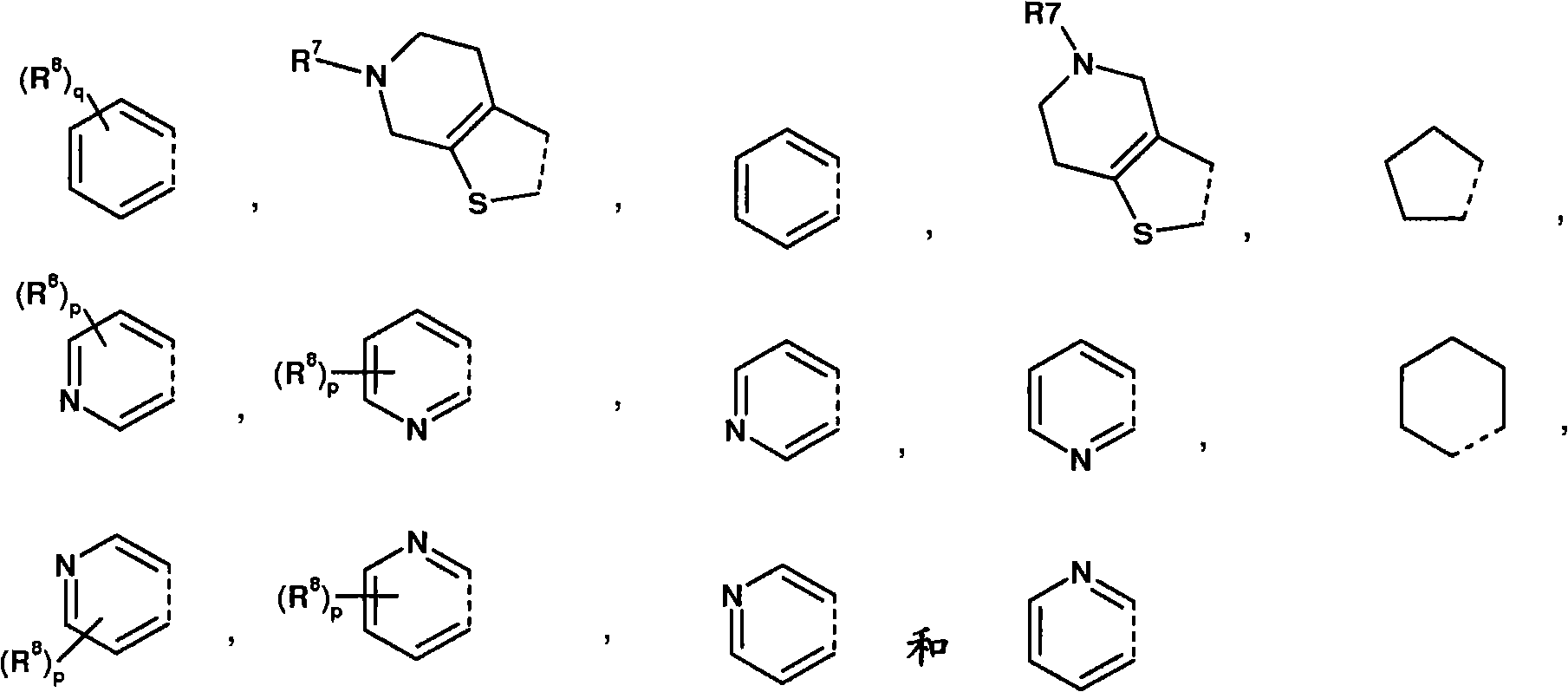


Applications Claiming Priority (3)
| Application Number | Priority Date | Filing Date | Title |
|---|---|---|---|
| EP07103600 | 2007-03-06 | ||
| EP07103600.8 | 2007-03-06 | ||
| PCT/EP2008/052614 WO2008107436A1 (en) | 2007-03-06 | 2008-03-04 | Bicyclic organic compounds suitable for the treatment of inflammatory or allergic conditions |
Publications (2)
| Publication Number | Publication Date |
|---|---|
| CN101622234A true CN101622234A (en) | 2010-01-06 |
| CN101622234B CN101622234B (en) | 2013-08-07 |
Family
ID=38442510
Family Applications (1)
| Application Number | Title | Priority Date | Filing Date |
|---|---|---|---|
| CN2008800070153A Expired - Fee Related CN101622234B (en) | 2007-03-06 | 2008-03-04 | Bicyclic organic compounds suitable for the treatment of inflammatory or allergic conditions |
Country Status (11)
| Country | Link |
|---|---|
| US (2) | US8633211B2 (en) |
| EP (1) | EP2132186A1 (en) |
| JP (1) | JP5390407B2 (en) |
| KR (1) | KR20090115953A (en) |
| CN (1) | CN101622234B (en) |
| AU (1) | AU2008223831B2 (en) |
| BR (1) | BRPI0808422A2 (en) |
| CA (1) | CA2678492A1 (en) |
| EA (1) | EA200901167A1 (en) |
| MX (1) | MX2009009492A (en) |
| WO (1) | WO2008107436A1 (en) |
Cited By (5)
| Publication number | Priority date | Publication date | Assignee | Title |
|---|---|---|---|---|
| CN102565253A (en) * | 2010-12-16 | 2012-07-11 | 中国人民解放军第二军医大学 | Micromolecular metabolite atlas as well as producing method and application thereof |
| CN102939088A (en) * | 2010-04-23 | 2013-02-20 | 奇尼塔公司 | Anti-viral compounds |
| CN103842364A (en) * | 2011-09-30 | 2014-06-04 | 奇尼塔公司 | Anti-viral compounds |
| CN104910069A (en) * | 2014-12-15 | 2015-09-16 | 北京科技大学 | Anthranilic acid derivative, preparation method and application thereof in medicine |
| WO2018014862A1 (en) * | 2016-07-22 | 2018-01-25 | 南京明德新药研发股份有限公司 | S1p1 agonist and application thereof |
Families Citing this family (36)
| Publication number | Priority date | Publication date | Assignee | Title |
|---|---|---|---|---|
| US20090004207A1 (en) * | 2007-06-08 | 2009-01-01 | Timothy Tun Hla | Methods and Compositions for Inhibiting Pathological Angiogenesis in the Eye |
| US20100068200A1 (en) * | 2008-09-12 | 2010-03-18 | The University Of Connecticut | Methods and Compositions for Inhibiting Atherosclerosis and Vascular Inflammation |
| AU2011232058B2 (en) * | 2010-03-26 | 2016-09-08 | Merck Patent Gmbh | Benzonaphthyridinamines as autotaxin inhibitors |
| US8754114B2 (en) | 2010-12-22 | 2014-06-17 | Incyte Corporation | Substituted imidazopyridazines and benzimidazoles as inhibitors of FGFR3 |
| EP2471776A1 (en) | 2010-12-28 | 2012-07-04 | Bayer CropScience AG | Pyridin-2-ylpropandinitriles and their use as herbicides |
| GB201104600D0 (en) | 2011-03-18 | 2011-05-04 | Pronoxis Ab | New compounds and medical uses |
| WO2012164103A2 (en) | 2011-06-03 | 2012-12-06 | Universität Zürich | Blockers of the nogo-a s1pr pathway for the treatment of diseases characterized by neuronal damage and lack of subsequent repair |
| RS58514B1 (en) | 2012-06-13 | 2019-04-30 | Incyte Holdings Corp | Substituted tricyclic compounds as fgfr inhibitors |
| US9388185B2 (en) | 2012-08-10 | 2016-07-12 | Incyte Holdings Corporation | Substituted pyrrolo[2,3-b]pyrazines as FGFR inhibitors |
| US9266892B2 (en) | 2012-12-19 | 2016-02-23 | Incyte Holdings Corporation | Fused pyrazoles as FGFR inhibitors |
| US9446033B2 (en) * | 2013-03-01 | 2016-09-20 | Clio, Inc. | Pharmaceutical composition including migratory factor for guiding pluripotent stem cells to injury |
| WO2014158302A1 (en) * | 2013-03-25 | 2014-10-02 | Swenson Rolf Eric | Novel sphingosine 1-phosphate receptor antagonists |
| PH12015502383B1 (en) | 2013-04-19 | 2023-02-03 | Incyte Holdings Corp | Bicyclic heterocycles as fgfr inhibitors |
| US10851105B2 (en) | 2014-10-22 | 2020-12-01 | Incyte Corporation | Bicyclic heterocycles as FGFR4 inhibitors |
| TWI712601B (en) | 2015-02-20 | 2020-12-11 | 美商英塞特公司 | Bicyclic heterocycles as fgfr inhibitors |
| US9580423B2 (en) | 2015-02-20 | 2017-02-28 | Incyte Corporation | Bicyclic heterocycles as FGFR4 inhibitors |
| MA41551A (en) | 2015-02-20 | 2017-12-26 | Incyte Corp | BICYCLIC HETEROCYCLES USED AS FGFR4 INHIBITORS |
| AR111960A1 (en) | 2017-05-26 | 2019-09-04 | Incyte Corp | CRYSTALLINE FORMS OF A FGFR INHIBITOR AND PROCESSES FOR ITS PREPARATION |
| GB201710851D0 (en) * | 2017-07-06 | 2017-08-23 | Galápagos Nv | Novel compounds and pharmaceutical compositions thereof for the treatment of fibrosis |
| HRP20241288T1 (en) | 2018-05-04 | 2024-12-06 | Incyte Corporation | Solid forms of an fgfr inhibitor and processes for preparing the same |
| AU2019262579B2 (en) | 2018-05-04 | 2024-09-12 | Incyte Corporation | Salts of an FGFR inhibitor |
| US11628162B2 (en) | 2019-03-08 | 2023-04-18 | Incyte Corporation | Methods of treating cancer with an FGFR inhibitor |
| US11591329B2 (en) | 2019-07-09 | 2023-02-28 | Incyte Corporation | Bicyclic heterocycles as FGFR inhibitors |
| WO2021067374A1 (en) | 2019-10-01 | 2021-04-08 | Incyte Corporation | Bicyclic heterocycles as fgfr inhibitors |
| CA3157361A1 (en) | 2019-10-14 | 2021-04-22 | Incyte Corporation | Bicyclic heterocycles as fgfr inhibitors |
| WO2021076728A1 (en) | 2019-10-16 | 2021-04-22 | Incyte Corporation | Bicyclic heterocycles as fgfr inhibitors |
| JP7832891B2 (en) | 2019-12-04 | 2026-03-18 | インサイト・コーポレイション | Derivatives of FGFR inhibitors |
| CA3163875A1 (en) | 2019-12-04 | 2021-06-10 | Incyte Corporation | Tricyclic heterocycles as fgfr inhibitors |
| US12012409B2 (en) | 2020-01-15 | 2024-06-18 | Incyte Corporation | Bicyclic heterocycles as FGFR inhibitors |
| WO2022221170A1 (en) | 2021-04-12 | 2022-10-20 | Incyte Corporation | Combination therapy comprising an fgfr inhibitor and a nectin-4 targeting agent |
| US11939331B2 (en) | 2021-06-09 | 2024-03-26 | Incyte Corporation | Tricyclic heterocycles as FGFR inhibitors |
| CA3220155A1 (en) | 2021-06-09 | 2022-12-15 | Incyte Corporation | Tricyclic heterocycles as fgfr inhibitors |
| JP2025534288A (en) | 2022-09-26 | 2025-10-15 | エッジワイズ セラピューティクス, インコーポレイテッド | 1,4-Dihydroquinazolinone Compounds and Uses Thereof |
| CR20250333A (en) * | 2023-01-11 | 2025-11-06 | Dana Farber Cancer Inst Inc | Mutant-selective egfr inhibitors |
| EP4688756A1 (en) * | 2023-03-27 | 2026-02-11 | Edgewise Therapeutics, Inc. | Quinazoline dione compounds and uses thereof |
| WO2024206339A1 (en) * | 2023-03-27 | 2024-10-03 | Edgewise Therapeutics, Inc. | Quinolinone amide compounds and uses thereof |
Family Cites Families (17)
| Publication number | Priority date | Publication date | Assignee | Title |
|---|---|---|---|---|
| FR2436781A1 (en) * | 1978-09-19 | 1980-04-18 | Berri Balzac | 3-Amino-(1h,3h)-quinazoline-2,4-di:one derivs. - useful as anxiolytics and sedatives to treat hypertension |
| CH654008A5 (en) * | 1979-05-22 | 1986-01-31 | Nestle Sa | PROCESS FOR THE PREPARATION OF 1,3,7-TRIALKYLXANTHINES. |
| US4268511A (en) * | 1980-03-11 | 1981-05-19 | Berri-Balzac | 3-Amino(1H,3H)quinazoline-2,4-dione derivatives and their therapeutic applications |
| BE882223A (en) * | 1980-03-14 | 1980-09-15 | Berri Balzac | DERIVATIVES OF AMINE-3 (1H, 3) QUINAZOLINEDIONE-2,4, THEIR PREPARATION PROCESS AND THEIR THERAPEUTIC APPLICATIONS |
| JPS6425767A (en) | 1987-04-03 | 1989-01-27 | Fujisawa Pharmaceutical Co | Production of quinazoline derivative or salt thereof |
| AU717243B2 (en) * | 1994-12-29 | 2000-03-23 | Regents Of The University Of California, The | Compounds for inhibition of ceramide-mediated signal transduction |
| US6323201B1 (en) * | 1994-12-29 | 2001-11-27 | The Regents Of The University Of California | Compounds for inhibition of ceramide-mediated signal transduction |
| AU745081B2 (en) | 1997-06-27 | 2002-03-14 | Fujisawa Pharmaceutical Co., Ltd. | Sulfonamide compounds and medicinal use thereof |
| BR0009338A (en) * | 1999-03-26 | 2001-12-26 | Astrazeneca Ab | Compound, process for preparing it, pharmaceutical composition, process for preparing it, use of a compound, and method of treating an inflammatory disease in a patient suffering or at risk of said disease |
| DE10106493B4 (en) | 2001-02-13 | 2010-11-04 | Plasmidfactory Gmbh & Co. Kg | Process for the preparation of nucleic acids |
| PA8539401A1 (en) * | 2001-02-14 | 2002-10-28 | Warner Lambert Co | QUINAZOLINAS AS INHIBITORS OF MMP-13 |
| WO2002102780A1 (en) * | 2001-06-18 | 2002-12-27 | Ono Pharmaceutical Co., Ltd. | Tetrahydroquinoline derivative compound and drug containing the compound as active ingredient |
| WO2004007469A1 (en) * | 2002-07-12 | 2004-01-22 | Warner-Lambert Company Llc | New alkynylated quinazolin compounds as mmp-13 inhibitors |
| WO2004014867A2 (en) * | 2002-08-13 | 2004-02-19 | Warner-Lambert Company Llc | Matrix metalloproteinase inhibitors and methods for identification of lead compounds |
| TW543344B (en) * | 2002-10-25 | 2003-07-21 | Ritdisplay Corp | Organic light emitting diode and organic emitting material thereof |
| DE10348022A1 (en) * | 2003-10-15 | 2005-05-25 | Imtm Gmbh | New dipeptidyl peptidase IV inhibitors for the functional influence of different cells and for the treatment of immunological, inflammatory, neuronal and other diseases |
| CA2686203A1 (en) * | 2007-05-02 | 2008-11-13 | Portola Pharmaceuticals, Inc. | Intravenous and oral dosing of a direct-acting and reversible p2y12 inhibitor |
-
2008
- 2008-03-04 CA CA002678492A patent/CA2678492A1/en not_active Abandoned
- 2008-03-04 EA EA200901167A patent/EA200901167A1/en unknown
- 2008-03-04 MX MX2009009492A patent/MX2009009492A/en unknown
- 2008-03-04 BR BRPI0808422-0A patent/BRPI0808422A2/en not_active IP Right Cessation
- 2008-03-04 WO PCT/EP2008/052614 patent/WO2008107436A1/en not_active Ceased
- 2008-03-04 JP JP2009552192A patent/JP5390407B2/en not_active Expired - Fee Related
- 2008-03-04 AU AU2008223831A patent/AU2008223831B2/en not_active Ceased
- 2008-03-04 KR KR1020097018534A patent/KR20090115953A/en not_active Withdrawn
- 2008-03-04 US US12/449,537 patent/US8633211B2/en not_active Expired - Fee Related
- 2008-03-04 EP EP08717374A patent/EP2132186A1/en not_active Withdrawn
- 2008-03-04 CN CN2008800070153A patent/CN101622234B/en not_active Expired - Fee Related
-
2013
- 2013-12-16 US US14/107,119 patent/US20140187550A1/en not_active Abandoned
Cited By (10)
| Publication number | Priority date | Publication date | Assignee | Title |
|---|---|---|---|---|
| CN102939088A (en) * | 2010-04-23 | 2013-02-20 | 奇尼塔公司 | Anti-viral compounds |
| US8927561B2 (en) | 2010-04-23 | 2015-01-06 | Kineta, Inc. | Pyrimidinedione anti-viral compounds |
| CN102565253A (en) * | 2010-12-16 | 2012-07-11 | 中国人民解放军第二军医大学 | Micromolecular metabolite atlas as well as producing method and application thereof |
| CN103842364A (en) * | 2011-09-30 | 2014-06-04 | 奇尼塔公司 | Anti-viral compounds |
| CN104910069A (en) * | 2014-12-15 | 2015-09-16 | 北京科技大学 | Anthranilic acid derivative, preparation method and application thereof in medicine |
| CN104910069B (en) * | 2014-12-15 | 2018-03-23 | 北京科技大学 | Anthranilic acid analog derivative, its preparation method and its purposes in medicine |
| WO2018014862A1 (en) * | 2016-07-22 | 2018-01-25 | 南京明德新药研发股份有限公司 | S1p1 agonist and application thereof |
| CN109661391A (en) * | 2016-07-22 | 2019-04-19 | 石家庄智康弘仁新药开发有限公司 | S1P1 agonists and their applications |
| US11192886B2 (en) | 2016-07-22 | 2021-12-07 | Medshine Discovery Inc. | S1P1 agonist and application thereof |
| CN109661391B (en) * | 2016-07-22 | 2022-04-19 | 南京明德新药研发有限公司 | S1P1 agonist and application thereof |
Also Published As
| Publication number | Publication date |
|---|---|
| MX2009009492A (en) | 2009-09-15 |
| CA2678492A1 (en) | 2008-09-12 |
| EA200901167A1 (en) | 2010-04-30 |
| US20140187550A1 (en) | 2014-07-03 |
| US20100113774A1 (en) | 2010-05-06 |
| CN101622234B (en) | 2013-08-07 |
| KR20090115953A (en) | 2009-11-10 |
| JP2010520256A (en) | 2010-06-10 |
| US8633211B2 (en) | 2014-01-21 |
| WO2008107436A1 (en) | 2008-09-12 |
| BRPI0808422A2 (en) | 2015-06-23 |
| JP5390407B2 (en) | 2014-01-15 |
| EP2132186A1 (en) | 2009-12-16 |
| AU2008223831A1 (en) | 2008-09-12 |
| AU2008223831B2 (en) | 2012-07-05 |
Similar Documents
| Publication | Publication Date | Title |
|---|---|---|
| CN101622234A (en) | Bicyclic organic compounds suitable for the treatment of inflammatory or allergic conditions | |
| CN100584844C (en) | Imidazol[1,2-C]pyrimidinylacetic acid derivatives | |
| WO2021096284A1 (en) | Glp-1 receptor agonist and use thereof | |
| EP2958913A1 (en) | Sphingosine-1-phosphate receptor agonists, methods of preparing the same, and pharmaceutical compositions containing the same as an active agent | |
| WO2021256861A1 (en) | Novel acid secretion inhibitor and use thereof | |
| WO2020149553A1 (en) | Aryl or heteroaryl derivative, and pharmaceutical composition comprising same as active ingredient for treatment of kinase-related disease | |
| WO2011132901A2 (en) | Novel benzamide derivatives | |
| WO2023287128A1 (en) | Indazole yl benzimidazole derivative or pharmaceutically acceptable salt thereof, and use thereof | |
| WO2023014022A1 (en) | Pyrimidine derivative, method for preparing same, and pharmaceutical composition for preventing or treating cancer comprising same as active ingredient | |
| WO2022211573A1 (en) | Pyrimidine derivative having protein kinase inhibitory activity, and therapeutic pharmaceutical composition comprising same | |
| WO2021256900A1 (en) | Novel oxopyridazinyl-phenyl-carbonohydrazonoyl dicyanide compound and use thereof | |
| WO2023080652A1 (en) | Androgen receptor degraders for the treatment of castration-resistant prostate cancer and use thereof | |
| WO2020013531A1 (en) | N-(3-(imidazo[1,2-b]pyridazine-3-ylethynyl)-4-methylphenyl)-5-phenyl-4,5-dihydro-1h-pyrazole-1-carboxamide derivative, and pharmaceutical composition containing same as active ingredient for treating kinase-related diseases | |
| WO2023055178A1 (en) | Novel piperidine derivative and pharmaceutical composition for inhibiting autotaxin comprising same | |
| WO2018021762A1 (en) | Novel compound, preparation method therefor, and pharmaceutical composition containing same | |
| WO2019098785A1 (en) | 7-amino-1h-indole-5-carboxamide derivative and use thereof | |
| EP3867249A1 (en) | Novel (isopropyl-triazolyl)pyridinyl-substituted benzooxazinone or benzothiazinone derivatives and use thereof | |
| WO2017171421A1 (en) | Novel pyrimidine-4-carboxylic acid derivative having anticancer activity | |
| WO2022270980A1 (en) | Novel urea derivative compound as ron inhibitor | |
| WO2014189331A1 (en) | Bicyclic derivative containing pyrimidine ring, and preparation method therefor | |
| WO2025150943A1 (en) | Novel compound and uses thereof | |
| WO2026095672A1 (en) | Novel heterobicyclic compounds for inhibiting yap-tead interaction and pharmaceutical compositions comprising same | |
| CN1972938A (en) | Cyclic amine compound | |
| WO2025155167A1 (en) | Novel compound used as cbp/p300 inhibitor, and pharmaceutical composition for preventing or treating cancer, inflammatory disorders, or autoimmune diseases comprising same as active ingredient | |
| WO2021182914A1 (en) | Novel cdk7 inhibitory compound or pharmaceutically acceptable salt thereof |
Legal Events
| Date | Code | Title | Description |
|---|---|---|---|
| C06 | Publication | ||
| PB01 | Publication | ||
| C10 | Entry into substantive examination | ||
| SE01 | Entry into force of request for substantive examination | ||
| C14 | Grant of patent or utility model | ||
| GR01 | Patent grant | ||
| C56 | Change in the name or address of the patentee |
Owner name: NOVARTIS CO., LTD. Free format text: FORMER NAME: NOVARTIS AG |
|
| CP01 | Change in the name or title of a patent holder |
Address after: Basel Patentee after: Novartis Ag Address before: Basel Patentee before: Novartis AG |
|
| CF01 | Termination of patent right due to non-payment of annual fee | ||
| CF01 | Termination of patent right due to non-payment of annual fee |
Granted publication date: 20130807 Termination date: 20170304 |