CN101490036A - Factor XA inhibitors - Google Patents
Factor XA inhibitors Download PDFInfo
- Publication number
- CN101490036A CN101490036A CNA200780015911XA CN200780015911A CN101490036A CN 101490036 A CN101490036 A CN 101490036A CN A200780015911X A CNA200780015911X A CN A200780015911XA CN 200780015911 A CN200780015911 A CN 200780015911A CN 101490036 A CN101490036 A CN 101490036A
- Authority
- CN
- China
- Prior art keywords
- group
- alkyl
- mmol
- methyl
- compound
- Prior art date
- Legal status (The legal status is an assumption and is not a legal conclusion. Google has not performed a legal analysis and makes no representation as to the accuracy of the status listed.)
- Granted
Links
Images


Classifications
-
- C—CHEMISTRY; METALLURGY
- C07—ORGANIC CHEMISTRY
- C07D—HETEROCYCLIC COMPOUNDS
- C07D401/00—Heterocyclic compounds containing two or more hetero rings, having nitrogen atoms as the only ring hetero atoms, at least one ring being a six-membered ring with only one nitrogen atom
- C07D401/14—Heterocyclic compounds containing two or more hetero rings, having nitrogen atoms as the only ring hetero atoms, at least one ring being a six-membered ring with only one nitrogen atom containing three or more hetero rings
-
- A—HUMAN NECESSITIES
- A61—MEDICAL OR VETERINARY SCIENCE; HYGIENE
- A61K—PREPARATIONS FOR MEDICAL, DENTAL OR TOILETRY PURPOSES
- A61K31/00—Medicinal preparations containing organic active ingredients
- A61K31/33—Heterocyclic compounds
- A61K31/395—Heterocyclic compounds having nitrogen as a ring hetero atom, e.g. guanethidine or rifamycins
- A61K31/41—Heterocyclic compounds having nitrogen as a ring hetero atom, e.g. guanethidine or rifamycins having five-membered rings with two or more ring hetero atoms, at least one of which being nitrogen, e.g. tetrazole
- A61K31/4164—1,3-Diazoles
- A61K31/4178—1,3-Diazoles not condensed 1,3-diazoles and containing further heterocyclic rings, e.g. pilocarpine, nitrofurantoin
-
- A—HUMAN NECESSITIES
- A61—MEDICAL OR VETERINARY SCIENCE; HYGIENE
- A61P—SPECIFIC THERAPEUTIC ACTIVITY OF CHEMICAL COMPOUNDS OR MEDICINAL PREPARATIONS
- A61P1/00—Drugs for disorders of the alimentary tract or the digestive system
- A61P1/04—Drugs for disorders of the alimentary tract or the digestive system for ulcers, gastritis or reflux esophagitis, e.g. antacids, inhibitors of acid secretion, mucosal protectants
-
- A—HUMAN NECESSITIES
- A61—MEDICAL OR VETERINARY SCIENCE; HYGIENE
- A61P—SPECIFIC THERAPEUTIC ACTIVITY OF CHEMICAL COMPOUNDS OR MEDICINAL PREPARATIONS
- A61P11/00—Drugs for disorders of the respiratory system
-
- A—HUMAN NECESSITIES
- A61—MEDICAL OR VETERINARY SCIENCE; HYGIENE
- A61P—SPECIFIC THERAPEUTIC ACTIVITY OF CHEMICAL COMPOUNDS OR MEDICINAL PREPARATIONS
- A61P11/00—Drugs for disorders of the respiratory system
- A61P11/06—Antiasthmatics
-
- A—HUMAN NECESSITIES
- A61—MEDICAL OR VETERINARY SCIENCE; HYGIENE
- A61P—SPECIFIC THERAPEUTIC ACTIVITY OF CHEMICAL COMPOUNDS OR MEDICINAL PREPARATIONS
- A61P19/00—Drugs for skeletal disorders
- A61P19/02—Drugs for skeletal disorders for joint disorders, e.g. arthritis, arthrosis
-
- A—HUMAN NECESSITIES
- A61—MEDICAL OR VETERINARY SCIENCE; HYGIENE
- A61P—SPECIFIC THERAPEUTIC ACTIVITY OF CHEMICAL COMPOUNDS OR MEDICINAL PREPARATIONS
- A61P25/00—Drugs for disorders of the nervous system
-
- A—HUMAN NECESSITIES
- A61—MEDICAL OR VETERINARY SCIENCE; HYGIENE
- A61P—SPECIFIC THERAPEUTIC ACTIVITY OF CHEMICAL COMPOUNDS OR MEDICINAL PREPARATIONS
- A61P29/00—Non-central analgesic, antipyretic or antiinflammatory agents, e.g. antirheumatic agents; Non-steroidal antiinflammatory drugs [NSAID]
-
- A—HUMAN NECESSITIES
- A61—MEDICAL OR VETERINARY SCIENCE; HYGIENE
- A61P—SPECIFIC THERAPEUTIC ACTIVITY OF CHEMICAL COMPOUNDS OR MEDICINAL PREPARATIONS
- A61P35/00—Antineoplastic agents
-
- A—HUMAN NECESSITIES
- A61—MEDICAL OR VETERINARY SCIENCE; HYGIENE
- A61P—SPECIFIC THERAPEUTIC ACTIVITY OF CHEMICAL COMPOUNDS OR MEDICINAL PREPARATIONS
- A61P37/00—Drugs for immunological or allergic disorders
- A61P37/02—Immunomodulators
- A61P37/06—Immunosuppressants, e.g. drugs for graft rejection
-
- A—HUMAN NECESSITIES
- A61—MEDICAL OR VETERINARY SCIENCE; HYGIENE
- A61P—SPECIFIC THERAPEUTIC ACTIVITY OF CHEMICAL COMPOUNDS OR MEDICINAL PREPARATIONS
- A61P43/00—Drugs for specific purposes, not provided for in groups A61P1/00-A61P41/00
-
- A—HUMAN NECESSITIES
- A61—MEDICAL OR VETERINARY SCIENCE; HYGIENE
- A61P—SPECIFIC THERAPEUTIC ACTIVITY OF CHEMICAL COMPOUNDS OR MEDICINAL PREPARATIONS
- A61P7/00—Drugs for disorders of the blood or the extracellular fluid
-
- A—HUMAN NECESSITIES
- A61—MEDICAL OR VETERINARY SCIENCE; HYGIENE
- A61P—SPECIFIC THERAPEUTIC ACTIVITY OF CHEMICAL COMPOUNDS OR MEDICINAL PREPARATIONS
- A61P7/00—Drugs for disorders of the blood or the extracellular fluid
- A61P7/02—Antithrombotic agents; Anticoagulants; Platelet aggregation inhibitors
-
- A—HUMAN NECESSITIES
- A61—MEDICAL OR VETERINARY SCIENCE; HYGIENE
- A61P—SPECIFIC THERAPEUTIC ACTIVITY OF CHEMICAL COMPOUNDS OR MEDICINAL PREPARATIONS
- A61P7/00—Drugs for disorders of the blood or the extracellular fluid
- A61P7/04—Antihaemorrhagics; Procoagulants; Haemostatic agents; Antifibrinolytic agents
-
- A—HUMAN NECESSITIES
- A61—MEDICAL OR VETERINARY SCIENCE; HYGIENE
- A61P—SPECIFIC THERAPEUTIC ACTIVITY OF CHEMICAL COMPOUNDS OR MEDICINAL PREPARATIONS
- A61P9/00—Drugs for disorders of the cardiovascular system
-
- A—HUMAN NECESSITIES
- A61—MEDICAL OR VETERINARY SCIENCE; HYGIENE
- A61P—SPECIFIC THERAPEUTIC ACTIVITY OF CHEMICAL COMPOUNDS OR MEDICINAL PREPARATIONS
- A61P9/00—Drugs for disorders of the cardiovascular system
- A61P9/04—Inotropic agents, i.e. stimulants of cardiac contraction; Drugs for heart failure
-
- A—HUMAN NECESSITIES
- A61—MEDICAL OR VETERINARY SCIENCE; HYGIENE
- A61P—SPECIFIC THERAPEUTIC ACTIVITY OF CHEMICAL COMPOUNDS OR MEDICINAL PREPARATIONS
- A61P9/00—Drugs for disorders of the cardiovascular system
- A61P9/10—Drugs for disorders of the cardiovascular system for treating ischaemic or atherosclerotic diseases, e.g. antianginal drugs, coronary vasodilators, drugs for myocardial infarction, retinopathy, cerebrovascula insufficiency, renal arteriosclerosis
-
- C—CHEMISTRY; METALLURGY
- C07—ORGANIC CHEMISTRY
- C07D—HETEROCYCLIC COMPOUNDS
- C07D409/00—Heterocyclic compounds containing two or more hetero rings, at least one ring having sulfur atoms as the only ring hetero atoms
- C07D409/14—Heterocyclic compounds containing two or more hetero rings, at least one ring having sulfur atoms as the only ring hetero atoms containing three or more hetero rings
-
- C—CHEMISTRY; METALLURGY
- C07—ORGANIC CHEMISTRY
- C07D—HETEROCYCLIC COMPOUNDS
- C07D413/00—Heterocyclic compounds containing two or more hetero rings, at least one ring having nitrogen and oxygen atoms as the only ring hetero atoms
- C07D413/14—Heterocyclic compounds containing two or more hetero rings, at least one ring having nitrogen and oxygen atoms as the only ring hetero atoms containing three or more hetero rings
-
- C—CHEMISTRY; METALLURGY
- C07—ORGANIC CHEMISTRY
- C07D—HETEROCYCLIC COMPOUNDS
- C07D417/00—Heterocyclic compounds containing two or more hetero rings, at least one ring having nitrogen and sulfur atoms as the only ring hetero atoms, not provided for by group C07D415/00
- C07D417/14—Heterocyclic compounds containing two or more hetero rings, at least one ring having nitrogen and sulfur atoms as the only ring hetero atoms, not provided for by group C07D415/00 containing three or more hetero rings
Landscapes
- Health & Medical Sciences (AREA)
- Chemical & Material Sciences (AREA)
- Organic Chemistry (AREA)
- Veterinary Medicine (AREA)
- Animal Behavior & Ethology (AREA)
- Engineering & Computer Science (AREA)
- Public Health (AREA)
- General Health & Medical Sciences (AREA)
- Medicinal Chemistry (AREA)
- Pharmacology & Pharmacy (AREA)
- Bioinformatics & Cheminformatics (AREA)
- Life Sciences & Earth Sciences (AREA)
- Nuclear Medicine, Radiotherapy & Molecular Imaging (AREA)
- General Chemical & Material Sciences (AREA)
- Chemical Kinetics & Catalysis (AREA)
- Cardiology (AREA)
- Immunology (AREA)
- Heart & Thoracic Surgery (AREA)
- Diabetes (AREA)
- Hematology (AREA)
- Pulmonology (AREA)
- Rheumatology (AREA)
- Biomedical Technology (AREA)
- Transplantation (AREA)
- Pain & Pain Management (AREA)
- Hospice & Palliative Care (AREA)
- Urology & Nephrology (AREA)
- Neurology (AREA)
- Neurosurgery (AREA)
- Vascular Medicine (AREA)
- Orthopedic Medicine & Surgery (AREA)
- Physical Education & Sports Medicine (AREA)
- Epidemiology (AREA)
- Pharmaceuticals Containing Other Organic And Inorganic Compounds (AREA)
- Plural Heterocyclic Compounds (AREA)
Abstract
Description
相关申请案的交叉参考Cross References to Related Applications
本申请案主张2007年1月5日申请的美国临时申请案第60/883,667号和2006年5月5日申请的美国临时申请案第60/797,954号依据35 U.S.C.§119(e)的权利,所述申请案皆以全文引用的方式并入本文中。This application asserts the rights under 35 U.S.C. § 119(e) of U.S. Provisional Application No. 60/883,667, filed January 5, 2007, and U.S. Provisional Application No. 60/797,954, filed May 5, 2006, Said applications are hereby incorporated by reference in their entirety.
技术领域 technical field
本发明涉及充当Xa因子抑制剂的经取代咪唑化合物。本发明还涉及含有所述经取代咪唑化合物的医药组合物和使用所述化合物或组合物治疗以不期望的血栓形成为特征的病症的方法。本发明还涉及制造本文所述的化合物的方法。The present invention relates to substituted imidazole compounds that act as factor Xa inhibitors. The invention also relates to pharmaceutical compositions containing the substituted imidazole compounds and methods of using the compounds or compositions to treat conditions characterized by undesired thrombosis. The present invention also relates to methods of making the compounds described herein.
背景技术 Background technique
止血(控制出血)可经由手术方法或因血管收缩和凝固的生理学性质而发生。本发明尤其涉及血液凝固作用和血液凝固作用借以在损伤、炎症、疾病、先天性缺陷、功能障碍或其它破坏后参与维持哺乳动物循环完整性的方式。尽管血小板和血液凝固皆与止血恢复和血栓性疾病相关,但凝固级联反应的某些组分主要负责放大和加速与作为血栓形成和止血中的主要事件的血小板凝集和纤维蛋白沉积相关的过程。Hemostasis (control of bleeding) can occur via surgical procedures or due to the physiological properties of vasoconstriction and coagulation. In particular, the present invention relates to blood coagulation and the manner in which blood coagulation participates in maintaining the integrity of mammalian circulation following injury, inflammation, disease, congenital defect, dysfunction or other disruption. Although platelets and blood coagulation are both associated with restoration of hemostasis and thrombotic disease, certain components of the coagulation cascade are primarily responsible for amplifying and accelerating processes associated with platelet aggregation and fibrin deposition as major events in thrombosis and hemostasis .
凝块形成包括纤维蛋白原转化成纤维蛋白,纤维蛋白在损伤后聚合成网状物以恢复止血。类似过程导致血栓性疾病中的闭合血管。纤维蛋白原转化成血纤蛋白是由血液凝固级联反应中的一连串反应的终产物凝血酶催化。凝血酶也是活化血小板中的关键参与者,从而促进动脉和静脉血流情况下的血栓形成。由于这些原因,已经假定凝血酶的有效调节可引起血栓形成的有效调节。数类目前使用的抗凝剂直接或间接地影响凝血酶(即,普通肝素(unfractionated heparin)、低分子量肝素、类肝素化合物、五糖和华法林(warfarin))。直接或间接抑制凝血酶活性也已成为临床研发中各种抗凝剂的焦点(由埃里克森(Eriksson)和昆兰(Quinlan),药物(Drugs)11:1411-1429,2006评述)。Clot formation involves the conversion of fibrinogen to fibrin, which polymerizes into a network after injury to restore hemostasis. A similar process leads to closed blood vessels in thrombotic disease. The conversion of fibrinogen to fibrin is catalyzed by thrombin, the end product of a series of reactions in the blood coagulation cascade. Thrombin is also a key player in the activation of platelets, thereby promoting thrombus formation in both arterial and venous blood flow. For these reasons, it has been hypothesized that efficient modulation of thrombin can lead to efficient modulation of thrombus formation. Several classes of currently used anticoagulants directly or indirectly affect thrombin (ie, unfractionated heparin, low molecular weight heparin, heparan-like compounds, pentasaccharides, and warfarin). Direct or indirect inhibition of thrombin activity has also been the focus of various anticoagulants in clinical development (reviewed by Eriksson and Quinlan, Drugs 11:1411-1429, 2006).
凝血酶的前体凝血酶原是由Xa因子转化成活性酶。组织因子/VIIa因子介导的Xa因子产生的区域化活化是由IXa因子/VIIIa因子复合体增强且促使凝血酶原酶在活化血小板上组装。作为凝血酶原酶复合体的一部分的Xa因子是唯一负责血管系统中持续凝血酶形成的酶。Xa因子是丝氨酸蛋白酶,其为Xa因子前体X因子的活化形式和钙离子结合性的含有γ-羧基谷氨酸(GLA)的维生素K依赖性凝血因子的成员。与凝血酶作用于包括纤维蛋白原和PAR受体(蛋白酶活化受体(Protease activated receptors),柯林(Coughlin),血栓与止血学(J Thrombosis Haemostasis)3:1800-1814,2005)的多种蛋白质底物不同,Xa因子表现出具有单一生理学底物,即凝血酶原。由于一个Xa因子分子可能产生大于1000个凝血酶分子(曼(Mann)等人,血栓与止血学(J.Thrombosis.Haemostasis)1:1504-1514,2003),因此直接抑制Xa因子以便间接抑制凝血酶的形成可能是有效的抗凝策略。这一断言是基于凝血酶原酶在凝血酶合成中的关键作用和抑制凝血酶原酶将对整个血小板凝集和凝固路径产生显著影响的事实。The precursor of thrombin, prothrombin, is converted into the active enzyme by factor Xa. Tissue factor/Factor VIIa-mediated regionalized activation of Factor Xa production is enhanced by the Factor IXa/Factor VIIIa complex and promotes the assembly of prothrombinase on activated platelets. Factor Xa, part of the prothrombinase complex, is the only enzyme responsible for sustained thrombin formation in the vascular system. Factor Xa is a serine protease that is the activated form of the factor Xa precursor, factor X, and a member of the calcium ion-binding, gamma-carboxyglutamic acid (GLA)-containing vitamin K-dependent coagulation factor. Acts on thrombin including fibrinogen and PAR receptors (Protease activated receptors (Protease activated receptors), Colin (Coughlin), Thrombosis and Hemostasis (J Thrombosis Haemostasis) 3:1800-1814, 2005) Various Unlike protein substrates, factor Xa appears to have a single physiological substrate, prothrombin. Inhibition of factor Xa directly for indirect inhibition of coagulation since one factor Xa molecule may generate >1000 thrombin molecules (Mann et al., J. Thrombosis. Haemostasis 1: 1504-1514, 2003) Enzyme formation may be an effective anticoagulant strategy. This assertion is based on the critical role of prothrombinase in thrombin synthesis and the fact that inhibition of prothrombinase would have a dramatic effect on the overall platelet aggregation and coagulation pathway.
经活化的诸如VIIa因子、IXa因子或Xa因子的蛋白酶自身具有不良的蛋白水解活性。然而,所述蛋白酶组装成辅因子依赖性膜结合复合体则显著增强其催化效率。Xa因子的这种效应最为显著,其中效率提高105倍(曼(Mann)等人,血液(Blood)76(1):1-16,1990)。由于血液(1.4微摩尔浓度的凝血酶原对比150纳摩尔浓度的X因子)和活化动力学中存在较高浓度的酶原,因此为达成抗凝效应与凝血酶相比需要抑制较少量的Xa因子。与凝血酶相比,将Xa因子作为治疗目标具有优势的假设的间接证据还可见于预防深静脉血栓形成的临床试验中。在四个矫形外科手术试验中,证明抗凝血酶III依赖性Xa因子抑制剂璜达肝癸钠(Fondaparinux)优于依诺肝素(enoxaparin)(抑制凝血酶和Xa因子两者的低分子量肝素)(特皮(Turpie)等人,内科医学档案(Archives InternalMedicine)162(16):1833-1840,2002)。因此,已经表明选择性抑制Xa因子的化合物可能适用于作为活体外诊断药剂或在某些血栓性病症中用于治疗性投药,例如参见WO94/13693。Activated proteases such as Factor VIIa, Factor IXa or Factor Xa themselves have poor proteolytic activity. However, assembly of the protease into a cofactor-dependent membrane-bound complex significantly enhances its catalytic efficiency. This effect is most pronounced for factor Xa, with a 105- fold increase in efficiency (Mann et al., Blood 76(1):1-16, 1990). Due to the presence of higher concentrations of prothrombin in the blood (1.4 micromolar prothrombin vs. 150 nanomolar factor X) and activation kinetics, lesser amounts of prothrombin need to be inhibited compared to thrombin to achieve an anticoagulant effect Factor Xa. Indirect evidence for the hypothesized advantage of factor Xa as a therapeutic target compared to thrombin can also be found in clinical trials for the prevention of deep vein thrombosis. In four orthopedic surgery trials, the antithrombin III-dependent Factor Xa inhibitor Fondaparinux was demonstrated to be superior to enoxaparin (a low molecular weight heparin that inhibits both thrombin and Factor Xa ) (Turpie et al., Archives Internal Medicine 162(16):1833-1840, 2002). Accordingly, it has been shown that compounds which selectively inhibit Factor Xa may be suitable for use as in vitro diagnostic agents or for therapeutic administration in certain thrombotic disorders, see eg WO94/13693.
已报导数种Xa因子抑制剂,其为来源于食血生物体的多肽以及非大型多肽型抑制剂的化合物。其它Xa因子抑制剂包括小分子有机化合物,诸如具有脒基取代基的含氮杂环化合物,其中所述化合物的两个官能团可结合于其在Xa因子上的两个活性位点。举例来说,WO 98/28269描述具有末端C(=NH)-NH2基团的吡唑化合物;WO 97/21437描述经碱性基团取代的苯并咪唑化合物,其经由直链或支链亚烷基、-C(=O)或-S(=O)2桥基连接于萘基;WO 99/10316描述具有经由羧酰胺亚烷基氨基桥连接至3-脒基苯基的4-苯基-N-烷基脒基-哌啶和4-苯氧基-N-烷基脒基-哌啶基团的化合物;且EP 798295描述具有经由经取代或未经取代的磺酰胺或羧酰胺桥基连接至脒基萘基的4-苯氧基-N-烷基脒基-哌啶基团的化合物。Several Factor Xa inhibitors have been reported, which are polypeptides derived from hematophagous organisms as well as compounds that are not large polypeptide-type inhibitors. Other factor Xa inhibitors include small molecule organic compounds, such as nitrogen-containing heterocyclic compounds with amidino substituents, wherein the two functional groups of the compound can bind to its two active sites on factor Xa. For example, WO 98/28269 describes pyrazole compounds having a terminal C(=NH) -NH2 group; WO 97/21437 describes benzimidazole compounds substituted with basic groups via a linear or branched chain An alkylene, -C(=O) or -S(=O) bridging group attached to a naphthyl group; WO 99/10316 describes a 4- Compounds of phenyl-N-alkylamidino-piperidine and 4-phenoxy-N-alkylamidino-piperidine groups; and EP 798295 describes compounds with substituted or unsubstituted sulfonamides or carboxyl Compounds in which the amide bridge is attached to the 4-phenoxy-N-alkylamidino-piperidine group of the amidinonaphthyl group.
存在对调节止血以及预防和治疗血栓形成和血管系统中由凝血酶诱发的其它病理过程(诸如再狭窄和炎症)的有效治疗剂的需求。具体来说,对选择性抑制Xa因子或其前体的化合物存在持续需求。需要与先前发现的化合物相比具有不同桥基与官能团的组合的化合物,尤其是选择性或优先结合于Xa因子的化合物。需要与凝血酶相比对Xa因子具有较高结合度的化合物,尤其是具有良好生物利用度和/或溶解度的那些化合物。There is a need for effective therapeutic agents that modulate hemostasis as well as prevent and treat thrombosis and other pathological processes induced by thrombin in the vasculature, such as restenosis and inflammation. In particular, there is a continuing need for compounds that selectively inhibit Factor Xa or its precursors. Compounds with different bridging and functional group combinations than previously discovered compounds are desired, especially compounds that bind selectively or preferentially to Factor Xa. Compounds with a higher degree of binding to Factor Xa than thrombin are desired, especially those with good bioavailability and/or solubility.
发明内容 Contents of the invention
一方面,本发明提供具有下式的化合物:In one aspect, the invention provides compounds having the formula:

在式(I)中,符号Z选自由以下基团组成的群组:In formula (I), the symbol Z is selected from the group consisting of:


符号R1选自由卤素、C1-8烷基、C2-8烯基和C2-8炔基组成的群组。符号R1a为氢或C1-4烷基。The symbol R 1 is selected from the group consisting of halogen, C 1-8 alkyl, C 2-8 alkenyl and C 2-8 alkynyl. Symbol R 1a is hydrogen or C 1-4 alkyl.
符号R2和R3独立地选自由以下基团组成的群组:氢、卤素、C1-4烷基、SR4a、S(O)R4a、S(O)2R4a、COR4a、CO2R4a、CONR4aR4b、CN和S(O)2NR4aR4b。The symbols R 2 and R 3 are independently selected from the group consisting of hydrogen, halogen, C 1-4 alkyl, SR 4a , S(O)R 4a , S(O) 2 R 4a , COR 4a , CO 2 R 4a , CONR 4a R 4b , CN and S(O) 2 NR 4a R 4b .
符号R4表示独立地选自由以下基团组成的群组的部分:氢、卤素、OR4a、SR4a、S(O)R4a、S(O)2R4a、NR4aR4b、CO2R4a、The symbol R 4 represents a moiety independently selected from the group consisting of hydrogen, halogen, OR 4a , SR 4a , S(O)R 4a , S(O) 2 R 4a , NR 4a R 4b , CO 2 R 4a ,


其中这些环系统中的每一个视情况经1至3个取代基取代,所述取代基独立地选自由以下基团组成的群组:卤素、氨基、氧代基、C1-8烷基、C1-8卤代烷基、羟基、C1-8烷氧基、杂环烷基、杂芳基和杂芳基-C1-4烷基。wherein each of these ring systems is optionally substituted with 1 to 3 substituents independently selected from the group consisting of: halogen, amino, oxo, C 1-8 alkyl, C 1-8 haloalkyl, hydroxy, C 1-8 alkoxy, heterocycloalkyl, heteroaryl and heteroaryl-C 1-4 alkyl.
符号R4a或R4b独立地为氢或C1-4烷基,其视情况经1至2个取代基取代,所述取代基独立地选自由以下基团组成的群组:卤素、羟基、烷氧基、杂环基、氧代基、氨基和羧基。下标n为0至2的整数。The symbols R 4a or R 4b are independently hydrogen or C 1-4 alkyl optionally substituted by 1 to 2 substituents independently selected from the group consisting of halogen, hydroxyl, Alkoxy, heterocyclyl, oxo, amino and carboxyl. The subscript n is an integer from 0 to 2.
符号R5选自由以下基团组成的群组:The symbol R is selected from the group consisting of:


其中这些环系统中的每一个视情况经1至3个取代基取代,所述取代基独立地选自由以下基团组成的群组:卤素、C1-8烷基、C1-8卤代烷基、-NH-C(O)-C1-8烷基、羟基、氨基、氧代基、C1-8烷氧基、杂环烷基、杂芳基和杂芳基-C1-4烷基,条件是当R5为时,则在R5环的第5位上不可存在烷基(或经取代的烷基)取代基。wherein each of these ring systems is optionally substituted with 1 to 3 substituents independently selected from the group consisting of: halogen, C 1-8 alkyl, C 1-8 haloalkyl , -NH-C(O)-C 1-8 alkyl, hydroxyl, amino, oxo, C 1-8 alkoxy, heterocycloalkyl, heteroaryl and heteroaryl-C 1-4 alkane basis, the condition is that when R5 is , then there must be no alkyl (or substituted alkyl) substituent on the 5th position of the R ring.
意外的是,已发现包括具有至少一个外键(exo bond)(即=O、=N-R、=S)且经由氮原子连接的R5环基团会提供改良的药物代谢动力学性质。Surprisingly, it has been found that including an R ring group having at least one exo bond (ie =O, =NR, =S) linked via a nitrogen atom provides improved pharmacokinetic properties.
符号R6选自由氢、卤素和C1-4烷基组成的群组。The symbol R 6 is selected from the group consisting of hydrogen, halogen and C 1-4 alkyl.
符号R7选自由氢、C1-4烷基、氰基、视情况经取代的苯基和C(O)R9组成的群组,其中R9为C1-4烷基或氨基。The symbol R 7 is selected from the group consisting of hydrogen, C 1-4 alkyl, cyano, optionally substituted phenyl, and C(O)R 9 , wherein R 9 is C 1-4 alkyl or amino.
符号R8选自由氢和C1-4烷基组成的群组。The symbol R is selected from the group consisting of hydrogen and C 1-4 alkyl.
波形线指示连接分子其余部分的点。Wavy lines indicate points connecting the rest of the molecule.
本发明还涵盖式I化合物的医药学上可接受的盐、酯和前药。The present invention also encompasses pharmaceutically acceptable salts, esters and prodrugs of the compounds of formula I.
本发明进一步提供经纯化形式的化合物、化学中间体、医药组合物和预防或治疗哺乳动物的以不期望的血栓形成为特征的病症的方法,所述方法包含将治疗有效量的本发明的化合物投与哺乳动物的步骤。所述病症包括(但不限于)急性冠状动脉综合症;心肌梗塞;不稳定型心绞痛;顽固性心绞痛;溶栓疗法后或冠状动脉血管成形术后发生的梗阻性冠状动脉血栓;血栓介导的脑血管综合症;栓塞性中风;血栓性中风;短暂性缺血发作;静脉血栓形成;深静脉血栓形成;肺栓塞;凝血病;弥散性血管内凝血;血栓性血小板减少性紫瘢;血栓闭塞性脉管炎;与肝素诱发的血小板减少相关的血栓性疾病;与体外循环相关的血栓性并发症;与诸如心导管插入或其它血管内导管插入、主动脉内球囊泵、冠状动脉支架或心脏瓣膜的仪器使用相关的血栓性并发症;需要安装假肢器官装置(prosthetic device)的病症等。The present invention further provides compounds in purified form, chemical intermediates, pharmaceutical compositions and methods of preventing or treating a condition in a mammal characterized by undesired thrombosis comprising administering a therapeutically effective amount of a compound of the present invention Steps for administering to mammals. Such conditions include, but are not limited to, acute coronary syndrome; myocardial infarction; unstable angina; refractory angina; obstructive coronary thrombosis following thrombolytic therapy or following coronary angioplasty; Cerebrovascular syndrome; embolic stroke; thrombotic stroke; transient ischemic attack; venous thrombosis; deep vein thrombosis; pulmonary embolism; coagulopathy; disseminated intravascular coagulation; thrombotic thrombocytopenic purpura; thrombotic occlusion thrombotic disease associated with heparin-induced thrombocytopenia; thrombotic complications associated with cardiopulmonary bypass; and complications such as cardiac catheterization or other intravascular catheterization, intraaortic balloon pumps, coronary stents, or Thrombotic complications associated with instrumentation of heart valves; conditions requiring prosthetic device installation, etc.
本发明进一步提供抑制血液样品凝固的方法,其包含使所述样品与本发明的化合物接触。The invention further provides a method of inhibiting coagulation of a blood sample comprising contacting said sample with a compound of the invention.
附图说明 Description of drawings
图1展示在静脉内投与1mg/kg(●)和经口投与10mg/kg(■)后,雄性斯普雷格-多利(Sprague-Dawley)大鼠体内化合物10的平均血浆浓度-时间曲线(n=3只/组)。使用LC/MS/MS测量血浆样品。Figure 1 shows mean plasma concentration-time profiles of
图2为在静脉内投与1mg/kg(●)和经口投与5mg/kg(■)后,雄性比格犬(beagledog)体内化合物10的平均血浆浓度-时间曲线(n=3只/组)。使用LC/MS/MS测量血浆样品。Figure 2 is the mean plasma concentration-time curve of
图3展示在静脉内投与1mg/kg(●)和经口投与5mg/kg(■)后,雄性恒河猴(rhesusmonkey)体内化合物10的平均血浆浓度-时间曲线(n=3只/组)。使用LC/MS/MS测量血浆样品。Figure 3 shows the mean plasma concentration-time profiles of
具体实施方式 Detailed ways
1.缩写和定义1. Abbreviations and definitions
除非另有说明,否则单独或作为另一取代基的部分的术语“烷基”意谓具有指定碳原子数(即C1-8意谓1至8个碳)的直链或支链烃基。烷基的实例包括甲基、乙基、正丙基、异丙基、正丁基、叔丁基、异丁基、仲丁基、正戊基、正己基、正庚基、正辛基等。术语“烯基”是指具有一个或一个以上、优选1至3个双键的不饱和烷基。类似地,术语“炔基”是指具有一个或一个以上、优选1至3个三键的不饱和烷基。所述不饱和烷基的实例包括乙烯基、2-丙烯基、2-丁烯基、2-异戊烯基、2-(丁二烯基)、2,4-戊二烯基、3-(1,4-戊二烯基)、乙炔基、1-丙炔基和3-丙炔基、3-丁炔基以及高碳同系物和异构物。The term "alkyl" by itself or as part of another substituent means, unless otherwise stated, a straight or branched chain hydrocarbon group having the indicated number of carbon atoms (ie, C1-8 means 1 to 8 carbons). Examples of alkyl groups include methyl, ethyl, n-propyl, isopropyl, n-butyl, t-butyl, isobutyl, sec-butyl, n-pentyl, n-hexyl, n-heptyl, n-octyl, etc. . The term "alkenyl" refers to an unsaturated alkyl group having one or more, preferably 1 to 3 double bonds. Similarly, the term "alkynyl" refers to an unsaturated alkyl group having one or more, preferably 1 to 3, triple bonds. Examples of the unsaturated alkyl group include vinyl, 2-propenyl, 2-butenyl, 2-isopentenyl, 2-(butadienyl), 2,4-pentadienyl, 3- (1,4-pentadienyl), ethynyl, 1-propynyl and 3-propynyl, 3-butynyl and higher homologues and isomers.
术语“环烷基”是指具有指定环原子数(例如C3-6环烷基)且在环顶点之间完全饱和的烃环。术语“环烯基”是指在环顶点之间具有至少一个烯基不饱和点的环烷基。术语“环炔基”是指在环顶点之间具有至少一个炔基不饱和点的环烷基。当“环烷基”与“烷基”组合使用(如C3-5环烷基-烷基)时,环烷基部分打算具有指定碳原子数(例如3至5个碳原子),而烷基部分为具有1至3个碳原子的亚烷基部分(例如-CH2-、-CH2CH2-或-CH2CH2CH2-)。The term "cycloalkyl" refers to a hydrocarbon ring having a specified number of ring atoms (eg, C 3-6 cycloalkyl) and is fully saturated between ring vertices. The term "cycloalkenyl" refers to a cycloalkyl group having at least one point of alkenyl unsaturation between ring vertices. The term "cycloalkynyl" refers to a cycloalkyl group having at least one point of alkynyl unsaturation between ring vertices. When "cycloalkyl" is used in combination with "alkyl" (eg, C3-5cycloalkyl -alkyl), the cycloalkyl moiety is intended to have the specified number of carbon atoms (eg, 3 to 5 carbon atoms), and the alkane The base moiety is an alkylene moiety having 1 to 3 carbon atoms (eg -CH 2 -, -CH 2 CH 2 - or -CH 2 CH 2 CH 2 -).
单独或作为另一取代基的部分的术语“亚烷基”意谓如由-CH2CH2CH2CH2-例示的衍生自烷烃的二价基团。烷基(或亚烷基)通常具有1至24个碳原子,在本发明中,具有10个或更少碳原子的那些基团是优选的。“低碳烷基”或“低碳亚烷基”为通常具有4个或更少碳原子的短链烷基或亚烷基。The term "alkylene" by itself or as part of another substituent means a divalent group derived from an alkane as exemplified by -CH2CH2CH2CH2- . Alkyl (or alkylene) groups generally have 1 to 24 carbon atoms, and in the present invention, those groups having 10 or fewer carbon atoms are preferred. "Lower alkyl" or "lower alkylene" is a short chain alkyl or alkylene group usually having 4 or fewer carbon atoms.
除非另有说明,否则烷基、烷氧基、烯基、炔基、环烷基、环烯基、环炔基和亚烷基是指经取代和未经取代的基团两者,其中一个或一个以上、诸如1至5个氢原子经独立地选自由以下基团组成的群组的取代基置换:=O、=S、酰基(-C(O)-R)、酰氧基(-O-C(O)-R)、烷氧基、烷氧基氨基(-NH-O-烷基)、羟基氨基(-NH-OH)、氨基、经取代的氨基(诸如-NH2,其中一个或一个以上氢可视情况经另一适当基团置换,诸如烷基氨基和二烷基氨基,或其中氨基可为环胺)、芳基、杂环基、叠氮基(-N3)、羧基(-C(O)OH)、烷氧基羰基(-C(O)-O-烷基)、酰胺基(-C(O)-氨基)、氰基(-CN)、环烷基、环烯基、卤素、羟基、硝基、磺酰基氨基(-N(R)-S(O)2-OR)、氨基磺酰基(-S(O)2-氨基)、硫烷基(-S-R)、亚磺酰基(-S(O)-R)、磺酰基(-S(O)2-R)和磺酸(-S(O)2-OH),其中R可各自独立地为氢、烷基、环烷基、芳基、杂芳基和杂环。Unless otherwise specified, alkyl, alkoxy, alkenyl, alkynyl, cycloalkyl, cycloalkenyl, cycloalkynyl, and alkylene refer to both substituted and unsubstituted groups, one of which Or more than one, such as 1 to 5, hydrogen atoms are replaced by substituents independently selected from the group consisting of: =O, =S, acyl (-C(O)-R), acyloxy (- OC(O)-R), alkoxy, alkoxyamino (-NH-O-alkyl), hydroxyamino (-NH-OH), amino, substituted amino (such as -NH2 , one or More than one hydrogen can optionally be replaced by another suitable group, such as alkylamino and dialkylamino, or where the amino group can be a cyclic amine), aryl, heterocyclyl, azido ( -N3 ), carboxyl (-C(O)OH), alkoxycarbonyl (-C(O)-O-alkyl), amido (-C(O)-amino), cyano (-CN), cycloalkyl, cyclo Alkenyl, halogen, hydroxy, nitro, sulfonylamino (-N(R)-S(O) 2 -OR), aminosulfonyl (-S(O) 2 -amino), sulfanyl (-SR) , sulfinyl (-S(O)-R), sulfonyl (-S(O) 2 -R) and sulfonic acid (-S(O) 2 -OH), wherein R can be each independently hydrogen, alkane radical, cycloalkyl, aryl, heteroaryl and heterocycle.
术语“烷氧基”、“烷基氨基”和“烷基硫基”(或硫基烷氧基)以其常规意义使用且是指分别经由氧原子(-O-烷基)、氨基或硫原子(-S-烷基)连接于分子其余部分的那些烷基。另外,对于二烷基氨基(通常提供成-NRaRb或其变体,其中Ra和Rb独立地为烷基或经取代烷基)来说,烷基部分可相同或不同且还可与各自所连接的氮原子组合形成3-7元环。因此,表示为-NRaRb的基团打算包括具有3至6个碳原子且视情况包括额外杂原子(诸如O、S和N)的环胺,其包括(但不限于)哌啶基、吡咯烷基、吗啉基、氮杂环丁烷基等。The terms "alkoxy", "alkylamino" and "alkylthio" (or thioalkoxy) are used in their conventional sense and refer to Atoms (-S-alkyl) are attached to those alkyl groups in the rest of the molecule. Additionally, for dialkylamino groups (generally provided as -NR a R b or variants thereof, wherein Ra and R b are independently alkyl or substituted alkyl), the alkyl moieties can be the same or different and also A 3-7 membered ring can be formed in combination with the nitrogen atom to which each is attached. Thus, groups denoted -NR a R b are intended to include cyclic amines having from 3 to 6 carbon atoms, optionally including additional heteroatoms such as O, S, and N, including but not limited to piperidinyl , pyrrolidinyl, morpholinyl, azetidinyl, etc.
除非另有说明,否则单独或作为另一取代基的部分的术语“卤代”或“卤素”意谓氟、氯、溴或碘原子。另外,诸如“卤代烷基”的术语打算包括单卤代烷基和至多具有所允许的最大卤素数的多卤代烷基。举例来说,术语“C1-8卤代烷基”打算包括三氟甲基、2,2,2-三氟乙基、4-氯丁基、3-溴丙基等。The terms "halo" or "halogen" by themselves or as part of another substituent mean, unless otherwise stated, a fluorine, chlorine, bromine or iodine atom. Additionally, terms such as "haloalkyl" are intended to include monohaloalkyl and polyhaloalkyl groups up to the maximum number of halogens allowed. For example, the term "C 1-8 haloalkyl" is intended to include trifluoromethyl, 2,2,2-trifluoroethyl, 4-chlorobutyl, 3-bromopropyl, and the like.
术语“羟基”是指-OH基团。The term "hydroxyl" refers to a -OH group.
除非另有说明,否则术语“芳基”意谓含有6至14个碳原子的多不饱和芳香族烃基,其可为单环或稠合在一起或共价键联的多个环(至多三个环)。术语“杂芳基”是指含有1至5个选自N、O和S的杂原子的芳基(或芳环),其中氮和硫原子视情况经氧化,且氮原子视情况经季铵化。杂芳基可经由杂原子或经由碳原子连接于分子的其余部分且可含有5至10个碳原子。芳基的非限制性实例包括苯基、萘基和联苯基,而杂芳基的非限制性实例包括1-吡咯基、2-吡咯基、3-吡咯基、1-吡唑基、3-吡唑基、2-咪唑基、4-咪唑基、吡嗪基、2-噁唑基、4-噁唑基、5-噁唑基、3-异噁唑基、4-异噁唑基、5-异噁唑基、2-噻唑基、4-噻唑基、5-噻唑基、2-呋喃基、3-呋喃基、2-噻吩基、3-噻吩基、2-吡啶基、3-吡啶基、4-吡啶基、2-嘧啶基、4-嘧啶基、5-苯并噻唑基、嘌呤基、2-苯并咪唑基、苯并吡唑基、5-吲哚基、1-异喹啉基、5-异喹啉基、2-喹喔啉基、5-喹喔啉基、3-喹啉基和6-喹啉基。如果未特定说明,那么用于上文提到的芳基和杂芳基环系统中的每一个的取代基选自下文所述的可接受的取代基的群组。Unless otherwise stated, the term "aryl" means a polyunsaturated aromatic hydrocarbon radical containing from 6 to 14 carbon atoms, which may be a single ring or multiple rings (up to three rings) fused together or linked covalently. ring). The term "heteroaryl" refers to an aryl group (or aromatic ring) containing 1 to 5 heteroatoms selected from N, O, and S, wherein the nitrogen and sulfur atoms are optionally oxidized, and the nitrogen atom is optionally quaternized change. A heteroaryl group can be attached to the rest of the molecule via a heteroatom or via a carbon atom and can contain 5 to 10 carbon atoms. Non-limiting examples of aryl include phenyl, naphthyl, and biphenyl, while non-limiting examples of heteroaryl include 1-pyrrolyl, 2-pyrrolyl, 3-pyrrolyl, 1-pyrazolyl, 3 -pyrazolyl, 2-imidazolyl, 4-imidazolyl, pyrazinyl, 2-oxazolyl, 4-oxazolyl, 5-oxazolyl, 3-isoxazolyl, 4-isoxazolyl , 5-isoxazolyl, 2-thiazolyl, 4-thiazolyl, 5-thiazolyl, 2-furyl, 3-furyl, 2-thienyl, 3-thienyl, 2-pyridyl, 3- Pyridyl, 4-pyridyl, 2-pyrimidinyl, 4-pyrimidinyl, 5-benzothiazolyl, purinyl, 2-benzimidazolyl, benzopyrazolyl, 5-indolyl, 1-iso Quinolinyl, 5-isoquinolinyl, 2-quinoxalinyl, 5-quinoxalinyl, 3-quinolinyl and 6-quinolinyl. If not specified otherwise, substituents for each of the above-mentioned aryl and heteroaryl ring systems are selected from the group of acceptable substituents described below.
为简便起见,术语“芳基”在与其它术语组合使用(例如芳氧基、芳基硫氧基、芳基烷基)时包括如上文所定义的芳基和杂芳基环两者。因此,术语“芳基烷基”打算包括芳基连接于烷基的那些基团(例如苯甲基、苯乙基、吡啶基甲基等)。For convenience, the term "aryl" when used in combination with other terms (eg aryloxy, arylsulfoxy, arylalkyl) includes both aryl and heteroaryl rings as defined above. Thus, the term "arylalkyl" is intended to include those groups in which an aryl group is attached to an alkyl group (eg, benzyl, phenethyl, pyridylmethyl, etc.).
术语“杂环”或“杂环基”或“杂环状”是指含有至少一个硫、氮或氧杂原子的饱和或不饱和非芳香族环基团。各杂环可在任何可用环碳或杂原子处连接。各杂环都可具有一个或一个以上环。当存在多个环时,其可稠合在一起或共价键联。各杂环必须含有至少一个选自氮、氧或硫的杂原子(通常1至5个杂原子)。这些基团优选含有1-10个碳原子、0-5个氮原子、0-2个硫原子和0-2个氧原子。这些基团更优选含有0-3个氮原子、0-1个硫原子和0-1个氧原子。The term "heterocycle" or "heterocyclyl" or "heterocyclic" refers to a saturated or unsaturated non-aromatic ring group containing at least one sulfur, nitrogen or oxygen heteroatom. Each heterocycle can be attached at any available ring carbon or heteroatom. Each heterocycle may have one or more rings. When multiple rings are present, they may be fused together or covalently linked. Each heterocycle must contain at least one heteroatom (usually 1 to 5 heteroatoms) selected from nitrogen, oxygen or sulfur. These groups preferably contain 1-10 carbon atoms, 0-5 nitrogen atoms, 0-2 sulfur atoms and 0-2 oxygen atoms. These groups more preferably contain 0-3 nitrogen atoms, 0-1 sulfur atoms and 0-1 oxygen atoms.
杂环和杂芳基的非限制性实例包括吡啶、嘧啶、吡嗪、吗啉-3-酮、哌嗪-2-酮、吡啶-2-酮、哌啶、吗啉、哌嗪、异噁唑、异噻唑、吡唑、咪唑、噁唑、噻唑、异噁唑啉、吡唑啉、咪唑啉、1,2,3-三唑、1,2,4-三唑、1,3,4-噁二唑、1,3,4-噻二唑、1,2,4-噁二唑、1,2,4-噻二唑、吡唑-5-酮、吡咯烷-2,5-二酮、咪唑烷-2,4-二酮、吡咯烷、吡咯、呋喃、噻吩等。Non-limiting examples of heterocycles and heteroaryls include pyridine, pyrimidine, pyrazine, morpholin-3-one, piperazin-2-one, pyridin-2-one, piperidine, morpholine, piperazine, isoxa Azole, isothiazole, pyrazole, imidazole, oxazole, thiazole, isoxazoline, pyrazoline, imidazoline, 1,2,3-triazole, 1,2,4-triazole, 1,3,4 -Oxadiazole, 1,3,4-thiadiazole, 1,2,4-oxadiazole, 1,2,4-thiadiazole, pyrazole-5-one, pyrrolidine-2,5-di Ketone, imidazolidine-2,4-dione, pyrrolidine, pyrrole, furan, thiophene, etc.
术语“杂环烷基”是指亚烷基-杂环基团,其中杂环和亚烷基两者如上文所定义。The term "heterocycloalkyl" refers to an alkylene-heterocyclic group in which both heterocycle and alkylene are as defined above.
在一些实施例中,以上术语(例如“芳基”和“杂芳基”)将包括指定基团的经取代和未经取代形式。下文提供各类型基团的优选取代基。为简便起见,术语芳基和杂芳基将是指如下文所提供的经取代或未经取代的型式。In some embodiments, the above terms (eg, "aryl" and "heteroaryl") will encompass both substituted and unsubstituted forms of the indicated group. Preferred substituents for each type of radical are provided below. For simplicity, the terms aryl and heteroaryl will refer to substituted or unsubstituted versions as provided below.
芳基、杂芳基和杂环基的取代基有许多种且通常选自:卤素、-OR′、-OC(O)R′、-NR′R″、-SR′、-R′、-CN、-NO2、-CO2R′、-CONR′R″、-C(O)R′、-OC(O)NR′R″、-NR″C(O)R′、-NR″C(O)2R′、-NR′-C(O)NR″R″′、-NH-C(NH2)=NH、-NR′C(NH2)=NH、-NH-C(NH2)=NR′、-S(O)R′、-S(O)2R′、-S(O)2NR′R″、-NR′S(O)2R″、-N3、全氟(C1-C4)烷氧基和全氟(C1-C4)烷基,取代基数目在零至环系统开放价态的总数的范围内;且其中R′、R″和R″′独立地选自氢、C1-8烷基、C3-6环烷基、C2-8烯基、C2-8炔基、未经取代的芳基和杂芳基、(未经取代的芳基)-C1-4烷基和未经取代的芳氧基-C1-4烷基。其它适当取代基包括经由1-4个碳原子的亚烷基连接子(tether)连接于环原子的以上芳基取代基中的每一个。这组取代基还用以描述用于视情况经取代的苯基的取代基。Substituents for aryl, heteroaryl and heterocyclyl groups are varied and are typically selected from the group consisting of: halogen, -OR', -OC(O)R', -NR'R", -SR', -R', - CN, -NO 2 , -CO 2 R', -CONR'R", -C(O)R', -OC(O)NR'R", -NR"C(O)R', -NR"C (O) 2 R', -NR'-C(O)NR"R"', -NH-C(NH 2 )=NH, -NR'C(NH 2 )=NH, -NH-C(NH 2 )=NR', -S(O)R', -S(O) 2 R', -S(O) 2 NR'R", -NR'S(O) 2 R", -N 3 , perfluoro (C 1 -C 4 )alkoxy and perfluoro(C 1 -C 4 )alkyl, the number of substituents ranges from zero to the total number of ring system open valences; and wherein R', R" and R"'independently selected from hydrogen, C 1-8 alkyl, C 3-6 cycloalkyl, C 2-8 alkenyl, C 2-8 alkynyl, unsubstituted aryl and heteroaryl, (without Substituted aryl)-C 1-4 alkyl and unsubstituted aryloxy-C 1-4 alkyl. Other suitable substituents include linkage via an alkylene linker (tether) of 1-4 carbon atoms Each of the above aryl substituents on ring atoms. This group of substituents is also used to describe the substituents for optionally substituted phenyl groups.
两个在芳基或杂芳基环的相邻原子上的取代基可视情况经式-T-C(O)-(CH2)q-U-的取代基置换,其中T和U独立地为-NH-、-O-、-CH2-或单键,且q为0至2的整数。或者,两个在芳基或杂芳基环的相邻原子上的取代基可视情况经式-A-(CH2)r-B-的取代基置换,其中A和B独立地为-CH2-、-O-、-NH-、-S-、-S(O)-、-S(O)2-、-S(O)2NR′-或单键,且r为1至3的整数。如此形成的新环的单键之一可视情况经双键置换。或者,两个在芳基或杂芳基环的相邻原子上的取代基可视情况经式-(CH2)s-X-(CH2)t-的取代基置换,其中s和t独立地为0至3的整数,且X为-O-、-NR′-、-S-、-S(O)-、-S(O)2-或-S(O)2NR′-。-NR′-和-S(O)2NR′-中的取代基R′选自氢或未经取代的C1-6烷基。Two substituents on adjacent atoms of an aryl or heteroaryl ring are optionally replaced by substituents of the formula -TC(O)-( CH2 ) q -U-, where T and U are independently - NH-, -O-, -CH 2 - or a single bond, and q is an integer of 0 to 2. Alternatively, two substituents on adjacent atoms of an aryl or heteroaryl ring are optionally replaced by substituents of the formula -A-( CH2 ) r -B-, where A and B are independently -CH 2 -, -O-, -NH-, -S-, -S(O)-, -S(O) 2 -, -S(O) 2 NR'- or a single bond, and r is 1 to 3 integer. One of the single bonds of the new ring so formed may optionally be replaced by a double bond. Alternatively, two substituents on adjacent atoms of an aryl or heteroaryl ring can optionally be replaced by a substituent of the formula -(CH 2 ) s -X-(CH 2 ) t -, where s and t are independently is an integer of 0 to 3, and X is -O-, -NR'-, -S-, -S(O)-, -S(O) 2 - or -S(O) 2 NR'-. The substituent R' in -NR'- and -S(O) 2 NR'- is selected from hydrogen or unsubstituted C 1-6 alkyl.
“氨基”是指-NH2基团,且除非另有说明,否则也指“经取代的氨基”。"Amino" refers to the -NH2 group and, unless otherwise stated, also refers to "substituted amino".
“经取代的氨基”是指-NR′R″基团,其中R′和R″独立地选自由以下基团组成的群组:氢、烷基、烯基、炔基、芳基、环烷基、环烯基、杂芳基、杂环基、-SO2-烷基、-SO2-烯基、-SO2-环烷基、-SO2-环烯基、-SO2-芳基、-SO2-杂芳基和-SO2-杂环基,且其中R′和R″视情况与其所结合的氮一起连接形成杂环或经取代的杂环基团,条件是R′和R″不同时为氢,且其中烷基、烯基、炔基、环烷基、环烯基、芳基、杂芳基和杂环基如本文所定义。当R′为氢且R″为烷基时,经取代的氨基在本文中有时称为烷基氨基。当R′和R″为烷基时,经取代的氨基在本文中有时称为二烷基氨基。当提及单取代氨基时,意谓R′或R″为氢但不同时为氢。当提及二取代氨基时,意谓R′和R″都不是氢。"Substituted amino" refers to a -NR'R" group, where R' and R" are independently selected from the group consisting of hydrogen, alkyl, alkenyl, alkynyl, aryl, cycloalkane radical, cycloalkenyl, heteroaryl, heterocyclyl, -SO 2 -alkyl, -SO 2 -alkenyl, -SO 2 -cycloalkyl, -SO 2 -cycloalkenyl, -SO 2 -aryl , -SO 2 -heteroaryl and -SO 2 -heterocyclyl, and wherein R' and R" are optionally joined together with the nitrogen to which they are attached to form a heterocycle or a substituted heterocycle group, provided that R' and R" is not simultaneously hydrogen, and wherein alkyl, alkenyl, alkynyl, cycloalkyl, cycloalkenyl, aryl, heteroaryl, and heterocyclyl are as defined herein. When R' is hydrogen and R" is alkyl, substituted amino groups are sometimes referred to herein as alkylamino groups. When R' and R" are alkyl, substituted amino groups are sometimes referred to herein as dioxane base amino. When referring to a monosubstituted amino group, it is meant that either R' or R" is hydrogen but not both. When referring to a disubstituted amino group, it is meant that neither R' nor R" is hydrogen.
“羰基”是指等效于-C(=O)-的二价基团-C(O)-。"Carbonyl" refers to a divalent group -C(O)- equivalent to -C(=O)-.
“氰基”是指-CN基团。"Cyano"means a -CN group.
“氧代基”是指原子(=O)或(-O-)。"Oxo" means an atom (=O) or ( -O- ).
如本文中所用,术语“杂原子”打算包括氧(O)、氮(N)、硫(S)和硅(Si)。As used herein, the term "heteroatom" is intended to include oxygen (O), nitrogen (N), sulfur (S), and silicon (Si).
术语“医药学上可接受的盐”打算包括活性化合物的盐,其是视本文中所述的化合物上存在的特定取代基而定,用相对无毒的酸或碱制备而来。当本发明的化合物含有相对酸性的官能团时,可通过使所述化合物的中性形式与足量的所需碱单独接触或在适当惰性溶剂中接触而获得碱加成盐。衍生自医药学上可接受的无机碱的盐的实例包括铝盐、铵盐、钙盐、铜盐、铁盐、亚铁盐、锂盐、镁盐、锰盐、亚锰盐、钾盐、钠盐、锌盐等。衍生自医药学上可接受的有机碱的盐包括伯胺、仲胺和叔胺(包括经取代的胺、环胺、天然存在的胺等)的盐,诸如精氨酸、甜菜碱、咖啡碱、胆碱、N,N′-二苯甲基乙二胺、二乙胺、2-二乙基氨基乙醇、2-二甲基氨基乙醇、乙醇胺、乙二胺、N-乙基吗啉、N-乙基哌啶、葡萄胺、葡糖胺、组氨酸、海卓胺、异丙胺、赖氨酸、甲基葡萄胺、吗啉、哌嗪、哌啶、多胺树脂、普鲁卡因(procaine)、嘌呤、可可碱、三乙胺、三甲胺、三丙胺、缓血酸胺等的盐。当本发明的化合物含有相对碱性的官能团时,可通过使所述化合物的中性形式与足量的所需酸单独接触或在适当惰性溶剂中接触而获得酸加成盐。医药学上可接受的酸加成盐的实例包括衍生自如以下各酸的无机酸的酸加成盐:盐酸、氢溴酸、硝酸、碳酸、单氢碳酸、磷酸、单氢磷酸、二氢磷酸、硫酸、单氢硫酸、氢碘酸或亚磷酸等;以及衍生自如以下各酸的相对无毒的有机酸的盐:乙酸、丙酸、异丁酸、丙二酸、苯甲酸、丁二酸、辛二酸、富马酸、扁桃酸、邻苯二甲酸、苯磺酸、对甲苯基磺酸、柠檬酸、酒石酸、甲烷磺酸等。还包括氨基酸盐,诸如精氨酸盐等;和如葡糖醛酸或半乳糖醛酸等有机酸的盐(例如参见伯格.S.M.(Berge,S.M.)等人,“医药盐”(“Pharmaceutical Salts”),药学杂志(Journal of Pharmaceutical Science),1977,66,1-19)。本发明的某些特定化合物含有使得化合物可转化成碱加成盐或酸加成盐的碱性和酸性两种官能团。The term "pharmaceutically acceptable salt" is intended to include salts of the active compounds prepared with relatively nontoxic acids or bases, depending on the particular substituents present on the compounds described herein. When compounds of the present invention contain relatively acidic functionalities, base addition salts can be obtained by contacting the neutral form of the compound with a sufficient amount of the desired base, either alone or in a suitable inert solvent. Examples of salts derived from pharmaceutically acceptable inorganic bases include aluminum, ammonium, calcium, copper, ferric, ferrous, lithium, magnesium, manganic, manganous, potassium, Sodium salt, zinc salt, etc. Salts derived from pharmaceutically acceptable organic bases include salts of primary, secondary, and tertiary amines (including substituted amines, cyclic amines, naturally occurring amines, and the like), such as arginine, betaine, caffeine, Choline, N, N'-benzhydrylethylenediamine, diethylamine, 2-diethylaminoethanol, 2-dimethylaminoethanol, ethanolamine, ethylenediamine, N-ethylmorpholine, N - Ethylpiperidine, Glucosamine, Glucosamine, Histidine, Hydramine, Isopropylamine, Lysine, Methylglucamine, Morpholine, Piperazine, Piperidine, Polyamine Resin, Procaine Salts of (procaine), purine, theobromine, triethylamine, trimethylamine, tripropylamine, tromethamine, etc. When compounds of the present invention contain relatively basic functionalities, acid addition salts can be obtained by contacting the neutral form of the compound with a sufficient amount of the desired acid, either alone or in a suitable inert solvent. Examples of pharmaceutically acceptable acid addition salts include acid addition salts derived from inorganic acids such as hydrochloric acid, hydrobromic acid, nitric acid, carbonic acid, monohydrogen carbonic acid, phosphoric acid, monohydrogen phosphoric acid, dihydrogen phosphoric acid , sulfuric acid, monohydrogensulfuric acid, hydroiodic acid, or phosphorous acid, etc.; and salts of relatively nontoxic organic acids derived from acids such as: acetic acid, propionic acid, isobutyric acid, malonic acid, benzoic acid, succinic acid , suberic acid, fumaric acid, mandelic acid, phthalic acid, benzenesulfonic acid, p-toluenesulfonic acid, citric acid, tartaric acid, methanesulfonic acid, etc. Also included are amino acid salts, such as arginine salts, etc.; and salts of organic acids such as glucuronic acid or galacturonic acid (see, for example, Berge, S.M. (Berge, S.M.) et al., "Pharmaceutical Salts" ("Pharmaceutical Salts") Salts"), Journal of Pharmaceutical Science, 1977, 66, 1-19). Certain specific compounds of the present invention contain both basic and acidic functionalities which allow the compounds to be converted into base or acid addition salts.
化合物的中性形式可通过使盐与碱或酸接触且以常规方式分离母体化合物而再生。母型化合物在某些物理性质(诸如于极性溶剂中的溶解度)方面不同于各种盐形式,但在其它方面盐等效于用于本发明目的的母型化合物。Neutral forms of the compounds can be regenerated by contacting the salt with a base or acid and isolating the parent compound in the conventional manner. The parent compound differs from the various salt forms in certain physical properties, such as solubility in polar solvents, but otherwise the salts are equivalent to the parent compound for the purposes of the present invention.
除盐形式外,本发明还提供酯形式的化合物。举例来说,在本发明的化合物中存在羧酸(-COOH)或醇基团的情况下,可使用医药学上可接受的羧酸衍生物的酯(诸如甲酯、乙酯或特戊酰氧基甲酯)或醇的酰基衍生物的酯(诸如乙酸酯或马来酸酯)。本发明包括在所属领域中已知用于改变溶解度或水解特征以便用作缓释或前药调配物的那些酯和酰基。In addition to salt forms, the present invention also provides compounds in ester form. For example, where a carboxylic acid (-COOH) or alcohol group is present in a compound of the invention, an ester of a pharmaceutically acceptable carboxylic acid derivative such as methyl, ethyl or pivaloyl oxymethyl esters) or esters of acyl derivatives of alcohols such as acetates or maleates. The present invention includes those esters and acyl groups known in the art to modify solubility or hydrolysis characteristics for use as sustained release or prodrug formulations.
除盐形式外,本发明还提供前药形式的化合物。本文中所述的化合物的前药为易于在生理条件下经历化学变化以提供本发明化合物的那些化合物。另外,前药可通过化学或生物化学方法在离体环境中转化成本发明的化合物。举例来说,当将前药放置于含有适当酶或化学试剂的透皮贴片储集层中时,前药可缓慢转化成本发明的化合物。In addition to salt forms, the present invention also provides compounds in prodrug form. Prodrugs of the compounds described herein are those compounds that readily undergo chemical changes under physiological conditions to provide the compounds of the invention. Alternatively, prodrugs can be converted to compounds of the invention by chemical or biochemical methods in an ex vivo setting. For example, prodrugs can be slowly converted to compounds of the invention when placed in a transdermal patch reservoir containing appropriate enzymes or chemical reagents.
本发明的某些化合物可以未溶剂化形式以及包括水合形式的溶剂化形式存在。一般来说,溶剂化形式等效于未溶剂化形式且打算涵盖在本发明的范围内。本发明的某些化合物可以多晶或非晶形式存在。一般来说,对于本发明所涵盖的用途来说,所有物理形式是等效的且打算属于本发明的范围内。Certain compounds of the present invention can exist in unsolvated forms as well as solvated forms, including hydrated forms. In general, the solvated forms are equivalent to unsolvated forms and are intended to be encompassed within the scope of the present invention. Certain compounds of the present invention may exist in polycrystalline or amorphous forms. In general, all physical forms are equivalent for the uses contemplated by the present invention and are intended to be within the scope of the present invention.
本发明的某些化合物具有不对称碳原子(光学中心)或双键;外消旋物、非对映异构物、几何异构物、区位异构物和个别异构物(例如单独对映异构物)全部打算涵盖在本发明的范围内。本发明的化合物也可在构成所述化合物的一个或一个以上原子处含有不自然比例的原子同位素。举例来说,化合物可经诸如氚(3H)、碘-125(125I)或碳-14(14C)的放射性同位素放射性标记。不论是否具有放射性,本发明的化合物的所有同位素变化都打算涵盖在本发明的范围内。Certain compounds of the present invention have asymmetric carbon atoms (optical centers) or double bonds; racemates, diastereomers, geometric isomers, regioisomers and individual isomers (e.g. individual enantiomers isomers) are all intended to be encompassed within the scope of this invention. The compounds of the invention may also contain unnatural proportions of atomic isotopes at one or more atoms that constitute the compounds. For example, compounds can be radiolabeled with radioisotopes such as tritium ( 3H ), iodine-125 ( 125I ), or carbon-14 ( 14C ). All isotopic variations of the compounds of the invention, whether radioactive or not, are intended to be encompassed within the scope of the invention.
2.本发明的实施例2. Embodiments of the present invention
a.化合物a. Compound
一方面,本发明提供具有下式的化合物:In one aspect, the invention provides compounds having the formula:

在式(I)中,符号Z选自由以下基团组成的群组:In formula (I), the symbol Z is selected from the group consisting of:
和
符号R1选自由卤素、C1-8烷基、C2-8烯基和C2-8炔基组成的群组。符号R1a为氢或C1-4烷基。The symbol R 1 is selected from the group consisting of halogen, C 1-8 alkyl, C 2-8 alkenyl and C 2-8 alkynyl. Symbol R 1a is hydrogen or C 1-4 alkyl.
符号R2和R3独立地选自由以下基团组成的群组:氢、卤素、C1-4烷基、SR4a、S(O)R4a、S(O)2R4a、COR4a、CO2R4a、CONR4aR4b、CN和S(O)2NR4aR4b。The symbols R 2 and R 3 are independently selected from the group consisting of hydrogen, halogen, C 1-4 alkyl, SR 4a , S(O)R 4a , S(O) 2 R 4a , COR 4a , CO 2 R 4a , CONR 4a R 4b , CN and S(O) 2 NR 4a R 4b .
符号R4表示独立地选自由以下基团组成的群组的部分:氢、卤素、OR4a、SR4a、S(O)R4a、S(O)2R4a、NR4aR4b、CO2R4a、The symbol R 4 represents a moiety independently selected from the group consisting of hydrogen, halogen, OR 4a , SR 4a , S(O)R 4a , S(O) 2 R 4a , NR 4a R 4b , CO 2 R 4a ,


其中这些环系统中的每一个视情况经1至3个取代基取代,所述取代基独立地选自由以下基团组成的群组:卤素、氨基、氧代基、C1-8烷基、C1-8卤代烷基、羟基、C1-8烷氧基、杂环烷基、杂芳基和杂芳基-C1-4烷基。wherein each of these ring systems is optionally substituted with 1 to 3 substituents independently selected from the group consisting of: halogen, amino, oxo, C 1-8 alkyl, C 1-8 haloalkyl, hydroxy, C 1-8 alkoxy, heterocycloalkyl, heteroaryl and heteroaryl-C 1-4 alkyl.
符号R4a或R4b独立地为氢或C1-4烷基,其视情况经1至2个取代基取代,所述取代基独立地选自由以下基团组成的群组:卤素、羟基、烷氧基、杂环基、氧代基、氨基和羧基。The symbols R 4a or R 4b are independently hydrogen or C 1-4 alkyl optionally substituted by 1 to 2 substituents independently selected from the group consisting of halogen, hydroxyl, Alkoxy, heterocyclyl, oxo, amino and carboxyl.
下标n为0至2的整数。The subscript n is an integer from 0 to 2.
符号R5选自由以下基团组成的群组:The symbol R is selected from the group consisting of:


其中这些环系统中的每一个视情况经1至3个取代基取代,所述取代基独立地选自由以下基团组成的群组:卤素、C1-8烷基、C1-8卤代烷基、-NH-C(O)-C1-8烷基、羟基、氨基、氧代基、C1-8烷氧基、杂环烷基、杂芳基和杂芳基-C1-4烷基,条件是当R5为
以上展示为如下结构的结构The above is shown as a structure of
包括顺式和反式异构物,即,Including cis and trans isomers, i.e.,


符号R6选自由氢、卤素和C1-4烷基组成的群组。The symbol R 6 is selected from the group consisting of hydrogen, halogen and C 1-4 alkyl.
符号R7选自由氢、C1-4烷基、氰基、视情况经取代的苯基和C(O)R9组成的群组,其中R9为C1-4烷基或氨基。The symbol R 7 is selected from the group consisting of hydrogen, C 1-4 alkyl, cyano, optionally substituted phenyl, and C(O)R 9 , wherein R 9 is C 1-4 alkyl or amino.
符号R8选自由氢和C1-4烷基组成的群组。The symbol R is selected from the group consisting of hydrogen and C 1-4 alkyl.
波形线指示连接分子其余部分的点。本发明还涵盖式(I)化合物的医药学上可接受的盐、酯和前药。Wavy lines indicate points connecting the rest of the molecule. The present invention also encompasses pharmaceutically acceptable salts, esters and prodrugs of the compounds of formula (I).
本发明的许多特定实施例具有上式。在一组实施例中,R2、R3和R6为氢。在一组实施例中,R2选自由以下基团组成的群组:卤素、C1-4烷基、SR4a、S(O)R4a、S(O)2R4a、COR4a、CO2R4a、CONR4aR4b、CN和S(O)2NR4aR4b。在一组实施例中,R2选自由氢、甲基、-S-甲基、-S(O)-甲基和-S(O)2-甲基组成的群组。在一组实施例中,R3为氢或甲基。在一组实施例中,R6为氢或氟。在一组实施例中,R4选自由以下基团组成的群组:氢、卤素、OR4a、S(O)R4a、S(O)2R4a、NR4aR4b、CO2R4a、Many specific embodiments of the invention have the above formula. In one set of embodiments, R2 , R3 and R6 are hydrogen. In one set of embodiments, R 2 is selected from the group consisting of halogen, C 1-4 alkyl, SR 4a , S(O)R 4a , S(O) 2 R 4a , COR 4a , CO 2 R 4a , CONR 4a R 4b , CN and S(O) 2 NR 4a R 4b . In one set of embodiments, R2 is selected from the group consisting of hydrogen, methyl, -S-methyl, -S(O)-methyl, and -S(O) 2 -methyl. In one set of embodiments, R3 is hydrogen or methyl. In one set of embodiments, R6 is hydrogen or fluoro. In one set of embodiments, R 4 is selected from the group consisting of hydrogen, halogen, OR 4a , S(O)R 4a , S(O) 2 R 4a , NR 4a R 4b , CO 2 R 4a ,

其中这些环系统中的每一个视情况经1至3个取代基取代,所述取代基独立地选自由以下基团组成的群组:卤素、氨基、氧代基、C1-8烷基、C1-8卤代烷基、羟基、C1-8烷氧基、杂环烷基、杂芳基和杂芳基-C1-4烷基;且R4a或R4b各自独立地为氢或C1-4烷基,其视情况经羟基、烷氧基或杂环基取代,且波形线指示连接分子其余部分的点。下标n为0、1和2。wherein each of these ring systems is optionally substituted with 1 to 3 substituents independently selected from the group consisting of: halogen, amino, oxo, C 1-8 alkyl, C 1-8 haloalkyl, hydroxy, C 1-8 alkoxy, heterocycloalkyl, heteroaryl and heteroaryl-C 1-4 alkyl; and R 4a or R 4b are each independently hydrogen or C 1-4 Alkyl, optionally substituted with hydroxy, alkoxy, or heterocyclyl, and the wavy line indicates the point of attachment to the rest of the molecule. The subscript n is 0, 1 and 2.
在一实施例中,R4选自由以下基团组成的群组:氢、羟基、氟、S(O)CH3、S(O)2CH3、NH(CH2)2OH、-C(O)2CH3、-O(CH2)2OCH3、-OCH2CH(OH)CH2OH、In one embodiment, R 4 is selected from the group consisting of hydrogen, hydroxyl, fluorine, S(O)CH 3 , S(O) 2 CH 3 , NH(CH 2 ) 2 OH, -C( O) 2 CH 3 , -O(CH 2 ) 2 OCH 3 , -OCH 2 CH(OH)CH 2 OH,


在另一组实施例中,R5为In another set of embodiments, R is

其视情况经1至3个取代基取代,所述取代基独立地选自由以下基团组成的群组:卤素、氨基、C1-8烷基、C1-8卤代烷基、羟基、C1-8烷氧基、杂环烷基、杂芳基和杂芳基-C1-4烷基。It is optionally substituted with 1 to 3 substituents independently selected from the group consisting of: halogen, amino, C 1-8 alkyl, C 1-8 haloalkyl, hydroxy, C 1 -8 alkoxy, heterocycloalkyl, heteroaryl and heteroaryl-C 1-4 alkyl.
在另一实施例中,本发明涵盖具有下式的化合物:In another embodiment, the present invention encompasses compounds having the formula:
和其医药学上可接受的盐、酯和前药。And its pharmaceutically acceptable salts, esters and prodrugs.
在另一组实施例中,R5为In another set of embodiments, R is


其视情况经1至3个取代基取代,所述取代基独立地选自由以下基团组成的群组:卤素、氨基、C1-8烷基、C1-8卤代烷基、羟基、C1-8烷氧基、杂环烷基、杂芳基和杂芳基-C1-4烷基;且下标n为0、1或2。It is optionally substituted with 1 to 3 substituents independently selected from the group consisting of: halogen, amino, C 1-8 alkyl, C 1-8 haloalkyl, hydroxy, C 1 -8 alkoxy, heterocycloalkyl, heteroaryl and heteroaryl-C 1-4 alkyl; and subscript n is 0, 1 or 2.
在另一实施例中,本发明涵盖具有下式的化合物:In another embodiment, the present invention encompasses compounds having the formula:

和其医药学上可接受的盐、酯和前药。And its pharmaceutically acceptable salts, esters and prodrugs.
在另一组实施例中,R5选自由以下基团组成的群组:In another set of embodiments, R is selected from the group consisting of:


其中这些环系统中的每一个视情况经1至3个取代基取代,所述取代基独立地选自由以下基团组成的群组:卤素、C1-8烷基、-NH-C(O)-C1-8烷基、C1-8卤代烷基、羟基、氨基、氧代基、C1-8烷氧基、杂环烷基、杂芳基和杂芳基-C1-4烷基且R8为氢或C1-4烷基。wherein each of these ring systems is optionally substituted with 1 to 3 substituents independently selected from the group consisting of: halogen, C 1-8 alkyl, -NH-C(O )-C 1-8 alkyl, C 1-8 haloalkyl, hydroxyl, amino, oxo, C 1-8 alkoxy, heterocycloalkyl, heteroaryl and heteroaryl-C 1-4 alkane and R 8 is hydrogen or C 1-4 alkyl.
在另一实施例中,本发明涵盖具有选自由以下组成的群组的结构式的化合物:In another embodiment, the present invention encompasses compounds having a formula selected from the group consisting of:


和其医药学上可接受的盐、酯和前药。And its pharmaceutically acceptable salts, esters and prodrugs.
在一组实施例中,R5为In one set of embodiments, R is

其中R7选自由氢、C1-4烷基、氰基、视情况经取代的苯基和C(O)R9组成的群组。R9为C1-4烷基或氨基。wherein R 7 is selected from the group consisting of hydrogen, C 1-4 alkyl, cyano, optionally substituted phenyl, and C(O)R 9 . R 9 is C 1-4 alkyl or amino.
在那些实施例中,本发明包括选自以下各物的化合物:In those embodiments, the invention includes compounds selected from the group consisting of:


和其医药学上可接受的盐、酯和前药。And its pharmaceutically acceptable salts, esters and prodrugs.
在一组实施例中,Z选自由以下基团组成的群组:In one set of embodiments, Z is selected from the group consisting of:


且R1为卤素或C2-8炔基且R1a为氢或甲基。and R 1 is halogen or C 2-8 alkynyl and R 1a is hydrogen or methyl.
在另一组实施例中,Z为:In another set of embodiments, Z is:


在另一实施例中,本发明涵盖具有下式的化合物:In another embodiment, the present invention encompasses compounds having the formula:


和其医药学上可接受的盐、酯和前药。And its pharmaceutically acceptable salts, esters and prodrugs.
在另一组实施例中,Z为:In another set of embodiments, Z is:

且R1为卤素或C2-8炔基。And R 1 is halogen or C 2-8 alkynyl.
在另一组实施例中,Z为:In another set of embodiments, Z is:

其中R1为卤素或C2-8炔基且R1a为氢或甲基。wherein R 1 is halogen or C 2-8 alkynyl and R 1a is hydrogen or methyl.
本发明涵盖具有下式的化合物:The present invention encompasses compounds having the formula:


和其医药学上可接受的盐、酯和前药。And its pharmaceutically acceptable salts, esters and prodrugs.
在另一组实施例中,化合物具有下式:In another set of embodiments, the compound has the formula:
关于式(II),R1选自由卤素、C1-8烷基、C2-8烯基和C2-8炔基组成的群组;R2和R3独立地选自由以下基团组成的群组:氢、卤素、C1-4烷基、SR4a、S(O)R4a和S(O)2R4a;且R4选自由以下基团组成的群组:氢、卤素、OR4a、SR4a、S(O)R4a、S(O)2R4a、NR4aR4b、CO2R4a、Regarding formula (II), R 1 is selected from the group consisting of halogen, C 1-8 alkyl, C 2-8 alkenyl and C 2-8 alkynyl; R 2 and R 3 are independently selected from the group consisting of the group of: hydrogen, halogen, C 1-4 alkyl, SR 4a , S(O) R 4a and S(O) 2 R 4a ; OR 4a , SR 4a , S(O)R 4a , S(O) 2 R 4a , NR 4a R 4b , CO 2 R 4a ,


其中这些环系统中的每一个视情况经1至3个取代基取代,所述取代基独立地选自由以下基团组成的群组:卤素、氨基、氧代基、C1-8烷基、C1-8卤代烷基、羟基、C1-8烷氧基、杂环烷基、杂芳基和杂芳基-C1-4烷基;wherein each of these ring systems is optionally substituted with 1 to 3 substituents independently selected from the group consisting of: halogen, amino, oxo, C 1-8 alkyl, C 1-8 haloalkyl, hydroxyl, C 1-8 alkoxy, heterocycloalkyl, heteroaryl and heteroaryl-C 1-4 alkyl;
R4a或R4b各自独立地为氢或C1-4烷基,其视情况经1至2个取代基取代,所述取代基独立地选自由以下基团组成的群组:卤素、羟基、烷氧基、杂环基、氧代基、氨基和羧基;Each of R 4a or R 4b is independently hydrogen or C 1-4 alkyl, which is optionally substituted with 1 to 2 substituents independently selected from the group consisting of halogen, hydroxyl, Alkoxy, heterocyclyl, oxo, amino and carboxyl;
R6选自由氢、卤素和C1-4烷基组成的群组;R is selected from the group consisting of hydrogen, halogen and C 1-4 alkyl;
下标n为0至2的整数;The subscript n is an integer from 0 to 2;
波形线指示连接分子其余部分的点;Wavy lines indicate points connecting the rest of the molecule;
和其医药学上可接受的盐、酯和前药。And its pharmaceutically acceptable salts, esters and prodrugs.
在另一组实施例中,R1为C2-8炔基。In another set of embodiments, R 1 is C 2-8 alkynyl.
在另一实施例中,化合物具有下式:In another embodiment, the compound has the formula:

且本发明涵盖其医药学上可接受的盐、酯和前药。And the present invention covers its pharmaceutically acceptable salts, esters and prodrugs.
在另一组实施例中,R1为卤素。In another set of embodiments, R 1 is halogen.
在另一实施例中,化合物选自由以下各物组成的群组:In another embodiment, the compound is selected from the group consisting of:


和其医药学上可接受的盐、酯和前药。And its pharmaceutically acceptable salts, esters and prodrugs.
在另一组实施例中,R4为氢。In another set of embodiments, R4 is hydrogen.
在另一实施例中,化合物具有下式:In another embodiment, the compound has the formula:

和其医药学上可接受的盐、酯和前药。And its pharmaceutically acceptable salts, esters and prodrugs.
在另一组实施例中,本发明的化合物为经分离和经纯化的形式。In another set of embodiments, the compounds of the invention are in isolated and purified form.
在本发明内,在以下实例中所提供的化合物以及其医药学上可接受的盐、酯和前药各自为优选实施例。式(I)化合物的优选实例包括:Within the present invention, the compounds provided in the following examples and their pharmaceutically acceptable salts, esters and prodrugs are each preferred embodiments. Preferred examples of compounds of formula (I) include:
5-氯-N-((1-(4-(2-氧代吡啶-1(2H)-基)苯基)-1H-咪唑-4-基)甲基)噻吩-2-甲酰胺;5-Chloro-N-((1-(4-(2-oxopyridin-1(2H)-yl)phenyl)-1H-imidazol-4-yl)methyl)thiophene-2-carboxamide;
5-氯-N-((1-(4-(3-氧代吗啉基)苯基)-1H-咪唑-4-基)甲基)噻吩-2-甲酰胺;5-Chloro-N-((1-(4-(3-oxomorpholinyl)phenyl)-1H-imidazol-4-yl)methyl)thiophene-2-carboxamide;
5-氯-N-((1-(4-(2-氧代吡嗪-1(2H)-基)苯基)-1H-咪唑-4-基)甲基)噻吩-2-甲酰胺;5-Chloro-N-((1-(4-(2-oxopyrazin-1(2H)-yl)phenyl)-1H-imidazol-4-yl)methyl)thiophene-2-carboxamide;
5-氯-N-((1-(4-(6-氧代哒嗪-1(6H)-基)苯基)-1H-咪唑-4-基)甲基)噻吩-2-甲酰胺;5-Chloro-N-((1-(4-(6-oxopyridazin-1(6H)-yl)phenyl)-1H-imidazol-4-yl)methyl)thiophene-2-carboxamide;
5-氯-N-((1-(4-(2-氧代-6-甲基吡啶-1(2H)-基)苯基)-1H-咪唑-4-基)甲基)噻吩-2-甲酰胺;5-Chloro-N-((1-(4-(2-oxo-6-methylpyridin-1(2H)-yl)phenyl)-1H-imidazol-4-yl)methyl)thiophene-2 - Formamide;
5-氯-N-((1-(4-(3-氧代硫代吗啉基)苯基)-1H-咪唑-4-基)甲基)噻吩-2-甲酰胺;5-Chloro-N-((1-(4-(3-oxothiomorpholinyl)phenyl)-1H-imidazol-4-yl)methyl)thiophene-2-carboxamide;
5-氯-N-((1-(4-(1,1-二氧代-3-氧代硫代吗啉基)苯基)-1H-咪唑-4-基)甲基)噻吩-2-甲酰胺;5-Chloro-N-((1-(4-(1,1-dioxo-3-oxothiomorpholinyl)phenyl)-1H-imidazol-4-yl)methyl)thiophene-2 - Formamide;
5-氯-N-((1-(4-(1,3-二氧代硫代吗啉基)苯基)-1H-咪唑-4-基)甲基)噻吩-2-甲酰胺;5-Chloro-N-((1-(4-(1,3-dioxothiomorpholinyl)phenyl)-1H-imidazol-4-yl)methyl)thiophene-2-carboxamide;
5-氯-N-((1-(4-(2-氧代-四氢嘧啶-1(2H)-基)苯基)-1H-咪唑-4-基)甲基)噻吩-2-甲酰胺;5-Chloro-N-((1-(4-(2-oxo-tetrahydropyrimidin-1(2H)-yl)phenyl)-1H-imidazol-4-yl)methyl)thiophene-2-methanol amides;
5-氯-N-((1-(4-(2-氧代咪唑烷-1-基)苯基)-1H-咪唑-4-基)甲基)噻吩-2-甲酰胺;5-Chloro-N-((1-(4-(2-oxoimidazolidin-1-yl)phenyl)-1H-imidazol-4-yl)methyl)thiophene-2-carboxamide;
5-氯-N-((1-(4-(2,5-二氧代哌嗪-1-基)苯基)-1H-咪唑-4-基)甲基)噻吩-2-甲酰胺;5-Chloro-N-((1-(4-(2,5-dioxopiperazin-1-yl)phenyl)-1H-imidazol-4-yl)methyl)thiophene-2-carboxamide;
5-氯-N-((1-(2-氟-4-(2-氧代吡啶-1(2H)-基)苯基)-1H-咪唑-4-基)甲基)噻吩-2-甲酰胺;5-Chloro-N-((1-(2-fluoro-4-(2-oxopyridin-1(2H)-yl)phenyl)-1H-imidazol-4-yl)methyl)thiophene-2- Formamide;
5-氯-N-((1-(2-(甲基磺酰基)-4-(2-氧代吡啶-1(2H)-基)苯基)-1H-咪唑-4-基)甲基)噻吩-2-甲酰胺;5-Chloro-N-((1-(2-(methylsulfonyl)-4-(2-oxopyridin-1(2H)-yl)phenyl)-1H-imidazol-4-yl)methyl ) thiophene-2-carboxamide;
5-氯-N-((1-(2-(甲基亚磺酰基)-4-(2-氧代吡啶-1(2H)-基)苯基)-1H-咪唑-4-基)甲基)噻吩-2-甲酰胺;5-Chloro-N-((1-(2-(methylsulfinyl)-4-(2-oxopyridin-1(2H)-yl)phenyl)-1H-imidazol-4-yl)methyl Base) thiophene-2-carboxamide;
5-氯-N-((1-(4-(2-氧代吡啶-1(2H)-基)-2-硫代吗啉基苯基)-1H-咪唑-4-基)甲基)噻吩-2-甲酰胺;5-Chloro-N-((1-(4-(2-oxopyridin-1(2H)-yl)-2-thiomorpholinylphenyl)-1H-imidazol-4-yl)methyl) Thiophene-2-carboxamide;
5-氯-N-((1-(4-(2-氧代吡啶-1(2H)-基)-2-(1,1-二氧代-硫代吗啉-4-基)苯基)-1H-咪唑-4-基)甲基)噻吩-2-甲酰胺;5-Chloro-N-((1-(4-(2-oxopyridin-1(2H)-yl)-2-(1,1-dioxo-thiomorpholin-4-yl)phenyl )-1H-imidazol-4-yl)methyl)thiophene-2-carboxamide;
5-氯-N-((1-(2-(3-氧代哌嗪-1-基)-4-(2-氧代吡啶-1(2H)-基)苯基)-1H-咪唑-4-基)甲基)噻吩-2-甲酰胺;5-Chloro-N-((1-(2-(3-oxopiperazin-1-yl)-4-(2-oxopyridin-1(2H)-yl)phenyl)-1H-imidazole- 4-yl)methyl)thiophene-2-carboxamide;
5-氯-N-((1-(2-(2-羟基乙基氨基)-4-(2-氧代吡啶-1(2H)-基)苯基)-1H-咪唑-4-基)甲基)噻吩-2-甲酰胺;5-Chloro-N-((1-(2-(2-hydroxyethylamino)-4-(2-oxopyridin-1(2H)-yl)phenyl)-1H-imidazol-4-yl) Methyl)thiophene-2-carboxamide;
5-氯-N-((1-(2-羟基-4-(2-氧代吡啶-1(2H)-基)苯基)-1H-咪唑-4-基)甲基)噻吩-2-甲酰胺;5-Chloro-N-((1-(2-hydroxy-4-(2-oxopyridin-1(2H)-yl)phenyl)-1H-imidazol-4-yl)methyl)thiophene-2- Formamide;
5-氯-N-((1-(2-甲氧基羰基-4-(2-氧代吡啶-1(2H)-基)苯基)-1H-咪唑-4-基)甲基)噻吩-2-甲酰胺;5-Chloro-N-((1-(2-methoxycarbonyl-4-(2-oxopyridin-1(2H)-yl)phenyl)-1H-imidazol-4-yl)methyl)thiophene -2-formamide;
5-氯-N-((1-(4-(2-硫代吡啶-1(2H)-基)苯基)-1H-咪唑-4-基)甲基)噻吩-2-甲酰胺;5-Chloro-N-((1-(4-(2-thiopyridin-1(2H)-yl)phenyl)-1H-imidazol-4-yl)methyl)thiophene-2-carboxamide;
N-((1-(4-(2-氧代吡啶-1(2H)-基)苯基)-1H-咪唑-4-基)甲基)-1H-吲哚-6-甲酰胺;N-((1-(4-(2-oxopyridin-1(2H)-yl)phenyl)-1H-imidazol-4-yl)methyl)-1H-indole-6-carboxamide;
5-乙炔基-N-((1-(4-(2-氧代吡啶-1(2H)-基)苯基)-1H-咪唑-4-基)甲基)噻吩-2-甲酰胺;5-ethynyl-N-((1-(4-(2-oxopyridin-1(2H)-yl)phenyl)-1H-imidazol-4-yl)methyl)thiophene-2-carboxamide;
5-氯-N-((1-(4-(2-(氰基亚氨基)吡啶-1(2H)-基)苯基)-1H-咪唑-4-基)甲基)噻吩-2-甲酰胺;5-Chloro-N-((1-(4-(2-(cyanoimino)pyridin-1(2H)-yl)phenyl)-1H-imidazol-4-yl)methyl)thiophene-2- Formamide;
5-氯-N-((1-(4-(2-(甲基亚氨基)吡啶-1(2H)-基)苯基)-1H-咪唑-4-基)甲基)噻吩-2-甲酰胺;5-Chloro-N-((1-(4-(2-(methylimino)pyridin-1(2H)-yl)phenyl)-1H-imidazol-4-yl)methyl)thiophene-2- Formamide;
5-氯-N-((1-(4-(2-(4-甲氧基苯基亚氨基)吡啶-1(2H)-基)苯基)-1H-咪唑-4-基)甲基)噻吩-2-甲酰胺;5-Chloro-N-((1-(4-(2-(4-methoxyphenylimino)pyridin-1(2H)-yl)phenyl)-1H-imidazol-4-yl)methyl ) thiophene-2-carboxamide;
N-((1-(4-(2-(乙酰基亚氨基)吡啶-1(2H)-基)苯基)-1H-咪唑-4-基)甲基)-5-氯噻吩-2-甲酰胺;N-((1-(4-(2-(acetylimino)pyridin-1(2H)-yl)phenyl)-1H-imidazol-4-yl)methyl)-5-chlorothiophene-2- Formamide;
4-氯-1-甲基-N-((1-(4-(2-氧代吡啶-1(2H)-基)苯基)-1H-咪唑-4-基)甲基)-1H-吡咯-2-甲酰胺;4-Chloro-1-methyl-N-((1-(4-(2-oxopyridin-1(2H)-yl)phenyl)-1H-imidazol-4-yl)methyl)-1H- Pyrrole-2-carboxamide;
5-氯-1-甲基-N-((1-(4-(2-氧代吡啶-1(2H)-基)苯基)-1H-咪唑-4-基)甲基)-1H-吡咯-2-甲酰胺;5-Chloro-1-methyl-N-((1-(4-(2-oxopyridin-1(2H)-yl)phenyl)-1H-imidazol-4-yl)methyl)-1H- Pyrrole-2-carboxamide;
5-氯-N-((1-(4-(1,1-二氧代硫代吗啉基)苯基)-1H-咪唑-4-基)甲基)噻吩-2-甲酰胺;5-Chloro-N-((1-(4-(1,1-dioxothiomorpholinyl)phenyl)-1H-imidazol-4-yl)methyl)thiophene-2-carboxamide;
5-氯-N-((1-(3-氟-4-(2-氧代吡啶-1(2H)-基)苯基)-1H-咪唑-4-基)甲基)噻吩-2-甲酰胺;5-Chloro-N-((1-(3-fluoro-4-(2-oxopyridin-1(2H)-yl)phenyl)-1H-imidazol-4-yl)methyl)thiophene-2- Formamide;
5-氯-N-((1-(4-(3-甲氧基-2-氧代吡啶-1(2H)-基)苯基)-1H-咪唑-4-基)甲基)噻吩-2-甲酰胺;5-Chloro-N-((1-(4-(3-methoxy-2-oxopyridin-1(2H)-yl)phenyl)-1H-imidazol-4-yl)methyl)thiophene- 2-formamide;
5-氯-N-((1-(4-(3-羟基-2-氧代吡啶-1(2H)-基)苯基)-1H-咪唑-4-基)甲基)噻吩-2-甲酰胺;5-Chloro-N-((1-(4-(3-hydroxy-2-oxopyridin-1(2H)-yl)phenyl)-1H-imidazol-4-yl)methyl)thiophene-2- Formamide;
5-氯-N-((1-(4-(3-氟-2-氧代吡啶-1(2H)-基)苯基)-1H-咪唑-4-基)甲基)噻吩-2-甲酰胺;5-Chloro-N-((1-(4-(3-fluoro-2-oxopyridin-1(2H)-yl)phenyl)-1H-imidazol-4-yl)methyl)thiophene-2- Formamide;
5-氯-N-((1-(4-(3-甲基-2-氧代吡啶-1(2H)-基)苯基)-1H-咪唑-4-基)甲基)噻吩-2-甲酰胺;5-Chloro-N-((1-(4-(3-methyl-2-oxopyridin-1(2H)-yl)phenyl)-1H-imidazol-4-yl)methyl)thiophene-2 - Formamide;
5-氯-N-((1-(4-(5-甲基-2-氧代吡啶-1(2H)-基)苯基)-1H-咪唑-4-基)甲基)噻吩-2-甲酰胺;5-Chloro-N-((1-(4-(5-methyl-2-oxopyridin-1(2H)-yl)phenyl)-1H-imidazol-4-yl)methyl)thiophene-2 - Formamide;
5-氯-N-((1-(4-(4-羟基-2-氧代吡啶-1(2H)-基)苯基)-1H-咪唑-4-基)甲基)噻吩-2-甲酰胺;5-Chloro-N-((1-(4-(4-hydroxy-2-oxopyridin-1(2H)-yl)phenyl)-1H-imidazol-4-yl)methyl)thiophene-2- Formamide;
5-氯-N-((1-(4-(2,4-二氧代-3,4-二氢嘧啶-1(2H)-基)苯基)-1H-咪唑-4-基)甲基)噻吩-2-甲酰胺;5-Chloro-N-((1-(4-(2,4-dioxo-3,4-dihydropyrimidin-1(2H)-yl)phenyl)-1H-imidazol-4-yl)methyl Base) thiophene-2-carboxamide;
N-((1-(4-(4-氨基-2-氧代嘧啶-1(2H)-基)苯基)-1H-咪唑-4-基)甲基)-5-氯噻吩-2-甲酰胺;N-((1-(4-(4-amino-2-oxopyrimidin-1(2H)-yl)phenyl)-1H-imidazol-4-yl)methyl)-5-chlorothiophene-2- Formamide;
5-氯-N-((1-(4-(3-甲基-2,4-二氧代-3,4-二氢嘧啶-1(2H)-基)苯基)-1H-咪唑-4-基)甲基)噻吩-2-甲酰胺;5-Chloro-N-((1-(4-(3-methyl-2,4-dioxo-3,4-dihydropyrimidin-1(2H)-yl)phenyl)-1H-imidazole- 4-yl)methyl)thiophene-2-carboxamide;
N-((1-(4-(4-氨基-5-氟-2-氧代嘧啶-1(2H)-基)苯基)-1H-咪唑-4-基)甲基)-5-氯噻吩-2-甲酰胺;N-((1-(4-(4-amino-5-fluoro-2-oxopyrimidin-1(2H)-yl)phenyl)-1H-imidazol-4-yl)methyl)-5-chloro Thiophene-2-carboxamide;
N-((1-(4-(4-乙酰胺基-2-氧代嘧啶-1(2H)-基)苯基)-1H-咪唑-4-基)甲基)-5-氯噻吩-2-甲酰胺;N-((1-(4-(4-acetamido-2-oxopyrimidin-1(2H)-yl)phenyl)-1H-imidazol-4-yl)methyl)-5-chlorothiophene- 2-formamide;
5-氯-N-((1-(4-(2-氧代哌啶-1-基)苯基)-1H-咪唑-4-基)甲基)噻吩-2-甲酰胺;5-Chloro-N-((1-(4-(2-oxopiperidin-1-yl)phenyl)-1H-imidazol-4-yl)methyl)thiophene-2-carboxamide;
5-氯-N-((1-(4-(2-氧代吡啶-1(2H)-基)-2-(2-(哌啶-1-基)乙氧基)苯基)-1H-咪唑-4-基)甲基)噻吩-2-甲酰胺;5-Chloro-N-((1-(4-(2-oxopyridin-1(2H)-yl)-2-(2-(piperidin-1-yl)ethoxy)phenyl)-1H -imidazol-4-yl)methyl)thiophene-2-carboxamide;
N-((1-(4-(2-氧代吡啶-1(2H)-基)苯基)-1H-咪唑-4-基)甲基)-1H-吲哚-5-甲酰胺;N-((1-(4-(2-oxopyridin-1(2H)-yl)phenyl)-1H-imidazol-4-yl)methyl)-1H-indole-5-carboxamide;
5-氯-N-((2-(甲基硫基)-1-(4-(2-氧代吡啶-1(2H)-基)苯基)-1H-咪唑-4-基)甲基)噻吩-2-甲酰胺;5-Chloro-N-((2-(methylthio)-1-(4-(2-oxopyridin-1(2H)-yl)phenyl)-1H-imidazol-4-yl)methyl ) thiophene-2-carboxamide;
5-氯-N-((2-(甲基磺酰基)-1-(4-(2-氧代吡啶-1(2H)-基)苯基)-1H-咪唑-4-基)甲基)噻吩-2-甲酰胺;5-Chloro-N-((2-(methylsulfonyl)-1-(4-(2-oxopyridin-1(2H)-yl)phenyl)-1H-imidazol-4-yl)methyl ) thiophene-2-carboxamide;
5-氯-N-((2-(甲基亚磺酰基)-1-(4-(2-氧代吡啶-1(2H)-基)苯基)-1H-咪唑-4-基)甲基)噻吩-2-甲酰胺;5-Chloro-N-((2-(methylsulfinyl)-1-(4-(2-oxopyridin-1(2H)-yl)phenyl)-1H-imidazol-4-yl)methyl Base) thiophene-2-carboxamide;
5-氯-N-((1-(4-(3-羟基-2-氧代吡嗪-1(2H)-基)苯基)-1H-咪唑-4-基)甲基)噻吩-2-甲酰胺;5-Chloro-N-((1-(4-(3-hydroxy-2-oxopyrazin-1(2H)-yl)phenyl)-1H-imidazol-4-yl)methyl)thiophene-2 - Formamide;
5-氯-N-((1-(4-(3-(2-羟基乙氧基)-2-氧代吡啶-1(2H)-基)苯基)-1H-咪唑-4-基)甲基)噻吩-2-甲酰胺;5-Chloro-N-((1-(4-(3-(2-hydroxyethoxy)-2-oxopyridin-1(2H)-yl)phenyl)-1H-imidazol-4-yl) Methyl)thiophene-2-carboxamide;
5-氯-N-((1-(4-(4-乙基-2,3-二氧代哌嗪-1-基)苯基)-1H-咪唑-4-基)甲基)噻吩-2-甲酰胺;5-Chloro-N-((1-(4-(4-ethyl-2,3-dioxopiperazin-1-yl)phenyl)-1H-imidazol-4-yl)methyl)thiophene- 2-formamide;
N-((1-(4-(2-(氨甲酰基亚氨基)吡啶-1(2H)-基)苯基)-1H-咪唑-4-基)甲基)-5-氯噻吩-2-甲酰胺;N-((1-(4-(2-(carbamoylimino)pyridin-1(2H)-yl)phenyl)-1H-imidazol-4-yl)methyl)-5-chlorothiophene-2 - Formamide;
5-氯-N-((2-甲基-1-(4-(2-氧代吡啶-1(2H)-基)苯基)-1H-咪唑-4-基)甲基)噻吩-2-甲酰胺;5-Chloro-N-((2-methyl-1-(4-(2-oxopyridin-1(2H)-yl)phenyl)-1H-imidazol-4-yl)methyl)thiophene-2 - Formamide;
5-氯-N-((5-甲基-1-(4-(2-氧代吡啶-1(2H)-基)苯基)-1H-咪唑-4-基)甲基)噻吩-2-甲酰胺;5-Chloro-N-((5-methyl-1-(4-(2-oxopyridin-1(2H)-yl)phenyl)-1H-imidazol-4-yl)methyl)thiophene-2 - Formamide;
5-氯-N-((1-(4-(5-氟-2-氧代吡啶-1(2H)-基)苯基)-2-(甲基亚磺酰基)-1H-咪唑-4-基)甲基)噻吩-2-甲酰胺;5-Chloro-N-((1-(4-(5-fluoro-2-oxopyridin-1(2H)-yl)phenyl)-2-(methylsulfinyl)-1H-imidazole-4 -yl)methyl)thiophene-2-carboxamide;
5-氯-N-((1-(4-(5-氟-2-氧代吡啶-1(2H)-基)苯基)-2-(甲基磺酰基)-1H-咪唑-4-基)甲基)噻吩-2-甲酰胺;5-Chloro-N-((1-(4-(5-fluoro-2-oxopyridin-1(2H)-yl)phenyl)-2-(methylsulfonyl)-1H-imidazole-4- Base) methyl) thiophene-2-carboxamide;
5-氯-N-((1-(4-(3-氟-2-氧代吡啶-1(2H)-基)苯基)-2-(甲基亚磺酰基)-1H-咪唑-4-基)甲基)噻吩-2-甲酰胺;5-Chloro-N-((1-(4-(3-fluoro-2-oxopyridin-1(2H)-yl)phenyl)-2-(methylsulfinyl)-1H-imidazole-4 -yl)methyl)thiophene-2-carboxamide;
5-氯-N-((1-(4-(3-氟-2-氧代吡啶-1(2H)-基)苯基)-2-(甲基磺酰基)-1H-咪唑-4-基)甲基)噻吩-2-甲酰胺;5-Chloro-N-((1-(4-(3-fluoro-2-oxopyridin-1(2H)-yl)phenyl)-2-(methylsulfonyl)-1H-imidazole-4- Base) methyl) thiophene-2-carboxamide;
5-氯-N-((1-(4-(5-氟-2-氧代吡啶-1(2H)-基)苯基)-1H-咪唑-4-基)甲基)噻吩-2-甲酰胺;5-Chloro-N-((1-(4-(5-fluoro-2-oxopyridin-1(2H)-yl)phenyl)-1H-imidazol-4-yl)methyl)thiophene-2- Formamide;
5-氯-N-((1-(2-(2-甲氧基乙氧基)-4-(2-氧代吡啶-1(2H)-基)苯基)-1H-咪唑-4-基)甲基)噻吩-2-甲酰胺;5-Chloro-N-((1-(2-(2-methoxyethoxy)-4-(2-oxopyridin-1(2H)-yl)phenyl)-1H-imidazole-4- Base) methyl) thiophene-2-carboxamide;
(R)-5-氯-N-((1-(2-(2,3-二羟基丙氧基)-4-(2-氧代吡啶-1(2H)-基)苯基)-1H-咪唑-4-基)甲基)噻吩-2-甲酰胺;(R)-5-chloro-N-((1-(2-(2,3-dihydroxypropoxy)-4-(2-oxopyridin-1(2H)-yl)phenyl)-1H -imidazol-4-yl)methyl)thiophene-2-carboxamide;
(S)-5-氯-N-((1-(2-(2,3-二羟基丙氧基)-4-(2-氧代吡啶-1(2H)-基)苯基)-1H-咪唑-4-基)甲基)噻吩-2-甲酰胺;(S)-5-chloro-N-((1-(2-(2,3-dihydroxypropoxy)-4-(2-oxopyridin-1(2H)-yl)phenyl)-1H -imidazol-4-yl)methyl)thiophene-2-carboxamide;
5-氯-N-((1-(2-(2-羟基吡啶-4-基)-4-(2-氧代吡啶-1(2H)-基)苯基)-1H-咪唑-4-基)甲基)噻吩-2-甲酰胺;5-Chloro-N-((1-(2-(2-hydroxypyridin-4-yl)-4-(2-oxopyridin-1(2H)-yl)phenyl)-1H-imidazole-4- Base) methyl) thiophene-2-carboxamide;
5-氯-N-((1-(2-(6-羟基吡啶-3-基)-4-(2-氧代吡啶-1(2H)-基)苯基)-1H-咪唑-4-基)甲基)噻吩-2-甲酰胺;5-Chloro-N-((1-(2-(6-hydroxypyridin-3-yl)-4-(2-oxopyridin-1(2H)-yl)phenyl)-1H-imidazole-4- Base) methyl) thiophene-2-carboxamide;
N-((1-(2-(6-氨基吡啶-3-基)-4-(2-氧代吡啶-1(2H)-基)苯基)-1H-咪唑-4-基)甲基)-5-氯噻吩-2-甲酰胺;N-((1-(2-(6-aminopyridin-3-yl)-4-(2-oxopyridin-1(2H)-yl)phenyl)-1H-imidazol-4-yl)methyl )-5-chlorothiophene-2-carboxamide;
5-氯-N-((1-(4-(4-氟-2-氧代吡啶-1(2H)-基)苯基)-1H-咪唑-4-基)甲基)噻吩-2-甲酰胺;5-Chloro-N-((1-(4-(4-fluoro-2-oxopyridin-1(2H)-yl)phenyl)-1H-imidazol-4-yl)methyl)thiophene-2- Formamide;
5-氯-N-((1-(4-(6-氟-2-氧代吡啶-1(2H)-基)苯基)-1H-咪唑-4-基)甲基)噻吩-2-甲酰胺;5-Chloro-N-((1-(4-(6-fluoro-2-oxopyridin-1(2H)-yl)phenyl)-1H-imidazol-4-yl)methyl)thiophene-2- Formamide;
5-氯-N-((1-(4-(5-羟基-2-氧代吡啶-1(2H)-基)苯基)-1H-咪唑-4-基)甲基)噻吩-2-甲酰胺;和5-Chloro-N-((1-(4-(5-hydroxy-2-oxopyridin-1(2H)-yl)phenyl)-1H-imidazol-4-yl)methyl)thiophene-2- Formamide; and
5-氯-N-((1-(4-(6-羟基-2-氧代吡啶-1(2H)-基)苯基)-1H-咪唑-4-基)甲基)噻吩-2-甲酰胺。5-Chloro-N-((1-(4-(6-hydroxy-2-oxopyridin-1(2H)-yl)phenyl)-1H-imidazol-4-yl)methyl)thiophene-2- Formamide.
所有以上列出的优选、更优选和最优选化合物都是Xa因子的选择性抑制剂。All of the preferred, more preferred and most preferred compounds listed above are selective inhibitors of Factor Xa.
b.组合物b. Composition
本发明进一步提供包含一种或一种以上式(I)化合物或其医药学上可接受的盐、酯或前药和医药学上可接受的载剂的组合物。应了解本发明中的式(I)化合物的官能团可经衍生以提供能够在活体内转化回母体化合物的前药衍生物。所述前药的实例包括生理学上可接受和代谢不稳定的酯衍生物,诸如衍生自化合物的羟基的甲氧基甲酯、甲基硫基甲酯或特戊酰氧基甲酯,或衍生自化合物的氨基的氨甲酰基部分。另外,类似于代谢不稳定的酯或氨基甲酸酯,能够在活体内产生式(I)母体化合物的任何生理学上可接受的式(I)化合物的等效物也属于本发明的范围内。The present invention further provides compositions comprising one or more compounds of formula (I) or pharmaceutically acceptable salts, esters or prodrugs thereof and pharmaceutically acceptable carriers. It is understood that the functional groups of the compounds of formula (I) in the present invention may be derivatized to provide prodrug derivatives which can be converted back to the parent compound in vivo. Examples of such prodrugs include physiologically acceptable and metabolically unstable ester derivatives, such as methoxymethyl ester, methylthiomethyl ester or pivaloyloxymethyl ester derived from the hydroxyl group of the compound, or derived from from the carbamoyl moiety of the amino group of the compound. In addition, any physiologically acceptable equivalent of the compound of formula (I) that is capable of producing the parent compound of formula (I) in vivo, similar to the metabolically labile ester or carbamate, is also within the scope of the present invention.
如果这些组合物中利用本发明的化合物的医药学上可接受的盐,那么所述盐优选是衍生自无机或有机酸和无机或有机碱。所述酸盐包括以下各盐:乙酸盐、己二酸盐、海藻酸盐、天冬氨酸盐、苯甲酸盐、苯磺酸盐、硫酸氢盐、丁酸盐、柠檬酸盐、樟脑酸盐、樟脑磺酸盐、环戊烷丙酸盐、二葡糖酸盐、十二烷基硫酸盐、乙烷磺酸盐、富马酸盐、葡庚糖酸盐、甘油磷酸盐、半硫酸盐、庚酸盐、己酸盐、盐酸盐、氢溴酸盐、氢碘酸盐、2-羟基乙烷磺酸盐、乳酸盐、马来酸盐、甲烷磺酸盐、2-萘磺酸盐、烟碱酸盐、草酸盐、双羟萘酸盐、果胶酸盐、过硫酸盐、3-苯基-丙酸盐、苦味酸盐、特戊酸盐、丙酸盐、丁二酸盐、酒石酸盐、硫氰酸盐、甲苯磺酸盐和十一烷酸盐。碱盐包括铵盐、碱金属盐(诸如钠盐和钾盐)、碱土金属盐(诸如钙盐和镁盐)、与有机碱形成的盐(诸如二环己胺盐、N-甲基-D-葡萄胺)和与诸如精氨酸、赖氨酸的氨基酸形成的盐等。If pharmaceutically acceptable salts of the compounds of the invention are utilized in these compositions, the salts are preferably derived from inorganic or organic acids and inorganic or organic bases. Said acid salts include the following salts: acetate, adipate, alginate, aspartate, benzoate, benzenesulfonate, bisulfate, butyrate, citrate, Camphorate, Camphorsulfonate, Cyclopentanepropionate, Digluconate, Lauryl Sulfate, Ethanesulfonate, Fumarate, Glucoheptonate, Glycerophosphate, Hemisulfate, heptanoate, hexanoate, hydrochloride, hydrobromide, hydroiodide, 2-hydroxyethanesulfonate, lactate, maleate, methanesulfonate, 2 -Naphthalenesulfonate, Nicotinate, Oxalate, Pamoate, Pectate, Persulfate, 3-Phenyl-propionate, Picrate, Pivalate, Propionic Acid salt, succinate, tartrate, thiocyanate, tosylate and undecanoate. Alkali salts include ammonium salts, alkali metal salts such as sodium and potassium salts, alkaline earth metal salts such as calcium and magnesium salts, salts with organic bases such as dicyclohexylamine, N-methyl-D -glucosamine) and salts with amino acids such as arginine, lysine, etc.
此外,碱性含氮基团可经如以下各物的试剂季铵化:低碳烷基卤化物,诸如甲基、乙基、丙基和丁基的氯化物、溴化物和碘化物;硫酸二烷基酯,诸如硫酸二甲酯、硫酸二乙酯、硫酸二丁酯和硫酸二戊酯;长链卤化物,诸如癸基、月桂基、肉豆蔻基和硬脂酰基的氯化物、溴化物和碘化物;芳烷基卤化物,诸如苯甲基和苯乙基溴化物和其它试剂。从而获得水或油可溶性或可分散性产物。In addition, basic nitrogen-containing groups can be quaternized with reagents such as: lower alkyl halides, such as methyl, ethyl, propyl, and butyl chlorides, bromides, and iodides; sulfuric acid; Dialkyl esters, such as dimethyl sulfate, diethyl sulfate, dibutyl sulfate, and dipentyl sulfate; long-chain halides, such as decyl, lauryl, myristyl, and stearyl chlorides, bromine compounds and iodides; aralkyl halides such as benzyl and phenethyl bromides and other reagents. Water or oil soluble or dispersible products are thereby obtained.
本发明的组合物和方法中所利用的化合物还可通过附加适当官能团以增强选择性生物性质而进行修饰。这些修饰在所属领域中已知且包括增强对既定生物系统(例如血液、淋巴系统、中枢神经系统等)的生物渗透、增强口服利用度、增强溶解度以允许注射投药、改变新陈代谢和改变排泄率的修饰。The compounds utilized in the compositions and methods of the invention can also be modified by appending appropriate functional groups to enhance selective biological properties. These modifications are known in the art and include those that enhance biopenetration into a given biological system (e.g., blood, lymphatic system, central nervous system, etc.), enhance oral availability, enhance solubility to allow parenteral administration, alter metabolism, and alter excretion rates. grooming.
本发明的医药组合物可通过所属领域中众所周知的方法制造,尤其诸如常规的粒化、混合、溶解、封入胶囊、冻干或乳化方法。组合物可制成多种形式,包括颗粒、沉淀物或微粒、粉末(包括经冷冻干燥、旋转干燥或喷雾干燥的粉末、非晶形粉末)、片剂、胶囊、糖浆、栓剂、注射剂、乳液、酏剂、悬浮液或溶液。调配物可视情况含有稳定剂、pH值调节剂、表面活性剂、生物利用度调节剂和这些物质的组合。The pharmaceutical composition of the present invention can be manufactured by methods well known in the art, such as conventional granulation, mixing, dissolution, encapsulation, lyophilization or emulsification methods, among others. Compositions can be made into various forms, including granules, precipitates or particles, powders (including freeze-dried, spin-dried or spray-dried powders, amorphous powders), tablets, capsules, syrups, suppositories, injections, emulsions, Elixirs, suspensions or solutions. Formulations may optionally contain stabilizers, pH adjusting agents, surfactants, bioavailability adjusting agents, and combinations of these.
医药调配物可使用诸如油、水、醇和其组合的无菌液体制备成液体悬浮液或溶液。可加入医药学上适当的表面活性剂、悬浮剂或乳化剂以便用于经口或肠胃外投药。悬浮液可包括油,诸如花生油、芝麻油、棉籽油、玉米油和橄榄油。悬浮液制剂还可含有脂肪酸酯,诸如油酸乙酯、肉豆蔻酸异丙酯、脂肪酸甘油酯和乙酰化脂肪酸甘油酯。悬浮液调配物可包括醇,诸如乙醇、异丙醇、十六烷醇、甘油和丙二醇。醚(诸如聚(乙二醇))、石油烃(诸如矿物油和凡士林)和水也可用于悬浮液调配物中。Pharmaceutical formulations can be prepared as liquid suspensions or solutions using sterile liquids such as oils, water, alcohols, and combinations thereof. Pharmaceutically suitable surfactants, suspending agents or emulsifying agents may be added for oral or parenteral administration. Suspensions may include oils such as peanut oil, sesame oil, cottonseed oil, corn oil and olive oil. Suspension preparations may also contain fatty acid esters, such as ethyl oleate, isopropyl myristate, fatty acid glycerides and acetylated fatty acid glycerides. Suspension formulations may include alcohols such as ethanol, isopropanol, cetyl alcohol, glycerol and propylene glycol. Ethers, such as poly(ethylene glycol), petroleum hydrocarbons, such as mineral oil and petrolatum, and water can also be used in suspension formulations.
可用于这些组合物中的医药学上可接受的载剂包括离子交换剂、氧化铝、硬脂酸铝、卵磷脂、血清蛋白(诸如人类血清白蛋白)、缓冲物质(诸如磷酸盐)、甘氨酸、山梨酸、山梨酸钾、饱和植物脂肪酸的部分甘油酯混合物、水、盐或电解质(诸如硫酸鱼精蛋白、磷酸氢二钠、磷酸氢钾、氯化钠、锌盐、硅胶、三硅酸镁)、聚乙烯吡咯烷酮、纤维素基物质、聚乙二醇、羧甲基纤维素钠、聚丙烯酸酯、蜡、聚乙烯-聚氧化丙烯嵌段聚合物、聚乙二醇和羊毛脂。Pharmaceutically acceptable carriers that can be used in these compositions include ion exchangers, alumina, aluminum stearate, lecithin, serum proteins such as human serum albumin, buffer substances such as phosphate, glycine , sorbic acid, potassium sorbate, partial glyceride mixtures of saturated vegetable fatty acids, water, salts or electrolytes (such as protamine sulfate, disodium hydrogen phosphate, potassium hydrogen phosphate, sodium chloride, zinc salts, silica gel, trisilicate magnesium), polyvinylpyrrolidone, cellulose-based substances, polyethylene glycol, sodium carboxymethylcellulose, polyacrylates, waxes, polyethylene-polyoxypropylene block polymers, polyethylene glycol, and lanolin.
根据一优选实施例,调配本发明的组合物用于医药投与哺乳动物、优选人类。本发明的所述医药组合物可经口、肠胃外、经由吸入喷雾、局部、经直肠、经鼻、经颊、经阴道或经由植入储集层投与。如本文中所用的术语“肠胃外”包括皮下、静脉内、肌肉内、关节内、滑膜内、胸骨内、鞘内、肝内、病灶内和颅内注射或输注技术。组合物优选是经口或静脉内投与。本发明的调配物可设计成短效型、快速释放型或长效型。此外,化合物可以局部而非全身性方式投与,诸如以缓释调配物形式投与(例如注射)。According to a preferred embodiment, the composition of the invention is formulated for pharmaceutical administration to mammals, preferably humans. The pharmaceutical compositions of the present invention may be administered orally, parenterally, via inhalation spray, topically, rectally, nasally, buccally, vaginally or via an implanted reservoir. The term "parenteral" as used herein includes subcutaneous, intravenous, intramuscular, intra-articular, intrasynovial, intrasternal, intrathecal, intrahepatic, intralesional and intracranial injection or infusion techniques. The compositions are preferably administered orally or intravenously. The formulations of the invention can be designed to be short-acting, fast-release or long-acting. Furthermore, the compounds can be administered in a local rather than systemic manner, such as in a sustained release formulation (eg, injection).
本发明的组合物的无菌可注射形式可为水性或油性悬浮液。可根据在所属领域中已知的技术使用适当分散剂或湿润剂和悬浮剂调配这些悬浮液。无菌可注射制剂也可为于肠胃外可接受的无毒稀释剂或溶剂中的无菌可注射溶液或悬浮液,例如为于1,3-丁二醇中的溶液。可使用的可接受的媒剂和溶剂为水、林格氏溶液(Ringer′s solution)和等张氯化钠溶液。另外,惯常使用无菌不挥发性油作为溶剂或悬浮介质。对此来说,可使用包括合成单甘油酯或二甘油酯的任何刺激性小的不挥发性油。诸如油酸的脂肪酸和其甘油酯衍生物适用于制备注射剂,天然的医药学上可接受的油(诸如橄榄油或蓖麻油,尤其其聚氧乙基化型式)同样适用于制备注射剂。这些油溶液或悬浮液也可含有长链醇稀释剂或分散剂,诸如羧甲基纤维素或通常用于调配包括乳液和悬浮液的医药学上可接受的剂型的类似分散剂。制造医药学上可接受的固体、液体或其它剂型时通常所用的其它常用表面活性剂(诸如吐温(Tween)、司盘(Span)和其它乳化剂或生物利用度增强剂)也可用于调配的目的。可将化合物调配成经由注射(诸如推注)或连续输注而肠胃外投药。用于注射的单位剂型可装在安瓿或多剂量容器中。Sterile injectable forms of the compositions of this invention may be aqueous or oleaginous suspensions. These suspensions may be formulated according to techniques known in the art using suitable dispersing or wetting agents and suspending agents. The sterile injectable preparation may also be a sterile injectable solution or suspension in a non-toxic parenterally acceptable diluent or solvent, for example as a solution in 1,3-butanediol. Among the acceptable vehicles and solvents that may be employed are water, Ringer's solution and isotonic sodium chloride solution. In addition, sterile, fixed oils are conventionally employed as a solvent or suspending medium. For this purpose any bland fixed oil may be employed including synthetic mono- or diglycerides. Fatty acids, such as oleic acid and their glyceride derivatives are suitable for the preparation of injectables, as are natural pharmaceutically-acceptable oils, such as olive oil or castor oil, especially in their polyoxyethylated versions. These oil solutions or suspensions may also contain a long-chain alcohol diluent or dispersant, such as carboxymethyl cellulose or similar dispersing agents which are commonly used in the formulation of pharmaceutically acceptable dosage forms including emulsions and suspensions. Other commonly used surfactants commonly used in the manufacture of pharmaceutically acceptable solid, liquid, or other dosage forms, such as Tween, Span, and other emulsifying agents or bioavailability enhancers, may also be used in the formulation the goal of. The compounds can be formulated for parenteral administration via injection (such as bolus injection) or continuous infusion. Unit dosage forms for injection may be presented in ampoules or in multi-dose containers.
本发明的医药组合物可为任何口服可接受的剂型,包括胶囊、片剂、水性悬浮液或溶液。在口服片剂的情况下,通常使用的载剂包括乳糖和玉米淀粉。通常还加入诸如硬脂酸镁的润滑剂。对于胶囊形式,适用稀释剂包括乳糖和干燥玉米淀粉。当需要口服水性悬浮液时,将活性成分与乳化剂和悬浮剂组合。如果需要,那么还可加入某些甜味剂、调味剂或着色剂。The pharmaceutical composition of the present invention can be in any orally acceptable dosage form, including capsules, tablets, aqueous suspensions or solutions. In the case of tablets for oral use, carriers which are commonly used include lactose and corn starch. Lubricating agents, such as magnesium stearate, are also typically added. For capsule forms, suitable diluents include lactose and dried corn starch. When aqueous oral suspensions are required, the active ingredient is combined with emulsifying and suspending agents. Certain sweetening, flavoring or coloring agents can also be added, if desired.
或者,本发明的医药组合物可为栓剂形式用于直肠投药。这些栓剂形式可通过将药剂与在室温下为固体但在直肠温度下为液体,且因此将在直肠中融化而释放药物的适当无刺激性赋形剂混合来制备。所述物质包括可可脂、蜂蜡和聚乙二醇。Alternatively, the pharmaceutical composition of the present invention may be in the form of a suppository for rectal administration. These suppository forms can be prepared by mixing the agent with a suitable non-irritating excipient which is solid at room temperature but liquid at the rectal temperature and therefore will melt in the rectum to release the drug. Such materials include cocoa butter, beeswax and polyethylene glycols.
尤其当治疗目标包括通过局部施药易于进入的区域或器官(包括眼睛、皮肤或下部肠道的疾病)时,本发明的医药组合物还可为局部形式。易于制备用于这些区域或器官中的每一个的适当局部调配物。The pharmaceutical compositions of the invention may also be in topical form, especially when the target of treatment includes areas or organs readily accessible by topical application, including diseases of the eye, skin or lower intestinal tract. Appropriate topical formulations for each of these areas or organs are readily prepared.
可用直肠栓剂调配物(参见上文)或用适当灌肠剂调配物实施下部肠道的局部施药。还可使用局部透皮贴片。对于局部施药来说,医药组合物可调配成含有悬浮或溶解于一种或一种以上载剂中的活性组分的适当软膏剂。用于局部投与本发明的化合物的载剂包括(但不限于)矿物油、液体凡士林、白凡士林、丙二醇、聚氧化乙烯、聚氧化丙烯化合物、乳化蜡和水。或者,医药组合物可调配成含有悬浮或溶解于一种或一种以上医药学上可接受的载剂中的活性组分的适当洗剂或乳膏。适当载剂包括矿物油、脱水山梨醇单硬脂酸酯、聚山梨醇酯60、十六烷酯、蜡、十六烷醇、2-辛基十二烷醇、苯甲醇和水。Topical administration to the lower intestinal tract can be carried out with rectal suppository formulations (see above) or with appropriate enema formulations. Topically transdermal patches may also be used. For topical administration, the pharmaceutical compositions may be formulated in a suitable ointment containing the active components suspended or dissolved in one or more carriers. Carriers for topical administration of a compound of this invention include, but are not limited to, mineral oil, liquid petrolatum, white petrolatum, propylene glycol, polyethylene oxide, polypropylene oxide compound, emulsifying wax and water. Alternatively, the pharmaceutical composition can be formulated in a suitable lotion or cream containing the active components suspended or dissolved in one or more pharmaceutically acceptable carriers. Suitable carriers include mineral oil, sorbitan monostearate,
对于眼科使用来说,医药组合物可调配成于经pH值调节的等张无菌盐水中的微米尺寸化悬浮液,或优选调配成于经pH值调节的等张无菌盐水中的溶液,其含有或不含有诸如苯扎氯铵(benzylalkonium chloride)等防腐剂。或者,对于眼科使用来说,医药组合物可调配成诸如凡士林等软膏剂。For ophthalmic use, the pharmaceutical composition may be formulated as a micronized suspension in pH-adjusted isotonic sterile saline, or preferably as a solution in pH-adjusted isotonic sterile saline, It may or may not contain preservatives such as benzylalkonium chloride. Alternatively, for ophthalmic use, the pharmaceutical composition may be formulated in an ointment such as petrolatum.
本发明的医药组合物还可通过鼻用气雾剂或吸入投与。所述组合物可使用苯甲醇或其它适当防腐剂、增强生物利用度的吸收促进剂、碳氟化合物和/或其它常规增溶剂或分散剂根据在医药调配领域中已知的技术来制备且可制备成存于盐水中的溶液。The pharmaceutical compositions of this invention may also be administered by nasal aerosol or inhalation. Such compositions may be prepared according to techniques known in the art of pharmaceutical formulation using benzyl alcohol or other suitable preservatives, absorption promoters to enhance bioavailability, fluorocarbons and/or other conventional solubilizing or dispersing agents and may be Prepared as a solution in saline.
含有有效量的任何以上剂型都在常规实验的范围内且在本发明的范围内。治疗有效剂量可视投药途径和剂型而变化。一种或一种以上本发明的优选化合物为展现高治疗指数的调配物。治疗指数为毒性与治疗效应之间的剂量比,其可表示为LD50与ED50的比率。LD50为导致50%群体死亡的剂量且ED50为在50%群体中治疗有效的剂量。LD50和ED50通过标准医药程序在动物细胞培养物或实验动物中测定。Dosage forms of any of the above containing effective amounts are within the scope of routine experimentation and are within the scope of the invention. Therapeutically effective doses vary depending on the route of administration and dosage form. One or more preferred compounds of the invention are formulations that exhibit high therapeutic indices. The therapeutic index is the dose ratio between toxic and therapeutic effects and it can be expressed as the ratio of LD50 to ED50 . LD50 is the dose which causes death in 50% of the population and ED50 is the dose which is therapeutically effective in 50% of the population. LD50 and ED50 are determined by standard pharmaceutical procedures in animal cell culture or experimental animals.
除以上描述的那些代表性剂型外,医药学上可接受的赋形剂和载剂和剂型通常为所属领域技术人员所知且包括于本发明中。应了解用于任何特定患者的特定剂量和治疗方案将视多种因素而定,包括所用特定化合物的活性;患者的年龄、体重、总体健康状况、性别和膳食;投药时间;排泄率;药物组合;治疗医师的判断;和所治疗的特定疾病的严重性。活性成分的量还将视组合物中的特定化合物和其它治疗剂(如果存在)而定。Pharmaceutically acceptable excipients and carriers and dosage forms, in addition to those representative dosage forms described above, are generally known to those skilled in the art and are encompassed by the present invention. It is understood that the particular dosage and treatment regimen for any particular patient will depend on a variety of factors, including the activity of the particular compound employed; the patient's age, weight, general health, sex and diet; time of administration; rate of excretion; drug combination ; the judgment of the treating physician; and the severity of the particular disease being treated. The amount of active ingredient will also depend on the particular compound and other therapeutic agents, if present, in the composition.
c.使用方法c. How to use
本发明提供抑制或降低Xa因子活性以及治疗或改善有需要的患者(例如人类或非人类)的Xa因子相关状态、症状、病症或疾病的方法。在一实施例中,本发明提供预防或治疗哺乳动物的以不期望的血栓形成为特征的病症的方法,所述方法包含将治疗有效量的本发明的化合物投与哺乳动物的步骤。所述病症包括(但不限于)急性冠状动脉综合症;心肌梗塞;不稳定型心绞痛;顽固性心绞痛;溶栓疗法后或冠状动脉血管成形术后发生的梗阻性冠状动脉血栓;血栓介导的脑血管综合症;栓塞性中风;血栓性中风;短暂性缺血发作;静脉血栓形成;深静脉血栓形成;肺栓塞;凝血病;弥散性血管内凝血;血栓性血小板减少性紫瘢;血栓闭塞性脉管炎;与肝素诱发的血小板减少相关的血栓性疾病;与体外循环相关的血栓性并发症;与诸如心导管插入或其它血管内导管插入、主动脉内球囊泵、冠状动脉支架或心脏瓣膜的仪器使用相关的血栓性并发症;需要安装假肢器官装置的病症等。The present invention provides methods of inhibiting or reducing Factor Xa activity and treating or ameliorating a Factor Xa-related state, symptom, disorder or disease in a patient (eg, human or non-human) in need thereof. In one embodiment, the invention provides a method of preventing or treating a condition in a mammal characterized by undesired thrombosis, the method comprising the step of administering to the mammal a therapeutically effective amount of a compound of the invention. Such conditions include, but are not limited to, acute coronary syndrome; myocardial infarction; unstable angina; refractory angina; obstructive coronary thrombosis following thrombolytic therapy or following coronary angioplasty; Cerebrovascular syndrome; embolic stroke; thrombotic stroke; transient ischemic attack; venous thrombosis; deep vein thrombosis; pulmonary embolism; coagulopathy; disseminated intravascular coagulation; thrombotic thrombocytopenic purpura; thrombotic occlusion thrombotic disease associated with heparin-induced thrombocytopenia; thrombotic complications associated with cardiopulmonary bypass; and complications such as cardiac catheterization or other intravascular catheterization, intraaortic balloon pumps, coronary stents, or Thrombotic complications associated with instrumentation of heart valves; conditions requiring prosthetic devices, etc.
本发明的上下文内的“治疗”意谓缓解与病症或疾病相关的症状,或阻止那些症状的进一步发展或恶化,或预防或防止疾病或病症。"Treatment" within the context of the present invention means alleviating the symptoms associated with a disorder or disease, or arresting the further development or worsening of those symptoms, or preventing or preventing a disease or disorder.
术语“哺乳动物”包括表达Xa因子的生物体。哺乳动物的实例包括小鼠、大鼠、牛、绵羊、猪、山羊、马、熊、猴、犬、猫且优选为人类。表达Xa因子的转基因生物体也包括在所述定义内。The term "mammal" includes organisms expressing Factor Xa. Examples of mammals include mice, rats, cows, sheep, pigs, goats, horses, bears, monkeys, dogs, cats and preferably humans. Transgenic organisms expressing Factor Xa are also included within the definition.
本发明的方法包含将有效量的本文所述的化合物或组合物投与哺乳动物或非人类动物。如本文中所用,本发明的化合物或组合物的“有效量”包括拮抗或抑制Xa因子的那些量。举例来说,可通过能够测定Xa因子活性的任何检定(包括以下作为说明性测试方法描述的检定)来检测拮抗或抑制Xa因子的量。有效量还可包括缓解可通过抑制Xa因子得到治疗的Xa因子相关病症的症状的那些量。因此,“Xa因子的拮抗剂”包括与Xa因子相互作用且调节(例如抑制或降低)第二化合物(例如另一Xa因子配体)与Xa因子相互作用的能力的化合物。Xa因子结合化合物优选为Xa因子的拮抗剂。词语“Xa因子结合化合物”(例如展现对受体的结合亲和力)包括与Xa因子相互作用从而引起Xa因子活性调节的那些化合物。Xa因子结合化合物可使用活体外方法(例如细胞和非细胞基方法)或活体内方法来鉴定。以下提供活体外方法的描述。The methods of the invention comprise administering to a mammal or non-human animal an effective amount of a compound or composition described herein. As used herein, an "effective amount" of a compound or composition of the invention includes those amounts that antagonize or inhibit Factor Xa. For example, the amount that antagonizes or inhibits Factor Xa can be detected by any assay capable of measuring Factor Xa activity, including the assays described below as illustrative test methods. Effective amounts may also include those amounts that relieve symptoms of factor Xa-related disorders that are treatable by inhibition of factor Xa. Thus, an "antagonist of Factor Xa" includes a compound that interacts with Factor Xa and modulates (eg, inhibits or reduces) the ability of a second compound (eg, another Factor Xa ligand) to interact with Factor Xa. The Factor Xa binding compound is preferably an antagonist of Factor Xa. The phrase "Factor Xa binding compound" (eg, exhibits binding affinity for a receptor) includes those compounds that interact with Factor Xa resulting in modulation of Factor Xa activity. Factor Xa binding compounds can be identified using in vitro methods (eg, cell and non-cell based methods) or in vivo methods. A description of the in vitro method is provided below.
存在于本文所述的方法和组合物中的化合物的量应足以引起如通过实例中描述的任何检定所测量可检测到的病症严重性下降。所需的Xa因子调节剂的量将视用于既定细胞类型的调节剂的有效性和治疗病症所需要的持续时间而定。在某些实施例中,本发明的组合物可进一步包含另一治疗剂。当使用第二药剂时,第二药剂可作为单独剂型或作为单一剂型的一部分与本发明的化合物或组合物一起投与。尽管一种或一种以上本发明的化合物可用于单一疗法的应用中以治疗病症、疾病或症状,但其也可用于组合疗法中,其中将本发明的化合物或组合物(治疗剂)的使用与一种或一种以上用于治疗相同和/或其它类型病症、症状和疾病的其它治疗剂的使用相组合。组合疗法包括同时或相继投与两种或两种以上治疗剂。所述药剂可以任何次序投与。或者,可将多种治疗剂组合成可投与患者的单一组合物。举例来说,单一医药组合物可包含根据式(I)的化合物或其医药学上可接受的盐、酯或前药;另一治疗剂(例如甲胺喋呤(methotrexate))或其医药学上可接受的盐、酯或前药;和医药学上可接受的赋形剂或载剂。The amount of compound present in the methods and compositions described herein should be sufficient to cause a detectable decrease in the severity of the condition as measured by any of the assays described in the Examples. The amount of Factor Xa modulator required will depend on the effectiveness of the modulator for a given cell type and the desired duration of treatment of the disorder. In certain embodiments, the compositions of the present invention may further comprise another therapeutic agent. When a second agent is used, the second agent can be administered with the compound or composition of the invention as a separate dosage form or as part of a single dosage form. Although one or more compounds of the invention may be used in monotherapy applications to treat a disorder, disease or condition, they may also be used in combination therapy in which the use of a compound or composition (therapeutic) of the invention In combination with the use of one or more other therapeutic agents for the same and/or other types of conditions, symptoms and diseases. Combination therapy involves the simultaneous or sequential administration of two or more therapeutic agents. The agents can be administered in any order. Alternatively, multiple therapeutic agents can be combined into a single composition that can be administered to a patient. For example, a single pharmaceutical composition may comprise a compound according to formula (I) or a pharmaceutically acceptable salt, ester or prodrug thereof; another therapeutic agent (such as methotrexate) or a pharmaceutically acceptable salt thereof; An acceptable salt, ester or prodrug; and a pharmaceutically acceptable excipient or carrier.
本发明包含一种具有式(I)的化合物,制造本发明化合物的方法,自至少一种本发明的化合物和至少一种医药学上可接受的载剂或赋形剂制造医药组合物的方法,和使用一种或一种以上本发明的化合物治疗诸如以下各病的多种病症、症状和疾病(例如炎症性、自身免疫、神经学、神经退化性、肿瘤学和心血管疾病)的方法:类风湿性关节炎RA、骨关节炎、肠易激综合症IBD、哮喘、慢性阻塞性肺病COPD和多发性硬化症MS。可将本发明的化合物和其医药学上可接受的盐和/或中性组合物与医药学上可接受的赋形剂或载剂调配在一起且可将所得组合物活体内投与哺乳动物(诸如男性、女性和动物)以治疗多种病症、症状和疾病。此外,本发明的化合物可用以制备适用于治疗多种病症、症状和疾病的药物。The present invention comprises a compound of formula (I), methods of making compounds of the invention, methods of making pharmaceutical compositions from at least one compound of the invention and at least one pharmaceutically acceptable carrier or excipient , and methods of using one or more compounds of the invention to treat a variety of conditions, symptoms and diseases such as inflammatory, autoimmune, neurological, neurodegenerative, oncological and cardiovascular diseases : Rheumatoid Arthritis RA, Osteoarthritis, Irritable Bowel Syndrome IBD, Asthma, Chronic Obstructive Pulmonary Disease COPD and Multiple Sclerosis MS. Compounds of the present invention and pharmaceutically acceptable salts thereof and/or neutral compositions can be formulated together with pharmaceutically acceptable excipients or carriers and the resulting compositions can be administered to mammals in vivo ( such as men, women and animals) to treat a variety of conditions, symptoms and diseases. In addition, the compounds of the present invention are useful in the preparation of medicaments useful in the treatment of a variety of conditions, symptoms and diseases.
d.试剂盒d. Kit
本发明的另一方面提供一种包含单一包装形式的单独容器的试剂盒,其中将本发明医药化合物、组合物和/或其盐与医药学上可接受的载剂组合使用以治疗Xa因子在其中发挥一定作用的病态、病症、症状和疾病。Another aspect of the present invention provides a kit comprising individual containers in a single package, wherein the pharmaceutical compound, composition and/or salt thereof of the present invention is used in combination with a pharmaceutically acceptable carrier for the treatment of factor Xa in Conditions, disorders, symptoms and diseases in which a role is played.
实例example
用于制备这些化合物的起始原料和试剂通常可自商业供货商(诸如阿德里奇化学公司(Aldrich Chemical Co.))购得,或通过所属领域技术人员已知的方法遵循诸如以下参考文献中阐述的程序来制备:费舍尔和费舍尔的有机合成试剂(Fieser and Fieser′sReagents for Organic Synthesis);约翰威立出版社(Wiley & Sons):纽约(New York),1967-2004,第1-22卷;罗德的碳化合物化学(Rodd′s Chemistry of Carbon Compounds),爱斯维尔科学出版社(Elsevier Science Publishers),1989,第1-5卷和增补;和有机反应(Organic Reactions),约翰威立出版社(Wiley & Sons):纽约(New York),2005,第1-65卷。Starting materials and reagents for the preparation of these compounds are generally available from commercial suppliers such as Aldrich Chemical Co., or by methods known to those skilled in the art following references such as Prepared by the procedure described in: Fieser and Fieser's Reagents for Organic Synthesis; Wiley & Sons: New York, 1967-2004, Volumes 1-22; Rodd's Chemistry of Carbon Compounds, Elsevier Science Publishers, 1989, Volumes 1-5 and Supplements; and Organic Reactions ), Wiley & Sons: New York, 2005, vol. 1-65.
如果需要,那么可使用包括(但不限于)过滤、蒸馏、结晶、色谱等的常规技术来分离和纯化合成反应流程的起始原料和中间体。可使用包括物理常数和光谱数据的常规方式对所述物质进行表征。The starting materials and intermediates of the synthetic reaction schemes can be isolated and purified, if desired, using conventional techniques including, but not limited to, filtration, distillation, crystallization, chromatography, and the like. The materials can be characterized using conventional means including physical constants and spectral data.
除非有相反规定,否则本文所述的反应优选在惰性气氛中,在大气压力下,在约-78℃至约150℃、更优选约0℃至约125℃且最优选且适宜在大约室温(或周围温度)(例如约20℃至约75℃)的反应温度范围内进行。Unless specified to the contrary, the reactions described herein are preferably in an inert atmosphere at atmospheric pressure at a temperature of from about -78°C to about 150°C, more preferably from about 0°C to about 125°C and most preferably and suitably at about room temperature ( or ambient temperature) (eg, about 20°C to about 75°C) within the reaction temperature range.
参看以下实例,使用本文所述的方法或在所属领域中众所周知的其它方法合成本发明的化合物。Referring to the following examples, compounds of the invention were synthesized using methods described herein or otherwise well known in the art.
化合物和/或中间体是通过高效液相色谱法(HPLC)使用具有2695分离模块(Separation Module)的沃特世联合(Waters Alliance)色谱系统(米尔福德市,马萨诸塞州(Milford,Mass))来表征。分析柱为来自德国默克(Merck KGaA)(达姆施塔特市,德国(Darmstadt,Germany))的C-18 SpeedROD RP-18E柱。或者,使用具有沃特世阿奎提(Waters Acquity)UPLC BEH C-182.1mm×15mm柱的沃特世整合(Waters Unity)(UPLC)系统执行表征。使用梯度洗脱,通常自5%乙腈/95%水开始且进展至95%乙腈,对于联合(Alliance)系统来说所经历时间为5分钟且对于阿奎提(Acquity)系统来说所经历时间为1分钟。所有溶剂都含有0.1%三氟乙酸(TFA)。通过220nm或254nm下的紫外光(UV)吸收检测化合物。HPLC溶剂是来自EMD化学公司(EMD Chemicals,Inc.)(吉布斯汤市,新泽西州(Gibbstown,NJ))。在一些情况下,使用玻璃衬底的硅胶板(诸如EMD硅胶602.5cm×7.5cm板)通过薄层色谱法(TLC)评定纯度。在紫外光下或通过使用众所周知的碘蒸气和其它多种染色技术容易地目视检测TLC结果。Compounds and/or intermediates were analyzed by high performance liquid chromatography (HPLC) using a Waters Alliance chromatography system with a 2695 Separation Module (Milford, Mass.) to represent. The analytical column was a C-18 SpeedROD RP-18E column from Merck KGaA (Darmstadt, Germany). Alternatively, characterization was performed using a Waters Unity (UPLC) system with a Waters Acquity UPLC BEH C-18 2.1mm x 15mm column. Using a gradient elution, typically starting from 5% acetonitrile/95% water and progressing to 95% acetonitrile over an elapsed time of 5 minutes for the Alliance system and elapsed time for the Acquity system for 1 minute. All solvents contained 0.1% trifluoroacetic acid (TFA). Compounds were detected by ultraviolet (UV) absorption at 220 nm or 254 nm. HPLC solvents were from EMD Chemicals, Inc. (Gibbstown, NJ). In some cases, purity was assessed by thin layer chromatography (TLC) using glass-backed silica gel plates, such as
使用两种安捷伦(Agilent)1100系列LCMS仪器之一,以乙腈/水作为流动相执行质谱分析。一系统使用TFA作为调节剂且以正离子模式测量而另一系统使用甲酸或乙酸铵且以正离子和负离子两种模式测量。Mass spectrometry was performed using one of two Agilent 1100 Series LCMS instruments with acetonitrile/water as the mobile phase. One system used TFA as a modifier and measured in positive ion mode while the other system used formic acid or ammonium acetate and measured in both positive and negative ion modes.
使用瓦里安(Varian)400MHz NMR(帕罗奥多市,加利福尼亚州(Palo Alto,Calif))对一些化合物执行核磁共振(NMR)分析。光谱参照为TMS或溶剂的已知化学位移。Nuclear magnetic resonance (NMR) analyzes were performed on some compounds using Varian 400 MHz NMR (Palo Alto, Calif.). Spectra were referenced to TMS or known chemical shifts of solvents.
一些本发明化合物的纯度可通过元素分析来评定(罗伯特森微晶公司(RobertsonMicrolit),麦迪逊市,新泽西州(Madison NJ))。The purity of some of the compounds of the invention can be assessed by elemental analysis (Robertson Microlit, Madison, NJ).
可用实验室仪器公司梅尔-坦普(Laboratory Devices Mel-Temp)设备(霍里斯顿市,马萨诸塞州(Holliston,Mass))测定熔点。Melting points can be determined with a Laboratory Devices Mel-Temp apparatus (Holliston, Mass).
使用全部购自特立戴恩依斯科公司(Teledyne Isco)(林肯市,内布拉斯加州(Lincoln,NE))的Sq16x或Sg100c色谱系统和预先包装的硅胶柱进行制备型分离。或者,通过快速柱色谱法使用硅胶(230-400目)包装材料或通过HPLC使用C-18反相柱来纯化化合物和中间体。用于依斯科(Isco)系统和快速柱色谱法的典型溶剂为二氯甲烷、甲醇、乙酸乙酯、己烷、丙酮、羟胺水溶液和三乙胺。用于反相HPLC的典型溶剂为变化浓度的乙腈和水与0.1%三氟乙酸。Preparative separations were performed using Sq16x or Sg100c chromatography systems and prepacked silica gel columns all purchased from Teledyne Isco (Lincoln, NE). Alternatively, compounds and intermediates were purified by flash column chromatography using silica gel (230-400 mesh) packing material or by HPLC using a C-18 reverse phase column. Typical solvents for Isco systems and flash column chromatography are dichloromethane, methanol, ethyl acetate, hexane, acetone, aqueous hydroxylamine and triethylamine. Typical solvents for reverse phase HPLC are varying concentrations of acetonitrile and water with 0.1% trifluoroacetic acid.
贯穿实例使用以下缩写:The following abbreviations are used throughout the examples:
μL = 微升μL = microliter
μM = 微摩尔浓度μM = micromolar concentration
aq. = 水溶液aq. =
BOP = 六氟磷酸苯并三唑-1-基氧基三(二甲基氨基)-鏻BOP = benzotriazol-1-yloxytris(dimethylamino)-phosphonium hexafluorophosphate
CaCl2 = 氯化钙CaCl 2 = calcium chloride
CH2Cl2 = 二氯甲烷CH 2 Cl 2 = dichloromethane
CH3CN = 乙腈CH 3 CN = acetonitrile
CuI = 碘化铜CuI = Copper iodide
DIEA = 二异丙基乙胺DIEA = = Diisopropylethylamine
DMF = 二甲基甲酰胺DMF = dimethylformamide
DMSO = 二甲亚砜DMSO = dimethyl sulfoxide
EtOAc = 乙酸乙酯EtOAc = Ethyl acetate
g = 克g = gram
h = 小时h = hours
HATU = 六氟磷酸2-(1H-7-氮杂苯并三唑-1-基)-1,1,3,3-四甲基脲鎓HATU = 2-(1H-7-azabenzotriazol-1-yl)-1,1,3,3-tetramethyluronium hexafluorophosphate
HPLC = 高压液相色谱法HPLC = = High Pressure Liquid Chromatography
IC50 = 活体外达到酶的50%抑制所需的抑制剂浓度 IC50 = concentration of inhibitor required to achieve 50% inhibition of the enzyme in vitro
IV = 静脉内IV = Intravenous
K2CO3 = 碳酸钾K 2 CO 3 = potassium carbonate
K3PO4 = 磷酸钾K 3 PO 4 = potassium phosphate
kg = 公斤kg = kg
M = 摩尔浓度M = molar concentration
m/z = 质荷比m/z = mass-to-charge ratio
mCPBA = 间氯过氧苯甲酸mCPBA = m-chloroperoxybenzoic acid
MeOH = 甲醇MeOH = Methanol
mg = 毫克mg = mg
MHz = 兆赫兹MHz = Mega Hertz
min = 分钟min = minute
mL = 毫升mL = milliliter
mm = 毫米mm = mm
mM = 毫摩尔浓度mM = millimolar concentration
mmol = 毫摩尔mmol = millimole
mOD/min = 每分钟毫光密度单位(millioptical density units per minute)mOD/min = millioptical density units per minute
MP-碳酸酯 = 大孔甲基聚苯乙烯碳酸三乙基铵(0.5%无机抗静电剂)MP-carbonate = macroporous methyl polystyrene triethylammonium carbonate (0.5% inorganic antistatic agent)
MS = 质谱MS = mass spectrum
N = 正常N = Normal
NaCl = 氯化钠NaCl = Sodium Chloride
NaH = 氢化钠NaH = Sodium hydride
NaHCO3 = 碳酸氢钠NaHCO 3 = sodium bicarbonate
NaN3 = 叠氮化钠NaN 3 = sodium azide
NaSMe = 甲基硫醇钠NaSMe = = Sodium methyl mercaptide
NaSO4 = 硫酸钠NaSO 4 = sodium sulfate
nBuOH = 正丁醇nBuOH = n-Butanol
ng = 纳克ng = nanogram
nm = 纳米nm = nanometer
nM = 纳摩尔浓度nM = nanomolar concentration
Pd(PPh3)4 = 四-(三苯基膦)-钯Pd(PPh 3 ) 4 = tetrakis-(triphenylphosphine)-palladium
PEG = 聚乙二醇PEG = Polyethylene glycol
pM = 皮摩尔浓度pM = picomolar concentration
PO = 经口PO = Orally
PPh3或Ph3P = 三苯基膦PPh 3 or Ph 3 P = Triphenylphosphine
Ra-Ni = 雷尼镍Ra-Ni = Raney Nickel
SOCl2 = 亚硫酰氯SOCl 2 = thionyl chloride
TEA = 三乙胺TEA = Triethylamine
TSC = 柠檬酸三钠TSC = Trisodium Citrate
通用方法general method
以下合成反应流程仅说明一些可合成本发明的化合物的方法,且可对这些合成反应流程进行各种修改且所属领域技术人员参考本申请案中所含的揭示内容将清楚这些修改。The following synthetic reaction schemes illustrate only some of the methods by which the compounds of the invention may be synthesized, and various modifications can be made to these synthetic reaction schemes and will be apparent to those skilled in the art in view of the disclosure contained in this application.
流程IProcess I

流程I表示制备具有式I-4的化合物的通用合成方法。根据流程I,醇I-1经由三步骤程序转化成胺I-2:(1)诸如用亚硫酰氯卤化,(2)用诸如叠氮化钠的叠氮化物置换卤化物,和(3)通过催化氢化还原叠氮化物以形成胺I-2。随后,诸如使用如BOP的偶联试剂,使胺I-2与酸Z-COOH经由常规酰胺形成方法偶联以形成化合物I-3,其中Z如本文所定义。诸如在碱性条件下(诸如使用K2CO3)且在存在8-羟基喹啉和CuI的情况下,将化合物I-3的碘基用相应R5部分置换而提供所需化合物I-4,其中R5如本文所定义。化合物I-4的某些R5部分可经历进一步修饰。举例来说,实例6的硫基可经氧化以形成相应的亚砜和砜类似物。化合物I-1可使用以下流程1或流程2获得。Scheme I represents a general synthetic method for the preparation of compounds of formula 1-4. According to Scheme I, alcohol I-1 is converted to amine I-2 via a three-step procedure: (1) halogenation such as with thionyl chloride, (2) displacement of the halide with an azide such as sodium azide, and (3) The azide is reduced by catalytic hydrogenation to form amine 1-2. Amine 1-2 is then coupled with acid Z-COOH via conventional amide formation methods, such as using a coupling reagent such as BOP, to form compound 1-3, wherein Z is as defined herein. Replacing the iodo group of compound 1-3 with the corresponding R moiety, such as under basic conditions (such as using K2CO3 ) and in the presence of 8-hydroxyquinoline and CuI, provides the desired compound 1-4 , wherein R 5 is as defined herein. Certain R moieties of compound 1-4 may undergo further modification. For example, the thio group of Example 6 can be oxidized to form the corresponding sulfoxide and sulfone analogs. Compound I-1 can be obtained using
流程IIProcess II
具有式II-7的化合物可根据流程II制备。经由三步骤程序将(1H-咪唑-4-基)甲醇II-1转化成(1H-咪唑-4-基)甲胺II-2且使用与上文所述类似的条件使其与Z-COOH偶联以形成化合物II-3。同时,诸如在碱性条件下(诸如使用K2CO3)且在存在8-羟基喹啉和CuI的情况下,将2-氟-1,4-二碘苯的4-碘基用R5-H选择性置换而提供化合物II-5。随后,在类似条件下用化合物II-3置换第二碘基产生化合物II-6。化合物II-6也可经由如以下流程4例示的线性途径制备。用R4-H置换氟基产生所需产物II-7,其中R4如本文所定义。Compounds of formula II-7 can be prepared according to Scheme II. (1H-imidazol-4-yl)methanol II-1 was converted to (1H-imidazol-4-yl)methanamine II-2 via a three-step procedure and reacted with Z-COOH using conditions similar to those described above Coupling to form compound II-3. Simultaneously, the 4 - iodo group of 2-fluoro-1,4- diiodobenzene is replaced with R 5 Selective displacement of -H affords compound II-5. Subsequent displacement of the second iodo group with compound II-3 under similar conditions yields compound II-6. Compound II-6 can also be prepared via a linear route as exemplified in Scheme 4 below. Displacement of the fluoro group with R4 -H, wherein R4 is as defined herein, yields the desired product II-7.
实例1Example 1
5-氯-N-((1-(4-(2-氧代吡啶-1(2H)-基)苯基)-1H-咪唑-4-基)甲基)噻吩-2-甲酰胺(10)流程1表示合成化合物10的合成方法。流程2表示合成化合物1-1的替代性方法。5-Chloro-N-((1-(4-(2-oxopyridin-1(2H)-yl)phenyl)-1H-imidazol-4-yl)methyl)thiophene-2-carboxamide (10 )
流程1

流程2Process 2

步骤1:step 1:
将1,4-二碘苯1-1(4.00g,12.1mmol)、4-(羟基甲基)咪唑II-1(1.20g,12.2mmol)、8-羟基喹啉(0.176g,1.21mmol)和K2CO3(1.69g,12.2mmol)于DMSO(12mL)中的混合物脱气,随后馈入CuI(0.230g,1.21mmol)。在130℃下,将混合物于密封管中加热整夜。加入水和EtOAc。过滤混合物。将有机层分离,随后施加于硅胶柱,以CH2Cl2中的0-5%MeOH洗脱硅胶柱以得到4-羟基甲基1-(4-碘苯基)咪唑1-1(0.810g)。MS 301.2(M+H)。1,4-diiodobenzene 1-1 (4.00g, 12.1mmol), 4-(hydroxymethyl)imidazole II-1 (1.20g, 12.2mmol), 8-hydroxyquinoline (0.176g, 1.21mmol) A mixture of K2CO3 (1.69 g, 12.2 mmol) in DMSO (12 mL) was degassed, then fed into CuI (0.230 g, 1.21 mmol ). The mixture was heated overnight at 130°C in a sealed tube. Water and EtOAc were added. Filter the mixture. The organic layer was separated and then applied to a silica gel column which was eluted with 0-5% MeOH in CH2Cl2 to give 4-hydroxymethyl 1-(4-iodophenyl)imidazole 1-1 (0.810 g ). MS 301.2 (M+H).
步骤2:Step 2:
将化合物4-羟基甲基1-(4-碘苯基)咪唑1-1(0.810g,2.70mmol)溶解于SOCl2(6mL)中。将溶液在室温下搅拌15分钟。随后,将其在真空中浓缩。使残余物在EtOAc与5% NaHCO3水溶液之间分溶。将有机层分离,经由Na2SO4干燥,在真空中浓缩以得到呈固体状的4-氯甲基1-(4-碘苯基)咪唑1-3(0.780g)。MS 318.9和320.9(M+H,Cl图案)。Compound 4-hydroxymethyl 1-(4-iodophenyl)imidazole 1-1 (0.810 g, 2.70 mmol) was dissolved in SOCl 2 (6 mL). The solution was stirred at room temperature for 15 minutes. Subsequently, it was concentrated in vacuo. The residue was partitioned between EtOAc and 5% aqueous NaHCO3 . The organic layer was separated, dried over Na 2 SO 4 , concentrated in vacuo to give 4-chloromethyl 1-(4-iodophenyl)imidazole 1-3 (0.780 g) as a solid. MS 318.9 and 320.9 (M+H, Cl pattern).
步骤3:Step 3:
将化合物4-氯甲基1-(4-碘苯基)咪唑1-3(0.780g,2.45mmol)溶解于DMF(10mL)中。将NaN3(0.520g,8.00mmol)加入到溶液中。在室温下搅拌整夜后,加入水和EtOAc。将有机层分离,经由Na2SO4干燥,在真空中浓缩以得到呈固体状的4-叠氮基甲基1-(4-碘苯基)咪唑1-4(0.725g)。MS 326.0(M+H)。Compound 4-chloromethyl 1-(4-iodophenyl)imidazole 1-3 (0.780 g, 2.45 mmol) was dissolved in DMF (10 mL). NaN3 (0.520 g, 8.00 mmol) was added to the solution. After stirring overnight at room temperature, water and EtOAc were added. The organic layer was separated, dried over Na 2 SO 4 , concentrated in vacuo to give 4-azidomethyl 1-(4-iodophenyl)imidazole 1-4 (0.725 g) as a solid. MS 326.0 (M+H).
步骤4:Step 4:
在气球H2下,使4-叠氮基甲基1-(4-碘苯基)咪唑1-4(0.725g,2.23mmol)溶液经由MeOH(12mL)中的Ra-Ni(50%水性浆料,300mg)氢化达3小时。将混合物经由硅藻土(CELITE)过滤。将滤液在真空中浓缩以得到呈固体状的4-氨基甲基1-(4-碘苯基)咪唑I-2(0.603g)。MS 300.0(M+H)。A solution of 4-azidomethyl 1-(4-iodophenyl)imidazole 1-4 (0.725 g, 2.23 mmol) was passed through Ra-Ni (50% aqueous slurry) in MeOH (12 mL) under balloon H2 . material, 300 mg) was hydrogenated for 3 hours. The mixture was filtered through diatomaceous earth (CELITE). The filtrate was concentrated in vacuo to give 4-aminomethyl 1-(4-iodophenyl)imidazole 1-2 (0.603 g) as a solid. MS 300.0 (M+H).
步骤5:Step 5:
将BOP(1.03g,2.33mmol)加入到5-氯噻吩-2-甲酸1-5(0.346g,2.13mmol)、以上制备的4-氨基甲基1-(4-碘苯基)咪唑I-2(0.578g,1.93mmol)和TEA(0.670mL,4.82mmol)于DMF(10mL)中的混合物中。随后,将混合物在室温下搅拌整夜。加入水和EtOAc。将有机层分离,用5% NaHCO3洗涤,经由Na2SO4干燥,在真空中浓缩以得到呈固体状的5-氯-N-((1-(4-碘苯基)-1H-咪唑-4-基)甲基)噻吩-2-甲酰胺1-6(0.832g),发现其足够纯净而可用于后续反应。MS 443.9和445.9(M+H,Cl图案)。BOP (1.03g, 2.33mmol) was added to 5-chlorothiophene-2-carboxylic acid 1-5 (0.346g, 2.13mmol), 4-aminomethyl 1-(4-iodophenyl)imidazole 1- In a mixture of 2 (0.578 g, 1.93 mmol) and TEA (0.670 mL, 4.82 mmol) in DMF (10 mL). Subsequently, the mixture was stirred overnight at room temperature. Water and EtOAc were added. The organic layer was separated, washed with 5% NaHCO 3 , dried over Na 2 SO 4 , concentrated in vacuo to give 5-chloro-N-((1-(4-iodophenyl)-1H-imidazole) as a solid -4-yl)methyl)thiophene-2-carboxamide 1-6 (0.832 g), which was found to be sufficiently pure for subsequent reactions. MS 443.9 and 445.9 (M+H, Cl pattern).
步骤6:Step 6:
将以上制备的5-氯-N-((1-(4-碘苯基)-1H-咪唑-4-基)甲基)噻吩-2-甲酰胺1-6(0.270g,0.609mmol)、2-羟基吡啶1-7(0.115g,1.21mmol)、8-羟基喹啉(0.041g,0.283mmol)和K2CO3(0.333g,2.41mmol)于DMSO(2mL)中的混合物脱气,随后馈入CuI(0.058g,0.305mmol)。在130℃下,将混合物于密封管中加热整夜。随后,通过HPLC纯化混合物以得到标题化合物10(0.080g)。MS 411.0和413.0(M+H,Cl图案);1H NMR(DMSO-d6,400MHz)δ 9.27(m,2H),8.08(s,1H),7.87(d,2H),7.69(d,1H),7.65(m,3H),7.51(m,1H),7.19(d,1H),6.49(d,1H),6.34(dd,1H),4.52(d,2H)。The above prepared 5-chloro-N-((1-(4-iodophenyl)-1H-imidazol-4-yl)methyl)thiophene-2-carboxamide 1-6 (0.270g, 0.609mmol), A mixture of 2-hydroxypyridine 1-7 (0.115 g, 1.21 mmol), 8-hydroxyquinoline (0.041 g, 0.283 mmol) and K 2 CO 3 (0.333 g, 2.41 mmol) in DMSO (2 mL) was degassed, Then CuI (0.058 g, 0.305 mmol) was fed. The mixture was heated overnight at 130°C in a sealed tube. Subsequently, the mixture was purified by HPLC to give the title compound 10 (0.080 g). MS 411.0 and 413.0 (M+H, Cl pattern); 1 H NMR (DMSO-d 6 , 400MHz) δ 9.27 (m, 2H), 8.08 (s, 1H), 7.87 (d, 2H), 7.69 (d, 1H), 7.65 (m, 3H), 7.51 (m, 1H), 7.19 (d, 1H), 6.49 (d, 1H), 6.34 (dd, 1H), 4.52 (d, 2H).
实例2Example 2
5-氯-N-((1-(4-(3-氧代吗啉基)苯基)-1H-咪唑-4-基)甲基)噻吩-2-甲酰胺(11)5-Chloro-N-((1-(4-(3-oxomorpholinyl)phenyl)-1H-imidazol-4-yl)methyl)thiophene-2-carboxamide (11)

用己烷洗涤烧瓶中的NaH(60%,3.2g,80mmol)。将乙醇胺(4.4mL,73mmol)于二噁烷(40mL)中的溶液加入到在冰浴中冷却的烧瓶中。在回流下,将混合物加热10分钟直至无H2气体析出为止。随后,使稠浆料在冰浴中冷却且加入氯乙酸乙酯(8.9g,73mmol)于二噁烷(15mL)中的溶液。将反应混合物在回流下加热1小时。随后将其过滤。将滤液在真空中浓缩以得到油状物,将其通过短硅胶柱用EtOAc/MeOH(95/5)洗脱来纯化以得到呈白色固体状的3-吗啉酮(1.9g)。The NaH (60%, 3.2 g, 80 mmol) in the flask was washed with hexane. A solution of ethanolamine (4.4 mL, 73 mmol) in dioxane (40 mL) was added to the flask cooled in an ice bath. The mixture was heated at reflux for 10 min until no H2 gas evolved. Then, the thick slurry was cooled in an ice bath and a solution of ethyl chloroacetate (8.9 g, 73 mmol) in dioxane (15 mL) was added. The reaction mixture was heated at reflux for 1 hour. It is then filtered. The filtrate was concentrated in vacuo to give an oil which was purified by a short silica gel column eluting with EtOAc/MeOH (95/5) to give 3-morpholinone (1.9 g) as a white solid.
将实例1中制备的5-氯-N-((1-(4-碘苯基)-1H-咪唑-4-基)甲基)噻吩-2-甲酰胺1-6(33mg,0.074mmol)、以上制备的3-吗啉酮(22mg,0.218mmol)、8-羟基喹啉(7mg,0.048mmol)和K2CO3(30mg,0.217mmol)于DMSO(0.5mL)中的混合物脱气,随后馈入CuI(14mg,0.073mmol)。在130℃下,将混合物于密封管中加热整夜。随后,通过HPLC纯化混合物以得到标题化合物(3mg)。MS 417.0和419.0(M+H,Cl图案)。5-chloro-N-((1-(4-iodophenyl)-1H-imidazol-4-yl)methyl)thiophene-2-carboxamide 1-6 (33mg, 0.074mmol) prepared in Example 1 , a mixture of 3-morpholinone (22 mg, 0.218 mmol), 8-hydroxyquinoline (7 mg, 0.048 mmol) and K 2 CO 3 (30 mg, 0.217 mmol) prepared above in DMSO (0.5 mL) was degassed, Then CuI (14 mg, 0.073 mmol) was fed. The mixture was heated overnight at 130°C in a sealed tube. Subsequently, the mixture was purified by HPLC to obtain the title compound (3 mg). MS 417.0 and 419.0 (M+H, Cl pattern).
实例3Example 3
5-氯-N-((1-(4-(2-氧代吡嗪-1(2H)-基)苯基)-1H-咪唑-4-基)甲基)噻吩-2-甲酰胺(12)5-chloro-N-((1-(4-(2-oxopyrazin-1(2H)-yl)phenyl)-1H-imidazol-4-yl)methyl)thiophene-2-carboxamide ( 12)
在室温下,将乙二醛(H2O中40%,1.5mL,13.1mmol)加入到盐酸甘氨酰胺(1.10g,10.0mmol)于5N NaOH(6mL)中的溶液中。将溶液在室温下搅拌整夜。用nBuOH自水溶液中萃取产物且将nBuOH萃取物在真空中浓缩以得到呈白色固体状的2-羟基吡嗪(0.20g)。Glyoxal (40% in H2O , 1.5 mL, 13.1 mmol) was added to a solution of glycinamide hydrochloride (1.10 g, 10.0 mmol) in 5N NaOH (6 mL) at room temperature. The solution was stirred overnight at room temperature. The product was extracted from aqueous solution with nBuOH and the nBuOH extract was concentrated in vacuo to give 2-hydroxypyrazine (0.20 g) as a white solid.
将实例1中制备的5-氯-N-((1-(4-碘苯基)-1H-咪唑-4-基)甲基)噻吩-2-甲酰胺1-6(100mg,0.23mmol)、以上制备的2-羟基吡嗪(43mg,0.45mmol)、8-羟基喹啉(15mg,0.10mmol)和K2CO3(123mg,0.89mmol)于DMSO(1mL)中的混合物脱气,随后馈入CuI(21mg,0.11mmol)。在130℃下,将混合物于密封管中加热整夜。随后,通过HPLC纯化混合物以得到标题化合物(15mg)。MS 412.0和414.0(M+H,Cl图案)。5-chloro-N-((1-(4-iodophenyl)-1H-imidazol-4-yl)methyl)thiophene-2-carboxamide 1-6 (100mg, 0.23mmol) prepared in Example 1 , a mixture of 2-hydroxypyrazine (43 mg, 0.45 mmol), 8-hydroxyquinoline (15 mg, 0.10 mmol) and K 2 CO 3 (123 mg, 0.89 mmol) in DMSO (1 mL) prepared above was degassed, followed by Feed CuI (21 mg, 0.11 mmol). The mixture was heated overnight at 130°C in a sealed tube. Subsequently, the mixture was purified by HPLC to obtain the title compound (15 mg). MS 412.0 and 414.0 (M+H, Cl pattern).
实例4Example 4
5-氯-N-((1-(4-(6-氧代哒嗪-1(6H)-基)苯基)-1H-咪唑-4-基)甲基)噻吩-2-甲酰胺(13)5-chloro-N-((1-(4-(6-oxopyridazin-1(6H)-yl)phenyl)-1H-imidazol-4-yl)methyl)thiophene-2-carboxamide ( 13)

将实例1中制备的5-氯-N-((1-(4-碘苯基)-1H-咪唑-4-基)甲基)噻吩-2-甲酰胺1-6(100mg,0.23mmol)、3-羟基哒嗪(43mg,0.45mmol)、8-羟基喹啉(15mg,0.10mmol)和K2CO3(123mg,0.89mmol)于DMSO(1mL)中的混合物脱气,随后馈入CuI(19mg,0.10mmol)。在130℃下,将混合物于密封管中加热整夜。随后,通过HPLC纯化混合物以得到标题化合物(15mg)。MS 412.0和414.0(M+H,Cl图案)。5-chloro-N-((1-(4-iodophenyl)-1H-imidazol-4-yl)methyl)thiophene-2-carboxamide 1-6 (100mg, 0.23mmol) prepared in Example 1 , 3-hydroxypyridazine (43 mg, 0.45 mmol), 8-hydroxyquinoline (15 mg, 0.10 mmol) and K 2 CO 3 (123 mg, 0.89 mmol) in DMSO (1 mL) was degassed and then fed into CuI (19 mg, 0.10 mmol). The mixture was heated overnight at 130°C in a sealed tube. Subsequently, the mixture was purified by HPLC to obtain the title compound (15 mg). MS 412.0 and 414.0 (M+H, Cl pattern).
实例5Example 5
5-氯-N-((1-(4-(6-甲基-2-氧代吡啶-1(2H)-基)苯基)-1H-咪唑-4-基)甲基)噻吩-2-甲酰胺(14)5-Chloro-N-((1-(4-(6-methyl-2-oxopyridin-1(2H)-yl)phenyl)-1H-imidazol-4-yl)methyl)thiophene-2 - Formamide (14)
将5-氯-N-((1-(4-碘苯基)-1H-咪唑-4-基)甲基)噻吩-2-甲酰胺1-6(100mg,0.22mmol)、2-羟基-6-甲基吡啶(60mg,0.55mmol)、8-羟基喹啉(20mg,0.14mmol)和K2CO3(140mg,1.01mmol)于DMSO(3mL)中的混合物用Ar脱气,随后馈入CuI(28mg,0.15mmol)。在130℃下,将混合物于密封管中加热整夜。随后,通过HPLC纯化混合物以得到标题化合物(4mg)。MS 425.1和427.1(M+H,Cl图案)。5-Chloro-N-((1-(4-iodophenyl)-1H-imidazol-4-yl)methyl)thiophene-2-carboxamide 1-6 (100mg, 0.22mmol), 2-hydroxy- A mixture of 6-picoline (60 mg, 0.55 mmol), 8-hydroxyquinoline (20 mg, 0.14 mmol) and K 2 CO 3 (140 mg, 1.01 mmol) in DMSO (3 mL) was degassed with Ar and fed into CuI (28 mg, 0.15 mmol). The mixture was heated overnight at 130°C in a sealed tube. Subsequently, the mixture was purified by HPLC to obtain the title compound (4 mg). MS 425.1 and 427.1 (M+H, Cl pattern).
实例6Example 6
5-氯-N-((1-(4-(3-氧代硫代吗啉基)苯基)-1H-咪唑-4-基)甲基)噻吩-2-甲酰胺(15)5-Chloro-N-((1-(4-(3-oxothiomorpholinyl)phenyl)-1H-imidazol-4-yl)methyl)thiophene-2-carboxamide (15)

将实例1中制备的5-氯-N-((1-(4-碘苯基)-1H-咪唑-4-基)甲基)噻吩-2-甲酰胺1-6(230mg,0.518mmol)、3-硫代吗啉酮(121mg,1.03mmol)、1,2-反-二氨基环己烷(26μL,0.21mmol)和K3PO4(220mg,1.04mmol)于二噁烷(2mL)中的混合物用Ar脱气,随后馈入CuI(40mg,0.21mmol)。在110℃下,将混合物于密封管中加热整夜。随后,将其通过HPLC纯化以得到标题化合物(58mg)。MS 433.1和435.0(M+H,Cl图案)。5-chloro-N-((1-(4-iodophenyl)-1H-imidazol-4-yl)methyl)thiophene-2-carboxamide 1-6 (230mg, 0.518mmol) prepared in Example 1 , 3-thiomorpholinone (121 mg, 1.03 mmol), 1,2-trans-diaminocyclohexane (26 μL, 0.21 mmol) and K 3 PO 4 (220 mg, 1.04 mmol) in dioxane (2 mL) The mixture in was degassed with Ar, then fed into CuI (40 mg, 0.21 mmol). The mixture was heated in a sealed tube overnight at 110°C. Then, it was purified by HPLC to obtain the title compound (58 mg). MS 433.1 and 435.0 (M+H, Cl pattern).
实例7Example 7
5-氯-N-((1-(4-(1,1-二氧代-3-氧代硫代吗啉基)苯基)-1H-咪唑-4-基)甲基)噻吩-2-甲酰胺(16)和5-Chloro-N-((1-(4-(1,1-dioxo-3-oxothiomorpholinyl)phenyl)-1H-imidazol-4-yl)methyl)thiophene-2 - Formamide (16) and
5-氯-N-((1-(4-(1,3-二氧代硫代吗啉基)苯基)-1H-咪唑-4-基)甲基)噻吩-2-甲酰胺(17)5-chloro-N-((1-(4-(1,3-dioxothiomorpholinyl)phenyl)-1H-imidazol-4-yl)methyl)thiophene-2-carboxamide (17 )
在室温下,将mCPBA(38mg,70%-77%,0.15mmol)加入到实例6中制备的5-氯-N-((1-(4-(3-氧代硫代吗啉基)苯基)-1H-咪唑-4-基)甲基)噻吩-2-甲酰胺(56mg,0.13mmol)于丙酮(3mL)中的溶液中。将其在室温下搅拌1小时。HPLC显示形成比率为2:1的砜和亚砜。将溶液在真空中浓缩且通过HPLC纯化残余物以得到砜(6mg)和亚砜(3mg)。对于砜为MS 465.0和467.0(M+H,Cl图案)且对于亚砜为449.1和451.0(M+H,Cl图案)。At room temperature, mCPBA (38 mg, 70%-77%, 0.15 mmol) was added to 5-chloro-N-((1-(4-(3-oxothiomorpholinyl)benzene) prepared in Example 6 yl)-1H-imidazol-4-yl)methyl)thiophene-2-carboxamide (56 mg, 0.13 mmol) in acetone (3 mL). It was stirred at room temperature for 1 hour. HPLC showed formation of sulfone and sulfoxide in a 2:1 ratio. The solution was concentrated in vacuo and the residue was purified by HPLC to give sulfone (6 mg) and sulfoxide (3 mg). MS 465.0 and 467.0 (M+H, Cl pattern) for sulfone and 449.1 and 451.0 (M+H, Cl pattern) for sulfoxide.
实例8Example 8
5-氯-N-((1-(4-(2-氧代-四氢嘧啶-1(2H)-基)苯基)-1H-咪唑-4-基)甲基)噻吩-2-甲酰胺(18)5-Chloro-N-((1-(4-(2-oxo-tetrahydropyrimidin-1(2H)-yl)phenyl)-1H-imidazol-4-yl)methyl)thiophene-2-methanol Amides (18)
将实例1中制备的5-氯-N-((1-(4-碘苯基)-1H-咪唑-4-基)甲基)噻吩-2-甲酰胺1-6(80mg,0.18mmol)、四氢-2-嘧啶酮(54mg,0.54mmol)、1,2-反-二氨基环己烷(13μL,0.11mmol)和K3PO4(100mg,0.47mmol)于二噁烷(1mL)中的混合物用Ar脱气,随后馈入CuI(20mg,0.11mmol)。在110℃下,将混合物于密封管中加热整夜。随后,将其通过HPLC纯化以得到标题化合物(4mg)。MS 416.1和418.1(M+H,Cl图案)。5-chloro-N-((1-(4-iodophenyl)-1H-imidazol-4-yl)methyl)thiophene-2-carboxamide 1-6 (80mg, 0.18mmol) prepared in Example 1 , tetrahydro-2-pyrimidinone (54 mg, 0.54 mmol), 1,2-trans-diaminocyclohexane (13 μL, 0.11 mmol) and K 3 PO 4 (100 mg, 0.47 mmol) in dioxane (1 mL) The mixture in was degassed with Ar, then fed into CuI (20 mg, 0.11 mmol). The mixture was heated in a sealed tube overnight at 110°C. Subsequently, it was purified by HPLC to obtain the title compound (4 mg). MS 416.1 and 418.1 (M+H, Cl pattern).
实例9Example 9
5-氯-N-((1-(4-(2-氧代咪唑烷-1-基)苯基)-1H-咪唑-4-基)甲基)噻吩-2-甲酰胺(19)5-Chloro-N-((1-(4-(2-oxoimidazolidin-1-yl)phenyl)-1H-imidazol-4-yl)methyl)thiophene-2-carboxamide (19)

将实例1中制备的5-氯-N-((1-(4-碘苯基)-1H-咪唑-4-基)甲基)噻吩-2-甲酰胺1-6(80mg,0.18mmol)、乙烯脲(40mg,0.47mmol)、1,2-反-二氨基环己烷(15μL,0.12mmol)和K2CO3(100mg,0.72mmol)于DMSO(1mL)中的混合物用Ar脱气,随后馈入CuI(20mg,0.11mmol)。在110℃下,将混合物于密封管中加热整夜。随后,将其通过HPLC纯化以得到标题化合物(5mg)。MS 402.1和404.1(M+H,Cl图案)。5-chloro-N-((1-(4-iodophenyl)-1H-imidazol-4-yl)methyl)thiophene-2-carboxamide 1-6 (80mg, 0.18mmol) prepared in Example 1 A mixture of ethylene urea (40 mg, 0.47 mmol), 1,2-trans-diaminocyclohexane (15 μL, 0.12 mmol) and K 2 CO 3 (100 mg, 0.72 mmol) in DMSO (1 mL) was degassed with Ar , followed by feeding of CuI (20 mg, 0.11 mmol). The mixture was heated in a sealed tube overnight at 110°C. Subsequently, it was purified by HPLC to obtain the title compound (5 mg). MS 402.1 and 404.1 (M+H, Cl pattern).
实例10Example 10
5-氯-N-((1-(4-(2,5-二氧代哌嗪-1-基)苯基)-1H-咪唑-4-基)甲基)噻吩-2-甲酰胺(20)5-chloro-N-((1-(4-(2,5-dioxopiperazin-1-yl)phenyl)-1H-imidazol-4-yl)methyl)thiophene-2-carboxamide ( 20)

将实例1中制备的5-氯-N-((1-(4-碘苯基)-1H-咪唑-4-基)甲基)噻吩-2-甲酰胺1-6(80mg,0.18mmol)、甘氨酸酐(40mg,0.35mmol)、1,2-反-二氨基环己烷(30μL,0.24mmol)和K2CO3(100mg,0.72mmol)于DMSO(1mL)中的混合物用Ar脱气,随后馈入CuI(20mg,0.11mmol)。在110℃下,将混合物于密封管中加热整夜。随后,将其通过HPLC纯化以得到标题化合物(10mg)。MS 430.1和432.1(M+H,Cl图案)。5-chloro-N-((1-(4-iodophenyl)-1H-imidazol-4-yl)methyl)thiophene-2-carboxamide 1-6 (80mg, 0.18mmol) prepared in Example 1 A mixture of , glycine anhydride (40 mg, 0.35 mmol), 1,2-trans-diaminocyclohexane (30 μL, 0.24 mmol) and K 2 CO 3 (100 mg, 0.72 mmol) in DMSO (1 mL) was degassed with Ar , followed by feeding of CuI (20 mg, 0.11 mmol). The mixture was heated in a sealed tube overnight at 110°C. Subsequently, it was purified by HPLC to obtain the title compound (10 mg). MS 430.1 and 432.1 (M+H, Cl pattern).
实例11Example 11
5-氯-N-((1-(2-氟-4-(2-氧代吡啶-1(2H)-基)苯基)-1H-咪唑-4-基)甲基)噻吩-2-甲酰胺(21)5-Chloro-N-((1-(2-fluoro-4-(2-oxopyridin-1(2H)-yl)phenyl)-1H-imidazol-4-yl)methyl)thiophene-2- Formamide (21)
流程3Process 3

流程4Process 4

将2,5-二碘氟苯II-4(2.00g,5.75mmol)、2-羟基吡啶1-7(0.546g,5.75mmol)、8-羟基喹啉(0.083g,0.57mmol)和K2CO3(1.00g,7.25mmol)于DMSO(10mL)中的混合物脱气,随后馈入CuI(0.109g,0.57mmol)。在130℃下,将混合物于密封管中加热整夜。加入水和EtOAc。过滤混合物。将有机层分离,随后施加于硅胶柱,以己烷中的0-70% EtOAc洗脱硅胶柱以得到1-碘-2-氟-4-(2-氧代吡啶-1(2H)-基)苯3-2(0.820g)。MS 315.8(M+H)。2,5-diiodofluorobenzene II-4 (2.00g, 5.75mmol), 2-hydroxypyridine 1-7 (0.546g, 5.75mmol), 8-hydroxyquinoline (0.083g, 0.57mmol) and K 2 A mixture of CO3 (1.00 g, 7.25 mmol) in DMSO (10 mL) was degassed, then fed into CuI (0.109 g, 0.57 mmol). The mixture was heated overnight at 130°C in a sealed tube. Water and EtOAc were added. Filter the mixture. The organic layer was separated and then applied to a silica gel column which was eluted with 0-70% EtOAc in hexanes to give 1-iodo-2-fluoro-4-(2-oxopyridin-1(2H)-yl ) Benzene 3-2 (0.820 g). MS 315.8 (M+H).
将SOCl2(5mL)加入到4-羟基甲基咪唑II-1(1.09g,11.1mmol)于CH3CN(12mL)中的悬浮液中。在室温下搅拌30分钟后,悬浮液变得澄清。再搅拌2小时后,将溶液在真空中浓缩以得到固体,随后将其溶解于DMF(15mL)中。将NaN3(2.16g,33.2mmol)加入到溶液中。在室温下将混合物搅拌整夜后,加入水和EtOAc,随后再加入5% NaHCO3水溶液。将有机层分离,经由Na2SO4干燥,在真空中浓缩以得到呈固体状的4-叠氮基甲基咪唑(0.759g)。MS 124.1(M+H)。 SOCl2 (5 mL) was added to a suspension of 4-hydroxymethylimidazole II-1 (1.09 g, 11.1 mmol) in CH3CN (12 mL). After stirring at room temperature for 30 minutes, the suspension became clear. After stirring for an additional 2 hours, the solution was concentrated in vacuo to give a solid, which was then dissolved in DMF (15 mL). NaN3 (2.16 g, 33.2 mmol) was added to the solution. After the mixture was stirred overnight at room temperature, water and EtOAc were added, followed by 5% aqueous NaHCO 3 . The organic layer was separated, dried over Na 2 SO 4 , concentrated in vacuo to give 4-azidomethylimidazole (0.759 g) as a solid. MS 124.1 (M+H).
在H2气球下,使以上制备的4-叠氮基甲基咪唑(0.759g,6.17mmol)和Ra-Ni(H2O中的50%浆料,900mg)于MeOH(15mL)中的混合物氢化整夜。随后,将混合物经由硅藻土过滤。将滤液在真空中浓缩以得到4-氨基甲基咪唑II-2(0.604g)。A mixture of 4-azidomethylimidazole prepared above (0.759 g, 6.17 mmol) and Ra-Ni (50% slurry in H2O , 900 mg) in MeOH (15 mL) was made under a H2 balloon Hydrogenate overnight. Subsequently, the mixture was filtered through celite. The filtrate was concentrated in vacuo to give 4-aminomethylimidazole II-2 (0.604 g).
将BOP(3.30g,7.45mmol)加入到5-氯噻吩-2-甲酸1-5(1.10g,6.76mmol)和TEA(2.0mL,14.4mmol)于DMF(12mL)中的溶液中。混合5分钟后,将溶液加入到圆底烧瓶中的以上制备的化合物4-氨基甲基咪唑II-2(0.604g,6.22mmol)中。随后,将混合物在室温下搅拌整夜。将其通过HPLC纯化以得到5-氯-N-((1H-咪唑-4-基)甲基)噻吩-2-甲酰胺3-1(1.52g)。MS 242.0和244.0(M+H,Cl图案)。BOP (3.30 g, 7.45 mmol) was added to a solution of 5-chlorothiophene-2-carboxylic acid 1-5 (1.10 g, 6.76 mmol) and TEA (2.0 mL, 14.4 mmol) in DMF (12 mL). After mixing for 5 minutes, the solution was added to the compound 4-aminomethylimidazole II-2 (0.604 g, 6.22 mmol) prepared above in a round bottom flask. Subsequently, the mixture was stirred overnight at room temperature. It was purified by HPLC to give 5-chloro-N-((lH-imidazol-4-yl)methyl)thiophene-2-carboxamide 3-1 (1.52 g). MS 242.0 and 244.0 (M+H, Cl pattern).
将以上制备的5-氯-N-((1H-咪唑-4-基)甲基)噻吩-2-甲酰胺3-1(0.940g,2.64mmol)、以上制备的1-碘-2-氟-4-(2-氧代吡啶-1(2H)-基)苯3-2(0.820g,2.60mmol)、8-羟基喹啉(0.066g,0.45mmol)和K2CO3(0.630g,4.56mmol)于DMSO(8mL)中的混合物用Ar脱气,随后馈入CuI(0.090g,0.47mmol)。在130℃下,将混合物于密封管中加热整夜。随后,将其通过HPLC纯化以得到标题化合物(0.480g)。MS 429.0和431.0(M+H,Cl图案)。The above prepared 5-chloro-N-((1H-imidazol-4-yl)methyl)thiophene-2-carboxamide 3-1 (0.940g, 2.64mmol), the above prepared 1-iodo-2-fluoro -4-(2-oxopyridin-1(2H)-yl)benzene 3-2 (0.820g, 2.60mmol), 8-hydroxyquinoline (0.066g, 0.45mmol) and K 2 CO 3 (0.630g, 4.56 mmol) in DMSO (8 mL) was degassed with Ar, then fed into CuI (0.090 g, 0.47 mmol). The mixture was heated overnight at 130°C in a sealed tube. Subsequently, it was purified by HPLC to obtain the title compound (0.480 g). MS 429.0 and 431.0 (M+H, Cl pattern).
或者,如流程4中所示,在存在8-羟基喹啉和K2CO3的情况下于DMSO中,用4-羟基甲基咪唑II-1处理如上制备的1-碘-2-氟-4-(2-氧代吡啶-1(2H)-基)苯3-2。将所得混合物脱气,随后馈入CuI以得到4-羟基甲基-(2-氟-4-(2-氧代吡啶-1(2H)-基)苯基)咪唑4-1。用亚硫酰氯处理化合物4-1以得到4-氯甲基-(2-氟-4-(2-氧代吡啶-1(2H)-基)苯基)咪唑,随后将其用NaN3处理以得到4-叠氮基甲基-(2-氟-4-(2-氧代吡啶-1(2H)-基)苯基)咪唑4-2。用Ph3P还原叠氮化物4-2以得到4-氨基甲基-(2-氟-4-(2-氧代吡啶-1(2H)-基)苯基)咪唑4-3。随后,用5-氯噻吩-2-甲酸1-5处理化合物4-3以得到标题化合物21。Alternatively, as shown in Scheme 4, 1-iodo - 2 -fluoro- 4-(2-oxopyridin-1(2H)-yl)benzene 3-2. The resulting mixture was degassed and then fed into CuI to give 4-hydroxymethyl-(2-fluoro-4-(2-oxopyridin-1(2H)-yl)phenyl)imidazole 4-1. Compound 4-1 was treated with thionyl chloride to give 4-chloromethyl-(2-fluoro-4-(2-oxopyridin-1(2H)-yl)phenyl)imidazole, which was subsequently treated with NaN To obtain 4-azidomethyl-(2-fluoro-4-(2-oxopyridin-1(2H)-yl)phenyl)imidazole 4-2. Reduction of azide 4-2 with Ph3P affords 4-aminomethyl-(2-fluoro-4-(2-oxopyridin-1(2H)-yl)phenyl)imidazole 4-3. Subsequently, compound 4-3 was treated with 5-chlorothiophene-2-carboxylic acid 1-5 to afford the title compound 21.
实例12Example 12
5-氯-N-((1-(2-(甲基磺酰基)-4-(2-氧代吡啶-1(2H)-基)苯基)-1H-咪唑-4-基)甲基)噻吩-2-甲酰胺(22)和5-Chloro-N-((1-(2-(methylsulfonyl)-4-(2-oxopyridin-1(2H)-yl)phenyl)-1H-imidazol-4-yl)methyl ) thiophene-2-carboxamide (22) and
5-氯-N-((1-(2-(甲基亚磺酰基)-4-(2-氧代吡啶-1(2H)-基)苯基)-1H-咪唑-4-基)甲基)噻吩-2-甲酰胺(23)5-Chloro-N-((1-(2-(methylsulfinyl)-4-(2-oxopyridin-1(2H)-yl)phenyl)-1H-imidazol-4-yl)methyl base) thiophene-2-carboxamide (23)
在80℃下,将实例11中制备的5-氯-N-((1-(2-氟-4-(2-氧代吡啶-1(2H)-基)苯基)-1H-咪唑-4-基)甲基)噻吩-2-甲酰胺21(96mg,0.22mmol)和NaSMe(68mg,0.97mmol)于DMSO(2mL)中的溶液加热1小时。通过HPLC纯化混合物以得到5-氯-N-((1-(2-(甲基硫基)-4-(2-氧代吡啶-1(2H)-基)苯基)-1H-咪唑-4-基)甲基)噻吩-2-甲酰胺(16mg)。MS457.0和459.0(M+H,Cl图案)。At 80°C, the 5-chloro-N-((1-(2-fluoro-4-(2-oxopyridin-1(2H)-yl)phenyl)-1H-imidazole- A solution of 4-yl)methyl)thiophene-2-carboxamide 21 (96 mg, 0.22 mmol) and NaSMe (68 mg, 0.97 mmol) in DMSO (2 mL) was heated for 1 h. The mixture was purified by HPLC to give 5-chloro-N-((1-(2-(methylthio)-4-(2-oxopyridin-1(2H)-yl)phenyl)-1H-imidazole- 4-yl)methyl)thiophene-2-carboxamide (16 mg). MS 457.0 and 459.0 (M+H, Cl pattern).
将mCPBA(70%,12mg,0.049mmol)加入到以上制备的5-氯-N-((1-(2-(甲基硫基)-4-(2-氧代吡啶-1(2H)-基)苯基)-1H-咪唑-4-基)甲基)噻吩-2-甲酰胺(16mg,0.035mmol)于丙酮(1mL)中的溶液中。在室温下搅拌30分钟后,通过HPLC纯化混合物以得到亚砜(5mg)和砜(3mg)。对于亚砜为MS 473.0和475.0和475.0(M+H,Cl图案)且对于砜为489.0和491.0(M+H,Cl图案)。Add mCPBA (70%, 12 mg, 0.049 mmol) to 5-chloro-N-((1-(2-(methylthio)-4-(2-oxopyridine-1(2H)- yl)phenyl)-1H-imidazol-4-yl)methyl)thiophene-2-carboxamide (16 mg, 0.035 mmol) in acetone (1 mL). After stirring at room temperature for 30 minutes, the mixture was purified by HPLC to give sulfoxide (5 mg) and sulfone (3 mg). MS 473.0 and 475.0 and 475.0 (M+H, Cl pattern) for sulfoxide and 489.0 and 491.0 (M+H, Cl pattern) for sulfone.
实例13Example 13
5-氯-N-((1-(4-(2-氧代吡啶-1(2H)-基)-2-硫代吗啉基苯基)-1H-咪唑-4-基)甲基)噻吩-2-甲酰胺(24)5-Chloro-N-((1-(4-(2-oxopyridin-1(2H)-yl)-2-thiomorpholinylphenyl)-1H-imidazol-4-yl)methyl) Thiophene-2-carboxamide (24)
在150℃下,将实例11中制备的5-氯-N-((1-(2-氟-4-(2-氧代吡啶-1(2H)-基)苯基)-1H-咪唑-4-基)甲基)噻吩-2-甲酰胺(70mg,0.16mmol)和硫代吗啉(1mL)于DMSO(1mL)中的溶液加热3天。通过HPLC纯化混合物以得到标题化合物(25mg)。MS 512.0和514.0(M+H,Cl图案)。At 150°C, the 5-chloro-N-((1-(2-fluoro-4-(2-oxopyridin-1(2H)-yl)phenyl)-1H-imidazole- A solution of 4-yl)methyl)thiophene-2-carboxamide (70 mg, 0.16 mmol) and thiomorpholine (1 mL) in DMSO (1 mL) was heated for 3 days. The mixture was purified by HPLC to give the title compound (25 mg). MS 512.0 and 514.0 (M+H, Cl pattern).
实例14Example 14
5-氯-N-((1-(4-(2-氧代吡啶-1(2H)-基)-2-(1,1-二氧代-硫代吗啉-4-基)苯基)-1H-咪唑-4-基)甲基)噻吩-2-甲酰胺(25)5-Chloro-N-((1-(4-(2-oxopyridin-1(2H)-yl)-2-(1,1-dioxo-thiomorpholin-4-yl)phenyl )-1H-imidazol-4-yl)methyl)thiophene-2-carboxamide (25)

将mCPBA(70%,32mg,0.13mmol)加入到实例13中制备的5-氯-N-((1-(4-(2-氧代吡啶-1(2H)-基)-2-硫代吗啉基苯基)-1H-咪唑-4-基)甲基)噻吩-2-甲酰胺(22mg,0.043mmol)于丙酮(2mL)中的溶液中。在室温下搅拌2小时后,通过HPLC纯化混合物以得到标题化合物(8mg)。MS 544.1和546.1(M+H,Cl图案)。Add mCPBA (70%, 32 mg, 0.13 mmol) to 5-chloro-N-((1-(4-(2-oxopyridin-1(2H)-yl)-2-thio Morpholinylphenyl)-1H-imidazol-4-yl)methyl)thiophene-2-carboxamide (22 mg, 0.043 mmol) in acetone (2 mL). After stirring at room temperature for 2 hours, the mixture was purified by HPLC to give the title compound (8 mg). MS 544.1 and 546.1 (M+H, Cl pattern).
实例15Example 15
5-氯-N-((1-(2-(3-氧代哌嗪-1-基)-4-(2-氧代吡啶-1(2H)-基)苯基)-1H-咪唑-4-基)甲基)噻吩-2-甲酰胺(26)5-Chloro-N-((1-(2-(3-oxopiperazin-1-yl)-4-(2-oxopyridin-1(2H)-yl)phenyl)-1H-imidazole- 4-yl)methyl)thiophene-2-carboxamide (26)

在150℃下,将实例11中制备的5-氯-N-((1-(2-氟-4-(2-氧代吡啶-1(2H)-基)苯基)-1H-咪唑-4-基)甲基)噻吩-2-甲酰胺(70mg,0.16mmol)和2-氧代哌嗪(565mg,5.65mmol)于DMSO(1mL)中的溶液加热2天。通过HPLC纯化混合物以得到标题化合物(14mg)。MS 509.0和511.0(M+H,Cl图案)。At 150°C, the 5-chloro-N-((1-(2-fluoro-4-(2-oxopyridin-1(2H)-yl)phenyl)-1H-imidazole- A solution of 4-yl)methyl)thiophene-2-carboxamide (70 mg, 0.16 mmol) and 2-oxopiperazine (565 mg, 5.65 mmol) in DMSO (1 mL) was heated for 2 days. The mixture was purified by HPLC to give the title compound (14 mg). MS 509.0 and 511.0 (M+H, Cl pattern).
实例16Example 16
5-氯-N-((1-(2-(2-羟基乙基氨基)-4-(2-氧代吡啶-1(2H)-基)苯基)-1H-咪唑-4-基)甲基)噻吩-2-甲酰胺(27)5-Chloro-N-((1-(2-(2-hydroxyethylamino)-4-(2-oxopyridin-1(2H)-yl)phenyl)-1H-imidazol-4-yl) Methyl)thiophene-2-carboxamide (27)

在150℃下,将实例11中制备的5-氯-N-((1-(2-氟-4-(2-氧代吡啶-1(2H)-基)苯基)-1H-咪唑-4-基)甲基)噻吩-2-甲酰胺(75mg,0.17mmol)和乙醇胺(1.5mL)于DMSO(1mL)中的溶液在密封管中加热整夜。通过HPLC纯化混合物以得到标题化合物(13mg)。MS 470.0和472.0(M+H,Cl图案)。At 150°C, the 5-chloro-N-((1-(2-fluoro-4-(2-oxopyridin-1(2H)-yl)phenyl)-1H-imidazole- A solution of 4-yl)methyl)thiophene-2-carboxamide (75 mg, 0.17 mmol) and ethanolamine (1.5 mL) in DMSO (1 mL) was heated in a sealed tube overnight. The mixture was purified by HPLC to give the title compound (13 mg). MS 470.0 and 472.0 (M+H, Cl pattern).
实例17Example 17
5-氯-N-((1-(2-羟基-4-(2-氧代吡啶-1(2H)-基)苯基)-1H-咪唑-4-基)甲基)噻吩-2-甲酰胺(28)5-Chloro-N-((1-(2-hydroxy-4-(2-oxopyridin-1(2H)-yl)phenyl)-1H-imidazol-4-yl)methyl)thiophene-2- Formamide (28)

在130℃下,将实例11中制备的5-氯-N-((1-(2-氟-4-(2-氧代吡啶-1(2H)-基)苯基)-1H-咪唑-4-基)甲基)噻吩-2-甲酰胺(80mg,0.19mmol)和5N NaOH水溶液(0.5mL,2.5mmol)于DMSO(2mL)中的溶液在密封管中加热整夜。通过HPLC纯化混合物以得到标题化合物(5mg)。MS 427.0和429.0(M+H,Cl图案)。At 130°C, the 5-chloro-N-((1-(2-fluoro-4-(2-oxopyridin-1(2H)-yl)phenyl)-1H-imidazole- A solution of 4-yl)methyl)thiophene-2-carboxamide (80 mg, 0.19 mmol) and 5N aqueous NaOH (0.5 mL, 2.5 mmol) in DMSO (2 mL) was heated in a sealed tube overnight. The mixture was purified by HPLC to give the title compound (5 mg). MS 427.0 and 429.0 (M+H, Cl pattern).
实例18Example 18
5-氯-N-((1-(2-甲氧基羰基-4-(2-氧代吡啶-1(2H)-基)苯基)-1H-咪唑-4-基)甲基)噻吩-2-甲酰胺(29)5-Chloro-N-((1-(2-methoxycarbonyl-4-(2-oxopyridin-1(2H)-yl)phenyl)-1H-imidazol-4-yl)methyl)thiophene -2-Carboxamide (29)
小心地将SOCl2(0.50mL,6.85mmol)加入到在冰浴中冷却的2,5-二碘苯甲酸(1.00g,2.67mmol)于无水MeOH(15mL)中的溶液中(放热反应)。加入后,在回流下将溶液加热整夜。随后,将其在真空中浓缩以得到2,5-二碘苯甲酸甲酯(1.04g)。 SOCl2 (0.50 mL, 6.85 mmol) was carefully added to a solution of 2,5-diiodobenzoic acid (1.00 g, 2.67 mmol) in anhydrous MeOH (15 mL) cooled in an ice bath (exothermic reaction ). After the addition, the solution was heated at reflux overnight. Then, it was concentrated in vacuo to give methyl 2,5-diiodobenzoate (1.04 g).
将以上制备的2,5-二碘苯甲酸甲酯(1.04g,2.67mmol)、2-羟基吡啶1-7(0.254g,2.67mmol)、8-羟基喹啉(0.077g,0.53mmol)和K3PO4(1.13g,5.33mmol)于二噁烷(8mL)中的混合物用Ar脱气,随后馈入CuI(0.101g,0.53mmol)。在130℃下,将混合物于密封管中加热整夜。随后,将其通过HPLC纯化以得到2-碘-5-(2-氧代吡啶-1(2H)-基)苯甲酸(0.220g)。MS 342.0(M+H)。Methyl 2,5-diiodobenzoate (1.04g, 2.67mmol), 2-hydroxypyridine 1-7 (0.254g, 2.67mmol), 8-hydroxyquinoline (0.077g, 0.53mmol) and A mixture of K3PO4 (1.13 g, 5.33 mmol) in dioxane (8 mL) was degassed with Ar, then fed into CuI ( 0.101 g, 0.53 mmol). The mixture was heated overnight at 130°C in a sealed tube. Then, it was purified by HPLC to give 2-iodo-5-(2-oxopyridin-1(2H)-yl)benzoic acid (0.220 g). MS 342.0 (M+H).
将以上制备的2-碘-5-(2-氧代吡啶-1(2H)-基)苯甲酸(220mg,0.65mmol)、4-羟基甲基咪唑II-1(126mg,1.29mmol)、8-羟基喹啉(19mg,0.13mmol)和K2CO3(290mg,2.10mmol)于DMSO(2mL)中的混合物用Ar脱气,随后馈入CuI(25mg,0.13mmol)。在130℃下,将混合物于密封管中加热整夜。随后,将其通过HPLC纯化以得到2-(4-(羟基甲基)-1H-咪唑-1-基)-5-(2-氧代吡啶-1(2H)-基)苯甲酸(92mg)。MS 312.1(M+H)。2-iodo-5-(2-oxopyridin-1(2H)-yl)benzoic acid (220mg, 0.65mmol), 4-hydroxymethylimidazole II-1 (126mg, 1.29mmol), 8 -A mixture of hydroxyquinoline (19 mg, 0.13 mmol) and K 2 CO 3 (290 mg, 2.10 mmol) in DMSO (2 mL) was degassed with Ar and fed into CuI (25 mg, 0.13 mmol). The mixture was heated overnight at 130°C in a sealed tube. Subsequently, it was purified by HPLC to give 2-(4-(hydroxymethyl)-1H-imidazol-1-yl)-5-(2-oxopyridin-1(2H)-yl)benzoic acid (92 mg) . MS 312.1 (M+H).
在室温下,将(三甲基硅烷基)重氮甲烷(乙醚中2M,0.30mL,0.60mmol)加入到以上制备的2-(4-(羟基甲基)-1H-咪唑-1-基)-5-(2-氧代吡啶-1(2H)-基)苯甲酸(92mg,0.30mmol)于MeOH(4mL)和二噁烷(2mL)中的溶液中。在室温下将混合物搅拌整夜后,再加入(三甲基硅烷基)重氮甲烷(乙醚中2M,0.40mL,0.80mmol)。再搅拌1天后,将溶液在真空中浓缩得到残余物。将残余物溶解于SOCl2(4mL)中。在室温下将溶液搅拌20分钟后,将其在真空中浓缩得到残余物,随后将残余物溶解于DMF(3mL)中。将NaN3(65mg,1.0mmol)加入到溶液中。在室温下将混合物搅拌2小时后,加入水和EtOAc,随后加入5%NaHCO3水溶液。将有机层分离,经由Na2SO4干燥,在真空中浓缩以得到2-(4-(叠氮基甲基)-1H-咪唑-1-基)-5-(2-氧代吡啶-1(2H)-基)苯甲酸甲酯(25mg)。MS 351.1(M+H)。(Trimethylsilyl)diazomethane (2M in diethyl ether, 0.30 mL, 0.60 mmol) was added to 2-(4-(hydroxymethyl)-1H-imidazol-1-yl) prepared above at room temperature - A solution of 5-(2-oxopyridin-1(2H)-yl)benzoic acid (92 mg, 0.30 mmol) in MeOH (4 mL) and dioxane (2 mL). After the mixture was stirred overnight at room temperature, additional (trimethylsilyl)diazomethane (2M in ether, 0.40 mL, 0.80 mmol) was added. After stirring for an additional day, the solution was concentrated in vacuo to a residue. The residue was dissolved in SOCl2 (4 mL). After the solution was stirred at room temperature for 20 minutes, it was concentrated in vacuo to give a residue, which was then dissolved in DMF (3 mL). NaN3 (65 mg, 1.0 mmol) was added to the solution. After the mixture was stirred at room temperature for 2 h, water and EtOAc were added, followed by 5% aqueous NaHCO 3 . The organic layer was separated, dried over Na2SO4 , concentrated in vacuo to give 2-(4-(azidomethyl)-1H - imidazol-1-yl)-5-(2-oxopyridine-1 (2H)-yl)methylbenzoate (25 mg). MS 351.1 (M+H).
将Ph3P(64mg,0.24mmol)加入到以上制备的2-(4-(叠氮基甲基)-1H-咪唑-1-基)-5-(2-氧代吡啶-1(2H)-基)苯甲酸甲酯(25mg,0.071mmol)于THF(1mL)和H2O(0.025mL,1.4mmol)中的溶液中。在室温下搅拌整夜后,将混合物在真空中浓缩以得到呈粗混合物形式的2-(4-(氨基甲基)-1H-咪唑-1-基)-5-(2-氧代吡啶-1(2H)-基)苯甲酸甲酯,随后将其用于后续转化。MS 325.1(M+H)。Ph 3 P (64 mg, 0.24 mmol) was added to 2-(4-(azidomethyl)-1H-imidazol-1-yl)-5-(2-oxopyridine-1(2H) prepared above -yl) methyl benzoate (25 mg, 0.071 mmol) in THF (1 mL) and H2O (0.025 mL, 1.4 mmol). After stirring overnight at room temperature, the mixture was concentrated in vacuo to afford 2-(4-(aminomethyl)-1H-imidazol-1-yl)-5-(2-oxopyridine- 1(2H)-yl)methylbenzoate, which was then used in subsequent transformations. MS 325.1 (M+H).
将BOP(142mg,0.32mmol)加入到5-氯噻吩-2-甲酸1-5(40mg,0.25mmol)和TEA(0.068mL,0.49mmol)于DMF(2mL)中的溶液中。混合5分钟后,将溶液加入到以上制备的2-(4-(氨基甲基)-1H-咪唑-1-基)-5-(2-氧代吡啶-1(2H)-基)苯甲酸甲酯样品中。随后将混合物在室温下搅拌1小时,此后将其通过HPLC纯化以得到标题化合物(4mg)。MS 469.0和471.0(M+H,Cl图案)。BOP (142 mg, 0.32 mmol) was added to a solution of 5-chlorothiophene-2-carboxylic acid 1-5 (40 mg, 0.25 mmol) and TEA (0.068 mL, 0.49 mmol) in DMF (2 mL). After mixing for 5 minutes, the solution was added to the 2-(4-(aminomethyl)-1H-imidazol-1-yl)-5-(2-oxopyridin-1(2H)-yl)benzoic acid prepared above in the methyl ester sample. The mixture was then stirred at room temperature for 1 hour, after which it was purified by HPLC to give the title compound (4 mg). MS 469.0 and 471.0 (M+H, Cl pattern).
实例19Example 19
5-氯-N-((1-(4-(2-硫代吡啶-1(2H)-基)苯基)-1H-咪唑-4-基)甲基)噻吩-2-甲酰胺(30)5-chloro-N-((1-(4-(2-thiopyridin-1(2H)-yl)phenyl)-1H-imidazol-4-yl)methyl)thiophene-2-carboxamide (30 )

将1,4-二碘苯1-1(2.00g,6.06mmol)、2-羟基吡啶1-7(0.576g,6.06mmol)、8-羟基喹啉(0.088g,0.61mmol)和K2CO3(0.870g,6.30mmol)于DMSO(8mL)中的混合物用Ar脱气,随后馈入CuI(0.115g,0.61mmol)。在130℃下,将混合物于密封管中加热整夜。加入水和EtOAc。将混合物经由硅藻土过滤。将有机层分离,随后施加于硅胶柱,以己烷中的0-70% EtOAc洗脱硅胶柱以得到呈固体状的1-(4-碘苯基)吡啶-2(1H)-酮(0.760g)。MS 298.0(M+H)。1,4-Diiodobenzene 1-1 (2.00g, 6.06mmol), 2-hydroxypyridine 1-7 (0.576g, 6.06mmol), 8-hydroxyquinoline (0.088g, 0.61mmol) and K 2 CO A mixture of 3 (0.870 g, 6.30 mmol) in DMSO (8 mL) was degassed with Ar, then fed into CuI (0.115 g, 0.61 mmol). The mixture was heated overnight at 130°C in a sealed tube. Water and EtOAc were added. The mixture was filtered through celite. The organic layer was separated and then applied to a silica gel column which was eluted with 0-70% EtOAc in hexanes to give 1-(4-iodophenyl)pyridin-2(1H)-one (0.760 g). MS 298.0 (M+H).
在80℃下,将以上制备的1-(4-碘苯基)吡啶-2(1H)-酮(0.760g,2.56mmol)、NaHCO3(2.15g,25.6mmol)和P2S5(2.27g,10.2mmol)于二噁烷(20mL)中的混合物加热整夜。冷却至室温后,加入水和CH2Cl2。将有机层分离,用盐水洗涤,经由Na2SO4干燥,在真空中浓缩以得到呈固体状的1-(4-碘苯基)吡啶-2(1H)-硫酮(0.752g)。MS 313.8(M+H)。At 80°C, the above prepared 1-(4-iodophenyl)pyridin-2(1H)-one (0.760g, 2.56mmol), NaHCO 3 (2.15g, 25.6mmol) and P 2 S 5 (2.27 g, 10.2 mmol) in dioxane (20 mL) was heated overnight. After cooling to room temperature, water and CH2Cl2 were added. The organic layer was separated, washed with brine, dried over Na 2 SO 4 , concentrated in vacuo to give 1-(4-iodophenyl)pyridine-2(1H)-thione (0.752 g) as a solid. MS 313.8 (M+H).
将以上制备的1-(4-碘苯基)吡啶-2(1H)-硫酮(65mg,0.21mmol)、实例11中制备的5-氯-N-((1H-咪唑-4-基)甲基)噻吩-2-甲酰胺3-1(65mg,0.18mmol)、8-羟基喹啉(10mg,0.069mmol)和K2CO3(75mg,0.54mmol)于DMSO(2mL)中的混合物用Ar脱气,随后馈入CuI(27mg,0.14mmol)。在130℃下,将混合物于密封管中加热整夜。随后,将其通过HPLC纯化以得到标题化合物(15mg)。MS 427.0和429.0(M+H,Cl图案)。1-(4-iodophenyl)pyridine-2(1H)-thione (65mg, 0.21mmol) prepared above, 5-chloro-N-((1H-imidazol-4-yl) prepared in Example 11 A mixture of methyl)thiophene-2-carboxamide 3-1 (65 mg, 0.18 mmol), 8-hydroxyquinoline (10 mg, 0.069 mmol) and K 2 CO 3 (75 mg, 0.54 mmol) in DMSO (2 mL) was used Ar was degassed, followed by feeding CuI (27mg, 0.14mmol). The mixture was heated overnight at 130°C in a sealed tube. Subsequently, it was purified by HPLC to obtain the title compound (15 mg). MS 427.0 and 429.0 (M+H, Cl pattern).
实例20Example 20
N-((1-(4-(2-氧代吡啶-1(2H)-基)苯基)-1H-咪唑-4-基)甲基)-1H-吲哚-6-甲酰胺(31)N-((1-(4-(2-oxopyridin-1(2H)-yl)phenyl)-1H-imidazol-4-yl)methyl)-1H-indole-6-carboxamide (31 )
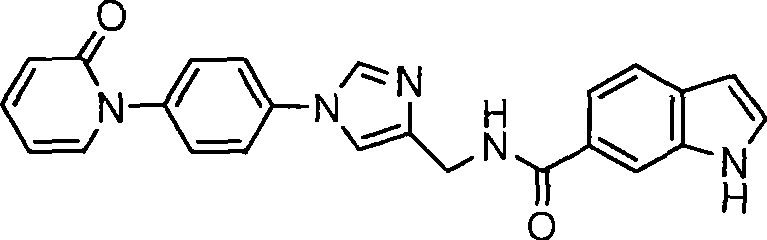
将BOP(280mg,0.633mmol)加入到吲哚-6-甲酸(85mg,0.528mmol)、实例1中制备的4-氨基甲基1-(4-碘苯基)咪唑I-2(136mg,0.455mmol)和TEA(0.150mL,1.08mmol)于DMF(4mL)中的溶液中。将混合物在室温下搅拌整夜后,加入水和EtOAc。将有机层分离,用5% NaHCO3水溶液洗涤,经由Na2SO4干燥,在真空中浓缩以得到呈粗样品形式的N-((1-(4-碘苯基)-1H-咪唑-4-基)甲基)-1H-吲哚-6-甲酰胺,其未经进一步纯化即用于后续反应。MS 443.0(M+H)。BOP (280 mg, 0.633 mmol) was added to indole-6-carboxylic acid (85 mg, 0.528 mmol), 4-aminomethyl 1-(4-iodophenyl) imidazole 1-2 prepared in Example 1 (136 mg, 0.455 mmol) and TEA (0.150 mL, 1.08 mmol) in DMF (4 mL). After the mixture was stirred overnight at room temperature, water and EtOAc were added. The organic layer was separated, washed with 5% aqueous NaHCO 3 , dried over Na 2 SO 4 , concentrated in vacuo to give N-((1-(4-iodophenyl)-1H-imidazole-4 as a crude sample -yl)methyl)-1H-indole-6-carboxamide, which was used in subsequent reactions without further purification. MS 443.0 (M+H).
将以上制备的N-((1-(4-碘苯基)-1H-咪唑-4-基)甲基)-1H-吲哚-6-甲酰胺、2-羟基吡啶1-7(130mg,1.37mmol)、8-羟基喹啉(30mg,0.21mmol)和K2CO3(246mg,1.78mmol)于DMSO(2mL)中的混合物脱气,随后馈入CuI(43mg,0.23mmol)。在130℃下,将混合物于密封管中加热整夜。随后,将其通过HPLC纯化以得到标题化合物(50mg)。MS 410.1(M+H)。N-((1-(4-iodophenyl)-1H-imidazol-4-yl)methyl)-1H-indole-6-carboxamide and 2-hydroxypyridine 1-7 (130 mg, 1.37 mmol), 8-hydroxyquinoline (30 mg, 0.21 mmol) and K2CO3 (246 mg, 1.78 mmol) in DMSO (2 mL) were degassed and then fed into CuI (43 mg, 0.23 mmol). The mixture was heated overnight at 130°C in a sealed tube. Subsequently, it was purified by HPLC to obtain the title compound (50 mg). MS 410.1 (M+H).
实例21Example 21
5-乙炔基-N-((1-(4-(2-氧代吡啶-1(2H)-基)苯基)-1H-咪唑-4-基)甲基)噻吩-2-甲酰胺(32)5-ethynyl-N-((1-(4-(2-oxopyridin-1(2H)-yl)phenyl)-1H-imidazol-4-yl)methyl)thiophene-2-carboxamide ( 32)

在80℃下,将5-溴-噻吩-2-甲酸乙酯(500mg,2.13mmol)、三甲基硅烷基乙炔(0.445mL,3.2mmol)、Pd(PPh3)4(15mg)和CuI(10mg)于二异丙胺(10mL)中的混合物加热2小时。冷却至室温后,将混合物经由硅藻土过滤且将滤液倾入水中。用EtOAc萃取产物。将EtOAc溶液用盐水洗涤,经由MgSO4干燥,在真空中浓缩以得到5-(2-三甲基硅烷基-乙炔-1-基)-噻吩-2-甲酸乙酯(529mg)。MS 253(M+H)。At 80 °C, ethyl 5-bromo-thiophene-2-carboxylate (500 mg, 2.13 mmol), trimethylsilylacetylene (0.445 mL, 3.2 mmol), Pd(PPh 3 ) 4 (15 mg) and CuI ( 10 mg) in diisopropylamine (10 mL) was heated for 2 hours. After cooling to room temperature, the mixture was filtered through celite and the filtrate was poured into water. The product was extracted with EtOAc. The EtOAc solution was washed with brine, dried over MgSO 4 , concentrated in vacuo to give ethyl 5-(2-trimethylsilyl-ethyn-1-yl)-thiophene-2-carboxylate (529 mg). MS 253 (M+H).
将1N LiOH水溶液(7.0mL,7.0mmol)加入到以上制备的5-(2-三甲基硅烷基-乙炔-1-基)-噻吩-2-甲酸乙酯(529mg,2.10mmol)于THF(20mL)中的溶液中。将混合物在40℃下搅拌整夜后,将其倾入水中。将水溶液用1N HCl酸化至pH1。用EtOAc萃取产物。将EtOAc溶液用盐水洗涤,经由MgSO4干燥,在真空中浓缩以得到5-乙炔基-噻吩-2-甲酸(316mg)。MS 153(M+H)。1N LiOH aqueous solution (7.0 mL, 7.0 mmol) was added to ethyl 5-(2-trimethylsilyl-ethyn-1-yl)-thiophene-2-carboxylate (529 mg, 2.10 mmol) prepared above in THF ( 20mL) in the solution. After the mixture was stirred overnight at 40°C, it was poured into water. The aqueous solution was acidified to
将实例19中制备的1-(4-碘苯基)吡啶-2(1H)-酮(1.00g,3.37mmol)、4-羟基甲基咪唑II-1(0.330g,3.37mmol)、8-羟基喹啉(0.073g,0.50mmol)和K2CO3(1.00g,7.25mmol)于DMSO(7mL)中的混合物用Ar脱气,随后馈入CuI(0.100g,0.52mmol)。在130℃下,将混合物于密封管中加热整夜。加入水和EtOAc。将混合物经由硅藻土过滤。将有机层分离,经由Na2SO4干燥,在真空中浓缩。通过HPLC纯化残余物以得到1-(4-(4-(羟基甲基)-1H-咪唑-1-基)苯基)吡啶-2(1H)-酮(335mg)。MS 268(M+H)。1-(4-iodophenyl)pyridin-2(1H)-one (1.00g, 3.37mmol), 4-hydroxymethylimidazole II-1 (0.330g, 3.37mmol) prepared in Example 19, 8- A mixture of hydroxyquinoline (0.073 g, 0.50 mmol) and K2CO3 (1.00 g, 7.25 mmol) in DMSO (7 mL) was degassed with Ar and fed into CuI (0.100 g, 0.52 mmol). The mixture was heated overnight at 130°C in a sealed tube. Water and EtOAc were added. The mixture was filtered through celite. The organic layer was separated, dried over Na2SO4 , concentrated in vacuo. The residue was purified by HPLC to give 1-(4-(4-(hydroxymethyl)-1H-imidazol-1-yl)phenyl)pyridin-2(1H)-one (335 mg). MS 268 (M+H).
将SOCl2(5.0mL)加入到以上制备的1-(4-(4-(羟基甲基)-1H-咪唑-1-基)苯基)吡啶-2(1H)-酮(335mg,1.25mmol)于CH3CN(20mL)中的悬浮液中。将混合物在室温下搅拌2小时后,将其在真空中浓缩。随后,将残余物溶解于DMF(20mL)中。将NaN3(244mg,3.75mmol)加入到溶液中。将混合物在室温下搅拌整夜后,加入水和EtOAc。将有机层分离,用5% NaHCO3水溶液洗涤,经由Na2SO4干燥,在真空中浓缩以得到1-(4-(4-(叠氮基甲基)-1H-咪唑-1-基)苯基)吡啶-2(1H)-酮(203mg)。MS 293(M+H)。SOCl 2 (5.0 mL) was added to 1-(4-(4-(hydroxymethyl)-1H-imidazol-1-yl)phenyl)pyridin-2(1H)-one (335 mg, 1.25 mmol) prepared above ) in suspension in CH 3 CN (20 mL). After stirring the mixture at room temperature for 2 hours, it was concentrated in vacuo. Subsequently, the residue was dissolved in DMF (20 mL). NaN3 (244 mg, 3.75 mmol) was added to the solution. After the mixture was stirred overnight at room temperature, water and EtOAc were added. The organic layer was separated, washed with 5% aqueous NaHCO 3 , dried over Na 2 SO 4 , concentrated in vacuo to give 1-(4-(4-(azidomethyl)-1H-imidazol-1-yl) Phenyl)pyridin-2(1H)-one (203 mg). MS 293 (M+H).
将SnCl2 2H2O(343mg,1.52mmol)加入到以上制备的1-(4-(4-(叠氮基甲基)-1H-咪唑-1-基)苯基)吡啶-2(1H)-酮(203mg,0.695mmol)于MeOH(6mL)和EtOAc(6mL)中的溶液中。将混合物加热至回流达1小时后,将其在真空中浓缩。通过HPLC纯化残余物以得到1-(4-(4-(氨基甲基)-1H-咪唑-1-基)苯基)吡啶-2(1H)-酮(145mg)。MS 267(M+H)。SnCl 2 2H 2 O (343 mg, 1.52 mmol) was added to 1-(4-(4-(azidomethyl)-1H-imidazol-1-yl)phenyl)pyridine-2(1H) prepared above - A solution of ketone (203 mg, 0.695 mmol) in MeOH (6 mL) and EtOAc (6 mL). After the mixture was heated to reflux for 1 h, it was concentrated in vacuo. The residue was purified by HPLC to give 1-(4-(4-(aminomethyl)-1H-imidazol-1-yl)phenyl)pyridin-2(1H)-one (145 mg). MS 267 (M+H).
将HATU(228mg,0.60mmol)加入到5-乙炔基-噻吩-2-甲酸(83mg,0.54mmol)和TEA(0.15mL,1.1mmol)于DMF(4mL)中的溶液中。在室温下搅拌30分钟后,加入以上制备的1-(4-(4-(氨基甲基)-1H-咪唑-1-基)苯基)吡啶-2(1H)-酮(145mg,0.54mmol)和TEA(0.15mL,1.1mmol)于DMF(8mL)中的溶液。将混合物在室温下搅拌整夜。随后,将其通过HPLC纯化以得到标题化合物(65mg)。MS 401(M+H)。HATU (228 mg, 0.60 mmol) was added to a solution of 5-ethynyl-thiophene-2-carboxylic acid (83 mg, 0.54 mmol) and TEA (0.15 mL, 1.1 mmol) in DMF (4 mL). After stirring at room temperature for 30 minutes, 1-(4-(4-(aminomethyl)-1H-imidazol-1-yl)phenyl)pyridin-2(1H)-one (145mg, 0.54mmol ) and TEA (0.15 mL, 1.1 mmol) in DMF (8 mL). The mixture was stirred overnight at room temperature. Subsequently, it was purified by HPLC to obtain the title compound (65 mg). MS 401(M+H).
实例22Example 22
(E)-5-氯-N-((1-(4-(2-(氰基亚氨基)吡啶-1(2H)-基)苯基)-1H-咪唑-4-基)甲基)噻吩-2-甲酰胺(33)(E)-5-Chloro-N-((1-(4-(2-(cyanoimino)pyridin-1(2H)-yl)phenyl)-1H-imidazol-4-yl)methyl) Thiophene-2-carboxamide (33)

将CH3I(0.50mL,8.0mmol)加入到1-(4-碘苯基)吡啶-2(1H)-硫酮(180mg,0.575mmol)于CH3CN(15mL)中的溶液中。在室温下搅拌整夜后,将混合物在真空中浓缩得到固体。将固体溶解于CH3CN(5mL)中。将氰胺(200mg,4.76mmol)和单水合肼(0.100mL,2.06mmol)加入到溶液中。在室温下搅拌2小时后,通过HPLC纯化混合物以得到(E)-(1-(4-碘苯基)亚吡啶-2(1H)-基)氰胺(25mg)。 CH3I (0.50 mL, 8.0 mmol) was added to a solution of 1-(4-iodophenyl)pyridine-2(1H)-thione (180 mg, 0.575 mmol) in CH3CN (15 mL). After stirring overnight at room temperature, the mixture was concentrated in vacuo to give a solid. The solid was dissolved in CH3CN (5 mL). Cyanamide (200 mg, 4.76 mmol) and hydrazine monohydrate (0.100 mL, 2.06 mmol) were added to the solution. After stirring at room temperature for 2 hours, the mixture was purified by HPLC to give (E)-(1-(4-iodophenyl)pyridinylene-2(1H)-yl)cyanamide (25 mg).
将(E)-(1-(4-碘苯基)亚吡啶-2(1H)-基)氰胺(25mg,0.078mmol)、5-氯-N-((1H-咪唑-4-基)甲基)噻吩-2-甲酰胺3-1(65mg,0.18mmol)、8-羟基喹啉(10mg,0.069mmol)和K2CO3(75mg,0.54mmol)于DMSO(1mL)中的混合物用Ar脱气,随后馈入CuI(15mg,0.079mmol)。在130℃下,将混合物于密封管中加热整夜。随后,将其通过HPLC纯化以得到标题化合物(10mg)。MS 435.1和437.0(M+H,Cl图案)。(E)-(1-(4-iodophenyl)pyridin-2(1H)-yl)cyanamide (25 mg, 0.078 mmol), 5-chloro-N-((1H-imidazol-4-yl) A mixture of methyl)thiophene-2-carboxamide 3-1 (65 mg, 0.18 mmol), 8-hydroxyquinoline (10 mg, 0.069 mmol) and K 2 CO 3 (75 mg, 0.54 mmol) in DMSO (1 mL) was used Ar was degassed, followed by feeding CuI (15 mg, 0.079 mmol). The mixture was heated overnight at 130°C in a sealed tube. Subsequently, it was purified by HPLC to obtain the title compound (10 mg). MS 435.1 and 437.0 (M+H, Cl pattern).
实例23Example 23
(E)-5-氯-N-((1-(4-(2-(甲基亚氨基)吡啶-1(2H)-基)苯基)-1H-咪唑-4-基)甲基)噻吩-2-甲酰胺(34)(E)-5-Chloro-N-((1-(4-(2-(methylimino)pyridin-1(2H)-yl)phenyl)-1H-imidazol-4-yl)methyl) Thiophene-2-carboxamide (34)

将CH3I(0.25mL,4.0mmol)加入到1-(4-碘苯基)吡啶-2(1H)-硫酮(98mg,0.31mmol)于CH3CN(5mL)中的溶液中。在室温下搅拌整夜后,将混合物在真空中浓缩得到固体。将固体溶解于MeOH(7mL)中。将CH3NH2(THF中2M,0.80mL,1.6mmol)加入到溶液中。在室温下搅拌整夜后,通过HPLC纯化混合物以得到(E)-N-(1-(4-碘苯基)亚吡啶-2(1H)-基)甲胺(59mg)。 CH3I (0.25 mL, 4.0 mmol) was added to a solution of 1-(4-iodophenyl)pyridine-2(1H)-thione (98 mg, 0.31 mmol) in CH3CN (5 mL). After stirring overnight at room temperature, the mixture was concentrated in vacuo to give a solid. The solid was dissolved in MeOH (7 mL). CH3NH2 (2M in THF, 0.80 mL , 1.6 mmol) was added to the solution. After stirring at room temperature overnight, the mixture was purified by HPLC to give (E)-N-(1-(4-iodophenyl)pyridin-2(1H)-yl)methanamine (59 mg).
将(E)-N-(1-(4-碘苯基)亚吡啶-2(1H)-基)甲胺(59mg,0.14mmol)、5-氯-N-((1H-咪唑-4-基)甲基)噻吩-2-甲酰胺3-1(63mg,0.18mmol)、8-羟基喹啉(10mg,0.069mmol)和K2CO3(100mg,0.72mmol)于DMSO(1mL)中的混合物用Ar脱气,随后馈入CuI(15mg,0.079mmol)。在130℃下,将混合物于密封管中加热整夜。随后,将其通过HPLC纯化以得到标题化合物(15mg)。MS 424.1和426.1(M+H,Cl图案)。(E)-N-(1-(4-iodophenyl)pyridin-2(1H)-yl)methanamine (59 mg, 0.14 mmol), 5-chloro-N-((1H-imidazol-4- base)methyl)thiophene-2-carboxamide 3-1 (63mg, 0.18mmol), 8-hydroxyquinoline (10mg, 0.069mmol) and K 2 CO 3 (100mg, 0.72mmol) in DMSO (1mL) The mixture was degassed with Ar, then fed into CuI (15 mg, 0.079 mmol). The mixture was heated overnight at 130°C in a sealed tube. Subsequently, it was purified by HPLC to obtain the title compound (15 mg). MS 424.1 and 426.1 (M+H, Cl pattern).
实例24Example 24
(E)-5-氯-N-((1-(4-(2-(4-甲氧基苯基亚氨基)吡啶-1(2H)-基)苯基)-1H-咪唑-4-基)甲基)噻吩-2-甲酰胺(35)(E)-5-Chloro-N-((1-(4-(2-(4-methoxyphenylimino)pyridin-1(2H)-yl)phenyl)-1H-imidazole-4- Base) methyl) thiophene-2-carboxamide (35)

将CH3I(0.40mL,6.4mmol)加入到1-(4-碘苯基)吡啶-2(1H)-硫酮(192mg,0.61mmol)于CH3CN(5mL)中的溶液中。在室温下搅拌整夜后,将混合物在真空中浓缩得到固体。将固体溶解于DMF(3mL)中。将对茴香胺(317mg,2.6mmol)加入到溶液中。在100℃下搅拌整夜后,通过HPLC纯化混合物以得到(E)-N-(1-(4-碘苯基)亚吡啶-2(1H)-基)-4-甲氧基苯胺(90mg)。 CH3I (0.40 mL, 6.4 mmol) was added to a solution of 1-(4-iodophenyl)pyridine-2(1H)-thione (192 mg, 0.61 mmol) in CH3CN (5 mL). After stirring overnight at room temperature, the mixture was concentrated in vacuo to give a solid. The solid was dissolved in DMF (3 mL). p-Anisidine (317 mg, 2.6 mmol) was added to the solution. After stirring overnight at 100 °C, the mixture was purified by HPLC to give (E)-N-(1-(4-iodophenyl)pyridinylene-2(1H)-yl)-4-methoxyaniline (90 mg ).
将(E)-N-(1-(4-碘苯基)亚吡啶-2(1H)-基)-4-甲氧基苯胺(90mg,0.17mmol)、5-氯-N-((1H-咪唑-4-基)甲基)噻吩-2-甲酰胺3-1(62mg,0.17mmol)、8-羟基喹啉(14mg,0.096mmol)和K2CO3(100mg,0.72mmol)于DMSO(2mL)中的混合物用Ar脱气,随后馈入CuI(20mg,0.10mmol)。在130℃下,将混合物于密封管中加热整夜。随后,将其通过HPLC纯化以得到标题化合物(25mg)。MS 516.0和518.1(M+H,Cl图案)。(E)-N-(1-(4-iodophenyl)pyridin-2(1H)-yl)-4-methoxyaniline (90mg, 0.17mmol), 5-chloro-N-((1H -imidazol-4-yl)methyl)thiophene-2-carboxamide 3-1 (62mg, 0.17mmol), 8-hydroxyquinoline (14mg, 0.096mmol) and K 2 CO 3 (100mg, 0.72mmol) in DMSO (2 mL) was degassed with Ar, then fed into CuI (20 mg, 0.10 mmol). The mixture was heated overnight at 130°C in a sealed tube. Subsequently, it was purified by HPLC to obtain the title compound (25 mg). MS 516.0 and 518.1 (M+H, Cl pattern).
实例25Example 25
(E)-N-((1-(4-(2-(乙酰基亚氨基)吡啶-1(2H)-基)苯基)-1H-咪唑-4-基)甲基)-5-氯噻吩-2-甲酰胺(36)(E)-N-((1-(4-(2-(acetylimino)pyridin-1(2H)-yl)phenyl)-1H-imidazol-4-yl)methyl)-5-chloro Thiophene-2-carboxamide (36)

将CH3I(0.80mL,12.8mmol)加入到1-(4-碘苯基)吡啶-2(1H)-硫酮(384mg,1.23mmol)于CH3CN(10mL)中的溶液中。在室温下搅拌整夜后,将混合物在真空中浓缩得到固体。将固体溶解于DMF(6mL)中。将MeOH中的NH3(7N,3.0mL,21.0mmol)和三乙胺(1.5mL,10.8mmol)加入到溶液中。在室温下搅拌整夜后,通过HPLC纯化混合物以得到固体。将固体溶解于吡啶(3mL)和CH2Cl2(3mL)中。将乙酰氯(0.200mL,2.8mmol)加入到溶液中。在室温下搅拌整夜后,通过HPLC纯化混合物以得到(E)-N-(1-(4-碘苯基)亚吡啶-2(1H)-基)乙酰胺(120mg)。 CH3I (0.80 mL, 12.8 mmol) was added to a solution of 1-(4-iodophenyl)pyridine-2(1H)-thione (384 mg, 1.23 mmol) in CH3CN (10 mL). After stirring overnight at room temperature, the mixture was concentrated in vacuo to give a solid. The solid was dissolved in DMF (6 mL). NH3 in MeOH (7N, 3.0 mL, 21.0 mmol) and triethylamine (1.5 mL, 10.8 mmol) were added to the solution. After stirring overnight at room temperature, the mixture was purified by HPLC to give a solid. The solid was dissolved in pyridine (3 mL) and CH2Cl2 (3 mL). Acetyl chloride (0.200 mL, 2.8 mmol) was added to the solution. After stirring overnight at room temperature, the mixture was purified by HPLC to give (E)-N-(1-(4-iodophenyl)pyridin-2(1H)-yl)acetamide (120 mg).
将(E)-N-(1-(4-碘苯基)亚吡啶-2(1H)-基)乙酰胺(120mg,0.27mmol)、5-氯-N-((1H-咪唑-4-基)甲基)噻吩-2-甲酰胺3-1(109mg,0.30mmol)、8-羟基喹啉(15mg,0.10mmol)和K2CO3(100mg,0.72mmol)于DMSO(2mL)中的混合物用Ar脱气,随后馈入CuI(24mg,0.12mmol)。在130℃下,将混合物于密封管中加热5小时。随后,将其通过HPLC纯化以得到标题化合物(8mg)。MS 452.0和454.0(M+H,Cl图案)。(E)-N-(1-(4-iodophenyl)pyridin-2(1H)-yl)acetamide (120mg, 0.27mmol), 5-chloro-N-((1H-imidazol-4- base)methyl)thiophene-2-carboxamide 3-1 (109mg, 0.30mmol), 8-hydroxyquinoline (15mg, 0.10mmol) and K 2 CO 3 (100mg, 0.72mmol) in DMSO (2mL) The mixture was degassed with Ar, then fed into CuI (24 mg, 0.12 mmol). The mixture was heated in a sealed tube at 130°C for 5 hours. Subsequently, it was purified by HPLC to obtain the title compound (8 mg). MS 452.0 and 454.0 (M+H, Cl pattern).
实例26Example 26
4-氯-1-甲基-N-((1-(4-(2-氧代吡啶-1(2H)-基)苯基)-1H-咪唑-4-基)甲基)-1H-吡咯-2-甲酰胺(37)4-Chloro-1-methyl-N-((1-(4-(2-oxopyridin-1(2H)-yl)phenyl)-1H-imidazol-4-yl)methyl)-1H- Pyrrole-2-carboxamide (37)

将1,4-二碘苯1-1(4.00g,12.1mmol)、2-羟基吡啶1-7(1.15g,12.1mmol)、8-羟基喹啉(176mg,1.21mmol)和K2CO3(1.74g,12.6mmol)于DMSO(16mL)中的混合物用Ar脱气,随后馈入CuI(230mg,1.21mmol)。在130℃下,将混合物于密封管中加热整夜。冷却至室温后,加入H2O和EtOAc。将其经由硅藻土过滤。将有机相分离,经由Na2SO4干燥,在真空中浓缩。将残余物通过硅胶柱以己烷中的EtOAc(0-70%EtOAc)洗脱来纯化以得到1-(4-碘苯基)吡啶-2(1H)-酮(1.30g)。1,4-Diiodobenzene 1-1 (4.00g, 12.1mmol), 2-hydroxypyridine 1-7 (1.15g, 12.1mmol), 8-hydroxyquinoline (176mg, 1.21mmol) and K 2 CO 3 (1.74 g, 12.6 mmol) in DMSO (16 mL) was degassed with Ar, then fed into CuI (230 mg, 1.21 mmol). The mixture was heated overnight at 130°C in a sealed tube. After cooling to room temperature, H2O and EtOAc were added. It was filtered through celite. The organic phase was separated, dried over Na2SO4 , concentrated in vacuo. The residue was purified by silica gel column eluting with EtOAc in hexanes (0-70% EtOAc) to afford 1-(4-iodophenyl)pyridin-2(1H)-one (1.30 g).
在室温下,将三甲基硅烷基重氮甲烷(乙醚的2M,5.0mL,10.0mmol)加入到1-甲基-2-吡咯甲酸(1.03g,8.22mmol)于MeOH(5mL)和二噁烷(5mL)中的溶液中。在室温下搅拌1小时后,将混合物在真空中浓缩得到呈挥发性油状物的1-甲基-2-吡咯甲酸甲酯(1.14g)。Trimethylsilyldiazomethane (2M in diethyl ether, 5.0 mL, 10.0 mmol) was added to 1-methyl-2-pyrrolecarboxylic acid (1.03 g, 8.22 mmol) in MeOH (5 mL) and dioxin at room temperature solution in alkanes (5 mL). After stirring at room temperature for 1 hour, the mixture was concentrated in vacuo to give methyl 1-methyl-2-pyrrolecarboxylate (1.14 g) as a volatile oil.
在0℃下,将SO2Cl2(0.800mL,9.96mmol)加入到1-甲基-2-吡咯甲酸甲酯(1.14g,8.22mmol)于乙醚(10mL)中的溶液中。在室温下搅拌15分钟后,将混合物在真空中浓缩。将残余物通过硅胶柱以己烷中的5% EtOAc洗脱来纯化以得到4-氯-1-甲基-1H-吡咯-2-甲酸甲酯(0.13g)。将含有5-氯-1-甲基-1H-吡咯-2-甲酸甲酯的洗脱份进一步通过HPLC纯化以得到5-氯异构物。SO 2 Cl 2 (0.800 mL, 9.96 mmol) was added to a solution of methyl 1-methyl-2-pyrrolecarboxylate (1.14 g, 8.22 mmol) in diethyl ether (10 mL) at 0°C. After stirring at room temperature for 15 minutes, the mixture was concentrated in vacuo. The residue was purified by silica gel column eluting with 5% EtOAc in hexanes to give methyl 4-chloro-l-methyl-lH-pyrrole-2-carboxylate (0.13 g). Fractions containing methyl 5-chloro-1-methyl-1H-pyrrole-2-carboxylate were further purified by HPLC to give the 5-chloroisomer.
将1N NaOH水溶液(3mL)加入到4-氯-1-甲基-1H-吡咯-2-甲酸甲酯(130mg,0.75mmol)于MeOH(4mL)中的溶液中。在室温下搅拌整夜后,将混合物用1N HCl酸化至pH1-2。用EtOAc萃取产物。将EtOAc相分离,经由Na2SO4干燥,在真空中浓缩以得到呈固体状的4-氯-1-甲基-1H-吡咯-2-甲酸(111mg)。1N Aqueous NaOH (3 mL) was added to a solution of methyl 4-chloro-1-methyl-1H-pyrrole-2-carboxylate (130 mg, 0.75 mmol) in MeOH (4 mL). After stirring overnight at room temperature, the mixture was acidified to pH 1-2 with 1N HCl. The product was extracted with EtOAc. The EtOAc phase was separated, dried over Na2SO4 , concentrated in vacuo to give 4 - chloro-1-methyl-1H-pyrrole-2-carboxylic acid (111 mg) as a solid.
将BOP(217mg,0.49mmol)加入到4-氯-1-甲基-1H-吡咯-2-甲酸(55mg,0.34mmol)和三乙胺(0.100mL,0.72mmol)于DMF(2mL)中的溶液中。搅拌5分钟后,加入4-氨基甲基咪唑II-2(100mg,1.03mmol)于DMF(2mL)中的溶液。在室温下搅拌整夜后,通过HPLC纯化混合物以得到N-((1H-咪唑-4-基)甲基)-4-氯-1-甲基-1H-吡咯-2-甲酰胺(81mg)。BOP (217 mg, 0.49 mmol) was added to a solution of 4-chloro-1-methyl-1H-pyrrole-2-carboxylic acid (55 mg, 0.34 mmol) and triethylamine (0.100 mL, 0.72 mmol) in DMF (2 mL) in solution. After stirring for 5 minutes, a solution of 4-aminomethylimidazole II-2 (100 mg, 1.03 mmol) in DMF (2 mL) was added. After stirring overnight at room temperature, the mixture was purified by HPLC to give N-((1H-imidazol-4-yl)methyl)-4-chloro-1-methyl-1H-pyrrole-2-carboxamide (81 mg) .
将N-((1H-咪唑-4-基)甲基)-4-氯-1-甲基-1H-吡咯-2-甲酰胺(81mg,0.23mmol)、1-(4-碘苯基)吡啶-2(1H)-酮(100mg,0.33mmol)、8-羟基喹啉(15mg,0.10mmol)和K2CO3(193mg,1.40mmol)于DMSO(2mL)中的混合物用Ar脱气,随后馈入CuI(21mg,0.11mmol)。在130℃下,将混合物于密封管中加热整夜。随后,将其通过HPLC纯化以得到标题化合物(25mg)。MS 408.1和410.1(M+H,Cl图案)。N-((1H-imidazol-4-yl)methyl)-4-chloro-1-methyl-1H-pyrrole-2-carboxamide (81mg, 0.23mmol), 1-(4-iodophenyl) A mixture of pyridin-2(1H)-one (100 mg, 0.33 mmol), 8-hydroxyquinoline (15 mg, 0.10 mmol) and K 2 CO 3 (193 mg, 1.40 mmol) in DMSO (2 mL) was degassed with Ar, Then CuI (21 mg, 0.11 mmol) was fed. The mixture was heated overnight at 130°C in a sealed tube. Subsequently, it was purified by HPLC to obtain the title compound (25 mg). MS 408.1 and 410.1 (M+H, Cl pattern).
实例27Example 27
5-氯-1-甲基-N-((1-(4-(2-氧代吡啶-1(2H)-基)苯基)-1H-咪唑-4-基)甲基)-1H-吡咯-2-甲酰胺(38)5-Chloro-1-methyl-N-((1-(4-(2-oxopyridin-1(2H)-yl)phenyl)-1H-imidazol-4-yl)methyl)-1H- Pyrrole-2-carboxamide (38)

类似于制备实例26的4-氯-1-甲基-N-((1-(4-(2-氧代吡啶-1(2H)-基)苯基)-1H-咪唑-4-基)甲基)-1H-吡咯-2-甲酰胺来制备标题化合物。MS 408.1和410.1(M+H,Cl图案)。4-Chloro-1-methyl-N-((1-(4-(2-oxopyridin-1(2H)-yl)phenyl)-1H-imidazol-4-yl) analogously to Preparation Example 26 Methyl)-1H-pyrrole-2-carboxamide to prepare the title compound. MS 408.1 and 410.1 (M+H, Cl pattern).
实例28Example 28
5-氯-N-((1-(4-(1,1-二氧代硫代吗啉基)苯基)-1H-咪唑-4-基)甲基)噻吩-甲酰胺(39)5-Chloro-N-((1-(4-(1,1-dioxothiomorpholinyl)phenyl)-1H-imidazol-4-yl)methyl)thiophene-carboxamide (39)

将5-氯-N-((1-(4-碘苯基)-1H-咪唑-4-基)甲基)噻吩-2-甲酰胺1-6(56mg,0.10mmol)、1,4-丁烷磺内酰胺(1,4-butanesultam)(52mg,0.38mmol)、8-羟基喹啉(6mg,0.040mmol)和K2CO3(50mg,0.36mmol)于DMSO(1mL)中的混合物脱气,随后馈入CuI(10mg,0.052mmol)。在130℃下,将混合物于密封管中加热整夜。随后,通过HPLC纯化混合物以得到标题化合物(10mg)。MS 451.1和453.1(M+H,Cl图案)。5-Chloro-N-((1-(4-iodophenyl)-1H-imidazol-4-yl)methyl)thiophene-2-carboxamide 1-6 (56mg, 0.10mmol), 1,4- A mixture of butane sultam (1,4-butanesultam) (52 mg, 0.38 mmol), 8-hydroxyquinoline (6 mg, 0.040 mmol) and K 2 CO 3 (50 mg, 0.36 mmol) in DMSO (1 mL) gas, followed by feeding CuI (10 mg, 0.052 mmol). The mixture was heated overnight at 130°C in a sealed tube. Subsequently, the mixture was purified by HPLC to give the title compound (10 mg). MS 451.1 and 453.1 (M+H, Cl pattern).
实例29Example 29
5-氯-N-((1-(3-氟-4-(2-氧代吡啶-1(2H)-基)苯基)-1H-咪唑-4-基)甲基)噻吩-2-甲酰胺(40)5-Chloro-N-((1-(3-fluoro-4-(2-oxopyridin-1(2H)-yl)phenyl)-1H-imidazol-4-yl)methyl)thiophene-2- Formamide (40)

将2,5-二碘氟苯II-4(2.50g,7.18mmol)、4-羟基甲基咪唑盐酸盐(0.967g,7.18mmol)、8-羟基喹啉(0.104g,0.717mmol)和K2CO3(2.00g,14.5mmol)于DMSO(12mL)中的混合物用Ar脱气,随后馈入CuI(0.136g,0.716mmol)。在130℃下,将混合物于密封管中加热整夜。冷却至室温后,加入H2O和EtOAc。将其经由硅藻土过滤。将有机相分离,经由Na2SO4干燥,在真空中浓缩。将残余物通过硅胶柱以CH2Cl2中的MeOH(0-5% MeOH)洗脱来纯化以得到(1-(3-氟-4-碘苯基)-1H-咪唑-4-基)甲醇(0.39g)。2,5-diiodofluorobenzene II-4 (2.50g, 7.18mmol), 4-hydroxymethylimidazole hydrochloride (0.967g, 7.18mmol), 8-hydroxyquinoline (0.104g, 0.717mmol) and A mixture of K2CO3 (2.00 g, 14.5 mmol) in DMSO (12 mL) was degassed with Ar, then fed into CuI (0.136 g, 0.716 mmol). The mixture was heated overnight at 130°C in a sealed tube. After cooling to room temperature, H2O and EtOAc were added. It was filtered through celite. The organic phase was separated, dried over Na2SO4 , concentrated in vacuo. The residue was purified by silica gel column eluting with MeOH in CH2Cl2 (0-5% MeOH) to give (1-(3-fluoro-4-iodophenyl)-1H - imidazol-4-yl) Methanol (0.39 g).
将SOCl2(2.5mL)加入到(1-(3-氟-4-碘苯基)-1H-咪唑-4-基)甲醇(0.39g,1.23mmol)于CH3CN(7mL)中的悬浮液中。加入后,悬浮液变得澄清。随后,将其在真空中浓缩。将残余物溶解于DMF(7mL)中,加入NaN3(0.32g,4.92mmol)。将混合物在室温下搅拌整夜。加入H2O和EtOAc。将有机相分离,用5% NaHCO3洗涤,经由Na2SO4干燥,在真空中浓缩。将残余物溶解于MeOH(6mL)中,加入Ra-Ni(H2O中的50%浆料,~200mg)。使混合物在气球H2下氢化2小时。随后,将其经由硅藻土过滤。将滤液在真空中浓缩以得到呈固体状的(1-(3-氟-4-碘苯基)-1H-咪唑-4-基)甲胺(0.268g)。 SOCl2 (2.5 mL) was added to a suspension of (1-(3-fluoro-4-iodophenyl)-1H-imidazol-4-yl)methanol (0.39 g, 1.23 mmol) in CH3CN (7 mL) in the liquid. After addition, the suspension became clear. Subsequently, it was concentrated in vacuo. The residue was dissolved in DMF (7 mL), and NaN 3 (0.32 g, 4.92 mmol) was added. The mixture was stirred overnight at room temperature. H2O and EtOAc were added. The organic phase was separated, washed with 5% NaHCO 3 , dried over Na 2 SO 4 , concentrated in vacuo. The residue was dissolved in MeOH (6 mL) and Ra-Ni (50% slurry in H2O , ~200 mg) was added. The mixture was hydrogenated under balloon H2 for 2 h. Then, it was filtered through celite. The filtrate was concentrated in vacuo to give (1-(3-fluoro-4-iodophenyl)-1H-imidazol-4-yl)methanamine (0.268 g) as a solid.
将BOP(472mg,1.07mmol)加入到5-氯-2-噻吩甲酸1-5(165mg,1.01mmol)和三乙胺(0.300mL,2.16mmol)于DMF(5mL)中的溶液中。搅拌5分钟后,加入(1-(3-氟-4-碘苯基)-1H-咪唑-4-基)甲胺(268mg,0.845mmol)于DMF(4mL)中的溶液。将混合物在室温下搅拌整夜。加入H2O和EtOAc。将有机相分离,用5%NaHCO3洗涤,经由Na2SO4干燥,在真空中浓缩。通过HPLC纯化残余物以得到5-氯-N-((1-(3-氟-4-碘苯基)-1H-咪唑-4-基)甲基)噻吩-2-甲酰胺(83mg)。BOP (472 mg, 1.07 mmol) was added to a solution of 5-chloro-2-thiophenecarboxylic acid 1-5 (165 mg, 1.01 mmol) and triethylamine (0.300 mL, 2.16 mmol) in DMF (5 mL). After stirring for 5 minutes, a solution of (1-(3-fluoro-4-iodophenyl)-1H-imidazol-4-yl)methanamine (268 mg, 0.845 mmol) in DMF (4 mL) was added. The mixture was stirred overnight at room temperature. H2O and EtOAc were added. The organic phase was separated, washed with 5% NaHCO 3 , dried over Na 2 SO 4 , concentrated in vacuo. The residue was purified by HPLC to give 5-chloro-N-((1-(3-fluoro-4-iodophenyl)-1H-imidazol-4-yl)methyl)thiophene-2-carboxamide (83 mg).
将5-氯-N-((1-(3-氟-4-碘苯基)-1H-咪唑-4-基)甲基)噻吩-2-甲酰胺(83mg,0.14mmol)、2-羟基吡啶1-7(30mg,0.31mmol)、8-羟基喹啉(10mg,0.069mmol)和K2CO3(50mg,0.36mmol)于DMSO(1mL)中的混合物用Ar脱气,随后馈入CuI(15mg,0.079mmol)。在130℃下,将混合物于密封管中加热4小时。随后,将其通过HPLC纯化以得到标题化合物(8mg)。MS 429.0和431.0(M+H,Cl图案)。5-Chloro-N-((1-(3-fluoro-4-iodophenyl)-1H-imidazol-4-yl)methyl)thiophene-2-carboxamide (83mg, 0.14mmol), 2-hydroxy A mixture of pyridine 1-7 (30 mg, 0.31 mmol), 8-hydroxyquinoline (10 mg, 0.069 mmol) and K 2 CO 3 (50 mg, 0.36 mmol) in DMSO (1 mL) was degassed with Ar and fed into CuI (15 mg, 0.079 mmol). The mixture was heated in a sealed tube at 130°C for 4 hours. Subsequently, it was purified by HPLC to obtain the title compound (8 mg). MS 429.0 and 431.0 (M+H, Cl pattern).
实例30Example 30
5-氯-N-((1-(4-(3-甲氧基-2-氧代吡啶-1(2H)-基)苯基)-1H-咪唑-4-基)甲基)噻吩-2-甲酰胺(41)5-Chloro-N-((1-(4-(3-methoxy-2-oxopyridin-1(2H)-yl)phenyl)-1H-imidazol-4-yl)methyl)thiophene- 2-Formamide (41)

将5-氯-N-((1-(4-碘苯基)-1H-咪唑-4-基)甲基)噻吩-2-甲酰胺1-6(150mg,0.34mmol)、3-甲氧基-2-羟基吡啶(85mg,0.68mmol)、8-羟基喹啉(20mg,0.14mmol)和K2CO3(100mg,0.72mmol)于DMSO(2mL)中的混合物用Ar脱气,随后馈入CuI(25mg,0.13mmol)。在130℃下,将混合物于密封管中加热4小时。随后,通过HPLC纯化混合物以得到标题化合物(99mg)。MS 441.0和443.0(M+H,Cl图案)。5-Chloro-N-((1-(4-iodophenyl)-1H-imidazol-4-yl)methyl)thiophene-2-carboxamide 1-6 (150mg, 0.34mmol), 3-methoxy A mixture of 2-hydroxypyridine (85 mg, 0.68 mmol), 8-hydroxyquinoline (20 mg, 0.14 mmol) and K 2 CO 3 (100 mg, 0.72 mmol) in DMSO (2 mL) was degassed with Ar and then Add CuI (25 mg, 0.13 mmol). The mixture was heated in a sealed tube at 130°C for 4 hours. Subsequently, the mixture was purified by HPLC to obtain the title compound (99 mg). MS 441.0 and 443.0 (M+H, Cl pattern).
实例31Example 31
5-氯-N-((1-(4-(3-羟基-2-氧代吡啶-1(2H)-基)苯基)-1H-咪唑-4-基)甲基)噻吩-2-甲酰胺(42)5-Chloro-N-((1-(4-(3-hydroxy-2-oxopyridin-1(2H)-yl)phenyl)-1H-imidazol-4-yl)methyl)thiophene-2- Formamide (42)

将BBr3(0.365mL,3.8mmol)加入到5-氯-N-((1-(4-(3-甲氧基-2-氧代吡啶-1(2H)-基)苯基)-1H-咪唑-4-基)甲基)噻吩-2-甲酰胺(75mg,0.14mmol)于CH2Cl2(4mL)中的溶液中。将混合物在室温下搅拌1小时。将其在真空中浓缩。通过HPLC纯化残余物以得到标题化合物(40mg)。MS 427.0和429.0(M+H,Cl图案)。BBr 3 (0.365 mL, 3.8 mmol) was added to 5-chloro-N-((1-(4-(3-methoxy-2-oxopyridin-1(2H)-yl)phenyl)-1H -Imidazol-4-yl)methyl)thiophene-2-carboxamide (75 mg, 0.14 mmol) in CH2Cl2 (4 mL ). The mixture was stirred at room temperature for 1 hour. It was concentrated in vacuo. The residue was purified by HPLC to give the title compound (40 mg). MS 427.0 and 429.0 (M+H, Cl pattern).
实例32Example 32
5-氯-N-((1-(4-(3-氟-2-氧代吡啶-1(2H)-基)苯基)-1H-咪唑-4-基)甲基)噻吩-2-甲酰胺(43)5-Chloro-N-((1-(4-(3-fluoro-2-oxopyridin-1(2H)-yl)phenyl)-1H-imidazol-4-yl)methyl)thiophene-2- Formamide (43)
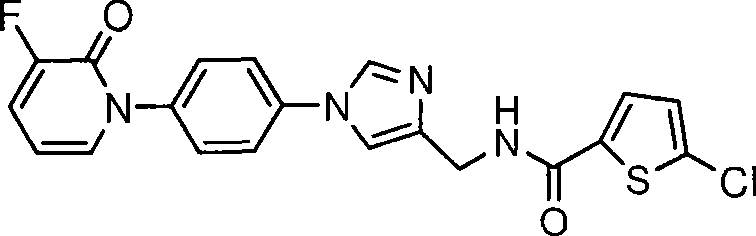
将5-氯-N-((1-(4-碘苯基)-1H-咪唑-4-基)甲基)噻吩-2-甲酰胺1-6(66mg,0.15mmol)、3-氟-2-羟基吡啶(46mg,0.40mmol)、8-羟基喹啉(10mg,0.069mmol)和K2CO3(50mg,0.36mmol)于DMSO(1mL)中的混合物用Ar脱气,随后馈入CuI(15mg,0.079mmol)。在130℃下,将混合物于密封管中加热整夜。随后,通过HPLC纯化混合物以得到标题化合物(8mg)。MS 429.0和431.0(M+H,Cl图案)。5-Chloro-N-((1-(4-iodophenyl)-1H-imidazol-4-yl)methyl)thiophene-2-carboxamide 1-6 (66mg, 0.15mmol), 3-fluoro- A mixture of 2-hydroxypyridine (46 mg, 0.40 mmol), 8-hydroxyquinoline (10 mg, 0.069 mmol) and K 2 CO 3 (50 mg, 0.36 mmol) in DMSO (1 mL) was degassed with Ar and fed into CuI (15 mg, 0.079 mmol). The mixture was heated overnight at 130°C in a sealed tube. Subsequently, the mixture was purified by HPLC to obtain the title compound (8 mg). MS 429.0 and 431.0 (M+H, Cl pattern).
实例33Example 33
5-氯-N-((1-(4-(3-甲基-2-氧代吡啶-1(2H)-基)苯基)-1H-咪唑-4-基)甲基)噻吩-2-甲酰胺(44)5-Chloro-N-((1-(4-(3-methyl-2-oxopyridin-1(2H)-yl)phenyl)-1H-imidazol-4-yl)methyl)thiophene-2 - Formamide (44)

将5-氯-N-((1-(4-碘苯基)-1H-咪唑-4-基)甲基)噻吩-2-甲酰胺1-6(66mg,0.15mmol)、2-羟基-3-甲基吡啶(45mg,0.41mmol)、8-羟基喹啉(10mg,0.069mmol)和K2CO3(50mg,0.36mmol)于DMSO(1mL)中的混合物用Ar脱气,随后馈入CuI(15mg,0.079mmol)。在130℃下,将混合物于密封管中加热整夜。随后,通过HPLC纯化混合物以得到标题化合物(10mg)。MS 425.0和427.0(M+H,Cl图案)。5-Chloro-N-((1-(4-iodophenyl)-1H-imidazol-4-yl)methyl)thiophene-2-carboxamide 1-6 (66mg, 0.15mmol), 2-hydroxy- A mixture of 3-picoline (45 mg, 0.41 mmol), 8-hydroxyquinoline (10 mg, 0.069 mmol) and K 2 CO 3 (50 mg, 0.36 mmol) in DMSO (1 mL) was degassed with Ar and fed into CuI (15 mg, 0.079 mmol). The mixture was heated overnight at 130°C in a sealed tube. Subsequently, the mixture was purified by HPLC to give the title compound (10 mg). MS 425.0 and 427.0 (M+H, Cl pattern).
实例34Example 34
5-氯-N-((1-(4-(5-甲基-2-氧代吡啶-1(2H)-基)苯基)-1H-咪唑-4-基)甲基)噻吩-2-甲酰胺(45)5-Chloro-N-((1-(4-(5-methyl-2-oxopyridin-1(2H)-yl)phenyl)-1H-imidazol-4-yl)methyl)thiophene-2 - Formamide (45)

将5-氯-N-((1-(4-碘苯基)-1H-咪唑-4-基)甲基)噻吩-2-甲酰胺1-6(56mg,0.13mmol)、2-羟基-5-甲基吡啶(45mg,0.41mmol)、8-羟基喹啉(10mg,0.069mmol)和K2CO3(50mg,0.36mmol)于DMSO(1mL)中的混合物用Ar脱气,随后馈入CuI(15mg,0.079mmol)。在130℃下,将混合物于密封管中加热整夜。随后,通过HPLC纯化混合物以得到标题化合物(8mg)。MS 425.0和427.0(M+H,Cl图案)。5-Chloro-N-((1-(4-iodophenyl)-1H-imidazol-4-yl)methyl)thiophene-2-carboxamide 1-6 (56mg, 0.13mmol), 2-hydroxy- A mixture of 5-picoline (45 mg, 0.41 mmol), 8-hydroxyquinoline (10 mg, 0.069 mmol) and K 2 CO 3 (50 mg, 0.36 mmol) in DMSO (1 mL) was degassed with Ar and fed into CuI (15 mg, 0.079 mmol). The mixture was heated overnight at 130°C in a sealed tube. Subsequently, the mixture was purified by HPLC to obtain the title compound (8 mg). MS 425.0 and 427.0 (M+H, Cl pattern).
实例35Example 35
5-氯-N-((1-(4-(4-羟基-2-氧代吡啶-1(2H)-基)苯基)-1H-咪唑-4-基)甲基)噻吩-2-甲酰胺(46)5-Chloro-N-((1-(4-(4-hydroxy-2-oxopyridin-1(2H)-yl)phenyl)-1H-imidazol-4-yl)methyl)thiophene-2- Formamide (46)

将5-氯-N-((1-(4-碘苯基)-1H-咪唑-4-基)甲基)噻吩-2-甲酰胺1-6(66mg,0.15mmol)、2,4-二羟基吡啶(45mg,0.41mmol)、8-羟基喹啉(10mg,0.069mmol)和K2CO3(50mg,0.36mmol)于DMSO(1mL)中的混合物用Ar脱气,随后馈入CuI(15mg,0.079mmol)。在130℃下,将混合物于密封管中加热整夜。随后,通过HPLC纯化混合物以得到标题化合物(6mg)。MS 427.0和429.0(M+H,Cl图案)。5-Chloro-N-((1-(4-iodophenyl)-1H-imidazol-4-yl)methyl)thiophene-2-carboxamide 1-6 (66mg, 0.15mmol), 2,4- A mixture of dihydroxypyridine (45 mg, 0.41 mmol), 8-hydroxyquinoline (10 mg, 0.069 mmol) and K 2 CO 3 (50 mg, 0.36 mmol) in DMSO (1 mL) was degassed with Ar and fed into CuI ( 15 mg, 0.079 mmol). The mixture was heated overnight at 130°C in a sealed tube. Subsequently, the mixture was purified by HPLC to obtain the title compound (6 mg). MS 427.0 and 429.0 (M+H, Cl pattern).
实例36Example 36
5-氯-N-((1-(4-(2,4-二氧代-3,4-二氢嘧啶-1(2H)-基)苯基)-1H-咪唑-4-基)甲基)噻吩-2-甲酰胺(47)5-Chloro-N-((1-(4-(2,4-dioxo-3,4-dihydropyrimidin-1(2H)-yl)phenyl)-1H-imidazol-4-yl)methyl base) thiophene-2-carboxamide (47)

将5-氯-N-((1-(4-碘苯基)-1H-咪唑-4-基)甲基)噻吩-2-甲酰胺1-6(66mg,0.15mmol)、尿嘧啶(46mg,0.41mmol)、8-羟基喹啉(10mg,0.069mmol)和K2CO3(50mg,0.36mmol)于DMSO(1mL)中的混合物用Ar脱气,随后馈入CuI(15mg,0.079mmol)。在130℃下,将混合物于密封管中加热整夜。随后,通过HPLC纯化混合物以得到标题化合物(25mg)。MS 428.0和430.0(M+H,Cl图案)。5-Chloro-N-((1-(4-iodophenyl)-1H-imidazol-4-yl)methyl)thiophene-2-carboxamide 1-6 (66mg, 0.15mmol), uracil (46mg , 0.41 mmol), 8-hydroxyquinoline (10 mg, 0.069 mmol) and K 2 CO 3 (50 mg, 0.36 mmol) in DMSO (1 mL) was degassed with Ar and fed into CuI (15 mg, 0.079 mmol) . The mixture was heated overnight at 130°C in a sealed tube. Subsequently, the mixture was purified by HPLC to obtain the title compound (25 mg). MS 428.0 and 430.0 (M+H, Cl pattern).
实例37Example 37
N-((1-(4-(4-氨基-2-氧代嘧啶-1(2H)-基)苯基)-1H-咪唑-4-基)甲基)-5-氯噻吩-2-甲酰胺(48)N-((1-(4-(4-amino-2-oxopyrimidin-1(2H)-yl)phenyl)-1H-imidazol-4-yl)methyl)-5-chlorothiophene-2- Formamide (48)

将5-氯-N-((1-(4-碘苯基)-1H-咪唑-4-基)甲基)噻吩-2-甲酰胺1-6(66mg,0.15mmol)、胞嘧啶(46mg,0.41mmol)、8-羟基喹啉(10mg,0.069mmol)和K2CO3(50mg,0.36mmol)于DMSO(1mL)中的混合物用Ar脱气,随后馈入CuI(15mg,0.079mmol)。在130℃下,将混合物于密封管中加热整夜。随后,通过HPLC纯化混合物以得到标题化合物(10mg)。MS 427.1和429.1(M+H,Cl图案)。5-Chloro-N-((1-(4-iodophenyl)-1H-imidazol-4-yl)methyl)thiophene-2-carboxamide 1-6 (66mg, 0.15mmol), cytosine (46mg , 0.41 mmol), 8-hydroxyquinoline (10 mg, 0.069 mmol) and K 2 CO 3 (50 mg, 0.36 mmol) in DMSO (1 mL) was degassed with Ar and fed into CuI (15 mg, 0.079 mmol) . The mixture was heated overnight at 130°C in a sealed tube. Subsequently, the mixture was purified by HPLC to give the title compound (10 mg). MS 427.1 and 429.1 (M+H, Cl pattern).
实例38Example 38
5-氯-N-((1-(4-(3-甲基-2,4-二氧代-3,4-二氢嘧啶-1(2H)-基)苯基)-1H-咪唑-4-基)甲基)噻吩-2-甲酰胺(49)5-Chloro-N-((1-(4-(3-methyl-2,4-dioxo-3,4-dihydropyrimidin-1(2H)-yl)phenyl)-1H-imidazole- 4-yl)methyl)thiophene-2-carboxamide (49)

将5-氯-N-((1-(4-碘苯基)-1H-咪唑-4-基)甲基)噻吩-2-甲酰胺1-6(66mg,0.15mmol)、3-甲基尿嘧啶(60mg,0.48mmol)、8-羟基喹啉(10mg,0.069mmol)和K2CO3(60mg,0.43mmol)于DMSO(1mL)中的混合物用Ar脱气,随后馈入CuI(15mg,0.079mmol)。在130℃下,将混合物于密封管中加热整夜。随后,通过HPLC纯化混合物以得到标题化合物(15mg)。MS 442.2和444.2(M+H,Cl图案)。5-Chloro-N-((1-(4-iodophenyl)-1H-imidazol-4-yl)methyl)thiophene-2-carboxamide 1-6 (66mg, 0.15mmol), 3-methyl A mixture of uracil (60 mg, 0.48 mmol), 8-hydroxyquinoline (10 mg, 0.069 mmol) and K 2 CO 3 (60 mg, 0.43 mmol) in DMSO (1 mL) was degassed with Ar and fed into CuI (15 mg , 0.079 mmol). The mixture was heated overnight at 130°C in a sealed tube. Subsequently, the mixture was purified by HPLC to obtain the title compound (15 mg). MS 442.2 and 444.2 (M+H, Cl pattern).
实例39Example 39
N-((1-(4-(4-氨基-5-氟-2-氧代嘧啶-1(2H)-基)苯基)-1H-咪唑-4-基)甲基)-5-氯噻吩-2-甲酰胺(50)N-((1-(4-(4-amino-5-fluoro-2-oxopyrimidin-1(2H)-yl)phenyl)-1H-imidazol-4-yl)methyl)-5-chloro Thiophene-2-carboxamide (50)
将5-氯-N-((1-(4-碘苯基)-1H-咪唑-4-基)甲基)噻吩-2-甲酰胺1-6(80mg,0.18mmol)、5-氟胞嘧啶(60mg,0.46mmol)、8-羟基喹啉(12mg,0.083mmol)和K2CO3(60mg,0.43mmol)于DMSO(2mL)中的混合物用Ar脱气,随后馈入CuI(15mg,0.079mmol)。在130℃下,将混合物于密封管中加热整夜。随后,通过HPLC纯化混合物以得到标题化合物(15mg)。MS 445.2和447.2(M+H,Cl图案)。5-Chloro-N-((1-(4-iodophenyl)-1H-imidazol-4-yl)methyl)thiophene-2-carboxamide 1-6 (80mg, 0.18mmol), 5-fluorocyto A mixture of pyrimidine (60 mg, 0.46 mmol), 8-hydroxyquinoline (12 mg, 0.083 mmol) and K 2 CO 3 (60 mg, 0.43 mmol) in DMSO (2 mL) was degassed with Ar and fed into CuI (15 mg, 0.079 mmol). The mixture was heated overnight at 130°C in a sealed tube. Subsequently, the mixture was purified by HPLC to obtain the title compound (15 mg). MS 445.2 and 447.2 (M+H, Cl pattern).
实例40Example 40
N-((1-(4-(4-乙酰胺基-2-氧代嘧啶-1(2H)-基)苯基)-1H-咪唑-4-基)甲基)-5-氯噻吩-2-甲酰胺(51)N-((1-(4-(4-acetamido-2-oxopyrimidin-1(2H)-yl)phenyl)-1H-imidazol-4-yl)methyl)-5-chlorothiophene- 2-Formamide (51)

将5-氯-N-((1-(4-碘苯基)-1H-咪唑-4-基)甲基)噻吩-2-甲酰胺1-6(80mg,0.18mmol)、N4-乙酰基胞嘧啶(65mg,0.42mmol)、8-羟基喹啉(12mg,0.083mmol)和K2CO3(60mg,0.43mmol)于DMSO(2mL)中的混合物用Ar脱气,随后馈入CuI(15mg,0.079mmol)。在130℃下,将混合物于密封管中加热整夜。随后,通过HPLC纯化混合物以得到标题化合物(3mg)。MS 469.3和471.2(M+H,Cl图案)。5-Chloro-N-((1-(4-iodophenyl)-1H-imidazol-4-yl)methyl)thiophene-2-carboxamide 1-6 (80mg, 0.18mmol), N4-acetyl A mixture of cytosine (65 mg, 0.42 mmol), 8-hydroxyquinoline (12 mg, 0.083 mmol) and K 2 CO 3 (60 mg, 0.43 mmol) in DMSO (2 mL) was degassed with Ar and fed into CuI (15 mg , 0.079 mmol). The mixture was heated overnight at 130°C in a sealed tube. Subsequently, the mixture was purified by HPLC to obtain the title compound (3 mg). MS 469.3 and 471.2 (M+H, Cl pattern).
实例41Example 41
5-氯-N-((1-(4-(2-氧代哌啶-1-基)苯基)-1H-咪唑-4-基)甲基)噻吩-2-甲酰胺(52)5-Chloro-N-((1-(4-(2-oxopiperidin-1-yl)phenyl)-1H-imidazol-4-yl)methyl)thiophene-2-carboxamide (52)

使1-(4-(4-(氨基甲基)-1H-咪唑-1-基)苯基)吡啶-2(1H)-酮盐酸盐(60mg,0.20mmol)和Pd-C(10%,31mg)于MeOH(6mL)中的混合物在气球H2下氢化整夜。随后,将其经由硅藻土过滤。将滤液在真空中浓缩以得到1-(4-(4-(氨基甲基)-1H-咪唑-1-基)苯基)哌啶-2-酮(54mg)。Make 1-(4-(4-(aminomethyl)-1H-imidazol-1-yl)phenyl)pyridin-2(1H)-one hydrochloride (60mg, 0.20mmol) and Pd-C (10% , 31 mg) in MeOH (6 mL) was hydrogenated overnight under balloon H2 . Then, it was filtered through celite. The filtrate was concentrated in vacuo to give 1-(4-(4-(aminomethyl)-1H-imidazol-1-yl)phenyl)piperidin-2-one (54 mg).
将BOP(130mg,0.29mmol)加入到5-氯-噻吩-2-甲酸1-5(43mg,0.26mmol)和三乙胺(0.200mL,1.43mmol)于DMF(2mL)中的溶液中。搅拌5分钟后,将溶液加入到烧瓶中的1-(4-(4-(氨基甲基)-1H-咪唑-1-基)苯基)哌啶-2-酮的固体样品(54mg,0.18mmol)中。在室温下搅拌2小时后,通过HPLC纯化混合物以得到标题化合物(45mg)。MS 415.1和417.1(M+H,Cl图案)。BOP (130 mg, 0.29 mmol) was added to a solution of 5-chloro-thiophene-2-carboxylic acid 1-5 (43 mg, 0.26 mmol) and triethylamine (0.200 mL, 1.43 mmol) in DMF (2 mL). After stirring for 5 minutes, the solution was added to a solid sample (54 mg, 0.18 mmol). After stirring at room temperature for 2 hours, the mixture was purified by HPLC to give the title compound (45 mg). MS 415.1 and 417.1 (M+H, Cl pattern).
实例42Example 42
5-氯-N-((1-(4-(2-氧代吡啶-1(2H)-基)-2-(2-(哌啶-1-基)乙氧基)苯基)-1H-咪唑-4-基)甲基)噻吩-2-甲酰胺(53)5-Chloro-N-((1-(4-(2-oxopyridin-1(2H)-yl)-2-(2-(piperidin-1-yl)ethoxy)phenyl)-1H -imidazol-4-yl)methyl)thiophene-2-carboxamide (53)

将2-氟-4-碘苯胺(3.00g,12.6mmol)、2-羟基吡啶1-7(1.20g,12.6mmol)、8-羟基喹啉(0.184g,1.26mmol)和K2CO3(3.49g,25.3mmol)于DMSO(20mL)中的混合物用Ar脱气,随后馈入CuI(0.241g,1.27mmol)。在130℃下,将混合物于密封管中加热整夜。冷却降温至室温后,加入H2O和nBuOH。将有机相分离,在真空中浓缩以得到呈固体状的1-(4-氨基-3-氟苯基)吡啶-2(1H)-酮(2.31g)。2-Fluoro-4-iodoaniline (3.00 g, 12.6 mmol), 2-hydroxypyridine 1-7 (1.20 g, 12.6 mmol), 8-hydroxyquinoline (0.184 g, 1.26 mmol) and K 2 CO 3 ( A mixture of 3.49 g, 25.3 mmol) in DMSO (20 mL) was degassed with Ar and fed into CuI (0.241 g, 1.27 mmol). The mixture was heated overnight at 130°C in a sealed tube. After cooling down to room temperature, H 2 O and nBuOH were added. The organic phase was separated and concentrated in vacuo to give 1-(4-amino-3-fluorophenyl)pyridin-2(1H)-one (2.31 g) as a solid.
将H2O2(50%水溶液,4.4mL,72mmol)逐滴加入到在0℃下冷却的三氟乙酸酐(10mL,71mmol)于CH2Cl2(25mL)中的溶液中。在0℃下搅拌1小时后,逐份加入固体形式的1-(4-氨基-3-氟苯基)吡啶-2(1H)-酮样品(2.31g,11.3mmol)。加入后,将混合物逐渐自0℃移至室温且将其在室温下搅拌整夜。在真空中去除溶剂。将H2O加入到残余物中以引起沉淀,收集沉淀且将其在真空中干燥以得到1-(3-氟-4-硝基苯基)吡啶-2(1H)-酮(1.37g)。 H2O2 (50% in water, 4.4 mL, 72 mmol) was added dropwise to a solution of trifluoroacetic anhydride (10 mL, 71 mmol) in CH2Cl2 (25 mL ) cooled at 0 °C. After stirring at 0 °C for 1 hour, a sample of 1-(4-amino-3-fluorophenyl)pyridin-2(1H)-one (2.31 g, 11.3 mmol) was added portionwise as a solid. After the addition, the mixture was gradually moved from 0 °C to room temperature and it was stirred overnight at room temperature. Solvent was removed in vacuo. H 2 O was added to the residue to cause precipitation, which was collected and dried in vacuo to give 1-(3-fluoro-4-nitrophenyl)pyridin-2(1H)-one (1.37 g) .
在室温下,将1-哌啶乙醇(0.40mL,3.02mmol)和NaH(60%,157mg,3.92mmol)于无水THF(8mL)中的预混合溶液加入到1-(3-氟-4-硝基苯基)吡啶-2(1H)-酮(0.70g,2.99mmol)于无水THF(6mL)中的悬浮液中。加入后,悬浮液变得澄清。将混合物在室温下搅拌整夜。HPLC显示反应不完全。再加入1-哌啶乙醇(0.40mL,3.02mmol)和NaH(60%,157mg,3.92mmol)于无水THF(5mL)中的预混合溶液。搅拌1小时后,反应完成。加入H2O和EtOAc。将有机相分离,用5% NaHCO3洗涤,经由Na2SO4干燥,在真空中浓缩以得到1-(4-硝基-3-(2-(哌啶-1-基)乙氧基)苯基)吡啶-2(1H)-酮(0.74g)。1-(3-Fluoro-4 -Nitrophenyl)pyridin-2(1H)-one (0.70 g, 2.99 mmol) in suspension in anhydrous THF (6 mL). After addition, the suspension became clear. The mixture was stirred overnight at room temperature. HPLC showed incomplete reaction. A premixed solution of 1-piperidineethanol (0.40 mL, 3.02 mmol) and NaH (60%, 157 mg, 3.92 mmol) in anhydrous THF (5 mL) was added. After stirring for 1 hour, the reaction was complete. H2O and EtOAc were added. The organic phase was separated, washed with 5% NaHCO 3 , dried over Na 2 SO 4 , concentrated in vacuo to give 1-(4-nitro-3-(2-(piperidin-1-yl)ethoxy) Phenyl)pyridin-2(1H)-one (0.74g).
使1-(4-硝基-3-(2-(哌啶-1-基)乙氧基)苯基)吡啶-2(1H)-酮(0.37g,1.08mmol)和Pd-C(10%,65mg)于含有6N HCl(0.5mL)的MeOH(15mL)中的混合物于帕尔(Parr)振荡器上在45psi H2下氢化整夜。随后,将其经由硅藻土过滤。将滤液在真空中浓缩以得到1-(4-氨基-3-(2-(哌啶-1-基)乙氧基)苯基)吡啶-2(1H)-酮(0.44g)。1-(4-nitro-3-(2-(piperidin-1-yl)ethoxy)phenyl)pyridin-2(1H)-one (0.37g, 1.08mmol) and Pd-C(10 %, 65 mg) in MeOH (15 mL) containing 6N HCl (0.5 mL) was hydrogenated overnight at 45 psi H2 on a Parr shaker. Then, it was filtered through celite. The filtrate was concentrated in vacuo to give 1-(4-amino-3-(2-(piperidin-1-yl)ethoxy)phenyl)pyridin-2(1H)-one (0.44 g).
在0℃下,将NaNO2(75mg,1.08mmol)于H2O(2mL)中的溶液逐滴加入到1-(4-氨基-3-(2-(哌啶-1-基)乙氧基)苯基)吡啶-2(1H)-酮(0.44g,1.08mmol)于浓HCl(3mL)中的溶液中。在0℃下搅拌30分钟后,加入H2O(2mL)中的NaI(0.76g,5.07mmol)。在0℃下搅拌30分钟后,将混合物移至室温且在室温下搅拌4小时。将溶液用5N NaOH碱化至pH10-12。将产物用EtOAc萃取,用5%NaHCO3洗涤,经由Na2SO4干燥,在真空中浓缩。通过HPLC纯化残余物以得到1-(4-碘-3-(2-(哌啶-1-基)乙氧基)苯基)吡啶-2(1H)-酮(116mg)。A solution of NaNO 2 (75 mg, 1.08 mmol) in H 2 O (2 mL) was added dropwise to 1-(4-amino-3-(2-(piperidin-1-yl)ethoxy yl)phenyl)pyridin-2(1H)-one (0.44 g, 1.08 mmol) in concentrated HCl (3 mL). After stirring at 0 °C for 30 min, NaI (0.76 g, 5.07 mmol) in H2O (2 mL) was added. After stirring at 0°C for 30 minutes, the mixture was moved to room temperature and stirred at room temperature for 4 hours. The solution was basified to pH 10-12 with 5N NaOH. The product was extracted with EtOAc, washed with 5% NaHCO3 , dried over Na2SO4 , concentrated in vacuo. The residue was purified by HPLC to give 1-(4-iodo-3-(2-(piperidin-1-yl)ethoxy)phenyl)pyridin-2(1H)-one (116 mg).
将1-(4-碘-3-(2-(哌啶-1-基)乙氧基)苯基)吡啶-2(1H)-酮(116mg,0.22mmol)、N-((1H-咪唑-4-基)甲基)-5-氯噻吩-2-甲酰胺3-1(85mg,0.24mmol)、8-羟基喹啉(14mg,0.10mmol)和K2CO3(200mg,1.45mmol)于DMSO(3mL)中的混合物用Ar脱气,随后馈入CuI(19mg,0.10mmol)。在130℃下,将混合物于密封管中加热整夜。随后,将其通过HPLC纯化以得到标题化合物(10mg)。MS 538.2和540.2(M+H,Cl图案)。1-(4-iodo-3-(2-(piperidin-1-yl)ethoxy)phenyl)pyridin-2(1H)-one (116mg, 0.22mmol), N-((1H-imidazole -4-yl)methyl)-5-chlorothiophene-2-carboxamide 3-1 (85 mg, 0.24 mmol), 8-hydroxyquinoline (14 mg, 0.10 mmol) and K 2 CO 3 (200 mg, 1.45 mmol) The mixture in DMSO (3 mL) was degassed with Ar, then fed into CuI (19 mg, 0.10 mmol). The mixture was heated overnight at 130°C in a sealed tube. Subsequently, it was purified by HPLC to obtain the title compound (10 mg). MS 538.2 and 540.2 (M+H, Cl pattern).
实例43Example 43
N-((1-(4-(2-氧代吡啶-1(2H)-基)苯基)-1H-咪唑-4-基)甲基)-1H-吲哚-5-甲酰胺(54)N-((1-(4-(2-oxopyridin-1(2H)-yl)phenyl)-1H-imidazol-4-yl)methyl)-1H-indole-5-carboxamide (54 )

将BOP(135mg,0.30mmol)加入到吲哚-5-甲酸(40mg,0.25mmol)和三乙胺(0.150mL,1.08mmol)于DMF(2mL)中的溶液中。搅拌5分钟后,加入1-(4-(4-(氨基甲基)-1H-咪唑-1-基)苯基)吡啶-2(1H)-酮盐酸盐(53mg,0.18mmol)。将混合物在室温下搅拌整夜。随后,将其通过HPLC纯化以得到标题化合物(30mg)。MS 410.2(M+H)。BOP (135 mg, 0.30 mmol) was added to a solution of indole-5-carboxylic acid (40 mg, 0.25 mmol) and triethylamine (0.150 mL, 1.08 mmol) in DMF (2 mL). After stirring for 5 minutes, 1-(4-(4-(aminomethyl)-1H-imidazol-1-yl)phenyl)pyridin-2(1H)-one hydrochloride (53 mg, 0.18 mmol) was added. The mixture was stirred overnight at room temperature. Subsequently, it was purified by HPLC to obtain the title compound (30 mg). MS 410.2 (M+H).
实例44Example 44
5-氯-N-((2-(甲基硫基)-1-(4-(2-氧代吡啶-1(2H)-基)苯基)-1H-咪唑-4-基)甲基)噻吩-2-甲酰胺(55)5-Chloro-N-((2-(methylthio)-1-(4-(2-oxopyridin-1(2H)-yl)phenyl)-1H-imidazol-4-yl)methyl ) Thiophene-2-carboxamide (55)

在室温下,将MeI(6mL,96.3mmol)加入到2-巯基-1H-咪唑-4-甲酸乙酯(4.00g,23.3mmol)于丙酮(30mL)中的悬浮液中。最初10分钟搅拌期间,悬浮液变得澄清,随后当产物开始沉淀出来时悬浮液变混浊。在室温下搅拌整夜后,收集沉淀,将其于真空中干燥以得到2-(甲基硫基)-1H-咪唑-4-甲酸乙酯(3.47g)。MeI (6 mL, 96.3 mmol) was added to a suspension of ethyl 2-mercapto-1H-imidazole-4-carboxylate (4.00 g, 23.3 mmol) in acetone (30 mL) at room temperature. The suspension became clear during the first 10 minutes of stirring, then became cloudy when the product started to precipitate out. After stirring overnight at room temperature, the precipitate was collected and dried in vacuo to give ethyl 2-(methylthio)-1H-imidazole-4-carboxylate (3.47g).
将1,4-二碘苯1-1(4.00g,12.1mmol)、2-(甲基硫基)-1H-咪唑-4-甲酸乙酯(2.26g,12.1mmol)、8-羟基喹啉(270mg,1.86mmol)和K2CO3(3.40g,24.6mmol)于DMSO(12mL)中的混合物用Ar脱气,随后馈入CuI(345mg,1.82mmol)。在130℃下,将混合物于密封管中加热3天。冷却下来后,加入H2O和EtOAc。经由硅藻土过滤后,将有机相分离,经由Na2SO4干燥,在真空中浓缩。将残余物通过硅胶柱以己烷中的EtOAc(10%-35% EtOAc)洗脱来纯化以得到1-(4-碘苯基)-2-(甲基硫基)-1H-咪唑-4-甲酸乙酯(0.49g)。1,4-diiodobenzene 1-1 (4.00g, 12.1mmol), 2-(methylthio)-1H-imidazole-4-carboxylic acid ethyl ester (2.26g, 12.1mmol), 8-hydroxyquinoline (270 mg, 1.86 mmol) and K2CO3 (3.40 g, 24.6 mmol) in DMSO (12 mL) was degassed with Ar, then fed into CuI (345 mg, 1.82 mmol). The mixture was heated in a sealed tube at 130°C for 3 days. After cooling down, H2O and EtOAc were added. After filtration through celite, the organic phase was separated, dried over Na2SO4 and concentrated in vacuo. The residue was purified by silica gel column eluting with EtOAc in hexanes (10%-35% EtOAc) to give 1-(4-iodophenyl)-2-(methylthio)-1H-imidazole-4 - Ethyl formate (0.49 g).
在室温下,将LiBH4(THF中2M,3.2mL,6.4mmol)加入到1-(4-碘苯基)-2-(甲基硫基)-1H-咪唑-4-甲酸乙酯(0.49g,1.26mmol)于无水THF(10mL)中的溶液中。将混合物在室温下搅拌整夜。加入H2O和EtOAc。将有机相分离,用5% NaHCO3洗涤,经由Na2SO4干燥,在真空中浓缩以得到(1-(4-碘苯基)-2-(甲基硫基)-1H-咪唑-4-基)甲醇(0.41g)。LiBH 4 (2M in THF, 3.2 mL, 6.4 mmol) was added to ethyl 1-(4-iodophenyl)-2-(methylthio)-1H-imidazole-4-carboxylate (0.49 g, 1.26 mmol) in solution in anhydrous THF (10 mL). The mixture was stirred overnight at room temperature. H2O and EtOAc were added. The organic phase was separated, washed with 5% NaHCO 3 , dried over Na 2 SO 4 , concentrated in vacuo to give (1-(4-iodophenyl)-2-(methylthio)-1H-imidazole-4 -yl) methanol (0.41 g).
将叠氮磷酸二苯酯(0.80mL,3.71mmol)和DBU(0.600mL,4.02mmol)加入到(1-(4-碘苯基)-2-(甲基硫基)-1H-咪唑-4-基)甲醇(0.41g,1.18mmol)于无水二噁烷(10mL)中的溶液中。在110℃下,将混合物于密封管中加热3小时。冷却下来后,加入H2O和EtOAc。将有机相分离,用5% NaHCO3洗涤,经由Na2SO4干燥,在真空中浓缩。将残余物通过硅胶柱以己烷中的EtOAc(0-20% EtOAc)洗脱来纯化以得到4-(叠氮基甲基)-1-(4-碘苯基)-2-(甲基硫基)-1H-咪唑(0.39g)。Diphenylphosphorylazide (0.80 mL, 3.71 mmol) and DBU (0.600 mL, 4.02 mmol) were added to (1-(4-iodophenyl)-2-(methylthio)-1H-imidazole-4 -yl) Methanol (0.41 g, 1.18 mmol) in a solution of anhydrous dioxane (10 mL). The mixture was heated in a sealed tube at 110°C for 3 hours. After cooling down, H2O and EtOAc were added. The organic phase was separated, washed with 5% NaHCO 3 , dried over Na 2 SO 4 , concentrated in vacuo. The residue was purified by silica gel column eluting with EtOAc in hexanes (0-20% EtOAc) to give 4-(azidomethyl)-1-(4-iodophenyl)-2-(methyl Thio)-1H-imidazole (0.39 g).
将二水合氯化锡(II)(0.63g,2.8mmol)加入到4-(叠氮基甲基)-1-(4-碘苯基)-2-(甲基硫基)-1H-咪唑(0.26g,0.70mmol)于EtOAc(10mL)中的溶液中。在回流下将混合物加热10分钟。冷却下来后,加入1N NaOH(10mL)。将白色沉淀经由硅藻土过滤出来。将EtOAc相分离,经由Na2SO4干燥,在真空中浓缩以得到(1-(4-碘苯基)-2-(甲基硫基)-1H-咪唑-4-基)甲胺(127mg)。Tin(II) chloride dihydrate (0.63 g, 2.8 mmol) was added to 4-(azidomethyl)-1-(4-iodophenyl)-2-(methylthio)-1H-imidazole (0.26 g, 0.70 mmol) in EtOAc (10 mL). The mixture was heated at reflux for 10 minutes. After cooling down, 1N NaOH (10 mL) was added. The white precipitate was filtered through celite. The EtOAc phase was separated, dried over Na2SO4 , concentrated in vacuo to give (1-(4-iodophenyl)-2-(methylthio)-1H-imidazol-4-yl)methanamine (127 mg ).
将BOP(235mg,0.53mmol)加入到5-氯-噻吩-2-甲酸1-5(72mg,0.44mmol)和三乙胺(0.150mL,1.10mmol)于DMF(5mL)中的溶液中。搅拌5分钟后,将溶液加入到烧瓶中的(1-(4-碘苯基)-2-(甲基硫基)-1H-咪唑-4-基)甲胺样品(127mg,0.37mmol)中。在室温下搅拌整夜后,加入H2O和EtOAc。将有机相分离,用5% NaHCO3洗涤,经由Na2SO4干燥,在真空中浓缩。将残余物溶解于CH3CN(8mL)中,加入H2O(10mL)以引起沉淀,收集沉淀且将其在真空中干燥以得到5-氯-N-((1-(4-碘苯基)-2-(甲基硫基)-1H-咪唑-4-基)甲基)噻吩-2-甲酰胺(56mg)。BOP (235 mg, 0.53 mmol) was added to a solution of 5-chloro-thiophene-2-carboxylic acid 1-5 (72 mg, 0.44 mmol) and triethylamine (0.150 mL, 1.10 mmol) in DMF (5 mL). After stirring for 5 minutes, the solution was added to a sample of (1-(4-iodophenyl)-2-(methylthio)-1H-imidazol-4-yl)methanamine (127 mg, 0.37 mmol) in the flask . After stirring at room temperature overnight, H2O and EtOAc were added. The organic phase was separated, washed with 5% NaHCO 3 , dried over Na 2 SO 4 , concentrated in vacuo. The residue was dissolved in CH 3 CN (8 mL), H 2 O (10 mL) was added to cause precipitation, which was collected and dried in vacuo to give 5-chloro-N-((1-(4-iodobenzene yl)-2-(methylthio)-1H-imidazol-4-yl)methyl)thiophene-2-carboxamide (56 mg).
将5-氯-N-((1-(4-碘苯基)-2-(甲基硫基)-1H-咪唑-4-基)甲基)噻吩-2-甲酰胺(56mg,0.11mmol)、2-羟基吡啶(30mg,0.32mmol)、8-羟基喹啉(8mg,0.055mmol)和K2CO3(100mg,0.72mmol)于DMSO(1mL)中的混合物用Ar脱气,随后馈入CuI(15mg,0.079mmol)。在130℃下,将混合物于密封管中加热整夜。随后,将其通过HPLC纯化以得到标题化合物(22mg)。MS 457.0和459.0(M+H,Cl图案)。5-Chloro-N-((1-(4-iodophenyl)-2-(methylthio)-1H-imidazol-4-yl)methyl)thiophene-2-carboxamide (56mg, 0.11mmol ), 2-hydroxypyridine (30mg, 0.32mmol), 8-hydroxyquinoline (8mg, 0.055mmol) and K 2 CO 3 (100mg, 0.72mmol) in DMSO (1mL) was degassed with Ar and then Add CuI (15 mg, 0.079 mmol). The mixture was heated overnight at 130°C in a sealed tube. Subsequently, it was purified by HPLC to obtain the title compound (22 mg). MS 457.0 and 459.0 (M+H, Cl pattern).
实例45Example 45
5-氯-N-((2-(甲基磺酰基)-1-(4-(2-氧代吡啶-1(2H)-基)苯基)-1H-咪唑-4-基)甲基)噻吩-2-甲酰胺(56)和5-Chloro-N-((2-(methylsulfonyl)-1-(4-(2-oxopyridin-1(2H)-yl)phenyl)-1H-imidazol-4-yl)methyl ) thiophene-2-carboxamide (56) and
5-氯-N-((2-(甲基亚磺酰基)-1-(4-(2-氧代吡啶-1(2H)-基)苯基)-1H-咪唑-4-基)甲基)噻吩-2-甲酰胺(57)5-Chloro-N-((2-(methylsulfinyl)-1-(4-(2-oxopyridin-1(2H)-yl)phenyl)-1H-imidazol-4-yl)methyl base) thiophene-2-carboxamide (57)

将过硫酸氢钾(155mg,0.50mmol)于H2O(2mL)中的溶液加入到5-氯-N-((2-(甲基硫基)-1-(4-(2-氧代吡啶-1(2H)-基)苯基)-1H-咪唑-4-基)甲基)噻吩-2-甲酰胺(42mg,0.092mmol)于DMF(3mL)中的溶液中。将混合物在室温下搅拌整夜。随后,将其通过HPLC纯化以得到砜(6mg)和亚砜(5mg)两种产物。MS 489.0和491.0(M+H,Cl图案,砜);473.0和475.0(M+H,Cl图案,亚砜)。A solution of potassium persulfate (155 mg, 0.50 mmol) in H 2 O (2 mL) was added to 5-chloro-N-((2-(methylthio)-1-(4-(2-oxo A solution of pyridin-1(2H)-yl)phenyl)-1H-imidazol-4-yl)methyl)thiophene-2-carboxamide (42 mg, 0.092 mmol) in DMF (3 mL). The mixture was stirred overnight at room temperature. Subsequently, it was purified by HPLC to give two products, sulfone (6 mg) and sulfoxide (5 mg). MS 489.0 and 491.0 (M+H, Cl pattern, sulfone); 473.0 and 475.0 (M+H, Cl pattern, sulfoxide).
实例46Example 46
5-氯-N-((1-(4-(3-羟基-2-氧代吡嗪-1(2H)-基)苯基)-1H-咪唑-4-基)甲基)噻吩-2-甲酰胺(58)5-Chloro-N-((1-(4-(3-hydroxy-2-oxopyrazin-1(2H)-yl)phenyl)-1H-imidazol-4-yl)methyl)thiophene-2 - Formamide (58)

将5-氯-N-((1-(4-碘苯基)-1H-咪唑-4-基)甲基)噻吩-2-甲酰胺1-6(80mg,0.18mmol)、吡嗪-2,3-二醇(50mg,0.44mmol)、8-羟基喹啉(12mg,0.083mmol)和K2CO3(100mg,0.72mmol)于DMSO(1mL)中的混合物用Ar脱气,随后馈入CuI(15mg,0.079mmol)。在130℃下,将混合物于密封管中加热4小时。随后,通过HPLC纯化混合物以得到标题化合物(5mg)。MS 428.0和430.0(M+H,Cl图案)。5-Chloro-N-((1-(4-iodophenyl)-1H-imidazol-4-yl)methyl)thiophene-2-carboxamide 1-6 (80mg, 0.18mmol), pyrazine-2 , a mixture of 3-diol (50 mg, 0.44 mmol), 8-hydroxyquinoline (12 mg, 0.083 mmol) and K 2 CO 3 (100 mg, 0.72 mmol) in DMSO (1 mL) was degassed with Ar and fed into CuI (15 mg, 0.079 mmol). The mixture was heated in a sealed tube at 130°C for 4 hours. Subsequently, the mixture was purified by HPLC to give the title compound (5 mg). MS 428.0 and 430.0 (M+H, Cl pattern).
实例47Example 47
5-氯-N-((1-(4-(3-(2-羟基乙氧基)-2-氧代吡啶-1(2H)-基)苯基)-1H-咪唑-4-基)甲基)噻吩-2-甲酰胺(59)5-Chloro-N-((1-(4-(3-(2-hydroxyethoxy)-2-oxopyridin-1(2H)-yl)phenyl)-1H-imidazol-4-yl) Methyl)thiophene-2-carboxamide (59)

在60℃下,将5-氯-N-((1-(4-(3-羟基-2-氧代吡啶-1(2H)-基)苯基)-1H-咪唑-4-基)甲基)噻吩-2-甲酰胺(30mg,0.070mmol)、2-溴乙醇(0.020mL,0.28mmol)和Cs2CO3(90mg,0.28mmol)于DMSO(1mL)中的混合物搅拌1小时。随后,将其通过HPLC纯化以得到标题化合物(5mg)。MS 471.0和473.0(M+H,Cl图案)。At 60°C, 5-chloro-N-((1-(4-(3-hydroxy-2-oxopyridin-1(2H)-yl)phenyl)-1H-imidazol-4-yl)methyl A mixture of thiophene-2-carboxamide (30 mg, 0.070 mmol), 2-bromoethanol (0.020 mL, 0.28 mmol) and Cs 2 CO 3 (90 mg, 0.28 mmol) in DMSO (1 mL) was stirred for 1 hour. Subsequently, it was purified by HPLC to obtain the title compound (5 mg). MS 471.0 and 473.0 (M+H, Cl pattern).
实例48Example 48
5-氯-N-((1-(4-(4-乙基-2,3-二氧代哌嗪-1-基)苯基)-1H-咪唑-4-基)甲基)噻吩-2-甲酰胺(60)5-Chloro-N-((1-(4-(4-ethyl-2,3-dioxopiperazin-1-yl)phenyl)-1H-imidazol-4-yl)methyl)thiophene- 2-Formamide (60)

将5-氯-N-((1-(4-碘苯基)-1H-咪唑-4-基)甲基)噻吩-2-甲酰胺1-6(70mg,0.16mmol)、N-乙基哌嗪-2,3-二酮(45mg,0.32mmol)、N,N′-二甲基乙二胺(0.020mL,0.19mmol)和K2CO3(65mg,0.47mmol)于DMSO(1mL)和二噁烷(1mL)中的混合物用Ar脱气,随后馈入CuI(20mg,0.10mmol)。在110℃下,将混合物于密封管中加热整夜。随后,通过HPLC纯化混合物以得到标题化合物(10mg)。MS 458.1和460.1(M+H,Cl图案)。5-Chloro-N-((1-(4-iodophenyl)-1H-imidazol-4-yl)methyl)thiophene-2-carboxamide 1-6 (70mg, 0.16mmol), N-ethyl Piperazine-2,3-dione (45 mg, 0.32 mmol), N,N'-dimethylethylenediamine (0.020 mL, 0.19 mmol) and K 2 CO 3 (65 mg, 0.47 mmol) in DMSO (1 mL) The mixture in dioxane (1 mL) was degassed with Ar, then fed into CuI (20 mg, 0.10 mmol). The mixture was heated in a sealed tube overnight at 110°C. Subsequently, the mixture was purified by HPLC to give the title compound (10 mg). MS 458.1 and 460.1 (M+H, Cl pattern).
实例49Example 49
N-((1-(4-(2-(氨甲酰基亚氨基)吡啶-1(2H)-基)苯基)-1H-咪唑-4-基)甲基)-5-氯噻吩-2-甲酰胺(61)N-((1-(4-(2-(carbamoylimino)pyridin-1(2H)-yl)phenyl)-1H-imidazol-4-yl)methyl)-5-chlorothiophene-2 - Formamide (61)
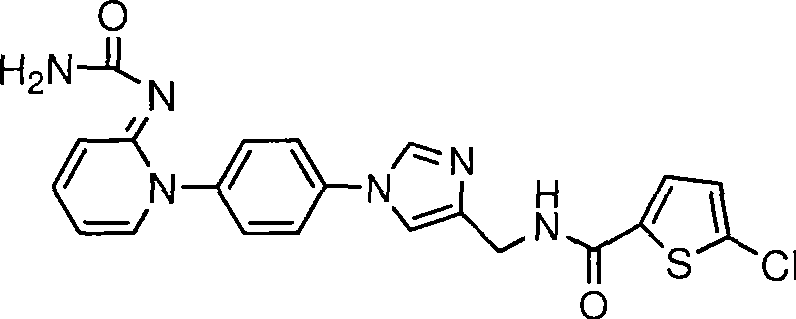
在室温下,将(E)-5-氯-N-((1-(4-(2-氰胺基吡啶-1(2H)-基)苯基)-1H-咪唑-4-基)甲基)噻吩-2-甲酰胺(5mg,0.011mmol)于TFA(0.30mL)和H2O(0.030mL)中的溶液搅拌4小时。在真空中去除溶剂。通过HPLC纯化残余物以得到标题化合物(2mg)。MS453.0和455.1(M+H,Cl图案)。At room temperature, (E)-5-chloro-N-((1-(4-(2-cyanaminopyridin-1(2H)-yl)phenyl)-1H-imidazol-4-yl)methyl A solution of thiophene-2-carboxamide (5 mg, 0.011 mmol) in TFA (0.30 mL) and H 2 O (0.030 mL) was stirred for 4 hours. Solvent was removed in vacuo. The residue was purified by HPLC to give the title compound (2 mg). MS 453.0 and 455.1 (M+H, Cl pattern).
实例50Example 50
5-氯-N-((2-甲基-1-(4-(2-氧代吡啶-1(2H)-基)苯基)-1H-咪唑-4-基)甲基)噻吩-2-甲酰胺(62)5-Chloro-N-((2-methyl-1-(4-(2-oxopyridin-1(2H)-yl)phenyl)-1H-imidazol-4-yl)methyl)thiophene-2 - Formamide (62)

流程5

步骤1:step 1:
在120℃下,将1,4-二碘苯1-1(600mg,1.8mmol)、2-甲基-1H-咪唑-4-甲醛(200mg,1.8mmol)、K2CO3(503mg,3.6mmol)、CuI(105mg,0.55mmol)和8-羟基喹啉(80mg,0.55mol)于5mL DMSO和5mL二噁烷中的混合物于密封管中搅拌2天。将其冷却至室温且向其中加入60mL水。将混合物搅拌30分钟且经由硅藻土层过滤。将滤液在真空中浓缩且使其经历反相制备型HPLC以分离1-(4-碘苯基)-2-甲基-1H-咪唑-4-甲醛5-1。C11H9IN2O的MS实验值为(M+H)+313.0。At 120°C, 1,4-diiodobenzene 1-1 (600mg, 1.8mmol), 2-methyl-1H-imidazole-4-carbaldehyde (200mg, 1.8mmol), K 2 CO 3 (503mg, 3.6 mmol), CuI (105 mg, 0.55 mmol) and 8-hydroxyquinoline (80 mg, 0.55 mol) in 5 mL DMSO and 5 mL dioxane were stirred in a sealed tube for 2 days. It was cooled to room temperature and 60 mL of water was added thereto. The mixture was stirred for 30 minutes and filtered through a pad of celite. The filtrate was concentrated in vacuo and subjected to reverse phase preparative HPLC to isolate 1-(4-iodophenyl)-2-methyl-1H-imidazole-4-carbaldehyde 5-1. MS found for C11H9IN2O (M+H) +313.0 .
步骤2:Step 2:
将以上步骤中制备的化合物(140mg,0.45mmol)溶解于5mL甲醇中且在室温下搅拌。向其中加入NaBH4(26mg,0.67mmol)。将混合物搅拌30分钟且使其经历制备型HPLC以分离(1-(4-碘苯基)-2-甲基-1H-咪唑-4-基)甲醇5-2。C11H11IN2O的MS实验值为(M+H)+315.0。The compound prepared in the above step (140 mg, 0.45 mmol) was dissolved in 5 mL of methanol and stirred at room temperature. To this was added NaBH4 (26mg, 0.67mmol). The mixture was stirred for 30 minutes and subjected to preparative HPLC to isolate (1-(4-iodophenyl)-2-methyl-1H-imidazol-4-yl)methanol 5-2. MS found for C11H11IN2O (M+H) +315.0 .
步骤3:Step 3:
将以上步骤中制备的化合物(126mg,0.40mmol)溶解于4mL无水乙腈中。向其中加入2mL亚硫酰氯。将混合物搅拌40分钟且在真空中浓缩。随后,将无水残余物溶解于4mL无水DMF中。向其中加入叠氮化钠(>5当量)。将混合物在室温下搅拌1小时且用EtOAc稀释。将其用盐水洗涤4次,干燥且在真空中浓缩以得到粗制4-(叠氮基甲基)-1-(4-碘苯基)-2-甲基-1H-咪唑5-3。C11H10IN5的MS实验值为(M+H)+340.0。The compound (126 mg, 0.40 mmol) prepared in the above step was dissolved in 4 mL of anhydrous acetonitrile. 2 mL of thionyl chloride was added thereto. The mixture was stirred for 40 minutes and concentrated in vacuo. Subsequently, the anhydrous residue was dissolved in 4 mL of anhydrous DMF. To this was added sodium azide (>5 equiv). The mixture was stirred at room temperature for 1 h and diluted with EtOAc. It was washed 4 times with brine, dried and concentrated in vacuo to give crude 4-(azidomethyl)-1-(4-iodophenyl)-2-methyl-1H-imidazole 5-3. MS found for C11H10IN5 (M+H) +340.0 .
步骤4:Step 4:
将以上制备的粗化合物溶解于2mL乙醇和2mL乙酸中。加入铁粉(10当量)。在90℃浸浴中将混合物搅拌30分钟。用20mL水稀释混合物。将混合物充分搅拌且经由硅藻土层过滤。将滤液在真空中浓缩且使其经历制备型HPLC以分离(1-(4-碘苯基)-2-甲基-1H-咪唑-4-基)甲胺5-4。C11H12IN3的MS实验值为(M+H)+314.0。The crude compound prepared above was dissolved in 2 mL of ethanol and 2 mL of acetic acid. Iron powder (10 equiv) was added. The mixture was stirred for 30 minutes in a 90°C immersion bath. The mixture was diluted with 20 mL of water. The mixture was stirred well and filtered through a pad of celite. The filtrate was concentrated in vacuo and subjected to preparative HPLC to isolate (1-(4-iodophenyl)-2-methyl-1H-imidazol-4-yl)methanamine 5-4. MS found for C11H12IN3 (M+H)+314.0 .
步骤5:Step 5:
将以上制备的化合物溶解于50mL甲醇中且用MP-碳酸酯(10当量)处理。将混合物轻轻搅拌1小时且过滤。将滤液在真空中浓缩以得到相应游离胺(40mg,0.13mmol)。将其溶解于2mL DMF中。向其中加入DIEA(16μL,0.15mmol)且在室温下搅拌。同时,将5-氯噻吩-2-甲酸1-5(24mg,0.15mmol)溶解于2mL无水DMF中。向其中加入DIEA(16μL,0.15mmol)和HATU(57mg,0.15mmol)。将混合物搅拌10分钟。将其加入到经搅拌的游离胺于DMF中的溶液中。将混合物搅拌20分钟且使其经历制备型HPLC以分离5-氯-N-((1-(4-碘苯基)-2-甲基-1H-咪唑-4-基)甲基)噻吩-2-甲酰胺5-5。C16H13ClIN3OS的MS实验值为(M+H)+458.0,460.0。The compound prepared above was dissolved in 50 mL of methanol and treated with MP-carbonate (10 equiv). The mixture was stirred gently for 1 hour and filtered. The filtrate was concentrated in vacuo to give the corresponding free amine (40 mg, 0.13 mmol). It was dissolved in 2 mL DMF. DIEA (16 μL, 0.15 mmol) was added thereto and stirred at room temperature. Meanwhile, 5-chlorothiophene-2-carboxylic acid 1-5 (24 mg, 0.15 mmol) was dissolved in 2 mL of anhydrous DMF. To this was added DIEA (16 μL, 0.15 mmol) and HATU (57 mg, 0.15 mmol). The mixture was stirred for 10 minutes. This was added to a stirred solution of the free amine in DMF. The mixture was stirred for 20 minutes and subjected to preparative HPLC to isolate 5-chloro-N-((1-(4-iodophenyl)-2-methyl-1H-imidazol-4-yl)methyl)thiophene- 2-Formamide 5-5. MS found for C16H13ClIN3OS (M+H)+458.0 , 460.0 .
步骤6:Step 6:
将以上制备的化合物(30mg,0.07mmol)溶解于密封管中的2mL DMSO中。向其中加入2-羟基吡啶1-7(20mg,0.21mmol)、碳酸钾(48mg,0.35mmol)、CuI(8mg,0.04mmol)和8-羟基喹啉(6mg,0.04mmol)。在130℃浸浴中,将混合物搅拌整夜。将混合物过滤且使其经历反相制备型HPLC以分离标题化合物。C21H17ClN4O2S的MS实验值为(M+H)+425.1,427.1。The compound prepared above (30 mg, 0.07 mmol) was dissolved in 2 mL of DMSO in a sealed tube. To this was added 2-hydroxypyridine 1-7 (20 mg, 0.21 mmol), potassium carbonate (48 mg, 0.35 mmol), CuI (8 mg, 0.04 mmol) and 8-hydroxyquinoline (6 mg, 0.04 mmol). The mixture was stirred overnight in a 130°C immersion bath. The mixture was filtered and subjected to reverse phase preparative HPLC to isolate the title compound. MS found for C21H17ClN4O2S (M+H)+425.1 , 427.1 .
实例51Example 51
5-氯-N-((5-甲基-1-(4-(2-氧代吡啶-1(2H)-基)苯基)-1H-咪唑-4-基)甲基)噻吩-2-甲酰胺(63)5-Chloro-N-((5-methyl-1-(4-(2-oxopyridin-1(2H)-yl)phenyl)-1H-imidazol-4-yl)methyl)thiophene-2 - Formamide (63)

流程6Process 6

步骤1:step 1:
将1-(4-碘苯基)吡啶-2(1H)-酮6-1(200mg,0.67mmol)溶解于密封管中的4mLDMSO中。向其中加入5-甲基-1H-咪唑-4-甲醛(300mg,2.7mmol)、K2CO3(470mg,3.4mmol)、CuI(65mg,0.34mmol)和8-羟基喹啉(50mg,0.34mol)。在130℃下,将混合物搅拌16小时。将混合物用100mL乙腈稀释,充分搅拌且经由硅藻土层过滤。将滤液浓缩且使其经历制备型HPLC以分离5-甲基-1-(4-(2-氧代吡啶-1(2H)-基)苯基)-1H-咪唑-4-甲醛6-2。C16H13N3O2的MS实验值为(M+H)+280.1。1-(4-Iodophenyl)pyridin-2(1H)-one 6-1 (200 mg, 0.67 mmol) was dissolved in 4 mL DMSO in a sealed tube. To this was added 5-methyl-1H-imidazole-4-carbaldehyde (300 mg, 2.7 mmol), K 2 CO 3 (470 mg, 3.4 mmol), CuI (65 mg, 0.34 mmol) and 8-hydroxyquinoline (50 mg, 0.34 mol). At 130°C, the mixture was stirred for 16 hours. The mixture was diluted with 100 mL of acetonitrile, stirred well and filtered through a pad of celite. The filtrate was concentrated and subjected to preparative HPLC to isolate 5-methyl-1-(4-(2-oxopyridin-1(2H)-yl)phenyl)-1H-imidazole-4-carbaldehyde 6-2 . MS found for C16H13N3O2 (M+ H ) +280.1 .
步骤2:Step 2:
在室温下,将以上制备的化合物(120mg,0.43mmol)于10mL甲醇中搅拌。加入NaBH4(25mg,0.64mmol)。将混合物搅拌1小时且使其经历制备型HPLC以分离1-(4-(4-(羟基甲基)-5-甲基-1H-咪唑-1-基)苯基)吡啶-2(1H)-酮6-3。C16H15N3O2的MS实验值为(M+H)+283.1。The compound prepared above (120 mg, 0.43 mmol) was stirred in 10 mL of methanol at room temperature. NaBH4 (25mg, 0.64mmol) was added. The mixture was stirred for 1 hour and subjected to preparative HPLC to isolate 1-(4-(4-(hydroxymethyl)-5-methyl-1H-imidazol-1-yl)phenyl)pyridine-2(1H) - Ketones 6-3. MS found for C16H15N3O2 (M+ H ) +283.1 .
步骤3:Step 3:
于4mL乙腈和4mL亚硫酰氯中搅拌以上制备的化合物(80mg,0.28mmol)。将混合物搅拌1小时且在真空中浓缩。随后,将无水残余物溶解于3mL DMSO中。向其中加入叠氮化钠(10当量)。将混合物搅拌10分钟且使其经历制备型HPLC以分离1-(4-(4-(叠氮基甲基)-5-甲基-1H-咪唑-1-基)苯基)吡啶-2(1H)-酮6-4。C16H14N6O的MS实验值为(M+H)+307.1。The compound prepared above (80 mg, 0.28 mmol) was stirred in 4 mL of acetonitrile and 4 mL of thionyl chloride. The mixture was stirred for 1 hour and concentrated in vacuo. Subsequently, the anhydrous residue was dissolved in 3 mL DMSO. Sodium azide (10 equivalents) was added thereto. The mixture was stirred for 10 minutes and subjected to preparative HPLC to isolate 1-(4-(4-(azidomethyl)-5-methyl-1H-imidazol-1-yl)phenyl)pyridine-2( 1H)-Kone 6-4. MS found for C16H14N6O (M+H) +307.1 .
步骤4:Step 4:
将以上制备的化合物(48mg,0.16mmol)溶解于1.5mL乙醇和3mL乙酸中。向其中加入铁粉(45mg,0.80mmol)。将混合物在80℃下搅拌20分钟且用水稀释。将其过滤且使其经历制备型HPLC以分离1-(4-(4-(氨基甲基)-5-甲基-1H-咪唑-1-基)苯基)吡啶-2(1H)-酮6-5。C16H16N4O的MS实验值为(M+H)+281.1。The compound prepared above (48 mg, 0.16 mmol) was dissolved in 1.5 mL of ethanol and 3 mL of acetic acid. Iron powder (45 mg, 0.80 mmol) was added thereto. The mixture was stirred at 80 °C for 20 minutes and diluted with water. It was filtered and subjected to preparative HPLC to isolate 1-(4-(4-(aminomethyl)-5-methyl-1H-imidazol-1-yl)phenyl)pyridin-2(1H)-one 6-5. MS found for C16H16N4O (M+H) +281.1 .
步骤5:Step 5:
将以上制备的化合物溶解于30mL甲醇中且用MP-碳酸酯(10当量)处理。将混合物轻轻搅拌1小时且过滤。将滤液在真空中浓缩以得到相应游离胺(45mg,0.16mmol)。将其溶解于3mL DMF中。向其中加入DIEA(36μL,0.20mmol)且在室温下搅拌。同时,将5-氯噻吩-2-甲酸1-5(32mg,0.20mmol)溶解于3mL无水DMF中。向其中加入DIEA(36μL,0.20mmol)和HATU(76mg,0.20mmol)。将混合物搅拌10分钟。将其加入到经搅拌的游离胺于DMF中的溶液中。将混合物搅拌1小时且使其经历制备型HPLC以分离标题化合物。C21H17ClN4O2S的MS实验值为(M+H)+425.1,427.1。The compound prepared above was dissolved in 30 mL methanol and treated with MP-carbonate (10 equiv). The mixture was stirred gently for 1 hour and filtered. The filtrate was concentrated in vacuo to give the corresponding free amine (45 mg, 0.16 mmol). It was dissolved in 3 mL DMF. DIEA (36 μL, 0.20 mmol) was added thereto and stirred at room temperature. Meanwhile, 5-chlorothiophene-2-carboxylic acid 1-5 (32 mg, 0.20 mmol) was dissolved in 3 mL of anhydrous DMF. To this was added DIEA (36 μL, 0.20 mmol) and HATU (76 mg, 0.20 mmol). The mixture was stirred for 10 minutes. This was added to a stirred solution of the free amine in DMF. The mixture was stirred for 1 hour and subjected to preparative HPLC to isolate the title compound. MS found for C21H17ClN4O2S (M+H)+425.1 , 427.1 .
实例52Example 52
5-氯-N-((1-(4-(5-氟-2-氧代吡啶-1(2H)-基)苯基)-2-(甲基亚磺酰基)-1H-咪唑-4-基)甲基)噻吩-2-甲酰胺(64)和5-Chloro-N-((1-(4-(5-fluoro-2-oxopyridin-1(2H)-yl)phenyl)-2-(methylsulfinyl)-1H-imidazole-4 -yl)methyl)thiophene-2-carboxamide (64) and
5-氯-N-((1-(4-(5-氟-2-氧代吡啶-1(2H)-基)苯基)-2-(甲基磺酰基)-1H-咪唑-4-基)甲基)噻吩-2-甲酰胺(65)5-Chloro-N-((1-(4-(5-fluoro-2-oxopyridin-1(2H)-yl)phenyl)-2-(methylsulfonyl)-1H-imidazole-4- Base) methyl) thiophene-2-carboxamide (65)

将5-氯-N-((1-(4-碘苯基)-2-(甲基硫基)-1H-咪唑-4-基)甲基)噻吩-2-甲酰胺(50mg,0.10mmol)、5-氟-2-羟基吡啶(30mg,0.26mmol)、8-羟基喹啉(10mg,0.069mmol)和K2CO3(70mg,0.50mmol)于DMSO(2mL)中的混合物用Ar脱气,随后馈入CuI(14mg,0.073mmol)。在130℃下,将混合物于密封管中加热整夜。冷却降温至室温后,加入H2O(5mL)以引起沉淀,收集沉淀且将其在真空中干燥以得到固体(38mg)。5-Chloro-N-((1-(4-iodophenyl)-2-(methylthio)-1H-imidazol-4-yl)methyl)thiophene-2-carboxamide (50mg, 0.10mmol ), 5-fluoro-2-hydroxypyridine (30mg, 0.26mmol), 8-hydroxyquinoline (10mg, 0.069mmol) and K 2 CO 3 (70mg, 0.50mmol) in DMSO (2mL) was desorbed with Ar gas, followed by feeding CuI (14 mg, 0.073 mmol). The mixture was heated overnight at 130°C in a sealed tube. After cooling down to room temperature, H2O (5 mL) was added to cause precipitation, which was collected and dried in vacuo to give a solid (38 mg).
将过硫酸氢钾(145mg,0.47mmol)于H2O(2mL)中的溶液加入到所述固体(38mg,0.080mmol)于DMF(3mL)中的溶液中。将混合物在室温下搅拌整夜。随后,将其通过HPLC纯化以得到砜(5mg)和亚砜(4mg)两种产物。MS 507.0和509.0(M+H,Cl图案,砜);491.0和493.0(M+H,Cl图案,亚砜)。A solution of potassium persulfate (145 mg, 0.47 mmol) in H2O (2 mL) was added to a solution of the solid (38 mg, 0.080 mmol) in DMF (3 mL). The mixture was stirred overnight at room temperature. Subsequently, it was purified by HPLC to give two products, sulfone (5 mg) and sulfoxide (4 mg). MS 507.0 and 509.0 (M+H, Cl pattern, sulfone); 491.0 and 493.0 (M+H, Cl pattern, sulfoxide).
实例53Example 53
5-氯-N-((1-(4-(3-氟-2-氧代吡啶-1(2H)-基)苯基)-2-(甲基亚磺酰基)-1H-咪唑-4-基)甲基)噻吩-2-甲酰胺(66)和5-Chloro-N-((1-(4-(3-fluoro-2-oxopyridin-1(2H)-yl)phenyl)-2-(methylsulfinyl)-1H-imidazole-4 -yl) methyl) thiophene-2-carboxamide (66) and
5-氯-N-((1-(4-(3-氟-2-氧代吡啶-1(2H)-基)苯基)-2-(甲基磺酰基)-1H-咪唑-4-基)甲基)噻吩-2-甲酰胺(67)5-Chloro-N-((1-(4-(3-fluoro-2-oxopyridin-1(2H)-yl)phenyl)-2-(methylsulfonyl)-1H-imidazole-4- Base) methyl) thiophene-2-carboxamide (67)

将5-氯-N-((1-(4-碘苯基)-2-(甲基硫基)-1H-咪唑-4-基)甲基)噻吩-2-甲酰胺(50mg,0.10mmol)、3-氟-2-羟基吡啶(30mg,0.26mmol)、8-羟基喹啉(10mg,0.069mmol)和K2CO3(70mg,0.50mmol)于DMSO(2mL)中的混合物用Ar脱气,随后馈入CuI(28mg,0.15mmol)。在130℃下,将混合物于密封管中加热整夜。冷却降温至室温后,加入H2O(5mL)以引起沉淀,收集沉淀且将其在真空中干燥以得到固体(34mg)。5-Chloro-N-((1-(4-iodophenyl)-2-(methylthio)-1H-imidazol-4-yl)methyl)thiophene-2-carboxamide (50mg, 0.10mmol ), 3-fluoro-2-hydroxypyridine (30mg, 0.26mmol), 8-hydroxyquinoline (10mg, 0.069mmol) and K 2 CO 3 (70mg, 0.50mmol) in DMSO (2mL) was desorbed with Ar gas, followed by feeding CuI (28 mg, 0.15 mmol). The mixture was heated overnight at 130°C in a sealed tube. After cooling down to room temperature, H2O (5 mL) was added to cause precipitation, which was collected and dried in vacuo to give a solid (34 mg).
将过硫酸氢钾(200mg,0.65mmol)于H2O(3mL)中的溶液加入到所述固体(34mg,0.072mmol)于DMF(4mL)中的溶液中。将混合物在室温下搅拌整夜。随后,将其通过HPLC纯化以得到砜(2mg)和亚砜(4mg)两种产物。MS 507.0和509.0(M+H,Cl图案,砜);491.0和493.0(M+H,Cl图案,亚砜)。A solution of potassium persulfate (200 mg, 0.65 mmol) in H2O (3 mL) was added to a solution of the solid (34 mg, 0.072 mmol) in DMF (4 mL). The mixture was stirred overnight at room temperature. Subsequently, it was purified by HPLC to give two products, sulfone (2 mg) and sulfoxide (4 mg). MS 507.0 and 509.0 (M+H, Cl pattern, sulfone); 491.0 and 493.0 (M+H, Cl pattern, sulfoxide).
实例54Example 54
5-氯-N-((1-(4-(5-氟-2-氧代吡啶-1(2H)-基)苯基)-1H-咪唑-4-基)甲基)噻吩-2-甲酰胺(68)5-Chloro-N-((1-(4-(5-fluoro-2-oxopyridin-1(2H)-yl)phenyl)-1H-imidazol-4-yl)methyl)thiophene-2- Formamide (68)

将5-氯-N-((1-(4-碘苯基)-1H-咪唑-4-基)甲基)噻吩-2-甲酰胺1-6(66mg,0.15mmol)、5-氟-2-羟基吡啶(46mg,0.40mmol)、8-羟基喹啉(10mg,0.069mmol)和K2CO3(50mg,0.36mmol)于DMSO(1mL)中的混合物用Ar脱气,随后馈入CuI(15mg,0.079mmol)。在130℃下,将混合物于密封管中加热整夜。随后,通过HPLC纯化混合物以得到标题化合物(6mg)。MS 429.0和431.0(M+H,Cl图案)。5-Chloro-N-((1-(4-iodophenyl)-1H-imidazol-4-yl)methyl)thiophene-2-carboxamide 1-6 (66mg, 0.15mmol), 5-fluoro- A mixture of 2-hydroxypyridine (46 mg, 0.40 mmol), 8-hydroxyquinoline (10 mg, 0.069 mmol) and K 2 CO 3 (50 mg, 0.36 mmol) in DMSO (1 mL) was degassed with Ar and fed into CuI (15 mg, 0.079 mmol). The mixture was heated overnight at 130°C in a sealed tube. Subsequently, the mixture was purified by HPLC to obtain the title compound (6 mg). MS 429.0 and 431.0 (M+H, Cl pattern).
可使用与以上那些方法类似的方法制备以下表1中的化合物。The compounds in Table 1 below can be prepared using methods similar to those above.
表1:Table 1:

实例55Example 55
本实例说明评估本发明的化合物的方法以及所述检定所获得的结果。本发明的化合物在活体外和活体内的人类Xa因子活性可通过所属领域中已知的多种程序来测定,诸如测试其抑制人类血浆Xa因子活性的能力。由本发明的化合物所展现的对人类Xa因子抑制的有效亲和性可通过IC50(单位为nM)来测量。IC50值为提供人类Xa因子蛋白水解活性的50%抑制所需的化合物浓度(单位为nM)。IC50值越小,化合物抑制Xa因子活性的活性越强(越有效)。This example illustrates the method of evaluating the compounds of the invention and the results obtained from such assays. The in vitro and in vivo human Factor Xa activity of compounds of the invention can be determined by various procedures known in the art, such as testing their ability to inhibit human plasma Factor Xa activity. The potent affinity for human Factor Xa inhibition exhibited by the compounds of the invention can be measured by IC50 (in nM). IC50 values are the concentration of compound (in nM) required to provide 50% inhibition of human Factor Xa proteolytic activity. The smaller the IC50 value, the more active (more potent) the compound is in inhibiting Factor Xa activity.
检测和测量对Xa因子的抑制活性的活体外检定如下所示:In vitro assays to detect and measure inhibitory activity against Factor Xa are as follows:
IC50和Ki测定:IC 50 and K i determination:
底物:Substrate:
底物S-2765(Z-D-Arg-Gly-Arg-pNA·HCl)是自迪亚法玛公司(Diapharma)(威彻斯特郡,俄亥俄州(West Chester,OH))获得。Substrate S-2765 (Z-D-Arg-Gly-Arg-pNA·HCl) was obtained from Diapharma (West Chester, OH).
酶:Enzymes:
人类血浆蛋白Xa因子是购自血液学技术公司(Haematologic Technologies)(艾斯克斯强克逊市,佛蒙特州(Essex Junction,VT))。The human plasma protein factor Xa was purchased from Haematologic Technologies (Essex Junction, VT).
方法:method:
IC50测定 IC50 determination
在96孔微量滴定盘中执行的所有检定都是通过以下对硝基苯胺肽底物的裂解来测量酶(Xa因子)的蛋白水解活性。用于蛋白水解检定的检定缓冲液为Tris缓冲盐水(20mM Tris、150mM NaCl、5mM CaCl2、0.1%牛血清白蛋白(BSA)、5%二甲亚砜(DMSO),pH7.4)。在96孔微量滴定盘中,将抑制剂连续稀释以得到0.01nM至10μM的最终浓度范围。检定双重复的数组孔且包括无抑制剂的对照孔在内。将酶加入到各孔中(Xa因子浓度=1nM),将盘振荡5秒钟且随后在室温下培育5分钟。加入S2765(最终浓度为100μM)且将盘振荡5秒钟(各孔中的最终体积为200μl)。使用赛默麦克斯(Thermomax)酶标仪(分子仪器公司(Molecular Devices),森尼韦尔市,加利福尼亚州(Sunnyvale,CA))在405nm下测量底物水解程度达2分钟。对于各范围的抑制剂浓度,使用索福特麦克斯(Softmax)数据分析软件,将底物裂解的初始速度(mOD/min)拟合成四参数方程。自所得曲线拟合获得的参数C对应于半数最大抑制浓度(IC50)。All assays performed in 96-well microtiter plates measure the proteolytic activity of the enzyme (Factor Xa) by cleavage of the following p-nitroaniline peptide substrate. The assay buffer used for the proteolytic assay was Tris-buffered saline (20 mM Tris, 150 mM NaCl, 5 mM CaCl 2 , 0.1% bovine serum albumin (BSA), 5% dimethyl sulfoxide (DMSO), pH 7.4). Inhibitors were serially diluted to give a final concentration range of 0.01 nM to 10 μM in 96-well microtiter plates. Duplicate sets of wells were assayed and control wells without inhibitor were included. Enzyme was added to each well (Factor Xa concentration = 1 nM), the plate was shaken for 5 seconds and then incubated for 5 minutes at room temperature. S2765 was added (100 μM final concentration) and the plate was shaken for 5 seconds (200 μl final volume in each well). The extent of substrate hydrolysis was measured at 405 nm for 2 minutes using a Thermomax microplate reader (Molecular Devices, Sunnyvale, CA). For each range of inhibitor concentrations, the initial rate of substrate cleavage (mOD/min) was fitted to a four-parameter equation using Softmax data analysis software. The parameter C obtained from the resulting curve fit corresponds to the half maximal inhibitory concentration ( IC50 ).
Ki测定 Ki determination
用于此系列检定的检定缓冲液为Hepes缓冲盐水(20mM Hepes、150mM NaCl、5mM CaCl2、0.1% PEG-8000,pH7.4)。在96孔微量滴定盘中,将抑制剂于一组双重复孔中连续稀释以得到5pM至3μM的最终浓度范围。包括无抑制剂的对照孔(8个孔)。将酶Xa因子(最终浓度=1nM)加入到各孔中。加入底物S-2765(最终浓度=200μM)且使用索福特麦克斯(Softmax)软件,用赛默麦克斯(Thermomax)酶标仪在405nm下测量底物水解程度达5分钟。通过普雷特(Plate)Ki软件(拜奥金公司(BioKin Ltd),普尔曼市,华盛顿州(Pullman,WA))中的非线性最小平方回归分析初始速度(mOD/min)[库斯米克(Kusmic)等人,分析生物化学(Analytical Biochemistry)281:62-67,2000]。用于拟合抑制剂剂量-反应曲线的模型为莫里森方程(Morrison equation)。测定表观Ki(Ki *)。使用以下方程计算总Ki:The assay buffer used for this series of assays was Hepes buffered saline (20 mM Hepes, 150 mM NaCl, 5 mM CaCl 2 , 0.1% PEG-8000, pH 7.4). Inhibitors were serially diluted in a set of duplicate wells in 96-well microtiter plates to obtain a final concentration range of 5 pM to 3 μM. Control wells (8 wells) with no inhibitor were included. Enzyme Factor Xa (final concentration = 1 nM) was added to each well. Substrate S-2765 was added (final concentration = 200 [mu]M) and the degree of substrate hydrolysis was measured for 5 min at 405 nm with a Thermomax microplate reader using Softmax software. Initial velocity (mOD/min) was analyzed by nonlinear least squares regression in Plate Ki software (BioKin Ltd, Pullman, WA) [Kusmik (Kusmic) et al., Analytical Biochemistry 281:62-67, 2000]. The model used to fit the inhibitor dose-response curve is the Morrison equation. The apparent K i (K i * ) was determined. Calculate total K i using the following equation:
其中[S]为底物浓度(200μM)且Km为S2765的米氏常数(Michaelis constant)。Where [S] is the substrate concentration (200 μΜ) and Km is the Michaelis constant of S2765.
以下实例展现出小于或等于100nM的Xa因子IC50值:10-12、14、15、18、21-27、30、32、33-36、39-45、47-53、55-59、61-62和64-67。The following examples exhibit Factor Xa IC50 values less than or equal to 100 nM: 10-12, 14, 15, 18, 21-27, 30, 32, 33-36, 39-45, 47-53, 55-59, 61 -62 and 64-67.
以下实例展现出大于100nM且小于500nM的Xa因子IC50值:17、19、28和46。The following examples exhibit Factor Xa IC50 values greater than 100 nM and less than 500 nM: 17, 19, 28 and 46.
以下实例展现出大于或等于500nM的Xa因子IC50值:13、16、20、29、31、37-38、54、60和63。The following examples exhibit Factor Xa IC50 values greater than or equal to 500 nM: 13, 16, 20, 29, 31, 37-38, 54, 60 and 63.
实例56Example 56
将化合物10用于大鼠研究。制备化合物10的静脉内(IV)和经口(PO)剂量(分别为1.0mg/kg和10mg/kg)。将IV剂量溶解于50% PEG300中以得到1.0mg/mL的最终浓度,最终pH值为5.13。将PO剂量以2.0mg/mL的浓度悬浮于0.5%甲基纤维素中,最终pH值为2.70。
还使用化合物10进行犬和猴的研究。制备化合物10的IV和PO剂量(分别为1.0mg/kg和5.0mg/kg)。与大鼠研究中所用相类似地调配IV剂量(水中50% PEG300)。将PO剂量以1.0mg/mL的浓度悬浮于0.5%甲基纤维素中,最终pH值大约为3.50。
研究设计Research design
利用总共6只来自查尔斯河实验室(Charles River Laboratories)(霍利斯特市,加利福尼亚州(Hollister,CA))的雄性斯普雷格-多利(Sprague-Dawley)大鼠(n=3只/给药组)、3只来自马歇尔生物资源公司(Marshall BioResources)(北罗斯市,纽约州(North Rose,NY))的雄性比格犬(beagle dog)和3只雄性恒河猴(rhesus monkey)。在研究中于利用之前8天对大鼠执行所有手术程序(股静脉和颈静脉导管插入)且在利用之前5天使大鼠在室内适应环境。在利用之前至少7天使犬在室内适应环境且在研究完成时将其放回群体中。猴研究由非现场合约实验室进行。A total of 6 male Sprague-Dawley rats from Charles River Laboratories (Hollister, CA) (n=3/ dosing group), 3 male beagle dogs and 3 male rhesus monkeys from Marshall BioResources (Marshall BioResources) (North Rose, NY) . All surgical procedures (femoral and jugular catheterization) were performed on the rats 8 days prior to utilization in the study and rats were acclimatized indoors 5 days prior to utilization. Dogs were acclimatized indoors for at least 7 days prior to utilization and were returned to the group at study completion. Monkey studies were performed by an off-site contract laboratory.
自研究开始之前的下午至给药后两个小时(大约18小时),使所有动物禁食。不限量提供水。所有动物房间都处于12小时的光照-黑暗循环(6A.M.至6P.M.)中。在实验当天早上,称量动物体重。使大鼠股和颈(仅IV)静脉血管外露且连接于接取孔(accessport)。称量犬的体重且在采血和IV给药部位(沿头静脉和隐静脉)剃毛。All animals were fasted from the afternoon before the start of the study until two hours after dosing (approximately 18 hours). Unlimited water provided. All animal rooms were on a 12 hour light-dark cycle (6A.M. to 6P.M.). On the morning of the experiment, the animals were weighed. Rat femoral and jugular (IV only) veins were exposed and connected to accessports. Dogs were weighed and shaved at the blood collection and IV administration sites (along the cephalic and saphenous veins).
根据个体重量,以5.0mL/kg的PO管饲体积和1.0mL/kg的IV推注剂量体积对所有动物给药。在大鼠、犬和猴给药后分别经24、56和96小时的时期,在3.8%TSC上获得血液样品(1:10稀释度)。对于贫血小板血浆,将血液样品离心且将所得血浆储存于-20℃下直至进行样品分析。在给药后0(整夜)、10和24小时,自IV组中的动物收集大鼠尿样品于200μL 2%硼酸上。在收集时,记录尿体积和耗水量。将尿样品储存于-20℃下直至进行样品分析。All animals were dosed at a PO gavage volume of 5.0 mL/kg and an IV bolus dose volume of 1.0 mL/kg based on individual weight. Blood samples (1 :10 dilution) were obtained on 3.8% TSC over periods of 24, 56 and 96 hours after dosing in rats, dogs and monkeys, respectively. For platelet-poor plasma, blood samples were centrifuged and the resulting plasma stored at -20°C until sample analysis. Rat urine samples were collected from animals in Group IV on 200 μL 2% boric acid at 0 (overnight), 10 and 24 hours post-dose. At collection, urine volume and water consumption were recorded. Urine samples were stored at -20°C until sample analysis.
样品分析sample analysis
使用液相色谱串联质谱法(LC/MS/MS)分析血浆和尿样品中化合物10的浓度。简单地说,在96孔卡普替瓦(CaptivaTM)滤板(0.2μm,瓦里安公司(Varian,Inc.),帕罗奥多市,加利福尼亚州(Palo Alto,CA))中处理血浆和尿样品。使用含有500ng/mL内标物N-(2-(5-氯吡啶-2-基氨甲酰基)-4-甲氧基苯基)-4-(N,N-二甲基脒基)-2-氟苯甲酰胺的乙腈使血浆样品的等分试样沉淀。在与含有内标物的乙腈混合之前,用血浆稀释尿样品的等分试样。将混合物涡旋且在4℃下冷藏30分钟以使得蛋白质完全沉淀。将混合物过滤于96孔收集盘中。将滤液注射至配备有涡轮离子喷雾源(turbo-ion spray source)的赛克斯(Sciex)API3000 LC/MS/MS上。将化合物10与N-(2-(5-氯吡啶-2-基氨甲酰基)-4-甲氧基苯基)-4-(N,N-二甲基脒基)-2-氟苯甲酰胺在赛默海伯希-基斯通贝塔斯(Thermo Hypersil-Keystone Betasil)C18柱(4.6×100mm,5μm;飞世尔科技公司(FisherScientific),休斯顿市,德克萨斯州(Houston,TX))上分离。流动相梯度为90%流动相A(水中0.5%甲酸)与10%流动相B(90%乙腈中0.5%甲酸)至40%流动相B(渐进式,经2.8分钟)的混合物。以正离子模式对照m/z 470→342产物离子(N-(2-(5-氯吡啶-2-基氨甲酰基)-4-甲氧基苯基)-4-(N,N-二甲基脒基)-2-氟苯甲酰胺)的峰值面积测量m/z411→250产物离子(化合物10)的峰值面积。分析范围为0.500至10,000ng/mL。The concentrations of
数据分析data analysis
定量下限(LLQ)以下的样品化合物10的浓度报导为<0.500ng/mL。将这些值处理为零以用于药物代谢动力学计算。Concentrations of
使用沃特森(Watson)LIMS软件(版本7.1),通过血浆浓度-时间数据的非房室模型分析(noncompartmental analysis)来计算化合物10的药物代谢动力学参数值。根据血浆浓度-时间曲线末期期间血浆浓度对时间的自然对数(ln)的线性回归斜率的绝对值来计算终末消除速率常数(k)。根据ln(2)/k计算表观终末半衰期(T1/2)值。使用线性梯形法则评估血浆浓度-时间曲线下面积(AUC)值。计算自时间0至最后可检测浓度的时间的AUCall值。根据相应AUCall与最后可检测浓度的和除以k来计算AUC(0-inf)值。自IV剂量/AUC(0-inf)计算全身清除率(CL)。自IV剂量/[k·AUC(0-inf)]计算分布容积(Vz)。自CL*平均滞留时间计算稳定状态下的分布容积(Vss)。观测时记录最大血浆浓度(Cmax)和达到Cmax的时间(Tmax)。通过算得PO和IV投药后剂量标准化AUC(0-inf)值的比率(AUC/D)来计算口服生物利用度百分比。结果展示于表2-3和以下图式中。Pharmacokinetic parameter values for
表2.通过非房室模型分析测定的静脉内投药后大鼠、犬和猴体内化合物10的药物代谢动力学参数Table 2. Pharmacokinetic parameters of

使用沃特森(Watson)LIMS软件(版本7.1)执行非房室模型分析。Non-compartmental model analysis was performed using Watson LIMS software (version 7.1).
T1/2:终末半衰期T 1/2 : Terminal half-life
AUC:血浆浓度对时间曲线下面积AUC: area under the plasma concentration versus time curve
Vz:分布容积Vz: volume of distribution
CL:全身清除率CL: systemic clearance
Vss:稳定状态下的分布容积Vss: volume of distribution at steady state
表3.通过非房室模型分析测定的经口投药后大鼠、犬和猴体内化合物10的药物代谢动力学参数Table 3. Pharmacokinetic parameters of

使用沃特森(Watson)LIMS软件(版本7.1)执行非房室模型分析。Non-compartmental model analysis was performed using Watson LIMS software (version 7.1).
T1/2:终末半衰期T 1/2 : Terminal half-life
Tmax:达到最大血浆浓度的时间T max : Time to reach maximum plasma concentration
Cmax:最大血浆浓度C max : maximum plasma concentration
AUC:血浆浓度对时间曲线下面积AUC: area under the plasma concentration versus time curve
%F:绝对生物利用度%F: absolute bioavailability
本发明提供许多实施例。显然可改变实例以提供本发明的其它实施例。因此,应了解本发明的范围欲由随附权利要求而不是由以实例方式表示的特定实施例来界定。The present invention provides many embodiments. Obviously the examples may be varied to provide other embodiments of the invention. It should therefore be understood that the scope of the invention is intended to be defined by the appended claims rather than by the specific embodiments shown by way of example.
Claims (34)


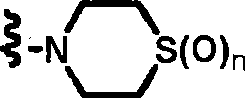


Applications Claiming Priority (5)
| Application Number | Priority Date | Filing Date | Title |
|---|---|---|---|
| US79795406P | 2006-05-05 | 2006-05-05 | |
| US60/797,954 | 2006-05-05 | ||
| US88366707P | 2007-01-05 | 2007-01-05 | |
| US60/883,667 | 2007-01-05 | ||
| PCT/US2007/068262 WO2007131179A1 (en) | 2006-05-05 | 2007-05-04 | Factor xa inhibitors |
Publications (2)
| Publication Number | Publication Date |
|---|---|
| CN101490036A true CN101490036A (en) | 2009-07-22 |
| CN101490036B CN101490036B (en) | 2013-07-17 |
Family
ID=38480433
Family Applications (1)
| Application Number | Title | Priority Date | Filing Date |
|---|---|---|---|
| CN200780015911XA Expired - Fee Related CN101490036B (en) | 2006-05-05 | 2007-05-04 | Factor xa inhibitors |
Country Status (16)
| Country | Link |
|---|---|
| US (4) | US7763608B2 (en) |
| EP (1) | EP2016072B1 (en) |
| JP (1) | JP5227311B2 (en) |
| KR (1) | KR20090010098A (en) |
| CN (1) | CN101490036B (en) |
| AR (1) | AR060768A1 (en) |
| AU (1) | AU2007247928B2 (en) |
| BR (1) | BRPI0711296A2 (en) |
| CA (1) | CA2651303A1 (en) |
| EA (1) | EA015942B1 (en) |
| IL (1) | IL194891A (en) |
| MX (1) | MX2008014193A (en) |
| NZ (1) | NZ572418A (en) |
| TW (1) | TW200813017A (en) |
| WO (1) | WO2007131179A1 (en) |
| ZA (2) | ZA200809362B (en) |
Cited By (6)
| Publication number | Priority date | Publication date | Assignee | Title |
|---|---|---|---|---|
| CN105164122A (en) * | 2013-03-28 | 2015-12-16 | 拜耳制药股份公司 | Substituted oxopyridine derivatives and their use in the treatment of cardiovascular disorders |
| CN105753804A (en) * | 2016-04-15 | 2016-07-13 | 大连信科化工有限公司 | Method of preparing 3-morpholinone |
| CN106687458A (en) * | 2014-09-24 | 2017-05-17 | 拜耳制药股份公司 | Substituted oxopyridine derivatives |
| CN107428689A (en) * | 2015-03-19 | 2017-12-01 | 拜耳制药股份公司 | As the oxo pyridine derivative for treating thrombotic factor XI, plasma thromboplastin antecedent A inhibitor |
| CN107848975A (en) * | 2015-07-06 | 2018-03-27 | 拜耳作物科学股份公司 | Nitrogen heterocyclic ring as insecticide |
| CN108715584A (en) * | 2018-06-22 | 2018-10-30 | 四川大学华西医院 | Fluorescent molecule with N-pyridine-2-(1H)-nitrileimide as the core and its preparation and application |
Families Citing this family (33)
| Publication number | Priority date | Publication date | Assignee | Title |
|---|---|---|---|---|
| ES2254385T3 (en) * | 2000-02-29 | 2006-06-16 | Millennium Pharmaceuticals, Inc. | RELATED BENZAMIDS AND INHIBITORS OF FACTOR XA. |
| US7696352B2 (en) | 2004-06-18 | 2010-04-13 | Millennium Pharmaceuticals, Inc. | Factor Xa inhibitors |
| CA2565437A1 (en) * | 2004-06-18 | 2006-01-05 | Millennium Pharmaceuticals, Inc. | Factor xa inhibitors |
| JP2008544743A (en) | 2005-05-10 | 2008-12-11 | インターミューン インコーポレイテッド | Pyridone derivatives for modulating the stress-activated protein kinase system |
| WO2007008146A1 (en) * | 2005-07-08 | 2007-01-18 | Astrazeneca Ab | Heterocyclic sulfonamide derivatives as inhibitors of factor xa |
| WO2007008143A1 (en) * | 2005-07-08 | 2007-01-18 | Astrazeneca Ab | Heterocyclic sulfonamide derivatives as inhibitors of factor xa |
| US20090186810A1 (en) * | 2006-03-27 | 2009-07-23 | Portola Pharmaceuticals, Inc. | Potassium channel modulators and platelet procoagulant activity |
| EP2016072B1 (en) | 2006-05-05 | 2014-07-16 | Millennium Pharmaceuticals, Inc. | Factor xa inhibitors |
| EP2077995B1 (en) * | 2006-11-02 | 2012-02-08 | Millennium Pharmaceuticals, Inc. | Methods of synthesizing pharmaceutical salts of a factor xa inhibitor |
| AU2008205093A1 (en) * | 2007-01-05 | 2008-07-17 | Millennium Pharmaceuticals, Inc. | Factor Xa inhibitors |
| CN103071154A (en) * | 2007-04-13 | 2013-05-01 | 千年药品公司 | Combination anticoagulant therapy with a compound that acts as a factor XA inhibitor |
| NZ581324A (en) * | 2007-05-02 | 2012-05-25 | Portola Pharm Inc | Combination therapy with a compound acting as a platelet adp receptor inhibitor |
| WO2009063029A2 (en) * | 2007-11-16 | 2009-05-22 | Boehringer Ingelheim International Gmbh | Substituted amides, manufacturing and use thereof as medicaments |
| MX2010012848A (en) | 2008-06-03 | 2011-03-01 | Intermune Inc | Compounds and methods for treating inflammatory and fibrotic disorders. |
| CA2784921A1 (en) * | 2009-12-17 | 2011-07-14 | Millennium Pharmaceuticals, Inc. | Salts and crystalline forms of a factor xa inhibitor |
| WO2011075602A1 (en) | 2009-12-17 | 2011-06-23 | Millennium Pharmaceuticals, Inc. | Methods of preparing factor xa inhibitors and salts thereof |
| US20110160250A1 (en) * | 2009-12-17 | 2011-06-30 | Millennium Pharmaceuticals, Inc. | Crystalline forms of a factor xa inhibitor |
| EP2513058B1 (en) | 2009-12-17 | 2016-11-09 | Millennium Pharmaceuticals, Inc. | Methods of synthesizing factor xa inhibitors |
| TW201221128A (en) | 2010-09-01 | 2012-06-01 | Portola Pharm Inc | Crystalline forms of a factor Xa inhibitor |
| TW201240664A (en) | 2010-09-01 | 2012-10-16 | Portola Pharm Inc | Methods and formulations of treating thrombosis with betrixaban and a P-glycoprotein inhibitor |
| WO2013033370A1 (en) | 2011-08-31 | 2013-03-07 | Portola Pharmaceuticals, Inc. | Prevention and treatment of thrombosis in medically ill patients |
| CN103242310A (en) * | 2012-02-10 | 2013-08-14 | 苏州迈泰生物技术有限公司 | Pyrazolo pyridone compound and its application in preparation of anticoagulant |
| JP6186434B2 (en) | 2012-07-18 | 2017-08-23 | サンシャイン・レイク・ファーマ・カンパニー・リミテッドSunshine Lake Pharma Co.,Ltd. | Nitrogen heterocyclic derivatives and their applications in medicine |
| AR092742A1 (en) | 2012-10-02 | 2015-04-29 | Intermune Inc | ANTIFIBROTIC PYRIDINONES |
| JP6566869B2 (en) * | 2012-12-24 | 2019-08-28 | バイエル・ヘルスケア・エルエルシーBayer HealthCare LLC | Short-acting factor VII polypeptide |
| JP6454348B2 (en) | 2013-12-19 | 2019-01-16 | サンシャイン・レイク・ファーマ・カンパニー・リミテッドSunshine Lake Pharma Co.,Ltd. | Nitrogen heterocyclic derivatives and their applications in medicine |
| JP6525437B2 (en) | 2014-04-02 | 2019-06-05 | インターミューン, インコーポレイテッド | Antifibrotic pyridinone |
| EP3078378B1 (en) | 2015-04-08 | 2020-06-24 | Vaiomer | Use of factor xa inhibitors for regulating glycemia |
| JO3703B1 (en) | 2015-07-09 | 2021-01-31 | Bayer Pharma AG | Substituted oxopyridine derivatives |
| US10148678B2 (en) | 2015-10-01 | 2018-12-04 | The Boeing Company | Cybersecurity system with differentiated capacity to deal with complex cyber attacks |
| TWI724077B (en) * | 2015-12-16 | 2021-04-11 | 日商日本曹達股份有限公司 | Arylazole compound and pest control agent |
| AU2018376146A1 (en) | 2017-11-29 | 2020-05-28 | Bayer Aktiengesellschaft | Nitrogenous heterocycles as a pesticide |
| WO2019215076A1 (en) * | 2018-05-08 | 2019-11-14 | Bayer Aktiengesellschaft | Process for preparing nitrogen-containing heterocycles |
Family Cites Families (74)
| Publication number | Priority date | Publication date | Assignee | Title |
|---|---|---|---|---|
| US259924A (en) * | 1882-06-20 | Sand-band | ||
| US42015A (en) * | 1864-03-22 | Improvement in saddles | ||
| US298806A (en) * | 1884-05-20 | Bag and twine holder | ||
| US185092A (en) * | 1876-12-05 | Improvement in check-rowers | ||
| US162690A (en) * | 1875-04-27 | Improvement in valves for steam-engines | ||
| US153876A (en) * | 1874-08-04 | Improvement in carbureting apparatus | ||
| US241233A (en) * | 1881-05-10 | Wind-wheel | ||
| US98119A (en) * | 1869-12-21 | Improved rocking and easy chair | ||
| US112039A (en) * | 1871-02-21 | Improvement in plow-colters | ||
| US100193A (en) * | 1870-02-22 | John ross | ||
| US125052A (en) * | 1872-03-26 | Improvement in apparatus for checking horses | ||
| US186810A (en) * | 1877-01-30 | Improvement in machines for making metal fellies | ||
| US749217A (en) * | 1904-01-12 | Ho model | ||
| US63113A (en) * | 1867-03-19 | smith | ||
| US279845A (en) * | 1883-06-19 | John d | ||
| US254036A (en) * | 1882-02-21 | Measuring-faucet | ||
| US66615A (en) * | 1867-07-09 | Steering apparatus | ||
| US197929A (en) * | 1877-12-11 | Improvement in boots and shoes | ||
| US29064A (en) * | 1860-07-10 | Lowering and detaching ships boats | ||
| US171358A (en) * | 1875-12-21 | Improvement in machines for trimming and punching roofing-slates | ||
| US293704A (en) * | 1884-02-19 | Windmill | ||
| US51578A (en) * | 1865-12-19 | Improvement in cigar-machines | ||
| US697135A (en) * | 1901-03-07 | 1902-04-08 | Henry W Scott | Antislipping device. |
| US756037A (en) * | 1903-03-21 | 1904-03-29 | Angus Morrison | Press-rack. |
| US836536A (en) * | 1906-02-12 | 1906-11-20 | Eagle Lock Co | Suit-case lock. |
| US6514977B1 (en) | 1997-05-22 | 2003-02-04 | G.D. Searle & Company | Substituted pyrazoles as p38 kinase inhibitors |
| US5919779A (en) | 1997-08-11 | 1999-07-06 | Boehringer Ingelheim Pharmaceuticals, Inc. | 5,6-Heteroaryl-dipyrido(2,3-B:3', 2'-F) azepines and their use in the prevention or treatment of HIV infection |
| GB9725244D0 (en) | 1997-11-29 | 1998-01-28 | Zeneca Ltd | Chemical compounds |
| US6644367B1 (en) * | 1999-07-23 | 2003-11-11 | Scholle Corporation | Connector assembly for fluid flow with rotary motion for connection and disconnection |
| BRPI0014076B8 (en) | 1999-09-17 | 2021-05-25 | Millennium Pharm Inc | benzamides and related factor xa inhibitors |
| US6844367B1 (en) | 1999-09-17 | 2005-01-18 | Millennium Pharmaceuticals, Inc. | Benzamides and related inhibitors of factor Xa |
| WO2001021160A2 (en) | 1999-09-23 | 2001-03-29 | Axxima Pharmaceuticals Aktiengesellschaft | Carboxymide and aniline derivatives as selective inhibitors of pathogens |
| DE19962924A1 (en) | 1999-12-24 | 2001-07-05 | Bayer Ag | Substituted oxazolidinones and their use |
| US6906063B2 (en) | 2000-02-04 | 2005-06-14 | Portola Pharmaceuticals, Inc. | Platelet ADP receptor inhibitors |
| ES2254385T3 (en) * | 2000-02-29 | 2006-06-16 | Millennium Pharmaceuticals, Inc. | RELATED BENZAMIDS AND INHIBITORS OF FACTOR XA. |
| DE10027151A1 (en) | 2000-05-31 | 2001-12-06 | Bayer Ag | Herbicides based on substituted carboxamides |
| AU2001273040A1 (en) | 2000-06-27 | 2002-01-08 | Du Pont Pharmaceuticals Company | Factor xa inhibitors |
| US7312235B2 (en) | 2001-03-30 | 2007-12-25 | Millennium Pharmaceuticals, Inc. | Benzamide inhibitors of factor Xa |
| DE60221505D1 (en) | 2001-03-30 | 2007-09-13 | Millennium Pharm Inc | FACTOR Xa BENZAMIDINE INHIBITORS |
| DE10129725A1 (en) * | 2001-06-20 | 2003-01-02 | Bayer Ag | Combination therapy of substituted oxazolidinones |
| ES2180456B1 (en) | 2001-07-20 | 2004-05-01 | Laboratorios S.A.L.V.A.T., S.A. | SUBSTITUTED ISOXAZOLS AND ITS USE AS ANTIBIOTICS. |
| US6914058B2 (en) | 2002-01-18 | 2005-07-05 | Dr. Reddy's Laboratories, Limited | Antibacterial compounds: process for their preparation and pharmaceutical compositions containing them |
| US20050171358A1 (en) | 2002-03-07 | 2005-08-04 | Noriko Shimozono | Substituted isoxazole alkylamine derivative and agri-and horticultural fungicide |
| JP3090812U (en) * | 2002-06-18 | 2002-12-26 | アルプス電気株式会社 | High frequency module |
| WO2004101531A1 (en) | 2003-04-29 | 2004-11-25 | Dr. Reddy's Laboratories Ltd. | Antiinfective 1,2,3-triazole derivatives, process for their preparation and pharmaceutical compositions containing them |
| DE10322469A1 (en) | 2003-05-19 | 2004-12-16 | Bayer Healthcare Ag | Heterocyclic compounds |
| WO2004106329A2 (en) | 2003-06-03 | 2004-12-09 | Dr. Reddy's Laboratories Ltd. | Novel antiinfective compounds and their pharmaceutical compositions |
| US7199149B2 (en) | 2003-10-01 | 2007-04-03 | Bristol Myers Squibb Company | Monocyclic and bicyclic lactams as factor Xa inhibitors |
| WO2005034867A2 (en) | 2003-10-09 | 2005-04-21 | Millennium Pharmaceuticals, Inc. | Thioether-substituted benzamides as inhibitors of factor xa |
| WO2005035528A2 (en) | 2003-10-14 | 2005-04-21 | Dr. Reddy's Laboratories Ltd. | Triazole derivatives as antibacterial agents |
| WO2005082892A2 (en) | 2004-02-17 | 2005-09-09 | Dr. Reddy's Laboratories Ltd. | Triazole compounds as antibacterial agents and pharmaceutical compositions containing them |
| US7696352B2 (en) | 2004-06-18 | 2010-04-13 | Millennium Pharmaceuticals, Inc. | Factor Xa inhibitors |
| CA2565437A1 (en) * | 2004-06-18 | 2006-01-05 | Millennium Pharmaceuticals, Inc. | Factor xa inhibitors |
| DE102004031258A1 (en) * | 2004-06-29 | 2006-02-09 | Jennissen, Herbert P., Prof. Dr. | Protein hybrids with polyhydroxyaromatic amino acid epitopes |
| US20060002099A1 (en) * | 2004-06-30 | 2006-01-05 | Stoneham Edward B | Electromagnetic shield assembly |
| US20080293701A1 (en) | 2005-02-02 | 2008-11-27 | Baldwin John J | 1-Acylamino-2-Hydroxy-3-Amino- -Arylalkanes as Renin Inhibitors |
| WO2007007588A1 (en) | 2005-07-08 | 2007-01-18 | Ono Pharmaceutical Co., Ltd. | Compound having cyclic group with planarity as core |
| AR057976A1 (en) * | 2005-08-29 | 2008-01-09 | Boehringer Ingelheim Int | SUBSTITUTED BIARILOS AND ITS USE AS MEDICINES. |
| DK1951254T3 (en) | 2005-11-03 | 2012-05-07 | Portola Pharm Inc | (4- (6-HALO-7-SUBSTITUTED-2,4-DIOXO-1,4-DIHYDRO-2H-QUINAZOLIN-3-YL) -PHENYL) ¨-5-CHLORTHIOPHEN-2-YL-SULPHONYLURAES AND FORMS AND PROCEDURES RELATED TO IT |
| DK1948608T3 (en) | 2005-11-08 | 2012-07-02 | Millennium Pharm Inc | Pharmaceutical salts and polymorphic forms of N- (5-chloro-2-pyridinyl) -2 - [[4 - [(dimethylamino) iminomethyl] benzoyl] amino] -5-methoxybenzamide, a factor xa inhibitor |
| US20090186810A1 (en) | 2006-03-27 | 2009-07-23 | Portola Pharmaceuticals, Inc. | Potassium channel modulators and platelet procoagulant activity |
| EP2016072B1 (en) * | 2006-05-05 | 2014-07-16 | Millennium Pharmaceuticals, Inc. | Factor xa inhibitors |
| DE102006025314A1 (en) | 2006-05-31 | 2007-12-06 | Bayer Healthcare Ag | Aryl-substituted heterocycles and their use |
| US20080051578A1 (en) | 2006-08-24 | 2008-02-28 | Georg Dahmann | Substituted biaryls, process for their manufacture and use thereof as medicaments |
| EP2077995B1 (en) | 2006-11-02 | 2012-02-08 | Millennium Pharmaceuticals, Inc. | Methods of synthesizing pharmaceutical salts of a factor xa inhibitor |
| ES2409090T3 (en) | 2006-12-08 | 2013-06-24 | Millennium Pharmaceuticals, Inc. | Unit dose formulations and methods for the treatment of thrombosis with an oral factor Xa inhibitor |
| AU2008205093A1 (en) * | 2007-01-05 | 2008-07-17 | Millennium Pharmaceuticals, Inc. | Factor Xa inhibitors |
| WO2008121721A2 (en) | 2007-03-28 | 2008-10-09 | Portola Pharmaceuticals, Inc. | Targeted delivery and expression of procoagulant hemostatic activity |
| CN103071154A (en) | 2007-04-13 | 2013-05-01 | 千年药品公司 | Combination anticoagulant therapy with a compound that acts as a factor XA inhibitor |
| NZ581324A (en) | 2007-05-02 | 2012-05-25 | Portola Pharm Inc | Combination therapy with a compound acting as a platelet adp receptor inhibitor |
| US8153590B2 (en) | 2007-09-28 | 2012-04-10 | Portola Pharmaceuticals, Inc. | Antidotes for factor Xa inhibitors and methods of using the same |
| EP2364165B1 (en) | 2008-11-14 | 2018-01-03 | Portola Pharmaceuticals, Inc. | Antidotes for factor xa inhibitors and methods of using the same in combination with blood coagulating agents |
| FI3604510T3 (en) | 2009-03-30 | 2025-06-26 | Alexion Pharma Inc | Antidotes for factor xa inhibitors and methods of using the same |
| ES2605801T3 (en) | 2009-07-15 | 2017-03-16 | Portola Pharmaceuticals, Inc. | Unit dose formulation of antidote for factor Xa inhibitors for use in the prevention of bleeding |
-
2007
- 2007-05-04 EP EP07761905.4A patent/EP2016072B1/en active Active
- 2007-05-04 BR BRPI0711296-3A patent/BRPI0711296A2/en not_active Application Discontinuation
- 2007-05-04 US US11/744,735 patent/US7763608B2/en not_active Expired - Fee Related
- 2007-05-04 NZ NZ572418A patent/NZ572418A/en not_active IP Right Cessation
- 2007-05-04 CN CN200780015911XA patent/CN101490036B/en not_active Expired - Fee Related
- 2007-05-04 AU AU2007247928A patent/AU2007247928B2/en not_active Ceased
- 2007-05-04 KR KR1020087029729A patent/KR20090010098A/en not_active Ceased
- 2007-05-04 EA EA200802288A patent/EA015942B1/en not_active IP Right Cessation
- 2007-05-04 TW TW096115906A patent/TW200813017A/en unknown
- 2007-05-04 AR ARP070101952A patent/AR060768A1/en unknown
- 2007-05-04 MX MX2008014193A patent/MX2008014193A/en active IP Right Grant
- 2007-05-04 JP JP2009510100A patent/JP5227311B2/en not_active Expired - Fee Related
- 2007-05-04 WO PCT/US2007/068262 patent/WO2007131179A1/en not_active Ceased
- 2007-05-04 CA CA002651303A patent/CA2651303A1/en not_active Abandoned
-
2008
- 2008-07-02 US US12/166,944 patent/US7767697B2/en not_active Expired - Fee Related
- 2008-10-23 IL IL194891A patent/IL194891A/en active IP Right Grant
- 2008-10-31 ZA ZA2008/09362A patent/ZA200809362B/en unknown
-
2010
- 2010-05-11 US US12/777,956 patent/US8063077B2/en not_active Expired - Fee Related
- 2010-10-05 ZA ZA2010/07095A patent/ZA201007095B/en unknown
-
2011
- 2011-10-10 US US13/270,170 patent/US8349873B2/en not_active Expired - Fee Related
Cited By (9)
| Publication number | Priority date | Publication date | Assignee | Title |
|---|---|---|---|---|
| CN105164122A (en) * | 2013-03-28 | 2015-12-16 | 拜耳制药股份公司 | Substituted oxopyridine derivatives and their use in the treatment of cardiovascular disorders |
| CN105164122B (en) * | 2013-03-28 | 2018-02-02 | 拜耳制药股份公司 | Substituted oxopyridine derivatives and their use in the treatment of cardiovascular disorders |
| CN106687458A (en) * | 2014-09-24 | 2017-05-17 | 拜耳制药股份公司 | Substituted oxopyridine derivatives |
| CN106687458B (en) * | 2014-09-24 | 2020-10-27 | 拜耳制药股份公司 | Substituted oxopyridine derivatives |
| CN107428689A (en) * | 2015-03-19 | 2017-12-01 | 拜耳制药股份公司 | As the oxo pyridine derivative for treating thrombotic factor XI, plasma thromboplastin antecedent A inhibitor |
| CN107848975A (en) * | 2015-07-06 | 2018-03-27 | 拜耳作物科学股份公司 | Nitrogen heterocyclic ring as insecticide |
| CN105753804A (en) * | 2016-04-15 | 2016-07-13 | 大连信科化工有限公司 | Method of preparing 3-morpholinone |
| CN108715584A (en) * | 2018-06-22 | 2018-10-30 | 四川大学华西医院 | Fluorescent molecule with N-pyridine-2-(1H)-nitrileimide as the core and its preparation and application |
| CN108715584B (en) * | 2018-06-22 | 2021-06-25 | 四川大学华西医院 | Fluorescent molecules with N-pyridine-2-(1H)-nitrileimide as parent nucleus and their preparation and application |
Also Published As
| Publication number | Publication date |
|---|---|
| CN101490036B (en) | 2013-07-17 |
| AU2007247928A1 (en) | 2007-11-15 |
| MX2008014193A (en) | 2009-03-31 |
| AR060768A1 (en) | 2008-07-10 |
| EA200802288A1 (en) | 2009-04-28 |
| AU2007247928B2 (en) | 2013-06-13 |
| IL194891A0 (en) | 2009-08-03 |
| US20100249117A1 (en) | 2010-09-30 |
| ZA201007095B (en) | 2011-06-29 |
| EP2016072A1 (en) | 2009-01-21 |
| US8063077B2 (en) | 2011-11-22 |
| EA015942B1 (en) | 2011-12-30 |
| US20110118244A2 (en) | 2011-05-19 |
| US20070259924A1 (en) | 2007-11-08 |
| US7767697B2 (en) | 2010-08-03 |
| JP2009536218A (en) | 2009-10-08 |
| BRPI0711296A2 (en) | 2011-08-23 |
| IL194891A (en) | 2014-06-30 |
| CA2651303A1 (en) | 2007-11-15 |
| US20090030045A1 (en) | 2009-01-29 |
| WO2007131179A1 (en) | 2007-11-15 |
| JP5227311B2 (en) | 2013-07-03 |
| ZA200809362B (en) | 2012-01-25 |
| US8349873B2 (en) | 2013-01-08 |
| KR20090010098A (en) | 2009-01-28 |
| US7763608B2 (en) | 2010-07-27 |
| US20120088795A1 (en) | 2012-04-12 |
| EP2016072B1 (en) | 2014-07-16 |
| TW200813017A (en) | 2008-03-16 |
| NZ572418A (en) | 2011-08-26 |
| HK1126490A1 (en) | 2009-09-04 |
Similar Documents
| Publication | Publication Date | Title |
|---|---|---|
| CN101490036A (en) | Factor XA inhibitors | |
| US7696352B2 (en) | Factor Xa inhibitors | |
| JP5020073B2 (en) | Factor Xa inhibitor | |
| US20080293704A1 (en) | FACTOR Xa INHIBITORS | |
| HK1126490B (en) | Factor xa inhibitors |
Legal Events
| Date | Code | Title | Description |
|---|---|---|---|
| C06 | Publication | ||
| PB01 | Publication | ||
| C10 | Entry into substantive examination | ||
| SE01 | Entry into force of request for substantive examination | ||
| C14 | Grant of patent or utility model | ||
| GR01 | Patent grant | ||
| CF01 | Termination of patent right due to non-payment of annual fee | ||
| CF01 | Termination of patent right due to non-payment of annual fee |
Granted publication date: 20130717 Termination date: 20200504 |