CN101460092B - Prediction of rapid symptomatic blood pressure decrease - Google Patents
Prediction of rapid symptomatic blood pressure decrease Download PDFInfo
- Publication number
- CN101460092B CN101460092B CN2007800209157A CN200780020915A CN101460092B CN 101460092 B CN101460092 B CN 101460092B CN 2007800209157 A CN2007800209157 A CN 2007800209157A CN 200780020915 A CN200780020915 A CN 200780020915A CN 101460092 B CN101460092 B CN 101460092B
- Authority
- CN
- China
- Prior art keywords
- pulse
- pulse shape
- shape parameter
- measurement
- value
- Prior art date
- Legal status (The legal status is an assumption and is not a legal conclusion. Google has not performed a legal analysis and makes no representation as to the accuracy of the status listed.)
- Expired - Fee Related
Links
Images




Landscapes
- Measuring Pulse, Heart Rate, Blood Pressure Or Blood Flow (AREA)
Abstract
本发明涉及例如在医学治疗期间或当操作飞机时对主体血压中快速症状性下降的预测。为了实现这个目的,通过脉搏血氧仪(110)登记关于该主体(P)的外围身体部位(105)的脉搏形状参数(PPS),其中该脉搏血氧仪(110)适于检测血管中的光响应变化。基于第一时刻接收到的脉搏形状参数(PPS)计算初始脉搏幅度测量。在第一时刻之后的测量期间,基于多个接收到的脉搏形状参数(PPS)中的每一个计算各脉搏幅度测量。为测量期间中的每个脉搏幅度测量,进一步调查该测量相对于初始脉搏幅度测量是否达到判定标准。如果发现已达到判定标准则产生警报触发信号(α)。
This invention relates to the prediction of a rapid symptomatic drop in blood pressure in a subject, for example, during medical treatment or when operating an aircraft. To achieve this, pulse shape parameters ( PS ) of a peripheral body part (105) of the subject (P) are registered by a pulse oximeter (110), wherein the pulse oximeter (110) is adapted to detect changes in light response in the blood vessels. An initial pulse amplitude measurement is calculated based on the pulse shape parameters ( PS ) received at a first moment. During measurement periods after the first moment, individual pulse amplitude measurements are calculated based on each of the multiple received pulse shape parameters ( PS ). For each pulse amplitude measurement during the measurement period, it is further investigated whether the measurement meets the criteria relative to the initial pulse amplitude measurement. If the criteria are found to have been met, an alarm trigger signal (α) is generated.
Description
技术领域technical field
本发明一般涉及检测主体的血压中的快速(急性)症状性下降的发作。尤其是,本发明涉及根据权利要求1的前序部分的警报设备、根据权利要求12的医疗系统、根据权利要求13的前序部分的方法、根据权利要求23的计算机程序和根据权利要求24的计算机可读介质。 The present invention generally relates to detecting the onset of a rapid (acute) symptomatic drop in a subject's blood pressure. In particular, the invention relates to an alarm device according to the preamble of
背景技术Background technique
现在存在许多情况,其中很重要的是检测潜在的低血压,并且如果可能的话要避免其实际发生,例如当执行人工血液净化时。人体由大约60%的水组成——对于维持生存很重要的水平。虽然无疑可以给身体提供新的水,但是排出剩余的水是肾脏病人的主要问题。正常的肾的任务是从血液排出多余的液体,例如水、尿素和其它废物。产生的尿被传送到膀胱并最终在小便时离开身体。肾脏的第二个任务是调节例如酸和碱的平衡。由于肾脏功能紊乱,所以会在大多数主要身体器官中产生紊乱,即称为尿毒症的并发症。如果不对尿毒症进行治疗,将导致死亡。尿毒症可以通过肾移植、或体外或体内的几种血液治疗方法进行治疗。 There are now many situations where it is important to detect potential hypotension and, if possible, avoid its actual occurrence, for example when performing manual blood purification. The human body is made up of about 60% water - an important level for survival. While it is undoubtedly possible to supply the body with new water, draining excess water is a major problem for kidney patients. The normal job of the kidneys is to remove excess fluid, such as water, urea, and other waste products, from the blood. The urine produced is sent to the bladder and eventually leaves the body when you urinate. A second task of the kidneys is to regulate eg acid and base balance. As the kidneys are disturbed, so will most of the major body organs, a complication called uremia. If uremia is not treated, it will lead to death. Uremia can be treated with a kidney transplant, or several blood treatments outside or inside the body. the
在例如体外血液治疗的人工血液净化过程中,病人常经受症状性的低血压,特征是具有痉挛(cramp)、恶心、呕吐和有时昏倒形式的症状的血压下降。这种情况不仅使病人紧张,而且需要受到监视治疗的工作人员的很大关注。因此,在这种血液治疗期间,很期望检测出症状性低血压的发作并防止其发生。 During artificial blood purification such as extracorporeal blood therapy, patients often suffer from symptomatic hypotension, characterized by a drop in blood pressure with symptoms in the form of cramps, nausea, vomiting and sometimes fainting. Not only is this situation stressful for the patient, but it requires a great deal of attention from the staff monitoring the treatment. Therefore, it would be highly desirable to detect the onset of symptomatic hypotension and prevent its occurrence during such blood therapy. the
但是,存在其它情形的例子,其中预测快速症状性低血压和如果可能则防止其发生是性命攸关的。例如战斗机驾驶员经常受到导致该驾驶员昏倒风险的力量。但是,其它类型车辆、飞行器和机器的操作 员也可能需要类似的监视来减小对操作员、其他人和不同原料货物的风险。 However, there are examples of other situations where predicting rapid symptomatic hypotension and, if possible, preventing its occurrence is life and death. For example fighter pilots are often subjected to forces that put the pilot at risk of passing out. However, operators of other types of vehicles, aircraft, and machines may also require similar monitoring to reduce risk to operators, other persons, and cargo of various materials. the
已公布美国专利申请2004/0254473介绍了一种激光血流计和用于监控人的生物数据的系统。该激光血流计通过对生物结构照射激光束并检测所产生的散射光束来测量以该生物结构的不同方向(quarter)流动的各个血流量。基于检测到的光,接着判断生物结构所属的人是否处于严重状况。例如,这种判断可以基于血流量相对于之前记录的标准的减小、血流量波形的幅度相对于标准的减小和心跳频率增加。 Published US Patent Application 2004/0254473 describes a laser blood flow meter and system for monitoring biological data of a person. The laser blood flow meter measures individual blood flows flowing in different quarters of a biological structure by irradiating a laser beam to the biological structure and detecting the resulting scattered beam. Based on the detected light, it is then determined whether the person to whom the biological structure belongs is in a serious condition. For example, such a determination may be based on a decrease in blood flow relative to a previously recorded criterion, a decrease in the amplitude of the blood flow waveform relative to a criterion, and an increase in heart rate. the
但是,目前还没有解决办法,即,其一方面提供快速可靠的低血压警报,另一方面是低成本高效且实施简单。 However, there is currently no solution that, on the one hand, provides a fast and reliable low blood pressure alert, and on the other hand is cost-effective and simple to implement. the
发明内容Contents of the invention
因此本发明的目的是减轻上述问题并由此实现不复杂的解决方案,借助于该解决方案可以在其任何影响仍可避免的时间点处检测急性症状性血压降低的发作。 It is therefore an object of the present invention to alleviate the above-mentioned problems and thereby achieve an uncomplicated solution by means of which the onset of acute symptomatic blood pressure reduction can be detected at a point in time when any of its effects can still be avoided. the
根据本发明的一方面,通过最初介绍的警报设备达到该目的,其中脉搏(pulse)记录装置包括脉搏血氧仪,其适于基于主体至少一个血管中的光响应变化来登记脉搏形状参数。控制单元进一步包括处理单元,其适于基于第一时刻接收的脉搏形状参数来计算初始脉搏幅度测量,并适于将初始脉搏幅度测量存储在与控制单元相关联的存储装置中。在第一时刻之后的测量期间(period)中,处理单元适于基于多个接收到的脉搏形状参数中的每一个来计算各脉搏幅度测量。另外,为测量期间的每个脉搏幅度,处理单元适于调查该测量相对于初始脉搏幅度测量是否达到判定标准。如果发现达到这种标准,则该处理单元适于产生警报触发信号。因此,可以自动和/或人工采用适当措施来避免(或至少减小风险)低血压发生。 According to an aspect of the invention, the object is achieved by the initially introduced alarm device, wherein the pulse recording means comprises a pulse oximeter adapted to register a pulse shape parameter based on a change in light response in at least one blood vessel of the subject. The control unit further comprises a processing unit adapted to calculate an initial pulse amplitude measure based on the pulse shape parameters received at the first instant and to store the initial pulse amplitude measure in a memory device associated with the control unit. During a measurement period after the first instant, the processing unit is adapted to calculate a respective pulse amplitude measurement based on each of the plurality of received pulse shape parameters. In addition, for each pulse amplitude during the measurement, the processing unit is adapted to investigate whether the measurement meets a decision criterion with respect to the initial pulse amplitude measurement. If such a criterion is found to be fulfilled, the processing unit is adapted to generate an alarm trigger signal. Accordingly, appropriate measures can be taken automatically and/or manually to avoid (or at least reduce the risk of) hypotension occurring. the
这种设计的重要优点在于可以基于相比很小的处理资源和简单且低成本高效的传感器来提供早期低血压警报。另外,使用的该传感器在医疗范围内受到认可,且具有很好安装的功能性。An important advantage of this design is that an early hypotension alert can be provided based on relatively small processing resources and a simple and cost-effective sensor. In addition, the sensors used are approved in the medical field and have a very well-installed functionality.
根据本发明该方面的优选实施例,该处理单元适于将判定标准视为已达到,如果:给定脉搏形状参数的被检查的脉搏幅度测量低于基于初始脉搏幅度测量计算出的阀值;并且脉搏形状参数的预定量(比如50-100%)的脉搏幅度测量低于阀值,该脉搏形状参数是在给定脉搏形状参数之后在测试期间中接收到的。 According to a preferred embodiment of this aspect of the invention, the processing unit is adapted to consider the decision criterion as met if: the checked pulse amplitude measurement for a given pulse shape parameter is below a threshold calculated based on the initial pulse amplitude measurement; And a predetermined amount (eg, 50-100%) of the pulse amplitude measurements of the pulse shape parameter received during the test period after the pulse shape parameter is given is below the threshold. the
优选地,测试期间是从大约3分钟延伸到大约15分钟的范围中选出的时间间隔,而更优选地,测试期间大约是5分钟长。因此,依据阀值、达到判定标准所需的预定量的脉搏幅度测量和选择的测试期间长度,可以获得对于很大变化的主体和应用而言稳定可靠的低血压警报。 Preferably, the test period is a time interval selected from the range extending from about 3 minutes to about 15 minutes, and more preferably, the test period is about 5 minutes long. Thus, depending on the threshold, the predetermined amount of pulse amplitude measurements required to meet the decision criteria, and the selected test period length, a low blood pressure alarm that is robust and reliable over widely varying subjects and applications can be obtained. the
根据本发明该方面的另一优选实施例,该处理单元适于通过归一化初始脉搏幅度测量、并用预定义的分母除归一化的初始脉搏幅度测量来计算阀值,该预定义的分母是例如从大约1.2到大约5的范围中选出的值。因此,通过选择阀值,可以关于测试期间的长度来校准算法以在早期警报和错误警报之间获得所需平衡。但是,一般相对大的分母需要相比较短的测试期间,反之亦然。 According to another preferred embodiment of this aspect of the invention, the processing unit is adapted to calculate the threshold by normalizing the initial pulse amplitude measurement and dividing the normalized initial pulse amplitude measurement by a predefined denominator It is a value selected from the range of about 1.2 to about 5, for example. Thus, by choosing the threshold, the algorithm can be calibrated with respect to the length of the test period to obtain the desired balance between early and false alarms. However, generally relatively large denominators require relatively short test periods, and vice versa. the
根据本发明该方面的又一优选实施例,处理单元适于在测量期间通过用初始脉搏幅度测量除原始测量而为任意接收到的脉搏形状参数计算脉搏幅度测量,其中初始脉搏幅度测量表示已经被预定义的分母除过的归一化初始脉搏幅度测量。因而,可以与初始状态进行无偏比较。 According to a further preferred embodiment of this aspect of the invention, the processing unit is adapted to calculate a pulse amplitude measure during the measurement for any received pulse shape parameter by dividing the original measure by an initial pulse amplitude measure representing the value that has been determined by Normalized initial pulse amplitude measurement divided by a predefined denominator. Thus, an unbiased comparison with the initial state can be made. the
根据本发明该方面的其它优选实施例,该设备包括辅助记录装置,其适于反复登记表现主体的毛细血管收缩程度的生物阻抗参数。另外,该处理单元适于接收生物阻抗参数并调查生物阻抗参数是否达到辅助警报标准。而且在达到该标准时,该处理单元适于产生警报触发信号。因此,提供互补的低血压检测装置,和由此提供更可靠的功能。 According to other preferred embodiments of this aspect of the invention, the device comprises auxiliary recording means adapted to repeatedly register bioimpedance parameters representing the degree of capillary constriction of the subject. Additionally, the processing unit is adapted to receive bio-impedance parameters and to investigate whether the bio-impedance parameters meet auxiliary alarm criteria. Also when this criterion is met, the processing unit is adapted to generate an alarm trigger signal. Thus, a complementary hypotension detection means is provided, and thus a more reliable function. the
根据本发明该方面的另一优选实施例,该装置适于预测经受血液治疗的主体内的快速症状性血压降低。这里,处理单元适于基于血液治疗的初始阶段中接收到的脉搏形状参数来计算初始脉搏幅度测量。因此,低血压检测是基于相对不受治疗影响的参考值。这进一步增强了可靠性。 According to another preferred embodiment of this aspect of the invention, the device is adapted to predict a rapid symptomatic drop in blood pressure in a subject undergoing blood therapy. Here, the processing unit is adapted to calculate an initial pulse amplitude measure based on the pulse shape parameters received in the initial phase of the blood therapy. Therefore, hypotension detection is based on reference values that are relatively unaffected by treatment. This further enhances reliability. the
根据本发明的另一方面,通过适于执行主体的血液治疗的医疗系统来实现该目的。除了上面提出的警报装置之外,该系统包括适于执行主体的体外血液治疗的透析机。从而,可以用简单方式并行实现血液治疗和低血压监视。 According to another aspect of the invention, the object is achieved by a medical system adapted to perform blood therapy of a subject. In addition to the above mentioned alarm means, the system comprises a dialysis machine adapted to perform extracorporeal blood therapy of the subject. Thus, blood therapy and hypotension monitoring can be implemented in parallel in a simple manner. the
根据本发明的另一方面,通过起初介绍的方法来实现该目的,其中脉搏形状参数的登记涉及脉搏血氧测量。由此,基于主体的至少一个血管中的光响应变化来确定脉搏形状参数。另外,该方法包括基于第一时刻接收到的脉搏形状参数来计算初始脉搏幅度测量,并将该初始脉搏幅度测量存储在存储装置中。在第一时刻之后的测量期间,基于多个接收到的脉搏形状参数中的每一个来计算各脉搏幅度测量。为测量期间中的每个脉搏幅度测量,调查该测量相对于初始脉搏幅度测量是否达到判定标准,并且如果是,则产生警报触发信号。 According to another aspect of the invention, the object is achieved by the method introduced at the outset, wherein the registration of the pulse shape parameters involves pulse oximetry. Thereby, a pulse shape parameter is determined based on a change in light response in at least one blood vessel of the subject. Additionally, the method includes calculating an initial pulse amplitude measure based on the received pulse shape parameters at the first time instant, and storing the initial pulse amplitude measure in the storage device. During measurements after the first time instant, pulse amplitude measurements are calculated based on each of a plurality of received pulse shape parameters. For each pulse amplitude measurement in the measurement period, it is investigated whether the measurement meets the decision criteria relative to the initial pulse amplitude measurement, and if so, an alarm trigger is generated. the
根据参考所提出的警报装置的上述介绍,该方法的优点及其优选实施例是显而易见的。 The advantages of the method and its preferred embodiments are evident from the above description with reference to the proposed alarm device. the
根据本发明的其它方面,通过直接可加载到计算机的内部存储器的计算机程序来实现该目的,所述计算机程序包含软件,该软件当所述程序在计算机上运行时用于控制上述提出的方法。 According to other aspects of the invention, this object is achieved by a computer program directly loadable into the internal memory of a computer, said computer program comprising software for controlling the above proposed method when said program is run on a computer. the
根据本发明的另一方面,通过具有记录于其上的程序的计算机可读介质实现该目的,这里程序是用于使计算机控制上述提出的方法。 According to another aspect of the present invention, the object is achieved by a computer readable medium having a program recorded thereon, where the program is for causing a computer to control the above proposed method. the
由下述说明和所附权利要求,本发明的其它优点、有利特征和应用将是显而易见的。 Other advantages, advantageous features and applications of the invention will be apparent from the following description and appended claims. the
附图说明Description of drawings
现在通过被公开为例子的优选实施例并参考附图来更精确地介绍本发明。 The invention will now be described more precisely by means of the preferred embodiment disclosed as examples and with reference to the accompanying drawings. the
图1示出根据本发明一个实施例的警报装置的示意图, Figure 1 shows a schematic diagram of an alarm device according to an embodiment of the present invention,
图2示出根据本发明一个实施例的医疗系统的框图, Figure 2 shows a block diagram of a medical system according to one embodiment of the present invention,
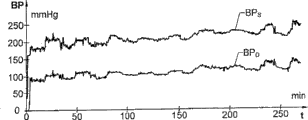
图3a示出血液治疗过程中第一主体的血压变量例子的曲线图,Figure 3a shows a graph of an example of blood pressure variables of a first subject during blood therapy,
图3b示出所提出的第一主体的脉搏幅度测量怎样随时间变化的曲线图, Figure 3b shows a graph of how the proposed first subject's pulse amplitude measurement varies over time,
图4a示出血液治疗过程中第二主体的血压变化例子的曲线图, Figure 4a shows a graph of an example of blood pressure changes in a second subject during blood therapy,
图4b示出所提出的第二主体的脉搏幅度测量怎样随时间变化的曲线图, Figure 4b shows a graph of how the proposed second subject's pulse amplitude measurement varies over time,
图5a示出血液治疗过程中第三主体的血压变化例子的曲线图, Figure 5a shows a graph of an example of a third subject's blood pressure variation during blood therapy,
图5b示出所提出的第三主体的脉搏幅度测量怎样随时间变化的曲线图,和 Figure 5b shows a graph of how the pulse amplitude measurement of the proposed third subject changes over time, and
图6示出根据本发明预测快速症状性血压降低的常用方法的流程图。 Fig. 6 shows a flowchart of a general method for predicting rapid symptomatic blood pressure reduction according to the present invention. the
具体实施方式Detailed ways
我们先参考图1,其描绘根据本发明一个实施例的用于预测主体P内快速症状性血压降低的警报设备100。设备100分别包括脉搏记录装置110和115,和控制单元120。 We first refer to FIG. 1 , which depicts an
脉搏记录装置具有脉搏血氧仪110,并优选具有单独的传感器单元115。该单元115包括至少一个光源和至少一个光探测器,通过光探测器对脉搏信号S进行登记,脉搏信号S依据传感器单元115连接到主体P之处(例如,在手指、舌头、耳垂、鼻尖或其它末端中,在其皮肤中或在任意其它身体部分的皮肤中)来描述主体P外围身体部位105中至少一个血管中的光响应变化。光响应变化优选反映从所述至少一个光源发射的光的吸收方面的变化。但是,可以对光反射和/或光透射同样很好地进行研究。在任意情况下,脉搏血氧仪110都适于基于脉搏信号S来登记脉搏形状参数PPS。 The pulse recording device has a
控制单元120适于接收并处理脉搏形状参数PPS。具体地,控制单元120包括处理单元128,其适于将第一时刻t1接收的脉搏形状参数PPS存储在存储装置123中。存储装置123或者包括在控制单元120中,或者例如经由电缆或无线连接与其相连。在任意情况下,处理单元128都适于基于存储装置123中存储的值计算初始脉搏幅度测量PM1。The
图3b示出关于暴露给体外血液治疗的第一主体的初始脉搏幅度测量PM1。优选地,初始脉搏幅度测量PM1不仅由单个脉搏形状参数PPS得出,而且还基于初始测量期间登记的多个这种参数的平均值而得出。图3b中的曲线图沿着水平轴以分钟表示时间t,并沿着垂直轴表示脉搏幅度测量PM。 Figure 3b shows an initial pulse amplitude measurement PM1 on a first subject exposed to extracorporeal blood therapy. Preferably, the initial pulse amplitude measurement PM1 is derived not only from a single pulse shape parameter P PS but also based on the average of a number of such parameters registered during the initial measurement. The graph in Figure 3b represents the time t in minutes along the horizontal axis and the pulse amplitude measurement PM along the vertical axis.
根据本发明,处理单元128可以经由一个或多个下列策略确定脉搏幅度测量PM。例如,可以计算脉搏冲程期间登记的脉搏形状参数PPS的最大值和最小值之差。可选地,可以例如通过计算希尔伯特变换来检测脉搏形状参数PPS的包络。也可以基于脉搏形状参数PPS利用均方根(RMS)测量来确定脉搏幅度测量PM。然而,这需要事先将参数值校准到零均值。 In accordance with the present invention, processing
图3a示出分别以mmHg为单位的治疗期间第一主体的收缩血压变量BPs和舒张血压变量BPD的曲线图。血压BP贯穿治疗过程而变化。但是,正如图3b中所示,没有发生低血压。除了治疗过程中245分钟左右的轻微下降之外,脉搏幅度测量PM也保持相对平稳。 Figure 3a shows a graph of the systolic blood pressure variable BP s and the diastolic blood pressure variable BP D of a first subject during treatment in mmHg, respectively. Blood pressure BP varied throughout the course of treatment. However, as shown in Figure 3b, hypotension did not occur. Apart from a slight dip around 245 minutes during the treatment, the pulse amplitude measurement PM also remained relatively flat.
在第一时刻t1之后的测量期间(即,这里自t=0开始),处理单元128适于基于多个接收的脉搏形状参数PPS中的每一个来计算各脉搏幅度测量PM。为测量期间中的每个脉搏幅度测量PM,处理单元128进一步适于调查测量PM相对于初始脉搏幅度测量PM1是否达到判定标准。如果发现已达到这种判定标准,则处理单元128适于产生警报触发信号α。反过来推定警报触发信号α在控制单元120自身的警报单元125中、和/或在接收警报触发信号α的外部单元中使警报A被触发。下面将参考图4、5和6详细介绍脉搏幅度测量PM和判定标准。 During the measurement after the first instant t1 (ie here starting from t=0), the
图2示出根据本发明一个实施例的用于执行主体P的血液治疗的医疗系统200的方框图。为了这个目的,系统200包括透析机210,其可适于执行主体P的体外血液治疗,即,机器210适于从主体P抽出受污染的血液βC并将净化过的血液βP返回给主体P。系统200还包括上述警报设备100,用于预测对主体P是潜在不健康的任意快速血压降低。因此,在净化主体P的血液的同时,警报设备100监控他/她的关于急性症状性低血压发生的风险。在警报信号α的情况下,可以通知监视工作人员和/或透析机可被控制用于调节其治疗参数从而避免低血压情形。这种调节通过从警报设备100到透析机210的反馈信号α来表征。 Fig. 2 shows a block diagram of a
优选地,警报设备100中的控制单元120(参见图1)适于基于初始脉搏幅度测量PM1来预测主体P中的快速症状性血压降低,该初始脉搏幅度测量PM1由在主体还相对未受到该治疗影响时的血液治疗初始阶段中接收的脉搏形状参数PPS进行计算。 Preferably, the control unit 120 (see FIG. 1 ) in the
现在回到图4a,可以看出曲线图例示出在体外血液治疗期间收缩压BPS和舒张压BPD怎样以每秒mmHg变化的图形。在治疗中145分钟左右的时间点th处,主体遭受急性症状性低血压。该事件通过收缩压BPS和舒张压BPD两者中的快速降低BP进行预测。 Returning now to Figure 4a, it can be seen that the graph legend shows a graph of how systolic blood pressure BP S and diastolic blood pressure BP D vary in mmHg per second during extracorporeal blood therapy. At time point t h around 145 minutes into the treatment, the subject suffers from acute symptomatic hypotension. This event was predicted by a rapid decrease in BP in both systolic BP S and diastolic BP D.
进一步参考图4b,现在我们将解释怎样根据本发明实施例来计算提出的脉搏幅度测量PM和阀值T,和这些参数的解怎样用于预测低血压事件。 With further reference to Fig. 4b, we will now explain how the proposed pulse magnitude measure PM and threshold T are calculated according to an embodiment of the present invention, and how the solution of these parameters is used to predict hypotensive events. the
图1的处理单元128适于调查关于测量期间中接收到的脉搏形状参数PPS是否达到判定标准。在该例子中,测量期间开始于t=0,而该期间连续贯穿由图4a和4b的图形覆盖的时间间隔。 The
控制单元120的处理单元128优选如下计算阀值T。首先,对时间t1(即,这里t=0)处获得的初始脉搏幅度测量PM1进行归一化。在该例子中PM1=1,但是从技术上讲,任意其它参考值都是可想象的。然后归一化的值被预定义的分母除,该预定义的分母可以是1.2和5之间的任意数,比如2。因此,获得阀值T。从而,假定预定义的分母为2,则T成为0.5,正如通过虚线在图4b中示出的那样。在t1之后的测量期间中,处理单元128通过用初始脉搏幅度测量PM1(其由第一时刻t1接收的脉搏形状参数PPS得出)除原始幅度测量而为每个接收的脉搏形状参数PPS计算归一化的脉搏幅度测量PM。因此,表示比在第一时刻t1接收到的脉搏形状参数PPS的脉搏幅度更大的脉搏幅度测量PM导致脉搏幅度测量PM>1,而反之,表示比第一时刻t1接收的脉搏形状参数PPS的脉搏幅度更小的脉搏幅度测量PM导致脉搏幅度测量 PM<1。 The
当已经得出脉搏幅度测量PM时,处理单元128认为上述判定标准会达到,如果: When the pulse amplitude measurement PM has been obtained, the
(a)给定脉搏形状参数的被检查的脉搏幅度测量PM低于阀值T;和 (a) the checked pulse amplitude measurement PM for a given pulse shape parameter is below the threshold T; and
(b)在给定脉搏形状参数之后在测试期间τ内接收到的预定量的脉搏形状参数PPS的脉搏幅度测量PM低于阀值T。 (b) The pulse amplitude measurement PM is below the threshold T for a predetermined amount of pulse shape parameter P PS received during the test period τ after the pulse shape parameter is given.
根据本发明的一个实施例,预定量是表示测试期间τ内接收的脉搏形状参数PPS的脉搏幅度测量PM的大约50%到大约100%的值。预定量可以表示测试期间τ内接收到的脉搏形状参数PPS的全部脉搏幅度测量PM。然而,为了避免被高于阀值T的单个脉搏幅度测量PM中断,有利的是可以将预定量分配成相当于小于100%。可选地,可以将第二阀值分配成稍微高于阀值T,而处理单元128可以采用滞后算法,从而一旦脉搏幅度测量PM落在阀值T之下,如果在测试期间τ期满处脉搏幅度测量PM还未超过第二阀值,则认为达到判定标准。 According to one embodiment of the invention, the predetermined quantity is a value representing approximately 50% to approximately 100% of the pulse amplitude measurement PM of the pulse shape parameter P PS received during the test period τ. The predetermined quantity may represent all pulse amplitude measurements PM of the pulse shape parameters P PS received during the test period τ. However, in order to avoid being interrupted by a single pulse amplitude measurement PM above the threshold T, it may be advantageous to assign the predetermined amount to correspond to less than 100%. Alternatively, the second threshold may be assigned to be slightly above threshold T, and
在图4b中示出的例子中,在t=128分钟左右脉搏幅度测量PM第一次落在阀值T之下。这里,我们假定上述预定量为100%,而测试期间τ为5分钟长。因此,测试期间τ在t=133分钟左右结束。但是,在该时间点处,脉搏幅度测量PM再次超过阀值T。因此,处理单元128将不产生警报触发信号。 In the example shown in Figure 4b, the pulse amplitude measurement PM falls below the threshold T for the first time around t=128 minutes. Here, we assume that the aforementioned predetermined amount is 100%, and that the test period τ is 5 minutes long. Thus, the test period τ ends around t=133 minutes. However, at this point in time the pulse magnitude measurement PM exceeds the threshold T again. Therefore, the
在t=135分钟左右,脉搏幅度测量PM返回到低于阀值T的水平,而此时脉搏幅度测量PM保持低于阀值T的期间超过测试期间τ(这里为5分钟)。从而,在测试期间τ结束时(即,在大约t=140分钟处),处理单元产生警报触发信号α。于是直到t=th发生低血压时,还剩5分钟左右。因此,借助于警报触发信号α,已经可以在预期时间内执行适当的人工和/或自动的低血压阻止行动。更有利的是如果处理单元128适于在脉搏幅度测量PM低于阀值T的任意时刻产生注意信号(例如使单元上的黄灯点亮)。因此,任意监督的工作人员都能获得急性症状性低血压可能出现的最早可能的指示,而因此需要额外关注主体。如果在脉搏 幅度测量PM上升超过阀值T结束时,还未达到判定标准,则关注信号失效。 At around t=135 minutes, the pulse amplitude measurement PM returns to a level below the threshold T, while the pulse amplitude measurement PM remains below the threshold T for longer than the test period τ (here 5 minutes). Thus, at the end of the test period τ (ie at approximately t=140 minutes), the processing unit generates an alarm trigger signal α. So until t=t h when hypotension occurs, there are about 5 minutes left. Thus, with the aid of the alarm trigger signal α, appropriate manual and/or automatic hypotension prevention actions can already be carried out within the expected time. It is even more advantageous if the
当然,根据本发明,不同于5分钟的测试期间τ长度是同样可想象的。实际上,测试期间τ可以表示从大约3分钟延伸到大约15分钟的范围所选择的任意时间间隔。测试期间τ的长度是获得稳定性和可靠性之间所需平衡所选择的设计参数。优选地,与上述预定义的分母结合进行选择测试期间T。即,对于早期低血压警报和错误警报之间的给定平衡而言,相对大的分母需要相对较短的测试期间,反之亦然。 Of course, test period τ lengths other than 5 minutes are also conceivable according to the invention. In practice, the test period τ may represent any time interval selected from a range extending from about 3 minutes to about 15 minutes. The length of τ during the test is a design parameter chosen to achieve the desired balance between stability and reliability. Preferably, the selection of the test period T is performed in conjunction with the above-mentioned predefined denominator. That is, for a given balance between early hypotension alerts and false alerts, a relatively large denominator requires a relatively short test period, and vice versa. the
另外,如果在图4b的例子中,达到判定标准所需的低于阀值T的预定量的脉搏幅度测量PM已被选择为小于100%的值,比如60%,则警报触发信号α已在第一测试期间τ(即,t=133分钟左右)期满时产生。 In addition, if, in the example of FIG. 4b, the predetermined amount of pulse amplitude measurement PM below the threshold T required to meet the decision criterion has been selected as a value less than 100%, such as 60%, then the alarm trigger signal α is already at Generated upon expiration of the first test period τ (ie, t = 133 minutes or so). the
类似于图4a和4b,图5a和5b分别示出例示体外血液治疗过程中第三主体的血压变化和相应的脉搏幅度测量变化的曲线图。 Similar to Figures 4a and 4b, Figures 5a and 5b respectively show graphs illustrating changes in blood pressure and corresponding changes in pulse amplitude measurements of a third subject during extracorporeal blood therapy. the
在该例子中,主体分别在t=th1处(治疗过程中155分钟左右)和t=th2处(治疗过程中178分钟左右)遭受两次急性症状性低血压事件。为了促进与上述例子比较,我们在这里也已经选择将t1处(t=0)得到的初始脉搏幅度测量PM1归一化到1,选择阀值T=0.5(即,预定义的分母为2),并将测试期间τ的长度设置为5分钟。另外,如果测试期间τ内接收到的脉搏形状参数PPS的全部脉搏幅度测量PM落在阀值T之下,则我们认为已达到判定标准。 In this example, the subject suffers two acute symptomatic hypotensive episodes at t = t h1 (around 155 minutes during treatment) and t = t h2 (around 178 minutes during treatment). In order to facilitate comparison with the above example, we have also chosen here to normalize the initial pulse amplitude measurement PM1 obtained at t1 (t=0) to 1, choosing a threshold T=0.5 (i.e., a predefined denominator of 2 ), and set the length of the test period τ to 5 minutes. Additionally, if all pulse amplitude measurements PM of the pulse shape parameters P PS received during the test period τ fall below the threshold T, we consider the criterion to have been met.
如在图5b中的图形中显而易见的是,给定这些参数值,则处理单元128将分别在t=tα1(治疗过程中145分钟左右)和t=tα2(治疗过程中171分钟左右)处产生警报触发信号α。因此提前大约7至10分钟提供了发生低血压事件的预测。 As is evident in the graph in Fig. 5b, given these parameter values, the
暂且回到图3b,我们看到脉搏幅度测量PM从未落到阀值T(这里为0.5)之下。因此,在这种情况下,处理单元128将不产生任意警报触发信号α。 Returning momentarily to Figure 3b, we see that the pulse amplitude measure PM never falls below the threshold T (here 0.5). Therefore, in this case, the
现在我们回到图1。根据本发明的一个实施例,设备100包括辅助记录装置130,其适于反复登记表示主体P的毛细血管收缩程度的生物 阻抗参数PBI。在该实施例中,处理单元128进一步适于接收该生物阻抗参数PBI,并调查参数PBI是否达到辅助警报标准。如果发现达到该标准,则处理单元128适于产生警报触发信号α。从而,设备100的性能和可靠性得以改善。为了进一步改善设备100的使用性,如果辅助记录装置130适于确定生物阻抗参数实质上与主体P的毛细血管收缩无关,则是优选的。因此,辅助记录装置130可以登记绝对体温、体温的变化和/或主体P上的汗液量,而处理单元适于对照一个或多个这些参数来测试辅助警报标准。 Now we return to Figure 1. According to one embodiment of the invention, the
为了总结,下面将参考图6中的流程图介绍根据本发明的在主体中预测快速症状性血压降低的常用方法。 To summarize, a general method for predicting rapid symptomatic blood pressure reduction in a subject according to the present invention will be described below with reference to the flowchart in FIG. 6 . the
第一步骤610调查是否已经接收到关于主体外围身体部位的脉搏形状参数。如果还未接收到这种参数,则程序循环回去并停留在步骤610。但是,如果已接收到脉搏形状参数,则步骤620跟随,其基于第一时刻接收的脉搏形状参数计算初始脉搏幅度测量。在这里假定已经通过脉搏血氧测量登记了脉搏形状参数,其中基于主体的至少一个血管中的光吸收变化来确定脉搏形状参数。 A
随后的步骤630将初始脉搏幅度测量存储在存储装置中。此后,接着是测量期间,在该期间中步骤640基于每个接收到的脉搏形状参数计算各脉搏幅度测量。另外,为测量期间中的每个脉搏幅度测量,步骤640之后的步骤650调查脉搏幅度测量相对于初始脉搏幅度测量是否达到判定标准。如果发现未达到判定标准,并假设测量期间仍有效,则程序循环回到步骤640。 A
但是,如果在步骤650中发现已达到判断标准,则随后是步骤660,其使警报触发信号产生。此后,程序可以结束,或循环回到步骤640(假设测量期间仍有效)。优选地,测量期间失效以响应人工干涉,例如按下复位按钮。即,由此即使在测量可能已经被迫中断的情况下,也直接重新开始(或实际保持)测量期间,例如由于传感器单元115已经掉离主体P。在这种情况下,可以简单地再连接传感器单元115,之后测量继续。However, if in
上述参考图6介绍的所有处理步骤以及步骤的任意子程序都可以通过编程的计算机设备进行控制。另外,尽管上述参考附图介绍的本发明的实施例包含计算机设备和计算机设备中执行的程序,但本发明因此也延伸到计算机程序,特别是适用于将本发明付诸实施的载体上或载体中的计算机程序。程序可以具有源代码、目标代码、代码中间源和例如部分编译形式的目标代码的形式,或具有适用于实施根据本发明的程序的任意其它形式。载体可以是能够载有程序的任意实体或设备。例如,载体可以包括存储介质,例如闪存、ROM(只读存储器),例如CD(致密光盘)或半导体ROM、EPROM(可擦除可编程只读存储器)、EEPROM(电可擦除可编程只读存储器)、或例如软盘或硬盘的磁性记录介质。另外,载体可以是可发射的载体,例如可以经由电或光缆或通过无线电或通过其它手段传输的电或光信号。当程序被嵌入可以通过电缆或其它设备或装置直接传输的信号中时,载体可以由这种电缆或设备或装置构成。可选地,载体可以是程序嵌入其中的集成电路,该集成电路适于执行相关程序、或用于相关程序的执行。 All the processing steps and any subroutines of the steps described above with reference to FIG. 6 can be controlled by a programmed computer device. In addition, although the embodiments of the invention described above with reference to the accompanying drawings include computer equipment and programs executed in computer equipment, the invention therefore also extends to computer programs, especially on or on a carrier suitable for putting the invention into practice. computer program in . The program may be in the form of source code, object code, code intermediate source and object code eg in partially compiled form, or in any other form suitable for implementing a program according to the invention. A carrier may be any entity or device capable of carrying a program. For example, the carrier may comprise a storage medium such as flash memory, ROM (Read Only Memory) such as CD (Compact Disc) or semiconductor ROM, EPROM (Erasable Programmable Read Only Memory), EEPROM (Electrically Erasable Programmable Read Only Memory) memory), or a magnetic recording medium such as a floppy disk or a hard disk. Additionally, the carrier may be a transmittable carrier, such as an electrical or optical signal that may be transmitted via electrical or optical cable or by radio or by other means. When the program is embedded in a signal that can be directly transmitted through a cable or other device or device, the carrier may be constituted by such a cable or device or device. Alternatively, the carrier may be an integrated circuit in which the program is embedded, and the integrated circuit is suitable for executing the relevant program or used for the execution of the relevant program. the
在该说明书中使用的术语“包含/包括”用来说明出现的陈述的特征、整数、步骤或组件。但是,该术语不排除出现或增加一个或多个其它特征、整数、步骤或组件或其组合。 The term "comprising/comprising" used in this specification is used to describe the stated features, integers, steps or components presented. However, the term does not exclude the presence or addition of one or more other features, integers, steps or components or combinations thereof. the
本发明不限于图中介绍的实施例,而是可以在权利要求的范围内自由改变。The invention is not limited to the embodiments presented in the figures but can be varied freely within the scope of the claims.
Claims (12)
Applications Claiming Priority (8)
| Application Number | Priority Date | Filing Date | Title |
|---|---|---|---|
| US80410906P | 2006-06-07 | 2006-06-07 | |
| US60/804,109 | 2006-06-07 | ||
| SE06019293 | 2006-09-19 | ||
| SE0601929 | 2006-09-19 | ||
| SE0601929-3 | 2006-09-19 | ||
| US82648206P | 2006-09-21 | 2006-09-21 | |
| US60/826,482 | 2006-09-21 | ||
| PCT/EP2007/055477 WO2007141246A2 (en) | 2006-06-07 | 2007-06-04 | Prediction of rapid symptomatic blood pressure decrease |
Publications (2)
| Publication Number | Publication Date |
|---|---|
| CN101460092A CN101460092A (en) | 2009-06-17 |
| CN101460092B true CN101460092B (en) | 2011-06-01 |
Family
ID=40770592
Family Applications (1)
| Application Number | Title | Priority Date | Filing Date |
|---|---|---|---|
| CN2007800209157A Expired - Fee Related CN101460092B (en) | 2006-06-07 | 2007-06-04 | Prediction of rapid symptomatic blood pressure decrease |
Country Status (1)
| Country | Link |
|---|---|
| CN (1) | CN101460092B (en) |
Families Citing this family (4)
| Publication number | Priority date | Publication date | Assignee | Title |
|---|---|---|---|---|
| WO2011080190A1 (en) * | 2009-12-28 | 2011-07-07 | Gambro Lundia Ab | Apparatus and method for prediction of rapid symptomatic blood pressure decrease |
| US9561316B2 (en) * | 2011-04-29 | 2017-02-07 | Medtronic, Inc. | Intersession monitoring for blood fluid removal therapy |
| US11076813B2 (en) * | 2016-07-22 | 2021-08-03 | Edwards Lifesciences Corporation | Mean arterial pressure (MAP) derived prediction of future hypotension |
| US20220226553A1 (en) * | 2021-01-15 | 2022-07-21 | Global Monitors, Inc. | Hemodialysis enhancement apparatus & method |
Citations (1)
| Publication number | Priority date | Publication date | Assignee | Title |
|---|---|---|---|---|
| CN1762308A (en) * | 2004-10-21 | 2006-04-26 | 株式会社日立制作所 | Bio-optical measurement device |
-
2007
- 2007-06-04 CN CN2007800209157A patent/CN101460092B/en not_active Expired - Fee Related
Patent Citations (1)
| Publication number | Priority date | Publication date | Assignee | Title |
|---|---|---|---|---|
| CN1762308A (en) * | 2004-10-21 | 2006-04-26 | 株式会社日立制作所 | Bio-optical measurement device |
Also Published As
| Publication number | Publication date |
|---|---|
| CN101460092A (en) | 2009-06-17 |
Similar Documents
| Publication | Publication Date | Title |
|---|---|---|
| AU2007255448B2 (en) | Prediction of rapid symptomatic blood pressure decrease | |
| EP2519283B1 (en) | Apparatus and method for prediction of rapid symptomatic blood pressure decrease | |
| CA2663897C (en) | Estimation of propensity to symptomatic hypotension | |
| AU2006291593B2 (en) | Detection of drastic blood pressure changes | |
| US8666468B1 (en) | Patient monitor for determining microcirculation state | |
| US7880606B2 (en) | Physiological trend monitor | |
| US8216136B2 (en) | Systems and methods for monitoring heart rate and blood pressure correlation | |
| JP6319850B2 (en) | Device and method for continuous non-invasive measurement of blood pressure | |
| US20140081152A1 (en) | System and method for determining stability of cardiac output | |
| WO2011008383A1 (en) | Systems and methods for assessing measurements in physiological monitoring devices | |
| KR20170019189A (en) | Apparatus and method for estimating blood pressure | |
| KR20070051932A (en) | Detection of sudden blood pressure changes | |
| JP7277269B2 (en) | Individualized hemodialysis machine | |
| CN101460092B (en) | Prediction of rapid symptomatic blood pressure decrease | |
| US12290341B2 (en) | Methods for determining a blood pressure value of a patient, blood pressure monitors and dialysis systems | |
| JP7431026B2 (en) | Condition determination device and computer program | |
| JP7737691B2 (en) | Anomaly detection device | |
| JP5192934B2 (en) | Automatic blood pressure monitoring device | |
| JP2002336209A (en) | Exercise strength detector, organism load detector program, and record medium |
Legal Events
| Date | Code | Title | Description |
|---|---|---|---|
| C06 | Publication | ||
| PB01 | Publication | ||
| C10 | Entry into substantive examination | ||
| SE01 | Entry into force of request for substantive examination | ||
| C14 | Grant of patent or utility model | ||
| GR01 | Patent grant | ||
| CF01 | Termination of patent right due to non-payment of annual fee | ||
| CF01 | Termination of patent right due to non-payment of annual fee |
Granted publication date: 20110601 |