CN101434701B - Polyamideimide obtained by end group exchange and its preparation method - Google Patents
Polyamideimide obtained by end group exchange and its preparation method Download PDFInfo
- Publication number
- CN101434701B CN101434701B CN2008101477794A CN200810147779A CN101434701B CN 101434701 B CN101434701 B CN 101434701B CN 2008101477794 A CN2008101477794 A CN 2008101477794A CN 200810147779 A CN200810147779 A CN 200810147779A CN 101434701 B CN101434701 B CN 101434701B
- Authority
- CN
- China
- Prior art keywords
- diisocyanate
- polyamidoimide
- vulcabond
- reaction
- add
- Prior art date
- Legal status (The legal status is an assumption and is not a legal conclusion. Google has not performed a legal analysis and makes no representation as to the accuracy of the status listed.)
- Expired - Fee Related
Links
- 238000002360 preparation method Methods 0.000 title claims abstract description 15
- 229920002312 polyamide-imide Polymers 0.000 title abstract description 72
- 239000004962 Polyamide-imide Substances 0.000 title abstract description 52
- 238000000034 method Methods 0.000 claims abstract description 32
- 125000005442 diisocyanate group Chemical group 0.000 claims abstract description 28
- 150000001875 compounds Chemical class 0.000 claims abstract description 17
- 229910052739 hydrogen Inorganic materials 0.000 claims abstract description 16
- 239000001257 hydrogen Substances 0.000 claims abstract description 16
- UFHFLCQGNIYNRP-UHFFFAOYSA-N Hydrogen Chemical compound [H][H] UFHFLCQGNIYNRP-UHFFFAOYSA-N 0.000 claims abstract description 12
- 238000006243 chemical reaction Methods 0.000 claims description 53
- 239000002244 precipitate Substances 0.000 claims description 28
- SECXISVLQFMRJM-UHFFFAOYSA-N N-Methylpyrrolidone Chemical compound CN1CCCC1=O SECXISVLQFMRJM-UHFFFAOYSA-N 0.000 claims description 24
- YXFVVABEGXRONW-UHFFFAOYSA-N Toluene Chemical compound CC1=CC=CC=C1 YXFVVABEGXRONW-UHFFFAOYSA-N 0.000 claims description 24
- SRPWOOOHEPICQU-UHFFFAOYSA-N trimellitic anhydride Chemical compound OC(=O)C1=CC=C2C(=O)OC(=O)C2=C1 SRPWOOOHEPICQU-UHFFFAOYSA-N 0.000 claims description 20
- UHOVQNZJYSORNB-UHFFFAOYSA-N Benzene Chemical compound C1=CC=CC=C1 UHOVQNZJYSORNB-UHFFFAOYSA-N 0.000 claims description 18
- IMFACGCPASFAPR-UHFFFAOYSA-N tributylamine Chemical compound CCCCN(CCCC)CCCC IMFACGCPASFAPR-UHFFFAOYSA-N 0.000 claims description 18
- WEVYAHXRMPXWCK-UHFFFAOYSA-N Acetonitrile Chemical compound CC#N WEVYAHXRMPXWCK-UHFFFAOYSA-N 0.000 claims description 15
- KSBAEPSJVUENNK-UHFFFAOYSA-L tin(ii) 2-ethylhexanoate Chemical compound [Sn+2].CCCCC(CC)C([O-])=O.CCCCC(CC)C([O-])=O KSBAEPSJVUENNK-UHFFFAOYSA-L 0.000 claims description 15
- -1 aliphatic alcohols compound Chemical class 0.000 claims description 13
- 125000006575 electron-withdrawing group Chemical group 0.000 claims description 12
- 239000000047 product Substances 0.000 claims description 11
- IAZDPXIOMUYVGZ-UHFFFAOYSA-N Dimethylsulphoxide Chemical compound CS(C)=O IAZDPXIOMUYVGZ-UHFFFAOYSA-N 0.000 claims description 10
- UKLDJPRMSDWDSL-UHFFFAOYSA-L [dibutyl(dodecanoyloxy)stannyl] dodecanoate Chemical compound CCCCCCCCCCCC(=O)O[Sn](CCCC)(CCCC)OC(=O)CCCCCCCCCCC UKLDJPRMSDWDSL-UHFFFAOYSA-L 0.000 claims description 9
- 239000003054 catalyst Substances 0.000 claims description 8
- 239000003880 polar aprotic solvent Substances 0.000 claims description 8
- 239000005057 Hexamethylene diisocyanate Substances 0.000 claims description 7
- RRAMGCGOFNQTLD-UHFFFAOYSA-N hexamethylene diisocyanate Chemical compound O=C=NCCCCCCN=C=O RRAMGCGOFNQTLD-UHFFFAOYSA-N 0.000 claims description 7
- 239000007787 solid Substances 0.000 claims description 7
- CSCPPACGZOOCGX-UHFFFAOYSA-N Acetone Chemical compound CC(C)=O CSCPPACGZOOCGX-UHFFFAOYSA-N 0.000 claims description 6
- 239000003795 chemical substances by application Substances 0.000 claims description 6
- 125000000896 monocarboxylic acid group Chemical group 0.000 claims description 6
- IMNIMPAHZVJRPE-UHFFFAOYSA-N triethylenediamine Chemical compound C1CN2CCN1CC2 IMNIMPAHZVJRPE-UHFFFAOYSA-N 0.000 claims description 6
- ALQLPWJFHRMHIU-UHFFFAOYSA-N 1,4-diisocyanatobenzene Chemical compound O=C=NC1=CC=C(N=C=O)C=C1 ALQLPWJFHRMHIU-UHFFFAOYSA-N 0.000 claims description 5
- 125000002887 hydroxy group Chemical group [H]O* 0.000 claims description 5
- 239000012454 non-polar solvent Substances 0.000 claims description 5
- DVKJHBMWWAPEIU-UHFFFAOYSA-N toluene 2,4-diisocyanate Chemical compound CC1=CC=C(N=C=O)C=C1N=C=O DVKJHBMWWAPEIU-UHFFFAOYSA-N 0.000 claims description 5
- WVDDGKGOMKODPV-UHFFFAOYSA-N Benzyl alcohol Chemical compound OCC1=CC=CC=C1 WVDDGKGOMKODPV-UHFFFAOYSA-N 0.000 claims description 4
- HIFVAOIJYDXIJG-UHFFFAOYSA-N benzylbenzene;isocyanic acid Chemical class N=C=O.N=C=O.C=1C=CC=CC=1CC1=CC=CC=C1 HIFVAOIJYDXIJG-UHFFFAOYSA-N 0.000 claims description 4
- 238000001035 drying Methods 0.000 claims description 4
- 150000002431 hydrogen Chemical class 0.000 claims description 4
- 238000001556 precipitation Methods 0.000 claims description 4
- OVBFMUAFNIIQAL-UHFFFAOYSA-N 1,4-diisocyanatobutane Chemical compound O=C=NCCCCN=C=O OVBFMUAFNIIQAL-UHFFFAOYSA-N 0.000 claims description 3
- 239000005058 Isophorone diisocyanate Substances 0.000 claims description 3
- 150000003946 cyclohexylamines Chemical class 0.000 claims description 3
- 235000014113 dietary fatty acids Nutrition 0.000 claims description 3
- 239000000539 dimer Substances 0.000 claims description 3
- 229930195729 fatty acid Natural products 0.000 claims description 3
- 239000000194 fatty acid Substances 0.000 claims description 3
- 125000000524 functional group Chemical group 0.000 claims description 3
- NIMLQBUJDJZYEJ-UHFFFAOYSA-N isophorone diisocyanate Chemical compound CC1(C)CC(N=C=O)CC(C)(CN=C=O)C1 NIMLQBUJDJZYEJ-UHFFFAOYSA-N 0.000 claims description 3
- 150000003951 lactams Chemical class 0.000 claims description 3
- 239000002184 metal Substances 0.000 claims description 3
- ISWSIDIOOBJBQZ-UHFFFAOYSA-N phenol group Chemical group C1(=CC=CC=C1)O ISWSIDIOOBJBQZ-UHFFFAOYSA-N 0.000 claims description 3
- DIDWNCSDVBKWCN-UHFFFAOYSA-N 1-isocyanato-2-(2-isocyanatoethyl)benzene Chemical compound O=C=NCCC1=CC=CC=C1N=C=O DIDWNCSDVBKWCN-UHFFFAOYSA-N 0.000 claims description 2
- ISPYQTSUDJAMAB-UHFFFAOYSA-N 2-chlorophenol Chemical compound OC1=CC=CC=C1Cl ISPYQTSUDJAMAB-UHFFFAOYSA-N 0.000 claims description 2
- IQUPABOKLQSFBK-UHFFFAOYSA-N 2-nitrophenol Chemical compound OC1=CC=CC=C1[N+]([O-])=O IQUPABOKLQSFBK-UHFFFAOYSA-N 0.000 claims description 2
- 235000019445 benzyl alcohol Nutrition 0.000 claims description 2
- 239000012467 final product Substances 0.000 claims description 2
- MHABMANUFPZXEB-UHFFFAOYSA-N O-demethyl-aloesaponarin I Natural products O=C1C2=CC=CC(O)=C2C(=O)C2=C1C=C(O)C(C(O)=O)=C2C MHABMANUFPZXEB-UHFFFAOYSA-N 0.000 claims 2
- 150000001732 carboxylic acid derivatives Chemical class 0.000 claims 2
- 239000005059 1,4-Cyclohexyldiisocyanate Substances 0.000 claims 1
- 229960004217 benzyl alcohol Drugs 0.000 claims 1
- 125000004093 cyano group Chemical group *C#N 0.000 claims 1
- 238000004090 dissolution Methods 0.000 claims 1
- GRWZHXKQBITJKP-UHFFFAOYSA-N dithionous acid Chemical compound OS(=O)S(O)=O GRWZHXKQBITJKP-UHFFFAOYSA-N 0.000 claims 1
- 150000004665 fatty acids Chemical class 0.000 claims 1
- 238000001914 filtration Methods 0.000 claims 1
- 125000002462 isocyano group Chemical group *[N+]#[C-] 0.000 claims 1
- 238000004062 sedimentation Methods 0.000 claims 1
- 238000010792 warming Methods 0.000 claims 1
- 238000003860 storage Methods 0.000 abstract description 5
- 108010022233 Plasminogen Activator Inhibitor 1 Proteins 0.000 description 40
- 102100039418 Plasminogen activator inhibitor 1 Human genes 0.000 description 40
- 239000008399 tap water Substances 0.000 description 19
- 235000020679 tap water Nutrition 0.000 description 19
- 229920001721 polyimide Polymers 0.000 description 15
- UPMLOUAZCHDJJD-UHFFFAOYSA-N 4,4'-Diphenylmethane Diisocyanate Chemical compound C1=CC(N=C=O)=CC=C1CC1=CC=C(N=C=O)C=C1 UPMLOUAZCHDJJD-UHFFFAOYSA-N 0.000 description 14
- 239000004642 Polyimide Substances 0.000 description 14
- ZMXDDKWLCZADIW-UHFFFAOYSA-N N,N-Dimethylformamide Chemical compound CN(C)C=O ZMXDDKWLCZADIW-UHFFFAOYSA-N 0.000 description 11
- 229920000642 polymer Polymers 0.000 description 10
- 239000004952 Polyamide Substances 0.000 description 9
- 229920002647 polyamide Polymers 0.000 description 9
- 238000003756 stirring Methods 0.000 description 9
- WXNZTHHGJRFXKQ-UHFFFAOYSA-N 4-chlorophenol Chemical compound OC1=CC=C(Cl)C=C1 WXNZTHHGJRFXKQ-UHFFFAOYSA-N 0.000 description 8
- 239000002994 raw material Substances 0.000 description 8
- 239000012975 dibutyltin dilaurate Substances 0.000 description 7
- 239000000463 material Substances 0.000 description 7
- 150000002989 phenols Chemical class 0.000 description 6
- FXHOOIRPVKKKFG-UHFFFAOYSA-N N,N-Dimethylacetamide Chemical compound CN(C)C(C)=O FXHOOIRPVKKKFG-UHFFFAOYSA-N 0.000 description 5
- 238000004519 manufacturing process Methods 0.000 description 5
- 238000006116 polymerization reaction Methods 0.000 description 5
- 238000012545 processing Methods 0.000 description 5
- BTJIUGUIPKRLHP-UHFFFAOYSA-N 4-nitrophenol Chemical compound OC1=CC=C([N+]([O-])=O)C=C1 BTJIUGUIPKRLHP-UHFFFAOYSA-N 0.000 description 4
- CTQNGGLPUBDAKN-UHFFFAOYSA-N O-Xylene Chemical compound CC1=CC=CC=C1C CTQNGGLPUBDAKN-UHFFFAOYSA-N 0.000 description 4
- NBIIXXVUZAFLBC-UHFFFAOYSA-N Phosphoric acid Chemical class OP(O)(O)=O NBIIXXVUZAFLBC-UHFFFAOYSA-N 0.000 description 4
- 150000003949 imides Chemical group 0.000 description 4
- 239000008096 xylene Substances 0.000 description 4
- WPYMKLBDIGXBTP-UHFFFAOYSA-N benzoic acid Chemical compound OC(=O)C1=CC=CC=C1 WPYMKLBDIGXBTP-UHFFFAOYSA-N 0.000 description 3
- 230000015572 biosynthetic process Effects 0.000 description 3
- 238000003786 synthesis reaction Methods 0.000 description 3
- 150000000178 1,2,4-triazoles Chemical class 0.000 description 2
- CDMDQYCEEKCBGR-UHFFFAOYSA-N 1,4-diisocyanatocyclohexane Chemical compound O=C=NC1CCC(N=C=O)CC1 CDMDQYCEEKCBGR-UHFFFAOYSA-N 0.000 description 2
- SBJCUZQNHOLYMD-UHFFFAOYSA-N 1,5-Naphthalene diisocyanate Chemical compound C1=CC=C2C(N=C=O)=CC=CC2=C1N=C=O SBJCUZQNHOLYMD-UHFFFAOYSA-N 0.000 description 2
- PAYRUJLWNCNPSJ-UHFFFAOYSA-N Aniline Chemical compound NC1=CC=CC=C1 PAYRUJLWNCNPSJ-UHFFFAOYSA-N 0.000 description 2
- RTZKZFJDLAIYFH-UHFFFAOYSA-N Diethyl ether Chemical compound CCOCC RTZKZFJDLAIYFH-UHFFFAOYSA-N 0.000 description 2
- LFQSCWFLJHTTHZ-UHFFFAOYSA-N Ethanol Chemical compound CCO LFQSCWFLJHTTHZ-UHFFFAOYSA-N 0.000 description 2
- IXQBIOPGDNZYNA-UHFFFAOYSA-N N=C=O.N=C=O.CC1=CC=CC=C1C1=CC=CC=C1C Chemical compound N=C=O.N=C=O.CC1=CC=CC=C1C1=CC=CC=C1C IXQBIOPGDNZYNA-UHFFFAOYSA-N 0.000 description 2
- LSNNMFCWUKXFEE-UHFFFAOYSA-N Sulfurous acid Chemical class OS(O)=O LSNNMFCWUKXFEE-UHFFFAOYSA-N 0.000 description 2
- 239000011825 aerospace material Substances 0.000 description 2
- 150000001408 amides Chemical class 0.000 description 2
- 150000001409 amidines Chemical class 0.000 description 2
- 150000001412 amines Chemical class 0.000 description 2
- 125000003277 amino group Chemical group 0.000 description 2
- 125000003118 aryl group Chemical group 0.000 description 2
- 150000003950 cyclic amides Chemical class 0.000 description 2
- JBKVHLHDHHXQEQ-UHFFFAOYSA-N epsilon-caprolactam Chemical compound O=C1CCCCCN1 JBKVHLHDHHXQEQ-UHFFFAOYSA-N 0.000 description 2
- 239000000835 fiber Substances 0.000 description 2
- 150000002460 imidazoles Chemical class 0.000 description 2
- 150000002462 imidazolines Chemical class 0.000 description 2
- 125000001570 methylene group Chemical group [H]C([H])([*:1])[*:2] 0.000 description 2
- IWDCLRJOBJJRNH-UHFFFAOYSA-N p-cresol Chemical compound CC1=CC=C(O)C=C1 IWDCLRJOBJJRNH-UHFFFAOYSA-N 0.000 description 2
- 229920003023 plastic Polymers 0.000 description 2
- 239000004033 plastic Substances 0.000 description 2
- 150000003217 pyrazoles Chemical class 0.000 description 2
- 238000011160 research Methods 0.000 description 2
- 239000002904 solvent Substances 0.000 description 2
- 239000000126 substance Substances 0.000 description 2
- RUELTTOHQODFPA-UHFFFAOYSA-N toluene 2,6-diisocyanate Chemical compound CC1=C(N=C=O)C=CC=C1N=C=O RUELTTOHQODFPA-UHFFFAOYSA-N 0.000 description 2
- ZHLHLPGSZRUSQQ-UHFFFAOYSA-N 1-isocyanato-2-(isocyanatomethyl)benzene Chemical compound O=C=NCC1=CC=CC=C1N=C=O ZHLHLPGSZRUSQQ-UHFFFAOYSA-N 0.000 description 1
- NGNBDVOYPDDBFK-UHFFFAOYSA-N 2-[2,4-di(pentan-2-yl)phenoxy]acetyl chloride Chemical compound CCCC(C)C1=CC=C(OCC(Cl)=O)C(C(C)CCC)=C1 NGNBDVOYPDDBFK-UHFFFAOYSA-N 0.000 description 1
- XDXPTWCKKOEWIN-UHFFFAOYSA-N 3-hydroxybenzene-1,2-dicarbonitrile Chemical compound OC1=CC=CC(C#N)=C1C#N XDXPTWCKKOEWIN-UHFFFAOYSA-N 0.000 description 1
- 239000005711 Benzoic acid Substances 0.000 description 1
- OKTJSMMVPCPJKN-UHFFFAOYSA-N Carbon Chemical group [C] OKTJSMMVPCPJKN-UHFFFAOYSA-N 0.000 description 1
- 239000004963 Torlon Substances 0.000 description 1
- 229920003997 Torlon® Polymers 0.000 description 1
- 238000010521 absorption reaction Methods 0.000 description 1
- 239000002253 acid Substances 0.000 description 1
- 239000000853 adhesive Substances 0.000 description 1
- 230000001070 adhesive effect Effects 0.000 description 1
- 230000032683 aging Effects 0.000 description 1
- 239000003513 alkali Substances 0.000 description 1
- 125000003368 amide group Chemical group 0.000 description 1
- 235000010233 benzoic acid Nutrition 0.000 description 1
- 125000001797 benzyl group Chemical group [H]C1=C([H])C([H])=C(C([H])=C1[H])C([H])([H])* 0.000 description 1
- 230000000903 blocking effect Effects 0.000 description 1
- 239000006227 byproduct Substances 0.000 description 1
- 239000012295 chemical reaction liquid Substances 0.000 description 1
- 150000001805 chlorine compounds Chemical class 0.000 description 1
- 238000000576 coating method Methods 0.000 description 1
- 239000000805 composite resin Substances 0.000 description 1
- 238000007334 copolymerization reaction Methods 0.000 description 1
- 238000004132 cross linking Methods 0.000 description 1
- 230000007547 defect Effects 0.000 description 1
- 238000013461 design Methods 0.000 description 1
- 150000004985 diamines Chemical class 0.000 description 1
- JXCHMDATRWUOAP-UHFFFAOYSA-N diisocyanatomethylbenzene Chemical compound O=C=NC(N=C=O)C1=CC=CC=C1 JXCHMDATRWUOAP-UHFFFAOYSA-N 0.000 description 1
- 230000000694 effects Effects 0.000 description 1
- 229920001971 elastomer Polymers 0.000 description 1
- 239000000806 elastomer Substances 0.000 description 1
- 239000007789 gas Substances 0.000 description 1
- 230000009477 glass transition Effects 0.000 description 1
- 238000009776 industrial production Methods 0.000 description 1
- 239000007788 liquid Substances 0.000 description 1
- 238000012423 maintenance Methods 0.000 description 1
- 239000003208 petroleum Substances 0.000 description 1
- 125000005498 phthalate group Chemical class 0.000 description 1
- XQZYPMVTSDWCCE-UHFFFAOYSA-N phthalonitrile Chemical class N#CC1=CC=CC=C1C#N XQZYPMVTSDWCCE-UHFFFAOYSA-N 0.000 description 1
- 238000006068 polycondensation reaction Methods 0.000 description 1
- 239000009719 polyimide resin Substances 0.000 description 1
- 239000004814 polyurethane Substances 0.000 description 1
- 229920002635 polyurethane Polymers 0.000 description 1
- 230000001376 precipitating effect Effects 0.000 description 1
- 230000005855 radiation Effects 0.000 description 1
- QAOWNCQODCNURD-UHFFFAOYSA-N sulfuric acid Substances OS(O)(=O)=O QAOWNCQODCNURD-UHFFFAOYSA-N 0.000 description 1
- 238000005979 thermal decomposition reaction Methods 0.000 description 1
- 229920002725 thermoplastic elastomer Polymers 0.000 description 1
- XLYOFNOQVPJJNP-UHFFFAOYSA-N water Substances O XLYOFNOQVPJJNP-UHFFFAOYSA-N 0.000 description 1
- 230000004580 weight loss Effects 0.000 description 1
Landscapes
- Macromolecular Compounds Obtained By Forming Nitrogen-Containing Linkages In General (AREA)
- Polyurethanes Or Polyureas (AREA)
Abstract
Description
技术领域 technical field
本发明属于聚酰胺酰亚胺及其制备方法技术领域,具体涉及一种由端基交换获得的聚酰胺酰亚胺及其制备方法。 The invention belongs to the technical field of polyamide-imide and its preparation method, and in particular relates to a polyamide-imide obtained by terminal group exchange and its preparation method. the
背景技术 Background technique
聚酰亚胺(PI)是一类主链含酰亚胺环的高性能聚合物,其中以全芳香族聚酰亚胺的研究倍受关注。由于其优异的热稳定性、机械性能、化学惰性、介电性能和耐辐射性能,PI已经以膜、涂层、纤维、塑料、胶粘剂和树脂基复合材料等商品形式在航空航天、电子工业等高技术领域得到了广泛应用。然而,传统的芳香族聚酰亚胺源于其刚性的分子结构特征和极强的分子间作用力,通常具有难溶难熔的特性,这给材料的加工带来极大的困难。为了克服此缺陷,众多学者从分子设计的角度出发,通过在聚酰亚胺结构中引入柔性结构,明显地提高了聚酰亚胺的有机可溶性,使其以酰亚胺形式的材料加工过程变为可行。 Polyimide (PI) is a class of high-performance polymers containing imide rings in the main chain, among which the research on fully aromatic polyimide has attracted much attention. Due to its excellent thermal stability, mechanical properties, chemical inertness, dielectric properties, and radiation resistance, PI has been widely used in aerospace, electronics industries, etc. in commercial forms such as films, coatings, fibers, plastics, adhesives, and resin-based composites. High-tech fields have been widely used. However, due to its rigid molecular structure and strong intermolecular forces, traditional aromatic polyimides are usually insoluble and infusible, which brings great difficulties to the processing of materials. In order to overcome this defect, many scholars have obviously improved the organic solubility of polyimide by introducing a flexible structure into the polyimide structure from the perspective of molecular design, so that the material processing process in the form of imide has changed. as feasible. the
聚酰胺(PA)是指主链上具有酰胺基团的聚合物。PA除了用于纤维和塑料外,还可以作为热塑性弹性体。作为弹性体的PA由于其使用温度高,且具有较好的耐化学品性和耐热老化性等优异性能,使其广泛运用于各种领域。与PI相比,由于PA分子结构中存在柔性结构的酰胺键,使其具有良好的加工性能。但是PA与其他耐热性高的材料相比,也具有一些典型的缺点,如吸水性强、低温韧性差、阻燃性一般,热性能也不如PI,这在一定程度上限制了它的应用。 Polyamide (PA) refers to a polymer with amide groups on the main chain. In addition to being used for fibers and plastics, PA can also be used as a thermoplastic elastomer. As an elastomer, PA is widely used in various fields due to its high service temperature, good chemical resistance and heat aging resistance and other excellent properties. Compared with PI, due to the presence of flexible amide bonds in the molecular structure of PA, it has good processing properties. However, compared with other materials with high heat resistance, PA also has some typical disadvantages, such as strong water absorption, poor low temperature toughness, general flame retardancy, and poor thermal performance as PI, which limits its application to a certain extent. . the
为了适应某些行业的需求,人们将柔性的聚酰胺和刚性的聚酰亚胺以共聚的形式获得的聚酰胺酰亚胺共聚物(PA-co-PI,即PAI),使所获得的共聚物既有优异的热性能(据报道,PAI的温度指数为230℃左右,玻璃化温度为275℃左右,热失重特性低于PI但高于PA),又有良好的加工性能;与传统的PI相比,PAI的原料来源广泛且价格较便宜,使产品价格大大降低;另外,氨基的存在使聚合物耐磨性耐碱性有所提高;PAI有着比聚酰亚胺树脂更好的粘结性;PAI预聚物溶液比PI预聚物溶液具有更好的储存稳定性。这些优点使PAI作为一种工程材料广泛应用于电子、交通运输、信息、宇航材料和家用电器等领域。 In order to meet the needs of certain industries, people obtain polyamide-imide copolymers (PA-co-PI, or PAI) in the form of copolymerization of flexible polyamide and rigid polyimide. The material has both excellent thermal properties (it is reported that the temperature index of PAI is about 230°C, the glass transition temperature is about 275°C, and the thermal weight loss characteristics are lower than PI but higher than PA), and good processing performance; Compared with PI, PAI has a wide range of raw materials and cheaper prices, which greatly reduces the product price; in addition, the presence of amino groups improves the wear resistance and alkali resistance of the polymer; PAI has better viscosity than polyimide resin. Junction; PAI prepolymer solution has better storage stability than PI prepolymer solution. These advantages make PAI widely used as an engineering material in the fields of electronics, transportation, information, aerospace materials and household appliances.
常见的PAI的合成路线有两种,一种是以偏苯三酸酐(TMA)、酰氯或其衍生物和二胺等为原料来制备PAI。该路线涉及的PAI制备方法较多,如美国Amoco公司目前仍使用第一种方法进行大量生产,其商品名为Torlon,且得到的产品结构多样,但该法工艺流程长,酰氯及其衍生物储存性差,生产过程中要放出HCl气体,污染环境、腐蚀设备。造成生产环境恶劣、设备维护更换频繁、增加生产成本。另一种是以TMA和二异氰酸酯为主要原料来制备PAI。这种直接缩聚法在工业上运用比较广泛,但由于原料和得到的聚合物的端基都具有活泼的二异氰酸酯官能团,储存较为困难。于是有人在二异氰酸酯和TMA进行聚合反应接近终点时,加入封端剂进行封端(刘德辉等.整合法合成聚酰胺酰亚胺及应用研究.沈阳化工学院学报.2004,14[4],244-247)。这种方法虽解决了PAI聚合物的稳定性问题,但由于原料二异氰酸酯在反应过程中容易和空气中的水分发生反应而变质,影响聚合的程度,且对反应过程的控制也比较困难,很难实现大规模生产。 There are two common synthetic routes of PAI, one is to prepare PAI by using trimellitic anhydride (TMA), acid chloride or its derivatives and diamine as raw materials. There are many PAI preparation methods involved in this route. For example, Amoco Company of the United States still uses the first method for mass production at present. Its trade name is Torlon, and the product structures obtained are diverse, but this method has a long process flow, and acid chlorides and derivatives thereof The storage is poor, and HCl gas will be released during the production process, which will pollute the environment and corrode the equipment. The production environment is harsh, equipment maintenance and replacement are frequent, and production costs are increased. The other is to prepare PAI with TMA and diisocyanate as the main raw materials. This direct polycondensation method is widely used in industry, but because the end groups of the raw materials and the obtained polymer all have active diisocyanate functional groups, storage is relatively difficult. So when the polymerization reaction of diisocyanate and TMA is close to the end, someone adds an end-capping agent for end-capping (Liu Dehui et al. Synthesis of polyamide-imide and application research by integrated method. Journal of Shenyang Institute of Chemical Technology. 2004, 14[4], 244 -247). Although this method solves the stability problem of PAI polymer, because the raw material diisocyanate easily reacts with moisture in the air and deteriorates during the reaction process, it affects the degree of polymerization, and it is also difficult to control the reaction process. Difficult to achieve mass production. the
考虑到以上问题,有研究者又通过将原料的二异氰酸酯基团和聚合物的端基进行保护,即先对原料进行封端,然后在催化剂的存在下升高温度发生解封并聚合,最后得到封端型的PAI聚合物(L.W.CHEN,K.S.HO.Synthesis of Polyamide-imide byBlocked-Methylene Diisocyanates.J.Polym.Sci.:Part A,Polym.Chem.1997,35:1711-1717)。常见的封端化合物是带吸电子基的酚类化合物。因为吸电子基团的存在,使得二异氰酸酯的封端反应可在较低温度(30℃)条件下就可发生,并且当升高到较高温度(70℃左右)和有催化剂的存在时,封端的二异氰酸酯会发生解封,释放出具有较高活泼性的新生态二异氰酸酯基团,并与TMA发生扩链反应。扩链反应完成后,只要降低温度,带吸电子基的酚类化合物又会对聚合物进行封端。这类化合物很容易解封聚合得到较高分子量的PAI。 Considering the above problems, some researchers have protected the diisocyanate groups of the raw materials and the end groups of the polymers, that is, firstly capped the raw materials, and then deblocked and polymerized at elevated temperatures in the presence of catalysts, and finally A blocked PAI polymer was obtained (L.W.CHEN, K.S.HO. Synthesis of Polyamide-imide by Blocked-Methylene Diisocyanates. J. Polym. Sci.: Part A, Polym. Chem. 1997, 35: 1711-1717). Common capping compounds are phenolic compounds with electron-withdrawing groups. Because of the presence of electron-withdrawing groups, the capping reaction of diisocyanate can occur at a lower temperature (30°C), and when it is raised to a higher temperature (about 70°C) and in the presence of a catalyst, The blocked diisocyanate will be unblocked, releasing new ecological diisocyanate groups with higher activity, and chain extension reaction with TMA. After the chain extension reaction is completed, as long as the temperature is lowered, the phenolic compound with the electron-withdrawing group will cap the polymer again. Such compounds are easy to unblock and polymerize to obtain higher molecular weight PAI. the
由于吸电子基封端的PAI材料应用领域具有一定局限,因此为了拓宽PAI的使用范围,人们又采用其他不含吸电子基的化合物来制备封端的PAI。这些不含吸电子基的化合物封端和解封端的温度都较高,即便是在有催化剂存在的条件下往往也要在150℃以上甚至更高温度方能解封,而二异氰酸酯很容易在高温下发生自聚或交联,这样就影响了PAI分子链的增长。所以,用这类化合物制备只能得到分子量较低的端基封闭型PAI,从某些方面来讲,限制了PAI的应用。 Since the application field of PAI materials capped by electron-withdrawing groups is limited, in order to broaden the application range of PAI, other compounds without electron-withdrawing groups are used to prepare capped PAI. The blocking and unblocking temperatures of these compounds without electron-withdrawing groups are relatively high. Even in the presence of catalysts, they often need to be deblocked at a temperature above 150 ° C or even higher, and diisocyanates are easy to be deblocked at high temperatures. Self-polymerization or cross-linking occurs, which affects the growth of PAI molecular chains. Therefore, the preparation of such compounds can only obtain end-blocked PAI with a lower molecular weight, which limits the application of PAI in some respects. the
发明内容 Contents of the invention
本发明的目的是针对已有技术存在的问题,提供一种通过端基交换法获得的具有较高分子量,并含有不同端基的聚酰胺酰亚胺聚合物。 The object of the present invention is to solve the problems in the prior art and provide a polyamide-imide polymer with higher molecular weight and different end groups obtained by end group exchange. the
本发明的另一目的是提供一种制备上述具有较高分子量,并含有不同端基的聚酰胺酰亚胺聚合物的方法。 Another object of the present invention is to provide a method for preparing the above-mentioned polyamide-imide polymers with higher molecular weight and different end groups. the
本发明提供的由端基交换获得的聚酰胺酰亚胺的结构通式如下: The general structural formula of the polyamideimide obtained by end group exchange provided by the present invention is as follows:

式中X为二异氰酸酯除去二异氰酸根后剩余的部分,R’为含活泼氢的化合物去掉氢后剩余的结构,其特性粘数为0.1~0.4dL/g(该特性粘数是以浓硫酸作参比,配制浓度0.5dL/g的溶液,在恒定温度30℃下测定的)。 In the formula, X is the remaining part of diisocyanate after removing diisocyanate, R' is the structure remaining after removing hydrogen from the compound containing active hydrogen, and its intrinsic viscosity is 0.1 ~ 0.4dL/g (the intrinsic viscosity is concentrated Sulfuric acid was used as a reference, and a solution with a concentration of 0.5dL/g was prepared, which was measured at a constant temperature of 30°C). the
上述聚酰胺酰亚胺的结构通式中X具体可为二苯甲烷二异氰酸酯、六亚甲基二异氰酸酯、3,3′-二甲基-4,4′-联苯二异氰酸酯、甲苯-2,4-二异氰酸酯、二亚甲基苯二异氰酸酯、二聚脂肪酸二异氰酸酯、对四亚甲基二甲苯二异氰酸酯、1,5-萘二异氰酸酯、对苯二异氰酸酯、反式1,4-环己烷二异氰酸酯、氢化二苯基甲烷二异氰酸酯、异佛尔酮二异氰酸酯、四亚甲基二异氰酸酯、预聚物改性二苯甲烷二异氰酸酯、甲苯-2,6-二异氰酸酯或者含二异氰酸酯基团的预聚物除去二异氰酸根后剩余的部分。 In the general structural formula of the above-mentioned polyamide-imide, X can specifically be diphenylmethane diisocyanate, hexamethylene diisocyanate, 3,3'-dimethyl-4,4'-biphenyl diisocyanate, toluene-2 , 4-diisocyanate, dimethylene phenylene diisocyanate, dimer fatty acid diisocyanate, p-tetramethylene xylene diisocyanate, 1,5-naphthalene diisocyanate, p-phenylene diisocyanate, trans 1,4-cyclo Hexane diisocyanate, hydrogenated diphenylmethane diisocyanate, isophorone diisocyanate, tetramethylene diisocyanate, prepolymer-modified diphenylmethane diisocyanate, toluene-2,6-diisocyanate or containing diisocyanate The remaining portion of the prepolymer after removal of the diisocyanate groups. the
上述聚酰胺酰亚胺的结构通式中R’为含活泼氢的化合物去掉氢后剩余的以下结构: In the general structural formula of the above-mentioned polyamide-imide, R' is the following structure remaining after the hydrogen-containing compound is removed:


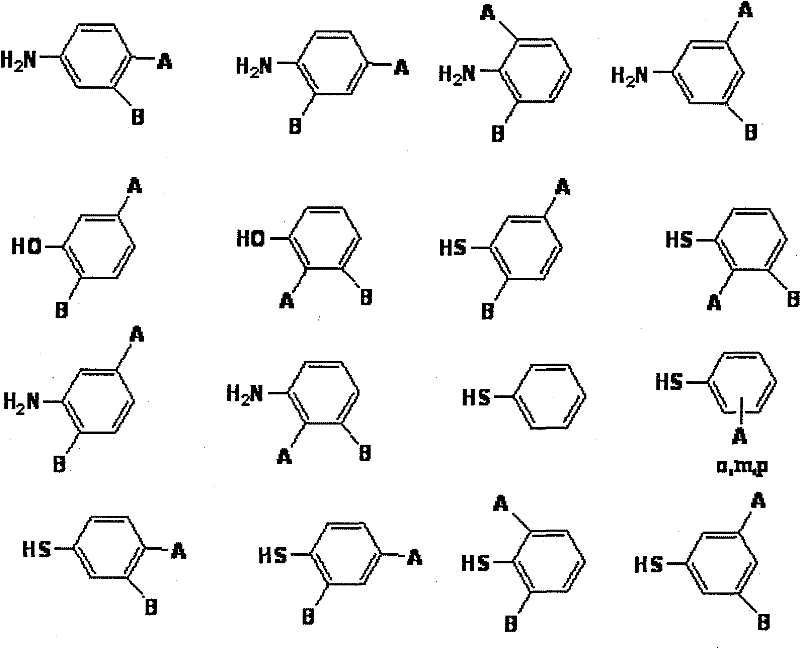
或为脂肪醇类化合物、硫醇类化合物、有机胺、酰胺、酰亚胺、环酰胺、内酰胺类化合物、咪唑、咪唑啉、脒、吡唑类化合物、1,2,4-三唑类化合物、活泼亚甲基类化合物、β-二羰基化合物、肟类化合物、无机酸类化合物、亚硫酸氢盐、磷酸氢盐或磷酸二氢盐去掉氢后剩余的部分,或为带羟基或氨基的邻苯二甲腈衍生物(CN200710049996.5)去掉氢后剩余的部分,以上结构式中A为(CH2)nCH3、Cl、F、Br、I、CN、NO2、CF3、NH2、OH、N(CH3)2、OCH3、COOH或COOC2H5等;B为(CH2)nCH3、Cl、F、Br、I、CN、NO2、CF3、NH2、OH、N(CH3)2、OCH3、COOH或COOC2H5等。 Or fatty alcohol compounds, thiol compounds, organic amines, amides, imides, cyclic amides, lactams, imidazoles, imidazolines, amidines, pyrazoles, 1,2,4-triazoles Compounds, active methylene compounds, β-dicarbonyl compounds, oxime compounds, inorganic acid compounds, bisulfites, hydrogen phosphates or dihydrogen phosphates after removing hydrogen, or the remaining part with hydroxyl or amino groups The phthalonitrile derivative (CN200710049996.5) is the remaining part after removing hydrogen. In the above structural formula, A is (CH 2 ) n CH 3 , Cl, F, Br, I, CN, NO 2 , CF 3 , NH 2 , OH, N(CH 3 ) 2 , OCH 3 , COOH or COOC 2 H 5 etc.; B is (CH 2 ) n CH 3 , Cl, F, Br, I, CN, NO 2 , CF 3 , NH 2 , OH, N(CH 3 ) 2 , OCH 3 , COOH or COOC 2 H 5 etc.
本发明提供的一种制备上述由端基交换获得的聚酰胺酰亚胺的方法,该方法的工艺步骤和条件如下: A kind of method for preparing the above-mentioned polyamide-imide obtained by end group exchange provided by the invention, the processing steps and conditions of the method are as follows:
(1)先将二异氰酸酯、含吸电子基团的酚类化合物以NCO基团与羟基按官能团的摩尔比为1∶1~1.2溶解于非极性溶剂中,再加入按二异氰酸酯质量计为0.1~3%的催化剂,然后在温度30~70℃下反应3~48h,沉淀过滤,干燥即得二异氰酸酯双封端产物,该产物的结构通式如下: (1) Dissolve diisocyanate and phenolic compounds containing electron-withdrawing groups in a non-polar solvent at a molar ratio of NCO groups and hydroxyl groups based on functional groups of 1:1 to 1.2, and then add 0.1-3% catalyst, then react at a temperature of 30-70°C for 3-48 hours, precipitate, filter, and dry to obtain a diisocyanate double-capped product. The general structure of the product is as follows:

式中的X为二异氰酸酯除去二异氰酸根后剩余的部分,R为带吸电子基团的酚类化合物除去氢后剩余的部分。 In the formula, X is the remaining part of the diisocyanate after removing the diisocyanate group, and R is the remaining part after the hydrogen is removed from the phenolic compound with electron-withdrawing groups. the
(2)先将偏苯三酸酐溶解于极性非质子溶剂中,再加入以偏苯三酸酐的摩尔计为1∶1~3的二异氰酸酯双封端产物和以二异氰酸酯双封端产物的质量计为0.1~3%的催化剂,使反应体系的固含量为10~60%(该固含量是指所加入的封端产物与偏苯三酸酐的总质量与溶剂体积的比值*100%),然后在70~100℃下反应0.5~2h,再升温至100~200℃,继续反应3~8h,倒入沉淀剂中沉淀,过滤、干燥即得封端的聚酰胺酰亚胺,该封端的聚酰胺酰亚胺的结构通式如下: (2) Dissolve trimellitic anhydride in a polar aprotic solvent first, then add the diisocyanate double-capped product of 1:1 to 3 based on the mole of trimellitic anhydride and 0.1 to 3 diisocyanate double-capped products based on the mass of the diisocyanate double-capped product % catalyst, so that the solid content of the reaction system is 10-60% (the solid content refers to the ratio of the total mass of the added end-capped product and trimellitic anhydride to the solvent volume*100%), and then react at 70-100°C 0.5~2h, then raise the temperature to 100~200°C, continue to react for 3~8h, pour into the precipitant to precipitate, filter and dry to get the capped polyamideimide, the general structure of the capped polyamideimide as follows:

式中的X为二异氰酸酯除去二异氰酸根后剩余的部分,R为带吸电子基团的酚类化合物除去氢后剩余的部分。 In the formula, X is the remaining part of the diisocyanate after removing the diisocyanate group, and R is the remaining part after the hydrogen is removed from the phenolic compound with electron-withdrawing groups. the
(3)先将封端的聚酰胺酰亚胺和以聚酰胺酰亚胺质量计为0.01~3%的催化剂溶解于极性非质子溶剂中,再将以聚酰胺酰亚胺质量计为1~10%的含活泼氢的化合物加入,使反应体系的固含量≥5%(该固含量是指加入的封端剂质量与溶剂体积的比值 *100%,且不论封端剂是液体或者固体),然后在室温~200℃下反应3~10h,倒入沉淀剂中沉淀,过滤、干燥即得最终产物。 (3) Dissolve the end-capped polyamideimide and the catalyst of 0.01% to 3% in terms of polyamideimide mass in a polar aprotic solvent, and then dissolve 1% to 3% in terms of polyamideimide mass 10% active hydrogen-containing compound is added to make the solid content of the reaction system ≥ 5% (the solid content refers to the ratio of the mass of the capping agent added to the volume of the solvent *100%, regardless of whether the capping agent is liquid or solid) , and then react at room temperature to 200°C for 3 to 10 hours, pour into a precipitating agent to precipitate, filter and dry to obtain the final product. the
本发明方法的合成路径为: The synthetic path of the inventive method is:

上述方法中所用的二异氰酸酯为二苯甲烷二异氰酸酯、六亚甲基二异氰酸酯、3,3′-二甲基-4,4′-联苯二异氰酸酯、甲苯-2,4-二异氰酸酯、二亚甲基苯二异氰酸酯、二聚脂肪酸二异氰酸酯、对四亚甲基二甲苯二异氰酸酯、1,5-萘二异氰酸酯、对苯二异氰酸酯、反式1,4-环己烷二异氰酸酯、氢化二苯基甲烷二异氰酸酯、异佛尔酮二异氰酸酯、四亚甲基二异氰酸酯等脂肪族二异氰酸酯、预聚物改性二苯甲烷二异氰酸酯、甲苯-2,6-二异氰酸酯或者含二异氰酸酯基团的预聚物中的任一种。 The diisocyanates used in the above method are diphenylmethane diisocyanate, hexamethylene diisocyanate, 3,3'-dimethyl-4,4'-biphenyl diisocyanate, toluene-2,4-diisocyanate, diisocyanate, Methylene phenylene diisocyanate, dimer fatty acid diisocyanate, p-tetramethylene xylene diisocyanate, 1,5-naphthalene diisocyanate, p-phenylene diisocyanate, trans 1,4-cyclohexane diisocyanate, hydrogenated diisocyanate Aliphatic diisocyanate such as phenylmethane diisocyanate, isophorone diisocyanate, tetramethylene diisocyanate, prepolymer modified diphenylmethane diisocyanate, toluene-2,6-diisocyanate or diisocyanate group-containing any of the prepolymers. the
上述方法中所用的含活泼氢的化合物为如下结构的化合物: The active hydrogen-containing compound used in the above-mentioned method is the compound of following structure:


或为脂肪醇类化合物或硫醇类化合物;或有机胺、酰胺、酰亚胺、环酰胺、内酰胺类化合物;咪唑、咪唑啉、脒、吡唑类和1,2,4-三唑类化合物;活泼亚甲基类化合物;β-二羰基化合物;肟类化合物;无机酸类化合物或亚硫酸氢盐、磷酸氢盐或磷酸二氢盐,也可以是带羟基或氨基的邻苯二甲腈衍生物(CN 200710049996.5),以上结构式中A为(CH2)nCH3、Cl、F、Br、I、CN、NO2、CF3、NH2、OH、N(CH3)2、OCH3、COOH或COOC2H5等;B为(CH2)nCH3、Cl、F、Br、I、CN、NO2、CF3、NH2、OH、N(CH3)2、OCH3、COOH或COOC2H5等。 Or fatty alcohol compounds or thiol compounds; or organic amines, amides, imides, cyclic amides, lactams; imidazoles, imidazolines, amidines, pyrazoles and 1,2,4-triazoles Compounds; Active methylene compounds; β-dicarbonyl compounds; Oxime compounds; Inorganic acid compounds or bisulfites, hydrogen phosphates or dihydrogen phosphates, or phthalates with hydroxyl or amino groups Nitrile derivatives (CN 200710049996.5), in the above structural formula, A is (CH 2 ) n CH 3 , Cl, F, Br, I, CN, NO 2 , CF 3 , NH 2 , OH, N(CH 3 ) 2 , OCH 3. COOH or COOC 2 H 5 etc.; B is (CH 2 ) n CH 3 , Cl, F, Br, I, CN, NO 2 , CF 3 , NH 2 , OH, N(CH 3 ) 2 , OCH 3 , COOH or COOC 2 H 5 etc.
上述方法中所用的含吸电子基团的酚类化合物为氯苯酚、硝基酚中的任一种。 The phenolic compound containing electron-withdrawing groups used in the above method is any one of chlorophenol and nitrophenol. the
上述方法中所用的催化剂选用二月桂酸二丁基锡、辛酸亚锡、三正丁胺、三乙烯二胺、环己胺盐或羧酸金属盐类化合物中的至少一种。 The catalyst used in the above method is selected from at least one of dibutyltin dilaurate, stannous octoate, tri-n-butylamine, triethylenediamine, cyclohexylamine salt or metal carboxylate compounds. the
上述方法中第(1)步反应所用的非极性溶剂选用苯、甲苯或二甲苯中的任一种;第(2)和(3)步反应所用的极性非质子溶剂选用丙酮、N,N—二甲基甲酰胺、N,N—二甲基乙酰胺、二甲基亚砜、N—甲基吡咯烷酮或乙腈中的任一种。 The used nonpolar solvent of (1) step reaction in the above-mentioned method is selected any one in benzene, toluene or dimethylbenzene; The used polar aprotic solvent of (2) and (3) step reaction is selected acetone, N, Any of N-dimethylformamide, N,N-dimethylacetamide, dimethyl sulfoxide, N-methylpyrrolidone or acetonitrile. the
本发明具有以下优点: The present invention has the following advantages:
1、由于本发明提供的由端基交换获得的聚酰胺酰亚胺不仅其端基种类繁多,而且分子量较高,储存稳定,因而极大地拓宽聚酰胺酰亚胺的使用范围,为电子、交通运输、信息、宇航材料和家用电器等领域的应用提供了较多可供选择的品种,以满足不同的需求。 1. Since the polyamide-imide obtained by end group exchange provided by the present invention not only has a wide variety of end groups, but also has a high molecular weight and stable storage, the application range of polyamide-imide is greatly expanded, and it is used for electronics, transportation Applications in the fields of transportation, information, aerospace materials, and household appliances provide more options to meet different needs. the
2、由于本发明提供的方法打破了传统的制备聚酰胺酰亚胺的的惯用路径,增加了一步端基交换工序,因而不仅合成了种类繁多,性能各异的聚酰胺酰亚胺,还可以制备一些用直接封端法难于制备的聚酰胺酰亚胺,拓展了聚酰胺酰亚胺的聚合方法。 2. Since the method provided by the present invention breaks the traditional conventional path for preparing polyamide-imides, and adds a step-end group exchange process, not only a wide variety of polyamide-imides with different properties can be synthesized, but also The preparation of some polyamide-imides which are difficult to prepare by the direct end-capping method expands the polymerization method of polyamide-imides.
3、本发明所使用的原料,包括含活泼氢的封端化合物来源广、价格便宜,因而使所得的聚酰胺酰亚胺制备方便、成本低廉。 3. The raw materials used in the present invention, including capping compounds containing active hydrogen, are widely sourced and cheap, so that the obtained polyamide-imide is prepared conveniently and at low cost. the
4、本发明方法制备的聚酰胺酰亚胺,与PI相比明显改善了溶解性和加工性能够溶解于常见极性非质子溶剂,而热性能又较PA有了极大的提高,TGA显示其具有较高的热分解温度和残碳,且聚合工艺简单,便于控制,反应过程释放的CO2对环境比较友好,不会腐蚀设备,副产物少,转化率高,适合于工业生产。 4. The polyamide-imide prepared by the method of the present invention has significantly improved solubility and processability compared with PI, can be dissolved in common polar aprotic solvents, and its thermal performance has been greatly improved compared with PA. TGA shows It has a high thermal decomposition temperature and carbon residue, and the polymerization process is simple and easy to control. The CO 2 released during the reaction is friendly to the environment, does not corrode equipment, has few by-products, and has a high conversion rate, which is suitable for industrial production.
5、本发明提供的端基交换的方法不仅适合于PAI的制备,还可用于聚氨酯等有二异氰酸酯基团参与反应的材料的合成,用途广泛。 5. The end group exchange method provided by the present invention is not only suitable for the preparation of PAI, but also can be used for the synthesis of polyurethane and other materials with diisocyanate groups participating in the reaction, and has a wide range of applications. the
具体实施方式 Detailed ways
下面给出实施例以对本发明作更详细的说明,有必要指出的是以下实施例不能理解为对发明保护范围的限制,该领域的技术熟练人员根据上述本发明内容对本发明作出的一些非本质的改进和调整,仍应属于本发明的保护范围。 The following examples are given to describe the present invention in more detail. It is necessary to point out that the following examples can not be interpreted as limiting the scope of the invention. Those skilled in the art will make some non-essential aspects of the present invention according to the above-mentioned contents of the present invention. Improvements and adjustments should still belong to the protection scope of the present invention. the
实施例1 Example 1
将20g(0.0799mol)二苯甲烷二异氰酸酯(MDI)、22.6g(0.176mol)对氯苯酚加入120ml的甲苯中溶解,在搅拌下滴加0.02g三正丁胺,然后在温度40℃下反应24h,体系有白色沉淀生成,过滤,收集沉淀(记作BMDI)并干燥。 Add 20g (0.0799mol) of diphenylmethane diisocyanate (MDI) and 22.6g (0.176mol) of p-chlorophenol into 120ml of toluene to dissolve, add 0.02g of tri-n-butylamine dropwise under stirring, and then react at a temperature of 40°C After 24 hours, a white precipitate was formed in the system, which was filtered, and the precipitate (referred to as BMDI) was collected and dried. the
将1.92g(0.01mol)偏苯三酸酐,用60ml N-甲基吡咯烷酮溶解,然后加入10.14g(0.02mol)BMDI并滴加0.0101g三正丁胺,然后在80℃下反应0.5h,随即升温至120℃继续反应3h,将反应液倒入2000ml自来水中沉淀,过滤,得到对氯苯酚封端的聚酰胺酰亚胺(记作PAI-1)并干燥。 Dissolve 1.92g (0.01mol) of trimellitic anhydride with 60ml of N-methylpyrrolidone, then add 10.14g (0.02mol) of BMDI and dropwise add 0.0101g of tri-n-butylamine, then react at 80°C for 0.5h, then raise the temperature to 120°C Continue to react at ℃ for 3h, pour the reaction solution into 2000ml tap water to precipitate, filter to obtain p-chlorophenol-terminated polyamideimide (referred to as PAI-1) and dry it. the
将2g PAI-1和0.02g苯酚,用40.4ml N-甲基吡咯烷酮溶解后,加入0.002g三正丁胺,然后升温至80℃反应3h,将反应液倒入2000ml自来水中沉淀,过滤,干燥即得苯酚封端的聚酰胺酰亚胺。 Dissolve 2g of PAI-1 and 0.02g of phenol with 40.4ml of N-methylpyrrolidone, add 0.002g of tri-n-butylamine, then raise the temperature to 80°C for 3 hours, pour the reaction solution into 2000ml of tap water to precipitate, filter, and dry That is, a phenol-terminated polyamideimide is obtained. the
实施例2 Example 2
将12.79g(0.0799mol)对苯二异氰酸酯(PPDI)、24.5g(0.176mol)对硝基酚加入120ml的苯中溶解,在搅拌下滴加0.1279g三正丁胺,然后在温度40℃下反应20h,体系有白色沉淀生成,过滤,收集沉淀(记作BPPDI)并干燥。 Add 12.79g (0.0799mol) of p-phenylene diisocyanate (PPDI) and 24.5g (0.176mol) of p-nitrophenol into 120ml of benzene to dissolve, add 0.1279g of tri-n-butylamine dropwise under stirring, and then at a temperature of 40°C After 20 hours of reaction, a white precipitate was formed in the system, which was filtered, and the precipitate (referred to as BPPDI) was collected and dried. the
将1.92g(0.01mol)偏苯三酸酐,用31ml N—二甲基甲酰胺(DMF)溶解,然后加入4.22g(0.01mol)BPPDI并滴加0.0844g辛酸亚锡,然后在90℃下反应1h,随即升温至130℃继续反应5h,将反应液倒入2000ml自来水中沉淀,过滤,得到对硝基酚封端的聚酰胺酰亚胺(记作PAI-1)并干燥。 Dissolve 1.92g (0.01mol) trimellitic anhydride with 31ml N-dimethylformamide (DMF), then add 4.22g (0.01mol) BPPDI and drop 0.0844g stannous octoate, then react at 90°C for 1h, then The temperature was raised to 130° C. to continue the reaction for 5 h, the reaction solution was poured into 2000 ml tap water to precipitate, filtered, and p-nitrophenol-terminated polyamideimide (referred to as PAI-1) was obtained and dried.
将2g PAI-1和0.2g苯甲醇,用22ml N-甲基吡咯烷酮溶解后,加入0.02g三正丁胺,然后升温至120℃反应5h,将反应液倒入2000ml自来水中沉淀,过滤,干燥即得苯甲醇封端的聚酰胺酰亚胺。 Dissolve 2g of PAI-1 and 0.2g of benzyl alcohol in 22ml of N-methylpyrrolidone, add 0.02g of tri-n-butylamine, then raise the temperature to 120°C for 5 hours, pour the reaction solution into 2000ml of tap water to precipitate, filter and dry That is, benzyl alcohol-terminated polyamideimide is obtained. the
实施例3 Example 3
将20g(0.0799mol)二苯甲烷二异氰酸酯(MDI)、24.5g(0.176mol)对硝基酚加入120ml的甲苯中溶解,在搅拌下滴加0.4g辛酸亚锡,然后在温度30℃下反应14h,体系有白色沉淀生成,过滤,收集沉淀(记作BMDI)并干燥。 Add 20g (0.0799mol) of diphenylmethane diisocyanate (MDI) and 24.5g (0.176mol) of p-nitrophenol into 120ml of toluene to dissolve, add 0.4g of stannous octoate dropwise under stirring, and then react at a temperature of 30°C After 14 hours, a white precipitate was formed in the system, which was filtered, and the precipitate (referred to as BMDI) was collected and dried. the
将1.92g(0.01mol)偏苯三酸酐,用59ml二甲基亚砜(NMSO)溶解,然后加入15.85g(0.03mol)BMDI并滴加0.317g辛酸亚锡,然后在70℃下反应2h,随即升温至120℃继续反应8h,将反应液倒入2000ml自来水中沉淀,过滤,得到对硝基酚封端的聚酰胺酰亚胺(记作PAI-1)并干燥。 Dissolve 1.92g (0.01mol) of trimellitic anhydride with 59ml of dimethyl sulfoxide (NMSO), then add 15.85g (0.03mol) of BMDI and dropwise add 0.317g of stannous octoate, then react at 70°C for 2h, then heat up to The reaction was continued at 120°C for 8 hours, the reaction solution was poured into 2000ml of tap water to precipitate, filtered, and p-nitrophenol-terminated polyamideimide (referred to as PAI-1) was obtained and dried. the
将2g PAI-1和0.04g己内酰胺,用13.5ml N,N—二甲基甲酰胺(DMF)溶解后,加入0.04g辛酸亚锡,然后升温至80℃反应8h,将反应液倒入2000ml自来水中沉淀,过滤,干燥即得己内酰胺封端的聚酰胺酰亚胺。 Dissolve 2g of PAI-1 and 0.04g of caprolactam with 13.5ml of N,N-dimethylformamide (DMF), add 0.04g of stannous octoate, then raise the temperature to 80°C for 8 hours, and pour the reaction solution into 2000ml of tap water Precipitate in medium, filter and dry to obtain caprolactam-terminated polyamide-imide. the
实施例4 Example 4
将13.92g(0.0799mol)2,4-甲苯二异氰酸酯(TDI)、22.6g(0.176mol)对氯苯酚加入62ml的甲苯中溶解,在搅拌下滴加0.0696g三正丁胺,然后在温度40℃下反应24h,体系有白色沉淀生成,过滤,收集沉淀(记作BTDI)并干燥。 Add 13.92g (0.0799mol) of 2,4-toluene diisocyanate (TDI), 22.6g (0.176mol) of p-chlorophenol to dissolve in 62ml of toluene, add 0.0696g of tri-n-butylamine dropwise under stirring, and then at a temperature of 40 After reacting at ℃ for 24 hours, a white precipitate was formed in the system, which was filtered, and the precipitate (referred to as BTDI) was collected and dried. the
将1.92g(0.01mol)偏苯三酸酐,用40ml N-甲基吡咯烷酮(NMP)溶解,然后加入4.31g(0.01mol)BTDI并滴加0.0215g三正丁胺,然后在80℃下反应0.5h,随即升温至170℃继续反应4h,将反应液倒入2000ml自来水中沉淀,过滤,得到对氯苯酚封端的聚酰胺酰亚胺(记作PAI-1)并干燥。 Dissolve 1.92g (0.01mol) of trimellitic anhydride with 40ml of N-methylpyrrolidone (NMP), then add 4.31g (0.01mol) of BTDI and dropwise add 0.0215g of tri-n-butylamine, then react at 80°C for 0.5h, then The temperature was raised to 170° C. to continue the reaction for 4 hours, and the reaction solution was poured into 2000 ml of tap water to precipitate, filtered to obtain p-chlorophenol-terminated polyamide-imide (referred to as PAI-1) and dried. the
将2g PAI-1和0.1g对甲酚,用10.5ml N-甲基吡咯烷酮(NMP)溶解后,加入0.01g三正丁胺,然后升温至180℃反应10h,将反应液倒入2000ml自来水中沉淀,过滤,干燥即得对甲酚封端的聚酰胺酰亚胺。 Dissolve 2g of PAI-1 and 0.1g of p-cresol with 10.5ml of N-methylpyrrolidone (NMP), add 0.01g of tri-n-butylamine, then raise the temperature to 180°C for 10 hours, and pour the reaction solution into 2000ml of tap water Precipitate, filter, and dry to obtain p-cresol-terminated polyamideimide. the
实施例5 Example 5
将13.44g(0.0799mol)六亚甲基二异氰酸酯(HDI)、22.6g(0.176mol)对氯苯酚加入120ml的甲苯中溶解,在搅拌下滴加0.0134g三正丁胺,然后在温度40℃下反应24h,体系有白色沉淀生成,过滤,收集沉淀(记作BHDI)并干燥。 Add 13.44g (0.0799mol) of hexamethylene diisocyanate (HDI) and 22.6g (0.176mol) of p-chlorophenol into 120ml of toluene to dissolve, add 0.0134g of tri-n-butylamine dropwise under stirring, and then at a temperature of 40°C After 24 hours of reaction, a white precipitate was formed in the system, which was filtered, and the precipitate (referred to as BHDI) was collected and dried. the
将1.92g(0.01mol)偏苯三酸酐,用52ml N,N—二甲基乙酰胺(DMAc)溶解,然后加入8.51g(0.02mol)BHDI并滴加0.0085g三正丁胺,然后在80℃下反应1h, 随即升温至140℃继续反应6h,将反应液倒入2000ml自来水中沉淀,过滤,得到对氯苯酚封端的聚酰胺酰亚胺(记作PAI-1)并干燥。 Dissolve 1.92g (0.01mol) of trimellitic anhydride with 52ml of N,N-dimethylacetamide (DMAc), then add 8.51g (0.02mol) of BHDI and dropwise add 0.0085g of tri-n-butylamine, then react at 80°C After 1 hour, the temperature was raised to 140° C. to continue the reaction for 6 hours. The reaction liquid was poured into 2000 ml of tap water for precipitation, filtered to obtain p-chlorophenol-terminated polyamide-imide (referred to as PAI-1) and dried. the
将2g PAI-1和0.12g苯胺,用8.5mlN-甲基吡咯烷酮(NMP)溶解后,加入0.002g三正丁胺,然后升温至80℃反应8h,将反应液倒入2000ml自来水中沉淀,过滤,干燥即得苯胺封端的聚酰胺酰亚胺。 Dissolve 2g of PAI-1 and 0.12g of aniline with 8.5ml of N-methylpyrrolidone (NMP), add 0.002g of tri-n-butylamine, then raise the temperature to 80°C for 8 hours, pour the reaction solution into 2000ml of tap water to precipitate, filter , drying to obtain aniline-terminated polyamide-imide. the
实施例6 Example 6
将20g(0.0799mol)二苯甲烷二异氰酸酯(MDI)、24.5g(0.176mol)对硝基酚加入120ml的甲苯中溶解,在搅拌下滴加0.6g二月桂酸二丁基锡,然后在温度50℃下反应3h,体系有白色沉淀生成,过滤,收集沉淀(记作BMDI)并干燥。 Add 20g (0.0799mol) of diphenylmethane diisocyanate (MDI), 24.5g (0.176mol) of p-nitrophenol into 120ml of toluene to dissolve, add 0.6g of dibutyltin dilaurate dropwise under stirring, and then at a temperature of 50°C After 3 hours of reaction, a white precipitate was formed in the system, which was filtered, and the precipitate (referred to as BMDI) was collected and dried. the
将1.92g(0.01mol)偏苯三酸酐,用31ml N-甲基吡咯烷酮(NMP)溶解,然后加入10.57g(0.02mol)BMDI并滴加0.3171g二月桂酸二丁基锡,然后在80℃下反应0.5h,随即升温至150℃继续反应4h,将反应液倒入2000ml自来水中沉淀,过滤,得到对硝基酚封端的聚酰胺酰亚胺(记作PAI-1)并干燥。 Dissolve 1.92g (0.01mol) of trimellitic anhydride with 31ml of N-methylpyrrolidone (NMP), then add 10.57g (0.02mol) of BMDI and dropwise add 0.3171g of dibutyltin dilaurate, then react at 80°C for 0.5h, Then the temperature was raised to 150° C. to continue the reaction for 4 h, the reaction solution was poured into 2000 ml tap water to precipitate, filtered, and p-nitrophenol-terminated polyamide-imide (referred to as PAI-1) was obtained and dried. the
将2g PAI-1和0.14g对氯苯酚,用7ml N,N—二甲基乙酰胺(DMAc)溶解后,加入0.06g二月桂酸二丁基锡,然后升温至70℃反应9h,将反应液倒入2000ml自来水中沉淀,过滤,干燥即得对氯苯酚封端的聚酰胺酰亚胺。 Dissolve 2g of PAI-1 and 0.14g of p-chlorophenol with 7ml of N,N-dimethylacetamide (DMAc), add 0.06g of dibutyltin dilaurate, then raise the temperature to 70°C for 9 hours, pour the reaction solution Pour into 2000ml tap water to precipitate, filter, and dry to obtain p-chlorophenol-terminated polyamideimide. the
实施例7 Example 7
将13.44g(0.0799mol)六亚甲基二异氰酸酯(HDI)、22.6g(0.176mol)对硝基酚加入120ml的二甲苯中溶解,在搅拌下滴加0.04g辛酸亚锡,然后在温度50℃下反应8h,体系有白色沉淀生成,过滤,收集沉淀(记作BHDI)并干燥。 Add 13.44g (0.0799mol) of hexamethylene diisocyanate (HDI), 22.6g (0.176mol) of p-nitrophenol to dissolve in 120ml of xylene, add 0.04g of stannous octoate dropwise under stirring, and then at a temperature of 50 After reacting at ℃ for 8 hours, a white precipitate was formed in the system, which was filtered, and the precipitate (referred to as BHDI) was collected and dried. the
将1.92g(0.01mol)偏苯三酸酐,用25ml N-甲基吡咯烷酮(NMP)溶解,然后加入12.91g(0.03mol)BHDI并滴加0.1291g三正丁胺,然后在80℃下反应0.5h,随即升温至100℃继续反应4h,将反应液倒入2000ml自来水中沉淀,过滤,得到对硝基酚封端的聚酰胺酰亚胺(记作PAI-1)并干燥。 Dissolve 1.92g (0.01mol) of trimellitic anhydride with 25ml of N-methylpyrrolidone (NMP), then add 12.91g (0.03mol) of BHDI and dropwise add 0.1291g of tri-n-butylamine, then react at 80°C for 0.5h, then The temperature was raised to 100° C. to continue the reaction for 4 h, and the reaction solution was poured into 2000 ml of tap water to precipitate, filtered, and p-nitrophenol-terminated polyamideimide (referred to as PAI-1) was obtained and dried. the
将2g PAI-1和0.16g乙醇,用43ml N-甲基吡咯烷酮(NMP)溶解后,加入0.004g二月桂酸二丁基锡,然后升温至200℃反应8h,将反应液倒入2000ml自来水中沉淀,过滤,干燥即得乙醇封端的聚酰胺酰亚胺。 Dissolve 2g of PAI-1 and 0.16g of ethanol with 43ml of N-methylpyrrolidone (NMP), add 0.004g of dibutyltin dilaurate, then raise the temperature to 200°C for 8 hours, pour the reaction solution into 2000ml of tap water for precipitation, Filter and dry to obtain ethanol-terminated polyamideimide. the
实施例8 Example 8
将20g(0.0799mol)二苯甲烷二异氰酸酯(MDI)、24.7g(0.192mol)对氯苯酚加入120ml的二甲苯中溶解,在搅拌下滴加0.04g二月桂酸二丁基锡,然后在温度70℃下反应24h,体系有白色沉淀生成,过滤,收集沉淀(记作BMDI)并干燥。 Add 20g (0.0799mol) of diphenylmethane diisocyanate (MDI) and 24.7g (0.192mol) of p-chlorophenol into 120ml of xylene to dissolve, add 0.04g of dibutyltin dilaurate dropwise under stirring, and then at a temperature of 70°C After 24 hours of reaction, a white precipitate was formed in the system, which was filtered, and the precipitate (referred to as BMDI) was collected and dried.
将1.92g(0.01mol)偏苯三酸酐,用60ml乙腈溶解,然后加入10.14g(0.02mol)BMDI并滴加0.0202g二月桂酸二丁基锡,然后在80℃下反应0.5h,随即升温至200℃继续反应4h,将反应液倒入2000ml自来水中沉淀,过滤,得到对氯苯酚封端的聚酰胺酰亚胺(记作PAI-1)并干燥。 Dissolve 1.92g (0.01mol) of trimellitic anhydride in 60ml of acetonitrile, then add 10.14g (0.02mol) of BMDI and dropwise add 0.0202g of dibutyltin dilaurate, then react at 80°C for 0.5h, then raise the temperature to 200°C to continue the reaction After 4 hours, the reaction solution was poured into 2000ml tap water to precipitate, filtered to obtain p-chlorophenol-terminated polyamide-imide (referred to as PAI-1) and dried. the
将2g PAI-1和0.06g3-羟基邻苯二甲腈,用20.6ml N-甲基吡咯烷酮(NMP)溶解后,加入0.004g辛酸亚锡,然后升温至50℃反应7h,将反应液倒入2000ml自来水中沉淀,过滤,干燥即得3-羟基邻苯二甲腈封端的聚酰胺酰亚胺。 Dissolve 2g of PAI-1 and 0.06g of 3-hydroxyphthalonitrile with 20.6ml of N-methylpyrrolidone (NMP), add 0.004g of stannous octoate, then raise the temperature to 50°C for 7 hours, pour the reaction solution into Precipitate in 2000ml of tap water, filter, and dry to obtain 3-hydroxyphthalonitrile-terminated polyamideimide. the
实施例9 Example 9
将20g(0.0799mol)二苯甲烷二异氰酸酯(MDI)、20.5g(0.16mol)对氯苯酚加入120ml的苯中溶解,在搅拌下滴加0.04g辛酸亚锡,然后在温度50℃下反应48h,体系有白色沉淀生成,过滤,收集沉淀(记作BMDI)并干燥。 Add 20g (0.0799mol) of diphenylmethane diisocyanate (MDI) and 20.5g (0.16mol) of p-chlorophenol into 120ml of benzene to dissolve, add 0.04g of stannous octoate dropwise under stirring, and then react at a temperature of 50°C for 48h , a white precipitate formed in the system, filtered, collected the precipitate (denoted as BMDI) and dried. the
将1.92g(0.01mol)偏苯三酸酐,用24ml N-甲基吡咯烷酮(NMP)溶解,然后加入10.14g(0.02mol)BMDI并滴加0.0202g辛酸亚锡,然后在100℃下反应0.5h,随即升温至130℃继续反应4h,将反应液倒入2000ml自来水中沉淀,过滤,得到对氯苯酚封端的聚酰胺酰亚胺(记作PAI-1)并干燥。 Dissolve 1.92g (0.01mol) of trimellitic anhydride with 24ml of N-methylpyrrolidone (NMP), then add 10.14g (0.02mol) of BMDI and dropwise add 0.0202g of stannous octoate, then react at 100°C for 0.5h, then heat up The reaction was continued at 130° C. for 4 h, and the reaction solution was poured into 2000 ml of tap water to precipitate, filtered, and p-chlorophenol-terminated polyamide-imide (referred to as PAI-1) was obtained and dried. the
将2g PAI-1和0.02g NaHSO3,用40.4ml N,N—二甲基甲酰胺(DMF)溶解后,加入0.004g辛酸亚锡,然后升温至140℃反应10h,将反应液倒入2000ml石油醚中沉淀,过滤,干燥即得NaHSO3封端的聚酰胺酰亚胺。 Dissolve 2g of PAI-1 and 0.02g of NaHSO 3 with 40.4ml of N,N-dimethylformamide (DMF), add 0.004g of stannous octoate, then raise the temperature to 140°C for 10 hours, and pour the reaction solution into 2000ml Precipitate in petroleum ether, filter, and dry to obtain NaHSO 3 -capped polyamideimide.
实施例10 Example 10
将20g(0.0799mol)二苯甲烷二异氰酸酯(MDI)、22.6g(0.176mol)对氯苯酚加入120ml的苯中溶解,在搅拌下滴加0.08g三正丁胺和辛酸亚锡(质量比1∶1),然后在温度40℃下反应12h,体系有白色沉淀生成,过滤,收集沉淀(记作BMDI)并干燥。 Add 20g (0.0799mol) diphenylmethane diisocyanate (MDI), 22.6g (0.176mol) p-chlorophenol to dissolve in 120ml of benzene, add dropwise 0.08g tri-n-butylamine and stannous octoate (mass ratio 1 : 1), and then reacted at a temperature of 40° C. for 12 h, a white precipitate was formed in the system, filtered, and the precipitate (referred to as BMDI) was collected and dried. the
将1.92g(0.01mol)偏苯三酸酐,用60ml N-甲基吡咯烷酮(NMP)溶解,然后加入10.14g(0.02mol)BMDI并滴加0.0202g三正丁胺和辛酸亚锡(质量比1∶1),然后在70℃下反应0.5h,随即升温至140℃继续反应4h,将反应液倒入2000ml自来水中沉淀,过滤,得到对氯苯酚封端的聚酰胺酰亚胺(记作PAI-1)并干燥。 Dissolve 1.92g (0.01mol) of trimellitic anhydride with 60ml of N-methylpyrrolidone (NMP), then add 10.14g (0.02mol) of BMDI and dropwise add 0.0202g of tri-n-butylamine and stannous octoate (mass ratio 1:1) , then reacted at 70°C for 0.5h, then raised the temperature to 140°C to continue the reaction for 4h, poured the reaction solution into 2000ml tap water to precipitate, filtered to obtain polyamideimide terminated by p-chlorophenol (referred to as PAI-1) and dry. the
将2g PAI-1和0.2g苯甲酸,用22ml乙腈溶解后,加入0.004g辛酸亚锡和三正丁胺(质量比1∶1),然后升温至140℃反应8h,将反应液倒入2000ml自来水中沉淀,过滤,干燥即得苯甲酸封端的聚酰胺酰亚胺。 Dissolve 2g of PAI-1 and 0.2g of benzoic acid in 22ml of acetonitrile, add 0.004g of stannous octoate and tri-n-butylamine (mass ratio 1:1), then raise the temperature to 140°C for 8 hours, and pour the reaction solution into 2000ml Precipitate in tap water, filter, and dry to obtain benzoic acid-terminated polyamide-imide.
Claims (5)


Priority Applications (1)
| Application Number | Priority Date | Filing Date | Title |
|---|---|---|---|
| CN2008101477794A CN101434701B (en) | 2008-12-08 | 2008-12-08 | Polyamideimide obtained by end group exchange and its preparation method |
Applications Claiming Priority (1)
| Application Number | Priority Date | Filing Date | Title |
|---|---|---|---|
| CN2008101477794A CN101434701B (en) | 2008-12-08 | 2008-12-08 | Polyamideimide obtained by end group exchange and its preparation method |
Publications (2)
| Publication Number | Publication Date |
|---|---|
| CN101434701A CN101434701A (en) | 2009-05-20 |
| CN101434701B true CN101434701B (en) | 2012-02-08 |
Family
ID=40709346
Family Applications (1)
| Application Number | Title | Priority Date | Filing Date |
|---|---|---|---|
| CN2008101477794A Expired - Fee Related CN101434701B (en) | 2008-12-08 | 2008-12-08 | Polyamideimide obtained by end group exchange and its preparation method |
Country Status (1)
| Country | Link |
|---|---|
| CN (1) | CN101434701B (en) |
Families Citing this family (4)
| Publication number | Priority date | Publication date | Assignee | Title |
|---|---|---|---|---|
| CN101735111B (en) * | 2009-12-31 | 2011-12-14 | 江苏恒祥化工有限责任公司 | Method for synthesizing trans-1,4-cyclohexane diisocyanate |
| KR101984171B1 (en) * | 2016-06-01 | 2019-05-30 | 주식회사 엘지화학 | High strength transparent polyamide-imide and process for preparing same |
| TWI670295B (en) * | 2018-08-20 | 2019-09-01 | 財團法人紡織產業綜合研究所 | Polyamide-imide and method of preparing the same |
| CN110258118B (en) * | 2019-07-12 | 2021-07-13 | 开封大学 | Water-soluble and temperature-resistant carbon fiber sizing agent and preparation method thereof |
Citations (1)
| Publication number | Priority date | Publication date | Assignee | Title |
|---|---|---|---|---|
| CN101228303A (en) * | 2005-07-29 | 2008-07-23 | 东洋纺织株式会社 | Polyamide-imide fiber, nonwoven fabric composed of same, method for producing same, and separator for electronic parts |
-
2008
- 2008-12-08 CN CN2008101477794A patent/CN101434701B/en not_active Expired - Fee Related
Patent Citations (1)
| Publication number | Priority date | Publication date | Assignee | Title |
|---|---|---|---|---|
| CN101228303A (en) * | 2005-07-29 | 2008-07-23 | 东洋纺织株式会社 | Polyamide-imide fiber, nonwoven fabric composed of same, method for producing same, and separator for electronic parts |
Non-Patent Citations (1)
| Title |
|---|
| 刘德辉等.端基封闭法合成聚酰胺酰亚胺.《绝缘材料》.2002,(第1期),9-11. * |
Also Published As
| Publication number | Publication date |
|---|---|
| CN101434701A (en) | 2009-05-20 |
Similar Documents
| Publication | Publication Date | Title |
|---|---|---|
| CN103732655B (en) | Crystalline thermoplastic polyimide resin | |
| Liu et al. | Synthesis, characterization and properties of polyimides derived from a symmetrical diamine containing bis-benzimidazole rings | |
| US10150848B2 (en) | Polymer cellulose nanocrystal composite aerogels | |
| CN102399357B (en) | Method for preparing multi-block nylon polyurethane elastomer | |
| CN102099398B (en) | Preparation method of polyamideimide, polyamideimide and composition containing the polyamideimide | |
| CN102884107B (en) | Process for producing wholly aromatic polyimide resin having improved heat resistance and elongation in high temperature range | |
| EP2006332A1 (en) | Resin composition and method for producing same | |
| CN101434701B (en) | Polyamideimide obtained by end group exchange and its preparation method | |
| Saxena et al. | Synthesis and characterization of polyamides and poly (amide–imide) s derived from 2, 2-bis (4-aminophenoxy) benzonitrile | |
| CN102041576B (en) | A kind of polyimide fiber and preparation method thereof | |
| EP2791208A1 (en) | Low toxicity solvent system for polyamideimide resins and solvent system manufacture | |
| CN113136017B (en) | Polyurethane with pH response and self-healing performance and preparation method thereof | |
| TW201221551A (en) | Molded article of polyamide resin | |
| CN101423607A (en) | Thermoplastic poly(ether-ether-ketone) type polyimide and preparation method thereof | |
| CN105860009A (en) | Polyurethane with electron withdrawing structure and preparation method thereof | |
| CN102993070A (en) | Aromatic diamine containing phthalonitrile side group and synthesis method and application thereof | |
| Barikani et al. | Preparation and properties of polyimides and polyamide‐imides from diisocyanates | |
| CN104870522A (en) | Thermoplastic polyimide | |
| Xia et al. | Synthesis and characterization of high‐performance polyimides based on 6, 4′‐diamino‐2‐phenylbenzimidazole | |
| CN104945625B (en) | A kind of synthetic method of high molecular weight high-heat performance polyimides | |
| Sadavarte et al. | Regularly alternating poly (amideimide) s containing pendent pentadecyl chains: Synthesis and characterization | |
| CN109942825A (en) | A kind of polyureas-polyimide block copolymer's Moulding powder and preparation method thereof | |
| Liaw et al. | Synthesis and characterization of new soluble cardo poly (amide–imide) s derived from 2, 2-bis [4-(4-trimellitimidophenoxy) phenyl] norbornane | |
| CN101503512A (en) | Semi-aromatic polyamide and preparation thereof | |
| Maiti et al. | Processable heat‐resistant polymers. XIII. Structure–property relationship in polyamideimides |
Legal Events
| Date | Code | Title | Description |
|---|---|---|---|
| C06 | Publication | ||
| PB01 | Publication | ||
| C10 | Entry into substantive examination | ||
| SE01 | Entry into force of request for substantive examination | ||
| C14 | Grant of patent or utility model | ||
| GR01 | Patent grant | ||
| CF01 | Termination of patent right due to non-payment of annual fee | ||
| CF01 | Termination of patent right due to non-payment of annual fee |
Granted publication date: 20120208 Termination date: 20161208 |