Detailed Description
The following describes the implementation of the present invention with reference to specific embodiments.
IGMP Snooping (multicast data forwarding is realized by intercepting IGMP messages) operates in the two layers of the router, namely a link layer, and the output port information of the multicast messages is maintained by intercepting the multicast protocol messages sent between the upper layer router and the host, so that the forwarding of the multicast data messages is managed and controlled, and the two-layer multicast is realized.
The multicast source protection method of the embodiment of the invention can be a PW (Pseudo Wire) -based multicast source protection method, which mainly comprises the steps of configuring a pair of PWs on PE (provider edge) equipment as a protection group, wherein the protection group is positioned between a multicast source and a receiver (such as the PE equipment); each PW can receive the same multicast data stream simultaneously or successively; one PW in the protection group is used as a working PW to forward an IGMP protocol message, and multicast data is forwarded according to a two-layer multicast forwarding table; another PW in the protection group is used as a backup PW, the received data is discarded, and an IGMP protocol message is forwarded; configuring Eth-OAM on PE to detect whether the link from the local terminal to the multicast source is normal; and when the Eth-OAM detects that the working link fails, switching the main PW and the standby PW to ensure that the multicast service of the user is not interrupted.
Please refer to fig. 3, which is a networking diagram of a PW-based multicast source protection method according to an embodiment of the present invention. As shown in fig. 3, PE1, PE2, and PE3 belong to the same VPLS network, establish the same VSI, PE1 and PE2 establish PW _1, PE1 and PE3 establish PW _2, PE1 configures PW _2 as a backup tunnel of PW _1, and PE1 configures and detects whether links passing through PW _1 and PW _2 to Router1 are normal. Multicast data from a multicast source is duplicated at Router1 into PW _1 of PE2 and PW _2 of PE3, respectively. PE1 receives the two copies of data simultaneously or sequentially, selects one of them to forward to the user, and discards the other. Assume that the data of PW _1 is selected in the initial state. If PE2 fails, a link from PW _1 to Router1 is detected to fail on PE1, and PE1 reselects to receive data transmitted from PW _2 at this time, so that the user application is not affected. Therefore, the protection function of the multicast source can be arranged on the PE equipment, two pieces of equipment are reduced, and networking is simplified.
As shown in fig. 4, PE1, PE2, and PE3 belong to the same VPLS network, establish the same VSI, PE1 and PE2 establish PW _1, PE1 and PE3 establish PW _2, PE1 configures PW _2 as a backup channel of PW _1, and PE1 configures and detects whether links to Router1 respectively passing through PW _1 and PW _2 are normal. Two independent multicast sources 1 and 2 send identical multicast data to PW _1 of PE2 and PW _2 of PE3 respectively. The two data are received simultaneously or sequentially at PE1, one of which is selected for forwarding to the user and the other is discarded. Assume that the data for PW _1 is initially selected. If PE2 fails, it is detected at PE1 that the link from PW _1 to Router1 fails, and PE1 reselects to receive the data transmitted from PW _2, so as to ensure that the user application is not affected. As shown in fig. 4, the reliability is higher by using two independent multicast sources 1 and 2 for data transmission.
In the embodiment of the method for protecting a multicast source based on a PW, two or more PWs may be configured to form a protection group when configuring a PW protection group, and the configuration is not limited to be deployed on a PE of a backbone network edge device, and may also be deployed on a device with a similar function; configuring Eth-OAM on PE to detect whether the link from the local end to the multicast source is normal or not can be realized by detecting whether the working PW works normally or not, and correspondingly, when Eth-OAM detects that the working link fails, switching between the main PW and the standby PW is performed, or when the working PW fails, switching between the main PW and the standby PW is performed. The backbone edge device PE may be a carrier edge router or other device with similar functionality.
When more than two PWs are configured to form a protection group, determining a working PW, and the rest of the PWs are backup PWs, if a link connected with a multicast source through the working PW fails, selecting one of the backup PWs as a new working PW according to a certain preset strategy, for example, the backup PWs are preset with priorities, and when the master-backup switching occurs, the backup PW with the high priority is preferentially used as the new working PW; or, when the working PW fails, a new working PW may be reselected according to the load condition and/or the resource condition of each backup PW.
When a VPLS network is deployed in a network convergence layer, a router supports an IGMP Snooping function under a VSI (Virtual Switch Instance), and a router also supports the IGMP Snooping function in a VPLS over TE network. In the ethernet VPLS service environment, the PE device maintains a virtual Switch instance vsi (virtual Switch instance). The virtual switch instance is essentially a two-layer forwarding table unique to each customer VPLS. Provider PE (Provider Edge Device) devices create independent VSI tables based on forwarding information needed for ethernet frame exchange within a particular VPLS VPN. MAC (Media Access Control) address learning can be realized by the VSI of the PE. When there is new forwarding information, the MAC address is updated.
The multicast source protection method of the embodiment of the invention can be multicast source protection based on VSI, and mainly comprises the steps of configuring a pair of VSIs on PE equipment as a protection group, wherein the protection group is positioned between a multicast source and a receiver (such as the PE equipment); each VSI may receive the same multicast data stream; one VSI in the protection group is used as a working VSI, an IGMP protocol message is forwarded, and multicast data is forwarded according to a two-layer multicast forwarding table; another VSI in the protection group is used as a backup VSI, the received data are discarded, and an IGMP protocol message is forwarded; configuring Eth-OAM on PE to detect whether the link from the local terminal to the multicast source is normal; and when the Eth-OAM detects that the working link fails, switching the main VSI and the standby VSI, and ensuring that the multicast service of the user is not interrupted.
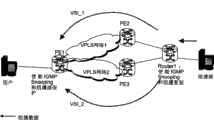
Fig. 5 shows an implementation manner of a multicast source protection method based on VSI according to an embodiment of the present invention, where VSI _1 is established between PE1 and PE2, VSI _2 is established between PE1 and PE3, VSI _2 is configured on PE1 as a backup channel of VSI _1, and meanwhile, PE1 is configured to detect whether links to Router1 respectively via VSI _1 and VSI _2 are normal. The multicast data from the multicast source is duplicated on Router1 and enters VSI _1 of PE2 and VSI _2 of PE3 respectively. The two data are received on the PE1 simultaneously or successively, one of the two data is selected to be forwarded to the user, and the other data is discarded. Assume that data from VSI _1 is initially selected.
If PE2 fails, PE1 detects that a link from VSI _1 to Router1 fails, and PE1 reselects to receive data transmitted from VSI _2 at the moment, so that user application is not affected.
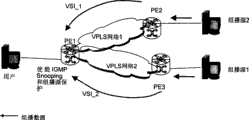
Another embodiment of the multicast source protection method based on VSI according to the embodiment of the present invention is shown in fig. 6, where VSI _1 is established between PE1 and PE2, VSI _2 is established between PE1 and PE3, VSI _2 is configured on PE1 as a backup channel of VSI _1, and whether links of PE2 and PE3 are normal is detected from PE 1. Two independent multicast sources 1, 2 send identical multicast data into VSI _1 of PE2 and VSI _2 of PE3, respectively. The two data are received on the PE1 simultaneously or successively, one of the two data is selected to be forwarded to the user, and the other data is discarded. Assume that initially PE1 selects data for VSI _ 1.
If PE2 fails, link VSI _1 of PE2 is detected to fail on PE1, and at this time, PE1 reselects to receive data transmitted from VSI _2, so as to ensure that user application is not affected.
The multicast source protection method of the embodiment of the invention can use less network equipment to carry out simplified networking and can be more flexible in networking.
In the embodiment of the multicast source protection method based on the VSI, two or more VSIs may be configured to form a protection group when configuring the VSI protection group, and the configuration is not limited to be deployed on the edge device PE of the backbone network, and may also be deployed on devices with similar functions; configuring Eth-OAM on PE to detect whether the link from the local end to the multicast source is normal or not can also be realized by detecting whether the working VSI works normally, and correspondingly, when Eth-OAM detects that the working link fails, switching between the primary and secondary VSIs is performed, or when it detects that the working VSI fails. The backbone edge device PE may be a carrier edge router or other device with similar functionality.
When more than two VSIs are configured to form a protection group, determining a working VSI, and the rest are backup VSIs, if a link connected with a multicast source through the working VSI fails, selecting one of the backup VSIs as a new working VSI according to a certain preset strategy, for example, the backup VSIs preset priorities, and when the main-backup switching occurs, preferentially taking the backup VSI with high priority as the new working VSI; alternatively, when a working VSI fails, a new working VSI may be reselected according to the load condition and/or resource condition of each backup VSI.
Fig. 7 is a schematic structural diagram of an apparatus for protecting a multicast source according to an embodiment of the present invention. The apparatus for protecting a multicast source in fig. 7 includes:
at least two connections between the multicast source and the receiver, the at least two connections forming a protected group;
each connection in the protection group receives the same multicast data stream;
one connection in the protection group is used as a working connection for forwarding received data and a network group management protocol IGMP message, and the other connection in the protection group is used as a backup connection for forwarding the IGMP message;
and when the link reaching the multicast source through the working connection fails, switching the main connection and the standby connection.
Preferably, the connection is a pseudowire PW or a virtual switch instance VSI.
Preferably, the receiving party is a PE.
Preferably, the multicast source is one or more.
Fig. 8 shows a system for implementing multicast source protection, which includes a multicast source, the device for protecting the multicast source, and a receiver, where the receiver is a backbone edge device PE; the receiver is connected with the multicast source through the device for protecting the multicast source.
Preferably, the connection is a pseudowire PW or a virtual switch instance VSI.
Preferably, the receiving party is a PE.
Preferably, the multicast source is one or more.
The multicast source protection method of the embodiment of the invention can use less network equipment to carry out simplified networking and can be more flexible in networking.
Through the above description of the embodiments, those skilled in the art will clearly understand that the present invention can be implemented by software plus a necessary general hardware platform, and certainly can also be implemented by hardware, but in many cases, the former is a better embodiment. Based on such understanding, the technical solutions of the present invention may be embodied in the form of a software product, which is stored in a storage medium and includes instructions for causing a computer device (which may be a personal computer, a server, or a network device) to execute the methods according to the embodiments of the present invention.
The above description is only a preferred embodiment of the present invention, but the scope of the present invention is not limited thereto, and any changes or substitutions that can be easily made by those skilled in the art within the technical scope of the present invention and without departing from the technical spirit of the present invention should be covered within the scope of the present invention. Therefore, the protection scope of the present invention shall be subject to the protection scope of the claims.