Detailed Description
The invention provides an automatic repeat request method and a system, which are used for retransmitting data.
The following describes the automatic repeat request method of the present invention in detail:
referring to fig. 1, a first embodiment of an arq method according to the present invention includes:
p1);
wherein the sender sends data to the receiver.
P2) determining whether the receiver can decode the data correctly, if yes, going to step P4), and if no, going to step P3);
p3) determining whether the number of transmissions exceeds a threshold, if so, turning to step P4), and if not, turning to step P5);
the threshold value may be determined according to the current network state, and if the network condition is good, the threshold value may be set higher correspondingly, and if the network condition is not good, the threshold value needs to be lowered appropriately.
P4) end;
and ending the data sending process, and entering the next data sending process.
P5);
among them, the data bit corresponding to the maximum system power efficiency is selected from all the data bits to be retransmitted.
P6) retransmission.
Wherein, the selected data bit is retransmitted to the receiving side and the number of transmission times is recorded.
Referring to fig. 2, a second embodiment of an arq method according to the present invention includes:
q1);
wherein the sender sends data to the receiver.
Q2) judging whether the receiver can decode the data correctly, if yes, turning to the step Q4), and if not, turning to the step Q3);
q3) judging whether the sending times exceed a threshold value, if so, turning to a step Q4), and if not, turning to a step Q5);
the threshold value may be determined according to the current network state, and if the network condition is good, the threshold value may be set higher correspondingly, and if the network condition is not good, the threshold value needs to be lowered appropriately.
Q4) end;
and ending the data sending process, and entering the next data sending process.
Q5) calculating a retransmission coefficient;
wherein a retransmission coefficient is calculated that maximizes the power efficiency of the system.
For a system adopting LDPC code coding, the progressive performance can be obtained by Gaussian approximation theory analysis. It will be appreciated that the gaussian approximation theory is a simplified form of the density evolution theory, and therefore the progressive performance can be analysed using the density evolution theory as well.
Assuming that data is encoded to be n bits from k bits, a vector of n bits may correspond to a check matrix, where each bit in the data corresponds to a node in the matrix, where rows in the data matrix correspond to check nodes and columns correspond to variable nodes.
Assuming that the degree distribution function of the LDPC code is expressed as:
<math> <mrow> <mi>λ</mi> <mrow> <mo>(</mo> <mi>x</mi> <mo>)</mo> </mrow> <mo>=</mo> <munderover> <mi>Σ</mi> <mrow> <mi>i</mi> <mo>=</mo> <mn>2</mn> </mrow> <msub> <mi>d</mi> <mn>1</mn> </msub> </munderover> <msub> <mi>λ</mi> <mi>i</mi> </msub> <msup> <mi>x</mi> <mrow> <mi>i</mi> <mo>-</mo> <mn>1</mn> </mrow> </msup> </mrow> </math>
<math> <mrow> <mi>ρ</mi> <mrow> <mo>(</mo> <mi>x</mi> <mo>)</mo> </mrow> <mo>=</mo> <munderover> <mi>Σ</mi> <mrow> <mi>j</mi> <mo>=</mo> <mn>2</mn> </mrow> <msub> <mi>d</mi> <mi>r</mi> </msub> </munderover> <msub> <mi>ρ</mi> <mi>j</mi> </msub> <msup> <mi>x</mi> <mrow> <mi>j</mi> <mo>-</mo> <mn>1</mn> </mrow> </msup> </mrow> </math>
wherein the check matrix is converted into a corresponding bipartite graph, λiAnd pjRespectively representing the proportion of the edge of the variable node with the degree i and the check node with the degree j to all the edges, d1And drRepresenting the maximum degrees of the variable nodes and check nodes, respectively.
The retransmission coefficient is defined as:
<math> <mrow> <msub> <mi>p</mi> <mi>i</mi> </msub> <mo>=</mo> <mfrac> <msub> <mi>t</mi> <mi>i</mi> </msub> <mrow> <munderover> <mi>Σ</mi> <mrow> <mi>i</mi> <mo>=</mo> <mn>2</mn> </mrow> <msub> <mi>d</mi> <mn>1</mn> </msub> </munderover> <msub> <mi>t</mi> <mi>i</mi> </msub> </mrow> </mfrac> </mrow> </math>
wherein t is
iIndicating the number of nodes of medium i in all retransmission nodes,
indicating the number of total retransmission nodes.
The system has maximum power efficiency when the retransmission coefficient satisfies the following formula:
<math> <mrow> <msub> <mi>p</mi> <mi>i</mi> </msub> <mo>=</mo> <mfrac> <mn>1</mn> <mrow> <mi>α</mi> <msub> <mi>s</mi> <mn>0</mn> </msub> </mrow> </mfrac> <mo>[</mo> <mfrac> <mn>1</mn> <msub> <mi>d</mi> <mn>1</mn> </msub> </mfrac> <munderover> <mi>Σ</mi> <mrow> <mi>i</mi> <mo>=</mo> <mn>2</mn> </mrow> <msub> <mi>d</mi> <mn>1</mn> </msub> </munderover> <mi>ln</mi> <mrow> <mo>(</mo> <msub> <mi>λ</mi> <mi>i</mi> </msub> <mrow> <mo>(</mo> <mi>i</mi> <mo>-</mo> <mn>1</mn> <mo>)</mo> </mrow> <mo>)</mo> </mrow> <mo>-</mo> <mi>ln</mi> <mrow> <mo>(</mo> <msub> <mi>λ</mi> <mi>i</mi> </msub> <mrow> <mo>(</mo> <mi>i</mi> <mo>-</mo> <mn>1</mn> <mo>)</mo> </mrow> <mo>)</mo> </mrow> <mo>]</mo> <mo>+</mo> <mfrac> <mn>1</mn> <msub> <mi>d</mi> <mn>1</mn> </msub> </mfrac> </mrow> </math>
wherein α is a constant, and <math> <mrow> <munderover> <mi>Σ</mi> <mrow> <mi>i</mi> <mo>=</mo> <mn>2</mn> </mrow> <msub> <mi>d</mi> <mn>1</mn> </msub> </munderover> <msub> <mi>p</mi> <mi>i</mi> </msub> <mo>=</mo> <mn>1</mn> <mo>,</mo> </mrow> </math> <math> <mrow> <msub> <mi>s</mi> <mn>0</mn> </msub> <mo>=</mo> <mfrac> <mn>2</mn> <msubsup> <mi>σ</mi> <mi>n</mi> <mn>2</mn> </msubsup> </mfrac> </mrow> </math> is the initial state of the decoding unit and depends on the variance σ of the channel noisen 2。
Q6) number of look-up bits;
wherein, the bit number corresponding to each value is inquired according to the retransmission coefficient and the code block length, and the product of the bit number of each value and the retransmission coefficient and the code block length is equal.
Q7) selects the corresponding bit;
q8) retransmission.
Wherein, the selected data bit is retransmitted to the receiving side according to the unequal protection characteristic of the LDPC and the transmitting times is recorded.
The unequal protection characteristic of the LDPC code means that the data with larger value is protected more strongly, and the probability of correctness is higher; conversely, data with smaller values are less protected and less likely to be correct.
The specific retransmission process includes:
dividing each bit into a plurality of groups according to different unequal protection characteristics of the bit;
selecting an appropriate group according to the current retransmission times;
the selected group is retransmitted.
The size of the packet is determined by the size of the retransmission packet, and may vary according to actual conditions. In addition, after the combination and decoding of the current transmission fails, the group can be selected to be retransmitted again or other groups can be selected according to the needs of the user.
The present embodiment refines the process of selecting the retransmission bits, which is the core process of the present invention.
Referring to fig. 3, a third embodiment of an arq method according to the present invention includes:
r1);
wherein the sender sends data to the receiver.
R2) determining whether the receiver can decode the data correctly, if yes, going to step R4), and if no, going to step R3);
r3) determining whether the number of transmissions exceeds a threshold, if so, turning to step R4), and if not, turning to step R5);
the threshold value may be determined according to the current network state, and if the network condition is good, the threshold value may be set higher correspondingly, and if the network condition is not good, the threshold value needs to be lowered appropriately.
R4) end;
and ending the data sending process, and entering the next data sending process.
R5) obtaining decoding parameters;
wherein, the a WGN channel is assumed to be represented as:
y=x+n (1)
wherein x ∈ { + -1 } is a BPSK modulated transmission signal, n is a mean value of 0, and the variance σ isn 2And a gaussian variable, y being the received signal.
The retransmission coefficient is defined as:
<math> <mrow> <msub> <mi>p</mi> <mi>i</mi> </msub> <mo>=</mo> <mfrac> <msub> <mi>t</mi> <mi>i</mi> </msub> <mrow> <munderover> <mi>Σ</mi> <mrow> <mi>i</mi> <mo>=</mo> <mn>2</mn> </mrow> <msub> <mi>d</mi> <mn>1</mn> </msub> </munderover> <msub> <mi>t</mi> <mi>i</mi> </msub> </mrow> </mfrac> </mrow> </math>
wherein t is
iIndicating the number of nodes of medium i in all retransmission nodes,
indicating the number of total retransmission nodes.
The corresponding decoding parameters can be expressed as:
si=(1+pi)s0 (2)
r6) calculating an expected value;
for a system adopting LDPC code coding, the progressive performance can be obtained by Gaussian approximation theory analysis. It will be appreciated that the gaussian approximation theory is a simplified form of the density evolution theory, and therefore the progressive performance can be analysed using the density evolution theory as well.
Assuming that data is encoded to be n bits from k bits, a vector of n bits may correspond to a check matrix, where each bit in the data corresponds to a node in the matrix, where rows in the data matrix correspond to check nodes and columns correspond to variable nodes.
Assuming that the degree distribution function of the LDPC code is expressed as:
<math> <mrow> <mi>λ</mi> <mrow> <mo>(</mo> <mi>x</mi> <mo>)</mo> </mrow> <mo>=</mo> <munderover> <mi>Σ</mi> <mrow> <mi>i</mi> <mo>=</mo> <mn>2</mn> </mrow> <msub> <mi>d</mi> <mn>1</mn> </msub> </munderover> <msub> <mi>λ</mi> <mi>i</mi> </msub> <msup> <mi>x</mi> <mrow> <mi>i</mi> <mo>-</mo> <mn>1</mn> </mrow> </msup> </mrow> </math>
<math> <mrow> <mi>ρ</mi> <mrow> <mo>(</mo> <mi>x</mi> <mo>)</mo> </mrow> <mo>=</mo> <munderover> <mi>Σ</mi> <mrow> <mi>j</mi> <mo>=</mo> <mn>2</mn> </mrow> <msub> <mi>d</mi> <mi>r</mi> </msub> </munderover> <msub> <mi>ρ</mi> <mi>j</mi> </msub> <msup> <mi>x</mi> <mrow> <mi>j</mi> <mo>-</mo> <mn>1</mn> </mrow> </msup> </mrow> </math>
wherein the check matrix is converted into a corresponding bipartite graph, λiAnd pjRespectively representing the proportion of the edge of the variable node with the degree i and the check node with the degree j to all the edges, d1And drRepresenting the maximum degrees of the variable nodes and check nodes, respectively.
Wherein, according to the Gaussian approximation theory or the density evolution theory, the following can be known:
<math> <mrow> <msub> <mi>r</mi> <mn>1</mn> </msub> <mo>=</mo> <munderover> <mi>Σ</mi> <mrow> <mi>i</mi> <mo>=</mo> <mn>2</mn> </mrow> <msub> <mi>d</mi> <mn>1</mn> </msub> </munderover> <msub> <mi>λ</mi> <mi>i</mi> </msub> <mi>φ</mi> <mrow> <mo>(</mo> <mi>s</mi> <mo>+</mo> <mrow> <mo>(</mo> <mi>i</mi> <mo>-</mo> <mn>1</mn> <mo>)</mo> </mrow> <munderover> <mi>Σ</mi> <mrow> <mi>j</mi> <mo>=</mo> <mn>2</mn> </mrow> <msub> <mi>d</mi> <mi>r</mi> </msub> </munderover> <msub> <mi>ρ</mi> <mi>j</mi> </msub> <msup> <mi>φ</mi> <mrow> <mo>-</mo> <mn>1</mn> </mrow> </msup> <mrow> <mo>(</mo> <mn>1</mn> <mo>-</mo> <msup> <mrow> <mo>(</mo> <mn>1</mn> <mo>-</mo> <msub> <mi>r</mi> <mrow> <mi>l</mi> <mo>-</mo> <mn>1</mn> </mrow> </msub> <mo>)</mo> </mrow> <mrow> <mi>j</mi> <mo>-</mo> <mn>1</mn> </mrow> </msup> <mo>)</mo> </mrow> <mo>)</mo> </mrow> <mo>-</mo> <mo>-</mo> <mo>-</mo> <mrow> <mo>(</mo> <mn>3</mn> <mo>)</mo> </mrow> </mrow> </math>
wherein, is the expected value of the 1 st iteration output information of the variable node in the decoding process, and the initial state of the expected value is r0=φ(s0)。
φ (x) is a continuous monotonically decreasing function over [0, + ∞), which can be expressed as:
<math> <mrow> <mi>φ</mi> <mrow> <mo>(</mo> <mi>x</mi> <mo>)</mo> </mrow> <mo>=</mo> <mfenced open='{' close=''> <mtable> <mtr> <mtd> <mn>1</mn> <mo>-</mo> <mfrac> <mn>1</mn> <msqrt> <mn>4</mn> <mi>πx</mi> </msqrt> </mfrac> <mo>∫</mo> <mi>tanh</mi> <mfrac> <mi>u</mi> <mn>2</mn> </mfrac> <msup> <mi>e</mi> <mrow> <mo>-</mo> <mfrac> <msup> <mrow> <mo>(</mo> <mi>u</mi> <mo>-</mo> <mi>x</mi> <mo>)</mo> </mrow> <mn>2</mn> </msup> <mrow> <mn>4</mn> <mi>x</mi> </mrow> </mfrac> </mrow> </msup> <mi>du</mi> </mtd> <mtd> <mi>x</mi> <mo>></mo> <mn>0</mn> </mtd> </mtr> <mtr> <mtd> <mn>1</mn> </mtd> <mtd> <mi>x</mi> <mo>=</mo> <mn>0</mn> </mtd> </mtr> </mtable> </mfenced> </mrow> </math>
is initial state of channel for the channel shown in equation (1), it can be expressed as:
<math> <mrow> <msub> <mi>m</mi> <msub> <mi>u</mi> <mn>0</mn> </msub> </msub> <mo>=</mo> <mfrac> <mn>2</mn> <msubsup> <mi>σ</mi> <mi>n</mi> <mn>2</mn> </msubsup> </mfrac> </mrow> </math>
according to the Gaussian approximation theory or the density evolution theory, r tends to infinity with 11Can converge to 0, the LDPC code is in an error-free interval at this time. Formula (3) is r1An iterative form of (1). As can be seen from the Gaussian approximation theory or the density evolution theory, r tends to infinity as 1 approaches infinity1It will decrement and converge to a certain constant value, which is 0 when the snr is greater than the decoding error-free threshold.
As can be seen from equation (2), retransmission can increase s by soft combining at the receiving sideiTherefore, retransmission can reduce the error-free threshold of decoding and accelerate the convergence of decoding performance.
After soft combining, equation (3) can be expressed as:
<math> <mrow> <msub> <mi>r</mi> <mn>1</mn> </msub> <mo>=</mo> <munderover> <mi>Σ</mi> <mrow> <mi>i</mi> <mo>=</mo> <mn>2</mn> </mrow> <msub> <mi>d</mi> <mn>1</mn> </msub> </munderover> <msub> <mi>λ</mi> <mi>i</mi> </msub> <mi>φ</mi> <mrow> <mo>(</mo> <msub> <mi>s</mi> <mi>i</mi> </msub> <mo>+</mo> <mrow> <mo>(</mo> <mi>i</mi> <mo>-</mo> <mn>1</mn> <mo>)</mo> </mrow> <munderover> <mi>Σ</mi> <mrow> <mi>j</mi> <mo>=</mo> <mn>2</mn> </mrow> <msub> <mi>d</mi> <mi>r</mi> </msub> </munderover> <msub> <mi>ρ</mi> <mi>j</mi> </msub> <msup> <mi>φ</mi> <mrow> <mo>-</mo> <mn>1</mn> </mrow> </msup> <mrow> <mo>(</mo> <mn>1</mn> <mo>-</mo> <msup> <mrow> <mo>(</mo> <mn>1</mn> <mo>-</mo> <msub> <mi>r</mi> <mrow> <mi>l</mi> <mo>-</mo> <mn>1</mn> </mrow> </msub> <mo>)</mo> </mrow> <mrow> <mi>j</mi> <mo>-</mo> <mn>1</mn> </mrow> </msup> <mo>)</mo> </mrow> <mo>)</mo> </mrow> <mo>-</mo> <mo>-</mo> <mo>-</mo> <mrow> <mo>(</mo> <mn>4</mn> <mo>)</mo> </mrow> </mrow> </math>
equation (4) can be expressed as J.Ha and S.W.McLaughlin, Rate-compatible punch out of low-density parity-check codes, IEEE transactions. info. theory, vol. IT 50, pp.2824-2836, Nov.2004 ″, equation (4)
<math> <mrow> <msub> <mi>r</mi> <mn>1</mn> </msub> <mo>=</mo> <msub> <mi>r</mi> <mrow> <mi>l</mi> <mo>-</mo> <mn>1</mn> </mrow> </msub> <mo>×</mo> <munderover> <mi>Σ</mi> <mrow> <mi>i</mi> <mo>=</mo> <mn>2</mn> </mrow> <msub> <mi>d</mi> <mn>1</mn> </msub> </munderover> <mo>[</mo> <msub> <mi>λ</mi> <mn>1</mn> </msub> <mi>φ</mi> <mrow> <mo>(</mo> <msub> <mi>s</mi> <mi>i</mi> </msub> <mo>)</mo> </mrow> <mo>×</mo> <mrow> <mo>(</mo> <mi>i</mi> <mo>-</mo> <mn>1</mn> <mo>)</mo> </mrow> <mo>×</mo> <mo>[</mo> <mrow> <munder> <mover> <mi>Σ</mi> <msub> <mi>d</mi> <mi>r</mi> </msub> </mover> <mrow> <mi>j</mi> <mo>=</mo> <mn>2</mn> </mrow> </munder> <msub> <mi>ρ</mi> <mi>j</mi> </msub> <mrow> <mo>(</mo> <mrow> <mo>(</mo> <mi>j</mi> <mo>-</mo> <mn>1</mn> <mo>)</mo> </mrow> <mo>-</mo> <mfrac> <mrow> <mrow> <mo>(</mo> <mi>j</mi> <mo>-</mo> <mn>1</mn> <mo>)</mo> </mrow> <mo>×</mo> <mrow> <mo>(</mo> <mi>j</mi> <mo>-</mo> <mn>2</mn> <mo>)</mo> </mrow> </mrow> <mn>2</mn> </mfrac> <msub> <mi>r</mi> <mrow> <mi>l</mi> <mo>-</mo> <mn>1</mn> </mrow> </msub> <mo>)</mo> </mrow> <mo>]</mo> <mo>]</mo> </mrow> </mrow> </math>
To discuss the progressive performance of the system, take the limit as
<math> <mrow> <munder> <mi>lim</mi> <mrow> <mn>1</mn> <mo>→</mo> <mo>∞</mo> </mrow> </munder> <mfrac> <msub> <mi>r</mi> <mn>1</mn> </msub> <msub> <mi>r</mi> <mrow> <mi>l</mi> <mo>-</mo> <mn>1</mn> </mrow> </msub> </mfrac> <mo>=</mo> <mi>η</mi> <mo>×</mo> <munderover> <mi>Σ</mi> <mrow> <mi>i</mi> <mo>=</mo> <mn>2</mn> </mrow> <msub> <mi>d</mi> <mn>1</mn> </msub> </munderover> <mo>[</mo> <msub> <mi>λ</mi> <mi>i</mi> </msub> <mrow> <mo>(</mo> <mi>i</mi> <mo>-</mo> <mn>1</mn> <mo>)</mo> </mrow> <mo>×</mo> <mi>φ</mi> <mrow> <mo>(</mo> <msub> <mi>s</mi> <mi>i</mi> </msub> <mo>)</mo> </mrow> <mo>]</mo> <mo>-</mo> <mo>-</mo> <mo>-</mo> <mrow> <mo>(</mo> <mn>5</mn> <mo>)</mo> </mrow> </mrow> </math>
Wherein <math> <mrow> <mi>η</mi> <mo>=</mo> <munderover> <mi>Σ</mi> <mrow> <mi>j</mi> <mo>=</mo> <mn>2</mn> </mrow> <msub> <mi>d</mi> <mi>r</mi> </msub> </munderover> <msub> <mi>ρ</mi> <mi>j</mi> </msub> <mrow> <mo>(</mo> <mi>j</mi> <mo>-</mo> <mn>1</mn> <mo>)</mo> </mrow> </mrow> </math> And the value is related to the degree i only.
Equation (5) shows that r tends to be infinite when 1 tends to be infinite1Is an equal ratio sequence, the common ratio of which comprises lambdaiAnd siWherein s isiThe value of (A) depends on the choice of retransmission bit, λiIs a fixed degree distribution.
Thus r1Can be expressed as
r1=K1×r0 (6)
Wherein <math> <mrow> <mi>K</mi> <mo>=</mo> <mi>η</mi> <mo>×</mo> <munderover> <mi>Σ</mi> <mrow> <mi>i</mi> <mo>=</mo> <mn>2</mn> </mrow> <msub> <mi>d</mi> <mn>1</mn> </msub> </munderover> <mo>[</mo> <msub> <mi>λ</mi> <mi>i</mi> </msub> <mrow> <mo>(</mo> <mi>i</mi> <mo>-</mo> <mn>1</mn> <mo>)</mo> </mrow> <mo>×</mo> <mi>φ</mi> <mrow> <mo>(</mo> <msub> <mi>s</mi> <mi>i</mi> </msub> <mo>)</mo> </mrow> <mo>]</mo> </mrow> </math>
As can be seen from equation (6), a smaller K can accelerate the decrease of the decoding threshold. So in order to make the retransmission most power efficient, a relatively minimum K should be found.
R7) calculating a common ratio minimum;
wherein, in order to study the minimum value of K, Lagrangian multiplier method is introduced and assumed
<math> <mrow> <mi>F</mi> <mrow> <mo>(</mo> <msub> <mi>s</mi> <mi>i</mi> </msub> <mo>)</mo> </mrow> <mo>=</mo> <munderover> <mi>Σ</mi> <mrow> <mi>i</mi> <mo>=</mo> <mn>2</mn> </mrow> <msub> <mi>d</mi> <mn>1</mn> </msub> </munderover> <mo>[</mo> <msub> <mi>λ</mi> <mi>i</mi> </msub> <mrow> <mo>(</mo> <mi>i</mi> <mo>-</mo> <mn>1</mn> <mo>)</mo> </mrow> <mo>×</mo> <mi>φ</mi> <mrow> <mo>(</mo> <msub> <mi>s</mi> <mi>i</mi> </msub> <mo>)</mo> </mrow> <mo>]</mo> <mo>-</mo> <mo>-</mo> <mo>-</mo> <mrow> <mo>(</mo> <mn>7</mn> <mo>)</mo> </mrow> </mrow> </math>
Due to the retransmission coefficient piSatisfy the requirement of <math> <mrow> <munderover> <mi>Σ</mi> <mrow> <mi>i</mi> <mo>=</mo> <mn>2</mn> </mrow> <msub> <mi>d</mi> <mn>1</mn> </msub> </munderover> <msub> <mi>p</mi> <mi>i</mi> </msub> <mo>=</mo> <mn>1</mn> <mo>,</mo> </mrow> </math> Equation (7) can be expressed as
<math> <mrow> <mi>F</mi> <mrow> <mo>(</mo> <msub> <mi>p</mi> <mi>i</mi> </msub> <mo>)</mo> </mrow> <mo>=</mo> <munderover> <mi>Σ</mi> <mrow> <mi>i</mi> <mo>=</mo> <mn>2</mn> </mrow> <msub> <mi>d</mi> <mn>1</mn> </msub> </munderover> <mo>[</mo> <msub> <mi>λ</mi> <mi>i</mi> </msub> <mrow> <mo>(</mo> <mi>i</mi> <mo>-</mo> <mn>1</mn> <mo>)</mo> </mrow> <mo>×</mo> <mi>φ</mi> <mrow> <mo>(</mo> <mrow> <mo>(</mo> <mn>1</mn> <mo>+</mo> <msub> <mi>p</mi> <mi>i</mi> </msub> <mo>)</mo> </mrow> <msub> <mi>s</mi> <mn>0</mn> </msub> <mo>)</mo> </mrow> <mo>]</mo> </mrow> </math>
Introducing intermediate variables
<math> <mrow> <mi>ω</mi> <mrow> <mo>(</mo> <mi>x</mi> <mo>)</mo> </mrow> <mo>=</mo> <munderover> <mi>Σ</mi> <mrow> <mi>i</mi> <mo>=</mo> <mn>2</mn> </mrow> <msub> <mi>d</mi> <mn>1</mn> </msub> </munderover> <msub> <mi>p</mi> <mi>i</mi> </msub> <mo>-</mo> <mn>1</mn> <mo>=</mo> <mn>0</mn> </mrow> </math>
Then the lagrange multiplier method can be expressed as
F(pi)+M×ω(pi)=0 (8)
R8) calculating a retransmission coefficient;
wherein, the formula (8) is calculated according to a multiplier method
<math> <mrow> <msub> <mi>p</mi> <mi>i</mi> </msub> <mo>=</mo> <mfrac> <mn>1</mn> <mrow> <mi>α</mi> <msub> <mi>s</mi> <mn>0</mn> </msub> </mrow> </mfrac> <mo>[</mo> <mfrac> <mn>1</mn> <msub> <mi>d</mi> <mn>1</mn> </msub> </mfrac> <munderover> <mi>Σ</mi> <mrow> <mi>i</mi> <mo>=</mo> <mn>2</mn> </mrow> <msub> <mi>d</mi> <mn>1</mn> </msub> </munderover> <mi>ln</mi> <mrow> <mo>(</mo> <msub> <mi>λ</mi> <mi>i</mi> </msub> <mrow> <mo>(</mo> <mi>i</mi> <mo>-</mo> <mn>1</mn> <mo>)</mo> </mrow> <mo>)</mo> </mrow> <mo>-</mo> <mi>ln</mi> <mrow> <mo>(</mo> <msub> <mi>λ</mi> <mi>i</mi> </msub> <mrow> <mo>(</mo> <mi>i</mi> <mo>-</mo> <mn>1</mn> <mo>)</mo> </mrow> <mo>)</mo> </mrow> <mo>]</mo> <mo>+</mo> <mfrac> <mn>1</mn> <msub> <mi>d</mi> <mn>1</mn> </msub> </mfrac> </mrow> </math>
R9) number of look-up bits;
wherein, the bit number corresponding to each value is inquired according to the retransmission coefficient and the code block length, and the product of the bit number of each value and the retransmission coefficient and the code block length is equal.
R10) selecting the corresponding bit;
r11) retransmission.
Wherein, the selected data bit is retransmitted to the receiving side and the number of transmission times is recorded.
This embodiment describes in detail a method of calculating a retransmission coefficient when the system power efficiency is maximum.
Referring to fig. 4, a fourth embodiment of an arq method according to the present invention includes:
s1) encoding;
wherein, the transmitting side performs LDPC coding on the data to be transmitted.
S2) storing while performing step S3);
wherein the transmitting side stores the encoded data locally while performing step S3).
S3);
s4);
s5) merging;
and if the data is received for the first time, the receiving party merges the data with the null data.
S6) determining whether the receiver can decode the data correctly, if yes, going to step S8), and if no, going to step S7);
s7) determining whether the number of transmissions exceeds a threshold, if so, proceeding to step S8), otherwise, proceeding to step S9);
the threshold value may be determined according to the current network state, and if the network condition is good, the threshold value may be set higher correspondingly, and if the network condition is not good, the threshold value needs to be lowered appropriately.
S8) ending;
s9) to S15) are identical to the steps R5) to R11) in the third embodiment.
The embodiment adds the coding storage process and additionally adds the process of merging the received data by the receiving party.
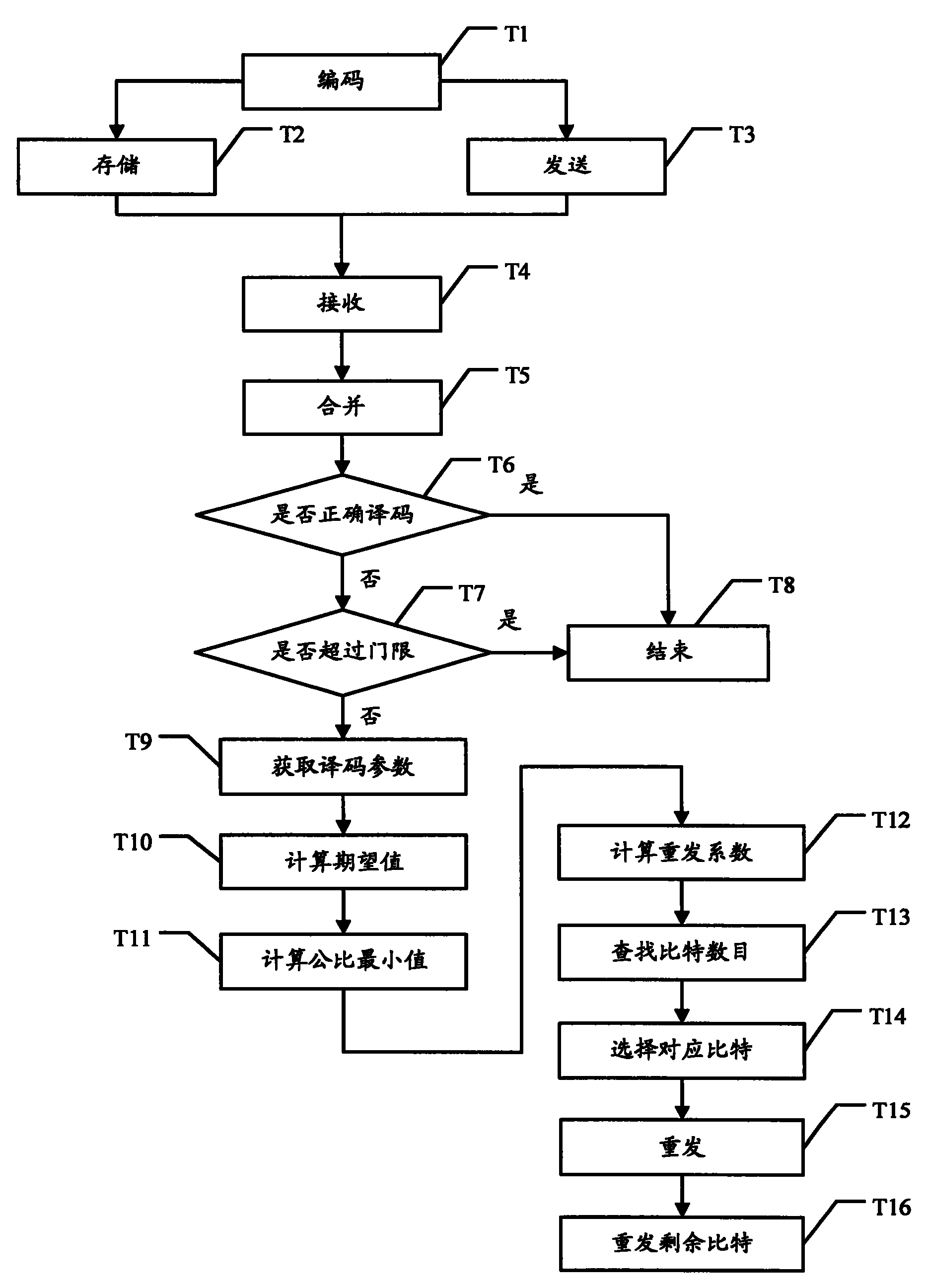
Referring to fig. 5, a fifth embodiment of an arq method according to the present invention includes:
t1) encoding;
wherein, the transmitting side performs LDPC coding on the data to be transmitted.
T2) storage, while performing step T3);
wherein the transmitting side stores the encoded data locally while performing step T3).
T3);
wherein the sender sends data to the receiver.
T4);
wherein, the receiving party receives the data;
t5) merging;
and if the data is received for the first time, the receiving party merges the data with the null data.
T6) determining whether the receiver can decode the data correctly, if yes, going to step T8), and if no, going to step T7);
t7) judging whether the sending times exceed a threshold value, if so, turning to a step T8), and if not, turning to a step T9);
the threshold value may be determined according to the current network state, and if the network condition is good, the threshold value may be set higher correspondingly, and if the network condition is not good, the threshold value needs to be lowered appropriately.
T8) end;
t9) to T15 are identical to the steps R5) to R11) in the third embodiment.
T16) retransmit the remaining bits.
And retransmitting the rest bits according to the chronological order or the storage position.
In this embodiment, the processing of the remaining bits is added, and in addition, for the bits to be sent preferentially, if bits with the same value need to be sent preferentially, the bits are sent in chronological order or chronological order in the storage location, and it can be understood that, in the first to fourth embodiments of the automatic request retransmission method of the present invention, the processing method of the bits to be sent preferentially with the same value is the same as that in this embodiment.
The following describes the automatic repeat request system of the present invention in detail:
referring to fig. 6, the arq system according to the present invention includes: a sender 100, a receiver 400, an encoding unit 200, a decoding unit 500, a selecting unit 700, a storage unit 300 and a checking unit 600;
the sender 100 sends the information to the encoding unit 200 for low density parity check encoding and then sends the information to the receiver 400 and stores the information into the storage unit 300;
the receiver 400 receives the encoded data and sends the encoded data to the decoding unit 500 for decoding;
the checking unit 600 is configured to determine whether the decoding is correct, continue to determine whether the sending times exceeds a threshold if the decoding is incorrect, and trigger the selecting unit 700 to select retransmission data if the sending times does not exceed the threshold;
the selection unit 700 selects a bit corresponding to the maximum system power efficiency, and transmits the selection result to the storage unit 300, and the storage unit 300 retransmits data according to the received selection result.
The selection unit 700 includes: a calculation unit 710, a query unit 720 and a processing unit 730;
the calculating unit 710 calculates a retransmission coefficient when the power efficiency of the system is maximum according to a Lagrange multiplier method and a density evolution theory or a Gaussian approximation theory and sends the result to the querying unit 720;
the inquiring unit 720 inquires the bit number corresponding to each value according to the retransmission coefficient and the code block length;
the processing unit 730 selects the corresponding bit and transmits the selection result to the storage unit 300.
The sender 100 sends the information to the encoding unit 200, the information is sent to the storage unit 300 for storage after being subjected to LDPC encoding, the information reaches the receiver 400 after being superimposed with noise through a channel, the receiver 400 adopts the corresponding LDPC decoding unit 500 for decoding, if the information is correct, an ACK signal is fed back to the sender 100, and the sender 100 sends the information of the next data packet; otherwise, if the decoding unit 500 cannot decode correctly, a NACK signal is sent and triggers the selection unit 700. The calculating unit 710 in the selecting unit 700 calculates a retransmission coefficient according to the requirement of the maximum system power efficiency, the querying unit 720 queries the value according to the retransmission coefficient, the processing unit 730 selects a bit corresponding to the value and notifies the selection result to the storage unit 300, the storage unit 300 instructs retransmission according to the processing unit 730, the receiving party 400 combines the received information and the previous information and decodes the information again, if the received information and the previous information are correct, an ACK signal is sent, and the sending party 100 continues sending the information; and if the failure happens, repeating the previous process until the sending times T are equal to the preset maximum sending times N.
To verify the method of the present solution, the effect of the present solution is explained by comparison below.
Referring to FIG. 7, the experiment uses a degree distribution of
λ(x)=0.2647x+0.2406x2+0.1588x5+0.0862x6+0.033x13+0.2163x14
ρ(x)=0.6351x6+0.3649x7
The LDPC code of (1). The check matrix is 518 × 1024, and the code rate is about 0.49.
As can be seen from FIG. 7, the system throughput of the scheme (improved retransmission with Degree Distribution) can provide a gain of about 0.5dB in comparison with the method (retransmission with Degree Distribution in the figure) in the documents "Yiqing Cao, Jian Gu, Lin Qi, Dacheng Yang, Degree Distribution Based HARQ for Irregular LDPC, Electronics Letters Vol.42, Issue 6, March 2006, pp 363-.
The above detailed description is provided for an automatic repeat request method and system, and the principle and implementation of the present invention are explained in detail by applying specific examples, and the description of the above embodiments is only used to help understanding the method and core idea of the present invention; meanwhile, for a person skilled in the art, according to the idea of the present invention, there may be variations in the specific embodiments and the application scope, and in summary, the content of the present specification should not be construed as a limitation to the present invention.