Disclosure of Invention
The invention aims to provide a method for ensuring the service quality of an operation maintenance data stream, which overcomes the defect that the service quality of the operation maintenance data stream cannot be ensured in the existing WiMAX network and ensures the service performance and quality of network management.
Therefore, the invention provides the following technical scheme:
a method for ensuring the quality of service of an operation maintenance data stream, said method comprising the steps of:
according to the service quality requirement of the operation maintenance data flow, an operation maintenance data service flow and a tunnel are established between the access service network gateway and the base station;
establishing a service quality classification rule of operation maintenance data on a gateway;
when the gateway forwards the operation maintenance data issued by the network management to the base station, determining the service flow and the tunnel which meet the service quality requirement of the operation maintenance data according to the service quality classification rule;
and transmitting the operation and maintenance data to a base station through the determined tunnel.
The method further comprises:
establishing a service quality classification rule which is the same as or different from the service quality classification rule on the gateway on the base station;
when the base station sends operation maintenance data to be reported to a network manager to the gateway, determining a service flow and a tunnel meeting the service quality requirement of the operation maintenance data according to the service quality classification rule of the base station;
and transmitting the operation and maintenance data to a gateway through the determined tunnel.
When the operation maintenance data of the base station has a plurality of service quality requirements, the number of the operation maintenance data service flows created between the gateway and the base station is the same as the number of the service quality requirement types.
One or more tunnels are created between the gateway and the base station, one tunnel corresponding to one or more service flows with quality of service requirements.
The method further comprises:
determining the service quality attribute of each service flow according to a system default value or manually set, wherein the service quality attribute comprises any one or more of the following parameters: maximum sustained rate, maximum burst rate, minimum guaranteed rate, allowed jitter, maximum delay, peak rate, guaranteed bandwidth.
The tunnel is specifically as follows:
a virtual local area network VLAN tunnel, or a multiprotocol label switching MPLS tunnel, or a generic encapsulation protocol GRE tunnel.
The service quality classification rule of the operation maintenance data at least comprises the following steps:
service flows and data classification information corresponding to the service flows, wherein the data classification information comprises: address information and protocol type.
The address information includes: source IP address, source address mask, destination IP address, destination address mask, source port number, destination port number.
The step of determining the tunnel meeting the service quality requirement of the operation maintenance data according to the service quality classification rule comprises the following steps:
acquiring address information and protocol types in operation maintenance data to be sent;
acquiring a service flow corresponding to the address information and/or the protocol type according to the service quality classification rule of the operation maintenance data;
selecting a tunnel corresponding to the service flow.
The quality of service classification rule of the operation maintenance data further comprises: priority information.
And when a plurality of service quality classification rules exist, preferentially selecting the service quality classification rule with high priority to obtain the service flow corresponding to the address information and/or the protocol type.
It can be seen from the above technical solutions provided by the present invention that, the present invention transmits the operation maintenance data through the tunnel, creates the service flow and the tunnel of the operation maintenance data according to the QoS requirement of the maintenance data, and establishes the corresponding relationship between the operation maintenance data and the tunnel and the service flow that satisfy the requirement by configuring the QoS allocation rule, so that the operation maintenance data is transmitted in the tunnel that satisfies the service quality requirement, thereby ensuring the service quality of the operation maintenance data and satisfying different quality requirements of different maintenance functions of the base station. The invention can effectively ensure the performance and quality of the network management service and improve the satisfaction degree of users.
Detailed Description
The present invention is not limited to the WiMAX network, but can be applied to other network systems similar to the network architecture. However, in order to more easily and clearly illustrate the inventive points of the present invention, the WiMAX network is taken as an example for illustration.
In the WiMAX network, a network manager needs to send some operation and maintenance data to a base station, and the operation and maintenance data needs to be forwarded to the base station by a gateway. In order to ensure the base station to correctly receive the operation maintenance data, the invention creates the service flow and the tunnel of the operation maintenance data in the network according to the QoS requirement of the maintenance data, and establishes the corresponding relation between the operation maintenance data and the tunnel and the service flow which meet the requirement by configuring the QoS distribution rule, so that the operation maintenance data is transmitted in the tunnel which meets the service quality requirement, thereby ensuring the service quality requirement of various operation maintenance data.
In order that those skilled in the art will better understand the technical solution of the present invention, the following detailed description of the present invention is provided in conjunction with the accompanying drawings and embodiments.
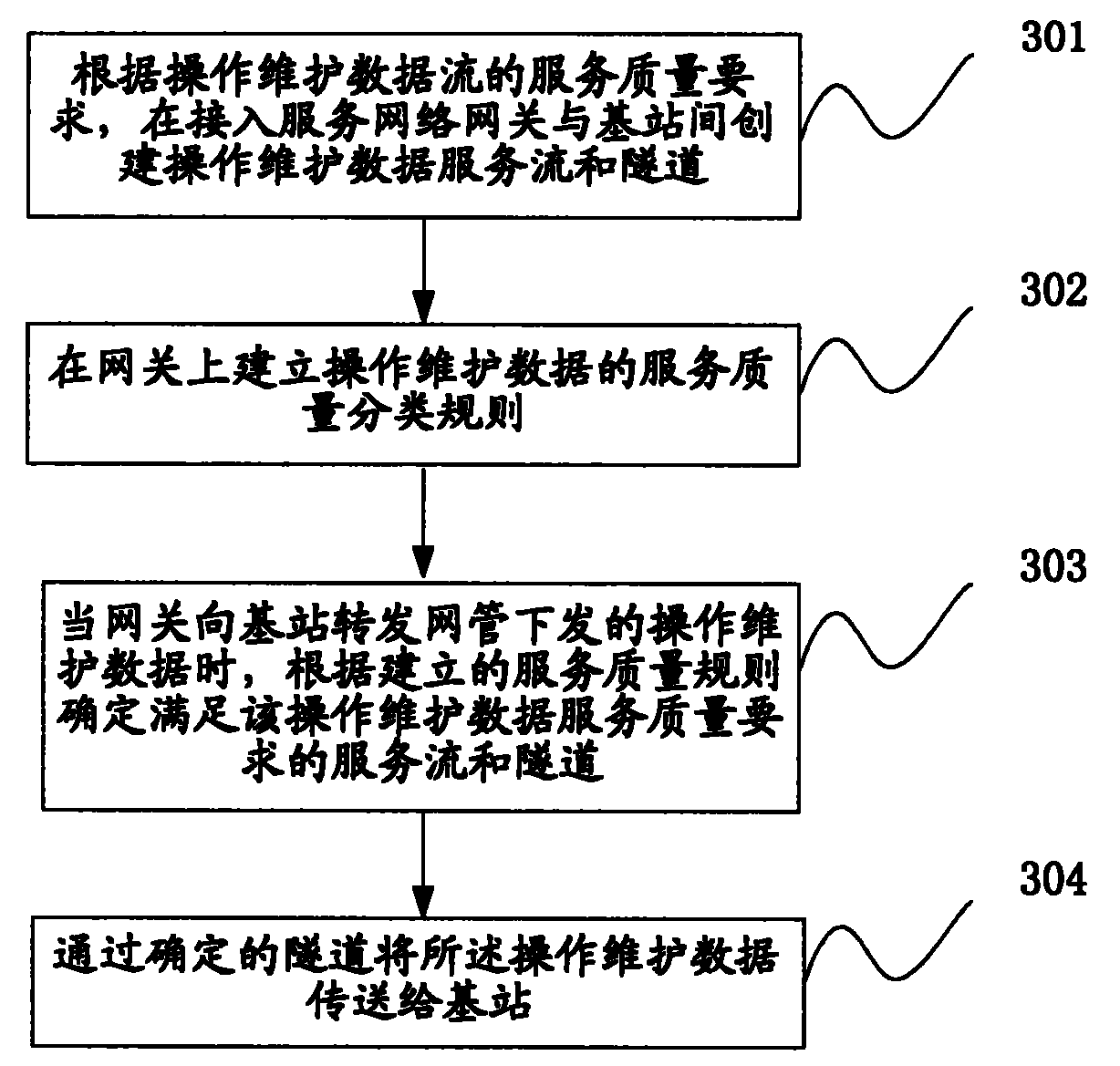
Referring to fig. 3, fig. 3 shows a flow chart of an implementation of the method of the present invention, including the following steps:
step 301: and according to the service quality requirement of the operation maintenance data flow, establishing an operation maintenance data service flow and a tunnel between the access service network gateway and the base station.
When creating the operation maintenance data service flow and the tunnel, one or more tunnels and service flows can be created according to the actual need of the operation maintenance data of the base station. One tunnel corresponds to one or more service flows, and if one tunnel corresponds to one service flow, all the operation maintenance data transmitted in the tunnel have the same QoS. When the operation maintenance data of the base station has various QoS requirements, a plurality of operation maintenance data service flows corresponding to the QoS type number can be created between the access service network gateway and the base station so as to meet the requirements of different QoS of the operation maintenance data.
Of course, in practical applications, according to the capability of the network device, the number of tunnels and service flows and the quality of service attribute parameters may be determined according to system default values, or may be manually set within the range of the device capability. The quality of service attributes include: peak rate, guaranteed bandwidth, etc.
The tunnel between the BS and the ASN-GW may be a VLAN (virtual local area network) tunnel, MPLS (multi-protocol label switching) tunnel, GRE (generic encapsulation protocol) tunnel, or other tunnel supported by the access service network gateway and the base station. In practical application, a proper tunnel protocol can be selected according to service characteristics, network performance and the like to complete establishment of a tunnel. The establishment procedures of the various tunnels are the same as in the prior art and will not be described in detail here.
If a VLAN tunnel is established, a VLAN ID can be adopted to identify a single service flow in the tunnel, or a user or a base station; if the established MPLS tunnel is the MPLS tunnel, adopting the MPLS LSP (label switching path) to identify; if a GRE tunnel is established, a GRE KEY is used for identification.
After tunnels corresponding to different service flows are established, different QoS requirements of the operation and maintenance data for the base station are required, so that each operation and maintenance data is transmitted in the tunnel meeting the QoS requirements. Therefore, the invention establishes the service quality classification rules of the operation maintenance data on the gateway, so that the gateway selects the tunnel meeting the QoS requirement of the operation maintenance data according to the rules.
Step 302: and establishing a service quality classification rule for operating and maintaining data on the gateway.
As known to those skilled in the art, the operation and maintenance data packets transmitted and forwarded between the BS and the ASN-GW are all IP packets, which may be UDP (user datagram protocol) packets or TCP (transmission control protocol) packets.
The format of the data packet is shown in fig. 4:
the IP header contains a source IP address and a destination IP address, which respectively represent the address of the sender and the address of the receiver.
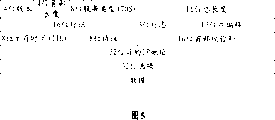
For example, the format of the IPv4 packet is shown in fig. 5: wherein,
the 8-bit service Type (Type of service) field indicates the performance requirement of the packet on the transport network, or guides the router to select a suitable transport network. The first 3 bits represent the priority of the data packet (the value of 0 represents general data, and the value of 7 represents network control information); bits 4-6 are respectively delay (D), throughput (T) and reliability (R) flag bits, and the last 2 bits are left unused;
the 8-bit protocol field specifies its upper layer user protocol, such as TCP, UDP, etc.;
also included are a 32-bit source IP address and a 32-bit destination IP address.
The formats of UDP and TCP packets are shown in fig. 6 and 7, respectively:
the UDP and TCP headers both include a source port number and a destination port number, which indicate the service function of the sender and the service function of the receiver, and may be used to distinguish different functions of operation and maintenance, such as performance management, alarm management, etc.
The formats of the IP data packet, the UDP data packet, and the TCP data packet may indicate the information of the sender and the receiver of the data packet by using the information of the source IP address, the destination IP address, the source port number, the destination port number, the protocol type, and the like in the IP packet.
Therefore, in the present invention, the QoS classification is performed according to the address information and/or protocol type of the IP packet carrying the operation maintenance data, that is, the QoS classification rule of the operation maintenance data is respectively established on the base station and the gateway. The rules include at least: service flows and data classification information corresponding to the service flows, wherein the data classification information comprises: address information and protocol type, wherein the address information may be an IP address, and/or an address mask, and/or a protocol type, and/or a port number, etc.
For example, a quality of service classification rule may be established that contains the fields in table 1:
table 1:
| parameter name | Means of |
| Service flow | Identification of service flows, corresponding tunnel paths |
| Priority level | There are a plurality of classification rules, the priority of each classification rule |
| Source IP address | Source address of data packet |
| Source address mask | If the source address required by the classification rule is the network segment address, the source address mask is used for representing |
| Destination IP address | Destination address of data packet |
| Destination address mask | The destination address required by the classification rule is the network segment address, and then the network segment address is represented by a destination address mask |
| Type of protocol | Protocol type of data packet |
| Initial source port number | The classification rule requires that the source port number is not a port number value, but a range, and is represented by the originating and terminating source port numbers. The starting source port number represents the minimum value of the range |
| Terminating source port number | The terminating source port number represents the maximum value of the range |
| Number of start destination port | The classification rules require that the destination port number is not a port number value, but a range, and are expressed in terms of the originating and terminating destination port numbers. Number of start destination port represents the minimum value of the range |
| Terminating destination port number | The maximum value of the range represented by the terminating destination port number |
Of course, the fields of the address information (including the IP address and the port address), the protocol type, etc. in table 1 are optional, for example, the corresponding service flow may be selected only according to the IP address information of the operation and maintenance data, without considering the protocol type and the port address, etc. of the operation and maintenance data; for another example, when a plurality of classification rules are established, the service flow corresponding to the operation and maintenance data can be obtained by preferentially selecting the service quality classification rule with high priority through the priority field.
In actual application, each field in the service quality classification rule can be determined according to needs.
Step 303: when the gateway transmits the operation maintenance data issued by the network management to the base station, the service flow and the tunnel which meet the service quality requirement of the operation maintenance data are determined according to the established service quality classification rule.
Firstly, address information and/or protocol type in operation maintenance data needing to be sent are obtained, then service flow which accords with the operation maintenance data address and/or protocol type is obtained according to the established service quality classification rule, and a tunnel corresponding to the service flow is selected.
When selecting the service flow satisfying the operation and maintenance data according to the established service quality classification rule, the priority of the rule may be checked first, the service quality classification rule with the higher priority may be selected preferentially, and whether the information in the operation and maintenance data matches with each field in the rule may be checked item by item. The specific process will be described in detail later.
Step 304: and transmitting the operation and maintenance data to a base station through the determined tunnel.
Figure 8 shows the process of the gateway determining the service flows that meet the requirements according to the established quality of service classification rules:
step 801: and checking the rules of all priorities one by one, and judging whether all the rules are checked. If so, go to step 808; otherwise, go to step 802.
Step 802: it is determined whether the protocol type satisfies the rule. If so, go to step 803; otherwise, return to step 801.
Step 803: it is further determined whether the destination address satisfies the rule. If so, go to step 804; otherwise, return to step 801.
Step 804: it is further determined whether the destination port number satisfies the rule. If so, go to step 805; otherwise, return to step 801.
Step 805: it is further determined whether the source address satisfies the rule. If so, proceed to step 806; otherwise, return to step 801.
Step 806: it is further determined whether the source port number satisfies the rule. If so, go to step 807; otherwise, return to step 801.
Step 807: and finding out the service flow and the tunnel meeting the requirements according to the rule.
Step 808: and (6) ending.
If no service flow meeting the requirement is found finally, the operation maintenance data can be sent by adopting a method of directly sending the operation maintenance data and not transmitting the operation maintenance data in the tunnel.
In order to ensure the service quality of the operation maintenance data reported to the network manager by the base station, a service quality classification rule which is the same as or different from the service quality classification rule on the gateway can be established on the base station; when the base station sends operation maintenance data to be reported to a network manager to the gateway, determining a service flow and a tunnel meeting the service quality requirement of the operation maintenance data according to the service quality classification rule of the base station; and transmitting the operation and maintenance data to a base station through the determined tunnel.
Of course, according to the application requirement, the qos classification rule may be separately established at the base station side, so as to ensure the qos of the operation maintenance data reported by the base station.
The process of sending the operation maintenance data from the base station to the gateway is similar to the process from the gateway to the base station, and is not described herein again.
The following example further describes the forwarding process of the base station operation maintenance data in the present invention in detail:
assume that tunnel 1 and corresponding service flow 1, tunnel 2 and corresponding service flow 2 have been configured. Where service flow 1 defines the minimum guaranteed rate of data and service flow 2 defines the maximum peak rate of data.
For the operation and maintenance data, the user has the following requirements:
1) the address of the network manager is 10.11.10.10, and the maintenance address 11.11.10.10 of the base station needs to ensure the minimum rate of maintenance data.
2) And reporting the performance data at a fixed time, wherein the maximum peak rate needs to be ensured at a certain time point. The performance service employs a fixed port number 6002.
Therefore, the rule is configured at the base station:
(1) service flow 1, low priority, destination address 10.11.10.10, destination address mask 255.255.255;
(2) service flow 2, high priority, destination address 10.11.10.10, destination address mask 255.255.255, destination port number 6002.
Configuring rules on ASN-GW:
(1) service flow 1, low priority, destination address 11.11.10.10, destination address mask 255.255.255.255, source address 10.11.10.10, source address mask 255.255.255.255;
(2) service flow 2, high priority, destination address 11.11.10.10, destination address mask 255.255.255, destination port number 6002, destination address mask 255.255.255.255, source address 10.11.10.10, source address mask 255.255.255.255.
The following data are sent:
the maintenance data packet sent by the base station to the network management includes destination address 10.11.10.10, destination port number not equal to 6002 and source address 11.11.10.10.
The rule (2) of high priority is checked first and the destination port number does not meet the requirements. And (5) checking the rule (1) again to meet the requirement. The base station transmits the maintenance data through service flow 1.
The ASN-GW receives the performance data packet sent by the network manager to the base station, where the destination address is 11.11.10.10, the destination port number is 6002, and the source address is 10.11.10.10.
The rule (2) of high priority is checked first, and the requirements are met. The ASN-GW transmits the maintenance data through service flow 2.
Therefore, the invention can effectively ensure the service quality of the operation maintenance data.
While the present invention has been described with respect to the embodiments, those skilled in the art will appreciate that there are numerous variations and permutations of the present invention without departing from the spirit of the invention, and it is intended that the appended claims cover such variations and modifications as fall within the true spirit of the invention.