CN100553357C - Method for reducing co-channel interference between users in uplink FDMA cellular system - Google Patents
Method for reducing co-channel interference between users in uplink FDMA cellular system Download PDFInfo
- Publication number
- CN100553357C CN100553357C CNB2007100370348A CN200710037034A CN100553357C CN 100553357 C CN100553357 C CN 100553357C CN B2007100370348 A CNB2007100370348 A CN B2007100370348A CN 200710037034 A CN200710037034 A CN 200710037034A CN 100553357 C CN100553357 C CN 100553357C
- Authority
- CN
- China
- Prior art keywords
- user
- sector
- interference
- users
- base station
- Prior art date
- Legal status (The legal status is an assumption and is not a legal conclusion. Google has not performed a legal analysis and makes no representation as to the accuracy of the status listed.)
- Expired - Fee Related
Links
Images


Landscapes
- Mobile Radio Communication Systems (AREA)
Abstract
本发明涉及一种通信技术领域的上行FDMA蜂窝系统的减小用户间同信道干扰的方法,基站为其中的边界用户划分出边界用户专用资源,并且保证相邻小区或扇区间的边界用户专用资源没有重叠,用户监听并检测本小区或扇区和相邻小区或扇区的含有标识信息的下行信号,获得下行信号的检测信息,再判断用户的抗干扰与干扰相邻小区或扇区内用户的情况;然后,基站根据该结果,分配资源的使用权限,再执行资源调度,分配资源,最后对用户的上行链路进行适配。本发明在实现减小用户间同信道干扰的目标时,具有频谱复用系数较高、系统的数据传输总速率较高、实现较简单,用户与基站间信令交互较少等优点。

The present invention relates to a method for reducing co-channel interference between users in an uplink FDMA cellular system in the field of communication technology. A base station divides boundary user dedicated resources for boundary users therein, and guarantees boundary user dedicated resources between adjacent cells or sectors There is no overlap, the user listens to and detects the downlink signal containing identification information of the local cell or sector and the adjacent cell or sector, obtains the detection information of the downlink signal, and then judges the user's anti-interference and interference with users in the adjacent cell or sector Then, according to the result, the base station allocates resource usage rights, performs resource scheduling, allocates resources, and finally adapts the user's uplink. When realizing the goal of reducing co-channel interference between users, the present invention has the advantages of high frequency spectrum reuse coefficient, high overall data transmission rate of the system, simple implementation, less signaling interaction between users and base stations, and the like.
Description
技术领域 technical field
本发明涉及一种通信技术领域的减小同信道干扰的方法,具体是一种应用于上行FDMA蜂窝系统的减小用户间同信道干扰的方法。The invention relates to a method for reducing co-channel interference in the field of communication technology, in particular to a method for reducing co-channel interference between users applied to an uplink FDMA cellular system.
背景技术 Background technique
FDMA(频分多址接入)是蜂窝系统采用的主要的多址接入方式,其特点是,不同的用户在接入系统的时候,使用不同的频谱资源。目前,OFDM(正交频分复用)技术和SC-OFDM(单载波正交频分复用)技术是实现FDMA方式的主要技术。3GPP组织(第三代移动通信伙伴计划)国际组织在设计EUTRA(演进的通用移动通信系统及陆基无线电接入)和EUTRAN(演进的通用移动通信系统网及陆基无线电接入网)(或者称为Super 3G:超三代移动通信系统)时,就是采用SC-OFDM技术实现上行FDMA蜂窝系统。FDMA (Frequency Division Multiple Access) is the main multiple access method adopted by the cellular system, and its characteristic is that different users use different frequency spectrum resources when accessing the system. Currently, OFDM (Orthogonal Frequency Division Multiplexing) technology and SC-OFDM (Single-Carrier Orthogonal Frequency Division Multiplexing) technology are the main technologies for realizing the FDMA mode. The 3GPP organization (Third Generation Mobile Communications Partnership Project) international organization is designing EUTRA (Evolved Universal Mobile Telecommunications System and Terrestrial Radio Access) and EUTRAN (Evolved Universal Mobile Telecommunications System Network and Terrestrial Radio Access Network) (or When it is called Super 3G (super three-generation mobile communication system), it uses SC-OFDM technology to realize the uplink FDMA cellular system.
一般地,蜂窝系统把服务覆盖区域分割为若干个正六边形的小区,目前,每个小区一般又被等分为3个扇区或6个扇区。在上行FDMA蜂窝系统中,小区或扇区基站为用户分配上行资源(在下文中简称为资源)和上行功率,资源一般包括时隙资源、频谱资源,也可能包括码字资源等等。在实际系统中,由于整个频谱被所有小区或扇区复用,当相邻两个小区或扇区内的两个用户被分配到相同的资源时,这两个用户就会发生同信道干扰,该干扰在上述两个用户都位于小区或扇区边界时尤其显著。因此,需要设计相应的方法来减小用户间的同信道干扰。Generally, the cellular system divides the service coverage area into several regular hexagonal cells. At present, each cell is generally divided into 3 sectors or 6 sectors equally. In an uplink FDMA cellular system, a cell or sector base station allocates uplink resources (hereinafter referred to as resources) and uplink power to users. Resources generally include time slot resources, spectrum resources, and possibly codeword resources, etc. In an actual system, since the entire frequency spectrum is reused by all cells or sectors, when two users in two adjacent cells or sectors are allocated the same resources, co-channel interference will occur between these two users. This interference is particularly significant when the above two users are located at cell or sector boundaries. Therefore, corresponding methods need to be designed to reduce co-channel interference among users.
在一些技术文献中,针对EUTRA要求的上行FDMA蜂窝系统,有四种方法可用于减小用户间同信道干扰:In some technical documents, for the uplink FDMA cellular system required by EUTRA, there are four methods that can be used to reduce co-channel interference between users:
(1)简单的小区或扇区间干扰协调/避免的方法:每个小区或扇区只使用一部分资源,称为“小区或扇区专用资源”,并且保证相邻小区或扇区的专用资源没有重叠,从而避免小区或扇区边界处的用户间产生严重的同信道干扰。由于每个小区或扇区专用资源不能被相邻小区或扇区复用,因而其频谱复用系数大大降低,致使系统的数据传输总速率明显下降。参见专利:《降低正交频分复用蜂窝环境中小区间干扰的子载波分配方法》,申请(专利)号:200480006260.4,公开(公告)号:CN1759582,申请(专利权)人:LG电子株式会社)(1) Simple inter-cell or sector interference coordination/avoidance method: each cell or sector uses only a part of resources, called "cell or sector-specific resources", and ensures that the dedicated resources of adjacent cells or sectors are not overlap, so as to avoid severe co-channel interference between users at the cell or sector boundary. Since the dedicated resources of each cell or sector cannot be reused by adjacent cells or sectors, its spectrum reuse coefficient is greatly reduced, resulting in a significant decrease in the overall data transmission rate of the system. See patent: "Subcarrier Allocation Method for Reducing Inter-cell Interference in Orthogonal Frequency Division Multiplexing Cellular Environment", application (patent) number: 200480006260.4, publication (announcement) number: CN1759582, applicant (patent) person: LG Electronics Co., Ltd. )
(2)具有较高的频谱复用系数的小区间干扰协调/避免的方法:每个小区或扇区为其中的边界用户划分出特定的资源,称为“边界用户专用资源”,并且保证相邻小区或扇区间的边界用户专用资源没有重叠,从而避免小区或扇区边界处的用户间产生严重的同信道干扰。该边界用户专用资源可以被相邻小区内的非边界用户复用,因而其频谱复用系数较高。参见文献:3GPP,R1-050629,“Inter-cell interference mitigation”,Huawei。(3GPP文档,编号:R1-050629,“小区间干扰抑制方法”,Huawei公司)(2) Inter-cell interference coordination/avoidance method with high spectrum reuse coefficient: each cell or sector allocates specific resources for its boundary users, called "boundary user-dedicated resources", and guarantees that There is no overlapping of border user-specific resources between adjacent cells or sectors, thereby avoiding serious co-channel interference among users at cell or sector borders. The border user dedicated resource can be reused by non-border users in adjacent cells, so its frequency spectrum reuse coefficient is relatively high. See literature: 3GPP, R1-050629, "Inter-cell interference mitigation", Huawei. (3GPP document, number: R1-050629, "Inter-cell interference suppression method", Huawei company)
(3)小区间干扰消除的方法:运用多用户检测技术,先把同信道干扰信号进行解调和解码,然后重建干扰信号,再从接收信号中减去重建的干扰信号,最后得到有用信号,从而消除用户间的同信道干扰。参见文献:3GPP,R1-060418,“TP on uplink inter-cell interference cancellation”,RITT,Huawei,CATT。(3GPP文档,编号:R1-060418,“小区间干扰消除方法及标准化文本建议”,RITT公司,Huawei公司,CATT公司)(3) The method of inter-cell interference elimination: using multi-user detection technology, the co-channel interference signal is first demodulated and decoded, then the interference signal is reconstructed, and then the reconstructed interference signal is subtracted from the received signal, and finally the useful signal is obtained. Thereby eliminating co-channel interference among users. See literature: 3GPP, R1-060418, "TP on uplink inter-cell interference cancellation", RITT, Huawei, CATT. (3GPP document, number: R1-060418, "Inter-cell interference cancellation method and standardization text proposal", RITT company, Huawei company, CATT company)
(4)小区间干扰协调/避免与干扰消除相结合的方法:将整个资源无交集地划分为适用干扰协调/避免的资源和适用干扰消除的资源,对于适用干扰协调/避免的资源,采用方法(2)减小用户间的同信道干扰;对于适用干扰消除的资源,采用方法(3)减小用户间的同信道干扰。参见文献:3GPP,R1-060419,“Combining Inter-cell-interference co-ordination/avoidance withcancellation in uplink and TP”,RITT,Huawei,CATT。(3GPP文档,编号:R1-060419,“将小区间干扰协调/避免与干扰消除结合的方法及标准化文本建议”,RITT公司,Huawei公司,CATT公司)(4) The method of combining inter-cell interference coordination/avoidance with interference cancellation: the entire resource is divided into resources applicable to interference coordination/avoidance and resources applicable to interference cancellation without intersection, and for resources applicable to interference coordination/avoidance, the method (2) Reduce the co-channel interference between users; for resources applicable to interference cancellation, adopt the method (3) to reduce the co-channel interference between users. See literature: 3GPP, R1-060419, "Combining Inter-cell-interference co-ordination/avoidance with cancellation in uplink and TP", RITT, Huawei, CATT. (3GPP document, No.: R1-060419, "A method for combining inter-cell interference coordination/avoidance with interference cancellation and standardization text proposal", RITT, Huawei, CATT)
方法(1)具有实现简单、无需小区或扇区间协调通信的优点,但存在着频谱复用系数较低的缺点;方法(2)保持了方法(1)的优点,并具有较高的频谱复用系数,但在为边界用户分配资源时,由于可选资源受限,将导致资源调度的效率有较大下降,从而使系统的数据传输总速率有较大下降;方法(3)克服了方法(2)的缺点,也具有较高的频谱复用系数,但其需要较大的计算开销进行干扰信号的重建和消除,或者需要引入一定的小区间协调,以建立干扰用户对/组来简化计算;方法(4)结合方法(2)和方法(3),但需要对适用干扰协调/避免的资源和适用干扰消除的资源进行划分,并使用不同的减小用户间同信道干扰的方法,这增加了整个方案的实现复杂度,另外,为了保证该方法的自适应性,还需要增加用户与基站间的信令交互。因此,上述四种方法在实际应用中遇到较大困难。Method (1) has the advantages of simple implementation and no need for coordinated communication between cells or sectors, but has the disadvantage of low spectrum reuse coefficient; method (2) maintains the advantages of method (1) and has a higher frequency spectrum reuse However, when allocating resources for border users, due to the limited available resources, the efficiency of resource scheduling will be greatly reduced, so that the total data transmission rate of the system will be greatly reduced; method (3) overcomes method The disadvantage of (2) also has a high spectrum reuse factor, but it requires a large computational overhead to reconstruct and eliminate interference signals, or needs to introduce certain inter-cell coordination to establish interference user pairs/groups to simplify Calculation; method (4) combines method (2) and method (3), but it is necessary to divide the resources applicable to interference coordination/avoidance and the resources applicable to interference cancellation, and use different methods for reducing co-channel interference between users, This increases the implementation complexity of the whole solution. In addition, in order to ensure the adaptability of the method, it is also necessary to increase the signaling interaction between the user and the base station. Therefore, the above four methods encounter great difficulties in practical application.
发明内容 Contents of the invention
本发明的目的在于针对现有技术中频谱复用系数较低,或是系统的数据传输总速率较低,或是实现复杂度较高,或是用户与基站间信令交互较多的问题,提供一种上行FDMA蜂窝系统的减小用户间同信道干扰的方法。本发明是一种小区或扇区间干扰协调/避免的方法,每个小区或扇区为其中的边界用户划分出边界用户专用资源,并且保证相邻小区或扇区间的边界用户专用资源没有重叠,该边界用户专用资源可以被相邻小区或扇区内的非边界用户复用,以保证本发明的频谱复用系数较高。The purpose of the present invention is to solve the problems in the prior art that the spectrum reuse coefficient is low, or the total data transmission rate of the system is low, or the implementation complexity is high, or there are many signaling interactions between the user and the base station, A method for reducing co-channel interference between users in an uplink FDMA cellular system is provided. The present invention is a method for coordinating/avoiding interference between cells or sectors. Each cell or sector allocates border user-specific resources for border users therein, and ensures that the border user-dedicated resources between adjacent cells or sectors do not overlap. The border user dedicated resources can be reused by non-border users in adjacent cells or sectors, so as to ensure a high frequency spectrum reuse factor in the present invention.
在本发明实施过程中,首先,用户监听并检测多个相邻小区或扇区的下行信号,然后对自身的抗干扰与干扰相邻小区或扇区内用户的情况作出判断,并将该抗干扰与干扰相邻小区或扇区内用户的情况周期性地或是触发性地向基站报告;或是用户直接将监听并检测到的下行信号的测量信息周期性地或是触发性地向基站报告,然后由基站对用户的抗干扰与干扰相邻小区或扇区内用户的情况作出判断,该过程的用户与基站间信令交互较少。最后,基站根据用户不同的抗干扰与干扰相邻小区或扇区内用户的情况,分配不同的资源使用权限,对于易于干扰相邻小区或扇区内用户的用户,基站限制其有权限使用的资源,并可能减小其发射功率,以减小其对相邻小区或扇区的边界用户的同信道干扰,从而提高小区或扇区的边界用户的数据传输速率;对于不易于干扰相邻小区或扇区内用户的用户,基站使其对本小区或扇区的边界用户专用资源具有候补使用权限,或是可能提高其发射功率,以保持系统的数据传输总速率较高,该资源使用权限的分配过程较为简单。所以,本发明在实现减小用户间同信道干扰的目标时,具有频谱复用系数较高、系统的数据传输总速率较高、实现较简单,用户与基站间信令交互较少等优点。In the implementation process of the present invention, firstly, the user monitors and detects the downlink signals of a plurality of adjacent cells or sectors, and then makes a judgment on its own anti-interference and interference with users in adjacent cells or sectors, and uses the anti-interference Interference and interference The situation of users in adjacent cells or sectors is periodically or triggered to report to the base station; or the user directly monitors and detects the measurement information of the downlink signal to the base station periodically or triggered Report, and then the base station makes a judgment on the user's anti-interference and interference with users in adjacent cells or sectors. In this process, there is less signaling interaction between the user and the base station. Finally, the base station allocates different resource usage rights according to the user's different anti-interference and interference with users in adjacent cells or sectors. Resources, and may reduce its transmit power to reduce its co-channel interference to border users of adjacent cells or sectors, thereby increasing the data transmission rate of border users of cells or sectors; for those that are not easy to interfere with adjacent cells For the users in the sector or users in the sector, the base station makes it possible to use the resources dedicated to the border users of the cell or sector as a backup, or may increase its transmission power to keep the total data transmission rate of the system high. The distribution process is relatively simple. Therefore, when the present invention achieves the goal of reducing co-channel interference between users, it has the advantages of high spectrum reuse coefficient, high overall data transmission rate of the system, simple implementation, and less signaling interaction between users and base stations.
本发明通过以下技术方案实现,具体包括如下步骤:The present invention is realized through the following technical solutions, specifically comprising the following steps:
步骤一:每个小区或扇区为其中的边界用户划分出边界用户专用资源,并且保证相邻小区或扇区间的边界用户专用资源没有重叠,所述边界用户专用资源可以被相邻小区或扇区内的非边界用户复用;Step 1: Each cell or sector allocates border user-specific resources for its border users, and ensures that border user-dedicated resources between adjacent cells or sectors do not overlap. The border user-dedicated resources can be used by adjacent cells or sectors Multiplexing of non-border users in the area;
步骤二:用户监听并检测本小区或扇区和相邻小区或扇区的含有标识信息的下行信号,获得下行信号的检测信息;Step 2: The user monitors and detects the downlink signals containing identification information of the own cell or sector and adjacent cells or sectors, and obtains the detection information of the downlink signals;
步骤三:根据所述下行信号的检测信息,判断用户的抗干扰与干扰相邻小区或扇区内用户的情况;Step 3: According to the detection information of the downlink signal, judge the anti-interference of the user and the situation of the user in the adjacent cell or sector;
步骤四:基站根据用户的抗干扰与干扰相邻小区或扇区内用户的情况,分配资源的使用权限;Step 4: The base station allocates resource usage rights according to the user's anti-interference and interference with users in adjacent cells or sectors;
步骤五:基站根据用户对资源的使用权限,执行资源调度,分配资源;Step 5: The base station executes resource scheduling and allocates resources according to the user's authority to use resources;
步骤六:基站根据资源分配结果,对用户的上行链路进行适配。Step 6: The base station adapts the user's uplink according to the resource allocation result.
所述步骤二中,所述检测信息包括:小区或扇区的标识信息和用户到该小区或扇区的路径损耗值。In the second step, the detection information includes: identification information of a cell or sector and a path loss value from the user to the cell or sector.
所述步骤三中,由用户根据所述检测信息,判断用户的抗干扰与干扰相邻小区或扇区内用户的情况,再把判断结果向基站报告;或者用户向基站报告所述检测信息,由基站根据所述检测信息,判断用户的抗干扰与干扰相邻小区或扇区内用户的情况。In the third step, the user judges the user's anti-interference and interference with the user in the adjacent cell or sector according to the detection information, and then reports the judgment result to the base station; or the user reports the detection information to the base station, Based on the detection information, the base station judges the user's anti-interference and interference with users in adjacent cells or sectors.
所述步骤三中,判断用户的抗干扰与干扰相邻小区或扇区内用户的情况,是指:将用户到本小区或扇区的路径损耗值与抗干扰的路径损耗门限值作比较,如果超过门限值,则该用户为抗干扰能力强的用户,反之,该用户为抗干扰能力弱的用户;将用户到多个相邻小区或扇区的路径损耗值与干扰相邻小区或扇区内用户的路径损耗门限值作比较,如果超过门限值,则该用户易于干扰相邻小区或扇区内用户,反之,该用户不易于干扰相邻小区或扇区内用户。于是,所有的用户被分为四类:抗干扰能力强且易于干扰相邻小区或扇区内用户,抗干扰能力强且不易于干扰相邻小区或扇区内用户,抗干扰能力弱且易于干扰相邻小区或扇区内用户,抗干扰能力弱且不易于干扰相邻小区或扇区内用户。In said
所述步骤三中,所述用户周期性的向基站报告;或者所述用户以自身的抗干扰与干扰相邻小区或扇区内用户的情况发生变化作为触发条件向基站的报告。In the third step, the user reports to the base station periodically; or the user reports to the base station with his own anti-interference and interference with users in adjacent cells or sectors as trigger conditions.
所述的步骤四中,所述分配资源使用权限,是指:对于抗干扰能力强且易于干扰相邻小区或扇区内用户的用户,如果可能被干扰的小区或扇区的边界用户专用资源和本小区或扇区的边界用户专用资源以外的剩余资源不为空集,则基站使其无权限使用可能被干扰的小区或扇区的边界用户专用资源和本小区或扇区的边界用户专用资源,而有权限使用所述剩余资源,如果所述剩余资源为空集,则基站使其有权限使用本小区或扇区的边界用户专用资源,无权限使用除本小区或扇区的边界用户专用资源以外的资源;对于抗干扰能力强且不易于干扰相邻小区或扇区内用户的用户,基站使其有权限使用除本小区或扇区的边界用户专用资源以外的资源,并对本小区或扇区的边界用户专用资源有候补使用权限;对于抗干扰能力弱且易于干扰相邻小区或扇区内用户的用户和抗干扰能力弱且不易于干扰相邻小区或扇区内用户的用户,基站使其有权限使用本小区或扇区的边界用户专用资源,无权限使用除本小区或扇区的边界用户专用资源以外的资源。In the
所述步骤四中,对于抗干扰能力弱且不易于干扰相邻小区或扇区内用户的用户,基站使其提升发射功率以获得更高的数据传输速率;对于抗干扰能力强且易于干扰相邻小区或扇区内用户的用户,基站使其降低发射功率以减少对相邻小区或扇区内用户的干扰。In the fourth step, for users with weak anti-interference ability and not easy to interfere with users in adjacent cells or sectors, the base station increases the transmission power to obtain a higher data transmission rate; for users with strong anti-interference ability and easy interference For users in adjacent cells or sectors, the base station reduces the transmit power to reduce interference to users in adjacent cells or sectors.
所述步骤五中,所述资源调度,是指:首先,基站将本小区中边界用户专用资源以外的资源分配给对该资源有使用权限的用户,然后,基站将边界用户专用资源分配给对该资源有使用权限的用户,最后,基站将把未使用的边界用户专用资源分配给有资源需求的,并对该资源有候补使用权限的用户。In the
以下对本发明技术方案作进一步说明:The technical scheme of the present invention is described further below:
(1)每个小区或扇区为其中的边界用户划分出边界用户专用资源(1) Each cell or sector allocates resources dedicated to border users for border users in it
首先,将上行FDMA蜂窝系统中的资源按最小单位进行顺序编号1,2,……,N,于是,所有资源可以表示为集合S,含有(C(S)=N)个元素:First, the resources in the uplink FDMA cellular system are sequentially numbered 1, 2, ..., N according to the smallest unit, so all resources can be expressed as a set S, containing (C(S)=N) elements:
S={S(i)1≤i≤C(S),S(i)<S(i+1),1≤S(i)≤N} (1)S={S(i)1≤i≤C(S), S(i)<S(i+1), 1≤S(i)≤N} (1)
然后,将S分割成不相交的B个集合作为边界用户专用资源S(j)(j为边界用户专用资源索引号,1≤j≤B),其中,B是一个系统设计参数,比如,对于3扇区系统,可以令B=3。S(j)分别含有C(S(j))个元素:Then, divide S into B disjoint sets as border user-specific resources S(j) (j is the index number of border user-specific resources, 1≤j≤B), where B is a system design parameter, for example, for For a 3-sector system, B=3 can be set. S(j) contains C(S(j)) elements respectively:
S(j)={Sj(i)|1≤i≤C(S(j)),Sj(i)<Sj(i+1),Sj(i)∈S}(1≤j≤B) (2)S(j)={S j (i)|1≤i≤C(S(j)), S j (i)<S j (i+1), S j (i)∈S}(1≤j ≤B) (2)
而且,S(j)满足:Moreover, S(j) satisfies:

最后,每个小区或扇区选取一个S(j)作为其边界用户专用资源,并保证相邻小区或扇区选取不同的S(j),从而使相邻小区或扇区的边界用户专用资源互不重叠,即,设小区或扇区的顺序标号为X(X=1,2,...),其标识为IX(IX∈I,I为蜂窝系统中小区或扇区标识的集合),由小区或扇区标识IX到边界用户专用资源索引号j的映射函数为J(IX),于是,相应的边界用户专用资源为S(J(IX)),那么,Finally, each cell or sector selects one S(j) as its border user-dedicated resource, and ensures that adjacent cells or sectors select different S(j), so that the border user-dedicated resources of adjacent cells or sectors do not overlap each other, that is, let the sequential label of the cell or sector be X (X=1, 2, ...), and its identification be I X (I X ∈ I, I is the identification of the cell or sector in the cellular system set), the mapping function from the cell or sector identifier I X to the border user-specific resource index number j is J(I X ), so the corresponding border user-specific resource is S(J(I X )), then,
J(IY)≠J(IZ)(当扇区/小区Y,Z相邻)J(I Y )≠J(I Z ) (when sectors/cells Y and Z are adjacent)
(4)(4)
即,
另外,小区或扇区的边界用户专用资源可以被相邻小区或扇区内的非边界用户复用,获得较高的频谱利用系数,即,当小区或扇区Y,Z相邻时,S(J(IY))可以被小区或扇区Z内的非边界用户使用,S(J(IZ))可以被小区或扇区Y内的非边界用户使用。In addition, the resources dedicated to border users of a cell or sector can be reused by non-border users in adjacent cells or sectors to obtain a higher spectrum utilization factor, that is, when cells or sectors Y and Z are adjacent, S (J(I Y )) can be used by non-border users in cell or sector Z, and S(J(I Z )) can be used by non-border users in cell or sector Y.
(2)用户监听并检测本小区或扇区和相邻小区或扇区的含有标识信息的下行信号(2) The user monitors and detects downlink signals containing identification information of the cell or sector and adjacent cells or sectors
用户监听并检测本小区或扇区和相邻小区或扇区的下行信号,设用户u位于小区或扇区X(标识为IX),其相邻小区或扇区为Y,Z,...(标识为IY,IZ,...)。用户u监听并检测来自X,Y,Z,...的下行信号Ω,该下行信号Ω需要含有小区或扇区的标识信息IX,IY,IZ,...。在小区或扇区的下行同步信道信号,或是小区或扇区的下行导频信道信号中,一般都会含有这样的标识信息。用户检测的内容包括下行信号Ω的平均接收功率值βX,βY,βZ,…和小区或扇区的标识信息,并将βX,βY,βZ,…除以下行信号Ω的发射功率值,得到用户到该小区或扇区X,Y,Z,...的路径损耗值PLX,PLY,PLZ,…。路径损耗值一般包括了用户到小区或扇区的距离损耗(无线电波在空间传播,其电波强度随着传播距离的增大而减小,造成距离损耗)、阴影衰落(由于可能存在建筑物阻挡无线电波的传播,造成阴影衰落)和天线方向角接收增益(由于无线电波以不同的角度射向天线时,其增益是不同的,因此,用户的信号到小区或扇区的接收天线的方向角决定了其增益大小)。The user listens to and detects the downlink signals of the cell or sector and the adjacent cell or sector, assuming that user u is located in the cell or sector X (identified as I X ), and its adjacent cells or sectors are Y, Z, .. .(identified as I Y , I Z , . . . ). User u listens to and detects downlink signals Ω from X , Y, Z , . The downlink synchronization channel signal of a cell or a sector, or the downlink pilot channel signal of a cell or a sector generally contains such identification information. The content of user detection includes the average received power value β X , β Y , β Z , ... of the downlink signal Ω and the identification information of the cell or sector, and divide β X , β Y , β Z , ... by the downlink signal Ω The transmit power value is used to obtain the path loss values PL X , PL Y , PL Z , . . . from the user to the cell or sector X, Y , Z , . . . The path loss value generally includes the distance loss from the user to the cell or sector (the radio wave propagates in space, and its wave intensity decreases with the increase of the propagation distance, resulting in distance loss), shadow fading (due to the possible existence of building blocks Propagation of radio waves, causing shadow fading) and antenna direction angle receiving gain (because radio waves shoot at different angles to the antenna, the gain is different, therefore, the direction angle of the user's signal to the receiving antenna of the cell or sector determines the size of its gain).
(3)判断用户的抗干扰与干扰相邻小区或扇区内用户的情况(3) Judging the user's anti-interference and interference with users in adjacent cells or sectors
设用户u到本小区或扇区X的路径损耗值为PLX,到多个相邻小区或扇区Y,Z,...的路径损耗值为PLY,PLZ,…,那么,可以根据PLX,PLY,PLZ,…对用户的抗干扰与干扰相邻小区或扇区内用户的情况作出判断,具体方法为:将用户到本小区或扇区X的路径损耗值PLX与抗干扰的路径损耗门限值Λ作比较,如果PLX大于Λ,则该用户为抗干扰能力强的用户,反之,该用户为抗干扰能力弱的用户;将用户到多个相邻小区或扇区的路径损耗值PLY,PLZ,…与干扰相邻小区或扇区内用户的路径损耗门限值Θ作比较,如果PLY,PLZ,…可存在某个数值或某几个数值大于Θ,则该用户易于干扰相邻小区或扇区内用户,反之,该用户不易于干扰相邻小区或扇区内用户。于是,所有的用户被分为四类:抗干扰能力强且易于干扰相邻小区或扇区内用户,抗干扰能力强且不易于干扰相邻小区或扇区内用户,抗干扰能力弱且易于干扰相邻小区或扇区内用户,抗干扰能力弱且不易于干扰相邻小区或扇区内用户。将上述准则写为式(5):Assuming that the path loss value of user u to this cell or sector X is PL X , and the path loss value of user u to multiple adjacent cells or sectors Y, Z, ... is PL Y , PL Z , ..., then, it can be According to PL X , PL Y , PL Z , ... judge the user's anti-interference and interference with the user in the adjacent cell or sector, the specific method is: the path loss value PL X from the user to the cell or sector X Compared with the path loss threshold Λ of anti-interference, if PL X is greater than Λ, the user is a user with strong anti-interference ability, otherwise, the user is a user with weak anti-interference ability; Or the path loss value PL Y , PL Z , ... of the sector is compared with the path loss threshold value Θ of the user in the interfering adjacent cell or sector, if there is a certain value or some If a value is greater than Θ, the user is likely to interfere with users in adjacent cells or sectors; otherwise, the user is not likely to interfere with users in adjacent cells or sectors. Therefore, all users are divided into four categories: strong anti-interference ability and easy to interfere with users in adjacent cells or sectors, strong anti-interference ability and not easy to interfere with users in adjacent cells or sectors, weak anti-interference ability and easy Interfering with users in adjacent cells or sectors, weak anti-interference ability and not easy to interfere with users in adjacent cells or sectors. Write the above criterion as formula (5):

对用户的抗干扰与干扰相邻小区或扇区内用户的情况作出判断的过程可以由用户实现,即,由用户根据其到本小区或扇区和多个相邻小区或扇区的路径损耗值PLX,PLY,PLZ,…及标识信息Γ,对用户的抗干扰与干扰相邻小区或扇区内用户的情况作出判断,得到判断结果Ψ,再把Ψ周期性地,即以时间τ为报告周期;或是触发性地,即以Ψ发生变化作为触发条件,向基站报告。该报告所需的信令开销是比较小的,比如,以一个小区标识总共有2α个的蜂窝系统为例,每个小区标识可以用α比特进行编码,用户抗干扰能力的强与弱仅需1比特标志位;用户不易于干扰相邻小区或扇区内用户也仅需1比特标志位,用户易于对k个小区或扇区的用户造成干扰的报告需要1+αk比特(1比特作为用户是否易于干扰相邻小区或扇区内用户的标志位,αk比特用作被干扰的小区或扇区的标识)。The process of judging the user's anti-interference and interference with users in adjacent cells or sectors can be realized by the user, that is, the user can make a judgment based on the path loss of the user to the cell or sector and multiple adjacent cells or sectors Values PL X , PL Y , PL Z , ... and the identification information Γ, make a judgment on the user's anti-interference and interference with the user in the adjacent cell or sector, and obtain the judgment result Ψ, and then calculate Ψ periodically, that is, by The time τ is the reporting period; or it is triggered, that is, the change of Ψ is used as the trigger condition, and the report is reported to the base station. The signaling overhead required for this report is relatively small. For example, taking a cellular system with a total of 2 α cell IDs as an example, each cell ID can be coded with α bits, and the strength and weakness of the user's anti-interference ability only depends on 1-bit flag is required; users are not easy to interfere with users in adjacent cells or sectors and only 1-bit flag is needed, and reports that users are likely to cause interference to users in k cells or sectors require 1+αk bits (1 bit as Whether the user is likely to interfere with the user in the adjacent cell or sector is a flag bit, and the αk bit is used as the identity of the interfered cell or sector).
特别地,在目前最常用的3扇区蜂窝系统中,存在特殊的反馈报告方式,可以进一步减少反馈比特数。将3个扇区(标识为I1,I2,I3)采用2个比特分别编码为01,10,11。由于在3扇区蜂窝系统中,标识为IX的扇区不可能与另一个标识也为IX的扇区相邻并造成干扰,所以,扇区X内的用户是否易于干扰相邻小区或扇区内用户的情况总共只有4种,只需要用2比特进行反馈即可,如式(6)所示:In particular, in the currently most commonly used 3-sector cellular system, there is a special feedback reporting manner, which can further reduce the number of feedback bits. The 3 sectors (identified as I 1 , I 2 , and I 3 ) are coded as 01, 10, and 11 respectively by using 2 bits. Since in a 3-sector cellular system, it is impossible for a sector identified as IX to be adjacent to another sector identified as IX and cause interference, so whether users in sector X are likely to interfere with adjacent cells or There are only 4 types of users in the sector, and only 2 bits are needed for feedback, as shown in formula (6):
比如,当扇区1的中用户u不易于干扰相邻小区或扇区内用户时,其反馈00;当扇区1的中用户u易于干扰扇区2中的用户时,其反馈10;当扇区1的中用户u易于干扰扇区3中的用户时,其反馈11;当扇区1的中用户u易于干扰扇区2,3中的用户时,其反馈10。在不采用上述反馈方式时,当扇区1的中用户u易于干扰扇区2,3中的用户时,需要反馈1+4=5比特,其反馈信号载荷将净增加150%。For example, when user u in
在上述方式下,用户总的反馈比特数为3比特(1比特标识用户抗干扰能力的强与弱;2比特标识用户是否易于干扰相邻小区或扇区内用户)。In the above manner, the total number of feedback bits for the user is 3 bits (1 bit indicates the strength or weakness of the user's anti-interference ability; 2 bits indicate whether the user is likely to interfere with adjacent cells or users in the sector).
对用户的抗干扰与干扰相邻小区或扇区内用户的情况作出判断的过程也可以由基站实现,即,用户把其到本小区或扇区和多个相邻小区或扇区的路径损耗值PLX,PLY,PLZ,…及标识信息Γ,周期性地,即以时间τ为报告周期;或是触发性地,即以测量信息发生变化作为触发条件,向基站报告,然后由基站根据该用户到本小区或扇区和多个相邻小区或扇区的路径损耗值PLX,PLY,PLZ,…及标识信息Γ,对用户的抗干扰与干扰相邻小区或扇区内用户的情况作出判断,得到判断结果Ψ。在3GPP组织的文档:TS 25.133V7.5.0,“Requirements for supportof radio resource management(FDD)(Release 7)”(在频分双工条件下进行无线资源管理的设备要求(第7版)),具有用户向基站报告测量信息的机制,具体为:用户可周期或触发性地向基站报告32个小区或扇区的测量结果,测量内容包括公共导频信道的接收码字功率(CPICH RSCP)等,上述信息即可作为本小区或扇区和多个相邻小区或扇区的下行信号的平均接收功率值βX,βY,βZ,…及标识信息Γ。这样,本发明在实施过程中,就不需要用户向基站发送额外的上行信令。The process of judging the user's anti-interference and interference with users in adjacent cells or sectors can also be implemented by the base station, that is, the path loss of the user to the cell or sector and multiple adjacent cells or sectors The values PL X , PL Y , PL Z , ... and the identification information Γ are reported to the base station periodically, that is, taking time τ as the reporting period; or triggering, that is, taking the change of the measurement information as the trigger condition, and then by Based on the path loss values PL X , PL Y , PL Z , ... and the identification information Γ from the user to the cell or sector and multiple adjacent cells or sectors, the base station can provide anti-interference to the user and adjacent cells or sectors Make a judgment on the situation of users in the area, and get the judgment result Ψ. Documents organized by 3GPP: TS 25.133V7.5.0, "Requirements for support of radio resource management (FDD) (Release 7)" (equipment requirements for radio resource management under frequency division duplex conditions (Release 7)), with The mechanism for the user to report measurement information to the base station is specifically: the user can report the measurement results of 32 cells or sectors to the base station periodically or triggered, and the measurement content includes the received code word power of the common pilot channel (CPICH RSCP), etc. The above information can be used as the average received power values β X , β Y , β Z , . In this way, during the implementation of the present invention, the user does not need to send additional uplink signaling to the base station.
(4)基站分配资源的使用权限(4) Access to resources allocated by the base station
基站根据用户的抗干扰与干扰相邻小区或扇区内用户的情况的判断信息Ψ,分配资源的使用权限。具体为:The base station allocates resource usage rights according to the judgment information Ψ of the user's anti-interference and interference with users in adjacent cells or sectors. Specifically:
在小区或扇区X(标识为IX)中,对于抗干扰能力强且易于干扰小区或扇区Y,Z,...内用户的用户u,如果可能被干扰的小区或扇区的边界用户专用资源S(J(OY))∪S(J(IZ))∪…和本小区或扇区的边界用户专用资源S(J(IX))以外的剩余资源R(u)=S\(S(J(IX))∪S(J(IY))∪S(J(IZ))∪…)不为空集,则基站使其有权限使用所述剩余资源R(u),如果
另外,为了进一步提高边界用户的数据传输速率,对于抗干扰能力弱且不易于干扰相邻小区或扇区内用户的用户,基站可以使其提升发射功率以获得更高的数据传输速率;为了进一步降低系统中的同信道干扰,对于抗干扰能力强且易于干扰相邻小区或扇区内用户的用户,基站可以使其降低发射功率以减少对相邻小区或扇区内用户的干扰。In addition, in order to further increase the data transmission rate of border users, for users with weak anti-interference ability and not easy to interfere with users in adjacent cells or sectors, the base station can increase the transmission power to obtain a higher data transmission rate; in order to further To reduce co-channel interference in the system, for users with strong anti-interference ability and easy to interfere with users in adjacent cells or sectors, the base station can reduce the transmission power to reduce interference to users in adjacent cells or sectors.
将上述准则写为式(7):Write the above criterion as formula (7):

由式(7)得到的用户对资源使用权限的结果为Φ。The result of the user's permission to use resources obtained from formula (7) is Φ.
(5)基站根据用户对资源的使用权限,分配资源(5) The base station allocates resources according to the user's authority to use resources
基站根据用户对资源的使用权限的结果Φ,执行资源调度算法,分配资源。采用常用的资源调度算法,有最大载干比算法,成比例公平算法等等。参见文献:Ofuji,Y.Morimoto,A.Abeta,S.Sawahashi,M.″Comparison of packetscheduling algorithms focusing on user throughput in high speed downlinkpacket access″,The 13th IEEE International Symposium on Personal,Indoorand Mobile Radio Communications,VOL.3,Sept.2002page(s):1462-1466(“在高速下行包数据传输中提高用户数据传输速率的调度算法的比较”,第13届IEEE关于个人通信,室内通信和移动无线通信的国际讨论会)。The base station executes a resource scheduling algorithm and allocates resources according to the result Φ of the user's permission to use resources. Commonly used resource scheduling algorithms include maximum load-to-interference ratio algorithm, proportional fairness algorithm, and so on. See literature: Ofuji, Y.Morimoto, A.Abeta, S.Sawahashi, M. "Comparison of packets scheduling algorithms focusing on user throughput in high speed downlink packet access", The 13th IEEE International Symposium on Personal, Indoor and Mobile Radio. Communications,
最大载干比算法是把资源S(i)分配给S(i)上信道条件最好的用户u:The maximum carrier-to-interference ratio algorithm is to allocate resource S(i) to user u with the best channel condition on S(i):
式中,A(S(i))表示把资源S(i)分配给用户的分配函数,H(u,S(i))表示用户u在S(i)上的信道功率增益,Interf(S(i))表示S(i)上干扰的功率,Noise(S(i))表示S(i)上噪声的功率。In the formula, A(S(i)) represents the allocation function for allocating resources S(i) to users, H(u, S(i)) represents the channel power gain of user u on S(i), Interf(S (i)) represents the power of interference on S(i), and Noise(S(i)) represents the power of noise on S(i).
成比例公平算法是把资源分配给用户u,使得S(i)将要带给用户u的新增传输数据量与用户u的已获得传输数据速率的比值最大:The proportional fairness algorithm is to allocate resources to user u, so that the ratio of the new transmission data amount that S(i) will bring to user u to user u's obtained transmission data rate is the largest:
式中,d(u,S(i))表示S(i)将要带给用户u的新增传输数据量,r(u)表示用户u的已获得传输数据速率。In the formula, d(u, S(i)) represents the amount of newly transmitted data that S(i) will bring to user u, and r(u) represents the obtained transmission data rate of user u.
基站(位于小区或扇区X,标识为IX)在分配资源时,首先将除边界用户专用资源以外的资源S\S(J(IX))分配给对该资源有使用权限的用户,接着,基站将边界用户专用资源S(J(IX))分配给对该资源有使用权限的用户。但是,当本小区或扇区内不存在有权限使用S(J(IX))的用户,或是S(J(IX))没有被使用完,或是由于有权限使用S(J(IX))的用户在S(J(IX))上的信道条件过差,而放弃使用该资源时,基站将把未被使用的边界用户专用资源S(J(IX))未使用分配给有资源需求的,并对该资源有候补使用权限的用户,以提高蜂窝系统的频谱复用系数。When the base station (located in cell or sector X, identified as I X ) allocates resources, it first allocates resources S\S(J(I X )) other than border user-specific resources to users who have permission to use the resources, Next, the base station allocates the border user-specific resource S(J(I X )) to the user who has the right to use the resource. However, when there is no user authorized to use S(J(I X )) in the cell or sector, or S(J(I X )) has not been used up, or because the user authorized to use S(J(I X ) I X )) user’s channel condition on S(J(I X )) is too bad, and when the resource is given up, the base station will use the unused boundary user dedicated resource S(J(I X )) unused Allocate to users who have resource requirements and have alternate use rights for the resources, so as to improve the spectrum reuse factor of the cellular system.
(6)基站根据资源分配结果,对用户的上行链路进行适配(6) The base station adapts the user's uplink according to the resource allocation result
基站在完成资源分配后,再对用户的上行链路进行适配,包括执行功率控制算法和自适应调制编码算法,生成不同用户上行数据的参数,如:使用的功率,调制方式和编码码率等,并告知用户,用户在收到上述信息后,开始发送上行数据。After the base station completes resource allocation, it adapts the user's uplink, including executing power control algorithms and adaptive modulation and coding algorithms, and generating parameters for different user uplink data, such as: used power, modulation mode, and coding rate etc., and inform the user that after receiving the above information, the user starts to send uplink data.
一些常用的功率控制算法有最大功率分配算法,目标信噪比算法,参见文献:3GPP,R1-062861,“Uplink Power Control for E-UTRA”,Ericsson(3GPP文档,编号:R1-062861,“E-UTRA系统中的上行功率控制”,Ericsson公司)。Some commonly used power control algorithms include maximum power allocation algorithm and target signal-to-noise ratio algorithm, see literature: 3GPP, R1-062861, "Uplink Power Control for E-UTRA", Ericsson (3GPP document, number: R1-062861, "E - Uplink Power Control in UTRA Systems", Ericsson Corporation).
最大功率分配算法是令所有的用户u均以用户所能支持的最大功率发送信号:The maximum power allocation algorithm is to make all users u send signals with the maximum power that users can support:
P(u)=Pmax (10)P(u)=P max (10)
式中,P(u)为用户u的上行数据功率,Pmax是用户所能支持的最大功率。In the formula, P(u) is the uplink data power of user u, and P max is the maximum power that the user can support.
目标信噪比算法是先补偿用户u发信号的路径损耗(路径损耗由用户与基站的距离,用户附近的建筑物情况引起的阴影衰落,以及用户所处位置与基站天线的夹角所决定),然后进一步提高用户u的功率,达到目标信噪比,该功率以Pmax为上界:The target signal-to-noise ratio algorithm is to first compensate the path loss of the signal sent by user u (the path loss is determined by the distance between the user and the base station, the shadow fading caused by the building conditions near the user, and the angle between the user's location and the base station antenna) , and then further increase the power of user u to achieve the target SNR, the power is upper bounded by P max :
P(u)=min(Pmax,SNRtagPnoise/L(u)) (11)P(u)=min(P max , SNR tag P noise /L(u)) (11)
式中,L(u)为用户u的上行信号的路径损耗,Pnoise是噪声功率,SNRtag是目标信噪比。In the formula, L(u) is the path loss of the uplink signal of user u, P noise is the noise power, and SNR tag is the target signal-to-noise ratio.
部分路径损耗补偿算法也是常用的功率控制算法,参见文献:3GPP,R1-060401,“Interference Mitigation via Power Control and FDM ResourceAllocation and UE Alignment for E-UTRA Uplink and TP”,Motorola(3GPP文档,编号:R1-060401,“在E-UTRA系统的上行链路中,通过功率控制抑制干扰及频分复用资源分配及用户排序等方案及标准化文本建议”,Motorola公司)。该算法根据不同用户的路损耗设置不同的发送功率值,对于路径损耗最严重的百分之x的用户,允许其以Pmax发送数据,对于其他用户,依据其路径损耗值,以α次幂函数部分补偿其路径损耗,该功率以Pmax为上界:Partial path loss compensation algorithm is also a commonly used power control algorithm, see literature: 3GPP, R1-060401, "Interference Mitigation via Power Control and FDM ResourceAllocation and UE Alignment for E-UTRA Uplink and TP", Motorola (3GPP document, number: R1 -060401, "In the uplink of E-UTRA system, proposals for suppressing interference by power control, frequency division multiplexing resource allocation and user ordering and standardization text proposal", Motorola Corporation). The algorithm sets different transmission power values according to the path loss of different users. For the users with the worst path loss of x percent, they are allowed to send data at P max . The function partially compensates its path loss, the power is upper bounded by Pmax :
P(u)=Pmax×min{1,max[Prmin,(Lx-ile/L(u))α]} (12)P(u)=P max ×min{1, max[Pr min , (L x-ile /L(u)) α ]} (12)
式中,Prmin是用户发送数据的最小功率与最大功率Pmax的比值,Lx-ile是系统中位于x百分位点的路径损耗,即系统中先把所有用户的路径损耗从小到大进行排列,位于百分之x处的路径损耗就是Lx-ile,α是部分路径损耗补偿系数。In the formula, Pr min is the ratio of the minimum power of the user to send data to the maximum power P max , L x-ile is the path loss at the x percentile point in the system, that is, the path loss of all users in the system is firstly increased from small to large Arranged, the path loss at x percent is L x-ile , and α is a partial path loss compensation coefficient.
自适应调制编码算法是指根据用户的信道情况,资源分配情况和发送功率情况,自适应地调整调制和编码方案,达到链路适配,从而保证误包率低于期望的要求值。参见文献:3GPP,R1-061525,“System Analysis for UL SIMO SC-FDMA”,Qualcomm Europe(3GPP文档,编号:R1-061525,“上行链路中单天线发送,多天线接收的SC-FDMA系统的分析”,Qualcomm公司Europe研发中心)。The adaptive modulation and coding algorithm refers to adaptively adjusting the modulation and coding scheme according to the user's channel conditions, resource allocation conditions, and transmission power conditions to achieve link adaptation, thereby ensuring that the packet error rate is lower than the expected value. See literature: 3GPP, R1-061525, "System Analysis for UL SIMO SC-FDMA", Qualcomm Europe (3GPP document, number: R1-061525, "Single-antenna transmission in uplink, multi-antenna reception SC-FDMA system Analysis”, Qualcomm Europe R&D Center).
本发明的优点在于:基站根据用户抗干扰与干扰相邻小区或扇区内用户的情况,分配不同的资源使用权限,对于易于干扰相邻小区或扇区内用户的用户,基站限制其有权限使用的资源,并可能减小其发射功率,以减小其对相邻小区或扇区的边界用户的同信道干扰,从而提高小区或扇区的边界用户的数据传输速率;对于不易于干扰相邻小区或扇区内用户的用户,基站使其对本小区或扇区的边界用户专用资源具有候补使用权限,或是可能提高其发射功率,以保持系统的数据传输总速率没有明显下降,所以,本发明在实现减小用户间同信道干扰的目标时,具有频谱复用系数较高、系统的数据传输总速率较高、实现较简单,用户与基站间信令交互较少等优点。在上行FDMA蜂窝系统中具有很高的应用价值。The advantage of the present invention is that: the base station allocates different resource usage rights according to user anti-interference and interference with users in adjacent cells or sectors. resources used, and may reduce its transmit power to reduce its co-channel interference to border users of adjacent cells or sectors, thereby increasing the data transmission rate of border users of cells or sectors; for those that are not prone to interference For users in adjacent cells or sectors, the base station makes it possible for the base station to have alternate use rights for the border user-specific resources of this cell or sector, or may increase its transmission power to keep the total data transmission rate of the system from dropping significantly. Therefore, When realizing the goal of reducing co-channel interference between users, the present invention has the advantages of high frequency spectrum reuse coefficient, high overall data transmission rate of the system, simple implementation, less signaling interaction between users and base stations, and the like. It has high application value in uplink FDMA cellular system.
附图说明 Description of drawings
图1为蜂窝系统的布局和基站天线设置以及用户分布的示意图Figure 1 is a schematic diagram of the layout of the cellular system, base station antenna settings and user distribution
图2本发明的模块示意图The module schematic diagram of Fig. 2 the present invention
图3为本发明的流程图Fig. 3 is a flow chart of the present invention
图4为采用连续选取资源单位的方式构造S(j)的示意图Figure 4 is a schematic diagram of constructing S(j) by continuously selecting resource units
图5为采用等间隔选取资源单位的方式构造S(j)的示意图Figure 5 is a schematic diagram of constructing S(j) by selecting resource units at equal intervals
图6为采用连续选取资源单位的方式构造S(J(IX))的示意图Figure 6 is a schematic diagram of constructing S(J(I X )) by continuously selecting resource units
图7为采用等间隔选取资源单位的方式构造S(J(IX))的示意图Figure 7 is a schematic diagram of constructing S(J(I X )) by selecting resource units at equal intervals
图8为6扇区系统的扇区标识规划示意图Figure 8 is a schematic diagram of sector identification planning for a 6-sector system
图9为6扇区系统中采用连续选取资源单位的方式构造S(j)的示意图Figure 9 is a schematic diagram of constructing S(j) by continuously selecting resource units in a 6-sector system
图10为6扇区系统中采用等间隔选取资源单位的方式构造S(j)的示意图Figure 10 is a schematic diagram of constructing S(j) by selecting resource units at equal intervals in a 6-sector system
图11为6扇区系统中采用连续选取资源单位的方式构造S(J(IX))的示意图Figure 11 is a schematic diagram of constructing S(J(I X )) by continuously selecting resource units in a 6-sector system
图12为6扇区系统中采用等间隔选取资源单位的方式构造S(J(IX))的示意图Figure 12 is a schematic diagram of constructing S(J(I X )) by selecting resource units at equal intervals in a 6-sector system
图13为用户位于小区①内标识为I1的扇区中的不同位置分布图。FIG. 13 is a distribution diagram of different locations of users located in the sector marked as I1 in
具体实施方式 Detailed ways
下面给出一个具体的上行FDMA蜂窝系统参数配置,来阐述本发明的实现步骤。需要说明的是,下例中的参数并不影响本发明的一般性。A specific uplink FDMA cellular system parameter configuration is given below to illustrate the implementation steps of the present invention. It should be noted that the parameters in the following examples do not affect the generality of the present invention.
3GPP组织的文档:TR 25.814 V1.5.0,“Physical Layer Aspects forEvolved UTRA”(演进的通用移动通信系统及陆基无线电接入的物理层规范)及R1-063013,“Approved minutes of 3GPP TSG RAN WG1 #46 in Tallinn”(3GPP国际组织标准制定工作组RAN WG1小组在Tallinn召开的第46次会议上通过的技术细节)给出的一组上行FDMA蜂窝系统的仿真参数配置,如下:Documents organized by 3GPP: TR 25.814 V1.5.0, "Physical Layer Aspects for Evolved UTRA" (physical layer specification for evolved universal mobile communication system and land-based radio access) and R1-063013, "Approved minutes of 3GPP TSG


图1为该蜂窝系统的布局和基站天线设置以及用户分布的示意图。Fig. 1 is a schematic diagram of the layout of the cellular system and the base station antenna settings and user distribution.
仿真信道为6-ray GSM Typical Urban Channel(全球移动通信典型城市区域6径信道,简称6-ray TU),其参数如下:The simulated channel is 6-ray GSM Typical Urban Channel (6-ray TU in a typical urban area of global mobile communications, referred to as 6-ray TU), and its parameters are as follows:
本发明在仿真中的其他参数选取如下:Other parameters in the simulation of the present invention are selected as follows:


将本发明应用于扇区,由于所述系统是3扇区系统,所以,扇区标识只有3个,分别为I1=1,I2=2,I3=3。Applying the present invention to a sector, since the system is a 3-sector system, there are only 3 sector identifiers, which are I 1 =1, I 2 =2, and I 3 =3.
图2是本发明的模块示意图,其中,U:用户;B:基站;S-B:服务基站;C:服务基站的服务范围;Ω:下行信号;M:用户中监听下行信号(Ω)的单元;Γ:用户检测下行信号(Ω)的结果;G:判断用户的抗干扰与干扰相邻小区或扇区内用户的情况的单元;Ψ:用户的抗干扰与干扰相邻小区或扇区内用户的情况的结果;RC:资源权限分配单元;RA:资源分配单元;LA:链路适配单元2 is a schematic diagram of modules of the present invention, wherein, U: user; B: base station; S-B: serving base station; C: service range of serving base station; Ω: downlink signal; Γ: The result of the user detecting the downlink signal (Ω); G: The unit for judging the user's anti-interference and interference with users in adjacent cells or sectors; Ψ: The user's anti-interference and interference with users in adjacent cells or sectors The result of the situation; RC: Resource Rights Allocation Unit; RA: Resource Allocation Unit; LA: Link Adaptation Unit
用户U包括监听基站B的下行信号Ω的监听单元M,可选包括判断用户U的抗干扰与干扰相邻小区或扇区内用户的情况的单元G;基站B包括资源权限分配单元RC,资源分配单元RA,链路适配单元LA,可选包括判断用户U的抗干扰与干扰相邻小区或扇区内用户的情况的单元G。用户U监听并检测基站B的下行信号Ω后,将检测结果Γ,或是用户U的抗干扰与干扰相邻小区或扇区内用户的情况的结果Ψ向服务基站S-B报告,服务基站S-B根据监听结果Γ,或是直接根据用户U的上报,得到用户U的抗干扰与干扰相邻小区或扇区内用户的情况的结果Ψ,然后通过资源权限分配单元RC对用户U使用资源的权限进行分配,得到分配结果Φ,再通过资源分配单元RA把资源分配给用户U,最后通过链路适配单元LA对用户U的上行链路进行适配。The user U includes a monitoring unit M that monitors the downlink signal Ω of the base station B, and optionally includes a unit G that judges user U's anti-interference and interference with users in adjacent cells or sectors; the base station B includes a resource authority allocation unit RC, resource The allocation unit RA, the link adaptation unit LA, optionally include a unit G for judging user U's anti-interference and interference with users in adjacent cells or sectors. After user U monitors and detects the downlink signal Ω of base station B, it reports the detection result Γ, or the result Ψ of user U's anti-interference and interference with users in adjacent cells or sectors, to the serving base station S-B, and the serving base station S-B according to The monitoring result Γ, or directly according to the user U's report, obtains the user U's anti-interference and interference results Ψ of users in adjacent cells or sectors, and then uses the resource authority allocation unit RC to determine the user U's authority to use resources. Allocation, obtain the allocation result Φ, then allocate resources to the user U through the resource allocation unit RA, and finally adapt the uplink of the user U through the link adaptation unit LA.
图3是本发明的流程图,结合图3对本发明的实现步骤阐述如下:Fig. 3 is a flowchart of the present invention, and in conjunction with Fig. 3 the implementation steps of the present invention are set forth as follows:
(1)每个小区或扇区为其中的边界用户划分出边界用户专用资源(1) Each cell or sector allocates resources dedicated to border users for border users in it
该步骤位于图3中的多小区或扇区边界用户专用资源的协调模块。This step is located in the coordination module of multi-cell or sector border user-dedicated resources in FIG. 3 .
由于N=48,所以S={S(i)|1≤i≤C(S),S(i)<S(i+1),1≤S(i)≤48},C(S)=48。然后,将S分割成不相交的B=3个集合作为扇区边界用户专用资源S(j)(1≤j≤3)。普通的划分方法是采用连续选取资源单位的方式构造S(j),并使S(j)中的元素数目相等:Since N=48, so S={S(i)|1≤i≤C(S), S(i)<S(i+1), 1≤S(i)≤48}, C(S)= 48. Then, divide S into disjoint B=3 sets as sector boundary user-specific resources S(j) (1≤j≤3). The general division method is to construct S(j) by continuously selecting resource units, and make the number of elements in S(j) equal:
S(1)={1,2,3,4,5,6,7,8,9,10,11,12,13,14,15,16}C(S(1))=16 (13)S(1)={1, 2, 3, 4, 5, 6, 7, 8, 9, 10, 11, 12, 13, 14, 15, 16}C(S(1))=16 (13)
S(2)={17,18,19,20,21,22,23,24,25,26,27,28,29,30,31,32}C(S(2))=16 (14)S(2)={17, 18, 19, 20, 21, 22, 23, 24, 25, 26, 27, 28, 29, 30, 31, 32}C(S(2))=16 (14)
S(3)={33,34,35,36,37,38,39,40,41,42,43,44,45,46,47,48}C(S(3))=16(15)按照式(13),式(14),式(15)构造出的S(j)满足式(3)的要求。上述S(j)的构造的示意图如图4所示。S(3)={33, 34, 35, 36, 37, 38, 39, 40, 41, 42, 43, 44, 45, 46, 47, 48}C(S(3))=16(15) S(j) constructed according to formula (13), formula (14) and formula (15) meets the requirements of formula (3). A schematic diagram of the above-mentioned configuration of S(j) is shown in FIG. 4 .
为了提高频率分集效果,采用等间隔选取资源单位的方式构造S(j),并使S(j)中的元素数目相等。参见文献:3GPP,R1-050629,“Inter-cellinterference mitigation”,Huawei。(3GPP文档,编号:R1-050629,“小区间干扰抑制方法”,Huawei公司)In order to improve the frequency diversity effect, S(j) is constructed by selecting resource units at equal intervals, and the number of elements in S(j) is equal. See literature: 3GPP, R1-050629, "Inter-cell interference mitigation", Huawei. (3GPP document, number: R1-050629, "Inter-cell interference suppression method", Huawei company)
S(1)={1,4,7,10,13,16,19,22,25,28,31,34,37,40,43,46}C(S(1))=16 (16)S(1)={1, 4, 7, 10, 13, 16, 19, 22, 25, 28, 31, 34, 37, 40, 43, 46}C(S(1))=16 (16)
S(2)={2,5,8,11,14,17,20,23,26,29,32,35,38,41,44,47}C(S(2))=16 (17)S(2)={2, 5, 8, 11, 14, 17, 20, 23, 26, 29, 32, 35, 38, 41, 44, 47}C(S(2))=16 (17)
S(3)={3,6,9,12,15,18,21,24,27,30,33,36,39,42,45,48}C(S(3))=16 (18)S(3)={3, 6, 9, 12, 15, 18, 21, 24, 27, 30, 33, 36, 39, 42, 45, 48}C(S(3))=16 (18)
按照式(16),式(17),式(18)构造出的S(j)满足式(3)的要求。上述S(j)的构造的示意图如图5所示。S(j) constructed according to formula (16), formula (17) and formula (18) meets the requirements of formula (3). A schematic diagram of the above-mentioned configuration of S(j) is shown in FIG. 5 .
为了提高时间分集效果,令每个扇区随时间轮转地选取边界用户专用资源S(j),即:In order to improve the effect of time diversity, each sector selects the boundary user dedicated resource S(j) in rotation with time, namely:
J(IX)=mod((IX+TTI_dx),3)+1 IX∈{1,2,3} (19)J(I X ) = mod((I X + TTI_dx), 3) + 1 I X ∈ {1, 2, 3} (19)
式中,TTI_idx为TTI的索引号,代表时间变量。显然,按照式(19)构造出的J(IX)以及S(J(IX))满足式(4)的要求。式(19)的实现如下表所示:In the formula, TTI_idx is the index number of TTI, representing the time variable. Obviously, J(I X ) and S(J(I X )) constructed according to formula (19) meet the requirements of formula (4). The realization of formula (19) is shown in the following table:
图6是在采用连续选取资源单位的方式构造S(j)中按照式(19)构造S(J(IX))的示意图,图7是在采用等间隔选取资源单位的方式构造S(j)中按照式(19)构造S(J(IX))的示意图。Fig. 6 is a schematic diagram of constructing S(J(I X )) according to formula (19) in constructing S(j) by continuously selecting resource units, and Fig. 7 is constructing S(j by selecting resource units at equal intervals ) according to formula (19) to construct the schematic diagram of S(J(I X )).
如果采用6扇区系统,可将S分割成不相交的B=4个集合作为扇区边界用户专用资源S(j)(1≤j≤4)。扇区标识规划如图8所示,图8的规划方案可以保证相邻扇区采用不同的扇区标识。相似地,6扇区系统中,采用连续选取资源单位的方式构造S(j)的示意图如图9所示,采用等间隔选取资源单位的方式构造S(j)的构造的示意图如图10所示。采用连续选取资源单位的方式构造S(j)中按照式(19)构造S(J(IX))的示意图如图11所示,采用等间隔选取资源单位的方式构造S(j)中按照式(19)构造S(J(IX))的示意图如图12所示。If a 6-sector system is adopted, S can be divided into disjoint B=4 sets as sector boundary user-specific resources S(j) (1≤j≤4). The sector identification planning is shown in Figure 8, and the planning scheme in Figure 8 can ensure that adjacent sectors use different sector identifications. Similarly, in a 6-sector system, the schematic diagram of constructing S(j) by continuously selecting resource units is shown in Figure 9, and the schematic diagram of constructing S(j) by selecting resource units at equal intervals is shown in Figure 10 Show. The schematic diagram of constructing S(J(I X )) in S(j) according to formula (19) by continuously selecting resource units is shown in Figure 11, and selecting resource units at equal intervals to construct S(j) according to The schematic diagram of the structure S(J(I X )) in formula (19) is shown in Fig. 12 .
(2)用户监听并检测本小区或扇区和相邻小区或扇区的含有标识信息的下行信号(2) The user monitors and detects downlink signals containing identification information of the cell or sector and adjacent cells or sectors
该步骤位于图3中的用户监听并检测下行信号的模块。This step is located in the module where the user monitors and detects downlink signals in FIG. 3 .
某次仿真中得到图13,是用户u位于小区①内标识为I1的扇区中的不同位置分布图。此时,用户监听并检测两个相邻扇区(标识为I2的扇区和标识为I3的扇区)的下行信号Ω,该下行信号Ω需要含有扇区的标识信息I2和I3。设用户u检测到标识为I1的扇区的下行信号Ω的平均接收功率值为β1,标识为I2的扇区和标识为I3的扇区的下行信号Ω的平均接收功率值分别为β2,β3。于是,将β1,β2,β3除以下行信号Ω的发射功率值,得到用户到扇区I1、I2和I3的路径损耗值PL1,PL2,PL3,进而对用户的抗干扰与干扰相邻小区或扇区内用户的情况作出判断。Figure 13 obtained in a certain simulation is a distribution map of different locations of user u located in the sector identified as I 1 in
(3)判断用户的抗干扰与干扰相邻小区或扇区内用户的情况(3) Judging the user's anti-interference and interference with users in adjacent cells or sectors
该步骤位于图3中,判断用户抗干扰和干扰相邻小区或扇区内用户的情况的模块。This step is located in FIG. 3 , which is a module for judging user anti-interference and interference with users in adjacent cells or sectors.
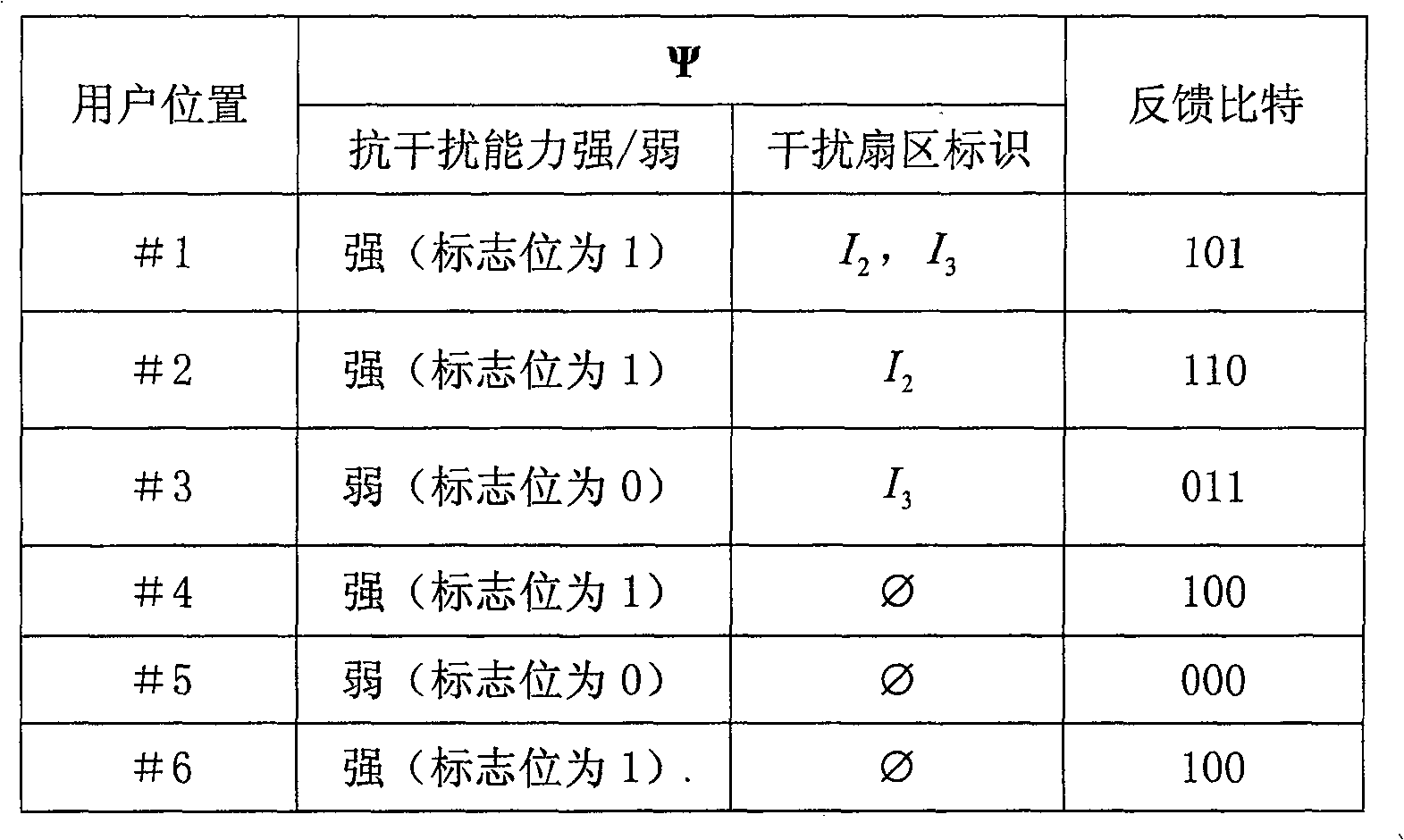
根据式(5),当用户位于图13中的位置#1时,PL1>Λ,PL2>Θ,PL3>Θ,该用户抗干扰能力强,且易于干扰扇区2和扇区3内的用户;当用户位于图13中的位置#2时,PL1>Λ,PL2>Θ,PL3<Θ,该用户抗干扰能力强,且易于干扰扇区2内的用户;当用户位于图13中的位置#3时,PL1<Λ,PL2<Θ,PL3>Θ,该用户抗干扰能力弱,且易于干扰扇区3内的用户;当用户位于图13中的位置#4时,PL1>Λ,PL2<Θ,PL3<Θ,该用户抗干扰能力强,且不易于干扰相邻小区或扇区内用户;当用户位于图13中的位置#5时,PL1<Λ,PL2<Θ,PL3<Θ,该用户抗干扰能力弱,且不易于干扰相邻小区或扇区内用户;当用户位于图13中的位置#6时,PL1>Λ,PL2<Θ,PL3<Θ,该用户抗干扰能力强,且不易于干扰相邻小区或扇区内用户。上述结果即为用户的抗干扰与干扰相邻小区或扇区内用户的情况的判断结果Ψ。According to formula (5), when the user is at position #1 in Figure 13, PL 1 > Λ, PL 2 > Θ, PL 3 > Θ, the user has strong anti-interference ability and is easy to interfere with sector 2 and sector 3 users in sector 2; when the user is at position #2 in Figure 13, PL 1 > Λ, PL 2 > Θ, PL 3 < Θ, the user has strong anti-interference ability and is easy to interfere with users in sector 2; when the user When located at position #3 in Figure 13, PL 1 <Λ, PL 2 <Θ, PL 3 >Θ, the user has weak anti-interference ability and is easy to interfere with users in sector 3; when the user is located at the position in Figure 13 At #4, PL 1 >Λ, PL 2 <Θ, PL 3 <Θ, the user has strong anti-interference ability and is not easy to interfere with users in adjacent cells or sectors; when the user is at position #5 in Figure 13 , PL 1 <Λ, PL 2 <Θ, PL 3 <Θ, the user has weak anti-interference ability and is not easy to interfere with users in adjacent cells or sectors; when the user is at position #6 in Figure 13, PL 1 >Λ, PL 2 <Θ, PL 3 <Θ, the user has strong anti-interference ability and is not easy to interfere with users in adjacent cells or sectors. The above result is the judgment result Ψ of the user's anti-interference and interference with the user in the adjacent cell or sector.
在本实施例中,采用用户对自身的抗干扰与干扰相邻小区或扇区内用户的情况作出判断,得到判断结果Ψ,然后向基站周期性报告的方式,报告周期为τ=1s,上述过程即为图3的用户的抗干扰与干扰相邻小区或扇区内用户的情况的判断模块中的左分支。在本实施例的3扇区蜂窝系统中,采用3比特反馈报告方式。设抗干扰能力强的标志位为1,抗干扰能力弱的标志位为0。在标识用户是否易于干扰相邻小区或扇区内用户时,将3个扇区的标识I1,I2,I3采用2个比特分别编码为01,10,11。In this embodiment, the user makes a judgment on his own anti-interference and interference with users in adjacent cells or sectors, obtains the judgment result Ψ, and then periodically reports to the base station, the reporting period is τ=1s, the above The process is the left branch in the judging module of the user's anti-interference and interference with users in adjacent cells or sectors in FIG. 3 . In the 3-sector cellular system of this embodiment, a 3-bit feedback reporting method is adopted. Set the flag bit with strong anti-interference ability to 1, and the flag bit with weak anti-interference ability to be 0. When identifying whether a user is likely to interfere with a user in an adjacent cell or a sector, the identities I 1 , I 2 , and I 3 of the three sectors are encoded as 01, 10, and 11 respectively with 2 bits.
根据式(6),当用户位于图13中的位置#1时,该用户抗干扰能力强,且易于干扰扇区2和扇区3内的用户,其反馈101;当用户位于图13中的位置#2时,该用户抗干扰能力强,且易于干扰扇区2内的用户,其反馈110;当用户位于图13中的位置#3时,该用户抗干扰能力弱,且易于干扰扇区3内的用户,其反馈011;当用户位于图13中的位置#4时,该用户抗干扰能力强,且不易于干扰相邻小区或扇区内用户,其反馈100;当用户位于图13中的位置#5时,该用户抗干扰能力弱,且不易于干扰相邻小区或扇区内用户,其反馈000;当用户位于图13中的位置#6时,该用户抗干扰能力强,且不易于干扰相邻小区或扇区内用户,其反馈100。According to formula (6), when the user is at
将上述反馈列表如下:List the above feedback as follows:
(4)基站分配资源的使用权限(4) Access to resources allocated by the base station
该步骤位于图3中的资源权限分配模块。This step is located in the resource authority allocation module in FIG. 3 .
基站根据用户的抗干扰与干扰相邻小区或扇区内用户的情况的判断信息Ψ,分配资源的使用权限。在小区①内标识为I1的扇区中,基站对于易于干扰相邻小区或扇区内用户的用户,基站限制其有权限使用的资源,并可能减小其发射功率,以减小其对相邻小区或扇区的边界用户的同信道干扰,从而提高小区或扇区的边界用户的数据传输速率;对于不易于干扰相邻小区或扇区内用户的用户,基站使其对本小区或扇区的边界用户专用资源具有候补使用权限,或是可能提高其发射功率,以保持系统的数据传输总速率没有明显下降。The base station allocates resource usage rights according to the judgment information Ψ of the user's anti-interference and interference with users in adjacent cells or sectors. In the sector marked as I 1 in the
在图13中,当用户位于位置#1时,该用户抗干扰能力强,且易于干扰扇区2和扇区3内的用户,根据式(7),
R(u)={1,4,7,10,13,16,19,22,25,28,31,34,37,40,43,46} (20)R(u)={1, 4, 7, 10, 13, 16, 19, 22, 25, 28, 31, 34, 37, 40, 43, 46} (20)
当用户位于位置#2时,该用户抗干扰能力强,且易于干扰扇区2内的用户,根据式(7),R(u)=S\(S(J(I1))∪S(J(I2)))=S(J(I3))。在某一次实验中,当TTI_idx=2时,J(I1)=1,J(I2)=2,J(I3)=3,由式(16),式(17),式(18)可得,该用户有权限使用的资源R(u)为:When the user is at
R(u)={3,6,9,12,15,18,21,24,27,30,33,36,39,42,45,48} (21)R(u)={3, 6, 9, 12, 15, 18, 21, 24, 27, 30, 33, 36, 39, 42, 45, 48} (21)
当用户位于图13中的位置#3时,该用户抗干扰能力弱,且易于干扰扇区3内的用户,根据式(7),R(u)=S(J(I1))。在某一次实验中,当TTI_idx=2时,J(I1)=1,J(I2)=2,J(I3)=3,由式(16),式(17),式(18)可得,该用户有权限使用的资源R(u)为:When the user is at
R(u)={1,4,7,10,13,16,19,22,25,28,31,34,37,40,43,46} (22)R(u)={1, 4, 7, 10, 13, 16, 19, 22, 25, 28, 31, 34, 37, 40, 43, 46} (22)
当用户位于图13中的位置#4时,该用户抗干扰能力强,且不易于干扰相邻小区或扇区内用户,根据式(7),R(u)=S\(S(J(I1))),并对S(J(I1))拥有候补使用权限。在某一次实验中,当TTI_idx=2时,J(I1)=1,J(I2)=2,J(I3)=3,由式(16),式(17),式(18)可得,该用户有权限使用的资源R(u)为:When the user is located at
该用户有候补使用权限的资源为{1,4,7,10,13,16,19,22,25,28,31,34,37,40,43,46}。The resources that the user has alternate access rights to are {1, 4, 7, 10, 13, 16, 19, 22, 25, 28, 31, 34, 37, 40, 43, 46}.
当用户位于图13中的位置#5时,该用户抗干扰能力弱,且不易于干扰相邻小区或扇区内用户,根据式(7),S(J(I1)),在某一次实验中,当TTI_idx=2时,J(I1)=1,J(I2)=2,J(I3)=3,由式(16),式(17),式(18)可得,该用户有权限使用的资源R(u)为:When the user is located at
R(u)={1,4,7,10,13,16,19,22,25,28,31,34,37,40,43,46} (24)R(u)={1, 4, 7, 10, 13, 16, 19, 22, 25, 28, 31, 34, 37, 40, 43, 46} (24)
当用户位于图13中的位置#6时,该用户抗干扰能力强,且不易于干扰相邻小区或扇区内用户,根据式(7),R(u)=S\(S(J(I1))),并对S(J(I1))拥有候补使用权限。在某一次实验中,当TTI_idx=2时,J(I1)=1,J(I2)=2,J(I3)=3,由式(16),式(17),式(18)可得,该用户有权限使用的资源R(u)为:When the user is located at
该用户有候补使用权限的资源为{1,4,7,10,13,16,19,22,25,28,31,34,37,40,43,46}。The resources that the user has alternate access rights to are {1, 4, 7, 10, 13, 16, 19, 22, 25, 28, 31, 34, 37, 40, 43, 46}.
综上所述,用户对资源使用权限的结果Φ,列表如下:To sum up, the result Φ of the user's permission to use resources is listed as follows:


(5)基站根据用户对资源的使用权限,分配资源(5) The base station allocates resources according to the user's authority to use resources
该步骤位于图3中的资源分配模块。This step is located in the resource allocation module in FIG. 3 .
基站根据用户对资源的使用权限的结果Φ,执行资源调度算法,分配资源,在本实施例中,采用式(9)的成比例公平算法进行资源调度。The base station executes a resource scheduling algorithm and allocates resources according to the result Φ of the user's right to use resources. In this embodiment, the proportional fairness algorithm of formula (9) is used for resource scheduling.
图13中,基站(位于小区①内标识为I1的扇区)在分配资源时,先分配除边界用户专用资源以外的资源S\S(J(I1)),后分配边界用户专用资源S(J(I1))。在某一次实验中,当TTI_idx=2时,J(I1)=1,J(I2)=2,J(I3)=3,由式(16),式(17),式(18)可得,基站先分配的资源序号为{2,5,8,11,14,17,20,23,26,29,32,35,38,41,44,47}及{3,6,9,12,15,18,21,24,27,30,33,36,39,42,45,48},后分配的资源序号为{1,4,7,10,13,16,19,22,25,28,31,34,37,40,43,46}。具体地讲,基站先把序号为{2,5,8,11,14,17,20,23,26,29,32,35,38,41,44,47}的资源分配给位于#4,#6的用户,再把序号为{3,6,9,12,15,18,21,24,27,30,33,36,39,42,45,48}的资源分配给位于#2,#4,#6的用户,最后把序号为{1,4,7,10,13,16,19,22,25,28,31,34,37,40,43,46}的资源分配给位于#1,#3,#5的用户。将上述资源分配顺序和分配对象列表如下:In Figure 13, when allocating resources, the base station (located in the sector identified as I 1 in cell ①) first allocates resources S\S(J(I 1 )) other than border user-specific resources, and then allocates border user-specific resources S(J(I 1 )). In a certain experiment, when TTI_idx=2, J(I 1 )=1, J(I 2 )=2, J(I 3 )=3, from formula (16), formula (17), formula (18 ) can be obtained, the resource numbers allocated by the base station first are {2, 5, 8, 11, 14, 17, 20, 23, 26, 29, 32, 35, 38, 41, 44, 47} and {3, 6, 9, 12, 15, 18, 21, 24, 27, 30, 33, 36, 39, 42, 45, 48}, the sequence number of resources allocated later is {1, 4, 7, 10, 13, 16, 19, 22, 25, 28, 31, 34, 37, 40, 43, 46}. Specifically, the base station first allocates resources with sequence numbers {2, 5, 8, 11, 14, 17, 20, 23, 26, 29, 32, 35, 38, 41, 44, 47} to the resources located in #4, The user of #6 allocates resources with sequence numbers {3, 6, 9, 12, 15, 18, 21, 24, 27, 30, 33, 36, 39, 42, 45, 48} to #2,


但是,当边界用户专用资源有剩余且存在具有候补使用权限的用户对资源仍有需求时,基站将把序号为{1,4,7,10,13,16,19,22,25,28,31,34,37,40,43,46}的资源之中未被使用的资源分配给有候补使用权限的用户,即位于#4,#6的用户使用,以提高蜂窝系统的频谱复用系数。However, when there are surplus resources dedicated to border users and there are users with alternate use rights who still need resources, the base station will set the sequence numbers as {1, 4, 7, 10, 13, 16, 19, 22, 25, 28, Among the resources of 31, 34, 37, 40, 43, 46}, the unused resources are allocated to users with alternate usage rights, that is, users located in #4 and #6, so as to improve the spectrum reuse coefficient of the cellular system .
在仿真中,没有采用提升用户发射功率或是降低用户发射功率的方案,如果需要进一步提高本发明的性能,对于抗干扰能力弱且不易于干扰相邻小区或扇区内用户的用户,基站使其提升发射功率以获得更高的数据传输速率,在图13中,基站使位于位置#5的用户提升发射功率以获得更高的数据传输速率;对于抗干扰能力强且易于干扰相邻小区或扇区内用户的用户,基站使其降低发射功率以减少对相邻小区或扇区内用户的干扰,在图13中,基站使位于位置#1和#2的用户降低发射功率以减少对相邻小区或扇区内用户的干扰。In the simulation, the scheme of increasing or reducing the user’s transmission power is not adopted. If the performance of the present invention needs to be further improved, for users with weak anti-interference ability and not easy to interfere with users in adjacent cells or sectors, the base station uses It increases the transmission power to obtain a higher data transmission rate. In Figure 13, the base station enables the user at
(6)基站根据资源分配结果,对用户的上行链路进行适配(6) The base station adapts the user's uplink according to the resource allocation result
该步骤位于图3中的上行链路适配模块。This step is located in the uplink adaptation module in FIG. 3 .
基站在完成资源分配后,再对用户的上行链路进行适配,包括执行功率控制算法和自适应调制编码算法,生成不同用户上行数据的参数,如:使用的功率,调制方式和编码码率等,并告知用户,用户在收到上述信息后,开始发送上行数据。After the base station completes resource allocation, it adapts the user's uplink, including executing power control algorithms and adaptive modulation and coding algorithms, and generating parameters for different user uplink data, such as: used power, modulation mode, and coding rate etc., and inform the user that after receiving the above information, the user starts to send uplink data.
本实施例中采用的功率控制算法如式(12)所示,其参数为:x=5,α=0.8,Prmin=0.00001。本实施例中采用的自适应调制编码候选方案的数据包错误率曲线与文献:3GPP,R1-061525,“System Analysis for UL SIMO SC-FDMA”,Qualcomm Europe(3GPP文档,编号:R1-061525,“上行链路中单天线发送,多天线接收的SC-FDMA系统的分析”,Qualcomm公司Europe研发中心)中的曲线相同。The power control algorithm adopted in this embodiment is shown in formula (12), and its parameters are: x=5, α=0.8, Pr min =0.00001. The packet error rate curve and literature of the adaptive modulation and coding candidate scheme adopted in this embodiment: 3GPP, R1-061525, "System Analysis for UL SIMO SC-FDMA", Qualcomm Europe (3GPP document, serial number: R1-061525, "Analysis of an SC-FDMA system with single-antenna transmission and multi-antenna reception in the uplink", Qualcomm Europe R&D Center) with the same curve.
在仿真中,考察了系统采用本发明的减小用户间同信道干扰的方法与无干扰抑制方案以及方法(2)(边界用户的定义为用户到本小区或扇区的路径损耗中,最小的10%所对应的用户)的性能比较。仿真结果如下表所示:In the simulation, the system adopts the method for reducing co-channel interference among users of the present invention and the non-interference suppression scheme and method (2) (the boundary user is defined as the path loss of the user to the cell or sector, the minimum 10% of the corresponding users) performance comparison. The simulation results are shown in the table below:
仿真结果表明,本发明的边界用户数据速率比无干扰抑制方案提高78.8%,而扇区数据速率仅下降1.7%;本发明的扇区数据速率比方法(2)提高7.3%,而边界用户数据速率仅下降1.9%。因此,本发明具有边界用户数据速率和系统总速率均较高的优点。Simulation results show that the boundary user data rate of the present invention improves 78.8% than the non-interference suppression scheme, while the sector data rate only drops 1.7%; the sector data rate of the present invention improves 7.3% than method (2), and the boundary user data rate The rate fell only 1.9%. Therefore, the present invention has the advantages of higher boundary user data rate and higher overall system rate.
本发明提出的上行FDMA蜂窝系统的减小用户间同信道干扰的方法对每个用户,根据其抗干扰与干扰相邻小区或扇区内用户的情况,分配不同的资源使用权限,对于易于干扰相邻小区或扇区内用户的用户,基站限制其有权限使用的资源,并可能减小其发射功率,以减小其对相邻小区或扇区的边界用户的同信道干扰,从而提高小区或扇区的边界用户的数据传输速率;对于不易于干扰相邻小区或扇区内用户的用户,基站使其对本小区或扇区的边界用户专用资源具有候补使用权限,或是可能提高其发射功率,以保持系统的数据传输总速率没有明显下降,所以,本发明在实现减小用户间同信道干扰的目标时,具有频谱复用系数较高、系统的数据传输总速率较高、实现较简单,用户与基站间信令交互较少等优点。在上行FDMA蜂窝系统中具有很高的应用价值。The method for reducing co-channel interference between users in the uplink FDMA cellular system proposed by the present invention assigns different resource usage rights to each user according to its anti-interference and interference with users in adjacent cells or sectors. For users in adjacent cells or sectors, the base station restricts the resources it is authorized to use, and may reduce its transmit power to reduce its co-channel interference to border users of adjacent cells or sectors, thereby improving the efficiency of the cell or the data transmission rate of the border users of the sector; for users who are not likely to interfere with users in adjacent cells or sectors, the base station makes it possible to use the resources dedicated to the border users of this cell or sector as a backup, or may increase its transmission power, to keep the total data transmission rate of the system from significantly decreasing, so when the present invention achieves the goal of reducing co-channel interference between users, it has the advantages of higher spectrum reuse coefficient, higher total data transmission rate of the system, and faster realization. Simple, less signaling interaction between the user and the base station. It has high application value in uplink FDMA cellular system.
本发明的上述具体实施方式只是用于阐述本发明的技术内容的示例。本发明并不限于上述具体实施方式,不应对其进行狭义的解释。在本发明的精神和权利要求的范围内,可进行各种变更来实施之。The above specific embodiments of the present invention are merely examples for explaining the technical contents of the present invention. The present invention is not limited to the above-mentioned specific embodiments, which should not be interpreted in a narrow sense. It can be practiced with various changes within the spirit of the invention and the scope of the claims.
Claims (9)
Priority Applications (1)
| Application Number | Priority Date | Filing Date | Title |
|---|---|---|---|
| CNB2007100370348A CN100553357C (en) | 2007-02-01 | 2007-02-01 | Method for reducing co-channel interference between users in uplink FDMA cellular system |
Applications Claiming Priority (1)
| Application Number | Priority Date | Filing Date | Title |
|---|---|---|---|
| CNB2007100370348A CN100553357C (en) | 2007-02-01 | 2007-02-01 | Method for reducing co-channel interference between users in uplink FDMA cellular system |
Publications (2)
| Publication Number | Publication Date |
|---|---|
| CN101031127A CN101031127A (en) | 2007-09-05 |
| CN100553357C true CN100553357C (en) | 2009-10-21 |
Family
ID=38716137
Family Applications (1)
| Application Number | Title | Priority Date | Filing Date |
|---|---|---|---|
| CNB2007100370348A Expired - Fee Related CN100553357C (en) | 2007-02-01 | 2007-02-01 | Method for reducing co-channel interference between users in uplink FDMA cellular system |
Country Status (1)
| Country | Link |
|---|---|
| CN (1) | CN100553357C (en) |
Families Citing this family (23)
| Publication number | Priority date | Publication date | Assignee | Title |
|---|---|---|---|---|
| CN101170347B (en) * | 2007-11-02 | 2012-09-05 | 中兴通讯股份有限公司 | Method for coordinating inter-cell interference in OFDM access system |
| CN101159475B (en) * | 2007-11-02 | 2012-05-23 | 中兴通讯股份有限公司 | Cell coordination method for suppressing terminal transmitted signal interference in OFDM system |
| CN101335539B (en) * | 2008-01-08 | 2011-11-16 | 上海交通大学 | Cochannel interference suppressing method between users and base station thereof |
| CN101500238B (en) * | 2008-02-02 | 2014-03-19 | 夏普株式会社 | Multiplex optimization method and base station for uplink reference signal |
| CN101605382B (en) * | 2008-06-13 | 2011-03-30 | 大唐移动通信设备有限公司 | Method and device for coordinating intercell interference |
| CN101616423B (en) * | 2008-06-24 | 2012-03-21 | 华为技术有限公司 | Methods for transmitting inter-cell interference coordination measurement event and user equipment |
| US8825100B2 (en) * | 2008-08-11 | 2014-09-02 | Blackberry Limited | Method and system for providing a power boost for a wireless communication link using a subset of subcarrier frequencies of the wireless communication link channel as a reduced bandwidth channel |
| US8514784B2 (en) | 2008-08-27 | 2013-08-20 | Zte Corporation | Method for processing downlink signal in sector portion and base station thereof |
| CN101369834B (en) * | 2008-10-17 | 2013-08-28 | 华为技术有限公司 | Combined power control method, system and equipment |
| CN101867967A (en) * | 2009-04-20 | 2010-10-20 | 中兴通讯股份有限公司 | Carrier Aggregation Implementation Method and Device |
| US8700085B2 (en) * | 2010-11-30 | 2014-04-15 | Intel Corporation | Dynamic interference mitigation for cellular networks |
| CN102271414B (en) * | 2011-08-05 | 2013-08-14 | 电信科学技术研究院 | Method for transmission scheduling and device thereof |
| CN102843699B (en) * | 2012-08-17 | 2015-02-18 | 天津大学 | Wireless transmission method under application scenes of macro base stations and family base stations |
| US9226184B2 (en) * | 2013-06-27 | 2015-12-29 | Cisco Technology, Inc. | Estimating and utilizing client receive interference cancellation capability in multi-user transmissions |
| WO2015010286A1 (en) * | 2013-07-24 | 2015-01-29 | 华为技术有限公司 | Frequency-division multiplexing method, device and system for frequency spectrum resources |
| WO2015024240A1 (en) * | 2013-08-23 | 2015-02-26 | 华为技术有限公司 | Network resource control method, apparatus and system |
| CN104735789B (en) * | 2013-12-19 | 2018-06-26 | 中国移动通信集团公司 | A kind of inter-cell interference cancellation method, apparatus and system |
| EP3178271B1 (en) * | 2014-09-01 | 2018-11-07 | Huawei Technologies Duesseldorf GmbH | Method and base station for managing radio resources of device-to-device communication |
| US20170325177A1 (en) * | 2014-11-14 | 2017-11-09 | Telefonaktiebolaget L M Ericsson (Publ) | Method and communication device for controlling inter-link interference |
| US10856340B2 (en) * | 2017-09-15 | 2020-12-01 | Mediatek Inc. | Enhanced cell selection mechanisms in mobile communications |
| CN109803429B (en) * | 2017-11-15 | 2021-01-08 | 维沃移动通信有限公司 | RRM (radio resource management) measurement control method of adjacent cell, mobile communication terminal and network side equipment |
| CN111954224B (en) * | 2019-05-16 | 2022-04-01 | 大唐移动通信设备有限公司 | Method and device for processing same frequency interference |
| CN121239592B (en) * | 2025-12-02 | 2026-01-30 | 长春理工大学 | Resource scheduling optimization methods for mega-constellations |
-
2007
- 2007-02-01 CN CNB2007100370348A patent/CN100553357C/en not_active Expired - Fee Related
Non-Patent Citations (2)
| Title |
|---|
| Evolved UTRA uplink scheduling and frequency reuse. Siemens.3GPP TSG RAN WG1 Meeting #41,第R1-050476卷. 2005 * |
| Inter-cell Interference Mitigation. Huawei.3GPP TSG RAN WG1 Ad Hoc on LTE,第R1-050629卷. 2005 * |
Also Published As
| Publication number | Publication date |
|---|---|
| CN101031127A (en) | 2007-09-05 |
Similar Documents
| Publication | Publication Date | Title |
|---|---|---|
| CN100553357C (en) | Method for reducing co-channel interference between users in uplink FDMA cellular system | |
| Benjebbovu et al. | System-level performance of downlink NOMA for future LTE enhancements | |
| EP2237441B1 (en) | Method and Apparatus for Controlling Transmissions of a Communications System | |
| Xiang et al. | Inter-cell interference mitigation through flexible resource reuse in OFDMA based communication networks | |
| CN101335539B (en) | Cochannel interference suppressing method between users and base station thereof | |
| US20110205929A1 (en) | method of optimising bandwidth allocation in a wireless communication network | |
| CN103222295B (en) | The method of frequency spectrum share and base station | |
| Al-Falahy et al. | Network capacity optimisation in millimetre wave band using fractional frequency reuse | |
| WO2008030478A2 (en) | System and method for radio frequency resource allocation | |
| Lan et al. | Efficient and dynamic fractional frequency reuse for downlink non-orthogonal multiple access | |
| Wamser et al. | Soft frequency reuse in the uplink of an OFDMA network | |
| Eguizabal et al. | Interference management and cell range expansion analysis for LTE picocell deployments | |
| Chen et al. | Optimal power allocation for two-cell sum rate maximization under minimum rate constraints | |
| Ramamoorthi et al. | Performance comparison of dual connectivity with CoMP in heterogeneous cellular networks | |
| Dziyauddin et al. | An adaptive SFR in multicell networks | |
| Luo et al. | Performance evaluation with range expansion for heterogeneous networks | |
| Riato et al. | Interference mitigation strategies for WiMAX networks | |
| Xu et al. | Adaptive base station cooperation and subchannel reallocation at cell edge in cellular networks with fractional frequency reuse | |
| Yun et al. | Spectrum efficient region-based resource allocation with fractional loading for FH-OFDMA cellular systems | |
| Chen | Spectral efficiency analysis for LTE networks | |
| Jorguseski et al. | Downlink resource allocation in beyond 3G OFDMA cellular systems | |
| Hejazi | Self-Organized Intelligent Distributed Antenna System in LTE | |
| Abderrazak et al. | Fair scheduling and dynamic ICIC for multi-cellular OFDMA systems | |
| López-Pérez et al. | Dynamic system-level simulation of dynamic frequency planing for real time services in WiMAX networks | |
| Burchardt et al. | Uplink interference protection and fair scheduling for power efficient OFDMA networks |
Legal Events
| Date | Code | Title | Description |
|---|---|---|---|
| C06 | Publication | ||
| PB01 | Publication | ||
| C10 | Entry into substantive examination | ||
| SE01 | Entry into force of request for substantive examination | ||
| C14 | Grant of patent or utility model | ||
| GR01 | Patent grant | ||
| C17 | Cessation of patent right | ||
| CF01 | Termination of patent right due to non-payment of annual fee |
Granted publication date: 20091021 Termination date: 20140201 |