CN100461502C - Preparation method of weakly alkaline membrane for direct alcohol fuel cell - Google Patents
Preparation method of weakly alkaline membrane for direct alcohol fuel cell Download PDFInfo
- Publication number
- CN100461502C CN100461502C CNB2005101046906A CN200510104690A CN100461502C CN 100461502 C CN100461502 C CN 100461502C CN B2005101046906 A CNB2005101046906 A CN B2005101046906A CN 200510104690 A CN200510104690 A CN 200510104690A CN 100461502 C CN100461502 C CN 100461502C
- Authority
- CN
- China
- Prior art keywords
- membrane
- preparation
- film
- fuel cell
- porous
- Prior art date
- Legal status (The legal status is an assumption and is not a legal conclusion. Google has not performed a legal analysis and makes no representation as to the accuracy of the status listed.)
- Expired - Fee Related
Links
Images


Classifications
-
- Y—GENERAL TAGGING OF NEW TECHNOLOGICAL DEVELOPMENTS; GENERAL TAGGING OF CROSS-SECTIONAL TECHNOLOGIES SPANNING OVER SEVERAL SECTIONS OF THE IPC; TECHNICAL SUBJECTS COVERED BY FORMER USPC CROSS-REFERENCE ART COLLECTIONS [XRACs] AND DIGESTS
- Y02—TECHNOLOGIES OR APPLICATIONS FOR MITIGATION OR ADAPTATION AGAINST CLIMATE CHANGE
- Y02E—REDUCTION OF GREENHOUSE GAS [GHG] EMISSIONS, RELATED TO ENERGY GENERATION, TRANSMISSION OR DISTRIBUTION
- Y02E60/00—Enabling technologies; Technologies with a potential or indirect contribution to GHG emissions mitigation
- Y02E60/30—Hydrogen technology
- Y02E60/50—Fuel cells
Landscapes
- Fuel Cell (AREA)
- Manufacture Of Porous Articles, And Recovery And Treatment Of Waste Products (AREA)
Abstract
直接醇类燃料电池弱碱性膜的制备方法,是以多孔材料为支撑体,弱碱性高分子树脂填充多孔材料的孔,形成两面薄膜包围多孔材料的弱碱性膜,所述弱碱性高分子树脂具有下列通式:[R-N(R'3)]y +HxCO3 y-,其中:R为带有苯环的链段,包括聚苯醚、聚苯硫醚、聚醚酮、聚醚醚酮、聚醚砜、聚双酚A醚砜、聚醚酮砜、聚醚酮醚酮酮、杂萘联苯聚醚酮、杂萘联苯聚醚砜、杂萘联苯聚醚酮砜、聚苯乙烯或聚三氟苯乙烯,R'=C1~C6的烷基,x=0或1,y=1或2,树脂的平均分子量在105~1010。弱碱性膜的使用使得燃料电池的工作环境改变为弱碱性环境,使燃料电池不但具有了碱性燃料电池的优点,而且解决了透醇问题,不必排除阴极空气中的CO2。

The preparation method of the weakly alkaline membrane of the direct alcohol fuel cell is to use the porous material as the support body, and the weakly alkaline polymer resin fills the pores of the porous material to form a weakly alkaline membrane surrounded by thin films on both sides. Polymer resins have the following general formula: [RN(R' 3 )] y + H x CO 3 y- , where: R is a segment with a benzene ring, including polyphenylene ether, polyphenylene sulfide, polyether ketone , polyetheretherketone, polyethersulfone, polybisphenol A ethersulfone, polyetherketone sulfone, polyetherketone ether ketone Ether ketone sulfone, polystyrene or polytrifluorostyrene, R' = C 1 -C 6 alkyl, x = 0 or 1, y = 1 or 2, and the average molecular weight of the resin is 10 5 -10 10 . The use of weakly alkaline membrane changes the working environment of the fuel cell to a weakly alkaline environment, so that the fuel cell not only has the advantages of an alkaline fuel cell, but also solves the problem of alcohol penetration without removing CO 2 in the cathode air.
Description
技术领域 technical field
本发明属于直接醇类燃料电池膜的制备方法。The invention belongs to the preparation method of direct alcohol fuel cell membrane.
背景技术 Background technique
直接甲醇燃料电池(DMFC)为一类低温燃料电池,特别适用于移动电源和微、小型电源,适用范围非常广泛,具有非常广阔的市场前景。直接采用其它醇类作燃料则为直接醇类燃料电池(DAFC)。Direct methanol fuel cell (DMFC) is a kind of low-temperature fuel cell, especially suitable for mobile power supply and micro and small power supply. It has a very wide range of applications and has a very broad market prospect. The direct use of other alcohols as fuel is a direct alcohol fuel cell (DAFC).
膜材料是燃料电池的重要组件,寻找廉价、性能优良、使用寿命长的膜材料的研究是DMFC研究的关键技术之一。Membrane materials are important components of fuel cells, and research on membrane materials with low cost, excellent performance and long service life is one of the key technologies in DMFC research.
通常DMFC所采用的膜材料是借鉴质子交换膜燃料电池(PEMFC)研究成果,采用美国杜邦公司的耐分(Nafion)膜,该类膜材料是质子交换膜,所以电池工作的环境为酸性环境。由于使用的燃料甲醇有部分可透过Nafion膜(最大可达40%),造成电池性能衰减,所以寻找一种价廉、阻醇性能好的膜材料的研究受到人们的重视。又由于酸性条件下需要的电池材料要求苛刻,再者燃料电池需要贵金属作为催化剂,其价格昂贵和资源受限,阻碍了燃料电池的商业化。Usually, the membrane material used in DMFC is based on the research results of proton exchange membrane fuel cell (PEMFC), and the Nafion membrane of DuPont Company of the United States is used. This type of membrane material is a proton exchange membrane, so the working environment of the battery is an acidic environment. Since some fuel methanol used can permeate the Nafion membrane (up to 40%), resulting in attenuation of battery performance, so research on finding a cheap membrane material with good alcohol-repelling properties has attracted people's attention. Moreover, the battery materials required under acidic conditions are harsh, and fuel cells require noble metals as catalysts, which are expensive and resource-limited, hindering the commercialization of fuel cells.
通常的碱性燃料电池是以强碱,如,KOH溶液作为电解质的。在碱性条件下,甲醇和氧气的反应活性比在酸性条件下高得多,所以,其电极反应可以用活性稍差的催化剂来催化完成,如,阳极甲醇的氧化可用新制备的泡沫镍,阴极可采用银。这使阳极、阴极的催化剂的选择范围变宽。非酸性环境也使电极板材料的选择范围变宽。20世纪60年代,美国阿波罗(Apollo)登月飞行成功开发出PC3A型碱性燃料电池系统,工作达10750小时。1981年UTC开发出的碱性燃料电池用于航天飞机。国内大连化物所、天津电源研究所、武汉大学等单位开发出了碱性燃料电池。Common alkaline fuel cells use a strong base, such as KOH solution, as the electrolyte. Under alkaline conditions, the reactivity of methanol and oxygen is much higher than that under acidic conditions, so the electrode reaction can be catalyzed by a slightly less active catalyst. For example, the oxidation of methanol at the anode can be newly prepared foamed nickel, The cathode can be silver. This widens the selection range of catalysts for the anode and cathode. The non-acid environment also widens the choice of electrode plate materials. In the 1960s, the American Apollo (Apollo) moon landing flight successfully developed the PC3A alkaline fuel cell system, which worked for 10,750 hours. Alkaline fuel cells developed by UTC in 1981 are used in space shuttles. The domestic Dalian Institute of Chemical Physics, Tianjin Power Research Institute, Wuhan University and other units have developed alkaline fuel cells.
由于空气中的CO2和甲醇氧化产生的CO2可与KOH或碱性聚合物膜中的氢氧根反应,会导致电解质溶液的损失或载流子(氢氧根离子)减少,电池性能下降。为了防止二氧化碳的侵入,必须配备二氧化碳清除装置。如果燃料采用醇类,由于醇类氧化产物为二氧化碳,使得二氧化碳的清除变得困难。Since CO2 in the air and CO2 produced by the oxidation of methanol can react with KOH or hydroxide in the alkaline polymer film, it will cause the loss of electrolyte solution or the reduction of carriers (hydroxide ions), and the performance of the battery will decrease . In order to prevent the intrusion of carbon dioxide, a carbon dioxide removal device must be equipped. If alcohol is used as fuel, the removal of carbon dioxide becomes difficult because the oxidation product of alcohol is carbon dioxide.
因此,开发一种新的膜材料,用于直接醇类燃料电池既能享受碱性燃料电池的优点,又能克服碱性燃料电池的缺点,将具有广阔的应用前景。Therefore, the development of a new membrane material for direct alcohol fuel cells can not only enjoy the advantages of alkaline fuel cells, but also overcome the shortcomings of alkaline fuel cells, and will have broad application prospects.
传统膜的制备工艺一般有热压法、刮板法、流延法等。Traditional film preparation techniques generally include hot pressing, scraper method, casting method and so on.
发明内容 Contents of the invention
本发明所要解决的技术问题是提供一种直接醇类燃料电池弱碱性膜的制备方法,弱碱性膜透醇率低,不必排除阴极空气中的CO2,制膜工艺简单,厚度容易控制,变形性小,机械强度高。The technical problem to be solved by the present invention is to provide a method for preparing weakly alkaline membranes for direct alcohol fuel cells. The weakly alkaline membranes have a low alcohol permeation rate and do not need to exclude CO 2 in the cathode air. The membrane making process is simple and the thickness is easy to control. , small deformation, high mechanical strength.
本发明直接醇类燃料电池弱碱性膜的制备方法,其特征在于是以多孔材料为支撑体,用弱碱性高分子树脂填充多孔材料的孔,并在多孔材料的两面形成弱碱性膜,所述弱碱性高分子树脂具有下列通式:The preparation method of the weakly alkaline membrane of the direct alcohol fuel cell of the present invention is characterized in that the porous material is used as a support body, the pores of the porous material are filled with weakly alkaline polymer resin, and the weakly alkaline membrane is formed on both sides of the porous material , the weakly basic polymer resin has the following general formula:
[R-N(R’3)]y +HxCO3 y- [RN(R' 3 )] y + H x CO 3 y-
其中:R为聚苯醚、聚苯硫醚、聚醚酮、聚醚醚酮、聚醚砜、聚双酚A醚砜、聚醚酮砜、聚醚酮醚酮酮、杂萘联苯聚醚酮、杂萘联苯聚醚砜、杂萘联苯聚醚酮砜、聚苯乙烯或聚三氟苯乙烯的链段,Among them: R is polyphenylene ether, polyphenylene sulfide, polyether ketone, polyetherether ketone, polyether sulfone, polybisphenol A ether sulfone, polyether ketone sulfone, polyether ketone ether ketone ketone, polyether ketone Segments of ether ketone, polynaphthyl ether sulfone, polynaphthalene polyether ketone sulfone, polystyrene or polytrifluorostyrene,
R’为C1~C6的烷基,优选R’为C1~C3的烷基,R' is a C 1 -C 6 alkyl group, preferably R' is a C 1 -C 3 alkyl group,
x=0或1,y=1或2,x=0 or 1, y=1 or 2,
树脂的平均分子量在105~1010。The average molecular weight of the resin is between 10 5 and 10 10 .
上述通式的树脂,带苯环的芳香基团可以有两种情况:In the resin of the above general formula, the aromatic group with a benzene ring can have two situations:
一是具有含苯环的芳香侧链的高分子树脂。One is a polymer resin with an aromatic side chain containing a benzene ring.
二是高分子主链中带有含苯环的芳香基团的高分子树脂。The second is a polymer resin with an aromatic group containing a benzene ring in the polymer main chain.
本发明的制备方法有两种方式,一是将所述弱碱性高分子树脂采用溶剂溶解制得制膜液,多孔材料浸泡到制膜液中浸泡,然后干燥而得。The preparation method of the present invention has two methods. One is to dissolve the weakly basic polymer resin in a solvent to obtain a film-forming liquid, soak the porous material in the film-forming liquid, and then dry it.
二是由通式为R—CH2Cl(R基团同上述通式)的氯甲基化聚合物采用溶剂溶解制得中间体的制膜液,多孔材料浸泡到中间体的制膜液中浸泡先成膜,然后膜再依次季铵化反应、弱碱化反应得到。The second is to dissolve the chloromethylated polymer with the general formula R—CH 2 Cl (the R group is the same as the above general formula) in a solvent to prepare the intermediate film-making solution, and soak the porous material in the intermediate film-making solution The film is first formed by soaking, and then the film is obtained by quaternization reaction and weak alkalinization reaction in sequence.
两种方式是可以先制得弱碱性高分子树脂再成膜,或者是制备弱碱性高分子树脂的原料先成膜再依次按照制备树脂的方法反应生成树脂。The two methods are to prepare weakly basic polymer resin first and then form a film, or to prepare raw materials for weakly basic polymer resin to form a film first and then react sequentially according to the method for preparing resin to form resin.
本发明所述多孔材料可以为多孔陶瓷、多孔石棉板、多孔高分子材料、多孔织物、分子筛或多孔金属板,多孔材料的厚度为10~70微米,空隙率为30%~90%,孔径为0.01~0.2mm。多孔材料板做为支撑材料,有利于提高膜的强度,减小变形性。The porous material of the present invention can be porous ceramics, porous asbestos board, porous polymer material, porous fabric, molecular sieve or porous metal plate, the thickness of the porous material is 10-70 microns, the porosity is 30%-90%, and the aperture is 0.01~0.2mm. The porous material plate is used as a supporting material, which is beneficial to improve the strength of the membrane and reduce the deformation.
所述溶剂一般为二甲基甲酰胺、二甲基乙酰胺、N-甲基吡咯烷酮或二甲基亚砜等,制膜液或中间体的制膜液中弱碱性高分子树脂或氯甲基化聚合物的浓度为2wt%~40wt%。The solvent is generally dimethylformamide, dimethylacetamide, N-methylpyrrolidone or dimethyl sulfoxide, etc., weakly alkaline polymer resin or methyl chloride in the film-making solution or intermediate film-making solution The concentration of the base polymer is 2wt%-40wt%.
弱碱性高分子树脂填充多孔材料的孔,形成两面薄膜包围多孔材料的平整、致密的膜材料。形成薄膜的厚度为30~200微米。The weakly basic polymer resin fills the pores of the porous material to form a smooth and dense membrane material surrounded by thin films on both sides. The thickness of the formed film is 30-200 microns.
本发明的优点:Advantages of the present invention:
弱碱性膜机械性能、热稳定性、耐溶剂性能良好,符合作为燃料电池膜材料使用的标准。通过扫描电子显微镜(SEM)观察,膜材料属于平整、致密的膜,分辨率在20nm下未观察到微孔,其断面SEM表明,膜材料无通孔,所以,该膜材料不透气。X-射线粉末衍射(XRD)分析表明,膜材料中无结晶形态,表明该类膜材料不脆,使用过程中不会造成局部漏气。膜材料的电导率为10S/cm~8.52×10-3S/cm,透醇率小于3.56×10-9cm2/S。The weakly alkaline membrane has good mechanical properties, thermal stability, and solvent resistance, and meets the standards for use as a fuel cell membrane material. Observed by a scanning electron microscope (SEM), the membrane material is a smooth and dense membrane, and no micropores are observed at a resolution of 20nm. The cross-sectional SEM shows that the membrane material has no through holes, so the membrane material is airtight. X-ray powder diffraction (XRD) analysis shows that there is no crystalline form in the membrane material, indicating that this type of membrane material is not brittle and will not cause local air leakage during use. The electrical conductivity of the membrane material is 10S/cm~8.52×10 -3 S/cm, and the alcohol permeability is less than 3.56×10 -9 cm 2 /S.
弱碱性膜,其传导离子为弱碱性的碳酸根/碳酸氢根离子。由于其传导方向是从阴极到阳极,所以在离子传导的过程中不会携带甲醇的流动,所以,可以解决透醇的问题。具有广阔的市场前景和重要的理论研究价值。Weakly alkaline membrane, its conduction ion is weakly alkaline carbonate/bicarbonate ion. Since its conduction direction is from the cathode to the anode, the flow of methanol will not be carried during the ion conduction process, so the problem of alcohol penetration can be solved. It has broad market prospects and important theoretical research value.
弱碱性膜,使得燃料电池的工作环境改变为弱碱性环境,这种环境的改变,可以导致燃料电池不但具有了碱性燃料电池的优点,而且反应产物可以允许CO2的产生,也不必排除阴极空气中的CO2,省去了碱液的补加带来的麻烦。The weakly alkaline membrane changes the working environment of the fuel cell to a weakly alkaline environment. This change in the environment can lead to the fuel cell not only having the advantages of an alkaline fuel cell, but also allowing the production of CO 2 by the reaction product without having to Eliminate CO 2 in the cathode air, eliminating the trouble caused by the addition of lye.
利用弱碱性膜可给弱碱性燃料电池带来的其它优点为:Other advantages that the use of weakly alkaline membranes can bring to weakly alkaline fuel cells are:
1)碱性条件下电池电极反应比酸性条件下有利,其催化剂的选择范围变宽。碱性燃料电池的催化剂不但可以采用铂系贵金属催化剂,而且也可采用非贵金属催化剂。如,阳极可采用雷尼镍,阴极可采用银、过渡金属的卟啉、酞菁配合物等。1) The electrode reaction of the battery under alkaline conditions is more favorable than that under acidic conditions, and the selection range of the catalyst is widened. Alkaline fuel cell catalysts can not only use platinum-based noble metal catalysts, but also non-noble metal catalysts. For example, Raney nickel can be used for the anode, and silver, porphyrin and phthalocyanine complexes of transition metals can be used for the cathode.
2)由于载流子的不同,在阴离子导电过程中不会携带甲醇,使甲醇的透过大大减小。2) Due to the difference of carriers, methanol will not be carried during the anion conduction process, so that the penetration of methanol is greatly reduced.
3)碱性条件可以使电池的腐蚀性变差,使得电池材料的选择范围变宽。电池材料也可以选择一些价格便宜,易于加工的材料。3) Alkaline conditions can make the corrosion of the battery worse, making the choice of battery materials wider. Battery materials can also choose some cheap and easy-to-process materials.
总之,所有这些均可大大降低燃料电池的成本,提高燃料电池的寿命,为燃料电池的商业化提供条件。In a word, all these can greatly reduce the cost of fuel cells, improve the life of fuel cells, and provide conditions for the commercialization of fuel cells.
本发明的制膜工艺简单;厚度容易控制;变形性小,溶涨变形性变小;机械强度提高;膜电极(MEA)的性能稳定,且电池的寿命得到延长。The film-making process of the invention is simple; the thickness is easy to control; the deformability is small, and the swelling deformability becomes smaller; the mechanical strength is improved; the performance of the membrane electrode (MEA) is stable, and the service life of the battery is prolonged.
以下对本发明弱碱性高分子树脂膜及合成方法说明如下:Below weakly basic macromolecule resin film of the present invention and synthetic method are described as follows:
一:带含苯环芳香侧链的高分子树脂:One: Polymer resins with aromatic side chains containing benzene rings:
以上碳酸氢钠或碳酸钠的浓度为质量浓度,以下同。The above concentration of sodium bicarbonate or sodium carbonate is the mass concentration, the same below.
其中:
从上述表示的合成方法可以看出,原料的氯甲基化反应得到的氯甲基化聚合物可以先成膜再依次季铵化反应、弱碱化反应。也可以是先依次进行季铵化反应、弱碱化反应,再成膜(弱碱性膜)。As can be seen from the synthesis method represented above, the chloromethylated polymer obtained by the chloromethylation reaction of raw materials can be formed into a film first, followed by quaternization reaction and weak alkalinization reaction. It is also possible to carry out quaternization reaction and weak alkalinization reaction in sequence first, and then form a film (weak alkaline film).
二、高分子主链中带有芳香基团的弱碱性高分子树脂的合成及其成膜方法:2. Synthesis and film-forming method of weakly basic polymer resin with aromatic groups in the polymer main chain:

其中:

从上述表示的合成方法也可以看出,原料的氯甲基化反应得到的氯甲基化聚合物可以先成膜再依次季铵化反应、弱碱化反应。也可以是先依次进行季铵化反应、弱碱化反应,再成膜(弱碱性膜)。It can also be seen from the synthesis method shown above that the chloromethylated polymer obtained by the chloromethylation reaction of raw materials can be formed into a film first, followed by quaternization reaction and weak alkalinization reaction. It is also possible to carry out quaternization reaction and weak alkalinization reaction in sequence first, and then form a film (weak alkaline film).
附图说明 Description of drawings
图1为膜材料的甲醇透过系数测定装置;Fig. 1 is the methanol permeability coefficient measuring device of membrane material;
图2为B池甲醇浓度与时间的变化关系图;Fig. 2 is the change relationship diagram of B pool methanol concentration and time;
图3、图4分别为弱碱性燃料电池的性能曲线;Fig. 3, Fig. 4 are respectively the performance curve of weak alkaline fuel cell;
图中:1被测膜;2搅拌子;In the figure: 1 film to be tested; 2 stirring bar;
A池:1mol/L甲醇溶液;B池:与A池同量的纯水Pool A: 1mol/L methanol solution; Pool B: the same amount of pure water as Pool A
具体实施方式 Detailed ways
实施例1 聚苯乙烯的氯甲基化反应(公知方法)The chloromethylation reaction of embodiment 1 polystyrene (known method)
在装有搅拌器、冷凝器、温度计的250ml三口烧瓶中,加入10~20g聚苯乙烯和100~190ml二氯乙烷(溶剂),室温下搅拌,使其充分溶解。然后升温到60℃~70℃,将事先配好的氯化锌(催化剂)—氯甲醚复合体(1.5g氯化锌完全溶解于20g氯甲醚中)加入到瓶中,搅拌反应3~5小时后,使其慢慢冷却至室温,将瓶中反应物加入到在剧烈搅拌情况下的大量沸水中,氯甲基化聚合物析出,过滤,用水多次洗涤,在60℃的烘箱内干燥,即得氯甲基化产物。反应式如实施例2所示。氯甲基化后产品的表征采用1H NMR。氯甲基的含量分析首先经硝酸钾及氢氧化钠灼烧分解,用水加热溶解,采用佛尔哈德法测定氯含量。氯含量按下式计算:In a 250ml three-necked flask equipped with a stirrer, a condenser, and a thermometer, add 10-20g polystyrene and 100-190ml dichloroethane (solvent), stir at room temperature to fully dissolve. Then heat up to 60°C to 70°C, add the pre-prepared zinc chloride (catalyst)-chloromethyl ether complex (1.5g zinc chloride completely dissolved in 20g chloromethyl ether) into the bottle, and stir for 3~ After 5 hours, let it slowly cool down to room temperature, add the reactants in the bottle to a large amount of boiling water under vigorous stirring, the chloromethylated polymer precipitates, filter, wash with water several times, and store in an oven at 60°C Dry to obtain the chloromethylated product. The reaction formula is as shown in Example 2. The product after chloromethylation was characterized by 1 H NMR. The content analysis of chloromethyl group is first decomposed by burning potassium nitrate and sodium hydroxide, then heated and dissolved in water, and the chlorine content is determined by Volhard method. Chlorine content is calculated according to the following formula:
式中:N—该物质的摩尔浓度(mol/l);V—该物质的体积(ml);In the formula: N—the molar concentration of the substance (mol/l); V—the volume of the substance (ml);
m—样品质量(g)。m—sample mass (g).
实施例2:氯甲基化的聚苯乙烯的成膜与季铵化、弱碱化反应Embodiment 2: film-forming and quaternization, weak alkalinization reaction of chloromethylated polystyrene
将氯甲基化聚苯乙烯溶于N,N-二甲基甲酰胺中,配成2wt%~40wt%制膜液。将多孔支撑材料(如聚四氟乙烯(PTFE)织物浸入制膜液中,抽真空排除多孔材料中气体,浸泡8h,取出漓干、用边框支撑,放到在洁净的玻璃板上,60℃下干燥6~12小时后,再在100℃下热处理4~8小时,自然冷却到室温,备用。The chloromethylated polystyrene is dissolved in N,N-dimethylformamide to prepare a film-making solution of 2wt%-40wt%. Immerse the porous support material (such as polytetrafluoroethylene (PTFE) fabric) in the film-making solution, vacuumize the gas in the porous material, soak for 8 hours, take it out and dry it, support it with a frame, put it on a clean glass plate, 60 °C After drying at low temperature for 6-12 hours, heat treatment at 100°C for 4-8 hours, then cool to room temperature naturally, and set aside.
聚苯乙烯的氯甲基化/季铵化/弱碱化反应如下:The chloromethylation/quaternization/weak alkalinization reaction of polystyrene is as follows:

将上述膜置于三甲胺水溶液(10wt%~30wt%)中,在室温下胺化2~4天,取出后用水冲洗,即得氯型季胺化聚苯乙烯膜,然后在10%~40% Na2CO3水溶液中浸泡1~3天,使其完全水解即得到碳酸根型季胺化聚苯乙烯弱碱性离子交换膜。如果采用10%~40% NaHCO3水溶液中浸泡1~3天,使其完全水解即得到碳酸氢根型季胺化聚苯乙烯弱碱性离子交换膜。Put the above membrane in an aqueous solution of trimethylamine (10wt%-30wt%), aminate it at room temperature for 2-4 days, take it out and rinse it with water to obtain a chlorine-type quaternized polystyrene membrane, and then in 10%-40 Soak in % Na 2 CO 3 aqueous solution for 1 to 3 days to make it completely hydrolyzed to obtain carbonate-type quaternized polystyrene weakly basic ion exchange membrane. If it is soaked in 10%-40% NaHCO 3 aqueous solution for 1-3 days, it is completely hydrolyzed to obtain bicarbonate-type quaternized polystyrene weakly basic ion-exchange membrane.
其它膜材料制备碳酸氢根型弱碱性季铵盐膜的方法与上述方法相同。Other membrane materials The method for preparing bicarbonate type weakly basic quaternary ammonium salt membrane is the same as the above method.
弱碱型季铵化聚苯乙烯阴离子交换膜的离子交换容量IEC采用酸碱滴定的方法来测定。The ion exchange capacity IEC of the weak base type quaternized polystyrene anion exchange membrane is determined by acid-base titration.
通过测试表明,弱碱性聚苯乙烯离子交换膜机械性能、热稳定性、耐溶剂性能良好,符合作为燃料电池膜材料使用的标准。通过扫描电子显微镜(SEM)观察,膜材料属于平整、致密的膜,分辨率在20nm下未观察到微孔,其断面SEM表明,膜材料无通孔,所以,该膜材料不透气。X-射线粉末衍射(XRD)分析表明,膜材料中无结晶形态,表明该类膜材料不脆,使用过程中不会造成局部漏气。Tests show that the weakly basic polystyrene ion exchange membrane has good mechanical properties, thermal stability, and solvent resistance, and meets the standards for use as fuel cell membrane materials. Observed by a scanning electron microscope (SEM), the membrane material is a smooth and dense membrane, and no micropores are observed at a resolution of 20nm. The cross-sectional SEM shows that the membrane material has no through holes, so the membrane material is airtight. X-ray powder diffraction (XRD) analysis shows that there is no crystalline form in the membrane material, indicating that this type of membrane material is not brittle and will not cause local air leakage during use.
按照上述操作,如果采用三乙胺溶液(或其它叔胺)代替三甲胺溶液可以得到三乙胺(或其它叔胺)季铵化的膜材料。According to the above operation, if triethylamine solution (or other tertiary amine) is used instead of trimethylamine solution, a membrane material quaternized with triethylamine (or other tertiary amine) can be obtained.
如果制备出得到弱碱化后的树脂成膜,可采用N-a甲基吡咯烷酮等溶剂溶解弱碱性树脂,制备2%~40%质量浓度的制膜液,把多孔(支撑)材料浸泡到制膜液中,真空排除多孔材料中的气泡,浸泡8h后取出,漓干,边框支撑烘干成膜,与所述方法相同。If the weakly alkalized resin is prepared to form a film, solvents such as N-a methylpyrrolidone can be used to dissolve the weakly basic resin, and a film-making solution with a mass concentration of 2% to 40% can be prepared, and the porous (support) material is soaked in the film-forming solution. In the solution, the air bubbles in the porous material are removed by vacuum, taken out after soaking for 8 hours, dried, and dried on a frame support to form a film, which is the same as the method described.
实施例3:聚苯醚的氯甲基化反应Embodiment 3: the chloromethylation reaction of polyphenylene ether
采用实施例1的方法,反应溶剂采取氯仿或二氯乙烷,聚苯醚的氯甲基化/铵化/弱碱化反应的反应方程式如下所示:Adopt the method for embodiment 1, reaction solvent takes chloroform or ethylene dichloride, the reaction equation of the chloromethylation/ammonization/weak alkalinization reaction of polyphenylene ether is as follows:

式中:O替换成S即为聚苯硫醚,其它结构同上In the formula: replacing O with S is polyphenylene sulfide, and other structures are the same as above
实施例4:氯甲基化的聚苯醚的成膜/季铵化/弱碱化反应Example 4: Film-forming/quaternization/weak alkalinization reaction of chloromethylated polyphenylene ether
采用实施例2的制膜方法和季铵化、弱碱化反应。反应方程式如实施例3所示Adopt the membrane-making method of
通过测试表明,弱碱性聚苯醚离子交换膜机械性能、热稳定性、耐溶剂性能良好,符合作为燃料电池膜材料使用的标准。通过SEM观察,膜材料属于平整、致密的膜,分辨率在20nm下未观察到微孔,其断面SEM表明,膜材料无通孔,所以,该膜材料不透气。XRD分析表明,膜材料中无结晶形态,表明该类膜材料不脆,使用过程中不会造成局部漏气。Tests show that the weakly basic polyphenylene ether ion exchange membrane has good mechanical properties, thermal stability and solvent resistance, and meets the standards for being used as a fuel cell membrane material. Observed by SEM, the membrane material is a smooth and dense membrane, and no micropores are observed at a resolution of 20nm. The SEM of its cross-section shows that the membrane material has no through holes, so the membrane material is airtight. XRD analysis shows that there is no crystalline form in the membrane material, indicating that this type of membrane material is not brittle and will not cause local air leakage during use.
弱碱性聚苯硫醚的制备方法同实施例3,4。The preparation method of weakly basic polyphenylene sulfide is the same as that of Examples 3 and 4.
实施例5:聚醚酮氯甲基化/成膜/季胺化/弱碱化反应Example 5: Polyether ketone chloromethylation/film formation/quaternization/weak alkalinization reaction
采用实施例1的方法,反应溶剂采取二氯乙烷反应方程式如下所示Adopt the method of embodiment 1, reaction solvent takes ethylene dichloride and reaction equation is as follows
采用实施例2的制膜方法和季铵化、弱碱化反应。反应方程式如下所示Adopt the membrane-making method of
通过测试表明,弱碱性聚醚酮离子交换膜机械性能、热稳定性、耐溶剂性能良好,符合作为燃料电池膜材料使用的标准。通过SEM观察,膜材料属于平整、致密的膜,分辨率在20nm下未观察到微孔,其断面SEM表明,膜材料无通孔,所以,该膜材料不透气。XRD分析表明,膜材料中无结晶形态,表明该类膜材料不脆,使用过程中不会造成局部漏气。Tests show that the weakly basic polyetherketone ion-exchange membrane has good mechanical properties, thermal stability and solvent resistance, and meets the standards for being used as a fuel cell membrane material. Observed by SEM, the membrane material is a smooth and dense membrane, and no micropores are observed at a resolution of 20nm. The SEM of its cross-section shows that the membrane material has no through holes, so the membrane material is airtight. XRD analysis shows that there is no crystalline form in the membrane material, indicating that this type of membrane material is not brittle and will not cause local air leakage during use.
实施例6:双酚A聚醚砜氯甲基化/成膜/季胺化/弱碱化反应Example 6: Bisphenol A polyethersulfone chloromethylation/film formation/quaternization/weak alkalinization reaction
采用实施例1的方法,反应溶剂采取二氯乙烷,反应方程式如下所示:Adopt the method of embodiment 1, reaction solvent takes ethylene dichloride, and reaction equation is as follows:
采用实施例2的制膜方法和季铵化、弱碱化反应。反应方程式如下所示:Adopt the membrane-making method of

通过测试表明,弱碱双酚A聚醚砜离子交换膜机械性能、热稳定性、耐溶剂性能良好,符合作为燃料电池膜材料使用的标准。通过SEM观察,膜材料属于平整、致密的膜,分辨率在20nm下未观察到微孔,其断面SEM表明,膜材料无通孔,所以,该膜材料不透气。XRD分析表明,膜材料中无结晶形态,表明该类膜材料不脆,使用过程中不会造成局部漏气。Tests show that the weak base bisphenol A polyethersulfone ion exchange membrane has good mechanical properties, thermal stability, and solvent resistance, and meets the standards for use as fuel cell membrane materials. Observed by SEM, the membrane material is a smooth and dense membrane, and no micropores are observed at a resolution of 20nm. The SEM of its cross-section shows that the membrane material has no through holes, so the membrane material is airtight. XRD analysis shows that there is no crystalline form in the membrane material, indicating that this type of membrane material is not brittle and will not cause local air leakage during use.
实施例7:聚醚醚酮氯甲基化/成膜/季胺化/弱碱化反应Example 7: Polyether ether ketone chloromethylation/film formation/quaternization/weak alkalinization reaction
采用实施例1的方法,反应溶剂采取二氯乙烷反应方程式如下所示Adopt the method of embodiment 1, reaction solvent takes ethylene dichloride and reaction equation is as follows
采用实施例2的制膜方法和季铵化、弱碱化反应。反应方程式如下所示Adopt the membrane-making method of

通过测试表明,弱碱性聚醚醚酮离子交换膜机械性能、热稳定性、耐溶剂性能良好,符合作为燃料电池膜材料使用的标准。通过SEM观察,膜材料属于平整、致密的膜,分辨率在20nm下未观察到微孔,其断面SEM表明,膜材料无通孔,所以,该膜材料不透气。XRD分析表明,膜材料中无结晶形态,表明该类膜材料不脆,使用过程中不会造成局部漏气。Tests show that the weakly basic polyether ether ketone ion exchange membrane has good mechanical properties, thermal stability and solvent resistance, and meets the standards for use as a fuel cell membrane material. Observed by SEM, the membrane material is a smooth and dense membrane, and no micropores are observed at a resolution of 20nm. The SEM of its cross-section shows that the membrane material has no through holes, so the membrane material is airtight. XRD analysis shows that there is no crystalline form in the membrane material, indicating that this type of membrane material is not brittle and will not cause local air leakage during use.
实施例8:聚醚酮醚酮酮氯甲基化/成膜/季胺化/弱碱化反应Example 8: Chloromethylation/film formation/quaternization/weak alkalinization of polyether ketone ether ketone ketone
采用实施例1的方法,反应溶剂采取二氯乙烷反应方程式如下所示。Adopt the method for embodiment 1, reaction solvent adopts ethylene dichloride and reaction equation is as follows.
采用实施例2的制膜方法和季铵化、弱碱化反应。反应方程式如下所示。Adopt the membrane-making method of
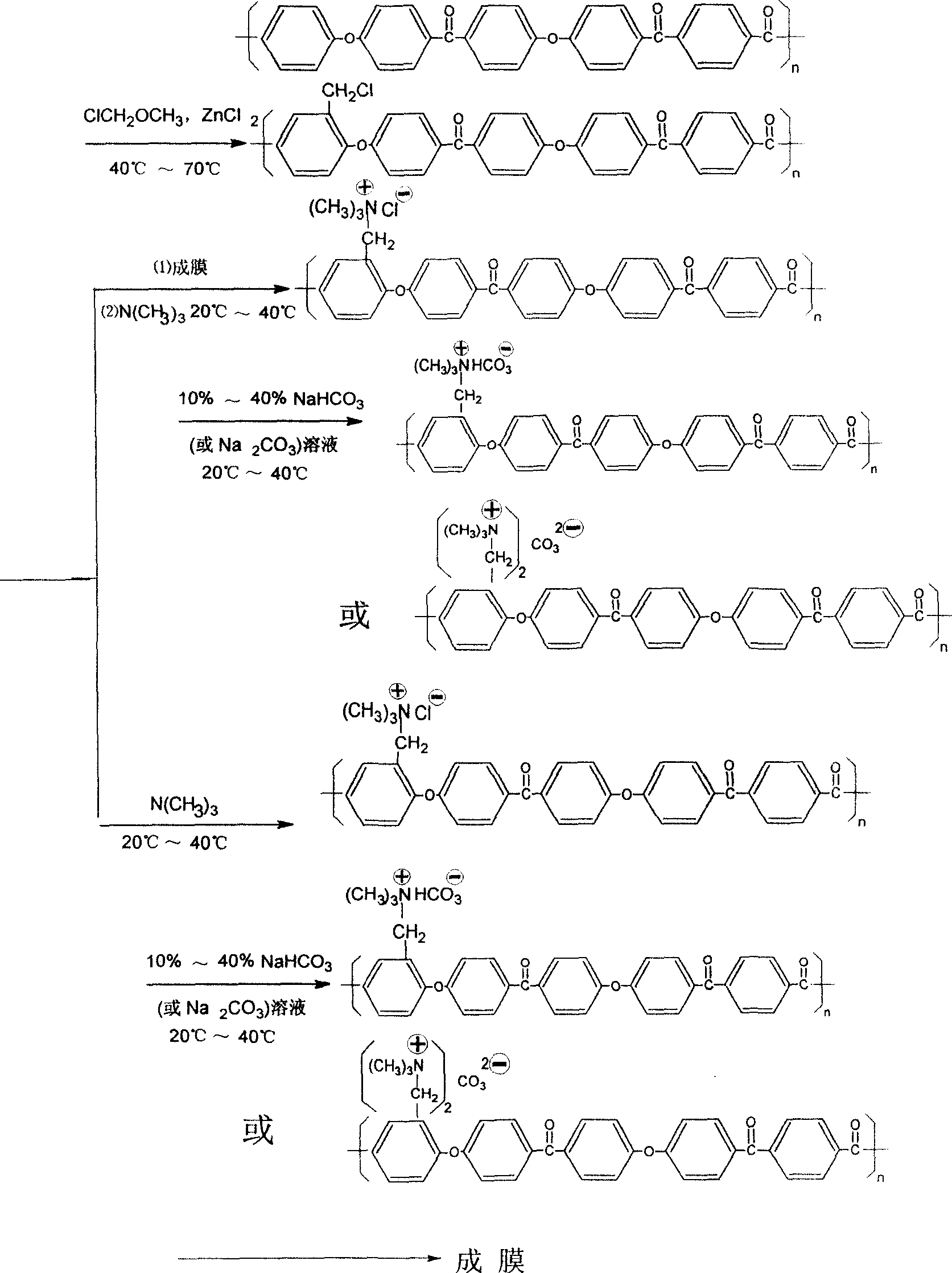
通过测试表明,弱碱性聚醚酮醚酮酮离子交换膜机械性能、热稳定性、耐溶剂性能良好,符合作为燃料电池膜材料使用的标准。通过SEM观察,膜材料属于平整、致密的膜,分辨率在20nm下未观察到微孔,其断面SEM表明,膜材料无通孔,所以,该膜材料不透气。XRD分析表明,膜材料中无结晶形态,表明该类膜材料不脆,使用过程中不会造成局部漏气。Tests show that the weakly basic polyetheretherketone ether ketone ion exchange membrane has good mechanical properties, thermal stability and solvent resistance, and meets the standards for use as a fuel cell membrane material. Observed by SEM, the membrane material is a smooth and dense membrane, and no micropores are observed at a resolution of 20nm. The SEM of its cross-section shows that the membrane material has no through holes, so the membrane material is airtight. XRD analysis shows that there is no crystalline form in the membrane material, indicating that this type of membrane material is not brittle and will not cause local air leakage during use.
实施例9:二氮杂萘酮聚醚酮(PPEK)的氯甲基化/成膜/季铵化/弱碱化反应Embodiment 9: Chloromethylation/film-forming/quaternization/weak alkalinization reaction of phthalazinone polyether ketone (PPEK)
采用实施例1的方法,反应溶剂采取氯仿或二氯乙烷反应方程式如下所示。Adopt the method for embodiment 1, reaction solvent adopts chloroform or ethylene dichloride reaction equation is as follows.
采用实施例2的制膜方法和季铵化、弱碱化反应。反应方程式如下所示。Adopt the membrane-making method of

通过测试表明,弱碱性二氮杂萘聚醚酮离子交换膜机械性能、热稳定性、耐溶剂性能良好,符合作为燃料电池膜材料使用的标准。通过SEM观察,膜材料属于平整、致密的膜,分辨率在20nm下未观察到微孔,其断面SEM表明,膜材料无通孔,所以,该膜材料不透气。XRD分析表明,膜材料中无结晶形态,表明该类膜材料不脆,使用过程中不会造成局部漏气。Tests show that the weakly basic phthalazin polyether ketone ion exchange membrane has good mechanical properties, thermal stability and solvent resistance, and meets the standards for use as a fuel cell membrane material. Observed by SEM, the membrane material is a smooth and dense membrane, and no micropores are observed at a resolution of 20nm. The SEM of its cross-section shows that the membrane material has no through holes, so the membrane material is airtight. XRD analysis shows that there is no crystalline form in the membrane material, indicating that this type of membrane material is not brittle and will not cause local air leakage during use.
实施例10:二氮杂萘酮聚醚砜(PPES)氯甲基化/成膜/季铵化/弱碱化反应Embodiment 10: Chloromethylation/film formation/quaternization/weak alkalinization reaction of phthalazinone polyethersulfone (PPES)
采用实施例1的方法,反应溶剂采取氯仿或二氯乙烷反应方程式如下所示。Adopt the method for embodiment 1, reaction solvent adopts chloroform or ethylene dichloride reaction equation is as follows.
采用实施例2的制膜方法和季铵化、弱碱化反应。反应方程式如下所示。Adopt the membrane-making method of
通过测试表明,弱碱性二氮杂萘聚醚砜离子交换膜机械性能、热稳定性、耐溶剂性能良好,符合作为燃料电池膜材料使用的标准。通过SEM观察,膜材料属于平整、致密的膜,分辨率在20nm下未观察到微孔,其断面SEM表明,膜材料无通孔,所以,该膜材料不透气。XRD分析表明,膜材料中无结晶形态,表明该类膜材料不脆,使用过程中不会造成局部漏气。Tests show that the weakly basic phthalazine polyethersulfone ion exchange membrane has good mechanical properties, thermal stability and solvent resistance, and meets the standards for use as a fuel cell membrane material. Observed by SEM, the membrane material is a smooth and dense membrane, and no micropores are observed at a resolution of 20nm. The SEM of its cross-section shows that the membrane material has no through holes, so the membrane material is airtight. XRD analysis shows that there is no crystalline form in the membrane material, indicating that this type of membrane material is not brittle and will not cause local air leakage during use.

实施例11:二氮杂萘酮聚醚砜酮(PPESK)氯甲基化/成膜/季铵化/弱碱化反应采用实施例1的方法,反应溶剂采取氯仿或二氯乙烷反应方程式如下所示。Example 11: Chloromethylation/film-forming/quaternization/weak alkalinization of phthalazinone polyether sulfone ketone (PPESK) The method in Example 1 is adopted, and the reaction solvent adopts the reaction equation of chloroform or dichloroethane As follows.
采用实施例2的制膜方法和季胺化、弱碱化反应。反应方程式如下所示。The film-making method and quaternization and weak alkalinization reactions of Example 2 were adopted. The reaction equation is shown below.
通过测试表明,弱碱性二氮杂萘聚醚砜酮离子交换膜机械性能、热稳定性、耐溶剂性能良好,符合作为燃料电池膜材料使用的标准。通过SEM观察,膜材料属于平整、致密的膜,分辨率在20nm下未观察到微孔,其断面SEM表明,膜材料无通孔,所以,该膜材料不透气。XRD分析表明,膜材料中无结晶形态,表明该类膜材料不脆,使用过程中不会造成局部漏气。Tests show that the weakly basic phthalazine polyether sulfone ketone ion exchange membrane has good mechanical properties, thermal stability and solvent resistance, and meets the standards for use as a fuel cell membrane material. Observed by SEM, the membrane material is a smooth and dense membrane, and no micropores are observed at a resolution of 20nm. The SEM of its cross-section shows that the membrane material has no through holes, so the membrane material is airtight. XRD analysis shows that there is no crystalline form in the membrane material, indicating that this type of membrane material is not brittle and will not cause local air leakage during use.

以下举例说明上述弱碱性高分子树脂的成膜方法。The film-forming method of the above-mentioned weakly basic polymer resin is exemplified below.
实施例12:多孔材料为基体浸泡高分子树脂Example 12: The porous material is a matrix soaked in a polymer resin
采取多孔材料(如,多孔陶瓷、多孔石棉板,多孔高分子材料,分子筛等)的薄膜材料为基体浸泡上述弱碱性树脂的溶液后,干燥成膜。用SEM测定膜的形貌。测定膜的阻气性能、电导率等参数。Taking a film material of a porous material (eg, porous ceramics, porous asbestos board, porous polymer material, molecular sieve, etc.) The morphology of the membrane was determined by SEM. The parameters such as gas barrier performance and electrical conductivity of the film were measured.
采用0.5~2mm厚的多孔陶瓷板浸入2wt%~40wt%的弱碱化的碳酸根季铵化的二氮杂萘酮聚醚砜酮(PPESK)的二甲基乙酰胺溶液中,浸泡4~14小时,取出平铺在干净的玻璃板上在60℃下真空干燥4小时,130℃干燥8小时备用。Adopt 0.5~2mm thick porous ceramic plate to immerse in the dimethylacetamide solution of the phthalazinone polyether sulfone ketone (PPESK) of the quaternization of weakly alkalinized carbonate group of 2wt%~40wt%, soak 4~ After 14 hours, take it out and spread it on a clean glass plate, dry it in vacuum at 60°C for 4 hours, and dry it at 130°C for 8 hours for later use.
通过测试表明,多孔陶瓷板浸泡过弱碱化的碳酸根季铵化的PPESK离子交换膜机械性能、热稳定性、耐溶剂性能良好,符合作为燃料电池膜材料使用的标准。通过SEM观察,膜材料属于平整、致密的膜,分辨率在20nm下未观察到微孔,其断面SEM表明,膜材料无通孔,所以,该膜材料不透气。XRD分析表明,膜材料中无结晶形态,表明该类膜材料不脆,使用过程中不会造成局部漏气。膜材料的电导率为:5.23×10⁻²S/cm~10.51×10-2S/cm,透醇率为:1.25×10-10cm2/S。Tests show that the PPESK ion-exchange membrane quaternized with weakly alkaline carbonates immersed in porous ceramic plates has good mechanical properties, thermal stability, and solvent resistance, and meets the standards for use as fuel cell membrane materials. Observed by SEM, the membrane material is a smooth and dense membrane, and no micropores are observed at a resolution of 20nm. The SEM of its cross-section shows that the membrane material has no through holes, so the membrane material is airtight. XRD analysis shows that there is no crystalline form in the membrane material, indicating that this type of membrane material is not brittle and will not cause local air leakage during use. The electrical conductivity of the membrane material is: 5.23×10 -2 S/cm~10.51×10 -2 S/cm, and the alcohol permeability is 1.25×10 -10 cm 2 /S.
多孔石棉板、多孔高分子材料板,分子筛等同实施例12。Porous asbestos board, porous polymer material board, and molecular sieves are the same as in Example 12.
其它碳酸根季铵化的高分子材料的溶液制膜方法同同实施例12。The solution film-forming method of other carbonate quaternized polymer materials is the same as in Example 12.
实施例13:多孔PTFE材料增强的聚合物膜材料的制备Example 13: Preparation of porous PTFE material reinforced polymer membrane material
采用多孔的PTFE织物增强的聚合物膜材料Polymer membrane material reinforced with porous PTFE fabric
取0.1~0.05mm厚的PTFE薄膜,空隙率50%~80%,浸入2wt%~40wt%的碳酸根季铵化的聚苯乙烯的二甲基乙酰胺溶液中,浸泡1~4小时,取出平铺在干净的玻璃板上在60℃下真空干燥4小时,130℃干燥8小时备用。Take a 0.1-0.05mm thick PTFE film with a porosity of 50%-80%, immerse it in dimethylacetamide solution of 2wt%-40wt% carbonate quaternized polystyrene, soak for 1-4 hours, take out Spread it on a clean glass plate and dry it under vacuum at 60°C for 4 hours, and then dry it at 130°C for 8 hours for later use.
通过测试表明,多孔PTFE织物支撑的浸泡过弱碱化的碳酸根季铵化的聚苯乙烯离子交换膜机械性能、热稳定性、耐溶剂性能良好,符合作为燃料电池膜材料使用的标准。通过SEM观察,膜材料属于平整、致密的膜,分辨率在20nm下未观察到微孔,其断面SEM表明,膜材料无通孔,所以,该膜材料不透气。XRD分析表明,膜材料中无结晶形态,表明该类膜材料不脆,使用过程中不会造成局部漏气。膜材料的电导率为:6.35×10⁻²S/cm~9.25×10-2S/cm透醇率为:6.32×10-9cm2/STests show that the polystyrene ion-exchange membrane supported by the porous PTFE fabric soaked in weakly alkalinized carbonate and quaternized has good mechanical properties, thermal stability and solvent resistance, and meets the standards for use as a fuel cell membrane material. Observed by SEM, the membrane material is a smooth and dense membrane, and no micropores are observed at a resolution of 20nm. The SEM of its cross-section shows that the membrane material has no through holes, so the membrane material is airtight. XRD analysis shows that there is no crystalline form in the membrane material, indicating that this type of membrane material is not brittle and will not cause local air leakage during use. Conductivity of membrane material: 6.35×10 -2 S/cm~9.25×10 -2 S/cm Alcohol permeability: 6.32×10 -9 cm 2 /S
其他材料制备多孔PTFE薄膜增强的膜材料方法同实施例13。The method for preparing porous PTFE membrane reinforced membrane materials from other materials is the same as in Example 13.
其它碳酸根季铵化的高分子材料的溶液制膜方法同实施例13。The solution film-forming method of other carbonate quaternized polymer materials is the same as that in Example 13.
实施例14:多孔金属板(如钛板)Embodiment 14: porous metal plate (such as titanium plate)
0.1~0.5mm的多孔板(包括多孔金属板)空隙率为50%~80%,孔径小于0.1mm。浸入2wt%~40wt%的碳酸根季铵化的二氮杂萘酮聚醚砜酮(PPESK)的二甲基乙酰胺溶液中,浸泡1~4小时,取出平铺在干净的玻璃板上在60℃下真空干燥4小时,130℃干燥8小时备用。检测膜的透气性能、机械性能、表面形貌和结构、热稳定性等参数,The porosity of the 0.1-0.5mm porous plate (including the porous metal plate) is 50%-80%, and the pore diameter is less than 0.1mm. Immerse in the dimethylacetamide solution of 2wt%~40wt% carbonate quaternized phthalazinone polyether sulfone ketone (PPESK), soak for 1~4 hours, take out and lay on a clean glass plate Vacuum dry at 60°C for 4 hours, and dry at 130°C for 8 hours for later use. Detect parameters such as air permeability, mechanical properties, surface morphology and structure, thermal stability of the membrane,
通过测试表明,多孔PTFE织物支撑的浸泡过弱碱化的碳酸根季铵化的聚苯乙烯离子交换膜机械性能、热稳定性、耐溶剂性能良好,符合作为燃料电池膜材料使用的标准。通过SEM观察,膜材料属于平整、致密的膜,分辨率在20nm下未观察到微孔,其断面SEM表明,膜材料无通孔,所以,该膜材料不透气。XRD分析表明,膜材料中无结晶形态,表明该类膜材料不脆,使用过程中不会造成局部漏气。膜材料的电导率为:3.25×10⁻²S/cm~5.24×10-2S/cm透醇率为:4.21×10-9cm2/STests show that the polystyrene ion-exchange membrane supported by the porous PTFE fabric soaked in weakly alkalinized carbonate and quaternized has good mechanical properties, thermal stability and solvent resistance, and meets the standards for use as a fuel cell membrane material. Observed by SEM, the membrane material is a smooth and dense membrane, and no micropores are observed at a resolution of 20nm. The SEM of its cross-section shows that the membrane material has no through holes, so the membrane material is airtight. XRD analysis shows that there is no crystalline form in the membrane material, indicating that this type of membrane material is not brittle and will not cause local air leakage during use. Conductivity of membrane material: 3.25×10 -2 S/cm~5.24×10 -2 S/cm Alcohol permeability: 4.21×10 -9 cm 2 /S
实施例15:多孔PTFE织物支撑的氯甲基化的高分子材料制备弱碱性膜Example 15: Porous PTFE fabric supported chloromethylated polymer material to prepare weakly alkaline membrane
采用氯甲基化高分子材料溶液浸泡多孔的PTFE织物,制备PTFE增强的聚合物膜材料,然后季铵化、弱碱化处理,从而制备出弱碱性膜材料。具体制备方法如下:The porous PTFE fabric is soaked with a chloromethylated polymer material solution to prepare a PTFE-reinforced polymer membrane material, followed by quaternization and weak alkali treatment to prepare a weakly alkaline membrane material. The specific preparation method is as follows:
取0.1~0.05mm厚,空隙率50%~80%的PTFE薄膜,浸入2wt%~40wt%的氯甲基化的二氮杂萘酮聚醚砜酮(PPESK)的二甲基乙酰胺溶液中,浸泡1~4小时,取出平铺在干净的玻璃板上在60℃下真空干燥4小时,130℃干燥8小时,冷却至室温,备用。制备的膜材料在纯水中浸泡,使其与玻璃板分开。Take a PTFE film with a thickness of 0.1-0.05mm and a porosity of 50%-80%, and immerse it in a dimethylacetamide solution of 2wt%-40wt% chloromethylated phthalazinone polyethersulfone ketone (PPESK) , soak for 1 to 4 hours, take it out and spread it on a clean glass plate, dry it in vacuum at 60°C for 4 hours, dry it at 130°C for 8 hours, cool to room temperature, and set aside. The prepared membrane material was soaked in pure water to separate it from the glass plate.
制备的氯甲基化的高分子膜材料,在20℃~40℃下,浸泡到10%~60%的三甲胺水溶液中48h,取出用纯水漂洗干净。在20℃~40℃下,浸泡到10%~40%Na2CO3(或NaHCO3)中48h,取出用去离子水漂洗,备用。The prepared chloromethylated polymer membrane material is soaked in 10% to 60% trimethylamine aqueous solution for 48 hours at 20° C. to 40° C., taken out and rinsed with pure water. Soak in 10% to 40% Na 2 CO 3 (or NaHCO 3 ) for 48 hours at 20°C to 40°C, take it out and rinse it with deionized water, and set it aside.
通过测试表明,多孔PTFE织物支撑的浸泡过弱碱化的碳酸根季铵化的二氮杂萘酮聚醚砜酮(PPESK)离子交换膜机械性能、热稳定性、耐溶剂性能良好,符合作为燃料电池膜材料使用的标准。通过SEM观察,膜材料属于平整、致密的膜,分辨率在20nm下未观察到微孔,其断面SEM表明,膜材料无通孔,所以,该膜材料不透气。XRD分析表明,膜材料中无结晶形态,表明该类膜材料不脆,使用过程中不会造成局部漏气。膜材料的电导率为:4.21×10⁻²S/cm~8.57×10-2S/cm透醇率为:6.32×10-9cm2/S。Tests have shown that the ion-exchange membrane of phthalazinone polyether sulfone ketone (PPESK) ion-exchange membrane supported by porous PTFE fabric soaked in weakly alkaline carbonate quaternization has good mechanical properties, thermal stability and solvent resistance, and meets the requirements as Standard for use in fuel cell membrane materials. Observed by SEM, the membrane material is a smooth and dense membrane, and no micropores are observed at a resolution of 20nm. The SEM of its cross-section shows that the membrane material has no through holes, so the membrane material is airtight. XRD analysis shows that there is no crystalline form in the membrane material, indicating that this type of membrane material is not brittle and will not cause local air leakage during use. The electrical conductivity of the membrane material is: 4.21×10 -2 S/cm~8.57×10 -2 S/cm and the alcohol permeability is 6.32×10 -9 cm 2 /S.
其它多孔支撑材料与氯甲基化的高分子材料制备弱碱性季铵化的膜材料的制备方法同实施例15。The preparation method of other porous support materials and chloromethylated polymer materials to prepare weakly basic quaternized membrane materials is the same as in Example 15.
其它氯甲基化的高分子材料制备弱碱性支撑膜的方法同实施例15。The method for preparing a weakly basic support membrane from other chloromethylated polymer materials is the same as in Example 15.
实施例16 膜材料的透甲醇系数测定Embodiment 16 Methanol permeability coefficient determination of membrane material
膜材料甲醇透醇系数的测定采用图1所示的已有技术装置,在测定时在A、B两池之间夹待测的膜材料,具体测试方法如下:待测膜在测试前在纯水中浸泡至少24h,膜两侧有起到支撑作用的不锈钢网,此三层结构夹于两池之间,用圆形夹固定。A池加入1mol/L甲醇溶液,B池加入与A池同量的纯水。同时开启搅拌装置。每隔一段时间从B池取出少量液体用气相色谱(采用岛津2010)进行检测溶液中甲醇的含量。测试温度范围在室温到80℃之间。在同一温度下,不同时间取样可以得到甲醇浓度随时间的变化曲线(如图2所示)。通过计算可得到膜材料的透醇系数。The mensuration of membrane material methanol permeability coefficient adopts the prior art device shown in Fig. 1, and the membrane material to be tested is clamped between A and B two ponds during measurement, and concrete test method is as follows: the membrane to be tested is placed in pure water before testing. Soak in the water for at least 24 hours. There are stainless steel meshes on both sides of the membrane that play a supporting role. This three-layer structure is sandwiched between the two pools and fixed with a circular clamp. Add 1mol/L methanol solution to pool A, and add the same amount of pure water as pool A to pool B. Simultaneously turn on the stirrer. Take out a small amount of liquid from pool B at regular intervals and use gas chromatography (using Shimadzu 2010) to detect the content of methanol in the solution. The test temperature range is between room temperature and 80°C. At the same temperature, sampling at different times can obtain a curve of methanol concentration over time (as shown in Figure 2). The alcohol permeability coefficient of the membrane material can be obtained by calculation.
实施例17:其它醇类透醇系数测定Embodiment 17: Determination of other alcohols through alcohol coefficient
其它醇(如乙醇、异丙醇等)的透过系数测定方法同实施例13,只是A池中的甲醇溶液换成其它醇类的溶液即可。由于甲醇的分子最小,最容易发生扩散,再者,甲醇分子的极性最大,最容易与离子结合从而电拖曳最严重。所以,其它醇类的透醇系数要比甲醇的小。The method for measuring the transmission coefficient of other alcohols (such as ethanol, isopropanol, etc.) is the same as in Example 13, except that the methanol solution in the pool A is replaced with solutions of other alcohols. Since the molecule of methanol is the smallest, it is the most likely to diffuse. Moreover, the polarity of the methanol molecule is the largest, and it is the easiest to combine with ions, so the electric drag is the most serious. Therefore, the alcohol permeability coefficient of other alcohols is smaller than that of methanol.
以下为膜电极的制备举例及电池性能测试。The following are examples of membrane electrode preparation and battery performance testing.
实施例18:碳纸的疏水处理(公知技术)Embodiment 18: Hydrophobic treatment of carbon paper (known technology)
将T-090(或T-060)碳纸裁成所需尺寸,在110℃下烘干4h,冷却后取出称重。将待处理的碳纸放入10wt%的聚四氟乙烯(PTFE)乳液(用购买的30wt%PTFE乳液加二次水稀释)中浸泡30min,取出,在110℃下烘2h以去除溶剂,然后放入炉中在350℃下加热2h。冷却后称重,计算材料中PTFE的百分含量。Cut T-090 (or T-060) carbon paper to the required size, dry it at 110°C for 4 hours, take it out and weigh it after cooling. Soak the carbon paper to be treated in 10wt% polytetrafluoroethylene (PTFE) emulsion (diluted with purchased 30wt% PTFE emulsion and secondary water) for 30min, take it out, bake at 110°C for 2h to remove the solvent, and then Put into the furnace and heat at 350°C for 2h. Weigh after cooling, and calculate the percentage of PTFE in the material.
实施例19:弱碱性聚合物膜的预处理(公知技术方式)Embodiment 19: the pretreatment of weak basic polymer film (commonly known technique mode)
采用本发明的弱碱性聚合物膜在5vol%H2O2水溶液中煮1h,以除去膜中的有机杂质,取出膜用去离子水反复冲洗后放入1.0mol/L的Na2CO3溶液中煮沸1h,使膜完全转变为弱碱性。用去离子水冲洗数次,然后将膜放在去离子水中煮1h,保存于去离子水中,备用。Use the weakly basic polymer membrane of the present invention to boil in 5vol% H 2 O 2 aqueous solution for 1 hour to remove organic impurities in the membrane, take out the membrane and rinse it repeatedly with deionized water, then put in 1.0mol/L Na 2 CO 3 Boil in the solution for 1h to make the membrane completely change to weak alkaline. Rinse with deionized water for several times, then boil the membrane in deionized water for 1 hour, store in deionized water, and set aside.
实施例20:膜电极的制备(1)Example 20: Preparation of Membrane Electrode (1)
阳极催化剂采用20%铂载量的PtRu/C,阴极催化剂采用双环酞菁钴(钴载量20%HNODPcCo(II)/C)600℃活化。The anode catalyst is PtRu/C with 20% platinum loading, and the cathode catalyst is activated at 600°C with bicyclic phthalocyanine cobalt (cobalt loading 20% HNODPcCo(II)/C).
按照1.2mg/cm2(或其它载量)的用量称取适量阴极催化剂,加入适量二次蒸馏水、1.0mol/L的NaOH溶液、异丙醇、2w/w%~10w/w%的碳酸根季铵型弱碱性聚合物(或其它弱碱性高分子聚合树脂)乳液和聚四氟乙烯乳液,超声波振荡1h左右取出,放入40℃~60℃烘箱内烘至膏状,均匀涂抹于20wt%PTFE的T-090碳纸上,自然晾干,作为阴极。用同样的方法制作阳极,只是阳极催化剂的量以1mg/cm2(或其它载量)称取。在两片阴、阳极的催化剂层上涂抹适量的与膜材料相应的弱碱性聚合物树脂的乳液,阴极采用钴载量1mg/cm2,催化剂采用六(4-硝基双环酞菁钴)固载到XC—72活性炭上,钴载量为12w/w%400℃,氩气保护下活化2h,阴极部分的制备方法同阳极的制备方法。将阴、阳两极催化剂层朝膜方向置于处理过的膜两侧(类似于三明治结构),放在夹板中间,在120℃、15.5MPa下用压片机热压2分钟,冷却后取出后作好标记,备用。电池的性能曲线如图3所示。Weigh an appropriate amount of cathode catalyst according to the amount of 1.2 mg/cm 2 (or other loading), add an appropriate amount of twice distilled water, 1.0 mol/L NaOH solution, isopropanol, 2w/w% to 10w/w% carbonate Quaternary ammonium type weakly basic polymer (or other weakly basic polymer resin) emulsion and polytetrafluoroethylene emulsion, take out after ultrasonic vibration for about 1 hour, put it in an oven at 40 ° C ~ 60 ° C to bake until it becomes a paste, and apply it evenly on T-090 carbon paper with 20wt% PTFE was used as the cathode. The anode is made in the same way, except that the amount of the anode catalyst is weighed at 1 mg/cm 2 (or other loading). Apply an appropriate amount of weakly basic polymer resin emulsion corresponding to the membrane material on the catalyst layer of the two cathode and anode, the cathode adopts a cobalt loading of 1mg/cm 2 , and the catalyst adopts hexa(4-nitrobicyclic phthalocyanine cobalt) It is immobilized on XC-72 activated carbon, the cobalt load is 12w/w% at 400°C, activated for 2h under the protection of argon, and the preparation method of the cathode part is the same as that of the anode. Place the cathode and anode catalyst layers on both sides of the treated membrane in the direction of the membrane (similar to a sandwich structure), place it in the middle of the splint, heat press it with a tablet machine at 120°C and 15.5MPa for 2 minutes, and take it out after cooling. Make a mark and reserve. The performance curve of the battery is shown in Figure 3.
实施例21:膜电极的制备(2)Example 21: Preparation of Membrane Electrode (2)
阳极催化剂采用PtRuSn/C,阴极催化剂采用银,其它操作同实施例20.The anode catalyst adopts PtRuSn/C, and the cathode catalyst adopts silver, and other operations are the same as
实施例22:膜电极的制备(3)Example 22: Preparation of Membrane Electrode (3)
阳极催化剂采用雷尼镍,阴极催化剂采用卟晽铁,其它操作同实施例20.The anode catalyst adopts Raney nickel, and the cathode catalyst adopts porphyrin iron, and other operations are the same as in
实施例23:膜电极的制备(4)Example 23: Preparation of Membrane Electrode (4)
膜材料采用PTFE(聚四氟乙烯)网支撑浸泡弱碱性树脂制成的膜,其它操作同实施例20.Membrane material adopts PTFE (polytetrafluoroethylene) net support to soak the membrane that weak basic resin is made, and other operations are with
实施例24:电池组装和电池性能测试Example 24: Battery Assembly and Battery Performance Test
将膜电极置于石墨流场板之间,用适当厚度的聚四氟乙烯片作密封垫片,装好电池。用锁相放大器和恒电位仪测试阻抗,当内阻小于0.4欧姆的时候即可通入燃料和氧气进行电池性能测试。测试条件为,阳极燃料液体流量20mL/min,阴极压力0.2MPa,流量60mL/min。在50℃时开路工作1h,记录开路电压。然后接通负载,在接近极限电流情况下进行活化处理4-5h。再对其放电性能进行测试。通过调节负载的电阻大小来控制电流和电压数值,测定多组(20组左右)的电流、电压值作出极化曲线。测量时,为了保证电池稳态工作,每隔三分钟采集一个数据。Place the membrane electrode between the graphite flow field plates, use a polytetrafluoroethylene sheet of appropriate thickness as a gasket, and install the battery. Use a lock-in amplifier and a potentiostat to test the impedance, and when the internal resistance is less than 0.4 ohms, you can pass in fuel and oxygen for battery performance testing. The test conditions are: the anode fuel liquid flow rate is 20mL/min, the cathode pressure is 0.2MPa, and the flow rate is 60mL/min. Open circuit work for 1 hour at 50°C, and record the open circuit voltage. Then turn on the load, and carry out activation treatment for 4-5h under the condition of close to the limit current. Then test its discharge performance. Control the current and voltage values by adjusting the resistance of the load, and measure the current and voltage values of multiple groups (about 20 groups) to draw polarization curves. During the measurement, in order to ensure the steady-state operation of the battery, a data is collected every three minutes.
图3弱碱性燃料电池的性能曲线是按照下述条件测试。The performance curve of the weak alkaline fuel cell in Fig. 3 is tested according to the following conditions.
采用弱碱性碳酸根季铵化的二氮杂萘聚醚砜酮离子交换膜。A naphthyridine polyether sulfone ketone ion exchange membrane quaternized with weakly basic carbonate groups is used.
阳极采用PtRu/C,阴极采用六(4-硝基)双环酞菁钴,Co载量12%,400℃热处理的催化剂,50℃,2mol/L甲醇溶液。The anode uses PtRu/C, and the cathode uses hexa(4-nitro)bicyclic cobalt phthalocyanine, with a Co loading of 12%, a catalyst heat-treated at 400°C, 50°C, and 2mol/L methanol solution.
图4弱碱性燃料电池的性能曲线是按照下述条件测试。The performance curve of the weak alkaline fuel cell in Fig. 4 is tested according to the following conditions.
曲线1 阳极采用PtRuSn/C 1mg Pt/cm2,阴极采用雷尼镍,5mgNi/cm2,弱碱性碳酸根季铵化聚醚醚酮离子交换膜。Curve 1 The anode uses PtRuSn/C 1mg Pt/cm 2 , the cathode uses Raney nickel, 5mgNi/cm 2 , weakly basic carbonate quaternized polyether ether ketone ion exchange membrane.
曲线2 阳极采用Ag5mg Pt/cm2,阴极采用二甲胺基苯基卟啉铁,2mgFe/cm2,弱碱性碳酸根季铵化聚三氟苯乙烯离子交换膜。Curve 2: The anode uses Ag5mg Pt/cm 2 , the cathode uses dimethylaminophenylporphyrin iron, 2mgFe/cm 2 , and weakly basic carbonate quaternized polytrifluorostyrene ion exchange membrane.
同样的测试条件下,只是燃料甲醇换成乙醇的溶液,则得到直接乙醇燃料电池,其性能比直接甲醇燃料电池的性能稍差一些。Under the same test conditions, only the fuel methanol is replaced by an ethanol solution, and the direct ethanol fuel cell is obtained, and its performance is slightly worse than that of the direct methanol fuel cell.
若采用异丙醇溶液,取代甲醇水溶液,其它条件同上,则为直接异丙醇燃料电池,其性能比直接甲醇燃料电池的性能稍好一些。If isopropanol solution is used instead of methanol water solution, and other conditions are the same as above, it is a direct isopropanol fuel cell, and its performance is slightly better than that of a direct methanol fuel cell.
Claims (9)
Priority Applications (1)
| Application Number | Priority Date | Filing Date | Title |
|---|---|---|---|
| CNB2005101046906A CN100461502C (en) | 2005-12-31 | 2005-12-31 | Preparation method of weakly alkaline membrane for direct alcohol fuel cell |
Applications Claiming Priority (1)
| Application Number | Priority Date | Filing Date | Title |
|---|---|---|---|
| CNB2005101046906A CN100461502C (en) | 2005-12-31 | 2005-12-31 | Preparation method of weakly alkaline membrane for direct alcohol fuel cell |
Publications (2)
| Publication Number | Publication Date |
|---|---|
| CN1992386A CN1992386A (en) | 2007-07-04 |
| CN100461502C true CN100461502C (en) | 2009-02-11 |
Family
ID=38214423
Family Applications (1)
| Application Number | Title | Priority Date | Filing Date |
|---|---|---|---|
| CNB2005101046906A Expired - Fee Related CN100461502C (en) | 2005-12-31 | 2005-12-31 | Preparation method of weakly alkaline membrane for direct alcohol fuel cell |
Country Status (1)
| Country | Link |
|---|---|
| CN (1) | CN100461502C (en) |
Families Citing this family (1)
| Publication number | Priority date | Publication date | Assignee | Title |
|---|---|---|---|---|
| CN111530298B (en) * | 2020-05-12 | 2021-11-23 | 福建师范大学 | Preparation method of monolithic polyarylethersulfone ketone bipolar membrane containing phthalocyanine water dissociation catalytic group |
Citations (2)
| Publication number | Priority date | Publication date | Assignee | Title |
|---|---|---|---|---|
| CN1275250A (en) * | 1997-10-10 | 2000-11-29 | 美国3M公司 | Method for preparing membrane electrode |
| CN1402370A (en) * | 2002-09-30 | 2003-03-12 | 武汉大学 | Alkaline ion film direct liquid organic matter fuel cell |
-
2005
- 2005-12-31 CN CNB2005101046906A patent/CN100461502C/en not_active Expired - Fee Related
Patent Citations (2)
| Publication number | Priority date | Publication date | Assignee | Title |
|---|---|---|---|---|
| CN1275250A (en) * | 1997-10-10 | 2000-11-29 | 美国3M公司 | Method for preparing membrane electrode |
| CN1402370A (en) * | 2002-09-30 | 2003-03-12 | 武汉大学 | Alkaline ion film direct liquid organic matter fuel cell |
Non-Patent Citations (2)
| Title |
|---|
| Development of direct methaol alkaline fuel cells using anionexchange membranes. Eileen Hao Yu,Keith Scott.Journal or Power Sources,Vol.137 No.2. 2004 |
| Development of direct methaol alkaline fuel cells using anionexchange membranes. Eileen Hao Yu,Keith Scott.Journal or Power Sources,Vol.137 No.2. 2004 * |
Also Published As
| Publication number | Publication date |
|---|---|
| CN1992386A (en) | 2007-07-04 |
Similar Documents
| Publication | Publication Date | Title |
|---|---|---|
| Chen et al. | High-performance anion exchange membrane water electrolyzers with a current density of 7.68 A cm− 2 and a durability of 1000 hours | |
| Li et al. | Poly (vinyl benzyl methylpyrrolidinium) hydroxide derived anion exchange membranes for water electrolysis | |
| Zhao et al. | High-performance alkaline fuel cells using crosslinked composite anion exchange membrane | |
| Hou et al. | Alkali doped polybenzimidazole membrane for high performance alkaline direct ethanol fuel cell | |
| Wang et al. | A polytetrafluoroethylene-quaternary 1, 4-diazabicyclo-[2.2. 2]-octane polysulfone composite membrane for alkaline anion exchange membrane fuel cells | |
| Zhao et al. | Quaternary ammonia polysulfone-PTFE composite alkaline anion exchange membrane for fuel cells application | |
| Zhang et al. | Exfoliated Pt-clay/Nafion nanocomposite membrane for self-humidifying polymer electrolyte fuel cells | |
| CN112144076B (en) | Integrated membrane electrode and preparation method and application thereof | |
| JP2005507012A (en) | Solid polymer membrane for fuel cells in which polyamine is absorbed to reduce methanol permeability | |
| CN101246966B (en) | Proton exchange membrane with anti-gas permeation layer and humidification function and preparation method thereof | |
| CN109390617B (en) | Cross-linked polybenzimidazole basic anion exchange membrane and its preparation and application | |
| JP6585859B2 (en) | Ion conductive membrane | |
| CN101667648B (en) | A kind of preparation method of water retention type proton exchange membrane for fuel cell | |
| CN102702507B (en) | Strong basicity polyarylether ionomer and Synthesis and applications thereof | |
| CN109065926A (en) | Mineralising legal system in situ has machine-Inorganic multilayer compound proton exchange membrane preparation method | |
| CN113851683A (en) | A kind of preparation method of carbazole polyaromatic piperidine anion exchange membrane | |
| Xue et al. | Layer-by-layer self-assembly of CHI/PVS–Nafion composite membrane for reduced methanol crossover and enhanced DMFC performance | |
| CN101008087A (en) | Preparation method of film electrode for solid polymer electrolyte water electrolysis | |
| Li et al. | A microphase separation anion exchange membrane based on poly (terphenyl piperidinium)/cationic polyelectrolyte for high-performance AEMWEs | |
| Mamlouk et al. | Characterization and application of anion exchange polymer membranes with non-platinum group metals for fuel cells | |
| Lee et al. | Optimized structure of asymmetric polybenzimidazole membranes to improve anion exchange membrane water electrolysis performance | |
| Li et al. | Highly performance polybenzimidazole/zirconia composite membrane with loosened chain packing for anion exchange membrane water electrolysis and electrochemical CO2 reduction | |
| CN108075161A (en) | A kind of preparation method of N1- long chain alkanes substitution -4,5- methylimidazole type alkaline anion-exchange membranes | |
| CN102945968A (en) | Composite polyepoxy chloropropane alkaline polymer membrane electrode and preparation method thereof | |
| Najmi et al. | Study of physicochemical characterization of potassium-doped Nafion117 membrane and performance evaluation of air-breathing fuel cell in different alkali-methanol solutions |
Legal Events
| Date | Code | Title | Description |
|---|---|---|---|
| C06 | Publication | ||
| PB01 | Publication | ||
| C10 | Entry into substantive examination | ||
| SE01 | Entry into force of request for substantive examination | ||
| C14 | Grant of patent or utility model | ||
| GR01 | Patent grant | ||
| C17 | Cessation of patent right | ||
| CF01 | Termination of patent right due to non-payment of annual fee |
Granted publication date: 20090211 Termination date: 20101231 |