CN100410017C - Chemical mechanical polishing pad, method of manufacturing same, and chemical mechanical polishing method - Google Patents
Chemical mechanical polishing pad, method of manufacturing same, and chemical mechanical polishing method Download PDFInfo
- Publication number
- CN100410017C CN100410017C CNB2005100542307A CN200510054230A CN100410017C CN 100410017 C CN100410017 C CN 100410017C CN B2005100542307 A CNB2005100542307 A CN B2005100542307A CN 200510054230 A CN200510054230 A CN 200510054230A CN 100410017 C CN100410017 C CN 100410017C
- Authority
- CN
- China
- Prior art keywords
- chemical mechanical
- mechanical polishing
- polishing pad
- water
- polymer
- Prior art date
- Legal status (The legal status is an assumption and is not a legal conclusion. Google has not performed a legal analysis and makes no representation as to the accuracy of the status listed.)
- Expired - Fee Related
Links
Classifications
-
- B—PERFORMING OPERATIONS; TRANSPORTING
- B24—GRINDING; POLISHING
- B24B—MACHINES, DEVICES, OR PROCESSES FOR GRINDING OR POLISHING; DRESSING OR CONDITIONING OF ABRADING SURFACES; FEEDING OF GRINDING, POLISHING, OR LAPPING AGENTS
- B24B37/00—Lapping machines or devices; Accessories
- B24B37/11—Lapping tools
- B24B37/20—Lapping pads for working plane surfaces
- B24B37/24—Lapping pads for working plane surfaces characterised by the composition or properties of the pad materials
-
- E—FIXED CONSTRUCTIONS
- E03—WATER SUPPLY; SEWERAGE
- E03B—INSTALLATIONS OR METHODS FOR OBTAINING, COLLECTING, OR DISTRIBUTING WATER
- E03B3/00—Methods or installations for obtaining or collecting drinking water or tap water
- E03B3/06—Methods or installations for obtaining or collecting drinking water or tap water from underground
- E03B3/08—Obtaining and confining water by means of wells
- E03B3/15—Keeping wells in good condition, e.g. by cleaning, repairing, regenerating; Maintaining or enlarging the capacity of wells or water-bearing layers
-
- B—PERFORMING OPERATIONS; TRANSPORTING
- B24—GRINDING; POLISHING
- B24D—TOOLS FOR GRINDING, BUFFING OR SHARPENING
- B24D18/00—Manufacture of grinding tools or other grinding devices, e.g. wheels, not otherwise provided for
-
- G—PHYSICS
- G01—MEASURING; TESTING
- G01F—MEASURING VOLUME, VOLUME FLOW, MASS FLOW OR LIQUID LEVEL; METERING BY VOLUME
- G01F1/00—Measuring the volume flow or mass flow of fluid or fluent solid material wherein the fluid passes through a meter in a continuous flow
- G01F1/05—Measuring the volume flow or mass flow of fluid or fluent solid material wherein the fluid passes through a meter in a continuous flow by using mechanical effects
Landscapes
- Engineering & Computer Science (AREA)
- Mechanical Engineering (AREA)
- Manufacturing & Machinery (AREA)
- Environmental & Geological Engineering (AREA)
- Health & Medical Sciences (AREA)
- Life Sciences & Earth Sciences (AREA)
- Hydrology & Water Resources (AREA)
- Public Health (AREA)
- Water Supply & Treatment (AREA)
- Finish Polishing, Edge Sharpening, And Grinding By Specific Grinding Devices (AREA)
- Mechanical Treatment Of Semiconductor (AREA)
Abstract
一种化学机械抛光垫,包含由(A)苯乙烯聚合物和(B)二烯聚合物构成的非水溶性基质。上述化学机械抛光垫的制造方法,其特征在于制备含有(A)苯乙烯聚合物、(B)二烯聚合物和(C)交联剂的组合物,将上述组合物成形为预定的形状,并在成形的同时或者成形后加热使其固化,以及一种化学机械抛光方法,其特征在于通过上述化学机械抛光垫对被抛光物的被抛光面进行抛光。根据本发明,可以提供一种化学机械抛光垫,其能够优选适用于金属膜的抛光或绝缘膜的抛光、特别是STI技术,在得到平坦的被抛光面的同时,还能达到较高的抛光速度,且具有足够长的寿命。A chemical mechanical polishing pad comprising a water-insoluble matrix composed of (A) a styrene polymer and (B) a diene polymer. The method for producing the above-mentioned chemical mechanical polishing pad is characterized in that preparing a composition containing (A) a styrene polymer, (B) a diene polymer and (C) a crosslinking agent, forming the composition into a predetermined shape, and heating to solidify while forming or after forming, and a chemical mechanical polishing method, which is characterized in that the polished surface of the object to be polished is polished by the above chemical mechanical polishing pad. According to the present invention, a chemical mechanical polishing pad can be provided, which can be preferably applied to the polishing of metal films or the polishing of insulating films, especially STI technology, and can achieve higher polishing while obtaining a flat surface to be polished. speed, and has a long enough life.
Description
技术领域 technical field
本发明涉及化学机械抛光垫、其制造方法以及化学机械抛光方法。The present invention relates to a chemical mechanical polishing pad, a method of manufacturing the same, and a method of chemical mechanical polishing.
现有技术current technology
在半导体装置的制造中,作为能够形成具有优良平坦性表面的抛光方法,化学机械抛光(CMP)正倍受关注。化学机械抛光是使抛光垫与被抛光物的被抛光面进行滑动,同时使化学机械抛光用水系分散体(分散有磨料的水系分散体)流向化学机械抛光垫表面而对被抛光物进行抛光的技术。已知在这种化学机械抛光中,通过抛光垫的性状和特性等可以大大地左右抛光效果。In the manufacture of semiconductor devices, chemical mechanical polishing (CMP) is attracting attention as a polishing method capable of forming a surface with excellent flatness. Chemical mechanical polishing is to make the polishing pad and the polished surface of the object to be polished slide, and at the same time, the chemical mechanical polishing aqueous dispersion (aqueous dispersion dispersed with abrasives) flows to the surface of the chemical mechanical polishing pad to polish the object to be polished technology. It is known that in such chemical mechanical polishing, the polishing effect can be greatly influenced by the properties and characteristics of the polishing pad.
一直以来,化学机械抛光中用含有微细气泡的聚氨酯泡沫作为抛光垫,在开口于该树脂表面的孔洞(以下称为“孔隙”)中保持浆料而进行抛光。此时,已知可通过在化学机械抛光垫表面(抛光面)上设计沟槽来提高抛光速度和抛光效果(参见日本专利特开平11-70463号公报、日本专利特开平8-216029号公报和日本专利特开平8-39423号公报)。Conventionally, in chemical mechanical polishing, polyurethane foam containing fine air cells is used as a polishing pad, and slurry is held in pores (hereinafter referred to as "pores") opened on the surface of the resin to perform polishing. At this time, it is known that the polishing speed and polishing effect can be improved by designing grooves on the chemical mechanical polishing pad surface (polishing surface) (referring to Japanese Patent Laid-Open No. 11-70463 communique, Japanese Patent Laid-Open No. 8-216029 communique and Japanese Patent Application Laid-Open No. 8-39423).
但是,如果使用聚氨酯泡沫作为化学机械抛光垫的材料,由于自由地控制发泡是非常困难的,因此抛光垫的质量波动,就产生抛光速度和加工状态波动的问题。特别是存在出现划伤状表面缺陷(以下称为“划痕”)的情况,需要进行改善。此外,由于聚氨酯通常耐水性较差,在抛光垫寿命方面有问题。However, if polyurethane foam is used as the material of the chemical mechanical polishing pad, since it is very difficult to freely control the foaming, the quality of the polishing pad fluctuates, causing problems of fluctuations in polishing speed and processing state. In particular, scratch-like surface defects (hereinafter referred to as "scratches") may occur, and improvement is required. In addition, since polyurethane is generally poor in water resistance, there are problems with polishing pad life.
近年来,作为不需要发泡体即可形成孔隙的化学机械抛光垫,公开了在基质树脂中分散水溶性聚合物的抛光垫(参见日本专利特表平8-500622号公报、日本专利公开特开2000-34416号公报、日本专利公开特开2000-33552号公报以及日本专利公开特开2001-334455号公报)。这种技术是通过分散于基质树脂中的水溶性聚合物在抛光时与化学机械抛光用水系分散体或水接触并溶解,而形成孔隙的。若根据该技术,具有能够随意控制孔隙分布状态的优点,可以相当大程度地实现被抛光面表面状态的改善。并且,已知通过采用耐水性优良的弹性体作为基质树脂,也可以取得抛光垫寿命提高的效果。In recent years, as a chemical mechanical polishing pad that does not require a foam to form pores, a polishing pad in which a water-soluble polymer is dispersed in a matrix resin has been disclosed (see Japanese Patent Application Laid-Open Publication No. 8-500622, Japanese Patent Laid-Open Publication No. 2000-34416, Japanese Patent Laid-Open No. 2000-33552, and Japanese Patent Laid-Open No. 2001-334455). In this technique, pores are formed by contacting and dissolving a water-soluble polymer dispersed in a matrix resin with a chemical mechanical polishing aqueous dispersion or water during polishing. According to this technology, it has the advantage of being able to control the distribution state of pores at will, and can realize the improvement of the surface state of the polished surface to a considerable extent. In addition, it is known that the use of an elastomer excellent in water resistance as a matrix resin can also provide an effect of improving the life of the polishing pad.
不过,近年来,为了使半导体装置微型化,正在研究一种浅槽隔离(ShallowTrench Isolation),所谓STI技术。该技术是在硅基片上形成槽后,堆积绝缘膜材料,通过化学机械抛光工序将多余的绝缘膜除去。在STI技术中,化学机械抛光工序的抛光对象以绝缘膜为主。据报道,在STI中,通过使用含氧化铈作为主要的磨料的化学机械抛光用水系分散体而进行化学机械抛光,能够高速获得表面缺陷少的被抛光面(参见专利公开特开2003-209076号公报和专利公开特开2002-190458号公报)。但是,在使用含氧化铈作为主要的磨料的化学机械抛光用水系分散体对绝缘膜进行抛光时,如果使用具有寿命长的优点、在基质树脂中分散水溶性聚合物的抛光垫,存在抛光速度不足的情况,因而很成问题。However, in recent years, in order to miniaturize semiconductor devices, a shallow trench isolation (Shallow Trench Isolation), so-called STI technology, is being studied. This technology is to deposit insulating film material after forming a groove on a silicon substrate, and remove the excess insulating film through a chemical mechanical polishing process. In the STI technology, the polishing object of the chemical mechanical polishing process is mainly an insulating film. According to reports, in STI, by using the chemical mechanical polishing water-based dispersion containing cerium oxide as the main abrasive to carry out chemical mechanical polishing, a polished surface with few surface defects can be obtained at a high speed (see Patent Publication No. 2003-209076 Gazette and Patent Laid-Open No. 2002-190458). However, when polishing an insulating film using a chemical mechanical polishing aqueous dispersion containing cerium oxide as a main abrasive, if a polishing pad having a long life is used and a water-soluble polymer is dispersed in a matrix resin, there is a problem in polishing speed. Insufficient situation, so it is very problematic.
目前还未提供一种能够适用于STI技术的、在使用含氧化铈作为主要磨料的化学机械抛光用水系分散体抛光绝缘膜时能够以高抛光速度得到良好被抛光表面的、且具有足够长的寿命的化学机械抛光垫。Still do not provide a kind of can be applicable to STI technology at present, when using the chemical mechanical polishing aqueous dispersion polishing insulating film that contains cerium oxide as main abrasive material, can obtain good polished surface with high polishing speed, and have enough long Long life chemical mechanical polishing pads.
发明内容 Contents of the invention
本发明目的为提供一种化学机械抛光垫,由含有(A)苯乙烯聚合物和(B)二烯聚合物的非水溶性基质形成,上述(A)成分与(B)成分的用量相对于其合计100重量份,分别是(A)成分为5-70重量份,(B)成分为30-95重量份,其中非水溶性基质在上述(A)成分与(B)成分中的任意一种成分中分散另一种成分而形成海岛构造,且其平均岛域大小为0.1~30μm。The object of the present invention is to provide a chemical mechanical polishing pad, which is formed by a water-insoluble matrix containing (A) styrene polymer and (B) diene polymer, and the consumption of the above-mentioned (A) component and (B) component is relative to A total of 100 parts by weight is 5-70 parts by weight for component (A) and 30-95 parts by weight for component (B). One component is dispersed in another component to form a sea-island structure, and its average island domain size is 0.1-30 μm.
本发明的另一目的是提供一种化学机械抛光垫,该垫可以适用于金属膜的抛光或绝缘膜的抛光、特别是STI技术,在得到平坦的被抛光面的同时,还能达到高的抛光速度,且具有足够长的寿命。Another object of the present invention is to provide a kind of chemical mechanical polishing pad, and this pad can be applicable to the polishing of metal film or the polishing of insulating film, especially STI technology, can also reach high while obtaining flat surface to be polished. Polishing speed, and has a long enough life.
本发明的另一目的在于提供本发明化学机械抛光垫的制造方法。Another object of the present invention is to provide a method for manufacturing the chemical mechanical polishing pad of the present invention.
本发明的又一目的为提供使用本发明化学机械抛光垫的化学机械抛光方法。Another object of the present invention is to provide a chemical mechanical polishing method using the chemical mechanical polishing pad of the present invention.
本发明的再一目的和优点可以根据以下的说明而明确。Still another object and advantage of the present invention will become clear from the following description.
根据本发明,本发明的上述目的和优点,第一是通过一种化学机械抛光垫而实现的,该抛光垫包括包含(A)苯乙烯聚合物和(B)二烯聚合物的非水溶性基质。According to the present invention, the above objects and advantages of the present invention are firstly achieved by a chemical mechanical polishing pad comprising a water-insoluble compound comprising (A) styrene polymer and (B) diene polymer matrix.
根据本发明,本发明的上述目的和优点,第二是通过制造上述化学机械抛光垫的方法而实现的,其特征在于制备含有(A)苯乙烯聚合物、(B)二烯聚合物和(C)交联剂的组合物,将上述组合物成形为预定的形状,并在成形的同时或者成形后加热使其固化。According to the present invention, above-mentioned purpose and advantage of the present invention, the second is to realize by the method for manufacturing above-mentioned chemical mechanical polishing pad, it is characterized in that preparation contains (A) styrene polymer, (B) diene polymer and ( C) A composition of a crosslinking agent, which is molded into a predetermined shape and heated to cure simultaneously with or after the molding.
根据本发明,本发明的上述目的和优点,第三是通过一种化学机械抛光方法而达成的,其特征在于通过本发明的化学机械抛光垫抛光被抛光物的被抛光面。According to the present invention, the above objects and advantages of the present invention are thirdly achieved by a chemical mechanical polishing method, which is characterized in that the polished surface of the object to be polished is polished by the chemical mechanical polishing pad of the present invention.
具体实施方式 Detailed ways
化学机械抛光垫Chemical Mechanical Polishing Pads
本发明的化学机械抛光垫具有上述的含(A)苯乙烯聚合物和(B)二烯聚合物的非水溶性基质。The chemical mechanical polishing pad of the present invention has the above-mentioned water-insoluble matrix containing (A) styrene polymer and (B) diene polymer.
(A)苯乙烯聚合物(A) Styrene polymer
苯乙烯聚合物(A)可以是苯乙烯的均聚物聚苯乙烯,也可以是苯乙烯共聚物。The styrene polymer (A) may be polystyrene, a homopolymer of styrene, or a styrene copolymer.
作为上述苯乙烯共聚物可以是苯乙烯和能够与苯乙烯共聚的其它单体的共聚物。作为能够与苯乙烯共聚的其它单体,可以列举例如脂肪族共轭二烯化合物、不饱和羧酸酯化合物、乙烯基氰化合物等。The styrene copolymer mentioned above may be a copolymer of styrene and other monomers that can be copolymerized with styrene. Examples of other monomers that can be copolymerized with styrene include aliphatic conjugated diene compounds, unsaturated carboxylate compounds, vinyl cyanide compounds, and the like.
作为上述脂肪族共轭二烯化合物可以列举例如1,3-丁二烯、异戊二烯、氯丁二烯等。As said aliphatic conjugated diene compound, 1, 3- butadiene, isoprene, chloroprene etc. are mentioned, for example.
作为上述不饱和羧酸酯化合物可以列举例如(甲基)丙烯酸甲酯、(甲基)丙烯酸乙酯、(甲基)丙烯酸正丙酯、(甲基)丙烯酸异丙酯、(甲基)丙烯酸环己酯、(甲基)丙烯酸苯酯、2-甲氧基乙基(甲基)丙烯酸酯、甲氧基二甘醇(甲基)丙烯酸酯等。Examples of the unsaturated carboxylic acid ester compound include methyl (meth)acrylate, ethyl (meth)acrylate, n-propyl (meth)acrylate, isopropyl (meth)acrylate, (meth)acrylic acid Cyclohexyl ester, phenyl (meth)acrylate, 2-methoxyethyl (meth)acrylate, methoxydiethylene glycol (meth)acrylate, and the like.
上述乙烯基氰化合物可以列举例如(甲基)丙烯腈、α-氯代丙烯腈、亚乙烯基二氰等。Examples of the vinyl cyanide compound include (meth)acrylonitrile, α-chloroacrylonitrile, vinylidene dicyanide, and the like.
作为苯乙烯共聚物的具体例子,可以列举例如苯乙烯/1,3-丁二烯共聚物、苯乙烯/异戊二烯共聚物、苯乙烯/丙烯腈共聚物、苯乙烯/甲基丙烯酸甲酯共聚物、苯乙烯/1,3-丁二烯/丙烯腈共聚物等。它们可以是无规共聚物,也可以是嵌段共聚物,当是嵌段共聚物时,可以是A-B型、A-B-A型、多嵌段型等的任意一种。此外,当共聚物中含有能够加氢的碳碳双键时,可以是它们完全或部分加氢的。Specific examples of styrene copolymers include styrene/1,3-butadiene copolymers, styrene/isoprene copolymers, styrene/acrylonitrile copolymers, styrene/methacrylate Ester copolymer, styrene/1,3-butadiene/acrylonitrile copolymer, etc. These may be random copolymers or block copolymers, and when they are block copolymers, they may be any of A-B type, A-B-A type, and multi-block type. Furthermore, when the copolymers contain carbon-carbon double bonds capable of hydrogenation, they may be fully or partially hydrogenated.
苯乙烯共聚物中所含苯乙烯的含量优选为10质量%或以上,更优选为20质量%或以上。如果苯乙烯含量不足10质量%,在化学机械抛光工序中,存在不能得到足够的抛光速度的情况。The content of styrene contained in the styrene copolymer is preferably 10% by mass or more, more preferably 20% by mass or more. If the styrene content is less than 10% by mass, a sufficient polishing rate may not be obtained in the chemical mechanical polishing step.
聚苯乙烯或苯乙烯共聚物的熔体流动速率(根据ISO1133,200℃,5kgf)优选为10~20g/10分钟,更优选为12~18g/10分钟。通过使用显示该范围的熔体流动速率的聚苯乙烯或苯乙烯共聚物,能够得到表现出良好抛光性能的化学机械抛光垫。The melt flow rate (according to ISO1133, 200° C., 5 kgf) of polystyrene or a styrene copolymer is preferably 10 to 20 g/10 minutes, more preferably 12 to 18 g/10 minutes. By using polystyrene or a styrene copolymer exhibiting a melt flow rate in this range, a chemical mechanical polishing pad exhibiting good polishing performance can be obtained.
(B)二烯聚合物(B) Diene polymer
本发明的化学机械抛光垫用组合物含有(B)二烯聚合物(但不同于苯乙烯聚合物(A))。The composition for a chemical mechanical polishing pad of the present invention contains (B) a diene polymer (but different from the styrene polymer (A)).
作为二烯聚合物可以列举1,3-丁二烯聚合物、异戊二烯聚合物等。Examples of diene polymers include 1,3-butadiene polymers, isoprene polymers, and the like.
上述1,3-丁二烯聚合物为1,3-丁二烯均聚物或1,3-丁二烯共聚物。这里所谓1,3-丁二烯共聚物是指1,3-丁二烯和能够与1,3-丁二烯共聚的其它单体的共聚物。作为能够与1,3-丁二烯共聚的其它单体可以列举例如不饱和羧酸酯化合物、乙烯基氰化合物等。The aforementioned 1,3-butadiene polymer is a 1,3-butadiene homopolymer or a 1,3-butadiene copolymer. The 1,3-butadiene copolymer herein refers to a copolymer of 1,3-butadiene and other monomers that can be copolymerized with 1,3-butadiene. Examples of other monomers that can be copolymerized with 1,3-butadiene include unsaturated carboxylate compounds, vinyl cyanide compounds, and the like.
作为上述不饱和羧酸酯化合物和乙烯基氰化合物,可以列举作为能够与苯乙烯共聚的其它单体而上述的不饱和羧酸酯化合物和乙烯基氰化合物相同的化合物。Examples of the above unsaturated carboxylic acid ester compound and vinyl cyanide compound include the same compounds as the above-mentioned unsaturated carboxylic acid ester compound and vinyl cyanide compound as other monomers that can be copolymerized with styrene.
作为上述不饱和羧酸酯化合物可以列举例如(甲基)丙烯酸甲酯、(甲基)丙烯酸乙酯、(甲基)丙烯酸正丙酯、(甲基)丙烯酸异丙酯、(甲基)丙烯酸环己酯、(甲基)丙烯酸苯酯、2-甲氧基乙基(甲基)丙烯酸酯、甲氧基二甘醇(甲基)丙烯酸酯等。Examples of the unsaturated carboxylic acid ester compound include methyl (meth)acrylate, ethyl (meth)acrylate, n-propyl (meth)acrylate, isopropyl (meth)acrylate, (meth)acrylic acid Cyclohexyl ester, phenyl (meth)acrylate, 2-methoxyethyl (meth)acrylate, methoxydiethylene glycol (meth)acrylate, and the like.
上述乙烯基氰化合物可以列举例如(甲基)丙烯腈、α-氯代丙烯腈、亚乙烯基二氰等。Examples of the vinyl cyanide compound include (meth)acrylonitrile, α-chloroacrylonitrile, vinylidene dicyanide, and the like.
作为上述1,3-丁二烯均聚物的具体例子可以列举例如丁二烯橡胶、1,2-聚丁二烯等。Specific examples of the above-mentioned 1,3-butadiene homopolymer include butadiene rubber, 1,2-polybutadiene, and the like.
上述1,3-丁二烯共聚物的具体例子可以列举例如丁二烯·丙烯腈橡胶、丁二烯·甲基丙烯酸甲酯橡胶等。Specific examples of the above-mentioned 1,3-butadiene copolymer include butadiene-acrylonitrile rubber, butadiene-methyl methacrylate rubber, and the like.
作为上述异戊二烯聚合物可以列举例如异戊二烯橡胶、天然橡胶等。As said isoprene polymer, isoprene rubber, natural rubber, etc. are mentioned, for example.
作为本发明中使用的(B)二烯聚合物优选为1,3-丁二烯聚合物,更优选1,2-聚丁二烯。其中,1,2-聚丁二烯中1,2-键的含量可以采用合适值的,但从化学机械抛光垫制造时的加工性和赋予所得化学机械抛光垫适当硬度的角度出发,优选为80%或以上,更优选为85%或以上,特别优选90~95%。The (B) diene polymer used in the present invention is preferably a 1,3-butadiene polymer, more preferably 1,2-polybutadiene. Wherein, the content of 1,2-bond in 1,2-polybutadiene can adopt suitable value, but from the point of view of workability during chemical mechanical polishing pad manufacture and endowing the obtained chemical mechanical polishing pad with appropriate hardness, it is preferably 80% or more, more preferably 85% or more, particularly preferably 90 to 95%.
当以(A)苯乙烯聚合物与(B)二烯聚合物的总量为100质量份时,(B)二烯聚合物的用量优选为30~95质量份,更优选为50~90质量份,特别优选为60~80质量份。When the total amount of (A) styrene polymer and (B) diene polymer is 100 parts by mass, the amount of (B) diene polymer is preferably 30 to 95 parts by mass, more preferably 50 to 90 parts by mass parts, particularly preferably 60 to 80 parts by mass.
本发明化学机械抛光垫除上述(A)成分和(B)成分外,根据需要还可以含有(D)具有酸酐基团的聚合物、水溶性物质和其它配合剂。The chemical mechanical polishing pad of the present invention may contain (D) a polymer having an acid anhydride group, a water-soluble substance, and other compounding agents in addition to the above-mentioned components (A) and (B).
(D)含酸酐基团的聚合物(D) Polymers containing anhydride groups
可以作为本发明化学机械抛光垫的原料使用的(D)含酸酐基团的聚合物为具有下式(1)表示的酸酐基团的聚合物。The (D) acid anhydride group-containing polymer that can be used as a raw material for the chemical mechanical polishing pad of the present invention is a polymer having an acid anhydride group represented by the following formula (1).

(D)含酸酐基团的聚合物只要具有上述式(1)表示的结构,对其没有特别的限制,例如可以是(1)主链上含酸酐基团的聚合物、(2)主链上不含酸酐基团而只有侧链上含有酸酐基团的聚合物、(3)主链和侧链上都含酸酐基团的聚合物中的任意一种。(D) Polymers containing acid anhydride groups are not particularly limited as long as they have the structure represented by the above formula (1), such as (1) polymers containing acid anhydride groups on the main chain, (2) main chain Any one of polymers containing no acid anhydride groups on the main chain but only side chains containing acid anhydride groups, (3) polymers containing acid anhydride groups on the main chain and side chains.
上述(1)主链上含酸酐基团的聚合物可以是例如含酸酐基团的单体的聚合物或者含酸酐基团的单体与不含酸酐基团的单体的共聚物。The polymer containing an acid anhydride group in the main chain of (1) may be, for example, a polymer of an acid anhydride group-containing monomer or a copolymer of an acid anhydride group-containing monomer and a monomer not containing an acid anhydride group.
作为上述含酸酐基团的单体可以列举例如马来酸酐、衣康酸酐、柠康酸酐、内亚甲基四氢邻苯二甲酸酐等。作为上述不含酸酐基团的单体可以列举例如共轭二烯化合物、芳香族系单体、(甲基)丙烯酸酯化合物等。Examples of the acid anhydride group-containing monomer include maleic anhydride, itaconic anhydride, citraconic anhydride, endomethylene tetrahydrophthalic anhydride, and the like. As said monomer which does not contain an acid anhydride group, a conjugated diene compound, an aromatic monomer, a (meth)acrylate compound etc. are mentioned, for example.
作为共轭二烯化合物可以列举例如1,3-丁二烯、异戊二烯、2,3-二甲基-1,3-丁二烯、氯丁二烯等。Examples of the conjugated diene compound include 1,3-butadiene, isoprene, 2,3-dimethyl-1,3-butadiene, and chloroprene.
作为芳香族系单体可以列举例如苯乙烯、α-甲基苯乙烯、邻羟基苯乙烯、间羟基苯乙烯、对羟基苯乙烯等。Examples of aromatic monomers include styrene, α-methylstyrene, o-hydroxystyrene, m-hydroxystyrene, and p-hydroxystyrene.
作为(甲基)丙烯酸酯化合物可以列举例如(甲基)丙烯酸甲酯、(甲基)丙烯酸乙酯、2-羟基甲基(甲基)丙烯酸酯、3-羟基丙基(甲基)丙烯酸酯、二甲基氨基甲基(甲基)丙烯酸酯、二甲基氨基乙基(甲基)丙烯酸酯等。Examples of (meth)acrylate compounds include methyl (meth)acrylate, ethyl (meth)acrylate, 2-hydroxymethyl (meth)acrylate, and 3-hydroxypropyl (meth)acrylate. , dimethylaminomethyl (meth)acrylate, dimethylaminoethyl (meth)acrylate, etc.
作为上述(2)主链上不含酸酐基团而只有侧链上含有酸酐基团的聚合物、可以通过对主链上不含酸酐基团的聚合物用含酸酐基团的单体进行改性而获得。这里所谓“改性”,可以通过例如将主链上不含酸酐基团的聚合物在含酸酐基团的单体和过氧化物(过氧化氢、有机过氧化物等)的存在下进行加热,在主链不含酸酐基团的聚合物上加成含酸酐基团的侧链的方法、将主链上不含酸酐基团的聚合物在分子内具有至少两个酸酐基团的化合物和/或分子内具有酸酐基团和羧基的化合物以及催化剂(酸、碱或金属催化剂)的存在下进行加热,在主链不含酸酐基团的聚合物上加成含酸酐基团的侧链的方法等而获得。As the above (2) polymers containing no acid anhydride groups on the main chain but only containing acid anhydride groups on the side chains, the polymers containing no acid anhydride groups on the main chain can be modified with monomers containing acid anhydride groups obtained by sex. The so-called "modification" here can be carried out by heating, for example, a polymer containing no anhydride groups on the main chain in the presence of monomers containing anhydride groups and peroxides (hydrogen peroxide, organic peroxides, etc.) , a method for adding a side chain containing an acid anhydride group to a polymer that does not contain an acid anhydride group in the main chain, a compound that has at least two acid anhydride groups in the molecule of the polymer that does not contain an acid anhydride group on the main chain and /or heating in the presence of compounds with acid anhydride groups and carboxyl groups and catalysts (acid, alkali or metal catalysts) in the molecule, adding side chains containing acid anhydride groups to polymers that do not contain acid anhydride groups in the main chain method and so on.
这里,作为上述主链上不含酸酐基团的聚合物可以列举例如聚烯烃、二烯类(共)聚合物、二烯类(共)聚合物的加氢产物、(甲基)丙烯酸酯系聚合物等。Here, examples of polymers that do not contain an acid anhydride group in the main chain include polyolefins, diene (co)polymers, hydrogenated products of diene (co)polymers, (meth)acrylate polymer etc.
作为上述聚烯烃可以列举例如聚乙烯、聚丙烯、聚丁烯、乙烯/丙烯共聚物、乙烯/丁烯共聚物等。As said polyolefin, polyethylene, polypropylene, polybutene, an ethylene/propylene copolymer, an ethylene/butene copolymer etc. are mentioned, for example.
作为上述二烯类(共)聚合物可以列举例如丁二烯橡胶、1,2-聚丁二烯、苯乙烯/丁二烯共聚物、异戊二烯橡胶等。Examples of the diene-based (co)polymer include butadiene rubber, 1,2-polybutadiene, styrene/butadiene copolymer, and isoprene rubber.
此外,作为上述(甲基)丙烯酸酯系聚合物可以列举(甲基)丙烯酸酯均聚物或共聚物。作为上述(甲基)丙烯酸酯可以列举例如(甲基)丙烯酸甲酯、γ-(甲基)丙烯酰氧基丙基(二甲氧基)甲基硅烷、γ-羟基丙基三甲氧基(甲基)丙烯酸酯、(甲基)丙烯酸缩水甘油酯、2-羟基甲基(甲基)丙烯酸酯、3-羟基丙基(甲基)丙烯酸酯、二甲基氨基甲基(甲基)丙烯酸酯、二甲氨基乙基(甲基)丙烯酸酯等。Moreover, (meth)acrylate homopolymer or copolymer is mentioned as said (meth)acrylate type polymer. Examples of the (meth)acrylate include methyl (meth)acrylate, γ-(meth)acryloyloxypropyl (dimethoxy)methylsilane, γ-hydroxypropyltrimethoxy ( Meth)acrylate, Glycidyl(meth)acrylate, 2-Hydroxymethyl(meth)acrylate, 3-Hydroxypropyl(meth)acrylate, Dimethylaminomethyl(meth)acrylate ester, dimethylaminoethyl (meth)acrylate, etc.
此外,作为上述含酸酐基团的单体可以列举作为合成上述(1)主链上含酸酐基团的聚合物所用含酸酐基团的单体而例示的单体。In addition, examples of the acid anhydride group-containing monomer include the monomers exemplified as the acid anhydride group-containing monomer used for synthesizing the acid anhydride group-containing polymer in the main chain (1).
作为上述分子内具有至少两个酸酐基团的化合物可以列举例如均苯四酸酐、3,3’4,4’-二苯酮四羧酸二酐等,作为分子内含酸酐基和羧基的化合物可以列举例如偏苯三酸酐等。As the compound having at least two acid anhydride groups in the above molecule, for example, pyromellitic anhydride, 3,3'4,4'-benzophenone tetracarboxylic dianhydride, etc., as the compound containing acid anhydride group and carboxyl group in the molecule Examples thereof include trimellitic anhydride and the like.
上述(3)主链和侧链上都含酸酐基团的聚合物可通过将上述(1)主链上含酸酐基团的聚合物用含酸酐基团的单体进行改性而获得。这里的“改性”可以与上述(2)中的改性同样地进行。The above (3) polymer containing acid anhydride groups in both the main chain and the side chain can be obtained by modifying the above (1) polymer containing acid anhydride groups in the main chain with an acid anhydride group-containing monomer. The "modification" here can be performed in the same manner as the modification in (2) above.
其中,优选使用上述(2)主链上不含酸酐基团而只有侧链上含有酸酐基团的聚合物,更优选使用聚烯烃或二烯类(共)聚合物加氢产物通过含碳碳双键的二羧酸酐改性的,特别优选马来酸酐改性的聚乙烯、马来酸酐改性的聚丙烯和马来酸酐改性的苯乙烯/丁二烯共聚物。Among them, it is preferred to use polymers that do not contain acid anhydride groups on the main chain of (2) but only have acid anhydride groups on the side chains, and more preferably use polyolefin or diene (co)polymer hydrogenation products through carbon-containing carbon Dicarboxylic anhydride-modified double bonds, particularly preferably maleic anhydride-modified polyethylene, maleic anhydride-modified polypropylene, and maleic anhydride-modified styrene/butadiene copolymers.
(D)含酸酐基团的聚合物的优选酸值(中和1g聚合物中所含游离脂肪酸所需要的氢氧化钾的量)优选为0.1~500mg-KOH/g,更优选为0.5~400mg-KOH/g,特别优选为1~300mg-KOH/g。通过使用表现为该范围酸值的(D)含酸酐基团的聚合物,可以得到抛光速度和耐湿性的平衡优良的抛光垫。(D) The preferred acid value (the amount of potassium hydroxide required to neutralize the free fatty acid contained in 1 g of the polymer) of the polymer containing an acid anhydride group is preferably 0.1 to 500 mg-KOH/g, more preferably 0.5 to 400 mg -KOH/g, particularly preferably 1 to 300 mg-KOH/g. By using (D) an acid anhydride group-containing polymer exhibiting an acid value within this range, a polishing pad having an excellent balance between polishing speed and moisture resistance can be obtained.
另外,这种酸值是在该酸值测定条件下酸酐基团也开环而作为酸进行计量所测得的酸值。In addition, this acid value is an acid value measured as an acid by ring-opening an acid anhydride group also under the said acid value measurement conditions.
当以(A)苯乙烯聚合物与(B)二烯聚合物用量的总量作为100质量份时,(D)含酸酐基团的聚合物的用量,可以为30质量份或以下,特别地可以为5~20质量份或以下。在该范围的用量下,可以获得具有良好抛光性能的化学机械抛光垫。When the total amount of (A) styrene polymer and (B) diene polymer is taken as 100 parts by mass, the amount of (D) polymer containing anhydride groups can be 30 parts by mass or less, especially It may be 5 to 20 parts by mass or less. With the amount in this range, a chemical mechanical polishing pad with good polishing performance can be obtained.
本发明化学机械抛光垫的非水溶性基质含有上述(A)成分、(B)成分并根据情况含有(D)成分,优选其中至少一个成分形成连续相(即所谓的“海”),其它成分形成以平均岛域大小为0.1~30μm的“岛”而分散的海岛构造。这种平均岛域大小优选为0.1~20μm,更优选为0.2~10μm。其中,该平均岛域大小是指在连续相中形成岛的区域结构的最大长度的平均值。通过使非水溶性基质形成为具有上述范围平均岛域大小的海岛构造,能够形成抛光速度、强度、耐久性优良、且提供平坦性优良的被抛光面的化学机械抛光垫。The water-insoluble matrix of the chemical mechanical polishing pad of the present invention contains the above-mentioned (A) component, (B) component and optionally contains (D) component, preferably wherein at least one component forms a continuous phase (that is, the so-called "sea"), and the other components A sea-island structure dispersed as "islands" with an average island domain size of 0.1 to 30 μm is formed. Such an average island domain size is preferably 0.1 to 20 μm, more preferably 0.2 to 10 μm. Here, the average island domain size refers to the average value of the maximum length of domain structures forming islands in the continuous phase. By forming the water-insoluble matrix into a sea-island structure having an average island size in the above range, it is possible to form a chemical mechanical polishing pad having excellent polishing speed, strength, and durability, and providing a surface to be polished with excellent flatness.
区域结构的形状优选为例如球形、橄榄球形等。此外还可以是它们多个连接的形状。The shape of the domain structure is preferably, for example, a spherical shape, a rugby ball shape, or the like. In addition, a shape in which a plurality of them are connected is also possible.
这种平均岛域大小可以通过透射式电子显微镜等进行测定。具体地说,用切片机等将抛光垫制成薄片,将该薄片用透射式电子显微镜进行观察,通过计算出视野内存在的各岛域最大长度的平均值而得知。这里,薄片的厚度优选为50~200nm左右,更优选为100nm左右,电子显微镜的倍率优选在1500~10000倍,更优选在1500~5000倍下进行观察。Such an average island size can be measured by a transmission electron microscope or the like. Specifically, the polishing pad is made into a thin slice using a microtome, and the thin slice is observed with a transmission electron microscope, and the average value of the maximum length of each island domain present in the field of view is calculated. Here, the thickness of the flake is preferably about 50 to 200 nm, more preferably about 100 nm, and the magnification of the electron microscope is preferably 1500 to 10000 times, more preferably 1500 to 5000 times for observation.
当(B)成分的含量相对于(A)成分与(B)成分的总量、或者相对于(A)成分、(B)成分以及(D)成分的总量超过40质量%时,存在(B)成分容易形成连续相的倾向,此时(A)成分和/或(D)成分形成岛。另一方面,当(B)成分的含量相对于(A)成分与(B)成分的总量、或者相对于(A)成分、(B)成分以及(D)成分的总量不足30质量%时,存在(A)成分容易形成连续相的倾向,(B)成分和/或(D)成分则形成岛。此外,当(B)成分的含量相对于(A)成分与(B)成分的总量、或者相对于(A)成分、(B)成分以及(D)成分的总量为30~40质量%时,哪一个成为连续相则根据所用(A)成分和(B)成分的种类而定。When the content of (B) component exceeds 40% by mass relative to the total amount of (A) component and (B) component, or relative to the total amount of (A) component, (B) component, and (D) component, ( B) component tends to form a continuous phase easily, and (A) component and/or (D) component form an island at this time. On the other hand, when the content of (B) component is less than 30% by mass relative to the total amount of (A) component and (B) component, or relative to the total amount of (A) component, (B) component, and (D) component , there is a tendency for the (A) component to easily form a continuous phase, and the (B) component and/or (D) component to form islands. Moreover, when content of (B) component is 30-40 mass % with respect to the total amount of (A) component and (B) component, or relative to the total amount of (A) component, (B) component, and (D) component In this case, which one becomes the continuous phase depends on the types of (A) component and (B) component used.
另外,(D)成分落在上述推荐用量范围时,则不会形成连续相,而具有容易形成岛的倾向。In addition, when the component (D) falls within the above-mentioned recommended usage range, the continuous phase does not form, and islands tend to form easily.
(E)水溶性物质(E) Water-soluble substances
水溶性物质以颗粒状分散的状态包含在上述含(A)成分与(B)成分的非水溶性基质中。由于分散状态为颗粒状,以下有时称之为水溶性颗粒。A water-soluble substance is contained in the said water-insoluble base containing (A) component and (B) component in the state dispersed in granular form. Since the dispersed state is granular, it may be referred to as water-soluble granules hereinafter.
水溶性颗粒除了具有形成孔隙的效果以外,还具有提高化学机械抛光垫压痕硬度的效果。这样,可以提高可加载在被抛光物上的压力,同时还能提高抛光速度。除此之外,还能获得高的抛光平坦性。因此,这种水溶性颗粒特别优选为能够确保抛光垫具有足够压痕硬度的实心体。In addition to the effect of forming pores, the water-soluble particles also have the effect of increasing the indentation hardness of the chemical mechanical polishing pad. In this way, the pressure that can be loaded on the object to be polished can be increased, and the polishing speed can also be increased at the same time. In addition to this, high polishing flatness can also be obtained. Therefore, such water-soluble particles are particularly preferably solid bodies capable of ensuring sufficient indentation hardness of the polishing pad.
水溶性颗粒是通过在化学机械抛光垫中与化学机械抛光用水系分散体接触而脱离化学机械抛光垫,具有在抛光垫表面附近形成孔隙的机能的颗粒。这种脱离可以通过与水系分散体中所含水等接触发生溶解而进行,也可以通过含有这类水等而溶胀,形成凝胶状而进行。此外,这种溶解或溶胀并不仅仅通过水进行,还可以通过与含甲醇等醇类溶剂的水系混合溶剂接触而进行。The water-soluble particles are particles that are separated from the chemical mechanical polishing pad by contacting the chemical mechanical polishing aqueous dispersion in the chemical mechanical polishing pad, and have a function of forming pores near the surface of the polishing pad. Such detachment may be carried out by contact with water or the like contained in the aqueous dispersion to cause dissolution, or by containing such water or the like to swell and form a gel. In addition, such dissolution or swelling may be performed not only by water, but also by contact with an aqueous mixed solvent containing an alcohol solvent such as methanol.
作为水溶性物质,可以列举例如有机系水溶性物质和无机系水溶性物质。作为有机系水溶性物质可以列举糊精、环糊精、甘露糖醇、糖类(乳糖等)、纤维素类(羟基丙基纤维素、甲基纤维素等)、淀粉、蛋白质、聚乙烯醇、聚乙烯吡咯烷酮、聚丙烯酸、聚环氧乙烷、水溶性感光性树脂、磺化聚异戊二烯、磺化聚异戊二烯共聚物等。此外,作为无机系水溶性物质可以列举例如醋酸钾、硝酸钾、碳酸钾、碳酸氢钾、氯化钾、溴化钾、磷酸钾、硝酸镁等、Examples of water-soluble substances include organic water-soluble substances and inorganic water-soluble substances. Examples of organic water-soluble substances include dextrin, cyclodextrin, mannitol, sugars (lactose, etc.), celluloses (hydroxypropyl cellulose, methyl cellulose, etc.), starch, protein, polyvinyl alcohol , polyvinylpyrrolidone, polyacrylic acid, polyethylene oxide, water-soluble photosensitive resin, sulfonated polyisoprene, sulfonated polyisoprene copolymer, etc. In addition, examples of inorganic water-soluble substances include potassium acetate, potassium nitrate, potassium carbonate, potassium bicarbonate, potassium chloride, potassium bromide, potassium phosphate, magnesium nitrate, etc.,
其中,可优选使用有机系水溶性物质,特别优选使用环糊精。Among them, organic water-soluble substances are preferably used, and cyclodextrin is particularly preferably used.
这些水溶性物质可以单独使用上述物质或者组合使用两种或以上上述物质。并且,可以是由规定的材料形成的一种水溶性颗粒,也可以是由不同的材料形成的2种或以上水溶性颗粒。For these water-soluble substances, the above-mentioned substances may be used alone or two or more of the above-mentioned substances may be used in combination. In addition, one kind of water-soluble particles made of a predetermined material may be used, or two or more kinds of water-soluble particles made of different materials may be used.
水溶性颗粒的平均粒径优选为0.1~500μm,更优选为0.5~100μm。通过使用该粒径范围的水溶性颗粒,能够获得抛光垫表面附近形成的孔隙的化学机械抛光用水系分散体保持能力和抛光垫机械强度的平衡优良的化学机械抛光垫。The average particle diameter of the water-soluble particles is preferably 0.1 to 500 μm, more preferably 0.5 to 100 μm. By using the water-soluble particles in this particle diameter range, a chemical mechanical polishing pad having an excellent balance between the ability to retain the aqueous dispersion for chemical mechanical polishing of pores formed near the surface of the polishing pad and the mechanical strength of the polishing pad can be obtained.
当以(A)苯乙烯聚合物与(B)二烯聚合物和任选使用的(D)含酸酐基团的聚合物的用量合计为100质量份时,水溶性颗粒的用量优选为50质量份或以下,更优选为40质量份或以下,进一步优选为0.5~40质量份,特别优选为5~30质量份。When the total amount of (A) styrene polymer and (B) diene polymer and optionally used (D) acid anhydride group-containing polymer is 100 parts by mass, the amount of water-soluble particles is preferably 50 parts by mass parts or less, more preferably 40 parts by mass or less, still more preferably 0.5 to 40 parts by mass, particularly preferably 5 to 30 parts by mass.
此外,水溶性颗粒的含量优选占本发明化学机械抛光垫总体积的90体积%或以下,更优选0.1~90体积%,进一步优选0.1~60体积%,特别优选0.5~40体积%。In addition, the content of water-soluble particles is preferably 90% by volume or less of the total volume of the chemical mechanical polishing pad of the present invention, more preferably 0.1-90% by volume, further preferably 0.1-60% by volume, particularly preferably 0.5-40% by volume.
通过使用该范围的用量和含量,能够获得表现出良好抛光性能的化学机械抛光垫。By using the amount and content within this range, a chemical mechanical polishing pad exhibiting good polishing performance can be obtained.
水溶性颗粒优选是仅仅暴露在抛光垫表面的发生水溶,而在抛光垫内部则不水溶、吸湿或溶胀的。为此,可以在水溶性颗粒最外部的至少一部分上设置抑制吸湿的外壳。这种外壳可以物理地吸附在水溶性颗粒上,也可以与水溶性颗粒化学键合,还可以通过这两种方式与水溶性颗粒结合。作为形成这种外壳的材料,可以列举环氧树脂、聚酰亚胺、聚酰胺、聚硅酸盐等。此外,这种外壳即使仅仅形成于水溶性颗粒的一部分,也可充分地获得上述效果。The water soluble particles are preferably water soluble only on the surface of the polishing pad, but not water soluble, hygroscopic or swellable inside the polishing pad. For this reason, a moisture absorption inhibiting shell may be provided on at least a portion of the outermost portion of the water-soluble particles. This shell can be physically adsorbed on the water-soluble particles, can also be chemically bonded to the water-soluble particles, and can also be combined with the water-soluble particles in both ways. Examples of the material forming such a case include epoxy resin, polyimide, polyamide, polysilicate, and the like. In addition, even if such a shell is formed only on a part of the water-soluble particles, the above-mentioned effect can be sufficiently obtained.
其它配合剂Other ingredients
此外,本发明化学机械抛光垫还可以任选含有填充剂、软化剂、抗氧化剂、紫外线吸收剂、抗静电剂、润滑剂、增塑剂等各种添加剂。In addition, the chemical mechanical polishing pad of the present invention may also optionally contain various additives such as fillers, softeners, antioxidants, ultraviolet absorbers, antistatic agents, lubricants, and plasticizers.
对本发明化学机械抛光垫的形状没有特别的限制。可以是例如圆盘形、多边形等,可以根据安装本发明化学机械抛光垫所用的抛光装置进行适当的选择。There is no particular limitation on the shape of the chemical mechanical polishing pad of the present invention. It can be, for example, disc-shaped, polygonal, etc., and can be appropriately selected according to the polishing device used to install the chemical mechanical polishing pad of the present invention.
对化学机械抛光垫的大小也没有特别的限制,若为圆盘形时,例如,直径可以是150~1200mm,特别是500~800mm,厚度可以是1.0~5.0mm,特别是厚度为1.5~3.0mm。There is no special limitation on the size of the chemical mechanical polishing pad. If it is disc-shaped, for example, the diameter can be 150-1200 mm, especially 500-800 mm, and the thickness can be 1.0-5.0 mm, especially the thickness is 1.5-3.0 mm. mm.
此外,根据需要本发明的化学机械抛光垫的抛光面上可以形成任意形状的槽或凹陷等。作为槽的形状可以列举例如同心圆形、格槽、螺旋槽、放射状槽等。作为凹陷可以列举在抛光面上形成多个圆形或多边形的凹陷。In addition, grooves, depressions, etc. of arbitrary shapes may be formed on the polishing surface of the chemical mechanical polishing pad of the present invention as required. Examples of the shape of the grooves include concentric circles, grid grooves, spiral grooves, radial grooves and the like. Examples of the depression include a plurality of circular or polygonal depressions formed on the polished surface.
本发明化学机械抛光垫的肖氏D硬度优选为35~100,更优选为50~90,进一步优选为60~85。若具有这样的硬度,可以制成获得足够抛光速度和良好表面状态的被抛光面的化学机械抛光垫。The Shore D hardness of the chemical mechanical polishing pad of the present invention is preferably 35-100, more preferably 50-90, even more preferably 60-85. With such a hardness, it is possible to produce a chemical mechanical polishing pad that obtains a surface to be polished with a sufficient polishing rate and a good surface condition.
本发明的化学机械抛光垫可以为在上述抛光垫的非抛光面一侧形成支持层的多层型抛光垫。The chemical mechanical polishing pad of the present invention may be a multilayer polishing pad in which a support layer is formed on the non-polishing surface side of the above-mentioned polishing pad.
上述支持层是在抛光面的背面侧支承化学机械抛光垫的层。对该支持层的特性没有特别的限制,优选比抛光垫本体质地更软。通过形成更软的支持层,当抛光垫本体厚度较薄时,例如即使为1.0mm或以下时,也能在抛光时防止抛光垫本体拱起和抛光层表面弯曲等,从而能够稳定地进行抛光。这种支持层的硬度优选为抛光垫本体硬度的90%或以下,更优选为50~90%,特别优选50~80%,尤其优选50~70%。The support layer is a layer that supports the chemical mechanical polishing pad on the rear side of the polishing surface. The properties of the support layer are not particularly limited, and are preferably softer than the polishing pad body. By forming a softer support layer, when the thickness of the polishing pad body is thin, for example, even when it is 1.0 mm or less, it is possible to prevent the polishing pad body from arching and the surface of the polishing layer from bending during polishing, thereby enabling stable polishing . The hardness of the supporting layer is preferably 90% or less of the hardness of the polishing pad body, more preferably 50-90%, particularly preferably 50-80%, especially preferably 50-70%.
此外,对支持层的平面形状没有特别的限制,可以与抛光层相同,也可以不同。作为该支持层的平面形状可以为例如圆形、多边形(四角形等)等。此外,对其厚度也没有特别的限制,例如可以优选为0.1~5mm,更优选0.5~2mm。In addition, the planar shape of the support layer is not particularly limited, and may be the same as or different from the polishing layer. The planar shape of the support layer may be, for example, a circle, a polygon (square, etc.), or the like. In addition, the thickness is not particularly limited, for example, it may be preferably 0.1 to 5 mm, more preferably 0.5 to 2 mm.
对构成支持层的材料没有特别的限制,为了能够容易地成形为所规定的形状和性状,能够产生适当弹性等,优选使用有机材料。作为有机材料可以单独或组合使用热塑性树脂、热固性树脂、弹性体和橡胶等,优选地,除上述(A)苯乙烯聚合物、(B)二烯聚合物之外,还可以使用聚氨酯、聚烯烃等。There are no particular limitations on the material constituting the support layer, but an organic material is preferably used in order to be easily molded into a predetermined shape and shape, and to develop appropriate elasticity. As organic materials, thermoplastic resins, thermosetting resins, elastomers, and rubbers can be used alone or in combination. Preferably, polyurethane, polyolefin, etc. wait.
如上所述的本发明化学机械抛光垫具有以下特征:能够获得平坦的被抛光面,同时提供高的抛光速度,且具有足够长的寿命。The chemical mechanical polishing pad of the present invention as described above has the following features: it can obtain a flat surface to be polished, while providing a high polishing rate, and has a sufficiently long life.
化学机械抛光垫的制造Manufacture of Chemical Mechanical Polishing Pads
如上所述,本发明的化学机械抛光垫可以通过制备含(A)苯乙烯聚合物、(B)二烯聚合物和(C)交联剂的组合物,将上述组合物成形为预定的形状,在成形的同时或成形后加热使其固化而制得。As described above, the chemical mechanical polishing pad of the present invention can be formed into a predetermined shape by preparing a composition containing (A) styrene polymer, (B) diene polymer and (C) crosslinking agent , It is made by heating and curing at the same time as forming or after forming.
作为上述组合物中所含的上述(C)交联剂可以列举例如有机过氧化物、过氧化氢、硫等。As said (C) crosslinking agent contained in the said composition, an organic peroxide, hydrogen peroxide, sulfur etc. are mentioned, for example.
作为这种交联剂,从操作性和在化学机械抛光工序中不造成污染性的角度出发,优选使用有机过氧化物。作为有机过氧化物可以列举例如过氧化二枯基、过氧化二乙基、过氧化二叔丁基、过氧化二乙酰、二酰基过氧化物等。As such a crosslinking agent, an organic peroxide is preferably used from the viewpoint of handling and non-contamination in the chemical mechanical polishing process. Examples of organic peroxides include dicumyl peroxide, diethyl peroxide, di-tert-butyl peroxide, diacetyl peroxide, and diacyl peroxide.
作为交联剂的用量,相对于100质量份(B)二烯聚合物优选为0.01~0.5质量份。As the usage-amount of a crosslinking agent, 0.01-0.5 mass parts is preferable with respect to 100 mass parts of (B) diene polymers.
对上述组合物的配制方法没有特别的限制,例如可以用混合机等混合所规定的材料而配制。作为混合机可以采用已知的。例如可以列举辊、捏合机、班伯里密炼机、挤出机(单轴、多轴)等混合机。The preparation method of the above composition is not particularly limited, for example, it can be prepared by mixing predetermined materials with a mixer or the like. Known ones can be used as the mixer. For example, mixers such as rolls, kneaders, Banbury mixers, and extruders (single-screw, multi-screw) may be mentioned.
另外,当为了使组合物混合时加工比较容易而进行加热混合时,若上述组合物中含有(E)水溶性颗粒,优选在混合温度下(E)水溶性颗粒为固体。通过在保持为固体状态的条件下进行混合,可以使(E)水溶性颗粒保持上述优选的平均粒径而分散。In addition, when heat-mixing is performed to make the composition easier to process when mixing, if the composition contains (E) water-soluble granules, it is preferable that the (E) water-soluble granules are solid at the mixing temperature. The (E) water-soluble particles can be dispersed while maintaining the above-mentioned preferable average particle diameter by mixing under the condition of maintaining the solid state.
因此,优选根据所用材料的加工温度选择(E)水溶性颗粒的种类。Therefore, it is preferable to select the kind of (E) water-soluble particles according to the processing temperature of the material used.
上述组合物优选根据JIS K6300-2通过振动式硫化试验机在下述条件下施加18分钟的应变后显示扭距为0.05~0.50N·m的组合物。The above-mentioned composition is preferably a composition that exhibits a torque of 0.05 to 0.50 N·m after being strained for 18 minutes by a vibratory vulcanization tester under the following conditions according to JIS K6300-2.
测定温度:170℃Measuring temperature: 170°C
压力:490kPaPressure: 490kPa
振幅角:±1°Amplitude angle: ±1°
扭转振动频率:100cpmTorsional vibration frequency: 100cpm
上述扭距优选为0.10~0.50N·m。The aforementioned torque is preferably 0.10 to 0.50 N·m.
另外上述“cpm”表示“转/分钟”。In addition, the above-mentioned "cpm" means "rotation per minute".
通过使用显示该范围扭距值的组合物,可以制作具有高抛光速度的化学机械抛光垫。By using a composition exhibiting a torque value in this range, a chemical mechanical polishing pad having a high polishing rate can be produced.
在上述制造方法中,接着,将上述组合物成形为预定的形状。并且,在这种成形时或成形后进行加热,使成形为预定形状的组合物固化。In the above-mentioned production method, next, the above-mentioned composition is molded into a predetermined shape. Then, heating is performed during or after such molding to cure the composition molded into a predetermined shape.
加热条件为例如在120~200℃,优选150~190℃下加热1~30分钟,优选2~20分钟。The heating conditions are, for example, heating at 120 to 200° C., preferably 150 to 190° C., for 1 to 30 minutes, preferably 2 to 20 minutes.
此外,当本发明的化学机械抛光垫具有槽或凹陷等时,该槽或凹陷等可以在抛光垫成形为预定的大体形状后通过切削加工等而形成,也可以通过使用具有槽或者凹陷等形状的模具对上述组合物进行模塑成形,在形成抛光垫大体形状的同时,形成槽或凹陷等形状。In addition, when the chemical mechanical polishing pad of the present invention has grooves or depressions, etc., the grooves, depressions, etc. may be formed by cutting or the like after the polishing pad is formed into a predetermined general shape, or may be formed by using a The above-mentioned composition is molded in a mold to form grooves or depressions while forming the general shape of the polishing pad.
化学机械抛光方法chemical mechanical polishing method
本发明的化学机械抛光垫可以被安装在市售的抛光装置上,通过本身已知的方法在化学机械抛光中使用。The chemical mechanical polishing pad of the present invention can be mounted on a commercially available polishing device and used in chemical mechanical polishing by a method known per se.
此时虽然不考虑被抛光物、所用化学机械抛光用水系分散体的种类,但是特别适合可用于采用含氧化铈(铈土)作为主要磨料的化学机械抛光用水系分散体在STI工序中对绝缘膜进行抛光的场合,以及采用含铈土或氧化硅(硅石)为主要磨料的化学机械抛光用水系分散体对多层布线基板的层间绝缘膜进行抛光的场合。At this time, although the type of the object to be polished and the chemical mechanical polishing water-based dispersion used are not considered, it is especially suitable for the chemical-mechanical polishing water-based dispersion that uses cerium oxide (ceria) as the main abrasive in the STI process. The occasion of polishing the film, and the occasion of polishing the interlayer insulating film of the multilayer wiring substrate by using the chemical mechanical polishing aqueous dispersion containing ceria or silicon oxide (silica) as the main abrasive.
作为构成上述STI工序被抛光面绝缘膜和多层布线基板绝缘膜的材料可以列举例如热氧化膜、PETEOS膜(等离子增强TEOS膜)、HDP膜(高密度等离子增强TEOS膜)、通过热CVD法获得的氧化硅膜等。Examples of materials constituting the insulating film on the surface to be polished in the STI process and the insulating film on the multilayer wiring substrate include thermal oxide film, PETEOS film (plasma enhanced TEOS film), HDP film (high density plasma enhanced TEOS film), thermal CVD method The obtained silicon oxide film and the like.
上述热氧化膜是通过将高温下的硅曝露在氧化性气氛中,使硅与氧或者硅与水分发生化学反应而形成的。The above-mentioned thermally oxidized film is formed by exposing silicon at high temperature to an oxidizing atmosphere to chemically react silicon with oxygen or silicon with moisture.
上述PETEOS膜是以原硅酸四乙酯(TEOS)为原料,采用等离子体作为促进条件,通过化学气相生长法形成的。The above-mentioned PETEOS film is formed by chemical vapor phase growth method using tetraethyl orthosilicate (TEOS) as a raw material, using plasma as a promotion condition.
上述HDP膜是以原硅酸四乙酯(TEOS)为原料,采用高密度等离子体作为促进条件,通过化学气相生长法形成的。The above-mentioned HDP film is formed by chemical vapor phase growth method using tetraethyl orthosilicate (TEOS) as a raw material, using high-density plasma as a promotion condition.
上述通过热CVD法获得的氧化硅膜是通过常压CVD法(AP-CVD法)或者减压CVD法(LP-CVD法)形成的。The above-mentioned silicon oxide film obtained by the thermal CVD method is formed by the atmospheric pressure CVD method (AP-CVD method) or the reduced pressure CVD method (LP-CVD method).
上述硼磷硅酸盐膜(BPSG膜),是通过常用CVD法(AP-CVD法)或减压CVD法(LP-CVD法)形成的。The aforementioned borophosphosilicate film (BPSG film) is formed by a common CVD method (AP-CVD method) or a reduced-pressure CVD method (LP-CVD method).
此外,上述称为FSG的绝缘膜是采用高密度等离子体作为促进条件通过化学气相生长法形成的。In addition, the above-mentioned insulating film called FSG is formed by a chemical vapor phase growth method using high-density plasma as a promoting condition.
实施例Example
以下,通过实施例对本发明进行具体地说明。Hereinafter, the present invention will be specifically described by way of examples.
实施例1Example 1
(1)化学机械抛光垫用组合物的制备(1) Preparation of composition for chemical mechanical polishing pad
将20质量份聚苯乙烯(PS Japan公司制,商品名“HF55”)作为(A)成分、70质量份(B)成分1,2-聚丁二烯(JSR(株)制,商品名“JSRRB 830”)、10质量份(D)成分马来酸酐改性聚丙烯(三洋化成工业(株)制,商品名“尤美克斯(ュ一メックス)1010”、酸值:52mg-KOH/g)、以及16.6质量份(E)成分β-环糊精((株)横浜国际生命科学研究所制,商品名“德克西帕录(デキシ一パ一ル)β-100”)在加热至120℃的挤出机中在150℃、120rpm的条件下进行混合。然后,加入0.8质量份(C)成分过氧化二枯基(日本油脂(株)制,商品名“PercumylD40”,含40质量%的过氧化二枯基)(换算成纯过氧化二枯基,相当于0.32质量份),进一步在120℃、60rpm的条件下进行混合,制得化学机械抛光垫用组合物。20 parts by mass of polystyrene (manufactured by PS Japan, trade name "HF55") as (A) component, 70 parts by mass of (B) 1,2-polybutadiene (manufactured by JSR Corporation, trade name " JSRRB 830"), 10 parts by mass of (D) component maleic anhydride-modified polypropylene (manufactured by Sanyo Chemical Industry Co., Ltd., trade name "Yomex 1010", acid value: 52mg-KOH/ g), and 16.6 parts by mass of (E) component β-cyclodextrin (manufactured by Yokohama International Life Science Research Institute, trade name "Dekesi Palu (デキシーパール) β-100") was heated Mixing was performed at 150° C. and 120 rpm in a 120° C. extruder. Then, 0.8 parts by mass of (C) component dicumyl peroxide (manufactured by NOF Co., Ltd., trade name "Percumyl D40", containing 40 mass % of dicumyl peroxide) (converted to pure dicumyl peroxide, 0.32 parts by mass), and further mixed at 120° C. and 60 rpm to obtain a composition for a chemical mechanical polishing pad.
(2)组合物固化扭距的测定(2) Determination of the curing torque of the composition
然后,对上述(1)中所得组合物的固化扭距进行测定。Then, the curing torque of the composition obtained in the above (1) was measured.
使用JSR TRADING公司制造的“Curast meter WP”,将模具加热至170℃后,将上述[1]中所得组合物4g置于模具内。然后关闭模具,在温度为170℃,压力为490kPa,振幅角为±1°、扭转振动频率为100cpm的条件下施加18分钟应变后,测定扭距为0.25N·m。After heating the mold to 170° C. using “Curast meter WP” manufactured by JSR TRADING, 4 g of the composition obtained in the above [1] was placed in the mold. Then close the mold, apply strain for 18 minutes under the conditions of temperature at 170°C, pressure at 490kPa, amplitude angle at ±1°, and torsional vibration frequency at 100cpm, and the measured torque is 0.25N·m.
(3)化学机械抛光垫的制造(3) Manufacture of chemical mechanical polishing pads
将上述(1)中所得组合物置于抛光垫成型用模具中,在170℃下加热18分钟,得到直径为60cm、厚度为2.8mm的成形品。然后用加藤机械(株)制造的切削加工机在该成形品的单面上形成槽宽为0.5mm、间距为2mm、槽深为1.4mm的同心圆状槽,制得化学机械抛光垫。The composition obtained in (1) above was placed in a mold for molding a polishing pad, and heated at 170° C. for 18 minutes to obtain a molded product with a diameter of 60 cm and a thickness of 2.8 mm. Then, concentric circular grooves with a groove width of 0.5 mm, a pitch of 2 mm, and a groove depth of 1.4 mm were formed on one side of the molded product with a cutting machine manufactured by Kato Machinery Co., Ltd. to obtain a chemical mechanical polishing pad.
而且,此处制造的化学机械抛光垫中所含的(A)成分和(D)成分以分散于(B)成分中的状态存在,(A)成分的平均岛域大小为0.9μm,(D)成分的平均岛域大小为0.3μm。并且,此处制造的化学机械抛光垫中所含(E)β-环糊精的平均粒径为15μm,β-环糊精占抛光垫总体积的体积比率为10体积%。而且上述平均岛域大小是通过用切片机使抛光垫成为厚度为100nm的薄片,拍摄其透射式电子显微镜照片后,测定各岛域最大长度的平均值而获得的。In addition, the (A) component and (D) component contained in the chemical mechanical polishing pad produced here exist in a state dispersed in the (B) component, and the average island domain size of the (A) component is 0.9 μm, (D ) components have an average island domain size of 0.3 μm. In addition, the average particle size of (E)β-cyclodextrin contained in the chemical mechanical polishing pad produced here was 15 μm, and the volume ratio of β-cyclodextrin to the total volume of the polishing pad was 10% by volume. The above-mentioned average island size is obtained by making a polishing pad into a thin slice with a thickness of 100 nm using a microtome, taking a transmission electron micrograph of it, and then measuring the average value of the maximum length of each island.
(4)化学机械抛光性能的评价(4) Evaluation of Chemical Mechanical Polishing Performance
(a)对采用含铈土为主要磨料的水系分散体的绝缘膜抛光的评价(a) Evaluation of insulating film polishing using aqueous dispersions containing ceria as the main abrasive
(i)抛光速度的评价(i) Evaluation of polishing speed
将如上制得的化学机械抛光垫安装在化学机械抛光装置(型号“LAPMASTER LGP 510”,SFT公司制)上,用8英寸带有PETEOS膜的晶片作为被抛光物,在以下条件下进行化学机械抛光。The chemical mechanical polishing pad that makes above is installed on the chemical mechanical polishing device (model " LAPMASTER LGP 510 ", SFT company manufactures), with 8 inches of wafers that have PETEOS film as object to be polished, carry out chemical mechanical polishing under the following conditions: polishing.
化学机械抛光用水系分散体:铈土和聚丙烯酸铵各含1质量%的水系分散体。Aqueous dispersion for chemical mechanical polishing: Aqueous dispersion containing 1% by mass each of ceria and ammonium polyacrylate.
化学机械抛光用水系分散体的供给量:100ml/分钟Supply rate of water-based dispersion for chemical mechanical polishing: 100ml/min
抛光垫的按压压力:400g/cm2 Pressing pressure of polishing pad: 400g/cm 2
定盘旋转速度:50rpmFixed plate rotation speed: 50rpm
抛光垫旋转速度:70rpmPolishing pad rotation speed: 70rpm
抛光时间:60秒Polishing time: 60 seconds
针对8英寸带有PETEOS膜的晶片被抛光物,除去外周5mm,在直径方向上均等地取21个点,对这些特定的点由抛光前后PETEOS膜的厚度差与抛光时间计算出各点处的抛光速度,以其平均值作为抛光速度。结果列于表3。For an 8-inch wafer with a PETEOS film to be polished, 5mm of the outer circumference is removed, and 21 points are evenly taken in the diameter direction. For these specific points, the thickness difference of the PETEOS film before and after polishing and the polishing time are calculated. Polishing speed, take its average value as polishing speed. The results are listed in Table 3.
(ii)抛光量的面内均一性评价(ii) In-plane uniformity evaluation of polishing amount
对上述21点的特定点处抛光前后的厚度差(以该值作为“抛光量”)按照以下算式求出抛光量面内均一性。结果列于表3。而且,各点处PETEOS膜的厚度通过光学膜厚计测定。The in-plane uniformity of the polishing amount was obtained from the thickness difference before and after polishing at a specific point of the above-mentioned 21 points (this value is regarded as the "polishing amount") according to the following formula. The results are listed in Table 3. Also, the thickness of the PETEOS film at each point was measured by an optical film thickness gauge.
抛光量的面内均一性=(抛光量标准偏差÷抛光量的平均值)×100(%)In-plane uniformity of polishing amount = (standard deviation of polishing amount ÷ average value of polishing amount) × 100 (%)
(iii)化学机械抛光垫的寿命评价(iii) Lifetime evaluation of chemical mechanical polishing pads
在上述抛光条件下,对8英寸带有PETEOS膜的晶片进行连续的化学机械抛光。这里,每抛光1片晶片,以100ml/分钟的速度供给离子交换水,同时通过使用100目金刚石的修整机进行10秒的间歇修整。Continuous chemical mechanical polishing was performed on 8-inch wafers with PETEOS film under the above polishing conditions. Here, intermittent dressing was performed for 10 seconds by a dresser using a 100-mesh diamond while supplying ion-exchanged water at a rate of 100 ml/min every time one wafer was polished.
每抛光50片晶片计算出抛光速度,以连续两次记录到抛光速度比直到前次为止的抛光速度平均值降低15%或以上的时间点作为化学机械抛光垫的寿命。结果列于表3。The polishing rate was calculated for every 50 wafers polished, and the time point at which the polishing rate decreased by 15% or more than the average polishing rate up to the previous time was recorded twice as the life of the chemical mechanical polishing pad. The results are listed in Table 3.
(b)对采用含硅石为主要磨料的化学机械抛光用水系分散体的层间绝缘膜抛光的评价(b) Evaluation of the polishing of the interlayer insulating film using the chemical mechanical polishing aqueous dispersion containing silica as the main abrasive
(i)抛光速度的评价(i) Evaluation of polishing speed
将如上制得的化学机械抛光垫安装在化学机械抛光装置(型号“EPO112”,(株)荏原制作所制)上,用8英寸带有PETEOS膜的晶片作为被抛光物,在以下条件下进行抛光。The chemical mechanical polishing pad prepared above was installed on a chemical mechanical polishing device (model "EPO112", manufactured by Ebara Seisakusho Co., Ltd.), and an 8-inch wafer with a PETEOS film was used as the object to be polished under the following conditions polishing.
浆料供给量:150ml/分钟Slurry supply: 150ml/min
抛光垫推压压力:400g/cm2 Polishing pad pushing pressure: 400g/cm 2
定盘旋转速度:50rpmFixed plate rotation speed: 50rpm
抛光垫旋转速度:80rpmPolishing pad rotation speed: 80rpm
对抛光后的被抛光物与上述“对采用含铈土为主要磨料的水系分散体的绝缘膜抛光的评价”同样地算出抛光速度的平均值。结果列于表3。The average value of the polishing speed was calculated for the polished object in the same manner as in the above-mentioned "evaluation of polishing of insulating film using aqueous dispersion containing ceria as the main abrasive". The results are listed in Table 3.
(ii)洼曲度的评价(ii) Evaluation of concave curvature
将如上制得的化学机械抛光垫安装在化学机械抛光装置(型号“EPO112”,(株)荏原制作所制)上,以带有图形的8英寸PETEOS膜晶片“SKW 7-2”(SKW公司制,是在硅晶片上形成各种线宽的沟槽(深度为0.8μm),在其上堆积厚度为2.0μm的PETEOS的测试用晶片。在PETEOS的表面上形成与硅晶片上形成的沟槽对应宽度和深度的沟槽)作为被抛光物,在以下条件下进行化学机械抛光。The chemical mechanical polishing pad prepared above was mounted on a chemical mechanical polishing device (model "EPO112", manufactured by Ebara Manufacturing Co., Ltd.), and a patterned 8-inch PETEOS film wafer "SKW 7-2" (SKW Company The production process is to form grooves of various line widths (0.8 μm in depth) on a silicon wafer, and deposit PETEOS test wafers with a thickness of 2.0 μm on it. The grooves formed on the PETEOS surface are formed on the surface of the silicon wafer. The groove corresponding to the width and depth of the groove) was used as an object to be polished, and chemical mechanical polishing was performed under the following conditions.
化学机械抛光用水系分散体:“CMS1101”(含硅石作为磨料的JSR(株)制造的化学机械抛光用水系分散体)与去离子水以1∶2的体积比进行混合。Aqueous dispersion for chemical mechanical polishing: "CMS1101" (an aqueous dispersion for chemical mechanical polishing manufactured by JSR Co., Ltd. containing silica as an abrasive) was mixed with deionized water at a volume ratio of 1:2.
浆料供给量:150ml/分钟Slurry supply: 150ml/min
抛光垫推压压力:400g/cm2 Polishing pad pushing pressure: 400g/cm 2
定盘旋转速度:50rpmFixed plate rotation speed: 50rpm
抛光垫旋转速度:80rpmPolishing pad rotation speed: 80rpm
使用微细形状测定装置(KLA-Tencor公司制,型号“P-10”)对在上述条件下抛光除去0.8μmPETEOS膜的SKW 7-2,测定在线及间隔=250μm/250μm的部分中,相较于相当于硅晶片上形成的沟槽部分以外的部分,相当于所测沟槽中央部分的部分的洼曲量,以该量作为洼曲度。结果示于表3中。Using a micro-shape measuring device (manufactured by KLA-Tencor, model "P-10"), the SKW 7-2, which was polished to remove a 0.8 μm PETEOS film under the above conditions, measured the line and interval = 250 μm/250 μm. The amount of curvature of the portion corresponding to the center portion of the measured groove other than the portion corresponding to the groove formed on the silicon wafer was taken as the curvature. The results are shown in Table 3.
实施例2~17和比较例1~5Embodiment 2~17 and comparative example 1~5
除了将实施例1中各成分的种类和用量以及过氧化二枯基的用量如表1所示进行改变以外,与实施例1同样地制备化学机械抛光垫用组合物,测定其固化扭距。结果列于表1。并且,采用该化学机械抛光垫用组合物与实施例1同样地制造化学机械抛光垫,并对其进行评价。(E)水溶性颗粒占抛光垫总体积的体积比率列于表1,非水溶性部分的状态列于表2,化学机械抛光性能的评价结果列于表3。Except that the type and amount of each component in Example 1 and the amount of dicumyl peroxide were changed as shown in Table 1, a chemical mechanical polishing pad composition was prepared in the same manner as in Example 1, and its curing torque was measured. The results are listed in Table 1. Then, a chemical mechanical polishing pad was produced in the same manner as in Example 1 using this composition for a chemical mechanical polishing pad, and it was evaluated. (E) The volume ratio of water-soluble particles to the total volume of the polishing pad is listed in Table 1, the state of the water-insoluble part is listed in Table 2, and the evaluation results of chemical mechanical polishing performance are listed in Table 3.
比较例6,7Comparative example 6, 7
除了使用Rohm and Haas Electronic Materials公司制造的型号“IC 1000”(比较例6)和型号“Politex”(比较例7)作为抛光垫以外,与实施例1同样地进行评价。非水溶性部分的状态列于表2,化学机械抛光性能的评价结果列于表3。Except using the model "IC 1000" (comparative example 6) and the model "Politex" (comparative example 7) manufactured by Rohm and Haas Electronic Materials as polishing pads, evaluation was carried out in the same manner as in Example 1. The state of the water-insoluble portion is shown in Table 2, and the evaluation results of the chemical mechanical polishing performance are shown in Table 3.
而且,以下表1中,各成分种类栏中所列的简称分别表示以下含义。In addition, in Table 1 below, the abbreviations listed in the column of each component type have the following meanings, respectively.
(A)成分(A) Ingredients
GPPS:聚苯乙烯(PS Japan公司制,商品名“HF 55”)GPPS: Polystyrene (manufactured by PS Japan Co., Ltd., trade name "HF 55")
AS:丙烯腈-苯乙烯共聚物(Techno Polymer公司制,商品名“920FF”,苯乙烯含量:75质量%)AS: Acrylonitrile-styrene copolymer (manufactured by Techno Polymer, trade name "920FF", styrene content: 75% by mass)
HIPS:苯乙烯-丁二烯共聚物(PS Japan公司制,商品名“AG 102”,苯乙烯含量:75质量%)HIPS: Styrene-butadiene copolymer (manufactured by PS Japan Co., Ltd., trade name "AG 102", styrene content: 75% by mass)
TR:苯乙烯-丁二烯共聚物(Kraton JSR Elastomers株式会社制,商品名“TR 2827”,苯乙烯含量:24质量%)TR: Styrene-butadiene copolymer (manufactured by Kraton JSR Elastomers Co., Ltd., trade name "TR 2827", styrene content: 24% by mass)
SEBS:苯乙烯-(乙烯/丁烯)-苯乙烯嵌段共聚物(旭化成(株)制,商品名“塔夫特库(タフテック)H 1052”,苯乙烯含量:20质量%)SEBS: Styrene-(ethylene/butylene)-styrene block copolymer (manufactured by Asahi Kasei Co., Ltd., trade name "Taftec H 1052", styrene content: 20% by mass)
(B)成分(B) Ingredients
RB:1,2-聚丁二烯(JSR(株)制,商品名“JSR RB 830”)RB: 1,2-polybutadiene (manufactured by JSR Co., Ltd., trade name "JSR RB 830")
(D)成分(D) Ingredients
尤美克斯(ュ一メックス)1010:马来酸酐改性聚丙烯(三洋化成工业(株)制,酸值:52mg-KOH/g)Umex 1010: maleic anhydride-modified polypropylene (manufactured by Sanyo Chemical Industry Co., Ltd., acid value: 52 mg-KOH/g)
尤美克斯(ュ一メックス)1001:马来酸酐改性聚丙烯(三洋化成工业(株)制,酸值:26mg-KOH/g)Umex 1001: maleic anhydride-modified polypropylene (manufactured by Sanyo Chemical Industry Co., Ltd., acid value: 26 mg-KOH/g)
另外,表中“-”表示不使用相当于该栏的成分。In addition, "-" in a table|surface shows that the component corresponding to this column was not used.
而且,(C)成分过氧化二枯基虽然加入的是日本油脂(株)制造的“PercumylD40”,但是表1中所列的添加量是换算成纯品的值。In addition, although "Percumyl D40" manufactured by NOF Co., Ltd. was added to (C) component dicumyl peroxide, the addition amount listed in Table 1 is a value converted into a pure product.

表2Table 2

表3table 3
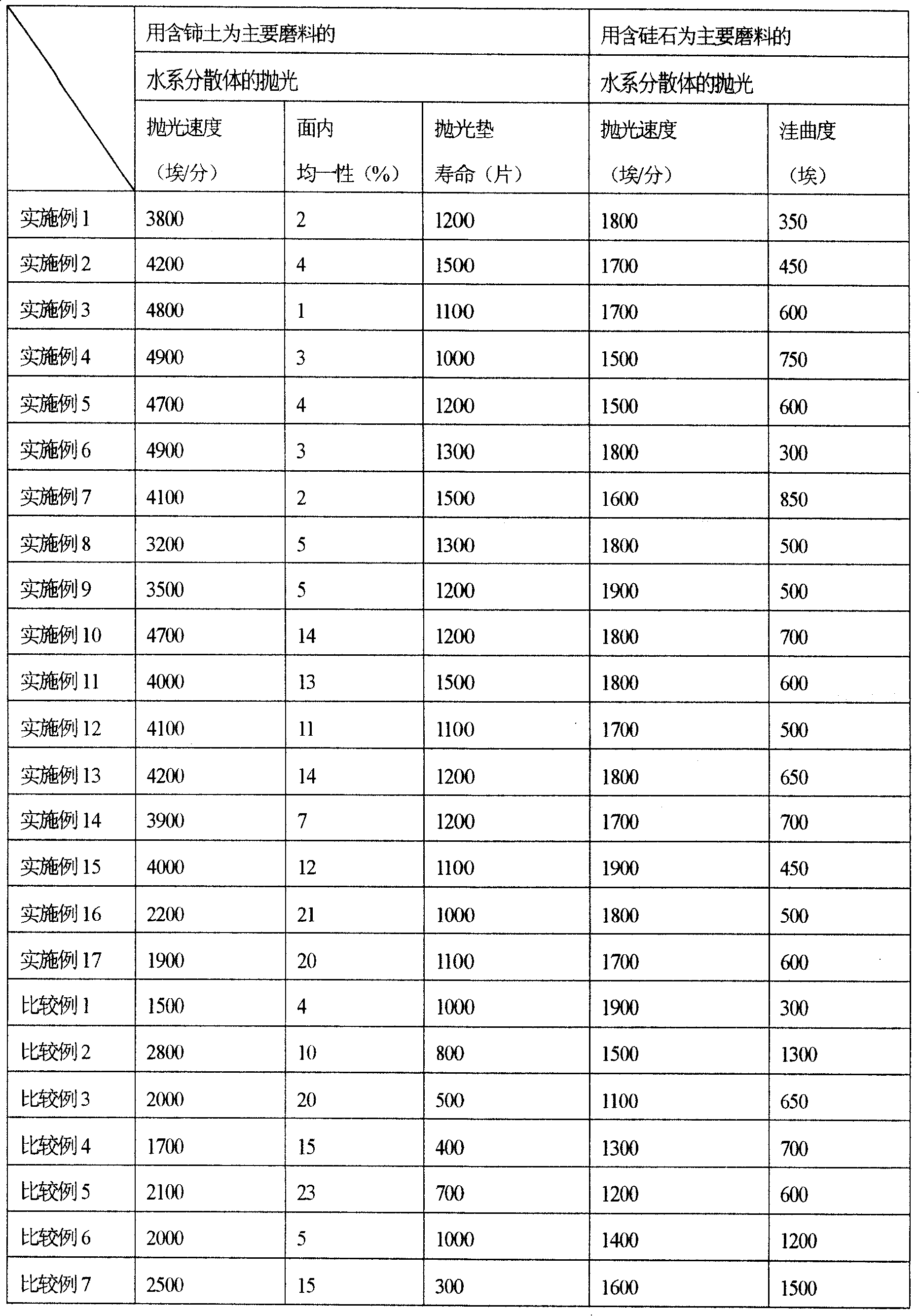
Claims (7)
Applications Claiming Priority (9)
| Application Number | Priority Date | Filing Date | Title |
|---|---|---|---|
| JP29393/2004 | 2004-02-05 | ||
| JP29393/04 | 2004-02-05 | ||
| JP2004029393 | 2004-02-05 | ||
| JP173410/2004 | 2004-06-11 | ||
| JP2004173410 | 2004-06-11 | ||
| JP173410/04 | 2004-06-11 | ||
| JP2004215931 | 2004-07-23 | ||
| JP215931/2004 | 2004-07-23 | ||
| JP215931/04 | 2004-07-23 |
Publications (2)
| Publication Number | Publication Date |
|---|---|
| CN1654169A CN1654169A (en) | 2005-08-17 |
| CN100410017C true CN100410017C (en) | 2008-08-13 |
Family
ID=34681985
Family Applications (1)
| Application Number | Title | Priority Date | Filing Date |
|---|---|---|---|
| CNB2005100542307A Expired - Fee Related CN100410017C (en) | 2004-02-05 | 2005-02-05 | Chemical mechanical polishing pad, method of manufacturing same, and chemical mechanical polishing method |
Country Status (6)
| Country | Link |
|---|---|
| US (1) | US20050222336A1 (en) |
| EP (1) | EP1561541B1 (en) |
| KR (1) | KR100661445B1 (en) |
| CN (1) | CN100410017C (en) |
| DE (1) | DE602005006326T2 (en) |
| TW (1) | TWI288688B (en) |
Families Citing this family (7)
| Publication number | Priority date | Publication date | Assignee | Title |
|---|---|---|---|---|
| JP2005340271A (en) | 2004-05-24 | 2005-12-08 | Jsr Corp | Chemical mechanical polishing pad |
| EP2083027B8 (en) * | 2008-01-24 | 2012-05-16 | JSR Corporation | Mechanical polishing pad and chemical mechanical polishing method |
| JP5634903B2 (en) * | 2010-02-25 | 2014-12-03 | 東洋ゴム工業株式会社 | Polishing pad |
| KR20140034128A (en) * | 2011-02-15 | 2014-03-19 | 도레이 카부시키가이샤 | Polishing pad |
| US9259821B2 (en) * | 2014-06-25 | 2016-02-16 | Rohm And Haas Electronic Materials Cmp Holdings, Inc. | Chemical mechanical polishing layer formulation with conditioning tolerance |
| TWI565735B (en) * | 2015-08-17 | 2017-01-11 | Nanya Plastics Corp | A polishing pad for surface planarization processing and a process for making the same |
| KR102603370B1 (en) * | 2018-11-09 | 2023-11-16 | 주식회사 쿠라레 | Polyurethane for polishing layer, polishing layer, polishing pad and method of modifying polishing layer |
Citations (11)
| Publication number | Priority date | Publication date | Assignee | Title |
|---|---|---|---|---|
| JPS5667344A (en) * | 1979-11-08 | 1981-06-06 | Asahi Chem Ind Co Ltd | Expandable polymer composition |
| US4652601A (en) * | 1984-11-12 | 1987-03-24 | The Dow Chemical Company | Rubber-reinforced styrenic polymer resins exhibiting increased elongation |
| US4748203A (en) * | 1986-03-17 | 1988-05-31 | General Electric Company | Polymer mixture with PC and HIPS |
| US5489652A (en) * | 1993-10-18 | 1996-02-06 | Sumitomo Chemical Company, Ltd. | Injection-molded articles |
| US5936036A (en) * | 1996-10-01 | 1999-08-10 | Sumitomo Chemical Company, Limited | Rubber-modified styrenic resin composition and molded article thereof |
| US6234875B1 (en) * | 1999-06-09 | 2001-05-22 | 3M Innovative Properties Company | Method of modifying a surface |
| EP1164559A1 (en) * | 2000-05-31 | 2001-12-19 | JSR Corporation | Composition for polishing pad and polishing pad using the same |
| US6333381B1 (en) * | 1998-11-20 | 2001-12-25 | Daicel Chemical Industries, Ltd. | Rubber-containing styrenic resin and process for producing the same |
| EP1252973A1 (en) * | 2001-04-25 | 2002-10-30 | JSR Corporation | Polishing pad for a semiconductor wafer which has light transmitting properties |
| EP1295680A2 (en) * | 2001-09-25 | 2003-03-26 | JSR Corporation | Polishing pad for semiconductor wafer |
| EP1470893A1 (en) * | 2003-04-25 | 2004-10-27 | JSR Corporation | Polishing pad and chemical mechanical polishing method |
Family Cites Families (5)
| Publication number | Priority date | Publication date | Assignee | Title |
|---|---|---|---|---|
| GB9020462D0 (en) * | 1990-09-19 | 1990-10-31 | Filters For Industry Ltd | Abrasive segments |
| US5247765A (en) * | 1991-07-23 | 1993-09-28 | Abrasive Technology Europe, S.A. | Abrasive product comprising a plurality of discrete composite abrasive pellets in a resilient resin matrix |
| JPH0534697A (en) * | 1991-07-25 | 1993-02-12 | Canon Inc | Ferroelectric liquid crystal display element |
| EP1011922B1 (en) * | 1997-04-18 | 2002-11-06 | Cabot Microelectronics Corporation | Polishing pad for a semiconductor substrate |
| US6354915B1 (en) * | 1999-01-21 | 2002-03-12 | Rodel Holdings Inc. | Polishing pads and methods relating thereto |
-
2005
- 2005-02-04 DE DE602005006326T patent/DE602005006326T2/en not_active Expired - Lifetime
- 2005-02-04 EP EP05002400A patent/EP1561541B1/en not_active Ceased
- 2005-02-04 KR KR1020050010513A patent/KR100661445B1/en not_active Expired - Fee Related
- 2005-02-05 TW TW094104064A patent/TWI288688B/en not_active IP Right Cessation
- 2005-02-05 CN CNB2005100542307A patent/CN100410017C/en not_active Expired - Fee Related
- 2005-02-07 US US11/050,730 patent/US20050222336A1/en not_active Abandoned
Patent Citations (11)
| Publication number | Priority date | Publication date | Assignee | Title |
|---|---|---|---|---|
| JPS5667344A (en) * | 1979-11-08 | 1981-06-06 | Asahi Chem Ind Co Ltd | Expandable polymer composition |
| US4652601A (en) * | 1984-11-12 | 1987-03-24 | The Dow Chemical Company | Rubber-reinforced styrenic polymer resins exhibiting increased elongation |
| US4748203A (en) * | 1986-03-17 | 1988-05-31 | General Electric Company | Polymer mixture with PC and HIPS |
| US5489652A (en) * | 1993-10-18 | 1996-02-06 | Sumitomo Chemical Company, Ltd. | Injection-molded articles |
| US5936036A (en) * | 1996-10-01 | 1999-08-10 | Sumitomo Chemical Company, Limited | Rubber-modified styrenic resin composition and molded article thereof |
| US6333381B1 (en) * | 1998-11-20 | 2001-12-25 | Daicel Chemical Industries, Ltd. | Rubber-containing styrenic resin and process for producing the same |
| US6234875B1 (en) * | 1999-06-09 | 2001-05-22 | 3M Innovative Properties Company | Method of modifying a surface |
| EP1164559A1 (en) * | 2000-05-31 | 2001-12-19 | JSR Corporation | Composition for polishing pad and polishing pad using the same |
| EP1252973A1 (en) * | 2001-04-25 | 2002-10-30 | JSR Corporation | Polishing pad for a semiconductor wafer which has light transmitting properties |
| EP1295680A2 (en) * | 2001-09-25 | 2003-03-26 | JSR Corporation | Polishing pad for semiconductor wafer |
| EP1470893A1 (en) * | 2003-04-25 | 2004-10-27 | JSR Corporation | Polishing pad and chemical mechanical polishing method |
Also Published As
| Publication number | Publication date |
|---|---|
| KR100661445B1 (en) | 2006-12-27 |
| KR20060041731A (en) | 2006-05-12 |
| TW200538236A (en) | 2005-12-01 |
| EP1561541A1 (en) | 2005-08-10 |
| TWI288688B (en) | 2007-10-21 |
| CN1654169A (en) | 2005-08-17 |
| US20050222336A1 (en) | 2005-10-06 |
| DE602005006326T2 (en) | 2009-07-09 |
| EP1561541B1 (en) | 2008-04-30 |
| DE602005006326D1 (en) | 2008-06-12 |
Similar Documents
| Publication | Publication Date | Title |
|---|---|---|
| EP1470893B1 (en) | Polishing pad and chemical mechanical polishing method | |
| US7357703B2 (en) | Chemical mechanical polishing pad and chemical mechanical polishing method | |
| CN1550288B (en) | Polishing pad, its manufacturing method, metal mold, and semiconductor wafer polishing method | |
| JP2004158581A (en) | Polishing pad | |
| JP5263481B2 (en) | Chemical mechanical polishing pad | |
| CN100410017C (en) | Chemical mechanical polishing pad, method of manufacturing same, and chemical mechanical polishing method | |
| JP2009283538A (en) | Chemical mechanical polishing pad and chemical mechanical polishing method | |
| JP3910921B2 (en) | Polishing cloth and method for manufacturing semiconductor device | |
| CN1701919A (en) | Chemical mechanical polishing pad | |
| TWI357844B (en) | Chemical mechanical polishing pad and chemical mec | |
| JP4379615B2 (en) | Chemical mechanical polishing pad composition, chemical mechanical polishing pad, and chemical mechanical polishing method | |
| JP2004345048A (en) | Polishing pad | |
| JP4697399B2 (en) | Chemical mechanical polishing pad and chemical mechanical polishing method | |
| JPWO2008114520A1 (en) | Chemical mechanical polishing pad and chemical mechanical polishing method | |
| JP2007201449A (en) | Chemical mechanical polishing pad and chemical mechanical polishing method | |
| JP2005246599A (en) | Chemical mechanical polishing pad and chemical mechanical polishing method | |
| JP2010016034A (en) | Chemical mechanical polishing pad, and chemical mechanical polishing method | |
| JPWO2009072405A1 (en) | Chemical mechanical polishing pad and chemical mechanical polishing method | |
| JP2009066728A (en) | Chemical mechanical polishing pad and chemical mechanical polishing method | |
| JP2007245291A (en) | Chemical mechanical polishing pad and chemical mechanical polishing method | |
| JP2007318074A (en) | Chemical mechanical polishing pad composition and chemical mechanical polishing pad |
Legal Events
| Date | Code | Title | Description |
|---|---|---|---|
| C06 | Publication | ||
| PB01 | Publication | ||
| C10 | Entry into substantive examination | ||
| SE01 | Entry into force of request for substantive examination | ||
| C14 | Grant of patent or utility model | ||
| GR01 | Patent grant | ||
| CF01 | Termination of patent right due to non-payment of annual fee |
Granted publication date: 20080813 Termination date: 20200205 |
|
| CF01 | Termination of patent right due to non-payment of annual fee |