CN100401092C - A method and system for wireless positioning - Google Patents
A method and system for wireless positioning Download PDFInfo
- Publication number
- CN100401092C CN100401092C CNB2004100796760A CN200410079676A CN100401092C CN 100401092 C CN100401092 C CN 100401092C CN B2004100796760 A CNB2004100796760 A CN B2004100796760A CN 200410079676 A CN200410079676 A CN 200410079676A CN 100401092 C CN100401092 C CN 100401092C
- Authority
- CN
- China
- Prior art keywords
- positioning
- search
- location
- localizing objects
- data
- Prior art date
- Legal status (The legal status is an assumption and is not a legal conclusion. Google has not performed a legal analysis and makes no representation as to the accuracy of the status listed.)
- Expired - Fee Related
Links
Images


Landscapes
- Mobile Radio Communication Systems (AREA)
Abstract
本发明提供了一种无线定位方法及其系统,适用于人流密集场合的人员定位,所述方法包括设置定位目标的定位识别数据,所述定位识别数据至少包括一个识别码,所述识别码与定位目标唯一对应;所述方法包括读取定位识别数据,生成与所述定位识别数据匹配的位置数据,输出所述位置数据。所述系统包括标签、阅读器、定位服务器和信息数据库。本发明提供了丰富的人员定位查询方式,有利于定位目标的管理,实现成本低,定位准确。

The present invention provides a wireless positioning method and its system, which are suitable for personnel positioning in crowded places. The method includes setting the positioning identification data of the positioning target, and the positioning identification data includes at least one identification code, and the identification code and The positioning target is uniquely corresponding; the method includes reading the positioning identification data, generating position data matching the positioning identification data, and outputting the position data. The system includes a tag, a reader, a positioning server and an information database. The present invention provides abundant personnel location query methods, is beneficial to the management of location objects, and has low cost and accurate location.
Description
技术领域 technical field
本发明属于无线通信领域,具体涉及一种利用无线通信技术在公园、商场、剧院等场合进行人员定位的方法,以及实现该方法的系统。The invention belongs to the field of wireless communication, and in particular relates to a method for locating personnel in parks, shopping malls, theaters and other places by using wireless communication technology, and a system for realizing the method.
背景技术 Background technique
在公园、车站、剧院、商场或者展览会等人流量密集的场所,经常会有人员失散或者走失而难以找到的情况发生,解决这一问题最通常的做法就是通过无线广播的方式找人,但这种方式有很大的局限性,一方面,走失者往往会因为周围声音的干扰听不到广播的准确信息,甚至听不到广播;另一方面,某些场合不适合采用广播找人的方式,比如正在演出节目的剧院。In crowded places such as parks, stations, theaters, shopping malls or exhibitions, it is often difficult to find people who are separated or lost. The most common way to solve this problem is to find people through wireless broadcasting, but This method has great limitations. On the one hand, the lost person often cannot hear the accurate information of the broadcast due to the interference of the surrounding sounds, or even hear the broadcast; on the other hand, it is not suitable to use the broadcast to find people in some occasions. way, such as a theater where a show is being performed.
GPS(全球定位系统,Global Positioning System),属于卫星无线定位系统的范畴,它通过接收卫星所发射的导航信号,可以在任何地点、任何时候准确地测量到物体瞬时的位置,确切地说是物体的经纬度、高度、速度等位置数据。目前GPS已被广泛应用于交通行业,实现对车辆的监控,但是由于GPS全球定位系统需要专用的接收设备,成本较高,使用者携带不方便,其适用范围受到限制。GPS (Global Positioning System, Global Positioning System), which belongs to the category of satellite wireless positioning system, can accurately measure the instantaneous position of an object at any place and at any time by receiving the navigation signal transmitted by the satellite. Longitude, latitude, altitude, speed and other location data. At present, GPS has been widely used in the transportation industry to monitor vehicles, but because the GPS global positioning system requires special receiving equipment, the cost is high, and it is inconvenient for users to carry it, so its scope of application is limited.
基于蜂窝移动通讯的无线定位系统,按移动通信结构分为基于移动通信网络的无线定位、基于移动终端的无线定位、混合定位等。当前的蜂窝无线定位系统中,为了避免对移动终端增加额外开销,多采用的是基于网络的定位方案,由多个基站同时接收检测移动终端发出的信号,根据测量到的参数由网络对移动终端进行定位估计。这种定位方式由于移动终端往往是普通手机,这就需要对基站安装监测设备,测量移动终端发出的信号参数,再通过适当的算法估计出移动终端的大致位置,而信号的传播很大程度上取决于移动通信信道特性,使定位精度受到很大的影响。The wireless positioning system based on cellular mobile communication can be divided into wireless positioning based on mobile communication network, wireless positioning based on mobile terminal, hybrid positioning, etc. according to the mobile communication structure. In the current cellular wireless positioning system, in order to avoid adding additional overhead to the mobile terminal, a network-based positioning scheme is mostly used. Multiple base stations simultaneously receive and detect the signals sent by the mobile terminal, and the mobile terminal is monitored by the network according to the measured parameters. Make a location estimate. Since the mobile terminal is often an ordinary mobile phone in this positioning method, it is necessary to install monitoring equipment on the base station, measure the signal parameters sent by the mobile terminal, and then estimate the approximate position of the mobile terminal through an appropriate algorithm, and the propagation of the signal is largely Depending on the characteristics of the mobile communication channel, the positioning accuracy is greatly affected.
由此可见,上述几种定位方式的适用范围有限,特别在需要进行主动查找定位的时候,缺乏具体个性化的查询方式,不能通过定位目标的个性数据,如人的姓名、身高、年龄、性别或其它特征来实现定位。It can be seen that the scope of application of the above positioning methods is limited, especially when it is necessary to actively search and locate, there is a lack of specific and personalized query methods, and the personality data of the positioning target, such as the person's name, height, age, and gender, cannot be used. Or other features to achieve positioning.
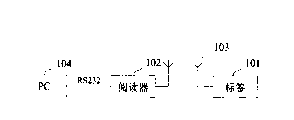
无线射频识别RFID(Radio Frequency Identification)是一种非接触式的自动识别技术,被广泛应用于工业自动化、商业自动化、交通运输控制管理等众多领域。参见图1,典型的RFID系统由标签(即射频卡)101,由耦合元件及芯片组成,标签含有内置天线103,用于和射频天线103间进行通信;阅读器102,读取标签101中的信息;以及天线103,在标签101和阅读器102间传递射频信号等三部分组成,有些系统还通过阅读器102的RS232或RS485接口与外部计算机PCI04连接,进行数据交换。其工作原理是:标签101进入磁场后,接收阅读器102发出的射频信号,凭借感应电流所获得的能量发送出存储在芯片中的信息(无源标签或被动标签,Passive Tag),或者主动发送某一频率的信号(有源标签或主动标签,Active Tag),阅读器102读取信息并解码后,送至中央信息系统PC104进行有关数据处理。Radio Frequency Identification (RFID) is a non-contact automatic identification technology, which is widely used in many fields such as industrial automation, commercial automation, and transportation control management. Referring to Fig. 1, a typical RFID system consists of a tag (i.e. a radio frequency card) 101 consisting of a coupling element and a chip. The tag contains a built-in
RFID的优点在于非接触识读、可读写,可识别高速运动物体、抗恶劣环境、保密性强、高准确性和安全性、标签ID(身份证明,Identity)唯一且只读无法伪造、可同时识别多个标签。随着大规模集成电路技术的进步以及生产规模的不断扩大,RFID产品的成本也不断降低,更由于射频识别技术的自身优势及特点,其应用越来越广泛。The advantages of RFID are non-contact reading, readable and writable, can identify high-speed moving objects, anti-harsh environment, strong confidentiality, high accuracy and security, tag ID (identity certificate, Identity) is unique and read-only cannot be forged, can be Identify multiple tags at the same time. With the advancement of large-scale integrated circuit technology and the continuous expansion of production scale, the cost of RFID products has also been continuously reduced, and due to its own advantages and characteristics of radio frequency identification technology, its application is becoming more and more extensive.
发明内容 Contents of the invention
为了克服上述GPS全球定位系统及基于蜂窝无线通信系统的无线定位系统对于人员定位所带来的不便和缺陷,本发明利用无线射频识别RFID技术实现人员的定位,提供了一种无线定位的方法,以及实现该方法的系统。In order to overcome the inconvenience and defects caused by the GPS global positioning system and the wireless positioning system based on the cellular wireless communication system for personnel positioning, the present invention utilizes radio frequency identification (RFID) technology to realize personnel positioning, and provides a wireless positioning method, And a system implementing the method.
本发明提供的无线定位方法,包括设置定位目标的定位识别数据,所述定位识别数据至少包括一个识别码,所述识别码与定位目标唯一对应;所述方法包括以下步骤:The wireless positioning method provided by the present invention includes setting the positioning identification data of the positioning target, the positioning identification data includes at least one identification code, and the identification code is uniquely corresponding to the positioning target; the method includes the following steps:
A、搜索定位目标,读取定位目标的定位识别数据,生成与所述定位识别数据匹配的位置数据;A. Search for the positioning target, read the positioning identification data of the positioning target, and generate position data matching the positioning identification data;
B、输出所述位置数据;B. Outputting the location data;
其中,所述定位目标的搜索由多个阅读装置分时进行。Wherein, the search for the positioning target is performed by multiple reading devices in time-sharing.
其中,所述定位目标的搜索由多个阅读装置通过以下方式分时进行:依次搜索定位目标,如果没有搜索到定位目标,则由下一个阅读装置继续搜索;或者预先设置所述阅读装置的搜索时间长度,如果在所述时间长度内没有搜索到定位目标,则由下一个阅读装置继续搜索。Wherein, the search for the positioning target is carried out by multiple reading devices in time-sharing in the following manner: sequentially search for the positioning target, if no positioning target is found, the next reading device will continue to search; The length of time. If no positioning target is found within the length of time, the next reading device will continue to search.
所述方法进一步包括:在所述步骤A之前,输入定位查询数据。The method further includes: before step A, inputting positioning query data.
所述设置定位目标的定位识别数据包括:The positioning identification data for setting the positioning target includes:
(1)设置定位目标的个性数据;(1) Set the personality data of the positioning target;
(2)将所述识别码与所述个性数据进行关联,生成定位识别数据;(2) Associating the identification code with the personality data to generate location identification data;
(3)存储所述定位识别数据。(3) Storing the location identification data.
本发明更进一步提供了一种无线定位系统,包括:The present invention further provides a wireless positioning system, including:
标签,所述标签对应一个唯一的识别码;a label, the label corresponds to a unique identification code;
多个阅读器,通过射频信号与所述标签通信,所述每个阅读器对应一个唯一的编号和至少一个与所述编号关联的位置数据;a plurality of readers communicating with the tag via radio frequency signals, each reader corresponding to a unique number and at least one location data associated with the number;
定位服务器,通过通信网络与所述多个阅读器连接,所述定位服务器存储有所述多个阅读器的编号和位置数据;A positioning server is connected to the multiple readers through a communication network, and the positioning server stores the numbers and location data of the multiple readers;
信息数据库,通过通信网络与所述定位服务器连接,所述信息数据库存储有定位目标的定位识别数据以及定位目标的位置数据,所述定位识别数据至少包括所述标签的识别码;An information database is connected to the positioning server through a communication network, the information database stores the positioning identification data of the positioning target and the position data of the positioning target, and the positioning identification data includes at least the identification code of the label;
其中,所述定位服务器分时控制所述多个阅读器对定位目标的搜索。Wherein, the positioning server controls the searching of the positioning target by the plurality of readers in a time-sharing manner.
其中,所述定位服务器通过以下方式分时控制所述多个阅读器对定位目标的搜索:通知所述阅读器依次搜索定位目标,如果没有搜索到定位目标,则由下一个阅读器继续搜索;或者预先设置所述阅读器的搜索时间长度,如果在所述时间长度内没有搜索到定位目标,则由下一个阅读器继续搜索。Wherein, the positioning server controls the search of the positioning target by the plurality of readers in a time-sharing manner by: notifying the readers to search for the positioning target in turn, and if the positioning target is not found, the next reader continues to search; Alternatively, the search time length of the reader is preset, and if no positioning target is found within the time length, the next reader continues to search.
所述系统进一步包括门户服务器,所述门户服务器通过通信网络与所述定位服务器以及信息数据库相连。The system further includes a portal server, which is connected to the positioning server and the information database through a communication network.
所述系统进一步包括输入终端,所述输入终端通过通信网络与所述门户服务器相连;The system further includes an input terminal, the input terminal is connected to the portal server through a communication network;
所述系统进一步包括查询终端,所述查询终端通过通信网络与所述门户服务器相连。The system further includes an inquiry terminal, which is connected to the portal server through a communication network.
所述定位识别数据还包括与定位目标对应的个性数据,所述个性数据与所述标签的识别码相关联。The location identification data also includes personality data corresponding to the location target, and the personality data is associated with the identification code of the tag.
本发明利用射频识别RFID技术通过标签将定位目标的个性特征,如人的姓名、身高、年龄、性别等信息与标签的识别码相关联,提供了具体个性化的查询定位方式,定位准确,实现成本低,同时,还可以实现对动物或者其他移动物品的位置定位。The present invention uses radio frequency identification (RFID) technology to associate the personality characteristics of the positioning target, such as the name, height, age, gender and other information of the person, with the identification code of the label through the label, and provides a specific and personalized query and positioning mode, which is accurate in positioning and realizes The cost is low, and at the same time, the location of animals or other moving objects can also be realized.
附图说明 Description of drawings
图1是典型的RFID系统构成示意图;Figure 1 is a schematic diagram of a typical RFID system;
图2是本发明的无线定位系统示意图;Fig. 2 is a schematic diagram of the wireless positioning system of the present invention;
图3是在标签为有源标签时的无线定位方法实现流程图;Fig. 3 is the flow chart of realizing the wireless positioning method when the tag is an active tag;
图4是在标签为无源标签时的无线定位方法实现流程图。Fig. 4 is a flow chart of implementing a wireless positioning method when the tag is a passive tag.
具体实施方式 Detailed ways
为了使本发明的目的、技术方案及优点更加清楚明白,以下结合附图及实施例,对本发明进行进一步详细说明。应当理解,此处所描述的具体实施例仅仅用以解释本发明,并不用于限定本发明。In order to make the object, technical solution and advantages of the present invention clearer, the present invention will be further described in detail below in conjunction with the accompanying drawings and embodiments. It should be understood that the specific embodiments described here are only used to explain the present invention, not to limit the present invention.
如图2所示,本发明的无线定位系统由标签101、阅读器102、定位服务器201、信息数据库202、门户服务器203、输入终端204以及查询终端205组成。As shown in FIG. 2 , the wireless positioning system of the present invention is composed of a
其中,每个标签101对应一个唯一的识别码,该识别码与定位目标的姓名、年龄、性别、身高、体重等个性数据相关联。在具体实现上,标签101可以印制在门票、门卡或者入场券等上面,或者设置在其他可以随身携带的物品上,如腕带、手袋等。在本发明中为了节省标签101的存储空间,进而降低其成本,每个标签101中只存储一个唯一的识别码,供阅读器102调用,其他诸如姓名、年龄、性别、身高、体重等定位目标的个性数据由信息数据库202存储。Wherein, each
在本发明中,标签101可以是有源标签,也可以是无源标签。有源标签内有电池提供电源,作用距离较远,它能向附近的阅读器102不断主动地发送信息;无源标签内无电池,它利用波束供电技术将接收到阅读器102发出的射频能量转化为直流电源为电路供电,凭借感应电流所获得的能量向阅读器102发送出存储在芯片中的信息。In the present invention, the
阅读器102通过射频信号接收和读取标签101中存储的信息,可以工作在900M、2.4G或更高频段。在本发明中,每个阅读器102有一个唯一的标识ID,该ID与阅读器102在定位场合的位置数据相对应,该位置数据即阅读器102所能够覆盖的范围,具体可以是某个房间、方位或者路径等,每个阅读器102的ID及对应的位置数据存储在定位服务器201上。The
阅读器102的数量根据定位场合的大小、场所设置等情况来确定。如果要求的定位精度比较高,则可以相应增加阅读器102的数量,同时经过合理的网络规划,减少甚至避免信号盲区的存在。The number of
定位服务器201通过有线或者无线通信网络与阅读器102进行通信,定位服务器201存储有每个阅读器102的ID以及与之对应的位置数据,并协调多个阅读器102工作。当定位服务器201收到阅读器102上报的标签101的信息时,根据上报信息的阅读器ID,查询其所处的地理位置数据,将该位置数据转化为定位目标所处的地理范围,即定位目标的位置数据,然后将该位置数据与阅读器102读取的标签101的标识码信息或者定位目标的个性数据发送给信息数据库202存储,供系统查询调用。The
信息数据库202存储有标签101的识别码信息、与该识别码对应的定位目标的个性数据,以及定位服务器201报送的定位目标的位置数据。信息数据库202通过通信网络与定位服务器201、门户服务器203进行通信。The
门户服务器203接收通过输入终端204输入的定位目标的定位识别数据,即标签101的识别码以及与该识别码相关联的定位目标的个性数据,并将定位识别数据送交信息数据库202中存储。The
门户服务器203还接收由查询终端205输入的定位查询信息,并向查询终端205提供查询结果。门户服务器203收到查询终端205上报的定位查询信息后,将该查询信息送交定位服务器201进行目标定位查询或者搜索,并将信息数据库202中存储的定位目标的位置数据送至查询终端205显示。The
输入终端204通过通信网络与门户服务器203进行通信,下载门户服务器203提供的信息输入界面或者运行与门户服务器203进行通信的终端应用程序,将标签101的识别码与定位目标的个性数据进行关联绑定,形成定位目标的定位识别数据,并通过门户服务器203将该定位识别数据存储到信息数据库202中。The
查询终端205可以是设置在定位场合的触摸屏查询终端,或者电子信息设备,如PDA(个人数字助理,Personal Digital Assistant)、个人计算机等。查询终端205通过通信网络与门户服务器203进行通信,向用户提供定位目标的定位查询界面,供用户输入定位查询信息。用户输入的定位查询信息可以是定位目标的个性数据,如姓名、性别、年龄等,或者是定位目标所持的标签101的识别码。该定位查询信息由门户服务器203送交定位服务器201进行目标定位查询,门户服务器203将获得的查询结果传输给查询终端显示。查询终端205可以通过Internet远程登陆门户服务器203,下载相应的信息输入、显示界面,或者运行与门户服务器203进行通信的终端应用程序。The
图3、图4是本发明提供的无线定位方法的实现流程图。由于标签101可以是有源标签或者无源标签,所以在具体的方法实现流程上会有所不同,下面分别予以描述。Fig. 3 and Fig. 4 are flowcharts of realizing the wireless positioning method provided by the present invention. Since the
见图3,当标签101为有源标签时,系统操作流程如下:As shown in Figure 3, when the
用户通过输入终端204登陆门户服务器203,在输入界面上输入定位目标的个性数据和标签101的识别码,将定位目标的个性数据和识别码进行绑定,形成定位目标的定位识别数据(S301);The user logs in the
输入终端204向门户服务器203提交该定位识别数据(S302);The
门户服务器203将定位识别数据提交信息数据库202存储(S303),并将操作结果返回输入终端204(S304);The
当定位目标进入某个阅读器102的覆盖范围内时,阅读器102就接收到定位目标所持标签101发射的射频信号,阅读器102解码获得标签101中存储的定位识别数据,并上报给定位服务器201(S305~309);When the positioning target enters the coverage of a
定位服务器201获得上报信息的阅读器102的ID,通过查询确定其位置数据,将该位置数据转换为预先定义好的场所名称和方位,从而确定标签101的位置数据,并将该位置数据存储到信息数据库202中(S310);The
此时,如果用户要查找定位目标,可以通过查询终端205登陆门户服务器203提供的查询界面(S311),在查询界面中输入定位目标的定位识别数据,如姓名、性别、身高等或者其所持标签101的识别码(S312),门户服务器203根据收到的定位识别数据在信息数据库202中查询匹配的记录(S313);信息数据库202将查询结果返回给门户服务器203(S314);门户服务器203将查询结果传送给查询终端205,此时,用户就可以在查询终端205的显示界面上看到定位目标所处的场所和位置数据了(S315)。At this time, if the user wants to find the positioning target, he can log in the query interface provided by the
图4示出了在标签101为无源标签时的方法实现流程图。由于此时标签101依靠阅读器102的信号触发工作,上下行工作在同一频段,为了避免多个阅读器102同时探测一个目标产生冲突,也为了避免多个阅读器102同时与定位服务器201通信造成通讯拥塞,从而导致数据丢失,本发明由定位服务器201分时控制多个阅读器102工作,具体实现可以有两种方式:Fig. 4 shows a flow chart of the implementation of the method when the
1)定位服务器201通知阅读器1工作,工作完成后,再通知阅读器2工作,依次类推,直到搜索完毕;1) The
2)定位服务器201分配一个搜索时间长度给阅读器1,阅读器1在该时间长度内搜索结束后,再分配一个搜索时间长度给阅读器2,依次类推,完成多个阅读器102的协调控制,直到搜索完毕。2) The
下面以1)的方式进行详细描述:The following is a detailed description in the form of 1):
同前所述,定位目标的个性数据和标签101的识别码绑定的定位识别数据存储到信息数据库202中(S301~304)。As mentioned above, the location identification data bound with the personality data of the location target and the identification code of the
用户通过查询终端205登陆门户服务器203提供的查询界面(S401),在查询界面中输入定位目标的个性数据,如姓名、性别、身高等或者其所持标签101的识别码(S402),门户服务器203通知定位服务器201查询定位目标(S403);此时,定位服务器201先通知阅读器1搜索定位目标(S404),假使阅读器1经过搜索,在其覆盖范围内没有找到定位目标(S405),将搜索结果通知定位服务器201(S406);定位服务器201继续通知阅读器2搜索定位目标(S407);阅读器2在其覆盖范围内探测到了定位目标(S408);标签101接收到探测消息后,向阅读器2发出探测响应信息(S409);阅读器2解码标签101发出的响应信息,报告定位服务器201找到定位目标(S410);定位服务器201获得上报信息的阅读器2的ID,通过查询确定其位置数据,将位置数据转换为预先定义好的场所名称和方位,从而确定了定位目标的位置数据,并将该位置数据回传给门户服务器203(S411);同时,定位服务器201将查询结果存储到信息数据库202中备查(S412);门户服务器203将得到的查询结果送交查询终端205显示(S413)。The user logs in the query interface provided by the portal server 203 through the query terminal 205 (S401), and inputs the individual data of the positioning target in the query interface, such as name, gender, height, etc. or the identification code (S402) of the tag 101 held by it, and the portal server 203 Inform the positioning server 201 to inquire about the positioning target (S403); at this time, the positioning server 201 first notifies the reader 1 to search for the positioning target (S404), if the reader 1 does not find the positioning target (S405) within its coverage area after searching, it will The search result notifies the positioning server 201 (S406); the positioning server 201 continues to notify the reader 2 to search for the positioning target (S407); the reader 2 has detected the positioning target (S408) within its coverage; after the tag 101 receives the detection message, it sends The reader 2 sends a probe response message (S409); the reader 2 decodes the response message sent by the tag 101, and reports that the positioning server 201 finds the positioning target (S410); the positioning server 201 obtains the ID of the reader 2 reporting the information, and determines its Position data, the position data is converted into a pre-defined place name and orientation, thereby determining the position data of the positioning target, and sending the position data back to the portal server 203 (S411); at the same time, the positioning server 201 stores the query results Go to the information database 202 for reference (S412); the portal server 203 sends the obtained query results to the query terminal 205 for display (S413).
很明显,本发明并不仅仅限于人员的定位,也可以应用于动物或者其他移动物品的查找定位,因此,在这些方面的应用同样属于本发明所保护的范围。Obviously, the present invention is not limited to the positioning of personnel, but can also be applied to the search and positioning of animals or other moving objects. Therefore, applications in these aspects also belong to the protection scope of the present invention.
以上所述仅为本发明的较佳实施例而已,并不用以限制本发明,凡在本发明的精神和原则之内所作的任何修改、等同替换和改进等,均应包含在本发明的保护范围之内。The above descriptions are only preferred embodiments of the present invention, and are not intended to limit the present invention. Any modifications, equivalent replacements and improvements made within the spirit and principles of the present invention should be included in the protection of the present invention. within range.
Claims (10)
Priority Applications (1)
| Application Number | Priority Date | Filing Date | Title |
|---|---|---|---|
| CNB2004100796760A CN100401092C (en) | 2004-12-22 | 2004-12-22 | A method and system for wireless positioning |
Applications Claiming Priority (1)
| Application Number | Priority Date | Filing Date | Title |
|---|---|---|---|
| CNB2004100796760A CN100401092C (en) | 2004-12-22 | 2004-12-22 | A method and system for wireless positioning |
Publications (2)
| Publication Number | Publication Date |
|---|---|
| CN1797025A CN1797025A (en) | 2006-07-05 |
| CN100401092C true CN100401092C (en) | 2008-07-09 |
Family
ID=36818229
Family Applications (1)
| Application Number | Title | Priority Date | Filing Date |
|---|---|---|---|
| CNB2004100796760A Expired - Fee Related CN100401092C (en) | 2004-12-22 | 2004-12-22 | A method and system for wireless positioning |
Country Status (1)
| Country | Link |
|---|---|
| CN (1) | CN100401092C (en) |
Families Citing this family (17)
| Publication number | Priority date | Publication date | Assignee | Title |
|---|---|---|---|---|
| KR101493748B1 (en) | 2008-06-16 | 2015-03-02 | 삼성전자주식회사 | Article providing apparatus, display apparatus and GUI providing method using the same |
| KR100993733B1 (en) * | 2008-12-11 | 2010-11-10 | 이상선 | Positioning system using RFID tag |
| CN102238536B (en) * | 2010-04-23 | 2014-10-08 | 北京烽火联拓科技有限公司 | Wireless real time location system and method |
| CN102375961A (en) * | 2010-08-19 | 2012-03-14 | 高向阳 | Bus station person positioning system |
| CN102467810B (en) * | 2010-11-04 | 2014-07-09 | 北京天一众合科技股份有限公司 | Positioning alarm method and positioning alarm system |
| CN102573050B (en) * | 2010-12-31 | 2015-12-02 | 国民技术股份有限公司 | A kind of system and method for indoor mobile terminal positioning |
| CN102956091B (en) * | 2011-08-31 | 2015-12-16 | 北京天一众合科技股份有限公司 | Mobile monitoring terminal and method for processing business thereof and transaction processing system |
| CN102682366A (en) * | 2012-05-08 | 2012-09-19 | 北京邮电大学 | Property position registering method, managing method and system |
| CN102682257A (en) * | 2012-05-14 | 2012-09-19 | 北京联合大学 | Object location system based on RFID (Radio Frequency Identification Device) and WIFI (Wireless Fidelity) technologies |
| CN103793669B (en) * | 2012-11-01 | 2018-05-01 | 上海秀派电子科技有限公司 | A kind of 3G is mining reader and self checking method |
| CN103209477A (en) * | 2013-03-19 | 2013-07-17 | 青岛海信宽带多媒体技术有限公司 | Mobile terminal location system and location method |
| US9161329B2 (en) * | 2013-06-26 | 2015-10-13 | Qualcomm Incorporated | Communication of mobile device locations |
| CN103974413A (en) * | 2014-06-09 | 2014-08-06 | 惠州市德赛工业发展有限公司 | Low-power-consumption positioning system and positioning method thereof |
| CN104408391A (en) * | 2014-10-22 | 2015-03-11 | 江苏永鼎通信有限公司 | Tracking system capable of applying fiber distribution system and tracking method |
| CN107016313B (en) * | 2017-03-31 | 2020-02-14 | 深圳市阿尔艾富信息技术股份有限公司 | Method and device for determining position of RFID electronic tag in indoor space |
| CN106937252B (en) * | 2017-03-31 | 2020-08-18 | 深圳市阿尔艾富信息技术股份有限公司 | An RFID base station unit for indoor positioning |
| CN107622288A (en) * | 2017-09-18 | 2018-01-23 | 天津城建大学 | An electronic ticket sending and receiving device with wireless positioning function |
Citations (2)
| Publication number | Priority date | Publication date | Assignee | Title |
|---|---|---|---|---|
| CN1479908A (en) * | 2000-12-12 | 2004-03-03 | 3M | Object tracking and management system and method using radio frequency identification tags |
| CN1554957A (en) * | 2003-12-23 | 2004-12-15 | 陈向明 | Radio frequency article identifying flow tracking and positing method and its realization |
-
2004
- 2004-12-22 CN CNB2004100796760A patent/CN100401092C/en not_active Expired - Fee Related
Patent Citations (2)
| Publication number | Priority date | Publication date | Assignee | Title |
|---|---|---|---|---|
| CN1479908A (en) * | 2000-12-12 | 2004-03-03 | 3M | Object tracking and management system and method using radio frequency identification tags |
| CN1554957A (en) * | 2003-12-23 | 2004-12-15 | 陈向明 | Radio frequency article identifying flow tracking and positing method and its realization |
Also Published As
| Publication number | Publication date |
|---|---|
| CN1797025A (en) | 2006-07-05 |
Similar Documents
| Publication | Publication Date | Title |
|---|---|---|
| CN100401092C (en) | A method and system for wireless positioning | |
| US6552661B1 (en) | Zone based radio frequency identification | |
| CN103996097B (en) | Laboratory equipment dynamic management system based on passive RFID | |
| CN110231640A (en) | A kind of indoor and outdoor mixed assets monitoring system | |
| CN106382932A (en) | Library indoor three-dimensional navigation method based on Bluetooth and triangulation | |
| CN101576616A (en) | Indoor positioning system based on RFID technology | |
| CN102754416A (en) | Systems and methods for mobile monitoring of non-associated tags | |
| CN101329715B (en) | Storing cabinet with automatic management system | |
| CN103777174A (en) | Indoor positioning system based on active multifunctional RFID tags | |
| US20150054620A1 (en) | Method for setting up a beacon network inside a retail environment | |
| JPWO2009001408A1 (en) | RFID reader, electronic tag system, and method of transmitting notification data to server | |
| CN210514604U (en) | Positioning device and system | |
| CN111433789A (en) | System and method for operating a tag | |
| CN102879776A (en) | A radio frequency identification ranging or positioning system and method thereof | |
| WO2021236649A1 (en) | Methods for identifying items in close proximity to a mobile device or within a digital image | |
| CN109657755B (en) | Object positioning system | |
| CN203276296U (en) | Positioning and monitoring system based on RFID | |
| CN109348465A (en) | Internet localization method based on Internet of Things perception | |
| US20240242582A1 (en) | Methods and systems for tracking an anti-theft tag beyond the retail space | |
| CN101571586B (en) | RFID asset monitoring method and system thereof | |
| CN102567754A (en) | Intelligent travel path management system | |
| CN115143961B (en) | Indoor Positioning System | |
| Rostamian | Localization and proximity detection in the internet of things based on an augmented UHF RFID system | |
| Wang et al. | A Novel Indoor Navigation System Based on RFID and LBS Technology | |
| Potgantwar et al. | Internal Location Based System For Mobile Devices Using Passive RFID And Wireless Technology |
Legal Events
| Date | Code | Title | Description |
|---|---|---|---|
| C06 | Publication | ||
| PB01 | Publication | ||
| C10 | Entry into substantive examination | ||
| SE01 | Entry into force of request for substantive examination | ||
| C14 | Grant of patent or utility model | ||
| GR01 | Patent grant | ||
| TR01 | Transfer of patent right | ||
| TR01 | Transfer of patent right |
Effective date of registration: 20200803 Address after: 215600 No. 2 Binhe Road, Yangshe Town, Zhangjiagang City, Suzhou City, Jiangsu Province (East China International Building) B405 Zhangjiagang Zhiying Electronic Technology Co., Ltd. Patentee after: ZHANGJIAGANG ZHIYING ELECTRONIC TECHNOLOGY Co.,Ltd. Address before: 518000 Baoan District Xin'an street, Shenzhen, Guangdong, No. 625, No. 625, Nuo platinum Plaza, Patentee before: SHENZHEN SHANGGE INTELLECTUAL PROPERTY SERVICE Co.,Ltd. Effective date of registration: 20200803 Address after: 518000 Baoan District Xin'an street, Shenzhen, Guangdong, No. 625, No. 625, Nuo platinum Plaza, Patentee after: SHENZHEN SHANGGE INTELLECTUAL PROPERTY SERVICE Co.,Ltd. Address before: 518129 Bantian HUAWEI headquarters office building, Longgang District, Guangdong, Shenzhen Patentee before: HUAWEI TECHNOLOGIES Co.,Ltd. |
|
| CF01 | Termination of patent right due to non-payment of annual fee | ||
| CF01 | Termination of patent right due to non-payment of annual fee |
Granted publication date: 20080709 |