BR112017015514B1 - POLYCYCLIC ACTIVE DERIVATIVES WITH SUBSTITUENTS CONTAINING ACTIVE SULFUR IN TERMS PESTICIDES, PESTICIDE COMPOSITION AND METHODS FOR PEST CONTROL AND SEED PROTECTION FROM PEST ATTACK - Google Patents
POLYCYCLIC ACTIVE DERIVATIVES WITH SUBSTITUENTS CONTAINING ACTIVE SULFUR IN TERMS PESTICIDES, PESTICIDE COMPOSITION AND METHODS FOR PEST CONTROL AND SEED PROTECTION FROM PEST ATTACK Download PDFInfo
- Publication number
- BR112017015514B1 BR112017015514B1 BR112017015514-1A BR112017015514A BR112017015514B1 BR 112017015514 B1 BR112017015514 B1 BR 112017015514B1 BR 112017015514 A BR112017015514 A BR 112017015514A BR 112017015514 B1 BR112017015514 B1 BR 112017015514B1
- Authority
- BR
- Brazil
- Prior art keywords
- spp
- formula
- compounds
- methyl
- haloalkyl
- Prior art date
Links
Classifications
-
- C—CHEMISTRY; METALLURGY
- C07—ORGANIC CHEMISTRY
- C07D—HETEROCYCLIC COMPOUNDS
- C07D471/00—Heterocyclic compounds containing nitrogen atoms as the only ring hetero atoms in the condensed system, at least one ring being a six-membered ring with one nitrogen atom, not provided for by groups C07D451/00 - C07D463/00
- C07D471/02—Heterocyclic compounds containing nitrogen atoms as the only ring hetero atoms in the condensed system, at least one ring being a six-membered ring with one nitrogen atom, not provided for by groups C07D451/00 - C07D463/00 in which the condensed system contains two hetero rings
- C07D471/04—Ortho-condensed systems
-
- C—CHEMISTRY; METALLURGY
- C07—ORGANIC CHEMISTRY
- C07D—HETEROCYCLIC COMPOUNDS
- C07D487/00—Heterocyclic compounds containing nitrogen atoms as the only ring hetero atoms in the condensed system, not provided for by groups C07D451/00 - C07D477/00
- C07D487/02—Heterocyclic compounds containing nitrogen atoms as the only ring hetero atoms in the condensed system, not provided for by groups C07D451/00 - C07D477/00 in which the condensed system contains two hetero rings
- C07D487/04—Ortho-condensed systems
-
- A—HUMAN NECESSITIES
- A01—AGRICULTURE; FORESTRY; ANIMAL HUSBANDRY; HUNTING; TRAPPING; FISHING
- A01N—PRESERVATION OF BODIES OF HUMANS OR ANIMALS OR PLANTS OR PARTS THEREOF; BIOCIDES, e.g. AS DISINFECTANTS, AS PESTICIDES OR AS HERBICIDES; PEST REPELLANTS OR ATTRACTANTS; PLANT GROWTH REGULATORS
- A01N43/00—Biocides, pest repellants or attractants, or plant growth regulators containing heterocyclic compounds
- A01N43/90—Biocides, pest repellants or attractants, or plant growth regulators containing heterocyclic compounds having two or more relevant hetero rings, condensed among themselves or with a common carbocyclic ring system
Landscapes
- Chemical & Material Sciences (AREA)
- Organic Chemistry (AREA)
- Life Sciences & Earth Sciences (AREA)
- Environmental Sciences (AREA)
- Wood Science & Technology (AREA)
- Zoology (AREA)
- Health & Medical Sciences (AREA)
- Engineering & Computer Science (AREA)
- Dentistry (AREA)
- General Health & Medical Sciences (AREA)
- Pest Control & Pesticides (AREA)
- Plant Pathology (AREA)
- Agronomy & Crop Science (AREA)
- Agricultural Chemicals And Associated Chemicals (AREA)
- Plural Heterocyclic Compounds (AREA)
- Nitrogen Condensed Heterocyclic Rings (AREA)
- Pharmaceuticals Containing Other Organic And Inorganic Compounds (AREA)
Abstract
DERIVADOS POLICICLICOS ATIVOS COM SUBSTITUINTES CONTENDO ENXOFRE ATIVOS EM TERMOS PESTICIDAS. Derivados policiclicos da fórmula I em que os substituintes são como definidos na reivindicação 1, e os sais, estereoisômeros, enantiômeros, tautômeros e Nóxidos agroquimicamente aceitáveis desses compostos podem ser usados como inseticidas e podem ser preparados de uma forma conhecida per se.ACTIVE POLYCYCLIC DERIVATIVES WITH SUBSTITUENTS CONTAINING ACTIVE SULFUR IN PESTICIDE TERMS. Polycyclic derivatives of formula I wherein the substituents are as defined in claim 1, and the agrochemically acceptable salts, stereoisomers, enantiomers, tautomers and N-oxides of these compounds can be used as insecticides and can be prepared in a manner known per se.
Description
[0001] A presente invenção se relaciona com derivados policíclicos contendo substituintes de enxofre ativos em termos pesticidas, em particular ativos em termos inseticidas, com composições compreendendo esses compostos, e com seu uso para controle de pragas animais, incluindo artrópodes e em particular insetos ou representantes da ordem Acarina.[0001] The present invention relates to polycyclic derivatives containing pesticidally active sulfur substituents, in particular insecticidally active, to compositions comprising these compounds, and to their use for the control of animal pests, including arthropods and in particular insects or representatives of the Acarina order.
[0002] Compostos heterocíclicos com ação pesticida são conhecidos e descritos, por exemplo, em[0002] Heterocyclic compounds with pesticidal action are known and described, for example, in
[0003] WO 2012/086848, WO 2013/018928, WO 2014/142292, WO 2015/133603, WO2015/000715 e WO 2015/121136. Foram agora descobertos novos derivados de anéis policíclicos com substituintes de fenila e piridila contendo enxofre ativos em termos pesticidas.[0003] WO 2012/086848 , WO 2013/018928 , WO 2014/142292 , WO 2015/133603 , WO 2015/000715 and WO 2015/121136 . New polycyclic ring derivatives with pesticidally active sulfur-containing phenyl and pyridyl substituents have now been discovered.
[0004] Consequentemente, a presente invenção se refere a compostos da fórmula I,
[0005] Os compostos de fórmula I que têm pelo menos um centro básico podem formar, por exemplo, sais de adição de ácido, por exemplo com ácidos inorgânicos fortes tais como ácidos minerais, por exemplo ácido perclórico, ácido sulfúrico, ácido nítrico, um ácido fosforoso ou um ácido halídrico, com ácidos carboxílicos orgânicos fortes, tais como ácidos alcanocarboxílicos C1-C4 que são não substituídos ou substituídos, por exemplo, com halogênio, por exemplo o ácido acético, tais como ácidos dicarboxílicos saturados ou insaturados, por exemplo o ácido oxálico, ácido malônico, ácido succínico, ácido maleico, ácido fumárico ou ácido ftálico, tais como ácidos hidroxicarboxílicos, por exemplo ácido ascórbico, ácido láctico, ácido málico, ácido tartárico ou ácido cítrico, ou tais como o ácido benzoico, ou com ácidos sulfônicos orgânicos, tais como ácidos aril ou alcano(C1-C4)sulfônicos que são não substituídos ou substituídos, por exemplo com halogênio, por exemplo ácido metano ou p-toluenossulfônico. Os compostos da fórmula I que têm pelo menos um grupo acídico podem formar, por exemplo, sais com bases, por exemplo sais minerais tais como sais de metais alcalinos ou alcalinoterrosos, por exemplo, sais de sódio, potássio ou magnésio, ou sais com amônia ou uma amina orgânica, tal como morfolina, piperidina, pirrolidina, uma mono, di ou trialquilamina de cadeia curta, por exemplo etil, dietil, trietil ou dimetilpropilamina, ou uma mono, di ou tri-hidroxialquilamina de cadeia curta, por exemplo mono, di ou trietanolamina.[0005] Compounds of formula I which have at least one basic center can form, for example, acid addition salts, for example with strong inorganic acids such as mineral acids, for example perchloric acid, sulfuric acid, nitric acid, a phosphorous acid or a hydrohalic acid, with strong organic carboxylic acids such as C1-C4 alkanecarboxylic acids which are unsubstituted or substituted, for example with halogen, for example acetic acid, such as saturated or unsaturated dicarboxylic acids, for example oxalic acid, malonic acid, succinic acid, maleic acid, fumaric acid or phthalic acid, such as hydroxycarboxylic acids, for example ascorbic acid, lactic acid, malic acid, tartaric acid or citric acid, or such as benzoic acid, or with acids organic sulfonic acids, such as aryl or (C1-C4)alkane sulfonic acids which are unsubstituted or substituted, for example with halogen, for example methane acid or p-toluenesu phonic. Compounds of formula I which have at least one acidic group can form, for example, salts with bases, for example mineral salts such as alkali metal or alkaline earth salts, for example sodium, potassium or magnesium salts, or salts with ammonia or an organic amine, such as morpholine, piperidine, pyrrolidine, a short-chain mono, di or trialkylamine, for example ethyl, diethyl, triethyl or dimethylpropylamine, or a short-chain mono, di or trihydroxyalkylamine, for example mono, di or triethanolamine.
[0006] Os grupos alquila ocorrendo nas definições dos substituintes podem ter cadeia linear ou ramificada e são, por exemplo, metila, etila, n-propila, isopropila, n-butila, sec-butila, iso-butila, tert-butila, pentila, hexila, e seus isômeros ramificados. Os radicais alquilsulfanila, alquilsulfinila, alquilsulfonila, alcoxi, alquenila e alquinila são derivados dos radicais alquila mencionados. Os grupos alquenila e alquinila podem ser mono ou poli- insaturados. di-alquilaC1-amino é dimetilamino.[0006] Alkyl groups occurring in the substituent definitions can be straight-chain or branched and are, for example, methyl, ethyl, n-propyl, isopropyl, n-butyl, sec-butyl, iso-butyl, tert-butyl, pentyl , hexyl, and their branched isomers. Alkylsulfanyl, alkylsulfinyl, alkylsulfonyl, alkoxy, alkenyl and alkynyl radicals are derived from the mentioned alkyl radicals. Alkenyl and alkynyl groups may be mono- or poly-unsaturated. di-C1-alkylamino is dimethylamino.
[0007] O halogênio é geralmente flúor, cloro, bromo ou iodo. Isto se aplica também, correspondentemente, a halogênios em combinação com outros significados, tais como haloalquilas ou halofenilas.[0007] Halogen is usually fluorine, chlorine, bromine or iodine. This also correspondingly applies to halogens in combination with other meanings, such as haloalkyls or halophenyls.
[0008] Os grupos haloalquila possuem, preferencialmente, um comprimento de cadeia de 1 a 6 átomos de carbono. Haloalquila é, por exemplo, fluorometila, difluorometila, trifluorometila, clorometila, diclorometila, triclorometila, 2,2,2-trifluoroetila, 2-fluoroetila, 2- cloroetila, pentafluoroetila, 1,1-difluoro-2,2,2- tricloroetila, 2,2,3,3-tetrafluoroetila e 2,2,2- tricloroetila.[0008] Haloalkyl groups preferably have a chain length of 1 to 6 carbon atoms. Haloalkyl is, for example, fluoromethyl, difluoromethyl, trifluoromethyl, chloromethyl, dichloromethyl, trichloromethyl, 2,2,2-trifluoroethyl, 2-fluoroethyl, 2-chloroethyl, pentafluoroethyl, 1,1-difluoro-2,2,2-trichloroethyl, 2,2,3,3-tetrafluoroethyl and 2,2,2-trichloroethyl.
[0009] Alcoxi é, por exemplo, metoxi, etoxi, propoxi, i- propoxi, n-butoxi, isobutoxi, sec-butoxi e tert-butoxi e também os radicais isoméricos pentiloxi e hexiloxi.[0009] Alkoxy is, for example, methoxy, ethoxy, propoxy, i-propoxy, n-butoxy, isobutoxy, sec-butoxy and tert-butoxy and also the isomeric pentyloxy and hexyloxy radicals.
[0010] Alcoxialquila é, por exemplo, metoximetila, metoxietila, etoximetila, etoxietila, n-propoximetila, n- propoxietila, isopropoximetila ou isopropoxietila.[0010] Alkoxyalkyl is, for example, methoxymethyl, methoxyethyl, ethoxymethyl, ethoxyethyl, n-propoxymethyl, n-propoxyethyl, isopropoxymethyl or isopropoxyethyl.
[0011] Alcoxicarbonila é por exemplo metoxicarbonila (que é alcoxiC1carbonila), etoxicarbonila, propoxicarbonila, isopropoxicarbonila, n-butoxicarbonila, tert- butoxicarbonila, n-pentoxicarbonila ou hexoxicarbonila.[0011] Alkoxycarbonyl is for example methoxycarbonyl (which is C1-alkoxycarbonyl), ethoxycarbonyl, propoxycarbonyl, isopropoxycarbonyl, n-butoxycarbonyl, tert-butoxycarbonyl, n-pentoxycarbonyl or hexoxycarbonyl.
[0012] Uma alquilsulfanila é, por exemplo, metilsulfanila, etilsulfanila, propilsulfanila, isopropilsulfanila, butilsulfanila, pentilsulfanila, e hexilsulfanila.[0012] An alkylsulfanyl is, for example, methylsulfanyl, ethylsulfanyl, propylsulfanyl, isopropylsulfanyl, butylsulfanyl, pentylsulfanyl, and hexylsulfanyl.
[0013] Uma alquilsulfinila é, por exemplo, metilsulfinila, etilsulfinila, propilsulfinila, isopropilsulfinila, uma butilsulfinila, pentilsulfinila, e hexilsulfinila.[0013] An alkylsulfinyl is, for example, methylsulfinyl, ethylsulfinyl, propylsulfinyl, isopropylsulfinyl, a butylsulfinyl, pentylsulfinyl, and hexylsulfinyl.
[0014] Uma alquilsulfonila é, por exemplo, metilsulfonila, etilsulfonila, propilsulfonila, isopropilsulfonila, butilsulfonila, pentilsulfonila, e hexilsulfonila.[0014] An alkylsulfonyl is, for example, methylsulfonyl, ethylsulfonyl, propylsulfonyl, isopropylsulfonyl, butylsulfonyl, pentylsulfonyl, and hexylsulfonyl.
[0015] Uma haloalquilsulfanila é, por exemplo trifluorometilsulfanila, 2,2,2-trifluoroetilsulfanila e pentafluoroetilsulfanila.[0015] A haloalkylsulfanyl is, for example, trifluoromethylsulfanyl, 2,2,2-trifluoroethylsulfanyl and pentafluoroethylsulfanyl.
[0016] Uma haloalquilsulfinila é, por exemplo trifluorometilsulfinila, 2,2,2-trifluoroetilsulfinila ou pentafluoroetilsulfinila.[0016] A haloalkylsulfinyl is, for example, trifluoromethylsulfinyl, 2,2,2-trifluoroethylsulfinyl or pentafluoroethylsulfinyl.
[0017] Uma haloalquilsulfonila é, por exemplo trifluorometilsulfonila, 2,2,2-trifluoroetilsulfonila e pentafluoroetilsulfonila.[0017] A haloalkylsulfonyl is, for example, trifluoromethylsulfonyl, 2,2,2-trifluoroethylsulfonyl and pentafluoroethylsulfonyl.
[0018] Cicloalquila é, por exemplo, ciclopropila, ciclobutila, ciclopentila e ciclohexila.[0018] Cycloalkyl is, for example, cyclopropyl, cyclobutyl, cyclopentyl and cyclohexyl.
[0019] No contexto desta invenção, exemplos de um sistema de anéis parcialmente saturados ou totalmente saturados, aromáticos, com cinco a seis membros que está ligado através de um átomo de nitrogênio ao anel que contém o grupo A são, por exemplo, pirazol, pirrol, pirrolidina, pirrolidina- 2-ona, piperidina, morfolina, imidazol, triazol e piridina- 2-ona.[0019] In the context of this invention, examples of a partially saturated or fully saturated, aromatic, five to six membered ring system that is bonded through a nitrogen atom to the ring containing the A group are, for example, pyrazole, pyrrole, pyrrolidine, pyrrolidine-2-one, piperidine, morpholine, imidazole, triazole and pyridine-2-one.
[0020] No contexto desta invenção, “mono- a polissubstituído” na definição dos substituintes significa, tipicamente, dependendo da estrutura química dos substituintes, monossubstituído até sete vezes substituído, de preferência monossubstituído até cinco vezes substituído, com mais preferência mono-, dupla- ou triplamente substituído.[0020] In the context of this invention, "mono- to polysubstituted" in the definition of the substituents typically means, depending on the chemical structure of the substituents, monosubstituted up to seven times substituted, preferably monosubstituted up to five times substituted, more preferably mono-, double substituted. - or triple substituted.
[0021] Os compostos da fórmula I de acordo com a invenção incluem também os hidratos que podem ser formados durante a formação dos sais.[0021] The compounds of formula I according to the invention also include the hydrates which may be formed during the formation of the salts.
[0022] De acordo com a presente invenção, um sistema de heteroanéis monocíclicos ou bicíclicos fundidos com cinco a dez membros que pode ser aromático, parcialmente saturado ou totalmente saturado e contém 1 a 4 heteroátomos selecionados do grupo consistindo em nitrogênio, oxigênio e enxofre, contanto que cada sistema de anéis não possa conter mais do que 2 átomos de oxigênio e não mais do que 2 átomos de enxofre ou um sistema de anéis monocíclicos ou bicíclicos fundidos com três a dez membros que pode ser aromático, parcialmente saturado ou totalmente saturado é, dependendo do número de membros dos anéis, preferencialmente selecionado do grupo consistindo nos seguintes grupos heterocíclicos: pirrolila; pirazolila; isoxazolila; furanila; tienila; imidazolila; oxazolila; tiazolila; isotiazolila; triazolila; oxadiazolila; tiadiazolila; tetrazolila; furila; piridila; pirimidila; pirazinila; piridazinila; triazinila; piranila; quinazolinila; isoquinolinila; indolizinila; isobenzofuranilnaftiridinila; quinoxalinila; cinolinila; ftalazinila; benzotiazolila; benzoxazolila; benzotriazolila; indazolila; indolila; (1H-pirrol-1-il)-; (1H-pirrol-2-il)-; (1H-pirrol-3-il)-; (1H-pirazol-1-il)-; (1H-pirazol-3-il)-; (3H-pirazol-3-il)-; (1H-pirazol-4-il)-; (3-isoxazolil)-; (5-isoxazolil)-; (2-furanil)-; (3- furanil)-; (2-tienil)-; (3-tienil)-; (1H-imidazol-2-il)-; (1H- imidazol-4-il)-; (1H-imidazol-5-il)-; (2-oxazol-2-il)-; (oxazol-4-il)-; (oxazol-5-il)-; (tiazol-2-il)-; (tiazol-4- il)-; (tiazol-5-il)-; (isotiazol-3-il)-; (isotiazol-5-il)-; (1H-1,2,3-triazol-1-il)-; (1H-1,2,4-triazol-3-il)-; (4H- 1,2,4-triazol-4-il)-; (1H-1,2,4-triazol-1-il)-(1,2,3- oxadiazol-2-il)-; (1,2,4-oxadiazol-3-il)-; (1,2,4- oxadiazol-4-il)-; (1,2,4-oxadiazol-5-il)-; (1,2,3- tiadiazol-2-il)-; (1,2,4-tiadiazol-3-il)-; (1,2,4- tiadiazol-4-il)-; (1,3,4-tiadiazol-5-il)-; (1H-tetrazol-1- il)-; (1H-tetrazol-5-il)-; (2H-tetrazol-5-il)-; (2- piridil)-; (3-piridil)-; (4-piridil)-; (2-pirimidinil)-; (4- pirimidinil)-; (5-pirimidinil)-; (2-pirazinil)-; (3- piridazinil)-; (4-piridazinil)-; (1,3,5-triazin-2-il)-; (1,2,4-triazin-5-il)-; (1,2,4-triazin-6-il)-; (1,2,4- triazin-3-il)-; (furazan-3-il)-; (2-quinolinil)-; (3- quinolinil)-; (4-quinolinil)-; (5-quinolinil)-; (6- quinolinil)-; (3-isoquinolnil)-; (4-isoquinolnil)-; (2- quinozolinil)-; (2-quinoxalinil)-; (5-quinoxalinil)-; (pirido[2,3-b]pirazin-7-il)-; (benzoxazol-5-il)-; (benzotiazol-5-il)-; (benzo[b]tien-2-il)- e (benzo[1,2,5]oxadiazol-5-il)-; indolinila e tetraidroquinolinila.[0022] In accordance with the present invention, a five to ten membered fused monocyclic or bicyclic hetero ring system which may be aromatic, partially saturated or fully saturated and contains 1 to 4 heteroatoms selected from the group consisting of nitrogen, oxygen and sulfur, provided that each ring system cannot contain more than 2 oxygen atoms and not more than 2 sulfur atoms or a three to ten membered fused monocyclic or bicyclic ring system which may be aromatic, partially saturated or fully saturated is , depending on the number of ring members, preferably selected from the group consisting of the following heterocyclic groups: pyrrolyl; pyrazolyl; isoxazolyl; furanil; thienyl; imidazolyl; oxazolyl; thiazolyl; isothiazolyl; triazolyl; oxadiazolyl; thiadiazolyl; tetrazolyl; furil; pyridyl; pyrimidyl; pyrazinyl; pyridazinyl; triazinyl; pyranyl; quinazolinyl; isoquinolinyl; indolizinyl; isobenzofuranylnaphthyridinyl; quinoxalinyl; cinolinyl; phthalazinyl; benzothiazolyl; benzoxazolyl; benzotriazolyl; indazolyl; indolyl; (1H-pyrrol-1-yl)-; (1H-pyrrol-2-yl)-; (1H-pyrrol-3-yl)-; (1H-pyrazol-1-yl)-; (1H-pyrazol-3-yl)-; (3H-pyrazol-3-yl)-; (1H-pyrazol-4-yl)-; (3-isoxazolyl)-; (5-isoxazolyl)-; (2-furanyl)-; (3-furanyl)-; (2-thienyl)-; (3-thienyl)-; (1H-imidazol-2-yl)-; (1H-imidazol-4-yl)-; (1H-imidazol-5-yl)-; (2-oxazol-2-yl)-; (oxazol-4-yl)-; (oxazol-5-yl)-; (thiazol-2-yl)-; (thiazol-4-yl)-; (thiazol-5-yl)-; (isothiazol-3-yl)-; (isothiazol-5-yl)-; (1H-1,2,3-triazol-1-yl)-; (1H-1,2,4-triazol-3-yl)-; (4H-1,2,4-triazol-4-yl)-; (1H-1,2,4-triazol-1-yl)-(1,2,3-oxadiazol-2-yl)-; (1,2,4-oxadiazol-3-yl)-; (1,2,4-oxadiazol-4-yl)-; (1,2,4-oxadiazol-5-yl)-; (1,2,3-thiadiazol-2-yl)-; (1,2,4-thiadiazol-3-yl)-; (1,2,4-thiadiazol-4-yl)-; (1,3,4-thiadiazol-5-yl)-; (1H-tetrazol-1-yl)-; (1H-tetrazol-5-yl)-; (2H-tetrazol-5-yl)-; (2-pyridyl)-; (3-pyridyl)-; (4-pyridyl)-; (2-pyrimidinyl)-; (4-pyrimidinyl)-; (5-pyrimidinyl)-; (2-pyrazinyl)-; (3-pyridazinyl)-; (4-pyridazinyl)-; (1,3,5-triazin-2-yl)-; (1,2,4-triazin-5-yl)-; (1,2,4-triazin-6-yl)-; (1,2,4-triazin-3-yl)-; (furazan-3-yl)-; (2-quinolinyl)-; (3-quinolinyl)-; (4-quinolinyl)-; (5-quinolinyl)-; (6-quinolinyl)-; (3-isoquinolinyl)-; (4-isoquinolinyl)-; (2-quinozolinyl)-; (2-quinoxalinyl)-; (5-quinoxalinyl)-; (pyrido[2,3-b]pyrazin-7-yl)-; (benzoxazol-5-yl)-; (benzothiazol-5-yl)-; (benzo[b]thien-2-yl)- and (benzo[1,2,5]oxadiazol-5-yl)-; indolinyl and tetrahydroquinolinyl.
[0023] Em compostos preferenciais da fórmula I, Q é selecionado do grupo consistindo em J-0 a J-50:
[0024] Um grupo preferido de compostos de fórmula I é representado pelos compostos de fórmula I-i
[0025] No referido grupo preferencial de compostos da fórmula I-i, R2 é preferencialmente haloalquilaCi-C4, halogênio, haloalquilaCi-C4sulfanila, haloalquilaCi- C4sulfinila ou haloalquilaCi-C4sulfonila; X é SO2; Ri é preferencialmente etila; Xi é preferencialmente N-metila; e R4 é preferencialmente hidrogênio ou haloalquilaCi-C2.[0025] In said preferred group of compounds of formula I-i, R2 is preferably haloC1 -C4 alkyl, halogen, haloC1 -C4 alkylsulfanyl, haloC1 -C4 alkylsulfinyl or haloC1 -C4 alkylsulfonyl; X is SO2; R1 is preferably ethyl; Xi is preferably N-methyl; and R4 is preferably hydrogen or haloC1 -C2 alkyl.
[0026] No referido grupo preferencial de compostos da fórmula I-i, Q é selecionado do grupo consistindo em J-0 a J-50 (onde a seta representa o ponto de anexação do heterociclo ao radical Q):
[0027] Compostos preferenciais adicionais da fórmula I são representados pelos compostos da fórmula I-2
[0028] No referido grupo preferencial de compostos da fórmula I-2, R2 é preferencialmente haloalquilaC1-C4, halogênio, haloalquilaC1-C4sulfanila, haloalquilaC1- C4sulfinila ou haloalquilaC1-C4sulfonila; X é SO2; R1 é preferencialmente etila; X1 é preferencialmente N-metila; e R4 é preferencialmente hidrogênio ou haloalquilaC1-C2.[0028] In said preferred group of compounds of formula I-2, R2 is preferably C1-C4 haloalkyl, halogen, C1-C4 haloalkylsulfanyl, C1-C4 haloalkylsulfinyl or C1-C4 haloalkylsulfonyl; X is SO2; R1 is preferably ethyl; X1 is preferably N-methyl; and R4 is preferably hydrogen or C1 -C2 haloalkyl.
[0029] No referido grupo preferencial de compostos da fórmula I-2, Q é selecionado do grupo consistindo em J-0 a J-50 (onde a seta representa o ponto de anexação do heterociclo ao radical Q):
[0030] Em particular, compostos preferenciais da fórmula I-1 são aqueles da fórmula I-1a
[0031] Qa1 é selecionado do grupo consistindo nos Substituintes
[0032] Compostos mais preferenciais da fórmula I-ia são aqueles nos quais cada Rx é, independentemente uns dos outros, selecionado de hidrogênio, halogênio, alquilaCi-C4 e haloalquilaC1-C4.[0032] More preferred compounds of formula I-ia are those in which each Rx is independently selected from hydrogen, halogen, C1-C4 alkyl and C1-C4 haloalkyl.
[0033] Um grupo especialmente preferencial de compostos da fórmula I-1a é representado pelos compostos da fórmula I- 1a2

[0034] Nos referidos compostos preferenciais da fórmula I-1a2, Rx é, independentemente uns dos outros, preferencialmente halogênio, hidrogênio ou haloalquilaC1- C4h; R1 é preferencialmente etila; e R4 é preferencialmente hidrogênio.[0034] In said preferred compounds of formula I-1a2, Rx is, independently of one another, preferably halogen, hydrogen or haloC1-C4h alkyl; R1 is preferably ethyl; and R4 is preferably hydrogen.
[0035] Em particular, compostos preferenciais da fórmula I-1a2 são aqueles nos quais Qa1 é selecionado de J-0z1, J- 0z2, J0z3, J-1Z, J-5Z, J-30Z e J-43Z;
[0036] Compostos mais altamente preferenciais da fórmula I-2 são aqueles da fórmula I-2a

[0037] Compostos mais preferenciais da fórmula I-2a são aqueles nos quais cada Rx é, independentemente uns dos outros, selecionado de hidrogênio, halogênio, alquilaC1-C4, e haloalquilaC1-C4;[0037] More preferred compounds of formula I-2a are those in which each Rx is, independently of one another, selected from hydrogen, halogen, C1-C4 alkyl, and C1-C4 haloalkyl;
[0038] Um grupo especialmente preferencial de compostos da fórmula I-2a é representado pelos compostos da fórmula I- 2a2

[0039] Nos referidos compostos preferenciais da fórmula I-2a2, cada Rx é, independentemente uns dos outros, preferencialmente halogênio, hidrogênio ou haloalquilaC1-C4; R1 é preferencialmente etila; e R4 é preferencialmente hidrogênio.[0039] In said preferred compounds of formula I-2a2, each Rx is, independently of one another, preferably halogen, hydrogen or C1-C4 haloalkyl; R1 is preferably ethyl; and R4 is preferably hydrogen.
[0040] Compostos o mais altamente preferenciais da fórmula I-2a2 são aqueles nos quais Qa1 é selecionado de J- 0z1, J-0z2, J0z3, J-1Z, J-5Z, J-30Z e J-43Z;
[0041] Em todas as modalidades preferenciais dos compostos da fórmula I mencionadas acima, os substituintes Q e Qa1 são preferencialmente selecionados de a) fenila, que pode estar substituída por halogênio ou haloalquilaC1-C4; b) pirazol, que pode estar substituído por haloalquilaC1-C4; d) ciclopropila, que pode estar substituída por ciano; e) triazol, que pode estar substituído por halogênio; f) alquinilaC2-C6, que pode estar substituída por fenila, em que a referida fenila pode estar substituída por halogênio; e g) alquenilaC2-C6, que pode estar substituída por fenila, em que a referida fenila pode estar substituída por halogênio.[0041] In all preferred embodiments of the compounds of formula I mentioned above, the substituents Q and Qa1 are preferably selected from a) phenyl, which may be substituted by halogen or C1-C4 haloalkyl; b) pyrazole, which may be substituted by C1-C4 haloalkyl; d) cyclopropyl, which may be substituted by cyano; e) triazole, which may be substituted by halogen; f) C2 -C6 alkynyl, which may be substituted by phenyl, wherein said phenyl may be substituted by halogen; and g) C2 -C6 alkenyl, which may be substituted by phenyl, wherein said phenyl may be substituted by halogen.
[0042] Uma modalidade preferencial particular dos compostos da fórmula I é representada pelos compostos da fórmula I-2a3
[0043] Em uma modalidade adicional desta invenção são preferenciais compostos da fórmula I, em que R1 é alquilaC1-C4; R2 é alquilaC1-C4 ou haloalquilaC1-C4sulfanila; R3 é hidrogênio; R4 é hidrogênio ou haloalquila C1-C4; Q é fenila, que pode estar mono-, di- ou trissubstituída por substituintes selecionados do grupo consistindo em halogênio e haloalquilaC1-C4; ou Q é alquenilaC2-C6 que pode estar monossubstituída por fenila, cuja própria fenila pode estar monossubstituída por haloalquilaC1-C4; ou Q é pirazolila que pode estar monossubstituída por haloalquilaC1-C4 ou halogênio; ou Q é pirimidinila ou cicloalquilaC3-C6, a referida cicloalquila pode estar substituída por ciano; ou Q é triazolila que pode estar substituída por halogênio; ou Q é alquilaC1-C4 que pode estar substituída por ciano; ou Q é alquinilaC2-C6 que pode estar monossubstituída por fenila, cuja própria fenila pode estar mono- ou dissubstituída por halogênio; X é S ou SO2; X1 é N-alquilaC1-C4; em particular N-CH3; A é CH ou N; e A1 é CH ou N.[0043] In a further embodiment of this invention, compounds of formula I, wherein R1 is C1-C4 alkyl; R2 is C1-C4 alkyl or C1-C4 haloalkylsulfanyl; R3 is hydrogen; R4 is hydrogen or C1-C4 haloalkyl; Q is phenyl, which may be mono-, di- or tri-substituted by substituents selected from the group consisting of halogen and haloC1-C4 alkyl; or Q is C2 -C6 alkenyl which may be monosubstituted by phenyl, which phenyl itself may be monosubstituted by C1 -C4 haloalkyl; or Q is pyrazolyl which may be monosubstituted by C1 -C4 haloalkyl or halogen; or Q is pyrimidinyl or C3-C6 cycloalkyl, said cycloalkyl may be substituted with cyano; or Q is triazolyl which may be substituted by halogen; or Q is C1 -C4 alkyl which may be substituted by cyano; or Q is C2 -C6 alkynyl which may be monosubstituted by phenyl, which phenyl itself may be mono- or disubstituted by halogen; X is S or SO2; X1 is N-C1-C4 alkyl; in particular N-CH3; A is CH or N; and A1 is CH or N.
[0044] O processo de acordo com a invenção para preparação de compostos da fórmula I é levado a cabo em princípio por métodos conhecidos daqueles peritos na técnica, e como descrito em baixo:[0044] The process according to the invention for preparing compounds of formula I is carried out in principle by methods known to those skilled in the art, and as described below:
[0045] Os compostos da fórmula I, em que , A1, R2, R1, R3, R4, X, X1 e Q são como definidos na fórmula I, podem preparados (como mostrado no esquema 1) por uma reação de Suzuki, que envolve, por exemplo, reação de compostos da fórmula II, em que Xb1 é um grupo lábil, por exemplo, cloro, bromo ou iodo, ou um aril- ou alquilsulfonato tal como trifluorometanossulfonato com compostos da fórmula IIIa, em que Yb1 pode ser um grupo funcional derivado do boro, como por exemplo B(OH)2 ou B(ORb1)2 em que Rb1 pode ser um grupo alquilaC1-C4 ou os dois grupos ORb1 podem formar em conjunto com o átomo de boro um anel com cinco membros, como por exemplo um éster borônico de pinacol. A reação pode ser catalisada por um catalisador à base de paládio, por exemplo tetrakis(trifenilfosfina)-paládio ou (1,1'bis(difenilfosfino)-ferroceno)dicloropaládio- diclorometano (complexo 1:1), na presença de uma base, tal como carbonato de sódio ou fluoreto de césio, em um solvente ou uma mistura de solventes, como, por exemplo, uma mistura de 1,2-dimetoxietano e água, ou de dioxano e água, preferencialmente sob uma atmosfera inerte. A temperatura da reação pode variar preferencialmente entre a temperatura ambiente e o ponto de ebulição da mistura reacional. Tais reações de Suzuki são bem conhecidas dos peritos na técnica e foram revisadas, por exemplo, em J.Orgmet. Chem. 576, 1999, 147-168. Esquema 1:
[0046] Alternativamente, os compostos da fórmula I podem ser preparados por uma reação de Stille de compostos da fórmula IIIb em que Yb2 é um derivado de estanho de trialquila, preferencialmente estanho de tri-n-butila, com compostos da fórmula II. Tais reações de Stille são usualmente levadas a cabo na presença de um catalisador de paládio, por exemplo tetraquis(trifenilfosfina)paládio (0), ou (1,1'bis(difenilfosfino)-ferroceno)dicloropaládio- diclorometano (complexo 1:1), em um solvente inerte tal como DMF, acetonitrila, ou dioxano, opcionalmente na presença de um aditivo, tal como fluoreto de césio, ou cloreto de lítio, e opcionalmente na presença de um catalisador adicional, por exemplo iodeto de cobre (I). Tais acoplamentos de Stille são também bem conhecidos dos peritos na técnica, e foram descritos, por exemplo, em J. Org. Chem., 2005, 70, 86018604, J. Org. Chem., 2009, 74, 5599-5602, e Angew. Chem. Int. Ed., 2004, 43, 1132-1136.[0046] Alternatively, compounds of formula I can be prepared by a Stille reaction of compounds of formula IIIb wherein Yb2 is a trialkyl tin derivative, preferably tri-n-butyl tin, with compounds of formula II. Such Stille reactions are usually carried out in the presence of a palladium catalyst, for example tetrakis(triphenylphosphine)palladium(0), or (1,1'bis(diphenylphosphino)-ferrocene)dichloropalladium-dichloromethane (1:1 complex) , in an inert solvent such as DMF, acetonitrile, or dioxane, optionally in the presence of an additive, such as cesium fluoride, or lithium chloride, and optionally in the presence of an additional catalyst, for example copper(I) iodide. Such Stille couplings are also well known to those skilled in the art, and have been described, for example, in J. Org. Chem., 2005, 70, 86018604, J. Org. Chem., 2009, 74, 5599-5602, and Angew. Chem. Int. Ed., 2004, 43, 1132-1136.
[0047] Os compostos da fórmula I em que Q é um sistema heterocíclico transportando nitrogênio, e em que A, A1, R2, R1, R3, R4, X, X1, e Q são como definidos na fórmula I, podem ser preparados a partir de compostos da fórmula II, em que A, A1, R2, R1, R3, R4, X, e X1 são como definidos na fórmula I, e Xb1 é um grupo lábil tal como cloro, bromo ou iodo, ou um aril- ou alquilsulfonato tal como trifluorometanossulfonato por reação do heterociclo Q (que contém uma funcionalidade de NH apropriada), na presença de uma base, por exemplo um hidreto de metais alcalinos tal como hidreto de sódio, ou um carbonato de metais alcalinos, por exemplo carbonato de césio ou potássio, opcionalmente na presença de um catalisador de cobre, por exemplo iodeto de cobre (I) em um solvente inerte tal como pirrolidona de N- metila ou DMF a temperaturas entre 30-150 °C. Esta reação é particularmente favorecida para compostos da fórmula I em que A é metano. Alternativamente, tais compostos podem ser preparados a partir de compostos da fórmula II por reação do heterociclo Q (que contém uma funcionalidade de NH apropriada), na presença de uma base, por exemplo um hidreto de metais alcalinos tal como hidreto de sódio, ou um carbonato de metais alcalinos, por exemplo carbonato de césio ou potássio, em um solvente apropriado tal como pirrolidona de N-metila ou DMF a temperaturas entre 30-150 °C. A reação é ilustrada para o heterociclo J-30z no esquema 2, que dá compostos da fórmula Iaa, em que A, A1, R2, R1, R3, R4, X e Rx são como previamente definidos. Esquema 2
[0048] Os compostos da fórmula I podem ser também preparados (como ilustrado no esquema 3) por uma reação de Suzuki como descrita acima, que envolve reação de compostos da fórmula IV com compostos da fórmula V, em que Xb2 pode ser um halogênio, preferencialmente cloro, bromo ou iodo, ou um sulfonato, como por exemplo um trifluorometanossulfonato e Yb2 pode ser um grupo funcional derivado de boro, como por exemplo B(OH)2 ou B(ORb2)2 em que Rb2 pode ser um grupo alquilaC1-C4 ou os dois grupos ORb2 podem formar em conjunto com o átomo de boro um anel com cinco membros, como por exemplo um éster borônico de pinacol. Na fórmula IV, A, A1, X, X1, R1, R2, R3, e R4, são como descritos na fórmula I.[0048] Compounds of formula I can also be prepared (as illustrated in Scheme 3) by a Suzuki reaction as described above, which involves reacting compounds of formula IV with compounds of formula V, where Xb2 may be a halogen, preferably chlorine, bromine or iodine, or a sulfonate, such as a trifluoromethanesulfonate and Yb2 may be a boron-derived functional group, such as for example B(OH)2 or B(ORb2)2 where Rb2 may be a C1-alkyl group. C4 or the two ORb2 groups can form together with the boron atom a five-membered ring, such as a pinacol boronic ester. In formula IV, A, A1, X, X1, R1, R2, R3, and R4 are as described in formula I.
[0049] A reação pode ser catalisada por um catalisador à base de paládio, por exemplo tetraquis(trifenilfosfina)- paládio, na presença de uma base, como carbonato de sódio, em um solvente ou uma mistura de solventes, como, por exemplo, uma mistura de 1,2-dimetoxietano e água, preferencialmente sob atmosfera inerte. A temperatura da reação pode variar preferencialmente a temperatura ambiente e o ponto de ebulição da mistura reacional. Esquema 3
[0050] Em um modo similar, os compostos da fórmula I podem ser preparados por um acoplamento de Stille (Esquema 3) de compostos da fórmula V com compostos da fórmula VI, em que A, A1, A2, X, X1, R1, R2, R3, e R4, são como descritos acima, e Yb4 é um derivado de estanho de trialquila, preferencialmente estanho de tri-n-butila, sob condições descritas como no esquema 1.[0050] In a similar manner, compounds of formula I can be prepared by a Stille coupling (Scheme 3) of compounds of formula V with compounds of formula VI, wherein A, A1, A2, X, X1, R1, R2 , R3 , and R4 , are as described above, and Yb4 is a trialkyl tin derivative, preferably tri-n-butyl tin, under conditions described as in Scheme 1.
[0051] Os compostos da fórmula IIa, em que A é nitrogênio e A1, X1, R1, R2, R3 e R4 são como descritos na fórmula I, e Xb1 é cloro ou bromo, podem ser preparados de acordo com os métodos mostrados no esquema 4: Esquema 4.
[0052] Assim, os compostos da fórmula IVa são oxidados por métodos conhecidos daqueles peritos na técnica e descritos em, por exemplo, em WO 2010/125985, para dar compostos da fórmula VIIa, em que A1, X1, R1, R2, R3 e R4 são como descritos na fórmula I e Xb1 é cloreto ou brometo. Os compostos da fórmula VIIa após tratamento com oxicloreto de fósforo ou oxicloreto de fósforo, opcionalmente na presença de uma base, tal como trietilamina, e opcionalmente em um solvente, por exemplo diclorometano, DMF, ou dioxano (ver por exemplo Syn. Comm., 31 (16), 2507-2511, 2001) Compostos da fórmula II em que A é CH, i.e., compostos da fórmula IIb, podem ser preparados como mostrado no esquema 5: Esquema 5.
[0053] Assim, os compostos da fórmula IVb podem ser halogenados até compostos da fórmula VIIb, em que A1, X1, R1, R2, R3 e R4 são como descritos nas fórmulas I e Xb1 é cloreto ou brometo, por exemplo com bromo ou cloro em um solvente apropriado, por exemplo ácido acético glacial, a temperaturas entre 0 °C e 150 °C, opcionalmente em um reator de micro-ondas. Alternativamente, a reação pode ser levada a cabo na presença de um catalisador de ácido de Lewis, por exemplo, ferro, ou Tricloreto de alumínio (halogenação de Friedel-Craft). Reações similares foram descritas na literatura (ver por exemplo Ger. Offen., 19840337, 2000, Med. Chem. Lett., 3 (6), 450-453; 2012 e Macromolecules, 47 (14), 4607-4614; 2014). A oxidação de VIIb de acordo métodos conhecidos daqueles peritos na técnica, e descritos por exemplo em WO 2010/125985, leva a compostos da fórmula IIb, em que A1, X1, R1, R2, R3 e R4 são como descritos na fórmula I e Xb1 é cloreto ou brometo.[0053] Thus, compounds of formula IVb may be halogenated to compounds of formula VIIb, wherein A1, X1, R1, R2, R3 and R4 are as described in formulas I and Xb1 is chloride or bromide, for example with bromine or chlorine in a suitable solvent, for example glacial acetic acid, at temperatures between 0 °C and 150 °C, optionally in a microwave reactor. Alternatively, the reaction can be carried out in the presence of a Lewis acid catalyst, for example iron, or aluminum trichloride (Friedel-Craft halogenation). Similar reactions have been described in the literature (see for example Ger. Offen., 19840337, 2000, Med. Chem. Lett., 3 (6), 450-453; 2012 and Macromolecules, 47 (14), 4607-4614; 2014) . Oxidation of VIIb according to methods known to those skilled in the art, and described for example in WO 2010/125985, leads to compounds of formula IIb, wherein A1, X1, R1, R2, R3 and R4 are as described in formula I and Xb1 is chloride or bromide.
[0054] Os compostos da fórmula I podem ser também preparados por reação de um composto da fórmula VIII,


[0055] Como pode ser visto no esquema 6, a formação de compostos da fórmula Ia ocorre através do intermediário de um composto da fórmula X (e/ou seu isômero de posição Xa). Os intermediários X ou o intermediário Xa podem se formar como uma entidade pura, ou os intermediários X e Xa podem surgir como uma mistura de produtos regioisoméricos de acilação. É em muitos casos vantajoso preparar assim compostos da fórmula (Ia) através de tais intermediários Xa/Xa, que podem ser isolados e opcionalmente purificados. Isto é ilustrado para os compostos de fórmula Ia no esquema 7: Esquema 7.
[0056] Os compostos da fórmula X e/ou Xa (ou uma sua mistura), ou um seu sal, em que Q é como definido acima, e em que X, R1, R2, R3, R4, A e A1 são como descritos sob a fórmula I acima, e em que R5 é hidrogênio ou como descrito sob a fórmula I acima, podem ser preparados por i) ativação de composto da fórmula VIII, em que Q é como definido acima, por métodos conhecidos daqueles peritos na técnica e descritos em, por exemplo, Tetrahedron, 2005, 61 (46), 10827-10852, para formar uma espécie ativada VIIIa, em que Q é como definido acima e em que X01 é halogênio, preferencialmente cloro. Por exemplo, os compostos VIIIa onde X01 é halogênio, preferencialmente cloro, são formados por tratamento de VIII com, por exemplo, cloreto de oxalila (COCl)2 ou cloreto de tionila SOCl2 na presença de quantidades catalíticas de N,N-dimetilformamida (DMF) em solventes inertes tais como cloreto de metileno ou tetraidrofurano a temperaturas entre 20 e 100 °C, preferencialmente 25 °C. Alternativamente, o tratamento de compostos da fórmula VIII com, por exemplo, 1-etil-3-(3- dimetilaminopropil)carbodi-imida (EDC) ou carbodi-imida de diciclohexila (DCC) gerará uma espécie ativada VIIIa, em que X01 é
[0057] Os compostos da fórmula X e/ou Xa (ou uma sua mistura) podem ser adicionalmente convertidos em compostos da fórmula Ia, em que Q é como definido acima, e em que A, A1, R1, R2, R3 e R4 são como descritos sob a fórmula I acima, e em que R5 é hidrogênio ou como descrito sob a fórmula I acima, por desidratação, p.ex., por aquecimento dos compostos X e/ou Xa (ou uma sua mistura) na presença de um catalisador de ácido, tal como por exemplo ácido metanossulfônico, ou ácido para-toluenossulfônico (TsOH), em um solvente inerte tal como pirrolidina de N-metila a temperaturas entre 25-180 °C, preferencialmente 100-170 °C, opcionalmente sob condições de micro-ondas, ou por aquecimento em ácido acético a temperaturas entre 100-180 °C. Tais processos foram descritos previamente, por exemplo, em WO 2010/125985 e WO2015/000715. Os compostos da fórmula VIII são obtidos por hidrólise de compostos das fórmulas VIIIb, VIIIc e VIIId (ver em baixo), usando condições conhecidas daqueles peritos na técnica. Uma síntese alternativa de compostos da fórmula I é ilustrada no esquema 8. Esquema 8.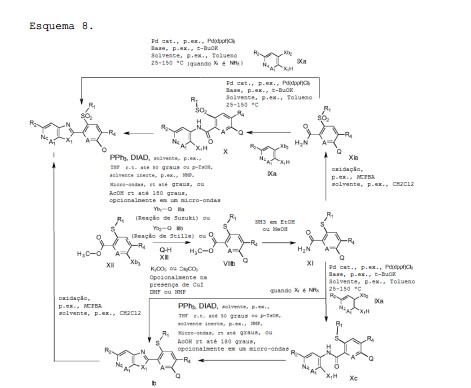
[0058] Como mostrado no esquema 8, os compostos da fórmula XII, em que R1, R4 são como descritos na fórmula I, e Xb3 é halogênio, podem ser reagidos com um composto de IIIa (reação de Suzuki) ou IIIb, como descrito previamente no Esquema I para dar compostos da fórmula VIIIb. Alternativamente, os compostos da fórmula XII podem ser reagidos com compostos da fórmula XIII, em que Q é um heterociclo e o hidrogênio está anexado a um átomo de nitrogênio desse heterociclo, na presença de uma base, opcionalmente na presença de um catalisador de cobre. A química é similar àquela ilustrada no esquema 2. Os compostos da fórmula VIIIb são depois tratados com amônia em um solvente adequado, por exemplo metanol ou etanol, para dar as amidas da fórmula XI, em que R1, R4 e Q são como descritos na fórmula I. A reação das amidas da fórmula XI com compostos da fórmula IXa, em que A1, R2 e X1 são como descritos na fórmula I, leva a compostos da fórmula Xc. Uma tal reação de heteroarilação de nitrogênio de amida opera tipicamente sob condições de formação de ligação C-N catalisada por metais de transição (tais como por exemplo [1,1'- bis(difenilfosfino)ferroceno]dicloropaládio (II)), usualmente compostas por um metal, tal como uma fonte de paládio (por exemplo precursores de paládio (0) como Pd2(dibenzilidenoacetona)3, ou precursores de paládio (II) como Pd(OAc)2) e um ligando (por exemplo à base de fosfina ou à base de carbeno N-heterocíclico), uma base, tal como alcóxidos (por exemplo tert-butóxido de sódio ou potássio), carbonatos, fosfatos ou amidas de silila (por exemplo carbonato de potássio ou césio, fosfato de potássio, ou dissilazano de hexametila de lítio) ou hidróxidos (por exemplo hidróxido de sódio ou potássio), e solventes tais como tolueno, tetraidrofurano, dioxano, dimetoxietano, formamida de N,N-dimetila, pirrolidina de N-metila e dimetilsulfóxido, bem como suas soluções aquosas. Estes métodos são conhecidos daqueles peritos na técnica e descritos, por exemplo, em WO 2014/142292. Sob aquelas condições de reação de acoplamento cruzado de amida acima descritas, os compostos da fórmula Xc podem ser isolados, e convertidos em compostos da fórmula Ib como descrito acima no esquema 7 mas podem também espontaneamente fechar em anel até aos compostos da fórmula Ib, especialmente em casos onde X1 é NR5. A oxidação de compostos da fórmula Ib até compostos da fórmula I pode ser alcançada por métodos conhecidos daqueles peritos na técnica, por exemplo com ácido meta- cloroperbenzoico em um solvente inerte tal como clorofórmio ou cloreto de metileno. Alternativamente, a sequência de reações pode ser modificada tal que o composto da fórmula XI seja em primeiro lugar oxidada até um composto da fórmula XIa, e depois convertida em compostos da fórmula I usando as mesmas reações previamente descritas. Os compostos das fórmulas XIIa e XIIb podem ser obtidos pelas reações mostradas nos esquemas 9 e 10. Esquema 9.

[0059] No esquema 9, os compostos da fórmula XIV, em que R001 é alquilaC1-C4, podem ser oxidados e os N-óxidos da fórmula XV convertidos em compostos da fórmula XII usando metodologia descrita no esquema 4. Similarmente, os compostos da fórmula XIVa, em que R001 é alquilaC1-C4, podem ser halogenados até compostos da fórmula XVa, e depois convertidos em compostos da fórmula XIIb usando a química descrita no esquema 5. Os compostos da fórmula IV são conhecidos na literatura, por exemplo em WO2015/000715. Os compostos das fórmulas XIV e XIVa foram descritos por exemplo em WO 2014132971, WO 2014123205, WO 2014119670, WO 2014119679, WO 2014119674, WO 2014119699, WO 2014119672, e WO 2014104407. Os compostos da fórmula Ixa são descritos na literatura (ver por exemplo WO 2014/142292) ou estão comercialmente disponíveis.[0059] In scheme 9, compounds of formula XIV, wherein R001 is C1-C4 alkyl, can be oxidized and the N-oxides of formula XV converted to compounds of formula XII using methodology described in scheme 4. Similarly, compounds of formula XV formula XIVa, wherein R001 is C1-C4 alkyl, can be halogenated to compounds of formula XVa, and then converted to compounds of formula XIIb using the chemistry described in scheme 5. Compounds of formula IV are known in the literature, for example in WO2015 /000715. Compounds of formulas XIV and XIVa have been described for example in WO 2014132971 , WO 2014123205 , WO 2014119670 , WO 2014119679 , WO 2014119674 , WO 2014119699 , WO 2014119672 , and WO 2014104407 . WO 2014/142292) or are commercially available.
[0060] Os compostos da fórmula I em que Q é cicloalquilaC3-C6, ou cicloalquilaC3-C6 mono- ou polissubstituída por substituintes selecionados do grupo consistindo em halogênio, ciano, haloalquilaC1-C4, e fenila, podem ser preparados por métodos descritos acima (em particular, os compostos da fórmula I em que Q é ciclopropila podem ser preparados por uma reação de Suzuki envolvendo ácido ciclopropil-borônico de acordo com descrições feitas no esquema 1). Para o caso especial de compostos da fórmula I em que Q é cicloalquilaC3-C6 substituída por ciano (p.ex., compostos Iaaa) e haloalquilaC1-C4 (p.ex., compostos Iaab) os compostos podem ser preparados pelos métodos mostrados no esquema 11.
[0061] Como mostrado no esquema 11, o tratamento de compostos da fórmula II, em que X é S, SO ou SO2 (em particular SO2), e em que A1, A, X1, R1, R2, R3 e R4 são como definidos acima, e na qual Xb1 é um grupo lábil como, por exemplo, cloro, bromo ou iodo (preferencialmente bromo) trifluorometanossulfonato, com trimetilsilil-acetonitrila (TMSCN), na presença de fluoreto de zinco (II)ZnF2, e um catalisador de paládio (0) tal como aducto de tris(dibenzilidenoacetona)dipaládio (0)-clorofórmio (Pd2(dba)3), com um ligando, por exemplo Xantphos, em um solvente inerte, tal como N,N-dimetilformamida DMF a temperaturas entre 100-180 °C, opcionalmente sob aquecimento de micro-ondas, leva a compostos da fórmula Iaaa, em que X é S, SO ou SO2 (em particular SO2). Tal química foi descrita na literatura, p.ex., em Org. Lett. 16 (24), 6314-6317, 2014. Os compostos da fórmula Iaaa podem ser tratados com compostos da fórmula XVII, em que Qx é uma ligação direta ou é (CH2)n e n é 1, 2 ou 3, e na qual Xb10 é um grupo lábil tal como um halogênio (preferencialmente cloro, bromo ou iodo), na presença de uma base tal como hidreto de sódio, carbonato de potássio K2CO3, ou carbonato de césio Cs2CO3, em um solvente inerte tal como N,N-dimetilformamida DMF, acetona, ou acetonitrila, a temperaturas entre 0-120 °C, para dar compostos da fórmula Iaab, em que X é S, SO ou SO2 (em particular SO2), e em que A1, A, X1, R1, R2, R3 e R4 são como definidos acima e na qual Qx é uma ligação direta ou é (CH2)n e n é 1, 2 ou 3. Alternativamente, os compostos da fórmula Iaa podem ser preparados diretamente a partir de compostos da fórmula II por tratamento com compostos da fórmula XVI, em que Qx é como descrito em XVII, na presença de um catalisador tal com Pd2(dba)3, com um ligando, tal como BINAP, uma base forte tal como hexametildissilazano de lítio LiHMDS, em um solvente inerte tal como tetraidrofurano THF, a temperaturas entre 30-80 °C. Tal química foi descrita em, por exemplo, J. Am. Chem. Soc. 127 (45), 15824-15832, 2005.[0061] As shown in Scheme 11, the treatment of compounds of formula II, wherein X is S, SO or SO2 (in particular SO2), and wherein A1, A, X1, R1, R2, R3 and R4 are as defined above, and in which Xb1 is a leaving group such as, for example, chlorine, bromine or iodine (preferably bromine) trifluoromethanesulfonate, with trimethylsilylacetonitrile (TMSCN), in the presence of zinc(II)fluoride ZnF2, and a catalyst of palladium(0) such as tris(dibenzylideneacetone)dipalladium(0)-chloroform adduct (Pd2(dba)3), with a ligand, for example Xantphos, in an inert solvent such as N,N-dimethylformamide DMF at temperatures between 100-180°C, optionally under microwave heating, leads to compounds of formula Iaaa, where X is S, SO or SO2 (in particular SO2). Such chemistry has been described in the literature, e.g., in Org. Lett. 16 (24), 6314-6317, 2014 . Compounds of formula Iaaa can be treated with compounds of formula XVII, where Qx is a direct bond or is (CH2)n and n is 1, 2 or 3, and where Xb10 is a leaving group such as a halogen (preferably chlorine, bromine or iodine), in the presence of a base such as sodium hydride, potassium carbonate K2CO3, or cesium carbonate Cs2CO3, in an inert solvent such as N,N-dimethylformamide DMF , acetone, or acetonitrile, at temperatures between 0-120°C, to give compounds of the formula Iaab, wherein X is S, SO, or SO2 (in particular SO2), and wherein A1, A, X1, R1, R2, R3 and R4 are as defined above and in which Qx is a direct bond or is (CH2)n and n is 1, 2 or 3. Alternatively, compounds of formula Iaa can be prepared directly from compounds of formula II by treatment with compounds of formula XVI, wherein Qx is as described in XVII, in the presence of a catalyst such as Pd2(dba)3, with a ligand, such as BINAP, a strong base such as hexamethyl lithium isilazane LiHMDS, in an inert solvent such as tetrahydrofuran THF, at temperatures between 30-80°C. Such chemistry has been described in, for example, J. Am. Chem. social 127 (45), 15824-15832, 2005.
[0062] Os compostos da fórmula Iaab podem ser adicionalmente utilizados para a preparação de compostos das fórmulas Iaac e Iaad (esquema 15). De fato, os compostos da fórmula Iaab, em que X é S, SO ou SO2, e em que A1, A, X1, R1, R2, R3 e R4 são como definidos acima e na qual Qx é uma ligação direta ou é (CH2)n e n é 1, 2 ou 3, podem ser hidrolisados, sob condições conhecidas de uma pessoa perita na técnica (condições básicas ou ácidas aquosas; por exemplo hidróxido de lítio ou sódio em um solvente alcoólico tal como metanol, a temperaturas entre 20 °C e condições de refluxo), até compostos da fórmula Iaac, em que X é S, SO ou SO2, e em que A1, A, X1, R1, R2, R3 e R4 são como definidos acima e na qual Qx é uma ligação direta ou é (CH2)n e n é 1, 2 ou 3. O tratamento de compostos da fórmula Iaac com reagentes tais como tetrafluoreto de enxofre SF4 ou Fluolead (trifluoreto de fenilenxofre de 4-tert-butil-2,6-dimetila), opcionalmente na presença de fluoreto de hidrogênio HF, a temperaturas entre 20-100 °C, leva a compostos da fórmula Iaad, em que X é S, SO ou SO2, e em que A1, A, X1, R1, R2, R3 e R4 são como definidos acima e na qual Qx é uma ligação direta ou é (CH2)n e n é 1, 2 ou 3.[0062] Compounds of formula Iaab can be further used for the preparation of compounds of formulas Iaac and Iaad (Scheme 15). Indeed, compounds of formula Iaab, wherein X is S, SO or SO2, and wherein A1, A, X1, R1, R2, R3 and R4 are as defined above and wherein Qx is a direct bond or is ( CH2)n and n is 1, 2 or 3, can be hydrolyzed, under conditions known to a person skilled in the art (aqueous basic or acidic conditions; for example lithium or sodium hydroxide in an alcoholic solvent such as methanol, at temperatures between 20° C and reflux conditions), to compounds of the formula Iaac, wherein X is S, SO or SO2, and wherein A1, A, X1, R1, R2, R3 and R4 are as defined above and in which Qx is a bond direct or is (CH2)n and n is 1, 2 or 3. Treatment of compounds of formula Iaac with reagents such as sulfur tetrafluoride SF4 or Fluolead (4-tert-butyl-2,6-dimethyl phenyl sulfur trifluoride), optionally in the presence of hydrogen fluoride HF, at temperatures between 20-100 °C, leads to compounds of the formula Iaad, where X is S, SO or SO2, and where A1, A, X1, R1, R2, R3 and R4 are as defined above and n which Qx is a direct bond or is (CH2)n and n is 1, 2 or 3.
[0063] Os compostos da fórmula Iaab podem também ser utilizados para a preparação de compostos da fórmula Iaae (esquema 12). Esquema 12
[0064] Alternativamente, os compostos da fórmula Iaab podem ser preparados como mostrado nos esquemas 13 e 14. Como mostrado no esquema 13, a química usada é idêntica àquela descrita no esquema 11, é somente que os substratos para as reações são diferentes. Assim, a reação dos compostos previamente descritos XIIa ou XIIb, em que X é S ou SO2 (em particular SO2), e em que A, R1, R3 e R4 são como definidos acima, e na qual Xb3 é um halogênio como, por exemplo, cloro, bromo ou iodo (preferencialmente cloro), ou um aril- ou alquilsulfonato tal como trifluorometanossulfonato, e na qual R0001 é alquilaC1-C4, com trimetilsilil-acetonitrila TMSCN como descrito no esquema 11, leva a compostos da fórmula XVIII, em que X é S ou SO2 (em particular SO2), e em que A, R1, R3 e R4 são como definidos acima, e na qual R001 é alquilaC1-C4. Estes são convertidos em compostos da fórmula VIIId, em que X é S ou SO2 (em particular SO2), e em que Qx, em que A, R1, R3 e R4 são como definidos acima, e na qual R001 é alquilaC1-C4, por reação com compostos da fórmula XVII como Os compostos da fórmula VIIId são prontamente hidrolisados por métodos conhecidos daqueles peritos na técnica para dar compostos da fórmula VIIIe, em que X é S ou SO2 (em particular SO2), e em que Qx, A, R1, R3 e R4 são como definidos acima.
[0065] A química mostrada no esquema 14 foi previamente descrita em detalhe (ver, por exemplo, esquema 7). Esta química envolve a formação de uma espécie ativada VIIIf, em que X é S, ou SO2 (em particular SO2), e em que Qx, A, R1, R3 e R4 são como definidos acima, e na qual LG1 é tipicamente cloro, seguida por acoplamento de amida com um composto da fórmula IXb, em que X1, A1 e R2 são como previamente definidos, para dar compostos da fórmula Xd. Aqueles compostos da fórmula Xd podem por seu turno ser convertidos em compostos da fórmula Iaab por um passo de desidratação formal, previamente descrito no esquema 7. Todas as definições de substituintes no esquema 14 são como descritas previamente. Esquema 14
[0066] Os reagentes podem ser reagidos na presença de uma base. Exemplos de bases adequadas são hidróxidos de metais alcalinos ou metais alcalinoterrosos, hidretos de metais alcalinos ou metais alcalinoterrosos, amidas de metais alcalinos ou metais alcalinoterrosos, alcóxidos de metais alcalinos ou metais alcalinoterrosos, acetatos de metais alcalinos ou metais alcalinoterrosos, carbonatos de metais alcalinos ou metais alcalinoterrosos, dialquilamidas de metais alcalinos ou metais alcalinoterrosos ou alquilsililamidas de metais alcalinos ou metais alcalinoterrosos, alquilaminas, alquilenodiaminas, cicloalquilaminas saturadas ou insaturadas livres ou N- alquiladas, heterociclos básicos, hidróxidos de amônio e aminas carbocíclicas. Exemplos que podem ser mencionados são o hidróxido de sódio, hidreto de sódio, amida de sódio, metóxido de sódio, acetato de sódio, carbonato de sódio, tert-butóxido de potássio, hidróxido de potássio, carbonato de potássio, hidreto de potássio, diisopropilamida de lítio, bis(trimetilsilil)amida de potássio, hidreto de cálcio, trietilamina, diisopropiletilamina, trietilenodiamina, ciclohexilamina, N-ciclohexil-N,N-dimetilamina, N,N- dietilanilina, piridina, 4-(N,N-dimetilamino)piridina, quinuclidina, N-metilmorfolina, hidróxido de benziltrimetilamônio e 1,8-diazabiciclo[5.4.0]undec-7-eno (DBU).[0066] Reagents can be reacted in the presence of a base. Examples of suitable bases are alkali metal or alkaline earth metal hydroxides, alkali metal or alkaline earth metal hydrides, alkali metal or alkaline earth metal amides, alkali metal or alkaline earth metal alkoxides, alkali metal or alkaline earth metal acetates, alkali metal carbonates or alkaline earth metals, alkali metal or alkaline earth metal dialkylamides or alkali metal or alkaline earth metal alkylsilylamides, alkylamines, alkylenediamines, free or N-alkylated saturated or unsaturated cycloalkylamines, basic heterocycles, ammonium hydroxides and carbocyclic amines. Examples which may be mentioned are sodium hydroxide, sodium hydride, sodium amide, sodium methoxide, sodium acetate, sodium carbonate, potassium tert-butoxide, potassium hydroxide, potassium carbonate, potassium hydride, diisopropylamide lithium, potassium bis(trimethylsilyl)amide, calcium hydride, triethylamine, diisopropylethylamine, triethylenediamine, cyclohexylamine, N-cyclohexyl-N,N-dimethylamine, N,N-diethylaniline, pyridine, 4-(N,N-dimethylamino) pyridine, quinuclidine, N-methylmorpholine, benzyltrimethylammonium hydroxide and 1,8-diazabicyclo[5.4.0]undec-7-ene (DBU).
[0067] Os reagentes podem ser reagidos uns com os outros na forma como estão, isto é, sem a adição de um solvente ou diluente. Na maioria dos casos, entretanto, é vantajoso adicionar um solvente ou diluente inerte ou uma mistura destes. Se a reação for realizada na presença de uma base, as bases que podem ser utilizadas em excesso, tais como trietilamina, piridina, N-metilmorfolina ou N,N- dietilanilina, podem também agir como solventes ou diluentes.[0067] Reagents can be reacted with each other as is, i.e. without the addition of a solvent or diluent. In most cases, however, it is advantageous to add an inert solvent or diluent or a mixture thereof. If the reaction is carried out in the presence of a base, bases that can be used in excess, such as triethylamine, pyridine, N-methylmorpholine or N,N-diethylaniline, can also act as solvents or diluents.
[0068] A reação é realizada vantajosamente em uma faixa de temperaturas de aproximadamente -80°C até aproximadamente +140 °C, de preferência de aproximadamente -30°C até aproximadamente +100 °C, e em muitos casos na faixa entre a temperatura ambiente e aproximadamente +80 °C.[0068] The reaction is advantageously carried out in a temperature range from approximately -80°C to approximately +140°C, preferably from approximately -30°C to approximately +100°C, and in many cases in the range between environment and approx. +80 °C.
[0069] Um composto da fórmula I pode ser convertido de um modo conhecido per se em outro composto da fórmula I por substituição de um ou mais substituintes do composto de partida da fórmula I no modo habitual, por outro(s) substituinte(s) de acordo com a invenção.[0069] A compound of formula I can be converted in a manner known per se into another compound of formula I by replacing one or more substituents of the starting compound of formula I in the usual manner with another substituent(s) according to the invention.
[0070] Dependendo da escolha das condições de reação e materiais de partida que são adequados em cada caso é possível, por exemplo, em um passo de reação substituir somente um substituinte por outro substituinte de acordo com a invenção, ou uma pluralidade de substituintes pode ser substituída por outros substituintes de acordo com a invenção no mesmo passo de reação.[0070] Depending on the choice of reaction conditions and starting materials that are suitable in each case it is possible, for example, in a reaction step to replace only one substituent with another substituent according to the invention, or a plurality of substituents can be replaced by other substituents according to the invention in the same reaction step.
[0071] Os sais dos compostos da fórmula I podem ser preparados de um modo conhecido per se. Assim, por exemplo, sais de adição de ácido dos compostos da fórmula I são obtidos por tratamento com um ácido adequado ou um reagente de troca iônica adequado, e sais com bases são obtidos por tratamento com uma base adequada ou um reagente de troca iônica adequado.[0071] Salts of compounds of formula I can be prepared in a manner known per se. Thus, for example, acid addition salts of compounds of formula I are obtained by treatment with a suitable acid or a suitable ion-exchange reagent, and salts with bases are obtained by treatment with a suitable base or a suitable ion-exchange reagent. .
[0072] Os sais dos compostos da fórmula I podem ser convertidos do modo habitual nos compostos I livres, sais de adição de ácido, por exemplo, por tratamento com um composto básico adequado ou com um reagente de troca iônica adequado, e os sais com bases, por exemplo, por tratamento com um ácido adequado ou com um reagente de troca iônica adequado.[0072] The salts of the compounds of formula I can be converted in the usual way into the free compounds I, acid addition salts, for example, by treatment with a suitable basic compound or with a suitable ion exchange reagent, and the salts with bases, for example, by treatment with a suitable acid or a suitable ion exchange reagent.
[0073] Os sais dos compostos da fórmula I podem ser convertidos de um modo conhecido per se em outros sais dos compostos da fórmula I, sais de adição de ácido, por exemplo, em outros sais de adição de ácido, por exemplo, por tratamento de um sal de ácido inorgânico tal como cloridrato com um sal de metal apropriado tal como um sal de sódio, bário ou prata, de um ácido, por exemplo com acetato de prata, em um solvente adequado no qual um sal inorgânico que se forme, por exemplo cloreto de prata, seja insolúvel e assim precipite a partir da mistura reacional.[0073] Salts of compounds of formula I can be converted in a manner known per se into other salts of compounds of formula I, acid addition salts, e.g. into other acid addition salts, e.g. by treatment of an inorganic acid salt such as hydrochloride with a suitable metal salt such as a sodium, barium or silver salt, of an acid, for example with silver acetate, in a suitable solvent in which an inorganic salt is formed, for example silver chloride, is insoluble and thus precipitates from the reaction mixture.
[0074] Dependendo do procedimento ou das condições de reação, os compostos da fórmula I, que têm propriedades de formação de sais, podem ser obtidos em forma livre ou na forma de sais.[0074] Depending on the procedure or reaction conditions, compounds of formula I, which have salt-forming properties, can be obtained in free form or in the form of salts.
[0075] Os compostos da fórmula I e, onde apropriado, os seus tautômeros, em cada caso na forma livre ou na forma de sal, podem estar presentes na forma de um dos isômeros que são possíveis ou como uma mistura destes, por exemplo na forma de isômeros puros, tais como antípodas e/ou diastereoisômeros, ou como misturas de isômeros, tais como misturas de enantiômeros, por exemplo racematos, misturas de diastereoisômeros ou misturas de racematos, dependendo do número, configuração absoluta e relativa dos átomos de carbono assimétricos que ocorrem na molécula e/ou dependendo da configuração das ligações duplas não aromáticas que ocorrem na molécula; a invenção se relaciona com os isômeros puros e também com todas as misturas de isômeros que são possíveis e é para ser entendida em cada caso em este sentido anteriormente ou doravante, mesmo quando os detalhes estereoquímicos não são mencionados especificamente em cada caso.[0075] The compounds of formula I and, where appropriate, their tautomers, in each case in free form or in salt form, may be present in the form of one of the isomers that are possible or as a mixture thereof, for example in form of pure isomers, such as antipodes and/or diastereoisomers, or as mixtures of isomers, such as mixtures of enantiomers, for example racemates, mixtures of diastereoisomers or mixtures of racemates, depending on the number, absolute and relative configuration of the asymmetric carbon atoms occurring in the molecule and/or depending on the configuration of non-aromatic double bonds occurring in the molecule; the invention relates to the pure isomers and also to all mixtures of isomers that are possible and is to be understood in each case in this sense hereafter, even when the stereochemical details are not specifically mentioned in each case.
[0076] As misturas de diastereoisômeros ou misturas de racematos dos compostos da fórmula I, na forma livre ou na forma de sal, que podem ser obtidas dependendo dos materiais de partida e dos procedimentos que foram escolhidos, podem ser separadas de um modo conhecido nos diastereoisômeros puros ou racematos com base nas diferenças físicoquímicas dos componentes, por exemplo, por cristalização fracionada, destilação e/ou cromatografia.[0076] Mixtures of diastereoisomers or mixtures of racemates of the compounds of formula I, in free form or in salt form, which can be obtained depending on the starting materials and the procedures that have been chosen, can be separated in a known manner in the pure diastereoisomers or racemates based on the physicochemical differences of the components, eg by fractional crystallization, distillation and/or chromatography.
[0077] As misturas de enantiômeros, tais como racematos, que podem ser obtidas em um modo similar podem ser resolvidas nos antípodas óticos por métodos conhecidos, por exemplo por recristalização de um solvente oticamente ativo, por cromatografia em adsorventes quirais, por exemplo por cromatografia líquida de elevado desempenho (HPLC) em celulose de acetila, com o auxílio de microrganismos adequados, por clivagem com enzimas imobilizadas específicas, através da formação de compostos de inclusão, por exemplo usando éteres coroa quirais, onde somente um enantiômero é complexado, ou por conversão em sais diastereoisoméricos, por exemplo por reação de um racemato do produto final básico com um ácido oticamente ativo, tal como um ácido carboxílico, por exemplo ácido canfórico, tartárico ou málico, ou ácido sulfônico, por exemplo ácido canforsulfônico, e separação da mistura de diastereoisômeros que pode ser obtida neste modo, por exemplo por cristalização fracionada com base nas suas diferentes solubilidades, para dar os diastereoisômeros, a partir dos quais o enantiômero desejado pode ser liberado pela ação de agentes adequados, por exemplo agentes básicos.[0077] Mixtures of enantiomers, such as racemates, which can be obtained in a similar way can be resolved into optical antipodes by known methods, for example by recrystallization from an optically active solvent, by chromatography on chiral adsorbents, for example by chromatography performance liquid (HPLC) on acetyl cellulose, with the aid of suitable microorganisms, by cleavage with specific immobilized enzymes, through the formation of inclusion compounds, for example using chiral crown ethers, where only one enantiomer is complexed, or by conversion to diastereoisomeric salts, for example by reacting a racemate of the basic end product with an optically active acid, such as a carboxylic acid, for example camphoric, tartaric or malic acid, or sulfonic acid, for example camphorsulfonic acid, and separating the mixture of diastereoisomers which can be obtained in this mode, for example by fractional crystallization based on their differences solubility entities, to give diastereoisomers, from which the desired enantiomer can be released by the action of suitable agents, for example basic agents.
[0078] Diastereoisômeros ou enantiômeros puros podem ser obtidos de acordo com a invenção não apenas por separação de misturas de isômeros apropriadas, mas também por métodos geralmente conhecidos de síntese diastereosseletiva ou enantiosseletiva, por exemplo, ao realizar o processo de acordo com a invenção com materiais de partida apresentando estereoquímica apropriada.[0078] Diastereoisomers or pure enantiomers can be obtained according to the invention not only by separating appropriate mixtures of isomers, but also by generally known methods of diastereoselective or enantioselective synthesis, for example by carrying out the process according to the invention with starting materials showing appropriate stereochemistry.
[0079] Os N-óxidos podem ser preparados por reação de um composto da fórmula I com um agente oxidante adequado, por exemplo o aducto de H2O2/ureia na presença de um anidrido ácido, p.ex. anidrido trifluoracético. Tais oxidações são conhecidas da literatura, por exemplo, de J. Med. Chem., 32 (12), 2561-73, 1989 ou WO 00/15615.[0079] The N-oxides can be prepared by reacting a compound of formula I with a suitable oxidizing agent, for example the H2O2/urea adduct in the presence of an acid anhydride, e.g. trifluoroacetic anhydride. Such oxidations are known from the literature, for example from J. Med. Chem., 32 (12), 2561-73, 1989 or WO 00/15615.
[0080] É vantajoso, em cada caso, isolar ou sintetizar o isômero, por exemplo enantiômero ou diastereoisômero, biologicamente mais eficaz, ou a mistura de isômeros, por exemplo mistura de enantiômeros ou mistura de diastereômeros, biologicamente mais eficaz se os componentes individuais tiverem atividade biológica diferente.[0080] It is advantageous in each case to isolate or synthesize the biologically more effective isomer, e.g. enantiomer or diastereoisomer, or the mixture of isomers, e.g. enantiomer mixture or diastereomer mixture, biologically more effective if the individual components have different biological activity.
[0081] Os compostos da fórmula I e, quando apropriado, os seus tautômeros, em cada caso na forma livre ou na forma de sal, podem, se apropriado, ser também obtidos na forma de hidratos e/ou incluir outros solventes, por exemplo aqueles que podem ter sido usados para a cristalização de compostos que estão presentes na forma sólida.[0081] The compounds of formula I and, where appropriate, their tautomers, in each case in free form or in salt form, may, if appropriate, also be obtained in the form of hydrates and/or include other solvents, for example those which may have been used for the crystallization of compounds which are present in solid form.
[0082] Os compostos de acordo com as seguintes Tabelas 1 a 6 em baixo podem ser preparados de acordo com os métodos descritos acima. A intenção é que os exemplos que seguem ilustrem a invenção e mostrem os compostos preferidos da fórmula I. Tabela X: Esta tabela divulga as 33 designações de substituintes X.001 a X.033 para as fórmulas (Iaa), (Iab), (Iac), (Iad), (Iae) e (Iaf) que são divulgadas após a Tabela X.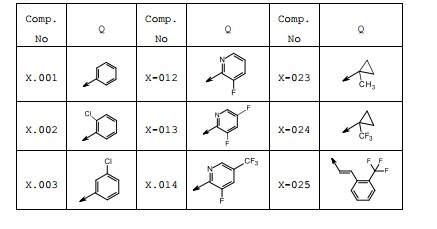

[0083] Esta tabela divulga os 33 compostos 1.001 a 1.033 da fórmula (Iaa):

[0084] Esta tabela divulga os 33 compostos 2.001 a 2.033 da fórmula (Iaa) em que n é 2, e R2 é CF3, R1 é etila, R4 é hidrogênio e Q é como definido nas linhas X.001-X.033 na tabela X.[0084] This table discloses the 33 compounds 2001 to 2033 of formula (Iaa) wherein n is 2, and R2 is CF3, R1 is ethyl, R4 is hydrogen, and Q is as defined in lines X.001-X.033 in table X.
[0085] Esta tabela divulga os 33 compostos 3.001 a 3.033 da fórmula (Iaa) em que n é 0, e R2 é CF2CF3, R1 é etila, R4 é hidrogênio e Q é como definido nas linhas X.001-X.033 na tabela X.[0085] This table discloses the 33 compounds 3001 to 3033 of formula (Iaa) wherein n is 0, and R2 is CF2CF3, R1 is ethyl, R4 is hydrogen, and Q is as defined in lines X.001-X.033 in table X.
[0086] Esta tabela divulga os 33 compostos 4.001 a 4.033 da fórmula (Iaa) em que n é 2, e R2 é CF2CF3, R1 é etila, R4 é hidrogênio e Q é como definido nas linhas X.001-X.033 na tabela X.[0086] This table discloses the 33 compounds 4001 to 4033 of formula (Iaa) wherein n is 2, and R2 is CF2CF3, R1 is ethyl, R4 is hydrogen, and Q is as defined in lines X.001-X.033 in table X.
[0087] Esta tabela divulga os 33 compostos 5.001 a 5.033 da fórmula (Iaa) em que n é 0, e R2 é CF(CF3)2, R1 é etila, R4 é hidrogênio e Q é como definido nas linhas X.001-X.033 na tabela X.[0087] This table discloses the 33 compounds 5001 to 5033 of formula (Iaa) where n is 0, and R2 is CF(CF3)2, R1 is ethyl, R4 is hydrogen, and Q is as defined in lines X.001- X.033 in table X.
[0088] Esta tabela divulga os 33 compostos 6.001 a 6.033 da fórmula (Iaa) em que n é 2, e R2 é CF(CF3)2, R1 é etila, R4 é hidrogênio e Q é como definido nas linhas X.001-X.033 na tabela X.[0088] This table discloses the 33 compounds 6001 to 6033 of formula (Iaa) where n is 2, and R2 is CF(CF3)2, R1 is ethyl, R4 is hydrogen, and Q is as defined in lines X.001- X.033 in table X.
[0089] Esta tabela divulga os 33 compostos 7.001 a 7.033 da fórmula (Iaa) em que n é 0, e R2 é OCF3, R1 é etila, R4 é hidrogênio e Q é como definido nas linhas X.001-X.033 na tabela X.[0089] This table discloses the 33 compounds 7001 to 7033 of formula (Iaa) wherein n is 0, and R2 is OCF3, R1 is ethyl, R4 is hydrogen, and Q is as defined in lines X.001-X.033 in table X.
[0090] Esta tabela divulga os 33 compostos 8.001 a 8.033 da fórmula (Iaa) em que n é 2, e R2 é OCF3, R1 é etila, R4 é hidrogênio e Q é como definido nas linhas X.001-X.033 na tabela X.[0090] This table discloses the 33 compounds 8001 to 8033 of formula (Iaa) where n is 2, and R2 is OCF3, R1 is ethyl, R4 is hydrogen, and Q is as defined in lines X.001-X.033 in table X.
[0091] Esta tabela divulga os 33 compostos 9.001 a 9.033 da fórmula (Iaa) em que n é 0, e R2 é SCF3, R1 é etila, R4 é hidrogênio e Q é como definido nas linhas X.001-X.033 na tabela X.[0091] This table discloses the 33 compounds 9001 to 9033 of formula (Iaa) wherein n is 0, and R2 is SCF3, R1 is ethyl, R4 is hydrogen, and Q is as defined in lines X.001-X.033 in table X.
[0092] Esta tabela divulga os 33 compostos 10.001 a 10.033 da fórmula (Iaa) em que n é 2, e R2 é SCF3, R1 é etila, R4 é hidrogênio e Q é como definido nas linhas X.001-X.033 na tabela X.[0092] This table discloses the 33 compounds 10,001 to 10,033 of formula (Iaa) wherein n is 2, and R2 is SCF3, R1 is ethyl, R4 is hydrogen, and Q is as defined in lines X.001-X.033 in table X.
[0093] Esta tabela divulga os 33 compostos 11.001 a 11.033 da fórmula (Iaa) em que n é 0, e R2 é SOCF3, R1 é etila, R4 é hidrogênio e Q é como definido nas linhas X.001-X.033 na tabela X.[0093] This table discloses the 33 compounds 11001 to 11033 of formula (Iaa) wherein n is 0, and R2 is SOCF3, R1 is ethyl, R4 is hydrogen, and Q is as defined in lines X.001-X.033 in table X.
[0094] Esta tabela divulga os 33 compostos 12.001 a 12.003 da fórmula (Iaa) em que n é 2, e R2 é SOCF3, R1 é etila, R4 é hidrogênio e Q é como definido nas linhas X.001-X.033 na tabela X.[0094] This table discloses the 33 compounds 12001 to 12003 of formula (Iaa) wherein n is 2, and R2 is SOCF3, R1 is ethyl, R4 is hydrogen, and Q is as defined in lines X.001-X.033 in table X.
[0095] Esta tabela divulga os 33 compostos 13.001 a 13.033 da fórmula (Iaa) em que n é 0, e R2 é SO2CF3, R1 é etila, R4 é hidrogênio e Q é como definido nas linhas X.001-X.033 na tabela X.[0095] This table discloses the 33 compounds 13001 to 13033 of formula (Iaa) wherein n is 0, and R2 is SO2CF3, R1 is ethyl, R4 is hydrogen, and Q is as defined in lines X.001-X.033 in table X.
[0096] Esta tabela divulga os 33 compostos 14.001 a 14.033 da fórmula (Iaa) em que n é 2, e R2 é SO2CF3, R1 é etila, R4 é hidrogênio e Q é como definido nas linhas X.001-X.033 na tabela X.[0096] This table discloses the 33 compounds 14001 to 14033 of formula (Iaa) wherein n is 2, and R2 is SO2CF3, R1 is ethyl, R4 is hydrogen, and Q is as defined in lines X.001-X.033 in table X.
[0097] Esta tabela divulga os 33 compostos 15.001 a 15.027 da fórmula (Iaa) em que n é 0, e R2 é Br, R1 é etila, R4 é hidrogênio e Q é como definido nas linhas X.001-X.033 na tabela X.[0097] This table discloses the 33 compounds 15001 to 15027 of formula (Iaa) where n is 0, and R2 is Br, R1 is ethyl, R4 is hydrogen, and Q is as defined in lines X.001-X.033 in table X.
[0098] Esta tabela divulga os 33 compostos 16.001 a 16.033 da fórmula (Iaa) em que n é 2, e R2 é Br, R1 é etila, R4 é hidrogênio e Q é como definido nas linhas X.001-X.033 na tabela X.[0098] This table discloses the 33 compounds 16001 to 16033 of formula (Iaa) where n is 2, and R2 is Br, R1 is ethyl, R4 is hydrogen, and Q is as defined in lines X.001-X.033 in table X.
[0099] Esta tabela divulga os 33 compostos 17.001 a 17.033 da fórmula (Iaa) em que n é 0, e R2 é CF2CH3, R1 é etila, R4 é hidrogênio e Q é como definido nas linhas X.001-X.033 na tabela X.[0099] This table discloses the 33 compounds 17001 to 17033 of formula (Iaa) wherein n is 0, and R2 is CF2CH3, R1 is ethyl, R4 is hydrogen, and Q is as defined in lines X.001-X.033 in table X.
[0100] Esta tabela divulga os 33 compostos 18.001 a 18.033 da fórmula (Iaa) em que n é 2, e R2 é CF2CH3, R1 é etila, R4 é hidrogênio e Q é como definido nas linhas X.001-X.033 na tabela X.[0100] This table discloses the 33 compounds 18001 to 18033 of formula (Iaa) wherein n is 2, and R2 is CF2CH3, R1 is ethyl, R4 is hydrogen, and Q is as defined in lines X.001-X.033 in table X.
[0101] Esta tabela divulga os 33 compostos 19.001 a 19.033 da fórmula (Iaa) em que n é 0, e R2 é OCF2CHFCF3, R1 é etila, R4 é hidrogênio e Q é como definido nas linhas X.001-X.033 na tabela X.[0101] This table discloses the 33 compounds 19001 to 19033 of formula (Iaa) wherein n is 0, and R2 is OCF2CHFCF3, R1 is ethyl, R4 is hydrogen, and Q is as defined in lines X.001-X.033 in table X.
[0102] Esta tabela divulga os 33 compostos 20.001 a 20.033 da fórmula (Iaa) em que n é 2, e R2 é OCH2CHFCF3, R1 é etila, R4 é hidrogênio e Q é como definido nas linhas X.001-X.033 na tabela X.[0102] This table discloses the 33 compounds 20,001 to 20,033 of formula (Iaa) wherein n is 2, and R2 is OCH2CHFCF3, R1 is ethyl, R4 is hydrogen, and Q is as defined in lines X.001-X.033 in table X.
[0103] Esta tabela divulga os 33 compostos 21.001 a 21.033 da fórmula (Iaa) em que n é 0, e R2 é OCH2CHF2, R1 é etila, R4 é hidrogênio e Q é como definido nas linhas X.001-X.033 na tabela X.[0103] This table discloses the 33 compounds 21001 to 21033 of formula (Iaa) wherein n is 0, and R2 is OCH2CHF2, R1 is ethyl, R4 is hydrogen, and Q is as defined in lines X.001-X.033 in table X.
[0104] Esta tabela divulga os 33 compostos 22.001 a 22.033 da fórmula (Iaa) em que n é 2, e R2 é OCH2CHF2, R1 é etila, R4 é hidrogênio e Q é como definido nas linhas X.001-X.033 na tabela X.[0104] This table discloses the 33 compounds 22001 to 22033 of formula (Iaa) wherein n is 2, and R2 is OCH2CHF2, R1 is ethyl, R4 is hydrogen, and Q is as defined in lines X.001-X.033 in table X.
[0105] Esta tabela divulga os 33 compostos 23.001 a 23.033 da fórmula (Iaa) em que n é 0, e R2 é C(CF3)2OCH3, R1 é etila, R4 é hidrogênio e Q é como definido nas linhas X.001-X.033 na tabela X.[0105] This table discloses the 33 compounds 23001 to 23033 of formula (Iaa) wherein n is 0, and R2 is C(CF3)2OCH3, R1 is ethyl, R4 is hydrogen, and Q is as defined in lines X.001- X.033 in table X.
[0106] Esta tabela divulga os 33 compostos 24.001 a 24.033 da fórmula (Iaa) em que n é 2, e R2 é C(CF3)2OCH3, R1 é etila, R4 é hidrogênio e Q é como definido nas linhas X.001-X.033 na tabela X.[0106] This table discloses the 33 compounds 24001 to 24033 of formula (Iaa) wherein n is 2, and R2 is C(CF3)2OCH3, R1 is ethyl, R4 is hydrogen, and Q is as defined in lines X.001- X.033 in table X.
[0107] Esta tabela divulga os 33 compostos 25.001 a 25.033 da fórmula (Iaa): em que n é 0, e R2 é CF3, R1 é etila, R4 é CF3 e Q é como definido nas linhas X.001-X.033 na tabela X.[0107] This table discloses the 33 compounds 25001 to 25033 of formula (Iaa): wherein n is 0, and R2 is CF3, R1 is ethyl, R4 is CF3 and Q is as defined in lines X.001-X.033 in table X.
[0108] Esta tabela divulga os 33 compostos 26.001 a 26.024 da fórmula (Iaa) em que n é 2, e R2 é CF3, R1 é etila, R4 é CF3 e Q é como definido nas linhas X.001-X.033 na tabela X.[0108] This table discloses the 33 compounds 26001 to 26024 of formula (Iaa) wherein n is 2, and R2 is CF3, R1 is ethyl, R4 is CF3 and Q is as defined in lines X.001-X.033 in table X.
[0109] Esta tabela divulga os 33 compostos 27.001 a 27.033 da fórmula (Iaa) em que n é 0, e R2 é CF2CF3, R1 é etila, R4 é CF3 e Q é como definido nas linhas X.001-X.033 na tabela X.[0109] This table discloses the 33 compounds 27001 to 27033 of formula (Iaa) wherein n is 0, and R2 is CF2CF3, R1 is ethyl, R4 is CF3, and Q is as defined in lines X.001-X.033 in table X.
[0110] Esta tabela divulga os 28 compostos 28.001 a 28.033 da fórmula (Iaa) em que n é 2, e R2 é CF2CF3, R1 é etila, R4 é CF3 e Q é como definido nas linhas X.001-X.033 na tabela X.[0110] This table discloses the 28 compounds 28001 to 28033 of formula (Iaa) wherein n is 2, and R2 is CF2CF3, R1 is ethyl, R4 is CF3 and Q is as defined in lines X.001-X.033 in table X.
[0111] Esta tabela divulga os 27 compostos 29.001 a 29.033 da fórmula (Iaa) em que n é 0, e R2 é CF(CF3)2, R1 é etila, R4 é CF3 e Q é como definido nas linhas X.001-X.033 na tabela X.[0111] This table discloses the 27 compounds 29001 to 29033 of formula (Iaa) wherein n is 0, and R2 is CF(CF3)2, R1 is ethyl, R4 is CF3, and Q is as defined in lines X.001- X.033 in table X.
[0112] Esta tabela divulga os 33 compostos 30.001 a 30.033 da fórmula (Iaa) em que n é 2, e R2 é CF(CF3)2, R1 é etila, R4 é CF3 e Q é como definido nas linhas X.001-X.033 na tabela X.[0112] This table discloses the 33 compounds 30,001 to 30,033 of formula (Iaa) wherein n is 2, and R2 is CF(CF3)2, R1 is ethyl, R4 is CF3, and Q is as defined in lines X.001- X.033 in table X.
[0113] Esta tabela divulga os 33 compostos 31.001 a 31.033 da fórmula (Iaa) em que n é 0, e R2 é OCF3, R1 é etila, R4 é CF3 e Q é como definido nas linhas X.001-X.033 na tabela X.[0113] This table discloses the 33 compounds 31001 to 31033 of formula (Iaa) wherein n is 0, and R2 is OCF3, R1 is ethyl, R4 is CF3 and Q is as defined in lines X.001-X.033 in table X.
[0114] Esta tabela divulga os 33 compostos 32.001 a 32.033 da fórmula (Iaa) em que n é 2, e R2 é OCF3, R1 é etila, R4 é CF3 e Q é como definido nas linhas X.001-X.033 na tabela X. Tabela 33:[0114] This table discloses the 33 compounds 32001 to 32033 of formula (Iaa) wherein n is 2, and R2 is OCF3, R1 is ethyl, R4 is CF3 and Q is as defined in lines X.001-X.033 in table X. Table 33:
[0115] Esta tabela divulga os 33 compostos 33.001 a 33.033 da fórmula (Iaa) em que n é 0, e R2 é SCF3, R1 é etila, R4 é CF3 e Q é como definido nas linhas X.001-X.033 na tabela X. Tabela 34:[0115] This table discloses the 33 compounds 33,001 to 33,033 of formula (Iaa) wherein n is 0, and R2 is SCF3, R1 is ethyl, R4 is CF3, and Q is as defined in lines X.001-X.033 in table X. Table 34:
[0116] Esta tabela divulga os 33 compostos 34.001 a 34.033 da fórmula (Iaa) em que n é 2, e R2 é SCF3, R1 é etila, R4 é CF3 e Q é como definido nas linhas X.001-X.033 na tabela X.[0116] This table discloses the 33 compounds 34001 to 34033 of formula (Iaa) wherein n is 2, and R2 is SCF3, R1 is ethyl, R4 is CF3 and Q is as defined in lines X.001-X.033 in table X.
[0117] Esta tabela divulga os 33 compostos 35.001 a 35.033 da fórmula (Iaa) em que n é 0, e R2 é SOCF3, R1 é etila, R4 é CF3 e Q é como definido nas linhas X.001-X.033 na tabela X.[0117] This table discloses the 33 compounds 35001 to 35033 of formula (Iaa) wherein n is 0, and R2 is SOCF3, R1 is ethyl, R4 is CF3 and Q is as defined in lines X.001-X.033 in table X.
[0118] Esta tabela divulga os 33 compostos 36.001 a 36.033 da fórmula (Iaa) em que n é 2, e R2 é SOCF3, R1 é etila, R4 é CF3 e Q é como definido nas linhas X.001-X.033 na tabela X.[0118] This table discloses the 33 compounds 36001 to 36033 of formula (Iaa) wherein n is 2, and R2 is SOCF3, R1 is ethyl, R4 is CF3 and Q is as defined in lines X.001-X.033 in table X.
[0119] Esta tabela divulga os 33 compostos 37.001 a 37.033 da fórmula (Iaa) em que n é 0, e R2 é SO2CF3, R1 é etila, R4 é CF3 e Q é como definido nas linhas X.001-X.033 na tabela X.[0119] This table discloses the 33 compounds 37001 to 37033 of formula (Iaa) wherein n is 0, and R2 is SO2CF3, R1 is ethyl, R4 is CF3 and Q is as defined in lines X.001-X.033 in table X.
[0120] Esta tabela divulga os 33 compostos 38.001 a 38.033 da fórmula (Iaa) em que n é 2, e R2 é SO2CF3, R1 é etila, R4 é CF3 e Q é como definido nas linhas X.001-X.033 na tabela X.[0120] This table discloses the 33 compounds 38001 to 38033 of formula (Iaa) wherein n is 2, and R2 is SO2CF3, R1 is ethyl, R4 is CF3 and Q is as defined in lines X.001-X.033 in table X.
[0121] Esta tabela divulga os 33 compostos 39.001 a 39.033 da fórmula (Iaa) em que n é 0, e R2 é Br, R1 é etila, R4 é CF3 e Q é como definido nas linhas X.001-X.033 na tabela X.[0121] This table discloses the 33 compounds 39,001 to 39,033 of formula (Iaa) wherein n is 0, and R2 is Br, R1 is ethyl, R4 is CF3, and Q is as defined in lines X.001-X.033 in table X.
[0122] Esta tabela divulga os 33 compostos 40.001 a 40.033 da fórmula (Iaa) em que n é 2, e R2 é Br, R1 é etila, R4 é CF3 e Q é como definido nas linhas X.001-X.033 na tabela X.[0122] This table discloses the 33 compounds 40,001 to 40,033 of formula (Iaa) wherein n is 2, and R2 is Br, R1 is ethyl, R4 is CF3, and Q is as defined in lines X.001-X.033 in table X.
[0123] Esta tabela divulga os 33 compostos 41.001 a 41.033 da fórmula (Iaa) em que n é 0, e R2 é CF2CH3, R1 é etila, R4 é CF3 e Q é como definido nas linhas X.001-X.033 na tabela X.[0123] This table discloses the 33 compounds 41001 to 41033 of formula (Iaa) wherein n is 0, and R2 is CF2CH3, R1 is ethyl, R4 is CF3 and Q is as defined in lines X.001-X.033 in table X.
[0124] Esta tabela divulga os 33 compostos 42.001 a 42.033 da fórmula (Iaa) em que n é 2, e R2 é CF2CH3, R1 é etila, R4 é CF3 e Q é como definido nas linhas X.001-X.033 na tabela X.[0124] This table discloses the 33 compounds 42001 to 42033 of formula (Iaa) wherein n is 2, and R2 is CF2CH3, R1 is ethyl, R4 is CF3 and Q is as defined in lines X.001-X.033 in table X.
[0125] Esta tabela divulga os 33 compostos 43.001 a 43.033 da fórmula (Iaa) em que n é 0, e R2 é OCF2CHFCF3, R1 é etila, R4 é CF3 e Q é como definido nas linhas X.001-X.033 na tabela X.[0125] This table discloses the 33 compounds 43001 to 43033 of formula (Iaa) wherein n is 0, and R2 is OCF2CHFCF3, R1 is ethyl, R4 is CF3 and Q is as defined in lines X.001-X.033 in table X.
[0126] Esta tabela divulga os 33 compostos 44.001 a 44.033 da fórmula (Iaa) em que n é 2, e R2 é OCF2CHFCF3, R1 é etila, R4 é CF3 e Q é como definido nas linhas X.001-X.033 na tabela X.[0126] This table discloses the 33 compounds 44001 to 44033 of formula (Iaa) wherein n is 2, and R2 is OCF2CHFCF3, R1 is ethyl, R4 is CF3 and Q is as defined in lines X.001-X.033 in table X.
[0127] Esta tabela divulga os 33 compostos 45.001 a 45.033 da fórmula (Iaa) em que n é 0, e R2 é OCF2CHFCF3, R1 é etila, R4 é CF3 e Q é como definido nas linhas X.001-X.033 na tabela X.[0127] This table discloses the 33 compounds 45001 to 45033 of formula (Iaa) wherein n is 0, and R2 is OCF2CHFCF3, R1 is ethyl, R4 is CF3 and Q is as defined in lines X.001-X.033 in table X.
[0128] Esta tabela divulga os 33 compostos 46.001 a 46.033 da fórmula (Iaa) em que n é 2, e R2 é OCF2CHFCF3, R1 é etila, R4 é CF3 e Q é como definido nas linhas X.001-X.033 na tabela X.[0128] This table discloses the 33 compounds 46001 to 46033 of formula (Iaa) wherein n is 2, and R2 is OCF2CHFCF3, R1 is ethyl, R4 is CF3 and Q is as defined in lines X.001-X.033 in table X.
[0129] Esta tabela divulga os 33 compostos 47.001 a 47.033 da fórmula (Iaa) em que n é 0, e R2 é C(CF3)2OCH3, R1 é etila, R4 é CF3 e Q é como definido nas linhas X.001-X.033 na tabela X.[0129] This table discloses the 33 compounds 47001 to 47033 of formula (Iaa) wherein n is 0, and R2 is C(CF3)2OCH3, R1 is ethyl, R4 is CF3, and Q is as defined in lines X.001- X.033 in table X.
[0130] Esta tabela divulga os 33 compostos 48.001 a 48.033 da fórmula (Iaa) em que n é 2, e R2 é C(CF3)2OCH3, R1 é etila, R4 é CF3 e Q é como definido nas linhas X.001-X.033 na tabela X.[0130] This table discloses the 33 compounds 48001 to 48033 of formula (Iaa) wherein n is 2, and R2 is C(CF3)2OCH3, R1 is ethyl, R4 is CF3, and Q is as defined in lines X.001- X.033 in table X.
[0131] Esta tabela divulga os 33 compostos 49.001 a 49.033 da fórmula (Iab):

[0132] Esta tabela divulga os 33 compostos 50.001 a 50.024 da fórmula (Iab) em que n é 2, e R2 é CF3, R1 é etila, R4 é hidrogênio e Q é como definido nas linhas X.001-X.033 na tabela X.[0132] This table discloses the 33 compounds 50,001 to 50,024 of formula (Iab) wherein n is 2, and R2 is CF3, R1 is ethyl, R4 is hydrogen, and Q is as defined in lines X.001-X.033 in table X.
[0133] Esta tabela divulga os 33 compostos 51.001 a 51.033 da fórmula (Iab) em que n é 0, e R2 é CF2CF3, R1 é etila, R4 é hidrogênio e Q é como definido nas linhas X.001-X.033 na tabela X.[0133] This table discloses the 33 compounds 51001 to 51033 of formula (Iab) wherein n is 0, and R2 is CF2CF3, R1 is ethyl, R4 is hydrogen, and Q is as defined in lines X.001-X.033 in table X.
[0134] Esta tabela divulga os 33 compostos 52.001 a 52.033 da fórmula (Iab) em que n é 2, e R2 é CF2CF3, R1 é etila, R4 é hidrogênio e Q é como definido nas linhas X.001-X.033 na tabela X.[0134] This table discloses the 33 compounds 52,001 to 52,033 of formula (Iab) wherein n is 2, and R2 is CF2CF3, R1 is ethyl, R4 is hydrogen, and Q is as defined in lines X.001-X.033 in table X.
[0135] Esta tabela divulga os 33 compostos 53.001 a 53.033 da fórmula (Iab) em que n é 0, e R2 é CF(CF3)2, R1 é etila, R4 é hidrogênio e Q é como definido nas linhas X.001-X.033 na tabela X.[0135] This table discloses the 33 compounds 53001 to 53033 of formula (Iab) where n is 0, and R2 is CF(CF3)2, R1 is ethyl, R4 is hydrogen, and Q is as defined in lines X.001- X.033 in table X.
[0136] Esta tabela divulga os 33 compostos 53.001 a 53.033 da fórmula (Iab) em que n é 2, e R2 é CF(CF3)2, R1 é etila, R4 é hidrogênio e Q é como definido nas linhas X.001-X.033 na tabela X.[0136] This table discloses the 33 compounds 53,001 to 53,033 of formula (Iab) where n is 2, and R2 is CF(CF3)2, R1 is ethyl, R4 is hydrogen, and Q is as defined in lines X.001- X.033 in table X.
[0137] Esta tabela divulga os 33 compostos 55.001 a 55.033 da fórmula (Iab) em que n é 0, e R2 é SCF3, R1 é etila, R4 é hidrogênio e Q é como definido nas linhas X.001-X.033 na tabela X.[0137] This table discloses the 33 compounds 55001 to 55033 of formula (Iab) wherein n is 0, and R2 is SCF3, R1 is ethyl, R4 is hydrogen, and Q is as defined in lines X.001-X.033 in table X.
[0138] Esta tabela divulga os 33 compostos 56.001 a 56.033 da fórmula (Iab) em que n é 2, e R2 é SCF3, R1 é etila, R4 é hidrogênio e Q é como definido nas linhas X.001-X.033 na tabela X.[0138] This table discloses the 33 compounds 56001 to 56033 of formula (Iab) wherein n is 2, and R2 is SCF3, R1 is ethyl, R4 is hydrogen, and Q is as defined in lines X.001-X.033 in table X.
[0139] Esta tabela divulga os 33 compostos 57.001 a 57.033 da fórmula (Iac):

[0140] Esta tabela divulga os 33 compostos 58.001 a 58.024 da fórmula (Iac) em que n é 2, e R2 é CF3, R1 é etila, R4 é hidrogênio e Q é como definido nas linhas X.001-X.033 na tabela X.[0140] This table discloses the 33 compounds 58,001 to 58,024 of formula (Iac) wherein n is 2, and R2 is CF3, R1 is ethyl, R4 is hydrogen, and Q is as defined in lines X.001-X.033 in table X.
[0141] Esta tabela divulga os 33 compostos 59.001 a 59.033 da fórmula (Iac) em que n é 0, e R2 é CF2CF3, R1 é etila, R4 é hidrogênio e Q é como definido nas linhas X.001-X.033 na tabela X.[0141] This table discloses the 33 compounds 59,001 to 59,033 of formula (Iac) wherein n is 0, and R2 is CF2CF3, R1 is ethyl, R4 is hydrogen, and Q is as defined in lines X.001-X.033 in table X.
[0142] Esta tabela divulga os 33 compostos 60.001 a 60.033 da fórmula (Iac) em que n é 2, e R2 é CF2CF3, R1 é etila, R4 é hidrogênio e Q é como definido nas linhas X.001-X.033 na tabela X.[0142] This table discloses the 33 compounds 60,001 to 60,033 of formula (Iac) wherein n is 2, and R2 is CF2CF3, R1 is ethyl, R4 is hydrogen, and Q is as defined in lines X.001-X.033 in table X.
[0143] Esta tabela divulga os 33 compostos 61.001 a 61.033 da fórmula (Iac) em que n é 0, e R2 é CF(CF3)2, R1 é etila, R4 é hidrogênio e Q é como definido nas linhas X.001-X.033 na tabela X.[0143] This table discloses the 33 compounds 61001 to 61033 of formula (Iac) where n is 0, and R2 is CF(CF3)2, R1 is ethyl, R4 is hydrogen, and Q is as defined in lines X.001- X.033 in table X.
[0144] Esta tabela divulga os 33 compostos 62.001 a 62.033 da fórmula (Iac) em que n é 2, e R2 é CF(CF3)2, R1 é etila, R4 é hidrogênio e Q é como definido nas linhas X.001-X.033 na tabela X.[0144] This table discloses the 33 compounds 62001 to 62033 of formula (Iac) wherein n is 2, and R2 is CF(CF3)2, R1 is ethyl, R4 is hydrogen, and Q is as defined in lines X.001- X.033 in table X.
[0145] Esta tabela divulga os 33 compostos 63.001 a 63.033 da fórmula (Iac) em que n é 0, e R2 é SCF3, R1 é etila, R4 é hidrogênio e Q é como definido nas linhas X.001-X.033 na tabela X.[0145] This table discloses the 33 compounds 63001 to 63033 of formula (Iac) wherein n is 0, and R2 is SCF3, R1 is ethyl, R4 is hydrogen, and Q is as defined in lines X.001-X.033 in table X.
[0146] Esta tabela divulga os 33 compostos 64.001 a 64.033 da fórmula (Iac) em que n é 2, e R2 é SCF3, R1 é etila, R4 é hidrogênio e Q é como definido nas linhas X.001-X.033 na tabela X.[0146] This table discloses the 33 compounds 64001 to 64033 of formula (Iac) wherein n is 2, and R2 is SCF3, R1 is ethyl, R4 is hydrogen, and Q is as defined in lines X.001-X.033 in table X.
[0147] Esta tabela divulga os 33 compostos 65.001 a 65.033 da fórmula (Iad):

[0148] Esta tabela divulga os 33 compostos 66.001 a 66.024 da fórmula (Iad) em que n é 2, e R2 é CF3, R1 é etila, R4 é hidrogênio e Q é como definido nas linhas X.001-X.033 na tabela X.[0148] This table discloses the 33 compounds 66001 to 66024 of formula (Iad) wherein n is 2, and R2 is CF3, R1 is ethyl, R4 is hydrogen, and Q is as defined in lines X.001-X.033 in table X.
[0149] Esta tabela divulga os 33 compostos 67.001 a 67.033 da fórmula (Iad) em que n é 0, e R2 é CF2CF3, R1 é etila, R4 é hidrogênio e Q é como definido nas linhas X.001-X.033 na tabela X.[0149] This table discloses the 33 compounds 67001 to 67033 of formula (Iad) wherein n is 0, and R2 is CF2CF3, R1 is ethyl, R4 is hydrogen, and Q is as defined in lines X.001-X.033 in table X.
[0150] Esta tabela divulga os 33 compostos 68.001 a 68.033 da fórmula (Iad) em que n é 2, e R2 é CF2CF3, R1 é etila, R4 é hidrogênio e Q é como definido nas linhas X.001-X.033 na tabela X.[0150] This table discloses the 33 compounds 68,001 to 68,033 of formula (Iad) wherein n is 2, and R2 is CF2CF3, R1 is ethyl, R4 is hydrogen, and Q is as defined in lines X.001-X.033 in table X.
[0151] Esta tabela divulga os 33 compostos 69.001 a 69.033 da fórmula (Iad) em que n é 0, e R2 é CF(CF3)2, R1 é etila, R4 é hidrogênio e Q é como definido nas linhas X.001-X.033 na tabela X.[0151] This table discloses the 33 compounds 69,001 to 69,033 of formula (Iad) where n is 0, and R2 is CF(CF3)2, R1 is ethyl, R4 is hydrogen, and Q is as defined in lines X.001- X.033 in table X.
[0152] Esta tabela divulga os 33 compostos 70.001 a 70.033 da fórmula (Iad) em que n é 2, e R2 é CF(CF3)2, R1 é etila, R4 é hidrogênio e Q é como definido nas linhas X.001-X.033 na tabela X.[0152] This table discloses the 33 compounds 70,001 to 70,033 of formula (Iad) where n is 2, and R2 is CF(CF3)2, R1 is ethyl, R4 is hydrogen, and Q is as defined in lines X.001- X.033 in table X.
[0153] Esta tabela divulga os 33 compostos 71.001 a 71.033 da fórmula (Iad) em que n é 0, e R2 é SCF3, R1 é etila, R4 é hidrogênio e Q é como definido nas linhas X.001-X.033 na tabela X.[0153] This table discloses the 33 compounds 71001 to 71033 of formula (Iad) where n is 0, and R2 is SCF3, R1 is ethyl, R4 is hydrogen, and Q is as defined in lines X.001-X.033 in table X.
[0154] Esta tabela divulga os 33 compostos 72.001 a 72.033 da fórmula (Iad) em que n é 2, e R2 é SCF3, R1 é etila, R4 é hidrogênio e Q é como definido nas linhas X.001-X.033 na tabela X.[0154] This table discloses the 33 compounds 72001 to 72033 of formula (Iad) wherein n is 2, and R2 is SCF3, R1 is ethyl, R4 is hydrogen, and Q is as defined in lines X.001-X.033 in table X.
[0155] Esta tabela divulga os 33 compostos 73.001 a 73.033 da fórmula (Iae):

[0156] Esta tabela divulga os 33 compostos 74.001 a 74.024 da fórmula (Iae) em que n é 2, e R2 é CF3, R1 é etila, R4 é hidrogênio e Q é como definido nas linhas X.001-X.033 na tabela X.[0156] This table discloses the 33 compounds 74,001 to 74,024 of formula (Iae) wherein n is 2, and R2 is CF3, R1 is ethyl, R4 is hydrogen, and Q is as defined in lines X.001-X.033 in table X.
[0157] Esta tabela divulga os 33 compostos 75.001 a 75.033 da fórmula (Iae) em que n é 0, e R2 é CF2CF3, R1 é etila, R4 é hidrogênio e Q é como definido nas linhas X.001-X.033 na tabela X.[0157] This table discloses the 33 compounds 75001 to 75033 of formula (Iae) wherein n is 0, and R2 is CF2CF3, R1 is ethyl, R4 is hydrogen, and Q is as defined in lines X.001-X.033 in table X.
[0158] Esta tabela divulga os 33 compostos 76.001 a 76.033 da fórmula (Iae) em que n é 2, e R2 é CF2CF3, R1 é etila, R4 é hidrogênio e Q é como definido nas linhas X.001-X.033 na tabela X.[0158] This table discloses the 33 compounds 76001 to 76033 of formula (Iae) wherein n is 2, and R2 is CF2CF3, R1 is ethyl, R4 is hydrogen, and Q is as defined in lines X.001-X.033 in table X.
[0159] Esta tabela divulga os 33 compostos 77.001 a 77.033 da fórmula (Iae) em que n é 0, e R2 é CF(CF3)2, R1 é etila, R4 é hidrogênio e Q é como definido nas linhas X.001-X.033 na tabela X.[0159] This table discloses the 33 compounds 77,001 to 77,033 of formula (Iae) where n is 0, and R2 is CF(CF3)2, R1 is ethyl, R4 is hydrogen, and Q is as defined in lines X.001- X.033 in table X.
[0160] Esta tabela divulga os 33 compostos 78.001 a 78.033 da fórmula (Iae) em que n é 2, e R2 é CF(CF3)2, R1 é etila, R4 é hidrogênio e Q é como definido nas linhas X.001-X.033 na tabela X.[0160] This table discloses the 33 compounds 78,001 to 78,033 of formula (Iae) where n is 2, and R2 is CF(CF3)2, R1 is ethyl, R4 is hydrogen, and Q is as defined in lines X.001- X.033 in table X.
[0161] Esta tabela divulga os 33 compostos 79.001 a 79.033 da fórmula (Iae) em que n é 0, e R2 é SCF3, R1 é etila, R4 é hidrogênio e Q é como definido nas linhas X.001-X.033 na tabela X.[0161] This table discloses the 33 compounds 79,001 to 79,033 of formula (Iae) wherein n is 0, and R2 is SCF3, R1 is ethyl, R4 is hydrogen, and Q is as defined in lines X.001-X.033 in table X.
[0162] Esta tabela divulga os 33 compostos 80.001 a 80.033 da fórmula (Iae) em que n é 2, e R2 é SCF3, R1 é etila, R4 é hidrogênio e Q é como definido nas linhas X.001-X.033 na tabela X.[0162] This table discloses the 33 compounds 80,001 to 80,033 of formula (Iae) wherein n is 2, and R2 is SCF3, R1 is ethyl, R4 is hydrogen, and Q is as defined in lines X.001-X.033 in table X.
[0163] Esta tabela divulga os 33 compostos 81.001 a 81.033 da fórmula (Iaf):

[0164] Esta tabela divulga os 33 compostos 82.001 a 82.024 da fórmula (Iaf) em que n é 2, e R2 é CF3, R1 é etila, R4 é hidrogênio e Q é como definido nas linhas X.001-X.033 na tabela X.[0164] This table discloses the 33 compounds 82,001 to 82,024 of formula (Iaf) wherein n is 2, and R2 is CF3, R1 is ethyl, R4 is hydrogen, and Q is as defined in lines X.001-X.033 in table X.
[0165] Esta tabela divulga os 33 compostos 83.001 a 83.033 da fórmula (Iaf) em que n é 0, e R2 é CF2CF3, R1 é etila, R4 é hidrogênio e Q é como definido nas linhas X.001-X.033 na tabela X.[0165] This table discloses the 33 compounds 83,001 to 83,033 of formula (Iaf) wherein n is 0, and R2 is CF2CF3, R1 is ethyl, R4 is hydrogen, and Q is as defined in lines X.001-X.033 in table X.
[0166] Esta tabela divulga os 33 compostos 84.001 a 84.033 da fórmula (Iaf) em que n é 2, e R2 é CF2CF3, R1 é etila, R4 é hidrogênio e Q é como definido nas linhas X.001-X.033 na tabela X.[0166] This table discloses the 33 compounds 84001 to 84033 of formula (Iaf) wherein n is 2, and R2 is CF2CF3, R1 is ethyl, R4 is hydrogen, and Q is as defined in lines X.001-X.033 in table X.
[0167] Esta tabela divulga os 33 compostos 85.001 a 85.033 da fórmula (Iaf) em que n é 0, e R2 é CF(CF3)2, R1 é etila, R4 é hidrogênio e Q é como definido nas linhas X.001-X.033 na tabela X.[0167] This table discloses the 33 compounds 85001 to 85033 of formula (Iaf) where n is 0, and R2 is CF(CF3)2, R1 is ethyl, R4 is hydrogen, and Q is as defined in lines X.001- X.033 in table X.
[0168] Esta tabela divulga os 33 compostos 86.001 a 86.033 da fórmula (Iaf) em que n é 2, e R2 é CF(CF3)2, R1 é etila, R4 é hidrogênio e Q é como definido nas linhas X.001-X.033 na tabela X.[0168] This table discloses the 33 compounds 86,001 to 86,033 of formula (Iaf) where n is 2, and R2 is CF(CF3)2, R1 is ethyl, R4 is hydrogen, and Q is as defined in lines X.001- X.033 in table X.
[0169] Esta tabela divulga os 33 compostos 87.001 a 87.033 da fórmula (Iaf) em que n é 0, e R2 é SCF3, R1 é etila, R4 é hidrogênio e Q é como definido nas linhas X.001-X.033 na tabela X.[0169] This table discloses the 33 compounds 87,001 to 87,033 of formula (Iaf) where n is 0, and R2 is SCF3, R1 is ethyl, R4 is hydrogen, and Q is as defined in lines X.001-X.033 in table X.
[0170] Esta tabela divulga os 33 compostos 88.001 a 88.033 da fórmula (Iaf) em que n é 2, e R2 é SCF3, R1 é etila, R4 é hidrogênio e Q é como definido nas linhas X.001-X.033 na tabela X.[0170] This table discloses the 33 compounds 88,001 to 88,033 of formula (Iaf) where n is 2, and R2 is SCF3, R1 is ethyl, R4 is hydrogen, and Q is as defined in lines X.001-X.033 in table X.
[0171] Os compostos da fórmula I de acordo com a invenção são ingredientes ativos preventivamente e/ou curativamente valiosos na área de controle de pragas, mesmo a baixas taxas de aplicação, que têm um espectro biocida muito favorável e são bem tolerados por espécies de sangue quente, peixes e plantas. Os ingredientes ativos de acordo com a invenção agem contra todos os estágios de desenvolvimento ou estágios de desenvolvimento individuais de pragas animais normalmente sensíveis, mas também resistentes, como insetos ou representantes da ordem Acarina. A atividade inseticida ou acaricida dos ingredientes ativos de acordo com a invenção pode se manifestar diretamente, i.e., na destruição das pragas, que tem lugar imediatamente ou somente após algum tempo, por exemplo durante a écdise, ou indiretamente, por exemplo em uma taxa de oviposição e/ou eclosão reduzida.[0171] The compounds of formula I according to the invention are preventively and/or curatively active ingredients that are valuable in the field of pest control, even at low application rates, which have a very favorable biocidal spectrum and are well tolerated by pest species. warm blood, fish and plants. The active ingredients according to the invention act against all stages of development or individual stages of development of normally sensitive but also resistant animal pests, such as insects or representatives of the order Acarina. The insecticidal or acaricidal activity of the active ingredients according to the invention can manifest itself directly, i.e. in the destruction of the pests, which takes place immediately or only after some time, for example during ecdysis, or indirectly, for example in a rate of oviposition and/or reduced hatching.
[0172] Exemplos das pragas animais acima mencionadas são: da ordem Acarina, por exemplo, Acalitus spp, Aculus spp, Acaricalus spp, Aceria spp, Acarus siro, Amblyomma spp., Argas spp., Boophilus spp., Brevipalpus spp., Bryobia spp, Calipitrimerus spp., Chorioptes spp., Dermanyssus gallinae, Dermatophagoides spp, Eotetranychus spp, Eriophyes spp., Hemitarsonemus spp, Hyalomma spp., Ixodes spp., Olygonychus spp, Ornithodoros spp., Polyphagotarsone latus, Panonychus spp., Phyllocoptruta oleivora, Phytonemus spp, Polyphagotarsonemus spp, Psoroptes spp., Rhipicephalus spp., Rhizoglyphus spp., Sarcoptes spp., Steneotarsonemus spp, Tarsonemus spp. e Tetranychus spp.; da ordem Anoplura, por exemplo, Haematopinus spp., Linognathus spp., Pediculus spp., Pemphigus spp. e Phylloxera spp.; da ordem Coleoptera, por exemplo, Agriotes spp., Amphimallon majale, Anomala orientalis, Anthonomus spp., Aphodius spp, Astylus atromaculatus, Ataenius spp, Atomaria linearis, Chaetocnema tibialis, Cerotoma spp, Conoderus spp, Cosmopolites spp., Cotinis nitida, Curculio spp., Cyclocephala spp, Dermestes spp., Diabrotica spp., Diloboderus abderus, Epilachna spp., Eremnus spp., Heteronychus arator, Hypothenemus hampei, Lagria vilosa, Leptinotarsa decemLineata, Lissorhoptrus spp., Liogenys spp, Maecolaspis spp, Maladera castanea, Megascelis spp, Melighetes aeneus, Melolontha spp., Myochrous armatus, Orycaephilus spp., Otiorhynchus spp., Phyllophaga spp, Phlyctinus spp., Popillia spp., Psylliodes spp., Rhyssomatus aubtilis, Rhizopertha spp., Scarabeidae, Sitophilus spp., Sitotroga spp., Somaticus spp, Sphenophorus spp, Sternechus subsignatus, Tenebrio spp., Tribolium spp. e Trogoderma spp.; da ordem Diptera, por exemplo, Aedes spp., Anopheles spp, Antherigona soccata,Bactrocea oleae, Bibio hortulanus, Bradysia spp, Calliphora erythrocephala, Ceratitis spp., Chrysomyia spp., Culex spp., Cuterebra spp., Dacus spp., Delia spp, Drosophila melanogaster, Fannia spp., Gastrophilus spp., Geomyza tripunctata, Glossina spp., Hypoderma spp., Hyppobosca spp., Liriomyza spp., Lucilia spp., Melanagromyza spp., Musca spp., Oestrus spp., Orseolia spp., Oscinella frit, Pegomyia hyoscyami, Phorbia spp., Rhagoletis spp, Rivelia quadrifasciata, Scatella spp, Sciara spp., Stomoxys spp., Tabanus spp., Tannia spp. e Tipula spp.; da ordem Hemiptera, por exemplo, Acanthocoris scabrator, Acrosternum spp, Adelphocoris lineolatus, Amblypelta nitida, Bathycoelia thalassina, Blissus spp, Cimex spp., Clavigralla tomentosicollis, Creontiades spp, Distantiella theobroma, Dichelops furcatus, Dysdercus spp., Edessa spp, Euchistus spp., Eurydema pulchrum, Eurygaster spp., Halyomorpha halys, Horcias nobilellus, Leptocorisa spp., Lygus spp, Margarodes spp, Murgantia histrionic, Neomegalotomus spp, Nesidiocoris tenuis, Nezara spp., Nysius simulans, Oebalus insularis, Piesma spp., Piezodorus spp, Rhodnius spp., Sahlbergella singularis, Scaptocoris castanea, Scotinophara spp., Thyanta spp , Triatoma spp., Vatiga illudens; Acyrthosium pisum, Adalges spp, Agalliana ensigera, Agonoscena targionii, Aleurodicus spp, Aleurocanthus spp, Aleurolobus barodensis, Aleurothrixus floccosus, Aleyrodes brassicae, Amarasca biguttula, Amritodus atkinsoni, Aonidiella spp., Aphididae, Aphis spp., Aspidiotus spp., Aulacorthum solani, Bactericera cockerelli, Bemisia spp, Brachycaudus spp, Brevicoryne brassicae, Cacopsylla spp, Cavariella aegopodii Scop., Ceroplaster spp., Chrysomphalus aonidium, Chrysomphalus dictyospermi, Cicadella spp, Cofana spectra, Cryptomyzus spp, Cicadulina spp, Coccus hesperidum, Dalbulus maidis, Dialeurodes spp, Diaphorina citri, Diuraphis noxia, Dysaphis spp, Empoasca spp., Eriosoma larigerum, Erythroneura spp., Gascardia spp., Glycaspis brimblecombei, Hyadaphis pseudobrassicae, Hyalopterus spp, Hyperomyzus pallidus, Idioscopus clypealis, Jacobiasca lybica, Laodelphax spp., Lecanium corni, Lepidosaphes spp., Lopaphis erysimi, Lyogenys maidis, Macrosiphum spp., Mahanarva spp, Metcalfa pruinosa, Metopolophium dirhodum, Myndus crudus, Myzus spp., Neotoxoptera sp, Nephotettix spp., Nilaparvata spp., Nippolachnus piri Mats, Odonaspis ruthae, Oregma lanigera Zehnter, Parabemisia myricae, Paratrioza cockerelli, Parlatoria spp., Pemphigus spp., Peregrinus maidis, Perkinsiella spp, Phorodon humuli, Phylloxera spp, Planococcus spp., Pseudaulacaspis spp., Pseudococcus spp., Pseudatomoscelis seriatus, Psylla spp., Pulvinaria aethiopica, Quadraspidiotus spp., Quesada gigas, Recilia dorsalis, Rhopalosiphum spp., Saissetia spp., Scaphoideus spp., Schizaphis spp., Sitobion spp., Sogatella furcifera, Spissistilus festinus, Tarophagus Proserpina, Toxoptera spp, Trialeurodes spp, Tridiscus sporoboli, Trionymus spp, Trioza erytreae , Unaspis citri, Zygina flammigera, Zyginidia scutellaris, ; da ordem Hymenoptera, por exemplo, Acromyrmex, Arge spp, Atta spp., Cephus spp., Diprion spp., Diprionidae, Gilpinia polytoma, Hoplocampa spp., Lasius spp., Monomorium pharaonis, Neodiprion spp., Pogonomyrmex spp, Slenopsis invicta, Solenopsis spp. e Vespa spp.; da ordem Isoptera, por exemplo, Coptotermes spp, Corniternes cumulans, Incisitermes spp, Macrotermes spp, Mastotermes spp, Microtermes spp, Reticulitermes spp.; Solenopsis geminate da ordem Lepidoptera, por exemplo, Acleris spp., Adoxophyes spp., Aegeria spp., Agrotis spp., Alabama argillaceae, Amylois spp., Anticarsia gemmatalis, Archips spp., Argyresthia spp, Argyrotaenia spp., Autographa spp., Bucculatrix thurberiella, Busseola fusca, Cadra cautella, Carposina nipponensis, Chilo spp., Choristoneura spp., Chrysoteuchia topiaria, Clysia ambiguella, Cnaphalocrocis spp., Cnephasia spp., Cochylis spp., Coleophora spp., Colias lesbia, Cosmophila flava, Crambus spp, Crocidolomia binotalis, Cryptophlebia leucotreta, Cydalima perspectalis, Cydia spp., Diaphania perspectalis, Diatraea spp., Diparopsis castanea, Earias spp., Eldana saccharina, Ephestia spp., Epinotia spp, Estigmene acrea, Etiella zinckinella, Eucosma spp., Eupoecilia ambiguella, Euproctis spp., Euxoa spp., Feltia jaculiferia, Grapholita spp., Hedya nubiferana, Heliothis spp., Hellula undalis, Herpetogramma spp, Hyphantria cunea, Keiferia lycopersicella, Lasmopalpus lignosellus, Leucoptera scitella, Lithocollethis spp., Lobesia botrana, Loxostege bifidalis, Lymantria spp., Lyonetia spp., Malacosoma spp., Mamestra brassicae, Manduca sexta, Mythimna spp, Noctua spp, Operophtera spp., Orniodes indica, Ostrinia nubilalis, Pammene spp., Pandemis spp., Panolis flammea, Papaipema nebris, Pectinophora gossypiela, Perileucoptera coffeella, Pseudaletia unipuncta, Phthorimaea operculella, Pieris rapae, Pieris spp., Plutella xylostella, Prays spp., Pseudoplusia spp, Rachiplusia nu, Richia albicosta, Scirpophaga spp., Sesamia spp., Sparganothis spp., Spodoptera spp., Sylepta derogate, Synanthedon spp., Thaumetopoea spp., Tortrix spp., Trichoplusia ni, Tuta absoluta, e Yponomeuta spp.; da ordem Mallophaga, por exemplo, Damalinea spp. e Trichodectes spp.; da ordem Orthoptera, por exemplo, Blatta spp., Blattella spp., Gryllotalpa spp., Leucophaea maderae, Locusta spp., Neocurtilla hexadactyla, Periplaneta spp. , Scapteriscus spp, e Schistocerca spp.; da ordem Psocoptera, por exemplo, Liposcelis spp.; da ordem Siphonaptera, por exemplo, Ceratophyllus spp., Ctenocephalides spp. e Xenopsylla cheopis; da ordem Thysanoptera, por exemplo, Calliothrips phaseoli, Frankliniella spp., Heliothrips spp, Hercinothrips spp., Parthenothrips spp, Scirtothrips aurantii, Sericothrips variabilis, Taeniothrips spp., Thrips spp; da ordem Thysanura, por exemplo, Lepisma saccharina.[0172] Examples of the aforementioned animal pests are: of the order Acarina, for example, Acalitus spp, Aculus spp, Acaricalus spp, Aceria spp, Acarus siro, Amblyomma spp., Argas spp., Boophilus spp., Brevipalpus spp., Bryobia spp, Calipitrimerus spp., Chorioptes spp., Dermanyssus gallinae, Dermatophagoides spp, Eotetranychus spp, Eriophyes spp., Hemitarsonemus spp, Hyalomma spp., Ixodes spp., Olygonychus spp, Ornithodoros spp., Polyphagotarsone latus, Panonychus spp. , Phytonemus spp., Polyphagotarsonemus spp., Psoroptes spp., Rhipicephalus spp., Rhizoglyphus spp., Sarcoptes spp., Steneotarsonemus spp., Tarsonemus spp. and Tetranychus spp.; of the order Anoplura, for example, Haematopinus spp., Linognathus spp., Pediculus spp., Pemphigus spp. and Phylloxera spp.; of the order Coleoptera, for example, Agriotes spp., Amphimallon majale, Anomala orientalis, Anthonomus spp., Aphodius spp., Astylus atromaculatus, Ataenius spp, Atomaria linearis, Chaetocnema tibialis, Cerotoma spp, Conoderus spp, Cosmopolites spp., Cotinis nitida, Curculio spp., Cyclocephala spp., Dermestes spp., Diabrotica spp., Diloboderus abderus, Epilachna spp., Eremnus spp., Heteronychus arator, Hypothenemus hampei, Lagria villosa, Leptinotarsa decemLineata, Lissorhoptrus spp., Liogenys spp, Maecolaspis spp, Maladera castanea Megascelis spp, Melighetes aeneus, Melolontha spp., Myochrous armatus, Orycaephilus spp., Otiorhynchus spp., Phyllophaga spp, Phlyctinus spp., Popillia spp., Psylliodes spp., Rhyssomatus aubtilis, Rhizopertha spp., Scarabeidae, Sitophilus spp., Sitottrogapp. spp., Somaticus spp., Sphenophorus spp., Sternechus subsignatus, Tenebrio spp., Tribolium spp. and Trogoderma spp.; of the order Diptera, e.g. Aedes spp., Anopheles spp., Antherigona soccata, Bactrocea oleae, Bibio hortulanus, Bradysia spp, Calliphora erythrocephala, Ceratitis spp., Chrysomyia spp., Culex spp., Cuterebra spp., Dacus spp., Delia spp, Drosophila melanogaster, Fannia spp., Gastrophilus spp., Geomyza tripunctata, Glossina spp., Hypoderma spp., Hyppobosca spp., Liriomyza spp., Lucilia spp., Melanagromyza spp., Musca spp., Oestrus spp., Orseolia spp. ., Oscinella frit, Pegomyia hyoscyami, Phorbia spp., Rhagoletis spp., Rivelia quadrifasciata, Scatella spp., Sciara spp., Stomoxys spp., Tabanus spp., Tannia spp. and Tipula spp.; of the order Hemiptera, for example, Acanthocoris scabrator, Acrosternum spp, Adelphocoris lineolatus, Amblypelta nitida, Bathycoelia thalassina, Blissus spp, Cimex spp., Clavigralla tomentosicollis, Creontiades spp, Distantiella theobroma, Dichelops furcatus, Dysdercus spp., Edessa spp, Euchistus spp. ., Eurydema pulchrum, Eurygaster spp., Halyomorpha halys, Horcias nobilellus, Leptocorisa spp., Lygus spp, Margarodes spp, Murgantia histrionic, Neomegalotomus spp, Nesidiocoris tenuis, Nezara spp., Nysius simulans, Oebalus insularis, Piesma spp., Piezodorus spp. , Rhodnius spp., Sahlbergella singularis, Scaptocoris castanea, Scotinophara spp., Thyanta spp., Triatoma spp., Vatiga illudens; Acyrthosium pisum, Adalges spp, Agalliana ensigera, Agonoscena targionii, Aleurodicus spp, Aleurocanthus spp, Aleurolobus barodensis, Aleurothrixus floccosus, Aleyrodes brassicae, Amarasca biguttula, Amritodus atkinsoni, Aonidiella spp., Aphididae, Aphis spp., Aspidiotus spp. Bactericera cockerelli, Bemisia spp, Brachycaudus spp, Brevicoryne brassicae, Cacopsylla spp, Cavariella aegopodii Scop., Ceroplaster spp., Chrysomphalus aonidium, Chrysomphalus dictyospermi, Cicadella spp, Cofana spectra, Cryptomyzus spp, Cicadulina spp, Coccus hesperidum, Diabulurodes maidis, Diabulurodes maidiss, Diabulurodes maidiss , Diaphorina citri, Diuraphis noxia, Dysaphis spp, Empoasca spp., Eriosoma larigerum, Erythroneura spp., Gascardia spp., Glycaspis brimblecombei, Hyadaphis pseudobrassicae, Hyalopterus spp, Hyperomyzus pallidus, Idioscopus clypealis, Jacobiasca lybica, Laodelphax spp., Lecanium corni. Lepidosaphes spp., Lopaphis erysimi, Lyogenys maidis, Macrosiphum spp., Mahanarva spp, Metcalfa pruinosa, Met opolophium dirhodum, Myndus crudus, Myzus spp., Neotoxoptera sp, Nephotettix spp., Nilaparvata spp., Nippolachnus piri Mats, Odonaspis ruthae, Oregma lanigera Zehnter, Parabemisia myricae, Paratrioza cockerelli, Parlatoria spp., Pemphigus spp., Peregrinus maidis, Perkinsisi spp., Phorodon humuli, Phylloxera spp., Planococcus spp., Pseudaulacaspis spp., Pseudococcus spp., Pseudatomoscelis seriatus, Psylla spp., Pulvinaria aethiopica, Quadraspidiotus spp., Quesada gigas, Recilia dorsalis, Rhopalosiphum spp., Saissetia spp., Scaphoideus spp. ., Schizaphis spp., Sitobion spp., Sogatella furcifera, Spissistilus festinus, Tarophagus Proserpina, Toxoptera spp, Trialeurodes spp, Tridiscus sporoboli, Trionymus spp, Trioza erytreae, Unaspis citri, Zygina flammigera, Zyginidia scutellaris, ; of the order Hymenoptera, e.g. Acromyrmex, Arge spp, Atta spp., Cephus spp., Diprion spp., Diprionidae, Gilpinia polytoma, Hoplocampa spp., Lasius spp., Monomorium pharaonis, Neodiprion spp., Pogonomyrmex spp, Slenopsis invicta, Solenopsis spp. and Vespa spp.; of the order Isoptera, for example Coptotermes spp, Corniternes cumulans, Incisitermes spp, Macrotermes spp, Mastotermes spp, Microtermes spp, Reticulitermes spp.; Solenopsis geminate of the order Lepidoptera, for example, Acleris spp., Adoxophyes spp., Aegeria spp., Agrotis spp., Alabama argillaceae, Amylois spp., Anticarsia gemmatalis, Archips spp., Argyresthia spp., Argyrotaenia spp., Autographa spp., Bucculatrix thurberiella, Busseola fusca, Cadra cautella, Carposina nipponensis, Chilo spp., Choristoneura spp., Chrysoteuchia topiaria, Clysia ambiguella, Cnaphalocrocis spp., Cnephasia spp., Cochylis spp., Coleophora spp., Colias lesbia, Cosmophila flava, Crambus spp. , Crocidolomia binotalis, Cryptophlebia leucotreta, Cydalima perspectalis, Cydia spp., Diaphania perspectalis, Diatraea spp., Diparopsis castanea, Earias spp., Eldana saccharina, Ephestia spp., Epinotia spp, Stigmene acrea, Etiella zinckinella, Eucosma spp., Eupoecilia ambiguella , Euproctis spp., Euxoa spp., Feltia jaculiferia, Grapholita spp., Hedya nubiferana, Heliothis spp., Hellula undalis, Herpetogramma spp, Hyphantria cunea, Keiferia lycopersicella, Lasmopalpus lignosellus, Leucop tera scitella, Lithocollethis spp., Lobesia botrana, Loxostege bifidalis, Lymantria spp., Lyonetia spp., Malacosoma spp., Mamestra brassicae, Manduca sexta, Mythimna spp, Noctua spp, Operophtera spp., Orniodes indica, Ostrinia nubilalis, Pammene spp. , Pandemis spp., Panolis flammea, Papaipema nebris, Pectinophora gossypiela, Perileucoptera coffeella, Pseudaletia unipuncta, Phthorimaea operculella, Pieris rapae, Pieris spp., Plutella xylostella, Prays spp., Pseudoplusia spp, Rachiplusia nu, Richia albicosta, Scirpophaga spp., Sesamia spp., Sparganothis spp., Spodoptera spp., Sylepta derogate, Synanthedon spp., Thaumetopoea spp., Tortrix spp., Trichoplusia ni, Tuta absoluta, and Yponomeuta spp.; of the order Mallophaga, for example, Damalinea spp. and Trichodectes spp.; of the order Orthoptera, for example, Blatta spp., Blattella spp., Gryllotalpa spp., Leucophaea maderae, Locusta spp., Neocurtilla hexadactyla, Periplaneta spp. , Scapteriscus spp, and Schistocerca spp.; of the order Psocoptera, for example Liposcelis spp.; of the order Siphonaptera, eg Ceratophyllus spp., Ctenocephalides spp. and Xenopsylla cheopis; of the order Thysanoptera, for example, Calliothrips phaseoli, Frankliniella spp., Heliothrips spp., Hercinothrips spp., Parthenothrips spp., Scirtothrips aurantii, Sericothrips variabilis, Taeniothrips spp., Thrips spp; of the order Thysanura, for example, Lepisma saccharina.
[0173] Os ingredientes ativos de acordo com a invenção podem ser usados para controlar, isto é, conter ou destruir, pragas do tipo acima mencionado que ocorrem em particular em plantas, especialmente em plantas úteis e plantas ornamentais na agricultura, na horticultura e em florestas, ou em órgãos, tais como frutos, flores, folhagem, caules, tubérculos ou raízes de tais plantas, e, em alguns casos, mesmo órgãos de plantas que são formados em um momento posterior permanecem protegidos contra estas pragas.[0173] The active ingredients according to the invention can be used to control, i.e. contain or destroy, pests of the aforementioned type which occur in particular on plants, especially on useful plants and ornamental plants in agriculture, horticulture and in forests, or on organs such as fruits, flowers, foliage, stems, tubers or roots of such plants, and in some cases even plant organs that are formed at a later time remain protected against these pests.
[0174] Culturas alvo adequadas são, em particular, cereais, tais como trigo, cevada, centeio, aveia, arroz, milho ou sorgo; beterraba, tal como beterraba-sacarina ou forrageira; frutas, por exemplo frutas pomóideas, frutas com caroço ou frutas macias, tais como maçãs, peras, ameixas, pêssegos, amêndoas, cerejas ou bagas, por exemplo morangos, framboesas ou amoras; culturas leguminosas, tais como feijões, lentilhas, ervilhas ou soja; culturas oleaginosas, tais como colza, mostarda, papoulas, azeitonas, girassóis, coco, mamona, cacau ou amendoins; cucurbitáceas, tais como abóboras, pepinos ou melões; plantas fibrosas, tais como algodão, linho, cânhamo ou juta; frutas cítricas, tais como laranjas, limões, toranjas ou tangerinas; legumes e hortaliças, tais como espinafre, alface, aspargos, repolhos, cenouras, cebolas, tomates, batatas ou pimentões; Lauraceae, tais como abacate, Cinnamonium ou cânfora; e também tabaco, nozes, café, berinjelas, cana-de-açúcar, chá, pimenta, videiras, lúpulos, a família Plantaginaceae e plantas de látex.[0174] Suitable target crops are, in particular, cereals such as wheat, barley, rye, oats, rice, maize or sorghum; beet, such as sugar or fodder beet; fruits, for example pome fruit, stone fruit or soft fruit, such as apples, pears, plums, peaches, almonds, cherries or berries, for example strawberries, raspberries or blackberries; leguminous crops such as beans, lentils, peas or soybeans; oil crops such as rapeseed, mustard, poppies, olives, sunflowers, coconut, castor, cocoa or peanuts; cucurbits, such as pumpkins, cucumbers or melons; fibrous plants such as cotton, flax, hemp or jute; citrus fruits such as oranges, lemons, grapefruits or tangerines; vegetables, such as spinach, lettuce, asparagus, cabbages, carrots, onions, tomatoes, potatoes or peppers; Lauraceae, such as avocado, Cinnamonium or camphor; and also tobacco, nuts, coffee, eggplants, sugar cane, tea, pepper, vines, hops, the Plantaginaceae family, and latex plants.
[0175] As composições e/ou métodos da presente invenção podem ser também usados em quaisquer culturas ornamentais e/ou vegetais, incluindo flores, arbustos, árvores latifoliadas e árvores perenes.[0175] The compositions and/or methods of the present invention can also be used on any ornamental and/or vegetable crops, including flowers, shrubs, broadleaved trees and evergreen trees.
[0176] Por exemplo, a invenção pode ser usada em qualquer uma das seguintes espécies ornamentais: Ageratum spp., Alonsoa spp., Anemone spp., Anisodontea capsenisis, Anthemis spp., Antirrhinum spp., Aster spp., Begonia spp. (p.ex., B. elatior, B. semperflorens, B. tubéreux), Bougainvillea spp., Brachycome spp., Brassica spp. (ornamental), Calceolaria spp., Capsicum annuum, Catharanthus roseus, Canna spp., Centaurea spp., Chrysanthemum spp., Cineraria spp. (C. maritime), Coreopsis spp., Crassula coccinea, Cuphea ignea, Dahlia spp., Delphinium spp., Dicentra spectabilis, Dorotheantus spp., Eustoma grandiflorum, Forsythia spp., Fuchsia spp., Geranium gnaphalium, Gerbera spp., Gomphrena globosa, Heliotropium spp., Helianthus spp., Hibiscus spp., Hortensia spp., Hydrangea spp., Hypoestes phyllostachya, Impatiens spp. (I. Walleriana), Iresines spp., Kalanchoe spp., Lantana camara, Lavatera trimestris, Leonotis leonurus, Lilium spp., Mesembryanthemum spp., Mimulus spp., Monarda spp., Nemesia spp., Tagetes spp., Dianthus spp. (cravo), Canna spp., Oxalis spp., Bellis spp., Pelargonium spp. (P. peltatum, P. Zonale), Viola spp. (amor-perfeito), Petunia spp., Phlox spp., Plecthranthus spp., Poinsettia spp., Parthenocissus spp. (P. quinquefolia, P. tricuspidata), Primula spp., Ranunculus spp., Rhododendron spp., Rosa spp. (rosa), Rudbeckia spp., Saintpaulia spp., Salvia spp., Scaevola aemola, Schizanthus wisetonensis, Sedum spp., Solanum spp., Surfinia spp., Tagetes spp., Nicotinia spp., Verbena spp., Zinnia spp. e outras plantas em estratificação.[0176] For example, the invention can be used on any of the following ornamental species: Ageratum spp., Alonsoa spp., Anemone spp., Anisodontea capsenisis, Anthemis spp., Antirrhinum spp., Aster spp., Begonia spp. (eg, B. elatior, B. semperflorens, B. tubereux), Bougainvillea spp., Brachycome spp., Brassica spp. (ornamental), Calceolaria spp., Capsicum annuum, Catharanthus roseus, Canna spp., Centaurea spp., Chrysanthemum spp., Cineraria spp. (C. maritime), Coreopsis spp., Crassula coccinea, Cuphea ignea, Dahlia spp., Delphinium spp., Dicentra spectabilis, Dorotheantus spp., Eustoma grandiflorum, Forsythia spp., Fuchsia spp., Geranium gnaphalium, Gerbera spp., Gomphrena globosa, Heliotropium spp., Helianthus spp., Hibiscus spp., Hortensia spp., Hydrangea spp., Hypoestes phyllostachya, Impatiens spp. (I. Walleriana), Iresines spp., Kalanchoe spp., Lantana camara, Lavatera trimestris, Leonotis leonurus, Lilium spp., Mesembryanthemum spp., Mimulus spp., Monarda spp., Nemesia spp., Tagetes spp., Dianthus spp. (clove), Canna spp., Oxalis spp., Bellis spp., Pelargonium spp. (P. peltatum, P. Zonale), Viola spp. (pansy), Petunia spp., Phlox spp., Plethranthus spp., Poinsettia spp., Parthenocissus spp. (P. quinquefolia, P. tricuspidata), Primula spp., Ranunculus spp., Rhododendron spp., Rosa spp. (rosa), Rudbeckia spp., Saintpaulia spp., Salvia spp., Scaevola aemola, Schizanthus wisetonensis, Sedum spp., Solanum spp., Surfinia spp., Tagetes spp., Nicotinia spp., Verbena spp., Zinnia spp. and other plants in stratification.
[0177] Por exemplo, a invenção pode ser usada em qualquer uma das seguintes espécies de legumes e hortaliças: Allium spp. (A. sativum, A. cepa, A. oschaninii, A. porrum, A. ascalonicum, A. fistulosum), Anthriscus cerefolium, Apium graveolus, Asparagus officinalis, Beta vulgarus, Brassica spp. (B. oleracea, B. pekinensis, B. rapa), Capsicum annuum, Cicer arietinum, Cichorium endivia, Cichorum spp. (C. intybus, C. endivia), Citrillus lanatus, Cucumis spp. (C. sativus, C. melo), Cucurbita spp. (C. pepo, C. maxima), Cyanara spp. (C. scolymus, C. cardunculus), Daucus carota, Foeniculum vulgare, Hypericum spp., Lactuca sativa, Lycopersicon spp. (L. esculentum, L. lycopersicum), Mentha spp., Ocimum basilicum, Petroselinum crispum, Phaseolus spp. (P. vulgaris, P. coccineus), Pisum sativum, Raphanus sativus, Rheum rhaponticum, Rosemarinus spp., Salvia spp., Scorzonera hispanica, Solanum melongena, Spinacea oleracea, Valerianella spp. (V. locusta, V. eriocarpa) e Vicia faba.[0177] For example, the invention can be used on any of the following vegetable and vegetable species: Allium spp. (A. sativum, A. cepa, A. oschaninii, A. porrum, A. ascalonicum, A. fistulosum), Anthriscus cerefolium, Apium graveolus, Asparagus officinalis, Beta vulgarus, Brassica spp. (B. oleracea, B. pekinensis, B. rapa), Capsicum annuum, Cicer arietinum, Cichorium endivia, Cichorum spp. (C. intybus, C. endivia), Citrillus lanatus, Cucumis spp. (C. sativus, C. melo), Cucurbita spp. (C. pepo, C. maxima), Cyanara spp. (C. scolymus, C. cardunculus), Daucus carota, Foeniculum vulgare, Hypericum spp., Lactuca sativa, Lycopersicon spp. (L. esculentum, L. lycopersicum), Mentha spp., Ocimum basilicum, Petroselinum crispum, Phaseolus spp. (P. vulgaris, P. coccineus), Pisum sativum, Raphanus sativus, Rheum rhaponticum, Rosemarinus spp., Salvia spp., Scorzonera hispanica, Solanum melongena, Spinacea oleracea, Valerianella spp. (V. locusta, V. eriocarpa) and Vicia faba.
[0178] Espécies ornamentais preferenciais incluem violeta africana, Begonia, Dahlia, Gerbera, Hydrangea, Verbena, Rosa, Kalanchoe, Poinsettia, Aster, Centaurea, Coreopsis, Delphinium, Monarda, Phlox, Rudbeckia, Sedum, Petunia, Viola, Impatiens, Geranium, Chrysanthemum, Ranunculus, Fuchsia, Salvia, Hortensia, alecrim, salva, hipericão, hortelã, pimentão, tomate e pepino.[0178] Preferred ornamental species include African Violet, Begonia, Dahlia, Gerbera, Hydrangea, Verbena, Rosa, Kalanchoe, Poinsettia, Aster, Centaurea, Coreopsis, Delphinium, Monarda, Phlox, Rudbeckia, Sedum, Petunia, Viola, Impatiens, Geranium, Chrysanthemum, Ranunculus, Fuchsia, Salvia, Hortensia, Rosemary, Sage, St. John's Wort, Mint, Bell Pepper, Tomato and Cucumber.
[0179] Os ingredientes ativos de acordo com a invenção são especialmente adequados para controle de Aphis craccivora, Diabrotica balteata, Heliothis virescens, Myzus persicae, Plutella xylostella e Spodoptera littoralis em culturas de algodão, legumes e hortaliças, milho, arroz e soja. Os ingredientes ativos de acordo com a invenção são adicionalmente especialmente adequados para controle de Mamestra (preferencialmente em legumes e hortaliças), Cydia pomonella (preferencialmente em maçãs), Empoasca (preferencialmente em legumes e hortaliças, vinhedos), Leptinotarsa (preferencialmente em batatas) e Chilo supressalis (preferencialmente em arroz).[0179] The active ingredients according to the invention are especially suitable for controlling Aphis craccivora, Diabrotica balteata, Heliothis virescens, Myzus persicae, Plutella xylostella and Spodoptera littoralis in cotton, vegetables, corn, rice and soybean crops. The active ingredients according to the invention are additionally especially suitable for controlling Mamestra (preferably on vegetables and vegetables), Cydia pomonella (preferably on apples), Empoasca (preferably on vegetables and vegetables, vineyards), Leptinotarsa (preferably on potatoes) and Chilo supressalis (preferably in rice).
[0180] Em um aspecto adicional, a invenção pode se relacionar também com um método de controle de danos em plantas e suas partes por nematódeos parasitários de plantas (nematódeos Endoparasitários, Semiendoparasitários e Ectoparasitários), especialmente nematódeos parasitários de plantas tais como nematódeos do nódulo da raiz, Meloidogyne hapla, Meloidogyne incognita, Meloidogyne javanica, Meloidogyne arenaria e outras espécies de Meloidogyne; nematódeos formadores de cistos, Globodera rostochiensis e outras espécies de Globodera; Heterodera avenae, Heterodera glycines, Heterodera schachtii, Heterodera trifolii, e outras espécies de Heterodera; Nematódeos das galhas de sementes, espécies de Anguina; Nematódeos das hastes e foliares, espécies de Aphelenchoides; Nematódeos de ferrão, Belonolaimus longicaudatus e outras espécies de Belonolaimus; Nematódeos dos pinheiros, Bursaphelenchus xylophilus e outras espécies de Bursaphelenchus; Nematódeos anelados, espécies de Criconema, espécies de Criconemella, espécies de Criconemoides, espécies de Mesocriconema; Nematódeos das hastes e bulbos, Ditylenchus destructor, Ditylenchus dipsaci e outras espécies de Ditylenchus; Nematódeos furadores, espécies de Dolichodorus; Nematódeos espiralados, Heliocotylenchus multicinctus e outras espécies de Helicotylenchus; Nematódeos com bainha, espécies de Hemicycliophora e espécies de Hemicriconemoides; espécies de Hirshmanniella; Nematódeos adaga, espécies de Hoploaimus; Nematódeos falsos das galhas radiculares, espécies de Nacobbus; Nematódeos em forma de agulha, Longidorus elongatus e outras espécies de Longidorus; Nematódeos de lesões radiculares, espécies de Pratylenchus; Nematódeos formadores de lesões, Pratylenchus neglectus, Pratylenchus penetrans, Pratylenchus curvitatus, Pratylenchus goodeyi e outras espécies de Pratylenchus; Nematódeos cavernícolas, Radopholus similis e outras espécies de Radopholus; Nematódeos reniformes, Rotylenchus robustus, Rotylenchus reniformis e outras espécies de Rotylenchus; espécies de Scutellonema; Nematódeos de encurtamento e engrossamento da raiz, Trichodorus primitivus e outras espécies de Trichodorus, espécies de Paratrichodorus; Nematódeos do enfezamento, Tylenchorhynchus claytoni, Tylenchorhynchus dubius e outras espécies de Tylenchorhynchus; Nematódeos dos citrinos, espécies de Tylenchulus; Nematódeos em forma de adaga, espécies de Xiphinema; e outras espécies de nematódeos parasitários de plantas, tais como Subanguina spp., Hypsoperine spp., Macroposthonia spp., Melinius spp., Punctodera spp., e Quinisulcius spp..[0180] In a further aspect, the invention may also relate to a method of controlling damage to plants and their parts by plant parasitic nematodes (Endoparasitic, Semi-endoparasitic and Ectoparasitic nematodes), especially plant parasitic nematodes such as nodule nematodes from the root, Meloidogyne hapla, Meloidogyne incognita, Meloidogyne javanica, Meloidogyne arenaria and other species of Meloidogyne; cyst-forming nematodes, Globodera rostochiensis and other Globodera species; Heterodera avenae, Heterodera glycines, Heterodera schachtii, Heterodera trifolii, and other species of Heterodera; Seed-knot nematodes, Anguina species; Stem and leaf nematodes, Aphelenchoides species; Sting nematodes, Belonolaimus longicaudatus and other species of Belonolaimus; Pine nematodes, Bursaphelenchus xylophilus and other species of Bursaphelenchus; Ringed nematodes, Criconema species, Criconemella species, Criconemoides species, Mesocriconema species; Stem and bulb nematodes, Ditylenchus destructor, Ditylenchus dipsaci and other Ditylenchus species; Boring nematodes, Dolichodorus species; Spiral nematodes, Heliocotylenchus multicinctus and other Helicotylenchus species; Sheathed nematodes, Hemicycliophora species and Hemicriconemoides species; Hirshmanniella species; Dagger nematodes, Hoploaimus species; False root-knot nematodes, Nacobbus species; Needle-shaped nematodes, Longidorus elongatus and other Longidorus species; Root lesion nematodes, Pratylenchus species; Lesion-forming nematodes, Pratylenchus neglectus, Pratylenchus penetrans, Pratylenchus curvitatus, Pratylenchus goodeyi and other species of Pratylenchus; Cave nematodes, Radopholus similis and other Radopholus species; reniform nematodes, Rotylenchus robustus, Rotylenchus reniformis and other Rotylenchus species; Scutellonema species; Root shortening and thickening nematodes, Trichodorus primitivus and other Trichodorus species, Paratrichodorus species; Stunt nematodes, Tylenchorhynchus claytoni, Tylenchorhynchus dubius and other Tylenchorhynchus species; Citrus nematodes, Tylenchulus species; Dagger-shaped nematodes, Xiphinema species; and other plant parasitic nematode species, such as Subanguina spp., Hypsoperine spp., Macroposthonia spp., Melinius spp., Punctodera spp., and Quinisulcius spp..
[0181] Os compostos da invenção podem ter também atividade contra os moluscos. Exemplos dos quais incluem, por exemplo, Ampullariidae; Arion (A. ater, A. circumscriptus, A. hortensis, A. rufus); Bradybaenidae (Bradybaena fruticum); Cepaea (C. hortensis, C. Nemoralis); ochlodina; Deroceras (D. agrestis, D. empiricorum, D. laeve, D. reticulatum); Discus (D. rotundatus); Euomphalia; Galba (G. trunculata); Helicelia (H. itala, H. obvia); Helicidae (Helicigona arbustorum); Helicodiscus; Helix (H. aperta); Limax (L. cinereoniger, L. flavus, L. marginatus, L. maximus, L. tenellus); Lymnaea; Milax (M. gagates, M. marginatus, M. sowerbyi); Opeas; Pomacea (P. canaticulata); Vallonia e Zanitoides.[0181] The compounds of the invention may also have activity against molluscs. Examples of which include, for example, Ampullariidae; Arion (A. ater, A. circumscriptus, A. hortensis, A. rufus); Bradybaenidae (Bradybaena fruticum); Cepaea (C. hortensis, C. Nemmoralis); ochlodine; Deroceras (D. agrestis, D. empiricorum, D. laeve, D. reticulatum); Discus (D. rotundatus); Euomphalia; Galba (G. trunculata); Helicelia (H. itala, H. obvia); Helicidae (Helicigona bushrum); Helicodiscus; Helix (H. abre); Limax (L. cinereoniger, L. flavus, L. marginatus, L. maximus, L. tenellus); Lymnaea; Milax (M. gagates, M. marginatus, M. sowerbyi); opeas; Pomacea (P. canaticulata); Vallonia and Zanitoides.
[0182] O termo "culturas" é para ser entendido como incluindo também plantas de cultura que foram tão transformadas pelo uso de técnicas de DNA recombinante que são capazes de sintetizar uma ou mais toxinas seletivamente atuantes, tais como são conhecidas, por exemplo, a partir de bactérias produtoras de toxinas, especialmente aquelas do gênero Bacillus.[0182] The term "cultures" is to be understood to include also crop plants that have been so transformed by the use of recombinant DNA techniques that they are capable of synthesizing one or more selectively acting toxins, such as are known, for example, to from toxin-producing bacteria, especially those of the genus Bacillus.
[0183] As toxinas que podem ser expressas por tais plantas transgênicas incluem, por exemplo, proteínas inseticidas, por exemplo proteínas inseticidas de Bacillus cereus ou Bacillus popilliae; ou proteínas inseticidas de Bacillus thuringiensis, tais como δ-endotoxinas, p.ex., CrylAb, Cry1Ac, Cry1F, Cry1Fa2, Cry2Ab, Cry3A, Cry3Bb1 ou Cry9c, ou proteínas inseticidas vegetativas (Vip), p.ex., Vip1, Vip2, Vip3 ou Vip3A; ou proteínas inseticidas de bactérias colonizadoras de nematódeos, por exemplo Photorhabdus spp. ou Xenorhabdus spp., tais como Photorhabdus luminescens, Xenorhabdus nematophilus; toxinas produzidas por animais, tais como toxinas de escorpiões, toxinas de aracnídeos, toxinas de vespas e outras neurotoxinas específicas de insetos; toxinas produzidas por fungos, tais como toxinas de Streptomyces, lectinas de plantas, tais como lectinas de ervilha, lectinas de cevada ou lectinas de campânulas- brancas; aglutininas; inibidores de proteinases, tais como inibidores de tripsina, inibidores de serina proteases, inibidores de patatina, cistatina, papaína; proteínas inativadoras de ribossomos (RIP), tais como ricina, RIP do milho, abrina, lufina, saporina ou briodina; enzimas do metabolismo de esteroides, tais como 3-hidroxiesteroide- oxidase, ecdisteroide-UDP-glicosil-transferase, colesterol oxidases, inibidores da ecdisona, HMG-COA-reductase, bloqueadores de canais de íons, tais como bloqueadores de canais de sódio ou cálcio, hormônio juvenil esterase, receptores do hormônio diurético, estilbeno sintase, bibenzil sintase, quitinases e glucanases.[0183] Toxins that may be expressed by such transgenic plants include, for example, insecticidal proteins, for example insecticidal proteins from Bacillus cereus or Bacillus popilliae; or insecticidal proteins from Bacillus thuringiensis, such as δ-endotoxins, e.g., CrylAb, Cry1Ac, Cry1F, Cry1Fa2, Cry2Ab, Cry3A, Cry3Bb1 or Cry9c, or vegetative insecticidal proteins (Vip), e.g., Vip1, Vip2 , Vip3 or Vip3A; or insecticidal proteins from nematode colonizing bacteria, for example Photorhabdus spp. or Xenorhabdus spp., such as Photorhabdus luminescens, Xenorhabdus nematophilus; toxins produced by animals, such as scorpion toxins, arachnid toxins, wasp toxins, and other insect-specific neurotoxins; fungi produced toxins such as Streptomyces toxins, plant lectins such as pea lectins, barley lectins or whitebell lectins; agglutinins; proteinase inhibitors such as trypsin inhibitors, serine protease inhibitors, patatin inhibitors, cystatin, papain; ribosome inactivating proteins (RIPs), such as ricin, corn RIP, abrin, luphine, saporin or bryodin; steroid metabolism enzymes such as 3-hydroxysteroid oxidase, ecdysteroid-UDP-glycosyl transferase, cholesterol oxidases, ecdysone inhibitors, HMG-COA reductase, ion channel blockers such as sodium or calcium channel blockers , juvenile hormone esterase, diuretic hormone receptors, stilbene synthase, bibenzyl synthase, chitinases and glucanases.
[0184] No contexto da presente invenção são para serem entendidas por δ-endotoxinas, por exemplo CrylAb, CrylAc, Cry1F, Cry1Fa2, Cry2Ab, Cry3A, Cry3Bb1 ou Cry9C, ou proteínas inseticidas vegetativas (Vip), por exemplo Vip1, Vip2, Vip3 ou Vip3A, expressamente também toxinas híbridas, toxinas truncadas e toxinas modificadas. As toxinas híbridas são recombinantemente produzidas por uma nova combinação de diferentes domínios dessas proteínas (ver, por exemplo, WO 02/15701). Toxinas truncadas, por exemplo uma Cry1Ab truncada, são conhecidas. No caso de toxinas modificadas, um ou mais aminoácidos da toxina que ocorre naturalmente são substituídos. Em tais substituições de aminoácidos, preferencialmente sequências de reconhecimento de proteases não naturalmente presentes são inseridas na toxina, tal como, por exemplo, no caso de Cry3A055, uma sequência de reconhecimento da catepsina G é inserida em uma toxina Cry3A (ver WO 03/018810).[0184] In the context of the present invention are to be understood by δ-endotoxins, for example CrylAb, CrylAc, Cry1F, Cry1Fa2, Cry2Ab, Cry3A, Cry3Bb1 or Cry9C, or vegetative insecticidal proteins (Vip), for example Vip1, Vip2, Vip3 or Vip3A, expressly also hybrid toxins, truncated toxins and modified toxins. Hybrid toxins are recombinantly produced by a novel combination of different domains of these proteins (see, for example, WO 02/15701). Truncated toxins, for example a truncated Cry1Ab, are known. In the case of modified toxins, one or more amino acids from the naturally occurring toxin are substituted. In such amino acid substitutions, preferably non-naturally present protease recognition sequences are inserted into the toxin, such as, for example, in the case of Cry3A055, a cathepsin G recognition sequence is inserted into a Cry3A toxin (see WO 03/018810 ).
[0185] Exemplos de tais toxinas ou plantas transgênicas capazes de sintetizar tais toxinas são divulgados, por exemplo, em EP-A-0 374 753, WO 93/07278, WO 95/34656, EP-A- 0 427 529, EP-A-451 878 e WO 03/052073.[0185] Examples of such toxins or transgenic plants capable of synthesizing such toxins are disclosed, for example, in EP-A-0 374 753, WO 93/07278, WO 95/34656, EP-A-0 427 529, EP- A-451 878 and WO 03/052073.
[0186] Os processos para a preparação de tais plantas transgênicas são geralmente conhecidos da pessoa perita na técnica e são descritos, por exemplo, nas publicações mencionadas acima. Os ácidos desoxirribonucleicos do tipo CryI e sua preparação são conhecidos, por exemplo, de WO 95/34656, EP-A-0 367 474, EP-A-0 401 979 e WO 90/13651.[0186] The processes for the preparation of such transgenic plants are generally known to the person skilled in the art and are described, for example, in the publications mentioned above. Deoxyribonucleic acids of the CryI type and their preparation are known, for example, from WO 95/34656, EP-A-0 367 474, EP-A-0 401 979 and WO 90/13651.
[0187] A toxina contida nas plantas transgênicas confere às plantas tolerância a insetos prejudiciais. Tais insetos podem ocorrer em qualquer grupo taxonômico de insetos, mas são especialmente comumente encontrados nos besouros (Coleoptera), insetos de duas asas (Diptera) e mariposas (Lepidoptera).[0187] The toxin contained in transgenic plants gives plants tolerance to harmful insects. Such insects can occur in any taxonomic group of insects, but are especially commonly found in beetles (Coleoptera), two-winged insects (Diptera) and moths (Lepidoptera).
[0188] São conhecidas plantas transgênicas contendo um ou mais genes que codificam uma resistência inseticida e expressam uma ou mais toxinas, e algumas delas estão comercialmente disponíveis. Exemplos de tais plantas são: YieldGard® (variedade de milho que expressa uma toxina Cry1Ab); YieldGard Rootworm® (variedade de milho que expressa uma toxina Cry3Bb1); YieldGard Plus® (variedade de milho que expressa uma toxina Cry1Ab e uma Cry3Bb1); Starlink® (variedade de milho que expressa uma toxina Cry9C); Herculex I® (variedade de milho que expressa uma toxina Cry1Fa2 e a enzima fosfinotricina-N-acetiltransferase (PAT) para alcançar tolerância ao herbicida glufosinato de amônio); NuCOTN 33B® (variedade de algodão que expressa uma toxina Cry1Ac); Bollgard I® (variedade de algodão que expressa uma toxina Cry1Ac); Bollgard II® (variedade de algodão que expressa uma toxina Cry1Ac e uma Cry2Ab); VipCot® (variedade de algodão que expressa um Vip3A e uma toxina Cry1Ab); NewLeaf® (variedade de batata que expressa uma toxina Cry3A); NatureGard®, Agrisure® GT Advantage (traço tolerante ao glifosato GA21), Agrisure® CB Advantage (traço da broca do milho (CB) Bt11) e Protecta®.[0188] Transgenic plants containing one or more genes encoding an insecticide resistance and expressing one or more toxins are known, and some of them are commercially available. Examples of such plants are: YieldGard® (corn variety that expresses a Cry1Ab toxin); YieldGard Rootworm® (corn variety that expresses a Cry3Bb1 toxin); YieldGard Plus® (corn variety that expresses a Cry1Ab and a Cry3Bb1 toxin); Starlink® (corn variety that expresses a Cry9C toxin); Herculex I® (corn variety that expresses a Cry1Fa2 toxin and the enzyme phosphinothricin-N-acetyltransferase (PAT) to achieve tolerance to the herbicide glufosinate ammonium); NuCOTN 33B® (cotton variety expressing a Cry1Ac toxin); Bollgard I® (cotton variety that expresses a Cry1Ac toxin); Bollgard II® (cotton variety that expresses a Cry1Ac and a Cry2Ab toxin); VipCot® (a cotton variety that expresses a Vip3A and a Cry1Ab toxin); NewLeaf® (potato variety that expresses a Cry3A toxin); NatureGard®, Agrisure® GT Advantage (Glyphosate tolerant trace GA21), Agrisure® CB Advantage (Corn Borer Trait (CB) Bt11) and Protecta®.
[0189] Exemplos adicionais de tais culturas transgênicas são: 1. Milho Bt11 da Syngenta Seeds SAS, Chemin de l'Hobit 27, F-31 790 St. Sauveur, França, número de registro C/FR/96/05/10. Zea mays geneticamente modificado que foi tornado resistente ao ataque pela broca europeia do milho (Ostrinia nubilalis e Sesamia nonagrioides) por expressão transgênica de uma toxina Cry1Ab truncada. O milho Bt11 expressa também transgenicamente a enzima PAT para alcançar tolerância ao herbicida glufosinato de amônio. 2. Milho Bt176 da Syngenta Seeds SAS, Chemin de l'Hobit 27, F-31 790 St. Sauveur, França, número de registro C/FR/96/05/10. Zea mays geneticamente modificado que foi tornado resistente ao ataque pela broca europeia do milho (Ostrinia nubilalis e Sesamia nonagrioides) por expressão transgênica de uma toxina Cry1Ab. O milho Bt176 expressa também transgenicamente a enzima PAT para alcançar tolerância ao herbicida glufosinato de amônio. 3. Milho MIR604 da Syngenta Seeds SAS, Chemin de l'Hobit 27, F-31 790 St. Sauveur, França, número de registro C/FR/96/05/10. Milho que foi tornado resistente a insetos através da expressão transgênica de uma toxina Cry3A modificada. Esta toxina é Cry3A055 modificada por inserção de uma sequência de reconhecimento da protease catepsina G. A preparação de tais plantas de milho transgênicas é descrita em WO 03/018810. 4. Milho MON 863 da Monsanto Europe S.A. 270-272 Avenue de Tervuren, B-1150 Bruxelas, Bélgica, número de registro C/DE/02/9. O MON 863 expressa uma toxina Cry3Bb1 e tem resistência a certos insetos Coleoptera. 5. Algodão IPC 531 da Monsanto Europe S.A. 270-272 Avenue de Tervuren, B-1150 Bruxelas, Bélgica, número de registro C/ES/96/02. 6. Milho 1507 da Pioneer Overseas Corporation, Avenue Tedesco, 7 B-1160 Bruxelas, Bélgica, número de registro C/NL/00/10. Milho geneticamente modificado para a expressão da proteína Cry1F de modo a alcançar resistência a certos insetos Lepidoptera, e da proteína PAT de modo a alcançar tolerância ao herbicida glufosinato de amônio. 7. Milho NK603 x MON 810 da Monsanto Europe S.A. 270-272 Avenue de Tervuren, B-1150 Bruxelas, Bélgica, número de registro C/GB/02/M3/03. Consiste em variedades de milho híbrido convencionalmente melhoradas por cruzamento das variedades geneticamente modificadas NK603 e MON 810. O milho NK603 x MON 810 expressa transgenicamente a proteína CP4 EPSPS, obtida da cepa de Agrobacterium sp. CP4, que confere tolerância ao herbicida Roundup® (contém glifosato), e também uma toxina Cry1Ab obtida de Bacillus thuringiensis subsp. kurstaki que fornece tolerância a certos Lepidoptera, incluindo a broca europeia do milho.[0189] Additional examples of such transgenic crops are: 1. Bt11 corn from Syngenta Seeds SAS, Chemin de l'Hobit 27, F-31 790 St. Sauveur, France, registration number C/FR/96/05/10. Genetically modified Zea mays that was made resistant to attack by the European corn borer (Ostrinia nubilalis and Sesamia nonagrioides) by transgenic expression of a truncated Cry1Ab toxin. Bt11 maize also transgenically expresses the PAT enzyme to achieve tolerance to the herbicide glufosinate ammonium. 2. Corn Bt176 from Syngenta Seeds SAS, Chemin de l'Hobit 27, F-31 790 St. Sauveur, France, registration number C/FR/96/05/10. Genetically modified Zea mays that was made resistant to attack by the European corn borer (Ostrinia nubilalis and Sesamia nonagrioides) by transgenic expression of a Cry1Ab toxin. Bt176 maize also transgenically expresses the PAT enzyme to achieve tolerance to the herbicide glufosinate ammonium. 3. Corn MIR604 from Syngenta Seeds SAS, Chemin de l'Hobit 27, F-31 790 St. Sauveur, France, registration number C/FR/96/05/10. Corn that has been made resistant to insects through transgenic expression of a modified Cry3A toxin. This toxin is Cry3A055 modified by insertion of a cathepsin G protease recognition sequence. The preparation of such transgenic corn plants is described in WO 03/018810. 4. MON 863 corn from Monsanto Europe S.A. 270-272 Avenue de Tervuren, B-1150 Brussels, Belgium, registration number C/DE/02/9. MON 863 expresses a Cry3Bb1 toxin and is resistant to certain Coleoptera insects. 5. IPC 531 cotton from Monsanto Europe S.A. 270-272 Avenue de Tervuren, B-1150 Brussels, Belgium, registration number C/ES/96/02. 6. Pioneer Overseas Corporation Corn 1507, Avenue Tedesco, 7 B-1160 Brussels, Belgium, registration number C/NL/00/10. Corn genetically modified to express the Cry1F protein in order to achieve resistance to certain Lepidoptera insects, and the PAT protein in order to achieve tolerance to the herbicide glufosinate ammonium. 7. Corn NK603 x MON 810 from Monsanto Europe S.A. 270-272 Avenue de Tervuren, B-1150 Brussels, Belgium, registration number C/GB/02/M3/03. It consists of hybrid maize varieties conventionally improved by crossing genetically modified varieties NK603 and MON 810. Maize NK603 x MON 810 transgenically expresses the CP4 EPSPS protein, obtained from the Agrobacterium sp. CP4, which confers tolerance to the herbicide Roundup® (contains glyphosate), and also a Cry1Ab toxin obtained from Bacillus thuringiensis subsp. kurstaki that provides tolerance to certain Lepidoptera, including the European corn borer.
[0190] Culturas transgênicas de plantas resistentes a insetos são também descritas em BATS (Zentrum für Biosicherheit und Nachhaltigkeit, Zentrum BATS, Clarastrasse 13, 4058 Basileia, Suíça) Relatório 2003, (http://bats.ch).[0190] Transgenic crops of insect resistant plants are also described in BATS (Zentrum für Biosicherheit und Nachhaltigkeit, Zentrum BATS, Clarastrasse 13, 4058 Basel, Switzerland) Report 2003, (http://bats.ch).
[0191] O termo "culturas" deve ser entendido como incluindo também plantas de cultura que foram assim transformadas pelo uso de técnicas de DNA recombinante, capazes de sintetizar substâncias antipatogênicas que têm uma ação seletiva, como, por exemplo, as assim chamadas "proteínas relacionadas com a patogênese" (PRP, ver, p.ex., EP-A-0 392 225). Exemplos de tais substâncias antipatogênicas e plantas transgênicas capazes de sintetizar tais substâncias antipatogênicas são conhecidos, por exemplo, de EP-A-0 392 225, WO 95/33818 e EP-A-0 353 191. Os métodos de produção de tais plantas transgênicas são geralmente conhecidos da pessoa perita na técnica e são descritos, por exemplo, nas publicações mencionadas acima.[0191] The term "cultures" should be understood to include also culture plants that have been transformed by the use of recombinant DNA techniques, capable of synthesizing antipathogenic substances that have a selective action, such as, for example, the so-called "proteins related to pathogenesis" (PRP, see, e.g., EP-A-0 392 225). Examples of such anti-pathogenic substances and transgenic plants capable of synthesizing such anti-pathogenic substances are known, for example, from EP-A-0 392 225, WO 95/33818 and EP-A-0 353 191. Methods of producing such transgenic plants are generally known to the person skilled in the art and are described, for example, in the publications mentioned above.
[0192] As culturas podem ser também modificadas quanto à resistência intensificada a patogênios fúngicos (por exemplo Fusarium, Anthracnose, ou Phytophthora), bacterianos (por exemplo Pseudomonas) ou virais (por exemplo vírus do enrolamento das folhas da batateira, vírus do vira-cabeça do tomate, vírus do mosaico das cucurbitáceas).[0192] Crops can also be modified for enhanced resistance to fungal (e.g. Fusarium, Anthracnose, or Phytophthora), bacterial (e.g. Pseudomonas) or viral (e.g. potato leaf roll, viral) pathogens. tomato head, cucurbit mosaic virus).
[0193] As culturas incluem também aquelas que têm resistência intensificada a nematódeos, tais como o nematódeo do cisto da soja.[0193] Crops also include those that have enhanced resistance to nematodes, such as the soybean cyst nematode.
[0194] Culturas que são tolerantes a estresse abiótico incluem aquelas que têm tolerância intensificada à seca, muito sal, elevada temperatura, frio glacial, geada, ou radiação de luz, por exemplo através da expressão de NF-YB ou outras proteínas conhecidas na técnica.[0194] Crops that are tolerant of abiotic stress include those that have heightened tolerance to drought, high salt, high temperature, freezing cold, frost, or light radiation, for example through expression of NF-YB or other proteins known in the art. .
[0195] As substâncias antipatogênicas que podem ser expressas por tais plantas transgênicas incluem, por exemplo, bloqueadores de canais de íons, tais como bloqueadores de canais de sódio e cálcio, por exemplo as toxinas virais KP1, KP4 ou KP6; estilbeno sintases; bibenzil sintases; quitinases; glucanases; as assim chamadas "proteínas relacionadas com a patogênese" (PRPs; ver, p.ex., EP-A-0 392 225); substâncias antipatogênicas produzidas por microrganismos, por exemplo antibióticos de peptídeos ou antibióticos heterocíclicos (ver, p.ex., WO 95/33818) ou fatores de proteína ou polipeptídeo envolvidos na defesa de plantas contra patogênios (assim chamados "genes de resistência a doenças de plantas", como descrito em WO 03/000906).[0195] Antipathogenic substances that can be expressed by such transgenic plants include, for example, ion channel blockers such as sodium and calcium channel blockers, for example the viral toxins KP1, KP4 or KP6; stilbene synthases; bibenzyl synthases; chitinases; glucanases; so-called "pathogenesis-related proteins" (PRPs; see, e.g., EP-A-0 392 225); antipathogenic substances produced by microorganisms, e.g. peptide antibiotics or heterocyclic antibiotics (see e.g. WO 95/33818) or protein or polypeptide factors involved in plant defense against pathogens (so-called "disease resistance genes" plants", as described in WO 03/000906).
[0196] Outras áreas de utilização das composições de acordo com a invenção são a proteção de bens armazenados e armazéns, e a proteção de matérias-primas como madeira, têxteis, revestimentos de pavimentos ou edifícios, e também no setor da higiene, em especial a proteção de humanos, animais domésticos e gado produtivo, contra as pragas do tipo mencionado.[0196] Other areas of use for the compositions according to the invention are the protection of stored goods and warehouses, and the protection of raw materials such as wood, textiles, floor coverings or buildings, and also in the hygiene sector, in particular the protection of humans, domestic animals and productive livestock against pests of the aforementioned type.
[0197] A presente invenção proporciona também um método para controle de pragas (tais como mosquitos e outros vetores de doença; ver também http://www.who.int/malaria/vector_control/irs/en/). Em uma modalidade, o método para controlar pragas compreende aplicação das composições da invenção nas pragas-alvo, no seu local ou numa superfície ou substrato por pincelamento, rolamento, pulverização, espalhamento ou imersão. A título de exemplo, uma aplicação por IRS (pulverização residual interna) de uma superfície tal como uma superfície de parede, de teto ou de chão é contemplada pelo método da invenção. Em outra modalidade, é contemplada a aplicação de tais composições em um substrato tal como um material não tecido ou tecido na forma de (ou que pode ser usado na fabricação de) malhas, roupas, roupas de cama, cortinas e tendas.[0197] The present invention also provides a method for controlling pests (such as mosquitoes and other disease vectors; see also http://www.who.int/malaria/vector_control/irs/en/). In one embodiment, the method of controlling pests comprises applying the compositions of the invention to the target pests, at their location or onto a surface or substrate by brushing, rolling, spraying, scattering or dipping. By way of example, an IRS (internal residual spray) application of a surface such as a wall, ceiling or floor surface is contemplated by the method of the invention. In another embodiment, application of such compositions to a substrate such as a non-woven or woven material in the form of (or which may be used in the manufacture of) knitwear, clothing, bedding, curtains and tents is contemplated.
[0198] Em uma modalidade, o método para controlar tais pragas compreende a aplicação de uma quantidade eficaz em termos pesticidas das composições da invenção nas pragas- alvo, no seu local, ou numa superfície ou substrato, de modo a proporcionar uma atividade pesticida residual eficaz na superfície ou substrato. Tal aplicação pode ser feita por escovagem, cilindragem, pulverização, espalhamento ou imersão da composição pesticida da presente invenção. A título de exemplo, uma aplicação por IRS de uma superfície tal como uma superfície de parede, de teto ou de chão é contemplada pelo método da invenção, de modo a proporcionar atividade pesticida residual efetiva sobre a superfície. Em outra modalidade, é contemplado a aplicação de tais composições para o controle residual de pragas a um substrato tal como um material tecido na forma de (ou que pode ser usado na fabricação de) malhas, roupas, roupas de cama, cortinas e tendas.[0198] In one embodiment, the method of controlling such pests comprises applying a pesticidally effective amount of the compositions of the invention to the target pests, at their location, or onto a surface or substrate, so as to provide residual pesticidal activity. effective on the surface or substrate. Such application may be by brushing, rolling, spraying, spreading or dipping the pesticidal composition of the present invention. By way of example, an IRS application to a surface such as a wall, ceiling or floor surface is contemplated by the method of the invention, so as to provide effective residual pesticidal activity on the surface. In another embodiment, the application of such residual pest control compositions to a substrate such as a woven material in the form of (or which may be used in the manufacture of) knitwear, clothing, bedding, curtains and tents is contemplated.
[0199] Os substratos incluindo não tecidos, tecidos ou malhas a serem tratados podem ser feitos de fibras naturais tais como algodão, ráfia, juta, linho, sisal, urdume simples, ou lã, ou fibras sintéticas tais como poliamida, poliéster, polipropileno, poliacrilonitrila ou similares. Os poliésteres são particularmente adequados. Os métodos de tratamento de têxteis são conhecidos, p.ex., WO 2008/151984, WO 2003/034823, US 5631072, WO 2005/64072, WO2006/128870, EP 1724392, WO2005113886 ou WO 2007/090739.[0199] The substrates including non-wovens, fabrics or knits to be treated may be made from natural fibers such as cotton, raffia, jute, linen, sisal, plain warp, or wool, or synthetic fibers such as polyamide, polyester, polypropylene, polyacrylonitrile or the like. Polyesters are particularly suitable. Methods of treating textiles are known, e.g. WO 2008/151984, WO 2003/034823, US 5631072, WO 2005/64072, WO2006/128870, EP 1724392, WO2005113886 or WO 2007/090739.
[0200] Outras áreas de uso das composições de acordo com a invenção são a área de injeção de árvores/tratamento de troncos para todas as árvores ornamentais, bem como todos os tipos de árvores de fruto e castanheiros.[0200] Other areas of use for the compositions according to the invention are the tree injection/trunk treatment area for all ornamental trees as well as all types of fruit trees and chestnut trees.
[0201] Na área de injeção de árvores/tratamento de troncos, os compostos de acordo com a presente invenção são especialmente adequados contra insetos perfuradores da madeira da ordem Lepidoptera como mencionado acima e da ordem Coleoptera, especialmente contra perfuradores da madeira listados nas seguintes tabelas A e B: Tabela A. Exemplos de perfuradores da madeira exóticos de importância econômica.


[0202] A presente invenção pode ser também usada para controlar quaisquer pragas de insetos que possam estar presentes em grama, incluindo por exemplo besouros, lagartas, formigas de fogo, pérolas-da-terra, diplópodes, tatus-bolas, ácaros, paquinhas, cochonilhas, percevejos farinhentos, carrapatos, cigarrinhas, percevejos das gramíneas do sul e larvas brancas. A presente invenção pode ser também usada para controlar pragas de insetos em vários estágios do seu ciclo de vida, incluindo ovos, larvas, ninfas e adultos.[0202] The present invention can also be used to control any insect pests that may be present on grass, including for example beetles, caterpillars, fire ants, earth pearls, millipedes, armadillos, mites, paquinhas, mealybugs, mealy bugs, ticks, leafhoppers, southern grass bugs and white larvae. The present invention can also be used to control insect pests at various stages of their life cycle, including eggs, larvae, nymphs and adults.
[0203] Em particular, a presente invenção pode ser usada para controlar pragas de insetos que se alimentam das raízes de gramado incluindo corós (tais como Cyclocephala spp. (p.ex., besouro mascarado, C. lurida), Rhizotrogus spp. (p.ex., besouro europeu, R. majalis), Cotinus spp. (p.ex., escaravelho de S. João verde, C. nitida), Popillia spp. (p.ex., escaravelho japonês, P. japonica), Phyllophaga spp. (p.ex., escaravelho de maio/junho), Ataenius spp. (p.ex., Ataenius negro do gramado, A. spretulus), Maladera spp. (p.ex., besouro do jardim asiático, M. castanea) e Tomarus spp.), pérolas-da-terra (Margarodes spp.), paquinhas (alaranjado, do sul e com asas curtas; Scapteriscus spp., Gryllotalpa africana) e típulas (melga europeia comum, Tipula spp.).[0203] In particular, the present invention can be used to control insect pests that feed on turf roots including coros (such as Cyclocephala spp. (e.g., masked beetle, C. lurida), Rhizotrogus spp. ( eg European beetle, R. majalis), Cotinus spp. (eg, St. John's green beetle, C. nitida), Popillia spp. (eg Japanese beetle, P. japonica) , Phyllophaga spp. (e.g., May/June beetle), Ataenius spp. (e.g., lawn black Ataenius, A. spretulus), Maladera spp. (e.g., Asian garden beetle, M. castanea) and Tomarus spp.), earth pearls (Margarodes spp.), paquinhas (orange, southern and short-winged; Scapteriscus spp., Gryllotalpa africana) and tipules (common European honeydew, Tipula spp.) .
[0204] A presente invenção pode ser também usada para controlar pragas de insetos de gramado que habitam o colmo, incluindo lagartas militares (tais como lagarta-do-cartucho do milho Spodoptera frugiperda, e lagarta de pastagem Pseudaletia unipuncta), lagartas-rosca, gorgulhos (Sphenophorus spp., tais como S. venatus verstitus e S. parvulus), e traças dos relvados (tais como Crambus spp. e a traça dos relvados tropical, Herpetogramma phaeopteralis).[0204] The present invention can also be used to control thatch-dwelling turf insect pests, including military caterpillars (such as fall armyworm Spodoptera frugiperda, and grassworm Pseudaletia unipuncta), threadworms, weevils (Sphenophorus spp., such as S. venatus verstitus and S. parvulus), and lawn moths (such as Crambus spp. and the tropical lawn moth, Herpetogramma phaeopteralis).
[0205] A presente invenção pode ser também usada para controlar pragas de insetos de grama que vivem acima do solo e se alimentam das folhas de grama, incluindo percevejos das gramíneas (tais como percevejos das gramíneas do sul, Blissus insularis), ácaros da grama Bermudas (Eriophyes cynodoniensis), percevejos farinhentos da grama Rhodes (Antonina graminis), cigarrinha com duas linhas (Propsapia bicincta), cigarrinhas, lagartas-rosca (família Noctuidae), e afídeos verdes.[0205] The present invention can also be used to control grass insect pests that live above ground and feed on grass blades, including grass bugs (such as southern grass bugs, Blissus insularis), grass mites Bermuda (Eriophyes cynodoniensis), Rhodes grass bugs (Antonina graminis), two-line leafhopper (Propsapia bicincta), leafhoppers, threadworms (family Noctuidae), and green aphids.
[0206] A presente invenção pode ser também usada para controlar outras pragas da grama tais como formigas de fogo importadas vermelhas (Solenopsis invicta) que criam um monte de formigas na grama.[0206] The present invention can also be used to control other grass pests such as imported red fire ants (Solenopsis invicta) which create a lot of ants in the grass.
[0207] No setor da higiene, as composições de acordo com a invenção são ativas contra ectoparasitas tais como carrapatos duros, carrapatos moles, ácaros causadores de sarnas, ácaros trombiculídeos, moscas (mordedoras e lambedoras), larvas de moscas parasitárias, piolhos, piolhos do cabelo, piolhos de pássaros e pulgas.[0207] In the hygiene sector, the compositions according to the invention are active against ectoparasites such as hard ticks, soft ticks, scabies mites, trombiculid mites, flies (biting and licking), parasitic fly larvae, lice, lice hair, bird lice and fleas.
[0208] Exemplos de tais parasitas são: Da ordem Anoplurida: Haematopinus spp., Linognathus spp., Pediculus spp. e Phtirus spp., Solenopotes spp.. Da ordem Mallophagida: Trimenopon spp., Menopon spp., Trinoton spp., Bovicola spp., Werneckiella spp., Lepikentron spp., Damalina spp., Trichodectes spp. e Felicola spp.. Da ordem Diptera e das subordens Nematocerina e Brachycerina, por exemplo Aedes spp., Anopheles spp., Culex spp., Simulium spp., Eusimulium spp., Phlebotomus spp., Lutzomyia spp., Culicoides spp., Chrysops spp., Hybomitra spp., Atylotus spp., Tabanus spp., Haematopota spp., Philipomyia spp., Braula spp., Musca spp., Hydrotaea spp., Stomoxys spp., Haematobia spp., Morellia spp., Fannia spp., Glossina spp., Calliphora spp., Lucilia spp., Chrysomyia spp., Wohlfahrtia spp., Sarcophaga spp., Oestrus spp., Hypoderma spp., Gasterophilus spp., Hippobosca spp., Lipoptena spp. e Melophagus spp.. Da ordem Siphonapterida, por exemplo Pulex spp., Ctenocephalides spp., Xenopsylla spp., Ceratophyllus spp. Da ordem Heteropterida, por exemplo Cimex spp., Triatoma spp., Rhodnius spp., Panstrongylus spp.. Da ordem Blattarida, por exemplo Blatta orientalis, Periplaneta americana, Blattela germanica e Supella spp.. Da subclasse Acaria (Acarida) e das ordens Meta- e Meso-stigmata, por exemplo Argas spp., Ornithodorus spp., Otobius spp., Ixodes spp., Amblyomma spp., Boophilus spp., Dermacentor spp., Haemophysalis spp., Hyalomma spp., Rhipicephalus spp., Dermanyssus spp., Raillietia spp., Pneumonyssus spp., Sternostoma spp. e Varroa spp.. Das ordens Actinedida (Prostigmata) e Acaridida (Astigmata), por exemplo Acarapis spp., Cheyletiella spp., Ornithocheyletia spp., Myobia spp., Psorergatesspp., Demodex spp., Trombicula spp., Listrophorus spp., Acarus spp., Tyrophagus spp., Caloglyphus spp., Hypodectes spp., Pterolichus spp., Psoroptes spp., Chorioptes spp., Otodectes spp., Sarcoptes spp., Notoedres spp., Knemidocoptes spp., Cytodites spp. e Laminosioptes spp..[0208] Examples of such parasites are: Of the order Anoplurida: Haematopinus spp., Linognathus spp., Pediculus spp. and Phtirus spp., Solenopotes spp.. Of the order Mallophagida: Trimenopon spp., Menopon spp., Trinoton spp., Bovicola spp., Werneckiella spp., Lepikentron spp., Damalina spp., Trichodectes spp. and Felicola spp.. Of the order Diptera and the suborders Nematocerina and Brachycerina, for example Aedes spp., Anopheles spp., Culex spp., Simulium spp., Eusimulium spp., Phlebotomus spp., Lutzomyia spp., Culicoides spp., Chrysops spp., Hybomitra spp., Atylotus spp., Tabanus spp., Haematopota spp., Philipomyia spp., Braula spp., Musca spp., Hydrotaea spp., Stomoxys spp., Haematobia spp., Morellia spp., Fannia spp. , Glossina spp., Calliphora spp., Lucilia spp., Chrysomyia spp., Wohlfahrtia spp., Sarcophaga spp., Oestrus spp., Hypoderma spp., Gasterophilus spp., Hippobosca spp., Lipoptena spp. and Melophagus spp.. Of the order Siphonapterida, for example Pulex spp., Ctenocephalides spp., Xenopsylla spp., Ceratophyllus spp. Of the order Heteropterida, for example Cimex spp., Triatoma spp., Rhodnius spp., Panstrongylus spp. Of the order Blattarida, for example Blatta orientalis, Periplaneta americana, Blattela germanica and Supella spp. Meta- and Meso-stigmata, for example Argas spp., Ornithodorus spp., Otobius spp., Ixodes spp., Amblyomma spp., Boophilus spp., Dermacentor spp., Haemophysalis spp., Hyalomma spp., Rhipicephalus spp., Dermanyssus spp., Raillietia spp., Pneumonyssus spp., Sternostoma spp. and Varroa spp.. Of the orders Actinedida (Prostigmata) and Acaridida (Astigmata), for example Acarapis spp., Cheyletiella spp., Ornithocheyletia spp., Myobia spp., Psorergatesspp., Demodex spp., Trombicula spp., Listrophorus spp., Acarus spp., Tyrophagus spp., Caloglyphus spp., Hypodectes spp., Pterolichus spp., Psoroptes spp., Chorioptes spp., Otodectes spp., Sarcoptes spp., Notoedres spp., Knemidocoptes spp., Cytodites spp. and Laminosioptes spp.
[0209] As composições de acordo com a invenção são também adequadas para proteção contra infestações por insetos no caso de materiais tais como madeira, têxteis, plásticos, adesivos, colas, tintas, papel e cartão, couro, revestimentos para pavimentos e prédios.[0209] The compositions according to the invention are also suitable for protection against insect infestations in the case of materials such as wood, textiles, plastics, adhesives, glues, paints, paper and cardboard, leather, floor coverings and buildings.
[0210] As composições de acordo com a invenção podem ser usadas, por exemplo, contras as seguintes pragas: besouros tais como Hylotrupes bajulus, Chlorophorus pilosis, Anobium punctatum, Xestobium rufovillosum, Ptilinuspecticornis, Dendrobium pertinex, Ernobius mollis, Priobium carpini, Lyctus brunneus, Lyctus africanus, Lyctus planicollis, Lyctus linearis, Lyctus pubescens, Trogoxylon aequale, Minthesrugicollis, espec. de Xyleborus, espec. de Tryptodendron, Apate monachus, Bostrychus capucins, Heterobostrychus brunneus, espec. de Sinoxylon e Dinoderus minutus, e também himenópteros tais como Sirex juvencus, Urocerus gigas, Urocerus gigas taignus e Urocerus augur, e térmitas tais como Kalotermes flavicollis, Cryptotermes brevis, Heterotermes indicola, Reticulitermes flavipes, Reticulitermes santonensis, Reticulitermes lucifugus, Mastotermes darwiniensis, Zootermopsis nevadensis e Coptotermes formosanus, e peixinhos-de-prata tais como Lepisma saccharina.[0210] The compositions according to the invention can be used, for example, against the following pests: beetles such as Hylotrupes bajulus, Chlorophorus pilosis, Anobium punctatum, Xestobium rufovillosum, Ptilinuspecticornis, Dendrobium pertinex, Ernobius mollis, Priobium carpini, Lyctus brunneus , Lyctus africanus, Lyctus planicollis, Lyctus linearis, Lyctus pubescens, Trogoxylon aequale, Minthesrugicollis, spec. from Xyleborus, spec. from Tryptodendron, Apate monachus, Bostrychus capucins, Heterobostrychus brunneus, spec. of Sinoxylon and Dinoderus minutus, and also hymenoptera such as Sirex juvencus, Urocerus gigas, Urocerus gigas taignus and Urocerus augur, and termites such as Kalotermes flavicollis, Cryptotermes brevis, Heterotermes indicola, Reticulitermes flavipes, Reticulitermes santonensis, Reticulitermes lucifugus, Mastotermes darwinsisiensis, Zootermes nevadensis and Coptotermes formosanus, and silverfish such as Lepisma saccharina.
[0211] Os compostos de acordo com a invenção podem ser usados como agentes pesticidas na forma não modificada, mas são geralmente formulados em composições em várias formas usando adjuvantes de formulação, tais como transportadores, solventes e substâncias tensioativas. As formulações podem estar em várias formas físicas, p.ex., na forma de pós para empoeiramento, géis, pós molháveis, grânulos dispersíveis em água, comprimidos dispersíveis em água, grânulos efervescentes, concentrados emulsificáveis, concentrados microemulsificáveis, emulsões óleo-em-água, óleos aptos a fluir, dispersões aquosas, dispersões oleosas, suspoemulsões, suspensões de cápsulas, grânulos emulsificáveis, líquidos solúveis, concentrados solúveis em água (com água ou um solvente orgânico miscível em água como transportador), filmes de polímeros impregnados ou em outras formas conhecidas, p.ex., a partir do Manual on Development and Use of FAO and WHO Specifications for Pesticides, Nações Unidas, Primeira Edição, Segunda Revisão (2010). Tais formulações podem ser usadas diretamente ou diluídas antes do uso. As diluições podem ser feitas, por exemplo, com água, em fertilizantes líquidos, micronutrientes, organismos biológicos, óleo ou solventes.[0211] The compounds according to the invention can be used as pesticidal agents in unmodified form, but are generally formulated into compositions in various forms using formulation adjuvants such as carriers, solvents and surfactants. The formulations may be in various physical forms, e.g., in the form of dusting powders, gels, wettable powders, water-dispersible granules, water-dispersible tablets, effervescent granules, emulsifiable concentrates, microemulsifiable concentrates, oil-in-water emulsions. water, flowable oils, aqueous dispersions, oil dispersions, suspoemulsions, capsule suspensions, emulsifiable granules, soluble liquids, water soluble concentrates (with water or a water-miscible organic solvent as a carrier), impregnated polymer films or other known forms, eg from the Manual on Development and Use of FAO and WHO Specifications for Pesticides, United Nations, First Edition, Second Revision (2010). Such formulations can be used directly or diluted before use. Dilutions can be made, for example, with water, in liquid fertilizers, micronutrients, biological organisms, oil or solvents.
[0212] As formulações podem ser preparadas, por ex., mediante mistura do ingrediente ativo com os adjuvantes de formulação, a fim de se obterem composições sob a forma de sólidos finamente divididos, grânulos, soluções, dispersões ou emulsões. Os ingredientes ativos também podem ser formulados com outros adjuvantes, tais como sólidos finamente divididos, óleos minerais, óleos de origem vegetal ou animal, óleos modificados de origem vegetal ou animal, solventes orgânicos, água, substâncias tensioativas ou combinações dos mesmos.[0212] The formulations can be prepared, for example, by mixing the active ingredient with the formulation adjuvants, in order to obtain compositions in the form of finely divided solids, granules, solutions, dispersions or emulsions. The active ingredients may also be formulated with other adjuvants, such as finely divided solids, mineral oils, oils of vegetable or animal origin, modified oils of vegetable or animal origin, organic solvents, water, surfactants or combinations thereof.
[0213] Os ingredientes ativos podem estar também contidos em microcápsulas muito finas. As microcápsulas contêm os ingredientes ativos em um transportador poroso. Isso permite que os ingredientes ativos sejam liberados no ambiente em quantidades controladas (por exemplo, liberação lenta). As microcápsulas têm usualmente um diâmetro de 0,1 a 500 mícrons. Contêm ingredientes ativos em uma quantidade de cerca de 25 a 95% em peso do peso da cápsula. Os ingredientes ativos podem estar sob a forma de um sólido monolítico, sob a forma de partículas finas em dispersão sólida ou líquida ou sob a forma de uma solução adequada. As membranas de encapsulação podem compreender, por exemplo, borrachas naturais ou sintéticas, celulose, copolímeros de estireno/butadieno, poliacrilonitrila, poliacrilato, poliésteres, poliamidas, poliureias, poliuretano ou polímeros quimicamente modificados e xantatos de amido ou outros polímeros que são conhecidos da pessoa perita na técnica. Alternativamente, podem ser formadas microcápsulas muito finas nas quais o ingrediente ativo está contido na forma de partículas finamente divididas em uma matriz sólida de substância de base, mas as microcápsulas não estão elas próprias encapsuladas.[0213] The active ingredients may also be contained in very fine microcapsules. Microcapsules contain the active ingredients in a porous carrier. This allows active ingredients to be released into the environment in controlled amounts (eg slow release). The microcapsules usually have a diameter of 0.1 to 500 microns. They contain active ingredients in an amount of about 25 to 95% by weight of the capsule weight. The active ingredients may be in the form of a monolithic solid, in the form of fine particles in solid or liquid dispersion, or in the form of a suitable solution. Encapsulation membranes may comprise, for example, natural or synthetic rubbers, cellulose, styrene/butadiene copolymers, polyacrylonitrile, polyacrylate, polyesters, polyamides, polyureas, polyurethane or chemically modified polymers and starch xanthates or other polymers which are known to the person. expert in the technique. Alternatively, very fine microcapsules can be formed in which the active ingredient is contained in the form of finely divided particles in a solid matrix of parent substance, but the microcapsules are not themselves encapsulated.
[0214] Os adjuvantes de formulação que são adequados para a preparação das composições de acordo com a invenção são conhecidos per se. Como transportadores líquidos podem ser usados: água, tolueno, xileno, éter de petróleo, óleos vegetais, acetona, cetona de metila e etila, ciclohexanona, anidridos de ácidos, acetonitrila, acetofenona, acetato de amila, 2-butanona, carbonato de butileno, clorobenzeno, ciclohexano, ciclohexanol, ésteres de alquila do ácido acético, álcool de diacetona, 1,2-dicloropropano, dietanolamina, p-dietilbenzeno, dietileno glicol, abietato de dietileno glicol, éter de butila de dietileno glicol, éter de etila de dietileno glicol, éter de metila de dietileno glicol, N,N-dimetilformamida, sulfóxido de dimetila, 1,4-dioxano, dipropileno glicol, éter de metila de dipropileno glicol, dibenzoato de dipropileno glicol, diproxitol, alquilpirrolidona, acetato de etila, 2- etilhexanol, carbonato de etileno, 1,1,1-tricloroetano, 2- heptanona, alfa-pineno, d-limoneno, lactato de etila, etileno glicol, éter de butila de etileno glicol, éter de metila de etileno glicol, gama-butirolactona, glicerol, acetato de glicerol, diacetato de glicerol, triacetato de glicerol, hexadecano, hexileno glicol, acetato de isoamila, acetato de isobornila, iso-octano, isoforona, isopropilbenzeno, miristato de isopropila, ácido láctico, laurilamina, óxido de mesitila, metoxipropanol, cetona de metila e isoamila, cetona de metila e isobutila, laurato de metila, octanoato de metila, oleato de metila, cloreto de metileno, m-xileno, n-hexano, n-octilamina, ácido octadecanoico, acetato de octilamina, ácido oleico, oleílamina, o-xileno, fenol, polietileno glicol, ácido propiônico, lactato de propila, carbonato de propileno, propileno glicol, éter de metila de propileno glicol, p- xileno, tolueno, fosfato de trietila, trietileno glicol, ácido xilenossulfônico, parafina, óleo mineral, tricloroetileno, percloroetileno, acetato de etila, acetato de amila, acetato de butila, éter de metila de propileno glicol, éter de metila de dietileno glicol, metanol, etanol, isopropanol, e álcoois de peso molecular mais elevado, tais como álcool de amila, álcool de tetraidrofurfurila, hexanol, octanol, etileno glicol, propileno glicol, glicerol, N- metil-2-pirrolidona e similares.[0214] Formulation adjuvants which are suitable for the preparation of the compositions according to the invention are known per se. As liquid carriers can be used: water, toluene, xylene, petroleum ether, vegetable oils, acetone, methyl and ethyl ketone, cyclohexanone, acid anhydrides, acetonitrile, acetophenone, amyl acetate, 2-butanone, butylene carbonate, chlorobenzene, cyclohexane, cyclohexanol, acetic acid alkyl esters, diacetone alcohol, 1,2-dichloropropane, diethanolamine, p-diethylbenzene, diethylene glycol, diethylene glycol abietate, diethylene glycol butyl ether, diethylene glycol ethyl ether , diethylene glycol methyl ether, N,N-dimethylformamide, dimethyl sulfoxide, 1,4-dioxane, dipropylene glycol, dipropylene glycol methyl ether, dipropylene glycol dibenzoate, diproxitol, alkylpyrrolidone, ethyl acetate, 2-ethylhexanol , ethylene carbonate, 1,1,1-trichloroethane, 2-heptanone, alpha-pinene, d-limonene, ethyl lactate, ethylene glycol, ethylene glycol butyl ether, ethylene glycol methyl ether, gamma-butyrolactone, glycerol, d-acetate and glycerol, glycerol diacetate, glycerol triacetate, hexadecane, hexylene glycol, isoamyl acetate, isobornyl acetate, iso-octane, isophorone, isopropylbenzene, isopropyl myristate, lactic acid, laurylamine, mesityl oxide, methoxypropanol, methyl ketone and isoamyl, isobutyl methyl ketone, methyl laurate, methyl octanoate, methyl oleate, methylene chloride, m-xylene, n-hexane, n-octylamine, octadecanoic acid, octylamine acetate, oleic acid, oleylamine, o -xylene, phenol, polyethylene glycol, propionic acid, propyl lactate, propylene carbonate, propylene glycol, propylene glycol methyl ether, p-xylene, toluene, triethyl phosphate, triethylene glycol, xylene sulfonic acid, paraffin, mineral oil, trichlorethylene, perchlorethylene, ethyl acetate, amyl acetate, butyl acetate, propylene glycol methyl ether, diethylene glycol methyl ether, methanol, ethanol, isopropanol, and higher molecular weight alcohols, such as s such as amyl alcohol, tetrahydrofurfuryl alcohol, hexanol, octanol, ethylene glycol, propylene glycol, glycerol, N-methyl-2-pyrrolidone and the like.
[0215] Transportadores sólidos adequados são, por exemplo, talco, dióxido de titânio, argila de pirofilita, sílica, argila de atapulgita, kieselguhr, calcário, carbonato de cálcio, bentonita, montmorilonita de cálcio, cascas de sementes de algodão, farinha de trigo, farinha de soja, pedra-pomes, farinha de madeira, cascas de nozes trituradas, lignina e substâncias similares.[0215] Suitable solid carriers are, for example, talc, titanium dioxide, pyrophyllite clay, silica, attapulgite clay, kieselguhr, limestone, calcium carbonate, bentonite, calcium montmorillonite, cottonseed husks, wheat flour , soy flour, pumice, wood flour, crushed walnut shells, lignin and similar substances.
[0216] Um grande número de substâncias de superfície ativa pode ser vantajosamente usado em formulações sólidas e líquidas, especialmente naquelas formulações que podem ser diluídas com um transportador antes do uso. As substâncias de superfície ativa podem ser aniônicas, catiônicas, não iônicas ou poliméricas e podem ser usadas como emulsificantes, agentes umectantes ou agentes de suspensão ou para outros propósitos. Substâncias de superfície ativa típicas incluem, por exemplo, sais de sulfatos de alquila, tais como laurilsulfato de dietanolamônio; sais de alquilarilsulfonatos, tais como dodecilbenzenossulfonato de cálcio; produtos de adição de alquilfenol/óxido de alquileno, tais como etoxilato de nonilfenol; produtos de adição de álcool/óxido de alquileno, tais como etoxilato de álcool de tridecila; sabões, tais como estearato de sódio, sais de alquilnaftalenossulfonatos, tais como dibutilnaftalenossulfonato de sódio; ésteres de dialquila de sais de sulfossuccinato, tais como di(2- etilhexil)sulfossuccinato de sódio; ésteres de sorbitol, tais como oleato de sorbitol; aminas quaternárias, tais como cloreto de lauriltrimetilamônio, ésteres de polietilenoglicol de ácidos graxos, tais como estearato de polietileno glicol, copolímeros em bloco de óxido de etileno e óxido de propileno, e ésteres de sais de mono- e di- alquilfosfato; e também substâncias adicionais descritas, p.ex., em McCutcheon's Detergents and Emulsifiers Annual, MC Publishing Corp., Ridgewood Nova Jérsia (1981). Adjuvantes adicionais que podem ser usados em formulações pesticidas incluem inibidores da cristalização, modificadores da viscosidade, agentes de suspensão, corantes, antioxidantes, agentes de formação de espuma, absorventes de luz, auxiliares de mistura, antiespumantes, agentes de complexação, substâncias neutralizantes ou modificadoras do pH e tampões, inibidores da corrosão, fragrâncias, agentes molhantes, intensificações da adesão, micronutrientes, plastificantes, deslizantes, lubrificantes, dispersantes, espessantes, anticongelantes, microbicidas e fertilizantes líquidos e sólidos.[0216] A large number of surface active substances can be advantageously used in solid and liquid formulations, especially in those formulations which can be diluted with a carrier before use. Surface active substances can be anionic, cationic, nonionic or polymeric and can be used as emulsifiers, wetting agents or suspending agents or for other purposes. Typical surface active substances include, for example, salts of alkyl sulfates such as diethanolammonium lauryl sulfate; salts of alkylarylsulfonates, such as calcium dodecylbenzenesulfonate; alkylphenol/alkylene oxide adducts such as nonylphenol ethoxylate; alcohol/alkylene oxide adducts such as tridecyl alcohol ethoxylate; soaps, such as sodium stearate, salts of alkylnaphthalenesulfonates, such as sodium dibutylnaphthalenesulfonate; dialkyl esters of sulfosuccinate salts, such as sodium di(2-ethylhexyl)sulfosuccinate; sorbitol esters such as sorbitol oleate; quaternary amines, such as lauryltrimethylammonium chloride, polyethylene glycol esters of fatty acids, such as polyethylene glycol stearate, block copolymers of ethylene oxide and propylene oxide, and esters of mono- and di-alkyl phosphate salts; and also additional substances described, e.g., in McCutcheon's Detergents and Emulsifiers Annual, MC Publishing Corp., Ridgewood New Jersey (1981). Additional adjuvants that can be used in pesticidal formulations include crystallization inhibitors, viscosity modifiers, suspending agents, colorants, antioxidants, foaming agents, light absorbers, mixing aids, defoamers, complexing agents, neutralizing or modifying substances. pH and buffers, corrosion inhibitors, fragrances, wetting agents, adhesion enhancers, micronutrients, plasticizers, glidants, lubricants, dispersants, thickeners, antifreezes, microbicides and liquid and solid fertilizers.
[0217] As composições de acordo com a invenção podem incluir um aditivo compreendendo um óleo de origem vegetal ou animal, um óleo mineral, ésteres de alquila de tais óleos ou misturas de tais óleos e derivados de óleo. A quantidade de aditivo de óleo na composição de acordo com a invenção é geralmente de 0,01 a 10 %, com base na mistura a ser aplicada. Por exemplo, o aditivo de óleo pode ser adicionado a um tanque de pulverização na concentração desejada após uma mistura de pulverização ter sido preparada. Aditivos de óleo preferenciais compreendem óleos minerais ou um óleo de origem vegetal, por exemplo óleo de colza, óleo de azeite ou óleo de girassol, óleo vegetal emulsificado, ésteres de alquila de óleos de origem vegetal, por exemplo os derivados de metila, ou um óleo de origem animal, tal como óleo de peixe ou sebo bovino. Aditivos de óleo preferenciais compreendem ésteres de alquila de ácidos graxos C8-C22, especialmente os derivados de metila de ácidos graxos C12-C18, por exemplo os ésteres de metila de ácido láurico, ácido palmítico e ácido oleico (laurato de metila, palmitato de metila e oleato de metila, respectivamente). Muitos derivados de óleo são conhecidos do Compendium of Herbicide Adjuvants, 10a Edição, Southern Illinois University, 2010. As composições inventivas compreendem geralmente de 0,1 a 99% em peso, especialmente de 0,1 a 95% em peso, dos compostos da presente invenção e de 1 a 99,9% em peso de um adjuvante de formulação que inclui preferencialmente de 0 a 25% em peso de uma substância tensioativa. Ao passo que os produtos comerciais podem ser preferencialmente formulados como concentrados, o usuário final empregará normalmente formulações diluídas.[0217] The compositions according to the invention may include an additive comprising an oil of vegetable or animal origin, a mineral oil, alkyl esters of such oils or mixtures of such oils and oil derivatives. The amount of oil additive in the composition according to the invention is generally from 0.01 to 10%, based on the mixture to be applied. For example, the oil additive can be added to a spray tank at the desired concentration after a spray mixture has been prepared. Preferred oil additives comprise mineral oils or an oil of vegetable origin, for example rapeseed oil, olive oil or sunflower oil, emulsified vegetable oil, alkyl esters of oils of vegetable origin, for example methyl derivatives, or a oil of animal origin, such as fish oil or beef tallow. Preferred oil additives comprise alkyl esters of C8-C22 fatty acids, especially the methyl derivatives of C12-C18 fatty acids, for example the methyl esters of lauric acid, palmitic acid and oleic acid (methyl laurate, methyl palmitate and methyl oleate, respectively). Many oil derivatives are known from the Compendium of Herbicide Adjuvants, 10th Edition, Southern Illinois University, 2010. The inventive compositions generally comprise from 0.1 to 99% by weight, especially from 0.1 to 95% by weight, of the compounds of the present invention and from 1 to 99.9% by weight of a formulation aid which preferably includes from 0 to 25% by weight of a surfactant substance. While commercial products may preferably be formulated as concentrates, the end user will normally employ dilute formulations.
[0218] As taxas de aplicação variam dentro de limites amplos e dependem da natureza do solo, do método de aplicação, da planta de cultura, da praga a ser controlada, das condições climáticas prevalecentes, e outros fatores controlados pelo método de aplicação, pelo momento de aplicação e pela cultura alvo. Como uma orientação geral, os compostos podem ser aplicados a uma taxa de 1 a 2000 L/ha, especialmente de 10 a 1000 L/ha.[0218] Application rates vary within wide limits and depend on the nature of the soil, the method of application, the crop plant, the pest to be controlled, prevailing climatic conditions, and other factors controlled by the method of application, the time of application and the target culture. As a general guideline, the compounds can be applied at a rate of 1 to 2000 L/ha, especially 10 to 1000 L/ha.
[0219] As formulações preferenciais podem ter as seguintes composições (% em peso): Concentrados emulsionáveis:

[0220] Os Exemplos a seguir ilustram adicionalmente, mas não limitam, a invenção.
[0221] A combinação é completamente misturada com os adjuvantes e a mistura é cuidadosamente moída em um moinho adequado, proporcionando pós molháveis que podem ser diluídos com água para originar suspensões da concentração desejada.

[0222] A combinação é completamente misturada com os adjuvantes e a mistura é completamente moída em um moinho adequado, originando pós que podem ser usados diretamente para tratamento de sementes.
[0223] Emulsões de qualquer diluição requerida, que podem ser usadas na proteção de plantas, podem ser obtidas a partir deste concentrado por diluição com água.
[0224] Os pós prontos para utilizar são obtidos por mistura da combinação com o veículo e moendo a mistura em um moinho adequado. Tais pós também podem ser usados para
[0225] A combinação é misturada e moída com os adjuvantes, e a mistura é umedecida com água. A mistura é extrudada e depois seca em uma corrente de ar.
[0226] A combinação finamente moída é uniformemente aplicada, em um misturador, ao caulim umedecido com polietileno glicol. Deste modo são obtidos grânulos revestidos não empoeirados. Suspensão concentrada
[0227] A combinação finamente moída é intimamente misturada com os adjuvantes, dando uma suspensão concentrada a partir da qual suspensões de qualquer diluição desejada podem ser obtidas por diluição com água. Utilizando essas diluições, as plantas vivas bem como o material de propagação de plantas podem ser tratados e protegidos contra infestação por microrganismos, por pulverização, derramamento ou imersão. Concentrado apto a fluir para o tratamento de sementes
[0228] A combinação finamente moída é intimamente misturada com os adjuvantes, dando uma suspensão concentrada a partir da qual suspensões de qualquer diluição desejada podem ser obtidas por diluição com água. Utilizando essas diluições, as plantas vivas bem como o material de propagação de plantas podem ser tratados e protegidos contra infestação por microrganismos, por pulverização, derramamento ou imersão.[0228] The finely ground blend is intimately mixed with the adjuvants, giving a concentrated suspension from which suspensions of any desired dilution can be obtained by dilution with water. Using these dilutions, live plants as well as plant propagation material can be treated and protected from infestation by microorganisms, by spraying, spilling or immersion.
[0229] 28 partes de uma combinação são misturadas com 2 partes de um solvente aromático e 7 partes da mistura de diisocianato/polimetileno-polifenilisocianato de tolueno (8:1). Esta mistura é emulsificada em uma mistura de 1,2 partes de álcool polivinílico, 0,05 partes de um antiespumante e 51,6 partes de água até ser alcançado o tamanho de partículas desejado. A esta emulsão é adicionada uma mistura de 2,8 partes de 1,6-diamino-hexano em 5,3 partes de água. A mistura é agitada até a reação de polimerização estar completa. A suspensão de cápsulas obtida é estabilizada por adição de 0,25 partes de um espessante e 3 partes de um agente dispersante. A formulação de suspensão para cápsulas contém 28% dos ingredientes ativos. O diâmetro médio das cápsulas é de 8 a 15 mícrons. A formulação resultante é aplicada às sementes como uma suspensão aquosa em um aparelho adequado para aquele propósito.[0229] 28 parts of a blend are mixed with 2 parts of an aromatic solvent and 7 parts of the diisocyanate/polymethylene-polyphenylisocyanate toluene mixture (8:1). This mixture is emulsified in a mixture of 1.2 parts of polyvinyl alcohol, 0.05 parts of an antifoam and 51.6 parts of water until the desired particle size is achieved. To this emulsion is added a mixture of 2.8 parts of 1,6-diaminohexane in 5.3 parts of water. The mixture is stirred until the polymerization reaction is complete. The capsule suspension obtained is stabilized by adding 0.25 parts of a thickener and 3 parts of a dispersing agent. The suspension formulation for capsules contains 28% of the active ingredients. The average diameter of the capsules is 8 to 15 microns. The resulting formulation is applied to the seeds as an aqueous suspension in an apparatus suitable for that purpose.
[0230] Os tipos de formulação incluem um concentrado em emulsão (EC), um concentrado em suspensão (SC), uma suspoemulsão (SE), uma suspensão de cápsulas (CS), um grânulo dispersível em água (WG), um grânulo emulsificável (EG), uma emulsão, água em óleo (EO), uma emulsão, óleo em água (EW), uma microemulsão (ME), uma dispersão em óleo (OD), um fluido miscível em óleo (OF), um líquido miscível em óleo (OL), um concentrado solúvel (SL), uma suspensão de volume ultrabaixo (SU), um líquido de volume ultrabaixo (UL), um concentrado técnico (TK), um concentrado dispersível (DC), um pó molhável (WP), um grânulo solúvel (SG) ou qualquer formulação tecnicamente possível em combinação com adjuvantes agricolamente aceitáveis.[0230] Formulation types include an emulsion concentrate (EC), a suspension concentrate (SC), a suspoemulsion (SE), a capsule suspension (CS), a water dispersible granule (WG), an emulsifiable granule (EG), an emulsion, water in oil (EO), an emulsion, oil in water (EW), a microemulsion (ME), a dispersion in oil (OD), an oil miscible fluid (OF), a miscible liquid in oil (OL), a soluble concentrate (SL), an ultra low volume suspension (SU), an ultra low volume liquid (UL), a technical concentrate (TK), a dispersible concentrate (DC), a wettable powder (WP) ), a soluble granule (SG) or any formulation technically possible in combination with agriculturally acceptable adjuvants.
[0231] "Mpt." significa ponto de fusão em °C. Os radicais livres representam grupos metila. As medições por RMN de 1 H foram registradas em um espetrômetro Brucker 400MHz, os desvios químicos são fornecidos em ppm em relação a um padrão de TMS. Os espectros foram medidos nos solventes deuterados indicados.[0231] "Mpt." means melting point in °C. Free radicals represent methyl groups. 1H NMR measurements were recorded on a Brucker 400MHz spectrometer, chemical shifts are given in ppm relative to a TMS standard. Spectra were measured in the indicated deuterated solvents.
[0232] Os espectros foram registrados em um Espectrômetro de Massa da Waters (Espectrômetro de massa de quadrupolo simples SQD, SQDII ou ZQ) equipado com uma fonte de eletropulverização (Polaridade: íons positivos ou negativos, Capilar: 3,00 kV, Gama do cone: 30-60 V, Extrator: 2,00 V, Temperatura da Fonte: 150 °C, Temperatura de Dessolvatação: 350 °C, Fluxo de Gás no Cone: 0 L/Hora, Fluxo de Gás de Dessolvatação: 650 L/Hora, Gama de massas: 100 até 900 Da) e um UPLC Acquity da Waters: Bomba binária, compartimento da coluna aquecido e detector de arranjo de díodos. Desgaseificador de solvente, bomba binária, compartimento da coluna aquecido e detector de arranjo de díodos. Coluna: UPLC HSS T3 da Waters, 1,8 mm, 30 x 2,1 mm, Temp: 60 °C; Gama de comprimentos de onda do DAD (nm): 210 a 500, Gradiente de Solventes: A = água + MeOH a 5% + HCOOH a 0,05%, B= Acetonitrila + HCOOH a 0,05%; gradiente: B a 10-100% em 1,2 min; Fluxo (mL/min) 0,85 Exemplo H1: 2-[3-etilsulfonil-6-[3-(trifluorometil)pirazol- 1-il]-2-piridil]-3-metil-6-(trifluorometil)imidazo[4,5- c]piridina (Composto P3, tabela P):

[0233] A uma solução de 6-(trifluorometil)piridina-3,4- diamina (3,14 g, 17,73 mmol, preparada como descrito em US 7,767,687) em tetraidrofurano (50 mL) foi adicionado carbonato de tert-butoxicarbonila e tert-butila (4,64 g, 21,27 mmol) e a mistura foi agitada a 50 °C. Após 8 horas, 1,1 g (5,0 mmol) de tert-butoxicarbonila e tert-butila foram adicionados, e a agitação a 50 °C continuou durante 4 horas adicionais. A mistura reacional foi depois concentrada in vacuo, e o resíduo marrom foi suspenso em diclorometano, filtrado e seco in vacuo para dar o composto do título como cristais brancos. LCMS (método A): tempo de retenção: 0,79min; 278 (M+H). Etapa B: N-[4-amino-6-(trifluorometil)-3-piridil]-N-metil- carbamato de tert-butila
[0234] A uma suspensão agitada de hidreto de sódio (0,648 g, 14,85 mmol) em 30 mL de N,N-dimetilformamida, N-[4-amino- 6-(trifluorometil)-3-piridil]carbamato de tert-butila (3,92 g, 14,14 mmol) dissolvido em 20 mL de N,N-dimetilformamida foi adicionado gota a gota ao longo de um período de 20 min a 20-25 °C. Após 15 min de agitação à temperatura ambiente, iodometano (2,21 g, 15,55 mmol) foi adicionado. Após 30min à temperatura ambiente, a mistura foi vertida para cima de 200mL de água, extraída duas vezes com acetato de etila, e as frações orgânicas combinadas lavadas sucessivamente com água e solução saturada de cloreto de sódio, secaas com Na2SO4 e concentradas in vacuo. O produto em bruto foi recristalizado a partir de acetato de etila/heptano para dar o composto do título (3,18 g) como cristais brancos. LCMS (método A): tempo de retenção: 0,85min; 292 (M+H). Passo C: N3-metil-6-(trifluorometil)piridina-3,4-diamina
[0235] A uma solução incolor, límpida de N-[4-amino-6- (trifluorometil)-3-piridil]-N-metil-carbamato de tert- butila (3,53 g, 12,119 mmol) em dioxano, cloreto de hidrogênio (18 mL de uma solução a 2 M em água, 36,36 mmol) foi adicionado e a mistura foi aquecida até ao refluxo. Após a evolução de gás ter cessado, a mistura reacional foi resfriada até à temperatura ambiente, e tratada com hidrogenocarbonato de sódio sólido (3,1 g, 36,9 mmol). A suspensão foi diluída com água e extraída duas vezes com acetato de etila. As camadas orgânicas combinadas foram lavadas sucessivamente com água e salmoura, secas sobre Na2SO4 e concentradas in vacuo para dar 2,25 g do composto do título como cristais incolores, Mpt 138-140 °C. LCMS (método A): tempo de retenção 0,24min, 192 (M+H).[0235] To a clear, colorless solution of tert-butyl N-[4-amino-6-(trifluoromethyl)-3-pyridyl]-N-methyl-carbamate (3.53 g, 12.119 mmol) in dioxane, chloride of hydrogen (18 mL of a 2M solution in water, 36.36 mmol) was added and the mixture was heated to reflux. After gas evolution had ceased, the reaction mixture was cooled to room temperature, and treated with solid sodium hydrogen carbonate (3.1 g, 36.9 mmol). The suspension was diluted with water and extracted twice with ethyl acetate. The combined organic layers were washed successively with water and brine, dried over Na 2 SO 4 and concentrated in vacuo to give 2.25 g of the title compound as colorless crystals, Mpt 138-140 °C. LCMS (method A): retention time 0.24min, 192 (M+H).
[0236] Alternativamente, se pode obter N3-metil-6- (trifluorometil)piridino-3,4-diamina através do procedimento que se segue:[0236] Alternatively, N3-methyl-6-(trifluoromethyl)pyridine-3,4-diamine can be obtained by the following procedure:
[0237] A uma solução de 6-(trifluorometil)piridino-3,4- diamina (2,0 g, 12,2 mmol) e carbonato de potássio (3,2 g, 23,1 mmol) em acetonitrila (10 mL) foi adicionado iodometano (0,8 mL). A mistura reacional foi agitada a 30°C por 18 horas. O carbonato de potássio foi separado por filtração, o filtrado foi seco in vacuo e purificado com coluna de cromatografia em sílica gel eluindo com (petróleo/acetato de etila = 4:3) para originar o composto do título como um sólido amarelo-claro (0,32 g). 1H RMN (400 MHz, DMSO-d6): δ (ppm) 7,57 (s, 1H), 6,83 (s, 1H), 5,82 (s, 2 H), 5,23 (d, J = 4,8 Hz, 1H), 2,80 (d, J = 4,8 Hz, 3H). 19F RMN (300 MHz, DMSO-d6): δ (ppm) -60,12 (s, 3 F). Passo D:N- [4-amino—6- (trifluorometil) -3-piridil] -3- etilsulfonil-N-metil-piridina-2-carboxamida e 3- etilsulfonil-N-[5-(metilamino)-2-(trifluorometil)-4- piridil]piridina-2-carboxamida:
[0238] A uma solução de N3-metil-6- (trifluorometil)piridina-3,4-diamina (16,70 g, 87,37 mmol) em THF (167,0 mL) foi adicionado Et3N (22,32 g, 218,4 mmol). A mistura reacional resfriou até 0°C e cloreto de 3- etilsulfonilpiridina-2-carbonila (18,37 g, 78,63 mmol, preparado como descrito em WO 2013 018928) dissolvido em diclorometano (170 mL) foi adicionado gota a gota a 0-10°C à mistura ao longo de 1 hora. Após 1,5 horas, a LC/MS detectou o produto desejado a Rt = 0,74. O banho de gelo foi removido e se permitiu que a mistura reacional aquecesse até à temperatura ambiente e foi agitada durante 12 horas. A mistura reacional foi depois diluída com NH4Cl saturado, a fase orgânica separada, e a fase aquosa extraída de volta com diclorometano. As fases orgânicas combinadas foram lavadas com água, salmoura, secas sobre Na2SO4, filtradas e concentradas in vacuo para dar o produto em bruto. O produto em bruto foi dissolvido em diclorometano e adsorvido em teflon bulk sorbents, e purificado sobre um cartucho de sílica gel (Rf200) eluindo com ciclohexano/acetato de etila. Isto deu o composto do título como uma mistura de isômeros de região de amida que foi usada no próximo passo sem purificação adicional. LCMS (método 1); Rt= 0,73 min, [M+H] 389 e 0,8 min [M+H] 389. Passo E:2- (3-etilsulfonil-2-piridil) -3-metil-6- (trifluorometil)imidazo[4,5-c]piridina:
[0239] Uma solução amarela da mistura de produtos em bruto do passo D (26,72 g, 68,80 mmol) em 270 mL de acético foi agitada a 120°C durante a noite. Após resfriamento, a mistura foi diluída com tolueno e concentrada in vacuo.[0239] A yellow solution of the mixture of crude products from step D (26.72 g, 68.80 mmol) in 270 mL of acetic was stirred at 120°C overnight. After cooling, the mixture was diluted with toluene and concentrated in vacuo.
[0240] O produto em bruto foi dissolvido em diclorometano e adsorvido em teflon bulk sorbents, e purificado sobre um cartucho de sílica gel (TORENT) eluindo com heptano:EtOAc para dar o produto do título como sólido bege. LCMS (método 1): tempo de retenção 0,78 minutos, (M+H) = 371. 1H RMN (400 MHz, CLOROFÓRMIO-d) δ ppm: 1,36 (t, J=7,3 Hz, 3 H); 3,77 (q, J=7,3 Hz, 2 H); 3,90 (s, 3 H); 7,77 (dd, J=8,1, 4,8 Hz, 1 H); 8,12 (s, 1 H); 8,55 (dd, J=8,1, 1,8 Hz, 1 H); 9,00 (s, 1 H); 9,02 (dd, J=4,8, 1,8 Hz, 1 H). Passo F: 2-(3-etilsulfonil-1-oxido-piridín-1-io-2-il)-3- metil-6-(trifluorometil)imidazo[4,5-c]piridina (A):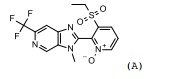
[0241] A uma solução de 2-(3-etilsulfonil-2-piridil)-3- metil-6-(trifluorometil)imidazo[4,5-c]piridina (18,70 g, 50,49 mmol) em diclorometano (187,0 mL) foi adicionado ácido meta-cloroperbenzoico (13,69 g, 55,53 mmol). A solução amarela foi agitada à temperatura ambiente durante 18 horas. Após este tempo, a mistura reacional foi resfriada até à temperatura ambiente, e diluída com solução aquosa de tiossulfato de sódio. A mistura reacional foi extraída com diclorometano, as frações orgânicas combinadas lavadas com Na2CO3, secas sobre MgSO4, e concentradas in vacuo. O produto em bruto foi dissolvido em diclorometano e adsorvido em teflon bulk sorbents, e purificado sobre um cartucho de sílica gel (TORENT) eluindo com heptano/acetato de etila e depois diclorometano:metanol. Isto deu o produto do título como o produto eluindo em primeiro lugar. LCMS (método 1): tempo de retenção 0,72 min, (M+H) = 387. 1H RMN (400 MHz, CLOROFÓRMIO-d) δ ppm; 1,35 (t, J=7,5 Hz, 3 H); 3,39 - 3,52 (m, 1 H); 3,66 - 3,82 (m, 1 H); 3,87 (s, 3 H); 7,71 (dd, J=8,1, 6,6 Hz, 1 H); 8,00 (dd, J=8,1, 0,7 Hz, 1 H); 8,13 (d, J=0,7 Hz, 1 H); 8,55 (dd, J=6,6, 0,7 Hz, 1 H) 9,03 (s, 1 H). O produto eluindo em segundo lugar foi 2-(3-etilsulfonil-2-piridil)-3-metil-5-oxido-6- (trifluorometil)imidazo[4,5-c]piridín-5-io (B):

[0242] A uma solução de 2-(3-etilsulfonil-2-piridil)-3- metil-6-(trifluorometil)imidazo[4,5-c]piridina (1,00 g, 2,70 mmol) e peróxido de hidrogênio e ureia (0,288 g, 1,10 eq, 2,97 mmol) em diclorometano (10,0 mL) foi lentamente adicionado anidrido do ácido trifluoroacético (1,15 g, 0,759 mL, 5,40 mmol) a 0 oC. Após 30 min, o banho de gelo foi removido e se permitiu que a mistura reacional aquecesse até à temperatura ambiente.[0242] To a solution of 2-(3-ethylsulfonyl-2-pyridyl)-3-methyl-6-(trifluoromethyl)imidazo[4,5-c]pyridine (1.00 g, 2.70 mmol) and peroxide of hydrogen and urea (0.288 g, 1.10 eq, 2.97 mmol) in dichloromethane (10.0 mL) was slowly added trifluoroacetic acid anhydride (1.15 g, 0.759 mL, 5.40 mmol) at 0 °C . After 30 min, the ice bath was removed and the reaction mixture was allowed to warm to room temperature.
[0243] A LC/MS após 3 horas detectou o produto desejado a Rt = 0,72, o produto B a Rt = 0,64, e o produto D a Rt = 0,55. Foram agitados ao longo do fim de semana à temperatura ambiente. O processamento e purificação de acordo com o método A deu os mesmos três produtos (A):(B):(C) em uma razão de 9:3:1. Passo G: 2-(6-cloro-3-etilsulfonil-2-piridil)-3-metil-6- (trifluorometil)imidazo[4,5-c]piridina
[0244] 2-(3-etilsulfonil-1-oxido-piridín-1-io-2-il)-3- metil-6-(trifluorometil)imidazo[4,5-c]piridina (1,38 g, 1,00 eq, 3,57 mmol) e cloreto de fosforila (29,61 g, 18 mL, 53,5 eq, 191,2 mmol) foram misturados em frasco de microondas e aquecidos a 130°C durante 6 horas no micro-ondas. A LCMS após este período mostrou completação da reação. A mistura reacional foi concentrada in vacuo e purificada sobre cartucho de sílica gel (Rf200), eluindo com ciclohexano:acetato de etila para dar o composto do título como um sólido branco: LCMS (método 1): tempo de retenção 0,95 minutos, (M+H) = 405/407. 1H RMN (400 MHz, CLOROFÓRMIO-d) δ ppm: 1,41 (t, J=7,5 Hz, 3 H); 3,64 (q, J=7,5 Hz, 2 H); 4,11 (s, 3 H); 7,89 (d, J=8,4 Hz, 1 H); 8,49 (d, J=8,4 Hz, 1 H); 9,65 (s, 1 H). Passo H: 2-[3-etilsulfonil-6-[3-(trifluorometil)pirazol-1- il]-2-piridil]-3-metil-6-(trifluorometil)imidazo[4,5- c]piridina (Composto P3, tabela P):
[0245] Uma solução de 3-(trifluorometil)-1H-pirazol (0,034 g, 0,25 mmol) em DMF (2,0 mL, 26 mmol) foi resfriada até 0°C e tratada com hidreto de sódio (60% em óleo, 0,013 g, 0,32 mmol). A reação foi agitada 20 min a 0°C e depois tratada com 2-(6-cloro-3-etilsulfonil-2-piridil)-3-metil-6- (trifluorometil)imidazo[4,5-c]piridina (0,10 g, 0,25 mmol) e se permitiu que a reação aquecesse e foi agitada à temperatura ambiente. A LCMS mostrou a completação da reação após 30 min. A reação foi diluída com éter de tert-butila e dimetila, e depois extinta com sol. de NaHCO3. A camada orgânica foi separada, lavada 2x com água e salmoura, seca sobre Na2SO4, filtrada e concentrada in vacuo. O produto em bruto foi dissolvido em diclorometano, adsorvido em teflon bulk sorbents, e depois purificado sobre um cartucho de sílica gel (Rf200) eluindo com ciclohexano/acetato de etila, para dar o composto do título como um sólido branco. Mpt 261-263 oC. LCMS (método 1): tempo de retenção 1,07 min, (M+H) = 505. 1H RMN (400 MHz, CLOROFÓRMIO-d) δ ppm: 1,38 (t, J=7,5 Hz, 3 H); 3,73 (q, J=7,5 Hz, 2 H); 3,93 (s, 3 H); 6,80 (d, J=2,6 Hz, 1 H); 8,15 (d, J=0,7 Hz, 1 H); 8,45 (d, J=8,8 Hz, 1 H); 8,59 (dd, J=2,6, 0,92 Hz, 1 H) 8,68 (d, J=8,8 Hz, 1 H) 9,04 (s, 1 H). Exemplo H2: 2-[6-(4-clorofenil)-3-etilsulfonil-2-piridil]- 3-metil-6-(trifluorometil)imidazo[4,5-c]piridina (Composto P1, tabela P):
[0246] Em um frasco supelco, 2-(6-cloro-3-etilsulfonil- 2-piridil)-3-metil-6-(trifluorometil)imidazo[4,5-c]piridina (Passo G, exemplo P1, 0,04 g, 0,1 mmol) dissolvida em 1,4- dioxano (1 mL)foi tratada com ácido (4-clorofenil)borônico (0,02 g, 0,1 mmol) e K2CO3 anidro (0,04 g, 0,3 mmol) e a mistura purgada com árgon durante 10 min. Depois, paládio- tris-trifenilfosfina (0,01 g, 0,01 mmol) foi adicionada e a solução aquecida a 100 °C. A análise de LCMS após 4 horas mostrou completação da reação. A mistura reacional foi diluída com água e acetato de etila, a camada orgânica foi separada, lavada com salmoura, seca sobre Na2SO4, filtrada e evaporada e concentrada in vacuo. O produto em bruto foi dissolvido em diclorometano, adsorvido em teflon bulk sorbents, e depois purificado sobre um cartucho de sílica gel (Rf200) eluindo com ciclohexano/acetato de etila, para dar o composto do título como um sólido amarelo. Mpt 255-256 oC. LCMS (método 1): tempo de retenção 1,11 min, (M+H) = 481/483. 1H RMN (400 MHz, CLOROFÓRMIO-d) δ ppm: 1,39 (t, J=7,5 Hz, 3 H); 3,79 (q, J=7,5 Hz, 2 H); 3,95 (s, 3 H); 7,51 (d, J=8,8 Hz, 2 H); 8,06 (d, J=8,8 Hz, 2 H); 8,11 (d, J=8,4 Hz, 1 H;) 8,15 (s, 1 H); 8,57 (d, J=8,4 Hz, 1 H); 9,02 (s, 1 H). Exemplo H3 :2- [3-etilsulfonil-6- [(E) -2- (trifluorometil)fenil]vinil]-2-piridil]-3-metil-6- (trifluorometil)imidazo[4,5-c]piridina (composto P2, tabela P):
[0247] Em um frasco de micro-ondas, 2-(6-cloro-3- etilsulfonil-2-piridil)-3-metil-6- (trifluorometil)imidazo[4,5-c]piridina (Passo G, exemplo P1, 0,10 g, 0,25 mmol), K2CO3 anidro (0, 068 g, 0,49 mmol), 2- (trifluorometil)estireno (0,043 g, 0,037 mL, 0,25 mmol) dissolvido em acetonitrila foram desgaseificados. A esta mistura foi adicionado acetato de paládio (II) (0,0051 g, 0,022 mmol) e a mistura depois tratada durante 45 min a 140 °C. Após este tempo, uma porção adicional de 2- (trifluorometil)estireno (0,074 mL) e acetato de paládio (II) (0,0028 g, 0,050 eq, 0,012 mmol) foi adicionada e a mistura aquecida no micro-ondas 1 hora a 140 °C. Após este tempo, a mistura reacional foi filtrada sobre hyflo, e o filtrado diluído com acetato de etila e lavado sucessivamente com HCl a 1 N, água e salmoura, seco sobre Na2SO4, filtrado e concentrado in vacuo. O produto em bruto foi dissolvido em diclorometano, adsorvido em teflon bulk sorbents, e depois purificado sobre um cartucho de sílica gel (Rf200), eluindo com ciclohexano/acetato de etila. A purificação adicional por HPLC de fase invertida deu o composto do título como espuma branca. LCMS (método 1): tempo de retenção 1,14 min, (M+H) = 541. 1H RMN (400 MHz, CLOROFÓRMIO-d) δ ppm: 1,40 (t, J=7,3Hz, 3 H); 3,86 (q, J=7,34 Hz, 2 H); 4,00 (s, 3 H); 7,24 (d, J=15,7 Hz, 1 H); 7,46 - 7,52 (m, 1 H); 7,62 (t, J=7,5 Hz, 1 H); 7,71 - 7,77 (m, 2 H) 7,85 (d, J=7,75 Hz, 1 H) 8,14 (s, 1 H) 8,25 (dd, J=15,7, 2,20 Hz, 1 H) 8,51 (d, J=8,4 Hz, 1 H) 9,03 (s, 1 H). Exemplo H4 :2-[3-etilsulfonil-5-(trifluorometil)-6-[4- (trifluorometil)fenil]-2-piridil]-3-metil-6- (trifluorometil)imidazo[4,5-c]piridina (composto P4, tabela P)

[0248] Uma solução de 3-cloro-5- (trifluorometil)piridina-2-carboxilato de metila (30 g, 125 mmol, Número de Registro CAS [655235-65-7]) foi dissolvida em DMF (630 mL), Etanotiolato de sódio (12,87 g, 138 mmol) foi adicionado em porções mantendo a temperatura abaixo de 20 oC. Se permitiu que a mistura reacional agitasse durante a noite após o que a análise de LCMS/TLC mostrou a completação da reação. A mistura foi diluída com água, extraída com AcOEt (3 vezes), e as fases orgânicas combinadas lavadas sucessivamente com NH4Cl aquoso saturado e salmoura, secas sobre MgSO4 e concentradas in vacuo. O composto do título em bruto foi usado para o próximo passo sem purificação adicional. LCMS (método 1); Rt= 0,96min, [M+H] 266. 1H RMN (400 MHz, CLOROFÓRMIO-d) δ ppm: 1,43 (t, J=7,5 Hz, 3 H); 3,00 (q, J=7,5 Hz, 2 H); 4,04 (s, 3 H); 7,87 (d, J=1,1 Hz, 1 H); 8,66 (d, J=1,1 Hz, 1 H). Passo B:3-etilsulfonil-5- (trifluorometil)piridina-2- carboxilato de metila
[0249] Uma solução de 3-etilsulfanil-5- (trifluorometil)piridina-2-carboxilato de metila (5,94 g, 22,4 mmol) em diclorometano (200 mL) foi resfriada até 0 °C. A esta solução foi adicionado m-CPBA (11,0 g, 44,8 mmol) em pequenas porções a 0 °. Após 2 horas se permitiu que a solução aquecesse até à temperatura ambiente e foi agitada durante 3 horas à temperatura ambiente após o que a LCMS mostrou a completação da reação. A mistura reacional foi vertida em NaHCO3 aq. E solução aquosa saturada de tiossulfato de sódio. A mistura foi depois extraída com diclorometano (3x), lavada com salmoura, seca sobre MgSO4 e concentrada in vacuo. O produto em bruto foi purificado por cromatografia Combi flash eluindo com um gradiente de ciclohexano + acetato de etila a 0-30%. Isto deu o composto do título como um sólido branco. LCMS (método 1); Rt= 0,76min, [M+H] 298. 1H RMN (400 MHz, CLOROFÓRMIO-d) δ ppm: 1,39 (t, J=7,5 Hz, 3 H); 3,57 (q, J=7,5 Hz, 2 H); 4,08 (s, 3 H); 8,61 (d, J=1,8 Hz, 1 H); 9,11 (d, J=1,8 Hz, 1 H). Passo C: 3-Etilsulfonil-1-oxido-5-(trifluorometil)piridín- 1-io-2-carboxilato de metila
[0250] Uma solução de 3-etilsulfonil-5- (trifluorometil)piridina-2-carboxilato de metila (7,5 g, 25 mmol, preparado como descrito em) em diclorometano (80 mL) foi resfriada até 0°C e complexo de ureia e peróxido de hidrogênio (5,1 g, 53 mmol) adicionado em pequenas porções. A esta mistura foi adicionado anidrido trifluoroacético (11 g, 7,2 mL, 50,0 mmol) mantendo a temperatura de reação a 0 °C. Se permitiu que a mistura reacional aquecesse até à rt e foi agitada durante a noite. Após este tempo, a reação foi extinta com solução aquosa de hidrogenossulfito de sódio, e agitada durante 15 min. A mistura resultante foi vertida em HCl a 0,5 M e extraída 3 vezes com diclorometano. Os extratos orgânicos combinados foram lavados com solução aquosa de NaHCO3, secos sobre Na2SO4, filtrados e concentrados in vacuo. O produto em bruto foi purificado por cromatografia Combi flash eluindo com um gradiente de ciclohexano + acetato de etila a 0-100%, para dar o composto do título como um sólido branco. LCMS (método 1); Rt= 0,70min, [M+H] 314. 1H RMN (400 MHz, CLOROFÓRMIO-d) δ ppm: 1,39 (t, J=7,5 Hz, 3 H); 3,38 (q, J=7,5Hz, 2 H); 4,08 (s, 3 H); 7,93 (d, J=0,7 Hz, 1 H); 8,62 (d, J=0,7 Hz, 1 H). Passo D: 6-Cloro-3-etilsulfonil-5-(trifluorometil)piridina- 2-carboxilato de metila
[0251] Uma amostra de 3-etilsulfonil-1-oxido-5- (trifluorometil)piridín-1-io-2-carboxilato de metila (1,43 g, 4,57 mmol) e cloreto de fosforila (24,3 mL) foram colocadas em dois frascos de micro-ondas e os frascos agitados a 130°C durante 6 horas no micro-ondas. Após este tempo, os conteúdos dos frascos foram combinados e concentrados in vacuo. O produto em bruto foi purificado sobre cartucho de sílica gel (Rf200) eluindo com ciclohexano/acetato de etila para dar o produto do título como cristais brancos. 1H RMN (400 MHz, CLOROFÓRMIO-d) δ ppm: 1,39 (t, J=7,5 Hz, 3 H); 3,55 (q, J=7,5 Hz, 2 H); 4,07 (s, 3 H); 8,61 (s, 1 H). Passo E:3-Etilsulfonil-5- (trifluorometil) -6- [4- (trifluorometil)fenil]piridina-2-carboxilato de metila:
[0252] Uma solução de 6-cloro-3-etilsulfonil-5- (trifluorometil)piridina-2-carboxilato de metila (0,285 g, 0,86 mmol) em 1,4-dioxano (7 mL) foi tratada com ácido [4- (trifluorometil)fenil]borônico (0,212 g, 1,12 mmol) e K2CO3 anidro (0,356 g, 3,00 eq, 2,58 mmol) e a mistura purgada com árgon durante 10 min. A esta mistura foi adicionado tetraquis(trifenilfosfina)paládio (0) (0,0993 g, 0,100 eq, 0,0859 mmol) e a solução aquecida a 100°C durante 3 hr, após o que a LCMS mostrou boa conversão da reação. A mistura reacional foi diluída com sol sat de NH4Cl, água e acetato de etila. A fase orgânica foi separada, lavada com salmoura, seca sobre Na2SO4, filtrada e concentrada in vacuo. O produto em bruto foi dissolvido em diclorometano e adsorvido em teflon bulk sorbents. A purificação sobre um cartucho de sílica gel (Rf200), eluindo com ciclohexano/acetato de etila, deu o composto do título como um sólido branco. LCMS (método 1); Rt= 1,09 min, [M+H] 442. 1H RMN (400 MHz, CLOROFÓRMIO-d) δ ppm: 1,44 (t, J=7,5 Hz, 3 H); 3,59 (q, J=7,5 Hz, 2 H); 4,06 (s, 3 H); 7,70 (d, J=8,0 Hz, 2 H); 7,78 (d, J=8,0 Hz, 2 H); 8,73 (s, 1 H). Passo F: ácido 3-etilsulfonil-5-(trifluorometil)-6-[4- (trifluorometil)fenil]piridina-2-carboxílico:
[0253] 3-Etilsulfonil-5-(trifluorometil)-6-[4- (trifluorometil)fenil]piridina-2-carboxilato de metila (0,28 g, 0,63 mmol) foi dissolvido em tetraidrofurano/H2O 3:1 (10 mL) e tratado com hidróxido de lítio hidratado (0,028 g, 0,67 mmol) à temperatura ambiente. A análise de LCMS após agitação durante 3 horas mostrou reação. A mistura reacional foi concentrada in vacuo e absorvida em acetato de etila e HCl aquoso a 10%. A camada orgânica foi separada e lavada com salmoura, seca sobre Na2SO4, filtrada e concentrada in vacuo para dar o composto do título como sólido bege que foi usado no próximo passo sem purificação adicional. LCMS (método 1); Rt= 0,88 min, [M+H] 428. 1H RMN (400 MHz, CLOROFÓRMIO-d) δ ppm 1,42 (t, J=7,3 Hz, 3 H): 3,75 (q, J=7,3 Hz, 2 H): 4,98 (s l, 1 H); 7,70 (d, J=7,8 Hz, 2 H); 7,79 (d, J=7,8 Hz, 2 H): 8,86 (s, 1 H). Passo G: 3-etilsulfonil-N-[5-(metilamino)-2- (trifluorometil)-4-piridil]-5-(trifluorometil)-6-[4- (trifluorometil)fenil]piridina-2-carboxamida e N-[4-amino- 6-(trifluorometil)-3-piridil]-3-etilsulfonil-N-metil-5- (trifluorometil)-6-[4-(trifluorometil)fenil]piridina-2-carboxamida:
[0254] Uma solução de ácido 3-etilsulfonil-5- (trifluorometil)-6-[4-(trifluorometil)fenil]piridina-2- carboxílico (0,10 g, 0,23 mmol), EDCI (0,049 g, 0,26 mmol) e N3-metil-6-(trifluorometil)piridina-3,4-diamina (0,049 g, 0,26 mmol, passo C, exemplo P1) em piridina (3,0 mL) foi agitada a 120 °C. Após 2 horas, a LC/MS mostrou progresso suficiente da reação para processamento. A mistura reacional foi vertida em água, e extraída com acetato de etila (X3). As camadas orgânicas combinadas foram lavadas com salmoura, secas sobre Na2SO4 e concentradas in vacuo. O produto em bruto foi dissolvido em diclorometano e adsorvido em teflon bulk sorbents. A purificação sobre um cartucho de sílica gel (Rf200), eluindo com Gradiente de ciclohexano/acetato de etila, deu uma mistura dos compostos do título como um sólido amarelo. LCMS (método 1); Rt= 1,10 min, [M+H] 601; Rt= 1,14 min, [M+H] 601;. Passo H:2- [3-etilsulfonil-5- (trifluorometil) -6- [4- (trifluorometil)fenil]-2-piridil]-3-metil-6- (trifluorometil)imidazo[4,5-c]piridina (composto P4, tabela P):
[0255] Uma solução amarela de 3-etilsulfonil-N-[5- (metilamino)-2-(trifluorometil)-4-piridil]-5- (trifluorometil)-6-[4-(trifluorometil)fenil]piridina-2- carboxamida e N-[4-amino-6-(trifluorometil)-3-piridil]-3- etilsulfonil-N-metil-5-(trifluorometil)-6-[4- (trifluorometil)fenil]piridina-2-carboxamida: (0,055 g, 0, 092 mmol) em ácido acético (1 mL) foi agitada a 120°C durante 18 horas. A análise de LCMS após este tempo mostrou completação da reação. A mistura reacional foi resfriada até à temperatura ambiente, diluída com tolueno e concentrada in vacuo. O produto em bruto foi dissolvido em diclorometano e adsorvido em teflon bulk sorbents. A purificação sobre um cartucho de sílica gel (Rf200), eluindo com um gradiente de ciclohexano/acetato de etila, deu uma mistura dos compostos do título como um sólido branco. Mpt. 140 - 142 oC. LCMS (método 1); Rt= 1,17 min, [M+H] 583. 1H RMN (400 MHz, CLOROFÓRMIO-d) δ ppm 1,47 (t, J=7,5 Hz, 3 H); 3,94 (q, J=7,5 Hz, 2 H); 7,72 - 7,76 (m, 2 H); 7,78 - 7,82 (m, 2 H); 3,94 (q, J=7,34 Hz, 2 H); 3,96 (s, 3 H); 8,92 (s, 1 H); 9,01 (s, 1 H). Exemplo H5: 2-(6-ciclopropil-3-etilsulfonil-2-piridil)-3- metil-6-(trifluorometil)imidazo[4,5-c]piridina(Composto P15, tabela P)

[0256] Uma amostra de ácido 3,6-dicloropiridina-2- carboxílico (5,00 g, 24,7 mmol) foi diluída em diclorometano (200 mL) e dimetilformamida (0,124 mL, 1,6 mmol) foi adicionada. A esta solução foi adicionado cloreto de oxalila (3,15 mL, 34,6 mmol) gota a gota à temperatura ambiente ao longo de 10 min (evolução de gás). A mistura reacional foi agitada à temperatura ambiente, e, após 2,5 h, 1 mL adicional de cloreto de oxalila foi adicionado e a agitação continuou durante 1 hr. Após este tempo, a mistura reacional foi concentrada in vacuo e usada no próximo passo sem purificação adicional. Passo B: 3,6-dicloro-N-[5-(metilamino)-2-(trifluorometil)- 4-piridil]piridina-2-carboxamida
[0257] A uma solução de N3-metil-6- (trifluorometil)piridina-3,4-diamina (52,0 g, 272 mmol) em tetraidrofurano (260 mL) foi adicionada trietilamina (95,8 mL, 680 mmol). A solução vermelha foi resfriada até 0°C e cloreto de 3,6-dicloropiridina-2-carbonila (51,5 g, 245 mmol) em diclorometano (156 mL) foi adicionada gota a gota a 0-10°C ao longo de 90 min. O banho de gelo foi removido após 1 h e a mistura foi agitada à temperatura ambiente. A análise de LC-MS mostrou maioritariamente massa desejada após 2 horas. A mistura reacional foi agitada durante a noite e depois lavada com sol sat de NH4Cl e a mistura foi concentrada in vacuo para se remover o tetraidrofurano. O resíduo foi depois extraído com 1,2 L de diclorometano (800 mL), etilacetato e novamente 1 L de diclorometano. As camadas orgânicas combinadas foram secas sobre Na2SO4, filtradas e concentradas in vacuo para dar o composto do título como um sólido marrom. LCMS (método 1): 366 (M+H+); tempo de retenção: 0,83 min. Passo C:2- (3,6-dicloro-2-piridil) -3-metil-6- (trifluorometil)imidazo[4,5-c]piridina
[0258] Uma solução amarela de 3,6-dicloro-N-[5- (metilamino)-2-(trifluorometil)-4-piridil]piridina-2- carboxamida (99,3 g, 272 mmol) em ácido acético (298 mL) foi agitada à temperatura do banho de 110 °C durante 16 horas. Se permitiu que a mistura reacional até à temperatura ambiente após o que a análise de LC-MS mostrou massa desejada. Tolueno foi adicionado e a mistura foi concentrada in vacuo. Ao resíduo foram adicionados ciclohexano e diclorometano e a mistura obtida foi agitada sob vácuo a 50°C a 800 mbar. A pasta foi adicionalmente diluída com ciclohexano e o sólido filtrado na bomba. O bolo foi lavado com ciclohexano (misturado com pequenas quantidades de DCM) e seco sob vácuo. Tolueno foi adicionado, a mistura foi evaporada e seca sob vácuo a 60 °C e 20 mbar para se removerem os vestígios de ácido acético, dando o composto do título como um sólido marrom. LCMS (método 1): 348 (M+H+); tempo de retenção: 0,95 min. 1H RMN (400 MHz, CLOROFÓRMIO-d) δ ppm 4,04 (s, 3 H) 7,51 (d, J=8,44 Hz, 1 H) 7,93 (d, J=8,44 Hz, 1 H) 8,19 (s, 1 H) 8,99 (s, 1 H) Passo D: 2-(6-cloro-3-etilsulfanil-2-piridil)-3-metil-6- (trifluorometil)imidazo[4,5-c]piridina
[0259] Uma amostra de 2-(3,6-dicloro-2-piridil)-3-metil- 6-(trifluorometil)imidazo[4,5-c]piridina (1,14 g, 3,28 mmol) foi dissolvida em tetraidrofurano sob árgon. Etanotiol de sódio (0,311 g, 3,28 mmol) foi adicionado porção a porção à temperatura ambiente. A mistura reacional marrom foi agitada à temperatura ambiente durante 2 horas, momento em que a análise de LC-MS mostrou completação da reação com formação do produto desejado. A mistura reacional foi tratada com NH4Cl seguida por água e acetato de etila. A camada orgânica foi separada, lavada com água e salmoura, seca sobre Na2SO4, filtrada e concentrada in vacuo. O bruto foi purificado por cromatografia flash sobre sílica gel para dar o composto do título como um sólido bege. LCMS (método 1): 373 (M+H+); tempo de retenção: 1,02 min. 1H RMN (400 MHz, CLOROFÓRMIO-d) δ ppm 1,35 (t, J=7,34 Hz, 3 H) 2,97 (q, J=7,34 Hz, 2 H) 4,11 (s, 3 H) 7,44 (d, J=8,44 Hz, 1 H) 7,76 (d, J=8,44 Hz, 1 H) 8,20 (d, J=0,73 Hz, 1 H) 8,97 (s, 1 H) Passo E: 2-(6-cloro-3-etilsulfonil-2-piridil)-3-metil-6- (trifluorometil)imidazo[4,5-c]piridina
[0260] A 0°C, m-CPBA (2,35 g, 10,5 mmol) foi adicionado a uma solução de 2-(6-cloro-3-etilsulfanil-2-piridil)-3- metil-6-(trifluorometil)imidazo[4,5-c]piridina (1,86 g, 4,99 mmol) em clorofórmio (46,5 mL). Após a adição, o banho de gelo foi mantido durante 10 min e depois se permitiu que a solução leitosa aquecesse até à rt. A mistura reacional foi agitada uma noite à temperatura ambiente. Após este tempo, uma porção adicional de M-CPBA (1,12 g, 4,99 mmol) foi adicionada, a mistura foi agitada 2 horas à temperatura ambiente. A análise de LC/MS mostrou a completação da reação. Solução aquosa saturada de tiossulfato de sódio e NaHCO3 aq sat foram adicionados e a mistura agitada 1 hora. A camada orgânica foi separada, extraída com NaHCO3, seca sobre Na2SO4 e evaporada. O produto em bruto foi purificado por cromatografia flash sobre sílica gel para dar o composto do título como um sólido branco. LCMS (método 1): 406 (M+H+); tempo de retenção: 0,95 min. 1H RMN (400 MHz, CLOROFÓRMIO-d) δ ppm 1,37 (t, J=7,34 Hz, 3 H) 3,79 (q, J=7,46 Hz, 2 H) 3,94 (s, 3 H) 7,75 (d, J=8,44 Hz, 1 H) 8,11 (s, 1 H) 8,47 (d, J=8,44 Hz, 1 H) 9,00 (s, 1 H) Passo F:2-(6-ciclopropil-3-etilsulfonil-2-piridil)-3- metil-6-(trifluorometil)imidazo[4,5-c]piridina(Composto P15, tabela P)
[0261] Em um frasco supelco, 2-(6-cloro-3-etilsulfonil- 2-piridil)-3-metil-6-(trifluorometil)imidazo[4,5-c]piridina (0,40 g, 0,99 mmol) foi dissolvida em 1,4-dioxano (10 mL, 120 mmol). Ácido ciclopropilborônico (0,18 g, 2,0 mmol) e carbonato de potássio (0,41 g, 3,0 mmol) foram adicionados e a mistura foi purgada com árgon. Depois, tetraquis(trifenilfosfina)paládio (0,11 g, 0,099 mmol) foi adicionado, o frasco foi tampado e a solução tampada foi aquecida a 100°C durante 19 horas. A análise de LC-MS mostrou a formação do produto desejado. Água e acetato de etila foram adicionados, a camada orgânica foi separada, lavada com salmoura, seca sobre Na2SO4, filtrada e concentrada in vacuo. O bruto obtido foi purificado por cromatografia flash em sílica gel. A mistura obtida foi dissolvida em etilacetato e lavado novamente com NaHCO3. A camada orgânica foi lavada com salmoura, seca sobre Na2SO4, filtrada e evaporada. O sólido obtido foi purificado novamente por fase reversa para dar o composto do título como um sólido branco. LCMS (método 1): 411 (M+H+); tempo de retenção: 1,01 min. 1H RMN (400 MHz, CLOROFÓRMIO-d) δ ppm 1,11 - 1,13 (m, 1 H) 1,11 - 1,23 (m, 4 H) 1,33 (t, J=7,34 Hz, 3 H) 2,22 (ddd, J=7,70, 4,77, 2,93 Hz, 1 H) 3,70 (q, J=7,34 Hz, 2 H) 3,84 (s, 3 H) 7,54 (d, J=8,44 Hz, 1 H) 8,09 (s, 1 H) 8,30 (d, J=8,44 Hz, 1 H) 8,97 (s, 1 H) Exemplo H6 :2-[6-(3,5-difluorofenil)-3-etilsulfonil-2- piridil]-3-metil-6-(trifluorometil)imidazo[4,5-c]piridina
[0262] Em um frasco supelco, 2-(6-cloro-3-etilsulfonil- 2-piridil)-3-metil-6-(trifluorometil)imidazo[4,5-c]piridina (100 mg, 0,2470 mmol), ácido (3,5-difluorofenil)borônico (46 mg, 0,2964 mmol) e carbonato de potássio (102 mg, 0,7411 mmol) foram dissolvidos em 1,4-dioxano (2,5 mL). A mistura resultante foi purgada com árgon ao longo de 5 minutos. Após este tempo, tetraquis(trifenilfosfina)paládio (28 mg, 0,02470 mmol) foi adicionado e o frasco foi fechado e aquecido a 95°C durante 16 horas. A análise de LC/MS mostrou a completação da reação. A mistura reacional foi resfriada até à temperatura ambiente e foi extinta com água. A camada aquosa foi extraída com acetato de etila. As camadas orgânicas combinadas foram lavadas com solução aquosa saturada de NaHCO3, e solução saturada de NaCl, secas sobre Na2SO4, filtradas e concentradas in vacuo. O bruto foi purificado por cromatografia flash em sílica gel para dar o composto do título como um sólido amarelo. LCMS (método 1): 483 (M+H+); tempo de retenção: 1,09 min. 1H RMN (400 MHz, CLOROFÓRMIO-d) δ ppm 1,42 (t, J=7,34 Hz, 3 H) 3,84 (q, J=7,34 Hz, 2 H) 3,99 (s, 3 H) 7,00 - 7,05 (m, 1 H) 7,68 (d, J=5,87 Hz, 2 H) 8,12 (d, J=8,44 Hz, 1 H) 8,17 (s, 1 H) 8,64 (d, J=8,44 Hz, 1 H) 9,06 (s, 1 H) Exemplo H7: 2-[3-etilsulfonil-6-[3-(trifluorometil)pirazol- 1-il]-2-piridil]-3-metil-6- (trifluorometilsulfanil)imidazo[4,5-c]piridina(Composto P9, tabela P)

[0263] A uma solução agitada de 6-cloro-3-etilsulfonil- piridina-2-carboxilato de metila (526 mg, 2 mmol), 3- (trifluorometil)-1H-pirazol (1,361 g, 10 mmol) em dioxano (25 mL) foram adicionados CuI (38 mg, 0,2 mmol), N,N'- Dimetiletanodiamina (880 mg, 1 mmol) e carbonato de potássio (1,38 g, 10 mmol). O sistema reacional foi submetido sob refluxo sob uma atmosfera de nitrogênio a 120 °C durante 4 h. Após resfriamento até à temperatura ambiente, a mistura reacional foi filtrada e concentrada in vacuo. O produto em bruto foi purificado por cromatografia em coluna em sílica gel para dar o composto do título. 1HRMN (400 MHz, CDCl3): δppm 1,36 (t, 3 H), 3,49 (q, 2 H), 4,06 (s, 3 H), 6,69 (s, 1 H), 8,26 (d, J=8,4 Hz,1 H), 8,44 (d, J=8,4 Hz,1 H), 8,68 (s, 1 H); ESI-MS(+): 386 (M + Na)+ Passo B: ácido 3-etilsulfonil-6-[3-(trifluorometil)pirazol- 1-il]piridina-2-carboxílico
[0264] A uma solução agitada de 3-etilsulfonil-6-[3- (trifluorometil)pirazol-1-il]piridina-2-carboxilato de metila (218 mg, 0,6 mmol) em THF (10 mL) foram adicionados NaOH (120 mg, 3 mmol), e H2O (30 mL). O sistema reacional foi agitado à temperatura ambiente durante 2 h. Após este tempo, o valor de pH foi ajustado até 2 com HCl e a mistura reacional extraída com acetato de etila três vezes. As camadas orgânicas combinadas foram secas sobre sulfato de sódio anidro, filtradas e concentradas in vacuo para dar o composto do título. 1HRMN (400 MHz, DMSO-d6): δppm 1,18 (t, 3 H), 3,54 (q, 2 H) , 7,12 (s, 1 H), 8,21 (d, J=8,8 Hz,1 H), 8,53 (d, J=8,4 Hz,1 H), 8,86 (s, 1 H); ESI-MS(+): 348 (M - H)- Passo C: 2-[3-etilsulfonil-6-[3-(trifluorometil)pirazol-1- il]-2-piridil]-3-metil-6- (trifluorometilsulfanil)imidazo[4,5-c]piridina(Composto P9, tabela P)
[0265] A uma solução agitada de ácido 3-etilsulfonil-6- [3-(trifluorometil)pirazol-1-il]piridina-2-carboxílico (180 mg, 0,52 mmol), N3-metil-6- (trifluorometilsulfanil)piridina-3,4-diamina (250 mg, 1,11 mmol) e HATU (0,78 g, 2 mmol) em DMF (30 mL) foi adicionada DIPEA (2 mL, 10 mmol). A mistura reacional foi agitada à temperatura ambiente ao longo da noite. A mistura reacional foi depois diluída com acetato de etila e H2O, a camada orgânica foi lavada com salmoura, seca sobre sulfato de sódio anidro, filtrada e concentrada in vacuo. O produto em bruto foi usado para o próximo passo sem purificação adicional. A solução do produto em bruto em ácido acético (20 mL) foi submetida ao refluxo a 120 °C durante 24 h. A mistura reacional foi depois evaporada até à secura. O resíduo foi purificado por cromatografia em sílica gel (petróleo: EtOAc = 4:1) para originar o composto do título como sólido branco. LCMS (método 1): 537 (M+H+); tempo de retenção: 1,17 min. 1HRMN (400 MHz, CDCl3): δ (ppm) 1,37 (t, 3 H), 3,73 (q, 2 H), 3,90 (s, 3 H), 6,79 (s, 1H), 8,14 (s, 1 H), 8,45 (d, J=4,8 Hz, 1 H), 8,65 (s, 1 H), 8,67 (d, J=4,8 Hz, 1 H), 8,98(s, 1 H); 19FRMN (376 MHz, CDCl3): δ (ppm) -46,40 (s, 3 F), -68,19 (s, 3 F) Exemplo 2-(3-etilsulfonil-6-pirimidin-2-il-2-piridil)-3- metil-6-(trifluorometilsulfanil)imidazo[4,5-c]piridina (Composto P10, tabela P)

[0266] Uma amostra de (bpy)CuSCF3 (14,4 g, 45 mmol) e 6- bromo-N-metil-4-nitro-piridin-3-amina (6.96 g, 30 mmol) em 120 mL de CH3CN foi submetida ao refluxo durante 48 h sob nitrogênio. A mistura reacional foi removida do banho de óleo e se permitiu que resfriasse até à temperatura ambiente, e depois foi filtrada através de SiO2. A sílica gel foi eluída com éter de dietila, e concentrada in vacuo. O resíduo foi purificado por cromatografia em coluna de sílica gel para dar o composto do título. 1HRMN (400 MHz, DMSO-d6): δ (ppm) 3,10 (d, J=5,2Hz, 3 H), 8,21 (s, 1 H) 8,49 (q, 1 H), 8,67 (s, 1 H); 19FRMN (376 MHz, DMSO-d6): δ (ppm) -36,79 (s, 3 F); ESI-MS: 252 (M-H)-. Passo B: N3-metil-6-(trifluorometilsulfanil)piridina-3,4- Diamina
[0267] A uma solução de N-metil-4-nitro-6- (trifluorometilsulfanil)piridin-3-amina (3,42 g, 13,5 mmol) em metanol (50 mL) foi adicionado Ni de Raney (20% em peso). A esta mistura foi adicionada hidrazina hidratada (10 mL) gota a gota à temperatura ambiente. A mistura reacional foi agitada à temperatura ambiente durante 30 minutos. O Ni de Raney foi separado por filtração através de Celite; o filtrado foi seco in vacuo e purificado por coluna de cromatografia em sílica gel para originar o composto do título como sólido branco. 1HRMN (400 MHz, DMSO-d6): δppm 2,78 (d, J=5,2Hz, 3 H), 5,20 (q, 1 H), 5,77 (s, 2 H), 6,82 (s, 1 H), 7,53 (s, 1 H); 19FRMN (376 MHz,DMSO-d6) : δppm -45,49 (s, 3 F); ESI-MS(+): 224 (M + H)+. Passo C: 3,6-Dicloropiridina-2-carboxilato de metila
[0268] A uma solução de ácido 3,6-dicloropiridina-2- carboxílico (76,8 g, 0,4 mol) em metanol (500 mL) foi adicionado SOCl2 (150 mL) gota a gota à temperatura ambiente. A mistura reacional foi agitada à temperatura ambiente por 3 horas. Após este tempo, a mistura reacional foi vertida em água e extraída com acetato de etila três vezes. As camadas orgânicas combinadas foram secas sobre sulfato de sódio, filtradas e concentradas in vacuo para dar o composto do título. 1HRMN (400 MHz, DMSO-d6): δppm 3,90 (s, 3 H), 7,80 (d, J=8,8 Hz,1 H), 8,20 (d, J=8,8 Hz,1 H); ESI-MS(+): 228 (M + Na)+. Passo D: 6-Cloro-3-etilsulfanil-piridina-2-carboxilato de Metila
[0269] A uma solução de 3,6-dicloropiridina-2-carboxilato de metila (16 g, 77,6 mmol) em DMF (150 mL) foi adicionado etanotiolato de sódio (7,2 g, 85,8 mmol) a 0 °C. Após a adição, a mistura reacional foi agitada à temperatura ambiente durante 30 min. A análise de LCMS após este tempo mostrou completação da reação. A mistura reacional foi vertida em água, e o precipitado formado filtrado e seco sob um forno de infravermelhos para originar o composto do título como sólido branco. 1HRMN (400 MHz, CDCl3): δppm 1,38 (t, 3 H), 2,92 (q, 2 H), 3,98 (s, 3H), 7,40 (d, J=8,8 Hz,1 H), 7,66 (d, J=8,8 Hz,1 H); ESI-MS(+): 254 (M + Na)+. Passo E: 6-Cloro-3-etilsulfonil-piridina-2-carboxilato de metila
[0270] Uma solução de 6-cloro-3-etilsulfanil-piridina-2- carboxilato de metila (11,55 g, 50 mmol) e m-CPBA (25,8 g, 150 mmol) em 200 mL de diclorometano foi agitada à temperatura ambiente durante 2 horas. Após este tempo, a mistura foi vertida em uma solução saturada de NaHCO3 e Na2SO3, e extraída com DCM três vezes. As camadas orgânicas combinadas foram secas sobre sulfato de sódio, filtradas e concentradas in vacuo. O produto em bruto foi purificado por cromatografia em coluna em sílica gel para dar o composto do título. 1HRMN (400 MHz, CDCl3): δppm 1,33 (t, 3 H), 3,51 (q, 2 H), 4,02 (s, 3 H), 7,63 (d, J=8 Hz,1 H), 8,29 (d, J=8 Hz,1 H); ESI-MS(+): 286 (M + Na)+. Passo F:3-Etilsulfonil-6-pirimidin-2-il-piridina-2- carboxilato de metila
[0271] A uma solução agitada de 6-cloro-3-etilsulfonil- piridina-2-carboxilato de metila (526 mg, 2 mmol) e tributil(pirimidin-2-il)estanano (1,107 g, 3 mmol) em dioxano (25 mL) foram adicionados CuI (76 mg, 0,4 mmol) e PdCl2(PPh3)2 (140 mg, 0,2 mmol). A mistura reacional foi submetida ao refluxo sob uma atmosfera de nitrogênio a 120 °C durante 4 horas. Após resfriamento até à temperatura ambiente, a mistura reacional foi filtrada e concentrada in vacuo. O produto em bruto foi purificado por cromatografia em coluna em sílica gel para dar o composto do título. 1HRMN (400 MHz, CDCl3): δppm 1,36 (t, 3 H), 3,58 (q, 2 H), 4,05 (s, 3 H), 7,42 (t, 1 H), 8,53 (d, J=8,4 Hz,1 H), 8,81 (d, J=8,4 Hz,1 H), 9,00 (d, J=4,8 Hz, 2 H); ESI-MS(+): 330 (M + Na)+ Passo G: ácido 3-etilsulfonil-6-pirimidin-2-il-piridina-2- Carboxílico
[0272] A uma solução agitada de 3-etilsulfonil-6- pirimidin-2-il-piridina-2-carboxilato de metila (522 mg, 1,7 mmol) em tetraidrofurano (10 mL) foram adicionados NaOH (340 mg, 8,5 mmol) e água (30 mL). O sistema reacional foi agitado à temperatura ambiente durante 2 horas, altura em que a análise de LCMS mostrou completação da reação. O valor de pH foi ajustado até 2 com HCl, e a mistura reacional foi extraída com acetato de etila três vezes. As camadas orgânicas foram secas sobre sulfato de sódio anidro, filtradas e concentradas in vacuo para dar o composto do título. 1HRMN (400 MHz, DMSO-d6): δppm 1,22 (t, 3 H), 3,57 (q, 2 H), 7,66 (m, 1H), 7,68 (d J=4,8 Hz, 1 H), 8,55 (d, J=8,4 Hz,1 H), 8,70 (d, J=8,4 Hz,1 H), 9,07 (d, J=4,8 Hz, 2 H). Passo H: 2-(3-etilsulfonil-6-pirimidin-2-il-2-piridil)-3- metil-6-(trifluorometilsulfanil)imidazo[4,5-c]piridina (Composto P10, tabela P)
[0273] A uma solução agitada de ácido 3-etilsulfonil-6- pirimidin-2-il-piridina-2-carboxílico (470 mg, 1,6 mmol), N3-metil-6-(trifluorometilsulfanil)piridina-3,4-diamina (430 mg, 1,92 mmol) e HATU (1,216 g, 3,2 mmol) em DMF (30 mL) foi adicionada DIPEA (2,8 mL, 16 mmol). O sistema reacional foi agitado à temperatura ambiente durante a noite. Após este tempo, a mistura reacional foi diluída com acetato de etila e H2O, e a camada orgânica lavada com salmoura, seca sobre sulfato de sódio anidro, e concentrada in vacuo. O produto em bruto foi usado para o próximo passo sem purificação adicional.[0273] To a stirred solution of 3-ethylsulfonyl-6-pyrimidin-2-yl-pyridine-2-carboxylic acid (470 mg, 1.6 mmol), N3-methyl-6-(trifluoromethylsulfanyl)pyridine-3,4 -diamine (430 mg, 1.92 mmol) and HATU (1.216 g, 3.2 mmol) in DMF (30 mL) was added DIPEA (2.8 mL, 16 mmol). The reaction system was stirred at room temperature overnight. After this time, the reaction mixture was diluted with ethyl acetate and H2O, and the organic layer washed with brine, dried over anhydrous sodium sulfate, and concentrated in vacuo. The crude product was used for the next step without further purification.
[0274] Uma solução do produto em bruto em ácido acético (20 mL) foi submetida ao refluxo a 120 °C durante 24 h. A mistura reacional foi evaporada até à secura e o resíduo foi purificado por cromatografia em sílica gel para originar o composto do título como sólido branco. LCMS (método 1): 481 (M+H+); tempo de retenção: 0,93 min 1HRMN (400 MHz, CDCl3): δ (ppm) 1,38 (t, 3 H), 3,80 (q, 2 H), 3,93 (s, 3 H), 7,44 (t, 1H), 8,10 (s, 1 H), 8,70 (d, J=8,4 Hz, 1 H), 8,96 (m, 2 H), 9,0 (d, J=4,8 Hz, 2 H); 19FRMN (376 MHz, CDCl3): δ (ppm) -45,77 (s, 3 F); Exemplo H8: 2-(6-ciclopropil-3-etilsulfonil-2-piridil)-3- metil-6-(trifluorometilsulfanil)imidazo[4,5-c]piridina (Composto P13, tabela P)

[0275] A uma solução agitada de 6-cloro-3-etilsulfanil- piridina-2-carboxilato de metila (462 mg, 2 mmol), ácido ciclopropilborônico (344 mg, 4 mmol) em dioxano (25 mL) foram adicionados carbonato de potássio (552 mg, 4 mmol) e Pd(PPh3)4 (230 mg, 0,2 mmol). O sistema reacional foi submetido ao refluxo sob uma atmosfera de nitrogênio a 120 °C durante 24 horas. Após resfriamento até à temperatura ambiente, a mistura reacional foi filtrada e concentrada in vacuo. O produto em bruto foi purificado por cromatografia em coluna em sílica gel para dar o composto do título. 1HRMN (400 MHz, CDCl3): δ (ppm) 0,98 (m,4 H), 1,32 (t, 3 H), 2,08(m,1 H), 2,88 (q, 2 H), 3,95 (s, 3 H), 7,08 (d, J=8,4 Hz, 1 H), 7,57 (d, J=8 Hz, 1 H); ESI-MS(+): 260 (M+Na)+. Passo B: ácido 6-ciclopropil-3-etilsulfanil-piridina-2- Carboxílico
[0276] A uma solução agitada de 6-ciclopropil-3- etilsulfanil-piridina-2-carboxilato de metila (320 mg, 1,35 mmol) em THF (10 mL) foram adicionados NaOH (280 mg, 7 mmol) e H2O (30 mL). O sistema reacional foi agitado à temperatura ambiente durante 4 horas. O valor de pH foi ajustado até 2 com HCl, e a mistura reacional extraída com acetato de etila três vezes. As camadas orgânicas combinadas secas sobre sulfato de sódio anidro, filtradas e concentradas in vacuo para dar o composto do título. 1HRMN (400 MHz, DMSO-d6): δppm 0,93 (m, 4 H), 1,18 (t, 3 H), 2,07 (m, 1 H), 2,91 (q, 2 H) , 7,36 (d, J=8,0 Hz,1 H), 7,73 (d, J=8,4 Hz,1 H), 12,93 (s l, 1 H); ESI-MS(-): 222 (M - H)-. Passo C:6-bromo-2- (6-ciclopropil-3—etilsulfanil-2- piridil)-3-metil-imidazo[4,5-c]piridina
[0277] A uma solução agitada de ácido 6-ciclopropil-3- etilsulfanil-piridina-2-carboxílico (280 mg, 1,25 mmol), 6- bromo-N3-metil-piridina-3,4-diamina (303 mg, 1,5 mmol) e HATU (0,78 g, 2 mmol) em DMF (30 mL) foi adicionada DIPEA (2 mL, 10 mmol). A mistura reacional foi agitada à temperatura ambiente ao longo da noite. A mistura reacional foi depois diluída com acetato de etila e H2O, e a camada orgânica lavada com salmoura, seca sobre sulfato de sódio anidro, filtrada e concentrada in vacuo. O produto em bruto foi usado para o próximo passo sem purificação adicional. Uma solução do produto em bruto em ácido acético (20 mL) foi submetida ao refluxo a 120 °C durante 24 h. A mistura reacional foi concentrada, e purificada por cromatografia em coluna em sílica gel e purificada para originar o composto do título como sólido branco. 1HRMN (400 MHz, CDCl3): δ (ppm) 1,04 (m,4 H), 1,31 (t, 3 H), 2,1 (m,1 H), 2,91 (q, 2 H), 3,92 (s, 3 H), 7,25 (d, J=8,4 Hz, 1 H), 7,66 (d, J=8 Hz, 1 H), 7,94 (s, 1 H), 8,62 (s, 1H); ESI-MS(+): 413 (M+Na)+. Passo D:6-bromo-2-(6-ciclopropil-3-etilsulfonil-2- piridil) -3-metil-imidazo[4,5-c]piridina(Composto P12, tabela P)
[0278] Uma amostra de 6-bromo-2-(6-ciclopropil-3- etilsulfanil-2-piridil)-3-metil-imidazo[4,5-c]piridina (285 mg, 0,73 mmol) e m-CPBA (630 mg, 3,66 mmol) em 40 mL de DCM foi agitada à temperatura ambiente durante 2 horas. Depois, a mistura foi vertida em uma solução saturada de NaHCO3 e Na2SO3 em água, e extraída com diclorometano três vezes. As camadas orgânicas combinadas foram secas sobre sulfato de sódio, filtradas e concentradas in vacuo. O produto em bruto foi purificado por cromatografia em coluna em sílica gel para dar o composto do título. LCMS (método 1): 421/423 (M+H+); tempo de retenção: 0,97 min 1HRMN (400 MHz, CDCl3): δ (ppm) 1,16 (m,4 H), 1,34 (t, 3 H), 2,05 (m,1 H), 3,69 (q, 2 H), 3,76 (s, 3 H), 7,53 (d, J=8,0 Hz, 1 H), 7,86 (s, 1 H),8,30 (d, J=8,4 Hz, 1 H), 8,66 (s, 1H); Passo E:2-(6-ciclopropil-3-etilsulfonil-2-piridil)-3- metil-6-(trifluorometilsulfanil)imidazo[4,5-c]piridina (Composto P13, tabela P)
[0279] Uma solução de (bpy)CuSCF3 (410 mg, 1,28 mmol) e 6-bromo-2-(6-ciclopropil-3-etilsulfonil-2-piridil)-3-metil- imidazo[4,5-c]piridina (270 mg, 0,64 mmol) em 20 mL de CH3CN foi submetida ao refluxo durante 48 horas sob nitrogênio. A mistura reacional foi removida do banho de óleo e se permitiu que resfriasse, e foi filtrada através de SiO2, eluindo com éter de dietila. O filtrado foi lavado com salmoura, e concentrado in vacuo. O resíduo foi purificado por cromatografia em coluna de sílica gel para dar o composto do título. LCMS (método 1): 444 (M+H+); tempo de retenção: 1,07 min 1HRMN (400 MHz, CDCl3): δ (ppm) 1,19(m,4 H), 1,34 (t, 3 H), 2,12 (m,1 H), 3,71 (q, 2 H), 3,81 (s, 3 H), 7,54 (d, J=8,4 Hz, 1 H), 8,10 (s, 1 H),8,31 (d, J=8,8 Hz, 1 H), 8,92 (s, 1H) Exemplo H9: 6-(6-ciclopropil-3-etilsulfanil-2-piridil)-7- metil-3-(trifluorometil)imidazo[4,5-c]piridazina (Composto P22, tabela P)
[0280] Ácido iodrídico (250 mL) foi adicionado a uma mistura de 3, 6-dicloropiridazina (149 g, 1 mol) e NaI (18 0g, 1,2 mol) em 500 mL de CHCl3. Após a adição, a mistura foi agitada à temperatura ambiente durante 24 h, e vertida em água e extraída com diclorometano três vezes. As camadas orgânicas combinadas foram secas sobre sulfato de sódio, filtradas e concentradas in vacuo para dar o composto do título. 1H-RMN (400Mz, DMSO-d6) δ: 7,63 (d, 1H), 8,16 (d, 1H). Passo B: 3-cloro-6-(trifluorometil)piridazina
[0281] TMSCF3 (198,8 g, 1,4 mol) foi adicionado a uma mistura de 3-cloro-6-iodopiridazina (240 g, 1 mol), KF (81 g, 1,4 mol) e CuI (228 g, 1,2 mol) em 1 L de DMF sob nitrogênio. Após a adição, a mistura foi agitada a 50 °C durante 2 h. A mistura foi depois vertida em água e extraída com éter (três vezes). As fases orgânicas combinadas foram secas com sulfato de sódio, filtradas e concentradas em vácuo. O resíduo foi purificado por cromatografia em coluna flash em sílica gel para dar o composto do título. 1H-RMN (400Mz, DMSO-d6) δ: 8,30 (d, 1H), 8,38 (d, 1H); 19F- RMN (400Mz, DMSO-d6) δ: -64,93 (s, 3F). Passo C: N-metil-6-(trifluorometil)piridazin-3-amina:
[0282] Uma solução de MeNH2 (100 g, 30% em EtOH) foi adicionada a uma mistura de 3-cloro-6- (trifluorometil)piridazina (91 g, 0,5 mol) em 100 mL de EtOH. Após a adição, a mistura foi agitada a 50 °C durante 2 horas e depois vertida em água. O sólido precipitado foi filtrado e seco em vácuo para dar o composto do título. 1H-RMN (400Mz, DMSO-d6) δ: 2,93 (d, 3H), 6,95 (d, 1H), 7,58 (q, 1H), 7,63 (d, 1H); 19F-RMN (400Mz, DMSO-d6) δ: -59,88 (s, 3F); ESI-MS(+): 178 (M + H) +. Passo D: 4-bromo-N-metil-6-(trifluorometil)piridazin-3- amina:
[0283] Bromo (32 g, 0,2 mol) foi adicionado a uma mistura de N-metil-6-(trifluorometil)piridazin-3-amina (17,7 g, 0,1 mol) em 100 mL de MeCN. Após a adição, a mistura foi agitada à temperatura ambiente durante 48 horas. Após este tempo, a mistura foi vertida em hidróxido de amônio (solução a 10%) e extraída com acetato de etila (três vezes). As fases orgânicas combinadas foram secas com sulfato de sódio, filtradas e concentradas em vácuo. O resíduo foi purificado por cromatografia em coluna flash em sílica gel para dar o composto do título. 1H-RMN (400Mz, DMSO-d6) δ: 3,03 (d, 3H), 7,45 (q, 1H), 8,23 (s, 1H); 19F-RMN (400Mz, DMSO-d6) δ: -59,47 (s, 3F); ESI- MS(+): 256/258 (M + H) +. Passo E: N3-metil-6-(trifluorometil)piridazina-3,4-diamina:
[0284] 4-Bromo-N-metil-6-(trifluorometil)piridazin-3- g, 11,8 mmol) e 120 mL de hidróxido de amônio foram colocados em uma autoclave de 250 mL. Depois, gás de nitrogênio foi introduzido na autoclave e a pressão foi aumentada até 2 MPa. A mistura foi agitada a 130 °C durante 48 h, vertida em água e extraída com acetato de etila (três vezes). As camadas orgânicas combinadas foram secas sobre sulfato de sódio, filtradas e concentradas in vacuo. O resíduo foi purificado por cromatografia em coluna em sílica gel para dar o composto do título. 1H-RMN (400Mz, DMSO-d6) δ: 2,97(d, 3H), 6,27 (s, 2H), 6,50 (q, 1H), 6,67 (s, 1H); 19F-RMN (400Mz, DMSO-d6) δ: -61,96 (s, 3F); ESI-MS(+): 193 (M + H) +. Passo F: cloreto de 6-ciclopropil-3-etilsulfanil-piridina- 2-carbonila
[0285] Cloreto de oxalila (380 mg, 3 mmol) foi adicionado a uma mistura de ácido 6-ciclopropil-3-etilsulfanil- piridina-2-carboxílico (223 mg, 1 mmol) em 10 mL de diclorometano e agitado à temperatura ambiente durante 30 min. O cloreto de oxalila e diclorometano em excesso foram removidos sob pressão reduzida para dar o composto do título em rendimento quase quantitativo (241 mg). O composto do título em bruto foi diretamente usado para o próximo passo sem purificação adicional. Passo G:6-(6-ciclopropil-3-etilsulfanil-2-piridil)-7- metil-3-(trifluorometil)imidazo[4,5-c]piridazina (Composto P22, tabela P)
[0286] Uma amostra de cloreto de 6-ciclopropil-3- etilsulfanil-piridina-2-carbonila (241 mg, 1 mmol) foi adicionada a uma mistura de N3-metil-6 - (trifluorometil)piridazina-3,4-diamina (211 mg, 1,1 mmol) em 20 mL de THF e a mistura foi submetida ao refluxo durante 48 horas. Após este tempo, a mistura foi vertida em água e extraída com acetato de etila três vezes. As camadas orgânicas combinadas foram secas sobre sulfato de sódio, filtradas e concentradas in vacuo. O produto em bruto foi purificado por cromatografia em coluna em sílica gel para dar o composto do título. 1H RMN (400 MHz, DMSO) δ 0,97-1,00 (m, 2H), 1,02-1,07 (m, 2H), 1,19 (t, 3H), 2,22-2,28 (m, 1H), 2,98 (q, 2H), 4,08 (s, 3H), 7,58 (d, 1H), 7,98 (d, 1H), 8,71 (s, 1H); 19F RMN (400 MHz, DMSO) δ -62,23 (s, 3F); ESI-MS(+): 380 (M+H)+, 434 (M+Na+MeOH)+. Exemplo H10: 6-(6-ciclopropil-3-etilsulfonil-2-piridil)-7- metil-3-(trifluorometil)imidazo[4,5-c]piridazina (Composto P14, tabela P)
[0287] Uma solução de 6-(6-ciclopropil-3-etilsulfanil-2- piridil)-7-metil-3-(trifluorometil)imidazo[4,5-c]piridazina (70 mg, 0,18 mmol) e m-CPBA (93 mg, 0,54 mmol) em 10 mL de diclorometano foi agitada à temperatura ambiente durante 2 horas. A mistura foi depois vertida em uma solução saturada de NaHCO3 e Na2SO3 em água, e extraída com acetato de etila três vezes. As camadas orgânicas combinadas foram secas sobre sulfato de sódio, filtradas e concentradas in vacuo. O produto em bruto foi purificado por cromatografia em coluna em sílica gel para dar o composto do título. LCMS (método 1): 413 (M+H+); tempo de retenção: 1,01 min. 1H RMN (400 MHz, DMSO-d6) δ 1,05-1,07 (m, 2H), 1,13-1,18 (m, 2H), 1,15 (t, 3H), 2,38-2,42 (m, 1H), 3,63 (q, 2H), 3,88 (s, 3H), 7,88 (d, 1H), 8,34 (d, 1H), 8,72 (s, 1H); 19F-RMN (400Mz, DMSO-d6) δ: -64,55 (s, 3F); Exemplo H11:2- [5-etilsulfonil-6- [3-metil-6- (trifluorometil)imidazo[4,5-c]piridin-2-il]-2- piridil]acetonitrila (Composto P23, tabela P)
[0288] Em um frasco de micro-ondas, 2-(6-cloro-3- etilsulfonil-2-piridil)-3-metil-6- (trifluorometil)imidazo[4,5-c]piridina (0,20 g, 0,49 mmol) foi dissolvida em DMF (1,0 mL). O frasco foi purgado com árgon e TMSCN (0,10 mL, 0,74 mmol), difluorozinco (0,031 g, 0,30 mmol), Pd2(dba)3 (0,0091 g, 0,0099 mmol) e XANTPHOS (0,012 g, 0,020 mmol) foram adicionados. O frasco foi tampado e aquecido no micro-ondas a 140 °C durante 30 min. A mistura reacional foi diluída com acetato de etila e filtrada sobre hyflo. O filtrado foi extraído com água e salmoura, seco sobre Na2SO4, filtrado e concentrado in vacuo. O produto em bruto foi purificado por cromatografia flash em sílica gel para dar o composto do título. LCMS (método 1): 410 (M+H+); tempo de retenção: 0,84 min. 1H RMN (400 MHz, CLOROFÓRMIO-d) δ ppm 1,40 (t, J=7,52 Hz, 3 H) 3,83 (q, J=7,34 Hz, 2 H) 3,97 (s, 3 H) 4,17 (s, 2 H) 7,89 (d, J=8,44 Hz, 1 H) 8,15 (s, 1 H) 8,63 (d, J=8,07 Hz, 1 H) 9,04 (s, 1 H) Exemplo H12 :1- [5-etilsulfonil-6- [3-metil-6- (trifluorometil)imidazo[4,5-c]piridin-2-il]-2- piridil]ciclopropanocarbonitrila (Composto P17, tabela P)
[0289] Uma amostra de 2-[5-etilsulfonil-6-[3-metil-6- (trifluorometil)imidazo[4,5-c]piridin-2-il] -2- piridil]acetonitrila (0,11 g, 0,27 mmol) foi dissolvida em acetonitrila (2,8 mL). Carbonato de césio (0,27 g, 0,81 mmol) foi adicionado, seguido por adição de 1,2-dibromoetano (0,047 mL, 0,54 mmol). A mistura foi agitada a 80°C por 1 hora. A análise de LC-MS mostrou consumo do material de partida e massa de produto desejado. A reação foi extinta com água e acetonitrila e depois evaporada. O resíduo foi diluído com acetato de etila, lavado com água e salmoura, seco sobre Na2SO4, filtrado e concentrado in vacuo. O produto em bruto foi purificado por cromatografia flash em sílica gel para dar o composto do título. LCMS (método 1): 436 (M+H+); tempo de retenção: 0,94 min. 1H RMN (400 MHz, CLOROFÓRMIO-d) δ ppm 1,38 (t, J=7,52 Hz, 3 H) 1,88 - 2,02 (m, 4 H) 3,73 (d, J=7,70 Hz, 2 H) 3,86 (s, 3 H) 8,12 - 8,19 (m, 2 H) 8,54 (d, J=8,44 Hz, 1 H) 9,02 (s, 1 H) Exemplo H13: 2-[3-etilsulfonil-6-[2-(3-fluorofenil)etinil]- 2-piridil]-3-metil-6-(trifluorometil)imidazo[4,5-c]piridina (Composto P20, tabela P)
[0290] Uma amostra de 2-(6-cloro-3-etilsulfonil-2- piridil)-3-metil-6-(trifluorometil)imidazo[4,5-c]piridina (0,10 g, 0,25 mmol), 1-etinil-3-fluoro-benzeno (0,044 mL, 0,37 mmol), DIPEA (0,086 mL, 0,49 mmol), iodeto de cobre (I) (0,0024 g, 0,012 mmol) em tetraidrofurano (4,0 mL) foi misturada em um frasco e a solução amarelo-pálida, límpida foi purgada com árgon. PdCl2(PPH3)2 (0,0088 g, 0,012 mmol) foi adicionado e a mistura foi agitada à temperatura ambiente durante a noite. A reação após este tempo mostrou a completação da reação. A mistura em bruto foi purificada por cromatografia flash para dar o composto do título como um sólido bege. LCMS (método 1): 489 (M+H+); tempo de retenção: 1,11 min. 1H RMN (400 MHz, CLOROFÓRMIO-d) δ ppm 1,39 (t, J=7,34 Hz, 3 H) 3,78 (q, J=7,46 Hz, 2 H) 3,96 (s, 3 H) 7,14 - 7,24 (m, 1 H) 7,32 - 7,38 (m, 1 H) 7,37 - 7,48 (m, 2 H) 7,92 (d, J=8,44 Hz, 1 H) 8,14 (s, 1 H) 8,54 (d, J=8,44 Hz, 1 H) 9,02 (s, 1 H)[0290] A sample of 2-(6-chloro-3-ethylsulfonyl-2-pyridyl)-3-methyl-6-(trifluoromethyl)imidazo[4,5-c]pyridine (0.10 g, 0.25 mmol ), 1-ethynyl-3-fluoro-benzene (0.044 mL, 0.37 mmol), DIPEA (0.086 mL, 0.49 mmol), copper (I) iodide (0.0024 g, 0.012 mmol) in tetrahydrofuran ( 4.0 mL) was mixed in a flask and the clear, pale yellow solution was purged with argon. PdCl2(PPH3)2 (0.0088 g, 0.012 mmol) was added and the mixture was stirred at room temperature overnight. The reaction after this time showed the completion of the reaction. The crude mixture was purified by flash chromatography to give the title compound as a beige solid. LCMS (method 1): 489 (M+H+); retention time: 1.11 min. 1H NMR (400 MHz, CHLOROFORM-d) δ ppm 1.39 (t, J=7.34 Hz, 3H) 3.78 (q, J=7.46 Hz, 2H) 3.96 (s, 3H) 7.14 - 7.24 (m, 1H) 7.32 - 7.38 (m, 1H) 7.37 - 7.48 (m, 2H) 7.92 (d, J= 8.44 Hz, 1H) 8.14 (s, 1H) 8.54 (d, J=8.44Hz, 1H) 9.02 (s, 1H)
[0291] Os compostos nas tabelas 1-88 podem ser preparados analogamente aos métodos descritos acima. Tabela P: Exemplos de compostos da fórmula (I)


[0292] A atividade das composições de acordo com a invenção pode ser ampliada consideravelmente, e adaptada a circunstâncias prevalecentes, por adição de outros ingredientes ativos em termos inseticidas, acaricidas e/ou fungicidas. As misturas dos compostos da fórmula I com outros ingredientes ativos do ponto de vista inseticida, acaricida e/ou fungicida podem ter também vantagens surpreendentes adicionais, que podem ser também descritas, em um sentido mais amplo, como atividade sinérgica. Por exemplo, melhor tolerância por plantas, fitotoxicidade reduzida, os insetos podem ser controlados em seus diferentes estágios de desenvolvimento ou melhor comportamento durante sua produção, por exemplo, durante a trituração ou mistura, durante o seu armazenamento ou durante o seu uso.[0292] The activity of the compositions according to the invention can be considerably increased, and adapted to prevailing circumstances, by the addition of other active ingredients in terms of insecticides, acaricides and/or fungicides. Mixtures of compounds of formula I with other insecticidally, acaricide and/or fungicide active ingredients may also have additional surprising advantages, which can also be described, in a broader sense, as synergistic activity. For example, better tolerance by plants, reduced phytotoxicity, insects can be controlled in their different stages of development or better behavior during their production, for example during crushing or mixing, during their storage or during their use.
[0293] Adições adequadas a ingredientes ativos aqui são, por exemplo, representativas das seguintes classes de ingredientes ativos: compostos de organofósforo, derivados de nitrofenol, tioureias, hormônios juvenis, formamidinas, derivados de benzofenona, ureias, derivados de pirrol, carbamatos, piretroides, hidrocarbonetos clorados, acilureias, derivados de piridilmetilenoamino, macrolídeos, neonicotinoides e preparações de Bacillus thuringiensis.[0293] Suitable additions to active ingredients herein are, for example, representative of the following classes of active ingredients: organophosphorus compounds, nitrophenol derivatives, thioureas, juvenile hormones, formamidines, benzophenone derivatives, ureas, pyrrole derivatives, carbamates, pyrethroids , chlorinated hydrocarbons, acylureas, pyridylmethyleneamino derivatives, macrolides, neonicotinoids and Bacillus thuringiensis preparations.
[0294] As seguintes misturas dos compostos da fórmula I com ingredientes ativos são preferenciais (a abreviatura "TX" significa "um composto selecionado do grupo consistindo nos compostos descritos nas Tabelas 1 a 88 e P da presente invenção"): um adjuvante selecionado do grupo de substâncias consistindo em óleos de petróleo (628) + TX, um acaricida selecionado do grupo de substâncias consistindo em 1,1-bis(4-clorofenil)-2-etoxietanol (nome IUPAC) (910) + TX, benzenossulfonato de 2,4-diclorofenila (nome IUPAC/do Chemical Abstracts) (1059) + TX, 2-fluoro-N-metil-N-1- naftilacetamida (nome IUPAC) (1295) + TX, sulfona de 4- clorofenila e fenila (nome IUPAC) (981) + TX, abamectina (1) + TX, acequinocil (3) + TX, acetoprol [CCN] + TX, acrinatrina (9) + TX, aldicarbe (16) + TX, aldoxicarbe (863) + TX, alfa- cipermetrina (202) + TX, amidition (870) + TX, amidoflumete [CCN] + TX, amidotioato (872) + TX, amiton (875) + TX, hidrogeno-oxalato de amiton (875) + TX, amitraz (24) + TX, aramita (881) + TX, óxido arsenioso (882) + TX, AVI 382 (código do composto) + TX, AZ 60541 (código do composto) + TX, azinfós-etil (44) + TX, azinfos-metila (45) + TX, azobenzeno (nome IUPAC) (888) + TX, azociclotina (46) + TX, azotoato (889) + TX, benomil (62) + TX, benoxafos [CCN] + TX, benzoximato (71) + TX, benzoato de benzila (nome IUPAC) [CCN] + TX, bifenazato (74) + TX, bifentrina (76) + TX, binapacril (907) + TX, brofenvalerato + TX, bromocicleno (918) + TX, bromofós (920) + TX, bromofós-etil (921) + TX, bromopropilato (94) + TX, buprofezina (99) + TX, butocarboxim (103) + TX, butoxicarboxim (104) + TX, butilpiridabeno + TX, polissulfeto de cálcio (nome IUPAC) (111) + TX, camfeclor (941) + TX, carbanolato (943) + TX, carbaril (115) + TX, carbofuran (118) + TX, carbofenotiona (947) + TX, CGA 50'439 (código de desenvolvimento) (125) + TX, quinometionato (126) + TX, clorbensida (959) + TX, clordimeform (964) + TX, cloridrato de clordimeform (964) + TX, clorfenapir (130) + TX, clorfenetol (968) + TX, clorfenson (970) + TX, clorofensulfeto (971) + TX, clorfenvinfós (131) + TX, clorobenzilato (975) + TX, cloromebuform (977) + TX, clorometiuron (978) + TX, cloropropilato (983) + TX, clorpirifós (145) + TX, clorpirifos-metila (146) + TX, clortiofos (994) + TX, cinerina I (696) + TX, cinerina II (696) + TX, cinerinas (696) + TX, clofentezina (158) + TX, closantel [CCN] + TX, coumafos (174) + TX, crotamiton [CCN] + TX, crotoxifos (1010) + TX, cufranebe (1013) + TX, ciantoato (1020) + TX, ciflumetofeno (N.° Reg. CAS: 40088207-7) + TX, cialotrina (196) + TX, cihexatina (199) + TX, cipermetrina (201) + TX, DCPM (1032) + TX, DDT (219) + TX, demefion (1037) + TX, demefion-O (1037) + TX, demefion-S (1037) + TX, demeton (1038) + TX, demeton-metil (224) + TX, demeton-O (1038) + TX, demeton-O-metil (224) + TX, demetonS (1038) + TX, demeton-S-metil (224) + TX, demeton-S- metilssulfona (1039) + TX, diafentiuron (226) + TX, dialifos (1042) + TX, diazinon (227) + TX, diclofluanida (230) + TX, diclorvós (236) + TX, diclifos + TX, dicofol (242) + TX, dicrotofós (243) + TX, dienoclor (1071) + TX, dimefox (1081) + TX, dimetoato (262) + TX, dinactina (653) + TX, dinax (1089) + TX, dinex-diclexina (1089) + TX, dinobuton (269) + TX, dinocape (270) + TX, dinocape-4 [CCN] + TX, dinocape-6 [CCN] + TX, dinocton (1090) + TX, dinopenton (1092) + TX, dinossulfona (1097) + TX, dinoterbon (1098) + TX, dioxationa (1102) + TX, difenilsulfona (nome IUPAC) (1103) + TX, dissulfiram [CCN] + TX, dissulfoton (278) + TX, DNOC (282) + TX, dofenapin (1113) + TX, doramectina [CCN] + TX, endossulfan (294) + TX, endotion (1121) + TX, EPN (297) + TX, eprinomectina [CCN] + TX, etion (309) + TX, etoato-metil (1134) + TX, etoxazol (320) + TX, etrimfós (1142) + TX, fenazaflor (1147) + TX, fenazaquim (328) + TX, óxido de fenbutatina (330) + TX, fenotiocarbe (337) + TX, fenpropatrina (342) + TX, fenpirade + TX, fenpiroximato (345) + TX, fenson (1157) + TX, fentrifanil (1161) + TX, fenvalerato (349) + TX, fipronil (354) + TX, fluacripirim (360) + TX, fluazurom (1166) + TX, flubenzimina (1167) + TX, flucicloxuron (366) + TX, flucitrinato (367) + TX, fluenetil (1169) + TX, flufenoxuron (370) + TX, flumetrina (372) + TX, fluorbenside (1174) + TX, fluvalinato (1184) + TX, FMC 1137 (código de desenvolvimento) (1185) + TX, formetanato (405) + TX, cloridrato de formetanato (405) + TX, formotion (1192) + TX, formparanato (1193) + TX, gama-HCH (430) + TX, gliodina (1205) + TX, halfenprox (424) + TX, heptenofos (432) + TX, ciclopropanocarboxilato de hexadecila (nome IUPAC/do Chemical Abstracts) (1216) + TX, hexitiazox (441) + TX, iodometano (nome IUPAC) (542) + TX, isocarbofos (473) + TX, O-(metoxiaminotiofosforil)salicilato de isopropila (nome IUPAC) (473) + TX, ivermectina [CCN] + TX, jasmolina I (696) + TX, jasmolina II (696) + TX, iodfenfos (1248) + TX, lindano (430) + TX, lufenurom (490) + TX, malation (492) + TX, malonobeno (1254) + TX, mecarbam (502) + TX, mefosfolan (1261) + TX, messulfen [CCN] + TX, metacrifos (1266) + TX, metamidofos (527) + TX, metidation (529) + TX, metiocarbe (530) + TX, metomil (531) + TX, brometo de metila (537) + TX, metolcarbe (550) + TX, mevinfos (556) + TX, mexacarbato (1290) + TX, milbemectina (557) + TX, milbemicina oxima [CCN] + TX, mipafox (1293) + TX, monocrotofos (561) + TX, morfotion (1300) + TX, moxidectina [CCN] + TX, naled (567) + TX, NC- 184 (código do composto) + TX, NC-512 (código do composto) + TX, nifluridida (1309) + TX, nicomicinas [CCN] + TX, nitrilacarbe (1313) + TX, complexo de nitrilacarbe 1:1 cloreto de zinco (1313) + TX, NNI-0101 (código do composto) + TX, NNI-0250 (código do composto) + TX, ometoato (594) + TX, oxamil (602) + TX, oxideprofos (1324) + TX, oxidissulfoton (1325) + TX, pp'-DDT (219) + TX, paration (615) + TX, permetrina (626) + TX, óleos de petróleo (628) + TX, fencapton (1330) + TX, fentoato (631) + TX, forato (636) + TX, fosalona (637) + TX, fosfolan (1338) + TX, fosmet (638) + TX, fosfamidon (639) + TX, foxim (642) + TX, pirimifós-metil (652) + TX, policloroterpenos (nome tradicional) (1347) + TX, polinactinas (653) + TX, proclonol (1350) + TX, profenofos (662) + TX, promacil (1354) + TX, propargita (671) + TX, propetamfos (673) + TX, propoxur (678) + TX, protidation (1360) + TX, protoato (1362) + TX, piretrina I (696) + TX, piretrina II (696) + TX, piretrinas (696) + TX, piridabeno (699) + TX, piridafention (701) + TX, pirimidifen (706) + TX, pirimitato (1370) + TX, quinalfos (711) + TX, quintiofós (1381) + TX, R-1492 (código de desenvolvimento) (1382) + TX, RA-17 (código de desenvolvimento) (1383) + TX, rotenona (722) + TX, escradano (1389) + TX, sebufos + TX, selamectina [CCN] + TX, SI-0009 (código do composto) + TX, sofamida (1402) + TX, espirodiclofeno (738) + TX, espiromesifeno (739) + TX, SSI- 121 (código de desenvolvimento) (1404) + TX, sulfiram [CCN] + TX, sulfluramida (750) + TX, sulfotep (753) + TX, enxofre (754) + TX, SZI-121 (código de desenvolvimento) (757) + TX, tau-fluvalinato (398) + TX, tebufenpirade (763) + TX, TEPP (1417) + TX, terbam + TX, tetraclorvinfos (777) + TX, tetradifon (786) + TX, tetranactina (653) + TX, tetrasul (1425) + TX, tiafenox + TX, tiocarboxima (1431) + TX, tiofanox (800) + TX, tiometon (801) + TX, tioquinox (1436) + TX, thuringiensina [CCN] + TX, triamifos (1441) + TX, triarateno (1443) + TX, triazofós (820) + TX, triazuron + TX, triclorfon (824) + TX, trifenofos (1455) + TX, trinactina (653) + TX, vamidotion (847) + TX, vaniliprol [CCN] e YI- 5302 (código do composto) + TX, um algicida selecionado do grupo de substâncias consistindo em betoxazina [CCN] + TX, dioctanoato de cobre (nome IUPAC) (170) + TX, sulfato de cobre (172) + TX, cibutrina [CCN] + TX, diclona (1052) + TX, diclorofeno (232) + TX, endotal (295) + TX, fentina (347) + TX, cal hidratada [CCN] + TX, nabam (566) + TX, quinoclamina (714) + TX, quinonamida (1379) + TX, simazina (730) + TX, acetato de trifenilestanho (nome IUPAC) (347) e hidróxido de trifenilestanho (nome IUPAC) (347) + TX, um anti-helmíntico selecionado do grupo de substâncias consistindo em abamectina (1) + TX, crufomato (1011) + TX, doramectina [CCN] + TX, emamectina (291) + TX, benzoato de emamectina (291) + TX, eprinomectina [CCN] + TX, ivermectina [CCN] + TX, milbemicina oxima [CCN] + TX, moxidectina [CCN] + TX, piperazina [CCN] + TX, selamectina [CCN] + TX, espinosade (737) e tiofanato (1435) + TX, um avicida selecionado do grupo de substâncias consistindo em cloralose (127) + TX, endrina (1122) + TX, fention (346) + TX, piridin-4-amina (nome IUPAC) (23) e estricnina (745) + TX, um bactericida selecionado do grupo de substâncias consistindo em 1-hidroxi-1H-piridina-2-tiona (nome IUPAC) (1222) + TX, 4-(quinoxalin-2-ilamino)benzenossulfonamida (nome IUPAC) (748) + TX, sulfato de 8-hidroxiquinolina (446) + TX, bronopol (97) + TX, dioctanoato de cobre (nome IUPAC) (170) + TX, hidróxido de cobre (nome IUPAC) (169) + TX, cresol [CCN] + TX, diclorofeno (232) + TX, dipiritiona (1105) + TX, dodicina (1112) + TX, fenaminosulf (1144) + TX, formaldeído (404) + TX, hidrargafen [CCN] + TX, casugamicina (483) + TX, hidrato de cloridrato de casugamicina (483) + TX, bis(dimetilditiocarbamato) de níquel (nome IUPAC) (1308) + TX, nitrapirina (580) + TX, octilinona (590) + TX, ácido oxolínico (606) + TX, oxitetraciclina (611) + TX, hidroxiquinolina-sulfato de potássio (446) + TX, probenazol (658) + TX, estreptomicina (744) + TX, sesquissulfato de estreptomicina (744) + TX, tecloftalam (766) + TX, e tiomersal [CCN] + TX, um agente biológico selecionado do grupo de substâncias consistindo em Adoxophyes orana GV (12) + TX, Agrobacterium radiobacter (13) + TX, Amblyseius spp. (19) + TX, Anagrapha falcifera NPV (28) + TX, Anagrus atomus (29) + TX, Aphelinus abdominalis (33) + TX, Aphidius colemani (34) + TX, Aphidoletes aphidimyza (35) + TX, Autographa californica NPV (38) + TX, Bacillus firmus (48) + TX, Bacillus sphaericus Neide (nome científico) (49) + TX, Bacillus thuringiensis Berliner (nome científico) (51) + TX, Bacillus thuringiensis subsp. aizawai (nome científico) (51) + TX, Bacillus thuringiensis subsp. israelensis (nome científico) (51) + TX, Bacillus thuringiensis subsp. japonensis (nome científico) (51) + TX, Bacillus thuringiensis subsp. kurstaki (nome científico) (51) + TX, Bacillus thuringiensis subsp. tenebrionis (nome científico) (51) + TX, Beauveria bassiana (53) + TX, Beauveria brongniartii (54) + TX, Chrysoperla carnea (151) + TX, Cryptolaemus montrouzieri (178) + TX, Cydia pomonella GV (191) + TX, Dacnusa sibirica (212) + TX, Diglyphus isaea (254) + TX, Encarsia formosa (nome científico) (293) + TX, Eretmocerus eremicus (300) + TX, Helicoverpa zea NPV (431) + TX, Heterorhabditis bacteriophora e H. megidis (433) + TX, Hippodamia convergens (442) + TX, Leptomastix dactylopii (488) + TX, Macrolophus caliginosus (491) + TX, Mamestra brassicae NPV (494) + TX, Metaphycus helvolus (522) + TX, Metarhizium anisopliae var. acridum (nome científico) (523) + TX, Metarhizium anisopliae var. anisopliae (nome científico) (523) + TX, Neodiprion sertifer NPV e N. lecontei NPV (575) + TX, Orius spp. (596) + TX, Paecilomyces fumosoroseus (613) + TX, Phytoseiulus persimilis (644) + TX, vírus da poliedrose nuclear multicapsídeo de Spodoptera exigua (nome científico) (741) + TX, Steinernema bibionis (742) + TX, Steinernema carpocapsae (742) + TX, Steinernema feltiae (742) + TX, Steinernema glaseri (742) + TX, Steinernema riobrave (742) + TX, Steinernema riobravis (742) + TX, Steinernema scapterisci (742) + TX, Steinernema spp. (742) + TX, Trichogramma spp. (826) + TX, Typhlodromus occidentalis (844) e Verticillium lecanii (848) + TX, um esterilizante do solo selecionado do grupo de substâncias consistindo em iodometano (nome IUPAC) (542) e brometo de metila (537) + TX, um quimioesterilizante selecionado do grupo de substâncias consistindo em afolato [CCN] + TX, bisazir [CCN] + TX, bussulfan [CCN] + TX, diflubenzurom (250) + TX, dimatif [CCN] + TX, hemel [CCN] + TX, hempa [CCN] + TX, metepa [CCN] + TX, metiotepa [CCN] + TX, afolato de metila [CCN] + TX, morzid [CCN] + TX, penfluron [CCN] + TX, tepa [CCN] + TX, tiohempa [CCN] + TX, tiotepa [CCN] + TX, tretamina [CCN] e uredepa [CCN] + TX, um feromônio de inseto selecionado do grupo de substâncias consistindo em acetato de (E)-dec-5-en-1-ila com (E)-dec-5- en-1-ol (nome IUPAC) (222) + TX, acetato de (E)-tridec-4-en- 1-ila (nome IUPAC) (829) + TX, (E)-6-metil-hept-2-en-4-ol (nome IUPAC) (541) + TX, acetato de (E,Z)-tetradeca-4,10- dien-1-ila (nome IUPAC) (779) + TX, acetato de (Z)-dodec-7- en-1-ila (nome IUPAC) (285) + TX, (Z)-hexadec-11-enal (nome IUPAC) (436) + TX, acetato de (Z)-hexadec-11-en-1-ila (nome IUPAC) (437) + TX, acetato de (Z)-hexadec-13-en-11-in-1-ila (nome IUPAC) (438) + TX, (Z)-icos-13-en-10-ona (nome IUPAC) (448) + TX, (Z)-tetradec-7-en-1-al (nome IUPAC) (782) + TX, (Z)-tetradec-9-en-1-ol (nome IUPAC) (783) + TX, acetato de (Z)-tetradec-9-en-1-ila (nome IUPAC) (784) + TX, acetato de (7E,9Z)-dodeca-7,9-dien-1-ila (nome IUPAC) (283) + TX, acetato de (9Z,11E)-tetradeca-9,11-dien-1-ila (nome IUPAC) (780) + TX, acetato de (9Z,12E)-tetradeca-9,12-dien-1-ila (nome IUPAC) (781) + TX, 14-metiloctadec-1-eno (nome IUPAC) (545) + TX, 4-metilnonan-5-ol com 4-metilnonan-5-ona (nome IUPAC) (544) + TX, alfa-multistriatina [CCN] + TX, brevicomina [CCN] + TX, codlelure [CCN] + TX, codlemona (167) + TX, cuelure (179) + TX, disparlure (277) + TX, acetato de dodec-8-en-1-ila (nome IUPAC) (286) + TX, acetato de dodec- 9-en-1-ila (nome IUPAC) (287) + TX, dodeca-8 + TX, acetato de 10-dien-1-ila (nome IUPAC) (284) + TX, dominicalure [CCN] + TX, 4-metiloctanoato de etila (nome IUPAC) (317) + TX, eugenol [CCN] + TX, frontalina [CCN] + TX, gossyplure (420) + TX, grandlure (421) + TX, grandlure I (421) + TX, grandlure II (421) + TX, grandlure III (421) + TX, grandlure IV (421) + TX, hexalure [CCN] + TX, ipsdienol [CCN] + TX, ipsenol [CCN] + TX, japonilure (481) + TX, lineatina [CCN] + TX, litlure [CCN] + TX, looplure [CCN] + TX, medlure [CCN] + TX, ácido megatomoico [CCN] + TX, eugenol de metila (540) + TX, muscalure (563) + TX, acetato de octadeca-2,13-dien-1-ila (nome IUPAC) (588) + TX, acetato de octadeca-3,13-dien-1-ila (nome IUPAC) (589) + TX, orfralure [CCN] + TX, oryctalure (317) + TX, ostramona [CCN] + TX, siglure [CCN] + TX, sordidina (736) + TX, sulcatol [CCN] + TX, acetato de tetradec-11-en-1-ila (nome IUPAC) (785) + TX, trimedlure (839) + TX, trimedlure A (839) + TX, trimedlure B1 (839) + TX, trimedlure B2 (839) + TX, trimedlure C (839) e trunc- call [CCN] + TX, um repelente de insetos selecionado do grupo de substâncias consistindo em 2-(octiltio)etanol (nome IUPAC) (591) + TX, butopironoxil (933) + TX, butoxi(polipropilenoglicol) (936) + TX, adipato de dibutila (nome IUPAC) (1046) + TX, ftalato de dibutila (1047) + TX, succinato de dibutila (nome IUPAC) (1048) + TX, dietiltoluamida [CCN] + TX, carbato de dimetila [CCN] + TX, ftalato de dimetila [CCN] + TX, etil-hexanodiol (1137) + TX, hexamida [CCN] + TX, metoquina-butil (1276) + TX, metilneodecanamida [CCN] + TX, oxamato [CCN] e picaridina [CCN] + TX, um inseticida selecionado do grupo de substâncias consistindo em 1-dicloro-1-nitroetano (nome IUPAC/do Chemical Abstracts) (1058) + TX, 1,1-dicloro-2,2-bis(4- etilfenil)etano (nome IUPAC) (1056), + TX, 1,2- dicloropropano (nome IUPAC/Chemical Abstracts) (1062) + TX, 1,2-dicloropropano com 1,3-dicloropropeno (nome IUPAC) (1063) + TX, 1-bromo-2-cloroetano (nome IUPAC/Chemical Abstracts) (916) + TX, acetato de 2,2,2-tricloro-1-(3,4- diclorofenil)etila (nome IUPAC) (1451) + TX, fosfato de 2,2- diclorovinil 2-etilsulfiniletil metila (nome IUPAC) (1066) + TX, dimetilcarbamato de 2-(1,3-ditiolan-2-il)fenila (nome IUPAC/do Chemical Abstracts) (1109) + TX, tiocianato de 2- (2-butoxietoxi)etila (nome IUPAC/do Chemical Abstracts) (935) + TX, metilcarbamato de 2-(4,5-dimetil-1,3-dioxolan- 2-il)fenila (nome IUPAC/do Chemical Abstracts) (1084) + TX, 2-(4-cloro-3,5-xililoxi)etanol (nome IUPAC) (986) + TX, fosfato de 2-clorovinila dietila (nome IUPAC) (984) + TX, 2- imidazolidona (nome IUPAC) (1225) + TX, 2-isovalerilindan- 1,3-diona (nome IUPAC) (1246) + TX, metilcarbamato de 2- metil(prop-2-inil)aminofenila (nome IUPAC) (1284) + TX, laurato de 2-tiocianatoetila (nome IUPAC) (1433) + TX, 3- bromo-1-cloroprop-1-eno (nome IUPAC) (917) + TX, dimetilcarbamato de 3-metil-1-fenilpirazol-5-ila (nome IUPAC) (1283) + TX, metilcarbamato de 4-metil(prop-2- inil)amino-3,5-xilila (nome IUPAC) (1285) + TX, dimetilcarbamato de 5,5-dimetil-3-oxociclohex-1-enila (nome IUPAC) (1085) + TX, abamectina (1) + TX, acefato (2) + TX, acetamiprida (4) + TX, acetion [CCN] + TX, acetoprol [CCN] + TX, acrinatrina (9) + TX, acrilonitrila (nome IUPAC) (861) + TX, alanicarbe (15) + TX, aldicarbe (16) + TX, aldoxicarbe (863) + TX, aldrina (864) + TX, aletrina (17) + TX, alosamidina [CCN] + TX, alixicarbe (866) + TX, alfa- cipermetrina (202) + TX, alfa-ecdisona [CCN] + TX, fosfeto de alumínio (640) + TX, amidition (870) + TX, amidotioato (872) + TX, aminocarbe (873) + TX, amiton (875) + TX, hidrogeno-oxalato de amiton (875) + TX, amitraz (24) + TX, anabasina (877) + TX, atidation (883) + TX, AVI 382 (código do composto) + TX, AZ 60541 (código do composto) + TX, azadiractina (41) + TX, azametifos (42) + TX, azinfós-etil (44) + TX, azinfos-metila (45) + TX, azotoato (889) + TX, delta endotoxinas de Bacillus thuringiensis (52) + TX, hexafluorossilicato de bário [CCN] + TX, polissulfeto de bário (nome IUPAC/Chemical Abstracts) (892) + TX, bartrina [CCN] + TX, Bayer 22/190 (código de desenvolvimento) (893) + TX, Bayer 22408 (código de desenvolvimento) (894) + TX, bendiocarbe (58) + TX, benfuracarbe (60) + TX, bensultape (66) + TX, beta-ciflutrina (194) + TX, beta-cipermetrina (203) + TX, bifentrina (76) + TX, bioaletrina (78) + TX, isômero de S-ciclopentenila de bioaletrina (79) + TX, bioetanometrina [CCN] + TX, biopermetrina (908) + TX, bioresmetrina (80) + TX, éter de bis(2-cloroetila) (nome IUPAC) (909) + TX, bistrifluron (83) + TX, bórax (86) + TX, brofenvalerato + TX, bromfenvinfos (914) + TX, bromocicleno (918) + TX, bromo-DDT [CCN] + TX, bromofós (920) + TX, bromofós-etil (921) + TX, bufencarbe (924) + TX, buprofezina (99) + TX, butacarbe (926) + TX, butatiofos (927) + TX, butocarboxim (103) + TX, butonato (932) + TX, butoxicarboxim (104) + TX, butilpiridabeno + TX, cadusafós (109) + TX, arseniato de cálcio [CCN] + TX, cianeto de cálcio (444) + TX, polissulfeto de cálcio (nome IUPAC) (111) + TX, camfeclor (941) + TX, carbanolato (943) + TX, carbaril (115) + TX, carbofuran (118) + TX, dissulfeto de carbono (nome IUPAC/Chemical Abstracts) (945) + TX, tetracloreto de carbono (nome IUPAC) (946) + TX, carbofenotiona (947) + TX, carbosulfano (119) + TX, cartap (123) + TX, cloridrato de cartap (123) + TX, cevadina (725) + TX, clorbicicleno (960) + TX, clordano (128) + TX, clordecona (963) + TX, clordimeform (964) + TX, cloridrato de clordimeform (964) + TX, cloretoxifos (129) + TX, clorfenapir (130) + TX, clorfenvinfós (131) + TX, clorfluazurom (132) + TX, clormefos (136) + TX, clorofórmio [CCN] + TX, cloropicrina (141) + TX, clorfoxim (989) + TX, clorprazofos (990) + TX, clorpirifós (145) + TX, clorpirifos-metila (146) + TX, clortiofos (994) + TX, cromafenozida (150) + TX, cinerina I (696) + TX, cinerina II (696) + TX, cinerinas (696) + TX, cis-resmetrina + TX, cismetrina (80) + TX, clocitrila + TX, cloetocarbe (999) + TX, closantel [CCN] + TX, clotianidina (165) + TX, acetoarsenito de cobre [CCN] + TX, arseniato de cobre [CCN] + TX, oleato de cobre [CCN] + TX, coumafos (174) + TX, coumitoato (1006) + TX, crotamiton [CCN] + TX, crotoxifos (1010) + TX, crufomato (1011) + TX, criolita (177) + TX, CS 708 (código de desenvolvimento) (1012) + TX, cianofenfos (1019) + TX, cianofos (184) + TX, ciantoato (1020) + TX, cicletrina [CCN] + TX, cicloprotrina (188) + TX, ciflutrina (193) + TX, cialotrina (196) + TX, cipermetrina (201) + TX, cifenotrina (206) + TX, ciromazina (209) + TX, citioato [CCN] + TX, d-limoneno [CCN] + TX, d-tetrametrina (788) + TX, DAEP (1031) + TX, dazomete (216) + TX, DDT (219) + TX, decarbofuran (1034) + TX, deltametrina (223) + TX, demefion (1037) + TX, demefion-O (1037) + TX, demefion-S (1037) + TX, demeton (1038) + TX, demeton-metil (224) + TX, demeton-O (1038) + TX, demeton-O-metil (224) + TX, demeton-S (1038) + TX, demeton-S-metil (224) + TX, demeton-S-metilsulfona (1039) + TX, diafentiuron (226) + TX, dialifos (1042) + TX, diamidafós (1044) + TX, diazinon (227) + TX, dicapton (1050) + TX, diclofention (1051) + TX, diclorvós (236) + TX, diclifos + TX, dicresil [CCN] + TX, dicrotofós (243) + TX, diciclanil (244) + TX, dieldrina (1070) + TX, fosfato de dietil 5-metilpirazol-3-ila (nome IUPAC) (1076) + TX, diflubenzurom (250) + TX, dilor [CCN] + TX, dimeflutrina [CCN] + TX, dimefox (1081) + TX, dimetan (1085) + TX, dimetoato (262) + TX, dimetrina (1083) + TX, dimetilvinfos (1040) + TX, dimetilan (1086) + TX, dinex (1089) + TX, dinex- diclexina (1089) + TX, dinoprop (1093) + TX, dinosam (1094) + TX, dinoseb (1095) + TX, dinotefuran (271) + TX, diofenolan (1099) + TX, dioxabenzofos (1100) + TX, dioxacarbe (1101) + TX, dioxationa (1102) + TX, dissulfoton (278) + TX, diticrofos (1108) + TX, DNOC (282) + TX, doramectina [CCN] + TX, DSP (1115) + TX, ecdisterona [CCN] + TX, EI 1642 (código de desenvolvimento) (1118) + TX, emamectina (291) + TX, benzoato de emamectina (291) + TX, EMPC (1120) + TX, empentrina (292) + TX, endossulfan (294) + TX, endotion (1121) + TX, endrina (1122) + TX, EPBP (1123) + TX, EPN (297) + TX, epofenonano (1124) + TX, eprinomectina [CCN] + TX, esfenvalerato (302) + TX, etafos [CCN] + TX, etiofencarbe (308) + TX, etion (309) + TX, etiprol (310) + TX, etoato- metil (1134) + TX, etoprofós (312) + TX, formato de etila (nome IUPAC) [CCN] + TX, etil-DDD (1056) + TX, dibrometo de etileno (316) + TX, dicloreto de etileno (nome químico) (1136) + TX, óxido de etileno [CCN] + TX, etofenprox (319) + TX, etrimfós (1142) + TX, EXD (1143) + TX, famfur (323) + TX, fenamifós (326) + TX, fenazaflor (1147) + TX, fenclorfos (1148) + TX, fenetacarb (1149) + TX, fenflutrina (1150) + TX, fenitrotion (335) + TX, fenobucarbe (336) + TX, fenoxacrim (1153) + TX, fenoxicarbe (340) + TX, fenpiritrina (1155) + TX, fenpropatrina (342) + TX, fenpirade + TX, fensulfotion (1158) + TX, fention (346) + TX, fention-etil [CCN] + TX, fenvalerato (349) + TX, fipronil (354) + TX, flonicamida (358) + TX, flubendiamida (No. Reg. CAS.: 27245165-7) + TX, flucofuron (1168) + TX, flucicloxuron (366) + TX, flucitrinato (367) + TX, fluenetil (1169) + TX, flufenorim [CCN] + TX, flufenoxuron (370) + TX, flufenprox (1171) + TX, flumetrina (372) + TX, fluvalinato (1184) + TX, FMC 1137 (código de desenvolvimento) (1185) + TX, fonofos (1191) + TX, formetanato (405) + TX, cloridrato de formetanato (405) + TX, formotion (1192) + TX, formparanato (1193) + TX, fosmetilan (1194) + TX, fospirato (1195) + TX, fostiazato (408) + TX, fostietano (1196) + TX, furatiocarbe (412) + TX, furetrina (1200) + TX, gama-cialotrina (197) + TX, gama-HCH (430) + TX, guazatina (422) + TX, acetatos de guazatina (422) + TX, GY-81 (código de desenvolvimento) (423) + TX, halfenprox (424) + TX, halofenozida (425) + TX, HCH (430) + TX, HEOD (1070) + TX, heptaclor (1211) + TX, heptenofos (432) + TX, heterofós [CCN] + TX, hexaflumurom (439) + TX, HHDN (864) + TX, hidrametilnona (443) + TX, cianeto de hidrogênio (444) + TX, hidropreno (445) + TX, hiquincarb (1223) + TX, imidacloprida (458) + TX, imiprotrina (460) + TX, indoxacarbe (465) + TX, iodometano (nome IUPAC) (542) + TX, IPSP (1229) + TX, isazofós (1231) + TX, isobenzano (1232) + TX, isocarbofos (473) + TX, isodrina (1235) + TX, isofenfos (1236) + TX, isolano (1237) + TX, isoprocarbe (472) + TX, O-(metoxiaminotiofosforil)salicilato de isopropila (nome IUPAC) (473) + TX, isoprotiolano (474) + TX, isotioato (1244) + TX, isoxation (480) + TX, ivermectina [CCN] + TX, jasmolina I (696) + TX, jasmolina II (696) + TX, iodfenfos (1248) + TX, hormônio juvenil I [CCN] + TX, hormônio juvenil II [CCN] + TX, hormônio juvenil III [CCN] + TX, celevan (1249) + TX, quinopreno (484) + TX, lambda-cialotrina (198) + TX, arseniato de chumbo [CCN] + TX, lepimectina (CCN) + TX, leptofos (1250) + TX, lindano (430) + TX, lirimfos (1251) + TX, lufenurom (490) + TX, litidation (1253) + TX, metilcarbamato de m-cumenila (nome IUPAC) (1014) + TX, fosfeto de magnésio (nome IUPAC) (640) + TX, malation (492) + TX, malonobeno (1254) + TX, mazidox (1255) + TX, mecarbam (502) + TX, mecarfon (1258) + TX, menazona (1260) + TX, mefosfolan (1261) + TX, cloreto mercuroso (513) + TX, mosulfenfos (1263) + TX, metaflumizona (CCN) + TX, metam (519) + TX, metam-potássio (519) + TX, metam-sódio (519) + TX, metacrifos (1266) + TX, metamidofos (527) + TX, fluoreto de metanossulfonila (nome IUPAC/Chemical Abstracts) (1268) + TX, metidation (529) + TX, metiocarbe (530) + TX, metocrotofos (1273) + TX, metomil (531) + TX, metopreno (532) + TX, metoquina-butil (1276) + TX, metotrina (533) + TX, metoxicloro (534) + TX, metoxifenozida (535) + TX, brometo de metila (537) + TX, isotiocianato de metila (543) + TX, metilclorofórmio [CCN] + TX, cloreto de metileno [CCN] + TX, metoflutrina [CCN] + TX, metolcarbe (550) + TX, metoxadiazona (1288) + TX, mevinfos (556) + TX, mexacarbato (1290) + TX, milbemectina (557) + TX, milbemicina oxima [CCN] + TX, mipafox (1293) + TX, mirex (1294) + TX, monocrotofos (561) + TX, morfotion (1300) + TX, moxidectina [CCN] + TX, naftalofos [CCN] + TX, naled (567) + TX, naftaleno (nome IUPAC/do Chemical Abstracts) (1303) + TX, NC-170 (código de desenvolvimento) (1306) + TX, NC-184 (código do composto) + TX, nicotina (578) + TX, sulfato de nicotina (578) + TX, nifluridida (1309) + TX, nitenpiram (579) + TX, nitiazina (1311) + TX, nitrilacarbe (1313) + TX, complexo de nitrilacarbe 1:1 cloreto de zinco (1313) + TX, NNI-0101 (código do composto) + TX, NNI-0250 (código do composto) + TX, nornicotina (nome tradicional) (1319) + TX, novaluron (585) + TX, noviflumuron (586) + TX, etilfosfonotioato de O-5-dicloro-4-iodofenil O- etila (nome IUPAC) (1057) + TX, fosforotioato de O,O-dietil O-4-metil-2-oxo-2H-cromen-7-ila (nome IUPAC) (1074) + TX, fosforotioato de O,O-dietil O-6-metil-2-propilpirimidin-4- ila (nome IUPAC) (1075) + TX, ditiopirofosfato de O,O,O',O'- tetrapropila (nome IUPAC) (1424) + TX, ácido oleico (nome IUPAC) (593) + TX, ometoato (594) + TX, oxamil (602) + TX, oxidemeton-metil (609) + TX, oxideprofos (1324) + TX, oxidissulfoton (1325) + TX, pp'-DDT (219) + TX, para- diclorobenzeno [CCN] + TX, paration (615) + TX, paration- metil (616) + TX, penfluron [CCN] + TX, pentaclorofenol (623) + TX, laurato de pentaclorofenila (nome IUPAC) (623) + TX, permetrina (626) + TX, óleos de petróleo (628) + TX, PH 6038 (código de desenvolvimento) (1328) + TX, fencapton (1330) + TX, fenotrina (630) + TX, fentoato (631) + TX, forato (636) + TX, fosalona (637) + TX, fosfolan (1338) + TX, fosmet (638) + TX, fosnicloro (1339) + TX, fosfamidon (639) + TX, fosfina (nome IUPAC) (640) + TX, foxim (642) + TX, foxim-metil (1340) + TX, pirimetafos (1344) + TX, pirimicarbe (651) + TX, pirimifos-etila (1345) + TX, pirimifós-metil (652) + TX, isômeros de policlorodiciclopentadieno (nome IUPAC) (1346) + TX, policloroterpenos (nome tradicional) (1347) + TX, arsenito de potássio [CCN] + TX, tiocianato de potássio [CCN] + TX, praletrina (655) + TX, precoceno I [CCN] + TX, precoceno II [CCN] + TX, precoceno III [CCN] + TX, primidofos (1349) + TX, profenofos (662) + TX, proflutrina [CCN] + TX, promacil (1354) + TX, promecarbe (1355) + TX, propafos (1356) + TX, propetamfos (673) + TX, propoxur (678) + TX, protidation (1360) + TX, protiofos (686) + TX, protoato (1362) + TX, protrifenbuto [CCN] + TX, pimetrozina (688) + TX, piraclofos (689) + TX, pirazofos (693) + TX, piresmetrina (1367) + TX, piretrina I (696) + TX, piretrina II (696) + TX, piretrinas (696) + TX, piridabeno (699) + TX, piridalil (700) + TX, piridafention (701) + TX, pirimidifen (706) + TX, pirimitato (1370) + TX, piriproxifen (708) + TX, quassia [CCN] + TX, quinalfos (711) + TX, quinalfos-metil (1376) + TX, quinotion (1380) + TX, quintiofós (1381) + TX, R-1492 (código de desenvolvimento) (1382) + TX, rafoxanida [CCN] + TX, resmetrina (719) + TX, rotenona (722) + TX, RU 15525 (código de desenvolvimento) (723) + TX, RU 25475 (código de desenvolvimento) (1386) + TX, ryania (1387) + TX, rianodina (nome tradicional) (1387) + TX, sabadilla (725) + TX, escradano (1389) + TX, sebufos + TX, selamectina [CCN] + TX, SI-0009 (código do composto) + TX, SI-0205 (código do composto) + TX, SI-0404 (código do composto) + TX, SI-0405 (código do composto) + TX, silafluofeno (728) + TX, SN 72129 (código de desenvolvimento) (1397) + TX, arsenito de sódio [CCN] + TX, cianeto de sódio (444) + TX, fluoreto de sódio (nome IUPAC/do Chemical Abstracts) (1399) + TX, hexafluorossilicato de sódio (1400) + TX, pentaclorofenóxido de sódio (623) + TX, selenato de sódio (nome IUPAC) (1401) + TX, tiocianato de sódio [CCN] + TX, sofamida (1402) + TX, espinosade (737) + TX, espiromesifeno (739) + TX, espirotetramate [CCN] + TX, sulcofuron (746) + TX, sulcofuron-sódio (746) + TX, sulfluramida (750) + TX, sulfotep (753) + TX, fluoreto de sulfurila (756) + TX, sulprofós (1408) + TX, óleos de alcatrão (758) + TX, tau- fluvalinato (398) + TX, tazimcarbe (1412) + TX, TDE (1414) + TX, tebufenozida (762) + TX, tebufenpirade (763) + TX, tebupirimfos (764) + TX, teflubenzurom (768) + TX, teflutrina (769) + TX, temefós (770) + TX, TEPP (1417) + TX, teraletrina (1418) + TX, terbam + TX, terbufós (773) + TX, tetracloroetano [CCN] + TX, tetraclorvinfos (777) + TX, tetrametrina (787) + TX, teta-cipermetrina (204) + TX, tiacloprida (791) + TX, tiafenox + TX, tiametoxam (792) + TX, ticrofos (1428) + TX, tiocarboxima (1431) + TX, tiociclam (798) + TX, hidrogeniooxalato de tiociclam (798) + TX, tiodicarbe (799) + TX, tiofanox (800) + TX, tiometon (801) + TX, tionazina (1434) + TX, tiosultap (803) + TX, tiosultap- sódio (803) + TX, thuringiensina [CCN] + TX, tolfenpirade (809) + TX, tralometrina (812) + TX, transflutrina (813) + TX, transpermetrina (1440) + TX, triamifos (1441) + TX, triazamato (818) + TX, triazofós (820) + TX, triazuron + TX, triclorfon (824) + TX, triclormetafos-3 [CCN] + TX, tricloronat (1452) + TX, trifenofos (1455) + TX, triflumuron (835) + TX, trimetacarbe (840) + TX, tripreno (1459) + TX, vamidotion (847) + TX, vaniliprol [CCN] + TX, veratridina (725) + TX, veratrina (725) + TX, XMC (853) + TX, xililcarbe (854) + TX, YI-5302 (código do composto) + TX, zeta- cipermetrina (205) + TX, zetametrina + TX, fosfeto de zinco (640) + TX, zolaprofos (1469) e ZXI 8901 (código de desenvolvimento) (858) + TX, ciantraniliprol [736994-63-19] + TX, clorantraniliprole [500008-45-7] + TX, cienopirafeno [560121-52-0] + TX, ciflumetofeno [400882-07-7] + TX, pirifluquinazon [337458-27-2] + TX, espinetoram [187166-401 + 187166-15-0] + TX, espirotetramat [203313-25-1] + TX, sulfoxaflor [946578-00-3] + TX, flufiprol [704886-18-0] + TX, meperflutrina [915288-13-0] + TX, tetrametilflutrina [84937-88-2] + TX, triflumezopirim (divulgado em WO 2012/092115) + TX, fluxametamida (WO 2007/026965) + TX, epsilon-metoflutrina [240494-71-7] + TX, epsilon- momfluorotrina [1065124-65-3] + TX, fluazaindolizina [1254304-22-7] + TX, cloropraletrina [399572-87-3] + TX, fluxametamida [928783-29-3] + TX, cihalodiamida [1262605-53- 7] + TX, tioxazafeno [330459-31-9] + TX, broflanilida [1207727-04-5] + TX, flufiprol [704886-18-0] + TX, ciclaniliprol [1031756-98-5] + TX, tetraniliprol [122965466-3] + TX, guadipir (descrito em WO2010/060231) + TX, cicloxapride (descrito em WO2005/077934) + TX, um moluscicida selecionado do grupo de substâncias consistindo em óxido de bis(tributilestanho) (nome IUPAC) (913) + TX, bromoacetamida [CCN] + TX, arseniato de cálcio [CCN] + TX, cloetocarbe (999) + TX, acetoarsenito de cobre [CCN] + TX, sulfato de cobre (172) + TX, fentina (347) + TX, fosfato férrico (nome IUPAC) (352) + TX, metaldeído (518) + TX, metiocarbe (530) + TX, niclosamida (576) + TX, niclosamida-olamina (576) + TX, pentaclorofenol (623) + TX, pentaclorofenóxido de sódio (623) + TX, tazimcarbe (1412) + TX, tiodicarbe (799) + TX, óxido de tributilestanho (913) + TX, trifenmorf (1454) + TX, trimetacarbe (840) + TX, acetato de trifenilestanho (nome IUPAC) (347) e hidróxido de trifenilestanho (nome IUPAC) (347) + TX, piriprole [39473071-3] + TX, um nematicida selecionado do grupo de substâncias consistindo em AKD-3088 (código do composto) + TX, 1,2- dibromo-3-cloropropano (nome IUPAC/Chemical Abstracts) (1045) + TX, 1,2-dicloropropano (nome IUPAC/do Chemical Abstracts) (1062) + TX, 1,2-dicloropropano com 1,3- dicloropropeno (nome IUPAC) (1063) + TX, 1,3-dicloropropeno (233) + TX, 1,1-dióxido de 3,4-diclorotetraidrotiofeno (nome IUPAC/do Chemical Abstracts) (1065) + TX, 3-(4-clorofenil)- 5-metilrodanina (nome IUPAC) (980) + TX, ácido 5-metil-6- tioxo-1,3,5-tiadiazinan-3-ilacético (nome IUPAC) (1286) + TX, 6-isopentenilaminopurina (210) + TX, abamectina (1) + TX, acetoprol [CCN] + TX, alanicarbe (15) + TX, aldicarbe (16) + TX, aldoxicarbe (863) + TX, AZ 60541 (código do composto) + TX, benclotiaz [CCN] + TX, benomil (62) + TX, butilpiridabeno + TX, cadusafós (109) + TX, carbofuran (118) + TX, dissulfeto de carbono (945) + TX, carbosulfano (119) + TX, cloropicrina (141) + TX, clorpirifós (145) + TX, cloetocarbe (999) + TX, citoquininas (210) + TX, dazomete (216) + TX, DBCP (1045) + TX, DCIP (218) + TX, diamidafós (1044) + TX, diclofention (1051) + TX, diclifos + TX, dimetoato (262) + TX, doramectina [CCN] + TX, emamectina (291) + TX, benzoato de emamectina (291) + TX, eprinomectina [CCN] + TX, etoprofós (312) + TX, dibrometo de etileno (316) + TX, fenamifós (326) + TX, fenpirade + TX, fensulfotion (1158) + TX, fostiazato (408) + TX, fostietano (1196) + TX, furfural [CCN] + TX, GY-81 (código de desenvolvimento) (423) + TX, heterofós [CCN] + TX, iodometano (nome IUPAC) (542) + TX, isamidofós (1230) + TX, isazofós (1231) + TX, ivermectina [CCN] + TX, quinetina (210) + TX, mecarfon (1258) + TX, metam (519) + TX, metam-potássio (519) + TX, metam-sódio (519) + TX, brometo de metila (537) + TX, isotiocianato de metila (543) + TX, milbemicina oxima [CCN] + TX, moxidectina [CCN] + TX, composição de Myrothecium verrucaria (565) + TX, NC- 184 (código do composto) + TX, oxamil (602) + TX, forato (636) + TX, fosfamidon (639) + TX, fosfocarb [CCN] + TX, sebufos + TX, selamectina [CCN] + TX, espinosade (737) + TX, terbam + TX, terbufós (773) + TX, tetraclorotiofeno (nome IUPAC/do Chemical Abstracts) (1422) + TX, tiafenox + TX, tionazina (1434) + TX, triazofós (820) + TX, triazuron + TX, xilenóis [CCN] + TX, YI-5302 (código do composto) e zeatina (210) + TX, fluensulfona [318290-98-1] + TX, um inibidor de nitrificação selecionado do grupo de substâncias consistindo em etilxantato de potássio [CCN] e nitrapirina (580) + TX, um ativador de plantas selecionado do grupo de substâncias consistindo em acibenzolar (6) + TX, acibenzolar-S-metil (6) + TX, probenazol (658) e extrato de Reynoutria sachalinensis (720) + TX, um rodenticida selecionado do grupo de substâncias consistindo em 2-isovalerilindan-1,3-diona (nome IUPAC) (1246) + TX, 4-(quinoxalin-2-ilamino)benzenossulfonamida (nome IUPAC) (748) + TX, alfa-cloridrina [CCN] + TX, fosfeto de alumínio (640) + TX, antu (880) + TX, óxido arsenioso (882) + TX, carbonato de bário (891) + TX, bistiosemi (912) + TX, brodifacoum (89) + TX, bromadiolona (91) + TX, brometalina (92) + TX, cianeto de cálcio (444) + TX, cloralose (127) + TX, clorofacinona (140) + TX, colecalciferol (850) + TX, coumaclor (1004) + TX, coumafuril (1005) + TX, coumatetralil (175) + TX, crimidina (1009) + TX, difenacoum (246) + TX, difetialona (249) + TX, difacinona (273) + TX, ergocalciferol (301) + TX, flocoumafeno (357) + TX, fluoroacetamida (379) + TX, flupropadina (1183) + TX, cloridrato de flupropadina (1183) + TX, gama-HCH (430) + TX, HCH (430) + TX, cianeto de hidrogênio (444) + TX, iodometano (nome IUPAC) (542) + TX, lindano (430) + TX, fosfeto de magnésio (nome IUPAC) (640) + TX, brometo de metila (537) + TX, norbormida (1318) + TX, fosacetim (1336) + TX, fosfina (nome IUPAC) (640) + TX, fósforo [CCN] + TX, pindona (1341) + TX, arsenito de potássio [CCN] + TX, pirinuron (1371) + TX, scilirosida (1390) + TX, arsenito de sódio [CCN] + TX, cianeto de sódio (444) + TX, fluoroacetato de sódio (735) + TX, estricnina (745) + TX, sulfato de tálio [CCN] + TX, warfarina (851) e fosfeto de zinco (640) + TX, um agente sinérgico selecionado do grupo de substâncias consistindo em piperonilato de 2-(2-butoxietoxi)etila (nome IUPAC) (934) + TX, 5-(1,3-benzodioxol-5-il)-3-hexilciclohex- 2-enona (nome IUPAC) (903) + TX, farnesol com nerolidol (324) + TX, MB-599 (código de desenvolvimento) (498) + TX, MGK 264 (código de desenvolvimento) (296) + TX, butóxido de piperonila (649) + TX, piprotal (1343) + TX, isômero de propila (1358) + TX, S421 (código de desenvolvimento) (724) + TX, sesamex (1393) + TX, sesasmolina (1394) e sulfóxido (1406) + TX, um repelente animal selecionado do grupo de substâncias consistindo em antraquinona (32) + TX, cloralose (127) + TX, naftenato de cobre [CCN] + TX, oxicloreto de cobre (171) + TX, diazinon (227) + TX, diciclopentadieno (nome químico) (1069) + TX, guazatina (422) + TX, acetatos de guazatina (422) + TX, metiocarbe (530) + TX, piridin-4-amina (nome IUPAC) (23) + TX, tiram (804) + TX, trimetacarbe (840) + TX, naftenato de zinco [CCN] e ziram (856) + TX, um virucida selecionado do grupo de substâncias consistindo em imanina [CCN] e ribavirina [CCN] + TX, um protetor de feridas selecionado do grupo de substâncias consistindo em óxido mercúrico (512) + TX, octilinona (590) e tiofanato-metil (802) + TX, e compostos biologicamente ativos selecionados do grupo consistindo em azaconazol [60207-31-0] + TX, bitertanol [70585-36-3] + TX, bromuconazol [116255-48-2] + TX, ciproconazol [94361-06-5] + TX, difenoconazol [119446-68-3] + TX, diniconazol [83657-24-3] + TX, epoxiconazol [106325- 08-0] + TX, fenbuconazol [114369-43-6] + TX, fluquinconazol [136426-54-5] + TX, flusilazol [85509-19-9] + TX, flutriafol [76674-21-0] + TX, hexaconazol [79983-71-4] + TX, imazalil [35554-44-0] + TX, imibenconazol [86598-92-7] + TX, ipconazol [125225-28-7] + TX, metconazol [125116-23-6] + TX, miclobutanil [88671-89-0] + TX, pefurazoato [101903-30-4] + TX, penconazol [66246-88-6] + TX, protioconazol [178928-706] + TX, pirifenox [88283-41-4] + TX, procloraz [67747-095] + TX, propiconazol [60207-90-1] + TX, simeconazol [14950890-7] + TX, tebuconazol [107534-96-3] + TX, tetraconazol [112281-77-3] + TX, triadimefon [43121-43-3] + TX, triadimenol [55219-65-3] + TX, triflumizol [99387-89-0] + TX, triticonazol [131983-72-7] + TX, ancimidol [12771-68-5] + TX, fenarimol [60168-88-9] + TX, nuarimol [63284-71-9] + TX, bupirimato [41483-43-6] + TX, dimetirimol [5221-53-4] + TX, etirimol [23947-60-6] + TX, dodemorfe [1593-77-7] + TX, fenpropidina [67306-00-7] + TX, fenpropimorfe [67564-91-4] + TX, espiroxamina [118134-30-8] + TX, tridemorfe [81412-433] + TX, ciprodinil [121552-61-2] + TX, mepanipirim [11023547-7] + TX, pirimetanil [53112-28-0] + TX, fenpiclonil [74738-17-3] + TX, fludioxonil [131341-86-1] + TX, benalaxil [71626-11-4] + TX, furalaxil [57646-30-7] + TX, metalaxil [57837-19-1] + TX, R-metalaxil [70630-17-0] + TX, ofurace [58810-48-3] + TX, oxadixil [77732-09-3] + TX, benomil [17804-35-2] + TX, carbendazim [10605-21-7] + TX, debacarbe [62732-91-6] + TX, fuberidazol [3878-19-1] + TX, tiabendazol [148-79-8] + TX, clozolinato [84332-86-5] + TX, diclozolina [24201-58-9] + TX, iprodiona [36734-19-7] + TX, miclozolina [54864-61-8] + TX, procimidona [32809-16-8] + TX, vinclozolina [50471-44-8] + TX, boscalida [188425-85-6] + TX, carboxina [5234-68-4] + TX, fenfuram [24691-80-3] + TX, flutolanil [66332-96-5] + TX, mepronil [55814-41-0] + TX, oxicarboxina [5259-88-1] + TX, pentiopirade [183675-82-3] + TX, tifluzamida [130000-40-7] + TX, guazatina [108173-90-6] + TX, dodina [2439-10-3] [112-65-2] (base livre) + TX, iminoctadina [13516-27-3] + TX, azoxistrobina [131860-33-8] + TX, dimoxistrobina [149961-52-4] + TX, enestroburina {Proc. BCPC, Int. Congr., Glasgow, 2003, 1, 93} + TX, fluoxastrobina [361377-29-9] + TX, cresoxim-metil [14339089-0] + TX, metominostrobina [133408-50-1] + TX, trifloxistrobina [141517-21-7] + TX, orizastrobina [24859316-0] + TX, picoxistrobina [117428-22-5] + TX, piraclostrobina [175013-18-0] + TX, ferbam [14484-64-1] + TX, mancozebe [8018-01-7] + TX, manebe [12427-38-2] + TX, metiram [9006-42-2] + TX, propinebe [12071-83-9] + TX, tiram [137-26-8] + TX, zinebe [12122-67-7] + TX, ziram [137-30-4] + TX, captafol [2425-06-1] + TX, captana [133-06-2] + TX, diclofluanida [1085-98-9] + TX, fluoroimida [41205-21-4] + TX, folpet [133-07-3] + TX, tolilfluanida [731-27-1] + TX, mistura de bordeaux [8011-63-0] + TX, hidróxido de cobre [20427-59-2] + TX, oxicloreto de cobre [1332-40-7] + TX, sulfato de cobre [7758-98-7] + TX, óxido de cobre [1317-391] + TX, mancobre [53988-93-5] + TX, oxina-cobre [10380-286] + TX, dinocape [131-72-6] + TX, nitrotal-isopropil [1055274-6] + TX, edifenfós [17109-49-8] + TX, iprobenfós [2608747-8] + TX, isoprotiolano [50512-35-1] + TX, fosdifeno [36519-00-3] + TX, pirazofós [13457-18-6] + TX, tolclofós- metil [57018-04-9] + TX, acibenzolar-S-metil [135158-54-2] + TX, anilazina [101-05-3] + TX, bentiavalicarbe [413615-357] + TX, blasticidina-S [2079-00-7] + TX, quinometionato [2439-01-2] + TX, cloronebe [2675-77-6] + TX, clorotalonil [1897-45-6] + TX, ciflufenamida [180409-60-3] + TX, cimoxanil [57966-95-7] + TX, diclona [117-80-6] + TX, diclocimet [139920-32-4] + TX, diclomezina [62865-36-5] + TX, dicloran [99-30-9] + TX, dietofencarbe [87130-20-9] + TX, dimetomorfe [110488-70-5] + TX, SYP-LI90 (Flumorf) [211867-47-9] + TX, ditianon [3347-22-6] + TX, etaboxam [162650-77-3] + TX, etridiazol [2593-15-9] + TX, famoxadona [131807-57-3] + TX, fenamidona [161326-34-7] + TX, fenoxanil [115852-48-7] + TX, fentina [668-34-8] + TX, ferimzona [89269-64-7] + TX, fluazinam [79622-59-6] + TX, fluopicolida [239110-15-7] + TX, flusulfamida [106917-52-6] + TX, fenhexamida [126833-17-8] + TX, fosetil-alumínio [39148-248] + TX, himexazol [10004-44-1] + TX, iprovalicarbe [14092317-7] + TX, IKF-916 (Ciazofamida) [120116-88-3] + TX, casugamicina [6980-18-3] + TX, metassulfocarb [66952-49-6] + TX, metrafenona [220899-03-6] + TX, pencicuron [66063-056] + TX, ftalida [27355-22-2] + TX, polioxinas [11113-80-7] + TX, probenazol [27605-76-1] + TX, propamocarbe [25606-411] + TX, proquinazida [189278-12-4] + TX, piroquilon [5736932-1] + TX, quinoxifeno [124495-18-7] + TX, quintozeno [8268-8] + TX, enxofre [7704-34-9] + TX, tiadinil [223580-516] + TX, triazóxido [72459-58-6] + TX, triciclazol [4181478-2] + TX, triforina [26644-46-2] + TX, validamicina [3724847-8] + TX, zoxamida (RH7281) [156052-68-5] + TX, mandipropamida [374726-62-2] + TX, isopirazam [881685-58-1] + TX, sedaxano [874967-67-6] + TX, (9-diclorometileno- 1,2,3,4-tetraidro-1,4-metano-naftalen-5-il)-amida do ácido 3-difluorometil-1-metil-1H-pirazol-4-carboxílico (divulgada em WO 2007/048556) + TX, (3',4',5'-trifluoro-bifenil-2-il)- amida do ácido 3-difluorometil-1-metil-1H-pirazol-4- carboxílico (divulgada em WO 2006/087343) + TX, [(3S,4R,4aR,6S,6aS,12R,12aS,12bS)-3- [(ciclopropilcarbonil)óxi]- 1,3,4,4a,5,6,6a,12,12a,12b- deca-hidro-6,12-di-hidróxi-4,6a,12b-trimetil-11-oxo-9-(3- piridinil)-2H,11Hnafto[2,1-b]pirano[3,4-e]piran-4-il]metil- ciclopropanocarboxilato [915972-17-7] + TX e 1,3,5-trimetil- N-(2-metil-1-oxopropil)-N-[3-(2-metilpropil)-4-[2,2,2- trifluoro-1-metóxi-1-(trifluorometil)etil]fenil]-1H- pirazolo-4-carboxamida [926914-55-8] + TX; e microbianos incluindo: Acinetobacter lwoffii + TX, Acremonium alternatum + TX + TX, Acremonium cephalosporium + TX + TX, Acremonium diospyri + TX, Acremonium obclavatum + TX, Adoxophyes orana granulovirus (AdoxGV) (Capex®) + TX, estirpe de Agrobacterium radiobacter K84 (Galltrol-A®) + TX, Alternaria alternate + TX, Alternaria cassia + TX, Alternaria destruens (Smolder®) + TX, Ampelomyces quisqualis (AQ10®) + TX, Aspergillus flavus AF36 (AF36®) + TX, Aspergillus flavus NRRL 21882 (Aflaguard®) + TX, Aspergillus spp. + TX, Aureobasidium pullulans + TX, Azospirillum + TX, (MicroAZ® + TX, TAZO B®) + TX, Azotobacter + TX, Azotobacter chroocuccum (Azotomeal®) + TX, Azotobacter cysts (Bionatural Blooming Blossoms®) + TX, Bacillus amyloliquefaciens + TX, Bacillus cereus + TX, estirpe de Bacillus chitinosporus CM1 + TX, estirpe de Bacillus chitinosporus AQ746 + TX, estirpe de Bacillus licheniformis HB-2 (Biostart™ Rhizoboost®) + TX, estirpe de Bacillus licheniformis 3086 (EcoGuard® + TX, Green Releaf®) + TX, Bacillus circulans + TX, Bacillus firmus (BioSafe® + TX, BioNem-WP® + TX, VOTiVO®) + TX, estirpe de Bacillus firmus I-1582 + TX, Bacillus macerans + TX, Bacillus marismortui + TX, Bacillus megaterium + TX, estirpe de Bacillus mycoides AQ726 + TX, Bacillus papillae (Milky Spore Powder®) + TX, Bacillus pumilus spp. + TX, estirpe de Bacillus pumilus GB34 (Yield Shield®) + TX, estirpe de Bacillus pumilus AQ717 + TX, estirpe de Bacillus pumilus QST 2808 (Sonata® + TX, Ballad Plus®) + TX, Bacillus spahericus (VectoLex®) + TX, Bacillus spp. + TX, estirpe de Bacillus spp. AQ175 + TX, estirpe de Bacillus spp. AQ177 + TX, estirpe de Bacillus spp. AQ178 + TX, estirpe de Bacillus subtilis QST 713 (CEASE® + TX, Serenade® + TX, Rhapsody®) + TX, estirpe de Bacillus subtilis QST 714 (JAZZ®) + TX, estirpe de Bacillus subtilis AQ153 + TX, estirpe de Bacillus subtilis AQ743 + TX, estirpe de Bacillus subtilis QST3002 + TX, estirpe de Bacillus subtilis QST3004 + TX, estirpe de Bacillus subtilis var. amyloliquefaciens FZB24 (Taegro® + TX, Rhizopro®) + TX, Bacillus thuringiensis Cry 2Ae + TX, Bacillus thuringiensis Cry1Ab + TX, Bacillus thuringiensis aizawai GC 91 (Agree®) + TX, Bacillus thuringiensis israelensis (BMP123® + TX, Aquabac® + TX, VectoBac®) + TX, Bacillus thuringiensis kurstaki (Javelin® + TX, Deliver® + TX, CryMax® + TX, Bonide® + TX, Scutella WP® + TX, Turilav WP® + TX, Astuto® + TX, Dipel WP® + TX, Biobit® + TX, Foray®) + TX, Bacillus thuringiensis kurstaki BMP 123 (Baritone®) + TX, Bacillus thuringiensis kurstaki HD-1 (Bioprotec-CAF / 3P®) + TX, estirpe de Bacillus thuringiensis BD#32 + TX, estirpe de Bacillus thuringiensis AQ52 + TX, Bacillus thuringiensis var. aizawai (XenTari® + TX, DiPel®) + TX, bacteria spp. (GROWMEND® + TX, GROWSWEET® + TX, Shootup®) + TX, bacteriófago de Clavipacter michiganensis (AgriPhage®) + TX, Bakflor® + TX, Beauveria bassiana (Beaugenic® + TX, Brocaril WP®) + TX, Beauveria bassiana GHA (Mycotrol ES® + TX, Mycotrol O® + TX, BotaniGuard®) + TX, Beauveria brongniartii (Engerlingspilz® + TX, Schweizer Beauveria® + TX, Melocont®) + TX, Beauveria spp. + TX, Botrytis cineria + TX, Bradyrhizobium japonicum (TerraMax®) + TX, Brevibacillus brevis + TX, Bacillus thuringiensis tenebrionis (Novodor®) + TX, BtBooster + TX, Burkholderia cepacia (Deny® + TX, Intercept® + TX, Blue Circle®) + TX, Burkholderia gladii + TX, Burkholderia gladioli + TX, Burkholderia spp. + TX, fungo de cardo canadense (CBH Canadian Bioherbicide®) + TX, Candida butyri + TX, Candida famata + TX, Candida fructus + TX, Candida glabrata + TX, Candida guilliermondii + TX, Candida melibiosica + TX, estirpe de Candida oleophila O + TX, Candida parapsilosis + TX, Candida pelliculosa + TX, Candida pulcherrima + TX, Candida reukaufii + TX, Candida saitoana (Bio-Coat® + TX, Biocure®) + TX, Candida sake + TX, Candida spp. + TX, Candida tenius + TX, Cedecea dravisae + TX, Cellulomonas flavigena + TX, Chaetomium cochliodes (Nova-Cide®) + TX, Chaetomium globosum (Nova-Cide®) + TX, estirpe de Chromobacterium subtsugae PRAA4-1T (Grandevo®) + TX, Cladosporium cladosporioides + TX, Cladosporium oxysporum + TX, Cladosporium chlorocephalum + TX, Cladosporium spp. + TX, Cladosporium tenuissimum + TX, Clonostachys rosea (EndoFine®) + TX, Colletotrichum acutatum + TX, Coniothyrium minitans (Cotans WG®) + TX, Coniothyrium spp. + TX, Cryptococcus albidus (YIELDPLUS®) + TX, Cryptococcus humicola + TX, Cryptococcus infirmo-miniatus + TX, Cryptococcus laurentii + TX, Cryptophlebia leucotreta granulovirus (Cryptex®) + TX, Cupriavidus campinensis + TX, Cydia pomonella granulovirus (CYD-X®) + TX, Cydia pomonella granulovirus (Madex® + TX, Madex Plus® + TX, Madex Max/ Carpovirusine®) + TX, Cylindrobasidium laeve (Stumpout®) + TX, Cylindrocladium + TX, Debaryomyces hansenii + TX, Drechslera hawaiinensis + TX, Enterobacter cloacae + TX, Enterobacteriaceae + TX, Entomophtora virulenta (Vektor®) + TX, Epicoccum nigrum + TX, Epicoccum purpurascens + TX, Epicoccum spp. + TX, Filobasidium floriforme + TX, Fusarium acuminatum + TX, Fusarium chlamydosporum + TX, Fusarium oxysporum (Fusaclean® / Biofox C®) + TX, Fusarium proliferatum + TX, Fusarium spp. + TX, Galactomyces geotrichum + TX, Gliocladium catenulatum (Primastop® + TX, Prestop®) + TX, Gliocladium roseum + TX, Gliocladium spp. (SoilGard®) + TX, Gliocladium virens (Soilgard®) + TX, Granulovirus (Granupom®) + TX, Halobacillus halophilus + TX, Halobacillus litoralis + TX, Halobacillus trueperi + TX, Halomonas spp. + TX, Halomonas subglaciescola + TX, Halovibrio variabilis + TX, Hanseniaspora uvarum + TX, Helicoverpa armigera nucleopolyhedrovirus (Helicovex®) + TX, Helicoverpa zea nuclear polyhedrosis virus (Gemstar®) + TX, Isoflavona - formononetina (Myconate®) + TX, Kloeckera apiculata + TX, Kloeckera spp. + TX, Lagenidium giganteum (Laginex®) + TX, Lecanicillium longisporum (Vertiblast®) + TX, Lecanicillium muscarium (Vertikil®) + TX, Lymantria Dispar nucleopolyhedrosis virus (Disparvirus®) + TX, Marinococcus halophilus + TX, Meira geulakonigii + TX, Metarhizium anisopliae (Met52®) + TX, Metarhizium anisopliae (Destruxin WP®) + TX, Metschnikowia fruticola (Shemer®) + TX, Metschnikowia pulcherrima + TX, Microdochium dimerum (Antibot®) + TX, Micromonospora coerulea + TX, Microsphaeropsis ochracea + TX, Muscodor albus 620 (Muscudor®) + TX, estirpe de Muscodor roseus A3-5 + TX, Mycorrhizae spp. (AMykor® + TX, Root Maximizer®) + TX, estirpe de Myrothecium verrucaria AARC-0255 (DiTera®) + TX, BROS PLUS® + TX, estirpe de Ophiostoma piliferum D97 (Sylvanex®) + TX, Paecilomyces farinosus + TX, Paecilomyces fumosoroseus (PFR-97® + TX, PreFeRal®) + TX, Paecilomyces linacinus (Biostat WP®) + TX, estirpe de Paecilomyces lilacinus 251 (MeloCon WG®) + TX, Paenibacillus polymyxa + TX, Pantoea agglomerans (BlightBan C9-1®) + TX, Pantoea spp. + TX, Pasteuria spp. (Econem®) + TX, Pasteuria nishizawae + TX, Penicillium aurantiogriseum + TX, Penicillium billai (Jumpstart® + TX, TagTeam®) + TX, Penicillium brevicompactum + TX, Penicillium frequentans + TX, Penicillium griseofulvum + TX, Penicillium purpurogenum + TX, Penicillium spp. + TX, Penicillium viridicatum + TX, Phlebiopsis gigantean (Rotstop®) + TX, bactérias solubilizantes de fosfato (Phosphomeal®) + TX, Phytophthora cryptogea + TX, Phytophthora palmivora (Devine®) + TX, Pichia anomala + TX, Pichia guilermondii + TX, Pichia membranaefaciens + TX, Pichia onychis + TX, Pichia stipites + TX, Pseudomonas aeruginosa + TX, Pseudomonas aureofasciens (Spot-Less Biofungicide®) + TX, Pseudomonas cepacia + TX, Pseudomonas chlororaphis (AtEze®) + TX, Pseudomonas corrugate + TX, estirpe de Pseudomonas fluorescens A506 (BlightBan A506®) + TX, Pseudomonas putida + TX, Pseudomonas reactans + TX, Pseudomonas spp. + TX, Pseudomonas syringae (Bio-Save®) + TX, Pseudomonas viridiflava + TX, Pseudomons fluorescens (Zequanox®) + TX, estirpe de Pseudozyma flocculosa PF-A22 UL (Sporodex L®) + TX, Puccinia canaliculata + TX, Puccinia thlaspeos (Wood Warrior®) + TX, Pythium paroecandrum + TX, Pythium oligandrum (Polygandron® + TX, Polyversum®) + TX, Pythium periplocum + TX, Rhanella aquatilis + TX, Rhanella spp. + TX, Rhizobia (Dormal® + TX, Vault®) + TX, Rhizoctonia + TX, estirpe de Rhodococcus globerulus AQ719 + TX, Rhodosporidium diobovatum + TX, Rhodosporidium toruloides + TX, Rhodotorula spp. + TX, Rhodotorula glutinis + TX, Rhodotorula graminis + TX, Rhodotorula mucilagnosa + TX, Rhodotorula rubra + TX, Saccharomyces cerevisiae + TX, Salinococcus roseus + TX, Sclerotinia minor + TX, Sclerotinia minor (SARRITOR®) + TX, Scytalidium spp. + TX, Scytalidium uredinicola + TX, Spodoptera exigua nuclear polyhedrosis virus (Spod-X® + TX, Spexit®) + TX, Serratia marcescens + TX, Serratia plymuthica + TX, Serratia spp. + TX, Sordaria fimicola + TX, Spodoptera littoralis nucleopolyhedrovirus (Littovir®) + TX, Sporobolomyces roseus + TX, Stenotrophomonas maltophilia + TX, Streptomyces ahygroscopicus + TX, Streptomyces albaduncus + TX, Streptomyces exfoliates + TX, Streptomyces galbus + TX, Streptomyces griseoplanus + TX, Streptomyces griseoviridis (Mycostop®) + TX, Streptomyces lydicus (Actinovate®) + TX, Streptomyces lydicus WYEC-108 (ActinoGrow®) + TX, Streptomyces violaceus + TX, Tilletiopsis minor + TX, Tilletiopsis spp. + TX, Trichoderma asperellum (T34 Biocontrol®) + TX, Trichoderma gamsii (Tenet®) + TX, Trichoderma atroviride (Plantmate®) + TX, Trichoderma hamatum TH 382 + TX, Trichoderma harzianum rifai (Mycostar®) + TX, Trichoderma harzianum T-22 (Trianum-P® + TX, PlantShield HC® + TX, RootShield® + TX, Trianum-G®) + TX, Trichoderma harzianum T-39 (Trichodex®) + TX, Trichoderma inhamatum + TX, Trichoderma koningii + TX, Trichoderma spp. LC 52 (Sentinel®) + TX, Trichoderma lignorum + TX, Trichoderma longibrachiatum + TX, Trichoderma polysporum (Binab T®) + TX, Trichoderma taxi + TX, Trichoderma virens + TX, Trichoderma virens (anteriormente Gliocladium virens GL-21) (SoilGuard®) + TX, Trichoderma viride + TX, estirpe de Trichoderma viride ICC 080 (Remedier®) + TX, Trichosporon pullulans + TX, Trichosporon spp. + TX, Trichothecium spp. + TX, Trichothecium roseum + TX, estirpe de Typhula phacorrhiza 94670 + TX, estirpe de Typhula phacorrhiza 94671 + TX, Ulocladium atrum + TX, Ulocladium oudemansii (Botry- Zen®) + TX, Ustilago maydis + TX, várias bactérias e micronutrientes suplementares (Natural II®) + TX, vários fungos (Millennium Microbes®) + TX, Verticillium chlamydosporium + TX, Verticillium lecanii (Mycotal® + TX, Vertalec®) + TX, Vip3Aa20 (VIPtera®) + TX, Virgibaclillus marismortui + TX, Xanthomonas campestris pv. Poae (Camperico®) + TX, Xenorhabdus bovienii + TX, Xenorhabdus nematophilus; e Extratos vegetais incluindo: óleo de pinheiro (Retenol®) + TX, azadirahtina (Plasma Neem Oil® + TX, AzaGuard® + TX, MeemAzal® + TX, Molt-X® + TX, Botanical IGR (Neemazad® + TX, Neemix®) + TX, óleo de canola (Lilly Miller Vegol®) + TX, Chenopodium ambrosioides near ambrosioides (Requiem®) + TX, extrato de Chrysanthemum (Crisant®) + TX, extrato de óleo de nim (Trilogy®) + TX, óleos essenciais de Labiatae (Botania®) + TX, extratos de óleo de cravo, alecrim, hortelã-pimenta e tomilho (Garden insect killer®) + TX, Glicinabetaína (Greenstim®) + TX, alho + TX, óleo de capim-limão (GreenMatch®) + TX, óleo de nim + TX, Nepeta cataria (Óleo de nepenta) + TX, Nepeta catarina + TX, nicotina + TX, óleo de orégano (MossBuster®) + TX, óleo de Pedaliaceae (Nematon®) + TX, piretro + TX, Quillaja saponaria (NemaQ®) + TX, Reynoutria sachalinensis (Regalia® + TX, Sakalia®) + TX, rotenona (Eco Roten®) + TX, extrato vegetal de Rutaceae (Soleo®) + TX, óleo de soja (Ortho ecosense®) + TX, óleo da árvora do chá (Timorex Gold®) + TX, óleo de tomilho + TX, AGNIQUE® MMF + TX, BugOil® + TX, mistura de extratos de alecrim, sésamo, hortelã-pimenta, tomilho e canela (EF 300®) + TX, mistura de extrato de cravo, alecrim e hortelã-pimenta (EF 400®) + TX, mistura de óleo de cravo, hortelã-pimenta e alho e hortelã (Soil Shot®) + TX, caulim (Screen®) + TX, glucama de armazenamento de algas marrons (Laminarin®); e feromônios incluindo: feromônio do verme do fogo de cabeça negra (3M Sprayable Blackheaded Fireworm Pheromone®) + TX, Feromônio da mariposa (Paramount dispenser-(CM)/ Isomate C- Plus®) + TX, Feromônio da traça das bagas da uva (3M MEC-GBM Sprayable Pheromone®) + TX, Feromônio de enrolador de folhas (3M MEC - LR Sprayable Pheromone®) + TX, Muscamona (Snip7 Fly Bait® + TX, Starbar Premium Fly Bait®) + TX, Feromônio da traça oriental da fruta (3M oriental fruit moth sprayable pheromone®) + TX, Feromônio da broca do pessegueiro (Isomate- P®) + TX, Feromônio do verme do tomate (3M Sprayable pheromone®) + TX, Pó de entostat (extrato da palmeira) (Exosex CM®) + TX, (E + TX,Z + TX,Z)-3 + TX, 8 + TX, Acetato de 11-tetradecatrienila + TX, (Z + TX,Z + TX,E)-7 + TX, 11 + TX, 13-Hexadecatrienal + TX, (E + TX,Z)-7 + TX, Acetato de 9-dodecadien-1-ila + TX, 2-Metil-1-butanol + TX, Acetato de cálcio + TX, Scenturion® + TX, Biolure® + TX, Check-Mate® + TX, Senecioato de lavandulila; e Macrobianos incluindo: Aphelinus abdominalis + TX, Aphidius ervi (Aphelinus-System®) + TX, Acerophagus papaya + TX, Adalia bipunctata (Adalia-System®) + TX, Adalia bipunctata (Adaline®) + TX, Adalia bipunctata (Aphidalia®) + TX, Ageniaspis citricola + TX, Ageniaspis fuscicollis + TX, Amblyseius andersoni (Anderline® + TX, Andersoni-System®) + TX, Amblyseius californicus (Amblyline® + TX, Spical®) + TX, Amblyseius cucumeris (Thripex® + TX, Bugline cucumeris®) + TX, Amblyseius fallacis (Fallacis®) + TX, Amblyseius swirskii (Bugline swirskii® + TX, Swirskii-Mite®) + TX, Amblyseius womersleyi (WomerMite®) + TX, Amitus hesperidum + TX, Anagrus atomus + TX, Anagyrus fusciventris + TX, Anagyrus kamali + TX, Anagyrus loecki + TX, Anagyrus pseudococci (Citripar®) + TX, Anicetus benefices + TX, Anisopteromalus calandrae + TX, Anthocoris nemoralis (Anthocoris-System®) + TX, Aphelinus abdominalis (Apheline® + TX, Aphiline®) + TX, Aphelinus asychis + TX, Aphidius colemani (Aphipar®) + TX, Aphidius ervi (Ervipar®) + TX, Aphidius gifuensis + TX, Aphidius matricariae (Aphipar-M®) + TX, Aphidoletes aphidimyza (Aphidend®) + TX, Aphidoletes aphidimyza (Aphidoline®) + TX, Aphytis lingnanensis + TX, Aphytis melinus + TX, Aprostocetus hagenowii + TX, Atheta coriaria (Staphyline®) + TX, Bombus spp. + TX, Bombus terrestris (Natupol Beehive®) + TX, Bombus terrestris (Beeline® + TX, Tripol®) + TX, Cephalonomia stephanoderis + TX, Chilocorus nigritus + TX, Chrysoperla carnea (Chrysoline®) + TX, Chrysoperla carnea (Chrysopa®) + TX, Chrysoperla rufilabris + TX, Cirrospilus ingenuus + TX, Cirrospilus quadristriatus + TX, Citrostichus phyllocnistoides + TX, Closterocerus chamaeleon + TX, Closterocerus spp. + TX, Coccidoxenoides perminutus (Planopar®) + TX, Coccophagus cowperi + TX, Coccophagus lycimnia + TX, Cotesia flavipes + TX, Cotesia plutellae + TX, Cryptolaemus montrouzieri (Cryptobug® + TX, Cryptoline®) + TX, Cybocephalus nipponicus + TX, Dacnusa sibirica + TX, Dacnusa sibirica (Minusa®) + TX, Diglyphus isaea (Diminex®) + TX, Delphastus catalinae (Delphastus®) + TX, Delphastus pusillus + TX, Diachasmimorpha krausii + TX, Diachasmimorpha longicaudata + TX, Diaparsis jucunda + TX, Diaphorencyrtus aligarhensis + TX, Diglyphus isaea + TX, Diglyphus isaea (Miglyphus® + TX, Digline®) + TX, Dacnusa sibirica (DacDigline® + TX, Minex®) + TX, Diversinervus spp. + TX, Encarsia citrina + TX, Encarsia formosa (Encarsia max® + TX, Encarline® + TX, En-Strip®) + TX, Eretmocerus eremicus (Enermix®) + TX, Encarsia guadeloupae + TX, Encarsia haitiensis + TX, Episyrphus balteatus (Syrphidend®) + TX, Eretmoceris siphonini + TX, Eretmocerus californicus + TX, Eretmocerus eremicus (Ercal® + TX, Eretline e®) + TX, Eretmocerus eremicus (Bemimix®) + TX, Eretmocerus hayati + TX, Eretmocerus mundus (Bemipar® + TX, Eretline m®) + TX, Eretmocerus siphonini + TX, Exochomus quadripustulatus + TX, Feltiella acarisuga (Spidend®) + TX, Feltiella acarisuga (Feltiline®) + TX, Fopius arisanus + TX, Fopius ceratitivorus + TX, Formononetina (Wirless Beehome®) + TX, Franklinothrips vespiformis (Vespop®) + TX, Galendromus occidentalis + TX, Goniozus legneri + TX, Habrobracon hebetor + TX, Harmonia axyridis (HarmoBeetle®) + TX, Heterorhabditis spp. (Lawn Patrol®) + TX, Heterorhabditis bacteriophora (NemaShield HB® + TX, Nemaseek® + TX, Terranem-Nam® + TX, Terranem® + TX, Larvanem® + TX, B-Green® + TX, NemAttack ® + TX, Nematop®) + TX, Heterorhabditis megidis (Nemasys H® + TX, BioNem H® + TX, Exhibitline hm® + TX, Larvanem-M®) + TX, Hippodamia convergens + TX, Hypoaspis aculeifer (Aculeifer-System® + TX, Entomite-A®) + TX, Hypoaspis miles (Hypoline m® + TX, Entomite-M®) + TX, Lbalia leucospoides + TX, Lecanoideus floccissimus + TX, Lemophagus errabundus + TX, Leptomastidea abnormis + TX, Leptomastix dactylopii (Leptopar®) + TX, Leptomastix epona + TX, Lindorus lophanthae + TX, Lipolexis oregmae + TX, Lucilia caesar (Natufly®) + TX, Lysiphlebus testaceipes + TX, Macrolophus caliginosus (Mirical-N® + TX, Macroline c® + TX, Mirical®) + TX, Mesoseiulus longipes + TX, Metaphycus flavus + TX, Metaphycus lounsburyi + TX, Micromus angulatus (Milacewing®) + TX, Microterys flavus + TX, Muscidifurax raptorellus e Spalangia cameroni (Biopar®) + TX, Neodryinus typhlocybae + TX, Neoseiulus californicus + TX, Neoseiulus cucumeris (THRYPEX®) + TX, Neoseiulus fallacis + TX, Nesideocoris tenuis (NesidioBug® + TX, Nesibug®) + TX, Ophyra aenescens (Biofly®) + TX, Orius insidiosus (Thripor-I® + TX, Oriline i®) + TX, Orius laevigatus (Thripor-L® + TX, Oriline l®) + TX, Orius majusculus (Oriline m®) + TX, Orius strigicollis (Thripor- S®) + TX, Pauesia juniperorum + TX, Pediobius foveolatus + TX, Phasmarhabditis hermaphrodita (Nemaslug®) + TX, Phymastichus coffea + TX, Phytoseiulus macropilus + TX, Phytoseiulus persimilis (Spidex® + TX, Phytoline p®) + TX, Podisus maculiventris (Podisus®) + TX, Pseudacteon curvatus + TX, Pseudacteon obtusus + TX, Pseudacteon tricuspis + TX, Pseudaphycus maculipennis + TX, Pseudleptomastix mexicana + TX, Psyllaephagus pilosus + TX, Psyttalia concolor (complexo) + TX, Quadrastichus spp. + TX, Rhyzobius lophanthae + TX, Rodolia cardinalis + TX, Rumina decollate + TX, Semielacher petiolatus + TX, Sitobion avenae (Ervibank®) + TX, Steinernema carpocapsae (Nematac C® + TX, Millenium® + TX, BioNem C® + TX, NemAttack® + TX, Nemastar® + TX, Capsanem®) + TX, Steinernema feltiae (NemaShield® + TX, Nemasys F® + TX, BioNem F® + TX, Steinernema-System® + TX, NemAttack® + TX, Nemaplus® + TX, Exhibitline sf® + TX, Scia-rid® + TX, Entonem®) + TX, Steinernema kraussei (Nemasys L® + TX, BioNem L® + TX, Exhibitline srb®) + TX, Steinernema riobrave (BioVector® + TX, BioVektor®) + TX, Steinernema scapterisci (Nematac S®) + TX, Steinernema spp. + TX, Steinernematid spp. (Guardian Nematodes®) + TX, Stethorus punctillum (Stethorus®) + TX, Tamarixia radiate + TX, Tetrastichus setifer + TX, Thripobius semiluteus + TX, Torymus sinensis + TX, Trichogramma brassicae (Tricholine b®) + TX, Trichogramma brassicae (Tricho-Strip®) + TX, Trichogramma evanescens + TX, Trichogramma minutum + TX, Trichogramma ostriniae + TX, Trichogramma platneri + TX, Trichogramma pretiosum + TX, Xanthopimpla stemmator; e outros biológicos incluindo: ácido abscísico + TX, bioSea® + TX, Chondrostereum purpureum (Chontrol Paste®) + TX, Colletotrichum gloeosporioides (Collego®) + TX, Octanoato de Cobre (Cueva®) + TX, Armadilhas Delta (Trapline d®) + TX, Erwinia amylovora (Harpina) (ProAct® + TX, Ni-HIBIT Gold CST®) + TX, Ferri-fosfato (Ferramol®) + TX, Armadilhas de funil (Trapline y®) + TX, Gallex® + TX, Grower's Secret® + TX, Homo-brassonolida + TX, Fosfato de Ferro (Lilly Miller Worry Free Ferramol Slug & Snail Bait®) + TX, Armadilha de granizo MCP (Trapline f®) + TX, Microctonus hyperodae + TX, Mycoleptodiscus terrestris (Des-X®) + TX, BioGain® + TX, Aminomite® + TX, Zenox® + TX, Armadilha de feromônios (Thripline ams®) + TX, bicarbonato de potássio (MilStop®) + TX, sais de potássio de ácidos graxos (Sanova®) + TX, solução de silicato de potássio (Sil-Matrix®) + TX, iodeto de potássio + tiocinato de potássio (Enzicur®) + TX, SuffOil- X® + TX, Veneno de aranha + TX, Nosema locustae (Semaspore Organic Grasshopper Control®) + TX, Armadilhas pegajosas (Trapline YF® + TX, Rebell Amarillo®) + TX e Armadilhas (Takitrapline y + b®) + TX. [0294] The following mixtures of compounds of formula I with active ingredients are preferred (the abbreviation "TX" means "a compound selected from the group consisting of the compounds described in Tables 1 to 88 and P of the present invention"): an adjuvant selected from the group of substances consisting of petroleum oils (628) + TX, an acaricide selected from the group of substances consisting of 1,1-bis(4-chlorophenyl)-2-ethoxyethanol (IUPAC name) (910) + TX, 2-benzenesulfonate ,4-dichlorophenyl (IUPAC name/from Chemical Abstracts) (1059) + TX, 2-fluoro-N-methyl-N-1-naphthylacetamide (IUPAC name) (1295) + TX, 4-chlorophenyl sulfone and phenyl (name IUPAC) (981) + TX, abamectin (1) + TX, acequinocyl (3) + TX, acetoprol [CCN] + TX, acrinathrin (9) + TX, aldicarb (16) + TX, aldoxycarb (863) + TX, alpha-cypermethrin (202) + TX, amidition (870) + TX, amidoflumet [CCN] + TX, amidothioate (872) + TX, amiton (875) + TX, amiton hydrogen oxalate (875) + TX, amitraz ( 24) + TX, aramite (881) + TX, arsenious oxide (882) + TX, AVI 382 (compound code) + TX, AZ 60541 (compound code) + TX, azinphos-ethyl (44) + TX, azinphos-methyl (45) + TX, azobenzene (IUPAC name) (888) + TX, azocyclotine (46) + TX, azotoate (889) + TX, benomyl (62) + TX, benoxaphos [CCN] + TX, benzoximate (71) + TX, benzyl benzoate (name IUPAC) [CCN] + TX, biphenazate (74) + TX, bifenthrin (76) + TX, binapacryl (907) + TX, brofenvalerate + TX, bromocylene (918) + TX, bromophos (920) + TX, bromophos-ethyl (921) + TX, bromopropylate (94) + TX, buprofezin (99) + TX, butocarboxim (103) + TX, butoxycarboxym (104) + TX, butylpyridabene + TX, calcium polysulfide (IUPAC name) (111) + TX , camfeclor (941) + TX, carbanolate (943) + TX, carbaryl (115) + TX, carbofuran (118) + TX, carbophenothion (947) + TX, CGA 50'439 (development code) (125) + TX , quinomethionate (126) + TX, chlorbenside (959) + TX, chlordimeform (964) + TX, chlordimeform hydrochloride (964) + TX, chlorfenapyr (130) + TX, chlorphenetol (968 ) + TX, chlorfenson (970) + TX, chlorofensulfide (971) + TX, chlorfenvinphos (131) + TX, chlorobenzylate (975) + TX, chloromebuform (977) + TX, chloromethiuron (978) + TX, chloropropylate (983) + TX, chlorpyrifos (145) + TX, chlorpyrifos-methyl (146) + TX, chlorthiophos (994) + TX, cinerin I (696) + TX, cinerin II (696) + TX, cinerins (696) + TX, clofentezine (158) + TX, closantel [CCN] + TX, coumaphos (174) + TX, crotamiton [CCN] + TX, crotoxiphos (1010) + TX, cufraneb (1013) + TX, cyanoate (1020) + TX, cyflumetofen ( No. ° Reg. CAS: 40088207-7) + TX, cyhalothrin (196) + TX, cyhexatin (199) + TX, cypermethrin (201) + TX, DCPM (1032) + TX, DDT (219) + TX, demefion (1037) + TX , demefion-O (1037) + TX, demefion-S (1037) + TX, demeton (1038) + TX, demeton-methyl (224) + TX, demeton-O (1038) + TX, demeton-O-methyl ( 224) + TX, demetonS (1038) + TX, demeton-S-methyl (224) + TX, demeton-S-methylsulfone (1039) + TX, diafenthiuron (226) + TX, dialyphos (1042) + TX, diazinon ( 227) + TX, dichlofluanid (230) + TX, dichlorvos (236) + TX, dicliphos + TX, dicofol (242) + TX, dicrotophos (243) + TX, dienochlor (1071) + TX, dimefox (1081) + TX , dimethoate (262) + TX, dynactin (653) + TX, dinax (1089) + TX, dinex-diclexine (1089) + TX, dinobuton (269) + TX, dinocap (270) + TX, dinocap-4 [CCN ] + TX, dinocap-6 [CCN] + TX, dinocton (1090) + TX, dinopenton (1092) + TX, dinosulfone (1097) + TX, dinoterbon (1098) + TX, dioxathione (1102) + TX, diphenylsulfone ( IUPAC name) (1103) + TX, disulfiram [CCN] + TX, disulfoton (278) + TX, DNOC (28 2) + TX, dofenapin (1113) + TX, doramectin [CCN] + TX, endosulfan (294) + TX, endothion (1121) + TX, EPN (297) + TX, eprinomectin [CCN] + TX, ethion (309) ) + TX, ethoate-methyl (1134) + TX, ethoxazole (320) + TX, ethrimphos (1142) + TX, fenazaflor (1147) + TX, phenazaquin (328) + TX, fenbutatin oxide (330) + TX, phenothiocarb (337) + TX, fenpropathrin (342) + TX, fenpyrad + TX, fenpyroximate (345) + TX, fenson (1157) + TX, fentrifanil (1161) + TX, fenvalerate (349) + TX, fipronil (354) + TX, fluacripyrim (360) + TX, fluazuron (1166) + TX, flubenzimine (1167) + TX, flucicloxuron (366) + TX, flucitrinate (367) + TX, flueneethyl (1169) + TX, flufenoxuron (370) + TX, flumethrin (372) + TX, fluorbenside (1174) + TX, fluvalinate (1184) + TX, FMC 1137 (development code) (1185) + TX, formetanate (405) + TX, formetanate hydrochloride (405) + TX, formotion (1192) + TX, formparanate (1193) + TX, gamma-HCH (430) + TX, gliodin (1205) + TX, halfenprox (424) + TX, heptenophos (432) + TX, cycloprop hexadecyl anocarboxylate (IUPAC name/from Chemical Abstracts) (1216) + TX, hexithiazox (441) + TX, iodomethane (IUPAC name) (542) + TX, isocarbophos (473) + TX, O-(methoxyaminothiophosphoryl) isopropyl salicylate (IUPAC name) (473) + TX, ivermectin [CCN] + TX, jasmolin I (696) + TX, jasmolin II (696) + TX, iodfenphos (1248) + TX, lindane (430) + TX, lufenuron (490 ) + TX, malathion (492) + TX, malonobene (1254) + TX, mecarbam (502) + TX, mephospholan (1261) + TX, mesulfen [CCN] + TX, metacryphos (1266) + TX, methamidophos (527) + TX, metidathion (529) + TX, methiocarb (530) + TX, methomyl (531) + TX, methyl bromide (537) + TX, metholcarb (550) + TX, mevinphos (556) + TX, mexacarbate (1290 ) + TX, milbemectin (557) + TX, milbemycin oxime [CCN] + TX, mipafox (1293) + TX, monocrotophos (561) + TX, morphion (1300) + TX, moxidectin [CCN] + TX, naled (567 ) + TX, NC-184 (compound code) + TX, NC-512 (compound code) + TX, nifluridide (1309) + TX, nicomycins [CCN] + TX, nitrilacarb (131 3) + TX, nitrilacarb complex 1:1 zinc chloride (1313) + TX, NNI-0101 (compound code) + TX, NNI-0250 (compound code) + TX, omethoate (594) + TX, oxamyl (602) + TX, oxydeprofos (1324) + TX, oxydisulfoton (1325) + TX, pp'-DDT (219) + TX, parathion (615) + TX, permethrin (626) + TX, petroleum oils (628) + TX, fencapton (1330) + TX, phentoate (631) + TX, phorate (636) + TX, phosalone (637) + TX, phospholan (1338) + TX, phosmet (638) + TX, phosphamidon (639) + TX, foxim (642) + TX, pyrimiphos-methyl (652) + TX, polychloroterpenes (traditional name) (1347) + TX, polynactins (653) + TX, proclonol (1350) + TX, profenophos (662) + TX, promacil (1354) + TX, propargite (671) + TX, propetamphos (673) + TX, propoxur (678) + TX, protidation (1360) + TX, protoate (1362) + TX, pyrethrin I (696) + TX, pyrethrin II (696) + TX, pyrethrins (696) + TX, pyridaben (699) + TX, pyridafenthion (701) + TX, pyrimidifen (706) + TX, pyrimithate (1370) + TX, quinhalphos (711) + TX, quintiophos (1381) + TX, R-1492 (development code) (1382) + TX, RA-17 (development code) (1383) + TX, rotenone (722) + TX, scradane (1389) + TX, sebufos + TX, selamectin [CCN] + TX, SI-0009 (compound code) + TX, sophamide (1402) + TX, spirodiclofen (738) + TX, spiromesifen (739) + TX, SSI-121 (development code) (1404) + TX, sulfiram [CCN] + TX, sulfluramid (750) + TX, sulfotep (753) + TX, sulfur (754) + TX, SZI-121 (development code) (757) + TX, tau-fluvalinate (398) + TX, tebufenpyrad (763) ) + TX, TEPP (1417) + TX, terbam + TX, tetrachlorvinphos (777) + TX, tetradiphon (786) + TX, tetranactin (653) + TX, tetrasul (1425) + TX, thiafenox + TX, thiocarboxime (1431) ) + TX, thiophanox (800) + TX, thiometon (801) + TX, thioquinox (1436) + TX, thuringiensin [CCN] + TX, triamiphos (1441) + TX, triratene (1443) + TX, triazophos (820) + TX, triazuron + TX, trichlorfon (824) + TX, trifenophos (1455) + TX, trinactin (653) + TX, vamidothion (847) + TX, vaniliprol [CCN] and YI-5302 (code from compound) + TX, an algaecide selected from the group of substances consisting of betoxazine [CCN] + TX, copper dioctanoate (IUPAC name) (170) + TX, copper sulfate (172) + TX, cybutrin [CCN] + TX, diclone (1052) + TX, dichlorophen (232) + TX, endothal (295) + TX, fentin (347) + TX, hydrated lime [CCN] + TX, nabam (566) + TX, quinoclamine (714) + TX, quinonamide (1379) + TX, simazine (730) + TX, triphenyltin acetate (IUPAC name) (347) and triphenyltin hydroxide (IUPAC name) (347) + TX, an anthelmintic selected from the group of substances consisting of abamectin (1) + TX, crufomate (1011) + TX, doramectin [CCN] + TX, emamectin (291) + TX, emamectin benzoate (291) + TX, eprinomectin [CCN] + TX, ivermectin [CCN] + TX, milbemycin oxime [CCN] + TX, moxidectin [CCN] + TX, piperazine [CCN] + TX, selamectin [CCN] + TX, spinosad (737) and thiophanate (1435) + TX, an avicide selected from the group of substances consisting of chloralose (127) + TX, endrin (1122) + TX, fent ion (346) + TX, pyridin-4-amine (IUPAC name) (23) and strychnine (745) + TX, a bactericide selected from the group of substances consisting of 1-hydroxy-1H-pyridine-2-thione (IUPAC name) ) (1222) + TX, 4-(quinoxalin-2-ylamino)benzenesulfonamide (IUPAC name) (748) + TX, 8-hydroxyquinoline sulfate (446) + TX, bronopol (97) + TX, copper dioctanoate (name IUPAC) (170) + TX, copper hydroxide (IUPAC name) (169) + TX, cresol [CCN] + TX, dichlorophen (232) + TX, dipyrithione (1105) + TX, dodicine (1112) + TX, phenaminosulf (1144) + TX, formaldehyde (404) + TX, hydrargafen [CCN] + TX, kasugamycin (483) + TX, kasugamycin hydrochloride hydrate (483) + TX, nickel bis(dimethyldithiocarbamate) (IUPAC name) (1308) ) + TX, nitrapyrin (580) + TX, octylinone (590) + TX, oxolinic acid (606) + TX, oxytetracycline (611) + TX, potassium hydroxyquinoline sulfate (446) + TX, probenazole (658) + TX , streptomycin (744) + TX, streptomycin sesquisulfate (744) + TX, tecloftalam (766) + TX, and thiomers al [CCN] + TX, a biological agent selected from the group of substances consisting of Adoxophyes orana GV (12) + TX, Agrobacterium radiobacter (13) + TX, Amblyseius spp. (19) + TX, Anagrapha falcifera NPV (28) + TX, Anagrus atomus (29) + TX, Aphelinus abdominalis (33) + TX, Aphidius colemani (34) + TX, Aphidoletes aphidimyza (35) + TX, Autographa californica NPV (38) + TX, Bacillus firmus (48) + TX, Bacillus sphaericus Neide (scientific name) (49) + TX, Bacillus thuringiensis Berliner (scientific name) (51) + TX, Bacillus thuringiensis subsp. aizawai (scientific name) (51) + TX, Bacillus thuringiensis subsp. israelensis (scientific name) (51) + TX, Bacillus thuringiensis subsp. japonensis (scientific name) (51) + TX, Bacillus thuringiensis subsp. kurstaki (scientific name) (51) + TX, Bacillus thuringiensis subsp. tenebrionis (scientific name) (51) + TX, Beauveria bassiana (53) + TX, Beauveria brongniartii (54) + TX, Chrysoperla carnea (151) + TX, Cryptolaemus montrouzieri (178) + TX, Cydia pomonella GV (191) + TX, Dacnusa sibirica (212) + TX, Diglyphus isaea (254) + TX, Encarsia formosa (scientific name) (293) + TX, Eretmocerus eremicus (300) + TX, Helicoverpa zea NPV (431) + TX, Heterorhabditis bacteriophora and H. megidis (433) + TX, Hippodamia convergens (442) + TX, Leptomastix dactylopii (488) + TX, Macrolophus caliginosus (491) + TX, Mamestra brassicae NPV (494) + TX, Metaphycus helvolus (522) + TX, Metarhizium anisopliae var. acridum (scientific name) (523) + TX, Metarhizium anisopliae var. anisopliae (scientific name) (523) + TX, Neodiprion sertifer NPV and N. lecontei NPV (575) + TX, Orius spp. (596) + TX, Paecilomyces fumosoroseus (613) + TX, Phytoseiulus persimilis (644) + TX, Spodoptera exigua multicapsid nuclear polyhedrosis virus (scientific name) (741) + TX, Steinernema bibionis (742) + TX, Steinernema carpocapsae (742) + TX, Steinernema feltiae (742) + TX, Steinernema glaseri (742) + TX, Steinernema riobrave (742) + TX, Steinernema riobravis (742) + TX, Steinernema scapterisci (742) + TX, Steinernema spp. (742) + TX, Trichogramma spp. (826) + TX, Typhlodromus occidentalis (844) and Verticillium lecanii (848) + TX, a soil sterilant selected from the group of substances consisting of iodomethane (IUPAC name) (542) and methyl bromide (537) + TX, a chemosterilant selected from the group of substances consisting of afolate [CCN] + TX, bisazir [CCN] + TX, busulfan [CCN] + TX, diflubenzuron (250) + TX, dimatif [CCN] + TX, hemel [CCN] + TX, hempa [CCN] + TX, metepa [CCN] + TX, methiotepa [CCN] + TX, methyl afolate [CCN] + TX, morzid [CCN] + TX, penfluron [CCN] + TX, tepa [CCN] + TX , thiohempa [CCN] + TX, thiotepa [CCN] + TX, tretamine [CCN] and uredepa [CCN] + TX, an insect pheromone selected from the group of substances consisting of (E)-dec-5-en- acetate 1-yl with (E)-dec-5-en-1-ol (IUPAC name) (222) + TX, (E)-tridec-4-en-1-yl acetate (IUPAC name) (829) + TX, (E)-6-methyl-hept-2-en-4-ol (IUPAC name) (541) + TX, (E,Z)-tetradeca-4,10-dien-1-yl acetate (name IUPAC) (779) + TX, (Z)-dodec-7- acetate and n-1-yl (IUPAC name) (285) + TX, (Z)-hexadec-11-enal (IUPAC name) (436) + TX, (Z)-hexadec-11-en-1-yl acetate ( IUPAC name) (437) + TX, (Z)-hexadec-13-en-11-in-1-yl acetate (IUPAC name) (438) + TX, (Z)-icos-13-en-10- ona (IUPAC name) (448) + TX, (Z)-tetradec-7-en-1-al (IUPAC name) (782) + TX, (Z)-tetradec-9-en-1-ol (IUPAC name) ) (783) + TX, (Z)-tetradec-9-en-1-yl acetate (IUPAC name) (784) + TX, (7E,9Z)-dodeca-7,9-dien-1-acetate yl (IUPAC name) (283) + TX, (9Z,11E)-tetradeca-9,11-dien-1-yl acetate (IUPAC name) (780) + TX, (9Z,12E)-tetradeca-acetate 9,12-dien-1-yl (IUPAC name) (781) + TX, 14-methyloctadec-1-ene (IUPAC name) (545) + TX, 4-methylnonan-5-ol with 4-methylnonan-5- ona (IUPAC name) (544) + TX, alpha-multistriatin [CCN] + TX, brevicomin [CCN] + TX, codlelure [CCN] + TX, codlemon (167) + TX, cuelure (179) + TX, disparlure ( 277) + TX, dodec-8-en-1-yl acetate (IUPAC name) (286) + TX, dodec-9-en-1-yl acetate (IUPAC name) (287) + TX, dodeca-8 + TX, acetate 10-dien-1-yl (IUPAC name) (284) + TX, dominicalure [CCN] + TX, ethyl 4-methyloctanoate (IUPAC name) (317) + TX, eugenol [CCN] + TX, frontalin [CCN ] + TX, gossyplure (420) + TX, grandlure (421) + TX, grandlure I (421) + TX, grandlure II (421) + TX, grandlure III (421) + TX, grandlure IV (421) + TX, hexalure [CCN] + TX, ipsdienol [CCN] + TX, ipsenol [CCN] + TX, japonilure (481) + TX, lineatin [CCN] + TX, litlure [CCN] + TX, looplure [CCN] + TX, medlure [CCN] + TX, megatomoic acid [CCN] + TX, methyl eugenol (540) + TX, muscalure (563) + TX, octadeca-2,13-dien-1-yl acetate (IUPAC name) (588) + TX, octadeca-3,13-dien-1-yl acetate (IUPAC name) (589) + TX, orfralure [CCN] + TX, oryctalure (317) + TX, ostramone [CCN] + TX, siglure [CCN ] + TX, sordidine (736) + TX, sulcatol [CCN] + TX, tetradec-11-en-1-yl acetate (IUPAC name) (785) + TX, trimedlure (839) + TX, trimedlure A (839) ) + TX, trimedlure B1 (839) + TX, trimedlure B2 (839) + TX, trimedlure C (839) and trunc-call [CCN] + TX, an insect repellent selected from the group of substances consisting of 2-(octylthio)ethanol (IUPAC name) (591) + TX, butopyronoxyl (933) + TX, butoxy(polypropylene glycol) (936) + TX, dibutyl adipate (IUPAC name) (1046) + TX, dibutyl phthalate (1047) + TX, dibutyl succinate (IUPAC name) (1048) + TX, diethyltoluamide [CCN] + TX, dimethyl carbate [CCN] + TX , dimethyl phthalate [CCN] + TX, ethylhexanediol (1137) + TX, hexamide [CCN] + TX, methoquine-butyl (1276) + TX, methylneodecanamide [CCN] + TX, oxamate [CCN] and picaridin [CCN ] + TX, an insecticide selected from the group of substances consisting of 1-dichloro-1-nitroethane (IUPAC/Chemical Abstracts name) (1058) + TX, 1,1-dichloro-2,2-bis(4-ethylphenyl) ethane (IUPAC name) (1056), + TX, 1,2-dichloropropane (IUPAC/Chemical Abstracts name) (1062) + TX, 1,2-dichloropropane with 1,3-dichloropropene (IUPAC name) (1063) + TX , 1-bromo-2-chloroethane (IUPAC name/Chemical Abstracts) (916) + TX, 2,2,2-Trichloro-1-(3,4-d) acetate ichlorophenyl)ethyl (IUPAC name) (1451) + TX, 2,2-dichlorovinyl 2-ethylsulfinylethyl methyl phosphate (IUPAC name) (1066) + TX, 2-(1,3-dithiolan-2-yl)phenyl dimethylcarbamate (IUPAC name/from Chemical Abstracts) (1109) + TX, 2-(2-butoxyethoxy)ethyl thiocyanate (IUPAC name/from Chemical Abstracts) (935) + TX, 2-(4,5-dimethyl-1-methylcarbamate) ,3-dioxolan-2-yl)phenyl (IUPAC name/from Chemical Abstracts) (1084) + TX, 2-(4-chloro-3,5-xylyloxy)ethanol (IUPAC name) (986) + TX, phosphate of 2-chlorovinyl diethyl (IUPAC name) (984) + TX, 2-imidazolidone (IUPAC name) (1225) + TX, 2-isovalerylindan-1,3-dione (IUPAC name) (1246) + TX, 2-methylcarbamate methyl(prop-2-ynyl)aminophenyl (IUPAC name) (1284) + TX, 2-thiocyanatoethyl laurate (IUPAC name) (1433) + TX, 3-bromo-1-chloroprop-1-ene (IUPAC name) ( 917) + TX, 3-methyl-1-phenylpyrazol-5-yl dimethylcarbamate (IUPAC name) (1283) + TX, 4-methyl(prop-2-ynyl)amino-3,5-xylyl methylcarbamate (IUPAC name) ) (1285) + TX, 5,5-dimethyl-3-dimethylcarbamate oxocyclohex-1-enyl (IUPAC name) (1085) + TX, abamectin (1) + TX, acephate (2) + TX, acetamiprid (4) + TX, acetion [CCN] + TX, acetoprol [CCN] + TX, acrinathrin (9) + TX, acrylonitrile (IUPAC name) (861) + TX, alaniccarb (15) + TX, aldicarb (16) + TX, aldoxycarb (863) + TX, aldrin (864) + TX, allethrin (17) + TX, allosamidine [CCN] + TX, alixicarb (866) + TX, alpha-cypermethrin (202) + TX, alpha-ecdysone [CCN] + TX, aluminum phosphide (640) + TX, amidition (870) + TX , amidothioate (872) + TX, aminocarb (873) + TX, amiton (875) + TX, amiton hydrogen oxalate (875) + TX, amitraz (24) + TX, anabasin (877) + TX, atidation (883 ) + TX, AVI 382 (compound code) + TX, AZ 60541 (compound code) + TX, azadirachtin (41) + TX, azamethiphos (42) + TX, azinphos-ethyl (44) + TX, azinphos-methyl (45) + TX, azotoate (889) + TX, Bacillus thuringiensis delta endotoxins (52) + TX, barium hexafluorosilicate [CCN] + TX, barium polysulfide (IUPAC/Chemical Abstracts name) (892) + TX, bartr ina [CCN] + TX, Bayer 22/190 (development code) (893) + TX, Bayer 22408 (development code) (894) + TX, bendiocarb (58) + TX, benfuracarb (60) + TX, bensultape (66) + TX, beta-cyfluthrin (194) + TX, beta-cypermethrin (203) + TX, bifenthrin (76) + TX, bioalethrin (78) + TX, S-cyclopentenyl isomer of bioalethrin (79) + TX , bioethanometrine [CCN] + TX, biopermethrin (908) + TX, bioresmethrin (80) + TX, bis(2-chloroethyl) ether (IUPAC name) (909) + TX, bistrifluron (83) + TX, borax (86 ) + TX, brofenvalerate + TX, bromfenvinphos (914) + TX, bromocylene (918) + TX, bromo-DDT [CCN] + TX, bromophos (920) + TX, bromophos-ethyl (921) + TX, bufencarb (924 ) + TX, buprofezin (99) + TX, butacarb (926) + TX, butathiophos (927) + TX, butocarboxim (103) + TX, butonate (932) + TX, butoxycarboxym (104) + TX, butylpyridaben + TX, cadusaphos (109) + TX, calcium arsenate [CCN] + TX, calcium cyanide (444) + TX, calcium polysulfide (IUPAC name) (111) + TX, camfeclor (941) + TX, c arbanolate (943) + TX, carbaryl (115) + TX, carbofuran (118) + TX, carbon disulfide (IUPAC/Chemical Abstracts name) (945) + TX, carbon tetrachloride (IUPAC name) (946) + TX, carbophenothion (947) + TX, carbosulfan (119) + TX, cartap (123) + TX, cartap (123) hydrochloride + TX, cevadine (725) + TX, chlorbicyclene (960) + TX, chlordane (128) + TX , chlordecone (963) + TX, chlordimeform (964) + TX, chlordimeform hydrochloride (964) + TX, chlorideoxyphos (129) + TX, chlorfenapyr (130) + TX, chlorfenvinphos (131) + TX, chlorfluazurom (132) + TX, chlormephos (136) + TX, chloroform [CCN] + TX, chloropicrin (141) + TX, chlorphoxim (989) + TX, chlorprazophos (990) + TX, chlorpyrifos (145) + TX, chlorpyrifos-methyl (146) + TX, chlorthiophos (994) + TX, chromafenozide (150) + TX, cinerin I (696) + TX, cinerin II (696) + TX, cinerins (696) + TX, cis-resmethrin + TX, cismethrin (80) + TX, clocitrile + TX, cloethocarb (999) + TX, closantel [CCN] + TX, clothianidin (165) + TX, copper acetoarsenite [CCN] + TX, a copper senate [CCN] + TX, copper oleate [CCN] + TX, coumaphos (174) + TX, coumitoate (1006) + TX, crotamiton [CCN] + TX, crotoxiphos (1010) + TX, crufomate (1011) + TX, cryolite (177) + TX, CS 708 (development code) (1012) + TX, cyanophenphos (1019) + TX, cyanophos (184) + TX, cyanoate (1020) + TX, cyclethrin [CCN] + TX , cycloprothrin (188) + TX, cyfluthrin (193) + TX, cyhalothrin (196) + TX, cypermethrin (201) + TX, cyphenothrin (206) + TX, cyromazine (209) + TX, cythioate [CCN] + TX, d-limonene [CCN] + TX, d-tetramethrin (788) + TX, DAEP (1031) + TX, dazometh (216) + TX, DDT (219) + TX, decarbofuran (1034) + TX, deltamethrin (223) + TX, demefion (1037) + TX, demefion-O (1037) + TX, demefion-S (1037) + TX, demeton (1038) + TX, demeton-methyl (224) + TX, demeton-O (1038) + TX, demeton-O-methyl (224) + TX, demeton-S (1038) + TX, demeton-S-methyl (224) + TX, demeton-S-methylsulfone (1039) + TX, diafenthiuron (226) + TX, dialyphos (1042) + TX, diamidaphos (1044) + TX, diazinon (227) + TX , dicapton (1050) + TX, diclofenthion (1051) + TX, dichlorvos (236) + TX, dicliphos + TX, dicresyl [CCN] + TX, dicrotophos (243) + TX, dicyclanyl (244) + TX, dieldrin (1070 ) + TX, 5-methylpyrazol-3-yl diethyl phosphate (IUPAC name) (1076) + TX, diflubenzuron (250) + TX, dilor [CCN] + TX, dimefluthrin [CCN] + TX, dimefox (1081) + TX, dimethan (1085) + TX, dimethoate (262) + TX, dimethrin (1083) + TX, dimethylvinphos (1040) + TX, dimethylan (1086) + TX, dinex (1089) + TX, dinex- dilexin (1089) + TX, dinoprop (1093) + TX, dinosam (1094) + TX, dinoseb (1095) + TX, dinotefuran (271) + TX, diophenolan (1099) + TX, dioxabenzophos (1100) + TX, dioxacarb (1101) + TX, dioxathione (1102) + TX, disulfoton (278) + TX, dithrophos (1108) + TX, DNOC (282) + TX, doramectin [CCN] + TX, DSP (1115) + TX, ecdysterone [CCN] + TX , EI 1642 (development code) (1118) + TX, emamectin (291) + TX, emamectin benzoate (291) + TX, EMPC (1120) + TX, empentrin (292) + TX, endosulfan (294) + TX , endotion (1121 ) + TX, endrin (1122) + TX, EPBP (1123) + TX, EPN (297) + TX, epofenonane (1124) + TX, eprinomectin [CCN] + TX, esfenvalerate (302) + TX, etaphos [CCN] + TX, ethiofencarb (308) + TX, ethion (309) + TX, ethiprole (310) + TX, ethoate-methyl (1134) + TX, ethoprophos (312) + TX, ethyl formate (IUPAC name) [CCN] + TX, ethyl-DDD (1056) + TX, ethylene dibromide (316) + TX, ethylene dichloride (chemical name) (1136) + TX, ethylene oxide [CCN] + TX, etofenprox (319) + TX, ethrymphos (1142) + TX, EXD (1143) + TX, famfur (323) + TX, fenamiphos (326) + TX, fenazaflor (1147) + TX, fenchlorphos (1148) + TX, fenetacarb (1149) + TX, fenfluthrin (1150) + TX, fenitrothion (335) + TX, phenobucarb (336) + TX, fenoxacrim (1153) + TX, phenoxycarb (340) + TX, fenpyrithrin (1155) + TX, fenpropathrin (342) + TX, fenpyrade + TX, fensulfothion (1158) + TX, fenthion (346) + TX, fenthion-ethyl [CCN] + TX, fenvalerate (349) + TX, fipronil (354) + TX, flonicamide (358) + TX, flubendiamide (No. Reg. CAS.: 27245165-7) + TX, flucofuron (1168) + TX, flucycloxuron (366) + TX, flucitrinate (367) + TX, flueneethyl (1169) + TX, fluphenorim [CCN] + TX, flufenoxuron (370) + TX, flufenprox (1171) + TX, flumethrin (372) + TX, fluvalinate (1184) + TX, FMC 1137 (development code) (1185) + TX, phonofos (1191) + TX, formetanate (405) + TX, formetanate hydrochloride (405) + TX, formotion (1192) + TX, formparanate (1193) + TX, phosmethylan (1194) + TX, fospirate (1195) + TX, phosthiazate (408) + TX, fostiethane (1196) + TX , furathiocarb (412) + TX, furethrin (1200) + TX, gamma-cyhalothrin (197) + TX, gamma-HCH (430) + TX, guazatine (422) + TX, guazatine acetates (422) + TX, GY -81 (development code) (423) + TX, halfenprox (424) + TX, halofenozide (425) + TX, HCH (430) + TX, HEOD (1070) + TX, heptachlor (1211) + TX, heptenophos ( 432) + TX, heterophos [CCN] + TX, hexaflumuron (439) + TX, HHDN (864) + TX, hydramethylnonone (443) + TX, hydrogen cyanide (444) + TX, hydroprene (445) + TX, hikinc arb (1223) + TX, imidacloprid (458) + TX, imiprothrin (460) + TX, indoxacarb (465) + TX, iodomethane (IUPAC name) (542) + TX, IPSP (1229) + TX, isazophos (1231) + TX, isobenzane (1232) + TX, isocarbophos (473) + TX, isodrine (1235) + TX, isofenphos (1236) + TX, isolane (1237) + TX, isoprocarb (472) + TX, O-(methoxyaminothiophosphoryl) isopropyl salicylate (IUPAC name) (473) + TX, isoprothiolane (474) + TX, isothioate (1244) + TX, isoxation (480) + TX, ivermectin [CCN] + TX, jasmoline I (696) + TX, jasmoline II (696) + TX, iodfenphos (1248) + TX, juvenile hormone I [CCN] + TX, juvenile hormone II [CCN] + TX, juvenile hormone III [CCN] + TX, celevan (1249) + TX, quinoprene ( 484) + TX, lambda-cyhalothrin (198) + TX, lead arsenate [CCN] + TX, lepimectin (CCN) + TX, leptophos (1250) + TX, lindane (430) + TX, lyrimphos (1251) + TX , lufenuron (490) + TX, litidation (1253) + TX, m-cumenyl methylcarbamate (IUPAC name) (1014) + TX, magnesium phosphide (IUPAC name) (640) + TX, malathion (492) + TX, malonobene (1254) + TX, mazidox (1255) + TX, mecarbam (502) + TX, mecarfon (1258) + TX, menazone (1260) + TX, mephospholan (1261) + TX, mercurous chloride (513) + TX, mosulfenphos (1263) + TX, metaflumizone (CCN) + TX, metam (519) + TX, metam-potassium (519) + TX, metam-sodium (519) + TX, metacryphos (1266) + TX, methamidophos ( 527) + TX, methanesulfonyl fluoride (IUPAC/Chemical Abstracts name) (1268) + TX, methidation (529) + TX, methiocarb (530) + TX, methocrotophos (1273) + TX, methomyl (531) + TX, methoprene (532) + TX, methoquine-butyl (1276) + TX, methothrin (533) + TX, methoxychlorine (534) + TX, methoxyfenozide (535) + TX, methyl bromide (537) + TX, methyl isothiocyanate (543) ) + TX, methylchloroform [CCN] + TX, methylene chloride [CCN] + TX, metofluthrin [CCN] + TX, metholcarb (550) + TX, methoxadiazone (1288) + TX, mevinphos (556) + TX, mexacarbate ( 1290) + TX, milbemectin (557) + TX, milbemycin oxime [CCN] + TX, mipafox (1293) + TX, mirex (1294) + TX, monocrotophos (561) + TX, morph tion (1300) + TX, moxidectin [CCN] + TX, naphthalophos [CCN] + TX, naled (567) + TX, naphthalene (IUPAC/Chemical Abstracts name) (1303) + TX, NC-170 (development code) ) (1306) + TX, NC-184 (compound code) + TX, nicotine (578) + TX, nicotine sulfate (578) + TX, nifluridide (1309) + TX, nitenpyram (579) + TX, nithiazine ( 1311) + TX, nitrilacarb (1313) + TX, nitrilacarb complex 1:1 zinc chloride (1313) + TX, NNI-0101 (compound code) + TX, NNI-0250 (compound code) + TX, nornicotine (traditional name) (1319) + TX, novaluron (585) + TX, noviflumuron (586) + TX, O-5-dichloro-4-iodophenyl O-ethyl ethylphosphonothioate (IUPAC name) (1057) + TX, phosphorothioate of O,O-diethyl O-4-methyl-2-oxo-2H-chromen-7-yl (IUPAC name) (1074) + TX, O,O-diethyl O-6-methyl-2-propylpyrimidin-4 phosphorothioate - ila (IUPAC name) (1075) + TX, O,O,O',O'-tetrapropyl dithiopyrophosphate (IUPAC name) (1424) + TX, oleic acid (IUPAC name) (593) + TX, omethoate (594 ) + TX, oxamyl (602) + TX, ox idemeton-methyl (609) + TX, oxydeprofos (1324) + TX, oxydisulfoton (1325) + TX, pp'-DDT (219) + TX, para-dichlorobenzene [CCN] + TX, parathion (615) + TX, parathion - methyl (616) + TX, penfluron [CCN] + TX, pentachlorophenol (623) + TX, pentachlorophenyl laurate (IUPAC name) (623) + TX, permethrin (626) + TX, petroleum oils (628) + TX , PH 6038 (development code) (1328) + TX, fencapton (1330) + TX, phenothrin (630) + TX, phentoate (631) + TX, phorate (636) + TX, phosalone (637) + TX, phospholan (1338) + TX, phosmet (638) + TX, phosnichlor (1339) + TX, phosphamidon (639) + TX, phosphine (IUPAC name) (640) + TX, foxim (642) + TX, foxim-methyl (1340) ) + TX, pyrimiphos (1344) + TX, pirimicarb (651) + TX, pirimiphos-ethyl (1345) + TX, pyrimiphos-methyl (652) + TX, polychlorodicyclopentadiene isomers (IUPAC name) (1346) + TX, polychloroterpenes (traditional name) (1347) + TX, potassium arsenite [CCN] + TX, potassium thiocyanate [CCN] + TX, pralethrin (655) + TX, early I [CCN] + TX, early no II [CCN] + TX, precocious III [CCN] + TX, primidophos (1349) + TX, profenophos (662) + TX, profluthrin [CCN] + TX, promacil (1354) + TX, promecarb (1355) + TX , propaphos (1356) + TX, propetamphos (673) + TX, propoxur (678) + TX, protidation (1360) + TX, prothiophos (686) + TX, protoate (1362) + TX, protrifenbuton [CCN] + TX, pymetrozine (688) + TX, pyraclophos (689) + TX, pyrazophos (693) + TX, pyresmethrin (1367) + TX, pyrethrin I (696) + TX, pyrethrin II (696) + TX, pyrethrins (696) + TX , pyridaben (699) + TX, pyridalyl (700) + TX, pyridafenthion (701) + TX, pyrimidifen (706) + TX, pyrimithate (1370) + TX, pyriproxyfen (708) + TX, quassia [CCN] + TX, quinhalphos (711) + TX, quinhalphos-methyl (1376) + TX, quinothion (1380) + TX, quintiophos (1381) + TX, R-1492 (development code) (1382) + TX, rafoxanide [CCN] + TX , resmethrin (719) + TX, rotenone (722) + TX, RU 15525 (development code) (723) + TX, RU 25475 (development code) (1386) + TX, ryania (1387) + TX, ryanodine ( name and traditional) (1387) + TX, sabadilla (725) + TX, escradano (1389) + TX, sebufos + TX, selamectin [CCN] + TX, SI-0009 (compound code) + TX, SI-0205 (code of the compound) + TX, SI-0404 (compound code) + TX, SI-0405 (compound code) + TX, silafluofen (728) + TX, SN 72129 (development code) (1397) + TX, arsenite of sodium [CCN] + TX, sodium cyanide (444) + TX, sodium fluoride (IUPAC/Chemical Abstracts name) (1399) + TX, sodium hexafluorosilicate (1400) + TX, sodium pentachlorophenoxide (623) + TX , sodium selenate (IUPAC name) (1401) + TX, sodium thiocyanate [CCN] + TX, sophamide (1402) + TX, spinosad (737) + TX, spiromesifen (739) + TX, spirotetramate [CCN] + TX , sulcofuron (746) + TX, sulcofuron-sodium (746) + TX, sulfluramid (750) + TX, sulfotep (753) + TX, sulfuryl fluoride (756) + TX, sulprophos (1408) + TX, tar oils (758) + TX, tau-fluvalinate (398) + TX, tazimcarb (1412) + TX, TDE (1414) + TX, tebufenozide (762) + TX, tebufenpyr of (763) + TX, tebupyrimphos (764) + TX, teflubenzuron (768) + TX, tefluthrin (769) + TX, temephos (770) + TX, TEPP (1417) + TX, teralethrin (1418) + TX, terbam + TX, terbuphos (773) + TX, tetrachloroethane [CCN] + TX, tetrachlorvinphos (777) + TX, tetramethrin (787) + TX, theta-cypermethrin (204) + TX, thiacloprid (791) + TX, thiafenox + TX , thiamethoxam (792) + TX, thicrophos (1428) + TX, thiocarboxime (1431) + TX, thiocyclam (798) + TX, thiocyclam hydrogen oxalate (798) + TX, thiodicarb (799) + TX, thiophanox (800) + TX, thiometon (801) + TX, thionazine (1434) + TX, thiosultap (803) + TX, thiosulfap-sodium (803) + TX, thuringiensin [CCN] + TX, tolfenpyrade (809) + TX, tralomethrin (812) + TX, transfluthrin (813) + TX, transpermethrin (1440) + TX, triamiphos (1441) + TX, triazamate (818) + TX, triazophos (820) + TX, triazuron + TX, trichlorfon (824) + TX, trichlormetaphos -3 [CCN] + TX, trichloronat (1452) + TX, trifenophos (1455) + TX, triflumuron (835) + TX, trimetacarb (840) + TX, triprene (1459) + TX, v amidothion (847) + TX, vaniliprole [CCN] + TX, veratridine (725) + TX, veratrin (725) + TX, XMC (853) + TX, xylylcarb (854) + TX, YI-5302 (compound code) + TX, zeta-cypermethrin (205) + TX, zetamethrin + TX, zinc phosphide (640) + TX, zolaprofos (1469) and ZXI 8901 (development code) (858) + TX, cyantraniliprole [736994-63-19 ] + TX, chlorantraniliprole [500008-45-7] + TX, cyenopyrafen [560121-52-0] + TX, cyflumetofen [400882-07-7] + TX, pyrifluquinazon [337458-27-2] + TX, spinetoram [ 187166-401 + 187166-15-0] + TX, spirotetramat [203313-25-1] + TX, sulfoxaflor [946578-00-3] + TX, flufiprol [704886-18-0] + TX, meperfluthrin [915288- 13-0] + TX, tetramethylfluthrin [84937-88-2] + TX, triflumezopyrim (disclosed in WO 2012/092115) + TX, fluxametamide (WO 2007/026965) + TX, epsilon-methofluthrin [240494-71-7] + TX, epsilon-momfluorothrin [1065124-65-3] + TX, fluazaindolizine [1254304-22-7] + TX, chloropralethrin [399572-87-3] + TX, fluxamethamide [928783-29-3] + TX, cyhalodiamine da [1262605-53-7] + TX, thioxazafen [330459-31-9] + TX, broflanilide [1207727-04-5] + TX, flufiprol [704886-18-0] + TX, cyclaniliprol [1031756-98- 5] + TX, tetraniliprol [122965466-3] + TX, guadipyr (described in WO2010/060231) + TX, cycloxaprid (described in WO2005/077934) + TX, a molluscicide selected from the group of substances consisting of bis(tributyltin oxide) ) (IUPAC name) (913) + TX, bromoacetamide [CCN] + TX, calcium arsenate [CCN] + TX, cloetocarb (999) + TX, copper acetoarsenite [CCN] + TX, copper sulfate (172) + TX, fentin (347) + TX, ferric phosphate (IUPAC name) (352) + TX, metaldehyde (518) + TX, methiocarb (530) + TX, niclosamide (576) + TX, niclosamide-olamine (576) + TX , pentachlorophenol (623) + TX, sodium pentachlorophenoxide (623) + TX, tazimcarb (1412) + TX, thiodicarb (799) + TX, tributyltin oxide (913) + TX, triphenmorph (1454) + TX, trimetacarb (840 ) + TX, triphenyltin acetate (IUPAC name) (347) and triphenyltin hydroxide (IUPAC name) ) (347) + TX, pyriprole [39473071-3] + TX, a nematicide selected from the group of substances consisting of AKD-3088 (compound code) + TX, 1,2-dibromo-3-chloropropane (IUPAC/Chemical name Abstracts) (1045) + TX, 1,2-dichloropropane (IUPAC/Chemical Abstracts name) (1062) + TX, 1,2-dichloropropane with 1,3-dichloropropene (IUPAC name) (1063) + TX, 1, 3-Dichloropropene (233) + TX, 3,4-Dichlorotetrahydrothiophene 1,1-dioxide (IUPAC/Chemical Abstracts name) (1065) + TX, 3-(4-chlorophenyl)-5-methylrhodanine (IUPAC name) ( 980) + TX, 5-methyl-6-thioxo-1,3,5-thiadiazinan-3-ylacetic acid (IUPAC name) (1286) + TX, 6-Isopentenylaminopurine (210) + TX, abamectin (1) + TX , acetoprol [CCN] + TX, alaniccarb (15) + TX, aldicarb (16) + TX, aldoxycarb (863) + TX, AZ 60541 (compound code) + TX, benclothiaz [CCN] + TX, benomyl (62) + TX, butylpyridaben + TX, cadusaphos (109) + TX, carbofuran (118) + TX, carbon disulfide (945) + TX, carbosulfan (119) + TX, chloropicrin (141) + TX, chlorpyrifos (145) + TX, cloethocarb (999) + TX, cytokinins (210) + TX, dazomet (216) + TX, DBCP (1045) + TX, DCIP (218) + TX, diamidaphos (1044) + TX, diclofenthion ( 1051) + TX, dicliphos + TX, dimethoate (262) + TX, doramectin [CCN] + TX, emamectin (291) + TX, emamectin benzoate (291) + TX, eprinomectin [CCN] + TX, ethoprophos (312) + TX, ethylene dibromide (316) + TX, fenamiphos (326) + TX, fenpyrad + TX, fensulfothion (1158) + TX, phosthiazate (408) + TX, fostiethane (1196) + TX, furfural [CCN] + TX , GY-81 (development code) (423) + TX, heterophos [CCN] + TX, iodomethane (IUPAC name) (542) + TX, isamidophos (1230) + TX, isazophos (1231) + TX, ivermectin [CCN ] + TX, kinetin (210) + TX, mecarfon (1258) + TX, metam (519) + TX, metam-potassium (519) + TX, metam-sodium (519) + TX, methyl bromide (537) + TX, methyl isothiocyanate (543) + TX, milbemycin oxime [CCN] + TX, moxidectin [CCN] + TX, Myrothecium verrucaria composition (565) + TX, NC-184 (compound code) + TX, oxamyl (6 02) + TX, phorate (636) + TX, phosphamidon (639) + TX, phosphocarb [CCN] + TX, sebufos + TX, selamectin [CCN] + TX, spinosad (737) + TX, terbam + TX, terbuphos ( 773) + TX, tetrachlorothiophene (IUPAC/Chemical Abstracts name) (1422) + TX, thiafenox + TX, thionazine (1434) + TX, triazophos (820) + TX, triazuron + TX, xylenols [CCN] + TX, YI -5302 (compound code) and zeatin (210) + TX, fluensulfone [318290-98-1] + TX, a nitrification inhibitor selected from the group of substances consisting of potassium ethylxanthate [CCN] and nitrapyrin (580) + TX , a plant activator selected from the group of substances consisting of acibenzolar (6) + TX, acibenzolar-S-methyl (6) + TX, probenazol (658) and extract of Reynoutria sachalinensis (720) + TX, a rodenticide selected from the group of substances consisting of 2-isovalerylindan-1,3-dione (IUPAC name) (1246) + TX, 4-(quinoxalin-2-ylamino)benzenesulfonamide (IUPAC name) (748) + TX, alpha-chlorohydrin [CCN] + TX, aluminum phosphide (640) + TX, antu (8 80) + TX, arsenious oxide (882) + TX, barium carbonate (891) + TX, bisthiosemi (912) + TX, brodifacoum (89) + TX, bromadiolone (91) + TX, bromethalin (92) + TX, calcium cyanide (444) + TX, chloralose (127) + TX, chlorophacinone (140) + TX, cholecalciferol (850) + TX, coumachlor (1004) + TX, coumafuryl (1005) + TX, coumatetralyl (175) + TX , crimidine (1009) + TX, difenacoum (246) + TX, diphethalone (249) + TX, difacinone (273) + TX, ergocalciferol (301) + TX, flocoumafen (357) + TX, fluoroacetamide (379) + TX, flupropadine (1183) + TX, flupropadine hydrochloride (1183) + TX, gamma-HCH (430) + TX, HCH (430) + TX, hydrogen cyanide (444) + TX, iodomethane (IUPAC name) (542) + TX, lindane (430) + TX, magnesium phosphide (IUPAC name) (640) + TX, methyl bromide (537) + TX, norbormide (1318) + TX, fosacetin (1336) + TX, phosphine (IUPAC name) (640) + TX, phosphorus [CCN] + TX, pindone (1341) + TX, potassium arsenite [CCN] + TX, pyrinuron (1371) + TX, sciliroside (1390) + TX, sodium arsenite [CCN] + TX, sodium cyanide (444) + TX, sodium fluoroacetate (735) + TX, strychnine (745) + TX, thallium sulfate [CCN] + TX, warfarin (851) and zinc phosphide (640 ) + TX, a synergist selected from the group of substances consisting of 2-(2-butoxyethoxy)ethyl piperonilate (IUPAC name) (934) + TX, 5-(1,3-benzodioxol-5-yl)-3- hexylcyclohex-2-enone (IUPAC name) (903) + TX, farnesol with nerolidol (324) + TX, MB-599 (development code) (498) + TX, MGK 264 (development code) (296) + TX , piperonyl butoxide (649) + TX, piprotal (1343) + TX, propyl isomer (1358) + TX, S421 (development code) (724) + TX, sesamex (1393) + TX, sesasmoline (1394) and sulfoxide (1406) + TX, an animal repellent selected from the group of substances consisting of anthraquinone (32) + TX, chloralose (127) + TX, copper naphthenate [CCN] + TX, copper oxychloride (171) + TX, diazinon (227) + TX, dicyclopentadiene (chemical name) (1069) + TX, guazatine (422) + TX, guaz acetates atin (422) + TX, methiocarb (530) + TX, pyridin-4-amine (IUPAC name) (23) + TX, thiram (804) + TX, trimetacarb (840) + TX, zinc naphthenate [CCN] and ziram (856) + TX, a virucide selected from the group of substances consisting of imanine [CCN] and ribavirin [CCN] + TX, a wound protectant selected from the group of substances consisting of mercuric oxide (512) + TX, octylinone (590 ) and thiophanate-methyl (802) + TX, and biologically active compounds selected from the group consisting of azaconazole [60207-31-0] + TX, bitertanol [70585-36-3] + TX, bromuconazole [116255-48-2] + TX, cyproconazole [94361-06-5] + TX, difenoconazole [119446-68-3] + TX, diniconazole [83657-24-3] + TX, epoxiconazole [106325-08-0] + TX, fenbuconazole [114369 -43-6] + TX, fluquinconazole [136426-54-5] + TX, flusilazole [85509-19-9] + TX, flutriafol [76674-21-0] + TX, hexaconazole [79983-71-4] + TX, imazalil [35554-44-0] + TX, imibenconazole [86598-92-7] + TX, ipconazole [125225-28-7] + TX, metconazole [125116-23-6] + TX, micl obutanil [88671-89-0] + TX, pefurazoate [101903-30-4] + TX, penconazole [66246-88-6] + TX, prothioconazole [178928-706] + TX, pyrifenox [88283-41-4] + TX, prochloraz [67747-095] + TX, propiconazole [60207-90-1] + TX, simeconazole [14950890-7] + TX, tebuconazole [107534-96-3] + TX, tetraconazole [112281-77-3 ] + TX, triadimefon [43121-43-3] + TX, triadimenol [55219-65-3] + TX, triflumizole [99387-89-0] + TX, triticonazole [131983-72-7] + TX, ancymidol [ 12771-68-5] + TX, fenarimol [60168-88-9] + TX, nuarimol [63284-71-9] + TX, bupirimate [41483-43-6] + TX, dimethyrimole [5221-53-4] + TX, ethirimol [23947-60-6] + TX, dodemorph [1593-77-7] + TX, fenpropidine [67306-00-7] + TX, fenpropimorph [67564-91-4] + TX, spiroxamine [118134 -30-8] + TX, tridemorph [81412-433] + TX, cyprodinil [121552-61-2] + TX, mepanipyrim [11023547-7] + TX, pyrimethanil [53112-28-0] + TX, fenpiclonil [ 74738-17-3] + TX, fludioxonil [131341-86-1] + TX, benalaxyl [71626-11-4] + TX, furalaxyl [57646-30-7] + TX, metalaxyl [57837-19-1]+ TX, R-metalaxyl [70630-17-0] + TX, ofurace [58810-48-3] + TX, oxadixyl [77732-09-3] + TX, benomyl [17804-35-2] + TX, carbendazim [10605-21-7] + TX, debacarb [62732-91-6] + TX, fuberidazole [3878-19-1] + TX, thiabendazole [148-79-8] + TX, clozolinate [84332-86-5 ] + TX, diclozoline [24201-58-9] + TX, iprodione [36734-19-7] + TX, myclozoline [54864-61-8] + TX, procymidone [32809-16-8] + TX, vinclozolin [ 50471-44-8] + TX, boscalide [188425-85-6] + TX, carboxin [5234-68-4] + TX, fenfuran [24691-80-3] + TX, flutolanil [66332-96-5] + TX, mepronil [55814-41-0] + TX, oxycarboxin [5259-88-1] + TX, penthiopyrad [183675-82-3] + TX, thifluzamide [130000-40-7] + TX, guazatine [108173 -90-6] + TX, dodine [2439-10-3] [112-65-2] (free base) + TX, iminoctadine [13516-27-3] + TX, azoxystrobin [131860-33-8] + TX, dimoxystrobin [149961-52-4] + TX, enestroburin {Proc. BCPC, Int. Congr., Glasgow, 2003, 1, 93} + TX, fluoxastrobin [361377-29-9] + TX, kresoxim-methyl [14339089-0] + TX, metominostrobin [133408-50-1] + TX, trifloxystrobin [141517 -21-7] + TX, oryzastrobin [24859316-0] + TX, picoxystrobin [117428-22-5] + TX, pyraclostrobin [175013-18-0] + TX, ferbam [14484-64-1] + TX, mancozeb [8018-01-7] + TX, manebe [12427-38-2] + TX, put in [9006-42-2] + TX, propineb [12071-83-9] + TX, take out [137-26- 8] + TX, zineb [12122-67-7] + TX, ziram [137-30-4] + TX, captafol [2425-06-1] + TX, captan [133-06-2] + TX, dichlofluanid [1085-98-9] + TX, fluoroimide [41205-21-4] + TX, folpet [133-07-3] + TX, tolylfluanid [731-27-1] + TX, bordeaux blend [8011-63 -0] + TX, copper hydroxide [20427-59-2] + TX, copper oxychloride [1332-40-7] + TX, copper sulfate [7758-98-7] + TX, copper oxide [1317 -391] + TX, mancopper [53988-93-5] + TX, oxine-copper [10380-286] + TX, dinocap [131-72-6] + TX, nitrothal-isopropyl [1055274-6] + TX, edifenphos [17109-49-8] + TX, iprobenfo s [2608747-8] + TX, isoprothiolane [50512-35-1] + TX, phosdiphene [36519-00-3] + TX, pyrazophos [13457-18-6] + TX, tolclophos-methyl [57018-04- 9] + TX, acibenzolar-S-methyl [135158-54-2] + TX, anilazine [101-05-3] + TX, bentiavalicarb [413615-357] + TX, blasticidin-S [2079-00-7] + TX, quinomethionate [2439-01-2] + TX, chloroneb [2675-77-6] + TX, chlorothalonil [1897-45-6] + TX, cyflufenamide [180409-60-3] + TX, cymoxanil [57966 -95-7] + TX, diclone [117-80-6] + TX, diclocymet [139920-32-4] + TX, diclomezine [62865-36-5] + TX, dichloran [99-30-9] + TX, diethofencarb [87130-20-9] + TX, dimethomorph [110488-70-5] + TX, SYP-LI90 (Flumorf) [211867-47-9] + TX, dithianon [3347-22-6] + TX , ethaboxam [162650-77-3] + TX, etridiazole [2593-15-9] + TX, famoxadone [131807-57-3] + TX, phenamidone [161326-34-7] + TX, phenoxanil [115852-48 -7] + TX, fentin [668-34-8] + TX, ferimzone [89269-64-7] + TX, fluazinam [79622-59-6] + TX, fluopicolide [239110-15-7] + TX, flusulfamide [106917-52-6] + TX, phenhexamide [126833-1 7-8] + TX, fosetyl aluminum [39148-248] + TX, hymhexazole [10004-44-1] + TX, iprovalicarb [14092317-7] + TX, IKF-916 (Cyazophamide) [120116-88-3 ] + TX, kasugamycin [6980-18-3] + TX, metasulfocarb [66952-49-6] + TX, metraphenone [220899-03-6] + TX, pencicuron [66063-056] + TX, phthalide [27355- 22-2] + TX, polyoxins [11113-80-7] + TX, probenazole [27605-76-1] + TX, propamocarb [25606-411] + TX, proquinazide [189278-12-4] + TX, pyroquilon [5736932-1] + TX, quinoxyphene [124495-18-7] + TX, quintazene [8268-8] + TX, sulfur [7704-34-9] + TX, thiadinyl [223580-516] + TX, triazoxide [ 72459-58-6] + TX, tricyclazole [4181478-2] + TX, triforin [26644-46-2] + TX, validamycin [3724847-8] + TX, zoxamide (RH7281) [156052-68-5] + TX, mandipropamide [374726-62-2] + TX, isopyrazam [881685-58-1] + TX, sedaxane [874967-67-6] + TX, (9-dichloromethylene-1,2,3,4-tetrahydro- 3-Difluoromethyl-1-methyl-1H-pyrazole-4-carboxylic acid 1,4-methane-naphthalen-5-yl)-amide (disclosed in WO 2007/048556) + TX, (3',4',5 '-trifl 3-Difluoromethyl-1-methyl-1H-pyrazole-4-carboxylic acid fluoro-biphenyl-2-yl)-amide (disclosed in WO 2006/087343) + TX, [(3S,4R,4aR,6S,6aS, 12R,12aS,12bS)-3-[(cyclopropylcarbonyl)oxy]-1,3,4,4a,5,6,6a,12,12a,12b-decahydro-6,12-dihydroxy-4, 6a,12b-trimethyl-11-oxo-9-(3-pyridinyl)-2H,11Hnaphtho[2,1-b]pyrano[3,4-e]pyran-4-yl]methyl-cyclopropanecarboxylate [915972-17- 7] + TX and 1,3,5-trimethyl-N-(2-methyl-1-oxopropyl)-N-[3-(2-methylpropyl)-4-[2,2,2-trifluoro-1-methoxy -1-(trifluoromethyl)ethyl]phenyl]-1H-pyrazolo-4-carboxamide [926914-55-8] + TX; and microbials including: Acinetobacter lwoffii + TX, Acremonium alternatum + TX + TX, Acremonium cephalosporium + TX + TX, Acremonium diospyri + TX, Acremonium obclavatum + TX, Adoxophyes orana granulovirus (AdoxGV) (Capex®) + TX, Agrobacterium radiobacter strain K84 (Galltrol-A®) + TX, Alternaria alternate + TX, Alternaria cassia + TX, Alternaria destruens (Smolder®) + TX, Ampelomyces quisqualis (AQ10®) + TX, Aspergillus flavus AF36 (AF36®) + TX, Aspergillus flavus NRRL 21882 (Aflaguard®) + TX, Aspergillus spp. + TX, Aureobasidium pullulans + TX, Azospirillum + TX, (MicroAZ® + TX, TAZO B®) + TX, Azotobacter + TX, Azotobacter chroocuccum (Azotomeal®) + TX, Azotobacter cysts (Bionatural Blooming Blossoms®) + TX, Bacillus amyloliquefaciens + TX, Bacillus cereus + TX, Bacillus chitinosporus strain CM1 + TX, Bacillus chitinosporus strain AQ746 + TX, Bacillus licheniformis strain HB-2 (Biostart™ Rhizoboost®) + TX, Bacillus licheniformis strain 3086 (EcoGuard® + TX, Green Releaf®) + TX, Bacillus circulans + TX, Bacillus firmus (BioSafe® + TX, BioNem-WP® + TX, VOTiVO®) + TX, Bacillus firmus strain I-1582 + TX, Bacillus macerans + TX, Bacillus marismortui + TX, Bacillus megaterium + TX, Bacillus mycoides strain AQ726 + TX, Bacillus papillae (Milky Spore Powder®) + TX, Bacillus pumilus spp. + TX, Bacillus pumilus strain GB34 (Yield Shield®) + TX, Bacillus pumilus strain AQ717 + TX, Bacillus pumilus strain QST 2808 (Sonata® + TX, Ballad Plus®) + TX, Bacillus spahericus (VectoLex®) + TX, Bacillus spp. + TX, strain of Bacillus spp. AQ175 + TX, Bacillus spp. AQ177 + TX, Bacillus spp. AQ178 + TX, Bacillus subtilis strain QST 713 (CEASE® + TX, Serenade® + TX, Rhapsody®) + TX, Bacillus subtilis strain QST 714 (JAZZ®) + TX, Bacillus subtilis strain AQ153 + TX, strain of Bacillus subtilis AQ743 + TX, Bacillus subtilis strain QST3002 + TX, Bacillus subtilis strain QST3004 + TX, Bacillus subtilis strain var. amyloliquefaciens FZB24 (Taegro® + TX, Rhizopro®) + TX, Bacillus thuringiensis Cry 2Ae + TX, Bacillus thuringiensis Cry1Ab + TX, Bacillus thuringiensis aizawai GC 91 (Agree®) + TX, Bacillus thuringiensis israelensis (BMP123® + TX, Aquabac® + TX, VectoBac®) + TX, Bacillus thuringiensis kurstaki (Javelin® + TX, Deliver® + TX, CryMax® + TX, Bonide® + TX, Scutella WP® + TX, Turilav WP® + TX, Astuto® + TX, Dipel WP® + TX, Biobit® + TX, Foray®) + TX, Bacillus thuringiensis kurstaki BMP 123 (Baritone®) + TX, Bacillus thuringiensis kurstaki HD-1 (Bioprotec-CAF / 3P®) + TX, Bacillus thuringiensis strain BD#32 + TX, Bacillus thuringiensis strain AQ52 + TX, Bacillus thuringiensis var. aizawai (XenTari® + TX, DiPel®) + TX, bacteria spp. (GROWMEND® + TX, GROWSWEET® + TX, Shootup®) + TX, bacteriophage from Clavipacter michiganensis (AgriPhage®) + TX, Bakflor® + TX, Beauveria bassiana (Beaugenic® + TX, Brocaril WP®) + TX, Beauveria bassiana GHA (Mycotrol ES® + TX, Mycotrol O® + TX, BotaniGuard®) + TX, Beauveria brongniartii (Engerlingspilz® + TX, Schweizer Beauveria® + TX, Melocont®) + TX, Beauveria spp. + TX, Botrytis cineria + TX, Bradyrhizobium japonicum (TerraMax®) + TX, Brevibacillus brevis + TX, Bacillus thuringiensis tenebrionis (Novodor®) + TX, BtBooster + TX, Burkholderia cepacia (Deny® + TX, Intercept® + TX, Blue Circle®) + TX, Burkholderia gladii + TX, Burkholderia gladioli + TX, Burkholderia spp. + TX, Canadian thistle fungus (CBH Canadian Bioherbicide®) + TX, Candida butyri + TX, Candida famata + TX, Candida fructus + TX, Candida glabrata + TX, Candida guilliermondii + TX, Candida melibiosica + TX, Candida oleophila strain O + TX, Candida parapsilosis + TX, Candida pelliculosa + TX, Candida pulcherrima + TX, Candida reukaufii + TX, Candida saitoana (Bio-Coat® + TX, Biocure®) + TX, Candida sake + TX, Candida spp. + TX, Candida tenius + TX, Cedecea dravisae + TX, Cellulomonas flavigena + TX, Chaetomium cochliodes (Nova-Cide®) + TX, Chaetomium globosum (Nova-Cide®) + TX, Chromobacterium subtsugae strain PRAA4-1T (Grandevo®) ) + TX, Cladosporium cladosporioides + TX, Cladosporium oxysporum + TX, Cladosporium chlorocephalum + TX, Cladosporium spp. + TX, Cladosporium tenuissimum + TX, Clonostachys rosea (EndoFine®) + TX, Colletotrichum acutatum + TX, Coniothyrium minitans (Cotans WG®) + TX, Coniothyrium spp. + TX, Cryptococcus albidus (YIELDPLUS®) + TX, Cryptococcus humicola + TX, Cryptococcus infirmo-miniatus + TX, Cryptococcus laurentii + TX, Cryptophlebia leucotreta granulovirus (Cryptex®) + TX, Cupriavidus campinensis + TX, Cydia pomonella granulovirus (CYD- X®) + TX, Cydia pomonella granulovirus (Madex® + TX, Madex Plus® + TX, Madex Max/ Carpovirusine®) + TX, Cylindrobasidium laeve (Stumpout®) + TX, Cylindrocladium + TX, Debaryomyces hansenii + TX, Drechslera hawaiinensis + TX, Enterobacter cloacae + TX, Enterobacteriaceae + TX, Entomophtora virulent (Vektor®) + TX, Epicoccum nigrum + TX, Epicoccum purpurascens + TX, Epicoccum spp. + TX, Filobasidium floriforme + TX, Fusarium acuminatum + TX, Fusarium chlamydosporum + TX, Fusarium oxysporum (Fusaclean® / Biofox C®) + TX, Fusarium proliferatum + TX, Fusarium spp. + TX, Galactomyces geotrichum + TX, Gliocladium catenulatum (Primastop® + TX, Prestop®) + TX, Gliocladium roseum + TX, Gliocladium spp. (SoilGard®) + TX, Gliocladium virens (Soilgard®) + TX, Granulovirus (Granupom®) + TX, Halobacillus halophilus + TX, Halobacillus littoral + TX, Halobacillus trueperi + TX, Halomonas spp. + TX, Halomonas subglaciescola + TX, Halovibrio variabilis + TX, Hanseniaspora uvarum + TX, Helicoverpa armigera nucleopolyhedrovirus (Helicovex®) + TX, Helicoverpa zea nuclear polyhedrosis virus (Gemstar®) + TX, Isoflavone - formononetin (Myconate®) + TX, Kloeckera apiculata + TX, Kloeckera spp. + TX, Lagenidium giganteum (Laginex®) + TX, Lecanicillium longisporum (Vertiblast®) + TX, Lecanicillium muscarium (Vertikil®) + TX, Lymantria Dispar nucleopolyhedrosis virus (Disparvirus®) + TX, Marinococcus halophilus + TX, Meira geulakonigii + TX , Metarhizium anisopliae (Met52®) + TX, Metarhizium anisopliae (Destruxin WP®) + TX, Metschnikowia fruticola (Shemer®) + TX, Metschnikowia pulcherrima + TX, Microdochium dimerum (Antibot®) + TX, Micromonospora coerulea + TX, Microsphaeropsis ochracea + TX, Muscodor albus 620 (Muscudor®) + TX, strain of Muscodor roseus A3-5 + TX, Mycorrhizae spp. (AMykor® + TX, Root Maximizer®) + TX, Myrothecium verrucaria strain AARC-0255 (DiTera®) + TX, BROS PLUS® + TX, Ophiostoma piliferum strain D97 (Sylvanex®) + TX, Paecilomyces farinosus + TX, Paecilomyces fumosoroseus (PFR-97® + TX, PreFeRal®) + TX, Paecilomyces linacinus (Biostat WP®) + TX, Paecilomyces lilacinus strain 251 (MeloCon WG®) + TX, Paenibacillus polymyxa + TX, Pantoea agglomerans (BlightBan C9- 1®) + TX, Pantoea spp. + TX, Pasteuria spp. (Econem®) + TX, Pasteuria nishizawae + TX, Penicillium aurantiogriseum + TX, Penicillium billai (Jumpstart® + TX, TagTeam®) + TX, Penicillium brevicompactum + TX, Penicillium frequentans + TX, Penicillium griseofulvum + TX, Penicillium purpurogenum + TX , Penicillium spp. + TX, Penicillium viridicatum + TX, Phlebiopsis gigantean (Rotstop®) + TX, phosphate solubilizing bacteria (Phosphomeal®) + TX, Phytophthora cryptogea + TX, Phytophthora palmivora (Devine®) + TX, Pichia anomala + TX, Pichia guilermondii + TX, Pichia membranaefaciens + TX, Pichia onychis + TX, Pichia stipites + TX, Pseudomonas aeruginosa + TX, Pseudomonas aureofasciens (Spot-Less Biofungicide®) + TX, Pseudomonas cepacia + TX, Pseudomonas chlororaphis (AtEze®) + TX, Pseudomonas corrugate + TX, Pseudomonas fluorescens strain A506 (BlightBan A506®) + TX, Pseudomonas putida + TX, Pseudomonas reactans + TX, Pseudomonas spp. + TX, Pseudomonas syringae (Bio-Save®) + TX, Pseudomonas viridiflava + TX, Pseudomons fluorescens (Zequanox®) + TX, Pseudozyma flocculosa strain PF-A22 UL (Sporodex L®) + TX, Puccinia canaliculata + TX, Puccinia thlaspeos (Wood Warrior®) + TX, Pythium paroecandrum + TX, Pythium oligandrum (Polygandron® + TX, Polyversum®) + TX, Pythium periplocum + TX, Rhanella aquatilis + TX, Rhanella spp. + TX, Rhizobia (Dormal® + TX, Vault®) + TX, Rhizoctonia + TX, Rhodococcus globerulus strain AQ719 + TX, Rhodosporidium diobovatum + TX, Rhodosporidium toruloides + TX, Rhodotorula spp. + TX, Rhodotorula glutinis + TX, Rhodotorula graminis + TX, Rhodotorula mucilagnosa + TX, Rhodotorula rubra + TX, Saccharomyces cerevisiae + TX, Salinococcus roseus + TX, Sclerotinia minor + TX, Sclerotinia minor (SARRITOR®) + TX, Scytalidium spp. + TX, Scytalidium uredinicola + TX, Spodoptera exigua nuclear polyhedrosis virus (Spod-X® + TX, Spexit®) + TX, Serratia marcescens + TX, Serratia plymuthica + TX, Serratia spp. + TX, Sordaria fimicola + TX, Spodoptera littoralis nucleopolyhedrovirus (Littovir®) + TX, Sporobolomyces roseus + TX, Stenotrophomonas maltophilia + TX, Streptomyces ahygroscopicus + TX, Streptomyces albadoncus + TX, Streptomyces exfoliates + TX, Streptomyces galbus + TX, Streptomyces griseoplanus + TX, Streptomyces griseoviridis (Mycostop®) + TX, Streptomyces lydicus (Actinovate®) + TX, Streptomyces lydicus WYEC-108 (ActinoGrow®) + TX, Streptomyces violaceus + TX, Tilletiopsis minor + TX, Tilletiopsis spp. + TX, Trichoderma asperellum (T34 Biocontrol®) + TX, Trichoderma gamsii (Tenet®) + TX, Trichoderma atroviride (Plantmate®) + TX, Trichoderma hamatum TH 382 + TX, Trichoderma harzianum rifai (Mycostar®) + TX, Trichoderma harzianum T-22 (Trianum-P® + TX, PlantShield HC® + TX, RootShield® + TX, Trianum-G®) + TX, Trichoderma harzianum T-39 (Trichodex®) + TX, Trichoderma inhamatum + TX, Trichoderma koningii + TX, Trichoderma spp. LC 52 (Sentinel®) + TX, Trichoderma lignorum + TX, Trichoderma longibrachiatum + TX, Trichoderma polysporum (Binab T®) + TX, Trichoderma taxi + TX, Trichoderma virens + TX, Trichoderma virens (formerly Gliocladium virens GL-21) ( SoilGuard®) + TX, Trichoderma viride + TX, Trichoderma viride strain ICC 080 (Remedier®) + TX, Trichosporon pullulans + TX, Trichosporon spp. + TX, Trichothecium spp. + TX, Trichothecium roseum + TX, Typhula phacorrhiza strain 94670 + TX, Typhula phacorrhiza strain 94671 + TX, Ulocladium atrum + TX, Ulocladium oudemansii (Botry-Zen®) + TX, Ustilago maydis + TX, various bacteria and supplemental micronutrients (Natural II®) + TX, various fungi (Millennium Microbes®) + TX, Verticillium chlamydosporium + TX, Verticillium lecanii (Mycotal® + TX, Vertalec®) + TX, Vip3Aa20 (VIPtera®) + TX, Virgibaclillus marismortui + TX, Xanthomonas campestris pv. Poae (Camperico®) + TX, Xenorhabdus bovienii + TX, Xenorhabdus nematophilus; and Plant extracts including: pine oil (Retenol®) + TX, azadirahtin (Plasma Neem Oil® + TX, AzaGuard® + TX, MeemAzal® + TX, Molt-X® + TX, Botanical IGR (Neemazad® + TX, Neemix ®) + TX, canola oil (Lilly Miller Vegol®) + TX, Chenopodium ambrosioides near ambrosioides (Requiem®) + TX, Chrysanthemum extract (Crisant®) + TX, neem oil extract (Trilogy®) + TX, Labiatae essential oils (Botania®) + TX, extracts of clove oil, rosemary, peppermint and thyme (Garden insect killer®) + TX, Glycinebetaine (Greenstim®) + TX, garlic + TX, lemongrass oil (GreenMatch®) + TX, neem oil + TX, Nepeta cataria (Nepenta oil) + TX, Nepeta catarina + TX, nicotine + TX, oregano oil (MossBuster®) + TX, Pedaliaceae oil (Nematon®) + TX, pyrethrum + TX, Quillaja saponaria (NemaQ®) + TX, Reynoutria sachalinensis (Regalia® + TX, Sakalia®) + TX, rotenone (Eco Roten®) + TX, plant extract of Rutaceae (Soleo®) + TX, oil soybean (Ortho ecosense®) + TX, oil from the tea (Timorex Gold®) + TX, thyme oil + TX, AGNIQUE® MMF + TX, BugOil® + TX, blend of rosemary, sesame, peppermint, thyme and cinnamon extracts (EF 300®) + TX, blend of Clove, Rosemary and Peppermint Extract (EF 400®) + TX, Clove, Peppermint and Garlic Mint Oil Blend (Soil Shot®) + TX, Kaolin (Screen®) + TX, Storage Glucam from brown algae (Laminarin®); and pheromones including: Blackheaded Fireworm Pheromone (3M Sprayable Blackheaded Fireworm Pheromone®) + TX, Moth Pheromone (Paramount dispenser-(CM)/Isomate C-Plus®) + TX, Grape Berry Moth Pheromone (3M MEC-GBM Sprayable Pheromone®) + TX, Leaf Wrapper Pheromone (3M MEC - LR Sprayable Pheromone®) + TX, Muscamona (Snip7 Fly Bait® + TX, Starbar Premium Fly Bait®) + TX, Moth Pheromone fruit oriental (3M oriental fruit moth sprayable pheromone®) + TX, Peach borer pheromone (Isomate-P®) + TX, Tomato worm pheromone (3M Sprayable pheromone®) + TX, Entostat powder (palm extract ) (Exosex CM®) + TX, (E + TX,Z + TX,Z)-3 + TX, 8 + TX, 11-Tetradecatrienyl Acetate + TX, (Z + TX,Z + TX,E)-7 + TX, 11 + TX, 13-Hexadecatrienal + TX, (E + TX,Z)-7 + TX, 9-dodecadien-1-yl acetate + TX, 2-Methyl-1-butanol + TX, Calcium acetate + TX, Scenturion® + TX, Biolure® + TX, Check-Mate® + TX, Lavandulyl Senecioate; and Macrobians including: Aphelinus abdominalis + TX, Aphidius ervi (Aphelinus-System®) + TX, Acerophagus papaya + TX, Adalia bipunctata (Adalia-System®) + TX, Adalia bipunctata (Adaline®) + TX, Adalia bipunctata (Aphidalia® ) + TX, Ageniaspis citricola + TX, Ageniaspis fuscicollis + TX, Amblyseius andersoni (Anderline® + TX, Andersoni-System®) + TX, Amblyseius californicus (Amblyline® + TX, Spical®) + TX, Amblyseius cucumeris (Thripex® + TX, Bugline cucumeris®) + TX, Amblyseius fallacis (Fallacis®) + TX, Amblyseius swirskii (Bugline swirskii® + TX, Swirskii-Mite®) + TX, Amblyseius womersleyi (WomerMite®) + TX, Amitus hesperidum + TX, Anagrus atomus + TX, Anagyrus fusciventris + TX, Anagyrus kamali + TX, Anagyrus loecki + TX, Anagyrus pseudococci (Citripar®) + TX, Anicetus benefices + TX, Anisopteromalus calandrae + TX, Anthocoris nemoralis (Anthocoris-System®) + TX, Aphelinus abdominalis (Apheline® + TX, Aphiline®) + TX, Aphelinus asychis + TX, Aphidius colemani (Aphipar®) + TX, Aphidiu s ervi (Ervipar®) + TX, Aphidius gifuensis + TX, Aphidius matricariae (Aphipar-M®) + TX, Aphidoletes aphidimyza (Aphidend®) + TX, Aphidoletes aphidimyza (Aphidoline®) + TX, Aphytis lingnanensis + TX, Aphytis melinus + TX, Aprostocetus hagenowii + TX, Atheta coriaria (Staphyline®) + TX, Bombus spp. + TX, Bombus terrestris (Natupol Beehive®) + TX, Bombus terrestris (Beeline® + TX, Tripol®) + TX, Cephalonomia stephanoderis + TX, Chilocorus nigritus + TX, Chrysoperla carnea (Chrysoline®) + TX, Chrysoperla carnea (Chrysopa ®) + TX, Chrysoperla rufilabris + TX, Cirrospilus ingenuus + TX, Cirrospilus quadristriatus + TX, Citrostichus phyllocnistoides + TX, Closterocerus chamaeleon + TX, Closterocerus spp. + TX, Coccidoxenoides perminutus (Planopar®) + TX, Coccophagus cowperi + TX, Coccophagus lycimnia + TX, Cotesia flavipes + TX, Cotesia plutellae + TX, Cryptolaemus montrouzieri (Cryptobug® + TX, Cryptoline®) + TX, Cybocephalus nipponicus + TX , Dacnusa sibirica + TX, Dacnusa sibirica (Minusa®) + TX, Diglyphus isaea (Diminex®) + TX, Delphastus catalinae (Delphastus®) + TX, Delphastus pusillus + TX, Diachasmimorpha krausii + TX, Diachasmimorpha longicaudata + TX, Diaparsis jucunda + TX, Diaphorencyrtus aligarhensis + TX, Diglyphus isaea + TX, Diglyphus isaea (Miglyphus® + TX, Digline®) + TX, Dacnusa sibirica (DacDigline® + TX, Minex®) + TX, Diversinervus spp. + TX, Encarsia citrina + TX, Encarsia formosa (Encarsia max® + TX, Encarline® + TX, En-Strip®) + TX, Eretmocerus eremicus (Enermix®) + TX, Encarsia guadeloupae + TX, Encarsia haitiensis + TX, Episyrphus balteatus (Syrphidend®) + TX, Eretmoceris siphonini + TX, Eretmocerus californicus + TX, Eretmocerus eremicus (Ercal® + TX, Eretline e®) + TX, Eretmocerus eremicus (Bemimix®) + TX, Eretmocerus hayati + TX, Eretmocerus mundus ( Bemipar® + TX, Eretline m®) + TX, Eretmocerus siphonini + TX, Exochomus quadripustulatus + TX, Feltiella acarisuga (Spidend®) + TX, Feltiella acarisuga (Feltiline®) + TX, Fopius arisanus + TX, Fopius ceratitivorus + TX, Formononetin (Wirless Beehome®) + TX, Franklinothrips vespiformis (Vespop®) + TX, Galendromus occidentalis + TX, Goniozus legneri + TX, Habrobracon hebetor + TX, Harmonia axyridis (HarmoBeetle®) + TX, Heterorhabditis spp. (Lawn Patrol®) + TX, Heterorhabditis bacteriophora (NemaShield HB® + TX, Nemaseek® + TX, Terranem-Nam® + TX, Terranem® + TX, Larvanem® + TX, B-Green® + TX, NemAttack ® + TX , Nematop®) + TX, Heterorhabditis megidis (Nemasys H® + TX, BioNem H® + TX, Exhibitline hm® + TX, Larvanem-M®) + TX, Hippodamia convergens + TX, Hypoaspis aculeifer (Aculeifer-System® + TX , Entomite-A®) + TX, Hypoaspis miles (Hypoline m® + TX, Entomite-M®) + TX, Lbalia leucospoides + TX, Lecanoideus floccissimus + TX, Lemophagus errabundus + TX, Leptomastidea abnormis + TX, Leptomastix dactylopii (Leptopar ®) + TX, Leptomastix epona + TX, Lindorus lophanthae + TX, Lipolexis oregmae + TX, Lucilia caesar (Natufly®) + TX, Lysiphlebus testaceipes + TX, Macrolophus caliginosus (Mirical-N® + TX, Macroline c® + TX, Mirical®) + TX, Mesoseiulus longipes + TX, Metaphycus flavus + TX, Metaphycus lounsburyi + TX, Micromus angulatus (Milacewing®) + TX, Microterys flavus + TX, Muscidifurax raptorellus and Spalangia cameroni (Biopar®) + TX, Neodryinus typhlocybae + TX, Neoseiulus californicus + TX, Neoseiulus cucumeris (THRYPEX®) + TX, Neoseiulus fallacis + TX, Nesideocoris tenuis (NesidioBug® + TX, Nesibug®) + TX, Ophyra aenescens (Biofly®) + TX, Orius insidiosus (Thripor-I® + TX, Oriline i®) + TX, Orius laevigatus (Thripor-L® + TX, Oriline l®) + TX, Orius majusculus (Oriline m®) + TX, Orius strigicollis (Thripor-S ®) + TX, Pauesia juniperorum + TX, Pediobius foveolatus + TX, Phasmarhabditis hermaphrodita (Nemaslug®) + TX, Phymastichus coffea + TX, Phytoseiulus macropilus + TX, Phytoseiulus persimilis (Spidex® + TX, Phytoline p®) + TX, Podisus maculiventris (Podisus®) + TX, Pseudacteon curvatus + TX, Pseudacteon obtusus + TX, Pseudacteon tricuspis + TX, Pseudaphycus maculipennis + TX, Pseudleptomastix mexicana + TX, Psyllaephagus pilosus + TX, Psyttalia concolor (complex) + TX, Quadrastichus spp. + TX, Rhyzobius lophanthae + TX, Rodolia cardinalis + TX, Rumina decollate + TX, Semielacher petiolatus + TX, Sitobion avenae (Ervibank®) + TX, Steinernema carpocapsae (Nematac C® + TX, Millenium® + TX, BioNem C® + TX, NemAttack® + TX, Nemastar® + TX, Capsanem®) + TX, Steinernema feltiae (NemaShield® + TX, Nemasys F® + TX, BioNem F® + TX, Steinernema-System® + TX, NemAttack® + TX, Nemaplus® + TX, Exhibitline sf® + TX, Scia-rid® + TX, Entonem®) + TX, Steinernema kraussei (Nemasys L® + TX, BioNem L® + TX, Exhibitline srb®) + TX, Steinernema riobrave (BioVector ® + TX, BioVektor®) + TX, Steinernema scapterisci (Nematac S®) + TX, Steinernema spp. + TX, Steinernematid spp.(Guardian Nematodes®) + TX, Stethorus punctillum (Stethorus®) + TX, Tamarixia radiate + TX, Tetrastichus setifer + TX, Thripobius semiluteus + TX, Torymus sinensis + TX, Trichogramma brassicae (Tricholine b®) + TX, Trichogramma brassicae (Tricho-Strip®) + TX, Trichogramma evanescens + TX, Trichogramma minutum + TX, Trichogramma ostriniae + TX, Trichogramma platneri + TX, Trichogramma pretiosum + TX, Xanthopimpla stemmator; and other biologicals including: abscisic acid + TX, bioSea® + TX, Chondrostereum purpureum (Chontrol Paste®) + TX, Colletotrichum gloeosporioides (Collego®) + TX, Copper Octanoate (Cueva®) + TX, Delta Traps (Trapline d® ) + TX, Erwinia amylovora (Harpina) (ProAct® + TX, Ni-HIBIT Gold CST®) + TX, Ferri-phosphate (Ferramol®) + TX, Funnel Traps (Trapline y®) + TX, Gallex® + TX , Grower's Secret® + TX, Homo-brassonolide + TX, Iron Phosphate (Lilly Miller Worry Free Ferramol Slug & Snail Bait®) + TX, Hail Trap MCP (Trapline f®) + TX, Microctonus hyperodae + TX, Mycoleptodiscus terrestris (Des-X®) + TX, BioGain® + TX, Aminomite® + TX, Zenox® + TX, Pheromone Trap (Thripline ams®) + TX, potassium bicarbonate (MilStop®) + TX, potassium salts of acids fatty acids (Sanova®) + TX, potassium silicate solution (Sil-Matrix®) + TX, potassium iodide + potassium thiocyanate (Enzicur®) + TX, SuffOil- X® + TX, Spider venom + TX, Nosema locustae (Semaspore Organic Grasshopper Control®) + TX, Sticky Traps (Trapline YF® + TX, Rebell Amarillo®) + TX and Traps (Takitrapline y + b®) + TX.
[0295] As referências entre parênteses após os ingredientes ativos, por exemplo, [3878-19-1] referem-se ao Número de Registro do Chemical Abstracts. Os parceiros de mistura acima descritos são conhecidos. Quando os ingredientes ativos estão incluídos no "The Pesticide Manual" [The Pesticide Manual - A World Compendium; Décima Terceira Edição; Editor: C. D. S. TomLin; The British Crop Protection Council], são descritos aí com o número de entrada dado entre parênteses curvos aqui acima para o composto particular; por exemplo, o composto "abamectina" é descrito sob o número de entrada (1). Quando "[CCN]" é adicionado anteriormente ao composto particular, o composto em questão está incluído no "Compendium of Pesticide Common Names", que está acessível na internet [A. Wood; Compendium of Pesticide Common Names, Copyright © 1995-2004]; por exemplo, o composto "acetoprol" está descrito no endereço da internet: http://www.alanwood.net/pesticides/acetoprole.html.[0295] References in parentheses after active ingredients, eg [3878-19-1] refer to Chemical Abstracts Registration Number. The above-described mixing partners are known. When active ingredients are included in "The Pesticide Manual" [The Pesticide Manual - A World Compendium; Thirteenth Edition; Editor: C.D.S. TomLin; The British Crop Protection Council], are described there with the entry number given in parentheses above for the particular compound; for example, the compound "abamectin" is described under entry number (1). When "[CCN]" is previously added to the particular compound, the compound in question is included in the "Compendium of Pesticide Common Names", which is accessible on the internet [A. Wood; Compendium of Pesticide Common Names, Copyright © 1995-2004]; for example, the compound "acetoprol" is described at the internet address: http://www.alanwood.net/pesticides/acetoprole.html.
[0296] No presente documento, a maioria dos ingredientes ativos descritos acima são denominados por um dito "nome comum", o "nome comum ISO" relevante ou um outro "nome comum" que é usado em casos particulares. Se a designação não for um “nome comum”, a natureza da designação usada ao invés é dada entre parênteses para o composto particular; em esse caso, o nome IUPAC, o nome IUPAC/Chemical Abstracts, um “nome químico”, um “nome tradicional”, um “nome do composto” ou um “código de desenvolvimento” é usado. “No de Reg. CAS” significa o Número de Registro do Chemical Abstracts.[0296] In the present document, most of the active ingredients described above are referred to by a so-called "common name", the relevant "ISO common name" or another "common name" which is used in particular cases. If the designation is not a "common name", the nature of the designation used instead is given in parentheses for the particular compound; in this case, the IUPAC name, the IUPAC/Chemical Abstracts name, a “chemical name”, a “traditional name”, a “compound name” or a “development code” is used. “No of Reg. CAS” means the Chemical Abstracts Registration Number.
[0297] A mistura de ingredientes ativos dos compostos da fórmula I selecionados das Tabelas 1 a 88 e P com ingredientes ativos descritos acima compreende um composto selecionado das Tabelas 1 a 88 e P e um ingrediente ativo como descrito acima preferencialmente em uma razão de mistura de 100:1 a 1:6000, especialmente de 50:1 a 1:50, mais especialmente em uma razão de 20:1 a 1:20, ainda mais especialmente de 10:1 a 1:10, muito especialmente de 5:1 e 1:5, sendo dada especial preferência a uma razão de 2:1 a 1:2, e sendo do mesmo modo preferencial uma razão de 4:1 a 2:1, acima de tudo uma razão de 1:1, ou 5:1, ou 5:2, ou 5:3, ou 5:4, ou 4:1, ou 4:2, ou 4:3, ou 3:1, ou 3:2, ou 2:1, ou 1:5, ou 2:5, ou 3:5, ou 4:5, ou 1:4, ou 2:4, ou 3:4, ou 1:3, ou 2:3, ou 1:2, ou 1:600, ou 1:300, ou 1:150, ou 1:35, ou 2:35, ou 4:35, ou 1:75, ou 2:75, ou 4:75, ou 1:6000, ou 1:3000, ou 1:1500, ou 1:350, ou 2:350, ou 4:350, ou 1:750, ou 2:750, ou 4:750. Essas razões de mistura são em peso.[0297] The mixture of active ingredients of compounds of formula I selected from Tables 1 to 88 and P with active ingredients described above comprises a compound selected from Tables 1 to 88 and P and an active ingredient as described above preferably in a mixing ratio from 100:1 to 1:6000, especially from 50:1 to 1:50, more especially in a ratio of 20:1 to 1:20, even more especially from 10:1 to 1:10, most especially from 5: 1 and 1:5, with special preference being given to a ratio of 2:1 to 1:2, and likewise a ratio of 4:1 to 2:1 being preferred, above all a ratio of 1:1, or 5:1, or 5:2, or 5:3, or 5:4, or 4:1, or 4:2, or 4:3, or 3:1, or 3:2, or 2:1, or 1:5, or 2:5, or 3:5, or 4:5, or 1:4, or 2:4, or 3:4, or 1:3, or 2:3, or 1:2, or 1:600, or 1:300, or 1:150, or 1:35, or 2:35, or 4:35, or 1:75, or 2:75, or 4:75, or 1:6000, or 1:3000, or 1:1500, or 1:350, or 2:350, or 4:350, or 1:750, or 2:750, or 4:750. These mixing ratios are by weight.
[0298] As misturas como descritas acima podem ser usadas em um método para controlar pragas, que compreende a aplicação de uma composição compreendendo uma mistura como descrita acima às pragas ou seu ambiente, com a exceção de um método de tratamento cirúrgico ou terapêutico do corpo humano ou animal e métodos diagnósticos praticados no corpo humano ou animal.[0298] Mixtures as described above may be used in a method for controlling pests, which comprises applying a composition comprising a mixture as described above to pests or their environment, with the exception of a method of surgical or therapeutic treatment of the body human or animal and diagnostic methods practiced on the human or animal body.
[0299] As misturas compreendendo um composto de fórmula I selecionado das Tabelas 1 a 88 e P e um ou mais ingredientes como descrito acima podem ser aplicadas, por exemplo, em uma única forma "pronta-a-misturar", em uma mistura para pulverização combinada composta por formulações separadas dos componentes dos ingredientes ativos individuais, tais como um "tanque de mistura", e em um uso combinado dos ingredientes ativos individuais quando aplicados de maneira sequencial, isto é, um a seguir ao outro, dentro de um período razoavelmente curto, tal como algumas horas ou dias. A ordem de aplicação dos compostos da fórmula I selecionados das Tabelas 1 a 88 e P e dos ingredientes ativos como descritos acima não é essencial para a realização da presente invenção.[0299] Blends comprising a compound of formula I selected from Tables 1 to 88 and P and one or more ingredients as described above may be applied, for example, in a single "ready-to-mix" form, in a blend for combination spray comprising separate formulations of the individual active ingredient components, such as a "mixing tank", and in a combined use of the individual active ingredients when applied sequentially, i.e. one after the other, within a period reasonably short, such as a few hours or days. The order of application of the compounds of formula I selected from Tables 1 to 88 and P and the active ingredients as described above is not essential for carrying out the present invention.
[0300] As composições de acordo com a invenção podem também compreender outros auxiliares sólidos ou líquidos, tais como estabilizadores, por exemplo óleos vegetais não epoxidados ou epoxidados (por exemplo, óleo de soja, óleo de colza ou óleo de coco epoxidado), antiespumas, por exemplo óleo de silicone, conservantes, reguladores da viscosidade, aglutinantes e/ou agentes de aderência, fertilizantes ou outros ingredientes ativos para se alcançarem efeitos específicos, por exemplo bactericidas, fungicidas, nematocidas, ativadores das plantas, moluscicidas ou herbicidas.[0300] The compositions according to the invention may also comprise other solid or liquid auxiliaries, such as stabilizers, for example non-epoxidized or epoxidized vegetable oils (e.g. soybean oil, rapeseed oil or epoxidized coconut oil), defoamers , for example silicone oil, preservatives, viscosity regulators, binders and/or tackifiers, fertilizers or other active ingredients to achieve specific effects, for example bactericides, fungicides, nematocides, plant activators, molluscicides or herbicides.
[0301] As composições de acordo com a invenção são preparadas de um modo conhecido per se, na ausência de auxiliares, por exemplo, por trituração, crivagem e/ou compressão de um ingrediente ativo sólido e na presença de pelo menos um auxiliar, por exemplo, por mistura íntima e/ou trituração do ingrediente ativo com o auxiliar (auxiliares). Estes processos para a preparação das composições e o uso dos compostos I para a preparação destas composições são também um objeto da invenção.[0301] The compositions according to the invention are prepared in a manner known per se, in the absence of auxiliaries, for example, by grinding, sieving and/or compressing a solid active ingredient and in the presence of at least one auxiliary, for example for example, by intimate mixing and/or grinding of the active ingredient with the auxiliary (auxiliaries). These processes for the preparation of the compositions and the use of compounds I for the preparation of these compositions are also an object of the invention.
[0302] Os métodos de aplicação para as composições, isto é, os métodos de controle de pragas do tipo acima mencionado, tais como pulverização, atomização, empoeiramento, pincelamento, cobertura, dispersão ou derramamento - que devem ser selecionados para se adequarem aos objetivos desejados das circunstâncias prevalecentes - e o uso das composições para o controle de pragas do tipo acima mencionado, são outros objetos da invenção. Taxas típicas de concentração se encontram entre 0,1 e 1000 ppm, preferencialmente entre 0,1 e 500 ppm, de ingrediente ativo. A taxa de aplicação por hectare é geralmente de 1 a 2000 g de ingrediente ativo por hectare, em particular de 10 a 1000 g/ha, preferencialmente de 10 a 600 g/ha.[0302] The methods of application for the compositions, i.e. pest control methods of the aforementioned type, such as spraying, atomizing, dusting, brushing, covering, dispersing or pouring - which must be selected to suit the purposes of the prevailing circumstances - and the use of pest control compositions of the aforementioned type, are other objects of the invention. Typical concentration rates are between 0.1 and 1000 ppm, preferably between 0.1 and 500 ppm, of active ingredient. The application rate per hectare is generally from 1 to 2000 g of active ingredient per hectare, in particular from 10 to 1000 g/ha, preferably from 10 to 600 g/ha.
[0303] Um método preferencial de aplicação na área de proteção de culturas é a aplicação à folhagem das plantas (aplicação foliar), sendo possível selecionar a frequência e taxa de aplicação para atender ao perigo de infestação com a praga em questão. Alternativamente, o ingrediente ativo pode alcançar as plantas através do sistema radicular (ação sistêmica), por encharcamento do local das plantas com uma composição líquida ou por incorporação do ingrediente ativo na forma sólida no local das plantas, por exemplo no solo, por exemplo na forma de grânulos (aplicação no solo). No caso de culturas de arrozais, tais grânulos podem ser calibrados no arrozal inundado.[0303] A preferred method of application in the area of crop protection is application to the foliage of plants (foliar application), being possible to select the frequency and rate of application to meet the danger of infestation with the pest in question. Alternatively, the active ingredient can reach the plants via the root system (systemic action), by dousing the plant site with a liquid composition or by incorporating the active ingredient in solid form at the plant site, e.g. in soil, e.g. in form of granules (soil application). In the case of rice paddy crops, such granules can be sized in the flooded paddy field.
[0304] Os compostos da invenção e suas composições são também apropriados para a proteção de material de propagação das plantas, por exemplo sementes, tais como frutos, tubérculos ou grãos, ou plantas de viveiro, contra pragas do tipo acima mencionado. O material de propagação pode ser tratado com o composto antes do plantio, por exemplo, uma semente pode ser tratada antes da semeadura. Alternativamente, o composto pode ser aplicado aos grãos de sementes (revestimento), ou por embebição dos grãos em uma composição líquida ou por aplicação de uma camada de uma composição sólida. É também possível aplicar as composições quando o material de propagação é plantado no local da aplicação, por exemplo no sulco da semente durante o processo de formação de fileiras. Estes métodos de tratamento para o material de propagação de plantas e o material de propagação de plantas assim tratado são objetos adicionais da invenção. As taxas de tratamento típicas dependeriam da planta e praga/fungos a serem controlados e são geralmente entre 1 e 200 gramas por 100 kg de sementes, preferencialmente entre 5 e 150 gramas por 100 kg de sementes, tal como entre 10 e 100 gramas por 100 kg de sementes.[0304] The compounds of the invention and their compositions are also suitable for protecting plant propagation material, for example seeds, such as fruits, tubers or grains, or nursery plants, against pests of the aforementioned type. Propagation material can be treated with compost before planting, for example a seed can be treated before sowing. Alternatively, the compound can be applied to the seed kernels (coating), either by soaking the kernels in a liquid composition or by applying a layer of a solid composition. It is also possible to apply the compositions when the propagation material is planted at the application site, for example in the seed furrow during the rowing process. These treatment methods for plant propagation material and the plant propagation material so treated are further objects of the invention. Typical treatment rates would depend on the plant and pest/fungi being controlled and are generally between 1 and 200 grams per 100 kg of seeds, preferably between 5 and 150 grams per 100 kg of seeds, such as between 10 and 100 grams per 100 kg of seeds.
[0305] O termo semente abrange sementes e propágulos de plantas de todos os tipos incluindo mas não se limitando a sementes verdadeiras, pedaços de sementes, rebentos, calos, bulbos, frutos, tubérculos, grãos, rizomas, estacas, brotos de estacas e similares e significa em uma modalidade preferencial sementes verdadeiras.[0305] The term seed encompasses seeds and propagules of plants of all types including but not limited to true seeds, seed pieces, shoots, calluses, bulbs, fruits, tubers, grains, rhizomes, cuttings, cuttings shoots and the like and means in a preferred embodiment true seeds.
[0306] A presente invenção compreende também sementes revestidas ou tratadas com ou contendo um composto da fórmula I. O termo "revestidas ou tratadas com e/ou contendo" significa geralmente que o ingrediente ativo está majoritariamente na superfície da semente aquando da aplicação, embora uma parte maior ou menor do ingrediente possa penetrar no material de semente, dependendo do método de aplicação. Quando o referido produto de semente é (re)plantado, pode absorver o ingrediente ativo. Em uma modalidade, a presente invenção torna disponível um material de propagação de plantas ao qual está aderido um composto da fórmula (I). Adicionalmente, é por este meio tornada disponível uma composição compreendendo um material de propagação de plantas tratado com um composto da fórmula (I).[0306] The present invention also comprises seeds coated or treated with or containing a compound of formula I. The term "coated or treated with and/or containing" generally means that the active ingredient is mostly on the surface of the seed upon application, although a greater or lesser part of the ingredient may penetrate the seed material, depending on the method of application. When said seed product is (re)planted, it can absorb the active ingredient. In one embodiment, the present invention makes available a plant propagation material to which a compound of formula (I) is adhered. Additionally, a composition comprising a plant propagation material treated with a compound of formula (I) is hereby made available.
[0307] O tratamento de sementes compreende todas as técnicas de tratamento de sementes adequadas conhecidas na técnica, tais como tratamento de sementes, revestimento de sementes, empoeiramento de sementes, embebição de sementes e peletização de sementes. A aplicação do tratamento de sementes com o composto da fórmula (I) pode ser realizada por quaisquer métodos conhecidos, tais como pulverização ou polvilhamento das sementes antes da semeadura ou durante a semeadura/plantação das sementes. Exemplos Biológicos: Exemplo B1: Bemisia tabaci (Mosca branca do algodão):[0307] Seed treatment comprises all suitable seed treatment techniques known in the art, such as seed treatment, seed coating, seed dusting, seed soaking and seed pelleting. The application of the seed treatment with the compound of formula (I) can be carried out by any known methods, such as spraying or dusting the seeds before sowing or during sowing/planting of the seeds. Biological Examples: Example B1: Bemisia tabaci (White cotton fly):
[0308] Discos de folhas de algodão foram colocados em ágar em placas de microtitulação de 24 poços e pulverizados com soluções de teste aquosas preparadas a partir de soluções de estoque em DMSO a 10'000 ppm. Após secagem, os discos de folhas foram infestados com moscas brancas adultas. As amostras foram checadas quanto à mortalidade 6 dias após incubação. Os seguintes compostos resultaram em pelo menos 80% de mortalidade a uma taxa de aplicação de 200 ppm: P9, P13 e P14.[0308] Cotton leaf discs were placed on agar in 24-well microtiter plates and sprayed with aqueous test solutions prepared from stock solutions in DMSO at 10,000 ppm. After drying, the leaf discs were infested with adult whiteflies. Samples were checked for mortality 6 days after incubation. The following compounds resulted in at least 80% mortality at an application rate of 200 ppm: P9, P13 and P14.
[0309] Rebentos de milho colocados em uma camada de ágar em placas de microtitulação de 24 poços foram tratados com soluções de teste aquosas preparadas a partir de soluções de estoque em DMSO a 10'000 ppm por pulverização. Após a secagem, as placas foram infestadas com larvas L2 (6 a 10 por poço). As amostras foram avaliadas quanto à mortalidade e à inibição do crescimento, em comparação com amostras não tratadas 4 dias após a infestação. Os seguintes compostos deram um efeito de pelo menos 80% em pelo menos uma das duas categorias (mortalidade ou inibição do crescimento) a uma taxa de aplicação de 200 ppm: P1, P2, P3, P4, P5, P6, P7, P8, P9, P10, P11, P12, P13, P14, e P15.[0309] Corn sprouts placed on an agar layer in 24-well microtiter plates were treated with aqueous test solutions prepared from stock solutions in DMSO at 10'000 ppm by spray. After drying, the plates were infested with L2 larvae (6 to 10 per well). Samples were evaluated for mortality and growth inhibition compared to untreated samples 4 days after infestation. The following compounds gave an effect of at least 80% in at least one of two categories (mortality or growth inhibition) at an application rate of 200 ppm: P1, P2, P3, P4, P5, P6, P7, P8, P9, P10, P11, P12, P13, P14, and P15.
[0310] Folhas de soja em ágar em placas de microtitulação de 24 poços foram pulverizadas com soluções de teste aquosas preparadas a partir de soluções de estoque em DMSO a 10'000 ppm. Após secagem, as folhas foram infestadas com ninfas N2. As amostras foram avaliadas quanto à mortalidade e à inibição do crescimento, em comparação com amostras não tratadas 5 dias após a infestação. Os seguintes compostos deram um efeito de pelo menos 80% em pelo menos uma das duas categorias (mortalidade ou inibição do crescimento) a uma taxa de aplicação de 200 ppm: P1, P3, P8, P9, P10, P13, P14, e P15[0310] Soybean leaves on agar in 24-well microtiter plates were sprayed with aqueous test solutions prepared from stock solutions in DMSO at 10,000 ppm. After drying, the leaves were infested with N2 nymphs. Samples were evaluated for mortality and growth inhibition compared to untreated samples 5 days after infestation. The following compounds gave an effect of at least 80% in at least one of two categories (mortality or growth inhibition) at an application rate of 200 ppm: P1, P3, P8, P9, P10, P13, P14, and P15
[0311] Discos de folhas de girassol foram colocados em ágar em uma placa de microtitulação de 24 poços e pulverizados com soluções de teste aquosas preparadas a partir de soluções de estoque em DMSO a 10'000 ppm. Após secagem, os discos de folhas foram infestados com uma população de afídeos de idades mistas. As amostras foram avaliadas quanto à mortalidade 6 dias após a infestação. Os seguintes compostos resultaram em pelo menos 80% de mortalidade a uma taxa de aplicação de 200 ppm: P10, P13, P14 e P15.[0311] Sunflower leaf discs were placed on agar in a 24-well microtiter plate and sprayed with aqueous test solutions prepared from stock solutions in DMSO at 10'000 ppm. After drying, the leaf discs were infested with a mixed-age population of aphids. Samples were evaluated for mortality 6 days after infestation. The following compounds resulted in at least 80% mortality at an application rate of 200 ppm: P10, P13, P14 and P15.
[0312] Raízes de plântulas de ervilha infestadas com uma população de afídeos de idades mistas foram colocadas diretamente nas soluções de teste aquosas preparadas a partir de soluções de estoque em DMSO a 10'000. As amostras foram avaliadas quanto à mortalidade 6 dias após a colocação das plântulas em soluções de teste. O seguinte composto resultou em pelo menos 80% de mortalidade a uma taxa de teste de 24 ppm: P10.[0312] Roots of pea seedlings infested with a mixed-age population of aphids were placed directly into aqueous test solutions prepared from 10'000 DMSO stock solutions. Samples were evaluated for mortality 6 days after seedling placement in test solutions. The following compound resulted in at least 80% mortality at a test rate of 24 ppm: P10.
[0313] Placas de microtitulação de 24 poços com dieta artificial foram tratadas com soluções de teste aquosas preparadas a partir de soluções de estoque em DMSO a 10'000 ppm por pipetagem. Após a secagem, as placas foram infestadas com larvas L2 (10 a 15 por poço). As amostras foram avaliadas quanto à mortalidade e à inibição do crescimento, em comparação com amostras não tratadas 5 dias após a infestação. Os seguintes compostos deram um efeito de pelo menos 80% em pelo menos uma das duas categorias (mortalidade ou inibição do crescimento) a uma taxa de aplicação de 200 ppm:P1, P2, P3, P4, P6, P8, P9, P10, P11, P12, P13, P14 e P15.[0313] 24-well microtiter plates with artificial diet were treated with aqueous test solutions prepared from stock solutions in DMSO at 10'000 ppm by pipetting. After drying, the plates were infested with L2 larvae (10 to 15 per well). Samples were evaluated for mortality and growth inhibition compared to untreated samples 5 days after infestation. The following compounds gave an effect of at least 80% in at least one of two categories (mortality or growth inhibition) at an application rate of 200 ppm: P1, P2, P3, P4, P6, P8, P9, P10, P11, P12, P13, P14 and P15.
[0314] Discos de folhas de algodão foram colocados em ágar em placas de microtitulação de 24 poços e pulverizados com soluções de teste aquosas preparadas a partir de soluções de estoque em DMSO a 10'000 ppm. Após secagem, os discos de folhas foram infestados com cinco larvas L1. As amostras foram avaliadas quanto à mortalidade, efeito antialimentação e inibição do crescimento em comparação com amostras não tratadas 3 dias após infestação. O controle de Spodoptera littoralis por uma amostra de teste é dado quando pelo menos uma das categorias mortalidade, efeito antialimentação, e inibição do crescimento é mais elevada do que a amostra não tratada. Os seguintes compostos resultaram em um controle de pelo menos 80% a uma taxa de aplicação de 200 ppm: P1, P2, P3, P4, P5, P6, P8, P9, P10, P11, P12, P13, P14, e P15.[0314] Cotton leaf discs were placed on agar in 24-well microtiter plates and sprayed with aqueous test solutions prepared from stock solutions in DMSO at 10'000 ppm. After drying, the leaf discs were infested with five L1 larvae. Samples were evaluated for mortality, anti-feeding effect and growth inhibition compared to untreated samples 3 days after infestation. Control of Spodoptera littoralis by a test sample is given when at least one of the mortality, anti-feeding effect, and growth inhibition categories is higher than the untreated sample. The following compounds resulted in at least 80% control at an application rate of 200 ppm: P1, P2, P3, P4, P5, P6, P8, P9, P10, P11, P12, P13, P14, and P15.
[0315] Os compostos de teste foram aplicados com uma pipeta a partir de soluções de estoque em DMSO a 10'000 ppm em placas de 24 poços e foram misturados com ágar. Sementes de alface foram colocadas no ágar e a placa de múltiplos poços foi fechada por outra placa que continha também ágar. Após 7 dias, o composto foi absorvido pelas raízes e a alface cresceu para a placa de tampa. As folhas de alface foram depois cortadas para dentro da placa de tampa. Ovos de Spodoptera foram pipetados através de um estêncil de plástico em um papel de coloração de gel úmido e a placa de tampa foi com ele. As amostras foram avaliadas quanto à mortalidade, efeito antialimentar e inibição do crescimento, em comparação com amostras não tratadas 6 dias após a infestação. Os seguintes compostos deram um efeito de pelo menos 80% em pelo menos uma das três categorias (mortalidade, antialimentação, ou inibição do crescimento) a uma taxa de teste de 12,5 ppm: P10, P13, P14 e P15.[0315] Test compounds were pipetted from 10'000 ppm DMSO stock solutions into 24-well plates and mixed with agar. Lettuce seeds were placed on the agar and the multi-well plate was closed by another plate that also contained agar. After 7 days, the compost was taken up by the roots and the lettuce grew onto the lid plate. The lettuce leaves were then cut into the lid plate. Spodoptera eggs were pipetted through a plastic stencil onto wet gel staining paper and the lid plate went with it. Samples were evaluated for mortality, anti-feeding effect and growth inhibition compared to untreated samples 6 days after infestation. The following compounds gave an effect of at least 80% in at least one of three categories (mortality, anti-feeding, or growth inhibition) at a test rate of 12.5 ppm: P10, P13, P14, and P15.
[0316] Pulverizaram-se discos de folhas de feijoeiro em ágar, em placas de microtitulação de 24 poços, com soluções de teste aquosas preparadas a partir de soluções de estoque em DMSO a 10'000 ppm. Após secagem, os discos de folhas foram infestados com uma população de ácaros de idades mistas. As amostras foram avaliadas quanto à mortalidade em uma população mista (estágios móveis) 8 dias após a infestação. Os seguintes compostos resultaram em mortalidade de pelo menos 80% a uma taxa de aplicação de 200 ppm: P10 e P13.[0316] Bean leaf disks were sprayed on agar, in 24-well microtiter plates, with aqueous test solutions prepared from stock solutions in DMSO at 10,000 ppm. After drying, the leaf discs were infested with a mite population of mixed ages. Samples were evaluated for mortality in a mixed population (mobile stages) 8 days after infestation. The following compounds resulted in at least 80% mortality at an application rate of 200 ppm: P10 and P13.
[0317] Discos de folhas de girassol foram colocados em ágar em placas de microtitulação de 24 poços e pulverizados com soluções de teste aquosas preparadas a partir de soluções de estoque em DMSO a 10'000 ppm. Após secagem os discos de folhas foram infestados com uma população de tripes de idades mistas. As amostras foram avaliadas quanto à mortalidade 6 dias após a infestação. Os seguintes compostos resultaram em pelo menos 80% de mortalidade a uma taxa de aplicação de 200 ppm: P3 e P10.[0317] Sunflower leaf discs were placed on agar in 24-well microtiter plates and sprayed with aqueous test solutions prepared from stock solutions in DMSO at 10'000 ppm. After drying the leaf discs were infested with a population of mixed-age thrips. Samples were evaluated for mortality 6 days after infestation. The following compounds resulted in at least 80% mortality at an application rate of 200 ppm: P3 and P10.
[0318] Soluções de teste, a uma taxa de aplicação de 200 ppm em etanol, foram aplicadas a placas de cultura de tecidos de 12 poços. Logo que os depósitos estivessem secos, cinco Aedes aegypti fêmeas adultos com dois a cinco dias de idade foram adicionados a cada poço, e sustentados com uma solução de sacarose a 10% em um plugue de algodão bruto. A avaliação da inativação foi feita uma hora após introdução, e a mortalidade foi avaliada às 24 e 48 horas após introdução. Os seguintes compostos deram controle de pelo menos 80% de Aedes aegypti após 48 h e/ou 24 h: P9, P10, P11, P13, P14 e P15.[0318] Test solutions, at an application rate of 200 ppm in ethanol, were applied to 12-well tissue culture plates. Once the deposits were dry, five adult female Aedes aegypti two to five days old were added to each well, and supported with a 10% sucrose solution in a raw cotton plug. Assessment of inactivation was performed one hour after introduction, and mortality was assessed at 24 and 48 hours after introduction. The following compounds gave control of at least 80% of Aedes aegypti after 48 h and/or 24 h: P9, P10, P11, P13, P14 and P15.
[0319] Soluções de teste, a uma taxa de aplicação de 200 ppm em etanol, foram aplicadas a placas de cultura de tecidos de 12 poços. Logo que os depósitos estivessem secos, cinco Anopheles stephensi fêmeas adultos com dois a cinco dias de idade foram adicionados a cada poço, e sustentados com uma solução de sacarose a 10% em um plugue de algodão bruto. A avaliação da inativação foi feita uma hora após introdução, e a mortalidade foi avaliada às 24 e 48 horas após introdução. Os seguintes compostos deram controle de pelo menos 80% de Anopheles stephensi após 48 h e/ou 24 h: P10 e P13. Exemplo comparativo: Composto da técnica prévia: Composto V12.03 descrito na página 196 de WO 2015/000715:
[0320] Os compostos V12.03, P1 e P3 são estruturalmente idênticos exceto quanto ao padrão de substituição na fração de piridina. A fração de piridina do composto da técnica prévia V12.03 não está substituída, os compostos P1 e P3 desta invenção estão substituídos por um grupo pirazol e fenila na posição 6 do anel de piridina. O grupo pirazol está substituído por trifluorometila e o grupo fenila está substituído por cloro.[0320] Compounds V12.03, P1 and P3 are structurally identical except for the substitution pattern in the pyridine moiety. The pyridine moiety of prior art compound V12.03 is unsubstituted, compounds P1 and P3 of this invention are substituted by a pyrazole and phenyl group at the 6-position of the pyridine ring. The pyrazole group is substituted by trifluoromethyl and the phenyl group is substituted by chlorine.
[0321] Ação inseticida contra Diabrotica balteata (Lagarta da raiz do milho), Plutella xylostella (Traça das crucíferas), e Spodoptera littoralis (Curuquerê do algodoeiro egípcio). Os testes foram levados a cabo como descrito nos exemplos biológicos B2, B6 e B7, respectivamente, com a atividade por alimentação/contato das larvas sendo relatada como valores de Interrupção (BP80) em partes por milhão (i.e., a concentração mais baixa que dá 80% de mortalidade das larvas). Tabela B13: Ação inseticida contra Diabrotica balteata (Lagarta da raiz do milho), Plutella xylostella (Traça das crucíferas), e Spodoptera littoralis (Curuquerê do algodoeiro egípcio).
[0322] Como é evidente a partir da Tabela B13, os compostos P1 e P3 de acordo com esta invenção mostram uma ação inseticida superior contra Diabrotica balteata (Lagarta da raiz do milho), Plutella xylostella (Traça das crucíferas), e Spodoptera littoralis (Curuquerê do algodoeiro egípcio) em comparação com o composto V12.03 da técnica prévia.[0322] As is evident from Table B13, compounds P1 and P3 according to this invention show superior insecticidal action against Diabrotica balteata (Corn rootworm), Plutella xylostella (Cruciferous moth), and Spodoptera littoralis ( Egyptian cotton curuquerê) compared to the prior art V12.03 compound.
[0323] Esta intensificação surpreendente da atividade inseticida não era esperada tendo em vista a similaridade estrutural próxima destes compostos.[0323] This surprising enhancement of insecticidal activity was not expected in view of the close structural similarity of these compounds.
[0324] De modo a demonstrar o aumento surpreendente na atividade inseticida em comparação com a técnica prévia, a atividade inseticida dos seguintes compostos foi testada: Composto da técnica prévia: Composto V12.01 descrito na página 196 de WO 2015/000715:

[0325] Os compostos V12.01, P4 e P5 são estruturalmente idênticos exceto quanto ao padrão de substituição na fração de piridina. A fração de piridina do composto da técnica prévia V12.03 não está substituída na posição 6, os compostos P1 e P3 desta invenção estão substituídos por uma fração de fenila na posição 6 da fração de piridina. A fração de fenila está substituída por trifluorometila nas posições 3 e 4, respectivamente. Em todos os três compostos, a posição 5 da fração de piridina está substituída por trifluorometila.[0325] Compounds V12.01, P4 and P5 are structurally identical except for the substitution pattern in the pyridine moiety. The pyridine moiety of the prior art compound V12.03 is not substituted at the 6-position, the compounds P1 and P3 of this invention are substituted by a phenyl moiety at the 6-position of the pyridine moiety. The phenyl moiety is substituted by trifluoromethyl at positions 3 and 4, respectively. In all three compounds, the 5-position of the pyridine moiety is substituted with trifluoromethyl.
[0326] Ação inseticida contra Diabrotica balteata (Lagarta da raiz do milho). O teste foi levado a cabo como descrito no exemplo biológico B6 com a atividade por alimentação e contato das larvas sendo relatada como valores de Interrupção (BP80) em partes por milhão (i.e., a concentração mais baixa que dá 80% de mortalidade das larvas). Tabela B14: Ação inseticida contra Diabrotica balteata (Lagarta da raiz do milho).
[0327] Como é evidente a partir da Tabela B14, os compostos P4 e P5 de acordo com esta invenção mostram uma ação inseticida superior contra Diabrotica balteata (Lagarta da raiz do milho) em comparação com o composto V12.01 da técnica prévia. Esta intensificação surpreendente da atividade inseticida não era esperada tendo em vista a similaridade estrutural próxima destes compostos.[0327] As is evident from Table B14, compounds P4 and P5 according to this invention show superior insecticidal action against Diabrotica balteata (Corn rootworm) compared to prior art compound V12.01. This surprising enhancement of insecticidal activity was not expected in view of the close structural similarity of these compounds.
Claims (7)


Applications Claiming Priority (3)
| Application Number | Priority Date | Filing Date | Title |
|---|---|---|---|
| EP15151643 | 2015-01-19 | ||
| EP15151643.2 | 2015-01-19 | ||
| PCT/EP2016/050593 WO2016116338A1 (en) | 2015-01-19 | 2016-01-14 | Pesticidally active polycyclic derivatives with sulfur containing substituents |
Publications (2)
| Publication Number | Publication Date |
|---|---|
| BR112017015514A2 BR112017015514A2 (en) | 2018-05-02 |
| BR112017015514B1 true BR112017015514B1 (en) | 2022-08-30 |
Family
ID=52350032
Family Applications (1)
| Application Number | Title | Priority Date | Filing Date |
|---|---|---|---|
| BR112017015514-1A BR112017015514B1 (en) | 2015-01-19 | 2016-01-14 | POLYCYCLIC ACTIVE DERIVATIVES WITH SUBSTITUENTS CONTAINING ACTIVE SULFUR IN TERMS PESTICIDES, PESTICIDE COMPOSITION AND METHODS FOR PEST CONTROL AND SEED PROTECTION FROM PEST ATTACK |
Country Status (7)
| Country | Link |
|---|---|
| US (3) | US10138238B2 (en) |
| EP (1) | EP3247712B1 (en) |
| JP (1) | JP6949712B2 (en) |
| CN (2) | CN107207501B (en) |
| BR (1) | BR112017015514B1 (en) |
| ES (1) | ES2924890T3 (en) |
| WO (1) | WO2016116338A1 (en) |
Families Citing this family (49)
| Publication number | Priority date | Publication date | Assignee | Title |
|---|---|---|---|---|
| WO2015121136A1 (en) | 2014-02-17 | 2015-08-20 | Bayer Cropscience Ag | 2-(het)aryl-substituted condensed bicyclic heterocycle derivatives as pest control agents |
| BR112017015514B1 (en) * | 2015-01-19 | 2022-08-30 | Syngenta Participations Ag | POLYCYCLIC ACTIVE DERIVATIVES WITH SUBSTITUENTS CONTAINING ACTIVE SULFUR IN TERMS PESTICIDES, PESTICIDE COMPOSITION AND METHODS FOR PEST CONTROL AND SEED PROTECTION FROM PEST ATTACK |
| UY36547A (en) | 2015-02-05 | 2016-06-01 | Bayer Cropscience Ag | BICYCLIC CONDENSED HETEROCYCLIC DERIVATIVES REPLACED BY 2- (HET) ARILO AS PESTICIDES |
| UY36548A (en) * | 2015-02-05 | 2016-06-01 | Bayer Cropscience Ag | BICYCLIC CONDENSED HETEROCYCLIC DERIVATIVES REPLACED BY 2- (HET) ARILO AS PESTICIDES |
| CN107735396B (en) * | 2015-07-01 | 2021-03-02 | 先正达参股股份有限公司 | Pesticidally active polycyclic derivatives with sulfur-containing substituents |
| CA2994604A1 (en) | 2015-08-07 | 2017-02-16 | Bayer Cropscience Aktiengesellschaft | 2-(het)aryl-substituted condensed heterocyclic derivatives as pest control agents |
| US11787809B2 (en) | 2015-10-13 | 2023-10-17 | Nihon Nohyaku Co., Ltd. | Oxime group-containing condensed heterocyclic compound or salt thereof, agricultural and horticultural insecticide comprising the compound, and method for using the insecticide |
| MX392191B (en) | 2015-10-26 | 2025-03-21 | Bayer Cropscience Ag | DERIVATIVES OF CONDENSED BICYCLIC HETEROCYCLES AS PEST CONTROL AGENTS. |
| US20190150447A1 (en) * | 2015-11-11 | 2019-05-23 | Sumitomo Chemical Company, Limited | Condensed heterocyclic compound |
| EP3523299B1 (en) | 2016-10-06 | 2021-04-14 | Bayer CropScience Aktiengesellschaft | 2-(het)aryl-substituted condensed bicyclic heterocycle derivatives as pest control agents |
| WO2018065288A1 (en) | 2016-10-07 | 2018-04-12 | Bayer Cropscience Aktiengesellschaft | 2-[2-phenyl-1-(sulfonyl-methyl)-vinyl]-imidazo-[4,5-b] pyridine derivatives and related compounds as pesticides in plant protection |
| DK3548466T3 (en) | 2016-12-01 | 2022-04-19 | Syngenta Participations Ag | PROCEDURE FOR PREPARING AN INTERMEDIATE PESTICIDATE HETEROCYCLIC DERIVATIVES WITH SULFUR-CONTAINING SUBSTITUTENTS |
| EP3554242A1 (en) | 2016-12-15 | 2019-10-23 | Syngenta Participations AG | Pesticidally active heterocyclic derivatives with sulfur containing substituents |
| BR112019013278B1 (en) | 2016-12-27 | 2022-10-04 | Nihon Nohyaku Co., Ltd | CONDENSED HETEROCYCLIC COMPOUND CONTAINING AN OXIMA GROUP OR A SALT THEREOF, INSECTICIDAL COMPOSITION INCLUDING THE SAME OR ITS SALT, ITS USE IN PLANTING OR SOIL TREATMENT, ECTOPARASITES CONTROL COMPOSITION INCLUDING THE SAME OR ITS SALT, AND ITS USE IN THE CONTROL OF ECTOPARASITES |
| MX2019008229A (en) | 2017-01-10 | 2019-10-24 | Bayer Ag | Heterocyclene derivatives as pest control agents. |
| AU2018208422B2 (en) | 2017-01-10 | 2021-11-11 | Bayer Aktiengesellschaft | Heterocyclene derivatives as pest control agents |
| WO2018138050A1 (en) | 2017-01-26 | 2018-08-02 | Bayer Aktiengesellschaft | Condensed bicyclic heterocyclene derivatives as pest control agents |
| TWI762568B (en) | 2017-02-06 | 2022-05-01 | 德商拜耳作物科學股份有限公司 | Method for preparing halogenated imidazopyridine derivatives |
| TW201833107A (en) | 2017-02-06 | 2018-09-16 | 德商拜耳廠股份有限公司 | 2-(het)aryl-substituted fused heterocycle derivatives as pesticides |
| TWI793104B (en) | 2017-02-21 | 2023-02-21 | 瑞士商先正達合夥公司 | Pesticidally active heterocyclic derivatives with sulfur containing substituents |
| US10562885B2 (en) | 2017-03-06 | 2020-02-18 | Sumitomo Chemical Company, Limited | Method for producing triazole compound |
| US20200216441A1 (en) | 2017-04-25 | 2020-07-09 | Syngenta Participations Ag | Pesticidally active heterocyclic derivatives with sulfur containing substituents |
| JP2020128341A (en) * | 2017-04-27 | 2020-08-27 | 日本農薬株式会社 | Heterocyclic compounds having conjugated oxime ether groups or salts thereof, agricultural and horticultural insecticides containing the compounds, and methods of using the same |
| BR112019022831A2 (en) | 2017-05-02 | 2020-05-26 | Bayer Aktiengesellschaft | CONDENSED BICYCLIC HETEROCYCLIC DERIVATIVES REPLACED BY 2- (HET) ARILA AS PEST CONTROL AGENTS |
| EP3619213A1 (en) * | 2017-05-02 | 2020-03-11 | Bayer Aktiengesellschaft | 2-(het)aryl-substituted condensed bicyclic heterocyclic derivatives as pest control agents |
| WO2018215304A1 (en) | 2017-05-22 | 2018-11-29 | Syngenta Participations Ag | Tetracyclic pyridazine sulphur containing compounds and their use as pesticides |
| WO2019008115A1 (en) | 2017-07-07 | 2019-01-10 | Syngenta Participations Ag | Pesticidally active heterocyclic derivatives with sulfur containing substituents |
| USRE50663E1 (en) | 2017-10-04 | 2025-11-18 | Bayer Aktiengesellschaft | Heterocycle derivatives as pesticides |
| MA51609A (en) * | 2018-01-15 | 2021-04-21 | Syngenta Participations Ag | HETEROCYCLIC DERIVATIVES WITH PESTICIDE ACTIVITY CONTAINING SUBSTITUTES CONTAINING SULFUR |
| AU2019254499A1 (en) | 2018-04-20 | 2020-12-03 | Bayer Aktiengesellschaft | Heterocyclene derivatives as pest control agents |
| WO2019229089A1 (en) | 2018-05-31 | 2019-12-05 | Syngenta Participations Ag | Pesticidally active heterocyclic derivatives with sulfur containing substituents |
| CA3102190A1 (en) | 2018-06-06 | 2019-12-12 | Syngenta Crop Protection Ag | Pesticidally active heterocyclic derivatives with sulfoximine containing substituents |
| JP7353310B2 (en) | 2018-06-26 | 2023-09-29 | バイエル・アクチエンゲゼルシヤフト | Heterocyclene derivatives as pest control agents |
| PL3878842T3 (en) * | 2018-10-29 | 2025-03-31 | Nippon Soda Co., Ltd. | (hetero)arylimidazole compounds and harmful organism control agents |
| JP7535532B2 (en) | 2019-02-26 | 2024-08-16 | バイエル・アクチエンゲゼルシヤフト | Fused bicyclic heterocyclic derivatives as pest control agents. |
| EP3931193A1 (en) | 2019-02-26 | 2022-01-05 | Bayer Aktiengesellschaft | Fused bicyclic heterocycle derivatives as pesticides |
| EP3935056A1 (en) | 2019-03-08 | 2022-01-12 | Syngenta Crop Protection AG | Pesticidally active heterocyclic derivatives with sulfur containing substituents |
| JP7581336B2 (en) * | 2019-09-20 | 2024-11-12 | シンジェンタ クロップ プロテクション アクチェンゲゼルシャフト | Pesticidal Active Heterocyclic Derivatives with Sulfur and Sulfoximine-Containing Substituents. |
| EP4085058A1 (en) | 2019-12-31 | 2022-11-09 | Syngenta Crop Protection AG | Pesticidally active heterocyclic derivatives with sulfur containing substituents |
| WO2021213929A1 (en) | 2020-04-20 | 2021-10-28 | Syngenta Crop Protection Ag | Pesticidally active substituted 1,3-dihydro-2h-imidazo[4,5-c]pyridin-2-one derivatives with sulfur containing substituents |
| WO2021224409A1 (en) | 2020-05-06 | 2021-11-11 | Syngenta Crop Protection Ag | Pesticidally active heterocyclic derivatives with sulfur containing substituents |
| US20230247994A1 (en) | 2020-07-02 | 2023-08-10 | Bayer Aktiengesellschaft | Heterocyclene derivatives as pest control agents |
| WO2022013417A1 (en) | 2020-07-17 | 2022-01-20 | Syngenta Crop Protection Ag | Pesticidally active heterocyclic derivatives with sulfur containing substituents |
| WO2022017975A1 (en) | 2020-07-18 | 2022-01-27 | Syngenta Crop Protection Ag | Pesticidally active heterocyclic derivatives with sulfur containing substituents |
| UY39404A (en) | 2020-09-02 | 2022-03-31 | Syngenta Crop Protection Ag | DERIVATIVES OF 2,2-DIFLUOR-5H-[1,3]DIOXOL[4,5-F]ISOINDOL-7-ONE ACTIVE AS PESTICIDES WITH SULFUR-CONTAINING SUBSTITUENTS |
| PY2203251A (en) | 2021-01-21 | 2023-01-18 | Syngenta Crop Protection Ag | HETEROCYCLIC DERIVATIVES ACTIVE AS PESTICIDES WITH SUBSTITUENTS CONTAINING SULFUR |
| JP2026503577A (en) | 2023-01-23 | 2026-01-29 | シンジェンタ クロップ プロテクション アクチェンゲゼルシャフト | Pesticidal Active Heterocyclic Derivatives with Sulfur-Containing Substituents - Patent application |
| EP4680028A1 (en) | 2023-03-14 | 2026-01-21 | Syngenta Crop Protection AG | Control of pests resistant to insecticides |
| WO2025026738A1 (en) | 2023-07-31 | 2025-02-06 | Bayer Aktiengesellschaft | 6-[5-(ethylsulfonyl)-1-methyl-1h-imidazol-4-yl]-7-methyl-3-(pentafluoroethyl)-7h-imidazo[4,5-c]pyridazine derivatives as pesticides |
Family Cites Families (12)
| Publication number | Priority date | Publication date | Assignee | Title |
|---|---|---|---|---|
| JP6247532B2 (en) * | 2011-06-29 | 2017-12-13 | 嶋田 豊司 | (Meth) allylsilane compound, silane coupling agent thereof, and functional material using the same |
| TWI545119B (en) | 2011-08-04 | 2016-08-11 | 住友化學股份有限公司 | Fused heterocyclic compounds and their use in pest control |
| JP2014065675A (en) * | 2012-09-25 | 2014-04-17 | Sumitomo Chemical Co Ltd | Pest controlling composition and use thereof |
| UY35421A (en) | 2013-03-15 | 2014-10-31 | Nihon Nohyaku Co Ltd | CONDENSED HETEROCYCLIC COMPOUND OR ITS SALT, AGRICULTURAL OR HERITAGE INSECTICIDE THAT INCLUDES THE COMPOSITE AND METHOD OF USE OF THE INSECTICIDE |
| WO2015000715A1 (en) * | 2013-07-02 | 2015-01-08 | Syngenta Participations Ag | Pesticidally active bi- or tricyclic heterocycles with sulfur containing substituents |
| WO2015121136A1 (en) * | 2014-02-17 | 2015-08-20 | Bayer Cropscience Ag | 2-(het)aryl-substituted condensed bicyclic heterocycle derivatives as pest control agents |
| JP6704397B2 (en) * | 2014-12-31 | 2020-06-03 | シンジェンタ パーティシペーションズ アーゲー | Pesticidal active polycyclic derivatives with sulfur-containing substituents |
| BR112017015514B1 (en) * | 2015-01-19 | 2022-08-30 | Syngenta Participations Ag | POLYCYCLIC ACTIVE DERIVATIVES WITH SUBSTITUENTS CONTAINING ACTIVE SULFUR IN TERMS PESTICIDES, PESTICIDE COMPOSITION AND METHODS FOR PEST CONTROL AND SEED PROTECTION FROM PEST ATTACK |
| UY36548A (en) * | 2015-02-05 | 2016-06-01 | Bayer Cropscience Ag | BICYCLIC CONDENSED HETEROCYCLIC DERIVATIVES REPLACED BY 2- (HET) ARILO AS PESTICIDES |
| CA2994604A1 (en) | 2015-08-07 | 2017-02-16 | Bayer Cropscience Aktiengesellschaft | 2-(het)aryl-substituted condensed heterocyclic derivatives as pest control agents |
| US20190150447A1 (en) | 2015-11-11 | 2019-05-23 | Sumitomo Chemical Company, Limited | Condensed heterocyclic compound |
| AU2017206538A1 (en) * | 2016-01-11 | 2018-07-12 | Bayer Cropscience Aktiengesellschaft | Heterocyclene derivatives as pest control agents |
-
2016
- 2016-01-14 BR BR112017015514-1A patent/BR112017015514B1/en active IP Right Grant
- 2016-01-14 CN CN201680006282.3A patent/CN107207501B/en active Active
- 2016-01-14 CN CN202210159356.4A patent/CN114524819B/en active Active
- 2016-01-14 JP JP2017537904A patent/JP6949712B2/en active Active
- 2016-01-14 ES ES16700583T patent/ES2924890T3/en active Active
- 2016-01-14 WO PCT/EP2016/050593 patent/WO2016116338A1/en not_active Ceased
- 2016-01-14 US US15/541,786 patent/US10138238B2/en active Active
- 2016-01-14 EP EP16700583.4A patent/EP3247712B1/en active Active
-
2018
- 2018-11-27 US US16/201,408 patent/US10981907B2/en active Active
-
2021
- 2021-04-20 US US17/235,321 patent/US12134612B2/en active Active
Also Published As
| Publication number | Publication date |
|---|---|
| CN107207501A (en) | 2017-09-26 |
| US20170362224A1 (en) | 2017-12-21 |
| CN114524819B (en) | 2025-08-22 |
| CN107207501B (en) | 2022-02-22 |
| CN114524819A (en) | 2022-05-24 |
| US10138238B2 (en) | 2018-11-27 |
| JP6949712B2 (en) | 2021-10-13 |
| WO2016116338A1 (en) | 2016-07-28 |
| EP3247712A1 (en) | 2017-11-29 |
| ES2924890T3 (en) | 2022-10-11 |
| BR112017015514A2 (en) | 2018-05-02 |
| US12134612B2 (en) | 2024-11-05 |
| US10981907B2 (en) | 2021-04-20 |
| US20190144445A1 (en) | 2019-05-16 |
| US20210332039A1 (en) | 2021-10-28 |
| JP2018507184A (en) | 2018-03-15 |
| EP3247712B1 (en) | 2022-04-20 |
Similar Documents
| Publication | Publication Date | Title |
|---|---|---|
| US12134612B2 (en) | Pesticidally active polycyclic derivatives with sulfur containing substituents | |
| EP3177620B1 (en) | Pesticidally active heterocyclic derivatives with sulphur containing substituents | |
| EP3227284B1 (en) | Pesticidally active amide heterocyclic derivatives with sulphur containing substituents | |
| EP3585770B1 (en) | Pesticidally active heterocyclic derivatives with sulfur containing substituents | |
| EP3317276B1 (en) | Pesticidally active polycyclic derivatives with sulfur containing substituents | |
| ES2910790T3 (en) | Process for the preparation of intermediates of heterocyclic derivatives with pesticidal activity with sulfur-containing substituents | |
| EP3286186B1 (en) | Pesticidally active polycyclic derivatives with sulfur substituted five membered ring heterocyles | |
| BR112017014061B1 (en) | COMPOUND OF FORMULA I, PESTICIDE COMPOSITION, METHOD FOR PEST CONTROL AND METHOD FOR THE PROTECTION OF PLANT PROPAGATION MATERIAL FROM THE SAME | |
| BR112017009454B1 (en) | Compost, pesticidal composition, method for controlling pests and method for protecting plant propagation material from attack by pests | |
| BR112017019372B1 (en) | TETRACYCLIC DERIVATIVE COMPOUNDS ACTIVE IN TERMS OF PESTICIDES WITH SUBSTITUENTS CONTAINING SULFUR, PESTICIDE COMPOSITION, METHOD FOR PEST CONTROL AND METHOD FOR PROTECTING SEEDS FROM PEST ATTACK | |
| EP3325470B1 (en) | Pesticidally active 1,2,4-triazole derivatives with sulphur containing substituents | |
| EP3649128A1 (en) | Pesticidally active heterocyclic derivatives with sulfur containing substituents | |
| BR112019028233B1 (en) | HETEROCYCLIC DERIVATIVES WITH SULPHUR-CONTAINING SUBSTITUTES ACTIVE IN TERMS OF PESTICIDES, PESTICIDE COMPOSITION, METHOD FOR COMBATING AND CONTROLLING PESTS AND METHOD FOR PROTECTING PLANT PROPAGATION MATERIAL | |
| WO2019086474A1 (en) | Pesticidally active mesoionics heterocyclic compounds | |
| EP3353173B1 (en) | Pesticidally active polycyclic derivatives with 5-membered sulfur containing heterocyclic ring systems | |
| BR112017011306B1 (en) | Heterocyclic amide derivatives with pesticidally active sulfur-containing substituents, composition and related methods | |
| WO2018091389A1 (en) | Pesticidally active heterocyclic derivatives with sulphur containing substituents | |
| WO2020011808A1 (en) | Pesticidally-active bicyclic heteroaromatic compounds | |
| WO2020025658A1 (en) | Pesticidally-active bicyclic heteroaromatic compounds | |
| WO2020035565A1 (en) | Pesticidally-active mesoionic bicyclic heteroaromatic compounds | |
| BR112019022730B1 (en) | HETEROCYCLIC DERIVATIVES WITH PESTICIDE-ACTIVE SULFUR-CONTAINING SUBSTITUTES |
Legal Events
| Date | Code | Title | Description |
|---|---|---|---|
| B06U | Preliminary requirement: requests with searches performed by other patent offices: procedure suspended [chapter 6.21 patent gazette] | ||
| B350 | Update of information on the portal [chapter 15.35 patent gazette] | ||
| B07A | Application suspended after technical examination (opinion) [chapter 7.1 patent gazette] | ||
| B06A | Patent application procedure suspended [chapter 6.1 patent gazette] | ||
| B09A | Decision: intention to grant [chapter 9.1 patent gazette] | ||
| B16A | Patent or certificate of addition of invention granted [chapter 16.1 patent gazette] |
Free format text: PRAZO DE VALIDADE: 20 (VINTE) ANOS CONTADOS A PARTIR DE 14/01/2016, OBSERVADAS AS CONDICOES LEGAIS |
|
| B25G | Requested change of headquarter approved |
Owner name: SYNGENTA PARTICIPATIONS AG (CH) |
|
| B25A | Requested transfer of rights approved |
Owner name: SYNGENTA CROP PROTECTION AG (CH) |