BR112014030284B1 - COMPOUND, PHARMACEUTICAL COMPOSITION, AND, USE OF A COMPOUND OR PHARMACEUTICAL COMPOSITION - Google Patents
COMPOUND, PHARMACEUTICAL COMPOSITION, AND, USE OF A COMPOUND OR PHARMACEUTICAL COMPOSITION Download PDFInfo
- Publication number
- BR112014030284B1 BR112014030284B1 BR112014030284-7A BR112014030284A BR112014030284B1 BR 112014030284 B1 BR112014030284 B1 BR 112014030284B1 BR 112014030284 A BR112014030284 A BR 112014030284A BR 112014030284 B1 BR112014030284 B1 BR 112014030284B1
- Authority
- BR
- Brazil
- Prior art keywords
- aliphatic
- alkoxy
- alkyl
- aryl
- heteroaryl
- Prior art date
Links
- 150000001875 compounds Chemical class 0.000 title claims abstract description 213
- 239000008194 pharmaceutical composition Substances 0.000 title claims abstract description 25
- -1 nitrogenous heterocyclic compounds Chemical class 0.000 claims abstract description 489
- 206010016654 Fibrosis Diseases 0.000 claims abstract description 41
- 230000004761 fibrosis Effects 0.000 claims abstract description 36
- 239000003814 drug Substances 0.000 claims abstract description 10
- 208000005069 pulmonary fibrosis Diseases 0.000 claims abstract description 7
- 208000019425 cirrhosis of liver Diseases 0.000 claims abstract description 6
- 206010004446 Benign prostatic hyperplasia Diseases 0.000 claims abstract description 5
- 208000007342 Diabetic Nephropathies Diseases 0.000 claims abstract description 5
- 206010023421 Kidney fibrosis Diseases 0.000 claims abstract description 5
- 206010028594 Myocardial fibrosis Diseases 0.000 claims abstract description 5
- 208000005927 Myosarcoma Diseases 0.000 claims abstract description 5
- 201000004404 Neurofibroma Diseases 0.000 claims abstract description 5
- 208000004403 Prostatic Hyperplasia Diseases 0.000 claims abstract description 5
- 206010039710 Scleroderma Diseases 0.000 claims abstract description 5
- 230000007882 cirrhosis Effects 0.000 claims abstract description 5
- 208000033679 diabetic kidney disease Diseases 0.000 claims abstract description 5
- 229940079593 drug Drugs 0.000 claims abstract description 5
- 206010061989 glomerulosclerosis Diseases 0.000 claims abstract description 5
- 201000006417 multiple sclerosis Diseases 0.000 claims abstract description 5
- 201000002077 muscle cancer Diseases 0.000 claims abstract description 5
- 230000002792 vascular Effects 0.000 claims abstract description 5
- 206010060932 Postoperative adhesion Diseases 0.000 claims abstract description 4
- 230000002265 prevention Effects 0.000 claims abstract description 4
- 125000001931 aliphatic group Chemical group 0.000 claims description 211
- 125000000623 heterocyclic group Chemical group 0.000 claims description 195
- 125000001072 heteroaryl group Chemical group 0.000 claims description 151
- 229910052731 fluorine Inorganic materials 0.000 claims description 138
- 229910052717 sulfur Inorganic materials 0.000 claims description 134
- 229910052740 iodine Inorganic materials 0.000 claims description 131
- 229910052760 oxygen Inorganic materials 0.000 claims description 121
- 125000004169 (C1-C6) alkyl group Chemical group 0.000 claims description 120
- 229910052801 chlorine Inorganic materials 0.000 claims description 120
- 125000000041 C6-C10 aryl group Chemical group 0.000 claims description 102
- 229910052794 bromium Inorganic materials 0.000 claims description 102
- 125000004178 (C1-C4) alkyl group Chemical group 0.000 claims description 80
- 125000003118 aryl group Chemical group 0.000 claims description 76
- 229910052739 hydrogen Inorganic materials 0.000 claims description 76
- 125000002887 hydroxy group Chemical group [H]O* 0.000 claims description 72
- 125000004191 (C1-C6) alkoxy group Chemical group 0.000 claims description 71
- 125000004093 cyano group Chemical group *C#N 0.000 claims description 62
- 125000003282 alkyl amino group Chemical group 0.000 claims description 60
- 125000001495 ethyl group Chemical group [H]C([H])([H])C([H])([H])* 0.000 claims description 51
- 229910052757 nitrogen Inorganic materials 0.000 claims description 49
- 125000002496 methyl group Chemical group [H]C([H])([H])* 0.000 claims description 47
- 125000001436 propyl group Chemical group [H]C([*])([H])C([H])([H])C([H])([H])[H] 0.000 claims description 44
- IJGRMHOSHXDMSA-UHFFFAOYSA-N Atomic nitrogen Chemical group N#N IJGRMHOSHXDMSA-UHFFFAOYSA-N 0.000 claims description 42
- 125000004414 alkyl thio group Chemical group 0.000 claims description 39
- 125000001424 substituent group Chemical group 0.000 claims description 37
- 150000003839 salts Chemical class 0.000 claims description 35
- 125000002023 trifluoromethyl group Chemical group FC(F)(F)* 0.000 claims description 34
- 125000001188 haloalkyl group Chemical group 0.000 claims description 31
- 125000001449 isopropyl group Chemical group [H]C([H])([H])C([H])(*)C([H])([H])[H] 0.000 claims description 28
- 125000000171 (C1-C6) haloalkyl group Chemical group 0.000 claims description 27
- 125000004433 nitrogen atom Chemical group N* 0.000 claims description 27
- 125000000449 nitro group Chemical group [O-][N+](*)=O 0.000 claims description 26
- 210000000056 organ Anatomy 0.000 claims description 26
- 125000000999 tert-butyl group Chemical group [H]C([H])([H])C(*)(C([H])([H])[H])C([H])([H])[H] 0.000 claims description 26
- 210000001519 tissue Anatomy 0.000 claims description 26
- 125000000229 (C1-C4)alkoxy group Chemical group 0.000 claims description 25
- 125000000484 butyl group Chemical group [H]C([*])([H])C([H])([H])C([H])([H])C([H])([H])[H] 0.000 claims description 25
- 125000000304 alkynyl group Chemical group 0.000 claims description 24
- 229910052698 phosphorus Inorganic materials 0.000 claims description 24
- 125000002568 propynyl group Chemical group [*]C#CC([H])([H])[H] 0.000 claims description 19
- 125000005842 heteroatom Chemical group 0.000 claims description 18
- HSFWRNGVRCDJHI-UHFFFAOYSA-N alpha-acetylene Natural products C#C HSFWRNGVRCDJHI-UHFFFAOYSA-N 0.000 claims description 17
- 125000002534 ethynyl group Chemical group [H]C#C* 0.000 claims description 17
- OAICVXFJPJFONN-UHFFFAOYSA-N Phosphorus Chemical group [P] OAICVXFJPJFONN-UHFFFAOYSA-N 0.000 claims description 16
- NINIDFKCEFEMDL-UHFFFAOYSA-N Sulfur Chemical group [S] NINIDFKCEFEMDL-UHFFFAOYSA-N 0.000 claims description 16
- 125000000480 butynyl group Chemical group [*]C#CC([H])([H])C([H])([H])[H] 0.000 claims description 16
- 125000005843 halogen group Chemical group 0.000 claims description 16
- 239000011574 phosphorus Chemical group 0.000 claims description 16
- 125000003601 C2-C6 alkynyl group Chemical group 0.000 claims description 14
- 239000011593 sulfur Substances 0.000 claims description 14
- 208000037265 diseases, disorders, signs and symptoms Diseases 0.000 claims description 13
- 125000006374 C2-C10 alkenyl group Chemical group 0.000 claims description 9
- 239000000546 pharmaceutical excipient Substances 0.000 claims description 9
- 125000006719 (C6-C10) aryl (C1-C6) alkyl group Chemical group 0.000 claims description 8
- XUIMIQQOPSSXEZ-UHFFFAOYSA-N Silicon Chemical group [Si] XUIMIQQOPSSXEZ-UHFFFAOYSA-N 0.000 claims description 8
- QVGXLLKOCUKJST-UHFFFAOYSA-N atomic oxygen Chemical group [O] QVGXLLKOCUKJST-UHFFFAOYSA-N 0.000 claims description 8
- 239000003937 drug carrier Substances 0.000 claims description 8
- 239000001301 oxygen Substances 0.000 claims description 8
- 125000000286 phenylethyl group Chemical group [H]C1=C([H])C([H])=C(C([H])=C1[H])C([H])([H])C([H])([H])* 0.000 claims description 8
- 229910052710 silicon Chemical group 0.000 claims description 8
- 239000010703 silicon Chemical group 0.000 claims description 8
- 125000000027 (C1-C10) alkoxy group Chemical group 0.000 claims description 7
- 125000000008 (C1-C10) alkyl group Chemical group 0.000 claims description 7
- 239000002671 adjuvant Substances 0.000 claims description 7
- 125000002947 alkylene group Chemical group 0.000 claims description 7
- 239000003981 vehicle Substances 0.000 claims description 7
- 239000003085 diluting agent Substances 0.000 claims description 6
- 210000004185 liver Anatomy 0.000 claims description 6
- 208000035475 disorder Diseases 0.000 claims description 5
- 238000004519 manufacturing process Methods 0.000 claims description 5
- 208000024827 Alzheimer disease Diseases 0.000 claims description 4
- 206010019668 Hepatic fibrosis Diseases 0.000 claims description 4
- 208000029523 Interstitial Lung disease Diseases 0.000 claims description 4
- 208000000185 Localized scleroderma Diseases 0.000 claims description 4
- 206010048654 Muscle fibrosis Diseases 0.000 claims description 4
- 125000004765 (C1-C4) haloalkyl group Chemical group 0.000 claims description 3
- 125000006650 (C2-C4) alkynyl group Chemical group 0.000 claims description 3
- 101150020251 NR13 gene Proteins 0.000 claims description 3
- 125000001153 fluoro group Chemical group F* 0.000 claims description 3
- 230000035876 healing Effects 0.000 claims description 3
- 125000000956 methoxy group Chemical group [H]C([H])([H])O* 0.000 claims description 3
- 231100000241 scar Toxicity 0.000 claims description 3
- 210000002027 skeletal muscle Anatomy 0.000 claims description 3
- 239000011737 fluorine Substances 0.000 claims description 2
- 210000004303 peritoneum Anatomy 0.000 claims description 2
- 230000037390 scarring Effects 0.000 claims description 2
- 125000006700 (C1-C6) alkylthio group Chemical group 0.000 claims 2
- 239000005864 Sulphur Chemical group 0.000 claims 2
- PXQLVRUNWNTZOS-UHFFFAOYSA-N sulfanyl Chemical class [SH] PXQLVRUNWNTZOS-UHFFFAOYSA-N 0.000 claims 2
- 239000000203 mixture Substances 0.000 abstract description 102
- 238000002360 preparation method Methods 0.000 abstract description 9
- 241001465754 Metazoa Species 0.000 abstract description 7
- 206010034665 Peritoneal fibrosis Diseases 0.000 abstract description 4
- 230000003387 muscular Effects 0.000 abstract 1
- 230000002685 pulmonary effect Effects 0.000 abstract 1
- 125000003003 spiro group Chemical group 0.000 description 500
- YMWUJEATGCHHMB-UHFFFAOYSA-N Dichloromethane Chemical compound ClCCl YMWUJEATGCHHMB-UHFFFAOYSA-N 0.000 description 152
- 230000000670 limiting effect Effects 0.000 description 120
- 239000000243 solution Substances 0.000 description 113
- 125000005113 hydroxyalkoxy group Chemical group 0.000 description 106
- 125000003545 alkoxy group Chemical group 0.000 description 99
- 125000000217 alkyl group Chemical group 0.000 description 88
- XEKOWRVHYACXOJ-UHFFFAOYSA-N Ethyl acetate Chemical compound CCOC(C)=O XEKOWRVHYACXOJ-UHFFFAOYSA-N 0.000 description 87
- 239000007787 solid Substances 0.000 description 80
- 125000004452 carbocyclyl group Chemical group 0.000 description 66
- 239000011541 reaction mixture Substances 0.000 description 65
- 125000004104 aryloxy group Chemical group 0.000 description 63
- 125000006273 (C1-C3) alkyl group Chemical group 0.000 description 61
- 125000005553 heteroaryloxy group Chemical group 0.000 description 58
- 125000002431 aminoalkoxy group Chemical group 0.000 description 57
- XLYOFNOQVPJJNP-UHFFFAOYSA-N water Substances O XLYOFNOQVPJJNP-UHFFFAOYSA-N 0.000 description 50
- 229910001868 water Inorganic materials 0.000 description 45
- 235000019439 ethyl acetate Nutrition 0.000 description 43
- 150000003254 radicals Chemical class 0.000 description 43
- IAZDPXIOMUYVGZ-UHFFFAOYSA-N Dimethylsulphoxide Chemical compound CS(C)=O IAZDPXIOMUYVGZ-UHFFFAOYSA-N 0.000 description 42
- 239000012074 organic phase Substances 0.000 description 42
- 238000010898 silica gel chromatography Methods 0.000 description 42
- 125000000753 cycloalkyl group Chemical group 0.000 description 41
- OKKJLVBELUTLKV-UHFFFAOYSA-N Methanol Chemical compound OC OKKJLVBELUTLKV-UHFFFAOYSA-N 0.000 description 40
- HEDRZPFGACZZDS-MICDWDOJSA-N Trichloro(2H)methane Chemical compound [2H]C(Cl)(Cl)Cl HEDRZPFGACZZDS-MICDWDOJSA-N 0.000 description 40
- 125000004432 carbon atom Chemical group C* 0.000 description 39
- 125000004438 haloalkoxy group Chemical group 0.000 description 38
- 235000002639 sodium chloride Nutrition 0.000 description 36
- 125000004737 (C1-C6) haloalkoxy group Chemical group 0.000 description 35
- KDLHZDBZIXYQEI-UHFFFAOYSA-N palladium Substances [Pd] KDLHZDBZIXYQEI-UHFFFAOYSA-N 0.000 description 34
- BWHMMNNQKKPAPP-UHFFFAOYSA-L potassium carbonate Chemical compound [K+].[K+].[O-]C([O-])=O BWHMMNNQKKPAPP-UHFFFAOYSA-L 0.000 description 34
- 125000005844 heterocyclyloxy group Chemical group 0.000 description 32
- 125000006376 (C3-C10) cycloalkyl group Chemical group 0.000 description 30
- 238000000034 method Methods 0.000 description 29
- 229920006395 saturated elastomer Polymers 0.000 description 28
- 125000006310 cycloalkyl amino group Chemical group 0.000 description 27
- 239000000706 filtrate Substances 0.000 description 27
- ZMXDDKWLCZADIW-UHFFFAOYSA-N N,N-Dimethylformamide Chemical compound CN(C)C=O ZMXDDKWLCZADIW-UHFFFAOYSA-N 0.000 description 25
- 238000004949 mass spectrometry Methods 0.000 description 25
- IMNFDUFMRHMDMM-UHFFFAOYSA-N N-Heptane Chemical compound CCCCCCC IMNFDUFMRHMDMM-UHFFFAOYSA-N 0.000 description 24
- WYURNTSHIVDZCO-UHFFFAOYSA-N Tetrahydrofuran Chemical compound C1CCOC1 WYURNTSHIVDZCO-UHFFFAOYSA-N 0.000 description 24
- 150000002500 ions Chemical class 0.000 description 24
- 238000005160 1H NMR spectroscopy Methods 0.000 description 23
- 238000004611 spectroscopical analysis Methods 0.000 description 23
- 239000012267 brine Substances 0.000 description 22
- 125000000000 cycloalkoxy group Chemical group 0.000 description 22
- 239000011734 sodium Substances 0.000 description 22
- HPALAKNZSZLMCH-UHFFFAOYSA-M sodium;chloride;hydrate Chemical compound O.[Na+].[Cl-] HPALAKNZSZLMCH-UHFFFAOYSA-M 0.000 description 22
- JLTRXTDYQLMHGR-UHFFFAOYSA-N trimethylaluminium Chemical compound C[Al](C)C JLTRXTDYQLMHGR-UHFFFAOYSA-N 0.000 description 22
- YXFVVABEGXRONW-UHFFFAOYSA-N Toluene Chemical compound CC1=CC=CC=C1 YXFVVABEGXRONW-UHFFFAOYSA-N 0.000 description 21
- 125000003277 amino group Chemical group 0.000 description 21
- 238000006243 chemical reaction Methods 0.000 description 21
- 239000007832 Na2SO4 Substances 0.000 description 20
- PMZURENOXWZQFD-UHFFFAOYSA-L Sodium Sulfate Chemical compound [Na+].[Na+].[O-]S([O-])(=O)=O PMZURENOXWZQFD-UHFFFAOYSA-L 0.000 description 20
- 229910052938 sodium sulfate Inorganic materials 0.000 description 20
- 235000011152 sodium sulphate Nutrition 0.000 description 20
- LFQSCWFLJHTTHZ-UHFFFAOYSA-N Ethanol Chemical compound CCO LFQSCWFLJHTTHZ-UHFFFAOYSA-N 0.000 description 19
- 125000003342 alkenyl group Chemical group 0.000 description 19
- LZHSHKSQRPIMMV-PLNGDYQASA-N methyl (z)-3-acetamidobut-2-enoate Chemical compound COC(=O)\C=C(\C)NC(C)=O LZHSHKSQRPIMMV-PLNGDYQASA-N 0.000 description 18
- 125000005114 heteroarylalkoxy group Chemical group 0.000 description 17
- 229910000027 potassium carbonate Inorganic materials 0.000 description 17
- NLXLAEXVIDQMFP-UHFFFAOYSA-N Ammonia chloride Chemical compound [NH4+].[Cl-] NLXLAEXVIDQMFP-UHFFFAOYSA-N 0.000 description 16
- 125000002102 aryl alkyloxo group Chemical group 0.000 description 16
- 239000000651 prodrug Substances 0.000 description 16
- 229940002612 prodrug Drugs 0.000 description 16
- 235000019270 ammonium chloride Nutrition 0.000 description 15
- 125000003178 carboxy group Chemical group [H]OC(*)=O 0.000 description 15
- 125000004122 cyclic group Chemical group 0.000 description 15
- 239000000126 substance Substances 0.000 description 15
- 125000004430 oxygen atom Chemical group O* 0.000 description 14
- 125000003396 thiol group Chemical class [H]S* 0.000 description 14
- 125000003418 alkyl amino alkoxy group Chemical group 0.000 description 13
- 125000002619 bicyclic group Chemical group 0.000 description 13
- 235000015320 potassium carbonate Nutrition 0.000 description 13
- RUBQQRMAWLSCCJ-UHFFFAOYSA-N 1,2-difluoro-4-nitrobenzene Chemical compound [O-][N+](=O)C1=CC=C(F)C(F)=C1 RUBQQRMAWLSCCJ-UHFFFAOYSA-N 0.000 description 12
- PCLIMKBDDGJMGD-UHFFFAOYSA-N N-bromosuccinimide Chemical compound BrN1C(=O)CCC1=O PCLIMKBDDGJMGD-UHFFFAOYSA-N 0.000 description 12
- MWUXSHHQAYIFBG-UHFFFAOYSA-N Nitric oxide Chemical compound O=[N] MWUXSHHQAYIFBG-UHFFFAOYSA-N 0.000 description 12
- 239000002904 solvent Substances 0.000 description 12
- QTBSBXVTEAMEQO-UHFFFAOYSA-N Acetic acid Chemical compound CC(O)=O QTBSBXVTEAMEQO-UHFFFAOYSA-N 0.000 description 11
- 125000005083 alkoxyalkoxy group Chemical group 0.000 description 11
- 125000001691 aryl alkyl amino group Chemical group 0.000 description 11
- 125000003710 aryl alkyl group Chemical group 0.000 description 11
- 125000001769 aryl amino group Chemical group 0.000 description 11
- 125000005111 carboxyalkoxy group Chemical group 0.000 description 11
- 125000005241 heteroarylamino group Chemical group 0.000 description 11
- 239000000725 suspension Substances 0.000 description 11
- 150000003573 thiols Chemical class 0.000 description 11
- IAZDPXIOMUYVGZ-WFGJKAKNSA-N Dimethyl sulfoxide Chemical compound [2H]C([2H])([2H])S(=O)C([2H])([2H])[2H] IAZDPXIOMUYVGZ-WFGJKAKNSA-N 0.000 description 10
- YNAVUWVOSKDBBP-UHFFFAOYSA-N Morpholine Chemical compound C1COCCN1 YNAVUWVOSKDBBP-UHFFFAOYSA-N 0.000 description 10
- 125000004103 aminoalkyl group Chemical group 0.000 description 10
- FJDQFPXHSGXQBY-UHFFFAOYSA-L caesium carbonate Chemical compound [Cs+].[Cs+].[O-]C([O-])=O FJDQFPXHSGXQBY-UHFFFAOYSA-L 0.000 description 10
- 239000000047 product Substances 0.000 description 10
- LWIHDJKSTIGBAC-UHFFFAOYSA-K tripotassium phosphate Chemical compound [K+].[K+].[K+].[O-]P([O-])([O-])=O LWIHDJKSTIGBAC-UHFFFAOYSA-K 0.000 description 10
- 125000004890 (C1-C6) alkylamino group Chemical group 0.000 description 9
- 102000010834 Extracellular Matrix Proteins Human genes 0.000 description 9
- 108010037362 Extracellular Matrix Proteins Proteins 0.000 description 9
- VEXZGXHMUGYJMC-UHFFFAOYSA-N Hydrochloric acid Chemical compound Cl VEXZGXHMUGYJMC-UHFFFAOYSA-N 0.000 description 9
- VYPSYNLAJGMNEJ-UHFFFAOYSA-N Silicium dioxide Chemical compound O=[Si]=O VYPSYNLAJGMNEJ-UHFFFAOYSA-N 0.000 description 9
- 210000002744 extracellular matrix Anatomy 0.000 description 9
- 239000012065 filter cake Substances 0.000 description 9
- 239000002207 metabolite Substances 0.000 description 9
- 125000001997 phenyl group Chemical group [H]C1=C([H])C([H])=C(*)C([H])=C1[H] 0.000 description 9
- 230000008569 process Effects 0.000 description 9
- 125000006239 protecting group Chemical group 0.000 description 9
- 238000003756 stirring Methods 0.000 description 9
- 125000006583 (C1-C3) haloalkyl group Chemical group 0.000 description 8
- UIIMBOGNXHQVGW-UHFFFAOYSA-M Sodium bicarbonate Chemical compound [Na+].OC([O-])=O UIIMBOGNXHQVGW-UHFFFAOYSA-M 0.000 description 8
- 201000010099 disease Diseases 0.000 description 8
- 229910052736 halogen Inorganic materials 0.000 description 8
- 150000002367 halogens Chemical class 0.000 description 8
- 125000002768 hydroxyalkyl group Chemical group 0.000 description 8
- BDAGIHXWWSANSR-UHFFFAOYSA-N methanoic acid Natural products OC=O BDAGIHXWWSANSR-UHFFFAOYSA-N 0.000 description 8
- 239000003921 oil Substances 0.000 description 8
- 235000019198 oils Nutrition 0.000 description 8
- 239000000843 powder Substances 0.000 description 8
- 239000012453 solvate Substances 0.000 description 8
- FAPWRFPIFSIZLT-UHFFFAOYSA-M Sodium chloride Chemical compound [Na+].[Cl-] FAPWRFPIFSIZLT-UHFFFAOYSA-M 0.000 description 7
- QAOWNCQODCNURD-UHFFFAOYSA-N Sulfuric acid Chemical compound OS(O)(=O)=O QAOWNCQODCNURD-UHFFFAOYSA-N 0.000 description 7
- 239000002253 acid Substances 0.000 description 7
- 239000002585 base Substances 0.000 description 7
- 229910000024 caesium carbonate Inorganic materials 0.000 description 7
- 239000003054 catalyst Substances 0.000 description 7
- 210000004027 cell Anatomy 0.000 description 7
- 239000002552 dosage form Substances 0.000 description 7
- 125000004446 heteroarylalkyl group Chemical group 0.000 description 7
- 125000005549 heteroarylene group Chemical group 0.000 description 7
- 239000007788 liquid Substances 0.000 description 7
- 125000000547 substituted alkyl group Chemical group 0.000 description 7
- CSCPPACGZOOCGX-UHFFFAOYSA-N Acetone Chemical compound CC(C)=O CSCPPACGZOOCGX-UHFFFAOYSA-N 0.000 description 6
- 239000004342 Benzoyl peroxide Substances 0.000 description 6
- 125000000882 C2-C6 alkenyl group Chemical group 0.000 description 6
- HEDRZPFGACZZDS-UHFFFAOYSA-N Chloroform Chemical compound ClC(Cl)Cl HEDRZPFGACZZDS-UHFFFAOYSA-N 0.000 description 6
- 229910021595 Copper(I) iodide Inorganic materials 0.000 description 6
- MUBZPKHOEPUJKR-UHFFFAOYSA-N Oxalic acid Chemical compound OC(=O)C(O)=O MUBZPKHOEPUJKR-UHFFFAOYSA-N 0.000 description 6
- OFOBLEOULBTSOW-UHFFFAOYSA-N Propanedioic acid Natural products OC(=O)CC(O)=O OFOBLEOULBTSOW-UHFFFAOYSA-N 0.000 description 6
- DNIAPMSPPWPWGF-UHFFFAOYSA-N Propylene glycol Chemical compound CC(O)CO DNIAPMSPPWPWGF-UHFFFAOYSA-N 0.000 description 6
- 235000019400 benzoyl peroxide Nutrition 0.000 description 6
- 125000001797 benzyl group Chemical group [H]C1=C([H])C([H])=C(C([H])=C1[H])C([H])([H])* 0.000 description 6
- 239000000969 carrier Substances 0.000 description 6
- 239000003153 chemical reaction reagent Substances 0.000 description 6
- KRKNYBCHXYNGOX-UHFFFAOYSA-N citric acid Chemical compound OC(=O)CC(O)(C(O)=O)CC(O)=O KRKNYBCHXYNGOX-UHFFFAOYSA-N 0.000 description 6
- 239000012043 crude product Substances 0.000 description 6
- 150000002148 esters Chemical class 0.000 description 6
- 230000003176 fibrotic effect Effects 0.000 description 6
- 238000009472 formulation Methods 0.000 description 6
- VLKZOEOYAKHREP-UHFFFAOYSA-N n-Hexane Chemical compound CCCCCC VLKZOEOYAKHREP-UHFFFAOYSA-N 0.000 description 6
- VZGDMQKNWNREIO-UHFFFAOYSA-N tetrachloromethane Chemical compound ClC(Cl)(Cl)Cl VZGDMQKNWNREIO-UHFFFAOYSA-N 0.000 description 6
- RYHBNJHYFVUHQT-UHFFFAOYSA-N 1,4-Dioxane Chemical compound C1COCCO1 RYHBNJHYFVUHQT-UHFFFAOYSA-N 0.000 description 5
- OKTJSMMVPCPJKN-UHFFFAOYSA-N Carbon Chemical compound [C] OKTJSMMVPCPJKN-UHFFFAOYSA-N 0.000 description 5
- 229910019142 PO4 Inorganic materials 0.000 description 5
- ZMANZCXQSJIPKH-UHFFFAOYSA-N Triethylamine Chemical compound CCN(CC)CC ZMANZCXQSJIPKH-UHFFFAOYSA-N 0.000 description 5
- 125000004450 alkenylene group Chemical group 0.000 description 5
- 125000004448 alkyl carbonyl group Chemical group 0.000 description 5
- 125000004419 alkynylene group Chemical group 0.000 description 5
- 125000000732 arylene group Chemical group 0.000 description 5
- 229910052799 carbon Inorganic materials 0.000 description 5
- 238000002347 injection Methods 0.000 description 5
- 239000007924 injection Substances 0.000 description 5
- 238000004895 liquid chromatography mass spectrometry Methods 0.000 description 5
- 230000004048 modification Effects 0.000 description 5
- 238000012986 modification Methods 0.000 description 5
- 125000004108 n-butyl group Chemical group [H]C([H])([H])C([H])([H])C([H])([H])C([H])([H])* 0.000 description 5
- 235000021317 phosphate Nutrition 0.000 description 5
- 229910000160 potassium phosphate Inorganic materials 0.000 description 5
- 235000011009 potassium phosphates Nutrition 0.000 description 5
- 125000002914 sec-butyl group Chemical group [H]C([H])([H])C([H])([H])C([H])(*)C([H])([H])[H] 0.000 description 5
- JOXIMZWYDAKGHI-UHFFFAOYSA-N toluene-4-sulfonic acid Chemical compound CC1=CC=C(S(O)(=O)=O)C=C1 JOXIMZWYDAKGHI-UHFFFAOYSA-N 0.000 description 5
- WAAZXEKEWCYLEE-UHFFFAOYSA-N 3,5-dimethyl-1h-pyridin-2-one Chemical compound CC1=CN=C(O)C(C)=C1 WAAZXEKEWCYLEE-UHFFFAOYSA-N 0.000 description 4
- OSWFIVFLDKOXQC-UHFFFAOYSA-N 4-(3-methoxyphenyl)aniline Chemical compound COC1=CC=CC(C=2C=CC(N)=CC=2)=C1 OSWFIVFLDKOXQC-UHFFFAOYSA-N 0.000 description 4
- VHYFNPMBLIVWCW-UHFFFAOYSA-N 4-Dimethylaminopyridine Chemical compound CN(C)C1=CC=NC=C1 VHYFNPMBLIVWCW-UHFFFAOYSA-N 0.000 description 4
- WEVYAHXRMPXWCK-UHFFFAOYSA-N Acetonitrile Chemical compound CC#N WEVYAHXRMPXWCK-UHFFFAOYSA-N 0.000 description 4
- RTZKZFJDLAIYFH-UHFFFAOYSA-N Diethyl ether Chemical compound CCOCC RTZKZFJDLAIYFH-UHFFFAOYSA-N 0.000 description 4
- PEDCQBHIVMGVHV-UHFFFAOYSA-N Glycerine Chemical compound OCC(O)CO PEDCQBHIVMGVHV-UHFFFAOYSA-N 0.000 description 4
- DHMQDGOQFOQNFH-UHFFFAOYSA-N Glycine Chemical compound NCC(O)=O DHMQDGOQFOQNFH-UHFFFAOYSA-N 0.000 description 4
- GRYLNZFGIOXLOG-UHFFFAOYSA-N Nitric acid Chemical compound O[N+]([O-])=O GRYLNZFGIOXLOG-UHFFFAOYSA-N 0.000 description 4
- NBIIXXVUZAFLBC-UHFFFAOYSA-N Phosphoric acid Chemical compound OP(O)(O)=O NBIIXXVUZAFLBC-UHFFFAOYSA-N 0.000 description 4
- NQRYJNQNLNOLGT-UHFFFAOYSA-N Piperidine Chemical compound C1CCNCC1 NQRYJNQNLNOLGT-UHFFFAOYSA-N 0.000 description 4
- CDBYLPFSWZWCQE-UHFFFAOYSA-L Sodium Carbonate Chemical compound [Na+].[Na+].[O-]C([O-])=O CDBYLPFSWZWCQE-UHFFFAOYSA-L 0.000 description 4
- 230000009471 action Effects 0.000 description 4
- 239000000443 aerosol Substances 0.000 description 4
- 150000001412 amines Chemical class 0.000 description 4
- 125000004429 atom Chemical group 0.000 description 4
- WPYMKLBDIGXBTP-UHFFFAOYSA-N benzoic acid Chemical compound OC(=O)C1=CC=CC=C1 WPYMKLBDIGXBTP-UHFFFAOYSA-N 0.000 description 4
- 239000002775 capsule Substances 0.000 description 4
- 125000002915 carbonyl group Chemical group [*:2]C([*:1])=O 0.000 description 4
- 239000006185 dispersion Substances 0.000 description 4
- FGSGHBPKHFDJOP-UHFFFAOYSA-N ethyl 2-oxocyclohexane-1-carboxylate Chemical compound CCOC(=O)C1CCCCC1=O FGSGHBPKHFDJOP-UHFFFAOYSA-N 0.000 description 4
- 235000019253 formic acid Nutrition 0.000 description 4
- 125000004415 heterocyclylalkyl group Chemical group 0.000 description 4
- 125000000959 isobutyl group Chemical group [H]C([H])([H])C([H])(C([H])([H])[H])C([H])([H])* 0.000 description 4
- 239000003446 ligand Substances 0.000 description 4
- 239000000463 material Substances 0.000 description 4
- 125000002950 monocyclic group Chemical group 0.000 description 4
- 125000001064 morpholinomethyl group Chemical group [H]C([H])(*)N1C([H])([H])C([H])([H])OC([H])([H])C1([H])[H] 0.000 description 4
- KVKFRMCSXWQSNT-UHFFFAOYSA-N n,n'-dimethylethane-1,2-diamine Chemical compound CNCCNC KVKFRMCSXWQSNT-UHFFFAOYSA-N 0.000 description 4
- 125000004123 n-propyl group Chemical group [H]C([H])([H])C([H])([H])C([H])([H])* 0.000 description 4
- 229910017604 nitric acid Inorganic materials 0.000 description 4
- 150000003013 phosphoric acid derivatives Chemical class 0.000 description 4
- ISWRGOKTTBVCFA-UHFFFAOYSA-N pirfenidone Chemical compound C1=C(C)C=CC(=O)N1C1=CC=CC=C1 ISWRGOKTTBVCFA-UHFFFAOYSA-N 0.000 description 4
- 229920001223 polyethylene glycol Polymers 0.000 description 4
- 235000011181 potassium carbonates Nutrition 0.000 description 4
- 239000003755 preservative agent Substances 0.000 description 4
- 125000002924 primary amino group Chemical class [H]N([H])* 0.000 description 4
- 125000004076 pyridyl group Chemical group 0.000 description 4
- 239000000741 silica gel Substances 0.000 description 4
- 229910002027 silica gel Inorganic materials 0.000 description 4
- 235000017557 sodium bicarbonate Nutrition 0.000 description 4
- 229910000030 sodium bicarbonate Inorganic materials 0.000 description 4
- 125000003107 substituted aryl group Chemical group 0.000 description 4
- 239000000829 suppository Substances 0.000 description 4
- VZCYOOQTPOCHFL-UHFFFAOYSA-N trans-butenedioic acid Natural products OC(=O)C=CC(O)=O VZCYOOQTPOCHFL-UHFFFAOYSA-N 0.000 description 4
- GHYOCDFICYLMRF-UTIIJYGPSA-N (2S,3R)-N-[(2S)-3-(cyclopenten-1-yl)-1-[(2R)-2-methyloxiran-2-yl]-1-oxopropan-2-yl]-3-hydroxy-3-(4-methoxyphenyl)-2-[[(2S)-2-[(2-morpholin-4-ylacetyl)amino]propanoyl]amino]propanamide Chemical compound C1(=CCCC1)C[C@@H](C(=O)[C@@]1(OC1)C)NC([C@H]([C@@H](C1=CC=C(C=C1)OC)O)NC([C@H](C)NC(CN1CCOCC1)=O)=O)=O GHYOCDFICYLMRF-UTIIJYGPSA-N 0.000 description 3
- FUSFWUFSEJXMRQ-UHFFFAOYSA-N 2-bromo-1,1-dimethoxyethane Chemical compound COC(CBr)OC FUSFWUFSEJXMRQ-UHFFFAOYSA-N 0.000 description 3
- QZLWTFTXGKKCHZ-UHFFFAOYSA-N 2-fluoro-4-iodo-1-methylbenzene Chemical compound CC1=CC=C(I)C=C1F QZLWTFTXGKKCHZ-UHFFFAOYSA-N 0.000 description 3
- FQGIBHQUVCGEAC-UHFFFAOYSA-N 3-Fluoro-4-morpholinoaniline Chemical compound FC1=CC(N)=CC=C1N1CCOCC1 FQGIBHQUVCGEAC-UHFFFAOYSA-N 0.000 description 3
- MLEGZHUDPAMALR-UHFFFAOYSA-N 4-[(2-fluoro-4-iodophenyl)methyl]morpholine Chemical compound FC1=CC(I)=CC=C1CN1CCOCC1 MLEGZHUDPAMALR-UHFFFAOYSA-N 0.000 description 3
- 239000005725 8-Hydroxyquinoline Substances 0.000 description 3
- HBAQYPYDRFILMT-UHFFFAOYSA-N 8-[3-(1-cyclopropylpyrazol-4-yl)-1H-pyrazolo[4,3-d]pyrimidin-5-yl]-3-methyl-3,8-diazabicyclo[3.2.1]octan-2-one Chemical class C1(CC1)N1N=CC(=C1)C1=NNC2=C1N=C(N=C2)N1C2C(N(CC1CC2)C)=O HBAQYPYDRFILMT-UHFFFAOYSA-N 0.000 description 3
- WFDIJRYMOXRFFG-UHFFFAOYSA-N Acetic anhydride Chemical compound CC(=O)OC(C)=O WFDIJRYMOXRFFG-UHFFFAOYSA-N 0.000 description 3
- 239000004215 Carbon black (E152) Substances 0.000 description 3
- 108090000695 Cytokines Proteins 0.000 description 3
- 102000004127 Cytokines Human genes 0.000 description 3
- VZCYOOQTPOCHFL-OWOJBTEDSA-N Fumaric acid Chemical compound OC(=O)\C=C\C(O)=O VZCYOOQTPOCHFL-OWOJBTEDSA-N 0.000 description 3
- 108010010803 Gelatin Proteins 0.000 description 3
- DGAQECJNVWCQMB-PUAWFVPOSA-M Ilexoside XXIX Chemical compound C[C@@H]1CC[C@@]2(CC[C@@]3(C(=CC[C@H]4[C@]3(CC[C@@H]5[C@@]4(CC[C@@H](C5(C)C)OS(=O)(=O)[O-])C)C)[C@@H]2[C@]1(C)O)C)C(=O)O[C@H]6[C@@H]([C@H]([C@@H]([C@H](O6)CO)O)O)O.[Na+] DGAQECJNVWCQMB-PUAWFVPOSA-M 0.000 description 3
- 241000124008 Mammalia Species 0.000 description 3
- 239000002202 Polyethylene glycol Substances 0.000 description 3
- ZLMJMSJWJFRBEC-UHFFFAOYSA-N Potassium Chemical compound [K] ZLMJMSJWJFRBEC-UHFFFAOYSA-N 0.000 description 3
- RWRDLPDLKQPQOW-UHFFFAOYSA-N Pyrrolidine Chemical compound C1CCNC1 RWRDLPDLKQPQOW-UHFFFAOYSA-N 0.000 description 3
- 229910052784 alkaline earth metal Inorganic materials 0.000 description 3
- 125000000278 alkyl amino alkyl group Chemical group 0.000 description 3
- 125000004390 alkyl sulfonyl group Chemical group 0.000 description 3
- 229940024606 amino acid Drugs 0.000 description 3
- 235000001014 amino acid Nutrition 0.000 description 3
- 150000005840 aryl radicals Chemical class 0.000 description 3
- 210000004369 blood Anatomy 0.000 description 3
- 239000008280 blood Substances 0.000 description 3
- RDHPKYGYEGBMSE-UHFFFAOYSA-N bromoethane Chemical compound CCBr RDHPKYGYEGBMSE-UHFFFAOYSA-N 0.000 description 3
- 239000003795 chemical substances by application Substances 0.000 description 3
- 229940110456 cocoa butter Drugs 0.000 description 3
- 235000019868 cocoa butter Nutrition 0.000 description 3
- 238000004440 column chromatography Methods 0.000 description 3
- 229940125797 compound 12 Drugs 0.000 description 3
- PXBRQCKWGAHEHS-UHFFFAOYSA-N dichlorodifluoromethane Chemical compound FC(F)(Cl)Cl PXBRQCKWGAHEHS-UHFFFAOYSA-N 0.000 description 3
- 239000003995 emulsifying agent Substances 0.000 description 3
- 235000019441 ethanol Nutrition 0.000 description 3
- 239000000499 gel Substances 0.000 description 3
- 229920000159 gelatin Polymers 0.000 description 3
- 235000019322 gelatine Nutrition 0.000 description 3
- 235000011852 gelatine desserts Nutrition 0.000 description 3
- 229930195733 hydrocarbon Natural products 0.000 description 3
- 150000002430 hydrocarbons Chemical group 0.000 description 3
- 239000002502 liposome Substances 0.000 description 3
- 210000004072 lung Anatomy 0.000 description 3
- VNWKTOKETHGBQD-UHFFFAOYSA-N methane Natural products C VNWKTOKETHGBQD-UHFFFAOYSA-N 0.000 description 3
- 210000000651 myofibroblast Anatomy 0.000 description 3
- 125000000740 n-pentyl group Chemical group [H]C([H])([H])C([H])([H])C([H])([H])C([H])([H])C([H])([H])* 0.000 description 3
- 150000002828 nitro derivatives Chemical class 0.000 description 3
- 231100000252 nontoxic Toxicity 0.000 description 3
- 230000003000 nontoxic effect Effects 0.000 description 3
- 239000003960 organic solvent Substances 0.000 description 3
- 229960003540 oxyquinoline Drugs 0.000 description 3
- 239000012071 phase Substances 0.000 description 3
- 229960003073 pirfenidone Drugs 0.000 description 3
- 239000001267 polyvinylpyrrolidone Substances 0.000 description 3
- 229920000036 polyvinylpyrrolidone Polymers 0.000 description 3
- 235000013855 polyvinylpyrrolidone Nutrition 0.000 description 3
- 229910052700 potassium Inorganic materials 0.000 description 3
- 239000011591 potassium Substances 0.000 description 3
- 238000000746 purification Methods 0.000 description 3
- MCJGNVYPOGVAJF-UHFFFAOYSA-N quinolin-8-ol Chemical compound C1=CN=C2C(O)=CC=CC2=C1 MCJGNVYPOGVAJF-UHFFFAOYSA-N 0.000 description 3
- 229910052708 sodium Inorganic materials 0.000 description 3
- 239000011780 sodium chloride Substances 0.000 description 3
- 239000011877 solvent mixture Substances 0.000 description 3
- 238000006467 substitution reaction Methods 0.000 description 3
- KDYFGRWQOYBRFD-UHFFFAOYSA-N succinic acid Chemical compound OC(=O)CCC(O)=O KDYFGRWQOYBRFD-UHFFFAOYSA-N 0.000 description 3
- 239000003826 tablet Substances 0.000 description 3
- 125000000391 vinyl group Chemical group [H]C([*])=C([H])[H] 0.000 description 3
- 239000001993 wax Substances 0.000 description 3
- 125000006529 (C3-C6) alkyl group Chemical group 0.000 description 2
- 125000006585 (C6-C10) arylene group Chemical group 0.000 description 2
- UWZIHNDVFUJRHD-UHFFFAOYSA-N 1-(2-fluoro-4-nitrophenyl)-4-methylpiperazine Chemical compound C1CN(C)CCN1C1=CC=C([N+]([O-])=O)C=C1F UWZIHNDVFUJRHD-UHFFFAOYSA-N 0.000 description 2
- MVYNWBRDGGKNCS-UHFFFAOYSA-N 1-(2-fluoro-4-nitrophenyl)piperidine Chemical compound FC1=CC([N+](=O)[O-])=CC=C1N1CCCCC1 MVYNWBRDGGKNCS-UHFFFAOYSA-N 0.000 description 2
- YNYHDGYGCYUVOE-UHFFFAOYSA-N 1-(2-fluoro-4-nitrophenyl)pyrazole Chemical compound FC1=CC([N+](=O)[O-])=CC=C1N1N=CC=C1 YNYHDGYGCYUVOE-UHFFFAOYSA-N 0.000 description 2
- ZDXGNQAJKPPTHC-UHFFFAOYSA-N 1-(2-fluoro-4-nitrophenyl)pyrrole Chemical compound FC1=CC([N+](=O)[O-])=CC=C1N1C=CC=C1 ZDXGNQAJKPPTHC-UHFFFAOYSA-N 0.000 description 2
- SMKXLBISYVJESG-UHFFFAOYSA-N 1-(2-fluoro-4-nitrophenyl)pyrrolidine Chemical compound FC1=CC([N+](=O)[O-])=CC=C1N1CCCC1 SMKXLBISYVJESG-UHFFFAOYSA-N 0.000 description 2
- VDARUWWMXLYABC-UHFFFAOYSA-N 1-(bromomethyl)-2-fluoro-4-iodobenzene Chemical compound FC1=CC(I)=CC=C1CBr VDARUWWMXLYABC-UHFFFAOYSA-N 0.000 description 2
- TWQCQFRJJOQBRP-UHFFFAOYSA-N 1-(bromomethyl)-2-fluoro-4-nitrobenzene Chemical compound [O-][N+](=O)C1=CC=C(CBr)C(F)=C1 TWQCQFRJJOQBRP-UHFFFAOYSA-N 0.000 description 2
- PVOAHINGSUIXLS-UHFFFAOYSA-N 1-Methylpiperazine Chemical compound CN1CCNCC1 PVOAHINGSUIXLS-UHFFFAOYSA-N 0.000 description 2
- WHFUHSNPMRQADS-UHFFFAOYSA-N 1-[(2-fluoro-4-iodophenyl)methyl]-4-methylpiperazine Chemical compound C1CN(C)CCN1CC1=CC=C(I)C=C1F WHFUHSNPMRQADS-UHFFFAOYSA-N 0.000 description 2
- QAGBLXQYDPXECV-UHFFFAOYSA-N 1-[2-(4-ethoxyphenyl)-1,3-thiazol-5-yl]-3,5-dimethylpyridin-2-one Chemical compound C1=CC(OCC)=CC=C1C1=NC=C(N2C(C(C)=CC(C)=C2)=O)S1 QAGBLXQYDPXECV-UHFFFAOYSA-N 0.000 description 2
- ONBQEOIKXPHGMB-VBSBHUPXSA-N 1-[2-[(2s,3r,4s,5r)-3,4-dihydroxy-5-(hydroxymethyl)oxolan-2-yl]oxy-4,6-dihydroxyphenyl]-3-(4-hydroxyphenyl)propan-1-one Chemical compound O[C@@H]1[C@H](O)[C@@H](CO)O[C@H]1OC1=CC(O)=CC(O)=C1C(=O)CCC1=CC=C(O)C=C1 ONBQEOIKXPHGMB-VBSBHUPXSA-N 0.000 description 2
- HNHQNDAXMFGGMN-UHFFFAOYSA-N 1-[3-fluoro-4-[(4-methylpiperazin-1-yl)methyl]phenyl]-3,5-dimethylpyridin-2-one Chemical compound C1CN(C)CCN1CC1=CC=C(N2C(C(C)=CC(C)=C2)=O)C=C1F HNHQNDAXMFGGMN-UHFFFAOYSA-N 0.000 description 2
- XNUGAJICDQLKAF-UHFFFAOYSA-N 1-[4-(diethylaminomethyl)-3-fluorophenyl]-3,5-dimethylpyridin-2-one Chemical compound C1=C(F)C(CN(CC)CC)=CC=C1N1C(=O)C(C)=CC(C)=C1 XNUGAJICDQLKAF-UHFFFAOYSA-N 0.000 description 2
- UNILWMWFPHPYOR-KXEYIPSPSA-M 1-[6-[2-[3-[3-[3-[2-[2-[3-[[2-[2-[[(2r)-1-[[2-[[(2r)-1-[3-[2-[2-[3-[[2-(2-amino-2-oxoethoxy)acetyl]amino]propoxy]ethoxy]ethoxy]propylamino]-3-hydroxy-1-oxopropan-2-yl]amino]-2-oxoethyl]amino]-3-[(2r)-2,3-di(hexadecanoyloxy)propyl]sulfanyl-1-oxopropan-2-yl Chemical compound O=C1C(SCCC(=O)NCCCOCCOCCOCCCNC(=O)COCC(=O)N[C@@H](CSC[C@@H](COC(=O)CCCCCCCCCCCCCCC)OC(=O)CCCCCCCCCCCCCCC)C(=O)NCC(=O)N[C@H](CO)C(=O)NCCCOCCOCCOCCCNC(=O)COCC(N)=O)CC(=O)N1CCNC(=O)CCCCCN\1C2=CC=C(S([O-])(=O)=O)C=C2CC/1=C/C=C/C=C/C1=[N+](CC)C2=CC=C(S([O-])(=O)=O)C=C2C1 UNILWMWFPHPYOR-KXEYIPSPSA-M 0.000 description 2
- ZJFDOIDSTIALEC-UHFFFAOYSA-N 1-n,1-n-dibutyl-2-fluorobenzene-1,4-diamine Chemical compound CCCCN(CCCC)C1=CC=C(N)C=C1F ZJFDOIDSTIALEC-UHFFFAOYSA-N 0.000 description 2
- OQXJVTVTMQSLEO-UHFFFAOYSA-N 1-n,1-n-diethyl-2-fluorobenzene-1,4-diamine Chemical compound CCN(CC)C1=CC=C(N)C=C1F OQXJVTVTMQSLEO-UHFFFAOYSA-N 0.000 description 2
- PHXGAJLBHUUAKB-UHFFFAOYSA-N 2,3,3a,5,6,6a-hexahydrofuro[3,2-b]furan Chemical compound O1CCC2OCCC21 PHXGAJLBHUUAKB-UHFFFAOYSA-N 0.000 description 2
- OMXYZBBOMMHAFG-UHFFFAOYSA-N 2,6-dimethyl-3-(3-morpholin-4-ylphenyl)pyrimidin-4-one Chemical compound CC1=NC(C)=CC(=O)N1C1=CC=CC(N2CCOCC2)=C1 OMXYZBBOMMHAFG-UHFFFAOYSA-N 0.000 description 2
- DEXAAIFXLFZGIQ-UHFFFAOYSA-N 2,6-dimethyl-3-[2-(4-morpholin-4-ylphenyl)-1,3-thiazol-5-yl]pyrimidin-4-one Chemical compound CC1=NC(C)=CC(=O)N1C1=CN=C(C=2C=CC(=CC=2)N2CCOCC2)S1 DEXAAIFXLFZGIQ-UHFFFAOYSA-N 0.000 description 2
- IUFJZDJPICSUQD-UHFFFAOYSA-N 2-(4-ethoxyphenyl)-1,3-thiazole Chemical compound C1=CC(OCC)=CC=C1C1=NC=CS1 IUFJZDJPICSUQD-UHFFFAOYSA-N 0.000 description 2
- RCZQPIMBWSTOLV-UHFFFAOYSA-N 2-(4-morpholin-4-ylphenyl)-1,3-thiazol-5-amine Chemical compound S1C(N)=CN=C1C1=CC=C(N2CCOCC2)C=C1 RCZQPIMBWSTOLV-UHFFFAOYSA-N 0.000 description 2
- HZAXFHJVJLSVMW-UHFFFAOYSA-N 2-Aminoethan-1-ol Chemical compound NCCO HZAXFHJVJLSVMW-UHFFFAOYSA-N 0.000 description 2
- CAIOJNJHTQRGML-UHFFFAOYSA-N 2-[4-(diethylamino)phenyl]-1,3-thiazol-5-amine Chemical compound C1=CC(N(CC)CC)=CC=C1C1=NC=C(N)S1 CAIOJNJHTQRGML-UHFFFAOYSA-N 0.000 description 2
- 125000000022 2-aminoethyl group Chemical group [H]C([*])([H])C([H])([H])N([H])[H] 0.000 description 2
- YRECZJFWPIDZCI-UHFFFAOYSA-N 2-fluoro-1-n,1-n-bis(2-methylpropyl)benzene-1,4-diamine Chemical compound CC(C)CN(CC(C)C)C1=CC=C(N)C=C1F YRECZJFWPIDZCI-UHFFFAOYSA-N 0.000 description 2
- WOLGXOGCIKJMSM-UHFFFAOYSA-N 2-fluoro-5-morpholin-4-ylaniline Chemical compound C1=C(F)C(N)=CC(N2CCOCC2)=C1 WOLGXOGCIKJMSM-UHFFFAOYSA-N 0.000 description 2
- WDDHJPDZSOGHCE-UHFFFAOYSA-N 2-fluoro-n,n-bis(2-methylpropyl)-4-nitroaniline Chemical compound CC(C)CN(CC(C)C)C1=CC=C([N+]([O-])=O)C=C1F WDDHJPDZSOGHCE-UHFFFAOYSA-N 0.000 description 2
- 125000004398 2-methyl-2-butyl group Chemical group CC(C)(CC)* 0.000 description 2
- 125000004918 2-methyl-2-pentyl group Chemical group CC(C)(CCC)* 0.000 description 2
- AAAPPFOEXFWUBR-UHFFFAOYSA-N 3-(2-fluoro-5-morpholin-4-ylphenyl)-2,6-dimethylpyrimidin-4-one Chemical compound CC1=NC(C)=CC(=O)N1C1=CC(N2CCOCC2)=CC=C1F AAAPPFOEXFWUBR-UHFFFAOYSA-N 0.000 description 2
- SFCWRBVCCALGMZ-UHFFFAOYSA-N 3-(3-fluoro-4-morpholin-4-ylphenyl)-2,6-dimethylpyrimidin-4-one Chemical compound CC1=NC(C)=CC(=O)N1C(C=C1F)=CC=C1N1CCOCC1 SFCWRBVCCALGMZ-UHFFFAOYSA-N 0.000 description 2
- WUKWMARAOSHKDY-UHFFFAOYSA-N 3-(3-fluoro-4-morpholin-4-ylphenyl)-2-[(3-fluorophenoxy)methyl]-6-methylpyrimidin-4-one Chemical compound N=1C(C)=CC(=O)N(C=2C=C(F)C(N3CCOCC3)=CC=2)C=1COC1=CC=CC(F)=C1 WUKWMARAOSHKDY-UHFFFAOYSA-N 0.000 description 2
- PIMBSMJIVJJOIA-UHFFFAOYSA-N 3-(3-fluoro-4-pyrazol-1-ylphenyl)-2,6-dimethylpyrimidin-4-one Chemical compound CC1=NC(C)=CC(=O)N1C1=CC=C(N2N=CC=C2)C(F)=C1 PIMBSMJIVJJOIA-UHFFFAOYSA-N 0.000 description 2
- JNPDHNAIRXGWAS-UHFFFAOYSA-N 3-(3-fluoro-4-pyrrol-1-ylphenyl)-2,6-dimethylpyrimidin-4-one Chemical compound CC1=NC(C)=CC(=O)N1C1=CC=C(N2C=CC=C2)C(F)=C1 JNPDHNAIRXGWAS-UHFFFAOYSA-N 0.000 description 2
- IYGMCSDSGIPFDQ-UHFFFAOYSA-N 3-(3-fluoro-4-thiomorpholin-4-ylphenyl)-2,6-dimethylpyrimidin-4-one Chemical compound CC1=NC(C)=CC(=O)N1C(C=C1F)=CC=C1N1CCSCC1 IYGMCSDSGIPFDQ-UHFFFAOYSA-N 0.000 description 2
- PEYVQPXJNYUYSL-UHFFFAOYSA-N 3-[2-[4-(diethylamino)phenyl]-1,3-thiazol-5-yl]-2,6-dimethylpyrimidin-4-one Chemical compound C1=CC(N(CC)CC)=CC=C1C1=NC=C(N2C(C=C(C)N=C2C)=O)S1 PEYVQPXJNYUYSL-UHFFFAOYSA-N 0.000 description 2
- MDDXQRJCDZVKHM-UHFFFAOYSA-N 3-[3-fluoro-4-(4-methylpiperazin-1-yl)phenyl]-2,6-dimethylpyrimidin-4-one Chemical compound C1CN(C)CCN1C1=CC=C(N2C(C=C(C)N=C2C)=O)C=C1F MDDXQRJCDZVKHM-UHFFFAOYSA-N 0.000 description 2
- UFAIETBVSDEPIS-UHFFFAOYSA-N 3-[4-(1,1-dioxo-1,4-thiazinan-4-yl)-3-fluorophenyl]-2,6-dimethylpyrimidin-4-one Chemical compound CC1=NC(C)=CC(=O)N1C(C=C1F)=CC=C1N1CCS(=O)(=O)CC1 UFAIETBVSDEPIS-UHFFFAOYSA-N 0.000 description 2
- ACMRFUYPWYXLDK-UHFFFAOYSA-N 3-[4-(dibutylamino)-3-fluorophenyl]-2,6-dimethylpyrimidin-4-one Chemical compound C1=C(F)C(N(CCCC)CCCC)=CC=C1N1C(=O)C=C(C)N=C1C ACMRFUYPWYXLDK-UHFFFAOYSA-N 0.000 description 2
- KEOOZPLPOAUDGM-UHFFFAOYSA-N 3-[4-(diethylamino)-3-fluorophenyl]-2,6-dimethylpyrimidin-4-one Chemical compound C1=C(F)C(N(CC)CC)=CC=C1N1C(=O)C=C(C)N=C1C KEOOZPLPOAUDGM-UHFFFAOYSA-N 0.000 description 2
- BMYNFMYTOJXKLE-UHFFFAOYSA-N 3-azaniumyl-2-hydroxypropanoate Chemical compound NCC(O)C(O)=O BMYNFMYTOJXKLE-UHFFFAOYSA-N 0.000 description 2
- GOPUCAPKOUZKPS-UHFFFAOYSA-N 3-fluoro-4-(4-methylpiperazin-1-yl)aniline Chemical compound C1CN(C)CCN1C1=CC=C(N)C=C1F GOPUCAPKOUZKPS-UHFFFAOYSA-N 0.000 description 2
- WZXJTNQYPVHJLE-UHFFFAOYSA-N 3-fluoro-4-(morpholin-4-ylmethyl)aniline Chemical compound FC1=CC(N)=CC=C1CN1CCOCC1 WZXJTNQYPVHJLE-UHFFFAOYSA-N 0.000 description 2
- QBVOAZVDLKSGLR-UHFFFAOYSA-N 3-fluoro-4-piperidin-1-ylaniline Chemical compound FC1=CC(N)=CC=C1N1CCCCC1 QBVOAZVDLKSGLR-UHFFFAOYSA-N 0.000 description 2
- KKRXVEUMRXSOJV-UHFFFAOYSA-N 3-fluoro-4-pyrazol-1-ylaniline Chemical compound FC1=CC(N)=CC=C1N1N=CC=C1 KKRXVEUMRXSOJV-UHFFFAOYSA-N 0.000 description 2
- NOTAKFXSHAJNDN-UHFFFAOYSA-N 3-fluoro-4-pyrrolidin-1-ylaniline Chemical compound FC1=CC(N)=CC=C1N1CCCC1 NOTAKFXSHAJNDN-UHFFFAOYSA-N 0.000 description 2
- XWGJVQLPRBNUNS-UHFFFAOYSA-N 3-fluoro-4-thiomorpholin-4-ylaniline Chemical compound FC1=CC(N)=CC=C1N1CCSCC1 XWGJVQLPRBNUNS-UHFFFAOYSA-N 0.000 description 2
- 125000004917 3-methyl-2-butyl group Chemical group CC(C(C)*)C 0.000 description 2
- 125000004919 3-methyl-2-pentyl group Chemical group CC(C(C)*)CC 0.000 description 2
- 125000004921 3-methyl-3-pentyl group Chemical group CC(CC)(CC)* 0.000 description 2
- ZJWLMZURLIHVHE-UHFFFAOYSA-N 3-morpholin-4-ylaniline Chemical compound NC1=CC=CC(N2CCOCC2)=C1 ZJWLMZURLIHVHE-UHFFFAOYSA-N 0.000 description 2
- APZKTCRFLWEDMX-UHFFFAOYSA-N 4-(1,1-dioxo-1,4-thiazinan-4-yl)-3-fluoroaniline Chemical compound FC1=CC(N)=CC=C1N1CCS(=O)(=O)CC1 APZKTCRFLWEDMX-UHFFFAOYSA-N 0.000 description 2
- CVPDHFRVCRDJJI-UHFFFAOYSA-N 4-(2-fluoro-4-nitrophenyl)-1,4-thiazinane 1,1-dioxide Chemical compound FC1=CC([N+](=O)[O-])=CC=C1N1CCS(=O)(=O)CC1 CVPDHFRVCRDJJI-UHFFFAOYSA-N 0.000 description 2
- ZEQCFSSBZPZEFJ-UHFFFAOYSA-N 4-(2-fluoro-4-nitrophenyl)morpholine Chemical compound FC1=CC([N+](=O)[O-])=CC=C1N1CCOCC1 ZEQCFSSBZPZEFJ-UHFFFAOYSA-N 0.000 description 2
- PUZPGWLYSCSDBO-UHFFFAOYSA-N 4-(2-fluoro-4-nitrophenyl)thiomorpholine Chemical compound FC1=CC([N+](=O)[O-])=CC=C1N1CCSCC1 PUZPGWLYSCSDBO-UHFFFAOYSA-N 0.000 description 2
- WKEIFVINXZZNLG-UHFFFAOYSA-N 4-(diethylamino)benzamide Chemical compound CCN(CC)C1=CC=C(C(N)=O)C=C1 WKEIFVINXZZNLG-UHFFFAOYSA-N 0.000 description 2
- RVBXDLIPLQVDRT-UHFFFAOYSA-N 4-(diethylamino)benzenecarbothioamide Chemical compound CCN(CC)C1=CC=C(C(N)=S)C=C1 RVBXDLIPLQVDRT-UHFFFAOYSA-N 0.000 description 2
- QIKYZXDTTPVVAC-UHFFFAOYSA-N 4-Aminobenzamide Chemical compound NC(=O)C1=CC=C(N)C=C1 QIKYZXDTTPVVAC-UHFFFAOYSA-N 0.000 description 2
- JDROXDHWELAGQF-UHFFFAOYSA-N 4-[(2-fluoro-4-nitrophenyl)methyl]morpholine Chemical compound FC1=CC([N+](=O)[O-])=CC=C1CN1CCOCC1 JDROXDHWELAGQF-UHFFFAOYSA-N 0.000 description 2
- KCXQJZKUKNFNDO-UHFFFAOYSA-N 4-[4-(5-nitro-1,3-thiazol-2-yl)phenyl]morpholine Chemical compound S1C([N+](=O)[O-])=CN=C1C1=CC=C(N2CCOCC2)C=C1 KCXQJZKUKNFNDO-UHFFFAOYSA-N 0.000 description 2
- FIZARKJBNYKGJI-UHFFFAOYSA-N 4-azabicyclo[3.2.0]heptane Chemical compound N1CCC2CCC21 FIZARKJBNYKGJI-UHFFFAOYSA-N 0.000 description 2
- 229960000549 4-dimethylaminophenol Drugs 0.000 description 2
- 125000004920 4-methyl-2-pentyl group Chemical group CC(CC(C)*)C 0.000 description 2
- SZGNKGORTYXIHR-UHFFFAOYSA-N 4-morpholin-4-ylbenzamide Chemical compound C1=CC(C(=O)N)=CC=C1N1CCOCC1 SZGNKGORTYXIHR-UHFFFAOYSA-N 0.000 description 2
- KOPFTYFPHHZQCH-UHFFFAOYSA-N 4-morpholin-4-ylbenzenecarbothioamide Chemical compound C1=CC(C(=S)N)=CC=C1N1CCOCC1 KOPFTYFPHHZQCH-UHFFFAOYSA-N 0.000 description 2
- WUGZJKMZQSTOCO-UHFFFAOYSA-N 5-bromo-2-(4-ethoxyphenyl)-1,3-thiazole Chemical compound C1=CC(OCC)=CC=C1C1=NC=C(Br)S1 WUGZJKMZQSTOCO-UHFFFAOYSA-N 0.000 description 2
- JHAZSGJGTJWRNJ-UHFFFAOYSA-N 9-fluoro-2,3,3a,4-tetrahydro-1h-pyrrolo[2,1-c][1,4]benzoxazin-7-amine Chemical compound C1OC2=CC(N)=CC(F)=C2N2CCCC21 JHAZSGJGTJWRNJ-UHFFFAOYSA-N 0.000 description 2
- FLWYXASFQSHKPW-UHFFFAOYSA-N 9-fluoro-7-nitro-2,3,3a,4-tetrahydro-1h-pyrrolo[2,1-c][1,4]benzoxazine Chemical compound C1OC2=CC([N+](=O)[O-])=CC(F)=C2N2CCCC21 FLWYXASFQSHKPW-UHFFFAOYSA-N 0.000 description 2
- QGZKDVFQNNGYKY-UHFFFAOYSA-N Ammonia Chemical compound N QGZKDVFQNNGYKY-UHFFFAOYSA-N 0.000 description 2
- QGZKDVFQNNGYKY-UHFFFAOYSA-O Ammonium Chemical compound [NH4+] QGZKDVFQNNGYKY-UHFFFAOYSA-O 0.000 description 2
- PAYRUJLWNCNPSJ-UHFFFAOYSA-N Aniline Chemical compound NC1=CC=CC=C1 PAYRUJLWNCNPSJ-UHFFFAOYSA-N 0.000 description 2
- XKRFYHLGVUSROY-UHFFFAOYSA-N Argon Chemical compound [Ar] XKRFYHLGVUSROY-UHFFFAOYSA-N 0.000 description 2
- CIWBSHSKHKDKBQ-JLAZNSOCSA-N Ascorbic acid Chemical compound OC[C@H](O)[C@H]1OC(=O)C(O)=C1O CIWBSHSKHKDKBQ-JLAZNSOCSA-N 0.000 description 2
- WKBOTKDWSSQWDR-UHFFFAOYSA-N Bromine atom Chemical compound [Br] WKBOTKDWSSQWDR-UHFFFAOYSA-N 0.000 description 2
- FERIUCNNQQJTOY-UHFFFAOYSA-N Butyric acid Natural products CCCC(O)=O FERIUCNNQQJTOY-UHFFFAOYSA-N 0.000 description 2
- KVDFCJZCKRTPSY-UHFFFAOYSA-N CCCCN(CCCC)c1ccc(cc1F)[N+]([O-])=O Chemical compound CCCCN(CCCC)c1ccc(cc1F)[N+]([O-])=O KVDFCJZCKRTPSY-UHFFFAOYSA-N 0.000 description 2
- GAWIXWVDTYZWAW-UHFFFAOYSA-N C[CH]O Chemical group C[CH]O GAWIXWVDTYZWAW-UHFFFAOYSA-N 0.000 description 2
- OYPRJOBELJOOCE-UHFFFAOYSA-N Calcium Chemical compound [Ca] OYPRJOBELJOOCE-UHFFFAOYSA-N 0.000 description 2
- OKKJLVBELUTLKV-MZCSYVLQSA-N Deuterated methanol Chemical compound [2H]OC([2H])([2H])[2H] OKKJLVBELUTLKV-MZCSYVLQSA-N 0.000 description 2
- FEWJPZIEWOKRBE-JCYAYHJZSA-N Dextrotartaric acid Chemical compound OC(=O)[C@H](O)[C@@H](O)C(O)=O FEWJPZIEWOKRBE-JCYAYHJZSA-N 0.000 description 2
- 241000792859 Enema Species 0.000 description 2
- IAJILQKETJEXLJ-UHFFFAOYSA-N Galacturonsaeure Natural products O=CC(O)C(O)C(O)C(O)C(O)=O IAJILQKETJEXLJ-UHFFFAOYSA-N 0.000 description 2
- 239000004471 Glycine Substances 0.000 description 2
- AEMRFAOFKBGASW-UHFFFAOYSA-N Glycolic acid Chemical compound OCC(O)=O AEMRFAOFKBGASW-UHFFFAOYSA-N 0.000 description 2
- 229920002153 Hydroxypropyl cellulose Polymers 0.000 description 2
- 206010061218 Inflammation Diseases 0.000 description 2
- XEEYBQQBJWHFJM-UHFFFAOYSA-N Iron Chemical compound [Fe] XEEYBQQBJWHFJM-UHFFFAOYSA-N 0.000 description 2
- KFZMGEQAYNKOFK-UHFFFAOYSA-N Isopropanol Chemical compound CC(C)O KFZMGEQAYNKOFK-UHFFFAOYSA-N 0.000 description 2
- CKLJMWTZIZZHCS-REOHCLBHSA-N L-aspartic acid Chemical compound OC(=O)[C@@H](N)CC(O)=O CKLJMWTZIZZHCS-REOHCLBHSA-N 0.000 description 2
- GUBGYTABKSRVRQ-QKKXKWKRSA-N Lactose Natural products OC[C@H]1O[C@@H](O[C@H]2[C@H](O)[C@@H](O)C(O)O[C@@H]2CO)[C@H](O)[C@@H](O)[C@H]1O GUBGYTABKSRVRQ-QKKXKWKRSA-N 0.000 description 2
- WHXSMMKQMYFTQS-UHFFFAOYSA-N Lithium Chemical compound [Li] WHXSMMKQMYFTQS-UHFFFAOYSA-N 0.000 description 2
- FYYHWMGAXLPEAU-UHFFFAOYSA-N Magnesium Chemical compound [Mg] FYYHWMGAXLPEAU-UHFFFAOYSA-N 0.000 description 2
- 241001024304 Mino Species 0.000 description 2
- 150000001204 N-oxides Chemical class 0.000 description 2
- 229910002651 NO3 Inorganic materials 0.000 description 2
- NHNBFGGVMKEFGY-UHFFFAOYSA-N Nitrate Chemical compound [O-][N+]([O-])=O NHNBFGGVMKEFGY-UHFFFAOYSA-N 0.000 description 2
- GLUUGHFHXGJENI-UHFFFAOYSA-N Piperazine Chemical compound C1CNCCN1 GLUUGHFHXGJENI-UHFFFAOYSA-N 0.000 description 2
- JUJWROOIHBZHMG-UHFFFAOYSA-N Pyridine Chemical compound C1=CC=NC=C1 JUJWROOIHBZHMG-UHFFFAOYSA-N 0.000 description 2
- KAESVJOAVNADME-UHFFFAOYSA-N Pyrrole Chemical compound C=1C=CNC=1 KAESVJOAVNADME-UHFFFAOYSA-N 0.000 description 2
- LCTONWCANYUPML-UHFFFAOYSA-N Pyruvic acid Chemical compound CC(=O)C(O)=O LCTONWCANYUPML-UHFFFAOYSA-N 0.000 description 2
- 229920002472 Starch Polymers 0.000 description 2
- FEWJPZIEWOKRBE-UHFFFAOYSA-N Tartaric acid Natural products [H+].[H+].[O-]C(=O)C(O)C(O)C([O-])=O FEWJPZIEWOKRBE-UHFFFAOYSA-N 0.000 description 2
- 208000031737 Tissue Adhesions Diseases 0.000 description 2
- LNUFLCYMSVYYNW-ZPJMAFJPSA-N [(2r,3r,4s,5r,6r)-2-[(2r,3r,4s,5r,6r)-6-[(2r,3r,4s,5r,6r)-6-[(2r,3r,4s,5r,6r)-6-[[(3s,5s,8r,9s,10s,13r,14s,17r)-10,13-dimethyl-17-[(2r)-6-methylheptan-2-yl]-2,3,4,5,6,7,8,9,11,12,14,15,16,17-tetradecahydro-1h-cyclopenta[a]phenanthren-3-yl]oxy]-4,5-disulfo Chemical compound O([C@@H]1[C@@H](COS(O)(=O)=O)O[C@@H]([C@@H]([C@H]1OS(O)(=O)=O)OS(O)(=O)=O)O[C@@H]1[C@@H](COS(O)(=O)=O)O[C@@H]([C@@H]([C@H]1OS(O)(=O)=O)OS(O)(=O)=O)O[C@@H]1[C@@H](COS(O)(=O)=O)O[C@H]([C@@H]([C@H]1OS(O)(=O)=O)OS(O)(=O)=O)O[C@@H]1C[C@@H]2CC[C@H]3[C@@H]4CC[C@@H]([C@]4(CC[C@@H]3[C@@]2(C)CC1)C)[C@H](C)CCCC(C)C)[C@H]1O[C@H](COS(O)(=O)=O)[C@@H](OS(O)(=O)=O)[C@H](OS(O)(=O)=O)[C@H]1OS(O)(=O)=O LNUFLCYMSVYYNW-ZPJMAFJPSA-N 0.000 description 2
- 125000002777 acetyl group Chemical group [H]C([H])([H])C(*)=O 0.000 description 2
- 239000004480 active ingredient Substances 0.000 description 2
- 235000010443 alginic acid Nutrition 0.000 description 2
- 229920000615 alginic acid Polymers 0.000 description 2
- 125000005055 alkyl alkoxy group Chemical group 0.000 description 2
- 229910000147 aluminium phosphate Inorganic materials 0.000 description 2
- 150000001413 amino acids Chemical class 0.000 description 2
- 125000004202 aminomethyl group Chemical group [H]N([H])C([H])([H])* 0.000 description 2
- 125000004397 aminosulfonyl group Chemical group NS(=O)(=O)* 0.000 description 2
- 238000004458 analytical method Methods 0.000 description 2
- MWPLVEDNUUSJAV-UHFFFAOYSA-N anthracene Chemical compound C1=CC=CC2=CC3=CC=CC=C3C=C21 MWPLVEDNUUSJAV-UHFFFAOYSA-N 0.000 description 2
- 239000007864 aqueous solution Substances 0.000 description 2
- 238000007080 aromatic substitution reaction Methods 0.000 description 2
- 125000005160 aryl oxy alkyl group Chemical group 0.000 description 2
- 230000004071 biological effect Effects 0.000 description 2
- 230000015572 biosynthetic process Effects 0.000 description 2
- 230000037396 body weight Effects 0.000 description 2
- GDTBXPJZTBHREO-UHFFFAOYSA-N bromine Substances BrBr GDTBXPJZTBHREO-UHFFFAOYSA-N 0.000 description 2
- 239000000872 buffer Substances 0.000 description 2
- 239000011575 calcium Substances 0.000 description 2
- 229910052791 calcium Inorganic materials 0.000 description 2
- 125000002837 carbocyclic group Chemical group 0.000 description 2
- 150000001721 carbon Chemical class 0.000 description 2
- CREMABGTGYGIQB-UHFFFAOYSA-N carbon carbon Chemical compound C.C CREMABGTGYGIQB-UHFFFAOYSA-N 0.000 description 2
- 239000011203 carbon fibre reinforced carbon Substances 0.000 description 2
- 125000004181 carboxyalkyl group Chemical group 0.000 description 2
- 125000002057 carboxymethyl group Chemical group [H]OC(=O)C([H])([H])[*] 0.000 description 2
- 238000009903 catalytic hydrogenation reaction Methods 0.000 description 2
- PXNRJZLHXKIISI-UHFFFAOYSA-N chembl2131269 Chemical compound C1=CC(O)=CC=C1C1=NC=CS1 PXNRJZLHXKIISI-UHFFFAOYSA-N 0.000 description 2
- 239000012230 colorless oil Substances 0.000 description 2
- 229940126142 compound 16 Drugs 0.000 description 2
- 229940126214 compound 3 Drugs 0.000 description 2
- 125000005112 cycloalkylalkoxy group Chemical group 0.000 description 2
- 125000001559 cyclopropyl group Chemical group [H]C1([H])C([H])([H])C1([H])* 0.000 description 2
- JQVDAXLFBXTEQA-UHFFFAOYSA-N dibutylamine Chemical compound CCCCNCCCC JQVDAXLFBXTEQA-UHFFFAOYSA-N 0.000 description 2
- 235000014113 dietary fatty acids Nutrition 0.000 description 2
- HPNMFZURTQLUMO-UHFFFAOYSA-N diethylamine Chemical compound CCNCC HPNMFZURTQLUMO-UHFFFAOYSA-N 0.000 description 2
- MOTZDAYCYVMXPC-UHFFFAOYSA-N dodecyl hydrogen sulfate Chemical compound CCCCCCCCCCCCOS(O)(=O)=O MOTZDAYCYVMXPC-UHFFFAOYSA-N 0.000 description 2
- 229940043264 dodecyl sulfate Drugs 0.000 description 2
- 230000000694 effects Effects 0.000 description 2
- 239000000839 emulsion Substances 0.000 description 2
- 239000007920 enema Substances 0.000 description 2
- 229940079360 enema for constipation Drugs 0.000 description 2
- 230000002255 enzymatic effect Effects 0.000 description 2
- CCIVGXIOQKPBKL-UHFFFAOYSA-M ethanesulfonate Chemical compound CCS([O-])(=O)=O CCIVGXIOQKPBKL-UHFFFAOYSA-M 0.000 description 2
- MMXKVMNBHPAILY-UHFFFAOYSA-N ethyl laurate Chemical compound CCCCCCCCCCCC(=O)OCC MMXKVMNBHPAILY-UHFFFAOYSA-N 0.000 description 2
- 230000029142 excretion Effects 0.000 description 2
- 238000002474 experimental method Methods 0.000 description 2
- 229930195729 fatty acid Natural products 0.000 description 2
- 239000000194 fatty acid Substances 0.000 description 2
- 210000002950 fibroblast Anatomy 0.000 description 2
- 239000012458 free base Substances 0.000 description 2
- 125000000524 functional group Chemical group 0.000 description 2
- 239000008273 gelatin Substances 0.000 description 2
- 125000005456 glyceride group Chemical group 0.000 description 2
- 235000011187 glycerol Nutrition 0.000 description 2
- 239000008187 granular material Substances 0.000 description 2
- 125000004995 haloalkylthio group Chemical group 0.000 description 2
- 238000004128 high performance liquid chromatography Methods 0.000 description 2
- 239000001257 hydrogen Substances 0.000 description 2
- 230000007062 hydrolysis Effects 0.000 description 2
- 238000006460 hydrolysis reaction Methods 0.000 description 2
- 125000004029 hydroxymethyl group Chemical group [H]OC([H])([H])* 0.000 description 2
- 239000001863 hydroxypropyl cellulose Substances 0.000 description 2
- 235000010977 hydroxypropyl cellulose Nutrition 0.000 description 2
- 239000005457 ice water Substances 0.000 description 2
- 230000004054 inflammatory process Effects 0.000 description 2
- 108010042414 interferon gamma-1b Proteins 0.000 description 2
- 239000000543 intermediate Substances 0.000 description 2
- 239000008101 lactose Substances 0.000 description 2
- CFHGBZLNZZVTAY-UHFFFAOYSA-N lawesson's reagent Chemical compound C1=CC(OC)=CC=C1P1(=S)SP(=S)(C=2C=CC(OC)=CC=2)S1 CFHGBZLNZZVTAY-UHFFFAOYSA-N 0.000 description 2
- 239000010410 layer Substances 0.000 description 2
- 229910052744 lithium Inorganic materials 0.000 description 2
- 239000000314 lubricant Substances 0.000 description 2
- 210000002540 macrophage Anatomy 0.000 description 2
- 239000011777 magnesium Substances 0.000 description 2
- 229910052749 magnesium Inorganic materials 0.000 description 2
- HQKMJHAJHXVSDF-UHFFFAOYSA-L magnesium stearate Chemical compound [Mg+2].CCCCCCCCCCCCCCCCCC([O-])=O.CCCCCCCCCCCCCCCCCC([O-])=O HQKMJHAJHXVSDF-UHFFFAOYSA-L 0.000 description 2
- VZCYOOQTPOCHFL-UPHRSURJSA-N maleic acid Chemical compound OC(=O)\C=C/C(O)=O VZCYOOQTPOCHFL-UPHRSURJSA-N 0.000 description 2
- 239000011976 maleic acid Substances 0.000 description 2
- 230000004060 metabolic process Effects 0.000 description 2
- 244000005700 microbiome Species 0.000 description 2
- 150000007522 mineralic acids Chemical class 0.000 description 2
- FPVHBAPCTSCZKR-UHFFFAOYSA-N n,n-diethyl-2-fluoro-4-nitroaniline Chemical compound CCN(CC)C1=CC=C([N+]([O-])=O)C=C1F FPVHBAPCTSCZKR-UHFFFAOYSA-N 0.000 description 2
- FENHRKYWSANTIV-UHFFFAOYSA-N n,n-diethyl-4-(1,3-thiazol-2-yl)aniline Chemical compound C1=CC(N(CC)CC)=CC=C1C1=NC=CS1 FENHRKYWSANTIV-UHFFFAOYSA-N 0.000 description 2
- FRKSSKGEFXOBRC-UHFFFAOYSA-N n,n-diethyl-4-(5-nitro-1,3-thiazol-2-yl)aniline Chemical compound C1=CC(N(CC)CC)=CC=C1C1=NC=C([N+]([O-])=O)S1 FRKSSKGEFXOBRC-UHFFFAOYSA-N 0.000 description 2
- 125000001280 n-hexyl group Chemical group C(CCCCC)* 0.000 description 2
- 239000012299 nitrogen atmosphere Substances 0.000 description 2
- 150000007524 organic acids Chemical class 0.000 description 2
- 150000002894 organic compounds Chemical class 0.000 description 2
- 229940116315 oxalic acid Drugs 0.000 description 2
- 235000006408 oxalic acid Nutrition 0.000 description 2
- 230000008506 pathogenesis Effects 0.000 description 2
- 125000003538 pentan-3-yl group Chemical group [H]C([H])([H])C([H])([H])C([H])(*)C([H])([H])C([H])([H])[H] 0.000 description 2
- VLTRZXGMWDSKGL-UHFFFAOYSA-N perchloric acid Chemical compound OCl(=O)(=O)=O VLTRZXGMWDSKGL-UHFFFAOYSA-N 0.000 description 2
- 238000000425 proton nuclear magnetic resonance spectrum Methods 0.000 description 2
- UBQKCCHYAOITMY-UHFFFAOYSA-N pyridin-2-ol Chemical class OC1=CC=CC=N1 UBQKCCHYAOITMY-UHFFFAOYSA-N 0.000 description 2
- 125000000719 pyrrolidinyl group Chemical group 0.000 description 2
- 238000005956 quaternization reaction Methods 0.000 description 2
- 230000002829 reductive effect Effects 0.000 description 2
- 238000010992 reflux Methods 0.000 description 2
- 125000006413 ring segment Chemical group 0.000 description 2
- YGSDEFSMJLZEOE-UHFFFAOYSA-N salicylic acid Chemical compound OC(=O)C1=CC=CC=C1O YGSDEFSMJLZEOE-UHFFFAOYSA-N 0.000 description 2
- 229930195734 saturated hydrocarbon Natural products 0.000 description 2
- 238000000926 separation method Methods 0.000 description 2
- 235000017550 sodium carbonate Nutrition 0.000 description 2
- 229910000029 sodium carbonate Inorganic materials 0.000 description 2
- HEMHJVSKTPXQMS-UHFFFAOYSA-M sodium hydroxide Inorganic materials [OH-].[Na+] HEMHJVSKTPXQMS-UHFFFAOYSA-M 0.000 description 2
- 239000008247 solid mixture Substances 0.000 description 2
- 241000894007 species Species 0.000 description 2
- 239000007921 spray Substances 0.000 description 2
- 235000019698 starch Nutrition 0.000 description 2
- 238000003860 storage Methods 0.000 description 2
- 125000004434 sulfur atom Chemical group 0.000 description 2
- 239000002511 suppository base Substances 0.000 description 2
- 239000004094 surface-active agent Substances 0.000 description 2
- 238000003786 synthesis reaction Methods 0.000 description 2
- 239000011975 tartaric acid Substances 0.000 description 2
- 235000002906 tartaric acid Nutrition 0.000 description 2
- DYHSDKLCOJIUFX-UHFFFAOYSA-N tert-butoxycarbonyl anhydride Chemical compound CC(C)(C)OC(=O)OC(=O)OC(C)(C)C DYHSDKLCOJIUFX-UHFFFAOYSA-N 0.000 description 2
- UHKREFXDJPATMT-UHFFFAOYSA-N tert-butyl N-(3-morpholin-4-ylphenyl)carbamate Chemical compound CC(C)(C)OC(=O)Nc1cccc(c1)N1CCOCC1 UHKREFXDJPATMT-UHFFFAOYSA-N 0.000 description 2
- ZEAGQPDAEUBUAX-UHFFFAOYSA-N tert-butyl n-(2-fluoro-5-nitrophenyl)carbamate Chemical compound CC(C)(C)OC(=O)NC1=CC([N+]([O-])=O)=CC=C1F ZEAGQPDAEUBUAX-UHFFFAOYSA-N 0.000 description 2
- IEUIEMIRUXSXCL-UHFFFAOYSA-N tert-butyl n-(3-aminophenyl)carbamate Chemical compound CC(C)(C)OC(=O)NC1=CC=CC(N)=C1 IEUIEMIRUXSXCL-UHFFFAOYSA-N 0.000 description 2
- PGDQPYRGGSHYIT-UHFFFAOYSA-N tert-butyl n-(3-nitrophenyl)carbamate Chemical compound CC(C)(C)OC(=O)NC1=CC=CC([N+]([O-])=O)=C1 PGDQPYRGGSHYIT-UHFFFAOYSA-N 0.000 description 2
- FIRABEKBYKPYIS-UHFFFAOYSA-N tert-butyl n-(5-amino-2-fluorophenyl)carbamate Chemical compound CC(C)(C)OC(=O)NC1=CC(N)=CC=C1F FIRABEKBYKPYIS-UHFFFAOYSA-N 0.000 description 2
- JRMUNVKIHCOMHV-UHFFFAOYSA-M tetrabutylammonium bromide Chemical compound [Br-].CCCC[N+](CCCC)(CCCC)CCCC JRMUNVKIHCOMHV-UHFFFAOYSA-M 0.000 description 2
- 150000007979 thiazole derivatives Chemical class 0.000 description 2
- 238000004809 thin layer chromatography Methods 0.000 description 2
- 230000009466 transformation Effects 0.000 description 2
- 238000009736 wetting Methods 0.000 description 2
- 239000000080 wetting agent Substances 0.000 description 2
- LSPHULWDVZXLIL-UHFFFAOYSA-N (+/-)-Camphoric acid Chemical compound CC1(C)C(C(O)=O)CCC1(C)C(O)=O LSPHULWDVZXLIL-UHFFFAOYSA-N 0.000 description 1
- AOSZTAHDEDLTLQ-AZKQZHLXSA-N (1S,2S,4R,8S,9S,11S,12R,13S,19S)-6-[(3-chlorophenyl)methyl]-12,19-difluoro-11-hydroxy-8-(2-hydroxyacetyl)-9,13-dimethyl-6-azapentacyclo[10.8.0.02,9.04,8.013,18]icosa-14,17-dien-16-one Chemical compound C([C@@H]1C[C@H]2[C@H]3[C@]([C@]4(C=CC(=O)C=C4[C@@H](F)C3)C)(F)[C@@H](O)C[C@@]2([C@@]1(C1)C(=O)CO)C)N1CC1=CC=CC(Cl)=C1 AOSZTAHDEDLTLQ-AZKQZHLXSA-N 0.000 description 1
- QBYIENPQHBMVBV-HFEGYEGKSA-N (2R)-2-hydroxy-2-phenylacetic acid Chemical compound O[C@@H](C(O)=O)c1ccccc1.O[C@@H](C(O)=O)c1ccccc1 QBYIENPQHBMVBV-HFEGYEGKSA-N 0.000 description 1
- 125000004209 (C1-C8) alkyl group Chemical group 0.000 description 1
- WSWCOQWTEOXDQX-MQQKCMAXSA-M (E,E)-sorbate Chemical compound C\C=C\C=C\C([O-])=O WSWCOQWTEOXDQX-MQQKCMAXSA-M 0.000 description 1
- 125000003088 (fluoren-9-ylmethoxy)carbonyl group Chemical group 0.000 description 1
- WBYWAXJHAXSJNI-VOTSOKGWSA-M .beta-Phenylacrylic acid Natural products [O-]C(=O)\C=C\C1=CC=CC=C1 WBYWAXJHAXSJNI-VOTSOKGWSA-M 0.000 description 1
- 125000005988 1,1-dioxo-thiomorpholinyl group Chemical group 0.000 description 1
- XLOVPKCQAPHUKK-UHFFFAOYSA-N 1,2,3,4,4a,5,8,8a-octahydronaphthalene Chemical compound C1C=CCC2CCCCC21 XLOVPKCQAPHUKK-UHFFFAOYSA-N 0.000 description 1
- 125000004605 1,2,3,4-tetrahydroisoquinolinyl group Chemical group C1(NCCC2=CC=CC=C12)* 0.000 description 1
- 125000004502 1,2,3-oxadiazolyl group Chemical group 0.000 description 1
- 125000004511 1,2,3-thiadiazolyl group Chemical group 0.000 description 1
- 125000001399 1,2,3-triazolyl group Chemical group N1N=NC(=C1)* 0.000 description 1
- PTTUMBGORBMNBN-UHFFFAOYSA-N 1,2,3-trifluoro-5-nitrobenzene Chemical compound [O-][N+](=O)C1=CC(F)=C(F)C(F)=C1 PTTUMBGORBMNBN-UHFFFAOYSA-N 0.000 description 1
- 125000004504 1,2,4-oxadiazolyl group Chemical group 0.000 description 1
- 125000004506 1,2,5-oxadiazolyl group Chemical group 0.000 description 1
- 125000004517 1,2,5-thiadiazolyl group Chemical group 0.000 description 1
- DDMOUSALMHHKOS-UHFFFAOYSA-N 1,2-dichloro-1,1,2,2-tetrafluoroethane Chemical compound FC(F)(Cl)C(F)(F)Cl DDMOUSALMHHKOS-UHFFFAOYSA-N 0.000 description 1
- 125000004521 1,3,4-thiadiazol-2-yl group Chemical group S1C(=NN=C1)* 0.000 description 1
- 125000004520 1,3,4-thiadiazolyl group Chemical group 0.000 description 1
- 125000003363 1,3,5-triazinyl group Chemical group N1=C(N=CN=C1)* 0.000 description 1
- JPRPJUMQRZTTED-UHFFFAOYSA-N 1,3-dioxolanyl Chemical group [CH]1OCCO1 JPRPJUMQRZTTED-UHFFFAOYSA-N 0.000 description 1
- UOMTVKMKHZMFMQ-UHFFFAOYSA-N 1,4-thiazinane 1,1-dioxide;hydrochloride Chemical compound Cl.O=S1(=O)CCNCC1 UOMTVKMKHZMFMQ-UHFFFAOYSA-N 0.000 description 1
- MICMHFIQSAMEJG-UHFFFAOYSA-N 1-bromopyrrolidine-2,5-dione Chemical compound BrN1C(=O)CCC1=O.BrN1C(=O)CCC1=O MICMHFIQSAMEJG-UHFFFAOYSA-N 0.000 description 1
- IIZPXYDJLKNOIY-JXPKJXOSSA-N 1-palmitoyl-2-arachidonoyl-sn-glycero-3-phosphocholine Chemical compound CCCCCCCCCCCCCCCC(=O)OC[C@H](COP([O-])(=O)OCC[N+](C)(C)C)OC(=O)CCC\C=C/C\C=C/C\C=C/C\C=C/CCCCC IIZPXYDJLKNOIY-JXPKJXOSSA-N 0.000 description 1
- 125000001462 1-pyrrolyl group Chemical group [*]N1C([H])=C([H])C([H])=C1[H] 0.000 description 1
- UZURTQHPMXADGG-UHFFFAOYSA-N 2,3,3a,4,7,7a-hexahydro-1h-indene Chemical compound C1C=CCC2CCCC21 UZURTQHPMXADGG-UHFFFAOYSA-N 0.000 description 1
- 125000003821 2-(trimethylsilyl)ethoxymethyl group Chemical group [H]C([H])([H])[Si](C([H])([H])[H])(C([H])([H])[H])C([H])([H])C(OC([H])([H])[*])([H])[H] 0.000 description 1
- LSTRKXWIZZZYAS-UHFFFAOYSA-N 2-bromoacetyl bromide Chemical compound BrCC(Br)=O LSTRKXWIZZZYAS-UHFFFAOYSA-N 0.000 description 1
- 125000001731 2-cyanoethyl group Chemical group [H]C([H])(*)C([H])([H])C#N 0.000 description 1
- WIQISTBTOQNVCE-UHFFFAOYSA-N 2-fluoro-1-methyl-4-nitrobenzene Chemical compound CC1=CC=C([N+]([O-])=O)C=C1F WIQISTBTOQNVCE-UHFFFAOYSA-N 0.000 description 1
- KJVBJICWGQIMOZ-UHFFFAOYSA-N 2-fluoro-5-nitroaniline Chemical compound NC1=CC([N+]([O-])=O)=CC=C1F KJVBJICWGQIMOZ-UHFFFAOYSA-N 0.000 description 1
- VETPMTFDOXJCDV-UHFFFAOYSA-N 2-fluoro-n,n-dihexyl-4-nitroaniline Chemical compound CCCCCCN(CCCCCC)C1=CC=C([N+]([O-])=O)C=C1F VETPMTFDOXJCDV-UHFFFAOYSA-N 0.000 description 1
- 125000002941 2-furyl group Chemical group O1C([*])=C([H])C([H])=C1[H] 0.000 description 1
- JSBBMMHTNIUVTC-UHFFFAOYSA-N 2-hydroxyethanone Chemical group OC[C]=O JSBBMMHTNIUVTC-UHFFFAOYSA-N 0.000 description 1
- 125000004922 2-methyl-3-pentyl group Chemical group CC(C)C(CC)* 0.000 description 1
- NJBCRXCAPCODGX-UHFFFAOYSA-N 2-methyl-n-(2-methylpropyl)propan-1-amine Chemical compound CC(C)CNCC(C)C NJBCRXCAPCODGX-UHFFFAOYSA-N 0.000 description 1
- 125000004493 2-methylbut-1-yl group Chemical group CC(C*)CC 0.000 description 1
- 229940080296 2-naphthalenesulfonate Drugs 0.000 description 1
- 125000003903 2-propenyl group Chemical group [H]C([*])([H])C([H])=C([H])[H] 0.000 description 1
- 125000001494 2-propynyl group Chemical group [H]C#CC([H])([H])* 0.000 description 1
- 125000004105 2-pyridyl group Chemical group N1=C([*])C([H])=C([H])C([H])=C1[H] 0.000 description 1
- 125000000389 2-pyrrolyl group Chemical group [H]N1C([*])=C([H])C([H])=C1[H] 0.000 description 1
- 125000000175 2-thienyl group Chemical group S1C([*])=C([H])C([H])=C1[H] 0.000 description 1
- 125000001698 2H-pyranyl group Chemical group O1C(C=CC=C1)* 0.000 description 1
- FAUXBBPWGDGTIH-UHFFFAOYSA-N 3-(3-fluoro-4-pyrrolidin-1-ylphenyl)-2,6-dimethylpyrimidin-4-one Chemical compound CC1=NC(C)=CC(=O)N1C(C=C1F)=CC=C1N1CCCC1 FAUXBBPWGDGTIH-UHFFFAOYSA-N 0.000 description 1
- CGXRLTKRWWLERZ-UHFFFAOYSA-N 3-(9-fluoro-2,3,3a,4-tetrahydro-1h-pyrrolo[2,1-c][1,4]benzoxazin-7-yl)-2,6-dimethylpyrimidin-4-one Chemical compound CC1=NC(C)=CC(=O)N1C1=CC(F)=C(N2C(CCC2)CO2)C2=C1 CGXRLTKRWWLERZ-UHFFFAOYSA-N 0.000 description 1
- YKZFBULVCLJUAY-UHFFFAOYSA-N 3-[4-(dihexylamino)-3-fluorophenyl]-2,6-dimethylpyrimidin-4-one Chemical compound C1=C(F)C(N(CCCCCC)CCCCCC)=CC=C1N1C(=O)C=C(C)N=C1C YKZFBULVCLJUAY-UHFFFAOYSA-N 0.000 description 1
- OOUGLTULBSNHNF-UHFFFAOYSA-N 3-[5-(2-fluorophenyl)-1,2,4-oxadiazol-3-yl]benzoic acid Chemical compound OC(=O)C1=CC=CC(C=2N=C(ON=2)C=2C(=CC=CC=2)F)=C1 OOUGLTULBSNHNF-UHFFFAOYSA-N 0.000 description 1
- ZRPLANDPDWYOMZ-UHFFFAOYSA-N 3-cyclopentylpropionic acid Chemical compound OC(=O)CCC1CCCC1 ZRPLANDPDWYOMZ-UHFFFAOYSA-N 0.000 description 1
- HCNVFTPGKJFZPB-UHFFFAOYSA-N 3-fluoro-4-pyrrol-1-ylaniline Chemical compound FC1=CC(N)=CC=C1N1C=CC=C1 HCNVFTPGKJFZPB-UHFFFAOYSA-N 0.000 description 1
- SJTBRFHBXDZMPS-UHFFFAOYSA-N 3-fluorophenol Chemical compound OC1=CC=CC(F)=C1 SJTBRFHBXDZMPS-UHFFFAOYSA-N 0.000 description 1
- 125000003682 3-furyl group Chemical group O1C([H])=C([*])C([H])=C1[H] 0.000 description 1
- XJCVRTZCHMZPBD-UHFFFAOYSA-N 3-nitroaniline Chemical compound NC1=CC=CC([N+]([O-])=O)=C1 XJCVRTZCHMZPBD-UHFFFAOYSA-N 0.000 description 1
- XMIIGOLPHOKFCH-UHFFFAOYSA-M 3-phenylpropionate Chemical compound [O-]C(=O)CCC1=CC=CC=C1 XMIIGOLPHOKFCH-UHFFFAOYSA-M 0.000 description 1
- 125000003349 3-pyridyl group Chemical group N1=C([H])C([*])=C([H])C([H])=C1[H] 0.000 description 1
- 125000004364 3-pyrrolinyl group Chemical group [H]C1=C([H])C([H])([H])N(*)C1([H])[H] 0.000 description 1
- 125000001397 3-pyrrolyl group Chemical group [H]N1C([H])=C([*])C([H])=C1[H] 0.000 description 1
- 125000001541 3-thienyl group Chemical group S1C([H])=C([*])C([H])=C1[H] 0.000 description 1
- JPGNTYHVCLHGGV-UHFFFAOYSA-N 4-[4-(1,3-thiazol-2-yl)phenyl]morpholine Chemical compound C1COCCN1C1=CC=C(C=2SC=CN=2)C=C1 JPGNTYHVCLHGGV-UHFFFAOYSA-N 0.000 description 1
- 125000000339 4-pyridyl group Chemical group N1=C([H])C([H])=C([*])C([H])=C1[H] 0.000 description 1
- KDDQRKBRJSGMQE-UHFFFAOYSA-N 4-thiazolyl Chemical group [C]1=CSC=N1 KDDQRKBRJSGMQE-UHFFFAOYSA-N 0.000 description 1
- 125000001826 4H-pyranyl group Chemical group O1C(=CCC=C1)* 0.000 description 1
- SOHMZGMHXUQHGE-UHFFFAOYSA-N 5-methyl-1h-pyridin-2-one Chemical compound CC1=CC=C(O)N=C1 SOHMZGMHXUQHGE-UHFFFAOYSA-N 0.000 description 1
- 125000004938 5-pyridyl group Chemical group N1=CC=CC(=C1)* 0.000 description 1
- CWDWFSXUQODZGW-UHFFFAOYSA-N 5-thiazolyl Chemical group [C]1=CN=CS1 CWDWFSXUQODZGW-UHFFFAOYSA-N 0.000 description 1
- FHVDTGUDJYJELY-UHFFFAOYSA-N 6-{[2-carboxy-4,5-dihydroxy-6-(phosphanyloxy)oxan-3-yl]oxy}-4,5-dihydroxy-3-phosphanyloxane-2-carboxylic acid Chemical compound O1C(C(O)=O)C(P)C(O)C(O)C1OC1C(C(O)=O)OC(OP)C(O)C1O FHVDTGUDJYJELY-UHFFFAOYSA-N 0.000 description 1
- 229920001817 Agar Polymers 0.000 description 1
- GUBGYTABKSRVRQ-XLOQQCSPSA-N Alpha-Lactose Chemical compound O[C@@H]1[C@@H](O)[C@@H](O)[C@@H](CO)O[C@H]1O[C@@H]1[C@@H](CO)O[C@H](O)[C@H](O)[C@H]1O GUBGYTABKSRVRQ-XLOQQCSPSA-N 0.000 description 1
- 239000004475 Arginine Substances 0.000 description 1
- 241000416162 Astragalus gummifer Species 0.000 description 1
- 241000894006 Bacteria Species 0.000 description 1
- 239000005711 Benzoic acid Substances 0.000 description 1
- OMPJBNCRMGITSC-UHFFFAOYSA-N Benzoylperoxide Chemical compound C=1C=CC=CC=1C(=O)OOC(=O)C1=CC=CC=C1 OMPJBNCRMGITSC-UHFFFAOYSA-N 0.000 description 1
- LSNNMFCWUKXFEE-UHFFFAOYSA-M Bisulfite Chemical compound OS([O-])=O LSNNMFCWUKXFEE-UHFFFAOYSA-M 0.000 description 1
- 102000004506 Blood Proteins Human genes 0.000 description 1
- 108010017384 Blood Proteins Proteins 0.000 description 1
- BTBUEUYNUDRHOZ-UHFFFAOYSA-N Borate Chemical compound [O-]B([O-])[O-] BTBUEUYNUDRHOZ-UHFFFAOYSA-N 0.000 description 1
- FERIUCNNQQJTOY-UHFFFAOYSA-M Butyrate Chemical compound CCCC([O-])=O FERIUCNNQQJTOY-UHFFFAOYSA-M 0.000 description 1
- 239000002083 C09CA01 - Losartan Substances 0.000 description 1
- 101100219382 Caenorhabditis elegans cah-2 gene Proteins 0.000 description 1
- WBYWAXJHAXSJNI-SREVYHEPSA-N Cinnamic acid Chemical compound OC(=O)\C=C/C1=CC=CC=C1 WBYWAXJHAXSJNI-SREVYHEPSA-N 0.000 description 1
- 102000008186 Collagen Human genes 0.000 description 1
- 108010035532 Collagen Proteins 0.000 description 1
- 229940126657 Compound 17 Drugs 0.000 description 1
- RYGMFSIKBFXOCR-UHFFFAOYSA-N Copper Chemical compound [Cu] RYGMFSIKBFXOCR-UHFFFAOYSA-N 0.000 description 1
- 229920002261 Corn starch Polymers 0.000 description 1
- AEMOLEFTQBMNLQ-YMDCURPLSA-N D-galactopyranuronic acid Chemical compound OC1O[C@H](C(O)=O)[C@H](O)[C@H](O)[C@H]1O AEMOLEFTQBMNLQ-YMDCURPLSA-N 0.000 description 1
- RGHNJXZEOKUKBD-SQOUGZDYSA-M D-gluconate Chemical compound OC[C@@H](O)[C@@H](O)[C@H](O)[C@@H](O)C([O-])=O RGHNJXZEOKUKBD-SQOUGZDYSA-M 0.000 description 1
- AEMOLEFTQBMNLQ-AQKNRBDQSA-N D-glucopyranuronic acid Chemical compound OC1O[C@H](C(O)=O)[C@@H](O)[C@H](O)[C@H]1O AEMOLEFTQBMNLQ-AQKNRBDQSA-N 0.000 description 1
- GSNUFIFRDBKVIE-UHFFFAOYSA-N DMF Natural products CC1=CC=C(C)O1 GSNUFIFRDBKVIE-UHFFFAOYSA-N 0.000 description 1
- 239000004338 Dichlorodifluoromethane Substances 0.000 description 1
- LVGKNOAMLMIIKO-UHFFFAOYSA-N Elaidinsaeure-aethylester Natural products CCCCCCCCC=CCCCCCCCC(=O)OCC LVGKNOAMLMIIKO-UHFFFAOYSA-N 0.000 description 1
- VGGSQFUCUMXWEO-UHFFFAOYSA-N Ethene Chemical compound C=C VGGSQFUCUMXWEO-UHFFFAOYSA-N 0.000 description 1
- 239000001856 Ethyl cellulose Substances 0.000 description 1
- ZZSNKZQZMQGXPY-UHFFFAOYSA-N Ethyl cellulose Chemical compound CCOCC1OC(OC)C(OCC)C(OCC)C1OC1C(O)C(O)C(OC)C(CO)O1 ZZSNKZQZMQGXPY-UHFFFAOYSA-N 0.000 description 1
- QUSNBJAOOMFDIB-UHFFFAOYSA-N Ethylamine Chemical compound CCN QUSNBJAOOMFDIB-UHFFFAOYSA-N 0.000 description 1
- 239000005977 Ethylene Substances 0.000 description 1
- BDAGIHXWWSANSR-UHFFFAOYSA-M Formate Chemical compound [O-]C=O BDAGIHXWWSANSR-UHFFFAOYSA-M 0.000 description 1
- 241000233866 Fungi Species 0.000 description 1
- 241000206672 Gelidium Species 0.000 description 1
- WQZGKKKJIJFFOK-GASJEMHNSA-N Glucose Natural products OC[C@H]1OC(O)[C@H](O)[C@@H](O)[C@@H]1O WQZGKKKJIJFFOK-GASJEMHNSA-N 0.000 description 1
- WHUUTDBJXJRKMK-UHFFFAOYSA-N Glutamic acid Natural products OC(=O)C(N)CCC(O)=O WHUUTDBJXJRKMK-UHFFFAOYSA-N 0.000 description 1
- 102000008100 Human Serum Albumin Human genes 0.000 description 1
- 108091006905 Human Serum Albumin Proteins 0.000 description 1
- UFHFLCQGNIYNRP-UHFFFAOYSA-N Hydrogen Chemical compound [H][H] UFHFLCQGNIYNRP-UHFFFAOYSA-N 0.000 description 1
- 102000006992 Interferon-alpha Human genes 0.000 description 1
- 108010047761 Interferon-alpha Proteins 0.000 description 1
- ODKSFYDXXFIFQN-BYPYZUCNSA-P L-argininium(2+) Chemical compound NC(=[NH2+])NCCC[C@H]([NH3+])C(O)=O ODKSFYDXXFIFQN-BYPYZUCNSA-P 0.000 description 1
- WHUUTDBJXJRKMK-VKHMYHEASA-N L-glutamic acid Chemical compound OC(=O)[C@@H](N)CCC(O)=O WHUUTDBJXJRKMK-VKHMYHEASA-N 0.000 description 1
- FBOZXECLQNJBKD-ZDUSSCGKSA-N L-methotrexate Chemical compound C=1N=C2N=C(N)N=C(N)C2=NC=1CN(C)C1=CC=C(C(=O)N[C@@H](CCC(O)=O)C(O)=O)C=C1 FBOZXECLQNJBKD-ZDUSSCGKSA-N 0.000 description 1
- JVTAAEKCZFNVCJ-UHFFFAOYSA-M Lactate Chemical compound CC(O)C([O-])=O JVTAAEKCZFNVCJ-UHFFFAOYSA-M 0.000 description 1
- OFOBLEOULBTSOW-UHFFFAOYSA-L Malonate Chemical compound [O-]C(=O)CC([O-])=O OFOBLEOULBTSOW-UHFFFAOYSA-L 0.000 description 1
- AFVFQIVMOAPDHO-UHFFFAOYSA-N Methanesulfonic acid Chemical compound CS(O)(=O)=O AFVFQIVMOAPDHO-UHFFFAOYSA-N 0.000 description 1
- ZKGNPQKYVKXMGJ-UHFFFAOYSA-N N,N-dimethylacetamide Chemical compound CN(C)C(C)=O.CN(C)C(C)=O ZKGNPQKYVKXMGJ-UHFFFAOYSA-N 0.000 description 1
- GXCLVBGFBYZDAG-UHFFFAOYSA-N N-[2-(1H-indol-3-yl)ethyl]-N-methylprop-2-en-1-amine Chemical compound CN(CCC1=CNC2=C1C=CC=C2)CC=C GXCLVBGFBYZDAG-UHFFFAOYSA-N 0.000 description 1
- PVNIIMVLHYAWGP-UHFFFAOYSA-N Niacin Chemical compound OC(=O)C1=CC=CN=C1 PVNIIMVLHYAWGP-UHFFFAOYSA-N 0.000 description 1
- MHABMANUFPZXEB-UHFFFAOYSA-N O-demethyl-aloesaponarin I Natural products O=C1C2=CC=CC(O)=C2C(=O)C2=C1C=C(O)C(C(O)=O)=C2C MHABMANUFPZXEB-UHFFFAOYSA-N 0.000 description 1
- 235000019483 Peanut oil Nutrition 0.000 description 1
- ABLZXFCXXLZCGV-UHFFFAOYSA-N Phosphorous acid Chemical class OP(O)=O ABLZXFCXXLZCGV-UHFFFAOYSA-N 0.000 description 1
- 229910052777 Praseodymium Inorganic materials 0.000 description 1
- XBDQKXXYIPTUBI-UHFFFAOYSA-M Propionate Chemical compound CCC([O-])=O XBDQKXXYIPTUBI-UHFFFAOYSA-M 0.000 description 1
- 102000007327 Protamines Human genes 0.000 description 1
- 108010007568 Protamines Proteins 0.000 description 1
- WTKZEGDFNFYCGP-UHFFFAOYSA-N Pyrazole Chemical compound C=1C=NNC=1 WTKZEGDFNFYCGP-UHFFFAOYSA-N 0.000 description 1
- IWYDHOAUDWTVEP-UHFFFAOYSA-N R-2-phenyl-2-hydroxyacetic acid Natural products OC(=O)C(O)C1=CC=CC=C1 IWYDHOAUDWTVEP-UHFFFAOYSA-N 0.000 description 1
- 235000019485 Safflower oil Nutrition 0.000 description 1
- DBMJMQXJHONAFJ-UHFFFAOYSA-M Sodium laurylsulphate Chemical compound [Na+].CCCCCCCCCCCCOS([O-])(=O)=O DBMJMQXJHONAFJ-UHFFFAOYSA-M 0.000 description 1
- CZMRCDWAGMRECN-UGDNZRGBSA-N Sucrose Chemical compound O[C@H]1[C@H](O)[C@@H](CO)O[C@@]1(CO)O[C@@H]1[C@H](O)[C@@H](O)[C@H](O)[C@@H](CO)O1 CZMRCDWAGMRECN-UGDNZRGBSA-N 0.000 description 1
- 229930006000 Sucrose Natural products 0.000 description 1
- QAOWNCQODCNURD-UHFFFAOYSA-L Sulfate Chemical compound [O-]S([O-])(=O)=O QAOWNCQODCNURD-UHFFFAOYSA-L 0.000 description 1
- QJJXYPPXXYFBGM-LFZNUXCKSA-N Tacrolimus Chemical compound C1C[C@@H](O)[C@H](OC)C[C@@H]1\C=C(/C)[C@@H]1[C@H](C)[C@@H](O)CC(=O)[C@H](CC=C)/C=C(C)/C[C@H](C)C[C@H](OC)[C@H]([C@H](C[C@H]2C)OC)O[C@@]2(O)C(=O)C(=O)N2CCCC[C@H]2C(=O)O1 QJJXYPPXXYFBGM-LFZNUXCKSA-N 0.000 description 1
- ZMZDMBWJUHKJPS-UHFFFAOYSA-M Thiocyanate anion Chemical compound [S-]C#N ZMZDMBWJUHKJPS-UHFFFAOYSA-M 0.000 description 1
- 229920001615 Tragacanth Polymers 0.000 description 1
- BZHJMEDXRYGGRV-UHFFFAOYSA-N Vinyl chloride Chemical group ClC=C BZHJMEDXRYGGRV-UHFFFAOYSA-N 0.000 description 1
- HCHKCACWOHOZIP-UHFFFAOYSA-N Zinc Chemical compound [Zn] HCHKCACWOHOZIP-UHFFFAOYSA-N 0.000 description 1
- HVVNJUAVDAZWCB-YFKPBYRVSA-N [(2s)-pyrrolidin-2-yl]methanol Chemical compound OC[C@@H]1CCCN1 HVVNJUAVDAZWCB-YFKPBYRVSA-N 0.000 description 1
- MZVQCMJNVPIDEA-UHFFFAOYSA-N [CH2]CN(CC)CC Chemical group [CH2]CN(CC)CC MZVQCMJNVPIDEA-UHFFFAOYSA-N 0.000 description 1
- SZPWXAOBLNYOHY-UHFFFAOYSA-N [C]1=CC=NC2=CC=CC=C12 Chemical group [C]1=CC=NC2=CC=CC=C12 SZPWXAOBLNYOHY-UHFFFAOYSA-N 0.000 description 1
- DPXJVFZANSGRMM-UHFFFAOYSA-N acetic acid;2,3,4,5,6-pentahydroxyhexanal;sodium Chemical compound [Na].CC(O)=O.OCC(O)C(O)C(O)C(O)C=O DPXJVFZANSGRMM-UHFFFAOYSA-N 0.000 description 1
- CSCPPACGZOOCGX-WFGJKAKNSA-N acetone d6 Chemical compound [2H]C([2H])([2H])C(=O)C([2H])([2H])[2H] CSCPPACGZOOCGX-WFGJKAKNSA-N 0.000 description 1
- 229940099550 actimmune Drugs 0.000 description 1
- 125000005042 acyloxymethyl group Chemical group 0.000 description 1
- 125000005073 adamantyl group Chemical group C12(CC3CC(CC(C1)C3)C2)* 0.000 description 1
- WNLRTRBMVRJNCN-UHFFFAOYSA-N adipic acid Chemical class OC(=O)CCCCC(O)=O WNLRTRBMVRJNCN-UHFFFAOYSA-N 0.000 description 1
- 230000002411 adverse Effects 0.000 description 1
- 235000010419 agar Nutrition 0.000 description 1
- 238000013019 agitation Methods 0.000 description 1
- 150000001298 alcohols Chemical class 0.000 description 1
- 229940072056 alginate Drugs 0.000 description 1
- 239000000783 alginic acid Substances 0.000 description 1
- 229960001126 alginic acid Drugs 0.000 description 1
- 150000004781 alginic acids Chemical class 0.000 description 1
- 239000003513 alkali Substances 0.000 description 1
- 229910052783 alkali metal Inorganic materials 0.000 description 1
- 150000008044 alkali metal hydroxides Chemical class 0.000 description 1
- 150000001340 alkali metals Chemical class 0.000 description 1
- 229910001860 alkaline earth metal hydroxide Inorganic materials 0.000 description 1
- 150000001342 alkaline earth metals Chemical class 0.000 description 1
- 150000003973 alkyl amines Chemical class 0.000 description 1
- 150000008055 alkyl aryl sulfonates Chemical class 0.000 description 1
- IYABWNGZIDDRAK-UHFFFAOYSA-N allene Chemical group C=C=C IYABWNGZIDDRAK-UHFFFAOYSA-N 0.000 description 1
- 229940061720 alpha hydroxy acid Drugs 0.000 description 1
- 150000001280 alpha hydroxy acids Chemical class 0.000 description 1
- AWUCVROLDVIAJX-UHFFFAOYSA-N alpha-glycerophosphate Natural products OCC(O)COP(O)(O)=O AWUCVROLDVIAJX-UHFFFAOYSA-N 0.000 description 1
- 229910052782 aluminium Inorganic materials 0.000 description 1
- XAGFODPZIPBFFR-UHFFFAOYSA-N aluminium Chemical compound [Al] XAGFODPZIPBFFR-UHFFFAOYSA-N 0.000 description 1
- WNROFYMDJYEPJX-UHFFFAOYSA-K aluminium hydroxide Chemical compound [OH-].[OH-].[OH-].[Al+3] WNROFYMDJYEPJX-UHFFFAOYSA-K 0.000 description 1
- PNEYBMLMFCGWSK-UHFFFAOYSA-N aluminium oxide Inorganic materials [O-2].[O-2].[O-2].[Al+3].[Al+3] PNEYBMLMFCGWSK-UHFFFAOYSA-N 0.000 description 1
- CEGOLXSVJUTHNZ-UHFFFAOYSA-K aluminium tristearate Chemical compound [Al+3].CCCCCCCCCCCCCCCCCC([O-])=O.CCCCCCCCCCCCCCCCCC([O-])=O.CCCCCCCCCCCCCCCCCC([O-])=O CEGOLXSVJUTHNZ-UHFFFAOYSA-K 0.000 description 1
- 229940063655 aluminum stearate Drugs 0.000 description 1
- 230000009435 amidation Effects 0.000 description 1
- 238000007112 amidation reaction Methods 0.000 description 1
- 229910021529 ammonia Inorganic materials 0.000 description 1
- 125000002490 anilino group Chemical group [H]N(*)C1=C([H])C([H])=C([H])C([H])=C1[H] 0.000 description 1
- 230000003510 anti-fibrotic effect Effects 0.000 description 1
- 239000003963 antioxidant agent Substances 0.000 description 1
- 235000006708 antioxidants Nutrition 0.000 description 1
- 230000006907 apoptotic process Effects 0.000 description 1
- 239000008346 aqueous phase Substances 0.000 description 1
- ODKSFYDXXFIFQN-UHFFFAOYSA-N arginine Natural products OC(=O)C(N)CCCNC(N)=N ODKSFYDXXFIFQN-UHFFFAOYSA-N 0.000 description 1
- 229910052786 argon Inorganic materials 0.000 description 1
- 229940072107 ascorbate Drugs 0.000 description 1
- 235000010323 ascorbic acid Nutrition 0.000 description 1
- 239000011668 ascorbic acid Substances 0.000 description 1
- 229940009098 aspartate Drugs 0.000 description 1
- 235000003704 aspartic acid Nutrition 0.000 description 1
- 229960003995 ataluren Drugs 0.000 description 1
- 239000012298 atmosphere Substances 0.000 description 1
- 125000002393 azetidinyl group Chemical group 0.000 description 1
- 125000000852 azido group Chemical group *N=[N+]=[N-] 0.000 description 1
- 230000004888 barrier function Effects 0.000 description 1
- 230000008901 benefit Effects 0.000 description 1
- 229940077388 benzenesulfonate Drugs 0.000 description 1
- SRSXLGNVWSONIS-UHFFFAOYSA-M benzenesulfonate Chemical compound [O-]S(=O)(=O)C1=CC=CC=C1 SRSXLGNVWSONIS-UHFFFAOYSA-M 0.000 description 1
- 125000003785 benzimidazolyl group Chemical group N1=C(NC2=C1C=CC=C2)* 0.000 description 1
- 229940050390 benzoate Drugs 0.000 description 1
- 125000004618 benzofuryl group Chemical group O1C(=CC2=C1C=CC=C2)* 0.000 description 1
- 235000010233 benzoic acid Nutrition 0.000 description 1
- 125000001164 benzothiazolyl group Chemical group S1C(=NC2=C1C=CC=C2)* 0.000 description 1
- WQZGKKKJIJFFOK-VFUOTHLCSA-N beta-D-glucose Chemical compound OC[C@H]1O[C@@H](O)[C@H](O)[C@@H](O)[C@@H]1O WQZGKKKJIJFFOK-VFUOTHLCSA-N 0.000 description 1
- OQFSQFPPLPISGP-UHFFFAOYSA-N beta-carboxyaspartic acid Natural products OC(=O)C(N)C(C(O)=O)C(O)=O OQFSQFPPLPISGP-UHFFFAOYSA-N 0.000 description 1
- XMIIGOLPHOKFCH-UHFFFAOYSA-N beta-phenylpropanoic acid Natural products OC(=O)CCC1=CC=CC=C1 XMIIGOLPHOKFCH-UHFFFAOYSA-N 0.000 description 1
- 239000011230 binding agent Substances 0.000 description 1
- 239000006172 buffering agent Substances 0.000 description 1
- KDYFGRWQOYBRFD-NUQCWPJISA-N butanedioic acid Chemical compound O[14C](=O)CC[14C](O)=O KDYFGRWQOYBRFD-NUQCWPJISA-N 0.000 description 1
- FATUQANACHZLRT-KMRXSBRUSA-L calcium glucoheptonate Chemical compound [Ca+2].OC[C@@H](O)[C@@H](O)[C@H](O)[C@@H](O)C(O)C([O-])=O.OC[C@@H](O)[C@@H](O)[C@H](O)[C@@H](O)C(O)C([O-])=O FATUQANACHZLRT-KMRXSBRUSA-L 0.000 description 1
- MIOPJNTWMNEORI-UHFFFAOYSA-N camphorsulfonic acid Chemical compound C1CC2(CS(O)(=O)=O)C(=O)CC1C2(C)C MIOPJNTWMNEORI-UHFFFAOYSA-N 0.000 description 1
- 150000004657 carbamic acid derivatives Chemical class 0.000 description 1
- 125000003917 carbamoyl group Chemical group [H]N([H])C(*)=O 0.000 description 1
- 150000001723 carbon free-radicals Chemical class 0.000 description 1
- 150000004649 carbonic acid derivatives Chemical class 0.000 description 1
- 125000005708 carbonyloxy group Chemical group [*:2]OC([*:1])=O 0.000 description 1
- 239000001768 carboxy methyl cellulose Substances 0.000 description 1
- 150000007942 carboxylates Chemical class 0.000 description 1
- 210000001054 cardiac fibroblast Anatomy 0.000 description 1
- 230000015556 catabolic process Effects 0.000 description 1
- 230000001413 cellular effect Effects 0.000 description 1
- 239000001913 cellulose Substances 0.000 description 1
- 229920002678 cellulose Polymers 0.000 description 1
- 229920002301 cellulose acetate Polymers 0.000 description 1
- 210000003169 central nervous system Anatomy 0.000 description 1
- VDTNKXSVUGXUOJ-UHFFFAOYSA-N chembl2441358 Chemical compound NC(=S)C1=CC=C(O)C=C1 VDTNKXSVUGXUOJ-UHFFFAOYSA-N 0.000 description 1
- 229910052729 chemical element Inorganic materials 0.000 description 1
- 238000001311 chemical methods and process Methods 0.000 description 1
- MVGLBXWFOSHCCP-UHFFFAOYSA-N chloroform;tetrachloromethane Chemical compound ClC(Cl)Cl.ClC(Cl)(Cl)Cl MVGLBXWFOSHCCP-UHFFFAOYSA-N 0.000 description 1
- 125000004218 chloromethyl group Chemical group [H]C([H])(Cl)* 0.000 description 1
- 235000013985 cinnamic acid Nutrition 0.000 description 1
- 229930016911 cinnamic acid Natural products 0.000 description 1
- 238000003776 cleavage reaction Methods 0.000 description 1
- 239000011248 coating agent Substances 0.000 description 1
- 229920001436 collagen Polymers 0.000 description 1
- 239000008119 colloidal silica Substances 0.000 description 1
- 239000003086 colorant Substances 0.000 description 1
- 229940125904 compound 1 Drugs 0.000 description 1
- 229940125782 compound 2 Drugs 0.000 description 1
- 230000001276 controlling effect Effects 0.000 description 1
- 239000012050 conventional carrier Substances 0.000 description 1
- 229910052802 copper Inorganic materials 0.000 description 1
- 239000010949 copper Substances 0.000 description 1
- 235000005687 corn oil Nutrition 0.000 description 1
- 239000002285 corn oil Substances 0.000 description 1
- 239000008120 corn starch Substances 0.000 description 1
- 230000001054 cortical effect Effects 0.000 description 1
- 235000012343 cottonseed oil Nutrition 0.000 description 1
- 239000002385 cottonseed oil Substances 0.000 description 1
- 230000008878 coupling Effects 0.000 description 1
- 238000010168 coupling process Methods 0.000 description 1
- 238000005859 coupling reaction Methods 0.000 description 1
- 239000006071 cream Substances 0.000 description 1
- 125000000392 cycloalkenyl group Chemical group 0.000 description 1
- 125000001316 cycloalkyl alkyl group Chemical group 0.000 description 1
- 125000001995 cyclobutyl group Chemical group [H]C1([H])C([H])([H])C([H])(*)C1([H])[H] 0.000 description 1
- 125000000582 cycloheptyl group Chemical group [H]C1([H])C([H])([H])C([H])([H])C([H])([H])C([H])(*)C([H])([H])C1([H])[H] 0.000 description 1
- 125000003678 cyclohexadienyl group Chemical group C1(=CC=CCC1)* 0.000 description 1
- 125000000113 cyclohexyl group Chemical group [H]C1([H])C([H])([H])C([H])([H])C([H])(*)C([H])([H])C1([H])[H] 0.000 description 1
- 125000004210 cyclohexylmethyl group Chemical group [H]C([H])(*)C1([H])C([H])([H])C([H])([H])C([H])([H])C([H])([H])C1([H])[H] 0.000 description 1
- 125000006547 cyclononyl group Chemical group [H]C1([H])C([H])([H])C([H])([H])C([H])([H])C([H])([H])C([H])(*)C([H])([H])C([H])([H])C1([H])[H] 0.000 description 1
- 125000000640 cyclooctyl group Chemical group [H]C1([H])C([H])([H])C([H])([H])C([H])([H])C([H])(*)C([H])([H])C([H])([H])C1([H])[H] 0.000 description 1
- 125000001511 cyclopentyl group Chemical group [H]C1([H])C([H])([H])C([H])([H])C([H])(*)C1([H])[H] 0.000 description 1
- 125000004851 cyclopentylmethyl group Chemical group C1(CCCC1)C* 0.000 description 1
- 125000004186 cyclopropylmethyl group Chemical group [H]C([H])(*)C1([H])C([H])([H])C1([H])[H] 0.000 description 1
- 125000000131 cyclopropyloxy group Chemical group C1(CC1)O* 0.000 description 1
- 125000004859 cyclopropyloxymethyl group Chemical group C1(CC1)OC* 0.000 description 1
- 230000006378 damage Effects 0.000 description 1
- 230000006240 deamidation Effects 0.000 description 1
- 238000007257 deesterification reaction Methods 0.000 description 1
- 238000006731 degradation reaction Methods 0.000 description 1
- 230000001419 dependent effect Effects 0.000 description 1
- 238000013461 design Methods 0.000 description 1
- 238000011161 development Methods 0.000 description 1
- 230000018109 developmental process Effects 0.000 description 1
- 125000004663 dialkyl amino group Chemical group 0.000 description 1
- 125000002576 diazepinyl group Chemical group N1N=C(C=CC=C1)* 0.000 description 1
- 235000019404 dichlorodifluoromethane Nutrition 0.000 description 1
- 229940042935 dichlorodifluoromethane Drugs 0.000 description 1
- FHHZOYXKOICLGH-UHFFFAOYSA-N dichloromethane;ethanol Chemical compound CCO.ClCCl FHHZOYXKOICLGH-UHFFFAOYSA-N 0.000 description 1
- 229940087091 dichlorotetrafluoroethane Drugs 0.000 description 1
- 235000005911 diet Nutrition 0.000 description 1
- 230000037213 diet Effects 0.000 description 1
- 125000006264 diethylaminomethyl group Chemical group [H]C([H])([H])C([H])([H])N(C([H])([H])*)C([H])([H])C([H])([H])[H] 0.000 description 1
- 125000004852 dihydrofuranyl group Chemical group O1C(CC=C1)* 0.000 description 1
- 125000005043 dihydropyranyl group Chemical group O1C(CCC=C1)* 0.000 description 1
- 125000005057 dihydrothienyl group Chemical group S1C(CC=C1)* 0.000 description 1
- FSBVERYRVPGNGG-UHFFFAOYSA-N dimagnesium dioxido-bis[[oxido(oxo)silyl]oxy]silane hydrate Chemical compound O.[Mg+2].[Mg+2].[O-][Si](=O)O[Si]([O-])([O-])O[Si]([O-])=O FSBVERYRVPGNGG-UHFFFAOYSA-N 0.000 description 1
- UXGNZZKBCMGWAZ-UHFFFAOYSA-N dimethylformamide dmf Chemical compound CN(C)C=O.CN(C)C=O UXGNZZKBCMGWAZ-UHFFFAOYSA-N 0.000 description 1
- 230000003292 diminished effect Effects 0.000 description 1
- 125000000532 dioxanyl group Chemical group 0.000 description 1
- 125000005982 diphenylmethyl group Chemical group [H]C1=C([H])C([H])=C(C([H])=C1[H])C([H])(*)C1=C([H])C([H])=C([H])C([H])=C1[H] 0.000 description 1
- BNIILDVGGAEEIG-UHFFFAOYSA-L disodium hydrogen phosphate Chemical compound [Na+].[Na+].OP([O-])([O-])=O BNIILDVGGAEEIG-UHFFFAOYSA-L 0.000 description 1
- 239000002612 dispersion medium Substances 0.000 description 1
- 125000005883 dithianyl group Chemical group 0.000 description 1
- 125000005411 dithiolanyl group Chemical group S1SC(CC1)* 0.000 description 1
- CETRZFQIITUQQL-UHFFFAOYSA-N dmso dimethylsulfoxide Chemical compound CS(C)=O.CS(C)=O CETRZFQIITUQQL-UHFFFAOYSA-N 0.000 description 1
- POULHZVOKOAJMA-UHFFFAOYSA-M dodecanoate Chemical compound CCCCCCCCCCCC([O-])=O POULHZVOKOAJMA-UHFFFAOYSA-M 0.000 description 1
- 108010067396 dornase alfa Proteins 0.000 description 1
- 229960000533 dornase alfa Drugs 0.000 description 1
- 238000012377 drug delivery Methods 0.000 description 1
- 238000009510 drug design Methods 0.000 description 1
- 238000007876 drug discovery Methods 0.000 description 1
- 239000003596 drug target Substances 0.000 description 1
- 238000001035 drying Methods 0.000 description 1
- 229920001971 elastomer Polymers 0.000 description 1
- 239000003792 electrolyte Substances 0.000 description 1
- 230000001804 emulsifying effect Effects 0.000 description 1
- 238000005516 engineering process Methods 0.000 description 1
- 230000032050 esterification Effects 0.000 description 1
- 238000005886 esterification reaction Methods 0.000 description 1
- ZYBWTEQKHIADDQ-UHFFFAOYSA-N ethanol;methanol Chemical compound OC.CCO ZYBWTEQKHIADDQ-UHFFFAOYSA-N 0.000 description 1
- BEFDCLMNVWHSGT-UHFFFAOYSA-N ethenylcyclopentane Chemical compound C=CC1CCCC1 BEFDCLMNVWHSGT-UHFFFAOYSA-N 0.000 description 1
- 125000005448 ethoxyethyl group Chemical group [H]C([H])([H])C([H])([H])OC([H])([H])C([H])([H])* 0.000 description 1
- 125000005745 ethoxymethyl group Chemical group [H]C([H])([H])C([H])([H])OC([H])([H])* 0.000 description 1
- 235000019325 ethyl cellulose Nutrition 0.000 description 1
- 229920001249 ethyl cellulose Polymers 0.000 description 1
- LVGKNOAMLMIIKO-QXMHVHEDSA-N ethyl oleate Chemical compound CCCCCCCC\C=C/CCCCCCCC(=O)OCC LVGKNOAMLMIIKO-QXMHVHEDSA-N 0.000 description 1
- 229940093471 ethyl oleate Drugs 0.000 description 1
- 125000004672 ethylcarbonyl group Chemical group [H]C([H])([H])C([H])([H])C(*)=O 0.000 description 1
- OJCSPXHYDFONPU-UHFFFAOYSA-N etoac etoac Chemical compound CCOC(C)=O.CCOC(C)=O OJCSPXHYDFONPU-UHFFFAOYSA-N 0.000 description 1
- 238000013265 extended release Methods 0.000 description 1
- 235000019197 fats Nutrition 0.000 description 1
- 150000004665 fatty acids Chemical class 0.000 description 1
- RWTNPBWLLIMQHL-UHFFFAOYSA-N fexofenadine Chemical group C1=CC(C(C)(C(O)=O)C)=CC=C1C(O)CCCN1CCC(C(O)(C=2C=CC=CC=2)C=2C=CC=CC=2)CC1 RWTNPBWLLIMQHL-UHFFFAOYSA-N 0.000 description 1
- 239000012847 fine chemical Substances 0.000 description 1
- 239000000796 flavoring agent Substances 0.000 description 1
- 239000012530 fluid Substances 0.000 description 1
- 125000001207 fluorophenyl group Chemical group 0.000 description 1
- 239000006260 foam Substances 0.000 description 1
- 235000003599 food sweetener Nutrition 0.000 description 1
- 239000001530 fumaric acid Substances 0.000 description 1
- 230000006870 function Effects 0.000 description 1
- 239000007789 gas Substances 0.000 description 1
- 229940050410 gluconate Drugs 0.000 description 1
- 239000008103 glucose Substances 0.000 description 1
- 229940097043 glucuronic acid Drugs 0.000 description 1
- 239000004220 glutamic acid Substances 0.000 description 1
- 235000013922 glutamic acid Nutrition 0.000 description 1
- 229960002449 glycine Drugs 0.000 description 1
- 229960004275 glycolic acid Drugs 0.000 description 1
- 150000002334 glycols Chemical class 0.000 description 1
- 230000012010 growth Effects 0.000 description 1
- 239000003102 growth factor Substances 0.000 description 1
- JEGUKCSWCFPDGT-UHFFFAOYSA-N h2o hydrate Chemical compound O.O JEGUKCSWCFPDGT-UHFFFAOYSA-N 0.000 description 1
- 150000004820 halides Chemical class 0.000 description 1
- 125000000262 haloalkenyl group Chemical group 0.000 description 1
- 230000036541 health Effects 0.000 description 1
- 210000002064 heart cell Anatomy 0.000 description 1
- 230000000004 hemodynamic effect Effects 0.000 description 1
- 210000004024 hepatic stellate cell Anatomy 0.000 description 1
- MNWFXJYAOYHMED-UHFFFAOYSA-N heptanoic acid Chemical compound CCCCCCC(O)=O MNWFXJYAOYHMED-UHFFFAOYSA-N 0.000 description 1
- 125000004475 heteroaralkyl group Chemical group 0.000 description 1
- IPCSVZSSVZVIGE-UHFFFAOYSA-M hexadecanoate Chemical compound CCCCCCCCCCCCCCCC([O-])=O IPCSVZSSVZVIGE-UHFFFAOYSA-M 0.000 description 1
- FUZZWVXGSFPDMH-UHFFFAOYSA-N hexanoic acid Chemical compound CCCCCC(O)=O FUZZWVXGSFPDMH-UHFFFAOYSA-N 0.000 description 1
- 125000004051 hexyl group Chemical group [H]C([H])([H])C([H])([H])C([H])([H])C([H])([H])C([H])([H])C([H])([H])* 0.000 description 1
- 125000001245 hexylamino group Chemical group [H]N([*])C([H])([H])C([H])([H])C([H])([H])C([H])([H])C(C([H])([H])[H])([H])[H] 0.000 description 1
- 229940088597 hormone Drugs 0.000 description 1
- 239000005556 hormone Substances 0.000 description 1
- 150000004677 hydrates Chemical class 0.000 description 1
- 125000004435 hydrogen atom Chemical group [H]* 0.000 description 1
- XMBWDFGMSWQBCA-UHFFFAOYSA-N hydrogen iodide Chemical compound I XMBWDFGMSWQBCA-UHFFFAOYSA-N 0.000 description 1
- ZMZDMBWJUHKJPS-UHFFFAOYSA-N hydrogen thiocyanate Natural products SC#N ZMZDMBWJUHKJPS-UHFFFAOYSA-N 0.000 description 1
- QAOWNCQODCNURD-UHFFFAOYSA-M hydrogensulfate Chemical compound OS([O-])(=O)=O QAOWNCQODCNURD-UHFFFAOYSA-M 0.000 description 1
- XLYOFNOQVPJJNP-UHFFFAOYSA-M hydroxide Chemical compound [OH-] XLYOFNOQVPJJNP-UHFFFAOYSA-M 0.000 description 1
- 125000005182 hydroxyalkylcarbonyl group Chemical group 0.000 description 1
- 125000002962 imidazol-1-yl group Chemical group [*]N1C([H])=NC([H])=C1[H] 0.000 description 1
- 125000002632 imidazolidinyl group Chemical group 0.000 description 1
- 230000028993 immune response Effects 0.000 description 1
- 238000001727 in vivo Methods 0.000 description 1
- 125000003387 indolinyl group Chemical group N1(CCC2=CC=CC=C12)* 0.000 description 1
- 125000001041 indolyl group Chemical group 0.000 description 1
- 230000006698 induction Effects 0.000 description 1
- 239000004615 ingredient Substances 0.000 description 1
- 229940102223 injectable solution Drugs 0.000 description 1
- 229940102213 injectable suspension Drugs 0.000 description 1
- 150000007529 inorganic bases Chemical class 0.000 description 1
- 230000003993 interaction Effects 0.000 description 1
- 230000002452 interceptive effect Effects 0.000 description 1
- 229950000038 interferon alfa Drugs 0.000 description 1
- 229940028862 interferon gamma-1b Drugs 0.000 description 1
- 150000002496 iodine Chemical class 0.000 description 1
- 238000005342 ion exchange Methods 0.000 description 1
- 229910052742 iron Inorganic materials 0.000 description 1
- 208000028867 ischemia Diseases 0.000 description 1
- SUMDYPCJJOFFON-UHFFFAOYSA-N isethionic acid Chemical compound OCCS(O)(=O)=O SUMDYPCJJOFFON-UHFFFAOYSA-N 0.000 description 1
- 238000006317 isomerization reaction Methods 0.000 description 1
- 125000001972 isopentyl group Chemical group [H]C([H])([H])C([H])(C([H])([H])[H])C([H])([H])C([H])([H])* 0.000 description 1
- 125000002183 isoquinolinyl group Chemical group C1(=NC=CC2=CC=CC=C12)* 0.000 description 1
- 125000001786 isothiazolyl group Chemical group 0.000 description 1
- 239000007951 isotonicity adjuster Substances 0.000 description 1
- PURKAOJPTOLRMP-UHFFFAOYSA-N ivacaftor Chemical compound C1=C(O)C(C(C)(C)C)=CC(C(C)(C)C)=C1NC(=O)C1=CNC2=CC=CC=C2C1=O PURKAOJPTOLRMP-UHFFFAOYSA-N 0.000 description 1
- 229960004508 ivacaftor Drugs 0.000 description 1
- 229940001447 lactate Drugs 0.000 description 1
- 229940099584 lactobionate Drugs 0.000 description 1
- JYTUSYBCFIZPBE-AMTLMPIISA-N lactobionic acid Chemical compound OC(=O)[C@H](O)[C@@H](O)[C@@H]([C@H](O)CO)O[C@@H]1O[C@H](CO)[C@H](O)[C@H](O)[C@H]1O JYTUSYBCFIZPBE-AMTLMPIISA-N 0.000 description 1
- 229940070765 laurate Drugs 0.000 description 1
- 239000000787 lecithin Substances 0.000 description 1
- 235000010445 lecithin Nutrition 0.000 description 1
- 229940067606 lecithin Drugs 0.000 description 1
- 239000006193 liquid solution Substances 0.000 description 1
- 239000006194 liquid suspension Substances 0.000 description 1
- KJJZZJSZUJXYEA-UHFFFAOYSA-N losartan Chemical compound CCCCC1=NC(Cl)=C(CO)N1CC1=CC=C(C=2C(=CC=CC=2)C=2[N]N=NN=2)C=C1 KJJZZJSZUJXYEA-UHFFFAOYSA-N 0.000 description 1
- 229960004773 losartan Drugs 0.000 description 1
- 239000007937 lozenge Substances 0.000 description 1
- 210000004324 lymphatic system Anatomy 0.000 description 1
- VTHJTEIRLNZDEV-UHFFFAOYSA-L magnesium dihydroxide Chemical compound [OH-].[OH-].[Mg+2] VTHJTEIRLNZDEV-UHFFFAOYSA-L 0.000 description 1
- 239000000347 magnesium hydroxide Substances 0.000 description 1
- 229910001862 magnesium hydroxide Inorganic materials 0.000 description 1
- 239000000391 magnesium silicate Substances 0.000 description 1
- 235000019359 magnesium stearate Nutrition 0.000 description 1
- 229910000386 magnesium trisilicate Inorganic materials 0.000 description 1
- 235000019793 magnesium trisilicate Nutrition 0.000 description 1
- 229940099273 magnesium trisilicate Drugs 0.000 description 1
- 230000014759 maintenance of location Effects 0.000 description 1
- 229940049920 malate Drugs 0.000 description 1
- BJEPYKJPYRNKOW-UHFFFAOYSA-L malate(2-) Chemical compound [O-]C(=O)C(O)CC([O-])=O BJEPYKJPYRNKOW-UHFFFAOYSA-L 0.000 description 1
- 150000004701 malic acid derivatives Chemical class 0.000 description 1
- 229960002510 mandelic acid Drugs 0.000 description 1
- WPBNNNQJVZRUHP-UHFFFAOYSA-L manganese(2+);methyl n-[[2-(methoxycarbonylcarbamothioylamino)phenyl]carbamothioyl]carbamate;n-[2-(sulfidocarbothioylamino)ethyl]carbamodithioate Chemical compound [Mn+2].[S-]C(=S)NCCNC([S-])=S.COC(=O)NC(=S)NC1=CC=CC=C1NC(=S)NC(=O)OC WPBNNNQJVZRUHP-UHFFFAOYSA-L 0.000 description 1
- 229940066974 medicated patch Drugs 0.000 description 1
- 239000002609 medium Substances 0.000 description 1
- 238000002844 melting Methods 0.000 description 1
- 230000008018 melting Effects 0.000 description 1
- 210000003584 mesangial cell Anatomy 0.000 description 1
- 230000002503 metabolic effect Effects 0.000 description 1
- 229960000485 methotrexate Drugs 0.000 description 1
- 125000004184 methoxymethyl group Chemical group [H]C([H])([H])OC([H])([H])* 0.000 description 1
- VCDOXKMVZZSCQK-ARJAWSKDSA-N methyl (z)-2-aminobut-2-enoate Chemical compound COC(=O)C(\N)=C\C VCDOXKMVZZSCQK-ARJAWSKDSA-N 0.000 description 1
- FYFPRJHJOWFKQI-HYXAFXHYSA-N methyl (z)-3-[(2-bromoacetyl)amino]but-2-enoate Chemical compound COC(=O)\C=C(\C)NC(=O)CBr FYFPRJHJOWFKQI-HYXAFXHYSA-N 0.000 description 1
- RWDZMXJBKHKDOT-TWGQIWQCSA-N methyl (z)-3-[[2-(3-fluorophenoxy)acetyl]amino]but-2-enoate Chemical compound COC(=O)\C=C(\C)NC(=O)COC1=CC=CC(F)=C1 RWDZMXJBKHKDOT-TWGQIWQCSA-N 0.000 description 1
- XKORCTIIRYKLLG-ARJAWSKDSA-N methyl (z)-3-aminobut-2-enoate Chemical compound COC(=O)\C=C(\C)N XKORCTIIRYKLLG-ARJAWSKDSA-N 0.000 description 1
- WBYWAXJHAXSJNI-UHFFFAOYSA-N methyl p-hydroxycinnamate Natural products OC(=O)C=CC1=CC=CC=C1 WBYWAXJHAXSJNI-UHFFFAOYSA-N 0.000 description 1
- 125000004674 methylcarbonyl group Chemical group CC(=O)* 0.000 description 1
- 125000002816 methylsulfanyl group Chemical group [H]C([H])([H])S[*] 0.000 description 1
- 125000004372 methylthioethyl group Chemical group [H]C([H])([H])SC([H])([H])C([H])([H])* 0.000 description 1
- 125000004373 methylthiopropyl group Chemical group [H]C([H])([H])SC([H])([H])C([H])([H])C([H])([H])* 0.000 description 1
- 239000000693 micelle Substances 0.000 description 1
- UQRORFVVSGFNRO-UTINFBMNSA-N miglustat Chemical compound CCCCN1C[C@H](O)[C@@H](O)[C@H](O)[C@H]1CO UQRORFVVSGFNRO-UTINFBMNSA-N 0.000 description 1
- 229960001512 miglustat Drugs 0.000 description 1
- 230000005012 migration Effects 0.000 description 1
- 238000013508 migration Methods 0.000 description 1
- 239000003595 mist Substances 0.000 description 1
- 238000002156 mixing Methods 0.000 description 1
- PEECTLLHENGOKU-UHFFFAOYSA-N n,n-dimethylpyridin-4-amine Chemical compound CN(C)C1=CC=NC=C1.CN(C)C1=CC=NC=C1 PEECTLLHENGOKU-UHFFFAOYSA-N 0.000 description 1
- UAVHDFGFVSWSAN-UHFFFAOYSA-N n-ethyl-n-[(2-fluoro-4-iodophenyl)methyl]ethanamine Chemical compound CCN(CC)CC1=CC=C(I)C=C1F UAVHDFGFVSWSAN-UHFFFAOYSA-N 0.000 description 1
- PXSXRABJBXYMFT-UHFFFAOYSA-N n-hexylhexan-1-amine Chemical compound CCCCCCNCCCCCC PXSXRABJBXYMFT-UHFFFAOYSA-N 0.000 description 1
- 239000002105 nanoparticle Substances 0.000 description 1
- KVBGVZZKJNLNJU-UHFFFAOYSA-M naphthalene-2-sulfonate Chemical compound C1=CC=CC2=CC(S(=O)(=O)[O-])=CC=C21 KVBGVZZKJNLNJU-UHFFFAOYSA-M 0.000 description 1
- 125000001624 naphthyl group Chemical group 0.000 description 1
- 239000006199 nebulizer Substances 0.000 description 1
- 230000017074 necrotic cell death Effects 0.000 description 1
- 230000019499 negative regulation of cell activation Effects 0.000 description 1
- 230000035407 negative regulation of cell proliferation Effects 0.000 description 1
- 235000001968 nicotinic acid Nutrition 0.000 description 1
- 239000011664 nicotinic acid Substances 0.000 description 1
- QJGQUHMNIGDVPM-UHFFFAOYSA-N nitrogen group Chemical group [N] QJGQUHMNIGDVPM-UHFFFAOYSA-N 0.000 description 1
- QIQXTHQIDYTFRH-UHFFFAOYSA-N octadecanoic acid Chemical compound CCCCCCCCCCCCCCCCCC(O)=O QIQXTHQIDYTFRH-UHFFFAOYSA-N 0.000 description 1
- TVMXDCGIABBOFY-UHFFFAOYSA-N octane Chemical compound CCCCCCCC TVMXDCGIABBOFY-UHFFFAOYSA-N 0.000 description 1
- 239000002674 ointment Substances 0.000 description 1
- 229940049964 oleate Drugs 0.000 description 1
- ZQPPMHVWECSIRJ-KTKRTIGZSA-M oleate Chemical compound CCCCCCCC\C=C/CCCCCCCC([O-])=O ZQPPMHVWECSIRJ-KTKRTIGZSA-M 0.000 description 1
- 239000004006 olive oil Substances 0.000 description 1
- 235000008390 olive oil Nutrition 0.000 description 1
- 230000003287 optical effect Effects 0.000 description 1
- 235000005985 organic acids Nutrition 0.000 description 1
- 150000007530 organic bases Chemical class 0.000 description 1
- 239000012044 organic layer Substances 0.000 description 1
- 125000001181 organosilyl group Chemical group [SiH3]* 0.000 description 1
- 230000003204 osmotic effect Effects 0.000 description 1
- 125000003566 oxetanyl group Chemical group 0.000 description 1
- 230000003647 oxidation Effects 0.000 description 1
- 238000007254 oxidation reaction Methods 0.000 description 1
- 125000004043 oxo group Chemical group O=* 0.000 description 1
- 239000006179 pH buffering agent Substances 0.000 description 1
- FJKROLUGYXJWQN-UHFFFAOYSA-N papa-hydroxy-benzoic acid Natural products OC(=O)C1=CC=C(O)C=C1 FJKROLUGYXJWQN-UHFFFAOYSA-N 0.000 description 1
- 230000003076 paracrine Effects 0.000 description 1
- 210000004738 parenchymal cell Anatomy 0.000 description 1
- 230000036961 partial effect Effects 0.000 description 1
- 239000002245 particle Substances 0.000 description 1
- 239000000312 peanut oil Substances 0.000 description 1
- 230000035515 penetration Effects 0.000 description 1
- 239000002304 perfume Substances 0.000 description 1
- 230000000737 periodic effect Effects 0.000 description 1
- 210000003245 peritoneal mesothelial cell Anatomy 0.000 description 1
- JRKICGRDRMAZLK-UHFFFAOYSA-L peroxydisulfate Chemical compound [O-]S(=O)(=O)OOS([O-])(=O)=O JRKICGRDRMAZLK-UHFFFAOYSA-L 0.000 description 1
- 239000003208 petroleum Substances 0.000 description 1
- 239000008177 pharmaceutical agent Substances 0.000 description 1
- NBIIXXVUZAFLBC-UHFFFAOYSA-K phosphate Chemical compound [O-]P([O-])([O-])=O NBIIXXVUZAFLBC-UHFFFAOYSA-K 0.000 description 1
- 239000010452 phosphate Substances 0.000 description 1
- 239000008363 phosphate buffer Substances 0.000 description 1
- 229940075930 picrate Drugs 0.000 description 1
- OXNIZHLAWKMVMX-UHFFFAOYSA-M picrate anion Chemical compound [O-]C1=C([N+]([O-])=O)C=C([N+]([O-])=O)C=C1[N+]([O-])=O OXNIZHLAWKMVMX-UHFFFAOYSA-M 0.000 description 1
- 239000006187 pill Substances 0.000 description 1
- 125000004193 piperazinyl group Chemical group 0.000 description 1
- 229950010765 pivalate Drugs 0.000 description 1
- IUGYQRQAERSCNH-UHFFFAOYSA-M pivalate Chemical compound CC(C)(C)C([O-])=O IUGYQRQAERSCNH-UHFFFAOYSA-M 0.000 description 1
- 229920000058 polyacrylate Polymers 0.000 description 1
- 229920000642 polymer Polymers 0.000 description 1
- 229920001451 polypropylene glycol Polymers 0.000 description 1
- 229960003975 potassium Drugs 0.000 description 1
- 229920001592 potato starch Polymers 0.000 description 1
- 238000012746 preparative thin layer chromatography Methods 0.000 description 1
- 150000003141 primary amines Chemical class 0.000 description 1
- 238000012545 processing Methods 0.000 description 1
- 239000003380 propellant Substances 0.000 description 1
- 125000004805 propylene group Chemical group [H]C([H])([H])C([H])([*:1])C([H])([H])[*:2] 0.000 description 1
- 229950008679 protamine sulfate Drugs 0.000 description 1
- 125000000561 purinyl group Chemical group N1=C(N=C2N=CNC2=C1)* 0.000 description 1
- 125000004307 pyrazin-2-yl group Chemical group [H]C1=C([H])N=C(*)C([H])=N1 0.000 description 1
- 125000003373 pyrazinyl group Chemical group 0.000 description 1
- 125000002755 pyrazolinyl group Chemical group 0.000 description 1
- 125000003226 pyrazolyl group Chemical group 0.000 description 1
- 125000002206 pyridazin-3-yl group Chemical group [H]C1=C([H])C([H])=C(*)N=N1 0.000 description 1
- 125000002098 pyridazinyl group Chemical group 0.000 description 1
- MQDVUDAZJMZQMF-UHFFFAOYSA-N pyridin-2-ylurea Chemical compound NC(=O)NC1=CC=CC=N1 MQDVUDAZJMZQMF-UHFFFAOYSA-N 0.000 description 1
- UMJSCPRVCHMLSP-UHFFFAOYSA-N pyridine Natural products COC1=CC=CN=C1 UMJSCPRVCHMLSP-UHFFFAOYSA-N 0.000 description 1
- 125000000246 pyrimidin-2-yl group Chemical group [H]C1=NC(*)=NC([H])=C1[H] 0.000 description 1
- 125000004527 pyrimidin-4-yl group Chemical group N1=CN=C(C=C1)* 0.000 description 1
- 125000004528 pyrimidin-5-yl group Chemical group N1=CN=CC(=C1)* 0.000 description 1
- 230000001698 pyrogenic effect Effects 0.000 description 1
- 229940107700 pyruvic acid Drugs 0.000 description 1
- 125000001453 quaternary ammonium group Chemical group 0.000 description 1
- 125000002943 quinolinyl group Chemical group N1=C(C=CC2=CC=CC=C12)* 0.000 description 1
- 239000006215 rectal suppository Substances 0.000 description 1
- 230000009467 reduction Effects 0.000 description 1
- 238000006722 reduction reaction Methods 0.000 description 1
- 230000001105 regulatory effect Effects 0.000 description 1
- 201000002793 renal fibrosis Diseases 0.000 description 1
- 230000004044 response Effects 0.000 description 1
- 230000000284 resting effect Effects 0.000 description 1
- 230000002441 reversible effect Effects 0.000 description 1
- 238000012552 review Methods 0.000 description 1
- ITDJKCJYYAQMRO-UHFFFAOYSA-L rhodium(2+);diacetate Chemical compound [Rh+2].CC([O-])=O.CC([O-])=O ITDJKCJYYAQMRO-UHFFFAOYSA-L 0.000 description 1
- MNDBXUUTURYVHR-UHFFFAOYSA-N roflumilast Chemical compound FC(F)OC1=CC=C(C(=O)NC=2C(=CN=CC=2Cl)Cl)C=C1OCC1CC1 MNDBXUUTURYVHR-UHFFFAOYSA-N 0.000 description 1
- 229960002586 roflumilast Drugs 0.000 description 1
- 235000005713 safflower oil Nutrition 0.000 description 1
- 239000003813 safflower oil Substances 0.000 description 1
- 229960004889 salicylic acid Drugs 0.000 description 1
- 230000007017 scission Effects 0.000 description 1
- 150000003335 secondary amines Chemical class 0.000 description 1
- 239000008159 sesame oil Substances 0.000 description 1
- 235000011803 sesame oil Nutrition 0.000 description 1
- AWUCVROLDVIAJX-GSVOUGTGSA-N sn-glycerol 3-phosphate Chemical compound OC[C@@H](O)COP(O)(O)=O AWUCVROLDVIAJX-GSVOUGTGSA-N 0.000 description 1
- 235000019812 sodium carboxymethyl cellulose Nutrition 0.000 description 1
- 229920001027 sodium carboxymethylcellulose Polymers 0.000 description 1
- 235000019333 sodium laurylsulphate Nutrition 0.000 description 1
- WGRULTCAYDOGQK-UHFFFAOYSA-M sodium;sodium;hydroxide Chemical compound [OH-].[Na].[Na+] WGRULTCAYDOGQK-UHFFFAOYSA-M 0.000 description 1
- 229940075554 sorbate Drugs 0.000 description 1
- 239000004334 sorbic acid Substances 0.000 description 1
- 235000010199 sorbic acid Nutrition 0.000 description 1
- 229940075582 sorbic acid Drugs 0.000 description 1
- 239000003549 soybean oil Substances 0.000 description 1
- 235000012424 soybean oil Nutrition 0.000 description 1
- 239000003381 stabilizer Substances 0.000 description 1
- 230000000087 stabilizing effect Effects 0.000 description 1
- 239000008107 starch Substances 0.000 description 1
- 239000008223 sterile water Substances 0.000 description 1
- 125000005504 styryl group Chemical group 0.000 description 1
- 239000000758 substrate Substances 0.000 description 1
- 239000001384 succinic acid Substances 0.000 description 1
- 239000005720 sucrose Substances 0.000 description 1
- 235000000346 sugar Nutrition 0.000 description 1
- 150000008163 sugars Chemical class 0.000 description 1
- 229940124530 sulfonamide Drugs 0.000 description 1
- 150000003456 sulfonamides Chemical class 0.000 description 1
- 125000005864 sulfonamidyl group Chemical group 0.000 description 1
- 125000000472 sulfonyl group Chemical group *S(*)(=O)=O 0.000 description 1
- 238000013268 sustained release Methods 0.000 description 1
- 239000012730 sustained-release form Substances 0.000 description 1
- 239000003765 sweetening agent Substances 0.000 description 1
- 229920001059 synthetic polymer Polymers 0.000 description 1
- 239000006188 syrup Substances 0.000 description 1
- 235000020357 syrup Nutrition 0.000 description 1
- 230000009885 systemic effect Effects 0.000 description 1
- 229960001967 tacrolimus Drugs 0.000 description 1
- QJJXYPPXXYFBGM-SHYZHZOCSA-N tacrolimus Natural products CO[C@H]1C[C@H](CC[C@@H]1O)C=C(C)[C@H]2OC(=O)[C@H]3CCCCN3C(=O)C(=O)[C@@]4(O)O[C@@H]([C@H](C[C@H]4C)OC)[C@@H](C[C@H](C)CC(=C[C@@H](CC=C)C(=O)C[C@H](O)[C@H]2C)C)OC QJJXYPPXXYFBGM-SHYZHZOCSA-N 0.000 description 1
- 238000002626 targeted therapy Methods 0.000 description 1
- JJXOIFHXNBFRNV-UHFFFAOYSA-N tert-butyl (2-methylpropan-2-yl)oxycarbonyl carbonate Chemical compound CC(C)(C)OC(=O)OC(=O)OC(C)(C)C.CC(C)(C)OC(=O)OC(=O)OC(C)(C)C JJXOIFHXNBFRNV-UHFFFAOYSA-N 0.000 description 1
- OFIVOUYATCBTCM-UHFFFAOYSA-N tert-butyl N-(2-fluoro-5-morpholin-4-ylphenyl)carbamate Chemical compound CC(C)(C)OC(=O)Nc1cc(ccc1F)N1CCOCC1 OFIVOUYATCBTCM-UHFFFAOYSA-N 0.000 description 1
- 125000005931 tert-butyloxycarbonyl group Chemical group [H]C([H])([H])C(OC(*)=O)(C([H])([H])[H])C([H])([H])[H] 0.000 description 1
- 150000003512 tertiary amines Chemical class 0.000 description 1
- 238000012360 testing method Methods 0.000 description 1
- WHRNULOCNSKMGB-UHFFFAOYSA-N tetrahydrofuran thf Chemical compound C1CCOC1.C1CCOC1 WHRNULOCNSKMGB-UHFFFAOYSA-N 0.000 description 1
- 125000003718 tetrahydrofuranyl group Chemical group 0.000 description 1
- 125000001412 tetrahydropyranyl group Chemical group 0.000 description 1
- 125000005958 tetrahydrothienyl group Chemical group 0.000 description 1
- 125000004632 tetrahydrothiopyranyl group Chemical group S1C(CCCC1)* 0.000 description 1
- PHCBRBWANGJMHS-UHFFFAOYSA-J tetrasodium;disulfate Chemical compound [Na+].[Na+].[Na+].[Na+].[O-]S([O-])(=O)=O.[O-]S([O-])(=O)=O PHCBRBWANGJMHS-UHFFFAOYSA-J 0.000 description 1
- 125000003831 tetrazolyl group Chemical group 0.000 description 1
- 230000001225 therapeutic effect Effects 0.000 description 1
- 125000005308 thiazepinyl group Chemical group S1N=C(C=CC=C1)* 0.000 description 1
- 230000008719 thickening Effects 0.000 description 1
- 239000002562 thickening agent Substances 0.000 description 1
- 125000002053 thietanyl group Chemical group 0.000 description 1
- BRNULMACUQOKMR-UHFFFAOYSA-N thiomorpholine Chemical compound C1CSCCN1 BRNULMACUQOKMR-UHFFFAOYSA-N 0.000 description 1
- 230000000451 tissue damage Effects 0.000 description 1
- 231100000827 tissue damage Toxicity 0.000 description 1
- 235000010487 tragacanth Nutrition 0.000 description 1
- 239000000196 tragacanth Substances 0.000 description 1
- 229940116362 tragacanth Drugs 0.000 description 1
- 125000001425 triazolyl group Chemical group 0.000 description 1
- CYRMSUTZVYGINF-UHFFFAOYSA-N trichlorofluoromethane Chemical compound FC(Cl)(Cl)Cl CYRMSUTZVYGINF-UHFFFAOYSA-N 0.000 description 1
- 229940029284 trichlorofluoromethane Drugs 0.000 description 1
- 125000005034 trifluormethylthio group Chemical group FC(S*)(F)F 0.000 description 1
- 125000004044 trifluoroacetyl group Chemical group FC(C(=O)*)(F)F 0.000 description 1
- 125000004205 trifluoroethyl group Chemical group [H]C([H])(*)C(F)(F)F 0.000 description 1
- 125000000876 trifluoromethoxy group Chemical group FC(F)(F)O* 0.000 description 1
- 229910021642 ultra pure water Inorganic materials 0.000 description 1
- 239000012498 ultrapure water Substances 0.000 description 1
- 238000000825 ultraviolet detection Methods 0.000 description 1
- ZDPHROOEEOARMN-UHFFFAOYSA-N undecanoic acid Chemical compound CCCCCCCCCCC(O)=O ZDPHROOEEOARMN-UHFFFAOYSA-N 0.000 description 1
- NQPDZGIKBAWPEJ-UHFFFAOYSA-N valeric acid Chemical class CCCCC(O)=O NQPDZGIKBAWPEJ-UHFFFAOYSA-N 0.000 description 1
- 235000015112 vegetable and seed oil Nutrition 0.000 description 1
- 239000008158 vegetable oil Substances 0.000 description 1
- 235000013311 vegetables Nutrition 0.000 description 1
- 239000002435 venom Substances 0.000 description 1
- 210000001048 venom Anatomy 0.000 description 1
- 231100000611 venom Toxicity 0.000 description 1
- 229920002554 vinyl polymer Polymers 0.000 description 1
- 210000002268 wool Anatomy 0.000 description 1
- 150000003751 zinc Chemical class 0.000 description 1
- 229910052725 zinc Inorganic materials 0.000 description 1
- 239000011701 zinc Substances 0.000 description 1
Classifications
-
- C—CHEMISTRY; METALLURGY
- C07—ORGANIC CHEMISTRY
- C07D—HETEROCYCLIC COMPOUNDS
- C07D413/00—Heterocyclic compounds containing two or more hetero rings, at least one ring having nitrogen and oxygen atoms as the only ring hetero atoms
- C07D413/02—Heterocyclic compounds containing two or more hetero rings, at least one ring having nitrogen and oxygen atoms as the only ring hetero atoms containing two hetero rings
- C07D413/10—Heterocyclic compounds containing two or more hetero rings, at least one ring having nitrogen and oxygen atoms as the only ring hetero atoms containing two hetero rings linked by a carbon chain containing aromatic rings
-
- C—CHEMISTRY; METALLURGY
- C07—ORGANIC CHEMISTRY
- C07D—HETEROCYCLIC COMPOUNDS
- C07D239/00—Heterocyclic compounds containing 1,3-diazine or hydrogenated 1,3-diazine rings
- C07D239/02—Heterocyclic compounds containing 1,3-diazine or hydrogenated 1,3-diazine rings not condensed with other rings
- C07D239/24—Heterocyclic compounds containing 1,3-diazine or hydrogenated 1,3-diazine rings not condensed with other rings having three or more double bonds between ring members or between ring members and non-ring members
- C07D239/28—Heterocyclic compounds containing 1,3-diazine or hydrogenated 1,3-diazine rings not condensed with other rings having three or more double bonds between ring members or between ring members and non-ring members with hetero atoms or with carbon atoms having three bonds to hetero atoms with at the most one bond to halogen, directly attached to ring carbon atoms
- C07D239/32—One oxygen, sulfur or nitrogen atom
- C07D239/34—One oxygen atom
- C07D239/36—One oxygen atom as doubly bound oxygen atom or as unsubstituted hydroxy radical
-
- A—HUMAN NECESSITIES
- A61—MEDICAL OR VETERINARY SCIENCE; HYGIENE
- A61K—PREPARATIONS FOR MEDICAL, DENTAL OR TOILETRY PURPOSES
- A61K31/00—Medicinal preparations containing organic active ingredients
- A61K31/33—Heterocyclic compounds
- A61K31/395—Heterocyclic compounds having nitrogen as a ring hetero atom, e.g. guanethidine or rifamycins
- A61K31/435—Heterocyclic compounds having nitrogen as a ring hetero atom, e.g. guanethidine or rifamycins having six-membered rings with one nitrogen as the only ring hetero atom
- A61K31/44—Non condensed pyridines; Hydrogenated derivatives thereof
- A61K31/4412—Non condensed pyridines; Hydrogenated derivatives thereof having oxo groups directly attached to the heterocyclic ring
-
- A—HUMAN NECESSITIES
- A61—MEDICAL OR VETERINARY SCIENCE; HYGIENE
- A61K—PREPARATIONS FOR MEDICAL, DENTAL OR TOILETRY PURPOSES
- A61K31/00—Medicinal preparations containing organic active ingredients
- A61K31/33—Heterocyclic compounds
- A61K31/395—Heterocyclic compounds having nitrogen as a ring hetero atom, e.g. guanethidine or rifamycins
- A61K31/495—Heterocyclic compounds having nitrogen as a ring hetero atom, e.g. guanethidine or rifamycins having six-membered rings with two or more nitrogen atoms as the only ring heteroatoms, e.g. piperazine or tetrazines
- A61K31/496—Non-condensed piperazines containing further heterocyclic rings, e.g. rifampin, thiothixene or sparfloxacin
-
- A—HUMAN NECESSITIES
- A61—MEDICAL OR VETERINARY SCIENCE; HYGIENE
- A61K—PREPARATIONS FOR MEDICAL, DENTAL OR TOILETRY PURPOSES
- A61K31/00—Medicinal preparations containing organic active ingredients
- A61K31/33—Heterocyclic compounds
- A61K31/395—Heterocyclic compounds having nitrogen as a ring hetero atom, e.g. guanethidine or rifamycins
- A61K31/495—Heterocyclic compounds having nitrogen as a ring hetero atom, e.g. guanethidine or rifamycins having six-membered rings with two or more nitrogen atoms as the only ring heteroatoms, e.g. piperazine or tetrazines
- A61K31/505—Pyrimidines; Hydrogenated pyrimidines, e.g. trimethoprim
- A61K31/513—Pyrimidines; Hydrogenated pyrimidines, e.g. trimethoprim having oxo groups directly attached to the heterocyclic ring, e.g. cytosine
-
- A—HUMAN NECESSITIES
- A61—MEDICAL OR VETERINARY SCIENCE; HYGIENE
- A61K—PREPARATIONS FOR MEDICAL, DENTAL OR TOILETRY PURPOSES
- A61K31/00—Medicinal preparations containing organic active ingredients
- A61K31/33—Heterocyclic compounds
- A61K31/395—Heterocyclic compounds having nitrogen as a ring hetero atom, e.g. guanethidine or rifamycins
- A61K31/535—Heterocyclic compounds having nitrogen as a ring hetero atom, e.g. guanethidine or rifamycins having six-membered rings with at least one nitrogen and one oxygen as the ring hetero atoms, e.g. 1,2-oxazines
- A61K31/5375—1,4-Oxazines, e.g. morpholine
- A61K31/5377—1,4-Oxazines, e.g. morpholine not condensed and containing further heterocyclic rings, e.g. timolol
-
- A—HUMAN NECESSITIES
- A61—MEDICAL OR VETERINARY SCIENCE; HYGIENE
- A61K—PREPARATIONS FOR MEDICAL, DENTAL OR TOILETRY PURPOSES
- A61K31/00—Medicinal preparations containing organic active ingredients
- A61K31/33—Heterocyclic compounds
- A61K31/395—Heterocyclic compounds having nitrogen as a ring hetero atom, e.g. guanethidine or rifamycins
- A61K31/54—Heterocyclic compounds having nitrogen as a ring hetero atom, e.g. guanethidine or rifamycins having six-membered rings with at least one nitrogen and one sulfur as the ring hetero atoms, e.g. sulthiame
- A61K31/541—Non-condensed thiazines containing further heterocyclic rings
-
- A—HUMAN NECESSITIES
- A61—MEDICAL OR VETERINARY SCIENCE; HYGIENE
- A61P—SPECIFIC THERAPEUTIC ACTIVITY OF CHEMICAL COMPOUNDS OR MEDICINAL PREPARATIONS
- A61P1/00—Drugs for disorders of the alimentary tract or the digestive system
- A61P1/16—Drugs for disorders of the alimentary tract or the digestive system for liver or gallbladder disorders, e.g. hepatoprotective agents, cholagogues, litholytics
-
- A—HUMAN NECESSITIES
- A61—MEDICAL OR VETERINARY SCIENCE; HYGIENE
- A61P—SPECIFIC THERAPEUTIC ACTIVITY OF CHEMICAL COMPOUNDS OR MEDICINAL PREPARATIONS
- A61P1/00—Drugs for disorders of the alimentary tract or the digestive system
- A61P1/18—Drugs for disorders of the alimentary tract or the digestive system for pancreatic disorders, e.g. pancreatic enzymes
-
- A—HUMAN NECESSITIES
- A61—MEDICAL OR VETERINARY SCIENCE; HYGIENE
- A61P—SPECIFIC THERAPEUTIC ACTIVITY OF CHEMICAL COMPOUNDS OR MEDICINAL PREPARATIONS
- A61P11/00—Drugs for disorders of the respiratory system
-
- A—HUMAN NECESSITIES
- A61—MEDICAL OR VETERINARY SCIENCE; HYGIENE
- A61P—SPECIFIC THERAPEUTIC ACTIVITY OF CHEMICAL COMPOUNDS OR MEDICINAL PREPARATIONS
- A61P13/00—Drugs for disorders of the urinary system
- A61P13/08—Drugs for disorders of the urinary system of the prostate
-
- A—HUMAN NECESSITIES
- A61—MEDICAL OR VETERINARY SCIENCE; HYGIENE
- A61P—SPECIFIC THERAPEUTIC ACTIVITY OF CHEMICAL COMPOUNDS OR MEDICINAL PREPARATIONS
- A61P13/00—Drugs for disorders of the urinary system
- A61P13/12—Drugs for disorders of the urinary system of the kidneys
-
- A—HUMAN NECESSITIES
- A61—MEDICAL OR VETERINARY SCIENCE; HYGIENE
- A61P—SPECIFIC THERAPEUTIC ACTIVITY OF CHEMICAL COMPOUNDS OR MEDICINAL PREPARATIONS
- A61P17/00—Drugs for dermatological disorders
-
- A—HUMAN NECESSITIES
- A61—MEDICAL OR VETERINARY SCIENCE; HYGIENE
- A61P—SPECIFIC THERAPEUTIC ACTIVITY OF CHEMICAL COMPOUNDS OR MEDICINAL PREPARATIONS
- A61P17/00—Drugs for dermatological disorders
- A61P17/02—Drugs for dermatological disorders for treating wounds, ulcers, burns, scars, keloids, or the like
-
- A—HUMAN NECESSITIES
- A61—MEDICAL OR VETERINARY SCIENCE; HYGIENE
- A61P—SPECIFIC THERAPEUTIC ACTIVITY OF CHEMICAL COMPOUNDS OR MEDICINAL PREPARATIONS
- A61P21/00—Drugs for disorders of the muscular or neuromuscular system
-
- A—HUMAN NECESSITIES
- A61—MEDICAL OR VETERINARY SCIENCE; HYGIENE
- A61P—SPECIFIC THERAPEUTIC ACTIVITY OF CHEMICAL COMPOUNDS OR MEDICINAL PREPARATIONS
- A61P25/00—Drugs for disorders of the nervous system
-
- A—HUMAN NECESSITIES
- A61—MEDICAL OR VETERINARY SCIENCE; HYGIENE
- A61P—SPECIFIC THERAPEUTIC ACTIVITY OF CHEMICAL COMPOUNDS OR MEDICINAL PREPARATIONS
- A61P25/00—Drugs for disorders of the nervous system
- A61P25/28—Drugs for disorders of the nervous system for treating neurodegenerative disorders of the central nervous system, e.g. nootropic agents, cognition enhancers, drugs for treating Alzheimer's disease or other forms of dementia
-
- A—HUMAN NECESSITIES
- A61—MEDICAL OR VETERINARY SCIENCE; HYGIENE
- A61P—SPECIFIC THERAPEUTIC ACTIVITY OF CHEMICAL COMPOUNDS OR MEDICINAL PREPARATIONS
- A61P35/00—Antineoplastic agents
-
- A—HUMAN NECESSITIES
- A61—MEDICAL OR VETERINARY SCIENCE; HYGIENE
- A61P—SPECIFIC THERAPEUTIC ACTIVITY OF CHEMICAL COMPOUNDS OR MEDICINAL PREPARATIONS
- A61P41/00—Drugs used in surgical methods, e.g. surgery adjuvants for preventing adhesion or for vitreum substitution
-
- A—HUMAN NECESSITIES
- A61—MEDICAL OR VETERINARY SCIENCE; HYGIENE
- A61P—SPECIFIC THERAPEUTIC ACTIVITY OF CHEMICAL COMPOUNDS OR MEDICINAL PREPARATIONS
- A61P43/00—Drugs for specific purposes, not provided for in groups A61P1/00-A61P41/00
-
- A—HUMAN NECESSITIES
- A61—MEDICAL OR VETERINARY SCIENCE; HYGIENE
- A61P—SPECIFIC THERAPEUTIC ACTIVITY OF CHEMICAL COMPOUNDS OR MEDICINAL PREPARATIONS
- A61P9/00—Drugs for disorders of the cardiovascular system
-
- C—CHEMISTRY; METALLURGY
- C07—ORGANIC CHEMISTRY
- C07D—HETEROCYCLIC COMPOUNDS
- C07D213/00—Heterocyclic compounds containing six-membered rings, not condensed with other rings, with one nitrogen atom as the only ring hetero atom and three or more double bonds between ring members or between ring members and non-ring members
- C07D213/02—Heterocyclic compounds containing six-membered rings, not condensed with other rings, with one nitrogen atom as the only ring hetero atom and three or more double bonds between ring members or between ring members and non-ring members having three double bonds between ring members or between ring members and non-ring members
- C07D213/04—Heterocyclic compounds containing six-membered rings, not condensed with other rings, with one nitrogen atom as the only ring hetero atom and three or more double bonds between ring members or between ring members and non-ring members having three double bonds between ring members or between ring members and non-ring members having no bond between the ring nitrogen atom and a non-ring member or having only hydrogen or carbon atoms directly attached to the ring nitrogen atom
- C07D213/60—Heterocyclic compounds containing six-membered rings, not condensed with other rings, with one nitrogen atom as the only ring hetero atom and three or more double bonds between ring members or between ring members and non-ring members having three double bonds between ring members or between ring members and non-ring members having no bond between the ring nitrogen atom and a non-ring member or having only hydrogen or carbon atoms directly attached to the ring nitrogen atom with hetero atoms or with carbon atoms having three bonds to hetero atoms with at the most one bond to halogen, e.g. ester or nitrile radicals, directly attached to ring carbon atoms
- C07D213/62—Oxygen or sulfur atoms
- C07D213/63—One oxygen atom
- C07D213/64—One oxygen atom attached in position 2 or 6
-
- C—CHEMISTRY; METALLURGY
- C07—ORGANIC CHEMISTRY
- C07D—HETEROCYCLIC COMPOUNDS
- C07D239/00—Heterocyclic compounds containing 1,3-diazine or hydrogenated 1,3-diazine rings
- C07D239/02—Heterocyclic compounds containing 1,3-diazine or hydrogenated 1,3-diazine rings not condensed with other rings
- C07D239/24—Heterocyclic compounds containing 1,3-diazine or hydrogenated 1,3-diazine rings not condensed with other rings having three or more double bonds between ring members or between ring members and non-ring members
- C07D239/28—Heterocyclic compounds containing 1,3-diazine or hydrogenated 1,3-diazine rings not condensed with other rings having three or more double bonds between ring members or between ring members and non-ring members with hetero atoms or with carbon atoms having three bonds to hetero atoms with at the most one bond to halogen, directly attached to ring carbon atoms
- C07D239/32—One oxygen, sulfur or nitrogen atom
- C07D239/42—One nitrogen atom
-
- C—CHEMISTRY; METALLURGY
- C07—ORGANIC CHEMISTRY
- C07D—HETEROCYCLIC COMPOUNDS
- C07D401/00—Heterocyclic compounds containing two or more hetero rings, having nitrogen atoms as the only ring hetero atoms, at least one ring being a six-membered ring with only one nitrogen atom
- C07D401/02—Heterocyclic compounds containing two or more hetero rings, having nitrogen atoms as the only ring hetero atoms, at least one ring being a six-membered ring with only one nitrogen atom containing two hetero rings
- C07D401/04—Heterocyclic compounds containing two or more hetero rings, having nitrogen atoms as the only ring hetero atoms, at least one ring being a six-membered ring with only one nitrogen atom containing two hetero rings directly linked by a ring-member-to-ring-member bond
-
- C—CHEMISTRY; METALLURGY
- C07—ORGANIC CHEMISTRY
- C07D—HETEROCYCLIC COMPOUNDS
- C07D401/00—Heterocyclic compounds containing two or more hetero rings, having nitrogen atoms as the only ring hetero atoms, at least one ring being a six-membered ring with only one nitrogen atom
- C07D401/02—Heterocyclic compounds containing two or more hetero rings, having nitrogen atoms as the only ring hetero atoms, at least one ring being a six-membered ring with only one nitrogen atom containing two hetero rings
- C07D401/10—Heterocyclic compounds containing two or more hetero rings, having nitrogen atoms as the only ring hetero atoms, at least one ring being a six-membered ring with only one nitrogen atom containing two hetero rings linked by a carbon chain containing aromatic rings
-
- C—CHEMISTRY; METALLURGY
- C07—ORGANIC CHEMISTRY
- C07D—HETEROCYCLIC COMPOUNDS
- C07D401/00—Heterocyclic compounds containing two or more hetero rings, having nitrogen atoms as the only ring hetero atoms, at least one ring being a six-membered ring with only one nitrogen atom
- C07D401/02—Heterocyclic compounds containing two or more hetero rings, having nitrogen atoms as the only ring hetero atoms, at least one ring being a six-membered ring with only one nitrogen atom containing two hetero rings
- C07D401/12—Heterocyclic compounds containing two or more hetero rings, having nitrogen atoms as the only ring hetero atoms, at least one ring being a six-membered ring with only one nitrogen atom containing two hetero rings linked by a chain containing hetero atoms as chain links
-
- C—CHEMISTRY; METALLURGY
- C07—ORGANIC CHEMISTRY
- C07D—HETEROCYCLIC COMPOUNDS
- C07D401/00—Heterocyclic compounds containing two or more hetero rings, having nitrogen atoms as the only ring hetero atoms, at least one ring being a six-membered ring with only one nitrogen atom
- C07D401/14—Heterocyclic compounds containing two or more hetero rings, having nitrogen atoms as the only ring hetero atoms, at least one ring being a six-membered ring with only one nitrogen atom containing three or more hetero rings
-
- C—CHEMISTRY; METALLURGY
- C07—ORGANIC CHEMISTRY
- C07D—HETEROCYCLIC COMPOUNDS
- C07D403/00—Heterocyclic compounds containing two or more hetero rings, having nitrogen atoms as the only ring hetero atoms, not provided for by group C07D401/00
- C07D403/02—Heterocyclic compounds containing two or more hetero rings, having nitrogen atoms as the only ring hetero atoms, not provided for by group C07D401/00 containing two hetero rings
- C07D403/04—Heterocyclic compounds containing two or more hetero rings, having nitrogen atoms as the only ring hetero atoms, not provided for by group C07D401/00 containing two hetero rings directly linked by a ring-member-to-ring-member bond
-
- C—CHEMISTRY; METALLURGY
- C07—ORGANIC CHEMISTRY
- C07D—HETEROCYCLIC COMPOUNDS
- C07D403/00—Heterocyclic compounds containing two or more hetero rings, having nitrogen atoms as the only ring hetero atoms, not provided for by group C07D401/00
- C07D403/02—Heterocyclic compounds containing two or more hetero rings, having nitrogen atoms as the only ring hetero atoms, not provided for by group C07D401/00 containing two hetero rings
- C07D403/06—Heterocyclic compounds containing two or more hetero rings, having nitrogen atoms as the only ring hetero atoms, not provided for by group C07D401/00 containing two hetero rings linked by a carbon chain containing only aliphatic carbon atoms
-
- C—CHEMISTRY; METALLURGY
- C07—ORGANIC CHEMISTRY
- C07D—HETEROCYCLIC COMPOUNDS
- C07D403/00—Heterocyclic compounds containing two or more hetero rings, having nitrogen atoms as the only ring hetero atoms, not provided for by group C07D401/00
- C07D403/02—Heterocyclic compounds containing two or more hetero rings, having nitrogen atoms as the only ring hetero atoms, not provided for by group C07D401/00 containing two hetero rings
- C07D403/10—Heterocyclic compounds containing two or more hetero rings, having nitrogen atoms as the only ring hetero atoms, not provided for by group C07D401/00 containing two hetero rings linked by a carbon chain containing aromatic rings
-
- C—CHEMISTRY; METALLURGY
- C07—ORGANIC CHEMISTRY
- C07D—HETEROCYCLIC COMPOUNDS
- C07D403/00—Heterocyclic compounds containing two or more hetero rings, having nitrogen atoms as the only ring hetero atoms, not provided for by group C07D401/00
- C07D403/02—Heterocyclic compounds containing two or more hetero rings, having nitrogen atoms as the only ring hetero atoms, not provided for by group C07D401/00 containing two hetero rings
- C07D403/12—Heterocyclic compounds containing two or more hetero rings, having nitrogen atoms as the only ring hetero atoms, not provided for by group C07D401/00 containing two hetero rings linked by a chain containing hetero atoms as chain links
-
- C—CHEMISTRY; METALLURGY
- C07—ORGANIC CHEMISTRY
- C07D—HETEROCYCLIC COMPOUNDS
- C07D405/00—Heterocyclic compounds containing both one or more hetero rings having oxygen atoms as the only ring hetero atoms, and one or more rings having nitrogen as the only ring hetero atom
- C07D405/02—Heterocyclic compounds containing both one or more hetero rings having oxygen atoms as the only ring hetero atoms, and one or more rings having nitrogen as the only ring hetero atom containing two hetero rings
- C07D405/12—Heterocyclic compounds containing both one or more hetero rings having oxygen atoms as the only ring hetero atoms, and one or more rings having nitrogen as the only ring hetero atom containing two hetero rings linked by a chain containing hetero atoms as chain links
-
- C—CHEMISTRY; METALLURGY
- C07—ORGANIC CHEMISTRY
- C07D—HETEROCYCLIC COMPOUNDS
- C07D413/00—Heterocyclic compounds containing two or more hetero rings, at least one ring having nitrogen and oxygen atoms as the only ring hetero atoms
- C07D413/02—Heterocyclic compounds containing two or more hetero rings, at least one ring having nitrogen and oxygen atoms as the only ring hetero atoms containing two hetero rings
- C07D413/04—Heterocyclic compounds containing two or more hetero rings, at least one ring having nitrogen and oxygen atoms as the only ring hetero atoms containing two hetero rings directly linked by a ring-member-to-ring-member bond
-
- C—CHEMISTRY; METALLURGY
- C07—ORGANIC CHEMISTRY
- C07D—HETEROCYCLIC COMPOUNDS
- C07D413/00—Heterocyclic compounds containing two or more hetero rings, at least one ring having nitrogen and oxygen atoms as the only ring hetero atoms
- C07D413/02—Heterocyclic compounds containing two or more hetero rings, at least one ring having nitrogen and oxygen atoms as the only ring hetero atoms containing two hetero rings
- C07D413/12—Heterocyclic compounds containing two or more hetero rings, at least one ring having nitrogen and oxygen atoms as the only ring hetero atoms containing two hetero rings linked by a chain containing hetero atoms as chain links
-
- C—CHEMISTRY; METALLURGY
- C07—ORGANIC CHEMISTRY
- C07D—HETEROCYCLIC COMPOUNDS
- C07D413/00—Heterocyclic compounds containing two or more hetero rings, at least one ring having nitrogen and oxygen atoms as the only ring hetero atoms
- C07D413/14—Heterocyclic compounds containing two or more hetero rings, at least one ring having nitrogen and oxygen atoms as the only ring hetero atoms containing three or more hetero rings
-
- C—CHEMISTRY; METALLURGY
- C07—ORGANIC CHEMISTRY
- C07D—HETEROCYCLIC COMPOUNDS
- C07D417/00—Heterocyclic compounds containing two or more hetero rings, at least one ring having nitrogen and sulfur atoms as the only ring hetero atoms, not provided for by group C07D415/00
- C07D417/02—Heterocyclic compounds containing two or more hetero rings, at least one ring having nitrogen and sulfur atoms as the only ring hetero atoms, not provided for by group C07D415/00 containing two hetero rings
- C07D417/04—Heterocyclic compounds containing two or more hetero rings, at least one ring having nitrogen and sulfur atoms as the only ring hetero atoms, not provided for by group C07D415/00 containing two hetero rings directly linked by a ring-member-to-ring-member bond
-
- C—CHEMISTRY; METALLURGY
- C07—ORGANIC CHEMISTRY
- C07D—HETEROCYCLIC COMPOUNDS
- C07D417/00—Heterocyclic compounds containing two or more hetero rings, at least one ring having nitrogen and sulfur atoms as the only ring hetero atoms, not provided for by group C07D415/00
- C07D417/02—Heterocyclic compounds containing two or more hetero rings, at least one ring having nitrogen and sulfur atoms as the only ring hetero atoms, not provided for by group C07D415/00 containing two hetero rings
- C07D417/10—Heterocyclic compounds containing two or more hetero rings, at least one ring having nitrogen and sulfur atoms as the only ring hetero atoms, not provided for by group C07D415/00 containing two hetero rings linked by a carbon chain containing aromatic rings
-
- C—CHEMISTRY; METALLURGY
- C07—ORGANIC CHEMISTRY
- C07D—HETEROCYCLIC COMPOUNDS
- C07D471/00—Heterocyclic compounds containing nitrogen atoms as the only ring hetero atoms in the condensed system, at least one ring being a six-membered ring with one nitrogen atom, not provided for by groups C07D451/00 - C07D463/00
- C07D471/02—Heterocyclic compounds containing nitrogen atoms as the only ring hetero atoms in the condensed system, at least one ring being a six-membered ring with one nitrogen atom, not provided for by groups C07D451/00 - C07D463/00 in which the condensed system contains two hetero rings
- C07D471/04—Ortho-condensed systems
-
- C—CHEMISTRY; METALLURGY
- C07—ORGANIC CHEMISTRY
- C07D—HETEROCYCLIC COMPOUNDS
- C07D487/00—Heterocyclic compounds containing nitrogen atoms as the only ring hetero atoms in the condensed system, not provided for by groups C07D451/00 - C07D477/00
- C07D487/02—Heterocyclic compounds containing nitrogen atoms as the only ring hetero atoms in the condensed system, not provided for by groups C07D451/00 - C07D477/00 in which the condensed system contains two hetero rings
- C07D487/04—Ortho-condensed systems
-
- C—CHEMISTRY; METALLURGY
- C07—ORGANIC CHEMISTRY
- C07D—HETEROCYCLIC COMPOUNDS
- C07D487/00—Heterocyclic compounds containing nitrogen atoms as the only ring hetero atoms in the condensed system, not provided for by groups C07D451/00 - C07D477/00
- C07D487/02—Heterocyclic compounds containing nitrogen atoms as the only ring hetero atoms in the condensed system, not provided for by groups C07D451/00 - C07D477/00 in which the condensed system contains two hetero rings
- C07D487/10—Spiro-condensed systems
-
- C—CHEMISTRY; METALLURGY
- C07—ORGANIC CHEMISTRY
- C07D—HETEROCYCLIC COMPOUNDS
- C07D491/00—Heterocyclic compounds containing in the condensed ring system both one or more rings having oxygen atoms as the only ring hetero atoms and one or more rings having nitrogen atoms as the only ring hetero atoms, not provided for by groups C07D451/00 - C07D459/00, C07D463/00, C07D477/00 or C07D489/00
- C07D491/02—Heterocyclic compounds containing in the condensed ring system both one or more rings having oxygen atoms as the only ring hetero atoms and one or more rings having nitrogen atoms as the only ring hetero atoms, not provided for by groups C07D451/00 - C07D459/00, C07D463/00, C07D477/00 or C07D489/00 in which the condensed system contains two hetero rings
- C07D491/08—Bridged systems
-
- C—CHEMISTRY; METALLURGY
- C07—ORGANIC CHEMISTRY
- C07D—HETEROCYCLIC COMPOUNDS
- C07D491/00—Heterocyclic compounds containing in the condensed ring system both one or more rings having oxygen atoms as the only ring hetero atoms and one or more rings having nitrogen atoms as the only ring hetero atoms, not provided for by groups C07D451/00 - C07D459/00, C07D463/00, C07D477/00 or C07D489/00
- C07D491/02—Heterocyclic compounds containing in the condensed ring system both one or more rings having oxygen atoms as the only ring hetero atoms and one or more rings having nitrogen atoms as the only ring hetero atoms, not provided for by groups C07D451/00 - C07D459/00, C07D463/00, C07D477/00 or C07D489/00 in which the condensed system contains two hetero rings
- C07D491/10—Spiro-condensed systems
- C07D491/107—Spiro-condensed systems with only one oxygen atom as ring hetero atom in the oxygen-containing ring
-
- C—CHEMISTRY; METALLURGY
- C07—ORGANIC CHEMISTRY
- C07D—HETEROCYCLIC COMPOUNDS
- C07D498/00—Heterocyclic compounds containing in the condensed system at least one hetero ring having nitrogen and oxygen atoms as the only ring hetero atoms
- C07D498/02—Heterocyclic compounds containing in the condensed system at least one hetero ring having nitrogen and oxygen atoms as the only ring hetero atoms in which the condensed system contains two hetero rings
- C07D498/04—Ortho-condensed systems
-
- C—CHEMISTRY; METALLURGY
- C07—ORGANIC CHEMISTRY
- C07D—HETEROCYCLIC COMPOUNDS
- C07D498/00—Heterocyclic compounds containing in the condensed system at least one hetero ring having nitrogen and oxygen atoms as the only ring hetero atoms
- C07D498/02—Heterocyclic compounds containing in the condensed system at least one hetero ring having nitrogen and oxygen atoms as the only ring hetero atoms in which the condensed system contains two hetero rings
- C07D498/08—Bridged systems
-
- C—CHEMISTRY; METALLURGY
- C07—ORGANIC CHEMISTRY
- C07F—ACYCLIC, CARBOCYCLIC OR HETEROCYCLIC COMPOUNDS CONTAINING ELEMENTS OTHER THAN CARBON, HYDROGEN, HALOGEN, OXYGEN, NITROGEN, SULFUR, SELENIUM OR TELLURIUM
- C07F9/00—Compounds containing elements of Groups 5 or 15 of the Periodic Table
- C07F9/02—Phosphorus compounds
- C07F9/547—Heterocyclic compounds, e.g. containing phosphorus as a ring hetero atom
- C07F9/6564—Heterocyclic compounds, e.g. containing phosphorus as a ring hetero atom having phosphorus atoms, with or without nitrogen, oxygen, sulfur, selenium or tellurium atoms, as ring hetero atoms
- C07F9/6581—Heterocyclic compounds, e.g. containing phosphorus as a ring hetero atom having phosphorus atoms, with or without nitrogen, oxygen, sulfur, selenium or tellurium atoms, as ring hetero atoms having phosphorus and nitrogen atoms with or without oxygen or sulfur atoms, as ring hetero atoms
- C07F9/6584—Heterocyclic compounds, e.g. containing phosphorus as a ring hetero atom having phosphorus atoms, with or without nitrogen, oxygen, sulfur, selenium or tellurium atoms, as ring hetero atoms having phosphorus and nitrogen atoms with or without oxygen or sulfur atoms, as ring hetero atoms having one phosphorus atom as ring hetero atom
- C07F9/65842—Cyclic amide derivatives of acids of phosphorus, in which one nitrogen atom belongs to the ring
- C07F9/65846—Cyclic amide derivatives of acids of phosphorus, in which one nitrogen atom belongs to the ring the phosphorus atom being part of a six-membered ring which may be condensed with another ring system
Landscapes
- Chemical & Material Sciences (AREA)
- Organic Chemistry (AREA)
- Health & Medical Sciences (AREA)
- General Health & Medical Sciences (AREA)
- Life Sciences & Earth Sciences (AREA)
- Public Health (AREA)
- Medicinal Chemistry (AREA)
- Pharmacology & Pharmacy (AREA)
- Animal Behavior & Ethology (AREA)
- Veterinary Medicine (AREA)
- Nuclear Medicine, Radiotherapy & Molecular Imaging (AREA)
- Bioinformatics & Cheminformatics (AREA)
- General Chemical & Material Sciences (AREA)
- Engineering & Computer Science (AREA)
- Chemical Kinetics & Catalysis (AREA)
- Epidemiology (AREA)
- Neurology (AREA)
- Biomedical Technology (AREA)
- Neurosurgery (AREA)
- Urology & Nephrology (AREA)
- Dermatology (AREA)
- Gastroenterology & Hepatology (AREA)
- Hospice & Palliative Care (AREA)
- Orthopedic Medicine & Surgery (AREA)
- Physical Education & Sports Medicine (AREA)
- Heart & Thoracic Surgery (AREA)
- Surgery (AREA)
- Pulmonology (AREA)
- Psychiatry (AREA)
- Cardiology (AREA)
- Biochemistry (AREA)
- Molecular Biology (AREA)
- Pharmaceuticals Containing Other Organic And Inorganic Compounds (AREA)
- Pyridine Compounds (AREA)
- Plural Heterocyclic Compounds (AREA)
- Nitrogen And Oxygen Or Sulfur-Condensed Heterocyclic Ring Systems (AREA)
Abstract
composto, e, composição farmacêutica. a presente invenção refere-se ao campo da medicina, são aqui proporcionados novos compostos heterocíclicos nitrogenados, os seus métodos de preparação e os seus usos como drogas, especialmente para o tratamento e prevenção de fibrose do tecido. também aqui são providas composições farmaceuticamente aceitáveis que compreendem os compostos heterocíclicos nitrogenados e os usos das composições no tratamento de fibrose do tecido humano ou animal, especialmente para o ser humano ou a fibrose intersticial renal animal, a esclerose glomerular, a fibrose do fígado, fibrose pulmonar, fibrose peritoneal, fibrose do miocárdio, dermatofibrose, a adesão pós-operatória, a hiperplasia benigna da próstata, fibrose muscular esquelética, esclerodermia, esclerose múltipla, fibrose pancreática, cirrose,miossarcoma, neurofibroma, fibrose intersticial pulmonar, nefropatia diabética, mal de alzheimer ou fibrose vascular.compound and pharmaceutical composition. The present invention relates to the field of medicine, provided herein are new nitrogenous heterocyclic compounds, their preparation methods and their uses as drugs, especially for the treatment and prevention of tissue fibrosis. Also provided herein are pharmaceutically acceptable compositions comprising nitrogenous heterocyclic compounds and uses of the compositions in the treatment of human or animal tissue fibrosis, especially for human or animal renal interstitial fibrosis, glomerular sclerosis, liver fibrosis, pulmonary, peritoneal fibrosis, myocardial fibrosis, dermatofibrosis, postoperative adhesion, benign prostatic hyperplasia, skeletal muscular fibrosis, scleroderma, multiple sclerosis, pancreatic fibrosis, cirrhosis, myosarcoma, neurofibroma, pulmonary interstitial fibrosis, diabetic nephropathy, mal Alzheimer's or vascular fibrosis.
Description
[001] Este pedido reivindica o benefício do Pedido de Patente Chinesa No. 201210250660.6, depositado em 18 de julho de 2012, que é aqui incorporada por referência na sua totalidade.[001] This application claims the benefit of Chinese Patent Application No. 201210250660.6, filed July 18, 2012, which is incorporated herein by reference in its entirety.
[002] A presente invenção refere-se com o campo da medicina. Aqui proporcionados são novos compostos heterocíclicos nitrogenados, suas combinações, seus métodos de preparação e os seus usos como drogas, especialmente para o tratamento e prevenção de fibrose do tecido.[002] The present invention relates to the field of medicine. Provided herein are novel nitrogenous heterocyclic compounds, their combinations, their methods of preparation and their uses as drugs, especially for the treatment and prevention of tissue fibrosis.
[003] A fibrose leve de órgão ou tecido pode ser chamada de fibrose, fibrose grave pode causar danos de tecidos que levam à cicatrização de órgão. Fibrose do tecido não é apenas no pulmão e no fígado, mas em todos os órgãos e sistemas do corpo humano. Uma variedade de fatores (tais como a inflamação, a resposta imune, veneno, isquemia e alterações da hemodinâmica, e assim por diante) causa danos do parênquima celular. Isto leva a inflamação nas células do parênquima, a deformação, necrose, e ativa os macrófagos correspondentes para liberar citocinas e fatores de crescimento, que por sua vez ativam a matriz extracelular de repouso (ECM) para produzir as células, e, em seguida, transformar as células em miofibroblastos. Miofibroblastos proliferam e secretam citocinas que atuam nos macrófagos através da paracrine. Miofibroblastos pode sintetizar uma grande quantidade de colágeno de ECM. Degradação de ECM é diminuída, ao mesmo tempo causando fibrose de órgãos e tecidos. Por conseguinte, o surgimento e desenvolvimento de fibrose de órgão e tecido é um resultado das interações entre os vários fatores, tais como células, citoquinas e ECM. Célula produzida por ECM é importante para a formação de fibrose de órgão e tecido. Portanto, um dos alvos de drogas para o tratamento de fibrose de órgão e tecido é a célula produzida por ECM. Meta terapêutica pode ser conseguida através da inibição da proliferação de células, a ativação e a indução da apoptose celular.[003] Mild fibrosis of organ or tissue can be called fibrosis, severe fibrosis can cause tissue damage that leads to organ scarring. Tissue fibrosis is not just in the lung and liver, but in every organ and system in the human body. A variety of factors (such as inflammation, immune response, venom, ischemia and hemodynamic changes, and so on) cause damage to the cellular parenchyma. This leads to inflammation in parenchymal cells, deformation, necrosis, and activates the corresponding macrophages to release cytokines and growth factors, which in turn activate the resting extracellular matrix (ECM) to produce the cells, and then transform cells into myofibroblasts. Myofibroblasts proliferate and secrete cytokines that act on macrophages through paracrine. Myofibroblasts can synthesize a large amount of collagen from ECM. ECM degradation is diminished, at the same time causing fibrosis of organs and tissues. Therefore, the emergence and development of organ and tissue fibrosis is a result of interactions between various factors such as cells, cytokines and ECM. Cell produced by ECM is important for the formation of organ and tissue fibrosis. Therefore, one of the drug targets for the treatment of organ and tissue fibrosis is the cell produced by ECM. Target therapy can be achieved through inhibition of cell proliferation, activation and induction of cellular apoptosis.
[004] É porque cada órgão ou tecido tem diferentes funções, morfologias e diferentes células de componentes principais, diferente fibrose de órgão e tecido tem vulgaridade e individualidade nas patogêneses. As células podem ser produzidas por ECM, enquanto que as células estreladas hepáticas são produzidos no fígado, as células mesangiais glomerulares são produzidas no glomérulo, fibroblastos intersticiais renais são produzidos no interstício renal, fibroblastos de pulmão são produzidos no pulmão, fibroblastos cardíacos são produzidos no coração e células mesoteliais peritoneais são produzidos no peritôneo. Por isso, existem algumas diferenças nos patogênese e alvos terapêuticos de diferentes fibrose de órgão e tecido.[004] It is because each organ or tissue has different functions, morphologies and different cell main components, different organ and tissue fibrosis has vulgarity and individuality in pathogenesis. Cells can be produced by ECM, while hepatic stellate cells are produced in the liver, glomerular mesangial cells are produced in the glomerulus, renal interstitial fibroblasts are produced in the renal interstitium, lung fibroblasts are produced in the lung, cardiac fibroblasts are produced in the heart and peritoneal mesothelial cells are produced in the peritoneum. Therefore, there are some differences in the pathogenesis and therapeutic targets of different organ and tissue fibrosis.
[005] Uma droga anti-fibrótica chamada pirfenidona (PFD, 5-metil-1-fenil-2-(1H)-piridona) foi descrita na patente EP 1138329A. Experimentos mostram que PFD poderia impedir recolhimento de ECM, ou até mesmo revertê-la em experiências com animais de fibrose renal, fibrose pulmonar, e em ensaios clínicos de pacientes com fibrose pulmonar específica.[005] An anti-fibrotic drug called pirfenidone (PFD, 5-methyl-1-phenyl-2-(1H)-pyridone) was described in EP patent 1138329A. Experiments show that PFD could prevent ECM recoil, or even reverse it in animal experiments of renal fibrosis, pulmonary fibrosis, and in clinical trials of patients with specific pulmonary fibrosis.
[006] Providos aqui são novos compostos ou composições farmacêuticas que podem ser mais eficazes para prevenir ou tratar a fibrose do tecido humano ou animal. Em um aspecto, é proporcionado aqui compostos que têm a Fórmula (I) como mostrado abaixo:
[007] Em algumas formas de realização, V1 é N ou CR1, V2 representa N ou CR2, V3 é N ou CR3, e V4 é N ou CR4, em que no máximo um de V1, V2, V3 e V4 é N; X é uma ligação, NR5, O, S, alquileno C1-10, alquenileno C2-10, alquinileno C2-10, -R6-C(= Y)-, R6-C(= Y)-O-, -R6 -C(= Y)-N(R5)-, -R6S(= O)t-, R6-S (= O)tN(R7)-, ou -R6-Y-, em que cada t é 1 ou 2; Y é O ou S; A é heterociclileno, carbociclileno, biciclileno fundido, heterobiciclileno fundido, espiro biciclileno, espiro heterobiciclileno, arileno ou heteroarileno; B é alcoxi, alcoxi substituído com hidroxi, -NR7R7a, -C(= O) NR R , -OC(= O) NR R , -OC(= O) OR , -N(R ) C(= O) NR R , -N(R ) 7a 7 7a 7 7a 7 7 C(= O) OR , -N(R ) C(= O)-R , R R N-S (= O)t-, R S (= O)t-, R -S (= O)tN(R7a)-, C4-12 carbociclila, C4-12 cicloalquila, heterociclila, arila, heteroarila, biciclila fundida, heterobiciclila fundida, espiro biciclila, ou espiro heterobiciclila; ou A, X e B em conjunto formam um grupo tendo a Fórmula (II):
[008] Em algumas formas de realização, A é heterociclileno C2-10, C3-10 carbociclileno, C5-12 biciclileno fundido, C5-12 heterobiciclileno fundido, espiro biciclileno C5-12, C5-12 espiro heterobiciclileno, arileno C6-10, ou C1-9 heteroarileno.[008] In some embodiments, A is C2-10 heterocyclylene, C3-10 carbocyclylene, C5-12 fused bicyclylene, C5-12 fused heterobicyclylene, C5-12 spiro bicyclylene, C5-12 spiro heterobicyclylene, C6-10 arylene, or C1-9 heteroarylene.
[009] Em algumas formas de realização, A é
[0010] Em algumas formas de realização, A é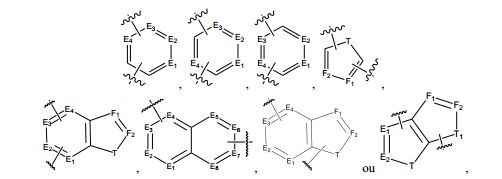
[0011] Em outras formas de realização, A é
[0012] Em algumas formas de realização, B é alcoxi C1-6, alcoxi C1-6 7 7a 7 7a 7 7a substituído com hidroxi, -NR R , -C(= O) NR R , -OC(= O) NR R , -OC(= 7 7 7 7a 7 7a 7 7a O) OR , -N(R ) C(= O) NR R , -N(R ) C(= O) OR , -N(R ) C(= O)-R , R7R7aN-S (= O)2-, R7S (= O)2-, C4-12 carbociclila, C4-12 cicloalquila, C2-10 heterociclila, arila C6-10, heteroarila C1-9, C5-12 biciclila fundida, heterobiciclila C5-12 fundida, C5-12 biciclil espiro, ou C5-12 espiro heterobiciclila.[0012] In some embodiments, B is C1-6 alkoxy, hydroxy substituted C1-6 alkoxy, -NR R , -C(=O)NR R , -OC(=O)NR R , -OC(= 7 7 7 7a 7 7a 7 7a O) OR , -N(R ) C(= O) NR R , -N(R ) C(= O) OR , -N(R ) C( = O)-R , R7R7aN-S (=O)2-, R7S (=O)2-, C4-12 carbocyclyl, C4-12 cycloalkyl, C2-10 heterocyclyl, C6-10 aryl, C1-9 heteroaryl, C5 -12 fused bicyclyl, fused C5-12 heterobicyclyl, C5-12 spiro bicyclyl, or C5-12 spiro heterobicyclyl.
[0013] Em algumas formas de realização, R1 é H, F, Cl, Br, I, ciano, hidroxi, R7aR7N-, -C(= O) NR7R7a, - 7 7a 7 7 7 7a 7 OC(= O) NR R , -OC(= O) OR , -N(R ) C(= O) NR R , -N(R ) C(= O) 7a 7 7a 7 7a 7 7 7a OR , -N(R ) C(= O)-R , R R N-S (= O)2-, R S (= O)2-, R S (= O)2N(R )-, R7aR7N-alquila C1-6, R7S (= O)-C1-6 alquila, R7R7aN-C(= O)-C1-6 alquila, C1-6 alcoxi-R7aR7N, R7S (= O)-C1-6 alcoxi, R7R7aN-C(= O)-C1-6 alcoxi, C1-6 alifático, C1-6 alcoxi, C1-6 hidroxialcoxi, aminoalcoxi C1-6, aminoalcoxi substituído com hidroxi C1-6, C1-6 haloalcoxi, amino substituído-C1-6 haloalcoxi, C1-6 alquilamino-C1-6 haloalcoxi, haloalcoxi C1-6 substituído com hidroxi, C1-6 alquilamino-C1-6-alcoxi, C1-6 alcoxi-C1-6 alcoxi, cicloalquiloxi-C3- 10, arila-C6-10-alcoxi-C1-6, arila C6-10-C1-6-alquilamino, C1-9-heteroarila-C1-6- alcoxi, heteroarila C1-9-C1-6- alquilamino, C2-10-heterociclila C1-6, heterociclila C2-10-C1-6-alquilamino, cicloalquilamino C3-10, C3-10 carbociclila-C1-6-alcoxi, C3-10 carbociclila-C1-6-alquilamino, heterociclila C2-10 (hidroxialcoxi C1-6), C310 carbociclila (hidroxialcoxi C1-6), arila C6-10 (hidroxialcoxi C1-6), ariloxi C6- 10-alquila C1-6-alcoxi, ariloxi C6-10, C1-9 heteroariloxi, heteroariloxi C1-9-C1-6- alcoxi, heterocicliloxi C2-10-C1-6-alcoxi, C3-10-carbocicliloxi-C1-6-alcoxi, heterocicliloxi C2-10, C1-6 azidoalcoxi, C5-12 biciclila fundida, heterobiciclila C5-12 fundida, C5-12 biciclila fundida- C1-6 alifática, C5-12 heterobiciclila fundida-C1-6 alifática, C5-12 bicicloxi fundido, C5-12 heterobicicloxi fundido, C5-12 fundido biciclilamino, C5-12 heterobiciclilamino fundido, C5-12 biciclila fundida-C1-6-alcoxi, C5-12 heterobiciclila fundida-C1-6-alcoxi, C5-12 biciclila fundida-C1-6-alquilamino, C5-12 heterobiciclila fundida- C1-6-alquilamino, C5-12 bicicloxi fundido-C1-6-alcoxi, C5-12 heterobicicloxi fundido-C1-6-alcoxi, C5-12 biciclilamino fundido-C1-6-alcoxi, C5-12 heterobiciclilamino fundido-C1-6- alcoxi, C5-12 biciclil-C(= O)-fundido, C5-12 biciclil-C(= O) O- fundido, C5-12 heterobiciclil-C(= O)-fundido, C5-12 heterobiciclila fundida- C(= O) O-, C5-12 biciclilamino-C(= O)-fundido, C5-12 heterobiciclilamino-C(= O) fundido, C5-12 biciclil-C(= O) N(R7)-fundido, C5-12 heterobiciclil-C(= O) N(R7) fundido, C512 espiro biciclila, C5-12 espiro heterobiciclila, C5-12 espiro biciclila C1-6 alifática, C5-12 espiro heterobiciclila- C1-6-alifática, C5-12 espiro bicicloxi, C5-12 espiro heterobicicloxi, C5-12 espiro biciclilamino, C5-12 espiro heterobiciclilamino, C5-12 espiro biciclil-C1-6-alcoxi, C5-12-espiro heterobiciclil C1-6- alcoxi, C5-12 espiro biciclil-C1-6-alquilamino, C5-12 espiro heterobiciclil- C1-6-alquilamino, C5-12 espiro bicicloxi-C1-6-alcoxi, C5-12 espiro heterobicicloxi-C1-6-alcoxi, espiro C5-12 biciclilamino-C1-6-alcoxi, C5-12 espiro heterobiciclilamino-C1-6-alcoxi, C5-12 espiro biciclil-C(= O)-, C5-12 espiro biciclil-C(= O) O-, C5-12 espiro heterobiciclil-C(= O)-, C5-12 espiro heterobiciclil-C(= O) O-, C5-12 espiro biciclilamino-C(= O)-, C5-12 espiro heterobiciclilamino-C(= O)-, C5-12 espiro biciclil-C(= O) N(R7)-, C5-12 espiro heterobiciclil-C(= O) N(R7)-, C2-10 heterociclila, cicloalquila C3-10, arila C1-6 arila, heteroarila C1-9, heterociclila C2-10-C1-6 alifático, C3-10-cicloalquila-C1-6- alifático, C6-10 aril-C1-6-alifático, C1-9 heteroaril-C1-6- alifático, C6-10 aril- (CH2)P-G-(CH2)m-, C1-9 heteroaril-(CH2)P-G-(CH2)m-, heterociclil- C2-10 (CH2)P-G-(CH2)m-, ou C3-10-cicloalquil-(CH2)P-G-(CH2)m-, em que cada G é O, S, NR5, S (= O), S (= O)2, C(= O), -C(= O) NH-, -OC(= O) NH-, -OC(= O)-, -NHC(= O) NH-, -HN-S (= O)t-, -OS (= O)t-, ou -OS (= O)tNH-; cada t é 1 ou 2; cada p e m é independentemente 0, 1, 2, 3 ou 4; ou em que cada um dos arila C6-10 (CH2)P-G-(CH2)m-, C1-9 heteroaril-(CH2)P-G-(CH2)m-, heterociclil- C2-10 (CH2)P-G-(CH2)m-, e C3-10 cicloalquil-(CH2)P-G-(CH2)m- é opcionalmente substituído por um ou mais F, Cl, Br, I, C1-6 alquila, C2-6 alquinila, C1-6 alcoxi ou ciano; R2 é H, F, Cl, Br, I, ciano, hidroxi, R7aR7N-, -C(= O) NR7R7a, - 7 7a 7 7 7 7a 7 OC(= O) NR R , -OC(= O) OR , -N(R ) C(= O) NR R , -N(R ) C(= O) 7a 7 7a 7 7a 7 7 7a OR , -N(R ) C(= O)-R , R R N-S (= O)2-, R S (= O)2-, R S (= O)2N(R )-, R7aR7N-alquila C1-6, R7S (= O)-C1-6 alquila, R7R7aN-C(= O)-C1-6 alquila, C1-6 alcoxi-R7aR7N, R7S (= O)-C1-6 alcoxi, R7R7aN-C(= O)-C1-6 alcoxi, C1-6 alifático, C1-6 alcoxi, C1-6 hidroxialcoxi, aminoalcoxi C1-6, aminoalcoxi substituído com hidroxi C1-6, C1-6 haloalcoxi, amino substituído-C1-6 haloalcoxi, C1-6 alquilamino-C1-6 haloalcoxi, haloalcoxi C1-6 substituído com hidroxi, C1-6 alquilamino-C1-6-alcoxi, C1-6 alcoxi-C1-6 alcoxi, cicloalquiloxi-C3- 10, arila-C6-10-alcoxi-C1-6, arila C6-10-C1-6-alquilamino, C1-9-heteroarila-C1-6- alcoxi, heteroarila C1-9-C1-6- alquilamino, C2-10-heterociclila C1-6, heterociclila C2-10-C1-6-alquilamino, cicloalquilamino C3-10, C3-10 carbociclila-C1-6-alcoxi, C3-10 carbociclila-C1-6-alquilamino, heterociclila C2-10 (hidroxialcoxi C1-6), C3-10 carbociclila (hidroxialcoxi C1-6), arila C6-10 (hidroxialcoxi C1-6), ariloxi C6- 10-alquila C1-6-alcoxi, ariloxi C6-10, C1-9 heteroariloxi, heteroariloxi C1-9-C1-6- alcoxi, heterocicliloxi C2-10-C1-6-alcoxi, C3-10-carbocicliloxi-C1-6-alcoxi, heterocicliloxi C2-10, C1-6 azidoalcoxi, C5-12 biciclila fundida, heterobiciclila C5-12 fundida, C5-12 biciclila fundida- C1-6 alifática, C5-12 heterobiciclila fundida-C1-6 alifática, C5-12 bicicloxi fundido, C5-12 heterobicicloxi fundido, C5-12 fundido biciclilamino, C5-12 heterobiciclilamino fundido, C5-12 biciclila fundida-C1-6-alcoxi, C5-12 heterobiciclila fundida-C1-6-alcoxi, C5-12 biciclila fundida-C1-6-alquilamino, C5-12 heterobiciclila fundida- C1-6-alquilamino, C5-12 bicicloxi fundido-C1-6-alcoxi, C5-12 heterobicicloxi fundido-C1-6-alcoxi, C5-12 biciclilamino fundido-C1-6-alcoxi, C5-12-C1 fundido heterobiciclilamino 6- alcoxi, C5-12 biciclil-C(= O)-fundido, C5-12 biciclil-C(= O) O- fundido, C5-12 heterobiciclil-C(= O)-fundido, C5-12 heterobiciclila fundida- C(= O) O-, C5-12 biciclilamino-C(= O)-fundido, C5-12 heterobiciclilamino-C(= O) fundido, C5-12 biciclil-C(= O) N(R7)-fundido, C5-12 heterobiciclil-C(= O) N(R7)-fundido, C512 espiro biciclila, C5-12 espiro heterobiciclila, C5-12 espiro biciclil C1-6 alifático, C5-12 espiro heterobiciclila- C1-6-alifática, C5-12 espiro bicicloxi, C5-12 espiro heterobicicloxi, C5-12 espiro biciclilamino, C5-12 espiro heterobiciclilamino, C5-12 espiro biciclil-C1-6-alcoxi, C5-12-espiro heterobiciclil C1-6- alcoxi, C5-12 espiro biciclil-C1-6-alquilamino, C5-12 espiro heterobiciclil- C1-6-alquilamino, C5-12 espiro bicicloxi-C1-6-alcoxi, C5-12 espiro heterobicicloxi-C5-12-alcoxi, espiro C5-12 biciclilamino-C1-6-alcoxi, C5-12 espiro heterobiciclilamino-C1-6-alcoxi, C5-12 espiro biciclil-C(= O)-, C5-12 espiro biciclil-C(= O) O-, C5-12 espiro heterobiciclil-C(= O)-, C5-12 espiro heterobiciclil-C(= O) O-, C5-12 espiro biciclilamino-C(= O)-, C5-12 espiro heterobiciclilamino-C(= O)-, C5-12 espiro biciclil-C(= O) N(R7)-, C5-12 espiro heterobiciclil-C(= O) N(R7)-, C2-10 heterociclila, cicloalquila C3-10, arila C1-6 arila, C1-4 heteroarila, C2-10-heterociclila C1-6 alifática, C3-10-cicloalquila-C1-6- alifático, C6-10 aril-C1-6-alifático, C1-9 heteroaril-C1-6- alifático, C6-10 aril- (CH2)P-G-(CH2)m-, C1-9 heteroaril-(CH2)P-G-(CH2)m-, heterociclil- C2-10 (CH2)P-G-(CH2)m-, ou C3-10-cicloalquil-(CH2)P-G-(CH2)m-, em que cada G é O, S, NR5, S (= O), S (= O)2, C(= O), -C(= O) NH-, -OC(= O) NH-, -OC(= O)-, -NHC(= O) NH-, -HN-S (= O)t-, -OS (= O)t-, ou -OS (= O)tNH-; cada t é 1 ou 2; cada p e m é independentemente 0, 1, 2, 3 ou 4; R3 é H, F, Cl, I, ciano, R7aR7N-, -C(= O) NR7R7a, -OC(= O) 7 7a 7 7 7 7a 7 7a 7 NR R , -OC(= O) OR , -N(R ) C(= O) NR R , -N(R ) C(= O) OR , -N(R ) 7a 7 7a 7 7 7a 7a 7 C(= O)-R , R R N-S (= O)2-, R S (= O)2-, R S (= O)2N(R )-, R R N- alquila C1-6, R7S (= O)-C1-6 alquila, R7R7aN-C(= O)-C1-6 alquila, C1-6 alcoxi- R7aR7N, R7S (= O)-alquila C1-6 alcoxi, R7R7aN-C(= O)-C1-6 alcoxi, C1-6 alifático, C2-10 haloalquila, C6-10 arila-C2-10-alcoxi, C1-9 heteroaril-C3-6-alcoxi, C3-10 cicloalquila-C2-10-alcoxi, C5-10 biciclila fundida-C2-10-alcoxi, C2-10 heterociclila, C3-10-cicloalquila, C1-4 heteroarila, arila C6-10 substituída, heterociclila C2-10-C1-6-alifático, C3-10-cicloalquila-C1-6-alifático, C1-4 heteroarila C1-6 alifática, C1-9 heteroariloxi C1-6, arila C6-10 substituído-C3-6- alquila, C2 -10 hetrerociclil-C1-6-alquila, C1-6 alcoxi, C1-6 hidroxialcoxi, aminoalcoxi C1-6, aminoalcoxi substituído com hidroxi C1-6, C1-6 haloalcoxi, amino substituído C1-6 halogenoalcoxi, C1-6 alquilamino C1-6-halogenoalcoxi, haloalcoxi C1-6 substituído com hidroxi, C1-6 alquilamino-C1-6-alcoxi, C1-6 alcoxi-C1-6-alcoxi, arila-C6-10-C2-10-alcoxi, C2-10 heterociclil-C1-6-alcoxi, C3-10 carbociclila C1-6, heterociclila C2-10 (hidroxialcoxi C1-6), C3-10 carbociclila (hidroxialcoxi C1-6), arila C6-10 (C1-6 hidroxialcoxi), ariloxi C6-10-alquila C1-6- alcoxi, C6-10 arilamino-C1-6-alcoxi, C6-10 ariloxi, heterocicliloxi C2-10-C1-6- alcoxi, C3-10 carbocicliloxi-C1-6-alcoxi, heterocicliloxi C2-10, C3-10- cicloalquiloxi, C1-6 azidoalcoxi, C5-12 biciclila fundida, heterobiciclila C5-12 fundida, C5-12 biciclila fundida- C1-6 alifática, C5-12-alquila C1-6 fundido heterobiciclil -alifatico, C5-12 bicicloxi fundido, C5-12 heterobicicloxi fundido, C5-12 biciclilamino fundido, C5-12 heterobiciclilamino fundido, C5-12 biciclila fundida-C1-6-alcoxi, C5-12 heterobiciclila fundida- C1-6-alcoxi, C5-12 biciclila fundida-C1-6-alquilamino, C5-12 heterobiciclila fundida-C1-6-alquilamino, C5-12 bicicloxi fundido-C1-6-alcoxi, C5-12 heterobicicloxi fundido-C1-6-alcoxi, C5-12 biciclilamino fundido-C1-6-alcoxi, C5-12 heterobiciclilamino fundido-C1-6- alcoxi, C5-12 biciclil-C(= O)-fundido, C5-12 biciclil-C(= O) O- fundido, C5-12 heterobiciclil-C(= O)-fundido, C5-12 heterobiciclil-C(= O) O- fundido, C5-12 biciclilamino-C(= O)-fundido, C5-12 heterobiciclilamino-C(= O) fundido, C5-12 fundido biciclil-C(= O) NR -, C5-12 fundido heterobiciclil-C(= O) NR7-, C5-12 espiro biciclila, C5-12 espiro heterobiciclila, C5-12 espiro biciclil-C1-6-alifático, C5-12 espiro heterobiciclil C1-6 alifático, C5-12 espiro bicicloxi, C5-12 espiro heterobicicloxi, C5-12 espiro biciclilamino, C5-12 espiro heterobiciclilamino, C512 espiro biciclil-C1-6 alcoxi, C5-12 espiro heterobiciclil-C1-6-alcoxi, C5-12 espiro biciclil-C1-6-alquilamino, C5-12 espiro heterobiciclil-C1-6-alquilamino, C5-12 espiro bicicloxi C1-6 alcoxi, C5-12 espiro heterobicicloxi-C1-6-alcoxi, C5-12 espiro biciclilamino-C1-6-alcoxi, C5-12 espiro heterobiciclilamino-C1-6-alcoxi, C5-12 espiro biciclil-C(= O)-, espiro C5-12 biciclil-C(= O) O-, C5-12 espiro heterobiciclil-C(= O)-, C5-12 espiro heterobiciclil-C(= O) O-, C5-12 espiro biciclilamino-C(= O)-, C5-12 espiro heterobiciclilamino-C(= O)-, C5-12 espiro biciclil-C(= O) NR7-, C5-12 espiro heterobiciclil-C(= O) NR7-, C6-10 aril- (CH2)P-G-(CH2)m-, C1-9 heteroaril-(CH2)P-G-(CH2)m-, heterociclil- C2-10 (CH2)P-G-(CH2)m-, ou C3-10-cicloalquila (CH2)P-G-(CH2)m-, em que cada G é O, S, NR5, S (= O), S (= O)2, C(= O), -C(= O) NH-, -OC(= O) NH-, -OC(= O)-, -NHC(= O) NH-, -HN-S (= O)t-, -OS (= O)t-, ou -OS (= O)tNH-; cada t é 1 ou 2; cada p e m é independentemente 0, 1, 2, 3 ou 4; e R4 é H, F, I, ciano, hidroxi, R7aR7N-, -C(= O) NR7R7a, -OC(= 7 7a 7 7 7 7a 7 7a O) NR R , -OC(= O) OR , -N(R ) C(= O) NR R , -N(R ) C(= O) OR , - alcoxi, C1-6 hidroxialcoxi, aminoalcoxi C1-6, aminoalcoxi substituído com hidroxi C1-6, C1-6 haloalcoxi, haloalcoxi C1-6 substituído com amino, C1-6 alquilamino-C1-6 haloalcoxi, haloalcoxi C1-6 substituído com hidroxi, C1-6 alquilamino-C1-6-alcoxi, C1-6 alcoxi-C1-6-alcoxi, C3-5 cicloalquiloxi, C6-10 aril- C1-6-alcoxi, C1.9-heteroarila C1-6, heteroarila C1-9-C1-6-alquilamino, C2-10- heterociclila C1-6, heterociclila C2-10 C1-6-alquilamino, C7-10 cicloalquiloxi, cicloalquil-C3-10, C3-10 carbociclila-C1-6-alcoxi, C3-10 carbociclila-C1-6- alquilamino, heterociclila C2-10 (hidroxialcoxi C1-6), C3-10 carbociclila (hidroxialcoxi C1-6), arila C6-10 (hidroxialcoxi C1-6), ariloxi C6-10-alquila C1-6- heterobicicloxi fundido, C5-12 biciclilamino fundido, C5-12 heterobiciclilamino fundido, C5-12 biciclila fundida-C1-6-alcoxi, C5-12 heterobiciclila fundida-C1-6- alcoxi, C5-12 biciclila fundida-C1-6-alquilamino, C5-12 heterobiciclila fundida- C1-6-alquilamino, C5-12 bicicloxi fundido-C1-6-alcoxi, C5-12 heterobicicloxi fundido-C1-6-alcoxi, C5-12 biciclilamino fundido-C1-6-alcoxi, C5-12 heterobiciclilamino fundido-C1-6-alcoxi, C5-12 biciclil-C(= O)-fundido, C5-12 biciclil-C(= O) O- fundido, C5-12 heterobiciclil-C(= O)-fundido, C5-12 heterobiciclil-C(= O) O- fundido, C5-12 biciclilamino-C(= O)-fundido, C5-12 heterobiciclilamino-C(= O) fundido, C5-12 biciclila fundida -C(= O) NR7-, C512 heterobiciclila fundida -C(= O) NR7-, C5-12 espiro biciclila, C5-12 espiro heterobiciclila, C5-12 espiro biciclila-C1-6 alifático, C5-12 espiro heterobiciclila- C1-6 alifático, C5-12 espiro bicicloxi, C5-12 espiro heterobicicloxi, C5-12 espiro biciclilamino, C5-12 espiro heterobiciclilamino, C5-12 espiro biciclil-C1-6-alcoxi, C5-12 espiro heterobiciclil-C1-6-alcoxi, C5-12 espiro biciclil-C1-6-alquilamino, C5-12 espiro heterobiciclil-C1-6-alquilamino, C5-12 espiro bicicloxi-C1-6-alcoxi, C5-12 espiro heterobicicloxi-C1-6-alcoxi, C5-12 espiro biciclilamino-C1-6-alcoxi, C5-12 espiro heterobiciclilamino- C1-6-alcoxi, C5-12 espiro biciclil-C(= O)-, C512 espiro biciclil-C(= O) O-, C5-12 espiro heterobiciclil-C(= O)-, C5-12 espiro heterobiciclil-C(= O) O-, C5-12 espiro biciclilamino-C(= O)-, C5-12 espiro heterobiciclilamino-C(= O)-, C5-12 espiro biciclil-C(= O) N(R7)-, C5-12 espiro heterobiciclil-C(= O) N(R7)-, C2-10 heterociclila, cicloalquila C3-10, arila C6-10, heteroarila C1-9, heterociclila C2-10-C1-6 alifático, C3-10-cicloalquila-C1-6- alifático, C6-10 aril-C2-6-alifático, C1-9 heteroarila C1-6 alifática, C6-10 aril- (CH2)P-G-(CH2)m-, C1-9 heteroaril-(CH2)P-G-(CH2)m-, heterociclil- C2-10 (CH2)P-G-(CH2)m-, ou C3-10-cicloalquil-(CH2)P-G-(CH2)m-, em que cada G é O, S, NR5, S (= O), S (= O)2, C(= O), -C(= O) NH-, -OC(= O) NH-, -OC(= O)-, -NHC(= O) NH-, -HN-S (= O)t-, -OS (= O)t-, ou -OS (= O)tNH-; cada t é 1 ou 2; cada p e m é independentemente 0, 1, 2, 3 ou 4. Em algumas formas de realização, cada R5 é, 7 7a 7 7 7 7a independentemente, H, R R NC(= O)-, R OC(= O)-, R C(= O)-, R R NS (= 7 7 7 7a 7 7 O)-, R OS (= O)-, R S (= O)-, R R NS (= O)2-, R OS (= O)2-, R S (= O)2-, C1-6 alifático, C1-6 haloalifático, hidroxialifático C1-6, C1-6 aminoalifático, C1-6 alcoxi-C1-6 alifático, C1-6 alquilamino-C1-6-alifático, C1-6 alquiltio C1-6 alifático, C6-10 aril-C1-6-alifático, C1-9 heteroarila C1-6 alifática, C2-10- heterociclila C1-6 alifática, C3-10-cicloalquila-C1-6-alifático, C6-10 ariloxi-C1-6- alifático, C2-10 heterocicliloxi-C1-6-alifático, C3-10 cicloalquil-C1-6-alifático, C6- 10-arilamino-C1-6 alifático, C2-10-heterociclilamino-C1-6 alifático, C3-10- cicloalquilamino-C1-6 alifático, C6-10 arila, heteroarila C1-9, heterociclila C2-10 ou C3-10 carbociclila.[0013] In some embodiments, R1 is H, F, Cl, Br, I, cyano, hydroxy, R7aR7N-, -C(=O)NR7R7a, -77a 7 7 7 7a 7 OC(=O)NR R , -OC(= O) OR , -N(R ) C(= O) NR R , -N(R ) C(= O) 7a 7 7a 7 7a 7 7 7a OR , -N(R ) C( = O)-R , RR NS (= O)2-, RS (= O)2-, RS (= O)2N(R )-, R7aR7N-C1-6 alkyl, R7S (= O)-C1-6 alkyl, R7R7aN-C(= O)-C1-6 alkyl, C1-6 alkoxy-R7aR7N, R7S (= O)-C1-6 alkoxy, R7R7aN-C(= O)-C1-6 alkoxy, C1-6 aliphatic C1-6 alkoxy, C1-6 hydroxyalkoxy, C1-6 aminoalkoxy, C1-6 hydroxy substituted aminoalkoxy, C1-6 haloalkoxy, C1-6 haloalkoxy-substituted amino, C1-6 C1-6 alkylamino haloalkoxy, C1-haloalkoxy 6 substituted with hydroxy, C1-6 alkylamino-C1-6-alkoxy, C1-6 alkoxy-C1-6 alkoxy, cycloalkyloxy-C3-10, aryl-C6-10-aryl-C1-6-alkoxy, aryl C6-10-C1 -6-alkylamino, C1-9-heteroaryl-C1-6-alkoxy, heteroaryl C1-9-C1-6-alkylamino, C2-10-heterocyclyl C1-6, heterocyclyl C2-10-C1-6-alkylamino, C3-cycloalkylamino -10, C3-10 carbocyclyl-C1-6-alkoxy, C3-10 carbocyclyl-C1-6-a alkylamino, C2-10 heterocyclyl (C1-6 hydroxyalkoxy), C310 carbocyclyl (C1-6 hydroxyalkoxy), C6-10 aryl (C1-6 hydroxyalkoxy), C6-10 aryloxy C1-6 alkyl-alkoxy, C6-10 aryloxy, C1-9 heteroaryloxy, C1-9-C1-6-alkoxy heteroaryloxy, C2-10-C1-6-alkoxy heterocyclyloxy, C3-10-carbocyclyloxy-C1-6-alkoxy, C2-10 heterocyclyloxy, C1-6 azidoalkoxy, C5 -12 fused bicyclyl, C5-12 fused heterobicyclyl, C5-12 fused-C1-6 aliphatic bicyclyl, C5-12 fused-C1-6 aliphatic heterobicyclyl, C5-12 fused bicycloxy, C5-12 fused heterobicycloxy, C5-12 fused bicyclylamino , C5-12 fused heterobicyclylamino, C5-12 fused bicyclyl-C1-6-alkoxy, C5-12 fused heterobicyclyl-C1-6-alkoxy, C5-12 fused bicyclyl-C1-6-alkylamino, C5-12 fused heterobicyclyl-C1 -6-alkylamino, C5-12 fused-C1-6-alkoxy-bicyclooxy, C5-12-fused-C1-6-alkoxy-fused-heterobicycloxy, C1-6-alkoxy-fused-C5-12-fused bicyclylamino, C1-6-fused-C5-12 heterobicyclylamino - alkoxy, C5-12 bicyclyl-C(= O)-fused, C5-12 bicyclyl-C(= O) O- fused, C5-12 heterobicyclyl-C(= O)-fused, C5-12 heterobicyclyl-fused-C(= O) O-, C5-12 bicyclylamino-C(= O)-fused, C5-12 heterobicyclylamino-C(= O) fused, C5-12 bicyclyl-C(= O) N(R7)-fused, C5-12 heterobicyclyl-C(= O) N(R7) fused, C5-12 spiro bicyclyl, C5-12 spiro heterobicyclyl, C5-12 C1-6 aliphatic spiro bicyclyl, C5-12 spiro heterobicyclyl-C1-6-aliphatic, C5-12 spiro bicyclooxy, C5-12 spiro heterobicyclooxy, C5-12 spiro bicyclylamino, C5-12 spiro heterobicyclylamino, C5-12 spiro bicyclyl-C1 -6-alkoxy, C5-12-spiro heterobicyclyl C1-6-alkoxy, C5-12 spiro bicyclyl-C1-6-alkylamino, C5-12 spiro heterobicyclyl-C1-6-alkylamino, C5-12 spiro bicyclyl-C1-6 -alkoxy, C5-12 spiro heterobicyclylamino-C1-6-alkoxy, C5-12 spiro bicyclylamino-C1-6-alkoxy, C5-12 spiro heterobicyclylamino-C1-6-alkoxy, C5-12 spiro bicyclyl-C(=O) -, C5-12 spiro bicyclyl-C(= O) O-, C5-12 spiro heterobicyclyl-C(= O)-, C5-12 spiro heterobicyclyl-C(= O) O-, C5-12 spiro bicyclylamino-C (= O)-, C5-12 spiro heterobicyclylamino-C(= O)-, C5-12 spiro bicyclyl-C(= O) N(R7)-, C5-12 spiro heterobicyclyl-C(= O) N(R7)- , C2-10 heterocyclyl, C3-10 cycloalkyl, C1-6 aryl, C1-9 heteroaryl, C2-10-C1-6 aliphatic heterocyclyl, C3-10-cycloalkyl-C1-6-aliphatic, C6-10 aryl-C1 -6-aliphatic, C1-9 heteroaryl-C1-6-aliphatic, C6-10 aryl-(CH2)PG-(CH2)m-, C1-9 heteroaryl-(CH2)PG-(CH2)m-, heterocyclyl- C2-10 (CH2)PG-(CH2)m-, or C3-10-cycloalkyl-(CH2)PG-(CH2)m-, where each G is O, S, NR5, S (=O), S (= O)2, C(= O), -C(= O) NH-, -OC(= O) NH-, -OC(= O)-, -NHC(= O) NH-, -HN- S (=O)t-, -OS (=O)t-, or -OS (=O)tNH-; each t is 1 or 2; each p and m is independently 0, 1, 2, 3 or 4; or wherein each of C6-10 aryl (CH2)PG-(CH2)m-, C1-9 heteroaryl-(CH2)PG-(CH2)m-, C2-10 heterocyclyl(CH2)PG-(CH2) m-, and C3-10 cycloalkyl-(CH2)PG-(CH2)m- is optionally substituted by one or more F, Cl, Br, I, C1-6 alkyl, C2-6 alkynyl, C1-6 alkoxy or cyano ; R2 is H, F, Cl, Br, I, cyano, hydroxy, R7aR7N-, -C(=O)NR7R7a, -7 7a 7 7 7 7a 7 OC(=O)NR R , -OC(=O)OR , -N(R ) C(= O) NR R , -N(R ) C(= O) 7a 7 7a 7 7a 7 7 7a OR , -N(R ) C(= O)-R , RR NS ( = O)2-, RS (= O)2-, RS (= O)2N(R )-, R7aR7N-C1-6 alkyl, R7S (= O)-C1-6 alkyl, R7R7aN-C(= O) -C1-6 alkyl, C1-6 alkoxy-R7aR7N, R7S (=O)-C1-6 alkoxy, R7R7aN-C(=O)-C1-6 alkoxy, C1-6 aliphatic, C1-6 alkoxy, C1-6 hydroxyalkoxy, C1-6 aminoalkoxy, C1-6 hydroxy substituted aminoalkoxy, C1-6 haloalkoxy, C1-6 amino substituted haloalkoxy, C1-6 C1-6 alkylamino haloalkoxy, hydroxy substituted C1-6 haloalkoxy, C1-6 alkylamino -C1-6-alkoxy, C1-6-C1-6-alkoxy, C3-10-cycloalkyloxy, C6-10-aryl-C1-6-alkoxy, C6-10-aryl-C1-6-alkylamino, C1-9- heteroaryl-C1-6-alkoxy, heteroaryl C1-9-C1-6-alkylamino, C2-10-heterocyclyl C1-6, heterocyclyl C2-10-C1-6-alkylamino, C3-10 cycloalkylamino, C3-10 carbocyclyl-C1 -6-alkoxy, C3-10 carbocyclyl-C1-6-alkylamino, C2-10 heterocyclyl (hydroxy C1-6 alkoxy), C3-10 carbocyclyl (C1-6 hydroxyalkoxy), C6-10 aryl (C1-6 hydroxyalkoxy), C6-10 aryloxy-C1-6 alkyl-alkoxy, C6-10 aryloxy, C1-9 heteroaryloxy, C1-9-C1-6-alkoxy heteroaryloxy, C2-10-C1-6-alkoxy heterocyclyloxy, C3-10-carbocyclyloxy-C1-6-alkoxy, C2-10 heterocyclyloxy, C1-6 azidoalkoxy, C5-12 fused bicyclyl, C5-12 fused heterobicyclyl, C5-12 fused-C1-6 aliphatic bicyclyl, C5-12 fused-C1-6 aliphatic heterobicyclyl, C5-12 fused bicycloxy, C5-12 fused heterobicycloxy, C5-12 fused bicyclylamino, C5-12 heterobicyclylamino fused, C5-12 fused bicyclyl-C1-6-alkoxy, C5-12 fused heterobicyclyl-C1-6-alkoxy, C5-12 fused bicyclyl-C1-6-alkylamino, C5-12 fused heterobicyclyl-C1-6-alkylamino, C5-12 fused bicyclylamino-C1-6-alkoxy, C5-12 fused heterobicyclylamino-C1-6-alkoxy, C5-12 fused bicyclylamino-C1-6-alkoxy, C5-12-C1 fused heterobicyclylamino 6-alkoxy, C5-12 bicyclyl-C(=O)-fused, C5-12 bicyclyl-C(=O)O-fused, C5-12 heterobicyclyl-C(=O)-f fused, C5-12 fused C5-12 heterobicyclylamino-C(= O) O-, C5-12 fused C5-12 bicyclylamino-C(= O)-fused, C5-12 fused C5-12 heterobicyclylamino-C(= O), C5-12 bicyclyl-C(= O) ) N(R7)-fused, C5-12 heterobicyclyl-C(= O) N(R7)-fused, C5-12 spiro bicyclyl, C5-12 spiro heterobicyclyl, C5-12 spiro bicyclyl C1-6 aliphatic, C5-12 spiro heterobicyclyl - C1-6-aliphatic, C5-12 spiro bicyclooxy, C5-12 spiro heterobicycloxy, C5-12 spiro bicyclylamino, C5-12 spiro heterobicyclylamino, C5-12 spiro bicyclyl-C1-6-alkoxy, C5-12-spiro C1 heterobicyclyl -6-alkoxy, C5-12 spiro bicyclyl-C1-6-alkylamino, C5-12 spiro heterobicyclyl-C1-6-alkylamino, C5-12 spiro bicyclooxy-C1-6-alkoxy, C5-12 spiro heterobicyclyl-C5-12 -alkoxy, C5-12 spiro bicyclylamino-C1-6-alkoxy, C5-12 spiro heterobicyclylamino-C1-6-alkoxy, C5-12 spiro bicyclyl-C(= O)-, C5-12 spiro bicyclyl-C(= O) ) O-, C5-12 spiro heterobicyclyl-C(= O)-, C5-12 spiro heterobicyclyl-C(= O) O-, C5-12 spiro bicyclylamino-C(= O)-, C5-12 spiro heterobicyclylamino- Ç (= O)-, C5-12 spiro bicyclyl-C(= O) N(R7)-, C5-12 spiro heterobicyclyl-C(= O) N(R7)-, C2-10 heterocyclyl, C3-10 cycloalkyl, C1-6 aryl, C1-4 heteroaryl, C2-10-C1-6 aliphatic heterocyclyl, C3-10-cycloalkyl-C1-6-aliphatic, C6-10-aryl-C1-6-aliphatic, C1-9-C1-heteroaryl -6- aliphatic, C6-10 aryl-(CH2)PG-(CH2)m-, C1-9 heteroaryl-(CH2)PG-(CH2)m-, heterocyclyl-C2-10(CH2)PG-(CH2) m-, or C3-10-cycloalkyl-(CH2)PG-(CH2)m-, where each G is O, S, NR5, S (=O), S (=O)2, C(=O) , -C(= O) NH-, -OC(= O) NH-, -OC(= O)-, -NHC(= O) NH-, -HN-S (= O)t-, -OS ( = O)t-, or -OS (= O)tNH-; each t is 1 or 2; each p and m is independently 0, 1, 2, 3 or 4; R3 is H, F, Cl, I, cyano, R7aR7N-, -C(=O)NR7R7a, -OC(=O) 7 7a 7 7 7 7a 7 7a 7 NR R , -OC(= O) OR , - N(R ) C(= O) NR R , -N(R ) C(= O) OR , -N(R ) 7a 7 7a 7 7 7a 7a 7 C(= O)-R , RR NS (= O )2-, RS (= O)2-, RS (= O)2N(R )-, RR N-C1-6 alkyl, R7S (= O)-C1-6 alkyl, R7R7aN-C(= O)- C1-6 alkyl, C1-6 alkoxy-R7aR7N, R7S (=O)-alkyl, C1-6 alkoxy, R7R7aN-C(=O)-C1-6 alkoxy, C1-6 aliphatic, C2-10 haloalkyl, C6-10 aryl-C2-10-alkoxy, C1-9 heteroaryl-C3-6-alkoxy, C3-10 cycloalkyl-C2-10-alkoxy, C5-10 fused bicyclyl-C2-10-alkoxy, C2-10 heterocyclyl, C3-10 -cycloalkyl, C1-4 heteroaryl, substituted C6-10 aryl, C2-10-C1-6-aliphatic heterocyclyl, C3-10-cycloalkyl-C1-6-aliphatic, C1-4 C1-6 aliphatic heteroaryl, C1-9 heteroaryloxy C1-6, C6-10 aryl substituted-C3-6-alkyl, C2-10 heterocyclyl-C1-6-alkyl, C1-6 alkoxy, C1-6 hydroxyalkoxy, C1-6 aminoalkoxy, C1-6 hydroxy substituted aminoalkoxy, C1-6 haloalkoxy, substituted amino C1-6 haloalkoxy, C1-6 alkylamino C1-6-ha logenoalkoxy, hydroxy substituted C1-6 haloalkoxy, C1-6 alkylamino-C1-6-alkoxy, C1-6-C1-6-alkoxy-alkoxy, aryl-C6-10-C2-10-alkoxy, C2-10 heterocyclyl-C1 -6-alkoxy, C3-10 C1-6 carbocyclyl, C2-10 heterocyclyl (C1-6 hydroxyalkoxy), C3-10 carbocyclyl (C1-6 hydroxyalkoxy), C6-10 aryl (C1-6 hydroxyalkoxy), C6-10 aryloxy -C1-6alkyl-alkoxy, C6-10 arylamino-C1-6-alkoxy, C6-10 aryloxy, heterocyclyloxy C2-10-C1-6-alkoxy, C3-10 carbocyclyloxy-C1-6-alkoxy, C2-10 heterocyclyloxy , C3-10-cycloalkyloxy, C1-6 azidoalkoxy, C5-12 fused bicyclyl, fused C5-12 heterobicyclyl, C5-12 fused-C1-6 aliphatic bicyclyl, C5-12-fused C1-6 alkyl heterobicyclyl-aliphatic, C5- 12 fused bicycloxy, C5-12 fused heterobicycloxy, C5-12 fused bicyclylamino, C5-12 fused heterobicyclylamino, C5-12 fused bicyclyl-C1-6-alkoxy, C5-12 fused heterobicyclyl-C1-6-alkoxy, C5-12 bicyclyl fused-C1-6-alkylamino, C5-12 fused-heterobicyclyl-C1-6-alkylamino, C5-12 fused-C1-6-alkoxy bicyclooxy i, C5-12 fused-C1-6-alkoxy-heterobicyclyl, C5-12-fused-C1-6-alkoxy-fused-bicyclylamino, C1-6-alkoxy-fused-C5-12-heterobicyclylamino, C5-12-fused-C(=O)-bicyclyl , C5-12 bicyclyl-C(= O) O-fused, C5-12 heterobicyclyl-C(= O)-fused, C5-12 heterobicyclyl-C(= O) O-fused, C5-12 bicyclylamino-C(= O)-fused, C5-12 fused heterobicyclylamino-C(= O) fused, C5-12 fused bicyclyl-C(= O) NR -, C5-12 fused heterobicyclyl-C(= O) NR7-, C5-12 spiro bicyclyl C5-12 spiro heterobicyclyl, C5-12 spiro bicyclyl-C1-6-aliphatic, C5-12 spiro heterobicyclyl C1-6 aliphatic, C5-12 spiro bicyclooxy, C5-12 spiro heterobicyclooxy, C5-12 spiro bicyclylamino, C5-12 spiro heterobicyclylamino, C5-12 spiro bicyclyl-C1-6-alkoxy, C5-12 spiro heterobicyclyl-C1-6-alkoxy, C5-12 spiro bicyclyl-C1-6-alkylamino, C5-12 spiro heterobicyclyl-C1-6-alkylamino, C5- 12 spiro bicyclooxy C1-6 alkoxy, C5-12 spiro heterobicyclooxy-C1-6-alkoxy, C5-12 spiro bicyclylamino-C1-6-alkoxy, C5-12 spiro heterobicyclylamino-C1- 6-alkoxy, C5-12 spiro bicyclyl-C(= O)-, C5-12 spiro bicyclyl-C(= O) O-, C5-12 spiro heterobicyclyl-C(= O)-, C5-12 spiro heterobicyclyl- C(= O) O-, C5-12 spiro bicyclylamino-C(= O)-, C5-12 spiro heterobicyclylamino-C(= O)-, C5-12 spiro bicyclyl-C(= O) NR7-, C5- 12 spiro heterobicyclyl-C(= O) NR7-, C6-10 aryl-(CH2)PG-(CH2)m-, C1-9 heteroaryl-(CH2)PG-(CH2)m-, heterocyclyl-C2-10 ( CH2)PG-(CH2)m-, or C3-10-cycloalkyl (CH2)PG-(CH2)m-, where each G is O, S, NR5, S (=O), S (=O)2 , C(= O), -C(= O) NH-, -OC(= O) NH-, -OC(= O)-, -NHC(= O) NH-, -HN-S (= O) t-, -OS (=O)t-, or -OS (=O)tNH-; each t is 1 or 2; each p and m is independently 0, 1, 2, 3 or 4; and R4 is H, F, I, cyano, hydroxy, R7aR7N-, -C(=O)NR7R7a, -OC(=7 7a 7 7 7 7a 7 7a O) NR R , -OC(= O) OR , - N(R ) C(= O) NR R , -N(R ) C(= O) OR , -alkoxy, C1-6 hydroxyalkoxy, C1-6 aminoalkoxy, C1-6 hydroxy substituted aminoalkoxy, C1-6 haloalkoxy, amino-substituted C1-6 haloalkoxy, C1-6 alkylamino-C1-6-alkoxy haloalkoxy, hydroxy-substituted C1-6 haloalkoxy, C1-6 alkylamino-C1-6-alkoxy, C1-6 alkoxy-C1-6-alkoxy, C3- cycloalkyloxy, C6-10 aryl-C1-6-alkoxy, C1-9-C1-6 heteroaryl, C1-9-C1-6 heteroaryl-alkylamino, C2-10-C1-6 heterocyclyl, C2-10 C1-6 heterocyclyl -alkylamino, C7-10 cycloalkyloxy, C3-10 cycloalkyl, C3-10 carbocyclyl-C1-6-alkoxy, C3-10 carbocyclyl-C1-6-alkylamino, C2-10 heterocyclyl (C1-6 hydroxyalkoxy), C3-10 carbocyclyl (C1-6 hydroxyalkoxy), C6-10 aryl (C1-6 hydroxyalkoxy), C6-10 aryloxy-fused C1-6 alkyl-heterobicyclooxy, fused C5-12 bicyclylamino, fused C5-12 heterobicyclylamino, fused C5-12 bicyclyl- C1-6-alkoxy, C5-12 heterobicyclyl fused da-C1-6-alkoxy, C5-12 fused-bicyclyl-C1-6-alkylamino, C5-12 fused-heterobicyclyl-C1-6-alkylamino, C5-12 fused-bicyclyl-C1-6-alkoxy, C5-12 fused-heterobicycloxy- C1-6-alkoxy, C5-12 fused bicyclylamino-C1-6-alkoxy, C5-12 fused heterobicyclylamino-C1-6-alkoxy, C5-12 bicyclyl-C(=O)-fused, C5-12 bicyclyl-C( = O) O-fused, C5-12 heterobicyclyl-C(= O)-fused, C5-12 heterobicyclyl-C(= O) O-fused, C5-12 bicyclylamino-C(= O)-fused, C5-12 fused C(=O) heterobicyclylamino, C5-12 fused bicyclyl -C(= O) NR7-, C512 fused heterobicyclyl -C(= O) NR7-, C5-12 spiro bicyclyl, C5-12 spiro heterobicyclyl, C5-12 C1-6 aliphatic bicyclyl spiro, C5-12 aliphatic C1-6 heterobicyclyl spiro, C5-12 bicyclooxy spiro, C5-12 heterobicycloxy spiro, C5-12 bicyclylamino spiro, C5-12 heterobicyclylamino spiro, C5-12 bicyclyl-C1 spiro -6-alkoxy, C5-12 spiro heterobicyclyl-C1-6-alkoxy, C5-12 spiro bicyclyl-C1-6-alkylamino, C5-12 spiro heterobicyclyl-C1-6-alkylamino, C5-12 spiro bicyclooxy-C1-6-alkoxy, C5-12 spiro heterobicyclyl-C1-6-alkoxy, C5-12 spiro bicyclylamino-C1-6-alkoxy, C5-12 spiro heterobicyclylamino-C1-6-alkoxy, C5-12 spiro bicyclyl -C(= O)-, C5-12 spiro bicyclyl-C(= O) O-, C5-12 spiro heterobicyclyl-C(= O)-, C5-12 spiro heterobicyclyl-C(= O) O-, C5-12 spiro bicyclylamino-C(= O)-, C5-12 spiro heterobicyclylamino-C(= O)-, C5-12 spiro bicyclyl-C(= O) N(R7)-, C5-12 spiro heterobicyclyl-C(= O ) N(R7)-, C2-10 heterocyclyl, C3-10 cycloalkyl, C6-10 aryl, C1-9 heteroaryl, C2-10-C1-6 aliphatic heterocyclyl, C3-10-cycloalkyl-C1-6-aliphatic, C6 -10 aryl-C2-6-aliphatic, C1-9 heteroaryl C1-6 aliphatic, C6-10 aryl-(CH2)PG-(CH2)m-, C1-9 heteroaryl-(CH2)PG-(CH2)m- , heterocyclyl-C2-10(CH2)PG-(CH2)m-, or C3-10-cycloalkyl-(CH2)PG-(CH2)m-, where each G is O, S, NR5, S (=O ), S (= O)2, C(= O), -C(= O) NH-, -OC(= O) NH-, -OC(= O)-, -NHC(= O) NH-, -HN-S (=O)t-, -OS (=O)t-, or -OS (=O)tNH-; each t is 1 or 2; each pem is independently 0, 1, 2, 3, or 4. In some embodiments, each R5 is, 7 7a 7 7 7 7a independently, H, RR NC(=O)-, R OC(=O)-, RC(= O)-, RR NS (= 7 7 7 7a 7 7 O)-, R OS (= O)-, RS (= O)-, RR NS (= O)2-, R OS (= O) )2-, RS (= O)2-, C1-6 aliphatic, C1-6 haloaliphatic, C1-6 hydroxyaliphatic, C1-6 aminoaliphatic, C1-6 aliphatic C1-6 alkoxy, C1-6 C1-6 alkylamino -aliphatic, C1-6 aliphatic C1-6 alkylthio, C6-10 aryl-C1-6-aliphatic, C1-9 aliphatic C1-6 heteroaryl, C2-10-C1-6 aliphatic heterocyclyl, C3-10-cycloalkyl-C1- 6-aliphatic, C6-10 aryloxy-C1-6-aliphatic, C2-10 heterocyclyloxy-C1-6-aliphatic, C3-10 cycloalkyl-C1-6-aliphatic, C6-10-arylamino-C1-6 aliphatic, C2- 10-C1-6 aliphatic heterocyclylamino, C3-10-C1-6 cycloalkylamino-aliphatic, C6-10 aryl, C1-9 heteroaryl, C2-10 heterocyclyl or C3-10 carbocyclyl.
[0014] Em algumas formas de realização, cada R5a é independentemente H, hidroxi, amino, F, Cl, Br, I, ciano, oxo (= O), R7aR7N-, 7 7a 7 7a 7 7 7 7a -C(= O) NR R , -OC(= O) NR R , -OC(= O) OR , -N(R ) C(= O) NR R , - 7 7a 7 7a 7 7a 7 7 N(R ) C(= O) OR , -N(R ) C(= O)-R , R R N-S (= O)2-, R S (= O)2-, R S (= O)2N(R7a)-, R7aR7N-alquila C1-6, R7S (= O)-C1-6 alquila, C-R7R7aN(= O)-C1- 6 alquila, C1-6 alcoxi-R7aR7N, R7S (= O)-C1-6 alcoxi, R7R7aN-C(= O)-C1-6 alcoxi, arila C6-10, heteroarila C1-9, C1-6 alcoxi, C1-6 alquila, C2-6 alquenila, C2-6 alquinila, C2-10 heterociclila, mercapto, nitro, C6-10 aril-C1-6 alquila, C6-10 arilamino, heteroarilamino C1-9, C6-10 aril-C1-6-alquilamino, C1-9 heteroaril-C1- 6-alquilamino, C1-9 heteroariloxi, heteroarila C1-9-alquila-C1-6, arila-C6-10- alcoxi-C1-6, heteroarila C1-9-C1-6-alcoxi, heterocicliloxi C2-10, heterociclila C2- 10-C1-6-alcoxi, heterociclilamino C2-10, heterociclila C2-10-C1-6-alquilamino ou ariloxi C6-10.[0014] In some embodiments, each R5a is independently H, hydroxy, amino, F, Cl, Br, I, cyano, oxo (=O), R7aR7N-, 7 7a 7 7a 7 7 7 7a -C(= O) NR R , -OC(= O) NR R , -OC(= O) OR , -N(R ) C(= O) NR R , - 7 7a 7 7a 7 7a 7 7 N(R ) C( = O) OR , -N(R ) C(= O)-R , RR NS (= O)2-, RS (= O)2-, RS (= O)2N(R7a)-, R7aR7N-alkyl C1 -6, R7S (= O)-C1-6 alkyl, C-R7R7aN(= O)-C1-6 alkyl, C1-6 alkoxy-R7aR7N, R7S (= O)-C1-6 alkoxy, R7R7aN-C(= O)-C1-6 alkoxy, C6-10 aryl, C1-9 heteroaryl, C1-6 alkoxy, C1-6 alkyl, C2-6 alkenyl, C2-6 alkynyl, C2-10 heterocyclyl, mercapto, nitro, C6-10 aryl-C1-6 alkyl, C6-10 arylamino, C1-9 heteroarylamino, C6-10 aryl-C1-6-alkylamino, C1-9 heteroaryl-C1-6-alkylamino, C1-9 heteroaryloxy, C1-9 heteroaryl-alkyl -C1-6, C6-10-aryl-C1-6-alkoxy, C1-9-C1-6-alkoxy heteroaryl, C2-10 heterocyclyloxy, C2-10-C1-6-alkoxy heterocyclyl, C2-10 heterocyclylamino, heterocyclyl C2-10-C1-6-alkylamino or C6-10 aryloxy.
[0015] Em algumas formas de realização, cada R7 e R7a é independentemente H, C1-6 alifático, C1-6 haloalifático, hidroxialifático C1-6, C1-6 aminoalifático, C1-6 alcoxi-C1-6-alifático, C1-6-alquilamino-C1-6 alifático, C1-6 alquiltio C1-6 alifático, C6-10 aril-C1-6-alifático, C1-9 heteroarila C1-6 alifática, C2-10-heterociclila C1-6-alifático, C3-10-cicloalquila-C1-6-alifático, C6-10 ariloxi-C1-6 alifático, C2-10 heterocicliloxi-C1-6 alifático, C3-10 cicloalquil-C1-6- alifático, C1-6 arilamino-C1-6 alifático, C2-10-heterociclilamino-C1-6 alifático, C3-10-cicloalquilamino-C1-6 alifático, C6-10 arila, C1-9 heteroarila, heterociclila C2-10 ou C3-10 carbociclila; com a condição de que quando R7 e R7a são ligados ao mesmo átomo de nitrogênio, R7 e R7a, em conjunto com o átomo de nitrogênio ao qual estão ligados para, formar opcionalmente um anel de 3-8 membros substituído ou não substituído, ou um C5-12 biciclico espiro substituído ou não substituído ou anel bicíclico fundido C5-12.[0015] In some embodiments, each R7 and R7a is independently H, C1-6 aliphatic, C1-6 haloaliphatic, C1-6 hydroxyaliphatic, C1-6 aminoaliphatic, C1-6 alkoxy-C1-6-aliphatic, C1- 6-aliphatic C1-6 alkylamino, C1-6 aliphatic C1-6 alkylthio, C6-10 aryl-C1-6-aliphatic, C1-9 aliphatic C1-6 heteroaryl, C2-10-C1-6-aliphatic heterocyclyl, C3 -10-C1-6-cycloalkyl-aliphatic, C6-10-C1-6-aryloxy-aliphatic, C2-10-C1-6-aliphatic heterocyclyloxy, C3-10-C1-6-cycloalkyl-aliphatic, C1-6-C1-6-arylamino aliphatic, C2-10-heterocyclylamino-C1-6 aliphatic, C3-10-cycloalkylamino-C1-6 aliphatic, C6-10 aryl, C1-9 heteroaryl, C2-10 heterocyclyl or C3-10 carbocyclyl; with the proviso that when R7 and R7a are attached to the same nitrogen atom, R7 and R7a, together with the nitrogen atom to which they are attached to, optionally form a substituted or unsubstituted 3-8 membered ring, or a C5-12 substituted or unsubstituted spiro bicyclic or C5-12 fused bicyclic ring.
[0016] Em algumas formas de realização, N, V1, V2, V3, V4 e C(= Y) de Fórmula (I) definem um grupo com a Fórmula (III):

[0017] Em algumas formas de realização,

[0018] Em algumas formas de realização, A é:
[0019] Em algumas formas de realização, A, X e B definem um grupo possuindo a Fórmula (II):
[0020] Em algumas formas de realizaÁ„o, a FÛrmula (IV) È
[0021] Em algumas formas de realização, B é -N(CH3)2, -N(CH2CH3)2, -N(CH2CH2CH3)2, -N(CH2CH2CH2CH3)2,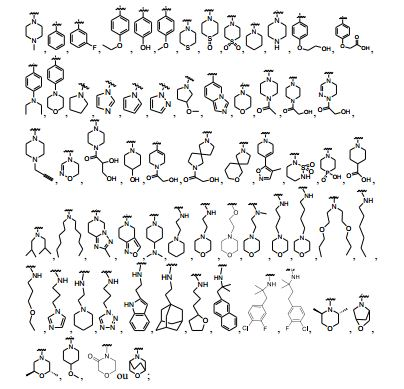
[0022] Em algumas formas de realização, a fórmula (V) é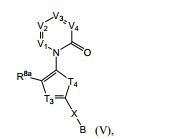


[0023] R1 é H, F, Cl, Br, I, ciano, hidroxi, -N(CH3)2, -C(= O) NH- alquila C1-4, -OC(= O) NH-alquila C1-4,-OC(= O) O-alquila C1-4, -NHC(= O) NH-alquila C1-4, -NHC(= O) O-alquila C1-4, -NHC(= O)-C1-4 alquila, C1-4 alquil-NH-S (= O)2-, C1-4 alquil-S (= O)2-, C1-4 alquil-S (= O)2NH-, metila, etila, propila, isopropila, butila, terc-butila, trifluorometila, ou C6-10 aril- (CH2)P-G-(CH2)m-, em que G é O, S, NR5, S (= O), S (= O)2, ou C(= O); cada p e m é independentemente 0, 1, 2 ou 3; ou em que C6-10 aril-(CH2)P-G- (CH2)m- é opcionalmente substituído por um ou mais F, Cl, Br, I, metila, etila, propila, etinila, propinila, butinila, metoxi, etoxi ou ciano;[0023] R1 is H, F, Cl, Br, I, cyano, hydroxy, -N(CH3)2, -C(=O)NH-C1-4alkyl, -OC(=O)NH-C1-alkyl 4, -OC(= O) O-C1-4 alkyl, -NHC(= O) NH-C1-4 alkyl, -NHC(= O) O-C1-4 alkyl, -NHC(= O)-C1- 4 alkyl, C1-4 alkyl-NH-S (=O)2-, C1-4 alkyl-S (=O)2-, C1-4 alkyl-S (=O)2NH-, methyl, ethyl, propyl, isopropyl, butyl, tert-butyl, trifluoromethyl, or C6-10 aryl-(CH2)PG-(CH2)m-, where G is O, S, NR5, S (=O), S (=O)2, or C(=O); each p and m is independently 0, 1, 2 or 3; or wherein C6-10 aryl-(CH2)PG-(CH2)m- is optionally substituted by one or more F, Cl, Br, I, methyl, ethyl, propyl, ethynyl, propynyl, butynyl, methoxy, ethoxy or cyano ;
[0024] R2 é H, F, Cl, Br, I, ciano, hidroxi, -N(CH3)2, -C(= O) NH- alquila C1-4, -OC(= O) NH-alquila C1-4,-OC(= O) O-alquila C1-4, -NHC(= O) NH-alquila C1-4, -NHC(= O) O-alquila C1-4, -NHC(= O)-C1-4 alquila, C1-4 alquil-NH-S (= O)2-, C1-4 alquil-S (= O)2-, C1-4 alquil-S (= O)2NH-, metila, etila, propila, isopropila, butila, terc-butila, trifluorometila, ou C6-10 aril- (CH2)P-G-(CH2)m-, em que G é O, S, NR5, S (= O), S (= O)2, ou C(= O); cada p e m é independentemente 0, 1, 2 ou 3;[0024] R2 is H, F, Cl, Br, I, cyano, hydroxy, -N(CH3)2, -C(=O)NH-C1-4alkyl, -OC(=O)NH-C1-alkyl 4, -OC(= O) O-C1-4 alkyl, -NHC(= O) NH-C1-4 alkyl, -NHC(= O) O-C1-4 alkyl, -NHC(= O)-C1- 4 alkyl, C1-4 alkyl-NH-S (=O)2-, C1-4 alkyl-S (=O)2-, C1-4 alkyl-S (=O)2NH-, methyl, ethyl, propyl, isopropyl, butyl, tert-butyl, trifluoromethyl, or C6-10 aryl-(CH2)PG-(CH2)m-, where G is O, S, NR5, S (=O), S (=O)2, or C(=O); each p and m is independently 0, 1, 2 or 3;
[0025] R3 é H, F, Cl, I, ciano, hidroxi, -N(CH3)2, -C(= O) NH-alquila C1-4, -OC(= O) NH-alquila C1-4, -OC(= O) O-alquila C1-4, -NHC(= O) NH- alquila C1-4, -NHC(= O) O-alquila C1-4, -NHC(= O)-C1-4 alquila, C1-4 alquila- NH-S (= O)2-, C1-4 alquil-S (= O)2-, C1-4 alquil-S (= O)2NH-, metila, etila, propila, isopropila, butila, ter butila, ou C6-10 aril-(CH2)P-G-(CH2)m-, em que G é O, S, NR5, S (= O), S (= O)2, ou C(= O); cada p e m é independentemente 0, 1, 2 ou 3;[0025] R3 is H, F, Cl, I, cyano, hydroxy, -N(CH3)2, -C(=O)NH-C1-4alkyl, -OC(=O)NH-C1-4alkyl, -OC(= O) O-C1-4 alkyl, -NHC(= O) NH-C1-4 alkyl, -NHC(= O) O-C1-4 alkyl, -NHC(= O)-C1-4 alkyl , C1-4 alkyl-NH-S (=O)2-, C1-4 alkyl-S (=O)2-, C1-4 alkyl-S (=O)2NH-, methyl, ethyl, propyl, isopropyl, butyl, terbutyl, or C6-10 aryl-(CH2)PG-(CH2)m-, where G is O, S, NR5, S (=O), S (=O)2, or C(=O ); each p and m is independently 0, 1, 2 or 3;
[0026] R4 é H, F, I, ciano, hidroxi, -N(CH3)2, -C(= O) NH-alquila C1 4, -OC(= O) NH-alquila C1-4, -OC(= O) O-alquila C1-4, -NHC(= O) NH- alquila C1-4, -NHC(= O) O-alquila C1-4, -NHC(= O)-C1-4 alquila, C1-4 alquila - NH-S (= O)2-, C1-4 alquil-S (= O)2-, C1-4 alquil-S (= O)2NH-, metila, etila, propila, isopropila, butila, terc-butila, trifluorometila, ou C6-10 aril-(CH2)P-G- (CH2)m-, em que G é O, S, NR5, S (= O), S (= O)2, ou C(= O); cada p e m é independentemente 0, 1, 2 ou 3;[0026] R4 is H, F, I, cyano, hydroxy, -N(CH3)2, -C(=O)NH-C14alkyl, -OC(=O)NH-C1-4alkyl, -OC( = O) O-C1-4 alkyl, -NHC(= O) NH-C1-4 alkyl, -NHC(= O) O-C1-4 alkyl, -NHC(= O)-C1-4 alkyl, C1- 4 alkyl - NH-S (= O)2-, C1-4 alkyl-S (= O)2-, C1-4 alkyl-S (=O)2NH-, methyl, ethyl, propyl, isopropyl, butyl, tert -butyl, trifluoromethyl, or C6-10 aryl-(CH2)PG-(CH2)m-, where G is O, S, NR5, S (=O), S (=O)2, or C(=O ); each p and m is independently 0, 1, 2 or 3;
[0027] cada R5 é, independentemente, H, C1-4 alquila, fenila, benzila, piridila ou morfolino metila; e[0027] each R5 is independently H, C1-4 alkyl, phenyl, benzyl, pyridyl or morpholino methyl; and
[0028] cada R8a, R10, R11, e R11a é independentemente H, hidroxi, amino, F, Cl, Br, I, -N(CH3)2, -C(= O) NH-alquila C1-4, -OC(= O) NH alquila- C1-4, -OC(= O) O-alquila C1-4, -NHC(= O) NH-alquila C1-4, -NHC(= O) O- alquila C1-4, -NHC(= O)-C1-4 alquila, C1-4 alquil-NH-S (= O)2-, C1-4 alquil-S (= O)2-, C1-4 alquil-S (= O)2NH-, ciano, nitro, mercapto, C1-4 alquila, trifluorometila, alcoxi C1-4, alquilamino C1-4, alquiltio C1-4, arila C6-10, arila C6- 10-alquila-C1-4 ou heteroarila C1-9.[0028] each R8a, R10, R11, and R11a is independently H, hydroxy, amino, F, Cl, Br, I, -N(CH3)2, -C(=O)NH-C1-4 alkyl, -OC (=O)NH-C1-4alkyl, -OC(=O)O-C1-4alkyl, -NHC(=O)NH-C1-4alkyl, -NHC(=O)O-C1-4alkyl, -NHC(=O)-C1-4 alkyl, C1-4 alkyl-NH-S (=O)2-, C1-4 alkyl-S (=O)2-, C1-4 alkyl-S (=O) 2NH-, cyano, nitro, mercapto, C1-4 alkyl, trifluoromethyl, C1-4 alkoxy, C1-4 alkylamino, C1-4 alkylthio, C6-10 aryl, C6-10 aryl-C1-4-alkyl or C1- heteroaryl 9.
[0029] Em algumas formas de realização, a fórmula (VI) é
[0030] Em algumas formas de realização, R1 é independentemente H, F, Cl, Br, I, ciano, hidroxi, metila, etila, propila, isopropila, butila, terc-butila, C6-8 aril-(CH2)P-G-(CH2)m- ou C4-6 heteroaril-(CH2)P-G-(CH2)m-, em que cada G é NR5, O ou S, cada p e m é independentemente 0, 1, 2 ou 3; ou em que cada um dos C6-8 aril-(CH2)P-G-(CH2)m- e C4-6 heteroaril-(CH2)P-G-(CH2)m- é opcionalmente substituído por um ou mais F, Cl, Br, metila, etila, propila, etinila, propinila, butinila, metoxi, ou ciano; e R3 é, independentemente, H, F, Cl, I, ciano, hidroxi, metila, etila, propila, isopropila, butila, terc-butila, C6-8 aril-(CH2)P-G-(CH2)m- ou heteroaril- C4-6 (CH2)P-G-(CH2)m-, em que cada G é O ou S, cada p e m é independentemente 0, 1, 2 ou 3.[0030] In some embodiments, R1 is independently H, F, Cl, Br, I, cyano, hydroxy, methyl, ethyl, propyl, isopropyl, butyl, tert-butyl, C6-8 aryl-(CH2)PG- (CH2)m- or C4-6 heteroaryl-(CH2)PG-(CH2)m-, wherein each G is NR5, O, or S, each pem is independently 0, 1, 2, or 3; or wherein each of C6-8 aryl-(CH2)PG-(CH2)m- and C4-6 heteroaryl-(CH2)PG-(CH2)m- is optionally substituted by one or more F, Cl, Br, methyl, ethyl, propyl, ethynyl, propynyl, butynyl, methoxy, or cyano; and R3 is independently H, F, Cl, I, cyano, hydroxy, methyl, ethyl, propyl, isopropyl, butyl, tert-butyl, C6-8 aryl-(CH2)PG-(CH2)m- or heteroaryl- C4-6(CH2)PG-(CH2)m-, where each G is O or S, each pem is independently 0, 1, 2 or 3.
[0031] Em algumas formas de realização, a Fórmula (VII) é
[0032] Em algumas formas de realização, cada R7 é, independentemente, H, C1-6 alquila, C1-4 alcoxi-C1-6 alquila,
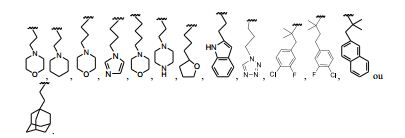
[0033] Em um aspecto, são aqui proporcionadas composições farmacêuticas que compreendem um composto aqui descrito, ou um seu estereoisômero, isômero geométrico, tautômero, óxido de nitrogênio, hidrato, solvato, metabolito, sal farmaceuticamente aceitável ou a pró-droga do mesmo; e opcionalmente um carreador farmaceuticamente aceitável, excipiente, diluente, adjuvante, veículo ou uma combinação dos mesmos.[0033] In one aspect, pharmaceutical compositions are provided which comprise a compound described herein, or a stereoisomer, geometric isomer, tautomer, nitrogen oxide, hydrate, solvate, metabolite, pharmaceutically acceptable salt or prodrug thereof; and optionally a pharmaceutically acceptable carrier, excipient, diluent, adjuvant, vehicle or a combination thereof.
[0034] Em outro aspecto, é proporcionado aqui métodos para proteger, gerir, tratar ou atenuar a gravidade das doenças do tecido ou órgão fibróticas em um paciente, que compreende administrar uma quantidade farmaceuticamente eficaz da composição farmacêutica aqui descrita para o paciente.[0034] In another aspect, methods for protecting, managing, treating or alleviating the severity of fibrotic tissue or organ diseases in a patient are provided herein, which comprises administering a pharmaceutically effective amount of the pharmaceutical composition described herein to the patient.
[0035] Em um aspecto, é proporcionado aqui métodos para proteger, gerir, tratar ou atenuar a gravidade das doenças fibróticas do tecido ou órgão em um paciente, que compreende administrar uma quantidade farmaceuticamente eficaz do composto aqui descrito para o paciente.[0035] In one aspect, methods for protecting, managing, treating or alleviating the severity of fibrotic tissue or organ diseases in a patient are provided herein, which comprises administering a pharmaceutically effective amount of the compound described herein to the patient.
[0036] Em outro aspecto, é aqui proporcionado o uso do composto aqui descrito na fabricação de um medicamento para prevenir, controlar, tratar ou diminuir a gravidade de uma doença fibrótica de tecido ou órgão, em um paciente.[0036] In another aspect, provided herein is the use of the compound described herein in the manufacture of a medicament for preventing, controlling, treating or lessening the severity of a fibrotic tissue or organ disease in a patient.
[0037] Em um aspecto, aqui proporcionada é o uso da composição farmacêutica aqui descrita na fabricação de um medicamento para prevenir, controlar, tratar ou diminuir a gravidade de uma doença fibrótica de tecido ou órgão, em um paciente.[0037] In one aspect, provided herein is the use of the pharmaceutical composition described herein in the manufacture of a medicament to prevent, control, treat or lessen the severity of a fibrotic tissue or organ disease in a patient.
[0038] Em outro aspecto, é aqui proporcionada o uso da composição farmacêutica ou composto aqui descrito para prevenir, controlar, tratar ou diminuir a gravidade de uma doença fibrótica de tecido ou órgão no ser humano ou animal, que compreende a administração de uma quantidade farmaceuticamente eficaz do (a) composição farmacêutica ou composto aqui descrito para o paciente.[0038] In another aspect, provided herein is the use of the pharmaceutical composition or compound described herein to prevent, control, treat or lessen the severity of a fibrotic disease of tissue or organ in a human or animal, which comprises administering an amount pharmaceutically effective treatment of (a) the pharmaceutical composition or compound described herein for the patient.
[0039] Em algumas formas de realização, o distúrbio de fibrose do tecido ou órgão é a fibrose intersticial renal, glomerulosclerose, fibrose hepática, fibrose pulmonar, fibrose do peritoneu, fibrose do miocárdio, dermatofibrose, aderências pós-operatórias, hipertrofia benigna da próstata, fibrose muscular esquelética, dermatoesclerose, esclerose múltipla, fibrose pancreática, cirrose do fígado, miossarcoma, neurofibroma, fibrose intersticial pulmonar, nefropatia diabética, mal de Alzheimer ou fibrose vascular. Em outras formas de realização, aderências pós-cirúrgicas é a cura de cicatriz.[0039] In some embodiments, the tissue or organ fibrosis disorder is renal interstitial fibrosis, glomerulosclerosis, hepatic fibrosis, pulmonary fibrosis, peritoneal fibrosis, myocardial fibrosis, dermatofibrosis, postoperative adhesions, benign prostatic hypertrophy , skeletal muscle fibrosis, dermatosclerosis, multiple sclerosis, pancreatic fibrosis, cirrhosis of the liver, myosarcoma, neurofibroma, interstitial pulmonary fibrosis, diabetic nephropathy, Alzheimer's disease or vascular fibrosis. In other embodiments, post-surgical adhesions are scar healing.
[0040] Em outro aspecto, fornecida na presente invenção incluem os métodos de preparação, os métodos de separação e métodos de purificação de compostos de Fórmula (I), (IV), (V), (VI) ou (VII).[0040] In another aspect, provided in the present invention include methods of preparation, methods of separation and methods of purification of compounds of Formula (I), (IV), (V), (VI) or (VII).
[0041] O precedente meramente resume determinados aspectos aqui descritos e não se pretende que sejam limitantes em natureza. Estes aspectos e outros aspectos e formas de realização são descritos mais detalhadamente abaixo.[0041] The foregoing merely summarizes certain aspects described herein and is not intended to be limiting in nature. These aspects and other aspects and embodiments are described in more detail below.
[0042] Referência será feita agora em detalhe a certas formas de realização aqui descritas, cujos exemplos são ilustrados nas estruturas e fórmulas que a acompanham. A invenção se destina a cobrir todas as alternativas, modificações e equivalentes que possam ser incluídas dentro do escopo aqui descrito, tal como definido pelas reivindicações. Uma pessoa versada na técnica irá reconhecer que muitos métodos e materiais semelhantes ou equivalentes aos aqui descritos, podem ser utilizados na prática aqui descritos. Descreve-se aqui de forma alguma limitada aos métodos e materiais. No caso em que uma ou mais das patentes, literatura e outros materiais similares incorporados diferem entre si ou contradizem esta aplicação, incluindo, mas não limitado a, o uso de termos, técnicas descritas, ou semelhantes, este pedido controla.[0042] Reference will now be made in detail to certain embodiments described herein, examples of which are illustrated in the accompanying structures and formulas. The invention is intended to cover all alternatives, modifications and equivalents that may be included within the scope described herein, as defined by the claims. One skilled in the art will recognize that many methods and materials similar or equivalent to those described herein can be used in the practice described herein. It is described here by no means limited to methods and materials. In the event that one or more of the patents, literature, and other similar materials incorporated herein differ from one another or contradict this application, including, but not limited to, the use of terms, described techniques, or the like, this application governs.
[0043] Tal como aqui utilizado, as definições seguintes devem ser aplicadas a menos que indicado de outra forma. Para os fins aqui descritos, os elementos químicos são identificados de acordo com a Tabela Periódica dos Elementos da versão, CAS, e do Handbook of Chemistry and Physics, 75th Ed. 1994. Além disso, os princípios gerais de química orgânica, são descritos em Sorrell et al, "Organic Chemistry", University Science Books, Sausalito:, 1999, e Smith et al, "Advanced Organic Chemistry de March", John Wiley & Sons, Inc.., Nova Iorque: 2007, todas as quais são aqui incorporadas por referência na sua totalidade.[0043] As used herein, the following definitions shall apply unless otherwise noted. For the purposes described herein, chemical elements are identified according to the Periodic Table of Elements version, CAS, and the Handbook of Chemistry and Physics, 75th Ed. 1994. In addition, general principles of organic chemistry are described in Sorrell et al, "Organic Chemistry", University Science Books, Sausalito:, 1999, and Smith et al, "Advanced Organic Chemistry de March", John Wiley & Sons, Inc., New York: 2007, all of which are here incorporated by reference in their entirety.
[0044] Tal como aqui descrito, os compostos podem, opcionalmente, ser substituído com um ou mais substituintes, tais como aqueles ilustrados acima, ou como exemplificados por determinadas classes, subclasses e espécies aqui revelados. Deve ser notado que a frase "opcionalmente substituído" é utilizada intermutavelmente com a frase "substituído ou não substituído". Em geral, o termo "substituído", se precedido pelo termo "opcionalmente" ou não, se refere à substituição de um ou mais radicais de hidrogênio em uma dada estrutura com o radical de um substituinte especificado. A menos que indicado de outro modo, um grupo opcionalmente substituído pode ter um substituinte em cada posição substituível do grupo. Quando mais do que uma posição em uma dada estrutura pode ser substituída com mais do que um substituinte selecionado a partir de um grupo especificado, o substituinte pode ser o mesmo ou diferente em cada posição. Em que os substituintes incluem, mas não estão limitados a, hidroxi, amino, halo, ciano, arila, heteroarila, alcoxi, alquilamino, alquiltio, alquila, haloalquila, alquenila, alquinila, heterociclila, tiol, nitro, ariloxi, heteroariloxi, oxo (O =), carboxi, alcoxi substituído com hidroxi, alquila substituída com hidroxi-C(= O)-, alquil-C(= O)-, alquil-S (= O)-, alquil-S (= O)2-, alquila substituída com hidroxi-S (= O)-, alquila substituída com hidroxi-S (= O)2-, carboxialcoxi, e semelhantes.[0044] As described herein, the compounds may optionally be substituted with one or more substituents, such as those illustrated above, or as exemplified by certain classes, subclasses, and species disclosed herein. It should be noted that the phrase "optionally substituted" is used interchangeably with the phrase "substituted or unsubstituted". In general, the term "substituted", whether preceded by the term "optionally" or not, refers to the substitution of one or more hydrogen radicals in a given structure with the radical of a specified substituent. Unless otherwise indicated, an optionally substituted group may have a substituent at each substitutable position of the group. When more than one position in a given structure can be substituted with more than one substituent selected from a specified group, the substituent can be the same or different at each position. Wherein the substituents include, but are not limited to, hydroxy, amino, halo, cyano, aryl, heteroaryl, alkoxy, alkylamino, alkylthio, alkyl, haloalkyl, alkenyl, alkynyl, heterocyclyl, thiol, nitro, aryloxy, heteroaryloxy, oxo ( O=), carboxy, hydroxy-substituted alkoxy, hydroxy-substituted alkyl-C(=O)-, alkyl-C(=O)-, alkyl-S (=O)-, alkyl-S (=O)2- , hydroxy-S (=O)-substituted alkyl, hydroxy-S (=O)2-substituted alkyl, carboxyalkoxy, and the like.
[0045] O termo "alifático" ou "grupo alifático" se refere a uma cadeia linear (isto é, não ramificada) ou ramificada, cadeia de hidrocarboneto substituído ou não substituído que está completamente saturado ou que contém uma ou mais unidades de insaturação. Salvo indicação em contrário, os grupos alifáticos contêm de 1 a 20 átomos de carbono. Em algumas formas de realização, os grupos alifáticos contêm de 1 a 10 átomos de carbono. Em outras formas de realização, os grupos alifáticos contêm de 1 a 8 átomos de carbono. Em ainda outras formas de realização, os grupos alifáticos contêm de 1 a 6 átomos de carbono. Em ainda outras formas de realização, os grupos alifáticos contêm de 1 a 4 átomos de carbono, e ainda em outras formas de realização, os grupos alifáticos contêm de 1 a 3 átomos de carbono. Grupos alifáticos adequados incluem, mas não estão limitados a, grupos alquila, alquenila, ou alquinila linear ou ramificado, substituído ou não substituído, tais como metila, etila, propila, isopropila, butila, terc-butila, hexila, isobutila, sec-butila, etenila, e semelhantes.[0045] The term "aliphatic" or "aliphatic group" refers to a straight (i.e., unbranched) or branched, substituted or unsubstituted hydrocarbon chain that is completely saturated or that contains one or more units of unsaturation. Unless otherwise noted, aliphatic groups contain from 1 to 20 carbon atoms. In some embodiments, the aliphatic groups contain from 1 to 10 carbon atoms. In other embodiments, the aliphatic groups contain from 1 to 8 carbon atoms. In still other embodiments, the aliphatic groups contain from 1 to 6 carbon atoms. In still other embodiments, the aliphatic groups contain from 1 to 4 carbon atoms, and in still other embodiments, the aliphatic groups contain from 1 to 3 carbon atoms. Suitable aliphatic groups include, but are not limited to, substituted or unsubstituted linear or branched alkyl, alkenyl, or alkynyl groups such as methyl, ethyl, propyl, isopropyl, butyl, tert-butyl, hexyl, isobutyl, sec-butyl , ethylene, and the like.
[0046] O termo "haloalifático" se refere a um grupo alifático substituído por um ou mais dos mesmos ou diferentes átomos de halogênio, em que o grupo alifático é como aqui definidos, átomos de halogênio se referem a F, Cl, Br ou I. Alguns exemplos não limitativos incluem trifluorometila, trifluoroetila, clorometila, 2-cloroetileno, e semelhantes.[0046] The term "haloaliphatic" refers to an aliphatic group substituted by one or more of the same or different halogen atoms, wherein the aliphatic group is as defined herein, halogen atoms refer to F, Cl, Br or I Some non-limiting examples include trifluoromethyl, trifluoroethyl, chloromethyl, 2-chloroethylene, and the like.
[0047] O termo "hidroxialifático" se refere a um grupo alifático substituído por um ou mais grupos hidroxi, em que o grupo alifático é como aqui definido. Alguns exemplos não limitativos incluem hidroxietila, 2- hidroxipropila, hidroximetila, e semelhantes.[0047] The term "hydroxyaliphatic" refers to an aliphatic group substituted by one or more hydroxy groups, wherein the aliphatic group is as defined herein. Some non-limiting examples include hydroxyethyl, 2-hydroxypropyl, hydroxymethyl, and the like.
[0048] O termo "aminoalifático" se refere a um grupo alifático substituído por um ou mais grupos amino, em que o grupo alifático é como aqui definido. Alguns exemplos não limitativos incluem aminometila, 2- aminoetila, 2-aminoisopropila, e semelhantes.[0048] The term "aminoaliphatic" refers to an aliphatic group substituted by one or more amino groups, wherein the aliphatic group is as defined herein. Some non-limiting examples include aminomethyl, 2-aminoethyl, 2-aminoisopropyl, and the like.
[0049] O termo "alquila" se refere a uma cadeia linear saturada ou de cadeia ramificada de hidrocarboneto monovalente de 1 a 20 átomos de carbono, de 1 a 10 átomos de carbono, de 1 a 6 átomos de carbono, de 1 a 4 átomos de carbono, ou de 1 a 3 átomos de carbono, em que o radical alquila pode ser eventualmente substituído, independentemente, com um ou mais substituintes descritos abaixo. Outros exemplos de grupos alquila incluem, mas não estão limitados a, metila (Me, -CH3), etila (Et, -CH2CH3), 1-propila (n-Pr, n-propila, -CH2CH2CH3), 2-propila (i -Pr, i-propila, -CH(CH3)2), 1- butila (n-Bu, n-butila, -CH2CH2CH2CH3), 2-metil-l-propila (i-Bu, i-butila, - CH2CH(CH3)2), 2-butila (s-Bu, s-butila, -CH(CH3) CH2CH3), 2-metil-2- propila (t-Bu, t-butila, -C(CH3 3)), 1-pentila (n-pentila, - CH2CH2CH2CH2CH3), 2-pentila (-CH(CH3) CH2CH2CH3), 3-pentila (- CH(CH2CH3)2), 2-metil-2-butila (-C(CH3)2CH2CH3), 3-metil-2-butila (- CH(CH3) CH(CH3)2), 3-metil-l-butila (-CH2CH2CH(CH3)2), 2-metil-l-butila (- CH2CH(CH3) CH2CH3), 1-hexila (-CH2CH2CH2CH2CH2CH3), 2-hexila (- CH(CH3) CH2CH2CH2CH3), 3-hexila (-CH(CH2CH3) (CH2CH2CH3)), 2- metil-2-pentila (-C(CH3)2CH2CH2CH3), 3-metil-2-pentila (-CH(CH3) CH(CH3) CH2CH3), 4-metil-2-pentila (-CH(CH3) CH2CH(CH3)2), 3-metil-3- pentila (-C(CH3) (CH2CH3)2), 2-metil-3-pentila (-CH(CH2CH3) CH(CH 3 2)), 2,3-dimetil-2-butila (-C(CH3)2CH(CH3)2), 3,3-dimetil-2-butila (-CH(CH3) C(CH3) 3, 1-heptila, 1-octila, e semelhantes. Os termos "alquila" e o prefixo "alq" são inclusive de cadeia linear e de cadeia ramificada de carbono saturado. O termo "alquileno", tal como aqui utilizado, representa um grupo hidrocarboneto saturado divalente derivado de um hidrocarboneto saturado de cadeia linear ou ramificada pela remoção de dois átomos de hidrogênio, e é exemplificado por metileno, etileno, isopropileno e semelhantes.[0049] The term "alkyl" refers to a saturated straight chain or branched chain monovalent hydrocarbon of 1 to 20 carbon atoms, 1 to 10 carbon atoms, 1 to 6 carbon atoms, 1 to 4 carbon atoms, or from 1 to 3 carbon atoms, wherein the alkyl radical may optionally be substituted, independently, with one or more substituents described below. Other examples of alkyl groups include, but are not limited to, methyl (Me, -CH3), ethyl (Et, -CH2CH3), 1-propyl (n-Pr, n-propyl, -CH2CH2CH3), 2-propyl (i -Pr, i-propyl, -CH(CH3)2), 1-butyl (n-Bu, n-butyl, -CH2CH2CH2CH3), 2-methyl-1-propyl (i-Bu, i-butyl, -CH2CH( CH3)2), 2-butyl (s-Bu, s-butyl, -CH(CH3)CH2CH3), 2-methyl-2-propyl (t-Bu, t-butyl, -C(CH3 3)), 1 -pentyl (n-pentyl, -CH2CH2CH2CH2CH3), 2-pentyl (-CH(CH3)CH2CH2CH3), 3-pentyl (-CH(CH2CH3)2), 2-methyl-2-butyl (-C(CH3)2CH2CH3) , 3-methyl-2-butyl (-CH(CH3)CH(CH3)2), 3-methyl-1-butyl (-CH2CH2CH(CH3)2), 2-methyl-1-butyl (-CH2CH(CH3) CH2CH3), 1-hexyl (-CH2CH2CH2CH2CH2CH3), 2-hexyl (-CH(CH3) CH2CH2CH2CH3), 3-hexyl (-CH(CH2CH3) (CH2CH2CH3)), 2-methyl-2-pentyl (-C(CH3) 2CH2CH2CH3), 3-methyl-2-pentyl (-CH(CH3) CH(CH3) CH2CH3), 4-methyl-2-pentyl (-CH(CH3) CH2CH(CH3)2), 3-methyl-3-pentyl (-C(CH3)(CH2CH3)2), 2-methyl-3-pentyl (-CH(CH2CH3) CH(CH 3 2)), 2,3-dimethyl-2-butyl (-C(CH3)2CH( CH3)2), 3,3-dimethyl-2-bu ethyl (-CH(CH 3 ) C(CH 3 ) 3, 1-heptyl, 1-octyl, and the like. The terms "alkyl" and the prefix "alk" are inclusive of straight-chain and branched-chain saturated carbon. The term "alkylene", as used herein, represents a divalent saturated hydrocarbon group derived from a straight or branched chain saturated hydrocarbon by the removal of two hydrogen atoms, and is exemplified by methylene, ethylene, isopropylene and the like.
[0050] O termo "alquileno" se refere a alquila possuindo sistema de dois pontos de ligação ligados à parte restante da molécula, em que o radical alquila é tal como aqui definido.[0050] The term "alkylene" refers to alkyl having a two-point attachment system attached to the remainder of the molecule, wherein the alkyl radical is as defined herein.
[0051] O termo "alquenila" se refere a um radical de hidrocarboneto monovalente de cadeia linear ou ramificada, de 2 a 12 átomos de carbono, de 2 a 8 átomos de carbono, de 2 a 6 átomos de carbono, ou de 2 a 4 átomos de carbono, com pelo menos um sítio de insaturação, ou seja, um carbono- carbono, ligação dupla sp2, em que o radical alquenila pode estar opcionalmente substituído independentemente com um ou mais substituintes aqui descritos, e inclui radicais tendo "cis" e "trans" orientações, ou, alternativamente, "e" e orientações "z". Alguns exemplos não limitativos incluem etenila ou vinila (-CH = CH2), alila (-CH2CH = CH2) e semelhantes.[0051] The term "alkenyl" refers to a straight or branched chain monovalent hydrocarbon radical of 2 to 12 carbon atoms, 2 to 8 carbon atoms, 2 to 6 carbon atoms, or 2 to 6 carbon atoms. 4 carbon atoms, with at least one site of unsaturation, i.e. a carbon-carbon, sp2 double bond, wherein the alkenyl radical may be optionally substituted independently with one or more substituents described herein, and includes radicals having "cis" and "trans" orientations, or, alternatively, "e" and "z" orientations. Some non-limiting examples include ethenyl or vinyl (-CH=CH2), allyl (-CH2CH=CH2) and the like.
[0052] O termo "alquenileno" se refere ao sistema de alquenila possuindo dois pontos de ligação ligados à parte restante da molécula, em que o radical alquenila é como aqui definido.[0052] The term "alkenylene" refers to the alkenyl system having two attachment points attached to the remainder of the molecule, wherein the alkenyl radical is as defined herein.
[0053] O termo "alquinila" se refere a um radical hidrocarboneto monovalente de cadeia linear ou ramificada, de 2 a 12 átomos de carbono, de 2 a 8 átomos de carbono, de 2 a 6 átomos de carbono, ou de 2 a 4 átomos de carbono, com pelo menos um sítio de insaturação, ou seja, um carbono- carbono, ligação tripla sp, em que o radical alquinila pode estar opcionalmente substituído independentemente com um ou mais substituintes aqui descritos. Alguns exemplos não limitativos incluem etinil (-C = CH), 2- propinila (-CH2EzEJ+."g"ugognjcpvgu0[0053] The term "alkynyl" refers to a monovalent straight or branched chain hydrocarbon radical of 2 to 12 carbon atoms, 2 to 8 carbon atoms, 2 to 6 carbon atoms, or 2 to 4 carbon atoms, with at least one site of unsaturation, i.e., a carbon-carbon, sp triple bond, wherein the alkynyl radical may be optionally substituted independently with one or more substituents described herein. Some non-limiting examples include ethynyl (-C = CH), 2-propynyl (-CH2EzEJ+."g"ugognjcpvgu0
[0054] O termo "alquinileno" se refere ao sistema alquinila possuindo dois pontos de ligação ligados à parte restante da molécula, em que o radical alquinila é como aqui definido.[0054] The term "alkynylene" refers to the alkynyl system having two points of attachment attached to the remainder of the molecule, wherein the alkynyl radical is as defined herein.
[0055] O termo "alquila substituída com hidroxi" se refere a um grupo alquila substituído com um ou mais grupos hidroxi, em que o grupo alquila é como aqui definido. Alguns exemplos não limitativos incluem hidroximetila, hidroxietila, 1,2-di-hidroxietila, e similares.[0055] The term "hydroxy substituted alkyl" refers to an alkyl group substituted with one or more hydroxy groups, wherein the alkyl group is as defined herein. Some non-limiting examples include hydroxymethyl, hydroxyethyl, 1,2-dihydroxyethyl, and the like.
[0056] O termo "alquila substituído com carboxi" se refere a um grupo alquila substituído com um ou mais grupos carboxi, em que o grupo alquila é como aqui definido. Alguns exemplos não limitativos incluem carboximetila, carboxietila, e similares.[0056] The term "carboxy-substituted alkyl" refers to an alkyl group substituted with one or more carboxy groups, wherein the alkyl group is as defined herein. Some non-limiting examples include carboxymethyl, carboxyethyl, and the like.
[0057] O termo "cicloalifáticos", "carbociclo", "carbociclila" ou "cicloalquila" se refere a um radical monovalente ou multivalente, não aromático, de anel saturado ou parcialmente insaturado, e não contendo heteroátomos, com de 3 a 12 átomos de carbono como um anel monocíclico ou de 7 a 12 átomos de carbono como um anel bicíclico ou um anel tricíclico. Os carbociclos bicíclicos tendo de 7 a 12 átomos podem ser dispostos, por exemplo, como um sistema biciclo [4,5], [5,5], [5,6] ou [6,6], e carbociclos bicíclicos tendo 9 ou 10 átomos de anel podem ser dispostos como um sistema biciclo [5,6] ou [6,6]. Alguns exemplos não limitativos de grupos cicloalifáticos incluem cicloalquila, cicloalquenila, e cicloalquinila. Outros exemplos de grupos cicloalifáticos incluem ciclopropila, ciclobutila, ciclopentila, 1-ciclopent-l-enila, l-ciclopent-2-enila, l-ciclopent-3-enila, ciclo- hexila, 1-ciclo-hex-l-enila, l-ciclo-hex-2-enila, l-ciclo-hex-3-enila, ciclo- hexadienila, ciclo-heptila, ciclooctila, ciclononila, ciclodecila, cicloundecila, ciclododecila, adamantila, e similares. E "cicloalifático", "carbociclo", "carbociclila", ou "cicloalquila" pode ser substituído ou não substituído, em que o substituinte pode ser, mas não está limitado a, hidroxi, amino, halo, ciano, arila, heteroarila, alcoxi, alquilamino, alquila, haloalquila, alquenila, alquinila, heterociclila, tiol, nitro, ariloxi, alcoxi substituído com hidroxi, hidroxi-substituído-C(= O)-, alquil-C(= O)-, alquil-S (= O)-, alquil-S (= O)2-, alquila substituída com hidroxi-S (= O)-, alquila substituída com hidroxi-S (= O)2-, carboxialcoxi, e semelhantes.[0057] The term "cycloaliphatic", "carbocycle", "carbocyclyl" or "cycloalkyl" refers to a monovalent or multivalent, non-aromatic, saturated or partially unsaturated ring radical, and not containing heteroatoms, with from 3 to 12 atoms of carbon as a monocyclic ring or of 7 to 12 carbon atoms as a bicyclic ring or a tricyclic ring. Bicyclic carbocycles having 7 to 12 atoms can be arranged, for example, as a [4.5], [5.5], [5.6] or [6.6] bicycle system, and bicyclic carbocycles having 9 or 10 ring atoms can be arranged as a [5,6] or [6,6] bicycle system. Some non-limiting examples of cycloaliphatic groups include cycloalkyl, cycloalkenyl, and cycloalkynyl. Other examples of cycloaliphatic groups include cyclopropyl, cyclobutyl, cyclopentyl, 1-cyclopent-1-enyl, 1-cyclopent-2-enyl, 1-cyclopent-3-enyl, cyclohexyl, 1-cyclohex-1-enyl, 1-cyclohex-2-enyl, 1-cyclohex-3-enyl, cyclohexadienyl, cycloheptyl, cyclooctyl, cyclononyl, cyclodecyl, cycloundecyl, cyclododecyl, adamantyl, and the like. And "cycloaliphatic", "carbocycle", "carbocyclyl", or "cycloalkyl" may be substituted or unsubstituted, wherein the substituent may be, but is not limited to, hydroxy, amino, halo, cyano, aryl, heteroaryl, alkoxy , alkylamino, alkyl, haloalkyl, alkenyl, alkynyl, heterocyclyl, thiol, nitro, aryloxy, hydroxy-substituted alkoxy, hydroxy-substituted-C(=O)-, alkyl-C(=O)-, alkyl-S(=O) )-, alkyl-S (=O)2-, alkyl substituted with hydroxy-S (=O)-, alkyl substituted with hydroxy-S (=O)2-, carboxyalkoxy, and the like.
[0058] O termo "carbociclileno" se refere ao sistema carbociclila tendo dois pontos de ligação ligados à parte restante da molécula, em que o radical carbociclila é como aqui definido.[0058] The term "carbocyclylene" refers to the carbocyclyl system having two points of attachment attached to the remainder of the molecule, wherein the carbocyclyl radical is as defined herein.
[0059] O termo "carbociclila (hidroxialcoxi)" se refere a um grupo hidroxialcoxi substituído com um ou mais grupos carbociclila, em que o grupo carbociclila e grupo hidroxialcoxi são como aqui definido. Alguns exemplos não limitativos incluem ciclopropil hidroximetila, ciclopropil hidroxietila, ciclopropila, hidroxipropil celulose, ciclo-hexil hidroxipropila, ciclo-hexil hidroximetila, e semelhantes.[0059] The term "carbocyclyl (hydroxyalkoxy)" refers to a hydroxyalkoxy group substituted with one or more carbocyclyl groups, wherein the carbocyclyl group and hydroxyalkoxy group are as defined herein. Some non-limiting examples include cyclopropyl hydroxymethyl, cyclopropyl hydroxyethyl, cyclopropyl, hydroxypropyl cellulose, cyclohexyl hydroxypropyl, cyclohexyl hydroxymethyl, and the like.
[0060] O termo "cicloalquiloxi" ou "carbocicliloxi" se refere a um radical cicloalquila opcionalmente substituído ou carbociclila radical, tal como definido hererin, ligados a um átomo de oxigênio, que está ligado ao resto da molécula. Alguns exemplos não limitativos incluem ciclopropiloxi, ciclopentiloxi, ciclo-hexiloxi, ciclopropiloxi substituído com hidroxi, e semelhantes.[0060] The term "cycloalkyloxy" or "carbocyclyloxy" refers to an optionally substituted cycloalkyl radical or carbocyclyl radical, as defined hererin, attached to an oxygen atom, which is attached to the rest of the molecule. Some non-limiting examples include cyclopropyloxy, cyclopentyloxy, cyclohexyloxy, hydroxy substituted cyclopropyloxy, and the like.
[0061] O termo "cicloalquilamino" se refere a um grupo amino substituído com um ou dois grupos cicloalquila, em que o grupo cicloalquila é como aqui definido. Alguns exemplos não limitativos incluem ciclopropilamino, ciclopentilamino, ciclo-hexilamino, ciclopropilamino substituído com hidroxi, diciclo-hexilamino, diciclopropilamino, e semelhantes.[0061] The term "cycloalkylamino" refers to an amino group substituted with one or two cycloalkyl groups, wherein the cycloalkyl group is as defined herein. Some non-limiting examples include cyclopropylamino, cyclopentylamino, cyclohexylamino, hydroxy substituted cyclopropylamino, dicyclohexylamino, dicyclopropylamino, and the like.
[0062] O termo "carbocicliloxialcoxi" se refere a um grupo alcoxi substituído com um ou mais grupos carbocicliloxi, em que o grupo alcoxi e grupo carbocicliloxi são como aqui definido. Alguns exemplos não limitativos incluem ciclopropiloximetoxi, ciclopropiloxietoxi, ciclopentiloxietoxi, ciclo- hexiloxietoxi, ciclo-hexenila-3-oxietoxi, e semelhantes.[0062] The term "carbocyclyloxyalkoxy" refers to an alkoxy group substituted with one or more carbocyclyloxy groups, wherein the alkoxy group and carbocyclyloxy group are as defined herein. Some non-limiting examples include cyclopropyloxymethoxy, cyclopropyloxyethoxy, cyclopentyloxyethoxy, cyclohexyloxyethoxy, cyclohexenyl-3-oxyethoxy, and the like.
[0063] O termo "cicloalquiloxialifático" se refere a um grupo alifático substituído com um ou mais grupos cicloalquiloxi, em que o grupo alifático e grupo cicloalquiloxi são como aqui definido. Alguns exemplos não limitativos incluem ciclopropiloximetila, ciclopropiloxietila, ciclopentiloximetila, ciclopentiloxietila, ciclo-hexiloxietila, halociclopropiloxietila, e semelhantes.[0063] The term "aliphatic cycloalkyloxy" refers to an aliphatic group substituted with one or more cycloalkyloxy groups, wherein the aliphatic group and cycloalkyloxy group are as defined herein. Some non-limiting examples include cyclopropyloxymethyl, cyclopropyloxyethyl, cyclopentyloxymethyl, cyclopentyloxyethyl, cyclohexyloxyethyl, halocyclopropyloxyethyl, and the like.
[0064] O termo "cicloalquilaminoalifático" se refere a um grupo alifático substituído com um ou mais grupos cicloalquilamino, em que o grupo alifático e grupo cicloalquilamino são como aqui definido. Alguns exemplos não limitativos incluem ciclopropilaminometila,ciclopropilaminoetila, ciclopentilaminometila, ciclopentilaminoetila, ciclo- hexilaminoetila, halociclopropilaminoetila, e semelhantes.[0064] The term "aliphatic cycloalkylamino" refers to an aliphatic group substituted with one or more cycloalkylamino groups, wherein the aliphatic group and cycloalkylamino group are as defined herein. Some non-limiting examples include cyclopropylaminomethyl, cyclopropylaminoethyl, cyclopentylaminomethyl, cyclopentylaminoethyl, cyclohexylaminoethyl, halocyclopropylaminoethyl, and the like.
[0065] O termo "cicloalquilalifático" ou "carbociclilalifático" se refere a um grupo alifático substituído com um ou mais grupos cicloalquila ou grupos carbociclila, em que o grupo carbociclila, o grupo cicloalquila e grupo alifático são como aqui definido. Alguns exemplos não limitativos incluem ciclopropilmetila, ciclopropiletila, ciclopropilpropila, ciclopentilmetila, ciclo- hexiletila e similares.[0065] The term "cycloalkylaliphatic" or "carbocyclylaliphatic" refers to an aliphatic group substituted with one or more cycloalkyl groups or carbocyclyl groups, wherein the carbocyclyl group, cycloalkyl group and aliphatic group are as defined herein. Some non-limiting examples include cyclopropylmethyl, cyclopropylethyl, cyclopropylpropyl, cyclopentylmethyl, cyclohexylethyl and the like.
[0066] O termo "cicloalquilalcoxi" ("carbociclilalcoxi") se refere a um grupo alcoxi substituído com um ou mais grupos cicloalquila ou grupos carbociclila, em que o grupo carbociclila, o grupo cicloalquila e grupo alcoxi são como aqui definidos. Alguns exemplos não limitativos incluem ciclopropilmetoxi, ciclopropiletoxi, ciclopentiletoxi, ciclo-hexiletoxi, ciclo- hexilmetoxi, ciclopropilpropoxi, e semelhantes.[0066] The term "cycloalkylalkoxy" ("carbocyclylalkoxy") refers to an alkoxy group substituted with one or more cycloalkyl groups or carbocyclyl groups, wherein the carbocyclyl group, cycloalkyl group and alkoxy group are as defined herein. Some non-limiting examples include cyclopropylmethoxy, cyclopropylethoxy, cyclopentylethoxy, cyclohexylethoxy, cyclohexylmethoxy, cyclopropylpropoxy, and the like.
[0067] O termo "cicloalquilalquilamino" ("carbociclilalquilamino") se refere a um grupo amino substituído com um ou mais grupos cicloalquila ou grupos carbociclila, em que o grupo carbociclila, o grupo cicloalquila e grupo alquilamino são como aqui definido. Alguns exemplos não limitativos incluem ciclopropilmetilamino, ciclopropiletilamino, ciclopentiletilamino, ciclo-hexiletilamino, ciclo-hexilmetilamino, ciclopropilpropilamino, e semelhantes.[0067] The term "cycloalkylalkylamino" ("carbocyclylalkylamino") refers to an amino group substituted with one or more cycloalkyl groups or carbocyclyl groups, wherein the carbocyclyl group, cycloalkyl group and alkylamino group are as defined herein. Some non-limiting examples include cyclopropylmethylamino, cyclopropylethylamino, cyclopentylethylamino, cyclohexylethylamino, cyclohexylmethylamino, cyclopropylpropylamino, and the like.
[0068] O termo "heterociclo", "heterociclila", "heterocicloalifico", ou "heterocíclico", como aqui indiferentemente utilizado se refere a um sistema de anel monocíclico, bicíclico, ou tricíclico, em que um ou mais membros do anel são selecionados, independentemente, um heteroátomo e que está completamente saturado ou que contém uma ou mais unidades de insaturação, mas não aromático possuindo um único ponto de fixação ao resto da molécula. Um ou mais átomos do anel são opcionalmente independentemente substituído com um ou mais substituintes aqui descritos. Em algumas formas de realização, o grupo "heterociclo", "heterociclila", "heterocicloalifico" ou "heterocíclico" é um monociclo com de 3 a 7 membros no anel (por exemplo, 1 a 6 átomos de carbono e 1 a 3 heteroátomos selecionados de entre N, O, P ou S, em que o S ou P está opcionalmente substituído com um ou mais oxo para proporcionar o grupo SO ou SO2, PO ou PO2, com a condição de que quando o anel é um anel de 3 membros, existe apenas um heteroátomo) ou um biciclo tendo de 7 a 10 membros no anel (por exemplo, 4 a 9 átomos de carbono e 1 a 3 heteroátomos selecionados de entre N, O, P ou S, em que o S ou P está opcionalmente substituído com um ou mais oxo para proporcionar o grupo SO ou SO2, PO ou PO2).[0068] The term "heterocycle", "heterocyclyl", "heterocycloaliphatic", or "heterocyclic", as interchangeably used herein, refers to a monocyclic, bicyclic, or tricyclic ring system in which one or more ring members are selected. , independently, a heteroatom and which is fully saturated or which contains one or more units of unsaturation, but not aromatic, having a single point of attachment to the rest of the molecule. One or more ring atoms are optionally independently substituted with one or more substituents described herein. In some embodiments, the "heterocycle", "heterocyclyl", "heterocycloaliphatic", or "heterocyclic" group is a monocycle with 3 to 7 ring members (e.g., 1 to 6 carbon atoms and 1 to 3 selected heteroatoms). from N, O, P or S, wherein the S or P is optionally substituted with one or more oxo to provide the group SO or SO2, PO or PO2, with the proviso that when the ring is a 3-membered ring , there is only one heteroatom) or a bicycle having 7 to 10 ring members (e.g. 4 to 9 carbon atoms and 1 to 3 heteroatoms selected from N, O, P or S, where S or P is optionally substituted with one or more oxo to provide the group SO or SO2, PO or PO2).
[0069] A heterociclila pode ser um radical de carbono ou radical de heteroátomo. "Heterociclila" também inclui radicais em que radicais de heterociclo são fundidos com um anel saturado, parcialmente insaturado, ou um anel heterocíclico. Alguns exemplos não limitativos de anéis heterocíclicos incluem pirrolidinila, tetra-hidrofuranila, di-hidrofuranila, tetra- hidrotienila, tetra-hidropiranila, di-hidropiranila, tetra-hidrotiopiranila, piperidino, morfolino, tiomorfolino, tioxanila, piperazinila, homopiperazinila, azetidinila, oxetanila, tietanila, piperidino, homopiperidinila, epoxipropila, azepanila, oxepanila, tiepanila, 4-metoxi-piperidin-1-ila, 1,2,3,6-tetra- hidropiridin-1-ila, oxazepinila, diazepinila, tiazepinila, pirrolin-1-ila, 2- pirrolinila, 3-pirrolinila, indolinila, 2H -piranil, 4H-piranila, dioxanila, 1,3- dioxolanila, pirazolinila, ditianila, ditiolanila, di-hidrotienila,pirazolidinilimidazolinila, imidazolidinila, 1,2,3,4-tetra-hidroisoquinolinila, 1,2,6-tiadiazana-1-1-dioxo -2-ila, 4-hidroxi-1,4-azafosfina-4-óxido-1-ila, 2- hidroxi-1-(piperazin-1-il) etanon-4-ila, 2-hidroxi-1-(5, 6-di-hidro-1,2,4- triazina-1 (4H)-il) etanon-4-ila, 5,6-di-hidro-4H-1,2,4-oxadiazin-4-ila, 2- hidroxi- 1-(5,6-di-hidropiridin-1 (2H)-il) etanon-4-ila, 3-azabiciclo [3.1.0] hexanila, 3-azabiciclo [4.1.0] heptanila, azabiciclo [2.2.2] hexanila, 2-metil- 5,6,7,8-tetra-hidro- [1,2,4] triazolo [1,5-c] pirimidin-6-ila, 4,5,6,7-tetra- hidroisoxazol [4,3-c ] piridin-5-ila, 3H-indolil-2-oxo-5-azabiciclo [2.2.1] heptan-5-ila, 2-oxo-5-azabiciclo [2.2.2] octano-5-ila, quinolizinila e N-piridil uréia. Alguns exemplos não limitativos de um anel heterocíclico incluem 1,1- dioxo-tiomorfolinilo e grupo heterocíclico em que 2 átomos de carbono no anel está substituído com oxo (= O) são porções pirimidindionila. O grupo heterocíclico aqui pode ser substituído ou não substituído, em que o substituinte pode ser, mas não está limitado a, oxo (= O), hidroxi, amino, halo, ciano, heteroarila, alcoxi, alquilamino, alquila, haloalquila, alquenila, alquinila, heterociclila, tiol, nitro, ariloxi, alcoxi substituído com hidroxi, alquila substituída com hidroxi-C(= O)-, alquil-C(= O)-, alquil-S (= O)-, alquil-S (= O)2-, alquila substituída com hidroxi-S (= O)-, alquila substituída com hidroxi-S (= O)2-, carboxialcoxi, e semelhantes.[0069] The heterocyclyl can be a carbon radical or heteroatom radical. "Heterocyclyl" also includes radicals in which heterocycle radicals are fused to a saturated, partially unsaturated, or heterocyclic ring. Some non-limiting examples of heterocyclic rings include pyrrolidinyl, tetrahydrofuranyl, dihydrofuranyl, tetrahydrothienyl, tetrahydropyranyl, dihydropyranyl, tetrahydrothiopyranyl, piperidino, morpholino, thiomorpholino, thioxanyl, piperazinyl, homopiperazinyl, azetidinyl, oxetanyl, thietanyl, piperidino, homopiperidinyl, epoxypropyl, azepanil, oxepanil, thiepanil, 4-methoxy-piperidin-1-yl, 1,2,3,6-tetrahydropyridin-1-yl, oxazepinyl, diazepinyl, thiazepinyl, pyrrolin-1- yl, 2-pyrrolinyl, 3-pyrrolinyl, indolinyl, 2H-pyranyl, 4H-pyranyl, dioxanyl, 1,3-dioxolanyl, pyrazolinyl, dithianyl, dithiolanyl, dihydrothienyl, pyrazolidinylimidazolinyl, imidazolidinyl, 1,2,3,4- tetrahydroisoquinolinyl, 1,2,6-thiadiazane-1-1-dioxo-2-yl, 4-hydroxy-1,4-azaphosphine-4-oxide-1-yl, 2-hydroxy-1-(piperazin-1 -yl) ethanon-4-yl, 2-hydroxy-1-(5,6-dihydro-1,2,4-triazine-1(4H)-yl) ethanon-4-yl, 5,6-di -hydro-4H-1,2,4-oxadiazin-4-yl, 2-hydroxy-1-(5,6-dihydropyrid) in-1(2H)-yl) ethanon-4-yl, 3-azabicyclo[3.1.0]hexanyl, 3-azabicyclo[4.1.0]heptanyl, azabicyclo[2.2.2]hexanyl, 2-methyl-5,6 ,7,8-tetrahydro-[1,2,4]triazolo[1,5-c]pyrimidin-6-yl, 4,5,6,7-tetrahydroisoxazole[4,3-c]pyridin- 5-yl, 3H-indolyl-2-oxo-5-azabicyclo[2.2.1]heptan-5-yl, 2-oxo-5-azabicyclo[2.2.2]octane-5-yl, quinolizinyl and N-pyridyl urea . Some non-limiting examples of a heterocyclic ring include 1,1-dioxo-thiomorpholinyl and heterocyclic group in which 2 carbon atoms in the ring are substituted with oxo (=O) are pyrimidindioyl moieties. The heterocyclic group herein may be substituted or unsubstituted, wherein the substituent may be, but is not limited to, oxo (=O), hydroxy, amino, halo, cyano, heteroaryl, alkoxy, alkylamino, alkyl, haloalkyl, alkenyl, alkynyl, heterocyclyl, thiol, nitro, aryloxy, hydroxy substituted alkoxy, hydroxy substituted alkyl-C(=O)-, alkyl-C(=O)-, alkyl-S (=O)-, alkyl-S (= O)2-, hydroxy-S substituted alkyl (=O)-, hydroxy-S substituted alkyl (=O)2-, carboxyalkoxy, and the like.
[0070] O termo "heterociclileno" se refere ao sistema heterocíclico que tem dois pontos de ligação ligados à parte restante da molécula, em que o radical heterocíclico é tal como aqui definido.[0070] The term "heterocyclylene" refers to the heterocyclic system that has two points of attachment attached to the remainder of the molecule, wherein the heterocyclic radical is as defined herein.
[0071] O termo "heterociclilalquila" se refere a uma alquila substituída com radical heterocíclico. O termo "heterociclilalcoxi" heterocíclico se refere a um radical substituído com alcoxi em que um átomo de oxigênio serve como o ponto de fixação ao resto da molécula. O termo "heterociclilalquilamino" se refere ao radical alquilamino substituído com heterocíclico em que o átomo de nitrogênio serve como o ponto de fixação ao resto da molécula. Alguns exemplos não limitantes de heterociclila, alquila, alcoxi e alquilamino incluem pirrol-2-ilmetila, morfolin-4-iletila, morfolin-4- iletoxi, piperazin-4-iletoxila, piperidin-4-iletilamino, e semelhantes.[0071] The term "heterocyclylalkyl" refers to an alkyl substituted with a heterocyclic radical. The term "heterocyclylalkoxy" heterocyclic refers to an alkoxy-substituted radical in which an oxygen atom serves as the point of attachment to the rest of the molecule. The term "heterocyclylalkylamino" refers to the heterocyclic substituted alkylamino radical in which the nitrogen atom serves as the point of attachment to the rest of the molecule. Some non-limiting examples of heterocyclyl, alkyl, alkoxy and alkylamino include pyrrol-2-ylmethyl, morpholin-4-ylethyl, morpholin-4-ylethoxy, piperazin-4-ylethoxy, piperidin-4-ylethylamino, and the like.
[0072] O termo "heterociclilalifático" se refere ao grupo alifático substituído com heterocíclico, em que o radical heterocíclico e o grupo alifático são como aqui definido. Alguns exemplos não limitativos incluem pirrol-2-ilmetila, piperidin-2-iletila, piperazin-2-iletila, piperidin-2-ilmetila, e similares.[0072] The term "heterocyclylaliphatic" refers to the heterocyclic substituted aliphatic group, wherein the heterocyclic radical and the aliphatic group are as defined herein. Some non-limiting examples include pyrrol-2-ylmethyl, piperidin-2-ylethyl, piperazin-2-ylethyl, piperidin-2-ylmethyl, and the like.
[0073] O termo "heterocicliloxi" se refere ao radical heterocíclico opcionalmente substituído, tal como aqui definido, ligado a um átomo de oxigênio, e o átomo de oxigênio serve como o ponto de fixação ao resto da molécula. Alguns exemplos não limitativos incluem pirrol-2-iloxi, pirrol-3- iloxi, piperidin-2-iloxi, piperidin-3-iloxi, piperazin-2-iloxi, piperidin-4-iloxi e similares.[0073] The term "heterocyclyloxy" refers to the optionally substituted heterocyclic radical, as defined herein, attached to an oxygen atom, and the oxygen atom serves as the point of attachment to the rest of the molecule. Some non-limiting examples include pyrrol-2-yloxy, pyrrol-3-yloxy, piperidin-2-yloxy, piperidin-3-yloxy, piperazin-2-yloxy, piperidin-4-yloxy and the like.
[0074] O termo "heterociclilamino" se refere a um grupo amino substituído com um ou dois grupos heterociclila, em que o grupo heterocíclico é como aqui definido. Alguns exemplos não limitativos incluem pirrol-2-il- amino, pirrol-3-ilamino, piperidin-2-ilamino, piperidin-3-ilamino, piperidin-4- ilamino, piperazin-2-ilamino, dipirrol-2-ilamino, e semelhantes.[0074] The term "heterocyclylamino" refers to an amino group substituted with one or two heterocyclyl groups, wherein the heterocyclic group is as defined herein. Some non-limiting examples include pyrrol-2-ylamino, pyrrol-3-ylamino, piperidin-2-ylamino, piperidin-3-ylamino, piperidin-4-ylamino, piperazin-2-ylamino, dipyrrol-2-ylamino, and similar.
[0075] O termo "heterocicliloxialcoxi" se refere a um radical alcoxi substituído com um ou mais grupos heterocicliloxi, em que os radicais heterocicliloxi e o grupo alcoxi são como aqui definidos. Alguns exemplos não limitativos incluem pirrol-2-iloximetoxi, pirrol-3-iloxietoxi, piperidin-2- iloxietoxi, piperidin-3-iloxietoxi, piperazin-2-iloxietoxi, piperidin-4- iloxietoxi, e semelhantes.[0075] The term "heterocyclyloxyalkoxy" refers to an alkoxy radical substituted with one or more heterocyclyloxy groups, wherein the heterocyclyloxy radicals and the alkoxy group are as defined herein. Some non-limiting examples include pyrrol-2-yloxymethoxy, pyrrol-3-yloxyethoxy, piperidin-2-yloxyethoxy, piperidin-3-yloxyethoxy, piperazin-2-yloxyethoxy, piperidin-4-yloxyethoxy, and the like.
[0076] O termo "heterocicliloxialifático" se refere a um grupo alifático substituído com um ou mais grupos heterocicliloxi, em que o grupo alifático e grupo heterocicliloxi são como aqui definido. Alguns exemplos não limitativos incluem pirrol-2-iloximetila, piperazin-3-iloxietila, piperazin-2- iloxietila, morfolin-2-iloximetila, piperidin-2-iloxietila, e semelhantes.[0076] The term "aliphatic heterocyclyloxy" refers to an aliphatic group substituted with one or more heterocyclyloxy groups, wherein the aliphatic group and heterocyclyloxy group are as defined herein. Some non-limiting examples include pyrrol-2-yloxymethyl, piperazin-3-yloxyethyl, piperazin-2-yloxyethyl, morpholin-2-yloxymethyl, piperidin-2-yloxyethyl, and the like.
[0077] O termo "heterociclilaminoalifático" se refere a um grupo alifático substituído com um ou mais grupos heterociclilamino, em que o grupo alifático e grupo heterociclilamino são como aqui definido. Alguns exemplos não limitativos incluem pirrol-2-il-aminometila, piperazin-3- liaminoetila, piperazin-2-liaminoetila, piperidin-2-liaminoetila, morfolin-2- liaminometila, e semelhantes.[0077] The term "aliphatic heterocyclylamino" refers to an aliphatic group substituted with one or more heterocyclylamino groups, wherein the aliphatic group and heterocyclylamino group are as defined herein. Some non-limiting examples include pyrrol-2-yl-aminomethyl, piperazin-3-lyaminoethyl, piperazin-2-lyaminoethyl, piperidin-2-lyaminoethyl, morpholin-2-lyaminomethyl, and the like.
[0078] O termo "heterocíclico (hidroxialcoxi)" se refere a um grupo hidroxialcoxi substituído com um ou mais grupos heterociclila, em que o grupo heterocíclico e grupo hidroxialcoxi são como aqui definido. Alguns exemplos não limitativos incluem pirrol-2-il-hidroximetoxi e morfolin-4-il- hidroximetoxi.[0078] The term "heterocyclic (hydroxyalkoxy)" refers to a hydroxyalkoxy group substituted with one or more heterocyclyl groups, wherein the heterocyclic group and hydroxyalkoxy group are as defined herein. Some non-limiting examples include pyrrol-2-yl-hydroxymethoxy and morpholin-4-yl-hydroxymethoxy.
[0079] O termo "heteroátomo" se refere a um ou mais de oxigênio, enxofre, nitrogênio, fósforo, silício ou, incluindo qualquer forma oxidada de nitrogênio, enxofre ou fósforo; a forma quaternizada de qualquer nitrogênio básico; ou um nitrogênio substituível de um anel heterocíclico, por exemplo, N(como em 3,4-di-hidro-2H-pirrolila), NH(como em pirrolidinila) ou NR (como em pirrolidinila N-substituída).[0079] The term "heteroatom" refers to one or more of oxygen, sulfur, nitrogen, phosphorus, or silicon, including any oxidized form of nitrogen, sulfur or phosphorus; the quaternized form of any basic nitrogen; or a substitutable nitrogen of a heterocyclic ring, for example, N(as in 3,4-dihydro-2H-pyrrolyl), NH(as in pyrrolidinyl) or NR (as in N-substituted pyrrolidinyl).
[0080] O termo "halogênio" se refere a F, Cl, Br ou I.[0080] The term "halogen" refers to F, Cl, Br or I.
[0081] O termo "insaturado" se refere a uma porção tendo uma ou mais unidades de insaturação.[0081] The term "unsaturated" refers to a portion having one or more units of unsaturation.
[0082] O termo "alcoxi" se refere a um grupo alquila, como definido anteriormente, ligado à cadeia principal de carbono através de um átomo de oxigênio ("alcoxi"). Alguns exemplos não limitativos incluem metoxi, etoxi, propoxi, butoxi, e semelhantes. E o radical alcoxi definido acima pode ser substituído ou não substituído, em que o substituinte pode ser, mas não está limitado a, hidroxi, amino, halo, ciano, alcoxi, alquila, alquenila, alquinila, tiol, nitro, e semelhantes.[0082] The term "alkoxy" refers to an alkyl group, as defined above, attached to the carbon backbone through an oxygen atom ("alkoxy"). Some non-limiting examples include methoxy, ethoxy, propoxy, butoxy, and the like. And the alkoxy radical defined above may be substituted or unsubstituted, wherein the substituent may be, but is not limited to, hydroxy, amino, halo, cyano, alkoxy, alkyl, alkenyl, alkynyl, thiol, nitro, and the like.
[0083] O termo "alcoxi substituído com hidroxi" ou "hidroxialcoxi" se refere a um grupo alcoxi substituído com um ou mais grupos hidroxi, em que o grupo alcoxi é como definido acima. Alguns exemplos não limitativos incluem hidroximetoxila, 2-hidroxietoxi, 2-hidroxipropoxi, 2- hidroxiisopropoxi, e semelhantes.[0083] The term "hydroxy substituted alkoxy" or "hydroxyalkoxy" refers to an alkoxy group substituted with one or more hydroxy groups, wherein the alkoxy group is as defined above. Some non-limiting examples include hydroxymethoxy, 2-hydroxyethoxy, 2-hydroxypropoxy, 2-hydroxyisopropoxy, and the like.
[0084] O termo "aminoalcoxi" se refere a um grupo alcoxi substituído com um ou mais grupos amino, em que o grupo alcoxi é como definido acima. Alguns exemplos não limitativos incluem aminometoxi, 2-aminoetoxi, 2-aminopropoxi, 2-aminoisopropoxi, e semelhantes.[0084] The term "aminoalkoxy" refers to an alkoxy group substituted with one or more amino groups, wherein the alkoxy group is as defined above. Some non-limiting examples include aminomethoxy, 2-aminoethoxy, 2-aminopropoxy, 2-aminoisopropoxy, and the like.
[0085] O termo "aminoalcoxi substituído com hidroxi" se refere a um grupo aminoalcoxi substituídos com um ou mais grupos hidroxi, em que o grupo aminoalcoxi é como definido acima. Alguns exemplos não limitativos incluem hidroxiaminometoxi, 2-hidroxi-2-amino-etoxi, e outros semelhantes.[0085] The term "hydroxy-substituted aminoalkoxy" refers to an aminoalkoxy group substituted with one or more hydroxy groups, wherein the aminoalkoxy group is as defined above. Some non-limiting examples include hydroxyaminomethoxy, 2-hydroxy-2-aminoethoxy, and the like.
[0086] O termo "azidoalcoxi" se refere a um grupo alcoxi substituído com um ou mais grupos azido, em que o grupo alcoxi é como definido acima. Alguns exemplos não limitativos incluem 2-azidoetoxi, 3-azidopropoxi, 2- azidopropoxi, e semelhantes.[0086] The term "azidoalkoxy" refers to an alkoxy group substituted with one or more azido groups, wherein the alkoxy group is as defined above. Some non-limiting examples include 2-azidoethoxy, 3-azidopropoxy, 2-azidopropoxy, and the like.
[0087] O termo "alcoxialcoxi" se refere a um grupo alcoxi substituído com um ou mais grupos alcoxi, em que o grupo alcoxi é como definido acima. Alguns exemplos não limitativos incluem metoximetoxi, metoxietoxi, etoximetoxi, etoxietoxi, etoxipropoxi, e semelhantes.[0087] The term "alkoxyalkoxy" refers to an alkoxy group substituted with one or more alkoxy groups, wherein the alkoxy group is as defined above. Some non-limiting examples include methoxymethoxy, methoxyethoxy, ethoxymethoxy, ethoxyethoxy, ethoxypropoxy, and the like.
[0088] O termo "alcoxialifático" se refere a um grupo alifático substituído com um ou mais grupos alcoxi, em que o grupo alifático e o grupo alcoxi são como aqui definidos. Alguns exemplos não limitativos incluem metoximetila, etoximetila, etoxietila, etoxipropenila, e semelhantes.[0088] The term "alkoxyaliphatic" refers to an aliphatic group substituted with one or more alkoxy groups, wherein the aliphatic group and the alkoxy group are as defined herein. Some non-limiting examples include methoxymethyl, ethoxymethyl, ethoxyethyl, ethoxypropenyl, and the like.
[0089] O termo "alquilaminoalifático" se refere a um grupo alifático substituído com um ou mais grupos amino, em que o grupo alifático e o grupo alquilamino são como aqui definido. Alguns exemplos não limitativos incluem dimetilaminoetila, metilaminoetila, dietilaminometila,dietilaminoetila, e semelhantes.[0089] The term "aliphatic alkylamino" refers to an aliphatic group substituted with one or more amino groups, wherein the aliphatic group and the alkylamino group are as defined herein. Some non-limiting examples include dimethylaminoethyl, methylaminoethyl, diethylaminomethyl, diethylaminoethyl, and the like.
[0090] O termo "alquiltioalifático" se refere a um grupo alifático substituído com um ou mais grupos alquiltio, em que o grupo alifático e o grupo alquiltio são como aqui definido. Alguns exemplos não limitativos incluem metiltioetila, metiltiopropila, etiltioetila, metiltiopropenila, e semelhantes.[0090] The term "alkylthioaliphatic" refers to an aliphatic group substituted with one or more alkylthio groups, wherein the aliphatic group and the alkylthio group are as defined herein. Some non-limiting examples include methylthioethyl, methylthiopropyl, ethylthioethyl, methylthiopropenyl, and the like.
[0091] O termo "haloalquila", "haloalquenila" e "haloalcoxi" se refere a um grupo alquila, grupo alquenila ou grupo alcoxi substituído com um ou mais átomos de halogênio. Alguns exemplos não limitativos incluem trifluorometila, 2-cloro-etenila, trifluorometoxi, e semelhantes.[0091] The term "haloalkyl", "haloalkenyl" and "haloalkoxy" refers to an alkyl group, alkenyl group or alkoxy group substituted with one or more halogen atoms. Some non-limiting examples include trifluoromethyl, 2-chloroethenyl, trifluoromethoxy, and the like.
[0092] O termo "haloalcoxi substituído com amino" se refere a um grupo haloalcoxi substituído com um ou mais grupos amino, em que o haloalcoxi é como aqui definido. Alguns exemplos não limitativos incluem 3- amino-2-cloro-propoxi, e semelhantes.[0092] The term "amino-substituted haloalkoxy" refers to a haloalkoxy group substituted with one or more amino groups, wherein the haloalkoxy is as defined herein. Some non-limiting examples include 3-amino-2-chloro-propoxy, and the like.
[0093] O termo "alquilaminoalcoxi" se refere a um grupo alcoxi substituído com um ou mais grupos amino, em que o grupo alcoxi e o grupo alquilamino são como aqui definido. Alguns exemplos não limitativos incluem 3-metilamino-2-propoxi, e semelhantes.[0093] The term "alkylaminoalkoxy" refers to an alkoxy group substituted with one or more amino groups, wherein the alkoxy group and the alkylamino group are as defined herein. Some non-limiting examples include 3-methylamino-2-propoxy, and the like.
[0094] O termo "alquilamino-haloalcoxi" se refere a um grupo haloalcoxi substituído com um ou mais grupos amino, em que o grupo haloalcoxi e o grupo alquilamino são como aqui definido. Alguns exemplos não limitativos incluem 3-metilamino-2-cloro-propoxi, e semelhantes.[0094] The term "alkylaminohaloalkoxy" refers to a haloalkoxy group substituted with one or more amino groups, wherein the haloalkoxy group and the alkylamino group are as defined herein. Some non-limiting examples include 3-methylamino-2-chloro-propoxy, and the like.
[0095] O termo "haloalcoxi substituído com hidroxi" se refere a um grupo haloalcoxi substituído com um ou mais grupos hidroxi, em que o haloalcoxi é como aqui definido. Alguns exemplos não limitativos incluem 3- hidroxi-2-fluoropropoxi, hidroximetil trifluorometoxi, e semelhantes.[0095] The term "hydroxy-substituted haloalkoxy" refers to a haloalkoxy group substituted with one or more hydroxy groups, wherein the haloalkoxy is as defined herein. Some non-limiting examples include 3-hydroxy-2-fluoropropoxy, hydroxymethyl trifluoromethoxy, and the like.
[0096] O termo "arila" utilizado sozinho ou como parte de uma porção maior como em "aralquila", "arilalcoxi" ou "ariloxialquila" se refere a um sistemas de anel carbocíclico monocíclico, bicíclico e tricíclico com um total de seis a catorze membros de anel, em que pelo menos um anel no sistema é aromático, em que cada anel no sistema contém de 3 a 7 membros no anel e que tem um único ponto de fixação ao resto da molécula. O termo "arila" pode ser utilizado intermutavelmente com o termo "anel arila". Alguns exemplos não limitativos de anéis arila incluem fenila, naftila e antraceno. E os grupos arila aqui definido, podem ser substituídos ou não substituídos, em que o substituinte pode ser, mas não está limitado a, hidroxi, amino, halogênio, ciano, arila, heteroarila, alcoxi, alquilamino, alquila, haloalquila, alquenila, alquinila, heterociclila, tiol, nitro, ariloxi, alcoxi substituído com hidroxi, alquila substituída com hidroxi-C(= O)-, alquil-C(= O)-, alquil-S (= O)-, alquil-S (= O)2-, alquila substituída com hidroxi-S (= O)-, alquila substituída com hidroxi -S-(= O)2-, carboxialcoxi, e semelhantes.[0096] The term "aryl" used alone or as part of a larger moiety as in "aralkyl", "arylalkoxy" or "aryloxyalkyl" refers to a monocyclic, bicyclic and tricyclic carbocyclic ring system with a total of six to fourteen ring members, where at least one ring in the system is aromatic, where each ring in the system contains from 3 to 7 ring members and which has a single point of attachment to the rest of the molecule. The term "aryl" may be used interchangeably with the term "aryl ring". Some non-limiting examples of aryl rings include phenyl, naphthyl and anthracene. And the aryl groups defined herein may be substituted or unsubstituted, wherein the substituent may be, but is not limited to, hydroxy, amino, halogen, cyano, aryl, heteroaryl, alkoxy, alkylamino, alkyl, haloalkyl, alkenyl, alkynyl , heterocyclyl, thiol, nitro, aryloxy, hydroxy substituted alkoxy, hydroxy substituted alkyl-C(=O)-, alkyl-C(=O)-, alkyl-S (=O)-, alkyl-S (=O) )2-, hydroxy-Substituted alkyl (=O)-, hydroxy substituted alkyl-S-(=O)2-, carboxyalkoxy, and the like.
[0097] O termo "fluorofenila" ou "fenila substituído com flúor" se refere a um grupo fenila substituído com um ou mais átomos de flúor.[0097] The term "fluorophenyl" or "fluorine-substituted phenyl" refers to a phenyl group substituted with one or more fluorine atoms.
[0098] O termo "arileno" se refere ao sistema de arila com dois pontos de ligação ligados à parte restante da molécula, em que o radical arila é tal como aqui definido.[0098] The term "arylene" refers to the aryl system with two points of attachment attached to the remainder of the molecule, wherein the aryl radical is as defined herein.
[0099] O termo "arilalifático" se refere a um grupo alifático substituído com um ou mais grupos arila, em que o grupo alifático e o grupo arila são como aqui definidos. Alguns exemplos não limitativos incluem feniletila, fenilmetila, (p-tolil) etila, estirila, e semelhantes.[0099] The term "arylaliphatic" refers to an aliphatic group substituted with one or more aryl groups, wherein the aliphatic group and the aryl group are as defined herein. Some non-limiting examples include phenylethyl, phenylmethyl, (p-tolyl)ethyl, styryl, and the like.
[00100] O termo "ariloxi" se refere a radicais arila opcionalmente substituídos, tal como aqui definido, ligados a um átomo de oxigênio, em que o átomo de oxigênio serve como o ponto de fixação ao resto da molécula. Em que o radical arila é tal como aqui definido. Alguns exemplos não limitativos incluem feniloxi, metilfeniloxi, etilfeniloxi, e semelhantes.[00100] The term "aryloxy" refers to optionally substituted aryl radicals, as defined herein, attached to an oxygen atom, wherein the oxygen atom serves as the point of attachment to the rest of the molecule. Wherein the aryl radical is as defined herein. Some non-limiting examples include phenyloxy, methylphenyloxy, ethylphenyloxy, and the like.
[00101] O termo "arilamino" se refere a um grupo amino substituído com um ou dois grupos arila, em que o grupo arila é como aqui definido. Alguns exemplos não limitativos incluem fenilamino, (p-fluorofenil) amino, difenilamino, ditolilamino, (di-p-tolil) amino, e semelhantes.[00101] The term "arylamino" refers to an amino group substituted with one or two aryl groups, wherein the aryl group is as defined herein. Some non-limiting examples include phenylamino, (p-fluorophenyl)amino, diphenylamino, ditolylamino, (di-p-tolyl)amino, and the like.
[00102] O termo "ariloxialcoxi" se refere a um grupo alcoxi substituído com um ou mais grupos ariloxi, em que o grupo alcoxi e o grupo ariloxi são como aqui definido. Tais exemplos incluem feniloximetoxi, feniloxietoxi, feniloxipropoxi, e semelhantes.[00102] The term "aryloxyalkoxy" refers to an alkoxy group substituted with one or more aryloxy groups, wherein the alkoxy group and the aryloxy group are as defined herein. Such examples include phenyloxymethoxy, phenyloxyethoxy, phenyloxypropoxy, and the like.
[00103] O termo "heteroariloxialcoxi" se refere a um grupo alcoxi substituído com um ou mais grupos heteroariloxi, em que o grupo alcoxi e o grupo heteroariloxi são como aqui definidos. Alguns exemplos não limitativos incluem piridiloximetoxi, pirimidiniloxietoxi, tiazoloxipropoxi, e semelhantes.[00103] The term "heteroaryloxyalkoxy" refers to an alkoxy group substituted with one or more heteroaryloxy groups, wherein the alkoxy group and the heteroaryloxy group are as defined herein. Some non-limiting examples include pyridyloxymethoxy, pyrimidinyloxyethoxy, thiazoloxypropoxy, and the like.
[00104] O termo "ariloxialifático" se refere a um grupo alifático substituído com um ou mais grupos ariloxi, em que o grupo ariloxi e o grupo alifático são como aqui definido. Alguns exemplos não limitativos incluem feniloximetila, feniloxietila, feniloxipropila, e semelhantes.[00104] The term "aryloxyaliphatic" refers to an aliphatic group substituted with one or more aryloxy groups, wherein the aryloxy group and the aliphatic group are as defined herein. Some non-limiting examples include phenyloxymethyl, phenyloxyethyl, phenyloxypropyl, and the like.
[00105] O termo "heteroariloxialifático" se refere a um grupo alifático podem ser substituídos com um ou mais grupos heteroariloxi, em que o grupo heteroariloxi e o grupo alifático são como aqui definido. Alguns exemplos não limitativos incluem furaniloximetila, pirimidiniloxietila, e semelhantes.[00105] The term "aliphatic heteroaryloxy" refers to an aliphatic group that can be substituted with one or more heteroaryloxy groups, wherein the heteroaryloxy group and the aliphatic group are as defined herein. Some non-limiting examples include furanyloxymethyl, pyrimidinyloxyethyl, and the like.
[00106] O termo "arilaminoalifático" se refere a um grupo alifático substituído com um ou mais grupos arilamino, arilamino em que o grupo e o grupo alifático são como aqui definido. Alguns exemplos não limitativos incluem fenilaminometila, fenilaminoetila, tolilaminoetila, fenilaminopropila, fenilaminoalila, e semelhantes.[00106] The term "arylaminoaliphatic" refers to an aliphatic group substituted with one or more arylamino, arylamino groups wherein the group and the aliphatic group are as defined herein. Some non-limiting examples include phenylaminomethyl, phenylaminoethyl, tolylaminoethyl, phenylaminopropyl, phenylaminoallyl, and the like.
[00107] O termo "arila (hidroxialcoxi)" se refere a um grupo hidroxialcoxi substituído com um ou mais grupos arila, em que o grupo arila e o grupo hidroxialcoxi são como aqui definido. Alguns exemplos não limitativos incluem fenilhidroximetila, fenilhidroxietila, (p-tolil) hidroxietila, e semelhantes.[00107] The term "aryl (hydroxyalkoxy)" refers to a hydroxyalkoxy group substituted with one or more aryl groups, wherein the aryl group and the hydroxyalkoxy group are as defined herein. Some non-limiting examples include phenylhydroxymethyl, phenylhydroxyethyl, (p-tolyl)hydroxyethyl, and the like.
[00108] O termo "arilalcoxi" se refere a um grupo alcoxi substituído com um ou mais grupos arila, em que o grupo arila e o grupo alcoxi são como aqui definidos. Alguns exemplos não limitativos incluem fenilmetoxi, feniletoxi, (p-tolil) metoxi, fenilpropoxi, e semelhantes. A arila aqui definida pode ser substituída ou não substituída, em que o substituinte pode ser, mas não está limitado a, hidroxi, amino, halogênio, ciano, arila, heteroarila, alcoxi, alquilamino, alquila, haloalquila, alquenila, alquinila, heterociclila, tiol, nitro, ariloxi, alcoxi substituído com hidroxi, alquila substituída com hidroxi-C(= O)-, alquil-C(= O)-, alquil-S (= O)-, alquil-S (= O)2-, alquila substituída com hidroxi-S (= O)-, alquila substituída com hidroxi-S (= O)2-, carboxialcoxi, e semelhantes.[00108] The term "arylalkoxy" refers to an alkoxy group substituted with one or more aryl groups, wherein the aryl group and the alkoxy group are as defined herein. Some non-limiting examples include phenylmethoxy, phenylethoxy, (p-tolyl)methoxy, phenylpropoxy, and the like. The aryl defined herein may be substituted or unsubstituted, wherein the substituent may be, but is not limited to, hydroxy, amino, halogen, cyano, aryl, heteroaryl, alkoxy, alkylamino, alkyl, haloalkyl, alkenyl, alkynyl, heterocyclyl, thiol, nitro, aryloxy, hydroxy substituted alkoxy, hydroxy substituted alkyl-C(=O)-, alkyl-C(=O)-, alkyl-S (=O)-, alkyl-S (=O)2- , hydroxy-S (=O)-substituted alkyl, hydroxy-S (=O)2-substituted alkyl, carboxyalkoxy, and the like.
[00109] O termo "arilalquilamino" se refere a um grupo amino substituído com um ou mais grupos arila, em que o grupo arila e o grupo alquilamino são como aqui definido. Alguns exemplos não limitativos incluem fenilmetilamino, feniletilamino, fenilpropilamino, (p-tolil) metilamino, e similares.[00109] The term "arylalkylamino" refers to an amino group substituted with one or more aryl groups, wherein the aryl group and the alkylamino group are as defined herein. Some non-limiting examples include phenylmethylamino, phenylethylamino, phenylpropylamino, (p-tolyl)methylamino, and the like.
[00110] O termo "heteroarila", utilizado sozinho ou como parte de uma porção maior como em "heteroaralquila" ou "heteroarilalcoxi", se refere a sistemas de anel monocíclicos, bicíclicos, e tricíclicos possuindo um total de cinco a catorze membros de anel, em que pelo menos um anel no sistema aromático, pelo menos um anel no sistema contém um ou mais heteroátomos, em que cada anel no sistema contém de 3 a 7 membros no anel e que tem um único ponto de fixação ao resto da molécula. O termo "heteroarila" pode ser utilizado intermutavelmente com o termo "anel heteroarila" ou com o termo "heteroaromático". E o heteroarila aqui definido, pode ser substituído ou não substituído, em que o substituinte pode ser, mas não está limitado a, hidroxi, amino, halogênio, ciano, arila, heteroarila, alcoxi, alquilamino, alquila, haloalquila, alquenila, alquinila, heterociclila, tiol, nitro, ariloxi, alcoxi substituído com hidroxi, alquila substituída com hidroxi-C(= O)-, alquil-C(= O), alquil-S (= O)-, alquil-S (= O)2-, alquila substituída com hidroxi-S (= O)-, alquila substituída com hidroxi-S (= O)2-, carboxialcoxi, e semelhantes.[00110] The term "heteroaryl", used alone or as part of a larger moiety as in "heteroaralkyl" or "heteroarylalkoxy", refers to monocyclic, bicyclic, and tricyclic ring systems having a total of five to fourteen ring members. , wherein at least one ring in the aromatic system, at least one ring in the system contains one or more heteroatoms, wherein each ring in the system contains from 3 to 7 ring members and which has a single point of attachment to the rest of the molecule. The term "heteroaryl" may be used interchangeably with the term "heteroaryl ring" or with the term "heteroaromatic". And the heteroaryl defined herein may be substituted or unsubstituted, wherein the substituent may be, but is not limited to, hydroxy, amino, halogen, cyano, aryl, heteroaryl, alkoxy, alkylamino, alkyl, haloalkyl, alkenyl, alkynyl, heterocyclyl, thiol, nitro, aryloxy, hydroxy substituted alkoxy, hydroxy substituted alkyl-C(=O)-, alkyl-C(=O), alkyl-S (=O)-, alkyl-S (=O)2 -, hydroxy-S-substituted alkyl (=O)-, hydroxy-S-substituted alkyl (=O)2-, carboxyalkoxy, and the like.
[00111] Alguns exemplos não limitativos de anéis heteroarila adequados incluem os seguintes monociclos: 2-furanila, 3-furanila, N- imidazolila, 2-imidazolila, 4-imidazolila, 5-imidazolila, 3-isoxazolila, 4- isoxazolila, 5-isoxazolila, 2-oxazolila, 4-oxazolila, 5-oxazolila, 4- metilisoxazol-5-ila, N-pirrolila, 2-pirrolila, 3-pirrolila, 2-piridila, 3-piridila, 4- piridila, 2-pirimidinila, 4-pirimidinila, 5-pirimidinila, piridazinila (por exemplo, 3-piridazinila), 2-tiazolila, 4-tiazolila, 5-tiazolila, tetrazolila (por exemplo, 5-tetrazolila), triazolila (por exemplo, 2-triazolila e 5-triazolila), 2- tienila, 3-tienila, pirazolila (por exemplo, 2-pirazolila), isotiazolila, 1,2,3- oxadiazolila, 1,2,5-oxadiazolila, 1,2,4-oxadiazolila, 1,2,3 -triazolila, 1,2,3- tiadiazolila, 1,3,4-tiadiazolila, 1,2,5-tiadiazolila, 1,3,4-tiadiazol-2-il, pirazinila, 2-pirazinila, 1,3,5 -triazinila, benzo [d] tiazol-2-ila, imidazo [1,5-a] piridila e os seguintes biciclos incluem: benzimidazolila, benzofurila, benzotiofenila, benzotiazolila, indolila (por exemplo, 2-indolila), purinila, quinolinila (por exemplo, 2-quinolinila, 3-quinolinila, 4-quinolinila), ou isoquinolinila (por exemplo, 1-isoquinolinila, 3-isoquinolinila, ou 4- isoquinolinila).[00111] Some non-limiting examples of suitable heteroaryl rings include the following monocycles: 2-furanyl, 3-furanyl, N-imidazolyl, 2-imidazolyl, 4-imidazolyl, 5-imidazolyl, 3-isoxazolyl, 4-isoxazolyl, 5- isoxazolyl, 2-oxazolyl, 4-oxazolyl, 5-oxazolyl, 4-methylisoxazol-5-yl, N-pyrrolyl, 2-pyrrolyl, 3-pyrrolyl, 2-pyridyl, 3-pyridyl, 4-pyridyl, 2-pyrimidinyl, 4-pyrimidinyl, 5-pyrimidinyl, pyridazinyl (e.g. 3-pyridazinyl), 2-thiazolyl, 4-thiazolyl, 5-thiazolyl, tetrazolyl (e.g. 5-tetrazolyl), triazolyl (e.g. 2-triazolyl and 5- -triazolyl), 2-thienyl, 3-thienyl, pyrazolyl (e.g. 2-pyrazolyl), isothiazolyl, 1,2,3-oxadiazolyl, 1,2,5-oxadiazolyl, 1,2,4-oxadiazolyl, 1, 2,3-triazolyl, 1,2,3-thiadiazolyl, 1,3,4-thiadiazolyl, 1,2,5-thiadiazolyl, 1,3,4-thiadiazol-2-yl, pyrazinyl, 2-pyrazinyl, 1, 3,5-triazinyl, benzo[d]thiazol-2-yl, imidazo[1,5-a]pyridyl and the following bikes include: benzimidazolyl, benzofuryl, b enzothiophenyl, benzothiazolyl, indolyl (e.g. 2-indolyl), purinyl, quinolinyl (e.g. 2-quinolinyl, 3-quinolinyl, 4-quinolinyl), or isoquinolinyl (e.g. 1-isoquinolinyl, 3-isoquinolinyl, or 4 - isoquinolinyl).
[00112] O termo "heteroarileno" se refere a um sistema heteroarila que tem dois pontos de conexão ligados ao resto da molécula, em que o radical heteroarila é tal como aqui definido.[00112] The term "heteroarylene" refers to a heteroaryl system that has two connection points attached to the rest of the molecule, wherein the heteroaryl radical is as defined herein.
[00113] O termo "heteroariloxi" se refere a radicais arila opcionalmente substituídos, tal como aqui definido, ligados a um átomo de oxigênio, em que o átomo de oxigênio serve como o ponto de fixação ao resto da molécula. Alguns exemplos não limitativos incluem pirid-2-iloxi, tiazol-2- iloxi, imidazol-2-iloxi, pirimidin-2-iloxi e similares.[00113] The term "heteroaryloxy" refers to optionally substituted aryl radicals, as defined herein, attached to an oxygen atom, wherein the oxygen atom serves as the point of attachment to the rest of the molecule. Some non-limiting examples include pyrid-2-yloxy, thiazol-2-yloxy, imidazol-2-yloxy, pyrimidin-2-yloxy and the like.
[00114] O termo "heteroariloxialifático" se refere a um grupo alifático substituído com um ou mais grupos heteroariloxi, em que o grupo alifático e o grupo heteroariloxi são como aqui definido. Alguns exemplos não limitativos incluem pirid-2-iloxietila, tiazol-2-iloximetila, imidazol-2-iloxietila, pirimidin-2-iloxipropila, e semelhantes. O termo "sulfonila" quer utilizado sozinho ou ligado a outros termos tais como alquilsulfonila se refere respectivamente a radicais divalentes -SO2-. O termo "alquilsulfonila", se refere a um radical sulfonila substituído com um radical alquila, formando um alquilsulfonila (-SO2CH3).[00114] The term "aliphatic heteroaryloxy" refers to an aliphatic group substituted with one or more heteroaryloxy groups, wherein the aliphatic group and the heteroaryloxy group are as defined herein. Some non-limiting examples include pyrid-2-yloxyethyl, thiazol-2-yloxymethyl, imidazol-2-yloxyethyl, pyrimidin-2-yloxypropyl, and the like. The term "sulfonyl" whether used alone or in conjunction with other terms such as alkylsulfonyl refers to divalent radicals -SO 2 - respectively. The term "alkylsulfonyl" refers to a sulfonyl radical substituted with an alkyl radical, forming an alkylsulfonyl (-SO2CH3).
[00115] O termo "sulfamila", "aminossulfonila" e "sulfonamidila" se refere a um radical sulfonila substituído com um radical amina, formando uma sulfonamida (-SO2NH2).[00115] The term "sulfamyl", "aminosulfonyl" and "sulfonamidyl" refers to a sulfonyl radical substituted with an amine radical, forming a sulfonamide (-SO2NH2).
[00116] O termo "carboxi" ou "carboxi" quer utilizado sozinho ou com outros termos, tais como "carboxialquila", se refere a -CO2H. O termo "carbonila" quer utilizado sozinho ou com outros termos, tais como "aminocarbonila" ou "carboniloxi", se refere a-(C = O)-.[00116] The term "carboxy" or "carboxy" whether used alone or with other terms, such as "carboxyalkyl", refers to -CO2H. The term "carbonyl" whether used alone or with other terms, such as "aminocarbonyl" or "carbonyloxy", refers to-(C=O)-.
[00117] O termo "carboxialcoxi" se refere a um grupo alcoxi substituído com um ou mais grupos carboxi, em que o grupo alcoxi e o grupo carboxi são como aqui definido. Alguns exemplos não limitativos incluem carboximetoxi, carboxietoxi e semelhantes.[00117] The term "carboxyalkoxy" refers to an alkoxy group substituted with one or more carboxy groups, wherein the alkoxy group and the carboxy group are as defined herein. Some non-limiting examples include carboxymethoxy, carboxyethoxy and the like.
[00118] O termo "alquilcarbonila" se refere a uma alquila opcionalmente substituída ligada a um grupo carbonila, e o grupo carbonila ligado ao resto da molécula, em que a alquila é como definido acima. Alguns exemplos não limitativos incluem metilcarbonila, etilcarbonila, e semelhantes.[00118] The term "alkylcarbonyl" refers to an optionally substituted alkyl attached to a carbonyl group, and the carbonyl group attached to the rest of the molecule, wherein the alkyl is as defined above. Some non-limiting examples include methylcarbonyl, ethylcarbonyl, and the like.
[00119] O termo "hidroxialquilcarbonila" se refere a uma alquila ligada a um radical carbonila substituído por hidroxi, e o grupo carbonila ligado ao resto da molécula, em que a alquila é como definida acima. Alguns exemplos não limitativos incluem hidroximetilcarbonila, 1,2-di-hidroxietilcarbonil, e semelhantes.[00119] The term "hydroxyalkylcarbonyl" refers to an alkyl bonded to a hydroxy-substituted carbonyl radical, and the carbonyl group bonded to the rest of the molecule, wherein the alkyl is as defined above. Some non-limiting examples include hydroxymethylcarbonyl, 1,2-dihydroxyethylcarbonyl, and the like.
[00120] O termo "aralquila" ou "arilalquila" se refere a radicais alquila substituídos com arila. Em algumas formas de realização, os radicais aralquila são radicais "aralquila inferior" tendo radicais arila ligados a radicais alquila tendo um até seis átomos de carbono. Em outras formas de realização, são radicais aralquil "fenilalquilenila" ligados a porções alquila tendo um até três átomos de carbono. Alguns exemplos não limitativos de tais radicais incluem benzila, difenilmetila e feniletila. A arila na referida aralquila pode ser adicionalmente substituída com halo, alquila, alcoxi, haloalquila ou haloalcoxi.[00120] The term "aralkyl" or "arylalkyl" refers to alkyl radicals substituted with aryl. In some embodiments, aralkyl radicals are "lower aralkyl" radicals having aryl radicals attached to alkyl radicals having one to six carbon atoms. In other embodiments, they are aralkyl "phenylalkylenyl" radicals attached to alkyl moieties having one to three carbon atoms. Some non-limiting examples of such radicals include benzyl, diphenylmethyl and phenylethyl. The aryl in said aralkyl may be further substituted with halo, alkyl, alkoxy, haloalkyl or haloalkoxy.
[00121] O termo "alquiltio" se refere a radicais contendo um radical alquila linear ou ramificado, de um a dez átomos de carbono, ligado a um átomo de enxofre divalente. Em outras formas de realização, radicais alquiltio inferior são radicais alquiltio tendo de um a três átomos de carbono. Alguns exemplos não limitativos de "alquiltio" incluem metiltio (CH3S-).[00121] The term "alkylthio" refers to radicals containing a linear or branched alkyl radical of one to ten carbon atoms bonded to a divalent sulfur atom. In other embodiments, lower alkylthio radicals are alkylthio radicals having one to three carbon atoms. Some non-limiting examples of "alkylthio" include methylthio (CH3S-).
[00122] O termo "haloalquiltio" se refere a radicais contendo um radical haloalquila, de um a dez átomos de carbono, ligado a um átomo de enxofre divalente. Em outras formas de realização, os radicais haloalquiltio são radicais haloalquiltio inferior tendo um até três átomos de carbono. Alguns exemplos não limitativos de "haloalquiltio" incluem trifluorometiltio.[00122] The term "haloalkylthio" refers to radicals containing a haloalkyl radical of one to ten carbon atoms bonded to a divalent sulfur atom. In other embodiments, haloalkylthio radicals are lower haloalkylthio radicals having one to three carbon atoms. Some non-limiting examples of "haloalkylthio" include trifluoromethylthio.
[00123] O termo "alquilamino" se refere a "N-alquilamino" e "N, N- dialquilamino", onde os grupos amino são substituídos, independentemente, com um radical alquila ou com dois radicais alquila, respectivamente. Em outras formas de realização, radicais alquilamino são radicais "alquilamino inferior" tendo um ou dois radicais alquila de um a seis átomos de carbono, ligados a um átomo de nitrogênio. Em ainda outras formas de realização, radicais alquilamino são radicais alquilamino inferior contendo de um a três átomos de carbono. Alguns exemplos não limitativos de radicais alquilamino adequados incluem mono ou dialquilamino tal como N-metilamino, N- etilamino, N, N-dimetilamino, N, N-dietilamino, e outros semelhantes.[00123] The term "alkylamino" refers to "N-alkylamino" and "N,N-dialkylamino", where the amino groups are independently substituted with one alkyl radical or with two alkyl radicals, respectively. In other embodiments, alkylamino radicals are "lower alkylamino" radicals having one or two alkyl radicals of one to six carbon atoms, bonded to a nitrogen atom. In still other embodiments, alkylamino radicals are lower alkylamino radicals containing one to three carbon atoms. Some non-limiting examples of suitable alkylamino radicals include mono or dialkylamino such as N-methylamino, N-ethylamino, N,N-dimethylamino, N,N-diethylamino, and the like.
[00124] O termo "alquilamino-haloalcoxi" se refere a um grupo haloalcoxi substituído com um ou mais grupos amino, em que o grupo haloalcoxi e o grupo amino são como aqui definido. Alguns exemplos não limitativos incluem metilaminodifluorometoxi, etilaminotrifluorometoxi, e semelhantes.[00124] The term "alkylaminohaloalkoxy" refers to a haloalkoxy group substituted with one or more amino groups, wherein the haloalkoxy group and the amino group are as defined herein. Some non-limiting examples include methylaminodifluoromethoxy, ethylaminotrifluoromethoxy, and the like.
[00125] O termo "heteroarilamino" se refere a grupos amino substituídos com um ou dois radicais heteroarila, em que o radical heteroarila é tal como aqui definido. Alguns exemplos não limitativos de heteroarilamino incluem N-tienilamino, e semelhantes. Em outras formas de realização, os radicais "heteroarilamino" incluem substituídos na porção do anel heteroarila do radical.[00125] The term "heteroarylamino" refers to amino groups substituted with one or two heteroaryl radicals, wherein the heteroaryl radical is as defined herein. Some non-limiting examples of heteroarylamino include N-thienylamino, and the like. In other embodiments, "heteroarylamino" radicals include substituted on the heteroaryl ring portion of the radical.
[00126] O termo "heteroarilalifático" se refere a grupos alifáticos substituídos com um ou mais radicais heteroarila, em que o radical heteroarila e o grupo alifático são como aqui definidos. Alguns exemplos não limitativos de heteroarilalifático incluem tiofen-2-ilpropenila, piridin-4-iletila, imidazol- 2-metil-furano-2-etila, indol-3-metila, e outros semelhantes.[00126] The term "heteroarylaliphatic" refers to aliphatic groups substituted with one or more heteroaryl radicals, wherein the heteroaryl radical and the aliphatic group are as defined herein. Some non-limiting examples of heteroarylaliphatic include thiophen-2-ylpropenyl, pyridin-4-ylethyl, imidazol-2-methyl-furan-2-ethyl, indole-3-methyl, and the like.
[00127] O termo "heteroarilalquila" se refere a grupos alquila substituída com um ou mais radicais heteroarila, em que o radical heteroarila e o grupo alquila é como aqui definido. Alguns exemplos não limitativos de heteroarilalquila incluem imidazol-2-metil-furano-2-etila, indol-3-metila, e outros semelhantes.[00127] The term "heteroarylalkyl" refers to alkyl groups substituted with one or more heteroaryl radicals, wherein the heteroaryl radical and the alkyl group are as defined herein. Some non-limiting examples of heteroarylalkyl include imidazol-2-methyl-furan-2-ethyl, indole-3-methyl, and the like.
[00128] O termo "heteroarilalquilamino" se refere a radicais heteroarilalquila contendo nitrogênio ligado através de um átomo de nitrogênio a outros radicais, em que os radicais heteroarilalquila é como aqui definido. Alguns exemplos não limitativos de heteroarilalquilamino incluem piridin-2-metilamino, tiazol-2-etil-amino, imidazol-2-etilamino, pirimidin-2- propilamino, pirimidin-2-metilamino e semelhantes.[00128] The term "heteroarylalkylamino" refers to nitrogen-containing heteroarylalkyl radicals bonded through a nitrogen atom to other radicals, wherein the heteroarylalkyl radicals are as defined herein. Some non-limiting examples of heteroarylalkylamino include pyridin-2-methylamino, thiazol-2-ethyl-amino, imidazol-2-ethylamino, pyrimidin-2-propylamino, pyrimidin-2-methylamino and the like.
[00129] O termo "aminoalquila" se refere a um grupo alquila linear ou ramificado tendo de um a dez átomos de carbono, substituído com um ou mais radicais amino. Em algumas formas de realização, os radicais aminoalquila são radicais "aminoalquila inferior" tendo de um a seis átomos de carbono e um ou mais radicais amino. Alguns exemplos não limitativos de tais radicais incluem aminometila, aminoetila, aminopropila, aminobutila ou amino-hexila.[00129] The term "aminoalkyl" refers to a straight or branched alkyl group having from one to ten carbon atoms, substituted with one or more amino radicals. In some embodiments, aminoalkyl radicals are "lower aminoalkyl" radicals having one to six carbon atoms and one or more amino radicals. Some non-limiting examples of such radicals include aminomethyl, aminoethyl, aminopropyl, aminobutyl or aminohexyl.
[00130] O termo "alquilaminoalquila" se refere a radicais alquila substituídos com radicais alquilamino. Em algumas formas de realização, radicais alquilaminoalquila são radicais "alquilaminoalquila inferior" tendo radicais alquila de um até seis átomos de carbono. Em outras formas de realização, radicais alquilaminoalquila são radicais alquilaminoalquila inferior tendo radicais alquila de um até três átomos de carbono. Alguns exemplos não limitativos de alquilaminoalquila adequada incluem radicais mono ou di- substituído, tal como N-metilaminometila, N, N-dimetil-aminoetila, N, N- dietilaminometila, e semelhantes.[00130] The term "alkylaminoalkyl" refers to alkyl radicals substituted with alkylamino radicals. In some embodiments, alkylaminoalkyl radicals are "lower alkylaminoalkyl" radicals having alkyl radicals of one to six carbon atoms. In other embodiments, alkylaminoalkyl radicals are lower alkylaminoalkyl radicals having alkyl radicals of one to three carbon atoms. Some non-limiting examples of suitable alkylaminoalkyl include mono- or di-substituted radicals such as N-methylaminomethyl, N,N-dimethylaminoethyl, N,N-diethylaminomethyl, and the like.
[00131] O termo "alquilaminoalcoxi" se refere a radicais alcoxi substituídos com radicais alquilamino. Alguns exemplos não limitativos de radicais alquilaminoalcoxi adequados incluem mono ou dialquil-substituído, tal como N-metilaminoetoxi, N, N-dimetilaminoetoxi, N, N-dietilaminoetoxi, e semelhantes.[00131] The term "alkylaminoalkoxy" refers to alkoxy radicals substituted with alkylamino radicals. Some non-limiting examples of suitable alkylaminoalkoxy radicals include mono- or di-substituted alkyl, such as N-methylaminoethoxy, N,N-dimethylaminoethoxy, N,N-diethylaminoethoxy, and the like.
[00132] O termo "alquilaminoalcoxialcoxi" se refere a radicais alcoxi substituídos com grupos alquilaminoalcoxi. Alguns exemplos não limitativos de radicais alquilaminoalcoxialcoxi adequados incluem mono ou dialquil- substituído, tal como N-metilaminometoxietoxi, N-metilaminoetoxietoxi, N, N-dimetilaminoetoxietoxi, N, N-dietilaminometoximetoxi, e semelhantes.[00132] The term "alkylaminoalkoxyalkoxy" refers to alkoxy radicals substituted with alkylaminoalkoxy groups. Some non-limiting examples of suitable alkylaminoalkoxyalkoxy radicals include mono- or di-substituted alkyl, such as N-methylaminomethoxyethoxy, N-methylaminoethoxyethoxy, N,N-dimethylaminoethoxyethoxy, N,N-diethylaminomethoxymethoxy, and the like.
[00133] O termo "carboxialquila" se refere a um grupo alquila linear ou ramificado tendo de um a cerca de dez átomos de carbono, substituído com um ou mais radicais carboxi. Alguns exemplos não limitativos de tais radicais incluem carboximetila, carboxipropila, e semelhantes.[00133] The term "carboxyalkyl" refers to a straight or branched alkyl group having from one to about ten carbon atoms, substituted with one or more carboxy radicals. Some non-limiting examples of such radicals include carboxymethyl, carboxypropyl, and the like.
[00134] O termo "heteroarilalcoxi" se refere a radicais heteroarilalquila contendo oxi ligados através de um átomo de oxigênio a outros radicais, em que o radical heteroarilalquila é como aqui definido. Alguns exemplos não limitativos de tais radicais incluem piridin-2-ilmetoxi, tiazol-2-iletoxi, imidazol-2-iletoxila, pirimidin-2-ilpropoxi, pirimidin-2-ilmetoxi, e semelhantes.[00134] The term "heteroarylalkoxy" refers to oxy-containing heteroarylalkyl radicals bonded through an oxygen atom to other radicals, wherein the heteroarylalkyl radical is as defined herein. Some non-limiting examples of such radicals include pyridin-2-ylmethoxy, thiazol-2-ylethoxy, imidazol-2-ylethoxy, pyrimidin-2-ylpropoxy, pyrimidin-2-ylmethoxy, and the like.
[00135] O termo "cicloalquilalquila" se refere a radicais cicloalquil- alquila substituído. Alguns exemplos não limitativos de tais radicais incluem ciclo-hexilmetila. O cicloalquila em que os radicais podem ser adicionalmente substituído com halo, alquila, alcoxi ou hidroxi.[00135] The term "cycloalkylalkyl" refers to substituted cycloalkyl-alkyl radicals. Some non-limiting examples of such radicals include cyclohexylmethyl. Cycloalkyl wherein the radicals may be additionally substituted with halo, alkyl, alkoxy or hydroxy.
[00136] O termo "bicíclico condensado", "cíclico fundido", "biciclila fundida" ou "ciclila fundida" se refere ao sistema de anel em ponte, saturado ou insaturado, o qual se refere a um sistema de anel bicíclico que não é aromático. Um tal sistema pode conter insaturação isolada ou conjugada, mas não anéis aromáticos ou heteroaromáticos em sua estrutura central (mas pode ter substituição aromática na mesma). Cada anel cíclico na biciclila fundida pode ser um anel carbocíclico ou um heteroaliciclico. Alguns exemplos não limitativos de sistema de anel bicíclico condensado incluem hexa-hidro-furo [3,2-b] furano, 2,3,3a,4,7,7a-hexa-hidro-1H-indeno, 7-azabiciclo [2.3.0] heptano, biciclo fundido [3.3.0] octano, biciclo fundido [3.1.0] hexano, 1,2,3,4,4a, 5,8,8a-octa-hidro-naftaleno, e semelhantes. E a biciclila fundida aqui definida, pode ser substituída ou não substituída, em que os substituintes incluem, mas não estão limitados a, oxo (= O), hidroxi, amino, halogênio, ciano, arila, heteroarila, alcoxi, alquilamino, alquila, haloalquila, alquenila, alquinila, heterociclila, tiol, nitro, ariloxi, alcoxi substituído com hidroxi, alquila substituída com hidroxi-C(= O)-, alquil-C(= O)-, alquil-S (= O)-, alquil-S (= O)2-, alquila substituída com hidroxi-S (= O)-, alquila substituída com hidroxi-S (= O)2-, alcoxi, carboxi e semelhantes.[00136] The term "fused bicyclic", "fused cyclic", "fused bicyclyl" or "fused cyclyl" refers to the bridged ring system, saturated or unsaturated, which refers to a bicyclic ring system that is not aromatic. Such a system may contain isolated or conjugated unsaturation, but no aromatic or heteroaromatic rings in its backbone (but may have aromatic substitution in it). Each cyclic ring in the fused bicyclyl can be a carbocyclic or a heteroalicyclic ring. Some non-limiting examples of fused bicyclic ring system include hexahydro-furo[3,2-b]furan, 2,3,3a,4,7,7a-hexahydro-1H-indene, 7-azabicyclo[2.3 .0] heptane, fused bicycle [3.3.0] octane, fused bicycle [3.1.0] hexane, 1,2,3,4,4a, 5,8,8a-octahydro-naphthalene, and the like. And the fused bicyclyl defined herein may be substituted or unsubstituted, wherein the substituents include, but are not limited to, oxo (=O), hydroxy, amino, halogen, cyano, aryl, heteroaryl, alkoxy, alkylamino, alkyl, haloalkyl, alkenyl, alkynyl, heterocyclyl, thiol, nitro, aryloxy, hydroxy substituted alkoxy, hydroxy substituted alkyl-C(=O)-, alkyl-C(=O)-, alkyl-S(=O)-, alkyl -S (=O)2-, hydroxy-S (=O)-substituted alkyl, hydroxy-S (=O)2-substituted alkyl, alkoxy, carboxy, and the like.
[00137] O termo "biciclileno fundido" se refere ao sistema biciclila fundida tendo dois pontos de ligação ligados à parte restante da molécula, em que o radical biciclila fundida é como aqui definido.[00137] The term "fused bicyclylene" refers to the fused bicyclyl system having two points of attachment attached to the remainder of the molecule, wherein the fused bicyclyl radical is as defined herein.
[00138] O termo "heterobiciclila fundida" se refere ao sistema de anel em ponte, saturado ou insaturado, o qual se refere a um sistema de anel bicíclico que não é aromático. Um tal sistema pode conter insaturação isolada ou conjugada, mas não anéis aromáticos ou heteroaromáticos em sua estrutura central (mas pode ter substituição aromática nela). Em que pelo menos um anel no sistema contém um ou mais heteroátomos, em que cada anel no sistema contém de 3 a 7 membros de anel e que contém de um a seis átomos de carbono e de um a três heteroátomos selecionados a partir de N, O, P, S, em que S ou P está opcionalmente substituído com um ou mais oxo para proporcionar o grupo SO, SO2, PO ou PO2, Alguns exemplos não limitativos de sistema de anel heterocíclico fundido incluem hexa-hidro-furo [3,2-b] furano, 7-azabiciclo [2.3.0] heptano e semelhantes. E a heterobiciclila fundida aqui definida, pode ser substituída ou não substituída, em que os substituintes incluem, mas não estão limitados a, oxo (= O), hidroxi, amino, halogênio, ciano, arila, heteroarila, alcoxi, alquilamino, alquila, haloalquila, alquenila, alquinila, heterociclila, tiol, nitro, ariloxi, alcoxi substituído com hidroxi, alquila substituída com hidroxi-C(= O)-, alquil-C(= O)-, alquil-S (= O)-, alquil-S (= O)2-, alquila substituída com hidroxi-S (= O)-, alquila substituída com hidroxi-S (= O)2-, carboxialcoxi, e semelhantes.[00138] The term "fused heterobicyclyl" refers to the bridged ring system, saturated or unsaturated, which refers to a bicyclic ring system that is not aromatic. Such a system may contain isolated or conjugated unsaturation, but no aromatic or heteroaromatic rings in its backbone (but may have aromatic substitution in it). Where at least one ring in the system contains one or more heteroatoms, wherein each ring in the system contains from 3 to 7 ring members and which contains from one to six carbon atoms and from one to three heteroatoms selected from N, O, P, S, wherein S or P is optionally substituted with one or more oxo to provide the group SO, SO2, PO or PO2. Some non-limiting examples of fused heterocyclic ring system include hexahydro-furo [3, 2-b] furan, 7-azabicyclo[2.3.0] heptane and the like. And the fused heterobicyclyl defined herein may be substituted or unsubstituted, wherein the substituents include, but are not limited to, oxo (=O), hydroxy, amino, halogen, cyano, aryl, heteroaryl, alkoxy, alkylamino, alkyl, haloalkyl, alkenyl, alkynyl, heterocyclyl, thiol, nitro, aryloxy, hydroxy substituted alkoxy, hydroxy substituted alkyl-C(=O)-, alkyl-C(=O)-, alkyl-S(=O)-, alkyl -S (=O)2-, hydroxy-S substituted alkyl (=O)-, hydroxy-S substituted alkyl (=O)2-, carboxyalkoxy, and the like.
[00139] O termo "heterobiciclileno fundido" se refere ao sistema heterobiciclila fundida tendo dois pontos de ligação ligados à parte restante da molécula, em que o radical heterobiciclila fundida é como aqui definido.[00139] The term "fused heterobicyclylene" refers to the fused heterobicyclyl system having two points of attachment attached to the remainder of the molecule, wherein the fused heterobicyclyl radical is as defined herein.
[00140] O termo "biciclilalifático fundido" se refere a grupos alifáticos substituídos com um ou mais grupos biciclila fundidos, em que o grupo alifático e o grupo biciclila fundida são como aqui definidos. Alguns exemplos não limitativos incluem 1,2,3,4,4a,5,8,8a-octa-hidro-naftiletila, 1,2,3,4,4a,5,8,8a-octa-hidro-naftilmetila, 1,2,3,4,4a,5,8,8a-octa-hidro- naftilpropila, biciclo fundido [3.3.0] octilmetila, biciclo fundido [3.1.0] hexiletila, e semelhantes.[00140] The term "fused bicyclylaliphatic" refers to aliphatic groups substituted with one or more fused bicyclyl groups, wherein the aliphatic group and the fused bicyclyl group are as defined herein. Some non-limiting examples include 1,2,3,4,4a,5,8,8a-octahydro-naphthylethyl, 1,2,3,4,4a,5,8,8a-octahydro-naphthylmethyl, 1 ,2,3,4,4a,5,8,8a-octahydro-naphthylpropyl, fused bicycle [3.3.0]octylmethyl, fused bicycle [3.1.0]hexylethyl, and the like.
[00141] O termo "heterobiciclilalifático fundido" se refere a grupos alifáticos substituídos com um ou mais grupos heterobiciclila fundida, em que o grupo alifático e o grupo heterobiciclila fundida são como aqui definidos. Alguns exemplos não limitativos incluem hexa-hidro-furo [3,2-b] furano-2- iletila, hexa-hidro-furo [3,2-b] furan-2-ilmetila, 7-azabiciclo [2.3.0] hept-2- ilmetila, 7-azabiciclo [2.3.0] hept-2-il-etila, 7-azabiciclo [2.3.0] hept-4- ilmetila, e similares.[00141] The term "fused heterobicyclylaliphatic" refers to aliphatic groups substituted with one or more fused heterobicyclyl groups, wherein the aliphatic group and the fused heterobicyclyl group are as defined herein. Some non-limiting examples include hexahydro-furo[3,2-b]furan-2-ylethyl, hexahydro-furo[3,2-b]furan-2-ylmethyl, 7-azabicyclo[2.3.0]hept -2-ylmethyl, 7-azabicyclo[2.3.0]hept-2-yl-ethyl, 7-azabicyclo[2.3.0]hept-4-ylmethyl, and the like.
[00142] O termo "bicicloxi fundido" se refere opcionalmente a radicais biciclila fundida substituída, como aqui definida, radicais biciclila fundida contendo oxi ligados através de um átomo de oxigênio a outros radicais, em que o radical biciclila fundida é como aqui definido. Alguns exemplos não limitativos incluem uma 1,2,3,4,4,5,8,8a-octa-hidro-naftiloxi, biciclo fundido [3.3.0] oct-2-iloxi, biciclo fundido [3.1.0] hex-2 -iloxi, e semelhantes.[00142] The term "fused bicyclooxy" optionally refers to substituted fused bicyclyl radicals, as defined herein, oxy-containing fused bicyclyl radicals bonded through an oxygen atom to other radicals, wherein the fused bicyclyl radical is as defined herein. Some non-limiting examples include a 1,2,3,4,4,5,8,8a-octahydro-naphthyloxy, fused bicycle [3.3.0]oct-2-yloxy, fused bicycle [3.1.0]hex- 2-yloxy, and the like.
[00143] O termo "heterobicicloxi fundido" se refere a radicais heterobiciclila fundida opcionalmente substituída, como aqui definida, radicais heterobiciclila fundida contendo oxi ligados através de um átomo de oxigênio a outros radicais. Alguns exemplos não limitativos incluem hexa- hidro-furo [3,2-b] furano-2-iloxi, 7-azabiciclo [2.3.0] hept-2-iloxi, 7- azabiciclo [2.3.0] hept-4-iloxi, e semelhantes.[00143] The term "fused heterobicyclyl" refers to optionally substituted fused heterobicyclyl radicals, as defined herein, oxy-containing fused heterobicyclyl radicals bonded through an oxygen atom to other radicals. Some non-limiting examples include hexahydro-furo[3,2-b]furan-2-yloxy, 7-azabicyclo[2.3.0]hept-2-yloxy, 7-azabicyclo[2.3.0]hept-4-yloxy , and the like.
[00144] O termo "biciclilamino fundido" se refere a um grupo amino substituído com um ou dois grupos biciclila fundida, em que o grupo biciclila fundida é como aqui definido. Alguns exemplos não limitativos incluem 1,2,3,4,4a,5,8,8a-octa-hidro-naftilamino, di (1,2,3,4,4a,5,8,8a-octa-hidro- naftil) amino, biciclo fundido [3.3.0] octilamino, biciclo fundido [3.1.0] hexilamino, e semelhantes.[00144] The term "fused bicyclylamino" refers to an amino group substituted with one or two fused bicyclyl groups, wherein the fused bicyclyl group is as defined herein. Some non-limiting examples include 1,2,3,4,4a,5,8,8a-octahydro-naphthylamino, di(1,2,3,4,4a,5,8,8a-octahydro-naphthyl ) amino, fused bicycle [3.3.0] octylamino, fused bicycle [3.1.0] hexylamino, and the like.
[00145] O termo "heterobiciclilamino fundido" se refere a um grupo amino substituído com um ou dois grupos heterobiciclila fundida, em que o grupo heterobiciclila fundida é como aqui definido. Alguns exemplos não limitativos incluem hexa-hidro-furo [3,2-b] furano-2-ilamino, 7-azabiciclo [2.3.0] hept-2-ilamino, 7-azabiciclo [2.3.0] hept-4-ilamino, e semelhantes.[00145] The term "fused heterobicyclylamino" refers to an amino group substituted with one or two fused heterobicyclyl groups, wherein the fused heterobicyclyl group is as defined herein. Some non-limiting examples include hexahydro-furo[3,2-b]furan-2-ylamino, 7-azabicyclo[2.3.0]hept-2-ylamino, 7-azabicyclo[2.3.0]hept-4-ylamino , and the like.
[00146] O termo "biciclilalquilamino fundida" se refere a grupos alquilamino substituídos com um ou mais grupos biciclila fundida, em que o grupo biciclila fundida é como aqui definido. Alguns exemplos não limitativos incluem 1,2,3,4,4a,5,8,8a-octa-hidro-naftilmetilamino, di (1,2,3,4,4a,5,8,8a-octa-hidro-naftil) metilamino, biciclo fundido [3.3.0] octilmetilamino, biciclo fundido [3.1.0] hexilmetilamino, e semelhantes.[00146] The term "fused bicyclylalkylamino" refers to alkylamino groups substituted with one or more fused bicyclyl groups, wherein the fused bicyclyl group is as defined herein. Some non-limiting examples include 1,2,3,4,4a,5,8,8a-octahydro-naphthylmethylamino, di(1,2,3,4,4a,5,8,8a-octahydro-naphthyl ) methylamino, fused bicycle [3.3.0] octylmethylamino, fused bicycle [3.1.0] hexylmethylamino, and the like.
[00147] O termo "heterobiciclilalquiamino fundido" se refere a grupos alquilamino substituídos com um ou mais grupos heterobiciclila fundida, em que o grupo heterobiciclila fundida é como aqui definido. Alguns exemplos não limitativos incluem hexa-hidro-furo [3,2-b] furano-2-ilmetilamino, 7- azabiciclo [2.3.0] hept-2-ilmetilamino, 7-azabiciclo [2.3.0] hept-4- ilmetilamino, e semelhantes.[00147] The term "fused heterobicyclylalkylamino" refers to alkylamino groups substituted with one or more fused heterobicyclyl groups, wherein the fused heterobicyclyl group is as defined herein. Some non-limiting examples include hexahydro-furo[3,2-b]furan-2-ylmethylamino, 7-azabicyclo[2.3.0]hept-2-ylmethylamino, 7-azabicyclo[2.3.0]hept-4-ylmethylamino , and the like.
[00148] O termo "biciclilalcoxi fundido" se refere a grupos alcoxi substituídos com um ou mais grupos biciclila fundida, em que o grupo biciclila fundida é como aqui definido. Alguns exemplos não limitativos incluem 1,2,3,4,4a,5,8,8a-octa-hidro-naftilmetoxi, 1,2,3,4,4a,5,8,8a-octa- hidro-naftiletoxi, biciclo fundido [3.3.0] octiletoxi, biciclo fundido [3.1.0] hexilpropoxi, e semelhantes.[00148] The term "fused bicyclylalkoxy" refers to alkoxy groups substituted with one or more fused bicyclyl groups, wherein the fused bicyclyl group is as defined herein. Some non-limiting examples include 1,2,3,4,4a,5,8,8a-octahydro-naphthylmethoxy, 1,2,3,4,4a,5,8,8a-octahydro-naphthylethoxy, bicyclo fused [3.3.0] octylethoxy, fused bicycle [3.1.0] hexylpropoxy, and the like.
[00149] O termo "heterobiciclilalcoxi fundido" se refere a grupos alcoxi substituídos com um ou mais grupos heterobiciclila fundida, em que o grupo heterobiciclila fundida é como aqui definido. Alguns exemplos não limitativos incluem hexa-hidro-furo [3,2-b] furano-2-ilpropoxi, 7-azabiciclo [2.2.1] hept-2-il-etoxi, 7-azabiciclo [2.3.0] hept-4-ilpropoxi, hexa-hidro-furo [3,2-b] furano-2-iletoxi, 7-azabiciclo [2.3.0] hept-4-ilpropoxi, 7-azabiciclo [2.3.0] hept-4-il-etoxi, e outros semelhantes.[00149] The term "fused heterobicyclylalkoxy" refers to alkoxy groups substituted with one or more fused heterobicyclyl groups, wherein the fused heterobicyclyl group is as defined herein. Some non-limiting examples include hexahydro-furo[3,2-b]furan-2-ylpropoxy, 7-azabicyclo[2.2.1]hept-2-yl-ethoxy, 7-azabicyclo[2.3.0]hept-4 -ylpropoxy, hexahydro-furo[3,2-b]furan-2-ylethoxy, 7-azabicyclo[2.3.0]hept-4-ylpropoxy, 7-azabicyclo[2.3.0]hept-4-yl-ethoxy , and the like.
[00150] O termo "bicicloxialcoxi fundido" se refere a grupos alcoxi substituídos com um ou mais grupos bicicloxi fundidos, em que o grupo alcoxi e o grupo bicicloxi fundido são como aqui definido. Alguns exemplos não limitativos incluem 1,2,3,4,4a,5,8,8a-octa-hidro-naftiloximetoxi, 1,2,3,4,4a,5,8,8a-octa-hidro-naftiloximetoxi, 1,2,3,4,4a,5,8,8a-octa-hidro- naftiloxietoxi, biciclo fundido [3.3.0] oct-2-iloxietoxi, biciclo fundido [3.1.0] hex-2-iloxipropoxi, e semelhantes.[00150] The term "fused bicyclooxyalkoxy" refers to alkoxy groups substituted with one or more fused bicyclooxy groups, wherein the alkoxy group and the fused bicyclooxy group are as defined herein. Some non-limiting examples include 1,2,3,4,4a,5,8,8a-octahydro-naphthyloxymethoxy, 1,2,3,4,4a,5,8,8a-octahydro-naphthyloxymethoxy, 1 ,2,3,4,4a,5,8,8a-octahydro-naphthyloxyethoxy, fused-bicycle [3.3.0]oct-2-yloxyethoxy, fused-bicycle [3.1.0]hex-2-yloxypropoxy, and the like.
[00151] O termo "heterobicicloxialcoxi fundido" se refere a grupos alcoxi substituídos com um ou mais grupos heterobicicloxi fundido, em que o grupo alcoxi e o grupo heterobiciclila fundido são como aqui definidos. Alguns exemplos não limitativos incluem hexa-hidro-furo [3,2-b] furano-2- iloxipropoxi, 7-azabiciclo [2.2.1] hept-2-iloxietoxi, 7-azabiciclo [2.3.0] hept- 4-iloxipropoxi, hexa-hidro-furo [3,2-b] furano-2-iloxietoxi, 7-azabiciclo [2.3.0] hept-2-iloxipropoxi, 7-azabiciclo [2.3.0] hept-4-iloxietoxi, e semelhantes.[00151] The term "fused heterobicyclooxyalkoxy" refers to alkoxy groups substituted with one or more fused heterobicycloxy groups, wherein the alkoxy group and the fused heterobicyclyl group are as defined herein. Some non-limiting examples include hexahydro-furo[3,2-b]furan-2-yloxypropoxy, 7-azabicyclo[2.2.1]hept-2-yloxyethoxy, 7-azabicyclo[2.3.0]hept-4-yloxypropoxy , hexahydro-furo[3,2-b]furan-2-yloxyethoxy, 7-azabicyclo[2.3.0]hept-2-yloxypropoxy, 7-azabicyclo[2.3.0]hept-4-yloxyethoxy, and the like.
[00152] O termo "biciclilaminoalcoxi fundido" se refere a grupos alcoxi substituídos com um ou mais grupos biciclilamino fundido, em que o grupo alcoxi e o grupo biciclilamino fundido são como aqui definidos. Alguns exemplos não limitativos incluem 1,2,3,4,4a,5,8,8a-octa-hidro- naftilaminoetoxi, 1,2,3,4,4a,5,8,8a-octa-hidro-naftilaminopropoxi, di (1, 2,3,4,4a,5,8,8a-octa-hidro-naftil) aminopropoxi, biciclo fundido [3.3.0] oct-2- ilaminoetoxi, biciclo fundido [3.1.0] hex-2-ilaminopropoxi, e semelhantes.[00152] The term "fused bicyclylaminoalkoxy" refers to alkoxy groups substituted with one or more fused bicyclylamino groups, wherein the alkoxy group and the fused bicyclylamino group are as defined herein. Some non-limiting examples include 1,2,3,4,4a,5,8,8a-octahydro-naphthylaminoethoxy, 1,2,3,4,4a,5,8,8a-octahydro-naphthylaminopropoxy, di (1,2,3,4,4a,5,8,8a-octahydro-naphthyl)aminopropoxy, fused bicycle [3.3.0]oct-2-ylaminoethoxy, fused bicycle [3.1.0]hex-2-ylaminopropoxy , and the like.
[00153] O termo "heterobiciclilaminoalcoxi fundido" se refere a grupos alcoxi substituídos com um ou mais grupos heterobiciclilamino fundidos, em que o grupo alcoxi e o grupo heterobiciclilamino fundido são como aqui definidos. Alguns exemplos não limitativos incluem-7-azabiciclo [2.2.1] hept- 2-ilaminoetoxi, 7-azabiciclo [2.3.0] hept-4-ilaminopropoxi, hexa-hidro-furo [3,2-b] furano-2-ilaminoetoxi, hexa-hidro-furo [3,2-b] furano-2-ilaminopropoxi, hexa-hidro-furo [3,2-b] furano-2-ilaminometoxi, e semelhantes.[00153] The term "fused heterobicyclylaminoalkoxy" refers to alkoxy groups substituted with one or more fused heterobicyclylamino groups, wherein the alkoxy group and the fused heterobicyclylamino group are as defined herein. Some non-limiting examples include-7-azabicyclo[2.2.1]hept-2-ylaminoethoxy, 7-azabicyclo[2.3.0]hept-4-ylaminopropoxy, hexahydro-furo[3,2-b]furan-2- ylaminoethoxy, hexahydrofuro[3,2-b]furan-2-ylaminopropoxy, hexahydrofuro[3,2-b]furan-2-ylaminomethoxy, and the like.
[00154] O termo "espirociclilo", "espirocíclico", "espiro biciclila" ou "espiro biciclico" se refere a um anel que se origina de um carbono anelar particular de um outro anel. Por exemplo, como descrito abaixo, um sistema de anel em ponte saturada (anel B e B ') é denominado como "bicíclico fundido", ao passo que o anel A e o anel B compartilham um átomo entre os dois sistemas de anel saturado, que termos como "espirociclila" ou "espiro biciclila". Cada anel cíclico na espirociclila ou espiro biciclila pode ser quer um anel carbocíclico ou um heteroaliciclico. Alguns exemplos não limitativos incluem 2,7-diaza-espiro [4,4] non-2-ila, 7-oxo-2-azaspiro [4,5] dec-2-ila, 4- azaspiro [2,4] hept-5-ila, 4- oxaspiro [2.4] hept-5-ila, 5-azaspiro [2.4] hept-5- ila, espiro [2.4] heptila, espiro [4.4] nonila, 7-hidroxi-5-aza-espiro [2,4] hept- 5-ila, e semelhantes. A espirociclila ou espiro biciclila pode ser opcionalmente substituída, em que os substituintes podem ser, mas não estão limitados a, oxo (= O), hidroxi, amino, halogênio, ciano, arila, heteroarila, alcoxi, alquilamino, alquila, haloalquila, alquenila, alquinila, heterociclila, tiol, nitro, ariloxi, alcoxi substituído com hidroxi, alquila substituída com hidroxi-C(= O)-, alquil-C(= O)-, alquil-S (= O)-, alquil-S (= O)2-, alquila substituída com hidroxi-S (= O)-, alquila substituída com hidroxi-S (= O)2-, alcoxi, carboxi e semelhantes.
[00155] O termo "espiro biciclileno" se refere ao sistema espiro biciclila tendo dois pontos de ligação ligados à parte restante da molécula, em que o radical espiro biciclila é como aqui definido.[00155] The term "spirobicyclylene" refers to the spirobicyclyl system having two attachment points attached to the remainder of the molecule, wherein the spirobicyclyl radical is as defined herein.
[00156] O termo "espiro heterobiciclila" se refere a um anel que se origina de um carbono anelar particular de um outro anel. Por exemplo, como descrito acima, um sistema de anel em ponte saturado (anel B e B ') é denominado como "bicíclico fundido", ao passo que o anel A e o anel B compartilham um átomo de carbono entre os dois sistema de anel saturado, que termos como "espirociclila" ou "espiro biciclila". Em que pelo menos um anel no sistema contém um ou mais heteroátomos, em que cada anel no sistema contém de 3 a 7 membros de anel e que contém de um a seis átomos de carbono e de um a três heteroátomos selecionados a partir de N, O, P, S, em que S ou P está opcionalmente substituído com um ou mais oxo para proporcionar o grupo SO, SO2, PO ou PO2. Alguns exemplos não limitativos de espiro sistema de anel heterocíclico incluem 4-azaspiro [2,4] hept-5-ila, 4- oxa-espiro [2,4] hept-5-ila, 5-aza-espiro [2,4] hept-5-ila, 7-hidroxi-5-aza- espiro [2,4] hept-5-ila, e semelhantes. E a espiro heterobiciclila aqui definida, pode ser substituída ou não substituída, em que os substituintes incluem, mas não estão limitados a, oxo (= O), hidroxi, amino, halogênio, ciano, arila, heteroarila, alcoxi, alquilamino, alquila, haloalquila, alquenila, alquinila, heterociclila, tiol, nitro, ariloxi, alcoxi substituído com hidroxi, alquila substituída com hidroxi-C(= O)-, alquil-C(= O)-, alquil-S (= O)-, alquil-S (= O)2-, alquila substituída com hidroxi-S (= O)-, alquila substituída com hidroxi-S (= O)2-, carboxialcoxi, e semelhantes.[00156] The term "heterobicyclyl spiro" refers to a ring that arises from a particular ring carbon of another ring. For example, as described above, a saturated bridged ring system (ring B and B') is termed as "fused bicyclic", whereas ring A and ring B share a carbon atom between the two ring systems. saturated, that terms like "spirocyclyl" or "spirocyclyl". Where at least one ring in the system contains one or more heteroatoms, wherein each ring in the system contains from 3 to 7 ring members and which contains from one to six carbon atoms and from one to three heteroatoms selected from N, O, P, S, wherein S or P is optionally substituted with one or more oxo to provide the group SO, SO2, PO or PO2. Some non-limiting examples of spiro heterocyclic ring system include 4-azaspiro[2,4]hept-5-yl, 4-oxa-spiro[2,4]hept-5-yl, 5-aza-spiro[2,4 ] hept-5-yl, 7-hydroxy-5-aza-spiro[2,4] hept-5-yl, and the like. And the spiro heterobicyclyl defined herein may be substituted or unsubstituted, wherein the substituents include, but are not limited to, oxo (=O), hydroxy, amino, halogen, cyano, aryl, heteroaryl, alkoxy, alkylamino, alkyl, haloalkyl, alkenyl, alkynyl, heterocyclyl, thiol, nitro, aryloxy, hydroxy substituted alkoxy, hydroxy substituted alkyl-C(=O)-, alkyl-C(=O)-, alkyl-S(=O)-, alkyl -S (=O)2-, hydroxy-S substituted alkyl (=O)-, hydroxy-S substituted alkyl (=O)2-, carboxyalkoxy, and the like.
[00157] O termo "espiro heterobiciclileno" se refere ao sistema espiro heterobiciclila tendo dois pontos de ligação ligados à parte restante da molécula, em que o radical espiro heterobiciclila é como aqui definido.[00157] The term "spiro heterobicyclylene" refers to the spiro heterobicyclyl system having two attachment points attached to the remainder of the molecule, wherein the spiro heterobicyclyl radical is as defined herein.
[00158] O termo "espiro biciclilalifático" se refere a grupos alifáticos substituídos com um ou mais grupos biciclil espiro, em que o grupo alifático e o grupo espiro biciclila são como aqui definidos. Alguns exemplos não limitativos incluem espiro [2.4] heptilmetila, espiro [2.4] heptiletila, espiro [2.4] heptilpropila, espiro [4.4] nonilmetila, espiro [4.4] noniletila, 4-azaspiro [2,4] hept-5-il-metila, 4-azaspiro [2,4] hept-5-il-etila, 4-oxa-espiro [2,4] hept- 5-il-etila, 5-aza-espiro [2,4] hept-5-il-propila, 7-hidroxi-5-azaspiro [2.4] hept- 5-il-propila, e semelhantes.[00158] The term "bicyclylaliphatic spiro" refers to aliphatic groups substituted with one or more bicyclylspiro groups, wherein the aliphatic group and the bicyclyl spiro group are as defined herein. Some non-limiting examples include spiro[2.4]heptylmethyl, spiro[2.4]heptylethyl, spiro[2.4]heptylpropyl, spiro[4.4]nonylmethyl, spiro[4.4]nonylethyl, 4-azaspiro[2,4]hept-5-yl-methyl , 4-azaspiro[2,4]hept-5-yl-ethyl, 4-oxa-spiro[2,4]hept-5-yl-ethyl, 5-aza-spiro[2,4]hept-5-yl -propyl, 7-hydroxy-5-azaspiro[2.4]hept-5-yl-propyl, and the like.
[00159] O termo "espiro heterobiciclilalifático" se refere a grupos alifáticos substituídos com um ou mais grupos espiro heterobiciclila, em que o grupo alifático e o grupo heterobiciclila fundida são como aqui definidos. Alguns exemplos não limitativos incluem 4-azaspiro [2,4] hept-5-il-metila, 4- azaspiro [2,4] hept-5-il-etila, 4-oxa-espiro [2,4] hept-5-il-acetato, 5- azaspiro [2,4] hept-5-il-propila, 7-hidroxi-5-azaspiro [2,4] hept-5-il-propila, e semelhantes.[00159] The term "heterobicyclylaliphatic spiro" refers to aliphatic groups substituted with one or more heterobicyclyl spiro groups, wherein the aliphatic group and the fused heterobicyclyl group are as defined herein. Some non-limiting examples include 4-azaspiro[2,4]hept-5-yl-methyl, 4-azaspiro[2,4]hept-5-yl-ethyl, 4-oxaspiro[2,4]hept-5 -yl-acetate, 5-azaspiro[2,4]hept-5-yl-propyl, 7-hydroxy-5-azaspiro[2,4]hept-5-yl-propyl, and the like.
[00160] O termo "espiro bicicloxi" se refere a radicais espiro biciclila opcionalmente substituídos, como aqui definido, radicais espiro biciclila contendo oxi ligados através de um átomo de oxigênio a outros radicais, em que o radical espiro biciclila é como aqui definido. Alguns exemplos não limitativos incluem espiro [2.4] heptil-2-oxi, espiro [2.4] heptil-3-oxi, espiro [2.4] heptil-4-oxi, espiro [4.4] nonila-2-oxi, espiro [4.4] nonil-4-oxi, 4- azaspiro [2,4] hept-5-oxi e semelhantes.[00160] The term "spiro bicycloxy" refers to optionally substituted spiro bicyclyl radicals, as defined herein, oxy-containing spiro bicyclyl radicals bonded through an oxygen atom to other radicals, wherein the spiro bicyclyl radical is as defined herein. Some non-limiting examples include spiro[2.4]heptyl-2-oxy, spiro[2.4]heptyl-3-oxy, spiro[2.4]heptyl-4-oxy, spiro[4.4]nonyl-2-oxy, spiro[4.4]nonyl -4-oxy, 4-azaspiro[2,4]hept-5-oxy and the like.
[00161] O termo "espiro heterobicicloxi" se refere a radicais espiro heterobiciclila opcionalmente substituídos, como aqui definido, radicais espiro heterobiciclila contendo oxi ligados através de um átomo de oxigênio a outros radicais. Alguns exemplos não limitativos incluem 4-azaspiro [2,4] hept-5-iloxi, 4-oxa-espiro [2,4] hept-5-iloxi, 5-aza-espiro [2,4] hept-5-iloxi, e semelhantes.[00161] The term "spiro heterobicyclyl" refers to optionally substituted spiro heterobicyclyl radicals, as defined herein, oxy-containing spiro heterobicyclyl radicals bonded through an oxygen atom to other radicals. Some non-limiting examples include 4-azaspiro[2,4]hept-5-yloxy, 4-oxaspiro[2,4]hept-5-yloxy, 5-azaspiro[2,4]hept-5-yloxy , and the like.
[00162] O termo "espiro biciclilamino" se refere a um grupo amino substituído com um ou dois grupos espiro biciclila, em que o grupo espiro biciclila é como aqui definido. Alguns exemplos não limitativos incluem espiro [2.4] heptil-2-amino, espiro [2.4] heptila-3-amino, espiro [2.4] heptila- 4-amino, espiro [4.4] nonil-2-amino, espiro [4.4] nonil-4-amino, 4-azaspiro [2,4] hept-5-amino, e outros semelhantes.[00162] The term "spiro bicyclylamino" refers to an amino group substituted with one or two spiro bicyclyl groups, wherein the spiro bicyclyl group is as defined herein. Some non-limiting examples include spiro[2.4]heptyl-2-amino, spiro[2.4]heptyl-3-amino, spiro[2.4]heptyl-4-amino, spiro[4.4]nonyl-2-amino, spiro[4.4]nonyl -4-amino, 4-azaspiro[2,4]hept-5-amino, and the like.
[00163] O termo "espiro heterobiciclilamino" se refere a um grupo amino substituído com um ou dois grupos espiro heterobiciclila, em que o grupo espiro heterobiciclila é como aqui definido. Alguns exemplos não limitativos incluem 4-azaspiro [2,4] hept-5-ilamino, 4-oxa-espiro [2.4] hept-2- ilamino, 4-oxa-espiro [2,4] hept-5-ilamino, 5-aza-espiro [2,4] hept- 5-ilamino, e semelhantes.[00163] The term "spiro heterobicyclylamino" refers to an amino group substituted with one or two spiro heterobicyclyl groups, wherein the spiro heterobicyclyl group is as defined herein. Some non-limiting examples include 4-azaspiro[2,4]hept-5-ylamino, 4-oxaspiro[2.4]hept-2-ylamino, 4-oxaspiro[2,4]hept-5-ylamino, 5 -aza-spiro[2,4]hept-5-ylamino, and the like.
[00164] O termo "espiro biciclilalcoxi" se refere a grupos alcoxi substituídos com um ou mais grupos espiro biciclila, em que o grupo espiro biciclila é como aqui definido. Alguns exemplos não limitativos incluem espiro [2.4] heptil-2-metoxi, espiro [2.4] heptil-3-etoxi, espiro [2.4] heptila, 4- etoxi, espiro [4.4] nonila, 2-metoxi, espiro [4.4] nonil-4-propoxi, 4-azaspiro [2,4] hept-5-metoxi, e semelhantes.[00164] The term "spirobicyclylalkoxy" refers to alkoxy groups substituted with one or more spirobicyclyl groups, wherein the spirobicyclyl group is as defined herein. Some non-limiting examples include spiro[2.4]heptyl-2-methoxy, spiro[2.4]heptyl-3-ethoxy, spiro[2.4]heptyl, 4-ethoxy, spiro[4.4]nonyl, 2-methoxy, spiro[4.4]nonyl -4-propoxy, 4-azaspiro[2,4]hept-5-methoxy, and the like.
[00165] O termo "espiro heterobiciclilalcoxi" se refere a grupos alcoxi substituídos com um ou mais grupos espiro heterobiciclila, em que o grupo espiro heterobiciclila é como aqui definido. Alguns exemplos não limitativos incluem 4-azaspiro [2,4] hept-5-il-metoxi, 4-azaspiro [2,4] hept-2-il-etoxi, 4- oxa-espiro [2,4] hept-5-il-etoxi, 5- azaspiro [2,4] hept-5-il-propoxi, e semelhantes.[00165] The term "spiro heterobicyclylalkoxy" refers to alkoxy groups substituted with one or more spiro heterobicyclyl groups, wherein the spiro heterobicyclyl group is as defined herein. Some non-limiting examples include 4-azaspiro[2,4]hept-5-yl-methoxy, 4-azaspiro[2,4]hept-2-yl-ethoxy, 4-oxaspiro[2,4]hept-5 -yl-ethoxy, 5-azaspiro[2,4]hept-5-yl-propoxy, and the like.
[00166] O termo "espiro biciclilalquiamino" se refere a grupos alquilamino substituídos com um ou mais grupos espiro biciclila, em que o grupo espiro biciclila é como aqui definido. Alguns exemplos não limitativos incluem espiro [2.4] heptil-2-metilamino, espiro [2.4] heptila-3-etilamino, espiro [2.4] heptila-4-etilamino, espiro [4.4] nonila-2-metilamino, espiro [4.4] nonil-4-propilamino, 4-azaspiro [2,4] hept-5-metilamino, e similares.[00166] The term "spirobicyclylalkylamino" refers to alkylamino groups substituted with one or more spirobicyclyl groups, wherein the spirobicyclyl group is as defined herein. Some non-limiting examples include spiro[2.4]heptyl-2-methylamino, spiro[2.4]heptyl-3-ethylamino, spiro[2.4]heptyl-4-ethylamino, spiro[4.4]nonyl-2-methylamino, spiro[4.4]nonyl -4-propylamino, 4-azaspiro[2,4]hept-5-methylamino, and the like.
[00167] O termo "espiro heterobiciclilalquiamino" se refere a grupos alquilamino substituídos com um ou mais grupos espiro heterobiciclila, em que o grupo espiro heterobiciclila é como aqui definido. Alguns exemplos não limitativos incluem 4-azaspiro [2,4] hept-5-il-metilamino, 4-azaspiro [2,4] hept-2-il-etilamino, 4-oxa-espiro [2,4] hept-5-il-etilamino, 5- azaspiro [2,4] hept-5-il-propilamino, e semelhantes.[00167] The term "spiro heterobicyclylalkylamino" refers to alkylamino groups substituted with one or more spiro heterobicyclyl groups, wherein the spiro heterobicyclyl group is as defined herein. Some non-limiting examples include 4-azaspiro[2,4]hept-5-yl-methylamino, 4-azaspiro[2,4]hept-2-yl-ethylamino, 4-oxaspiro[2,4]hept-5 -yl-ethylamino, 5-azaspiro[2,4]hept-5-yl-propylamino, and the like.
[00168] O termo "espiro bicicloxialcoxi" se refere a grupos alcoxi substituídos com um ou mais de grupos espiro bicicloxi, em que o grupo alcoxi e o grupo espiro biciclila são como aqui definidos. Alguns exemplos não limitativos incluem espiro [2.4] heptil-2-oxietoxi, espiro [2.4] heptil-3- oxipropoxi, espiro [2.4] heptil-4-oxipropoxi, espiro [4.4] nonila-2-oxietoxi, espiro [4.4] nonil-4-oxipropoxi, 4-azaspiro [2,4] hept-5-oxipropoxi, e semelhantes.[00168] The term "spiro bicyclooxyalkoxy" refers to alkoxy groups substituted with one or more of spiro bicyclooxy groups, wherein the alkoxy group and the spiro bicyclyl group are as defined herein. Some non-limiting examples include spiro[2.4]heptyl-2-oxyethoxy, spiro[2.4]heptyl-3-oxypropoxy, spiro[2.4]heptyl-4-oxypropoxy, spiro[4.4]nonyl-2-oxyethoxy, spiro[4.4]nonyl -4-oxypropoxy, 4-azaspiro[2,4]hept-5-oxypropoxy, and the like.
[00169] O termo "espiro heterobicicloxialcoxi" se refere a grupos alcoxi substituído com um ou mais grupos espiro heterobicicloxi, em que o grupo alcoxi e o grupo espiro heterobiciclila são como aqui definidos. Alguns exemplos não limitativos incluem 4-azaspiro [2,4] hept-5-iloxietoxi, 4-oxa- espiro [2,4] hept-5-iloxietoxi, 5-aza-espiro [2,4] hept-5-iloxietoxi, 4-azaspiro [2,4] hept- 5-iloxipropoxi, 4-oxa-espiro [2,4] hept-5-iloxipropoxi, 5-aza- espiro [2,4] hept-5-iloxipropoxi, e semelhantes.[00169] The term "spiro heterobicyclooxyalkoxy" refers to alkoxy groups substituted with one or more spiro heterobicycloxy groups, wherein the alkoxy group and the spiro heterobicyclyl group are as defined herein. Some non-limiting examples include 4-azaspiro[2,4]hept-5-yloxyethoxy, 4-oxaspiro[2,4]hept-5-yloxyethoxy, 5-azaspiro[2,4]hept-5-yloxyethoxy , 4-azaspiro[2,4]hept-5-yloxypropoxy, 4-oxaspiro[2,4]hept-5-yloxypropoxy, 5-azaspiro[2,4]hept-5-yloxypropoxy, and the like.
[00170] O termo "espiro biciclilaminoalcoxi" se refere a grupos alcoxi substituídos com um ou mais grupos espiro biciclilamino, em que o grupo alcoxi e o grupo espiro biciclilamino são como aqui definido. Alguns exemplos não limitativos incluem espiro [2.4] heptil-2-aminoetoxi, espiro [2.4] heptil-3-aminopropoxi, espiro [2.4] heptil-4-aminoetoxila, espiro [4.4] nonila, 2-aminoetoxi, espiro [4.4] nonil-4-aminopropoxi, 4-azaspiro [2,4] hept-5-aminopropoxi, e semelhantes.[00170] The term "spirobicyclylaminoalkoxy" refers to alkoxy groups substituted with one or more spirobicyclylamino groups, wherein the alkoxy group and the spiro bicyclylamino group are as defined herein. Some non-limiting examples include spiro[2.4]heptyl-2-aminoethoxy, spiro[2.4]heptyl-3-aminopropoxy, spiro[2.4]heptyl-4-aminoethoxy, spiro[4.4]nonyl, 2-aminoethoxy, spiro[4.4]nonyl -4-aminopropoxy, 4-azaspiro[2,4]hept-5-aminopropoxy, and the like.
[00171] O termo "espiro heterobiciclilaminoalcoxi" se refere a grupos alcoxi substituídos com um ou mais grupos espiro heterobiciclilamino, em que o grupo alcoxi e o grupo espiro heterobiciclilamino são como aqui definidos. Alguns exemplos não limitativos incluem 4-azaspiro [2,4] hept-5- ilaminoetoxi, 4-oxa-espiro [2.4] hept-2-ilaminopropoxi, 4-oxa-espiro [2,4] hept-5-ilaminoetoxi, 5-aza-espiro [2,4] hept-5-ilaminopropoxi, e semelhantes.[00171] The term "spiro heterobicyclylaminoalkoxy" refers to alkoxy groups substituted with one or more spiro heterobicyclylamino groups, wherein the alkoxy group and the spiro heterobicyclylamino group are as defined herein. Some non-limiting examples include 4-azaspiro[2,4]hept-5-ylaminoethoxy, 4-oxaspiro[2.4]hept-2-ylaminopropoxy, 4-oxaspiro[2,4]hept-5-ylaminoethoxy, 5 -aza-spiro[2,4]hept-5-ylaminopropoxy, and the like.
[00172] Conforme aqui descrito, uma ligação desenhada a partir de um substituinte para o centro de um anel em um sistema de anel (como mostrado abaixo) representa uma substituição do substituinte em qualquer posição substituível no anel A e o anel B. Por exemplo, a figura a representa possível substituição em qualquer uma das posições no anel A e anel B mostrado na figura b.
[00173] Conforme aqui descrito, uma linha de pontos desenhada em conjunto com uma ligação dentro de um sistema de anel (como mostrado na Figura c) representa quer uma ligação dupla ou uma ligação simples. Por exemplo, a estrutura na Figura c representa quaisquer estruturas selecionadas a partir da Figura d.
[00174] Conforme aqui descrito, dois pontos de fixação ou E ou E ', dentro de um sistema de anel (como mostrado na Figura e), pode associar ao resto da molécula, por exemplo, E e E' podem ser utilizados de forma intermutável um com o outro.[00174] As described here, two attachment points either E or E', within a ring system (as shown in Figure e), can associate with the rest of the molecule, for example, E and E' can be used in a way interchangeable with each other.
[00175] A menos que indicado de outra forma, as estruturas aqui ilustradas pretendem também incluir todas as formas isoméricas (por exemplo, enanciomérica, diastereoméricas, e geométricas (ou conformacionais)) da estrutura, por exemplo, as configurações R e S para cada centro assimétrico, isômeros de ligação dupla (Z) e (E), e isômeros conformacionais (Z) e (E). Portanto, os isômeros estereoquímicos individuais bem coma misturas enancioméricas, diastereoméricas, ou geométricas (ou conformacionais) dos presentes compostos estão dentro do escopo aqui descrito.[00175] Unless otherwise indicated, structures illustrated herein are also intended to include all isomeric (e.g., enantiomeric, diastereomeric, and geometric (or conformational) forms) of the structure, e.g., the R and S configurations for each asymmetric center, double bond isomers (Z) and (E), and conformational isomers (Z) and (E). Therefore, the individual stereochemical isomers as well as enantiomeric, diastereomeric, or geometric (or conformational) mixtures of the present compounds are within the scope described herein.
[00176] O termo "pró-droga" se refere a um composto que é transformado in vivo em um composto de Fórmula (I). Tal transformação pode ser afetada, por exemplo, por hidrólise no sangue ou transformação enzimática da forma pró-droga para a forma original no sangue ou tecido. As pró-drogas dos compostos aqui descritos podem ser, por exemplo, ésteres. Os ésteres que podem ser utilizados como pró-drogas da presente invenção são os ésteres de fenila, ésteres alifáticos (C1-C24), ésteres de aciloximetila, carbonatos, carbamatos e ésteres de aminoácidos. Por exemplo, um composto aqui descrito que contém um grupo OH pode ser acilado em posição está na sua forma pró-droga. Outras formas de pró-drogas incluem fosfatos, tais como, por exemplo, os fosfatos resultantes da fosfonação de um grupo OH no composto original. Uma discussão aprofundada de pró-drogas é fornecida em Higuchi et al., Prodrugs as Novel Delivery Systems, Vol. 14, A.C.S. Symposium Series; Roche et al, ed, Bioreversible Carriers in Drug Design, American Pharmaceutical Association e Pergamon Press, 1987..;. Rautio et al, Prodrugs: Design and Clinical Applications, Nature Reviews Drug Discovery, 2008, 7, 255-270, e Hecker et al, Prodrugs of Phosphates and Phosphonates, J Med.. Chem., 2008, 51, 2328-2345, todas as quais são aqui incorporadas por referência.[00176] The term "prodrug" refers to a compound that is transformed in vivo into a compound of Formula (I). Such transformation can be affected, for example, by hydrolysis in the blood or enzymatic transformation of the prodrug form to the original form in blood or tissue. Prodrugs of the compounds described herein can be, for example, esters. Esters that can be used as prodrugs of the present invention are phenyl esters, aliphatic (C1-C24) esters, acyloxymethyl esters, carbonates, carbamates and amino acid esters. For example, a compound described herein that contains an OH group can be acylated in position is in its prodrug form. Other forms of prodrugs include phosphates, such as, for example, the phosphates resulting from the phosphonation of an OH group on the parent compound. An in-depth discussion of prodrugs is provided in Higuchi et al., Prodrugs as Novel Delivery Systems, Vol. 14, A.C.S. Symposium Series; Roche et al, ed, Bioreversible Carriers in Drug Design, American Pharmaceutical Association and Pergamon Press, 1987.;. Rautio et al, Prodrugs: Design and Clinical Applications, Nature Reviews Drug Discovery, 2008, 7, 255-270, and Hecker et al, Prodrugs of Phosphates and Phosphonates, J Med. Chem., 2008, 51, 2328-2345, all of which are incorporated herein by reference.
[00177] A menos que indicado de outra forma, todas as formas tautoméricas dos compostos aqui descritos estão dentro do escopo da invenção. Além disso, a menos que indicado de outra forma, as estruturas aqui descritas são também pretende incluir compostos que diferem apenas na presença de um ou mais átomos isotopicamente enriquecidos.[00177] Unless otherwise indicated, all tautomeric forms of the compounds described herein are within the scope of the invention. Furthermore, unless otherwise indicated, structures described herein are also intended to include compounds that differ only in the presence of one or more isotopically enriched atoms.
[00178] Um "metabolito" é um produto produzido através do metabolismo no corpo de um composto especificado ou seu sal. Os metabolitos de um composto podem ser identificados utilizando técnicas de rotina conhecidas na técnica e as suas atividades determinadas usando testes tais como os aqui descritos. Tais produtos podem resultar, por exemplo, a partir da oxidação, redução, hidrólise, amidação, desamidação, esterificação, desesterificação, clivagem enzimática, e semelhantes, do composto administrado. Por conseguinte, a invenção inclui metabolitos dos compostos aqui revelados, incluindo compostos produzidos por um processo compreendendo o contato de um composto aqui descrito com um mamífero durante um período de tempo suficiente para se obter um produto metabólico da mesma.[00178] A "metabolite" is a product produced through metabolism in the body of a specified compound or its salt. The metabolites of a compound can be identified using routine techniques known in the art and their activities determined using tests such as those described herein. Such products can result, for example, from the oxidation, reduction, hydrolysis, amidation, deamidation, esterification, deesterification, enzymatic cleavage, and the like, of the administered compound. Accordingly, the invention includes metabolites of the compounds disclosed herein, including compounds produced by a process comprising contacting a compound described herein with a mammal for a period of time sufficient to obtain a metabolic product thereof.
[00179] As definições estereoquímico e convenções utilizadas aqui geralmente seguem Parker et al., McGraw-Hill Dictionary of Chemical Terms de Termos de Química (1984) McGraw-Hill Book Company, New York e Eliel et al., "Stereochemistry of Organic Compounds", John Wiley & Sons, Inc., Nova Iorque, 1994. Os compostos aqui descritos podem conter centros assimétricos ou quirais, e, portanto, existem em diferentes formas estereoisoméricas. É pretendido que todas as formas estereoisoméricas dos compostos aqui revelados, incluindo, mas não se limitando a, os diastereômeros, enanciômeros e atropisômeros, bem como as suas misturas, tais coma misturas racêmicas, formam parte da presente invenção. Muitos compostos orgânicos existem em formas opticamente ativas, isto é, eles possuem a capacidade para rodar o plano da luz polarizada no plano. Ao descrever um composto opticamente ativo, os prefixos D e L ou R e S são usados para denotar a configuração absoluta da molécula em torno do (s) seu (s) centro (s) quiral (is). Os prefixos d e l ou (+) e (-) são usados para designar o sinal de rotação da luz polarizada no plano pelo composto, com (-) ou l significando que o composto é levo-rotatório. Um composto com o prefixo (+) ou d é dextro-rotatório. Para uma determinada estrutura química, estes estereoisômeros são idênticos exceto que são imagens no espelho um do outro. Um estereoisômero específico pode também ser referido como um enanciômero, e uma mistura desses isômeros é muitas vezes chamada de uma mistura enanciomérica. Uma mistura 50:50 de enanciômeros é referida como uma mistura racêmica ou um racemato, que pode ocorrer quando se tenha verificado nenhuma estereoseleção ou estereoespecificidade em uma reação química ou processo. O termo "mistura racêmica" ou "racemato" se refere a uma mistura equimolar de duas espécies enancioméricas, desprovidas de atividade óptica.[00179] The stereochemical definitions and conventions used here generally follow Parker et al., McGraw-Hill Dictionary of Chemical Terms of Chemistry Terms (1984) McGraw-Hill Book Company, New York and Eliel et al., "Stereochemistry of Organic Compounds ", John Wiley & Sons, Inc., New York, 1994. Compounds described herein may contain asymmetric or chiral centers, and therefore exist in different stereoisomeric forms. All stereoisomeric forms of the compounds disclosed herein, including but not limited to diastereomers, enantiomers and atropisomers, as well as mixtures thereof, such as racemic mixtures, are intended to form part of the present invention. Many organic compounds exist in optically active forms, that is, they possess the ability to rotate the plane of plane-polarized light. When describing an optically active compound, the prefixes D and L or R and S are used to denote the absolute configuration of the molecule around its chiral center(s). The prefixes d and l or (+) and (-) are used to denote the sign of rotation of plane-polarized light by the compound, with (-) or l meaning the compound is levorotatory. A compound with the prefix (+) or d is dextrorotatory. For a given chemical structure, these stereoisomers are identical except that they are mirror images of each other. A specific stereoisomer may also be referred to as an enantiomer, and a mixture of these isomers is often called an enantiomeric mixture. A 50:50 mixture of enantiomers is referred to as a racemic mixture or a racemate, which can occur when no stereoselection or stereospecificity has occurred in a chemical reaction or process. The term "racemic mixture" or "racemate" refers to an equimolar mixture of two enantiomeric species, devoid of optical activity.
[00180] O termo "tautômero" ou "forma tautomérica" se refere a isômeros estruturais de energias diferentes que são interconvertíveis através de uma barreira de baixa energia. Alguns exemplos não limitativos de tautômeros de prótoN(também conhecidos como tautômeros prototrópicos) incluem interconversões através da migração de um próton, tais como isomerizações ceto-enol e imina-enamina. Tautômeros de valência incluem interconversões por reorganização de alguns dos elétrons de ligação.[00180] The term "tautomer" or "tautomeric form" refers to structural isomers of different energies that are interconvertible across a low energy barrier. Some non-limiting examples of proton-N tautomers (also known as prototropic tautomers) include interconversions through the migration of a proton, such as keto-enol and imine-enamine isomerizations. Valence tautomers include interconversions by rearranging some of the bonding electrons.
[00181] "Sais farmaceuticamente aceitáveis" se referem a sais orgânicos ou inorgânicos de um composto aqui descrito. Os sais farmaceuticamente aceitáveis são bem conhecidos na técnica. Por exemplo, Berge et al., descrevem sais farmaceuticamente aceitáveis em detalhe em J. Pharmacol Sci, 1977, 66, 1-19, que é aqui incorporado por referência. Alguns exemplos não limitativos de sais farmaceuticamente aceitáveis incluem sais de um grupo amino formados com ácidos inorgânicos tais como ácido clorídrico, ácido bromídrico, ácido fosfórico, ácido sulfúrico e ácido perclórico ou com ácidos orgânicos tais como ácido acético, ácido oxálico, ácido maleico, ácido tartárico, ácido cítrico, ácido succínico ou ácido malônico por utilização de outros métodos usados na arte tais como troca iônica. Outros sais farmaceuticamente aceitáveis incluem sais de adipato, sais de ácido málico, sais de ácido 2-hidracrílico, alginato, ascorbato, aspartato, benzenossulfonato, benzoato, bissulfato, borato, butirato, canforato, canforsulfonato, ciclopentanopropionato, digluconato, dodecilsulfato, etanossulfonato, formiato, fumarato, gluco-heptonato, glicerofosfato, gluconato, hemissulfato, heptanoato, hexanoato, iodidrato, 2-hidroxi- etanossulfonato, lactobionato, lactato, laurato, laurilsulfato, malato, malonato, metanossulfonato, 2-naftalenossulfonato, nicotinato, nitrato, oleato, palmitato, pamoato, pectinato, persulfato, 3-fenilpropionato, picrato, pivalato, propionato, estearato, tiocianato, p-toluenossulfonato, undecanoato, sais de valerato, e semelhantes. Os sais derivados de bases apropriadas incluem sais de metal alcalino, metal alcalino terroso, amônio e N+ (C1-4 alquila)4. Esta invenção também prevê a quaternização de quaisquer grupos contendo nitrogênio básico dos compostos aqui revelados. Produtos solúveis ou dispersáveis em água ou óleo podem ser obtidos por essa quaternização. Sais de metais alcalinos ou alcalino terrosos representativos incluem sódio, lítio, potássio, cálcio, magnésio, e outros semelhantes. Além disso, sais farmaceuticamente aceitáveis incluem, quando apropriado, amônio não tóxico, amônio quaternário, e cátions amina formados usando contra-íons tais como halogeneto, hidróxido, carboxilato, sulfato, fosfato, nitrato, sulfonato de alquila C1-8 ou sulfonato de arila.[00181] "Pharmaceutically acceptable salts" refers to organic or inorganic salts of a compound described herein. Pharmaceutically acceptable salts are well known in the art. For example, Berge et al., describe pharmaceutically acceptable salts in detail in J. Pharmacol Sci, 1977, 66, 1-19, which is incorporated herein by reference. Some non-limiting examples of pharmaceutically acceptable salts include salts of an amino group formed with inorganic acids such as hydrochloric acid, hydrobromic acid, phosphoric acid, sulfuric acid and perchloric acid or with organic acids such as acetic acid, oxalic acid, maleic acid, tartaric acid, citric acid, succinic acid or malonic acid using other methods used in the art such as ion exchange. Other pharmaceutically acceptable salts include adipate salts, malic acid salts, 2-hydracrylic acid salts, alginate, ascorbate, aspartate, benzenesulfonate, benzoate, bisulfate, borate, butyrate, camphorate, camphorsulfonate, cyclopentanepropionate, digluconate, dodecyl sulfate, ethanesulfonate, formate , fumarate, glucoheptonate, glycerophosphate, gluconate, hemisulfonate, heptanoate, hexanoate, hydroiodide, 2-hydroxyethanesulfonate, lactobionate, lactate, laurate, lauryl sulfate, malate, malonate, methanesulfonate, 2-naphthalenesulfonate, nicotinate, nitrate, oleate, palmitate , pamoate, pectinate, persulfate, 3-phenylpropionate, picrate, pivalate, propionate, stearate, thiocyanate, p-toluenesulfonate, undecanoate, valerate salts, and the like. Salts derived from appropriate bases include alkali metal, alkaline earth metal, ammonium and N+ (C1-4 alkyl)4 salts. This invention also provides for the quaternization of any basic nitrogen-containing groups of the compounds disclosed herein. Products soluble or dispersible in water or oil can be obtained by this quaternization. Representative alkali or alkaline earth metal salts include sodium, lithium, potassium, calcium, magnesium, and the like. In addition, pharmaceutically acceptable salts include, where appropriate, non-toxic ammonium, quaternary ammonium, and amine cations formed using counterions such as halide, hydroxide, carboxylate, sulfate, phosphate, nitrate, C1-8 alkyl sulfonate or aryl sulfonate. .
[00182] Um "solvato" se refere a uma associação ou complexo de uma ou mais moléculas de solvente e um composto aqui descrito. Alguns exemplos não limitativos de solventes que formam solvatos incluem água, isopropanol, etanol, metanol, DMSO, acetato de etila, ácido acético, e etanolamina. O termo "hidrato" se refere ao complexo onde a molécula de solvente é a água.[00182] A "solvate" refers to an association or complex of one or more solvent molecules and a compound described herein. Some non-limiting examples of solvents that form solvates include water, isopropanol, ethanol, methanol, DMSO, ethyl acetate, acetic acid, and ethanolamine. The term "hydrate" refers to the complex where the solvent molecule is water.
[00183] O termo "grupo de proteção" ou "Pg" se refere a um substituinte que é habitualmente utilizado para bloquear ou proteger uma funcionalidade particular, enquanto se faz reagir com outros grupos funcionais no composto. Por exemplo, um "grupo de proteção de amino" é um substituinte ligado a um grupo amino que bloqueia ou protege a funcionalidade amino do composto. Alguns exemplos não limitativos de grupos de proteção de amino adequados incluem acetila, trifluoroacetila, t- butoxicarbonila (Boc), benziloxicarbonila (Cbz) e 9- fluorenilmetilenoxicarbonila (Fmoc). Do mesmo modo, um "grupo de proteção de hidroxi" se refere a um substituinte de um grupo hidroxi que bloqueia ou protege a funcionalidade hidroxi. Alguns exemplos não limitativos de grupos de proteção de hidroxi adequados incluem acetila e silila. Um "grupo de proteção de carboxi" se refere a um substituinte do grupo carboxi que bloqueia ou protege a funcionalidade carboxi. Alguns exemplos não limitativos de grupos de proteção de carboxi comuns incluem - CH2CH2SO2Ph, cianoetila, 2-(trimetilsilil) etila, 2-(trimetilsilil) etoximetila, 2-(p-toluenossulfonil) etila, 2-(p-nitrofenilsulfonil) etila, 2-(difenil fosfino)- etila, nitroetila e semelhantes. Para uma descrição geral de grupos de proteção e seus usos, ver Greene et al., Protective Groups in Organic Synthesis, John Wiley & Sons, Nova Iorque, 1991 e Kocienski et al., Protecting Groups, Thieme, Estugarda, 2005.[00183] The term "protecting group" or "Pg" refers to a substituent that is commonly used to block or protect a particular functionality while reacting with other functional groups on the compound. For example, an "amino protecting group" is a substituent attached to an amino group that blocks or protects the amino functionality of the compound. Some non-limiting examples of suitable amino protecting groups include acetyl, trifluoroacetyl, t-butoxycarbonyl (Boc), benzyloxycarbonyl (Cbz) and 9-fluorenylmethyleneoxycarbonyl (Fmoc). Likewise, a "hydroxy protecting group" refers to a substituent on a hydroxy group that blocks or protects hydroxy functionality. Some non-limiting examples of suitable hydroxy protecting groups include acetyl and silyl. A "carboxy protecting group" refers to a substituent on the carboxy group that blocks or protects carboxy functionality. Some non-limiting examples of common carboxy protecting groups include -CH2CH2SO2Ph, cyanoethyl, 2-(trimethylsilyl)ethyl, 2-(trimethylsilyl)ethoxymethyl, 2-(p-toluenesulfonyl)ethyl, 2-(p-nitrophenylsulfonyl)ethyl, 2 -(diphenyl phosphino)-ethyl, nitroethyl and the like. For a general description of protecting groups and their uses, see Greene et al., Protective Groups in Organic Synthesis, John Wiley & Sons, New York, 1991 and Kocienski et al., Protecting Groups, Thieme, Stuttgart, 2005.
[00184] São aqui proporcionados novos compostos ou composições farmacêuticas que podem ser mais eficazes para prevenir ou tratar a fibrose do tecido humano ou animal. Em um aspecto, são proporcionados aqui compostos que têm a Fórmula (I) como mostrado abaixo:

[00185] Em algumas formas de realização, A é heterociclileno C2-10, C3-10 carbociclileno, C5-12 biciclileno fundido, C5-12 heterobiciclileno fundido, espiro biciclileno C5-12, C5-12 espiro heterobiciclileno, arileno C6-10, e C1-9 heteroarileno.[00185] In some embodiments, A is C2-10 heterocyclylene, C3-10 carbocyclylene, C5-12 fused bicyclylene, C5-12 fused heterobicyclylene, C5-12 spiro bicyclylene, C5-12 spiro heterobicyclylene, C6-10 arylene, and C1-9 heteroarylene.
[00186] Em algumas formas de realização, A é
[00187] Em algumas formas de realização, A é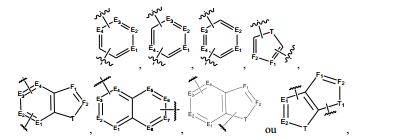
[00188] Em outras formas de realização, A é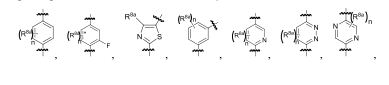

[00189] Em algumas formas de realização, B representa um grupo alcoxi C1-6, alcoxi C1-6 substituído com hidroxi, -NR7R7a, -C(= O) NR7R7a, - 7 7a 7 7 7 7a 7 OC(= O) NR R , -OC(= O) OR , -N(R ) C(= O) NR R , -N(R ) C(= O) OR7a, -N(R7) C(= O)-R7a, R7R7aN-S (= O)2-, R7S (= O)2-, C4-12 carbociclila, C4-12 cicloalquila, C2-10 heterociclila, arila C6-10, heteroarila C1-9, C5-12 biciclila fundida, heterobiciclila C5-12 fundida, C5-12 biciclil espiro, ou C5-12 espiro heterobiciclila.[00189] In some embodiments, B represents a C1-6 alkoxy, hydroxy substituted C1-6 alkoxy group, -NR7R7a, -C(=O)NR7R7a, -77a 7 7 7 7a 7 OC(=O) NR R , -OC(= O) OR , -N(R ) C(= O) NR R , -N(R ) C(= O) OR7a, -N(R7) C(= O)-R7a, R7R7aN -S (=O)2-, R7S (=O)2-, C4-12 carbocyclyl, C4-12 cycloalkyl, C2-10 heterocyclyl, C6-10 aryl, C1-9 heteroaryl, C5-12 fused bicyclyl, C5 heterobicyclyl -12 fused, C5-12 bicyclyl spiro, or C5-12 spiro heterobicyclyl.
[00190] Em algumas formas de realização, R1 é H, F, Cl, Br, I, ciano, 7a 7 7 7a 7 7a 7 7 hidroxi, R R N-, -C(= O) NR R , -OC(= O) NR R , -OC(= O) OR , -N(R ) 7 7a 7 7a 7 7a 7 7a C(= O) NR R , -N(R ) C(= O) OR , -N(R ) C(= O)-R , R R N-S (= O)2-, R7 7 7a 7a 7 7 S (= O)2-, R S (= O)2N(R )-, R R N-alquila C1-6, R S (= O)-C1-6 alquila, R7R7aN-C(= O)-C1-6 alquila, C1-6 alcoxi-R7aR7N, R7S (= O)-C1-6 alcoxi, R7R7aN-C(= O)-C1-6 alcoxi, C1-6 alifático, C1-6 alcoxi, C1-6 hidroxialcoxi, aminoalcoxi C1-6, aminoalcoxi substituído com hidroxi C1-6, C1-6 haloalcoxi, amino substituído-C1-6 haloalcoxi, C1-6 alquilamino-C1-6 haloalcoxi, haloalcoxi C1-6 substituído com hidroxi, C1-6 alquilamino-C1-6-alcoxi, C1-6 alcoxi-C1-6 alcoxi, cicloalquiloxi-C3-10, arila-C6-10-alcoxi-C1-6, arila C6-10-C1-6- alquilamino, C1-9-heteroarila-C1-6-alcoxi, heteroarila C1-9-C1-6- alquilamino, C2-10-heterociclila C1-6, heterociclila C2-10-C1-6-alquilamino, cicloalquilamino C3-10, C3-10 carbociclila-C1-6-alcoxi, C3-10 carbociclila-C1-6-alquilamino, heterociclila C2-10 (hidroxialcoxi C1-6), C3-10 carbociclila (hidroxialcoxi C1-6), arila C6-10 (hidroxialcoxi C1-6), ariloxi C6-10-alquila C1-6-alcoxi, ariloxi C6-10, C1-9 heteroariloxi, heteroariloxi C1-9-C1-6-alcoxi, heterocicliloxi C2-10-C1-6- alcoxi, C3-10-carbocicliloxi-C1-6-alcoxi, heterocicliloxi C2-10, C1-6 azidoalcoxi, C5-12 biciclila fundida, heterobiciclila C5-12 fundida, C5-12 biciclila fundida- C1-6 alifática, C5-12 heterobiciclila fundida-C1-6 alifática, C5-12 bicicloxi fundido, C512 heterobicicloxi fundido, C5-12 fundido biciclilamino, C5-12 heterobiciclilamino fundido, C5-12 biciclila fundida-C1-6-alcoxi, C5-12 heterobiciclila fundida-C1-6-alcoxi, C5-12 biciclila fundida-C1-6-alquilamino, C5-12 heterobiciclila fundida- C1-6-alquilamino, C5-12 bicicloxi fundido-C1-6- alcoxi, C5-12 heterobicicloxi fundido-C1-6-alcoxi, C5-12 biciclilamino fundido- C1-6-alcoxi, C5-12 heterobiciclilamino fundido-C1-6-alcoxi, C5-12 biciclil-C(= O)-fundido, C5-12 biciclil-C(= O) O- fundido, C5-12 heterobiciclil-C(= O)- fundido, C5-12 heterobiciclila fundida- C(= O) O-, C5-12 biciclilamino-C(= O)- fundido, C5-12 heterobiciclilamino-C(= O) fundido, C5-12 biciclil-C(= O) N(R7)-fundido, C5-12 heterobiciclil-C(= O) N(R7) fundido, C5-12 espiro biciclila, C5-12 espiro heterobiciclila, C5-12 espiro biciclila C1-6 alifática, C5-12 espiro heterobiciclila- C1-6-alifática, C5-12 espiro bicicloxi, C5-12 espiro heterobicicloxi, C5-12 espiro biciclilamino, C5-12 espiro heterobiciclilamino, C512 espiro biciclil-C1-6-alcoxi, C5-12-espiro heterobiciclil C1-6- alcoxi, C5-12 espiro biciclil-C1-6-alquilamino, C5-12 espiro heterobiciclil-C1-6-alquilamino, C5-12 espiro bicicloxi-C1-6-alcoxi, C5-12 espiro heterobicicloxi-C1-6-alcoxi, espiro C5-12 biciclilamino-C1-6-alcoxi, C5-12 espiro heterobiciclilamino-C1-6- alcoxi, C5-12 espiro biciclil-C(= O)-, C5-12 espiro biciclil-C(= O) O-, C5-12 espiro heterobiciclil-C(= O)-, C5-12 espiro heterobiciclil-C(= O) O-, C5-12 espiro biciclilamino-C(= O)-, C5-12 espiro heterobiciclilamino-C(= O)-, C5-12 espiro biciclil-C(= O) N(R7)-, C5-12 espiro heterobiciclil-C(= O) N(R7)-, C2-10 heterociclila, cicloalquila C3-10, arila C1-6 arila, heteroarila C1-9, heterociclila C2-10-C1-6 alifático, C3-10-cicloalquila-C1-6-alifático, C6-10 aril-C1-6-alifático, C19 heteroaril-C1-6- alifático, C6-10 aril-(CH2)P-G-(CH2)m-, C1-9 heteroaril-(CH2)P- G-(CH2)m-, heterociclil- C2-10 (CH2)P-G-(CH2)m-, ou C3-10-cicloalquil-(CH2)P- G-(CH2)m-, em que cada G é O, S, NR5, S (= O), S (= O)2, C(= O), -C(= O) NH-, -OC(= O) NH-, -OC(= O)-, -NHC(= O) NH-, -HN-S (= O)t-, -OS (= O)t- , ou -OS (= O)tNH-; cada t é 1 ou 2; cada p e m é independentemente 0, 1, 2, 3 ou 4; ou em que cada um dos arila C6-10 (CH2)P-G-(CH2)m-, C1-9 heteroaril- (CH2)P-G-(CH2)m-, heterociclil- C2-10 (CH2)P-G-(CH2)m-, e C3-10 cicloalquil- (CH2)P-G-(CH2)m- é opcionalmente substituído por um ou mais F, Cl, Br, I, C1-6 alquila, C2-6 alquinila, C1-6 alcoxi ou ciano;[00190] In some embodiments, R 1 is H, F, Cl, Br, I, cyano, 7a 7 7 7a 7 7a 7 7 hydroxy, RR N-, -C(= O) NR R , -OC(= O) NR R , -OC(= O) OR , -N(R ) 7 7a 7 7a 7 7a 7 7a C(= O) NR R , -N(R ) C(= O) OR , -N(R ) C(= O)-R , RR NS (= O)2-, R7 7 7 7a 7a 7 7 S (= O)2-, RS (= O)2N(R )-, RR N-alkyl C1-6 , RS (= O)-C1-6 alkyl, R7R7aN-C(=O)-C1-6 alkyl, C1-6 alkoxy-R7aR7N, R7S (= O)-C1-6 alkoxy, R7R7aN-C(=O) -C1-6 alkoxy, C1-6 aliphatic, C1-6 alkoxy, C1-6 hydroxyalkoxy, C1-6 aminoalkoxy, C1-6 hydroxy substituted aminoalkoxy, C1-6 haloalkoxy, C1-6 substituted amino haloalkoxy, C1-6 C1-6-alkylamino-haloalkoxy, hydroxy-substituted C1-6-haloalkoxy, C1-6-alkylamino-C1-6-alkoxy, C1-6-alkoxy-C1-6-alkoxy, C3-10-cycloalkyloxy, C6-10-aryl-alkoxy- C1-6, C6-10 aryl-C1-6-alkylamino, C1-9-heteroaryl-C1-6-alkoxy, heteroaryl C1-9-C1-6-alkylamino, C2-10-heterocyclyl C1-6, heterocyclyl C2- 10-C1-6-alkylamino, C3-10 cycloalkylamino, C3-10 carbocyclyl-C1-6-alkoxy, C3-10 carbocyl C1-6-alkylamino, C2-10 heterocyclyl (C1-6 hydroxyalkoxy), C3-10 carbocyclyl (C1-6 hydroxyalkoxy), C6-10 aryl (C1-6 hydroxyalkoxy), C6-10 aryloxy-C1-6 alkyl -alkoxy, C6-10 aryloxy, C1-9 heteroaryloxy, C1-9-C1-6-alkoxy heteroaryloxy, C2-10-C1-6-alkoxy heterocyclyloxy, C3-10-carbocyclyloxy-C1-6-alkoxy, C2- heterocyclyloxy 10, C1-6 azidoalkoxy, C5-12 fused bicyclyl, C5-12 fused heterobicyclyl, C5-12 fused-C1-6 aliphatic bicyclyl, C5-12 fused-C1-6 aliphatic heterobicyclyl, C5-12 fused bicyclooxy, C512 fused heterobicycloxy , C5-12 fused bicyclylamino, C5-12 fused heterobicyclylamino, C5-12 fused bicyclyl-C1-6-alkoxy, C5-12 fused heterobicyclyl-C1-6-alkoxy, C5-12 fused bicyclyl-C1-6-alkylamino, C5 -12 fused heterobicyclyl-C1-6-alkylamino, C5-12 fused bicycloxy-C1-6-alkoxy, C5-12 fused heterobicycloxy-C1-6-alkoxy, C5-12 fused bicyclylamino-C1-6-alkoxy, C5-12 fused-C1-6-alkoxy heterobicyclylamino, C5-12 bicyclyl-C(=O)-fused, C5-12 bicyclyl yl-C(= O) O-fused, C5-12 heterobicyclyl-C(= O)-fused, C5-12 heterobicyclyl-fused-C(= O) O-, C5-12 bicyclylamino-C(= O)-fused , C5-12 fused C5-12 heterobicyclylamino-C(= O), fused C5-12 bicyclyl-C(= O) N(R7)-fused, fused C5-12 heterobicyclyl-C(= O) N(R7), C5-12 spiro bicyclyl, C5-12 spiro heterobicyclyl, C5-12 spiro C1-6 aliphatic bicyclyl, C5-12 spiro heterobicyclyl-C1-6-aliphatic, C5-12 spiro bicyclooxy, C5-12 spiro heterobicyclooxy, C5-12 spiro bicyclylamino, C5- 12 spiro heterobicyclylamino, C5-12 spiro bicyclyl-C1-6-alkoxy, C5-12-spiro heterobicyclyl C1-6-alkoxy, C5-12 spiro bicyclyl-C1-6-alkylamino, C5-12 spiro heterobicyclyl-C1-6-alkylamino, C5-12 spiro bicyclooxy-C1-6-alkoxy, C5-12 spiro heterobicyclyl-C1-6-alkoxy, C5-12 spiro bicyclylamino-C1-6-alkoxy, C5-12 spiro heterobicyclylamino-C1-6-alkoxy, C5- 12 spiro bicyclyl-C(= O)-, C5-12 spiro bicyclyl-C(= O) O-, C5-12 spiro heterobicyclyl-C(= O)-, C5-12 spiro heterobicyclyl-C(= O) O -, C5-12 bici spiro clilamino-C(= O)-, C5-12 spiro heterobicyclylamino-C(= O)-, C5-12 spiro bicyclyl-C(= O) N(R7)-, C5-12 spiro heterobicyclyl-C(= O) N(R7)-, C2-10 heterocyclyl, C3-10 cycloalkyl, C1-6 aryl, C1-9 heteroaryl, C2-10-C1-6 aliphatic heterocyclyl, C3-10-cycloalkyl-C1-6-aliphatic, C6 -10 aryl-C1-6-aliphatic, C1-9 heteroaryl-C1-6-aliphatic, C6-10 aryl-(CH2)PG-(CH2)m-, C1-9 heteroaryl-(CH2)P-G-(CH2) m-, heterocyclyl-C2-10(CH2)PG-(CH2)m-, or C3-10-cycloalkyl-(CH2)P-G-(CH2)m-, where each G is O, S, NR5, S (= O), S (= O)2, C(= O), -C(= O) NH-, -OC(= O) NH-, -OC(= O)-, -NHC(= O) ) NH-, -HN-S (=O)t-, -OS (=O)t-, or -OS (=O)tNH-; each t is 1 or 2; each p and m is independently 0, 1, 2, 3 or 4; or wherein each of C6-10 aryl (CH2)PG-(CH2)m-, C1-9 heteroaryl-(CH2)PG-(CH2)m-, C2-10 heterocyclyl(CH2)PG-(CH2) m-, and C3-10 cycloalkyl-(CH2)PG-(CH2)m- is optionally substituted by one or more F, Cl, Br, I, C1-6 alkyl, C2-6 alkynyl, C1-6 alkoxy or cyano ;
[00191] R2 é H, F, Cl, Br, I, ciano, hidroxi, R7aR7N-, -C(= O) NR7R7a, - 7 7a 7 7 7 7a 7 OC(= O) NR R , -OC(= O) OR , -N(R ) C(= O) NR R , -N(R ) C(= O) 7a 7 7a 7 7a 7 7 7a OR , -N(R ) C(= O)-R , R R N-S (= O)2-, R S (= O)2-, R S (= O)2N(R )-, R7aR7N-alquila C1-6, R7S (= O)-C1-6 alquila, R7R7aN-C(= O)-C1-6 alquila, C1-6 alcoxi-R7aR7N, R7S (= O)-C1-6 alcoxi, R7R7aN-C(= O)-C1-6 alcoxi, C1-6 alifático, C1-6 alcoxi, C1-6 hidroxialcoxi, aminoalcoxi C1-6, aminoalcoxi substituído com hidroxi C1-6, C1-6 haloalcoxi, amino substituído-C1-6 haloalcoxi, C1-6 alquilamino-C1-6 haloalcoxi, haloalcoxi C1-6 substituído com hidroxi, C1-6 alquilamino-C1-6-alcoxi, C1-6 alcoxi-C1-6 alcoxi, cicloalquiloxi-C3- 10, arila-C6-10-alcoxi-C1-6, arila C6-10-C1-6-alquilamino, C1-9-heteroarila-C1-6- alcoxi, heteroarila C1-9-C1-6- alquilamino, C2-10-heterociclila C1-6, heterociclila C2-10-C1-6-alquilamino, cicloalquilamino C3-10, C3-10 carbociclila-C1-6-alcoxi, C3-10 carbociclila-C1-6-alquilamino, heterociclila C2-10 (hidroxialcoxi C1-6), C310 carbociclila (hidroxialcoxi C1-6), arila C6-10 (hidroxialcoxi C1-6), ariloxi C6- 10-alquila C1-6-alcoxi, ariloxi C6-10, C1-9 heteroariloxi, heteroariloxi C1-9-C1-6- alcoxi, heterocicliloxi C2-10-C1-6-alcoxi, C3-10-carbocicliloxi-C1-6-alcoxi, heterocicliloxi C2-10, C1-6 azidoalcoxi, C5-12 biciclila fundida, heterobiciclila C5-12 fundida, C5-12 biciclila fundida- C1-6 alifática, C5-12 heterobiciclila fundida-C1-6 alifática, C5-12 bicicloxi fundido, C5-12 heterobicicloxi fundido, C5-12 fundido biciclilamino, C5-12 heterobiciclilamino fundido, C5-12 biciclila fundida-C1-6-alcoxi, C5-12 heterobiciclila fundida-C1-6-alcoxi, C5-12 biciclila fundida-C1-6-alquilamino, C5-12 heterobiciclila fundida- C1-6-alquilamino, C5-12 bicicloxi fundido-C1-6-alcoxi, C5-12 heterobicicloxi fundido-C1-6-alcoxi, C5-12 biciclilamino fundido-C1-6-alcoxi, C5-12-C1 fundido heterobiciclilamino 6- alcoxi, C5-12 biciclil-C(= O)-fundido, C5-12 biciclil-C(= O) O- fundido, C5-12 heterobiciclil-C(= O)-fundido, C5-12 heterobiciclila fundida- C(= O) O-, C5-12 biciclilamino-C(= O)-fundido, C5-12 heterobiciclilamino-C(= O) fundido, C5-12 biciclil-C(= O) N(R7)-fundido, C5-12 heterobiciclil-C(= O) N(R7)-fundido, C512 espiro biciclila, C5-12 espiro heterobiciclila, C5-12 espiro biciclil C1-6 alifático, C5-12 espiro heterobiciclila- C1-6-alifática, C5-12 espiro bicicloxi, C5-12 espiro heterobicicloxi, C5-12 espiro biciclilamino, C5-12 espiro heterobiciclilamino, C5-12 espiro biciclil-C1-6-alcoxi, C5-12-espiro heterobiciclil C1-6- alcoxi, C5-12 espiro biciclil-C1-6-alquilamino, C5-12 espiro heterobiciclil- C1-6-alquilamino, C5-12 espiro bicicloxi-C1-6-alcoxi, C5-12 espiro heterobicicloxi-C5-12-alcoxi, espiro C5-12 biciclilamino-C1-6-alcoxi, C5-12 espiro heterobiciclilamino-C1-6-alcoxi, C5-12 espiro biciclil-C(= O)-, C5-12 espiro biciclil-C(= O) O-, C5-12 espiro heterobiciclil-C(= O)-, C5-12 espiro heterobiciclil-C(= O) O-, C5-12 espiro biciclilamino-C(= O)-, C5-12 espiro heterobiciclilamino-C(= O)-, C5-12 espiro biciclil-C(= O) N(R7)-, C5-12 espiro heterobiciclil-C(= O) N(R7)-, C2-10 heterociclila, cicloalquila C3-10, arila C1-6 arila, C1-4 heteroarila, C2-10-heterociclila C1-6 alifática, C3-10-cicloalquila-C1-6- alifático, C6-10 aril-C1-6-alifático, C1-9 heteroaril-C1-6- alifático, C6-10 aril- (CH2)P-G-(CH2)m-, C1-9 heteroaril-(CH2)P-G-(CH2)m-, heterociclil- C2-10 (CH2)P-G-(CH2)m-, ou C3-10-cicloalquil-(CH2)P-G-(CH2)m-, em que cada G é O, S, NR5, S (= O), S (= O)2, C(= O), -C(= O) NH-, -OC(= O) NH-, -OC(= O)-, -NHC(= O) NH-, -HN-S (= O)t-, -OS (= O)t-, ou -OS (= O)tNH-; cada t é 1 ou 2; cada p e m é independentemente 0, 1, 2, 3 ou 4; R3 é H, F, Cl, I, ciano, R7aR7N-, -C(= O) NR7R7a, -OC(= O) 7 7a 7 7 7 7a 7 7a 7 NR R , -OC(= O) OR , -N(R ) C(= O) NR R , -N(R ) C(= O) OR , -N(R ) 7a 7 7a 7 7 7a 7a 7 C(= O)-R , R R N-S (= O)2-, R S (= O)2-, R S (= O)2N(R )-, R R N- alquila C1-6, R7S (= O)-C1-6 alquila, R7R7aN-C(= O)-C1-6 alquila, C1-6 alcoxi- R7aR7N, R7S (= O)-alquila C1-6 alcoxi, R7R7aN-C(= O)-C1-6 alcoxi, C1-6 alifático, C2-10 haloalquila, C6-10 arila-C2-10-alcoxi, C1-9 heteroaril-C3-6-alcoxi, C3-10 cicloalquila-C2-10-alcoxi, C5-10 biciclila fundida-C2-10-alcoxi, C2-10 heterociclila, C3-10-cicloalquila, C1-4 heteroarila, arila C6-10 substituída, heterociclila C2-10-C1-6-alifático, C3-10-cicloalquila-C1-6-alifático, C1-4 heteroarila C1-6 alifática, C1-9 heteroariloxi C1-6, arila C6-10 substituído-C3-6- alquila, C2 -10 hetrerociclil-C1-6-alquila, C1-6 alcoxi, C1-6 hidroxialcoxi, aminoalcoxi C1-6, aminoalcoxi substituído com hidroxi C1-6, C1-6 haloalcoxi, amino substituído C1-6 halogenoalcoxi, C1-6 alquilamino C1-6-halogenoalcoxi, haloalcoxi C1-6 substituído com hidroxi, C1-6 alquilamino-C1-6-alcoxi, C1-6 alcoxi-C1-6-alcoxi, arila-C6-10-C2-10-alcoxi, C2-10 heterociclil-C1-6-alcoxi, C3-10 carbociclila C1-6, heterociclila C2-10 (hidroxialcoxi C1-6), C3-10 carbociclila (hidroxialcoxi C1-6), arila C6-10 (C1-6 hidroxialcoxi), ariloxi C6-10-alquila C1-6- alcoxi, C6-10 arilamino-C1-6-alcoxi, C6-10 ariloxi, heterocicliloxi C2-10-C1-6- alcoxi, C3-10 carbocicliloxi-C1-6-alcoxi, heterocicliloxi C2-10, C3-10- cicloalquiloxi, C1-6 azidoalcoxi, C5-12 biciclila fundida, heterobiciclila C5-12 fundida, C5-12 biciclila fundida- C1-6 alifática, C5-12-alquila C1-6 fundido heterobiciclil -alifatico, C5-12 bicicloxi fundido, C5-12 heterobicicloxi fundido, C5-12 biciclilamino fundido, C5-12 heterobiciclilamino fundido, C5-12 biciclila fundida-C1-6-alcoxi, C5-12 heterobiciclila fundida- C1-6-alcoxi, C5-12 biciclila fundida-C1-6-alquilamino, C5-12 heterobiciclila fundida-C1-6-alquilamino, C5-12 bicicloxi fundido-C1-6-alcoxi, C5-12 heterobicicloxi fundido-C1-6-alcoxi, C5-12 biciclilamino fundido-C1-6-alcoxi, C5-12 heterobiciclilamino fundido-C1-6- alcoxi, C5-12 biciclil-C(= O)-fundido, C5-12 biciclil-C(= O) O- fundido, C5-12 heterobiciclil-C(= O)-fundido, C5-12 heterobiciclil-C(= O) O- fundido, C5-12 biciclilamino-C(= O)-fundido, C5-12 heterobiciclilamino-C(= O) fundido, C5-12 fundido biciclil-C(= O) NR -, C5-12 fundido heterobiciclil-C(= O) NR7-, C5-12 espiro biciclila, C5-12 espiro heterobiciclila, C5-12 espiro biciclil-C1-6-alifático, C5-12 espiro heterobiciclil C1-6 alifático, C5-12 espiro bicicloxi, C5-12 espiro heterobicicloxi, C5-12 espiro biciclilamino, C5-12 espiro heterobiciclilamino, C512 espiro biciclil-C1-6 alcoxi, C5-12 espiro heterobiciclil-C1-6-alcoxi, C5-12 espiro biciclil-C1-6-alquilamino, C5-12 espiro heterobiciclil-C1-6-alquilamino, C5-12 espiro bicicloxi C1-6 alcoxi, C5-12 espiro heterobicicloxi-C1-6-alcoxi, C5-12 espiro biciclilamino-C1-6-alcoxi, C5-12 espiro heterobiciclilamino-C1-6-alcoxi, C5-12 espiro biciclil-C(= O)-, espiro C5-12 biciclil-C(= O) O-, C5-12 espiro heterobiciclil-C(= O)-, C5-12 espiro heterobiciclil-C(= O) O-, C5-12 espiro biciclilamino-C(= O)-, C5-12 espiro heterobiciclilamino-C(= O)-, C5-12 espiro biciclil-C(= O) NR7-, C5-12 espiro heterobiciclil-C(= O) NR7-, C6-10 aril- (CH2)P-G-(CH2)m-, C1-9 heteroaril-(CH2)P-G-(CH2)m-, heterociclil- C2-10 (CH2)P-G-(CH2)m-, ou C3-10-cicloalquila (CH2)P-G-(CH2)m-, em que cada G é O, S, NR5, S (= O), S (= O)2, C(= O), -C(= O) NH-, -OC(= O) NH-, -OC(= O)-, -NHC(= O) NH-, -HN-S (= O)t-, -OS (= O)t-, ou -OS (= O)tNH-; cada t é 1 ou 2; cada p e m é independentemente 0, 1, 2, 3 ou 4; e R4 é H, F, I, ciano, hidroxi, R7aR7N-, -C(= O) NR7R7a, -OC(= 7 7a 7 7 7 7a 7 7a O) NR R , -OC(= O) OR , -N(R ) C(= O) NR R , -N(R ) C(= O) OR , - heterociclila C1-6, heterociclila C2-10 C1-6-alquilamino, C7-10 cicloalquiloxi, cicloalquil-C3-10, C3-10 carbociclila-C1-6-alcoxi, C3-10 carbociclila-C1-6- alquilamino, heterociclila C2-10 (hidroxialcoxi C1-6), C3-10 carbociclila (hidroxialcoxi C1-6), arila C6-10 (hidroxialcoxi C1-6), ariloxi C6-10-alquila C1-6- heterobicicloxi fundido, C5-12 biciclilamino fundido, C5-12 heterobiciclilamino fundido, C5-12 biciclila fundida-C1-6-alcoxi, C5-12 heterobiciclila fundida-C1-6- alcoxi, C5-12 biciclila fundida-C1-6-alquilamino, C5-12 heterobiciclila fundida- C1-6-alquilamino, C5-12 bicicloxi fundido-C1-6-alcoxi, C5-12 heterobicicloxi fundido-C1-6-alcoxi, C5-12 biciclilamino fundido-C1-6-alcoxi, C5-12 heterobiciclilamino fundido-C1-6-alcoxi, C5-12 biciclil-C(= O)-fundido, C5-12 biciclil-C(= O) O- fundido, C5-12 heterobiciclil-C(= O)-fundido, C5-12 heterobiciclil-C(= O) O- fundido, C5-12 biciclilamino-C(= O)-fundido, C5-12 heterobiciclilamino-C(= O) fundido, C5-12 biciclila fundida -C(= O) NR7-, C512 heterobiciclila fundida -C(= O) NR7-, C5-12 espiro biciclila, C5-12 espiro heterobiciclila, C5-12 espiro biciclila-C1-6 alifático, C5-12 espiro heterobiciclila- C1-6 alifático, C5-12 espiro bicicloxi, C5-12 espiro heterobicicloxi, C5-12 espiro biciclilamino, C5-12 espiro heterobiciclilamino, C5-12 espiro biciclil-C1-6-alcoxi, C5-12 espiro heterobiciclil-C1-6-alcoxi, C5-12 espiro biciclil-C1-6-alquilamino, C5-12 espiro heterobiciclil-C1-6-alquilamino, C5-12 espiro bicicloxi-C1-6-alcoxi, C5-12 espiro heterobicicloxi-C1-6-alcoxi, C5-12 espiro biciclilamino-C1-6-alcoxi, C5-12 espiro heterobiciclilamino- C1-6-alcoxi, C5-12 espiro biciclil-C(= O)-, C512 espiro biciclil-C(= O) O-, C5-12 espiro heterobiciclil-C(= O)-, C5-12 espiro heterobiciclil-C(= O) O-, C5-12 espiro biciclilamino-C(= O)-, C5-12 espiro heterobiciclilamino-C(= O)-, C5-12 espiro biciclil-C(= O) N(R7)-, C5-12 espiro heterobiciclil-C(= O) N(R )-, C2-10 heterociclila, cicloalquila C3-10, arila C6-10, heteroarila C1-9, heterociclila C2-10-C1-6 alifático, C3-10-cicloalquila-C1-6- alifático, C6-10 aril-C2-6-alifático, C1-9 heteroarila C1-6 alifática, C6-10 aril- (CH2)P-G-(CH2)m-, C1-9 heteroaril-(CH2)P-G-(CH2)m-, heterociclil- C2-10 (CH2)P-G-(CH2)m-, ou C3-10-cicloalquil-(CH2)P-G-(CH2)m-, em que cada G é O, S, NR5, S (= O), S (= O)2, C(= O), -C(= O) NH-, -OC(= O) NH-, -OC(= O)-, -NHC(= O) NH-, -HN-S (= O)t-, -OS (= O)t-, ou -OS (= O)tNH-; cada t é 1 ou 2; cada p e m é independentemente 0, 1, 2, 3 ou 4.[00191] R2 is H, F, Cl, Br, I, cyano, hydroxy, R7aR7N-, -C(=O)NR7R7a, -7 7a 7 7 7 7a 7 OC(=O)NR R , -OC(= O) OR , -N(R ) C(= O) NR R , -N(R ) C(= O) 7a 7 7a 7 7a 7 7 7a OR , -N(R ) C(= O)-R , RR NS (= O)2-, RS (= O)2-, RS (= O)2N(R )-, R7aR7N-C1-6 alkyl, R7S (= O)-C1-6 alkyl, R7R7aN-C( = O)-C1-6 alkyl, C1-6 alkoxy-R7aR7N, R7S (= O)-C1-6 alkoxy, R7R7aN-C(= O)-C1-6 alkoxy, C1-6 aliphatic, C1-6 alkoxy, C1-6 hydroxyalkoxy, C1-6 aminoalkoxy, C1-6 hydroxy substituted aminoalkoxy, C1-6 haloalkoxy, C1-6 substituted amino haloalkoxy, C1-6 C1-6 alkylamino haloalkoxy, hydroxy substituted C1-6 haloalkoxy, C1 -6-C1-6-alkylamino-alkoxy, C1-6-alkoxy-C1-6-alkoxy, C3-10-cycloalkyloxy, C6-10-aryl-C1-6-alkoxy, C6-10-aryl-C1-6-alkylamino, C1 -9-heteroaryl-C1-6-alkoxy, heteroaryl C1-9-C1-6-alkylamino, C2-10-heterocyclyl C1-6, heterocyclyl C2-10-C1-6-alkylamino, C3-10, C3-10 cycloalkylamino carbocyclyl-C1-6-alkoxy, C3-10 carbocyclyl-C1-6-alkylamino, C2-10 heterocyclyl (hydroxyC1-6alkoxy), C310 carbocyclyl (hydroxyC1-6alkoxy), C6-10 aryl (hydroxyC1-6alkoxy), C6-10 aryloxy-C1-6alkyl-alkoxy, C6-10 aryloxy, C1-9 heteroaryloxy, heteroaryloxy C1-9-C1-6-alkoxy, C2-10-C1-6-alkoxy heterocyclyloxy, C3-10-carbocyclyloxy-C1-6-alkoxy, C2-10 heterocyclyloxy, C1-6 azidoalkoxy, C5-12 fused bicyclyl, heterobicyclyl C5-12 fused, C5-12 fused bicyclyl- C1-6 aliphatic, C5-12 fused heterobicyclyl-C1-6 aliphatic, C5-12 fused bicyclooxy, C5-12 fused heterobicycloxy, C5-12 fused bicyclylamino, C5-12 fused heterobicyclylamino , C5-12 fused bicyclyl-C1-6-alkoxy, C5-12 fused heterobicyclyl-C1-6-alkoxy, C5-12 fused bicyclyl-C1-6-alkylamino, C5-12 fused heterobicyclyl-C1-6-alkylamino, C5 -12 fused-C1-6-alkoxy-bicycloxy, C5-12-fused-C1-6-alkoxy-fused-heterobicycloxy, C1-6-alkoxy-fused-C5-12-fused bicyclylamino, 6-alkoxy-fused-C5-12-C1-heterobicyclylamino, C5-12 bicyclyl -C(=O)-fused, C5-12 bicyclyl-C(=O)O-fused, C5-12 heterobicyclyl-C (= O)-fused, C5-12 fused C(= O)-O-, C5-12 fused C(= O)-fused bicyclylamino-, fused C5-12 heterobicyclylamino-C(= O), C5-12 bicyclyl -C(=O)N(R7)-fused, C5-12 heterobicyclyl-C(=O)N(R7)-fused, C512 bicyclyl spiro, C5-12 heterobicyclyl spiro, C5-12 aliphatic C1-6 bicyclyl spiro, C5-12 spiro heterobicyclyl-C1-6-aliphatic, C5-12 spiro bicyclooxy, C5-12 spiro heterobicyclooxy, C5-12 spiro bicyclylamino, C5-12 spiro heterobicyclylamino, C5-12 spiro bicyclyl-C1-6-alkoxy, C5- 12-spiro heterobicyclyl C1-6-alkoxy, C5-12 spiro bicyclyl-C1-6-alkylamino, C5-12 spiro heterobicyclyl-C1-6-alkylamino, C5-12 spiro bicyclooxy-C1-6-alkoxy, C5-12 spiro heterobicycloxy-C5-12-alkoxy, C5-12 spiro bicyclylamino-C1-6-alkoxy, C5-12 spiro heterobicyclylamino-C1-6-alkoxy, C5-12 spiro bicyclyl-C(=O)-, C5-12 spiro bicyclyl -C(= O) O-, C5-12 spiro heterobicyclyl-C(= O)-, C5-12 spiro heterobicyclyl-C(= O) O-, C5-12 spiro bicyclylamino-C(= O)-, C5 -12 heterobicyclyl spiro amino-C(= O)-, C5-12 spiro bicyclyl-C(= O) N(R7)-, C5-12 spiro heterobicyclyl-C(= O) N(R7)-, C2-10 heterocyclyl, C3 cycloalkyl -10, C1-6 aryl, C1-4 heteroaryl, C2-10-C1-6 aliphatic heterocyclyl, C3-10-cycloalkyl-C1-6-aliphatic, C6-10 aryl-C1-6-aliphatic, C1-9 C1-6-aliphatic heteroaryl, C6-10 aryl-(CH2)PG-(CH2)m-, C1-9 heteroaryl-(CH2)PG-(CH2)m-, C2-10 heterocyclyl(CH2)PG- (CH2)m-, or C3-10-cycloalkyl-(CH2)PG-(CH2)m-, wherein each G is O, S, NR5, S (=O), S (=O)2, C( =O), -C(=O)NH-, -OC(=O)NH-, -OC(=O)-, -NHC(=O)NH-, -HN-S(=O)t-, -OS (= O)t-, or -OS (= O)tNH-; each t is 1 or 2; each p and m is independently 0, 1, 2, 3 or 4; R3 is H, F, Cl, I, cyano, R7aR7N-, -C(=O)NR7R7a, -OC(=O) 7 7a 7 7 7 7a 7 7a 7 NR R , -OC(= O) OR , - N(R ) C(= O) NR R , -N(R ) C(= O) OR , -N(R ) 7a 7 7a 7 7 7a 7a 7 C(= O)-R , RR NS (= O )2-, RS (= O)2-, RS (= O)2N(R )-, RR N-C1-6 alkyl, R7S (= O)-C1-6 alkyl, R7R7aN-C(= O)- C1-6 alkyl, C1-6 alkoxy-R7aR7N, R7S (=O)-alkyl, C1-6 alkoxy, R7R7aN-C(=O)-C1-6 alkoxy, C1-6 aliphatic, C2-10 haloalkyl, C6-10 aryl-C2-10-alkoxy, C1-9 heteroaryl-C3-6-alkoxy, C3-10 cycloalkyl-C2-10-alkoxy, C5-10 fused bicyclyl-C2-10-alkoxy, C2-10 heterocyclyl, C3-10 -cycloalkyl, C1-4 heteroaryl, substituted C6-10 aryl, C2-10-C1-6-aliphatic heterocyclyl, C3-10-cycloalkyl-C1-6-aliphatic, C1-4 C1-6 aliphatic heteroaryl, C1-9 heteroaryloxy C1-6, C6-10 aryl substituted-C3-6-alkyl, C2-10 heterocyclyl-C1-6-alkyl, C1-6 alkoxy, C1-6 hydroxyalkoxy, C1-6 aminoalkoxy, C1-6 hydroxy substituted aminoalkoxy, C1-6 haloalkoxy, substituted amino C1-6 haloalkoxy, C1-6 alkylamino C1-6-ha logenoalkoxy, hydroxy substituted C1-6 haloalkoxy, C1-6 alkylamino-C1-6-alkoxy, C1-6-C1-6-alkoxy-alkoxy, aryl-C6-10-C2-10-alkoxy, C2-10 heterocyclyl-C1 -6-alkoxy, C3-10 C1-6 carbocyclyl, C2-10 heterocyclyl (C1-6 hydroxyalkoxy), C3-10 carbocyclyl (C1-6 hydroxyalkoxy), C6-10 aryl (C1-6 hydroxyalkoxy), C6-10 aryloxy -C1-6alkyl-alkoxy, C6-10 arylamino-C1-6-alkoxy, C6-10 aryloxy, heterocyclyloxy C2-10-C1-6-alkoxy, C3-10 carbocyclyloxy-C1-6-alkoxy, C2-10 heterocyclyloxy , C3-10-cycloalkyloxy, C1-6 azidoalkoxy, C5-12 fused bicyclyl, fused C5-12 heterobicyclyl, C5-12 fused-C1-6 aliphatic bicyclyl, C5-12-fused C1-6 alkyl heterobicyclyl-aliphatic, C5- 12 fused bicycloxy, C5-12 fused heterobicycloxy, C5-12 fused bicyclylamino, C5-12 fused heterobicyclylamino, C5-12 fused bicyclyl-C1-6-alkoxy, C5-12 fused heterobicyclyl-C1-6-alkoxy, C5-12 bicyclyl fused-C1-6-alkylamino, C5-12 fused-heterobicyclyl-C1-6-alkylamino, C5-12 fused-C1-6-alkoxy bicyclooxy i, C5-12 fused-C1-6-alkoxy-heterobicyclyl, C5-12-fused-C1-6-alkoxy-fused-bicyclylamino, C1-6-alkoxy-fused-C5-12-heterobicyclylamino, C5-12-fused-C(=O)-bicyclyl , C5-12 bicyclyl-C(= O) O-fused, C5-12 heterobicyclyl-C(= O)-fused, C5-12 heterobicyclyl-C(= O) O-fused, C5-12 bicyclylamino-C(= O)-fused, C5-12 fused heterobicyclylamino-C(= O) fused, C5-12 fused bicyclyl-C(= O) NR -, C5-12 fused heterobicyclyl-C(= O) NR7-, C5-12 spiro bicyclyl C5-12 spiro heterobicyclyl, C5-12 spiro bicyclyl-C1-6-aliphatic, C5-12 spiro heterobicyclyl C1-6 aliphatic, C5-12 spiro bicyclooxy, C5-12 spiro heterobicyclooxy, C5-12 spiro bicyclylamino, C5-12 spiro heterobicyclylamino, C5-12 spiro bicyclyl-C1-6-alkoxy, C5-12 spiro heterobicyclyl-C1-6-alkoxy, C5-12 spiro bicyclyl-C1-6-alkylamino, C5-12 spiro heterobicyclyl-C1-6-alkylamino, C5- 12 spiro bicyclooxy C1-6 alkoxy, C5-12 spiro heterobicyclooxy-C1-6-alkoxy, C5-12 spiro bicyclylamino-C1-6-alkoxy, C5-12 spiro heterobicyclylamino-C1- 6-alkoxy, C5-12 spiro bicyclyl-C(= O)-, C5-12 spiro bicyclyl-C(= O) O-, C5-12 spiro heterobicyclyl-C(= O)-, C5-12 spiro heterobicyclyl- C(= O) O-, C5-12 spiro bicyclylamino-C(= O)-, C5-12 spiro heterobicyclylamino-C(= O)-, C5-12 spiro bicyclyl-C(= O) NR7-, C5- 12 spiro heterobicyclyl-C(= O) NR7-, C6-10 aryl-(CH2)PG-(CH2)m-, C1-9 heteroaryl-(CH2)PG-(CH2)m-, heterocyclyl-C2-10 ( CH2)PG-(CH2)m-, or C3-10-cycloalkyl (CH2)PG-(CH2)m-, where each G is O, S, NR5, S (=O), S (=O)2 , C(= O), -C(= O) NH-, -OC(= O) NH-, -OC(= O)-, -NHC(= O) NH-, -HN-S (= O) t-, -OS (=O)t-, or -OS (=O)tNH-; each t is 1 or 2; each p and m is independently 0, 1, 2, 3 or 4; and R4 is H, F, I, cyano, hydroxy, R7aR7N-, -C(=O)NR7R7a, -OC(=7 7a 7 7 7 7a 7 7a O) NR R , -OC(= O) OR , - N(R ) C(= O) NR R , -N(R ) C(= O) OR , -C1-6 heterocyclyl, C2-10 heterocyclyl C1-6-alkylamino, C7-10 cycloalkyloxy, C3-10-cycloalkyl , C3-10 carbocyclyl-C1-6-alkoxy, C3-10 carbocyclyl-C1-6-alkylamino, C2-10 heterocyclyl (C1-6 hydroxyalkoxy), C3-10 carbocyclyl (C1-6 hydroxyalkoxy), C6-10 aryl ( C1-6 hydroxyalkoxy), C6-10 aryloxy-fused C1-6 alkyl-heterobicyclooxy, fused C5-12 bicyclylamino, fused C5-12 heterobicyclylamino, C5-12 fused-C1-6-alkoxy bicyclyl, C5-12 fused-C1 heterobicyclyl -6-alkoxy, C5-12 fused bicyclyl-C1-6-alkylamino, C5-12 fused heterobicyclyl-C1-6-alkylamino, C5-12 fused bicycloxy-C1-6-alkoxy, C5-12 fused-C1-6 heterobicycloxy -alkoxy, C5-12 fused bicyclylamino-C1-6-alkoxy, C5-12 fused heterobicyclylamino-C1-6-alkoxy, C5-12 bicyclyl-C(=O)-fused, C5-12 bicyclyl-C(=O) O-fused, C5-12 heterobicyclyl-C(=O)-fused, C5-12 h Eterobicyclyl-C(=O)O-fused, C5-12 Bicyclylamino-C(=O)-fused, C5-12 Heterobicyclylamino-C(=O)-fused, C5-12 Bicyclyl-fused-C(=O)NR7-, C512 fused heterobicyclyl -C(= O) NR7-, C5-12 spiro bicyclyl, C5-12 spiro heterobicyclyl, C5-12 spiro bicyclyl-C1-6 aliphatic, C5-12 spiro heterobicyclyl- C1-6 aliphatic, C5-12 spiro bicyclooxy, C5-12 spiro heterobicycloxy, C5-12 spiro bicyclylamino, C5-12 spiro heterobicyclylamino, C5-12 spiro bicyclyl-C1-6-alkoxy, C5-12 spiro heterobicyclyl-C1-6-alkoxy, C5-12 spiro bicyclyl- C1-6-alkylamino, C5-12 spiro heterobicyclyl-C1-6-alkylamino, C5-12 spiro bicyclooxy-C1-6-alkoxy, C5-12 spiro heterobicyclyl-C1-6-alkoxy, C5-12 spiro bicyclylamino-C1- 6-alkoxy, C5-12 spiro heterobicyclylamino-C1-6-alkoxy, C5-12 spiro bicyclyl-C(= O)-, C512 spiro bicyclyl-C(= O) O-, C5-12 spiro heterobicyclyl-C(= O)-, C5-12 spiro heterobicyclyl-C(= O) O-, C5-12 spiro bicyclylamino-C(= O)-, C5-12 spiro heterobicyclylamino-C(= O)-, C5-12 esp bicyclyl-C(=O)N(R7)-, C5-12 spiro heterobicyclyl-C(=O)N(R)-, C2-10 heterocyclyl, C3-10 cycloalkyl, C6-10 aryl, C1-9 heteroaryl , C2-10-C1-6 aliphatic heterocyclyl, C3-10-cycloalkyl-C1-6-aliphatic, C6-10 aryl-C2-6-aliphatic, C1-9 C1-6 aliphatic heteroaryl, C6-10 aryl-(CH2 )PG-(CH2)m-, C1-9 heteroaryl-(CH2)PG-(CH2)m-, C2-10 heterocyclyl(CH2)PG-(CH2)m-, or C3-10-cycloalkyl-(CH2) )PG-(CH2)m-, where each G is O, S, NR5, S (=O), S (=O)2, C(=O), -C(=O)NH-, -OC (= O) NH-, -OC(= O)-, -NHC(= O) NH-, -HN-S (= O)t-, -OS (= O)t-, or -OS (= O) )tNH-; each t is 1 or 2; each p and m is independently 0, 1, 2, 3 or 4.
[00192] Em algumas formas de realização, cada R5 é, 7 7a 7 7 7 7a independentemente, H, R R NC(= O)-, R OC(= O)-, R C(= O)-, R R NS (= 7 7 7 7a 7 7 O)-, R OS (= O)-, R S (= O)-, R R NS (= O)2-, R OS (= O)2-, R S (= O)2-, C1-6 alifático, C1-6 haloalifático, hidroxialifático C1-6, C1-6 aminoalifático, C1-6 alcoxi-C1-6 alifático, C1-6 alquilamino-C1-6-alifático, C1-6 alquiltio C1-6 alifático, C6-10 aril-C1-6-alifático, C1-9 heteroarila C1-6 alifática, C2-10- heterociclila C1-6 alifática, C3-10-cicloalquila-C1-6-alifático, C6-10 ariloxi-C1-6- alifático, C2-10 heterocicliloxi-C1-6-alifático, C3-10 cicloalquil-C1-6-alifático, C6- 10-arilamino-C1-6 alifático, C2-10-heterociclilamino-C1-6 alifático, C3-10- cicloalquilamino-C1-6 alifático, C6-10 arila, heteroarila C1-9, heterociclila C2-10 ou C3-10 carbociclila.[00192] In some embodiments, each R5 is, 7 7a 7 7 7 7a independently, H, RR NC(= O)-, R OC(= O)-, RC(= O)-, RR NS (= 7 7 7 7a 7 7 O)-, R OS (= O)-, RS (= O)-, RR NS (= O)2-, R OS (= O)2-, RS (= O)2- , C1-6 aliphatic, C1-6 haloaliphatic, C1-6 hydroxyaliphatic, C1-6 aminoaliphatic, C1-6 aliphatic C1-6 alkoxy, C1-6 C1-6 alkylamino-aliphatic, C1-6 aliphatic C1-6 alkylthio , C6-10 aryl-C1-6-aliphatic, C1-9 C1-6 aliphatic heteroaryl, C2-10-C1-6 aliphatic heterocyclyl, C3-10-cycloalkyl-C1-6-aliphatic, C6-10 aryloxy-C1- 6-aliphatic, C2-10 heterocyclyloxy-C1-6-aliphatic, C3-10 cycloalkyl-C1-6-aliphatic, C6-10-arylamino-C1-6 aliphatic, C2-10-heterocyclylamino-C1-6 aliphatic, C3- 10-C1-6 cycloalkylamino-aliphatic, C6-10 aryl, C1-9 heteroaryl, C2-10 heterocyclyl or C3-10 carbocyclyl.
[00193] Em algumas formas de realização, cada R5a é independentemente H, hidroxi, amino, F, Cl, Br, I, ciano, oxo (= O), R7aR7N-, 7 7a 7 7a 7 7 7 7a -C(= O) NR R , -OC(= O) NR R , -OC(= O) OR , -N(R ) C(= O) NR R , - alcoxi-C1-6, heteroarila C1-9-C1-6-alcoxi, heterocicliloxi C2-10, heterociclila C2- 10-C1-6-alcoxi, heterociclilamino C2-10, heterociclila C2-10-C1-6-alquilamino ou ariloxi C6-10.[00193] In some embodiments, each R5a is independently H, hydroxy, amino, F, Cl, Br, I, cyano, oxo (=O), R7aR7N-, 7 7a 7 7a 7 7 7 7a -C(= O) NR R , -OC(= O) NR R , -OC(= O) OR , -N(R ) C(= O) NR R , -C1-6-alkoxy, C1-9-C1-6 heteroaryl -alkoxy, C2-10 heterocyclyloxy, C2-10 heterocyclyl-C1-6-alkoxy, C2-10 heterocyclylamino, C2-10 heterocyclyl-C1-6-alkylamino or C6-10 aryloxy.
[00194] Em algumas formas de realização, cada R7 e R7a é independentemente H, C1-6 alifático, C1-6 haloalifático, hidroxialifático C1-6, C1-6 aminoalifático, C1-6 alcoxi-C1-6-alifático, C1-6-alquilamino-C1-6 alifático, C1-6 alquiltio C1-6 alifático, C6-10 aril-C1-6-alifático, C1-9 heteroarila C1-6 alifática, C2-10-heterociclila C1-6-alifático, C3-10-cicloalquila-C1-6-alifático, C6-10 ariloxi-C1-6 alifático, C2-10 heterocicliloxi-C1-6 alifático, C3-10 cicloalquil-C1-6- alifático, C1-6 arilamino-C1-6 alifático, C2-10-heterociclilamino-C1-6 alifático, C3-10-cicloalquilamino-C1-6 alifático, C6-10 arila, C1-9 heteroarila, heterociclila C2-10 ou C3-10 carbociclila; com a condição de que quando R7 e R7a são ligados ao mesmo átomo de nitrogênio, R7 e R7a, em conjunto com o átomo de nitrogênio ao qual estão ligados para, formar opcionalmente um anel de 3-8 membros substituído ou não substituído, ou um C5-12 biciclico espiro substituído ou não substituído ou anel bicíclico fundido C5-12.[00194] In some embodiments, each R7 and R7a is independently H, C1-6 aliphatic, C1-6 haloaliphatic, C1-6 hydroxyaliphatic, C1-6 aminoaliphatic, C1-6 alkoxy-C1-6-aliphatic, C1- 6-aliphatic C1-6 alkylamino, C1-6 aliphatic C1-6 alkylthio, C6-10 aryl-C1-6-aliphatic, C1-9 aliphatic C1-6 heteroaryl, C2-10-C1-6-aliphatic heterocyclyl, C3 -10-C1-6-cycloalkyl-aliphatic, C6-10-C1-6-aryloxy-aliphatic, C2-10-C1-6-aliphatic heterocyclyloxy, C3-10-C1-6-cycloalkyl-aliphatic, C1-6-C1-6-arylamino aliphatic, C2-10-heterocyclylamino-C1-6 aliphatic, C3-10-cycloalkylamino-C1-6 aliphatic, C6-10 aryl, C1-9 heteroaryl, C2-10 heterocyclyl or C3-10 carbocyclyl; with the proviso that when R7 and R7a are attached to the same nitrogen atom, R7 and R7a, together with the nitrogen atom to which they are attached to, optionally form a substituted or unsubstituted 3-8 membered ring, or a C5-12 substituted or unsubstituted spiro bicyclic or C5-12 fused bicyclic ring.
[00195] Em algumas formas de realização, N, V1, V2, V3, V4 e C(= Y) de Fórmula (I) definem um grupo com a Fórmula (III):

[00196] Em algumas formas de realização,

[00197] Em algumas formas de realização, A é:
[00198] cada R5 é, independentemente, H, R7R7aNC(= O)-, R7OC(= O)-, R 7 7 7a 7 7 7 7a 7 C(= O)-, R R NS (= O)-, R OS (= O)-, R S (= O)-, R R NS (= O)2-, R OS (= O)2-, R7S (= O)2-, alquila C1-3, haloalquila C1-3, C1-3 hidroxialquila, aminoalquila C1-3, C1-3 alcoxi-C1-3 alquila, C1-3 alquilamino-C1-3-alquila, C1-3- alquiltio-C1-3 alquila, C6-10 aril-C1-3-alquila, C1-9 heteroaril-C1-3-alquila, C2-10 heterociclil-alquila-C1-3, cicloalquila-C3-10-alquila-C1-3, arila C6-10, heteroarila C1-9, heterociclila C2-10 ou C3-10 carbociclila; e cada R7 e R7a é independentemente H, C1-6 alifático, C1-6 haloalifático, hidroxialifático C1-6, C1-6 aminoalifático, C1-6 alcoxi-C1-6 alifático, C1-6-alquilamino-C1-6-alifático, C1-6 alquiltio C1-6 alifático, C6-10 aril- C1-6-alifático, C1-9 heteroarila C1-6 alifática, C2-10-heterociclila C1-6 alifática, C3-10-cicloalquila-C1-6-alifático, C6-10 arila, C1-9 heteroarila, heterociclila C2-10 ou C3-10 carbociclila; com a condição de que quando R7 e R7a são ligados ao mesmo átomo de nitrogênio, R7 e R7a, em conjunto com o átomo de nitrogênio ao qual estão ligados para, opcionalmente, formar um anel com de 3 a 8 membros, substituído ou não substituído.[00198] each R5 is independently H, R7R7aNC(=O)-, R7OC(=O)-, R 7 7 7a 7 7 7 7a 7 C(= O)-, RR NS (= O)-, R OS (=O)-, RS (=O)-, RR NS (=O)2-, R OS (=O)2-, R7S (=O)2-, C1-3 alkyl, C1-3 haloalkyl, C1-3 hydroxyalkyl, C1-3 aminoalkyl, C1-3 alkoxy-C1-3 alkyl, C1-3 alkylamino-C1-3-alkyl, C1-3-alkylthio-C1-3 alkyl, C6-10 aryl-C1-3 -alkyl, C1-9 heteroaryl-C1-3-alkyl, C2-10 heterocyclyl-C1-3-alkyl, C3-10-cycloalkyl-C1-3-alkyl, C6-10 aryl, C1-9 heteroaryl, C2- heterocyclyl 10 or C3-10 carbocyclyl; and each R7 and R7a is independently H, C1-6 aliphatic, C1-6 haloaliphatic, C1-6 hydroxyaliphatic, C1-6 aminoaliphatic, C1-6 aliphatic-C1-6 alkoxy, C1-6-C1-6-alkylamino-aliphatic , C1-6 aliphatic C1-6 alkylthio, C6-10 aryl-C1-6-aliphatic, C1-9 aliphatic C1-6 heteroaryl, C2-10-C1-6 aliphatic heterocyclyl, C3-10-cycloalkyl-C1-6- aliphatic, C6-10 aryl, C1-9 heteroaryl, C2-10 heterocyclyl or C3-10 carbocyclyl; with the proviso that when R7 and R7a are attached to the same nitrogen atom, R7 and R7a together with the nitrogen atom to which they are attached to optionally form a substituted or unsubstituted 3- to 8-membered ring .
[00199] Em algumas formas de realização, A, X e B definem um grupo possuindo a Fórmula (II):
[00200] Em algumas formas de realização, a Fórmula (IV) é
[00201] Em algumas formas de realização, B é -N(CH3)2, - N(CH2CH3)2, -N(CH2CH2CH3)2, -N(CH2CH2CH2CH3)2,
[00202] Em algumas formas de realização, a fórmula (V) é

[00203] Em algumas formas de realização, a fórmula (VI) é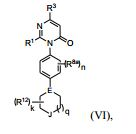
[00204] Em algumas formas de realização, R1 é independentemente H, F, Cl, Br, I, ciano, hidroxi, metila, etila, propila, isopropila, butila, terc-butila, C6-8 aril-(CH2)P-G-(CH2)m- ou C4-6 heteroaril-(CH2)P-G-(CH2)m-, em que cada G é NR5, O ou S, cada p e m é independentemente 0, 1, 2 ou 3; ou em que cada um dos C6-8 aril-(CH2)P-G-(CH2)m- e C4-6 heteroaril-(CH2)P-G-(CH2)m- é opcionalmente substituído por um ou mais F, Cl, Br, metila, etila, propila, etinila, propinila, butinila, metoxi, ou ciano; e R3 é, independentemente, H, F, Cl, I, ciano, hidroxi, metila, etila, propila, isopropila, butila, terc-butila, C6-8 aril-(CH2)P-G-(CH2)m- ou heteroaril- C4-6 (CH2)P-G-(CH2)m-, em que cada G é O ou S, cada p e m é independentemente 0, 1, 2 ou 3.[00204] In some embodiments, R1 is independently H, F, Cl, Br, I, cyano, hydroxy, methyl, ethyl, propyl, isopropyl, butyl, tert-butyl, C6-8 aryl-(CH2)PG- (CH2)m- or C4-6 heteroaryl-(CH2)PG-(CH2)m-, wherein each G is NR5, O, or S, each pem is independently 0, 1, 2, or 3; or wherein each of C6-8 aryl-(CH2)PG-(CH2)m- and C4-6 heteroaryl-(CH2)PG-(CH2)m- is optionally substituted by one or more F, Cl, Br, methyl, ethyl, propyl, ethynyl, propynyl, butynyl, methoxy, or cyano; and R3 is independently H, F, Cl, I, cyano, hydroxy, methyl, ethyl, propyl, isopropyl, butyl, tert-butyl, C6-8 aryl-(CH2)PG-(CH2)m- or heteroaryl- C4-6(CH2)PG-(CH2)m-, where each G is O or S, each pem is independently 0, 1, 2 or 3.
[00205] Em algumas formas de realização, a Fórmula (VII) é
[00206] Em algumas formas de realização, cada R7 é, independentemente, H, C1-6 alquila, C1-4 alcoxi-C1-6 alquila,

[00207] Em outro aspecto, È proporcionado aqui um dos compostos como se segue, ou um estereoisômero, isômero geométrico, tautômero, óxido de nitrogênio, hidrato, solvato, ou sal farmaceuticamente aceitável do mesmo, e não se limitando a:


[00208] Aqui proporcionados inclui o uso de um composto aqui descrito, ou um sal farmaceuticamente aceitável do mesmo, na fabricação de um medicamento para tratar a gravidade da fibrose de tecido ou órgão em um paciente, incluindo os aqui descritos. Aqui proporcionada uma composição farmacêutica compreendendo uma quantidade terapeuticamente eficaz de um composto de Fórmula (I), (V), (VI), (VII) ou (IV), em associação com pelo menos um carreador, excipiente, diluente, adjuvante ou veículo farmaceuticamente aceitável.[00208] Provided herein includes the use of a compound described herein, or a pharmaceutically acceptable salt thereof, in the manufacture of a medicament for treating the severity of tissue or organ fibrosis in a patient, including those described herein. Provided herein is a pharmaceutical composition comprising a therapeutically effective amount of a compound of Formula (I), (V), (VI), (VII) or (IV), in association with at least one carrier, excipient, diluent, adjuvant or vehicle. pharmaceutically acceptable.
[00209] Aqui proporcionadas são as composições farmacêuticas que compreendem um composto aqui descrito, ou um estereoisômero, isômero geométrico, tautômero, óxido de nitrogênio, hidrato, solvato, metabolito, sal farmaceuticamente aceitável ou pró-droga do mesmo; e opcionalmente um carreador, excipiente, diluente, adjuvante, veículo farmaceuticamente aceitável ou uma combinação dos mesmos.[00209] Provided herein are pharmaceutical compositions comprising a compound described herein, or a stereoisomer, geometric isomer, tautomer, nitrogen oxide, hydrate, solvate, metabolite, pharmaceutically acceptable salt or prodrug thereof; and optionally a pharmaceutically acceptable carrier, excipient, diluent, adjuvant, vehicle or a combination thereof.
[00210] É também aqui proporcionado um método de tratamento da gravidade da fibrose de tecido ou órgão em um paciente ou susceptível a tal tipo de fibrose, o método compreendendo o tratamento do indivíduo com uma quantidade terapeuticamente eficaz de um composto de Fórmula (I), (V), (VI), (VII) ou (IV).[00210] Also provided herein is a method of treating the severity of tissue or organ fibrosis in a patient or susceptible to such type of fibrosis, the method comprising treating the subject with a therapeutically effective amount of a compound of Formula (I) , (V), (VI), (VII) or (IV).
[00211] Aqui proporcionadas, o distúrbio de fibrose do tecido ou órgão é a fibrose intersticial renal, glomerulosclerose, fibrose hepática, fibrose pulmonar, fibrose do peritoneu, fibrose do miocárdio, dermatofibrose, aderências pós-operatórias, hipertrofia benigna da próstata, fibrose muscular esquelética, dermatoesclerose, esclerose múltipla, fibrose pancreática, cirrose do fígado, miossarcoma, neurofibroma, fibrose intersticial pulmonar, nefropatia diabética, mal de Alzheimer ou fibrose vascular. Em outras formas de realização, aderências pós-cirúrgicas é a cura de cicatriz.[00211] Provided herein, tissue or organ fibrosis disorder is renal interstitial fibrosis, glomerulosclerosis, hepatic fibrosis, pulmonary fibrosis, peritoneal fibrosis, myocardial fibrosis, dermatofibrosis, postoperative adhesions, benign prostatic hypertrophy, muscle fibrosis skeletal disease, dermatosclerosis, multiple sclerosis, pancreatic fibrosis, cirrhosis of the liver, myosarcoma, neurofibroma, interstitial pulmonary fibrosis, diabetic nephropathy, Alzheimer's disease or vascular fibrosis. In other embodiments, post-surgical adhesions are scar healing.
[00212] A menos que indicado de outra forma, todos os estereoisômeros, isômeros geométricos, tautômeros, óxidos de nitrogênio, hidratos, solvatos, metabolitos, sais, e pró-drogas farmaceuticamente aceitáveis dos compostos aqui descritos estão dentro do escopo da invenção.[00212] Unless otherwise indicated, all stereoisomers, geometric isomers, tautomers, nitrogen oxides, hydrates, solvates, metabolites, salts, and pharmaceutically acceptable prodrugs of the compounds described herein are within the scope of the invention.
[00213] Em certas formas de realização, o sal é um sal farmaceuticamente aceitável. A frase "farmaceuticamente aceitável" se refere a que a substância ou a composição deve ser compatível quimicamente e / ou toxicologicamente com os outros ingredientes que compreendem uma formulação, e / ou com o mamífero a ser tratado com a mesma.[00213] In certain embodiments, the salt is a pharmaceutically acceptable salt. The phrase "pharmaceutically acceptable" refers to the fact that the substance or composition must be chemically and/or toxicologically compatible with the other ingredients comprising a formulation, and/or with the mammal to be treated therewith.
[00214] Os compostos aqui descritos incluem igualmente os sais de tais compostos que não são, necessariamente, os seus sais farmaceuticamente aceitáveis, e que podem ser úteis como intermediários para a preparação e / ou purificação de compostos de Fórmula (I), (V), (VI), (VII) ou (IV) e / ou para a separação de enanciômeros de compostos de Fórmula (I), (V), (VI), (VII) ou (IV).[00214] The compounds described herein also include the salts of such compounds which are not necessarily pharmaceutically acceptable salts thereof, and which may be useful as intermediates for the preparation and/or purification of compounds of Formula (I), (V ), (VI), (VII) or (IV) and/or for the separation of enantiomers of compounds of Formula (I), (V), (VI), (VII) or (IV).
[00215] Se o composto aqui descrito é uma base, o sal desejado pode ser preparado por qualquer método adequado disponível na técnica, por exemplo, tratamento da base livre com um ácido inorgânico, tal como ácido clorídrico, ácido bromídrico, ácido sulfúrico, ácido nítrico, ácido fosfórico, e outros semelhantes. Ou com um ácido orgânico, tal como ácido acético, ácido maleico, ácido succínico, ácido mandélico, ácido fumárico, ácido malônico, ácido pirúvico, ácido oxálico, ácido glicólico, ácido salicílico; um ácido piranosidila, tal como ácido glucurônico ou ácido galacturônico; um ácido alfa-hidroxi, tais como ácido cítrico ou ácido tartárico; um aminoácido, tal como ácido aspártico ou ácido glutâmico; um ácido aromático, tal como ácido benzóico ou ácido cinâmico, um ácido sulfônico, tal como ácido p- toluenossulfônico ou ácido etanossulfônico, e semelhantes.[00215] If the compound described herein is a base, the desired salt can be prepared by any suitable method available in the art, for example, treatment of the free base with an inorganic acid, such as hydrochloric acid, hydrobromic acid, sulfuric acid, nitric acid, phosphoric acid, and the like. Or with an organic acid, such as acetic acid, maleic acid, succinic acid, mandelic acid, fumaric acid, malonic acid, pyruvic acid, oxalic acid, glycolic acid, salicylic acid; a pyranosidyl acid, such as glucuronic acid or galacturonic acid; an alpha-hydroxy acid, such as citric acid or tartaric acid; an amino acid, such as aspartic acid or glutamic acid; an aromatic acid, such as benzoic acid or cinnamic acid, a sulfonic acid, such as p-toluenesulfonic acid or ethanesulfonic acid, and the like.
[00216] Se o composto aqui descrito é um ácido, o sal desejado pode ser preparado por qualquer método adequado, por exemplo, o tratamento do ácido livre com uma base inorgânica ou orgânica, tal como uma amina (primária, secundária ou terciária), um hidróxido de metal alcalino ou hidróxido de metal terroso alcalino, e outros semelhantes. Alguns exemplos não limitativos de sais adequados incluem sais orgânicos derivados de aminoácidos, tais como glicina e arginina, amônia, aminas primárias, secundárias, e terciárias, e aminas cíclicas, tais como piperidina, morfolina e piperazina, e sais inorgânicos derivados de sódio, cálcio, potássio, magnésio, manganês, ferro, cobre, zinco, alumínio, lítio, e outros semelhantes.[00216] If the compound described herein is an acid, the desired salt can be prepared by any suitable method, for example, treatment of the free acid with an inorganic or organic base, such as an amine (primary, secondary or tertiary), an alkali metal hydroxide or alkaline earth metal hydroxide, and the like. Some non-limiting examples of suitable salts include organic salts derived from amino acids, such as glycine and arginine, ammonia, primary, secondary, and tertiary amines, and cyclic amines, such as piperidine, morpholine, and piperazine, and inorganic salts derived from sodium, calcium. , potassium, magnesium, manganese, iron, copper, zinc, aluminum, lithium, and the like.
[00217] De acordo com outro aspecto, a invenção apresenta composições farmacêuticas que incluem um composto de Fórmula (I), (V), (VI), (VII) ou (IV), um composto aqui enumerado, ou um composto mencionado nos Exemplos 1 a 72, e um carreador, adjuvante ou veículo farmaceuticamente aceitável. A quantidade de composto nas composições aqui revelado é tal que é eficaz para tratar de forma detectável ou diminuir a severidade de uma doença fibrótica de tecido ou órgão, em um paciente.[00217] In another aspect, the invention features pharmaceutical compositions that include a compound of Formula (I), (V), (VI), (VII) or (IV), a compound recited herein, or a compound mentioned in the Examples 1 to 72, and a pharmaceutically acceptable carrier, adjuvant or vehicle. The amount of compound in the compositions disclosed herein is such that it is effective to detectably treat or lessen the severity of a fibrotic tissue or organ disease in a patient.
[00218] É também será apreciado que alguns dos compostos aqui descritos podem existir na forma livre para tratamento, ou quando apropriado, como um seu derivado farmaceuticamente aceitável. Alguns exemplos não limitativos do seu derivado farmaceuticamente aceitável incluem pró-drogas farmaceuticamente aceitáveis, sais, ésteres, sais destes ésteres, ou quaisquer outros adutos ou derivados que durante a administração a um paciente necessitado seja capaz de proporcionar, diretamente ou indiretamente, um composto conforme de outro modo aqui descrito, ou um metabolito ou resíduo do mesmo.[00218] It will also be appreciated that some of the compounds described herein may exist in free form for treatment, or where appropriate, as a pharmaceutically acceptable derivative thereof. Some non-limiting examples of the pharmaceutically acceptable derivative thereof include pharmaceutically acceptable prodrugs, salts, esters, salts of these esters, or any other adducts or derivatives which upon administration to a patient in need are capable of providing, directly or indirectly, a compound conforming otherwise described herein, or a metabolite or residue thereof.
[00219] Conforme descrito acima, as composições farmaceuticamente aceitáveis aqui descritas compreendem adicionalmente um carreador, adjuvante ou veículo farmaceuticamente aceitável, o qual, tal como aqui utilizado, inclui todos e quaisquer solventes, diluentes, ou outro veículo líquido, auxiliares de dispersão ou de suspensão, agentes ativos de superfície, agentes isotônicos, agentes espessantes ou emulsionantes, conservantes, ligandos sólidos, lubrificantes e similares, conforme adequado para a forma de dosagem particular desejada. Troy et al, Remington: A Science and Practice of Pharmacy, 21 ed, 2005, Lippincott Williams & Wilkins, Filadélfia e Swarbrick et al, Encyclopedia of Pharmaceutical Technology, eds, 19881999, Marcel Dekker, New York, todos os quais são aqui incorporados por referência na sua totalidade, são revelados vários carreadores usados na formulação de composições farmaceuticamente aceitáveis e técnicas conhecidas para a sua preparação. Exceto na medida em que qualquer meio carreador convencional seja incompatível com os compostos aqui revelados, tais como por produzir qualquer efeito biológico indesejável ou interagir de outro modo de um modo prejudicial com qualquer outro (s) componente (s) da composição farmaceuticamente aceitável, o seu uso está contemplado como estando dentro o escopo da presente invenção.[00219] As described above, the pharmaceutically acceptable compositions described herein further comprise a pharmaceutically acceptable carrier, adjuvant or vehicle which, as used herein, includes any and all solvents, diluents, or other liquid carriers, dispersion aids or suspension, surface active agents, isotonic agents, thickening or emulsifying agents, preservatives, solid binders, lubricants and the like, as appropriate for the particular dosage form desired. Troy et al, Remington: A Science and Practice of Pharmacy, 21st ed, 2005, Lippincott Williams & Wilkins, Philadelphia and Swarbrick et al, Encyclopedia of Pharmaceutical Technology, eds, 19881999, Marcel Dekker, New York, all of which are incorporated herein by reference in their entirety, various carriers used in formulating pharmaceutically acceptable compositions and known techniques for their preparation are disclosed. Except to the extent that any conventional carrier medium is incompatible with the compounds disclosed herein, such as by producing any undesirable biological effect or otherwise adversely interacting with any other component(s) of the pharmaceutically acceptable composition, the its use is contemplated as being within the scope of the present invention.
[00220] Alguns exemplos não limitativos de materiais que podem servir como carreadores farmaceuticamente aceitáveis incluem trocadores de íons, alumina, estearato de alumínio, lecitina, proteínas séricas, tais como albumina do soro humano, substâncias tampão tais como fosfatos, glicina, ácido sórbico ou de potássio, sorbato, misturas de glicerídeos parciais de ácidos graxos vegetais saturados, água, sais ou eletrólitos, tais como sulfato de protamina, hidrogeno fosfato de dissódio, fosfato de potássio, cloreto de sódio, sais de zinco, sílica coloidal, trissilicato de magnésio, polivinilpirrolidona, poliacrilatos, ceras, polímeros em bloco de polietileno- polioxipropileno, gordura de lã, açúcares tais como lactose, glucose e sacarose; amidos tais como amido de milho e amido de batata; celulose e seus derivados tais como carboximetil celulose de sódio, etil celulose e acetato de celulose; tragacanto em pó; malte; gelatina; talco; excipientes tais como manteiga de cacau e ceras para supositório; óleos tais como óleo de amendoim, óleo de semente de algodão, óleo de cártamo, óleo de sésamo, óleo de oliva, óleo de milho e óleo de soja; glicóis tais como propileno glicol ou polietileno glicol; ésteres tais como oleato de etila e laurato de etila; ágar- ágar; Os agentes, tais como hidróxido de magnésio e hidróxido de alumínio tamponantes; ácido algínico; água apirógena; solução salina isotônica; Solução de Ringer; álcool etílico, e soluções tampão de fosfato, bem como outros lubrificantes compatíveis não tóxicos, tais como lauril sulfato de sódio e estearato de magnésio, bem como agentes colorantes, agentes de liberação, agentes de revestimento, adoçantes, agentes aromatizantes e perfumantes, conservantes e antioxidantes.[00220] Some non-limiting examples of materials that can serve as pharmaceutically acceptable carriers include ion exchangers, alumina, aluminum stearate, lecithin, serum proteins such as human serum albumin, buffer substances such as phosphates, glycine, sorbic acid or potassium, sorbate, partial glyceride mixtures of saturated vegetable fatty acids, water, salts or electrolytes such as protamine sulfate, disodium hydrogen phosphate, potassium phosphate, sodium chloride, zinc salts, colloidal silica, magnesium trisilicate , polyvinylpyrrolidone, polyacrylates, waxes, polyethylene-polyoxypropylene block polymers, wool fat, sugars such as lactose, glucose and sucrose; starches such as corn starch and potato starch; cellulose and its derivatives such as sodium carboxymethyl cellulose, ethyl cellulose and cellulose acetate; powdered tragacanth; malt; gelatin; baby powder; excipients such as cocoa butter and suppository waxes; oils such as peanut oil, cottonseed oil, safflower oil, sesame oil, olive oil, corn oil and soybean oil; glycols such as propylene glycol or polyethylene glycol; esters such as ethyl oleate and ethyl laurate; agar-agar; Buffering agents such as magnesium hydroxide and aluminum hydroxide; alginic acid; pyrogenic water; isotonic saline solution; Ringer's solution; ethyl alcohol, and phosphate buffer solutions, as well as other compatible non-toxic lubricants such as sodium lauryl sulfate and magnesium stearate, as well as coloring agents, releasing agents, coating agents, sweeteners, flavoring and perfuming agents, preservatives and antioxidants.
[00221] As composições aqui reveladas podem ser administradas oralmente, parentericamente, por inalação de um spray, topicamente, retalmente, nasalmente, bucalmente, vaginalmente ou por via de um reservatório implantado. As composições farmaceuticamente aceitáveis aqui descritos incluem administradas oralmente em qualquer forma de dosagem oralmente aceitável incluindo, mas não se limitando a, cápsulas, comprimidos, pílulas, pós, grânulos, suspensões ou soluções aquosas.[00221] The compositions disclosed herein may be administered orally, parenterally, by inhalation spray, topically, rectally, nasally, buccally, vaginally or via an implanted reservoir. The pharmaceutically acceptable compositions described herein include orally administered in any orally acceptable dosage form including, but not limited to, capsules, tablets, pills, powders, granules, suspensions or aqueous solutions.
[00222] As composições aqui descritas podem ser administradas por via oral nas formas de dosagem seguintes: comprimidos, pastilhas, cápsulas, pós dispensáveis, partículas ou suspensões, xarope, e elixires. Em alternativa, as composições aqui descritas podem ser para uso externo na forma de pomada, de gel, ou emplastro medicado; ou elas podem ser administradas por via parentérica sob a forma de solução ou suspensão injetável estéril.[00222] The compositions described herein can be administered orally in the following dosage forms: tablets, lozenges, capsules, disposable powders, particles or suspensions, syrup, and elixirs. Alternatively, the compositions described herein may be for external use in the form of an ointment, gel, or medicated patch; or they may be administered parenterally as a sterile injectable solution or suspension.
[00223] Os compostos aqui descritos podem ser administrados por via parentérica ou por via intraperitoneal. Os compostos aqui descritos (como bases livres ou sais farmaceuticamente aceitáveis) podem ser formulados em soluções ou suspensões em água adequadamente misturadas com tensoativo (por exemplo, hidroxipropil celulose, polivinil-pirrolidona). A dispersão também pode ser preparada a partir de uma mistura dos compostos ativos em glicerina, líquido, polietileno glicol e óleo. Em condições normais de armazenamento e uso, estas preparações podem conter conservantes para prevenir o crescimento de microorganismos.[00223] The compounds described herein can be administered parenterally or intraperitoneally. The compounds described herein (as free bases or pharmaceutically acceptable salts) can be formulated in solutions or suspensions in water suitably mixed with surfactant (e.g. hydroxypropyl cellulose, polyvinyl pyrrolidone). The dispersion can also be prepared from a mixture of the active compounds in glycerin, liquid, polyethylene glycol and oil. Under normal conditions of storage and use, these preparations may contain preservatives to prevent the growth of microorganisms.
[00224] As formas farmacêuticas adequadas para injeção incluem água estéril ou dispersão e pó estéril (utilizado para a preparação temporária de soluções injetáveis estéreis ou dispersões). Em todos os casos, essas formas devem ser estéreis e devem ser fluidas para permitir a sua descarga a partir da seringa de injeção. Estas formas devem ser estáveis nas condições de produção e de armazenamento, e devem impedir a poluição de microorganismos (tais como bactérias e fungos). Os carreadores podem ser solventes ou meios de dispersão, incluindo, por exemplo, água, álcoois (tais como glicerina, propileno glicol e polietileno glicol líquido), óleos vegetais e as combinações dos mesmos.[00224] Dosage forms suitable for injection include sterile water or dispersion and sterile powder (used for the temporary preparation of sterile injectable solutions or dispersions). In all cases, these forms must be sterile and must be fluid to allow for discharge from the injection syringe. These forms must be stable under the conditions of production and storage, and must prevent pollution from microorganisms (such as bacteria and fungi). Carriers can be solvents or dispersion media, including, for example, water, alcohols (such as glycerin, propylene glycol and liquid polyethylene glycol), vegetable oils and combinations thereof.
[00225] Os compostos aqui descritos podem ser administrados em uma forma local em vez de sistêmica, por exemplo, por via de injeção do composto diretamente no órgão, muitas vezes em um depósito ou formulação de liberação sustentada. Além disso, a composição farmacêutica que compreende um composto aqui descrito pode ser administrada em um sistema de dispensação de droga direcionada, por exemplo, em um lipossoma revestido com anticorpo específico do órgão. Os lipossomas podem ser direcionados para e absorvidos seletivamente pelo órgão. Além disso, as composições farmacêuticas que compreendem um composto aqui revelado, podem ser fornecidas sob a forma de uma formulação de liberação rápida, sob a forma de uma formulação de liberação prolongada, ou sob a forma de uma formulação de liberação intermediária.[00225] The compounds described herein may be administered in a local rather than a systemic manner, for example, via injection of the compound directly into the organ, often in a depot or sustained-release formulation. In addition, the pharmaceutical composition comprising a compound described herein can be administered in a targeted drug delivery system, for example, in an organ-specific antibody coated liposome. Liposomes can be targeted to and selectively absorbed by the organ. In addition, pharmaceutical compositions comprising a compound disclosed herein may be provided as a quick release formulation, as an extended release formulation, or as an intermediate release formulation.
[00226] Para administração por inalação, os compostos aqui descritos podem estar em uma forma como um aerossol, uma névoa ou em pó. As composições farmacêuticas que compreendem um composto aqui descrito podem ser convenientemente dispensadas na forma de uma apresentação de spray de aerossol a partir de embalagens pressurizadas ou de um nebulizador, com o uso de um propulsor adequado, por exemplo, diclorodifluorometano, triclorofluorometano, diclorotetrafluoroetano, dióxido de carbono ou outro gás adequado. No caso de um aerossol pressurizado, a unidade de dosagem pode ser determinada proporcionando um valor para dispensar uma quantidade medida. As cápsulas e cartuchos, tal como, a título de exemplo apenas, gelatina para uso em um inalador ou insuflador talvez formulado contendo uma mistura em pó do composto aqui descrito e uma base em pó adequada tal como lactose ou amido.[00226] For administration by inhalation, the compounds described herein may be in a form such as an aerosol, a mist or a powder. Pharmaceutical compositions comprising a compound described herein may conveniently be dispensed in the form of an aerosol spray presentation from pressurized packs or a nebulizer, using a suitable propellant, for example, dichlorodifluoromethane, trichlorofluoromethane, dichlorotetrafluoroethane, carbon or other suitable gas. In the case of a pressurized aerosol, the dosage unit can be determined by providing a value for dispensing a metered amount. Capsules and cartridges, such as, by way of example only, gelatin for use in an inhaler or insufflator may be formulated containing a powder mixture of the compound described herein and a suitable powder base such as lactose or starch.
[00227] Os compostos aqui descritos podem também ser formulados em composições retais tais como enemas, géis retais, espumas retais, aerossol, supositórios retais, gelatinas, supositórios ou enemas de retenção, contendo bases de supositório convencionais tais como manteiga de cacau ou outros glicerídeos, bem como quaisquer polímeros sintéticos adequados para a preparação de bases para supositórios, tais como polivinilpirrolidona, PEG e semelhantes. Em formas de supositório das composições, uma cera de baixo ponto de fusão tal como, mas não se limitando a, uma mistura de glicerídeos de ácidos graxos, opcionalmente em combinação com a manteiga de cacau é primeiro fundida.[00227] The compounds described herein may also be formulated in rectal compositions such as enemas, rectal gels, rectal foams, aerosol, rectal suppositories, gelatins, suppositories or retention enemas, containing conventional suppository bases such as cocoa butter or other glycerides. , as well as any synthetic polymers suitable for the preparation of suppository bases, such as polyvinylpyrrolidone, PEG, and the like. In suppository forms of the compositions, a low melting wax such as, but not limited to, a mixture of fatty acid glycerides, optionally in combination with cocoa butter, is first melted.
[00228] Além disso, o composto aqui descrito pode ser utilizado em combinação com outros agentes de tratamento da fibrose, tais como, mas não limitados a, ivacaftor, roflumilaste, pirfenidona, miglustato, losartan, ACTIMMUNE ® (interferon gama-1B), dornase alfa, VELDONA® (interferon alfa), ataluren, hormona cortical, metotrexato, tacrolimus e as combinações dos mesmos.[00228] In addition, the compound described herein can be used in combination with other fibrosis treatment agents such as, but not limited to, ivacaftor, roflumilast, pirfenidone, miglustat, losartan, ACTIMMUNE ® (interferon gamma-1B), dornase alfa, VELDONA® (interferon alfa), ataluren, cortical hormone, methotrexate, tacrolimus and combinations thereof.
[00229] As composições farmacêuticas aqui descritas podem ser formuladas de maneira convencional usando um ou mais veículos fisiologicamente aceitáveis compreendendo excipientes e auxiliares que facilitam o processamento dos compostos ativos em preparações que podem ser utilizadas farmaceuticamente. A formulação adequada é dependente da via de administração escolhida. Qualquer um dentre as técnicas, os carreadores, e os excipientes bem conhecidos, pode ser usado como adequado e como entendido na técnica. As composições farmacêuticas que compreendem um composto aqui descrito podem ser fabricadas de um modo convencional, tal como, a título de exemplo, por meio de processos convencionais de mistura, dissolução, granulação, fabricação de drágeas, levigação, emulsão, encapsulação, aprisionamento ou compressão.[00229] The pharmaceutical compositions described herein may be formulated in a conventional manner using one or more physiologically acceptable carriers comprising excipients and auxiliaries which facilitate processing of the active compounds into preparations which can be used pharmaceutically. The suitable formulation is dependent on the chosen route of administration. Any of the well-known techniques, carriers, and excipients can be used as appropriate and as understood in the art. Pharmaceutical compositions comprising a compound described herein may be manufactured in a conventional manner, such as, by way of example, by means of conventional mixing, dissolving, granulating, tableting, levigating, emulsifying, encapsulating, entrapping or compressing processes. .
[00230] As composições farmacêuticas aqui descritas incluem pelo menos um carreador, diluente ou excipiente farmaceuticamente aceitável e um composto aqui descrito como ingrediente ativo em mistura livre de ácido ou forma de base livre, ou em uma forma de sal farmaceuticamente aceitável. Além disso, as composições farmacêuticas aqui reveladas incluem outros agentes medicinais ou farmacêuticos, veículos, adjuvantes, tais como agentes conservantes, estabilizantes, umectantes ou emulsionantes, promotores de solução, sais para regulação da pressão osmótica e / ou tampões. Além disso, as composições farmacêuticas contêm outras substâncias terapeuticamente valiosas.[00230] The pharmaceutical compositions described herein include at least one pharmaceutically acceptable carrier, diluent or excipient and a compound described herein as an active ingredient in admixture free of acid or free base form, or in a pharmaceutically acceptable salt form. In addition, the pharmaceutical compositions disclosed herein include other medicinal or pharmaceutical agents, vehicles, adjuvants, such as preserving, stabilizing, wetting or emulsifying agents, solution promoters, salts for regulating osmotic pressure, and/or buffers. In addition, the pharmaceutical compositions contain other therapeutically valuable substances.
[00231] Os métodos para a preparação das composições farmacêuticas aqui descritas incluem formular os compostos aqui descritos com um ou mais excipientes ou veículos inertes farmaceuticamente aceitáveis para formar um sólido, semi-sólido ou líquido. Alguns exemplos não limitativos de composições sólidas incluem pós, comprimidos, grânulos dispersíveis, cápsulas, hóstias e supositórios. Alguns exemplos não limitativos de composições líquidas incluem soluções, em que um composto é dissolvido, emulsões, compreendendo um composto, ou uma solução contendo lipossomas, micelas, ou nanopartículas compreendendo um composto como aqui descrito. Alguns exemplos não limitativos de composições semi-sólidas incluem geles, cremes e suspensões. As composições podem estar em soluções ou suspensões líquidas, formas sólidas adequadas para solução ou suspensão em um líquido antes do uso, ou como emulsões. As composições farmacêuticas aqui descritas podem também conter quantidades menores de substâncias auxiliares não tóxicas, tais como agentes umectantes ou emulsionantes, agentes tamponantes de pH, e assim por diante.[00231] Methods for preparing the pharmaceutical compositions described herein include formulating the compounds described herein with one or more inert pharmaceutically acceptable excipients or carriers to form a solid, semi-solid or liquid. Some non-limiting examples of solid compositions include powders, tablets, dispersible granules, capsules, cachets and suppositories. Some non-limiting examples of liquid compositions include solutions, in which a compound is dissolved, emulsions, comprising a compound, or a solution containing liposomes, micelles, or nanoparticles comprising a compound as described herein. Some non-limiting examples of semi-solid compositions include gels, creams and suspensions. The compositions may be in liquid solutions or suspensions, solid forms suitable for solution or suspension in a liquid before use, or as emulsions. The pharmaceutical compositions described herein may also contain minor amounts of non-toxic auxiliary substances, such as wetting or emulsifying agents, pH buffering agents, and so on.
[00232] Os compostos aqui revelados são de preferência formulados em uma forma de unidade de dosagem para facilidade de administração e uniformidade de dosagem. O termo "forma de unidade de dosagem" se refere à uma unidade fisicamente discreta de agente apropriado para o paciente a ser tratado. Deve ser entendido, no entanto, que o uso diário total dos compostos e composições aqui revelados irá ser decidido pelo médico assistente dentro do escopo do julgamento médico. O nível de dose eficaz específico para qualquer paciente ou organismo em particular dependerá de uma variedade de fatores incluindo o distúrbio a ser tratado e a gravidade do distúrbio; a atividade do composto específico usado; a composição específica usada; a idade, peso corporal, saúde geral, sexo e dieta do paciente; o tempo de administração, via de administração, e taxa de excreção do composto específico usado; a duração do tratamento; drogas utilizadas em combinação ou coincidentes com o composto específico utilizado, e fatores semelhantes bem conhecidos nas técnicas médicas.[00232] The compounds disclosed herein are preferably formulated in unit dosage form for ease of administration and uniformity of dosage. The term "unit dosage form" refers to a physically discrete unit of agent appropriate for the patient being treated. It is to be understood, however, that the total daily usage of the compounds and compositions disclosed herein will be decided by the attending physician within the scope of medical judgment. The specific effective dose level for any particular patient or organism will depend on a variety of factors including the disorder being treated and the severity of the disorder; the activity of the specific compound used; the specific composition used; the age, body weight, general health, sex and diet of the patient; the time of administration, route of administration, and rate of excretion of the specific compound used; the duration of treatment; drugs used in combination or coincident with the specific compound used, and similar factors well known in the medical arts.
[00233] A dose eficaz dos ingredientes ativos utilizada pode variar com o composto utilizado, o modo de administração e a gravidade da doença a ser tratada. No entanto, tipicamente, um resultado desejável pode ser atingido quando o composto aqui descrito é administrado a uma dose de cerca de 0,25 a 1000 mg / kg de peso corporal do animal por dia. Mais de preferência, ele é administrado em 2 a 4 doses separadas por dia, ou na forma de liberação lenta. Para a maioria dos mamíferos de grande porte, a dose total diária é de cerca de 1 a 100 mg / kg, mais de preferência cerca de 2 a 80 mg / kg. A forma de dosagem adequada para o uso interno compreende cerca de 0,25 a 500 mg do composto ativo suficientemente misturado com um veículo sólido ou líquido farmaceuticamente aceitável. A dosagem pode ser ajustada para proporcionar a melhor resposta ao tratamento. Além disso, mediante necessidade urgente da condição a ser tratada, várias doses separadas por dia podem ser administradas, ou a dose pode ser reduzida proporcionalmente.[00233] The effective dose of active ingredients used may vary with the compound used, the mode of administration and the severity of the disease being treated. However, typically, a desirable result can be achieved when the compound described herein is administered at a dose of about 0.25 to 1000 mg/kg of animal body weight per day. More preferably, it is given in 2 to 4 separate doses per day, or in slow-release form. For most large mammals, the total daily dose is from about 1 to 100 mg/kg, more preferably about 2 to 80 mg/kg. A dosage form suitable for internal use comprises about 0.25 to 500 mg of the active compound sufficiently mixed with a pharmaceutically acceptable solid or liquid carrier. Dosage can be adjusted to provide the best response to treatment. Furthermore, upon urgent need of the condition being treated, several separate doses per day may be administered, or the dose may be reduced proportionately.
[00234] As propriedades biológicas seletivas dos compostos pode ser melhorada através de serem modificados por grupos funcionais adicionais adequados. Tal modificação é conhecida no campo e aqui inclui a modificação de penetração em cavidades biológicas (tal como sangue, sistema linfático, sistema nervoso central), aumenta a eficácia oral e melhora a solubilidade de modo que ele pode ser administrado por injeção, altera o metabolismo e altera a excreção.[00234] The selective biological properties of compounds can be improved by being modified by additional suitable functional groups. Such modification is known in the field and herein includes modification of penetration into biological cavities (such as blood, lymphatic system, central nervous system), increases oral efficacy and improves solubility so that it can be administered by injection, alters metabolism and alters excretion.
[00235] O composto ou sal farmaceuticamente aceitável ou hidrato aqui revelado, pode ser utilizado eficazmente para a prevenção, controle, tratamento ou mitigação da gravidade de fibrose de tecido ou órgão em um paciente, especialmente em fibrose intersticial renal, glomerulosclerose, fibrose hepática, fibrose pulmonar, fibrose do peritoneu, fibrose do miocárdio, dermatofibrose, aderências pós-cirúrgica, hipertrofia benigna da próstata, fibrose muscular esquelética, dermatoesclerose, esclerose múltipla, fibrose pancreática, cirrose do fígado, miossarcoma, neurofibroma, fibrose intersticial pulmonar, nefropatia diabética, mal de Alzheimer ou fibrose vascular.[00235] The compound or pharmaceutically acceptable salt or hydrate disclosed herein can be used effectively for the prevention, control, treatment or alleviation of the severity of tissue or organ fibrosis in a patient, especially in renal interstitial fibrosis, glomerulosclerosis, hepatic fibrosis, pulmonary fibrosis, peritoneal fibrosis, myocardial fibrosis, dermatofibrosis, postsurgical adhesions, benign prostatic hypertrophy, skeletal muscle fibrosis, dermatosclerosis, multiple sclerosis, pancreatic fibrosis, cirrhosis of the liver, myosarcoma, neurofibroma, interstitial pulmonary fibrosis, diabetic nephropathy, Alzheimer's disease or vascular fibrosis.
[00236] Geralmente, os compostos aqui descritos podem ser preparados por métodos aqui descritos, em que os substituintes são como definidos para as Fórmulas (I), (V), (VI), (VII) ou (IV), acima, exceto onde mais notáveis. Os esquemas seguintes não limitativos e exemplos são apresentados para exemplificar a invenção.[00236] Generally, compounds described herein can be prepared by methods described herein, wherein the substituents are as defined for Formulas (I), (V), (VI), (VII) or (IV), above, except where most notable. The following non-limiting schemes and examples are presented to exemplify the invention.
[00237] As pessoas versadas na técnica irão reconhecer que as reações químicas descritas podem ser facilmente adaptadas para preparar uma série de outros compostos aqui descritos, e métodos alternativos para a preparação dos compostos aqui descritos, são considerados como estando dentro do escopo aqui descrito. Por exemplo, a síntese de compostos não exemplificados de acordo com a invenção pode ser realizada com sucesso por modificações evidentes para as pessoas versadas na técnica, por exemplo, por proteção apropriada grupos interferentes, utilizando outros reagentes adequados conhecidos na técnica que não os descritos, e / ou fazendo modificações de rotina das condições de reação. Alternativamente, outras reações aqui descritas ou conhecidas na técnica serão reconhecidas como tendo aplicabilidade para preparar outros compostos aqui revelados.[00237] Persons skilled in the art will recognize that the chemical reactions described can be readily adapted to prepare a number of other compounds described herein, and alternative methods for preparing the compounds described herein are considered to be within the scope described herein. For example, the synthesis of compounds not exemplified according to the invention can be successfully carried out by modifications evident to those skilled in the art, for example, by appropriate protection of interfering groups, using other suitable reagents known in the art than those described, and/or making routine modifications of reaction conditions. Alternatively, other reactions described herein or known in the art will be recognized as having applicability to prepare other compounds disclosed herein.
[00238] Nos exemplos descritos abaixo, salvo indicação em contrário, todas as temperaturas são apresentadas em graus Celsius. Os reagentes foram adquiridos de fornecedores comerciais tais como Aldrich Chemical Company, Arco Chemical Company e Alfa Chemical Company, e foram utilizados sem purificação adicional a menos que indicado de outra forma. Solventes comuns foram adquiridos de fornecedores comerciais, tais como Shantou Xilong Chemical Fatory, Guangdong Guanghua Reagente Chemical Fatory Co. Ltd., Guangzhou Reagente Chemical Fatory, Tianjin YuYu Fine Chemical Ltd., Qingdao Tenglong Reagente Chemical Ltd., e Qingdao Oceano Chemical Fatory.[00238] In the examples described below, unless otherwise indicated, all temperatures are shown in degrees Celsius. Reagents were purchased from commercial suppliers such as Aldrich Chemical Company, Arco Chemical Company and Alfa Chemical Company, and were used without further purification unless otherwise indicated. Common solvents were purchased from commercial suppliers, such as Shantou Xilong Chemical Factory, Guangdong Guanghua Reagent Chemical Factory Co. Ltd., Guangzhou Reagent Chemical Factory, Tianjin YuYu Fine Chemical Ltd., Qingdao Tenglong Reagent Chemical Ltd., and Qingdao Ocean Chemical Factory.
[00239] THF anidro, dioxano, tolueno, e éter foram obtidos por meio de refluxo do solvente com o sódio. CH2Cl2 anidro e CHCl3 foram obtidos por meio de refluxo do solvente com CaH2. EtOAc, PE, hexano, DMAC e DMF foram tratados com Na2SO4 anidro antes do uso.[00239] Anhydrous THF, dioxane, toluene, and ether were obtained by refluxing the solvent with sodium. Anhydrous CH2Cl2 and CHCl3 were obtained by refluxing the solvent with CaH2. EtOAc, PE, hexane, DMAC and DMF were treated with anhydrous Na2SO4 before use.
[00240] As reações apresentadas abaixo foram realizadas geralmente sob uma pressão positiva de argônio ou nitrogênio ou com um tubo de secagem (a menos que indicado de outra forma) em solventes anidros, e os frascos de reação foram tipicamente equipados com septos de borracha para a introdução dos substratos e reagentes através de uma seringa. O material de vidro foi seco em estufa e / ou seco por calor.[00240] The reactions shown below were generally carried out under a positive pressure of argon or nitrogen or with a drying tube (unless otherwise indicated) in anhydrous solvents, and reaction flasks were typically equipped with rubber septa to the introduction of substrates and reagents through a syringe. The glassware was oven-dried and/or heat-dried.
[00241] A cromatografia em coluna foi realizada utilizando uma coluna de gel de sílica. Gel de sílica (300 a 400 mesh) foi adquirido a partir de Qingdao Oceano Chemical Factory. Os espectros de 1H RMN foram registrados com um espectrômetro Bruker de 400 MHz à temperatura ambiente. Os espectros de 1H RMN foram obtidos como CDCl3, DMSO-d6, CD3OD ou soluções de d6-acetona (reportados em ppm), utilizando TMS (0 ppm) ou clorofórmio (7,25 ppm) como o padrão de referência. Quando as multiplicidades dos picos são relatadas, as seguintes abreviaturas são usadas: s (singuleto), d (dupleto), t (tripleto), m (multipleto), br (alargado), dd (dupleto de dupletos), dt (dupleto de tripletos). As constantes de acoplamento, quando dadas, são registradas em Hertz (Hz).[00241] Column chromatography was performed using a silica gel column. Silica gel (300 to 400 mesh) was purchased from Qingdao Ocean Chemical Factory. 1 H NMR spectra were recorded with a 400 MHz Bruker spectrometer at room temperature. 1 H NMR spectra were obtained as CDCl3, DMSO-d6, CD3OD or d6-acetone solutions (reported in ppm), using TMS (0 ppm) or chloroform (7.25 ppm) as the reference standard. When peak multiplicities are reported, the following abbreviations are used: s (singlet), d (doublet), t (triplet), m (multiplet), br (widened), dd (doublet of doublets), dt (doublet of triplets). Coupling constants, when given, are recorded in Hertz (Hz).
[00242] Dados de espectrometria de massa de baixa resolução (MS) também foram determinados com um espectrômetro de Agilent 6320 série LC-MS equipado com bombas binárias G1312A, um CTP G1316A (Controle de Temperatura da Coluna, mantida a 30 ° C), um amostrador automático G1329A e um detector G1315B DAD foram utilizados na análise, uma fonte de ESI foi usada no espectrômetro de LC-MS.[00242] Low resolution mass spectrometry (MS) data were also determined with an Agilent 6320 series LC-MS spectrometer equipped with G1312A binary pumps, a G1316A CTP (Column Temperature Control, maintained at 30°C), a G1329A autosampler and a G1315B DAD detector were used in the analysis, an ESI source was used in the LC-MS spectrometer.
[00243] Dados de espectrometria de massa de baixa resolução (MS) também foram determinados com um espectrômetro de Agilent 6120 série LC-MS equipado com bomba de G1311A Quaternary, um TCC G1316A (Controle de Temperatura da Coluna, mantida a 30 °C), um amostrador automático G1329A e um detector G1315D DAD foram utilizados na análise, uma fonte de ESI foi usada no espectrômetro de LC-MS.[00243] Low resolution mass spectrometry (MS) data were also determined with an Agilent 6120 series LC-MS spectrometer equipped with a G1311A Quaternary pump, a TCC G1316A (Column Temperature Control, maintained at 30°C) , a G1329A autosampler and a G1315D DAD detector were used in the analysis, an ESI source was used in the LC-MS spectrometer.
[00244] Ambos os espectrômetros de LC-MS foram equipados com um Agilent Zorbax SB-C18, 2,1 x 30 mm, 5μM. O volume de injeção foi decidido pela concentração da amostra. A vazão foi de 0,6 mL / min. Os picos de HPLC foram registrados por UV-Vis de comprimento de onda a 210 nm e 254 nm. A fase móvel foi de 0,1 % de ácido fórmico em acetonitrila (fase A) e 0,1 % de ácido fórmico em água ultrapura (fase B). A condição de gradiente é mostrada na Tabela 1: Tabela 1
[00245] As purezas dos compostos foram também avaliadas pela cromatografia líquida de alta eficiência Agilent Série 1100 (HPLC) com detecção de UV a 210 nm e 254 nm (coluna Zorbax SB-C18, 2,1 x 30 mm, 4 mícrons, 10 min, vazão de 0,6 mL / min, 5 a 95 % (0,1 % de ácido fórmico em CH3CN) em (0,1 % de ácido fórmico em H2O). a coluna foi operada a 40°C.[00245] The purities of the compounds were also evaluated by Agilent Series 1100 High Performance Liquid Chromatography (HPLC) with UV detection at 210 nm and 254 nm (Zorbax SB-C18 column, 2.1 x 30 mm, 4 microns, 10 min, flow rate 0.6 mL/min, 5 to 95% (0.1% formic acid in CH3CN) in (0.1% formic acid in H2O) column was operated at 40°C.
[00246] As seguintes abreviaturas são usadas ao longo do relatório descritivo: BPO peróxido de benzoíla NH4Cl cloreto de amônio BOC, Boc terc-butiloxicarbonila Boc2O dicarbonato de di-terc-butila Cs2CO3 carbonato de césio CHCl3 CCl4 CDCl3 CuI clorofórmio tetracloreto de carbono clorofórmio deuterado iodeto de cobre (I) DMAC N, N-dimetilacetamida DMF dimetilformamida DMAP 4-dimetilaminopiridina DMSO dimetilsulfóxido EtOAc acetato de etila g grama h hora (s) min minuto (s) HCl ácido clorídrico H2 hidrogênio MeOH, CH3OH metanol EtOH etanol CH2Cl2, DCM diclorometano mL, ml mililitro N2 nitrogênio Pd / C paládio sobre carvão PE éter de petróleo (60 a 90 ° C) K2CO3 carbonato de potássio TA, ta, temperatura ambiente NaHCO3 bicarbonato de sódio NaCl cloreto de sódio Na2SO4 sulfato de sódio NaOH hidróxido de sódio THF tetra-hidrofurano ET3N, TEA trietilamina NBS N-bromosuccinimida H2O água AlME3 trimetilalumínio Reagente de Lawesson 2,4-dissulfureto de 1,3,2,4-ditiadifosfetano,2,4-bis(4- etoxifenila) TBAB brometo de tetrabutil amônio RH2 (OAc)2 acetato de ródio (II) PFD pirfenidona Esquema 1
[00247] O composto 3, em que cada um de V1, V2, V3, V4, A, B e X é como definido acima, pode ser preparado pelo processo ilustrado no Esquema 1. Uma mistura do composto 1, composto 2, uma base (tal como carbonato de potássio, carbonato de césio, fosfato de potássio, etc.) e um ligando (tal como 8-hidroxiquinolina, 2-oxociclo-hexanocarboxilato de etila, N, N'- dimetiletano-1,2-diamina, etc) dissolvido em um solvente (tal como dioxano, N, N-dimetil formamida ou dimetil sulfóxido) é aquecido a uma temperatura adequada (tal como 50 a 140°C) sob uma atmosfera de nitrogênio para dar o composto alvo 3.Esquema 2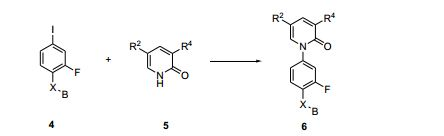
[00248] O composto 6, em que cada um de R2, R4, X e B é como definido acima, pode ser preparado pelo processo ilustrado no Esquema 2. Uma mistura contendo derivado de iodo 4, derivado de piridona 5, uma base (tal como carbonato de potássio, carbonato de césio, fosfato de potássio, etc.) e um ligando (tal como 8-hidroxiquinolina, 2-oxociclo-hexanocarboxilato de etila, N, N'-dimetil-etano-1,2-diamina, etc) dissolvido em um solvente (tal como dioxano, N, N-dimetil formamida ou dimetil sulfóxido) é aquecida a uma temperatura adequada (tal como 50 a 140°C) sob uma atmosfera de nitrogênio para dar o composto 6.Esquema 3
[00249] Composto 9, em que cada um de R2, R4 e B é como definido acima, pode ser preparado pelo processo ilustrado no Esquema 3. Derivado de tiazol 7 é reagido com NBS para se obter um derivado contendo bromo 8. Uma mistura de derivado contendo bromo 8, os derivados de piridona 5, uma base (tal como carbonato de potássio, carbonato de césio, fosfato de potássio, etc), um ligando (tais como 8-hidroxiquinolinamorfolina, 2-oxociclo- hexanocarboxilato de etila, N, N'-dimetil-1,2-etano diamina, etc) dissolvido em um solvente (tal como dioxano, N, N-dimetil formamida ou dimetil sulfóxido) é aquecido a uma temperatura adequada (tal como 50 a 140°C) sob uma atmosfera de nitrogênio para dar o composto 9.Esquema 4
[00250] Composto 13, em que cada um de R1, R3 e B é como aqui definido, pode ser preparado pelo processo ilustrado no Esquema 4. As aminas 11 podem ser preparadas por meio de hidrogenação catalítica de derivados de nitro 10. As aminas 11 são então reagidas com o composto 12 sob a ação de trimetil alumínio em um solvente orgânico (tal como diclorometano, etc.) para dar o composto alvo 13.Esquema 5
[00251] Composto 16, em que cada um de R1, R3 e B é como aqui definido, pode ser preparado pelo processo ilustrado no Esquema 5. Derivado de tiazol 7 pode ser transformado em derivado de nitro 14, sob a ação de um ácido forte (tal como ácido nítrico concentrado, ácido sulfúrico concentrado, etc.). O derivado de nitro 14 é então reduzido por meio de hidrogenação catalítica para se obter amina 15 seguido por reação com o composto 12 sob a ação de trimetil alumínio em um solvente orgânico (tal como diclorometano, etc.) para dar o composto alvo 16. Esquema 6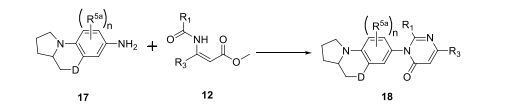
[00252] Composto 18, em que cada um de R1, R3, R5a, n e D é como aqui definido, pode ser preparado pelo processo ilustrado no Esquema 6. Composto tricíclico fundido 17 é reagido com o composto 12 sob a ação de trimetil alumínio em um solvente orgânico (tal como o diclorometano, etc.) para dar o composto alvo 18. EXEMPLOS Exemplo 1 1-(4- fluoro-3 (morfolinometil) fenil)-5-metilpiridin-2 (1H)-ona
[00253] A uma solução de 2-fluoro-4-iodotolueno (23,60 g, 0,10 mol) em CHCl3 (1000 mL) foi adicionado BPO (0,55 g, 2,27 mmol) e NBS (24,92 g, 0,14 mol) sob N2. A mistura de reação foi submetida a refluxo durante 6 h, depois resfriou-se e filtrou-se. O filtrado foi concentrado in vacuo. O resíduo foi adicionado a uma solução de morfolina (43,56 g, 0,50 mol) em EtOH(1000 ml) sob N2. A mistura resultante foi agitada à temperatura ambiente durante a noite, e concentrou-se in vacuo. O resíduo foi purificado por cromatografia em coluna de gel de sílica (EP / AcOEt (V / V) = 3: 1) para dar o composto do título como um sólido branco (4,82 g, 15 %).Etapa 2) 1-(4- fluoro-3 (morfolinometil) fenil)-5-metilpiridin-2 (1H)-ona[00253] To a solution of 2-fluoro-4-iodotoluene (23.60 g, 0.10 mol) in CHCl 3 (1000 mL) was added BPO (0.55 g, 2.27 mmol) and NBS (24, 92 g, 0.14 mol) under N2. The reaction mixture was refluxed for 6 h, then cooled and filtered. The filtrate was concentrated in vacuo. The residue was added to a solution of morpholine (43.56 g, 0.50 mol) in EtOH (1000 ml) under N 2 . The resulting mixture was stirred at room temperature overnight, and concentrated in vacuo. The residue was purified by silica gel column chromatography (EP / EtOAc (V / V) = 3: 1) to give the title compound as a white solid (4.82 g, 15%).Step 2) 1 -(4-fluoro-3(morpholinomethyl)phenyl)-5-methylpyridin-2(1H)-one
[00254] Uma mistura de CuI (0,19 g, 1 mmol), Cs2CO3 (6,85 g, 20 mmol) e 2-oxociclo-hexanocarboxilato de etila (0,34 g, 2 mmol) em DMSO (10 mL) foi agitada à temperatura ambiente durante 30 min sob N2. Em seguida, a mistura de reação foi adicionada uma solução de 5-metilpiridona (1,09 g, 10 mmol) e 4-(2-fluoro-4-iodobenzil) morfolina (3,21 g, 10 mmol) em DMSO (12 mL) através de uma seringa. A mistura de reação foi aquecida a 100°C durante a noite, resfriada até a temperatura ambiente e filtrou-se. O filtrado foi diluído com H2O (50 mL) foi extraída com CH2Cl2 (50 mL x 3). As fases orgânicas combinadas foram concentradas in vacuo. O resíduo foi purificado por cromatografia em coluna de gel de sílica (EP / AcOEt (V / V) = 10: 1) para dar o composto do título como um sólido branco (0,70 g, 23 %). O composto foi caracterizado pelos seguintes dados espectroscópicos: MS (ESI, pos.ion) m / z: 303,2 (M + 1); 1H-RMN(400 MHz, CDCl3+<"h"4.28"*u."5J+."5.38-3,32 (m, 4H), 3,86-3,97 (m, 4H), 4,44 (s, 2H), 6,47 (d, 1 H, J = 9,6 Hz), 7,39-7,44 (m, 2 H), 7,48 (s, 1H), 7,52-7,55 (m, 1 H), 7,99 (t, 1H, J = 8,2 Hz). Exemplo 2 1-(4- fluoro-3 (morfolinometil) fenil)-3,5-dimetilpiridin-2 (1H)-ona
[00255] Uma mistura de 3,5-dimetilpiridin-2 (1H)-ona (0,22 g, 1,80 mmol), 4-(2-fluoro-4-iodobenzil) morfolina (0,58 g, 1,80 mmol), K2CO3 (2,48 g, 18 mmol), CuI (0,02 g, 0,1 mmol) e DMF (3 mL) foi submetida a refluxo sob N2. O processo da reação foi monitorado por TLC. A mistura de reação foi resfriada até a temperatura ambiente e filtrou-se. Ao filtrado foi adicionado H2O (10 mL) e CH2Cl2 (20 mL). A camada de CH2Cl2 foi separada, e a camada aquosa foi extraída com CH2Cl2 (20 mL x 2). As fases orgânicas combinadas foram secas sobre Na2SO4 e concentradas in vacuo. O resíduo foi purificado por cromatografia em coluna de gel de sílica (EP / AcOEt (V / V) = 1: 1) para dar o composto do título como um sólido branco (0,28 g, 50 %). O composto foi caracterizado pelos seguintes dados espectroscópicos: MS (ESI, pos.ion) m / z: 317,1 (M + 1); 1H-RMN(400 MHz, CDCl3+<"h"4.28"*u."5J+."4.38"*u."5J+."4.83"*u."4J+."6.32 (m, 4H), 4,32 (m, 4H), 6,97 (s, 1 H), 7,09 (s, 1 H), 7,24 (d, 1 H), 7,31 (d, 1H), 8,1 (s, 1 H). Exemplo 3 1-(3-fluoro-4-((4-metilpiperazin-1-il) metil) fenil)-3,5-dimetilpiridin-2(1H)-ona
[00256] A uma mistura de 2-fluoro-4-iodotolueno (0,94 g, 4,0 mmol) em CCl4 (40 mL) foram adicionados BPO (0,02 g, 0,08 mmol) e NBS (0,78 g, 4,4 mmol) sob N2. A mistura de reação foi submetida a refluxo durante 5 h, depois resfriada e concentrada em vácuo. Ao resíduo foi adicionada uma solução de metilpiperazina (2,00 g, 20 mmol) em EtOH(40 mL) sob N2. A mistura foi agitada à temperatura ambiente durante a noite e concentrada in vacuo. O resíduo resultante foi purificado por cromatografia em coluna de gel de sílica (EP / AcOEt (V / V) = 10: 1) para dar o composto do título como um sólido branco (0,69 g, 52 %).Etapa 2) 1-(3-fluoro-4-((4-metilpiperazin-1-il) metil) fenil)-3,5-dimetil- piridin-2 (1H)-ona[00256] To a mixture of 2-fluoro-4-iodotoluene (0.94 g, 4.0 mmol) in CCl 4 (40 mL) were added BPO (0.02 g, 0.08 mmol) and NBS (0. 78 g, 4.4 mmol) under N2. The reaction mixture was refluxed for 5 h, then cooled and concentrated in vacuo. To the residue was added a solution of methylpiperazine (2.00 g, 20 mmol) in EtOH (40 mL) under N 2 . The mixture was stirred at room temperature overnight and concentrated in vacuo. The resulting residue was purified by silica gel column chromatography (EP / EtOAc (V / V) = 10: 1) to give the title compound as a white solid (0.69 g, 52 %).Step 2) 1-(3-fluoro-4-((4-methylpiperazin-1-yl)methyl)phenyl)-3,5-dimethyl-pyridin-2(1H)-one
[00257] Uma mistura de 3,5-dimetilpiridin-2 (1H)-ona (0,07 g, 0,57 mmol), 1-(2-fluoro-4-iodobenzil)-4-metilpiperazina (0,19 g, 0,57 mmol), K2CO3 (0,08 g, 0,58 mmol), CuI (0,005 g, 0,026 mmol) e DMF (1 mL) foi submetida a refluxo sob N2. O processo da reação foi monitorado por TLC. Após a reação ter sido completada, a mistura foi resfriada até a temperatura ambiente. À mistura resultante foi adicionada H2O (5 ml) e CH2Cl2 (10 mL x 3). A fase orgânica foi separada, seca sobre Na2SO4 e concentrada in vacuo. O resíduo foi purificado por cromatografia em coluna de gel de sílica (EP / AcOEt (V / V) = 1: 1) para dar o composto do título como um sólido amarelo pálido (0,07 g, 37 %). O composto foi caracterizado pelos seguintes dados espectroscópicos: MS (ESI, pos.ion) m / z: 317,1 (M + 1); 1H-RMN(400 MHz, CDCl3+<"h"4.2:"*u."5J+."4.39"*u."5J+."4.4;"*u."5J+."4.68- 2,54 (m, 8H), 3,61 (s, 2 H), 6,97 (s, 1H), 7,11-7,15 (m, 3H), 7,47-7,511 (m, 1 H). Exemplo 4 1-(4-((dietilamino) metil)-3-fluorofenil)-3,5-dimetilpiridin-2 (1H)-ona
[00258] A uma solução de 2-fluoro-4-iodotolueno (2,83 g, 12 mmol) em CCl4 (120 mL) foram adicionados NBS (2,24 g, 12,6 mmol) e BPO (0,06 g, 0,24 mmol). A mistura de reação foi submetida a refluxo durante 9 h sob N2, em seguida resfriada até a temperatura ambiente e concentrada em vácuo. O resíduo foi purificado por cromatografia em coluna de gel de sílica (PE) para dar o composto do título como um sólido branco (2,16 g, 57 %).Etapa 2) N-etil-N-(2-fluoro-4-iodobenzil) etanamina[00258] To a solution of 2-fluoro-4-iodotoluene (2.83 g, 12 mmol) in CCl4 (120 mL) was added NBS (2.24 g, 12.6 mmol) and BPO (0.06 g , 0.24 mmol). The reaction mixture was refluxed for 9 h under N2, then cooled to room temperature and concentrated in vacuo. The residue was purified by silica gel (PE) column chromatography to give the title compound as a white solid (2.16 g, 57%).Step 2) N-ethyl-N-(2-fluoro-4) -iodobenzyl) ethanamine
[00259] Uma mistura de 1-(bromometil)-2-fluoro-4-iodobenzeno (1,89 g, 6,0 mmol) e uma solução de dietilamina (2,19 g, 30 mmol) em EtOH(60 mL) foi agitada à temperatura ambiente durante a noite sob N2, em seguida concentrou-se in vacuo. O resíduo foi dissolvido em EtOAC(100 mL), e lavou-se com água (100 mL x 3), seguida por salmoura (100 mL). A fase orgânica foi concentrada em vácuo para dar o composto do título como um óleo incolor (1,72 g, 94 %).Etapa 3) 1-(4-((dietilamino) metil)-3-fluorofenil)-3,5-dimetilpiridin-2 (1H)- ona[00259] A mixture of 1-(bromomethyl)-2-fluoro-4-iodobenzene (1.89 g, 6.0 mmol) and a solution of diethylamine (2.19 g, 30 mmol) in EtOH (60 mL) was stirred at room temperature overnight under N 2 then concentrated in vacuo. The residue was dissolved in EtOAC (100 mL), and washed with water (100 mL x 3), followed by brine (100 mL). The organic phase was concentrated in vacuo to give the title compound as a colorless oil (1.72 g, 94%).Step 3) 1-(4-((diethylamino)methyl)-3-fluorophenyl)-3,5 -dimethylpyridin-2(1H)-one
[00260] A uma solução de N-etil-N-(2-fluoro-4-iodobenzil) etanamina (1,72 g, 5,60 mmol) em dioxano (50 mL) foi adicionado 3,5-dimetil-piridona (0,69 g, 5,60 mmol), N, N'-dimetil-etano-1,2-diamina (0,20 g, 2,24 mmol), CuI (0,21 g, 1,12 mmol) e fosfato de potássio (2,38 g, 11,20 mmol) sob N2. A mistura de reação foi aquecida a 110°C por 9 h, em seguida resfriada até a temperatura ambiente e verteu-se em CH2Cl2 (200 mL). A mistura foi filtrada, e o filtrado foi lavado com água (200 mL x 3) e salmoura (200 mL). A fase orgânica foi concentrada in vacuo. O resíduo foi purificado por cromatografia em coluna de gel de sílica (CH2Cl2 / MeOH(v / v) = 10: 1) para dar o composto do título como um sólido amarelo (0,23 g, 14 %). O composto foi caracterizado pelos seguintes dados espectroscópicos: MS (ESI, pos.ion) m / z: 303,7 (M + 1); 1H-RMN(400 MHz, CDCi3): h 3.28 *V. 8 J. L ? 9.4 Jz+, 4.29 *u. 5J+. 4.39 *u. 3H), 2,53-2,58 (m, 4H), 3,65 (s, 2H), 6,98 (s, 1H), 7,15-7,09 (m, 3 H), 7,55 (t, 1H, J = 8,2 Hz). Exemplo 5 3-(4- fluoro-3 (morfolinometil) fenil)-2,6-dimetilpirimidin-4 (3H)-ona
[00261] A uma solução de 1-metil-2-fluoro-4-nitrobenzeno (4,96 g, 32 mmol) e NBS (6,05 g, 34 mmol) em CCl4 (80 mL) foi adicionado BPO (0,39 g, 1,6 mmol). A mistura foi aquecida a 68°C durante 5 h, depois filtrada e concentrada em vácuo. O resíduo foi purificado por cromatografia em coluna de gel de sílica (EP / AcOEt (V / V) = 20: 1) para dar o composto do título como um sólido amarelo (4,53 g, 60 %).Etapa 2) 4-(2-fluoro-4-nitrobenzil) morfolina[00261] To a solution of 1-methyl-2-fluoro-4-nitrobenzene (4.96 g, 32 mmol) and NBS (6.05 g, 34 mmol) in CCl4 (80 mL) was added BPO (0. 39 g, 1.6 mmol). The mixture was heated at 68°C for 5 h, then filtered and concentrated in vacuo. The residue was purified by silica gel column chromatography (EP / EtOAc (V / V) = 20: 1) to give the title compound as a yellow solid (4.53 g, 60%).Step 2) 4 -(2-fluoro-4-nitrobenzyl)morpholine
[00262] A uma solução de 1-(bromometil)-2-fluoro-4-nitrobenzeno (3,04 g, 13 mmol) em CH2Cl2 (50 mL) foram adicionados morfolina (1,74 g, 20 mmol) e ET3N(2,63 g, 26 mmol). A reação foi submetida a refluxo durante a noite, e depois concentrou-se in vacuo. O resíduo foi purificado por cromatografia em coluna de gel de sílica (EP / AcOEt (V / V) = 4: 1) para dar o composto do título como um sólido amarelo (2,05 g, 65 %).Etapa 3) 3-fluoro-4-(morfolinometil) anilina[00262] To a solution of 1-(bromomethyl)-2-fluoro-4-nitrobenzene (3.04 g, 13 mmol) in CH2Cl2 (50 mL) was added morpholine (1.74 g, 20 mmol) and ET3N( 2.63 g, 26 mmol). The reaction was refluxed overnight, then concentrated in vacuo. The residue was purified by silica gel column chromatography (EP / EtOAc (V / V) = 4: 1) to give the title compound as a yellow solid (2.05 g, 65%).Step 3) 3 -fluoro-4-(morpholinomethyl)aniline
[00263] A uma solução de 4-(2-fluoro-4-nitrobenzil) morfolina (14,80 g, 62 mmol) em MeOH(100 mL) foi adicionado Pd / C(4,0 g). A mistura de reação foi agitada à temperatura ambiente sob H2 durante a noite e filtrou-se. O filtrado foi concentrado in vacuo. O resíduo foi purificado por cromatografia em coluna de gel de sílica (EP / AcOEt (V / V) = 1: 1) para dar o composto do título como um sólido amarelo acastanhado (11,27 g, 87 %). Etapa 4) 3-(4- fluoro-3 (morfolinometil) fenil)-2,6-dimetilpirimidin-4 (3H)- ona[00263] To a solution of 4-(2-fluoro-4-nitrobenzyl)morpholine (14.80g, 62mmol) in MeOH(100ml) was added Pd/C(4.0g). The reaction mixture was stirred at room temperature under H2 overnight and filtered. The filtrate was concentrated in vacuo. The residue was purified by silica gel column chromatography (EP / EtOAc (V / V) = 1: 1) to give the title compound as a yellow-brown solid (11.27 g, 87%). Step 4) 3-(4-fluoro-3(morpholinomethyl)phenyl)-2,6-dimethylpyrimidin-4(3H)-one
[00264] Uma mistura de 3-fluoro-4-(morfolinometil) anilina (0,21 g, 1,00 mmol), CH2Cl2 anidro (10 mL) e trimetil alumínio (4,5 mL, 4,5 mmol, 1,0 M em heptano) foi agitada à temperatura ambiente durante 20 min sob N2, seguido pela adição de uma solução de 3-acetaminocrotonato de metila (0,19 g, 1,20 mmol) em CH2Cl2 (5 mL). A mistura de reação foi agitada à temperatura ambiente durante 10 h, em seguida resfriada bruscamente com solução aquosa saturada de NH4Cl e extraiu-se com CH2Cl2. As fases orgânicas combinadas foram lavadas com solução aquosa saturada de NaHCO3 e salmoura, secou-se sobre Na2SO4 anidro e concentrou-se in vacuo. O resíduo foi purificado por cromatografia em coluna de gel de sílica (EP / AcOEt (V / V) = 1: 1) para dar o composto do título como um sólido amarelo pálido (0,105 g, 30 %). O composto foi caracterizado pelos seguintes dados espectroscópicos: MS (ESI, pos.ion) m / z: 318,2 (M + 1); 1H-RMN(400 MHz, CDCl3+<"h"4.3:"*u."5J+."4.53"*u."5J+."4.75"*u."6J+."5.84 (m, 2 H), 3,74 (s, 4H), 6,3 (s, 1 H), 6,96 (m, 2 H), 7,61 (s, 1 H). Exemplo 6 1-(2-(4-etoxifenil) tiazol-5-il)-3,5-dimetilpiridin-2 (1H)-ona
[00265] A uma mistura de 4-hidroxibenzotioamida (30,64 g, 0,20 mol) e 2-bromo-1,1-dimetoxietano (31,00 g, 0,20 mol) em EtOH(600 mL) foi adicionado ácido 4-metilbenzenossulfúrico (34,44 g, 0,20 mol) com agitação à temperatura ambiente. A mistura de reação foi aquecida a 90 ° C durante 24 h, em seguida resfriada até a temperatura ambiente e concentrada em vácuo. A mistura foi diluída com H2O (200 mL), ajustado a pH 10 com uma solução aquosa saturada de NaHCO3 e extraiu-se com DCM (200 mL x 3). As fases orgânicas combinadas foram concentradas in vacuo para dar o composto do título como sólido amarelo (21,3 g, 60 %).Etapa 2) 2-(4-etoxifenil) tiazol[00265] To a mixture of 4-hydroxybenzothioamide (30.64 g, 0.20 mol) and 2-bromo-1,1-dimethoxyethane (31.00 g, 0.20 mol) in EtOH (600 ml) was added 4-methylbenzenesulfuric acid (34.44 g, 0.20 mol) with stirring at room temperature. The reaction mixture was heated at 90 °C for 24 h, then cooled to room temperature and concentrated in vacuo. The mixture was diluted with H2O (200 mL), adjusted to pH 10 with a saturated aqueous solution of NaHCO3 and extracted with DCM (200 mL x 3). The combined organic phases were concentrated in vacuo to give the title compound as a yellow solid (21.3 g, 60%).Step 2) 2-(4-ethoxyphenyl)thiazole
[00266] A uma mistura de 2-(4-hidroxifenil)-tiazol (21,27 g, 0,12 mol) e K2CO3 (82,93 g, 0,60 mol) em acetona (1000 mL) foi adicionado bromoetano (39,24 g, 0,36 mol) com agitação à temperatura ambiente. A mistura de reação foi aquecida a 60 ° C durante 11 h, depois resfriada até a temperatura ambiente, filtrou-se e concentrou-se in vacuo para dar o composto do título como um sólido branco (24,54 g, 100 %).Etapa 3) 5-bromo-2-(4-etoxifenil) tiazol[00266] To a mixture of 2-(4-hydroxyphenyl)-thiazole (21.27 g, 0.12 mol) and K2CO3 (82.93 g, 0.60 mol) in acetone (1000 mL) was added bromoethane ( 39.24 g, 0.36 mol) with stirring at room temperature. The reaction mixture was heated at 60 °C for 11 h, then cooled to room temperature, filtered and concentrated in vacuo to give the title compound as a white solid (24.54 g, 100%). Step 3) 5-bromo-2-(4-ethoxyphenyl)thiazole
[00267] A uma solução de 2-(4-etoxifenil) tiazol (1,03 g, 5,00 mmol) em DCM (30 mL) foram adicionados NBS (0,98 g, 5,50 mmol) e ácido acético (0,3 mL) com agitação à temperatura ambiente sob N2. A reação foi agitada a 48°C durante 3 h, em seguida resfriada até a temperatura ambiente e concentrada em vácuo. O resíduo foi purificado por cromatografia em coluna de gel de sílica (EP / AcOEt (V / V) = 1: 1) para dar o composto do título como um sólido branco (1,34 g, 94 %).Etapa 4) 1-(2-(4-etoxifenil) tiazol-5-il)-3,5-dimetilpiridin-2 (1H)-ona[00267] To a solution of 2-(4-ethoxyphenyl)thiazole (1.03 g, 5.00 mmol) in DCM (30 mL) was added NBS (0.98 g, 5.50 mmol) and acetic acid ( 0.3 ml) with stirring at room temperature under N 2 . The reaction was stirred at 48°C for 3 h, then cooled to room temperature and concentrated in vacuo. The residue was purified by silica gel column chromatography (EP / EtOAc (V / V) = 1: 1) to give the title compound as a white solid (1.34 g, 94%).Step 4) 1 -(2-(4-ethoxyphenyl)thiazol-5-yl)-3,5-dimethylpyridin-2(1H)-one
[00268] Uma mistura de CuI (0,038 g, 0,20 mmol), Cs2CO3 (0,98 g, 3,00 mmol) e ligando de 8-hidroxiquinolina (0,029 g, 0,20 mmol) em DMSO (2 mL) foi agitada à temperatura ambiente durante 30 min sob N2. Em seguida, à mistura de reação adicionou-se uma solução de 3,5-dimetilpiridin-2 (1H)-ona (0,30 g, 2,40 mmol) e 5-bromo-2-(4-etoxifenil) tiazol (0,57 g, 2,00 mmol) em DMSO (2 mL) via seringa. A mistura de reação foi aquecida a 130°C durante 12 h, depois resfriada até a temperatura ambiente e filtrou-se. O filtrado foi diluído com H2O (10 mL) e extraiu-se com CH2Cl2 (20 mL x 3). As fases orgânicas combinadas foram concentradas in vacuo. O resíduo foi purificado por cromatografia em coluna de gel de sílica (EP / AcOEt (V / V) = 1: 10) para dar o composto do título (0,17 g, 26 %). O composto foi caracterizado pelos seguintes dados espectroscópicos: MS (ESI, pos.ion) m / z: 327 (M + 1); 1H-RMN(400 MHz, CDCi3): h 3.66 *V. 5J. L ? 9.2 Jz+. 4.37 *u. 5J+. 4.43 *u. 3H), 4,07-4,12 (m, 2 H), 6,95 (d, 2 H, J = 8,8 Hz), 7,16 (s, 1 H), 7,36 (s, 1 H), 7,82 (s, 1H), 7,88 (d, 2 H, J = 8,8 Hz). Exemplo 7 3-(3-fluoro-4-morfolinofenil)-2,6-dimetilpirimidin-4 (3H)-ona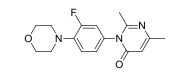
[00269] A uma solução de morfolina (12,04 g, 0,14 mol) e ET3N(13,97 g, 0,14 mol) em EtOAc foi adicionado 3,4-difluoronitrobenzeno (20,0 g, 0,13 mol) gota a gota em um banho de gelo. A mistura de reação foi aquecida lentamente até a temperatura ambiente, agitou-se à temperatura ambiente durante a noite, e depois filtrou-se. A torta do filtro foi lavada com água, secou-se em vácuo para se obter a primeira coleta de produto. A fase orgânica foi separada do filtrado, e a fase aquosa foi lavada com EtOAc. As fases orgânicas combinadas foram secas sobre Na2SO4 anidro e concentrou-se in vacuo para se obter a segunda coleta de produto. Os sólidos de primeira coleta e segunda coleta foram combinados para dar o composto do título como um sólido amarelo (28,0 g, 99 %).Etapa 2) 3-fluoro-4-morfolinoanilina[00269] To a solution of morpholine (12.04 g, 0.14 mol) and ET3N (13.97 g, 0.14 mol) in EtOAc was added 3,4-difluoronitrobenzene (20.0 g, 0.13 mol) dropwise in an ice bath. The reaction mixture was slowly warmed to room temperature, stirred at room temperature overnight, then filtered. The filter cake was washed with water, dried under vacuum to obtain the first collection of product. The organic phase was separated from the filtrate, and the aqueous phase was washed with EtOAc. The combined organic phases were dried over anhydrous Na2SO4 and concentrated in vacuo to give the second crop of product. The first and second crop solids were combined to give the title compound as a yellow solid (28.0 g, 99%).Step 2) 3-Fluoro-4-morpholinoaniline
[00270] A uma solução de 4-(2-fluoro-4-nitrofenil) morfolina (15,0 g, 66 mmol) em THF (100 mL) foi adicionado Pd / C(3,0 g). A mistura de reação foi agitada à temperatura ambiente sob H2 durante 12 h. A mistura foi filtrada através de uma almofada de celite, e o filtrado foi concentrado em vácuo para dar o composto do título como um sólido branco (11,55 g, 89 %). Etapa 3) 3-acetaminocrotonato de metila[00270] To a solution of 4-(2-fluoro-4-nitrophenyl)morpholine (15.0g, 66mmol) in THF (100ml) was added Pd/C(3.0g). The reaction mixture was stirred at room temperature under H2 for 12 h. The mixture was filtered through a pad of celite, and the filtrate was concentrated in vacuo to give the title compound as a white solid (11.55 g, 89%). Step 3) Methyl 3-acetaminocrotonate
[00271] Para anidrido acético (300 mL, 3,04 mol) foi adicionado 2- aminocrotonato de metila (100 g, 0,87 mol). A mistura foi agitada a 75°C durante 3 h, resfriada até a temperatura ambiente e concentrada em vácuo. O produto em bruto foi recristalizado a partir de EtOH(150 mL) para dar o composto do título como um sólido branco (46 g, 34 %).Etapa 4) 3-(3-fluoro-4-morfolinofenil)-2,6-dimetilpirimidin-4 (3H)-ona[00271] To acetic anhydride (300 mL, 3.04 mol) was added methyl 2-aminocrotonate (100 g, 0.87 mol). The mixture was stirred at 75°C for 3 h, cooled to room temperature and concentrated in vacuo. The crude product was recrystallized from EtOH (150 mL) to give the title compound as a white solid (46 g, 34%).Step 4) 3-(3-fluoro-4-morpholinophenyl)-2,6 -dimethylpyrimidin-4(3H)-one
[00272] A uma solução de 3-fluoro-4-morfolinoanilina (11,0 g, 56 mmol) em CH2Cl2 (200 mL) adicionou-se trimetil alumínio (168 mL, 168 mmol, 1 M em heptano), gota a gota cuidadosamente sob N2. A mistura foi agitada à temperatura ambiente durante 20 min, seguido pela adição de uma solução de 3-acetaminocrotonato de metila (10,57 g, 67 mmol) em CH2Cl2 (30 mL). A reação foi agitada à temperatura ambiente durante 5 h, em seguida resfriada bruscamente com solução aquosa saturada de NH4Cl e extraiu-se com CH2Cl2. As fases orgânicas combinadas foram lavadas com água, secas sobre Na2SO4 anidro e concentrou-se in vacuo. O resíduo foi recristalizado a partir de EtOAc para dar o composto do título como um sólido amarelo pálido (11,39 g, 67 %). O composto foi caracterizado pelos seguintes dados espectroscópicos: MS (ESI, pos.ion) m / z: 304,2 (M + 1); 1H-RMN(400 MHz, CDCl3+<"h"4.3;"*u."5J+."4.52"*u."5J+."5.2;-3,22 (m, 4H), 3,88 (t, 4H, J = 4,6 Hz), 6,28 (s, 1H), 6,90-6,94 (m, 2H), 7,01-7,06 (m, 1 H). Exemplo 8 3-(4-(dietilamino)-3-fluorofenil)-2,6-dimetilpirimidin-4 (3H)-ona
[00273] A uma solução de dietilamina (2,53 g, 34,59 mmol) e ET3N(3,82 g, 37,75 mmol) em EtOAC(40 mL) foi adicionado 3,4- difluoronitrobenzeno (5,00 g, 31,43 mmol) gota a gota durante um período de 30 min em uma banho de gelo. Após o final da adição a reação foi aquecida lentamente até a temperatura ambiente, e o sólido foi separado por precipitação. A mistura foi filtrada. A torta do filtro foi lavada com uma quantidade adequada de água, e secou-se em vácuo para se obter a primeira coleta de produto. O filtrado foi extraído com EtOAc. As fases orgânicas combinadas foram secas sobre Na2SO4 anidro e concentrou-se in vacuo para se obter a segunda coleta de produto. Os sólidos de primeira coleta e segunda coleta foram combinados para dar o composto do título como um sólido amarelo (7,20 g, 99 %).Etapa 2) N1, N1-dietil-2-fluorobenzeno-1,4-diamina[00273] To a solution of diethylamine (2.53 g, 34.59 mmol) and ET3N (3.82 g, 37.75 mmol) in EtOAC (40 mL) was added 3,4-difluoronitrobenzene (5.00 g , 31.43 mmol) dropwise over a period of 30 min in an ice bath. After the addition was complete, the reaction was slowly warmed to room temperature, and the solid precipitated out. The mixture was filtered. The filter cake was washed with an adequate amount of water, and dried under vacuum to obtain the first collection of product. The filtrate was extracted with EtOAc. The combined organic phases were dried over anhydrous Na2SO4 and concentrated in vacuo to give the second crop of product. The first crop and second crop solids were combined to give the title compound as a yellow solid (7.20 g, 99 %).Step 2) N1,N1-diethyl-2-fluorobenzene-1,4-diamine
[00274] A uma solução de N, N-dietil-2-fluoro-4-nitroanilina (4,00 g, 18,84 mmol) em THF (50 mL) foi adicionado Pd / C(1,50 g). A mistura de reação foi agitada à temperatura ambiente sob H2 durante 12 h. A mistura foi filtrada, e o filtrado foi concentrado em vácuo para dar o composto do título como um sólido de cor branco sujo (3,20 g, 93 %).Etapa 3) 3-(4-(dietilamino)-3-fluorofenil)-2,6-dimetilpirimidin-4 (3H)-ona[00274] To a solution of N,N-diethyl-2-fluoro-4-nitroaniline (4.00 g, 18.84 mmol) in THF (50 mL) was added Pd/C (1.50 g). The reaction mixture was stirred at room temperature under H2 for 12 h. The mixture was filtered, and the filtrate was concentrated in vacuo to give the title compound as an off-white solid (3.20 g, 93%).Step 3) 3-(4-(diethylamino)-3-fluorophenyl )-2,6-dimethylpyrimidin-4(3H)-one
[00275] A uma solução de N1, N1-dietil-2-fluorobenzeno-1,4-diamina (1,50 g, 8,23 mmol) em CH2Cl2 anidro (60 mL) adicionou-se trimetil alumínio (33 mL, 33 mmol, 1 M em heptano), gota a gota lentamente sob N2. Após o final da adição a mistura foi agitada à temperatura ambiente durante 40 min. A esta mistura foi adicionada uma solução de 3-acetaminocrotonato de metila (2,58 g, 16,40 mmol) em CH2Cl2 anidro (20 mL). A mistura de reação resultante foi agitada à temperatura ambiente durante mais 6 horas, em seguida resfriada bruscamente com água. A fase orgânica foi lavada com salmoura, seca sobre Na2SO4 anidro e concentrou-se in vacuo. O produto em bruto foi recristalizado a partir de EtOAc para dar o composto do título como um sólido amarelo pálido (1,60 g, 67 %). O composto foi caracterizado pelos seguintes dados espectroscópicos: MS (ESI, pos.ion) m / z: 290,2 (M + 1); 1H-RMN(622 OJz, FOUQ+< h 3.29 *V. 8 J. L ? 9.26 Jz+, 4.2: *u. 5J+. 4.3; (s, 3H), 3,22-3,27 (m, 4H), 6,22 (s, 1H), 6,98-7,06 (m, 2H), 7,16-7,20 (m, 1 H). Exemplo 9 3-(3-fluoro-4-tiomorfolinofenil)-2,6-dimetilpirimidin-4 (3H)-ona
[00276] A uma solução de tiomorfolina (3,57 g, 34,56 mmol) e ET3N(3,50 g, 34,56 mmol) em EtOAc foi adicionado 3,4- difluoronitrobenzeno (5,00 g, 31,43 mmol) gota a gota durante um período de 30 min em um banho de gelo. Após o final da adição a mistura de reação foi aquecida lentamente até a temperatura ambiente, e o sólido foi separado por precipitação. A mistura foi filtrada. A torta do filtro foi lavada com uma quantidade adequada de água, secou-se em vácuo para se obter a primeira coleta de produto. O filtrado foi extraído com EtOAc. As fases orgânicas combinadas foram secas sobre Na2SO4 anidro e concentrou-se in vacuo para se obter a segunda coleta de produto. Os sólidos de primeira coleta e segunda coleta foram combinados para dar o composto do título como um sólido amarelo (5,50 g, 72 %).Etapa 2) 3-fluoro-4-tiomorfolinoanilina[00276] To a solution of thiomorpholine (3.57 g, 34.56 mmol) and ET3N (3.50 g, 34.56 mmol) in EtOAc was added 3,4-difluoronitrobenzene (5.00 g, 31.43 mmol) dropwise over a period of 30 min in an ice bath. After the addition was complete, the reaction mixture was slowly warmed to room temperature, and the solid precipitated out. The mixture was filtered. The filter cake was washed with an adequate amount of water, dried in a vacuum to obtain the first collection of product. The filtrate was extracted with EtOAc. The combined organic phases were dried over anhydrous Na2SO4 and concentrated in vacuo to give the second crop of product. The first and second crop solids were combined to give the title compound as a yellow solid (5.50 g, 72%).Step 2) 3-Fluoro-4-thiomorpholinoaniline
[00277] A uma solução de 4-(2-fluoro-4-nitrofenil) tiomorfolina (4,00 g, 16,51 mmol) em THF (50 mL) foi adicionado Pd / C(1,30 g). A mistura de reação foi agitada à temperatura ambiente sob H2 durante 12 h. A mistura foi filtrada, e o filtrado foi concentrado em vácuo para dar o composto do título como um sólido de cor branco sujo (3,40 g, 97 %).Etapa 3) 3-(3-fluoro-4-tiomorfolinofenil)-2,6-dimetilpirimidin-4 (3H)-ona[00277] To a solution of 4-(2-fluoro-4-nitrophenyl)thiomorpholine (4.00 g, 16.51 mmol) in THF (50 mL) was added Pd/C (1.30 g). The reaction mixture was stirred at room temperature under H2 for 12 h. The mixture was filtered, and the filtrate was concentrated in vacuo to give the title compound as an off-white solid (3.40 g, 97%).Step 3) 3-(3-fluoro-4-thiomorpholinophenyl)- 2,6-dimethylpyrimidin-4(3H)-one
[00278] A uma solução de 3-fluoro-4-tiomorfolinoanilina (1,20 g, 5,65 mmol) em CH2Cl2 anidro (60 mL) adicionou-se trimetil alumínio (28,5 mL, 28,5 mmol, 1 M em heptano) cuidadosamente gota a gota, sob a proteção de N2. Após o final da adição a mistura foi agitada à temperatura ambiente durante 40 min, seguido pela adição de uma solução de 3-acetaminocrotonato de metila (2,66 g, 16,92 mmol) em CH2Cl2 anidro (20 mL). Após o fim da adição, a mistura de reação foi agitada à temperatura ambiente durante mais 6 horas, em seguida resfriada bruscamente com água e extraída com CH2Cl2. As fases orgânicas combinadas foram lavadas com salmoura, secas sobre Na2SO4 anidro e concentrou-se in vacuo para dar o composto do título como um sólido amarelo pálido (0,91 g, 67 %). O composto foi caracterizado pelos seguintes dados espectroscópicos: MS (ESI, pos.ion) m / z: 320,2 (M + 1); 1H-RMN(400 MHz, CDCl3+<"h"4.29"*u."5J+."4.3;"*u."5J+."4.99"*v."6J."L"?"6.98" Hz), 3,33 (d, 4 H, J = 4,12 Hz), 6,23 (s, 1H), 7,08-7,11 (m, 1 H), 7,16-7,20 (m, 1 H), 7,25-7,29 (m, 1 H). Exemplo 10 3-(4-(1,1-dioxidotiomorfolino)-3-fluorofenil)-2,6-dimetilpirimidin-4 (3H)- ona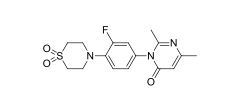
[00279] A uma suspensão de K2CO3 (5,53 g, 40 mmol) e 1,1-dioxo-tio- morfolinahidrocloreto (3,60 g, 21 mmol) em DMSO (50 mL) foi adicionado 3,4-difluoronitrobenzeno (3,18 g, 20 mmol). A reação foi aquecida a 100°C durante 12 h. A mistura foi diluída com água (150 mL) e extraiu-se com CH2Cl2 (100 mL x 2). As fases orgânicas combinadas foram secas sobre Na2SO4 anidro e concentrou-se in vacuo para dar o composto do título como um sólido amarelo (6,04 g, 70 %).Etapa 2) 4-(4-amino-2-fluorofenil) 1,1-dioxidotiomorfolina[00279] To a suspension of K2CO3 (5.53 g, 40 mmol) and 1,1-dioxo-thio-morpholine hydrochloride (3.60 g, 21 mmol) in DMSO (50 mL) was added 3,4-difluoronitrobenzene ( 3.18 g, 20 mmol). The reaction was heated at 100°C for 12 h. The mixture was diluted with water (150 mL) and extracted with CH2Cl2 (100 mL x 2). The combined organic phases were dried over anhydrous Na 2 SO 4 and concentrated in vacuo to give the title compound as a yellow solid (6.04 g, 70%).Step 2) 4-(4-amino-2-fluorophenyl) 1 ,1-dioxidothiomorpholine
[00280] A uma solução de 4-(2-fluoro-4-nitrofenil) 1,1- dioxidotiomorfolina (4,00 g, 14,58 mmol) em THF (50 mL) foi adicionado Pd / C(1,30 g). A mistura de reação foi agitada à temperatura ambiente sob H2 durante 12 h. A mistura foi filtrada, e o filtrado foi concentrado em vácuo para dar o composto do título como um sólido de cor branco sujo (2,40 g, 67 %).Etapa 3) 3-(4-(1,1-dioxidotiomorfolino)-3-fluorofenil)-2,6-dimetil-pirimidin-4 (3H)-ona[00280] To a solution of 4-(2-fluoro-4-nitrophenyl) 1,1-dioxidothiomorpholine (4.00 g, 14.58 mmol) in THF (50 mL) was added Pd/C (1.30 g ). The reaction mixture was stirred at room temperature under H2 for 12 h. The mixture was filtered, and the filtrate was concentrated in vacuo to give the title compound as an off-white solid (2.40 g, 67%).Step 3) 3-(4-(1,1-dioxidothiomorpholino) -3-fluorophenyl)-2,6-dimethyl-pyrimidin-4(3H)-one
[00281] A uma solução de 4-(4-amino-2-fluorofenil) 1,1- dioxidotiomorfolina (1,20 g, 4,91 mmol) em CH2Cl2 anidro (100 mL) foi adicionado trimetil alumínio (28,5 mL, 28,5 mmol, 1 M em heptano) cuidadosamente gota a gota sob N2. Após o final da adição a mistura foi agitada à temperatura ambiente durante 20 min, seguido pela adição de uma solução de 3-acetaminocrotonato de metila (2,32 g, 14,76 mmol) em CH2Cl2 anidro (30 mL). Após o fim da adição, a mistura de reação foi agitada à temperatura ambiente durante mais 15 h, depois resfriou-se bruscamente com uma quantidade apropriada de água e extraiu-se com CH2Cl2. As fases orgânicas combinadas foram lavadas com água salgada, seca e concentrada em vácuo para dar o composto do título como um sólido amarelo (0,81 g, 47 %). O composto foi caracterizado pelos seguintes dados espectroscópicos: MS (ESI, pos.ion) m / z: 352,1 (M + 1); 1H-RMN(400 MHz, DMSO-d6+<"h"4.29"*u."5J+."4.42"*u."5J+."5.4;"*v."6J."L"?" 4,4 Hz), 3,58 (d, 4 H, J = 4,4 Hz), 6,23 (s, 1H), 7,13-7,11 (m, 1 H), 7,26-7,28 (m, 1 H), 7,31-7,35 (m, 1 H). Exemplo 11 3-(4- fluoro-3 (piperidin-1-il) fenil)-2,6-dimetilpirimidin-4 (3H)-ona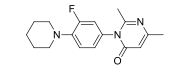
[00282] A uma solução de piperidina (5,88 g, 69 mmol) e ET3N(6,98 g, 69 mmol) em EtOAC(60 mL) foi adicionado 1,2-difluoro-4-nitrobenzeno (10,00 g, 63 mmol) gota a gota. A mistura foi agitada à temperatura ambiente durante a noite. A mistura resultante foi lavada com salmoura, seca sobre Na2SO4 anidro e concentrou-se in vacuo para dar o composto do título como um sólido amarelo (14,00 g, 99 %).Etapa 2) 3-fluoro-4-(piperidin-1-il) anilina[00282] To a solution of piperidine (5.88 g, 69 mmol) and ET3N (6.98 g, 69 mmol) in EtOAC (60 mL) was added 1,2-difluoro-4-nitrobenzene (10.00 g , 63 mmol) dropwise. The mixture was stirred at room temperature overnight. The resulting mixture was washed with brine, dried over anhydrous Na 2 SO 4 and concentrated in vacuo to give the title compound as a yellow solid (14.00 g, 99%).Step 2) 3-fluoro-4-(piperidin- 1-yl) aniline
[00283] A uma solução de 1-(2-fluoro-4-nitrofenil) piperidina (14,00 g, 62 mmol) em THF (80 mL) foi adicionado Pd / C(3,00 g). A mistura de reação foi agitada à temperatura ambiente sob H2 durante a noite. A mistura foi filtrada, e o filtrado foi concentrado em vácuo para dar o composto do título como um sólido amarelo acastanhado (11,00 g, 87 %).Etapa 3) 3-(4- fluoro-3 (piperidin-1-il) fenil)-2,6-dimetilpirimidin-4 (3H)-ona[00283] To a solution of 1-(2-fluoro-4-nitrophenyl)piperidine (14.00 g, 62 mmol) in THF (80 mL) was added Pd/C (3.00 g). The reaction mixture was stirred at room temperature under H2 overnight. The mixture was filtered, and the filtrate was concentrated in vacuo to give the title compound as a yellow-brown solid (11.00 g, 87%).Step 3) 3-(4-fluoro-3(piperidin-1-yl) ) phenyl)-2,6-dimethylpyrimidin-4(3H)-one
[00284] A uma solução de 3-fluoro-4-(piperidin-1-il) anilina (10,00 g, 51 mmol) em CH2Cl2 anidro (100 mL) adicionou-se trimetil alumínio (155 mL, 155 mmol, 1,0 M em tolueno) sob N2. A mistura foi agitada à temperatura ambiente durante 20 min, seguido pela adição de uma solução de 3-acetaminocrotonato de metila (9,72 g, 62 mmol) em CH2Cl2 anidro (20 mL). A mistura de reação foi agitada à temperatura ambiente durante 5 h, em seguida resfriada bruscamente com solução aquosa saturada de NH4Cl e extraiu-se com CH2Cl2. As fases orgânicas combinadas foram lavadas com salmoura, secas sobre Na2SO4 anidro e concentrou-se in vacuo. O resíduo foi purificado por cromatografia em coluna de gel de sílica (EP / AcOEt (V / V) = 2: 1) para dar o composto do título como um sólido amarelo pálido (11,02 g, 71 %). O composto foi caracterizado pelos seguintes dados espectroscópicos: MS (ESI, pos.ion) m / z: 302,2 (M + 1); 1H-RMN(400 MHz, CDCl3+<"h"3.79-1,63 (m, 2H), 1,78-1,72 (m, 4H), 2,18 (s, 3H), 2,29 (s, 3H), 3,07-3,01 (m, 2H), 3,11-3,16 (m, 2 H), 6,28 (s, 1H), 6,866,88 (m, 1 H), 6,89-6,90 (m, 1 H), 7,02-7,06 (m, 1 H). Exemplo 12 3-(3-fluoro-4-(4-metilpiperazin-1-il) fenil)-2,6-dimetilpirimidin-4 (3H)- ona
[00285] A uma solução de 1-metilpiperazina (6,91 g, 69 mmol) e ET3N(6,98 g, 69 mmol) em EtOAC(60 mL) foi adicionado 1,2-difluoro-4- nitrobenzeno (10,02 g, 63 mmol) gota a gota com agitação e a mistura foi agitada à temperatura ambiente durante a noite. A mistura de reação foi lavada com salmoura, seca sobre Na2SO4 anidro e concentrou-se in vacuo para dar o composto do título como um sólido amarelo (14,75 g, 98 %). Etapa 2) 3-fluoro-4-(4-metilpiperazin-1-il) anilina[00285] To a solution of 1-methylpiperazine (6.91 g, 69 mmol) and ET3N (6.98 g, 69 mmol) in EtOAC (60 mL) was added 1,2-difluoro-4-nitrobenzene (10. 02 g, 63 mmol) dropwise with stirring and the mixture was stirred at room temperature overnight. The reaction mixture was washed with brine, dried over anhydrous Na 2 SO 4 and concentrated in vacuo to give the title compound as a yellow solid (14.75 g, 98%). Step 2) 3-fluoro-4-(4-methylpiperazin-1-yl)aniline
[00286] A uma solução de 1-(2-fluoro-4-nitrofenil)-4-metilpiperazina (14,76 g, 61,70 mmol) em THF (80 mL) foi adicionado Pd / C(3,00 g). A reação foi agitada à temperatura ambiente sob H2 durante a noite. A mistura foi filtrada, e o filtrado foi concentrado em vácuo para dar o composto do título como um sólido de cor branco sujo (11,99 g, 93 %).Etapa 3) 3-(3-fluoro-4-(4-metilpiperazin-1-il) fenil)-2,6-dimetilpirimidin -4 (3H)-ona[00286] To a solution of 1-(2-fluoro-4-nitrophenyl)-4-methylpiperazine (14.76 g, 61.70 mmol) in THF (80 mL) was added Pd/C (3.00 g) . The reaction was stirred at room temperature under H2 overnight. The mixture was filtered, and the filtrate was concentrated in vacuo to give the title compound as an off-white solid (11.99 g, 93%).Step 3) 3-(3-fluoro-4-(4- methylpiperazin-1-yl)phenyl)-2,6-dimethylpyrimidin-4(3H)-one
[00287] A uma solução de 3-fluoro-4-(4-metilpiperazin-1-il) anilina (11,01 g, 52,60 mol) em CH2Cl2 anidro (200 mL) foi adicionado trimetil alumínio (158 ml, 158 mmol, 1,0 M em tolueno) lentamente sob N2. A mistura foi agitada à temperatura ambiente durante 20 min, seguido pela adição de uma solução de 3-acetaminocrotonato de metila (9,92 g, 63,10 mmol) em CH2Cl2 anidro (20 mL). A mistura de reação foi agitada à temperatura ambiente por mais 5 horas, depois foi resfriada bruscamente com solução aquosa saturada de NH4Cl e extraiu-se com CH2Cl2. As fases orgânicas combinadas foram lavadas com salmoura, secas sobre Na2SO4 anidro e concentrou-se in vacuo. O resíduo foi purificado por cromatografia em coluna de gel de sílica (CH2Cl2 / MeOH(v / v) = 5: 1) para dar o composto do título como um sólido branco (11,31 g, 68 %). O composto foi caracterizado pelos seguintes dados espectroscópicos: MS (ESI, pos.ion) m / z: 317,2 (M + 1); 1H-RMN(400 MHz, CDCl3+<"h"4.3;"*u."5J+."4.4;"*u."5J+."4.59"*u."5J+."4.83"*u." 4H), 3,14-3,24 (m, 4 H), 6,28 (s, 1H), 6,88-6,91 (m, 2 H), 7,05 (t, 1H, J = 8,8 Hz). Exemplo 13 3-(9-fluoro-2,3,3a,4-tetra-hidro-1H-benzo[b]pirrolo[1,2-d][1,4]oxazin-7- il)-2,6-dimetilpirimidin-4(3H)-ona
[00288] A uma suspensão de prolinol (2,74 g, 27,11 mmol) e KOH(3,17 g, 56,47 mmol) em DMSO (30 mL) foi adicionado 1,2,3-trifluoro- 5-nitrobenzeno (4,00 g, 22,59 mmol) à temperatura ambiente. A mistura de reação foi aquecida a 65°C durante 4 h. A mistura foi diluída com água (150 mL) e extraiu-se com CH2Cl2 (100 mL x 2). As fases orgânicas combinadas foram secas sobre Na2SO4 anidro e concentrou-se in vacuo para dar o composto do título como um sólido amarelo (5,00 g, 93 %).Etapa 2) 9-fluoro-2,3,3a, 4-tetra-hidro-1H-benzo [b] pirrolo [1,2-d] [1,4] oxazin-7- amina[00288] To a suspension of prolinol (2.74 g, 27.11 mmol) and KOH (3.17 g, 56.47 mmol) in DMSO (30 mL) was added 1,2,3-trifluoro-5- nitrobenzene (4.00 g, 22.59 mmol) at room temperature. The reaction mixture was heated at 65°C for 4 h. The mixture was diluted with water (150 mL) and extracted with CH2Cl2 (100 mL x 2). The combined organic phases were dried over anhydrous Na 2 SO 4 and concentrated in vacuo to give the title compound as a yellow solid (5.00 g, 93%).Step 2) 9-fluoro-2,3,3a, 4- tetrahydro-1H-benzo[b]pyrrolo[1,2-d][1,4]oxazin-7-amine
[00289] A uma solução de 9-fluoro-7-nitro-2,3,3a, 4-tetra-hidro-1H- benzo [b] pirrolo [1,2-d] [1,4] oxazina (4,00 g, 16,79 mmol) em THF (40 mL) foi adicionado Pd / C(1,50 g). A mistura de reação foi agitada à temperatura ambiente sob H2 durante 12 h. A mistura foi filtrada através de uma almofada de celite, e o filtrado foi concentrado em vácuo para dar o composto do título como um sólido de cor branco sujo (3,00 g, 85 %).Etapa 3) 3-(9-fluoro-2,3,3a, 4-tetra-hidro-1H-benzo [b] pirrolo [1,2-d] [1,4] oxazin-7-il)-2, 6-dimetilpirimidin-4 (3H)-ona[00289] To a solution of 9-fluoro-7-nitro-2,3,3a,4-tetrahydro-1H-benzo[b]pyrrolo[1,2-d][1,4]oxazine (4, 00 g, 16.79 mmol) in THF (40 mL) was added Pd/C (1.50 g). The reaction mixture was stirred at room temperature under H2 for 12 h. The mixture was filtered through a pad of celite, and the filtrate was concentrated in vacuo to give the title compound as an off-white solid (3.00 g, 85%).Step 3) 3-(9-fluoro -2,3,3a,4-tetrahydro-1H-benzo[b]pyrrolo[1,2-d][1,4]oxazin-7-yl)-2,6-dimethylpyrimidin-4(3H)- onea
[00290] A uma solução de 9-fluoro-2,3,3a, 4-tetra-hidro-1H-benzo [b] pirrolo [1,2-d] [1,4] oxazin-7- amina (2,00 g, 9,61 mmol) em CH2Cl2 anidro (50 mL) adicionou-se trimetil alumínio (48 mL, 48 mmol, 1 M em heptano), lentamente, sob N2. Após o final da adição a mistura foi agitada à temperatura ambiente durante 40 min, seguido por adição de uma solução de 3- acetaminocrotonato de metila (2,66 g, 16,92 mmol) em CH2Cl2 anidro (30 mL) gota a gota. A mistura de reação foi agitada à temperatura ambiente durante mais 5 h, depois resfriou-se bruscamente com uma quantidade apropriada de água. A fase orgânica foi lavada com salmoura, seca sobre Na2SO4 anidro e concentrou-se in vacuo para dar o composto do título como um sólido branco (1,00 g, 33,0 %). O composto foi caracterizado pelos seguintes dados espectroscópicos: MS (ESI, pos.ion) m / z: 316,2 (M + 1); 1H-RMN(400 MHz, DMSO-d6+<"h"3.74-1,56 (m, 1 H), 1,88-1,90 (m, 2 H), 2,10 (s, 3H), 2,18 (s, 3H), 2,31 (s, 1H), 3,12-3,18 (q, 1H), 3,37-3,40 (m, 2H), 3,79-3,84 (m, 1 H), 4,35 (d, 1 H, J = 9,5 Hz), 6,20 (s, 1 H), 6,71 (s, 1 H), 6,82 (d, 1 H, J = 1,7 Hz). Exemplo 14 3-(2-(4-(dietilamino) fenil) tiazol-5-il)-2,6-dimetilpirimidin-4 (3H)-ona
[00291] A uma solução de 4-aminobenzamida (6,81 g, 50 mmol) em DMF (70 mL), foram adicionados NaI (22,48 g, 150 mmol) e K2CO3 (13,82 g, 100 mmol) seguido por bromoetano (13,62 g, 125 mmol) com agitação. A mistura de reação foi aquecida a 110°C durante a noite, seguido da adição de bromoetano (13,62 g, 125 mmol). A mistura de reação foi agitada adicionalmente a 110 ° C durante mais 6 horas, em seguida resfriada até a temperatura ambiente. DMF foi removido sob vácuo. Ao resíduo foi adicionada água (100 mL). A mistura foi agitada durante 10 min, filtrada e a torta de filtração foi seca em vácuo para dar o composto do título como um sólido amarelo (7,40 g, 77 %).Etapa 2) 4-(dietilamino) benzotioamida[00291] To a solution of 4-aminobenzamide (6.81 g, 50 mmol) in DMF (70 mL), NaI (22.48 g, 150 mmol) and K2CO3 (13.82 g, 100 mmol) were added followed by by bromoethane (13.62 g, 125 mmol) with stirring. The reaction mixture was heated at 110°C overnight, followed by the addition of bromoethane (13.62 g, 125 mmol). The reaction mixture was further stirred at 110 °C for a further 6 hours, then cooled to room temperature. DMF was removed under vacuum. To the residue was added water (100 ml). The mixture was stirred for 10 min, filtered and the filter cake was dried in vacuo to give the title compound as a yellow solid (7.40 g, 77%).Step 2) 4-(diethylamino)benzothioamide
[00292] A uma solução de 4-(dietilamino) benzamida (5,66 g, 29,43 mmol) em THF (80 mL) foi adicionado P2S5 (9,81 g, 44,14 mmol) a 50°C durante um período de 1 h. A mistura foi aquecida a 55°C durante 8 h, depois resfriada até a temperatura ambiente, filtrada e o filtrado foi concentrado in vacuo. O resíduo foi purificado por cromatografia em coluna de gel de sílica (EP / AcOEt (V / V) = 2: 1) para dar o composto do título como um sólido amarelo (1,23 g, 20 %).Etapa 3) N, N-dietil-4-(tiazol-2-il) anilina[00292] To a solution of 4-(diethylamino)benzamide (5.66g, 29.43mmol) in THF (80mL) was added P2S5 (9.81g, 44.14mmol) at 50°C for one hour. period of 1 h. The mixture was heated at 55°C for 8 h, then cooled to room temperature, filtered and the filtrate was concentrated in vacuo. The residue was purified by silica gel column chromatography (EP / EtOAc (V / V) = 2: 1) to give the title compound as a yellow solid (1.23 g, 20 %).Step 3) N , N-diethyl-4-(thiazol-2-yl)aniline
[00293] A uma solução de 4-(dietilamino) benzotioamida (2,29 g, 11 mmol) em EtOH(60 mL) foram adicionados 2-bromo-1,1-dimetoxietano (1,86 g, 11 mmol) e ácido p-toluenossulfônico (1,89 g, 11 mmol). A mistura de reação foi aquecida a 95°C durante a noite, em seguida resfriada até a temperatura ambiente e concentrada em vácuo. O resíduo foi purificado por cromatografia em coluna de gel de sílica (EP / AcOEt / ET3N(V / V / V) = 2: 1: 0,05) para dar o composto do título como um sólido branco (1,40 g, 55 %). Etapa 4) N, N-dietil-4-(5-nitrotiazol-2-il) anilina[00293] To a solution of 4-(diethylamino)benzothioamide (2.29 g, 11 mmol) in EtOH (60 mL) was added 2-bromo-1,1-dimethoxyethane (1.86 g, 11 mmol) and acid p-toluenesulfonic (1.89 g, 11 mmol). The reaction mixture was heated at 95°C overnight, then cooled to room temperature and concentrated in vacuo. The residue was purified by silica gel column chromatography (EP / EtOAc / ET3N(V / V / V) = 2: 1: 0.05) to give the title compound as a white solid (1.40 g, 55 %). Step 4) N,N-diethyl-4-(5-nitrothiazol-2-yl)aniline
[00294] A uma mistura de N, N-dietil-4-(tiazol-2-il) anilina (1,39 g, 6,00 mmol) e ácido sulfúrico concentrado (10 mL) foi adicionado ácido nítrico concentrado (0,45 mL) a -10 ° C. A mistura de reação foi agitada a 0°C durante 3 h, em seguida vertida em água gelada e extraiu-se com CH2Cl2 (30 mL x 3). A fase orgânica foi seca sobre Na2SO4 e concentrada in vacuo. O resíduo foi purificado por cromatografia em coluna de sílica gel (PE / CH2Cl2 (v / v) = 1: 1) para dar o composto do título como um sólido amarelo (0,73 g, 44 %).Etapa 5) 2-(4-(dietilamino) fenil) tiazol-5-amina[00294] To a mixture of N,N-diethyl-4-(thiazol-2-yl)aniline (1.39 g, 6.00 mmol) and concentrated sulfuric acid (10 mL) was added concentrated nitric acid (0.00294). 45 mL) at -10 °C. The reaction mixture was stirred at 0 °C for 3 h, then poured into ice water and extracted with CH2Cl2 (30 mL x 3). The organic phase was dried over Na2SO4 and concentrated in vacuo. The residue was purified by silica gel column chromatography (PE/CH2Cl2 (v/v) = 1:1) to give the title compound as a yellow solid (0.73 g, 44%).Step 5) 2- (4-(diethylamino)phenyl)thiazol-5-amine
[00295] A uma solução de N, N-dietil-4-(5-nitrotiazol-2-il) anilina (0,73 g, 2,64 mmol) em MeOH(30 mL) foi adicionado Pd / C(73 mg). A mistura de reação foi agitada à temperatura ambiente sob H2 durante a noite, depois filtrou-se. O filtrado foi concentrado in vacuo. O resíduo foi purificado por cromatografia em coluna de gel de sílica (EP / AcOEt (V / V) = 5: 1) para dar o composto do título como um sólido branco (0,45 g, 69 %).Etapa 6) 3-(2-(4-(dietilamino) fenil) tiazol-5-il)-2,6-dimetilpirimidin-4 (3H)- ona[00295] To a solution of N,N-diethyl-4-(5-nitrothiazol-2-yl)aniline (0.73 g, 2.64 mmol) in MeOH (30 mL) was added Pd/C (73 mg ). The reaction mixture was stirred at room temperature under H2 overnight, then filtered. The filtrate was concentrated in vacuo. The residue was purified by silica gel column chromatography (EP / EtOAc (V / V) = 5: 1) to give the title compound as a white solid (0.45 g, 69%).Step 6) 3 -(2-(4-(diethylamino)phenyl)thiazol-5-yl)-2,6-dimethylpyrimidin-4(3H)-one
[00296] A uma solução de 2-(4-(dietilamino) fenil) tiazol-5-amina (0,45 g, 1,82 mmol) em CH2Cl2 (20 mL) foi adicionado trimetil alumínio (4,5 mL, 9,0 mmol, 2 M em tolueno) gota a gota à temperatura ambiente. A mistura de reação foi agitada à temperatura ambiente durante 1 h, seguido pela adição de uma solução de 3-acetaminocrotonato de metila ((315 mg, 2 mmol) em CH2Cl2 anidro (5 mL). A mistura de reação foi agitada à temperatura ambiente durante 3 dias, depois resfriou-se bruscamente com solução aquosa saturada de NH4Cl e extraiu-se com CH2Cl2 (50 mL x 3). as fases orgânicas combinadas foram secas sobre Na2SO4 e concentradas in vacuo. o resíduo foi purificado por cromatografia em coluna de sílica gel para dar o composto do título como um sólido amarelo. (22 mg, 3 %) o composto foi caracterizado pelos seguintes dados espectroscópicos: MS (ESI, pos.ion) m / z: 355,2 (M + 1); 1H-RMN(400 MHz, DMSO-d6+< h 2.:; *V. 8 J. L ? 34.2 Jz+, 4,2: *u. 5J+. 2,23 (s, 3H), 2,95-3,02 (m, 4H), 6,33 (s, 1 H), 7,29 (d, 1H, J = 12,0 Hz), 7,727,74 (m, 2 H), 7,87 (d, 1 H, J = 4,0 Hz), 7,95-7,98 (m, 1 H). Exemplo 15 2,6-dimetil-3-(2-(4-morfolinofenil) tiazol-5-il) pirimidin-4 (3H)-ona
[00297] A uma solução de 4-aminobenzamida (6,81 g, 50 mmol) em DMF (70 mL), foram adicionados NaI (22,48 g, 150 mmol) e K2CO3 (13,82 g, 100 mmol). A mistura foi aquecida a 140°C foi adicionado e fiVgt 44Ó- diclorodietila (14,30 g, 100 mmol). A mistura de reação foi aquecida a 150°C durante 5 h, e resfriada até a temperatura ambiente. A mistura foi diluída com água (100 mL), agitada durante 10 min, e filtrada. A torta do filtro foi lavada com água e seco para dar o composto do título como um sólido amarelo (6,60 g, 64 %).Etapa 2) 4-morfolinobenzotioamida[00297] To a solution of 4-aminobenzamide (6.81 g, 50 mmol) in DMF (70 mL), NaI (22.48 g, 150 mmol) and K2CO3 (13.82 g, 100 mmol) were added. The mixture was heated to 140°C and 446-dichlorodiethyl (14.30 g, 100 mmol) was added. The reaction mixture was heated at 150°C for 5 h, and cooled to room temperature. The mixture was diluted with water (100 mL), stirred for 10 min, and filtered. The filter cake was washed with water and dried to give the title compound as a yellow solid (6.60 g, 64%).Step 2) 4-morpholinobenzothioamide
[00298] A uma solução de 4-morfolinobenzamida (4,91 g, 23,80 mmol) em THF (70 mL) foi adicionado Reagente de LawessoN(10,60 g, 26,20 mmol) com agitação. A mistura foi aquecida a 70°C durante 4 h, depois resfriada até a temperatura ambiente e concentrada em vácuo. CH2Cl2 (30 mL) e água (100 mL) foi adicionado ao resíduo. A mistura foi então filtrada e a torta do filtro foi lavada com água e seco para dar o composto do título como um sólido amarelo (4,41 g, 83,3 %).Etapa 3) 4-(4-(tiazol-2-il) fenil) morfolina[00298] To a solution of 4-morpholinobenzamide (4.91 g, 23.80 mmol) in THF (70 mL) was added LawessoN Reagent (10.60 g, 26.20 mmol) with stirring. The mixture was heated at 70°C for 4 h, then cooled to room temperature and concentrated in vacuo. CH2Cl2 (30 mL) and water (100 mL) was added to the residue. The mixture was then filtered and the filter cake was washed with water and dried to give the title compound as a yellow solid (4.41 g, 83.3%).Step 3) 4-(4-(thiazol-2) -yl) phenyl) morpholine
[00299] A uma solução de 4-morfolinobenzotioamida (2,22 g, 10 mmol) em EtOH(50 mL) foram adicionados 2-bromo-1,1-dimetoxietano (1,69 g, 10 mmol) e ácido p-toluenossulfônico (1,90 g, 10 mmol). A mistura de reação foi aquecida a 95°C durante a noite, em seguida resfriada até a temperatura ambiente e filtrou-se. A torta de filtração foi seca para dar o composto do título como um sólido amarelo (2,00 g, 81 %).Etapa 4) 4-(4-(5-nitrotiazol-2-il) fenil) morfolina[00299] To a solution of 4-morpholinobenzothioamide (2.22 g, 10 mmol) in EtOH (50 mL) were added 2-bromo-1,1-dimethoxyethane (1.69 g, 10 mmol) and p-toluenesulfonic acid. (1.90 g, 10 mmol). The reaction mixture was heated at 95°C overnight, then cooled to room temperature and filtered. The filter cake was dried to give the title compound as a yellow solid (2.00 g, 81%).Step 4) 4-(4-(5-nitrothiazol-2-yl)phenyl)morpholine
[00300] A uma mistura de 4-(4-(tiazol-2-il) fenil) morfolina (2,00 g, 8,13 mmol) e ácido sulfúrico concentrado (25 mL) foi adicionado ácido nítrico concentrado (0,60 mL) a -10 ° C. A mistura de reação foi agitada a 0°C durante 4,5 h, depois verteu-se em água gelada, e extraiu-se com CH2Cl2 (60 mL x 3). A fase orgânica foi seca sobre Na2SO4 e concentrada em vácuo para dar o composto do título como um sólido amarelo (0,70 g, 30 %).Etapa 5) 2-(4-morfolinofenil) tiazol-5-amina[00300] To a mixture of 4-(4-(thiazol-2-yl)phenyl)morpholine (2.00 g, 8.13 mmol) and concentrated sulfuric acid (25 mL) was added concentrated nitric acid (0.60 mL) at -10 °C. The reaction mixture was stirred at 0 °C for 4.5 h, then poured into ice water, and extracted with CH2Cl2 (60 mL x 3). The organic phase was dried over Na 2 SO 4 and concentrated in vacuo to give the title compound as a yellow solid (0.70 g, 30%).Step 5) 2-(4-morpholinophenyl)thiazol-5-amine
[00301] A uma solução de 4-(4-(5-nitrotiazol-2-il) fenil) morfolina (0,70 g, 2,44 mmol) em CH2Cl2 (20 mL) foi adicionado Pd / C(70 mg). A mistura de reação foi agitada à temperatura ambiente sob H2 durante a noite, e filtrou-se. O filtrado foi concentrado em vácuo para dar o composto do título como um sólido de cor branco sujo (0,20 g, 32 %). Etapa 6) 2,6-dimetil-3-(2-(4-morfolinofenil) tiazol-5-il) pirimidin-4 (3H)-ona[00301] To a solution of 4-(4-(5-nitrothiazol-2-yl)phenyl)morpholine (0.70g, 2.44mmol) in CH2Cl2 (20ml) was added Pd/C(70mg) . The reaction mixture was stirred at room temperature under H2 overnight, and filtered. The filtrate was concentrated in vacuo to give the title compound as an off-white solid (0.20 g, 32%). Step 6) 2,6-Dimethyl-3-(2-(4-morpholinophenyl)thiazol-5-yl)pyrimidin-4(3H)-one
[00302] A uma solução de 2-(4-morfolinofenil) tiazol-5-amina (0,20 g, 0,77 mmol) em CH2Cl2 (20 mL) foi adicionado trimetil alumínio (2,3 mL, 4,6 mmol, 2 M em tolueno) gota a gota à temperatura ambiente. A mistura de reação foi agitada à temperatura ambiente durante 1 h, seguido pela adição de uma solução de 3-acetaminocrotonato de metila (132 mg, 0,84 mmol) em CH2Cl2 anidro (5 mL). A mistura de reação foi agitada à temperatura ambiente durante a noite, em seguida resfriada bruscamente com solução aquosa saturada de NH4Cl e extraiu-se com CH2Cl2 (50 mL x 3). As fases orgânicas combinadas foram secas sobre Na2SO4 anidro e concentrou-se in vacuo. O resíduo foi purificado por TLC preparativa para dar o composto do título como um sólido amarelo pálido (20 mg, 7 %). O composto foi caracterizado pelos seguintes dados espectroscópicos: MS (ESI, pos.ion) m / z: 369,1 (M + 1); 1H-RMN(400 MHz, DMSO-d6+<"h"4.42"*u."5J+."4.56"*u."5J+."4.84-2,84 (m, 2H), 3,06-3,10 (s, 2H), 3,63 -3,66 (m, 4H), 6,32 (s, 1 H), 7,26 (d, 1 H, J = 4,2 Hz), 7,32 (d, 2 H, J = 3,2 Hz), 7,77 (d, 1 H, J = 2,4 Hz), 7,84 (d, 1 H, J = 3,6 Hz), 8,02-8,05 (m, 1 H). Exemplo 16 2,6-dimetil-3-(3-morfolinofenil) pirimidin-4 (3H)-ona
[00303] A uma solução de 3-nitroanilina (6,91 g, 50 mmol) em THF (150 mL) foram adicionados Boc2O (13,10 g, 60 mmol) e DMAP (1,53 g, 12,5 mmol) com agitação. A mistura de reação foi submetida a refluxo durante a noite sob N2, em seguida resfriada até a temperatura ambiente e concentrada em vácuo. O resíduo foi dissolvido em CH2Cl2 (200 mL). A solução foi então lavada com água (200 mL x 3) e salmoura (200 mL), secouse sobre Na2SO4 anidro e concentrou-se in vacuo. O produto em bruto foi purificado por cromatografia em coluna de gel de sílica (EP / AcOEt (V / V) = 4: 1) para dar o composto do título como um sólido amarelo pálido (10,75 g, 90 %).Etapa 2) (3-aminofenil) carbamato de terc-butila[00303] To a solution of 3-nitroaniline (6.91 g, 50 mmol) in THF (150 mL) were added Boc2O (13.10 g, 60 mmol) and DMAP (1.53 g, 12.5 mmol) with agitation. The reaction mixture was refluxed overnight under N2, then cooled to room temperature and concentrated in vacuo. The residue was dissolved in CH2Cl2 (200 mL). The solution was then washed with water (200 mL x 3) and brine (200 mL), dried over anhydrous Na 2 SO 4 and concentrated in vacuo. The crude product was purified by silica gel column chromatography (EP / EtOAc (V / V) = 4: 1) to give the title compound as a pale yellow solid (10.75 g, 90%). 2) tert-butyl (3-aminophenyl) carbamate
[00304] A uma solução de (3-nitrofenil) carbamato de terc-butila (10,75 g, 45,12 mmol) em MeOH(150 mL) foi adicionado catalisador de Pd a 10 % / C(0,48 g). A mistura de reação foi agitada à temperatura ambiente sob H2 durante a noite, e filtrou-se. O filtrado foi concentrado in vacuo. O resíduo foi purificado por cromatografia em coluna de gel de sílica (EP / AcOEt (V / V) = 4: 1) para dar o composto do título como um sólido amarelo pálido (7,59 g, 81 %).Etapa 3) (3-morfolinofenil) carbamato de terc-butila[00304] To a solution of tert-butyl (3-nitrophenyl) carbamate (10.75 g, 45.12 mmol) in MeOH (150 mL) was added 10% Pd/C catalyst (0.48 g) . The reaction mixture was stirred at room temperature under H2 overnight, and filtered. The filtrate was concentrated in vacuo. The residue was purified by silica gel column chromatography (EP / EtOAc (V / V) = 4: 1) to give the title compound as a pale yellow solid (7.59 g, 81 %).Step 3) tert-butyl (3-morpholinophenyl) carbamate
[00305] A uma suspensão de (3-aminofenil) carbamato de terc-butila (7,59 g, 36,40 mmol), K2CO3 (10,06 g, 72,80 mmol) e NaI (16,37 g, 109,20 mmol) em DMF (300 mL) foi adicionado fivgt"fg"4.4Ò-diclorodietila (5,73 g, 40,1 mmol) lentamente a 150 ° C sob N2. A mistura de reação foi agitada a 150°C durante a noite, em seguida resfriada até a temperatura ambiente, vertida em água (700 ml) e extraiu-se com CH2Cl2 (200 mL x 3). As fases orgânicas combinadas foram lavadas com água (200 mL x 3) e salmoura (200 mL), secou-se sobre Na2SO4 anidro e concentrou-se in vacuo. O resíduo foi purificado por cromatografia em coluna de gel de sílica (EP / AcOEt (V / V) = 4: 1) para dar o composto do título como um sólido amarelo (5,91 g, 58 %).Etapa 4) 3-morfolinoanilina[00305] To a suspension of tert-butyl (3-aminophenyl) carbamate (7.59 g, 36.40 mmol), K2CO3 (10.06 g, 72.80 mmol) and NaI (16.37 g, 109 .20 mmol) in DMF (300 mL) was added fivgt"fg"4,4Ò-dichlorodiethyl (5.73 g, 40.1 mmol) slowly at 150 °C under N2. The reaction mixture was stirred at 150°C overnight, then cooled to room temperature, poured into water (700 ml) and extracted with CH2Cl2 (200 ml x 3). The combined organic phases were washed with water (200 mL x 3) and brine (200 mL), dried over anhydrous Na 2 SO 4 and concentrated in vacuo. The residue was purified by silica gel column chromatography (EP / EtOAc (V / V) = 4: 1) to give the title compound as a yellow solid (5.91 g, 58%).Step 4) 3 -morpholinoaniline
[00306] Uma solução de (3-morfolinofenil) carbamato de terc-butila (5,91 g, 21,20 mmol) em uma solução de HCl (106 mL, 106,0 mmol, 1 M em MeOH) foi agitada à temperatura ambiente durante a noite, depois concentrou-se in vacuo. O resíduo foi dissolvido em água (100 mL). A solução foi basificada com solução aquosa saturada de Na2CO3 e extraiu-se com CH2Cl2 (100 mL x 3). As fases orgânicas combinadas foram lavadas com salmoura (150 mL), secou-se sobre Na2SO4 anidro e concentrou-se in vacuo para dar o composto do título como um sólido castanho claro (3,42 g, 91 %). Etapa 5) 2,6-dimetil-3-(3-morfolinofenil) pirimidin-4 (3H)-ona[00306] A solution of tert-butyl (3-morpholinophenyl) carbamate (5.91 g, 21.20 mmol) in a solution of HCl (106 mL, 106.0 mmol, 1 M in MeOH) was stirred at room temperature. room overnight, then concentrated in vacuo. The residue was dissolved in water (100 ml). The solution was basified with saturated aqueous Na2CO3 solution and extracted with CH2Cl2 (100 mL x 3). The combined organic phases were washed with brine (150 mL), dried over anhydrous Na 2 SO 4 and concentrated in vacuo to give the title compound as a light brown solid (3.42 g, 91%). Step 5) 2,6-Dimethyl-3-(3-morpholinophenyl)pyrimidin-4(3H)-one
[00307] A uma solução de 3-morfolinilanilina (3,42 g, 19,20 mmol) em CH2Cl2 (100 mL) adicionou-se trimetil alumínio (96 mL, 96 mmol, 1 M em tolueno) cuidadosamente, sob N2. A mistura de reação foi agitada à temperatura ambiente durante 30 min, seguido pela adição de uma solução de 3-acetaminocrotonato de metila (3,29 g, 19,20 mmol) em CH2Cl2 anidro (50 mL). A mistura de reação foi agitada à temperatura ambiente durante a noite, em seguida resfriada bruscamente com solução aquosa saturada de NH4Cl (200 mL) e extraiu-se com CH2Cl2 (200 mL x 3). As fases orgânicas combinadas foram lavadas com salmoura (300 mL), secou-se sobre Na2SO4 anidro e concentrou-se in vacuo. O resíduo foi purificado por cromatografia em coluna de gel de sílica (EP / AcOEt (V / V) = 1: 1) para dar o composto do título como um sólido amarelo (0,73 g, 13 %). O composto foi caracterizado pelos seguintes dados espectroscópicos: MS (ESI, pos.ion) m / z: 286,3 (M + 1); 1H-RMN(400 MHz, CDCl3+<"h"4.3;"*u."5J+."4.4;"*u."5J+."5.39-3,19 (m, 4H), 3,84 (t, 4H, J = 4,8 Hz), 6,28 (s, 1 H), 6,66 (d, 2 H, J = 8,0 Hz), 6,98 (d, 1 H, J = 9,3 Hz), 7,40 (t, 1H, J = 8,2 Hz). Exemplo 17 3-(2-fluoro-5-morfolinofenil)-2,6-dimetilpirimidin-4 (3H)-ona
[00308] A uma solução de 2-fluoro-5-nitroanilina (4,68 g, 30 mmol) em THF (150 mL) foram adicionados Boc2O (9,82 g, 45 mmol) e DMAP (7,33 g, 60 mmol). A mistura de reação foi submetida a refluxo durante a noite sob N2, em seguida resfriada até a temperatura ambiente e concentrada em vácuo. O resíduo foi dissolvido em EtOAC(250 mL), e a fase orgânica foi lavada com água (200 mL x 3) e salmoura (200 mL), secou-se sobre Na2SO4 anidro e concentrou-se in vacuo. O produto em bruto foi purificado por cromatografia em coluna de gel de sílica (EP / AcOEt (V / V) = 8: 1) para dar o composto do título como um sólido amarelado (3,54 g, 40 %).Etapa 2) (2-fluoro-5-aminofenil) carbamato de terc-butila[00308] To a solution of 2-fluoro-5-nitroaniline (4.68 g, 30 mmol) in THF (150 mL) was added Boc 2 O (9.82 g, 45 mmol) and DMAP (7.33 g, 60 mmol). The reaction mixture was refluxed overnight under N2, then cooled to room temperature and concentrated in vacuo. The residue was dissolved in EtOAC (250 mL), and the organic phase was washed with water (200 mL x 3) and brine (200 mL), dried over anhydrous Na 2 SO 4 and concentrated in vacuo. The crude product was purified by silica gel column chromatography (EP / EtOAc (V / V) = 8: 1) to give the title compound as a yellowish solid (3.54 g, 40%).Step 2 ) tert-butyl (2-fluoro-5-aminophenyl) carbamate
[00309] A uma solução de (2-fluoro-5-nitrofenil) carbamato de terc- butila (3,54 g, 13,8 mmol) em MeOH(100 mL) foi adicionado catalisador de Pd a 10 % / C(0,15 g). A reação foi agitada à temperatura ambiente sob H2 durante a noite, e filtrou-se. O filtrado foi concentrado in vacuo. O resíduo foi purificado por cromatografia em coluna de gel de sílica (EP / AcOEt (V / V) = 4: 1) para dar o composto do título como um sólido amarelado (2,02 g, 65 %).Etapa 3) (2-fluoro-5-morfolinofenil) carbamato de terc-butila[00309] To a solution of tert-butyl (2-fluoro-5-nitrophenyl) carbamate (3.54 g, 13.8 mmol) in MeOH (100 mL) was added 10% Pd/C(0) catalyst. .15 g). The reaction was stirred at room temperature under H2 overnight, and filtered. The filtrate was concentrated in vacuo. The residue was purified by silica gel column chromatography (EP / EtOAc (V / V) = 4: 1) to give the title compound as a yellowish solid (2.02 g, 65%).Step 3) ( 2-fluoro-5-morpholinophenyl) tert-butyl carbamate
[00310] A uma mistura de (2-fluoro-5-aminofenil) carbamato de terc- butila (2,02 g, 8,93 mmol), K2CO3 (2,47 g, 17,86 mmol) e NaI (4,02 g, 26,79 mmol) em DMF (60 mL) foi adicionada fivgt"4.4Ó-diclorodietila (1,28 g, 8,93 mmol) lentamente a 150°C sob N2. A reação foi aquecida a 150°C durante a noite, em seguida resfriada até a temperatura ambiente, vertida em água (200 ml) e extraiu-se com CH2Cl2 (200 mL x 2). As fases orgânicas combinadas foram lavadas com água (200 mL x 2) e salmoura (200 mL), secou-se sobre Na2SO4 anidro e concentrou-se in vacuo. O resíduo foi purificado por cromatografia em coluna de gel de sílica (EP / AcOEt (V / V) = 4: 1) para dar o composto do título como um sólido amarelo (0,93 g, 35 %).Etapa 4) 2-fluoro-5-morfolinoanilina[00310] To a mixture of tert-butyl (2-fluoro-5-aminophenyl) carbamate (2.02 g, 8.93 mmol), K2CO3 (2.47 g, 17.86 mmol) and NaI (4, 02 g, 26.79 mmol) in DMF (60 mL) was added fivgt"4,46-dichlorodiethyl (1.28 g, 8.93 mmol) slowly at 150 °C under N2. The reaction was heated to 150 °C for overnight, then cooled to room temperature, poured into water (200 ml) and extracted with CH2Cl2 (200 ml x 2).The combined organic phases were washed with water (200 ml x 2) and brine (200 ml ), dried over anhydrous Na 2 SO 4 and concentrated in vacuo The residue was purified by silica gel column chromatography (EP / EtOAc (V / V) = 4: 1) to give the title compound as a solid yellow (0.93 g, 35%).Step 4) 2-fluoro-5-morpholinoaniline
[00311] Uma mistura de (2-fluoro-5-morfolinofenil) carbamato de terc- butila (0,93 g, 3,14 mmol) e uma solução de HCl (31 mL, 31 mmol, 1 M em MeOH) foi agitada à temperatura ambiente durante a noite, depois concentrou-se in vacuo. O resíduo foi dissolvido em água (150 mL). A solução foi basificada com solução aquosa saturada de Na2CO3 e extraiu-se com CH2Cl2 (100 mL x 3). As fases orgânicas combinadas foram lavadas com salmoura (150 mL), secou-se sobre Na2SO4 anidro e concentrou-se in vacuo para dar o composto do título como um sólido castanho claro (0,35 g, 57 %). Etapa 5) 3-(2-fluoro-5-morfolinofenil)-2,6-dimetilpirimidin-4 (3H)-ona[00311] A mixture of tert-butyl (2-fluoro-5-morpholinophenyl) carbamate (0.93 g, 3.14 mmol) and a solution of HCl (31 mL, 31 mmol, 1 M in MeOH) was stirred at room temperature overnight, then concentrated in vacuo. The residue was dissolved in water (150 mL). The solution was basified with saturated aqueous Na2CO3 solution and extracted with CH2Cl2 (100 mL x 3). The combined organic phases were washed with brine (150 mL), dried over anhydrous Na 2 SO 4 and concentrated in vacuo to give the title compound as a light brown solid (0.35 g, 57%). Step 5) 3-(2-fluoro-5-morpholinophenyl)-2,6-dimethylpyrimidin-4(3H)-one
[00312] A uma solução de 2-fluoro-5-morfolinoanilina (0,35 g, 1,78 mmol) em CH2Cl2 (20 mL) foi adicionado trimetil alumínio (3,3 mL, 6,6 mmol, 2 M em tolueno) gota a gota. A mistura de reação foi agitada à temperatura ambiente durante 20 min, seguido pela adição de uma solução de 3-acetaminocrotonato de metila (0,30 g, 1,78 mmol) em CH2Cl2 anidro (10 mL). A mistura de reação foi agitada à temperatura ambiente durante a noite, em seguida resfriada bruscamente com solução aquosa saturada de NH4Cl (80 mL) e extraiu-se com CH2Cl2 (100 mL x 3). As fases orgânicas combinadas foram lavadas com salmoura (150 mL), secou-se sobre Na2SO4 anidro e concentrou-se in vacuo. O resíduo foi purificado por cromatografia em coluna de gel de sílica (EP / AcOEt (V / V) = 1: 2) para dar o composto do título como um sólido amarelo (0,37 g, 69 %). O composto foi caracterizado pelos seguintes dados espectroscópicos: MS (ESI, pos.ion) m / z: 304,2 (M + 1); 1H-RMN(400 MHz, CDCl3+<"h"4.45"*u."5J+."4.52"*u."5J+."5.33-3,14 (m, 4H), 3,85 (t, 4 H, J = 4,8 Hz), 6,29 (s, 1H), 6,70-6,71 (m, 1 H), 6,96-7,00 (m, 1 H), 7,18 (t, 1H, J = 9,0 Hz). Exemplo 18 3-(3-fluoro-4-(1H-pirrol-1-il) fenil)-2,6-dimetilpirimidin-4 (3H)-ona
[00313] A uma solução de 1,2-difluoro-4-nitrobenzeno (1,59 g, 10 mmol) em DMSO (15 mL) foram adicionados K2CO3 (3,04 g, 22 mmol) e pirrol (0,74 g, 11 mmol) com agitação. A mistura de reação foi aquecida a 90 ° C durante 18 h, e resfriada até a temperatura ambiente. A mistura foi diluída com água (50 mL), filtrada e a torta de filtração foi seca para dar o composto do título como um sólido amarelo (2,00 g, 97 %).Etapa 2) 3-fluoro-4-(1H-pirrol-1-il) anilina[00313] To a solution of 1,2-difluoro-4-nitrobenzene (1.59 g, 10 mmol) in DMSO (15 mL) was added K2CO3 (3.04 g, 22 mmol) and pyrrole (0.74 g , 11 mmol) with stirring. The reaction mixture was heated at 90 °C for 18 h, and cooled to room temperature. The mixture was diluted with water (50 mL), filtered and the filter cake was dried to give the title compound as a yellow solid (2.00 g, 97 %).Step 2) 3-fluoro-4-(1H) -pyrrol-1-yl) aniline
[00314] A uma solução de 1-(2-fluoro-4-nitrofenil)-1H-pirrol (2,00 g, 9,70 mmol) em CH2Cl2 (35 mL) foi adicionado catalisador de Pd / C(0,20 g). A mistura de reação foi agitada à temperatura ambiente sob H2 durante 5 h, e filtrou-se. O filtrado foi concentrado in vacuo. O resíduo foi purificado por cromatografia em coluna de sílica gel (PE / CH2Cl2 (v / v) = 3: 1) para dar o composto do título como um sólido branco (1,30 g, 76 %).Etapa 3) 3-(3-fluoro-4-(1H-pirrol-1-il) fenil)-2,6-dimetilpirimidin-4 (3H)-ona[00314] To a solution of 1-(2-fluoro-4-nitrophenyl)-1H-pyrrole (2.00 g, 9.70 mmol) in CH2Cl2 (35 mL) was added Pd/C(0.20) catalyst. g). The reaction mixture was stirred at room temperature under H 2 for 5 h, and filtered. The filtrate was concentrated in vacuo. The residue was purified by silica gel column chromatography (PE/CH2Cl2 (v/v) = 3:1) to give the title compound as a white solid (1.30 g, 76%).Step 3) 3- (3-fluoro-4-(1H-pyrrol-1-yl)phenyl)-2,6-dimethylpyrimidin-4(3H)-one
[00315] A uma solução de 3-fluoro-4-(1H-pirrol-1-il) anilina (0,80 g, 4,55 mmol) em CH2Cl2 (30 mL) adicionou-se trimetil alumínio (23 mL, 23 mmol, 1 M em heptano) lentamente. A mistura de reação foi agitada à temperatura ambiente durante 0,5 h, seguido pela adição de uma solução de 3- acetaminocrotonato de metila (785 mg, 5,0 mmol) em CH2Cl2 (10 mL). A mistura de reação foi agitada à temperatura ambiente durante 3 dias, em seguida resfriada bruscamente com solução aquosa saturada de NH4Cl e extraiu-se com CH2Cl2 (100 mL x 3). As fases orgânicas combinadas foram secas sobre Na2SO4 anidro e concentrou-se in vacuo. O resíduo foi purificado por cromatografia em coluna de gel de sílica (EP / AcOEt (V / V) = 3: 2) para dar o composto do título como um sólido amarelo pálido (450 mg, 35 %). O composto foi caracterizado pelos seguintes dados espectroscópicos: MS (ESI, pos.ion) m / z: 284,2 (M + 1); 1H-RMN(400 MHz, CDCl3+<"h"4.47"*u."5J+."4.54"*u."5J+."8.54"*u."3"J+."8.62" (t, 2 H, J = 2,2 Hz), 7.08- 7,11 (m, 3 H), 7,13 (dd, 1H, J1 = 2,2 Hz, J2 = 10,8 Hz), 7,54 (t, 1H, J = 8,4 Hz). Exemplo 19 3-(3-fluoro-4-(1H-pirazol-1-il) fenil)-2,6-dimetilpirimidin-4 (3H)-ona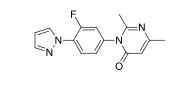
[00316] A uma solução de 1,2-difluoro-4-nitrobenzeno (3,18 g, 20 mmol) em DMSO (35 mL) foram adicionados K2CO3 (6,08 g, 44 mmol) e pirazol (1,50 g, 22 mmol) com agitação. A mistura de reação foi aquecida a 90 ° C durante 18 h, e resfriada até a temperatura ambiente. A mistura foi diluída com água (50 mL) e filtrou-se. O filtrado foi extraído com DCM (50 mL x 3), as fases orgânicas combinadas foram concentradas in vacuo. O produto em bruto foi purificado por cromatografia em coluna de sílica gel (PE / CH2Cl2 (v / v) = 1: 1) para dar o composto do título como um sólido amarelo (3,31 g, 80 %).Etapa 2) 3-fluoro-4-(1H-pirazol-1-il) anilina[00316] To a solution of 1,2-difluoro-4-nitrobenzene (3.18 g, 20 mmol) in DMSO (35 mL) were added K2CO3 (6.08 g, 44 mmol) and pyrazole (1.50 g , 22 mmol) with stirring. The reaction mixture was heated at 90 °C for 18 h, and cooled to room temperature. The mixture was diluted with water (50 mL) and filtered. The filtrate was extracted with DCM (50 mL x 3), the combined organic phases were concentrated in vacuo. The crude product was purified by silica gel column chromatography (PE/CH2Cl2 (v/v) = 1:1) to give the title compound as a yellow solid (3.31 g, 80%).Step 2) 3-fluoro-4-(1H-pyrazol-1-yl)aniline
[00317] A uma solução de 1-(2-fluoro-4-nitrofenil)-1H-pirazol (3,31 g, 16 mmol) em CH2Cl2 (60 mL) foi adicionado catalisador de Pd / C(0,33 g). A mistura de reação foi agitada à temperatura ambiente sob H2 durante a noite, e filtrou-se. O filtrado foi concentrado in vacuo. O resíduo foi purificado por cromatografia em coluna de sílica gel (PE / CH2Cl2 (v / v) = 1: 1) para dar o composto do título como um sólido branco (1,30 g, 46 %).Etapa 3) 3-(3-fluoro-4-(1H-pirazol-1-il) fenil)-2,6-dimetilpirimidin-4 (3H)- ona[00317] To a solution of 1-(2-fluoro-4-nitrophenyl)-1H-pyrazole (3.31 g, 16 mmol) in CH2Cl2 (60 mL) was added Pd/C catalyst (0.33 g) . The reaction mixture was stirred at room temperature under H2 overnight, and filtered. The filtrate was concentrated in vacuo. The residue was purified by silica gel column chromatography (PE/CH2Cl2 (v/v) = 1:1) to give the title compound as a white solid (1.30 g, 46%).Step 3) 3- (3-fluoro-4-(1H-pyrazol-1-yl)phenyl)-2,6-dimethylpyrimidin-4(3H)-one
[00318] A uma solução de 3-fluoro-4-(1H-pirazol-1-il) anilina (0,65 g, 3,68 mmol) em CH2Cl2 (30 mL) adicionou-se trimetil alumínio (18,4 mL, 36,8 mmol, 2 M em heptano) lentamente. A mistura de reação foi agitada à temperatura ambiente durante 0,5 h, seguido pela adição de uma solução de 3- acetaminocrotonato de metila (634 mg, 4,04 mmol) em CH2Cl2 (10 mL). A reação foi agitada à temperatura ambiente durante 3 dias, em seguida resfriada bruscamente com solução aquosa saturada de NH4Cl e extraiu-se com CH2Cl2 (100 mL x 3). As fases orgânicas combinadas foram secas sobre Na2SO4 anidro e concentrou-se in vacuo. O resíduo foi purificado por cromatografia em coluna de gel de sílica (EP / AcOEt (V / V) = 1: 2) para dar o composto do título como um sólido branco (400 mg, 38 %). O composto foi caracterizado pelos seguintes dados espectroscópicos: MS (ESI, pos.ion) m / z: 285,2 (M + 1); 1H-RMN(400 MHz, CDCl3+<"h"4.45"*u."5J+."4.54"*u."5J+."8.54"*u."3"J+."8.76" (t, 1H, J = 2,0 Hz), 7.13- 7,19 (m, 2 H), 7,78 (d, 1 H, J = 4,0 Hz), 8,08 (t, 1H, J = 2,0 Hz), 8,12-8,16 (m, 1 H). Exemplo 20 3-(3-fluoro-4-morfolinofenil)-2-((3-fluorofenoxi) metil)-6-metilpirimidina-4 (3H)-ona
[00319] Uma mistura de 3-aminocrotonato de metila (3,20 g, 27,79 mmol) e piridina (2,64 g, 33,33 mmol) em CH2Cl2 (60 mL) foi agitada a - 20°C durante 20 min. À mistura foi adicionada uma solução de brometo de bromoacetila (5,61 g, 27,79 mmol) em CH2Cl2 (20 mL) gota a gota. A mistura foi agitada à temperatura ambiente durante 2 h. A fase orgânica foi lavada com salmoura (100 mL x 3), seca sobre Na2SO4 anidro e concentrados in vacuo. O resíduo foi purificado por cromatografia em coluna de gel de sílica (EP / AcOEt (V / V) = 5: 1) para dar o composto do título como um sólido avermelhado (0,99 g, 15 %).Etapa 2) 3-(2-(3-fluorofenoxi) acetamido) crotonato de metila[00319] A mixture of methyl 3-aminocrotonate (3.20 g, 27.79 mmol) and pyridine (2.64 g, 33.33 mmol) in CH2Cl2 (60 mL) was stirred at -20°C for 20 min. To the mixture was added a solution of bromoacetyl bromide (5.61 g, 27.79 mmol) in CH2Cl2 (20 mL) dropwise. The mixture was stirred at room temperature for 2 h. The organic phase was washed with brine (100 mL x 3), dried over anhydrous Na 2 SO 4 and concentrated in vacuo. The residue was purified by silica gel column chromatography (EP / EtOAc (V / V) = 5: 1) to give the title compound as a reddish solid (0.99 g, 15%).Step 2) 3 methyl -(2-(3-fluorophenoxy)acetamido)crotonate
[00320] A uma suspensão de K2CO3 (0,37 g, 2,68 mmol) em acetona (10 ml) foram adicionados 3-fluorofenol (0,30 g, 2,68 mmol) e 3-(2- bromoacetamido) crotonato de etila (0,76 g, 3,22 mmol), a mistura foi submetida a refluxo durante 5 h e resfriada até a temperatura ambiente. A mistura foi concentrada in vacuo e o resíduo foi dissolvido em CH2Cl2 (40 mL), lavada com salmoura (40 mL x 3). A fase orgânica foi seca sobre Na2SO4 anidro e concentrou-se in vacuo. O resíduo foi purificado por cromatografia em coluna de gel de sílica (EP / AcOEt (V / V) = 10: 1) para dar o composto do título como um sólido amarelado (0,50 g, 70 %).Etapa 3) 3-(3-fluoro-4-morfolinofenil)-2-((3-fluorofenoxi) metil)-6- metil- pirimidin-4 (3H)-ona[00320] To a suspension of K2CO3 (0.37g, 2.68mmol) in acetone (10ml) were added 3-fluorophenol (0.30g, 2.68mmol) and 3-(2-bromoacetamido)crotonate of ethyl (0.76 g, 3.22 mmol), the mixture was refluxed for 5 h and cooled to room temperature. The mixture was concentrated in vacuo and the residue dissolved in CH2Cl2 (40 mL), washed with brine (40 mL x 3). The organic phase was dried over anhydrous Na2SO4 and concentrated in vacuo. The residue was purified by silica gel column chromatography (EP / EtOAc (V / V) = 10: 1) to give the title compound as a yellowish solid (0.50 g, 70%).Step 3) 3 -(3-fluoro-4-morpholinophenyl)-2-((3-fluorophenoxy)methyl)-6-methyl-pyrimidin-4(3H)-one
[00321] A uma solução de 3-fluoro-4-morfolinoanilina (0,55 g, 2,80 mmol) em CH2Cl2 anidro (40 mL) adicionou-se trimetil alumínio (2,0 mL, 4 mmol, 2 M em heptano) cuidadosamente, sob N2, à temperatura ambiente. A mistura foi agitada à temperatura ambiente durante 30 min, seguido pela adição de uma solução de 3-(2-(3-fluorofenoxi) acetamido) crotonato de metila (0,75 g, 2,80 mmol) em CH2Cl2 anidro (10 mL). A mistura de reação foi agitada durante mais 7 h, depois resfriou-se bruscamente com uma quantidade apropriada de água e lavou-se duas vezes com salmoura. A fase orgânica foi seca sobre Na2SO4 anidro e concentrou-se in vacuo. O produto em bruto foi purificado por cromatografia em coluna de gel de sílica (EP / AcOEt (V / V) = 1: 1) para dar o composto do título como um sólido branco (0,24 g, 62 %). O composto foi caracterizado pelos seguintes dados espectroscópicos: MS (ESI, pos.ion) m / z: 414,3 (M + 1); 1H-RMN(400 MHz, CDCl3+<"h"4.56"*u."5J+."5.25-3,14 (m, 4H), 3,85 (t, 4 H, J = 4,8 Hz), 4,67 (s, 2H), 6,38 (s, 1H), 6,45-6,49 (m, 1 H), 6,53-6,55 (m, 1 H), 6,64-6,68 (m, 1 H), 6,95-6,98 (m, 3H), 7.13- 7,19 (m, 1 H). Exemplo 21 3-(3-fluoro-4-(pirrolidin-1-il) fenil)-2,6-dimetilpirimidin-4 (3H)-ona
[00322] A uma solução de pirrolidina (0,78 g, 11 mmol) em EtOAC(15 mL) e ET3N(1,52 g, 15 mmol) foi adicionado 1,2-difluoro-4-nitrobenzeno (1,59 g, 10 mmol) em um banho de gelo. A mistura foi agitada à temperatura ambiente durante a noite e filtrou-se. A torta do filtro foi lavada com água e seco para dar o composto do título como um sólido amarelo (1,60 g, 76 %). Etapa 2) 3-fluoro-4-(pirrolidin-1-il) anilina[00322] To a solution of pyrrolidine (0.78 g, 11 mmol) in EtOAC (15 mL) and ET3N (1.52 g, 15 mmol) was added 1,2-difluoro-4-nitrobenzene (1.59 g , 10 mmol) in an ice bath. The mixture was stirred at room temperature overnight and filtered. The filter cake was washed with water and dried to give the title compound as a yellow solid (1.60 g, 76%). Step 2) 3-fluoro-4-(pyrrolidin-1-yl)aniline
[00323] A uma solução de 1-(2-fluoro-4-nitrofenil) pirrolidina (1,60 g, 7,62 mmol) em uma mistura de solventes CH2Cl2 (20 ml) e MeOH(20 mL) foi adicionado catalisador de Pd / C(0,16 g). A reação foi agitada à temperatura ambiente sob H2 durante a noite, e filtrou-se. O filtrado foi concentrado in vacuo. O resíduo foi purificado por cromatografia em coluna de gel de sílica (EP / AcOEt (V / V) = 5: 1) para dar o composto do título como um sólido branco (1,20 g, 88 %).Etapa 3) 3-(4- fluoro-3 (pirrolidin-1-il) fenil)-2,6-dimetilpirimidin-4 (3H)-ona[00323] To a solution of 1-(2-fluoro-4-nitrophenyl)pyrrolidine (1.60 g, 7.62 mmol) in a solvent mixture CH2Cl2 (20 ml) and MeOH (20 ml) was added a catalyst of Pd/C(0.16 g). The reaction was stirred at room temperature under H2 overnight, and filtered. The filtrate was concentrated in vacuo. The residue was purified by silica gel column chromatography (EP / EtOAc (V / V) = 5: 1) to give the title compound as a white solid (1.20 g, 88%).Step 3) 3 -(4-fluoro-3(pyrrolidin-1-yl)phenyl)-2,6-dimethylpyrimidin-4(3H)-one
[00324] A uma solução de 3-fluoro-4-(pirrolidin-1-il) anilina (0,50 g, 2,78 mmol) em CH2Cl2 (20 mL) adicionou-se trimetil alumínio (14 mL, 14 mmol, 1 M em heptano) lentamente à temperatura ambiente. A mistura de reação foi agitada à temperatura ambiente durante 0,5 h, seguido pela adição de uma solução de 3-acetaminocrotonato de metila (480 mg, 3,06 mmol) em CH2Cl2 (10 mL). A mistura de reação foi agitada à temperatura ambiente durante 3 dias, em seguida resfriada bruscamente com solução aquosa saturada de NH4Cl e extraiu-se com CH2Cl2 (100 mL x 3). As fases orgânicas combinadas foram secas sobre Na2SO4 anidro e concentrou-se in vacuo. O resíduo foi purificado por cromatografia em coluna de gel de sílica (EP / AcOEt (V / V) = 1: 1) para dar o composto do título como um sólido amarelo pálido (300 mg, 38 %). O composto foi caracterizado pelos seguintes dados espectroscópicos: MS (ESI, pos.ion) m / z: 288,3 (M + 1); 1H-RMN(400 MHz, CDCl3+<"h"3.;8-1,99 (m, 4H), 2,21 (s, 3H), 2,29 (s, 3H), 3,43-3,48 (m, 4H), 6,28 (s, 1 H), 6,71 (t, 1H, J = 8,8 Hz), 6,78-6,84 (m, 2 H). Exemplo 22 3-(4-(di-n-butilamino)-3-fluorofenil)-2,6-dimetilpirimidin-4 (3H)-ona
[00325] A uma solução de 3,4-difluoronitrobenzeno (3,18 g, 20 mmol) em DMSO (25 mL) foram adicionados K2CO3 (6,08 g, 44 mmol) e di-n- butilamina (2,84 g, 22 mmol) com agitação. A mistura foi aquecida a 90°C durante a noite, em seguida resfriada até a temperatura ambiente, diluída com água (100 mL) e extraiu-se com CH2Cl2 (80 ml x 3). As fases orgânicas combinadas foram secas sobre Na2SO4 anidro e concentrou-se in vacuo. O resíduo foi purificado por cromatografia em coluna de sílica gel (PE / CH2Cl2 (v / v) = 10: 1) para dar o composto do título como um óleo amarelo (4,03 g, 75 %).Etapa 2) N1, N1-di-n-butil-2-fluorobenzeno-1,4-diamina[00325] To a solution of 3,4-difluoronitrobenzene (3.18 g, 20 mmol) in DMSO (25 mL) was added K2CO3 (6.08 g, 44 mmol) and di-n-butylamine (2.84 g , 22 mmol) with stirring. The mixture was heated at 90°C overnight, then cooled to room temperature, diluted with water (100 mL) and extracted with CH2Cl2 (80 mL x 3). The combined organic phases were dried over anhydrous Na2SO4 and concentrated in vacuo. The residue was purified by silica gel column chromatography (PE/CH2Cl2 (v/v) = 10:1) to give the title compound as a yellow oil (4.03 g, 75%).Step 2) N1, N1-di-n-butyl-2-fluorobenzene-1,4-diamine
[00326] A uma solução do catalisador N, N-di-n-butil-2-fluoro-4- nitroanilina (4,03 g, 15 mmol) em uma mistura de solventes CH2Cl2 (70 mL) e MeOH(20 mL) foi adicionado Pd / C(0,40 g). A mistura de reação foi agitada à temperatura ambiente sob H2 durante a noite, e filtrou-se. O filtrado foi concentrado in vacuo. O resíduo foi purificado por cromatografia em coluna de sílica gel (PE / CH2Cl2 (v / v) = 8: 1) para dar o composto do título como um óleo incolor (2,32 g, 65 %).Etapa 3) 3-(4-(di-n-butilamino)-3-fluorofenil)-2,6-dimetilpirimidin-4 (3H)- ona[00326] To a solution of N,N-di-n-butyl-2-fluoro-4-nitroaniline catalyst (4.03 g, 15 mmol) in a solvent mixture CH2Cl2 (70 mL) and MeOH (20 mL) Pd/C (0.40 g) was added. The reaction mixture was stirred at room temperature under H2 overnight, and filtered. The filtrate was concentrated in vacuo. The residue was purified by silica gel column chromatography (PE/CH2Cl2 (v/v) = 8:1) to give the title compound as a colorless oil (2.32 g, 65%).Step 3) 3- (4-(di-n-butylamino)-3-fluorophenyl)-2,6-dimethylpyrimidin-4(3H)-one
[00327] A uma solução de N1, N1-di-n-butil-2-fluorobenzeno-1,4- diamina (1,10 g, 4,62 mmol) em CH2Cl2 (20 mL) adicionou-se trimetil alumínio (23 mL, 23 mmol, 1 M em heptano) lentamente à temperatura ambiente. A mistura de reação foi agitada à temperatura ambiente durante 0,5 h, seguido pela adição de uma solução de 3-acetaminocrotonato de metila (798 mg, 5,08 mmol) em CH2Cl2 (10 mL). A reação foi agitada à temperatura ambiente durante 3 dias, em seguida resfriada bruscamente com solução aquosa saturada de NH4Cl e extraiu-se com CH2Cl2 (100 mL x 3). As fases orgânicas combinadas foram secas sobre Na2SO4 anidro e concentrou-se in vacuo. O resíduo foi purificado por cromatografia em coluna de gel de sílica (EP / AcOEt (V / V) = 3: 2) para dar o composto do título como um óleo amarelo pálido (800 mg, 50 %). O composto foi caracterizado pelos seguintes dados espectroscópicos: MS (ESI, pos.ion) m / z: 346,3 (M + 1); 1H-RMN(400 MHz, CDCi3+< h 0,;5 *V, 8 J. L ? 9.6 Jz+, 3,48-1,36 (m, 4H), 1,55 (t, 4H, J = 8,0 Hz), 2,20 (s, 3 H), 2,29 (s, 3H), 3,21 (t, 4 H, J = 7,6 Hz), 6,28 (s, 1H), 6,80-6,85 (m, 2H), 6,88-6,93 (m, 1 H). Exemplo 23 3-(4-(isobutilamino)-3-fluorofenil)-2,6-dimetilpirimidin-4 (3H)-ona
[00328] A uma solução de 3,4-difluoronitrobenzeno (1,59 g, 10 mmol) em DMSO (15 mL) foram adicionados K2CO3 (3,04 g, 22 mmol) e diisobutilamina (1,42 g, 11 mmol). A mistura foi aquecida a 90°C durante a noite, em seguida resfriada até a temperatura ambiente, diluída com água (50 mL) e extraiu-se com CH2Cl2 (50 ml x 3). As fases orgânicas combinadas foram secas sobre Na2SO4 anidro e concentrou-se in vacuo. O resíduo foi purificado por cromatografia em coluna de gel de sílica (EP / AcOEt (V / V) = 10: 1) para dar o composto do título como um óleo amarelo pálido (0,80 g, 30 %).Etapa 2) 2-fluoro-N1, N1-diisobutilbenzeno-1,4-diamina[00328] To a solution of 3,4-difluoronitrobenzene (1.59 g, 10 mmol) in DMSO (15 mL) was added K2CO3 (3.04 g, 22 mmol) and diisobutylamine (1.42 g, 11 mmol) . The mixture was heated at 90°C overnight, then cooled to room temperature, diluted with water (50 mL) and extracted with CH2Cl2 (50 mL x 3). The combined organic phases were dried over anhydrous Na2SO4 and concentrated in vacuo. The residue was purified by silica gel column chromatography (EP / EtOAc (V / V) = 10: 1) to give the title compound as a pale yellow oil (0.80 g, 30 %).Step 2) 2-fluoro-N1,N1-diisobutylbenzene-1,4-diamine
[00329] A uma solução de 2-fluoro-N, N-di-isobutil-4-nitroanilina (0,8 g, 3 mmol) em uma mistura de solventes CH2Cl2 (15 mL) e MeOH(15 mL) foi adicionado catalisador de Pd / C(80 mg). A mistura de reação foi agitada à temperatura ambiente sob H2 durante a noite, e filtrou-se. O filtrado foi concentrado in vacuo. O resíduo foi purificado por cromatografia em coluna de gel de sílica (EP / AcOEt (V / V) = 8: 1) para dar o composto do título como um óleo amarelo pálido (0,40 g, 56 %).Etapa 3) 3-(4-(isobutilamino)-3-fluorofenil)-2,6-dimetilpirimidin-4 (3H)-ona[00329] To a solution of 2-fluoro-N,N-diisobutyl-4-nitroaniline (0.8 g, 3 mmol) in a solvent mixture CH2Cl2 (15 mL) and MeOH (15 mL) was added catalyst of Pd/C (80 mg). The reaction mixture was stirred at room temperature under H2 overnight, and filtered. The filtrate was concentrated in vacuo. The residue was purified by silica gel column chromatography (EP / EtOAc (V / V) = 8: 1) to give the title compound as a pale yellow oil (0.40 g, 56 %).Step 3) 3-(4-(isobutylamino)-3-fluorophenyl)-2,6-dimethylpyrimidin-4(3H)-one
[00330] A uma solução de 2-fluoro-N1, N1-diisobutilbenzeno-1,4- diamina (0,40 g, 1,68 mmol) em CH2Cl2 (20 mL) foi adicionado trimetil alumínio (8,4 mL, 8,4 mmol, 1 M em heptano) lentamente à temperatura ambiente. A mistura de reação foi agitada à temperatura ambiente durante 0,5 h, seguido pela adição de uma solução de 3-acetaminocrotonato de metila (290 mg, 1,85 mmol) em CH2Cl2 (10 mL). A mistura de reação foi agitada à temperatura ambiente durante 3 dias, em seguida resfriada bruscamente com solução aquosa saturada de NH4Cl e extraiu-se com CH2Cl2 (100 mL x 3). As fases orgânicas combinadas foram secas sobre Na2SO4 anidro e concentrou-se in vacuo. O resíduo foi purificado por cromatografia em coluna de gel de sílica (EP / AcOEt (V / V) = 1: 1) para dar o composto do título como um óleo amarelo pálido (280 mg, 48 %). O composto foi caracterizado pelos seguintes dados espectroscópicos: MS (ESI, pos.ion) m / z: 346,4 (M + 1); 1H-RMN(400 MHz, CDCl3+<"h"2.::-,90 (m, 12 H), 1,87-1,94 (m, 2 H), 2,20 (s, 3H), 2,29 (s, 3H), 3,00-3,10 (m, 4H), 6,28 (s, 1H), 6,80-6,84 (m, 2 H), 6,95 (t, 1H, J = 12,9 Hz). Exemplo 24 3-(4-(di-n-hexilamino)-3-fluorofenil)-2,6-dimetilpirimidin-4 (3H)-ona
[00331] A uma solução de 3,4-difluoronitrobenzeno (1,59 g, 10 mmol) em DMSO (15 mL) foram adicionados K2CO3 (3,04 g, 22 mmol) e di-n- hexilamina (2,04 g, 11 mmol). A mistura foi aquecida a 90°C durante a noite, em seguida resfriada até a temperatura ambiente, diluída com água (50 mL) e extraiu-se com CH2Cl2 (50 ml x 3). As fases orgânicas combinadas foram secas sobre Na2SO4 anidro e concentrou-se in vacuo. O resíduo foi purificado por cromatografia em coluna de gel de sílica (PE / CH2Cl2 (v / v) = 10: 1) para dar o composto do título como um óleo amarelo pálido (2,79 g, 86 %).Etapa 2) 2-fluoro-N1, N1-di-n-hexilbenzeno-1,4-diamina[00331] To a solution of 3,4-difluoronitrobenzene (1.59 g, 10 mmol) in DMSO (15 mL) was added K2CO3 (3.04 g, 22 mmol) and di-n-hexylamine (2.04 g , 11 mmol). The mixture was heated at 90°C overnight, then cooled to room temperature, diluted with water (50 mL) and extracted with CH2Cl2 (50 mL x 3). The combined organic phases were dried over anhydrous Na2SO4 and concentrated in vacuo. The residue was purified by silica gel column chromatography (PE/CH2Cl2 (v/v) = 10:1) to give the title compound as a pale yellow oil (2.79 g, 86%).Step 2) 2-fluoro-N1,N1-di-n-hexylbenzene-1,4-diamine
[00332] A uma solução de 2-fluoro-N, N-di-n-hexil-4-nitroanilina (2,79 g, 8,64 mmol) em MeOH(50 mL) foi adicionado catalisador de Pd / C(0,28 g). A mistura de reação foi agitada à temperatura ambiente sob H2 durante a noite, e filtrou-se. O filtrado foi concentrado in vacuo. O resíduo foi purificado por cromatografia em coluna de gel de sílica (EP / AcOEt (V / V) = 10: 1) para dar o composto do título como um óleo amarelo pálido (1,60 g, 63 %).Etapa 3) 3-(4-(di-n-hexilamino)-3-fluorofenil)-2,6-dimetilpirimidin-4 (3H)- ona[00332] To a solution of 2-fluoro-N,N-di-n-hexyl-4-nitroaniline (2.79 g, 8.64 mmol) in MeOH (50 mL) was added Pd/C(0 .28 g). The reaction mixture was stirred at room temperature under H2 overnight, and filtered. The filtrate was concentrated in vacuo. The residue was purified by silica gel column chromatography (EP / EtOAc (V / V) = 10: 1) to give the title compound as a pale yellow oil (1.60 g, 63%).Step 3) 3-(4-(di-n-hexylamino)-3-fluorophenyl)-2,6-dimethylpyrimidin-4(3H)-one
[00333] A uma solução de 2-fluoro-N1, N1-di-n-hexilbenzeno-1,4- diamina (0,58 g, 1,97 mmol) em CH2Cl2 (20 mL) foi adicionado trimetil alumínio (9,9 mL, 19,8 mmol, 2 M em heptano) lentamente à temperatura ambiente. A mistura de reação foi agitada à temperatura ambiente durante 0,5 h, seguido pela adição de uma solução de 3-acetaminocrotonato de metila (341 mg, 2,17 mmol) em CH2Cl2 (5 mL). A mistura de reação foi agitada à temperatura ambiente durante 3 dias, em seguida resfriada bruscamente com solução aquosa saturada de NH4Cl e extraiu-se com CH2Cl2 (100 mL x 3). As fases orgânicas combinadas foram secas sobre Na2SO4 anidro e concentrou-se in vacuo. O resíduo foi purificado por cromatografia em coluna de gel de sílica (EP / AcOEt (V / V) = 2: 1) para dar o composto do título como um óleo amarelo pálido (500 mg, 63 %). O composto foi caracterizado pelos seguintes dados espectroscópicos: MS (ESI, pos.ion) m / z: 402,3 (M + 1); 1H-RMN(400 MHz, CDCi3+< h 2.:; *V. 8 J. L ? 9.2 Jz+, 3,53 *v. 34 J. L ? 9.: Hz), 1,55 (t, 4H, J = 7,2 Hz), 2,20 (s, 3H), 2,29 (s, 3H), 3,18-3,21 (m, 4H), 6,28 (s, 1H), 6,79-6,82 (m, 2H), 6,84-6,92 (m, 1 H). Exemplo 25 2,6-dimetil-3-(6-morfolinopiridin-3-il) pirimidin-4 (3H)-ona
[00334] Uma mistura de 2-cioro-5-nitropiridina (3,17 g, 20 mmoi), morfoiina (2,00 g, 23 mmoi) e ET3N(2,43 g, 24 mmoi) em EtOAC(200 mL) foi submetida a refluxo durante 3 h, em seguida resfriada até à temperatura ambiente, e lavou-se com água (100 mL x 3). A fase orgânica foi seca sobre Na2SO4 anidro e concentrou-se in vacuo para dar o composto do título como um sólido amarelo (3,89 g, 93 %).Etapa 2) 6-morfolinopiridin-3-amina[00334] A mixture of 2-chloro-5-nitropyridine (3.17 g, 20 mmol), morpholine (2.00 g, 23 mmol) and ET3N (2.43 g, 24 mmol) in EtOAC (200 mL) was refluxed for 3 h, then cooled to room temperature, and washed with water (100 mL x 3). The organic phase was dried over anhydrous Na 2 SO 4 and concentrated in vacuo to give the title compound as a yellow solid (3.89 g, 93%).Step 2) 6-morpholinopyridin-3-amine
[00335] A uma solução de 4-(5-nitropiridin-2-il) morfolina (3,89 g, 18,60 mmol) em THF (100 mL) foi adicionado catalisador de Pd / C(0,5 g). A reação foi agitada à temperatura ambiente sob H2 durante a noite, e filtrou-se. O filtrado foi concentrado em vácuo para dar o composto do título como um sólido vermelho-castanho (3,30 g, 99 %).Etapa 3) 2,6-dimetil-3-(6-morfolinopiridin-3-il) pirimidin-4 (3H)-ona[00335] To a solution of 4-(5-nitropyridin-2-yl)morpholine (3.89 g, 18.60 mmol) in THF (100 mL) was added Pd/C catalyst (0.5 g). The reaction was stirred at room temperature under H2 overnight, and filtered. The filtrate was concentrated in vacuo to give the title compound as a red-brown solid (3.30 g, 99%).Step 3) 2,6-Dimethyl-3-(6-morpholinopyridin-3-yl)pyrimidin- 4 (3H)-one
[00336] A uma solução de 6-morfolinopiridin-3-amina (1,79 g, 10 mmol) em CH2Cl2 (100 mL) adicionou-se trimetil alumínio (40 mL, 40 mmol, 1 M em heptano) cuidadosamente, sob N2. A mistura foi agitada à temperatura ambiente durante 30 min, seguido pela adição de uma solução de 3-acetaminocrotonato de metila (1,89 g, 12 mmol) em CH2Cl2 (5 mL). A reação foi agitada à temperatura ambiente durante 6 h, em seguida resfriada bruscamente com solução aquosa saturada de NH4Cl (100 mL). A fase orgânica foi seca sobre Na2SO4 anidro e concentrou-se in vacuo. O resíduo foi purificado por recristalizado a partir de EtOAc para dar o composto do título como um sólido amarelo pálido (1,11 g, 39 %). O composto foi caracterizado pelos seguintes dados espectroscópicos: MS (ESI, pos.ion) m / z: 287,2 (M + 1); 1H-RMN(400 MHz, CDCl3+<"h"4.44"*u."5J+."4.52"*u."5J+."5.76-3,60 (m, 4H), 3,83 (t, 4H, J = 4,9 Hz), 6,29 (s, 1 H), 6,74 (d, 1 H, J = 8,8 Hz), 7,33 (dd, 1H, J1 = 2,1 Hz, J2 = 8,8 Hz), 8,00 (d, 1 H, J = 2,6 Hz). Exemplo 26 3-(4- fluoro-3 (4-hidroxipiperidin-1-il) fenil)-2,6-dimetilpirimidin-4 (3H)- ona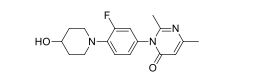
[00337] A uma solução de piperidin-4-ol (11,11 g, 0,11 mol) e ET3N(12,14 g, 0,12 mol) em EtOAC(500 mL) foi adicionado 1,2-difluoro-4- nitrobenzeno (15,91 g, 0,10 mol). A mistura foi agitada à temperatura ambiente durante 24 h, e lavou-se com água (200 mL x 4). A fase orgânica foi seca sobre Na2SO4 anidro e concentrou-se in vacuo para dar o composto do título como óleo cor de laranja (19,35 g, 80 %).Etapa 2) 1-(4-amino-2-fluorofenil) piperidin-4-ol[00337] To a solution of piperidin-4-ol (11.11 g, 0.11 mol) and ET3N (12.14 g, 0.12 mol) in EtOAC (500 mL) was added 1,2-difluoro- 4-nitrobenzene (15.91 g, 0.10 mol). The mixture was stirred at room temperature for 24 h, and washed with water (200 mL x 4). The organic phase was dried over anhydrous Na 2 SO 4 and concentrated in vacuo to give the title compound as an orange oil (19.35 g, 80%).Step 2) 1-(4-amino-2-fluorophenyl)piperidin -4-ol
[00338] A uma solução de 1-(2-fluoro-4-nitrofenil) piperidin-4-ol (2,67 g, 11 mmol) em MeOH(100 mL) foi adicionado catalisador de Pd / C(1,00 g). A mistura de reação foi agitada à temperatura ambiente sob H2 durante 6 h, depois filtrada. O filtrado foi concentrado em vácuo para dar o produto em bruto (2,50 g) para a etapa seguinte sem purificação adicional.Etapa 3) 3-(4- fluoro-3 (4-hidroxipiperidin-1-il) fenil)-2,6-dimetilpirimidin- 4 (3H)-ona[00338] To a solution of 1-(2-fluoro-4-nitrophenyl)piperidin-4-ol (2.67 g, 11 mmol) in MeOH (100 mL) was added Pd/C catalyst (1.00 g ). The reaction mixture was stirred at room temperature under H 2 for 6 h, then filtered. The filtrate was concentrated in vacuo to give the crude product (2.50g) for next step without further purification.Step 3) 3-(4-fluoro-3(4-hydroxypiperidin-1-yl)phenyl)-2 ,6-dimethylpyrimidin-4(3H)-one
[00339] A uma solução de trimetil alumínio foi adicionado 1-(4-amino- 2-fluorofenil) piperidin-4-ol (1,68 g, 8,00 mmol) em CH2Cl2 (20 mL) (32 mL, 64 mmol, 2 M em heptano) cuidadosamente sob N2. A mistura foi agitada à temperatura ambiente durante 30 min, seguido pela adição de uma solução de 3-acetaminocrotonato de metila (1,40 g, 8,90 mol) em CH2Cl2 (5 mL). A mistura de reação foi agitada à temperatura ambiente durante mais 5 h, em seguida resfriada bruscamente com solução aquosa saturada de NH4Cl (100 mL). A fase orgânica foi seca sobre Na2SO4 anidro e concentrou-se in vacuo. O resíduo foi purificado por recristalizado a partir de EtOAc para dar o composto do título como um sólido amarelo (1,25 g, 50 %). O composto foi caracterizado pelos seguintes dados espectroscópicos: MS (ESI, pos.ion) m / z: 318,2 (M + 1); 1H-RMN(400 MHz, CDCl3+<"h"3.96-1,77 (m, 2H), 2,02-2,05 (m, 2 H), 2,18 (s, 3H), 2,29 (s, 3H), 2,85-2,99 (m, 2H), 3,36-3,48 (m, 2H), 3,84-3,92 (m, 1 H), 6,28 (s, 1 H), 6,90 (d, 1 H, J = 1,2 Hz), 7,05 (t, 1H, J = 0,8 Hz). Exemplo 27 3-(3-fluoro-4-((2-morfolinoetil) amino) fenil)-2,6-dimetilpirimidin-4 (3H)- ona
[00340] A uma suspensão de K2CO3 (6,50 g, 47 mmol) e morfolina (3,75 g, 43 mmol) em acetonitrila (30 mL) foi adicionado 2-bromoacetonitrila (5,16 g, 43 mmol) em uma só porção sob a proteção de N2 em um banho de gelo banho. A mistura foi agitada à temperatura ambiente durante 2 h, em seguida filtrada. O filtrado foi concentrado em vácuo para dar o composto do título como um sólido amarelo (5,41 g, 100 %).Etapa 2) 2-morfolinoetanamina[00340] To a suspension of K2CO3 (6.50 g, 47 mmol) and morpholine (3.75 g, 43 mmol) in acetonitrile (30 mL) was added 2-bromoacetonitrile (5.16 g, 43 mmol) in a only portion under N2 protection in an ice bath. The mixture was stirred at room temperature for 2 h, then filtered. The filtrate was concentrated in vacuo to give the title compound as a yellow solid (5.41 g, 100%).Step 2) 2-morpholinoethanamine
[00341] A THF anidro (35 mL) foi adicionado LiAlH4 (3,19 g, 84 mmol) em uma única porção em um banho de gelo. A mistura foi agitada a 0°C durante 20 minutos, e uma solução de 2-morfolinoacetonitrila (3,50 g, 28 mmol) em THF anidro (10 mL) foi adicionado gota a gota. Após o final da adição a mistura foi submetida a refluxo durante 3 h, depois resfriada até a temperatura ambiente, diluída com água (20 ml), filtrou-se e concentrou-se in vacuo para dar o composto do título como um óleo amarelo (2,62 g, 72 %).Etapa 3) 2-fluoro-N-(2-morfolinoetil)-4-nitroanilina[00341] To anhydrous THF (35 mL) was added LiAlH4 (3.19 g, 84 mmol) in a single portion in an ice bath. The mixture was stirred at 0°C for 20 minutes, and a solution of 2-morpholinoacetonitrile (3.50 g, 28 mmol) in anhydrous THF (10 mL) was added dropwise. After the addition was complete the mixture was refluxed for 3 h, then cooled to room temperature, diluted with water (20 ml), filtered and concentrated in vacuo to give the title compound as a yellow oil ( 2.62 g, 72 %).Step 3) 2-Fluoro-N-(2-morpholinoethyl)-4-nitroaniline
[00342] Uma solução de 2-morfolinoetanamina (0,90 g, 6,91 mmol), 1,2-difluoro-4-nitrobenzeno (1,10 g, 6,91 mmol) e ET3N(1,40 g, 13,82 mmol) em EtOAC(10 mL) foi submetida a refluxo sob N2 durante 24 h, em seguida resfriada até a temperatura ambiente e concentrada em vácuo. O resíduo foi purificado por cromatografia em coluna de gel de sílica (EP / AcOEt (V / V) = 4: 1) para dar o composto do título como um óleo amarelo (1,57 g, 84 %). Etapa 4) 2-fluoro-N1-(2-morfolinoetil) benzeno-1,4-diamina[00342] A solution of 2-morpholinoethanamine (0.90 g, 6.91 mmol), 1,2-difluoro-4-nitrobenzene (1.10 g, 6.91 mmol) and ET3N (1.40 g, 13 .82 mmol) in EtOAC(10 mL) was refluxed under N 2 for 24 h, then cooled to room temperature and concentrated in vacuo. The residue was purified by silica gel column chromatography (EP / EtOAc (V / V) = 4: 1) to give the title compound as a yellow oil (1.57 g, 84%). Step 4) 2-Fluoro-N1-(2-morpholinoethyl)benzene-1,4-diamine
[00343] A uma solução de 2-fluoro-N-(2-morfolinoetil)-4-nitroanilina (0,60 g, 2,23 mmol) em THF (8,0 mL) foi adicionado catalisador de Pd / C(0,03 g). A mistura de reação foi agitada à temperatura ambiente sob H2 durante a noite, depois filtrou-se. O filtrado foi concentrado em vácuo para dar o composto do título como um óleo amarelo (0,50 g, 94 %).Etapa 5) 3-(4-fluoro-3-((2-morfolinoetil) amino) fenil)-2,6-dimetil-pirimidin- 4 (3H)-ona[00343] To a solution of 2-fluoro-N-(2-morpholinoethyl)-4-nitroaniline (0.60 g, 2.23 mmol) in THF (8.0 mL) was added Pd/C(0) catalyst. .03 g). The reaction mixture was stirred at room temperature under H2 overnight, then filtered. The filtrate was concentrated in vacuo to give the title compound as a yellow oil (0.50 g, 94%).Step 5) 3-(4-fluoro-3-((2-morpholinoethyl)amino)phenyl)-2 ,6-dimethyl-pyrimidin-4(3H)-one
[00344] A uma solução de 2-fluoro-N1-(2-morfolinoetil) benzeno-1,4- diamina (0,50 g, 2,09 mmol) em CH2Cl2 (20 mL) foi adicionado trimetil alumínio (3,2 mL, 6,40 mmol, 2 M em tolueno) lentamente à temperatura ambiente. A mistura de reação foi agitada à temperatura ambiente durante 0,5 h, seguido pela adição de uma solução de 3-acetaminocrotonato de metila (0,65 g, 4,13 mmol) em CH2Cl2 (5 mL). A mistura de reação foi agitada à temperatura ambiente durante 36 h, em seguida resfriada bruscamente com solução aquosa saturada de NH4Cl e extraiu-se com CH2Cl2 (100 mL x 3). As fases orgânicas combinadas foram secas sobre Na2SO4 anidro e concentrou-se in vacuo. O resíduo foi purificado por cromatografia em coluna de gel de sílica (EtOAc / MeOH(v / v) = 30: 1) para dar o composto do título como um sólido branco (0,50 g, 24 %). O composto foi caracterizado pelos seguintes dados espectroscópicos: MS (ESI, pos.ion) m / z: 347,2 (M + 1); 1H-RMN(400 MHz, CDCl3+<"h"4.2:"*u."5J+."4.3:"*o."5"J+."4.65"*u."6J+."4.79" (s, 2 H,), 3,25 (m, 2 H), 3,58 (t, 4H, J = 4,32 Hz), 5,52 (s, 1 H), 6,20 (s, 1H), 6,79-6,83 (m, 1 H), 6,91-6,93 (m, 1 H), 7,08-7,12 (m, 1 H). Exemplo 28 3-(3-fluoro-4-(metil (2-morfolinoetil) amino) fenil)-2,6-dimetilpirimidin-4
[00345] A uma suspensão de 3-(3-fluoro-4-((2-morfolinoetil) amino) fenil)-2,6-dimetil-pirimidin-4 (3H)-ona (0,24 g, 0,69 mmol) e K2CO3 (0,48 g, 3,47 mmol) em acetonitrila (15 mL) adicionou-se CH3I (0,30 g, 2,11 mmol). A mistura foi agitada à temperatura ambiente durante 36 h, em seguida filtrada e concentrada em vácuo. O resíduo foi purificado por cromatografia em coluna de gel de sílica (EtOAc / MeOH(v / v) = 50: 1) para dar o composto do título como um sólido branco (50 mg, 20 %). O composto foi caracterizado pelos seguintes dados espectroscópicos: MS (ESI, pos.ion) m / z: 361,2 (M + 1); 1H-RMN(400 MHz, CDCl3+<"h"3.48"*u."5J+."4.38"*u."5J+."4.48"*u."5J+."4.84 (m, 4H), 3,48 (m, 2 H), 3,69-3,74 (m, 2 H), 4,00 (m, 4H), 6,17 (s, 1 H), 6,7556,84 (m, 2 H), 7,03 (m, 1 H). Exemplo 29 3-(2-cloro-4-((2-morfolinoetil) amino) fenil)-2,6-dimetilpirimidin-4 (3H)- ona
[00346] Uma suspensão de 2-morfolinoetanamina (5,34 g, 41 mmol), 2,4-dicloro-1- nitrobenzeno (7,87 g, 41 mmol) e Cs2CO3 (26,73 g, 82 mmol) em acetonitrila (100 ml) foi submetida a refluxo durante 6 h sob N2, em seguida resfriada até a temperatura ambiente, filtrou-se e concentrou-se in vacuo. O resíduo foi purificado por cromatografia em coluna de gel de sílica (EP / AcOEt (V / V) = 4: 1) para dar o composto do título como um sólido amarelo (5,90 g, 50 %).Etapa 2) 3-cloro-N1-(2-morfolinoetil) benzeno-1,4-diamina[00346] A suspension of 2-morpholinoethanamine (5.34 g, 41 mmol), 2,4-dichloro-1-nitrobenzene (7.87 g, 41 mmol) and Cs2CO3 (26.73 g, 82 mmol) in acetonitrile (100 ml) was refluxed for 6 h under N 2 then cooled to room temperature, filtered and concentrated in vacuo. The residue was purified by silica gel column chromatography (EP / EtOAc (V / V) = 4: 1) to give the title compound as a yellow solid (5.90 g, 50%).Step 2) 3 -chloro-N1-(2-morpholinoethyl)benzene-1,4-diamine
[00347] A uma solução de 3-cloro-N-(2-morfolinoetil)-4-nitroanilina (3,50 g, 12,25 mmol) em EtOAC(60 mL) foi adicionado catalisador de Pd / C(0,73 g). A reação foi agitada à temperatura ambiente sob H2 durante a noite, depois filtrou-se. O filtrado foi concentrado em vácuo para dar o produto em bruto para a etapa seguinte sem purificação adicional.Etapa 3) 3-(4-fluoro-3-((2-morfolinoetil) amino) fenil)-2,6-dimetil pirimidin-4 (3H)-ona[00347] To a solution of 3-chloro-N-(2-morpholinoethyl)-4-nitroaniline (3.50 g, 12.25 mmol) in EtOAC(60 mL) was added Pd/C catalyst(0.73 g). The reaction was stirred at room temperature under H2 overnight, then filtered. The filtrate was concentrated in vacuo to give the crude product for the next step without further purification.Step 3) 3-(4-Fluoro-3-((2-morpholinoethyl)amino)phenyl)-2,6-dimethylpyrimidin- 4 (3H)-one
[00348] A uma solução de 3-cloro-N1-(2-morfolinoetil) benzeno-1,4- diamina (0,70 g, 1,93 mmol) em CH2Cl2 (20 mL) adicionou-se trimetil alumínio (6,8 mL, 13,6 mmol, 2 M em tolueno) lentamente à temperatura ambiente. A mistura de reação foi agitada à temperatura ambiente durante 0,5 h, seguido pela adição de uma solução de 3-acetaminocrotonato de metila (0,43 g, 2,74 mmol) em CH2Cl2 (5 mL). A mistura de reação foi agitada à temperatura ambiente durante outras 72 h, em seguida resfriada bruscamente com solução aquosa saturada de NH4Cl e extraiu-se com CH2Cl2 (50 mL x 3). As fases orgânicas combinadas foram secas sobre Na2SO4 anidro e concentrou-se in vacuo. O resíduo foi purificado por cromatografia em coluna de gel de sílica (EtOAc / MeOH(v / v) = 30: 1) para dar o composto do título como um sólido amarelado (0,33 g, 47 %). O composto foi caracterizado pelos seguintes dados espectroscópicos: MS (ESI, pos.ion) m / z: 363,1 (M + 1); 1H-RMN(400 MHz, CDCl3+<"h"4.39"*u."5J+."4.55"*u."5J+."4.64-2,43 (m, 4H), 2,50-2,64 (m, 2H), 3,09-3,13 (m, 2H), 3,59-3,63 (m, 4H), 4,55-4,57 (t, 1H), 6,32 (s, 1H), 6,76-6,81 (m, 1 H), 6,80-6,81 (m, 1 H), 6,89-6,91 (m, 1 H). Exemplo 30 3-(3-fluoro-4-((3-morfolinopropil) amino) fenil)-2,6-dimetilpirimidin-4
[00349] A uma suspensão de 1-bromo-3-cloropropano (0,79 g, 5,00 mmol) e K2CO3 (1,38 g, 10,00 mmol) em EtOAC(20 mL) foi adicionada uma solução de morfolina (0,44 g, 5,05 mmol) em EtOAC(20 mL) gota a gota à temperatura ambiente sob N2. A mistura foi agitada à temperatura ambiente durante a noite, depois filtrou-se e concentrou-se in vacuo para dar o produto em bruto para a etapa seguinte sem purificação adicional.Etapa 2) 2-fluoro-N-(3-morfolinopropil)-4-nitroanilina[00349] To a suspension of 1-bromo-3-chloropropane (0.79 g, 5.00 mmol) and K2CO3 (1.38 g, 10.00 mmol) in EtOAC (20 mL) was added a solution of morpholine (0.44 g, 5.05 mmol) in EtOAC (20 mL) dropwise at room temperature under N2. The mixture was stirred at room temperature overnight, then filtered and concentrated in vacuo to give the crude product for the next step without further purification.Step 2) 2-Fluoro-N-(3-morpholinopropyl)- 4-nitroaniline
[00350] A uma suspensão de 4-(3-cloropropil) morfolina (1,64 g, 10 mmol) e K2CO3 (4,14 g, 30 mmol) em acetonitrila (20 mL) foi adicionado 2- fluoro-4-nitroanilina (1,56 g, 10 mmol) gota a gota. A mistura foi agitada à temperatura ambiente durante 24 h, em seguida filtrada e concentrada em vácuo. O resíduo foi purificado por cromatografia em coluna de gel de sílica (EP / AcOEt (V / V) = 1: 1) para dar o composto do título como um óleo amarelo (1,78 g, 63 %).Etapa 3) 2-fluoro-N1-(3-morfolinopropil) benzeno-1,4-diamina[00350] To a suspension of 4-(3-chloropropyl)morpholine (1.64 g, 10 mmol) and K2CO3 (4.14 g, 30 mmol) in acetonitrile (20 mL) was added 2-fluoro-4-nitroaniline (1.56 g, 10 mmol) dropwise. The mixture was stirred at room temperature for 24 h, then filtered and concentrated in vacuo. The residue was purified by silica gel column chromatography (EP / EtOAc (V / V) = 1: 1) to give the title compound as a yellow oil (1.78 g, 63%).Step 3) 2 -fluoro-N1-(3-morpholinopropyl)benzene-1,4-diamine
[00351] A uma solução de 2-fluoro-N-(3-morfolinopropil)-4- nitroanilina (1,78 g, 6,28 mmol) em uma mistura de solventes de EtOAC(15 mL) e MeOH(15 mL) foi adicionado catalisador de Pd / C(0,30 g). A reação foi agitada à temperatura ambiente sob H2 durante 2 h, em seguida filtrada. O filtrado foi concentrado em vácuo para dar o produto em bruto para a etapa seguinte sem purificação adicional.Etapa 4) 3-(4-fluoro-3-((3-morfolinopropil) amino) fenil)-2,6-dimetil pirimidin-4 (3H)-ona[00351] To a solution of 2-fluoro-N-(3-morpholinopropyl)-4-nitroaniline (1.78 g, 6.28 mmol) in a solvent mixture of EtOAC (15 mL) and MeOH (15 mL) Pd/C catalyst (0.30 g) was added. The reaction was stirred at room temperature under H2 for 2 h, then filtered. The filtrate was concentrated in vacuo to give the crude product for the next step without further purification.Step 4) 3-(4-Fluoro-3-((3-morpholinopropyl)amino)phenyl)-2,6-dimethylpyrimidin- 4 (3H)-one
[00352] A uma solução de 2-fluoro-N1-(3-morfolinopropil) benzeno- 1,4-diamina (1,60 g, 6,23 mmol) em CH2Cl2 (30 mL) foi adicionado trimetil alumínio (22 mL, 44 mmol, 2 M em tolueno) lentamente à temperatura ambiente. A mistura de reação foi agitada à temperatura ambiente durante 0,5 h, seguido pela adição de uma solução de 3-acetaminocrotonato de metila (1,98 g, 12,59 mmol) em CH2Cl2 (10 mL). A reação foi agitada à temperatura ambiente durante a noite, em seguida resfriada bruscamente com solução aquosa saturada de NH4Cl e extraiu-se com CH2Cl2 (50 mL x 3). As fases orgânicas combinadas foram secas sobre Na2SO4 anidro e concentrou-se in vacuo. O resíduo foi purificado por cromatografia em coluna de gel de sílica (EP / AcOEt (V / V) = 2: 1) para dar o composto do título como um sólido amarelo pálido (0,60 g, 27 %). O composto foi caracterizado pelos seguintes dados espectroscópicos: MS (ESI, pos.ion) m / z: 361,2 (M + 1); 1H-RMN(400 MHz, CDCl3+<"h"3.:7-1,88 (m, 2 H), 2,21 (s, 3H), 2,29 (s, 3H), 2,49 (m, 4H), 2,53-2,56 (t, 2 H), 3,20-3,31 (m, 2H), 3,75-3,77 (t, 4H), 6,28 (s, 1H), 6,70-6,74 (t, 1H), 6,81-6,84 (m, 2 H). Exemplo 31 3-(3-fluoro-4-((4-morfolinobutil) amino) fenil)-2,6-dimetilpirimidin-4 (3H)-ona
[00353] A uma suspensão de K2CO3 (8,28 g, 60 mmol) e morfolina (4,35 g, 50 mmol) em acetonitrila (50 mL) foi adicionado 4- bromobutironitrila (7,40 g, 50 mmol) gota a gota à temperatura ambiente sob N2. A mistura foi agitada à temperatura ambiente durante 6 h, filtrada e concentrada em vácuo para dar o composto do título (7,26 g, 94,2 %).Etapa 2) 4-morfolinobutan-1-amina[00353] To a suspension of K2CO3 (8.28 g, 60 mmol) and morpholine (4.35 g, 50 mmol) in acetonitrile (50 mL) was added 4-bromobutyronitrile (7.40 g, 50 mmol) dropwise. drop at room temperature under N2. The mixture was stirred at room temperature for 6 h, filtered and concentrated in vacuo to give the title compound (7.26 g, 94.2%).Step 2) 4-morpholinobutan-1-amine
[00354] A THF anidro (70 mL) foi adicionado LiAlH4 (5,37 g, 142 mmol) em uma porção. A mistura foi agitada a 0°C durante 20 minutos, e uma solução de 4-morfolinobutanonitrila (7,26 g, 47 mmol) em THF anidro (40 mL) foi adicionado gota a gota. Após o final da adição a mistura foi submetida a refluxo durante 4 h, depois resfriada a 0°C, diluída com água (20 mL) e filtrou-se. O filtrado foi concentrado em vácuo para dar o produto em bruto para a etapa seguinte sem purificação adicional.Etapa 3) 2-fluoro-N-(4-morfolinobutil)-4-nitroanilina[00354] To anhydrous THF (70 mL) was added LiAlH4 (5.37 g, 142 mmol) in one portion. The mixture was stirred at 0°C for 20 minutes, and a solution of 4-morpholinobutanenitrile (7.26 g, 47 mmol) in anhydrous THF (40 mL) was added dropwise. After the addition was complete the mixture was refluxed for 4 h, then cooled to 0°C, diluted with water (20 mL) and filtered. The filtrate was concentrated in vacuo to give the crude product for the next step without further purification.Step 3) 2-Fluoro-N-(4-morpholinobutyl)-4-nitroaniline
[00355] Uma suspensão de 4-morfolinobutan-1-amina (0,63 g, 4,00 mmol), 1,2-difluoro-4- nitrobenzeno (0,64 g, 4,00 mmol) e K2CO3 (1,10 g, 8,00 mmol) em acetonitrila (20 mL) foi agitada à temperatura ambiente durante 19 h, sob N2, em seguida, filtrada. O filtrado foi concentrado em vácuo para dar o produto em bruto para a etapa seguinte sem purificação adicional.Etapa 4) 2-fluoro-N1-(4-morfolinobutil) benzeno-1,4-diamina[00355] A suspension of 4-morpholinobutan-1-amine (0.63 g, 4.00 mmol), 1,2-difluoro-4-nitrobenzene (0.64 g, 4.00 mmol) and K2CO3 (1, 10 g, 8.00 mmol) in acetonitrile (20 mL) was stirred at room temperature for 19 h under N 2 then filtered. The filtrate was concentrated in vacuo to give the crude product for the next step without further purification.Step 4) 2-Fluoro-N1-(4-morpholinobutyl)benzene-1,4-diamine
[00356] A uma solução de 2-fluoro-N-(4-morfolinobutil)-4-nitroanilina (1,19 g, 4,00 mmol) em uma mistura de solventes de EtOAC(20 mL) e MeOH(20 mL) foi adicionado catalisador de Pd / C(0,30 g). A reação foi agitada à temperatura ambiente sob H2 durante 2 h, em seguida filtrada. O filtrado foi concentrado in vacuo. O resíduo foi purificado por cromatografia em coluna de gel de sílica (EtOAc / MeOH(v / v) = 10: 1) para dar o composto do título como um sólido branco (1,07 g, 100 %).Etapa 5) 3-(4-fluoro-3-((4-morfolinobutil) amino) fenil)-2,6-dimetil- pirimidin-4 (3H)-ona[00356] To a solution of 2-fluoro-N-(4-morpholinobutyl)-4-nitroaniline (1.19 g, 4.00 mmol) in a solvent mixture of EtOAC (20 mL) and MeOH (20 mL) Pd/C catalyst (0.30 g) was added. The reaction was stirred at room temperature under H2 for 2 h, then filtered. The filtrate was concentrated in vacuo. The residue was purified by silica gel column chromatography (EtOAc / MeOH(v / v) = 10:1) to give the title compound as a white solid (1.07 g, 100%).Step 5) 3 -(4-fluoro-3-((4-morpholinobutyl)amino)phenyl)-2,6-dimethyl-pyrimidin-4(3H)-one
[00357] A uma solução de 2-fluoro-N1-(4-morfolinobutil) benzeno-1,4- diamina (1,07 g, 4,00 mmol) em CH2Cl2 (30 mL) foi adicionado trimetil alumínio (14 mL, 28 mmol, 2 M em tolueno) lentamente à temperatura ambiente. A mistura de reação foi agitada à temperatura ambiente durante 0,5 h, seguido pela adição de uma solução de 3-acetaminocrotonato de metila (1,30 g, 8,27 mmol) em CH2Cl2 (5 mL). A mistura de reação foi agitada à temperatura ambiente durante a noite, em seguida resfriada bruscamente com solução aquosa saturada de NH4Cl e extraiu-se com CH2Cl2 (50 mL x 3). As fases orgânicas combinadas foram secas sobre Na2SO4 anidro e concentrou-se in vacuo. O resíduo foi purificado por cromatografia em coluna de gel de sílica (EP / AcOEt (V / V) = 2: 1) para dar o composto do título como um sólido amarelado (0,26 g, 17 %). O composto foi caracterizado pelos seguintes dados espectroscópicos: MS (ESI, pos.ion) m / z: 375,2 (M + 1); 1H-RMN(400 MHz, CDCl3+<"h"3.85-1,74 (m, 4H), 2,20 (s, 3H), 2,29 (s, 3H), 2,39-2,43 (t, 2H), 2,47 (t, 4 H), 3,19-3,22 (m, 2H), 3,73-3,75 (t, 4H), 6,28 (s, 1H), 6,72-6,76 (t, 1H), 6,81-6,83 (d, 2 H). Exemplo 32 3-(4-(bis (2-propoxietil) amino)-3-fluorofenil)-2,6-dimetilpirimidin-4 (3H)-ona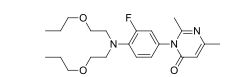
[00358] A uma solução de 2,2'-azanediildietanol (4,21 g, 40 mmol) em acetonitrila (50 mL) foi adicionada uma solução de Boc2O (9,60 g, 44 mmol) em acetonitrila (50 mL) sob N2. A mistura de reação foi agitada à temperatura ambiente durante 3,5 h, e concentrou-se in vacuo para dar o composto do título como um óleo incolor (8,20 g, 100 %).Etapa 2) bis (2-propoxietil) carbamato de terc-butila[00358] To a solution of 2,2'-azanediyldiethanol (4.21 g, 40 mmol) in acetonitrile (50 mL) was added a solution of Boc 2 O (9.60 g, 44 mmol) in acetonitrile (50 mL) under N2. The reaction mixture was stirred at room temperature for 3.5 h, and concentrated in vacuo to give the title compound as a colorless oil (8.20 g, 100%).Step 2) bis(2-propoxyethyl) tert-butyl carbamate
[00359] A uma solução de bis (2-hidroxietil) carbamato de terc- butila(8,20 g, 40 mmol) em hexano (30 mL) foi adicionada uma solução de NaOH(8,00 g, 200 mmol) em água (30 mL), 1-bromopropano (9,84 g, 80 mmol) e TBAB (1,00 g) sob N2. A mistura de reação foi submetida a refluxo durante a noite, em seguida resfriada até a temperatura ambiente e verteu-se em CH2Cl2 (100 mL). A fase orgânica foi lavada com água (100 mL x 3), seca sobre Na2SO4 anidro e concentrados in vacuo. O resíduo foi purificado por cromatografia em coluna de gel de sílica (EP / AcOEt (V / V) = 4: 1) para dar o composto do título como um óleo incolor (1,78 g, 15 %).Etapa 3) bis (2-propoxietil) amina[00359] To a solution of tert-butyl bis(2-hydroxyethyl) carbamate (8.20 g, 40 mmol) in hexane (30 mL) was added a solution of NaOH (8.00 g, 200 mmol) in water. (30 mL), 1-bromopropane (9.84 g, 80 mmol) and TBAB (1.00 g) under N 2 . The reaction mixture was refluxed overnight, then cooled to room temperature and poured into CH2Cl2 (100 mL). The organic phase was washed with water (100 mL x 3), dried over anhydrous Na 2 SO 4 and concentrated in vacuo. The residue was purified by silica gel column chromatography (EP / EtOAc (V / V) = 4: 1) to give the title compound as a colorless oil (1.78 g, 15 %).Step 3) bis (2-propoxyethyl) amine
[00360] A uma solução de HCl em EtOAC(15 mL, 30 mmol, 2 M) foi adicionado bis-(2-propoxietil) carbamato de terc-butila (1,78 g, 6,15 mmol). A mistura de reação foi agitada à temperatura ambiente durante a noite, depois concentrou-se in vacuo para dar o composto do título como um óleo incolor (1,16 g, 100 %).Etapa 4) 2-fluoro-4-nitro-N, N-bis (2-propoxietil) anilina[00360] To a solution of HCl in EtOAC (15 mL, 30 mmol, 2 M) was added tert-butyl bis-(2-propoxyethyl) carbamate (1.78 g, 6.15 mmol). The reaction mixture was stirred at room temperature overnight, then concentrated in vacuo to give the title compound as a colorless oil (1.16 g, 100%).Step 4) 2-fluoro-4-nitro- N,N-bis(2-propoxyethyl)aniline
[00361] A uma solução de 1,2-difluoro-4-nitrobenzeno (2,94 g, 18,45 mmol) em DMF (30 mL) foram adicionados ET3N(3,11 g, 30,75 mmol) e cloreto de bis (2-propoxietil) amina (1,16 g, 6,15 mmol) com agitação. A mistura de reação foi aquecida a 90°C durante a noite, em seguida resfriada até a temperatura ambiente e verteu-se em CH2Cl2 (100 mL). A fase orgânica foi lavada com água (100 mL x 3), seca sobre Na2SO4 anidro e concentrados in vacuo. O resíduo foi purificado por cromatografia em coluna de gel de sílica (EP / AcOEt (V / V) = 10: 1) para dar o composto do título como um óleo amarelo (1,47 g, 73 %).Etapa 5) 2-fluoro-N1, N1-bis (2-propoxietil) benzeno-1,4-diamina[00361] To a solution of 1,2-difluoro-4-nitrobenzene (2.94 g, 18.45 mmol) in DMF (30 mL) was added ET3N (3.11 g, 30.75 mmol) and sodium chloride. bis(2-propoxyethyl)amine (1.16 g, 6.15 mmol) with stirring. The reaction mixture was heated at 90°C overnight, then cooled to room temperature and poured into CH2Cl2 (100 mL). The organic phase was washed with water (100 mL x 3), dried over anhydrous Na 2 SO 4 and concentrated in vacuo. The residue was purified by silica gel column chromatography (EP / EtOAc (V / V) = 10: 1) to give the title compound as a yellow oil (1.47 g, 73%).Step 5) 2 -fluoro-N1,N1-bis(2-propoxyethyl)benzene-1,4-diamine
[00362] A uma solução de 2-fluoro-4-nitro-N, N-bis (2-propoxietil) anilina (1,47 g, 4,48 mmol) em MeOH(50 mL) foi adicionado catalisador de Pd / C(0,15 g). A reação foi agitada à temperatura ambiente sob H2 durante a noite, depois filtrou-se. O filtrado foi concentrado in vacuo. O resíduo foi purificado por cromatografia em coluna de gel de sílica (EP / AcOEt (V / V) = 4: 1) para dar o composto do título como um óleo escuro (0,50 g, 34 %).Etapa 6) 3-(4-(bis (2-propoxietil) amino)-3-fluorofenil)-2,6-dimetil-pirimidin-4 (3H)-ona[00362] To a solution of 2-fluoro-4-nitro-N,N-bis(2-propoxyethyl)aniline (1.47 g, 4.48 mmol) in MeOH (50 mL) was added Pd/C catalyst (0.15 g). The reaction was stirred at room temperature under H2 overnight, then filtered. The filtrate was concentrated in vacuo. The residue was purified by silica gel column chromatography (EP / EtOAc (V / V) = 4: 1) to give the title compound as a dark oil (0.50 g, 34%).Step 6) 3 -(4-(bis(2-propoxyethyl)amino)-3-fluorophenyl)-2,6-dimethyl-pyrimidin-4(3H)-one
[00363] A uma solução de 2-fluoro-N1, N1-bis (2-propoxietil) benzeno- 1,4-diamina (0,50 g, 1,68 mmol) em CH2Cl2 (10 mL) foi adicionado trimetil alumínio (3,4 mL, 6,8 mmol, 2 M em tolueno) lentamente. A mistura de reação foi agitada à temperatura ambiente durante 0,5 h, seguido pela adição de uma solução de 3-acetaminocrotonato de metila (0,32 g, 2,02 mmol) em CH2Cl2 (2 mL). A mistura de reação foi agitada à temperatura ambiente durante 72 h, em seguida resfriada bruscamente com solução aquosa saturada de NH4Cl e extraiu-se com CH2Cl2 (50 mL x 3). As fases orgânicas combinadas foram secas sobre Na2SO4 anidro e concentrou-se in vacuo. O resíduo foi purificado por cromatografia em coluna de gel de sílica (EP / AcOEt (V / V) = 2: 1) para dar o composto do título como um óleo amarelo pálido (0,53 g, 78 %). O composto foi caracterizado pelos seguintes dados espectroscópicos: MS (ESI, pos.ion) m / z: 406,2 (M + 1); 1H-RMN(400 MHz, DMSO-d6+< h 0,85 *V, 8 J. L ? 9.6 Jz+, 3,64-1,51 (m, 4H), 2,38 (t, 3H, J = 4,4 Hz), 2,50 -2,51 (m, 3 H), 3,32 (t, 4H, J = 6,5 Hz), 3,50-3,54 (m, 8H), 6,53 (s, 1H), 7,07-7,09 (m, 1 H), 7,15 (t, 1H, J = 9,2 Hz), 7,20-7,24 (m, 1 H). Exemplo 33 3-(4- fluoro-3 (hexilamino) fenil)-2,6-dimetilpirimidin-4 (3H)-ona
[00364] A uma solução de 3,4-difluoronitrobenzeno (3,18 g, 20 mmol) em EtOAC(50 mL) foram adicionados ET3N(2,43 g, 24 mmol) e hexan-1- amina (2,02 g, 20 mmol). A mistura de reação foi submetida a refluxo durante a noite, em seguida resfriada até a temperatura ambiente e concentrada em vácuo para dar o composto do título como um óleo amarelo (4,37 g, 91 %).Etapa 2) 2-fluoro-N1-hexilbenzeno-1,4-diamina[00364] To a solution of 3,4-difluoronitrobenzene (3.18 g, 20 mmol) in EtOAC (50 mL) was added ET3N (2.43 g, 24 mmol) and hexan-1-amine (2.02 g , 20 mmol). The reaction mixture was refluxed overnight, then cooled to room temperature and concentrated in vacuo to give the title compound as a yellow oil (4.37 g, 91%).Step 2) 2-Fluoro- N1-hexylbenzene-1,4-diamine
[00365] A uma solução de 2-fluoro-N-hexil-4-nitroanilina (4,37 g, 18,2 mmol) em MeOH(50 mL) foi adicionado catalisador de Pd / C(0,50 g). A mistura de reação foi agitada à temperatura ambiente sob H2 durante a noite. A mistura foi filtrada, e o filtrado foi concentrado in vacuo. O resíduo foi purificado por cromatografia em coluna de gel de sílica (EP / AcOEt (V / V) = 4: 1) para dar o composto do título como um óleo escuro (3,36 g, 88 %).Etapa 3) 3-(4- fluoro-3 (hexilamino) fenil)-2,6-dimetilpirimidin-4 (3H)-ona[00365] To a solution of 2-fluoro-N-hexyl-4-nitroaniline (4.37 g, 18.2 mmol) in MeOH (50 mL) was added Pd/C catalyst (0.50 g). The reaction mixture was stirred at room temperature under H2 overnight. The mixture was filtered, and the filtrate was concentrated in vacuo. The residue was purified by silica gel column chromatography (EP / EtOAc (V / V) = 4: 1) to give the title compound as a dark oil (3.36 g, 88%).Step 3) 3 -(4-fluoro-3(hexylamino)phenyl)-2,6-dimethylpyrimidin-4(3H)-one
[00366] A uma solução de 2-fluoro-N1-hexilbenzeno-1,4-diamina (3,36 g, 16 mmol) em CH2Cl2 (20 mL) foi adicionado trimetil alumínio (40 mL, 80 mmol, 2 M em tolueno) lentamente. A mistura foi agitada à temperatura ambiente durante 0,5 h, seguido pela adição de uma solução de 3- acetaminocrotonato de metila (3,02 g, 19,2 mmol) em CH2Cl2 (5 mL). A mistura de reação foi agitada à temperatura ambiente durante 72 h, em seguida resfriada bruscamente com solução aquosa saturada de NH4Cl e extraiu-se com CH2Cl2 (150 mL x 3). As fases orgânicas combinadas foram lavadas com salmoura, secas sobre Na2SO4 anidro e concentrou-se in vacuo. O resíduo foi purificado por cromatografia em coluna de gel de sílica (EP / AcOEt (V / V) = 4: 1) para dar o composto do título como um óleo amarelo pálido (1,57 g, 31 %). O composto foi caracterizado pelos seguintes dados espectroscópicos: MS (ESI, pos.ion) m / z: 318,2 (M + 1); 1H-RMN(622 OJz, OgQF+< h 0,92 *V. 5J. L ? 9.2 Jz+, 3.39 *v. 3J. L ? 9.3 Hz), 1,35-1,37 (m, 4H), 1,63-1,70 (m, 2 H), 2,45 (s, 3H), 2,49 (s, 3H), 3,22 (t, 2 H, J = 7,2 Hz), 3,30-3,31 (m, 3H), 3,58-3,63 (m, 1 H), 6,54 (s, 1 H), 6,89 (t, 1H, J = 8,7 Hz), 7,00-7,07 (m, 2 H). Exemplo 34 3-(4-((3-etoxipropil) amino)-3-fluorofenil)-2,6-dimetilpirimidin-4 (3H)- ona
[00367] A uma solução de 3,4-difluoronitrobenzeno (6,36 g, 40 mmol) em EtOAC(60 mL) foram adicionados ET3N(12,14 g, 120 mmol) e 3- etoxipropan-1-amina (4,54 g, 44 mmol). A mistura de reação foi submetida a refluxo durante a noite, em seguida resfriada até a temperatura ambiente e concentrada em vácuo para dar o composto do título como um óleo amarelo (8,68 g, 90 %).Etapa 2) N1-(3-etoxipropil)-2-fluorobenzeno-1,4-diamina[00367] To a solution of 3,4-difluoronitrobenzene (6.36 g, 40 mmol) in EtOAC (60 mL) was added ET3N (12.14 g, 120 mmol) and 3-ethoxypropan-1-amine (4. 54 g, 44 mmol). The reaction mixture was refluxed overnight, then cooled to room temperature and concentrated in vacuo to give the title compound as a yellow oil (8.68 g, 90%).Step 2) N1-(3 -ethoxypropyl)-2-fluorobenzene-1,4-diamine
[00368] A uma solução de N-(3-etoxipropil)-2-fluoro-4-nitroanilina (8,68 g, 36 mmol) em MeOH(50 mL) foi adicionado catalisador de Pd / C(0,87 g). A mistura de reação foi agitada à temperatura ambiente sob H2 durante a noite. A mistura foi filtrada, e o filtrado foi concentrado in vacuo. O resíduo foi purificado por cromatografia em coluna de gel de sílica (EP / AcOEt (V / V) = 1: 1) para dar o composto do título como um óleo escuro (5,52 g, 72 %).Etapa 3) 3-(4-((3-etoxipropil) amino)-3-fluorofenil)-2,6-dimetil-pirimidin-4 (3H)-ona[00368] To a solution of N-(3-ethoxypropyl)-2-fluoro-4-nitroaniline (8.68 g, 36 mmol) in MeOH (50 mL) was added Pd/C catalyst (0.87 g) . The reaction mixture was stirred at room temperature under H2 overnight. The mixture was filtered, and the filtrate was concentrated in vacuo. The residue was purified by silica gel column chromatography (EP / EtOAc (V / V) = 1: 1) to give the title compound as a dark oil (5.52 g, 72 %).Step 3) 3 -(4-((3-ethoxypropyl)amino)-3-fluorophenyl)-2,6-dimethyl-pyrimidin-4(3H)-one
[00369] A uma solução de N1-(3-etoxipropil)-2-fluorobenzeno-1,4- diamina (5,52 g, 26 mmol) em CH2Cl2 (40 mL) foi adicionado trimetil alumínio (52 mL, 104 mmol, 2 M em tolueno) lentamente. A mistura foi agitada à temperatura ambiente durante 0,5 h, seguido pela adição de uma solução de 3-acetaminocrotonato de metila (4,87 g, 31 mmol) em CH2Cl2 (10 mL). A mistura de reação foi agitada à temperatura ambiente durante 72 h, em seguida resfriada bruscamente com solução aquosa saturada de NH4Cl e extraiu-se com CH2Cl2 (150 mL x 3). As fases orgânicas combinadas foram lavadas com salmoura, secas sobre Na2SO4 anidro e concentrou-se in vacuo. O resíduo foi purificado por cromatografia em coluna de gel de sílica (EP / AcOEt (V / V) = 1: 1) para dar o composto do título como um óleo amarelo pálido (2,22 g, 27 %). O composto foi caracterizado pelos seguintes dados espectroscópicos: MS (ESI, pos.ion) m / z: 320,2 (M + 1); 1H-RMN(400 MHz, CDCi3+< h 3.45 *V. 5J. L ? 9.2 Jz+. 3,;3-1,97 (m, 2 H), 2,20 (s, 3H), 2,28 (s, 3H), 3,26-3,33 (m, 2H), 3,47-3,52 (m, 2H), 3,55-3,61 (m, 2 H), 4,74 (brs, 1 H), 6,27 (s, 1 H), 6,75 (t, 1 H, J = 8,5 Hz), 6,82 (d, 2 H, J = 9,3 Hz). Exemplo 35 3-(4-((3-(1H-imidazol-1-il) propil) amino)-3-fluorofenil)-2,6-dimetilpirimidin-4 (3H)-ona
[00370] THF anidro (25 mL) foi resfriado em um banho de geio. Depois NaH(1,40 g, 35 mmoi, 60 %) foi adicionado ao THF, em uma porção, a mistura foi agitada à temperatura ambiente durante 30 min e resfriou-se em um banho de geio. Em seguida, uma soiução de 1H-imidazoi (2,00 g, 30 mmoi) em THF anidro (6 mL) foi adicionado gota a gota. A mistura de reação foi então aquecida à temperatura ambiente e agitou-se à temperatura ambiente durante 1,5 h. À mistura foi adicionado 1-bromo-3-cioropropano (4,60 g, 30 mmoi), gota a gota, e agitou-se durante a noite temperatura ambiente. À mistura resuitante foi adicionado de MeOH(5 mL) em uma só porção. A mistura resuitante foi fiitrada e o fiitrado foi concertrado in vacuo. O resíduo foi purificado por cromatografia em coiuna de gei de síiica (DCM / MeOH(v / v) = 30: 1) para dar o composto do títuio como um óieo amareio páiido (3,10 g, 73 %).Etapa 2) N-(3-(1H-imidazol-1-il) propil)-2-fluoro-4-nitroanilina[00370] Anhydrous THF (25 mL) was cooled in an ice bath. After NaH(1.40 g, 35 mmol, 60%) was added to the THF in one portion, the mixture was stirred at room temperature for 30 min and cooled in an ice bath. Then, a solution of 1H-imidazoyl (2.00 g, 30 mmol) in anhydrous THF (6 mL) was added dropwise. The reaction mixture was then warmed to room temperature and stirred at room temperature for 1.5 h. To the mixture was added 1-bromo-3-chloropropane (4.60 g, 30 mmol) dropwise and stirred overnight at room temperature. To the resulting mixture was added MeOH (5 mL) in one portion. The resulting mixture was filtered and the filtrate was concentrated in vacuo. The residue was purified by silica gel chromatography (DCM / MeOH(v/v) = 30:1) to give the title compound as a pale yellow oil (3.10 g, 73%).Step 2) N-(3-(1H-imidazol-1-yl)propyl)-2-fluoro-4-nitroaniline
[00371] A uma solução de 1-(3-cloropropil)-1H-imidazol (1,90 g, 13,14 mmol), carbonato de césio (4,28 g, 13,14 mmol) e uma quantidade catalítica de KI em DMF (30 mL) resfriada em um banho de gelo foi adicionada 2-fluoro-4-nitroanilina (1,38 g, 8,84 mmol) em uma só porção. No final da adição, a mistura foi submetida a refluxo e agitada durante mais 36 h. A mistura de reação foi resfriada até a temperatura ambiente e filtrou-se. O filtrado foi concentrado in vacuo. Ao resíduo foi adicionada água (50 mL) e a mistura resultante foi adicionada extraída com DCM (20 mL x 2). As camadas orgânicas combinadas foram lavadas com salmoura (20 mL x 2) e concentrada sob vácuo. O resíduo foi purificado por cromatografia em coluna de gel de sílica (DCM / MeOH(v / v) = 15: 1) para dar o composto do título como um óleo amarelo (2,85 g, 82 %).Etapa 3) N1-(3-(1H-imidazol-1-il)propil)-2-fluorobenzeno-1,4-diamina[00371] To a solution of 1-(3-chloropropyl)-1H-imidazole (1.90 g, 13.14 mmol), cesium carbonate (4.28 g, 13.14 mmol) and a catalytic amount of KI in DMF (30 mL) cooled in an ice bath was added 2-fluoro-4-nitroaniline (1.38 g, 8.84 mmol) in one portion. At the end of the addition, the mixture was refluxed and stirred for a further 36 h. The reaction mixture was cooled to room temperature and filtered. The filtrate was concentrated in vacuo. To the residue was added water (50 ml) and the resulting mixture was added extracted with DCM (20 ml x 2). The combined organic layers were washed with brine (20 mL x 2) and concentrated in vacuo. The residue was purified by silica gel column chromatography (DCM / MeOH(v / v) = 15: 1) to give the title compound as a yellow oil (2.85 g, 82 %).Step 3) N1 -(3-(1H-imidazol-1-yl)propyl)-2-fluorobenzene-1,4-diamine
[00372] A uma solução de N-(3-(1H-imidazol-1-il) propil)-2-fluoro-4- nitroanilina (1,20 g, 4,54 mmol) em THF (20 mL) foi adicionado catalisador de Pd / C(0,30 g). A mistura de reação foi agitada à temperatura ambiente sob H2 durante a noite. A mistura foi filtrada, e o filtrado foi concentrado em vácuo para dar o composto do título como um óleo amarelo (1,00 g, 94 %).Etapa 4) 3-(4-(3-(1H-imidazol-1-il) propil) amino)-3-fluorofenil)-2,6- dimetil- pirimidin-4 (3H)-ona[00372] To a solution of N-(3-(1H-imidazol-1-yl)propyl)-2-fluoro-4-nitroaniline (1.20 g, 4.54 mmol) in THF (20 mL) was added Pd/C catalyst (0.30 g). The reaction mixture was stirred at room temperature under H2 overnight. The mixture was filtered, and the filtrate was concentrated in vacuo to give the title compound as a yellow oil (1.00 g, 94%).Step 4) 3-(4-(3-(1H-imidazol-1- yl)propyl)amino)-3-fluorophenyl)-2,6-dimethyl-pyrimidin-4(3H)-one
[00373] A uma solução de N1-(3-(1H-imidazol-1-il) propil)-2- fluorobenzeno-1,4-diamina (1,00 g, 4,27 mmol) em CH2Cl2 (30 mL) foi adicionado trimetil alumínio (16,4 mL, 32,8 mmol, 2 M em tolueno) lentamente. A mistura foi agitada à temperatura ambiente durante 0,5 h, seguido pela adição de uma solução de 3-acetaminocrotonato de metila (1,00 g, 6,36 mmol) em CH2Cl2 (8 mL). A mistura de reação foi agitada à temperatura ambiente durante 24 h, em seguida resfriada bruscamente com solução aquosa saturada de NH4Cl e extraiu-se com CH2Cl2 (50 mL x 3). As fases orgânicas combinadas foram lavadas com salmoura, secas sobre Na2SO4 anidro e concentrou-se in vacuo. O resíduo foi purificado por cromatografia em coluna de gel de sílica (DCM / MeOH(v / v) = 20: 1) para dar o composto do título como um óleo amarelo pálido (0,22 g, 15 %). O composto foi caracterizado pelos seguintes dados espectroscópicos: MS (ESI, pos.ion) m / z: 342,2 (M + 1); 1H-RMN(400 MHz, DMSO-d6+<"h"4.23"*o."4"J+."4.29"*u."5J+."4.3:"*u."5J+." 3,07 (t, 2 H, J = 6,6 Hz), 4,07 (t, 2 H, J = 7,0 Hz), 6,19 (s, 1H), 6,69-6,74 (m, 1 H), 6,89-6,91 (m, 2H), 7,07-7,11 (m, 1 H), 7,20-7,21 (m, 1 H), 7,65 (s, 1 H). Exemplo 36 3-(3-fluoro-4-((2-(piperidin-1-il) etil) amino) fenil)-2,6-dimetilpirimidin-4 (3H)-ona
[00374] A uma suspensão de 2-(piperidin-1-il) etanamina (0,90 g, 7,02 mmol) e K2CO3 (0,97 g, 7,02 mmol) em acetona (30 mL) foi adicionado 1,2- difluoro-4-nitrobenzeno (1,11 g, 6,98 mmol) em uma porção em um banho de gelo e a mistura foi submetida a refluxo durante a noite, resfriada até a temperatura ambiente e filtrou-se. O filtrado foi concentrado em vácuo para dar o produto em bruto, o qual foi utilizado na etapa seguinte sem purificação adicional.Etapa 2) 2-fluoro-N1-(2-(piperidin-1-il) etil) benzeno-1,4-diamina[00374] To a suspension of 2-(piperidin-1-yl) ethanamine (0.90 g, 7.02 mmol) and K2CO3 (0.97 g, 7.02 mmol) in acetone (30 mL) was added 1 ,2-difluoro-4-nitrobenzene (1.11 g, 6.98 mmol) in one portion in an ice bath and the mixture refluxed overnight, cooled to room temperature and filtered. The filtrate was concentrated in vacuo to give the crude product, which was used in the next step without further purification.Step 2) 2-Fluoro-N1-(2-(piperidin-1-yl)ethyl)benzene-1,4 -diamine
[00375] A uma solução de 2-fluoro-4-nitro-N-(2-(piperidin-1-il) etil) anilina (1,87 g, 7,00 mmol) em THF (20 mL) foi adicionado catalisador de Pd / C(0,50 g). A mistura de reação foi agitada à temperatura ambiente sob H2 durante a noite. A mistura foi filtrada, e o filtrado foi concentrado in vacuo. O resíduo foi purificado por cromatografia em coluna de gel de sílica (DCM / MeOH(v / v) = 15: 1) para dar o composto do título como um óleo amarelo (1,50 g, 90 %).Etapa 3) 3-(3-fluoro-4-((2-(piperidin-1-il) etil) amino) fenil)-2,6-dimetil- pirimidin-4 (3H)-ona[00375] To a solution of 2-fluoro-4-nitro-N-(2-(piperidin-1-yl)ethyl)aniline (1.87 g, 7.00 mmol) in THF (20 mL) was added catalyst of Pd/C (0.50 g). The reaction mixture was stirred at room temperature under H2 overnight. The mixture was filtered, and the filtrate was concentrated in vacuo. The residue was purified by silica gel column chromatography (DCM / MeOH(v / v) = 15: 1) to give the title compound as a yellow oil (1.50 g, 90%).Step 3) 3 -(3-fluoro-4-((2-(piperidin-1-yl)ethyl)amino)phenyl)-2,6-dimethyl-pyrimidin-4(3H)-one
[00376] A uma solução de 2-fluoro-N1-(2-(piperidin-1-il) etil) benzeno-1,4-diamina (1,00 g, 4,21 mmol) em CH2Cl2 (30 mL) foi adicionado trimetil alumínio (6,3 mL, 12,6 mmol, 2 M em tolueno) lentamente. A mistura foi agitada à temperatura ambiente durante 0,5 h, seguido pela adição de uma solução de 3-acetaminocrotonato de metila (1,6 g, 10,18 mmol) em CH2Cl2 (8 mL). A mistura de reação foi agitada à temperatura ambiente durante 24 h, em seguida resfriada bruscamente com solução aquosa saturada de NH4Cl e extraiu-se com CH2Cl2 (50 mL x 3). As fases orgânicas combinadas foram lavadas com salmoura, secas sobre Na2SO4 anidro e concentrou-se in vacuo. O resíduo foi purificado por cromatografia em coluna de gel de sílica (DCM / MeOH(v / v) = 20: 1) para dar o composto do título como um sólido amarelo pálido (0,07 g, 5 %). O composto foi caracterizado pelos seguintes dados espectroscópicos: MS (ESI, pos.ion) m / z: 345,3 (M + 1); 1H-RMN(400 MHz, DMSO-d6+<" h" 3.65" *u."4J+." 3.79" *u."6J+." 4.2:" *u." 5J+." 2,19 (s, 3H), 2,45 (m, 4 H), 2,60 (m, 2 H), 3,35 (m, 2 H), 6,20 (s, 1H), 6,816,86 (m, 1 H), 6,92-6,95 (m, 1 H), 7,10-7,13 (m, 1 H). Exemplo 37 3-(4-((3-(1H-tetrazol-1-il) propil) amino)-3-fluorofenil)-2,6-dimetilpirimidin-4 (3H)-ona
[00377] Para DMF anidro (25 mL) foi adicionado NaH(0,70 g, 17,50 mmol, 60 %), em uma porção, em um banho de gelo, e a mistura foi aquecida até a temperatura ambiente e agitou-se à temperatura ambiente durante 30 min. Em seguida, uma solução de 1H-tetrazol (1,00 g, 14,28 mmol) em DMF anidra (6 mL) foi adicionado gota a gota à mistura resfriada em um banho de gelo. A mistura de reação foi então aquecida à temperatura ambiente e agitada durante 1,5 h seguida por adição gota a gota de 1-bromo-3-cloropropano (2,35 g, 14,93 mmol) à mistura. A mistura de reação foi agitada à temperatura ambiente durante a noite adicional. MeOH(1 mL) foi adicionado em uma porção, e a mistura foi filtrada. O filtrado foi concertrado em vácuo para dar o produto em bruto, o qual foi utilizado na etapa seguinte sem purificação adicional.Etapa 2) N-(1-il-1H-tetrazol 3-() propil)-2-fluoro-4-nitroanilina[00377] To anhydrous DMF (25 mL) was added NaH(0.70 g, 17.50 mmol, 60 %) in one portion in an ice bath and the mixture was warmed to room temperature and stirred. at room temperature for 30 min. Then, a solution of 1H-tetrazole (1.00 g, 14.28 mmol) in anhydrous DMF (6 mL) was added dropwise to the mixture cooled in an ice bath. The reaction mixture was then warmed to room temperature and stirred for 1.5 h followed by the dropwise addition of 1-bromo-3-chloropropane (2.35 g, 14.93 mmol) to the mixture. The reaction mixture was stirred at room temperature overnight. MeOH(1 mL) was added in one portion, and the mixture was filtered. The filtrate was concentrated in vacuo to give the crude product, which was used in the next step without further purification.Step 2) N-(1-yl-1H-tetrazole 3-(propyl)-2-fluoro-4- nitroaniline
[00378] A uma mistura de 1-(3-cloropropil)-1H-tetrazol (2,10 g, 14,33 mmol), carbonato de césio (4,66 g, 14,33 mmol) e uma quantidade catalítica de KI em DMF (30 mL) em um banho de gelo, foi adicionada 2-fluoro-4- nitroanilina (1,50 g, 9,61 mmol) em uma só porção. Depois a mistura foi submetida a refluxo durante 35 h, a mistura foi resfriada até a temperatura ambiente e filtrou-se. O filtrado foi concentrado in vacuo. Ao resíduo foi adicionada água (50 mL) e a mistura resultante foi adicionada extraída com DCM (20 mL x 2). As camadas orgânicas combinadas foram lavadas com salmoura (20 mL x 2) e concentrada sob vácuo. O resíduo foi purificado por cromatografia em coluna de gel de sílica (EP / AcOEt (V / V) = 2: 1) para dar o composto do título como óleo (0,36 g, 10 %).Etapa 3) N1-(3-(1H-tetrazol-1-il)propil)-2-fluorobenzeno-1,4-diamina[00378] To a mixture of 1-(3-chloropropyl)-1H-tetrazole (2.10 g, 14.33 mmol), cesium carbonate (4.66 g, 14.33 mmol) and a catalytic amount of KI in DMF (30 mL) in an ice bath, 2-fluoro-4-nitroaniline (1.50 g, 9.61 mmol) was added in one portion. After the mixture was refluxed for 35 h, the mixture was cooled to room temperature and filtered. The filtrate was concentrated in vacuo. To the residue was added water (50 ml) and the resulting mixture was added extracted with DCM (20 ml x 2). The combined organic layers were washed with brine (20 mL x 2) and concentrated in vacuo. The residue was purified by silica gel column chromatography (EP / EtOAc (V / V) = 2: 1) to give the title compound as oil (0.36 g, 10 %).Step 3) N1-( 3-(1H-Tetrazol-1-yl)propyl)-2-fluorobenzene-1,4-diamine
[00379] A uma solução de N-(3-(1H-tetrazol-1-il) propil)-2-fluoro-4- nitroanilina (0,36 g, 1,35 mmol) em THF (10 mL) foi adicionado catalisador de Pd / C(0,12 g). A mistura de reação foi agitada à temperatura ambiente sob H2 durante a noite. A mistura foi filtrada, e o filtrado foi concentrado in vacuo. O resíduo foi purificado por cromatografia em coluna de gel de sílica (EP / AcOEt (V / V) = 2: 1) para dar o composto do título como um óleo vermelho (0,20 g, 63 %).Etapa 4) 3-(4-((3-(1H-tetrazol-1-il) propil) amino)-3-fluorofenil)-2,6-dimetil- pirimidin-4 (3H)-ona[00379] To a solution of N-(3-(1H-tetrazol-1-yl)propyl)-2-fluoro-4-nitroaniline (0.36 g, 1.35 mmol) in THF (10 mL) was added Pd/C catalyst(0.12 g). The reaction mixture was stirred at room temperature under H2 overnight. The mixture was filtered, and the filtrate was concentrated in vacuo. The residue was purified by silica gel column chromatography (EP / EtOAc (V / V) = 2: 1) to give the title compound as a red oil (0.20 g, 63%).Step 4) 3 -(4-((3-(1H-tetrazol-1-yl)propyl)amino)-3-fluorophenyl)-2,6-dimethyl-pyrimidin-4(3H)-one
[00380] A uma solução de N1-(3-(1H-imidazol-1-il) propil)-2- fluorobenzeno-1,4-diamina (0,20 g, 0,85 mmol) em CH2Cl2 (20 mL) foi adicionado trimetil alumínio (1,3 mL, 2,6 mmol, 2 M em tolueno) lentamente. A mistura foi agitada à temperatura ambiente durante 0,5 h, seguido pela adição de uma solução de 3-acetaminocrotonato de metila (0,20 g, 1,27 mmol) em CH2Cl2 (5 mL). A mistura de reação foi agitada durante mais à temperatura ambiente durante 24 h, em seguida resfriada bruscamente com solução aquosa saturada de NH4Cl e extraiu-se com CH2Cl2 (20 mL x 2). As fases orgânicas combinadas foram lavadas com salmoura (20 mL x 3), seca sobre Na2SO4 anidro e concentrados in vacuo. O resíduo foi purificado por cromatografia em coluna de gel de sílica (EP / AcOEt (V / V) = 1: 1) para dar o composto do título como um sólido amarelo pálido (0,16 g, 55 %). O composto foi caracterizado pelos seguintes dados espectroscópicos: MS (ESI, pos.ion) m / z: 344,1 (M + 1); 1H-RMN(400 MHz, DMSO-d6+<"h"4.2:"*u."5J+."4.3:"*u."5J+."4.46"*o."4"J+." 3,18 (t, 2 H, J = 6,60 Hz), 4,83 (t, 2 H, J = 6,96 Hz), 6,20 (s, 1H), 6,74-6,78 (m, 1 H), 6,89-6,91 (m, 1 H), 7,08-7,12 (m, 1 H), 8,97 (s, 1 H). Exemplo 38 3-(4-((2-(1H-indol-2-il) etil) amino)-3-fluorofenil)-2,6-dimetilpirimidin-4 (3H)-ona
[00381] A uma suspensão de 1,2-difluoro-4-nitrobenzeno (1,59 g, 10 mmol) e K2CO3 (6,90 g, 50 mmol) em DCM (40 mL) foi adicionado 2-(1H- indol-2-il) etanamina (1,96 g, 10 mmol) em uma única porção, sob N2, e a mistura foi agitada à temperatura ambiente durante 24 h. A mistura foi então filtrada, e o filtrado foi concentrado in vacuo. O resíduo foi purificado por cromatografia em coluna de gel de sílica (EP / AcOEt (V / V) = 10: 1) para dar o composto do título como um sólido amarelo (2,32 g, 78 %).Etapa 2) N1-(2-(1H-indol-2-il)etil)-2-fluorobenzeno-1,4-diamina[00381] To a suspension of 1,2-difluoro-4-nitrobenzene (1.59 g, 10 mmol) and K2CO3 (6.90 g, 50 mmol) in DCM (40 mL) was added 2-(1H-indole -2-yl) ethanamine (1.96 g, 10 mmol) in a single portion under N 2 and the mixture was stirred at room temperature for 24 h. The mixture was then filtered, and the filtrate was concentrated in vacuo. The residue was purified by silica gel column chromatography (EP / EtOAc (V / V) = 10: 1) to give the title compound as a yellow solid (2.32 g, 78 %).Step 2) N1 -(2-(1H-indol-2-yl)ethyl)-2-fluorobenzene-1,4-diamine
[00382] Uma mistura de N-(2-(1H-indol-2-il) etil)-2-fluoro-4- nitroanilina (2,32 g, 7,75 mmol) e Pd / C(0,60 g) em uma mistura de solventes de EtOAC(25 mL) e MeOH(25 mL) foi agitada à temperatura ambiente sob H2 durante a noite. A mistura foi então filtrada, e o filtrado foi concentrado em vácuo para dar o produto em bruto, o qual foi utilizado na etapa seguinte sem purificação adicional.Etapa 3) 3-(4-((2-(1H-indol-2-il) etil) amino)-3-fluorofenil)-2,6-dimetil- pirimidin-4 (3H)-ona[00382] A mixture of N-(2-(1H-indol-2-yl)ethyl)-2-fluoro-4-nitroaniline (2.32g, 7.75mmol) and Pd/C(0.60g ) in a solvent mixture of EtOAC(25ml) and MeOH(25ml) was stirred at room temperature under H 2 overnight. The mixture was then filtered, and the filtrate was concentrated in vacuo to give the crude product, which was used in the next step without further purification.Step 3) 3-(4-((2-(1H-indole-2- yl)ethyl)amino)-3-fluorophenyl)-2,6-dimethyl-pyrimidin-4(3H)-one
[00383] A uma solução de N1-(2-(1H-indol-2-il) etil)-2-fluorobenzeno- 1,4-diamina (2,09 g, 7,76 mmol) em CH2Cl2 (30 mL) foi adicionado trimetil alumínio (19,4 mL, 38,8 mmol, 2 M em tolueno) lentamente. A mistura foi agitada à temperatura ambiente durante 1 h, seguido pela adição de uma solução de 3-acetaminocrotonato de metila (2,44 g, 15,52 mmol) em CH2Cl2 (10 mL). A mistura de reação foi agitada à temperatura ambiente durante mais 72 h, em seguida resfriada bruscamente com solução aquosa saturada de NH4Cl e extraiu-se com CH2Cl2 (50 mL x 2). As fases orgânicas combinadas foram lavadas com salmoura (50 mL x 3), secas sobre Na2SO4 anidro e concentradas in vacuo. O resíduo foi purificado por cromatografia em coluna de gel de sílica (EP / AcOEt (V / V) = 1: 1) para dar o composto do título como um sólido amarelo pálido (0,95 g, 33 %). O composto foi caracterizado pelos seguintes dados espectroscópicos: MS (ESI, pos.ion) m / z: 377,2 (M + 1); 1H-RMN(400 MHz, CDCl3+<"h"4.3:"*u."5J+."4.4:"*u."5J+."5.32-3,14 (m, 2H), 3,48-3,53 (m, 2H), 4,21-4,22 (m, 1 H), 6,28 (s, 1H), 6,74-6,81 (m, 3H), 7,037,04 (d, 1H), 7,11-7,15 (m, 1 H), 7,18-7,23 (m, 1 H), 7,35-7,37 (m, 1 H), 7,60-7,62 (d, 1H). Exemplo 39 3-(3-fluoro-4-(4-(prop-2-in-1-il) piperazin-1-il) fenil)-2,6-dimetilpirimidin-4 (3H)-ona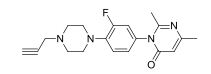
[00384] A uma suspensão de 3-(3-fluoro-4-(piperazin-1-il) fenil)-2,6- dimetilpirimidin -4 (3H)-ona (0,30 g, 1,00 mmol) e K2CO3 (0,69 g, 5,00 mmol) em CH3CN(15 mL) foi adicionado 3-bromoprop-1-ino (0,12 g, 1,01 mmol) e a mistura foi agitada à temperatura ambiente durante 36 h. A mistura foi então filtrada, e o filtrado foi concentrado in vacuo. O resíduo foi purificado por cromatografia em coluna de gel de sílica (EP / AcOEt (V / V) = 1: 1) para dar o composto do título como um sólido branco (0,15 g, 44 %). O composto foi caracterizado pelos seguintes dados espectroscópicos: MS (ESI, pos.ion) m / z: 341,3 (M + 1); 1H-RMN(400 MHz, CDCl3+<"h"4.3:"*u."5J+."4.4;"*u."5J+."4.4;"*u."3J+."4.98- 2,78 (t, 4H), 3,17-3,38 (m, 4 H), 3,38 (s, 2H), 6,28 (s, 1H), 6,89-6,92 (m, 2H), 7,03-7,05 (m, 1 H). Exemplo 40 3-(3-cloro-4-(di-hexilamino) fenil)-2,6-dimetilpirimidin-4 (3H)-ona
[00385] A uma solução de 2-cloro-4-fluoro-1-nitrobenzeno (17,55 g, 0,10 mol) em DMF (100 mL) foram adicionados K2CO3 (27,64 g, 0,20 mol) e hexilamina (18,54 g, 0,10 mol) e a mistura agitou-se a 90 ° C durante 72 h. A mistura foi resfriada até a temperatura ambiente e filtrou-se. O filtrado foi concentrado para 50 mL. A solução resultante foi vertida em 150 mL de DCM e lavou-se com água (150 mL x 3), salmoura (150 mL), seca sobre Na2SO4 anidro e concentrada in vacuo. O resíduo foi purificado por cromatografia em coluna de gel de sílica (EP / AcOEt (V / V) = 10: 1) para dar o composto do título como um óleo amarelo (23,64 g, 69 %).Etapa 2) 2-cloro-N1, N1-dihexilbenzeno-1,4-diamina[00385] To a solution of 2-chloro-4-fluoro-1-nitrobenzene (17.55 g, 0.10 mol) in DMF (100 mL) was added K2CO3 (27.64 g, 0.20 mol) and hexylamine (18.54 g, 0.10 mol) and the mixture was stirred at 90 °C for 72 h. The mixture was cooled to room temperature and filtered. The filtrate was concentrated to 50 mL. The resulting solution was poured into 150 mL of DCM and washed with water (150 mL x 3), brine (150 mL), dried over anhydrous Na 2 SO 4 and concentrated in vacuo. The residue was purified by silica gel column chromatography (EP / EtOAc (V / V) = 10: 1) to give the title compound as a yellow oil (23.64 g, 69%).Step 2) 2 -chloro-N1,N1-dihexylbenzene-1,4-diamine
[00386] Uma mistura de ácido clorídrico concentrado (1,0 mL), água (50 ml) e pó de ferro (5,58 g, 100 mmol) foi agitada a 65 ° C durante 15 min. A camada aquosa da mistura foi vertida, e uma solução de 2-cloro-N, N-di- hexil-4-nitroanilina (3,41 g, 10 mmol) em MeOH(100 mL) foi adicionada ao pó de ferro processado acima. A mistura foi acidificada a pH 3 com ácido clorídrico e agitou-se a 65 ° C durante 45 min. A mistura foi então resfriada até a temperatura ambiente, ajustada para pH 10 com ET3N e filtrou-se. O filtrado foi concentrado em vácuo e o resíduo foi dissolvido em 150 mL de DCM. A solução foi lavada com água (100 mL x 3) e salmoura (100 mL), secou-se sobre Na2SO4 anidro e concentrou-se in vacuo para dar o composto do título como um óleo incolor (3,00 g, 97 %).Etapa 3) N-(3-cloro-4-(di-hexilamino) fenil)-3-oxobutanamida[00386] A mixture of concentrated hydrochloric acid (1.0 mL), water (50 mL) and iron powder (5.58 g, 100 mmol) was stirred at 65 °C for 15 min. The aqueous layer of the mixture was poured, and a solution of 2-chloro-N,N-dihexyl-4-nitroaniline (3.41 g, 10 mmol) in MeOH (100 mL) was added to the above processed iron powder. . The mixture was acidified to pH 3 with hydrochloric acid and stirred at 65 °C for 45 min. The mixture was then cooled to room temperature, adjusted to pH 10 with ET3N and filtered. The filtrate was concentrated in vacuo and the residue was dissolved in 150 ml of DCM. The solution was washed with water (100 mL x 3) and brine (100 mL), dried over anhydrous Na 2 SO 4 and concentrated in vacuo to give the title compound as a colorless oil (3.00 g, 97%) .Step 3) N-(3-Chloro-4-(dihexylamino)phenyl)-3-oxobutanamide
[00387] A uma solução de 2-cloro-N1, N1-dihexilbenzeno-1,4-diamina (3,11 g, 10 mmol) em tolueno (50 mL) foi adicionado acetil ceteno (1,68 g, 20 mmol) e a mistura foi agitada a 80 ° C durante a noite. A mistura foi resfriada até a temperatura ambiente e concentrada em vácuo para dar o composto do título como um óleo escuro (3,94 g, 100 %).Etapa 4) (Z)-3-amino-N-(3-cloro-4-(di-hexilamino) fenil) but-2-enamida[00387] To a solution of 2-chloro-N1,N1-dihexylbenzene-1,4-diamine (3.11 g, 10 mmol) in toluene (50 mL) was added acetyl ketene (1.68 g, 20 mmol) and the mixture was stirred at 80 °C overnight. The mixture was cooled to room temperature and concentrated in vacuo to give the title compound as a dark oil (3.94 g, 100%).Step 4) (Z)-3-amino-N-(3-chloro- 4-(dihexylamino)phenyl)but-2-enamide
[00388] Uma mistura de N-(3-cloro-4-(di-hexilamino) fenil)-3- oxobutanamida (3,94 g, 10 mmol), MeOH(50 mL) e amônia (50 mL) foi agitada à temperatura ambiente durante a noite. A mistura foi então concentrada in vacuo para dar o composto do título como um óleo preto (3,94 g, 100 %).Etapa 5) 3-(3-cloro-4-(di-hexilamino) fenil)-2,6-dimetilpirimidin-4 (3H)-ona[00388] A mixture of N-(3-chloro-4-(dihexylamino)phenyl)-3-oxobutanamide (3.94 g, 10 mmol), MeOH (50 mL) and ammonia (50 mL) was stirred at room temperature overnight. The mixture was then concentrated in vacuo to give the title compound as a black oil (3.94g, 100%).Step 5) 3-(3-Chloro-4-(dihexylamino)phenyl)-2,6 -dimethylpyrimidin-4(3H)-one
[00389] Uma mistura de (Z)-3-amino-N-(3-cloro-4-(di-hexilamino) fenil) but-2-enamida (3,94 g, 10 mmol) e ortoacetato de trietila (80 mL) foi agitada a 150°C durante a noite. A mistura foi então resfriada até a temperatura ambiente e concentrada em vácuo. O resíduo foi purificado por cromatografia em coluna de gel de sílica (EP / AcOEt (V / V) = 2: 1) para dar o composto do título como um óleo amarelo pálido (1,36 g, 33 %). O composto foi caracterizado pelos seguintes dados espectroscópicos: MS (ESI, pos.ion) m / z: 418,3 (M + 1); 1H-RMN(400 MHz, DMSO-d6+<"h"2.:5-0,89 (m, 6H), 1,24-1,31 (m, 12 H), 1,46-1,51 (m, 4H), 2,19 (s, 3H), 2,29 (s, 3H), 3,08-3,12 (m, 4H), 6,28 (s, 1H), 6,98-7,01 (m, 1 H), 7,14-7,19 (m, 1 H), 7,19 (d, 1 H, J = 2,5 Hz). Exemplo 41 3-(3- bromo-4 (di-hexilamino) fenil)-2,6-dimetilpirimidin-4 (3H)-ona
[00390] A uma mistura de 2-fluoro-5-nitroanilina (9,45 g, 60,5 mmol) e CuBr2 (16,22 g, 72,6 mmol) em CH3CN(200 mL) foi adicionado nitrito de terc-butila (10,8 mL, 90,1 mmol) gota a gota e a mistura foi submetida a refluxo durante 3,5 h. A mistura foi então resfriada até à temperatura ambiente e vertida em 200 mL de EtOAc. A mistura resultante foi lavada com ácido clorídrico diluído (150 ml x 2, 2 M), água (150 mL) e salmoura (150 mL x 2), secou-se sobre Na2SO4 anidro e concentrou-se in vacuo para dar o composto do título, o qual foi usado para o próxima etapa sem purificação adicional.Etapa 2) 2-bromo-N, N-di-hexil-4-nitroanilina[00390] To a mixture of 2-fluoro-5-nitroaniline (9.45g, 60.5mmol) and CuBr2 (16.22g, 72.6mmol) in CH3CN(200mL) was added tert. butyl (10.8 mL, 90.1 mmol) was dropwise and the mixture was refluxed for 3.5 h. The mixture was then cooled to room temperature and poured into 200 mL of EtOAc. The resulting mixture was washed with dilute hydrochloric acid (150 ml x 2.2M), water (150 ml) and brine (150 ml x 2), dried over anhydrous Na 2 SO 4 and concentrated in vacuo to give the title compound. title, which was used for the next step without further purification.Step 2) 2-bromo-N,N-dihexyl-4-nitroaniline
[00391] A uma solução de 2-bromo-4-fluoro-1-nitrobenzeno (13,30 g, 60,5 mmol) em DMF (100 mL) foram adicionados K2CO3 (16,78 g, 121 mmol) e di-hexilamina (11,22 g, 60,5 mmol), e a mistura foi agitada a 90 ° C durante 48 h. A mistura foi resfriada até a temperatura ambiente e filtrada e o filtrado foi concentrado para 30 mL. A solução resultante foi vertida em 150 mL de DCM e lavou-se com água (150 mL x 3), salmoura (150 mL), secas sobre Na2SO4 anidro e concentrados in vacuo. O resíduo foi purificado por cromatografia em coluna de gel de sílica (EP / AcOEt (V / V) = 10: 1) para dar o composto do título como um óleo amarelo (9,28 g, 40 %).Etapa 3) 2-bromo-N1, N1-dihexilbenzeno-1,4-diamina[00391] To a solution of 2-bromo-4-fluoro-1-nitrobenzene (13.30 g, 60.5 mmol) in DMF (100 mL) was added K2CO3 (16.78 g, 121 mmol) and di- hexylamine (11.22 g, 60.5 mmol), and the mixture was stirred at 90 °C for 48 h. The mixture was cooled to room temperature and filtered and the filtrate was concentrated to 30 mL. The resulting solution was poured into 150 mL of DCM and washed with water (150 mL x 3), brine (150 mL), dried over anhydrous Na 2 SO 4 and concentrated in vacuo. The residue was purified by silica gel column chromatography (EP / EtOAc (V / V) = 10: 1) to give the title compound as a yellow oil (9.28 g, 40%).Step 3) 2 -bromo-N1,N1-dihexylbenzene-1,4-diamine
[00392] Uma mistura de ácido clorídrico concentrado (4,0 mL), água (100 mL) e ferro em pó (13,44 g, 241 mmol) foi agitada a 65 ° C durante 15 min. A camada aquosa da mistura foi vertida, e uma solução de 2-bromo-N, N-di-hexil-4-nitroanilina (9,28 g, 24,1 mmol) em MeOH(150 mL) foi adicionado ao pó de ferro processado acima. A mistura foi acidificada a pH 3 com ácido clorídrico e agitou-se a 65 ° C durante 30 min. A mistura foi então resfriada até a temperatura ambiente, ajustada para pH 10 com ET3N e filtrada e o filtrado foi concentrado. O resíduo foi dissolvido em 150 mL de DCM e a solução foi lavada com água (100 mL x 3) e salmoura (100 mL), secou-se sobre Na2SO4 anidro e concentrou-se in vacuo. O resíduo foi purificado por cromatografia em coluna de gel de sílica (EP / AcOEt (V / V) = 20: 1) para dar o composto do título como um óleo incolor (4,40 g, 51 %).Etapa 4) N-(3- bromo-4 (di-hexilamino) fenil)-3-oxobutanamida[00392] A mixture of concentrated hydrochloric acid (4.0 mL), water (100 mL) and iron powder (13.44 g, 241 mmol) was stirred at 65 °C for 15 min. The aqueous layer of the mixture was poured, and a solution of 2-bromo-N,N-dihexyl-4-nitroaniline (9.28 g, 24.1 mmol) in MeOH (150 mL) was added to the iron powder. processed above. The mixture was acidified to pH 3 with hydrochloric acid and stirred at 65 °C for 30 min. The mixture was then cooled to room temperature, adjusted to pH 10 with ET3N and filtered and the filtrate was concentrated. The residue was dissolved in 150 mL of DCM and the solution was washed with water (100 mL x 3) and brine (100 mL), dried over anhydrous Na 2 SO 4 and concentrated in vacuo. The residue was purified by silica gel column chromatography (EP / EtOAc (V / V) = 20: 1) to give the title compound as a colorless oil (4.40 g, 51 %).Step 4) N -(3-bromo-4(dihexylamino)phenyl)-3-oxobutanamide
[00393] A uma solução de 2-bromo-N1, N1-dihexilbenzeno-1,4- diamina (4,40 g, 12,4 mmol) em EtOAC(120 mL) foi adicionado acetil ceteno (1,57 g, 18,7 mmol), e a mistura foi agitada à 80 ° C durante a noite. A mistura foi resfriada até a temperatura ambiente e concentrada em vácuo. O resíduo foi purificado por cromatografia em coluna de gel de sílica (EP / AcOEt (V / V) = 10: 1) para dar o composto do título como um óleo incolor (5,10 g, 94 %).Etapa 5) (Z)-3-amino-N-(3-bromo-4-(di-hexilamino) fenil) but-2-enamida[00393] To a solution of 2-bromo-N1,N1-dihexylbenzene-1,4-diamine (4.40 g, 12.4 mmol) in EtOAC (120 mL) was added acetyl ketene (1.57 g, 18 .7 mmol), and the mixture was stirred at 80 °C overnight. The mixture was cooled to room temperature and concentrated in vacuo. The residue was purified by silica gel column chromatography (EP / EtOAc (V / V) = 10: 1) to give the title compound as a colorless oil (5.10 g, 94%).Step 5) ( Z)-3-amino-N-(3-bromo-4-(dihexylamino)phenyl)but-2-enamide
[00394] Uma mistura de N-(3-bromo-4-(di-hexilamino) fenil)-3- oxobutanamida (5,10 g, 11,6 mmol), MeOH(60 mL) e amônia (60 mL) foi agitada à temperatura ambiente durante a noite. A mistura foi então concentrada in vacuo para dar o composto do título como um óleo preto (5,10 g, 100 %).Etapa 6) 3-(3- bromo-4 (di-hexilamino) fenil)-2,6-dimetilpirimidin-4 (3H)- ona[00394] A mixture of N-(3-bromo-4-(dihexylamino)phenyl)-3-oxobutanamide (5.10 g, 11.6 mmol), MeOH (60 mL) and ammonia (60 mL) was stirred at room temperature overnight. The mixture was then concentrated in vacuo to give the title compound as a black oil (5.10 g, 100%).Step 6) 3-(3-bromo-4(dihexylamino)phenyl)-2,6- dimethylpyrimidin-4(3H)-one
[00395] Uma mistura de (Z)-3-amino-N-(3- bromo-4 (di-hexilamino) fenil) but-2-enamida (5,10 g, 11,6 mmol) e ortoacetato de trietila (100 mL) foi agitada a 150°C durante a noite. A mistura foi então resfriada até a temperatura ambiente e concentrada em vácuo. O resíduo foi purificado por cromatografia em coluna de gel de sílica (EP / AcOEt (V / V) = 2: 1) para dar o composto do título como um óleo amarelo pálido (1,74 g, 33 %). O composto foi caracterizado pelos seguintes dados espectroscópicos: MS (ESI, pos.ion) m / z: 464,3 (M + 1); 1H-RMN(400 MHz, DMSO-d6+<"h"2.:3-0,84 (m, 6H), 1,22-1,25 (m, 12 H), 1,40-1,42 (m, 4H), 2,01 (s, 3H), 2,19 (s, 3H), 3,02-3,07 (m, 4H), 6,23 (s, 1H), 7,26-7,33 (m, 2 H), 7,61 (d, 1H, J = 2,32 Hz). Exemplo 42 2-(di-hexilamino)-5-(2,4-dimetil-6-oxopirimidin-1 (6H)-il) benzonitrila
[00396] A uma solução de 2-fluoro-5-nitrobenzonitrila (1,83 g, 10,0 mmol) em CH3CN(20 mL) foram adicionados K2CO3 (2,76 g, 20,0 mmol) e hexilamina (1,85 g, 9,98 mmol) e a mistura foi agitada a 80 ° C por 40 h. A mistura foi resfriada até a temperatura ambiente, vertida em 100 mL de DCM e lavou-se com água (100 mL x 3), salmoura (100 mL), seca sobre Na2SO4 anidro e concentrada in vacuo. O resíduo foi purificado por cromatografia em coluna de gel de sílica (EP / AcOEt (V / V) = 125: 2) para dar o composto do título como um óleo amarelo (2,89 g, 87 %).Etapa 2) 2-ciano-N1, N1-dihexilbenzeno-1,4-diamina[00396] To a solution of 2-fluoro-5-nitrobenzonitrile (1.83 g, 10.0 mmol) in CH3CN(20 mL) were added K2CO3 (2.76 g, 20.0 mmol) and hexylamine (1, 85 g, 9.98 mmol) and the mixture was stirred at 80 °C for 40 h. The mixture was cooled to room temperature, poured into 100 mL of DCM and washed with water (100 mL x 3), brine (100 mL), dried over anhydrous Na 2 SO 4 and concentrated in vacuo. The residue was purified by silica gel column chromatography (EP / EtOAc (V / V) = 125: 2) to give the title compound as a yellow oil (2.89 g, 87 %).Step 2) 2 -cyano-N1,N1-dihexylbenzene-1,4-diamine
[00397] Uma mistura de 2-ciano-N, N-di-hexil-4-nitroanilina (2,89 g, 8,72 mmol) e Pd / C(0,30 g) em MeOH(30 mL) sob H2 foi agitada à temperatura ambiente durante a noite. A mistura foi filtrada, e o filtrado foi concentrado in vacuo. O resíduo foi purificado por cromatografia em coluna de gel de sílica (EP / AcOEt (V / V) = 5: 1) para dar o composto do título como um óleo incolor (1,55 g, 59 %).Etapa 3) N-(3- ciano-4 (di-hexilamino) fenil)-3-oxobutanamida[00397] A mixture of 2-cyano-N,N-dihexyl-4-nitroaniline (2.89 g, 8.72 mmol) and Pd/C(0.30 g) in MeOH (30 mL) under H 2 was stirred at room temperature overnight. The mixture was filtered, and the filtrate was concentrated in vacuo. The residue was purified by silica gel column chromatography (EP / EtOAc (V / V) = 5: 1) to give the title compound as a colorless oil (1.55 g, 59 %).Step 3) N -(3-cyano-4(dihexylamino)phenyl)-3-oxobutanamide
[00398] A uma solução de 2-ciano-N1, N1-dihexilbenzeno-1,4-diamina (1,55 g, 5,14 mmol) em EtOAC(30 mL) foi adicionado acetil ceteno (0,52 g, 6,19 mmol) com agitação e a mistura foi agitada a 80°C durante a noite. A mistura foi então resfriada até a temperatura ambiente e concentrada em vácuo. O resíduo foi purificado por cromatografia em coluna de gel de sílica (EP / AcOEt (V / V) = 2: 1) para dar o composto do título como um óleo amarelo (1,47 g, 74 %).Etapa 4) (Z)-3-amino-N-(3-ciano-4-(di-hexilamino) fenil) but-2-enamida[00398] To a solution of 2-cyano-N1,N1-dihexylbenzene-1,4-diamine (1.55 g, 5.14 mmol) in EtOAC (30 mL) was added acetyl ketene (0.52 g, 6 .19 mmol) with stirring and the mixture was stirred at 80°C overnight. The mixture was then cooled to room temperature and concentrated in vacuo. The residue was purified by silica gel column chromatography (EP / EtOAc (V / V) = 2: 1) to give the title compound as a yellow oil (1.47 g, 74 %).Step 4) ( Z)-3-amino-N-(3-cyano-4-(dihexylamino)phenyl)but-2-enamide
[00399] Uma mistura de N-(3-ciano-4-(di-hexilamino) fenil)-3- oxobutanamida (1,47 g, 3,81 mmol), MeOH(15 mL) e amônia (15 mL) foi agitada à temperatura ambiente durante a noite. A mistura foi concentrada em vácuo para dar o composto do título como um óleo preto (1,30 g, 88 %).Etapa 5) 2-(di-hexilamino)-5-(2,4-dimetil-6-oxopirimidin-1 (6H)-il) benzonitrila[00399] A mixture of N-(3-cyano-4-(dihexylamino)phenyl)-3-oxobutanamide (1.47 g, 3.81 mmol), MeOH (15 mL) and ammonia (15 mL) was stirred at room temperature overnight. The mixture was concentrated in vacuo to give the title compound as a black oil (1.30 g, 88%).Step 5) 2-(Dihexylamino)-5-(2,4-dimethyl-6-oxopyrimidin- 1 (6H)-yl) benzonitrile
[00400] Uma mistura de (Z)-3-amino-N-(3- ciano-4 (di-hexilamino) fenil) but-2-enamida (1,30 g, 3,38 mmol) e ortoacetato de trietila (30 mL) foi agitada a 150°C durante a noite. A mistura foi então resfriada até a temperatura ambiente e concentrada em vácuo. O resíduo foi purificado por cromatografia em coluna de gel de sílica (EP / AcOEt (V / V) = 50: 1) para dar o composto do título como um óleo amarelo pálido (60 mg, 4 %). O composto foi caracterizado pelos seguintes dados espectroscópicos: MS (ESI, pos.ion) m / z: 409,3 (M + 1); 1H-RMN(400 MHz, DMSO-d6+<"h"2.::-0,91 (m, 6H), 1,26-1,36 (m, 12 H), 1,63-1,67 (m, 4H), 2,20 (s, 3H), 2,29 (s, 3H), 3,43 (t, 4H, J = 7,8 Hz), 6,28 (s, 1 H), 6,90 (d, 1H, J = 9,16 Hz), 7,14 (dd, 1H, J1 = 2,68 Hz, J2 = 9,12 Hz), 7,29 (d, 1H, J = 2,64 Hz). Exemplo 43 3-(4-((2-(adamant-1-il) etil) amino)-3-fluorofenil)-2,6-dimetilpirimidin-4 (3H)-ona
[00401] A uma solução de 2-fluoro-4-nitroanilina (2,34 g, 15,0 mmol) em DMF (30 mL) foram adicionados K2CO3 (4,2 g, 30,4 mmol), KI (0,5 g, 3,01 mmol) e 1-(2-bromoetil) adamantano (3,65 g, 15,0 mmol) e a mistura foi agitada a 140°C durante 12 h. A mistura foi então resfriada até a temperatura ambiente e filtrou-se. O filtrado foi diluído com 150 mL de DCM e lavou-se com água (50 mL x 3), salmoura (150 mL), secou-se sobre Na2SO4 anidro e concentrou-se in vacuo. O resíduo foi purificado por cromatografia em coluna de gel de sílica (EP / AcOEt (V / V) = 8: 1) para dar o composto do título como um sólido amarelo (477 mg, 10 %).Etapa 2) N1-(2-(adamant-1-il) etil)-2-fluorobenzeno-1,4-diamina[00401] To a solution of 2-fluoro-4-nitroaniline (2.34 g, 15.0 mmol) in DMF (30 mL) was added K2CO3 (4.2 g, 30.4 mmol), KI (0. 5 g, 3.01 mmol) and 1-(2-bromoethyl) adamantane (3.65 g, 15.0 mmol) and the mixture was stirred at 140°C for 12 h. The mixture was then cooled to room temperature and filtered. The filtrate was diluted with 150 mL of DCM and washed with water (50 mL x 3), brine (150 mL), dried over anhydrous Na 2 SO 4 and concentrated in vacuo. The residue was purified by silica gel column chromatography (EP / EtOAc (V / V) = 8: 1) to give the title compound as a yellow solid (477 mg, 10 %).Step 2) N1-( 2-(adamant-1-yl)ethyl)-2-fluorobenzene-1,4-diamine
[00402] A uma mistura de água (50 ml) e pó de ferro (0,88 g, 15,8 mmol) a 65°C foi adicionado ácido clorídrico concentrado (1 mL) gota a gota e a mistura foi agitada durante 15 min. A camada aquosa da mistura foi vertida, e uma solução de N-(2-(adamantano-1-il) etil)-2-fluoro-4-nitroanilina (0,5 g, 1,57 mmol) em MeOH(50 mL) foi adicionada ao pó de ferro acima processado. A mistura foi ainda agitada a 65 ° C durante 30 min. A mistura foi então resfriada até a temperatura ambiente e filtrou-se. O filtrado foi concentrado e o resíduo foi purificado por cromatografia em coluna de gel de sílica (EP / AcOEt (V / V) = 4: 1) para dar o composto do título como um sólido branco (382 mg, 84 %).Etapa 3) N-(4-((2-(adamant-1-il) etil) amino)-3-fluorofenil)-3-oxobutanamida[00402] To a mixture of water (50 ml) and iron powder (0.88 g, 15.8 mmol) at 65°C was added concentrated hydrochloric acid (1 ml) dropwise and the mixture was stirred for 15 min. The aqueous layer of the mixture was poured, and a solution of N-(2-(adamantan-1-yl)ethyl)-2-fluoro-4-nitroaniline (0.5 g, 1.57 mmol) in MeOH (50 mL ) was added to the above processed iron powder. The mixture was further stirred at 65°C for 30 min. The mixture was then cooled to room temperature and filtered. The filtrate was concentrated and the residue was purified by silica gel column chromatography (EP / EtOAc (V / V) = 4: 1) to give the title compound as a white solid (382 mg, 84%). 3) N-(4-((2-(adamant-1-yl)ethyl)amino)-3-fluorophenyl)-3-oxobutanamide
[00403] A uma solução de N1-(2-(adamant-1-il) etil)-2-fluorobenzeno- 1,4-diamina (0,38 g, 1,32 mmol) em EtOAC(20 mL) foi adicionado acetil ceteno (0,22 g, 2,62 mmol) e a mistura foi agitada a 90°C durante a noite. A mistura foi então resfriada até a temperatura ambiente e concentrada em vácuo. O resíduo foi purificado por cromatografia em coluna de gel de sílica (EP / AcOEt (V / V) = 4: 1) para dar o composto do título como um sólido branco (317 mg, 64 %).Etapa 4) (Z)-N-(4-((2-(- adamantan-1-il) etil) amino)-3-fluorofenil)-3-amino but-2-enamida[00403] To a solution of N1-(2-(adamant-1-yl)ethyl)-2-fluorobenzene-1,4-diamine (0.38g, 1.32mmol) in EtOAC(20ml) was added acetyl ketene (0.22 g, 2.62 mmol) and the mixture was stirred at 90°C overnight. The mixture was then cooled to room temperature and concentrated in vacuo. The residue was purified by silica gel column chromatography (EP / EtOAc (V / V) = 4: 1) to give the title compound as a white solid (317 mg, 64 %).Step 4) (Z) -N-(4-((2-(-adamantan-1-yl)ethyl)amino)-3-fluorophenyl)-3-aminobut-2-enamide
[00404] Uma mistura de N-(4-((2-(adamantan-1-il) etil) amino)-3- fluorofenil)-3- oxobutanamida (0,31 g, 0,83 mmol), MeOH(10 mL) e amônia (10 ml) foi agitada à temperatura ambiente durante a noite. A mistura foi então concentrada in vacuo para dar o composto do título, o qual foi utilizado na etapa seguinte sem purificação adicional.Etapa 5) 3-(4-((2-(adamant-1-il) etil) amino)-3-fluorofenil)-2,6-dimetil- pirimidin-4 (3H)-ona[00404] A mixture of N-(4-((2-(adamantan-1-yl)ethyl)amino)-3-fluorophenyl)-3-oxobutanamide (0.31g, 0.83mmol), MeOH(10 mL) and ammonia (10 mL) was stirred at room temperature overnight. The mixture was then concentrated in vacuo to give the title compound, which was used in the next step without further purification.Step 5) 3-(4-((2-(adamant-1-yl)ethyl)amino)-3 -fluorophenyl)-2,6-dimethyl-pyrimidin-4(3H)-one
[00405] Uma mistura de (Z)-N-(4-((2-(adamant-1-il) etil) amino)-3- fluorofenil)-3- amino but-2-enamida (0,31 g, 0,83 mmol) e ortoacetato de trietila (20 mL) foi agitada a 150°C durante 12 h. A mistura foi resfriada até a temperatura ambiente e concentrada em vácuo. O resíduo foi purificado por cromatografia em coluna de gel de sílica (EP / AcOEt (V / V) = 4: 1) para dar o composto do título como um sólido vermelho castanho (10 mg, 3 %). O composto foi caracterizado pelos seguintes dados espectroscópicos: MS (ESI, pos.ion) m / z: 396,2 (M + 1); 1H-RMN(400 MHz, DMSO-d6+<"h"3.79"*f."4J+. 1,58 (m, 6 H), 1,98 (m, 6 H), 2,22 (m, 6 H), 2,28 (s, 3 H), 3,17 (d, 2H), 3,97 (s, 1 H), 6,28 (s, 1H), 6,74-6,83 (m, 3 H). Exemplo 44 3-(3-fluoro-4-((3-(tetra-hidrofurano-2-il) propil) amino) fenil)-2,6- dimetilpirimidin-4 (3H)-ona
[00406] Uma mistura de ácido 3-(2-furano-il) propanóico (11,0 g, 80,0 mmol) e Pd / C(1,1 g, 10 %) em MeOH(110 mL) foi agitada a 60°C sob 30 bar de H2 durante a noite. A mistura foi então filtrada e o filtrado foi concentrado em vácuo para dar o composto do título, o qual foi utilizado na etapa seguinte sem purificação adicional.Etapa 2) 3-(tetra-hidrofurano-2-il) propan-1-ol[00406] A mixture of 3-(2-furan-yl)propanoic acid (11.0 g, 80.0 mmol) and Pd/C (1.1 g, 10 %) in MeOH (110 mL) was stirred at 60°C under 30 bar H2 overnight. The mixture was then filtered and the filtrate was concentrated in vacuo to give the title compound, which was used in the next step without further purification.Step 2) 3-(Tetrahydrofuran-2-yl)propan-1-ol
[00407] A uma solução de ácido 3-(tetra-hidrofurano-2-il) propanóico (11,5 g, 80,0 mmol) em THF anidro (200 mL) foi adicionado borano (160 mL, 160 mmol, 1 mol / L em THF) gota a gota e sob N2 a mistura foi agitada à temperatura ambiente durante a noite. A mistura de reação foi temperada com MeOH e concentrou-se in vacuo para dar o composto do título, o qual foi utilizado na etapa seguinte sem purificação adicional. Etapa 3) 2-(3-cloropropil) tetra-hidrofurano[00407] To a solution of 3-(tetrahydrofuran-2-yl)propanoic acid (11.5 g, 80.0 mmol) in anhydrous THF (200 mL) was added borane (160 mL, 160 mmol, 1 mol /L in THF) dropwise and under N2 the mixture was stirred at room temperature overnight. The reaction mixture was quenched with MeOH and concentrated in vacuo to give the title compound, which was used in the next step without further purification. Step 3) 2-(3-chloropropyl)tetrahydrofuran
[00408] A 3-(tetra-hidrofurano-2-il) propan-1-ol (3,90 g, 30,0 mmol) foi adicionado diclorosulfóxido (15 mL) gota a gota sob N2 e a mistura foi submetida a refluxo durante 3,5 h. Foi então resfriada até a temperatura ambiente e concentrada em vácuo. Ao resíduo foi adicionada água (30 mL) e a mistura resultante foi adicionada extraída com DCM (30 mL x 4). As camadas orgânicas combinadas foram lavadas com salmoura (40 mL x 2), seca sobre Na2SO4 anidro e concentradas sob vácuo para dar o composto do título como um líquido amarelo, que foi utilizado na etapa seguinte sem purificação adicional.Etapa 4) 2-fluoro-4-nitro-N-(3-(tetra-hidrofurano-2-il) propil) anilina[00408] To 3-(tetrahydrofuran-2-yl)propan-1-ol (3.90 g, 30.0 mmol) was added dichlorosulfoxide (15 mL) dropwise under N 2 and the mixture was refluxed for 3.5 hrs. It was then cooled to room temperature and concentrated in vacuo. To the residue was added water (30 ml) and the resulting mixture was added extracted with DCM (30 ml x 4). The combined organic layers were washed with brine (40 mL x 2), dried over anhydrous Na2SO4 and concentrated in vacuo to give the title compound as a yellow liquid, which was used in the next step without further purification.Step 4) 2-fluoro -4-nitro-N-(3-(tetrahydrofuran-2-yl)propyl)aniline
[00409] A uma mistura de 2-fluoro-4-nitroanilina (7,02 g, 45,0 mmol), Cs2CO3 (29,3 g, 90,0 mmol), KI (16,6 g, 100 mmol) e DMF (100 mL) foi adicionado 2-(3-cloropropil) tetra-hidrofurano (7,43 g, 50,0 mmol) gota a gota sob N2 e a mistura foi agitada a 140°C durante 48 h. A mistura foi resfriada até a temperatura ambiente e filtrada e o filtrado foi concentrado in vacuo. Ao resíduo foi adicionada água (30 mL) e a mistura foi extraída com DCM (30 mL x 4). As camadas orgânicas combinadas foram lavadas com salmoura (40 mL x 2), secas sobre Na2SO4 anidro e concentradas in vacuo. O resíduo foi purificado por cromatografia em coluna de gel de sílica (EP / AcOEt (V / V) = 20: 1) para dar o composto do título como um sólido amarelo (3,74 g, 31 %).Etapa 5) 2-fluoro-N1-(3-(tetra-hidrofurano-2-il) propil) benzeno-1,4-diamina[00409] To a mixture of 2-fluoro-4-nitroaniline (7.02 g, 45.0 mmol), Cs2CO3 (29.3 g, 90.0 mmol), KI (16.6 g, 100 mmol) and DMF (100 mL) was added 2-(3-chloropropyl)tetrahydrofuran (7.43 g, 50.0 mmol) dropwise under N 2 and the mixture was stirred at 140°C for 48 h. The mixture was cooled to room temperature and filtered and the filtrate was concentrated in vacuo. To the residue was added water (30 ml) and the mixture was extracted with DCM (30 ml x 4). The combined organic layers were washed with brine (40 mL x 2), dried over anhydrous Na 2 SO 4 and concentrated in vacuo. The residue was purified by silica gel column chromatography (EP / EtOAc (V / V) = 20: 1) to give the title compound as a yellow solid (3.74 g, 31%).Step 5) 2 -fluoro-N1-(3-(tetrahydrofuran-2-yl)propyl)benzene-1,4-diamine
[00410] Uma mistura de 2-fluoro-4-nitro-N-(3-(tetra-hidrofurano-2-il) propil) anilina (480 mg, 1,79 mmol), MeOH(40 mL), água (20 ml), pó de ferro (504 mg, 9,03 mmol) e NH4CI (193 mg, 3,61 mmol) foi agitada a 60°C durante a noite. A mistura foi então resfriada até a temperatura ambiente e solução aquosa saturada de NaHCO3 foi adicionada. A mistura resultante foi filtrada e o filtrado foi extraído com DCM (30 mL x 4). As camadas orgânicas combinadas foram lavadas com salmoura (40 mL x 3), secas sobre Na2SO4 anidro e concentradas in vacuo. O resíduo foi purificado por cromatografia em coluna de gel de sílica (EP / AcOEt (V / V) = 2: 1) para dar o composto do título como um líquido vermelho (260 mg, 61 %).Etapa 6) N-(3-fluoro-4-((3-(2-tetra-hidrofurano-il) propil) amino) fenil)-3- oxobutanamida[00410] A mixture of 2-fluoro-4-nitro-N-(3-(tetrahydrofuran-2-yl)propyl)aniline (480 mg, 1.79 mmol), MeOH (40 mL), water (20 ml), iron powder (504 mg, 9.03 mmol) and NH 4 Cl (193 mg, 3.61 mmol) was stirred at 60°C overnight. The mixture was then cooled to room temperature and saturated aqueous NaHCO3 solution was added. The resulting mixture was filtered and the filtrate was extracted with DCM (30 mL x 4). The combined organic layers were washed with brine (40 mL x 3), dried over anhydrous Na 2 SO 4 and concentrated in vacuo. The residue was purified by silica gel column chromatography (EP / EtOAc (V / V) = 2: 1) to give the title compound as a red liquid (260 mg, 61 %).Step 6) N-( 3-fluoro-4-((3-(2-tetrahydrofuran-yl)propyl)amino)phenyl)-3-oxobutanamide
[00411] A uma solução de 2-fluoro-N1-(3-(tetra-hidrofurano-2-il) propil) benzeno-1,4-diamina (260 mg, 1,09 mmol) em EtOAC(10 mL) foi adicionado acetil ceteno (110 mg, 1,31 mmol) e a mistura foi agitada a 80°C durante a noite. A mistura foi resfriada até a temperatura ambiente e concentrada em vácuo. O resíduo foi purificado por cromatografia em coluna de gel de sílica (EP / AcOEt (V / V) = 2: 1) para dar o composto do título como um líquido amarelo (83 mg, 24 %).Etapa 7) 3-(3-fluoro-4-((3-(tetra-hidrofurano-2-il) propil) amino) fenil)-2,6- dimetil-pirimidin-4 (3H)-ona[00411] To a solution of 2-fluoro-N1-(3-(tetrahydrofuran-2-yl)propyl)benzene-1,4-diamine (260mg, 1.09mmol) in EtOAC(10ml) was Acetyl ketene (110 mg, 1.31 mmol) was added and the mixture was stirred at 80°C overnight. The mixture was cooled to room temperature and concentrated in vacuo. The residue was purified by silica gel column chromatography (EP / EtOAc (V / V) = 2: 1) to give the title compound as a yellow liquid (83 mg, 24 %).Step 7) 3-( 3-fluoro-4-((3-(tetrahydrofuran-2-yl)propyl)amino)phenyl)-2,6-dimethyl-pyrimidin-4(3H)-one
[00412] Uma mistura de N-(3-fluoro-4-((3-(tetra-hidrofurano-2-il) propil) amino) fenil)-3-oxobutanamida (250 mg, 0,78 mmol), acetamida (92 mg, 1,56 mmol), tetraisopropanolato de titânio (1,9 ml) e xileno (10 mL) foi agitada a 165°C durante 24 h. A mistura foi então resfriada até a temperatura ambiente. 60 mL de tolueno e 60 mL de solução aquosa saturada de NH4Cl foram adicionados e a mistura resultante foi adicionalmente agitada durante a noite à temperatura ambiente. A mistura foi então filtrada e o filtrado foi extraído com DCM (15 mL x 3). As camadas orgânicas combinadas foram lavadas com salmoura (15 mL x 2), secas sobre Na2SO4 anidro e concentradas in vacuo. O resíduo foi purificado por cromatografia em coluna de gel de sílica (EP / AcOEt (V / V) = 1: 2) para dar o composto do título como um sólido amarelo (80 mg, 29 %). O composto foi caracterizado pelos seguintes dados espectroscópicos: MS (ESI, pos.ion) m / z: 346,2 (M + 1); 1H-RMN(400 MHz, CDCl3+<"h"3.74-1,43 (m, 2H), 1,81-1,75 (m, 2H), 1,941,87 (m, 2H), 2,04-2,09 (m, 2 H), 2,20 (s, 3H), 2,28 (s, 3H), 3,23-3,19 (t, 2 H, J = 6,6 Hz), 3,76-3,73 (m, 1 H), 3,89-3,83 (m, 2 H), 4.29 (brs, 1 H), 6,27 (s, 1 H), 6,76-6,72 (t, 1 H, J = 8,7 Hz), 6,82-6,80 (d, 2 H, J = 9,1 Hz). Exemplo 45 3-(3-cloro-4-((2-metil-1-(naftalen-2-il)propan-2-il)amino)fenil)-2,6- dimetilpirimidin-4(3H)-ona
[00413] Uma mistura de 2-metil-1-(naftalen-2-il) propan-2-amina (5,9 g, 25,0 mmol), 3-cloro-4-fluoro-1-nitrobenzeno (5,27 g, 30,0 mmol) e K2CO3 (6,9 g, 50,0 mmol) em DMSO (50 mL) foi agitada a 140°C durante a noite. A mistura foi resfriada até à temperatura ambiente e vertida em 150 mL de água. A mistura foi então extraída com EtOAC(50 mL x 3). As camadas orgânicas combinadas foram secas sobre Na2SO4 anidro e concentrou-se in vacuo. O resíduo foi purificado por cromatografia em coluna de sílica gel (PE / DCM (v / v) = 10: 1) para dar o composto do título como uma espuma amarela (3,78 g, 43 %).Etapa 2) 2-cloro-N1-(2-metil-1-(naftalen-2-il) propan-2-il) benzeno-1,4- diamina[00413] A mixture of 2-methyl-1-(naphthalen-2-yl)propan-2-amine (5.9 g, 25.0 mmol), 3-chloro-4-fluoro-1-nitrobenzene (5, 27 g, 30.0 mmol) and K2CO3 (6.9 g, 50.0 mmol) in DMSO (50 mL) was stirred at 140°C overnight. The mixture was cooled to room temperature and poured into 150 mL of water. The mixture was then extracted with EtOAC (50 mL x 3). The combined organic layers were dried over anhydrous Na2SO4 and concentrated in vacuo. The residue was purified by silica gel column chromatography (PE/DCM (v/v) = 10:1) to give the title compound as a yellow foam (3.78 g, 43%).Step 2) 2- chloro-N1-(2-methyl-1-(naphthalen-2-yl)propan-2-yl)benzene-1,4-diamine
[00414] A uma mistura de água (50 ml) e pó de ferro (3,78 g, 67,7 mmol) a 65°C foi adicionado ácido clorídrico concentrado (1,0 mL) gota a gota e a mistura foi agitada durante 15 min. A camada aquosa da mistura foi vertida e uma solução de 2-cloro-N-(2-metil-1-(naftalen-2-il) propan-2-il)-4- nitroanilina (2,4 g, 6,76 mmol) em THF (50 mL) foi adicionado ao pó de ferro processado acima. A mistura foi adicionalmente agitada a 65 ° C durante 30 min. A mistura foi então resfriada até a temperatura ambiente e filtrada, e o filtrado foi concentrado in vacuo. O resíduo foi purificado por cromatografia em coluna de gel de sílica (EP / AcOEt (V / V) = 8: 1) para dar o composto do título como um sólido branco (1,86 g, 84 %).Etapa 3) N-(3-cloro-4-(((naftalen-2-il) propan-2-il) amino-1- 2-metil) fenil)-3- oxobutanamida[00414] To a mixture of water (50 ml) and iron powder (3.78 g, 67.7 mmol) at 65°C was added concentrated hydrochloric acid (1.0 ml) dropwise and the mixture was stirred for 15 min. The aqueous layer of the mixture was poured into a solution of 2-chloro-N-(2-methyl-1-(naphthalen-2-yl)propan-2-yl)-4-nitroaniline (2.4 g, 6.76 mmol) in THF (50 mL) was added to the above processed iron powder. The mixture was further stirred at 65 °C for 30 min. The mixture was then cooled to room temperature and filtered, and the filtrate was concentrated in vacuo. The residue was purified by silica gel column chromatography (EP / EtOAc (V / V) = 8: 1) to give the title compound as a white solid (1.86 g, 84 %).Step 3) N -(3-chloro-4-(((naphthalen-2-yl)propan-2-yl)amino-1-2-methyl)phenyl)-3-oxobutanamide
[00415] A uma solução de 2-cloro-N1-(2-metil-1-(naftalen-2-il) propan-2-il) benzeno- 1,4-diamina (2,0 g, 6,16 mmol) em EtOAC(30 mL) foi adicionado acetil ceteno (1,55 g, 1,84 mmol) e a mistura foi agitada a 90°C durante a noite. A mistura foi resfriada até a temperatura ambiente e concentrada em vácuo. O resíduo foi purificado por cromatografia em coluna de gel de sílica (EP / AcOEt (V / V) = 1: 1) para dar o composto do título como um sólido branco (2,00 g, 79 %).Etapa 4) (Z)-3-amino-N-(3-cloro-4-((2-metil-1-(naftalen-2-il) propan-2-il) amino) fenil) but- 2-enamida[00415] To a solution of 2-chloro-N1-(2-methyl-1-(naphthalen-2-yl)propan-2-yl)benzene-1,4-diamine (2.0 g, 6.16 mmol ) in EtOAC (30 mL) was added acetyl ketene (1.55 g, 1.84 mmol) and the mixture was stirred at 90°C overnight. The mixture was cooled to room temperature and concentrated in vacuo. The residue was purified by silica gel column chromatography (EP / EtOAc (V / V) = 1: 1) to give the title compound as a white solid (2.00 g, 79%).Step 4) ( Z)-3-amino-N-(3-chloro-4-((2-methyl-1-(naphthalen-2-yl)propan-2-yl)amino)phenyl)but-2-enamide
[00416] Uma mistura de N-(3-cloro-4-((2-metil-1-(naftalen-2-il) propan-2-il) amino) fenil)-3-oxobutanamida (2,0 g, 4,89 mmol), MeOH(15 ml) e amônia (15 mL) foi agitada à temperatura ambiente durante a noite. A mistura foi então concentrada in vacuo para dar o composto do título, o qual foi utilizado na etapa seguinte sem purificação adicional.Etapa 5) 3-(3-cloro-4-((2-metil-1-(naftalen-2-il) propan-2-il) amino) fenil)- 2,6-dimetilpirimidin-4 (3H)-ona[00416] A mixture of N-(3-chloro-4-((2-methyl-1-(naphthalen-2-yl)propan-2-yl)amino)phenyl)-3-oxobutanamide (2.0g, 4.89 mmol), MeOH (15 ml) and ammonia (15 ml) was stirred at room temperature overnight. The mixture was then concentrated in vacuo to give the title compound, which was used in the next step without further purification.Step 5) 3-(3-Chloro-4-((2-methyl-1-(naphthalen-2- yl)propan-2-yl)amino)phenyl)-2,6-dimethylpyrimidin-4(3H)-one
[00417] Uma mistura de (Z)-3-amino-N-(3-cloro-4-(((naftalen-2-il) propan-2-il) amino) fenil-2-1- metil) but-2-enamida (2,0 g, 4,90 mmol) e ortoacetato de trietila (20 mL) foi agitada a 150°C durante 12 h. A mistura foi resfriada até a temperatura ambiente e concentrada em vácuo. O resíduo foi purificado por cromatografia em coluna de gel de sílica (EP / AcOEt (V / V) = 1: 1) para dar o composto do título como um sólido amarelo pálido (1,59 g, 76 %). O composto foi caracterizado pelos seguintes dados espectroscópicos: MS (ESI, pos.ion) m / z: 432,3 (M + 1); 1H-RMN(400 MHz, CDCl3+<"h"3.65"*u."8"J+. 2,11 (s, 3H), 2,19 (s, 3H), 3,20 (d, 2H), 4,63 (s, 1 H), 6,23 (s, 1H), 7,11-7,83 (m, 10 H). Exemplo 46 3-(3-cloro-4-morfolinofenil)-2,6-dimetilpirimidin-4 (3H)-ona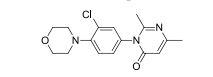
[00418] A uma solução de morfolina (1,1 mL, 12,6 mmol) em DMF (30 mL) foram adicionados 2-cloro-1-fluoro-4-nitrobenzeno (1,76 g, 10,0 mmol) e ET3N(4,2 mL, 30,1 mmol) com agitação e a mistura foi agitada à temperatura ambiente durante a noite. A mistura foi então filtrada e a fase orgânica foi vertida em 150 mL de DCM, lavou-se com água (150 mL x 3) e salmoura (150 mL), secou-se sobre Na2SO4 anidro e concentrou-se in vacuo. O resíduo foi purificado por cromatografia em coluna de gel de sílica (PE / DCM (v / v) = 10: 1) para dar o composto do título como um sólido amarelo (1,53 g, 63 %).Etapa 2) 3-cloro-4-morfolinoanilina[00418] To a solution of morpholine (1.1 mL, 12.6 mmol) in DMF (30 mL) was added 2-chloro-1-fluoro-4-nitrobenzene (1.76 g, 10.0 mmol) and ET3N (4.2 mL, 30.1 mmol) with stirring and the mixture was stirred at room temperature overnight. The mixture was then filtered and the organic phase was poured into 150 mL of DCM, washed with water (150 mL x 3) and brine (150 mL), dried over anhydrous Na 2 SO 4 and concentrated in vacuo. The residue was purified by silica gel column chromatography (PE/DCM (v/v) = 10:1) to give the title compound as a yellow solid (1.53 g, 63%).Step 2) 3 -chloro-4-morpholinoaniline
[00419] A uma mistura de ácido clorídrico concentrado (1,0 mL) e água (50 mL) foi adicionado pó de ferro (7,55 g, 135 mmol) em uma porção e a mistura foi agitada a 65 ° C durante 15 min. A camada aquosa da mistura foi vertida e uma solução de 4-(2-cloro-4-nitrofenil) morfolina (3,28 g, 13,5 mmol) em MeOH(50 mL) foi adicionado ao pó de ferro processado acima. A mistura foi acidificada a pH 3 com ácido clorídrico e agitou-se ainda a 65 ° C durante 45 min. A mistura foi então resfriada até a temperatura ambiente, ajustada para pH 10 com ET3N e filtrada e o filtrado foi concentrado in vacuo. O resíduo foi dissolvido em DCM (150 mL) e a solução foi lavada com água (100 mL x 3) e salmoura (100 mL), secou-se sobre Na2SO4 anidro e concentrou-se in vacuo para dar o composto do título como um sólido branco (2,05 g, 71 %). Etapa 3) N-(3-cloro-4-morfolinofenil)-3-oxobutanamida[00419] To a mixture of concentrated hydrochloric acid (1.0 mL) and water (50 mL) was added iron powder (7.55 g, 135 mmol) in one portion and the mixture was stirred at 65 °C for 15 min. The aqueous layer of the mixture was poured and a solution of 4-(2-chloro-4-nitrophenyl)morpholine (3.28 g, 13.5 mmol) in MeOH (50 mL) was added to the above processed iron powder. The mixture was acidified to pH 3 with hydrochloric acid and further stirred at 65°C for 45 min. The mixture was then cooled to room temperature, adjusted to pH 10 with ET3N and filtered and the filtrate was concentrated in vacuo. The residue was dissolved in DCM (150 mL) and the solution was washed with water (100 mL x 3) and brine (100 mL), dried over anhydrous Na 2 SO 4 and concentrated in vacuo to give the title compound as a white solid (2.05 g, 71%). Step 3) N-(3-chloro-4-morpholinophenyl)-3-oxobutanamide
[00420] A uma solução de 3-cloro-4-morfolinoanilina (2,05 g, 9,64 mmol) em EtOAC(30 mL) foi adicionado acetil ceteno (1,62 g, 19,3 mmol) com agitação e a mistura foi agitada a 80°C durante a noite. A mistura foi resfriada até a temperatura ambiente e concentrada em vácuo. O resíduo foi purificado por cromatografia em coluna de gel de sílica (EP / AcOEt (V / V) = 3: 1) para dar o composto do título como um sólido amarelo pálido (2,59 g, 91 %).Etapa 4) (Z)-3-amino-N-(3-cloro-4-morfolinofenil) but-2-enamida[00420] To a solution of 3-chloro-4-morpholinoaniline (2.05 g, 9.64 mmol) in EtOAC (30 mL) was added acetyl ketene (1.62 g, 19.3 mmol) with stirring and the mixture was stirred at 80°C overnight. The mixture was cooled to room temperature and concentrated in vacuo. The residue was purified by silica gel column chromatography (EP / EtOAc (V / V) = 3: 1) to give the title compound as a pale yellow solid (2.59 g, 91%).Step 4) (Z)-3-amino-N-(3-chloro-4-morpholinophenyl)but-2-enamide
[00421] Uma mistura de N-(3-cloro-4-morfolinofenil)-3- oxobutanamida (2,0 g, 6,74 mmol), MeOH(15 mL) e amônia (15 mL) foi agitada à temperatura ambiente durante a noite. A mistura foi então concentrada in vacuo para dar o composto do título, o qual foi utilizado na etapa seguinte sem purificação adicional.Etapa 5) 3-(3-cloro-4-morfolinofenil)-2,6-dimetilpirimidin-4 (3H)-ona[00421] A mixture of N-(3-chloro-4-morpholinophenyl)-3-oxobutanamide (2.0 g, 6.74 mmol), MeOH (15 mL) and ammonia (15 mL) was stirred at room temperature for at night. The mixture was then concentrated in vacuo to give the title compound, which was used in the next step without further purification.Step 5) 3-(3-chloro-4-morpholinophenyl)-2,6-dimethylpyrimidin-4 (3H) -one
[00422] Uma mistura de (Z)-3-amino-N-(3-cloro-4-morfolinofenil) but-2-enamida (2,0 g, 6,76 mmol) e ortoacetato de trietila (20 mL) foi agitada a 150°C durante 12 h. A mistura foi resfriada até a temperatura ambiente e concentrada em vácuo. O resíduo foi purificado por cromatografia em coluna de gel de sílica (EP / AcOEt (V / V) = 1: 1) para dar o composto do título como um sólido amarelo pálido (1,63 g, 76 %). O composto foi caracterizado pelos seguintes dados espectroscópicos: MS (ESI, pos.ion) m / z: 320,1 (M + 1); 1H-RMN(400 MHz, CDCl3+<"h"4.3;"*u."5J+."4.52"*u."5J+."5.28"*o."6J+."5.::" (t, 4H), 6,28 (s, 1 H), 7,07-7,28 (m, 3 H). Exemplo 47 (4-morfolino-3-(trifluorometil) fenil) 2,6-dimetil-3- pirimidin-4 (3H)-ona
[00423] Uma mistura de 1-nitro-4-fluoro-2-(trifluorometil) benzeno (4,18 g, 20,0 mmol), morfolina (2,09 g, 24,0 mmol), ET3N(6,07 g, 60,0 mmol) e EtOAC(30 mL) foi agitada à temperatura ambiente durante 5 h. A mistura foi então concentrada in vacuo. O resíduo foi purificado por cromatografia em coluna de gel de sílica (EP / AcOEt (V / V) = 1: 1) para dar o composto do título como um sólido amarelo (5,0 g, 91 %).Etapa 2) 3-trifluorometil-4-morfolinoanilina[00423] A mixture of 1-nitro-4-fluoro-2-(trifluoromethyl)benzene (4.18 g, 20.0 mmol), morpholine (2.09 g, 24.0 mmol), ET3N(6.07 g, 60.0 mmol) and EtOAC (30 mL) was stirred at room temperature for 5 h. The mixture was then concentrated in vacuo. The residue was purified by silica gel column chromatography (EP / EtOAc (V / V) = 1: 1) to give the title compound as a yellow solid (5.0 g, 91%).Step 2) 3 -trifluoromethyl-4-morpholinoaniline
[00424] Uma mistura de 4-(4-nitro-2-(trifluorometil) fenil) morfolina (5,0 g, 18,1 mmol), MeOH(20 mL) e Pd / C(500 mg, 10 %) sob H2 foi agitada à temperatura ambiente durante a noite. A mistura foi então filtrada e o filtrado foi concentrado in vacuo. O resíduo foi purificado por cromatografia em coluna de gel de sílica (EP / AcOEt (V / V) = 2: 1) para dar o composto do título como um sólido amarelo pálido (4,01 g, 90 %).Etapa 3) N-(3-trifluorometil-4-morfolinofenil)-3-oxobutanamida[00424] A mixture of 4-(4-nitro-2-(trifluoromethyl)phenyl)morpholine (5.0g, 18.1mmol), MeOH(20mL) and Pd/C(500mg, 10%) under H2 was stirred at room temperature overnight. The mixture was then filtered and the filtrate was concentrated in vacuo. The residue was purified by silica gel column chromatography (EP / EtOAc (V / V) = 2: 1) to give the title compound as a pale yellow solid (4.01 g, 90%).Step 3) N-(3-Trifluoromethyl-4-morpholinophenyl)-3-oxobutanamide
[00425] Uma mistura de 3-trifluorometil-4-morfolinoanilina (4,0 g, 16,2 mmol), EtOAC(30 mL) e acetil ceteno (2,73 g, 32,5 mmol) foi agitada a 90°C durante a noite. A mistura foi resfriada até a temperatura ambiente e concentrada em vácuo. O resíduo foi purificado por cromatografia em coluna de gel de sílica (EP / AcOEt (V / V) = 1: 1) para dar o composto do título como um sólido amarelo (4,0 g, 75 %).Etapa 4) (Z)-3-amino-N-(3-trifluorometil-4-morfolinofenil) but-2-enamida[00425] A mixture of 3-trifluoromethyl-4-morpholinoaniline (4.0 g, 16.2 mmol), EtOAC (30 mL) and acetyl ketene (2.73 g, 32.5 mmol) was stirred at 90°C during the night. The mixture was cooled to room temperature and concentrated in vacuo. The residue was purified by silica gel column chromatography (EP / EtOAc (V / V) = 1: 1) to give the title compound as a yellow solid (4.0 g, 75%).Step 4) ( Z)-3-amino-N-(3-trifluoromethyl-4-morpholinophenyl)but-2-enamide
[00426] Uma mistura de N-(3-trifluorometil-4-morfolinofenil)-3- oxobutanamida (4,0 g, 12,1 mmol), MeOH(20 mL) e amônia (20 mL) foi agitada à temperatura ambiente durante a noite. A mistura foi então concentrada in vacuo para dar o composto do título, o qual foi utilizado na etapa seguinte sem purificação adicional. Etapa 5) 3-(3-trifluorometil-4-morfolinofenil)-2,6-dimetilpirimidin-4 (3H)- ona[00426] A mixture of N-(3-trifluoromethyl-4-morpholinophenyl)-3-oxobutanamide (4.0 g, 12.1 mmol), MeOH (20 mL) and ammonia (20 mL) was stirred at room temperature for at night. The mixture was then concentrated in vacuo to give the title compound, which was used in the next step without further purification. Step 5) 3-(3-Trifluoromethyl-4-morpholinophenyl)-2,6-dimethylpyrimidin-4(3H)-one
[00427] Uma mistura de (Z)-3-amino-N-(3-trifluorometil-4- morfolinofenil) but-2-enamida (4,0 g, 12,1 mmol) e ortoacetato de trietila (10 mL) foi agitada a 150°C durante a noite. A mistura foi resfriada até a temperatura ambiente e concentrada em vácuo. O resíduo foi purificado por cromatografia em coluna de gel de sílica (EP / AcOEt (V / V) = 1: 1) para dar o composto do título como um sólido amarelo pálido (3,00 g, 70 %). O composto foi caracterizado pelos seguintes dados espectroscópicos: MS (ESI, pos.ion) m / z: 354,2 (M + 1); 1H-RMN(400 MHz, CDCl3+<"h"4.27"*u."5J+."4.43"*u."5J+."4.;4"*v."6J+."5.94" (m, 4H), 6,26 (s, 1 H), 7,66-7,77 (m, 3 H). Exemplo 48 3-((6-(2,4-dimetil-6-oxopirimidin-1 (6H)-il)-1H-indol-1-il) metoxi) benzonitrila
[00428] A uma mistura de NaH(3,0 g, 75,0 mmol, 60 %) em DMF (20 mL) foram adicionados uma solução de 6-nitro-1H-indol (4,86 g, 30,0 mmol) em DMF (10 mL) e uma solução de 3-hidroxi-benzonitrila (3,57 g, 30,0 mmol) em DMF (10 mL) a 0°C e a mistura foi agitada à temperatura ambiente durante 2 h. À mistura de reação foi adicionada uma solução de diiodometano (7,5 mL, 90,0 mmol) em DMF (10 ml) lentamente, sem luz e a mistura foi agitada à temperatura ambiente durante 20 h. A mistura foi em seguida resfriada bruscamente com água e filtrou-se. O filtrado foi extraído com DCM (30 mL x 6) e as camadas orgânicas combinadas foram lavadas com salmoura (50 mL x 3), secou-se sobre Na2SO4 anidro e concentrou-se in vacuo. O resíduo foi purificado por cromatografia em coluna de gel de sílica (EP / AcOEt (V / V) = 1: 1) para dar o composto do título como um sólido amarelo (4,47 g, 51 %).Etapa 2) 3-((6-amino-1H-indol-1-il) metoxi) benzonitrila[00428] To a mixture of NaH(3.0 g, 75.0 mmol, 60%) in DMF (20 mL) was added a solution of 6-nitro-1H-indole (4.86 g, 30.0 mmol ) in DMF (10 mL) and a solution of 3-hydroxy-benzonitrile (3.57 g, 30.0 mmol) in DMF (10 mL) at 0°C and the mixture was stirred at room temperature for 2 h. To the reaction mixture was added a solution of diiodomethane (7.5 mL, 90.0 mmol) in DMF (10 mL) slowly, without light, and the mixture was stirred at room temperature for 20 h. The mixture was then quenched with water and filtered. The filtrate was extracted with DCM (30 mL x 6) and the combined organic layers were washed with brine (50 mL x 3), dried over anhydrous Na 2 SO 4 and concentrated in vacuo. The residue was purified by silica gel column chromatography (EP / EtOAc (V / V) = 1: 1) to give the title compound as a yellow solid (4.47 g, 51%).Step 2) 3 -((6-amino-1H-indol-1-yl)methoxy)benzonitrile
[00429] A uma mistura de 3-((6-nitro-1H-indol-1-il) metoxi) benzonitrila (3,0 g, 10,2 mmol), THF (80 mL) e água (40 mL) foram adicionados ferro em pó (2,86 g, 51,2 mmol) e NH4Cl (1,09 g, 20,4 mmol) e a mistura foi agitada a 64°C durante a noite. A mistura foi então resfriada até a temperatura ambiente e à mistura resultante foi adicionada solução aquosa saturada de NaHCO3. A mistura foi filtrada e o filtrado foi extraído com EtOAC(30 mL x 4). As camadas orgânicas combinadas foram lavadas com salmoura (40 mL x 3), secas sobre Na2SO4 anidro e concentradas in vacuo. O resíduo foi purificado por cromatografia em coluna de gel de sílica (EP / AcOEt (V / V) = 2: 1) para dar o composto do título como um sólido amarelo (1,76 g, 65 %).Etapa 3) N-(1-((3-cianofenoxi) metil)-1H-indol-6-il)-3-oxobutanamida[00429] To a mixture of 3-((6-nitro-1H-indol-1-yl)methoxy)benzonitrile (3.0 g, 10.2 mmol), THF (80 mL) and water (40 mL) were Iron powder (2.86 g, 51.2 mmol) and NH4Cl (1.09 g, 20.4 mmol) were added and the mixture was stirred at 64°C overnight. The mixture was then cooled to room temperature and to the resulting mixture was added saturated aqueous NaHCO3 solution. The mixture was filtered and the filtrate was extracted with EtOAC (30 mL x 4). The combined organic layers were washed with brine (40 mL x 3), dried over anhydrous Na 2 SO 4 and concentrated in vacuo. The residue was purified by silica gel column chromatography (EP / EtOAc (V / V) = 2: 1) to give the title compound as a yellow solid (1.76 g, 65%).Step 3) N -(1-((3-cyanophenoxy)methyl)-1H-indol-6-yl)-3-oxobutanamide
[00430] A uma solução de 3-((6-amino-1H-indol-1-il) metoxi) benzonitrila (2,62 g, 9,95 mmol) em EtOAC(20 mL) foi adicionado acetil ceteno (1,0 g, 11,9 mmol) e a mistura agitou-se a 80°C durante a noite. A mistura foi resfriada até a temperatura ambiente e concentrada em vácuo. O resíduo foi purificado por cromatografia em coluna de gel de sílica (EP / AcOEt (V / V) = 1: 1) para dar o composto do título como um sólido amarelo (2,70 g, 78 %).Etapa 4) (Z)-3-amino-N-(1-((3-cianofenoxi) metil)-1H-indol-6-il) but-2- enamida[00430] To a solution of 3-((6-amino-1H-indol-1-yl)methoxy)benzonitrile (2.62 g, 9.95 mmol) in EtOAC (20 mL) was added acetyl ketene (1. 0 g, 11.9 mmol) and the mixture was stirred at 80°C overnight. The mixture was cooled to room temperature and concentrated in vacuo. The residue was purified by silica gel column chromatography (EP / EtOAc (V / V) = 1: 1) to give the title compound as a yellow solid (2.70 g, 78 %).Step 4) ( Z)-3-amino-N-(1-((3-cyanophenoxy)methyl)-1H-indol-6-yl)but-2-enamide
[00431] Uma mistura de N-(1-((3-cianofenoxi) metil)-1H-indol-6-il)-3- oxobutanamida (1,04 g, 2,99 mmol), MeOH(20 mL) e amônia (20 mL) foi agitada à temperatura ambiente. A mistura foi concentrada em vácuo para dar o composto do título, o qual foi utilizado na etapa seguinte sem purificação adicional. Etapa 5) 3-((6-(2,4-dimetil-6-oxopirimidin-1 (6H)-il)-1H-indol-1-il) metoxi) benzonitrila[00431] A mixture of N-(1-((3-cyanophenoxy)methyl)-1H-indol-6-yl)-3-oxobutanamide (1.04 g, 2.99 mmol), MeOH (20 mL) and ammonia (20 mL) was stirred at room temperature. The mixture was concentrated in vacuo to give the title compound, which was used in the next step without further purification. Step 5) 3-((6-(2,4-Dimethyl-6-oxopyrimidin-1(6H)-yl)-1H-indol-1-yl)methoxy)benzonitrile
[00432] Uma mistura de (Z)-3-amino-N-(1-((3-cianofenoxi) metil)-1H- indol-6-il) but- 2-enamida (1,04 g, 3,00 mmol) e ortoacetato de trietila (20 ml) foi agitada a 130°C durante a noite. A mistura foi resfriada até a temperatura ambiente e concentrada em vácuo. O resíduo foi purificado por cromatografia em coluna de gel de sílica (EP / AcOEt (V / V) = 1: 1) para dar o composto do título como um sólido amarelo (272 mg, 25 %). O composto foi caracterizado pelos seguintes dados espectroscópicos: MS (ESI, pos.ion) m / z: 371,1 (M + 1); 1H-RMN(400 MHz, DMSO-d6+<"h"4.27"*u."5J+."4.43"*u."5J+."8.47"*u."3"J+." 6,29 (s, 2H), 6,64-6,63 (d, 1 H, J = 3,2 Hz), 7,01-6,99 (dd, 1H, J1 = 1,4 Hz, J2 = 8,3 Hz), 7,39-7,37 (m, 1 H), 7,51-7,44 (m, 2 H), 7,63 (s, 1 H), 7,72-7,68 (m, 3 H). Exemplo 49 2-((3,4-difluorofenoxi) metil)-3-(3-fluoro-4-morfolinofenil)-6-metilpirimidina-4 (3H)-ona
[00433] A uma suspensão de K2CO3 (1,38 g, 10,0 mmol) em acetona (50 mL) foram adicionados 3,4-difluorofenol (0,78 g, 6,00 mmol) e 3-(2- bromoacetamido) but-2- enoato de (Z)-metila (1,18 g, 5,00 mmol) e a mistura foi submetida a refluxo durante 5 h. A mistura foi resfriada até a temperatura ambiente e filtrada e o filtrado foi concentrado in vacuo. Ao resíduo foi adicionado DCM (100 mL) e a mistura foi lavada com água (100 mL x 2) e salmoura (100 mL), secou-se sobre Na2SO4 anidro e concentrou-se in vacuo. O resíduo foi purificado por cromatografia em coluna de gel de sílica (EP / AcOEt (V / V) = 5: 1) para dar o composto do título como um sólido branco (0,85 g, 59 %).Etapa 2) 2-((3,4-difluorofenoxi) metil)-3-(3-fluoro-4-morfolinofenil)-6- metil- pirimidin-4 (3H)-ona[00433] To a suspension of K2CO3 (1.38 g, 10.0 mmol) in acetone (50 mL) were added 3,4-difluorophenol (0.78 g, 6.00 mmol) and 3-(2-bromoacetamido). ) (Z)-methyl but-2-enoate (1.18 g, 5.00 mmol) and the mixture was refluxed for 5 h. The mixture was cooled to room temperature and filtered and the filtrate was concentrated in vacuo. To the residue was added DCM (100 mL) and the mixture was washed with water (100 mL x 2) and brine (100 mL), dried over anhydrous Na 2 SO 4 and concentrated in vacuo. The residue was purified by silica gel column chromatography (EP / EtOAc (V / V) = 5: 1) to give the title compound as a white solid (0.85 g, 59%).Step 2) 2 -((3,4-difluorophenoxy)methyl)-3-(3-fluoro-4-morpholinophenyl)-6-methyl-pyrimidin-4(3H)-one
[00434] A uma solução de 3-fluoro-4-morfolinoanilina (0,39 g, 2,00 mmol) em DCM (15 mL) adicionou-se trimetil alumínio (3,5 mL, 7,0 mmol, 2 M em tolueno) e a mistura foi agitada à temperatura ambiente durante 0,5 h. Uma solução de 3-(2-(3,4-difluorofenoxi) acetamido) but-2-enoato de (Z)- metila (0,57 g, 2,00 mmol) em DCM (5 mL) foi adicionado lentamente e a mistura resultante foi agitada ainda à temperatura ambiente durante 12 h. A mistura foi em seguida resfriada bruscamente com solução aquosa saturada de NH4Cl e extraiu-se com CH2Cl2 (50 mL x 2). As fases orgânicas combinadas foram lavadas com salmoura (100 mL), secou-se sobre Na2SO4 anidro e concentrou-se in vacuo. O resíduo foi purificado por cromatografia em coluna de gel de sílica (EP / AcOEt (V / V) = 1: 1) para dar o composto do título como um sólido castanho pálido (0,50 g, 58 %). O composto foi caracterizado pelos seguintes dados espectroscópicos: MS (ESI, pos.ion) m / z: 432,1 (M + 1); 1H-RMN(400 MHz, CDCl3+<"h"4.57"*u."5J+."5.26-3,17 (m, 4H), 3,86 (t, 4H, J = 4,7 Hz), 4,65 (s, 2H), 6,39 (s, 1H), 6,46-6,51 (m, 1 H), 6,58-6,64 (m, 1 H), 6,95-6,98 (m, 3 H), 7,03 (t, 1H, J = 9,4 Hz). Exemplo 50 2-((3,5-difluorofenoxi) metil)-3-(3-fluoro-4-morfolinofenil)-6-metilpirimidina-4 (3H)-ona
[00435] A uma suspensão de K2CO3 (1,38 g, 10,0 mmol) em acetona (50 mL) foram adicionados 3,5-difluorofenol (0,78 g, 6,00 mmol) e 3-(2- bromoacetamido) but-2- enoato de (Z)-metila (1,18 g, 5,00 mmol) e a mistura foi submetida a refluxo durante 5 h. A mistura foi resfriada até a temperatura ambiente e filtrada e o filtrado foi concentrado in vacuo. Ao resíduo foi adicionado DCM (100 mL) e a mistura foi lavada com água (100 mL x 2) e salmoura (100 mL), secou-se sobre Na2SO4 anidro e concentrou-se in vacuo. O resíduo foi purificado por cromatografia em coluna de gel de sílica (EP / AcOEt (V / V) = 5: 1) para dar o composto do título como um sólido branco (1,18 g, 83 %).Etapa 2) 2-((3,5-difluorofenoxi) metil)-3-(3-fluoro-4-morfolinofenil)-6- metil- pirimidin-4 (3H)-ona[00435] To a suspension of K2CO3 (1.38 g, 10.0 mmol) in acetone (50 mL) were added 3,5-difluorophenol (0.78 g, 6.00 mmol) and 3-(2-bromoacetamido). ) (Z)-methyl but-2-enoate (1.18 g, 5.00 mmol) and the mixture was refluxed for 5 h. The mixture was cooled to room temperature and filtered and the filtrate was concentrated in vacuo. To the residue was added DCM (100 mL) and the mixture was washed with water (100 mL x 2) and brine (100 mL), dried over anhydrous Na 2 SO 4 and concentrated in vacuo. The residue was purified by silica gel column chromatography (EP / EtOAc (V / V) = 5: 1) to give the title compound as a white solid (1.18 g, 83%).Step 2) 2 -((3,5-difluorophenoxy)methyl)-3-(3-fluoro-4-morpholinophenyl)-6-methyl-pyrimidin-4(3H)-one
[00436] A uma solução de 3-fluoro-4-morfolinoanilina (0,81 g, 4,13 mmol) em DCM (15 mL) adicionou-se trimetil alumínio (6,2 mL, 12,4 mmol, 2 M em tolueno) e a mistura foi agitada à temperatura ambiente durante 0,5 h. Uma solução de 3-(2-(3,5-difluorofenoxi) acetamido) but-2-enoato de (Z)- metila (1,18 g, 4,14 mmol) em DCM (5 mL) foi adicionado lentamente e a mistura resultante foi agitada à temperatura ambiente durante 12 h. A mistura foi resfriada bruscamente com solução aquosa saturada de NH4Cl e extraiu-se com CH2Cl2 (50 mL x 2). As fases orgânicas combinadas foram lavadas com salmoura (100 mL), secou-se sobre Na2SO4 anidro e concentrou-se in vacuo. O resíduo foi purificado por cromatografia em coluna de gel de sílica (EP / AcOEt (V / V) = 1: 1) para dar o composto do título como um sólido castanho pálido (1,08 g, 61 %). O composto foi caracterizado pelos seguintes dados espectroscópicos: MS (ESI, pos.ion) m / z: 432,0 (M + 1); 1H-RMN(400 MHz, CDCl3+<"h"4.57"*u."5J+."5.27-3,16 (m, 4H), 3,86 (t, 4H, J = 4,6 Hz), 4,67 (s, 2H), 6,30-6,33 (m, 2 H), 6,39 (s, 1H), 6,39-6,45 (m, 1 H), 6,95-6,98 (m, 3 H). Exemplo 51 3-(3-fluoro-4-morfolinofenil)-2-(((3-fluorofenil) tio) metil)-6- metilpirimidina-4 (3H)-ona Etapa 1) 3-(2-(3-fluorofenil) tio) acetamido) but-2-enoato de (Z)-metila[00436] To a solution of 3-fluoro-4-morpholinoaniline (0.81 g, 4.13 mmol) in DCM (15 mL) was added trimethyl aluminum (6.2 mL, 12.4 mmol, 2M in toluene) and the mixture was stirred at room temperature for 0.5 h. A solution of (Z)-methyl 3-(2-(3,5-difluorophenoxy)acetamido)but-2-enoate (1.18 g, 4.14 mmol) in DCM (5 mL) was slowly added and the resulting mixture was stirred at room temperature for 12 h. The mixture was quenched with saturated aqueous NH4Cl solution and extracted with CH2Cl2 (50 mL x 2). The combined organic phases were washed with brine (100 mL), dried over anhydrous Na 2 SO 4 and concentrated in vacuo. The residue was purified by silica gel column chromatography (EP / EtOAc (V / V) = 1: 1) to give the title compound as a pale brown solid (1.08 g, 61%). The compound was characterized by the following spectroscopic data: MS (ESI, pos.ion) m / z: 432.0 (M + 1); 1H-NMR(400 MHz, CDCl3+<"h"4.57"*u."5J+."5.27-3.16 (m, 4H), 3.86 (t, 4H, J = 4.6 Hz), 4, 67 (s, 2H), 6.30-6.33 (m, 2H), 6.39 (s, 1H), 6.39-6.45 (m, 1H), 6.95-6, 98 (m, 3H) Example 51 3-(3-fluoro-4-morpholinophenyl)-2-(((3-fluorophenyl)thio)methyl)-6-methylpyrimidine-4(3H)-one Step 1) 3 (Z)-methyl -(2-(3-fluorophenyl)thio)acetamido)but-2-enoate
[00437] A uma suspensão de K2CO3 (1,38 g, 10,0 mmol) em acetona (50 ml) foram adicionados 3-fluorobenzenotiol (0,77 g, 6,01 mmol) e 3-(2- bromoacetamido) but-2-enoato de (Z)-metila (1,18 g, 5,00 mmol) e a mistura foi submetida a refluxo durante 5 h. A mistura foi resfriada até a temperatura ambiente e filtrada e o filtrado foi concentrado in vacuo. Ao resíduo foi adicionado DCM (100 mL) e a mistura foi lavada com água (100 mL x 2) e salmoura (100 mL), secou-se sobre Na2SO4 anidro e concentrou-se in vacuo. O resíduo foi purificado por cromatografia em coluna de gel de sílica (EP / AcOEt (V / V) = 5: 1) para dar o composto do título como um sólido branco (0,78 g, 55 %).Etapa 2) 2-(((3-fluorofenil) tio) metil)-3-(3-fluoro-4-morfolinofenil)-6- metil- pirimidin-4 (3H)-ona[00437] To a suspension of K2CO3 (1.38 g, 10.0 mmol) in acetone (50 ml) were added 3-fluorobenzenethiol (0.77 g, 6.01 mmol) and 3-(2-bromoacetamido) but (Z)-methyl-2-enoate (1.18 g, 5.00 mmol) and the mixture was refluxed for 5 h. The mixture was cooled to room temperature and filtered and the filtrate was concentrated in vacuo. To the residue was added DCM (100 mL) and the mixture was washed with water (100 mL x 2) and brine (100 mL), dried over anhydrous Na 2 SO 4 and concentrated in vacuo. The residue was purified by silica gel column chromatography (EP / EtOAc (V / V) = 5: 1) to give the title compound as a white solid (0.78 g, 55%).Step 2) 2 -(((3-fluorophenyl)thio)methyl)-3-(3-fluoro-4-morpholinophenyl)-6-methyl-pyrimidin-4(3H)-one
[00438] A uma solução de 3-fluoro-4-morfolinoanilina (0,54 g, 2,75 mmol) em DCM (15 mL) adicionou-se trimetil alumínio (4,8 mL, 9,60 mmol, 2 M em tolueno) e a mistura foi agitada à temperatura ambiente durante 0,5 h. Uma solução de 3-(2-((3-fluorofenil) tio) acetamido) but-2-enoato de (Z)- metila (0,78 g, 2,75 mmol) em DCM (5 mL) foi adicionado lentamente e a mistura resultante foi agitada à temperatura ambiente durante 12 h. A mistura foi resfriada bruscamente com solução aquosa saturada de NH4Cl e extraiu-se com CH2Cl2 (50 mL x 2). As fases orgânicas combinadas foram lavadas com salmoura (100 mL), secou-se sobre Na2SO4 anidro e concentrou-se in vacuo. O resíduo foi purificado por cromatografia em coluna de gel de sílica (EP / AcOEt (V / V) = 1: 1) para dar o composto do título como um sólido castanho pálido (0,79 g, 67 %). O composto foi caracterizado pelos seguintes dados espectroscópicos: MS (ESI, pos.ion) m / z: 430,3 (M + 1); 1H-RMN(400 MHz, CDCl3+<"h"4.48"*u."5J+."5.2;-3,21 (m, 4H), 3,81 (s, 2H), 3,89 (t, 4H, J = 4,7 Hz), 6,30 (s, 1H), 6,91-7,03 (m, 4H), 7,06-7,10 (m, 2H), 7,20-7,24 (m, 1 H). Exemplo 52 3-(3-fluoro-4-morfolinofenil)-2-(3-fluorofenetil)-6-metilpirimidina-4(3H)-ona
[00439] Uma mistura de ácido 3-(3-fluorofenil) propanóico (2,50 g, 14,9 mmol) e diclorosulfano (10 mL) sob N2 foi aquecida a refluxo durante 3 h. A mistura foi resfriada até a temperatura ambiente e concentrada em vácuo para dar o composto do título, o qual foi utilizado na etapa seguinte sem purificação adicional.Etapa 2) 3-(3-(3-fluorofenil) propanamido) but-2-enoato de (Z)-metila[00439] A mixture of 3-(3-fluorophenyl)propanoic acid (2.50 g, 14.9 mmol) and dichlorosulfan (10 mL) under N 2 was heated at reflux for 3 h. The mixture was cooled to room temperature and concentrated in vacuo to give the title compound, which was used in the next step without further purification.Step 2) 3-(3-(3-fluorophenyl)propanamido)but-2-enoate of (Z)-methyl
[00440] A uma solução de 3-aminobut-2-enoato de (Z)-metila (1,70 g, 14,8 mmol) e piridina (1,30 g, 16,4 mmol) em DCM (25 mL) foi adicionada uma solução de cloreto de 3-(3-fluorofenil) propanoíla (2,77 g, 14,8 mmol) em DCM (5 mL) gota a gota com agitação. No final da adição, a mistura foi adicionalmente agitada à temperatura ambiente durante 1 h. Ela foi, em seguida, lavada com salmoura (50 mL x 3), seca sobre Na2SO4 anidro e concentrada in vacuo. O resíduo foi purificado por cromatografia em coluna de gel de sílica (EP / AcOEt (V / V) = 3: 1) para dar o composto do título como um sólido branco (2,00 g, 51 %).Etapa 3) 3-(3-fluoro-4-morfolinofenil)-2-(3-fluorofenetil)-6-metil- pirimidin- 4 (3H)-ona[00440] To a solution of (Z)-methyl 3-aminobut-2-enoate (1.70 g, 14.8 mmol) and pyridine (1.30 g, 16.4 mmol) in DCM (25 mL) A solution of 3-(3-fluorophenyl)propanoyl chloride (2.77 g, 14.8 mmol) in DCM (5 mL) was added dropwise with stirring. At the end of the addition, the mixture was further stirred at room temperature for 1 h. It was then washed with brine (50 mL x 3), dried over anhydrous Na 2 SO 4 and concentrated in vacuo. The residue was purified by silica gel column chromatography (EP / EtOAc (V / V) = 3: 1) to give the title compound as a white solid (2.00 g, 51%).Step 3) 3 -(3-fluoro-4-morpholinophenyl)-2-(3-fluorophenethyl)-6-methyl-pyrimidin-4(3H)-one
[00441] A uma solução de 3-fluoro-4-morfolinoanilina (1,10 g, 5,61 mmol) em DCM (20 mL) adicionou-se trimetil alumínio (5,7 mL, 11,4 mmol, 2 M em tolueno) e a mistura foi agitada à temperatura ambiente durante 0,5 h. Uma solução de 3-(3-(3-fluorofenil) propanamido) but-2-enoato de (Z)-metila (1,00 g, 3,77 mmol) em DCM (8 mL) foi adicionado lentamente e a mistura resultante foi agitada à temperatura ambiente durante 24 h. A mistura foi em seguida resfriada bruscamente com solução aquosa saturada de NH4Cl e extraiu-se com CH2Cl2 (50 mL x 2). As fases orgânicas combinadas foram lavadas com salmoura (100 mL), secou-se sobre Na2SO4 anidro e concentrouse in vacuo. O resíduo foi purificado por cromatografia em coluna de gel de sílica (EtOAc) para dar o composto do título como um sólido cor de laranja (1,10 g, 71 %). O composto foi caracterizado pelos seguintes dados espectroscópicos: MS (ESI, pos.ion) m / z: 412,3 (M + 1); 1H-RMN(400 MHz, CDCi3+< h 4.47 *u. 5J+. 4.79 *V. 5J. L ? 9.7 Jz+. 4,;3 *V. 3H, J = 7,8 Hz), 3,02-3,06 (m, 4 H), 3,75 (t, 4 H, J = 4,6 Hz), 6,26 (s, 1H), 6,88-6,91 (m, 2H), 6,96-7,01 (m, 1 H), 7,04-7,06 (m, 1 H), 7,10-7,14 (m, 1 H), 7,17-7,21 (m, 1 H), 7,24-7,29 (m, 1 H). Exemplo 53 3-(3-fluoro-4-morfolinofenil)-2-(3-(3-fluorofenoxi) propil)-6-metil- pirimidin-4 (3H)-ona
[00442] Uma mistura de 3-fiuorofenoi (6,00 g, 53,5 mmoi), 4- bromobutanoato de etila (15,70 g, 80,5 mmol) e Cs2CO3 (26,20 g, 80,4 mmol) em DMF (25 mL) sob N2 foi aquecida a refluxo durante a noite. A mistura foi então resfriada até a temperatura ambiente e 150 mL de água foi adicionado. A mistura resultante foi extraída com DCM (100 mL x 2) e as fases orgânicas combinadas foram lavadas com salmoura (100 mL x 2), secas sobre Na2SO4 anidro e concentradas in vacuo. O resíduo foi purificado por cromatografia em coluna de gel de sílica (EP / AcOEt (V / V) = 10: 1) para dar o composto do título como um óleo incolor (12,0 g, 99 %).Etapa 2) ácido 4-(3-fluorofenoxi) butanóico[00442] A mixture of 3-fluorophenol (6.00 g, 53.5 mmol), ethyl 4-bromobutanoate (15.70 g, 80.5 mmol) and Cs2CO3 (26.20 g, 80.4 mmol) in DMF (25 mL) under N 2 was heated at reflux overnight. The mixture was then cooled to room temperature and 150 mL of water was added. The resulting mixture was extracted with DCM (100 ml x 2) and the combined organic phases were washed with brine (100 ml x 2), dried over anhydrous Na 2 SO 4 and concentrated in vacuo. The residue was purified by silica gel column chromatography (EP / EtOAc (V / V) = 10: 1) to give the title compound as a colorless oil (12.0 g, 99%).Step 2) acidic. 4-(3-fluorophenoxy)butanoic
[00443] A uma solução de KOH(0,24 g, 4,28 mmol) em solventes mistos de água (3 mL) e etanol (3 mL) sob N2 foi adicionado 4-(3- fluorofenoxi) butanoato de etila (0,30 g, 1,33 mmol) em uma porção e a mistura foi agitada a 40°C durante 4 h. Foi então resfriada até a temperatura ambiente e 20 mL de DCM foi adicionado. A camada orgânica foi lavada com salmoura (20 mL x 2), seca sobre Na2SO4 anidro e concentradas sob vácuo para dar o composto do título como um sólido branco (0,25 g, 96 %).Etapa 3) cloreto de 4-(3-fluorofenoxi) butanoíla[00443] To a solution of KOH(0.24 g, 4.28 mmol) in mixed solvents of water (3 mL) and ethanol (3 mL) under N 2 was added ethyl 4-(3-fluorophenoxy)butanoate (0 .30 g, 1.33 mmol) in one portion and the mixture was stirred at 40°C for 4 h. It was then cooled to room temperature and 20 mL of DCM was added. The organic layer was washed with brine (20 mL x 2), dried over anhydrous Na 2 SO 4 and concentrated in vacuo to give the title compound as a white solid (0.25 g, 96%).Step 3) 4-( 3-fluorophenoxy) butanoyl
[00444] Uma solução de ácido 4-(3-fluorofenoxi) butanóico (3,00 g, 15,1 mmol) em diclorosulfano (15 mL) sob N2 foi aquecida a refluxo durante 3 h. A mistura foi resfriada até a temperatura ambiente e concentrada em vácuo para dar o composto do título, o qual foi utilizado na etapa seguinte sem purificação adicional.Etapa 4) 3-(4-(3-fluorofenoxi) butanamido) but-2-enoato de (Z)-metila[00444] A solution of 4-(3-fluorophenoxy)butanoic acid (3.00 g, 15.1 mmol) in dichlorosulfan (15 mL) under N 2 was heated at reflux for 3 h. The mixture was cooled to room temperature and concentrated in vacuo to give the title compound, which was used in the next step without further purification.Step 4) 3-(4-(3-fluorophenoxy)butanamido)but-2-enoate of (Z)-methyl
[00445] A uma solução de 3-aminobut-2-enoato de (Z)-metila (1,70 g, 14,8 mmol) e piridina (1,20 g, 15,2 mmol) em DCM (25 mL) foi adicionada uma solução de 4-(3-fluorofenoxi) de cloreto de butanoíla (3,28 g, 15,1 mmol) em DCM (5 mL) com agitação e a mistura foi agitada durante 1 h. Ela foi, em seguida, lavada com salmoura (50 mL x 3), seca sobre Na2SO4 anidro e concentrada in vacuo. O resíduo foi purificado por cromatografia em coluna de gel de sílica (EP / AcOEt (V / V) = 3: 1) para dar o composto do título como um sólido branco (1,20 g, 28 %).Etapa 5) 3-(3-fluoro-4-morfolinofenil)-2-(3-(3-fluorofenoxi) propil)-6- metil- pirimidin-4 (3H)-ona[00445] To a solution of (Z)-methyl 3-aminobut-2-enoate (1.70 g, 14.8 mmol) and pyridine (1.20 g, 15.2 mmol) in DCM (25 mL) a solution of 4-(3-fluorophenoxy) of butanoyl chloride (3.28 g, 15.1 mmol) in DCM (5 mL) was added with stirring and the mixture was stirred for 1 h. It was then washed with brine (50 mL x 3), dried over anhydrous Na 2 SO 4 and concentrated in vacuo. The residue was purified by silica gel column chromatography (EP / EtOAc (V / V) = 3: 1) to give the title compound as a white solid (1.20 g, 28 %).Step 5) 3 -(3-fluoro-4-morpholinophenyl)-2-(3-(3-fluorophenoxy)propyl)-6-methyl-pyrimidin-4(3H)-one
[00446] A uma solução de 3-fluoro-4-morfolinoanilina (0,36 g, 1,83 mmol) em DCM (20 mL) adicionou-se trimetil alumínio (2,7 mL, 5,40 mmol, 2 M em tolueno) e a mistura foi agitada à temperatura ambiente durante 0,5 h. Uma solução de 3-(4-(3-fluorofenoxi) butanamido) but-2-enoato de (Z)- metila (0,80 g, 2,71 mmol) em DCM (4 mL) foi adicionado lentamente e a mistura resultante foi agitada à temperatura ambiente durante 24 h. A mistura foi resfriada bruscamente com solução aquosa saturada de NH4Cl e extraiu-se com CH2Cl2 (50 mL x 2). As fases orgânicas combinadas foram lavadas com salmoura (100 mL), secou-se sobre Na2SO4 anidro e concentrou-se in vacuo. O resíduo foi purificado por cromatografia em coluna de gel de sílica (EtOAc) para dar o composto do título como um sólido amarelo pálido (0,40 g, 49 %). O composto foi caracterizado pelos seguintes dados espectroscópicos: MS (ESI, pos.ion) m / z: 442,3 (M + 1); 1H-RMN(400 MHz, CDCl3+<"h"4.22"*o."4"J+."4.44"*u."5J+."4.66"*o."4"J+." 3,07 (m, 4H), 3,76 (t, 4H, J = 4,6 Hz), 3,95 (t, 2 H, J = 6,4 Hz), 6,22 (s, 1H), 6,73-6,74 (m, 3H), 7,07-7,08 (m, 2H), 7,12-7,28 (m, 2 H). Exemplo 54 3-(3-fluoro-4-morfolinofenil)-6-((3-fluorofenoxi) metil)-2-metil-pirimidin- 4 (3H)-ona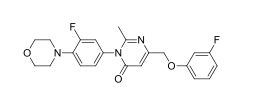
[00447] A uma solução de N-(3-fluoro-4-morfolinofenil)-3- oxobutanamida (11,2 g, 40,0 mmol) e AcOH(100 mL) sob N2 foi adicionado Br2 (2,4 mL) à temperatura ambiente. No final da adição, a mistura foi adicionalmente agitada à temperatura ambiente durante 24 h. A mistura foi então concentrada in vacuo e foi adicionado 40 mL de água. A mistura resultante foi extraída com EtOAC(30 mL x 4). As fases orgânicas combinadas foram lavadas com salmoura (40 mL x 3), secas sobre Na2SO4 anidro e concentradas in vacuo. O resíduo foi purificado por cromatografia em coluna de gel de sílica (EP / AcOEt (V / V) = 2: 1) para dar o composto do título como um sólido amarelo (6,80 g, 47 %).Etapa 2) N-(3-fluoro-4-morfolinofenil)-4-(3-fluorofenoxi)-3-oxobutanamida[00447] To a solution of N-(3-fluoro-4-morpholinophenyl)-3-oxobutanamide (11.2 g, 40.0 mmol) and AcOH (100 mL) under N2 was added Br2 (2.4 mL) at room temperature. At the end of the addition, the mixture was further stirred at room temperature for 24 h. The mixture was then concentrated in vacuo and 40 mL of water was added. The resulting mixture was extracted with EtOAC (30 mL x 4). The combined organic phases were washed with brine (40 mL x 3), dried over anhydrous Na 2 SO 4 and concentrated in vacuo. The residue was purified by silica gel column chromatography (EP / EtOAc (V / V) = 2: 1) to give the title compound as a yellow solid (6.80 g, 47 %).Step 2) N -(3-fluoro-4-morpholinophenyl)-4-(3-fluorophenoxy)-3-oxobutanamide
[00448] A uma solução de 3-fluorofenol (2,33 g, 20,8 mmol) em THF anidro (20 mL) foi adicionado NaH(909 mg, 22,7 mmol, 60 %) e a mistura foi agitada à temperatura ambiente durante 3 h. Adicionou-se uma solução de 4- bromo-N-(3-fluoro-4-morfolinofenil)-3-oxobutanamida (6,8 g, 18,9 mmol) em THF (40 mL). A mistura resultante foi agitada à temperatura ambiente durante a noite. A mistura de reação foi em seguida vertida em 100 mL de água e a mistura foi extraída com EtOAC(30 mL x 5). As fases orgânicas combinadas foram lavadas com salmoura (50 mL x 2), secas sobre Na2SO4 anidro e concentradas in vacuo. O resíduo foi purificado por cromatografia em coluna de gel de sílica (EP / AcOEt (V / V) = 2: 1) para dar o composto do título como um sólido amarelo (0,16 g, 2 %).Etapa 3) 3-(3-fluoro-4-morfolinofenil)-6-((3-fluorofenoxi) metil)-2- metil- pirimidin-4 (3H)-ona[00448] To a solution of 3-fluorophenol (2.33 g, 20.8 mmol) in anhydrous THF (20 mL) was added NaH (909 mg, 22.7 mmol, 60%) and the mixture was stirred at room temperature. environment for 3 h. A solution of 4-bromo-N-(3-fluoro-4-morpholinophenyl)-3-oxobutanamide (6.8 g, 18.9 mmol) in THF (40 mL) was added. The resulting mixture was stirred at room temperature overnight. The reaction mixture was then poured into 100 ml of water and the mixture was extracted with EtOAC (30 ml x 5). The combined organic phases were washed with brine (50 mL x 2), dried over anhydrous Na 2 SO 4 and concentrated in vacuo. The residue was purified by silica gel column chromatography (EP / EtOAc (V / V) = 2: 1) to give the title compound as a yellow solid (0.16 g, 2%).Step 3) 3 -(3-fluoro-4-morpholinophenyl)-6-((3-fluorophenoxy)methyl)-2-methyl-pyrimidin-4(3H)-one
[00449] Uma mistura de N-(3-fluoro-4-morfolinofenil)-4-(3- fluorofenoxi)-3-oxobutanamida (510 mg, 1,31 mmol), acetamida (154 mg, 2,61 mmol) e tetraisopropanolato de titânio (3,2 ml) em xileno (10 mL) foi agitada a 165°C durante 24 h. A mistura foi resfriada até a temperatura ambiente e 60 mL de tolueno e 60 mL de solução aquosa saturada de NH4Cl foi adicionada. A mistura resultante foi agitada à temperatura ambiente durante a noite. A mistura foi então filtrada e o filtrado foi extraído com DCM (20 mL x 4). As fases orgânicas combinadas foram lavadas com salmoura (30 mL x 2), secas sobre Na2SO4 anidro e concentradas in vacuo. O resíduo foi purificado por cromatografia em coluna de gel de sílica (EP / AcOEt (V / V) = 1: 1) para dar o composto do título como um sólido amarelo (0,09 g, 17 %). O composto foi caracterizado pelos seguintes dados espectroscópicos: MS (ESI, pos.ion) m / z: 414,1 (M + 1); 1H-RMN(400 MHz, DMSO-d6+< h 4.34 *u. 5J+. 5.29 *f. 6 J. L ? 7.6 Jz+. 5.98 (t, 4H, J = 4,5 Hz), 4,97 (s, 2 H), 6,41 (s, 1H), 6,84-6,80 (m, 1 H), 6,99-6,91 (m, 2H), 7,16-7,14 (m, 2H), 7,38-7,31 (m, 2 H). Exemplo 55 3-(3-fluoro-4-(4-metilpiperazin-1-il)fenil)-2-((3-fluorofenoxi)metil)-6- metilpirimidin-4(3H)-ona
[00450] A uma solução de 3-fluoro-4-(4-metilpiperazin-1-il) anilina (0,63 g, 3,01 mmol) em DCM (15 mL) adicionou-se trimetil alumínio (5,3 mL, 10,6 mmol, 2 M em tolueno) e a mistura foi agitada à temperatura ambiente durante 0,5 h. Uma solução de 3-(2-(3-fluorofenoxi) acetamido) but-2 -enoato de (Z)-metila (0,80 g, 2,99 mmol) em DCM (5 mL) foi adicionado lentamente e a mistura resultante foi agitada à temperatura ambiente durante 12 h. A mistura foi em seguida resfriada bruscamente com solução aquosa saturada de NH4Cl e extraiu-se com CH2Cl2 (50 mL x 2). As fases orgânicas combinadas foram lavadas com salmoura (100 mL), secou-se sobre Na2SO4 anidro e concentrou-se in vacuo. O resíduo foi purificado por cromatografia em coluna de gel de sílica (EP / AcOEt (V / V) = 1: 1) para dar o composto do título como um sólido amarelo pálido (0,94 g, 73 %). O composto foi caracterizado pelos seguintes dados espectroscópicos: MS (ESI, pos.ion) m / z: 427,2 (M + 1); 1H-RMN(400 MHz, CDCl3+<"h"4.56"*u."5J+."4.57"*u."5J+."4.7:"*v."6J."L"?"6.: Hz), 3,08-3,16 (m, 4H), 4,68 (s, 2H), 6,38 (d, 1 H, J = 0,8 Hz), 6,49 (tt, 1 H, J1 = 2,4 Hz, J2 = 10,6 Hz), 6,54 (dd, 1H, J1 = 2,3 Hz, J2 = 5,3 Hz), 6,64-6,60 (m, 1 H), 6,94-6,98 (m, 3H), 7,14-7,20 (m, 1 H). Exemplo 56 3-(3-fluoro-4-(2-morfolinoetoxi) fenil)-2-((3-fluorofenoxi) metil)-6- metilpirimidina-4 (3H)-ona
[00451] Uma mistura de 2-bromoetanol (27,9 g, 223 mmol), morfolina (40 g, 459 mmol) e K2CO3 (48,4 g, 350 mmol) em CH3CN(30 mL) foi submetida a refluxo durante 3 h. A mistura foi então resfriada até a temperatura ambiente e filtrou-se. O filtrado foi concentrado em vácuo para dar o composto do título como um sólido amarelo (24,40 g, 83 %), que foi utilizado na etapa seguinte sem purificação adicional.Etapa 2) 4-(2-(2-fluoro-4-nitrofenoxi) etil) morfolina[00451] A mixture of 2-bromoethanol (27.9 g, 223 mmol), morpholine (40 g, 459 mmol) and K2CO3 (48.4 g, 350 mmol) in CH3CN(30 mL) was refluxed for 3 H. The mixture was then cooled to room temperature and filtered. The filtrate was concentrated in vacuo to give the title compound as a yellow solid (24.40 g, 83%), which was used in the next step without further purification.Step 2) 4-(2-(2-fluoro-4) -nitrophenoxy) ethyl) morpholine
[00452] Uma mistura de 1,2-difluoro-4-nitrobenzeno (1,0 g, 6,29 mmol), 2-morfolinoetanol (1,0 g, 7,62 mmol) e Cs2CO3 em DMF (10 mL) foi agitada a 75 ° C durante 12 h. 30 mL de água foi então adicionado e a mistura resultante foi extraída com DCM (30 mL x 2). As fases orgânicas combinadas foram lavadas com salmoura (30 mL x 3), secas sobre Na2SO4 anidro e concentradas in vacuo. O resíduo foi purificado por cromatografia em coluna de gel de sílica (EP / AcOEt (V / V) = 4: 1) para dar o composto do título como um óleo amarelo (1,30 g, 76 %). Etapa 3) 3-fluoro-4-(2-morfolinoetoxi) anilina[00452] A mixture of 1,2-difluoro-4-nitrobenzene (1.0 g, 6.29 mmol), 2-morpholinoethanol (1.0 g, 7.62 mmol) and Cs2CO3 in DMF (10 mL) was stirred at 75 °C for 12 h. 30 ml of water was then added and the resulting mixture was extracted with DCM (30 ml x 2). The combined organic phases were washed with brine (30 mL x 3), dried over anhydrous Na 2 SO 4 and concentrated in vacuo. The residue was purified by silica gel column chromatography (EP / EtOAc (V / V) = 4: 1) to give the title compound as a yellow oil (1.30 g, 76%). Step 3) 3-fluoro-4-(2-morpholinoethoxy)aniline
[00453] Uma mistura de 4-(2-(2-fluoro-4-nitrofenoxi) etil) morfolina (1,3 g, 4,81 mmol) e Pd / C(0,4 g, 10 %) em THF (12 mL) sob H2 foi agitada à temperatura ambiente durante a noite. A mistura foi então filtrada e o filtrado foi concentrado em vácuo para dar o composto do título como um óleo amarelo (1,00 g, 86 %), o produto bruto foi utilizado na etapa seguinte sem purificação adicional.Etapa 4) 3-(4- fluoro-3 (2-morfolinoetoxi) fenil)-2-((3-fluorofenoxi) metil)-6- metil-pirimidin-4 (3H)-ona[00453] A mixture of 4-(2-(2-fluoro-4-nitrophenoxy)ethyl)morpholine (1.3g, 4.81mmol) and Pd/C(0.4g, 10%) in THF ( 12 ml) under H2 was stirred at room temperature overnight. The mixture was then filtered and the filtrate was concentrated in vacuo to give the title compound as a yellow oil (1.00 g, 86%), the crude product was used in the next step without further purification.Step 4) 3-( 4-fluoro-3(2-morpholinoethoxy)phenyl)-2-((3-fluorophenoxy)methyl)-6-methyl-pyrimidin-4(3H)-one
[00454] A uma solução de 3-fluoro-4-(2-morfolinoetoxi) anilina (0,33 g, 1,37 mmol) em DCM (20 mL) adicionou-se trimetil alumínio (2,7 mL, 5,40 mmol, 2 M em tolueno) e a mistura foi agitada à temperatura ambiente durante 0,5 h. Uma solução de (Z)-metil-3-(2-(3-fluorofenoxi) acetamido) but-2 -enoato (0,37 g, 1,38 mmol) em DCM (5 mL) foi adicionado lentamente e a mistura resultante foi agitada à temperatura ambiente durante 24 h. A mistura foi resfriada bruscamente com solução aquosa saturada de NH4Cl e extraiu-se com CH2Cl2 (50 mL x 2). As fases orgânicas combinadas foram lavadas com salmoura (100 mL), secou-se sobre Na2SO4 anidro e concentrouse in vacuo. O resíduo foi purificado por cromatografia em coluna de gel de sílica (EP / AcOEt (V / V) = 30: 1) para dar o composto do título como um sólido amarelo pálido (0,19 g, 30 %). O composto foi caracterizado pelos seguintes dados espectroscópicos: MS (ESI, pos.ion) m / z: 458,1 (M + 1); 1H-RMN(400 MHz, CDCi3+< h 4.46 *u. 5J+. 4.67 *V. 6J. L ? 6.56 Jz+. 2,66 (t, 2 H, J = 5,58 Hz), 3,55 (t, 4 H, J = 4,56 Hz), 4,15 (m, 2 H), 4,72 (s, 2H), 6,37 (s, 1H), 6,63-6,75 (m, 3H), 7,17-7,27 (m, 3H), 7,38-7,41 (m, 1 H). Exemplo 57 3-(3-fluoro-4-((2-morfolinoetil)amino)fenil)-2-((3-fluorofenoxi)metil)-6- metilpirimidin-4(3H)-ona
[00455] A uma solução de 2-fluoro-N1-(2-morfolinoetil) benzeno-1,4- diamina (0,33 g, 1,38 mmol) em DCM (20 mL) foi adicionado trimetil alumínio (2,1 mL, 4,2 mmol, 2 M em tolueno) lentamente e a mistura foi agitada à temperatura ambiente durante 0,5 h. Uma solução de 3-(2-(3- fluorofenoxi) acetamido) but-2-enoato de (Z)-metila (0,37 g, 1,38 mmol) em DCM (5 mL) foi adicionado lentamente e a mistura resultante foi agitada à temperatura ambiente durante 24 h. 50 mL de água foi então adicionada lentamente à mistura e a mistura foi extraída com CH2Cl2 (50 mL x 2). As fases orgânicas combinadas foram lavadas com salmoura (100 mL x 3), seca sobre Na2SO4 anidro e concentrados in vacuo. O resíduo foi purificado por cromatografia em coluna de gel de sílica (EtOAc) para dar o composto do título como um sólido amarelo pálido (0,5 g, 79 %). O composto foi caracterizado pelos seguintes dados espectroscópicos: MS (ESI, pos.ion) m / z: 457,2 (M + 1); 1H-RMN(400 MHz, CDCl3+<"h"4.44"*u."5J+."4.44 (m, 4H), 3,19 (t, 2 H, J = 3,19 Hz), 3,76 (t, 4H, J = 2,24 Hz), 4,70 (s, 2H), 6,34 (s, 1H), 6,52-6,64 (m, 2H), 6,53-6,56 (m, 1 H), 6,69-6,81 (m, 3 H), 6,98 -7,01 (m, 1 H), 7,14-7,21 (m, 1 H), 7,21-7,28 (m, 1 H). Exemplo 58 2-((ciclo-hexiloxi) metil)-3-(3-fluoro-4-morfolinofenil)-6-metilpirimidina- 4 (3H)-ona
[00456] A uma mistura de ciclo-hexanol (2,40 g, 24,0 mmol) e RH2 (OAc)4 (50 mg, 0,11 mmol) em DCM (50 mL) foi adicionado 2-diazoacetato de etila (2,73 g, 23,9 mmol) e a mistura foi agitada à temperatura ambiente durante 5 min. Foi então filtrada e o filtrado foi concentrado in vacuo. O resíduo foi purificado por cromatografia em coluna de gel de sílica (EP / AcOEt (V / V) = 15: 1) para dar o composto do título como um óleo incolor (3,8 g, 85 %).Etapa 2) ácido 2-(ciclo-hexiloxi) acético[00456] To a mixture of cyclohexanol (2.40 g, 24.0 mmol) and RH 2 (OAc) 4 (50 mg, 0.11 mmol) in DCM (50 mL) was added ethyl 2-diazoacetate ( 2.73 g, 23.9 mmol) and the mixture was stirred at room temperature for 5 min. It was then filtered and the filtrate was concentrated in vacuo. The residue was purified by silica gel column chromatography (EP / EtOAc (V / V) = 15: 1) to give the title compound as a colorless oil (3.8 g, 85 %).Step 2) acid. 2-(cyclohexyloxy)acetic
[00457] A uma solução de NaOH(4,89 g, 122 mmol) em uma mistura de água (20 mL) e MeOH(20 mL) em um banho de gelo foi adicionada uma solução de 2-(ciclo-hexiloxi) acetato de etila (3,8 g, 20,4 mmol) em MeOH(10 mL) lentamente e a mistura foi agitada à temperatura ambiente durante 2 h. Depois acidificou-se para pH 4 com ácido clorídrico concentrado e extraiu-se com DCM (20 mL x 2). As camadas orgânicas combinadas foram lavadas com salmoura (40 mL x 2), secas sobre Na2SO4 anidro e concentradas in vacuo. O resíduo foi purificado por cromatografia em coluna de gel de sílica (EtOAc) para dar o composto do título como um óleo amarelo pálido (2,7 g, 84 %).Etapa 3) cloreto de 2-(ciclo-hexiloxi) acetila[00457] To a solution of NaOH(4.89 g, 122 mmol) in a mixture of water (20 mL) and MeOH (20 mL) in an ice bath was added a solution of 2-(cyclohexyloxy)acetate of ethyl (3.8 g, 20.4 mmol) in MeOH (10 mL) slowly and the mixture was stirred at room temperature for 2 h. It was then acidified to pH 4 with concentrated hydrochloric acid and extracted with DCM (20 mL x 2). The combined organic layers were washed with brine (40 mL x 2), dried over anhydrous Na 2 SO 4 and concentrated in vacuo. The residue was purified by silica gel column chromatography (EtOAc) to give the title compound as a pale yellow oil (2.7 g, 84%).Step 3) 2-(cyclohexyloxy)acetyl chloride
[00458] Uma mistura de ácido 2-(ciclo-hexiloxi) acético (0,90 g, 5,69 mmol) e diclorosulfano (10 mL) foi submetida a refluxo durante 2 h. A mistura foi resfriada até a temperatura ambiente e concentrada em vácuo para dar o composto do título como um óleo amarelo, o qual foi utilizado na etapa seguinte sem purificação adicional. Etapa 4) 2-(ciclo-hexiloxi) acetamida[00458] A mixture of 2-(cyclohexyloxy)acetic acid (0.90 g, 5.69 mmol) and dichlorosulfan (10 mL) was refluxed for 2 h. The mixture was cooled to room temperature and concentrated in vacuo to give the title compound as a yellow oil, which was used in the next step without further purification. Step 4) 2-(cyclohexyloxy)acetamide
[00459] Para 15 mL de NH4OH(25-28 %) adicionou-se uma solução de 2-(ciclo-hexiloxi) de cloreto de acetila (1,01 g, 5,72 mmol) em DCM (2 mL) em um banho de gelo e a mistura foi agitada à temperatura ambiente durante 5 min e extraiu-se com DCM (20 mL x 3). As camadas orgânicas combinadas foram lavadas com salmoura (20 mL x 2), secas sobre Na2SO4 anidro e concentradas sob vácuo para dar o composto do título como um sólido branco (0,5 g, 56 %).Etapa 5) 3-(3-fluoro-4-morfolinofenil)-2-(3-(3-fluorofenoxi) propil)-6- metil- pirimidin-4 (3H)-ona[00459] To 15 mL of NH4OH(25-28%) was added a solution of 2-(cyclohexyloxy) acetyl chloride (1.01 g, 5.72 mmol) in DCM (2 mL) in a ice bath and the mixture was stirred at room temperature for 5 min and extracted with DCM (20 mL x 3). The combined organic layers were washed with brine (20 mL x 2), dried over anhydrous Na 2 SO 4 and concentrated in vacuo to give the title compound as a white solid (0.5 g, 56%).Step 5) 3-(3) -fluoro-4-morpholinophenyl)-2-(3-(3-fluorophenoxy)propyl)-6-methyl-pyrimidin-4(3H)-one
[00460] Uma mistura de 2-(ciclo-hexiloxi) acetamida (0,4 g, 2,54 mmol), N-(3-fluoro-4-morfolinofenil)-3-oxobutanamida (0,7 g, 2,50 mmol) e tetraisopropanolato de titânio (5,8 g, 20,4 mmol) em xileno (16 mL) foi agitada a 165°C durante 30 h. A mistura foi então resfriada até a temperatura ambiente e 60 mL de EtOAc e 60 mL de água foram adicionados. A mistura resultante foi filtrada e o filtrado foi concentrado in vacuo. O resíduo foi purificado por cromatografia em coluna de gel de sílica (EP / AcOEt (V / V) = 2: 1) para dar o composto do título como um óleo amarelo (0,16 g, 16 %). O composto foi caracterizado pelos seguintes dados espectroscópicos: MS (ESI, pos.ion) m / z: 402,2 (M + 1); 1H-RMN(400 MHz, CDCl3+<"h"3.26"*o."8"J+."3.45"*o."6J+."4.43"*u."5J+."4.;" (m, 1 H), 3,05 (m, 4H), 3,76 (t, 4H, J = 4,60 Hz), 4,07 (s, 2H), 6,32 (s, 1H), 7,08-7,15 (m, 2H), 7,21-7,24 (m, 1 H). Exemplo 59 3-(3-fluoro-4-morfolinofenil)-6-metil-2-((piridin-3-iloxi) metil) pirimidin- 4 (3H)-ona
[00461] A uma mistura de piridina-3-ol (4,0 g, 42,1 mmol) e K2CO3 (6,96 g, 50,4 mmol) em CH3CN(6 mL) foi adicionado gota a gota 2- bromoacetonitrila (2,52 g, 21,0 mmol) à temperatura ambiente e a mistura foi agitada à temperatura ambiente durante 40 h. A mistura foi filtrada e o filtrado foi concentrado in vacuo. O resíduo foi purificado por cromatografia em coluna de gel de sílica (EP / AcOEt (V / V) = 2: 1) para dar o composto do título como um sólido amarelo (0,45 g, 16 %).Etapa 2) 2-(piridin-3-iloxi) acetamida[00461] To a mixture of pyridine-3-ol (4.0 g, 42.1 mmol) and K2CO3 (6.96 g, 50.4 mmol) in CH3CN(6 mL) was added dropwise 2-bromoacetonitrile (2.52 g, 21.0 mmol) at room temperature and the mixture was stirred at room temperature for 40 h. The mixture was filtered and the filtrate was concentrated in vacuo. The residue was purified by silica gel column chromatography (EP / EtOAc (V / V) = 2: 1) to give the title compound as a yellow solid (0.45 g, 16%).Step 2) 2 -(pyridin-3-yloxy)acetamide
[00462] A uma mistura de 2-(piridin-3-iloxi) acetonitrila (100 mg, 0,75 mmol), K2CO3 (103 mg, 0,75 mmol) e DMSO (0,1 mL) em H2O (2 mL) foi adicionada H2O2 (0,1 ml, 30 %) gota a gota em um banho de gelo e a mistura foi agitada à temperatura ambiente durante 5 min. Foi então concentrada sob vácuo e o resíduo foi purificado por cromatografia em coluna de gel de sílica (EtOAc) para dar o composto do título como um sólido branco (62,2 mg, 55 %).Etapa 3) 3-(3-fluoro-4-morfolinofenil)-6-metil-2-((piridin-3-iloxi) metil) pirimidin-4 (3H)-ona[00462] To a mixture of 2-(pyridin-3-yloxy)acetonitrile (100mg, 0.75mmol), K2CO3 (103mg, 0.75mmol) and DMSO (0.1ml) in H2O (2ml ) H 2 O 2 (0.1 ml, 30%) was added dropwise in an ice bath and the mixture was stirred at room temperature for 5 min. It was then concentrated in vacuo and the residue was purified by silica gel column chromatography (EtOAc) to give the title compound as a white solid (62.2mg, 55%).Step 3) 3-(3-fluoro -4-morpholinophenyl)-6-methyl-2-((pyridin-3-yloxy)methyl)pyrimidin-4(3H)-one
[00463] Uma mistura de 2-(piridin-3-iloxi) acetamida (120 mg, 0,79 mmol), N-(3-fluoro-4- morfolinofenil)-3-oxobutanamida (221,1 mg, 0,79 mmol) e tetraisopropanolato de titânio (1,79 g, 6,30 mmol) em xileno (16 mL) foi agitada a 165°C durante 50 h. A mistura foi então resfriada até a temperatura ambiente e 30 mL de EtOAc e 5 mL de água foram adicionados. A mistura resultante foi filtrada e o filtrado foi concentrado in vacuo. O resíduo foi purificado por cromatografia em coluna de gel de sílica (EtOAc) para dar o composto do título como um sólido amarelo (0,90 g, 29 %). O composto foi caracterizado pelos seguintes dados espectroscópicos: MS (ESI, pos.ion) m / z: 397,2 (M + 1); 1H-RMN(400 MHz, CDCl3+<"h"4.43"*u."5J+."4.;9"*o."6J+."5.94"*v."6J."L"?" 4,62 Hz), 4,79 (s, 2H), 6,37 (s, 1H), 7,04-7,08 (m, 1 H), 7,17-7,20 (m, 1 H), 7,23-7,27 (m, 2H), 7,32-7,35 (m, 1 H), 7,67-7,74 (m, 1 H), 8,14-8,15 (m, 2 H). Exemplo 60 3-(3-fluoro-4-morfolinofenil)-2-(((5-fluoropiridin-3-il) oxi) metil)-6- metilpirimidina-4 (3H)-ona
[00464] A uma mistura de 5-fluoropiridin-3-ol (0,95 g, 8,40 mmol) e K2CO3 (1,16 g, 8,40 mmol) em CH3CN(6 mL) foi adicionado gota a gota 2- bromoacetonitrila (1,01 g, 8,42 mmol) à temperatura ambiente e mediante o final da adição a mistura foi agitada à temperatura ambiente durante 40 h. A mistura foi filtrada e o filtrado foi concentrado in vacuo. O resíduo foi purificado por cromatografia em coluna de gel de sílica (EP / AcOEt (V / V) = 3: 1) para dar o composto do título como um sólido amarelo (0,55 g, 43 %). Etapa 2) 2-((5-fluoropiridin-3-il) oxi) acetamida[00464] To a mixture of 5-fluoropyridin-3-ol (0.95 g, 8.40 mmol) and K2CO3 (1.16 g, 8.40 mmol) in CH3CN(6 mL) was added dropwise 2 - bromoacetonitrile (1.01 g, 8.42 mmol) at room temperature and upon completion of the addition the mixture was stirred at room temperature for 40 h. The mixture was filtered and the filtrate was concentrated in vacuo. The residue was purified by silica gel column chromatography (EP / EtOAc (V / V) = 3: 1) to give the title compound as a yellow solid (0.55 g, 43%). Step 2) 2-((5-fluoropyridin-3-yl)oxy)acetamide
[00465] A uma mistura de 2-((5-fluoropiridin-3-il) oxi) acetonitrila (0,55 g, 3,62 mmol), K2CO3 (0,60 g, 4,34 mmol) e DMSO (0,55 mL) em H2O (8 mL) adicionou-se H2O2 (0,55 mL, 30 %) gota a gota em um banho de gelo e a mistura foi agitada à temperatura ambiente durante 5 min. Foi então concentrada sob vácuo e o resíduo foi purificado por cromatografia em coluna de gel de sílica (EtOAc) para dar o composto do título como um sólido branco (0,37 g, 60 %).Etapa 3) 3-(3-fluoro-4-morfolinofenil)-2-(((5-fluoropiridin-3-il) oxi) metil)-6- metil-pirimidin-4 (3H)-ona[00465] To a mixture of 2-((5-fluoropyridin-3-yl)oxy)acetonitrile (0.55g, 3.62mmol), K2CO3 (0.60g, 4.34mmol) and DMSO (0 .55 mL) in H2O (8 mL) was added H2O2 (0.55 mL, 30%) dropwise in an ice bath and the mixture was stirred at room temperature for 5 min. It was then concentrated in vacuo and the residue was purified by silica gel column chromatography (EtOAc) to give the title compound as a white solid (0.37 g, 60%).Step 3) 3-(3-fluoro -4-morpholinophenyl)-2-(((5-fluoropyridin-3-yl)oxy)methyl)-6-methyl-pyrimidin-4(3H)-one
[00466] A uma mistura de 2-((5-fluoropiridin-3-il) oxi) acetamida (200 mg, 1,18 mmol) e N-(3-fluoro-4-morfolinofenil)-3-oxobutanamida (330 mg, 1,18 mmol) em xileno (10 mL) foi adicionado tetraisopropanolato de titânio (2,7 mg, 9,5 mmol) e a mistura foi submetida a refluxo durante 50 h. A mistura foi resfriada até a temperatura ambiente e 60 mL de EtOAc e 10 mL de água foram adicionados. A mistura resultante foi filtrada e o filtrado foi concentrado in vacuo. O resíduo foi purificado por cromatografia em coluna de gel de sílica (EP / AcOEt (V / V) = 1: 1) para dar o composto do título como um sólido amarelo (130 mg, 27 %). O composto foi caracterizado pelos seguintes dados espectroscópicos: MS (ESI, pos.ion) m / z: 415,2 (M + 1); 1H-RMN(400 MHz, DMSO-d6+<"h"4.43"*u."5J+."4.;:"*o."6J+."5.95"*v."6J."L"?" 4,62 Hz), 4,84 (s, 2H), 6,37 (s, 1H), 7,04-7,08 (m, 1 H), 7,18-7,21 (m, 1 H), 7,32-7,37 (m, 2H), 8,07-8,08 (m, 1 H), 8,16 (m, 1 H). Exemplo 61 3-(3-fluoro-4-morfolinofenil)-2-(2-(3-fluorofenoxi) propan-2-il)-6-metilpirimidina-4 (3H)-ona
[00467] Uma mistura de 3-fluorofenol (3,36 g, 30,0 mmol), 2-bromo- 2-metilpropanoato de etila (8,78 g, 45,0 mmol) e K2CO3 (6,22 g, 45,0 mmol) em acetona (50 ml) foi submetida a refluxo durante a noite. A mistura foi resfriada até a temperatura ambiente e foi adicionado 60 mL de água. A mistura resultante foi extraída com DCM (40 mL x 2). As fases orgânicas combinadas foram lavadas com salmoura (40 mL x 2), seca sobre Na2SO4 anidro e concentrados in vacuo. O resíduo foi purificado por cromatografia em coluna de gel de sílica (EP / AcOEt (V / V) = 4: 1) para dar o composto do título como líquido incolor (3,20 g, 47 %).Etapa 2) ácido 2-(3-fluorofenoxi)-2-metilpropanóico[00467] A mixture of 3-fluorophenol (3.36 g, 30.0 mmol), ethyl 2-bromo-2-methylpropanoate (8.78 g, 45.0 mmol) and K2CO3 (6.22 g, 45 .0 mmol) in acetone (50 ml) was refluxed overnight. The mixture was cooled to room temperature and 60 mL of water was added. The resulting mixture was extracted with DCM (40 mL x 2). The combined organic phases were washed with brine (40 mL x 2), dried over anhydrous Na 2 SO 4 and concentrated in vacuo. The residue was purified by silica gel column chromatography (EP / EtOAc (V / V) = 4: 1) to give the title compound as a colorless liquid (3.20 g, 47 %).Step 2) acid 2 -(3-fluorophenoxy)-2-methylpropanoic
[00468] A uma solução de KOH(2,38 g, 42,4 mmol) em solventes mistos de água (50 ml) e etanol (70 mL) foi adicionado 2-(3-fluorofenoxi)-2- metilpropanoato de etila (3,20 g, 14,1 mmol) em uma porção e a mistura foi agitada a 40°C durante 2 h. A mistura foi resfriada a 0°C, acidificada a pH 3 com ácido clorídrico concentrado e extraiu-se com DCM (20 mL x 2). As camadas orgânicas combinadas foram lavadas com salmoura (20 mL x 2), secas sobre Na2SO4 anidro e concentradas sob vácuo para dar o composto do título como um sólido branco (1,70 g, 61 %).Etapa 3) cloreto de 2-(3-fluorofenoxi)-2-metilpropanoíla[00468] To a solution of KOH(2.38 g, 42.4 mmol) in mixed solvents of water (50 ml) and ethanol (70 ml) was added ethyl 2-(3-fluorophenoxy)-2-methylpropanoate ( 3.20 g, 14.1 mmol) in one portion and the mixture was stirred at 40°C for 2 h. The mixture was cooled to 0°C, acidified to pH 3 with concentrated hydrochloric acid and extracted with DCM (20 mL x 2). The combined organic layers were washed with brine (20 mL x 2), dried over anhydrous Na 2 SO 4 and concentrated in vacuo to give the title compound as a white solid (1.70 g, 61 %).Step 3) 2- (3-fluorophenoxy)-2-methylpropanoyl
[00469] Para ácido 2-(3-fluorofenoxi)-2-metilpropanóico (1,70 g, 8,58 mmol) foi adicionado diclorosulfano (15 mL) gota a gota sob N2 e a mistura foi submetida a refluxo durante 3 h. A mistura foi resfriada até a temperatura ambiente e concentrada em vácuo para dar o composto do título como um óleo amarelo, o qual foi utilizado na etapa seguinte sem purificação adicional. Etapa 4) 3-(2-(3-fluorofenoxi)-2-metilpropanamido) but-2-enoato de (Z)- metila[00469] To 2-(3-fluorophenoxy)-2-methylpropanoic acid (1.70 g, 8.58 mmol) was added dichlorosulfan (15 mL) dropwise under N 2 and the mixture was refluxed for 3 h. The mixture was cooled to room temperature and concentrated in vacuo to give the title compound as a yellow oil, which was used in the next step without further purification. Step 4) (Z)-Methyl 3-(2-(3-fluorophenoxy)-2-methylpropanamido)but-2-enoate
[00470] A uma solução de 3-aminobut-2-enoato de (Z)-metila (0,90 g, 7,82 mmol) e piridina (0,80 g, 10,1 mmol) em DCM (20 mL) foi adicionada uma solução de cloreto de 2 -bromo-2- metilpropanoíla (1,86 g, 8,59 mmol) em DCM (5 mL) sob N2 e a mistura foi agitada à temperatura ambiente durante a noite. Ela foi, em seguida, lavada com salmoura (20 mL x 3), seca sobre Na2SO4 anidro e concentrada in vacuo. O resíduo foi purificado por cromatografia em coluna de gel de sílica (EP / AcOEt (V / V) = 20: 1) para dar o composto do título como um sólido amarelo (1,13 g, 49 %).Etapa 5) 3-(3-fluoro-4-morfolinofenil)-2-(3-(3-fluorofenoxi) propil)-6- metil- pirimidin-4 (3H)-ona[00470] To a solution of (Z)-methyl 3-aminobut-2-enoate (0.90 g, 7.82 mmol) and pyridine (0.80 g, 10.1 mmol) in DCM (20 mL) a solution of 2-bromo-2-methylpropanoyl chloride (1.86 g, 8.59 mmol) in DCM (5 mL) under N 2 was added and the mixture was stirred at room temperature overnight. It was then washed with brine (20 mL x 3), dried over anhydrous Na 2 SO 4 and concentrated in vacuo. The residue was purified by silica gel column chromatography (EP / EtOAc (V / V) = 20: 1) to give the title compound as a yellow solid (1.13 g, 49%).Step 5) 3 -(3-fluoro-4-morpholinophenyl)-2-(3-(3-fluorophenoxy)propyl)-6-methyl-pyrimidin-4(3H)-one
[00471] A uma solução de 3-fluoro-4-morfolinoanilina (0,50 g, 2,55 mmol) em DCM anidro (40 mL) adicionou-se trimetil alumínio (3,9 mL, 7,8 mmol, 2 M em tolueno) sob N2 e a mistura foi agitada à temperatura ambiente durante 0,5 h. Uma solução de 3-(2-(3-fluorofenoxi)-2-metilpropanamido) but-2-enoato de (Z)-metila (1,13 g, 3,83 mmol) em DCM (5 mL) foi adicionado gota a gota lentamente e a mistura resultante agitou-se à temperatura ambiente durante 3 dias. A mistura foi em seguida resfriada bruscamente com solução aquosa saturada de NH4Cl (50 mL) e extraiu-se com CH2Cl2 (30 mL x 3). As fases orgânicas combinadas foram lavadas com salmoura (30 mL x 3), secas sobre Na2SO4 anidro e concentradas in vacuo. O resíduo foi purificado por cromatografia em coluna de gel de sílica (EP / AcOEt (V / V) = 3: 1) para dar o composto do título como um sólido amarelo pálido (0,17 g, 15 %). O composto foi caracterizado pelos seguintes dados espectroscópicos: MS (ESI, pos.ion) m / z: 442,2 (M + 1); 1H-RMN(400 MHz, CDCl3+<"h"3.77"*u."5J+."3.8:-1,65 (d, 3 H, J = 12,8 Hz), 2,35 (s, 3H), 3,17-3,06 (m, 4H), 3,88-3,85 (m, 4H), 6,24-6,20 (dt, 1H, J1 = 10,8 Hz, J2 = 2,4 Hz), 6,31-6,28 (dd, 1H, J1 = 8,2 Hz, J2 = 2,2 Hz), 6,35 (s, 1H), 6,60-6,56 (dd, 1 H, J1 = 12,9 Hz, J2 = 2,4 Hz), 6,71-6,65 (m, 2H), 6,856,80 (t, 1H, J = 8,8 Hz), 7,17-7,11 (m, 1 H). Exemplo 62 3-(4-(di-hexilamino)-3-fluorofenil)-2-((3-fluorofenoxi) metil)-6-metilpirimidina-4 (3H)-ona
[00472] A uma solução de 2-fluoro-N1, N1-dihexilbenzeno-1,4-diamina (2,94 g, 10,0 mmol) em tolueno (50 mL) foi adicionado acetil ceteno (0,84 g, 10,0 mmol) e a mistura foi agitada a 80 ° C durante a noite. A mistura foi resfriada até a temperatura ambiente e concentrada em vácuo. O resíduo foi purificado por cromatografia em coluna de gel de sílica (EP / AcOEt (V / V) = 1: 4) para dar o composto do título como um óleo amarelo (2,67 g, 70 %). Etapa 2) 2-(3-fluorofenoxi) acetamida[00472] To a solution of 2-fluoro-N1,N1-dihexylbenzene-1,4-diamine (2.94 g, 10.0 mmol) in toluene (50 mL) was added acetyl ketene (0.84 g, 10 .0 mmol) and the mixture was stirred at 80 °C overnight. The mixture was cooled to room temperature and concentrated in vacuo. The residue was purified by silica gel column chromatography (EP / EtOAc (V / V) = 1: 4) to give the title compound as a yellow oil (2.67 g, 70%). Step 2) 2-(3-fluorophenoxy)acetamide
[00473] Uma mistura de 3-fluorofenol (11,2 g, 100 mmol), 2- bromoacetamida (13,8 g, 100 mmol), K2CO3 (13,82 g, 100 mmol) e Cs2CO3 (32,58 g, 100 mmol) em acetona (150 ml) foi submetida a refluxo durante a noite. A mistura foi resfriada até a temperatura ambiente e filtrada e o filtrado foi concentrado in vacuo. O resíduo foi purificado por cromatografia em coluna de gel de sílica (EP / AcOEt (V / V) = 1: 1) para dar o composto do título como um sólido branco (5,06 g, 30 %).Etapa 3) 3-(4-(di-hexilamino)-3-fluorofenil)-2-((3-fluorofenoxi) metil)-6- metil-pirimidin-4 (3H)-ona[00473] A mixture of 3-fluorophenol (11.2g, 100mmol), 2-bromoacetamide (13.8g, 100mmol), K2CO3 (13.82g, 100mmol) and Cs2CO3 (32.58g, 100 mmol) in acetone (150 ml) was refluxed overnight. The mixture was cooled to room temperature and filtered and the filtrate was concentrated in vacuo. The residue was purified by silica gel column chromatography (EP / EtOAc (V / V) = 1: 1) to give the title compound as a white solid (5.06 g, 30%).Step 3) 3 -(4-(dihexylamino)-3-fluorophenyl)-2-((3-fluorophenoxy)methyl)-6-methyl-pyrimidin-4(3H)-one
[00474] A uma mistura de N-(4-(di-hexilamino)-3-fluorofenil)-3- oxobutanamida (2,67 g, 7,05 mmol), e 2-(3-fluorofenoxi) acetamida (2,37 g, 14,0 mmol) em xileno (20 mL) foi adicionado tetraisopropanolato de titânio (5,97 g, 21,0 mmol) e a mistura foi agitada a 165°C durante 24 h. A mistura foi resfriada até a temperatura ambiente e 120 mL de tolueno e 150 mL de solução aquosa saturada de NH4Cl foi adicionada. A mistura resultante foi agitada à temperatura ambiente durante a noite e filtrada e o filtrado foi extraído com DCM (150 mL x 3). As camadas orgânicas combinadas foram secas sobre Na2SO4 anidro e concentrou-se in vacuo. O resíduo foi purificado por cromatografia em coluna de gel de sílica (EP / AcOEt (V / V) = 2: 1) para dar o composto do título como um sólido amarelo (0,95 g, 26 %). O composto foi caracterizado pelos seguintes dados espectroscópicos: MS (ESI, pos.ion) m / z: 512,3 (M + 1); 1H-RMN(400 MHz, DMSO-d6+< h 2.:: *V, 8 J, L ? 9.4 Jz+, 3,47-1,30 (m, 16 H), 2,42 (s, 3H), 3,62 (t, 4H, J = 7,8 Hz), 4,84 (s, 2H), 6,54 (s, 1 H), 6,54 (s, 1H), 6,58-6,60 (m, 1 H), 6,64-6,66 (m, 1 H), 6,68-6,73 (m, 1 H), 7,21-7,27 (m, 1 H), 7,60 (d, 1 H, J = 8,6 Hz), 7,74-7,77 (m, 1 H), 7,96 (t, 1H, J = 8,3 Hz). Exemplo 63 3-(3-cloro-4-morfolinofenil)-2-((3-fluorofenoxi) metil)-6-metilpirimidina- 4 (3H)-ona
[00475] Uma mistura de N-(3-cloro-4-morfolinofenil)-3- oxobutanamida (0,89 g, 3,00 mmol), 2-(3-fluorofenoxi) acetamida (1,01 g, 5,97 mmol) e tetraisopropanolato de titânio (7,2 ml) em xileno (20 mL) foi agitada a 165°C durante 24 h. A mistura foi resfriada até a temperatura ambiente e 45 mL de tolueno e 60 mL de solução aquosa saturada de NH4Cl foi adicionada. A mistura resultante foi agitada à temperatura ambiente durante a noite e filtrada e o filtrado foi extraído com DCM (60 mL x 3). As camadas orgânicas combinadas foram lavadas com salmoura, secas sobre Na2SO4 anidro e concentrou-se in vacuo. O resíduo foi purificado por cromatografia em coluna de gel de sílica (EP / AcOEt (V / V) = 1: 1) para dar o composto do título como um sólido amarelo (0,29 g, 23 %). O composto foi caracterizado pelos seguintes dados espectroscópicos: MS (ESI, pos.ion) m / z: 430,1 (M + 1); 1H-RMN(400 MHz, DMSO-d6+< h 4.57 *u. 5J+. 5.22-3,06 (m, 4H), 3,85-3,87 (m, 4H), 4,68 (d, 2 H, J = 5,12 Hz), 6,39 (s, 1H), 6,45-6,49 (m, 1 H), 6,54 (dd, 1 H, J1 = 2.32 Hz, J2 = 8,34 Hz), 6,64-6,68 (m, 1 H), 7,07 (s, 1H), 7,11-7,19 (m, 2 H), 7,29 (d, 1 H, J = 2,4 Hz). Exemplo 64 3-(3-cloro-4-morfolinofenil)-2-((3-clorofenoxi) metil)-6-metilpirimidina-4 (3H)-ona
[00476] Uma mistura de 3-clorofenol (2,57 g, 20,0 mmol), 2- bromoacetamida (2,76 g, 20,0 mmol) e K2CO3 (5,53 g, 40,0 mmol) em acetona (40 mL) foi agitada a 70°C durante a noite. A mistura foi então resfriada até a temperatura ambiente e filtrada e o filtrado foi concentrado in vacuo. O resíduo foi purificado por cromatografia em coluna de gel de sílica (EP / AcOEt (V / V) = 1: 1) para dar o composto do título como um sólido branco (3,22 g, 87 %).Etapa 2) 3-(3-cloro-4-morfolinofenil)-2-((3-clorofenoxi) metil)-6- metil- pirimidin-4 (3H)-ona[00476] A mixture of 3-chlorophenol (2.57 g, 20.0 mmol), 2-bromoacetamide (2.76 g, 20.0 mmol) and K2CO3 (5.53 g, 40.0 mmol) in acetone (40 ml) was stirred at 70°C overnight. The mixture was then cooled to room temperature and filtered and the filtrate was concentrated in vacuo. The residue was purified by silica gel column chromatography (EP / EtOAc (V / V) = 1: 1) to give the title compound as a white solid (3.22 g, 87 %).Step 2) 3 -(3-chloro-4-morpholinophenyl)-2-((3-chlorophenoxy)methyl)-6-methyl-pyrimidin-4(3H)-one
[00477] Uma mistura de N-(3-cloro-4-morfolinofenil)-3- oxobutanamida (0,48 g, 1,62 mmol), 2-(3-clorofenoxi) acetamida (0,60 g, 3,24 mmol) e tetraisopropanolato de titânio (2,4 ml) em xileno (10 mL) foi agitada a 165°C durante 24 h. A mistura foi resfriada até a temperatura ambiente e 60 mL de tolueno e 60 mL de solução aquosa saturada de NH4Cl foi adicionada. A mistura resultante foi agitada à temperatura ambiente durante a noite e filtrada e o filtrado foi extraído com DCM (20 mL x 4). As camadas orgânicas combinadas foram lavadas com salmoura (30 mL x 2), secas sobre Na2SO4 anidro e concentradas in vacuo. O resíduo foi purificado por cromatografia em coluna de gel de sílica (EP / AcOEt (V / V) = 1: 1) para dar o composto do título como um sólido amarelo (0,46 g, 64 %). O composto foi caracterizado pelos seguintes dados espectroscópicos: MS (ESI, pos.ion) m / z: 446,1 (M + 1); 1H-RMN(400 MHz, CDCl3+<"h"4.57"*u."5J+."5.2:-2,99 (m, 4H), 3,87-3,85 (t, 4H, J = 4,6 Hz), 4,69-4,68 (d, 2 H, J = 6,2 Hz), 6,39 (s, 1H), 6,67-6,64 (m, 1 H), 6,75-6,74 (t, 1H, J = 2,2 Hz), 6,95-6,92 (m, 1H), 7,07-7,05 (d, 1H, J = 8,5 Hz), 7,16-7,11 (m, 2 H), 7,29 (s, 1 H). Exemplo 65 3-((1-(3-cloro-4-morfolinofenil)-4-metil-6-oxo-1,6-di-hidropirimidin-2-il) metoxi) benzonitrila
[00478] Uma mistura de 3-hidroxi-benzonitrila (2,38 g, 20,0 mmol), 2- bromoacetamida (3,04 g, 22,0 mmol) e K2CO3 (5,53 g, 40,0 mmol) em acetona (20 mL) foi agitada a 70°C durante 17,5 h. A mistura foi resfriada até a temperatura ambiente e filtrada e o filtrado foi concentrado in vacuo. O resíduo foi purificado por cromatografia em coluna de gel de sílica (EP / AcOEt (V / V) = 1: 1) para dar o composto do título como um sólido branco (2,70 g, 77 %).Etapa 2) 3-((1-(3-cloro-4-morfolinofenil)-4-metil-di-hidro-6-oxo-1,6-di-2-il pirimidin) metoxi) benzonitrila[00478] A mixture of 3-hydroxy-benzonitrile (2.38 g, 20.0 mmol), 2-bromoacetamide (3.04 g, 22.0 mmol) and K2CO3 (5.53 g, 40.0 mmol) in acetone (20 mL) was stirred at 70°C for 17.5 h. The mixture was cooled to room temperature and filtered and the filtrate was concentrated in vacuo. The residue was purified by silica gel column chromatography (EP / EtOAc (V / V) = 1: 1) to give the title compound as a white solid (2.70 g, 77 %).Step 2) 3 -((1-(3-chloro-4-morpholinophenyl)-4-methyl-dihydro-6-oxo-1,6-di-2-ylpyrimidin)methoxy)benzonitrile
[00479] Uma mistura de N-(3-cloro-4-morfolinofenil)-3- oxobutanamida (0,59 g, 2,00 mmol), 2-(3-cianofenoxi) acetamida (0,71 g, 4,03 mmol) e tetraisopropanolato de titânio (4,8 ml) em xileno (20 mL) foi agitada a 165°C durante 24 h. A mistura foi resfriada até a temperatura ambiente e 30 mL de tolueno e 40 mL de solução aquosa saturada de NH4Cl foi adicionada. A mistura resultante foi agitada à temperatura ambiente durante a noite e filtrada e o filtrado foi extraído com DCM (50 mL x 3). As camadas orgânicas combinadas foram secas sobre Na2SO4 anidro e concentrou-se in vacuo. O resíduo foi purificado por cromatografia em coluna de gel de sílica (EP / AcOEt (V / V) = 1: 1) para dar o composto do título como um sólido amarelo (0,51 g, 59 %). O composto foi caracterizado pelos seguintes dados espectroscópicos: MS (ESI, pos.ion) m / z: 437,1 (M + 1); 1H-RMN(400 MHz, CDCl3+<"h"4.57"*u."5J+."4.;:-3,11 (m, 4H), 3,85-3,87 (m, 4H), 4,68-4,76 (m, 2H), 6,39 (d, 1H, J = 0,84 Hz), 7,02-7,05 (m, 3 H), 7,13 (dd, 1 H, J1 = 2.36 Hz, J2 = 8,52 Hz), 7,25-7,34 (m, 3 H). Exemplo 66 4-(2-fluoro-4-(2-((3-fluorofenoxi) metil)-4-metil-6-oxopirimidin-1 (6H)-il) fenil) morfolin-3-ona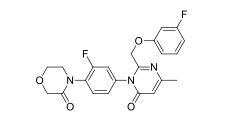
[00480] Uma mistura de 3-fluorofenol (5,61 g, 50,0 mmol), 2- bromoacetamida (7,59 g, 55,0 mmol) e K2CO3 (13,82 g, 100 mmol) em acetona (80 mL) foi agitada a 70°C durante a noite. A mistura foi resfriada até a temperatura ambiente e filtrada e o filtrado foi concentrado in vacuo. O resíduo foi purificado por cromatografia em coluna de gel de sílica (EP / AcOEt (V / V) = 1: 1) para dar o composto do título como um sólido branco. (7,89 g, 93 %)Etapa 2) 4-(2-fluoro-4-nitrofenil) morfolin-3-ona[00480] A mixture of 3-fluorophenol (5.61 g, 50.0 mmol), 2-bromoacetamide (7.59 g, 55.0 mmol) and K2CO3 (13.82 g, 100 mmol) in acetone (80 mL) was stirred at 70°C overnight. The mixture was cooled to room temperature and filtered and the filtrate was concentrated in vacuo. The residue was purified by silica gel column chromatography (EP / EtOAc (V / V) = 1: 1) to give the title compound as a white solid. (7.89 g, 93%)Step 2) 4-(2-fluoro-4-nitrophenyl)morpholin-3-one
[00481] Uma mistura de 1,2-difluoro-4-nitrobenzeno (7,95 g, 50,0 mmol), morfolin-3-ona (5,06 g, 50,0 mmol) e K2CO3 (13,82 g, 100 mmol) em DMF (80 mL) foi agitada à 140 ° C durante a noite. A mistura foi resfriada até a temperatura ambiente e filtrada e o filtrado foi concentrado in vacuo. O resíduo foi purificado por cromatografia em coluna de gel de sílica (EP / AcOEt (V / V) = 3: 1) para dar o composto do título como um sólido amarelo (5,00 g, 42 %).Etapa 3) 4-(4-amino-2-fluorofenil) morfolin-3-ona[00481] A mixture of 1,2-difluoro-4-nitrobenzene (7.95 g, 50.0 mmol), morpholin-3-one (5.06 g, 50.0 mmol) and K2CO3 (13.82 g , 100 mmol) in DMF (80 mL) was stirred at 140 °C overnight. The mixture was cooled to room temperature and filtered and the filtrate was concentrated in vacuo. The residue was purified by silica gel column chromatography (EP / EtOAc (V / V) = 3: 1) to give the title compound as a yellow solid (5.00 g, 42%).Step 3) 4 -(4-amino-2-fluorophenyl)morpholin-3-one
[00482] Uma mistura de pó de ferro (8,8 g, 158 mmol), água (60 ml) e ácido clorídrico (2 mL) foi agitada a 65 °C durante 20 min. Foi então resfriada até a temperatura ambiente e a camada aquosa foi vertida. Uma solução de 4-(2-fluoro-4-nitrofenil) morfolin-3-ona (3,8 g, 15,8 mmol) em MeOH(100 mL) foi adicionado e a mistura resultante foi acidificada a pH 2 com ácido clorídrico e agitou-se a 65 ° C durante 4 h. A mistura foi resfriada até a temperatura ambiente, ajustada para pH 8 com solução aquosa saturada de NaHCO3 e filtrou-se. O MeOH foi removido sob vácuo e a mistura foi extraída com EtOAC(20 mL x 3). As camadas orgânicas combinadas foram lavadas com salmoura (20 ml x 4), secas sobre Na2SO4 anidro e concentradas in vacuo. O resíduo foi purificado por cromatografia em coluna de gel de sílica (EP / AcOEt (V / V) = 1: 2) para dar o composto do título como um sólido branco (1,89 g, 57 %).Etapa 4) N-(3-fluoro-4-(3-oxomorfolino)fenil)-3-oxobutanamida[00482] A mixture of iron powder (8.8 g, 158 mmol), water (60 ml) and hydrochloric acid (2 ml) was stirred at 65 °C for 20 min. It was then cooled to room temperature and the aqueous layer was poured. A solution of 4-(2-fluoro-4-nitrophenyl)morpholin-3-one (3.8 g, 15.8 mmol) in MeOH (100 mL) was added and the resulting mixture was acidified to pH 2 with hydrochloric acid. and stirred at 65 °C for 4 h. The mixture was cooled to room temperature, adjusted to pH 8 with saturated aqueous NaHCO3 solution and filtered. The MeOH was removed in vacuo and the mixture was extracted with EtOAC (20 mL x 3). The combined organic layers were washed with brine (20 ml x 4), dried over anhydrous Na 2 SO 4 and concentrated in vacuo. The residue was purified by silica gel column chromatography (EP / EtOAc (V / V) = 1: 2) to give the title compound as a white solid (1.89 g, 57 %).Step 4) N -(3-fluoro-4-(3-oxomorpholino)phenyl)-3-oxobutanamide
[00483] Uma mistura de 4-(4-amino-2-fluorofenil) morfolin-3-ona (2,51 g, 11,9 mmol) e acetil ceteno (2,51 g, 29,9 mmol) em EtOAC(40 mL) foi agitada a 80 ° C durante 24 h. A mistura foi resfriada até a temperatura ambiente e concentrada em vácuo. O resíduo foi purificado por cromatografia em coluna de gel de sílica (EP / AcOEt (V / V) = 1: 4) para dar o composto do título como um sólido amarelo (2,15 g, 61 %).Etapa 5) 4-(2-fluoro-4-(2-((3-fluorofenoxi) metil)-4-metil-6-oxopirimidin-1 (6H)-il) fenil) morfolin-3-ona[00483] A mixture of 4-(4-amino-2-fluorophenyl)morpholin-3-one (2.51 g, 11.9 mmol) and acetyl ketene (2.51 g, 29.9 mmol) in EtOAC( 40 mL) was stirred at 80 °C for 24 h. The mixture was cooled to room temperature and concentrated in vacuo. The residue was purified by silica gel column chromatography (EP / EtOAc (V / V) = 1: 4) to give the title compound as a yellow solid (2.15 g, 61 %).Step 5) 4 -(2-fluoro-4-(2-((3-fluorophenoxy)methyl)-4-methyl-6-oxopyrimidin-1(6H)-yl)phenyl)morpholin-3-one
[00484] Uma mistura de N-(3-fluoro-4-(3-oxomorfolino) fenil)-3- oxobutanamida (0,59 g, 2,00 mmol), 2-(3-fluorofenoxi) acetamida (0,94 g, 5,56 mmol) e tetraisopropanolato de titânio (4,8 mL) em xileno (10 mL) foi agitada a 165°C durante 24 h. A mistura foi resfriada até a temperatura ambiente e 60 mL de tolueno e 60 mL de solução aquosa saturada de NH4Cl foi adicionada. A mistura resultante foi agitada à temperatura ambiente durante a noite e filtrada e o filtrado foi extraído com DCM (20 mL x 4). As camadas orgânicas combinadas foram lavadas com salmoura (30 mL x 2), secas sobre Na2SO4 anidro e concentradas in vacuo. O resíduo foi purificado por cromatografia em coluna de gel de sílica (EP / AcOEt (V / V) = 1: 2) para dar o composto do título como um sólido amarelo (0,06 g, 7 %). O composto foi caracterizado pelos seguintes dados espectroscópicos: MS (ESI, pos.ion) m / z: 428,1 (M + 1); 1H-RMN(400 MHz, CDCi3+< h 4.58 *u. 5J+. 5.92 *f. 4 J. L ? 5.34 Jz+, 6.25 (t, 2 H, J = 4,6 Hz), 4,35 (s, 2 H), 4,73 (s, 2H), 6,38 (s, 1H), 6,55-6,53 (m, 2 H), 6,67 (t, 1H, J = 7,3 Hz), 7,21-7,11 (m, 3H), 7,44 (t, 1H, J = 8,2 Hz). Exemplo 67 3-(3-cloro-4-morfolinofenil)-2-(((4-cloronaftalen-1-il) oxi) metil)-6-metil- pirimidin-4 (3H)-ona
[00485] Uma mistura de 4-cioronaftaien-1-oi (3,57 g, 20,0 mmoi), 2- bromoacetamida (2,76 g, 20,0 mmoi) e K2CO3 (5,53 g, 40,0 mmoi) em acetona (40 mL) foi agitada a 70°C durante a noite. A mistura foi resfriada até a temperatura ambiente e fiitrada e o fiitrado foi concentrado in vacuo. O resíduo foi purificado por cromatografia em coiuna de gei de síiica (EP / AcOEt (V / V) = 1: 1) para dar o composto do títuio como um sóiido branco (2,32 g, 49 %).Etapa 2) 3-(3-cioro-4-morfoiinofenii)-2-(((4-cioronaftaien-1-ii) oxi) metii)-6- metilpirimidina-4 (3H)-ona[00485] A mixture of 4-chloronaphthaien-1-oi (3.57 g, 20.0 mmol), 2-bromoacetamide (2.76 g, 20.0 mmol) and K2CO3 (5.53 g, 40.0 mmol) in acetone (40 ml) was stirred at 70°C overnight. The mixture was cooled to room temperature and filtered and the filtrate was concentrated in vacuo. The residue was purified by silica gel chromatography (EP / EtOAc (V / V) = 1: 1) to give the title compound as a white solid (2.32 g, 49%).Step 2) 3 -(3-chloro-4-morphoylinophenyl)-2-(((4-chloronaphthaien-1-ii)oxy)methyl)-6-methylpyrimidine-4(3H)-one
[00486] Uma mistura de N-(3-cloro-4-morfolinofenil)-3- oxobutanamida (0,59 g, 2,0 mmol), 2-((4-cloronaftalen-1-il) oxi) acetamida (0,94 g, 4,0 mmol) e tetraisopropanolato de titânio (4,8 mL) em xileno (10 mL) foi agitada a 165°C durante 24 h. A mistura foi resfriada até a temperatura ambiente e 60 mL de tolueno e 60 mL de solução aquosa saturada de NH4Cl foi adicionada. A mistura resultante foi agitada à temperatura ambiente durante a noite e filtrada e o filtrado foi extraído com DCM (20 mL x 4). As camadas orgânicas combinadas foram lavadas com salmoura (30 mL x 2), secas sobre Na2SO4 anidro e concentradas in vacuo. O resíduo foi purificado por cromatografia em coluna de gel de sílica (EP / AcOEt (V / V) = 1: 1) para dar o composto do título como um sólido amarelo (0,56 g, 56 %). O composto foi caracterizado pelos seguintes dados espectroscópicos: MS (ESI, pos.ion) m / z: 496,1 (M + 1); 1H-RMN(400 MHz, CDCl3+<"h"4.59"*u."5J+."4.;8-2,86 (m, 4H), 3,83-3,80 (t, 4H, J = 4,6 Hz), 4,93-4,92 (d, 2 H, J = 4,9 Hz), 6,41 (s, 1H), 6,62-6,60 (d, 1H, J = 8,3 Hz), 6,89-6,87 (d, 1H, J = 8,5 Hz), 7,09-7,07 (dd, 1H, J1 = 2,5 Hz, J2 = 8,5 Hz), 7,27-7,26 (m, 1 H), 7,35-7,33 (d, 1H, J = 8,2 Hz), 7,55-7,51 (m, 1H), 7,64-7,60 (m, 1 H), 8,04-8,02 (d, 1H, J = 8,3 Hz), 8,18-8,16 (d, 1H, J = 8,2 Hz). Exemplo 68 3-(3-cloro-4-morfolinofenil)-2-((3-etinilfenoxi) metil)-6-metilpirimidina-4 (3H)-ona
[00487] Uma mistura de 3-etinilfenol (3,31 g, 28,0 mmol), 2- bromoacetamida (2,36 g, 17,1 mmol) e K2CO3 (5,53 g, 40,0 mmol) em acetona (50 mL) foi agitada a 70°C durante 7 h. A mistura foi resfriada até a temperatura ambiente e filtrada e o filtrado foi concentrado in vacuo. O resíduo foi purificado por cromatografia em coluna de gel de sílica (EP / AcOEt (V / V) = 1: 1) para dar o composto do título como um sólido branco (2,70 g, 90 %).Etapa 2) 3-(3-cloro-4-morfolinofenil)-2-((3-etinilfenoxi) metil)-6-metil- pirimidin-4 (3H)-ona[00487] A mixture of 3-ethynylphenol (3.31 g, 28.0 mmol), 2-bromoacetamide (2.36 g, 17.1 mmol) and K2CO3 (5.53 g, 40.0 mmol) in acetone (50 ml) was stirred at 70°C for 7 h. The mixture was cooled to room temperature and filtered and the filtrate was concentrated in vacuo. The residue was purified by silica gel column chromatography (EP / EtOAc (V / V) = 1: 1) to give the title compound as a white solid (2.70 g, 90%).Step 2) 3 -(3-chloro-4-morpholinophenyl)-2-((3-ethynylphenoxy)methyl)-6-methyl-pyrimidin-4(3H)-one
[00488] Uma mistura de N-(3-cloro-4-morfolinofenil)-3- oxobutanamida (0,80 g, 2,85 mmol), 2-(3-etinilfenoxi) acetamida (1,0 g, 5,71 mmol) e tetraisopropanolato de titânio (6,76 mL) em xileno (20 mL) foi agitada a 165°C durante 24 h. A mistura foi resfriada até a temperatura ambiente e 50 mL de tolueno e 60 mL de solução aquosa saturada de NH4Cl foi adicionada. A mistura resultante foi agitada à temperatura ambiente durante a noite e filtrada e o filtrado foi extraído com DCM (150 mL x 3). As camadas orgânicas combinadas foram secas sobre Na2SO4 anidro e concentrou-se in vacuo. O resíduo foi purificado por cromatografia em coluna de gel de sílica (EP / AcOEt (V / V) = 1: 1) para dar o composto do título como um sólido amarelo (0,60 g, 50 %). O composto foi caracterizado pelos seguintes dados espectroscópicos: MS (ESI, pos.ion) m / z: 420,1 (M + 1); 1H-RMN(400 MHz, CDCl3+<"h"4.56"*u."5J+."5.25-3,11 (m, 5 H), 3,83 (t, 4H), 4,68 (s, 2H), 6,38 (s, 1 H), 6,76-7,19 (m, 7 H). Exemplo 69 2-(difluoro-(3-fluorofenoxi) metil)-3-(3-fluoro-4-morfolinofenil)-6- metilpirimidina-4 (3H)-ona
[00489] Uma mistura de 3-fluorofenol (2,24 g, 20,0 mmol), acetato de 2-bromo-2,2-difluoroacetato de metila (8,12 g, 40,0 mmol) e K2CO3 (6,91 g, 50,0 mmol) em MeOH(20 mL) foi agitada a 70 ° C durante a noite. Foi então resfriada até a temperatura ambiente e filtrada e o filtrado foi concentrado em vácuo para dar o composto do título, o qual foi utilizado na etapa seguinte sem purificação adicional.Etapa 2) 2,2-difluoro-2-(3-fluorofenoxi) acetamida[00489] A mixture of 3-fluorophenol (2.24 g, 20.0 mmol), methyl 2-bromo-2,2-difluoroacetate acetate (8.12 g, 40.0 mmol) and K2CO3 (6, 91 g, 50.0 mmol) in MeOH (20 mL) was stirred at 70 °C overnight. It was then cooled to room temperature and filtered and the filtrate was concentrated in vacuo to give the title compound, which was used in the next step without further purification.Step 2) 2,2-Difluoro-2-(3-fluorophenoxy) acetamide
[00490] Uma mistura de acetato de 2,2-difluoro-2-(3-fluorofenoxi) etila (3,5 g, 14,9 mmol), MeOH(10 mL) e hidróxido de amônio (5,09 g) em 20 mL de um tubo de vedação foi agitada a 100 ° C durante 24 h. A mistura foi resfriada até a temperatura ambiente e concentrada em vácuo para dar o composto do título, o qual foi utilizado na etapa seguinte sem purificação adicional.Etapa 3) 2-(difluoro-(3-fluorofenoxi) metil)-3-(3-fluoro-4-morfolinofenil)-6- metil-pirimidin-4 (3H)-ona[00490] A mixture of 2,2-difluoro-2-(3-fluorophenoxy)ethyl acetate (3.5 g, 14.9 mmol), MeOH (10 mL) and ammonium hydroxide (5.09 g) in 20 mL of a sealing tube was stirred at 100 °C for 24 h. The mixture was cooled to room temperature and concentrated in vacuo to give the title compound, which was used in the next step without further purification.Step 3) 2-(Difluoro-(3-fluorophenoxy)methyl)-3-(3 -fluoro-4-morpholinophenyl)-6-methyl-pyrimidin-4(3H)-one
[00491] Uma mistura de N-(3-fluoro-4-morfolinofenil)-3- oxobutanamida (0,60 g, 2,14 mmol), 2,2-difluoro-2-(3-fluorofenoxi) acetamida (0,88 g, 4,29 mmol) e tetraisopropanolato de titânio (4,87 g, 17,1 mmol) em xileno (20 mL) foi agitada a 165°C durante 24 h. A mistura foi resfriada até a temperatura ambiente e 60 mL de tolueno e 80 mL de solução aquosa saturada de NH4Cl foi adicionada. A mistura resultante foi agitada à temperatura ambiente durante a noite e filtrada e o filtrado foi extraído com DCM (150 mL x 3). As camadas orgânicas combinadas foram secas sobre Na2SO4 anidro e concentrou-se in vacuo. O resíduo foi purificado por cromatografia em coluna de gel de sílica (EP / AcOEt (V / V) = 1: 1) para dar o composto do título como um sólido amarelo (0,38 g, 40 %). O composto foi caracterizado pelos seguintes dados espectroscópicos: MS (ESI, pos.ion) m / z: 450,1 (M + 1); 1H-RMN(400 MHz, CDCl3+<"h"4.65"*u."5J+."5.37"*v."6J+."5.:7"*o."6J+."8.58- 7,27 (m, 8 H). Exemplo 70 3-((1-(3,5-difluoro-4-morfolinofenil)-4-metil-6-oxo-1,6-di-hidropirimidin- 2-il)metoxi)benzonitrila
[00492] Uma mistura de 1,2,3-trifluoro-5-nitrobenzeno (3,54 g, 20,0 mmol), morfolina (2,0 mL, 23,0 mmol) e ET3N(8,5 mL, 61,0 mmol) em EtOAC(30 mL) foi agitada à temperatura ambiente durante 5 h. A mistura foi concentrada in vacuo, e o resíduo foi purificado por cromatografia em coluna de gel de sílica (EP / AcOEt (V / V) = 8: 1) para dar o composto do título como um sólido amarelo (4,76 g, 98 %).Etapa 2) 3,5-difluoro-4-morfolinoanilina[00492] A mixture of 1,2,3-trifluoro-5-nitrobenzene (3.54 g, 20.0 mmol), morpholine (2.0 mL, 23.0 mmol) and ET3N (8.5 mL, 61 .0 mmol) in EtOAC(30 mL) was stirred at room temperature for 5 h. The mixture was concentrated in vacuo, and the residue was purified by silica gel column chromatography (EP / EtOAc (V / V) = 8: 1) to give the title compound as a yellow solid (4.76 g, 98 %).Step 2) 3,5-Difluoro-4-morpholinoaniline
[00493] Uma mistura de 4-(2,6-difluoro-4-nitrofenil) morfolina (4,71 g, 19,3 mmol), THF (30 mL), etanol (30 mL) e Pd / C(2,0 g, 10 %) foi agitada à temperatura ambiente sob H2 durante a noite. A mistura foi filtrada e concentrada em vácuo e o resíduo foi purificado por cromatografia em coluna de gel de sílica (EP / AcOEt (V / V) = 8: 1) para dar o composto do título como um sólido amarelo (3,62 g, 88 %). Etapa 3) N-(3,5-difluoro-4-morfolinofenil)-3-oxobutanamida[00493] A mixture of 4-(2,6-difluoro-4-nitrophenyl)morpholine (4.71 g, 19.3 mmol), THF (30 mL), ethanol (30 mL) and Pd/C(2, 0 g, 10%) was stirred at room temperature under H 2 overnight. The mixture was filtered and concentrated in vacuo and the residue was purified by silica gel column chromatography (EP / EtOAc (V / V) = 8:1) to give the title compound as a yellow solid (3.62 g , 88 %). Step 3) N-(3,5-difluoro-4-morpholinophenyl)-3-oxobutanamide
[00494] Uma mistura de 3,5-difluoro-4-morfolinoanilina (3,42 g, 16,0 mmol) e acetil ceteno (1,61 g, 19,2 mmol) em EtOAC(20 mL) foi agitada a 83°C durante a noite. A mistura foi resfriada até a temperatura ambiente e concentrada em vácuo. O resíduo foi purificado por cromatografia em coluna de gel de sílica (EP / AcOEt (V / V) = 1: 1) para dar o composto do título como um sólido amarelo (3,10 g, 65 %).Etapa 4) 2-(3-cianofenoxi) acetamida[00494] A mixture of 3,5-difluoro-4-morpholinoaniline (3.42 g, 16.0 mmol) and acetyl ketene (1.61 g, 19.2 mmol) in EtOAC (20 mL) was stirred at 83 °C. °C overnight. The mixture was cooled to room temperature and concentrated in vacuo. The residue was purified by silica gel column chromatography (EP / EtOAc (V / V) = 1: 1) to give the title compound as a yellow solid (3.10 g, 65%).Step 4) 2 -(3-cyanophenoxy)acetamide
[00495] Uma mistura de 3-hidroxi-benzonitrila (2,38 g, 20,0 mmol), 2- bromoacetamida (3,04 g, 22,0 mmol) e K2CO3 (5,53 g, 40,0 mmol) em acetona (30 mL) foi agitada a 75°C durante a noite. Foi então resfriada até a temperatura ambiente e filtrada e o filtrado foi concentrado in vacuo. O resíduo foi purificado por cromatografia em coluna de gel de sílica (EP / AcOEt (V / V) = 1: 1) para dar o composto do título como um sólido branco (1,00 g, 28 %).Etapa 5) 3-((1-(3,5-difluoro-4-morfolinofenil) pirimidin-2-il -4-metil-6-oxo- 1,6-di-hidro-) metoxi) benzonitrila[00495] A mixture of 3-hydroxy-benzonitrile (2.38 g, 20.0 mmol), 2-bromoacetamide (3.04 g, 22.0 mmol) and K2CO3 (5.53 g, 40.0 mmol) in acetone (30 mL) was stirred at 75°C overnight. It was then cooled to room temperature and filtered and the filtrate was concentrated in vacuo. The residue was purified by silica gel column chromatography (EP / EtOAc (V / V) = 1: 1) to give the title compound as a white solid (1.00 g, 28%).Step 5) 3 -((1-(3,5-difluoro-4-morpholinophenyl)pyrimidin-2-yl-4-methyl-6-oxo-1,6-dihydro-)methoxy)benzonitrile
[00496] Uma mistura de N-(3,5-difluoro-4-morfolinofenil)-3- oxobutanamida (0,79 g, 2,65 mmol), 2-(3-cianofenoxi) acetamida (0,93 g, 5,28 mmol) e tetraisopropanolato de titânio (6,3 ml) em xileno (25 mL) foi agitada a 165°C durante 24 h. A mistura foi resfriada até a temperatura ambiente e 60 mL de tolueno e 60 mL de solução aquosa saturada de NH4Cl foi adicionada. A mistura resultante foi agitada à temperatura ambiente durante a noite e filtrada e o filtrado foi extraído com DCM (20 mL x 4). As camadas orgânicas combinadas foram lavadas com salmoura (30 mL x 2), seca sobre Na2SO4 anidro e concentrados in vacuo. O resíduo foi purificado por cromatografia em coluna de gel de sílica (EP / AcOEt (V / V) = 1: 2) para dar o composto do título como um sólido amarelo (0,29 g, 25 %). O composto foi caracterizado pelos seguintes dados espectroscópicos: MS (ESI, pos.ion) m / z: 439,1 (M + 1); 1H-RMN(400 MHz, CDCl3+<"h"4.56"*u."5J+."5.42"*u."6J+."5.:2-3,77 (t, 4H, J = 4,4 Hz), 4,77 (s, 2H), 6,37 (s, 1H), 6,83-6,81 (d, 2 H, J = 8,9 Hz), 7,08-7,06 (dd, 2H, J1 = 7,5 Hz, J2 = 1,0 Hz), 7,29-7,27 (d, 1 H, J = 6,4 Hz), 7,39-7,35 (m, 1 H). Exemplo 71 3-(3-fluoro-4-morfolinofenil)-2-((3-metoxifenoxi) metil)-6-metilpirimidina-4 (3H)-ona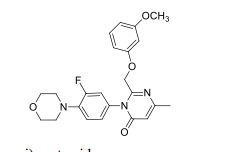
[00497] Uma mistura de 3-metoxifenol (2,48 g, 20,0 mmol), 2- bromoacetamida (3,31 g, 24,0 mmol) e K2CO3 (5,53 g, 40,0 mmol) em acetona (30 mL) foi agitada a 70°C durante 9 h. A mistura foi resfriada até a temperatura ambiente e filtrada e o filtrado foi concentrado in vacuo. O resíduo foi purificado por cromatografia em coluna de gel de sílica (EP / AcOEt (V / V) = 1: 1) para dar o composto do título como um sólido branco (3,0 g, 83 %).Etapa 2) 3-(3-fluoro-4-morfolinofenil)-2-((3-metoxifenoxi) metil)-6- metil- pirimidin-4 (3H)-ona[00497] A mixture of 3-methoxyphenol (2.48 g, 20.0 mmol), 2-bromoacetamide (3.31 g, 24.0 mmol) and K2CO3 (5.53 g, 40.0 mmol) in acetone (30 ml) was stirred at 70°C for 9 h. The mixture was cooled to room temperature and filtered and the filtrate was concentrated in vacuo. The residue was purified by silica gel column chromatography (EP / EtOAc (V / V) = 1: 1) to give the title compound as a white solid (3.0 g, 83%).Step 2) 3 -(3-fluoro-4-morpholinophenyl)-2-((3-methoxyphenoxy)methyl)-6-methyl-pyrimidin-4(3H)-one
[00498] Uma mistura de N-(3-fluoro-4-morfolinofenil)-3- oxobutanamida (1,0 g, 3,57 mmol), 2-(3-metoxifenoxi) acetamida (1,29 g, 7,12 mmol) e tetraisopropanolato de titânio (8,11 g, 28,5 mmol) em xileno (30 mL) foi agitada a 165°C durante 24 h. A mistura foi resfriada até a temperatura ambiente e 80 mL de tolueno e 100 mL de solução aquosa saturada de NH4Cl foi adicionada. A mistura resultante foi agitada à temperatura ambiente durante a noite e filtrada e o filtrado foi extraído com DCM (150 mL x 3). As camadas orgânicas combinadas foram secas sobre Na2SO4 anidro e concentrou-se in vacuo. O resíduo foi purificado por cromatografia em coluna de gel de sílica (EP / AcOEt (V / V) = 1: 1) para dar o composto do título como um sólido amarelo (0,61 g, 40 %). O composto foi caracterizado pelos seguintes dados espectroscópicos: MS (ESI, pos.ion) m / z: 426,1 (M + 1); 1H-RMN(400 MHz, CDCl3+<"h"4.47"*u."5J+."4.;9"*v."6J+."5.8;"*u."5J+."5.93" (m, 4H), 4,69 (s, 2 H), 6,33-7,31 (m, 8 H). Exemplo 72 3-(3-cloro-4-((1-(4-cloro-3-fluorofenil)-2-metilpropan-2-il)amino)fenil)- 2,6-dimetilpirimidin-4(3H)-ona
[00499] A uma mistura de 4-bromo-1-cloro-2-fluorobenzeno (20,90 g, 100,0 mmol) e acetilacetona (30 mL, 300,0 mmol) em DMSO (100 mL) foram adicionados fosfato tripotássico (63,70 g, 300,0 mmol) e CuI (3,00 g, 15,80 mmol) sob N2 e a mistura foi agitada a 110°C durante 23 h. A mistura foi resfriada até a temperatura ambiente e ácido clorídrico (300 mL, 2 M) foi adicionado. A mistura resultante foi extraída com EtOAC(100 mL x 3) e as fases orgânicas combinadas foram lavadas com salmoura (100 mL x 2), secas sobre Na2SO4 anidro (50 g), e filtradas. O filtrado foi concentrado in vacuo. O resíduo foi purificado por cromatografia em coluna de gel de sílica (EP / AcOEt (V / V) = 10: 1) para dar o composto do título de um líquido amarelo (9,02 g, 48,2 %).Etapa 2) 1-(4-cloro-3-fluorofenil)-2-metilpropan-2-ol[00499] To a mixture of 4-bromo-1-chloro-2-fluorobenzene (20.90 g, 100.0 mmol) and acetylacetone (30 mL, 300.0 mmol) in DMSO (100 mL) was added tripotassium phosphate (63.70 g, 300.0 mmol) and CuI (3.00 g, 15.80 mmol) under N 2 and the mixture was stirred at 110°C for 23 h. The mixture was cooled to room temperature and hydrochloric acid (300 mL, 2M) was added. The resulting mixture was extracted with EtOAC (100 mL x 3) and the combined organic phases were washed with brine (100 mL x 2), dried over anhydrous Na 2 SO 4 (50 g), and filtered. The filtrate was concentrated in vacuo. The residue was purified by silica gel column chromatography (EP / EtOAc (V / V) = 10: 1) to give the title compound as a yellow liquid (9.02 g, 48.2 %).Step 2 ) 1-(4-chloro-3-fluorophenyl)-2-methylpropan-2-ol
[00500] A uma solução de brometo de metilmagnésio (100 mL, 100,0 mmol, 1,0 M em THF) foi adicionada uma solução de 1-(4-cloro-3- fluorofenil) propan-2-ona (9,00 g, 48,20 mmol) em THF (20 mL), gota a gota, a 0°C sob N2 e a mistura de reação foi aquecida a 76 ° C durante 12 h. Foi então resfriada até a temperatura ambiente e resfriou-se bruscamente com solução aquosa saturada de NH4Cl (50 mL) e a mistura foi vertida em água (200 mL). A mistura resultante foi extraída com EtOAC(100 mL x 4) e as fases orgânicas combinadas foram lavadas com salmoura (100 mL x 2), secou-se sobre Na2SO4 anidro (50 g) e concentrou-se in vacuo. O resíduo foi purificado por cromatografia em coluna de gel de sílica (EP / AcOEt (V / V) = 8: 1) para dar o composto do título de um líquido amarelo (8,61 g, 88,2 %). Etapa 3) N-(1-(4-cloro-3-fluorofenil)-2-metilpropan-2-il) acetamida[00500] To a solution of methylmagnesium bromide (100 mL, 100.0 mmol, 1.0 M in THF) was added a solution of 1-(4-chloro-3-fluorophenyl) propan-2-one (9, 00 g, 48.20 mmol) in THF (20 mL) dropwise at 0 °C under N 2 and the reaction mixture was heated at 76 °C for 12 h. It was then cooled to room temperature and quenched with saturated aqueous NH4Cl solution (50 mL) and the mixture was poured into water (200 mL). The resulting mixture was extracted with EtOAC (100 ml x 4) and the combined organic phases were washed with brine (100 ml x 2), dried over anhydrous Na 2 SO 4 (50 g) and concentrated in vacuo. The residue was purified by silica gel column chromatography (EP / EtOAc (V / V) = 8:1) to give the title compound as a yellow liquid (8.61 g, 88.2%). Step 3) N-(1-(4-chloro-3-fluorophenyl)-2-methylpropan-2-yl)acetamide
[00501] A uma mistura de ácido sulfúrico 1-(3-fluorofenil-4-cloro)-2- metilpropan-2-ol (8,61 g, 42,50 mmol), acetonitrila (13 mL, 255,0 mmol) e ácido acético (80 mL) foi adicionada (13 mL) gota a gota e a mistura foi aquecida a 65°C durante 5 h. A mistura foi resfriada até a temperatura ambiente e vertida em água gelada (400 ml) e a mistura resultante foi ajustada a pH > 11 com NaOH, e extraída com EtOAC(150 mL x 3). As fases orgânicas combinadas foram lavadas com salmoura (150 mL x 2), seca sobre Na2SO4 anidro (40 g) e filtrou-se. O filtrado foi concentrado in vacuo. O resíduo foi purificado por cromatografia em coluna de gel de sílica (EP / AcOEt (V / V) = 2: 1) para dar o composto do título como um sólido amarelo (4,38 g, 42,1 %). O composto foi caracterizado pelos seguintes dados espectroscópicos: MS (ESI, pos.ion) m / z: 244,2 (M + 1); 1H RMN(400 MHz, CDCI3+ h 9.4; *ff. 3 J. L3 ? 32.9 Jz. L4 ? 7.4 Jz+. 8,;6 (dd, 1 H, J1 = 10,2 Hz, J2 = 1,9 Hz), 6,87 (dd, 1 H, J1 = 8,1 Hz, J2 = 1,5 Hz), 5,21 (s, 1 H), 3,08 (s, 2H), 1,95 (s, 3H), 1,32 (s, 6 H).Etapa 4) 1-(4-cloro-3-fluorofenil)-2-metilpropan-2-amina[00501] To a mixture of sulfuric acid 1-(3-fluorophenyl-4-chloro)-2-methylpropan-2-ol (8.61 g, 42.50 mmol), acetonitrile (13 mL, 255.0 mmol) and acetic acid (80 ml) was added (13 ml) dropwise and the mixture was heated at 65°C for 5 h. The mixture was cooled to room temperature and poured into ice water (400 ml) and the resulting mixture was adjusted to pH > 11 with NaOH, and extracted with EtOAC (150 ml x 3). The combined organic phases were washed with brine (150 mL x 2), dried over anhydrous Na 2 SO 4 (40 g) and filtered. The filtrate was concentrated in vacuo. The residue was purified by silica gel column chromatography (EP / EtOAc (V / V) = 2: 1) to give the title compound as a yellow solid (4.38 g, 42.1%). The compound was characterized by the following spectroscopic data: MS (ESI, pos.ion) m / z: 244.2 (M + 1); 1H NMR(400 MHz, CDCI3+ h 9.4; *ff. 3 J.L3 - 32.9 Jz. L4 - 7.4 Jz+. 8.;6 (dd, 1H, J1 = 10.2 Hz, J2 = 1.9 Hz) , 6.87 (dd, 1H, J1 = 8.1 Hz, J2 = 1.5 Hz), 5.21 (s, 1H), 3.08 (s, 2H), 1.95 (s, 3H), 1.32 (s, 6H).Step 4) 1-(4-chloro-3-fluorophenyl)-2-methylpropan-2-amine
[00502] Uma mistura de N-(1-(4-cloro-3-fluorofenil)-2-metilpropan-2- il) acetamida (3,36 g, 13,80 mmol) e ácido clorídrico concentrado (60 mL) foi aquecida a 120°C durante 16,5 h. A mistura foi resfriada até a temperatura ambiente e vertida em água gelada e a mistura resultante foi ajustada a pH > 12 com NaOH e extraiu-se com EtOAC(80 mL x 5). As fases orgânicas combinadas foram lavadas com salmoura (100 mL x 2), secas sobre Na2SO4 anidro e filtradas. O filtrado foi concentrado in vacuo. O resíduo foi dissolvido em ácido clorídrico concentrado (60 mL) e a mistura foi agitada a 120°C durante 20 h. A mistura de reação foi resfriada até a temperatura ambiente e foram adicionados 100 mL de água. A mistura resultante foi lavada com EtOAC(50 mL x 3). A fase aquosa foi ajustada a pH > 11 com NaOH e extraiu-se com EtOAC(50 mL x 3). As fases orgânicas combinadas foram lavadas com salmoura (80 mL x 2), secou-se sobre Na2SO4 anidro (20 g) e concentrou-se in vacuo para dar o composto do título como um sólido amarelo (0,484 g, 17,4 %). O composto foi caracterizado pelos seguintes dados espectroscópicos:MS (ESI, pos.ion) m / z: 202,1 (M + 1).Etapa 5) 2-cloro-N-(1-(3-fluorofenil-4-cloro)-2-metilpropan-2-il)-4-nitro- anilina[00502] A mixture of N-(1-(4-chloro-3-fluorophenyl)-2-methylpropan-2-yl) acetamide (3.36 g, 13.80 mmol) and concentrated hydrochloric acid (60 mL) was heated at 120°C for 16.5 h. The mixture was cooled to room temperature and poured into ice water and the resulting mixture was adjusted to pH > 12 with NaOH and extracted with EtOAC (80 mL x 5). The combined organic phases were washed with brine (100 mL x 2), dried over anhydrous Na 2 SO 4 and filtered. The filtrate was concentrated in vacuo. The residue was dissolved in concentrated hydrochloric acid (60 mL) and the mixture was stirred at 120°C for 20 h. The reaction mixture was cooled to room temperature and 100 mL of water was added. The resulting mixture was washed with EtOAC (50 mL x 3). The aqueous phase was adjusted to pH > 11 with NaOH and extracted with EtOAC (50 mL x 3). The combined organic phases were washed with brine (80 mL x 2), dried over anhydrous Na 2 SO 4 (20 g) and concentrated in vacuo to give the title compound as a yellow solid (0.484 g, 17.4 %) . The compound was characterized by the following spectroscopic data: MS (ESI, pos.ion) m / z: 202.1 (M + 1).Step 5) 2-chloro-N-(1-(3-fluorophenyl-4-chloro )-2-methylpropan-2-yl)-4-nitroaniline
[00503] Uma mistura de 3-cloro-4-fluoro-1-nitrobenzeno (421 mg, 2,40 mmol) e 1-(4-cloro-3-fluorofenil)-2-metilpropan-2-amina (484 mg, 2,40 mmol) em DMSO (10 mL) foi aquecida a 90°C sob N2 durante 3 h. A mistura foi resfriada até a temperatura ambiente e agitou-se à temperatura ambiente durante 38,5 h. Foi, em seguida, aquecida e agitada adicionalmente a 90 ° C durante 81,5 h. A mistura foi resfriada até a temperatura ambiente e foi adicionado 80 mL de água. A mistura resultante foi extraída com EtOAC(30 mL x 3). As camadas orgânicas combinadas foram secas sobre Na2SO4 anidro (10 g) e concentrou-se in vacuo. O resíduo foi purificado por cromatografia em coluna de gel de sílica (PE / DCM (v / v) = 20: 1) para dar o composto do título como um óleo amarelo (490 mg, 57,2 %). O composto foi caracterizado pelos seguintes dados espectroscópicos: MS (ESI, pos.ion) m / z: 357,2 (M + 1); 1H RMN(400 MHz, CDCI3+ h 8,46 *f, 3 J, L ? 4.8 Jz+, 8,30 *ff, 3J, L3 ? ;,4 Hz, J2 = 2,6 Hz), 7,34-7,26 (m, 1 H), 7,04-6,98 (m, 1 H), 6,86 (dd, 1H, J1 = 9,9 Hz, J2 = 2,0 Hz), 6,77 (dd, 1H, J1 = 8,2 Hz, J2 = 1,5 Hz), 5,00 (s, 1 H), 3,04 (s, 2H), 1,48 (s, 6 H).Etapa 6) 2-cloro-N1-(1-(4-cloro-3-fluorofenil)-2-metilpropan-2-il) benzeno- 1,4-diamina[00503] A mixture of 3-chloro-4-fluoro-1-nitrobenzene (421 mg, 2.40 mmol) and 1-(4-chloro-3-fluorophenyl)-2-methylpropan-2-amine (484 mg, 2.40 mmol) in DMSO (10 mL) was heated at 90°C under N 2 for 3 h. The mixture was cooled to room temperature and stirred at room temperature for 38.5 h. It was then further heated and stirred at 90 °C for 81.5 h. The mixture was cooled to room temperature and 80 mL of water was added. The resulting mixture was extracted with EtOAC (30 mL x 3). The combined organic layers were dried over anhydrous Na 2 SO 4 (10 g) and concentrated in vacuo. The residue was purified by silica gel column chromatography (PE/DCM (v/v) = 20:1) to give the title compound as a yellow oil (490 mg, 57.2%). The compound was characterized by the following spectroscopic data: MS (ESI, pos.ion) m / z: 357.2 (M + 1); 1H NMR(400 MHz, CDCI3+ h 8.46 *f, 3 J, L ≥ 4.8 Jz+, 8.30 *ff, 3J, L3 ≤ ;.4 Hz, J2 = 2.6 Hz), 7.34-7 .26 (m, 1H), 7.04-6.98 (m, 1H), 6.86 (dd, 1H, J1 = 9.9 Hz, J2 = 2.0 Hz), 6.77 ( dd, 1H, J1 = 8.2 Hz, J2 = 1.5 Hz), 5.00 (s, 1H), 3.04 (s, 2H), 1.48 (s, 6H).Step 6 ) 2-chloro-N1-(1-(4-chloro-3-fluorophenyl)-2-methylpropan-2-yl)benzene-1,4-diamine
[00504] A uma mistura de água (20 ml) e pó de ferro (697 mg, 12,50 mmol) a 65°C foi adicionado ácido clorídrico concentrado (0,2 mL) gota a gota e a mistura foi agitada durante 15 min. A camada aquosa da mistura foi vertida e uma solução de 2-cloro-N-(1-(4-cloro-3-fluorofenil)-2-metilpropan- 2-il)-4-nitroanilina (446 mg, 1,25 mmol) em MeOH(20 mL) foi adicionado ao pó de ferro acima processado. A mistura foi ajustada para um pH de 2-3 e agitada a 65 ° C durante 20 min. A mistura foi então resfriada até a temperatura ambiente, ajustada para pH 11 com ET3N, e filtrada e o filtrado foi concentrado in vacuo. O resíduo foi dissolvido em EtOAC(100 mL) e a solução foi lavada com água (30 mL x 3) e salmoura (30 mL x 2), secou-se sobre Na2SO4 anidro (10 g) e concentrou-se in vacuo para dar o produto em bruto, o qual foi utilizado na etapa seguinte sem purificação adicional com. O composto foi caracterizado pelos seguintes dados espectroscópicos:MS (ESI, pos.ion) m / z: 327,1 (M + 1).Etapa 7) 3-(3-cloro-4-((1-(4-cloro-3-fluorofenil)-2-metilpropan-2-il) amino) fenil)-2,6-dimetilpirimidin-4 (3H)-ona[00504] To a mixture of water (20 ml) and iron powder (697 mg, 12.50 mmol) at 65°C was added concentrated hydrochloric acid (0.2 ml) dropwise and the mixture was stirred for 15 min. The aqueous layer of the mixture was poured into a solution of 2-chloro-N-(1-(4-chloro-3-fluorophenyl)-2-methylpropan-2-yl)-4-nitroaniline (446 mg, 1.25 mmol ) in MeOH (20 mL) was added to the above processed iron powder. The mixture was adjusted to a pH of 2-3 and stirred at 65 °C for 20 min. The mixture was then cooled to room temperature, adjusted to pH 11 with ET3N, filtered and the filtrate concentrated in vacuo. The residue was dissolved in EtOAC (100 mL) and the solution was washed with water (30 mL x 3) and brine (30 mL x 2), dried over anhydrous Na 2 SO 4 (10 g) and concentrated in vacuo to give the crude product, which was used in the next step without further purification with. The compound was characterized by the following spectroscopic data: MS (ESI, pos.ion) m / z: 327.1 (M + 1).Step 7) 3-(3-chloro-4-((1-(4-chloro -3-fluorophenyl)-2-methylpropan-2-yl)amino)phenyl)-2,6-dimethylpyrimidin-4(3H)-one
[00505] A uma solução de 2-cloro-N1-(1-(4-cloro-3-fluorofenil)-2- metilpropan-2-il) benzeno-1,4-diamina (408 mg, 1,25 mmol) em tolueno (15 mL) foi adicionado trimetil alumínio (2,5 mL, 5,00 mmol, 2,0 M em tolueno) gota a gota sob N2 e a mistura foi agitada à temperatura ambiente durante 30 min após a adição estar completa. Uma solução de (Z)-metil 3-(2-(3- fluorofenoxi) acetamido) but-2-enoato de metila (295 mg, 1,88 mmol) em tolueno (5 mL) foi adicionado lentamente e a mistura resultante foi agitada à temperatura ambiente durante 22 h. Trimetil alumínio (2,0 mL, 4,00 mmol, 2 M em tolueno) foi então adicionado gota a gota e a mistura foi agitada à temperatura ambiente durante 30 min. Uma solução de 3-(2-(3-fluorofenoxi) acetamido) but-2-enoato de (Z)-metila (295 mg, 1,88 mmol) em tolueno (3 mL) foi adicionado e a mistura foi agitada durante mais 18 h. A mistura foi resfriada bruscamente com solução aquosa saturada de NH4Cl (50 mL) e filtrado e a fase orgânica foi separada do filtrado. A fase aquosa foi extraída com EtOAC(30 mL x 3). As camadas orgânicas combinadas foram lavadas com salmoura (30 mL x 2), secas sobre Na2SO4 anidro (15 g) e concentradas in vacuo. O resíduo foi purificado por cromatografia em coluna de gel de sílica (EP / AcOEt (V / V) = 2: 3) para dar o composto do título como um sólido amarelo (183 mg, 33,7 %). O composto foi caracterizado pelos seguintes dados espectroscópicos: MS (ESI, pos.ion) m / z: 434,2 (M + 1); 1H RMN(400 MHz, CDCI3+ h 9.53 *V. 3J. L ? 8,0 Jz+, 9,38 *f. 3 J. L ? 4.7 Hz), 7,11 (d, 1 H, J = 8,7 Hz), 6,98 (dd, 1 H, J1 = 8,7 Hz, J2 = 2,5 Hz), 6,90 (dd, 1 H, J1 = 10,1 Hz, J2 = 1,9 Hz), 6,83 (dd, 1H, J1 = 8,2 Hz, J2 = 1,5 Hz), 6,30 (d, 1 H, J = 9,9 Hz), 4,48 (s, 1 H), 3,01 (dd, 2 H, J1 = 32,3 Hz, J2 = 13,6 Hz,), 2,33 (s, 3H), 2,27 (s, 3H), 1,44 (s, 3H), 1,42 (s, 3H).[00505] To a solution of 2-chloro-N1-(1-(4-chloro-3-fluorophenyl)-2-methylpropan-2-yl)benzene-1,4-diamine (408 mg, 1.25 mmol) in toluene (15 mL) was added trimethyl aluminum (2.5 mL, 5.00 mmol, 2.0 M in toluene) dropwise under N 2 and the mixture was stirred at room temperature for 30 min after the addition was complete. A solution of methyl (Z)-methyl 3-(2-(3-fluorophenoxy)acetamido)but-2-enoate (295 mg, 1.88 mmol) in toluene (5 mL) was added slowly and the resulting mixture was stirred at room temperature for 22 h. Trimethyl aluminum (2.0 mL, 4.00 mmol, 2M in toluene) was then added dropwise and the mixture was stirred at room temperature for 30 min. A solution of (Z)-methyl 3-(2-(3-fluorophenoxy)acetamido)but-2-enoate (295 mg, 1.88 mmol) in toluene (3 mL) was added and the mixture was stirred for a further 6 pm The mixture was quenched with saturated aqueous NH4Cl solution (50 mL) and filtered and the organic phase was separated from the filtrate. The aqueous phase was extracted with EtOAC (30 mL x 3). The combined organic layers were washed with brine (30 mL x 2), dried over anhydrous Na 2 SO 4 (15 g) and concentrated in vacuo. The residue was purified by silica gel column chromatography (EP / EtOAc (V / V) = 2: 3) to give the title compound as a yellow solid (183 mg, 33.7%). The compound was characterized by the following spectroscopic data: MS (ESI, pos.ion) m / z: 434.2 (M + 1); 1H NMR(400 MHz, CDCI3+ h 9.53 *V. 3J.L - 8.0 Jz+, 9.38 *f. 3J.L - 4.7 Hz), 7.11 (d, 1H, J = 8.7 Hz), 6.98 (dd, 1H, J1 = 8.7 Hz, J2 = 2.5 Hz), 6.90 (dd, 1H, J1 = 10.1 Hz, J2 = 1.9 Hz) , 6.83 (dd, 1H, J1 = 8.2 Hz, J2 = 1.5 Hz), 6.30 (d, 1H, J = 9.9 Hz), 4.48 (s, 1H) , 3.01 (dd, 2H, J1 = 32.3 Hz, J2 = 13.6 Hz), 2.33 (s, 3H), 2.27 (s, 3H), 1.44 (s, 3H), 3H), 1.42 (s, 3H).
[00506] Tomando células BHK-21 em fase exponencial de crescimento, coletando e contagem das células que tinham cultura de transferência digestivo após crescimento de fusão de 85 a 95 %, ajustando a densidade celular de 2 x 10⁴ células por mililitro, semeando as células em placas de 96 poços, 100 μl / poço, as células foram incubadas em um incubador com 5 % de CO2 a 37°C.[00506] Taking BHK-21 cells in exponential growth phase, collecting and counting the cells that had digestive transfer culture after 85 to 95% fusion growth, adjusting cell density to 2 x 10⁴ cells per milliliter, seeding the cells in 96-well plates, 100 μl/well, cells were incubated in a 5% CO2 incubator at 37°C.
[00507] O líquido claro superior das placas de 96 poços foi removido depois das células que aderiram às paredes 24 horas. Os compostos acima foram fabricados em soluções de concentração diferente e as soluções foram adicionadas aos poços, 100 μl / poço. Cada solução de concentração em 3 repetições, as células foram subcultivadas 48 horas após a dosagem.[00507] Top clear liquid from 96-well plates was removed after cells adhered to walls 24 hours. The above compounds were manufactured in solutions of different concentration and the solutions were added to the wells, 100 μl/well. Each concentration solution in 3 replicates, cells were subcultured 48 hours after dosing.
[00508] 10 μl de solução de CCK-8 foram adicionadas a cada poço 48 horas após a dosagem, e foram incubadas durante 2 horas. A densidade óptica (A) de cada poço foi determinada por um leitor de microplacas a 450 nm de comprimento de onda. Cálculo da razão de inibição da proliferação de células de cada composto é baseado em A e a razão de inibição da proliferação das células (taxa de inibição, de IV) = (1-valor do grupo experimental (Ai) / valor do grupo de controle (Ao)) x 100 % e o IC50 de cada composto em 48 horas foi calculada pelo software de processamento de dados.Tabela 2 Dados de atividade

[00509] A relação com PFD (múltiplo): Existe a relação de pirfenidona IC50 do composto IC50; quanto maior for o múltiplo, melhor a atividade inibidora in vitro do composto.[00509] The ratio with PFD (multiple): There is the ratio of pirfenidone IC50 of compound IC50; the greater the multiple, the better the in vitro inhibitory activity of the compound.
[00510] A característica comum de fibrose orgânica está em expansão da matriz extracelular (ECM) e remodelação estrutural de órgãos e tecidos, onde muitas citocinas (CK) participam do processo. Ele mostrou que no rastreio experimental in vitro, os compostos aqui revelados são mais ativos do que pirfenidona, e uma parte dos compostos são mais de 20 vezes tão ativos quanto a pirfenidona. Os compostos aqui descritos podem evitar a reação fototóxica produzida pelos pirfenidona, que são eficazes em anti-fibrose.[00510] The common feature of organic fibrosis is expansion of the extracellular matrix (ECM) and structural remodeling of organs and tissues, where many cytokines (CK) participate in the process. He showed that in experimental in vitro screening, the compounds disclosed here are more active than pirfenidone, and a part of the compounds are more than 20 times as active as pirfenidone. The compounds described herein can prevent the phototoxic reaction produced by pirfenidone, which are effective in anti-fibrosis.
Claims (13)


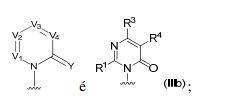


Applications Claiming Priority (3)
| Application Number | Priority Date | Filing Date | Title |
|---|---|---|---|
| CN201210250660.6 | 2012-07-18 | ||
| CN201210250660 | 2012-07-18 | ||
| PCT/CN2013/000860 WO2014012360A1 (en) | 2012-07-18 | 2013-07-18 | Nitrogenous heterocyclic derivatives and their application in drugs |
Publications (2)
| Publication Number | Publication Date |
|---|---|
| BR112014030284A2 BR112014030284A2 (en) | 2017-06-27 |
| BR112014030284B1 true BR112014030284B1 (en) | 2021-11-30 |
Family
ID=49948222
Family Applications (1)
| Application Number | Title | Priority Date | Filing Date |
|---|---|---|---|
| BR112014030284-7A BR112014030284B1 (en) | 2012-07-18 | 2013-07-18 | COMPOUND, PHARMACEUTICAL COMPOSITION, AND, USE OF A COMPOUND OR PHARMACEUTICAL COMPOSITION |
Country Status (12)
| Country | Link |
|---|---|
| US (1) | US9434695B2 (en) |
| EP (1) | EP2875001B1 (en) |
| JP (1) | JP6186434B2 (en) |
| KR (1) | KR102057877B1 (en) |
| CN (1) | CN103570630B (en) |
| AU (1) | AU2013292950C1 (en) |
| BR (1) | BR112014030284B1 (en) |
| CA (1) | CA2872110C (en) |
| ES (1) | ES2716008T3 (en) |
| MX (1) | MX2015000830A (en) |
| RU (1) | RU2701156C9 (en) |
| WO (1) | WO2014012360A1 (en) |
Families Citing this family (23)
| Publication number | Priority date | Publication date | Assignee | Title |
|---|---|---|---|---|
| WO2007079139A2 (en) | 2005-12-28 | 2007-07-12 | Vertex Pharmaceuticals, Inc. | Solid forms of n-[2,4-bis(1,1-dimethylethyl)-5-hydroxyphenyl]-1,4-dihydro-4-oxoquinoline-3-carboxamide |
| AR092742A1 (en) | 2012-10-02 | 2015-04-29 | Intermune Inc | ANTIFIBROTIC PYRIDINONES |
| US9902712B2 (en) | 2013-12-19 | 2018-02-27 | Sunshine Lake Pharma Co., Ltd. | Nitrogenous heterocyclic derivatives and their application in drugs |
| MX382781B (en) | 2014-04-02 | 2025-03-13 | Intermune Inc | ANTI-FIBROTIC PYRIDINONES. |
| KR20170063954A (en) | 2014-10-07 | 2017-06-08 | 버텍스 파마슈티칼스 인코포레이티드 | Co-crystals of modulators of cystic fibrosis transmembrane conductance regulator |
| CN106397408B (en) * | 2015-07-30 | 2019-04-02 | 四川大学 | 5- methyl -2 (1H) Pyridione derivatives and its preparation method and application |
| FR3046793B1 (en) * | 2016-01-14 | 2018-01-05 | Les Laboratoires Servier | NOVEL PHOSPHINAN DERIVATIVES AND AZAPHOSPHINANES, PROCESS FOR THEIR PREPARATION AND PHARMACEUTICAL COMPOSITIONS CONTAINING THEM |
| CN106083817B (en) * | 2016-06-14 | 2019-01-18 | 四川大学 | Pirfenidone derivative and preparation method thereof |
| CN106045971B (en) * | 2016-06-16 | 2018-12-21 | 杨若一 | Pirfenidone derivative and preparation method thereof |
| BR112019000897A2 (en) * | 2016-07-27 | 2019-04-30 | Sunshine Lake Pharma Co., Ltd. | acid addition salt, pharmaceutical composition, use of the acid addition salt or pharmaceutical composition, and method for preventing, treating or attenuating a tissue or organ fibrosis disorder. |
| CN109311820B (en) * | 2016-07-27 | 2022-09-27 | 广东东阳光药业有限公司 | Salts of 2, 6-dimethylpyrimidinone derivatives and use thereof |
| JP7393325B2 (en) * | 2017-07-14 | 2023-12-06 | サンシャイン・レイク・ファーマ・カンパニー・リミテッド | Method for preparing pyrimidone compounds |
| WO2020078445A1 (en) * | 2018-10-19 | 2020-04-23 | 广东东阳光药业有限公司 | Pharmaceutical combination or pharmaceutical composition for treatment of fibrotic diseases |
| WO2020140054A1 (en) | 2018-12-28 | 2020-07-02 | Spv Therapeutics Inc. | Cyclin-dependent kinase inhibitors |
| BR112021013807A2 (en) | 2019-01-18 | 2021-11-30 | Astrazeneca Ab | pcsk9 inhibitors and their methods of use |
| MX2021008661A (en) | 2019-01-18 | 2021-08-19 | Astrazeneca Ab | PCSK9 INHIBITORS AND METHODS OF USE THEREOF. |
| CN109734618B (en) * | 2019-02-27 | 2021-08-17 | 宜春学院 | A kind of preparation method of phenoxyacetamide compound and phenoxyacetamide compound |
| CN109942497A (en) * | 2019-05-06 | 2019-06-28 | 南京工业大学 | Polysubstituted pyrimidone compound and preparation method thereof |
| WO2021198191A1 (en) | 2020-03-30 | 2021-10-07 | Enyo Pharma | Quinazolinone derivatives and uses thereof for treating a cancer |
| WO2022216680A1 (en) | 2021-04-05 | 2022-10-13 | Halia Therapeutics, Inc. | Nek7 inhibitors |
| WO2022226182A1 (en) | 2021-04-22 | 2022-10-27 | Halia Therapeutics, Inc. | Nek7 inhibitors |
| EP4413987A4 (en) * | 2021-10-09 | 2025-10-29 | Sunshine Lake Pharma Co Ltd | ANTIFIBROTIC COMPOSITION |
| KR102762725B1 (en) * | 2022-03-24 | 2025-02-06 | 주식회사 케이에스비튜젠 | Pharmaceutical composition for preventing or treating muscle disease containing Levodropropizine as an active ingredient |
Family Cites Families (74)
| Publication number | Priority date | Publication date | Assignee | Title |
|---|---|---|---|---|
| US3185689A (en) | 1965-05-25 | Tolyl-x-(jh)-pyrimidones | ||
| DE2808193A1 (en) | 1978-02-25 | 1979-09-06 | Basf Ag | PYRIDAZONE CONNECTIONS |
| DE3202678A1 (en) | 1982-01-28 | 1983-08-04 | Basf Ag, 6700 Ludwigshafen | SUBSTITUTED 4,5-DIMETHOXY-PYRIDAZONE, METHOD FOR THE PRODUCTION THEREOF, THE HERBICIDES CONTAINING IT AND THEIR USE AS HERBICIDES |
| US5149810A (en) | 1988-04-22 | 1992-09-22 | Imperial Chemical Industries Plc | Pyrimidine compounds |
| GB8818560D0 (en) | 1988-08-04 | 1988-09-07 | Ici Plc | Novel compounds |
| JPH02215719A (en) | 1989-02-15 | 1990-08-28 | Yamauchi Akitomo | Agent for repairing fibrosing lesion tissue and preventing fibrosing lesion |
| GB8908638D0 (en) | 1989-04-17 | 1989-06-01 | Ici Plc | Novel compounds |
| GB8915962D0 (en) | 1989-07-12 | 1989-08-31 | Ici Plc | Novel compounds |
| AU627906B2 (en) * | 1989-07-14 | 1992-09-03 | Nissan Chemical Industries Ltd. | Uracil derivatives and herbicides containing the same as active ingredient |
| IE912114A1 (en) | 1990-07-02 | 1992-01-15 | Union Pharma Scient Appl | Novel pyrimidine derivatives which are angiotensin ii¹receptor antagonists, their methods of preparation and¹pharmaceutical compositions in which they are present |
| GB9022445D0 (en) | 1990-10-16 | 1990-11-28 | Ici Plc | Heterocyclic compounds |
| US5470975A (en) | 1990-10-16 | 1995-11-28 | E.R. Squibb & Sons, Inc. | Dihydropyrimidine derivatives |
| TW229142B (en) | 1992-04-15 | 1994-09-01 | Nissan Detrochem Corp | |
| CA2094949A1 (en) | 1992-04-28 | 1993-10-29 | Eiki Nagano | Pyrimidone derivatives and their use |
| WO1995011235A1 (en) | 1993-10-20 | 1995-04-27 | The Upjohn Company | Pyrimidinones as antiarthritic and anti-inflammatories |
| DE4343528A1 (en) * | 1993-12-16 | 1995-06-22 | Schering Ag | New di-heterocyclyl-benzene or pyridine derivs. |
| DE4431218A1 (en) | 1994-09-02 | 1996-03-07 | Bayer Ag | Substituted pyrimidine (thi) one |
| DE4432888A1 (en) | 1994-09-15 | 1996-03-21 | Bayer Ag | Use of aryluracils in the semi and non-selective area of weed control |
| KR100300566B1 (en) | 1994-09-17 | 2001-11-22 | 조생현 | Pyrimidinone derivative and method for preparation thereof |
| DE19520613A1 (en) | 1995-06-06 | 1996-12-12 | Bayer Ag | Phenylpyridazinones |
| US6369067B1 (en) | 1997-10-27 | 2002-04-09 | Dr. Reddy's Research Foundation | Monocyclic compounds and their use in medicine: process for their preparation and pharmaceutical compositions containing them |
| EP1070055A1 (en) | 1998-04-09 | 2001-01-24 | Bayer Aktiengesellschaft | Substituted phenyl pyridazinones |
| ES2320973T3 (en) | 2000-06-12 | 2009-06-01 | EISAI R&D MANAGEMENT CO., LTD. | 1,2-DIHYDROPIRIDINE COMPOUNDS, PROCEDURE FOR THE PREPARATION AND USE OF THE SAME. |
| EP1359910A4 (en) | 2000-12-29 | 2006-07-05 | Alteon Inc | METHOD FOR THE TREATMENT OF GLAUKOM II B |
| JP2005510508A (en) * | 2001-11-08 | 2005-04-21 | 藤沢薬品工業株式会社 | Thiazolepyridazinones as adenosine antagonists |
| US7030141B2 (en) * | 2001-11-29 | 2006-04-18 | Christopher Franklin Bigge | Inhibitors of factor Xa and other serine proteases involved in the coagulation cascade |
| AU2003209321A1 (en) | 2002-01-18 | 2003-07-30 | Pharmacia Corporation | Substituted pyridazinones as inhibitors of p38 |
| ATE448784T1 (en) | 2002-02-14 | 2009-12-15 | Pharmacia Corp | SUBSTITUTED PYRIDINONES AS MODULATORS FOR P38 MAP KINASE |
| TW200307667A (en) * | 2002-05-06 | 2003-12-16 | Bristol Myers Squibb Co | Sulfonylaminovalerolactams and derivatives thereof as factor Xa inhibitors |
| CN1218942C (en) | 2002-06-11 | 2005-09-14 | 中南大学湘雅医学院 | Anti-fibrosis pyridone compound and its production process |
| US7183287B2 (en) * | 2003-04-03 | 2007-02-27 | Pharmacia Corporation | Substituted pyrimidinones |
| AU2004257025B9 (en) | 2003-06-27 | 2010-05-27 | Msd K.K. | Heteroaryloxy nitrogenous saturated heterocyclic derivative |
| CL2004002050A1 (en) | 2003-08-13 | 2005-06-03 | Pharmacia Corp Sa Organizada B | COMPOUNDS DERIVED FROM REPLACED PIRIDINONES; ITS USE IN THE TREATMENT OF AFFECTIONS CAUSED OR EXACTED BY ACTIVITY P38 MAP KINASA AND / OR NON-REGULATED TNF, SUCH AS INFLAMMATIONS, TUMORS, AIDS AND OTHERS. |
| KR20060041309A (en) | 2003-08-13 | 2006-05-11 | 다케다 야쿠힌 고교 가부시키가이샤 | 4-pyrimidone derivatives and their use as peptidyl peptidase inhibitors |
| EP1699777B1 (en) | 2003-09-08 | 2012-12-12 | Takeda Pharmaceutical Company Limited | Dipeptidyl peptidase inhibitors |
| CN100358872C (en) | 2003-11-14 | 2008-01-02 | 上海睿星基因技术有限公司 | Pyridone derivatives and their applications |
| CN1930126A (en) * | 2004-03-05 | 2007-03-14 | 万有制药株式会社 | Pyridone Derivatives |
| KR101195801B1 (en) * | 2004-06-18 | 2012-11-05 | 밀레니엄 파머슈티컬스 인코퍼레이티드 | Factor xa inhibitors |
| CN1308028C (en) | 2004-09-10 | 2007-04-04 | 石药集团中奇制药技术(石家庄)有限公司 | Medication for treating hepatic fibrosis, and preparation method |
| JP2008515902A (en) | 2004-10-06 | 2008-05-15 | エヌピーエス ファーマシューティカルズ インコーポレイテッド | Complementary pyrimidinone compounds as calcium antagonist compounds |
| KR100872675B1 (en) | 2004-10-13 | 2008-12-10 | 파마시아 앤드 업존 캄파니 엘엘씨 | Crystalline forms of 3-[5-chloro-4-[2,4-difluorobenzyloxy]-6-oxopyrimidin-16h-yl]-n-2-hydroxyethyl-4-methylbenzamide |
| WO2006047415A2 (en) * | 2004-10-26 | 2006-05-04 | Janssen Pharmaceutica, N.V. | Factor xa compounds |
| CN1846699A (en) | 2005-04-13 | 2006-10-18 | 中南大学湘雅医院 | Application of 1- (substituted phenyl) -5-methyl-2- (1H) pyridone (I) compound in preparing medicines for resisting fibrosis of other organs or fibrosis of tissues except renal interstitial fibrosis |
| CA2630117A1 (en) | 2005-11-22 | 2007-05-31 | Smithkline Beecham Corporation | Calcilytic compounds |
| US20070129379A1 (en) | 2005-12-01 | 2007-06-07 | Bristol-Myers Squibb Company | Hiv integrase inhibitors |
| NZ572418A (en) * | 2006-05-05 | 2011-08-26 | Millennium Pharm Inc | Factor xa inhibitors |
| UY30378A1 (en) | 2006-06-02 | 2008-01-02 | Janssen Pharmaceutica Nv | NEW DERIVATIVES OF PIRIDINONA N-ARIL AND N-HETEROARIL SUBSTITUTED FOR USE IN DISEASES MEDIATED BY MCH-1 |
| WO2007142217A1 (en) | 2006-06-07 | 2007-12-13 | Banyu Pharmaceutical Co., Ltd. | 1-phenylpyridone derivative |
| DE602007006835D1 (en) * | 2006-07-20 | 2010-07-08 | Amgen Inc | SUBSTITUTED PYRIDONE COMPOUNDS AND APPLICATION METHODS |
| KR20090047542A (en) | 2006-08-25 | 2009-05-12 | 베링거 인겔하임 인터내셔날 게엠베하 | Novel pyridone derivatives having MHC antagonistic activity and pharmaceuticals containing the compound |
| WO2008041090A1 (en) | 2006-10-06 | 2008-04-10 | Pfizer Limited | Malanin concentrating hormone receptor-1 antagonist pyridinones |
| EP2102208B1 (en) | 2006-12-05 | 2014-04-23 | Janssen Pharmaceutica NV | Novel substituted diaza spiro pyridinone derivatives for use in mch-1 mediated diseases |
| WO2008086226A2 (en) * | 2007-01-05 | 2008-07-17 | Millennium Pharmaceuticals, Inc. | Factor xa inhibitors |
| WO2008153942A1 (en) | 2007-06-06 | 2008-12-18 | Xcovery, Inc. | Kinase inhibitor compounds |
| WO2008156607A1 (en) | 2007-06-12 | 2008-12-24 | Neurogen Corporation | Substituted pyrimidinones |
| DE102007028320A1 (en) | 2007-06-20 | 2008-12-24 | Bayer Healthcare Ag | Substituted oxazolidinones and their use |
| JP5140154B2 (en) | 2007-06-27 | 2013-02-06 | アストラゼネカ・アクチエボラーグ | Pyrazinone derivatives and their use in the treatment of pulmonary diseases |
| CN101809021B (en) | 2007-09-11 | 2013-04-24 | 雅培制药有限公司 | Octahydro-pyrrolo[3,4-B]pyrrole N-oxide |
| WO2009054332A1 (en) * | 2007-10-23 | 2009-04-30 | Banyu Pharmaceutical Co., Ltd. | Pyridone-substituted-dihydropyrazolopyrimidinone derivative |
| GB0724342D0 (en) | 2007-12-13 | 2008-01-30 | Prolysis Ltd | Anitbacterial compositions |
| US8153813B2 (en) * | 2007-12-20 | 2012-04-10 | Abbott Laboratories | Benzothiazole and benzooxazole derivatives and methods of use |
| US8716483B2 (en) * | 2008-02-21 | 2014-05-06 | Merck Sharp & Dohme Corp. | Compounds that are ERK inhibitors |
| CN101235013A (en) | 2008-03-10 | 2008-08-06 | 广东东阳光药业有限公司 | Crystalline 1-(3-fluorophenyl)-5-methyl-2-(1H)pyridone, its preparation method, its composition and application |
| CN102099036B (en) * | 2008-06-03 | 2015-05-27 | 英特芒尼公司 | Compounds and methods for treating inflammatory and fibrotic disorders |
| AP2011005824A0 (en) * | 2009-01-26 | 2011-08-31 | Intermune Inc | Methods for treating acute myocardial infarctions and associated disorders. |
| MY159575A (en) | 2009-04-02 | 2017-01-13 | Merck Serono Sa | Dihydroorotate dehydrogenase inhibitors |
| WO2010135972A1 (en) * | 2009-05-25 | 2010-12-02 | 中南大学 | Preparation methods and uses of 1-(substituted aryl)-5-trifluoromethyl-2-(1h)-pyridone compounds and their salts |
| KR101478133B1 (en) | 2009-05-25 | 2014-12-31 | 센트럴 사우스 유니버시티 | Preparation of 1-(substituted benzyl)-5-trifluoromethyl-2(1H)pyridone compounds and salts thereof and their applications |
| CN101921225B (en) | 2009-06-11 | 2013-04-03 | 北京凯得尔森生物技术有限公司 | Pirfenidone compound, preparation method and application thereof |
| US8969364B2 (en) | 2010-03-04 | 2015-03-03 | Merck Sharp & Dohme Corp. | Inhibitors of catechol O-methyl transferase and their use in the treatment of psychotic disorders |
| WO2012011592A1 (en) | 2010-07-23 | 2012-01-26 | 武田薬品工業株式会社 | Heterocyclic compound and application thereof |
| US20130303551A1 (en) | 2011-01-10 | 2013-11-14 | Nicholas D. Adams | Pyrimidinone derivatives as fatty acid synthase inhibitors |
| US9056110B2 (en) | 2011-12-06 | 2015-06-16 | Confluence Life Sciences, Inc. | Substituted pyrimidinone-phenyl-pyrimidinyl compounds |
| US8859559B2 (en) | 2011-12-20 | 2014-10-14 | Boehringer Ingelheim International Gmbh | Substituted pyrazines and their use in the treatment of disease |
-
2013
- 2013-07-18 BR BR112014030284-7A patent/BR112014030284B1/en active IP Right Grant
- 2013-07-18 CA CA2872110A patent/CA2872110C/en active Active
- 2013-07-18 ES ES13819193T patent/ES2716008T3/en active Active
- 2013-07-18 RU RU2015105262A patent/RU2701156C9/en active
- 2013-07-18 WO PCT/CN2013/000860 patent/WO2014012360A1/en not_active Ceased
- 2013-07-18 KR KR1020157002193A patent/KR102057877B1/en active Active
- 2013-07-18 CN CN201310303212.2A patent/CN103570630B/en active Active
- 2013-07-18 JP JP2015521942A patent/JP6186434B2/en active Active
- 2013-07-18 US US14/396,754 patent/US9434695B2/en active Active
- 2013-07-18 AU AU2013292950A patent/AU2013292950C1/en active Active
- 2013-07-18 EP EP13819193.7A patent/EP2875001B1/en active Active
- 2013-07-18 MX MX2015000830A patent/MX2015000830A/en unknown
Also Published As
| Publication number | Publication date |
|---|---|
| KR102057877B1 (en) | 2019-12-20 |
| CN103570630A (en) | 2014-02-12 |
| AU2013292950B2 (en) | 2015-09-10 |
| JP6186434B2 (en) | 2017-08-23 |
| JP2015526411A (en) | 2015-09-10 |
| RU2701156C2 (en) | 2019-09-25 |
| EP2875001A1 (en) | 2015-05-27 |
| WO2014012360A1 (en) | 2014-01-23 |
| AU2013292950C1 (en) | 2016-01-21 |
| RU2701156C9 (en) | 2019-12-18 |
| EP2875001B1 (en) | 2019-01-09 |
| CA2872110A1 (en) | 2014-01-23 |
| EP2875001A4 (en) | 2016-06-01 |
| AU2013292950A1 (en) | 2014-11-13 |
| BR112014030284A2 (en) | 2017-06-27 |
| US20150087639A1 (en) | 2015-03-26 |
| HK1207065A1 (en) | 2016-01-22 |
| CA2872110C (en) | 2019-08-06 |
| CN103570630B (en) | 2016-04-20 |
| RU2015105262A (en) | 2016-09-10 |
| ES2716008T3 (en) | 2019-06-07 |
| MX2015000830A (en) | 2015-10-26 |
| KR20150036223A (en) | 2015-04-07 |
| US9434695B2 (en) | 2016-09-06 |
Similar Documents
| Publication | Publication Date | Title |
|---|---|---|
| BR112014030284B1 (en) | COMPOUND, PHARMACEUTICAL COMPOSITION, AND, USE OF A COMPOUND OR PHARMACEUTICAL COMPOSITION | |
| AU2020343671B2 (en) | RIP1 inhibitory compounds and methods for making and using the same | |
| RU2694254C1 (en) | Nitrogen-containing heterocyclic derivatives and use thereof in medicinal preparations | |
| AU2014234909B2 (en) | Acyclic cyanoethylpyrazolo pyridones as Janus kinase inhibitors | |
| JP2023509495A (en) | RORγt INHIBITOR, PRODUCTION METHOD AND USE THEREOF | |
| US20220363664A1 (en) | Heterocyclic compounds as modulators of mglur7 | |
| EA036965B1 (en) | Histone deacetylase inhibitors and compositions and methods of use thereof | |
| EP3860998A1 (en) | Compounds and compositions for treating conditions associated with apj receptor activity | |
| CA3254067A1 (en) | Prodrugs of stat3 inhibitors | |
| CN107089955B (en) | Sulfonamide derivative and preparation method and application thereof | |
| CN105367472B (en) | Indoline derivatives and their application in medicine | |
| CN104530046B (en) | Diaza spiro compounds and the application in medicine thereof | |
| CN118339149A (en) | Compounds and compositions for treating conditions associated with LPA receptor activity | |
| WO2022135534A1 (en) | Substituted nitrogen-containing bicyclic compound and use thereof | |
| TW202136237A (en) | ROR[gamma]T inhibitor, preparation method therefor and use thereof | |
| CN109761892B (en) | Nitrogen-containing heterocyclic group-substituted amide derivatives and uses thereof | |
| TWI607995B (en) | Nitrogenous heterocyclic derivatives and their application in drugs | |
| HK1207065B (en) | Nitrogenous heterocyclic derivatives and their application in drugs | |
| TW202540096A (en) | Bifunctional chimeric heterocyclic compound for targeted degradation of androgen receptor and its use | |
| HK40109215A (en) | Novel compounds as inhibitors of pcsk9 | |
| CN106065018A (en) | Substituted benzazolyl compounds and using method thereof and purposes | |
| HK40081347B (en) | Novel compounds as inhibitors of pcsk9 |
Legal Events
| Date | Code | Title | Description |
|---|---|---|---|
| B07D | Technical examination (opinion) related to article 229 of industrial property law [chapter 7.4 patent gazette] | ||
| B06F | Objections, documents and/or translations needed after an examination request according [chapter 6.6 patent gazette] | ||
| B06F | Objections, documents and/or translations needed after an examination request according [chapter 6.6 patent gazette] | ||
| B06I | Publication of requirement cancelled [chapter 6.9 patent gazette] |
Free format text: ANULADA A PUBLICACAO CODIGO 6.6.1 NA RPI NO 2462 DE 13/03/2018 POR TER SIDO INDEVIDA. |
|
| B06U | Preliminary requirement: requests with searches performed by other patent offices: procedure suspended [chapter 6.21 patent gazette] | ||
| B06A | Patent application procedure suspended [chapter 6.1 patent gazette] | ||
| B09A | Decision: intention to grant [chapter 9.1 patent gazette] | ||
| B16A | Patent or certificate of addition of invention granted [chapter 16.1 patent gazette] |
Free format text: PRAZO DE VALIDADE: 20 (VINTE) ANOS CONTADOS A PARTIR DE 18/07/2013, OBSERVADAS AS CONDICOES LEGAIS. |