AU2014235452B2 - 4-amino-6-(heterocyclic)picolinates and 6-amino-2-(heterocyclic) pyrimidine-4-carboxylates and their use as herbicides - Google Patents
4-amino-6-(heterocyclic)picolinates and 6-amino-2-(heterocyclic) pyrimidine-4-carboxylates and their use as herbicides Download PDFInfo
- Publication number
- AU2014235452B2 AU2014235452B2 AU2014235452A AU2014235452A AU2014235452B2 AU 2014235452 B2 AU2014235452 B2 AU 2014235452B2 AU 2014235452 A AU2014235452 A AU 2014235452A AU 2014235452 A AU2014235452 A AU 2014235452A AU 2014235452 B2 AU2014235452 B2 AU 2014235452B2
- Authority
- AU
- Australia
- Prior art keywords
- alkyl
- hydrogen
- amino
- methyl
- alkenyl
- Prior art date
- Legal status (The legal status is an assumption and is not a legal conclusion. Google has not performed a legal analysis and makes no representation as to the accuracy of the status listed.)
- Active
Links
- 0 C*[n](cc1)c2c1ccc(B1OC(C)(C)C(C)(C)O1)c2F Chemical compound C*[n](cc1)c2c1ccc(B1OC(C)(C)C(C)(C)O1)c2F 0.000 description 1
- DOZAAVRVYZXAHI-UHFFFAOYSA-N CC1(C)OB(c(c2c3[nH]cc2)ccc3Cl)OC1(C)C Chemical compound CC1(C)OB(c(c2c3[nH]cc2)ccc3Cl)OC1(C)C DOZAAVRVYZXAHI-UHFFFAOYSA-N 0.000 description 1
- UHJBPAQSOYXUMZ-UHFFFAOYSA-N CCOC(CSc(cc1)cc(F)c1Br)OCC Chemical compound CCOC(CSc(cc1)cc(F)c1Br)OCC UHJBPAQSOYXUMZ-UHFFFAOYSA-N 0.000 description 1
- WSDUTTARVCYMSF-UHFFFAOYSA-N Fc(c1c(cc2)[s]cc1)c2Br Chemical compound Fc(c1c(cc2)[s]cc1)c2Br WSDUTTARVCYMSF-UHFFFAOYSA-N 0.000 description 1
- AASRSBQIWRXUBV-UHFFFAOYSA-N Fc1cc([s]cc2)c2cc1Br Chemical compound Fc1cc([s]cc2)c2cc1Br AASRSBQIWRXUBV-UHFFFAOYSA-N 0.000 description 1
Classifications
-
- A—HUMAN NECESSITIES
- A01—AGRICULTURE; FORESTRY; ANIMAL HUSBANDRY; HUNTING; TRAPPING; FISHING
- A01N—PRESERVATION OF BODIES OF HUMANS OR ANIMALS OR PLANTS OR PARTS THEREOF; BIOCIDES, e.g. AS DISINFECTANTS, AS PESTICIDES OR AS HERBICIDES; PEST REPELLANTS OR ATTRACTANTS; PLANT GROWTH REGULATORS
- A01N43/00—Biocides, pest repellants or attractants, or plant growth regulators containing heterocyclic compounds
- A01N43/02—Biocides, pest repellants or attractants, or plant growth regulators containing heterocyclic compounds having rings with one or more oxygen or sulfur atoms as the only ring hetero atoms
- A01N43/04—Biocides, pest repellants or attractants, or plant growth regulators containing heterocyclic compounds having rings with one or more oxygen or sulfur atoms as the only ring hetero atoms with one hetero atom
- A01N43/06—Biocides, pest repellants or attractants, or plant growth regulators containing heterocyclic compounds having rings with one or more oxygen or sulfur atoms as the only ring hetero atoms with one hetero atom five-membered rings
- A01N43/12—Biocides, pest repellants or attractants, or plant growth regulators containing heterocyclic compounds having rings with one or more oxygen or sulfur atoms as the only ring hetero atoms with one hetero atom five-membered rings condensed with a carbocyclic ring
-
- C—CHEMISTRY; METALLURGY
- C07—ORGANIC CHEMISTRY
- C07F—ACYCLIC, CARBOCYCLIC OR HETEROCYCLIC COMPOUNDS CONTAINING ELEMENTS OTHER THAN CARBON, HYDROGEN, HALOGEN, OXYGEN, NITROGEN, SULFUR, SELENIUM OR TELLURIUM
- C07F7/00—Compounds containing elements of Groups 4 or 14 of the Periodic Table
- C07F7/02—Silicon compounds
- C07F7/08—Compounds having one or more C—Si linkages
- C07F7/0803—Compounds with Si-C or Si-Si linkages
-
- C—CHEMISTRY; METALLURGY
- C07—ORGANIC CHEMISTRY
- C07D—HETEROCYCLIC COMPOUNDS
- C07D213/00—Heterocyclic compounds containing six-membered rings, not condensed with other rings, with one nitrogen atom as the only ring hetero atom and three or more double bonds between ring members or between ring members and non-ring members
- C07D213/02—Heterocyclic compounds containing six-membered rings, not condensed with other rings, with one nitrogen atom as the only ring hetero atom and three or more double bonds between ring members or between ring members and non-ring members having three double bonds between ring members or between ring members and non-ring members
- C07D213/04—Heterocyclic compounds containing six-membered rings, not condensed with other rings, with one nitrogen atom as the only ring hetero atom and three or more double bonds between ring members or between ring members and non-ring members having three double bonds between ring members or between ring members and non-ring members having no bond between the ring nitrogen atom and a non-ring member or having only hydrogen or carbon atoms directly attached to the ring nitrogen atom
- C07D213/60—Heterocyclic compounds containing six-membered rings, not condensed with other rings, with one nitrogen atom as the only ring hetero atom and three or more double bonds between ring members or between ring members and non-ring members having three double bonds between ring members or between ring members and non-ring members having no bond between the ring nitrogen atom and a non-ring member or having only hydrogen or carbon atoms directly attached to the ring nitrogen atom with hetero atoms or with carbon atoms having three bonds to hetero atoms with at the most one bond to halogen, e.g. ester or nitrile radicals, directly attached to ring carbon atoms
- C07D213/78—Carbon atoms having three bonds to hetero atoms, with at the most one bond to halogen, e.g. ester or nitrile radicals
- C07D213/79—Acids; Esters
-
- A—HUMAN NECESSITIES
- A01—AGRICULTURE; FORESTRY; ANIMAL HUSBANDRY; HUNTING; TRAPPING; FISHING
- A01N—PRESERVATION OF BODIES OF HUMANS OR ANIMALS OR PLANTS OR PARTS THEREOF; BIOCIDES, e.g. AS DISINFECTANTS, AS PESTICIDES OR AS HERBICIDES; PEST REPELLANTS OR ATTRACTANTS; PLANT GROWTH REGULATORS
- A01N43/00—Biocides, pest repellants or attractants, or plant growth regulators containing heterocyclic compounds
- A01N43/34—Biocides, pest repellants or attractants, or plant growth regulators containing heterocyclic compounds having rings with one nitrogen atom as the only ring hetero atom
- A01N43/40—Biocides, pest repellants or attractants, or plant growth regulators containing heterocyclic compounds having rings with one nitrogen atom as the only ring hetero atom six-membered rings
-
- A—HUMAN NECESSITIES
- A01—AGRICULTURE; FORESTRY; ANIMAL HUSBANDRY; HUNTING; TRAPPING; FISHING
- A01N—PRESERVATION OF BODIES OF HUMANS OR ANIMALS OR PLANTS OR PARTS THEREOF; BIOCIDES, e.g. AS DISINFECTANTS, AS PESTICIDES OR AS HERBICIDES; PEST REPELLANTS OR ATTRACTANTS; PLANT GROWTH REGULATORS
- A01N43/00—Biocides, pest repellants or attractants, or plant growth regulators containing heterocyclic compounds
- A01N43/48—Biocides, pest repellants or attractants, or plant growth regulators containing heterocyclic compounds having rings with two nitrogen atoms as the only ring hetero atoms
- A01N43/50—1,3-Diazoles; Hydrogenated 1,3-diazoles
- A01N43/52—1,3-Diazoles; Hydrogenated 1,3-diazoles condensed with carbocyclic rings, e.g. benzimidazoles
-
- A—HUMAN NECESSITIES
- A01—AGRICULTURE; FORESTRY; ANIMAL HUSBANDRY; HUNTING; TRAPPING; FISHING
- A01N—PRESERVATION OF BODIES OF HUMANS OR ANIMALS OR PLANTS OR PARTS THEREOF; BIOCIDES, e.g. AS DISINFECTANTS, AS PESTICIDES OR AS HERBICIDES; PEST REPELLANTS OR ATTRACTANTS; PLANT GROWTH REGULATORS
- A01N43/00—Biocides, pest repellants or attractants, or plant growth regulators containing heterocyclic compounds
- A01N43/48—Biocides, pest repellants or attractants, or plant growth regulators containing heterocyclic compounds having rings with two nitrogen atoms as the only ring hetero atoms
- A01N43/54—1,3-Diazines; Hydrogenated 1,3-diazines
-
- A—HUMAN NECESSITIES
- A01—AGRICULTURE; FORESTRY; ANIMAL HUSBANDRY; HUNTING; TRAPPING; FISHING
- A01N—PRESERVATION OF BODIES OF HUMANS OR ANIMALS OR PLANTS OR PARTS THEREOF; BIOCIDES, e.g. AS DISINFECTANTS, AS PESTICIDES OR AS HERBICIDES; PEST REPELLANTS OR ATTRACTANTS; PLANT GROWTH REGULATORS
- A01N43/00—Biocides, pest repellants or attractants, or plant growth regulators containing heterocyclic compounds
- A01N43/48—Biocides, pest repellants or attractants, or plant growth regulators containing heterocyclic compounds having rings with two nitrogen atoms as the only ring hetero atoms
- A01N43/56—1,2-Diazoles; Hydrogenated 1,2-diazoles
-
- A—HUMAN NECESSITIES
- A01—AGRICULTURE; FORESTRY; ANIMAL HUSBANDRY; HUNTING; TRAPPING; FISHING
- A01N—PRESERVATION OF BODIES OF HUMANS OR ANIMALS OR PLANTS OR PARTS THEREOF; BIOCIDES, e.g. AS DISINFECTANTS, AS PESTICIDES OR AS HERBICIDES; PEST REPELLANTS OR ATTRACTANTS; PLANT GROWTH REGULATORS
- A01N43/00—Biocides, pest repellants or attractants, or plant growth regulators containing heterocyclic compounds
- A01N43/64—Biocides, pest repellants or attractants, or plant growth regulators containing heterocyclic compounds having rings with three nitrogen atoms as the only ring hetero atoms
- A01N43/647—Triazoles; Hydrogenated triazoles
-
- A—HUMAN NECESSITIES
- A01—AGRICULTURE; FORESTRY; ANIMAL HUSBANDRY; HUNTING; TRAPPING; FISHING
- A01N—PRESERVATION OF BODIES OF HUMANS OR ANIMALS OR PLANTS OR PARTS THEREOF; BIOCIDES, e.g. AS DISINFECTANTS, AS PESTICIDES OR AS HERBICIDES; PEST REPELLANTS OR ATTRACTANTS; PLANT GROWTH REGULATORS
- A01N43/00—Biocides, pest repellants or attractants, or plant growth regulators containing heterocyclic compounds
- A01N43/72—Biocides, pest repellants or attractants, or plant growth regulators containing heterocyclic compounds having rings with nitrogen atoms and oxygen or sulfur atoms as ring hetero atoms
- A01N43/74—Biocides, pest repellants or attractants, or plant growth regulators containing heterocyclic compounds having rings with nitrogen atoms and oxygen or sulfur atoms as ring hetero atoms five-membered rings with one nitrogen atom and either one oxygen atom or one sulfur atom in positions 1,3
- A01N43/76—1,3-Oxazoles; Hydrogenated 1,3-oxazoles
-
- A—HUMAN NECESSITIES
- A01—AGRICULTURE; FORESTRY; ANIMAL HUSBANDRY; HUNTING; TRAPPING; FISHING
- A01N—PRESERVATION OF BODIES OF HUMANS OR ANIMALS OR PLANTS OR PARTS THEREOF; BIOCIDES, e.g. AS DISINFECTANTS, AS PESTICIDES OR AS HERBICIDES; PEST REPELLANTS OR ATTRACTANTS; PLANT GROWTH REGULATORS
- A01N43/00—Biocides, pest repellants or attractants, or plant growth regulators containing heterocyclic compounds
- A01N43/72—Biocides, pest repellants or attractants, or plant growth regulators containing heterocyclic compounds having rings with nitrogen atoms and oxygen or sulfur atoms as ring hetero atoms
- A01N43/74—Biocides, pest repellants or attractants, or plant growth regulators containing heterocyclic compounds having rings with nitrogen atoms and oxygen or sulfur atoms as ring hetero atoms five-membered rings with one nitrogen atom and either one oxygen atom or one sulfur atom in positions 1,3
- A01N43/78—1,3-Thiazoles; Hydrogenated 1,3-thiazoles
-
- A—HUMAN NECESSITIES
- A01—AGRICULTURE; FORESTRY; ANIMAL HUSBANDRY; HUNTING; TRAPPING; FISHING
- A01N—PRESERVATION OF BODIES OF HUMANS OR ANIMALS OR PLANTS OR PARTS THEREOF; BIOCIDES, e.g. AS DISINFECTANTS, AS PESTICIDES OR AS HERBICIDES; PEST REPELLANTS OR ATTRACTANTS; PLANT GROWTH REGULATORS
- A01N43/00—Biocides, pest repellants or attractants, or plant growth regulators containing heterocyclic compounds
- A01N43/72—Biocides, pest repellants or attractants, or plant growth regulators containing heterocyclic compounds having rings with nitrogen atoms and oxygen or sulfur atoms as ring hetero atoms
- A01N43/80—Biocides, pest repellants or attractants, or plant growth regulators containing heterocyclic compounds having rings with nitrogen atoms and oxygen or sulfur atoms as ring hetero atoms five-membered rings with one nitrogen atom and either one oxygen atom or one sulfur atom in positions 1,2
-
- A—HUMAN NECESSITIES
- A01—AGRICULTURE; FORESTRY; ANIMAL HUSBANDRY; HUNTING; TRAPPING; FISHING
- A01N—PRESERVATION OF BODIES OF HUMANS OR ANIMALS OR PLANTS OR PARTS THEREOF; BIOCIDES, e.g. AS DISINFECTANTS, AS PESTICIDES OR AS HERBICIDES; PEST REPELLANTS OR ATTRACTANTS; PLANT GROWTH REGULATORS
- A01N55/00—Biocides, pest repellants or attractants, or plant growth regulators, containing organic compounds containing elements other than carbon, hydrogen, halogen, oxygen, nitrogen and sulfur
-
- C—CHEMISTRY; METALLURGY
- C07—ORGANIC CHEMISTRY
- C07D—HETEROCYCLIC COMPOUNDS
- C07D213/00—Heterocyclic compounds containing six-membered rings, not condensed with other rings, with one nitrogen atom as the only ring hetero atom and three or more double bonds between ring members or between ring members and non-ring members
- C07D213/02—Heterocyclic compounds containing six-membered rings, not condensed with other rings, with one nitrogen atom as the only ring hetero atom and three or more double bonds between ring members or between ring members and non-ring members having three double bonds between ring members or between ring members and non-ring members
- C07D213/04—Heterocyclic compounds containing six-membered rings, not condensed with other rings, with one nitrogen atom as the only ring hetero atom and three or more double bonds between ring members or between ring members and non-ring members having three double bonds between ring members or between ring members and non-ring members having no bond between the ring nitrogen atom and a non-ring member or having only hydrogen or carbon atoms directly attached to the ring nitrogen atom
- C07D213/60—Heterocyclic compounds containing six-membered rings, not condensed with other rings, with one nitrogen atom as the only ring hetero atom and three or more double bonds between ring members or between ring members and non-ring members having three double bonds between ring members or between ring members and non-ring members having no bond between the ring nitrogen atom and a non-ring member or having only hydrogen or carbon atoms directly attached to the ring nitrogen atom with hetero atoms or with carbon atoms having three bonds to hetero atoms with at the most one bond to halogen, e.g. ester or nitrile radicals, directly attached to ring carbon atoms
- C07D213/78—Carbon atoms having three bonds to hetero atoms, with at the most one bond to halogen, e.g. ester or nitrile radicals
- C07D213/79—Acids; Esters
- C07D213/803—Processes of preparation
-
- C—CHEMISTRY; METALLURGY
- C07—ORGANIC CHEMISTRY
- C07D—HETEROCYCLIC COMPOUNDS
- C07D401/00—Heterocyclic compounds containing two or more hetero rings, having nitrogen atoms as the only ring hetero atoms, at least one ring being a six-membered ring with only one nitrogen atom
- C07D401/02—Heterocyclic compounds containing two or more hetero rings, having nitrogen atoms as the only ring hetero atoms, at least one ring being a six-membered ring with only one nitrogen atom containing two hetero rings
- C07D401/04—Heterocyclic compounds containing two or more hetero rings, having nitrogen atoms as the only ring hetero atoms, at least one ring being a six-membered ring with only one nitrogen atom containing two hetero rings directly linked by a ring-member-to-ring-member bond
-
- C—CHEMISTRY; METALLURGY
- C07—ORGANIC CHEMISTRY
- C07D—HETEROCYCLIC COMPOUNDS
- C07D403/00—Heterocyclic compounds containing two or more hetero rings, having nitrogen atoms as the only ring hetero atoms, not provided for by group C07D401/00
- C07D403/02—Heterocyclic compounds containing two or more hetero rings, having nitrogen atoms as the only ring hetero atoms, not provided for by group C07D401/00 containing two hetero rings
- C07D403/04—Heterocyclic compounds containing two or more hetero rings, having nitrogen atoms as the only ring hetero atoms, not provided for by group C07D401/00 containing two hetero rings directly linked by a ring-member-to-ring-member bond
-
- C—CHEMISTRY; METALLURGY
- C07—ORGANIC CHEMISTRY
- C07D—HETEROCYCLIC COMPOUNDS
- C07D405/00—Heterocyclic compounds containing both one or more hetero rings having oxygen atoms as the only ring hetero atoms, and one or more rings having nitrogen as the only ring hetero atom
- C07D405/02—Heterocyclic compounds containing both one or more hetero rings having oxygen atoms as the only ring hetero atoms, and one or more rings having nitrogen as the only ring hetero atom containing two hetero rings
- C07D405/04—Heterocyclic compounds containing both one or more hetero rings having oxygen atoms as the only ring hetero atoms, and one or more rings having nitrogen as the only ring hetero atom containing two hetero rings directly linked by a ring-member-to-ring-member bond
-
- C—CHEMISTRY; METALLURGY
- C07—ORGANIC CHEMISTRY
- C07D—HETEROCYCLIC COMPOUNDS
- C07D409/00—Heterocyclic compounds containing two or more hetero rings, at least one ring having sulfur atoms as the only ring hetero atoms
- C07D409/02—Heterocyclic compounds containing two or more hetero rings, at least one ring having sulfur atoms as the only ring hetero atoms containing two hetero rings
- C07D409/04—Heterocyclic compounds containing two or more hetero rings, at least one ring having sulfur atoms as the only ring hetero atoms containing two hetero rings directly linked by a ring-member-to-ring-member bond
-
- C—CHEMISTRY; METALLURGY
- C07—ORGANIC CHEMISTRY
- C07D—HETEROCYCLIC COMPOUNDS
- C07D413/00—Heterocyclic compounds containing two or more hetero rings, at least one ring having nitrogen and oxygen atoms as the only ring hetero atoms
- C07D413/02—Heterocyclic compounds containing two or more hetero rings, at least one ring having nitrogen and oxygen atoms as the only ring hetero atoms containing two hetero rings
- C07D413/04—Heterocyclic compounds containing two or more hetero rings, at least one ring having nitrogen and oxygen atoms as the only ring hetero atoms containing two hetero rings directly linked by a ring-member-to-ring-member bond
-
- C—CHEMISTRY; METALLURGY
- C07—ORGANIC CHEMISTRY
- C07D—HETEROCYCLIC COMPOUNDS
- C07D417/00—Heterocyclic compounds containing two or more hetero rings, at least one ring having nitrogen and sulfur atoms as the only ring hetero atoms, not provided for by group C07D415/00
- C07D417/02—Heterocyclic compounds containing two or more hetero rings, at least one ring having nitrogen and sulfur atoms as the only ring hetero atoms, not provided for by group C07D415/00 containing two hetero rings
- C07D417/04—Heterocyclic compounds containing two or more hetero rings, at least one ring having nitrogen and sulfur atoms as the only ring hetero atoms, not provided for by group C07D415/00 containing two hetero rings directly linked by a ring-member-to-ring-member bond
Landscapes
- Chemical & Material Sciences (AREA)
- Organic Chemistry (AREA)
- Life Sciences & Earth Sciences (AREA)
- Agronomy & Crop Science (AREA)
- Pest Control & Pesticides (AREA)
- Plant Pathology (AREA)
- Health & Medical Sciences (AREA)
- Engineering & Computer Science (AREA)
- Dentistry (AREA)
- General Health & Medical Sciences (AREA)
- Wood Science & Technology (AREA)
- Zoology (AREA)
- Environmental Sciences (AREA)
- Agricultural Chemicals And Associated Chemicals (AREA)
- Plural Heterocyclic Compounds (AREA)
- Pyridine Compounds (AREA)
- Thiazole And Isothizaole Compounds (AREA)
Abstract
4-Amino-6-(heterocyclic )picolinic acids, 6-amino-2-(heterocyclic )pyrimidine-4-carboxylates, and derivatives thereof are provided. Also provided are herbicidal compositions including these compounds, as well as methods of using thereof as herbicides. The occurrence of undesirable vegetation, e.g., weeds, is a constant problem facing famers in crops, pasture, and other settings. Weeds compete with crops and negatively impact crop yield. The use of chemical herbicides is an important tool in controlling undesirable vegetation.
Description
The invention relates to herbicidal compounds and compositions and to methods for controlling undesirable vegetation.
Background [0003] The occurrence of undesirable vegetation, e.g., weeds, is a constant problem facing famers in crops, pasture, and other settings. Weeds compete with crops and negatively impact crop yield. The use of chemical herbicides is an important tool in controlling undesirable vegetation.
[0004] There remains a need for new chemical herbicides that offer a broader spectrum of weed control, selectivity, minimal crop damage, storage stability, ease of handling, higher activity against weeds, and/or a means to address herbicide-tolerance that develops with respect to herbicides currently in use.
[0004A] Reference to any prior art in the specification is not an acknowledgment or suggestion that this prior art forms part of the common general knowledge in any jurisdiction or that this prior art could reasonably be expected to be understood, regarded as relevant, and/or combined with other pieces of prior art by a skilled person in the art.
[0004B] As used herein, except where the context requires otherwise, the term comprise and variations of the term, such as comprising, comprises and comprised, are not intended to exclude other additives, components, integers or steps.
Summary of the Invention [0005] In one aspect of the invention there is provided a compound defined by the formula below:
- 1 1002262762
2014235452 31 Jul 2018

wherein
R1 is hydrogen, Cj-Cg alkyl, or C7-C10 arylalkyl;
R6 and R6are independently hydrogen, halogen, C1-C4 alkyl, C1-C4 haloalkyl, cyclopropyl, halocyclopropyl, C2-C4 alkenyl, C2-C4 haloalkenyl, C2-C4 alkynyl, C1-C3 alkoxy,
C1-C3 haloalkoxy, C1-C3 alkylthio, C1-C3 haloalkylthio, amino, C1-C4 alkylamino or C2-C4 haloalkylamino, OH, CN, orNO2;
77’
R and R are independently hydrogen, halogen, C1-C4 alkyl, C1-C4 haloalkyl, cyclopropyl, halocyclopropyl, C2-C4 alkenyl, C2-C4 haloalkenyl, C2-C4 alkynyl, C1-C3 alkoxy,
C1-C3 haloalkoxy,C[-C3 alkylthio, C1-C3 haloalkylthio, amino, C1-C4 alkylamino, C2-C4 haloalkylamino, or phenyl;
R8 is hydrogen, Cj-C6 alkyl, Οι-Οβ haloalkyl, C3-C6 alkenyl, C3-C6 haloalkenyl, C3-C6 alkynyl, formyl, C1-C3 alkylcarbonyl, C1-C3 haloalkylcarbonyl, C1-C6 alkoxycarbonyl, C1-C6 alkylcarbamyl, C1-C6 alkylsulfonyl, C1-C6 trialkylsilyl, or phenyl;
or an agriculturally acceptable N-oxide or salt thereof.
[0005A] In another aspect of the invention there is provided a compound defined by the formula below:
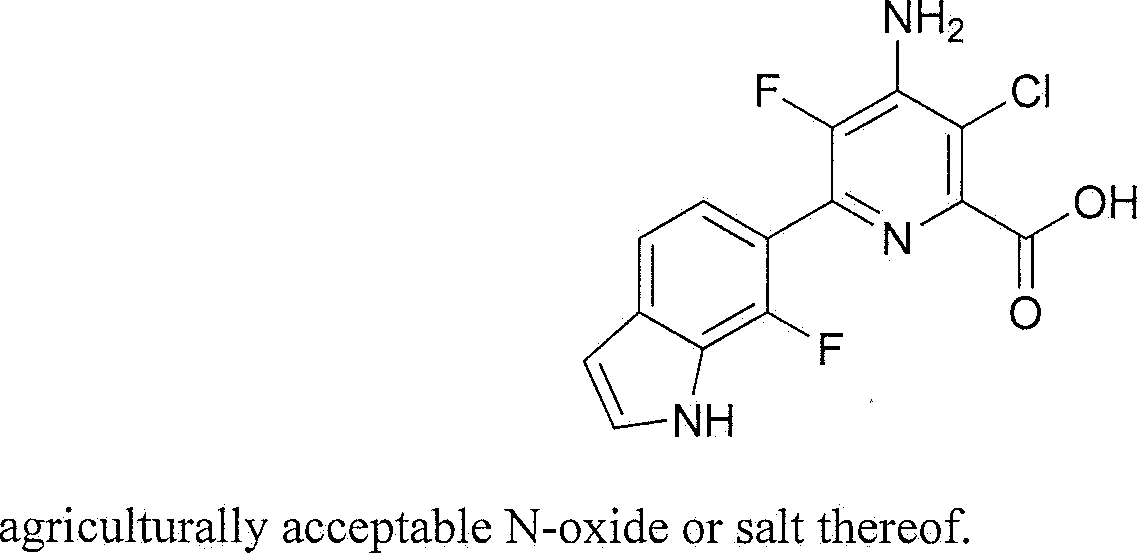
- la 1002262762
2014235452 31 Jul 2018 [0005B] In another aspect of the invention there is provided a compound defined by the formula below:
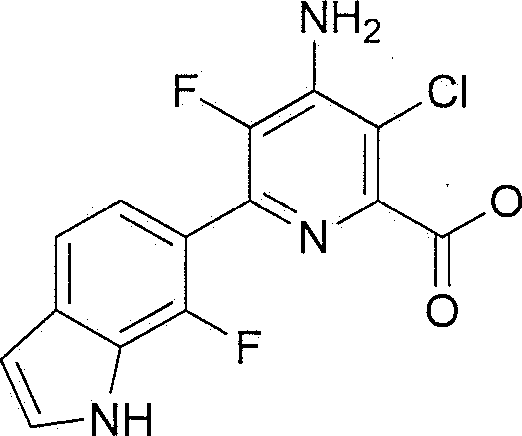
or an agriculturally acceptable N-oxide or salt thereof.
[0005C] Also provided herein are compounds of Formula (I):

wherein
X is N or CY, wherein Y is hydrogen, halogen, C1-C3 alkyl, C1-C3 haloalkyl, C1-C3 0 alkoxy, C1-C3 haloalkoxy, C1-C3 alkoxy, C1-C3 alkylthio or C1-C3 haloalkylthio;
- lbWO 2014/151005
PCT/US2014/024745
R1 is OR1 or NR1 R1 , wherein R1 is hydrogen, Ci-Cs alkyl, or C7-C10 arylalkyl, and R1 and R1 are independently hydrogen, C1-C12 alkyl, C3-C12 alkenyl, or C3-C12 alkynyl;
R2 is halogen, C1-C4 alkyl, C1-C4 haloalkyl, C2-C4 alkenyl, C2-C4 haloalkenyl, 5 C2-C4 alkynyl, C1-C4 alkoxy, C1-C4 haloalkoxy, C1-C4 alkylthio, C1-C4 haloalkylthio, amino, C1-C4 alkylamino, C2-C4 haloalkylamino, formyl, C1-C3 alkylcarbonyl, C1-C3 haloalkylcarbonyl, cyano, or a group of the formula -CR17=CR18-SiR19R20R21, wherein R17 is hydrogen, F, or Cl; R18 is hydrogen, F, Cl, C1-C4 alkyl, or C1-C4
20 21 haloalkyl; and R , R , and R are independently C1-C10 alkyl, C3-C6 cycloalkyl, phenyl, substituted phenyl, C1-C10 alkoxy, or OH;
R3 and R4 are independently hydrogen, C1-C6 alkyl, C1-C6 haloalkyl, C3-C6 alkenyl, C3-C6 haloalkenyl, C3-C6 alkynyl, formyl, C1-C3 alkylcarbonyl, C1-C3 haloalkylcarbonyl, C1-C6 alkoxycarbonyl, C1-C6 alkylcarbamyl, C1-C6 alkylsulfonyl, C1-C6 trialkylsilyl, C1-C6 dialkylphosphonyl, or R3 and R4 taken together with N is a
5- or 6-membered saturated ring, or R3 and R4 taken together represent =CR3 (R4 ), wherein R3 and R4 are independently hydrogen, Ci-C6 alkyl, C3-C6 alkenyl, C3-C6 alkynyl, C1-C6 alkoxy or C1-C6 alkylamino, or, R3 and R4 taken together with =C represent a 5- or 6-membered saturated ring;
A is one of groups A1 to A3 6
-2WO 2014/151005
PCT/US2014/024745

A13
A14
A15
A16
WO 2014/151005
PCT/US2014/024745

A17 A18 A19 A20

A21 A22

A23 A24


4·
2014/151005
PCT/US2014/024745

A33


A35
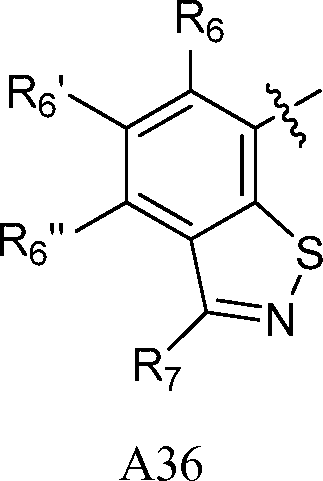
R5, if applicable to the A group, is hydrogen, halogen, C1-C4 alkyl, C1-C4 haloalkyl, cyclopropyl, halocyclopropyl, C2-C4 alkenyl, C2-C4 haloalkenyl, C2-C4 alkynyl, C1-C3 alkoxy, C1-C3 haloalkoxy, C4-C3 alkylthio, C4-C3 haloalkylthio, amino, C1-C4 alkylamino, C2-C4 haloalkylamino, OH, or CN;
R6, R6 , and R6 , if applicable to the A group, are independently hydrogen, halogen, C1-C4 alkyl, C1-C4 haloalkyl, cyclopropyl, halocyclopropyl, C2-C4 alkenyl, C2-C4 haloalkenyl, C2-C4 alkynyl, C1-C3 alkoxy, C1-C3 haloalkoxy, C1-C3 alkylthio, C1-C3 haloalkylthio, amino, C1-C4 alkylamino or C2-C4 haloalkylamino, OH, CN, or NO2;
R7 and R7 are independently hydrogen, halogen, C1-C4 alkyl, C1-C4 haloalkyl, cyclopropyl, halocyclopropyl, C2-C4 alkenyl, C2-C4 haloalkenyl, C2-C4 alkynyl, C1-C3 alkoxy, C1-C3 haloalkoxy,C1-C3 alkylthio, C1-C3 haloalkylthio, amino, C1-C4 alkylamino, C1-C4 haloalkylamino, or phenyl;
R8 is hydrogen, C1-C6 alkyl, C1-C6 haloalkyl, C3-C6 alkenyl, C3-C6 haloalkenyl, C3-C6 alkynyl, formyl, C1-C3 alkylcarbonyl, C1-C3 haloalkylcarbonyl, Ci-C6 alkoxycarbonyl, Ci-C6 alkylcarbamyl, Ci-C6 alkylsulfonyl, Ci-C6 trialkylsilyl, or phenyl;
or an N-oxide or agriculturally acceptable salt thereof.
[0006] In some embodiments, the compound is a compound of Formula (I):
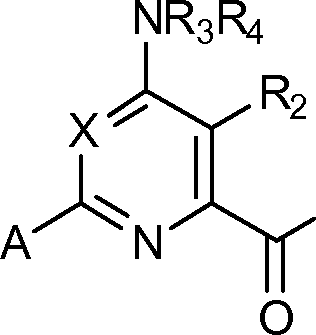
wherein
-5'
2014/151005
PCT/US2014/024745
X is N or CY, wherein Y is hydrogen, halogen, C1-C3 alkyl, C1-C3 haloalkyl, C1-C3 alkoxy, C1-C3 haloalkoxy, C1-C3 alkoxy, C1-C3 alkylthio, or C1-C3 haloalkylthio;
R1 is OR1 or NR1 R1 , wherein R1 is hydrogen, Ci-C8 alkyl, or C7-C10 arylalkyl, and R1 and R1 are independently hydrogen, C1-C12 alkyl, C3-C12 alkenyl, or C3-C12 alkynyl;
R2 is halogen, C1-C4 alkyl, C1-C4 haloalkyl, C2-C4 alkenyl, C2-C4 haloalkenyl, C2-C4 alkynyl, C1-C4 alkoxy, C1-C4 haloalkoxy, C1-C4 alkylthio, C1-C4 haloalkylthio, amino, C1-C4 alkylamino, C2-C4 haloalkylamino, formyl, C1-C3 alkylcarbonyl, C1-C3 haloalkylcarbonyl, cyano, or a group of the formula -CR17=CR18-SiR19R20R21, wherein R17 is hydrogen, F, or Cl; R18 is hydrogen, F, Cl, C1-C4 alkyl, or C1-C4
20 21 haloalkyl; and R , R , and R are independently C1-C10 alkyl, C3-C6 cycloalkyl, phenyl, substituted phenyl, C1-C10 alkoxy, or OH;
R3 and R4 are independently hydrogen, C1-C6 alkyl, C1-C6 haloalkyl, C3-C6 alkenyl, C3-C6 haloalkenyl, C3-C6 alkynyl, formyl, C1-C3 alkylcarbonyl, C1-C3 haloalkylcarbonyl, C1-C6 alkoxycarbonyl, C1-C6 alkylcarbamyl, C1-C6 alkylsulfonyl, C1-C6 trialkylsilyl, C1-C6 dialkylphosphonyl, or R3 and R4 taken together with N is a 5- or 6-membered saturated ring, or R3 and R4 taken together represent =CR3 (R4), wherein R3 and R4 are independently hydrogen, C1-C6 alkyl, C3-C6 alkenyl, C3-C6 alkynyl, C1-C6 alkoxy or C1-C6 alkylamino, or, R3 and R4 taken together with =C represent a 5- or 6-membered saturated ring;
A is Al, A2, A3, A4, A5, A6, A7, A8, A9, A10, All, A12, A13, A14, A15, A16, A17, A18, A19, A20, A21, A22, A23, A24, A25, A26, A27, A28, A29, A30, A31, A32, A33, A34, A35, or A36;
R5 is hydrogen, halogen, C1-C4 alkyl, C1-C4 haloalkyl, cyclopropyl, halocyclopropyl, C2-C4 alkenyl, C2-C4 haloalkenyl, C2-C4 alkynyl, C1-C3 alkoxy, CiC3 haloalkoxy, C1-C3 alkylthio, C1-C3 haloalkylthio, amino, C1-C4 alkylamino, C2-C4 haloalkylamino, OH, or CN;
R6, R6, and R6 are independently hydrogen, halogen, C1-C4 alkyl, C1-C4 haloalkyl, cyclopropyl, halocyclopropyl, C2-C4 alkenyl, C2-C4 haloalkenyl, C2-C4 alkynyl, C1-C3 alkoxy, C1-C3 haloalkoxy, C1-C3 alkylthio, C1-C3 haloalkylthio, amino, C1-C4 alkylamino or C2-C4 haloalkylamino, OH, CN, or NO2;
-62014/151005
PCT/US2014/024745
R7and R7 are independently hydrogen, halogen, C1-C4 alkyl, C1-C4 haloalkyl, cyclopropyl, halocyclopropyl, C2-C4 alkenyl, C2-C4 haloalkenyl, C2-C4 alkynyl, C1-C3 alkoxy, C1-C3 haloalkoxy,Ci-C3 alkylthio, C1-C3 haloalkylthio, amino, C1-C4 alkylamino, C2-C4 haloalkylamino, or phenyl;
R8 is hydrogen, C1-C6 alkyl, C1-C6 haloalkyl, C3-C6 alkenyl, C3-C6 haloalkenyl, C3-C6 alkynyl, formyl, C1-C3 alkylcarbonyl, C1-C3 haloalkylcarbonyl, C1-C6 alkoxycarbonyl, C1-C6 alkylcarbamyl, C1-C6 alkylsulfonyl, C1-C6 trialkylsilyl, or phenyl;
or an N-oxide or agriculturally acceptable salt thereof, with the proviso that the compound is not a compound of Formula (I):

wherein
X is N, CH, CF, CC1, or CBr;
R1 is OR1, wherein R1 is hydrogen or C1-C4 alkyl;
R2 is chlorine;
R3 and R4 are hydrogen;
A is Al, A2, A3, A4, A5, A6, A7, A8, A9, A10, All, A12, A13, A14, A15, A16, A17, A18, A19, orA20;
R5 is hydrogen, halogen, OH, amino, CN, C1-C3 alkyl, C1-C3 alkoxy, C1-C3 alkylamino, or cyclopropyl;
R6, R6 , and R6 are independently hydrogen, halogen, OH, NH2, CN, C1-C3 alkyl, C1-C3 alkoxy, cyclopropyl, or vinyl;
R7and R7 are independently hydrogen, halogen, C1-C3 alkyl, C1-C3 alkoxy, C1-C3 alkylthio, cyclopropyl, or C1-C3 alkylamino, or phenyl; and
R8 is hydrogen, C1-C3 alkyl, phenyl, or C1-C3 alkylcarbonyl; or an N-oxide or agriculturally acceptable salt thereof.
[0007] In some embodiments, the compound is a compound of Formula (I):
-72014/151005
PCT/US2014/024745

wherein
X is CF;
R1 is OR1, wherein R1 is hydrogen, Ci-C8 alkyl, or C7-C10 arylalkyl;
R2 is halogen, C1-C4 alkyl, C1-C4 haloalkyl, C2-C4 alkenyl, C2-C4 haloalkenyl, C2-C4 alkynyl, C1-C4 alkoxy, C1-C4 haloalkoxy, C1-C4 alkylthio, C1-C4 haloalkylthio, amino, C1-C4 alkylamino, C2-C4 haloalkylamino, formyl, C1-C3 alkylcarbonyl, C1-C3 haloalkylcarbonyl, cyano, or a group of the formula -CR17=CR18-SiR19R20R21, wherein R17 is hydrogen, F, or Cl; R18 is hydrogen, F, Cl, C1-C4 alkyl, or C1-C4
20 21 haloalkyl; and R , R , and R are independently C1-C10 alkyl, C3-C6 cycloalkyi, phenyl, substituted phenyl, C1-C10 alkoxy, or OH;
R3 and R4 are independently hydrogen, Ci-C6 alkyl, Ci-C6 haloalkyl, C3-C6 alkenyl, C3-C6 haloalkenyl, C3-C6 alkynyl, formyl, C1-C3 alkylcarbonyl, C1-C3 haloalkylcarbonyl, C1-C6 alkoxycarbonyl, C1-C6 alkylcarbamyl, C1-C6 alkylsulfonyl, C1-C6 trialkylsilyl, C1-C6 dialkylphosphonyl, or R3 and R4 taken together with N is a 5- or 6-membered saturated ring, or R3 and R4 taken together represent =CR3 (R4), wherein R3 and R4 are independently hydrogen, C1-C6 alkyl, C3-C6 alkenyl, C3-C6 alkynyl, C1-C6 alkoxy or C1-C6 alkylamino, or, R3 and R4 taken together with =C represent a 5- or 6-membered saturated ring;
A is Al, A2, A3, A4, A5, A6, A7, A8, A9, A10, All, A12, A13, A14, A15, A16, A17, A18, A19, A20, A21, A22, A23, A24, A25, A26, A27, A28, A29, A30, A31, A32, A33, A34, A35, or A36;
R5 is hydrogen, halogen, C1-C4 alkyl, C1-C4 haloalkyl, cyclopropyl, halocyclopropyl, C2-C4 alkenyl, C2-C4 haloalkenyl, C2-C4 alkynyl, C1-C3 alkoxy, CiC3 haloalkoxy, C1-C3 alkylthio, C1-C3 haloalkylthio, amino, C1-C4 alkylamino, C2-C4 haloalkylamino, OH, or CN;
R6, R6, and R6 are independently hydrogen, halogen, C1-C4 alkyl, C1-C4 haloalkyl, cyclopropyl, halocyclopropyl, C2-C4 alkenyl, C2-C4 haloalkenyl, C2-C4
-82014/151005
PCT/US2014/024745 alkynyl, C1-C3 alkoxy, C1-C3 haloalkoxy, C1-C3 alkylthio, C1-C3 haloalkylthio, amino, C1-C4 alkylamino or C2-C4 haloalkylamino, OH, CN, or NO2;
R7and R7 are independently hydrogen, halogen, C1-C4 alkyl, C1-C4 haloalkyl, cyclopropyl, halocyclopropyl, C2-C4 alkenyl, C2-C4 haloalkenyl, C2-C4 alkynyl, C1-C3 alkoxy, C1-C3 haloalkoxy,C1-C3 alkylthio, C1-C3 haloalkylthio, amino, C1-C4 alkylamino, C2-C4 haloalkylamino, or phenyl;
R8 is hydrogen, C1-C6 alkyl, C1-C6 haloalkyl, C3-C6 alkenyl, C3-C6 haloalkenyl, C3-C6 alkynyl, formyl, C1-C3 alkylcarbonyl, C1-C3 haloalkylcarbonyl, C1-C6 alkoxycarbonyl, C1-C6 alkylcarbamyl, C1-C6 alkylsulfonyl, C1-C6 trialkylsilyl, or phenyl;
or an N-oxide or agriculturally acceptable salt thereof [0008] In some embodiments, R2 is Cl, methoxy, vinyl, or 1-propenyl, and R3 and R4 are hydrogen. In certain embodiments, R2 is Cl, and R3 and R4 are hydrogen.
[0009] In some embodiments, A is A15 and/or R5 is hydrogen or F.
[0010] In one embodiment, the compound is 4-amino-3-chloro-5-fluoro-6-(7fluoro-1 /7-indol-6-yl) picolinic acid. In one embodiment, the compound is methyl 4amino-3-chloro-5-fluoro-6-(7-fluoro-1 AZ- i n do 1-6-y 1) picolinate.
[0011] Also provided are methods of controlling undesirable vegetation comprising (a) contacting the undesirable vegetation or area adjacent to the undesirable vegetation or (b) pre-emergently contacting soil or water a herbicidally effective amount of at least one compound of Formula (I) or agriculturally acceptable derivative thereof.

wherein:
R7 and R7 are independently hydrogen, halogen, C1-C4 alkyl, C1-C4 haloalkyl, cyclopropyl, halocyclopropyl, C2-C4 alkenyl, C2-C4 haloalkenyl, C2-C4 alkynyl, C1-C3
-92014/151005
PCT/US2014/024745 alkoxy, C1-C3 haloalkoxy, C1-C3 alkylthio, C1-C3 haloalkylthio, amino, C1-C4 alkyiamino, C2-C4 haloalkylamino, or phenyl;
R8 is hydrogen, C1-C6 alkyl, C1-C6 haloaikyi, C3-C6 alkenyl, C3-C6 haloalkenyl, C3-C6 aikynyi, formyl, C4-C3 alkylcarbonyl, C4-C3 haloalkylcarbonyl, C1-C6 alkoxycarbonyl, C1-C6 alkylcarbamyl, C1-C6 alkylsulfonyl, C1-C6 trialkylsilyl, or phenyl;
Z is B(OR22)2, BF3M, or Sn(R23)3j wherein each R22 is independently hydrogen or C1-C4 alkyl, or the two OR22 moieties combine to form -O-C(CH3)2-C(CH3)2-O- or -O-CH2-C(CH3)2-CH2-O-; M is a metal cation, e.g. sodium or potassium, and R23 is
C1-C4 alkyl;
provided the following compound is excluded:

Detailed Description
DEFINITIONS [0013] As used herein, herbicide and herbicidal active ingredient mean a compound that controls undesirable vegetation when applied in an appropriate amount.
[0014] As used herein, control of or controlling undesirable vegetation means killing or preventing the vegetation, or causing some other adversely modifying effect to the vegetation e.g., deviations from natural growth or development, regulation, desiccation, retardation, and the like.
[0015] As used herein, a herbicidally effective or vegetation controlling amount is an amount of herbicidal active ingredient the application of which controls the relevant undesirable vegetation.
[0016] As used herein, applying a herbicide or herbicidal composition means delivering it directly to the targeted vegetation or to the locus thereof or to the area where control of undesired vegetation is desired. Methods of application include, but
-102014/151005
PCT/US2014/024745 are not limited to pre-emergently contacting soil or water, post-emergently contacting the undesirable vegetation or area adjacent to the undesirable vegetation.
[0017] As used herein, plants and vegetation include, but are not limited to, dormant seeds, germinant seeds, emerging seedlings, plants emerging from vegetative propagules, immature vegetation, and established vegetation.
[0018] As used herein, agriculturally acceptable salts and esters refer to salts and esters that exhibit herbicidal activity, or that are or can be converted in plants, water, or soil to the referenced herbicide. Exemplary agriculturally acceptable esters are those that are or can by hydrolyzed, oxidized, metabolized, or otherwise converted, e.g., in plants, water, or soil, to the corresponding carboxylic acid which, depending on the pH, may be in the dissociated or undissociated form.
[0019] Suitable salts include those derived from alkali or alkaline earth metals and those derived from ammonia and amines. Preferred cations include sodium, potassium, magnesium, and aminium cations of the formula:
R13R14R15R16N+ wherein R13, R14, R15 and R16 each, independently represents hydrogen or C1-C12 alkyl, C3-C12 alkenyl or C3-C12 alkynyl, each of which is optionally substituted by one or more hydroxy, C1-C4 alkoxy, C1-C4 alkylthio or phenyl groups, provided that R13, R14, R15 and R16 are sterically compatible. Additionally, any two R13, R14, R15 and R16 together may represent an aliphatic difunctional moiety containing one to twelve carbon atoms and up to two oxygen or sulfur atoms. Salts of the compounds of Formula I can be prepared by treatment of compounds of Formula I with a metal hydroxide, such as sodium hydroxide, with an amine, such as ammonia, trimethylamine, diethanolamine, 2-methylthiopropylamine, bisallylamine, 2-butoxyethylamine, morpholine, cyclododecylamine, or benzylamine or with a tetraalkylammonium hydroxide, such as tetramethylammonium hydroxide or choline hydroxide. Amine salts are often preferred forms of the compounds of Formula I because they are watersoluble and lend themselves to the preparation of desirable aqueous based herbicidal compositions.
[0020] Compounds of the formula (I) include N-oxides. Pyridine N-oxides can be obtained by oxidation of the corresponding pyridines. Suitable oxidation methods are described, for example, in Houben-Weyl, Methoden der organischen Chemie
-112014/151005
PCT/US2014/024745 [Methods in organic chemistry}, expanded and subsequent volumes to the 4th edition, volume E 7b, p. 565 f.
[0021] As used herein, unless otherwise specified, acyl refers to formyl, C1-C3 alkylcarbonyl, and C4-C3 haloalkylcarbonyl. C1-C6 acyl refers to formyl, C4-C5 alkylcarbonyl, and C1-C5 haloalkylcarbonyl (the group contains a total of 1 to 6 carbon atoms).
[0022] As used herein, alkyl refers to saturated, straight-chained or branched saturated hydrocarbon moieties. Unless otherwise specified, C1-C10 alkyl groups are intended. Examples include methyl, ethyl, propyl, 1-methyl-ethyl, butyl, 1-methylpropyl, 2-methyl-propyl, 1,1-dimethyl-ethyl, pentyl, 1-methyl-butyl, 2-methyl-butyl,
3-methyl-butyl, 2,2-dimethyl-propyl, 1-ethyl-propyl, hexyl, 1,1-dimethyl-propyl, 1,2dimethyl-propyl, 1-methyl-pentyl, 2-methyl-pentyl, 3-methyl-pentyl, 4-methyl-pentyl,
1,1-dimethyl-butyl, 1,2-dimethyl-butyl, 1,3-dimethyl-butyl, 2,2-dimethyl-butyl, 2,3dimethyl-butyl, 3,3-dimethyl-butyl, 1-ethyl-butyl, 2-ethyl-butyl, 1,1,2-trimethylpropyl, 1,2,2-trimethyl-propyl, 1-ethyl-1-methyl-propyl, and l-ethyl-2-methyl-propyl. [0023] As used herein, “haioalkyi” refers to straight-chained or branched alkyl groups, wherein these groups the hydrogen atoms may partially or entirely be substituted with halogen atoms. Unless otherwise specified, Ci-Cs groups are intended. Examples include chloromethyl, bromomethyl, dichloromethyl, trichloromethyl, fluoromethyl, difluoromethyl, trifluoromethyl, chlorofluoromethyl, dichlorofluoromethyl, chlorodifluoromethyl, 1-chloroethyl, 1-bromoethyl, 1fluoroethyl, 2-fluoroethyl, 2,2-difluoroethyl, 2,2,2-trifluoroethyl, 2-chloro-2fluoroethyl, 2-chloro-2-difluoroethyl, 2,2-dichloro-2-fluoroethyl, 2,2,2-trichloroethyl, pentafluoroethyl, and l,l,l-trifluoroprop-2-yl.
[0024] As used herein, alkenyl refers to unsaturated, straight-chained, or branched hydrocarbon moieties containing a double bond. Unless otherwise specified, C2-C8 alkenyl are intended. Alkenyl groups may contain more than one unsaturated bond. Examples include ethenyl, 1-propenyl, 2-propenyl, 1-methylethenyl, 1-butenyl, 2butenyl, 3-butenyl, 1-methyl-1-propenyl, 2-methyl- 1-propenyl, l-methyl-2-propenyl, 2-methyl-2-propenyl, 1-pentenyl, 2-pentenyl, 3-pentenyl, 4-pentenyl, 1-methyl-1butenyl, 2-methyl- 1-butenyl, 3-methyl-1-butenyl, l-methyl-2-butenyl, 2-methyl-2butenyl, 3-methyl-2-butenyl, 1-methyl-3-butenyl, 2-methyl-3-butenyl, 3-methyl-3-122014/151005
PCT/US2014/024745 butenyl, 1,1-dimethyl-2-propenyl, 1,2-dimethyl-l-propenyl, 1,2-dimethyl-2-propenyl,
1-ethyl-1-propenyl, 1-ethyl-2-propenyl, 1-hexenyl, 2-hexenyl, 3-hexenyl, 4-hexenyl,
5-hexenyl, 1-methyl-1-pentenyi, 2-methyl-1 -pentenyi, 3-methyl-1-pentenyi, 4-methyl1- pentenyi, l-methyl-2-pentenyl, 2-methyl-2-pentenyl, 3-methyl-2-pentenyl, 4methyl-2-pentenyi, 1-methyl-3-pentenyi, 2-methyl-3 -pentenyi, 3-methyl-3-pentenyi, 4-methyl-3 -pentenyi, l-methyl-4-pentenyl, 2-methyl-4-pentenyl, 3-methyl-4pentenyl, 4-methyl-4-pentenyl, 1,1-dimethyl-2-butenyl, 1,1-dimethyl-3-butenyl, 1,2dimethyl-1 -butenyl, 1,2-dimethyl-2-butenyl, 1,2-dimethyl-3 -butenyl, 1,3-dimethyl-1butenyl, l,3-dimethyl-2-butenyl, l,3-dimethyl-3-butenyl, 2,2-dimethyl-3-butenyl, 2,3dimethyl-1 -butenyl, 2,3-dimethyl-2-butenyl, 2,3-dimethyl-3-butenyl, 3,3-dimethyl-1butenyl, 3,3-dimethyl-2-butenyl, 1-ethyl-1-butenyl, 1-ethyl-2-butenyl, l-ethyl-3butenyl, 2-ethyl-l-butenyl, 2-ethyl-2-butenyl, 2-ethyl-3-butenyl, l,l,2-trimethyl-2propenyl, 1 -ethyl- l-methyl-2-propenyl, l-ethyl-2-methyl- 1-propenyl, and l-ethyl-2methyl-2-propenyl. Vinyl refers to a group having the strutcture -CH=CH2; 1propenyl refers to a group with the structure-CH=CH-CH3; and 2- propenyl refers to a group with the structure -CH2-CH=CH2.
[0025] As used herein, alkynyl represents straight-chained or branched hydrocarbon moieties containing a triple bond. Unless otherwise specified, C2-C8 alkynyl groups are intended. Alkynyl groups may contain more than one unsaturated bond. Examples include C2-C6-alkynyl, such as ethynyl, 1-propynyl, 2-propynyl (or propargyl), 1-butynyl, 2-butynyl, 3-butynyl, l-methyl-2-propynyl, 1-pentynyl, 2pentynyl, 3-pentynyl, 4-pentynyl, 3-methyl-1-butynyl, l-methyl-2-butynyl, 1-methyl3-butinyul, 2-methyl-3-butynyl, 1,1-dimethyl-2-propynyl, l-ethyl-2-propynyl, 1hexynyl, 2-hexynyl, 3-hexynyl, 4-hexynyl, 5-hexynyl, 3-methyl-1-pentynyl, 4methyl-1-pentynyl, l-methyl-2-pentynyl, 4-methyl-2-pentynyl, 1-methyl-3-pentynyl,
2- methyl-3-pentynyl, l-methyl-4-pentynyl, 2-methyl-4-pentynyl, 3-methyl-4pentynyl, 1,1 -dimethyl-2-butynyl, 1,1 -dimethyl-3 -butynyl, 1,2-dimethyl-3 -butynyl,
2,2-dimethyl-3-butynyl, 3,3-dimethyl-1-butynyl, 1-ethyl-2-butynyl, 1-ethyl-3-butynyl, 2-ethyl-3-butynyl, and 1 -ethyl- l-methyl-2-propynyl.
[0026] As used herein, alkoxy refers to a group of the formula R-Ο-, where R is alkyl as defined above. Unless otherwise specified, alkoxy groups wherein R is a CiCg alkyl group are intended. Examples include methoxy, ethoxy, propoxy, 1-methyl-132014/151005
PCT/US2014/024745 ethoxy, butoxy, 1-methyl-propoxy, 2-methyl-propoxy, 1,1-dimethyl-ethoxy, pentoxy,
1- methyl-butyloxy, 2-methyl-butoxy, 3-methyl-butoxy, 2,2-di-methyl-propoxy, 1ethyl-propoxy, hexoxy, 1,1-dimethyl-propoxy, 1,2-dimethyl-propoxy, 1-methylpentoxy, 2-methyl-pentoxy, 3-methyl-pentoxy, 4-methyl-penoxy, 1,1-dimethylbutoxy, 1,2-dimethyl-butoxy, 1,3-dimethyl-butoxy, 2,2-dimethyl-butoxy, 2,3dimethyl-butoxy, 3,3-dimethyl-butoxy, 1-ethyl-butoxy, 2-ethylbutoxy, 1,1,2trimethyl-propoxy, 1,2,2-trimethyl-propoxy, 1-ethyl-1-methyl-propoxy, and 1-ethyl2- methyl-propoxy.
[0027] As used herein, haloalkoxy refers to a group of the formula R-Ο-, where R is haloalkyl as defined above. Unless otherwise specified, haloalkoxy groups wherein R is a Ci-Cs alkyl group are intended. Examples include chloromethoxy, bromomethoxy, dichloromethoxy, trichloromethoxy, fluoromethoxy, difluoromethoxy, trifluoromethoxy, chlorofluoromethoxy, dichlorofluoromethoxy, chlorodifluoromethoxy, 1-chloroethoxy, 1-bromoethoxy, 1-fluoroethoxy, 2fluoroethoxy, 2,2-difluoroethoxy, 2,2,2-trifluoroethoxy, 2-chloro-2-fluoroethoxy, 2chloro,2-difluoroethoxy, 2,2-dichloro-2-fluoroethoxy, 2,2,2-trichloroethoxy, pentafluoroethoxy, and l,l,l-trifluoroprop-2-oxy.
[0028] As used herein, alkylthio refers to a group of the formula R-S- where R is alkyl as defined above. Unless otherwise specified, alkylthio groups wherein R is a Ci-Cs alkyl group are intended. Examples include methylthio, ethylthio, propylthio, 1-methylethylthio, butylthio, 1-methyl-propylthio, 2-methylpropylthio, 1,1dimethylethylthio, pentylthio, 1-methylbutylthio, 2-methylbutylthio, 3methylbutylthio, 2,2-dio-methylpropylthio, 1-ethylpropylthio, hexylthio, 1,1-dimethyl propylthio, 1,2-dimethyl propylthio, 1-methylpentylthio, 2-methylpentylthio, 3methyl-pentylthio, 4-methyl-pentylthio, 1,1-dimethyl butylthio, 1,2-dimethylbutylthio, 1,3-dimethyl-butylthio, 2,2-dimethyl butylthio, 2,3-dimethyl butylthio, 3,3dimethylbutylthio, 1-ethylbutylthio, 2-ethylbutylthio, 1,1,2-trimethyl propylthio,
1,2,2-trimethyl propylthio, 1-ethyl-1-methyl propylthio, and 1-ethyl-2 methy lpropy lthio.
[0029] As used herein, haloalkylthio refers to an alkylthio group as defined above wherein the carbon atoms are partially or entirely substituted with halogen atoms. Unless otherwise specified, haloalkylthio groups wherein R is a Ci-Cs alkyl group are
-142014/151005
PCT/US2014/024745 intended. Examples include chloromethylthio, bromomethylthio, dichloromethylthio, trichloromethylthio, fluoromethylthio, difluoromethylthio, trifluoromethylthio, chlorofluoromethylthio, dichlorofluoro-methylthio, chlorodifluoromethylthio, 1chloroethylthio, 1-bromoethylthio, 1-fluoroethylthio, 2-fluoroethylthio, 2,2difluoroethylthio, 2,2,2-trifluoroethylthio, 2-chloro-2-fluoroethylthio, 2-chloro-2difluoroethylthio, 2,2-dichloro-2-fluoroethylthio, 2,2,2-trichloroethylthio, pentafluoroethylthio, and l,l,l-trifluoroprop-2-ylthio.
[0030] As used herein, aryl, as well as derivative terms such as aryloxy, refers to a phenyl, indanyl or naphthyl group with phenyl being preferred. The term heteroaryl, as well as derivative terms such as heteroaryloxy, refers to a 5- or 6membered aromatic ring containing one or more heteroatoms, viz., N, O or S; these heteroaromatic rings may be fused to other aromatic systems. The aryl or heteroaryl substituents may be unsubstituted or substituted with one or more substituents selected from halogen, hydroxy, nitro, cyano, formyl, C1-C6 alkyl, CE-C’e alkenyl, C2C6 alkynyl, C1-C6 alkoxy, C1-C6 haloalkyl, C1-C6 haloalkoxy, C1-C6 acyl, C1-C6 alkylthio, Ci-C6 alkylsulfinyl, Ci-C6 alkylsulfonyl, Ci-C6 alkoxycarbonyl, Ci-C6 carbamoyl, hydroxycarbonyl, C1-C6 alkylcarbonyl, aminocarbonyl, C1-C6 alkylaminocarbonyl, C1-C6 dialkylaminocarbonyl, provided that the substituents are sterically compatible and the rules of chemical bonding and strain energy are satisfied. Preferred substituents include halogen, Ci-C2 alkyl and Ci-C2 haloalkyl. [0031] As used herein alkylcarbonyl refers to an alkyl group bonded to a carbonyl group. C1-C3 alkylcarbonyl and C1-C3 haloalkylcarbonyl refer to groups wherein a C1-C3 alkyl group is bonded to a carbonyl group (the group contains a total of 2 to 4 carbon atoms).
[0032] As used herein, alkoxycarbonyl refers to a group of the formula ' OR wherein R is alkyl.
[0033] As used herein, arylalkyl refers to an alkyl group substituted with an aryl group. C7-C10 arylalkyl refers to a group wherein the total number of carbon atoms in the group is 7 to 10.
[0034] As used herein alkylamino refers to an amino group substituted with one or two alkyl groups, which may be the same or different.
-152014/151005
PCT/US2014/024745 [0035] As used herein haloalkylamino refers to an alkylamino group wherein the alkyl carbon atoms are partially or entirely substituted with halogen atoms.
[0036] As used herein, C1-C6 alkylaminocarbonyl refers to a group of the formula RNHC(O)- wherein R is C1-C6 alkyl, and C1-C6 dialkylaminocarbonyl refers to a group of the formula R2NC(O)- wherein each R is independently C1-C6 alkyl.
[0037] As used herein alkylcarbamyl refers to a carbamyl group substituted on the nitrogen with an alkyl group.
II [0038] As used herein alkylsulfonyl refers to a group of the formula π R O where R is alkyl.
[0039] As used herein carbamyl (also referred to as carbamoyl and O aminocarbonyl) refers to a group of the formula [0040] As used herein dialkylphosphonyl refers to a group of the formula
II
P OR where R is independently alkyl in each occurrence. OR [0041] As used herein, C1-C6 trialkylsilyl refers to a group of the formula -S1R3 wherein each R is independently a Ci-C6 alkyl group (the group contains a total of 3 to 18 carbon atoms).
[0042] As used herein Me refers to a methyl group; OMe refers to a methoxy group; z'-Pr refers to an isopropyl group.
[0043] As used herein, the term “halogen” including derivative terms such as “halo” refers to fluorine, chlorine, bromine and iodine.
[0044] As used herein, plants and vegetation include, but are not limited to, germinant seeds, emerging seedlings, plants emerging from vegetative propagules, immature vegetation, and established vegetation.
COMPOUNDS OF FORMULA (I) [0045] The invention provides compounds of Formula (I) as defined above and Noxides and agriculturally acceptable salts thereof.
-162014/151005
PCT/US2014/024745 [0046] In some embodiments, the compound is the carboxylic acid or an agriculturally acceptable ester or salt. In some embodiments, the compound is the carboxylic acid or its methyl ester.
[0047] In some embodiments:
A is one of groups Al to A20;
R1 is OR1, wherein R1 is hydrogen or C1-C4 alkyl;
R2 is chlorine;
R3 and R4 are hydrogen;
X is N, CH, CF, CC1, or CBr;
R5 is hydrogen, halogen, OH, NH2, CN, C1-C3 alkyl, C1-C3 alkoxy, C1-C3 alkylamino, or cyclopropyl;
R6, R6 , and R6 are independently hydrogen, halogen, OH, NH2, CN, C1-C3 alkyl, C1-C3 alkoxy, cyclopropyl, or vinyl;
R7 and R7 are independently hydrogen, halogen, C1-C3 alkyl, C1-C3 alkoxy,
C1-C3 alkylthio, cyclopropyl, or C1-C3 alkylamino, or phenyl; and R8 is hydrogen, C1-C3 alkyl, phenyl, or C1-C3 alkylcarbonyl.
[0048] In some embodiments, R1 is OR1 , wherein R1 is hydrogen, Ci-Cg alkyl, or C7-C10 arylalkyl. In some embodiments, R1 is hydrogen or Ci-Cg alkyl. In some embodiments, R1 is hydrogen.
[0049] In some embodiments, R2 is halogen, C1-C4 alkyl, C1-C4 haloalkyl, C2-C4 alkynyl, C2-C4-alkenyl, C2-C4 haloalkenyl, or Ci-C4-alkoxy, or C1-C4 haloalkoxy. In some embodiments, R2 is halogen, C2-C4-alkenyl, C2-C4 haloalkenyl, or C1-C4alkoxy. In some embodiments, R2 is halogen. In some embodiements, R2 is C2-C4alkenyl or C2-C4 haloalkenyl. In some embodiments, R2 is C1-C4 alkoxy. In some embodiments, R2 is Cl, OMe, vinyl, or 1-propenyl. In some embodiments, R2 is Cl.
In some embodiments, R2 is OMe. In some embodiments, R2 is vinyl or 1-propenyl. [0050] In some embodiments, R3 and R4 are independently hydrogen, C1-C6 alkyl, C1-C6 haloalkyl, C3-C6 alkenyl, C3-C6 haloalkenyl, C3-C6 alkynyl, formyl, C1-C3 alkylcarbonyl, C4-C3 haloalkylcarbonyl, Cx-Ce alkoxycarbonyl, Cx-Ce alkylcarbamyl, or R3 and R4 taken together represent =CR3 (R4 ), wherein R3 and R4 are independently hydrogen, Cx-Ce alkyl, C3-C6 alkenyl, C3-C6 alkynyl, Ci-C’e alkoxy, or Οχ-Οδ alkylamino. In some embodiments, R3 and R4 are independently hydrogen, Ci-172014/151005
PCT/US2014/024745
C6 alkyl, C1-C6 haloalkyl, C3-C6 alkenyl, C3-C6 haloalkenyl, formyl, C1-C3 alkylcarbonyl, C1-C3 haloalkylcarbonyl, or R3 and R4 taken together represent =CR3 (R4), wherein R3 and R4 are independently hydrogen, C1-C6 alkyl, C1-C6 alkoxy or C1-C6 alkylamino. In some embodiments, R3 and R4 are independently hydrogen, C1-C6 alkyl, C1-C6 haloalkyl, C3-C6 alkenyl, C3-C6 haloalkenyl, formyl, C1-C3 alkylcarbonyl, or C1-C3 haloalkylcarbonyl. In some embodiments, at least one of R3 and R4 are hydrogen. In some embodiments, R3 and R4 are both hydrogen.
[0051] In some embodiments, X is N, CH or CF. In some embodiments, X is N.
In some embodiments, X is CH. In some embodiments, X is CF.
[0052] In some embodiments, A is Al, A2, A3, A4, A5, A6, A7, A8, A9, A10, All, A12, A13, A14, A15, A16, A17, A18, A19, or A20.
[0053] In some embodiments, A is one of A21, A22, A23, A24, A25, A26, A27, A28, A29, A30, A31, A32, A33, A34, A35, and A36.
[0054] In some embodiments, A is one of groups Al, A2, A3, A7, A8, A9, A10, A13, A14, and A15. In some embodiments, A is one of groups Al, A2, A3, A13,
A14, andA15. In some embodiments, A is one of groups A13, A14, and A15. In some embodiments, A is A15.
[0055] In some embodiments, R5 is hydrogen, halogen, C1-C4 alkyl, C1-C4 haloalkyl, C1-C3 alkoxy, C1-C3 haloalkoxy, C1-C3 alkylthio, C1-C3 haloalkylthio, or amino. In some embodiments, R5 is hydrogen, halogen, C1-C4 alkyl, C1-C4 haloalkyl, C1-C3 alkoxy, C1-C3 haloalkoxy, or amino. In some embodiments, R5 is hydrogen, halogen, C1-C4 alkyl or C1-C4 alkoxy. In some embodiments, R5 is hydrogen or F. In some embodiments, R5 is hydrogen.
In other embodiments, R5 is F.
[0056] In some embodiments, R6 is hydrogen, halogen, C1-C4 alkyl, C1-C4 haloalkyl, C1-C3 alkoxy, or C1-C3 haloalkoxy. In some embodiments, R6 is hydrogen or fluorine. In some embodiments, R6 is hydrogen. In some embodiments, R6 is fluorine.
[0057] In some embodiments, R6 is hydrogen or halogen. In some embodiments, R6 is hydrogen, F, or Cl. In some embodiments, R6 is hydrogen or F. In some embodiments, R6 is hydrogen.
-182014/151005
PCT/US2014/024745 [0058] In some embodiments, R6 is hydrogen, halogen, C1-C4 alkyl, C1-C4 haloalkyl, cyclopropyl, C2-C4 alkynyl, CN, or NCty In some embodiments, R6 is hydrogen. In some embodiments, R6 is halogen. In some embodiments, R6 is C1-C4 alkyl. In some embodiments, R6 is C1-C4 haloalkyl. In some embodiments, R6 is cyclopropyl. In some embodiments, R6 is C2-C4 alkynyl. In some embodiments, R6 is CN. In some embodiments, R6 is NO2.
[0059] In some embodiments:
R2 is halogen, C2-C4-alkenyl, C2-C4 haloalkenyl, or Ci-C4-alkoxy;
R3 and R4 are both hydrogen; and
X is N, CH, or CF.
[0060] In some embodiments:
R2 is halogen;
R3 and R4 are both hydrogen; and X is N, CH, or CF.
[0061] In some embodiments:
R2 is C2-C4-alkenyl or C2-C4 haloalkenyl;
R3 and R4 are both hydrogen; and X is N, CH, or CF.
[0062] In some embodiments:
R2 is Ci-C4-alkoxy;
R3 and R4 are both hydrogen; and X is N, CH, or CF.
[0063] In some embodiments:
R2 is halogen, C2-C4-alkenyl, C2-C4 haloalkenyl, or Ci-C4-alkoxy;
R3 and R4 are both hydrogen;
X is N, CH, or CF;
R5 is hydrogen or F;
R6 is hydrogen or F;
R6 is hydrogen;
R6 ,if applicable to the relevant A group, is hydrogen or halogen; and
R7 and R7 ,if applicable to the relevant A group, are independently hydrogen or halogen.
-192014/151005
PCT/US2014/024745 [0064] In some embodiments:
R2 is halogen, Ci-C4-alkoxy, or C2-C4-alkenyl;
R3 and R4 are hydrogen;
X is N, CH, or CF; and A is one of groups Al to A20;
[0065] In some embodiments:
R2 is chlorine;
R3 and R4 are hydrogen;
X is N, CH, or CF;
A is one of groups Al to A20;
R5 is hydrogen or F;
R6 and R6 are independently hydrogen or F; and
R7 and R7 ,if applicable to the relevant A group, are independently hydrogen, halogen, C1-C4 alkyl, or C1-C4 haloalkyl.
[0066] In some embodiments:
R2 is chlorine, methoxy, vinyl, or 1-propenyl;
R3 and R4 are hydrogen; and
X is N, CH, or CF.
[0067] In some embodiments:
R2 is chlorine;
R3 and R4 are hydrogen; and X is N, CH, or CF.
[0068] In some embodiments:
R2 is vinyl or 1-propenyl;
R3 and R4 are hydrogen; and X is N, CH, or CF.
[0069] In some embodiments:
R2 is methoxy;
R3 and R4 are hydrogen; and X is N, CH, or CF.
[0070] In some embodiments:
-202014/151005
PCT/US2014/024745
R2 is chlorine;
R3 and R4 are hydrogen; and XisN.
[0071] In some embodiments:
R2 is chlorine;
R3 and R4 are hydrogen; and X is CH.
[0072] In some embodiments:
R2 is chlorine;
R3 and R4 are hydrogen; and X is CF.
[0073] In some embodiments:
R2 is chlorine;
R3 and R4 are hydrogen;
X is CF;
A is one of Al, A2, A3, A7, A8, A9, A10, A13, A14, or A15; R5 is F; and R6 is H.
[0074] In some embodiments:
R2 is chlorine, methoxy, vinyl, or 1-propenyl;
R3 and R4 are hydrogen;
X is N, CH, or CF; and A is one of A21-A36.
[0075] In some embodiments:
R2 is chlorine, methoxy, vinyl, or 1-propenyl;
R3 and R4 are hydrogen;
X is CF; and A is one of
-212014/151005
PCT/US2014/024745

is hydrogen or F.
[0076] In some embodiments:
R2 is chlorine, methoxy, vinyl, or 1-propenyl; R3 and R4 are hydrogen;
X is N, CH, or CF; and

A is 'NH , where R5 is hydrogen or F. [0077] In some embodiments:
R2 is chlorine, methoxy, vinyl, or 1-propenyl;
R3 and R4 are hydrogen;

[0078] In some embodiments:
R2 is chlorine, methoxy, vinyl, or 1-propenyl; R3 and R4 are hydrogen;

[0079] It is particularly noteworthy that compounds of Formula (I) wherein A is, e.g. A15, exhibit a significant increase in activity when X is CF. This is demonstrated by comparing the activity of Compounds 1.21 and 1.22 (wherein X is CH) with that of 1.08 and 1.09 (wherein X is CF). It is also demonstrated by comparing the activity
-222014/151005
PCT/US2014/024745 of Compounds 1.23 and 1.24 (wherein X is CH) with that of Compounds 1.15 and 1.16 (wherein X is CF). The increased activity is further enhanced when R5 is F. [0080] In some embodiments, the compound is a compound of Formula (I):

wherein
X is N or CY, wherein Y is hydrogen, halogen, C1-C3 alkyl, C1-C3 haloalkyl, C1-C3 alkoxy, C1-C3 haloalkoxy, C1-C3 alkoxy, C1-C3 alkylthio, or C1-C3 haloalkylthio;
R1 is OR1 or NR1 R1 , wherein R1 is hydrogen, Ci-C8 alkyl, or C7-C10 arylalkyl, and R1 and R1 are independently hydrogen, C1-C12 alkyl, C3-C12 alkenyl, or C3-C12 alkynyl;
R2 is halogen, C1-C4 alkyl, C1-C4 haloalkyl, C2-C4 alkenyl, C2-C4 haloalkenyl, C2-C4 alkynyl, C1-C4 alkoxy, C1-C4 haloalkoxy, C1-C4 alkylthio, C1-C4 haloalkylthio, amino, C1-C4 alkylamino, C2-C4 haloalkylamino, formyl, C1-C3 alkylcarbonyl, C1-C3 haloalkylcarbonyl, cyano, or a group of the formula -CR17=CR18-SiR19R20R21, wherein R17 is hydrogen, F, or Cl; R18 is hydrogen, F, Cl, C1-C4 alkyl, or C1-C4
20 21 haloalkyl; and R , R , and R are independently C1-C10 alkyl, C3-C6 cycloalkyl, phenyl, substituted phenyl, C1-C10 alkoxy, or OH;
R3 and R4 are independently hydrogen, C1-C6 alkyl, C1-C6 haloalkyl, C3-C6 alkenyl, C3-C6 haloalkenyl, C3-C6 alkynyl, formyl, C1-C3 alkylcarbonyl, C1-C3 haloalkylcarbonyl, C1-C6 alkoxycarbonyl, C1-C6 alkylcarbamyl, C1-C6 alkylsulfonyl, C1-C6 trialkylsilyl, C1-C6 dialkylphosphonyl, or R3 and R4 taken together with N is a 5- or 6-membered saturated ring, or R3 and R4 taken together represent =CR3 (R4), wherein R3 and R4 are independently hydrogen, C1-C6 alkyl, C3-C6 alkenyl, C3-C6 alkynyl, C1-C6 alkoxy or C1-C6 alkylamino, or, R3 and R4 taken together with =C represent a 5- or 6-membered saturated ring;
-232014/151005
PCT/US2014/024745
A is Al, A2, A3, A4, A5, A6, A7, A8, A9, A10, All, A12, A13, A14, A15, A16, A17, A18, A19, A20, A21, A22, A23, A24, A25, A26, A27, A28, A29, A30, A31, A32, A33, A34, A35, or A36;
R5 is hydrogen, halogen, C1-C4 alkyl, C1-C4 haloaikyi, cyclopropyl, halocyclopropyl, C2-C4 alkenyl, C2-C4 haloalkenyl, C2-C4 aikynyi, C1-C3 alkoxy, CiC3 haloalkoxy, C1-C3 alkylthio, C1-C3 haloalkylthio, amino, Ci-C4 alkyiamino, C2-C4 haloalkylamino, OH, or CN;
R6, R6, and R6 are independently hydrogen, halogen, Ci-C4 alkyl, Ci-C4 haloaikyi, cyclopropyl, halocyclopropyl, C2-C4 alkenyl, C2-C4 haloalkenyl, C2-C4 aikynyi, C1-C3 alkoxy, C1-C3 haloalkoxy, C1-C3 alkylthio, C1-C3 haloalkylthio, amino, Ci-C4 alkyiamino or C2-C4 haloalkylamino, OH, CN, or NO2;
R7and R7 are independently hydrogen, halogen, Ci-C4 alkyl, Ci-C4 haloaikyi, cyclopropyl, halocyclopropyl, C2-C4 alkenyl, C2-C4 haloalkenyl, C2-C4 aikynyi, C1-C3 alkoxy, C1-C3 haloalkoxy,C1-C3 alkylthio, C1-C3 haloalkylthio, amino, Ci-C4 alkyiamino, C2-C4 haloalkylamino, or phenyl; and
R8 is hydrogen, Ci-C6 alkyl, Ci-C6 haloaikyi, C3-C6 alkenyl, C3-C6 haloalkenyl, C3-C6 aikynyi, formyl, C1-C3 alkylcarbonyl, C1-C3 haloalkylcarbonyl, C1-C6 alkoxycarbonyl, C1-C6 alkylcarbamyl, C1-C6 alkylsulfonyl, C1-C6 trialkylsilyl, or phenyl;
or an N-oxide or agriculturally acceptable salt thereof, with the proviso that the compound is not a compound of Formula (I):

wherein
X is N, CH, CF, CC1, or CBr;
R1 is OR1, wherein R1 is hydrogen or Ci-C4 alkyl; R2 is chlorine;
R3 and R4 are hydrogen;
-242014/151005
PCT/US2014/024745
A is Al, A2, A3, A4, A5, A6, A7, A8, A9, A10, All, A12, A13, A14, A15, A16, A17, A18, A19, orA20;
R5 is hydrogen, halogen, OH, amino, CN, C1-C3 alkyl, C1-C3 alkoxy, C1-C3 alkylamino, or cyclopropyl;
R6, R6 , and R6 are independently hydrogen, halogen, OH, NH2, CN, C1-C3 alkyl, C1-C3 alkoxy, cyclopropyl, or vinyl;
R7and R7 are independently hydrogen, halogen, C1-C3 alkyl, C1-C3 alkoxy, C1-C3 alkylthio, cyclopropyl, or C1-C3 alkylamino, or phenyl; and
R8 is hydrogen, C1-C3 alkyl, phenyl, or C1-C3 alkylcarbonyl; or an N-oxide or agriculturally acceptable salt thereof.
[0081] In some of these embodiments, R1 is OR1. In some of these embodiments, X is CF. In some of these embodiments, A is Al 5. In some of these embodiments, R5 is F.
[0082] In some embodiments:
X is CY, wherein Y is C1-C3 alkyl, C1-C3 haloalkyl, C1-C3 alkoxy, C1-C3 haloalkoxy, C1-C3 alkoxy, C1-C3 alkylthio, or C1-C3 haloalkylthio;
R1 is OR1 or NR1 R1 , wherein R1 is hydrogen, Ci-C8 alkyl, or C7-C10 arylalkyl, and R1 and R1 are independently hydrogen, C1-C12 alkyl, C3-C12 alkenyl, or C3-C12 alkynyl;
R2 is halogen, C1-C4 alkyl, C1-C4 haloalkyl, C2-C4 alkenyl, C2-C4 haloalkenyl, C2-C4 alkynyl, C1-C4 alkoxy, C1-C4 haloalkoxy, C1-C4 alkylthio, C1-C4 haloalkylthio, amino, C1-C4 alkylamino, C2-C4 haloalkylamino, formyl, C1-C3 alkylcarbonyl, C1-C3 haloalkylcarbonyl, cyano, or a group of the formula -CR17=CR18-SiR19R20R21, wherein R17 is hydrogen, F, or Cl; R18 is hydrogen, F, Cl, C1-C4 alkyl, or C1-C4
20 21 haloalkyl; and R , R , and R are independently C1-C10 alkyl, C3-C6 cycloalkyl, phenyl, substituted phenyl, C1-C10 alkoxy, or OH;
R3 and R4 are independently hydrogen, C1-C6 alkyl, C1-C6 haloalkyl, C3-C6 alkenyl, C3-C6 haloalkenyl, C3-C6 alkynyl, formyl, C1-C3 alkylcarbonyl, C1-C3 haloalkylcarbonyl, C1-C6 alkoxycarbonyl, C1-C6 alkylcarbamyl, C1-C6 alkylsulfonyl, C1-C6 trialkylsilyl, C1-C6 dialkylphosphonyl, or R3 and R4 taken together with N is a 5- or 6-membered saturated ring, or R3 and R4 taken together represent =CR3(R4), wherein R3 and R4 are independently hydrogen, C1-C6 alkyl, C3-C6 alkenyl, C3-C6
-252014/151005
PCT/US2014/024745 alkynyl, C1-C6 alkoxy or C1-C6 alkylamino, or, R3 and R4 taken together with =C represent a 5- or 6-membered saturated ring;
A is Al, A2, A3, A4, A5, A6, A7, A8, A9, A10, All, A12, A13, A14, A15, A16, A17, A18, A19, A20, A21, A22, A23, A24, A25, A26, A27, A28, A29, A30, A31, A32, A33, A34, A35, or A36;
R5 is hydrogen, halogen, C1-C4 alkyl, C1-C4 haloalkyl, cyclopropyl, halocyclopropyl, C2-C4 alkenyl, C2-C4 haloalkenyl, C2-C4 alkynyl, C1-C3 alkoxy, CiC3 haloalkoxy, C1-C3 alkylthio, C4-C3 haloalkylthio, amino, C1-C4 alkylamino, C2-C4 haloalkylamino, OH, or CN;
R6, R6, and R6 are independently hydrogen, halogen, C1-C4 alkyl, C1-C4 haloalkyl, cyclopropyl, halocyclopropyl, C2-C4 alkenyl, C2-C4 haloalkenyl, C2-C4 alkynyl, C1-C3 alkoxy, C1-C3 haloalkoxy, C1-C3 alkylthio, C1-C3 haloalkylthio, amino, C1-C4 alkylamino or C2-C4 haloalkylamino, OH, CN, or NO2;
R7and R7 are independently hydrogen, halogen, C1-C4 alkyl, C1-C4 haloalkyl, cyclopropyl, halocyclopropyl, C2-C4 alkenyl, C2-C4 haloalkenyl, C2-C4 alkynyl, C1-C3 alkoxy, C1-C3 haloalkoxy,Ci-C3 alkylthio, C1-C3 haloalkylthio, amino, C1-C4 alkylamino, C2-C4 haloalkylamino, or phenyl; and
R8 is hydrogen, C1-C6 alkyl, C1-C6 haloalkyl, C3-C6 alkenyl, C3-C6 haloalkenyl, C3-C6 alkynyl, formyl, C1-C3 alkylcarbonyl, C1-C3 haloalkylcarbonyl, C1-C6 alkoxycarbonyl, C1-C6 alkylcarbamyl, C1-C6 alkylsulfonyl, C1-C6 trialkylsilyl, or phenyl.
[0083] In some of these embodiments, R1 is OR1. In some of these embodiments, A is A15. In some of these embodiments, R5 is F.
[0084] In some embodiments:
X is N or CY, wherein Y is hydrogen, halogen, C1-C3 alkyl, C1-C3 haloalkyl, C1-C3 alkoxy, C1-C3 haloalkoxy, C1-C3 alkoxy, C1-C3 alkylthio, or C1-C3 haloalkylthio;
R1 is OR1 or NR1 R1 , wherein R1 is Cs-Cg alkyl, or C7-C10 arylalkyl, and R1 and R1 are independently hydrogen, C1-C12 alkyl, C3-C12 alkenyl, or C3-C12 alkynyl;
R2 is halogen, C1-C4 alkyl, C1-C4 haloalkyl, C2-C4 alkenyl, C2-C4 haloalkenyl, C2-C4 alkynyl, C1-C4 alkoxy, C1-C4 haloalkoxy, C1-C4 alkylthio, C1-C4 haloalkylthio, amino, C1-C4 alkylamino, C2-C4 haloalkylamino, formyl, C1-C3 alkylcarbonyl, C1-C3
-262014/151005
PCT/US2014/024745 haloalkylcarbonyl, cyano, or a group of the formula -CR17=CR18-SiR19R20R21, wherein R17 is hydrogen, F, or Cl; R18 is hydrogen, F, Cl, C1-C4 alkyl, or C1-C4
20 21 haloalkyl; and R , R , and R are independently C1-C10 alkyl, C3-C6 cycloalkyi, phenyl, substituted phenyl, C1-C10 alkoxy, or OH;
R3 and R4 are independently hydrogen, C1-C6 alkyl, C1-C6 haloalkyl, C3-C6 alkenyl, C3-C6 haloalkenyl, C3-C6 alkynyl, formyl, C1-C3 alkylcarbonyl, C1-C3 haloalkylcarbonyl, C1-C6 alkoxycarbonyl, C1-C6 alkylcarbamyl, C1-C6 alkylsulfonyl, Ci-C6 trialkylsilyl, Ci-C6 dialkylphosphonyl, or R3 and R4 taken together with N is a 5- or 6-membered saturated ring, or R3 and R4 taken together represent =CR3(R4), wherein R3 and R4 are independently hydrogen, C1-C6 alkyl, C3-C6 alkenyl, C3-C6 alkynyl, C1-C6 alkoxy or C1-C6 alkylamino, or, R3 and R4 taken together with =C represent a 5- or 6-membered saturated ring;
A is Al, A2, A3, A4, A5, A6, A7, A8, A9, A10, All, A12, A13, A14, A15, A16, A17, A18, A19, A20, A21, A22, A23, A24, A25, A26, A27, A28, A29, A30, A31, A32, A33, A34, A35, or A36;
R5 is hydrogen, halogen, C1-C4 alkyl, C1-C4 haloalkyl, cyclopropyl, halocyclopropyl, C2-C4 alkenyl, C2-C4 haloalkenyl, C2-C4 alkynyl, C1-C3 alkoxy, CiC3 haloalkoxy, C1-C3 alkylthio, C1-C3 haloalkylthio, amino, C1-C4 alkylamino, C2-C4 haloalkylamino, OH, or CN;
R6, R6, and R6 are independently hydrogen, halogen, C1-C4 alkyl, C1-C4 haloalkyl, cyclopropyl, halocyclopropyl, C2-C4 alkenyl, C2-C4 haloalkenyl, C2-C4 alkynyl, C1-C3 alkoxy, C1-C3 haloalkoxy, C1-C3 alkylthio, C1-C3 haloalkylthio, amino, C1-C4 alkylamino or C2-C4 haloalkylamino, OH, CN, or NO2;
R7and R7 are independently hydrogen, halogen, C1-C4 alkyl, C1-C4 haloalkyl, cyclopropyl, halocyclopropyl, C2-C4 alkenyl, C2-C4 haloalkenyl, C2-C4 alkynyl, C1-C3 alkoxy, C1-C3 haloalkoxy,Ci-C3 alkylthio, C1-C3 haloalkylthio, amino, C1-C4 alkylamino, C2-C4 haloalkylamino, or phenyl;
R8 is hydrogen, C1-C6 alkyl, C1-C6 haloalkyl, C3-C6 alkenyl, C3-C6 haloalkenyl, C3-C6 alkynyl, formyl, C1-C3 alkylcarbonyl, C1-C3 haloalkylcarbonyl, C1-C6 alkoxycarbonyl, C1-C6 alkylcarbamyl, C1-C6 alkylsulfonyl, C1-C6 trialkylsilyl, or phenyl;
-272014/151005
PCT/US2014/024745 [0085] In some of these embodiments, R1 is OR1. In some of these embodiments, X is CF. In some of these embodiments, A is Al 5. In some of these embodiments, R5 is F.
[0086] In some embodiments:
X is N or CY, wherein Y is hydrogen, halogen, C1-C3 alkyl, C1-C3 haloalkyi, C1-C3 alkoxy, C1-C3 haloalkoxy, C1-C3 alkoxy, C1-C3 alkylthio, or C1-C3 haloalkylthio;
R1 is OR1 or NR1 R1 , wherein R1 is hydrogen, Ci-C8 alkyl, or C7-C10 arylaikyi, and R1 and R1 are independently hydrogen, C1-C12 alkyl, C3-C12 alkenyl, or C3-C12 alkynyl;
R2 is F, Br, C1-C4 alkyl, C1-C4 haloalkyi, C2-C4 alkenyl, C2-C4 haloalkenyl, C2-C4 alkynyl, C1-C4 alkoxy, C1-C4 haloalkoxy, C1-C4 alkylthio, C1-C4 haloalkylthio, amino, C1-C4 alkylamino, C2-C4 haloalkylamino, formyl, C1-C3 alkylcarbonyl, C1-C3 haloalkylcarbonyl, cyano, or a group of the formula -CR17=CR18-SiR19R20R21, wherein R17 is hydrogen, F, or Cl; R18 is hydrogen, F, Cl, C1-C4 alkyl, or C1-C4
20 21 haloalkyi; and R , R , and R are independently C1-C10 alkyl, C3-C6 cycloalkyi, phenyl, substituted phenyl, C1-C10 alkoxy, or OH;
R3 and R4 are independently hydrogen, C1-C6 alkyl, C1-C6 haloalkyi, C3-C6 alkenyl, C3-C6 haloalkenyl, C3-C6 alkynyl, formyl, C1-C3 alkylcarbonyl, C1-C3 haloalkylcarbonyl, C1-C6 alkoxycarbonyl, C1-C6 alkylcarbamyl, C1-C6 alkylsulfonyl, Ci-C6 trialkylsilyl, Ci-C6 dialkylphosphonyl, or R3 and R4 taken together with N is a 5- or 6-membered saturated ring, or R3 and R4 taken together represent =CR3(R4), wherein R3 and R4 are independently hydrogen, C1-C6 alkyl, C3-C6 alkenyl, C3-C6 alkynyl, C1-C6 alkoxy or C1-C6 alkylamino, or, R3 and R4 taken together with =C represent a 5- or 6-membered saturated ring;
A is Al, A2, A3, A4, A5, A6, A7, A8, A9, A10, All, A12, A13, A14, A15, A16, A17, A18, A19, A20, A21, A22, A23, A24, A25, A26, A27, A28, A29, A30, A31, A32, A33, A34, A35, or A36;
R5 is hydrogen, halogen, C1-C4 alkyl, C1-C4 haloalkyi, cyclopropyl, halocyclopropyl, C2-C4 alkenyl, C2-C4 haloalkenyl, C2-C4 alkynyl, C1-C3 alkoxy, CiC3 haloalkoxy, C1-C3 alkylthio, C1-C3 haloalkylthio, amino, C1-C4 alkylamino, C2-C4 haloalkylamino, OH, or CN;
-282014/151005
PCT/US2014/024745
R6, R6, and R6 are independently hydrogen, halogen, C1-C4 alkyl, C1-C4 haloalkyl, cyclopropyl, halocyclopropyl, C2-C4 alkenyl, C2-C4 haloalkenyl, C2-C4 alkynyl, C1-C3 alkoxy, C1-C3 haloalkoxy, C1-C3 alkylthio, C1-C3 haloalkylthio, amino, C1-C4 alkylamino or C2-C4 haloalkylamino, OH, CN, or NO2;
R7and R7 are independently hydrogen, halogen, C1-C4 alkyl, C1-C4 haloalkyl, cyclopropyl, halocyclopropyl, C2-C4 alkenyl, C2-C4 haloalkenyl, C2-C4 alkynyl, C1-C3 alkoxy, C1-C3 haloalkoxy,Ci-C3 alkylthio, C1-C3 haloalkylthio, amino, C1-C4 alkylamino, C2-C4 haloalkylamino, or phenyl; and
R8 is hydrogen, C1-C6 alkyl, C1-C6 haloalkyl, C3-C6 alkenyl, C3-C6 haloalkenyl, C3-C6 alkynyl, formyl, C1-C3 alkylcarbonyl, C1-C3 haloalkylcarbonyl, C1-C6 alkoxycarbonyl, C1-C6 alkylcarbamyl, C1-C6 alkylsulfonyl, C1-C6 trialkylsilyl, or phenyl.
[0087] In some of these embodiments, R1 is OR1. In some of these embodiments, X is CF. In some of these embodiments, A is Al 5. In some of these embodiments, R5 is F.
[0088] In some embodiments:
X is N or CY, wherein Y is hydrogen, halogen, C1-C3 alkyl, C1-C3 haloalkyl, C1-C3 alkoxy, C1-C3 haloalkoxy, C1-C3 alkoxy, C1-C3 alkylthio, or C1-C3 haloalkylthio;
R1 is OR1 or NR1 R1 , wherein R1 is hydrogen, Ci-Cs alkyl, or C7-C10 arylalkyl, and R1 and R1 are independently hydrogen, C1-C12 alkyl, C3-C12 alkenyl, or C3-C12 alkynyl;
R2 is halogen, C1-C4 alkyl, C1-C4 haloalkyl, C2-C4 alkenyl, C2-C4 haloalkenyl, C2-C4 alkynyl, C1-C4 alkoxy, C1-C4 haloalkoxy, C1-C4 alkylthio, C1-C4 haloalkylthio, amino, C1-C4 alkylamino, C2-C4 haloalkylamino, formyl, C1-C3 alkylcarbonyl, C1-C3 haloalkylcarbonyl, cyano, or a group of the formula -CR17=CR18-SiR19R20R21, wherein R17 is hydrogen, F, or Cl; R18 is hydrogen, F, Cl, C1-C4 alkyl, or C1-C4
20 21 haloalkyl; and R , R , and R are independently C1-C10 alkyl, C3-C6 cycloalkyl, phenyl, substituted phenyl, C1-C10 alkoxy, or OH;
R3 and R4 are independently C1-C6 alkyl, C1-C6 haloalkyl, C3-C6 alkenyl, C3C6 haloalkenyl, C3-C6 alkynyl, formyl, C1-C3 alkylcarbonyl, C1-C3 haloalkylcarbonyl, C1-C6 alkoxycarbonyl, C1-C6 alkylcarbamyl, C1-C6 alkylsulfonyl, C1-C6 trialkylsilyl,
-292014/151005
PCT/US2014/024745
Ci-C6 dialkylphosphonyl, or R3 and R4 taken together with N is a 5- or 6-membered saturated ring, or R3 and R4 taken together represent =CR3(R4), wherein R3 and R4 are independently hydrogen, C1-C6 alkyl, C3-C6 alkenyl, C3-C6 alkynyl, C1-C6 alkoxy or C1-C6 alkylamino, or, R3 and R4 taken together with =C represent a 5- or 6membered saturated ring;
A is Al, A2, A3, A4, A5, A6, A7, A8, A9, A10, All, A12, A13, A14, A15, A16, A17, A18, A19, A20, A21, A22, A23, A24, A25, A26, A27, A28, A29, A30, A31, A32, A33, A34, A35, or A36;
R5 is hydrogen, halogen, C1-C4 alkyl, C1-C4 haloalkyl, cyclopropyl, halocyclopropyl, C2-C4 alkenyl, C2-C4 haloalkenyl, C2-C4 alkynyl, C1-C3 alkoxy, CiC3 haloalkoxy, C1-C3 alkylthio, C1-C3 haloalkylthio, amino, C1-C4 alkylamino, C2-C4 haloalkylamino, OH, or CN;
R6, R6, and R6 are independently hydrogen, halogen, C1-C4 alkyl, C1-C4 haloalkyl, cyclopropyl, halocyclopropyl, C2-C4 alkenyl, C2-C4 haloalkenyl, C2-C4 alkynyl, C1-C3 alkoxy, C1-C3 haloalkoxy, C1-C3 alkylthio, C1-C3 haloalkylthio, amino, C1-C4 alkylamino or C2-C4 haloalkylamino, OH, CN, or NO2;
R7and R7 are independently hydrogen, halogen, C1-C4 alkyl, C1-C4 haloalkyl, cyclopropyl, halocyclopropyl, C2-C4 alkenyl, C2-C4 haloalkenyl, C2-C4 alkynyl, C1-C3 alkoxy, C1-C3 haloalkoxy,Ci-C3 alkylthio, C1-C3 haloalkylthio, amino, C1-C4 alkylamino, C2-C4 haloalkylamino, or phenyl; and
R8 is hydrogen, Ci-C6 alkyl, Ci-C6 haloalkyl, C3-C6 alkenyl, C3-C6 haloalkenyl, C3-C6 alkynyl, formyl, C1-C3 alkylcarbonyl, C1-C3 haloalkylcarbonyl, C1-C6 alkoxycarbonyl, C1-C6 alkylcarbamyl, C1-C6 alkylsulfonyl, C1-C6 trialkylsilyl, or phenyl.
[0089] In some of these embodiments, R1 is OR1. In some of these embodiments, X is CF. In some of these embodiments, A is Al 5. In some of these embodiments, R5 is F.
[0090] In some embodiments:
X is N or CY, wherein Y is hydrogen, halogen, C1-C3 alkyl, C1-C3 haloalkyl, C1-C3 alkoxy, C1-C3 haloalkoxy, C1-C3 alkoxy, C1-C3 alkylthio, or C1-C3 haloalkylthio;
-302014/151005
PCT/US2014/024745
R1 is OR1 or NR1 R1 , wherein R1 is hydrogen, Ci-Cs alkyl, or C7-C10 arylalkyl, and R1 and R1 are independently hydrogen, C1-C12 alkyl, C3-C12 alkenyl, or C3-C12 alkynyl;
R2 is halogen, C1-C4 alkyl, C1-C4 haloalkyl, C2-C4 alkenyl, C2-C4 haloalkenyl, C2-C4 alkynyl, C1-C4 alkoxy, C1-C4 haloalkoxy, C1-C4 alkylthio, C1-C4 haloalkylthio, amino, C1-C4 alkylamino, C2-C4 haloalkylamino, formyl, C1-C3 alkylcarbonyl, C1-C3 haloalkylcarbonyl, cyano, or a group of the formula -CR17=CR18-SiR19R20R21, wherein R17 is hydrogen, F, or Cl; R18 is hydrogen, F, Cl, C1-C4 alkyl, or C1-C4
20 21 haloalkyl; and R , R , and R are independently C1-C10 alkyl, C3-C6 cycloalkyl, phenyl, substituted phenyl, C1-C10 alkoxy, or OH;
R3 and R4 are independently hydrogen, C1-C6 alkyl, C1-C6 haloalkyl, C3-C6 alkenyl, C3-C6 haloalkenyl, C3-C6 alkynyl, formyl, C1-C3 alkylcarbonyl, C1-C3 haloalkylcarbonyl, C1-C6 alkoxycarbonyl, C1-C6 alkylcarbamyl, C1-C6 alkylsulfonyl, C1-C6 trialkylsilyl, C1-C6 dialkylphosphonyl, or R3 and R4 taken together with N is a 5- or 6-membered saturated ring, or R3 and R4 taken together represent =CR3(R4), wherein R3 and R4 are independently hydrogen, Ci-C6 alkyl, C3-C6 alkenyl, C3-C6 alkynyl, C1-C6 alkoxy or C1-C6 alkylamino, or, R3 and R4 taken together with =C represent a 5- or 6-membered saturated ring;
A is A21, A22, A23, A24, A25, A26, A27, A28, A29, A30, A31, A32, A33, A34, A35, or A36;
R5 is hydrogen, halogen, C1-C4 alkyl, C1-C4 haloalkyl, cyclopropyl, halocyclopropyl, C2-C4 alkenyl, C2-C4 haloalkenyl, C2-C4 alkynyl, C1-C3 alkoxy, CiC3 haloalkoxy, C1-C3 alkylthio, C1-C3 haloalkylthio, amino, C1-C4 alkylamino, C2-C4 haloalkylamino, OH, or CN;
R6, R6, and R6 are independently hydrogen, halogen, C1-C4 alkyl, C1-C4 haloalkyl, cyclopropyl, halocyclopropyl, C2-C4 alkenyl, C2-C4 haloalkenyl, C2-C4 alkynyl, C1-C3 alkoxy, C1-C3 haloalkoxy, C1-C3 alkylthio, C1-C3 haloalkylthio, amino, C1-C4 alkylamino or C2-C4 haloalkylamino, OH, CN, or NO2;
R7and R7 are independently hydrogen, halogen, C1-C4 alkyl, C1-C4 haloalkyl, cyclopropyl, halocyclopropyl, C2-C4 alkenyl, C2-C4 haloalkenyl, C2-C4 alkynyl, C1-C3 alkoxy, C1-C3 haloalkoxy,Ci-C3 alkylthio, C1-C3 haloalkylthio, amino, C1-C4 alkylamino, C2-C4 haloalkylamino, or phenyl; and
-312014/151005
PCT/US2014/024745
R8 is hydrogen, C1-C6 alkyl, C1-C6 haloalkyl, C3-C6 alkenyl, C3-C6 haloalkenyl, C3-C6 alkynyl, formyl, C1-C3 alkylcarbonyl, C1-C3 haloalkylcarbonyl, C1-C6 alkoxycarbonyl, C1-C6 alkylcarbamyl, C1-C6 alkylsulfonyl, C1-C6 trialkylsilyl, or phenyl.
[0091] In some of these embodiments, R1 is OR1. In some of these embodiments, X is CF. In some of these embodiments, R5 is F.
[0092] In some embodiments:
X is N or CY, wherein Y is hydrogen, halogen, C1-C3 alkyl, C1-C3 haloalkyl, C1-C3 alkoxy, C1-C3 haloalkoxy, C1-C3 alkoxy, C1-C3 alkylthio, or C1-C3 haloalkylthio;
R1 is OR1 or NR1 R1 , wherein R1 is hydrogen, Ci-Cs alkyl, or C7-C10 arylalkyl, and R1 and R1 are independently hydrogen, C1-C12 alkyl, C3-C12 alkenyl, or C3-C12 alkynyl;
R2 is halogen, C1-C4 alkyl, C1-C4 haloalkyl, C2-C4 alkenyl, C2-C4 haloalkenyl, C2-C4 alkynyl, C1-C4 alkoxy, C1-C4 haloalkoxy, C1-C4 alkylthio, C1-C4 haloalkylthio, amino, C1-C4 alkylamino, C2-C4 haloalkylamino, formyl, C1-C3 alkylcarbonyl, C1-C3 haloalkylcarbonyl, cyano, or a group of the formula -CR17=CR18-SiR19R20R21, wherein R17 is hydrogen, F, or Cl; R18 is hydrogen, F, Cl, C1-C4 alkyl, or C1-C4
20 21 haloalkyl; and R , R , and R are independently C1-C10 alkyl, C3-C6 cycloalkyl, phenyl, substituted phenyl, C1-C10 alkoxy, or OH;
R3 and R4 are independently hydrogen, Ci-C6 alkyl, Ci-C6 haloalkyl, C3-C6 alkenyl, C3-C6 haloalkenyl, C3-C6 alkynyl, formyl, C1-C3 alkylcarbonyl, C1-C3 haloalkylcarbonyl, C1-C6 alkoxycarbonyl, C1-C6 alkylcarbamyl, C1-C6 alkylsulfonyl, C1-C6 trialkylsilyl, C1-C6 dialkylphosphonyl, or R3 and R4 taken together with N is a 5- or 6-membered saturated ring, or R3 and R4 taken together represent =CR3(R4), wherein R3 and R4 are independently hydrogen, C1-C6 alkyl, C3-C6 alkenyl, C3-C6 alkynyl, C1-C6 alkoxy or C1-C6 alkylamino, or, R3 and R4 taken together with =C represent a 5- or 6-membered saturated ring;
A is Al, A2, A3, A4, A5, A6, A7, A8, A9, A10, All, A12, A13, A14, A15, A16, A17, A18, A19, orA20;
-322014/151005
PCT/US2014/024745
R5 is C4 alkyl, C1-C4 haloalkyl, halocyclopropyl, C2-C4 alkenyl, C2-C4 haloalkenyl, C2-C4 alkynyl, C1-C3 haloalkoxy, C1-C3 alkylthio, C1-C3 haloalkylthio, C4 alkylamino, or C2-C4 haloalkylamino;
R6, R6, and R6 are independently hydrogen, halogen, C1-C4 alkyl, C1-C4 haloalkyl, cyclopropyl, halocyclopropyl, C2-C4 alkenyl, C2-C4 haloalkenyl, C2-C4 alkynyl, C1-C3 alkoxy, C1-C3 haloalkoxy, C1-C3 alkylthio, C1-C3 haloalkylthio, amino, C1-C4 alkylamino or C2-C4 haloalkylamino, OH, CN, or NO2;
R7and R7 are independently hydrogen, halogen, C1-C4 alkyl, C1-C4 haloalkyl, cyclopropyl, halocyclopropyl, C2-C4 alkenyl, C2-C4 haloalkenyl, C2-C4 alkynyl, C1-C3 alkoxy, C1-C3 haloalkoxy,Ci-C3 alkylthio, C1-C3 haloalkylthio, amino, C1-C4 alkylamino, C2-C4 haloalkylamino, or phenyl; and
R8 is hydrogen, Ci-C6 alkyl, Ci-C6 haloalkyl, C3-C6 alkenyl, C3-C6 haloalkenyl, C3-C6 alkynyl, formyl, C1-C3 alkylcarbonyl, C1-C3 haloalkylcarbonyl, C1-C6 alkoxycarbonyl, C1-C6 alkylcarbamyl, C1-C6 alkylsulfonyl, C1-C6 trialkylsilyl, or phenyl.
[0093] In some of these embodiments, R1 is OR1. In some of these embodiments, X is CF. In some of these embodiments, A is Al 5. In some of these embodiments, R5 is F.
[0094] In some embodiments:
X is N or CY, wherein Y is hydrogen, halogen, C1-C3 alkyl, C1-C3 haloalkyl, C1-C3 alkoxy, C1-C3 haloalkoxy, C1-C3 alkoxy, C1-C3 alkylthio, or C1-C3 haloalkylthio;
R1 is OR1 or NR1 R1 , wherein R1 is hydrogen, Ci-Cs alkyl, or C7-C10 arylalkyl, and R1 and R1 are independently hydrogen, C1-C12 alkyl, C3-C12 alkenyl, or C3-C12 alkynyl;
R2 is halogen, C1-C4 alkyl, C1-C4 haloalkyl, C2-C4 alkenyl, C2-C4 haloalkenyl, C2-C4 alkynyl, C1-C4 alkoxy, C1-C4 haloalkoxy, C1-C4 alkylthio, C1-C4 haloalkylthio, amino, C1-C4 alkylamino, C2-C4 haloalkylamino, formyl, C1-C3 alkylcarbonyl, C1-C3 haloalkylcarbonyl, cyano, or a group of the formula -CR17=CR18-SiR19R20R21, wherein R17 is hydrogen, F, or Cl; R18 is hydrogen, F, Cl, C1-C4 alkyl, or C1-C4
20 21 haloalkyl; and R , R , and R are independently C1-C10 alkyl, C3-C6 cycloalkyl, phenyl, substituted phenyl, C1-C10 alkoxy, or OH;
-332014/151005
PCT/US2014/024745
R3 and R4 are independently hydrogen, C1-C6 alkyl, C1-C6 haloalkyl, C3-C6 alkenyl, C3-C6 haloalkenyl, C3-C6 alkynyl, formyl, C1-C3 alkylcarbonyl, C1-C3 haloalkylcarbonyl, C1-C6 alkoxycarbonyl, C1-C6 alkylcarbamyl, C1-C6 alkylsulfonyl, Ci-C6 trialkylsilyl, Ci-C6 dialkylphosphonyl, or R3 and R4 taken together with N is a 5- or 6-membered saturated ring, or R3 and R4 taken together represent =CR3(R4), wherein R3 and R4 are independently hydrogen, C1-C6 alkyl, C3-C6 alkenyl, C3-C6 alkynyl, C1-C6 alkoxy or C1-C6 alkylamino, or, R3 and R4 taken together with =C represent a 5- or 6-membered saturated ring;
A is Al, A2, A3, A4, A5, A6, A7, A8, A9, A10, All, A12, A13, A14, A15, A16, A17, A18, A19, orA20;
R5 is hydrogen, halogen, C1-C4 alkyl, C1-C4 haloalkyl, cyclopropyl, halocyclopropyl, C2-C4 alkenyl, C2-C4 haloalkenyl, C2-C4 alkynyl, C1-C3 alkoxy, CiC3 haloalkoxy, C1-C3 alkylthio, C1-C3 haloalkylthio, amino, C1-C4 alkylamino, C2-C4 haloalkylamino, OH, or CN;
R6, R6, and R6 are independently C4 alkyl, C1-C4 haloalkyl, halocyclopropyl, C3-C4 alkenyl, C2-C4 haloalkenyl, C2-C4 alkynyl, C1-C3 haloalkoxy, C1-C3 alkylthio, C1-C3 haloalkylthio, C1-C4 alkylamino or C2-C4 haloalkylamino, orNO2;
R7and R7 are independently hydrogen, halogen, C1-C4 alkyl, C1-C4 haloalkyl, cyclopropyl, halocyclopropyl, C2-C4 alkenyl, C2-C4 haloalkenyl, C2-C4 alkynyl, C1-C3 alkoxy, C1-C3 haloalkoxy,Ci-C3 alkylthio, C1-C3 haloalkylthio, amino, C1-C4 alkylamino, C2-C4 haloalkylamino, or phenyl; and
R8 is hydrogen, C1-C6 alkyl, C1-C6 haloalkyl, C3-C6 alkenyl, C3-C6 haloalkenyl, C3-C6 alkynyl, formyl, C1-C3 alkylcarbonyl, C1-C3 haloalkylcarbonyl, C1-C6 alkoxycarbonyl, C1-C6 alkylcarbamyl, C1-C6 alkylsulfonyl, C1-C6 trialkylsilyl, or phenyl.
[0095] In some of these embodiments, R1 is OR1. In some of these embodiments, X is CF. In some of these embodiments, A is Al 5. In some of these embodiments, R5 is F.
[0096] In some embodiments:
X is N or CY, wherein Y is hydrogen, halogen, C1-C3 alkyl, C1-C3 haloalkyl, C1-C3 alkoxy, C1-C3 haloalkoxy, C1-C3 alkoxy, C1-C3 alkylthio, or C1-C3 haloalkylthio;
-342014/151005
PCT/US2014/024745
R1 is OR1 or NR1 R1 , wherein R1 is hydrogen, Ci-Cs alkyl, or C7-C10 arylaikyi, and R1 and R1 are independently hydrogen, C1-C12 alkyl, C3-C12 alkenyl, or C3-C12 alkynyl;
R2 is halogen, C1-C4 alkyl, C1-C4 haioalkyi, C2-C4 alkenyl, C2-C4 haloalkenyl, C2-C4 alkynyl, C1-C4 alkoxy, C1-C4 haloalkoxy, C1-C4 alkylthio, C1-C4 haloalkylthio, amino, C1-C4 alkylamino, C2-C4 haloalkylamino, formyl, C1-C3 alkylcarbonyl, C1-C3 haloalkylcarbonyl, cyano, or a group of the formula -CR17=CR18-SiR19R20R21, wherein R17 is hydrogen, F, or Cl; R18 is hydrogen, F, Cl, C1-C4 alkyl, or C1-C4
20 21 haioalkyi; and R , R , and R are independently C1-C10 alkyl, C3-C6 cycioalkyi, phenyl, substituted phenyl, C1-C10 alkoxy, or OH;
R3 and R4 are independently hydrogen, C1-C6 alkyl, C1-C6 haioalkyi, C3-C6 alkenyl, C3-C6 haloalkenyl, C3-C6 alkynyl, formyl, C1-C3 alkylcarbonyl, C1-C3 haloalkylcarbonyl, C1-C6 alkoxycarbonyl, C1-C6 alkylcarbamyl, C1-C6 alkylsulfonyl, C1-C6 trialkylsilyl, C1-C6 dialkylphosphonyl, or R3 and R4 taken together with N is a 5- or 6-membered saturated ring, or R3 and R4 taken together represent =CR3(R4), wherein R3 and R4 are independently hydrogen, Ci-C6 alkyl, C3-C6 alkenyl, C3-C6 alkynyl, C1-C6 alkoxy or C1-C6 alkylamino, or, R3 and R4 taken together with =C represent a 5- or 6-membered saturated ring;
A is Al, A2, A3, A4, A5, A6, A7, A8, A9, A10, All, A12, A13, A14, A15, A16, A17, orA18;
R5 is hydrogen, halogen, C1-C4 alkyl, C1-C4 haioalkyi, cyclopropyl, halocyclopropyl, C2-C4 alkenyl, C2-C4 haloalkenyl, C2-C4 alkynyl, C1-C3 alkoxy, CiC3 haloalkoxy, C1-C3 alkylthio, C1-C3 haloalkylthio, amino, C1-C4 alkylamino, C2-C4 haloalkylamino, OH, or CN;
R6, R6, and R6 are independently hydrogen, halogen, C1-C4 alkyl, C1-C4 haioalkyi, cyclopropyl, halocyclopropyl, C2-C4 alkenyl, C2-C4 haloalkenyl, C2-C4 alkynyl, C1-C3 alkoxy, C1-C3 haloalkoxy, C1-C3 alkylthio, C1-C3 haloalkylthio, amino, C1-C4 alkylamino or C2-C4 haloalkylamino, OH, CN, or NO2;
R7and R7 are independently C4 alkyl, C1-C4 haioalkyi, halocyclopropyl, C2-C4 alkenyl, C2-C4 haloalkenyl, C2-C4 alkynyl, C1-C3 haloalkoxy, C1-C3 haloalkylthio, amino, C4 alkylamino, or C2-C4 haloalkylamino; and
-352014/151005
PCT/US2014/024745
R8 is hydrogen, C1-C6 alkyl, C1-C6 haloalkyl, C3-C6 alkenyl, C3-C6 haloalkenyl, C3-C6 alkynyl, formyl, C1-C3 alkylcarbonyl, C1-C3 haloalkylcarbonyl, C1-C6 alkoxycarbonyl, C1-C6 alkylcarbamyl, C1-C6 alkylsulfonyl, C1-C6 trialkylsilyl, or phenyl [0097] In some of these embodiments, R1 is OR1. In some of these embodiments, X is CF. In some of these embodiments, A is Al 5. In some of these embodiments, R5 is F.
[0098] In some embodiments:
X is N or CY, wherein Y is hydrogen, halogen, C1-C3 alkyl, C1-C3 haloalkyl, C1-C3 alkoxy, C1-C3 haloalkoxy, C1-C3 alkoxy, C1-C3 alkylthio, or C1-C3 haloalkylthio;
R1 is OR1 or NR1 R1 , wherein R1 is hydrogen, Ci-C8 alkyl, or C7-C10 aryialkyl, and R1 and R1 are independently hydrogen, C1-C12 alkyl, C3-C12 alkenyl, or C3-C12 alkynyl;
R2 is halogen, C1-C4 alkyl, C1-C4 haloalkyl, C2-C4 alkenyl, C2-C4 haloalkenyl, C2-C4 alkynyl, C1-C4 alkoxy, C1-C4 haloalkoxy, C1-C4 alkylthio, C1-C4 haloalkylthio, amino, C1-C4 alkylamino, C2-C4 haloalkylamino, formyl, C1-C3 alkylcarbonyl, C1-C3 haloalkylcarbonyl, cyano, or a group of the formula -CR17=CR18-SiR19R20R21, wherein R17 is hydrogen, F, or Cl; R18 is hydrogen, F, Cl, C1-C4 alkyl, or C1-C4
20 21 haloalkyl; and R , R , and R are independently C1-C10 alkyl, C3-C6 cycloaikyi, phenyl, substituted phenyl, C1-C10 alkoxy, or OH;
R3 and R4 are independently hydrogen, C1-C6 alkyl, C1-C6 haloalkyl, C3-C6 alkenyl, C3-C6 haloalkenyl, C3-C6 alkynyl, formyl, C1-C3 alkylcarbonyl, C1-C3 haloalkylcarbonyl, C1-C6 alkoxycarbonyl, C1-C6 alkylcarbamyl, C1-C6 alkylsulfonyl, Ci-C6 trialkylsilyl, Ci-C6 dialkylphosphonyl, or R3 and R4 taken together with N is a 5- or 6-membered saturated ring, or R3 and R4 taken together represent =CR3(R4), wherein R3 and R4 are independently hydrogen, C1-C6 alkyl, C3-C6 alkenyl, C3-C6 alkynyl, C1-C6 alkoxy or C1-C6 alkylamino, or, R3 and R4 taken together with =C represent a 5- or 6-membered saturated ring;
A is A3, A6, All, A12, A15, A18, A19, or A20;
R5 is hydrogen, halogen, C1-C4 alkyl, C1-C4 haloalkyl, cyclopropyl, halocyclopropyl, C2-C4 alkenyl, C2-C4 haloalkenyl, C2-C4 alkynyl, C1-C3 alkoxy, Ci-362014/151005
PCT/US2014/024745
C3 haloalkoxy, C1-C3 alkylthio, C1-C3 haloalkylthio, amino, C1-C4 alkylamino, C2-C4 haloalkylamino, OH, or CN;
R6, R6, and R6 are independently hydrogen, halogen, C1-C4 alkyl, C1-C4 haloalkyl, cyciopropyl, halocyclopropyl, C2-C4 alkenyl, C2-C4 haloalkenyl, C2-C4 alkynyl, C1-C3 alkoxy, C1-C3 haloalkoxy, C1-C3 alkylthio, C1-C3 haloalkylthio, amino, C1-C4 alkylamino or C2-C4 haloalkylamino, OH, CN, or NO2;
R7and R7 are independently hydrogen, halogen, C1-C4 alkyl, C1-C4 haloalkyl, cyciopropyl, halocyclopropyl, C2-C4 alkenyl, C2-C4 haloalkenyl, C2-C4 alkynyl, C1-C3 alkoxy, C1-C3 haloalkoxy,Ci-C3 alkylthio, C1-C3 haloalkylthio, amino, C1-C4 alkylamino, C2-C4 haloalkylamino, or phenyl; and
R8 is C3-C6 alkyl, C1-C6 haloalkyl, C3-C6 alkenyl, C3-C6 haloalkenyl, C3-C6 alkynyl, formyl, C1-C3 haloalkylcarbonyl, C1-C6 alkoxycarbonyl, C1-C6 alkylcarbamyl, C1-C6 alkylsulfonyl, or C1-C6 trialkylsilyl.
[0099] In some of these embodiments, R1 is OR1. In some of these embodiments, X is CF. In some of these embodiments, A is Al 5. In some of these embodiments, R5 is F.
[00100] In some embodiments, the compound is a compound of Formula (I):

wherein
X is CF;
R1 is OR1, wherein R1 is hydrogen, Ci-Cs alkyl, or C7-C10 arylalkyl;
R2 is halogen, C1-C4 alkyl, C1-C4 haloalkyl, C2-C4 alkenyl, C2-C4 haloalkenyl,
C2-C4 alkynyl, C1-C4 alkoxy, C1-C4 haloalkoxy, C1-C4 alkylthio, C1-C4 haloalkylthio, amino, C1-C4 alkylamino, C2-C4 haloalkylamino, formyl, C1-C3 alkylcarbonyl, C1-C3 haloalkylcarbonyl, cyano, or a group of the formula -CR17=CR18-SiR19R20R21, wherein R17 is hydrogen, F, or Cl; R18 is hydrogen, F, Cl, C1-C4 alkyl, or C1-C4
20 21 haloalkyl; and R , R , and R are independently C1-C10 alkyl, C3-C6 cycloalkyl, phenyl, substituted phenyl, C1-C10 alkoxy, or OH;
-372014/151005
PCT/US2014/024745
R3 and R4 are independently hydrogen, C1-C6 alkyl, C1-C6 haloaikyi, C3-C6 alkenyl, C3-C6 haloalkenyl, C3-C6 aikynyi, formyl, C1-C3 alkylcarbonyl, C1-C3 haloalkylcarbonyl, C1-C6 alkoxycarbonyl, C1-C6 alkylcarbamyl, C1-C6 alkylsulfonyl, Ci-C6 trialkylsilyl, Ci-C6 dialkylphosphonyl, or R3 and R4 taken together with N is a 5- or 6-membered saturated ring, or R3 and R4 taken together represent =CR3(R4), wherein R3 and R4 are independently hydrogen, C1-C6 alkyl, C3-C6 alkenyl, C3-C6 aikynyi, C1-C6 alkoxy or C1-C6 alkyiamino, or, R3 and R4 taken together with =C represent a 5- or 6-membered saturated ring;
A is Al, A2, A3, A4, A5, A6, A7, A8, A9, A10, All, A12, A13, A14, A15, A16, A17, A18, A19, A20, A21, A22, A23, A24, A25, A26, A27, A28, A29, A30, A31, A32, A33, A34, A35, or A36;
R5 is hydrogen, halogen, C1-C4 alkyl, C1-C4 haloaikyi, cyclopropyl, halocyclopropyl, C2-C4 alkenyl, C2-C4 haloalkenyl, C2-C4 aikynyi, C1-C3 alkoxy, CiC3 haloalkoxy, C1-C3 alkylthio, C1-C3 haloalkylthio, amino, C1-C4 alkyiamino, C2-C4 haloalkylamino, OH, or CN;
R6, R6, and R6 are independently hydrogen, halogen, C1-C4 alkyl, C1-C4 haloaikyi, cyclopropyl, halocyclopropyl, C2-C4 alkenyl, C2-C4 haloalkenyl, C2-C4 aikynyi, C1-C3 alkoxy, C1-C3 haloalkoxy, C1-C3 alkylthio, C1-C3 haloalkylthio, amino, C1-C4 alkyiamino or C2-C4 haloalkylamino, OH, CN, or NO2;
R7and R7 are independently hydrogen, halogen, C1-C4 alkyl, C1-C4 haloaikyi, cyclopropyl, halocyclopropyl, C2-C4 alkenyl, C2-C4 haloalkenyl, C2-C4 aikynyi, C1-C3 alkoxy, C1-C3 haloalkoxy,Ci-C3 alkylthio, C1-C3 haloalkylthio, amino, C1-C4 alkyiamino, C2-C4 haloalkylamino, or phenyl; and
R8 is hydrogen, C1-C6 alkyl, C1-C6 haloaikyi, C3-C6 alkenyl, C3-C6 haloalkenyl, C3-C6 aikynyi, formyl, C1-C3 alkylcarbonyl, C1-C3 haloalkylcarbonyl, C1-C6 alkoxycarbonyl, C1-C6 alkylcarbamyl, C1-C6 alkylsulfonyl, C1-C6 trialkylsilyl, or phenyl;
or an N-oxide or agriculturally acceptable salt thereof.
[00101] In some embodiments:
R1 is OR1, wherein R1 is hydrogen, Ci-Cs alkyl, or C7-C10 arylalkyl;
-382014/151005
PCT/US2014/024745
R2 is halogen, C1-C4 alkyl, C1-C4 haloalkyl, C2-C4-alkenyl, C2-C4 haloalkenyl, C2-C4 alkynyl, Ci-C4-alkoxy, C1-C4 haloalkoxy, C1-C4 alkylthio, or C1-C4 haloalkylthio.
R3 and R4 are hydrogen, Ci-C6 alkyl, Ci-C6 haloalkyl, C3-C6 alkenyl, C3-C6 haloalkenyl, C3-C6 alkynyl, formyl, C1-C3 alkylcarbonyl, C1-C3 haloalkylcarbonyl, or R3 and R4 taken together represent =CR3 (R4 ), wherein R3 and R4 are independently hydrogen, C1-C6 alkyl, C3-C6 alkenyl, C3-C6 alkynyl, C1-C6 alkoxy or C1-C6 alkylamino;
A is Al, A2, A3, A7, A8, A9, A10, All, A12, A13, A14, A15, A21, A22, A23, A24, A27, A28, A29, A30, A31, or A32;
R5 is hydrogen, halogen, C1-C4 alkyl, C1-C4 haloalkyl, C2-C4 alkenyl, C2-C4 haloalkenyl, C2-C4 alkynyl, C1-C3 alkoxy, C1-C3 haloalkoxy, C1-C3 alkylthio, C4-C3 haloalkylthio, amino, C1-C4 alkylamino, or C2-C4 haloalkylamino;
R6, R6 , and R6 are independently hydrogen, halogen, C1-C4 alkyl, C1-C4 haloalkyl, cyclopropyl, halocyclopropyl, C2-C4 alkenyl, C2-C4 haloalkenyl, C2-C4 alkynyl, C1-C3 alkoxy, C1-C3 haloalkoxy, CN, orNO2;
R7and R7 are independently hydrogen, halogen, C1-C4 alkyl, C1-C4 haloalkyl, C1-C3 alkoxy, C1-C3 haloalkoxy, C1-C3 alkylthio, cyclopropyl, amino or C1-C4 alkylamino; and
R8 is hydrogen, C1-C6 alkyl, C1-C4 haloalkyl, C3-C6 alkenyl, C3-C6 haloalkenyl, formyl, C1-C3 alkylcarbonyl, C1-C3 haloalkylcarbonyl, C1-C6 alkoxycarbonyl, or C1-C6 alkylcarbamyl.
[00102] In some embodiments, R2 is halogen, C2-C4-alkenyl, C2-C4 haloalkenyl, or Ci-C4-alkoxy. In certain embodiments, R2 is Cl, methoxy, vinyl, or 1-propenyl. In some embodiments, R3 and R4 are hydrogen.
[00103] In some embodiments, A is Al, A2, A3, A7, A8, A9, A10, A13, A14, or A15. In certain embodiments, A is Al, A2, A3, A13, A14, or A15. In certain embodiments, A is A15.
[00104] In some embodiments, R5 is hydrogen or F. In certain embodiments, R5 is F. In certain embodiments, R5 is H.
[00105] In some embodiments, R6 is hydrogen or F. In certain embodiments, R6 is F. In certain embodiments, R6 is H. In some embodiments, R6 is hydrogen, halogen,
-392014/151005
PCT/US2014/024745
C1-C4 alkyl, C1-C4 haloalkyl, cyclopropyl, C2-C4 alkynyl, CN, or NO2. In certain embodiments, R6, R6, and R6 are all hydrogen.
[00106] In certain embodiments:
R2 is Cl, methoxy, vinyl, or 1-propenyl;
R3 and R4 are hydrogen;
A is A15;
R5 is hydrogen or F; and R6 is hydrogen or F; and
R6 is hydrogen, halogen, C1-C4 alkyl, C1-C4 haloalkyl, cyclopropyl, C2-C4 alkynyl, CN, or NO2.
[00107] In one embodiment, the compound is 4-amino-3-chloro-5-fluoro-6-(7fluoro-1 /Y-indol-6-yl) picolinic acid. In one embodiment, the compound is methyl 4amino-3-chloro-5-fluoro-6-(7-fluoro-1 /Y-indo 1-6-y 1) picolinate.
EXEMPLARY COMPOUNDS [00108] The following Tables 1-9 describe exemplary compounds of Formula (Γ) NH2 0 (Γ)
Table 10 sets forth the structure, appearance, preparation method, and precursor(s) used in synthesis of the exemplary compounds. Table 11 sets forth physical data for each of the exemplary compounds.
[00109] Blank spaces in compound tables herein indicate hydrogen, or that for the A group indicated in a particular row the column in which the blank occurs is not relevant
-40WO 2014/151005
PCT/US2014/024745
Table 1: Compounds of Formula (I') with indolyl tails
A is A3, A15, A27, or A28:
| r6 | Re | Re | Re | |||
| e'ykv | r6l | X | ||||
| Rq | 1 11 | |||||
| 'N f R5 | Re ^Y | ^Ry | Re' | xi\rR8 | ||
| N—- | ||||||
| Ry R7 | Z'Re Ry | r8 z | Ry | Ry' | Ry | |
| A3 | A15 | A27 | A28 |
| C.No. | R1 | R2 | X | A | R5 | R6 | R6 | R6 | R7 | R7 | R8 |
| 1.01 | H | Cl | CF | A3 | Me | ||||||
| 1.02 | Me | Cl | CF | A3 | |||||||
| 1.03 | Me | Cl | CF | A3 | Me | ||||||
| 1.04 | H | Cl | CF | A3 | |||||||
| 1.05 | Me | Cl | CC1 | A15 | |||||||
| 1.06 | H | Cl | CC1 | A15 | |||||||
| 1.07 | Me | Cl | CC1 | A15 | F | ||||||
| 1.08 | Me | Cl | CF | A15 | |||||||
| 1.09 | H | Cl | CF | A15 | |||||||
| 1.10 | Me | Cl | CF | A15 | Me | ||||||
| 1.11 | H | Cl | CF | A15 | Me | ||||||
| 1.12 | Me | Cl | CF | A15 | F | Si(i-Pr) | |||||
| 1.13 | Me | Cl | CF | A15 | F | ||||||
| 1.14 | H | Cl | CF | A15 | F | ||||||
| 1.15 | Me | Cl | CF | A15 | F | ||||||
| 1.16 | H | Cl | CF | A15 | F | ||||||
| 1.17 | H | OMe | CF | A15 | F | ||||||
| 1.18 | Me | vinyl | CF | A15 | F | ||||||
| 1.19 | H | vinyl | CF | A15 | F | ||||||
| 1.20 | Me | OMe | CF | A15 | F | ||||||
| 1.21 | Me | Cl | CH | A15 | |||||||
| 1.22 | H | Cl | CH | A15 | |||||||
| 1.23 | Me | Cl | CH | A15 | F | ||||||
| 1.24 | H | Cl | CH | A15 | F | ||||||
| 1.25 | Me | Cl | CH | A15 | F | ||||||
| 1.26 | H | Cl | CH | A15 | F | ||||||
| 1.27 | Me | Cl | CH | A15 | F | F | |||||
| 1.28 | Me | Cl | CMe | A15 |
-41WO 2014/151005
PCT/US2014/024745
| C.No. | R1 | R2 | X | A | R5 | R6 | R6 | R6 | R7 | R7 | R8 |
| 1.29 | H | Cl | CMe | A15 | |||||||
| 1.30 | Me | Cl | N | A15 | |||||||
| 1.31 | Me | Cl | N | A15 | F | ||||||
| 1.32 | Me | OMe | N | A15 | |||||||
| 1.33 | H | OMe | N | A15 | |||||||
| 1.34 | Me | OMe | N | A15 | F | ||||||
| 1.35 | H | OMe | N | A15 | F | ||||||
| 1.36 | Me | OMe | N | A15 | F | ||||||
| 1.37 | H | OMe | N | A15 | F | ||||||
| 1.38 | Me | vinyl | N | A15 | F | ||||||
| 1.39 | H | vinyl | N | A15 | F | ||||||
| 1.40 | Me | Cl | CF | A27 | |||||||
| 1.41 | Me | Cl | CF | A27 | Me | ||||||
| 1.42 | H | Cl | CF | A27 | Me | ||||||
| 1.43 | Me | Cl | CF | A27 | Cl | ||||||
| 1.44 | Me | Cl | CH | A27 | Cl | ||||||
| 1.45 | Me | OMe | N | A27 | Cl | ||||||
| 1.46 | Me | Cl | CF | A28 | Cl | ||||||
| 1.47 | Me | Cl | CF | A28 | |||||||
| 1.48 | H | Cl | CF | A28 | |||||||
| 1.49 | Me | Cl | CH | A28 | Cl | ||||||
| 1.50 | Me | OMe | N | A28 | Cl |
Table 2: Compounds of Formula (I') with benzofuranyl tails
A is Al, A13, A21,orA22:
| Re | Re | Re | Re |
| Re'xjx-V | |||
| Ό j' R5 | R7'%X/ Rs / 0 | R R6 y >— Ry' 0 \ | κ6 Ύ O |
| /==^1 | |||
| Ry R7 | Ry | Ry | R7 Ry |
| Al | A13 | A21 | A22 |
| C.No. | R1 | R2 | X | A | R5 | R6 | R6 | R6 | R7 | R7 | R8 |
| 2.01 | Me | Cl | CF | Al | |||||||
| 2.02 | H | Cl | CF | Al | |||||||
| 2.03 | Me | Cl | CH | Al | |||||||
| 2.04 | Me | Cl | CH | Al | F | ||||||
| 2.05 | Me | OMe | N | Al | F | ||||||
| 2.06 | Me | OMe | N | Al | |||||||
| 2.07 | Me | Cl | CF | A13 | |||||||
| 2.08 | H | Cl | CF | A13 |
-42WO 2014/151005
PCT/US2014/024745
| C.No. | R1 | R2 | X | A | R5 | R6 | R6 | R6 | R7 | R7 | R8 |
| 2.09 | Me | Cl | CF | A13 | F | ||||||
| 2.10 | Me | Cl | CF | A13 | F | ||||||
| 2.11 | Me | Cl | CH | A13 | F | ||||||
| 2.12 | Me | Cl | CH | A13 | F | ||||||
| 2.13 | Me | OMe | N | A13 | F | ||||||
| 2.14 | Me | OMe | N | A13 | F | ||||||
| 2.15 | Me | Cl | CF | A21 | |||||||
| 2.16 | Me | Cl | CF | A21 | Cl | ||||||
| 2.17 | H | Cl | CF | A21 | |||||||
| 2.18 | H | Cl | CF | A21 | Cl | ||||||
| 2.19 | Me | Cl | CH | A21 | Cl | ||||||
| 2.20 | Me | Cl | N | A21 | Cl | ||||||
| 2.21 | Me | OMe | N | A21 | Cl | ||||||
| 2.22 | H | OMe | N | A21 | Cl | ||||||
| 2.23 | H | Cl | N | A21 | Cl | ||||||
| 2.24 | Me | Cl | CF | A22 | Cl | ||||||
| 2.25 | Me | Cl | CH | A22 | Cl | ||||||
| 2.26 | Me | OMe | N | A22 | Cl |
-43WO 2014/151005
PCT/US2014/024745
Table 3: Compounds of Formula (I') with benzothiofuranyl tails
A is A2, A14, A23,orA24:
| r6 | Re | Re | Re |
| R'i'yikA' | |||
| SZ R5 R7 R7 | / s Ry | R Re r7' S \ Ry | K6 \ S R7,ZR7 |
| A2 | A14 | A23 | A24 |
| C.No. | R1 | R2 | X | A | R5 | R6 | R6 | R6 | R7 | R7 | R8 |
| 3.01 | Me | Cl | CC1 | A2 | |||||||
| 3.02 | H | Cl | CC1 | A2 | |||||||
| 3.03 | Me | Cl | CF | A2 | |||||||
| 3.04 | H | Cl | CF | A2 | |||||||
| 3.05 | Me | Cl | CH | A2 | |||||||
| 3.06 | Me | Cl | CMe | A2 | |||||||
| 3.07 | H | Cl | CMe | A2 | |||||||
| 3.08 | Me | OMe | N | A2 | |||||||
| 3.09 | H | OMe | N | A2 | |||||||
| 3.10 | Me | Cl | CC1 | A14 | |||||||
| 3.11 | H | Cl | CC1 | A14 | |||||||
| 3.12 | Me | Cl | CF | A14 | |||||||
| 3.13 | H | Cl | CF | A14 | |||||||
| 3.14 | Me | Cl | CF | A14 | F | ||||||
| 3.15 | Me | Cl | CH | A14 | |||||||
| 3.16 | H | Cl | CH | A14 | |||||||
| 3.17 | Me | Cl | CH | A14 | F | ||||||
| 3.18 | Me | Cl | CMe | A14 | |||||||
| 3.19 | H | Cl | CMe | A14 | |||||||
| 3.20 | Me | OMe | N | A14 | |||||||
| 3.21 | H | OMe | N | A14 | |||||||
| 3.22 | Me | OMe | N | A14 | F | ||||||
| 3.23 | Me | Cl | CF | A23 | |||||||
| 3.24 | Me | Cl | CF | A24 | |||||||
| 3.25 | H | Cl | CF | A24 | |||||||
| 3.26 | Me | Cl | CF | A24 | Br | ||||||
| 3.27 | Me | Cl | CH | A24 |
-44WO 2014/151005
PCT/US2014/024745
Table 4: Compounds of Formula (I') with 1/Z-indazolyl tails
A is one of groups A6, A18, A25, and A26:
| r6 Rsx N J \ N=\ r7 | 'r5 | Re R’A y''r5 N'N Re | Re- Re | Re \ Π N-n Re | -Ry | Re |
| Re- Re | /=N R? | |||||
| A6 | A18 | A25 | A26 |
| C.No. | R1 | R2 | X | A | R5 | R6 | R6 | F | R7 | F | R8 |
| 4.01 | Me | Cl | CF | A6 | |||||||
| 4.02 | H | Cl | CF | A6 | |||||||
| 4.03 | Me | Cl | CF | A6 | Me | ||||||
| 4.04 | H | Cl | CF | A6 | Me | ||||||
| 4.05 | Me | Cl | CF | A18 | |||||||
| 4.06 | H | Cl | CF | A18 | |||||||
| 4.07 | Me | Cl | CF | A18 | Me | ||||||
| 4.08 | H | Cl | CF | A18 | Me | ||||||
| 4.09 | Me | Cl | CH | A18 | |||||||
| 4.10 | Me | Cl | CF | A25 | Me | ||||||
| 4.11 | H | Cl | CF | A25 | Me | ||||||
| 4.12 | Me | Cl | CF | A25 | |||||||
| 4.13 | Me | Cl | CF | A26 |
-45WO 2014/151005
PCT/US2014/024745
Table 5: Compounds of Formula (I') with benzoxazolyl tails
A is A7, A9, A29, or A30:
| r6 | r6 | r6 | r6 | |||
| R6'x | r | r6a | /if | |||
| ///x | /x/ | // | // | |||
| ο' Ύ K5 | N R5 | R6 | \ /ZN | R6 | Ύ | 0 |
| Ry | Ry | Ry | Ry | |||
| A7 | A9 | A29 | A30 |
| C.No. | R1 | R2 | X | A | R5 | R6 | R6 | A | R7 | R8 | |
| 5.01 | Me | Cl | CF | A9 |
Table 6: Compounds of Formula (I') with benzothiazolyl tails
A is A8, A10, A31, or A32:
| Re | Re | Re | Re | ||||
| R6'aAt | A | Re'x. | Av | r6a | /r | < | |
| /// | //k | // | // | ||||
| S T | r5 | N Y Re | Re | \ ΛΝ | R6 | \ | 's |
| Ry | Ry | Ry | Ry | ||||
| A8 | A10 | A31 | A32 |
| C.No. | R1 | R2 | X | A | R5 | R6 | R6 | R6 | R7 | R7 | R8 |
| 6.01 | Me | Cl | CF | A8 | |||||||
| 6.02 | H | Cl | CF | A8 |
-46WO 2014/151005
PCT/US2014/024745
Table 7: Compounds of Formula (I') with 1/Z-benzimidazolyl tails
A is one of groups Al 1 and A12:
| r6 | r6 | |
| Ρ6'γ\ | A | |
| Ry | xR5 | Rs |
| All | A12 |
| C.No. | R1 | R2 | X | A | R5 | R6 | R6 | R6 | R7 | R7 | R8 |
| 7.01 | Me | Cl | CF | A12 | |||||||
| 7.02 | Me | Cl | CF | A12 | Me | ||||||
| 7.03 | H | Cl | CF | A12 | Me |
Table 8: Compounds of Formula (I') with indoxazinyl tails
A is A4, A16, A33, or A34:
| Re | Re | Re | Re'- | Re | |||
| Re'x | yKy | Ύιΐ | A | ||||
| \ Rs N=\ Ry | RAT NO | XR5 | Rex | \ // O-N | Re' | Ry^ | Ό / N |
| A4 | A16 | A3 3 | A34 |
| C.No. | R1 | R2 | X | A | R5 | R6 | R6 | R6 | R7 | R7 | R8 |
| 8.01 | Me | Cl | CF | A16 | NMe2 |
-47WO 2014/151005
PCT/US2014/024745
Table 9: Compounds of Formula (I') with 1/Z-benzotriazolyl tails
A is A19 or A20:
| r6 n-n | Re Ν'ρχ |
| Α19 | Α20 |
| C.No. | R1 | R2 | X | A | R5 | R6 | R6 | k | R7 | k | R8 |
| 9.01 | Me | Cl | CH | Α20 |
METHODS OF PREPARING THE COMPOUNDS [00110] Exemplary procedures to synthesize the compounds of Formula (I) are provided below.
[00111] The 4-amino-6-(heterocyclic)picolinic acids of Formula (I) can be 10 prepared in a number of ways. As depicted in Scheme I, the 4-amino-6chloropicolinates of Formula (II) can be converted to the 4-amino-6-substitutedpicolinates of Formula (III), wherein Ar is as herein defined, via Suzuki coupling with a boronic acid or ester, in the presence of a base, such as potassium fluoride, and a catalyst, such as bis(triphenylphosphine)-palladium(II) dichloride, in a polar, protic solvent mixture, such as acetonitrile-water, at a temperature, such as 110 °C, e.g., in a microwave reactor (reaction af. 4-Amino-6-substituted-picolinates of Formula (III) can be transformed into the 5-iodo-4-amino-6-substituted-picolinates of Formula (IV) via a reaction with iodinating reagents, such as periodic acid and iodine, in a polar, protic solvent, such as methyl alcohol (reaction bf. Stille coupling of the 5-iodo-420 amino-6-substituted-picolinates of Formula (IV) with a stannane, such as tetramethyltin, in the presence of a catalyst, such as bis(triphenylphosphine)palladium(II) dichloride, in a non-reactive solvent, such as 1,2-dichloroethane, at a temperature, such as 120-130 °C, e.g., in a microwave reactor, provides 5(substituted)-4-amino-6-substituted-picolinates of Formula (I-A), wherein Zi is alkyl, alkenyl, alkynyl, haloalkenyl and alkylthio (reaction cf.
-48WO 2014/151005
PCT/US2014/024745 [00112] Alternatively, 4-amino-6-chloropicolinates of Formula (II) can be transformed to the 5-iodo-4-amino-6-chloropicolinates of Formula (V) via a reaction with iodinating reagents, such as periodic acid and iodine, in a polar, protic solvent, such as methyl alcohol (reaction /??)· Stille coupling of the 5-iodo-4-amino-65 chloropicolinates of Formula (V) with a stannane, such as tetramethyltin, in the presence of a catalyst, such as bis(triphenylphosphine)-palladium(II) dichloride, in a non-reactive solvent, such as 1,2-dichloroethane, at a temperature, such as 120-130 °C, e.g., in a microwave reactor, provides 5-(substituted)-4-amino-6-chloropicolinates of Formula (VI), wherein Zi is alkyl, alkenyl, alkynyl, haloalkenyl and alkylthio (reaction C2). The 5-substituted-4-amino-6-chloropicolinates of Formula (VI) can be converted to the 5-substituted-4-amino-6-substituted-picolinates of Formula (I-A), wherein Ar is as herein defined, via Suzuki coupling with a boronic acid or ester, in the presence of a base, such as potassium fluoride, and a catalyst, such as bis(triphenylphosphine)-palladium(II) dichloride, in a polar, protic solvent mixture, such as acetonitrile-water, at a temperature, such as 110 °C, e.g., in a microwave reactor (reaction u?).
Scheme I

-49WO 2014/151005
PCT/US2014/024745 [00113] As depicted in Scheme II, the 4,5,6-trichloropicolinate of Formula (VII) can be converted to the corresponding isopropyl ester of Formula (VIII), via a reaction with isopropyl alcohol and concentrated sulfuric acid, e.g., at reflux temperature under Dean-Stark conditions (reaction d). The isopropyl ester of Formula (VIII) can be reacted with a fluoride ion source, such as cesium fluoride, in a polar, aprotic solvent, such as dimethyl sulfoxide (DMSO), at a temperature, such as 80 °C, under Dean-Stark conditions, to yield the isopropyl 4,5,6-trifluoropicolinate of Formula (IX) (reaction e). The isopropyl 4,5,6-trifluoropicolinate of Formula (IX) can be aminated with a nitrogen source, such as ammonia, in a polar, aprotic solvent, such as DMSO, to produce a 4-amino-5,6-difluoropicolinate of Formula (X) (reaction f). The fluoro substituent in the 6-position of the 4-amino-5,6-difluoropicolinate of Formula (X) can be exchanged with a chloro substituent by treatment with a chloride source, such as hydrogen chloride, e.g., in dioxane, in a Parr reactor, at a temperature, such as 100 °C, to produce a 4-amino-5-fluoro-6-chloro-picolinate of Formula (XI) (reaction g). The 4-amino-5-fluoro-6-chloropicolinate of Formula (XI) can be transesterified to the corresponding methyl ester of Formula (XII) by reaction with titanium(IV) isopropoxide in methyl alcohol at reflux temperature (reaction h).
-50WO 2014/151005
PCT/US2014/024745
Scheme II


XII [00114] As depicted in Scheme III, the 4-amino-5-fluoro-6-chloropicolinate of
Formula (XII) can be transformed into the 3-iodo-4-amino-5-fluoro-6chloropicolinate of Formula (XIII) via reaction with iodinating reagents, such as periodic acid and iodine, in a polar, protic solvent, such as methyl alcohol (reaction Zu). Stille coupling of the 3-iodo-4-amino-5-fluoro-6-chloropicolinates of Formula (XIII) with a stannane, such as tributyl(vinyl)stannane, in the presence of a catalyst, such as bis(triphenylphosphine)-palladium(II) dichloride, in a non-reactive solvent, such as 1,2-dichloroethane, at a temperature, such as 120-130 °C, e.g., in a microwave reactor, provides 3-(substituted)-4-amino-5-fluoro-6-chloropicolinates of Formula (XIV), wherein R2 is alkyl, alkenyl, alkynyl, haloalkenyl and alkylthio (reaction cf. Alternatively, the 3-iodo-4-amino-5-fluoro-6-chloropicolinates of Formula (XIII) can be treated with cesium carbonate and a catalytic amount of both copper(I) iodide and
-512014/151005
PCT/US2014/024745
1,10-phenanthroline in the presence of a polar, protic solvent, such as methyl alcohol, at a temperature, such as 65 °C, to provide a 3-(substituted)-4-amino-5-fluoro-6chloropicolinic acids of Formula (XIV), wherein R2 is alkoxy or haloalkoxy (reaction z'z), which can be esterified to the methyl esters, e.g., by treatment with hydrogen chloride (gas) and methyl alcohol at 50 °C (reaction jj). The 3-(substituted)-4-amino5-fluoro-6-chloropicolinates of Formula (XIV) can be converted to the 4-amino-6substituted-picolinates of Formula (I-B), wherein Ar is as herein defined, via Suzuki coupling with a boronic acid or ester, in the presence of a base, such as potassium fluoride, and a catalyst, such as bis(triphenylphosphine)-palladium(II) dichloride, in a polar, protic solvent mixture, such as acetonitrile-water, at a temperature, such as 110 °C, e.g., in a microwave reactor (reaction a 3).
[00115] Alternatively, the 4-amino-5-fluoro-6-chloropicolinates of Formula (XII) can be converted to the 4-amino-5-fluoro-6-substituted-picolinates of Formula (XV), wherein Ar is as herein defined, via Suzuki coupling with a boronic acid or ester, in the presence of a base, such as potassium fluoride, and a catalyst, such as bis(triphenylphosphine)-palladium(II) dichloride, in a polar, protic solvent mixture, such as acetonitrile-water, at a temperature, such as 110 °C, e.g., in a microwave reactor (reaction afi. The 4-amino-5-fluoro-6-substituted-picolinates of Formula (XV) can be transformed into the 3-iodo-4-amino-5-fluoro-6-substituted-picolinates of Formula (XVI) via reaction with iodinating reagents, such as periodic acid and iodine, in a polar, protic solvent, such as methyl alcohol (reaction b4). Stille coupling of the 3-iodo-4-amino-5-fluoro-6-substituted-picolinates of Formula (XVI) with a stannane, such as tributyl(vinyl)stannane, in the presence of a catalyst, such as bis(triphenylphosphine)-palladium(II) dichloride, in a non-reactive solvent, such as 1,2-dichloroethane, at a temperature, such as 120-130 °C, e.g., in a microwave reactor, provides 3-(substituted)-4-amino-5-fluoro-6-substituted-picolinates of Formula (I-B), wherein R2 is alkyl, alkenyl, alkynyl, haloalkenyl and alkylthio (reaction cfi. Alternatively, the 3-iodo-4-amino-5-fluoro-6-substituted-picolinates of Formula (XVI) can be treated with cesium carbonate and a catalytic amount of both copper(I) iodide and 1,10-phenanthroline in the presence of a polar, protic solvent, such as methyl alcohol, at a temperature, such as 65 °C, to provide a 3-(substituted)-4amino-5-fluoro-6-substituted-picolinic acids of Formula (I-B), wherein R2 is alkoxy
-52WO 2014/151005
PCT/US2014/024745 or haloalkoxy (reaction i2), which can be esterified to the methyl esters, e.g., by treatment with hydrogen chloride (gas) and methyl alcohol, at a temperature, such as 50 °C (reaction j2).
Scheme III

[00116] As depicted in Scheme IV, the 4-acetamido-6(trimethylstannyl)picolinates of Formula (XVII) can be converted to the 4-acetamido6-substituted-picolinates of Formula (XVIII), wherein Ar is as herein defined, via
Stille coupling with an aryl bromide or aryl iodide, in the presence of a catalyst, such as bis(triphenylphosphine)-palladium(II) dichloride, in a solvent, such as 1,2dichloroethane, e.g., at reflux temperature (reaction k). 4-Amino-6-substitutedpicolinates of Formula (I-C), wherein Ar is as herein defined, can be synthesized from
4-acetamido-6-substituted-picolinates of Formula (XVIII) via standard deprotecting methods, such as hydrochloric acid gas in methanol (reaction /).
-53WO 2014/151005
PCT/US2014/024745
Scheme IV

[00117] As depicted in Scheme V, 2,4-dichloro-5-methoxypyrimidine (XIX) can 5 be transformed into 2,4-dichloro-5-methoxy-6-vinylpyrimidine (XX) via a reaction with vinyl magnesium bromide, in a polar, aprotic solvent, such as tetrahydrofuran (reaction m). 2,4-Dichloro-5-methoxy-6-vinylpyrimidine (XX) can be transformed into 2,6-dichloro-5-methoxypyrimidine-4-carboxaldehyde (XXI) via treatment with ozone, e.g., in a dichloromethane:methanol solvent mixture (reaction n). 2,610 Dichloro-5-methoxypyrimidine-4-carboxaldehyde (XXI) can be transformed into methyl 2,6-dichloro-5-methoxypyrimidine-4-carboxylate (XXII) via treatment with bromine, e.g., in a methanol:water solvent mixture (reaction o). Methyl 2,6-dichloro5- methoxypyrimidine-4-carboxylate (XXII) can be transformed into methyl 6-amino2-chloro-5-methoxypyrimidine-4-carboxylate (XXIII) via treatment with ammonia (e.g., 2 equivalents) in a solvent, such as DMSO (reactionp). Finally, 6-amino-2substituted-5-methoxypyrimidine-4-carboxylates of Formula (I-D), wherein Ar is as herein defined, can be prepared via Suzuki coupling with a boronic acid or ester, with
6- amino-2-chloro-5-methoxypyrimidine-4-carboxylate (XXIII), in the presence of a base, such as potassium fluoride, and a catalyst, such as bis(triphenylphosphine)20 palladium(II) dichloride, in a polar, protic solvent mixture, such as acetonitrile-water, at a temperature, such as 110 °C, e.g., in a microwave reactor (reaction as).
-54WO 2014/151005
PCT/US2014/024745
Scheme V


[00118] The compounds of Formulae I-A, I-B, I-C, and I-D obtained by any of these processes, can be recovered by conventional means and purified by standard procedures, such as by recrystallization or chromatography. The compounds of Formula (I) can be prepared from compounds of Formulae I-A, I-B, I-C, and I-D using standard methods well known in the art.
COMPOSITIONS AND METHODS [00119] In some embodiments, the compounds provided herein are employed in mixtures containing a herbicidally effective amount of the compound along with at least one agriculturally acceptable adjuvant or carrier. Exemplary adjuvants or carriers include those that are not phytotoxic or significantly phytotoxic to valuable crops, e.g., at the concentrations employed in applying the compositions for selective weed control in the presence of crops, and/or do not react or significantly react chemically with the compounds provided herein or other composition ingredients. Such mixtures can be designed for application directly to weeds or their locus or can be concentrates or formulations that are /diluted with additional carriers and adjuvants before application. They can be solids, such as, for example, dusts, granules, water dispersible granules, or wettable powders, or liquids, such as, and for example,
-552014/151005
PCT/US2014/024745 emulsifiable concentrates, solutions, emulsions or suspensions. They can also be provided as a pre-mix or tank-mixed.
[00120] Suitable agricultural adjuvants and carriers that are useful in preparing the herbicidal mixtures of the disclosure are well known to those skilled in the art. Some of these adjuvants include, but are not limited to, crop oil concentrate (mineral oil (85%) + emulsifiers (15%)); nonylphenol ethoxylate; benzylcocoalkyldimethyl quaternary ammonium salt; blend of petroleum hydrocarbon, alkyl esters, organic acid, and anionic surfactant; C9-Cn alkylpolyglycoside; phosphated alcohol ethoxylate; natural primary alcohol (C12-C16) ethoxylate; di-sec-butylphenol EO-PO block copolymer; polysiloxane-methyl cap; nonylphenol ethoxylate + urea ammonium nitrate; emulsified methylated seed oil; tridecyl alcohol (synthetic) ethoxylate (8EO); tallow amine ethoxylate (15 EO); PEG(400) dioleate-99.
[00121] Liquid carriers that can be employed include water and organic solvents. The organic solvents typically used include, but are not limited to, petroleum fractions or hydrocarbons such as mineral oil, aromatic solvents, paraffinic oils, and the like; vegetable oils such as soybean oil, rapeseed oil, olive oil, castor oil, sunflower seed oil, coconut oil, com oil, cottonseed oil, linseed oil, palm oil, peanut oil, safflower oil, sesame oil, tung oil and the like; esters of the above vegetable oils; esters of monoalcohols or dihydric, trihydric, or other lower polyalcohols (4-6 hydroxy containing), such as 2-ethylhexyl stearate, «-butyl oleate, isopropyl myristate, propylene glycol dioleate, di-octyl succinate, di-butyl adipate, di-octyl phthalate and the like; esters of mono-, di- and poly-carboxylic acids and the like. Specific organic solvents include toluene, xylene, petroleum naphtha, crop oil, acetone, methyl ethyl ketone, cyclohexanone, trichloroethylene, perchloroethylene, ethyl acetate, amyl acetate, butyl acetate, propylene glycol monomethyl ether and diethylene glycol monomethyl ether, methyl alcohol, ethyl alcohol, isopropyl alcohol, amyl alcohol, ethylene glycol, propylene glycol, glycerine, /V-methyl-2-pyrrolidinone, 7V,7V-dimethyl alkylamides, dimethyl sulfoxide, liquid fertilizers, and the like. In some embodiments, water is the carrier for the dilution of concentrates.
[00122] Suitable solid carriers include talc, pyrophyllite clay, silica, attapulgus clay, kaolin clay, kieselguhr, chalk, diatomaceous earth, lime, calcium carbonate,
-562014/151005
PCT/US2014/024745 bentonite clay, Fuller's earth, cottonseed hulls, wheat flour, soybean flour, pumice, wood flour, walnut shell flour, lignin, and the like.
[00123] In some embodiments, one or more surface-active agents are utilized in the compositions of the present disclosure. Such surface-active agents are, in some embodiments, employed in both solid and liquid compositions, e.g., those designed to be diluted with carrier before application. The surface-active agents can be anionic, cationic or nonionic in character and can be employed as emulsifying agents, wetting agents, suspending agents, or for other purposes. Surfactants conventionally used in the art of formulation and which may also be used in the present formulations are described, inter alia, in McCutcheon’s Detergents and Emulsifiers Annual, MC Publishing Corp., Ridgewood, New Jersey, 1998, and in Encyclopedia of Surfactants, Vol. I-III, Chemical Publishing Co., New York, 1980-81. Typical surface-active agents include salts of alkyl sulfates, such as diethanolammonium lauryl sulfate; alkylarylsulfonate salts, such as calcium dodecylbenzenesulfonate; alkylphenolalkylene oxide addition products, such as nonylphenol-Cis ethoxylate; alcohol-alkylene oxide addition products, such as tridecyl alcohol-Ci6 ethoxylate; soaps, such as sodium stearate; alkylnaphthalene-sulfonate salts, such as sodium dibutylnaphthalenesulfonate; dialkyl esters of sulfosuccinate salts, such as sodium di(2-ethylhexyl) sulfosuccinate; sorbitol esters, such as sorbitol oleate; quaternary amines, such as lauryl trimethylammonium chloride; polyethylene glycol esters of fatty acids, such as polyethylene glycol stearate; block copolymers of ethylene oxide and propylene oxide; salts of mono- and dialkyl phosphate esters; vegetable or seed oils such as soybean oil, rapeseed/canola oil, olive oil, castor oil, sunflower seed oil, coconut oil, com oil, cottonseed oil, linseed oil, palm oil, peanut oil, safflower oil, sesame oil, tung oil and the like; and esters of the above vegetable oils, e.g., methyl esters.
[00124] Oftentimes, some of these materials, such as vegetable or seed oils and their esters, can be used interchangeably as an agricultural adjuvant, as a liquid carrier or as a surface active agent.
[00125] Other adjuvants commonly used in agricultural compositions include compatibilizing agents, antifoam agents, sequestering agents, neutralizing agents and buffers, corrosion inhibitors, dyes, odorants, spreading agents, penetration aids,
-572014/151005
PCT/US2014/024745 sticking agents, dispersing agents, thickening agents, freezing point depressants, antimicrobial agents, and the like. The compositions may also contain other compatible components, for example, other herbicides, plant growth regulants, fungicides, insecticides, and the like and can be formulated with liquid fertilizers or solid, particulate fertilizer carriers such as ammonium nitrate, urea and the like. [00126] The concentration of the active ingredients in the herbicidal compositions of this disclosure is generally from about 0.001 to about 98 percent by weight. Concentrations from about 0.01 to about 90 percent by weight are often employed. In compositions designed to be employed as concentrates, the active ingredient is generally present in a concentration from about 5 to about 98 weight percent, preferably about 10 to about 90 weight percent. Such compositions are typically diluted with an inert carrier, such as water, before application. The diluted compositions usually applied to weeds or the locus of weeds generally contain about 0.0001 to about 1 weight percent active ingredient and preferably contain about 0.001 to about 0.05 weight percent.
[00127] The present compositions can be applied to weeds or their locus by the use of conventional ground or aerial dusters, sprayers, and granule applicators, by addition to irrigation or flood water, and by other conventional means known to those skilled in the art.
[00128] In some embodiments, the compounds and compositions described herein are applied as a post-emergence application, pre-emergence application, in-water application to flooded paddy rice or water bodies (e.g., ponds, lakes and streams), or bum-down application.
[00129] In some embodiments, the compounds and compositions provided herein are utilized to control weeds in crops, including but not limited to citrus, apple, rubber, oil, palm, forestry, direct-seeded, water-seeded and transplanted rice, wheat, barley, oats, rye, sorghum, com/maize, pastures, grasslands, rangelands, fallowland, turf, tree and vine orchards, aquatics, or row-crops, as well as non-crop settings, e.g., industrial vegetation management (IVM) or rights-of-way. In some embodiments, the compounds and compositions are used to control woody plants, broadleaf and grass weeds, or sedges.
-58WO 2014/151005
PCT/US2014/024745 [00130] In some embodiments, the compounds and compositions provided herein are utilized to control undesirable vegetation in rice. In certain embodiments, the undesirable vegetation is Brachiaria platyphylla (Groseb.) Nash (broadleaf signalgrass, BRAPP), Digitaria sanguinalis (L.) Scop, (large crabgrass, DIGSA),
Echinochloa crus-galli (L.) P. Beauv. (bamyardgrass, ECHCG), Echinochloa colonum (L.) LINK (junglerice, ECHCO), Echinochloa oryzoides (Ard.) Fritsch (early watergrass, ECHOR), Echinochloa oryzicola (Vasinger) Vasinger (late watergrass, ECHPH), Ischaemum rugosum Salisb. (saramollagrass, ISCRU), Leptochloa chinensis (L.) Nees (Chinese sprangletop, LEFCH), Leptochloa fascicularis (Lam.) Gray (bearded sprangletop, LEFFA), Leptochloa panicoides (Presl.) Hitchc. (Amazon sprangletop, LEFPA), Panicum dichotomiflorum (L.)
Michx. (fall panicum, PANDI), Paspalum dilatation Poir. (dallisgrass, PASDI), Cyperus difformis L. (smallflower flatsedge, CYPDI), Cyperus esculentus L. (yellow nutsedge, CYPES), Cyperus iria L. (rice flatsedge, CYPIR), Cyperus rotundus L.
(purple nutsedge, CYPRO), Eleocharis species (ELOSS), Fimbristylis miliacea (L.) Vahl (globe fringerush, FIMMI), Schoenoplectus juncoides Roxb. (Japanese bulrush, SPCJU), Schoenoplectus maritimus L. (sea clubrush, SCPMA), Schoenoplectus mucronatus L. (ricefield bulrush, SCPMU), Aeschynomene species, (jointvetch, AESSS), Alternanthera philoxeroides (Mart.) Griseb. (alligatorweed, ALRPH),
Alisma plantago-aquatica L. (common waterplantain, ALSPA), Amaranthus species, (pigweeds and amaranths, AMASS), Ammannia coccinea Rottb. (redstem, AMMCO), Eclipta alba (L.) Hassk. (American false daisy, ECLAL), Heteranthera limosa (SW.) Willd./Vahl (ducksalad, HETLI), Heteranthera reniformis R. & P. (roundleaf mudplantain, HETRE), Ipomoea hederacea (L.) Jacq. (ivyleaf momingglory,
IPOHE), Lindernia dubia (L.) Pennell (low false pimpernel, LIDDU), Monochoria korsakowii Regel & Maack (monochoria, MOOKA), Monochoria vaginalis (Burm.
F.) C. Presl ex Kuhth, (monochoria, MOOVA), Murdannia nudiflora (L.) Brenan (doveweed, MUDNU), Polygonum pensylvanicum L., (Pennsylvania smartweed, POLPY), Polygonum persicaria L. (ladysthumb, POLPE), Polygonum hydropiperoides Michx. (POLHP, mild smartweed), Rotala indica (Willd.) Koehne (Indian toothcup, ROTIN), Sagittaria species, (arrowhead, SAGSS), Sesbania
-59WO 2014/151005
PCT/US2014/024745 exaltata (Raf.) Cory/Rydb. Ex Hill (hemp sesbania, SEBEX), or Sphenoclea zeylanica Gaertn. (gooseweed, SPDZE).
[00131] In some embodiments, the compounds and compositions provided herein are utilized to control undesirable vegetation in cereals. In certain embodiments, the undesirable vegetation is Alopecurus myosuroides Huds. (blackgrass, AFOMY), Apera spica-venti (L.) Beauv. (windgrass, APESV), Avena fatua L. (wild oat, AVEFA), Bromus tectorum F. (downy brome, BROTE), Lolium multtflorum Fam. (Italian ryegrass, FOFMU), Phalaris minor Retz. (littleseed canarygrass, PHAMI), Poa annua F. (annual bluegrass, POANN), Setaria pumila (Poir.) Roemer & J.A.
Schultes (yellow foxtail, SETFU), Setaria viridis (F.) Beauv. (green foxtail, SETVI), Cirsium arvense (F.) Scop. (Canada thistle, CIRAR), Galium aparine F. (catchweed bedstraw, GAFAP), Kochia scoparia (F.) Schrad. (kochia, KCHSC), Lamium purpureum F. (purple deadnettle , FAMPU), Matricaria recutita F. (wild chamomile, MATCH), Matricaria matricarioides (Fess.) Porter (pineappleweed, MATMT),
Papaver rhoeas F. (common poppy, PAPRH), Polygonum convolvulus F. (wild buckwheat, POFCO), Salsola tragus F. (Russian thistle, SASKR), Stellaria media (F.) Vill. (common chickweed, STEME), Veronica persica Poir. (Persian speedwell, VERPE), Viola arvensis Murr. (field violet, VIOAR), or Viola tricolor F. (wild violet, VIOTR).
[00132] In some embodiments, the compounds and compostions provided herein are utilized to control undesirable vegetation in range and pasture. In certain embodiments, the undesirable vegetation is Ambrosia artemisiifolia F. (common ragweed, AMBEF), Cassia obtusifolia (sickle pod, CASOB), Centaurea maculosa auct. non Fam. (spotted knapweed, CENMA), Cirsium arvense (F.) Scop. (Canada thistle, CIRAR), Convolvulus arvensis F. (field bindweed, CONAR), Euphorbia esula F. (leafy spurge, EPHES), Lactuca serriola F./Tom. (prickly lettuce, FACSE), Plantago lanceolata F. (buckhom plantain, PFAFA), Rumex obtusifolius F.
(broadleaf dock, RUMOB), Sida spinosa F. (prickly sida, SIDSP), Sinapis arvensis F. (wild mustard, SINAR), Sonchus arvensis F. (perennial sowthistle, SONAR),
Solidago species (goldenrod, SOOSS), Taraxacum officinale G.H. Weber ex Wiggers (dandelion, TAROF), Trifolium repens F. (white clover, TRFRE), or Urtica dioica F. (common nettle, URTDI).
-60WO 2014/151005
PCT/US2014/024745 [00133] In some embodiments, the compounds and compositions provided herein are utilized to control undesirable vegetation found in row crops. In certain embodiments, the undesirable vegetation is Alopecurus myosuroides Huds. (blackgrass, ALOMY), Avena fatua L. (wild oat, AVEFA), Brachiaria platyphylla (Groseb.) Nash (broadleaf signalgrass, BRAPP), Digitaria sanguinalis (L.) Scop, (large crabgrass, DIGSA), Echinochloa crus-galli (L.) P. Beauv. (bamyardgrass, ECHCG), Echinochloa colonum (L.) Link (junglerice, ECHCO), Lolium multtflorum Lam. (Italian ryegrass, LOLMU), Panicum dichotomiflorum Michx. (fall panicum, PANDI), Panicum miliaceum L. (wild-proso millet, PANMI), Setaria faberi Herrm.
(giant foxtail, SETFA), Setaria viridis (L.) Beauv. (green foxtail, SETVI), Sorghum halepense (L.) Pers. (Johnsongrass, SORHA), Sorghum bicolor (L.) Moench ssp. Arundinaceum (shattercane, SORVU), Cyperus esculentus L. (yellow nutsedge, CYPES), Cyperus rotundus L. (purple nutsedge, CYPRO), Abutilon theophrasti Medik. (velvetleaf, ABUTH), Amaranthus species (pigweeds and amaranths,
AMASS), Ambrosia artemisiifolia L. (common ragweed, AMBEL), Ambrosia psilostachya DC. (western ragweed, AMBPS), Ambrosia trifida L. (giant ragweed, AMBTR), Asclepias syriaca L. (common milkweed, ASCSY), Chenopodium album L. (common lambsquarters, CHEAL), Cirsium arvense (L.) Scop. (Canada thistle, CIRAR), Commelina benghalensis L. (tropical spiderwort, COMBE), Datura stramonium L. (jimsonweed, DATST), Daucus carota L. (wild carrot, DAUCA),
Euphorbia heterophylla L. (wild poinsettia, EPHHL), Erigeron bonariensis L. (hairy fleabane, ERIBO), Erigeron canadensis L. (Canadian fleabane, ERICA), Helianthus annuus L. (common sunflower, HELAN), Jacquemontia tamnifolia (L.) Griseb. (smallflower momingglory, IAQTA), Ipomoea hederacea (L.) Jacq. (ivyleaf momingglory, IPOHE), Ipomoea lacunosa L. (white momingglory, IPOLA), Lactuca serriola L./Tom. (prickly lettuce, LACSE), Portulaca oleracea L. (common purslane, POROL), Sida spinosa L. (prickly sida, SIDSP), Sinapis arvensis L. (wild mustard, SINAR), Solanum ptychanthum Dunal (eastern black nightshade, SOLPT), or Xanthium strumarium L. (common cocklebur, XANST).
[00134] In some embodiments, application rates of about 1 to about 4,000 grams/hectare (g/ha) are employed in post-emergence operations. In some
-612014/151005
PCT/US2014/024745 embodiments, rates of about 1 to about 4,000 g/ha are employed in pre-emergence operations.
[00135] In some embodiments, the compounds, compositions, and methods provided herein are used in conjunction with one or more other herbicides to control a wider variety of undesirable vegetation. When used in conjunction with other herbicides, the presently claimed compounds can be formulated with the other herbicide or herbicides, tank-mixed with the other herbicide or herbicides or applied sequentially with the other herbicide or herbicides. Some of the herbicides that can be employed in conjunction with the compounds of the present disclosure include: 4CPA, 4-CPB, 4-CPP, 2,4-D, 2,4-D choline salt, 2,4-D esters and amines, 2,4-DB, 3,4DA, 3,4-DB, 2,4-DEB, 2,4-DEP, 3,4-DP, 2,3,6-TBA, 2,4,5-T, 2,4,5-TB, acetochlor, acifluorfen, aclonifen, acrolein, alachlor, allidochlor, alloxydim, allyl alcohol, alorac, ametridione, ametryn, amibuzin, amicarbazone, amidosulfuron, aminocyclopyrachlor, aminopyralid, amiprofos-methyl, amitrole, ammonium sulfamate, anilofos, anisuron, asulam, atraton, atrazine, azafenidin, azimsulfuron, aziprotryne, barban, BCPC, beflubutamid, benazolin, bencarbazone, benfluralin, benfuresate, bensulfuron-methyl, bensulide, benthiocarb, bentazon-sodium, benzadox, benzfendizone, benzipram, benzobicyclon, benzofenap, benzofluor, benzoylprop, benzthiazuron, bicyclopyrone, bifenox, bilanafos, bispyribac-sodium, borax, bromacil, bromobonil, bromobutide, bromofenoxim, bromoxynil, brompyrazon, butachlor, butafenacil, butamifos, butenachlor, buthidazole, buthiuron, butralin, butroxydim, buturon, butylate, cacodylic acid, cafenstrole, calcium chlorate, calcium cyanamide, cambendichlor, carbasulam, carbetamide, carboxazole, chlorprocarb, carfentrazone-ethyl, CDEA, CEPC, chlomethoxyfen, chloramben, chloranocryl, chlorazifop, chlorazine, chlorbromuron, chlorbufam, chloreturon, chlorfenac, chlorfenprop, chlorflurazole, chlorflurenol, chloridazon, chlorimuron, chlomitrofen, chloropon, chlorotoluron, chloroxuron, chloroxynil, chlorpropham, chlorsulfuron, chlorthal, chlorthiamid, cinidon-ethyl, cinmethylin, cinosulfuron, cisanilide, clethodim, cliodinate, clodinafoppropargyl, clofop, clomazone, clomeprop, cloprop, cloproxydim, clopyralid, cloransulam-methyl, CMA, copper sulfate, CPMF, CPPC, credazine, cresol, cumyluron, cyanatryn, cyanazine, cycloate, cyclosulfamuron, cycloxydim, cycluron, cyhalofop-butyl, cyperquat, cyprazine, cyprazole, cypromid, daimuron, dalapon,
-622014/151005
PCT/US2014/024745 dazomet, delachlor, desmedipham, desmetryn, di-allate, dicamba, dichlobenil, dichloralurea, dichlormate, dichlorprop, dichlorprop-P, diclofop, diclosulam, diethamquat, diethatyl, difenopenten, difenoxuron, difenzoquat, diflufenican, diflufenzopyr, dimefuron, dimepiperate, dimethachlor, dimethametryn, dimethenamid, dimethenamid-P, dimexano, dimidazon, dinitramine, dinofenate, dinoprop, dinosam, dinoseb, dinoterb, diphenamid, dipropetryn, diquat, disul, dithiopyr, diuron, DMPA, DNOC, DSMA, EBEP, eglinazine, endothal, epronaz, EPTC, erbon, esprocarb, ethalfluralin, ethbenzamide, ethametsulfuron, ethidimuron, ethiolate, ethobenzamid, etobenzamid, ethofumesate, ethoxyfen, ethoxysulfuron, etinofen, etnipromid, etobenzanid, EXD, fenasulam, fenoprop, fenoxaprop, fenoxaprop-P-ethyl, fenoxaprop-P-ethyl + isoxadifen-ethyl, fenoxasulfone, fenteracol, fenthiaprop, fentrazamide, fenuron, ferrous sulfate, flamprop, flamprop-M, flazasulfuron, florasulam, fluazifop, fluazifop-P-butyl, fluazolate, flucarbazone, flucetosulfuron, fluchloralin, flufenacet, flufenican, flufenpyr-ethyl, flumetsulam, flumezin, flumiclorac-pentyl, flumioxazin, flumipropyn, fluometuron, fluorodifen, fluoroglycofen, fluoromidine, fluoronitrofen, fluothiuron, flupoxam, flupropacil, flupropanate, flupyrsulfuron, fluridone, flurochloridone, fluroxypyr, flurtamone, fluthiacet, fomesafen, foramsulfuron, fosamine, furyloxyfen, glufosinate, glufosinateammonium, glyphosate, halosafen, halosulfuron-methyl, haloxydine, haloxyfopmethyl, haloxyfop-P-methyl, halauxifen-methyl, hexachloroacetone, hexaflurate, hexazinone, imazamethabenz, imazamox, imazapic, imazapyr, imazaquin, imazethapyr, imazosulfuron, indanofan, indaziflam, iodobonil, iodomethane, iodosulfuron, iofensulfuron, ioxynil, ipazine, ipfencarbazone, iprymidam, isocarbamid, isocil, isomethiozin, isonoruron, isopolinate, isopropalin, isoproturon, isouron, isoxaben, isoxachlortole, isoxaflutole, isoxapyrifop, karbutilate, ketospiradox, lactofen, lenacil, linuron, MAA, MAMA, MCPA esters and amines, MCPA-thioethyl, MCPB, mecoprop, mecoprop-P, medinoterb, mefenacet, mefluidide, mesoprazine, mesosulfuron, mesotrione, metam, metamifop, metamitron, metazachlor, metazosulfuron, metflurazon, methabenzthiazuron, methalpropalin, methazole, methiobencarb, methiozolin, methiuron, methometon, methoprotryne, methyl bromide, methyl isothiocyanate, methyldymron, metobenzuron, metobromuron, metolachlor, metosulam, metoxuron, metribuzin, metsulfuron,
-632014/151005
PCT/US2014/024745 molinate, monalide, monisouron, monochloroacetic acid, monolinuron, monuron, morfamquat, MSMA, naproanilide, napropamide, napropamide-M, naptalam, neburon, nicosulfuron, nipyraclofen, nitralin, nitrofen, nitrofluorfen, norflurazon, noruron, OCH, orbencarb, ort/zo-dichlorobenzene, orthosulfamuron, oryzalin, oxadiargyl, oxadiazon, oxapyrazon, oxasulfuron, oxaziclomefone, oxyfluorfen, paraflufen-ethyl, parafluron, paraquat, pebulate, pelargonic acid, pendimethalin, penoxsulam, pentachlorophenol, pentanochlor, pentoxazone, perfluidone, pethoxamid, phenisopham, phenmedipham, phenmedipham-ethyl, phenobenzuron, phenylmercury acetate, picloram, picolinafen, pinoxaden, piperophos, potassium arsenite, potassium azide, potassium cyanate, pretilachlor, primisulfuron-methyl, procyazine, prodiamine, profluazol, profluralin, profoxydim, proglinazine, prohexadione-calcium, prometon, prometryn, propachlor, propanil, propaquizafop, propazine, propham, propisochlor, propoxycarbazone, propyrisulfuron, propyzamide, prosulfalin, prosulfocarb, prosulfuron, proxan, prynachlor, pydanon, pyraclonil, pyraflufen, pyrasulfotole, pyrazogyl, pyrazolynate, pyrazosulfuron-ethyl, pyrazoxyfen, pyribenzoxim, pyributicarb, pyriclor, pyridafol, pyridate, pyriftalid, pyriminobac, pyrimisulfan, pyrithiobac-methyl, pyroxasulfone, pyroxsulam, quinclorac, quinmerac, quinoclamine, quinonamid, quizalofop, quizalofop-P-ethyl, rhodethanil, rimsulfuron, saflufenacil, S-metolachlor, sebuthylazine, secbumeton, sethoxydim, siduron, simazine, simeton, simetryn, SMA, sodium arsenite, sodium azide, sodium chlorate, sulcotrione, sulfallate, sulfentrazone, sulfometuron, sulfosate, sulfosulfuron, sulfuric acid, sulglycapin, swep, TCA, tebutam, tebuthiuron, tefuryltrione, tembotrione, tepraloxydim, terbacil, terbucarb, terbuchlor, terbumeton, terbuthylazine, terbutryn, tetrafluron, thenylchlor, thiazafluron, thiazopyr, thidiazimin, thidiazuron, thiencarbazone-methyl, thifensulfuron, thiobencarb, tiocarbazil, tioclorim, topramezone, tralkoxydim, triafamone, tri-allate, triasulfuron, triaziflam, tribenuron, tricamba, triclopyr esters and amines, tridiphane, trietazine, trifloxysulfuron, trifluralin, triflusulfuron, trifop, trifopsime, trihydroxytriazine, trimeturon, tripropindan, tritac, tritosulfuron, vemolate and xylachlor.
[00136] The compounds and compositions of the present disclosure can generally be employed in combination with known herbicide safeners, such as benoxacor, benthiocarb, brassinolide, cloquintocet (e.g., mexyl), cyometrinil, daimuron,
-642014/151005
PCT/US2014/024745 dichlormid, dicyclonon, dimepiperate, disulfoton, fenchlorazole-ethyl, fenclorim, flurazole, fluxofenim, furilazole, harpin proteins, isoxadifen-ethyl, mefenpyr-diethyl, MG 191, MON 4660, naphthalic anhydride (NA), oxabetrinil, R29148 and Nphenylsulfonylbenzoic acid amides, to enhance their selectivity.
[00137] The compounds, compositions, and methods described herein be used to control undesirable vegetation on glyphosate-tolerant-, glufosinate-tolerant-, dicambatolerant-, phenoxy auxin-tolerant-, pyridyloxy auxin-tolerant-, aryloxyphenoxypropionate-tolerant-, acetyl CoA carboxylase (ACCase) inhibitortolerant-, imidazolinone-tolerant-, acetolactate synthase (ALS) inhibitor-tolerant-, 4hydroxyphenyl-pyruvate dioxygenase (HPPD) inhibitor -tolerant-, protoporphyrinogen oxidase (PPO) inhibitor -tolerant-, triazine-tolerant-, and bromoxynil-tolerant- crops (such as, but not limited to, soybean, cotton, canola/oilseed rape, rice, cereals, com, turf, etc), for example, in conjunction with glyphosate, glufosinate, dicamba, phenoxy auxins, pyridyloxy auxins, aryloxyphenoxypropionates, ACCase inhibitors, imidazolinones, ALS inhibitors, HPPD inhibitors, PPO inhibitors, triazines, and bromoxynil. The compositions and methods may be used in controlling undesirable vegetation in crops possessing multiple or stacked traits conferring tolerance to multiple chemistries and/or inhibitors of multiple modes-of-action.
[00138] The compounds and compositions provided herein may also be employed to control herbicide resistant or tolerant weeds. Exemplary resistant or tolerant weeds include, but are not limited to, biotypes resistant or tolerant to acetolactate synthase (ALS) inhibitors, photosystem II inhibitors, acetyl CoA carboxylase (ACCase) inhibitors, synthetic auxins, photosystem I inhibitors, 5-enolpyruvylshikimate-3phosphate (EPSP) synthase inhibitors, microtubule assembly inhibitors, lipid synthesis inhibitors, protoporphyrinogen oxidase (PPO) inhibitors, carotenoid biosynthesis inhibitors, very long chain fatty acid (VLCFA) inhibitors, phytoene desaturase (PDS) inhibitors, glutamine synthetase inhibitors, 4-hydroxyphenylpyruvate-dioxygenase (HPPD) inhibitors, mitosis inhibitors, cellulose biosynthesis inhibitors, herbicides with multiple modes-of-action such as quinclorac, and unclassified herbicides such as arylaminopropionic acids, difenzoquat, endothall, and organoarsenicals. Exemplary resistant or tolerant weeds include, but are not limited
-65WO 2014/151005
PCT/US2014/024745 to, biotypes with resistance or tolerance to multiple herbicides, multiple chemical classes, and multiple herbicide modes-of-action.
[00139] The described embodiments and following examples are for illustrative purposes and are not intended to limit the scope of the claims. Other modifications, uses, or combinations with respect to the compositions described herein will be apparent to a person of ordinary skill in the art without departing from the spirit and scope of the claimed subject matter.
SYNTHESIS OF PRECURSORS
Preparation 1: Methyl 4-amino-3,6-dichloropicolinate (Head A)

[00140] Prepared as described in Fields et al., WO 2001051468 Al.
Preparation 2: Methyl 4-amino-3,6-dichloro-5-fluoropicolinate (Head B)

[00141] Prepared as described in Fields et al., Tetrahedron Letters 2010, 571, 7981.
Preparation 3: 2,6-Dichloro-5-methoxy-4-vinyl pyrimidine

-662014/151005
PCT/US2014/024745 [00142] To a solution of commercially available 2,6-dichloro-5-methoxy pyrimidine (100 grams (g), 0.55 moles (mol)) in dry tetrahydrofuran (THF) was added, dropwise, 1 molar (M) vinyl magnesium bromide in tetrahydro furan solvent (124 g, 0.94 mol) over one hour (h) at room temperature. The mixture was then stirred for 4 h at room temperature. Excess Grignard reagent was quenched by addition of acetone (200 milliliters (mL)) while the temperature of the mixture was maintained at a temperature below 20 °C. Thereafter, 2,3-dichloro-5,6-dicyano-pbenzoquinone (DDQ; 151 g, 0.67 mol) was added at once and stirred overnight. A yellow solid precipitated out. The solid was filtered and washed with ethyl acetate (500 mL). The filtrate was concentrated under reduced pressure and the resulting crude compound was diluted with ethyl acetate (2 liters (L)). The resulting undissolved, dark, semi-solid was separated by filtration using ethyl acetate. It was further concentrated under reduced pressure to provide a crude compound, which was purified by column chromatography. The compound was eluted with 5% to 10% ethyl acetate in hexane mixture to provide the title compound (70 g, 60%): mp 60-61 °C; ^NMR (CDC13) δ 3.99 (s, 3H), 5.85 (d, IH), 6.75 (d, IH), 6.95 (dd, IH).
Preparation 4: 2,6-Dichloro-5-methoxy-pyrimidine-4-carbaldehyde

[00143] A solution of 2,6-dichloro-5-methoxy-4-vinyl pyrimidine (50 g, 0.24 mol) in dichloromethane:methanol (4:1, 2 L) was cooled to -78 °C. Ozone gas was bubbled therethrough for 5 h. The reaction was quenched with dimethyl sulfide (50 mL). The mixture was slowly warmed to room temperature and concentrated under reduced pressure at 40 °C to provide the title compound (50.5 g, 100%); highperformance liquid chromatorgraphy (HPLC; 85% acetonitrile buffered with 0.1% volume per volume (v/v) acetic acid).
-672014/151005
PCT/US2014/024745
Preparation 5: Methyl 2,6-dichloro-5-methoxy-pyrimidine-4-carboxylate

[00144] A solution of 2,6-dichloro-5-methoxy-pyrimidine-4-carbaldehyde (50 g, 0.24 mol) in methanol (1 L) and water (60 mL) was prepared. To the solution, sodium bicarbonate (400 g) was added. A2M solution of bromine (192 g, 1.2 mol) in methanol/water (600 mL, 9:1) was added dropwise to the pyrimidine solution over 45 minutes (min) at 0 °C while stirring the mixture. The stirring was continued at the same temperature for 1 h. Later, the mixture was stirred at room temperature for 4 h. While stirring, the reaction mixture was thereafter poured onto a mixture of crushed ice (2L), sodium bisulfite (50 g), and sodium chloride (200 g). The product was extracted with ethyl acetate (IL x 2), and the combined organic layer was dried over sodium sulfate and filtered. Evaporation of the solvent under reduced pressure produced a thick material, which solidified on long standing to afford the title compound (50.8 g, 87%); ESIMS m/z 238 ([M+H]+).
Preparation 6: Methyl 6-amino-2-chloro-5-methoxy-pyrimidine-4-carboxylate (Head C)

[00145] A solution of methyl 2,6-dichloro-5-methoxy-pyrimidine-4carboxylate (25 g, 0.1 mol) and dimethyl sulfoxide (DMSO) was prepared. To this solution was added, at 0-5 °C, a solution of ammonia (2 eq) in DMSO. This mixture was stirred at the same 0-5 °C temperature for 10 to 15 min. Later, the mixture was diluted with ethyl acetate, and the resulting solid was filtered off. The ethyl acetate filtrate was washed with a brine solution and dried over sodium sulfate. Upon concentration, the crude product was obtained. The crude product was stirred in a
-682014/151005
PCT/US2014/024745 minimum amount of ethyl acetate and filtered to obtain the pure compound. Additional pure compound was obtained from the filtrate which, after concentration, was purified by flash chromatography. This produced the title compound (11 g, 50%): mp 158 °C; 1H NMR (DMSO-t/6) δ 3.71 (s, 3H), 3.86 (s, 3H), 7.65 (br s, IH), 8.01 (brs, IH).
Preparation 7: Methyl 4-amino-3,6-dichloro-5-iodopicolinate

[00146] Methyl 4-amino-3,6-dichloropicolinate (10.0 g, 45.2 mmol), periodic acid (3.93 g, 17.2 millimoles (mmol)), and iodine (11.44 g, 45.1 mmol) were dissolved in methanol (30 mL) and stirred at reflux at 60 °C for 27 h. The reaction mixture was concentrated, diluted with diethyl ether, and washed twice with saturated aqueous sodium bisulfite. The aqueous layers were extracted once with diethyl ether, and the combined organic layers were dried over anhydrous sodium sulfate. The product was concentrated and purified by flash chromatography (silica gel, 0-50% ethyl acetate/hexanes) to provide the title compound as a pale yellow solid (12.44 g, 35.9 mmol, 79%): mp 130.0-131.5 °C; *HNMR (400 MHz, CDC13) δ 5.56 (s, 2H), 3.97 (s, 3H); 13CNMR(101 MHz, CDC13) δ 163.80, 153.00, 152.75, 145.63, 112.12, 83.91, 53.21; EIMS m/z 346.
Preparation 8: Methyl 4-amino-3,6-dichloro-5-methylpicolinate (Head D)
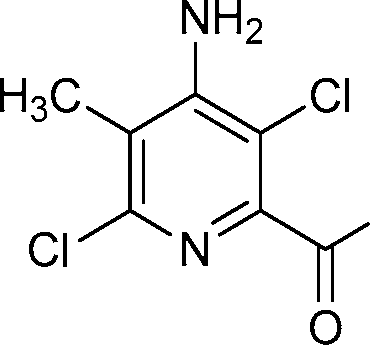
[00147] A mixture of methyl 4-amino-3,6-dichloro-5-iodopicolinate (8.1 g,
23.4 mmol), tetramethylstannane (8.35 g, 46.7 mmol), and bis(triphenylphosphine)palladium(II) chloride (2.5 g, 3.5 mmol) in 1,2-dichloroethane
-69WO 2014/151005
PCT/US2014/024745 (40 mL) was irradiated in a Biotage Initiator microwave at 120 °C for 30 min, with external infrared (IR)-sensor temperature monitoring from the side. The reaction mixture was loaded directly onto a silica gel cartridge and purified by flash chromatography (silica gel, 0-50% ethyl acetate/hexanes) to provide the title compund as an orange solid (4.53 g, 83 %): mp 133-136 °C; XH NMR (400 MHz, CDCfr) δ 4.92 (s, 2H), 3.96 (s, 3H), 2.29 (s, 3H); 13C NMR (101 MHz, CDC13) δ 164.34,
150.24, 148.69, 143.94, 117.01, 114.60, 53.02, 14.40; ESIMS m/z 236 ([M+H]+), 234 ([M-Η]).
Preparation 9: Methyl 6-amino-2,5-dichloropyrimidine-4-carboxylate (Head E)

[00148] Prepared as described in Epp et al., WO 2007082076 Al.
Preparation 10: Methyl 4-amino-6-chloro-5-fluoro-3-methoxypicolinate (Head F)
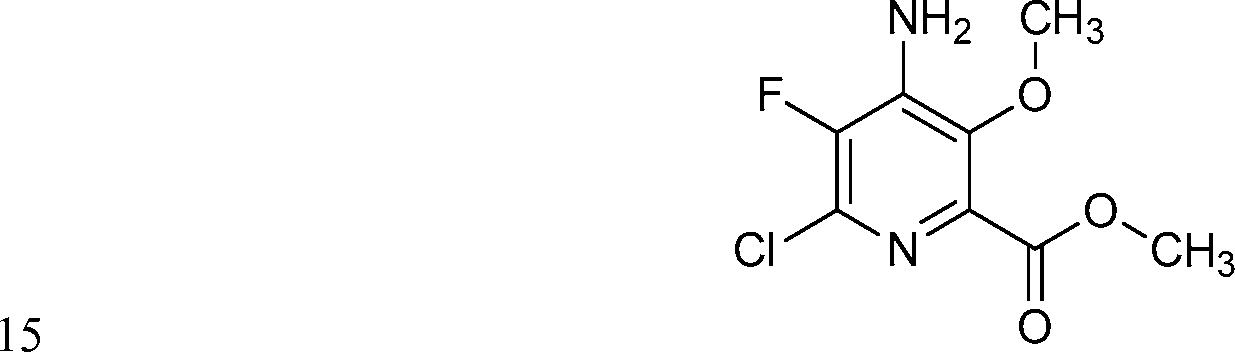
Prepared as described in Epp et al., WO 2013003740 AT
Preparation 11: Methyl 4-amino-6-chloro-5-fluoro-3-vinylpicolinate (Head G)

[00149] Methyl 4-amino-6-chloro-5-fluoro-3-iodopicolinate (7.05 g, 21.33 mmol, prepared as described in Epp et al., WO 2013003740 Al) and vinyltri-/?-butyltin (7.52
-70WO 2014/151005
PCT/US2014/024745 mL, 25.6 mmol) were suspended in dichloroethane (71.1 mL) and the mixture was degassed with Argon for 10 min. Bis(triphenylphosphine)palladium(II) chloride (1.497 g, 2.133 mmol) was then added, and the reaction mixture was stirred at 70 °C overnight (clear orange solution). The reaction was monitored by gas chromatography-mass spectrometry (GC-MS). After 20 h, the reaction mixture was concentrated, adsorbed onto Celite, and purified by column chromatography (silica gel (S1O2), hexanes/ethyi acetate gradient) to afford the title compound (3.23 g, 65.7 %) as a light brown solid: mp 99-100°C; 1H NMR (400 MHz, CDC13) δ 6.87 (dd, J18.1, 11.6 Hz, 1H), 5.72 (dd, J= 11.5, 1.3 Hz, 1H), 5.52 (dd, J= 18.2, 1.3 Hz, 1H),
4.79 (s, 2H), 3.91 (s, 3H); 19F NMR (376 MHz, CDC13) δ -138.79 (s); EIMS m/z 230
Preparation 12: Methyl 4-amino-3,5,6-trichloropicolinate (Head H)

[00150] Prepared as described in Finkelstein et al., WO 2006062979 Al.
Preparation 13: Methyl 4-amino-6-bromo-3-chloro-5-fluoropicolinate (Head I)

[00151] Prepared as described in Arndt et al., US 20120190857 Al.
-71WO 2014/151005
PCT/US2014/024745
Preparation 14: Methyl 4-amino-3-chloro-5-fluoro-6-(trimethylstannyl)picolinate (Head J)

[00152] Methyl 4-amino-6-bromo-3-chloro-5-fluoropicolinate (500 mg, 1.8 mmol),
1,1,1,2,2,2-hexamethyldistannane (580 mg, 1.8 mmol) and bis(triphenylphosphine)palladium(II) chloride (120 mg, 0.18 mmol) were combined in dry dioxane (6 mL), sparged with a stream of nitrogen for 10 min and then heated to 80 °C for 2 h. The cooled mixture was stirred with ethyl acetate (25 mL) and saturated NaCl (25 mL) for 15 min. The organic phase was separated, filtered through diatomaceous earth, dried (Na2SO4) and evaporated. The residue was taken up in ethyl acetate (4 mL), stirred and treated in portions with hexane (15 mL). The milky white solution was decanted from any solids produced, filtered through glass wool and evaporated to give the title compound as an off-white solid (660 mg, 100%): 'Η NMR (400 MHz, CDCfi) δ 4.63 (d, J = 29.1 Hz, 1H), 3.97 (s, 2H), 0.39 (s, 4H); 19F NMR (376 MHz, CDC13) δ 15 130.28; EIMS m/z 366.
Preparation 15: Methyl 4-acetamido-3-chloro-6-(trimethylstannyl)-picolinate (Head K)
O

[00153] Prepared as described in Balko et al., WO 2003011853 Al.
-72WO 2014/151005
PCT/US2014/024745
Preparation 16: Methyl 4-acetamido-3,6-dichloropicolinate (Head L)

[00154] Prepared as described in Fields et al., WO 2001051468 Al.
Preparation 17: Methyl 4-amino-3-chloro-6-iodopicolinate (Head M)

[00155] Prepared as described in Balko et al., WO 2007082098 A2.
Preparation 18: Methyl 4-acetamido-3-chloro-6-iodopicolinate (Head N)

[00156] Prepared as described in Balko et al., WO 2007082098 A2.
Preparation 19: Methyl 4-amino-6-bromo-3,5-difluoropicolinate (Head O)

[00157] Prepared as described in Fields et al., WO 2001051468 Al.
-73WO 2014/151005
PCT/US2014/024745
Preparation 20: Methyl 6-amino-2-chloro-5-vinylpyrimidine-4-carboxylate (Head P)
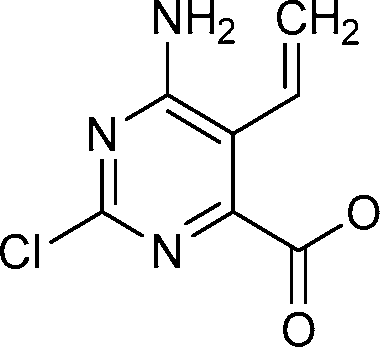
[00158] Prepared as described in Epp et al., US 20090088322.
Preparation 21: l-Bromo-4-(2,2-diethoxyethoxy)-2-fluorobenzene

[00159] 4-Bromo-3-fluorophenol (7 g, 0.03665 mol) and potassium carbonate (7.6 g, 0.055 mol) were dissolved in AA'-dimcthylformamidc (9 mL). 2-Bromo-1,1diethoxyethane (8.5 mL, 0.055 mol) was added and the reaction mixture was stirred and heated to 135 °C for 7 h. The solvent was removed after the reaction was completed. The residue was dissolved in ethyl acetate and washed with 2M NaOH solution. The organic phase was dried over Na2SO4. The solvent was evaporated to yield l-bromo-4-(2,2-diethoxyethoxy)-2-fluorobenzene as an oil (11.4 g, 100%).
Preparation 22: l-Bromo-3-(2,2-diethoxyethoxy)-2-fluorobenzene
EtO
Br
OEt [00160] 1 -Bromo-3-(2,2-diethoxyethoxy)-2-fluorobenzene was prepared from 320 bromo-2-fluorophenol as described in Preparation 21.
-74WO 2014/151005
PCT/US2014/024745
Preparation 23: 2-Bromo-4-(2,2-diethoxyethoxy)-l-fluorobenzene

[00161] 2 -Bromo-4-(2,2-diethoxyethoxy)-l-fluorobenzene was prepared from 3bromo-4-fluorophenol as described in Preparation 21.
Preparation 24: l-Bromo-4-chloro-2-(2,2-diethoxyethoxy)benzene Cl
EtO

OEt Br [00162] 1 -Bromo-4-chloro-2-(2,2-diethoxyethoxy)benzene was prepared from 2bromo-5-chlorophenol as described in Preparation 21.
Preparation 25: (4-Bromo-3-fluorophenyl)(2,2-diethoxyethyl)sulfane F
Br
EtO
OEt [00163] (4-Bromo-3-fluorophenyl)(2,2-diethoxyethyl)sulfane was prepared from 4 bromo-3-fluorobenzenethiol as described in Preparation 21.
Preparation 26: 4-Bromo-7-chlorobenzofuran

[00164] To 80 mL of benzene was added polyphosphoric acid (3.47 g, 36.9 mmol) and commercially available 2-(5-bromo-2-chlorophenoxy)acetaldehyde (9.2 g , 36.9 mmol) and separated into eight 20 mL vials containing equal amounts. The vials
-752014/151005
PCT/US2014/024745 were heated to an external temperature of 90 °C for 4 days. Upon cooling of the reaction, the benzene was removed by decanting. Celite (50 g) was added to the organic solution and the solvent was removed using a rotary evaporator. The impregnated Celite was loaded onto a Teledyne-Isco purification system and purified by silica gel chromatography using 0-30% ethyl acetate:hexanes to give 4-bromo-7chlorobenzofuran as a white solid (2.7 g, 32%): XH NMR (400 MHz, CDCI3) δ 7.73 (d, J= 2.2 Hz, IH), 7.33 (d, J= 8.3 Hz, IH), 7.18 (d, J= 8.3 Hz, IH), 6.85 (d, J= 2.2 Hz, IH); 13C NMR (101 MHz, CDC13) δ 150.38 (s), 146.14 (s), 130.27 (s), 126.56 (s), 125.32 (s), 116.44 (s), 112.49 (s), 107.71 (s); ESIMS m/z 232 ([M+H]+), 230 ([M-H]’ )·
Preparation 27: 6-Bromobenzofuran and 4-bromobenzofuran

[00165] 6 -Bromobenzofuran and 4-bromobenzofuran were prepared as described in US20040147559 from l-bromo-3-(2,2-diethoxyethoxy)benzene.
Preparation 28: 5-Bromo-6-fluorobenzofuran and 5-bromo-4-fluorobenzofuran

Br +

O'
Br
F [00166] 1 -Bromo-4-(2,2-diethoxyethoxy)-2-fluorobenzene (11.4 g, 0.037 mol) was dissolved in toluene (78 mL). Polyphosphoric acid (11.9 g) was added and the mixture was heated to reflux for 5 h. The solvent was removed and the residue was diluted with water and ethyl acetate. The organic phase was washed with 2 M NaOH solution and then dried over Na2SO4. A mixture of 5-bromo-6-fluorobenzofuran and 5-bromo-4-fluorobenzofuran (4.8 g, 60.3%) were obtained as a mixture after purification via column chromatography.
-76WO 2014/151005
PCT/US2014/024745
Preparation 29: 6-Bromo-7-fluorobenzofuran

[00167] 6 -Bromo-7-fluorobenzofuran was prepared from l-bromo-3-(2,25 diethoxyethoxy)-2-fluorobenzene as described in Preparation 28: ESIMS m/z 216 ([M+H]+).
Preparation 30: 6-Bromo-5-fluorobenzofuran
F

[00168] 6-Bromo-5-fluorobenzofuran was prepared from 2-bromo-4-(2,2diethoxyethoxy)-l-fluorobenzene as described in Preparation 28: ESIMS m/z 216 ([M+H]+).
Preparation 31: 7-Bromo-4-chlorobenzofuran

[00169] 7-Bromo-4-chlorobenzofuran was prepared from l-bromo-4-chloro-2-(2,2 diethoxyethoxy)benzene as described in Preparation 28: ESIMS m/z 232 ([M+H]+).
-77WO 2014/151005
PCT/US2014/024745
Preparation 32: 5-Bromo-4-fluorobenzo[Z>]thiophene and 5-bromo-6fluor obenzo | Λ | thiophene

[00170] Polyphosphoric acid (13.9 g) was stirred in chlorobenzene (50 mL) at 130 °C. (4-Bromo-3-fluorophenyl)(2,2-diethoxyethyl)sulfane (7.7 g, 0.0238 mol) in chlorobenzene (15.4 mL) was added dropwise at 130 °C. The mixture was then stirred at 130 °C for 10 h. The solvent was removed and the residue was extracted with toluene, hexane, and then water. The organic phase was combined and washed with saturated sodium bicarbonate (NaHC’Cf) solution and brine, and then dried over Na2SO4. The products 5-bromo-4-fluorobenzo[Z?]thiophene and 5-bromo-6fluorobenzo[Z?]thiophene were obtained after purification via column chromatography (3.6 g, 65.5%).
Preparation 33: 6-Bromo-5-fluorobenzo[Z>]thiophene and 4-bromo-5fluor obenzo | Λ | thiophene

[00171] 6 -Bromo-5-fluorobenzo[Z?]thiophene and 4-bromo-520 fluorobenzo[Z?]thiophene were prepared from (3-bromo-4-fluorophenyl)(2,2diethoxyethyl)sulfane as described in Preparation 32: ESIMS m/z 232 ([M+H]+).
-78WO 2014/151005
PCT/US2014/024745
Preparation 34: 2-(7-Chlorobenzofuran-4-yl)-5,5-dimethyl-l,3,2-dioxaborinane

[00172] 2-(7-Chlorobenzofuran-4-yl)-5,5-dimethyl-l,3,2-dioxaborinane was prepared as described in Preparation 55 from 4-bromo-7-chlorobenzofuran (prepared as described in W02005056015) to afford a white solid (66%): IR (cm1)
669.18,701.26, 741.33, 792.08, 773.25, 842.53, 811.66, 863.44, 876.27, 884.51, 953.31, 993.58, 1027.34, 1132.28, 1059.34, 1157.92, 1217.21, 1207.86, 1253.95, 1238.65, 1302.38, 1266.72, 1359.16, 1335.94, 1370.05, 1422.73, 1438.38, 1480.37, 1577.30, 1602.05, 2903.59, 2871.91, 2940.30, 2955.31, 3140.15, 3161.21; *HNMR (400 MHz, CDC13) δ 7.69 (d, J= 2.1 Hz, 1H), 7.63 (d, J= 7.8 Hz, 1H), 7.28 (dd, 7 =
6.7, 2.6 Hz, 1H), 7.27 (d, 7= 2.2 Hz, 1H), 3.82 (s, 4H), 1.05 (s, 6H); ESIMS m/z 265 ([M+H]+), 263([M-H]').
Preparation 35: 2-(Benzofuran-6-yl)-4,4,5,5-tetramethyl-l,3?2-dioxaborolane and
2-(benzofuran-4-yl)-4,4,5,5-tetramethyl-l,3?2-dioxaborolane


// [00173] 2-(Benzofuran-6-yl)-4,4,5,5-tetramethyl-l,3,2-dioxaborolane and 2(benzofuran-4-yl)-4,4,5,5-tetramethyl-l,3,2-dioxaborolane were prepared as described in Preparation 55 from 4-bromobenzofuran and 6-bromobenzofuran to afford the mixture as a clear oil (48%): ' H NMR (400 MHz, CDC13) δ 7.97 (s, 1H), 7.72 - 7.68 (m, 1H), 7.66 (dd, 7= 4.9, 2.6 Hz, 2H), 7.60 (dd, J= 8.0, 5.2 Hz, 2H), 7.30 (dd, 7 = 7.1,6.2 Hz, 1H), 7.28-7.21 (m, 2H), 6.77 (dd, 7= 2.1, 0.8 Hz, 1H), 1.37 (d, 7= 6.2 Hz, 22H), 1.29 - 1.22 (m, 8H); 13C NMR (101 MHz, CDC13) δ 146.01, 145.21,
-792014/151005
PCT/US2014/024745
130.19, 130.11, 128.76, 123.56, 120.60, 117.60, 114.05, 108.45, 106.63, 83.82, 83.69, 83.50, 25.02, 24.98, 24.88; ESIMS m/z 245 ([M+H]+), 243([M-H]“).
Preparation 36: 2-(6-Fluorobenzofuran-5-yl)-4,4,5,5-tetramethyl-l,3,2dioxaborolane and 2-(4-fluorobenzofuran-5-yl)-4,4,5,5-tetramethyl-l,3,2dioxaborolane


[00174] A mixture of 5-bromo-6-fluorobenzofuran and 5-bromo-4fluorobenzofuran (1 combined equivalent), potassium acetate (KOAc; 3 eq) and bis(pinacolato) diboron (1.2 eq) were stirred in dioxane (0.1 M with respect to the 5bromo-6-fluorobenzofuran and 5-bromo-4-fluorobenzofuran mixture) under nitrogen flow for 30 min. The catalyst [1,1'bis(diphenylphosphino)ferrocene]dichloropalladium(II) (PdCl2(dppf); 0.15 eq) was added and the nitrogen flow was maintained for 10 min. The reaction mixture was heated to 85 °C overnight. The solvent was removed, the residue was dissolved in methylene chloride, and the solid was filtered. The filtrate was concentrated and purified through a column to give a mixture of 2-(6-fluorobenzofuran-5-yl)-4,4,5,5tetramethyl-1,3,2-dioxaborolane and 2-(4-fluorobenzofuran-5-yl)-4,4,5,5-tetramethyl1,3,2-dioxaborolane (63%): 'H NMR (400 MHz, CDC13) δ 7.98 (d, J= 5.7 Hz, IH), 7.59 (d, 7=2.1 Hz, IH), 7.18 (d, J= 9.4 Hz, IH), 6.73 (d, J= 1.3 Hz, IH), 1.38 (s, 12H); 'H NMR (400 MHz, CDC13) δ 7.81 (d, J= 7.0 Hz, IH), 7.37 (t, J= 7.4 Hz,
IH), 7.30 (d, J= 8.4 Hz, IH), 6.87 (s, IH), 1.38 (s, 12H); 19F NMR (376 MHz, CDC13) δ -107.80, -107.81, -107.82, -107.84, -108.47, -108.48; ESIMS m/z 262 ([M+H]+).
-80WO 2014/151005
PCT/US2014/024745
Preparation 37: 2-(4-Chlorobenzofuran-7-yl)-4,4,5,5-tetramethyl-l,3?2dioxaborolane

[00175] 2-(4-Chlorobenzofuran-7-yl)-4,4,5,5-tetramethyl-l,3,2-dioxaborolane was 5 prepared as described in Preparation 36 from 7-bromo-4-chlorobenzofuran: ΧΗ NMR (400 MHz, CDC13) δ 7.75 (d, J = 2.2 Hz, 1H), 7.67 (d, J = 7.8 Hz, 1H), 7.24 (d, J = 7.8 Hz, 1H), 6.86 (d,J= 2.2 Hz, 1H), 1.41 (s, 12H); ESIMS m/z 278 ([M+H]+).
Preparation 38: 2-(5-Fluorobenzofuran-6-yl)-4,4,5,5-tetramethyl-l,3,210 dioxaborolane

[00176] 2-(5-Fluorobenzofuran-6-yl)-4,4,5,5-tetramethyl-l,3,2-dioxaborolane was prepared as described in Preparation 36 from 6-bromo-5-fluorobenzofuran: 1H NMR (400 MHz, CDCI3) δ 7.85 (d, J= 4.3 Hz, 1H), 7.68 (d, J= 2.2 Hz, 1H), 7.24 - 7.20 (m, 1H), 6.75 - 6.70 (m, 1H), 1.38 (s, 12H); 19F NMR (376 MHz, CDC13) δ-110.23 (dd, J= 9.6, 4.1 Hz); ESIMS m/z 262 ([M+H]+).
-81WO 2014/151005
PCT/US2014/024745
Preparation 39: 2-(7-Fluorobenzofuran-6-yl)-4,4,5,5-tetramethyl-l,3,2dioxaborolane

[00177] 2-(7-Fluorobenzofuran-6-yl)-4,4,5,5-tetramethyl-l,3,2-dioxaborolane was 5 prepared as described in Preparation 36 from 6-bromo-7-fluorobenzofuran: XH NMR (400 MHz, CDC13) δ 7.68 (t,J= 3.1 Hz, IH), 7.55 (dd, J= 7.8, 4.5 Hz, IH), 7.34 (t, J = 6.5 Hz, IH), 6.80 (dd, J= 2.9, 2.2 Hz, IH), 1.38 (s, 12H); 0 * * * 19F NMR (376 MHz, CDCL) δ -127.62 (dd, J= 4.2, 3.1 Hz); ESIMS m/z 262 ([M+H]+).
Preparation 40: 2-(6-Fluorobenzo| Λ |thiophen-5-yl)-4,4,5,5-tetramethyl-1,3,2dioxaborolane and 2-(4-fluorobenzo[Z>]thiophen-5-yl)-4,4,5,5-tetramethyl-l,3,2dioxaborolane


[00178] 2-(6-Fluorobenzo[Z?]thiophen-5-yl)-4,4,5,5-tetramethyl-l,3,2dioxaborolane and 2-(4-fluorobenzo[Z?]thiophen-5-yl)-4,4,5,5-tetramethyl-l,3,2dioxaborolane were prepared as described in Preparation 36 from 5-bromo-4fluorobenzo[Z?]thiophene and 5-bromo-6-fluorobenzo[Z?]thiophene: 1H NMR (400 MHz, CDCL) δ 8.20 (d, J= 5.5 Hz, IH), 7.53 (d, J= 9.3 Hz, IH), 7.35 (d, J= 5.5 Hz,
IH), 7.30 (d, J= 5.5 Hz, IH), 1.39 (s, 12H); 'H NMR (400 MHz, CDC13) δ 7.69 7.61 (m, 2H), 7.47 (d, J= 5.6 Hz, IH), 7.39 (d, J= 5.6 Hz, IH), 1.39 (s, 12H); 19F NMR (376 MHz, CDC13) δ -107.24, -109.56; ESIMS m/z 278 ([M+H]+).
-82WO 2014/151005
PCT/US2014/024745
Preparation 41: 2-(5-Fluorobenzo| Λ |thiophen-6-yl)-4,4,5,5-tetramethyl-1,3,2dioxaborolane and 2-(5-fluorobenzo[Z>]thiophen-4-yl)-4,4,5,5-tetramethyl-l,3,2dioxaborolane
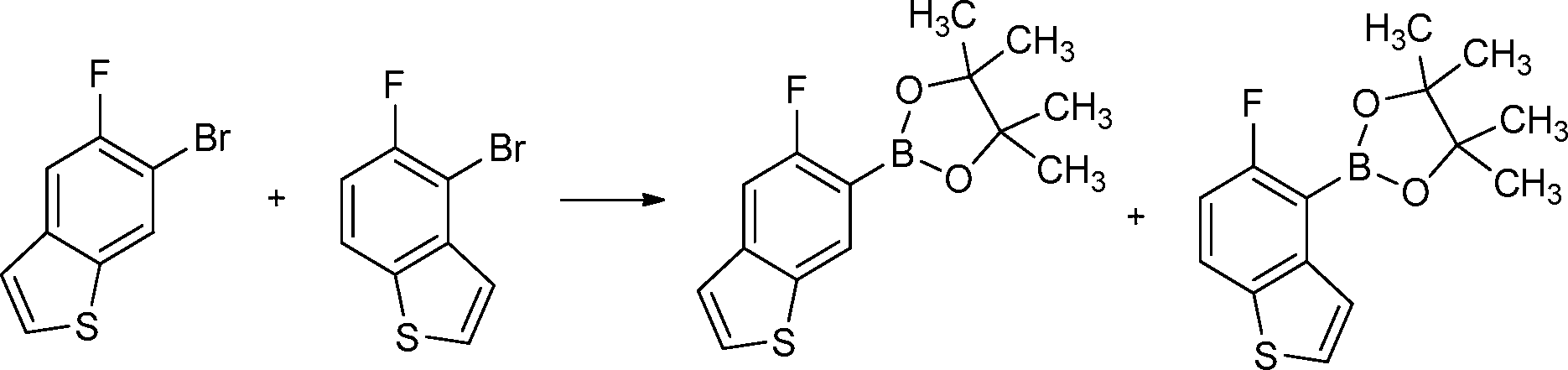
[00179] 2-(5-Fluorobenzo[Z?]thiophen-6-yl)-4,4,5,5-tetramethyl-l,3,2dioxaborolane and 2-(5-fluorobenzo[Z?]thiophen-4-yl)-4,4,5,5-tetramethyl-l,3,2dioxaborolane were prepared as described in Preparation 36 from 6-bromo-5fluorobenzo[Z?]thiophene and 4-bromo-5-fluorobenzo[Z?]thiophene: XH NMR (400
MHz, CDCI3) δ 8.26 (d, 7= 5.1 Hz, IH), 7.59 (d, 7= 5.4 Hz, IH), 7.45 (d, 7= 9.9 Hz, IH), 7.28 (d, J= 5.4 Hz, IH), 1.39 (s, 12H); 'H NMR (400 MHz, CDC13) δ 7.92 (d, J = 5.5 Hz, IH), 7.88 (dd, J= 8.8, 4.9 Hz, IH), 7.55 (d, 7= 5.5 Hz, IH), 7.07 (t, 7= 9.1 Hz, IH), 1.42 (s, 12H); 19F NMR (376 MHz, CDC13) δ -107.32, -107.34, -107.35, 107.36, -111.00, -111.02, -111.02, -111.03, -111.04, -111.04; ESIMS m/z 278 ([M+H]+).
Preparation 42: 2-(Benzo| Λ |thiophen-6-yl)-4,4,5,5-tetramethyl-1,3,2dioxaborolane

[00180] 6-Bromobenzo[Z?]thiophene (3.09 g, 14.5 mmol), 4,4,4',4',5,5,5',5'octamethyl-2,2'-bi(l,3,2-dioxaborolane) (4.42 g, 17.4 mmol), PdCl2(dppf) (0.54 g, 0.74 mmol), and KO Ac (2.89 g, 29.4 mmol) in anhydrous dioxane (48 mL) was stirred at reflux at 80 °C for 4 h. The reaction mixture was cooled and diluted with
-832014/151005
PCT/US2014/024745 ethyl acetate, filtered through a pad of Ceiite, and washed with brine. The aqueous layer was extracted with ethyl acetate. The organic layers were dried, filtered, and adsorbed onto silica gel. Purification by flash chromatography (0 - 30% ethyl acetate/hexanes) provided 2-(benzo[Z?]thiophen-6-yl)-4,4,5,5-tetramethyl-l,3,2dioxaborolane (3.266 g, 87%) as a yellow oily solid: ΧΗ NMR (400 MHz, CDCI3) δ 8.38 (d, J= 0.7 Hz, 1H), 7.79 (ddd, J= 20.2, 8.0, 0.8 Hz, 2H), 7.51 (d, J= 5.5 Hz, 1H), 7.34 (dd, 7=5.4, 0.7 Hz, 1H), 1.37 (s, 12H); 13CNMR(101 MHz, CDC13) δ 141.78, 129.75, 129.58, 128.18, 123.87, 122.94, 83.89, 24.92; EIMS m/z 260.
Preparation 43: 5-Fluoro-6-(4,4,5,5-tetramethyl-l,3,2-dioxaborolan-2-yl)-l/findole

[00181] To a round bottom flask, 4,4,4',4',5,5,5',5'-octamethyl-2,2'-bi(l,3,2dioxaborolane) (1.424 g, 5.61 mmol), [l,T-bis(diphenylphosphino)ferrocene] dichloropalladium(II) (0.342 g, 0.467 mmol), and potassium acetate (0.917 g, 9.34 mmol) were charged as solids. The flask was sealed, and pumped and purged (3x) with inert gas. Then 6-bromo-5-fluoro-l/Y-indolc (TO g, 4.67 mmol) in dioxane (15.57 mL) was added. The reaction mixture was stirred and warmed to an internal temperature of 85 °C. After f 8 h the reaction mixture was cooled and filtered through a pad of Ceiite, washing with excess ethyl acetate. The filtrate was diluted with water and partitioned. The aqueous layer was extracted with ethyl acetate (3x15 mL). The combined organic layers were dried over MgSCT, filtered and concentrated in vacuo. The crude product was purified using a Teledyne ISCO purification system with a gradient eluent system of ethyl acetate and hexanes to yield the title compound as a peach-colored solid (656 mg, 54%): *HNMR (400 MHz, DMSO-76) δ 1.31 (s, 12H), 6.42 (ddd, 7 =2.9, 1.9,0.9 Hz, 1H), 7.22 (d,7 = 10.5 Hz, 1H), 7.52 (t, J = 2.8 Hz,
-84WO 2014/151005
PCT/US2014/024745
1H), 7.69 (d, J = 4.8 Hz, 1H), 11.24 (s, 1H); 19F NMR (376 MHz, DMSO-i/s) δ 116.07; ESIMS m/z 262.0 ([M+H]+), 260.0 ([M-H]').
Preparation 44: 7-Bromo-4-chloro-l/Z-indole

[00182] To a solution of l-bromo-4-chloro-2-nitrobenzene (932 mg, 3.95 mmol) in tetrahydrofuran (10 mL), vinylmagnesium bromide (0.7 M in tetrahydrofuran; 12 mmol) in tetrahydro furan (15 mL) was added drop wise at -40 °C. After 1 h the reaction mixture was poured into saturated ammonium chloride (NH4CI). The resulting organic layer was concentrated. The resulting residue was purified using a Teledyne ISCO chromatography system with a gradient eluent system of 2% ethyl acetate in hexane to yield the title compound (400 mg, 44%): 1H NMR (300 MHz, CDCh) δ 6.73 (t,J= 2.8 Hz, 1H), 7.02 (d, J= 8.1 Hz, 1H), 7.19 - 7.39 (m, 2H), 8.43 (s, 1H).
Preparation 45: 4-Bromo-7-chloro-l/Z-indole

[00183] 4 -Bromo-7-chloro-1 /Y-indolc was prepared from 4-bromo-l-chloro-2nitrobenzene as described in Preparation 44: 1H NMR (300 MHz, CDCI3) δ 6.49 20 6.74 (m, 1H), 7.07 (d, J= 8.1 Hz, 1H), 7.15 - 7.42 (m, 2H), 8.49 (s, 1H).
Preparation 46: 6-Bromo-7-fluoro-l/Z-indole

-85WO 2014/151005
PCT/US2014/024745 [00184] 6 -Bromo-7-fluoro-l/Y-indolc was prepared from l-bromo-2-fluoro-3nitrobenzene as described in Preparation 44 (250 mg, 25.2%): XH NMR (300 MHz, CDC13) δ 6.52 - 6.62 (m, IH), 7.13 - 7.34 (m, 3H), 8.38 (s, IH); ESIMS m/z 215.0 ([M+H]+).
Preparation 47 (Precursor Example 1): 4-Chloro-7-(4,4,5,5-tetramethyl-l,3,2dioxaborolan-2-yl)- 1/Z-indole

[00185] To a solution of 7-bromo-4-chloro-1/Z-indole (8 g, 0.03 mol) in dioxane,
KOAc (9.8 g, 0.1 mol), dichloro[l,r-bis(diphenylphosphino)ferrocene]-palladium(II) (2.19 g, 0.003 mol), and 4,4,4',4',5,5,5',5'-octamethyl-2,2'-bi(l,3,2-dioxaborolane) (13.2 g, 0.052 mol) were charged as solids. The reaction mixture was placed under inert atmosphere and the flask was sealed. The reaction was heated to 100 °C for 16 h. The reaction mixture was then treated with H2O and extracted with ethyl acetate.
The organic layer was partitioned and concentrated. The resulting residue was purfied using a Teledyne ISCO chromatography system with a gradient eluent system of ethyl acetate in hexane to yield the title compound (E3 g, 15.6%): XH NMR (300 MHz, CDC13)61.4O (s, 12H), 6.58 - 6.73 (m, IH), 7.14 (d,/= 7.6 Hz, IH), 7.287.36 (m, IH), 7.56 (d, /= 7.6 Hz, IH), 9.34 (s, IH).
Preparation 48: 7-Chloro-4-(4,4,5,5-tetramethyl-l,3,2-dioxaborolan-2-yl)-l/Zindole

-86WO 2014/151005
PCT/US2014/024745 [00186] 7-Chloro-4-(4,4,5,5-tetramethyl-l,3,2-dioxaborolan-2-yl)-17/-indole was prepared as described in Preparation 47 from 4-bromo-7-chloro- 1/Y-indolc (4.2 g, 43.7%): 'H NMR (300 MHz, CDC13) δ 1.38 (s, 26H), 7.08 (dd, J= 3.2, 2.2 Hz, 1H), 7.20 (d, J= 7.6 Hz, 1H), 7.30 (t, J= 2.8 Hz, 1H), 7.56 (d, J= 7.6 Hz, 1H), 8.40 (s,
1H).
Preparation 49 (Precursor Example 2): 7-Fluoro-6-(4,4,5,5-tetramethyl-l,3?2dioxaborolan-2-yl)- 1/Z-indole

[00187] 7-Fluoro-6-(4,4,5,5-tetramethyl-l,3,2-dioxaborolan-2-yl)-l//-indole was prepared as described in Preparation 47 from 6-bromo-7-fluoro-1/Z-indole (150 mg, 45.5%): 'H NMR (300 MHz, CDC13) δ 1.26 (s, 25H), 1.39 (s, 24H), 7.27 (d, J= 4.5 Hz, 2H), 7.40 (d, J= 2.6 Hz, 2H), 8.43 (s, 1H); 19F NMR (282 MHz, CDC13) δ 124.52; 13C NMR (101 MHz, CDC13) δ 24.87 (d, J= 15.9 Hz), 77.30,83.49 (d, J=
6.9 Hz), 103.25, 115.98 (d, J =3.3 Hz), 126.08 (d, 7= 7.7 Hz).
Preparation 50 (Precursor Example 3): 7-Fluoro-6-(4,4,5,5-tetramethyl-l,3?2dioxaborolan-2-yl)-l-(triisopropylsilyl)-l/Z-indole

[00188] 7-Fluoro-l-(triisopropylsilyl)-lZZ-indole (4.0 g, 14 mmol) (Prepared according to M. Schlosser, et al., Eur. J. Org. Chern. 2006, 2956-2969) was dissolved in 30 mL dry THF, cooled to -75 °C, treated in portions with sec -butyl lithium (10
-872014/151005
PCT/US2014/024745 mL, 1.4 Μ, 14 mmol) and stirred for 2 h at -75 °C. 2-Isopropoxy-4,4,5,5-tetramethyl1,3,2-dioxaborolane (3.0 mL, 2.7 g, 14 mmol) was added in portions and the mixture was stirred for 1 h at -75 °C. The cooling bath was removed and the temperature was allowed to rise to 5 °C over 30 min. The reaction was quenched by addition of 5 mL saturated NH4CI and partitioned between ethyl acetate and water. The organic phase was washed with saturated sodium chloride (NaCl), dried (Na2SO4), evaporated onto silica gel, and purified by flash chromatography (SiO2; eluting with hexanes) to give the title compound as a thick oil (4.2 g, 73%): XH NMR (400 MHz, CDCI3) δ 7.43 (dd, J= 7.9, 4.6 Hz, 1H), 7.38 (m, 2H), 1.75 (m, 3H), 1.38 (s, 12H), 1.13 (d, 7= 7.6 Hz, 18H); 19FNMR(376 MHz, CDC13) δ-113.07; EIMS m/z 417.
Preparation 51: 2-Ethynyl-4,6-difluoroaniline

[00189] Step 1: 2-Bromo-4,6-difluoroaniline (10 g, 48 mmol), copper (I) iodide (Cul; 180 mg, 0.96 mmol), bis(triphenylphosphine)palladium(II) chloride (680 mg, 0.96 mmol) and ethynyltrimethylsilane (7.1 g, 72 mmol) were combined with 10 mL dry DMF and heated to 50 °C for 18 h. An additional 2 mL ethynyltrimethylsilane, 200 mg bis(triphenylphosphine)palladium(II) chloride, and 60 mg Cul were added and heating was continued for 4 h. After cooling, the mixture was diluted with ethyl acetate and stirred with 1 normal (N) hydrochloric acid (HC1). The dark mixture was filtered through Ceiite to remove fine solids. The organic phase was washed with water, saturated NaCl, dried and concentrated. Purification by flash chromatography (SiO2, eluting with 0-20% EtOAc in hexanes) afforded 9 g of material that consisted of a 70/30 ratio of the TMS alkyne derivative and the starting bromide.
[00190] Step 2: The mixture was carried in to the desilylation without further purification. The TMS derivative was dissolved in methanol (500 mL) and treated with 8.5 g KF. A clear solution formed which was stirred overnight at room temperature (RT). Most of the volatiles were removed under vacuum, the residue was
-88WO 2014/151005
PCT/US2014/024745 taken up in ethyl acetate and washed water and with saturated NaCl. The solution was dried, evaporated and purified by flash chromatography (S1O2, eluting with 010% ethyl acetate in hexanes) to provide the title compound (4.2 g, 70 area % pure by flame-ionization detector-gas chromatography (FID-GC)): ΧΗ NMR (400 MHz,
CDCI3) δ 6.83 (m, 1H), 4.13 (m, 1H), 3.46 (s, 1H); 19F NMR (376 MHz, CDC13) δ 124.04, -124.88, -126.94, -130.08; EIMS m/z 153. This material was carried through to the cyclization step without further purification.
Preparation 52: 5,7-Difluoro-lZZ-indole
F
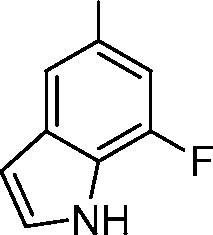
[00191] The impure 2-ethynyl-4,6-difluoroaniline (4.2 g, 19 mmol) from the previous preparation was dissolved in ethanol (75 mL), treated with sodium gold(III) chloride dihydrate (310 mg, 0.77 mmol) and stirred for 3 h under an atmosphere of nitrogen. The mixture was concentrated, taken up in ethyl acetate, washed with water, washed with saturated NaCl, dried over sodium sulfate (Na2SO4) and evaporated. Purification by flash chromatography (S1O2, 100-200 mesh; eluting with 0-15% EtO Ac in hexanes containing 2% acetic acid) provided the title product (2.0 g, ca 85% purity): 1H NMR (400 MHz, CDC13) δ 8.32 (s, 1H), 7.26 (dd, J= 4.8, 2.0 Hz, 1H), 7.09 (dd, 7= 9.1, 2.2 Hz, 1H), 6.74 (ddd,7 = 11.2,9.3,2.0 Hz, 1H), 6.55 (td,7 =
3.3, 2.2 Hz, 1H); 19FNMR (376 MHz, CDC13) δ -122.11, -131.96; EIMS m/z 153.
Preparation 53: 5,7-Difluoro-l-(triisopropylsilyl)-l//-indole

[00192] /V-Butyl lithium (2.7 mL, 2.5 M, 6.9 mmol) was added to 10 mL dry THF 25 at -70 °C. 5,7-Difluoro-l//-indole (TO g, 6.5 mmol) in 5 mL THF was added in
-892014/151005
PCT/US2014/024745 portions to the solution and the mixture was stirred for 30 min at -75 ° C. Triisopropylchlorosilane (1.5 mL, 1.3 g, 6.9 mmol) was added, stirring was continued for 1 h at -75 °C and then the mixture was allowed to warm to -5 °C over 2 h. After treatment with 5 mL saturated NH4C1, the mixture was mixed with 30 mL ether and the organic phase was washed with 5 mL saturated NaCl, dried (Na2SO4) and evaporated. The product was purified by flash chromatography(SiO2; hexanes) to provide the title compound as a clear oil (1.5 g; 74%): 'H NMR (400 MHz, CDCfi) δ 7.35 (d, 7=3.1 Hz, IH), 7.07 (dd,7 = 8.7, 2.3 Hz, IH), 6.69 (m, IH), 6.59(t,7=3.1 Hz, IH), 1.67 (m, 3H), 1.13 (d, J= 7.6 Hz, 18H); 19F NMR (376 MHz, CDCfi) δ 120.64, -120.65, -122.49, -122.49; EIMS m/z 309.
Preparation 54: 5,7-Difluoro-6-iodo-l-(triisopropylsilyl)-lZZ-indole

[00193] 5,7-Difluoro-l-(triisopropylsilyl)-l//-indole (1.4 g, 4.5 mmol) and pentamethyldiethylene -triamine( 830 mg, 4.8 mmol) were combined in 10 mL dry THF, cooled to -70 °C and treated in portions with sec-butyl lithium (3.4 mL, 1.4 M, 4.8 mmol) and stirred for 3 h at this temperature. Iodine (1.3 g, 5.0 mmol) in 5 mL THF was added, the mixture was stirred for 50 min, quenched by addition of 3 mL saturated NH4C1 and partitioned between diethyl ether and water. The organic phase was washed with saturated NaCl, dried (Na2SO4), evaporated and purified by flash chromatography (SiCfi; hexanes) to provide the title compound as a clear oil which solidified on standing (1.9 g, 90%): mp 74-76 °C; 'H NMR (400 MHz, CDCfi) δ 7.34 (d, 7=3.1 Hz, IH), 7.14 (dd, 7= 7.7, 0.9 Hz, IH), 6.60 (t, 7= 3.1 Hz, IH), 1.67 (m, 3H), 1.13 (d, 7= 7.6 Hz, 18H); 19FNMR(376 MHz, CDCfi) δ-101.37,-105.33.
Preparation 55: 2-(2,2-dimethylbenzo[d][l,3]dioxol-5-yl)-4,4,5,5-tetramethyl1,3,2-dioxaborolane
-902014/151005
PCT/US2014/024745 [00194] To DMSO (lOmL) was added potassium acetate (1.671 g, 17.03 mmol), 4,4,4',4',5,5,5',5'-octamethyl-2,2'-bi(l,3,2-dioxaborolane) (1.729 g, 6.81 mmol), 5-bromo-2,2-dimethylbenzo[d][l,3]dioxole (1.3 g, 5.68 mmol), and PdC12(dppf) (0.415 g, 0.568 mmol). The reaction was heated to an external temperature of 80 °C for 18 hours. Upon cooling, the reaction was poured reaction into 50mL ice water. The ice water mixture was transferred to a separatory fimnela and two extractions with EtOAc (50mL) were completed. The organic layers were combined, dried over Na2SO4, and filtered. The solutiown was concentrated onto 5g of celite using EtOAc as solvent. The impregnated celite was loaded onto a Teledyne Isco purification system and purified by silica gel chromatograpy using 0-30% EtOAc:hexanes to yield 2-(2,2-dimethylbenzo[d][l,3]dioxol-5-yl)-4,4,5,5tetramethyl-l,3,2-dioxaborolane (767mg, 49%) as a red semi-solid: XH NMR (400 MHz, CDC13) δ 7.31 (dt, J= 6.6, 3.3 Hz, IH), 7.15 (s, IH), 6.74 (d, J= 7.7 Hz, IH), 1.66 (s, 6H), 1.32 (s, 12H); 13CNMR(101 MHz, CDC13) δ 129.21 (s), 113.78 (s), 108.15 (s), 83.59 (s), 25.86 (s), 24.82 (s); ESIMS m/z 277 ([M+H]+), 275 ([M-H]).
EXAMPLES OF SYNTHESIS OF COMPOUNDS OF FORMULA (I) Example 1. Methyl 4-amino-3-chloro-5-fluoro-6-(7-fluoro-l/Z-indol-6yl)picolinate (Compound No. 1.14)

[00195] Methyl 4-amino-3,6-dichloro-5-fluoropicolinate (0.650 g, 2.72 mmol), 7fluoro-6-(4,4,5,5-tetramethyl-l,3,2-dioxaborolan-2-yl)-l//-indole (0.817 g, 3.13 mmol), bis(triphenylphosphine)palladium(II) chloride (0.191 g, 0.272 mmol), and cesium fluoride (0.826 g, 5.44 mmol) were combined in acetonitrile (4.53 mL) and water (4.53 mL). The reaction mixture was irradiated in a Biotage Initiator microwave at 110 °C in a sealed vial for 30 min. The cooled reaction mixture was partitioned between ethyl acetate and water. The organic phase was dried and
-912014/151005
PCT/US2014/024745 concentrated. The product was purified by flash chromatography (S1O2; eluting with 5-40% ethyl acetate in hexanes) to provide the title compound as an white solid (0.517 g, 52.4 % yield). Note: Potassium fluoride replaced cesium fluoride in some examples that refer to this particular example.
[00196] The preparation method used in this example is referred to in Table 10 as “Coupling 1”.
Example 2: Methyl 4-amino-3-chloro-5-fluoro-6-(l/Z-indol-5-yl)picolinate (Compound No. 1.2)

[00197] l/Y-Indol-5-ylboronic acid (220 mg, 1.4 mmol, 1.1 equiv) and methyl 4amino-3,6-dichloro-5-fluoropicolinate (300 mg, 1.3 mmol, 1.0 equiv) were sequentially added to a 5 mL Biotage microwave vessel, followed by cesium fluoride (380 mg, 2.5 mmol, 2.0 equiv), palladium(II) acetate (14 mg, 0.063 mmol, 0.05 equiv), and sodium 3,3',3-phosphinetriyltribenzenesulfonate (71 mg, 0.13 mmol, 0.10 equiv). A 3:1 mixture of water: acetonitrile (2.5 mL) was added and the resulting dark brown mixture was placed in a Biotage microwave and heated to 150 °C for 5 min, with external IR-sensor temperature monitoring from the side of the vessel. The cooled reaction mixture was diluted with water (50 mL) and extracted with dichloromethane (15 x 30 mL). The combined organic layers were dried (sodium sulfate), gravity filtered, and concentrated by rotary evaporation. The residue was purified by reverse phase column chromatography (5% acetonitrile to 100% acetonitrile gradient) to yield the title compound as a tan powder (290 mg, 73%). [00198] The preparation method used in this example is referred to in Table 10 as “Coupling 2”.
-92WO 2014/151005
PCT/US2014/024745
Example 3: Methyl 4-amino-6-(benzo[i/]thiazol-5-yl)-3-chloro-5-fluoropicolinate (Compound No. 6.1)

[00199] To a 5 mL microwave vial was added methyl 4-amino-6-bromo-3-chloro5 5-fluoropicolinate (200 mg, 1.0 mmol), benzo[i/]thiazol-5-ylboronic acid (237 mg, 1.35 mmol), potassium fluoride (KF; 122 mg, 2.12 mmol), TPPTS-Na (tris-(3sulfomatophenyl)-phosphine4-hydrate sodium salt, 67 mg, 0.106 mmol) and Pd(OAc)2 (11 mg, 0.053 mmol). Subsequently, CH3CN (1.0 mL) and H2O (3.0 mL) were added, and the reaction vial was sealed and heated in a Biotage microwave at
150 °C for 5 min, with external IR-sensor temperature monitoring from the side of the vessel. The reaction mixture was cooled to room temperature and diluted with dichloromethane, and washed with water. The organic extracts were combined, dried (Na2SO4), filtered, and concentrated in vacuo. The crude product was purified by triturating with diethyl (Et20) to yield the title compound as a brown solid (172 mg,
51%).
[00200] The preparation method used in this example is referred to in Table 10 as “Coupling 3”.
Example 4: Methyl 4-amino-6-(benzo[Z>]thiophenyl-5-yl)-3,5-dichloropicolinate (Compound No. 3.1)

[00201] To a 5 mL microwave vial was added methyl 4-amino-3,5,6trichloropicolinate (0.232 g, 0.909 mmol), 2-(benzo[Z?]thiophen-5-yl)-4,4,5,5tetramethyl-l,3,2-dioxaborolane (0.260 g, 0.999 mmol), cesium fluoride (0.276 g,
-932014/151005
PCT/US2014/024745
1.817 mmol) and (PPh3)2PdCl2 (0.064 g, 0.091 mmol). The reaction vial was then sealed and placed under inert atmosphere. Subsequently, dioxane (4.0 mL) and H2O (1.0 mL) were added and the reaction mixture was heated in a Biotage microwave at 120 °C for 60 min, with external IR-sensor temperature monitoring from the side of the vessel. The reaction mixture was cooled to room temperature and diluted with ethyl acetate (5 mL) and poured into brine solution. The layers were separated and the aqueous phase was extracted with ethyl acetate (3x10 mL). The organic extracts were combined, dried (MgSO4), filtered, and concentrated in vacuo. The crude product was purified using a Teledyne ISCO purification system with a gradient eluent system of ethyl acetate and hexanes. Further purification was performed, as needed, using a Teledyne ISCO reverse phase system with a gradient eluent system of acetonitrile and H2O to yield the title compound as a white solid.
[00202] The preparation method used in this example is referred to in Table 10 as “Coupling 4”.
Example 5: Methyl 4-amino-3-chloro-6-(7-chlorobenzofuran-4-yl)-5fluoropicolinate (Compound No. 2.16)

[00203] Potassium fluoride (0.365 g, 6.28 mmol), palladium diacetate (0.047 g, 0.209 mmol), 2-(7-chlorobenzofuran-4-yl)-5,5-dimethyl-l,3,2-dioxaborinane (0.609 g, 2.301 mmol), sodium 3,3',3-phosphinetriyltribenzenesulfonate tetrahydrate (0.134 g, 0.209 mmol), and methyl 4-amino-3,6-dichloro-5-fluoropicolinate (0.5 g, 2.092 mmol) were combined in a microwave reactor vial. To these were added water (3 mL) and acetonitrile (1 mL). The reaction mixture was heated at 150 °C in a microwave reactor for 6 min. The cooled reaction mixture was diluted with ethyl acetate and water and filtered through a cotton plug. The organic phase was dried
-942014/151005
PCT/US2014/024745 (Na2SO4) and concentrated under vacuum. Purification by reverse phase chromatography provided the title compound as a white solid (127 mg, 12.5% yield). [00204] The preparation method used in this example is referred to in Table 10 as “Coupling 5”.
Example 6 Methyl 4-amino-3-chloro-6-(7-fluoro-l/Z-indol-6-yl)picolinate (Compound No. 1.22)

[00205] Methyl 4-acetamido-3,6-dichloropicolinate (400 mg, 1.520 mmol),7fluoro-6-(4,4,5,5-tetramethyl-l,3,2-dioxaborolan-2-yl)-l//-indole (437 mg, 1.673 mmol), cesium fluoride (462 mg, 3.04 mmol), and (PPh3)2PdCl2 (107 mg, 0.152 mmol) were charged as solids into a microwave reaction vessel and dioxane (4 mL) and water (1 mL) were added. The reaction vessel was sealed and irradiated in a Biotage Initiator microwave at 110 °C for 2 h, with external IR-sensor temperature monitoring from the side. The reaction mixture was partitioned between ethyl acetate and water. The organic phase was filtered and concentrated. The intermediate product was purified by flash chromatography (ISCO 40 g silica 10-75% EtOAc: Hexanes 16 CV). Fractions containing product were combined and concentrated to give 524 mg of a white solid intermediate methyl 4-acetamido-3-chloro-6-(7-fluoro1 /7-indol-6-yl )picol inatc (0.524 g, 1.448 mmol) which was subsequently diluted with methanol (10.0 mL). Then acetyl chloride (0.725 mL, 10.20 mmol) was added. The reaction mixture was allowed to stir at room temperature for 18 h. The reaction mixture was concentrated to dryness. The resulting residue was dissolved in ethyl acetate and poured into saturated NaHCCF solution. The layers were partitioned and the aqueous layer was extracted with ethyl acetate (3x15 mL). The organic extracts were combined, washed with saturated NaCl solution, dried (MgSOQ, filtered and concentrated in vacuo. The crude product was purified using a Teledyne ISCO
-952014/151005
PCT/US2014/024745 purification system with a gradient eluent system of ethyl acetate and hexanes to yield the title compound as a white solid (365 mg, 79%).
[00206] The preparation method used in this example is referred to in Table 10 as “Coupling 6”.
Example 7: Methyl 4-amino-3-chloro-6-(5,7-difluoro-l/Z-indol-6-yl)picolinate (Compound No. 1.26)

[00207] 5,7-Difluoro-6-iodo-l-(triisopropylsilyl)-l//-indole (450 mg, 1.0 mmol), methyl 4-acetamido-3-chloro-6-(trimethylstannyl)picolinate (450 mg, 1.1 mmol) were combined in 7 mL dry DMF, deaerated with a stream of nitrogen for 15 min, treated with bis(triphenylphosphine)palladium(II) chloride (72 mg, 0.10 mmol) and copper (I) iodide and heated to 60 °C for 2 h. The mixture was partitioned between ethyl acetate and water. The organic phase was washed with water, washed with saturated NaCi, dried (Na2SO4), and evaporated. Purification by flash chromatography (SiO2, 100-200 mesh; eluting with 0-30% EtOAc in hexanes) provide 200 mg of the silylated TV-acetamide product. This material was slurried in methanol (15 mL), treated with 2 mL acetyl chloride and heated at reflux for 2 h. The volatiles were removed under vacuum and the residue was purified by flash chromatography (SiO2; 0-40% ethyl acetate in hexanes) to provide 30 mg of the title compound plus 60 mg of title compound that was still protected by the TIPS group on the indole nitrogen. The TIPS derivative was dissolved in 5 mL dry THF, treated with tetrabutylammonium fluoride hydrate (140 mg, 0.5 mmol) and stirred for 1 h at 20 °C. The mixture was partitioned between 20 mL ethyl acetate and saturated NaCi. The organic phase was dried (Na2SO4) and evaporated. Purification by flash chromatography (SiO2; 0-50% ethyl acetate in hexanes) provided another 30 mg of the title compound as a white solid (60 mg, 16%).
-96WO 2014/151005
PCT/US2014/024745 [00208] The preparation method used in this example is referred to in Table 10 as “Coupling 7”.
Example 8: Methyl 4-amino-3-chloro-5-fluoro-6-(7-fluoro-lZZ-indol-65 yl)picolinate (Compound No. 1.14)

[00209] 7-Fluoro-6-(4,4,5,5-tetramethyl-l,3,2-dioxaborolan-2-yl)-l(triisopropylsilyl)-l//-indole (500 mg, 1.2 mmol), methyl 4-amino-3,6-dichloro-5fluoropicolinate (290 mg, 1.2 mmol), cesium fluoride (360 mg, 2.4 mmol) and bis(triphenylphosphine)palladium(II) chloride (84 mg, 0.12 mmol) were combined in 4 mL of a 1:1 v/v acetonitrile-water mixture and heated at 115 °C for 25 min in a Biotage Initiator microwave reactor. The mixture was partitoned between ethyl acetate and saturated NaCl and the organic phase was dried and evaporated. Purification by flash chromatography (SiO2; eluting with 0-20% ethyl acetate in dichloromethane) provided impure product. The material was purified by flash chromatography again (SiO2; eluting with 0-30% ethyl acetate in hexanes) to provide the title compound as a white solid (220 mg, 52%).
[00210] The preparation method used in this example is referred to in Table 10 as “Coupling 8”.
Example 9: Methyl 4-amino-5-fluoro-6-(7-fluoro-l/Z-indol-6-yl)-3-vinylpicolinate (Compound No. 1.17)

-972014/151005
PCT/US2014/024745 [00211] 7-Fluoro-6-(4,4,5,5-tetramethyl-l,3,2-dioxaborolan-2-yl)-l(tri isopropy lsi ly 1)-1 /Y-indolc (320 mg, 0.77 mmol), methyl 4-amino-6-chloro-5fluoro-3-vinylpicolinate (190 mg,0.84 mmol), sodium carbonate (81 mg, 0.77 mmol) and bis(triphenylphosphine)palladium(II) chloride (54 mg, 0.08 mmol) were combined in 4 mF of a 1:1 v/v acetonitrile-water mixture and heated to 115 °C for 30 min in a Biotage Initiator microwave reactor. The mixture was partitioned between ethyl acetate and water. The organic phase was washed with saturated NaCl, dried (Na2SO4), and evaporated. Purification by flash chromatography (SiO2; eluting with 0-20% ethyl acetate in hexanes) provided 220 mg of the TIPS protected product. This material was dissolved in 10 mL of THF, treated with tetrabutylammonium fluoride hydrate (260 mg, 1.0 mmol) and stirred for 1 h. The mixture was partitioned between saturated NaCl and ethyl acetate. The organic phase was washed with saturated NaCl, dried (Na2SO4), and evaporated. Purification by flash chromatography (SiO2; eluting with 0-20% ethyl acetate in hexanes) provided the title compound as a white solid (100 mg, 37%).
[00212] The preparation method used in this example is referred to in Table 10 as “Coupling 9”.
Example 10: Preparation of methyl 4-amino-3-chloro-5-fluoro-6-(7-fluoro-l(triisopropylsilyl)-lZZ-indol-6-yl)picolinate (Compound 1.12)

[00213] 7-Fluoro-6-(4,4,5,5-tetramethyl-l,3,2-dioxaborolan-2-yl)-l(triisopropylsilyl)-l//-indole (1.0 g, 2.4 mmol), methyl 4-amino-3,6-dichloro-5fluoropicolinate (630 mg, 2.6 mmol), sodium carbonate (250 mg, 2.4 mmol) and with bis(triphenylphosphine)palladium(II) chloride (170 mg, 0.24 mmol) were combined in 10 mL of 1:1 v/v acetonitrile-water and heated at 110 °C for 30 min in a Biotage
-98WO 2014/151005
PCT/US2014/024745
Initiator microwave reactor. The mixture was stirred with 30 mL ethyl acetate and 20 mL water and filtered through glass wool to remove dark solids. The organic phase was washed with saturated NaCl, dried (Na2SO4), and evaporated. Purification by flash chromatography (SiCty eluting with 0-30% ethyl acetate in hexanes) provided the title compound as a white solid (520 mg; 42%).
[00214] The preparation method used in this example is referred to in Table 10 as “Coupling 10”.
Example 11: Methyl 4-amino-6-(3-bromobenzo[Z>]thiophen-7-yl)-3-chloro-510 fluoropicolinate (Compound No. 3.26)

[00215] Methyl 4-amino-6-(benzo[Z?]thiophen-7-yl)-3-chloro-5-fluoropicolinate (0.500 g, 1.485 mmol) was dissolved in dichloromethane (9.90 mL) and cooled to -5 °C in an acetone bath to which was added a few pieces of dry ice. Bromine (114 pL,
2.227 mmol) was dissolved in dichloromethane (9.90 mL) and added dropwise. The reaction mixture was stirred overnight, and then partitioned between ethyl acetate and water. The organic phase was dried and concentrated and the product purified by flash chromatography (SiCty 5-40% ethyl acetate / hexane gradient) followed by a second purification by reverse phase chromatography to provide the title compound as a grey solid (0.278 g, 45%).
-99WO 2014/151005
PCT/US2014/024745
Example 12: 4-Amino-3-chloro-5-fluoro-6-(7-fluoro-lZZ-indol-6-yl)picolinic acid (Compound 1.38)

[00216] To a reaction vessel containing methyl 4-amino-3-chloro-5-fluoro-6-(75 fluoro-l/Y-indol-6-yl)picolinatc (0.500 g, 1.481 mmol) was added methanol (14.81 mL) and sodium hydroxide (2.96 mL, 5.92 mmol). The reaction mixture was stirred overnight at RT then acidfled by adding a slight excess of 2 N HC1. The mixture was concentrated and the precipitate that formed was washed with water and dried under vacuum to provide 4-amino-3-chloro-5-fluoro-6-(7-fluoro-l//-indol-6-yl)picolinic acid (0.400 g, 79% yield) as an off-white solid.
[00217] The preparation method used in this example is referred to in Table 10 as “Hydrolysis 1:.
Example 13: 4-Amino-6-(benzo[6]thiophen-5-yl)-3,5-dichloropicolinic acid (Compound 3.2)

[00218] In a 100 mL round bottom flask, methyl 4-amino-6-(benzo[Z?]thiophen-5yl)-3,5-dichloropicolinate (210 mg, 0.595 mmol) was dissolved in methanol (2.3 mL), tetrahydrofuran (2.3 mL), and H2O (1.2 mL). Lithium hydroxide hydrate (74.8 mg, 1.784 mmol) was added as a solid. The reaction mixture was stirred at room temperature until complete. The reaction mixture was concentrated to dryness. The resulting residue was dissolved in H2O (2.0 mL) and 1 N HC1 was used to adjust the pH to 3.0, causing a precipitate to form. This suspension was extracted with ethyl acetate (3x15 mL). The organic extracts were combined, washed with saturated
-100WO 2014/151005
PCT/US2014/024745
NaCl solution, dried (MgSCL), filtered and concentrated. Additional purification of the resulting solid was performed, as needed, using a Teledyne ISCO reverse phase system with a gradient eluent system of acetonitrile and Η2Ο to yield the title compound as a white solid (110 mg, 55%).
[00219] The preparation method used in this example is referred to in Table 10 as “Hydrolysis 2”.
Table 10. Compound Number, Structure, Appearance, and Preparation Method
| Com- pound Number | Structure | Appear- ance | Preparation Method: | Precursor(s) |
| 1.01 | nh2 0 H3C-N | White Powder | Hydrolysis 1 | Compound 1.03 |
| 1.02 | nh2 F^^CI X. JL < N CH3 0 HN Ύ | Tan Powder | Coupling 2 | As described |
| 1.03 | nh2 Uyi Jo ify N Y ch3 JL J ° H3C-N | White Powder | Coupling 2 | Head B; 1 -Methyl- 1Hindol-5ylboronic acid |
-101WO 2014/151005
PCT/US2014/024745
| Com- pound Number | Structure | Appear- ance | Preparation Method: | Precursor(s) |
| 1.04 | nh2 /A/l /AV Iff 0 HN j | Tan Powder | Hydrolysis 1 | Compound 1.02 |
| 1.05 | nh2 Jt X. ί| N [Γ CH3 0 v—NH | Yellow Solid | Coupling 1 | Head H; (l//-indol-6yl)boronic acid |
| 1.06 | nh2 d^An XL -iX /OH fl N [Γ XX 0 A—NH | Yellow Solid | Hydrolysis 1 | Compound 1.05 |
| 1.07 | nh2 d.±XI X X n ch3 V-nh | White Solid | Coupling 9 | Head H |
| 1.08 | nh2 Γγγι X. X (|η N ch3 XX 0 XnH | Off-White Foam | Coupling 2 | Head B; l/Z-Indol-6ylboronic acid |
-102WO 2014/151005
PCT/US2014/024745
| Com- pound Number | Structure | Appear- ance | Preparation Method: | Precursor(s) |
| 1.09 | nh2 Al 0 V-NH | White Powder | Hydrolysis 1 | Compound 1.08 |
| 1.10 | nh2 FJyCi A- A Λ A || N CH3 ° 'ch3 | Tan Powder | Coupling 2 | Head B; l-Methyl-6(4,4,5,5tetramethyl1,3,2- dioxaborolan- 2-yl)-177- indole |
| 1.11 | nh2 ^γ\^γ0Η 0 Vn ch-. | Pale Yellow Powder | Hydrolysis 1 | Compound 1.10 |
| 1.12 | nh2 A N CH3 V-Nx XSi(/-Pr)3 | White Solid | Coupling 10 | Head B |
-103WO 2014/151005
PCT/US2014/024745
| Com- pound Number | Structure | Appear- ance | Preparation Method: | Precursor(s) | ||
| 1.13 | c | F Ii NH | nh2 A^ci X /0^ N CH3 0 | Off-White Solid | Coupling 4 | Head B; 5-fluoro-6(4,4,5,5tetramethyl1,3,2- dioxaborolan- 2-yl)-177- indole |
| nh2 | ||||||
| F. F | ?yci | |||||
| 1.14 | ί^ιΓ^ | /OH N | Tan Solid | Hydrolysis 2 | Compound 1.13 | |
| 0 | ||||||
| -NH | ||||||
| 1.15 | v | K NH | nh2 Jycl N ]< CH3 0 | White Solid | Coupling 4 | Head B; 7-fluoro-6(4,4,5,5tetramethyl1,3,2- dioxaborolan- 2-yl)-177- indole |
| nh2 | ||||||
| Fx | ΪΊ C' | |||||
| 1.16 | /OH N | Tan Solid | Hydrolysis 2 | Compound 1.15 | ||
| -NH | 0 F | |||||
| nh2 ch3 | ||||||
| Fx | ΪΊ ° | |||||
| 1.17 | .OH N | White Solid | Hydrolysis 1 | Compound 1.20 | ||
| -NH | 0 F |
-104WO 2014/151005
PCT/US2014/024745
| Com- pound Number | Structure | Appear- ance | Preparation Method: | Precursor(s) | |
| nh2 ch2 | |||||
| Fx | 1 I) γ^Ζ | ||||
| 1.18 | A <A N CH3 | White Solid | Coupling 9 | Head G | |
| /A^A w—NH | 0 *F | ||||
| nh2 ch2 | |||||
| 1.19 | A <A /OH | Tan Solid | Hydrolysis 1 | Compound 1.18 | |
| /AA v—-NH | A o F | ||||
| nh2 ch3 | |||||
| Fx | ΤΎ° | ||||
| 1.20 | A N CH3 | White Solid | Coupling 8 | HeadF | |
| 0 * P | |||||
| V-NH | Γ | ||||
| nh2 | |||||
| A^.ci | |||||
| X X\/O^ | Head A, | ||||
| 1.21 | ν ch3 | White Solid | Coupling 1 | (l//-indol-6- | |
| 0 | yl)boronic acid | ||||
| v—-NH | |||||
| nh2 | |||||
| 1.22 | A <A .OH | Orange Solid | Hydrolysis 1 | Compound 1.21 | |
| 0 | |||||
| NH |
-105WO 2014/151005
PCT/US2014/024745
| Com- pound Number | Structure | Appear- ance | Preparation Method: | Precursor(s) |
| 1.23 | nh2 ίΊ Cl N CH3 V-NH | White Solid | Coupling 6 | As described |
| 1.24 | nh2 AX' Xx N °H v—NH | Yellow Solid | Hydrolysis 2 | Compound 1.23 |
| 1.25 | nh2 F ιίΥ' r il N ίΓ CHs 0 V-NH | White Solid | Coupling 6 | Head L; 5fluoro-6(4,4,5,5tetramethyl1,3,2- dioxaborolan- 2-yl)-177- indole |
| 1.26 | nh2 F nV ΛΑ'γ H XX ° v— NH | White Solid | Hydrolysis 2 | Compound 1.25 |
| 1.27 | nh2 f Xrcl N fT CHs v—· NH | White Solid | Coupling 7 | Head K |
-106WO 2014/151005
PCT/US2014/024745
| Com- pound Number | Structure | Appear- ance | Preparation Method: | Precursor(s) |
| 1.28 | nh2 H3C\Xty^CI X X.ZZ Γ| N ίΤ CH3 XX 0 V-NH | Yellow Powder | Coupling 1 | Head D; (l/Z-indol-6yl)boronic acid |
| 1.29 | nh2 /χ. X <X /OH i| ^| N ZZ XX ° X-NH | Pale Pink Flaky Solid | Hydrolysis 1 | Compound 1.28 |
| 1.30 | nh2 X /Cl N X -X Z |[ N [1^ CH3 XX 0 V-NH | White Solid | Coupling 1 | Head E |
| 1.31 | nh2 X/CI N X X a Z |Z N |Z CH3 X 0 W-NH | Yellow Solid | Coupling 8 | Head E |
| 1.32 | nh2 ch3 XX ° Xnh | White Solid | Coupling 4 | Head C; 6-(4,4,5,5tetramethyl1,3,2- dioxaborolan- 2-yl)-177- indole |
-107WO 2014/151005
PCT/US2014/024745
| Com- pound Number | Structure | Appear- ance | Preparation Method: | Precursor(s) | ||
| nh2 | ||||||
| X .0^ N CH3 | ||||||
| 1.33 | X .OH N | Yellow Solid | Hydrolysis 2 | Compound 1.32 | ||
| XX | 0 | |||||
| -NH | ||||||
| 1.34 | v | \X- NH | nh2 X^ n -v^ ch3 X <X N >< CH3 0 F | White Solid | Coupling 4 | Head C; 7-fluoro-6(4,4,5,5tetramethyl1,3,2- dioxaborolan- 2-yl)-177- indole |
| nh2 | ||||||
| X N CHs | ||||||
| 1.35 | X <X .OH N γ | Yellow Solid | Hydrolysis 2 | Compound 1.34 | ||
| XX NH | \ o F | |||||
| 1.36 | F | nh2 X Ν -Ύ^ ”CH3 X <X N ]< CH3 | White Solid | Coupling 4 | Head C; 5-fluoro-6(4,4,5,5tetramethyl1,3,2- | |
| v | ^X NH | 0 | dioxaborolan- 2-yl)-177- indole | |||
| nh2 | ||||||
| F | X /0^ N CH3 | |||||
| 1.37 | nA | X <X .OH | Yellow Solid | Hydrolysis 2 | Compound 1.36 | |
| XX | 0 | |||||
| NH |
-108WO 2014/151005
PCT/US2014/024745
| Com- pound Number | Structure | Appear- ance | Preparation Method: | Precursor(s) | ||
| nh2 ch2 1 II | ||||||
| nN/ | ||||||
| 1.38 | Ii | x°ch3 | Tan Solid | Coupling 8 | HeadP | |
| V-NH | 0 F | |||||
| nh2 | ch2 | |||||
| 1.39 | A < N | OH | White Solid | Hydrolysis 1 | Compound 1.38 | |
| V-NH | T | 0 | ||||
| 1.40 | hnX/ | nh2 Γί c' N 0 | ch3 | White Solid | Coupling 1 | Head B; 4-(4,4,5,5tetramethyl1,3,2- dioxaborolan- 2-yl)-177- indole |
| 1.41 | F^ XX/ u h3cz | nh2 1ΪΊ C N γ 0 | ch3 | White Solid | Coupling 1 | Head B; l-methyl-4(4,4,5,5tetramethyl1,3,2- dioxaborolan- 2-yl)-177- indole |
| F | nh2 | Cl | ||||
| 1.42 | rf^r N — h3cz | I N | .OH 0 | Off-White Solid | Hydrolysis 1 | Compound 1.41 |
-109WO 2014/151005
PCT/US2014/024745
| Com- pound Number | Structure | Appear- ance | Preparation Method: | Precursor(s) |
| 1.43 | nh2 f^A^ci X /0- fl N ch3 0 HN—U | White Solid | Coupling 4 | Head B; 7-chloro-4- (4,4,5,5- tetramethyl- 1,3,2- dioxaborolan- 2-yl)-177- indole |
| 1.44 | nh2 i^¥cl /U X Yty Γ| N [Γ ch3 C|XX\ 0 HN—V | Off-White Solid | Coupling 6 | Head L; 7chloro-4(4,4,5,5tetramethyl1,3,2- dioxaborolan- 2-yl)-177- indole |
| 1.45 | nh2 X /°- N CH3 X ί| n >< ch3 X.Xx ° Cl^? HN—'/ | Off-White Solid | Coupling 4 | Head C; 7-chloro-4- (4,4,5,5- tetramethyl- 1,3,2- dioxaborolan- 2-yl)-177- indole |
| 1.46 | nh2 F^YCI X .X i| N ch3 X. X ° Cl NH | White Solid | Coupling 4 | Head B; 4-chloro-7- (4,4,5,5- tetramethyl- 1,3,2- dioxaborolan- 2-yl)-177- indole |
-110WO 2014/151005
PCT/US2014/024745
| Com- pound Number | Structure | Appear- ance | Preparation Method: | Precursor(s) | |||
| nh2 | Head B; | ||||||
| YCI | Off-White | 7-(4,4,5,5- tetramethyl- | |||||
| 1.47 | \ /C N | kCH3 | Solid | Coupling 1 | 1,3,2- | ||
| | | dioxaborolan- | ||||||
| 0 MN | 2-yl)-177- | ||||||
| \—-J | indole | ||||||
| NH2 | |||||||
| F> | s. Y. /Cl | ||||||
| Yy | |||||||
| 1.48 | YY | N YU | ZOH | Tan Solid | Hydrolysis 1 | Compound 1.47 | |
| 0 | |||||||
| \__, | NH | ||||||
| nh2 | Head L; 4- | ||||||
| Yci | chloro-7- (4,4,5,5- | ||||||
| 1.49 | γγ | /Y N Π | X\ ch3 | Off-White Solid | Coupling 6 | tetramethyl- 1,3,2- | |
| Cl | \ 0 | dioxaborolan- | |||||
| NH | 2-yl)-177- | ||||||
| indole | |||||||
| / o 4 z: | Head C; 4-chloro-7- | ||||||
| 'CH3 | (4,4,5,5- | ||||||
| 1.50 | YY | N γ | ch3 | Off-White Solid | Coupling 4 | tetramethyl- 1,3,2- | |
| Cl | \ 0 | dioxaborolan- | |||||
| NH | 2-yl)-177- | ||||||
| indole | |||||||
| nh2 | |||||||
| Fs | Yl' | Ck ch3 | Head B; 2(benzo furan-5- | ||||
| 2.01 | YY | /ks. /k. z N Y^ | Yellow | 134 | yl)-4,4,5,5- | ||
| 0 | Solid | tetramethyl- | |||||
| o' | γγ | 1,3,2- | |||||
| =zJ | dioxaborolane |
-111WO 2014/151005
PCT/US2014/024745
| Com- pound Number | Structure | Appear- ance | Preparation Method: | Precursor(s) | |||
| NH; | > | ||||||
| XI | |||||||
| 2.02 | K J N | OH | White Solid | Hydrolysis 1 | Compound 2.01 | ||
| 0 | |||||||
| ° / | |||||||
| nh2 | |||||||
| rV | ,CI | Yellow | Head L; | ||||
| 2.03 | Solid | Coupling 1 | benzo furan-5- | ||||
| N | ch3 | ylboronic acid | |||||
| 0 | |||||||
| nh2 | Head A; 2-(6- | ||||||
| F S | XI | fluorobenzofur | |||||
| 2.04 | N | 0 | ch3 | Off-White Solid | Coupling 1 | an-5-yl)- 4,4,5,5- | |
| 0 | tetramethyl- | ||||||
| 0 / | 1,3,2- | ||||||
| dioxaborolane | |||||||
| nh2 | ch3 1 J | Head C; 2-(6- | |||||
| F Z | .0 | fluorobenzofur | |||||
| 0 | an-5-yl)- | ||||||
| 2.05 | . N | Xh3 | White Solid | Coupling 1 | 4,4,5,5- | ||
| 0 | tetramethyl- | ||||||
| 0 / | 1,3,2- | ||||||
| dioxaborolane | |||||||
| nh2 | ch3 1 J ,0 | ||||||
| N | |||||||
| jl | 0 | Lt Yellow | Head C; | ||||
| 2.06 | N | xh3 | Oil At | Coupling 1 | benzo furan-5- | ||
| 0 | Room Temp | boronic acid | |||||
| 0 / | |||||||
-112WO 2014/151005
PCT/US2014/024745
| Com- pound Number | Structure | Appear- ance | Preparation Method: | Precursor(s) | |||||
| nh2 | Head B; 2- | ||||||||
| .Cl | |||||||||
| Fx | ^X | (benzo furan-6- | |||||||
| | | 0 | yl)-4,4,5,5- | |||||||
| 2.07 | χχχ | X\ 'N | xch-> | White Solid | 134 | tetramethyl- | |||
| 0 | 1,3,2- | ||||||||
| dioxaborolane | |||||||||
| -0 | |||||||||
| nh2 | |||||||||
| F | 1Ί1 | /Cl | |||||||
| 2.08 | XX% II | N | OH | Off-White Solid | Hydrolysis 1 | Compound 2.07 | |||
| /J | 0 | ||||||||
| V-0 | |||||||||
| nh2 | .Cl | Head B; 2-(7- | |||||||
| Fx | X/ | fluorobenzofur | |||||||
| T | 0 | Light | an-6-yl)- | ||||||
| 2.09 | ΧΧχ | N | OH 3 | Yellow | Coupling 1 | 4,4,5,5- | |||
| 0 | Solid | tetramethyl- | |||||||
| F | 1,3,2- | ||||||||
| -0 | dioxaborolane | ||||||||
| nh2 | .Cl | Head B; 2-(5- | |||||||
| Fx F | fluorobenzofur | ||||||||
| |l | 0 | an-6-yl)- | |||||||
| 2.10 | XXx | X 'N | xch. | White Solid | Coupling 1 | 4,4,5,5- | |||
| 0 | tetramethyl- | ||||||||
| 1,3,2- | |||||||||
| -0 | dioxaborolane | ||||||||
| nh2 | Head A; 2-(7- | ||||||||
| ^Xx | .Cl | fluorobenzofur | |||||||
| 2.11 | X | X N | 0 | ch3 | Off-White Solid | Coupling 1 | an-6-yl)- 4,4,5,5- | ||
| 0 | tetramethyl- | ||||||||
| F | 1,3,2- | ||||||||
| -0 | dioxaborolane |
-113WO 2014/151005
PCT/US2014/024745
| Com- pound Number | Structure | Appear- ance | Preparation Method: | Precursor(s) |
| 2.12 | ¢0 T o / o o \=O z—C z | Beige Solid | Coupling 1 | Head A; 2-(5fluorobenzofur an-6-yl)4,4,5,5tetramethyl1,3,2- dioxaborolane |
| 2.13 | nh2 ch3 J-L |[ N [Γ CH3 ° v-o | White Solid | Coupling 1 | Head C; 2-(7fluorobenzofur an-6-yl)4,4,5,5tetramethyl1,3,2- dioxaborolane |
| 2.14 | nh2 ch3 X /0 f n /h X <X^0. lj N [< CHs 0 VL-0 | Off-White Solid | Coupling 1 | Head C; 2-(5fluorobenzofur an-6-yl)4,4,5,5tetramethyl1,3,2- dioxaborolane |
| 2.15 | nh2 Vyci ft n ch3 ° | White Solid | Coupling 5 | Head B; 2(benzofuran-4yl)-4,4,5,5tetramethyl1,3,2- dioxaborolane |
| 2.16 | nh2 Uy N^^^°^CH3 C|XX\ ° G-!j | White Solid | Coupling 5 | Head B; 2-(7chlorobenzofur an-4-yl)-5,5dimethyl-1,3,2dioxaborinane |
-114WO 2014/151005
PCT/US2014/024745
| Com- pound Number | Structure | Appear- ance | Preparation Method: | Precursor(s) |
| 2.17 | nh2 N π °H \/ ° | Tan Solid | Hydrolysis 1 | Compound 2.15 |
| 2.18 | nh2 /χ. JL .OH il N [Γ ci^'wn ° Ο-—V | Off-White Solid | Hydrolysis 1 | Compound 2.16 |
| 2.19 | nh2 ΙίΊ C' ^x. Γ| N [Γ CHs o-y | Light Yellow Solid | Coupling 5 | Head M; 2-(7- chlorobenzofur an-4-yl)-5,5dimethyl-1,3,2dioxaborinane |
| 2.20 | nh2 X .Cl N X p| n ch3 XL Xx ° CIW/ 0-V | Tan Solid | Coupling 5 | Head E; 2-(7chlorobenzofur an-4-yl)-5,5dimethyl-1,3,2dioxaborinane |
| 2.21 | nh2 X N CH3 XL X\ .0^ ii N iT CHs XL X\ o 0-Y | Tan Solid | Coupling 5 | Head C; 2-(7chlorobenzofur an-4-yl)-5,5dimethyl-1,3,2dioxaborinane |
-115WO 2014/151005
PCT/US2014/024745
| Com- pound Number | Structure | Appear- ance | Preparation Method: | Precursor(s) |
| 2.22 | nh2 /0. N |k CH3 /A /OH l| N JL/A 0 0-4/ | Tan Solid | Hydrolysis 1 | Compound 2.21 |
| 2.23 | nh2 /01 A /OH Η N ίΤ /Λ 0 0-4/ | Tan Solid | Hydrolysis 1 | Compound 2.20 |
| 2.24 | nh2 A -A xu i| N [k CH3 A o ciy \ | Off-White Solid | Coupling 1 | Head B; 2-(4chlorobenzofur an-7-yl)4,4,5,5tetramethyl1,3,2- dioxaborolane |
| 2.25 | nh2 ίΓΎ°' A <A>\ p N ]k ch3 A. A 0 ci y k | Off-White Solid | Coupling 1 | Head A; 2-(4chlorobenzofur an-7-yl)4,4,5,5tetramethyl1,3,2- dioxaborolane |
| 2.26 | nh2 ch3 Ί Ί N<^ty0'CH3 A. A 0 cr | Off-White Solid | Coupling 1 | Head C; 2-(4chlorobenzofur an-7-yl)4,4,5,5tetramethyl1,3,2- dioxaborolane |
-116WO 2014/151005
PCT/US2014/024745
| Com- pound Number | Structure | Appear- ance | Preparation Method: | Precursor(s) | ||||
| nh2 | Head H; 2- | |||||||
| Cl\ | (benzo [Z?]thiop | |||||||
| .0 | hen-5-yl)- | |||||||
| 3.01 | N γ | Oh-l· | White Solid | Coupling 4 | 4,4,5,5- | |||
| | | tetramethyl- | |||||||
| s'? | 0 | 1,3,2- | ||||||
| dioxaborolane | ||||||||
| nh2 | Head H; 2- | |||||||
| Cl· | Cl | (benzo [Z?]thiop | ||||||
| .OH | hen-5-yl)- | |||||||
| 3.02 | N | 0 | White Solid | Hydrolysis 2 | 4,4,5,5- tetramethyl- | |||
| 1,3,2- | ||||||||
| s | dioxaborolane | |||||||
| nh2 | ||||||||
| /L sC | Head B; 2- | |||||||
| Η | (benzo [Z?]thiop | |||||||
| X. s/£ | .0 | hen-5-yl)- | ||||||
| 3.03 | £ | n Π | ch3 | White Solid | Coupling 2 | 4,4,5,5- | ||
| X | s? | 0 | tetramethyl- | |||||
| s | 1,3,2- | |||||||
| dioxaborolane | ||||||||
| nh2 | ||||||||
| F. | Cl | |||||||
| 3.04 | N | .OH | Tan Solid | Hydrolysis 1 | Compound 3.03 | |||
| 0 | ||||||||
| sz | ||||||||
| nh2 | Head L; 2- | |||||||
| (benzo [Z?]thiop | ||||||||
| 3.05 | JU N γ | .0 | όη3 | Yellow Solid | Coupling 1 | hen-5-yl)4,4,5,5- | ||
| l| | 0 | tetramethyl- | ||||||
| s'? | 1,3,2- | |||||||
| dioxaborolane |
-117WO 2014/151005
PCT/US2014/024745
| Com- pound Number | Structure | Appear- ance | Preparation Method: | Precursor(s) |
| 3.06 | nh2 || Ν CHs AU 0 S / | Off-White Solid | Coupling 1 | Head D; 2(benzo[Z?]thiop hen-5 -yl)4,4,5,5tetramethyl1,3,2- dioxaborolane |
| 3.07 | nh2 h3c^Uxi UL -A /Oh f ηΝγ AU ° s / | Off-White Solid | Hydrolysis 1 | Compound 3.06 |
| 3.08 | nh2 ch3 Ni Y |A| Ν^γγΟ^ΟΗ3 AA 0 S / | White Solid | Coupling 4 | Head C; 2(benzo[Z?]thiop hen-5 -yl)4,4,5,5tetramethyl1,3,2- dioxaborolane |
| 3.09 | nh2 ch3 N AA3 fYN<¥0H au ° s / | White Solid | Hydrolysis 2 | Compound 3.08 |
| 3.10 | nh2 Cl^^d A U\ /0^ i| N [Γ CH3 vw 0 | White Solid | Coupling 1 | Head H; 2(benzo[Z?]thiop hen-6-yl)4,4,5,5tetramethyl1,3,2- dioxaborolane |
-118WO 2014/151005
PCT/US2014/024745
| Com- pound Number | Structure | Appear- ance | Preparation Method: | Precursor(s) | ||||
| Cl\ | nh2 | .Cl | ||||||
| 3.11 | X 'O N | 0 | OH | Yellow Solid | Hydrolysis 1 | Compound 3.10 | ||
| -s | ||||||||
| nh2 | ||||||||
| R | .Cl | Head B; 2- | ||||||
| 3.12 | . -PM N | 0 0 | ch3 | Light Yellow Solid | Coupling 5 | (benzothiophen -6-yl)-4,4,5,5tetramethyl1,3,2- | ||
| c | s | dioxaborolane | ||||||
| NH; | ||||||||
| Fx | /k | .ci | ||||||
| 3.13 | /, J N | 0 | .OH | Tan Solid | Hydrolysis 1 | Compound 3.12 | ||
| S | ||||||||
| nh2 | Head B; 2-(5- | |||||||
| K F Ύ | Cl | fluorobenzothi | ||||||
| 0 | Light | ophen-6-yl)- | ||||||
| 3.14 | ZV'A | N | xch3 | Yellow | Coupling 1 | 4,4,5,5- | ||
| I | 0 | Solid | tetramethyl- | |||||
| 1,3,2- | ||||||||
| v | s | dioxaborolane | ||||||
| nh2 | .Cl | Head A; 2- | ||||||
| Ύ | (benzo [Z?]thiop | |||||||
| 3.15 | [f | N | 0 | ch3 | Off-White Brittle Solid | Coupling 1 | hen-6-yl)- 4,4,5,5- | |
| 0 | tetramethyl- | |||||||
| v | 1,3,2- | |||||||
| s | dioxaborolane |
-119WO 2014/151005
PCT/US2014/024745
| Com- pound Number | Structure | Appear- ance | Preparation Method: | Precursor(s) | |||
| nh2 | Cl | ||||||
| 3.16 | -U -V N | OH | White Solid | Hydrolysis 1 | Compound 3.15 | ||
| 0 | |||||||
| ul | |||||||
| nh2 | C | Head A; 2-(5- | |||||
| F (f | fluorobenzothi | ||||||
| JL | ophen-6-yl)- | ||||||
| 3.17 | ίι ^1 | 'N | ch3 | White Solid | Coupling 1 | 4,4,5,5- | |
| 0 | tetramethyl- | ||||||
| 1,3,2- | |||||||
| dioxaborolane | |||||||
| NH? | |||||||
| H3C | C | Head D; 2- | |||||
| (benzo [Z?]thiop | |||||||
| 3.18 | N | ch3 | Yellow Solid | Coupling 1 | hen-6-yl)- 4,4,5,5- | ||
| 0 | tetramethyl- | ||||||
| vi | 1,3,2- | ||||||
| dioxaborolane | |||||||
| nh2 | |||||||
| H3% | Cl | ||||||
| TlA | |||||||
| 3.19 | /Yu | JI <> N | OH | Off-White Solid | Hydrolysis 1 | Compound 3.18 | |
| 0 | |||||||
| vl | |||||||
| nh2 | 0 | Head C; 2(bcnzo|7?lthiop | |||||
| 3.20 | Ν' γ^Υγ' | N | ch3 ch3 | Light Yellow Solid | Coupling 4 | hen-6-yl)- 4,4,5,5- tetramethyl- | |
| 0 | 1,3,2- | ||||||
| V | dioxaborolane |
-120WO 2014/151005
PCT/US2014/024745
| Com- pound Number | Structure | Appear- ance | Preparation Method: | Precursor(s) |
| 3.21 | nh2 ch3 ι\|Αγ° λΑυ0Η JLk 0 vl | White Solid | Hydrolysis 2 | Compound 3.20 |
| 3.22 | nh2 A F Ν CH3 A^AL <A/Ck f| N [A CHs AA ° vi | Off-White Solid | Coupling 1 | Head C; 2-(5fluorobenzothi ophen-6-yl)4,4,5,5tetramethyl1,3,2- dioxaborolane |
| 3.23 | nh2 A <A ^ox fl N [Γ CHs ° | White Solid | Coupling 1 | Head B; benzo [Z?]thioph en-4-ylboronic acid |
| 3.24 | nh2 A <A Ν N ίΤ CHs AA ° \ s | White Solid | Coupling 1 | Head B; benzo [Z?]thioph en-7-ylboronic acid |
-121WO 2014/151005
PCT/US2014/024745
| Com- pound Number | Structure | Appear- ance | Preparation Method: | Precursor(s) |
| 3.25 | nh2 Cr N π0Η \ s | White Solid | Hydrolysis 1 | Compound 3.24 |
| 3.26 | nh2 A <A IK if V V CHs CA. ° \ s Br | Grey Solid | 140 | As described |
| 3.27 | nh2 s \ Ja ά Il N ch3 0 | Yellow Oil | Coupling 1 | Head L; benzo [Z?]thioph en-7-ylboronic acid |
| 4.01 | nh2 FyUi A A /0^ p N CH3 0 HN J hA | White Powder | Coupling 2 | Head B; l/Z-Indazol-5ylboronic acid |
| 4.02 | nh2 Ρΐ N π H HN 1 A | White Powder | Hydrolysis 1 | Compound 4.01 |
-122WO 2014/151005
PCT/US2014/024745
| Com- pound Number | Structure | Appear- ance | Preparation Method: | Precursor(s) |
| 4.03 | nh2 Jo JJ ii N iT CH3 J-L J ° h3C~n | White Powder | Coupling 2 | Head B; 1 -Methyl- 1Hindazol-5ylboronic acid |
| 4.04 | nh2 ^Α^Ι pAV XJ ° H3C'N N=^ | White Powder | Hydrolysis 1 | Compound 4.03 |
| 4.05 | nh2 XyCi A- A /0^ f| N [J CH3 χχχ ° n-nh | White Powder | Coupling 2 | Head B; l/Z-Indazol-6ylboronic acid |
| 4.06 | nh2 /A/ Γύ N κ H a/ ° n-nh | Off-White Powder | Hydrolysis 1 | Compound 4.05 |
| 4.07 | nh2 \Χθ' A Α>ζ N [J CH3 xx ° ch3 | White Powder | Coupling 2 | Head B; 1 -Methyl- 1Hindazol-6ylboronic acid |
-123WO 2014/151005
PCT/US2014/024745
| Com- pound Number | Structure | Appear- ance | Preparation Method: | Precursor(s) | ||
| Fx | nh2 Ay01 | |||||
| 4.08 | /XX A 1 N-Nx ch3 | Ά JA n γ 0 | ,OH | White Powder | Hydrolysis 1 | Compound 4.07 |
| 4.09 | /XX A / n-nh | nh2 AyCl x <X /0 N AX 0 | Ah3 | White Solid | Coupling 1 | Head A, (l//-indazol-6yl)boronic acid |
| 4.10 | XX\ n-n h3c | nh2 AX /A /0 N AX 0 | ch3 | Yellow Solid | Coupling 1 | Head B; l-methyl-4(4,4,5,5tetramethyl1,3,2- dioxabor°lan- 2-yl)-177- indazole |
| F\ | nh2 XrCl | |||||
| 4.11 | /ax XxX \ V N-n h3cz | A -/A N AX 0 | OH | Off-White Solid | Hydrolysis 1 | Compound 4.10 |
-124WO 2014/151005
PCT/US2014/024745
| Com- pound Number | Structure | Appear- ance | Preparation Method: | Precursor(s) |
| 4.12 | nh2 < 'Y N ch3 LA 0 HN—N | White Solid | Coupling 1 | Head B; l/Z-indazol-4ylboronic acid |
| 4.13 | nh2 A ί| N [Γ CH3 L A\ 0 Y NH | White Solid | Coupling 1 | Head B; 7-(4,4,5,5tetramethyl1,3,2- dioxaborolan- 2-yl)-177- indazole |
| 5.01 | NH2 fyUxci A /Ox YY^ n γ^ ch3 JLA ° 0 / \=N | Off White Solid | Coupling 5 | Head B; benzooxazole5-boronic acid pinacol ester |
| 6.01 | nh2 Uycl A Aa (| Ί N Y CH3 ° s / \=n | Light Brown Solid | Coupling 3 | As described |
| 6.02 | nh2 ρΛν<υη A A 0 S / | Light Brown Solid | Hydrolysis 1 | Compound 6.01 |
-125WO 2014/151005
PCT/US2014/024745
| Com- pound Number | Structure | Appear- ance | Preparation Method: | Precursor(s) | ||||
| NH? | Head B; | |||||||
| ϊ^ιΤ | XI | 6-(4,4,5,5- Tetramethyl- | ||||||
| 7.01 | Xx. N | 0 | ch3 | Off-White Powder | Coupling 2 | 1,3,2- dioxaborolan- | ||
| 0 | 2-yl)-177- | |||||||
| N | bcnzo[i/]imida | |||||||
| A-NH | zole | |||||||
| nh2 | ||||||||
| XI 0 | Head B; | |||||||
| f| | J<X ^-x N | ch3 | 1 -Methyl- 1H- | |||||
| 7.02 | II | /7 | 0 | Powder | Coupling 2 | bcnzo[i/]imida zol-6-ylboronic | ||
| N | acid | |||||||
| ch3 | ||||||||
| NH | ? | |||||||
| F | Yl | Cl | ||||||
| 7.03 | Ji | Tx> / N | ΌΗ | White Powder | Hydrolysis 1 | Compound 7.02 | ||
| 0 | ||||||||
| N | ||||||||
| -N | ||||||||
| 'CH | 3 | |||||||
| Head B; | ||||||||
| NH-, | TV, TV-dimethyl- | |||||||
| .Cl | 6-(4,4,5,5- | |||||||
| Η | Οχ ch3 | Yellow | tetramethyl- | |||||
| 8.01 | h3c | if | -r n | Solid | Coupling 1 | 1,3,2- | ||
| N. | o | dioxaborolan- | ||||||
| h3cz | V / | 2- | ||||||
| N-O | yl)bcnzo[i/]iso xazol-3-amine | |||||||
| nh2 | ||||||||
| /if | XCI | Head K; 6-hrnmn-l H- | ||||||
| 9.01 | hX K// 1 | JX N | ch3 | White Solid | Coupling 7 | benzo[<7][l,2,3] | ||
| N \ J N | 0 | triazole | ||||||
| H |
-126WO 2014/151005
PCT/US2014/024745
Table 11. Analytical Data for Compounds in Table 1
| C.No. | MP (°C) | *HNMR |
| 1.01 | 166- 168 | 1H NMR (300 MHz, DMSO-76) δ 8.06 (s, 1H), 7.67 (br d, J= 8 Hz, 1H), 7.53 (d, J= 8 Hz, 1H), 7.39 (d, J= 3 Hz, 1H), 6.77 (br s, 2H), 6.54 (d, J= 3 Hz, 1H), 3.83 (s, 3H) |
| 1.02 | 221- 224 | 'H NMR (300 MHz, DMSO-76) δ 8.04 (s, 1H), 7.59 (dt, J= 7, 1.5 Hz, 1H), 7.48 (d, J= 7 Hz, 1H), 7.41 (t, J= 3 Hz, 1H), 6.85 (br s, 2H), 6.54 (m, 1H), 3.89 (s, 3H) |
| 1.03 | 125- 127 | 'H NMR (300 MHz, DMSO-76) δ 8.21 (s, 1H), 7.82 (dt, 7= 9, 1.5 Hz, 1H), 7.39 (d, 7= 9 Hz, 1H), 7.08 (d, J= 3 Hz, 1H), 6.56 (d, 7= 3 Hz, 1H), 4.84 (br s, 2H), 3.99 (s, 3H), 3.82 (s, 3H) |
| 1.04 | 180- 182 | 'H NMR (300 MHz, DMSO-76) δ 11.26 (br s, 1H), 8.05 (s, 1H), 7.61 (dt, J = 9, 1.5 Hz, 1H), 7.48 (d,7=9Hz, 1H), 7.41 (t,7=3Hz, 1H), 7.67 (br s, 2H), 6.54 (m, 1H) |
| 1.05 | 174- 179 | 1H NMR (400 MHz, CDC13) δ 8.50 (s, 1H), 7.65 (d, J= 8.2 Hz, 2H), 7.40 (dd, 7=8.3, 1.4 Hz, 1H), 7.23 - 7.17 (m, 1H), 6.54 - 6.48 (m, 1H), 5.30 (d, 7 = 3.9 Hz, 2H), 3.94 (s, 3H) |
| 1.06 | 160- 164 | 'H NMR (400 MHz, DMSO-76) δ 13.64 (s, 1H), 11.26 (s, 1H), 7.67 - 7.63 (m, 1H), 7.60 (d, 7= 8.3 Hz, 1H), 7.48 - 7.41 (m, 1H), 7.25 (dd, 7= 8.2, 1.5 Hz, 1H), 6.89 (s, 2H), 6.48 (dd,7=2.5, 1.5 Hz, 1H) |
| 1.07 | 185- 190 | 'H NMR (400 MHz, DMSO-76) δ 11.79 (s, 1H), 7.94 (s, 2H), 7.55 (m, 1H), 7.52 (m, 1H), 7.40 (d, 7= 8.4 Hz, 1H), 6.55 (m, 1H), 3.93 (s, 3H). 19F NMR (376 MHz, DMSO-76) δ -132.43. ESIMS m/z 321 [(M+H)+], |
| 1.08 | 66-69 | 'H NMR (300 MHz, CDC13) δ 8.31 (br s, 1H), 8.02 (s, 1H), 7.71 (s, 2H), 7.29 (t, 7= 3 Hz, 1H), 6.58 (m, 1H), 4.86 (br s, 2H), 3.99 (s, 3H) |
| 1.09 | 138- 140 | 'H NMR (300 MHz, DMSO-76) δ 7.95 (s, 1H), 7.63 (d, 7 = 8 Hz, 1H), 7.54 (dt, 7= 8, 2 Hz, 1H), 7.47 (t, J= 3 Hz, 1H), 6.79 (br s, 2H), 6.48 (m, 1H) |
| 1.10 | 116- 119 | 'H NMR (400 MHz, CDC13) δ 7.94 (t, 7= 1 Hz, 1H), 7.69 (br s, 2H), 7.13 (d, 7= 3 Hz, 1H), 6.50 (dd, J= 3, 1 Hz, 1H), 4.85 (br s, 2H), 3.99 (s, 3H), 3.84 (s, 3H) |
| 1.11 | 173- 176 | 'H NMR (400 MHz, DMSO-76) δ 7.93 (s, 1H), 7.66 (d, 7= 8.5 Hz, 1H), 7.59 (d, 7= 8.5 Hz, 1H), 7.46 (d, 7= 3 Hz, 1H), 6.50 (d, J= 3 Hz, 1H), 6.37 (br s, 2H), 3.87 (s, 3H) |
-127WO 2014/151005
PCT/US2014/024745
| C.No. | MP (°C) | *HNMR |
| 1.12 | 181- 182 | 'H NMR (400 MHz, CDC13) δ 7.49 (d, J= 8.1 Hz, 1H), 7.40 (d, J= 3.2 Hz, 1H), 7.29 (dd, 7 = 8.1, 5.9 Hz, 1H), 4.90 (s, 2H), 3.98 (s, 3H), 1.68 (m, 3H), 1.14 (d, J= 7.6 Hz, 18H). 19FNMR(376 MHz, CDC13) δ-124.55, 124.65, -136.90, -137.00. ESIMS m/z 492 [(M-H)']. |
| 1.13 | 'H NMR (DMSO-tA) δ 3.88 (s, 3H), 6.49 (ddd, J = 2.9, 1.9, 0.8 Hz, 1H), 6.96 (s, 2H), 7.43 (d, 7= 11.1 Hz, 1H), 7.50 (d, 7 = 6.0 Hz, 1H), 7.54 (t, 7 = 2.8 Hz, 1H), 11.32 (s, 1H) | |
| 1.14 | 1H NMR (DMSO-76) δ 6.46 - 6.52 (m, 1H), 6.88 (s, 2H), 7.42 (d, 7 = 11.1 Hz, 1H), 7.49 - 7.56 (m, 2H), 11.33 (s, 1H), 13.56 (s, 1H) | |
| 1.15 | 'H NMR (DMSO-76) δ 3.88 (s, 3H), 6.59 (td, J = 3.2, 1.9 Hz, 1H), 6.99 (s, 2H), 7.08 (dd, J = 8.2, 6.2 Hz, 1H), 7.47 (d, J = 8.2 Hz, 1H), 7.52 (t, J = 2.8 Hz, 1H), 11.82 (t, 7 =2.2 Hz, 1H) | |
| 1.16 | 'H NMR (DMSO-76) δ 6.59 (td,7= 3.2, 1.9 Hz, 1H), 6.90 (s, 2H), 7.10 (dd, J = 8.2, 6.2 Hz, 1H), 7.47 (d, 7=8.1 Hz, 1H), 7.51 (t, 7 = 2.8 Hz, 1H), 11.81 (s, 1H), 13.57 (s, 1H) | |
| 1.17 | 133- 140 | 'H NMR (400 MHz, DMSO-76) δ 11.76 (s, 1H), 7.49 (dd,7= 3.0, 2.5 Hz, 1H), 7.44 (d, 7= 7.9 Hz, 1H), 7.09 (dd, 7= 8.2, 6.2 Hz, 1H), 6.57 (td, J= 3.3, 1.9 Hz, 1H), 6.41 (s, 2H), 3.80 (s, 3H). 19F NMR (376 MHz, DMSO76) δ -134.66, -134.73. ESIMS m/z 320 [(M+H)+], |
| 1.18 | 164- 166 | 'H NMR (400 MHz, CDC13) δ 8.45 (s, 1H), 7.49 (dd, 7= 8.2, 0.8 Hz, 1H), 7.35-7.28 (m, 2H), 6.94 (dd,7=18.1, 11.5 Hz, 1H), 6.61 (td, 7= 3.4, 2.1 Hz, 1H), 5.72 (dd,7= 11.5, 1.5 Hz, 1H), 5.60 (dd,7= 18.1, 1.5 Hz, 1H), 4.72 (s, 2H), 3.91 (s, 2H). 19F NMR (376 MHz, CDC13) δ -135.79, -135.87, -140.98, -141.07. ESIMS m/z 330 [(M+H)+], |
| 1.19 | 'H NMR (400 MHz, DMSO-76) δ 11.76 (d, J= 16.4 Hz, 1H), 7.48 (m, 1H), 7.11 (dd, 7= 8.2, 6.2 Hz, 1H), 6.79 (dd,7= 17.8, 11.5 Hz, 1H), 6.58 (dd, 7= 5.1, 3.2 Hz, 1H), 6.38 (s, 1H), 5.56 (m, 1H). 19F NMR (376 MHz, DMSO-76) δ -134.07, -134.15, -143.26, -143.34. ESIMS m/z 316 t(M+H)+], | |
| 1.20 | 203- 205 | 'H NMR (400 MHz, DMSO-76) δ 11.76 (s, 1H), 7.49 (dd,7= 6.0, 3.3 Hz, 1H), 7.44 (d,7=8.2 Hz, 1H), 7.05 (dd, 7= 8.1, 6.3 Hz, 1H), 6.57 (m, 1H), 6.49 (s, 2H), 3.84 (s, 3H), 3.79 (s, 3H). 19F NMR (376 MHz, DMSO-76) δ 134.75, -134.82, -138.34, -138.42. ESIMS m/z 334 [(M+H)+], |
| 1.21 | 83-85 | 'H NMR (400 MHz, DMSO-76) δ 11.20 (s, 1H), 8.00 (m, 1H), 7.59 (m, 1H), 7.53 (m, 1H), 7.43 (dd, 7= 3.1, 2.4 Hz, 1H), 7.32 (s, 1H), 6.61 (s, 2H), 6.45 (s, 1H), 3.91 (s, 3H) |
-128WO 2014/151005
PCT/US2014/024745
| C.No. | MP (°C) | *HNMR |
| 1.22 | 172- 174 | 'Η NMR (400 MHz, DMSO-76) δ 11.47 (s, 1H), 7.94 (d,7= 1.2 Hz, 1H), 7.67 (d, J= 8.3 Hz, 2H), 7.52 (t, J= 2.8 Hz, 1H), 7.46 (dd, 7= 8.4, 1.7 Hz, 1H), 6.51 (t, J= 2.5 Hz, 1H), NaN (m, 2H) |
| 1.23 | 'H NMR (DMSO-76) δ 3.89 (s, 3H), 6.54 (td, J = 3.4, 1.9 Hz, 1H), 6.75 (s, 2H), 7.31 (d, 7 = 1.5 Hz, 1H), 7.37 - 7.52 (m, 3H), 11.76 (s, 1H) | |
| 1.24 | 'H NMR (DMSO-76) δ 6.50 - 6.62 (m, 1H), 6.71 (s, 2H), 7.27 (d, 7 = 1.5 Hz, 1H), 7.41 (d,7=8.3 Hz, 1H), 7.45 - 7.53 (m, 2H), 11.76 (d,7 = 2.4 Hz, 1H), 13.48 (s, 1H) | |
| 1.25 | 'H NMR (DMSO-76) δ 3.90 (s, 3H), 6.45 (ddd, J = 2.9, 1.9, 0.9 Hz, 1H), 6.75 (s, 2H), 7.29 (d, 7 = 1.7 Hz, 1H), 7.40 (d, J = 12.7 Hz, 1H), 7.52 (t, J = 2.8 Hz, 1H), 7.93 (dd, 7=6.8, 0.8 Hz, 1H), 11.27 (t, J = 2.3 Hz, 1H) | |
| 1.26 | 1H NMR (DMSO-76) δ 6.45 (t, J = 2.4 Hz, 1H), 6.68 (s, 2H), 7.24 (d, J = 1.6 Hz, 1H), 7.40 (d, 7=12.8 Hz, 1H), 7.52 (t, 7=2.8 Hz, 1H), 7.95 (d, J = 6.7 Hz, 1H), 11.29 (s, 1H), 13.54 (s, 1H) | |
| 1.27 | 169- 171 | 'H NMR (400 MHz, CDC13) δ 8.45 (s, 1H), 7.29 (t, J= 2.7 Hz, 1H), 7.16 (d, 7= 10.0 Hz, 1H), 6.93 (dd, 7= 1.5, 0.8 Hz, 1H), 6.54 (s, 1H), 4.82 (s, 2H), 3.98 (s, 3H). 19F NMR (376 MHz, CDC13) δ -126.04, -135.41. ESIMS m/z 336 [(M-H)’]. |
| 1.28 | 231- 234 | 'Η NMR (400 MHz, DMSO-76) δ 11.15 (s, 1H), 7.57 (d,7= 8.1 Hz, 1H), 7.42 (dd, 7= 6.3, 3.6 Hz, 2H), 7.05 (dd,7=8.2, 1.5 Hz, 1H), 6.47 (dd,7 = 2.5, 1.6 Hz, 1H), 6.39 (s, 2H), 3.85 (s, 3H), 2.14 (s, 3H) |
| 1.29 | 168- 175 | 1H NMR (400 MHz, DMSO-76) δ 11.31 (s, 1H), 7.66 - 7.60 (m, 1H), 7.49 (s, 1H), 7.48 - 7.43 (m, 1H), 7.07 (dt, 7= 15.8, 7.9 Hz, 3H), 6.53 - 6.48 (m, lH),2.13(s, 3H) |
| 1.30 | 240- 242 | 'Η NMR (400 MHz, DMSO-76) δ 11.33 (s, 1H), 8.37 (s, 1H), 7.96 (dd,7 = 8.4, 1.5 Hz, 1H), 7.58 (d, 7= 8.4 Hz, 1H), 7.50 (m, 1H), 6.47 (d,7= 1.1 Hz, 1H), 3.94 (s, 3H); ESIMS m/z 303 [(M+H)+], |
| 1.31 | 185- 190 | 'H NMR (400 MHz, DMSO-76) δ 11.79 (s, 1H), 7.94 (s, 2H), 7.55 (m, 1H), 7.52 (m, 1H), 7.40 (d, 7= 8.4 Hz, 1H), 6.55 (m, 1H), 3.93 (s, 3H). 19F NMR (376 MHz, DMSO-76) δ -132.43. ESIMS m/z 321 [(M+H)+], |
| 1.32 | 190- 191 | 'H NMR (DMSO-76) δ 3.74 (s, 3H), 3.92 (s, 3H), 6.46 (ddd, 7 = 3.0, 1.9, 0.9 Hz, 1H), 7.27 (s, 2H), 7.46 (t, J = 2.7 Hz, 1H), 7.56 (d, J = 8.4 Hz, 1H), 7.94 (dd,7= 8.4, 1.5 Hz, 1H), 8.33 (d,7= 1.1 Hz, 1H), 11.26 (d,7 = 2.3 Hz, 1H). |
-129WO 2014/151005
PCT/US2014/024745
| C.No. | MP (°C) | *HNMR |
| 1.33 | 154- 157 | 1H NMR (DMSO-^) δ 3.75 (s, 3H), 6.41 - 6.50 (m, 1H), 7.20 (s, 2H), 7.46 (t, J = 2.7 Hz, 1H), 7.56 (d, J = 8.4 Hz, 1H), 7.96 (dd, J = 8.4, 1.5 Hz, 1H), 8.25 - 8.46 (m, 1H), 11.27 (s, 1H) |
| 1.34 | 1H NMR (DMSO-ί/ί) δ 3.75 (s, 3H), 3.90 (s, 3H), 6.53 (td, J = 3.2, 1.9 Hz, 1H), 7.37 (d, J = 8.3 Hz, 3H), 7.44 - 7.54 (m, 2H), 11.71 (s, 1H) | |
| 1.35 | 'H NMR (DMSO-^) δ 3.77 (s, 3H), 6.53 (td, J = 3.2, 1.9 Hz, 1H), 7.12 7.35 (m, 2H), 7.37 (d, J = 8.3 Hz, 1H), 7.46 - 7.58 (m, 2H), 11.72 (t, J = 2.2 Hz, 1H), 13.49 (s, 1H) | |
| 1.36 | 'H NMR (DMSO-^) δ 3.76 (s, 3H), 3.89 (s, 3H), 6.44 (ddd, J = 3.0, 1.8, 0.9 Hz, 1H), 7.32 (d, J = 11.9 Hz, 3H), 7.51 (t, J = 2.8 Hz, 1H), 7.85 (d, J = 6.5 Hz, 1H), 11.30 (s, 1H) | |
| 1.37 | 'H NMR (DMSO-^) δ 3.75 (s, 3H), 6.43 (ddd, J = 2.9, 1.9, 0.8 Hz, 1H), 7.10- 7.46 (m, 3H), 7.50 (t, J = 2.7 Hz, 1H), 7.85 (dd, J = 6.4, 0.8 Hz, 1H), 11.29 (t, 7 =2.3 Hz, 1H), 13.48 (s, 1H) | |
| 1.38 | 172- 173 | 'H NMR (400 MHz, DMSO-76) δ 11.75 (s, 1H), 7.55 (dd, J= 8.3, 6.7 Hz, 1H), 7.50 (m, 1H), 7.38 (d, J= 8.4 Hz, 1H), 7.21 (s, 1H), 6.67 (dd, 7 = 17.6, 11.5 Hz, 1H), 6.54 (dd, 7= 5.1, 3.2 Hz, 1H), 5.48 (ddd, 7= 11.4, 7.3, 1.1 Hz, 1H), 3.83 (s, 1H), 3.33 (s, 1H). 19F NMR (376 MHz, DMSO-76) δ 132.89. ESIMS m/z 313 [(M+H)+], |
| 1.39 | 209- 211 | 'H NMR (400 MHz, DMSO-76) δ 13.51 (s, 1H), 11.75 (s, 1H), 7.56 (m, 1H), 7.50 (t, 7= 2.5 Hz, 1H), 7.38 (d, 7= 8.3 Hz, 1H), 7.14 (s, 1H), 6.67 (dd, 7 = 17.7, 11.5 Hz, 1H), 6.54 (s, 1H), 5.60 (d,7= 17.8 Hz, 1H), 5.49 (d, 7 = 11.4 Hz, 1H). 19FNMR(376 MHz, DMSO-76) δ-132.98. ESIMS m/z 299 [(M+H)+]. |
| 1.40 | 233- 236 | 'H NMR (400 MHz, CDC13) δ 8.27 (s, 1H), 7.51 - 7.45 (m, 2H), 7.32 7.28 (m, 2H), 6.93 - 6.79 (m, 1H), 4.90 (s, 2H), 3.98 (s, 3H) |
| 1.41 | 167- 169 | 'H NMR (400 MHz, CDC13) δ 7.46 (ddd, 7= 7.3, 2.1, 0.8 Hz, 1H), 7.41 (d, J= 8.2 Hz, 1H), 7.33 - 7.28 (m, 1H), 7.13 (d, J= 3.1 Hz, 1H), 6.79 - 6.68 (m, 1H), 4.89 (s, 2H), 3.98 (s, 3H), 3.83 (s, 3H) |
| 1.42 | 158- 160 | 'H NMR (400 MHz, DMSO-76) δ 7.55 (d, J= 7.5 Hz, 1H), 7.38 (d, J= 3.1 Hz, 1H), 7.32 - 7.22 (m, 2H), 6.77 (s, 2H), 6.50 (t, 7= 2.3 Hz, 1H), 3.84 (s, 3H) |
| 1.43 | 'H NMR fDMSO-U) δ 3.88 (s, 3H), 6.61 (dt,7= 3.1, 2.0 Hz, 1H), 6.95 (s, 2H), 7.22 - 7.35 (m, 2H), 7.49 (t, 7 = 2.8 Hz, 1H), 11.65 (s, 1H) |
-130WO 2014/151005
PCT/US2014/024745
| C.No. | MP (°C) | *HNMR |
| 1.44 | 116 | XH NMR (DMSO-7Q δ 3.91 (s, 3H), 6.74 (s, 2H), 6.97 (dd, 7= 3.2, 1.8 Hz, IH), 7.28 (d, J = 8.0 Hz, IH), 7.36 (s, IH), 7.43 (d, J = 8.0 Hz, IH), 7.54 (t, 7 = 2.8 Hz, IH), 11.65 (s, IH) |
| 1.45 | 226 | 'H NMR (DMSOX) δ 3.76 (s, 3H), 3.93 (s, 3H), 7.25 (d,7 = 8.1 Hz, IH), 7.34 (s, 2H), 7.49 (t, J = 2.8 Hz, IH), 7.59 (dd, J = 3.0, 2.0 Hz, IH), 7.99 (d,7= 8.2 Hz, IH), 11.55 (s, IH) |
| 1.46 | 1H NMR (DMSO-7Q δ 3.93 (s, 3H), 6.60 (dd, J = 3.2, 2.0 Hz, IH), 7.03 (s, 2H), 7.24 (d, J = 8.0 Hz, IH), 7.50 (dd, J = 8.0, 0.9 Hz, IH), 7.55 (t, J = 2.8 Hz, IH), 11.44 (s, IH) | |
| 1.47 | 96- 100 | 'H NMR (300 MHz, CDC13) δ 11.33 (s, IH), 7.97 (d, 7= 7.7 Hz, IH), 7.76 (d, 7= 7.8 Hz, IH), 7.37 - 7.29 (m, IH), 7.18 (t, 7= 7.7 Hz, IH), 6.656.55 (m, IH), 4.83 (s, 2H), 4.03 (s, 3H) |
| 1.48 | 171- 175 | 'H NMR (400 MHz, DMSO-7Q δ 11.12 (s, IH), 7.68 (d,7 = 7.8 Hz, IH), 7.51 (d, 7=7.4 Hz, IH), 7.41 (t, 7= 2.8 Hz, IH), 7.13 (t, 7= 7.6 Hz, IH), 6.89 (s, 2H), 6.53 (dd, J= 3.0, 2.1 Hz, IH) |
| 1.49 | 186- 188 | 'H NMR (DMSO-7Q δ 3.96 (s, 3H), 6.57 (dd, J = 3.2, 2.2 Hz, IH), 6.81 (s, 2H), 7.23 (d, 7 = 8.0 Hz, IH), 7.45 (s, IH), 7.53 (d, 7 = 8.1 Hz, IH), 7.55 7.59 (m, IH), 11.51 (s, IH) |
| 1.50 | 147- 149 | 1H NMR (DMSO-7Q δ 3.78 (s, 3H), 3.94 (s, 3H), 6.60 (dd, 7 = 3.2, 2.2 Hz, IH), 7.20 (d, 7=8.1 Hz, IH), 7.29 - 7.88 (m, 3H), 8.09 (d, J = 8.2 Hz, IH), 11.75 (s, IH) |
| 2.01 | 114- 117 | 'H NMR (400 MHz, CDC13) δ 8.16 (t,7= 1.4 Hz, IH), 7.87 (dt,7= 8.7, 1.8 Hz, IH), 7.66 (d,7=2.2 Hz, IH), 7.61 - 7.54 (m, IH), 6.86 - 6.81 (m, IH), 4.90 (s, 2H), 4.00 (s, 3H) |
| 2.02 | 165- 167 | 'H NMR (400 MHz, DMSO-7Q δ 13.60 (s, IH), 8.13 (s, IH), 8.07 (d, 7 = 2.2 Hz, IH), 7.80 (d, 7= 8.7 Hz, IH), 7.75 - 7.64 (m, IH), 7.07 (dd, 7 = 7.9, 6.5 Hz, IH), 6.88 (s, 2H) |
| 2.03 | 84-87 | 1H NMR (400 MHz, DMSO-7Q δ 3.90 (d, 7 = 3.3 Hz, 3H), 6.75 (d, J = 19.2 Hz, 2H), 6.92 - 8.22 (m, 6H) |
| 2.04 | 98 | 'H NMR (400 MHz, CDC13) δ 8.19 (d, 7= 7.7 Hz, IH), 7.63 (d, 7= 2.2 Hz, IH), 7.28 (d, 7= 11.2 Hz, IH), 7.22 (d, 7= 2.0 Hz, IH), 6.79 (dd,7 = 2.2, 0.9 Hz, IH), 4.80 (s, 2H), 4.01 (s, 3H) |
| 2.05 | 160 | 'H NMR (400 MHz, CDC13) δ 8.11 (d, 7= 7.4 Hz, IH), 7.63 (d, 7= 2.2 Hz, IH), 7.29 (d, 7= 10.6 Hz, IH), 6.78 (dd, 7= 2.2, 0.9 Hz, IH), 5.40 (s, |
-131WO 2014/151005
PCT/US2014/024745
| C.No. | MP (°C) | ^NMR |
| 2H), 4.01 (s, 3H), 3.95 (s, 3H) | ||
| 2.06 | 'H NMR (400 MHz, CDCfi) δ 8.20 (dd, 7= 7.7, 0.8 Hz, IH), 7.79 (dd, J= 2.1,0.9 Hz, IH), 7.69 (d,7=2.2 Hz, IH), 7.62 (d,7=8.2 Hz, IH), 6.79 (dd, 7=2.1, 1.0 Hz, IH), 5.32 (s, 2H), 3.95 (s, 3H), 3.93 (s, 3H) | |
| 2.07 | 'H NMR (400 MHz, CDCfi) δ 8.10 (s, IH), 7.88 - 7.83 (m, IH), 7.70 (t, J = 2.5 Hz, IH), 7.69 - 7.66 (m, IH), 6.81 (dd, J= 22, 1.0 Hz, IH), 4.91 (s, 2H), 4.00 (d, 7 = 1.5 Hz, 3H) | |
| 2.08 | 168- 170 | 'H NMR (400 MHz, DMSO-7Q δ 13.59 (s, IH), 8.11 (d,7=2.2 Hz, IH), 8.03 (s, IH), 7.77 (s, 2H), 7.04 (dd, 7= 2.1, 0.9 Hz, IH), 6.90 (s, 2H) |
| 2.09 | 151 | 'H NMR (400 MHz, CDCfi) δ 7.73 (d, 7= 2.1 Hz, IH), 7.48 - 7.41 (m, 2H), 6.85 (s, IH), 4.94 (s, 2H), 3.97 (d, 7= 5.6 Hz, 3H) |
| 2.10 | 109 | 'H NMR (400 MHz, CDCfi) δ 7.72 (t, 7= 3.3 Hz, 2H), 7.34 (dd, 7= 9.5, 5.3 Hz, IH), 6.79 (dd, 7= 2.2, 0.9 Hz, IH), 4.93 (s, 2H), 3.98 (s, 3H) |
| 2.11 | 148 | 'H NMR (400 MHz, CDCfi) δ 7.87 (dd, 7= 8.2, 6.5 Hz, IH), 7.71 (d, J= 2.1 Hz, IH), 7.42 (d,7=8.2 Hz, IH), 7.29 (d,7= 1.6 Hz, IH), 6.82 (dd,7 = 3.0, 2.2 Hz, IH), 4.82 (s, 2H), 4.01 (s, 3H) |
| 2.12 | 130 | 'H NMR (400 MHz, CDCfi) δ 8.15 (d, 7= 5.7 Hz, IH), 7.70 (d, 7= 2.2 Hz, IH), 7.35 - 7.28 (m, 2H), 6.75 (dd, 7= 2.2, 0.9 Hz, IH), 4.80 (s, 2H), 4.01 (s, 3H) |
| 2.13 | 178 | 'H NMR (400 MHz, CDCfi) δ 7.82 (dd, 7= 8.2, 6.3 Hz, IH), 7.71 (d, J= 2.1Hz, IH), 7.39 (d, 7= 8.2 Hz, IH), 6.84 - 6.75 (m, IH), 5.40 (s, 2H), 4.01 (s, 3H), 3.95 (s, 3H) |
| 2.14 | 153 | 'H NMR (400 MHz, CDCfi) δ 8.06 (d, 7= 5.9 Hz, IH), 7.70 (t, 7= 3.4 Hz, IH), 7.32 (d, 7= 10.6 Hz, IH), 6.75 (dd, 7= 2.2, 0.9 Hz, IH), 5.39 (s, 2H), 4.01 (s, 3H), 3.96 (s, 3H) |
| 2.15 | 100- 103 | 1H NMR (400 MHz, CDCfi) δ 7.72 - 7.69 (m, IH), 7.68 - 7.63 (m, IH), 7.59 (d, 7= 8.3 Hz, IH), 7.42 - 7.36 (m, IH), 7.20 - 7.15 (m, IH), 4.94 (s, 2H), 4.00 (d, 7 = 1.5 Hz, 3H) |
| 2.16 | 184- 186 | 'H NMR (400 MHz, CDCfi) δ 7.76 (d, 7= 2.2 Hz, IH), 7.61 (dd, 7= 8.2, 2.1 Hz, IH), 7.42 - 7.38 (m, IH), 7.26 - 7.24 (m, IH), 4.96 (s, 2H), 4.00 (s, 3H) |
| 2.17 | ΠΟ- 173 | 1H NMR (400 MHz, DMSO-7Q δ 13.63 (s, IH), 8.07 (d, J= 2.2 Hz, IH), 7.72 (d, 7= 8.2 Hz, IH), 7.57 (d, 7= 7.5 Hz, IH), 7.44 (t, 7= 7.9 Hz, IH), 7.09 (s, IH), 6.93 (s, 2H) |
-132WO 2014/151005
PCT/US2014/024745
| C.No. | MP (°C) | *HNMR |
| 2.18 | 'H NMR (400 MHz, CDC13) δ 7.81 (d, 7 = 2.3 Hz, 1H), 7.54 (d, 7 = 8.0 Hz, 2H), 7.45 (d, J= 8.2 Hz, 1H), 6.96 (s, 1H), 5.20 (s, 2H) | |
| 2.19 | 158- 159 | 'H NMR (400 MHz, DMSO-76) δ 8.24 (d, J= 2.1 Hz, 1H), 7.68 (d, J= 8.2 Hz, 1H), 7.55 (d, 7=8.2 Hz, 1H), 7.50 (d, 7= 2.1 Hz, 1H), 7.37 (s, 1H), 6.83 (s, 2H), 3.93 (s, 3H) |
| 2.20 | 'H NMR (400 MHz, CDC13) δ 8.22 (d, 7= 8.3 Hz, 1H), 7.79 (dd, 7= 12.0, 2.1 Hz, 2H), 7.38 (d,7= 8.3 Hz, 1H), 5.61 (s, 2H), 4.05 (s, 3H) | |
| 2.21 | 'H NMR (400 MHz, CDC13) δ 8.22 - 8.09 (m, 1H), 7.86 (d, 7= 2.1 Hz, 1H), 7.77 (d,7=2.1 Hz, 1H), 7.42 - 7.34 (m, 1H), 5.39 (s, 2H), 4.04 (s, 3H), 3.95 (s, 3H) | |
| 2.22 | 204- 206 | 'H NMR (400 MHz, DMSO-76) δ 8.22 (d, J= 2.1 Hz, 1H), 8.20 (d, J= 8.3 Hz, 1H), 8.00 (d, 7 =2.1 Hz, 1H), 7.52 (d, 7= 8.3 Hz, 1H), 7.42 (s, 1H), 3.78 (s, 3H) |
| 2.23 | 173- 174.5 | 'H NMR (400 MHz, CDC13) δ 7.76 (d, 7= 2.2 Hz, 1H), 7.61 (dd, 7= 8.2, 2.1 Hz, 1H), 7.42 - 7.38 (m, 1H), 7.26 - 7.24 (m, 1H), 4.96 (s, 2H), 4.00 (s, 3H) |
| 2.24 | 167 | 'H NMR (400 MHz, CDC13) δ 7.68 (d, 7= 2.2 Hz, 1H), 7.54 (d, 7= 8.1 Hz, 1H), 7.37 - 7.34 (m, 1H), 6.93 (d, 7= 2.2 Hz, 1H), 4.95 (s, 2H), 3.99 (d, 7= 4.7 Hz, 3H) |
| 2.25 | 169 | 'H NMR (400 MHz, CDC13) δ 8.14 (d, 7= 8.2 Hz, 1H), 7.75 (d, 7= 10.0 Hz, 2H), 7.34 (d, 7= 8.3 Hz, 1H), 6.97 (t, 7= 8.0 Hz, 1H), 4.86 (s, 2H), 4.02 (s, 3H) |
| 2.26 | 178 | 'H NMR (400 MHz, CDC13) δ 8.09 (d, 7= 8.2 Hz, 1H), 7.79 (d, 7= 2.1 Hz, 1H), 7.32 (d, 7= 8.3 Hz, 1H), 6.92 (d, 7= 2.2 Hz, 1H), 5.44 (s, 2H), 4.04 (s, 3H), 3.96 (s, 3H) |
| 3.01 | 50-56 | 1H NMR (DMSO-76) δ 3.89 (s, 3H), 7.09 (s, 2H), 7.52 - 7.63 (m, 2H), 7.86 (d,7=5.4 Hz, 1H), 8.07-8.17 (m, 2H) |
| 3.02 | 157- 159 | 1H NMR (DMSO-76) δ 6.98 (s, 2H), 7.53 - 7.61 (m, 2H), 7.84 (d, J = 5.5 Hz, 1H), 8.06 - 8.13 (m, 2H), 13.70 (s, 1H) |
| 3.03 | 84-85 | 'H NMR (400 MHz, DMSO-76) δ 8.34 (s, 1H), 8.12 (d, 7= 8.5 Hz, 1H), 7.87 - 7.78 (m, 2H), 7.60 (dd, 7= 5.5, 0.6 Hz, 1H), 6.95 (s, 2H), 3.90 (s, 3H) |
| 3.04 | 149- 150 | 'H NMR (400 MHz, DMSO-76) δ 8.36 (s, 1H), 8.11 (d, 7= 8.5 Hz, 1H), |
-133WO 2014/151005
PCT/US2014/024745
| C.No. | MP (°C) | *HNMR |
| 7.83 (t, J= 6.1 Hz, 2H), 7.58 (d, J= 5.4 Hz, IH), 6.71 (s, 2H) | ||
| 3.05 | 142- 144 | 'Η NMR (400 MHz, DMSO-76) δ 8.41 (d,7 = 1.7 Hz, IH), 8.11 (d, 7=8.5 Hz, IH), 7.82 - 7.88 (m, 2H), 7.51 - 7.72 (m, 3H), 7.39 (s, IH), 3.92 (s, 3H) |
| 3.06 | 155- 159 | 'H NMR (400 MHz, CDC13) δ 7.94 - 7.88 (m, 2H), 7.48 (d, J= 5.4 Hz, IH), 7.41 (dd, 7=8.3, 1.7 Hz, IH), 7.36 (dd, J= 5.4, 0.6 Hz, IH), 4.83 (s, 2H), 3.96 (s, 3H),2.19(s, 3H) |
| 3.07 | 159- 165 | 'H NMR (400 MHz, DMSO-76) δ 8.10 (d, J= 8.3 Hz, IH), 7.97 (s, IH), 7.85 (d, J= 5.4 Hz, IH), 7.54 (d, J= 5.5 Hz, IH), 7.44 (d, J= 8.3 Hz, IH), 6.81 (s, 2H),2.12(s, 3H) |
| 3.08 | 125- 127 | 1H NMR (DMSO-76) δ 3.76 (s, 3H), 3.92 (s, 3H), 7.40 (s, 2H), 7.60 (dd, J = 5.4, 0.7 Hz, IH), 7.81 (d, J = 5.4 Hz, IH), 8.06 (d, J = 8.6 Hz, IH), 8.24 (dd, J = 8.5, 1.7 Hz, IH), 8.73 (d, J = 1.5 Hz, IH) |
| 3.09 | 137- 139 | 'Η NMR (DMSO-76) δ 3.76 (s, 3H), 7.31 (s, 2H), 7.59 (d, J= 5.4 Hz, IH), 7.81 (d, J = 5.4 Hz, IH), 8.06 (d, J = 8.5 Hz, IH), 8.26 (dd, J = 8.5, 1.7 Hz, IH), 8.76 (d,7 = 1.5 Hz, IH), 13.54 (s, IH) |
| 3.10 | 134- 135 | 'H NMR (400 MHz, CDC13) δ 8.22 - 8.09 (m, IH), 7.87 (d, J= 8.2 Hz, IH), 7.66 (dd, 7=8.3, 1.6 Hz, IH), 7.52 (d,7=5.5 Hz, IH), 7.36 (dd, 7 = 5.5, 0.6 Hz, IH), 5.34 (s, 2H), 3.97 (s, 3H) |
| 3.11 | 239 (dec) | 1H NMR (400 MHz, DMSO-76) δ 8.22 (d, J= 0.7 Hz, IH), 7.96 (d, J= 8.2 Hz, IH), 7.88 (d, 7= 5.4 Hz, IH), 7.59 (dd, 7= 8.3, 1.6 Hz, IH), 7.53 (d,7 = 5.4 Hz, IH), 7.02 (s, 2H) |
| 3.12 | 185- 189 | 'H NMR (400 MHz, CDC13) δ 8.48 (s, IH), 7.95 (dt, 7= 8.4, 1.6 Hz, IH), 7.90 (d, 7= 8.3 Hz, IH), 7.54 (d, 7= 5.4 Hz, IH), 7.37 (d, 7= 5.4 Hz, IH), 4.91 (s, 2H), 4.01 (s, 3H) |
| 3.13 | 165- 167 | 1H NMR (400 MHz, DMSO-76) δ 13.60 (s, IH), 8.45 (d, J= 6.7 Hz, IH), 7.99 (t, 7= 7.0 Hz, IH), 7.88 (dd, 7= 13.5, 6.4 Hz, 2H), 7.52 (t, J= 4.7 Hz, IH), 6.83 (d, 7= 64.9 Hz, 2H) |
| 3.14 | 112 | 'H NMR (400 MHz, CDC13) δ 8.08 (d, 7= 6.2 Hz, IH), 7.60 (d, 7= 5.5 Hz, IH), 7.56 (s, IH), 7.33 (s, IH), 4.94 (s, 2H), 3.99 (s, 3H) |
| 3.15 | 1H NMR (400 MHz, CDC13) δ 8.55 - 8.44 (m, IH), 7.92 - 7.79 (m, 2H), 7.50 (d, J = 5.4 Hz, IH), 7.34 (dd, J = 5.4, 0.7 Hz, IH), 7.17 (s, IH), 4.82 (s, 2H), 4.02 (s, 3H) | |
| 3.16 | 176- 177 | 'Η NMR (400 MHz, DMSO-76) δ 13.51 (s, IH), 8.60 - 8.51 (m, IH), 7.97 |
-134WO 2014/151005
PCT/US2014/024745
| C.No. | MP (°C) | ^NMR |
| (d, J =8.3 Hz, 1H), 7.91 (dd,7=8.4, 1.6 Hz, 1H), 7.85 (d, J = 5.4 Hz, 1H), 7.51 (dd, J =5.4, 0.6 Hz, 1H), 7.35 (s, 1H), 6.69 (s, 2H) | ||
| 3.17 | 70 | 1H NMR (400 MHz, CDC13) δ 8.53 (d, J = 7.0 Hz, 1H), 7.58 (d, J = 5.5 Hz, 1H), 7.55 (d, J = 7.1 Hz, 1H), 7.52 (s, 1H), 7.29 (d, J = 5.5 Hz, 1H), 4.81 (s, 2H), 4.02 (s, 3H) |
| 3.18 | 143- 146 | 'H NMR (400 MHz, CDC13) δ 8.01 - 7.94 (m, 1H), 7.85 (d, J= 8.2 Hz, 1H), 7.49 (d, 7=5.4 Hz, 1H), 7.43 (dd,7=8.2, 1.5 Hz, 1H), 7.36 (dd, 7 = 5.5, 0.6 Hz, 1H), 4.84 (s, 2H), 3.96 (s, 3H), 2.19 (s, 3H) |
| 3.19 | 157- 162 | 'H NMR (400 MHz, DMSO-76) δ 8.11 (s, 1H), 7.97 (d,7= 8.2 Hz, 1H), 7.87 (d, 7= 5.5 Hz, 1H), 7.54 (d,7=5.4 Hz, 1H), 7.46 (dd,7=8.2, 1.5 Hz, 1H), 6.86 (s, 2H),2.12(s, 3H) |
| 3.20 | MS- MS | 'H NMR (DMSO-A) δ 3.76 (s, 3H), 3.92 (s, 3H), 7.40 (s, 2H), 7.51 (d,7 = 5.5 Hz, 1H), 7.88 (d, J = 5.4 Hz, 1H), 7.95 (d, J = 8.4 Hz, 1H), 8.26 (dd, J = 8.5, 1.5 Hz, 1H), 8.79 (d,7= 1.1 Hz, 1H) |
| 3.21 | 134- 136 | 'H NMR (DMSO-A) δ 3.77 (s, 3H), 7.32 (s, 1H), 7.51 (dd,7= 5.4, 0.8 Hz, 1H), 7.88 (d, J = 5.4 Hz, 1H), 7.94 (d, J = 8.4 Hz, 1H), 8.28 (dd, J = 8.4, 1.5 Hz, 1H), 8.81-8.86 (m, 1H) |
| 3.22 | 168 | 'H NMR (400 MHz, CDC13) δ 8.44 (d, 7= 6.8 Hz, 1H), 7.58 (t, 7= 4.0 Hz, 1H), 7.54 - 7.52 (m, 1H), 7.30 (d, J= 5.4 Hz, 1H), 5.41 (s, 2H), 4.02 (s, 3H), 3.96 (s, 3H) |
| 3.23 | 219- 221 | 'H NMR (400 MHz, CDC13) δ 8.01 (d, 7= 1.7 Hz, 1H), 7.85 (ddt, 7= 9.5, 7.3, 3.6 Hz, 2H), 7.43 - 7.33 (m, 2H), 4.93 (s, 2H), 4.02 (s, 3H) |
| 3.24 | 121- 123 | 'H NMR (400 MHz, CDC13) δ 7.97 - 7.85 (m, 2H), 7.54 (d, 7= 5.6 Hz, 1H), 7.47 (t, J= 7.7 Hz, 1H), 7.39 (d, 7= 5.6 Hz, 1H), 4.96 (s, 2H), 4.04 (s, 3H) |
| 3.25 | 183- 185 | 1H NMR (300 MHz, DMSO-76) δ 8.00 (dd, J= 7.9, 0.8 Hz, 1H), 7.87 7.82 (m, 1H), 7.80 (d, J= 5.5 Hz, 1H), 7.56 - 7.50 (m, 2H), 6.97 (s, 2H) |
| 3.26 | 181- 184 | 'H NMR (600 MHz, CDC13) δ 8.05 (d, 7= 7.5 Hz, 1H), 7.95 (d, 7= 8.0 Hz, 1H), 7.58 (t, 7= 7.8 Hz, 1H), 7.56 (s, 1H), 4.98 (s, 2H), 4.05 (s, 3H) |
| 3.27 | 'H NMR (400 MHz, DMSO-76) δ 7.96 (dd, J = 7.8, 1.0 Hz, 1H), 7.76 7.84 (m, 2H), 7.53 (d, 7= 7.7 Hz, 1H), 7.47 - 7.51 (m, 2H), 6.82 (s, 2H), 3.94 (s, 3H) | |
| 4.01 | 188- 190 | 'H NMR (300 MHz, CDC13) δ 10.09 (br s, 1H), 8.36 (s, 1H), 8.16 (s, 1H), 8.03 (dt, 7=9, 1.5 Hz, 1H), 7.57 (d, 7= 9 Hz, 1H), 4.90 (br s, 2H), 4.00 (s, |
-135WO 2014/151005
PCT/US2014/024745
| C.No. | MP (°C) | *HNMR |
| 3H) | ||
| 4.02 | 284- 287 | 'H NMR (300 MHz, DMSO-76) δ 13.49 (br s, IH), 13.19 (br s, IH), 8.28 (s, IH), 8.21 (s, IH), 7.89 (dt, J= 9, 1 Hz, IH), 7.66 (dt, J= 9, 1 Hz, IH), 6.82 (br s, 2H) |
| 4.03 | 156- 159 | 'H NMR (400 MHz, CDC13) δ 8.34 (m, IH), 8.07 (d, J= 1 Hz, IH), 8.03 (dt, J=9, 1.5 Hz, IH), 7.47 (dt, J =9, 1 Hz, IH), 4.89 (br s, 2H),4.10(s, 3H), 3.99 (s, 3H) |
| 4.04 | 186- 188 | 'H NMR (400 MHz, DMSO-76) δ 13.53 (br s, IH), 8.28 (s, IH), 8.19 (s, IH), 7.92 (d, J= 9 Hz, IH), 7.75 (d, J= 9 Hz, IH), 6.81 (br s, 2H), 4.10 (s, 3H) |
| 4.05 | 185- 187 | 'H NMR (400 MHz, DMSO-76) δ 13.21 (br s, IH), 8.16 (s, IH), 8.01 (s, IH), 7.88 (dd, J =9, 1 Hz, IH), 7.61 (dt, J=9, 1.5 Hz, IH), 6.96 (br s, 2H), 3.91 (s, 3H) |
| 4.06 | >300 | 'H NMR (400 MHz, DMSO-76) δ 13.20 (br s, IH), 8.15 (s, IH), 8.03 (s, IH), 7.87 (d, J= 9 Hz, IH), 7.64 (dt, J= 9, 1.5 Hz, IH), 6.66 (br s, 2H) |
| 4.07 | 187- 190 | 'H NMR (400 MHz, CDC13) δ 8.03 (d, J= 1 Hz, IH), 8.00 (t, J= 1 Hz, IH), 7.82 (dd, J= 9, 1 Hz, IH), 7.72 (m, IH), 4.94 (br s, 2H), 4.15 (s, 3H), 4.01 (s, 3H) |
| 4.08 | 182- 184 | 'H NMR (400 MHz, DMSO-76) δ 13.68 (br s, IH), 8.14 (d, J= 1 Hz, IH), 8.06 (s, IH), 7.89 (dd, J= 9, 0.5 Hz, IH), 7.62 (dt, J= 9, 1 Hz, IH), 6.88 (br s, 2H),4.13(s, 3H) |
| 4.09 | 191 193 | 'H NMR (400 MHz, DMSO-i/s) δ 13.19 (s, IH), 8.08 (d, J= 21.7 Hz, 2H), 7.84 (d, J= 8.5 Hz, IH), 7.63 (d, J= 8.5 Hz, IH), 7.38 (s, IH), 6.76 (s, 2H), 3.91 (s, 3H) |
| 4.10 | ΠΟ- 175 | 'H NMR (400 MHz, CDC13) δ 8.42 (s, IH), 7.63 (dt, J= 5.8, 2.2 Hz, IH), 7.53 - 7.45 (m, 2H), 4.96 (s, 2H), 4.12 (s, 3H), 4.01 (s, 3H) |
| 4.11 | 173- 175 | 1H NMR (400 MHz, DMSO-i/s) δ 13.62 (s, IH), 8.23 (s, IH), 7.88 - 7.70 (m, IH), 7.63 - 7.45 (m, 2H), 6.93 (s, 2H), 4.11 (d, J= 10.3 Hz, 4H) |
| 4.12 | 212- 215 | 'Η NMR (400 MHz, CDC13) δ 10.10 (s, IH), 8.55 (s, IH), 7.66 (dd, J= 7.2, 1.5 Hz, IH), 7.59 (d, J= 8.4 Hz, IH), 7.54 - 7.45 (m, IH), 4.97 (s, 2H), 4.02 (s, 3H) |
| 4.13 | 207- 210 | 'Η NMR (400 MHz, CDC13) δ 12.67 (s, IH), 8.23 (d, 7= 7.5 Hz, IH), 8.15 (d, 7 = 1.9 Hz, IH), 7.89 (d,7=8.0 Hz, IH), 7.29 (d,7=7.7 Hz, IH), 5.02 (s, 2H),4.12(s, 3H) |
-136WO 2014/151005
PCT/US2014/024745
| C.No. | MP (°C) | *HNMR |
| 5.01 | 'η NMR (400 MHz, CDC13) δ 8.36 (d,7= 1.5 Hz, 1H), 8.16 (s, 1H), 8.06 - 7.98 (m, 1H), 7.68 (d, J= 8.6 Hz, 1H), 4.95 (s, 2H), 4.00 (s, 3H) | |
| 6.01 | 216 | 'H NMR (400 MHz, DMSO-76) δ 9.48 (s, 1H), 8.49 (s, 1H), 8.30 (d, J= 8.8 Hz, 1H), 7.95 (d, J= 8.5 Hz, 1H), 6.99 (s, 2H), 3.91 (s, 3H) |
| 6.02 | 186- 187 | 1H NMR (400 MHz, DMSO-76) δ 13.54 (s, 1H), 9.47 (s, 1H), 8.52 (s, 1H), 8.30 (d, J= 8.5 Hz, 1H), 7.98 (d, J= 8.5 Hz, 1H), 6.91 (s, 2H) |
| 7.01 | 219- 221 | 'H NMR (300 MHz, DMSO-76) δ 8.31 (s, 1H), 8.04 (br s, 1H), 7.70 (br s, 2H), 6.92 (br s, 2H), 3.89 (s, 3H) |
| 7.02 | 218- 220 | 'H NMR (300 MHz, DMSO-76) δ 8.28 (s, 1H), 7.97 (br s, 1H), 7.75 (d, J= 9 Hz, 1H), 7.68 (dt, J= 9, 1.5 Hz, 1H), 6.94 (br s, 2H), 3.90 (s, 6H) |
| 7.03 | 230- 235 (dec) | 'H NMR (300 MHz, DMSO-76) δ 8.76 (s, 1H), 8.13 (s, 1H), 7.83 (s, 2H), 6.92 (br s, 2H), 3.98 (s, 3H) |
| 8.01 | 'H NMR (400 MHz, DMSO-76) δ 8.10 (t, J= 9.8 Hz, 1H), 7.89 (s, 1H), 7.70 (t, J= 8.2 Hz, 1H), 7.08 (s, 2H), 3.94 - 3.85 (m, 3H), 3.16 (s, 6H) | |
| 9.01 | 129- 33 | 1H NMR (400 MHz, DMSO-76) δ 15.84 (s, 1H), 8.35 (s, 1H), 7.98 (s, 2H), 7.41 (s, 1H), 6.79 (s, 2H), 3.91 (s, 3H) |
Table 12: Percent Control Rating Conversion Table
| Rating | % Visual Growth Reduction |
| A | 95-100 |
| B | 85-94 |
| C | 75-84 |
| D | 60-74 |
| E | 45-59 |
| F | 30-44 |
| G | 0-29 |
Example A. Evaluation of Postemergent Herbicidal Activity [00220] Post-emergent Test I Seeds of test species were obtained from commercial suppliers and planted into a 5-round pot containing soil-less media mix (Metro-Mix 360®, Sun Gro Horticulture). Postemergence treatments were planted 8-12 days (d)
-137WO 2014/151005
PCT/US2014/024745 prior to application and cultured in a greenhouse equipped with supplemental light sources to provide a 16 h photoperiod at 24-29 °C. All pots were surface irrigated. [00221] Approximately 10 milligrams (mg) of each compound were dissolved in 1.3 mL acetone-DMSO (97:3, v/v) and diluted with 4.1 mL water-isopropanol-crop oil concentrate (78:20:2, v/v/v) containing 0.02% Triton X-155. Treatments were serial diluted with the above formulation solvent to provide 1.85, 0.926, 0.462 and 0.231 mg/mL of test compound delivered in 2.7 mL/pot (roughly equivalent to 4.0, 2.0, 1.0, and 0.5 kilograms per hectare (kg/ha), respectively).
[00222] Formulated compounds were applied using a DeVilbiss® compressed air 10 sprayer at 2-4 pounds per square inch (psi). Following treatment, pots were returned to the greenhouse for the duration of the experiment. All pots were sub-irrigated as need to provide optimum growing conditions. All pots were fertilized one time per week by subirrigating with Peters Peat-Lite Special® fertilizer (20-10-20).
[00223] Phytotoxicity ratings were obtained 10 days after treatment postemergence applications. All evaluations were made visually on a scale of 0 to 100 where 0 represents no activity and 100 represents complete plant death.
[00224] Some of the compounds tested, application rates employed, plant species tested, and results are given in Table 13.
Table 13. Post-emergent Test I Herbicidal Activity on Key Broadleaf and Grass Weed as well as Crop Species
| Compound Number | Application Rate (kg ai/ha) | Visual Growth Reduction (%) 10 Days After Application | ||||
| AVEFA | ECHCG | HELAN | IPOHE | SETFA | ||
| 1.10 | 3.96 | G | G | A | F | G |
| 1.48 | 4 | G | G | C | n/t | G |
| 3.05 | 4 | C | A | B | B | A |
AVEFA: wild oats (Avena fatua)
ECHCG: bamyardgrass (Echinochloa crus-galli)
HELAN: sunflower (Helianthus annuus)
IPOHE: ivyleaf momingglory (Ipomoea hederecea) SETFA: giant foxtail (Setaria fciberi)
-138WO 2014/151005
PCT/US2014/024745 kg ai/ha: kilograms active ingredient per hectare n/t: not tested
Example B. Evaluation of Preemergent Herbicidal Activity 5 [00225] Pre-emergent Test I Seeds of test species were planted into round plastic pots (5-inch diameter) containing sandy loam soil. After planting, all pots were subirrigated 16 h prior to compound application.
[00226] Compounds were dissolved in a 97:3 v/v (volume/volume) mixture of acetone and DMSO and diluted to the appropriate concentration in a final application solution containing water, acetone, isopropanol, DMSO and Agri-dex (crop oil concentrate) in a 59:23:15:1.0:1.5 v/v ratio and 0.02% w/v (weight/volume) of Triton X-155 to obtain the spray solution containing the highest application rate. The high application rate was serial diluted with the above application solution to provide delivery of the compound at rates 1/2X, 1/4X andl/8X of the highest rate (equivalent to 4.0, 2.0, 1.0, and 0.5 kg/ha, respectively).
[00227] Formulated compound (2.7 mL) was applied/pipetted evenly over the soil surface followed by incorporation with water (15 mL). Following treatment, pots were returned to the greenhouse for the duration of the experiment. The greenhouse was programmed for an approximate 15 h photoperiod which was maintained at about
23-29 °C during the day and 22-28 °C during the night. Nutrients and water were added on a regular basis through surface irrigation and supplemental lighting was provided with overhead metal halide 1000-Watt lamps as necessary.
[00228] Herbicidal effect ratings were obtained 14 days after treatment. All evaluations were made relative to appropriate controls on a scale of 0 to 100 where 0 represents no herbicidal effect and 100 represents plant death or lack of emergence from the soil. Some of the compounds tested, application rates employed, plant species tested, and results are given in Table 14.
Table 14. Pre-emergent Test I Herbicidal Activity on Key Broadleaf and Grass
Weed as well as Crop Species
| Compound Number | Application Rate (kg | Visual Growth Reduction (%) 14 Days After Application |
-139WO 2014/151005
PCT/US2014/024745
| ai/ha) | AVEFA | ECHCG | HETAN | IPOHE | SETFA | |
| 1.10 | 3.96 | G | F | G | G | G |
| 1.48 | 4 | G | G | C | D | G |
| 3.05 | 4 | F | A | F | A | A |
AVEFA: wild oats (Avena fatua)
ECHCG: bamyardgrass (Echinochloa crus-gallij HELAN: sunflower (Helianthus annuus)
IPOHE: ivyleaf momingglory (Ipomoea hederecea)
SETFA: giant foxtail (Setaria fciberi) kg ai/ha: kilograms active ingredient per hectare
Example C. Evaluation of Postemergent Herbicidal Activity [00229] Post-emergent Test II: Seeds or nutlets of the desired test plant species were planted in Sun Gro Metro-Mix® 360 planting mixture, which typically has a pH of 6.0 to 6.8 and an organic matter content of about 30 percent, in plastic pots with a surface area of 64 square centimeters (cm2). When required to ensure good germination and healthy plants, a fungicide treatment and/or other chemical or physical treatment was applied. The plants were grown for 7-21 d in a greenhouse with an approximate 15 h photoperiod which was maintained at about 23-29 °C during the day and 22-28 °C during the night. Nutrients and water were added on a regular basis and supplemental lighting was provided with overhead metal halide 1000-Watt lamps as necessary. The plants were employed for testing when they reached the first or second true leaf stage.
[00230] A weighed amount, determined by the highest rate to be tested, of each test compound was placed in a 25 mL glass vial and was dissolved in 4 mT of a 97:3 v/v mixture of acetone and DMSO to obtain concentrated stock solutions. If the test compound did not dissolve readily, the mixture was warmed and/or sonicated. The concentrated stock solutions obtained were diluted with 20 mT of an aqueous mixture containing acetone, water, isopropyl alcohol, DMSO, Atplus 41 IF crop oil concentrate, and Triton® X-155 surfactant in a 48.5:39:10:1.5:1.0:0.02 v/v ratio to obtain spray solutions containing the highest application rates. Additional application rates were obtained by serial dilution of 12 mT of the high rate solution into a solution
-140WO 2014/151005
PCT/US2014/024745 containing 2 mL of 97:3 v/v mixture of acetone and DMSO and 10 mL of an aqueous mixture containing acetone, water, isopropyl alcohol, DMSO, Atplus 41 IF crop oil concentrate, and Triton X-155 surfactant in a 48.5:39:10:1.5:1.0:0.02 v/v ratio to obtain 1/2X, 1/4X, 1/8X and 1/16X rates of the high rate. Compound requirements are based upon a 12 mL application volume at a rate of 187 liters per hectare (L/ha). Formulated compounds were applied to the plant material with an overhead Mandel track sprayer equipped with 8002E nozzles calibrated to deliver 187 L/ha over an application area of 0.503 square meters at a spray height of 18 inches (43 cm) above the average plant canopy height. Control plants were sprayed in the same manner with the solvent blank.
[00231] The treated plants and control plants were placed in a greenhouse as described above and watered by subirrigation to prevent wash-off of the test compounds. After 14 d, the condition of the test plants as compared with that of the untreated plants was determined visually and scored on a scale of 0 to 100 percent where 0 corresponds to no injury and 100 corresponds to complete kill. Some of the compounds tested, application rates employed, plant species tested, and results are given in Tables 15 and 16.
Table 15. Post-emergent Test II Herbicidal Activity on Key Broadleaf Weed and
Crop Species
| C.No | Application Rate (g ai/ha) | Visual Growth Reduction (%) 14 Days After Application | |||||
| ABUT H | AMARE | BRSNN | CHEAL | EPHHL | HELAN | ||
| 1.01 | 35 | G | n/a | G | G | A | G |
| 70 | G | G | G | G | A | C | |
| 140 | F | E | G | G | A | C | |
| 1.02 | 35 | G | n/t | G | C | E | E |
| 70 | G | B | G | B | E | D | |
| 140 | G | B | G | A | D | D | |
| 1.03 | 35 | G | n/t | G | B | A | G |
| 70 | G | n/t | G | B | A | G | |
| 140 | C | B | G | A | B | E |
-141WO 2014/151005
PCT/US2014/024745
| C.No | Application Rate (g ai/ha) | Visual Growth Reduction (%) 14 Days After Application | |||||
| ABUT H | AMARE | BRSNN | CHEAL | EPHHL | HELAN | ||
| 1.04 | 35 | E | D | F | E | A | E |
| 70 | G | D | E | D | A | E | |
| 140 | G | D | E | D | A | B | |
| 1.05 | 35 | E | D | F | B | F | A |
| 70 | A | C | E | A | F | A | |
| 140 | B | A | D | A | E | A | |
| 1.06 | 35 | G | A | C | B | G | G |
| 70 | G | B | B | A | G | G | |
| 140 | G | C | B | A | G | G | |
| 1.07 | 35 | G | B | G | B | D | A |
| 70 | G | A | G | B | D | A | |
| 140 | G | A | G | B | D | A | |
| 1.08 | 35 | B | A | E | A | A | B |
| 70 | A | A | C | A | A | A | |
| 140 | A | A | B | A | A | A | |
| 1.09 | 35 | A | A | A | A | B | A |
| 70 | A | A | A | A | A | A | |
| 140 | A | A | A | A | A | A | |
| 1.10 | 35 | G | G | G | A | G | G |
| 70 | G | B | G | A | G | G | |
| 140 | G | A | G | A | G | E | |
| 1.13 | 35 | G | G | G | D | G | E |
| 70 | G | F | G | C | G | D | |
| 140 | G | F | F | B | F | D | |
| 1.14 | 35 | G | C | E | D | G | D |
| 70 | G | B | D | D | G | C | |
| 140 | G | B | C | C | D | C | |
| 1.15 | 35 | A | A | C | A | A | A |
| 70 | A | A | A | A | A | A | |
| 140 | A | A | A | A | A | A | |
| 1.16 | 35 | B | A | A | A | A | A |
| 70 | A | A | A | A | A | A | |
| 140 | A | A | A | A | A | B |
-142WO 2014/151005
PCT/US2014/024745
| C.No | Application Rate (g ai/ha) | Visual Growth Reduction (%) 14 Days After Application | |||||
| ABUT H | AMARE | BRSNN | CHEAL | EPHHL | HELAN | ||
| 1.17 | 35 | E | A | A | A | A | A |
| 70 | E | A | A | A | A | A | |
| 140 | D | A | A | A | A | A | |
| 1.19 | 35 | A | A | A | A | A | D |
| 70 | A | A | A | A | A | C | |
| 140 | A | A | A | A | A | A | |
| 1.20 | 35 | E | C | A | A | A | A |
| 70 | D | B | A | A | A | A | |
| 140 | D | A | A | A | A | A | |
| 1.21 | 35 | D | G | G | E | C | E |
| 70 | D | G | G | B | B | C | |
| 140 | D | E | D | B | A | C | |
| 1.22 | 35 | G | C | E | G | E | C |
| 70 | G | C | D | G | C | B | |
| 140 | G | B | D | G | B | B | |
| 1.23 | 35 | A | A | D | A | A | D |
| 70 | A | A | C | A | A | C | |
| 140 | A | A | B | A | A | B | |
| 1.24 | 35 | B | A | B | B | A | D |
| 70 | A | A | E | A | A | C | |
| 140 | A | A | A | A | A | B | |
| 1.25 | 35 | G | C | D | G | G | G |
| 70 | G | B | C | D | G | G | |
| 140 | F | A | B | D | F | G | |
| 1.26 | 35 | G | C | B | G | G | G |
| 70 | G | B | A | F | F | G | |
| 140 | G | A | A | F | E | G | |
| 1.27 | 35 | D | D | B | B | A | G |
| 70 | B | A | A | B | A | G | |
| 140 | B | A | A | B | A | G | |
| 1.28 | 35 | B | G | C | E | G | A |
| 70 | B | G | B | D | G | A | |
| 140 | A | D | B | D | G | A |
-143WO 2014/151005
PCT/US2014/024745
| C.No | Application Rate (g ai/ha) | Visual Growth Reduction (%) 14 Days After Application | |||||
| ABUT H | AMARE | BRSNN | CHEAL | EPHHL | HELAN | ||
| 1.29 | 35 | G | E | C | E | G | D |
| 70 | G | G | C | E | G | D | |
| 140 | G | G | B | C | G | C | |
| 1.30 | 35 | G | G | E | F | G | G |
| 70 | G | C | E | F | E | G | |
| 140 | C | D | D | E | D | G | |
| 1.31 | 35 | E | D | B | A | A | F |
| 70 | D | A | A | A | A | E | |
| 140 | D | A | A | A | A | D | |
| 1.32 | 35 | G | G | F | G | G | E |
| 70 | G | F | E | G | D | D | |
| 140 | G | D | D | C | B | C | |
| 1.33 | 35 | G | D | A | G | E | D |
| 70 | G | D | A | E | D | D | |
| 140 | G | C | A | D | C | C | |
| 1.34 | 35 | G | G | C | G | G | B |
| 70 | G | G | B | E | G | A | |
| 140 | G | F | A | D | D | A | |
| 1.35 | 35 | G | C | A | G | C | F |
| 70 | G | B | A | G | C | D | |
| 140 | G | A | A | B | B | A | |
| 1.37 | 35 | G | G | F | G | G | G |
| 70 | G | G | D | G | G | G | |
| 140 | G | G | C | G | G | G | |
| 1.39 | 35 | G | A | C | A | B | G |
| 70 | G | A | B | C | C | G | |
| 1.40 | 35 | G | n/t | G | G | G | G |
| 70 | G | A | G | G | G | F | |
| 140 | G | n/t | G | G | G | E | |
| 1.43 | 35 | G | A | G | C | G | D |
| 70 | G | A | G | B | G | C | |
| 140 | D | A | G | B | F | C | |
| 1.44 | 35 | G | B | G | B | E | G |
-144WO 2014/151005
PCT/US2014/024745
| C.No | Application Rate (g ai/ha) | Visual Growth Reduction (%) 14 Days After Application | |||||
| ABUT H | AMARE | BRSNN | CHEAF | EPHHF | HEFAN | ||
| 70 | C | A | G | B | C | G | |
| 140 | B | A | F | A | B | G | |
| 1.45 | 35 | G | G | G | G | G | G |
| 70 | G | G | G | G | G | G | |
| 140 | G | E | G | G | G | F | |
| 1.46 | 35 | G | G | G | C | G | G |
| 70 | G | G | G | B | G | F | |
| 140 | G | D | G | A | G | E | |
| 1.47 | 35 | G | G | G | C | G | G |
| 70 | G | G | G | C | G | G | |
| 140 | G | F | G | B | G | E | |
| 1.48 | 140 | G | G | G | D | G | C |
| 1.49 | 35 | B | G | G | B | G | G |
| 70 | B | F | G | B | G | G | |
| 140 | B | G | G | A | G | E | |
| 2.02 | 35 | E | C | G | A | C | C |
| 70 | B | A | F | A | A | B | |
| 140 | B | A | F | A | A | A | |
| 2.03 | 35 | A | D | G | B | E | G |
| 70 | A | B | G | A | C | D | |
| 140 | A | B | G | A | C | C | |
| 280 | A | A | F | A | B | B | |
| 2.04 | 35 | C | A | G | A | A | G |
| 70 | B | A | G | A | A | G | |
| 140 | A | A | F | A | A | F | |
| 2.05 | 35 | G | B | G | G | F | G |
| 70 | G | C | G | G | F | G | |
| 140 | G | A | G | E | E | F | |
| 2.06 | 35 | G | C | F | D | F | D |
| 70 | G | A | D | C | C | C | |
| 140 | C | A | B | B | A | B | |
| 2.09 | 35 | B | B | D | A | A | D |
| 70 | B | A | C | A | A | C |
-145WO 2014/151005
PCT/US2014/024745
| C.No | Application Rate (g ai/ha) | Visual Growth Reduction (%) 14 Days After Application | |||||
| ABUT H | AMARE | BRSNN | CHEAL | EPHHL | HELAN | ||
| 140 | B | A | B | A | A | B | |
| 2.10 | 35 | D | B | F | B | A | C |
| 70 | D | A | D | A | A | B | |
| 140 | B | A | C | B | A | A | |
| 2.11 | 35 | A | A | C | A | A | E |
| 70 | A | A | B | A | A | D | |
| 140 | A | A | A | A | A | C | |
| 2.12 | 35 | B | A | C | A | A | F |
| 70 | A | A | B | A | A | D | |
| 140 | A | A | A | A | A | D | |
| 2.13 | 35 | A | D | A | A | A | C |
| 70 | A | A | A | A | A | B | |
| 140 | A | A | A | A | A | A | |
| 2.14 | 35 | G | A | A | B | B | D |
| 70 | G | A | A | A | A | B | |
| 140 | G | A | A | A | A | A | |
| 2.15 | 35 | E | A | E | A | G | E |
| 70 | C | A | C | A | G | C | |
| 140 | A | A | B | A | G | C | |
| 2.16 | 35 | B | A | E | A | G | A |
| 70 | A | A | D | A | G | A | |
| 140 | A | A | D | A | G | A | |
| 2.17 | 140 | C | A | C | A | A | B |
| 2.18 | 35 | G | A | E | B | G | C |
| 70 | G | A | D | B | G | C | |
| 140 | G | A | D | B | G | B | |
| 2.19 | 35 | A | A | G | A | G | G |
| 70 | A | A | D | A | G | C | |
| 140 | A | A | D | A | G | C | |
| 2.20 | 35 | E | A | G | B | G | B |
| 70 | D | A | G | A | G | A | |
| 140 | D | A | F | A | G | A | |
| 2.21 | 35 | F | A | F | B | G | D |
-146WO 2014/151005
PCT/US2014/024745
| C.No | Application Rate (g ai/ha) | Visual Growth Reduction (%) 14 Days After Application | |||||
| ABUT H | AMARE | BRSNN | CHEAL | EPHHL | HELAN | ||
| 70 | D | A | F | B | G | C | |
| 140 | D | A | E | A | G | C | |
| 2.22 | 35 | F | A | G | A | G | C |
| 70 | F | A | E | A | G | B | |
| 140 | E | A | D | A | G | A | |
| 2.23 | 35 | G | A | G | A | G | B |
| 70 | G | A | G | A | G | A | |
| 140 | G | A | G | A | G | A | |
| 2.24 | 35 | C | A | D | A | D | C |
| 70 | C | A | C | A | C | C | |
| 140 | A | A | C | A | C | B | |
| 2.25 | 35 | C | A | G | A | G | G |
| 70 | C | A | E | A | C | F | |
| 140 | A | A | C | A | B | B | |
| 2.26 | 35 | E | A | E | A | E | C |
| 70 | D | A | D | A | D | A | |
| 140 | D | A | D | A | C | A | |
| 3.01 | 35 | D | B | G | A | G | C |
| 70 | D | A | G | A | G | C | |
| 140 | C | A | G | A | G | B | |
| 3.02 | 35 | G | A | G | B | G | D |
| 70 | G | A | G | B | G | C | |
| 140 | G | A | G | B | G | B | |
| 3.03 | 35 | A | A | G | A | A | A |
| 70 | A | A | D | A | A | A | |
| 140 | A | A | D | A | A | A | |
| 3.05 | 35 | B | F | G | C | D | G |
| 70 | B | E | G | B | D | G | |
| 140 | A | D | G | B | C | F | |
| 280 | A | B | G | B | B | E | |
| 3.06 | 35 | E | B | F | F | G | A |
| 70 | D | B | F | D | G | A | |
| 140 | B | A | E | D | F | A |
-147WO 2014/151005
PCT/US2014/024745
| C.No | Application Rate (g ai/ha) | Visual Growth Reduction (%) 14 Days After Application | |||||
| ABUT H | AMARE | BRSNN | CHEAL | EPHHL | HELAN | ||
| 3.07 | 35 | G | G | E | G | G | B |
| 70 | G | D | D | G | G | B | |
| 140 | G | C | D | C | G | B | |
| 3.08 | 35 | G | G | G | B | D | D |
| 70 | F | F | G | B | C | C | |
| 140 | F | D | F | B | B | B | |
| 3.09 | 35 | G | F | E | B | A | D |
| 70 | G | C | B | B | A | C | |
| 140 | E | B | A | A | A | B | |
| 3.10 | 35 | G | A | G | C | G | B |
| 70 | G | A | G | C | G | B | |
| 140 | G | A | G | c | G | B | |
| 3.11 | 35 | G | n/a | G | B | G | B |
| 70 | G | n/a | G | B | G | B | |
| 140 | G | n/a | G | B | G | B | |
| 3.12 | 35 | D | D | G | A | D | B |
| 70 | A | D | G | A | D | B | |
| 140 | A | B | F | A | B | B | |
| 3.13 | 35 | G | A | G | B | G | B |
| 70 | G | A | G | A | G | B | |
| 140 | C | A | D | A | D | B | |
| 3.14 | 35 | G | B | G | B | F | B |
| 70 | G | A | G | B | F | B | |
| 140 | G | A | G | A | D | A | |
| 3.15 | 35 | B | A | F | B | C | D |
| 70 | A | A | E | B | C | D | |
| 140 | A | A | E | A | B | B | |
| 3.16 | 35 | D | B | G | B | D | G |
| 70 | D | A | G | B | D | G | |
| 140 | C | B | E | B | D | G | |
| 3.17 | 35 | G | C | G | B | E | G |
| 70 | E | A | G | A | D | G | |
| 140 | D | A | D | A | C | F |
-148WO 2014/151005
PCT/US2014/024745
| C.No | Application Rate (g ai/ha) | Visual Growth Reduction (%) 14 Days After Application | |||||
| ABUT H | AMARE | BRSNN | CHEAL | EPHHL | HELAN | ||
| 3.18 | 35 | D | D | G | F | E | A |
| 70 | C | C | G | D | G | A | |
| 140 | C | A | G | D | F | A | |
| 3.19 | 35 | G | D | G | D | G | B |
| 70 | G | A | G | D | G | B | |
| 140 | D | C | G | C | G | B | |
| 3.20 | 35 | G | G | F | B | C | C |
| 70 | G | D | D | A | A | B | |
| 140 | G | D | D | A | A | B | |
| 3.21 | 35 | G | A | C | B | C | D |
| 70 | F | A | B | B | B | D | |
| 140 | E | A | A | A | A | C | |
| 3.22 | 35 | G | D | G | D | A | C |
| 70 | G | A | F | C | A | B | |
| 140 | G | A | D | B | A | B | |
| 3.23 | 35 | G | G | G | G | G | G |
| 70 | G | G | G | E | G | G | |
| 140 | G | G | G | B | G | G | |
| 3.24 | 35 | G | B | E | B | G | D |
| 70 | G | B | E | A | G | D | |
| 140 | G | A | E | A | G | B | |
| 3.25 | 140 | G | A | C | A | G | E |
| 3.27 | 35 | G | B | E | C | G | E |
| 70 | G | A | D | B | G | D | |
| 140 | E | A | D | A | G | C | |
| 280 | C | A | B | A | G | B | |
| 4.01 | 35 | G | G | G | G | G | G |
| 70 | G | E | G | D | G | G | |
| 140 | G | D | G | D | G | G | |
| 4.03 | 35 | G | G | G | A | E | G |
| 70 | G | E | G | A | D | E | |
| 140 | G | C | G | A | C | D | |
| 4.05 | 35 | G | G | G | B | D | D |
-149WO 2014/151005
PCT/US2014/024745
| C.No | Application Rate (g ai/ha) | Visual Growth Reduction (%) 14 Days After Application | |||||
| ABUT H | AMARE | BRSNN | CHEAL | EPHHL | HELAN | ||
| 70 | G | A | G | B | A | D | |
| 140 | E | A | E | A | A | A | |
| 4.06 | 35 | G | C | D | G | E | E |
| 70 | G | A | C | E | D | D | |
| 140 | G | A | B | A | B | C | |
| 4.07 | 140 | E | n/t | E | G | D | A |
| 4.08 | 140 | G | n/t | D | A | G | B |
| 4.09 | 35 | G | G | G | E | G | G |
| 70 | G | E | G | C | G | F | |
| 140 | G | B | D | B | G | E | |
| 4.10 | 35 | G | G | G | G | G | G |
| 70 | G | A | G | G | G | G | |
| 140 | G | A | G | G | G | E | |
| 4.13 | 35 | G | n/t | G | G | G | G |
| 70 | G | n/t | G | G | G | G | |
| 140 | G | n/t | G | D | G | G | |
| 5.01 | 35 | D | C | B | D | n/t | B |
| 70 | D | B | A | B | A | B | |
| 140 | D | B | A | B | n/t | A | |
| 6.01 | 35 | B | B | A | A | G | B |
| 70 | B | A | A | A | B | B | |
| 140 | B | A | A | A | A | B | |
| 6.02 | 35 | B | A | A | A | A | A |
| 70 | B | A | A | A | A | A | |
| 140 | B | A | A | A | A | A | |
| 7.02 | 35 | G | G | G | G | G | G |
| 70 | G | G | G | C | G | G | |
| 140 | G | G | G | A | G | G | |
| 8.01 | 35 | G | G | G | G | G | G |
| 70 | G | G | G | G | G | G | |
| 140 | G | G | G | G | G | G |
ABUTH: velvetleaf (Abutilon theophrasti)
-150WO 2014/151005
PCT/US2014/024745
AM ARE: redroot pigweed (Amaranthus retrofl exits) BRSNN: oilseed rape, canola (Brassica napus) CHEAL: lambsquarters (Chenopodium album) EPHHL: wild poinsettia (Euphorbia heterophylla)
HELAN: sunflower (Elelianthus annuus) g ai/ha: grams active ingredient per hectare n/t: not tested
Table 16. Post-emergent Test II Herbicidal Activity on Key Grass and Sedge Weeds as well as Grass Crops
| C.No. | Application Rate (g ai/ha) | Visual Growth Reduction (%) 14 Days After Application | |||||
| CYPES | ECHCG | SETFA | ORYSA | TRZAS | ZEAMX | ||
| 1.01 | 35 | G | G | G | G | G | G |
| 70 | G | n/t | G | G | G | A | |
| 140 | G | C | G | G | G | B | |
| 1.02 | 35 | G | G | G | G | G | G |
| 70 | G | G | G | G | G | G | |
| 140 | G | E | G | G | G | G | |
| 1.03 | 35 | G | G | G | G | G | G |
| 70 | G | G | G | G | G | G | |
| 140 | G | D | G | G | G | G | |
| 1.04 | 35 | G | G | G | G | G | G |
| 70 | G | n/t | G | G | G | G | |
| 140 | G | B | G | G | G | G | |
| 1.05 | 35 | G | G | F | G | G | G |
| 70 | G | G | E | G | F | F | |
| 140 | G | D | D | G | E | E | |
| 106 | 35 | G | G | G | G | G | G |
| 70 | G | D | G | G | G | G | |
| 140 | G | C | G | G | G | G | |
| 1.07 | 35 | G | G | D | G | G | G |
-151WO 2014/151005
PCT/US2014/024745
| C.No. | Application Rate (g ai/ha) | Visual Growth Reduction (%) 14 Days After Application | |||||
| CYPES | ECHCG | SETFA | ORYSA | TRZAS | ZEAMX | ||
| 70 | G | G | C | G | G | G | |
| 140 | G | G | c | G | G | G | |
| 1.08 | 35 | G | B | G | G | G | E |
| 70 | G | A | D | G | G | C | |
| 140 | G | A | C | G | F | B | |
| 1.09 | 35 | F | A | B | G | G | D |
| 70 | C | A | B | G | G | C | |
| 140 | B | A | B | G | G | C | |
| 1.10 | 35 | G | G | G | G | G | G |
| 70 | G | G | G | G | G | G | |
| 140 | G | G | G | G | G | G | |
| 1.12 | 35 | G | G | C | G | E | G |
| 70 | G | G | D | G | G | G | |
| 140 | G | B | C | G | G | G | |
| 1.13 | 35 | G | G | G | G | G | G |
| 70 | G | G | G | G | G | G | |
| 140 | G | G | G | G | G | G | |
| 1.14 | 35 | G | G | G | G | G | G |
| 70 | G | G | G | G | G | G | |
| 140 | G | G | G | G | G | G | |
| 1.15 | 35 | G | C | D | G | E | G |
| 70 | D | B | D | G | D | F | |
| 140 | E | A | B | F | D | D | |
| 1.16 | 35 | G | C | D | F | F | G |
| 70 | D | B | C | D | D | F | |
| 140 | B | A | B | D | D | D | |
| 1.17 | 35 | E | B | C | G | D | D |
| 70 | E | B | B | G | D | C | |
| 140 | E | B | B | G | D | C | |
| 1.19 | 35 | B | B | D | F | D | D |
| 70 | C | B | C | E | C | D | |
| 140 | A | A | B | D | C | B | |
| 1.20 | 35 | G | G | E | G | G | F |
| 70 | G | D | C | G | E | E |
-152WO 2014/151005
PCT/US2014/024745
| C.No. | Application Rate (g ai/ha) | Visual Growth Reduction (%) 14 Days After Application | |||||
| CYPES | ECHCG | SETFA | ORYSA | TRZAS | ZEAMX | ||
| 140 | G | C | B | G | D | D | |
| 1.21 | 35 | G | G | n/t | G | G | G |
| 70 | G | G | n/t | G | G | G | |
| 140 | G | G | n/t | G | G | G | |
| 1.22 | 35 | G | G | G | G | G | G |
| 70 | G | G | D | G | G | G | |
| 140 | G | G | B | G | G | G | |
| 1.23 | 35 | G | G | G | G | G | G |
| 70 | G | G | G | G | G | G | |
| 140 | G | D | D | G | F | G | |
| 1.24 | 35 | G | G | G | G | G | G |
| 70 | G | G | E | G | F | G | |
| 140 | G | G | D | G | E | G | |
| 1.25 | 35 | G | G | G | G | G | G |
| 70 | G | G | G | G | G | G | |
| 140 | G | G | G | G | G | G | |
| 1.26 | 35 | G | G | G | G | G | G |
| 70 | G | G | G | G | G | G | |
| 140 | G | G | G | G | G | G | |
| 1.27 | 35 | G | G | G | G | G | G |
| 70 | G | G | G | G | G | G | |
| 140 | G | G | G | G | G | G | |
| 1.28 | 35 | G | G | G | G | G | G |
| 70 | G | G | G | G | F | G | |
| 140 | G | G | G | G | F | G | |
| 1.29 | 35 | G | G | G | G | G | G |
| 70 | G | G | G | G | G | G | |
| 140 | F | G | G | G | G | G | |
| 1.30 | 35 | G | G | G | G | G | G |
| 70 | G | G | G | G | G | G | |
| 140 | G | G | G | G | G | G | |
| 1.31 | 35 | G | C | D | G | C | G |
| 70 | G | C | C | G | G | G | |
| 140 | G | B | B | G | F | G |
-153WO 2014/151005
PCT/US2014/024745
| C.No. | Application Rate (g ai/ha) | Visual Growth Reduction (%) 14 Days After Application | |||||
| CYPES | ECHCG | SETFA | ORYSA | TRZAS | ZEAMX | ||
| 1.32 | 35 | G | G | G | G | G | G |
| 70 | G | G | G | G | G | G | |
| 140 | G | G | G | G | G | G | |
| 1.33 | 35 | G | G | G | G | G | n/t |
| 70 | G | G | G | G | G | n/t | |
| 140 | G | G | G | G | F | n/t | |
| 1.34 | 35 | G | G | G | G | G | G |
| 70 | G | G | G | G | G | G | |
| 140 | G | G | D | G | F | G | |
| 1.35 | 35 | G | G | G | G | G | G |
| 70 | G | G | G | G | F | G | |
| 140 | G | G | G | G | E | G | |
| 1.37 | 35 | G | G | G | G | G | G |
| 70 | G | G | G | G | G | G | |
| 140 | G | G | G | G | G | G | |
| 1.39 | 35 | G | G | G | G | G | G |
| 70 | G | G | G | G | G | G | |
| 1.40 | 35 | G | G | G | G | G | G |
| 70 | G | G | G | G | G | G | |
| 140 | G | G | G | G | G | G | |
| 1.43 | 35 | G | G | G | G | G | G |
| 70 | G | G | G | G | G | G | |
| 140 | G | G | G | G | G | G | |
| 1.44 | 35 | G | G | G | G | G | G |
| 70 | G | G | G | G | G | G | |
| 140 | G | G | G | G | G | G | |
| 1.45 | 35 | G | G | G | G | G | G |
| 70 | G | G | G | G | G | G | |
| 140 | G | G | G | G | G | G | |
| 1.46 | 35 | G | G | G | G | G | G |
| 70 | G | G | G | G | G | G | |
| 140 | G | G | G | G | G | G | |
| 1.47 | 35 | G | G | G | G | G | G |
| 70 | G | G | G | G | G | G |
-154WO 2014/151005
PCT/US2014/024745
| C.No. | Application Rate (g ai/ha) | Visual Growth Reduction (%) 14 Days After Application | |||||
| CYPES | ECHCG | SETFA | ORYSA | TRZAS | ZEAMX | ||
| 140 | G | G | G | G | G | G | |
| 1.48 | 140 | G | G | G | G | G | G |
| 2.02 | 35 | G | B | D | G | G | A |
| 70 | G | B | D | G | F | A | |
| 140 | G | A | C | G | E | A | |
| 2.03 | 35 | G | F | G | G | G | G |
| 70 | G | D | G | G | G | G | |
| 140 | G | B | F | G | G | G | |
| 280 | G | A | F | G | G | D | |
| 2.04 | 35 | G | D | D | G | G | D |
| 70 | G | A | C | G | F | C | |
| 140 | F | A | B | G | E | B | |
| 2.05 | 35 | G | G | G | G | G | G |
| 70 | G | G | G | G | G | G | |
| 140 | G | G | G | G | G | G | |
| 2.06 | 35 | G | G | G | G | G | G |
| 70 | G | E | G | G | G | G | |
| 140 | G | A | G | G | G | G | |
| 2.08 | 35 | G | B | E | G | G | E |
| 70 | G | B | D | F | G | D | |
| 140 | G | A | B | F | G | D | |
| 2.09 | 35 | G | D | E | G | G | E |
| 70 | G | B | D | F | G | D | |
| 140 | G | B | D | F | G | D | |
| 2.10 | 35 | G | D | D | G | G | G |
| 70 | G | D | D | F | F | F | |
| 140 | F | B | C | F | D | E | |
| 2.11 | 35 | G | B | E | G | G | E |
| 70 | G | A | D | G | G | D | |
| 140 | F | A | C | G | F | B | |
| 2.12 | 35 | G | A | E | G | G | G |
| 70 | G | A | D | G | G | F | |
| 140 | G | A | D | G | G | D | |
| 2.13 | 35 | F | C | G | G | G | G |
-155WO 2014/151005
PCT/US2014/024745
| C.No. | Application Rate (g ai/ha) | Visual Growth Reduction (%) 14 Days After Application | |||||
| CYPES | ECHCG | SETFA | ORYSA | TRZAS | ZEAMX | ||
| 70 | B | A | E | F | E | F | |
| 140 | B | A | D | F | E | E | |
| 2.14 | 35 | G | G | G | G | G | G |
| 70 | G | G | G | G | G | G | |
| 140 | G | C | G | G | G | G | |
| 2.15 | 35 | G | G | G | G | G | A |
| 70 | G | E | G | G | G | A | |
| 140 | G | C | G | G | G | A | |
| 2.16 | 35 | G | G | G | G | G | E |
| 70 | G | G | G | G | G | A | |
| 140 | G | G | G | G | G | A | |
| 2.17 | 140 | A | C | G | G | G | F |
| 2.18 | 35 | G | G | G | G | G | G |
| 70 | G | G | G | G | G | G | |
| 140 | G | G | G | G | G | G | |
| 2.19 | 35 | G | G | n/t | G | G | G |
| 70 | G | G | n/t | G | G | G | |
| 140 | G | G | n/t | G | G | G | |
| 2.20 | 35 | G | n/t | G | G | G | G |
| 70 | G | n/t | F | G | G | G | |
| 140 | G | n/t | D | G | G | G | |
| 2.21 | 35 | G | n/t | G | G | G | G |
| 70 | G | n/t | G | G | G | G | |
| 140 | G | n/t | G | G | G | G | |
| 2.22 | 35 | G | G | G | G | G | G |
| 70 | G | G | G | G | G | G | |
| 140 | G | G | G | G | G | G | |
| 2.23 | 35 | G | G | G | G | G | G |
| 70 | G | G | G | G | G | G | |
| 140 | G | G | G | G | G | G | |
| 2.24 | 35 | D | G | G | G | G | G |
| 70 | C | G | G | G | G | F | |
| 140 | B | G | G | G | G | D | |
| 2.25 | 35 | G | G | G | G | G | G |
-156WO 2014/151005
PCT/US2014/024745
| C.No. | Application Rate (g ai/ha) | Visual Growth Reduction (%) 14 Days After Application | |||||
| CYPES | ECHCG | SETFA | ORYSA | TRZAS | ZEAMX | ||
| 70 | F | G | G | G | G | G | |
| 140 | C | G | G | G | G | E | |
| 2.26 | 35 | G | G | G | G | G | G |
| 70 | G | G | G | G | G | G | |
| 140 | G | G | G | G | G | G | |
| 3.01 | 35 | G | G | G | G | G | G |
| 70 | G | G | G | G | G | E | |
| 140 | G | G | G | G | G | D | |
| 3.02 | 35 | G | G | G | G | G | G |
| 70 | G | G | G | G | G | D | |
| 140 | G | G | G | G | G | D | |
| 3.03 | 35 | E | B | G | G | G | A |
| 70 | E | A | B | G | F | A | |
| 140 | E | A | B | G | E | A | |
| 3.05 | 35 | G | E | G | G | G | G |
| 70 | G | C | G | G | G | G | |
| 140 | G | B | F | G | G | E | |
| 280 | G | B | D | G | G | D | |
| 3.06 | 35 | G | G | G | G | G | G |
| 70 | G | G | G | G | G | G | |
| 140 | G | G | G | G | G | G | |
| 3.07 | 35 | G | G | G | G | G | G |
| 70 | G | G | G | G | G | G | |
| 140 | G | G | G | G | G | G | |
| 3.08 | 35 | G | G | G | G | E | F |
| 70 | G | G | G | G | D | D | |
| 140 | F | C | G | G | D | C | |
| 3.09 | 35 | G | B | G | G | D | D |
| 70 | G | B | G | G | C | C | |
| 140 | G | B | G | G | B | B | |
| 3.10 | 35 | G | G | G | G | G | D |
| 70 | G | G | G | G | G | D | |
| 140 | G | G | G | G | G | D | |
| 3.11 | 35 | G | G | G | G | G | G |
-157WO 2014/151005
PCT/US2014/024745
| C.No. | Application Rate (g ai/ha) | Visual Growth Reduction (%) 14 Days After Application | |||||
| CYPES | ECHCG | SETFA | ORYSA | TRZAS | ZEAMX | ||
| 70 | G | G | G | G | G | G | |
| 140 | G | G | G | G | G | G | |
| 3.12 | 35 | G | B | G | G | G | A |
| 70 | G | B | G | G | G | A | |
| 140 | G | B | G | G | G | A | |
| 3.13 | 35 | G | D | n/t | G | G | D |
| 70 | G | D | n/t | G | G | D | |
| 140 | G | C | n/t | G | G | D | |
| 3.14 | 35 | G | G | G | G | G | G |
| 70 | G | G | G | G | G | F | |
| 140 | G | G | G | G | G | D | |
| 3.15 | 35 | G | C | G | G | G | D |
| 70 | G | C | G | G | G | D | |
| 140 | G | A | G | G | G | D | |
| 3.16 | 35 | G | C | G | G | G | D |
| 70 | G | C | G | G | G | D | |
| 140 | E | c | G | G | G | C | |
| 3.17 | 35 | G | E | G | G | G | F |
| 70 | G | D | G | G | G | D | |
| 140 | G | A | F | G | G | C | |
| 3.18 | 35 | G | G | G | G | G | G |
| 70 | G | G | G | G | G | G | |
| 140 | G | G | G | G | G | G | |
| 3.19 | 35 | G | G | G | G | G | G |
| 70 | G | G | G | G | G | G | |
| 140 | G | G | G | G | G | G | |
| 3.20 | 35 | F | G | G | G | G | G |
| 70 | F | E | G | G | G | C | |
| 140 | B | D | D | G | F | B | |
| 3.21 | 35 | G | C | G | G | F | F |
| 70 | G | B | F | F | F | D | |
| 140 | G | B | D | F | E | C | |
| 3.22 | 35 | G | G | G | G | G | G |
| 70 | G | G | G | G | G | G |
-158WO 2014/151005
PCT/US2014/024745
| C.No. | Application Rate (g ai/ha) | Visual Growth Reduction (%) 14 Days After Application | |||||
| CYPES | ECHCG | SETFA | ORYSA | TRZAS | ZEAMX | ||
| 140 | G | G | G | G | G | G | |
| 3.23 | 35 | G | G | G | G | G | G |
| 70 | G | G | G | G | G | G | |
| 140 | G | G | G | G | G | G | |
| 3.24 | 35 | G | G | G | G | G | G |
| 70 | G | G | G | G | G | G | |
| 140 | G | G | G | G | G | G | |
| 3.25 | 140 | G | G | G | G | G | G |
| 3.27 | 35 | G | G | G | G | G | G |
| 70 | G | G | G | G | G | G | |
| 140 | G | G | G | G | G | G | |
| 280 | G | G | G | G | G | G | |
| 4.01 | 35 | G | G | G | G | G | G |
| 70 | G | G | G | G | G | G | |
| 140 | G | G | G | G | G | G | |
| 4.03 | 35 | G | D | n/t | G | G | G |
| 70 | G | C | n/t | G | G | G | |
| 140 | G | C | n/t | G | G | G | |
| 4.05 | 35 | G | n/t | n/t | G | G | G |
| 70 | G | n/t | n/t | G | G | D | |
| 140 | G | B | A | G | G | D | |
| 4.06 | 35 | G | G | G | G | G | G |
| 70 | G | E | G | G | G | G | |
| 140 | G | C | E | G | G | G | |
| 4.07 | 140 | G | G | G | G | G | G |
| 4.08 | 140 | G | G | G | G | G | G |
| 4.09 | 35 | G | G | G | G | G | G |
| 70 | G | G | G | G | G | G | |
| 140 | G | G | G | G | G | G | |
| 4.10 | 35 | G | G | G | G | G | G |
| 70 | G | G | G | G | G | G | |
| 140 | G | G | G | G | G | G | |
| 4.13 | 35 | G | G | G | G | G | G |
| 70 | G | G | G | G | G | G |
-159WO 2014/151005
PCT/US2014/024745
| C.No. | Application Rate (g ai/ha) | Visual Growth Reduction (%) 14 Days After Application | |||||
| CYPES | ECHCG | SETFA | ORYSA | TRZAS | ZEAMX | ||
| 140 | G | G | G | G | G | G | |
| 5.01 | 35 | n/t | C | G | G | G | G |
| 70 | n/t | C | G | G | G | G | |
| 140 | n/t | B | G | G | G | G | |
| 6.01 | 35 | E | G | G | G | G | G |
| 70 | E | E | G | G | G | G | |
| 140 | E | D | G | G | G | G | |
| 6.02 | 35 | E | C | G | G | G | G |
| 70 | E | C | E | G | G | G | |
| 140 | E | B | D | G | F | G | |
| 7.02 | 35 | G | G | n/t | G | G | G |
| 70 | G | G | n/t | G | G | G | |
| 140 | G | G | n/t | G | G | G | |
| 8.01 | 35 | G | G | G | G | G | G |
| 70 | G | G | G | G | G | G | |
| 140 | G | G | G | G | G | G | |
| 9.01 | 140 | G | G | G | G | G | G |
ECHCG: bamyardgrass (Echinochloa crus-galli)
CYPES: yellow nutsedge (Cyperus esculentus)
ORYSA: rice (Oryza sativa)
SETFA: giant foxtail (Setaria faberi)
TRZAS: wheat, spring (Triticum aestivum)
ZEAMX: maize, com (Zea mays) g ai/ha: grams active ingredient per hectare n/t: not tested
Example D. Evaluation of Postemergent Herbicidal Activity in Wheat and Barley [00232] Post-emergent Test III, Seeds of the desired test plant species were planted in Sun Gro MetroMix® 306 planting mixture, which typically has a pH of 6.0 to 6.8 and an organic matter content of about 30 percent, in plastic pots with a surface area of 103.2 square centimeters (cm2). When required to ensure good germination and ' -Ιου2014/151005
PCT/US2014/024745 healthy plants, a fungicide treatment and/or other chemical or physical treatment was applied. The plants were grown for 7-36 days (d) in a greenhouse with an approximate 14 hour (h) photoperiod which was maintained at about 18 °C during the day and 17 °C during the night. Nutrients and water were added on a regular basis and supplemental lighting was provided with overhead metal halide 1000-Watt lamps as necessary. The plants were employed for testing when they reached the second or third true leaf stage.
[00233] A weighed amount, determined by the highest rate to be tested, of each test compound was placed in a 25 mL glass vial and was dissolved in 4 mL of a 97:3 v/v mixture of acetone and DMSO to obtain concentrated stock solutions. If the test compound did not dissolve readily, the mixture was warmed and/or sonicated. The concentrated stock solutions obtained were diluted with 20 mL of an aqueous mixture containing acetone, water, isopropyl alcohol, DMSO, Agri-Dex crop oil concentrate, and X-77 surfactant in a 48:39:10:1.5:1.5:0.02 v/v ratio to obtain spray solutions containing the highest application rates. Additional application rates were obtained by serial dilution of 12 mL of the high rate solution into a solution containing 2 mL of 97:3 v/v mixture of acetone and DMSO and 10 mL of an aqueous mixture containing acetone, water, isopropyl alcohol, DMSO, Agri-Dex crop oil concentrate, and X-77 surfactant in a 48:39:10:1.5:1.5:0.02 v/v ratio to obtain 1/2X, 1/4X, 1/8X and 1/16X rates of the high rate. Compound requirements are based upon a 12 mL application volume at a rate of 187 liters per hectare (L/ha). Formulated compounds were applied to the plant material with an overhead Mandel track sprayer equipped with 8002E nozzles calibrated to deliver 187 L/ha over an application area of 0.503 square meters at a spray height of 18 inches (43 cm) above the average plant canopy height. Control plants were sprayed in the same manner with the solvent blank.
[00234] The treated plants and control plants were placed in a greenhouse as described above and watered by subirrigation to prevent wash-off of the test compounds. After 21 d, the condition of the test plants as compared with that of the untreated plants was determined visually and scored on a scale of 0 to 100 percent where 0 corresponds to no injury and 100 corresponds to complete kill.
[00235] By applying the well-accepted probit analysis as described by J. Berkson in Journal of the American Statistical Society, 48, 565 (1953) and by D. Finney in
-161WO 2014/151005
PCT/US2014/024745 “Probit Analysis'' Cambridge University Press (1952), the above data can be used to calculate GR20, GR50, GRgo and GR90 values, which are defined as growth reduction factors that correspond to the effective dose of herbicide required to kill or control 20 percent, 50 percent, 80 percent or 90 percent, respectively, of a target plant.
[00236] Some of the compounds tested, application rates employed, plant species tested, and results are given in Table 17.
-162WO 2014/151005
PCT/US2014/024745
Table 17: Activity of Herbicidal Compounds in Wheat and Barley
| Visual growth Reduction (%) 21 Days After Application | VIOTR | w | Q | u | 1 1 | CH CH | rc 50 | - | w | Q | u | 1 1 | 05 | 50 TT | 05 05 |
| VERPE | 1 1 | 00 CH o | CH | 50 | 1 1 | ^r o o o o | TT O o | - | |||||||
| SINAR | 1 1 | 00 | CH | m | 1 1 | Ι/Ί | - | !>· | |||||||
| SASK R | u | U | m | 1 1 | !>· | o rc | TT 05 | Q | U | m | 1 1 | o | 00 CH | 00 !>· | |
| PAPR H | 1 1 | 50 o o | - | CH | 1 1 | ^r o o o o | ^r o o o o | ^r o o o o | |||||||
| MATC H | IX | w | Q | 1 1 | ι/Ί | o ^r Λ | O ^r Λ | m | 1 1 | rc | 05 | 50 | |||
| LAMP U | 1 1 | o | - | CH | u | 1 1 | rc | o | 05 | ||||||
| KCHS C | Q | m | m | 1 1 | 50 | 00 CH | !>· 50 | u | m | 1 1 | !>· | o CH | 05 rc | ||
| GALA P | Q | m | 1 1 | 05 | rc CH | !>· rc | X | w | 1 1 | 50 CH | rc | o | |||
| CIRAR | X | Q | u | 1 1 | o rc | O !>· | 05 O | Q | m | 1 1 | 05 | ι/Ί CH | rc | ||
| TRZAS | X | w | Q | rc | 1 1 | 1 1 | 1 1 | O | o | X | 1 1 | 1 1 | 1 1 | ||
| HORV S | X | w | w | 00 | 1 1 | 1 1 | 1 1 | O | o | X | ^r | 1 1 | 1 1 | 1 1 | |
| Applica tion Rate (g ai/ha) | TT rc | o !>· | o CH o | o ι/Ί o | o 00 O | o 05 O | ι/Ί rc | o !>· | o CH o | o Ι/Ί o | o 00 O | o 05 O | |||
| Compo und No. | O> |
-163WO 2014/151005
PCT/US2014/024745
| Visual growth Reduction (%) 21 Days After Application | VIOTR | o | w | Q | 1 1 | ^r | Os | >140 | w | Q | u | 1 1 | m- 04 | 00 !>· | >140 |
| VERPE | m | m | 1 1 | - | 00 | 04 | Q | u | 1 1 | o rn | SO SO | 100 | |||
| SINAR | u | u | 1 1 | ro | 04 CO | m | 1 1 | SO | rn | Os | |||||
| SASK R | w | U | 1 1 | OS 04 | o os | >140 | Q | m | m | 1 1 | rn | 00 04 | >zs Os | ||
| PAPR H | Q | 1 1 | - | !>· | 04 04 | Q | Q | u | 1 1 | m- 04 | 04 Ό) | o- !>· | |||
| MATC H | O | o | o | 1 1 | >140 | >140 | >140 | O | O | o | 1 1 | >140 | >140 | ||
| LAMP U | m | 1 1 | CO | SO | Os | W | Q | u | 1 1 | Ό) | CO Os | >140 | |||
| KCHS C | w | Q | 1 1 | to CO | O | >140 | Q | U | m | 1 1 | rn rn | 103 | |||
| GALA P | 1 1 | - | !>· | Q | m | m | 1 1 | !>· | rn 04 | m- | |||||
| CIRAR | o | O | O | 1 1 | >140 | >140 | >140 | Q | u | m | 1 1 | >zs rn | o- >zs | ||
| TRZAS | o | o | o | so so | 1 1 | 1 1 | 1 1 | O | o | 04 Ό) | 1 1 | 1 1 | 1 1 | ||
| HORV S | o | o | o | >140 | 1 1 | 1 1 | 1 1 | O | o | o | SO SO | 1 1 | 1 1 | 1 1 | |
| Applica tion Rate (g ai/ha) | 17.5 | Ό ro | o !>· | GR20 | GR50 | GR80 | GR90 | 17.5 | >zs rn | o !>· | GR20 | GR50 | GR80 | GR90 | |
| Compo und No, | 1.23 | 1.24 |
-1641002262762
2014235452 31 Jul 2018
Claims (6)
- WHAT IS CLAIMED IS:1. A compound defined by the formula below:or an agriculturally acceptable N-oxide or salt thereof.5
- 2.A compound defined by the formula below:ch3 or an agriculturally acceptable N-oxide or salt thereof.
- 3. A herbicidal composition comprising a compound of claim 1 or claim 2 and an agriculturally acceptable adjuvant or earner.0
- 4. The composition of claim 3, further comprising an additional herbicidal compound.
- 5. The composition of claim 3 or 4, further comprising a herbicidal safener.
- 6. A method of controlling undesirable vegetation which comprises applying to vegetation or an area adjacent the vegetation or applying to soil or water to control the emergence or growth of vegetation a herbicidally effective amount of a compound of claim 1 or claim 2 or a15 composition of any one of claims 3-5.- 165 -
Priority Applications (2)
| Application Number | Priority Date | Filing Date | Title |
|---|---|---|---|
| AU2018214049A AU2018214049B2 (en) | 2013-03-15 | 2018-08-08 | 4-amino-6-(heterocyclic)picolinates and 6-amino-2-(heterocyclic) pyrimidine-4-carboxylates and their use as herbicides |
| AU2020203413A AU2020203413A1 (en) | 2013-03-15 | 2020-05-25 | 4-amino-6-(heterocyclic)picolinates and 6-amino-2-(heterocyclic) pyrimidine-4-carboxylates and their use as herbicides |
Applications Claiming Priority (3)
| Application Number | Priority Date | Filing Date | Title |
|---|---|---|---|
| US13/839,000 | 2013-03-15 | ||
| US13/839,000 US9637505B2 (en) | 2013-03-15 | 2013-03-15 | 4-amino-6-(heterocyclic)picolinates and 6-amino-2-(heterocyclic)pyrimidine-4-carboxylates and their use as herbicides |
| PCT/US2014/024745 WO2014151005A1 (en) | 2013-03-15 | 2014-03-12 | 4-amino-6-(heterocyclic)picolinates and 6-amino-2-2(heterocyclic) pyrimidine-4-carboxylates and their use as herbicides |
Related Child Applications (1)
| Application Number | Title | Priority Date | Filing Date |
|---|---|---|---|
| AU2018214049A Division AU2018214049B2 (en) | 2013-03-15 | 2018-08-08 | 4-amino-6-(heterocyclic)picolinates and 6-amino-2-(heterocyclic) pyrimidine-4-carboxylates and their use as herbicides |
Publications (2)
| Publication Number | Publication Date |
|---|---|
| AU2014235452A1 AU2014235452A1 (en) | 2015-10-01 |
| AU2014235452B2 true AU2014235452B2 (en) | 2018-08-16 |
Family
ID=51529777
Family Applications (3)
| Application Number | Title | Priority Date | Filing Date |
|---|---|---|---|
| AU2014235452A Active AU2014235452B2 (en) | 2013-03-15 | 2014-03-12 | 4-amino-6-(heterocyclic)picolinates and 6-amino-2-(heterocyclic) pyrimidine-4-carboxylates and their use as herbicides |
| AU2018214049A Active AU2018214049B2 (en) | 2013-03-15 | 2018-08-08 | 4-amino-6-(heterocyclic)picolinates and 6-amino-2-(heterocyclic) pyrimidine-4-carboxylates and their use as herbicides |
| AU2020203413A Abandoned AU2020203413A1 (en) | 2013-03-15 | 2020-05-25 | 4-amino-6-(heterocyclic)picolinates and 6-amino-2-(heterocyclic) pyrimidine-4-carboxylates and their use as herbicides |
Family Applications After (2)
| Application Number | Title | Priority Date | Filing Date |
|---|---|---|---|
| AU2018214049A Active AU2018214049B2 (en) | 2013-03-15 | 2018-08-08 | 4-amino-6-(heterocyclic)picolinates and 6-amino-2-(heterocyclic) pyrimidine-4-carboxylates and their use as herbicides |
| AU2020203413A Abandoned AU2020203413A1 (en) | 2013-03-15 | 2020-05-25 | 4-amino-6-(heterocyclic)picolinates and 6-amino-2-(heterocyclic) pyrimidine-4-carboxylates and their use as herbicides |
Country Status (32)
| Country | Link |
|---|---|
| US (6) | US9637505B2 (en) |
| EP (2) | EP2970187B1 (en) |
| JP (2) | JP6388633B2 (en) |
| KR (1) | KR102073055B1 (en) |
| CN (3) | CN110003170A (en) |
| AP (1) | AP2015008774A0 (en) |
| AR (2) | AR095512A1 (en) |
| AU (3) | AU2014235452B2 (en) |
| BR (1) | BR102014006322B8 (en) |
| CA (1) | CA2904341C (en) |
| CL (1) | CL2015002542A1 (en) |
| CR (1) | CR20150520A (en) |
| DK (2) | DK3569600T3 (en) |
| ES (2) | ES2747100T3 (en) |
| FI (1) | FI3569600T3 (en) |
| HR (2) | HRP20231112T1 (en) |
| HU (2) | HUE062783T2 (en) |
| IL (2) | IL241601B (en) |
| LT (2) | LT3569600T (en) |
| MX (1) | MX2015013225A (en) |
| MY (2) | MY192467A (en) |
| NZ (2) | NZ751580A (en) |
| PH (1) | PH12015502142B1 (en) |
| PL (2) | PL3569600T3 (en) |
| PT (2) | PT3569600T (en) |
| RS (2) | RS64569B1 (en) |
| RU (2) | RU2672587C2 (en) |
| SI (2) | SI2970187T1 (en) |
| UA (1) | UA118191C2 (en) |
| UY (1) | UY35434A (en) |
| WO (1) | WO2014151005A1 (en) |
| ZA (1) | ZA201506622B (en) |
Families Citing this family (51)
| Publication number | Priority date | Publication date | Assignee | Title |
|---|---|---|---|---|
| MX370455B (en) * | 2011-07-27 | 2019-12-13 | Bayer Ip Gmbh | Substituted picolinic acids and pyrimidine-4-carboxylic acids, method for the production thereof, and use thereof as herbicides and plant growth regulators. |
| US9637505B2 (en) | 2013-03-15 | 2017-05-02 | Dow Agrosciences Llc | 4-amino-6-(heterocyclic)picolinates and 6-amino-2-(heterocyclic)pyrimidine-4-carboxylates and their use as herbicides |
| TWI685302B (en) * | 2014-09-15 | 2020-02-21 | 美商陶氏農業科學公司 | Safened herbicidal compositions comprising pyridine carboxylic acids |
| AR101858A1 (en) * | 2014-09-15 | 2017-01-18 | Dow Agrosciences Llc | PROTECTED HERBICIDE COMPOSITIONS THAT INCLUDE A PYRIDINCARBOXYL ACID HERBICIDE |
| TWI689251B (en) * | 2014-09-15 | 2020-04-01 | 美商陶氏農業科學公司 | Synergistic weed control from applications of pyridine carboxylic acid herbicides and synthetic auxin herbicides and/or auxin transport inhibitors |
| TWI689252B (en) | 2014-09-15 | 2020-04-01 | 美商陶氏農業科學公司 | Synergistic weed control from applications of pyridine carboxylic acid herbicides and als inhibitors |
| EP3193607A4 (en) * | 2014-09-15 | 2018-05-02 | Dow AgroSciences LLC | Synergistic weed control from applications of pyridine carboxylic acid herbicides and photosystem ii inhibitors |
| BR112017024481B1 (en) | 2015-05-14 | 2020-11-17 | The Wistar Institute Of Anatomy And Biology | ebna1 inhibitory compound, pharmaceutical composition comprising said compound and therapeutic uses thereof |
| RU2018144344A (en) * | 2016-05-19 | 2020-06-19 | ДАУ АГРОСАЙЕНСИЗ ЭлЭлСи | SYNTHESIS OF 6-ARIL-4-AMINOPICOLINATES AND 2-ARIL-6-AMINOPYRIMIDIN-4-CARBOXYLATES DIRECT COMBINATION OF SUZUKA |
| JP6721723B2 (en) | 2016-06-27 | 2020-07-15 | モグ リサーチ センター リミテッドMoghu Research Center Ltd. | Pyridine compounds containing isoxazoline ring and the use as herbicides |
| EP3621439B1 (en) * | 2017-05-10 | 2022-11-30 | Corteva Agriscience LLC | 4-amino-6-(heterocyclic)picolinates and 6-amino-2-(heterocyclic)pyrimidine-4-carboxylates and their use as herbicides |
| WO2018225522A1 (en) * | 2017-06-06 | 2018-12-13 | Dic株式会社 | Liquid crystal compound, and composition thereof |
| WO2019030103A1 (en) | 2017-08-09 | 2019-02-14 | Basf Se | Herbicidal mixtures comprising l-glufosinate or its salt and at least one auxinic herbicide |
| CA3070177A1 (en) | 2017-08-09 | 2019-02-14 | Basf Se | Herbicidal mixtures comprising l-glufosinate and their use in canola cultures |
| JP2020532516A (en) * | 2017-09-01 | 2020-11-12 | ダウ アグロサイエンシィズ エルエルシー | A herbicidal composition containing pyridinecarboxylic acid or a derivative thereof together with glyphosate or glufosinate or a derivative thereof. |
| AR112540A1 (en) * | 2017-09-01 | 2019-11-06 | Dow Agrosciences Llc | HERBICIDAL COMPOSITIONS CONTAINING PYRIDINE CARBOXYLIC ACIDS OR DERIVATIVES THEREOF WITH INHIBITORS OF PDS AND VLCFA OR DERIVED THEREOF |
| UY37886A (en) * | 2017-09-19 | 2019-04-30 | Dow Agrosciences Llc | SYNERGIC CONTROL OF MALEZAS FROM APPLICATIONS OF HERBICIDES OF PYRIDINCARBOXYL ACID AND INHIBITORS OF PHOTOSYSTEM II |
| JP2021501153A (en) * | 2017-10-27 | 2021-01-14 | ダウ アグロサイエンシィズ エルエルシー | Pyridine carboxylate herbicides and pyrimidine carboxylate herbicides, and how to use them |
| TW202002784A (en) * | 2018-04-04 | 2020-01-16 | 美商陶氏農業科學公司 | Weed control from applications of pyridine carboxylic acid herbicides and 4-hydroxyphenyl-pyruvate dioxygenase (HPPD) inhibitors |
| TW202010408A (en) * | 2018-04-04 | 2020-03-16 | 美商陶氏農業科學公司 | Improved weed control from applications of pyridine carboxylic acid herbicides and acetyl CoA carboxylase (ACCase) inhibitors |
| MX2020012009A (en) * | 2018-05-11 | 2021-01-29 | Corteva Agriscience Llc | 4-amino-6-(1,3-benzodioxole)picolinates and their use as herbicides. |
| JP7504882B2 (en) | 2018-11-06 | 2024-06-24 | コルテバ アグリサイエンス エルエルシー | Reduced phytotoxicity composition comprising a pyridine carboxylate herbicide and cloquintocet |
| CA3117827A1 (en) | 2018-11-06 | 2020-05-14 | Norbert M. Satchivi | Safened compositions comprising pyridine carboxylate herbicides and isoxadifen |
| MA54156A (en) * | 2018-11-06 | 2022-02-16 | Corteva Agriscience Llc | COMPOSITIONS COMPRISING PYRIDINE CARBOXYLATE HERBICIDES AND AZOLE CARBOXYLATE PHYTOPROTECTORS |
| US20220000110A1 (en) * | 2018-11-07 | 2022-01-06 | Corteva Agriscience Llc | Compositions comprising pyridine carboxylate herbicides and cellulose biosynthesis inhibitor herbicides |
| AU2019377410B2 (en) * | 2018-11-07 | 2025-02-27 | Corteva Agriscience Llc | Compositions comprising pyridine carboxylate herbicides with photosystem II and optional HPPD inhibitor herbicides |
| CN112955012B (en) * | 2018-11-07 | 2023-05-23 | 科迪华农业科技有限责任公司 | Compositions comprising pyridine carboxylic acid herbicides and plant growth regulators |
| CN112969370B (en) * | 2018-11-07 | 2023-08-04 | 科迪华农业科技有限责任公司 | Compositions comprising carboxylic acid pyridine herbicides and PDS inhibitor herbicides |
| EA202191258A1 (en) * | 2018-11-07 | 2021-09-22 | КОРТЕВА АГРИСАЙЕНС ЭлЭлСи | COMPOSITIONS CONTAINING HERBICIDES BASED ON PYRIDINE CARBOXYLATE WITH HERBICIDES BASED ON ACETOLACTATSYNTHASE (ALS) INHIBITOR |
| EP3876729B1 (en) * | 2018-11-07 | 2025-01-01 | Corteva Agriscience LLC | Compositions comprising a pyridine carboxylate herbicide and protoporphyrinogen oxidase (protox) inhibitor herbicides |
| MX2021005339A (en) * | 2018-11-07 | 2021-06-23 | Corteva Agriscience Llc | Compositions comprising pyridine carboxylate herbicides and 4-hydroxyphenyl-pyruvate dioxygenase (hppd) inhibitor herbicides. |
| MA54179A (en) * | 2018-11-07 | 2022-02-16 | Corteva Agriscience Llc | COMPOSITIONS COMPRISING A PYRIDINE CARBOXYLATE HERBICIDE AND A MICROTUBULE ASSEMBLY INHIBITOR HERBICIDE |
| US20210392892A1 (en) * | 2018-11-07 | 2021-12-23 | Corteva Agriscience Llc | Compositions comprising pyridine carboxylate herbicides and acetyl coa carboxylase (accase) inhibitor herbicides |
| MX2021005294A (en) * | 2018-11-07 | 2021-06-23 | Corteva Agriscience Llc | Compositions comprising pyridine carboxylate herbicides with synthetic auxin herbicides or auxin transport inhibitors. |
| US20210400967A1 (en) * | 2018-11-07 | 2021-12-30 | Corteva Agriscience Llc | Compositions comprising pyridine carboxylate herbicides with glyphosate or glufosinate |
| AU2019374752A1 (en) * | 2018-11-07 | 2021-05-27 | Corteva Agriscience Llc | Compositions comprising pyridine carboxylate herbicides and fatty acid and lipid synthesis inhibitor herbicides |
| EA202191269A1 (en) * | 2018-11-07 | 2021-07-26 | КОРТЕВА АГРИСАЙЕНС ЭлЭлСи | COMPOSITIONS CONTAINING HERBICIDES BASED ON PYRIDINCARBOXYLATE AND HERBICIDE-INHIBITORS OF FATTY ACID SYNTHESIS WITH A VERY LONG CHAIN (VLCFA) |
| WO2020126583A1 (en) | 2018-12-18 | 2020-06-25 | Basf Agrochemical Products B.V. | Herbicidal combinations |
| JP2019089827A (en) * | 2019-02-13 | 2019-06-13 | 住友化学株式会社 | Herbicide composition and method of controlling weeds |
| GB201916601D0 (en) * | 2019-11-14 | 2020-01-01 | Syngenta Crop Protection Ag | 81989-gb-reg-org-nat-1 |
| WO2021144264A1 (en) | 2020-01-16 | 2021-07-22 | Bayer Aktiengesellschaft | Crystalline form of the herbicide methyl 4-amino-3-chloro-5-fluoro-6-(7-fluoro-1h-indol-6-yl)picolinate |
| EP4105210A4 (en) | 2020-02-12 | 2023-12-06 | Unimatec Co., Ltd. | FLUORINE-CONTAINING PYRIMIDINE COMPOUND AND PRODUCTION PROCESS THEREOF |
| BR112022018508A2 (en) | 2020-03-18 | 2022-10-25 | Corteva Agriscience Llc | IMPROVED SYNTHESIS OF 4-AMINO-6-(HETEROCYCLIC)PICOLINATES |
| EP3957630A1 (en) | 2020-08-19 | 2022-02-23 | Bayer Aktiengesellschaft | Crystalline monohydrate of 4-amino-3-chloro-5-fluoro-6-(7-fluoro-1h-indol-6-yl)picolinic acid summary of the invention |
| GB202016569D0 (en) * | 2020-10-19 | 2020-12-02 | Syngenta Crop Protection Ag | Herbicidal compositions |
| GB202016568D0 (en) * | 2020-10-19 | 2020-12-02 | Syngenta Crop Protection Ag | Herbicidal compositions |
| JP2023175057A (en) * | 2020-10-29 | 2023-12-12 | クミアイ化学工業株式会社 | Fused heterocycle derivative and herbicide containing the same as active ingredient |
| WO2023208866A1 (en) | 2022-04-25 | 2023-11-02 | Syngenta Crop Protection Ag | Herbicidal compositions |
| WO2023222834A1 (en) | 2022-05-20 | 2023-11-23 | Syngenta Crop Protection Ag | Herbicidal compositions |
| AU2024317937A1 (en) * | 2023-08-02 | 2026-02-19 | Qingdao Kingagroot Chemical Compound Co., Ltd. | Substituted nitrogen-containing heterocyclic carboxylate ester compound, and preparation method therefor, herbicidal composition and use thereof |
| WO2025217430A1 (en) * | 2024-04-11 | 2025-10-16 | Board Of Regents, The University Of Texas System | Heterocyclic compounds as nras inhibitors |
Citations (1)
| Publication number | Priority date | Publication date | Assignee | Title |
|---|---|---|---|---|
| WO2013014165A1 (en) * | 2011-07-27 | 2013-01-31 | Bayer Intellectual Property Gmbh | Substituted picolinic acids and pyrimidine-4-carboxylic acids, method for the production thereof, and use thereof as herbicides and plant growth regulators |
Family Cites Families (40)
| Publication number | Priority date | Publication date | Assignee | Title |
|---|---|---|---|---|
| US6297197B1 (en) * | 2000-01-14 | 2001-10-02 | Dow Agrosciences Llc | 4-aminopicolinates and their use as herbicides |
| JP4388724B2 (en) | 2000-01-14 | 2009-12-24 | ダウ・アグロサイエンス・エル・エル・シー | 4-Aminopicolinates and their use as herbicides |
| US7132445B2 (en) | 2001-04-16 | 2006-11-07 | Schering Corporation | 3,4-Di-substituted cyclobutene-1,2-diones as CXC-chemokine receptor ligands |
| AR037228A1 (en) * | 2001-07-30 | 2004-11-03 | Dow Agrosciences Llc | ACID COMPOUNDS 6- (ARIL OR HETEROARIL) -4-AMYNOPYCOLINIC, HERBICIDE COMPOSITION THAT UNDERSTANDS AND METHOD TO CONTROL UNWANTED VEGETATION |
| US20050256130A1 (en) | 2002-06-12 | 2005-11-17 | Chemocentryx, Inc. | Substituted piperazines |
| TWI355894B (en) | 2003-12-19 | 2012-01-11 | Du Pont | Herbicidal pyrimidines |
| WO2006062979A1 (en) | 2004-12-06 | 2006-06-15 | E.I. Dupont De Nemours And Company | Herbicidal 6-cyclopropyl-substitute 4-aminopicolinic acid derivatives |
| DK1877384T3 (en) | 2005-05-06 | 2011-08-15 | Du Pont | Process for preparing optionally 2-substituted 1,6-dihydro-6-oxo-4-pyrimidinecarboxylic acids |
| GB0512844D0 (en) | 2005-06-23 | 2005-08-03 | Novartis Ag | Organic compounds |
| EP1979325A1 (en) | 2006-01-11 | 2008-10-15 | AstraZeneca AB | Morpholino pyrimidine derivatives and their use in therapy |
| DE602007008052D1 (en) | 2006-01-13 | 2010-09-09 | Dow Agrosciences Llc | 2- (POLYSUBSTITUTED ARYL) -6-AMINO-5-HALOGEN-4-PYRIMIDINCARBOXYLIC ACIDS AND THEIR USE AS HERBICIDES |
| MY143535A (en) * | 2006-01-13 | 2011-05-31 | Dow Agrosciences Llc | 6-(poly-substituted aryl)-4-aminopicolinates and their use as herbicides |
| US20080234262A1 (en) | 2007-03-21 | 2008-09-25 | Wyeth | Pyrazolopyrimidine analogs and their use as mtor kinase and pi3 kinase inhibitors |
| BRPI0814503A2 (en) | 2007-07-09 | 2017-05-16 | Astrazeneca Ab | compound, use of a compound, methods for producing an antiproliferative effect in a warm-blooded animal, and for treating a disease, and, pharmaceutical composition |
| WO2009023438A1 (en) | 2007-08-13 | 2009-02-19 | Dow Agrosciences Llc | 2-(2-fluoro-substituted phenyl)-6-amino-5-chloro-4-pyrimidinecarboxylates and their use as herbicides |
| BRPI0816075A2 (en) | 2007-08-30 | 2015-02-24 | Dow Agrosciences Llc | 2- (SUBSTITUTED PHENYL) -6-AMINO-5-ALCOXY, THIOALCOXY AND AMINOALKYL-4-PYRIMIDINCARBOXYLATES AND THEIR USES AS HERBICIDES |
| HUE030847T2 (en) | 2007-10-02 | 2017-06-28 | Dow Agrosciences Llc | 2-substituted-6-amino-5-alkyl, alkenyl or alkynyl-4-pyrimidinecarboxylic acids and 6-substituted-4-amino-3- alkyl, alkenyl or alkynyl picolinic acids and their use as herbicides |
| GB0725218D0 (en) | 2007-12-24 | 2008-02-06 | Syngenta Ltd | Chemical compounds |
| EP2254415B1 (en) | 2008-02-19 | 2013-01-23 | Janssen Pharmaceutica, N.V. | Aryl-hydroxyethylamino-pyrimidines and triazines as modulators of fatty acid amide hydrolase |
| GB0808664D0 (en) * | 2008-05-13 | 2008-06-18 | Syngenta Ltd | Chemical compounds |
| EP2191719A1 (en) * | 2008-11-29 | 2010-06-02 | Bayer CropScience AG | Herbicide safener combination |
| US8513242B2 (en) | 2008-12-12 | 2013-08-20 | Cystic Fibrosis Foundation Therapeutics, Inc. | Pyrimidine compounds and methods of making and using same |
| GB0902474D0 (en) | 2009-02-13 | 2009-04-01 | Syngenta Ltd | Chemical compounds |
| BRPI1008770B8 (en) | 2009-02-27 | 2018-07-31 | Dow Agrosciences Llc | 6- (substituted phenyl) -4-aminopicolinates and 2- (substituted phenyl) -6-amino-4-pyrimidinecarboxylates n-alkoxyamides, their production processes, herbicidal composition as well as undesirable vegetation control methods |
| GB0907625D0 (en) | 2009-05-01 | 2009-06-10 | Syngenta Ltd | Method of controlling undesired vegetation |
| BR112012015827A2 (en) | 2009-12-28 | 2016-12-06 | Dcb Usa Llc | new pyrimidine compounds as inhibitors of mtor and p13k |
| EP2354538A1 (en) | 2010-02-01 | 2011-08-10 | Lm Glasfiber A/S | A method of in situ calibrating load sensors of a wind turbine blade |
| JP6112486B2 (en) | 2010-04-27 | 2017-04-12 | カルシメディカ,インク. | Compounds that regulate intracellular calcium |
| US9078440B2 (en) | 2010-12-16 | 2015-07-14 | Bayer Intellectual Property Gmbh | 6-(2-aminophenyl)picolinates and their use as herbicides |
| TWI592401B (en) | 2011-01-25 | 2017-07-21 | 陶氏農業科學公司 | Process for the preparation of 4-amino-3-chloro-5-fluoro-6-(substituted)picolinates |
| HK1201122A1 (en) | 2011-01-25 | 2015-08-28 | 陶氏益农公司 | 6-amino-2-substituted-5-vinylsilylpyrimidine-4-carboxylic acids and esters and 4-amino-6-substituted-3-vinylsilylpyridine-2-carboxylic acids and esters as herbicides |
| EP2702043A1 (en) | 2011-04-29 | 2014-03-05 | Exelixis, Inc. | Inhibitors of inducible form of 6-phosphofructose-2-kinase |
| AU2012275201B2 (en) | 2011-06-30 | 2016-05-12 | Corteva Agriscience Llc | 3-alkoxy, thioalkyl and amino-4-amino-6-(substituted)picolinates and their use as herbicides |
| PT2970185T (en) | 2013-03-15 | 2023-10-06 | Corteva Agriscience Llc | 4-amino-6-(heterocyclic)picolinates and 6-amino-2-(heterocyclic)pyrimidine-4-carboxylates and their use as herbicides |
| US9637505B2 (en) | 2013-03-15 | 2017-05-02 | Dow Agrosciences Llc | 4-amino-6-(heterocyclic)picolinates and 6-amino-2-(heterocyclic)pyrimidine-4-carboxylates and their use as herbicides |
| TWI689251B (en) * | 2014-09-15 | 2020-04-01 | 美商陶氏農業科學公司 | Synergistic weed control from applications of pyridine carboxylic acid herbicides and synthetic auxin herbicides and/or auxin transport inhibitors |
| TWI689252B (en) * | 2014-09-15 | 2020-04-01 | 美商陶氏農業科學公司 | Synergistic weed control from applications of pyridine carboxylic acid herbicides and als inhibitors |
| AR101858A1 (en) * | 2014-09-15 | 2017-01-18 | Dow Agrosciences Llc | PROTECTED HERBICIDE COMPOSITIONS THAT INCLUDE A PYRIDINCARBOXYL ACID HERBICIDE |
| TWI685302B (en) * | 2014-09-15 | 2020-02-21 | 美商陶氏農業科學公司 | Safened herbicidal compositions comprising pyridine carboxylic acids |
| EP3193607A4 (en) * | 2014-09-15 | 2018-05-02 | Dow AgroSciences LLC | Synergistic weed control from applications of pyridine carboxylic acid herbicides and photosystem ii inhibitors |
-
2013
- 2013-03-15 US US13/839,000 patent/US9637505B2/en active Active
-
2014
- 2014-03-12 DK DK19181970.5T patent/DK3569600T3/en active
- 2014-03-12 CN CN201910111340.4A patent/CN110003170A/en active Pending
- 2014-03-12 ES ES14771016T patent/ES2747100T3/en active Active
- 2014-03-12 SI SI201431357T patent/SI2970187T1/en unknown
- 2014-03-12 RS RS20230802A patent/RS64569B1/en unknown
- 2014-03-12 MY MYPI2019007267A patent/MY192467A/en unknown
- 2014-03-12 NZ NZ751580A patent/NZ751580A/en active IP Right Revival
- 2014-03-12 HU HUE19181970A patent/HUE062783T2/en unknown
- 2014-03-12 RS RSP20191222 patent/RS59333B1/en unknown
- 2014-03-12 MX MX2015013225A patent/MX2015013225A/en unknown
- 2014-03-12 HR HRP20231112TT patent/HRP20231112T1/en unknown
- 2014-03-12 KR KR1020157029757A patent/KR102073055B1/en active Active
- 2014-03-12 CN CN201480025486.2A patent/CN105209451B/en active Active
- 2014-03-12 LT LTEP19181970.5T patent/LT3569600T/en unknown
- 2014-03-12 AU AU2014235452A patent/AU2014235452B2/en active Active
- 2014-03-12 CA CA2904341A patent/CA2904341C/en active Active
- 2014-03-12 AP AP2015008774A patent/AP2015008774A0/en unknown
- 2014-03-12 DK DK14771016.4T patent/DK2970187T3/en active
- 2014-03-12 NZ NZ712174A patent/NZ712174A/en unknown
- 2014-03-12 PT PT191819705T patent/PT3569600T/en unknown
- 2014-03-12 PT PT147710164T patent/PT2970187T/en unknown
- 2014-03-12 UA UAA201510096A patent/UA118191C2/en unknown
- 2014-03-12 PL PL19181970.5T patent/PL3569600T3/en unknown
- 2014-03-12 ES ES19181970T patent/ES2956744T3/en active Active
- 2014-03-12 LT LTEP14771016.4T patent/LT2970187T/en unknown
- 2014-03-12 HR HRP20191673 patent/HRP20191673T1/en unknown
- 2014-03-12 CN CN202010514951.6A patent/CN111704602A/en active Pending
- 2014-03-12 RU RU2015144305A patent/RU2672587C2/en active
- 2014-03-12 JP JP2016501625A patent/JP6388633B2/en active Active
- 2014-03-12 WO PCT/US2014/024745 patent/WO2014151005A1/en not_active Ceased
- 2014-03-12 HU HUE14771016A patent/HUE045334T2/en unknown
- 2014-03-12 EP EP14771016.4A patent/EP2970187B1/en active Active
- 2014-03-12 PL PL14771016T patent/PL2970187T3/en unknown
- 2014-03-12 EP EP19181970.5A patent/EP3569600B1/en active Active
- 2014-03-12 SI SI201432040T patent/SI3569600T1/en unknown
- 2014-03-12 RU RU2018132354A patent/RU2018132354A/en unknown
- 2014-03-12 MY MYPI2015703061A patent/MY175450A/en unknown
- 2014-03-12 FI FIEP19181970.5T patent/FI3569600T3/en active
- 2014-03-14 UY UY35434A patent/UY35434A/en active IP Right Grant
- 2014-03-14 AR ARP140101118A patent/AR095512A1/en active IP Right Grant
- 2014-03-17 BR BR102014006322A patent/BR102014006322B8/en active IP Right Grant
- 2014-11-13 US US14/540,547 patent/US9278985B2/en active Active
- 2014-11-13 US US14/540,679 patent/US9611282B2/en active Active
-
2015
- 2015-06-12 US US14/738,313 patent/US20150274756A1/en not_active Abandoned
- 2015-09-08 ZA ZA2015/06622A patent/ZA201506622B/en unknown
- 2015-09-09 CL CL2015002542A patent/CL2015002542A1/en unknown
- 2015-09-15 PH PH12015502142A patent/PH12015502142B1/en unknown
- 2015-09-16 IL IL241601A patent/IL241601B/en active IP Right Grant
- 2015-10-08 CR CR20150520A patent/CR20150520A/en unknown
-
2016
- 2016-11-08 US US15/346,366 patent/US20170050957A1/en not_active Abandoned
-
2018
- 2018-08-08 AU AU2018214049A patent/AU2018214049B2/en active Active
- 2018-08-14 JP JP2018152566A patent/JP2018199690A/en active Pending
- 2018-08-16 IL IL261194A patent/IL261194A/en unknown
- 2018-11-01 US US16/178,279 patent/US20190071457A1/en not_active Abandoned
-
2020
- 2020-03-06 AR ARP200100629A patent/AR118275A2/en unknown
- 2020-05-25 AU AU2020203413A patent/AU2020203413A1/en not_active Abandoned
Patent Citations (1)
| Publication number | Priority date | Publication date | Assignee | Title |
|---|---|---|---|---|
| WO2013014165A1 (en) * | 2011-07-27 | 2013-01-31 | Bayer Intellectual Property Gmbh | Substituted picolinic acids and pyrimidine-4-carboxylic acids, method for the production thereof, and use thereof as herbicides and plant growth regulators |
Also Published As
Similar Documents
| Publication | Publication Date | Title |
|---|---|---|
| AU2014235452B2 (en) | 4-amino-6-(heterocyclic)picolinates and 6-amino-2-(heterocyclic) pyrimidine-4-carboxylates and their use as herbicides | |
| AU2014235455B2 (en) | 4-amino-6-(heterocyclic)picolinates and 6-amino-2-(heterocyclic)pyrimidine-4-carboxylates and their use as herbicides | |
| US10765114B2 (en) | 4-amino-6-(pyridyl and 2-substitutedphenyl)-picolinates and 6-amino-2-(pyridyl and 2-substitutedphenyl)-pyrimidine-4-carboxylates and their use as herbicides | |
| EP2967069B1 (en) | 4-amino-6-(4-substituted-phenyl)-picolinates and 6-amino-2-(4-substituted-phenyl)-pyrimidine-4-carboxylates and their use as herbicides | |
| EP2970186B1 (en) | 4-amino-6-(heterocyclic)picolinates and 6-amino-2-(heterocyclic) pyrimidine-4-carboxylates and their use as herbicides | |
| OA17485A (en) | 4-Amino-6-(heterocycIic) picolinates and 6amino-2 (heterocyclic) pyrimidine-4-carboxylates and their use as herbicides. | |
| OA17491A (en) | 4-Amino-6-(heterocycIic) picoIinates and 6amino-2-(heterocyclic) pyrimidine-4-carboxylates and their use as herbicides. | |
| NZ751548B2 (en) | 4-amino-6-(4-substituted-phenyl)-picolinates and 6-amino-2-(4-substituted-phenyl)-pyrimidine-4-carboxylates and their use as herbicides |
Legal Events
| Date | Code | Title | Description |
|---|---|---|---|
| DA3 | Amendments made section 104 |
Free format text: THE NATURE OF THE AMENDMENT IS: AMEND THE INVENTION TITLE TO READ 4-AMINO-6- (HETEROCYCLIC)PICOLINATES AND 6-AMINO-2-(HETEROCYCLIC) PYRIMIDINE-4- CARBOXYLATES AND THEIR USE AS HERBICIDES |
|
| FGA | Letters patent sealed or granted (standard patent) | ||
| HB | Alteration of name in register |
Owner name: CORTEVA AGRISCIENCE LLC Free format text: FORMER NAME(S): DOW AGROSCIENCES LLC |