WO2023099934A1 - An electric motor with a winding configuration - Google Patents
An electric motor with a winding configuration Download PDFInfo
- Publication number
- WO2023099934A1 WO2023099934A1 PCT/IB2021/061098 IB2021061098W WO2023099934A1 WO 2023099934 A1 WO2023099934 A1 WO 2023099934A1 IB 2021061098 W IB2021061098 W IB 2021061098W WO 2023099934 A1 WO2023099934 A1 WO 2023099934A1
- Authority
- WO
- WIPO (PCT)
- Prior art keywords
- winding
- motor
- electric motor
- tooth
- stator
- Prior art date
- Legal status (The legal status is an assumption and is not a legal conclusion. Google has not performed a legal analysis and makes no representation as to the accuracy of the status listed.)
- Ceased
Links
Classifications
-
- H—ELECTRICITY
- H02—GENERATION; CONVERSION OR DISTRIBUTION OF ELECTRIC POWER
- H02K—DYNAMO-ELECTRIC MACHINES
- H02K3/00—Details of windings
- H02K3/04—Windings characterised by the conductor shape, form or construction, e.g. with bar conductors
- H02K3/28—Layout of windings or of connections between windings
-
- H—ELECTRICITY
- H02—GENERATION; CONVERSION OR DISTRIBUTION OF ELECTRIC POWER
- H02K—DYNAMO-ELECTRIC MACHINES
- H02K21/00—Synchronous motors having permanent magnets; Synchronous generators having permanent magnets
- H02K21/12—Synchronous motors having permanent magnets; Synchronous generators having permanent magnets with stationary armatures and rotating magnets
- H02K21/14—Synchronous motors having permanent magnets; Synchronous generators having permanent magnets with stationary armatures and rotating magnets with magnets rotating within the armatures
- H02K21/16—Synchronous motors having permanent magnets; Synchronous generators having permanent magnets with stationary armatures and rotating magnets with magnets rotating within the armatures having annular armature cores with salient poles
Definitions
- This invention relates generally to electric motors, and it relates more specifically to a winding configuration for stators of electric motors.
- the Applicant is aware of various existing winding configurations, including concentrated windings, lap windings, wave windings, etc. To some degree, the windings define the motor functionality. All these windings go around a circumference of the rotor or stator, usually around teeth of the stator defined at in inner circumference of the stator.
- the windings are commonly configured in accordance with a number of poles of the motor.
- An 8-pole motor having 24 slots/teeth may have individual slots centred (at a given moment) with each one of the eight respective poles. The pole centres will cycle or revolve around the circumference as the rotor rotates. Regardless of the winding type, it is usually configured to effect opposite polarity at adjacent poles.
- Four the 8-pole motor there should be four north poles and four south poles at a given moment.
- Brushes may be provided to slide along commutator segments (in a brushed configuration).
- Brushless configurations also exist in which the polarity of the poles is controlled by more advanced, e.g., control circuitry, usually as a function of rotor position. However, such control circuity is also usually heavily depending on the winding configuration.
- the Inventor desires an improved winding configuration which may permit construction of larger motors or stronger motors (e.g., having improved torque and better speeds).
- the series connected windings may be oppositely orientated such that one (e.g., the first winding) will, in use, produce a first polarity (e.g., N) and the other (e.g., the second winding) will produce a second, opposite polarity (e.g., S).
- Each of the windings may be in the form of a concentrated coil winding.
- the windings may comprise or form part of an armature of the motor.
- the motor may be a brushless motor.
- the motor may be a DC motor.
- the motor may be a brushless DC (BLDC) motor:
- the windings may be configured to receive a current - in accordance with the winding configuration - to drive the rotor.
- the k pairs of electrical conductors may be controlled or energised independently of each other.
- the k pairs of electrical conductors may be controlled or energised dependent on a rotational position of the rotor.
- the motor may be configured to run at a higher speed than a comparable conventional motor having the same number of poles and teeth.
- the motor may be considered to define a plurality (more particularly, k) motor circuits from the electrical conductors. Torque provided from the motor circuits may be additive.
- the windings (be it the first winding or the second winding) of a given tooth may be independent of the windings (be it the first winding or the second winding) of an adjacent tooth (the k-1 th tooth or the k+1 th tooth).
- the motor may include conductive tracks or paths outside (that is, radially outwardly of) the stator.
- the tracks may connect the respective series circuits in parallel. Accordingly, there may be k pairs of tracks, a track for each one of the k pairs of conductors exiting the motor.
- the tracks may extend circumferentially around the stator, e.g., being mounted to a motor frame which supports the stator.
- the control circuitry may be configured to (e.g., switch) polarities of the windings based on a rotational position of the rotor.
- the control circuitry may include, or may be connected to, a position sensor configured to provide an indication of the rotational position of the rotor.
- control circuitry may be as described, or may include features described, in WO2016207700, particularly FIGS13-15 and their supporting descriptions. More specifically, FIGS 14-15 mention that two or more of these sensing arrangements (as sets) could be affixed to the rotor. There may be k sets of sensing arrangements.
- FIG. 1 shows a schematic view of a first embodiment of an electric motor in accordance with the invention, having a winding configuration with only half of the windings illustrated;
- FIG. 2 shows a schematic view of the electric motor of FIG. 1 with the other half of the windings illustrated;
- FIG. 3 shows a schematic view of a second embodiment of an electric motor (with windings only partially illustrated) in accordance with the invention.
- FIG. 4 shows a schematic view of a third embodiment of an electric motor (with windings only partially illustrated) in accordance with the invention.
- FIGS 1 -2 illustrate a first embodiment of an electric motor 100 in accordance with the invention. These FIGS illustrate a schematic cross-sectional view of the motor 100. Features in the FIGS may not be to scale as they are intended to illustrate the conceptual principle rather than practicable dimensions.
- the motor 100 has a rotor 102 and a stator 104.
- the rotor 102 may be relatively conventional and need not be modified to function with the motor 100; however, its dimensions may be tailored to the stator 104, e.g., by being enlarged.
- the rotor 102 is mounted to rotate about an axis of rotation within the stator 104; the stator 104 thus being arranged radially around, or outwardly of, the rotor 102.
- the motor 100 may include many features germane to motors which are not illustrated, e.g., bearings, support frame, etc. but will nonetheless be understood to be part of, or supplemental to, the motor 100.
- the rotor 102 may be a permanent magnet rotor.
- the labelling convention of the teeth 106 is arbitrary and could start at any tooth and go in either direction, but in this example, it starts at the top tooth T 1 and goes clockwise.
- the teeth 106 are interspaced by slots 108 and mounted to an annular stator body 110 (sometimes referred to as a back-iron).
- each tooth 106 has two windings 120, 130, namely a first winding 120 and a second winding 130, coupled thereto.
- the naming order of the first and second windings 120, 130 is arbitrary but, in this example, the first winding 120 is closer to the stator body 110, that is, radially outwardly of the second winding 130 which is closer to the rotor 102; however, this could be the other way around.
- Each winding 120, 122, 130 may comprise a plurality of coils; the coils themselves are not necessarily germane to this disclosure.
- m 1 ...2 n k (or 1 ...8 for this stator 104)
- the first winding 120 of tooth Ti is connected in series by a conductor 124 to the second winding 122 of tooth T3.
- These teeth (T1 and T3) are spaced 2, or k, teeth apart. This connection forms a first series circuit.
- a first winding of tooth T3 is connected in series to a second winding of tooth Ts as shown in dotted lines. This forms a second series circuit. This continues for a first winding of tooth Ts connected to a second winding of tooth T7 (solid lines) for a third series circuit and a first winding of tooth T7 connected to a second winding of tooth T1 (or tooth T9 as the numbering wraps around) in dotted lines for a fourth series circuit.
- Each series circuit is connected to each other in parallel by means of a pair of tracks 140 provided around, or radially outwardly of, the stator 104.
- Each series circuit has a pair of leads (labelled as leads 126, 128 in the first series circuit) which connect to respective tracks 140; this forms the first parallel circuit.
- the electrical tracks 140 are connected to a pair of electrical conductors or terminals 142 for connection to control circuitry (not illustrated). Again, the broken line format of the tracks does not convey any particular technical meaning but rather is used to distinguish the tracks 140 from each other and from other parts of the motor 100.
- FIG. 2 a second parallel circuit is illustrated. It works on the same principle as that of FIG. 1 , just offset by one tooth, to provide a second parallel circuit.
- the windings of FIGS 1 -2 are both present together, but are merely separated into two FIGS for clarity of illustration; accordingly, the motor 100 comprises the windings of FIGS 1 -2 superimposed on each other, although the various circuits are separate.
- the k pairs of electrical conductors 142, 152 may then be connected to control or drive circuitry and may be controlled or driven independently of each other.
- the parallel circuits may be controlled based on related criteria, for example, rotational position of the rotor 102 as determined by the control circuitry; thus, their control may be related or synchronised.
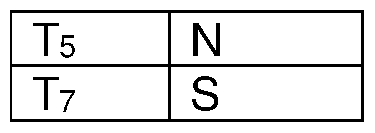
- the windings of a parallel circuit may be configured to produce opposite polarities in alternating teeth of that parallel circuit. More specifically, referring to the first parallel circuit of FIG. 1 , at a given moment, the teeth 106 may be as follows (due to a current in the windings of that parallel circuit):
- the winding configuration of a given parallel circuit provides that alternating teeth 106 in that circuit will have opposite polarities.
- the winding configuration may ensure that teeth 106 spaced k (2, in this case) teeth apart have opposite polarities.
- 2 nd series circuit 1 st winding of T3 + 2 nd winding of Ts;
- 3 rd series circuit 1 st winding of Ts + 2 nd winding of T7;
- 2 nd series circuit 1 st winding of T4 + 2 nd winding of Te;
- 3 rd series circuit 1 st winding of Te + 2 nd winding of Ts;
- the same or similar numerals amongst the FIGS may relate to the same or similar features.
- the windings of a parallel circuit may be configured to produce opposite polarities in alternating teeth of that parallel circuit. More specifically, referring to the first (and only illustrated) parallel circuit of FIG. 3, at a given moment, the teeth 106 may be as follows:
- 2 st series circuit 2 nd winding of Ti + 1 st winding of Ts ;
- the poles are labelled as P1...P4 and the teeth 306 are labelled as T1... T12.
- the winding configuration will be as follows:
- 2 nd series circuit 1 st winding of T4 + 2 nd winding of T7;
- 3 rd series circuit 1 st winding of T7 + 2 nd winding of T10;
- 2 nd series circuit 1 st winding of Ts + 2 nd winding of Ts;
- 3 rd series circuit 1 st winding of Ts + 2 nd winding of T11;
- 3 rd series circuit 1 st winding of T9 + 2 nd winding of T12;
- 4 th series circuit 1 st winding of T12 + 2 nd winding of T3.
- the polarity (at a particular moment) from the 1 st parallel circuit may be:
- the Applicant believes that the invention as exemplified may include one or more of the following advantages:
- the advantage of the motor 100, 200, 300 in accordance with the present invention is that the motor is able to start at all times and positions. There is no complex algorithms.
- the control systems presented in WO2016207700 can be fitted to any size of motor and does not need MCUs and simply controls DC power supply without need to convert to AC as in Hall sensors and sensorless systems.
- the speed of the motor 100, 200, 300 is not limited by the frequency of the power supply and the number of the poles as in BLDC motors or the size of the commutator segment assembly as in brushed DC motors.
- the speed of the motor 100, 200, 300 is not limited by the frequency of the power supply and the number of the poles as in BLDC motors or the size of the commutator segment assembly as in brushed DC motors.
- EMFs Back electromotive forces
Landscapes
- Engineering & Computer Science (AREA)
- Power Engineering (AREA)
- Brushless Motors (AREA)
Abstract
Description




Claims
Priority Applications (1)
| Application Number | Priority Date | Filing Date | Title |
|---|---|---|---|
| PCT/IB2021/061098 WO2023099934A1 (en) | 2021-11-30 | 2021-11-30 | An electric motor with a winding configuration |
Applications Claiming Priority (1)
| Application Number | Priority Date | Filing Date | Title |
|---|---|---|---|
| PCT/IB2021/061098 WO2023099934A1 (en) | 2021-11-30 | 2021-11-30 | An electric motor with a winding configuration |
Publications (1)
| Publication Number | Publication Date |
|---|---|
| WO2023099934A1 true WO2023099934A1 (en) | 2023-06-08 |
Family
ID=86611583
Family Applications (1)
| Application Number | Title | Priority Date | Filing Date |
|---|---|---|---|
| PCT/IB2021/061098 Ceased WO2023099934A1 (en) | 2021-11-30 | 2021-11-30 | An electric motor with a winding configuration |
Country Status (1)
| Country | Link |
|---|---|
| WO (1) | WO2023099934A1 (en) |
Citations (5)
| Publication number | Priority date | Publication date | Assignee | Title |
|---|---|---|---|---|
| US3903463A (en) * | 1973-03-31 | 1975-09-02 | Sansui Electric Co | Self-exciting direct current motors having means for preventing reverse rotation |
| EP1792770A2 (en) * | 2005-11-30 | 2007-06-06 | Hitachi, Ltd. | Motor driving device and automobile using the same |
| US20070194650A1 (en) * | 2006-02-20 | 2007-08-23 | Mitsubishi Electric Corporation | Electric machine |
| US20100289372A1 (en) * | 2009-05-14 | 2010-11-18 | Denso Corporation | Electric rotating machine having improved stator coil arrangement for reducing magnetic noise and torque ripple |
| US20120228981A1 (en) * | 2009-08-04 | 2012-09-13 | Feaam Gmbh | Electric Machine |
-
2021
- 2021-11-30 WO PCT/IB2021/061098 patent/WO2023099934A1/en not_active Ceased
Patent Citations (5)
| Publication number | Priority date | Publication date | Assignee | Title |
|---|---|---|---|---|
| US3903463A (en) * | 1973-03-31 | 1975-09-02 | Sansui Electric Co | Self-exciting direct current motors having means for preventing reverse rotation |
| EP1792770A2 (en) * | 2005-11-30 | 2007-06-06 | Hitachi, Ltd. | Motor driving device and automobile using the same |
| US20070194650A1 (en) * | 2006-02-20 | 2007-08-23 | Mitsubishi Electric Corporation | Electric machine |
| US20100289372A1 (en) * | 2009-05-14 | 2010-11-18 | Denso Corporation | Electric rotating machine having improved stator coil arrangement for reducing magnetic noise and torque ripple |
| US20120228981A1 (en) * | 2009-08-04 | 2012-09-13 | Feaam Gmbh | Electric Machine |
Similar Documents
| Publication | Publication Date | Title |
|---|---|---|
| US20240235295A1 (en) | System and method for controlling a multi-tunnel electric machine | |
| US8922087B1 (en) | High efficiency low torque ripple multi-phase permanent magnet machine | |
| JP3466591B2 (en) | Rotating electric machine | |
| EP3062426A1 (en) | Single-phase brushless motor | |
| JP2001037133A (en) | Stator and electric motor | |
| EP1461854A2 (en) | Electrical machine | |
| CN110337782A (en) | Brushless motor | |
| Zulu et al. | Topologies for wound-field three-phase segmented-rotor flux-switching machines | |
| JP2011120465A (en) | Two-phase bldc motor | |
| US20150155761A1 (en) | Electronically Commutated Electromagnetic Apparatus | |
| CN108429418B (en) | Motor stators, motors, linear motor stators and linear motors | |
| US6891301B1 (en) | Simplified hybrid-secondary uncluttered machine and method | |
| CN109923775A (en) | Permanent magnet motor for reducing magnetic resistance | |
| CN101997377B (en) | Multiphase winding permanent magnet brushless direct current motor as well as control method and control circuit thereof | |
| CN108712045B (en) | Synchronous switch reluctance motor | |
| JP5778391B2 (en) | Synchronous rotating machine | |
| WO2023099934A1 (en) | An electric motor with a winding configuration | |
| EP4068573A1 (en) | A cogging electric machine and a method of operating the cogging electric machine | |
| CN102738998A (en) | Brush DC motor | |
| CN223402370U (en) | Inner rotor motor | |
| WO2015195800A1 (en) | High speed induction machine with fractional-slot tooth-coil winding | |
| US8884484B2 (en) | DC motor having a unique winding structure | |
| JP5460807B1 (en) | Synchronous motor | |
| WO2023164886A1 (en) | Multi-phase alternating-current yoke winding stator | |
| WO2023164874A1 (en) | Yoke winding few-pole multi-speed direct-current stator |
Legal Events
| Date | Code | Title | Description |
|---|---|---|---|
| 121 | Ep: the epo has been informed by wipo that ep was designated in this application |
Ref document number: 21966291 Country of ref document: EP Kind code of ref document: A1 |
|
| NENP | Non-entry into the national phase |
Ref country code: DE |
|
| 122 | Ep: pct application non-entry in european phase |
Ref document number: 21966291 Country of ref document: EP Kind code of ref document: A1 |
|
| 122 | Ep: pct application non-entry in european phase |
Ref document number: 21966291 Country of ref document: EP Kind code of ref document: A1 |
|
| 32PN | Ep: public notification in the ep bulletin as address of the adressee cannot be established |
Free format text: NOTING OF LOSS OF RIGHTS PURSUANT TO RULE 112(1) EPC (EPO FORM 1205A DATED 20/12/2024) |
|
| 122 | Ep: pct application non-entry in european phase |
Ref document number: 21966291 Country of ref document: EP Kind code of ref document: A1 |