WO2017170617A1 - 多官能重合型化合物および着色組成物 - Google Patents
多官能重合型化合物および着色組成物 Download PDFInfo
- Publication number
- WO2017170617A1 WO2017170617A1 PCT/JP2017/012769 JP2017012769W WO2017170617A1 WO 2017170617 A1 WO2017170617 A1 WO 2017170617A1 JP 2017012769 W JP2017012769 W JP 2017012769W WO 2017170617 A1 WO2017170617 A1 WO 2017170617A1
- Authority
- WO
- WIPO (PCT)
- Prior art keywords
- group
- carbon atoms
- general formula
- represented
- preferable
- Prior art date
- Legal status (The legal status is an assumption and is not a legal conclusion. Google has not performed a legal analysis and makes no representation as to the accuracy of the status listed.)
- Ceased
Links
- 0 CCC(C)C(C(*1)C1C1C(C)CCC1)C(*)(CC)CC Chemical compound CCC(C)C(C(*1)C1C1C(C)CCC1)C(*)(CC)CC 0.000 description 6
- ZCXSNIUIGVMJQO-UHFFFAOYSA-N C=CC(OCC(COCC(COC(C=C)=O)(COC(C=C)=O)COC(c1ccccc1C(O)=O)=O)(COC(C=C)=O)COC(C=C)=O)=O Chemical compound C=CC(OCC(COCC(COC(C=C)=O)(COC(C=C)=O)COC(c1ccccc1C(O)=O)=O)(COC(C=C)=O)COC(C=C)=O)=O ZCXSNIUIGVMJQO-UHFFFAOYSA-N 0.000 description 1
- AASWSXXTMLHQER-UHFFFAOYSA-N Fc(c([B](c(c(F)c(c(F)c1F)F)c1F)(c(c(F)c(c(F)c1F)F)c1F)c(c(F)c(c(F)c1F)F)c1F)c(c(F)c1F)F)c1F Chemical compound Fc(c([B](c(c(F)c(c(F)c1F)F)c1F)(c(c(F)c(c(F)c1F)F)c1F)c(c(F)c(c(F)c1F)F)c1F)c(c(F)c1F)F)c1F AASWSXXTMLHQER-UHFFFAOYSA-N 0.000 description 1
- LGRFSURHDFAFJT-UHFFFAOYSA-N O=C(c1ccccc11)OC1=O Chemical compound O=C(c1ccccc11)OC1=O LGRFSURHDFAFJT-UHFFFAOYSA-N 0.000 description 1
- WOAGDWWRYOZHDS-UHFFFAOYSA-N O=S(C(C(C1(F)F)(F)F)(F)F)(NS1(=O)=O)=O Chemical compound O=S(C(C(C1(F)F)(F)F)(F)F)(NS1(=O)=O)=O WOAGDWWRYOZHDS-UHFFFAOYSA-N 0.000 description 1
- NVIANCROYQGROD-UHFFFAOYSA-N O=S([N-]S(F)(=O)=O)(F)=O Chemical compound O=S([N-]S(F)(=O)=O)(F)=O NVIANCROYQGROD-UHFFFAOYSA-N 0.000 description 1
Classifications
-
- C—CHEMISTRY; METALLURGY
- C09—DYES; PAINTS; POLISHES; NATURAL RESINS; ADHESIVES; COMPOSITIONS NOT OTHERWISE PROVIDED FOR; APPLICATIONS OF MATERIALS NOT OTHERWISE PROVIDED FOR
- C09B—ORGANIC DYES OR CLOSELY-RELATED COMPOUNDS FOR PRODUCING DYES, e.g. PIGMENTS; MORDANTS; LAKES
- C09B69/00—Dyes not provided for by a single group of this subclass
- C09B69/10—Polymeric dyes; Reaction products of dyes with monomers or with macromolecular compounds
- C09B69/103—Polymeric dyes; Reaction products of dyes with monomers or with macromolecular compounds containing a diaryl- or triarylmethane dye
-
- C—CHEMISTRY; METALLURGY
- C09—DYES; PAINTS; POLISHES; NATURAL RESINS; ADHESIVES; COMPOSITIONS NOT OTHERWISE PROVIDED FOR; APPLICATIONS OF MATERIALS NOT OTHERWISE PROVIDED FOR
- C09B—ORGANIC DYES OR CLOSELY-RELATED COMPOUNDS FOR PRODUCING DYES, e.g. PIGMENTS; MORDANTS; LAKES
- C09B11/00—Diaryl- or thriarylmethane dyes
- C09B11/28—Pyronines ; Xanthon, thioxanthon, selenoxanthan, telluroxanthon dyes
-
- A—HUMAN NECESSITIES
- A61—MEDICAL OR VETERINARY SCIENCE; HYGIENE
- A61K—PREPARATIONS FOR MEDICAL, DENTAL OR TOILETRY PURPOSES
- A61K8/00—Cosmetics or similar toiletry preparations
- A61K8/18—Cosmetics or similar toiletry preparations characterised by the composition
- A61K8/72—Cosmetics or similar toiletry preparations characterised by the composition containing organic macromolecular compounds
- A61K8/81—Cosmetics or similar toiletry preparations characterised by the composition containing organic macromolecular compounds obtained by reactions involving only carbon-to-carbon unsaturated bonds
- A61K8/8141—Compositions of homopolymers or copolymers of compounds having one or more unsaturated aliphatic radicals, each having only one carbon-to-carbon double bond, and at least one being terminated by only one carboxyl radical, or of salts, anhydrides, esters, amides, imides or nitriles thereof; Compositions of derivatives of such polymers
- A61K8/8152—Homopolymers or copolymers of esters, e.g. (meth)acrylic acid esters; Compositions of derivatives of such polymers
-
- A—HUMAN NECESSITIES
- A61—MEDICAL OR VETERINARY SCIENCE; HYGIENE
- A61Q—SPECIFIC USE OF COSMETICS OR SIMILAR TOILETRY PREPARATIONS
- A61Q5/00—Preparations for care of the hair
- A61Q5/06—Preparations for styling the hair, e.g. by temporary shaping or colouring
-
- C—CHEMISTRY; METALLURGY
- C08—ORGANIC MACROMOLECULAR COMPOUNDS; THEIR PREPARATION OR CHEMICAL WORKING-UP; COMPOSITIONS BASED THEREON
- C08F—MACROMOLECULAR COMPOUNDS OBTAINED BY REACTIONS ONLY INVOLVING CARBON-TO-CARBON UNSATURATED BONDS
- C08F20/00—Homopolymers and copolymers of compounds having one or more unsaturated aliphatic radicals, each having only one carbon-to-carbon double bond, and only one being terminated by only one carboxyl radical or a salt, anhydride, ester, amide, imide or nitrile thereof
- C08F20/02—Monocarboxylic acids having less than ten carbon atoms, Derivatives thereof
- C08F20/10—Esters
- C08F20/34—Esters containing nitrogen, e.g. N,N-dimethylaminoethyl (meth)acrylate
- C08F20/36—Esters containing nitrogen, e.g. N,N-dimethylaminoethyl (meth)acrylate containing oxygen in addition to the carboxy oxygen, e.g. 2-N-morpholinoethyl (meth)acrylate or 2-isocyanatoethyl (meth)acrylate
-
- C—CHEMISTRY; METALLURGY
- C08—ORGANIC MACROMOLECULAR COMPOUNDS; THEIR PREPARATION OR CHEMICAL WORKING-UP; COMPOSITIONS BASED THEREON
- C08F—MACROMOLECULAR COMPOUNDS OBTAINED BY REACTIONS ONLY INVOLVING CARBON-TO-CARBON UNSATURATED BONDS
- C08F220/00—Copolymers of compounds having one or more unsaturated aliphatic radicals, each having only one carbon-to-carbon double bond, and only one being terminated by only one carboxyl radical or a salt, anhydride ester, amide, imide or nitrile thereof
- C08F220/02—Monocarboxylic acids having less than ten carbon atoms; Derivatives thereof
- C08F220/10—Esters
- C08F220/12—Esters of monohydric alcohols or phenols
- C08F220/16—Esters of monohydric alcohols or phenols of phenols or of alcohols containing two or more carbon atoms
- C08F220/18—Esters of monohydric alcohols or phenols of phenols or of alcohols containing two or more carbon atoms with acrylic or methacrylic acids
- C08F220/1807—C7-(meth)acrylate, e.g. heptyl (meth)acrylate or benzyl (meth)acrylate
-
- C—CHEMISTRY; METALLURGY
- C08—ORGANIC MACROMOLECULAR COMPOUNDS; THEIR PREPARATION OR CHEMICAL WORKING-UP; COMPOSITIONS BASED THEREON
- C08F—MACROMOLECULAR COMPOUNDS OBTAINED BY REACTIONS ONLY INVOLVING CARBON-TO-CARBON UNSATURATED BONDS
- C08F222/00—Copolymers of compounds having one or more unsaturated aliphatic radicals, each having only one carbon-to-carbon double bond, and at least one being terminated by a carboxyl radical and containing at least one other carboxyl radical in the molecule; Salts, anhydrides, esters, amides, imides, or nitriles thereof
- C08F222/10—Esters
- C08F222/1006—Esters of polyhydric alcohols or polyhydric phenols
- C08F222/106—Esters of polycondensation macromers
-
- C—CHEMISTRY; METALLURGY
- C08—ORGANIC MACROMOLECULAR COMPOUNDS; THEIR PREPARATION OR CHEMICAL WORKING-UP; COMPOSITIONS BASED THEREON
- C08F—MACROMOLECULAR COMPOUNDS OBTAINED BY REACTIONS ONLY INVOLVING CARBON-TO-CARBON UNSATURATED BONDS
- C08F222/00—Copolymers of compounds having one or more unsaturated aliphatic radicals, each having only one carbon-to-carbon double bond, and at least one being terminated by a carboxyl radical and containing at least one other carboxyl radical in the molecule; Salts, anhydrides, esters, amides, imides, or nitriles thereof
- C08F222/36—Amides or imides
- C08F222/38—Amides
- C08F222/385—Monomers containing two or more (meth)acrylamide groups, e.g. N,N'-methylenebisacrylamide
-
- C—CHEMISTRY; METALLURGY
- C08—ORGANIC MACROMOLECULAR COMPOUNDS; THEIR PREPARATION OR CHEMICAL WORKING-UP; COMPOSITIONS BASED THEREON
- C08F—MACROMOLECULAR COMPOUNDS OBTAINED BY REACTIONS ONLY INVOLVING CARBON-TO-CARBON UNSATURATED BONDS
- C08F265/00—Macromolecular compounds obtained by polymerising monomers on to polymers of unsaturated monocarboxylic acids or derivatives thereof as defined in group C08F20/00
- C08F265/04—Macromolecular compounds obtained by polymerising monomers on to polymers of unsaturated monocarboxylic acids or derivatives thereof as defined in group C08F20/00 on to polymers of esters
- C08F265/06—Polymerisation of acrylate or methacrylate esters on to polymers thereof
-
- C—CHEMISTRY; METALLURGY
- C08—ORGANIC MACROMOLECULAR COMPOUNDS; THEIR PREPARATION OR CHEMICAL WORKING-UP; COMPOSITIONS BASED THEREON
- C08L—COMPOSITIONS OF MACROMOLECULAR COMPOUNDS
- C08L101/00—Compositions of unspecified macromolecular compounds
-
- C—CHEMISTRY; METALLURGY
- C08—ORGANIC MACROMOLECULAR COMPOUNDS; THEIR PREPARATION OR CHEMICAL WORKING-UP; COMPOSITIONS BASED THEREON
- C08L—COMPOSITIONS OF MACROMOLECULAR COMPOUNDS
- C08L33/00—Compositions of homopolymers or copolymers of compounds having one or more unsaturated aliphatic radicals, each having only one carbon-to-carbon double bond, and only one being terminated by only one carboxyl radical, or of salts, anhydrides, esters, amides, imides or nitriles thereof; Compositions of derivatives of such polymers
- C08L33/04—Homopolymers or copolymers of esters
- C08L33/06—Homopolymers or copolymers of esters of esters containing only carbon, hydrogen and oxygen, which oxygen atoms are present only as part of the carboxyl radical
- C08L33/08—Homopolymers or copolymers of acrylic acid esters
-
- C—CHEMISTRY; METALLURGY
- C09—DYES; PAINTS; POLISHES; NATURAL RESINS; ADHESIVES; COMPOSITIONS NOT OTHERWISE PROVIDED FOR; APPLICATIONS OF MATERIALS NOT OTHERWISE PROVIDED FOR
- C09B—ORGANIC DYES OR CLOSELY-RELATED COMPOUNDS FOR PRODUCING DYES, e.g. PIGMENTS; MORDANTS; LAKES
- C09B11/00—Diaryl- or thriarylmethane dyes
- C09B11/04—Diaryl- or thriarylmethane dyes derived from triarylmethanes, i.e. central C-atom is substituted by amino, cyano, alkyl
-
- C—CHEMISTRY; METALLURGY
- C09—DYES; PAINTS; POLISHES; NATURAL RESINS; ADHESIVES; COMPOSITIONS NOT OTHERWISE PROVIDED FOR; APPLICATIONS OF MATERIALS NOT OTHERWISE PROVIDED FOR
- C09B—ORGANIC DYES OR CLOSELY-RELATED COMPOUNDS FOR PRODUCING DYES, e.g. PIGMENTS; MORDANTS; LAKES
- C09B11/00—Diaryl- or thriarylmethane dyes
- C09B11/04—Diaryl- or thriarylmethane dyes derived from triarylmethanes, i.e. central C-atom is substituted by amino, cyano, alkyl
- C09B11/10—Amino derivatives of triarylmethanes
-
- C—CHEMISTRY; METALLURGY
- C09—DYES; PAINTS; POLISHES; NATURAL RESINS; ADHESIVES; COMPOSITIONS NOT OTHERWISE PROVIDED FOR; APPLICATIONS OF MATERIALS NOT OTHERWISE PROVIDED FOR
- C09B—ORGANIC DYES OR CLOSELY-RELATED COMPOUNDS FOR PRODUCING DYES, e.g. PIGMENTS; MORDANTS; LAKES
- C09B11/00—Diaryl- or thriarylmethane dyes
- C09B11/04—Diaryl- or thriarylmethane dyes derived from triarylmethanes, i.e. central C-atom is substituted by amino, cyano, alkyl
- C09B11/10—Amino derivatives of triarylmethanes
- C09B11/24—Phthaleins containing amino groups ; Phthalanes; Fluoranes; Phthalides; Rhodamine dyes; Phthaleins having heterocyclic aryl rings; Lactone or lactame forms of triarylmethane dyes
-
- C—CHEMISTRY; METALLURGY
- C09—DYES; PAINTS; POLISHES; NATURAL RESINS; ADHESIVES; COMPOSITIONS NOT OTHERWISE PROVIDED FOR; APPLICATIONS OF MATERIALS NOT OTHERWISE PROVIDED FOR
- C09B—ORGANIC DYES OR CLOSELY-RELATED COMPOUNDS FOR PRODUCING DYES, e.g. PIGMENTS; MORDANTS; LAKES
- C09B23/00—Methine or polymethine dyes, e.g. cyanine dyes
- C09B23/02—Methine or polymethine dyes, e.g. cyanine dyes the polymethine chain containing an odd number of >CH- or >C[alkyl]- groups
- C09B23/04—Methine or polymethine dyes, e.g. cyanine dyes the polymethine chain containing an odd number of >CH- or >C[alkyl]- groups one >CH- group, e.g. cyanines, isocyanines, pseudocyanines
-
- C—CHEMISTRY; METALLURGY
- C09—DYES; PAINTS; POLISHES; NATURAL RESINS; ADHESIVES; COMPOSITIONS NOT OTHERWISE PROVIDED FOR; APPLICATIONS OF MATERIALS NOT OTHERWISE PROVIDED FOR
- C09B—ORGANIC DYES OR CLOSELY-RELATED COMPOUNDS FOR PRODUCING DYES, e.g. PIGMENTS; MORDANTS; LAKES
- C09B23/00—Methine or polymethine dyes, e.g. cyanine dyes
- C09B23/16—Methine or polymethine dyes, e.g. cyanine dyes the polymethine chain containing hetero atoms
- C09B23/162—Methine or polymethine dyes, e.g. cyanine dyes the polymethine chain containing hetero atoms only nitrogen atoms
- C09B23/164—Methine or polymethine dyes, e.g. cyanine dyes the polymethine chain containing hetero atoms only nitrogen atoms containing one nitrogen atom
-
- C—CHEMISTRY; METALLURGY
- C09—DYES; PAINTS; POLISHES; NATURAL RESINS; ADHESIVES; COMPOSITIONS NOT OTHERWISE PROVIDED FOR; APPLICATIONS OF MATERIALS NOT OTHERWISE PROVIDED FOR
- C09B—ORGANIC DYES OR CLOSELY-RELATED COMPOUNDS FOR PRODUCING DYES, e.g. PIGMENTS; MORDANTS; LAKES
- C09B23/00—Methine or polymethine dyes, e.g. cyanine dyes
- C09B23/16—Methine or polymethine dyes, e.g. cyanine dyes the polymethine chain containing hetero atoms
- C09B23/162—Methine or polymethine dyes, e.g. cyanine dyes the polymethine chain containing hetero atoms only nitrogen atoms
- C09B23/166—Methine or polymethine dyes, e.g. cyanine dyes the polymethine chain containing hetero atoms only nitrogen atoms containing two or more nitrogen atoms
-
- C—CHEMISTRY; METALLURGY
- C09—DYES; PAINTS; POLISHES; NATURAL RESINS; ADHESIVES; COMPOSITIONS NOT OTHERWISE PROVIDED FOR; APPLICATIONS OF MATERIALS NOT OTHERWISE PROVIDED FOR
- C09B—ORGANIC DYES OR CLOSELY-RELATED COMPOUNDS FOR PRODUCING DYES, e.g. PIGMENTS; MORDANTS; LAKES
- C09B62/00—Reactive dyes, i.e. dyes which form covalent bonds with the substrates or which polymerise with themselves
- C09B62/44—Reactive dyes, i.e. dyes which form covalent bonds with the substrates or which polymerise with themselves with the reactive group not directly attached to a heterocyclic ring
- C09B62/465—Reactive dyes, i.e. dyes which form covalent bonds with the substrates or which polymerise with themselves with the reactive group not directly attached to a heterocyclic ring the reactive group being an acryloyl group, a quaternised or non-quaternised aminoalkyl carbonyl group or a (—N)n—CO—A—O—X or (—N)n—CO—A—Hal group, wherein A is an alkylene or alkylidene group, X is hydrogen or an acyl radical of an organic or inorganic acid, Hal is a halogen atom, and n is 0 or 1
-
- C—CHEMISTRY; METALLURGY
- C09—DYES; PAINTS; POLISHES; NATURAL RESINS; ADHESIVES; COMPOSITIONS NOT OTHERWISE PROVIDED FOR; APPLICATIONS OF MATERIALS NOT OTHERWISE PROVIDED FOR
- C09B—ORGANIC DYES OR CLOSELY-RELATED COMPOUNDS FOR PRODUCING DYES, e.g. PIGMENTS; MORDANTS; LAKES
- C09B69/00—Dyes not provided for by a single group of this subclass
- C09B69/10—Polymeric dyes; Reaction products of dyes with monomers or with macromolecular compounds
- C09B69/105—Polymeric dyes; Reaction products of dyes with monomers or with macromolecular compounds containing a methine or polymethine dye
-
- C—CHEMISTRY; METALLURGY
- C09—DYES; PAINTS; POLISHES; NATURAL RESINS; ADHESIVES; COMPOSITIONS NOT OTHERWISE PROVIDED FOR; APPLICATIONS OF MATERIALS NOT OTHERWISE PROVIDED FOR
- C09D—COATING COMPOSITIONS, e.g. PAINTS, VARNISHES OR LACQUERS; FILLING PASTES; CHEMICAL PAINT OR INK REMOVERS; INKS; CORRECTING FLUIDS; WOODSTAINS; PASTES OR SOLIDS FOR COLOURING OR PRINTING; USE OF MATERIALS THEREFOR
- C09D11/00—Inks
- C09D11/30—Inkjet printing inks
- C09D11/32—Inkjet printing inks characterised by colouring agents
- C09D11/328—Inkjet printing inks characterised by colouring agents characterised by dyes
-
- C—CHEMISTRY; METALLURGY
- C09—DYES; PAINTS; POLISHES; NATURAL RESINS; ADHESIVES; COMPOSITIONS NOT OTHERWISE PROVIDED FOR; APPLICATIONS OF MATERIALS NOT OTHERWISE PROVIDED FOR
- C09D—COATING COMPOSITIONS, e.g. PAINTS, VARNISHES OR LACQUERS; FILLING PASTES; CHEMICAL PAINT OR INK REMOVERS; INKS; CORRECTING FLUIDS; WOODSTAINS; PASTES OR SOLIDS FOR COLOURING OR PRINTING; USE OF MATERIALS THEREFOR
- C09D4/00—Coating compositions, e.g. paints, varnishes or lacquers, based on organic non-macromolecular compounds having at least one polymerisable carbon-to-carbon unsaturated bond ; Coating compositions, based on monomers of macromolecular compounds of groups C09D183/00 - C09D183/16
- C09D4/06—Organic non-macromolecular compounds having at least one polymerisable carbon-to-carbon unsaturated bond in combination with a macromolecular compound other than an unsaturated polymer of groups C09D159/00 - C09D187/00
-
- G—PHYSICS
- G03—PHOTOGRAPHY; CINEMATOGRAPHY; ANALOGOUS TECHNIQUES USING WAVES OTHER THAN OPTICAL WAVES; ELECTROGRAPHY; HOLOGRAPHY
- G03F—PHOTOMECHANICAL PRODUCTION OF TEXTURED OR PATTERNED SURFACES, e.g. FOR PRINTING, FOR PROCESSING OF SEMICONDUCTOR DEVICES; MATERIALS THEREFOR; ORIGINALS THEREFOR; APPARATUS SPECIALLY ADAPTED THEREFOR
- G03F7/00—Photomechanical, e.g. photolithographic, production of textured or patterned surfaces, e.g. printing surfaces; Materials therefor, e.g. comprising photoresists; Apparatus specially adapted therefor
- G03F7/004—Photosensitive materials
- G03F7/027—Non-macromolecular photopolymerisable compounds having carbon-to-carbon double bonds, e.g. ethylenic compounds
- G03F7/032—Non-macromolecular photopolymerisable compounds having carbon-to-carbon double bonds, e.g. ethylenic compounds with binders
- G03F7/033—Non-macromolecular photopolymerisable compounds having carbon-to-carbon double bonds, e.g. ethylenic compounds with binders the binders being polymers obtained by reactions only involving carbon-to-carbon unsaturated bonds, e.g. vinyl polymers
-
- G—PHYSICS
- G03—PHOTOGRAPHY; CINEMATOGRAPHY; ANALOGOUS TECHNIQUES USING WAVES OTHER THAN OPTICAL WAVES; ELECTROGRAPHY; HOLOGRAPHY
- G03F—PHOTOMECHANICAL PRODUCTION OF TEXTURED OR PATTERNED SURFACES, e.g. FOR PRINTING, FOR PROCESSING OF SEMICONDUCTOR DEVICES; MATERIALS THEREFOR; ORIGINALS THEREFOR; APPARATUS SPECIALLY ADAPTED THEREFOR
- G03F7/00—Photomechanical, e.g. photolithographic, production of textured or patterned surfaces, e.g. printing surfaces; Materials therefor, e.g. comprising photoresists; Apparatus specially adapted therefor
- G03F7/004—Photosensitive materials
- G03F7/09—Photosensitive materials characterised by structural details, e.g. supports, auxiliary layers
- G03F7/105—Photosensitive materials characterised by structural details, e.g. supports, auxiliary layers having substances, e.g. indicators, for forming visible images
Definitions
- the present invention relates to a polyfunctional polymerizable compound used for forming colored pixels such as a color filter, printing ink, inkjet ink, paint, and the like, and a coloring composition containing the compound.
- Color pixel formation methods in the production of color filters such as liquid crystal display devices and solid-state image sensors include dyeing methods using dyes as dyes, dye dispersion methods, pigment dispersion methods using pigments, electrodeposition methods, and printing methods. Etc. are known. In recent years, improvements in luminance and contrast are particularly required as the characteristics of color filters. According to the pigment dispersion method using a pigment, since heat resistance and light resistance are higher than those of dyes, a color pixel with little deterioration in a heating process at the time of panel manufacture and high long-term reliability can be obtained. Therefore, the pigment dispersion method has become mainstream at present.
- an object of the present invention is to provide a coloring composition that is superior in dissolution resistance (less dye elution) than the conventional coloring composition.
- the present inventors can obtain a colored composition having excellent elution resistance (less elution of dye) by using a compound having a specific functional group as a dye. As a result, the present invention has been completed.
- the present invention includes the following inventions (i) and (ii) in the first aspect.
- a compound represented by the following general formula (1) (hereinafter sometimes abbreviated as a compound of the present invention).
- Dye represents a dye residue
- R 1 represents a hydrogen atom or a methyl group
- Y 0 represents an alkylene group having 1 to 3 carbon atoms, linear, -NH- or a single bond
- Y 1 and Y 2 each independently represent —O— or —NH—
- a 1 represents —O—, —OCO—, —COO—
- a 2 may have —O— in the chain
- a plurality of R 1, a plurality of Y 0, a plurality of Y 1, a plurality of Y 2, a plurality of A 1 and a plurality of A 2 may be the each be the same or different, also the A 2
- R 3 in the general formula (2) represents a group represented by the general formula (2-1).
- a colored composition comprising a compound represented by the above general formula (1) (hereinafter sometimes abbreviated as the colored composition of the present invention).
- the present invention includes the following inventions (iii) to (viii) in the second aspect.
- a compound represented by the following general formula (1a) may have —O— in the chain, and is represented by the general formula (2) Represents an alkylene group having 1 to 6 carbon atoms and having 1 to 6 groups in the chain or at the terminal. However, when the number of groups represented by the general formula (2) in A is 1, R 3 in the general formula (2) represents a group represented by the general formula (2-1).
- R 3 in the general formula (2) when R 3 in the general formula (2) is an alkyl group having 1 to 6 hydrogen or C, formula number 2 to the group represented by the general formula (2) in A of (1a) 6
- R 3 in the general formula (2) is a group represented by the general formula (2-1)
- the number of groups represented by the general formula (2) in A of the general formula (1a) is 1 to The compound shown by the said general formula (1a) which is three.
- a plurality of R 1 , a plurality of R 3 , a plurality of R 8 , a plurality of A 3, and a plurality of Y 2 may be the same or different, and carbon atoms of R 7 and R 8
- the total number is 1 to 6, and when n 1 is 1, R 3 represents a group represented by the general formula (2-1).
- an alkylene group having 1 to 6 carbon atoms in R 7 in the general formula (3a) is according to the "alkylene group having 1 to 6 carbon atoms” in A 1 of the general formula (1); in the R 8 "- “O 1 -C 6 alkylene group or single bond optionally having O— in the chain” is in accordance with A 4 in the general formula (3) described later; n 1 in the general formula (3a) is described later This is the same as n 1 in the general formula (3).
- a plurality of R 1, a plurality of R 4, a plurality of R 8-1, a plurality of a 3 and a plurality of Y 2 may be the same or different, and the total number of carbon atoms of R 7 and the plurality of R 8-1 is 1 to 6.
- R 1, R 7, R 8-1, A 3 and Y 2 are the same as above
- the compound of the present invention When the compound of the present invention is used as a colorant, even if it is immersed in a solvent such as propylene glycol monomethyl ether acetate (PGMEA) after coloring, the colorant is hardly eluted, and there are problems such as a decrease in color density and color mixing. There is an excellent effect that there is no. That is, the colored composition containing the compound of the present invention can form an excellent colored cured product having higher elution resistance than before. Therefore, the colored composition of the present invention is used for forming colored pixels such as color filters used in liquid crystal display devices (LCD), solid-state imaging devices (CCD, CMOS, etc.), organic electroluminescence display devices (OLED), etc., printing inks.
- LCD liquid crystal display devices
- CCD solid-state imaging devices
- CMOS CMOS
- OLED organic electroluminescence display devices
- the colored composition of the present invention can be molded into a sheet, film, bottle, cup or the like by a conventionally known molding method and used as a colored resin molded product. Therefore, it can be used for applications such as eyeglasses, contact lenses, and color contact lenses, and can also be used for similar applications by forming a multilayer structure with a known resin. In addition, it can also be used for applications such as optical films, hair coloring agents, labeling substances for compounds and biological substances, and materials for organic solar cells.
- the compound of the present invention is a compound represented by the general formula (1).
- R 1 in the general formula (1) a hydrogen atom is preferable.
- linear alkylene group having 1 to 3 carbon atoms in Y 0 of the general formula (1) examples include a methylene group, an ethylene group, and a trimethylene group, and a methylene group is preferable.
- Y 0 in the general formula (1) differs depending on the structure of Dye.
- Dye is a residue derived from a xanthene dye, a single bond is preferable;
- Dye is a residue derived from a triarylmethane dye In the case of —, —NH— and a single bond are preferred;
- Dye is a residue derived from a cyanine dye, a methylene group and a single bond are preferred.
- Dye is a dye residue represented by general formula (I) described later, a single bond is preferable;
- Dye is a dye residue represented by general formula (III-1-1) described later.
- a single bond is preferable; when Dye is a dye residue represented by the general formula (III-1-2) described later, —NH— is preferable; Dye is a dye represented by the general formula (IV) described later. When it is a residue, a methylene group and a single bond are preferable.
- Y 1 in the general formula (1) is preferably —O—.
- Y 2 in the general formula (1) is preferably —O—.
- the number of carbon atoms which may have “—O—, —OCO—, —COO—, —NHCO—, —CONH—, —NHCONH— and / or a phenylene group in the chain in A 1 of the general formula (1)
- the alkylene group having 1 to 6 carbon atoms in the “1 to 6 alkylene group” is preferably linear or branched, and more preferably linear. Among the alkylene groups having 1 to 6 carbon atoms, those having 1 to 3 carbon atoms are preferable.
- methylene group ethylene group, methylmethylene group, trimethylene group, propylene group, dimethylmethylene group, ethylmethylene group, tetramethylene group, 1-methyltrimethylene group, 2-methyltrimethylene group, 1, 2-dimethylethylene group, 1,1-dimethylethylene group, ethylethylene group, ethylmethylmethylene group, propylmethylene group, pentamethylene group, 1-methyltetramethylene group, 2-methyltetramethylene group, 1-ethyltrimethylene group Group, 2-ethyltrimethylene group, n-propylethylene group, isopropylethylene group, n-butylmethylene group, isobutylmethylene group, tert-butylmethylene group, hexamethylene group, 1-methylpentamethylene group, 2-methylpenta Methylene group, 3-methylpentamethylene group, 1-ethyltetramethylene group, 2-ethyltetramethylene group, 2-ethy
- the number of carbon atoms which may have “—O—, —OCO—, —COO—, —NHCO—, —CONH—, —NHCONH— and / or a phenylene group in the chain in A 1 of the general formula (1)
- the phenylene group in the “1-6 alkylene group” may be any of o-phenylene, m-phenylene and p-phenylene, preferably o-phenylene and p-phenylene. A phenylene group is more preferred.
- R 51 and R 52 each independently represents an alkylene group having 1 to 5 carbon atoms, and h 1 represents an integer of 1 to 5, provided that h 1 R 51 and R 52 (The total number of carbon atoms is 2-6.)
- R 53 and R 54 each independently represents an alkylene group having 1 to 5 carbon atoms, Y 3 is, -OCO -, - COO -, - NHCO -, - CONH -, - NHCONH- , or Represents a phenylene group, provided that the total number of carbon atoms of R 53 and R 54 is from 2 to 6.
- R 55 and R 57 each independently represent an alkylene group having 1 to 4 carbon atoms
- R 56 represents an alkylene group having 1 to 4 carbon atoms or a phenylene group
- Y 6 represents —OCO - or an -NHCO-
- Y 7 represents -COO- or -CONH-, however, the total number of carbon atoms of the alkylene group for R 55 ⁇ R 57 is 2-6).
- alkylene group having 1 to 5 carbon atoms in R 51 to R 54 in the general formulas (1-1) to (1-2) a linear or branched one is preferable, and a linear one is more preferable. preferable.
- alkylene groups having 1 to 5 carbon atoms those having 1 to 3 carbon atoms are preferable.
- methylene group, ethylene group, trimethylene group, tetramethylene Group and pentamethylene group are preferable, and methylene group, ethylene group and trimethylene group are more preferable.
- the alkylene group having 1 to 4 carbon atoms in R 55 to R 57 in the general formula (1-3) is preferably linear or branched, and more preferably linear.
- the alkylene groups having 1 to 4 carbon atoms those having 1 or 2 carbon atoms are preferred.
- methylene group, ethylene group, methylmethylene group, trimethylene group, propylene group, dimethylmethylene group, ethylmethylene group, tetramethylene group, 1-methyltrimethylene group, 2-methyltrimethylene group, 1, 2-dimethylethylene group, 1,1-dimethylethylene group, ethylethylene group, ethylmethylmethylene group, propylmethylene group, etc. are mentioned, methylene group, ethylene group, trimethylene group, tetramethylene group are preferred, methylene group, ethylene Groups are more preferred.
- h 1 in the general formula (1-1) 1 or 2 is preferable, and 1 is more preferable.
- R 51 and R 52 are the same as described above, provided that the total number of carbon atoms of R 51 and R 52 is 2 to 6.
- H 2 in the general formula (1-5) is preferably an integer of 1 to 3, and more preferably 1.
- H 3 in the general formula (1-5) is preferably an integer of 1 to 3, and more preferably 1 or 3.
- Examples of the group represented by the general formula (1-5) include —CH 2 —O—CH 2 —, —CH 2 —O— (CH 2 ) 2 —, -CH 2 -O- (CH 2 ) 3 -,-(CH 2 ) 2 -O-CH 2 -,-(CH 2 ) 2 -O- (CH 2 ) 2 -,-(CH 2 ) 2 -O -(CH 2 ) 3- , -(CH 2 ) 3 -O-CH 2 -,-(CH 2 ) 3 -O- (CH 2 ) 2 -,-(CH 2 ) 3 -O- (CH 2 ) 3 -are preferred, —CH 2 —O—CH 2 — and —CH 2 —O— (CH 2 ) 3 — are more preferred.
- the phenylene group in Y 3 of the general formula (1-2) may be any of o-phenylene group, m-phenylene group and p-phenylene group, preferably o-phenylene group and p-phenylene group. An o-phenylene group is more preferable.
- Y 3 in formula (1-2) is preferably —OCO—, —NHCO—, or —NHCONH—.
- Preferred examples of the group represented by the general formula (1-2) include, for example, a group represented by the following general formula (1-6).
- the h 4 and h 5 of the general formula (1-6) is preferably h 4 and h 5 are the same, but preferably an integer of 1 to 3, 2 is more preferable.
- Specific examples of the group represented by the general formula (1-6) include, for example, -CH 2 -OCO-CH 2 -,-(CH 2 ) 2 -OCO- (CH 2 ) 2 -,-(CH 2 ) 3 -OCO- (CH 2 ) 3- , -CH 2 -COO-CH 2 -,-(CH 2 ) 2 -COO- (CH 2 ) 2 -,-(CH 2 ) 3 -COO- (CH 2 ) 3- , -CH 2 -NHCO-CH 2 -, - (CH 2) 2 -NHCO- (CH 2) 2 -, - (CH 2) 3 -NHCO- (CH 2) 3 -, -CH 2 -CONH-CH 2 -,-(CH 2 ) 2 -CONH- (CH 2 ) 2 -,-(CH 2 ) 3 -CONH- (CH 2 ) 3- , -CH 2 -NHCONH-CH 2 -,-(CH 2 )
- Examples of the phenylene group in R 56 of the general formula (1-3) include the same phenylene groups as those represented by Y 3 in the general formula (1-2), and preferable examples thereof are also the same.
- total number of carbon atoms of the alkylene group in R 55 to R 57 in the general formula (1-3) means that when R 56 is an alkylene group having 1 to 4 carbon atoms, R 55 , R 56 and R 57 It means the total number of carbon atoms. When R 56 is a phenylene group, it means the total number of carbon atoms of R 55 and R 57 .
- R 56 in the general formula (1-3) is preferably a methylene group, an ethylene group, a trimethylene group, an o-phenylene group, or a p-phenylene group, and more preferably an ethylene group or an o-phenylene group.
- Y 6 in the general formula (1-3) is preferably —NHCO—.
- Y 7 in the general formula (1-3) is preferably —COO—.
- h 6 and h 7 are preferably 1 or 2, and more preferably 2.
- H 8 in formula (1-7) is preferably 1 or 2, and more preferably 1.
- Preferable combinations of Y 6 , Y 7 , h 6 to h 8 in the general formula (1-7) include, for example, combinations 1 to 32 described in the following table, and among them, combinations 1 to 4, 13 to 20 And 29 to 32 are preferable, the combination 17 to 20 is more preferable, and the combination 18 is particularly preferable.
- h 9 in the general formula (1-8) 1 or 2 is preferable, and 2 is more preferable.
- h 10 is preferably 1 or 2, and more preferably 1.
- R 58 , Y 6 , Y 7 , h 9 and h 10 in the general formula (1-8) include, for example, combinations 1 to 32 described in the following table, among which combinations 1 to 16 are Combinations 9 to 12 are more preferable, and combination 11 is particularly preferable.
- a 1 in the general formula (1) is preferably an alkylene group having 1 to 6 carbon atoms, a group represented by the general formulas (1-1) to (1-3) or a single bond, and a linear one having 1 carbon atom. More preferred are alkylene groups of ⁇ 6, groups represented by general formulas (1-5) to (1-8) and single bonds, linear alkylene groups of 1 to 3 carbon atoms, general formula (1-7) Or, a group represented by (1-8) and a single bond are more preferable.
- methylene group ethylene group, trimethylene group, - (CH 2) 2 -OCO- ( CH 2) 2 -COO-CH 2 -, - (CH 2) 2 -NHCO- (CH 2) 2 -COO-CH 2 -, -(CH 2 ) 2 -OCO- (CH 2 ) 2 -CONH-CH 2 -,-(CH 2 ) 2 -NHCO- (CH 2 ) 2 -CONH-CH 2- , Groups represented by formulas (121) to (124), preferably a single bond, A methylene group, — (CH 2 ) 2 —NHCO— (CH 2 ) 2 —COO—CH 2 —, a group represented by the formula (122), a single bond is more preferable, A methylene group is particularly preferred.
- a 2 of the general formula (1) “—O— may be present in the chain, and the group represented by the general formula (2) has 1 to 6 carbon atoms in the chain or at the terminal thereof.
- Examples of the alkylene group having 1 to 6 carbon atoms in the “6 alkylene group” include the same as the alkylene group having 1 to 6 carbon atoms in A 1 of the general formula (1), and the preferable ones are also the same.
- the alkyl group having 1 to 6 carbon atoms in R 3 of the general formula (2) may be any of linear, branched and cyclic, but is preferably linear and branched. Among the alkyl groups having 1 to 6 carbon atoms, those having 1 to 4 carbon atoms are preferable.
- alkylene group having 1 to 6 carbon atoms in “an alkylene group having 1 to 6 carbon atoms which may have —O— in the chain” in A 3 of general formula (2) and general formula (2-1), are the same as the alkylene group having 1 to 6 carbon atoms in A 1 of the general formula (1), and preferred ones are also the same.
- alkylene group having 1 to 6 carbon atoms having —O— in the chain of A 3 in the general formula (2) and the general formula (2-1) in the chain include, for example, those represented by the general formula (1-1). And a group represented by formula (1-4) is preferable, and a group represented by formula (1-5) is more preferable.
- a linear alkylene group having 1 to 6 carbon atoms, a group represented by the general formula (1-4), and a single bond are preferable.
- an alkylene group, a group represented by formula (1-5) and a single bond are more preferred.
- a 3 in the general formula (2-1) a linear alkylene group having 1 to 6 carbon atoms and a group represented by the general formula (1-4) are preferable, and a straight chain having 1 to 3 carbon atoms is preferable.
- An alkylene group and a group represented by the general formula (1-5) are more preferable.
- Preferable specific examples of the group represented by the general formula (2-1) include a group represented by the following general formula (2-2). (Wherein R 1 and Y 2 are the same as above, and A 3-1 represents a linear alkylene group having 1 to 6 carbon atoms or a group represented by the general formula (1-4)). )
- the linear alkylene group having 1 to 6 carbon atoms in A 3-1 of the general formula (2-2) is preferably one having 1 to 3 carbon atoms, specifically, a methylene group, an ethylene group, or a trimethylene group.
- Tetramethylene group, pentamethylene group and hexamethylene group, methylene group, ethylene group and trimethylene group are preferable, and methylene group is more preferable.
- a linear alkylene group having 1 to 3 carbon atoms and a group represented by the general formula (1-5) are preferable.
- a methylene group, —CH 2 —O— (CH 2 ) 3 — is more preferred, and a methylene group is particularly preferred.
- Preferable specific examples of the group represented by the general formula (2-2) include a group represented by the following general formula (2-3). (Wherein, R 1 and Y 2 are the same as above, A 3-2 represents a group represented by an alkylene group or formula linear having 1 to 3 carbon atoms (1-5). )
- linear alkylene group having 1 to 3 carbon atoms in A 3-2 of the general formula (2-3) include a methylene group, an ethylene group, and a trimethylene group, and a methylene group is preferable.
- a methylene group —CH 2 —O— (CH 2 ) 3 — is preferable, and a methylene group is particularly preferable.
- groups represented by the following formulas (131) to (136) are preferable, and groups represented by the formula (131), (133), or (135) are more preferable, and are represented by the formula (131).
- the group is particularly preferred.
- R 3 in the general formula (2) is preferably a hydrogen atom, a linear alkyl group having 1 to 6 carbon atoms, or a group represented by the general formula (2-2).
- the hydrogen atom and the general formula (2-3) ) Is more preferred.
- a hydrogen atom, a methyl group, an ethyl group, an n-propyl group, an n-butyl group and a functional group group (1) are preferable, and a hydrogen atom and a group represented by the formulas (131) to (136) are more preferable.
- a hydrogen atom and a group represented by formula (131), (133) or (135) are more preferred, and a group represented by formula (131) is particularly preferred.
- Preferable specific examples of the group represented by the general formula (2) include, for example, a group represented by the following general formula (2 ′).
- R 1 and Y 2 are the same as above, R 3 'is a hydrogen atom, a group represented by the alkyl group or the general formula having 1 to 6 linear carbon (2-2)
- a 3 ′ represents a linear alkylene group having 1 to 6 carbon atoms, a group represented by the general formula (1-4), or a single bond.
- the linear alkyl group having 1 to 6 carbon atoms in R 3 ′ of the general formula (2 ′) is preferably an alkyl group having 1 to 4 carbon atoms, specifically, a methyl group, an ethyl group, or an n-propyl group. N-butyl group, n-pentyl group and n-hexyl group, and a methyl group, ethyl group, n-propyl group and n-butyl group are preferred.
- the 'R 3 in the general formula (2)' the group represented by hydrogen atoms and the general formula (2-3) is preferred. Specific examples include a hydrogen atom and a functional group group (1).
- a hydrogen atom and groups represented by formulas (131) to (136) are more preferable, and a hydrogen atom and formulas (131) and (133) are preferred.
- Or the group shown by (135) is more preferable, and the group shown by Formula (131) is especially preferable.
- the linear alkylene group having 1 to 6 carbon atoms in A 3 ′ of the general formula (2 ′) is a linear alkylene group having 1 to 6 carbon atoms in A 3-1 of the general formula (2-2).
- the same thing as a group is mentioned, A preferable thing is also the same.
- a 3 ′ of formula (2 ′) a linear alkylene group having 1 to 3 carbon atoms, a group represented by formula (1-5) and a single bond are preferable.
- Preferable specific examples of the group represented by the general formula (2 ′) include a group represented by the following general formula (2 ′′).
- R 1 and Y 2 are the same as above, R 3 '' represents a group represented by hydrogen atom or formula (2-3), A 3 '' is a straight-chain Represents an alkylene group having 1 to 3 carbon atoms, a group represented by formula (1-5) or a single bond.
- the '' R 3 in formula (2 ')' preferably a group represented by a hydrogen atom and formula (131) - (136), a hydrogen atom, and the formula (131), at (133) or (135)
- the group shown is more preferable, and the group shown by the formula (131) is particularly preferable.
- Examples of the linear alkylene group having 1 to 3 carbon atoms in A 3 ′′ in the general formula (2 ′′) include a methylene group, an ethylene group, and a trimethylene group, and a methylene group is preferable.
- group represented by the general formula (2 ′′) include groups represented by the following formulas (141) to (150), among which the formulas (141), (143), (145), ( 147) or (149) is preferable, and a group represented by formula (145) is more preferable.
- R 3 in the general formula (2) represents the general formula (2-1). It is group shown by these.
- the number of groups represented by the general formula (2) in which A 2 has or terminal in the chain of the general formula (1) has the general formula (2) in the alkyl R 3 is C 1 to hydrogen atom or a C 6
- the group is a group
- the number is 2 to 6
- R 3 in the general formula (2) is a group represented by the general formula (2-1)
- the number is 1 to 6.
- the number of groups represented by the general formula (2) that A 2 in the general formula (1) has in the chain or at the terminal is 2 to 6 when R 3 is a hydrogen atom or an alkyl group having 1 to 6 carbon atoms. And preferably 3 to 3 when R 3 is a group represented by formula (2-1); 2 to 4 when R 3 is a hydrogen atom or an alkyl group having 1 to 6 carbon atoms. And when R 3 is a group represented by formula (2-1), it is more preferably 1 or 2.
- a 2 in the general formula (1) include a group represented by the following general formula (3).
- R 1 , R 3 , A 3 and Y 2 are the same as above, and A 4 represents an alkylene group having 1 to 6 carbon atoms which may have —O— in the chain, or a single group. Represents a bond, and n 1 represents an integer of 1 to 6.
- a plurality of R 1 , a plurality of R 3 , a plurality of A 3 , a plurality of A 4, and a plurality of Y 2 may be the same or different, and each has n 1 A 4 carbon atoms.
- the total is 1 to 6, and when n 1 is 1, R 3 represents a group represented by the general formula (2-1).
- Examples of the alkylene group having 1 to 6 carbon atoms in “an alkylene group having 1 to 6 carbon atoms optionally having —O— in the chain” in A 4 of the general formula (3) include those represented by the general formula (1). Examples thereof are the same as those of the alkylene group having 1 to 6 carbon atoms in A 1 , and preferable ones are also the same.
- alkylene group having 1 to 6 carbon atoms having —O— in the chain of A 4 in the general formula (3) include a group represented by the general formula (1-1).
- a group represented by the formula (1-4) is preferable, and a group represented by the general formula (1-5) is more preferable. More specifically, the same examples as the specific examples of the group represented by the general formula (1-5) can be given, and preferred examples are also the same.
- a linear alkylene group having 1 to 6 carbon atoms, a group represented by the general formula (1-4) and a single bond are preferable, and a linear carbon number of 1 to 3 is preferable.
- an alkylene group, a group represented by formula (1-5) and a single bond are more preferred.
- N 1 in the general formula (3) is preferably an integer of 2 to 6, more preferably an integer of 2 to 4, when R 3 is a hydrogen atom or an alkyl group having 1 to 6 carbon atoms.
- R 3 is a group represented by the general formula (2-1), an integer of 1 to 3 is preferable, and 1 or 2 is more preferable.
- group represented by the general formula (3) include groups represented by the following general formula (4-1) or (4-2), and are represented by the general formula (4-2). Groups are preferred. (Wherein R 1 , A 3 and Y 2 are the same as above, R 4 represents a hydrogen atom or an alkyl group having 1 to 6 carbon atoms, and A 4-1 represents one having 1 to 6 carbon atoms. Represents an alkylene group or a single bond, and n 2 represents an integer of 2 to 6.
- a plurality of R 1 , a plurality of R 4 , a plurality of A 3 , a plurality of A 4-1, and a plurality of Y 2 are Each may be the same or different, and the total number of carbon atoms of n 2 A 4-1 is 1-6.
- the plurality of A 4-2 and the plurality of Y 2 may be the same or different, and the total number of carbon atoms of n 4 A 4-1 and n 3 A 4-2 is 1-6.
- Examples of the alkyl group having 1 to 6 carbon atoms in R 4 of the general formula (4-1) include the same as the alkyl group having 1 to 6 carbon atoms in R 3 of the general formula (2), and preferable ones are also the same. It is.
- R 4 in the general formula (4-1) is preferably a hydrogen atom or a linear alkyl group having 1 to 6 carbon atoms, and more preferably a hydrogen atom.
- a hydrogen atom, a methyl group, an ethyl group, an n-propyl group, and an n-butyl group are preferable, and a hydrogen atom is more preferable.
- alkylene group having 1 to 6 carbon atoms in the A 4-1 in formula (4-1) the same thing can be mentioned an alkylene group having 1 to 6 carbon atoms for A 1 in the general formula (1), preferred are Is the same.
- a linear alkylene group having 1 to 6 carbon atoms and a single bond are preferable.
- a methylene group, an ethylene group, a trimethylene group, a tetramethylene group, a pentamethylene group, a hexamethylene group and a single bond are preferable, a methylene group, an ethylene group, a trimethylene group and a single bond are more preferable, and a methylene group and a single bond are preferable. Bonding is particularly preferred.
- N 2 in the general formula (4-1) is preferably an integer of 2 to 4, and more preferably 4.
- the alkylene group having 1 to 6 carbon atoms in the chain of —O— in A 4-2 of the general formula (4-2) is a carbon having —O— in the chain of A 4 of the general formula (3). Examples thereof are the same as those of the alkylene group of 1 to 6, and preferable ones are also the same.
- combinations 1 to 9 described in the following table can be considered, among which combinations 1, 4 and 5 are preferable, and combination 5 is more preferable.
- Preferable specific examples of the group represented by the general formula (4-1) include a group represented by the following general formula (4-1 ′).
- R 1 and Y 2 are the same as above, R 4 ′ represents a hydrogen atom or a linear alkyl group having 1 to 6 carbon atoms, and A 3-3 and A 4-3 represent Each independently represents a linear alkylene group having 1 to 6 carbon atoms or a single bond, and n 2 ′ represents an integer of 2 to 4, provided that a plurality of R 1 , a plurality of R 4 ′, a plurality of A 3-3 , a plurality of A 4-3 s and a plurality of Y 2 ′ s may be the same or different, and the total number of carbon atoms of n 2 ′ A 4-3 s is 1-6. .)
- the linear alkylene group having 1 to 6 carbon atoms in R 4 ′ of the general formula (4-1 ′) is a linear alkyl group having 1 to 6 carbon atoms in R 3 ′ of the general formula (2 ′).
- the same thing as a group is mentioned, A preferable thing is also the same.
- R 4 ′ in formula (4-1 ′) a hydrogen atom is preferable.
- Examples of the linear alkylene group having 1 to 6 carbon atoms in A 3-3 and A 4-3 in the general formula (4-1 ′) include a linear group in A 3-1 in the general formula (2-2).
- the same as the alkylene group having 1 to 6 carbon atoms is preferable, and the preferable ones are also the same.
- a linear alkylene group having 1 to 3 carbon atoms and a single bond are preferable. Specifically, a methylene group, an ethylene group, a trimethylene group, and a single bond are preferable, and a methylene group and a single bond are more preferable.
- n 2 ′ is preferably 4.
- Preferable specific examples of the group represented by the general formula (4-1 ′) include a group represented by the following general formula (4-1 ′′).
- n 2 ′ is the same as above, and A 3-4 and A 4-4 each independently represent a linear alkylene group having 1 to 3 carbon atoms or a single bond, provided that The plurality of A 3-4 and the plurality of A 4-4 may be the same or different, and the total number of carbon atoms of n 2 ′ A 4-4 is 1-6.
- Examples of the linear alkylene group having 1 to 3 carbon atoms in A 3-4 and A 4-4 in the general formula (4-1 ′′) include a methylene group, an ethylene group, and a trimethylene group. preferable.
- a 3-4 and A 4-4 in formula (4-1 ′′) a methylene group and a single bond are preferable.
- Preferred combinations of (n 2 ′) A 3-4 , (n 2 ′) A 4-4 and n 2 ′ in the general formula (4-1 ′′) include, for example, combinations described in the following table 1 to 12 are preferable, among which combinations 1, 2, 4, 5, 8, and 9 are preferable, combinations 8 and 9 are more preferable, and combination 9 is particularly preferable.
- Preferable specific examples of the group represented by the general formula (4-2) include a group represented by the following general formula (4-2 ′).
- R 1 , A 3-1 , A 4-3 and Y 2 are the same as above, A 4-5 represents a group represented by the general formula (1-4), and n 3 ′ And n 4 ′ each independently represents 0 or 1.
- the plurality of R 1 , the plurality of A 3-1, and the plurality of Y 2 may be the same or different, and n 3 (The total number of carbon atoms of 'number of A 4-3 and n 4 ' number of A 4-5 is 1 to 6.)
- a group represented by formula (1-5) is preferable. Specifically, the same examples as the specific examples of the group represented by the general formula (1-5) can be given, and preferred examples are also the same.
- the plurality of R 1 , the plurality of A 3-1, and the plurality of Y 2 in the general formula (4-2 ′) may be the same or different, but are preferably the same in each. .
- Preferable specific examples of the group represented by the general formula (4-2 ′) include a group represented by the following general formula (4-2 ′′).
- a 3-2 , A 4-4 , n 3 ′ and n 4 ′ are the same as above, Y 8 represents —O— or —NH—, and
- a 4-6 represents general A group represented by the formula (1-5) represents a group in which a plurality of A 3-2 and a plurality of Y 8 are the same, and n 3 ′ A 4-4 and n 4 ′ A 4 The total number of carbon atoms with -6 is 1-6.
- Y 8 in formula (4-2 ′′) is preferably —O—.
- Examples of A 4-6 in the general formula (4-2 ′′) include the same specific examples of the group represented by the general formula (1-5), and preferable examples thereof are also the same.
- a combination of A 1 and A 2 in the general formula (1) is a combination in which A 1 is an alkylene group having 1 to 6 carbon atoms or a single bond, and A 2 is a group represented by the general formula (4-1)
- a 1 is an alkylene group having 1 to 6 carbon atoms, a group represented by general formulas (1-1) to (1-3) or a single bond
- a 2 is a group represented by general formula (4-2). The combination which is is mentioned.
- a 1 is an alkylene group or a single bond having 1 to 6 carbon straight carbon
- a 2 is a combination a group represented by the general formula (4-1 ');
- a 1 is a straight-chain A combination of an alkylene group having 1 to 6 carbon atoms, a group represented by general formulas (1-5) to (1-8) or a single bond, and
- a 2 being a group represented by general formula (4-2 ′) preferably, a 1 is an alkylene group or a single bond having 1-3 carbon linear carbon
- a 2 is the general formula (4-1 '') combining a group represented by;
- a 1 is a straight-chain An alkylene group having 1 to 3 carbon atoms, a group represented by the general formula (1-7) or (1-8) or a single bond
- a 2 is a group represented by the general formula (4-2 ′′)
- -A 1 -A 2 in the general formula (1) - include those represented by the following formulas (101) to (114), among others formula (103), (106), (107) , (108), (110) to (114) are preferred, and those represented by the formulas (103), (106), (108), (113) and (114) are more preferred, and the formula (108 ), (113) and (114) are more preferred, and those represented by formula (108) are particularly preferred.
- n in the general formula (1) 1 is preferable.
- the dye residue represented by Dye in the general formula (1) is a monovalent residue excluding a group such as hydrogen in a conventionally known dye molecule, and may have any dye skeleton.
- the dye residue include xanthene dyes, triarylmethane dyes, cyanine dyes, coumarin dyes, stilbene dyes, naphthalimide dyes, perylene dyes, pyridine dyes, oxazine dyes, and olefin dyes.
- xanthene dyes examples include rhodamine dyes such as rhodamine B, rhodamine 6G, rhodamine 3B, rhodamine 101, rhodamine 110, sulforhodamine 101, basic violet 11, basic red 2, and the like; Dyes; for example, fluorescein dyes such as fluorescein and fluorescein isothiocyanate, and rhodamine dyes are preferred.
- triarylmethane dye examples include triarylmethane dyes such as triphenylmethane, basic violet 3, phenol red, phenolphthalein, green S, malachite green, and thymol blue.
- cyanine dye examples include 4-dicyanomethylene-2-methyl-6- (p-dimethylaminostyryl) -4H-pyran (DCM), basic yellow 11, basic yellow 13, basic red 12, basic red 13, Examples thereof include cyanine dyes such as Basic Red 14, Basic Red 15, Basic Red 37, Basic Violet 15 and Basic Violet 16.
- coumarin dyes examples include coumarin dyes such as coumarin 6, coumarin 7, coumarin 153, coumarin 314, coumarin 334, coumarin 545, coumarin 545T, coumarin 545P, and 7-hydroxy-4-methylcoumarin.
- stilbene dye examples include stilbene dyes such as 1,4-bis (2-methylstyryl) benzene and trans-4,4′-diphenylstilbenzene.
- naphthalimide dyes such as basic yellow 51, solvent yellow 11, solvent yellow 98, solvent yellow 116, solvent yellow 43, and solvent yellow 44.
- perylene dyes examples include perylene dyes such as perylene, rumogen yellow, rumogen green, rumogen orange, rumogen pink, rumogen red, solvent orange 5, and solvent green 5.
- pyridine compound examples include pyridine dyes such as 1-ethyl-2- [4- (p-dimethylaminophenyl) -1,3-butadienyl] -pyridinium-perchlorate (pyridine 1), acridine dyes, and the like. Is mentioned.
- oxazine compound examples include oxazine dyes such as cresyl violet acetate and dioxazine dyes.
- olefinic compound examples include ethene dyes, butadiene dyes, hexatriene dyes, and the like.
- azole compounds examples include oxazole dyes and thiazole dyes.
- the dyes described above can be divided into acidic dyes, basic dyes or nonionic dyes.
- the acid dye means an ionic dye whose anion portion becomes a chromophore
- the basic dye means an ionic dye whose cation portion becomes a chromophore
- the dye residue in Dye of the general formula (1) may be derived from any dye of acidic dye, basic dye or nonionic dye, preferably derived from acidic dye or basic dye, and derived from basic dye Are more preferred.
- residues derived from basic dyes are preferable.
- xanthene-based basic dyes, triarylmethane-based basic dyes and cyanine-based basic dye-derived residues are preferred.
- Residues are preferable, residues derived from xanthene-based basic dyes and cyanine-based basic dyes are more preferable, and residues derived from rhodamine-based dyes and cyanine-based basic dyes are particularly preferable.
- n 101 R 105 each independently has a halogeno group, an alkyl group having 1 to 30 carbon atoms, an alkoxy group having 1 to 20 carbon atoms, an alkylthio group having 1 to 20 carbon atoms, or a substituent.
- R 101 and R 102 may form an alkylene group having 2 to 4 carbon atoms
- R 103 and R 104 may be an alkylene group having 2 to 4 carbon atoms. May be formed).
- R 131 represents an alkyl group having 1 to 30 carbon atoms
- R 131 is the same as above
- R 131 is the same as above
- R 131 is the same as above
- * And ** represent the respective bonding positions
- Ar 2 represents a benzene ring, a naphthalene ring or an anthracene ring.
- n 101 represents an integer of 0 to 4
- n 101 represents an integer of 0 to 6
- Ar 2 is an anthracene ring
- n 101 is 0
- R 301 and R 306 each independently represents a hydrogen atom or a methyl group
- R 302 to R 305 are each independently an alkyl having 1 to 30 carbon atoms.
- each of n 301 R 308 independently represents an alkyl group having 1 to 30 carbon atoms or an alkoxy group having 1 to 6 carbon atoms.
- n in the general formula (1) is 1, and Ar 3 is In the case of a benzene ring, n 301 represents an integer of 0 to 4, and in the general formula (1), n is 2, and when Ar 3 is a benzene ring, n 301 represents an integer of 0 to 3, N in the general formula (1) is , And the and when Ar 3 is a naphthalene ring, n 301 represents an integer of 0 to 6, n is 2 in the general formula (1), and when Ar 3 is a naphthalene ring, n 301 is 0 ⁇ Represents an integer of 5.)
- R 401 to R 404 are each independently a hydrogen atom, an alkyl group having 1 to 6 carbon atoms, an alkoxy group having 1 to 6 carbon atoms, or 2 to 4 carbon atoms.
- R 405 and R 406 are each independently A hydrogen atom; an alkyl group having 1 to 6 carbon atoms; an alkyl group having 1 to 6 carbon atoms, a nitro group, a halogeno group, or a cyano group, or an unsubstituted phenylalkyl group having 7 to 9 carbon atoms; or carbon represents naphthyl alkyl group having 11 ⁇ 13,
- R 407 is a hydrogen atom; an alkoxy group having 1 to 6 carbon atoms, an alkyloxycarbonyl group having 2 to 4 carbon atoms, A droxy group, a carboxy group, a halogeno group,
- An ⁇ in general formula (I), general formula (III) and general formula (IV) is not particularly limited as long as it is an anion usually used in this field.
- an aryl group having an electron-withdrawing substituent, a sulfonyl group having an electron-withdrawing substituent, an anion containing a haloalkyl group or a halogeno group, a halogen oxoacid anion or a sulfonate anion (hereinafter referred to as the present invention). May be abbreviated as an anion).
- examples of the anion moiety in the anion containing an aryl group having an electron-withdrawing substituent, a sulfonyl group having an electron-withdrawing substituent, or a haloalkyl group include a sulfonate anion and a nitrogen anion (N -), quaternary boron anion, nitrate ion, phosphate ion and the like, sulfonic acid anion, a nitrogen anion, quaternary boron anion, and more preferably a quaternary boron anion.
- examples of the anion moiety in the anion containing a halogeno group include a quaternary boron anion, a phosphorus anion, and an antimony anion.
- a phosphorus anion and an antimony anion are preferable, and a phosphorus anion is more preferable.
- examples of the electron-withdrawing substituent in the aryl group having an electron-withdrawing substituent or the sulfonyl group having an electron-withdrawing substituent include, for example, a haloalkyl group having 1 to 3 carbon atoms, halogeno Group, nitro group and the like, among which a haloalkyl group having 1 to 3 carbon atoms and a halogeno group are preferable, and a halogeno group is particularly preferable.
- haloalkyl group having 1 to 3 carbon atoms as the electron-withdrawing substituent examples include a chloromethyl group, a trichloromethyl group, a 2-chloroethyl group, a 2,2,2-trichloroethyl group, a pentachloroethyl group, 2 -Chloroalkyl groups such as chloropropyl group, 3-chloropropyl group, 2-chloro-2-propyl group, heptachloropropyl group; bromomethyl group, tribromomethyl group, 2-bromoethyl group, 2,2,2-tri Bromoalkyl groups such as bromoethyl group, pentabromoethyl group, 2-bromopropyl group, 3-bromopropyl group, 2-bromo-2-propyl group, heptabromopropyl group; iodomethyl group, triiodomethyl group, 2- Iodoethyl group
- Iodoalkyl group fluoromethyl group, trifluoromethyl group, 2-fluoroethyl group, 2,2,2-trifluoroethyl group, 1,1,2,2-tetrafluoroethyl group, pentafluoroethyl group, 3- Fluoroalkyl groups such as fluoropropyl group, 3,3,3-trifluoropropyl group, 2,2,3,3-tetrafluoropropyl group, heptafluoropropyl group and the like can be mentioned.
- Perhalogenoalkyl groups such as pentafluoroethyl group and heptafluoropropyl group are preferred, perfluoroalkyl groups such as trifluoromethyl group, pentafluoroethyl group and heptafluoropropyl group are more preferred, and trifluoromethyl group is particularly preferred. .
- the electron-withdrawing substituent in the aryl group having an electron-withdrawing substituent among the above specific examples, those having a strong electron-withdrawing force are preferable, such as a trifluoromethyl group and a fluoro group.
- a nitro group is preferred, and a fluoro group is more preferred.
- examples of the electron-withdrawing substituent in the sulfonyl group having an electron-withdrawing substituent include the trifluoromethyl group, pentafluoroethyl group, heptafluoropropyl group, fluoro Groups are preferred.
- Examples of the aryl group in the aryl group having an electron-withdrawing substituent in the anion according to the present invention include a phenyl group and a naphthyl group, and a phenyl group is preferable.
- aryl group having an electron-withdrawing substituent in the anion according to the present invention include those represented by the following general formulas (20-1) and (20-2).
- m represents an integer of 1 to 5
- m R 41 s each independently represent a haloalkyl group having 1 to 3 carbon atoms, a halogeno group or a nitro group.
- k represents an integer of 1 to 7, and R 41 is the same as above.
- the k R 41 may be the same or different.
- M in formula (20-1) is an integer of 1 to 5, when R 41 is a halogeno group, preferably 2 to 5, more preferably 3 to 5, 5 are more preferred.
- R 41 is a nitro group, it is preferably 1 to 3, and more preferably 1.
- R 41 is a haloalkyl group, 1 to 5 is preferable, and 1 to 3 is more preferable.
- k is usually an integer of 1 to 7, and preferably 2 to 7 when R 41 is a halogeno group.
- R 41 is a nitro group, it is preferably 1 to 3, and more preferably 1.
- R 41 is a haloalkyl group, 1 to 7 is preferable, and 1 to 3 is more preferable.
- the haloalkyl group having 1 to 3 carbon atoms of R 41 is a haloalkyl having 1 to 3 carbon atoms as an electron-withdrawing substituent in the anion according to the present invention.
- the same thing as a group is mentioned, A preferable thing is also the same.
- R 41 in the general formulas (20-1) and (20-2) are the same as the preferred examples of the electron-withdrawing substituent in the aryl group having the electron-withdrawing substituent.
- Specific examples of the group represented by the general formula (20-1) include a trifluoromethylphenyl group, a di (trifluoromethyl) phenyl group, a trifluoro (trifluoromethyl) phenyl group, a pentafluoroethylphenyl group, Di (pentafluoroethyl) phenyl group, tri (pentafluoroethyl) phenyl group, heptafluoropropylphenyl group, di (heptafluoropropyl) phenyl group, tri (heptafluoropropyl) phenyl group, monofluorophenyl group, difluorophenyl group , Trifluorophenyl group, perfluorophenyl group, monochlorophenyl group, dichlorophenyl group, trichlorophenyl group, perchlorophenyl group, monobromophenyl group, dibromophen
- Specific examples of the group represented by the general formula (20-2) include a trifluoromethylnaphthyl group, a di (trifluoromethyl) naphthyl group, a tri (trifluoromethyl) naphthyl group, a pentafluoroethylnaphthyl group, Di (pentafluoroethyl) naphthyl group, tri (pentafluoroethyl) naphthyl group, heptafluoropropylnaphthyl group, di (heptafluoropropyl) naphthyl group, tri (heptafluoropropyl) naphthyl group, monofluoronaphthyl group, difluoronaphthyl group , Trifluoronaphthyl group, perfluoronaphthyl group, monochloronaphthyl group, dichloronaphthyl group,
- the aryl group having an electron-withdrawing substituent in the anion according to the present invention is preferably a group represented by the general formula (20-1) among the above specific examples, specifically, a trifluoromethylphenyl group, a penta Fluoroethylphenyl group, heptafluoropropylphenyl group, nitrophenyl group, dinitrophenyl group, trinitrophenyl group, monofluorophenyl group, difluorophenyl group, trifluorophenyl group, perfluorophenyl group are preferred, difluorophenyl group, trifluorophenyl group, A fluorophenyl group and a perfluorophenyl group are more preferable, and a perfluorophenyl group is particularly preferable.
- a trifluoromethylphenyl group a penta Fluoroethylphenyl group, heptafluoropropylphenyl group, nitro
- Examples of the sulfonyl group having an electron-withdrawing substituent in the anion according to the present invention include -SO 2 -CF 3 , -SO 2 -C 2 F 5 , -SO 2 -C 3 F 7 , -SO 2 -F , -SO 2 -Cl, -SO 2 -Br, -SO 2 -I, and the like.
- haloalkyl group in the anion according to the present invention examples include the same haloalkyl groups as those having 1 to 3 carbon atoms as the electron-withdrawing substituent in the anion according to the present invention, and preferred ones are also the same.
- halogeno group in the anion according to the present invention examples include a fluoro group, a chloro group, a bromo group, and an iodo group, and a fluoro group is preferable.
- anion containing an aryl group having an electron-withdrawing substituent, a sulfonyl group having an electron-withdrawing substituent, a haloalkyl group or a halogeno group include the following general formulas (13) to (13): 19).
- R 41 and m are the same as above.
- M R 41 may be the same or different.
- R 41 and k are the same as above.
- K R 41 may be the same or different.
- R 41 and k are the same as above.
- K R 41 may be the same or different.
- R 42 to R 45 each independently represents a haloalkyl group having 1 to 3 carbon atoms, a halogeno group or a nitro group, and m 2 to m 5 each independently represents an integer of 1 to 5)
- M 2 R 42 , m 3 R 43 , m 4 R 44 and m 5 R 45 may be the same or different.
- each of four R 46 independently represents a haloalkyl group or a halogeno group having 1 to 3 carbon atoms.
- R 47 and R 48 each independently between .R 47 and R 48 representing a haloalkyl group or a halogeno group having 1 to 3 carbon atoms, to form a haloalkylene group having 2 to 3 carbon atoms May be.
- R 49 represents a phosphorus atom or an antimony atom, and all six Xs represent the same halogeno group.
- R 42 to R 45 in the general formula (16), R 46 in the general formula (17), and the haloalkyl group having 1 to 3 carbon atoms in R 47 and R 48 in the general formula (18) may be an anion according to the present invention. And the same as the haloalkyl group having 1 to 3 carbon atoms as the electron-withdrawing substituent in FIG.
- the halogeno group in R 42 to R 45 of the general formula (16), R 46 of the general formula (17), R 47 and R 48 of the general formula (18), and X of the general formula (19) includes a fluoro group, A chloro group, a bromo group, and an iodo group are mentioned, and among these, a fluoro group is preferred.
- Examples of the haloalkylene group having 2 to 3 carbon atoms formed by R 47 and R 48 in the general formula (18) include a tetrafluoroethylene group and a hexafluorotrimethylene group. preferable.
- Examples of the combination of R 41 and m in the general formula (13) include those described in the following table.
- the m R 41 s are preferably all the same group.
- anion represented by the general formula (13) include the following.
- R 41 and k in the general formulas (14) and (15) include those described in the following table.
- the k R 41 s are preferably the same group.
- m 2 R 42 , m 3 R 43 , m 4 R 44 and m 5 R 45 are preferably the same group.
- Examples of combinations of R 42 to R 45 and m 2 to m 5 in the general formula (16) include those described in the following table.
- anion represented by the general formula (16) include the following.
- anion represented by the general formula (17) include, for example, BF 4 ⁇ , CF 3 BF 3 ⁇ , C 2 F 5 BF 3 ⁇ , C 3 F 7 BF 3 ⁇ , (CF 3 ) 4 B ⁇ , (C 2 F 5 ) 4 B ⁇ , (C 3 F 7 ) 4 B ⁇ and the like.
- anion represented by the general formula (18) include the following.
- anion represented by the general formula (19) include PF 6 ⁇ , SbF 6 — and the like, and PF 6 ⁇ is preferable.
- halogen oxoacid anion in the anion according to the present invention include a hypochlorite anion, a chlorite anion, a chlorate anion, a perchlorate anion, and the like, and a perchlorate anion is preferable.
- sulfonate anion in the anion according to the present invention include, for example, an alkyl sulfonate anion having 1 to 20 carbon atoms such as a methanesulfonate anion; a haloalkyl sulfonate having 1 to 20 carbon atoms such as a trifluoromethanesulfonate anion.
- Anions examples thereof include a benzenesulfonate anion having a substituent such as a benzenesulfonate anion and a toluenesulfonate anion, or an unsubstituted benzenesulfonate anion.
- the anion according to the present invention is preferable, and it has an aryl group having an electron-withdrawing substituent and an electron-withdrawing substituent.
- An anion containing a sulfonyl group, a haloalkyl group or a halogeno group is more preferred, specifically, those represented by the general formulas (16) to (19) are preferred, and the general formula (16), the general formula (18) and the general formula What is shown by (19) is more preferable, what is shown by General formula (16) and General formula (19) is still more preferable, and what is shown by General formula (16) is especially preferable.
- An ⁇ in the general formula (I), general formula (III) and general formula (IV) is preferably the following: tetrakis (pentafluorophenyl) boron (IV) anion, bis (trifluoro) Lomethanesulfonyl) imide anion, PF 6 - is more preferable, tetrakis (pentafluorophenyl) boron (IV) anion, PF 6 - is more preferable, and tetrakis (pentafluorophenyl) boron (IV) anion is particularly preferable.
- Examples of the halogeno group in R 105 of the general formula (I) include a fluoro group, a chloro group, a bromo group, and an iodo group, and among them, a fluoro group is preferable.
- the alkyl group having 1 to 30 carbon atoms in R 105 of the general formula (I) may be any of linear, branched and cyclic, and is preferably linear and branched. .
- those having 1 to 12 carbon atoms are preferred, those having 1 to 6 carbon atoms are more preferred, those having 1 to 4 carbon atoms are further preferred, and those having 1 to 2 carbon atoms are more preferred.
- those having 1 to 2 carbon atoms are more preferred.
- the alkoxy group having 1 to 20 carbon atoms in R 105 of the general formula (I) may be any of linear, branched and cyclic, and is preferably linear and branched. .
- those having 1 to 12 carbon atoms are preferable, those having 1 to 6 carbon atoms are more preferable, and those having 1 to 4 carbon atoms are particularly preferable.
- the alkylthio group having 1 to 20 carbon atoms in R 105 of the general formula (I) may be linear, branched or cyclic, and is preferably linear or branched. .
- those having 1 to 12 carbon atoms are preferable, those having 1 to 6 carbon atoms are more preferable, and those having 1 to 4 carbon atoms are particularly preferable.
- the amino group having a substituent in R 105 of the general formula (I) has one or two substituents.
- substituents include an alkyl group having 1 to 30 carbon atoms, a haloalkyl group having 1 to 20 carbon atoms, an aryl group having 6 to 10 carbon atoms, and an arylalkyl group having 7 to 13 carbon atoms.
- alkyl group having 1 to 30 carbon atoms in the substituent of the amino group having a substituent in R 105 of formula (I) the same as the alkyl group having 1 to 30 carbon atoms in the R 105 in formula (I)
- preferred examples are also the same.
- the haloalkyl group having 1 to 20 carbon atoms in the substituent of the amino group having a substituent in R 105 of the general formula (I) may be any of linear, branched and cyclic, Linear and branched are preferred. Of the haloalkyl groups having 1 to 20 carbon atoms, those having 1 to 12 carbon atoms are preferable, those having 1 to 6 carbon atoms are more preferable, and those having 1 to 3 carbon atoms are particularly preferable.
- chloromethyl group trichloromethyl group, 2-chloroethyl group, 2,2,2-trichloroethyl group, pentachloroethyl group, 2-chloropropyl group, 3-chloropropyl group, 2-chloro- Chloroalkyl groups such as 2-propyl group and heptachloropropyl group; bromomethyl group, tribromomethyl group, 2-bromoethyl group, 2,2,2-tribromoethyl group, pentabromoethyl group, 2-bromopropyl group, Bromoalkyl groups such as 3-bromopropyl group, 2-bromo-2-propyl group, heptabromopropyl group; iodomethyl group, triiodomethyl group, 2-iodoethyl group, 2,2,2-triiodoethyl group, penta Iodoalkyl groups such as iod
- Perhalogenoalkyl groups such as pentafluoroethyl group and heptafluoropropyl group are preferred, perfluoroalkyl groups such as trifluoromethyl group, pentafluoroethyl group and heptafluoropropyl group are more preferred, and trifluoromethyl group is particularly preferred. .
- Examples of the aryl group having 6 to 10 carbon atoms in the substituent of the amino group having a substituent in R 105 of the general formula (I) include a phenyl group and a naphthyl group, and a phenyl group is preferable.
- the arylalkyl group having 7 to 13 carbon atoms in the substituent of the amino group having a substituent in R 105 of the general formula (I) includes a phenylalkyl group having 7 to 9 carbon atoms and a naphthylalkyl group having 11 to 13 carbon atoms.
- a phenylalkyl group having 7 to 9 carbon atoms is preferable.
- the substituted or unsubstituted amino group in R 105 of the general formula (I) is preferably a substituted amino group, an alkyl group having 1 to 30 carbon atoms, a haloalkyl group having 1 to 20 carbon atoms, carbon More preferred is an amino group having an aryl group having 6 to 10 carbon atoms or an arylalkyl group having 7 to 13 carbon atoms, and an amino group having an alkyl group having 1 to 12 carbon atoms, a phenyl group or a phenylalkyl group having 7 to 9 carbon atoms. Is more preferable.
- aryl group having 6 to 14 carbon atoms in R 105 of the general formula (I) include a phenyl group, a naphthyl group, and an anthracenyl group, and a phenyl group is preferable.
- aryloxy group having 6 to 14 carbon atoms in R 105 of the general formula (I) include a phenoxy group, a naphthyloxy group, an anthracenyloxy group, and the like, and a phenoxy group is preferable.
- the arylalkyl group having 7 to 20 carbon atoms in R 105 of the general formula (I) includes a phenylalkyl group having 7 to 12 carbon atoms, a naphthylalkyl group having 11 to 16 carbon atoms, and an anthracenyl group having 15 to 20 carbon atoms.
- Examples thereof include an alkyl group, and a phenylalkyl group having 7 to 12 carbon atoms is preferable, and a phenylalkyl group having 7 to 9 carbon atoms is more preferable.
- benzyl group phenethyl group (2-phenylethyl group), 1-phenylethyl group, hydrocinnamyl group (3-phenylpropyl group), 2-phenylpropyl group, 1-phenylpropyl group, cumyl group ( 2-phenylpropan-2-yl group), 4-phenylbutyl group, 3-phenylbutyl group, 2-phenylbutyl group, 1-phenylbutyl group, 5-phenylpentyl group, 4-phenylpentyl group, 3-phenyl Pentyl group, 2-phenylpentyl group, 1-phenylpentyl group, 6-phenylhexyl group, 5-phenylhexyl group, 4-phenylhexyl group, 3-phenylhexyl group, 2-phenylhexyl group, 1-phenylhexyl group Naphthylmethyl group, 2-naphthylethyl
- R 105 of the general formula (I) includes a halogeno group; an alkyl group having 1 to 12 carbon atoms; an alkoxy group having 1 to 12 carbon atoms; an alkylthio group having 1 to 12 carbon atoms; an alkyl group having 1 to 30 carbon atoms; An amino group having a haloalkyl group having 1 to 20 carbon atoms, an aryl group having 6 to 10 carbon atoms or an arylalkyl group having 7 to 13 carbon atoms; a hydroxy group; an aryl group having 6 to 14 carbon atoms; An aryloxy group; and an arylalkyl group having 7 to 20 carbon atoms, preferably a halogeno group; an alkyl group having 1 to 12 carbon atoms; an alkoxy group having 1 to 12 carbon atoms; an alkylthio group having 1 to 12 carbon atoms; An amino group having a -12 alkyl group, a phenyl group or a phen
- fluorine atom methyl group, ethyl group, n-propyl group, isopropyl group, n-butyl group, isobutyl group, sec-butyl group, tert-butyl group, n-pentyl group, isopentyl group, n- Hexyl, methoxy, ethoxy, n-propoxy, isopropoxy, n-butoxy, isobutoxy, sec-butoxy, tert-butoxy, methylthio, ethylthio, n-propylthio, isopropylthio , N-butylthio group, isobutylthio group, sec-butylthio group, tert-butylthio group, methylamino group, ethylamino group, n-propylamino group, isopropylamino group, n-butylamino group, isobutylamino group, iso
- examples of the alkyl group having 1 to 6 carbon atoms in R 132 include the same as the alkyl group having 1 to 6 carbon atoms in R 3 of the general formula (2). Is the same.
- an oxygen atom and —NR 132 — are preferable, and an oxygen atom is more preferable.
- an oxygen atom, a sulfur atom, -NCH 3 -, - NC 2 H 5 -, - NC 3 H 7 -, - NC 4 H 9 - , and the like an oxygen atom, a sulfur atom, - NCH 3 — is preferable, an oxygen atom, —NCH 3 — is more preferable, and an oxygen atom is particularly preferable.
- Examples of the alkyl group having 1 to 30 carbon atoms in R 102 and R 103 of the general formula (I-1-1) include the same alkyl groups having 1 to 30 carbon atoms as R 105 in the general formula (I). The preferred ones are the same.
- the aryl group having 6 to 14 carbon atoms of the “substituted or unsubstituted aryl group having 6 to 14 carbon atoms” in R 102 and R 103 of the general formula (I-1-1) includes a phenyl group, naphthyl Group, anthracenyl group and the like, and a phenyl group is preferable.
- the aryl group having 6 to 14 carbon atoms having a substituent in R 102 and R 103 in formula (I-1-1) is usually 1 to 5, preferably 1 to 3, more preferably 1 substituent.
- the substituent include an alkyl group having 1 to 30 carbon atoms.
- Examples of the alkyl group having 1 to 30 carbon atoms include the same ones as the alkyl group having 1 to 30 carbon atoms in R 105 of the general formula (I), and preferable ones are also the same.
- Examples of the aryl group having 6 to 14 carbon atoms having a substituent in R 102 and R 103 in formula (I-1-1) include an aryl group having 6 to 14 carbon atoms having an alkyl group having 1 to 30 carbon atoms, and the like And a phenyl group having a C 1-30 alkyl group, a naphthyl group and an anthracenyl group are preferred, a phenyl group having a C 1-12 alkyl group is more preferred, and a C 1-6 alkyl group is preferred.
- the phenyl group having an alkyl group having 1 to 3 carbon atoms is particularly preferable.
- o-tolyl group (methylphenyl group), m-tolyl group, p-tolyl group, o-ethylphenyl group, m-ethylphenyl group, p-ethylphenyl group, o-propylphenyl group, m-propylphenyl group, p-propylphenyl group, o-butylphenyl group, m-butylphenyl group, p-butylphenyl group, o-pentylphenyl group, m-pentylphenyl group, p-pentylphenyl group, o- Hexylphenyl group, m-hexylphenyl group, p-hexylphenyl group, 2,3-xylyl group (2,3-dimethylphenyl group), 2,4-xylyl group, 2,5-xylyl group, 2,6- Examples include xylphenyl
- alkyl groups in the above specific examples are not limited to normal-forms, and all branched ones such as sec-forms, tert-forms, iso-forms (iso-forms), neo-forms (neo-forms), etc. Including.
- R 101 and R 102 in the general formula (I-1-1) form an alkylene group having 2 to 4 carbon atoms
- R 103 and R 104 form an alkylene group having 2 to 4 carbon atoms.
- the alkylene group having 2 to 4 carbon atoms may be either linear or branched, and is preferably linear.
- R 101 in formula (I-1-1) is preferably a hydrogen atom, a methyl group, or a group in which R 101 and R 102 form a linear alkylene group having 2 to 4 carbon atoms.
- an alkyl group having 1 to 12 carbon atoms, an alkyl group having 1 to 6 carbon atoms or an unsubstituted phenyl group, and R 101 and R 102 are carbon atoms.
- Those having an alkylene group having 2 to 4 carbon atoms are preferred, and an alkyl group having 1 to 6 carbon atoms, an alkyl group having 1 to 3 carbon atoms or an unsubstituted phenyl group, and R 101 and R 102 What forms a C2-C4 linear alkylene group is more preferable.
- R 101 and R 102 form a trimethylene group
- R 101 and R 102 form a tetramethylene group, such as methyl group, ethyl group, propyl group, and butyl group.
- a group, a pentyl group, a hexyl group, a phenyl group, a p-tolyl group, a p-ethylphenyl group, a p-propylphenyl group, and those in which R 101 and R 102 form a trimethylene group are preferred.
- alkyl groups in the above specific examples are not limited to normal-forms, and all branched ones such as sec-forms, tert-forms, iso-forms (iso-forms), neo-forms (neo-forms), etc. Including.
- R 103 in the general formula (I-1-1) includes an alkyl group having 1 to 12 carbon atoms, an alkyl group having 1 to 6 carbon atoms or an unsubstituted phenyl group, and carbon in R 103 and R 104.
- Those having an alkylene group having 2 to 4 carbon atoms are preferred, and an alkyl group having 1 to 6 carbon atoms, an alkyl group having 1 to 3 carbon atoms or an unsubstituted phenyl group, and R 103 and R 104 What forms a C2-C4 linear alkylene group is more preferable.
- R 103 and R 104 form a trimethylene group
- R 103 and R 104 form a tetramethylene group, such as methyl group, ethyl group, propyl group, and butyl group.
- a group, a pentyl group, a hexyl group, a phenyl group, a p-tolyl group, a p-ethylphenyl group, a p-propylphenyl group, and those in which R 103 and R 104 form a trimethylene group are preferable.
- alkyl groups in the above specific examples are not limited to normal-forms, and all branched ones such as sec-forms, tert-forms, iso-forms (iso-forms), neo-forms (neo-forms), etc. Including.
- R 104 in formula (I-1-1) is preferably a hydrogen atom, a methyl group, or a group in which R 103 and R 104 form a linear alkylene group having 2 to 4 carbon atoms.
- R 103 and R 104 form an ethylene group
- R 103 and R 104 forming a trimethylene group
- R 103 and R 104 And those that form a tetramethylene group, and those in which a hydrogen atom and R 103 and R 104 form a trimethylene group are preferred.
- R 101 to R 104 in formula (I-1-1) include those listed in the following table, for example.
- the alkyl group having 1 to 30 carbon atoms in R 131 of general formulas (I-1-2) to (I-1-7) includes an alkyl group having 1 to 30 carbon atoms in R 105 of general formula (I) and The same thing is mentioned, A preferable thing is also the same.
- Ar 1 in formula (I) is preferably a ring structure represented by formula (I-1-1).
- * And ** in the general formula (I) correspond to * and ** in the general formulas (I-1-1) to (I-1-7), and the general formulas (I-1-1) to This represents that the ring structure represented by (I-1-7) is bonded to the positions represented by * and ** of the dye residue represented by the general formula (I). Specifically, it is shown by the following structure. (Wherein, R 101 ⁇ R 105, R 131, Y 101, An -, Ar 2 and n 101 have the same as above.)
- a benzene ring and a naphthalene ring are preferable, and a benzene ring is more preferable.
- N 101 in the general formula (1) is preferably an integer of 0 to 3 when Ar 2 is a benzene ring, more preferably 1 or 2, and preferably 0 or 1 when Ar 2 is a naphthalene ring and an anthracene ring. , 0 is more preferable.
- the general formula (I) when Ar 2 is a benzene ring, the general formula (I) is represented by the following general formula (I-2-1).
- the general formula (I) when represented by the general formulas (I-2-2) to (I-2-4) and Ar 2 is an anthracene ring, the general formula (I) is represented by the following general formulas (I-2-5) to (I-2) -7).
- general formulas (I-2-1), (I-2-2) and (I-2-5) are preferable, and general formula (I-2-1) is more preferable.
- n 101 R 105 in the general formula (I-2-1) may be any of I to IV positions of the benzene ring, and when n 101 is 1, it is located at the II position or the III position.
- n 101 is 2, it is preferably located at positions II and III, or II and IV, and when n 101 is 3, I position, II position and III position or II position, It is preferably located at positions III and IV.
- n 101 R 105 in the general formula (I-2-2) may be any of the I to VI positions of the naphthalene ring, and is preferably located at the IV position or the VI position.
- n 101 R 105 in the general formula (I-2-3) may be any of the I to VI positions of the naphthalene ring, and is preferably located at the III position.
- the position of n 101 R 105 may be any of the I to VI positions of the naphthalene ring, and is preferably located at the II position or the IV position.
- n 101 R 105 in the general formula (I-2-5) may be any of the I-VIII positions of the anthracene ring, and is preferably located at the I-position, V-position or VI-position.
- n 101 R 105 in the general formula (I-2-6) may be any of the I-VIII positions of the anthracene ring, and is preferably located at the II-position, V-position or VII-position.
- n 101 R 105 in the general formula (I-2-7) may be any of positions I to VIII of the anthracene ring, and is preferably located at the IV or V position.
- Dye in the general formula (1) is a dye residue represented by the general formula (I)
- the site where Y 0 is bonded to the dye residue is the ortho position of the phenyl group in the general formula (I)
- the meta It may be located at any of the position and the para position; when n in the general formula (1) is 1, the ortho position or the para position is preferable, the ortho position is more preferable; and the n in the general formula (1) is 2 , A combination of ortho and para positions is preferred.
- n in the general formula (1) is 1, it is preferable that Y 0 is bonded as in the compound represented by the following general formula (I′-1); In the case where n is 2, a compound in which Y 0 is bonded as in the compound represented by the following general formula (I′-2) is preferable.
- R 1 , R 105 , Y 0 , Y 1 , Y 2 , Y 101 , A 1 , A 2 , Ar 1 , Ar 2 , An ⁇ , n 101 , * and ** are the same as above.
- the plurality of R 1 , the plurality of Y 0 , the plurality of Y 1 , the plurality of Y 2 , the plurality of A 1, and the plurality of A 2 may be the same or different.
- the general formula (I) include dye residues represented by the following general formula (I-3).
- An ′ ⁇ represents an anion including an aryl group having an electron-withdrawing substituent, a sulfonyl group having an electron-withdrawing substituent, a haloalkyl group, or a halogeno group, and R 101 to R 105 , Ar 2 And n 101 are the same as above.
- An anion containing an aryl group having an electron-withdrawing substituent, a sulfonyl group having an electron-withdrawing substituent, a haloalkyl group, or a halogeno group in An ′ ⁇ in the general formula (I-3) is an anion according to the present invention.
- the same thing as those of these is mentioned, A preferable thing is also the same.
- Preferable specific examples of the general formula (I-4) include dye residues represented by the following general formula (I-5).
- R 201 and R 204 each independently represent a hydrogen atom or a methyl group
- R 202 and R 203 each independently represent an alkyl group having 1 to 12 carbon atoms or an alkyl group having 1 to 6 carbon atoms.
- n 201 R 205 is a halogeno group; an alkyl group having 1 to 12 carbon atoms; an alkoxy group having 1 to 12 carbon atoms; an alkylthio group having 1 to 12 carbon atoms; An amino group having an alkyl group having 1 to 30 carbon atoms, a haloalkyl group having 1 to 20 carbon atoms, an aryl group having 6 to 10 carbon atoms, or an arylalkyl group having 7 to 13 carbon atoms; a hydroxy group; aryl group; an aryloxy group having 6 to 14 carbon atoms; represents and aryl group having a carbon number of 7 ⁇ 20, n 201 represents an integer of 0 ⁇ 4, R 201 and carbon atoms in the R 202 2 ⁇ May also be an alkylene group forming, may form an alkylene group of R 203 and carbon atoms in the R 204 2 .
- the alkyl group having 1 to 12 carbon atoms in R 202 and R 203 in the general formula (I-5) may be any of linear, branched, and cyclic. Branched is preferred. Among the alkyl groups having 1 to 12 carbon atoms, those having 1 to 6 carbon atoms are more preferable, those having 1 to 4 carbon atoms are more preferable, and those having 1 to 2 carbon atoms are particularly preferable.
- the phenyl group having an alkyl group having 1 to 6 carbon atoms in R 202 and R 203 of the general formula (I-5) is usually 1 to 5, preferably 1 to 3, more preferably 1 alkyl group.
- Examples of the alkyl group include the same ones as the alkyl group having 1 to 6 carbon atoms in R 3 of the general formula (2), and preferred ones are also the same.
- a phenyl group having an alkyl group having 1 to 3 carbon atoms is particularly preferable.
- alkyl groups in the above specific examples are not limited to normal-forms, and all branched ones such as sec-forms, tert-forms, iso-forms (iso-forms), neo-forms (neo-forms), etc. Including.
- R 201 and R 202 in the general formula (I-5) form an alkylene group having 2 to 4 carbon atoms
- R 203 and R 204 form an alkylene group having 2 to 4 carbon atoms.
- the alkylene group having 2 to 4 carbon atoms, and when and R 103 in the R 101 and R 102 in formula (I-1-1) to form an alkylene group having 2 to 4 carbon atoms R The same as the alkylene group having 2 to 4 carbon atoms in the case where the alkylene group having 2 to 4 carbon atoms is formed with 104, and the preferable ones are also the same.
- R 201 and R 202 form an alkylene group having 2 to 4 carbon atoms and / or R 203 and R 204 form an alkylene group having 2 to 4 carbon atoms
- Specific examples of the case include the following general formulas (I-5-1) to (I-5-9), and include general formulas (I-5-2) and (I-5-5).
- Or (I-5-8) is preferred, and general formula (I-5-8) is more preferred.
- R 201 to R 205 An ′ ⁇ and n 201 are the same as above).
- R 201 in formula (I-5) is preferably a hydrogen atom, a methyl group, or a group in which R 201 and R 202 form a linear alkylene group having 2 to 4 carbon atoms.
- a hydrogen atom, a methyl group, a group in which R 201 and R 202 form an ethylene group, a group in which R 201 and R 202 form a trimethylene group, R 201 and R 202 And those that form a tetramethylene group, and those in which a hydrogen atom, a methyl group, and R 201 and R 202 form a trimethylene group are preferred.
- R 202 in the general formula (I-5) includes an alkyl group having 1 to 6 carbon atoms, an alkyl group having 1 to 3 carbon atoms or an unsubstituted phenyl group, and R 201 and R 202 having 2 carbon atoms. Those having a linear alkylene group of 1 to 4 are preferred.
- R 201 and R 202 form a trimethylene group
- R 201 and R 202 form a tetramethylene group, such as a methyl group, an ethyl group, a propyl group, and a butyl group.
- a group, a pentyl group, a hexyl group, a phenyl group, a p-tolyl group, a p-ethylphenyl group, a p-propylphenyl group, and those in which R 201 and R 202 form a trimethylene group are preferred.
- alkyl groups in the above specific examples are not limited to normal-forms, and all branched ones such as sec-forms, tert-forms, iso-forms (iso-forms), neo-forms (neo-forms), etc. Including.
- R 203 in the general formula (I-5) includes an alkyl group having 1 to 6 carbon atoms, an alkyl group having 1 to 3 carbon atoms or an unsubstituted phenyl group, and R 203 and R 204 having 2 carbon atoms. Those having a linear alkylene group of 1 to 4 are preferred.
- R 203 and R 204 form a trimethylene group
- examples thereof include a methyl group, an ethyl group, a propyl group, and a butyl group.
- a group, a pentyl group, a hexyl group, a phenyl group, a p-tolyl group, a p-ethylphenyl group, a p-propylphenyl group, and those in which R 203 and R 204 form a trimethylene group are preferred.
- alkyl groups in the above specific examples are not limited to normal-forms, and all branched ones such as sec-forms, tert-forms, iso-forms (iso-forms), neo-forms (neo-forms), etc. Including.
- R 204 in formula (I-5) is preferably a hydrogen atom, a methyl group, or a group in which R 203 and R 204 form a linear alkylene group having 2 to 4 carbon atoms.
- a hydrogen atom, a methyl group, a group in which R 203 and R 204 form an ethylene group, a group in which R 203 and R 204 form a trimethylene group, R 203 and R 204 And those that form a tetramethylene group, and those in which a hydrogen atom, R 203 and R 204 form a trimethylene group are preferred.
- Examples of the halogeno group in R 205 of the general formula (I-5) include a fluoro group, a chloro group, a bromo group, and an iodo group, and among these, a fluoro group is preferable.
- Examples of the alkyl group having 1 to 12 carbon atoms in R 205 of the general formula (I-5) include the same alkyl groups having 1 to 12 carbon atoms as R 202 and R 203 in the general formula (I-5). The preferred ones are the same.
- the alkoxy group having 1 to 12 carbon atoms in R 205 of the general formula (I-5) may be any of linear, branched and cyclic, and in particular, linear and branched Is preferred.
- the alkoxy groups having 1 to 12 carbon atoms those having 1 to 6 carbon atoms are preferable, and those having 1 to 4 carbon atoms are more preferable.
- the alkylthio group having 1 to 12 carbon atoms in R 205 of the general formula (I-5) may be any of linear, branched and cyclic, and in particular, linear and branched Is preferred.
- alkylthio groups having 1 to 12 carbon atoms those having 1 to 6 carbon atoms are preferable, and those having 1 to 4 carbon atoms are more preferable.
- Specific examples of the alkyl group having 1 to 30 carbon atoms, the haloalkyl group having 1 to 20 carbon atoms, the aryl group having 6 to 10 carbon atoms and the arylalkyl group having 7 to 13 carbon atoms in the “amino group” include those represented by the general formula (I) they same thing can be mentioned in the "amino group having a substituent" in the R 105, is preferred also the same.
- R 205 of the general formula (I-5) “has an alkyl group having 1 to 30 carbon atoms, a haloalkyl group having 1 to 20 carbon atoms, an aryl group having 6 to 10 carbon atoms, or an arylalkyl group having 7 to 13 carbon atoms.
- the “amino group” is preferably an amino group having an alkyl group having 1 to 12 carbon atoms, a phenyl group, or a phenylalkyl group having 7 to 9 carbon atoms.
- aryl group having 6 to 14 carbon atoms the aryloxy group having 6 to 14 carbon atoms and the arylalkyl group having 7 to 20 carbon atoms represented by R 205 in the general formula (I-5) are as follows. the same thing can be mentioned as those in R 105, it is preferred also the same.
- R 205 in formula (I-5) is a halogeno group; an alkyl group having 1 to 12 carbon atoms; an alkoxy group having 1 to 12 carbon atoms; an alkylthio group having 1 to 12 carbon atoms; an alkyl having 1 to 12 carbon atoms.
- fluorine atom methyl group, ethyl group, n-propyl group, isopropyl group, n-butyl group, isobutyl group, sec-butyl group, tert-butyl group, n-pentyl group, isopentyl group, n- Hexyl, methoxy, ethoxy, n-propoxy, isopropoxy, n-butoxy, isobutoxy, sec-butoxy, tert-butoxy, methylthio, ethylthio, n-propylthio, isopropylthio , N-butylthio group, isobutylthio group, sec-butylthio group, tert-butylthio group, methylamino group, ethylamino group, n-propylamino group, isopropylamino group, n-butylamino group, isobutylamino group, iso
- n 201 in formula (I-5) an integer of 0 to 3 is preferable, and 1 or 2 is more preferable.
- n 201 R 205 in the general formula (I-5) may be any of the I to IV positions of the benzene ring in the following general formula (I-6).
- n 201 is 1, the position of II or III It is preferably located at the position, preferably when n 201 is 2, it is preferably located at positions II and III, or II and IV, and when n 201 is 3, it is located at positions I and II. And III, or II, III, and IV positions.
- I to IV represent positions where R 205 can be substituted, and R 201 to R 205 , An ′ ⁇ and n 201 are the same as above).
- Preferable specific examples of the general formula (I-5) include dye residues represented by the following general formula (II).
- R 206 and R 207 each independently represents an alkyl group having 1 to 12 carbon atoms, a phenyl group, or a phenylalkyl group having 7 to 9 carbon atoms, and n 202 represents an integer of 0 to 3).
- R 201 to R 205 and An ′ ⁇ are the same as above.
- Examples of the alkyl group having 1 to 12 carbon atoms of R 206 and R 207 in formula (II) include the same alkyl groups having 1 to 12 carbon atoms as R 202 and R 203 in formula (I-5). The preferred ones are the same.
- Examples of the phenylalkyl group having 7 to 9 carbon atoms of R 206 and R 207 in the general formula (II) include a benzyl group, a phenethyl group, a 1-phenylethyl group, a hydrocinnamyl group, a 2-phenylpropyl group, and a 1-phenylpropyl group. And a cumyl group, and a benzyl group, a phenethyl group, a hydrocinnamyl group, and a cumyl group are preferable.
- R 206 and R 207 in the general formula (II) are preferably an alkyl group having 1 to 6 carbon atoms, a phenyl group, and a phenylalkyl group having 7 to 9 carbon atoms, and more preferably an alkyl group having 1 to 6 carbon atoms.
- Specific examples include a methyl group, an ethyl group, a propyl group, a butyl group, a pentyl group, a hexyl group, a phenyl group, a benzyl group, a phenethyl group, a hydrocinnamyl group, and a cumyl group.
- a propyl group, a butyl group, a pentyl group and a hexyl group are preferred.
- the alkyl groups in the above specific examples are not limited to normal-forms, and all branched ones such as sec-forms, tert-forms, iso-forms (iso-forms), neo-forms (neo-forms), etc. Including.
- R 206 in the general formula (II) is preferably the same functional group as R 203 in the general formula (II), and R 207 in the general formula (II) is the same as R 202 in the general formula (II).
- a functional group is preferred.
- n 202 in the general formula (II) 0 or 1 is preferable.
- Position of the n 202 amino R 205 in formula (II) is represented by the following general formula (II-1)
- I-position of the benzene ring of may be either a III position or IV-position, when n 202 is 1, III-position Alternatively, it is preferably located at the IV position, more preferably at the III position, and when n 202 is 2, it is located at the I position and the III position, or at the III position and the IV position. Preferably, it is located at the I position and the III position.
- I, III and IV represent positions where R 205 can be substituted, and R 201 to R 207 , An ′ ⁇ and n 202 are the same as above.
- R 201 to R 207 and n 202 in the general formula (II) include those described in the following table, for example.
- An ′ ⁇ used in combination with the combinations described in the above table include the following: tetrakis (pentafluorophenyl) boron (IV) anion, bis (trifluoromethanesulfonyl) imide anion, PF 6 ⁇ Are preferred, tetrakis (pentafluorophenyl) boron (IV) anion, PF 6 - is more preferred, and tetrakis (pentafluorophenyl) boron (IV) anion is particularly preferred.
- R 301 and R 306 in the general formula (III) are each independently a hydrogen atom or a methyl group, but it is preferable that R 301 and R 306 are the same.
- Examples of the alkyl group having 1 to 30 carbon atoms in R 302 to R 305 and R 308 in the general formula (III) include the same as the alkyl group having 1 to 30 carbon atoms in the R 105 in the general formula (I), The preferred ones are the same.
- Examples of the unsubstituted aryl group having 6 to 14 carbon atoms in R 302 to R 305 in the general formula (III) include a phenyl group, a naphthyl group, and an anthracenyl group, and a phenyl group is preferable.
- the aryl group having 6 to 14 carbon atoms having a substituent in R 302 to R 305 in the general formula (III) is a carbon number having 6 substituents in R 102 and R 103 in the general formula (I-1-1).
- the same as the aryl group of ⁇ 14 can be mentioned, and the preferable ones are also the same.
- R 302 to R 305 are preferably a hydrogen atom and an alkyl group having 1 to 30 carbon atoms, more preferably a hydrogen atom and an alkyl group having 1 to 12 carbon atoms, An alkyl group of 6 is particularly preferred.
- a hydrogen atom, a methyl group, an ethyl group, an n-propyl group, an isopropyl group, an n-butyl group, an isobutyl group, a sec-butyl group, and a tert-butyl group are more preferable, and a hydrogen atom, a methyl group, and an ethyl group are particularly preferable preferable.
- Examples of the alkoxy group having 1 to 6 carbon atoms in R 308 of the general formula (III) include a methoxy group, an ethoxy group, an n-propoxy group, an isopropoxy group, an n-butoxy group, an isobutoxy group, a sec-butoxy group, a tert- Butoxy group, n-pentyloxy group, n-hexyloxy group and the like, methoxy group, ethoxy group, n-propoxy group, isopropoxy group, n-butoxy group, isobutoxy group, sec-butoxy group, tert-butoxy group Group is preferable, and a methoxy group, an ethoxy group, an n-propoxy group, and an n-butoxy group are more preferable.
- Examples of the halogeno group in R 308 of the general formula (III) include a fluoro group, a chloro group, a bromo group, and an iodo group.
- R 308 in the general formula (III) is preferably an alkoxy group having 1 to 6 carbon atoms, a halogeno group, a hydroxy group, a nitro group or a sulfo group, and an alkoxy group having 1 to 4 carbon atoms, a halogeno group, a hydroxy group, nitro A group and a sulfo group are more preferable.
- N 301 in formula (III) is preferably 0 to 1, more preferably 0.
- Dye of the general formula (1) is a dye residue represented by the general formula (III)
- Ar 3 of the general formula (III) is a benzene ring at the site where Y 0 is bonded to the dye residue.
- it may be located at any of the ortho, meta and para positions; when n in the general formula (1) is 1, the para position is preferred; when n in the general formula (1) is 2.
- the combination of ortho-position and para-position, and meta-position and para-position is preferable.
- Ar 3 in the general formula (III) is a naphthalene ring
- the site to which Y 0 is bonded may be located at any of positions 2 to 8; n in the general formula (1) is 1
- the 4-position is preferred; when n in the general formula (1) is 2, combinations of the 2-position, 4-position, 3-position and 4-position, and 4-position and 7-position are preferred.
- R 1 , R 301 to R 306 , R 308 , Y 0 , Y 1 , Y 2 , A 1 , A 2 , An ⁇ , and n 301 are the same as the above, but a plurality of R 1 , a plurality Y 0 , plural Y 1 , plural Y 2 , plural A 1 and plural A 2 may be the same or different from each other.
- R 1 , R 301 to R 306 , R 308 , Y 0 , Y 1 , Y 2 , A 1 , A 2 , An ⁇ , and n 301 are the same as the above, but a plurality of R 1 , a plurality Y 0 , plural Y 1 , plural Y 2 , plural A 1 and plural A 2 may be the same or different from each other.
- R 301 to R 306 , R 308 , Ar 3 and n 301 in the general formula (III) include those described in the following table, for example.
- An ⁇ used in combination with the combinations shown in the above table include the following: tetrakis (pentafluorophenyl) boron (IV) anion, bis (trifluoromethanesulfonyl) imide anion, PF 6 —
- tetrakis (pentafluorophenyl) boron (IV) anion PF 6 —
- PF 6 — is more preferred
- a tetrakis (pentafluorophenyl) boron (IV) anion is particularly preferred.
- Examples of the alkyl group having 1 to 6 carbon atoms in R 401 to R 406 and R 408 of the general formula (IV) include the same as the alkyl group having 1 to 6 carbon atoms in R 3 of the general formula (2), The preferred ones are the same.
- Examples of the alkoxy group having 1 to 6 carbon atoms in R 401 to R 404 and R 408 of the general formula (IV) include the same as the alkoxy group having 1 to 6 carbon atoms in R 308 of the general formula (III), The preferred ones are the same.
- Examples of the alkyloxycarbonyl group having 2 to 4 carbon atoms in R 401 to R 404 and R 408 of the general formula (IV) include a methoxycarbonyl group, an ethoxycarbonyl group, an n-propoxycarbonyl group, an isopropoxycarbonyl group, and the like. Can be mentioned.
- alkylcarbonyloxy group having 2 to 4 carbon atoms in R 401 to R 404 and R 408 of the general formula (IV) include, for example, methylcarbonyloxy group, ethylcarbonyloxy group, n-propylcarbonyloxy group, isopropylcarbonyloxy Groups and the like.
- Examples of the halogeno group in R 401 to R 404 and R 408 of the general formula (IV) include a fluoro group, a chloro group, a bromo group, and an iodo group.
- R 401 to R 404 in the general formula (IV) are preferably a hydrogen atom and an alkyl group having 1 to 6 carbon atoms, and more preferably a hydrogen atom.
- R 408 in the general formula (IV) is preferably an alkyl group having 1 to 6 carbon atoms and an alkoxy group having 1 to 6 carbon atoms, more preferably an alkoxy group having 1 to 6 carbon atoms, and an alkoxy group having 1 to 4 carbon atoms.
- the group is particularly preferred. Specifically, for example, a methoxy group, an ethoxy group, an n-propoxy group, an isopropoxy group, an n-butoxy group, an isobutoxy group, a sec-butoxy group, and a tert-butoxy group are preferable, and a methoxy group and an ethoxy group are more preferable.
- phenylalkyl group of 1 to 9 examples include a benzyl group, a phenethyl group, and a 3-phenylpropyl group.
- R 405 and R 406 of the general formula (IV) an alkyl group having 1 to 6 carbon atoms, a nitro group, a halogeno group, or a cyano group having 7 to 9 carbon atoms is substituted on the benzene ring of the phenylalkyl group.
- 1 to 5 having at least one kind of substituent, preferably having 1 to 3 of any one kind of substituent, and more preferably having one of any one kind of substituent. preferable.
- the position of the substituent may be any of the ortho position, the meta position, and the para position, and the para position is preferable.
- alkyl group having 1 to 6 carbon atoms, a nitro group, a halogeno group, or an unsubstituted phenylalkyl group having 7 to 9 carbon atoms in R 405 and R 406 of the general formula (IV)
- alkyl group of ⁇ 6 include the same ones as the alkyl group having 1 to 6 carbon atoms in R 3 of the general formula (2), and preferred ones are also the same.
- halogeno group of “an alkyl group having 1 to 6 carbon atoms, a nitro group, a halogeno group, or a cyano group or an unsubstituted phenylalkyl group having 7 to 9 carbon atoms” in R 405 and R 406 of the general formula (IV) examples include a fluoro group, a chloro group, a bromo group, and an iodo group.
- phenylalkyl group having 7 to 9 carbon atoms having a C1-6 alkyl group, nitro group, halogeno group or cyano group in R 405 and R 406 of the general formula (IV) include, for example, methyl Benzyl group, methylphenethyl group, 3- (methylphenyl) propyl group, ethylbenzyl group, ethylphenethyl group, 3- (ethylphenyl) propyl group, n-propylbenzyl group, n-propylphenethyl group, 3- (n- Propylphenyl) propyl group, isopropylbenzyl group, isopropylphenethyl group, 3- (isopropylphenyl) propyl group, n-butylbenzyl group, n-butylphenethyl group, 3- (n-butylphenyl) propyl group, isobutylbenzy
- an alkyl group having 1 to 6 carbon atoms, a nitro group, a halogeno group or a cyano group or an unsubstituted phenylalkyl group having 7 to 9 carbon atoms is an unsubstituted group.
- a phenylalkyl group having 7 to 9 carbon atoms is preferred.
- R 405 and R 406 of the general formula (IV) As the naphthylalkyl group having 11 to 13 carbon atoms in R 405 and R 406 of the general formula (IV), a 1-naphthylmethyl group, a 2-naphthylmethyl group, a 2- (1-naphthyl) ethyl group, 2- (2 -Naphthyl) ethyl group, 3- (1-naphthyl) propyl group, 3- (2-naphthyl) ethyl group and the like.
- R 405 and R 406 in the general formula (IV) are preferably a hydrogen atom and an alkyl group having 1 to 6 carbon atoms, more preferably an alkyl group having 1 to 6 carbon atoms, and particularly preferably an alkyl group having 1 to 4 carbon atoms.
- R 405 and R 406 in the general formula (IV) are preferably a hydrogen atom and an alkyl group having 1 to 6 carbon atoms, more preferably an alkyl group having 1 to 6 carbon atoms, and particularly preferably an alkyl group having 1 to 4 carbon atoms.
- methyl group, ethyl group, n-propyl group, isopropyl group, n-butyl group, isobutyl group, sec-butyl group and tert-butyl group are preferable, and methyl group and ethyl group are more preferable.
- R 407 of the general formula (IV) “having an alkoxy group having 1 to 6 carbon atoms, an alkyloxycarbonyl group having 2 to 4 carbon atoms, a hydroxy group, a carboxy group, a halogeno group, a cyano group, or an amino group, or unsubstituted
- alkyl group having 1 to 6 carbon atoms in the “alkyl group having 1 to 6 carbon atoms” include the same ones as the alkyl group having 1 to 6 carbon atoms in R 3 of the general formula (2), and preferable ones are also the same. is there.
- the alkyl group is one having one or more substituents on the alkyl group, and preferably one having any one substituent.
- Examples thereof include benzyl group, phenethyl group, 3-phenylpropyl group and the like.
- one or more kinds of the phenylalkyl group having 7 to 9 carbon atoms having an alkoxy group, halogeno group or amino group having 1 to 6 carbon atoms are present on the benzene ring of the phenylalkyl group.
- the position of the substituent may be any of the ortho position, the meta position, and the para position, and the para position is preferable.
- R 407 of the general formula (IV) “having an alkoxy group having 1 to 6 carbon atoms, an alkyloxycarbonyl group having 2 to 4 carbon atoms, a hydroxy group, a carboxy group, a halogeno group, a cyano group, or an amino group, or unsubstituted Alkoxy group having 1 to 6 carbon atoms "or" Alkoxy group having 1 to 6 carbon atoms, halogeno group or amino group or unsubstituted phenylalkyl group having 7 to 9 carbon atoms "having 1 to 6 carbon atoms And the same as the alkoxy group having 1 to 6 carbon atoms in R 308 of the general formula (III), and preferable examples thereof are also the same.
- R 407 of the general formula (IV) “having an alkoxy group having 1 to 6 carbon atoms, an alkyloxycarbonyl group having 2 to 4 carbon atoms, a hydroxy group, a carboxy group, a halogeno group, a cyano group, or an amino group, or unsubstituted
- alkyloxycarbonyl group having 2 to 4 carbon atoms in the “alkyl group having 1 to 6 carbon atoms” include a methoxycarbonyl group, an ethoxycarbonyl group, an n-propoxycarbonyl group, and an isopropoxycarbonyl group.
- R 407 of the general formula (IV) “having an alkoxy group having 1 to 6 carbon atoms, an alkyloxycarbonyl group having 2 to 4 carbon atoms, a hydroxy group, a carboxy group, a halogeno group, a cyano group, or an amino group, or unsubstituted
- the halogeno group of “alkyl group having 1 to 6 carbon atoms” or “an alkoxy group having 1 to 6 carbon atoms, a halogeno group, or an amino group or an unsubstituted phenylalkyl group having 7 to 9 carbon atoms” include, for example, fluoro Group, chloro group, bromo group and iodo group.
- alkyl group examples include, for example, methoxymethyl group, methoxyethyl group, 3-methoxy-n-propyl group, 4-methoxy-n-butyl group, ethoxymethyl group, ethoxyethyl group, 3-ethoxy- n-propyl group, 4-ethoxy-n-butyl group, n-propoxymethyl group, n-propoxyethyl group, 3-n-propoxy-n-propyl group, 4-n-propoxy-n-butyl group, n- Butoxymethyl, n-butoxyethyl, 3-n-butoxy-n-propyl, 4-n-butoxy-
- an unsubstituted carbon having 1 to 6 carbon atoms an alkyloxycarbonyl group having 2 to 4 carbon atoms, a hydroxy group, a carboxy group, a halogeno group, a cyano group, or an amino group in R 407 of the general formula (IV)
- the alkyl group having 1 to 6 carbon atoms is preferably an unsubstituted alkyl group having 1 to 6 carbon atoms.
- phenylalkyl group having 7 to 9 carbon atoms having an alkoxy group having 1 to 6 carbon atoms, a halogeno group or an amino group in R 407 of the general formula (IV) include, for example, a methoxybenzyl group and a methoxyphenethyl group.
- the R 7 407 of the general formula (IV) has an alkoxy group having 1 to 6 carbon atoms, a halogeno group, an amino group, or an unsubstituted phenylalkyl group having 7 to 9 carbon atoms, and an unsubstituted 7 to 9 carbon atoms.
- a phenylalkyl group is preferred.
- Examples of the naphthylalkyl group having 11 to 13 carbon atoms in R 407 of the general formula (IV) include the same as the naphthylalkyl group having 11 to 13 carbon atoms in R 405 and R 406 of the general formula (IV). The same is true.
- R 407 in the general formula (IV) has an alkoxy group having 1 to 6 carbon atoms, an alkyloxycarbonyl group having 2 to 4 carbon atoms, a hydroxy group, a carboxy group, a halogeno group, a cyano group or an amino group, or unsubstituted.
- the alkyl group having 1 to 6 carbon atoms is preferable, the unsubstituted alkyl group having 1 to 6 carbon atoms is more preferable, and the alkyl group having 1 to 4 carbon atoms is particularly preferable.
- methyl group, ethyl group, n-propyl group, isopropyl group, n-butyl group, isobutyl group, sec-butyl group and tert-butyl group are preferable, and methyl group and ethyl group are more preferable.
- n 401 is preferably 0 to 2, and more preferably 0.
- Dye in the general formula (1) is a dye residue represented by the general formula (IV)
- the site where Y 0 is bonded to the dye residue is the ortho position of the phenyl group in the general formula (IV)
- the meta It may be located at either the position or the para position; when n in the general formula (1) is 1, the para position is preferred; when n in the general formula (1) is 2, the ortho position and the para position , A combination of meta and para positions and two meta positions is preferred.
- n in the general formula (1) is 1, a compound in which Y 0 is bonded as in the compound represented by the following general formula (IV′-1) is preferable; In the case where n is 2, a compound in which Y 0 is bonded as shown in the following general formulas (IV′-2) to (IV′-4) is preferable.
- R 1 , R 401 to R 408 , Y 0 , Y 1 , Y 2 , A 1 , A 2 , An ⁇ , and n 401 are the same as the above.
- a plurality of R 1 , a plurality of Y 0 The plurality of Y 1 , the plurality of Y 2 , the plurality of A 1, and the plurality of A 2 may be the same or different.
- the general formula (IV) include dye residues represented by the following general formula (V).
- An ′ ⁇ is the same as above, R 501 to R 506 each independently represents a hydrogen atom or an alkyl group having 1 to 6 carbon atoms, and R 507 represents an alkoxy having 1 to 6 carbon atoms.
- n 501 R 508 Each independently represents an alkyl group having 1 to 6 carbon atoms or an alkoxy group having 1 to 6 carbon atoms, and when n in the general formula (1) is 1, n 501 represents an integer of 0 to 2 When n in the general formula (1) is 2, n 501 represents an integer of 0 to 3.)
- a carboxy group, a halogeno group, a cyano group, an amino group, or an unsubstituted alkyl group having 1 to 6 carbon atoms; and an alkoxy group having 1 to 6 carbon atoms in R 508 includes R in the general formula (IV)
- the same as those in 401 to R 408 can be mentioned, and preferred examples are also the same.
- R 501 to R 504 in formula (V) are preferably hydrogen atoms.
- R 505 and R 506 in the general formula (V) are preferably an alkyl group having 1 to 6 carbon atoms, and more preferably an alkyl group having 1 to 4 carbon atoms. Specifically, for example, methyl group, ethyl group, n-propyl group, isopropyl group, n-butyl group, isobutyl group, sec-butyl group and tert-butyl group are preferable, and methyl group and ethyl group are more preferable.
- R 507 in the general formula (V) is preferably an unsubstituted alkyl group having 1 to 6 carbon atoms, and more preferably an alkyl group having 1 to 4 carbon atoms. Specifically, for example, methyl group, ethyl group, n-propyl group, isopropyl group, n-butyl group, isobutyl group, sec-butyl group and tert-butyl group are preferable, and methyl group and ethyl group are more preferable.
- R 508 in the general formula (V) is preferably an alkoxy group having 1 to 6 carbon atoms, and more preferably an alkoxy group having 1 to 4 carbon atoms.
- a methoxy group, an ethoxy group, an n-propoxy group, an isopropoxy group, an n-butoxy group, an isobutoxy group, a sec-butoxy group, and a tert-butoxy group are preferable, and a methoxy group and an ethoxy group are more preferable.
- R 501 to R 508 and n 501 in the general formula (V) include those described in the following table, for example.
- An ⁇ used in combination with the combinations shown in the above table include the following: tetrakis (pentafluorophenyl) boron (IV) anion, bis (trifluoromethanesulfonyl) imide anion, PF 6 —
- tetrakis (pentafluorophenyl) boron (IV) anion PF 6 —
- PF 6 — is more preferred
- a tetrakis (pentafluorophenyl) boron (IV) anion is particularly preferred.
- a dye residue represented by the general formula (I), (III) or (IV) is preferable, and the dye residue represented by the general formula (I) or (IV) is preferred.
- the group is more preferable, and the dye residue represented by the general formula (II) or (V) is more preferable.
- Preferable specific examples of the general formula (1) include the following general formula (1-10).
- Dye, R 1 , R 3 , A 1 , A 3 , A 4 , Y 0 , Y 1 , Y 2 , n, and n 1 are the same as above, but a plurality of R 1 , a plurality of R 3 , a plurality of A 1 , a plurality of A 3 , a plurality of A 4 , a plurality of Y 0 , a plurality of Y 1 , a plurality of Y 2, and a plurality of n 1 may be the same or different,
- the total number of carbon atoms of n 1 A 4 is 1 to 6, and when n 1 is 1, R 3 represents a group represented by the general formula (2-1).
- Preferable specific examples of the general formula (1-10) include the following general formula (1-11-1) or (1-11-2).
- Dye, R 1 , R 4 , A 3 , A 4-1 , Y 0 , Y 1 , Y 2 , n and n 2 are the same as above, and A 1-1 has 1 carbon atom.
- a 1-2 Represents an alkylene group having 1 to 6 carbon atoms, a group represented by general formulas (1-1) to (1-3), or a single bond, provided that a plurality of R 1 , a plurality of A 1-2 , a plurality of A 3 , a plurality of A 4-1 , a plurality of A 4-2 , a plurality of Y 0 , a plurality of Y 1 , a plurality of Y 2 , a plurality of n 3 and a plurality of n 4 may be the same or different.
- the total number of carbon atoms of n 4 A 4-1 and n 3 A 4-2 is 1 to 6.
- a linear alkylene group having 1 to 6 carbon atoms and a single bond are preferable, and a linear alkylene group having 1 to 3 carbon atoms and a single bond are preferable. Is more preferable. Specifically, a methylene group, an ethylene group, a trimethylene group, and a single bond are preferable, and a methylene group and a single bond are more preferable.
- a linear alkylene group having 1 to 6 carbon atoms, groups represented by the general formulas (1-5) to (1-8), and a single bond A linear alkylene group having 1 to 3 carbon atoms, a group represented by the general formula (1-7) or (1-8), and a single bond are more preferable.
- a linear alkylene group having 1 to 3 carbon atoms, a group represented by the general formula (1-7) or (1-8), and a single bond are more preferable.
- the same thing can be mentioned as specific examples of A 1 in the general formula (1), it is preferable also the same.
- Preferred specific examples of the general formula (1-11-1) include the following general formula (1-12-1), and preferred specific examples of the general formula (1-11-2) include 1-12-2).
- Y 0 ′ is a methylene group, —NH— or a single bond
- a 1-3 represents a linear alkylene group having 1 to 6 carbon atoms or a single bond, provided that a plurality of R 1 , a plurality of R 4 ′, a plurality of A 1 -3 , a plurality of A 3-3 , a plurality of A 4-3 , a plurality of Y 0 ′, a plurality of Y 1 , a plurality of Y 2, and a plurality of n 2 ′ may be the same or different.
- a 1-4 represents a linear alkylene group having 1 to 6 carbon atoms, a group represented by the general formulas (1-5) to (1-8), or a single bond, provided that a plurality of R 1 , A plurality of A 1-4 , a plurality of A 3-1 , a plurality of A 4-3 , a plurality of A 4-5 , a plurality of Y 0 ′, a plurality of Y 1 , a plurality of Y 2 , a plurality of n 3 ′, and
- the plurality of n 4 ′ may be the same or different, and the total number of carbon atoms of n 4 ′
- Y 0 ′ in the general formulas (1-12-1) and (1-12-2) varies depending on the structure of Dye.
- Dye when Dye is a residue derived from a xanthene dye, a single bond is Preferably, when Dye is a residue derived from a triarylmethane dye, —NH— and a single bond are preferable; when Dye is a residue derived from a cyanine dye, a methylene group and a single bond are preferable. More specifically, when Dye is a dye residue represented by the general formula (I), a single bond is preferable; when Dye is a dye residue represented by the general formula (III-1-1), a single bond is preferable. A bond is preferred; when Dye is a dye residue of the general formula (III-1-2), —NH— is preferred; when Dye is a dye residue of the general formula (IV), a methylene group And a single bond is preferred.
- a linear alkylene group having 1 to 3 carbon atoms and a single bond are preferable.
- Specific examples include a methylene group, an ethylene group, a trimethylene group, and a single bond, and a methylene group and a single bond are preferable.
- a 1-4 in the general formula (1-12-2) a linear alkylene group having 1 to 3 carbon atoms, a group represented by the general formula (1-7) or (1-8), and a single bond Is preferred.
- a 1 in the general formula (1) it is preferable also the same.
- Preferred specific examples of the general formula (1-12-1) include the following general formula (1-13-1), and preferred specific examples of the general formula (1-12-2) include 1-13-2).
- Dye, A 3-4 , A 4-4 , Y 0 ′, n and n 2 ′ are the same as above, and A 1-5 is a linear alkylene having 1 to 3 carbon atoms.
- a plurality of A 1-5 and a plurality of n 2 ′ are the same, and a plurality of A 3-4 , a plurality of A 4-4 and a plurality of Y 0 ′ are each It may be the same or different, and the total number of carbon atoms of n 2 ′ A 4-4 is 1-6.)
- a 1-6 is Represents a linear alkylene group having 1 to 3 carbon atoms, a group represented by the general formula (1-7) or (1-8), or a single bond, provided that a plurality of A 1-6 and a plurality of A 3 ⁇ 2 , a plurality of A 4-4 , a plurality of A 4-6 , a plurality of Y 8 , a plurality of n 3 ′ and a plurality of n 4 ′ are the
- Examples of the linear alkylene group having 1 to 3 carbon atoms in A 1-5 in the general formula (1-13-1) and A 1-6 in the general formula (1-13-2) include a methylene group and an ethylene group. And trimethylene group, and a methylene group is preferable.
- a 1-5 in formula (1-13-1) is preferably a methylene group or a single bond.
- a 1-6 in the general formula (1-13-2) includes a methylene group, — (CH 2 ) 2 —NHCO— (CH 2 ) 2 —COO—CH 2 —, a group represented by the formula (122), A single bond is preferable, and a methylene group is more preferable.
- Examples of preferable combinations of A 1-5 , A 3-4 , A 4-4 , n and n 2 ′ in the general formula (1-13-1) include combinations 1 to 24 described in the following table, Among them, combinations 1 to 4, 7 to 10 and 15 to 18 are preferable, combinations 1, 4, 7, 10, 15 and 18 are more preferable, combinations 15 and 18 are further preferable, and combination 18 is particularly preferable.
- Preferable specific examples of the portion other than Dye and Y 0 ′ in the general formula (1-13-1) include, for example, the following formulas (161) to (172), and among them, the formulas (162), (163), ( 166), (167), (170) and (171) are preferred, formulas (170) and (171) are more preferred, and formula (171) is particularly preferred.
- the “preferred combination of A 1-5 , A 3-4 , A 4-4 , n and n 2 ′ in the general formula (1-13-1)” or the “general formula (1-13-1)” indicates that when n is 1, Dye and Y 0 ′ described in combinations 1 to 5 in the following table and It is preferable to combine them, and it is more preferable to combine them with those described in combinations 1 and 4; when n in the general formula (1-13-1) is 2, Dye described in combinations 6 to 11 in the following table And Y 0 ′ are preferable, and combinations with those described in combinations 6 and 9 to 11 are more preferable. Further, among the combinations of Dye and Y 0 ′, preferable combinations include combinations 12 to 17 described in the following table, and among them, combinations 12 to 14 are preferable.
- more preferred combinations include, for example, combinations 1 to 20 described in the following table, among which combinations 1 to 3, 5 to 7, 9 to 11, 16 and 20 are preferred, and combinations 1 to 3, 5, 9-11 and 20 are more preferred, combination 9-11 is more preferred, and combination 9 is particularly preferred.
- Preferable specific examples of the portion other than Dye and Y 0 ′ in the general formula (1-13-2) include, for example, the following formulas (181) to (196), and among them, the formulas (181) to (183), ( 185) to (187), (192) and (196) are preferred, and formulas (181) to (183), (185) to (187) and (196) are more preferred, and formulas (185) to (187) are preferred. More preferred is formula (171).
- the combination of Dye and Y 0 ′ combined with the “preferred specific example of the portion excluding Dye and Y 0 ′ in the general formula (1-13-2)” is “A in the general formula (1-13-1)”.
- the same combination as' is mentioned, and preferable ones are also the same.
- the compound of the present invention can be produced by a series of methods shown in the following reactions [II] and [I-II]. That is, a compound represented by the following general formula (21) may be reacted with a compound represented by the following general formula (22) after a salt exchange reaction (reaction [II]) if necessary. (Reaction [I-II]).
- Y 9 represents a hydroxy group or an amino group
- R 1 , Y 0 , Y 1 , Y 2 , A 1 , A 2 , n and Dye are the same as above, provided that a plurality of R 1 ,
- the plurality of Y 0 , the plurality of Y 1 , the plurality of Y 2 , the plurality of A 1, and the plurality of A 2 may be the same or different.
- Y 9 in the general formula (22) is a hydroxy group
- Y 1 is —O—
- Y 1 is —NH—
- Y 9 in the general formula (22) is preferably a hydroxy group.
- Preferable specific examples of the general formula (22) include the following general formula (22-1).
- R 1 , R 3 , A 1 , A 3 , A 4 , Y 2 , Y 9 and n 1 are the same as the above.
- a plurality of R 1 , a plurality of R 3 , a plurality of A 3 , A plurality of A 4 and a plurality of Y 2 may be the same or different from each other, and the total number of carbon atoms of n 1 A 4 is 1 to 6, and when n 1 is 1 R 3 represents a group represented by formula (2-1).
- Preferable specific examples of the general formula (22-1) include, for example, the following general formula (22-2-1) or (22-2-2).
- R 1 , R 4 , A 1-1 , A 1-2 , A 3 , A 4-1 , A 4-2 , Y 2 , Y 9 , n and n 2 to n 4 are The same, but a plurality of R 1 , a plurality of R 4 , a plurality of A 3 , a plurality of A 4-1 , a plurality of A 4-2, and a plurality of Y 2 may be the same or different.
- the total number of carbon atoms of n 2 A 4-1 is 1 to 6
- the total number of carbon atoms of n 4 A 4-1 and n 3 A 4-2 is 1 to 6 .
- the compound represented by the general formula (21) a commercially available product or a compound appropriately synthesized by a method known per se may be used.
- Specific examples of the compound represented by the general formula (21) include those in which one or two —COOH groups are bonded to the specific example of the dye residue represented by Dye, and more specifically, The following general formulas (I-COOH), (III-COOH) and (IV-) wherein one or two —COOH groups are bonded to the dye residues represented by the general formulas (I), (III) and (IV) COOH).
- the salt exchange reaction in the above reaction [II] is performed by contacting the compound represented by the general formula (21) with the salt of the anion according to the present invention in a solvent.
- Examples of the solvent in the salt exchange reaction include organic solvents such as methanol, ethanol, isopropyl alcohol, tetrahydrofuran, 1,4-dioxane, N, N-dimethylformamide, dichloromethane, dichloroethane, and among them, dichloromethane is preferable. These solvents may be used alone or in combination of two or more.
- the amount of the reaction solvent to be used is generally 0.1 to 500 ml, preferably 1 to 100 ml, per 1 g of the compound represented by the general formula (21).
- the above salt exchange reaction is usually carried out at 0 to 100 ° C., preferably 10 to 50 ° C., usually for 1 to 12 hours, preferably 1 to 6 hours.
- Examples of the salt of the anion according to the present invention in the salt exchange reaction include the anion according to the present invention, a sodium salt, a potassium salt, a lithium salt, and the like, and a lithium salt is preferable.
- the amount of the anion salt used in the present invention is usually 1 to 2 equivalents, preferably 1 to 1.5 equivalents, relative to the number of moles of the compound represented by the general formula (21).
- reaction [I-II] the reaction between the compound represented by the general formula (21) or the compound obtained by the salt exchange reaction of the compound and the compound represented by the general formula (22) is carried out by dehydration in a solvent.
- the reaction is usually carried out in the presence of a condensing agent at 0 to 100 ° C., preferably 10 to 50 ° C., usually for 1 to 24 hours, preferably 1 to 12 hours.
- the solvent examples include ethers such as diethyl ether, diisopropyl ether, ethyl methyl ether, tetrahydrofuran, 1,4-dioxane, dimethoxyethane; for example, acetone, dimethyl ketone, methyl ethyl ketone, diethyl ketone, 2-hexanone, tert-butyl methyl Ketones such as ketone, cyclopentanone, cyclohexanone; halogenated hydrocarbons such as chloromethane, chloroform, dichloromethane, dichloroethane, trichloroethane, carbon tetrachloride, chlorobenzene; carbonization such as n-hexane, benzene, toluene, xylene Hydrogens; for example, esters such as ethyl acetate, butyl acetate and methyl propionate; nitriles such
- Ethers halogenated hydrocarbons, preferably hydrocarbons, tetrahydrofuran, dichloromethane, toluene is more preferable. These solvents may be used alone or in combination of two or more.
- the amount of the reaction solvent to be used is generally 0.1 to 500 ml, preferably 1 to 100 ml, relative to 1 g of the total weight of the compounds to be reacted.
- the dehydrating condensing agent is not particularly limited as long as it is generally used as a dehydrating condensing agent.
- inorganic dehydrating agents such as diphosphorus pentoxide and anhydrous zinc chloride; for example, dicyclohexylcarbodiimide, diisopropylcarbodiimide, 1-ethyl-3- Carbodiimides such as (3-dimethylaminopropyl) carbodiimide hydrochloride; for example, polyphosphoric acid, acetic anhydride, sulfuric acid, carbonyldiimidazole, p-toluenesulfonic acid and the like, and carbodiimides are preferred.
- the amount of the dehydrating condensing agent used is usually 1 to 20 equivalents, preferably 1 to 10 equivalents, relative to the number of moles of the compound represented by the general formula (21) or the compound obtained by the salt exchange reaction of the compound. is there.
- a catalyst such as dimethylaminopyridine may be used in order to improve the efficiency of the dehydrating condensing agent.
- the amount of the catalyst used is usually 0.1 to 10 equivalents relative to the number of moles of the compound represented by the general formula (21) or the compound obtained by the salt exchange reaction of the compound.
- the amount of the compound represented by the general formula (22) was obtained by the salt exchange reaction of the compound represented by the general formula (21) or the compound when n in the general formulas (1) and (21) is 1. It is usually 1 to 2 equivalents, preferably 1 to 1.5 equivalents, relative to the number of moles of the compound. When n in the general formulas (1) and (21) is 2, it is usually 2 to 4 equivalents, preferably 2 ⁇ 3 equivalents.
- R 63 represents a hydrogen atom or a methyl group, and n 9 , n 10 and n 11 each independently represents 1 or 2.
- R 63 in the general formulas (24) to (27) is preferably a hydrogen atom.
- n 9 , n 10 and n 11 are preferably all equal, and 1 is preferred.
- the compound represented by the general formula (23) a commercially available product or a compound appropriately synthesized by a method known per se may be used.
- Specific examples of the compound represented by the general formula (23) include tris (hydroxymethyl) aminomethane, 2-amino-2-hydroxymethyl-1,4-butanediol, and 3-amino-3- (2-hydroxymethyl). ) -1,5-pentanediol and 3-amino-3- (2-hydroxyethyl) -1,5-pentanediol.
- the compound represented by the general formula (24) is acrylonitrile when R 63 is a hydrogen atom, methacrylonitrile when R 63 is a methyl group, and acrylonitrile is preferable.
- the reaction of the compound represented by the general formula (23) and the compound represented by the general formula (24) in the above reaction [II] is usually 0 to 100 ° C., preferably 30 to 80 ° C. in the presence of a base in a solvent.
- the reaction is usually performed for 1 to 24 hours, preferably 1 to 12 hours.
- the solvent examples include the same solvents as in the reaction [I-II], among which nitriles are preferable, and acetonitrile is more preferable. These solvents may be used alone or in combination of two or more.
- the amount of the reaction solvent to be used is generally 0.1 to 500 ml, preferably 1 to 100 ml, per 1 g of the total weight of the compound represented by the general formula (23) and the compound represented by the general formula (24).
- Examples of the base include alkali metal hydrides such as sodium hydride and potassium hydride; sodium methoxide, potassium methoxide, sodium ethoxide, potassium ethoxide, lithium-tert-butoxide, sodium-tert-butoxide, potassium- alkali metal alkoxides such as tert-butoxide; organolithium compounds such as n-butyllithium, sec-butyllithium, tert-butyllithium and n-hexyllithium; alkali metal hydroxides such as sodium hydroxide and potassium hydroxide; carbonic acid Alkali metal salts of carbonic acid such as sodium, potassium carbonate, cesium carbonate; triethylamine, pyridine, 1,8-diazabicyclo [5.4.0] undec-7-ene, 1,5-diazabicyclo [4.3.0] non-5-ene Tertiary amines such as lithium diisopropylamide, lithium hexamethyldisil
- this base may be used individually by 1 type of base, and may be used combining 2 or more types of bases.
- the amount of the base to be used is generally 0.1-1 equivalent relative to the number of moles of the compound represented by the general formula (23).
- the amount of the compound represented by the general formula (24) to be used is generally 3 to 5 equivalents, preferably 3.5 to 4 equivalents, relative to the number of moles of the compound represented by the general formula (23).
- the compound represented by the general formula (25) and hydrogen in a solvent in the presence of a catalyst are usually 0-100 ° C., preferably 10-50 ° C., usually 1-24 hours.
- the reaction is preferably carried out by reacting for 1 to 12 hours.
- hydrogen gas may be used.
- the amount of hydrogen used is usually 3 to 10 equivalents relative to the number of moles of the compound represented by the general formula (25).
- the solvent examples include methanol, ethanol, isopropyl alcohol, tetrahydrofuran, 1,4-dioxane, N, N-dimethylformamide, dichloromethane, dichloroethane, ethyl acetate, ammonium hydroxide, and the like. preferable. These solvents may be used alone or in combination of two or more.
- the amount of the reaction solvent to be used is generally 0.1 to 500 ml, preferably 1 to 100 ml, per 1 g of the weight of the compound represented by the general formula (25).
- the catalyst examples include platinum (IV) oxide, palladium carbon, Raney nickel (Raney Ni), Raney cobalt (Raney Co) and the like, among which Raney nickel and Raney cobalt are preferable.
- the amount of the catalyst used is usually 3 to 10 equivalents relative to the number of moles of the compound represented by the general formula (25).
- the reaction of the compound represented by the general formula (26) in the above reaction [IV] with 3-chloropropionyl chloride is usually 0 to 50 ° C. in the presence of a base in a solvent, preferably 0 to 20 ° C., usually 1 to The reaction is performed for 24 hours, preferably 1 to 12 hours, and then further added with a base and reacted usually at 10 to 100 ° C., preferably 10 to 50 ° C. for 1 to 24 hours, preferably 1 to 12 hours.
- the reaction of the compound represented by the general formula (26) in the above reaction [IV] with 3-chloropropionyl chloride is usually 0 to 50 ° C. in the presence of a base in a solvent, preferably 0 to 20 ° C., usually 1 to
- the reaction is performed for 24 hours, preferably 1 to 12 hours, and then further added with a base and reacted usually at 10 to 100 ° C., preferably 10 to 50 ° C. for 1 to 24 hours, preferably 1 to 12 hours.
- the solvent examples include the same solvents as in the reaction [I-II], among which nitriles are preferable, and acetonitrile is more preferable. These solvents may be used alone or in combination of two or more.
- the amount of the reaction solvent to be used is generally 0.1 to 500 ml, preferably 1 to 100 ml, relative to 1 g of the total weight of the compound represented by the general formula (26) and 3-chloropropionyl chloride.
- Examples of the base include the same bases as in the reaction [II], among which alkali metal hydroxides are preferable, and sodium hydroxide and potassium hydroxide are more preferable.
- this base may be used individually by 1 type of base, and may be used combining 2 or more types of bases.
- the amount of the base used is usually 1 to 10 equivalents relative to the number of moles of the compound represented by the general formula (26).
- the amount of 3-chloropropionyl chloride to be used is usually 3 to 6 equivalents, preferably 4 to 5 equivalents, relative to the number of moles of the compound represented by the general formula (26).
- Preferable specific examples of the general formula (28) include the following general formula (28-1).
- R 1 , R 3 , A 3 , A 4 , Y 2 and n 1 are the same as above.
- a plurality of R 1 , a plurality of R 3 , a plurality of A 3 , a plurality of A 4 and a plurality Y 2 in the formula may be the same or different, and the total number of carbon atoms of n 1 A 4 is 1 to 6, and when n 1 is 1, R 3 is represented by the general formula (Represents the group represented by (2-1).)
- Preferable specific examples of the general formula (28-1) include, for example, the following general formula (28-2-1) or (28-2-2).
- R 1 , R 4 , A 3 , A 4-1 , A 4-2 , Y 2, and n 2 to n 4 are the same as described above, provided that a plurality of R 1 , a plurality of R 4 , a plurality of A 3 , a plurality of A 4-1 , a plurality of A 4-2, and a plurality of Y 2 may be the same or different from each other, and each of n 2 A 4-1 carbon atoms The total is 1 to 6, and the total number of carbon atoms of n 4 A 4-1 and n 3 A 4-2 is 1 to 6.
- the compound represented by the general formula (28) a commercially available product or a compound appropriately synthesized by a method known per se may be used.
- Specific examples of the compound represented by the general formula (28) include the following compounds.
- Compound represented by the general formula (30) is an ethanolamine when Y 10 is a hydroxy group, an ethylene when Y 10 is an amino group.
- reaction of the compound represented by the general formula (28) in the reaction [V] with succinic anhydride or the reaction of the compound represented by the general formula (28) and the phthalic anhydride in the reaction [VII] is usually carried out in the presence of a base at 0 to 100 ° C., preferably 10 to 50 ° C., usually 1 to 48 hours, preferably 12 to 36 hours.
- the solvent examples include the same solvents as in the reaction [I-II], among which halogenated hydrocarbons are preferable, and dichloromethane is more preferable. These solvents may be used alone or in combination of two or more.
- the amount of the reaction solvent to be used is generally 0.1 to 500 ml, preferably 1 to 100 ml, relative to 1 g of the total weight of the compound represented by the general formula (28) and succinic anhydride or phthalic anhydride.
- Examples of the base include the same bases as in the reaction [II], among which tertiary amines are preferable and triethylamine is more preferable.
- this base may be used individually by 1 type of base, and may be used combining 2 or more types of bases.
- the amount of the base to be used is generally 0.1-1 equivalent relative to the number of moles of the compound represented by the general formula (28).
- a catalyst such as dimethylaminopyridine may be used in order to improve the reaction efficiency.
- the amount of the catalyst used is usually 0.1 to 10 equivalents relative to the number of moles of the compound represented by the general formula (28).
- the amount of succinic anhydride or phthalic anhydride to be used is generally 1 to 2 equivalents, preferably 1 to 1.5 equivalents, relative to the number of moles of the compound represented by the general formula (28).
- the reaction with the compound represented by 30) is usually carried out in a solvent in the presence of a dehydrating condensing agent at 0-100 ° C., preferably 10-50 ° C., usually 1-24 hours, preferably 1-12 hours.
- the solvent examples include methanol, ethanol, isopropyl alcohol, tetrahydrofuran, 1,4-dioxane, N, N-dimethylformamide, dichloromethane, dichloroethane, ethyl acetate, ammonium hydroxide and the like, and ethanol is particularly preferable. These solvents may be used alone or in combination of two or more.
- the amount of the reaction solvent to be used is generally 0.1 to 500 ml, preferably 1 to 100 ml, per 1 g of the weight of the compound represented by the general formula (29) or the compound represented by the general formula (32).
- the dehydrating condensing agent is not particularly limited as long as it is generally used as a dehydrating condensing agent.
- a dehydrating condensing agent for example, 4- (4,6-dimethoxy-1,3,5-triazin-2-yl) -4-methylmorpholinium And triazines such as chloride n-hydrate.
- the amount of the dehydrating condensing agent to be used is generally 1 to 20 equivalents, preferably 1 to 10 equivalents, relative to the number of moles of the compound represented by the general formula (29) or the compound represented by the general formula (32).
- the amount of the compound represented by the general formula (30) is usually 1 to 2 equivalents, preferably 1 to 2 with respect to the number of moles of the compound represented by the general formula (29) or the compound represented by the general formula (32). 1.5 equivalents.
- the pressure at the time of reaction in the above reactions [I] to [VIII] is not particularly limited as long as a series of reactions are carried out without delay, and may be performed at normal pressure, for example.
- the reactants and products obtained after the reactions in the above reactions [I] to [VIII] may be isolated by general post-treatment operations and purification operations usually performed in this field, if necessary. Specifically, for example, a reaction product and a product obtained by performing filtration, washing, extraction, vacuum concentration, recrystallization, distillation, column chromatography, and the like may be isolated.
- the colored composition of the present invention contains at least one compound of the present invention.
- the colored composition can form an excellent colored cured product having higher elution resistance than before. Therefore, the colored composition of the present invention is used for forming colored pixels such as color filters used in liquid crystal display devices (LCDs) and solid-state imaging devices (CCD, CMOS, etc.), printing inks, inkjet inks, and paints. It can be used, and is particularly suitable for a color filter of a liquid crystal display device.
- the colored composition of the present invention can be molded into a sheet, film, bottle, cup or the like by a conventionally known molding method and used as a colored resin molded product.
- the coloring composition of the present invention those containing at least one compound of the present invention and a binder resin are preferable. Furthermore, in addition to the compound of the present invention and the binder resin, those containing a polymerization initiator are more preferable, and may contain a silane coupling agent, a pigment, a solvent and the like as necessary.
- the colored composition of the present invention may contain a crosslinking agent, but a colored cured product having excellent elution resistance can be formed even if the composition does not contain a crosslinking agent. What does not contain is preferable. Therefore, the colored composition of the present invention preferably contains one or more of the compound of the present invention and a binder resin, and does not contain a crosslinking agent.
- the colored composition of the present invention contains the compound of the present invention in an amount of 1 to 50% by weight, preferably 5 to 30% by weight, based on the weight of the composition.
- the composition weight here means the weight of the solid component except a solvent, and represents the same meaning hereafter in this application.
- the binder resin is particularly limited as long as it is a binder resin usually used in this field such as polyolefin resin, polystyrene resin, polyester resin, polyamide resin, polyurethane resin, polycarbonate resin, epoxy resin, acrylic resin, acrylonitrile resin, ABS resin, etc.
- binder resins having a polymerizable unsaturated group are preferred. More specifically, a binder resin containing a monomer unit represented by the following general formula (5) as a constituent component is preferable.
- R 18 represents a group represented by the following formulas (5-1) to (5-10):
- R 19 and R 20 each independently represents an optionally substituted alkylene group having 1 to 12 carbon atoms, and the substituent is a hydroxy group or an alkyl group having 1 to 6 carbon atoms.
- the plurality of R 19 and the plurality of Y 5 may be the same or different. )
- the alkylene group having 1 to 12 carbon atoms of the “optionally substituted alkylene group having 1 to 12 carbon atoms” in R 19 and R 20 of the general formula (5) is linear or branched. In addition, it may be either cyclic or cyclic, but is preferably linear or cyclic and linear. Of the alkyl groups having 1 to 12 carbon atoms, those having 1 to 6 carbon atoms are preferable.
- methylene group ethylene group, methylmethylene group, trimethylene group, propylene group, dimethylmethylene group, ethylmethylene group, tetramethylene group, 1-methyltrimethylene group, 2-methyltrimethylene group, 1, 2-dimethylethylene group, 1,1-dimethylethylene group, ethylethylene group, ethylmethylmethylene group, propylmethylene group, pentamethylene group, 1-methyltetramethylene group, 2-methyltetramethylene group, 1-ethyltrimethylene group Group, 2-ethyltrimethylene group, n-propylethylene group, isopropylethylene group, n-butylmethylene group, isobutylmethylene group, tert-butylmethylene group, hexamethylene group, 1-methylpentamethylene group, 2-methylpenta Methylene group, 3-methylpentamethylene group, 1-ethyltetramethylene group, 2-ethyltetramethylene group, 2-ethy
- Examples of the alkylene group having 1 to 12 carbon atoms having a substituent in R 19 and R 20 in the general formula (5) include those having 1 to 3 substituents on the alkylene group. Those having 1 to 3 substituents of one kind are preferable, and those having 1 substituent are more preferable.
- the substituent includes a hydroxy group, an alkyl group having 1 to 6 carbon atoms, an alkoxy group having 1 to 6 carbon atoms, an aryl group having 6 to 10 carbon atoms, an aryloxy group having 6 to 10 carbon atoms, and 7 to 13 carbon atoms. And an aryloxyalkyl group having 7 to 13 carbon atoms and an alicyclic hydrocarbon group having 6 to 12 carbon atoms having an oxygen atom or no oxygen atom.
- examples of the alkyl group having 1 to 6 carbon atoms include the same alkyl groups having 1 to 6 carbon atoms as R 3 in the general formula (2), and include a methyl group, an ethyl group, and n-propyl group.
- Group, isopropyl group, n-butyl group, isobutyl group, sec-butyl group and tert-butyl group are preferable, and methyl group and ethyl group are more preferable.
- examples of the alkoxy group having 1 to 6 carbon atoms include the same ones as the alkoxy group having 1 to 6 carbon atoms in R 308 of the general formula (III), and include a methoxy group, an ethoxy group, and n-propoxy group.
- Group, isopropoxy group, n-butoxy group, isobutoxy group, sec-butoxy group and tert-butoxy group are preferable, and methoxy group and ethoxy group are more preferable.
- examples of the aryl group having 6 to 10 carbon atoms include a phenyl group and a naphthyl group, and a phenyl group is preferable.
- examples of the aryloxy group having 6 to 10 carbon atoms include a phenoxy group and a naphthyloxy group, and a phenoxy group is preferable.
- the arylalkyl group having 7 to 13 carbon atoms is the same as the arylalkyl group having 7 to 13 carbon atoms in the substituent of the amino group having a substituent in R 105 of the general formula (I).
- the preferred ones are also the same.
- examples of the aryloxyalkyl group having 7 to 13 carbon atoms include a phenoxymethyl group, a phenoxyethyl group, a phenoxypropyl group, a naphthyloxymethyl group, a naphthyloxyethyl group, and a naphthyloxypropyl group. It is done.
- examples of the alicyclic hydrocarbon group having 6 to 12 carbon atoms having an oxygen atom include a dicyclopentenyloxyethyl group.
- examples of the alicyclic hydrocarbon group having 6 to 12 carbon atoms having no oxygen atom include a cyclohexyl group, an isobornyl group, a dicyclopentanyl group, and the like.
- Examples of the alkylene group having 1 to 12 carbon atoms having a substituent at R 19 and R 20 in the general formula (5) include groups represented by the following general formulas (41) to (43).
- the group represented by 41) is preferred.
- R 32 is a hydroxy group, an alkyl group having 1 to 6 carbon atoms, an alkoxy
- R 31 in the general formula (41) is an alkyl group having 1 to 6 carbon atoms, an alkoxy group having 1 to 6 carbon atoms, an aryl group having 6 to 10 carbon atoms, an aryloxy group having 6 to 10 carbon atoms, or 7 to 7 carbon atoms.
- Examples of the arylalkyl group having 13 carbon atoms, the aryloxyalkyl group having 7 to 13 carbon atoms, and the alicyclic hydrocarbon group having 6 to 12 carbon atoms having an oxygen atom or no oxygen atom include R in the general formula (5) It includes 19 and those same as the substituents in R 20, is preferable also the same.
- R 31 in the general formula (41) is a hydroxy group, an alkyl group having 1 to 6 carbon atoms, an alkoxy group having 1 to 6 carbon atoms, an aryl group having 6 to 10 carbon atoms, or an aryloxy group having 6 to 10 carbon atoms.
- An arylalkyl group having 7 to 13 carbon atoms and an aryloxyalkyl group having 7 to 13 carbon atoms are preferable.
- the h 11 and h 12 of the general formula (41) is preferably h 11 and h 12 is the same, also, preferably an integer of 1 to 4, more preferably 1 or 2, 1 is particularly preferred.
- R 32 in the general formulas (42) and (43) is a hydroxy group, an alkyl group having 1 to 6 carbon atoms, an alkoxy group having 1 to 6 carbon atoms, an aryl group having 6 to 10 carbon atoms, or 6 to 10 carbon atoms. And an aryloxy group having 7 to 13 carbon atoms and an aryloxyalkyl group having 7 to 13 carbon atoms are preferred.
- H 13 in the general formula (42) and h 14 in the general formula (43) are preferably integers of 1 to 3, and more preferably 1.
- group represented by the general formula (41) include groups represented by the following formulas (221) to (238), and groups represented by the formulas (221) to (229) are preferable.
- the group represented by 221) is preferred.
- Specific examples of the group represented by the general formula (42) include groups represented by the following formulas (239) to (241), and a group represented by the formula (239) is preferable.
- Specific examples of the group represented by the general formula (43) include groups represented by the following formulas (242) to (244), and a group represented by the formula (242) is preferable.
- R 19 and R 20 in the general formula (5) include a hydroxy group, an alkyl group having 1 to 6 carbon atoms, an alkoxy group having 1 to 6 carbon atoms, an aryl group having 6 to 10 carbon atoms, and an aryl group having 6 to 10 carbon atoms.
- an unsubstituted linear alkylene group having 1 to 12 carbon atoms is preferred, a hydroxy group, an alkyl group having 1 to 4 carbon atoms, an alkoxy group having 1 to 4 carbon atoms, a phenyl group A phenoxy group, a phenylalkyl group having 7 to 9 carbon atoms and a phenoxyalkyl group having 7 to 9 carbon atoms, and an unsubstituted linear alkylene group having 1 to 6 carbon atoms are preferred.
- R 19 and R 20 in the general formula (5) include a methylene group, an ethylene group, a trimethylene group, a tetramethylene group, a pentamethylene group, a hexamethylene group, a —C 6 H 10 —CH 2 — group, — C 6 H 10 —C 2 H 4 — group, —C 6 H 10 —C 3 H 6 — group, groups represented by formulas (221) to (244) are mentioned, and methylene group, ethylene group, trimethylene group, A tetramethylene group, a group represented by formulas (221) to (229), a group represented by formula (239), or a group represented by formula (242) is preferred, and a methylene group, an ethylene group, or a formula (221) A group represented by formula (239) and a group represented by formula (242) are more preferred.
- Y 4 in the general formula (5) is preferably —COO—.
- Y 5 in the general formula (5) is preferably —O—, —NHCO—, —OCONH— or —NHCONH—, and more preferably —O—.
- n 5 of the general formula (5), 1 or 2 are preferred, 1 being more preferred.
- R 18 , R 19 , (n 5 ) R 20 , Y 4 , (n 5 ) Y 5 and n 5 in the general formula (5) include those described in the following table, for example. It is done.
- the binder resin containing the monomer unit represented by the general formula (5) as a constituent component is further at least one monomer unit derived from the compound represented by the following general formula (6), (10), (11) or (12) Is preferable as a constituent component.
- R 11 represents a hydrogen atom or a methyl group
- R 12 represents a hydrogen atom, an alkyl group having 1 to 30 carbon atoms, a hydroxyalkyl group having 1 to 10 carbon atoms, or an aryl group having 6 to 10 carbon atoms.
- R 13 represents a hydrogen atom or an alkyl group having 1 to 3 carbon atoms
- R 14 represents a hydrogen atom, an alkyl group having 1 to 3 carbon atoms, a dialkylaminoalkyl group having 3 to 9 carbon atoms or a carbon atom
- R 11 represents the same as the above, and R 13 and R 14 may form a morpholino group with a nitrogen atom adjacent thereto
- R 15 represents a phenyl group or a pyrrolidino group, and R 11 is the same as above
- R 17 represents a nitrogen atom or an oxygen atom
- R 16 represents a hydrogen atom, an alkyl group having 1 to 30 carbon atoms, a hydroxyalkyl group having 1 to 10 carbon atoms, or a haloalkyl group having 1 to 10 carbon atoms.
- R 11 in the general formula (6) a methyl group is preferable.
- alkyl group having 1 to 30 carbon atoms in R 12 of the general formula (6) and R 16 in general formula (12) the same alkyl group having 1 to 30 carbon atoms as R 105 in the general formula (I) may be used.
- the preferred ones are also the same.
- the hydroxyalkyl group having 1 to 10 carbon atoms for R 16 in R 14 and the formula (12) R 12, formula (10) in the general formula (6) for example, hydroxymethyl group, hydroxyethyl group, hydroxy Examples thereof include a propyl group, a hydroxybutyl group, a hydroxypentyl group, a hydroxyhexyl group, a hydroxyheptyl group, a hydroxyoctyl group, a hydroxynonyl group, and a hydroxydecyl group.
- Examples of the cyclic hydrocarbon group include the same groups as those described above for R 19 and R 20 in the general formula (5), and preferable examples thereof are also the same.
- Examples of the alkoxyalkyl group having 2 to 9 carbon atoms in R 12 of the general formula (6) include a methoxymethyl group, a methoxyethyl group, a methoxypropyl group, a methoxybutyl group, a methoxypentyl group, a methoxyhexyl group, and a methoxyheptyl group.
- Methoxyoctyl group ethoxymethyl group, ethoxyethyl group, ethoxypropyl group, ethoxybutyl group, ethoxypentyl group, ethoxyhexyl group, ethoxyheptyl group, propoxymethyl group, propoxyethyl group, propoxypropyl group, propoxybutyl group, propoxy A pentyl group, a propoxyhexyl group, etc. are mentioned.
- Examples of the alkoxyalkoxyalkyl group having 3 to 9 carbon atoms in R 12 of the general formula (6) include methoxymethoxymethyl group, methoxymethoxyethyl group, methoxymethoxypropyl group, ethoxymethoxymethyl group, ethoxymethoxyethyl group, ethoxy Methoxypropyl group, propoxymethoxymethyl group, propoxymethoxyethyl group, propoxymethoxypropyl group, ethoxyethoxymethyl group, ethoxyethoxyethyl group, ethoxyethoxypropyl group, propoxyethoxymethyl group, propoxyethoxyethyl group, propoxyethoxypropyl group, propoxy Examples thereof include a propoxymethyl group, a propoxypropoxyethyl group, and a propoxypropoxypropyl group.
- Examples of the morpholinoalkyl group having 5 to 7 carbon atoms in R 12 of the general formula (6) include a morpholinomethyl group, a morpholinoethyl group, a morpholinopropyl group, and the like.
- Examples of the trialkylsilyl group having 3 to 9 carbon atoms in R 12 of the general formula (6) include a trimethylsilyl group, a triethylsilyl group, a tripropylsilyl group, a dimethylethylsilyl group, and a diethylmethylsilyl group.
- Examples of the dialkylaminoalkyl group having 3 to 9 carbon atoms in R 12 in the general formula (6) and R 14 in the general formula (10) include, for example, an N, N-dimethylaminomethyl group and an N, N-dimethylaminoethyl group.
- Aminoethyl group, N, N-dipropylaminopropyl group and the like can be mentioned.
- Examples of the fluoroalkyl group having 1 to 18 carbon atoms in R 12 of the general formula (6) include 2,2,2-trifluoroethyl group, 2,2,3,3-tetrafluoropropyl group, 2,2 , 3,3,4,4-hexafluorobutyl group, 2,2,3,3,4,4,5,5-octafluoropentyl group, 3,3,4,4,5,5,6,6 , 7,7,8,8,9,9,10,10,10-heptadecafluorodecyl, 2- (heptadecafluorooctyl) ethyl group and the like.
- N-alkylenephthalimide group having 9 to 14 carbon atoms in R 12 of the general formula (6) examples include a 2-phthalimidoethyl group and a 2-tetrahydrophthalimidoethyl group.
- Examples of the unsubstituted or substituted alkylene group having 1 to 3 carbon atoms as R 21 in R 21 of the general formula (7) include a methylene group, an ethylene group, a trimethylene group, a hydroxymethylene group, a hydroxyethylene group, 1- Examples thereof include a hydroxytrimethylene group and a 2-hydroxytrimethylene group, and an ethylene group, a trimethylene group and a 2-hydroxytrimethylene group are preferable.
- Examples of the unsubstituted or substituted phenyl group having a hydroxy group as R 22 in the general formula (7) include a hydroxyphenyl group and a phenyl group.
- R 22 in the general formula (7), R 23 to R 25 in the general formula (8), and R 13 and R 14 in the general formula (10) include a methyl group or an ethyl group. , N-propyl group, and isopropyl group.
- Specific examples of the group represented by the general formula (7) include (4-hydroxyphenoxy) methyl group, (4-hydroxyphenoxy) ethyl group, (4-hydroxyphenoxy) propyl group, 1-hydroxy-1-phenoxymethyl.
- a propyl group, a 2-hydroxy-3-phenoxypropyl group, a methyltripropylene glycol group, and a methyltriethylene glycol group are preferred.
- Examples of the alkylene group having 1 to 3 carbon atoms in R 26 of the general formula (8) include a methylene group, an ethylene group, and a trimethylene group.
- Specific examples of the group represented by the general formula (8) include a trimethylammonium methyl group, a trimethylammonium ethyl group, a triethylammonium methyl group, and a triethylammonium ethyl group.
- R 12 in the general formula (6) is a hydrogen atom, an alkyl group having 1 to 30 carbon atoms, a hydroxyalkyl group having 1 to 10 carbon atoms, an aryl group having 6 to 10 carbon atoms, or an arylalkyl having 7 to 13 carbon atoms.
- Group, an alkoxyalkyl group having 2 to 9 carbon atoms, an aryloxyalkyl group having 7 to 13 carbon atoms, a group represented by the general formula (7), and a group represented by the general formula (9) are preferable.
- an alkyl group having 1 to 30 carbon atoms More preferred are an alkyl group having 1 to 30 carbon atoms, a hydroxyalkyl group having 1 to 10 carbon atoms, an aryl group having 6 to 10 carbon atoms, an arylalkyl group having 7 to 13 carbon atoms, and an alkoxyalkyl group having 2 to 9 carbon atoms,
- a hydrogen atom, an alkyl group having 1 to 12 carbon atoms, and an arylalkyl group having 7 to 13 carbon atoms are more preferable, and a hydrogen atom and an arylalkyl group having 7 to 13 carbon atoms are particularly preferable.
- Preferable specific examples of the general formula (6) include acrylic acid, benzyl acrylate, methacrylic acid, benzyl methacrylate, hydroxyethyl methacrylate, methyl methacrylate and the like. Among them, acrylic acid, benzyl acrylate, methacrylic acid, methacryl Benzyl acid is preferable, and methacrylic acid and benzyl methacrylate are more preferable.
- Preferred examples of the general formula (10) include acrylamide, methacrylamide, N, N-dimethylacrylamide, N, N-dimethylmethacrylamide, N, N-diethylacrylamide, N, N-diethylmethacrylamide, hydroxyethylacrylamide , Hydroxyethyl methacrylamide, 4-acryloylmorpholine and the like, acrylamide, methacrylamide, N, N-dimethylacrylamide and N, N-diethylacrylamide are preferable, and N, N-diethylacrylamide is more preferable.
- Specific examples of the general formula (11) include styrene, ⁇ -methylstyrene, N-vinylpyrrolidone and the like. Styrene and ⁇ -methylstyrene are preferable, and styrene is more preferable.
- Examples of the haloalkyl group having 1 to 10 carbon atoms in R 16 of the general formula (12) include, for example, chloromethyl group, chloroethyl group, chloro-n-propyl group, chloroisopropyl group, chloro-n-butyl group, chloro-tert -Butyl group, chloro-n-pentyl group, chloro-n-hexyl group, chloro-n-heptyl group, chloro-n-octyl group, chloro-n-nonyl group, chloro-n-decyl group, chlorocyclohexyl group, Chlorocycloheptyl group, fluoromethyl group, fluoroethyl group, fluoro-n-propyl group, fluoroisopropyl group, fluoro-n-butyl group, fluoro-tert-butyl group, fluoro-n-pentyl group, fluoro-n-hexyl
- Examples of the aryl group having 6 to 10 carbon atoms in R 16 of the general formula (12) include a phenyl group and a naphthyl group.
- Examples of the aryl group having 6 to 10 carbon atoms having a substituent having an alkyl group having 1 to 6 carbon atoms or a halogeno group in R 16 of the general formula (12) include, for example, a methylphenyl group, an ethylphenyl group, and n-propylphenyl Group, n-butylphenyl group, n-pentylphenyl group, n-hexylphenyl group, chlorophenyl group, fluorophenyl group, methylnaphthyl group, ethylnaphthyl group, n-propylnaphthyl group, chloronaphthyl group, fluoronaphthyl group, etc. Can be mentioned.
- Preferred specific examples of the general formula (12) include maleic anhydride, maleimide, N-methylmaleimide, N-ethylmaleimide, N-butylmaleimide, N-octylmaleimide, N-dodecylmaleimide, N- (2-ethylhexyl) Maleimide, N- (2-hydroxyethyl) maleimide, N- (2-chlorohexyl) maleimide, N-cyclohexylmaleimide, N- (2-methylcyclohexyl) maleimide, N- (2-ethylcyclohexyl) maleimide, N- ( 2-Chlorocyclohexyl) maleimide, N-phenylmaleimide, N- (2-methylphenyl) maleimide, N- (2-ethylphenyl) maleimide, N- (2-chlorophenyl) maleimide, etc. Maleimide is preferred.
- the binder resin containing as a constituent component at least one monomer unit derived from the monomer unit represented by the general formula (5) and the compound represented by the general formula (6), (10), (11) or (12), Specific examples include combinations of monomer units described in the following table. Among them, combinations 1 and 5 to 7 are preferable, and combination 6 is more preferable. Among the combinations 6 below, those containing two types of monomer units derived from the compound represented by the general formula (6) are preferable.
- Binder resins having one unit as a constituent component are preferred.
- R 12 ′ represents a hydrogen atom, an alkyl group having 1 to 30 carbon atoms, a hydroxyalkyl group having 1 to 10 carbon atoms, an aryl group having 6 to 10 carbon atoms, an arylalkyl group having 7 to 13 carbon atoms, or Represents an alkoxyalkyl group having 2 to 9 carbon atoms, and R 11 is the same as above.
- R 12 ′ in the general formula (6 ′) is an alkyl group having 1 to 30 carbon atoms, a hydroxyalkyl group having 1 to 10 carbon atoms, an aryl group having 6 to 10 carbon atoms, an arylalkyl group having 7 to 13 carbon atoms, and carbon.
- Specific examples of the alkoxyalkyl group of formulas 2 to 9 include the same as those for R 12 in formula (6).
- R 12 ′ is preferably a hydrogen atom, an alkyl group having 1 to 12 carbon atoms, or an arylalkyl group having 7 to 13 carbon atoms, and preferably a hydrogen atom or an arylalkyl group having 7 to 13 carbon atoms. More preferred.
- Preferred specific examples of the general formula (6 ′) include acrylic acid, benzyl acrylate, methacrylic acid, benzyl methacrylate, etc. Among them, methacrylic acid and benzyl methacrylate are preferable.
- the weight ratio of the monomer unit represented by the general formula (5) and the monomer unit derived from the compound represented by the general formula (6), (10), (11) or (12) depends on the type of the monomer unit used.
- the monomer unit represented by the general formula (5) is usually 10 to 90% by weight, preferably 30 to 70% by weight, based on the total weight of the obtained polymer.
- the weight average molecular weight of the binder resin is usually 1,000 to 100,000, preferably 1,000 to 50,000, more preferably 2,000 to 30,000.
- the content of the binder resin is 5 to 90% by weight, preferably 10 to 80% by weight, based on the weight of the composition.
- the polymerization initiator a conventionally known thermal polymerization initiator or photopolymerization initiator usually used in this field can be used, and a photopolymerization initiator is preferable.
- diethoxyacetophenone 2-hydroxy-2-methyl-1-phenylpropan-1-one, benzyldimethyl ketal, 1- (4-isopropylphenyl) -2-hydroxy-2-methylpropan-1- ON, 4- (2-hydroxyethoxy) phenyl- (2-hydroxy-2-propyl) ketone, 1-hydroxycyclohexyl-phenylketone, 2-methyl-2-morpholino (4-thiomethylphenyl) propan-1-one
- Acetophenones such as 2-benzyl-2-dimethylamino-1- (4-morpholinophenyl) -butanone; benzoins such as benzoin, benzoin isopropyl ether and benzoin isobutyl ether; 2,4,6-trimethylbenzoyldiphen
- the silane coupling agent is used when bonded to a substrate such as glass.
- a substrate such as glass.
- the silane coupling agent conventionally known ones usually used in this field can be used.
- reactive organic functional groups include epoxy groups, thiol groups, hydroxy groups, amino groups, ureido groups, and vinyl groups.
- silane coupling agents having an acryloyl group are examples of reactive organic functional groups.
- the silane coupling agent may be used in an amount of usually 0.1 to 20% by weight, preferably 1 to 10% by weight in the reaction solution.
- the pigment may be any pigment that can be used for producing red, blue, and green coloring patterns, and examples thereof include phthalocyanine pigments.
- phthalocyanine pigments include those containing magnesium, titanium, iron, cobalt, nickel, copper, zinc, and aluminum as a central metal.
- Pigment red 214 C.I. I. Pigment red 220, C.I. I. Pigment red 221, C.I. I. Pigment red 224, C.I. I. Pigment red 242, C.I. I. Pigment red 243, C.I. I. Pigment red 254, C.I. I. Pigment red 255, C.I. I. Pigment red 262, C.I. I. Pigment red 264, C.I. I. Pigment red 272, C.I. I. Pigment blue 15, C.I. I. Pigment blue 15: 1, C.I. I. Pigment blue 15: 2, C.I. I. Pigment blue 15: 3, C.I. I. Pigment blue 15: 4, C.I. I.
- Pigment blue 15 5, C.I. I. Pigment blue 15: 6, C.I. I. Pigment blue 16, C.I. I. Pigment blue 17: 1, C.I. I. Pigment blue 75, C.I. I. Pigment blue 79, C.I. I. Pigment green 7, C.I. I. Pigment green 36, C.I. I. Pigment green 37, C.I. I. Pigment green 58, chloroaluminum phthalocyanine, hydroxyaluminum phthalocyanine, aluminum phthalocyanine oxide, and zinc phthalocyanine.
- the content of the pigment is 10 to 50% by weight, preferably 10 to 30% by weight, based on the weight of the composition.
- the coloring composition of the present invention contains the above pigment, it preferably contains a pigment dispersant.
- the pigment dispersant include polyamidoamine and salt thereof, polycarboxylic acid and salt thereof, high molecular weight unsaturated acid ester, modified polyurethane, modified polyester, modified poly (meth) acrylate, modified polymethacrylate, acrylic copolymer. Examples thereof include coalesced polymers, methacrylic copolymers, naphthalenesulfonic acid formalin condensates, polyoxyethylene alkyl phosphate esters, polyoxyethylene alkyl amines, and alkanol amines.
- the pigment dispersants may be used alone or in combination of two or more. The content thereof is usually 1 to 80% by weight, preferably 10 to 60% by weight, based on the weight of the pigment.
- the solvent may be appropriately selected according to the components contained in the colored composition of the present invention. Specifically, for example, ethyl acetate, n-butyl acetate, isobutyl acetate, amyl formate, isoamyl acetate, butyl propionate, isopropyl butyrate, ethyl butyrate, butyl butyrate, methyl lactate, ethyl lactate, methyl oxyacetate, ethyl oxyacetate , Butyl oxyacetate, methyl methoxyacetate, ethyl methoxyacetate, butyl methoxyacetate, methyl ethoxyacetate, ethyl ethoxyacetate, methyl 3-oxypropionate, ethyl 3-oxypropionate, methyl 3-methoxypropionate, 3-methoxypropionate, 3-methoxypropionate, 3-methoxypropionate Ethyl acetate, methyl 3-eth
- the cross-linking agent is not particularly limited as long as the film can be cured by a cross-linking reaction, and a commercially available one or a compound appropriately synthesized by a method known per se may be used.
- (a) to (f) are preferable.
- (A) is more preferable.
- These compounds need to have at least two crosslink-forming substituents.
- the content of the crosslinking agent is usually 20 to 80% by weight, preferably 30 to 60% by weight, based on the weight of the composition.
- Examples of the (a) polyfunctional (meth) acrylate compound include polyethylene glycol di (meth) acrylate (having 2 to 14 ethylene groups), polypropylene glycol di (meth) acrylate (having 2 propylene groups). 14), hexanediol di (meth) acrylate, decanediol di (meth) acrylate, trimethylolpropane di (meth) acrylate, trimethylolpropane tri (meth) acrylate, trimethylolpropane ethoxytri (meth) acrylate, Trimethylolpropane propoxytri (meth) acrylate, tetramethylolmethanetri (meth) acrylate, tetramethylolmethanetetra (meth) acrylate, dipentaerythritol penta (meth) acrylate, dipen Erythritol hexa (meth) acrylate, ethoxyl
- Examples of the (b) polyfunctional epoxy compound include diglycidyl ether, ethylene glycol diglycidyl ether, polyethylene glycol diglycidyl ether (having 2 to 14 ethylene groups), propylene glycol diglycidyl ether, and polypropylene glycol diglycol.
- Glycidyl ether (having 2 to 14 propylene groups), butanediol diglycidyl ether, neopentyl glycol diglycidyl ether, spiroglycol diglycidyl ether, 1,6-hexanediol diglycidyl ether, trimethylolpropane polyglycidyl ether , Sorbitol polyglycidyl ether, glycerol diglycidyl ether, glycerol polyglycidyl ether, diglycerol polyglycidyl ether, poly Examples include glycerol polyglycidyl ether, bisphenol A diglycidyl ether, bisphenol F diglycidyl ether, bisphenol AD diglycidyl ether, biphenyl diglycidyl ether, and glycidyl (meth) acrylate.
- polyfunctional vinyl ether compound (c) examples include polyethylene glycol divinyl ether (having 2 to 14 ethylene groups), polypropylene glycol divinyl ether (having 2 to 14 propylene groups), and hexanediol divinyl ether.
- polyfunctional allyl ether compound (d) examples include polyethylene glycol diallyl ether (having 2 to 14 ethylene groups), polypropylene glycol diallyl ether (having 2 to 14 propylene groups), and hexanediol.
- Examples of the (e) polyfunctional thiol compound include ethylene glycol bis (3-mercaptobutyrate), butanediol bis (3-mercaptobutyrate), pentaerythritol tetrakis (3-mercaptobutyrate), dipentaerythritol hexa Kiss (3-mercaptobutyrate), ethylene glycol bis (3-mercaptoisobutyrate), butanediol bis (3-mercaptoisobutyrate), pentaerythritol tetrakis (3-mercaptoisobutyrate), dipentaerythritol hexakis (3-mercaptoisobutyrate), trimethylolpropane tris (3-mercaptoisobutyrate), tris [(3-mercaptopropionyloxy) ethyl] isocyanurate, pentaerythritol tetrakis (3-mercaptopropionate), dipenta Eris
- Examples of the compound having an acid anhydride (f) include phthalic anhydride, tetrahydrophthalic anhydride, hexahydrophthalic anhydride, methyltetrahydrophthalic anhydride, methylhexahydrophthalic anhydride, nadic anhydride, and methyl nadic anhydride.
- the colored composition of the present invention may contain a polymerization inhibitor, a surfactant and the like as long as the objects and effects of the present invention are not hindered in addition to those described above.
- a lubricant, an antistatic agent, an ultraviolet ray inhibitor, an antioxidant, a light stabilizer, a dispersant, a processing stabilizer, a processing aid, an impact resistance improver, a filler, and a reinforcing agent additive usually used in this field such as flameproofing agents, plasticizers and foaming agents may be included. These are not particularly limited as long as they are known per se, and the amount used is not limited as long as it is an amount usually used in this field.
- the coloring composition of the present invention is prepared by mixing the aforementioned components.
- the colored composition of the present invention can be molded into a desired shape using various molds and rolling machines by a molding method known per se. Specifically, for example, injection molding method (injection molding method), compression molding method, injection compression molding method, extrusion molding method, blow molding method, calendar molding method, inflation molding method, T-die molding method, transfer molding method, etc. By this molding method, it can be molded into a desired shape.
- the coloring composition of the present invention can be applied to other materials (metal, glass, wood, paper, brick, concrete, polymer material, etc.) by a known application / sticking method, It can also be pasted together. Specifically, for example, it can be applied to other materials by a slit coating method, an ink jet method, a spin coating method, a casting coating method, a roll coating method, a screen printing method, or the like.
- the colored composition of the present invention is first applied on a substrate such as a glass substrate by a method known per se, and if necessary, the coated surface is dried, and then A colored cured film can be obtained by photocuring and / or thermosetting the coated surface.
- the drying method is not particularly limited as long as it is a method known per se.
- a hot plate, an oven, an infrared heater or the like is used, and it is usually 50 to 200 ° C., preferably 50 to 150 ° C.
- it is carried out by heating and drying for 60 seconds to 5 hours, preferably 60 seconds to 1 hour.
- the photocuring method is not particularly limited as long as it is a method known per se, and is performed by irradiating the coated surface with active energy rays such as ultraviolet rays and electron beams.
- active energy rays such as ultraviolet rays and electron beams.
- a low-pressure mercury lamp, a medium-pressure mercury lamp, a high-pressure mercury lamp, a metal halide lamp, an LED lamp or the like is used as a light source, and an ultraviolet ray of usually 200 to 400 nm, preferably 320 to 380 nm, usually 100 to 3000 mJ / cm 2
- the irradiation is performed at an exposure dose of 500 to 2000 mJ / cm 2 .
- thermosetting method is not particularly limited as long as it is a method known per se.
- a hot plate, an oven, an infrared heater or the like is used, and it is usually 100 to 300 ° C., preferably 150 to 250 ° C.
- the heating is usually performed for 0.1 to 10 hours, preferably 0.1 to 5 hours.
- Example 1 Synthesis of polyfunctional polymerizable dye (Compound 4) To a round bottom flask equipped with a stirring device, 4.4 g (3.9 mmol) of the intermediate (Compound 2) obtained in Synthesis Example 1 and 30 ml of dichloromethane were added.
- the reaction solution was washed with water, and the solvent was distilled off from the reaction solution by concentration under reduced pressure to obtain a reddish purple solid.
- the solid was purified with a silica gel column to obtain a reddish purple solid. Furthermore, 100 ml of methanol was added to the obtained solid to dissolve it, 40 ml of water was slowly added dropwise for crystallization, the solvent was distilled off by concentration under reduced pressure, and a reddish purple polyfunctional polymerizable dye ( 1.15 g (yield 21%) of compound 4) was obtained.
- Example 2 Synthesis of polyfunctional polymerizable dye (Compound 6) To a round bottom flask equipped with a stirrer, 8.8 g (7.9 mmol) of the intermediate (Compound 2) obtained in Synthesis Example 1 and 60 ml of dichloromethane were added.
- Synthesis Example 2 Synthesis of intermediate (compound 9) D (-)-sorbitol (compound 7: manufactured by Wako Pure Chemical Industries, Ltd.) was added to a round bottom flask equipped with a stirring device, an air introduction tube and a Dean-Stark device. 2 g (40 mmol), acrylic acid (Compound 8: Wako Pure Chemical Industries, Ltd.) 28.8 g (400 mmol), p-methoxyphenol (MEHQ) (Wako Pure Chemical Industries, Ltd.) 0.06 g (0.
- Example 3 Synthesis of Multifunctional Polymerizable Dye (Compound 10) To a round bottom flask equipped with a stirrer, 2.9 g (2.6 mmol) of the intermediate (Compound 2) obtained in Synthesis Example 1 and 20 ml of dichloromethane were added. 1.4 g (3.1 mmol) of the intermediate product (Compound 9) obtained in Synthesis Example 2 dissolved, 0.1 g (0.8 mmol) of DMAP (manufactured by Wako Pure Chemical Industries, Ltd.) and WSC (Toyobo Co., Ltd.) 0.9 g (4.5 mol) was added, and the reaction was carried out at 25 ° C. for 5 hours.
- DMAP manufactured by Wako Pure Chemical Industries, Ltd.
- WSC Toyobo Co., Ltd.
- the reaction solution was washed with water, and the solvent was distilled off from the reaction solution by concentration under reduced pressure to obtain a reddish purple solid.
- the solid was dissolved by adding 400 ml of methanol, and 100 ml of water was slowly added dropwise to cause crystallization, and then the solvent was distilled off by concentration under reduced pressure to obtain a reddish purple polyfunctional polymerizable dye (Compound 10). 8 g (yield 19%) was obtained.
- Example 4 Synthesis of polyfunctional polymerizable dye (Compound 15) To a round bottom flask equipped with a stirrer, 1.5 g (1.3 mmol) of the intermediate (Compound 2) obtained in Synthesis Example 1 and 15 ml of dichloromethane were added. Dissolved and obtained 1.1 g (1.6 mmol) of intermediate (compound 14) obtained in Synthesis Example 4, DMAP (manufactured by Wako Pure Chemical Industries, Ltd.) 59 mg (0.5 mmol), and WSC (manufactured by Toyobo Co., Ltd.) 0.4 g (2.2 mol) was added, and the reaction was performed at 25 ° C. for 5 hours.
- DMAP manufactured by Wako Pure Chemical Industries, Ltd.
- WSC manufactured by Toyobo Co., Ltd.
- the reaction solution was washed with water, and the solvent was distilled off from the reaction solution by concentration under reduced pressure to obtain a reddish purple solid.
- the solid was dissolved by adding 210 ml of methanol, and 50 ml of water was slowly added dropwise for crystallization, and then the solvent was distilled off by concentration under reduced pressure to obtain a reddish purple polyfunctional polymerizable dye (compound 15). 5 g (22% yield) was obtained.
- Example 5 Synthesis of polyfunctional polymerizable dye (Compound 19) To a round bottom flask equipped with a stirrer, 1.6 g (1.4 mmol) of the intermediate (Compound 2) obtained in Synthesis Example 1 and 15 ml of dichloromethane were added. Dissolved and obtained 1.2 g (1.7 mmol) of intermediate (compound 18) obtained in Synthesis Example 6, DMAP (manufactured by Wako Pure Chemical Industries, Ltd.) 49 mg (0.4 mmol) and WSC (manufactured by Toyobo Co., Ltd.) 0.5 g (2.4 mol) was added, and the reaction was performed at 25 ° C. for 5 hours.
- DMAP manufactured by Wako Pure Chemical Industries, Ltd.
- WSC manufactured by Toyobo Co., Ltd.
- the reaction solution was washed with water, and the solvent was distilled off from the reaction solution by concentration under reduced pressure to obtain a reddish purple solid.
- the solid was dissolved by adding 230 ml of methanol, 55 ml of water was slowly added dropwise for crystallization, the solvent was distilled off by concentration under reduced pressure, and a reddish purple polyfunctional polymerizable dye (Compound 19) 0. 6 g (yield 24%) was obtained.
- Synthesis Example 7 Synthesis of Intermediate (Compound 23) A polyamine intermediate (Compound 20) was synthesized according to the method described in JP-A-2015-30796. To a flask equipped with a stirrer, 10.0 g (34.2 mmol) of the synthesized polyamine intermediate (compound 20), 30 ml of 5N aqueous sodium hydroxide solution and 70 ml of acetonitrile were added, and 3-chloropropionic acid chloride (compound) was added in an ice bath. 21: Wako Pure Chemical Industries, Ltd.) 13.0 g (102.6 mmol) was added dropwise over 30 minutes, and then stirred at room temperature for 1 hour.
- Example 6 Synthesis of polyfunctional polymerizable dye (Compound 24) To a round bottom flask equipped with a stirrer, 8.8 g (7.9 mmol) of the intermediate (Compound 2) obtained in Synthesis Example 1 and 60 ml of dichloromethane were added. Dissolved and obtained 4.3 g (9.4 mmol) of the intermediate (compound 23) obtained in Synthesis Example 7, 0.3 g (2.4 mmol) of DMAP (manufactured by Wako Pure Chemical Industries, Ltd.) and WSC (Toyobo Co., Ltd.) 2.6 g (13.4 mol) was added, and the reaction was carried out at 25 ° C. for 5 hours.
- DMAP manufactured by Wako Pure Chemical Industries, Ltd.
- WSC Toyobo Co., Ltd.
- Synthesis Example 9 Synthesis of Intermediate (Compound 28) In a round bottom flask equipped with a stirrer, 2.0 g (5.6 mmol) of Intermediate (Compound 27) obtained in Synthesis Example 8 and LiFABA (Tosoh Finechem Co., Ltd.) 4.3 g (5.6 mmol) and 15 ml of dichloromethane were added, and the reaction was carried out at 25 ° C. for 1 hour. The reaction mixture was diluted with dichloromethane and washed with water.
- Example 7 Synthesis of polyfunctional polymerizable dye (Compound 29) To a round bottom flask equipped with a stirrer, 5.6 g (5.6 mmol) of the intermediate (Compound 28) obtained in Synthesis Example 9 and 30 ml of dichloromethane were added. Dissolved, dipentaerythritol pentaacrylate ⁇ compound 5: trade name NK ester A-9550 (compound 5 content 40.0%), manufactured by Shin-Nakamura Chemical Co., Ltd.) ⁇ 8.8 g (6.7 mmol), DMAP (Japanese 0.2 g (1.7 mmol) manufactured by Kojun Pharmaceutical Co., Ltd.
- Synthesis Example 11 Synthesis of Intermediate (Compound 33)
- 2.3 g (4.7 mmol) of the intermediate (Compound 32) obtained in Synthesis Example 10 and 50 ml of ethanol were added and dissolved.
- 3.2 g (4.7 mmol) of LiFABA (manufactured by Tosoh Finechem Corp.) and 12 ml of 1 mol / L hydrochloric acid were added thereto and reacted at 40 ° C. for 5 hours.
- the reaction solution was diluted with 100 ml of dichloromethane and then washed with ion exchange water.
- Example 8 Synthesis of polyfunctional polymerizable dye (Compound 34) To a round bottom flask equipped with a stirring device, 5.5 g (4.7 mmol) of the intermediate (Compound 33) obtained in Synthesis Example 11 and 40 ml of dichloromethane were added.
- glycerol dimethacrylate (compound 35: trade name Light Ester G101P, manufactured by Kyoeisha Chemical Co., Ltd.) 1.1 g (4.7 mmol), DMAP (manufactured by Wako Pure Chemical Industries, Ltd.) 0.1 g (1.2 mmol) ) And WSC (manufactured by Toyobo Co., Ltd.) 1.3 g (6.7 mmol) were added and reacted at 25 ° C. for 6 hours. The reaction solution was washed with water, and the solvent was distilled off from the reaction solution by concentration under reduced pressure to obtain a reddish purple solid. The solid was purified with a silica gel column to obtain 2.90 g (yield 55%) of a bifunctional polymerizable dye (compound II) as a red-purple solid.
- Binder A 186.2 g of benzyl methacrylate (manufactured by Wako Pure Chemical Industries, Ltd.), 25.6 g of methacrylic acid (manufactured by Wako Pure Chemical Industries, Ltd.) and dimethyl 2,2′-azobis (2-methylpropionate) ( A solution in which 33.9 g of trade name V-601, manufactured by Wako Pure Chemical Industries, Ltd.) was mixed was dropped into heated PGMEA over 2 hours. Thereafter, the resulting solution was reacted at 90 ° C. for 2 hours. Next, the temperature was raised to 100 ° C. and the reaction was performed for 1 hour. After the reaction, the mixture was cooled to room temperature and diluted by adding 171.5 g of PGMEA to obtain a pale yellow transparent polymer solution. This is designated as Binder A. The non-volatile content of binder A was 36.1%.
- Table 2 shows the absorbance ⁇ a obtained in Experimental Example 1 and Comparative Example 1.
- the colored composition containing the compound of the present invention is a polymerizable dye having one conventional polymerizable group ( It was found that a colored cured product having excellent elution resistance can be formed as compared with a colored composition containing a monofunctional polymerizable dye).
- Binder B The non-volatile content of binder B was 39.0%.
- Table 4 shows the absorbance ⁇ a obtained in Experimental Example 2 and Comparative Example 2.
Landscapes
- Chemical & Material Sciences (AREA)
- Organic Chemistry (AREA)
- Health & Medical Sciences (AREA)
- Chemical Kinetics & Catalysis (AREA)
- Medicinal Chemistry (AREA)
- Polymers & Plastics (AREA)
- Life Sciences & Earth Sciences (AREA)
- Engineering & Computer Science (AREA)
- Animal Behavior & Ethology (AREA)
- Veterinary Medicine (AREA)
- Public Health (AREA)
- General Health & Medical Sciences (AREA)
- Physics & Mathematics (AREA)
- Wood Science & Technology (AREA)
- Materials Engineering (AREA)
- General Physics & Mathematics (AREA)
- Epidemiology (AREA)
- Birds (AREA)
- Architecture (AREA)
- Spectroscopy & Molecular Physics (AREA)
- Structural Engineering (AREA)
- Optical Filters (AREA)
- Plural Heterocyclic Compounds (AREA)
- Organic Low-Molecular-Weight Compounds And Preparation Thereof (AREA)
- Compositions Of Macromolecular Compounds (AREA)
Abstract
Description
(i)下記一般式(1)で示される化合物(以下、本発明の化合物と略記する場合がある)。


ただし、複数のR1、複数のY0、複数のY1、複数のY2、複数のA1及び複数のA2は、それぞれ同一であっても異なっていてもよく、また、A2における一般式(2)で示される基の数が1個であるとき、一般式(2)におけるR3は一般式(2-1)で示される基を表す。}
(iii)下記一般式(1a)で示される化合物。

尚、一般式(1a)のAにおける「-O-を鎖中に有していてもよく、且つ、前記一般式(2)で示される基を1~6個鎖中又は末端に有する炭素数1~6のアルキレン基」は、一般式(1)のA2と同じである。

尚、一般式(3a)のR7における「炭素数1~6のアルキレン基」は、一般式(1)のA1における「炭素数1~6のアルキレン基」に準じ;R8における「-O-を鎖中に有していてもよい炭素数1~6のアルキレン基又は単結合」は、後述する一般式(3)のA4に準じ;一般式(3a)のn1は、後述する一般式(3)のn1と同じである。


尚、一般式(4a-1)のR4及びn2は、それぞれ後述する一般式(4-1)のR4及びn2と同じであり;一般式(4a-1)のR8-1における「炭素数1~6のアルキレン基又は単結合」は、後述する一般式(4-1)のA4-1に準じ;一般式(4a-2)のR8-2における「-O-を鎖中に有する炭素数1~6のアルキレン基」は、後述する一般式(4-2)のA4-2に準じ;一般式(4a-2)のn3及びn4は、それぞれ後述する一般式(4-2)のn3及びn4と同じである。

本発明の化合物は、一般式(1)で示される化合物である。
(式中、R51及びR52はそれぞれ独立して、炭素数1~5のアルキレン基を表し、h1は、1~5の整数を表す。ただし、h1個のR51とR52の炭素数の合計は、2~6である。)
(式中、R53及びR54はそれぞれ独立して、炭素数1~5のアルキレン基を表し、Y3は、-OCO-、-COO-、-NHCO-、-CONH-、-NHCONH-又はフェニレン基を表す。ただし、R53とR54の炭素数の合計は、2~6である。)
(式中、R55及びR57はそれぞれ独立して、炭素数1~4のアルキレン基を表し、R56は、炭素数1~4のアルキレン基又はフェニレン基を表し、Y6は、-OCO-又は-NHCO-を表し、Y7は、-COO-又は-CONH-を表す。ただし、R55~R57におけるアルキレン基の炭素数の合計は、2~6である。)
(式中、R51及びR52は、上記と同じ。ただし、R51とR52の炭素数の合計は、2~6である。)
(式中、h2及びh3はそれぞれ独立して、1~5の整数を表し、h2+h3=2~6の整数である。)
-CH2-O-(CH2)3-、-(CH2)2-O-CH2-、-(CH2)2-O-(CH2)2-、-(CH2)2-O-(CH2)3-、
-(CH2)3-O-CH2-、-(CH2)3-O-(CH2)2-、-(CH2)3-O-(CH2)3-が好ましく、
-CH2-O-CH2-、-CH2-O-(CH2)3-がより好ましい。
(式中、Y3は、上記と同じであり、h4及びh5はそれぞれ独立して、1~5の整数を表し、h4+h5=2~6の整数である。)
-CH2-OCO-CH2-、-(CH2)2-OCO-(CH2)2-、-(CH2)3-OCO-(CH2)3-、
-CH2-COO-CH2-、-(CH2)2-COO-(CH2)2-、-(CH2)3-COO-(CH2)3-、
-CH2-NHCO-CH2-、-(CH2)2-NHCO-(CH2)2-、-(CH2)3-NHCO-(CH2)3-、
-CH2-CONH-CH2-、-(CH2)2-CONH-(CH2)2-、-(CH2)3-CONH-(CH2)3-、
-CH2-NHCONH-CH2-、-(CH2)2-NHCONH-(CH2)2-、-(CH2)3-NHCONH-(CH2)3-、

-(CH2)2-OCO-(CH2)2-、-(CH2)2-NHCO-(CH2)2-、-(CH2)2-NHCONH-(CH2)2-が好ましい。
(式中、Y6及びY7は、上記と同じであり、h6~h8はそれぞれ独立して、1~4の整数を表し、h6+h7+h8=3~6の整数である。)
(式中、Y6及びY7は、上記と同じであり、R58は、フェニレン基を表し、h9及びh10はそれぞれ独立して、1~5の整数を表し、h9+h10=2~6の整数である。)


-(CH2)2-OCO-(CH2)2-COO-CH2-、-(CH2)2-NHCO-(CH2)2-COO-CH2-、
-(CH2)2-OCO-(CH2)2-CONH-CH2-、-(CH2)2-NHCO-(CH2)2-CONH-CH2-、
式(121)~(124)で示される基、単結合が好ましく、
メチレン基、-(CH2)2-NHCO-(CH2)2-COO-CH2-、式(122)で示される基、単結合がより好ましく、
メチレン基が特に好ましい。
-CH2-O-CH2-、-CH2-O-(CH2)2-、-CH2-O-(CH2)3-、-(CH2)2-O-CH2-、-(CH2)2-O-(CH2)2-、
-(CH2)2-O-(CH2)3-、-(CH2)3-O-CH2-、-(CH2)3-O-(CH2)2-、-(CH2)3-O-(CH2)3-が好ましく、
-CH2-O-(CH2)3-がより好ましい。
-CH2-O-CH2-、-CH2-O-(CH2)2-、-CH2-O-(CH2)3-、-CH2-O-(CH2)4-、-CH2-O-(CH2)5-、
-(CH2)2-O-CH2-、-(CH2)2-O-(CH2)2-、-(CH2)2-O-(CH2)3-、-(CH2)2-O-(CH2)4-、
-(CH2)3-O-CH2-、-(CH2)3-O-(CH2)2-、-(CH2)3-O-(CH2)3-、
-(CH2)4-O-CH2-、-(CH2)4-O-(CH2)2-、-(CH2)5-O-CH2-、単結合が好ましく、
メチレン基、エチレン基、トリメチレン基、
-CH2-O-CH2-、-CH2-O-(CH2)2-、-CH2-O-(CH2)3-、
-(CH2)2-O-CH2-、-(CH2)2-O-(CH2)2-、-(CH2)2-O-(CH2)3-、
-(CH2)3-O-CH2-、-(CH2)3-O-(CH2)2-、-(CH2)3-O-(CH2)3-、単結合がより好ましく、
メチレン基、-CH2-O-(CH2)3-、単結合がさらに好ましく、メチレン基が特に好ましい。
-CH2-O-CH2-、-CH2-O-(CH2)2-、-CH2-O-(CH2)3-、-CH2-O-(CH2)4-、-CH2-O-(CH2)5-、
-(CH2)2-O-CH2-、-(CH2)2-O-(CH2)2-、-(CH2)2-O-(CH2)3-、-(CH2)2-O-(CH2)4-、
-(CH2)3-O-CH2-、-(CH2)3-O-(CH2)2-、-(CH2)3-O-(CH2)3-、
-(CH2)4-O-CH2-、-(CH2)4-O-(CH2)2-、-(CH2)5-O-CH2-が好ましく、
メチレン基、エチレン基、トリメチレン基、
-CH2-O-CH2-、-CH2-O-(CH2)2-、-CH2-O-(CH2)3-、
-(CH2)2-O-CH2-、-(CH2)2-O-(CH2)2-、-(CH2)2-O-(CH2)3-、
-(CH2)3-O-CH2-、-(CH2)3-O-(CH2)2-、-(CH2)3-O-(CH2)3-がより好ましく、
メチレン基、-CH2-O-(CH2)3-がさらに好ましく、メチレン基が特に好ましい。

-CH2-O-CH2-、-CH2-O-(CH2)2-、-CH2-O-(CH2)3-、
-(CH2)2-O-CH2-、-(CH2)2-O-(CH2)2-、-(CH2)2-O-(CH2)3-、
-(CH2)3-O-CH2-、-(CH2)3-O-(CH2)2-、-(CH2)3-O-(CH2)3-が好ましく、
メチレン基、-CH2-O-(CH2)3-がより好ましく、メチレン基が特に好ましい。


-CH2-O-CH2-、-CH2-O-(CH2)2-、-CH2-O-(CH2)3-、
-(CH2)2-O-CH2-、-(CH2)2-O-(CH2)2-、-(CH2)2-O-(CH2)3-、
-(CH2)3-O-CH2-、-(CH2)3-O-(CH2)2-、-(CH2)3-O-(CH2)3-、単結合が好ましく、
メチレン基、-CH2-O-(CH2)3-、単結合がより好ましく、メチレン基が特に好ましい。


-CH2-O-CH2-、-CH2-O-(CH2)2-、-CH2-O-(CH2)3-、-CH2-O-(CH2)4-、-CH2-O-(CH2)5-、
-(CH2)2-O-CH2-、-(CH2)2-O-(CH2)2-、-(CH2)2-O-(CH2)3-、-(CH2)2-O-(CH2)4-、
-(CH2)3-O-CH2-、-(CH2)3-O-(CH2)2-、-(CH2)3-O-(CH2)3-、
-(CH2)4-O-CH2-、-(CH2)4-O-(CH2)2-、-(CH2)5-O-CH2-、単結合が好ましく、
メチレン基、エチレン基、トリメチレン基、
-CH2-O-CH2-、-CH2-O-(CH2)2-、-CH2-O-(CH2)3-、
-(CH2)2-O-CH2-、-(CH2)2-O-(CH2)2-、-(CH2)2-O-(CH2)3-、
-(CH2)3-O-CH2-、-(CH2)3-O-(CH2)2-、-(CH2)3-O-(CH2)3-、単結合がより好ましく、
メチレン基、-CH2-O-CH2-、-CH2-O-(CH2)3-、単結合がさらに好ましく、メチレン基、-CH2-O-CH2-が特に好ましい。


*及び**は、それぞれの結合位置を表し、Ar2は、ベンゼン環、ナフタレン環又はアントラセン環を表す。Ar2がベンゼン環の場合、n101は0~4の整数を表し、Ar2がナフタレン環の場合、n101は0~6の整数を表し、Ar2がアントラセン環の場合、n101は0~8の整数を表す。}


一般式(I)、一般式(III)及び一般式(IV)のAn-としては、通常この分野で用いられるアニオンであれば特に制限されない。具体的には例えば、電子吸引性の置換基を有するアリール基、電子吸引性の置換基を有するスルホニル基、ハロアルキル基若しくはハロゲノ基を含むアニオン、ハロゲンオキソ酸アニオン又はスルホン酸アニオン(以下、本発明に係るアニオンと略記する場合がある)が挙げられる。


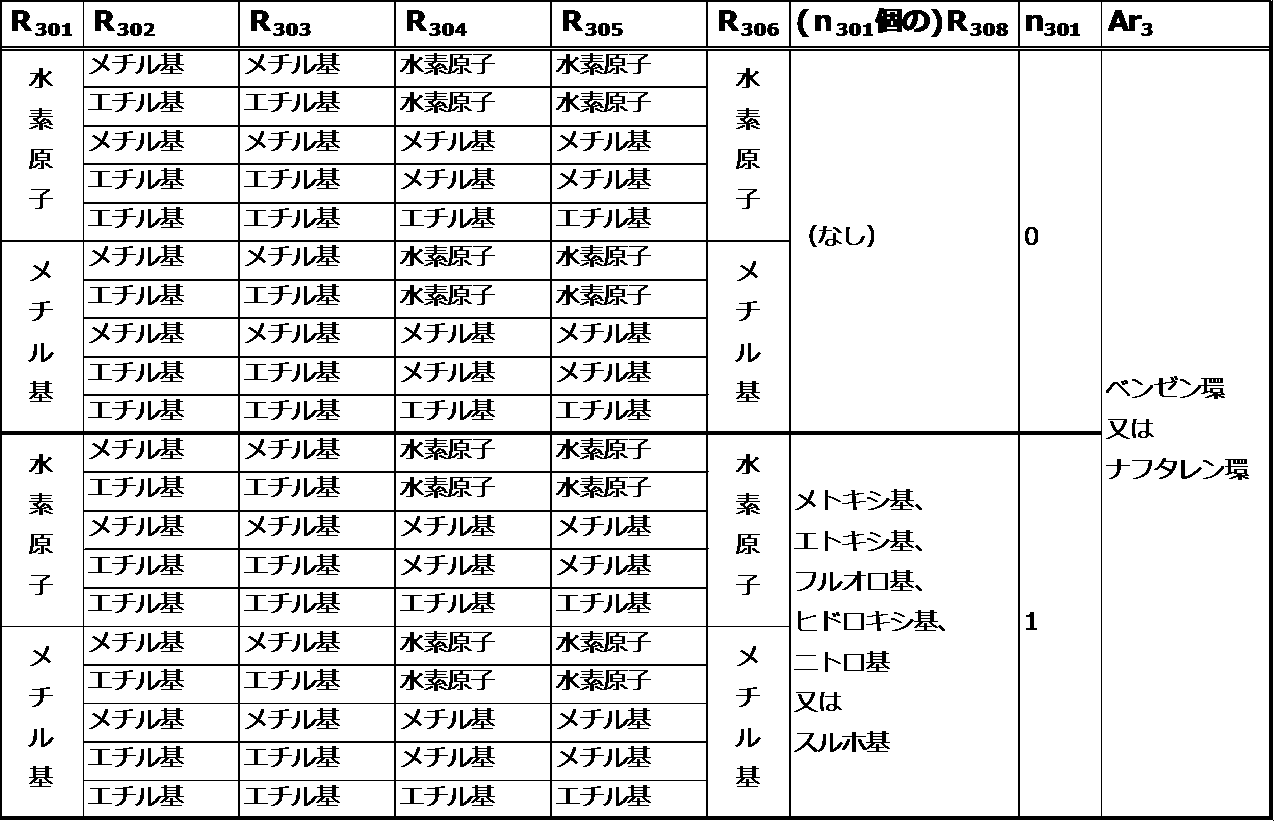


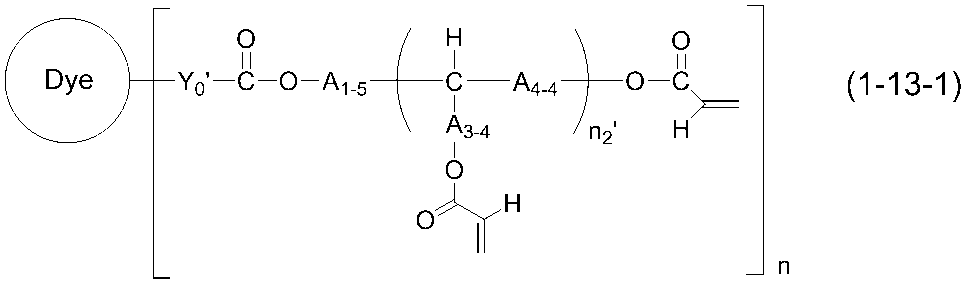


本発明の化合物は、次の反応[I-I]及び[I-II]に示す一連の方法で製造することができる。すなわち、下記一般式(21)で示される化合物を、要すれば塩交換反応を行った上で(反応[I-I])、下記一般式(22)で示される化合物と反応させればよい(反応[I-II])。


本発明の着色組成物は、本発明の化合物を少なくとも1種類含むものである。該着色組成物は、従来よりも高い耐溶出性を有する優れた着色硬化物を形成することができる。そのため、本発明の着色組成物は、液晶表示装置(LCD)や固体撮像素子(CCD、CMOS等)に用いられるカラーフィルター等の着色画素形成用途、印刷インキ、インクジェットインキ、および塗料等の用途に用いることができ、特に、液晶表示装置のカラーフィルター用として好適である。さらに、本発明の着色組成物は、従来公知の成形方法により、シート、フィルム、ボトル、カップ等に成形して着色樹脂成形物として使用することもできる。よって、メガネ、コンタクトレンズ、カラーコンタクトレンズ等の用途にも使用することができ、公知の樹脂との多層構造体とすることによっても同様の用途に使用することができる。その他にも、例えば光学フィルム、ヘアカラーリング剤、化合物や生体物質に対する標識物質、有機太陽電池の材料等の用途にも用いることが可能である。


撹拌装置を備えた丸底フラスコに、ローダミンB(化合物1:和光純薬工業(株)製)2.0g(3.9mmol)、テトラキス(ペンタフルオロフェニル)ホウ素(IV)のリチウム塩(LiFABA)(東ソー・ファインケム(株)製)2.7g(3.9mmol)及びジクロロメタン30mlを加え、25℃で1時間反応を行った。ジクロロメタンで反応液を希釈した後、水で洗浄した。減圧濃縮によって反応液から溶媒を留去し、テトラキス(ペンタフルオロフェニル)ホウ素(IV)アニオンを有する赤紫色固体のカルボン酸体(化合物2)4.1g(収率100%)を得た。

撹拌装置を備えた丸底フラスコに、合成例1で得た中間体(化合物2)4.4g(3.9mmol)及びジクロロメタン30mlを加えて溶解し、ペンタエリスリトールトリアクリレート{化合物3:商品名ライトアクリレートPE-3A(化合物3含量60.0%)、共栄社化学(株)製}2.4g(4.7mmol)、4-ジメチルアミノピリジン(DMAP)(和光純薬工業(株)製)0.1g(1.2mmol)及び1-エチル-3-(3-ジメチルアミノプロピル)カルボジイミド塩酸塩(WSC)(東洋紡(株)製)1.3g(6.7mmol)を加え、25℃で3時間反応を行った。反応液を水で洗浄し、減圧濃縮によって反応液から溶媒を留去して赤紫色固体を得た。該固体をシリカゲルカラムで精製し、赤紫色固体を得た。更に、得られた該固体にメタノール100mlを加えて溶解し、水40mlをゆっくり滴下して加えて晶析させた後、減圧濃縮によって溶媒を留去し、赤紫色固体の多官能重合性染料(化合物4)1.15g(収率21%)を得た。

撹拌装置を備えた丸底フラスコに、合成例1で得た中間体(化合物2)8.8g(7.9mmol)及びジクロロメタン60mlを加えて溶解し、ジペンタエリスリトールペンタアクリレート{化合物5:商品名NKエステル A-9550(化合物5含量40.0%)、新中村化学工業(株)製}12.4g(9.4mmol)、DMAP(和光純薬工業(株)製)0.3g(2.4mmol)及びWSC(東洋紡(株)製)2.6g(13.4mmol)を加え、25℃で3時間反応を行った。反応液を水で洗浄し、減圧濃縮によって反応液から溶媒を留去して赤紫色固体を得た。該固体にメタノール1300mlを加えて溶解し、水300mlをゆっくり滴下して加えて晶析させた後、減圧濃縮によって溶媒を留去し、赤紫色固体の多官能重合性染料(化合物6)5.3g(収率41%)を得た。

撹拌装置、空気導入管及びディーンスターク装置を備えた丸底フラスコに、D(-)-ソルビトール(化合物7:和光純薬工業(株)製)7.2g(40mmol)、アクリル酸(化合物8:和光純薬工業(株)製)28.8g(400mmol)、p-メトキシフェノール(MEHQ)(和光純薬工業(株)製)0.06g(0.5mmol)、p-トルエンスルホン酸(TsOH)(和光純薬工業(株)製)2.1g(12.2mmol)及びトルエン30mlを加えて、110℃で8時間反応させた。減圧化によりトルエンを留去した後、トルエン50mlを加えて溶解させた。次いで、反応液を水で洗浄し、再び溶媒を留去して粗体を得た。得られた粗体をシリカゲルカラムクロマトグラフィーにより精製した後、減圧濃縮によって溶媒を留去し、無色液体の中間体(化合物9)1.4g(収率7.7%)を得た。

撹拌装置を備えた丸底フラスコに、合成例1で得た中間体(化合物2)2.9g(2.6mmol)及びジクロロメタン20mlを加えて溶解し、合成例2で得た中間体(化合物9)1.4g(3.1mmol)、DMAP(和光純薬工業(株)製)0.1g(0.8mmol)及びWSC(東洋紡(株)製)0.9g(4.5mol)を加え、25℃で5時間反応を行った。反応液を水で洗浄し、減圧濃縮によって反応液から溶媒を留去して赤紫色固体を得た。該固体にメタノール400mlを加えて溶解し、水100mlをゆっくり滴下して加えて晶析させた後、減圧濃縮によって溶媒を留去し、赤紫色固体の多官能重合性染料(化合物10)0.8g(収率19%)を得た。
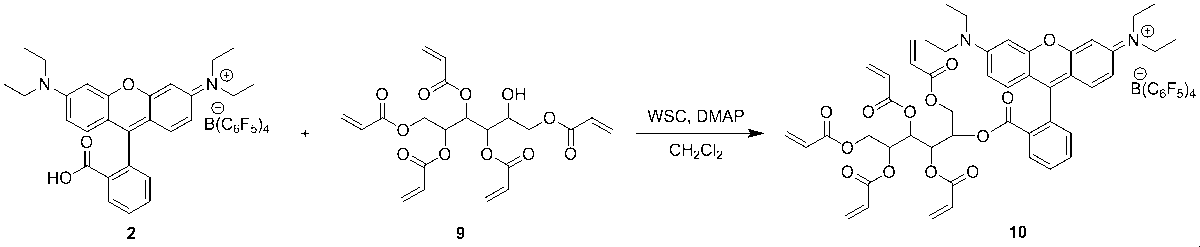
撹拌装置を備えた丸底フラスコに、無水コハク酸(化合物11:和光純薬工業(株)製)1.71g(17.1mmol)及びジクロロメタン100mlを加えた。次いで、ジペンタエリスリトールペンタアクリレート{化合物5:商品名NKエステル A-9550(化合物5含量40.0%)、新中村化学工業(株)製}24.8g(18.8mmol)、DMAP(和光純薬工業(株)製)18mg(0.15mmol)、トリエチルアミン(Et3N)(和光純薬工業(株)製)1.9g(18.8mmol)を加え、室温で20時間反応した。反応液をジクロロメタンと5%炭酸水素ナトリウム水溶液で洗浄し、水層をpH2程度の酸性にした。酸性の水層を酢酸エチルで抽出し、得られた有機層を硫酸ナトリウムで乾燥し、濃縮して粗体を得た。粗体をカラムクロマトグラフィーにより精製した後、減圧濃縮によって溶媒を留去し、無色液体の中間体(化合物12)3.0g(収率28%)を得た。

撹拌装置を備えた丸底フラスコに、合成例3で得た中間体(化合物12)3.0g(4.8mmol)及びエタノール30mlを加えて溶解し、エタノールアミン(化合物13)(和光純薬工業(株))0.4g(5.8mmol)及び4-(4,6-ジメトキシ-1,3,5-トリアジン-2-イル)-4-メチルモルホリニウムクロリド n-水和物(DMT-MM)(和光純薬工業(株)製)2.3g(8.2mmol)を加え、25℃で5時間反応を行った。反応液を水で洗浄し、減圧濃縮によって反応液から溶媒を留去して粗体を得た。粗体をカラムクロマトグラフィーにより精製した後、減圧濃縮によって溶媒を留去し、無色液体の中間体(化合物14)1.1g(収率34%)を得た。

撹拌装置を備えた丸底フラスコに、合成例1で得た中間体(化合物2)1.5g(1.3mmol)及びジクロロメタン15mlを加えて溶解し、合成例4で得た中間体(化合物14)1.1g(1.6mmol)、DMAP(和光純薬工業(株)製)59mg(0.5mmol)及びWSC(東洋紡(株)製)0.4g(2.2mol)を加え、25℃で5時間反応を行った。反応液を水で洗浄し、減圧濃縮によって反応液から溶媒を留去して赤紫色固体を得た。該固体にメタノール210mlを加えて溶解し、水50mlをゆっくり滴下して加えて晶析させた後、減圧濃縮によって溶媒を留去し、赤紫色固体の多官能重合性染料(化合物15)0.5g(収率22%)を得た。

撹拌装置を備えた丸底フラスコに、無水フタル酸(化合物16:和光純薬工業(株)製)2.65g(17.9mmol)及びジクロロメタン100mlを加えた。次いで、ジペンタエリスリトールペンタアクリレート{化合物5:商品名NKエステル A-9550(化合物5含量40.0%)、新中村化学工業(株)製}24.8g(18.8mmol)、DMAP(和光純薬工業(株)製)18mg(0.15mmol)、Et3N(和光純薬工業(株)製)1.9g(18.8mmol)を加え、室温で28時間反応した。反応液をジクロロメタンと5%炭酸水素ナトリウム水溶液で洗浄し、水層をpH2程度の酸性にした。酸性の水層を酢酸エチルで抽出し、得られた有機層を硫酸ナトリウムで乾燥し、濃縮して粗体を得た。粗体をカラムクロマトグラフィーにより精製した後、減圧濃縮によって溶媒を留去し、中間体(化合物17)3.6g(収率31%)を得た。

撹拌装置を備えた丸底フラスコに、合成例5で得た中間体(化合物17)3.6g(5.4mmol)及びエタノール36mlを加えて溶解し、エタノールアミン(化合物13:和光純薬工業(株))0.4g(6.5mmol)及び4-(4,6-ジメトキシ-1,3,5-トリアジン-2-イル)-4-メチルモルホリニウムクロリド n-水和物(DMT-MM)(和光純薬工業(株)製)2.5g(9.2mmol)を加え、25℃で5時間反応を行った。反応液を水で洗浄し、減圧濃縮によって反応液から溶媒を留去して粗体を得た。粗体をカラムクロマトグラフィーにより精製した後、減圧濃縮によって溶媒を留去し、無色液体の中間体(化合物18)1.2g(収率31%)を得た。

撹拌装置を備えた丸底フラスコに、合成例1で得た中間体(化合物2)1.6g(1.4mmol)及びジクロロメタン15mlを加えて溶解し、合成例6で得た中間体(化合物18)1.2g(1.7mmol)、DMAP(和光純薬工業(株)製)49mg(0.4mmol)及びWSC(東洋紡(株)製)0.5g(2.4mol)を加え、25℃で5時間反応を行った。反応液を水で洗浄し、減圧濃縮によって反応液から溶媒を留去して赤紫色固体を得た。該固体にメタノール230mlを加えて溶解し、水55mlをゆっくり滴下して加えて晶析させた後、減圧濃縮によって溶媒を留去し、赤紫色固体の多官能重合性染料(化合物19)0.6g(収率24%)を得た。

特開2015-30796公報に記載の方法に従って、ポリアミン中間体(化合物20)を合成した。攪拌機を備えたフラスコに、合成したポリアミン中間体(化合物20)10.0g(34.2mmol)、5N水酸化ナトリウム水溶液30ml及びアセトニトリル70mlを加えて、氷浴下、3-クロロプロピオン酸クロリド(化合物21:和光純薬工業(株)製)13.0g(102.6mmol)を30分間かけて滴下し、その後、室温で1時間攪拌した。分液した後、5N水酸化カリウム水溶液50mlを加え、30℃で5時間撹拌した。室温に冷却後、分液し、濃塩酸を用いて中和した。重合禁止剤として、4-ヒドロキシ-2,2,6,6-テトラメチル-1-ピペリジニルオキシ, ラジカル(和光純薬工業(株)製)18mg(0.1mmol)を加え、減圧濃縮し、粗体を得た。得られた粗体をカラムクロマトグラフィーにより精製した後、減圧濃縮によって溶媒を留去し、中間体(化合物23)6.2g(収率40%)を得た。

撹拌装置を備えた丸底フラスコに、合成例1で得た中間体(化合物2)8.8g(7.9mmol)及びジクロロメタン60mlを加えて溶解し、合成例7で得た中間体(化合物23)4.3g(9.4mmol)、DMAP(和光純薬工業(株)製)0.3g(2.4mmol)及びWSC(東洋紡(株)製)2.6g(13.4mol)を加え、25℃で5時間反応を行った。反応液を水で洗浄し、減圧濃縮によって反応液から溶媒を留去して赤紫色固体を得た。該固体にメタノール1300mlを加えて溶解し、水300mlをゆっくり滴下して加えて晶析させた後、減圧濃縮によって溶媒を留去し、赤紫色固体の多官能重合性染料(化合物24)4.0g(収率32%)を得た。

撹拌装置を備えた丸底フラスコに、4-アミノフェニル酢酸(化合物25:和光純薬工業(株)製)3.7g(25.0mmol)、2-(1,3,3-トリメチルインドリン-2-イリデン)アセトアルデヒド(化合物26:和光純薬工業(株)製)5.0g(25.0mmol)及びアセトニトリル35mlを加えた。続けて、室温で濃硫酸8.67g(和光純薬工業(株)製)をゆっくり加えた後、50℃で16時間反応を行った。室温に冷却後、塩化ナトリウム10g及び酢酸エチル(EtOAc)90ml加えて、黄色個体を析出させた。30分撹拌した後、濾取し、黄色固体の中間体(化合物27)6.8g(収率77%)を得た。

撹拌装置を備えた丸底フラスコに、合成例8で得た中間体(化合物27)2.0g(5.6mmol)、LiFABA(東ソー・ファインケム(株)製)4.3g(5.6mmol)及びジクロロメタン15mlを加え、25℃で1時間反応を行った。ジクロロメタンで反応液を希釈した後、水で洗浄した。減圧濃縮によって反応液から溶媒を留去し、テトラキス(ペンタフルオロフェニル)ホウ素(IV)アニオンを有する黄色固体のカルボン酸体(化合物28)5.6g(収率100%)を得た。

撹拌装置を備えた丸底フラスコに、合成例9で得た中間体(化合物28)5.6g(5.6mmol)及びジクロロメタン30mlを加えて溶解し、ジペンタエリスリトールペンタアクリレート{化合物5:商品名NKエステル A-9550(化合物5含量40.0%)、新中村化学工業(株)製}8.8g(6.7mmol)、DMAP(和光純薬工業(株)製)0.2g(1.7mmol)及びWSC(東洋紡(株)製)1.8g(9.5mol)を加え、25℃で7時間反応を行った。反応液を水で洗浄し、減圧濃縮によって反応液から溶媒を留去して黄色固体を得た。該固体にメタノール1300mlを加えて溶解し、水300mlをゆっくり滴下して加えて晶析させた後、減圧濃縮によって溶媒を留去し、黄色固体の多官能重合性染料(化合物29)2.0g(収率24%)を得た。

撹拌装置を備えた丸底フラスコに、N,N-ジエチル-3-アミノフェノール(化合物30:東京化成工業(株)製)1.3g(8.0mmol)、トリメリト酸無水物(化合物31:和光純薬工業(株)製)3.1g(16.0mmol)及びトルエン100mlを加えて、還流下で72時間反応を行った。室温に冷却後、析出した赤紫色固体を濾取した。得られた固体をカラムクロマトグラフィーにより精製した後、減圧濃縮によって溶媒を留去し、中間体(化合物32)2.3g(収率59%)を得た。

撹拌装置を備えた丸底フラスコに、合成例10で得た中間体(化合物32)2.3g(4.7mmol)及びエタノール50mlを加えて溶解した。ここにLiFABA(東ソー・ファインケム(株)製)3.2g(4.7mmol)及び1mol/L塩酸12mlを加えて、40℃で5時間反応させた。反応液をジクロロメタン100mlで希釈した後、イオン交換水で洗浄した。減圧濃縮によって溶媒を留去し、テトラキス(ペンタフルオロフェニル)ホウ素(IV)アニオンを有する赤紫色固体の染料モノマー(化合物33)5.5g(収率100%)を得た。

撹拌装置を備えた丸底フラスコに、合成例11で得た中間体(化合物33)5.5g(4.7mmol)及びジクロロメタン40mlを加えて溶解し、ペンタエリスリトールトリアクリレート{化合物3:商品名ライトアクリレートPE-3A(化合物3含量60.0%)、共栄社化学(株)製}4.5g(9.4mmol)、DMAP(和光純薬工業(株)製)0.2g(1.4mmol)及びWSC(東洋紡(株)製)1.5g(8.0mol)を加え、25℃で8時間反応を行った。反応液を水で洗浄し、減圧濃縮によって反応液から溶媒を留去して赤紫色固体を得た。該固体にメタノール1300mlを加えて溶解し、水300mlをゆっくり滴下して加えて晶析させた後、減圧濃縮によって溶媒を留去し、赤紫色固体の多官能重合性染料(化合物34)1.5g(収率18%)を得た。

WO2014/126167公報に記載の方法に従って、単官能重合性染料(化合物I)を合成した。

撹拌装置を備えた丸底フラスコに、実施例1で得た中間体(化合物2)4.4g(3.9mmol)及びジクロロメタン20mlを加えて溶解し、グリセロールジメタクリレート(化合物35:商品名ライトエステルG101P、共栄社化学(株)製)1.1g(4.7mmol)、DMAP(和光純薬工業(株)製)0.1g(1.2mmol)及びWSC(東洋紡(株)製)1.3g(6.7mmol)を加え、25℃で6時間反応を行った。反応液を水で洗浄し、減圧濃縮によって反応液から溶媒を留去して赤紫色固体を得た。該固体をシリカゲルカラムで精製し、赤紫色固体の二官能重合性染料(化合物II)2.90g(収率55%)を得た。

WO2014/133578公報に記載の方法に従って、単官能重合性染料(化合物III)を合成した。

実施例1で得られた化合物4、実施例2で得られた化合物6、又は実施例7で得られた化合物29を含む着色組成物の耐溶出性を下記のように評価した。
(1-1)バインダーAの合成
撹拌装置、冷却管、温度計、窒素導入管を備えた丸底フラスコに、プロピレングリコールモノメチルエーテルアセテート(PGMEA)(和光純薬工業(株)製)98.5gを加え、窒素気流下で内温が90℃になるまで加熱した。次いで、ベンジルメタクリレート(和光純薬工業(株)製)186.2g、メタクリル酸(和光純薬工業(株)製)25.6g及びジメチル2,2'-アゾビス(2-メチルプロピオネート)(商品名V-601、和光純薬工業(株)製)33.9gを混合した溶液を、加熱したPGMEAに2時間かけて滴下した。その後、得られた溶液を90℃で2時間反応を行った。次に、100℃に昇温し、1時間反応を行った。反応後、室温まで冷却し、PGMEA171.5gを加えて希釈し、淡黄色透明のポリマー溶液を得た。これをバインダーAとする。尚、バインダーAの不揮発分濃度は36.1%であった。
下記の成分を表1に記載の分量で混合し、染料の質量パーセント濃度が等しい着色組成物を得た。
[着色組成物の成分]
・重合性染料:化合物4、6又は29のいずれか1つ
・バインダー:バインダーA
・架橋剤:ジペンタエリストールヘキサアクリレート(DPHA)(日本化薬(株)製)
・溶剤:PGMEA(和光純薬工業(株)製)
・光重合開始剤:1-[4-(フェニルチオ)フェニル]-1,2-オクタンジオン-2-(ο-ベンゾイルオキシム)(商品名イルガキュアOXE-01、BASF社製)
・シランカップリング剤:3-(メタクリロイルオキシ)プロピルトリメトキシシラン(商品名LS-3380、信越化学工業(株)製)
上記(1)で得られた着色組成物を、膜厚が1.3~1.8μmになるように、3インチのガラスウエハー(コーニング社製イーグルXG)の上にスピンコーターを用いて塗付し、100℃で90秒間乾燥した。次いで、露光装置を使用して、塗布膜に365nmの波長1000mJ/cm2の露光量で照射した。露光後、230℃で30分間乾燥し、着色硬化膜を得た。
ガラスシャーレにPGMEAを20g量りとり、上記(2)で得られた着色硬化膜をガラスウェハーごと2時間浸漬させた。浸漬後、PGMEA溶液中からガラスウェハーを取り除き、分光光度計(島津製作所製分光光度計UV-2550)を用いて着色硬化膜浸漬後のPGMEA溶液の極大吸収波長での吸光度(λa)を測定した。
化合物4、6又は29の代わりに、合成例12で得られた化合物I又は合成例14で得られた化合物IIIを用いた以外は、実験例1と同様にして、化合物I又は化合物IIIを含む着色組成物の耐溶出性を評価した。


実施例1で得られた化合物4、実施例2で得られた化合物6、実施例3で得られた化合物10、実施例4で得られた化合物15、実施例5で得られた化合物19、実施例6で得られた化合物24、又は実施例8で得られた化合物34を含む着色組成物の耐溶出性を下記のように評価した。
(1)着色組成物の調製
(1-1)バインダーBの合成
撹拌装置、冷却管、温度計、窒素導入管を備えた丸底フラスコに、PGMEA(和光純薬工業(株)製)53.4gを加え、窒素気流下で内温が95℃になるまで加熱した。次いで、ベンジルメタクリレート(和光純薬工業(株)製)32.5g、メタクリル酸(和光純薬工業(株)製)35.0g、スチレン(和光純薬工業(株)製)32.5g及びジメチル2,2'-アゾビス(2-メチルプロピオネート)(商品名V-601、和光純薬工業(株)製)15.0gを混合した溶液を、加熱したPGMEAに2時間かけて滴下した。その後、得られた溶液を95℃で2時間反応を行った。次に、100℃に昇温し、1時間反応を行った。反応後、室温まで冷却し、一晩静置した。90℃まで再加熱し、4-ヒドロキシブチルアクリレートグリシジルエーテル(日本化成(株)製)67.1g、トリブチルアミン(和光純薬工業(株)製)2.34g及びパラメトキシフェノール(和光純薬工業(株)製)0.34gを加え、6時間反応を行い、淡黄色透明のポリマー溶液を得た。これをバインダーBとする。尚、バインダーBの不揮発分濃度は39.0%であった。
下記の成分を表3に記載の分量で混合し、染料の質量パーセント濃度が等しい着色組成物を得た。
[着色組成物の成分]
・重合性染料:化合物4、6、10、15、19、24又は34のいずれか1つ
・バインダー:バインダーB
・溶剤:PGMEA(和光純薬工業(株)製)
・光重合開始剤:OXE-01(BASF社製)
・シランカップリング剤:LS-3380(信越化学工業(株)製)
上記(1)で得られた着色組成物を、膜厚が1.3~1.8μmになるように、3インチのガラスウエハー(コーニング社製イーグルXG)の上にスピンコーターを用いて塗付し、100℃で90秒間乾燥した。次いで、露光装置を使用して、塗布膜に365nmの波長を1000mJ/cm2の露光量で照射した。露光後、230℃で30分間乾燥し、着色硬化膜を得た。
ガラスシャーレにPGMEAを20g量りとり、上記(2)で得られた着色硬化膜をガラスウェハーごと2時間浸漬させた。浸漬後、PGMEA溶液中からガラスウェハーを取り除き、分光光度計(島津製作所製分光光度計UV-2550)を用いて着色硬化膜浸漬後のPGMEA溶液の極大吸収波長での吸光度(λa)を測定した。
化合物4、6、10、15、19、24又は34の代わりに、合成例13で得られた化合物IIを用いた以外は、実験例2と同様にして、化合物IIを含む着色組成物の耐溶出性を評価した。


Claims (15)
- 下記一般式(1)で示される化合物。
{式中、Dyeは、染料残基を表し、R1は、水素原子又はメチル基を表し、Y0は、直鎖の炭素数1~3のアルキレン基、-NH-又は単結合を表し、Y1及びY2はそれぞれ独立して、-O-又は-NH-を表し、A1は、-O-、-OCO-、-COO-、-NHCO-、-CONH-、-NHCONH-及び/又はフェニレン基を鎖中に有していてもよい炭素数1~6のアルキレン基、或いは単結合を表し、A2は、-O-を鎖中に有していてもよく、且つ、下記一般式(2)で示される基を1~6個鎖中又は末端に有する炭素数1~6のアルキレン基を表し、nは、1又は2を表す;
(式中、R1及びY2は、上記と同じであり、R3は、水素原子、炭素数1~6のアルキル基又は下記一般式(2-1)で示される基を表し、A3は、-O-を鎖中に有していてもよい炭素数1~6のアルキレン基又は単結合を表す;
〔式中、R1、A3及びY2は、上記と同じ。〕。)。
ただし、複数のR1、複数のY0、複数のY1、複数のY2、複数のA1及び複数のA2は、それぞれ同一であっても異なっていてもよく、また、A2における一般式(2)で示される基の数が1個であるとき、一般式(2)におけるR3は一般式(2-1)で示される基を表す。} - 前記一般式(2)におけるR3が水素原子又は炭素数1~6のアルキル基であるとき、前記一般式(1)のA2における一般式(2)で示される基の数が2~6個であり、前記一般式(2)におけるR3が一般式(2-1)で示される基であるとき、前記一般式(1)のA2における一般式(2)で示される基の数が1~3個である、請求項1に記載の化合物。
- 前記一般式(1)におけるA2が、下記一般式(3)で示されるものである、請求項1又は2に記載の化合物;
{式中、R1、R3、A3及びY2は、上記と同じであり、A4は、-O-を鎖中に有していてもよい炭素数1~6のアルキレン基又は単結合を表し、n1は、1~6の整数を表す。ただし、複数のR1、複数のR3、複数のA3、複数のA4及び複数のY2は、それぞれ同一であっても異なっていてもよく、複数のA4の炭素数の合計は1~6であり、また、n1が1であるとき、R3は前記一般式(2-1)で示される基を表す。}
- 前記一般式(1)におけるA2が、下記一般式(4-1)又は(4-2)で示されるものである、請求項1~3の何れかに記載の化合物;
(式中、R1、A3及びY2は、上記と同じであり、R4は、水素原子又は炭素数1~6のアルキル基を表し、A4-1は、炭素数1~6のアルキレン基又は単結合を表し、n2は、2~6の整数を表す。ただし、複数のR1、複数のR4、複数のA3、複数のA4-1及び複数のY2は、それぞれ同一であっても異なっていてもよく、複数のA4-1の炭素数の合計は1~6である。)、
(式中、R1、A3、A4-1及びY2は、上記と同じであり、A4-2は、-O-を鎖中に有する炭素数1~6のアルキレン基を表し、n3及びn4はそれぞれ独立して、0~3の整数を表し、n3+n4=1~3の整数である。ただし、複数のR1、複数のA3、複数のA4-1、複数のA4-2及び複数のY2は、それぞれ同一であっても異なっていてもよく、複数のA4-1と複数のA4-2の炭素数の合計は1~6である。)
- 前記一般式(1)における-A1-A2-が、下記式(101)~(114)で示されるものである、請求項1~4の何れかに記載の化合物。

- 前記一般式(1)におけるDyeが、キサンテン系染料、トリアリールメタン系染料又はシアニン系染料由来の残基である、請求項1~5の何れかに記載の化合物。
- 前記一般式(1)におけるDyeが、キサンテン系染料又はシアニン系染料由来の残基である、請求項1~6の何れかに記載の化合物。
- 前記一般式(1)におけるDyeが、下記一般式(I)又は下記一般式(IV)で示される染料残基である、請求項1~7の何れかに記載の化合物;
{式中、n101個のR105はそれぞれ独立して、ハロゲノ基、炭素数1~30のアルキル基、炭素数1~20のアルコキシ基、炭素数1~20のアルキルチオ基、置換基を有する若しくは無置換のアミノ基、ヒドロキシ基、炭素数6~14のアリール基、炭素数6~14のアリールオキシ基又は炭素数7~20のアリールアルキル基を表し、Y101は、酸素原子、硫黄原子又は-NR132-を表し、R132は、炭素数1~6のアルキル基を表し、An-は、アニオンを表し、Ar1は、下記一般式(I-1-1)~(I-1-7)で示される環構造を表し;
(式中、R101及びR104はそれぞれ独立して、水素原子又はメチル基を表し、R102及びR103はそれぞれ独立して、炭素数1~30のアルキル基又は置換基を有する若しくは無置換の炭素数6~14のアリール基を表し、R101とR102とで炭素数2~4のアルキレン基を形成していてもよく、R103とR104とで炭素数2~4のアルキレン基を形成していてもよい。)、
(式中、R131は、炭素数1~30のアルキル基を表す。)、
(式中、R131は、上記と同じ。)、
(式中、R131は、上記と同じ。)、
(式中、R131は、上記と同じ。)、
(式中、R131は、上記と同じ。)、
(式中、R131は、上記と同じ。)、
*及び**は、それぞれの結合位置を表し、Ar2は、ベンゼン環、ナフタレン環又はアントラセン環を表す。Ar2がベンゼン環の場合、n101は0~4の整数を表し、Ar2がナフタレン環の場合、n101は0~6の整数を表し、Ar2がアントラセン環の場合、n101は0~8の整数を表す。}、
(式中、An-は上記と同じであり、R401~R404はそれぞれ独立して、水素原子、炭素数1~6のアルキル基、炭素数1~6のアルコキシ基、炭素数2~4のアルキルオキシカルボニル基、炭素数2~4のアルキルカルボニルオキシ基、フェニルカルボニル基、ナフチルカルボニル基、ハロゲノ基、カルボキシ基、ニトロ基、シアノ基又はアミノ基を表し、R405及びR406はそれぞれ独立して、水素原子;炭素数1~6のアルキル基;炭素数1~6のアルキル基、ニトロ基、ハロゲノ基又はシアノ基を有する若しくは無置換の炭素数7~9のフェニルアルキル基;或いは炭素数11~13のナフチルアルキル基を表し、R407は、水素原子;炭素数1~6のアルコキシ基、炭素数2~4のアルキルオキシカルボニル基、ヒドロキシ基、カルボキシ基、ハロゲノ基、シアノ基又はアミノ基を有する若しくは無置換の炭素数1~6のアルキル基;炭素数1~6のアルコキシ基、ハロゲノ基又はアミノ基を有する若しくは無置換の炭素数7~9のフェニルアルキル基;或いは炭素数11~13のナフチルアルキル基を表し、n401個のR408はそれぞれ独立して、炭素数1~6のアルキル基、炭素数1~6のアルコキシ基、炭素数2~4のアルキルオキシカルボニル基、炭素数2~4のアルキルカルボニルオキシ基、フェニルカルボニル基、ナフチルカルボニル基、ハロゲノ基、カルボキシ基、ニトロ基、シアノ基又はアミノ基を表し、前記一般式(1)のnが1である場合、n401は0~4の整数を表し、前記一般式(1)のnが2である場合、n401は0~3の整数を表す。)。
- 前記一般式(1)におけるDyeが、下記一般式(II)又は下記一般式(V)で示される染料残基である、請求項1~8の何れかに記載の化合物;
(式中、R201及びR204はそれぞれ独立して、水素原子又はメチル基を表し、R202及びR203はそれぞれ独立して、炭素数1~12のアルキル基、炭素数1~6のアルキル基を有する又は無置換のフェニル基を表し、n202個のR205は、ハロゲノ基;炭素数1~12のアルキル基;炭素数1~12のアルコキシ基;炭素数1~12のアルキルチオ基;炭素数1~30のアルキル基、炭素数1~20のハロアルキル基、炭素数6~10のアリール基又は炭素数7~13のアリールアルキル基を有するアミノ基;ヒドロキシ基;炭素数6~14のアリール基;炭素数6~14のアリールオキシ基;及び炭素数7~20のアリールアルキル基を表し、R206及びR207はそれぞれ独立して、炭素数1~12のアルキル基、フェニル基又は炭素数7~9のフェニルアルキル基を表し、An'-は、電子吸引性の置換基を有するアリール基、電子吸引性の置換基を有するスルホニル基、ハロアルキル基又はハロゲノ基を含むアニオンを表し、n202は、0~3の整数を表し、R201とR202とで炭素数2~4のアルキレン基を形成していてもよく、R203とR204とで炭素数2~4のアルキレン基を形成していてもよい。)、
(式中、An'-は上記と同じであり、R501~R506はそれぞれ独立して、水素原子又は炭素数1~6のアルキル基を表し、R507は、炭素数1~6のアルコキシ基、炭素数2~4のアルキルオキシカルボニル基、ヒドロキシ基、カルボキシ基、ハロゲノ基、シアノ基又はアミノ基を有する若しくは無置換の炭素数1~6のアルキル基を表し、n501個のR508はそれぞれ独立して、炭素数1~6のアルキル基又は炭素数1~6のアルコキシ基を表し、前記一般式(1)のnが1である場合、n501は0~2の整数を表し、前記一般式(1)のnが2である場合、n501は0~3の整数を表す。)。
- 請求項1~9の何れかに記載の化合物を含んでなる着色組成物。
- 前記組成物中に架橋剤を含まないものである、請求項10に記載の着色組成物。
- さらに、バインダー樹脂を含んでなる、請求項10又は11に記載の着色組成物。
- バインダー樹脂が、重合性不飽和基を有するバインダー樹脂である、請求項12に記載の着色組成物。
- 前記重合性不飽和基を有するバインダー樹脂が、下記一般式(5)で示されるモノマー単位を構成成分に含むバインダー樹脂である、請求項13に記載の着色組成物;
(式中、R18は、下記式(5-1)~(5-10)で示される基
を表し、R19及びR20はそれぞれ独立して、置換基を有していてもよい炭素数1~12のアルキレン基を表し、該置換基は、ヒドロキシ基、炭素数1~6のアルキル基、炭素数1~6のアルコキシ基、炭素数6~10のアリール基、炭素数6~10のアリールオキシ基、炭素数7~13のアリールアルキル基、炭素数7~13のアリールオキシアルキル基、及び、酸素原子を有する又は酸素原子を有さない炭素数6~12の脂環式炭化水素基から選ばれるものであり、Y4は、-COO-、-CONH-、-OCONH-又は-NHCONH-を表し、Y5は、-O-、-OCO-、-COO-、-CONH-、-NHCO-、-OCONH-又は-NHCONH-を表し、n5は、1~4の整数を表す。ただし、複数のR19及び複数のY5は、それぞれ同一であっても異なっていてもよい。)
- 前記重合性不飽和基を有するバインダー樹脂が、さらに、下記一般式(6)、(10)、(11)又は(12)で示される化合物由来のモノマー単位少なくとも1種を構成成分に含むバインダー樹脂である、請求項14に記載の着色組成物;
{式中、R11は、水素原子又はメチル基を表し、R12は、水素原子、炭素数1~30のアルキル基、炭素数1~10のヒドロキシアルキル基、炭素数6~10のアリール基、炭素数7~13のアリールアルキル基、炭素数2~9のアルコキシアルキル基、炭素数3~9のアルコキシアルコキシアルキル基、炭素数7~13のアリールオキシアルキル基、炭素数5~7のモルホリノアルキル基、炭素数3~9のトリアルキルシリル基、酸素原子を有する炭素数6~12の脂環式炭化水素基、炭素数3~9のジアルキルアミノアルキル基、炭素数1~18のフルオロアルキル基、炭素数9~14のN-アルキレンフタルイミド基、下記一般式(7)で示される基
(式中、R21は、ヒドロキシ基を置換基として有する又は無置換の炭素数1~3のアルキレン基を表し、R22は、ヒドロキシ基を置換基として有する又は無置換のフェニル基、或いは炭素数1~3のアルキル基を表し、aは1~3の整数を表す。)、下記一般式(8)で示される基
(式中、R23~R25はそれぞれ独立して、炭素数1~3のアルキル基を表し、R26は炭素数1~3のアルキレン基を表す。)、又は、下記一般式(9)で示される基
(式中、R27は、フェニレン基又はシクロへキシレン基を表し、bは、1~6の整数を表す。)を表す。}、
(式中、R13は、水素原子又は炭素数1~3のアルキル基を表し、R14は、水素原子、炭素数1~3のアルキル基、炭素数3~9のジアルキルアミノアルキル基又は炭素数1~10のヒドロキシアルキル基を表し、R11は上記と同じ。R13とR14は、これらと隣接する窒素原子とでモルホリノ基を形成してもよい。)、
(式中、R15は、フェニル基又はピロリジノ基を表し、R11は上記と同じ。)、
(式中、R17は、窒素原子又は酸素原子を表し、R16は、水素原子、炭素数1~30のアルキル基、炭素数1~10のヒドロキシアルキル基、炭素数1~10のハロアルキル基、炭素数6~10のアリール基、又は、炭素数1~6のアルキル基若しくはハロゲノ基を置換基として有する炭素数6~10のアリール基を表し、dは、R17が酸素原子の場合に0を表し、R17が窒素原子の場合には1を表す。)。
Priority Applications (5)
| Application Number | Priority Date | Filing Date | Title |
|---|---|---|---|
| JP2018508111A JP6750669B2 (ja) | 2016-03-29 | 2017-03-28 | 多官能重合型化合物および着色組成物 |
| EP17775154.2A EP3444304A4 (en) | 2016-03-29 | 2017-03-28 | Polyfunctional polymerizable compound and colored composition |
| US16/088,684 US20190062561A1 (en) | 2016-03-29 | 2017-03-28 | Polyfunctional polymerizable compound and colored composition |
| KR1020187030079A KR20180136450A (ko) | 2016-03-29 | 2017-03-28 | 다관능 중합형 화합물 및 착색 조성물 |
| CN201780007157.9A CN108473784B (zh) | 2016-03-29 | 2017-03-28 | 多官能聚合型化合物及着色组合物 |
Applications Claiming Priority (2)
| Application Number | Priority Date | Filing Date | Title |
|---|---|---|---|
| JP2016-065055 | 2016-03-29 | ||
| JP2016065055 | 2016-03-29 |
Publications (1)
| Publication Number | Publication Date |
|---|---|
| WO2017170617A1 true WO2017170617A1 (ja) | 2017-10-05 |
Family
ID=59965780
Family Applications (1)
| Application Number | Title | Priority Date | Filing Date |
|---|---|---|---|
| PCT/JP2017/012769 Ceased WO2017170617A1 (ja) | 2016-03-29 | 2017-03-28 | 多官能重合型化合物および着色組成物 |
Country Status (7)
| Country | Link |
|---|---|
| US (1) | US20190062561A1 (ja) |
| EP (1) | EP3444304A4 (ja) |
| JP (1) | JP6750669B2 (ja) |
| KR (1) | KR20180136450A (ja) |
| CN (1) | CN108473784B (ja) |
| TW (1) | TWI715752B (ja) |
| WO (1) | WO2017170617A1 (ja) |
Cited By (3)
| Publication number | Priority date | Publication date | Assignee | Title |
|---|---|---|---|---|
| JP2019120945A (ja) * | 2017-12-27 | 2019-07-22 | 大日本印刷株式会社 | 重合性液晶化合物、重合性組成物、重合体、位相差フィルム及びその製造方法、転写用積層体、光学部材及びその製造方法、並びに表示装置 |
| CN111465662A (zh) * | 2017-12-14 | 2020-07-28 | 三菱铅笔株式会社 | 着色颗粒的水分散体 |
| JP2022524145A (ja) * | 2019-03-08 | 2022-04-27 | ドミノ・プリンティング・サイエンシズ・ピーエルシー | 硬化性インク組成物 |
Families Citing this family (3)
| Publication number | Priority date | Publication date | Assignee | Title |
|---|---|---|---|---|
| JP7193401B2 (ja) * | 2019-03-28 | 2022-12-20 | 日東電工株式会社 | 粘着剤組成物、粘着剤層、及び粘着シート |
| CN111303663B (zh) * | 2020-03-17 | 2021-09-24 | Tcl华星光电技术有限公司 | 低聚物有机染料的制备方法、彩膜光刻胶及彩膜滤光片 |
| CN118852087B (zh) * | 2024-06-28 | 2025-09-19 | 集美大学 | 一种检测三苯甲烷类化合物的荧光探针、试纸及其制备方法和应用 |
Citations (8)
| Publication number | Priority date | Publication date | Assignee | Title |
|---|---|---|---|---|
| JP2001509831A (ja) * | 1997-02-03 | 2001-07-24 | チバ スペシャルティ ケミカルズ ホールディング インコーポレーテッド | 有機支持材料に共有結合された蛍光発色団 |
| WO2010123071A1 (ja) | 2009-04-24 | 2010-10-28 | 日本化薬株式会社 | 新規なトリアリールメタン化合物 |
| WO2012144421A1 (ja) * | 2011-04-20 | 2012-10-26 | 株式会社Adeka | α-シアノアクリル酸エステル構造を有する新規化合物、染料及び着色感光性組成物 |
| WO2013108591A1 (ja) | 2012-01-18 | 2013-07-25 | 保土谷化学工業株式会社 | カラーフィルター用トリアリールメタン系色素並びに該色素を用いたカラーフィルター |
| WO2014126167A1 (ja) | 2013-02-15 | 2014-08-21 | 和光純薬工業株式会社 | 着色組成物 |
| WO2014133578A1 (en) | 2013-02-28 | 2014-09-04 | Hewlett-Packard Development Company, L.P. | Fluid structure with compression molded fluid channel |
| JP2015030796A (ja) | 2013-08-02 | 2015-02-16 | 富士フイルム株式会社 | 硬化性組成物及びインク組成物 |
| WO2015147285A1 (ja) | 2014-03-28 | 2015-10-01 | 和光純薬工業株式会社 | ローダミン系着色組成物 |
Family Cites Families (3)
| Publication number | Priority date | Publication date | Assignee | Title |
|---|---|---|---|---|
| CN104238267B (zh) * | 2013-06-17 | 2018-11-06 | 东洋油墨Sc控股株式会社 | 滤色器用着色组合物和滤色器 |
| JP6160831B2 (ja) * | 2013-12-20 | 2017-07-12 | 東洋インキScホールディングス株式会社 | カラーフィルタ用着色組成物、およびカラーフィルタ |
| KR20160130263A (ko) * | 2014-03-07 | 2016-11-10 | 와코 쥰야꾸 고교 가부시키가이샤 | 시아닌계 착색조성물 |
-
2017
- 2017-03-28 KR KR1020187030079A patent/KR20180136450A/ko not_active Ceased
- 2017-03-28 EP EP17775154.2A patent/EP3444304A4/en not_active Withdrawn
- 2017-03-28 US US16/088,684 patent/US20190062561A1/en not_active Abandoned
- 2017-03-28 CN CN201780007157.9A patent/CN108473784B/zh not_active Expired - Fee Related
- 2017-03-28 WO PCT/JP2017/012769 patent/WO2017170617A1/ja not_active Ceased
- 2017-03-28 JP JP2018508111A patent/JP6750669B2/ja not_active Expired - Fee Related
- 2017-03-29 TW TW106110511A patent/TWI715752B/zh not_active IP Right Cessation
Patent Citations (8)
| Publication number | Priority date | Publication date | Assignee | Title |
|---|---|---|---|---|
| JP2001509831A (ja) * | 1997-02-03 | 2001-07-24 | チバ スペシャルティ ケミカルズ ホールディング インコーポレーテッド | 有機支持材料に共有結合された蛍光発色団 |
| WO2010123071A1 (ja) | 2009-04-24 | 2010-10-28 | 日本化薬株式会社 | 新規なトリアリールメタン化合物 |
| WO2012144421A1 (ja) * | 2011-04-20 | 2012-10-26 | 株式会社Adeka | α-シアノアクリル酸エステル構造を有する新規化合物、染料及び着色感光性組成物 |
| WO2013108591A1 (ja) | 2012-01-18 | 2013-07-25 | 保土谷化学工業株式会社 | カラーフィルター用トリアリールメタン系色素並びに該色素を用いたカラーフィルター |
| WO2014126167A1 (ja) | 2013-02-15 | 2014-08-21 | 和光純薬工業株式会社 | 着色組成物 |
| WO2014133578A1 (en) | 2013-02-28 | 2014-09-04 | Hewlett-Packard Development Company, L.P. | Fluid structure with compression molded fluid channel |
| JP2015030796A (ja) | 2013-08-02 | 2015-02-16 | 富士フイルム株式会社 | 硬化性組成物及びインク組成物 |
| WO2015147285A1 (ja) | 2014-03-28 | 2015-10-01 | 和光純薬工業株式会社 | ローダミン系着色組成物 |
Non-Patent Citations (1)
| Title |
|---|
| See also references of EP3444304A4 |
Cited By (7)
| Publication number | Priority date | Publication date | Assignee | Title |
|---|---|---|---|---|
| CN111465662A (zh) * | 2017-12-14 | 2020-07-28 | 三菱铅笔株式会社 | 着色颗粒的水分散体 |
| US11718758B2 (en) | 2017-12-14 | 2023-08-08 | Mitsubishi Pencil Company, Limited | Aqueous dispersion of colored particles |
| TWI816724B (zh) * | 2017-12-14 | 2023-10-01 | 日商三菱鉛筆股份有限公司 | 著色粒子水分散體 |
| JP2019120945A (ja) * | 2017-12-27 | 2019-07-22 | 大日本印刷株式会社 | 重合性液晶化合物、重合性組成物、重合体、位相差フィルム及びその製造方法、転写用積層体、光学部材及びその製造方法、並びに表示装置 |
| JP7293651B2 (ja) | 2017-12-27 | 2023-06-20 | 大日本印刷株式会社 | 重合性液晶化合物、重合性組成物、重合体、位相差フィルム及びその製造方法、転写用積層体、光学部材及びその製造方法、並びに表示装置 |
| JP2022524145A (ja) * | 2019-03-08 | 2022-04-27 | ドミノ・プリンティング・サイエンシズ・ピーエルシー | 硬化性インク組成物 |
| JP7682794B2 (ja) | 2019-03-08 | 2025-05-26 | ドミノ・プリンティング・サイエンシズ・ピーエルシー | 硬化性インク組成物 |
Also Published As
| Publication number | Publication date |
|---|---|
| KR20180136450A (ko) | 2018-12-24 |
| TWI715752B (zh) | 2021-01-11 |
| CN108473784A (zh) | 2018-08-31 |
| JPWO2017170617A1 (ja) | 2019-02-07 |
| US20190062561A1 (en) | 2019-02-28 |
| CN108473784B (zh) | 2021-01-12 |
| JP6750669B2 (ja) | 2020-09-02 |
| TW201802190A (zh) | 2018-01-16 |
| EP3444304A1 (en) | 2019-02-20 |
| EP3444304A4 (en) | 2020-03-11 |
Similar Documents
| Publication | Publication Date | Title |
|---|---|---|
| JP6750505B2 (ja) | 消光剤 | |
| JP6750669B2 (ja) | 多官能重合型化合物および着色組成物 | |
| KR102148640B1 (ko) | 착색 조성물 | |
| US10119030B2 (en) | Rhodamine-based coloring composition | |
| EP3578556A1 (en) | Reverse photochromic compound | |
| EP3150643B1 (en) | Triphenylmethane-based colored composition | |
| JPWO2015098999A1 (ja) | トリアリールメタン系着色組成物 | |
| TWI866108B (zh) | 化合物、潛在性紫外線吸收劑、組合物、硬化物及硬化物之製造方法 | |
| WO2019117134A1 (ja) | 着色粒子水分散体 | |
| JP6919653B2 (ja) | ケイ素含有複素環式化合物及び消光剤 |
Legal Events
| Date | Code | Title | Description |
|---|---|---|---|
| ENP | Entry into the national phase |
Ref document number: 2018508111 Country of ref document: JP Kind code of ref document: A |
|
| NENP | Non-entry into the national phase |
Ref country code: DE |
|
| ENP | Entry into the national phase |
Ref document number: 20187030079 Country of ref document: KR Kind code of ref document: A |
|
| WWE | Wipo information: entry into national phase |
Ref document number: 2017775154 Country of ref document: EP |
|
| ENP | Entry into the national phase |
Ref document number: 2017775154 Country of ref document: EP Effective date: 20181029 |
|
| 121 | Ep: the epo has been informed by wipo that ep was designated in this application |
Ref document number: 17775154 Country of ref document: EP Kind code of ref document: A1 |