KR102315373B1 - Construction process navigation providing method - Google Patents
Construction process navigation providing method Download PDFInfo
- Publication number
- KR102315373B1 KR102315373B1 KR1020210065061A KR20210065061A KR102315373B1 KR 102315373 B1 KR102315373 B1 KR 102315373B1 KR 1020210065061 A KR1020210065061 A KR 1020210065061A KR 20210065061 A KR20210065061 A KR 20210065061A KR 102315373 B1 KR102315373 B1 KR 102315373B1
- Authority
- KR
- South Korea
- Prior art keywords
- work
- grid
- task
- schedule
- constraint
- Prior art date
- Legal status (The legal status is an assumption and is not a legal conclusion. Google has not performed a legal analysis and makes no representation as to the accuracy of the status listed.)
- Active
Links
Images











Classifications
-
- G—PHYSICS
- G06—COMPUTING OR CALCULATING; COUNTING
- G06Q—INFORMATION AND COMMUNICATION TECHNOLOGY [ICT] SPECIALLY ADAPTED FOR ADMINISTRATIVE, COMMERCIAL, FINANCIAL, MANAGERIAL OR SUPERVISORY PURPOSES; SYSTEMS OR METHODS SPECIALLY ADAPTED FOR ADMINISTRATIVE, COMMERCIAL, FINANCIAL, MANAGERIAL OR SUPERVISORY PURPOSES, NOT OTHERWISE PROVIDED FOR
- G06Q50/00—Information and communication technology [ICT] specially adapted for implementation of business processes of specific business sectors, e.g. utilities or tourism
- G06Q50/08—Construction
-
- G—PHYSICS
- G06—COMPUTING OR CALCULATING; COUNTING
- G06Q—INFORMATION AND COMMUNICATION TECHNOLOGY [ICT] SPECIALLY ADAPTED FOR ADMINISTRATIVE, COMMERCIAL, FINANCIAL, MANAGERIAL OR SUPERVISORY PURPOSES; SYSTEMS OR METHODS SPECIALLY ADAPTED FOR ADMINISTRATIVE, COMMERCIAL, FINANCIAL, MANAGERIAL OR SUPERVISORY PURPOSES, NOT OTHERWISE PROVIDED FOR
- G06Q10/00—Administration; Management
- G06Q10/06—Resources, workflows, human or project management; Enterprise or organisation planning; Enterprise or organisation modelling
- G06Q10/063—Operations research, analysis or management
- G06Q10/0633—Workflow analysis
Landscapes
- Business, Economics & Management (AREA)
- Human Resources & Organizations (AREA)
- Engineering & Computer Science (AREA)
- Economics (AREA)
- Strategic Management (AREA)
- Tourism & Hospitality (AREA)
- Theoretical Computer Science (AREA)
- Entrepreneurship & Innovation (AREA)
- General Physics & Mathematics (AREA)
- Marketing (AREA)
- General Business, Economics & Management (AREA)
- Physics & Mathematics (AREA)
- Educational Administration (AREA)
- Quality & Reliability (AREA)
- Operations Research (AREA)
- Game Theory and Decision Science (AREA)
- Development Economics (AREA)
- Health & Medical Sciences (AREA)
- General Health & Medical Sciences (AREA)
- Primary Health Care (AREA)
- Management, Administration, Business Operations System, And Electronic Commerce (AREA)
Abstract
Description
본 발명은 건설 공정 네비게이션 제공 방법에 관한 것으로서, 상세하게는 복잡도가 높은 건설 프로젝트 내에서, 공정을 구성하는 각 작업의 특성 및 각 작업을 구성하는 세부 작업의 특성을 고려하여 최적의 공정 계획을 수립하는 한편, 여러 제약 조건의 변경시, 해당 제약 조건을 반영하여 최종 목표를 달성할 수 있는 건설 공정 네비게이션 제공 방법에 관한 것이다. The present invention relates to a method for providing navigation for a construction process, and more particularly, in a construction project with high complexity, establishing an optimal process plan in consideration of the characteristics of each operation constituting the process and the characteristics of the detailed operation constituting each operation On the other hand, when changing several constraints, it relates to a method of providing navigation for a construction process that can achieve a final goal by reflecting the constraints.
대규모 건설 프로젝트를 성공적으로 완수하기 위해서는 무수히 많은 작업을 누락없이 적시에 수행하는 것이 필요하다. 사업 수행 과정 동안 때로는 고객 요구 사항이나 설계변경에 의해 추가 작업이 발생하거나 계획된 수행 방법을 변경해야 하는 일이 빈번하게 발생하며, 복잡도가 높은 작업일수록 성과나 성공확률은 현저하게 낮아진다. In order to successfully complete a large-scale construction project, it is necessary to perform a myriad of tasks in a timely manner without omissions. In the course of business execution, additional work occurs frequently due to customer requirements or design changes or the planned execution method needs to be changed frequently. The higher the complexity, the lower the performance or success rate.
공정관리는 이러한 복잡도가 높은 건설프로젝트를 수행함에 있어서 목표한 예산과 기간을 맞추기 위해 상세한 계획과 현황을 시각화, 수치화 하여 프로젝트 관리자의 의사결정을 지원하는 역할을 한다. In carrying out such a complex construction project, process management supports the decision-making of the project manager by visualizing and quantifying the detailed plan and status to meet the target budget and period.
종래의 공정 관리에는 PERT/CPM으로 대표되는 네트워크 공정과 LOB(Line of Balance)로 대표되는 자원 기반 공정계획법인 LSM(Linear Scheduling Method)이 주로 사용되어 왔다. 또한, 이를 개선하는 CCPM(Critical Chain Project Management), 택트공정 계획법, CPM과 LOB의 복합활용법 등의 방법론도 선행연구를 통해서 소개되었다. In the conventional process management, a network process represented by PERT/CPM and a resource-based process planning method LSM (Linear Scheduling Method) represented by LOB (Line of Balance) have been mainly used. In addition, methodologies such as CCPM (Critical Chain Project Management), tact process planning method, and combined use of CPM and LOB to improve this were introduced through previous studies.
이중 PERT/CPM은 작업간 선후 관계와 작업별 기간을 이용하는 방법으로 공사 기간의 적정성 판단과 진도관리의 장점이 있지만, 반복적인 프로젝트 스케쥴링에는 작업의 수가 과도하게 많아지는 문제점을 가지고 있다. 선형 공정관리의 대표적인 기법인 LOB는 반복적인 작업을 관리하는데 유용한 기업이나, 작업 계획과 실시된 현황을 비교하고 대응 계획을 수립하는데에는 효과적이지 못하고, 다양한 평면을 가지는 시설이나 평면상 공간을 구획하여 관리하는 시설물에는 적용하기 어렵다. Among them, PERT/CPM uses the precedence relationship between tasks and the period for each task, and has the advantage of adequacy of the construction period and progress management. LOB, a representative technique of linear process management, is a useful company to manage repetitive work, but it is not effective for comparing work plans with the current status of implementation and establishing a response plan. It is difficult to apply to managed facilities.
CCPM은 제약이론(TOC)를 기반으로 한 기법으로 작업 기간에 대한 버퍼를 이용한다. 주공정은 변하지 않으며, 프로젝트 버퍼와 피드버퍼를 감시하여 전체 프로젝트의 공기 지연을 예방하는 기법이나, 아직 건설업에 적용 사례가 많지 않다. CCPM is a technique based on the theory of constraints (TOC) and uses a buffer for the duration of the task. The main process does not change, and it is a technique to prevent delay of the entire project by monitoring the project buffer and feed buffer, but there are not many examples of application in the construction industry yet.
택트 공정 관리는 각층 또는 규격화된 공간에 대해 세부 작업을 정의하고 작업 선후행 연결을 반복하여 관리의 편리성을 확보하고 공기 단축 및 비용 감소의 효과를 낼 수 있는 기법으로서, 초고층 빌딩이나 공동 주택과 같은 유사 평면을 가진 프로젝트의 마감 공사에 효과적으로 적용할 수 있다. 그러나, 최근의 건축 트렌드인 대공간이나 비정형 디자인에 적용함에 한계가 있고, 선행작업의 지연이 발생할 경우 후행 작업에 대한 면밀한 개선이 요구된다. Tact process management is a technique that can secure the convenience of management by defining detailed tasks for each floor or standardized space and repeating the connection before and after work, shortening the construction period and reducing costs. It can be effectively applied to the finishing work of projects with the same similar floor plan. However, there is a limit to its application to large spaces or atypical designs, which are recent architectural trends, and if there is a delay in the preceding work, detailed improvement of the subsequent work is required.
한국 특허등록 공보 10-2244587에서는 "건설현장의 작업일보를 관리하는 방법 및 시스템"이 개시되어 있으나, 여기서는 여러 이해관계가가 작업일보에 효율적으로 접근할 수 있는 특징만 개시되어 있을 뿐 제약조건(납기일, 생산성, 선후행 작업의 특징)변경이 발생하는 경우, 전체 공정의 수정 및 업데이트하는 내용은 개시되어 있지 않다.Korean Patent Registration Publication No. 10-2244587 discloses "a method and system for managing the work report at a construction site", but only the features that enable various stakeholders to efficiently access the work report are disclosed, and the constraints ( When a change occurs (delivery date, productivity, and characteristics of follow-up work), the contents of correcting and updating the entire process are not disclosed.
또한, 한국 공개특허 10-2013-0130100에서는 "건설 공사 관리 방법"이 개시되어 있으며, 건설공사관리에서 관리서버에서 제공하는 공사관련 정보를 발주자, 설계자 및 공종별 전문건설업자가 공유하게 되고, 발주자의 위탁을 받아 건설공사를 통합관리를 하는 관리자와 발주자 및 설계자가 네트워크를 형성할 수 있고, 발주자는 관리서버의 공종별 시공관리 정보의 공유가 가능하지만, 여기서도, 제약조건(납기일, 생산성, 선후행 작업의 특징)변경이 발생하는 경우, 전체 공정의 수정 및 업데이트하는 내용은 개시되어 있지 않다.In addition, Korean Patent Laid-Open Patent No. 10-2013-0130100 discloses a "construction construction management method", and in construction construction management, construction-related information provided by the management server is shared by the client, the designer, and the professional constructor for each type of work, and the consignment of the orderer A network can be formed between the manager, the orderer, and the designer, who manage the construction work in an integrated manner, and the orderer can share the construction management information by construction type of the management server, but here too, the constraints (delivery date, productivity, Characteristics) When a change occurs, the contents of correcting and updating the entire process are not disclosed.
본 발명은 PPM(Proper Path Management) 기법을 이용한 건설 공정 네비게이션 제공 방법을 제공하는데 그 목적이 있으며, 상세하게는 환경 변화에 빠르게 대응하는 건설 상세공정관리 도구를 개발하고, 계획과 관리 작업 효율화로 관리 생산성 향상하며, 건설 프로젝트의 생산성 데이터 축적하고 이를 활용하는데 그 목적이 있다. An object of the present invention is to provide a method for providing navigation for a construction process using a Proper Path Management (PPM) technique, in detail, by developing a detailed construction process management tool that responds quickly to environmental changes, and managing it by improving planning and management work efficiency It aims to improve productivity, accumulate productivity data for construction projects, and utilize them.
이러한 목적을 달성하기 위한 본 발명은 일 단위 작업 영역을 형성하는 그리드 설정 단계;와 층별로 진행되어야 할 개별 작업의 적용 영역에 대응되는 그리드를 선택하는 작업맵 설정 단계;와 설정된 작업맵 설정에 따라서 공사의 전체 공정을 수립하는 공정 수립 단계와; 각 작업별 생산성 또는 선행 작업의 완료 영역 또는 납기 일정 중 적어도 어느 하나를 포함하는 제약조건을 설정하는 제약조건 설정단계와; 제약 조건 변경이 있는 경우, 각 제약 조건의 특성에 따라서 각 제약 조건을 만족할 수 있도록 전체 공정의 일정이나 개별 작업의 일정이나 작업 강도를 수정하고 이를 제안하는 건설 공정 네비게이션 제공 방법을 제공한다. The present invention for achieving this object provides a grid setting step of forming a daily work area; and a work map setting step of selecting a grid corresponding to the application area of the individual work to be carried out by layer; and according to the set work map setting a process establishment step of establishing the overall process of construction; A constraint setting step of setting a constraint including at least one of productivity for each job, a completion area of a preceding job, or a delivery schedule; When there is a constraint change, a construction process navigation method is provided, which modifies the schedule of the entire process or the schedule or work intensity of individual tasks to satisfy each constraint according to the characteristics of each constraint and proposes it.
상기 그리드는 각 작업별로 1일치 작업 수행 분량을 정의하도록 마련되며, The grid is provided to define the amount of work performed per day for each task,
상기 그리드 설정 단계는; 각 층의 업무레이어의 평면을 평면 그리드로 분할하여 설정하는 단계와; 각 층의 업무 레이어의 측단면을 단면 그리드로 분할하여 설정하는 단계를 포함하는 것을 특징으로 한다. The grid setting step; dividing and setting the plane of the business layer of each floor into a plane grid; It characterized in that it comprises the step of dividing and setting the side section of the business layer of each layer into a cross-sectional grid.
상기 업무 레이어별로 정립되면서, 업무의 각 작업 내용과, 각 업무의 각 작업별 생산성과, 선행 작업 완료 영역의 정보를 포함하는 테이블을 포함하는 업무 템플릿을 생성하는 업무 템플릿 생성 단계와; 상기 각 업무 탬플릿에 수록된 작업 간의 선후 관계 중 그 선후 관계가 변경되는 것이 금지되는 하드 로직 선후 관계를 정의하는 선후 관계 탬플릿을 생성하는 선후 관계 탬플릿 생성 단계를 더 포함하는 것을 특징으로 한다. a work template generating step of creating a work template including a table including information on each work content of a task, productivity for each task of each task, and information on a preceding task completion area while being established for each task layer; The method further comprises a precedence relation template generating step of generating a precedence relation template defining a hard logic precedence relation in which the precedence relation is prohibited from being changed among the precedence relations between the tasks recorded in the respective task templates.
선후 관계 탬플릿 정렬단계를 더 포함하되, 선후 관계 탬플릿 정렬 단계는;The method further comprises the step of arranging precedence relation templates, wherein the arranging precedence relation templates includes;
선후 관계 탬플릿에 모든 작업의 선후 관계가 포함되었는지 점검하는 단계와; 선후 관계 탬플릿 내에 루프가 발생하지 않는지 여부를 점검하는 단계와, 어느 하나 이상의 업무의 세부 작업이 선후 관계에서 누락되거나, 루프가 발생하는 경우 알람을 주고 관리자에게 수정 안내를 제공하는 단계를 포함하는 것을 특징으로 한다. checking whether the precedence relation of all jobs is included in the precedence relation template; Checking whether a loop does not occur in the precedence relationship template, and the step of providing an alarm and providing correction guidance to the manager when a detailed operation of any one or more tasks is missing from the precedence relationship or a loop occurs characterized.
공정 수립 단계는; 선후 관계 탬플릿에 정의되지 않는 작업은 랜덤하게 정렬하는 단계와; 선후 관계 탬플릿에 정의되지 않는 작업 중 가장 많은 작업이 배정된 그리드를 기준으로 동일 작업 일정을 배정하는 단계를 포함하는 것을 특징으로 한다. The process establishment steps are; randomly arranging tasks not defined in the precedence relationship template; It characterized in that it comprises the step of allocating the same task schedule based on a grid to which the most tasks are assigned among tasks not defined in the precedence relationship template.
제약조건 설정단계는; 작업 생산성 제약 조건에 따른 일정 조정 단계와; 선행 완료 제약 조건에 따른 일정 조정 단계와; 전체 일정 준수 제약 조건에 따른 일정 조정 단계를 순차적으로 수행하는 것을 특징으로 한다. The constraint setting step is; a schedule adjustment step according to work productivity constraints; adjusting the schedule according to the prior completion constraint; It is characterized in that the schedule adjustment step according to the overall schedule compliance constraint is sequentially performed.
작업 생산성 제약 조건에 따른 일정 조정 단계는; 특정 그리드에 조정 대상이 되는 해당 작업이 있는지 여부를 판단하는 단계와; 작업 일정이 동일한지 여부를 판단하는 단계와; 1일 생산성 초과하는지 여부를 판단하는 단계와, 위 세 개의 판단 단계 중 어느 하나라도 충족하지 않으면, 다음 그리드가 있는지 판단하고 다음 그리드가 있는 경우 다음 그리드에서 위 세 개의 판단 단계를 수행하는 단계와; 위 세 개의 판단 단계를 모두 만족하는 경우, 선행 및 후행 작업이 적은 그리드의 작업을 뒤로 연기하는 단계를 포함하는 것을 특징으로 한다. The step of adjusting the schedule according to the work productivity constraint; determining whether there is a corresponding task to be adjusted in a specific grid; determining whether the work schedules are the same; determining whether the daily productivity is exceeded, and if any one of the above three determination steps is not satisfied, determining whether there is a next grid, and if there is a next grid, performing the above three determination steps on the next grid; When all of the above three determination steps are satisfied, it is characterized in that it includes the step of deferring the work of the grid having fewer preceding and following tasks.
선행 완료 제약 조건에 따른 조정 단계는; 당해 수행 작업 이전에 수행되어야 하는 선행 작업이 이루어진 그리드와, 당해 수행 작업이 진행되어야 하는 그리드 간의 요구 거리가 일정 수준을 만족하는 경우에만 당해 수행 작업을 진행하도록 조정하도록 하고, 상기 요구 거리 내의 그리드에 대한 선행작업이 완료되지 아니한 경우, 당해 수행 작업의 일정을 상기 요구 거리 내의 그리드에 대한 선행작업의 종료 일정 이후로 조정하는 것을 특징으로 한다. The adjustment step according to the preceding completion constraint is; Adjust to proceed with the task only when the required distance between the grid on which the preceding task to be performed before the task is performed and the grid on which the task should be performed satisfies a certain level, When the preceding task for the grid is not completed, the schedule of the corresponding task is adjusted after the end schedule of the preceding task for the grid within the required distance.
전체 일정 준수 제약 조건에 따른 일정 조정 단계는; 선행 완료 제약 조건에 따른 조정 단계에 따른 전체 일정이 기준 일정을 초과한 경우에, 상대적으로 작업 생산량이 기준 이하인 작업의 생산량을 기준 이상으로 높이도록 자원 투입량 증가를 제안하여 전체 일정이 기준 일정을 충족하도록 조정하는 것을 특징으로 한다. The schedule adjustment step according to the overall schedule compliance constraint is; When the overall schedule according to the adjustment step according to the pre-completion constraint exceeds the standard schedule, the overall schedule satisfies the standard schedule by suggesting an increase in the resource input to increase the production of jobs with relatively less than the standard. It is characterized in that it is adjusted to do so.
완료된 작업의 실적을 입력하는 단계와; 잔여 기간과 잔여 작업 및 설정된 제약조건을 반영하여 잔여 계획을 자동으로 수정하는 것을 특징으로 한다. inputting the results of the completed work; It is characterized by automatically revising the remaining plan by reflecting the remaining period, remaining work, and set constraints.
업무별 바(bar)차트를 생성하며, 업무별 바차트를 각 업무레이어와 연동시키고, 각 업무 레이어의 그리드에는 각 업무별 대상 영역과, 진행 영역과, 완료 영역을 포함하는 세부 현황이 표시됨으로써, 특정한 일정에 특정한 업무와 그 업무를 구성하는 작업을 나타내는 업무별 바차트별로 해당 특정한 일정의 특정한 업무의 특정한 작업의 진행 현황이 표시된 업무 레이어가 각각 연동되어 저장되는 것을 특징으로 한다. By creating a bar chart for each task, and linking the bar chart for each task with each task layer, the grid of each task layer displays the detailed status including the target area for each task, the progress area, and the completed area. , it is characterized in that the task layer in which the progress status of the specific task of the specific task in the particular schedule is displayed is linked and stored for each task-specific bar chart representing the task specific to the particular task and the tasks constituting the task.
본 발명에 의하면, 공정관리기법인 CPM, LOB의 이해와 공정관리 전문 소프트웨어를 다루지 않고도 논리적인 공정계획 수립이 가능하며, 수작업을 최소화하는 프로그래밍으로 매우 상세한 수준의 공정계획 수립할 수 있다. According to the present invention, it is possible to establish a logical process plan without understanding the process control techniques CPM and LOB and dealing with process management specialized software, and it is possible to establish a very detailed level of process plan with programming that minimizes manual work.
또한, 공정현황이나 범위 변경 발생시 잔여 공정계획을 재수립하는 계획 유연성을 확보할 수 있고, 3D BIM모델 없이도 작업을 시각화하여 원활한 소통이 가능하다. In addition, it is possible to secure planning flexibility to re-establish the remaining process plan when the process status or scope change occurs, and smooth communication is possible by visualizing the work without a 3D BIM model.
그리고, 상세공정계획 수립을 위한 주간, 월간 계획의 자동화하여 작업 효율을 개선할 수 있으며, 작업의 생산성 데이터 축적 플랫폼으로 활용할 수 있다. And, it is possible to improve work efficiency by automating weekly and monthly plans for establishing detailed process plans, and it can be used as a platform for accumulating productivity data of work.
또한, 공정 운영 단계에서 실적현황에 따라 새로운 계획이 수립될 수 있으며, 이에 따라 하루의 실적이 입력되면 잔여기간과 잔여작업을 가지고 여러가지 제약조건에 따라서 잔여 계획이 자동으로 수정된다는 장점도 있다. In addition, a new plan can be established according to the performance status in the process operation stage, and accordingly, when the performance of one day is input, there is an advantage that the remaining plan is automatically modified according to various constraints with the remaining period and remaining work.
도1은 본 발명의 제어 블록도이다.
도2는 본 발명의 개략적인 제어 흐름도이다.
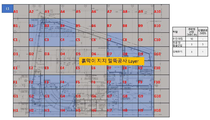
도3은 본 발명의 평면 그리드 분할도이다.
도4는 본 발명의 단면 그리드 분할도이다.
도5는 본 발명에서 흙막이 공사의 업무 레이어와 업무 템플릿을 도시한 것이다.
도6은 본 발명에서 흙막이 지지 말뚝공사의 업무 레이어와 업무 템플릿을 도시한 것이다.
도7은 본 발명에서 터파기 공사의 업무 레이어를 도시한 것이다.
도8은 본 발명에서 업무별 바차트와 업무 레이어를 도시한 것이다.
도9 내지 도11은 본 발명에서 전체적인 공정 관리 계획을 수립하는 것을 도시한 흐름도이다.
도12는 본 발명에서 그리드에서의 요구 거리 기준을 정의한 그래프이다.
도14은 본 발명에서 전체적인 공정 관리 업데이트를 수행하는 것을 도시한 흐름도이다.
도14 내지 도23은 본 발명에서 업무레이어 상 작업 진척 상태를 도시한 도면이다.
도24 내지 도28은 본 발명에서 생산성을 향상시킨 경우 업무레이어 상 작업 진척 상태를 도시한 도면이다.
도29 내지 도30은 본 발명에서 후속 작업 투입 시점을 도시한 작업 진척 상태 도면이다.
도31은 본 발명에서 업무 레이어로 그리드별 작업 범위를 설정한 것과 작업의 순서를 도시한 것이다.
도32는 본 발명에서 업무 레이어로 취합된 그리드별 작업을 선후 관계에 따라 작성한 것이다.
도33은 본 발명에서 동일 작업별 동일시점 배정한 것을 도시한 것이다.
도34는 본 발명에서 작업별 생산성을 반영한 작업 일정표이다.
도35는 본 발명에서 선행작업 완료 영역 제약을 반영한 작업 일정표이다.
도36와 도37은 본 발명에서 프로젝트 전체 기간 제약을 반영한 작업 일정표이다.
도38은 본 발명에서 가장 많은 작업이 배정된 그리드를 기준으로 동일 작업별 동일시점 배정한 것을 도시한 일정표이다.
도39 내지 도48은 본 발명에서 작업별 생산성 제약 조건에 따라서 조정된 일정표이다.
도49 내지 57은 본 발명에서 선행 작업 완료 제약 조건에 따라서 조정된 일정표이다.
도 58 내지 64는 본 발명에서 전체 일정 준수 제약 조건에 따라서 조정된 일정표이다. 1 is a control block diagram of the present invention.
2 is a schematic control flow diagram of the present invention.
3 is a planar grid division diagram of the present invention.
4 is a cross-sectional grid division view of the present invention.
Figure 5 shows the business layer and the business template of the earth retaining construction in the present invention.
Figure 6 shows the business layer and the business template of the retaining pile construction in the present invention.
Figure 7 shows the work layer of the excavation construction in the present invention.
8 shows a bar chart for each task and a task layer in the present invention.
9 to 11 are flowcharts illustrating the establishment of an overall process management plan in the present invention.
12 is a graph in which the required distance criterion in the grid is defined in the present invention.
14 is a flowchart illustrating performing an overall process management update in the present invention.
14 to 23 are diagrams showing the progress of work on the business layer in the present invention.
24 to 28 are diagrams showing the progress of work on the work layer when productivity is improved in the present invention.
29 to 30 are work progress state diagrams showing the input point of the subsequent work in the present invention.
31 is a view showing the setting of the work range for each grid as the work layer and the order of the work in the present invention.
32 is a diagram illustrating tasks for each grid aggregated as business layers in the present invention according to a precedence relationship.
33 is a diagram illustrating assignment of the same time point for the same task in the present invention.
34 is a work schedule reflecting the productivity for each job in the present invention.
35 is a work schedule in which the prior work completion area constraint is reflected in the present invention.
36 and 37 are work schedules reflecting the constraints of the entire project period in the present invention.
38 is a schedule diagram illustrating assignment of the same time point for each task based on the grid to which the most tasks are assigned in the present invention.
39 to 48 are schedules adjusted according to the productivity constraints for each job in the present invention.
49 to 57 are schedules adjusted according to the prior task completion constraint in the present invention.
58 to 64 are schedules adjusted according to the overall schedule compliance constraint in the present invention.
본 발명은 다양한 변경을 가할 수 있고 여러 가지 실시예를 가질 수 있는 바, 특정 실시예들을 도면에 예시하고 설명하고자 한다. Since the present invention can have various changes and can have various embodiments, specific embodiments are illustrated and described in the drawings.
그러나, 이는 본 발명을 특정한 실시 형태에 대해 한정하려는 것이 아니며, 본 발명의 사상 및 기술 범위에 포함되는 모든 변경, 균등물 내지 대체물을 포함하는 것으로 이해되어야 한다.However, this is not intended to limit the present invention to specific embodiments, and it should be understood to include all modifications, equivalents and substitutes included in the spirit and scope of the present invention.
제1, 제2 등과 같이 서수를 포함하는 용어는 다양한 구성요소들을 설명하는데 사용될 수 있지만, 상기 구성요소 들은 상기 용어들에 의해 한정되지는 않는다. Terms including an ordinal number, such as first, second, etc., may be used to describe various elements, but the elements are not limited by the terms.
상기 용어들은 하나의 구성요소를 다른 구성요소로부터 구별하는 목적으로만 사용된다. The above terms are used only for the purpose of distinguishing one component from another.
예를 들어, 본 발명의 권리 범위를 벗어나지 않으면서 제2 구성요소는 제1 구성요소로 명명될 수 있고, 유사하게 제1 구성요소도 제2 구성요소로 명명될 수 있다. For example, without departing from the scope of the present invention, the second component may be referred to as the first component, and similarly, the first component may also be referred to as the second component.
및/또는 이라는 용어는 복수의 관련된 기재된 항목들의 조합 또는 복수의 관련된 기재된 항목들 중의 어느 항목을 포함한다.and/or includes a combination of a plurality of related listed items or any of a plurality of related listed items.
어떤 구성요소가 다른 구성요소에 "연결되어" 있다거나 "접속되어" 있다고 언급된 때에는, 그 다른 구성요소에 직접적으로 연결되어 있거나 또는 접속되어 있을 수도 있지만, 중간에 다른 구성요소가 존재할 수도 있다고 이해되어야 할 것이다. When a component is referred to as being “connected” or “connected” to another component, it is understood that the other component may be directly connected or connected to the other component, but other components may exist in between. it should be
반면에, 어떤 구성요소가 다른 구성요소에 "직접 연결되어" 있다거나 "직접 접속되어" 있다고 언급된 때에는, 중간에 다른 구성요소가 존재하지 않는 것으로 이해되어야 할 것이다.On the other hand, when it is mentioned that a certain element is "directly connected" or "directly connected" to another element, it should be understood that the other element does not exist in the middle.
본 출원에서 사용한 용어는 단지 특정한 실시예를 설명하기 위해 사용된 것으로, 본 발명을 한정하려는 의도가 아니다. The terms used in the present application are only used to describe specific embodiments, and are not intended to limit the present invention.
단수의 표현은 문맥상 명백하게 다르게 뜻하지 않는 한, 복수의 표현을 포함한다. The singular expression includes the plural expression unless the context clearly dictates otherwise.
본 출원에서, "포함하다" 또는 "가지다" 등의 용어는 명세서상에 기재된 특징, 숫자, 단계, 동작, 구성요소, 부품 또는 이들을 조합한 것이 존재함을 지정하려는 것이지, 하나 또는 그 이상의 다른 특징들이나 숫자, 단계, 동작, 구성요소, 부품 또는 이들을 조합한 것들의 존재 또는 부가 가능성을 미리 배제하지 않는 것으로 이해되어야 한다.In the present application, terms such as “comprise” or “have” are intended to designate that a feature, number, step, operation, component, part, or combination thereof described in the specification exists, but one or more other features It should be understood that this does not preclude the existence or addition of numbers, steps, operations, components, parts, or combinations thereof.
이하, 첨부된 도면을 참조하여 실시예를 상세히 설명하되, 도면 부호에 관계없이 동일하거나 대응하는 구성 요소는 동일한 참조 번호를 부여하고 이에 대한 중복되는 설명은 생략하기로 한다. Hereinafter, the embodiment will be described in detail with reference to the accompanying drawings, but regardless of the reference numerals, the same or corresponding components are given the same reference numerals, and the overlapping description thereof will be omitted.
도1에서 도시한 바와 같이, 본 발명에 따른 건설 공정 네비게이션 제공 방법이 구현되는 건설 공정 네비게이션 시스템(1)은 여러 정보가 입력되는 입력부(10)와, 정보가 출력되어 디스플레이되거나 알람을 출력하는 출력부(20)와, 외부의 통신망에 접속가능하게 마련되는 통신부(30)와, 공정에 관한 작업, 작업별 세부 작업, 제약 조건, 공정 도면 등이 수록되는 DB(40)와, 후술하는 바와 같이 공정의 수립 및 수정에 따른 업데이트를 수행하는 연산부(50)와, 이들을 제어하는 제어부(60)를 구비한다.As shown in FIG. 1 , the construction
DB(40)는 작업맵DB(1), 작업별 레이어DB(42), 작업별 바차트 DB(43), 템플릿DB(44), 제약조건DB(45), 공정계획 DB(46)등을 포함하며 이에 한정하지 않는다.
본 발명은 모든 작업을 적시에 수행 관리한다는 PPM(Proper Path Management) 기법을 활용하여, 건설 건설 공정 네비게이션 제공 방법을 구현한다. The present invention implements a method of providing navigation for a construction construction process by utilizing a PPM (Proper Path Management) technique of performing and managing all tasks in a timely manner.
PPM(Proper Path Management)는 본 발명자의 제안 기법으로 1) 모든 작업은 최적정 시점이 존재하고, 2) 기존 Critical Path Method에서 주공정 Critical Path의 작업은 유동적인 Float 여유기간을 갖는 반면에 본 발명에 따른 PPM은 여유기간을 제시하지 않고 최적시점을 제시한다는 특징을 갖는다. PPM (Proper Path Management) is a method proposed by the present inventors. 1) All operations have an optimal point in time, and 2) In the existing Critical Path Method, the operation of the main process critical path has a flexible float slack period, whereas the present invention The PPM according to the method has the characteristic of presenting the optimum time point without suggesting a spare period.
PPM은 그리드를 활용하여 작업 구역을 세분화 하고, 1일 단위 일정을 자동으로 최적화하여, 모든 작업을 주공정과 같이 관리하는 방법이다. 이에 네비게이션 구현 방안으로 설계 정보 입력과 현황관리방법을 제시한다. PPM is a method that uses a grid to subdivide work areas, automatically optimize daily schedules, and manage all work like the main process. Therefore, design information input and status management method are presented as a navigation implementation method.
본 발명에 따른 건설 공정 네비게이션 제공 방법을 차량용 네비게이션을 이용하여 간략하게 설명한다. 차량용 네비게이션은 운전의 효율성을 높이고, 목적지를 향하는데 실패확률을 낮춰주는 도구이다. A construction process navigation providing method according to the present invention will be briefly described using a vehicle navigation system. In-vehicle navigation is a tool that increases driving efficiency and lowers the probability of failure in reaching a destination.
건설 프로젝트에 차량용 네비게이션과 같이 프로젝트가 진행되는 동안 가장 최적화된 경로를 안내하는 도구가 있다면 공정관리 효율성이 개선될 수 있다. 최근의 모바일 인터넷, 컴퓨터 성능, 빅데이터, 인공지능 알고리즘의 발전이 급속도로 이루어지고 있어서, 복잡한 건설 프로젝트의 공정관리에도 네비게이션을 적용할 수 있다. If a construction project has a tool, such as car navigation, that guides the most optimal route during the project, process control efficiency can be improved. The recent rapid development of mobile Internet, computer performance, big data, and artificial intelligence algorithms makes it possible to apply navigation to the process management of complex construction projects.
본 발명에 따른 건설 공정 네비게이션 제공 방법에 사용되는 단어들의 정의는 다음과 같다. Definitions of words used in the construction process navigation providing method according to the present invention are as follows.
그리고, 본 발명의 건설 공정 네비게이션 제공 방법에 사용되는 공정 관리 기법의 룰(rule)은 아래와 같다. 이하 설명에서 '업무'는 영어로 Work, workpackage, Task 등으로 표현되는 소단위 성과물이고 작업은 업무를 달성하기 위한 구체적 수단으로써, 활동(activity)을 의미한다. And, the rule of the process management technique used in the construction process navigation providing method of the present invention (rule) is as follows. In the following description, 'task' is a small unit of achievement expressed in English as Work, workpackage, Task, etc., and work is a specific means for accomplishing the task, and means activity.
1) 건설 프로젝트의 성과물은 물리적인 공간에 이루어진다. 1) The outcome of the construction project is made in a physical space.
2) 프로젝트 내에 수행해야 하는 모든 작업은 최적정 시점을 가진다.2) All work to be performed within the project has an optimal timing.
3) 최적경로관리 기법은 그리드를 활용한다. 그리드는 작업 구역을 평면, 단면에 일정 규격의 영역으로 1일 작업 표현 요소이다. 3) The optimal path management method utilizes a grid. The grid is an area of a certain standard on a plan, cross-section of the work area, and is an element of expressing daily work.
4) 그리드의 사이즈는 특정 기준작업을 하루에 할 수 있는 작업의 면적으로 볼 수 있다.4) The size of the grid can be viewed as the area of work that can be performed on a specific standard work per day.
5) 그리드 내에 포함되는 작업은 선후관계의 변경이 불가한 하드로직으로 구성된 작업과 선후관계 변경이 가능한 소프트로직 관계가 공존한다. 5) Tasks included in the grid coexist with tasks composed of hard logic that cannot change precedence and precedence and soft logic relations that can change precedence.
6) 선후관계는 업무를 구성하는 작업레벨에서 정해진다.6) The precedence relationship is determined at the work level that composes the work.
7) 하드로직은 선후관계 템플릿으로 정의한다.7) Hard logic is defined as a precedence template.
8) 소프트로직은 제약 프로그래밍으로 최적 시점을 배정받는다.8) Soft logic is assigned an optimal time through constrained programming.
9) 하루에 작업이 진행될 수 있는 그리드의 개수가 해당 작업의 생산성을 의미한다.9) The number of grids that can work on a day means the productivity of that job.
10) 그리드 그룹 간 선후관계는 소프트로직이다. 10) The precedence relationship between grid groups is soft logic.
11) 업무(work) Layer를 가진다. 업무는 타입별로 다양한 Layer를 가진다. 업무레이어는 구성 작업 내용에 따라 업무레이어(토공, 골조, 외장, 칸막이벽), 가설레이어(가시설), 실레이어(실별 마감공사)로 표현할 수 있다.11) It has a work layer. Tasks have various layers for each type. The work layer can be expressed as a work layer (earth work, frame, exterior, partition wall), temporary layer (temporary facility), and seal layer (finishing work for each room) according to the composition work.
12) 투입 작업팀을 추가하여 1일 작업 가능한 그리드의 개수를 조정할 수 있다.12) The number of grids that can be worked per day can be adjusted by adding an input team.
13) 업무는 하나 이상의 작업으로 구성된다. 타입별로 작업의 종류나 개수가 달라진다. 13) A task consists of one or more tasks. The type or number of tasks varies by type.
14) 업무 템플릿으로 업무별 타입별 구성된 작업을 정의한다. 14) Defines the task composed by task type by task template.
15) 제약 프로그래밍에 업무별 제약 조건을 달리 할 수 있다. 제약조건에 따라 소프트로직 연산이 달라진다.15) Constraints for each task can be set differently for constraint programming. Soft logic operation varies depending on the constraint.
16) 작업 통로 확보를 고려할 수 있다.(가설Layer)16) Securing a work path may be considered (hypothesis layer).
17) 동일 작업이 연속적으로 진행 될 수 있도록 한다. (연속성 떨어질 시 벌점 부여 등)17) Ensure that the same work can be performed continuously. (Penalty points are given when continuity is lost, etc.)
18) 현황에 따라 잔여 작업이 프로그램에 의해 재배열된다. 18) The remaining work is rearranged by the program according to the current situation.
도2는 본 발명에서 공정 계획 방법의 전체적인 흐름을 도시한 흐름도이다. 2 is a flowchart showing the overall flow of the process planning method in the present invention.
도2에서 도시한 바와 같이, 우선 그리드 설정 단계(S21)가 제시된다.As shown in Fig. 2, first, a grid setting step S21 is presented.
그리드(grid) 설정 단계는 건축물의 각 층의 도면에 그리드를 형성하는 단계이며, 그리드는 작업별로 1일치 작업 수행 분량을 정의한다. The grid setting step is a step of forming a grid on the drawings of each floor of the building, and the grid defines the amount of work performed per day for each task.
그리드 설정 단계(S21)는 도3과 같이 각 층의 평면도에 평면 그리드를 분할하여 형성하는 단계와, 도4와 같이, 건축물의 측단면을 층별로 분할한 단면 그리드를 분할하여 형성하는 단계를 포함한다. . The grid setting step (S21) includes a step of dividing and forming a flat grid in the plan view of each floor as shown in FIG. 3, and a step of dividing and forming a cross-sectional grid in which the side section of the building is divided into floors as shown in FIG. do. .
도3에서 각 그리드를 매트릭스 구조로 배치한 것을 예로 들었다. 여기서 길이방향(본 도면에서 좌우방향)으로는 1~10개의 구역으로 분할하고, 폭 방향(본 도면에서 상하 방향)으로는 A~H의 구역을 분할하였다. 즉, 8개의 행과, 10개의 열로 구현되었다. In FIG. 3 , the arrangement of each grid in a matrix structure is exemplified. Here, in the longitudinal direction (left and right in this figure), 1 to 10 sections were divided, and in the width direction (up and down direction in this figure), sections A to H were divided. That is, it is implemented with 8 rows and 10 columns.
도4에서 L1, L2, L3, L4는 지상1,2,3,4층을 의미하고, B1,B2,B3,B4는 지하 1,2,3,4층을 의미한다 그리고 D1~D10은 도3에서 나타난 D1~D10으로 정의된 그리드 행을 의미한다. In Fig. 4, L1, L2, L3, and L4 mean the 1st, 2nd, 3rd, and 4th floors above ground, B1, B2, B3, and B4 mean the 1st, 2nd, 3rd and 4th floors below ground, and D1~D10 are It means the grid row defined by D1~D10 shown in 3.
그리드 설정 단계(S21)가 완료되면, 층별로 진행되어야 할 개별 작업의 적용 영역에 대응되는 그리드를 선택하는 작업맵 설정 단계(S22)를 수행한다. When the grid setting step (S21) is completed, a work map setting step (S22) of selecting a grid corresponding to the application area of the individual work to be performed for each layer is performed.
작업맵 설정 단계의 예로서, 도5의 흙막이 벽 공사의 공사영역, 도6의 흙막이 지지 말뚝 공사 영역, 도7의 터파기 공사 영역이 나타난다. As an example of the work map setting step, the construction area of the retaining wall construction of FIG. 5, the retaining support pile construction area of FIG. 6, and the excavation construction area of FIG. 7 appear.
도5에서 흙막이 벽 공사가 '업무'의 카테고리에 속하고, 이를 현실적으로 완성하고 구성하는 라인마킹, 가이드빔 설치, 천공 및 철근망 설치, 타설이 '작업'의 카테고리에 속한다. In Fig. 5, retaining wall construction belongs to the category of 'work', and line marking, guide beam installation, drilling and rebar mesh installation, and pouring, which realistically complete and constitute it, belong to the category of 'work'.
그리고, 도6에서는 흙막이 지지 말뚝공사가 '업무'의 카테고리에 속하고, 이를 현실적으로 완성하고, 구성하는 라인마킹, 천공 및 철골근업, 되메우기가 '작업'의 카테고리에 속한다.And, in FIG. 6, the retaining support pile construction belongs to the category of 'work', and the line marking, perforation and steel reinforcement work, backfilling, which realistically completes and configures it, belongs to the category of 'work'.
또한, 도7에서 터파기 공사가 '업무'의 카테고리에 속하되, 터파기 공사는 단순히 파는 작업만 수반하므로 별도의 작업이 구분되어 있지는 않다. In addition, although the excavation construction belongs to the category of 'work' in FIG. 7, the excavation construction only entails a simple digging operation, so a separate operation is not divided.
도5에서 나타난 바와 같이, 흙막이 벽 공사의 공사영역의 작업맵은 관리자가 L1 레벨의 평면 그리드맵을 구성하는 개별 그리드 중 흙막이 벽 공사가 이루어져야 할 영역에 대응되는 그리드를 지정하여 이루어진다. 도5에서는 파란색의 그리드가 흙막이 벽 공사가 이루어져야 하는 영역이다. As shown in Fig. 5, the work map of the construction area of the retaining wall construction is made by the manager designating a grid corresponding to the region where the retaining wall construction is to be performed among the individual grids constituting the L1 level flat grid map. In FIG. 5, a blue grid is an area in which retaining wall construction is to be performed.
그리고, 그 옆에는 흙막이 벽 공사를 구성하는 개별작업(라인마킹, 가이드빔 설치, 천공 및 철근망 설치, 타설)에 관한 업무 템플릿이 표시된다.And, next to it, work templates related to individual work (line marking, guide beam installation, drilling and rebar mesh installation, and pouring) constituting the retaining wall construction are displayed.
흙막이 벽 공사는 라인마킹->가이드빔 설치->천공 및 철근망 설치->타설 순으로 진행된다. The retaining wall construction is carried out in the following order: line marking -> guide beam installation -> drilling and rebar network installation -> pouring.
라인마킹의 경우, 하루에 10개의 그리드(또는 이에 상응하는 영역 거리)에 대해서 수행할 수 있고, 가이드 빔 설치의 경우, 앞선 10개 그리드(또는 이에 상응하는 영역 거리)에서 라인마킹이 완료되면 수행되는 것으로서, 하루에 5개의 그리드 영역(또는 이에 상응하는 영역 거리)에서 수행할 수 있다. 이하에서 선행작업완료조건이 그리드의 갯수로 표현된 경우, 이는 그리드의 갯수 또는 이에 상응하는 영역의 거리를 포함하는 것을 표현한 것이다. In the case of line marking, it can be performed for 10 grids (or corresponding area distance) per day, and in the case of guide beam installation, it is performed when line marking is completed in the previous 10 grids (or corresponding area distance) As a result, it can be performed in 5 grid areas (or equivalent area distances) per day. Hereinafter, when the preceding task completion condition is expressed in terms of the number of grids, it is expressed that the number of grids or the distance of the corresponding area is included.
천공 및 철근망 설치의 경우, 가이드 빔 설치가 완료되면, 수행할 수 있는 것으로서, 5개의 그리드 영역에서 가이드빔 설치가 완료되면, 수행할 수 있으며, 하루에 3개의 그리드에 대해서 수행할 수 있다. In the case of drilling and rebar mesh installation, it can be performed when the guide beam installation is completed, and can be performed when the guide beam installation is completed in five grid areas, and can be performed for three grids per day.
타설의 경우, 천공 및 철근망 설치가 완료되면, 수행되는 것으로서, 최소한 1개의 그리드에 대해서 천공 및 철근망 설치가 완료만 되면, 수행할 수 있는 것으로서, 하루에 3개의 그리드에 대해서 타설을 수행할 수 있다. In the case of pouring, it is performed when drilling and rebar mesh installation are completed, and can be performed only when drilling and rebar mesh installation are completed for at least one grid. can
도6에서 나타난 바와 같이, 흙막이 지지 말뚝 공사의 공사영역의 작업맵은 관리자가 L1 레벨의 평면 그리드맵을 구성하는 개별 그리드 중 흙막이 벽 공사가 이루어져야 할 영역에 대응되는 그리드를 지정하여 이루어진다. 도6에서는 파란색의 그리드가 흙막이 지지 말뚝 공사가 이루어져야 하는 영역이다. As shown in FIG. 6 , the work map of the construction area of retaining support pile construction is made by the manager designating a grid corresponding to the region in which retaining wall construction is to be performed among the individual grids constituting the L1 level flat grid map. In FIG. 6 , the blue grid is an area in which retaining support pile construction is to be made.
그리고, 그 옆에는 흙막이 벽 공사를 구성하는 개별작업(라인마킹, 천공 및 철골근입, 되메우기)에 관한 테이블이 표시된다.And next to it, a table related to individual works (line marking, drilling and reinforcing steel reinforcement, backfilling) constituting the retaining wall construction is displayed.
흙막이 지지 말뚝공사는 라인마킹->천공 및 철골근입->되메우기 순으로 진행된다. Retaining support pile construction is carried out in the order of line marking -> drilling and reinforcing steel reinforcement -> backfilling.
라인마킹의 경우, 하루에 10개의 그리드에 대해서 수행할 수 있고, 천공 및 철골 근입은 5개에 그리드에서 라인마킹이 완료되면 수행되는 것으로서, 하루에 3개의 그리드 영역에서 수행할 수 있다. In the case of line marking, it can be performed for 10 grids per day, and drilling and reinforcing steel frame is performed when line marking is completed on 5 grids, and can be performed in 3 grid areas per day.
되메우기 경우, 천공 및 철골 근입이 완료되면, 수행할 수 있는 것으로서, 최소한 1개의 그리드 영역에서 천공 및 철골 근입이 완료되면, 수행할 수 있고, 하루에 3개의 그리드에 대해서 수행할 수 있다. In the case of backfilling, it can be carried out when the drilling and reinforcement of the steel frame are completed. It can be carried out when the drilling and the reinforcement of the steel frame are completed in at least one grid area, and can be performed for three grids per day.
도7은 터파기 공사에 관한 작업맵이다. 터파기 작업은 흙막이 안쪽에 작업이 존재하고 L1레벨에서 B1, B2, B3로 레벨이 내려가면서 작업이 진행된다. 7 is a work map related to the excavation work. The excavation work exists inside the retaining wall and the work proceeds as the level goes down from L1 level to B1, B2, and B3.
터파기 작업은 하나의 그리드가 완료되었다고 다음 레벨의 작업이 시작될 수는 없는데, 장비가 움직일 수 있는 공간이 필요하고 토사를 모아두고 덤프트럭에 싣는 장소도 필요하기 때문이다. 터파기가 일정이상의 영역이 완료되야 그 후에 아래 레벨에 대한 작업이 가능하다. In excavation work, the work of the next level cannot be started when one grid is completed, because it requires space for equipment to move and a place to collect soil and load it into a dump truck. Work on the lower level is possible only after the excavation has completed more than a certain area.
이와 같이 작업맵 설정 단계는 업무Layer별로 해당 작업이 있는 그리드를 선택한다(토공사, 골조공사, 칸막이벽공사, 외장공사). 그리고, 가설layer로 해당 그리드를 선택한다(공통). 또한, 실layer별로 그리드를 선택함으로써 이루어진다(마감공사 작업레이어연계). In this way, in the work map setting step, a grid with the corresponding work is selected for each work layer (earth work, frame work, partition wall work, exterior work). Then, the grid is selected as a hypothetical layer (common). In addition, it is done by selecting a grid for each real layer (connection of the finishing work layer).
작업맵 설정 단계(S22)가 완료되면, 제약 조건 설정 단계(S23)가 이루어진다. When the work map setting step S22 is completed, the constraint condition setting step S23 is performed.
제약 조건 설정 단계(S24)는 작업별 생산성 또는 선행 작업의 완료 여부 또는 납기 일정 중 적어도 어느 하나를 포함하는 제약 조건을 설정하는 것인데, 제약조건의 예로써, 전체일정, 작업별 생산성(1일 작업그리드수), 선행/후행 작업 및 세부 작업, 작업별 투입 팀수(그리드 수 증가), 작업별 야간조 투입여부(1일 내 후속 작업 진행), 주변 그리드에 선행작업이 진행 시 일정 연기 등이 포함될 수 있다. The constraint setting step (S24) is to set a constraint including at least any one of productivity by task, completion of a preceding task, or a delivery schedule. number of grids), preceding/following tasks and detailed tasks, the number of input teams for each task (increasing the number of grids), whether night shifts for each task (follow up work within 1 day), schedule delay when a preceding task is in progress on the surrounding grid, etc. have.
제약조건 설정단계(S23)가 완료되면, 탬플릿 수정 단계(S24)를 수행한다.When the constraint setting step (S23) is completed, the template modification step (S24) is performed.
도5나 도6과 같이, 작업맵 옆에 배열된 세부작업 항목 등이 표현된 사항을 업무 탬플릿이라고 정의하며, 탬플릿 수정 단계에서는 작업layer 수정, 실layer 수정, 세부작업 수정, 자재이동, 검측방법이나 공법 추가, 선후 관계 수정/추가/삭제 과정 등을 포함한다. As shown in Fig. 5 or Fig. 6, the details of the detailed work items arranged next to the work map are defined as the work template, and in the template modification step, work layer modification, real layer modification, detailed work modification, material movement, and detection method However, it includes the process of adding public methods and modifying/adding/deleting precedence relationships.
탬플릿 수정 단계(S24)가 완료되면, 일정 계획 연산 단계(S25)가 수행되는데, 이 과정에서 각 작업 및 이에 따른 세부작업, 그리고 이들의 선후 관계에 따른 업무별 바 차트(bar chart)가 생성되고, 또한, 업무layer별 작업 구역이 종합적으로 생성된다When the template modification step (S24) is completed, the schedule plan calculation step (S25) is performed, in this process, each task and its detailed tasks, and a bar chart for each task according to their precedence and subsequent relationships are created and , In addition, the work area for each work layer is created comprehensively.
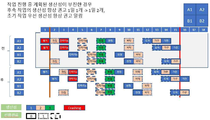
도8에서는 일정 계획 연산 단계에 따른 업무별 바차트 및 업무layer별 작업 구역이 표시된다. In FIG. 8, a bar chart for each task and a work area for each task layer according to the schedule planning operation step are displayed.
업무별 바차트에서 맨 윗행의 숫자는 매일의 공사 일자를 의미하고, 첫번째 열의 각 행에는 각 작업의 명칭이 배치되며, 그 옆에는 각 작업별 세부 작업의 현황이 나타난다. In the bar chart for each task, the number in the top row means the daily construction date, the name of each task is placed in each row in the first column, and the status of detailed tasks for each task is displayed next to it.
업무별 바차트는 업무layer와 연동되며, 각 업무layer의 그리드에는 세부 작업 현황이 구분된다. 예를 들어, 각 그리드를 채운 파란색은 작업영역, 분홍색은 진행영역, 연두색은 완료 영역을 의미한다. The bar chart for each job is linked with the job layer, and the detailed job status is distinguished in the grid of each job layer. For example, the blue color that fills each grid represents the work area, the pink color represents the progress area, and the yellow green color represents the completed area.
그리고, 업무별 바 차트에서 업무의 세부작업 항목은 각 업무layer와 연동된다. 예를 들어서, 바 차트에서 9일차와 연동되는 업무는 흙막이 공사와 토공사인데, 9일차의 작업 흐름에 맞는 업무layer(예, 흙막이 공사 업무layer, L1레벨에서의 토공사 업무 layer)가 표시될 수 있고, 또한 17일차 흐름에 맞는 업무(예, L2레벨에서의 토공 업무 layer, 기초 업무 layer)가 연동되게 설정되고, 디스플레이에 표시될 수 있다. And, in the bar chart for each task, the detailed work item of the task is linked with each task layer. For example, in the bar chart, the tasks linked to the 9th day are earthworks and earthworks, and the job layer that fits the work flow of the 9th day (eg,retaining construction layer, earthworks layer at L1 level) can be displayed. , and also work that fits the flow of the 17th day (eg, earthworks layer at L2 level, basic work layer) can be set to be linked and displayed on the display.
도9 내지 도11은 공정 관리 기법의 세부적인 작동 방법을 도시한 흐름도이다.9 to 11 are flowcharts illustrating a detailed operation method of the process control technique.
도9에서 도시한 바와 같이, 그리드에 배정된 작업을 모으고(S9100), 이를 선후 관계 템플릿에 따라서 정렬(S9200)한다. As shown in Fig. 9, the tasks assigned to the grid are collected (S9100), and they are arranged according to the precedence relationship template (S9200).
선후 관계 템플릿에 따라 정렬하는 단계(S9200)는 아래와 같이 세분화 된다.The step of arranging according to the precedence relation template (S9200) is subdivided as follows.
즉, 선후 관계 템플릿을 점검하고(S92100), 선후 관계 템플릿에 모든 작업의 선후 관계가 포함되어 있는지 판단하여(S9220), 그러하지 않은 경우, 수정 알림을 주고, 관리자가 이를 고칠 수 있도록 안내한다(S9250). That is, the precedence relation template is checked (S92100), and it is determined whether the precedence relation of all tasks is included in the precedence relation template (S9220). ).
선후 관계 템플릿에 모든 작업의 선후 관계가 포함되어 있는 경우에는 선후 관계 템플릿에서 루프(loop)가 발생하지 않는지 여부를 판단하여(S2930) 루프가 발생한 경우, 수정 알림을 주고, 관리자가 이를 고칠 수 있도록 안내하고, 루프가 발생하지 않는 경우에는 선후 관계 템플릿을 사용한다(S9240). 이에 의하여, 선후 관계 템플릿에 따라 하드로직에 따른 작업들이 정렬된다(S9200). If the precedence and precedence relationship of all tasks is included in the precedence relation template, it is determined whether a loop does not occur in the precedence relation template (S2930). guide, and if a loop does not occur, a precedence relation template is used (S9240). Thereby, the tasks according to the hard logic are arranged according to the precedence relationship template (S9200).
그리고, 선후 관계 템플릿에 정의되지 않은 작업은 랜덤하게 정렬하고(S9300), 가장 많은 작업이 배정된 그리드를 기준으로 동일 작업 일정을 배정한다(S9400). Then, tasks not defined in the precedence relationship template are randomly arranged (S9300), and the same task schedule is assigned based on the grid to which the most tasks are assigned (S9400).
이렇게 일정이 배정된 상태에서, 작업 생산성 제약에 따른 일정 조정(S9500)과, 선행 완료 제약에 따른 일정 조정(S9600)과, 전체 일정 준수 제약에 따른 일정 조정(S9700)에 따라서 각 작업에 따른 세부 작업의 일정들이 연산에 의하여 조정되고, 이에 의하여 전체적인 공정 계획이 확정되고(S9800), 이를 토대로 공정 계획을 운영한다(S9900). With the schedule assigned in this way, the details of each task according to the schedule adjustment according to the task productivity constraint (S9500), the schedule adjustment according to the preceding completion constraint (S9600), and the schedule adjustment according to the overall schedule compliance constraint (S9700) The work schedules are adjusted by calculation, whereby the overall process plan is confirmed (S9800), and the process plan is operated based on this (S9900).
그리고 공정 계획을 운영하면서, 추후에 작업 생산성 제약에 따른 일정 조정과, 선행 완료 제약에 따른 일정 조정과, 전체 일정 준수 제약에 따른 일정 조정이 있는 경우에, 건설 공정 네비게이션에 따라서, 최종 목표(최종 마감 시한 및 완성도)에 맞추어 각 작업 및 이의 세부 작업의 일정이 업데이트 된다(S10000). And, while operating the process plan, if there is later schedule adjustment according to work productivity constraints, schedule adjustment according to prior completion constraints, and schedule adjustment according to overall schedule compliance constraints, according to the construction process navigation, the final goal (final The schedule of each task and its detailed work is updated according to the deadline and completeness) (S10000).
S10000 단계 이전에, 현재 완료된 작업의 실적을 입력하는 단계가 포함될 수 있고, 이에 의하여 S10000 단계에서는 잔여 기간과 잔여 작업 및 설정된 제약조건을 반영하여 잔여 계획을 자동으로 수정하는 내용이 포함될 수도 있다. Prior to step S10000, the step of inputting the performance of the currently completed work may be included, whereby step S10000 may include contents of automatically modifying the remaining plan by reflecting the remaining period, the remaining work, and set constraints.
이는 차량 운행시 목표지점이 변하면 최적 경로 및 소요 시간을 업데이트 하여 알려주는 것과 동일하다. This is the same as updating and notifying the optimal route and required time when the target point changes during vehicle operation.
도9에서 나타난 작업 생산성 제약에 따른 일정 조정 과정(S9500)에 대해서 상세하게 설명한다. 작업 생산성 제약은 특정 작업에 대한 세부 작업 중 하루에 할 수 있는 그리드 수로 정의된다. A schedule adjustment process ( S9500 ) according to work productivity constraints shown in FIG. 9 will be described in detail. The task productivity constraint is defined as the number of grids that can be done per day of detailed tasks for a particular task.
작업 생산성 제약에 따른 일정 조정(S9500)의 경우, 우선 특정 그리드에 해당 작업이 있는지 여부를 판단하고(S9501), 그러하다면, 작업이 동종 여부를 판단하고(S9502), 그러하다면 1일 생산성을 초과하는지 여부를 판단하여(S9503), 1일 생산성이 초과한다면, 선행 및 후행 작업이 적은(작업량이 적은) 그리드의 작업을 뒤로 연기함으로써 수행된다(S9504).In the case of schedule adjustment (S9500) according to work productivity constraints, first, it is determined whether there is a corresponding task in a specific grid (S9501), and if so, it is determined whether the tasks are the same (S9502), and if so, the daily productivity is exceeded. It is determined whether or not (S9503), and if the daily productivity is exceeded, the preceding and following tasks are performed by delaying the tasks of a small (small amount of work) grid to the back (S9504).
만약에 위 세 개의 판단에서 어느 하나라도 No로 판단되면, 다음 그리드가 있는지 여부를 판단하여(S9505), 그러하다면, 다음 그리드로 이동하여 전술한 단계를 수행한다(S9506). If any one of the above three judgments is determined as No, it is determined whether there is a next grid (S9505).
만약에 다음 그리드가 없다면 다음에 후행하는 작업이 있는지 여부를 판단하여(S9507), 다음에 후행하는 작업이 있으면 다음 작업으로 이동하여(S9508) 전술한 특정 그리드에 해당 작업이 있는지 여부를 판단/작업 일정이 동일한지 여부를 판단/ 1일 생산성을 초과하는지 여부를 판단하는 과정을 거치고, 다음 작업이 없다면, 선행 완료 제약에 따른 일정 조정 단계(S9600)를 수행한다. If there is no next grid, it is determined whether there is a next following task (S9507), and if there is a next following task, it moves to the next task (S9508) and it is determined whether there is a corresponding task in the above-mentioned specific grid / task After the process of determining whether the schedule is the same / determining whether the daily productivity is exceeded, if there is no next task, the schedule adjustment step (S9600) according to the prior completion constraint is performed.
선행 완료 제약에 따른 일정 조정 단계(S9600)의 경우, 작업별로 요구되는 거리 이내에 선행작업이 진행중인지 판단한다(S9601). In the case of the schedule adjustment step according to the prior completion constraint (S9600), it is determined whether the preceding task is in progress within a distance required for each task (S9601).
요구되는 거리는 도12에서 나타난 그리드 표 기준으로, 0인 지점에서 상하 좌우로 한칸씩 떨어진 지점과의 거리를 1로 정의하고, 두 칸 씩 떨어진 지점의 거리를 2로 정의하고, 대각선으로 한 칸 떨어진 지점의 거리를 1.4로 지정한다.Based on the grid table shown in FIG. 12, the required distance is defined as 1 as the distance from the
따라서, 0인 지점에서 특정한 작업의 작업(예, 마킹 작업)을 수행하기 위해서는 철거 작업이 이루어져야 하는데, 마킹 작업의 원할한 작업을 위해서는 철거 작업은 0인 지점 뿐만 아니라, 위로 한칸 떨어진 그리드에 대해서도 이루어져야 한다고 할때, 0인 지점 및 위로 한칸 떨어진 지점에 대한 철거가 완료되어야 비로소 마킹 작업을 할 수 있다. Therefore, in order to perform a specific operation (eg, marking operation) at the zero point, a demolition operation must be performed. Marking can be done only when the demolition of the zero point and the point one space above is completed.
따라서, 작업별로 요구되는 거리 이내에서 선행작업이 진행중이면 해당 작업을 수행할 수 없으므로 해당 작업을 뒤로 연기한다(S9602). Therefore, if a preceding task is in progress within a distance required for each task, the task cannot be performed, so the task is postponed (S9602).
만약에 작업별로 요구되는 거리 이내에서 선행작업 완료되었으면, 도10에서 나타난 작업 생산성 제약에 따른 일정 조정 단계(S95)를 거치고, 다음 작업이 있으면 다음 작업에 대해서 선행 완료 제약에 따른 일정 조정 단계를 거치고, 다음 작업이 없으면, 이러한 조정으로 인하여 전체 작업이 지정된 전체 기간 내에 완료되는지 판단한다(S9603).If the preceding task is completed within the required distance for each task, the schedule adjustment step (S95) according to the task productivity constraints shown in FIG. , if there is no next task, it is determined whether the entire task is completed within the designated total period due to this adjustment (S9603).
만약에 위와 같은 조정에 의하여 전체 공사에 대한 소요 기간이 기준 기간이내에 완료되는 경우에는 공정 계획 초안이 작성된다(S9604). If the required period for the entire construction is completed within the reference period due to the above adjustment, a draft process plan is prepared (S9604).
반면, 만약에 위와 같은 조정에 의하여 전체 공사에 대한 소요 기간이 기준 기간을 초과하는 경우에는 전체적인 일정을 앞당기기 위해서 전체 일정 준수 제약에 따른 일정 조정(S9700)을 거치는데, 여기서 생산성이 낮은 작업 및 초반 작업에 대해서 팀을 추가하여 공정을 앞당길 수 있도록 하는 공정 계획 초안을 보여준 후, 팀 추가 알림을 주고 관리자가 수정하도록 한다(S9605)On the other hand, if the required period for the entire construction exceeds the standard period due to the above adjustment, schedule adjustment (S9700) is performed according to the overall schedule compliance constraint in order to advance the overall schedule, where work with low productivity and After showing the draft of the process plan to add a team to advance the process for the initial work, a notification for adding a team is given and the manager can make corrections (S9605)
그리고, 이렇게 작성된 초안에 맞추어서 공정 계획이 확정된다(S9606). Then, the process plan is confirmed according to the draft prepared in this way (S9606).
이후에 공정이 진행되다가, 특정 작업에 대한 세부 작업의 일정이 지연되는 등의 사건이 발생하는 경우, 도13에서 도시한 바와 같이, 이에 대한 현황을 입력한다(S1).After the process is in progress, when an event such as a delay of the schedule of a detailed task for a specific task occurs, the current status is input as shown in FIG. 13 ( S1 ).
현황 입력(S1) 후에 선행 완료 제약에 따른 일정 조정(S9600a)과, 작업 생산성 제약에 따른 일정 조정(S9500a) 및, 전체일정 준수 제약에 따른 일정 조정(S9700a)이 순차적으로 이루지는데, 위 3종류의 조정의 흐름은 도11에서 설명한 것과 동일하므로 중복방지를 위해 생략한다.After the status input (S1), the schedule adjustment according to the prior completion constraint (S9600a), the schedule adjustment according to the work productivity constraint (S9500a), and the schedule adjustment according to the overall schedule compliance constraint (S9700a) are sequentially performed. Since the flow of adjustment is the same as that described with reference to FIG. 11, it is omitted to avoid duplication.
다만, 전체일정 준수 제약에 따른 일정 조정(S9700a)에서는 공정 계획 초안이 아닌 변경 사항에 따른 공정 계획 업데이트 제안을 보여주고(S9604a), 이를 위해서 팀 추가 알람을 주고 관리자로 하여금 수정하게 하거나, 또는 업데이트 제안을 유지하는 경우(S9605a), 최종적으로 목표 달성을 위한 공정 업데이트를 확정한다(S9606a). However, in the schedule adjustment (S9700a) according to the overall schedule compliance constraint, the process plan update proposal according to the changes rather than the process plan draft is shown (S9604a), and for this purpose, an additional alarm is given to the team and the manager is made to revise, or update If the proposal is maintained (S9605a), the process update for finally achieving the goal is confirmed (S9606a).
도 14 내지 도23에서는 흙막이 벽 공사를 위해서 1개조를 투입하는 경우의 흙막이 벽 공사가 이루어지는 것을 도시한 것이다. 여기서 1개 조의 하루 작업량은 3개의 그리드로 정의되고, 파란색 그리드는 작업 대상 영역, 빨간색 그리드는 현재 작업 진행중인 영역, 연두색 그리드는 작업 완료 영역을 의미한다.14 to 23 show that the retaining wall construction is made in the case of inputting one set for the retaining wall construction. Here, the daily workload of one group is defined by three grids, the blue grid means the area to be worked on, the red grid is the area currently under work, and the yellow-green grid means the work completed area.
도14는 흙막이 작업 1일차, 도15는 2일차, 도16은 3일차, 도17은 4일차, 도18은 5일차, 도19는 6일차, 도20은 7일차, 도21은 8일차, 도22은 9일차, 도23은 10일차(완료)를 나타낸다. 14 is the first day of the retaining operation, FIG. 15 is the 2nd day, FIG. 16 is the 3rd day, FIG. 17 is the 4th day, FIG. 18 is the 5th day, FIG. 19 is the 6th day, FIG. 20 is the 7th day, FIG. 21 is the 8th day, Fig. 22 shows the 9th day, and Fig. 23 shows the 10th day (completed).
만약에 흙막이 벽 공사의 소요 기간 단축을 위해서 2개 팀을 투입하는 경우에는 도24와 같이 1일차의 빨간색 그리드가 2배로 늘어나고, 도25는 2일차, 도26은 3일차, 도27은 4일차, 도28은 5일차(완료)가 되어 소요기간이 절반으로 단축된다. If two teams are put in to shorten the period required for retaining wall construction, the red grid of the first day is doubled as shown in Fig. 24, Fig. 25 is the second day, Fig. 26 is the third day, and Fig. 27 is the fourth day. , Fig. 28 is the 5th day (completed), and the required period is cut in half.
도29 및 도30은 선행 완료 제약에 따른 작업 투입 상태를 도시한다. 예를 들어 선행작업이 흙막이 벽 공사이고, 후행하는 작업이 흙막이 지지 말뚝 공사인 경우, 흙막이 지지 말뚝 공사는 흙막이 벽 공사가 일정 구간이 완료되어야 진행이 가능하다. 29 and 30 show a work input state according to the prior completion constraint. For example, if the preceding work is retaining wall construction and the subsequent work is retaining support pile construction, retaining support pile construction can be performed only after a certain section of retaining wall construction is completed.
도29에서 나타난 흙막이 벽 공사가 어느 정도 진행되어(공정률 약 40~50%) 진행 완료 그리드(녹색 표시)가 나타나고, 녹색으로 표시된 흙막이 벽 공사의 진행 완료 구간과, 도6에서 나타난 흙막이 지지 말뚝 공사의 전체 영역이 중첩되는 구간의 일부에서 비로소 흙막이 지지 말뚝 공사를 시작할 수 있다(도30에서 붉은색으로 표시된 H2, H3 영역) The retaining wall construction shown in FIG. 29 has progressed to some extent (the completion rate is about 40-50%), and a progress completion grid (green marks) appears, the progress completion section of the retaining wall construction indicated in green, and the retaining support pile construction shown in FIG. Only in a part of the section where the entire area overlaps, the retaining support pile construction can be started (regions H2 and H3 marked in red in FIG. 30).
공정 계획 기본 수립을 시각화한 차트가 도31 이하에서 나타난다.A chart visualizing the basic establishment of a process plan is shown in FIG. 31 and below.
도31에서 도시한 바와 같이, 건축물에 대한 업무를 구성하는 작업이 철거-> 마킹-> 칸막이A -> 칸막이B -> 방통 -> 천정 -> 바닥 -> 도어 -> 가구 -> 가전 순으로 이루어진다고 하자. As shown in Fig. 31, the work composing the work for the building is done in the order of demolition -> marking -> partition A -> partition B -> room room -> ceiling -> floor -> door -> furniture -> home appliance. let's say
이 경우, 작업의 선후 관계는 가장 우측에 나타난 표와 같이 하드 로직으로서 선행 공정이 완료되어야 후행 공정을 수행할 수 있다. In this case, as shown in the table on the far right, the precedence and posterior relation of the task is hard logic, and the subsequent process can be performed only when the preceding process is completed.
도31에서 철거 작업은 A1, A2 그리드에서, 마킹 작업은 A1, B1, B2에서, 칸막이A 작업은 A, A2, B1에서, 칸막이B 작업 A1, A2, B1, B2에서 이루어진다고 예를 들었다. 나머지 나타나지 않은 작업들도 그 필요에 맞게 특정한 그리드에서 이루어져야 한다. In Figure 31, the demolition work is done on the grids A1 and A2, the marking operation is performed on A1, B1, B2, the partition A operation is performed on A, A2, B1, and the partition B operation is performed on A1, A2, B1, B2. The rest of the non-shown tasks must also be done on a specific grid to suit their needs.
도32에서 도시한 바와 같이, 업무Layer에서 취합된 그리드 별 작업을 선후 관계에 따라서만 작성한다. 그리드가 A1, A2, B1, B2로 구분되는 있는 경우에 각 그리드에서 이루어지는 작업의 종류, 작업의 작업량이나 작업의 소요 기간은 달라질 수 있다. 이 단계에서는 선후 관계만 고려하여 배열하여 작성한다.As shown in Fig. 32, the tasks for each grid collected in the task Layer are created only according to the precedence relationship. When a grid is divided into A1, A2, B1, and B2, the type of work performed in each grid, the amount of work performed, or the duration of the work may vary. At this stage, only the precedence relationship is considered and the arrangement is made.
그리고 도33에서 도시한 바와 같이, 모든 그리드에 대해서 동일 작업별로 동일 시점으로 배정한다. And, as shown in FIG. 33, all grids are allocated at the same time for the same task.
예를 들어 1일차에는 철거 작업을, 2일차에는 마킹 작업을, 3일차에는 칸막이A 작업을 , 4일차에는 칸막이B 작업을, 5일차에는 방통 작업을, 6일차에는 천정작업을, 7일차에는 바닥 작업을, 8일차에는 도어 작업을, 9일차에는 가구 작업을, 10일차에는 가전 작업을 배치한다. For example, demolition work on the 1st day, marking work on the 2nd day, the partition A work on the 3rd day, the partition B work on the 4th day, the ventilation work on the 5th day, the ceiling work on the 6th day, the ceiling work on the 7th day Floor work, door work on
이 상태에서 도34에서 도시한 바와 같이, 작업별 생산성을 반영하여 작업별로 재배치한다.In this state, as shown in FIG. 34, it is rearranged for each job to reflect the productivity for each job.
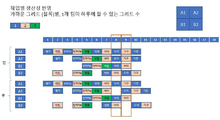
도34에서 파란색 바탕의 1로 표시된 것은 1팀이 하루에 1개의 그리드에 대해서 할 수 있는 작업이고, 살구색 바탕에 2로 표시된 것은 1팀이 하루에 2개의 그리드에 대해서 할 수 있는 작업이며, 녹색 바탕에 3으로 표시된 것은 1팀이 하루에 3개의 그리드에 대해서 할 수 있는 작업이다.In Fig. 34, the work that one team can do on one grid per day is indicated by 1 on the blue background, the work that one team can do on two grids per day is indicated by the
예를 들어서 철거 작업의 경우, 1팀이 하루에 한 개 그리드에 대해서만 할 수 있으므로 도33에서 1일차에서 A1그리드에 대한 철거 작업과 A2그리드에 대한 철거 작업을 동시에 할 수 없다. For example, in the case of demolition work, since one team can only do one grid per day, in FIG. 33 , the demolition work on the A1 grid and the demolition work on the A2 grid cannot be simultaneously performed on the first day.
따라서, 도34에서 나타난 바와 같이 A1그리드에 대한 철거를 1일차에, A2 그리드에 대한 철거는 2일차에 진행하는 것으로 설정한다. 이에 의해서 도33에서 나타났던 A2에 대한 일정은 하루씩 뒤로 밀린다. Therefore, as shown in FIG. 34 , it is set that the demolition of the A1 grid is carried out on the first day and the demolition of the A2 grid is carried out on the second day. Accordingly, the schedule for A2 shown in FIG. 33 is pushed back by one day.
B1 그리드나 B2 그리드에 대해서 철거 작업이 없지만, B1 그리드의 처음 작업인 칸막이A작업이나 또는 B2 그리드의 처음 작업인 마킹은 A1, A2에 대한 철거가 완료되어야 할 수 있으므로 B1 그리드에 대한 일정 및 B2 그리드에 대한 일정도 A2가 하루 밀리면서 자동적으로 하루씩 밀린다. Although there is no demolition work for B1 grid or B2 grid, the first work of B1 grid, partition A work, or marking, which is the first work of B2 grid, may require completion of demolition for A1 and A2, so the schedule for B1 grid and B2 As the schedule for the grid A2 is pushed by one day, it is automatically pushed one by one.
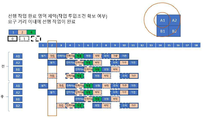
도35는 선행작업 완료 제약에 따른 조정을 나타낸 것이다. 다른 말로 작업 투입 조건 확보 여부를 판단하는 것이며, 여기서는 요구 거리 이내에 선행 작업이 완료되었는지 여부에 따라서 일정을 조정한다.Fig. 35 shows the adjustment according to the prior task completion constraint. In other words, it is to determine whether or not the work input condition is secured, and in this case, the schedule is adjusted according to whether the preceding work has been completed within the required distance.
실선 박스 내에 0은 해당 그리드에서만 선행 작업이 완료되면 착수할 수 있는 작업을 의미하고, 작은 점 박스 내의 1은 해당 그리드 뿐만 위/아래/옆에서 한칸 떨어진 그리드에 대해서도 선행 작업이 완료되어야 비로소 착수 할 수 있는 작업를 의미하며, 두꺼운 파선 박스 내의 2는 해당 그리드 뿐만 위/아래/옆에서 한 칸 및 두 칸 떨어진 그리드 또는 대각선 한칸 떨어진 그리드에 대해서도 선행 작업가 완료되어야 비로소 착수할 수 있는 작업를 의미한다. A 0 in the solid line box means a task that can be started only when the preceding task is completed in the grid, and a 1 in the small dot box means that the task can be started only when the preceding task is completed not only for the grid but also for the grid one space above/below/next to the grid. It means the work that can be done, and the
예를 들어서 마킹 작업은 요구거리 1의 값을 가지므로, A1에서의 마킹 작업은 A1의 철거와 A2의 철거가 완료되어야 비로소 3일차에 수행할 수 있다(B1 , B2는 철거 필요없음). 따라서 A1에 대한 마킹 작업을 3일차로 조정한다. For example, since the marking operation has a required distance of 1, the marking operation on A1 can be performed on the 3rd day only when the demolition of A1 and the demolition of A2 are completed (B1 and B2 do not need to be demolished). Therefore, the marking operation for A1 is adjusted to the 3rd day.
한편 마킹 작업은 하루에 2개의 그리드에 대해서 할 수 있는데, B2에 대한 마킹 작업은 A2에 대한 철거가 완료되어야 할 수 있기 때문에, A1에 대한 마킹 작업과 같이 3일차에 진행할 수 있다. On the other hand, the marking work can be done for two grids per day. Since the marking work for B2 may have to be completed for the demolition of A2, it can be performed on the third day like the marking work for A1.
칸막이 A 작업은 당해 그리드에 대해서만 선행작업(철거-마킹)이 이루어지면 되나, 하루에 한개씩만 할 수 있으므로, A1의 칸막이A 작업은 4일차에, A2의 칸막이 A 작업은 5일차에, B1의 칸막이 A작업은 5일차에 하나씩 수행한다.For the partition A work, the preceding work (demolition-marking) only needs to be done for the grid, but only one can be done per day. Partition A tasks are performed one at a time on
칸막이 B 작업은 요구거리가 2이고, 하루에 두 개의 그리드씩 수행할 수 있다.Partition B task requires a distance of 2 and can be performed two grids per day.
칸막이 B작업은 요구거리가 2이므로 당해 그리드 뿐만 아니라, 주위의 모든 그리드에 대한 선행작업이 완료되어야 한다. Since the required distance is 2 for the partition B work, the preceding work for not only the grid but also all surrounding grids must be completed.
따라서, B1에 대한 칸막이A 작업이 완료된 후(6일차 완료), A1, A2에 대한 칸막이B 작업을 7일차에 수행하는 것으로 설정하고, B1, B2에 대한 칸막이 B 작업는 8일차에 수행하는 것으로 설정한다. Therefore, after the partition A task for B1 is completed (
방통 작업은 하루에 3개의 그리드에 대해서 할 수 있으나 요구거리가 2이므로 당해 그리드 뿐만 아니라, 주위의 모든 그리드에 대한 선행작업이 완료되어야 한다. Communication work can be done on 3 grids per day, but since the required distance is 2, prior work on all surrounding grids as well as the grid must be completed.
따라서, B1, B2에 대한 칸막이 B 작업이 완료되는 8일차 완료 다음인 9일차에 수행하는 것으로 설정한다. Therefore, it is set to be performed on the 9th day after the completion of the 8th day when the partition B tasks for B1 and B2 are completed.
천정 작업은 당해 그리드에 대해서만 선행작업이 완료되면 되나, 하루에 한개의 그리드에 대해서만 할 수 있으므로 A1에 대해서는 10일차에, B1에 대해서는 11일차에, B2에 대해서는 12일 차에 수행하는 것으로 설정한다.The ceiling work needs to be completed only for the grid, but since it can only be done on one grid per day, it is set to be performed on the 10th day for A1, the 11th day for B1, and the 12th day for B2. .
바닥 작업은 하루에 2개의 그리드에 대해서 수행할 수 있으나, 요구 거리1을 가지므로 당해 그리드 뿐만 아니라 좌우 상하 1칸 떨어진 그리드에 대한 선행 작업(천정 작업)이 완료되어야 진행할 수 있다.Floor work can be performed on two grids per day, but since it has a required distance of 1, prior work (ceiling work) must be completed not only for the grid, but also for the grid that is one space away from the left and right up and down.
따라서 A1, A2에 대한 바닥 작업은 요구 거리 1이 되는 그리드에 대한 천정 작업이 종료되는 11일차가 끝난 후 12일차에 같이 진행하고, B1, B2에 대한 바닥 작업은 요구 거리 1이 되는 그리드에 대한 천정 작업이 종료되는 12일차가 끝난 후 13일차에 같이 진행한다. Therefore, the floor work for A1 and A2 is carried out on the 12th day after the 11th day when the ceiling work for the grid with the required distance of 1 is finished, and the floor work for B1 and B2 is performed on the grid with the required distance of 1. After the 12th day when the ceiling work is finished, it is carried out together on the 13th day.
도어 작업의 경우, 하루에 한 그리드에 대해서만 할 수 있고, 요구거리가 2이므로, 요구거리 2를 만족하는 그리드 내에서 바닥 작업이 종료된 후 14일차(A1그리드), 15일차(A2그리드), 16일차(B2 그리드)에 차례차례 진행하는 것으로 설정한다In the case of door work, only one grid per day and the required distance is 2, so within the grid that satisfies the required
가구 작업의 경우, 당해 그리드에 대한 선행 작업이 이루어지면 되고, 하루에 2개의 그리드를 수행할 수 있으나, 도어 작업의 일정에 밀려서 A1에 대해서는 15일차, A2에 대해서는 16일차, B2에 대해서는 17일차에 수행하는 것으로 설정한다. In the case of furniture work, the preceding work for the grid can be done, and two grids can be performed in a day, but due to the door work schedule, it is the 15th day for A1, the 16th day for A2, the 17th day for B2. set to be performed on
가전 작업의 경우, 가구 작업이 종료된 후 A1에 대해서는 16일차, A2에 대해서는 17일차에 수행한다. In the case of home appliance work, after furniture work is finished, A1 is performed on the 16th day and A2 is performed on the 17th day.
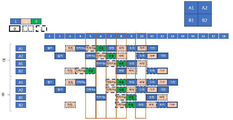
도36과 도37은 프로젝트 전체 기간 제약에 따른 일정 조정 방식을 도시한다.36 and 37 show a schedule adjustment method according to the overall project period constraint.
도35에 나타난 방식에 의해서 17일의 공정일정이 도출되었는데, 프로젝트 기간이 15일로 단축된 경우에는 생산성 향상을 위해서 하루에 한개의 그리드에 대해서 할 수 있는 작업에 대해서 하루에 두 개의 그리드를 할 수 있는 작업조를 투입을 권고하고, 초기 작업에 우선하여 생산성 향상 권고 알람을 준다. A 17-day process schedule was derived by the method shown in Fig. 35. In case the project period was shortened to 15 days, two grids per day can be performed for the work that can be done on one grid per day to improve productivity. It recommends the input of an existing working group, and gives priority to the initial work, and gives an alarm for recommending productivity improvement.
도36에서 도시한 바와 같이, 철거 및 칸막이 A 작업은 하루에 한 그리드만 가능한 작업이나, 생산성이 높은 작업조를 투입하거나 두 개의 작업조를 투입함으로써, A1, A2에 대한 철거작업을 1일차에 동시에 수행하도록 하고, A1, A2에 대한 칸막이A작업을 3일차에 동시에 수행하도록 하게 함으로써, 전체 공정 소요 기간을 기존의 17일에서 15일로 단축하는 방법을 제시한다. As shown in FIG. 36, the demolition and partition A work is a work that can only be done with one grid per day, but by putting a work group with high productivity or two work groups, the demolition work for A1 and A2 is performed on the first day. We propose a method of shortening the entire process period from 17 days to 15 days by having them be performed simultaneously and the partition A work for A1 and A2 being performed simultaneously on the 3rd day.
여기서 빨간색으로 표시한 부분이 생산성(또는 작업속도)을 향상시킨 작업을 의미한다. Here, the part marked in red means the task with improved productivity (or work speed).
한편, 도38과 같이, 가장 많은 작업이 배정된 그리드를 기준으로 동일 작업별로 동일 시점에 배정할 수 도 있다. Meanwhile, as shown in FIG. 38 , the same tasks may be assigned at the same time based on the grid to which the most tasks are assigned.
도38에서 A1그리드는 누적 10일, A2그리드는 누적 8일, B1그리드는 5일, B2그리드는 6일의 작업 소요기간이 필요하다. 따라서, 작업이 제일 많은 A1을 기준으로 하고, 생산성을 따져서 나머지 그리드의 작업일정을 뒤로 조정한다. In Fig. 38, it takes 10 days for A1 grid, 8 days for A2 grid, 5 days for B1 grid, and 6 days for grid B2. Therefore, based on A1, which has the most work, the work schedule of the rest of the grid is adjusted backward in consideration of productivity.
이 상태에서 도39에서 도시한 바와 같이, 작업별 생산성을 반영하여 개별 작업을 재배치한다.In this state, as shown in FIG. 39, individual tasks are rearranged to reflect productivity for each task.
도39에서 파란색 바탕의 1로 표시된 것은 1팀이 하루에 1개의 그리드에 대해서 할 수 있는 작업이고, 살구색 바탕에 2로 표시된 것은 1팀이 하루에 2개의 그리드에 대해서 할 수 있는 작업이며, 녹색 바탕에 4로 표시된 것은 1팀이 하루에 4개의 그리드에 대해서 할 수 있는 작업이다.In Fig. 39, the work that 1 team can do on one grid per day on the blue background is the work that one team can do on one grid per day, the 2 on the apricot background is the work that one team can do on two grids per day, and green The 4 in the background is what one team can do for 4 grids in a day.
도39 및 이후의 도면에서 "전"으로 표시된 그리드 영역의 각 작업은 변경 전의 작업 배치를 의미하고(바로 앞 도면에서 표시되는 "후(변경 후)"와 동일함), "후"로 표시된 그리드 영역은 해당 도면에서 설명하는 변경 과정에 따른 변경 후 상태를 의미한다. Each operation in the grid area indicated by "before" in Fig. 39 and subsequent drawings means the operation arrangement before the change (the same as "after (after change)" indicated in the immediately preceding drawing), and the grid indicated by "after" The area means a state after the change according to the change process described in the drawing.
즉, 도39의 "전"은 도38의 상태를 의미하고, 도40의 "전"은 도39의 "후"를 의미한다. 이는 변화된 상태의 용이한 비교를 위해서이다. That is, "before" in Fig. 39 means the state of Fig. 38, and "before" in Fig. 40 means "after" This is for easy comparison of the changed state.
도38및 도39에서, 철거의 경우, 1팀이 하루에 한 개 그리드에 대해서만 할 수 있으므로 1일차에서 A1그리드에 대한 철거와 A2그리드에 대한 철거를 동시에 할 수 없다. 38 and 39, in the case of demolition, one team can only do one grid per day, so on the first day, the demolition of grid A1 and demolition of grid A2 cannot be carried out at the same time.
따라서, 도39의 '후'에서 표시한 바와 같이, A1그리드에 대한 철거를 1일차에, A2 그리드에 대한 철거는 2일차에 진행하는 것으로 설정한다. Accordingly, as indicated in 'After' of FIG. 39, it is set that the demolition of the A1 grid is carried out on the first day and the demolition of the A2 grid is carried out on the second day.
즉, 논리적으로 철거는 하루에 1개의 그리드만 할 수 있으며, A1에 철거가 있고, A2에도 철거가 있으므로 서로 겹치기 때문에, A2의 철거 일정을 하루 연기한다. 한편,B1과 B2에서는 철거가 없으므로 동일 작업 일정(철거)에 대해서 그리드 1개가 있는 것이 확인되었으므로 철거 작업에 대한 조정은 종료한다. That is, logically, demolition can only be done on one grid per day, and there is demolition in A1 and demolition in A2. On the other hand, since there is no demolition in B1 and B2, it is confirmed that there is one grid for the same work schedule (demolition), so the adjustment of the demolition work is finished.
도40에서 마킹 작업은 하루에 그리드 2개에 대해서 가능하다. 마킹 작업은 A1에 있고, A2에 없고, B1에는 없고, B2에는 있어서 겹치지만, 동일 작업(마킹 작업)이 그리드2개 이하 조건을 충족하므로 마킹 작업에 대한 조정은 종료한다. In Fig. 40, the marking operation is possible for two grids per day. The marking operation is in A1, not in A2, not in B1, overlapping in B2, but the same operation (marking operation) meets the condition of 2 grids or less, so the adjustment for the marking operation is finished.
도41에서 칸막이 A작업은 하루에 그리드 1개에 대해서 가능하다. 칸막이A작업은 A1에 있고,또한 A2, B1에 있어서 겹치고, B2에는 없다. A2, B1에 대한 칸막이 A작업에 대한 일정을 뒤로 연기하는데, 전체 누적일정이 B2(전체 잔여 누적 소요 일정 5일)가 A2(전체 잔여 누적 소요 일정 7일(선행완료된 철거 일정 제외))보다 짧으므로 A2에 대한 칸막이A작업을 하루 뒤(4일차)로 연기하고, B2에 대한 칸막이A작업을 이틀 뒤(5일차)로 연기한다. In Fig. 41, the partition A operation is possible for one grid per day. Partition A work is in A1, and overlaps in A2 and B1, but not in B2. The schedule for the partition A work for A2 and B1 is delayed, but the total cumulative schedule is shorter than B2 (total remaining cumulative required schedule of 5 days) is shorter than A2 (total remaining cumulative remaining required schedule for 7 days (excluding previously completed demolition schedule)) Therefore, the partition A work for A2 is postponed to one day later (day 4), and the partition A work for B2 is postponed two days later (day 5).
따라서 동일 작업(칸막이A작업)에 대한 일정이 3일차에 그리드 1개 이하에 존재하므로 칸막이A작업에 작업 일정에 대한 조정을 종료한다. Therefore, since the schedule for the same task (partition A task) exists in less than one grid on the 3rd day, the adjustment of the work schedule for the partition A task is terminated.
도42에서 칸막이B작업은 하루에 그리드 2개에 대해서 가능하다. In Fig. 42, the partition B operation is possible for two grids per day.
칸막이 B 작업은 A1과, B2에 각각 있고, A1, B1에는 없으므로 동일 작업(칸막이 B 작업)에 대해서 일정이 4일차에 그리드 2개 이하에 존재하므로 칸막이 B 작업 일정에 대한 조정을 종료한다. Partition B tasks exist in A1 and B2, respectively, and because they do not exist in A1 and B1, for the same task (partition B task), the schedule exists on the 4th day or less than 2 grids, so the adjustment of the partition B task schedule ends.
도43에서 방통 작업은 하루에 그리드 4개에 대해서 가능하다. 방통 작업은 A1과 B2에 각각 있고, A1, B1에는 없으므로 동일 작업(방통 작업)에 대해서 일정이 5일차에 그리드 2개 이하에 존재하므로 방통 작업 일정에 대한 조정을 종료한다. In FIG. 43, the telecommunication work is possible for 4 grids per day. Since the telecommunication work is in A1 and B2, respectively, and there is no A1 and B1, the schedule for the same work (the telecommunication work) exists in two or less grids on the 5th day, so the adjustment of the telecommunication work schedule is terminated.
도44에서 천정 작업은 하루에 그리드 1개에 대해서 가능하다. 천정 작업은 6일차에 A1그리드와 B2그리드에 있고, A2와 B1그리드에는 없다. 따라서 겹치는 B2 일정을 하루 뒤로 연기한다. 이에 따라서 일정 6일차에 천정 작업 일정이 그리드 1개 이하에 존재하므로 천장 작업 일정에 대한 조정을 종료한다. In Fig. 44, ceiling work is possible for one grid per day. Ceiling work is on the A1 and B2 grids on the 6th day, and not on the A2 and B1 grids. Therefore, the overlapping B2 schedule is postponed by one day. Accordingly, on the 6th day of the schedule, since the ceiling work schedule exists in less than one grid, the adjustment of the ceiling work schedule is terminated.
도45에서 바닥 작업은 하루에 그리드 2개에 대해서 가능하다. 바닥 작업은 A1과, A2에 각각 있고, B1, B2에는 없으므로 동일 작업(바닥 작업)에 대해서 일정이 7일차에 그리드 2개 이하에 존재하므로 바닥 작업 일정에 대한 조정을 종료한다. In Fig. 45, floor work is possible for two grids per day. The floor work is in A1 and A2, respectively, but there is no B1 and B2, so the schedule for the same work (floor work) exists in two or less grids on the 7th day, so the adjustment of the floor work schedule ends.
도46에서 도어 작업은 하루에 그리드 1개에 대해서 가능하다. In Fig. 46, the door operation is possible for one grid per day.
도어 작업은 8일차에 A1그리드와 A2그리드에 있고, B1와 B2그리드에는 없다. 따라서 겹치는 A2 일정을 하루 뒤로 연기한다. 이에 따라서 일정 8일차에 도어 작업 일정이 그리드 1개 이하에 존재한다. The door work is on the A1 and A2 grids on the 8th day, and not on the B1 and B2 grids. Therefore, the overlapping A2 schedule is postponed by one day. Accordingly, on the 8th day of the schedule, the door work schedule exists in less than one grid.
다만, 도어 작업의 A2 일정을 하루 뒤로 연기되면, 도어 작업이 9일차에 B2 그리드와 A2 그리드에 있고, A1와 B1그리드에는 없다. 따라서 겹치는 B2와 A2 일정 중 잔여 일정이 적은 B2에 대한 도어 작업 일정을 하루 뒤로 연기한다. 이에 따라서 일정 9일차에 도어 작업 일정이 그리드 1개 이하에 존재하므로 도어 작업 일정에 대한 조정을 종료한다. However, if the A2 schedule of the door work is postponed by one day, the door work is on the B2 grid and A2 grid on the 9th day, but not on the A1 and B1 grids. Therefore, among the overlapping schedules B2 and A2, the door work schedule for B2, which has less remaining schedule, is postponed by one day. Accordingly, on the 9th day of the schedule, since the door work schedule exists in less than one grid, the adjustment of the door work schedule is terminated.
가구 작업의 경우 하루에 그리드2개에 대해서 가능하다. In the case of furniture work, it is possible for 2 grids per day.
도47의 "전"에 도시한 바와 같이 가구 작업은 A1에 있고, A2, B1, B2에는 없으므로 동일 작업(가구 작업)에 대해서 일정이 9일차에 그리드 2개 이하에 존재하므로 가구 작업 일정에 대한 조정 없이 종료한다. As shown in “before” in FIG. 47, since the furniture work is in A1 and not in A2, B1, and B2, for the same work (furniture work), the schedule exists on the 9th day at two or less grids, so the furniture work schedule is Exit without adjustment.
가전 작업의 경우 하루에 그리드 1개에 대해서 가능하다. For home appliance work, it is possible for 1 grid per day.
도48의 "전"에 도시한 바와 같이, 가전 작업은 A1에 있고, 다른 그리드에는 없으므로 조정 없이 종료한다. As shown in "before" in Fig. 48, the household appliance work is on A1, and there is no other grid, so it ends without adjustment.
이로써 작업 생산성 제약에 따른 조정이 완료되고, 선행 완료 제약 조건에 따른 조정이 수행된다. Thereby, the adjustment according to the work productivity constraint is completed, and the adjustment according to the prior completion constraint condition is performed.
도49 및 그 이하는 선행작업 완료 제약에 따른 조정을 나타낸 것이다. 49 and below show the adjustment according to the preceding task completion constraint.
다른 말로 작업 투입 조건 확보 여부를 판단하는 것이며, 여기서는 요구 거리 이내에 선행 작업이 완료되었는지 여부에 따라서 일정을 조정한다.In other words, it is to determine whether or not the work input condition is secured, and in this case, the schedule is adjusted according to whether the preceding work has been completed within the required distance.
실선 박스 내에 0은 해당 그리드에서만 선행 작업이 완료되면 착수 할 수 있는 작업를 의미하고, 작은 점 박스 내의 1은 해당 그리드 뿐만 위/아래/옆에서 한칸 떨어진 그리드에 대해서도 선행 작업이 완료되어야 비로소 착수 할 수 있는 작업을 의미하며, 두꺼운 파선 박스 내의 2는 해당 그리드 뿐만 위/아래/옆에서 한칸 및 두칸 떨어진 그리드 또는 대각선 한칸 떨어진 그리드에 대해서도 선행 작업가 완료되어야 비로소 착수 할 수 있는 작업를 의미한다. 0 in the solid line box means work that can be started only when the preceding work is completed in the grid, and 1 in the small dot box means that the preceding work can only be started when the preceding work is completed not only for the grid but also for the grid one space above/below/next to the grid. 2 in the thick dashed box means the work that can only be started when the preceding work is completed not only for the grid, but also for the grid one space away from the top, bottom, side, or one space diagonally.
도49에서 마킹 작업은 요구거리 1의 값을 가지므로, A1에서의 마킹 작업은 A1의 철거와 B2의 철거가 완료되어야 하고 B2 마킹 작업을 위해서는 A2, B1에 대한 선행작업(철거작업)가 완료되어야 한다. 따라서, A1, B2에 대한 마킹 작업을 A2 이후에 연기하는데, 마킹 작업 일정이 겹치긴 하지만, 마킹 작업은 하루에 2개 그리드에 대한 작업이 가능하므로 적절하므로 조정을 종료한다. In Figure 49, since the marking operation has a value of the required
한편 도50에서 칸막이A작업은 선행작업영역 제약이 없으며, A1에서 선행되는 마킹작업이 밀리면서 A1과 A2에 대한 칸막이A작업 일정이 겹친다. 여기서, 잔여 작업이 적은 A2에 대한 칸막이A작업을 뒤로 연기한다. On the other hand, in Fig. 50, the partition A work has no prior work area restriction, and the partition A work schedule for A1 and A2 overlaps as the marking work preceding in A1 is pushed. Here, the partition A task for A2 with few remaining tasks is postponed.
그리고 전체적인 생산성을 재검토하고, 하루에 한개의 그리드에 대해서만 가능한 A2의 도어작업과, B2의 도어작업을 하루씩 뒤로 연기하고, 다시 전체적인 생산성을 재검토 하고, 이상이 없으면 칸막이A를 기준으로 한 일정 조정을 종료한다.Then, review the overall productivity, postpone the door work of A2 and B2 door work, which is possible only for one grid per day, by one day, review the overall productivity again, and if there is no problem, adjust the schedule based on the partition A to quit
도51에서 칸막이B작업은 요구거리 2이내에 선행작업이 완료되어야 진행할 수 있다. 칸막이 A작업이 모두 완료되는 일정으로 칸막이 B작업을 연기한다. 칸막이A의 마지막 완료는 B1그리드에 대해서 6일차에 종료되므로, A1, A2에 대한 칸막이 B작업을 7일차로 조정하고, B1,B2에 대한 칸막이 B 작업을 8일차로 조정한다. In FIG. 51, the partition B operation can be performed only when the preceding operation is completed within the required distance of 2. Partition B is postponed to a schedule where all partition A tasks are completed. Since the final completion of partition A is completed on the 6th day for grid B1, the partition B work for A1 and A2 is adjusted to the 7th day, and the partition B operation for B1 and B2 is adjusted to the 8th day.
B2에 대한 칸막이B작업은 원래 4일차에 있지만, B1에 대한 칸막이 B2 작업과 동시에 하기 위해서 8일차로 연기하고, 이에 의하여 B2에 대한 방통 작업은 9일차, 천정은 10일차로 연기된다. The partition B work for B2 is originally on the 4th day, but it is postponed to the 8th day to be concurrently with the partition B2 work for B1, whereby the communication work for B2 is postponed to the 9th day and the ceiling to the 10th day.
그리고, 천정 작업은 하루에 한 개의 그리드 밖에 되지 않으므로 B1에 대한 천정 작업은 11일 차로 연기되는데, 이는 B1에 대한 잔여 작업량이 B2보다 적기 때문이다. And, since the ceiling work is only one grid per day, the ceiling work for B1 is postponed to 11 days, because the remaining amount of work for B1 is less than that of B2.
도52에서 방통은 요구거리 2이내에 선행작업이 완료되어야 진행하는데, 모든 칸막이 B작업이 완료되는 일정으로 연기한다. 즉, B1, B2에 대한 칸막이B작업이 완료된 후인 9일차에 방통 작업을 수행하며, 방통작업은 작업 생산성이 4 이하이므로 A1, A2, B1, B2 모두에 대해서 방통 작업을 수행할 수 있다. In Fig. 52, the communication is carried out only when the preceding work is completed within the required distance of 2, but it is postponed to the schedule where all the partition B works are completed. That is, after the partition B work for B1 and B2 is completed, the telecommunication work is performed on the 9th day, and since the telecommunication work has a work productivity of 4 or less, the telecommunication work can be performed for all of A1, A2, B1, and B2.
한편, A1과, A2에 대한 방통작업이 9일차가 되면서, A1의 방통 작업에 후행하는 천정 작업이 10일차로 연기되고, 천정은 작업 생산성이 1이하이므로 B1과 B2에 대한 천정 작업이 각각 하루씩 연기된다. On the other hand, as the telecommunication work for A1 and A2 becomes the 9th day, the ceiling work following the telecommunication work of A1 is postponed to the 10th day, and since the ceiling work productivity is less than 1, the ceiling work for B1 and B2 is each one day are postponed by
즉, B2의 천정작업은 11일차, B1의 천정작업은 12일차로 연기된다. That is, the ceiling work of B2 is postponed to the 11th day, and the ceiling work of B1 is postponed to the 12th day.
도53에서, 천정은 요구거리 제약이 없으며, 10일차에서 천정 작업은 A1에만 1개가 있으므로 조건을 만족한다. In Fig. 53, the ceiling has no restriction on the required distance, and since there is only one ceiling operation in A1 on the 10th day, the condition is satisfied.
도54에서 바닥은 요구거리 1이내 선행 작업 완료를 요하므로. A1에 대한 바닥 작업은 B1에 대한 천정 작업(12일차) 이후인 13일차로 연기한다. In Fig. 54, the floor requires the completion of the preceding work within the required distance of 1. The floor work on A1 is postponed to the 13th day after the ceiling work on B1 (day 12).
그리고, A2에 대한 바닥 작업은 A1,B2에 대한 천정 작업(10일차, 11일차) 이후인 12일차로 연기한다. And, the floor work for A2 is postponed to the 12th day after the ceiling work (
그리고, B2에 대한 바닥 작업은 B1의 천정 작업(12일차) 이후인 13일차로 연기한다. And, the floor work for B2 is postponed to the 13th day after the ceiling work (12th day) of B1.
한편, B1에 대한 바닥작업은 바닥 작업의 생산성 2를 고려하고, B1에서의 작업은 바닥 작업만 남은 것을 고려하여, A1, B2에 대한 바닥 작업이 13일차에 먼저 수행되도록 하고, B1에서의 바닥 작업은 14일차에 이루어지도록 연기한다. On the other hand, the floor work for B1 considers
또한 A1에 대한 도어 작업 일정이 14일차로 밀리는데, 도어 작업의 생산성은 1이므로, B2에 대한 도어 작업과 겹치지 않도록, B2에 대한 도어 작업은 15일차로 밀린다. In addition, the door work schedule for A1 is pushed back to the 14th day, but the productivity of the door work is 1, so that the door work for B2 does not overlap with the door work for B2, the door work for B2 is pushed to the 15th day.
도55에서 도시한 바와 같이, 도어는 요구거리 2이내 선행 작업이 완료되어야 한다. A1에 대한 도어 작업은 A2, B1에 대한 바닥 작업 이후로 연기하고, A2에 대한 도어 작업은 A1,B2에 대한 바닥 작업 이후로 연기하며, B2에 대한 도어 작업은는 A2, B1에 대한 바닥작업 이후로 연기한다. As shown in Fig. 55, the preceding work must be completed within the required distance of 2 for the door. The door operation on A1 is postponed after the floor operation on A2 and B1, the door operation on A2 is postponed after the floor operation on A1 and B2, and the door operation on B2 is after the floor operation on A2 and B1. acting as
다만, 도어의 생산성은 1이하 이므로 B2에 대한 도어 작업 일정을 뒤로(16일차로) 연기한다. However, since the productivity of the door is less than 1, the door work schedule for B2 is delayed (to the 16th day).
비로소 3일차에 수행할 수 있다. 따라서 A1에 대한 마킹을 3일차로 조정한다. You can only do it on the 3rd day. Therefore, the marking for A1 is adjusted to the 3rd day.
도56에서 도시한 바와 같이, 가구 작업은 요구거리 제약이 없으며, 생산성은 2 이하인데, 문제되는 것이 없으므로 현 상태를 유지한다. As shown in Fig. 56, the furniture work has no restriction on the required distance, and the productivity is 2 or less, but there is no problem, so the current state is maintained.
도57에서 도시한 바와 같이, 가전 작업도 요구거리 제약이 없으며, 생산성은 1 이하이지만, 문제되는 것이 없으므로 현 상태를 유지한다. As shown in Fig. 57, there is no restriction on the required distance for home appliance work, and the productivity is 1 or less, but since there is no problem, the current state is maintained.
도58 이하는 전체 일정 준수 제약에 따른 일정 조정 방식을 나타낸다. 58 shows a schedule adjustment method according to the overall schedule compliance constraint.
도57 및 그 이전의 조정 방식에 의해서 17일의 공정일정이 도출되었는데, 프로젝트 기간이 15일로 단축된 경우에는 생산성 향상을 위해서 하루에 한개의 그리드에 대해서 할 수 있는 작업에 대해서 하루에 두 개의 그리드를 할 수 있는 작업조를 투입을 권고하고, 초기 작업에 우선하여 생산성 향상 권고 알람을 준다. A 17-day process schedule was derived by Fig. 57 and the previous adjustment method. When the project period was shortened to 15 days, two grids per day for the work that can be done for one grid per day to improve productivity It recommends the input of a working group capable of
여기서 초반 작업의 생산성을 향상시켜서 일정을 맞추는 것이 바람직하며, 여기서는 철거 작업과 칸막이 A 작업에 대한 생산성 향상을 제안한다. Here, it is desirable to meet the schedule by improving the productivity of the initial work, and here, the productivity improvement for the demolition work and the partition A work is proposed.
즉, A1과 A2에 대한 철거를 동시에 1일차에 진행하고, 이에 따라 마킹 작업이 2일차에 가능해지면, A1, A2에 대한 칸막이 작업을 3일차에 동시에 진행함으로써 모든 그리드에 대한 작업 일정을 17일에서 15일로 단축시킬 수 있다. In other words, if the demolition for A1 and A2 is carried out simultaneously on the 1st day, and accordingly marking work becomes possible on the 2nd day, the partitioning work for A1 and A2 is carried out simultaneously on the 3rd day, thereby reducing the work schedule for all grids to 17 days. can be shortened to 15 days.
그런데, 도59와 같이, 철거작업이 지지부진하여, A2에 대한 철거가 2일차에 이루어질 수 있는 경우, 후속작업의 생산성 향상을 권고하되, 특히 초기 작업을 우선하여 생산성 향상을 권고하는 알람을 지속적으로 제공한다. However, as shown in Fig. 59, if the demolition work is slow and the demolition of A2 can be made on the second day, an alarm to recommend productivity improvement in the subsequent work is recommended, but especially the initial work is given priority and an alarm is continuously issued provided as
여기서 빨간색으로 표시된 작업이 알람 대상이 되는 작업이다. Here, the task marked in red is the task to be alarmed.
알람을 받은 경우, 도60과 같이, 칸막이A 뿐만 아니라 천정 작업도 생산성 향상 권고 대상이 되어, A1에 대한 천정 작업과, B1에 대한 천정 작업 모두 9일차에 동시 진행할 것을 제안하여 마감일을 15일차에 맞추도록 한다. When an alarm is received, as shown in Figure 60, not only partition A but also ceiling work is recommended for productivity improvement, suggesting that both ceiling work for A1 and ceiling work for B1 be carried out simultaneously on the 9th day, and the deadline is set to the 15th day make it fit
알람을 받은 경우, 도60과 다른 도61과 같은 방식도 가능하다. When an alarm is received, a method similar to that of FIG. 60 different from FIG. 61 is possible.
즉, 칸막이 A 작업을 하루에 세 그리드(A1, A2, B1)에 가능하도록 제안하고, A1, B1에 대한 천장 작업이 8일차레 가능하도록 제안한다. 이 경우 마감일은 14일차로 더 단축된다.In other words, it is proposed that partition A work is possible on three grids (A1, A2, B1) in one day, and ceiling work on A1 and B1 is possible on the eighth day. In this case, the deadline is further shortened to 14 days.
다만, 도61과 같이 제안된 경우, 생산성이 지나치게 초과하여 무리가 될 수 있으므로 도62와 같이, B1에 대한 천정 작업을 원래대로 9일차에 진행도록 하여, 마감일을 15일차로 복귀시키는 것도 제안할 수 있다. However, in the case of the proposal as shown in Fig. 61, it is also suggested to return the deadline to the 15th day by allowing the ceiling work for B1 to proceed on the 9th day as shown in Fig. 62 because the productivity may be excessively excessive. can
또는, 도63과 같이, 자동으로 잔여 작업(B2에 대한 칸막이B, A1~B2에 대한 방통)을 뒤로 연기하고, 천정 작업의 생산성을 향상시켜서 15일인 목표일정을 준수할 수 있도록 조정하도록 제한하는 것도 가능하며, 도64와 같이, 전체 일정이 단축되면서, 잔여 작업에 대한 조정요소가 없는 경우에는 공기 단축을 15일에서 14일로 제시하는 것도 가능하다. Or, as shown in Figure 63, automatically postpone the remaining work (partition B for B2, communication for A1 ~ B2), and improve the productivity of the ceiling work to adjust to comply with the target schedule of 15 days. It is also possible, and as shown in FIG. 64 , while the overall schedule is shortened, when there is no adjustment factor for the remaining work, it is also possible to present the shortening of the period from 15 days to 14 days.
즉, 본 발명은 공정 운영 단계에서 실적현황에 따라 새로운 계획을 수립할 수 있으며, 하루의 실적이 입력되면 잔여기간과 잔여작업을 가지고 기 언급된 제약조건으로 잔여 계획을 자동으로 수정할 수 있다That is, the present invention can establish a new plan according to the performance status in the process operation stage, and when the performance of one day is input, the remaining plan can be automatically modified with the above-mentioned constraints with the remaining period and remaining work.
이상과 같이 본 발명을 도면에 도시한 실시예를 참고하여 설명하였으나, 이는 발명을 설명하기 위한 것일 뿐이며, 본 발명이 속하는 기술 분야의 통상의 지식을 가진 자라면 발명의 상세한 설명으로부터 다양한 변형 또는 균등한 실시예가 가능하다는 것을 이해할 수 있을 것이다. As described above, the present invention has been described with reference to the embodiments shown in the drawings, but this is only for explaining the invention, and various modifications or equivalents from the detailed description of the invention to those of ordinary skill in the art to which the present invention pertains It will be appreciated that one embodiment is possible.
따라서 본 발명의 진정한 권리범위는 특허청구범위의 기술적 사상에 의해 결정되어야 한다.Therefore, the true scope of the present invention should be determined by the technical spirit of the claims.
1: 건설 공정 네비게이션 시스템 10: 입력부
20: 출력부 30: 통신부
40: DB 50: 연산부
60: 제어부1: Construction process navigation system 10: Input
20: output unit 30: communication unit
40: DB 50: arithmetic unit
60: control unit
Claims (11)
입력부에 입력된 정보를 토대로 연산부가 일 단위 작업 영역을 형성하는 그리드 설정 단계;와
입력부를 통해서 진행되어야 할 개별 작업의 적용 영역에 대응되는 그리드를 선택입력 받아서 연산부가 수행하는 작업맵 설정 단계;와
연산부가 수행하며, 설정된 작업맵 설정에 따라서 공사의 전체 공정을 수립하는 공정 수립 단계와;
입력부를 통해서 각 작업별 생산성 또는 선행 작업의 완료 영역 또는 납기 일정 중 적어도 어느 하나를 포함하는 제약조건을 설정하는 이를 DB에 설정하도록 제어부에 의해서 수행되는 제약조건 설정단계와;
입력부의 입력을 통한 제약 조건 변경이 있는 경우, 각 제약 조건의 특성에 따라서 각 제약 조건을 만족할 수 있도록 연산부가 전체 공정의 일정이나 개별 작업의 일정이나 작업 강도를 수정하고 이를 제안하되,
연산부는 작업맵을 기반으로 바(bar)차트를 생성하며,
업무별 바차트를 각 업무레이어와 연동시키고,
특정한 일정에 특정한 업무와 그 업무를 구성하는 작업을 나타내는 업무별 바차트는 해당 특정한 일정의 특정한 업무의 특정한 작업의 진행 현황이 표시된 업무 레이어와 각각 연동되며,
그리드는 일정한 단위 면적을 정의하되,
전체 작업 영역은 복수의 그리드로 나뉘어 구획되어 표시되고,
각 작업의 난이도에 따라서 해당 작업을 하루동안 수행할 수 있는 작업량을 반영한 작업 영역을 적어도 하나 이상의 그리드로 표현될 수 있도록 구획하여 표시하되,
하루동안 수행할 수 있는 작업량이 반영된 영역의 그리드와 그렇지 아니한 영역의 그리드는 서로 다른 색상으로 표시되어 구분되도록 하는 것을 특징으로 하는 건설 공정 네비게이션 제공 방법.An input unit for inputting information, an output unit for outputting information, a communication unit that can be connected to an external communication network, a DB in which information is recorded, an operation unit that performs updates according to establishment and correction of processes, and a control unit for controlling them In the construction process navigation providing method using a construction process navigation system comprising a,
A grid setting step in which the operation unit forms a work area per unit based on the information input to the input unit; and
A work map setting step performed by the calculation unit by selecting and inputting a grid corresponding to the application area of the individual work to be performed through the input unit; and
a process establishment step performed by the calculation unit and establishing the entire construction process according to the set work map setting;
a constraint setting step performed by the control unit to set a constraint including at least one of productivity for each job, a completion area of a preceding job, or a delivery schedule through the input unit, in the DB;
If there is a constraint change through input from the input unit, the calculation unit modifies the schedule of the entire process or the schedule or work intensity of each operation and proposes it so that each constraint can be satisfied according to the characteristics of each constraint.
The calculation unit creates a bar chart based on the work map,
Linking the bar chart for each job with each job layer,
The bar chart for each task, which shows a specific task in a specific schedule and the tasks constituting the task, is linked with the task layer in which the progress of the specific task of the specific task is displayed, respectively.
A grid defines a constant unit area,
The entire work area is divided into multiple grids and displayed.
According to the difficulty of each task, the work area reflecting the amount of work that can be performed in one day is divided and displayed so that it can be expressed in at least one grid,
A method for providing navigation for a construction process, characterized in that the grid in the area where the amount of work that can be performed in one day is reflected and the grid in the area where it is not are displayed in different colors to distinguish them.
상기 그리드 설정 단계는; 각 층의 업무레이어의 평면을 평면 그리드로 분할하여 설정하는 단계와; 각 층의 업무 레이어의 측단면을 단면 그리드로 분할하여 설정하는 단계를 포함하는 것을 특징으로 하는 건설 공정 네비게이션 제공 방법. According to claim 1,
The grid setting step; dividing and setting the plane of the business layer of each floor into a plane grid; A construction process navigation providing method comprising the step of dividing and setting the side section of the business layer of each floor into a section grid.
연산부가 수행하되, 상기 업무 레이어별로 정립되면서, 업무의 각 작업 내용과, 각 업무의 각 작업별 생산성과, 선행 작업 완료 영역의 정보를 포함하는 테이블을 포함하는 업무 템플릿을 생성하는 업무 템플릿 생성 단계와;
연산부가 수행하되, 상기 각 업무 탬플릿에 수록된 작업 간의 선후 관계 중 그 선후 관계가 변경되는 것이 금지되는 하드 로직 선후 관계를 정의하는 선후 관계 탬플릿을 생성하는 선후 관계 탬플릿 생성 단계를 더 포함하는 것을 특징으로 하는 건설 공정 네비게이션 제공 방법. 3. The method of claim 2,
A business template creation step of generating a business template including a table including information on each task content of each task, productivity for each task of each task, and information on a preceding task completion area, while being established by the task layer, the operation unit performs Wow;
A precedence relation template generating step of generating a precedence relation template that is performed by the operation unit, but defines a hard logic precedence relation in which the precedence relation is prohibited from being changed among the precedence relations between the tasks recorded in the respective business templates How to provide navigation for the construction process.
연산부가 수행하는 선후 관계 탬플릿 정렬단계를 더 포함하되,
선후 관계 탬플릿 정렬 단계는;
선후 관계 탬플릿에 모든 작업의 선후 관계가 포함되었는지 점검하는 단계와;
선후 관계 탬플릿 내에 루프가 발생하지 않는지 여부를 점검하는 단계와,
어느 하나 이상의 업무의 세부 작업이 선후 관계에서 누락되거나, 루프가 발생하는 경우 알람을 주고 관리자에게 수정 안내를 제공하는 단계를 포함하는 것을 특징으로 하는 건설 공정 네비게이션 제공 방법. 4. The method of claim 3,
Further comprising the step of arranging the precedence relation template performed by the operation unit,
The step of arranging the precedence relation template;
checking whether the precedence relation of all jobs is included in the precedence relation template;
checking whether a loop does not occur in the precedence template;
A construction process navigation providing method comprising the step of giving an alarm and providing correction guidance to a manager when a detailed operation of any one or more tasks is omitted from a precedence relationship or a loop occurs.
공정 수립 단계는;
선후 관계 탬플릿에 정의되지 않는 작업은 랜덤하게 정렬하는 단계와;
선후 관계 탬플릿에 정의되지 않는 작업 중 가장 많은 작업이 배정된 그리드를 기준으로 다른 그리드의 작업 일정을 배정하는 단계를 포함하는 것을 특징으로 하는 건설 공정 네비게이션 제공 방법. 4. The method of claim 3,
The process establishment steps are;
randomly arranging tasks not defined in the precedence relationship template;
A method of providing construction process navigation, comprising the step of allocating work schedules of other grids based on the grid to which the largest number of tasks among tasks not defined in the precedence relationship template are assigned.
제약조건 설정단계는;
작업 생산성 제약 조건에 따른 일정 조정 단계와;
선행 완료 제약 조건에 따른 일정 조정 단계와;
전체 일정 준수 제약 조건에 따른 일정 조정 단계를 순차적으로 수행하는 것을 특징으로 하는 건설 공정 네비게이션 제공 방법. 4. The method of claim 1 or 3,
The constraint setting step is;
a schedule adjustment step according to work productivity constraints;
adjusting the schedule according to the prior completion constraint;
A method for providing navigation for a construction process, characterized in that the schedule adjustment steps are sequentially performed according to the overall schedule compliance constraint.
작업 생산성 제약 조건에 따른 일정 조정 단계는;
특정 그리드에 조정 대상이 되는 해당 작업이 있는지 여부를 판단하는 단계와;
작업 일정이 동일한지 여부를 판단하는 단계와;
1일 생산성 초과하는지 여부를 판단하는 단계와,
위 세 개의 판단 단계 중 어느 하나라도 충족하지 않으면, 다음 그리드가 있는지 판단하고 다음 그리드가 있는 경우 다음 그리드에서 위 세 개의 판단 단계를 수행하는 단계와;
위 세 개의 판단 단계를 모두 만족하는 경우, 선행 및 후행 작업이 적은 그리드의 작업을 뒤로 연기하는 단계를 포함하는 것을 특징으로 하는 건설 공정 네비게이션 제공 방법. 7. The method of claim 6,
The step of adjusting the schedule according to the work productivity constraint;
determining whether there is a corresponding task to be adjusted in a specific grid;
determining whether the work schedules are the same;
Determining whether the daily productivity is exceeded;
if any one of the above three determination steps is not satisfied, determining whether there is a next grid, and if there is a next grid, performing the above three determination steps on the next grid;
When all of the above three determination steps are satisfied, the method for providing navigation for a construction process, characterized in that it comprises the step of deferring the work of the grid having fewer preceding and following tasks.
선행 완료 제약 조건에 따른 조정 단계는;
당해 수행 작업 이전에 수행되어야 하는 선행 작업이 이루어진 그리드와, 당해 수행 작업이 진행되어야 하는 그리드 간의 요구 거리가 일정 수준을 만족하는 경우에만 당해 수행 작업을 진행하도록 조정하도록 하고,
상기 요구 거리 내의 그리드에 대한 선행작업이 완료되지 아니한 경우, 당해 수행 작업의 일정을 상기 요구 거리 내의 그리드에 대한 선행작업의 종료 일정 이후로 조정하는 것을 특징으로 하는 건설 공정 네비게이션 제공 방법. 7. The method of claim 6,
The adjustment step according to the preceding completion constraint is;
Adjust to proceed with the task only when the required distance between the grid on which the preceding task to be performed before the task is performed and the grid on which the task should be performed satisfies a certain level;
When the preceding work for the grid within the required distance is not completed, the schedule of the corresponding work is adjusted after the end schedule of the preceding work for the grid within the required distance.
전체 일정 준수 제약 조건에 따른 일정 조정 단계는;
선행 완료 제약 조건에 따른 조정 단계에 따른 전체 일정이 기준 일정을 초과한 경우에, 상대적으로 작업 생산량이 기준 이하인 작업의 생산량을 기준 이상으로 높이도록 자원 투입량 증가를 제안하여 전체 일정이 기준 일정을 충족하도록 조정하는 것을 특징으로 하는 건설 공정 네비게이션 제공 방법. 7. The method of claim 6,
The schedule adjustment step according to the overall schedule compliance constraint is;
When the overall schedule according to the adjustment step according to the pre-completion constraint exceeds the standard schedule, the overall schedule meets the standard schedule by proposing an increase in the resource input to increase the production of jobs with relatively less than the standard. A method of providing navigation for a construction process, characterized in that it is adjusted to do so.
완료된 작업의 실적을 입력하는 단계와;
잔여 기간과 잔여 작업 및 설정된 제약조건을 반영하여 잔여 계획을 자동으로 수정하는 것을 특징으로 하는 건설 공정 네비게이션 제공 방법. According to claim 1,
inputting the results of the completed work;
A method of providing navigation for a construction process, characterized in that the remaining plan is automatically revised by reflecting the remaining period, remaining work, and set constraints.
각 업무 레이어의 그리드에는 각 업무별 대상 영역과, 진행 영역과, 완료 영역을 포함하는 세부 현황이 표시되는 것을 특징으로 하는 건설 공정 네비게이션 제공 방법. According to claim 1,
A method for providing navigation for a construction process, characterized in that detailed status including a target area for each task, a progress area, and a completed area are displayed on the grid of each task layer.
Priority Applications (1)
| Application Number | Priority Date | Filing Date | Title |
|---|---|---|---|
| KR1020210065061A KR102315373B1 (en) | 2021-05-20 | 2021-05-20 | Construction process navigation providing method |
Applications Claiming Priority (1)
| Application Number | Priority Date | Filing Date | Title |
|---|---|---|---|
| KR1020210065061A KR102315373B1 (en) | 2021-05-20 | 2021-05-20 | Construction process navigation providing method |
Publications (1)
| Publication Number | Publication Date |
|---|---|
| KR102315373B1 true KR102315373B1 (en) | 2021-10-19 |
Family
ID=78228170
Family Applications (1)
| Application Number | Title | Priority Date | Filing Date |
|---|---|---|---|
| KR1020210065061A Active KR102315373B1 (en) | 2021-05-20 | 2021-05-20 | Construction process navigation providing method |
Country Status (1)
| Country | Link |
|---|---|
| KR (1) | KR102315373B1 (en) |
Cited By (4)
| Publication number | Priority date | Publication date | Assignee | Title |
|---|---|---|---|---|
| US20240013113A1 (en) * | 2022-07-08 | 2024-01-11 | Samsung Engineering Co., Ltd. | Method and system for automatic establishment of optimal schedule for construction project |
| KR20240007505A (en) * | 2022-07-08 | 2024-01-16 | 삼성엔지니어링 주식회사 | Method and system for automatic establishment of optimal schedule for construction project |
| KR102824095B1 (en) * | 2024-11-05 | 2025-06-20 | 바로냄 주식회사 | Interior design company construction management system |
| CN121073147A (en) * | 2025-11-03 | 2025-12-05 | 一智科技(成都)有限公司 | Wall task dispatching method and system |
Citations (3)
| Publication number | Priority date | Publication date | Assignee | Title |
|---|---|---|---|---|
| KR20090114242A (en) * | 2008-04-29 | 2009-11-03 | 광운대학교 산학협력단 | Work condition analysis system |
| JP2011065626A (en) * | 2009-08-20 | 2011-03-31 | Mitsubishi Heavy Ind Ltd | Apparatus and method for supporting plant construction planning |
| KR20180001297A (en) * | 2016-06-27 | 2018-01-04 | 두산중공업 주식회사 | Project management apparatust |
-
2021
- 2021-05-20 KR KR1020210065061A patent/KR102315373B1/en active Active
Patent Citations (3)
| Publication number | Priority date | Publication date | Assignee | Title |
|---|---|---|---|---|
| KR20090114242A (en) * | 2008-04-29 | 2009-11-03 | 광운대학교 산학협력단 | Work condition analysis system |
| JP2011065626A (en) * | 2009-08-20 | 2011-03-31 | Mitsubishi Heavy Ind Ltd | Apparatus and method for supporting plant construction planning |
| KR20180001297A (en) * | 2016-06-27 | 2018-01-04 | 두산중공업 주식회사 | Project management apparatust |
Cited By (5)
| Publication number | Priority date | Publication date | Assignee | Title |
|---|---|---|---|---|
| US20240013113A1 (en) * | 2022-07-08 | 2024-01-11 | Samsung Engineering Co., Ltd. | Method and system for automatic establishment of optimal schedule for construction project |
| KR20240007505A (en) * | 2022-07-08 | 2024-01-16 | 삼성엔지니어링 주식회사 | Method and system for automatic establishment of optimal schedule for construction project |
| KR102732114B1 (en) * | 2022-07-08 | 2024-11-19 | 삼성이앤에이 주식회사 | Method and system for automatic establishment of optimal schedule for construction project |
| KR102824095B1 (en) * | 2024-11-05 | 2025-06-20 | 바로냄 주식회사 | Interior design company construction management system |
| CN121073147A (en) * | 2025-11-03 | 2025-12-05 | 一智科技(成都)有限公司 | Wall task dispatching method and system |
Similar Documents
| Publication | Publication Date | Title |
|---|---|---|
| KR102315373B1 (en) | Construction process navigation providing method | |
| Lu et al. | Resource-activity critical-path method for construction planning | |
| US7752020B2 (en) | System and method for modeling construction risk using location-based construction planning models | |
| US7349863B1 (en) | Dynamic planning method and system | |
| US11017335B1 (en) | Graphical schedule risk analyzer | |
| US8244569B2 (en) | Non-destructive element splitting using location-based construction planning models | |
| Arditi et al. | Scheduling system for repetitive unit construction using line‐of‐balance technology | |
| EP1643335A2 (en) | System and method for designing building structures with associated estimates and schedules | |
| US20060074609A1 (en) | System and method for determining variance in building structures | |
| Choo et al. | Space scheduling using flow analysis | |
| KR102112748B1 (en) | Method for managing of Earth-volume and frame-volume resource using construction management plan and computer readable media thereof | |
| JP4896832B2 (en) | Process management system and method | |
| JP2011253347A (en) | Carry-in plan planning support system | |
| CN120031522A (en) | Construction plan generation method, device, electronic equipment and storage medium | |
| KR102112749B1 (en) | Method for managing of the tower crane using construction management plan and computer readable media thereof | |
| CN109034551B (en) | Resource balancing method for construction planning | |
| EP2013813A2 (en) | Location-based construction planning and scheduling system | |
| Yi et al. | Network creation and development for repetitive-unit projects | |
| Cheng | Workflow analysis for the lean construction process of a construction earthmoving project | |
| Hassan | CONPLAN: construction planning and buildability evaluation in an integrated and intelligent construction environment | |
| KR100469832B1 (en) | automation method of making process schedule using space hierarchy and work hierarchy information | |
| Zaalouk et al. | Simulation-Based Approach for Master Planning and Scheduling in Offsite Construction Supply Chain Management | |
| Hancher | Construction planning and scheduling | |
| Winstanley et al. | Activity aggregation in model-based AI planning systems | |
| Warszawski et al. | The project model of an automated building system |
Legal Events
| Date | Code | Title | Description |
|---|---|---|---|
| PA0109 | Patent application |
St.27 status event code: A-0-1-A10-A12-nap-PA0109 |
|
| PA0201 | Request for examination |
St.27 status event code: A-1-2-D10-D11-exm-PA0201 |
|
| PA0302 | Request for accelerated examination |
St.27 status event code: A-1-2-D10-D17-exm-PA0302 St.27 status event code: A-1-2-D10-D16-exm-PA0302 |
|
| D13-X000 | Search requested |
St.27 status event code: A-1-2-D10-D13-srh-X000 |
|
| D14-X000 | Search report completed |
St.27 status event code: A-1-2-D10-D14-srh-X000 |
|
| P11-X000 | Amendment of application requested |
St.27 status event code: A-2-2-P10-P11-nap-X000 |
|
| P13-X000 | Application amended |
St.27 status event code: A-2-2-P10-P13-nap-X000 |
|
| E701 | Decision to grant or registration of patent right | ||
| PE0701 | Decision of registration |
St.27 status event code: A-1-2-D10-D22-exm-PE0701 |
|
| GRNT | Written decision to grant | ||
| PR0701 | Registration of establishment |
St.27 status event code: A-2-4-F10-F11-exm-PR0701 |
|
| PR1002 | Payment of registration fee |
St.27 status event code: A-2-2-U10-U11-oth-PR1002 Fee payment year number: 1 |
|
| PG1601 | Publication of registration |
St.27 status event code: A-4-4-Q10-Q13-nap-PG1601 |
|
| R18-X000 | Changes to party contact information recorded |
St.27 status event code: A-5-5-R10-R18-oth-X000 |
|
| PR1001 | Payment of annual fee |
St.27 status event code: A-4-4-U10-U11-oth-PR1001 Fee payment year number: 4 |
|
| PR1001 | Payment of annual fee |
St.27 status event code: A-4-4-U10-U11-oth-PR1001 Fee payment year number: 5 |
|
| U11 | Full renewal or maintenance fee paid |
Free format text: ST27 STATUS EVENT CODE: A-4-4-U10-U11-OTH-PR1001 (AS PROVIDED BY THE NATIONAL OFFICE) Year of fee payment: 5 |