JP7147571B2 - Route generation device, route generation method, and route generation program - Google Patents
Route generation device, route generation method, and route generation program Download PDFInfo
- Publication number
- JP7147571B2 JP7147571B2 JP2019004311A JP2019004311A JP7147571B2 JP 7147571 B2 JP7147571 B2 JP 7147571B2 JP 2019004311 A JP2019004311 A JP 2019004311A JP 2019004311 A JP2019004311 A JP 2019004311A JP 7147571 B2 JP7147571 B2 JP 7147571B2
- Authority
- JP
- Japan
- Prior art keywords
- robot
- obstacle
- clearance
- information
- clearance amount
- Prior art date
- Legal status (The legal status is an assumption and is not a legal conclusion. Google has not performed a legal analysis and makes no representation as to the accuracy of the status listed.)
- Active
Links
Images




Classifications
-
- B—PERFORMING OPERATIONS; TRANSPORTING
- B25—HAND TOOLS; PORTABLE POWER-DRIVEN TOOLS; MANIPULATORS
- B25J—MANIPULATORS; CHAMBERS PROVIDED WITH MANIPULATION DEVICES
- B25J9/00—Program-controlled manipulators
- B25J9/16—Program controls
- B25J9/1656—Program controls characterised by programming, planning systems for manipulators
- B25J9/1671—Program controls characterised by programming, planning systems for manipulators characterised by simulation, either to verify existing program or to create and verify new program, CAD/CAM oriented, graphic oriented programming systems
-
- B—PERFORMING OPERATIONS; TRANSPORTING
- B25—HAND TOOLS; PORTABLE POWER-DRIVEN TOOLS; MANIPULATORS
- B25J—MANIPULATORS; CHAMBERS PROVIDED WITH MANIPULATION DEVICES
- B25J9/00—Program-controlled manipulators
- B25J9/16—Program controls
- B25J9/1656—Program controls characterised by programming, planning systems for manipulators
- B25J9/1664—Program controls characterised by programming, planning systems for manipulators characterised by motion, path, trajectory planning
- B25J9/1666—Avoiding collision or forbidden zones
-
- B—PERFORMING OPERATIONS; TRANSPORTING
- B25—HAND TOOLS; PORTABLE POWER-DRIVEN TOOLS; MANIPULATORS
- B25J—MANIPULATORS; CHAMBERS PROVIDED WITH MANIPULATION DEVICES
- B25J13/00—Controls for manipulators
- B25J13/08—Controls for manipulators by means of sensing devices, e.g. viewing or touching devices
- B25J13/088—Controls for manipulators by means of sensing devices, e.g. viewing or touching devices with position, velocity or acceleration sensors
- B25J13/089—Determining the position of the robot with reference to its environment
-
- B—PERFORMING OPERATIONS; TRANSPORTING
- B25—HAND TOOLS; PORTABLE POWER-DRIVEN TOOLS; MANIPULATORS
- B25J—MANIPULATORS; CHAMBERS PROVIDED WITH MANIPULATION DEVICES
- B25J9/00—Program-controlled manipulators
- B25J9/16—Program controls
- B25J9/1656—Program controls characterised by programming, planning systems for manipulators
- B25J9/1664—Program controls characterised by programming, planning systems for manipulators characterised by motion, path, trajectory planning
-
- G—PHYSICS
- G05—CONTROLLING; REGULATING
- G05B—CONTROL OR REGULATING SYSTEMS IN GENERAL; FUNCTIONAL ELEMENTS OF SUCH SYSTEMS; MONITORING OR TESTING ARRANGEMENTS FOR SUCH SYSTEMS OR ELEMENTS
- G05B2219/00—Program-control systems
- G05B2219/30—Nc systems
- G05B2219/40—Robotics, robotics mapping to robotics vision
- G05B2219/40476—Collision, planning for collision free path
-
- G—PHYSICS
- G05—CONTROLLING; REGULATING
- G05B—CONTROL OR REGULATING SYSTEMS IN GENERAL; FUNCTIONAL ELEMENTS OF SUCH SYSTEMS; MONITORING OR TESTING ARRANGEMENTS FOR SUCH SYSTEMS OR ELEMENTS
- G05B2219/00—Program-control systems
- G05B2219/30—Nc systems
- G05B2219/40—Robotics, robotics mapping to robotics vision
- G05B2219/40519—Motion, trajectory planning
Landscapes
- Engineering & Computer Science (AREA)
- Robotics (AREA)
- Mechanical Engineering (AREA)
- Human Computer Interaction (AREA)
- Manipulator (AREA)
- Numerical Control (AREA)
Description
本発明は、経路生成装置、経路生成方法、及び経路生成プログラムに関する。 The present invention relates to a route generation device, a route generation method, and a route generation program.
特許文献1には、ロボットの動作プログラムのシミュレーションを実行して、第1の動作経路を取得する動作経路取得部と、第1の動作経路における干渉を検出して、該干渉が発生する前後の教示点である第1の教示点及び第2の教示点を特定する教示点特定部と、第1及び第2の教示点の間に、乱数で定めた探索方向及び探索距離に基づき少なくとも1つの第3の教示点を自動的に挿入し、干渉が発生しない第2の動作経路を生成する動作経路生成部と、第2の動作経路の各々について、予め定めた少なくとも1つのパラメータに基づく評価を行う評価部と、該評価に基づいて、複数の第2の動作経路から最適動作経路を選択する動作経路選択部とを備えたロボットシミュレーション装置が開示されている。
ロボットが移動する経路を生成する際には、ロボットが障害物と干渉しないように、すなわちロボットと障害物との距離が安全な距離を保つように経路が生成される。従来、ロボットと障害物との安全な距離を表すクリアランス量は、ロボット又は障害物に対して一律で設定されていた。 When generating a route along which the robot moves, the route is generated so that the robot does not interfere with obstacles, that is, such that a safe distance is maintained between the robot and obstacles. Conventionally, the clearance amount representing a safe distance between a robot and an obstacle has been uniformly set for the robot or the obstacle.
クリアランス量がロボット又は障害物に対して一律に設定された場合、例えばピックアンドプレース装置において、安全性を高めるためにワークが収容される箱のクリアランス量が大きく設定されていると、箱の隅のワークのピッキングに失敗する確率が高まる。このため、全体のピッキングの成功率が低下する。一方、ピッキングの成功率を高めるためにクリアランス量を小さく設定すると安全性が低下してしまう。すなわち、ロボットが障害物と干渉するリスクが増加してしまう。 When the clearance amount is set uniformly for robots or obstacles, for example, in a pick-and-place device, if the clearance amount of a box in which a workpiece is stored is set large in order to improve safety, the corners of the box The probability of failing in picking of the work of This reduces the overall picking success rate. On the other hand, if the clearance amount is set small in order to increase the picking success rate, the safety is lowered. That is, the risk of the robot interfering with obstacles increases.
このように、ピッキング等のロボットの動作の成功率とロボットの動作の安全性とはトレードオフの関係にあり、両者を両立するのは困難であった。 As described above, there is a trade-off relationship between the success rate of the robot operation such as picking and the safety of the robot operation, and it has been difficult to achieve both.
本発明は、上記の点に鑑みてなされたものであり、ロボットの動作の成功率が低下するのを防ぎつつ、ロボットの動作の安全性が低下するのを防ぐことができる経路生成装置及び経路生成プログラムを提供することを目的とする。 SUMMARY OF THE INVENTION The present invention has been made in view of the above points. The purpose is to provide a generating program.
開示の第1態様は、経路生成装置であって、ロボットの初期姿勢及び目標姿勢に関する姿勢情報、前記ロボットの位置に関する位置情報、前記ロボットと干渉する範囲内に存在する障害物の位置を含む障害物情報、及び前記ロボットの形状を含む仕様に関する仕様情報を取得する取得部と、前記ロボットと前記障害物との位置関係に基づいて、前記ロボット及び前記ロボットと干渉する範囲内に存在する障害物の少なくとも一方について、前記干渉を回避するためのクリアランスの量を表すクリアランス量を設定する設定部と、前記ロボットの初期姿勢及び目標姿勢、前記ロボットの位置、前記障害物の位置、前記ロボットの形状、及び前記設定部により設定されたクリアランス量に基づいて前記ロボットの経路に関する経路情報を生成する経路生成部と、を備える。 A first aspect of the disclosure is a path generation device, which includes posture information relating to an initial posture and a target posture of a robot, position information relating to the position of the robot, and obstacles including positions of obstacles existing within a range of interference with the robot. an acquisition unit that acquires object information and specification information related to specifications including the shape of the robot; and an obstacle existing within a range of interference with the robot and the robot based on a positional relationship between the robot and the obstacle. a setting unit for setting a clearance amount representing an amount of clearance for avoiding the interference, an initial posture and a target posture of the robot, the position of the robot, the position of the obstacle, the shape of the robot, and , and a route generating unit that generates route information about the route of the robot based on the clearance amount set by the setting unit.
上記第1態様において、前記設定部は、前記経路生成部が生成した経路が予め定めた経路条件を満たさない場合は、前記クリアランス量を小さくし、前記経路生成部は、前記ロボットの初期姿勢及び目標姿勢と、前記ロボットの位置と、前記障害物の位置と、前記ロボットの形状と、前記設定部により設定されたクリアランス量と、に基づいて前記経路情報を再生成してもよい。 In the first aspect, the setting unit reduces the clearance amount when the path generated by the path generation unit does not satisfy a predetermined path condition, and the path generation unit sets the initial posture and the The route information may be regenerated based on the desired posture, the position of the robot, the position of the obstacle, the shape of the robot, and the clearance amount set by the setting unit.
上記第1態様において、前記設定部は、前記障害物が凹みを有し且つ前記ロボットの操作対象であるワークが収容又は載置される障害物である場合、凹みを有さない障害物のクリアランス量よりも小さいクリアランス量を設定してもよい。 In the first aspect, when the obstacle has a dent and is an obstacle on which a workpiece to be operated by the robot is accommodated or placed, the setting unit provides clearance for an obstacle that does not have a dent. A clearance amount smaller than the amount may be set.
上記第1態様において、前記設定部は、前記経路情報に基づいて前記ロボットの関節の速度又は加速度を算出し、算出した前記ロボットの関節の速度又は加速度が予め定めた閾値以上の場合、前記速度又は加速度が予め定めた閾値未満となるように、前記クリアランス量を大きくするようにしてもよい。 In the first aspect, the setting unit calculates the velocity or acceleration of the joints of the robot based on the path information, and if the calculated velocity or acceleration of the joints of the robot is equal to or greater than a predetermined threshold, the velocity Alternatively, the clearance amount may be increased so that the acceleration is less than a predetermined threshold.
上記第1態様において、前記設定部は、前記クリアランス量を調整する調整係数を受け付け、受け付けた調整係数に基づいて、複数の前記クリアランス量を調整するようにしてもよい。 In the first aspect described above, the setting unit may receive an adjustment coefficient for adjusting the clearance amount, and adjust the plurality of clearance amounts based on the received adjustment coefficient.
上記第1態様において、前記クリアランス量に応じて前記障害物の表示が異なるように制御する表示制御部を備えた構成としてもよい。 In the above-described first aspect, a configuration may be provided in which a display control section is provided for performing control such that the display of the obstacle is changed according to the clearance amount.
開示の第2態様は、経路生成方法であって、コンピュータが、ロボットの初期姿勢及び目標姿勢に関する姿勢情報、前記ロボットの位置に関する位置情報、前記ロボットと干渉する範囲内に存在する障害物の位置を含む障害物情報、及びロボットの形状を含む仕様に関する仕様情報を取得する取得工程と、前記ロボットと前記障害物との位置関係に基づいて、前記ロボット及び前記ロボットと干渉する範囲内に存在する障害物の少なくとも一方について、前記干渉を回避するためのクリアランスの量を表すクリアランス量を設定する設定工程と、前記ロボットの初期姿勢及び目標姿勢、前記ロボットの位置、前記障害物の位置、前記ロボットの形状、及び前記設定工程により設定されたクリアランス量に基づいて前記ロボットの経路に関する経路情報を生成する経路生成工程と、を含む処理を実行する。 A second aspect of the disclosure is a path generation method, in which a computer generates posture information about an initial posture and a target posture of a robot, position information about the position of the robot, and positions of obstacles existing within a range that interferes with the robot. and an acquisition step of acquiring specification information related to specifications including a shape of the robot, and an obstacle existing within a range that interferes with the robot and the robot based on the positional relationship between the robot and the obstacle a setting step of setting a clearance amount representing an amount of clearance for avoiding the interference with respect to at least one of the obstacles; an initial posture and a target posture of the robot; a position of the robot; a position of the obstacle; and a path generating step of generating path information about the path of the robot based on the shape of the robot and the clearance amount set in the setting step.
開示の第3態様は、経路生成プログラムであって、コンピュータを、ロボットの初期姿勢及び目標姿勢に関する姿勢情報、前記ロボットの位置に関する位置情報、前記ロボットと干渉する範囲内に存在する障害物の位置を含む障害物情報、及びロボットの仕様に関する仕様情報を取得する取得部、前記ロボットと前記障害物との位置関係に基づいて、前記ロボット及び前記ロボットと干渉する範囲内に存在する障害物の少なくとも一方について、前記干渉を回避するためのクリアランスの量を表すクリアランス量を設定する設定部、及び、前記ロボットの初期姿勢及び目標姿勢、前記ロボットの位置、前記障害物の位置、前記ロボットの形状、及び前記設定部により設定されたクリアランス量に基づいて前記ロボットの経路に関する経路情報を生成する経路生成部、として機能させる。 A third aspect of the disclosure is a path generation program, in which a computer generates posture information relating to an initial posture and a target posture of a robot, position information relating to the position of the robot, and positions of obstacles existing within a range of interference with the robot. and an acquisition unit that acquires specification information related to specifications of the robot, and at least the robot and obstacles existing within a range that interferes with the robot based on the positional relationship between the robot and the obstacle For one, a setting unit for setting a clearance amount representing the amount of clearance for avoiding the interference, an initial posture and a target posture of the robot, the position of the robot, the position of the obstacle, the shape of the robot, and a route generating unit that generates route information regarding the route of the robot based on the clearance amount set by the setting unit.
本発明によれば、ロボットの動作の成功率が低下するのを防ぎつつ、ロボットの動作の安全性が低下するのを防ぐことができる。 Advantageous Effects of Invention According to the present invention, it is possible to prevent the safety of robot motions from deteriorating while preventing the success rate of robot motions from deteriorating.
以下、本発明の実施形態の一例を、図面を参照しつつ説明する。なお、各図面において同一又は等価な構成要素及び部分には同一の参照符号を付与している。また、図面の寸法比率は、説明の都合上誇張されている場合があり、実際の比率とは異なる場合がある。 An example of an embodiment of the present invention will be described below with reference to the drawings. In each drawing, the same or equivalent components and portions are given the same reference numerals. Also, the dimensional ratios in the drawings may be exaggerated for convenience of explanation, and may differ from the actual ratios.
図1は、ロボット及びロボット制御装置の概略構成を示す図である。 FIG. 1 is a diagram showing a schematic configuration of a robot and a robot control device.
図1に示すように、ロボット制御装置10は、ロボットRBに接続され、ロボットRBの動作を制御する。ロボット制御装置10は、ロボットRBの動作を制御するための各種パラメータ(動作指令値)をロボットRBに出力することでロボットRBの動作を制御する。また、ロボット制御装置10は、ロボットRBの経路を生成する経路生成装置としての機能を有する。ロボット制御装置10の詳細な構成については後述する。
As shown in FIG. 1, the
ロボットRBは、ユーザにより教示される複数の教示点、又は、経路計画から生成された複数の経由点に沿って運動する。運動の際には、ロボットRBは、各種の動作指令値に従う。各種の動作指令値には、例えば、速度、加速度、減速度、ロボットRBの関節の回転角度等が含まれる。 The robot RB moves along a plurality of teaching points taught by the user or a plurality of waypoints generated from the route plan. When exercising, the robot RB follows various motion command values. Various motion command values include, for example, velocity, acceleration, deceleration, rotation angles of the joints of the robot RB, and the like.
ロボットRBは、一例として、先端にエンドエフェクタとしてロボットハンドHが取り付けられている。この場合、ロボットRBは、例えばロボットRBの操作対象であるワークWを所定の位置で把持し、所定の目的地まで搬送及び載置する、いわゆるピックアンドプレースロボットである。他の例として、ロボットRBは、エンドエフェクタとして工具が取り付けられている。この場合、ロボットRBは、教示された経路又は経路計画に基づく経路に従って移動し、所定の場所で、溶接、ねじ止め、検査等の所定の処理を行う。 As an example, the robot RB has a robot hand H attached to its tip as an end effector. In this case, the robot RB is, for example, a so-called pick-and-place robot that grips a workpiece W to be operated by the robot RB at a predetermined position and transports and places the workpiece W to a predetermined destination. As another example, robot RB is equipped with a tool as an end effector. In this case, the robot RB moves according to the taught route or the route based on the route plan, and performs predetermined processing such as welding, screwing, and inspection at a predetermined location.
ロボット制御装置10の詳細について説明する前に、ロボットRBの構成について説明する。本実施形態では、一例としてロボットRBが垂直多関節ロボットである場合について説明する。しかし、水平多関節ロボット(スカラーロボット)、パラレルリンクロボット、直交ロボット、モバイルロボット、飛行ロボット(ドローン)、及びヒューマノイド型ロボット等にも本発明は適用可能である。
Before describing the details of the
図2は、垂直多関節ロボットであるロボットの構成を示す図である。 FIG. 2 is a diagram showing the configuration of a robot that is a vertically articulated robot.
図2に示すように、ロボットRBは、ベースリンクBL、リンクL1~L6、ジョイントJ1~J6を備えた6自由度の6軸ロボットである。なお、ジョイントとは、リンク同士を接続する関節である。ジョイントJ1~J6は、図示しないモータによりリンク同士を回転可能に接続する。本実施形態では、6軸ロボットを例に説明するが、軸の数は6に限定されず、2以上のいかなる数であっても良い。軸の数に伴い、リンクの数も変わる。 As shown in FIG. 2, the robot RB is a 6-axis robot with 6 degrees of freedom including a base link BL, links L1 to L6, and joints J1 to J6. A joint is a joint that connects links. The joints J1 to J6 rotatably connect the links by a motor (not shown). In this embodiment, a 6-axis robot will be described as an example, but the number of axes is not limited to 6, and may be any number of 2 or more. With the number of axes, the number of links also changes.
ベースリンクBLとリンクL1とは、図2において鉛直軸S1を中心として矢印C1方向に回転するジョイントJ1を介して接続されている。従って、リンクL1は、ベースリンクBLを支点として矢印C1方向に回転する。 The base link BL and the link L1 are connected via a joint J1 that rotates about the vertical axis S1 in the direction of the arrow C1 in FIG. Therefore, the link L1 rotates in the direction of the arrow C1 with the base link BL as a fulcrum.
リンクL1とリンクL2とは、図2において水平軸S2を中心として矢印C2方向に回転するジョイントJ2を介して接続されている。従って、リンクL2は、ジョイントJ1を支点として矢印C2方向に回転する。 The link L1 and the link L2 are connected via a joint J2 that rotates about the horizontal axis S2 in the direction of the arrow C2 in FIG. Therefore, the link L2 rotates in the direction of the arrow C2 with the joint J1 as a fulcrum.
リンクL2とリンクL3とは、図2において軸S3を中心として矢印C3方向に回転するジョイントJ3を介して接続されている。従って、リンクL3は、ジョイントJ2を支点として矢印C3方向に回転する。 The link L2 and the link L3 are connected via a joint J3 that rotates about the axis S3 in the direction of the arrow C3 in FIG. Therefore, link L3 rotates in the direction of arrow C3 with joint J2 as a fulcrum.
リンクL3とリンクL4とは、図2において軸S4を中心として矢印C4方向に回転するジョイントJ4を介して接続されている。従って、リンクL4は、ジョイントJ3を支点として矢印C4方向に回転する。 The link L3 and the link L4 are connected via a joint J4 that rotates about the axis S4 in the direction of the arrow C4 in FIG. Therefore, link L4 rotates in the direction of arrow C4 with joint J3 as a fulcrum.
リンクL4とリンクL5とは、図2において軸S5を中心として矢印C5方向に回転するジョイントJ5を介して接続されている。従って、リンクL5は、ジョイントJ4を支点として矢印C5方向に回転する。 The link L4 and the link L5 are connected via a joint J5 that rotates about the axis S5 in the direction of the arrow C5 in FIG. Therefore, link L5 rotates in the direction of arrow C5 with joint J4 as a fulcrum.
リンクL5とリンクL6とは、図2において軸S6を中心として矢印C6方向に回転するジョイントJ6を介して接続されている。従って、リンクL6は、ジョイントJ5を支点として矢印C6方向に回転する。なお、図2では図示は省略したが、リンクL6にロボットハンドHが取り付けられる。 The link L5 and the link L6 are connected via a joint J6 that rotates about the axis S6 in the direction of the arrow C6 in FIG. Therefore, link L6 rotates in the direction of arrow C6 with joint J5 as a fulcrum. Although not shown in FIG. 2, the robot hand H is attached to the link L6.
ジョイントJ1~J6は、予め定めた回転角度の範囲が可動域として各々設定されている。 The joints J1 to J6 each have a predetermined rotation angle range set as a movable range.
ロボットRBの手先の位置又はロボットRBの姿勢は、各ジョイントJ1~J6の各々の回転角度によって定まる。従って、ロボットRBに経路を教示する場合には、各ジョイントJ1~J6の回転角度の角度値を、ロボットの持つ軸数分の次元のベクトル(本実施形態の場合は6次元のベクトル)として表現し、当該ベクトルを、教示点として順に教示する。経路を教示するのではなく生成する場合についても、同様に、ロボットRBが通過する経由点が、各ジョイントJ1~J6の軸数分の次元のベクトルとして生成される。なお、動作経路として、教示点又は経由点における各角度値を持つベクトルデータではなく、直交座標系上での各座標値を持つベクトルデータが与えられる場合もある。この場合、直交座標系上の座標値は、ロボットの逆運動学に基づいて、ジョイントJ1~J6の角度値に変換可能である。 The position of the hand of the robot RB or the posture of the robot RB is determined by the rotation angle of each joint J1 to J6. Therefore, when teaching a path to the robot RB, the angular values of the rotation angles of the joints J1 to J6 are expressed as a vector of dimensions corresponding to the number of axes of the robot (6-dimensional vector in this embodiment). , and the vectors are sequentially taught as teaching points. Similarly, when the path is generated rather than taught, the waypoints through which the robot RB passes are generated as vectors with dimensions corresponding to the number of axes of the joints J1 to J6. As the motion path, vector data having respective coordinate values on an orthogonal coordinate system may be given instead of vector data having respective angle values at the teaching points or waypoints. In this case, the coordinate values on the Cartesian coordinate system can be converted into angular values of the joints J1 to J6 based on the inverse kinematics of the robot.
次に、ロボット制御装置10について説明する。
Next, the
図3は、ロボット制御装置10のハードウェア構成を示すブロック図である。
FIG. 3 is a block diagram showing the hardware configuration of the
図3に示すように、ロボット制御装置10は、CPU(Central Processing Unit)11、ROM(Read Only Memory)12、RAM(Random Access Memory)13、ストレージ14、入力部15、モニタ16、光ディスク駆動装置17及び通信インタフェース18を有する。各構成は、バス19を介して相互に通信可能に接続されている。
As shown in FIG. 3, the
本実施形態では、ROM12又はストレージ14には、ロボットRBを制御するロボット制御プログラムが格納されている。CPU11は、中央演算処理ユニットであり、各種プログラムを実行したり、各構成を制御したりする。すなわち、CPU11は、ROM12又はストレージ14からプログラムを読み出し、RAM13を作業領域としてプログラムを実行する。CPU11は、ROM12又はストレージ14に記録されているプログラムに従って、上記各構成の制御及び各種の演算処理を行う。
In this embodiment, the
ROM12は、各種プログラム及び各種データを格納する。RAM13は、作業領域として一時的にプログラム又はデータを記憶する。ストレージ14は、HDD(Hard Disk Drive)又はSSD(Solid State Drive)により構成され、オペレーティングシステムを含む各種プログラム、及び各種データを格納する。
The
入力部15は、キーボード151、及びマウス152等のポインティングデバイスを含み、各種の入力を行うために使用される。モニタ16は、例えば、液晶ディスプレイであり、ワークWの吸着の成否等の各種の情報を表示する。モニタ16は、タッチパネル方式を採用して、入力部15として機能してもよい。光ディスク駆動装置17は、各種の記録媒体(CD-ROM又はブルーレイディスクなど)に記憶されたデータの読み込みや、記録媒体に対するデータの書き込み等を行う。
The
通信インタフェース18は、他の機器と通信するためのインタフェースであり、例えば、イーサネット(登録商標)、FDDI又はWi-Fi(登録商標)等の規格が用いられる。
The
次に、ロボット制御装置10の機能構成について説明する。
Next, the functional configuration of the
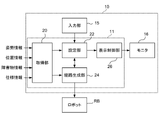
図4は、ロボット制御装置10の機能構成の例を示すブロック図である。
FIG. 4 is a block diagram showing an example of the functional configuration of the
図4に示すように、ロボット制御装置10は、機能構成として、取得部20、設定部22、経路生成部24、及び表示制御部26を有する。各機能構成は、CPU11がROM12又はストレージ14に記憶されたロボット制御プログラムを読み出し、RAM13に展開して実行することにより実現される。
As shown in FIG. 4, the
取得部20は、姿勢情報、位置情報、障害物情報、及び仕様情報を取得する。これらの情報は、予めストレージ14に記憶されている情報を読み出すことにより取得してもよいし、外部装置から取得してもよい。
The
姿勢情報は、ロボットRBの初期姿勢及び目標姿勢に関する情報である。 The posture information is information about the initial posture and target posture of the robot RB.
位置情報は、ロボットRBの位置に関する情報であり、例えばロボットRBの3次元空間上の位置の座標値を含む。 The position information is information about the position of the robot RB, and includes, for example, coordinate values of the position of the robot RB in the three-dimensional space.
障害物情報は、ロボットRBと干渉する範囲内に存在する障害物、すなわちロボットRBの動作において障害となる構造物の位置を含む情報であり、例えば障害物の3次元空間上の位置の座標値を含む。ここで、干渉とは、ロボットRBと接触することをいう。本実施形態では、例えば図5に示すように、ロボット制御装置10がピックアンドプレース装置に適用される場合について説明する。障害物の種類としては、ワークが収容される箱30、ワークが載置される棚32、箱30が設置される台座34、棚32が設置される台座36、ロボットRBの動作を撮影するカメラ38、及びカメラ38が取り付けられたカメラスタンド40等が挙げられる。また、本実施形態では、障害物情報は、障害物の位置に関する情報の他に、例えば障害物の三次元形状及び大きさを表す三次元形状データ又は障害物の種類を含む。
The obstacle information is information including the position of an obstacle existing within the range of interference with the robot RB, that is, a structure that hinders the operation of the robot RB. including. Here, interference means contact with the robot RB. In this embodiment, for example, as shown in FIG. 5, a case where the
仕様情報は、ロボットRBの形状を含む仕様に関する情報である。本実施形態では一例として、仕様情報は、ロボットRBの各ジョイントJ1~J6の形状の他に、最大速度、最大加速度、最大減速度、回転角度が取り得る角度範囲等の仕様を表す情報を含む。 The specification information is information on specifications including the shape of the robot RB. In this embodiment, as an example, the specification information includes information representing specifications such as the maximum velocity, maximum acceleration, maximum deceleration, and possible angle range of the rotation angle, in addition to the shape of each joint J1 to J6 of the robot RB. .
設定部22は、ロボットRBと障害物との位置関係に基づいて、ロボットRB及びロボットRBと干渉する範囲内に存在する障害物の少なくとも一方について、ロボットRBと障害物との干渉を回避するためのクリアランスの量を表すクリアランス量を設定する。
Based on the positional relationship between the robot RB and the obstacle, the setting
なお、ロボットRB全体にクリアランス量を設定してもよいし、ジョイントJ1~J6の各ジョイントについて個別にクリアランス量を設定してもよい。本実施形態では、各ジョイントについて個別にクリアランス量を設定する場合について説明する。 The clearance amount may be set for the entire robot RB, or the clearance amount may be set individually for each of the joints J1 to J6. In this embodiment, a case will be described in which the clearance amount is individually set for each joint.
また、ロボットRBのみにクリアランス量を設定してもよいし、障害物のみにクリアランス量を設定してもよいし、ロボットRB及び障害物の両方にクリアランス量を設定してもよい。また、複数の障害物が存在する場合は、全ての障害物にクリアランス量を設定してもよいし、一部の障害物にのみクリアランス量を設定してもよい。 Further, the clearance amount may be set only for the robot RB, the clearance amount may be set only for the obstacle, or the clearance amount may be set for both the robot RB and the obstacle. Also, when there are a plurality of obstacles, the clearance amount may be set for all the obstacles, or may be set for only some of the obstacles.
経路生成部24は、ロボットRBの初期姿勢及び目標姿勢、ロボットRBの位置、障害物の位置、ロボットの形状、及び設定部22により設定されたクリアランス量に基づいてロボットRBの経路に関する経路情報を生成する。経路情報は、ロボットRBの初期姿勢から目標姿勢までの経路及びロボットRBが経路を移動する際の速度に関する情報である。ここで、経路とは、ロボットRBを初期姿勢から目標姿勢まで動作させる場合の姿勢のリストである。ロボットRBの姿勢は、各ジョイントJ1~J6の回転角度の角度値で定まるため、経路は、ロボットRBの初期姿勢から目標姿勢までのロボットRBの教示点又は経由点の各ジョイントJ1~J6の回転角度の角度値のリストである。
The
また、速度に関する情報は、例えばロボットRBが初期姿勢から目標姿勢まで動作する場合の速度の変化を表す速度プロファイルである。ロボットRBは、速度プロファイルに従って速度が制御されて経路を移動する。 Also, the information about the speed is, for example, a speed profile representing changes in speed when the robot RB moves from the initial posture to the target posture. The robot RB moves along the route with its speed controlled according to the speed profile.
表示制御部26は、クリアランス量が設定されたロボットRB及び障害物をモニタ16に表示させたりする等、各種の表示制御処理を実行する。
The
次に、ロボット制御装置10の作用について説明する。
Next, the action of the
図6は、ロボット制御装置10によるロボット制御処理の流れを示すフローチャートである。CPU11がROM12又はストレージ14からロボット制御プログラムを読み出して、RAM13に展開し実行することにより、ロボット制御処理が行なわれる。なお、ロボット制御処理には、経路生成処理が含まれる。
FIG. 6 is a flowchart showing the flow of robot control processing by the
CPU11は、取得部20として、ロボットRBの姿勢情報、ロボットRBの位置情報、障害物に関する障害物情報、及びロボットRBの仕様情報を取得する(ステップS100)。
The
CPU11は、ロボットRB及びロボットRBと干渉する範囲内に存在する障害物の少なくとも一方について、ロボットRBと障害物との干渉を回避するためのクリアランスの量を表すクリアランス量を個別に設定する(ステップS102)。
The
以下、クリアランス量の設定方法について説明する。 A method of setting the clearance amount will be described below.
まず、例えばユーザーによってクリアランス量を個別に設定することができる。この場合、例えば表示制御部26が、仕様情報に基づいてロボットRBをモニタ16に表示させると共に、障害物情報に基づいて障害物をモニタ16に表示させる。そして、ユーザーが、入力部15によりロボットRBの各ジョイント及び障害物の少なくとも一方に対して、ロボットRBと障害物との位置関係に基づいてクリアランス量を入力する。これにより、ロボットRB及び障害物の少なくとも一方に対してクリアランス量を設定できる。
First, the clearance amount can be set individually, for example by the user. In this case, for example, the
また、例えば図7に示すようなクリアランス量設定情報50に従ってクリアランス量を自動で設定してもよい。図7に示すように、クリアランス量設定情報50は、クリアランスの設定対象とクリアランス量との対応関係を表すテーブルデータである。図7に示すように、クリアランス量は、ロボットRBであればジョイントJ1~J6の各々に対して設定されている。ここで、根元側のジョイントであるジョイントJ1~J3のクリアランス量は10mmに設定されている。なお、ジョイントJ1にクリアランス量10mmを設定するということは、ジョイントJ1の表面に対して法線方向に10mm分厚みが増すことを意味する。
Further, the clearance amount may be automatically set according to the clearance
一方、手先側のジョイントであるジョイントJ4~J6のクリアランス量は5mmに設定されている。すなわち、根元側のジョイントのクリアランス量よりも手先側のクリアランス量が小さく設定されている。手先側のジョイントJ4~J6は、図5の箱30又は棚32のように凹みのある障害物の凹み部分に突入する可能性がある。このため、クリアランス量を大きめに設定してしまうと、例えば箱30の隅に存在するワークのピックアップを失敗する場合がある。このため、手先側のジョイントJ4~J6のクリアランス量を根元側のジョイントJ1~J3のクリアランス量よりも小さくしている。また、図7に示すように、カメラスタンド40のクリアランス量が10mmに設定されているのに対し、箱30及び棚32のクリアランス量はカメラスタンド40よりも小さい5mmに設定されている。このように、クリアランス量設定情報50は、ロボットRBと障害物との位置関係に基づいてクリアランス量が設定されている。これにより、ワークのピックアップの成功率が低下するのを防ぐことができる。
On the other hand, the clearance amount of joints J4 to J6, which are joints on the hand side, is set to 5 mm. That is, the amount of clearance on the tip side is set smaller than the amount of clearance on the joint on the root side. The hand side joints J4-J6 may penetrate into recessed portions of recessed obstacles such as
次に、他のクリアランス量の設定方法について説明する。まず、例えば経路生成部24が、ステップS100で取得したロボットRBの姿勢情報、ロボットRBの位置情報、障害物に関する障害物情報、及びロボットRBの仕様情報に基づいて、初期姿勢から目標姿勢までの経路の経路情報を生成し、生成した経路情報に従ってロボットRBを動作させるシミュレーションを実行する。そして、設定部22が、シミュレーションの実行結果に従ってロボットRB及び障害物の少なくとも一方にクリアランス量を設定してもよい。具体的には、例えば箱30及び棚32のように凹みを有する障害物に突入するジョイントを特定し、障害物に突入するジョイントのクリアランス量を、障害物に突入しないジョイントのクリアランス量よりも小さく設定する。すなわち、ロボットRBと障害物との位置関係に基づいてクリアランス量を設定する。また、後述するステップS106と同様の処理により経路情報を生成し、生成した経路情報に基づいてジョイントの加速度を算出し、算出した加速度が予め定めた閾値以上の場合、加速度が予め定めた閾値未満となるように、クリアランス量を大きくしてもよい。これにより、より安全にロボットRBを動作させることができる。なお、加速度に代えてジョイントの速度を算出し、算出した速度に基づいてクリアランス量を設定してもよい。
Next, another method of setting the clearance amount will be described. First, for example, the
CPU11は、表示制御部26として、ステップS100で取得した仕様情報及び障害物情報に基づいて、ロボットRB及び障害物をモニタ16に表示する(ステップS104)。このとき、ステップS102で設定されたクリアランス量でクリアランスが設定されていることが認識できるように表示する。図8には、クリアランスが設定された障害物の表示例を示した。図8の例では、箱60、62、支柱64の各々に対して個別にクリアランスが設定されており、クリアランスが設定された領域を2点鎖線で示している。図8の例では、凹みを有し、ワークが収容される箱60、ワークが載置される箱62のクリアランス量が、凹みを有さない支柱64のクリアランス量よりも小さくなっている。なお、箱60、62は凹みを有する。このため、例えば箱60を側面から見た図9Aに示すように、箱60の外側にクリアランスが設定されるだけでなく、箱60を上側から見た図9Bに示すように、箱60の内側にもクリアランスが設定される。
The
なお、クリアランス量に応じて障害物の表示が異なるように制御するようにしてもよい。例えば図10に示すように、箱60、62のクリアランス量が、支柱64のクリアランス量よりも小さい場合は、箱60、62の色と、支柱64の色と、を異ならせる。これにより、異なるクリアランス量が設定されていることを容易に認識できる。
It should be noted that control may be performed so that the display of obstacles differs according to the amount of clearance. For example, as shown in FIG. 10, when the amount of clearance between the
また、1つの障害物に設定したクリアランス量を他の障害物に一律に設定するようにしてもよい。例えば図11に示すように、支柱64に設定したクリアランス量を箱60、62に一律に設定するようにしてもよい。
Also, the clearance amount set for one obstacle may be uniformly set for other obstacles. For example, as shown in FIG. 11, the clearance amount set for the
また、設定部22が、クリアランス量を調整する調整係数を受け付け、受け付けた調整係数に基づいて、複数のクリアランス量を調整するようにしてもよい。例えば図12Aに示すように、調整係数を受け付ける受付画面70をモニタ16に表示する。図12Aの例では、調整バー72を左右にスライドさせる操作を行うことにより、調整係数を0~2の範囲で設定可能である。なお、調整係数の設定可能な範囲はこれに限られるものではなく、適宜設定すればよい。設定部22は、調整係数を受け付けた場合、クリアランス量に調整係数を乗算した値を調整後のクリアランス量として設定する。
Alternatively, the setting
例えば図12Aでは、調整係数は「1」に設定されている。このため、例えば図7に示すようにロボットRB及び障害物のクリアランス量が設定されていた場合、各クリアランス量は変化しない。 For example, in FIG. 12A, the adjustment factor is set to "1". Therefore, if the clearance amounts for the robot RB and the obstacle are set as shown in FIG. 7, the respective clearance amounts do not change.
また、図12Bでは、調整係数は「2」に設定されている。このため、例えば図7の箱のクリアランス量は2倍の10mmとなり、カメラスタンドのクリアランス量も2倍の20mmとなる。その他のクリアランス量についても同様に2倍となる。 Also, in FIG. 12B, the adjustment coefficient is set to "2". Therefore, for example, the clearance of the box in FIG. 7 is doubled to 10 mm, and the clearance of the camera stand is also doubled to 20 mm. Other clearance amounts are similarly doubled.
また、図12Cでは、調整係数は「0.5」に設定されている。このため、例えば図7の箱のクリアランス量は0.5倍の2.5mmとなり、カメラスタンドのクリアランス量も0.5倍の5mmとなる。その他のクリアランス量についても同様に0.5倍となる。 Also, in FIG. 12C, the adjustment coefficient is set to "0.5". Therefore, for example, the clearance of the box in FIG. 7 is 0.5 times as large as 2.5 mm, and the clearance of the camera stand is also 0.5 as large as 5 mm. Other clearance amounts are similarly 0.5 times.
このように、調整係数を設定することで複数のクリアランス量を調整することができる。 By setting the adjustment coefficients in this way, it is possible to adjust a plurality of clearance amounts.
CPU11は、経路生成部24として、ステップS100で取得した姿勢情報、位置情報、障害物情報、及び仕様情報と、ステップS102で設定されたクリアランス量と、に基づいてロボットRBの経路及び速度に関する経路情報を生成する(ステップS106)。
The
経路情報の生成方法としては種々公知の方法を採用することができる。例えば、経路の生成方法としては、RRT(Rapidly exploring random tree)、RRT*、RRT connect、PRM(Probabilistic Roadmap Method)、STOMP(Stochastic Trajectory Optimization for Motion Planninng)、CHOMP(Covariant Hamiltonian Optimization for Motion Planning)、EET(Exploring/Exploiting Tree)等が挙げられる。 Various well-known methods can be adopted as a method for generating route information.例えば、経路の生成方法としては、RRT(Rapidly exploring random tree)、RRT*、RRT connect、PRM(Probabilistic Roadmap Method)、STOMP(Stochastic Trajectory Optimization for Motion Planninng)、CHOMP(Covariant Hamiltonian Optimization for Motion Planning)、 EET (Exploring/Exploiting Tree) etc. are mentioned.
CPU11は、経路生成部24として、ステップS100で生成した経路情報と、障害物情報と、に基づいて、ステップS106で生成した経路において、ロボットRBが障害物と干渉するか否かを判定する(ステップS108)。干渉の判定には、例えばロボットRBと障害物との干渉を判定する公知の干渉判定技術を用いる。公知の干渉判定技術としては、例えば特開2002-273675号公報に記載の技術を用いることができる。
The
そして、ロボットRBが障害物と干渉しないと判定した場合(ステップS108:NO)は、ステップS110へ移行する。一方、ロボットRBが障害物に干渉する場合(ステップS110:YES)、ステップS106へ移行し、ロボットRBが障害物と干渉しないように経路を再生成する。そして、ロボットRBが障害物と干渉しなくなるまでステップS106、S108の処理を繰り返す。 When it is determined that the robot RB does not interfere with the obstacle (step S108: NO), the process proceeds to step S110. On the other hand, if the robot RB interferes with the obstacle (step S110: YES), the process proceeds to step S106 to regenerate the route so that the robot RB does not interfere with the obstacle. Then, the processes of steps S106 and S108 are repeated until the robot RB no longer interferes with the obstacle.
CPU11は、経路生成部24として、ステップS106で生成した経路が予め定めた経路条件を満たすか否かを判定する(ステップS110)。経路条件を満たす場合とは、例えば経路の経路長が予め定めた基準経路長以下の場合である。ここで、経路長とは、ステップS106で生成した初期姿勢から目標姿勢までの経路の長さである。また、基準経路長は、例えばティーチングにより教示した経路の経路長に予め定めたマージン値を加算した値としてもよいし、クリアランスを設定しない場合の経路の経路長に予め定めたマージン値を加算した値としてもよい。これにより、経路長が長くなり過ぎるのを防ぐことができる。
As the
なお、経路条件を満たす場合を、経路の動作時間が予め定めた基準動作時間以下の場合としてもよい。ここで、経路の動作時間とは、ステップS106で生成した初期姿勢から目標姿勢までの経路をロボットRBが移動する時間である。また、基準動作時間は、例えばティーチングにより教示した経路の動作時間に予め定めたマージン値を加算した値としてもよいし、クリアランスを設定しない場合の経路の動作時間に予め定めたマージン値を加算した値としてもよい。これにより、ロボットRBの動作時間が長くなり過ぎるのを防ぐことができる。 Note that the case where the route condition is satisfied may be the case where the operation time of the route is equal to or less than a predetermined reference operation time. Here, the motion time of the path is the time required for the robot RB to move along the path from the initial posture generated in step S106 to the target posture. Further, the reference operation time may be a value obtained by adding a predetermined margin value to the operation time of the path taught by teaching, for example, or a value obtained by adding a predetermined margin value to the operation time of the path when the clearance is not set. value. As a result, it is possible to prevent the operating time of the robot RB from becoming too long.
また、経路条件を満たす場合を、経路の経路長が基準経路長以下で且つ経路の動作時間が基準動作時間以下の場合としてもよい。 Further, the case where the route condition is satisfied may be the case where the route length is equal to or less than the reference route length and the route operation time is equal to or less than the reference operation time.
そして、ステップS106で生成した経路が予め定めた経路条件を満たす場合は、ステップS112へ移行する。一方、ステップS112で生成した経路が予め定めた経路条件を満たさない場合は、ステップS102へ移行し、クリアランス量を再設定する。すなわち、クリアランス量を小さくする。そして、生成した経路が予め定めた経路条件を満たすまでステップS102~S110の処理を繰り返す。 Then, when the route generated in step S106 satisfies the predetermined route conditions, the process proceeds to step S112. On the other hand, if the route generated in step S112 does not satisfy the predetermined route conditions, the process proceeds to step S102 to reset the clearance amount. That is, the clearance amount is reduced. Then, the processing of steps S102 to S110 is repeated until the generated route satisfies predetermined route conditions.
ステップS112では、生成した経路情報に基づいて動作指令値をロボットRBに出力する。これにより、ロボットRBが経路情報に従って動作する In step S112, an action command value is output to the robot RB based on the generated route information. As a result, the robot RB operates according to the route information.
このように、本実施形態では、ロボットRB及び障害物の少なくとも一方について、クリアランス量が個別に設定される。これにより、クリアランス量が一律に設定される場合と比較して、ロボットの動作の成功率が低下するのを防ぎつつ、ロボットの動作の安全性が低下するのを防ぐことができる。 Thus, in this embodiment, the clearance amount is individually set for at least one of the robot RB and the obstacle. As a result, compared with the case where the clearance amount is uniformly set, it is possible to prevent the safety of the robot operation from being lowered while preventing the success rate of the robot operation from being lowered.
なお、本実施形態では、障害物情報を取得する場合について説明したが、例えば図5に示すカメラ38により撮影された撮影画像に基づいて箱30、棚32等の障害物に関する障害物情報を生成してもよい。この場合、カメラ38は、二次元画像を撮影するカメラでもよいし、三次元画像を撮影するカメラでもよい。 In the present embodiment, a case of acquiring obstacle information has been described. You may In this case, the camera 38 may be a camera that captures two-dimensional images or a camera that captures three-dimensional images.
取得部20は、カメラ38で撮影された撮影画像を取得する。設定部22は、取得した撮影画像に基づいて障害物情報を生成し、生成した障害物情報に基づいてクリアランス量を設定する。障害物情報の生成には、公知のテンプレートマッチング等の手法を用いることができる。
このように、カメラ38により撮影された撮影画像に基づいて生成した障害物情報に基づいてクリアランス量を設定することにより、障害物情報を予め用意しておく必要がない。 Thus, by setting the clearance amount based on the obstacle information generated based on the photographed image photographed by the camera 38, it is not necessary to prepare the obstacle information in advance.
また、図6のステップS102で設定されたクリアランス量について、ワークの重さ及びサイズの少なくとも一方に応じてクリアランス量を調整するようにしてもよい。例えば、ワークの重さが重くなるに従ってクリアランス量が大きくなり、ワークの重さが軽くなるに従ってクリアランス量が小さくなるように調整してもよい。また、ワークのサイズが大きくなるに従ってクリアランス量が大きくなり、ワークのサイズが小さくなるに従ってクリアランス量が小さくなるように設定してもよい。 Further, the clearance amount set in step S102 of FIG. 6 may be adjusted according to at least one of the weight and size of the workpiece. For example, the clearance may be adjusted so that the heavier the work, the larger the clearance amount, and the lighter the work, the smaller the clearance amount. Alternatively, the clearance may be set such that the larger the size of the work, the larger the clearance amount, and the smaller the size of the work, the smaller the clearance amount.
また、本実施形態では、ロボット制御装置の制御対象であるロボットRBが実機の場合について説明したが、ロボット制御装置の制御対象が、シミュレーション上で動作するロボットであってもよい。 Further, in this embodiment, the robot RB to be controlled by the robot control device is a real machine, but the control target of the robot control device may be a robot that operates in a simulation.
なお、上記各実施形態でCPUがソフトウェア(プログラム)を読み込んで実行したロボット制御処理を、CPU以外の各種のプロセッサが実行してもよい。この場合のプロセッサとしては、FPGA(Field-Programmable Gate Array)等の製造後に回路構成を変更可能なPLD(Programmable Logic Device)、及びASIC(Application Specific Integrated Circuit)等の特定の処理を実行させるために専用に設計された回路構成を有するプロセッサである専用電気回路等が例示される。また、ロボット制御処理を、これらの各種のプロセッサのうちの1つで実行してもよいし、同種又は異種の2つ以上のプロセッサの組み合わせ(例えば、複数のFPGA、及びCPUとFPGAとの組み合わせ等)で実行してもよい。また、これらの各種のプロセッサのハードウェア的な構造は、より具体的には、半導体素子等の回路素子を組み合わせた電気回路である。 Note that the robot control processing executed by the CPU reading the software (program) in each of the above embodiments may be executed by various processors other than the CPU. The processor in this case is a PLD (Programmable Logic Device) whose circuit configuration can be changed after manufacturing such as an FPGA (Field-Programmable Gate Array), and an ASIC (Application Specific Integrated Circuit) for executing specific processing. A dedicated electric circuit or the like, which is a processor having a specially designed circuit configuration, is exemplified. Also, robot control processing may be performed by one of these various processors, or a combination of two or more processors of the same or different type (e.g., multiple FPGAs, and a combination of CPU and FPGA). etc.). Further, the hardware structure of these various processors is, more specifically, an electric circuit in which circuit elements such as semiconductor elements are combined.
また、上記各実施形態では、ロボット制御プログラムがストレージ14又はROM12に予め記憶(インストール)されている態様を説明したが、これに限定されない。プログラムは、CD-ROM(Compact Disk Read Only Memory)、DVD-ROM(Digital Versatile Disk Read Only Memory)、及びUSB(Universal Serial Bus)メモリ等の記録媒体に記録された形態で提供されてもよい。また、プログラムは、ネットワークを介して外部装置からダウンロードされる形態としてもよい。
Also, in each of the above-described embodiments, the robot control program has been pre-stored (installed) in the
10 ロボット制御装置
20 取得部
22 設定部
24 経路生成部
26 表示制御部
30、60、62 箱
32 棚
38 カメラ
40 カメラスタンド
50 クリアランス量設定情報
64 支柱
70 受付画面
72 調整バー
10
Claims (8)
前記ロボットと前記障害物との位置関係に基づいて、前記ロボット及び前記ロボットと干渉する範囲内に存在する障害物の少なくとも一方について、前記干渉を回避するためのクリアランスの量を表すクリアランス量を設定する設定部と、
前記ロボットの初期姿勢及び目標姿勢、前記ロボットの位置、前記障害物の位置、前記ロボットの形状、及び前記設定部により設定されたクリアランス量に基づいて前記ロボットの経路に関する経路情報を生成する経路生成部と、
を備え、
前記設定部は、前記ロボットを構成する複数のジョイントのうち手先側のジョイントのクリアランス量を根元側のジョイントのクリアランス量よりも小さく設定する
経路生成装置。 Attitude information about the initial attitude and target attitude of the robot, position information about the position of the robot, obstacle information including the positions of obstacles existing within a range that interferes with the robot, and specification information about specifications including the shape of the robot an acquisition unit that acquires
Based on the positional relationship between the robot and the obstacle, a clearance amount representing the amount of clearance for avoiding the interference is set for at least one of the robot and an obstacle existing within a range where the robot interferes. a setting unit for
Path generation for generating path information about a path of the robot based on the initial posture and target posture of the robot, the position of the robot, the position of the obstacle, the shape of the robot, and the clearance amount set by the setting unit. Department and
with
The setting unit sets a clearance amount of a hand side joint smaller than a clearance amount of a root side joint among a plurality of joints constituting the robot.
Path generator.
前記経路生成部は、前記ロボットの初期姿勢及び目標姿勢と、前記ロボットの位置と、前記障害物の位置と、前記ロボットの形状と、前記設定部により設定されたクリアランス量と、に基づいて前記経路情報を再生成する
請求項1記載の経路生成装置。 The setting unit reduces the clearance amount when the route generated by the route generation unit does not satisfy a predetermined route condition,
Based on the initial posture and target posture of the robot, the position of the robot, the position of the obstacle, the shape of the robot, and the clearance amount set by the setting unit, the path generation unit The route generation device according to claim 1, wherein the route information is regenerated.
請求項1又は請求項2記載の経路生成装置。 When the obstacle has a dent and is an obstacle on which a workpiece to be operated by the robot is accommodated or placed, the setting unit provides a clearance amount smaller than the clearance amount of the obstacle having no dent. 3. The route generation device according to claim 1 or claim 2, wherein
請求項1~3の何れか1項に記載の経路生成装置。 The setting unit calculates the velocity or acceleration of the joints of the robot based on the path information, and if the calculated velocity or acceleration of the joints of the robot is equal to or greater than a predetermined threshold, the velocity or acceleration is set to the predetermined threshold. The path generation device according to any one of claims 1 to 3, wherein the clearance amount is increased so as to be less than a threshold.
請求項1~4の何れか1項に記載の経路生成装置。 The path generation device according to any one of claims 1 to 4, wherein the setting unit receives an adjustment coefficient for adjusting the clearance amount, and adjusts a plurality of the clearance amounts based on the received adjustment coefficient.
を備えた請求項1~5の何れか1項に記載の経路生成装置。 The route generation device according to any one of claims 1 to 5, further comprising a display control unit that controls display of the obstacles so as to be different according to the clearance amount.
ロボットの初期姿勢及び目標姿勢に関する姿勢情報、前記ロボットの位置に関する位置情報、前記ロボットと干渉する範囲内に存在する障害物の位置を含む障害物情報、及びロボットの形状を含む仕様に関する仕様情報を取得する取得工程と、
前記ロボットと前記障害物との位置関係に基づいて、前記ロボット及び前記ロボットと干渉する範囲内に存在する障害物の少なくとも一方について、前記干渉を回避するためのクリアランスの量を表すクリアランス量を設定する設定工程と、
前記ロボットの初期姿勢及び目標姿勢、前記ロボットの位置、前記障害物の位置、前記ロボットの形状、及び前記設定工程により設定されたクリアランス量に基づいて前記ロボットの経路に関する経路情報を生成する経路生成工程と、
を含み、
前記設定工程は、前記ロボットを構成する複数のジョイントのうち手先側のジョイントのクリアランス量を根元側のジョイントのクリアランス量よりも小さく設定する
処理を実行する経路生成方法。 the computer
Attitude information about the initial attitude and target attitude of the robot, position information about the position of the robot, obstacle information including the positions of obstacles existing within the range of interference with the robot, and specification information about specifications including the shape of the robot. an obtaining step of obtaining;
Based on the positional relationship between the robot and the obstacle, a clearance amount representing the amount of clearance for avoiding the interference is set for at least one of the robot and an obstacle existing within a range where the robot interferes. a setting step to
Path generation for generating path information about a path of the robot based on the initial posture and target posture of the robot, the position of the robot, the position of the obstacle, the shape of the robot, and the clearance amount set in the setting step. process and
including
In the setting step, among the plurality of joints constituting the robot, the clearance amount of the joint on the tip side is set to be smaller than the clearance amount of the joint on the base side.
Path generation method to perform the process.
ロボットの初期姿勢及び目標姿勢に関する姿勢情報、前記ロボットの位置に関する位置情報、前記ロボットと干渉する範囲内に存在する障害物の位置を含む障害物情報、及びロボットの形状を含む仕様に関する仕様情報を取得する取得部、
前記ロボットと前記障害物との位置関係に基づいて、前記ロボット及び前記ロボットと干渉する範囲内に存在する障害物の少なくとも一方について、前記干渉を回避するためのクリアランスの量を表すクリアランス量を設定する設定部、及び、
前記ロボットの初期姿勢及び目標姿勢、前記ロボットの位置、前記障害物の位置、前記ロボットの形状、及び前記設定部により設定されたクリアランス量に基づいて前記ロボットの経路に関する経路情報を生成する経路生成部、
として機能させ、
前記設定部は、前記ロボットを構成する複数のジョイントのうち手先側のジョイントのクリアランス量を根元側のジョイントのクリアランス量よりも小さく設定する
経路生成プログラム。 the computer,
Attitude information about the initial attitude and target attitude of the robot, position information about the position of the robot, obstacle information including the positions of obstacles existing within the range of interference with the robot, and specification information about specifications including the shape of the robot. an acquisition unit that acquires,
Based on the positional relationship between the robot and the obstacle, a clearance amount representing the amount of clearance for avoiding the interference is set for at least one of the robot and an obstacle existing within a range where the robot interferes. and a setting unit to
Path generation for generating path information about a path of the robot based on the initial posture and target posture of the robot, the position of the robot, the position of the obstacle, the shape of the robot, and the clearance amount set by the setting unit. part,
function as
The setting unit sets a clearance amount of a hand side joint smaller than a clearance amount of a root side joint among a plurality of joints constituting the robot.
Path generator.
Priority Applications (5)
| Application Number | Priority Date | Filing Date | Title |
|---|---|---|---|
| JP2019004311A JP7147571B2 (en) | 2019-01-15 | 2019-01-15 | Route generation device, route generation method, and route generation program |
| US17/275,315 US12090666B2 (en) | 2019-01-15 | 2019-11-27 | Path generation device, path generation method, and recording medium storing path generation program |
| PCT/JP2019/046326 WO2020149021A1 (en) | 2019-01-15 | 2019-11-27 | Route generator, route generation method, and route generation program |
| CN201980059699.XA CN112672857B (en) | 2019-01-15 | 2019-11-27 | Path generation device, path generation method, and storage medium storing path generation program |
| EP19910467.0A EP3912768A4 (en) | 2019-01-15 | 2019-11-27 | ROUTE GENERATOR, ROUTE GENERATING METHOD AND ROUTE GENERATING PROGRAM |
Applications Claiming Priority (1)
| Application Number | Priority Date | Filing Date | Title |
|---|---|---|---|
| JP2019004311A JP7147571B2 (en) | 2019-01-15 | 2019-01-15 | Route generation device, route generation method, and route generation program |
Publications (2)
| Publication Number | Publication Date |
|---|---|
| JP2020110885A JP2020110885A (en) | 2020-07-27 |
| JP7147571B2 true JP7147571B2 (en) | 2022-10-05 |
Family
ID=71614212
Family Applications (1)
| Application Number | Title | Priority Date | Filing Date |
|---|---|---|---|
| JP2019004311A Active JP7147571B2 (en) | 2019-01-15 | 2019-01-15 | Route generation device, route generation method, and route generation program |
Country Status (5)
| Country | Link |
|---|---|
| US (1) | US12090666B2 (en) |
| EP (1) | EP3912768A4 (en) |
| JP (1) | JP7147571B2 (en) |
| CN (1) | CN112672857B (en) |
| WO (1) | WO2020149021A1 (en) |
Families Citing this family (12)
| Publication number | Priority date | Publication date | Assignee | Title |
|---|---|---|---|---|
| JP7160118B2 (en) * | 2019-02-08 | 2022-10-25 | 日本電気株式会社 | Control device, control method, program |
| TWI873149B (en) | 2019-06-24 | 2025-02-21 | 美商即時機器人股份有限公司 | Motion planning system and method for multiple robots in shared workspace |
| EP4221945A4 (en) * | 2020-12-02 | 2024-04-03 | Realtime Robotics, Inc. | Systems, methods, and user interfaces employing clearance determinations in robot motion planning and control |
| JP7637564B2 (en) * | 2021-05-27 | 2025-02-28 | 株式会社ジャノメ | Route teaching data creation device, route teaching data creation method, and program |
| CN113448667B (en) * | 2021-06-09 | 2023-08-01 | 绿盟科技集团股份有限公司 | Method and device for generating display relationship diagram |
| CN113568435B (en) * | 2021-09-24 | 2021-12-24 | 深圳火眼智能有限公司 | Unmanned aerial vehicle autonomous flight situation perception trend based analysis method and system |
| JP7506180B2 (en) * | 2022-02-25 | 2024-06-25 | 三菱電機株式会社 | Teaching support device, work system, teaching support method, and teaching support program |
| CN114952863B (en) * | 2022-06-30 | 2025-09-19 | 中船黄埔文冲船舶有限公司 | Obstacle avoidance control method and device for middle-assembly segmented weld robot |
| US12600035B2 (en) | 2022-07-05 | 2026-04-14 | Canon Kabushiki Kaisha | Information processing method, information processing apparatus, robot system, manufacturing method of product, and storage medium |
| JP7831219B2 (en) | 2022-10-06 | 2026-03-17 | 株式会社デンソー | Interference detection device and path generation device |
| CN116038688B (en) * | 2022-11-14 | 2024-12-20 | 上海理工大学 | Mechanical arm joint space path planning method based on probability virtual potential field guided bidirectional RRT algorithm |
| WO2026003551A1 (en) * | 2024-06-24 | 2026-01-02 | Abb Schweiz Ag | System and method for dynamically assigning collision clearance distances for motion of a robot |
Citations (8)
| Publication number | Priority date | Publication date | Assignee | Title |
|---|---|---|---|---|
| JP2003280710A (en) | 2002-03-20 | 2003-10-02 | Japan Atom Energy Res Inst | Generation and control method of work trajectory of robot hand |
| JP2007313592A (en) | 2006-05-24 | 2007-12-06 | Toyota Motor Corp | Route creation apparatus and route creation method |
| JP2009032189A (en) | 2007-07-30 | 2009-02-12 | Toyota Motor Corp | Robot motion path generator |
| JP2009233757A (en) | 2008-03-25 | 2009-10-15 | Ihi Corp | Control method of robot system, and the robot system |
| US20140316431A1 (en) | 1999-09-17 | 2014-10-23 | Intuitive Surgical Operations, Inc. | Systems and methods for using the null space to emphasize manipulator joint motion anisotropically |
| JP2016078184A (en) | 2014-10-17 | 2016-05-16 | ファナック株式会社 | Device for setting interference region of robot |
| JP2018134703A (en) | 2017-02-21 | 2018-08-30 | 株式会社安川電機 | Robot simulator, robot system, and simulation method |
| US20180281191A1 (en) | 2017-03-30 | 2018-10-04 | Brain Corporation | Systems and methods for robotic path planning |
Family Cites Families (22)
| Publication number | Priority date | Publication date | Assignee | Title |
|---|---|---|---|---|
| JPH05250023A (en) * | 1991-10-23 | 1993-09-28 | Sanyo Electric Co Ltd | Automatic route generating method for robot manipulator |
| JP2895672B2 (en) | 1992-01-28 | 1999-05-24 | ファナック株式会社 | Multiple robot control method |
| JP2875498B2 (en) * | 1995-07-18 | 1999-03-31 | 株式会社神戸製鋼所 | Automatic generation method of movement path of robot manipulator |
| IT1302835B1 (en) * | 1998-10-23 | 2000-10-10 | Fata Automation | ASSEMBLY STATION AND MANAGEMENT METHOD FOR IT |
| JP3639873B2 (en) | 2001-03-16 | 2005-04-20 | 川崎重工業株式会社 | Robot control method and robot control system |
| US6678582B2 (en) * | 2002-05-30 | 2004-01-13 | Kuka Roboter Gmbh | Method and control device for avoiding collisions between cooperating robots |
| ATE412929T1 (en) | 2006-09-14 | 2008-11-15 | Abb Research Ltd | METHOD AND DEVICE FOR AVOIDING COLLISIONS BETWEEN AN INDUSTRIAL ROBOT AND AN OBJECT |
| JP5089533B2 (en) | 2008-08-28 | 2012-12-05 | 株式会社神戸製鋼所 | Robot interference avoidance method and robot system |
| US9993222B2 (en) * | 2014-02-05 | 2018-06-12 | Intuitive Surgical Operations, Inc. | System and method for dynamic virtual collision objects |
| US9925664B2 (en) | 2014-02-27 | 2018-03-27 | Fanuc Corporation | Robot simulation device for generation motion path of robot |
| JP5860081B2 (en) | 2014-02-27 | 2016-02-16 | ファナック株式会社 | Robot simulation device that generates robot motion path |
| KR101941147B1 (en) | 2014-12-25 | 2019-04-12 | 카와사키 주코교 카부시키 카이샤 | Automatic obstruction avoidance method and control device for arm-type robot |
| CN108778640B (en) * | 2016-01-20 | 2019-10-22 | 软机器人公司 | Soft robotic gripper for cluttered gripping environments, high acceleration movements, food handling, and automated storage systems |
| JP6755724B2 (en) * | 2016-06-20 | 2020-09-16 | キヤノン株式会社 | Control methods, robot systems, and article manufacturing methods |
| US9981383B1 (en) * | 2016-08-02 | 2018-05-29 | X Development Llc | Real-time trajectory generation for actuators of a robot to reduce chance of collision with obstacle(s) |
| CN109310473B (en) * | 2016-09-19 | 2023-02-17 | 直观外科手术操作公司 | Base positioning system for a steerable arm and related methods |
| JP6457469B2 (en) | 2016-12-08 | 2019-01-23 | ファナック株式会社 | Mobile robot interference area setting device |
| JP6506342B2 (en) | 2017-04-26 | 2019-04-24 | 株式会社安川電機 | robot |
| KR102024092B1 (en) * | 2017-07-12 | 2019-09-23 | 엘지전자 주식회사 | Moving Robot and controlling method |
| US10682774B2 (en) * | 2017-12-12 | 2020-06-16 | X Development Llc | Sensorized robotic gripping device |
| US10606269B2 (en) * | 2017-12-19 | 2020-03-31 | X Development Llc | Semantic obstacle recognition for path planning |
| CN108780320B (en) * | 2018-06-15 | 2024-10-18 | 达闼机器人股份有限公司 | Robot motion control method, device, storage medium and robot |
-
2019
- 2019-01-15 JP JP2019004311A patent/JP7147571B2/en active Active
- 2019-11-27 EP EP19910467.0A patent/EP3912768A4/en active Pending
- 2019-11-27 WO PCT/JP2019/046326 patent/WO2020149021A1/en not_active Ceased
- 2019-11-27 CN CN201980059699.XA patent/CN112672857B/en active Active
- 2019-11-27 US US17/275,315 patent/US12090666B2/en active Active
Patent Citations (8)
| Publication number | Priority date | Publication date | Assignee | Title |
|---|---|---|---|---|
| US20140316431A1 (en) | 1999-09-17 | 2014-10-23 | Intuitive Surgical Operations, Inc. | Systems and methods for using the null space to emphasize manipulator joint motion anisotropically |
| JP2003280710A (en) | 2002-03-20 | 2003-10-02 | Japan Atom Energy Res Inst | Generation and control method of work trajectory of robot hand |
| JP2007313592A (en) | 2006-05-24 | 2007-12-06 | Toyota Motor Corp | Route creation apparatus and route creation method |
| JP2009032189A (en) | 2007-07-30 | 2009-02-12 | Toyota Motor Corp | Robot motion path generator |
| JP2009233757A (en) | 2008-03-25 | 2009-10-15 | Ihi Corp | Control method of robot system, and the robot system |
| JP2016078184A (en) | 2014-10-17 | 2016-05-16 | ファナック株式会社 | Device for setting interference region of robot |
| JP2018134703A (en) | 2017-02-21 | 2018-08-30 | 株式会社安川電機 | Robot simulator, robot system, and simulation method |
| US20180281191A1 (en) | 2017-03-30 | 2018-10-04 | Brain Corporation | Systems and methods for robotic path planning |
Also Published As
| Publication number | Publication date |
|---|---|
| JP2020110885A (en) | 2020-07-27 |
| EP3912768A4 (en) | 2022-09-28 |
| US20210260763A1 (en) | 2021-08-26 |
| US12090666B2 (en) | 2024-09-17 |
| WO2020149021A1 (en) | 2020-07-23 |
| CN112672857A (en) | 2021-04-16 |
| CN112672857B (en) | 2025-02-07 |
| EP3912768A1 (en) | 2021-11-24 |
Similar Documents
| Publication | Publication Date | Title |
|---|---|---|
| JP7147571B2 (en) | Route generation device, route generation method, and route generation program | |
| JP6807949B2 (en) | Interference avoidance device | |
| JP2019214084A (en) | Route planning device, route planning method, and route planning program | |
| JP5144785B2 (en) | Method and apparatus for predicting interference between target region of robot and surrounding object | |
| EP1864764B1 (en) | Robot simulation apparatus | |
| JP7233858B2 (en) | ROBOT CONTROL DEVICE, ROBOT CONTROL METHOD, AND ROBOT CONTROL PROGRAM | |
| JP5754454B2 (en) | Robot picking system and workpiece manufacturing method | |
| US9149931B2 (en) | Robot system, robot control device and method for controlling robot | |
| JP7028196B2 (en) | Robot control device, robot control method, and robot control program | |
| CN110524536B (en) | Robot controller and robot system | |
| WO2018143003A1 (en) | Robot path-generating device and robot system | |
| JP7028092B2 (en) | Gripping posture evaluation device and gripping posture evaluation program | |
| WO2023172385A1 (en) | Systems and methods for robotic manipulation using extended reality | |
| WO2020012710A1 (en) | Manipulator control device, manipulator control method, and manipulator control program | |
| US20240042605A1 (en) | Apparatus and a Method for Automatically Programming a Robot to Follow Contours of Objects | |
| US11697206B2 (en) | Acceleration adjustment apparatus and non-transitory computer-readable storage medium storing an acceleration adjustment program | |
| US20240399575A1 (en) | Speed presets for determining the trajectory of kinematics | |
| JP7708840B2 (en) | Robot device for detecting interference between robot components | |
| JP2021175595A (en) | Simulators, robot teaching devices, robot systems, simulation methods, programs and recording media | |
| JP2013184242A (en) | Device for determining interference of industrial machine, method for determining interference, computer program and recording medium | |
| JP2021186929A (en) | Control method for multi-axis robot | |
| JPH0926812A (en) | Method of creating NC data in work robot device | |
| JP2025128995A (en) | MOBILE BODY CONTROL SYSTEM, MOBILE BODY CONTROL DEVICE, AND MOBILE BODY CONTROL METHOD | |
| CN121798637A (en) | Self-collision prevention method and device in teleoperation, terminal and storage medium | |
| JP2020011307A (en) | Manipulator control device, manipulator control method and manipulator control program |
Legal Events
| Date | Code | Title | Description |
|---|---|---|---|
| A621 | Written request for application examination |
Free format text: JAPANESE INTERMEDIATE CODE: A621 Effective date: 20201214 |
|
| A131 | Notification of reasons for refusal |
Free format text: JAPANESE INTERMEDIATE CODE: A131 Effective date: 20220222 |
|
| A521 | Request for written amendment filed |
Free format text: JAPANESE INTERMEDIATE CODE: A523 Effective date: 20220407 |
|
| TRDD | Decision of grant or rejection written | ||
| A01 | Written decision to grant a patent or to grant a registration (utility model) |
Free format text: JAPANESE INTERMEDIATE CODE: A01 Effective date: 20220823 |
|
| A61 | First payment of annual fees (during grant procedure) |
Free format text: JAPANESE INTERMEDIATE CODE: A61 Effective date: 20220905 |
|
| R150 | Certificate of patent or registration of utility model |
Ref document number: 7147571 Country of ref document: JP Free format text: JAPANESE INTERMEDIATE CODE: R150 |