JP3907144B2 - Method for producing lithographic printing plate, lithographic printing plate precursor for laser scanning exposure, and photopolymerizable composition - Google Patents
Method for producing lithographic printing plate, lithographic printing plate precursor for laser scanning exposure, and photopolymerizable composition Download PDFInfo
- Publication number
- JP3907144B2 JP3907144B2 JP29139698A JP29139698A JP3907144B2 JP 3907144 B2 JP3907144 B2 JP 3907144B2 JP 29139698 A JP29139698 A JP 29139698A JP 29139698 A JP29139698 A JP 29139698A JP 3907144 B2 JP3907144 B2 JP 3907144B2
- Authority
- JP
- Japan
- Prior art keywords
- group
- bis
- phenyl
- cyclopentadienyl
- difluoro
- Prior art date
- Legal status (The legal status is an assumption and is not a legal conclusion. Google has not performed a legal analysis and makes no representation as to the accuracy of the status listed.)
- Expired - Lifetime
Links
Classifications
-
- G—PHYSICS
- G03—PHOTOGRAPHY; CINEMATOGRAPHY; ANALOGOUS TECHNIQUES USING WAVES OTHER THAN OPTICAL WAVES; ELECTROGRAPHY; HOLOGRAPHY
- G03F—PHOTOMECHANICAL PRODUCTION OF TEXTURED OR PATTERNED SURFACES, e.g. FOR PRINTING, FOR PROCESSING OF SEMICONDUCTOR DEVICES; MATERIALS THEREFOR; ORIGINALS THEREFOR; APPARATUS SPECIALLY ADAPTED THEREFOR
- G03F7/00—Photomechanical, e.g. photolithographic, production of textured or patterned surfaces, e.g. printing surfaces; Materials therefor, e.g. comprising photoresists; Apparatus specially adapted therefor
- G03F7/004—Photosensitive materials
- G03F7/027—Non-macromolecular photopolymerisable compounds having carbon-to-carbon double bonds, e.g. ethylenic compounds
- G03F7/032—Non-macromolecular photopolymerisable compounds having carbon-to-carbon double bonds, e.g. ethylenic compounds with binders
- G03F7/035—Non-macromolecular photopolymerisable compounds having carbon-to-carbon double bonds, e.g. ethylenic compounds with binders the binders being polyurethanes
Landscapes
- Physics & Mathematics (AREA)
- Spectroscopy & Molecular Physics (AREA)
- General Physics & Mathematics (AREA)
- Materials For Photolithography (AREA)
- Printing Plates And Materials Therefor (AREA)
- Photosensitive Polymer And Photoresist Processing (AREA)
Description
【0001】
【発明の属する技術分野】
本発明は平版印刷版原版に関するものであり、特にディジタル信号に基づいた走査露光により製版を行うための平版印刷版原版に関する。さらには、これを用いた平版印刷版の製造方法、および平版印刷原版の感光層に用いる光重合性組成物に関する。
【0002】
【従来の技術】
従来、平版印刷版としては親水性支持体上に親油性の感光性樹脂を用いたPS版が広く用いられ、その製造方法として、通常は、リスフィルムを介してマスク露光(面露光)後、非画像部を溶解除去することにより所望の印刷版を得ていた。
【0003】
近年、画像情報をコンピュータを用いて電子的に処理、蓄積、出力する、ディジタル化技術が普及してきている。そして、そのようなディジタル化技術に対応した新しい画像出力方式が種々実用されるようになってきた。その結果レーザ光のような指向性の高い光をディジタル化された画像情報に従って走査し、リスフィルムを介することなく、直接印刷版を製造するコンピュータ トゥ プレート(CTP)技術が切望されており、これに適応した印刷版原版を得ることは重要な技術課題となっている。
【0004】
このような走査露光可能な平版印刷版を得る方式の一つとして、従来より、親水性支持体上に設ける感光性樹脂層として非常に感光スピードにすぐれた光重合性組成物の層を設け、さらに酸素遮断性の保護層を設けた構成が多く提案され、一部上市されている。使用される光重合性組成物は基本的にはエチレン性不飽和化合物、光重合開始系、バインダー樹脂からなる。画像形成は、光開始系が光吸収し、活性ラジカルを生成、エチレン性不飽和化合物の付加重合を引き起こし、感光層の不溶化を生じるものである。
【0005】
光重合系感光層を用いた走査露光可能な平版印刷版に関する従来の提案の大部分は、感光性にすぐれた特定の光開始系の使用を開示したものであった。このような高感度開始系は、例えば、Bruce M.Monroeら著、Chemical Revue,93,435(1993).やR.S.Davidson著、Journal of Photochemistry and biology A:Chemistry,73,81(1993).に多く記載されている。
【0006】
開示されている開始系の一部は非常に感光性にすぐれており、これを含む光重合系感光層を使用することにより、例えば30mWから200mW程度のArレーザ(488nm)やFD−YAGレーザ(532nm)といった経済的な走査露光光源により画像形成可能な平版印刷原版を得ることができる。しかしながら、これら平版印刷版原版は実用上十分に満足できる性能は得られなかった。
【0007】
すなわち、従来技術による走査露光用平版印刷版に関しては露光ラチチュードが狭いという点が大きな問題であった。例えば、製版時間の短縮のためにレーザの走査速度を上げた場合、耐刷性が不十分なものとなってしまうという問題や、印刷工程で網点面積率が減少してしまうという問題があった。一方、露光エネルギーを上げた場合には、走査露光光学系に固有の散乱光によるカブリが生じてしまうということが判明した。
【0008】
さらに、上記の光重合性組成物を得ることは、広く、CTP以外の産業分野、例えば、光造形、ホログラフィー、カラーハードコピーといったレーザイメージング分野や、フォトレジスト等の電子材料製造分野、インクや塗料、接着剤等の光硬化樹脂材料分野においても、ますます要求の高まっている重要な技術である。
【0009】
【発明が解決しようとする課題】
本発明の目的は、高速走査での露光によっても十分な耐刷性の印刷版が得られ、かつ露光条件による印刷版の印刷性能の変動の少ないレーザ走査露光用平版印刷版原版を用いた平版印刷版の製造方法を提供することである。また、これらに加えて水性現像液による現像性にすぐれた平版印刷版原版による平版印刷版の製造方法を提供することであり、さらに加えて保存安定性が良好な平版印刷版原版による平版印刷版の製造方法を提供することである。さらには露光系の簡略化も可能になる平版印刷版原版、および感光スピード、保存安定性にすぐれた平版印刷版原版、ならびにこのようにすぐれた特性の平版印刷版の感光層に適する光重合性組成物を提供することである。
【0010】
【課題を解決するための手段】
本発明者らは、上記目的を達成すべく鋭意検討を重ねた結果、光重合系感光層として、
i)ポリウレタン樹脂バインダー、ii)付加重合可能なエチレン性不飽和結合を有する化合物、iii)光開始系、のそれぞれ少なくとも1種を含有する感光層を用いることで、高速走査露光条件でも十分な耐刷性を示し、さらに網点面積率変動等の印刷性能の露光条件依存性の少ない平版印刷原版が得られることを見出し、本発明を完成させたものである。
【0011】
すなわち、本発明に平版印刷版原版として親水性支持体上に、i)ポリウレタン樹脂バインダー、ii)付加重合可能なエチレン性不飽和結合を有する化合物、iii)光開始系、のそれぞれ少なくとも1種を含有する感光層を設けた原版を用い、走査露光によって製版し、平版印刷版を製造することを特徴とする。
【0012】
特に好ましいポリウレタン樹脂は、ポリエーテルジオール化合物、ポリエステルジオール化合物、ポリカーボネートジオール化合物から選ばれる化合物に由来する構造単位を有するポリウレタン樹脂である。
【0013】
これらの成分を含むウレタン樹脂を使用した場合、特に保存安定性が良好な印刷版原版が得られるが、これは感光層中の他成分との相溶性が良いためと思われる。
【0014】
また、カルボキシル基を0.4meq/g以上有するポリウレタン樹脂バインダーを用いた原版は、水性現像液による現像性にすぐれるので、現像工程において、労働、環境保全上好ましくない、有機溶剤の使用を避けることができ好適である。
【0015】
また、感光層上にさらに、水溶性の酸素遮断性物質を含有する保護層を設けることで、こうした原版の露光画像形成に対する、外気中の酸素による阻害をなくすことができる。結果として、露光系を無酸素状態に保つ必要がなくなるので簡便で経済的な走査露光装置の使用が可能となる。
【0016】
また、付加重合可能なエチレン性不飽和結合を有する化合物のなかでもウレタン構造を有する化合物を使用した場合、特に強度に優れた光硬化物が得られるが、これは、ポリウレタン樹脂中のウレタン基と光重合した重合性化合物中のウレタン基との水素結合による相互作用の結果であると思われる。
【0017】
特に好ましい光開始系は少なくとも1種のチタノセン化合物を含有するもので、さらに好ましくは、走査光源レーザ光を効率良く吸収しうる増感色素/チタノセン化合物を含有するものである。これらの光開始系は感光スピードにすぐれ、かつ保存安定性にすぐれた感光層を与える。従って、このような成分を含む光重合性組成物を感光層に用いることが好ましい。
【0018】
本発明におけるこうした効果は次のように説明することができる。すなわち、従来の光重合系感光層は露光に従い、エチレン性不飽和化合物の重合が進行し、やがて、不溶化(画像形成)が起こるが、この段階での感光層の膜強度は耐刷性の点からは不十分なものである。より露光エネルギーを上げていくと、重合進行とともに画像強度が上がり、耐刷性が露光量に従って向上してくる。一方、本発明による感光層は低露光で重合度の低い段階から高い画像強度を有し、不溶化の起こる露光量においてすでに高い耐刷性を有しているものと思われる。従って、高速走査露光条件でも十分な耐刷性が得られる。さらに、より高露光量領域での膜強度の露光量依存性が比較的少ないため、露光条件による印刷性能の変動を著しく低減できるものと思われる。
【0019】
なお、以上の効果を得る特定のバインダー樹脂の採用につき、ポリウレタン樹脂バインダーを用いた平版印刷版に関しては、特公平7−120040号、特公平7−120041号、特公平7−120042号、特公平8−12424号、特開昭63−287944号、特開昭63−287947号、特開平1−271741号に開示されているが、これらにおいて走査露光に関する示唆は全くなされておらず、高速走査露光条件下での耐刷性の改善につながるものではない。
【0020】
【発明の実施の形態】
以下、本発明について詳細に説明する。
本発明の用いられる走査露光用平版印刷版は、親水性支持体上に、i)ポリウレタン樹脂バインダー、ii)付加重合可能なエチレン性不飽和結合を有する化合物、iii)光開始系、のそれぞれ少なくとも1種を含有する感光層を備えるものである。
【0021】
まず、本発明で使用するi)ポリウレタン樹脂バインダーについて説明する。(1)ポリウレタン樹脂
本発明の感光層の必須成分である使用されるポリウレタン樹脂は、下記式(1)’で表されるジイソシアネート化合物の少なくとも1種と式(1)”で表されるジオール化合物の少なくとも1種との反応生成物で表される構造単位を基本骨格とするポリウレタン樹脂である。
OCN−X0−NCO (1)’
HO−Y0−OH (1)”
(式中、X0、Y0は2価の有機残基を表す。)
【0022】
本発明の感光層の必須成分である使用されるポリウレタン樹脂で、好ましいポリウレタン樹脂は、カルボキシル基を0.4meq/g以上有するポリウレタン樹脂である。好適に使用されるポリウレタン樹脂は、下記式(1)で表されるジイソシアネート化合物と、式(2)、(3)、(4)のジオール化合物の少なくとも1種との反応生成物で表される構造単位および/または、テトラカルボン酸2無水物をジオール化合物で開環させた化合物から由来される構造単位を基本骨格とするポリウレタン樹脂である。
【0023】
【化1】
式中、L8は置換基を有していてもよい2価の脂肪族または芳香族炭化水素基を示す。必要に応じ、L8中はイソシアネート基と反応しない他の官能基、例えばエステル、ウレタン、アミド、ウレイド基を有していてもよい。
【0025】
R1は水素原子、置換基(例えば、シアノ、ニトロ、ハロゲン原子、(−F、−Cl、−Br、−I)、−CONH2、−COOR113、−OR113、−NHCONHR113、−NHCOOR113、−NHCOR113、−OCONHR113(ここで、R113は炭素数1〜10のアルキル基、炭素数7〜15のアラルキル基を示す。)などの各基が含まれる。)を有していてもよいアルキル、アラルキル、アリール、アルコキシ、アリーロキシ基を示し、好ましくは水素原子、炭素数1〜8個のアルキル、炭素数6〜15個のアリール基を示す。L10、L11、L12はそれぞれ同一でも相違していてもよく、単結合、置換基(例えば、アルキル、アラルキル、アリール、アルコキシ、ハロゲノの各基が好ましい。)を有していてもよい2価の脂肪族または芳香族炭化水素基を示す。好ましくは炭素数1〜20個のアルキレン基、炭素数6〜15個のアリーレン基、さらに好ましくは炭素数1〜8個のアルキレン基を示す。また必要に応じ、L10、L11、L12中にイソシアネート基と反応しない他の官能基、例えばカルボニル、エステル、ウレタン、アミド、ウレイド、エーテル基を有していてもよい。なおR1、L10、L11、L12のうちの2または3個で環を形成してもよい。
【0026】
Arは置換基を有していてもよい三価の芳香族炭化水素基を示し、好ましくは炭素数6〜15個の芳香族基を示す。
【0027】
イ)ジイソシアネート化合物
式(1)で示されるジイソシアネート化合物として、具体的には以下に示すものが含まれる。
【0028】
すなわち、2,4−トリレンジイソシアネート、2,4−トリレンジイソシアネートの二量体、2,6−トリレンジレンジイソシアネート、p−キシリレンジイソシアネート、m−キシリレンジイソシアネート、4,4’−ジフェニルメタンジイソシアネート、1,5−ナフチレンジイソシアネート、3,3’−ジメチルビフェニル−4,4’−ジイソシアネート等のような芳香族ジイソシアネート化合物;ヘキサメチレンジイソシアネート、トリメチルヘキサメチレンジイソシアネート、リジンジイソシアネート、ダイマー酸ジイソシアネート等のような脂肪族ジイソシアネート化合物;イソホロンジイソシアネート、4,4’−メチレンビス(シクロヘキシルイソシアネート)、メチルシクロヘキサン−2,4(または2,6)ジイソシアネート、1,3−(イソシアネートメチル)シクロヘキサン等のような脂環族ジイソシアネート化合物;1,3−ブチレングリコール1モルとトリレンジイソシアネート2モルとの付加体等のようなジオールとジイソシアネートとの反応物であるジイソシアネート化合物等が挙げられる。
【0029】
ロ)カルボキシル基を含有するジオール化合物
また式(2)、(3)または(4)で示されるカルボキシル基を有するジオール化合物としては具体的には以下に示すものが含まれる。
【0030】
すなわち、3,5−ジヒドロキシ安息香酸、2,2−ビス(ヒドロキシメチル)プロピオン酸、2,2−ビス(2−ヒドロキシエリア)プロピオン酸、2,2−ビス(3−ヒドロキシプロピル)プロピオン酸、ビス(ヒドロキシメチル)酢酸、ビス(4−ヒドロキシフェニル)酢酸、2,2−ビス(ヒドロキシメチル)酪酸、4,4−ビス(4−ヒドロキシフェニル)ペンタン酸、酒石酸、N,N−ジヒドロキシエチルグリシン、N,N−ビス(2−ヒドロキシエチル)−3−カルボキシ−プロピオンアミド等が挙げられる。
【0031】
本発明において、ポリウレタン樹脂の合成に用いられる好ましいテトラカルボン酸2無水物としては、式(5)、(6)、(7)で示されるものが挙げられる。
【0032】
【化2】
式中、L21は単結合、置換基(例えばアルキル、アラルキル、アリール、アルコキシ、ハロゲノ、エステル、アミドの各基が好ましい。)を有していてもよい二価の脂肪族または芳香族炭化水素基、−CO−、−SO−、−SO2−、−O−または−S−を示す。好ましくは単結合、炭素数1〜15個の二価の脂肪族炭化水素基、−CO−、−SO2−、−O−または−S−を示す。R2、R3は同一でも相違していてもよく、水素原子、アルキル、アラルキル、アリール、アルコキシ、またはハロゲノ基を示す。好ましくは、水素原子、炭素数1〜8個のアルキル、炭素数6〜15個のアリール、炭素数1〜8個のアルコキシ、またはハロゲノ基を示す。またL21、R2、R3のうちの2つが結合して環を形成してもよい。R4、R5は同一でも相違していてもよく、水素原子、アルキル、アラルキル、アリールまたはハロゲノ基をを示す。好ましくは水素原子、炭素数1〜8個のアルキル、または炭素数6〜15個のアリール基を示す。またL21、R4、R5のうちの2つが結合して環を形成してもよい。L22、L23は同一でも相違していてもよく、単結合、二重結合、または二価の脂肪族炭化水素基を示す。好ましくは単結合、二重結合、またはメチレン基を示す。Aは単核または多核の芳香環を示す。好ましくは炭素数6〜18個の芳香環を示す。
【0034】
式(5)、(6)または(7)で示される化合物としては、具体的には以下に示すものが含まれる。
【0035】
すなわち、ピロメリット酸二無水物、3,3’,4,4’−ベンゾフェノンテトラカルボン酸二無水物、3,3’,4,4’−ジフェニルテトラカルボン酸二無水物、2,3,6,7−ナフタレンテトラカルボン酸二無水物、1,4,5,8−ナフタレンテトラカルボン酸二無水物、4,4’−スルホニルジフタル酸二無水物、2,2−ビス(3,4−ジカルボキシフェニル)プロパン二無水物、ビス(3,4−ジカルボキシフェニル)エーテル二無水物、4,4’−[3,3’−(アルキルホスホリルジフェニレン)−ビス(イミノカルボニル)]ジフタル酸二無水物、ヒドロキノンジアセテートとトリメット酸無水物の付加体、ジアセチルジアミンとトリメット酸無水物の付加体などの芳香族テトラカルボン酸二無水物;5−(2,5−ジオキソテトラヒドロフリル)−3−メチル−3−シクロヘキセン−1,2−ジカルボン酸無水物(大日本インキ化学工業(株)製、エピクロンB−4400)、1,2,3,4−シクロペンタンテトラカルボン酸二無水物、1,2,4,5−シクロヘキサンテトラカルボン酸二無水物、テトラヒドロフランテトラカルボン酸二無水物などの脂環族テトラカルボン酸二無水物;1,2,3,4−ブタンテトラカルボン酸二無水物、1,2,4,5−ペンタンテトラカルボン酸二無水物などの脂肪族テトラカルボン酸二無水物が挙げられる。
【0036】
これらのテトラカルボン酸二無水物をジオール化合物で開環された化合物から由来する構造単位をポリウレタン樹脂中に導入する方法としては、例えば以下の方法がある。
【0037】
a)テトラカルボン酸二無水物をジオール化合物で開環させて得られたアルコール末端の化合物と、ジイソシアネート化合物とを反応させる方法。
b)ジイソシアネート化合物をジオール化合物過剰の条件下で反応させ得られたアルコール末端のウレタン化合物と、テトラカルボン酸二無水物とを反応させる方法。
【0038】
またこのとき使用されるジオール化合物としては、具体的には以下に示すものが含まれる。
【0039】
すなわち、エチレングリコール、ジエチレングリコール、トリエチレングリコール、テトラエチレングリコール、プロピレングリコール、ジプロピレングリコール、ポリエチレングリコール、ポリプロピレングリコール、ネオペンチルグリコール、1,3−ブチレングリコール、1,6−ヘキサンジオール、2−ブテン−1,4−ジオール、2,2,4−トリメチル−1,3−ペンタンジオール、1,4−ビス−β−ヒドロキシエトキシシクロヘキサン、シクロヘキサンジメタノール、トリシクロデカンジメタノール、水添ビスフェノールA、水添ビスフェノールF、ビスフェノールAのエチレンオキサイド付加体、ビスフェノールAのプロピレンオキサイド付加体、ビスフェノールFのエチレンオキサイド付加体、ビスフェノールFのプロピレンオキサイド付加体、水添ビスフェノールAのエチレンオキサイド付加体、水添ビスフェノールAのプロピレンオキサイド付加体、ヒドロキノンジヒドロキシエチルエーテル、p−キシリレングリコール、ジヒドロキシエチルスルホン、ビス(2−ヒドロキシエチル)−2,4−トリレンジカルバメート、2,4−トリレン−ビス(2−ヒドロキシエチルカルバミド)、ビス(2−ヒドロキシエチル)−m−キシリレンジカルバメート、ビス(2−ヒドロキシエチル)イソフタレート等が挙げられる。
【0040】
ハ)その他のジオール化合物
本発明に使用されるポリウレタン樹脂は、より好ましくはさらに、ポリエーテルジオール化合物、ポリエステルジオール化合物、またはポリカーボネートジオール化合物の少なくとも1種との反応生成物で表される構造を有するポリウレタン樹脂である。
【0041】
ポリエーテルジオール化合物としては、式(A)、(B)、(C)、(D)、(E)で表される化合物、および、末端に水酸基を有するエチレンオキシドとプロピレンオキシドのランダム共重合体が挙げられる。
【0042】
【化3】
式中、R6は水素原子またはメチル基、
Xは、以下の基を表す。
【0044】
【化4】
a,b,c,d,e,f,gはそれぞれ2以上の整数を示す。好ましくは2〜100の整数である。
【0046】
式(A)、(B)で表されるポリエーテルジオール化合物としては具体的には以下に示すものが挙げられる。
【0047】
すなわち、ジエチレングリコール、トリエチレングリコール、テトラエチレングリコール、ペンタエチレングリコール、ヘキサエチレングリコール、ヘプタエチレングリコール、オクタエチレングリコール、ジ−1,2−プロピレングリコール、トリ−1,2−プロピレングリコール、テトラ−1,2−プロピレングリコール、ヘキサ−1,2−プロピレングリコール、ジ−1,3−プロピレングリコール、トリ−1,3−プロピレングリコール、テトラ−1,3−プロピレングリコール、ジ−1,3−ブチレングリコール、トリ−1,3−ブチレングリコール、ヘキサ−1,3−ブチレングリコール、平均分子量1000のポリエチレングリコール、平均分子量1500のポリエチレングリコール、平均分子量2000のポリエチレングリコール、平均分子量3000のポリエチレングリコール、平均分子量7500のポリエチレングリコール、平均分子量400のポリプロピレングリコール、平均分子量700のポリプロピレングリコール、平均分子量1000のポリプロピレングリコール、平均分子量2000のポリプロピレングリコール、平均分子量3000のポリプロピレングリコール、平均分子量4000のポリプロピレングリコール等。
【0048】
式(C)で示されるポリエーテルジオール化合物としては、具体的には以下に示すものが挙げられる。
三洋化成工業(株)製PTMG650,PTMG1000,PTMG20000,PTMG3000等。
【0049】
式(D)で示されるポリエーテルジオール化合物としては、具体的には以下に示すものが挙げられる。
三洋化成工業(株)製ニューポールPE−61,ニューポールPE−62,ニューポールPE−64,ニューポールPE−68,ニューポールPE−71,ニューポールPE−74,ニューポールPE−75,ニューポールPE−78,ニューポールPE−108,ニューポールPE−128,ニューポールPE−61等。
【0050】
式(E)で示されるポリエーテルジオール化合物としては、具体的には以下に示すものが挙げられる。
三洋化成工業(株)製ニューポールBPE−20、ニューポールBPE−20F、ニューポールBPE−20NK、ニューポールBPE−20T、ニューポールBPE−20G、ニューポールBPE−40、ニューポールBPE−60、ニューポールBPE−100、ニューポールBPE−180、ニューポールBP−2P、ニューポールBPE−23P、ニューポールBPE−3P、ニューポールBPE−5P等。
【0051】
末端に水酸基を有するエチレンオキシドとプロピレンオキシドのランダム共重合体としては、異体的には以下に示すものが挙げられる。
三洋化成工業(株)製ニューポール50HB−100,ニューポール50HB−260,ニューポール50HB−400,ニューポール50HB−660,ニューポール50HB−2000,ニューポール50HB−5100等。
【0052】
ポリエステルジオール化合物としては、式(8)、(9)で表される化合物が挙げられる。
【0053】
【化5】
式中、L1、L2およびL3はそれぞれ同一でも相違してもよく2価の脂肪族または芳香族炭化水素基を示し、L4は2価の脂肪族炭化水素基を示す。好ましくは、L1、L2、L3はそれぞれアルキレン基、アルケニレン基、アルキニレン基、アリーレン基を示し、L4はアルキレン基を示す。またLl、L2、L3、L4中にはイソシアネート基と反応しない他の官能基、例えばエーテル、カルボニル、エステル、シアノ、オレフイン、ウレタン、アミド、ウレイド基またはハロゲン原子等が存在していてもよい。n1、n2はそれぞれ2以上の整数であり、好ましくは2〜100の整数を示す。
【0055】
ポリカーボネートジオール化合物としては、式(10)で表される化合物がある。
【0056】
【化6】
式中、L5はそれぞれ同一でも相違してもよく2価の脂肪族または芳香族炭化水素基を示す。好ましくは、L5はアルキレン基、アルケニレン基、アルキニレン基、アリーレン基を示す。またL5中にはイソシアネート基と反応しない他の官能基、例えばエーテル、カルボニル、エステル、シアノ、オレフイン、ウレタン、アミド、ウレイド基またはハロゲン原子等が存在していてもよい。n3はそれぞれ2以上の整数であり、好ましくは2〜100の整数を示す。
【0058】
式(8)、(9)または(10)で示されるジオール化合物としては具体的には以下に示すものが含まれる。具体例中のnは2以上の整数である。
【0059】
【化7】
【化8】
【化9】
【化10】
また更に、カルボキシル基を有せず、イソシアネートと反応しない他の置換基を有してもよいジオール化合物を併用することもできる。
【0064】
このようなジオール化合物としては、以下に示すものが含まれる。
HO−L6−O−CO−L7−CO−O−L6−OH (11)
HO−L7−CO−O−L6−OH (12)
【0065】
式中、L6、L7はそれぞれ同一でも相違していてもよく、置換基(例えば、アルキル、アラルキル、アリール、アルコキシ、アリーロキシ、ハロゲン原子(−F、−Cl、−Br、−I)、などの各基が含まれる。)を有していてもよい2価の脂肪族炭化水素基、芳香族炭化水素基または複素環基を示す。必要に応じ、L6、L7中にイソシアネート基と反応しない他の官能基、例えばカルボニル、エステル、ウレタン、アミド、ウレイド基などを有していてもよい。なおL6、L7で環を形成してもよい。
【0066】
また式(11)または(12)で示される化合物の具体例としては以下に示すものが含まれる。
【0067】
【化11】
【化12】
【化13】
【化14】
下記に示すジオール化合物も好適に使用できる。
【0072】
【化15】
式中、R7、R8はそれぞれ同一でも異なっていてもよく、置換基を有してもよいアルキル基、cは上記と同義であり、それぞれ2以上の整数を示し、好ましくは2〜100の整数である。
【0074】
式(15)、(16)、(17)または(18)で示されるジオール化合物としては、具体的には以下に示すものが挙げられる。
【0075】
すなわち、式(15)としては、エチレングリコール、1,3−プロパンジオール、1,4−ブタンジオール、1,5−ペンタンジオール、1,6−ヘキサンジオール、1,7−ヘプタンジオール、1,8−オクタンジオール等、式(16)としては、下記に示す化合物等、
【0076】
【化16】
式(17)としては、2−ブテン−1,4−ジオール、式(18)としては、cis−2−ブテン−1,4−ジオール、trans−2−ブテン−1,4−ジオール等。
【0078】
また、下記に示すジオール化合物も好適に使用できる。
HO−L6−NH−CO−L7−CO−NH−L6−OH (19)
HO−L7−CO−NH−L6−OH (20)
【0079】
式中、L6、L7はそれぞれ同一でも相違していてもよく、置換基(例えば、アルキル、アラルキル、アリール、アルコキシ、アリーロキシ、ハロゲン原子(−F、−Cl、−Br、−I)、などの各基が含まれる。)を有していてもよい2価の脂肪族炭化水素基、芳香族炭化水素基または複素環基を示す。必要に応じ、L6、L7中にイソシアネート基と反応しない他の官能基、例えばカルボニル、エステル、ウレタン、アミド、ウレイド基などを有していてもよい。なおL6、L7で環を形成してもよい。
【0080】
また式(19)または(20)で示される化合物の具体例としては以下に示すものが含まれる。
【0081】
【化17】
【化18】
さらに、下記に示すジオール化合物も好適に使用できる。
HO−Ar2−(L16−Ar3)n−OH (21)
HO−Ar2−L16−OH (22)
【0084】
式中、L16は置換基(例えば、アルキル、アラルキル、アリール、アルコキシ、アリーロキシ、ハロゲノの各基が好ましい。)を有していてもよい2価の脂肪族炭化水素基を示す。必要に応じ、L16中にイソシアネート基と反応しない他の官能基、例えばエステル、ウレタン、アミド、ウレイド基を有していてもよい。
【0085】
Ar2、Ar3は同一でも相違していてもよく、置換基を有していてもよい2価の芳香族炭化水素基を示し、好ましくは炭素数6〜15個の芳香族基を示す。
【0086】
nは0〜10の整数を示す。
【0087】
また式(21)または(22)で示されるジオール化合物としては具体的には以下に示すものが含まれる。
【0088】
すなわち、カテコール、レゾルシン、ハイドロキノン、4−メチルカテコール、4−t−ブチルカテコール、4−アセチルカテコール、3−メトキシカテコール、4−フェニルカテコール、4−メチルレゾルシン、4−エチルレゾルシン、4−t−ブチルレゾルシン、4−ヘキシルレゾルシン、4−クロロレゾルシン、4−ベンジルレゾルシン、4−アセチルレゾルシン、4−カルボメトキシレゾルシン、2−メチルレゾルシン、5−メチルレゾルシン、t−ブチルハイドロキノン、2,5−ジ−t−ブチルハイドロキノン、2,5−ジ−t−アミルハイドロキノン、テトラメチルハイドロキノン、テトラクロロハイドロキノン、メチルカルボアミノハイドロキノン、メチルウレイドハイドロキノン、メチルチオハイドロキノン、ベンゾノルボルネン−3,6−ジオール、ビスフェノールA、ブスフェノールS、3,3’−ジクロロビスフェノールS、4,4’−ジヒドロキシベンゾフェノン、4,4’−ジヒドロキシビフェニル、4,4’−チオジフェノール、2,2’−ジヒドロキシジフェニルメタン、3,4−ビス(p−ヒドロキシフェニル)ヘキサン、1,4−ビス(2−(p−ヒドロキシフェニル)プロピル)ベンゼン、ビス(4−ヒドロキシフェニル)メチルアミン、1,3−ジヒドロキシナフタレン、1,4−ジヒドロキシナフタレン、1,5−ジヒドロキシナフタレン、2,6−ジヒドロキシナフタレン、1,5−ジヒドロキシアントラキノン、2−ヒドロキシベンジルアルコール、4−ヒドロキシベンジルアルコール、2−ヒドロキシ−3,5−ジ−t−ブチルベンジルアルコール、4−ヒドロキシ−3,5−ジ−t−ブチルベンジルアルコール、4−ヒドロキシフェネチルアルコール、2−ヒドロキシエチル−4−ヒドロキシベンゾエート、2−ヒドロキシエチル−4−ヒドロキシフェニルアセテート、レゾルシンモノ−2−ヒドロキシエチルエーテル等が挙げられる。
下記に示すジオール化合物も好適に使用できる。
【0089】
【化19】
式中、R1は水素原子、置換基(例えば、シアノ、ニトロ、ハロゲン原子(−F、−Cl、−Br、−I)、−CONH2、−COOR113、−OR113、−NHCONHR113、−NHCOOR113、−NHCOR113、−OCONHR113、−CONHR113(ここで、R113は炭素数1〜10のアルキル基、炭素数7〜15のアラルキル基を示す。)などの各基が含まれる。)を有していてもよいアルキル、アラルキル、アリール、アルコキシ、アリーロキシ基を示し、好ましくは水素原子、炭素数1〜8個のアルキル基、炭素数6〜15個のアリール基を示す。L10、L11、L12はそれぞれ同一でも相違していてもよく、単結合、置換基(例えば、アルキル、アラルキル、アリール、アルコキシ、ハロゲンの各基が好ましい。)を有していてもよい2価の脂肪族または芳香族炭化水素基を示す。好ましくは炭素数1〜20個のアルキレン基、炭素数6〜15個のアリーレン基、さらに好ましくは炭素数1〜8個のアルキレン基を示す。必要に応じて、L10、L11、L12中にイソシアネート基と反応しない他の官能基、例えばカルボニル、エステル、ウレタン、アミド、ウレイド、エーテル基を有していてもよい。なお、R1、L10、L11、L12のうちの2または3個で環を形成してもよい。
【0091】
Arは置換基を有していてもよい三価の芳香族炭化水素基を示し、好ましくは炭素数6〜15個の芳香族基を示す。
Z0は下記の基を示す。
【0092】
【化20】
ここで、R107、R108はそれぞれ同一でも相違していてもよく、水素原子、ナトリウム、カリウム、アルキル基、アリール基を示し、好ましくは水素原子、炭素原子1〜8個のアルキル基、炭素数6〜15個のアリール基を示す。
【0094】
式(23)、(24)または(25)で示されるホスホン酸、リン酸および/またはこれらのエステル基を有するジオール化合物は、例えば以下に示す方法により合成される。
【0095】
以下の式(26)、(27)、(28)で示されるハロゲン化合物のヒドロキシ基を必要に応じて保護した後、式(29)で表されるMichaelis-Arbuzov反応によりホスホネートエステル化し、さらに必要により臭化水素等により加水分解することにより合成が行われる。
【0096】
【化21】
式中、R1、L10、L11、L12およびArは式(23)、(24)、(25)の場合と同義である。R109はアルキル基、アリール基を示し、好ましくは炭素数1〜8個のアルキル基、炭素数6〜15個のアリール基を示す。R110は式(26)、(27)、(28)のX01を除いた残基であり、X01はハロゲン原子、好ましくはCl、Br、Iを示す。
【0098】
また、式(30)で表されるオキシ塩化リンとの反応後、加水分解させる方法により合成が行われる。
【0099】
【化22】
式中、R110は式(29)の場合と同義であり、Mは水素原子、ナトリウムまたはカリウムを示す。
【0101】
本発明のポリウレタン樹脂がホスホン酸基を有する場合、式(1)で示されるジイソシアネート化合物と、式(23)、(24)または(25)で示されるホスホン酸エステル基を有するジオール化合物を反応させ、ポリウレタン樹脂化した後、臭化水素等により加水分解することで合成してもよい。
【0102】
さらに、下記に示すアミノ基含有化合物も、ジオール化合物と同様、式(1)で表されるジイソシアネート化合物と反応させ、ウレア構造を形成してポリウレタン樹脂の構造に組み込まれてもよい。
【0103】
【化23】
式中、R106、R108はそれぞれ同一でも相違していてもよく、水素原子、置換基(例えばアルコキシ、ハロゲン原子(−F、−Cl、−Br、−I)、エステル、カルボキシル基などの各基が含まれる。)を有していてもよいアルキル、アラルキル、アリール基を示し、好ましくは水素原子、置換基としてカルボキシル基を有していてもよい炭素数1〜8個のアルキル、炭素数6〜15個のアリール基を示す。L17は置換基(例えば、アルキル、アラルキル、アリール、アルコキシ、アリーロキシ、ハロゲン原子(−F、−Cl、−Br、−I)、カルボキシル基などの各基が含まれる。)を有していてもよい2価の脂肪族炭化水素基、芳香族炭化水素基または複素環基を示す。必要に応じ、L17中にイソシアネート基と反応しない他の官能基、例えばカルボニル、エステル、ウレタン、アミド基などを有していてもよい。なおR106、L17、R108のうちの2個で環を形成してもよい。
【0105】
また式(31)、(32)で示される化合物の具体例としては以下に示すものが含まれる。
【0106】
すなわち、エチレンジアミン、プロピレンジアミン、テトラメチレンジアミン、ペンタメチレンジアミン、ヘキサメチレンジアミン、ヘプタメチレンジアミン、オクタメチレンジアミン、ドデカメチレンジアミン、プロパン−1,2−ジアミン、ビス(3−アミノプロピル)メチルアミン、1,3−ビス(3−アミノプロピル)テトラメチルシロキサン、ピペラジン、2,5−ジメチルピペラジン、N−(2−アミノエチル)ピペラジン、4−アミノ−2,2−6,6−テトラメチルピペリジン、N,N−ジメチルエチレンジアミン、リジン、L−シスチン、イソホロンジアミン等のような脂肪族ジアミン化合物;o−フェニレンジアミン、m−フェニレンジアミン、p−フェニレンジアミン、2,4−トリレンジアミン、ベンジジン、o−ジトルイジン、o−ジアニシジン、4−ニトロ−m−フェニレンジアミン、2,5−ジメトキシ−p−フェニレンジアミン、ビス−(4−アミノフェニル)スルホン、4−カルボキシ−o−フェニレンジアミン、3−カルボキシ−m−フェニレンジアミン、4,4’−ジアミノフェニルエーテル、1,8−ナフタレンジアミン等のような芳香族ジアミン化合物;2−アミノイミダゾール、3−アミノトリアゾール、5−アミノ−1H−テトラゾール、4−アミノピラゾール、2−アミノベンズイミダゾール、2−アミノ−5−カルボキシ−トリアゾール、2,4−ジアミノ−6−メチル−S−トリアジン、2,6−ジアミノピリジン、L−ヒスチジン、DL−トリプトファン、アデニン等のような複素環アミン化合物;エタノールアミン、N−メチルエタノールアミン、N−エチルエタノールアミン、1−アミノ−2−プロパノール、1−アミノ−3−プロパノール、2−アミノエトキシエタノール、2−アミノチオエトキシエタノール、2−アミノ−2−メチル−1−プロパノール、p−アミノフェノール、m−アミノフェノール、o−アミノフェノール、4−メチル−2−アミノフェノール、2−クロロ−4−アミノフェノール、4−メトキシ−3−アミノフェノール、4−ヒドロキシベンジルアミン、4−アミノ−1−ナフトール、4−アミノサリチル酸、4−ヒドロキシ−N−フェニルグリシン、2−アミノベンジルアルコール、4−アミノフェネチルアルコール、2−カルボキシ−5−アミノ−1−ナフトール、L−チロシン等のようなアミノアルコールまたはアミノフェノール化合物。
【0107】
本発明のポリウレタン樹脂は上記イソシアネート化合物およびジオール化合物を非プロトン性溶媒中、それぞれの反応性に応じた活性の公知の触媒を添加し、加熱することにより合成される。使用するジイソシアネートおよびジオール化合物のモル比は好ましくは0.8:1〜1.2:1であり、ポリマー末端にイソシアネート基が残存した場合、アルコール類またはアミン類等で処理することにより、最終的にイソシアネート基が残存しない形で合成される。
【0108】
本発明のポリウレタン樹脂は、カルボキシル基が0.4meq/g以上含まれていることが必要であり、特に0.4〜3.5meq/gの範囲で含まれていることが好ましい。
【0109】
本発明のポリウレタン樹脂の分子量は、好ましくは重量平均で1000以上であり、さらに好ましくは5000〜50万の範囲である。
【0110】
これらの高分子化合物は単独で用いても混合して用いてもよい。感光性組成物中に含まれる、これら高分子化合物の含有量は約5〜95重量%、好ましくは約10〜90重量%である。
【0111】
i)ポリウレタン樹脂のより好ましい具体例としては、以下の化合物を挙げることができるが、これらに限定されるものではない。具体例の大部分は、使用したジイソシアネート化合物とジオール化合物との組合せで示している。また、カルボキシル基含有量を酸価として示す。
【0112】
【化24】
【化25】
【化26】
【化27】
【化28】
【化29】
【化30】
【化31】
【化32】
【化33】
【化34】
【化35】
【化36】
【化37】
【化38】
【化39】
【化40】
【化41】
【化42】
【化43】
【化44】
【化45】
【化46】
【化47】
【化48】
【化49】
【化50】
【化51】
【化52】
【化53】
【化54】
【化55】
【化56】
【化57】
【化58】
【化59】
【化60】
【化61】
次に、本発明で使用するii)付加重合可能なエチレン性不飽和結合を有する化合物について説明する。
【0151】
(A)付加重合性化合物
本発明に使用される少なくとも一個のエチレン性不飽和二重結合を有する付加重合性化合物は、末端エチレン性不飽和結合を少なくとも1個、好ましくは2個以上有する化合物から選ばれる。このような化合物群は当該産業分野において広く知られるものであり、本発明においてはこれらを特に限定無く用いることができる。これらは、例えばモノマー、プレポリマー、すなわち2量体、3量体およびオリゴマー、またはそれらの混合物ならびにそれらの共重合体などの化学的形態をもつ。モノマーおよびその共重合体の例としては、不飽和カルボン酸(例えば、アクリル酸、メタクリル酸、イタコン酸、クロトン酸、イソクロトン酸、マレイン酸など)や、そのエステル類、アミド類が挙げられ、好ましくは、不飽和カルボン酸と脂肪族多価アルコール化合物とのエステル、不飽和カルボン酸と脂肪族多価アミン化合物とのアミド類が用いられる。また、ヒドロキシル基や、アミノ基、メルカプト基等の求核性置換基を有する不飽和カルボン酸エステル、アミド類と単官能もしくは多官能イソシアネート類、エポキシ類との付加反応物、単官能もしくは、多官能のカルボン酸との脱水縮合反応物等も好適に使用される。また、イソシアナト基や、エポキシ基、等の親電子性置換基を有する、不飽和カルボン酸エステル、アミド類と単官能もしくは多官能のアルコール類、アミン類、チオール類との付加反応物、ハロゲン基や、トシルオキシ基、等の脱離性置換基を有する、不飽和カルボン酸エステル、アミド類と単官能もしくは多官能のアルコール類、アミン類、チオール類との置換反応物も好適である。また、別の例として、上記の不飽和カルボン酸の代わりに、不飽和ホスホン酸、スチレン、ビニルエーテル等に置き換えた化合物群を使用することも可能である。
【0152】
特に好ましい少なくとも一個のエチレン性不飽和二重結合を有する付加重合性化合物は、イソシアネートと水酸基の付加反応を用いて製造されるウレタン系付加重合性化合物である。
【0153】
そのような具体例としては、例えば、特公昭48−41708号公報中に記載されている1分子に2個以上のイソシアネート基を有するポリイソシアネート化合物に、下記式(V)で示される水酸基を含有するビニルモノマーを付加させた1分子中に2個以上の重合性ビニル基を含有するビニルウレタン化合物等が挙げられる。
CH2=C(R)COOCH2CH(R')OH (V)
(ただし、RおよびR'はHあるいはCH3を示す。)
【0154】
また、特開昭51−37193号、特公平2−32293号、特公平2−16765号に記載されているようなウレタン(メタ)アクリレート類や、特公昭58−49860号、特公昭56−17654号、特公昭62−39417号、特公昭62−39418号記載のエチレンオキサイド系骨格を有するウレタン化合物類を挙げることでき、特に好ましい具体例としては次のような化合物を挙げることできる。(1)群のポリイソシアネート化合物と(2)群のアルコール化合物との反応生成物である。
【0155】
【化62】
【化63】
【化64】
【化65】
【化66】
更に具体的には、次の化合物がそれらに相当する。東亜合成(株)社製ウレタンアクリレートM−1100,M−1200,M−1210,M−1300、ダイセル・ユーシービー(株)社製ウレタンアクリレートEB210、EB4827、EB6700、EB220、MORTON THIOKOL Inc製UVITHANE−782,UVITHANE−783,UVITHANE−788,UVITHANE−893,根上工業(株)社製アートレジンUN−9000EP、アートレジンUN−9200A、アートレジンUN−900H、アートレジンUN−1255、アートレジンUN−5000、アートレジンUN−2111A、アートレジンUN−2500、アートレジンUN−3320HA、アートレジンUN−3320HB、アートレジンUN−3320HC、アートレジンUN−3320HS、アートレジンUN−6060P、アートレジンUN−6060PTM、アートレジンSH−380G、アートレジンSH−500、アートレジンSH−9832、新中村化学(株)社製NKオリゴU−4H、NKオリゴU−4HA、NKオリゴU−4P、NKオリゴU−4PA、NKオリゴU−4TX、NXオリゴU−4TXA、NEオリゴU−6LHA、NKオリゴU−6LPA−N、NKオリゴU−6LTXA、NKオリゴUA−6ELP、NKオリゴUA−6ELH、NKオリゴUA−6ELTX、NKオリゴUA−6PLP、NKオリゴU−6ELP、NKオリゴU−6ELH、NKオリゴU−8MDA、NKオリゴU−8MD、NKオリゴU−12LMA、NKオリゴU−12LM、NXオリゴU−6HA、オリゴU−108A、NKオリゴU−1084A、NKオリゴU−200AX、NKオリゴU−122A、NKオリゴU−340A、NXオリゴU−324A、NKオリゴUA−100、共栄社化学(株)社製AH−600、AT−600、UA−306H、AI−600、UA−101T、UA−101I、UA−101H、UA−306T、UA−306I、UF−8001、UF−8003等。
【0161】
脂肪族多価アルコール化合物と不飽和カルボン酸とのエステルのモノマーの具体例としては、アクリル酸エステルとして、エチレングリコールジアクリレート、トリエチレングリコールジアクリレート、1,3−ブタンジオールジアクリレート、テトラメチレングリコールジアクリレート、プロピレングリコールジアクリレート、ネオペンチルグリコールジアクリレート、トリメチロールプロパントリアクリレート、トリメチロールプロパントリ(アクリロイルオキシプロピル)エーテル、トリメチロールエタントリアクリレート、ヘキサンジオールジアクリレート、1,4−シクロヘキサンジオールジアクリレート、テトラエチレングリコールジアクリレート、ペンタエリスリトールジアクリレート、ペンタエリスリトールトリアクリレート、ペンタエリスリトールテトラアクリレート、ジペンタエリスリトールジアクリレート、ジペンタエリスリトールヘキサアクリレート、ソルビトールトリアクリレート、ソルビトールテトラアクリレート、ソルビトールペンタアクリレート、ソルビトールヘキサアクリレート、トリ(アクリロイルオキシエチル)イソシアヌレート、ポリエステルアクリレートオリゴマー等がある。
【0162】
メタクリル酸エステルとしては、テトラメチレングリコールジメタクリレート、トリエチレングリコールジメタクリレート、ネオペンチルグリコールジメタクリレート、トリメチロールプロパントリメタクリレート、トリメチロールエタントリメタクリレート、エチレングリコールジメタクリレート、1,3−ブタンジオールジメタクリレート、ヘキサンジオールジメタクリレート、ペンタエリスリトールジメタクリレート、ペンタエリスリトールトリメタクリレート、ペンタエリスリトールテトラメタクリレート、ジペンタエリスリトールジメタクリレート、ジペンタエリスリトールヘキサメタクリレート、ソルビトールトリメタクリレート、ソルビトールテトラメタクリレート、ビス〔p−(3−メタクリルオキシ−2−ヒドロキシプロポキシ)フェニル〕ジメチルメタン、ビス−〔p−(メタクリルオキシエトキシ)フェニル〕ジメチルメタン等がある。
【0163】
イタコン酸エステルとしては、エチレングリコールジイタコネート、プロピレングリコールジイタコネート、1,3−ブタンジオールジイタコネート、1,4−ブタンジオールジイタコネート、テトラメチレングリコールジイタコネート、ペンタエリスリトールジイタコネート、ソルビトールテトライタコネート等がある。
【0164】
クロトン酸エステルとしては、エチレングリコールジクロトネート、テトラメチレングリコールジクロトネート、ペンタエリスリトールジクロトネート、ソルビトールテトラジクロトネート等がある。
【0165】
イソクロトン酸エステルとしては、エチレングリコールジイソクロトネート、ペンタエリスリトールジイソクロトネート、ソルビトールテトライソクロトネート等がある。
【0166】
マレイン酸エステルとしては、エチレングリコールジマレート、トリエチレングリコールジマレート、ペンタエリスリトールジマレート、ソルビトールテトラマレート等がある。
【0167】
その他のエステルの例として、例えば、特公昭46−27926号、特公昭51−47334号、特開昭57−196231号記載の脂肪族アルコール系エステル類や、特開昭59−5240号、特開昭59−5241号、特開平2−226149号記載の芳香族系骨格を有するもの、特開平1−165613号記載のアミノ基を含有するもの等も好適に用いられる。
【0168】
さらに、前述のエステルモノマーは混合物としても使用することができる。
【0169】
また、脂肪族多価アミン化合物と不飽和カルボン酸とのアミドのモノマーの具体例としては、メチレンビス−アクリルアミド、メチレンビス−メタクリルアミド、1,6−ヘキサメチレンビス−アクリルアミド、1,6−ヘキサメチレンビス−メタクリルアミド、ジエチレントリアミントリスアクリルアミド、キシリレンビスアクリルアミド、キシリレンビスメタクリルアミド等がある。
【0170】
その他の好ましいアミド系モノマーの例としては、特公昭54−21726号記載のシクロヘキシレン構造を有すものを挙げることができる。
【0171】
さらに、特開昭63−277653号,特開昭63−260909号、特開平1−105238号に記載される、分子内にアミノ構造やスルフィド構造を有する付加重合性化合物類を用いることによっては、非常に感光スピードに優れた光重合性組成物を得ることができる。
【0172】
その他の例としては、特開昭48−64183号、特公昭49−43191号、特公昭52−30490号、各公報に記載されているようなポリエステルアクリレート類、エポキシ樹脂と(メタ)アクリル酸を反応させたエポキシアクリレート類等の多官能のアクリレートやメタクリレートを挙げることができる。また、特公昭46−43946号、特公平1−40337号、特公平1−40336号記載の特定の不飽和化合物や、特開平2−25493号記載のビニルホスホン酸系化合物等も挙げることができる。また、ある場合には、特開昭61−22048号記載のベルフルオロアルキル基を含有する構造が好適に使用される。さらに日本接着協会誌vol.20、No.7,300〜308ページ(1984年)に光硬化性モノマーおよびオリゴマーとして紹介されているものも使用することができる。
【0173】
これらの、付加重合性化合物について、どのような構造を用いるか、単独で使用するか併用するか、添加量はどうかといった、使用方法の詳細は、最終的な感材の性能設計にあわせて、任意に設定できる。例えば次のような観点から選択される。感光スピードの点では1分子当たりの不飽和基含量が多い構造が好ましく、多くの場合、2官能以上が好ましい。また、画像部すなわち硬化膜の強度を高くするためには、3官能以上のものが良く、さらに、異なる官能数・異なる重合性基(例えばアクリル酸エステル、メタクリル酸エステル、スチレン系化合物、ビニルエーテル系化合物)のものを併用することで、感光性と、強度を両方を調節する方法も有効である。大きな分子量の化合物や、疎水性の高い化合物は感光スピードや、膜強度に優れる反面、現像スピードや現像液中での析出といった点で好ましくない場合がある。また、感光層中の他の成分(例えばバインダーポリマー、開始剤、着色剤等)との相溶性、分散性に対しても、付加重合化合物の選択・使用法は重要な要因であり、例えば、低純度化合物の使用や、2種以上の併用により相溶性を向上させうることがある。また、支持体、オーバーコート層等の密着性を向上させる目的で特定の構造を選択することもあり得る。感光層中の付加重合性化合物の配合比に関しては、多い方が感度的に有利であるが、多すぎる場合には、好ましくない相分離が生じたり、感光層の粘着性による製造工程上の問題(例えば、感材成分の転写、粘着に由来する製造不良)や、現像液からの析出が生じる等の問題を生じうる。これらの観点から、好ましい配合比は、多くの場合、組成物全成分に対して50〜80重量%、好ましくは25〜75重量%である。また、これらは単独で用いても2種以上併用してもよい。そのほか、付加重合性化合物の使用法は、酸素に対する重合阻害の大小、解像度、かぶり性、屈折率変化、表面粘着性等の観点から適切な構造、配合、添加量を任意に選択でき、さらに場合によっては下塗り、上塗りといった層構成・塗布方法も実施しうる。
【0174】
次に、本発明で使用するiii)光開始系について説明する。
【0175】
(3)光開始系
本発明の感光層の第3の必須成分であるiii)光開始系の中にはラジカル発生剤(activator)が含まれるが、既に公知のラジカル発生剤を用いることができる。
【0176】
好ましいラジカル発生剤の例としては(a)芳香族ケトン類、(b)芳香族オニウム塩化合物、(c)有機過酸化物、(d)チオ化合物、(e)ヘキサアリールビイミダゾール化合物、(f)ケトオキシムエステル化合物、(g)ボレート化合物、(h)アジニウム化合物、(i)活性エステル化合物、(j)炭素ハロゲン結合を有する化合物、(k)メタロセン化合物等が挙げられる。
【0177】
ラジカル発生剤の一例である(a)芳香族ケトン類の好ましい例としては、「RADIATION CURING IN POLYMER SCIENCE AND TECHNOLOGY」J.P.FOUASSIER J.F.RABEK(1993)、P77〜117記載のベンゾフェノン骨格あるいはチオキサントン骨格を有する化合物、例えば以下のものが挙げられる。
【0178】
【化67】
【化68】
【化69】
より好ましい(a)芳香族ケトン類の例としては、特公昭47−6416号記載のα−チオベンゾフェノン化合物、特公昭47−3981号記載のベンゾインエーテル化合物、例えば以下のものが挙げられる。
【0182】
【化70】
特公昭47−22326号記載のα−置換ベンゾイン化合物、例えば以下のものがある。
【0184】
【化71】
特公昭47−23664号記載のベンゾイン誘導体、特開昭57−30704号記載のアロイルホスホン酸エステル、特公昭60−26483号記載のジアルコキシベンゾフェノン、例えば以下のものがある。
【0186】
【化72】
特公昭60−26403号、特開昭62−81345号記載のベンゾインエーテル類、例えば以下のものがある。
【0188】
【化73】
特公平1−34242号、米国特許第4318791号、ヨーロッパ特許第0234561A1号記載のα−アミノベンゾフェノン類、例えば以下のものがある。
【0190】
【化74】
特開平2−211452号記載のp−ジ(ジメチルアミノベンゾイル)ベンゼン、例えば以下のものがある。
【0192】
【化75】
特開昭61−194062号記載のチオ置換芳香族ケトン、例えば以下のものがある。
【0194】
【化76】
特公平2−9597号記載のアシルホスフィンスルフィド、例えば以下のものがある。
【0196】
【化77】
特公平2−9596号記載のアシルホスフィン、例えば以下のものがある。
【0198】
【化78】
また、特公昭63−61950号記載のチオキサントン類、特公昭59−42864号記載のクマリン類を挙げることができる。
【0200】
また、ラジカル発生剤の別の例である(b)芳香族オニウム塩としては、周期表の15(5B)、16(6B)、17(7B)族の元素、具体的にはN、P、As、Sb、Bi、O、S、Se、TeまたはIの芳香族オニウム塩が含まれる。このような芳香族オニウム塩は、特公昭52−14277号、特公昭52−14278号、特公昭52−14279号に示されている化合物を挙げることができ、具体的には、以下の化合物を挙げることができる。
【0201】
【化79】
【化80】
【化81】
【化82】
本発明に使用されるラジカル発生剤の他の例である(c)「有機過酸化物」としては分子中に酸素−酸素結合を1個以上有する有機化合物のほとんど全てが含まれるが、その例としては、例えばメチルエチルケトンパーオキサイド、シクロヘキサノンパーオキサイド、3,3,5−トリメチルシクロヘキサノンパーオキサイド、メチルシクロヘキサノンパーオキサイド、アセチルアセトンパーオキサイド、1,1−ビス(t−ブチルパーオキシ)−3,3,5−トリメチルシクロヘキサン、1,1−ビス(t−ブチルパーオキシ)シクロヘキサン、2,2−ビス(t−ブチルパーオキシ)ブタン、t−ブチルハイドロパーオキサイド、クメンハイドロパーオキサイド、ジイソプロピルベンゼンハイドロパーオキサイド、パラメタンハイドロパーオキサイド、2,5−ジメチルヘキサン−2,5−ジハイドロパーオキサイド、1,1,3,3−テトラメチルブチルハイドロパーオキサイド、ジ−t−ブチルパーオキサイド、t−ブチルクミルパーオキサイド、ジクミルパーオキサイド、ビス(t−ブチルパーオキシイソプロピル)ベンゼン、2,5−ジメチル−2,5−ジ(t−ブチルパーオキシ)ヘキサン、2,5−ジメチル−2,5−ジ(t−ブチルパーオキシ)ヘキシン−3、アセチルパーオキサイド、イソブチリルパーオキサイド、オクタノイルパーオキサイド、デカノイルパーオキサイド、ラウロイルパーオキサイド、3,5,5−トリメチルヘキサノイルパーオキサイド、過酸化こはく酸、過酸化ベンゾイル、
2,4−ジクロロベンゾイルパーオキサイド、メタ−トルオイルパーオキサイド、ジイソプロピルパーオキシジカーボネート、ジ−2−エチルヘキシルパーオキシジカーボネート、ジ−2−エトキシエチルパーオキシジカーボネート、ジメトキシイソプロピルパーオキシカーボネート、ジ(3−メチル−3−メトキシブチル)パーオキシジカーボネート、t−ブチルパーオキシアセテート、t−ブチルパーオキシピバレート、t−ブチルパーオキシネオデカノエート、t−ブチルパーオキシオクタノエート、t−ブチルパーオキシ−3,5,5−トリメチルヘキサノエート、t−ブチルパーオキシラウレート、t−ブチルパーオキシベンゾエート、ジ−t−ブチルパーオキシイソフタレート、2,5−ジメチル−2,5−ジ(ベンゾイルパーオキシ)ヘキサン、t−ブチル過酸化マレイン酸、t−ブチルパーオキシイソプロピルカーボネート、3,3′,4,4′−テトラ−(t−ブチルパーオキシカルボニル)ベンゾフェノン、3,3′,4,4′−テトラ−(t−アミルパーオキシカルボニル)ベンゾフェノン、3,3′,4,4′−テトラ(t−ヘキシルパーオキシカルボニル)ベンゾフェノン、3,3′,4,4′−テトラ(t−オクチルパーオキシカルボニル)ベンゾフェノン、3,3′,4,4′−テトラ(クミルパーオキシカルボニル)ベンゾフェノン、3,3′,4,4′−テトラ(p−イソプロピルクミルパーオキシカルボニル)ベンゾフェノン、カルボニルジ(t−ブチルパーオキシ二水素二フタレート)、カルボニルジ(t−ヘキシルパーオキシ二水素二フタレート)等がある。
【0206】
これらの中で、3,3′,4,4′−テトラ−(t−ブチルパーオキシカルボニル)ベンゾフェノン、3,3′,4,4′−テトラ−(t−アミルパーオキシカルボニル)ベンゾフェノン、3,3′,4,4′−テトラ(t−ヘキシルパーオキシカルボニル)ベンゾフェノン、3,3′,4,4′−テトラ(t−オクチルパーオキシカルボニル)ベンゾフェノン、3,3′,4,4′−テトラ(クミルパーオキシカルボニル)ベンゾフェノン、3,3′,4,4′−テトラ(p−イソプロピルクミルパーオキシカルボニル)ベンゾフェノン、ジ−t−ブチルジパーオキシイソフタレートなどの過酸化エステル系が好ましい。
【0207】
本発明で使用されるラジカル発生剤としての(d)チオ化合物は、下記式[d]で示される。
【0208】
【化83】
R10はアルキル基、アリール基または置換アリール基を示し、R11は水素原子またはアルキル基を示す。また、R10とR11は、互いに結合して酸素、硫黄および窒素原子から選ばれたヘテロ原子を含んでもよい5員ないし7員環を形成するのに必要な非金属原子群を示す。
【0210】
上記式[d]におけるR10のアルキル基としては炭素原子数1〜4個のものが好ましい。またR10のアリール基としてはフェニル基、ナフチル基のような炭素原指数6〜10個のものが好ましく、置換アリール基としては、上記のようなアリール基に塩素原子のようなハロゲン原子、メチル基のようなアルキル基、メトキシ基、エトキシ基のようなアルコキシ基で置換されたものが含まれる。
【0211】
R11は、好ましくは炭素原子数1〜4個のアルキル基である。
【0212】
式[d]で示されるチオ化合物の具体例としては、下記に示すような化合物が挙げられる。R10、R11等の組み合わせで示す。
【0213】
【化84】
本発明に使用されるラジカル発生剤の他の例である(e)ヘキサアリールビイミダゾールとしては、特公昭45−37377号、特公昭44−86516号記載のロフィンダイマー類、例えば2,2′−ビス(o−クロロフェニル)−4,4′,5,5′−テトラフェニルビイミダゾール、2,2′−ビス(o−ブロモフェニル)−4,4′,5,5′−テトラフェニルビイミダゾール、2,2′−ビス(o,p−ジクロロフェニル)−4,4′,5,5′−テトラフェニルビイミダゾール、2,2′−ビス(o−クロロフェニル)−4,4′,5,5′−テトラ(m−メトキシフェニル)ビイミダゾール、2,2′−ビス(o,o′−ジクロロフェニル)−4,4′,5,5′−テトラフェニルビイミダゾール、2,2′−ビス(o−ニトロフェニル)−4,4′,5,5′−テトラフェニルビイミダゾール、2,2′−ビス(o−メチルフェニル)−4,4′,5,5′−テトラフェニルビイミダゾール、2,2′−ビス(o−トリフルオロメチルフェニル)−4,4′,5,5′−テトラフェニルビイミダゾール等が挙げられる。
【0215】
本発明で使用されるラジカル発生剤の他の例である(f)ケトオキシムエステルとしては、3−ベンゾイロキシイミノブタン−2−オン、3−アセトキシイミノブタン−2−オン、3−プロピオニルオキシイミノブタン−2−オン、2−アセトキシイミノペンタン−3−オン、2−アセトキシイミノ−1−フェニルプロパン−1−オン、2−ベンゾイロキシイミノ−1−フェニルプロパン−1−オン、3−p−トルエンスルホニルオキシイミノブタン−2−オン、2−エトキシカルボニルオキシイミノ−1−フェニルプロパン−1−オン等が挙げられる。
【0216】
本発明におけるラジカル発生剤の他の例である(g)ボレート塩の例としては下記式[g]で表される化合物を挙げることができる。
【0217】
【化85】
式[g]中、R12、R13、R14およびR15は互いに同一でも異なっていてもよく、各々置換もしくは非置換のアルキル基、置換もしくは非置換のアリール基、置換もしくは非置換のアルケニル基、置換もしくは非置換のアルキニル基、または置換もしくは非置換の複素環基を示し、R12、R13、R14およびR15はその2個以上の基が結合して環上構造を形成してもよい。ただし、R12、R13、R14およびR15のうち、少なくとも1つは置換もしくは非置換のアルキル基である。Z+はアルカリ金属カチオンまたは第4級アンモニウムカチオンを示す。
【0219】
上記R12〜R15のアルキル基としては、直鎖、分枝、環状のものが含まれ、炭素原子数1〜18のものが好ましい。具体的にはメチル、エチル、プロピル、イソプロピル、ブチル、ペンチル、ヘキシル、オクチル、ステアリル、シクロブチル、シクロペンチル、シクロヘキシルなどが含まれる。また置換アルキル基としては、上記のようなアルキル基に、ハロゲン原子(例えば−Cl、−Brなど)、シアノ基、ニトロ基、アリール基(好ましくはフェニル基)、ヒドロキシ基、−N(R16)(R17)(ここでR16、R17は独立して水素原子、炭素数1〜14のアルキル基、またはアリール基を示す。)、−COOR18(ここでR18は水素原子、炭素数1〜14のアルキル基、またはアリール基を示す。)、−COOR19または−OR20(ここでR19、R20は炭素数1〜14のアルキル基、またはアリール基を示す。)を置換基として有するものが含まれる。
【0220】
上記R12〜R15のアリール基としては、フェニル基、ナフチル基などの1〜3環のアリール基が含まれ、置換アリール基としては、上記のようなアリール基に前述のアルキル基の置換基または、炭素数1〜14のアルキル基を有するものが含まれる。
【0221】
上記R12〜R15のアルケニル基としては、炭素数2〜18の直鎖、分枝、環状のものが含まれ、置換アルケニル基の置換基としては、前記の置換アルキル基の置換基として挙げたものが含まれる。
【0222】
上記R12〜R15のアルキニル基としては、炭素数2〜28の直鎖または分枝のものが含まれ、置換アルキニル基の置換基としては、前記置換アルキル基の置換基として挙げたものが含まれる。
【0223】
また、上記R12〜R15の複素環基としてはN、SおよびOの少なくとも1つを含む5員環以上、好ましくは5〜7員環の複素環基が挙げられ、この複素環基には縮合環が含まれていてもよい。さらに置換基として前述の置換アリール基の置換基として挙げたものを有していてもよい。
【0224】
式[g]で示される化合物例としては具体的には米国特許第3567453号、同4343891号、ヨーロッパ特許第109772号、同109773号に記載されている化合物および以下に示すものが挙げられる。
【0225】
【化86】
ラジカル発生剤の他の例である(h)アジニウム塩化合物の例としては、特開昭63−138345号、特開昭63−142345号、特開昭63−142346号、特開昭63−143537号ならびに特公昭46−42363号記載のN−O結合を有する化合物群を挙げることができる。
【0227】
ラジカル発生剤の他の例である(i)活性エステル化合物の例としては特公昭62−6223号記載のイミドスルホナート化合物、特公昭63−14340号、特開昭59−174831号記載の活性スルホナート類を挙げることができる。
【0228】
ラジカル発生剤の1例である(j)炭素ハロゲン結合を有する化合物の好ましい例としては、下記式[j-1]〜[j-4]で表される化合物、下記式[j-5]で表されるトリハロゲノメチル基を有するカルボニルメチレン複素環式化合物、下記式[j-6]で表される4−ハロゲノ−5−(ハロゲノメチル−フェニル)−オキサゾール誘導体、下記式[j-7]で表される2−ハロゲノメチル−フェニル)−4−ハロゲノ−オキサゾール誘導体を挙げることができる。
【0229】
【化87】
式[j-1]中、X2はハロゲン原子を表す。Y2は−CX3 2、 −NH2、−NHR22、−N(R22)2、−OR22を表す。ここでR22はアルキル基、置換アルキル基、アリール基、置換アリール基を表す。またR21は−CX3 2、アルキル基、置換アルキル基、アリール基、置換アリール基、置換アルケニル基を表す。
【0231】
【化88】
式[j-2]中、R23は、アルキル基、置換アルキル基、アルケニル基、置換アルケニル基、アリール基、置換アリール基、ハロゲン原子、アルコキシ基、置換アルコキシ基、ニトロ基またはシアノ基であり、X3はハロゲン原子であり、kは1〜3の整数である。
【0233】
【化89】
式[j-3]中、R24は、アリール基または置換アリール基であり、R25は下記の基
【0235】
【化90】
またはハロゲン原子であり、
Z2は−C(=O)−、−C(=S)−または−SO2−であり、
R26、R27はアルキル基、置換アルキル基、アルケニル基、置換アルケニル基、アリール基または置換アリール基であり、
R28は式[j-1]中のR22と同じであり、
X3はハロゲン原子であり、
mは1または2である。
【0237】
【化91】
式[j-4]中、R29は置換されていてもよいアリール基または複素環式基であり、
R30は炭素原子1〜3個を有するトリハロアルキル基またはトリハロアルケニル基であり、
pは1、2または3である。
【0239】
【化92】
式[j-5]中、Lは水素原子または式:CO−(R31)q(CX3 4)rの置換基であり、
Qはイオウ、セレンまたは酸素原子、ジアルキルメチレン基、アルケン−1,2−イレン基、1,2−フェニレン基またはN−R31基であり、
M1は置換または非置換のアルキレン基またはアルケニレン基であるか、または1,2−アリーレン基であり、
R32はアルキル基、アラルキル基またはアルコキシアルキル基であり、
R31は炭素環式または複素環式の2価の芳香族基であり、
X4は塩素、臭素またはヨウ素原子であり、
q=0およびr=1であるかまたはq=1およびr=1または2である。
【0241】
【化93】
式[j-6]中、X5はハロゲン原子であり、tは1〜3の整数であり、sは1〜4の整数であり、R33は水素原子またはCH3-tX5 t基であり、R34はs価の置換されていてもよい不飽和有機基である。
【0243】
【化94】
式[j-7]中、X5はハロゲン原子であり、vは1〜3の整数であり、uは1〜4の整数であり、R35はCH3-vX6 v基であり、R36はu価の置換されていてもよい不飽和有機基である。
【0245】
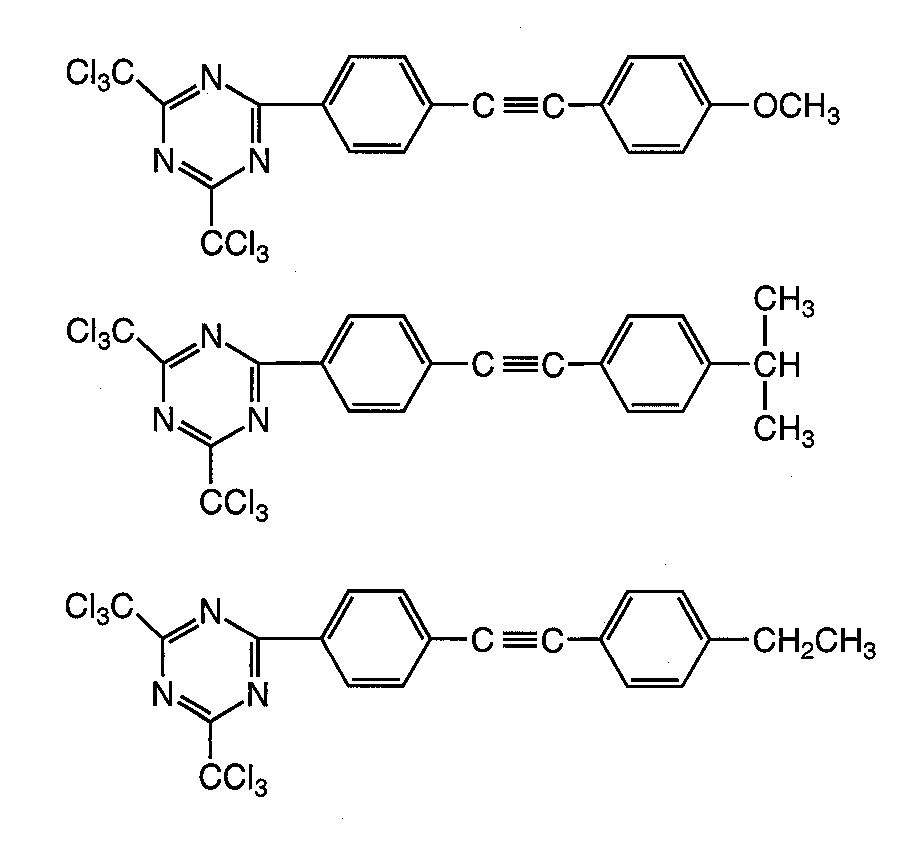
このような炭素−ハロゲン結合を有する化合物としては、例えば、若林ら著、Bull. Chem. Soc. Japan, 42,2924(1969)記載の化合物、例えば、2−フェニル−4,6−ビス(トリクロルメチル)−S−トリアジン、2−(p−クロルフェニル)−4,6−ビス(トリクロルメチル)−S−トリアジン、2−(p−トリル)−4,6−ビス(トリクロルメチル)−S−トリアジン、2−(p−メトキシフェニル)−4,6−ビス(トリクロルメチル)−S−トリアジン、2−(2′,4′−ジクロルフェニル)−4,6−ビス(トリクロルメチル)−S−トリアジン、2,4,6−トリス(トリクロルメチル)−S−トリアジン、2−メチル−4,6−ビス(トリクロルメチル)−S−トリアジン、2−n−ノニル−4,6−ビス(トリクロルメチル)−S−トリアジン、2−(α,α,β−トリクロルエチル)−4,6−ビス(トリクロルメチル)−S−トリアジン等が挙げられる。その他、英国特許第1388492 号明細書記載の化合物、例えば、2−スチリル−4,6−ビス(トリクロルメチル)−S−トリアジン、2−(p−メチルスチリル)−4,6−ビス(トリクロルメチル)−S−トリアジン、2−(p−メトキシスチリル)−4,6−ビス(トリクロルメチル)−S−トリアジン、2−(p−メトキシスチリル)−4−アミノ−6−トリクロルメチル−S−トリアジン等、特開昭53−133428号記載の化合物、例えば、2−(4−メトキシ−ナフト−1−イル)−4,6−ビス−トリクロルメチル−S−トリアジン、2−(4−エトキシ−ナフト−1−イル)−4,6−ビス−トリクロルメチル−S−トリアジン、2−〔4−(2−エトキシエチル)−ナフト−1−イル〕−4,6−ビス−トリクロルメチル−S−トリアジン、2−(4,7−ジメトキシ−ナフト−1−イル〕−4,6−ビス−トリクロルメチル−S−トリアジン、2−(アセナフト−5−イル)−4,6−ビス−トリクロルメチル−S−トリアジン等、独国特許第3337024 号明細書記載の化合物、例えば下記の化合物を挙げることができる。
【0246】
【化95】
【化96】
また、F. C. Schaefer等による J. Org. Chem.,29,1527(1964)記載の化合物、例えば2−メチル−4,6−ビス(トリブロムメチル)−S−トリアジン、2,4,6−トリス(トリブロムメチル)−S−トリアジン、2,4,6−トリス(ジブロムメチル)−S−トリアジン、2−アミノ−4−メチル−6−トリブロムメチル−S−トリアジン、2−メトキシ−4−メチル−6−トリクロルメチル−S−トリアジン等を挙げることができる。
【0249】
さらに特開昭62−58241号記載の化合物、例えば下記の化合物を挙げることができる。
【0250】
【化97】
【化98】
さらに特開平5−281728号記載の化合物、例えばの下記の化合物を挙げることができる。
【0253】
【化99】
あるいはさらに M. P. Hutt, E. F. Elslager および L. M. Werbel 著 Journal of Heterocyclic chemistry, 第7巻(No. 3), 第511頁以降(1970年)に記載されている合成方法に準じて当業者が容易に合成することができる次のような化合物群を挙げることができる。
【0255】
【化100】
【化101】
【化102】
【化103】
【化104】
【化105】
あるいは、ドイツ特許第2641100号に記載されているような化合物、例えば、4−(4−メトキシ−スチリル)−6−(3,3,3−トリクロルプロペニル)−2−ピロンおよび4−(3,4,5−トリメトキシ−スチリル)−6−トリクロルメチル−2−ピロン、あるいはドイツ特許第3333450号に記載されている化合物、例えば下記の化合物を挙げることができる。
【0262】
【化106】
【化107】
またドイツ特許第3021590号に記載の化合物群のなかから下記の化合物を例示することができる。
【0265】
【化108】
【化109】
さらにはドイツ特許第3021599号に記載の化合物群のなかから、例えば下記の化合物を挙げることができる。
【0268】
【化110】
成分iii)中のラジカル発生剤の他の例である(k)メタロセン化合物の例としては、特開昭59−152396号、特開昭61−151197号、特開昭63−41484号、特開平2−249号、特開平2−4705号記載のチタノセン化合物ならびに、特開平1−304453号、特開平1−152109号記載の鉄−アレン−錯体を挙げることができる。
【0270】
上記のチタノセン化合物の具体例としては、ジ−シクロペンタジエニル−Ti−ジ−クロライド、ジ−シクロペンタジエニル−Ti−ビス−フェニル、ジ−シクロペンタジエニル−Ti−ビス−2,3,4,5,6−ペンタフルオロフェニ−1−イル、ジ−シクロペンタジエニル−Ti−ビス−2,3,5,6−テトラフルオロフェニ−1−イル、ジ−シクロペンタジエニル−Ti−ビス−2,4,6−トリフルオロフェニ−1−イル、ジ−シクロペンタジエニル−Ti−ビス−2,6−ジフルオロフエニ−1−イル、ジ−シクロペンタジエニル−Ti−ビス−2,4−ジフルオロフエニ−1−イル、ジ−メチルシクロペンタジエニル−Ti−ビス−2,3,4,5,6−ペンタフルオロフエニ−1−イル、ジ−メチルシクロペンタジエニル−Ti−ビス−2,3,5,6−テトラフルオロフエニ−1−イル、ジ−メチルシクロペンタジエニル−Ti−ビス−2,4−ジフルオロフエニ−1−イル、ビス(シクロペンタジエニル)−ビス(2,6−ジフルオロ−3−(ピリ−1−イル)フェニル)チタニウム、
【0271】
ビス(シクロペンタジエニル)ビス[2,6−ジフルオロ−3−(メチルスルホンアミド)フェニル]チタン、
ビス(シクロペンタジエニル)ビス[2,6−ジフルオロ−3−(N−ブチルビアロイル−アミノ)フェニル]チタン、
ビス(シクロペンタジエニル)ビス[2,6−ジフルオロ−3−(N−エチルアセチルアミノ)フェニル]チタン、
ビス(シクロペンタジエニル)ビス[2,6−ジフルオロ−3−(N−メチルアセチルアミノ)フェニル]チタン、
ビス(シクロペンタジエニル)ビス[2,6−ジフルオロ−3−(N−エチルプロピオニルアミノ)フェニル]チタン、
【0272】
ビス(シクロペンタジエニル)ビス[2,6−ジフルオロ−3−(N−エチル−(2,2−ジメチルブタノイル)アミノ)フェニル]チタン、
ビス(シクロペンタジエニル)ビス[2,6−ジフルオロ−3−(N−ブチル−(2,2−ジメチルブタノイル)アミノ)フェニル]チタン、
ビス(シクロペンタジエニル)ビス[2,6−ジフルオロ−3−(N−ペンチル−(2,2−ジメチルブタノイル)アミノ)フェニル]チタン、
ビス(シクロペンタジエニル)ビス[2,6−ジフルオロ−3−(N−ヘキシル)−(2,2−ジメチルブタノイル)フェニル]チタン、
ビス(シクロペンタジエニル)ビス[2,6−ジフルオロ−3−(N−メチルブチリルアミノ)フェニル]チタン、
【0273】
ビス(シクロペンタジエニル)ビス[2,6−ジフルオロ−3−(N−メチルペンタノイルアミノ)フェニル]チタン、
ビス(シクロペンタジエニル)ビス[2,6−ジフルオロ−3−(N−エチルシクロヘキシルカルボニルアミノ)フェニル]チタン、
ビス(シクロペンタジエニル)ビス[2,6−ジフルオロ−3−(N−エチルイソブチリルアミノ)フェニル]チタン、
ビス(シクロペンタジエニル)ビス[2,6−ジフルオロ−3−(N−エチルアセチルアミノ)フェニル]チタン、
ビス(シクロペンタジエニル)ビス[2,6−ジフルオロ−3−(2,2,5,5−テトラメチル−1,2,5−アザジシロリジニ−1−イル)フェニル]チタン、
【0274】
ビス(シクロペンタジエニル)ビス[2,6−ジフルオロ−3−(オクチルスルホンアミド)フェニル]チタン、
ビス(シクロペンタジエニル)ビス[2,6−ジフルオロ−3−(4−トリルスルホンアミド)フェニル]チタン、
ビス(シクロペンタジエニル)ビス[2,6−ジフルオロ−3−(4−ドデシルフェニルスルホニルアミド)フェニル]チタン、
ビス(シクロペンタジエニル)ビス[2,6−ジフルオロ−3−(4−(1−ペンチルヘプチル)フェニルスルホニルアミド)フェニル]チタン、
ビス(シクロペンタジエニル)ビス[2,6−ジフルオロ−3−(エチルスルホニルアミド)フェニル]チタン、
【0275】
ビス(シクロペンタジエニル)ビス[2,6−ジフルオロ−3−((4−ブロモフェニル)−スルホニルアミド)フェニル]チタン、
ビス(シクロペンタジエニル)ビス[2,6−ジフルオロ−3−(2−ナフチルスルホニルアミド)フェニル]チタン、
ビス(シクロペンタジエニル)ビス[2,6−ジフルオロ−3−(ヘキサデシルスルホニルアミド)フェニル]チタン、
ビス(シクロペンタジエニル)ビス[2,6−ジフルオロ−3−(N−メチル−(4−ドデシルフェニル)−スルホニルアミド)フェニル]チタン、
ビス(シクロペンタジエニル)ビス[2,6−ジフルオロ−3−(N−メチル−4−(1−ペンチルヘプチル)フェニル)スルホニルアミド)フェニル]チタン、
【0276】
ビス(シクロペンタジエニル)ビス[2,6−ジフルオロ−3−(N−ヘキシル−(4−トリル)−スルホニルアミド)フェニル]チタン、
ビス(シクロペンタジエニル)ビス[2,6−ジフルオロ−3−(ピロリジン−2,5−ジオニ−1−イル)フェニル]チタン、
ビス(シクロペンタジエニル)ビス[2,6−ジフルオロ−3−(3,4−ジメチル−3−ピロリジン−2,5−ジオニ−1−イル)フェニル]チタン、
ビス(シクロペンタジエニル)ビス[2,6−ジフルオロ−3−(フタルイミド)フェニル]チタン、
ビス(シクロペンタジエニル)ビス[2,6−ジフルオロ−3−イソブトキシカルボニルアミノ)フェニル]チタン、
ビス(シクロペンタジエニル)ビス[2,6−ジフルオロ−3−(エトキシカルボニルアミノ)フェニル]チタン、
ビス(シクロペンタジエニル)ビス[2,6−ジフルオロ−3−((2−クロロエトキシ)−カルボニルアミノ)フェニル]チタン、
ビス(シクロペンタジエニル)ビス[2,6−ジフルオロ−3−(フェノキシカルボニルアミノ)フェニル]チタン、
ビス(シクロペンタジエニル)ビス[2,6−ジフルオロ−3−(3−フェニルチオウレイド)フェニル]チタン、
ビス(シクロペンタジエニル)ビス[2,6−ジフルオロ−3−(3−ブチルチオウレイド)フェニル]チタン、
【0277】
ビス(シクロペンタジエニル)ビス[2,6−ジフルオロ−3−(3−フェニルウレイド)フェニル]チタン、
ビス(シクロペンタジエニル)ビス[2,6−ジフルオロ−3−(3−ブチルウレイド)フェニル]チタン、
ビス(シクロペンタジエニル)ビス[2,6−ジフルオロ−3−(N,N−ジアセチルアミノ)フェニル]チタン、
ビス(シクロペンタジエニル)ビス[2,6−ジフルオロ−3−(3,3−ジメチルウレイド)フェニル]チタン、
ビス(シクロペンタジエニル)ビス[2,6−ジフルオロ−3−(アセチルアミノ)フェニル]チタン、
【0278】
ビス(シクロペンタジエニル)ビス[2,6−ジフルオロ−3−(ブチリルアミノ)フェニル]チタン、
ビス(シクロペンタジエニル)ビス[2,6−ジフルオロ−3−(デカノイルアミノ)フェニル]チタン、
ビス(シクロペンタジエニル)ビス[2,6−ジフルオロ−3−(オクタデカノイルアミノ)フェニル]チタン、
ビス(シクロペンタジエニル)ビス[2,6−ジフルオロ−3−(イソブチリルアミノ)フェニル]チタン、
ビス(シクロペンタジエニル)ビス[2,6−ジフルオロ−3−(2−エチルヘキサノイルアミノ)フェニル]チタン、
【0279】
ビス(シクロペンタジエニル)ビス[2,6−ジフルオロ−3−(2−メチルブタノイルアミノ)フェニル]チタン、
ビス(シクロペンタジエニル)ビス[2,6−ジフルオロ−3−(ピバロイルアミノ)フェニル]チタン、
ビス(シクロペンタジエニル)ビス[2,6−ジフルオロ−3−(2,2−ジメチルブタノイルアミノ)フェニル]チタン、
ビス(シクロペンタジエニル)ビス[2,6−ジフルオロ−3−(2−エチル−2−メチルヘプタノイルアミノ)フェニル]チタン、
ビス(シクロペンタジエニル)ビス[2,6−ジフルオロ−3−(シクロヘキシルカルボニルアミノ)フェニル]チタン、
【0280】
ビス(シクロペンタジエニル)ビス[2,6−ジフルオロ−3−(2,2−ジメチル−3−クロロプロパノイルアミノ)フェニル]チタン、
ビス(シクロペンタジエニル)ビス[2,6−ジフルオロ−3−(3−フェニルプロパノイルアミノ)フェニル]チタン、
ビス(シクロペンタジエニル)ビス[2,6−ジフルオロ−3−(2−クロロメチル−2−メチル−3−クロロプロパノイルアミノ)フェニル]チタン、
ビス(シクロペンタジエニル)ビス[2,6−ジフルオロ−3−(3,4−キシロイルアミノ)フェニル]チタン、
ビス(シクロペンタジエニル)ビス[2,6−ジフルオロ−3−(4−エチルベンゾイルアミノ)フェニル]チタン、
【0281】
ビス(シクロペンタジエニル)ビス[2,6−ジフルオロ−3−(2,4,6−メシチルカルボニルアミノ)フェニル]チタン、
ビス(シクロペンタジエニル)ビス[2,6−ジフルオロ−3−(ベンゾイルアミノ)フェニル]チタン、
ビス(シクロペンタジエニル)ビス[2,6−ジフルオロ−3−(N−(3−フェニルプロピル)ベンゾイルアミノ)フェニル]チタン、
ビス(シクロペンタジエニル)ビス[2,6−ジフルオロ−3−(N−(3−エチルヘプチル)−2,2−ジメチルペンタノイルアミノ)フェニル]チタン、
ビス(シクロペンタジエニル)ビス[2,6−ジフルオロ−3−(N−イソブチル−(4−トルイル)アミノ)フェニル]チタン、
【0282】
ビス(シクロペンタジエニル)ビス[2,6−ジフルオロ−3−(N−イソブチルベンゾイルアミノ)フェニル]チタン、
ビス(シクロペンタジエニル)ビス[2,6−ジフルオロ−3−(N−シクロヘキシルメチルピバロイルアミノ)フェニル]チタン、
ビス(シクロペンタジエニル)ビス[2,6−ジフルオロ−3−(N−(オクソラニ−2−イルメチル)ベンゾイルアミノ)フェニル]チタン、
ビス(シクロペンタジエニル)ビス[2,6−ジフルオロ−3−(N−(3−エチルヘプチル)−2,2−ジメチルブタノイルアミノ)フェニル]チタン、
ビス(シクロペンタジエニル)ビス[2,6−ジフルオロ−3−(N−(3−フェニルプロピル−(4−トルイル)アミノ)フェニル]チタン、
【0283】
ビス(シクロペンタジエニル)ビス[2,6−ジフルオロ−3−(N−(オクソラニ−2−イルメチル)−(4−トルイル)アミノ)フェニル]チタン、
ビス(シクロペンタジエニル)ビス[2,6−ジフルオロ−3−(N−(4−トルイルメチル)ベンゾイルアミノ)フェニル]チタン、
ビス(シクロペンタジエニル)ビス[2,6−ジフルオロ−3−(N−(4−トルイルメチル)−(4−トルイル)アミノ)フェニル]チタン、
ビス(シクロペンタジエニル)ビス[2,6−ジフルオロ−3−(N−(ブチルベンゾイルアミノ)フェニル]チタン、
ビス(シクロペンタジエニル)ビス[2,6−ジフルオロ−3−(N−(ブチル−(4−トルイル)アミノ)フェニル]チタン、
【0284】
ビス(シクロペンタジエニル)ビス[2,6−ジフルオロ−3−(N−(ヘキシル−(4−トルイル)アミノ)フェニル]チタン、
ビス(シクロペンタジエニル)ビス[2,6−ジフルオロ−3−(N−(2,4−ジメチルペンチル)−2,2−ジメチルブタノイルアミノ)フェニル]チタン、
ビス(シクロペンタジエニル)ビス[2,6−ジフルオロ−3−(2,4−ジメチルペンチル)−2,2−ジメチルペンタノイルアミノ)フェニル]チタン、
ビス(シクロペンタジエニル)ビス[2,6−ジフルオロ−3−((4−トルイル)アミノ)フェニル]チタン、
ビス(シクロペンタジエニル)ビス[2,6−ジフルオロ−3−(2,2−ジメチルペンタノイルアミノ)フェニル]チタン、
【0285】
ビス(シクロペンタジエニル)ビス[2,6−ジフルオロ−3−(2,2−ジメチル−3−エトキシプロパノイルアミノ)フェニル]チタン、
ビス(シクロペンタジエニル)ビス[2,6−ジフルオロ−3−(2,2−ジメチル−3−アリルオキシプロパノルアミノ)フェニル]チタン、
ビス(シクロペンタジエニル)ビス[2,6−ジフルオロ−3−(N−アリルアセチルアミノ)フェニル]チタン、
ビス(シクロペンタジエニル)ビス[2,6−ジフルオロ−3−(2−エチルブタノイルアミノ)フェニル]チタン、
ビス(シクロペンタジエニル)ビス[2,6−ジフルオロ−3−(N−シクロヘキシルメチルベンゾイルアミノ)フェニル]チタン、
ビス(シクロペンタジエニル)ビス[2,6−ジフルオロ−3−(N−シクロヘキシルメチル−(4−トルイル)アミノ)フェニル]チタン、
【0286】
ビス(シクロペンタジエニル)ビス[2,6−ジフルオロ−3−(N−2−エチルヘキシル)ベンゾイルアミノ)フェニル]チタン、
ビス(シクロペンタジエニル)ビス[2,6−ジフルオロ−3−(N−イソプロピルベンゾイルアミノ)フェニル]チタン、
ビス(シクロペンタジエニル)ビス[2,6−ジフルオロ−3−(N−(3−フェニルプロピル)−2,2−ジメチルペンタノイルアミノ)フェニル]チタン、
ビス(シクロペンタジエニル)ビス[2,6−ジフルオロ−3−(N−ヘキシルベンゾイルアミノ)フェニル]チタン、
ビス(シクロペンタジエニル)ビス[2,6−ジフルオロ−3−(N−シクロヘキシルメチル−2,2−ジメチルペンタノイルアミノ)フェニル]チタン、
【0287】
ビス(シクロペンタジエニル)ビス[2,6−ジフルオロ−3−(N−ブチルベンゾイルアミノ)フェニル]チタン、
ビス(シクロペンタジエニル)ビス[2,6−ジフルオロ−3−(N−(2−エチルヘキシル)−2,2−ジメチルペンタノイルアミノ)フェニル]チタン、
ビス(シクロペンタジエニル)ビス[2,6−ジフルオロ−3−(N−ヘキシル−2,2−ジメチルペンタノイルアミノ)フェニル]チタン、
ビス(シクロペンタジエニル)ビス[2,6−ジフルオロ−3−(N−イソプロピル−2,2−ジメチルペンタノイルアミノ)フェニル]チタン、
ビス(シクロペンタジエニル)ビス[2,6−ジフルオロ−3−(N−(3−フェニルプロピル)ピバロイルアミノ)フェニル]チタン、
【0288】
ビス(シクロペンタジエニル)ビス[2,6−ジフルオロ−3−(N−ブチル−2,2−ジメチルペンタノイルアミノ)フェニル]チタン、
ビス(シクロペンタジエニル)ビス[2,6−ジフルオロ−3−(N−(2−メトキシエチル)ベンゾイルアミノ)フェニル]チタン、
ビス(シクロペンタジエニル)ビス[2,6−ジフルオロ−3−(N−ベンジルベンゾイルアミノ)フェニル]チタン、
ビス(シクロペンタジエニル)ビス[2,6−ジフルオロ−3−(N−ベンジル−(4−トルイル)アミノ)フェニル]チタン、
ビス(シクロペンタジエニル)ビス[2,6−ジフルオロ−3−(N−(2−メトキシエチル)−(4−トルイル)アミノ)フェニル]チタン、
【0289】
ビス(シクロペンタジエニル)ビス[2,6−ジフルオロ−3−(N−(4−メチルフェニルメチル)−2,2−ジメチルペンタノイルアミノ)フェニル]チタン、
ビス(シクロペンタジエニル)ビス[2,6−ジフルオロ−3−(N−(2−メトキシエチル)−2,2−ジメチルペンタノイルアミノ)フェニル]チタン、
ビス(シクロペンタジエニル)ビス[2,6−ジフルオロ−3−(N−シクロヘキシルメチル−(2−エチル−2−メチルヘプタノイル)アミノ)フェニル]チタン、
ビス(シクロペンタジエニル)ビス[2,6−ジフルオロ−3−(N−ブチル−(4−クロロベンゾイル)アミノ)フェニル]チタン、
【0290】
ビス(シクロペンタジエニル)ビス[2,6−ジフルオロ−3−(N−ヘキシル−(2−エチル−2−メチルブタノイルアミノ)フェニル]チタン、
ビス(シクロペンタジエニル)ビス[2,6−ジフルオロ−3−(N−シクロヘキシル−2,2−ジメチルペンタノイルアミノ)フェニル]チタン、
ビス(シクロペンタジエニル)ビス[2,6−ジフルオロ−3−(N−(オクソラニ−2−イルメチル)−2,2−ジメチルペンタノイルアミノ)フェニル]チタン、
ビス(シクロペンタジエニル)ビス[2,6−ジフルオロ−3−(N−シクロヘキシル−(4−クロロベンゾイル)アミノ)フェニル]チタン、
ビス(シクロペンタジエニル)ビス[2,6−ジフルオロ−3−(N−シクロヘキシル−(2−クロロベンゾイルアミノ)フェニル]チタン、
【0291】
ビス(シクロペンタジエニル)ビス[2,6−ジフルオロ−3−(3,3−ジメチル−2,2−アゼチジノニ−1−イル)フェニル]チタン、
ビス(シクロペンタジエニル)ビス(2,6−ジフルオロ−3−イソシアナトフェニル)チタン、
ビス(シクロペンタジエニル)ビス[2,6−ジフルオロ−3−(N−エチル−(4−トリルスルホニル)アミノ)フェニル]チタン、
ビス(シクロペンタジエニル)ビス[2,6−ジフルオロ−3−(N−ヘキシル−(4−トリルスルホニル)アミノ)フェニル]チタン、
ビス(シクロペンタジエニル)ビス[2,6−ジフルオロ−3−(N−ブチル−(4−トリルスルホニル)アミノ)フェニル]チタン、
【0292】
ビス(シクロペンタジエニル)ビス[2,6−ジフルオロ−3−(N−イソブチル−(4−トリルスルホニル)アミノ)フェニル]チタン、
ビス(シクロペンタジエニル)ビス[2,6−ジフルオロ−3−(N−ブチル−(2,2−ジメチル−3−クロロプロパノイル)アミノ)フェニル]チタン、
ビス(シクロペンタジエニル)ビス[2,6−ジフルオロ−3−(N−(3−フェニルプロピル)−2,2−ジメチル−3−クロロプロパノイル)アミノ)フェニル]チタン、
ビス(シクロペンタジエニル)ビス[2,6−ジフルオロ−3−(N−シクロヘキシルメチル−(2,2−ジメチル−3−クロロプロパノイル)アミノ)フェニル]チタン、
【0293】
ビス(シクロペンタジエニル)ビス[2,6−ジフルオロ−3−(N−イソブチル−(2,2−ジメチル−3−クロロプロパノイル)フェニル]チタン、
ビス(シクロペンタジエニル)ビス[2,6−ジフルオロ−3−(N−ブチル−(2−クロロメチル−2−メチル−3−クロロプロパノイル)アミノ)フェニル]チタン、
ビス(シクロペンタジエニル)ビス[2,6−ジフルオロ−3−(ブチルチオカルボニルアミノ)フェニル]チタン、
ビス(シクロペンタジエニル)ビス[2,6−ジフルオロ−3−(フェニルチオカルボニルアミノ)フェニル]チタン、
【0294】
ビス(メチルシクロペンタジエニル)ビス[2,6−ジフルオロ−3−(N−ヘキシル−2,2−ジメチルブタノイルアミノ)フェニル]チタン、
ビス(メチルシクロペンタジエニル)ビス[2,6−ジフルオロ−3−(N−ヘキシル−2,2−ジメチルペンタノイルアミノ)フェニル]チタン、
ビス(メチルシクロペンタジエニル)ビス[2,6−ジフルオロ−3−(N−エチルアセチルアミノ)フェニル]チタン、
ビス(メチルシクロペンタジエニル)ビス[2,6−ジフルオロ−3−(N−エチルプロピオニルアミノ)フェニル]チタン、
ビス(トリメチルシリルペンタジエニル)ビス[2,6−ジフルオロ−3−(N−ブチル−2,2−ジメチルプロパノイルアミノ)フェニル]チタン、
【0295】
ビス(シクロペンタジエニル)ビス[2,6−ジフルオロ−3−(N−(2−メトキシエチル)−トリメチルシリルアミノ)フェニル]チタン、
ビス(シクロペンタジエニル)ビス[2,6−ジフルオロ−3−(N−ブチルヘキシルジメチルシリルアミノ)フェニル]チタン、
ビス(シクロペンタジエニル)ビス[2,6−ジフルオロ−3−(N−エチル−(1,1,2−トリルメチルプロピル)ジメチルシリルアミノ)フェニル]チタン、
ビス(シクロペンタジエニル)ビス[2,6−ジフルオロ−3−(3−エトキシメチル−3−メチル−2−アゼチオジノニ−1−イル)フェニル]チタン、
ビス(シクロペンタジエニル)ビス[2,6−ジフルオロ−3−(3−アリルオキシメチル−3−メチル−2−アゼチジノニ−1−イル)フェニル]チタン、
【0296】
ビス(シクロペンタジエニル)ビス[2,6−ジフルオロ−3−(3−クロロメチル−3−メチル−2−アゼチジノニ−1−イル)フェニル]チタン、
ビス(シクロペンタジエニル)ビス[2,6−ジフルオロ−3−(N−ベンジル−2,2−ジメチルプロパノイルアミノ)フェニル]チタン、
ビス(シクロペンタジエニル)ビス[2,6−ジフルオロ−3−(5,5−ジメチル−2−ピロリジノニ−1−イル)フェニル]チタン、
ビス(シクロペンタジエニル)ビス[2,6−ジフルオロ−3−(6,6−ジフェニル−2−ピペリジノニ−1−イル)フェニル]チタン、
ビス(シクロペンタジエニル)ビス[2,6−ジフルオロ−3−(N−2,3−ジヒドロ−1,2−ベンジンチアゾロ−3−オン(1,1−ジオキシド)−2−イル)フェニル]チタン、
【0297】
ビス(シクロペンタジエニル)ビス[2,6−ジフルオロ−3−(N−ヘキシル−(4−クロロベンゾイル)アミノ)フェニル]チタン、
ビス(シクロペンタジエニル)ビス[2,6−ジフルオロ−3−(N−ヘキシル−(2−クロロベンゾイル)アミノ)フェニル]チタン、
ビス(シクロペンタジエニル)ビス[2,6−ジフルオロ−3−(N−イソプロピル−(4−クロロベンゾイル)アミノ)フェニル]チタン、
ビス(シクロペンタジエニル)ビス[2,6−ジフルオロ−3−(N−(4−メチルフェニルメチル)−(4−クロロベンゾイル)アミノ)フェニル]チタン、
ビス(シクロペンタジエニル)ビス[2,6−ジフルオロ−3−(N−(4−メチルフェニルメチル)−(2−クロロベンゾイル)アミノ)フェニル]チタン、
【0298】
ビス(シクロペンタジエニル)ビス[2,6−ジフルオロ−3−(N−ブチル−(4−クロロベンゾイル)アミノ)フェニル]チタン、
ビス(シクロペンタジエニル)ビス[2,6−ジフルオロ−3−(N−ベンジル−2,2−ジメチルペンタノイルアミノ)フェニル]チタン、
ビス(シクロペンタジエニル)ビス[2,6−ジフルオロ−3−(N−(2−エチルヘキシル)−4−トリル−スルホニル)アミノ)フェニル]チタン、
ビス(シクロペンタジエニル)ビス[2,6−ジフルオロ−3−(N−(3−オキサヘプチル)ベンゾイルアミノ)フェニル]チタン、
ビス(シクロペンタジエニル)ビス[2,6−ジフルオロ−3−(N−(3,6−ジオキサデシル)ベンゾイルアミノ)フェニル]チタン、
【0299】
ビス(シクロペンタジエニル)ビス[2,6−ジフルオロ−3−(トリフルオロメチルスルホニル)アミノ)フェニル]チタン、
ビス(シクロペンタジエニル)ビス[2,6−ジフルオロ−3−(トリフルオロアセチルアミノ)フェニル]チタン、
ビス(シクロペンタジエニル)ビス[2,6−ジフルオロ−3−(2−クロロベンゾイル)アミノ)フェニル]チタン、
ビス(シクロペンタジエニル)ビス[2,6−ジフルオロ−3−(4−クロロベンゾイル)アミノ)フェニル]チタン、
ビス(シクロペンタジエニル)ビス[2,6−ジフルオロ−3−(N−(3,6−ジオキサデシル)−2,2−ジメチルペンタノイルアミノ)フェニル]チタン、
【0300】
ビス(シクロペンタジエニル)ビス[2,6−ジフルオロ−3−(N−(3,7−ジメチル−7−メトキシオクチル)ベンゾイルアミノ)フェニル]チタン、
ビス(シクロペンタジエニル)ビス[2,6−ジフルオロ−3−(N−シクロヘキシルベンゾイルアミノ)フェニル]チタン、
等を挙げることができる。
【0301】
本発明における成分iii)中のラジカル発生剤のさらにより好ましい例としては、上述の(j)炭素ハロゲン結合を有する化合物、(k)メタロセン化合物を挙げることができ、さらに最も好ましい例としては、チタノセン化合物を挙げることができる。
【0302】
本発明における成分iii)中のラジカル発生剤は単独もしくは2種以上の併用によって好適に用いられる。
【0303】
さらに本発明のiii)光開始系には必要に応じ、成分A)として増感色素を添加することができる。そして、走査露光光源として、現状では、波長400〜700nmの可視光レーザがすぐれるため可視光増感色素を添加することが好ましい。好ましい可視光増感色素として例えば一般式(A−1)で表されるものを挙げることができる。
【0304】
【化111】
式中、R9〜R13は互いに独立して、水素原子、ハロゲン原子、アルキル基、置換アルキル基、アリール基、置換アリール基、アルケニル基、置換アルケニル基、ヒドロキシル基、置換オキシ基、メルカプト基、置換チオ基、アミノ基、置換アミノ基、置換カルボニル基、スルホ基、スルホナト基、置換スルフィニル基、置換スルホニル基、ホスホノ基、置換ホスホノ基、ホスホナト基、置換ホスホナト基、シアノ基、ニトロ基、シリル基のいずれかを表す。また、R9とR10、R11とR12は、それらが各々結合する炭素原子とともに非金属原子からなる環を形成してもよい。R14、R15は、互いに独立して、水素原子、ハロゲン原子、アルキル基、置換アルキル基、アリール基、置換アリール基、アルケニル基、置換アルケニル基、ヒドロキシル基、置換オキシ基、メルカプト基、置換チオ基、アミノ基、置換アミノ基、置換カルボニル基、スルホ基、スルホナト基、置換スルフィニル基、置換スルホニル基、ホスホノ基、置換ホスホノ基、ホスホナト基、置換ホスホナト基、シアノ基、ニトロ基、シリル基、ヘテロ環基のいずれかを表す。またR13とR14およびR14とR15は、それらが各々結合する炭素原子とともに非金属原子からなる環を形成してもよい。X1およびX2は各々シアノ基または置換カルボニル基を表し、X1とX2は互いに結合して環を形成してもよい。
【0306】
アルキル基としては炭素原子数が1から20までの直鎖状、分岐状、および環状のアルキル基を挙げることができ、その具体例としては、メチル基、エチル基、プロピル基、ブチル基、ペンチル基、ヘキシル基、ヘプチル基、オクチル基、ノニル基、デシル基、ウンデシル基、ドデシル基、トリデシル基、ヘキサデシル基、オクタデシル基、エイコシル基、イソプロピル基、イソブチル基、s−ブチル基、t−ブチル基、イソペンチル基、ネオペンチル基、1−メチルブチル基、イソヘキシル基、2−エチルヘキシル基、2−メチルヘキシル基、シクロヘキシル基、シクロペンチル基、2−ノルボルニル基を挙げることができる。これらの中では、炭素原子数1から12までの直鎖状、炭素原子数3から12までの分岐状、ならびに炭素原子数5から10までの環状のアルキル基がより好ましい。
【0307】
置換アルキル基の置換基としては、水素原子を除く一価の非金属原子団からなる基が用いられ、好ましい例としては、ハロゲン原子(−F、−Br、−Cl、−I)、ヒドロキシル基、アルコキシ基、アリーロキシ基、メルカプト基、アルキルチオ基、アリールチオ基、アルキルジチオ基、アリールジチオ基、アミノ基、N−アルキルアミノ基、N,N−ジアルキルアミノ基、N−アリールアミノ基、N,N−ジアリールアミノ基、N−アルキル−N−アリールアミノ基、アシルオキシ基、カルバモイルオキシ基、N−アルキルカルバモイルオキシ基、N−アリールカルバモイルオキシ基、N,N−ジアルキルカルバモイルオキシ基、N,N−ジアリールカルバモイルオキシ基、N−アルキル−N−アリールカルバモイルオキシ基、アルキルスルホキシ基、アリールスルホキシ基、アシルチオ基、アシルアミノ基、N−アルキルアシルアミノ基、N−アリールアシルアミノ基、ウレイド基、N’−アルキルウレイド基、N’,N’−ジアルキルウレイド基、N’−アリールウレイド基、N’,N’−ジアリールウレイド基、N’−アルキル−N’−アリールウレイド基、N−アルキルウレイド基、N−アリールウレイド基、N’−アルキル−N−アルキルウレイド基、N’−アルキル−N−アリールウレイド基、N’,N’−ジアルキル−N−アルキルウレイド基、N’,N’−ジアルキル−N−アリールウレイド基、N’−アリール−N−アルキルウレイド基、N’−アリール−N−アリールウレイド基、N’,N’−ジアリール−N−アルキルウレイド基、N’,N’−ジアリール−N−アリールウレイド基、N’−アルキル−N’−アリール−N−アルキルウレイド基、N’−アルキル−N’−アリール−N−アリールウレイド基、アルコキシカルボニルアミノ基、アリーロキシカルボニルアミノ基、N−アルキル−N−アルコキシカルボニルアミノ基、N−アルキル−N−アリーロキシカルボニルアミノ基、N−アリール−N−アルコキシカルボニルアミノ基、N−アリール−N−アリーロキシカルボニルアミノ基、ホルミル基、アシル基、カルボキシル基、アルコキシカルボニル基、アリーロキシカルボニル基、カルバモイル基、N−アルキルカルバモイル基、N,N−ジアルキルカルバモイル基、N−アリールカルバモイル基、N,N−ジアリールカルバモイル基、N−アルキル−N−アリールカルバモイル基、アルキルスルフィニル基、アリールスルフィニル基、アルキルスルホニル基、アリールスルホニル基、スルホ基(−SO3 H)およびその共役塩基基(スルホナト基と称す)、アルコキシスルホニル基、アリーロキシスルホニル基、スルフィナモイル基、N−アルキルスルフィナモイル基、N,N−ジアルキルスルフィイナモイル基、N−アリールスルフィナモイル基、N,N−ジアリールスルフィナモイル基、N−アルキル−N−アリールスルフィナモイル基、スルファモイル基、N−アルキルスルファモイル基、N,N−ジアルキルスルファモイル基、N−アリールスルファモイル基、N,N−ジアリールスルファモイル基、N−アルキル−N−アリールスルファモイル基、ホスホノ基(−PO3 H2 )およびその共役塩基基(ホスホナト基と称す)、ジアルキルホスホノ基(−PO3 (alkyl )2:alkyl=アルキル基、以下同)、ジアリールホスホノ基(−PO3 (aryl)2 :aryl=アリール基、以下同)、アルキルアリールホスホノ基(−PO3 (alkyl )(aryl))、モノアルキルホスホノ基(−PO3 (alkyl ))およびその共役塩基基(アルキルホスホナト基と称す)、モノアリールホスホノ基(−PO3 H(aryl))およびその共役塩基基(アリールホスホナト基と称す)、ホスホノオキシ基(−OPO3 H2 )およびその共役塩基基(ホスホナトオキシ基と称す)、ジアルキルホスホノオキシ基(−OPO3 H(alkyl )2 )、ジアリールホスホノオキシ基(−OPO3 (aryl)2 )、アルキルアリールホスホノオキシ基(−OPO3 (alkyl )(aryl))、モノアルキルホスホノオキシ基(−OPO3 H(alkyl))およびその共役塩基基(アルキルホスホナトオキシ基と称す)、モノアリールホスホノオキシ基(−OPO3 H(aryl))およびその共役塩基基(アリールホスホナトオキシ基と称す)、シアノ基、ニトロ基、アリール基、アルケニル基、アルキニル基、ヘテロ環基、シリル基等が挙げられる。
【0308】
これらの置換基における、アルキル基の具体例としては、前述のアルキル基が挙げられ、アリール基の具体例としては、フェニル基、ビフェニル基、ナフチル基、トリル基、キシリル基、メシチル基、クメニル基、クロロフェニル基、ブロモフェニル基、クロロメチルフェニル基、ヒドロキシフェニル基、メトキシフェニル基、エトキシフェニル基、フェノキシフェニル基、アセトキシフェニル基、ベンゾイロキシフェニル基、メチルチオフェニル基、フェニルチオフェニル基、メチルアミノフェニル基、ジメチルアミノフェニル基、アセチルアミノフェニル基、カルボキシフェニル基、メトキシカルボニルフェニル基、エトキシフェニルカルボニル基、フェノキシカルボニルフェニル基、N−フェニルカルバモイルフェニル基、シアノフェニル基、スルホフェニル基、スルホナトフェニル基、ホスホノフェニル基、ホスホナトフェニル基等を挙げることができる。
【0309】
また、アルケニル基の例としては、ビニル基、1−プロペニル基、1−ブテニル基、シンナミル基、2−クロロ−1−エテニル基、等が挙げられ、アルキニル基の例としては、エチニル基、1−プロピニル基、1−ブチニル基、トリメチルシリルエチニル基等が挙げられる。
【0310】
アシル基(R01CO−)におけるR01としては、水素原子、ならびに上記のアルキル基、アリール基を挙げることができる。これらの置換基の内、さらにより好ましいものとしてはハロゲン原子(−F、−Br、−Cl、−I)、アルコキシ基、アリーロキシ基、アルキルチオ基、アリールチオ基、N−アルキルアミノ基、N,N−ジアルキルアミノ基、アシルオキシ基、N−アルキルカルバモイルオキシ基、N−アリールカルバモイルオキシ基、アシルアミノ基、ホルミル基、アシル基、カルボキシル基、アルコキシカルボニル基、アリーロキシカルボニル基、カルバモイル基、N−アルキルカルバモイル基、N,N−ジアルキルカルバモイル基、N−アリールカルバモイル基、N−アルキル−N−アリールカルバモイル基、スルホ基、スルホナト基、スルファモイル基、N−アルキルスルファモイル基、N,N−ジアルキルスルファモイル基、N−アリールスルファモイル基、N−アルキル−N−アリールスルファモイル基、ホスホノ基、ホスホナト基、ジアルキルホスホノ基、ジアリールホスホノ基、モノアルキルホスホノ基、アルキルホスホナト基、モノアリールホスホノ基、アリールホスホナト基、ホスホノオキシ基、ホスホナトオキシ基、アリール基、アルケニル基が挙げられる。
ヘテロ環基としてはピリジル基、ピペリジニル基等が挙げられる。
シリル基としてはトリメチルシリル基等が挙げられる。
【0311】
一方、置換アルキル基におけるアルキレン基としては前述の炭素数1から20までのアルキル基上の水素原子のいずれか1つを除し、2価の有機残基としたものを挙げることができ、好ましくは炭素原子数1から12までの直鎖状、炭素原子数3から12までの分岐状ならびに炭素原子数5から10までの環状のアルキレン基を挙げることができる。このような置換基とアルキレン基を組み合わせることで得られる置換アルキル基の、好ましい具体例としては、クロロメチル基、ブロモメチル基、2−クロロエチル基、トリフルオロメチル基、メトキシメチル基、イソプロポキシメチル基、ブトキシメチル基、s−ブトキシブチル基、メトキシエトキシエチル基、アリルオキシメチル基、フェノキシメチル基、メチルチオメチル基、トリルチオメチル基、ピリジルメチル基、テトラメチルピペリジニルメチル基、N−アセチルテトラメチルピペリジニルメチル基、トリメチルシリルメチル基、メトキシエチル基、エチルアミノエチル基、ジエチルアミノプロピル基、モルホリノプロピル基、アセチルオキシメチル基、ベンゾイルオキシメチル基、N−シクロヘキシルカルバモイルオキシエチル基、N−フェニルカルバモイルオキシエチル基、アセチルアミノエチル基、N−メチルベンゾイルアミノプロピル基、2−オキソエチル基、2−オキソプロピル基、カルボキシプロピル基、メトキシカルボニルエチル基、アリルオキシカルボニルブチル基、クロロフェノキシカルボニルメチル基、カルバモイルメチル基、N−メチルカルバモイルエチル基、N,N−ジプロピルカルバモイルメチル基、N−(メトキシフェニル)カルバモイルエチル基、N−メチル−N−(スルホフェニル)カルバモイルメチル基、スルホブチル基、スルホナトブチル基、スルファモイルブチル基、N−エチルスルファモイルメチル基、N,N−ジプロピルスルファモイルプロピル基、N−トリルスルファモイルプロピル基、N−メチル−N−(ホスホノフェニル)スルファモイルオクチル基、ホスホノブチル基、ホスホナトヘキシル基、ジエチルホスホノブチル基、ジフェニルホスホノプロピル基、メチルホスホノブチル基、メチルホスホナトブチル基、トリルホスホノヘキシル基、トリルホスホナトヘキシル基、ホスホノオキシプロピル基、ホスホナトオキシブチル基、ベンジル基、フェネチル基、α−メチルベンジル基、1−メチル−1−フェニルエチル基、p−メチルベンジル基、シンナミル基、アリル基、1−プロペニルメチル基、2−ブテニル基、2−メチルアリル基、2−メチルプロペニルメチル基、2−プロピニル基、2−ブチニル基、3−ブチニル基等を挙げることができる。
アリール基としては、1個から3個のベンゼン環が縮合環を形成したもの、ベンゼン環と5員不飽和環が縮合環を形成したものを挙げることができ、具体例としては、フェニル基、ナフチル基、アントリル基、フェナントリル基、インデニル基、アセナフテニル基、フルオレニル基を挙げることができ、これらのなかでは、フェニル基、ナフチル基がより好ましい。
【0312】
置換アリール基としては、前述のアリール基の環形成炭素原子上に置換基として、水素原子を除く一価の非金属原子団からなる基を有するものが用いられる。好ましい置換基の例としては前述のアルキル基、置換アルキル基、ならびに、先に置換アルキル基における置換基として示したものを挙げることができる。このような、置換アリール基の好ましい具体例としては、ビフェニル基、トリル基、キシリル基、メシチル基、クメニル基、クロロフェニル基、ブロモフェニル基、フルオロフェニル基、クロロメチルフェニル基、トリフルオロメチルフェニル基、ヒドロキシフェニル基、メトキシフェニル基、メトキシエトキシフェニル基、アリルオキシフェニル基、フェノキシフェニル基、メチルチオフェニル基、トリルチオフェニル基、エチルアミノフェニル基、ジエチルアミノフェニル基、モルホリノフェニル基、アセチルオキシフェニル基、ベンゾイルオキシフェニル基、N−シクロヘキシルカルバモイルオキシフェニル基、N−フェニルカルバモイルオキシフェニル基、アセチルアミノフェニル基、N−メチルベンゾイルアミノフェニル基、カルボキシフェニル基、メトキシカルボニルフェニル基、アリルオキシカルボニルフェニル基、クロロフェノキシカルボニルフェニル基、カルバモイルフェニル基、N−メチルカルバモイルフェニル基、N,N−ジプロピルカルバモイルフェニル基、N−(メトキシフェニル)カルバモイルフェニル基、N−メチル−N−(スルホフェニル)カルバモイルフェニル基、スルホフェニル基、スルホナトフェニル基、スルファモイルフェニル基、N−エチルスルファモイルフェニル基、N,N−ジプロピルスルファモイルフェニル基、N−トリルスルファモイルフェニル基、N−メチル−N−(ホスホノフェニル)スルファモイルフェニル基、ホスホノフェニル基、ホスホナトフェニル基、ジエチルホスホノフェニル基、ジフェニルホスホノフェニル基、メチルホスホノフェニル基、メチルホスホナトフェニル基、トリルホスホノフェニル基、トリルホスホナトフェニル基、アリルフェニル基、1−プロペニルメチルフェニル基、2−ブテニルフェニル基、2−メチルアリルフェニル基、2−メチルプロペニルフェニル基、2−プロピニルフェニル基、2−ブチニルフェニル基、3−ブチニルフェニル基等を挙げることができる。
【0313】
アルケニル基、置換アルケニル基、アルキニル基、ならびに置換アルキニル基(−C(R02)=C(R03)(R04)、ならびに−C≡C(R05))としては、R02、R03、R04、R05が一価の非金属原子団からなる基のものが使用できる。好ましいR02、R03、R04、R05の例としては、水素原子、ハロゲン原子、アルキル基、置換アルキル基、アリール基ならびに置換アリール基を挙げることができる。これらの具体例としては、前述の例として示したものを挙げることができる。R02、R03、R04、R05のより好ましい基としては、水素原子、ハロゲン原子ならびに炭素原子数1から10までの直鎖状、分岐状、環状のアルキル基を挙げることができる。このようなアルケニル基、置換アルケニル基、アルキニル基、置換アルキニル基の好ましい具体例としては、ビニル基、1−プロペニル基、1−ブテニル基、1−ペンテニル基、1−ヘキセニル基、1−オクテニル基、1−メチル−1−プロペニル基、2−メチル−1−プロペニル基、2−メチル−1−ブテニル基、2−フェニル−1−エテニル基、2−クロロ−1−エテニル基、エチニル基、1−プロピニル基、1−ブチニル基、フェニルエチニル基を挙げることができる。
【0314】
置換オキシ基(R06O−)としては、R06が水素原子を除く一価の非金属原子団からなる基であるものを用いることができる。好ましい置換オキシ基としては、アルコキシ基、アリーロキシ基、アシルオキシ基、カルバモイルオキシ基、N−アルキルカルバモイルオキシ基、N−アリールカルバモイルオキシ基、N,N−ジアルキルカルバモイルオキシ基、N,N−ジアリールカルバモイルオキシ基、N−アルキル−N−アリールカルバモイルオキシ基、アルキルスルホキシ基、アリールスルホキシ基、ホスホノオキシ基、ホスホナトオキシ基を挙げることができる。これらにおけるアルキル基、ならびにアリール基としては前述のアルキル基、置換アルキル基ならびに、アリール基、置換アリール基として示したものを挙げることができる。また、アシルオキシ基におけるアシル基(R07CO−)としては、R07が、先に、R1〜R7の例として挙げたアルキル基、置換アルキル基、アリール基ならびに置換アリール基のものを挙げることができる。これらの置換基の中では、アルコキシ基、アリーロキシ基、アシルオキシ基、アリールスルホキシ基がより好ましい。好ましい置換オキシ基の具体例としては、メトキシ基、エトキシ基、プロピルオキシ基、イソプロピルオキシ基、ブチルオキシ基、ペンチルオキシ基、ヘキシルオキシ基、ドデシルオキシ基、ベンジルオキシ基、アリルオキシ基、フェネチルオキシ基、カルボキシエチルオキシ基、メトキシカルボニルエチルオキシ基、エトキシカルボニルエチルオキシ基、メトキシエトキシ基、フェノキシエトキシ基、メトキシエトキシエトキシ基、エトキシエトキシエトキシ基、モルホリノエトキシ基、モルホリノプロピルオキシ基、アリロキシエトキシエトキシ基、フェノキシ基、トリルオキシ基、キシリルオキシ基、メシチルオキシ基、メシチルオキシ基、クメニルオキシ基、メトキシフェニルオキシ基、エトキシフェニルオキシ基、クロロフェニルオキシ基、ブロモフェニルオキシ基、アセチルオキシ基、ベンゾイルオキシ基、ナフチルオキシ基、フェニルスルホニルオキシ基、ホスホノオキシ基、ホスホナトオキシ基等が挙げられる。
【0315】
アミド基も含む置換アミノ基(R08NH−、(R09)(R010)N−)としては、R08、R09、R010が水素原子を除く一価の非金属原子団からなる基のものを使用できる。なおR09とR010とは結合して環を形成してもよい。置換アミノ基の好ましい例としては、N−アルキルアミノ基、N,N−ジアルキルアミノ基、N−アリールアミノ基、N,N−ジアリールアミノ基、N−アルキル−N−アリールアミノ基、アシルアミノ基、N−アルキルアシルアミノ基、N−アリールアシルアミノ基、ウレイド基、N’−アルキルウレイド基、N’,N’−ジアルキルウレイド基、N’−アリールウレイド基、N’,N’−ジアリールウレイド基、N’−アルキル−N’−アリールウレイド基、N−アルキルウレイド基、N−アリールウレイド基、N’−アルキル−N−アルキルウレイド基、N’−アルキル−N−アリールウレイド基、N’,N’−ジアルキル−N−アルキルウレイド基、N’−アルキル−N’−アリールウレイド基、N’,N’−ジアルキル−N−アルキルウレイド基、N’,N’−ジアルキル−N’−アリールウレイド基、N’−アリール−N−アルキルウレイド基、N’−アリール−N−アリールウレイド基、N’,N’−ジアリール−N−アルキルウレイド基、N’,N’−ジアリール−N−アリールウレイド基、N’−アルキル−N’−アリール−N−アルキルウレイド基、N’−アルキル−N’−アリール−N−アリールウレイド基、アルコキシカルボニルアミノ基、アリーロキシカルボニルアミノ基、N−アルキル−N−アルコキシカルボニルアミノ基、N−アルキル−N−アリーロキシカルボニルアミノ基、N−アリール−N−アルコキシカルボニルアミノ基、N−アリール−N−アリーロキシカルボニルアミノ基が挙げられる。これらにおけるアルキル基、アリール基としては前述のアルキル基、置換アルキル基、ならびにアリール基、置換アリール基として示したものを挙げることができ、アシルアミノ基、N−アルキルアシルアミノ基、N−アリールアシルアミノ基おけるアシル基(R07CO−)のR07は前述のとおりである。これらの内、より好ましいものとしては、N−アルキルアミノ基、N,N−ジアルキルアミノ基、N−アリールアミノ基、アシルアミノ基が挙げられる。好ましい置換アミノ基の具体例としては、メチルアミノ基、エチルアミノ基、ジエチルアミノ基、モルホリノ基、ピペリジノ基、ピロリジノ基、フェニルアミノ基、ベンゾイルアミノ基、アセチルアミノ基等が挙げられる。
【0316】
置換スルホニル基(R011−SO2−)としては、R011が一価の非金属原子団からなる基のものを使用できる。より好ましい例としては、アルキルスルホニル基、アリールスルホニル基を挙げることができる。これらにおけるアルキル基、アリール基としては前述のアルキル基、置換アルキル基、ならびにアリール基、置換アリール基として示したものを挙げることができる。このような、置換スルホニル基の具体例としては、ブチルスルホニル基、フェニルスルホニル基、クロロフェニルスルホニル基等が挙げられる。
R1、R2で表されるヘテロ環基としては、置換アルキル基の置換基として例示したピリジル基等が挙げられる。
【0317】
スルホナト基(−SO3 -)は前述のとおり、スルホ基(−SO3H)の共役塩基陰イオン基を意味し、通常は対陽イオンとともに使用されるのが好ましい。このような対陽イオンとしては、一般に知られるもの、すなわち、種々のオニウム類(アンモニウム類、スルホニウム類、ホスホニウム類、ヨードニウム類、アジニウム類等)、ならびに金属イオン類(Na+、K+、Ca2+、Zn2+等)が挙げられる。
【0318】
また、置換チオ基(R012S−)としてはR012が水素原子を除く一価の非金属原子団からなる基のものを使用できる。好ましい置換チオ基の例としては、アルキルチオ基、アリールチオ基、アルキルジチオ基、アリールジチオ基、アシルチオ基を挙げることができる。これらにおけるアルキル基、アリール基としては前述のアルキル基、置換アルキル基、ならびにアリール基、置換アリール基として示したものを挙げることができ、アシルチオ基におけるアシル基(R07CO−)のR07は前述のとおりである。これらの中ではアルキルチオ基、ならびにアリールチオ基がより好ましい。好ましい置換チオ基の具体例としては、メチルチオ基、エチルチオ基、フェニルチオ基、エトキシエチルチオ基、カルボキシエチルチオ基、メトキシカルボニルチオ基等が挙げられる。
【0319】
置換カルボニル基(R013−CO−)としては、R013が一価の非金属原子団からなる基のものを使用できる。置換カルボニル基の好ましい例としては、ホルミル基、アシル基、カルボキシル基、アルコキシカルボニル基、アリーロキシカルボニル基、カルバモイル基、N−アルキルカルバモイル基、N,N−ジアルキルカルバモイル基、N−アリールカルバモイル基、N,N−ジアリールカルバモイル基、N−アルキル−N’−アリールカルバモイル基が挙げられる。これらにおけるアルキル基、アリール基としては前述のアルキル基、置換アルキル基、ならびにアリール基、置換アリール基として示したものを挙げることができる。これらの内、より好ましい置換カルボニル基としては、ホルミル基、アシル基、カルボキシル基、アルコキシカルボニル基、アリーロキシカルボニル基、カルバモイル基、N−アルキルカルバモイル基、N,N−ジアルキルカルバモイル基、N−アリールカルバモイル基が挙げられ、さらにより好ましいものとしては、ホルミル基、アシル基、アルコキシカルボニル基ならびにアリーロキシカルボニル基が挙げられる。好ましい置換カルボニル基の具体例としては、ホルミル基、アセチル基、ベンゾイル基、カルボキシル基、メトキシカルボニル基、エトキシカルボニル基、アリルオキシカルボニル基、ジメチルアミノフェニルエテニルカルボニル基、メトキシカルボニルメトキシカルボニル基、N−メチルカルバモイル基、N−フェニルカルバモイル基、N,N−ジエチルカルバモイル基、モルホリノカルボニル基等が挙げられる。
【0320】
置換スルフィニル基(R014−SO−)としてはR014が一価の非金属原子団からなる基のものを使用できる。好ましい例としては、アルキルスルフィニル基、アリールスルフィニル基、スルフィナモイル基、N−アルキルスルフィナモイル基、N,N−ジアルキルスルフィナモイル基、N−アリールスルフィナモイル基、N,N−ジアリールスルフィナモイル基、N−アルキル−N−アリールスルフィナモイル基が挙げられる。これらにおけるアルキル基、アリール基としては前述のアルキル基、置換アルキル基、ならびにアリール基、置換アリール基として示したものを挙げることができる。これらの内、より好ましい例としてはアルキルスルフィニル基、アリールスルフィニル基が挙げられる。このような置換スルフィニル基の具体例としては、ヘキシルスルフィニル基、ベンジルスルフィニル基、トリルスルフィニル基等が挙げられる。
【0321】
置換ホスホノ基とはホスホノ基上の水酸基の一つもしくは二つが他の有機オキソ基によって置換されたものを意味し、好ましい例としては、前述のジアルキルホスホノ基、ジアリールホスホノ基、アルキルアリールホスホノ基、モノアルキルホスホノ基、モノアリールホスホノ基が挙げられる。これらの中ではジアルキルホスホノ基、ならびにジアリールホスホノ基がより好ましい。このような具体例としては、ジエチルホスホノ基、ジブチルホスホノ基、ジフェニルホスホノ基等が挙げられる。
【0322】
ホスホナト基(−PO3 2-、−PO3H-)とは前述のとおり、ホスホノ基(−PO3H2)の、酸第一解離もしくは、酸第二解離に由来する共役塩基陰イオン基を意味する。通常は対陽イオンと共に使用されるのが好ましい。このような対陽イオンとしては、一般に知られるもの、すなわち、種々のオニウム類(アンモニウム類、スルホニウム類、ホスホニウム類、ヨードニウム類、アジニウム類、等)、ならびに金属イオン類(Na+、K+、Ca2+、Zn2+等)が挙げられる。
【0323】
置換ホスホナト基とは前述の置換ホスホノ基の内、水酸基を一つ有機オキソ基に置換したものの共役塩基陰イオン基であり、具体例としては、前述のモノアルキルホスホノ基(−PO3H(alkyl))、モノアリールホスホノ基(−PO3H(aryl))の共役塩基が挙げられる。
【0324】
また、R14、R15のヘテロ環基の具体例としては、縮合環を有していてもよい5員または6員のヘテロ環基が挙げられ、具体的にはベンゾチアゾリル基、ベンゾイミダゾリル基、2,5−ジオキソ−3−ピロリニル基等が挙げられる。
【0325】
R9とR10あるいはR11とR12は各々の組合せで環を形成することができるが、形成される環としては5員または6員の脂環が好ましく、これらの環同士がさらに縮合していてもよい。
【0326】
R13とR14、R14とR15はこの組合せで環を形成してもよいが、形成される環としては5員または6員の脂環が好ましい。
【0327】
R9、R12、R13としては水素原子が好ましく、
R10、R11としては水素原子、アルキル基が好ましく、
R14、R15としては水素原子、アルキル基、ハロゲン置換アルキル基、ヒドロキシル基、シアノ基、アルケニル基、アリール基、ヘテロ環基、置換オキシ基、置換カルボニル基などが好ましく、より好ましくはR14が水素原子、アルキル基、置換オキシ基であり、R15が水素原子である。
【0328】
X1、X2としてはこれらの組合せで環を形成する場合が好ましく、環状ケトンを形成する場合が好ましい。
具体的には、下記化合物を挙げることができるが、これに限定を受けるものではない。
【0329】
【化112】
【化113】
【化114】
【化115】
【化116】
【化117】
【化118】
また、成分A)として好ましい他の増感色素の例としては
多核芳香族類(例えば、ピレン、ペリレン、トリフェニレン)、
キサンテン類(例えば、フルオレッセイン、エオシン、エリスロシン、ローダミンB、ローズベンガル)、
シアニン類(例えば、チアカルボシアニン、オキサカルボシアニン)、
メロシアニン類(例えばメロシアニン、カルボメロシアニン)、
チアジン類(例えば、チオニン、メチレンブルー、トルイジンブルー)、
アクリジン類(例えば、アクリジンオレンジ、クロロフラビン、アクリフラビン)、
フタロシアニン類(例えば、フタロシアニン、メタルフタロシアニン)、
ポリフィリン類(例えば、テトラフェニルポルフィリン、メタルポルフィリン)、
クロロフィル類(例えば、クロロフィル、クロロフィリン、中心金属置換クロロフィル)、
金属錯体、例えば以下のもの、
【0337】
【化119】
アントラキノン類、例えば(アントラキノン)、
スクアリウム類、例えば(スクアリウム)、
等が挙げられる。
【0339】
より好ましい成分A)増感色素の例を列挙する。まず特公平37−13034号記載のスチリル系色素、例えば以下のものである。
【0340】
【化120】
特開昭62−143044号記載の陽イオン染料、例えば以下のものがある。
【0342】
【化121】
特開昭59−24147号記載のキノキサリニウム塩、例えば以下のものがある。
【0344】
【化122】
特開昭64−33104号記載の新メチレンブルー化合物、例えば以下のものである。
【0346】
【化123】
特開昭64−56767号記載のアントラキノン類、例えば以下のものである。
【0348】
【化124】
特開平2−174号記載のベンゾキサンテン染料。
【0350】
特開平2−226148号および特開平2−226149号記載のアクリジン類、例えば以下のものである。
【0351】
【化125】
特公昭40−28499号記載のピリリウム塩類、例えば以下のものである。
【0353】
【化126】
特公昭46−42363号記載のシアニン類、例えば以下のものである。
【0355】
【化127】
特開平2−63053号記載のベンゾフラン色素、例えば以下のものである。
【0357】
【化128】
特開平2−85858号、特開平2−216154号記載の共役ケトン色素、例えば以下のものである。
【0359】
【化129】
特開昭57−10605号記載の色素。
【0361】
特公平2−30321号記載のアゾシンナミリデン誘導体、例えば、以下のものである。
【0362】
【化130】
特開平1−287105号記載のシアニン系色素、例えば以下のものである。
【0364】
【化131】
特開昭62−31844号、特開昭62−31848号、特開昭62−143043号記載のキサンテン系色素、例えば以下のものである。
【0366】
【化132】
特公昭59−28325号記載のアミノスチリルケトン、例えば以下のものである。
【0368】
【化133】
特公昭61−9621号記載の以下の式(A−2)〜(A−9)で表されるメロシアニン色素である。
【0370】
【化134】
式(A−4)〜(A−9)において、X10は水素原子、アルキル基、置換アルキル基、アルコキシ基、アリール基、置換アリール基、アリールオキシ基、アラルキル基またはハロゲン原子を表す。一般式(A−3)においてPhはフェニル基を表す。一般式(A−2)〜(A−9)において、R16、R17およびR18はそれぞれアルキル基、置換アルキル基、アルケニル基、アリール基、置換アリール基またはアラルキル基を表し、互いに同一でも異なってもよい。
【0372】
また、メロシアニン色素としては特開平2−179643号記載の以下の式(A−10)〜(A−12)で表される色素がある。
【0373】
【化135】
式(A−10)〜(A−12)において、A10は酸素原子、イオウ原子、セレン原子、テルル原子、アルキルもしくはアリール置換された窒素原子、またはジアルキル置換された炭素原子を表す。
【0375】
Y10は水素原子、アルキル基、置換アルキル基、アリール基、置換アリール基、アラルキル基、アシル基、または置換アルコキシカルボニル基を表す。
【0376】
R19、R20は水素原子、炭素数1〜18のアルキル基、または置換基として、ハロゲン原子(F、Cl、Br、I)、R21O−、−(CH2CH2O)x−R21、もしくは下記の基を有する炭素数1〜18の置換アルキル基を表す。
【0377】
【化136】
但し、R21は水素原子または炭素数1〜10のアルキル基を表し、Bは、ジアルキルアミノ基、水酸基、アシルオキシ基、ハロゲン原子、ニトロ基を表す。
【0379】
wは0〜4の整数、xは1〜20の整数を表す。
【0380】
また、特開平2−244050号記載の以下の式(A−13)で表されるメロシアニン色素がある。
【0381】
【化137】
式(A−13)において、R22およびR23は各々独立して水素原子、アルキル基、置換アルキル基、アルコキシカルボニル基、アリール基、置換アリール基またはアラルキル基を表す。A11は酸素原子、イオウ原子、セレン原子、テルル原子、アルキルないしはアリール置換された窒素原子、またはジアルキル置換された炭素原子を表す。X11は含窒素ヘテロ五員環を形成するのに必要な非金属原子群を表す。
【0383】
Y11は置換フェニル基、無置換ないし置換された多核芳香炭化水素環基、または無置換ないしは置換されたヘテロ芳香環基を表す。Z11は水素原子、アルキル基、置換アルキル基、アリール基、置換アリール基、アラルキル基、アルコキシ基、アルキルチオ基、アリールチオ基、置換アミノ基、アシル基、またはアルコキシカルボニル基を表し、Y11と互いに結合して環を形成してもよい。
【0384】
式(A−13)で表されるメロシアニン色素の好ましい具体例としては、以下のものが挙げられる。
【0385】
【化138】
さらに、特公昭59−28326号記載の以下の式(A−14)で表されるメロシアニン色素がある。
【0387】
【化139】
式(A−14)において、R24およびR25はそれぞれ水素原子、アルキル基、置換アルキル基、アリール基、置換アリールまたはアラルキル基を表し、それらは互いに同一でも異なってもよい。X12はハメット(Hammett)のシグマ(σ)値が−0.9から+0.5までの範囲内の置換基を表す。
【0389】
また、特開昭59−89303号記載の以下の式(A−15)で表されるメロシアニン色素がある。
【0390】
【化140】
式(A−15)において、R26およびR27は各々独立して水素原子、アルキル基、置換アルキル基、アリール基、置換アリール基またはアラルキル基を表す。X13はハメット(Hammett)のシグマ(σ)値が−0.9から+0.5までの範囲内の置換基を表す。Y12は水素原子、アルキル基、置換アルキル基、アリール基、置換アリール基、アラルキル基、アシル基またはアルコキシカルボニル基を表す。
【0392】
式(A−15)で表されるメロシアニン色素の好ましい具体例としては、以下のものが挙げられる。
【0393】
【化141】
また、特願平6−269047号記載の以下の式(A−16)で表されるメロシアニン色素がある。
【0395】
【化142】
式(A−16)において、R28、R29、R30、R31、R36、R37、R38、R39はそれぞれ独立して、水素原子、ハロゲン原子、アルキル基、置換アルキル基、アリール基、置換アリール基、ヒドロキシル基、置換オキシ基、メルカプト基、置換チオ基、アミノ基、置換アミノ基、置換カルボニル基、スルホ基、スルホナト基、置換スルフィニル基、置換スルホニル基、ホスホノ基、置換ホスホノ基、ホスホナト基、置換ホスホナト基、シアノ基またはニトロ基を表す。R28とR29、R29とR30、R30とR31、R36とR37、R37とR38、R38とR39がそれぞれ互いに結合して脂肪族または芳香族環を形成していてもよい。R32は水素原子、アルキル基、置換アルキル基、アリール基、または置換アリール基を表し、R33は置換もしくは無置換のアルケニルアルキル基、または置換もしくは無置換のアルキニルアルキル基を表し、R34、R35はそれぞれ独立して、水素原子、ハロゲン原子、アルキル基、置換アルキル基、アリール基、置換アリール基、または置換カルボニル基を表す。
【0397】
本発明における成分A)増感色素のさらにより好ましい例としては、上述の式(A−1)で表される化合物、特公昭61−9621号記載のメロシアニン色素、特開平2−179643号記載のメロシアニン色素、特開平2−244050号記載のメロシアニン色素、特公昭59−28326号記載のメロシアニン色素、特開昭59−89303号記載のメロシアニン色素および特願平6−269047号記載のメロシアニン色素を挙げることができる。なかでも式(A−1)で表される化合物が好ましい。
【0398】
本発明における成分A)増感色素も単独もしくは2種以上の併用によって好適に用いられる。
【0399】
増感色素に関しては、さらに、感光層の特性を改良するための様々な化学修飾を行うことも可能である。例えば、増感色素と、付加重合性化合物構造(例えば、アクリロイル基やメタクリロイル基)とを、共有結合、イオン結合、水素結合等の方法により結合させることで、露光膜の高強度化や、露光後の膜からの色素の不要な析出抑制を行うことができる。また、増感色素と後述のチタノセン化合物やその他のラジカル発生パート(例えば、ハロゲン化アルキル、オニウム、過酸化物、ビイミダゾール、オニウム、ビイミダゾール等の還元分解性部位や、ボレート、アミン、トリメチルシリルメチル、カルボキシメチル、カルボニル、イミン等の酸化解裂性部位)との結合により、特に開始系の漫度の低い状態での感光性を著しく高めることができる。さらに、本発明の感光層の好ましい使用様態である、(アルカリ)水系現像液への処理適性を高める目的に対しては、親水性部位(カルボキシル基並びにそのエステル、スルホン酸基並びにそのエステル、エチレンオキサイド基等の酸基もしくは極性基)の導入が有効である。特にエステル型の親水性基は、感光層中では比較的疎水的構造を有するため相溶性に優れ、かつ、現像液中では、加水分解により酸基を生成し、親水性が増大するという特徴を有する。その他、例えば、感光層中での相溶性向上、結晶析出抑制のために適宜置換基を導入することができる。例えば、ある種の感光系では、アリール基やアリル基等の不飽和結合が相溶性向上に非常に有効である場合があり、また、分岐アルキル構造導入等の方法により、色素π平面間の立体障害を導入することで、結晶析出が著しく抑制できる。また、ホスホン酸基やエポキシ基、トリアルコキシシリル基等の導入により、金属や金属酸化物等の無機物への密着性を向上させることができる。そのほか、目的に応じ、増感色素のポリマー化等の方法も利用できる。
【0400】
これらの増感色素の使用法に関しても、先述の付加重合性化合物同様、感材の性能設計により任意に設定できる。例えば、増感色素を2種以上併用することで、感光層への相溶性を高めることができる。増感色素の選択は、感光性の他、使用する光源の発光波長でのモル吸光係数が重要な因子である。モル吸光係数の大きな色素を使用することにより、色素の漆加量は比較的少なくできるので、経済的であり、かつ感光層の膜物性の点からも有利である。感光層の感光性、解像度や、露光膜の物性は光源波長での吸光度に大きな影響を受けるので、これらを考慮して増感色素の漆加量を適宜選択する。例えば、吸光度が0.1以下の低い領域では感度が低下する。また、ハレーションの影響により低解像度となる。但し、例えば5μm 以上の厚い膜を硬化させる目的に対しては、このような低い吸光度の方がかえって硬化度を挙げられる場合もある。また、吸光度が3以上のような高い領域ではこ感光層表面で大部分の光が吸収され、より内部での硬化が阻害され、例えば印刷版として使用した場合には膜強度、基板密着性の不十分なものとなる。比較的薄い膜厚で使用する平版印刷版としての使用に際しては、増感色素の添加量は、感光層の吸光度が0.1から1.5の範囲、好ましくは0.25から1の範囲となるように設定するのが好ましい。平版印刷版として利用する場合には、これは、通常、感光層成分100重量部に対し、0.05〜30重量部、好ましくは0.1〜20重量部、さらに好ましくは0.2〜10重量部の範囲である。
【0401】
さらに本発明の感光層中の光重合性組成物には感度向上の目的で、成分B)として光重合共開始剤を添加することができる。例えば、ハロゲン化炭化水素誘導体、ケトン化合物、ケトオキシム化合物、有機過酸化物、チオ化合物、ヘキサアリールビイミダゾール、芳香族オニウム塩、オキシムエーテル、等を挙げることができる。
【0402】
この内、特に特定のオキシムエーテル化合物を用いた系が、感度、保存性、塗膜の基板への密着性等がよく好ましい。
【0403】
本発明で好適に用いられるオキシムエーテル化合物としては、下記一般式(E)で示される化合物を挙げることができる。
【0404】
【化143】
式中、R52、R53は同一または異なり、置換基を有していてもよく不飽和結合を含んでいてもよい炭化水素基、あるいはヘテロ環基を表す。
【0406】
R54、R55は同一または異なり、水素原子、置換基を有していてもよく不飽和結合を含んでいてもよい炭化水素基、ヘテロ環基、ヒドロキシル基、置換オキシ基、メルカプト基、置換チオ基を表す。また、R54、R55は互いに結合して環を形成し、−O−、−NR56−、−O−CO−、−NH−CO−、−S−、および/または、−SO2−を環の連結主鎖に含んでいてもよい炭素数2から8のアルキレン基を表す。
【0407】
R56、R57は水素原子、置換基を有していてもよく不飽和結合を含んでいてもよい炭化水素基、あるいは置換カルボニル基を表す。
【0408】
具体的な化合物としては、特開平8−202035号記載の以下のものを挙げることができるがこれに限定されるものではない。
【0409】
【化144】
【化145】
【化146】
さらにより好ましくは下記式(I)で表されるオキシムエーテル化合物が好適に使用される。
【0413】
【化147】
式中、R1〜R4はアルキル基またはアリール基を表し、Arはアリール基を表す。またR1とR2またはR3とR4が互いに結合して環を形成していてもよい。Zは2価の置換基を有していてもよい炭化水素含有連結基を表す。Yは下記で表される基を少なくとも1つ以上含む2価の連結基または単結合を表す。
【0415】
【化148】
ここで、R5は水素原子、置換基を有していてもよく不飽和結合を含んでいてもよい炭化水素基、カルボニル基あるいはスルホニル基を表す。また、R5〜R8は互いに同一または異なり、置換基を有していてもよく不飽和結合を含んでいてもよい炭化水素基を表す。T-はハロゲン原子からなる1価のアニオンまたは1価のスルホン酸アニオンを表す。
Xは、次の式(I−a)で表される付加重合性の基を有する基である。
【0417】
【化149】
具体的には、特願平9−40964号記載の下記の化合物が挙げられるが、これに制約を受けるものではない。
【0419】
【化150】
【化151】
【化152】
【化153】
【化154】
【化155】
【化156】
【化157】
【化158】
【化159】
【化160】
【化161】
これらの共同開始剤に関しても、先の増感色素と同様、さらに、感光層の特性を改良するための様々な化学修飾を行うことも可能である。例えば、増感色素やチタノセン、付加重合性不飽和化合物その他のラジカル発生パートとの結合、親水性部位の導入、相溶性向上、結晶析出抑制のための置換基導入、密着性を向上させる置換基導入、ポリマー化等の方法が利用できる。
【0432】
光重合共開始剤は、単独もしくは2種以上を併用して使用することができる。これらの重合共開始剤の使用量は、全成分に対して0.1〜50重量%、好ましくは0.5〜30重量%である。
【0433】
以上本発明の感光層を構成する光重合性組成物の基本成分について述べてきたが、その他に感光性組成物の製造中あるいは保存中において重合可能なエチレン性不飽和化合物の不要な熱重合を阻止するために少量の熱重合防止剤を添加することが望ましい。適当な熱重合防止剤としてはハイドロキノン、p−メトキシフェノール、ジ−t−ブチル−p−クレゾール、ピロガロール、t−ブチルカテコール、ベンゾキノン、4,4′−チオビス(3−メチル−6−t−ブチルフェノール)、2,2′−メチレンビス(4−メチル−6−t−ブチルフェノール)、N−ニトロソフェニルヒドロキシアミン第一セリウム塩等が挙げられる。熱重合防止剤の添加量は、全組成物の重量に対して約0.01重量%〜約5重量%が好ましい。また必要に応じて、酸素による重合阻害を防止するためにベヘン酸やベヘン酸アミドのような高級脂肪酸誘導体等を添加して、塗布後の乾燥の過程で感光層の表面に偏在させてもよい。高級脂肪酸誘導体の添加量は、全組成物の約0.5重量%〜約10重量%が好ましい。さらに、感光層の着色を目的として染料もしくは顔料を添加してもよい。着色剤としては例えばフタロシアニン系顔料、アゾ系顔料、カーボンブラック、酸化チタンなどの顔料、エチルバイオレット、クリスタルバイオレット、アゾ系染料、アントラキノン系染料、シアニン系染料がある。染料および顔料の添加量は全組成物の約0.5重量%〜約5重量%が好ましい。加えて、硬化皮膜の物性を改良するために無機充填剤や、その他可塑剤等の公知の添加剤を加えてもよい。
【0434】
可塑剤としては、例えばジオクチルフタレート、ジドデシルフタレート、トリエチレングリコールジカプリレート、ジメチルグリコールフタレート、トリクレジルホスフェート、ジオクチルアジペート、ジブチルセバケート、トリアセチルグリセリン等があり、結合剤を使用した場合、エチレン性化合物と結合剤との合計重量に対し、10重量%以下添加することができる。
【0435】
また、後述する膜強度(耐刷性)向上を目的とした、現像後の加熱・露光の効果を強化するための、UV開始剤や、熱架橋剤等の添加もできる。
【0436】
その他、感光層と支持体との密着性向上や、未露光感光層の現像除去性を高めるための添加剤の添加や、中間層を設けることを可能である。例えば、ジアゾニウム構造を有する化合物や、ホスホン酸化合物、等、基板と比較的強い相互作用を有する化合物の添加や下塗りにより、密着性が向上し、耐刷性を高めることが可能であり、一方ポリアクリル酸や、ポリスルホン酸のような親水性ポリマーの添加や下塗りにより、非画像部の現像性が向上し、汚れ性の向上が可能となる。
【0437】
本発明の光重合性組成物は通常支持体上に塗布して使用される。本発明の光重合性組成物を支持体上に塗布する際には種々の有機溶剤に溶かして使用に供される。ここで使用する溶媒としては、アセトン、メチルエチルケトン、シクロヘキサン、酢酸エチル、エチレンジクロライド、テトラヒドロフラン、トルエン、エチレングリコールモノメチルエーテル、エチレングリコールモノエチルエーテル、エチレングリコールジメチルエーテル、プロピレングリコールモノメチルエーテル、プロピレングリコールモノエチルエーテル、アセチルアセトン、シクロヘキサノン、ジアセトンアルコール、エチレングリコールモノメチルエーテルアセテート、エチレングリコールエチルエーテルアセテート、エチレングリコールモノイソプロピルエーテル、エチレングリコールモノブチルエーテルアセテート、3−メトキシプロパノール、メトキシメトキシエタノール、ジエチレングリコールモノメチルエーテル、ジエチレングリコールモノエチルエーテル、ジエチレングリコールジメチルエーテル、ジエチレングリコールジエチルエーテル、プロピレングリコールモノメチルエーテルアセテート、プロピレングリコールモノエチルエーテルアセテート、3−メトキシプロピルアセテート、N,N−ジメチルホルムアミド、ジメチルスルホキシド、γ−ブチロラクトン、乳酸メチル、乳酸エチルなどがある。これらの溶媒は、単独あるいは混合して使用することができる。そして、塗布溶液中の固形分の濃度は、2〜50重量%が適当である。その被覆量は乾燥後の重量で約0.1g/m2〜約10g/m2の範囲が適当である。より好ましくは0.5〜5g/m2である。
【0438】
感光層の支持体被覆量は、主に、感光層の感度、現像性、露光膜の強度・耐刷性に影響しうるもので、用途に応じ適宜選択することが望ましい。被覆量が少なすぎる場合には、耐刷性が十分でなくなる。一方多すぎる場合には、感度が下がり、露光に時間がかかる上、現像処理にもより長い時間を要するため好ましくない。本発明の主要な目的である走査露光用平版印刷版としては、その被覆量は乾燥後の重量で約0.1g/m2〜約10g/m2の範囲が適当である。より好ましくは0.5〜5g/m2である。
【0439】
「支持体」
本発明の主要な目的の一つである、平版印刷版を得るには上記感光層を、表面が親水性の支持体上に設けることが望ましい。親水性の支持体としては、従来公知の、平版印刷版に使用される親水性支持体を限定なく使用することができる。使用される支持体は寸度時に安定な板状物であることが好ましく、例えば、紙、プラスチック(例えば、ポリエチレン、ポリプロピレン、ポリスチレン等)がラミネートされた紙、金属板(例えば、アルミニウム、亜鉛、銅等)、プラスチックフィルム(例えば、二酢酸セルロース、三酢酸セルロース、プロピオン酸セルロース、酪酸セルロース、酢酸酪酸セルロース、硝酸セルロース、ポリエチレンテレフタレート、ポリエチレン、ポリスチレン、ポリプロピレン、ポリカーボネート、ポリビニルアセタール等)、上記のように金属がラミネート若しくは蒸着された紙若しくはプラスチックフィルム等が含まれ、これらの表面に対し、必要に応じ親水性の付与や、強度向上、等の目的で適切な公知の物理的、化学的処理を施しても良い。
【0440】
特に、好ましい支持体としては、紙、ポリエステルフィルムまたはアルミニウム板が挙げられ、その中でも寸法安定性がよく、比較的安価であり、必要に応じた表面処理により親水性や強度にすくれた表面を提供できるアルミニウム板は特に好ましい。また、特公昭48−18327号に記載されているようなポリエチレンテレフタレートフィルム上にアルミニウムシートが結合された複合体シートも好ましい。
【0441】
好適なアルミニウム板は、純アルミニウム板およびアルミニウムを主成分とし、微量の異元素を含む合金板であり、更にアルミニウムがラミネートまたは蒸着されたプラスチックフィルムでもよい。アルミニウム合金に含まれる異元素には、ケイ素、鉄、マンガン、銅、マグネシウム、クロム、亜鉛、ビスマス、ニッケル、チタン等がある。合金中の異元素の含有量は高々10重量%以下である。本発明において特に好適なアルミニウムは、純アルミニウムであるが、完全に純粋なアルミニウムは精錬技術上製造が困難であるので、僅かに異元素を含有するものでもよい。このように本発明に適用されるアルミニウム板は、その組成が特定されるものではなく、従来より公知公用の素材のアルミニウム板を適宜に利用することができる。本発明で用いられるアルミニウム板の厚みはおよそ0.1mm〜0.6mm程度、好ましくは0.15mm〜0.4mm、特に好ましくは0.2mm〜0.3mmである。
【0442】
また金属、特にアルミニウムの表面を有する支持体の場合には、粗面化(砂目立て)処理、珪酸ソーダ、弗化ジルコニウム酸カリウム、燐酸塩等の水溶液への浸漬処理、あるいは陽極酸化処理などの表面処理がなされていることが好ましい。
【0443】
アルミニウム板の表面の粗面化処理は、種々の方法により行われるが、例えば、機械的に粗面化する方法、電気化学的に表面を溶解粗面化する方法および化学的に表面を選択溶解させる方法により行われる。機械的方法としては、ボール研磨法、ブラシ研磨法、ブラスト研磨法、バフ研磨法等の公知の方法を用いることができる。また、電気化学的な粗面化法としては塩酸、硝酸等の電解液中で交流または直流により行う方法がある。また、特開昭54−63902号に開示されているように両者を組み合わせた方法も利用することができる。また、アルミニウム板を粗面化するに先立ち、所望により、表面の圧延油を除去するために、例えば、界面活性剤、有機溶剤またはアルカリ性水溶液等による脱脂処理が行われる。
【0444】
さらに、粗面化したのちに珪酸ナトリウム水溶液に浸漬処理されたアルミニウム板が好ましく使用できる。特公昭47−5125号に記載されているようにアルミニウム板を陽極酸化処理したのちに、アルカリ金属珪酸塩の水溶液に浸漬処理したものが好適に使用される。陽極酸化処理は、例えば、燐酸、クロム酸、硫酸、硼酸等の無機酸、もしくは蓚酸、スルファミン酸等の有機酸またはそれらの塩の水溶液または非水溶液の単独または二種以上を組み合わせた電解液中でアルミニウム板を陽極として電流を流すことにより実施される。
【0445】
また、米国特許第3658662号に記載されているようなシリケート電着も有効である。
【0446】
さらに、特公昭46−27481号、特開昭52−58602号、特開昭52−30503号に開示されているような電解グレインを施した支持体と、上記陽極酸化処理および珪酸ソーダ処理を組合せた表面処理も有用である。
【0447】
また、特開昭56−28893号に開示されているような機械的粗面化、化学的エッチング、電解グレイン、陽極酸化処理さらに珪酸ソーダ処理を順に行ったものも好適である。
【0448】
さらに、これらの処理を行った後に、水溶性の樹脂、例えばポリビニルホスホン酸、スルホン酸基を側鎖に有する重合体および共重合体、ポリアクリル酸、水溶性金属塩(例えば硼酸亜鉛)もしくは、黄色染料、アミン塩等を下塗りしたものも好適である。
【0449】
さらに特願平5−304358号に開示されているようなラジカルによって付加反応を起こし得る官能基を共有結合させたゾル−ゲル処理基板も好適に用いられる。
【0450】
その他好ましい例として、任意の支持体上に表面層として耐水性の親水性層を設けたものも挙げることができる。このような表面層としては例えばUS3055295号や、特開昭56−13168号記載の無機顔料と結着剤とからなる層、特開平9−80744号記載の親水性膨潤層、特表平8−507727号記載の酸化チタン、ポリビニルアルコール、珪酸類からなるゾルゲル膜等をあげることができる。
【0451】
これらの親水化処理は、支持体の表面を親水性とするために施される以外に、その上に設けられる光重合性組成物の有害な反応を防くため、かつ感光層の密着性の向上等のために施されるものである。
【0452】
「保護層」
本発明の望ましい様態である、走査露光用平版印刷版においては、通常、露光を大気中で行うため、光重合性組成物の層の上に、さらに、保護層を設けることが好ましい。保護層は、感光層中で露光により生じる画像形成反応を阻害する大気中に存在する酸素や、塩基性物質等の低分子化合物の感光層への混入を防止し、大気中での露光を可能とする。従って、このような保護層に望まれる特性は、酸素等の低分子化合物の透過性が低いことであり、さらに、露光に用いる光の透過は実質阻害せず、感光層との密着性に優れ、かつ、露光後の現像工程で容易に除去できることが望ましい。このような、保護層に関する工夫が従来よりなされており、米国特許第3458311号、特開昭55−49729号に詳しく記載されている。保護層に使用できる材料としては例えば、比較的、結晶性に優れた水溶性高分子化合物を用いることがよく、具体的には、ポリビニルアルコール、ポリビニルピロリドン、酸性セルロース類、ゼラチン、アラビアゴム、ポリアクリル酸などのような水溶性ポリマーが知られているが、これらの内、ポリビニルアルコールを主成分として用いることが、酸素遮断性、現像除去性といった基本特性的にもっとも良好な結果を与える。保護層に使用するポリビニルアルコールは、必要な酸素遮断性と水溶性を有するための、未置換ビニルアルコール単位を含有する限り、一部がエステル、エーテル、およびアセタールで置換されていても良い。また、同様に一部が他の共重合成分を有していても良い。ポリビニルアルコールの具体例としては71〜100%加水分解され、分子量が300から2400の範囲のものをあげることができる。具体的には、株式会社クラレ製のPVA−105、PVA−110、PVA−117、PVA−117H、PVA−120、PVA−124、PVA−124H、PVA−CS、PVA−CST、PVA−HC、PVA−203、PVA−204、PVA−205、PVA−210、PVA−217、PVA−220、PVA−224、PVA−217EE、PVA−217E、PVA−220E、PVA−224E、PVA−405、PVA−420、PVA−613、L−8等が挙げられる。
【0453】
保護層の成分(PVAの選択、添加剤の使用)、塗布量等は、酸素遮断性・現像除去性の他、カブリ性や密着性・耐傷性を考慮して選択される。一般には使用するPVAの加水分解率が高い程(保護層中の未置換ビニルアルコール単位含率が高い程)、膜厚が厚い程酸素遮断性が高くなり、感度の点で有利である。しかしながら、極端に酸素遮断性を高めると、製造時・生保存時に不要な重合反応が生じたり、また画像露光時に、不要なカブリ、画線の太りが生じたりという問題を生じる。また、画像部との密着性や、耐傷性も版の取り扱い上極めて重要である。即ち、水溶性ポリマーからなる親水性の層を親油性の重合層に積層すると、接着力不足による膜剥離が発生しやすく、剥離部分が酸素の重合阻害により膜硬化不良などの欠陥を引き起こす。これに対し、これら2層間の接着性を改良すべく種々の提案がなされている。例えば米国特許第292501号、米国特許第44563号には、主にポリビニルアルコールからなる親水性ポリマー中に、アクリル系エマルジョンまたは水不溶性ビニルピロリドン−ビニルアセテート共重合体などを20〜60重量%混合し、重合層の上に積層することにより、十分な接着性が得られることが記載されている。本発明における保護層に対しては、これらの公知の技術をいずれも適用することができる。このような保護層の塗布方法については、例えば米国特許第3458311号、特開昭55−49729号に詳しく記載されている。
【0454】
さらに、保護層に他の機能を付与することもできる。例えば、露光に使う、350nmから450nmの光の透過性に優れ、かつ500nm以上の光を効率良く吸収しうる、着色剤(水溶性染料等)の漆加により、感度低下を起こすことなく、セーフライト適性をさらに高めることができる。
【0455】
本発明による平版印刷版原版(感材)は、特に走査露光による製版に対し、すぐれた特性を示すものである。
【0456】
走査露光の一般的な方法は、例えば、武木田義祐監修、トリケップス発行、「光プリンタ設計」(1985)に記載されている。すなわち、光源としてビーム状(通常半径数ミクロンから数10ミクロン)に成型した光を用い、原版上を、ある方向に主走査すると同時に、それと垂直方向に副走査すること(raser scanning)で、版全体を露光、この際、画像情報にあわせて、露光のオンオフを制御し、画像状露光を行うものである。より高い解像度の画像露光を行うためには、より半径の小さなビームを用いる必要があり、その場合、大面積の版全体を、短時間で描画するためには、走査速度を早くする、および/またはビーム本数を増やすことが必要となる。走査露光系で、実用的な露光時間を得ようとした場合、感材上の各点が露光される時間は、通常マイクロ秒以下の短時間となる。このため、光源としては短時間で、感材の感光性にとって、十分な露光エネルギー量を感材に与えうるための連続発振可能な高パワー光源を用いる必要がある。このような光源として現在は、可視光から赤外光領域に連続発振可能な各種レーザ(Ar、FD−YAG、He−Ne、LD、YAG等)が使用可能であり、光重合系の場合にはその感光性と安価で入手可能なレーザのパワーとのマッチングの点から、数十から数100mW程度の出力のArイオンレーザ(488nm)、FD−YAG(532nm)レーザ等の可視光源が選択されている。しかしながら、本発明における平版印刷版原版の望ましい効果は、これらの光源の種類、波長に依存するものではなく、例えば、より短波な光源(ブルーおよび/または紫外レーザ)、より長波長(赤、赤外レーザ)系光源やその他の光源を用いた走査露光条件においても同様に得られることは明白である。例えば、特に、近年ではGaN系材料を用いた短波半導体レーザ(ブルーおよび/または紫外)の開発が盛んに行われているが、本発明における原版はこれらを用いた走査露光に対しても好適に使用できる。
【0457】
また本発明の光重合性組成物は通常の光重合反応に使用できる。さらに、印刷版、プリント基板等の作成の際のフォトレジスト等の多方面に適用することが可能である。
【0458】
本発明の光重合性組成物を用いた感光材料は、画像露光したのち、現像液で感光層の未露光部を除去し、画像を得る。これらの光重合性組成物を平版印刷版の作成に使用する際の好ましい現像液としては、特公昭57−7427号に記載されているような現像液が挙げられ、ケイ酸ナトリウム、ケイ酸カリウム、水酸化ナトリウム、水酸化カリウム、水酸化リチウム、第三リン酸ナトリウム、第二リン酸ナトリウム、第三リン酸アンモニウム、第二リン酸アンモニウム、メタケイ酸ナトリウム、重炭酸ナトリウム、アンモニア水などのような無機アルカリ剤やモノエタノールアミンまたはジエタノールアミンなどのような有機アルカリ剤の水溶液が適当である。このようなアルカリ剤は、溶液の濃度が0.1〜10重量%、好ましくは0.5〜5重量%になるように添加される。
【0459】
また、このようなアルカリ性水溶液には、必要に応じて界面活性剤やベンジルアルコール、2−フェノキシエタノール、2−ブトキシエタノールのような有機溶媒を少量含むことができる。例えば、米国特許第3375171号および同第3615480号に記載されているものを挙げることができる。さらに、特開昭50−26601号、同58−54341号、特公昭56−39464号、同56−42860号の各公報に記載されている現像液もすぐれている。
【0460】
その他、本発明の平版印刷版原版の製版プロセスとしては、必要に応じ、露光前、露光中、露光から現像までの問に、全面を加熱しても良い。このような加熱により、感光層中の画像形成反応が促進され、感度や耐刷性の向上や、感度の安定化といった利点が生じ得る。さらに、画像強度・耐刷性の向上を目的として、現像後の画像に対し、全面後加熱もしくは、全面露光を行うことも有効である。通常現像前の加熱は150℃以下の穏和な条件で行うことが好ましい。温度が高すぎると、非画像部迄がかぶってしまう等の問題を生じる。現像後の加熱には非常に強い条件を利用する。通常は200〜500℃の範囲である。温度が低いと十分な画像強化作用が得られず、高すぎる場合には支持体の劣化、画像部の熱分解といった問題を生じる。
【0461】
【実施例】
以下、本発明を合成例、実施例および比較例によりさらに詳細に説明するが、本発明の内容がこれにより限定されるものではない。
【0462】
合成例1:ポリウレタン樹脂(90)
コンデンサー、撹拌機を備えた500mlの3つ口丸底フラスコに2,2−ビス(ヒドロキシメチル)プロピオン酸12.1g (0.09モル)、化合物No.5のジオール化合物(水酸基価56.9mgKOH/g)20.0g (0.01モル)をN,N−ジメチルアセトアミド100mlに溶解した。これに4,4’−ジフェニルメタンジイソシアネート20.0g (0.08モル)、ヘキサメチレンジイソシアネート3.4g (0.02g )を添加し、100℃にて5時間加熱撹拌した。その後、N,N−ジメチルホルムアミド200mlおよびメチルアルコール400mlにて希釈した。反応溶液を水4リットル中に撹拌しながら投入し、白色のポリマーを析出させた。このポリマーを濾別し、水で洗浄後、真空下乾燥させることにより45g の上記ポリマーを得た。
【0463】
ゲルパーミエーションクロマトグラフィー(GPC)にて分子量を測定したところ、重量平均(ポリスチレン標準)で50,000であった。さらに滴定により、カルボキシル基含有量(酸価)を測定したところ、1.40meq/gであった。
【0464】
合成例2:ポリウレタン樹脂(91)
2,2−ビス(ヒドロキシメチル)プロピオン酸18.1g (0.14モル)、化合物例No.5のジオール化合物(水酸基価56.9mgKOH/g)30.0g (0.02モル)をN,N−ジメチルアセトアミド100mlに溶解した。これに4,4’−ジフェニルメタンジイソシアネート38.0g (0.16モル)を用い、合成例1と同様にして反応後処理を行った。白色の上記ポリマー80g を得た。GPCにより分子量を測定したところ重量平均(ポリスチレン標準)で200,000であった。また滴定により、カルボキシル基含有量(酸価)を測定したところ、1.30meq/gであった。
【0465】
なお、具体例に示した他のポリウレタン樹脂も合成例1、2と同様にして、前記に示したジイソシアネート化合物とジオール化合物を用いて合成することができた。
【0466】
なお、実施例で用いたポリウレタン樹脂92、96、98、100の上記と同様にして測定した重量平均分子量Mwは以下のとおりであった。
【0467】
実施例1、比較例1
厚さ0.30mmのアルミニウム板をナイロンブラシと400メッシュのパミストンの水懸濁液とを用いその表面を砂目立てした後、良く水で洗浄した。10重量%水酸化ナトリウム水溶液に70℃で60秒間浸漬してエッチングした後、流水で水洗後20重量%硝酸で中和洗浄し、次いで水洗した。これをVA=12.7Vの条件下で正弦波の交番波形電流を用いて1重量%硝酸水溶液中で160クローン/dm2の陽極時電気量で電解粗面化処理を行った。その表面粗さを測定したところ、0.6μm (Ra表示)であった。引き続いて30重量%の硫酸水溶液中に浸漬し55℃で2分間デスマットした後、20重量%硫酸水溶液中、電流密度2A/dm2において、陽極酸化被膜の厚さが2.7g/m2になるように、2分間陽極酸化処理した。
【0469】
このように処理されたアルミニウム板上に、下記に示す組成の感光性組成物を塗布し、80℃2分間乾燥させた感光層を形成した。
【0470】
感光層の組成(A)
ペンタエリスリトールテトラアクリレート 1.5g
表1に記載のバインダー 2.0g
Dye−1 0.1g
S−1 0.2g
フッ素系ノニオン界面活性剤 0.03g
銅フタロシアニン顔料(有機ポリマー分散) 0.1g
メチルエチルケトン 20.0g
プロピレングリコールモノメチルエーテルアセテート 20.0g
乾燥塗布重量 1.5g/m2
【0471】
この感光層上にポリビニルアルコール(ケン化度86.5〜89モル%、重合度1000)の3重量%の水溶液を乾燥塗布重量が2g/m2となるように塗布し、100℃で2分間乾燥させた。
【0472】
次に得られた感光性平版印刷版原版表面に1階増す毎に光り量が1/1.4ずつ減衰するステップタブレット(富士写真フイルム(株)製)を密着させ、その上から感光層表面の照度が0.0132mW/cm2になるように光量を調整し30秒露光した。
【0473】
用いた可視光としてはキセノンランプを光源とし、ケンコー光学フィルターBP−49を通して得た単色光を用いた。
【0474】
その後、100℃で1分間加熱を行い、下記の現像液に25℃、20秒間浸漬して現像した。
【0475】
1K珪酸カリウム 30g
水酸化カリウム 15g
C12H25−C6H4−O−C6H4−SO3Na 3g
水 1000g
【0476】
以下の項目について評価したのでその結果を表1に示す。
・感度;ステップタブレットのクリア部段数で示した。段数が高い方が感度が高いことを示す。
【0477】
【表1】
実施例2、比較例2
前述の実施例1および比較例1と同様にして作成した感光性平版印刷版原版を75mW空冷Arレーザを光源とした走査露光系にて、表2に示す露光量で走査露光し、前述の現像液で20秒現像した。その後、水洗し、保護ガムGU−7(富士写真フイルム(株)製)を水で2倍に希釈したガム液をスポンジで塗布して乾燥した。
【0479】
その印刷版をハイデルベルグSOR−KZ印刷機にて印刷し、耐刷性および非画像部のカブリ性を評価した。結果を表2、3に示す。
【0480】
・耐刷性;印刷物上画線部のかすれが生じはじめる印刷枚数で評価した。
・カブリ性;印刷物上に、網点部の非画像部の汚れを目視評価した。
【0481】
【表2】
【表3】
表1〜3で明らかなように、本発明による平版印刷版原版は、従来技術と同様の感光性を維持しつつ特に低露光エネルギーでの耐刷性にすぐれる。また、十分な耐刷性が得られる露光条件でも全くカブリを生じない。
【0484】
実施例3、比較例3
前述の実施例および比較例において感光性組成物を下記の組成に変更する以外は同様にして感光性平版印刷版原版を得、同様にレーザ走査露光により50%の網画像を形成した印刷版を得た。その印刷版を同様に印刷し、網点変動を評価した。結果を表4に示す。
【0485】
・網点変動;100枚目と1万枚目の印刷物画像濃度をマクベス画像濃度計にて測定し表中には、100枚目と1万枚目の網点%を示した。
【0486】
感光層の組成(B)
ペンタエリスリトールテトラアクリレート 2.0g
表4に記載のバインダー 2.0g
Dye−1 0.1g
S−1 0.2g
フッ素系ノニオン界面活性剤 0.03g
銅フタロシアニン顔料(有機ポリマー分散) 0.1g
メチルエチルケトン 20.0g
プロピレングリコールモノメチルエーテルアセテート 20.0g
乾燥塗布重量 1.5g/m2
【0487】
【表4】
表4で明らかなように、本発明による平版印刷版原版は広い範囲の露光条件において網点変動の少ない印刷版を与える。
【0489】
実施例4〜6、比較例4
前述の実施例および比較例において感光性組成物を下記の組成に変更する以外は同様にして感光性平版印刷版原版を得、同様に露光量0.15mJ/cm2でレーザ走査露光により印刷版を得た。その印刷版を同様に印刷し、耐刷性を評価した。結果を表5に示す。
【0490】
感光層の組成(C)
ペンタエリスリトールテトラアクリレート 2.5g
表5に記載のバインダー 3.0g
Dye−1 0.1g
S−1 0.1g
フッ素系ノニオン界面活性剤 0.03g
銅フタロシアニン顔料(有機ポリマー分散) 0.1g
メチルエチルケトン 20.0g
プロピレングリコールモノメチルエーテルアセテート 20.0g
乾燥塗布重量 1.5g/m2
【0491】
【表5】
実施例7〜9
前述の実施例および比較例において感光性組成物を下記の組成に変更する以外は同様にして感光性平版印刷版原版を得、同様に露光量0.15mJ/cm2でレーザ走査露光により印刷版を得た。その印刷版を同様に印刷し、耐刷性を評価した。結果を表6に示す。
【0493】
感光層の組成(D)
ペンタエリスリトールテトラアクリレート 1.5g
表6に記載のバインダー 2.0g
表6に記載の増感色素 0.1g
表6に記載の光重合開始剤 0.1g
フッ素系ノニオン界面活性剤 0.03g
銅フタロシアニン顔料(有機ポリマー分散) 0.1g
メチルエチルケトン 20.0g
プロピレングリコールモノメチルエーテルアセテート 20.0g
乾燥塗布重量 1.5g/m2
【0494】
【表6】
実施例10
前述の実施例および比較例において感光性組成物を下記の組成に変更する以外は同様にして感光性平版印刷版原版を得、強制経時させた後、同様に露光量0.15mJ/cm2でレーザ走査露光により印刷版を得た。その印刷版を同様に印刷し、感度および耐刷性を評価した。結果を表7に示す。
【0496】
感光層の組成(A)
ペンタエリスリトールテトラアクリレート 1.5g
表7に記載のバインダー 2.0g
Dye−1 0.1g
S−1 0.2g
フッ素系ノニオン界面活性剤 0.03g
銅フタロシアニン顔料(有機ポリマー分散) 0.1g
メチルエチルケトン 20.0g
プロピレングリコールモノメチルエーテルアセテート 20.0g
乾燥塗布重量 1.5g/m2
【0497】
【表7】
実施例11〜25
感光層の組成を下記の組成に変更する以外は同様にして感光性平版印刷版原版を得た。
【0499】
感光層の組成(E)
モノマー 表8
バインダー 表8
Dye−1 表8
S−1 表8
共開始剤I−19 表8
フッ素系ノニオン界面活性剤 0.03g
銅フタロシアニン顔料(有機ポリマー分散) 0.1g
メチルエチルケトン
プロピレングリコールモノメチルエーテルアセテート 20.0g
乾燥塗布重量 1.5g/m2
【0500】
このようにして得られた光重合性平版印刷原版をSHG−YAGレーザー(532nm)CSI社製Plate Jet4プレートセッターを用い、0.15mJ/cm2でレーザー走査露光を行い、実施例2と同様な処理を行うことにより、印刷版を得た。
【0501】
その印刷版を同様に印刷し、耐刷性を評価した。
【0502】
また、感光層のベタツキを以下のようにして評価し、◎、○等で示した。
・感光層のベタツキ;保護層を設けていない感光層を40℃にて5kg/cm2のローラーを2m/分の速度で通過させた際のローラーへの感光層の転写の程度を目視で評価した。
◎:ほとんどなし
○:少しあり
△:やや多い
×:多い
結果を表8に示す。
【0503】
【表8】
実施例26〜27
厚さ0.30mmのアルミニウム板をナイロンブラシと400メッシュのパミストンの水懸濁液とを用いその表面を砂目立てした後、良く水で洗浄した。10重量%水酸化ナトリウム水溶液に70℃で60秒間浸漬してエッチングした後、流水で水洗後20重量%硝酸水溶液で中和洗浄し、次いで水洗した。これをVA=12.7Vの条件下で正弦波の交番波形電流を用いて1重量%硝酸水溶液中で160クローン/dm2の陽極時電気量で電解粗面化処理を行った。その表面粗さを測定したところ、0.6μm (Ra表示)であった。引き続いて30重量%の硫酸水溶液中に浸漬し55℃で2分間デスマットした後、20重量%硫酸水溶液中、電流密度2A/dm2において、陽極酸化被膜の厚さが2.7g/m2になるように、2分間陽極酸化処理した。
【0505】
次に下記の手順によりSG法の液状組成物(ゾル液)を調製した。
[ゾル液]
メタノール 130g
水 20g
85重量%リン酸 16g
テトラエトキシシラン 50g
3−メタクリロキシプロピルトリメトキシシラン(3−MPTMS) 表9
を混合し撹拌した。約5分で発熱が認められた。60分間反応させた後、内容物を別の容器へ移し、メタノール3000重量部加えることにより、ゾル液を得た。
【0506】
このゾル液をメタノール/エチレングリコール=9/1(重量比)で希釈して、基板上のSiの量が3mg/m2となるようにボイラー塗布し、100℃1分乾燥させた。
【0507】
このようにして処理された基板上に、感光層の組成Eの光重合性組成物を乾燥塗布重量が1.4g/m2となるように塗布し、80℃で2分間乾燥させ、光重合性感光層を形成した。
【0508】
この感光層上にポリビニルアルコール(ケン化度86.5〜89モル% 重合度1000)の3重量%の水溶液を乾燥塗布重量が2g/cm2となるように塗布し、100℃で2分間乾燥させた。
【0509】
次に、同様に0.15mJ/cm2でレーザー走査露光により、印刷版を得た。その印刷版を同様に印刷し、耐刷性を評価した。結果を表9に示す。
【0510】
【表9】
実施例29、比較例5
前述の実施例および比較例において感光性組成物を下記の組成に変更する以外は同様にして感光性平版印刷版原版を得、同様に露光量0.15mJ/cm2でレーザ走査露光により印刷版を得た。その印刷版を同様に印刷し、耐刷性を評価した。結果を表10に示す。
【0512】
感光層の組成(F)
ペンタエリスリトールテトラアクリレート2.5g
表10に記載のバインダー 3.0g
Dye−2 0.1g
S−2 0.1g
フツ素系ノニオン界面活性剤 0.03g
銅フタロシアニン顔料(有機ポリマー分散) 0.1g
メチルエチルケトン 20.0g
プロピレングリコールモノメチルエーテルアセテート 20.0g
乾燥塗布重量 1.5g/m2
【0513】
【表10】
実施例30、比較例6
前述の実施例および比較例において感光性組成物を下記の組成に変更する以外は同様にして感光性平版印刷版原版を得、強制経時させた後、同様に露光量0.15mJ/cm2でレーザ走査露光により印刷版を得た。その印刷版を同様に印刷し、感度および耐刷性を評価した。結果を表11に示す。
【0515】
感光層の組成(G)
ペンタエリスリトールテトラアクリレート 1.5g
表11に記載のバインダー 2.0g
Dye−1 0.1g
S−1 0.2g
III−10 0.2g
フツ素系ノニオン界面活性剤 0.03g
銅フタロシアニン顔料(有機ポリマー分散) 0.1g
メチルエチルケトン 20.0g
プロピレングリコールモノメチルエーテルアセテート20.0g
乾燥塗布重量 1.5g/m2
【0516】
【表11】
実施例31〜33、比較例7
前述の実施例および比較例において感光性組成物を下記の組成に変更する以外は同様にして感光性平版印刷版原版を得、同様に露光量0.15mJ/cm2でレーザ走査露光により印刷版を得た。その印刷版を同様に印刷し、耐刷性を評価した。結果を表12に示す。
【0518】
感光層の組成(H)
U−4HA 2.5g
表12に記載のバインダー 3.0g
Dye−2 0.1g
S−2 0.1g
I−1 0.2g
フッ素系ノニオン界面活性剤 0.03g
銅フタロシアニン顔料(有機ポリマー分散) 0.1g
メチルエチルケトン 20.0g
プロピレングリコールモノメチルエーテルアセテート 20.0g
乾操塗布重量 1.5g/m2
【0519】
【表12】
上記の実施例および比較例に用いた化合物は以下に示すとおりである。なお、比較のバインダー樹脂B−1、2、3のMwは前記と同様にして測定した重量平均分子量であり、酸価はカルボキシ含有量である。
【0521】
【化162】
【化163】
【化164】
【発明の効果】
本発明の走査露光用平版印刷版原版は、高速走査での露光(低露光量)によっても充分な耐刷性が得られる印刷版を与え、また、露光条件による印刷性能の変動の少ない版材を提供することができる。
さらに、本発明の平版印刷版は、保存安定性にすぐれた印刷版原版である。
また、本発明の光重合性組成物は、すぐれた特性の平版印刷版原版を提供する。[0001]
BACKGROUND OF THE INVENTION
The present invention relates to a lithographic printing plate precursor, and more particularly to a lithographic printing plate precursor for performing plate making by scanning exposure based on a digital signal. Furthermore, the present invention relates to a method for producing a lithographic printing plate using the same and a photopolymerizable composition used for the photosensitive layer of the lithographic printing original plate.
[0002]
[Prior art]
Conventionally, as a lithographic printing plate, a PS plate using an oleophilic photosensitive resin on a hydrophilic support is widely used, and as a manufacturing method thereof, usually after mask exposure (surface exposure) through a lithographic film, The desired printing plate was obtained by dissolving and removing the non-image area.
[0003]
In recent years, digitization techniques that electronically process, store, and output image information using a computer have become widespread. Various new image output methods corresponding to such digitization techniques have come into practical use. As a result, computer-to-plate (CTP) technology that scans highly directional light such as laser light in accordance with digitized image information and directly manufactures a printing plate without using a lithographic film is desired. It is an important technical issue to obtain a printing plate precursor adapted to the above.
[0004]
As one of methods for obtaining such a lithographic printing plate capable of scanning exposure, conventionally, a layer of a photopolymerizable composition having a very excellent photosensitive speed is provided as a photosensitive resin layer provided on a hydrophilic support, Furthermore, many configurations provided with an oxygen barrier protective layer have been proposed, and some of them have been put on the market. The photopolymerizable composition used basically comprises an ethylenically unsaturated compound, a photopolymerization initiation system, and a binder resin. In image formation, the photoinitiating system absorbs light, generates active radicals, causes addition polymerization of the ethylenically unsaturated compound, and insolubilizes the photosensitive layer.
[0005]
Most of the previous proposals for lithographic printing plates capable of scanning exposure using a photopolymerizable photosensitive layer disclosed the use of a specific photoinitiating system with excellent photosensitivity. Such high-sensitivity initiation systems are often described in, for example, Bruce M. Monroe et al., Chemical Revue, 93, 435 (1993) and RSD Davidson, Journal of Photochemistry and biology A: Chemistry, 73, 81 (1993). Has been.
[0006]
Some of the disclosed starting systems are very photosensitive. By using a photopolymerization photosensitive layer containing the starting system, for example, an Ar laser (488 nm) or FD-YAG laser (about 30 mW to 200 mW) ( It is possible to obtain a lithographic printing original plate capable of forming an image with an economical scanning exposure light source such as 532 nm. However, these lithographic printing plate precursors have not been able to provide performance that is sufficiently satisfactory for practical use.
[0007]
That is, with respect to the lithographic printing plate for scanning exposure according to the prior art, the problem is that the exposure latitude is narrow. For example, when the laser scanning speed is increased to shorten the plate-making time, there is a problem that printing durability is insufficient, and a dot area ratio is reduced in the printing process. It was. On the other hand, it has been found that when the exposure energy is increased, fogging due to scattered light inherent in the scanning exposure optical system occurs.
[0008]
Furthermore, obtaining the above-mentioned photopolymerizable composition is widely used in industrial fields other than CTP, for example, laser imaging fields such as stereolithography, holography, and color hard copy, electronic material manufacturing fields such as photoresists, inks and paints. In the field of photo-curing resin materials such as adhesives, it is an important technology that is increasingly demanded.
[0009]
[Problems to be solved by the invention]
An object of the present invention is to provide a lithographic printing plate using a lithographic printing plate precursor for laser scanning exposure in which a printing plate having sufficient printing durability can be obtained even by exposure at high speed scanning, and the printing performance of the printing plate varies little depending on the exposure conditions. It is to provide a printing plate manufacturing method. In addition to these, the present invention is to provide a method for producing a lithographic printing plate using a lithographic printing plate precursor excellent in developability with an aqueous developer, and in addition, a lithographic printing plate using a lithographic printing plate precursor having good storage stability. It is to provide a manufacturing method. Furthermore, photopolymerization suitable for lithographic printing plate precursors that can simplify the exposure system, and lithographic printing plate precursors with excellent photosensitive speed and storage stability, and lithographic printing plate with such excellent characteristics. It is to provide a composition.
[0010]
[Means for Solving the Problems]
As a result of intensive studies to achieve the above object, the present inventors, as a photopolymerization type photosensitive layer,
By using a photosensitive layer containing at least one of i) a polyurethane resin binder, ii) a compound having an ethylenically unsaturated bond capable of addition polymerization, and iii) a photoinitiating system, sufficient resistance can be obtained even under high-speed scanning exposure conditions. The present invention has been completed by finding that a lithographic printing original plate showing printability and having less dependence on exposure conditions of printing performance such as dot area ratio fluctuation can be obtained.
[0011]
That is, at least one of i) a polyurethane resin binder, ii) a compound having an ethylenically unsaturated bond capable of addition polymerization, and iii) a photoinitiating system is used as a lithographic printing plate precursor in the present invention on a hydrophilic support. A lithographic printing plate is produced by making a plate by scanning exposure using an original plate provided with a photosensitive layer to be contained.
[0012]
A particularly preferable polyurethane resin is a polyurethane resin having a structural unit derived from a compound selected from a polyether diol compound, a polyester diol compound, and a polycarbonate diol compound.
[0013]
When a urethane resin containing these components is used, a printing plate precursor having particularly good storage stability can be obtained, which is presumably due to good compatibility with other components in the photosensitive layer.
[0014]
In addition, an original plate using a polyurethane resin binder having a carboxyl group of 0.4 meq / g or more is excellent in developability with an aqueous developer, and therefore avoids the use of organic solvents, which is undesirable in terms of labor and environmental conservation in the development process. This is preferable.
[0015]
Further, by providing a protective layer containing a water-soluble oxygen-blocking substance on the photosensitive layer, it is possible to eliminate the inhibition of the exposure image formation of the original plate due to oxygen in the outside air. As a result, since it is not necessary to keep the exposure system in an oxygen-free state, a simple and economical scanning exposure apparatus can be used.
[0016]
In addition, when a compound having a urethane structure is used among compounds having an ethylenically unsaturated bond capable of addition polymerization, a photocured product having particularly excellent strength can be obtained. It seems to be the result of the interaction by the hydrogen bond with the urethane group in the photopolymerizable polymerizable compound.
[0017]
Particularly preferred photoinitiating systems contain at least one titanocene compound, and more preferably contain a sensitizing dye / titanocene compound capable of efficiently absorbing the scanning light source laser beam. These photoinitiating systems provide a photosensitive layer with excellent photosensitive speed and storage stability. Therefore, it is preferable to use a photopolymerizable composition containing such components for the photosensitive layer.
[0018]
Such an effect in the present invention can be explained as follows. That is, in the conventional photopolymerization type photosensitive layer, polymerization of the ethylenically unsaturated compound proceeds according to exposure, and insolubilization (image formation) occurs, but the film strength of the photosensitive layer at this stage is the point of printing durability. Is not enough. When the exposure energy is further increased, the image intensity increases with the progress of polymerization, and the printing durability is improved according to the exposure amount. On the other hand, it is considered that the photosensitive layer according to the present invention has a high image strength from a low exposure and a low degree of polymerization, and already has a high printing durability at an exposure amount at which insolubilization occurs. Therefore, sufficient printing durability can be obtained even under high-speed scanning exposure conditions. In addition, since the exposure intensity dependency of the film strength in a higher exposure area is relatively small, it is considered that the variation in printing performance due to the exposure conditions can be remarkably reduced.
[0019]
Regarding the adoption of a specific binder resin that achieves the above effects, for lithographic printing plates using a polyurethane resin binder, Japanese Patent Publication Nos. 7-120040, 7-120041, 7-120042, and Japan No. 8-12424, JP-A-63-287944, JP-A-63-287947, and JP-A-1-271741, but there is no suggestion regarding scanning exposure, and high-speed scanning exposure is disclosed. It does not lead to improvement in printing durability under the conditions.
[0020]
DETAILED DESCRIPTION OF THE INVENTION
Hereinafter, the present invention will be described in detail.
The lithographic printing plate for scanning exposure used in the present invention comprises at least each of i) a polyurethane resin binder, ii) a compound having an addition-polymerizable ethylenically unsaturated bond, and iii) a photoinitiating system on a hydrophilic support. A photosensitive layer containing one kind is provided.
[0021]
First, i) the polyurethane resin binder used in the present invention will be described. (1) Polyurethane resin
The polyurethane resin to be used, which is an essential component of the photosensitive layer of the present invention, includes at least one diisocyanate compound represented by the following formula (1) ′ and at least one diol compound represented by the formula (1) ″ A polyurethane resin having a structural unit represented by the reaction product as a basic skeleton.
OCN-X0-NCO (1) '
HO-Y0-OH (1) "
(Where X0, Y0Represents a divalent organic residue. )
[0022]
A preferred polyurethane resin used as an essential component of the photosensitive layer of the present invention is a polyurethane resin having a carboxyl group of 0.4 meq / g or more. The polyurethane resin suitably used is represented by a reaction product of a diisocyanate compound represented by the following formula (1) and at least one diol compound represented by the formulas (2), (3), and (4). A polyurethane resin having a structural unit and / or a structural unit derived from a compound obtained by ring-opening a tetracarboxylic dianhydride with a diol compound as a basic skeleton.
[0023]
[Chemical 1]
Where L8Represents a divalent aliphatic or aromatic hydrocarbon group which may have a substituent. L if necessary8It may have other functional groups that do not react with isocyanate groups, such as ester, urethane, amide, and ureido groups.
[0025]
R1Is a hydrogen atom, a substituent (for example, cyano, nitro, halogen atom, (-F, -Cl, -Br, -I), -CONH2, -COOR113, -OR113, -NHCONHR113, -NHCOOR113, -NHCOR113, -OCONHR113(Where R113Represents an alkyl group having 1 to 10 carbon atoms and an aralkyl group having 7 to 15 carbon atoms. ) And the like. ) May be an alkyl, aralkyl, aryl, alkoxy or aryloxy group, preferably a hydrogen atom, an alkyl having 1 to 8 carbon atoms or an aryl group having 6 to 15 carbon atoms. LTen, L11, L12Each may be the same or different and each may have a single bond or a substituent (for example, alkyl, aralkyl, aryl, alkoxy or halogeno groups are preferred), and may be a divalent aliphatic or aromatic group. A hydrocarbon group is shown. Preferably an alkylene group having 1 to 20 carbon atoms, an arylene group having 6 to 15 carbon atoms, more preferably an alkylene group having 1 to 8 carbon atoms is shown. If necessary, LTen, L11, L12It may have other functional groups that do not react with isocyanate groups, such as carbonyl, ester, urethane, amide, ureido, and ether groups. R1, LTen, L11, L122 or 3 of them may form a ring.
[0026]
Ar represents a trivalent aromatic hydrocarbon group which may have a substituent, preferably an aromatic group having 6 to 15 carbon atoms.
[0027]
B) Diisocyanate compound
Specific examples of the diisocyanate compound represented by the formula (1) include those shown below.
[0028]
That is, 2,4-tolylene diisocyanate, dimer of 2,4-tolylene diisocyanate, 2,6-tolylene diisocyanate, p-xylylene diisocyanate, m-xylylene diisocyanate, 4,4′-diphenylmethane diisocyanate Aromatic diisocyanate compounds such as 1,5-naphthylene diisocyanate, 3,3′-dimethylbiphenyl-4,4′-diisocyanate; hexamethylene diisocyanate, trimethylhexamethylene diisocyanate, lysine diisocyanate, dimer acid diisocyanate, etc. Aliphatic diisocyanate compounds; isophorone diisocyanate, 4,4′-methylenebis (cyclohexyl isocyanate), methylcyclohexane-2,4 (or 2,6) diisocyanate Nitrate, alicyclic diisocyanate compound such as 1,3- (isocyanatomethyl) cyclohexane, etc .; reaction product of diol and diisocyanate such as adduct of 1 mol of 1,3-butylene glycol and 2 mol of tolylene diisocyanate The diisocyanate compound etc. which are are mentioned.
[0029]
B) Diol compounds containing carboxyl groups
Specific examples of the diol compound having a carboxyl group represented by formula (2), (3) or (4) include those shown below.
[0030]
3,5-dihydroxybenzoic acid, 2,2-bis (hydroxymethyl) propionic acid, 2,2-bis (2-hydroxyarea) propionic acid, 2,2-bis (3-hydroxypropyl) propionic acid, Bis (hydroxymethyl) acetic acid, bis (4-hydroxyphenyl) acetic acid, 2,2-bis (hydroxymethyl) butyric acid, 4,4-bis (4-hydroxyphenyl) pentanoic acid, tartaric acid, N, N-dihydroxyethylglycine N, N-bis (2-hydroxyethyl) -3-carboxy-propionamide and the like.
[0031]
In the present invention, preferred tetracarboxylic dianhydrides used for the synthesis of polyurethane resins include those represented by the formulas (5), (6) and (7).
[0032]
[Chemical formula 2]
Where Ltwenty oneIs a divalent aliphatic or aromatic hydrocarbon group which may have a single bond or a substituent (for example, alkyl, aralkyl, aryl, alkoxy, halogeno, ester and amide groups are preferred), -CO- , -SO-, -SO2-, -O- or -S- is shown. Preferably, a single bond, a divalent aliphatic hydrocarbon group having 1 to 15 carbon atoms, -CO-, -SO2-, -O- or -S- is shown. R2, RThreeMay be the same or different and each represents a hydrogen atom, an alkyl group, an aralkyl group, an aryl group, an alkoxy group, or a halogeno group. Preferably, a hydrogen atom, a C1-C8 alkyl, a C6-C15 aryl, a C1-C8 alkoxy, or a halogeno group is shown. Ltwenty one, R2, RThreeTwo of them may combine to form a ring. RFour, RFiveMay be the same or different and each represents a hydrogen atom, an alkyl group, an aralkyl group, an aryl group or a halogeno group. Preferably a hydrogen atom, a C1-C8 alkyl, or a C6-C15 aryl group is shown. Ltwenty one, RFour, RFiveTwo of them may combine to form a ring. Ltwenty two, Ltwenty threeMay be the same or different and each represents a single bond, a double bond, or a divalent aliphatic hydrocarbon group. Preferably a single bond, a double bond, or a methylene group is shown. A represents a mononuclear or polynuclear aromatic ring. An aromatic ring having 6 to 18 carbon atoms is preferable.
[0034]
Specific examples of the compound represented by the formula (5), (6) or (7) include those shown below.
[0035]
That is, pyromellitic dianhydride, 3,3 ′, 4,4′-benzophenone tetracarboxylic dianhydride, 3,3 ′, 4,4′-diphenyltetracarboxylic dianhydride, 2,3,6 , 7-Naphthalenetetracarboxylic dianhydride, 1,4,5,8-naphthalenetetracarboxylic dianhydride, 4,4′-sulfonyldiphthalic dianhydride, 2,2-bis (3,4 Dicarboxyphenyl) propane dianhydride, bis (3,4-dicarboxyphenyl) ether dianhydride, 4,4 ′-[3,3 ′-(alkylphosphoryldiphenylene) -bis (iminocarbonyl)] diphthalic acid Aromatic tetracarboxylic dianhydrides such as dianhydrides, adducts of hydroquinone diacetate and trimetic anhydride, diacetyldiamine and trimetic anhydride; 5- (2,5- Oxotetrahydrofuryl) -3-methyl-3-cyclohexene-1,2-dicarboxylic anhydride (Dainippon Ink & Chemicals, Epiklone B-4400), 1,2,3,4-cyclopentanetetracarboxylic Alicyclic tetracarboxylic dianhydrides such as acid dianhydride, 1,2,4,5-cyclohexanetetracarboxylic dianhydride, tetrahydrofuran tetracarboxylic dianhydride; 1,2,3,4-butanetetra Aliphatic tetracarboxylic dianhydrides such as carboxylic dianhydride and 1,2,4,5-pentanetetracarboxylic dianhydride may be mentioned.
[0036]
Examples of a method for introducing a structural unit derived from a compound obtained by ring-opening these tetracarboxylic dianhydrides with a diol compound into a polyurethane resin include the following methods.
[0037]
a) A method of reacting a diisocyanate compound with an alcohol-terminated compound obtained by ring-opening tetracarboxylic dianhydride with a diol compound.
b) A method of reacting an alcohol-terminated urethane compound obtained by reacting a diisocyanate compound under an excess of a diol compound with tetracarboxylic dianhydride.
[0038]
Specific examples of the diol compound used at this time include the following compounds.
[0039]
That is, ethylene glycol, diethylene glycol, triethylene glycol, tetraethylene glycol, propylene glycol, dipropylene glycol, polyethylene glycol, polypropylene glycol, neopentyl glycol, 1,3-butylene glycol, 1,6-hexanediol, 2-butene- 1,4-diol, 2,2,4-trimethyl-1,3-pentanediol, 1,4-bis-β-hydroxyethoxycyclohexane, cyclohexanedimethanol, tricyclodecane dimethanol, hydrogenated bisphenol A, hydrogenated Bisphenol F, bisphenol A ethylene oxide adduct, bisphenol A propylene oxide adduct, bisphenol F ethylene oxide adduct, bisphenol F pro Renoxide adduct, hydrogenated bisphenol A ethylene oxide adduct, hydrogenated bisphenol A propylene oxide adduct, hydroquinone dihydroxyethyl ether, p-xylylene glycol, dihydroxyethyl sulfone, bis (2-hydroxyethyl) -2, Examples include 4-tolylene dicarbamate, 2,4-tolylene-bis (2-hydroxyethylcarbamide), bis (2-hydroxyethyl) -m-xylylenedicarbamate, and bis (2-hydroxyethyl) isophthalate.
[0040]
C) Other diol compounds
The polyurethane resin used in the present invention is more preferably a polyurethane resin having a structure represented by a reaction product with at least one of a polyether diol compound, a polyester diol compound, or a polycarbonate diol compound.
[0041]
Examples of the polyether diol compound include compounds represented by formulas (A), (B), (C), (D), and (E), and a random copolymer of ethylene oxide and propylene oxide having a hydroxyl group at the terminal. Can be mentioned.
[0042]
[Chemical Formula 3]
Where R6Is a hydrogen atom or a methyl group,
X represents the following group.
[0044]
[Formula 4]
a, b, c, d, e, f, and g each represent an integer of 2 or more. Preferably it is an integer of 2-100.
[0046]
Specific examples of the polyether diol compound represented by the formulas (A) and (B) include those shown below.
[0047]
That is, diethylene glycol, triethylene glycol, tetraethylene glycol, pentaethylene glycol, hexaethylene glycol, heptaethylene glycol, octaethylene glycol, di-1,2-propylene glycol, tri-1,2-propylene glycol, tetra-1, 2-propylene glycol, hexa-1,2-propylene glycol, di-1,3-propylene glycol, tri-1,3-propylene glycol, tetra-1,3-propylene glycol, di-1,3-butylene glycol, Tri-1,3-butylene glycol, hexa-1,3-butylene glycol, polyethylene glycol having an average molecular weight of 1000, polyethylene glycol having an average molecular weight of 1500, polyethylene glycol having an average molecular weight of 2000 Polyethylene glycol with an average molecular weight of 3000, polyethylene glycol with an average molecular weight of 7500, polypropylene glycol with an average molecular weight of 400, polypropylene glycol with an average molecular weight of 700, polypropylene glycol with an average molecular weight of 1000, polypropylene glycol with an average molecular weight of 2000, polypropylene with an average molecular weight of 3000 Glycol, polypropylene glycol having an average molecular weight of 4000, and the like.
[0048]
Specific examples of the polyether diol compound represented by the formula (C) include the following.
PTMG650, PTMG1000, PTMG20000, PTMG3000, etc. manufactured by Sanyo Chemical Industries, Ltd.
[0049]
Specific examples of the polyether diol compound represented by the formula (D) include those shown below.
Sanyo Chemical Industries Co., Ltd. New Pole PE-61, New Pole PE-62, New Pole PE-64, New Pole PE-68, New Pole PE-71, New Pole PE-74, New Pole PE-75, New Pole Pole PE-78, New Pole PE-108, New Pole PE-128, New Pole PE-61, etc.
[0050]
Specific examples of the polyether diol compound represented by the formula (E) include the following.
New Pole BPE-20, New Pole BPE-20F, New Pole BPE-20NK, New Pole BPE-20T, New Pole BPE-20G, New Pole BPE-40, New Pole BPE-60, New Pole BPE-100, New Pole BPE-180, New Pole BP-2P, New Pole BPE-23P, New Pole BPE-3P, New Pole BPE-5P, etc.
[0051]
Examples of the random copolymer of ethylene oxide and propylene oxide having a hydroxyl group at the terminal include the followings in an unusual manner.
New Pole 50HB-100, New Pole 50HB-260, New Pole 50HB-400, New Pole 50HB-660, New Pole 50HB-2000, New Pole 50HB-5100, etc. manufactured by Sanyo Chemical Industries, Ltd.
[0052]
Examples of the polyester diol compound include compounds represented by formulas (8) and (9).
[0053]
[Chemical formula 5]
Where L1, L2And LThreeEach may be the same or different and represents a divalent aliphatic or aromatic hydrocarbon group, LFourRepresents a divalent aliphatic hydrocarbon group. Preferably, L1, L2, LThreeRepresents an alkylene group, an alkenylene group, an alkynylene group, an arylene group, and LFourRepresents an alkylene group. Ll, L2, LThree, LFourOther functional groups that do not react with the isocyanate group, such as ether, carbonyl, ester, cyano, olefin, urethane, amide, ureido group or halogen atom, may be present therein. n1 and n2 are each an integer of 2 or more, preferably an integer of 2 to 100.
[0055]
As the polycarbonate diol compound, there is a compound represented by the formula (10).
[0056]
[Chemical 6]
Where LFiveMay be the same or different and each represents a divalent aliphatic or aromatic hydrocarbon group. Preferably, LFiveRepresents an alkylene group, an alkenylene group, an alkynylene group or an arylene group. LFiveOther functional groups that do not react with the isocyanate group, such as ether, carbonyl, ester, cyano, olefin, urethane, amide, ureido group or halogen atom, may be present therein. n3 is an integer greater than or equal to 2, respectively, Preferably the integer of 2-100 is shown.
[0058]
Specific examples of the diol compound represented by the formula (8), (9) or (10) include those shown below. N in the specific examples is an integer of 2 or more.
[0059]
[Chemical 7]
[Chemical 8]
[Chemical 9]
Embedded image
Furthermore, a diol compound which does not have a carboxyl group and may have another substituent which does not react with isocyanate can be used in combination.
[0064]
Examples of such diol compounds include those shown below.
HO-L6-O-CO-L7-CO-OL6-OH (11)
HO-L7-CO-OL6-OH (12)
[0065]
Where L6, L7May be the same or different, and each group such as a substituent (for example, alkyl, aralkyl, aryl, alkoxy, aryloxy, halogen atom (—F, —Cl, —Br, —I), etc.) is included. A divalent aliphatic hydrocarbon group, an aromatic hydrocarbon group or a heterocyclic group which may have L if necessary6, L7It may have other functional groups that do not react with isocyanate groups, such as carbonyl, ester, urethane, amide, ureido group and the like. L6, L7May form a ring.
[0066]
Specific examples of the compound represented by formula (11) or (12) include those shown below.
[0067]
Embedded image
Embedded image
Embedded image
Embedded image
The diol compound shown below can also be used conveniently.
[0072]
Embedded image
Where R7, R8Each may be the same or different and may have a substituent, and c is as defined above, and each represents an integer of 2 or more, preferably an integer of 2 to 100.
[0074]
Specific examples of the diol compound represented by the formula (15), (16), (17) or (18) include those shown below.
[0075]
That is, as the formula (15), ethylene glycol, 1,3-propanediol, 1,4-butanediol, 1,5-pentanediol, 1,6-hexanediol, 1,7-heptanediol, 1,8 -Octanediol, etc., as the formula (16),
[0076]
Embedded image
As the formula (17), 2-butene-1,4-diol, as the formula (18), cis-2-butene-1,4-diol, trans-2-butene-1,4-diol and the like.
[0078]
Moreover, the diol compound shown below can also be used conveniently.
HO-L6-NH-CO-L7-CO-NH-L6-OH (19)
HO-L7-CO-NH-L6-OH (20)
[0079]
Where L6, L7May be the same or different, and each group such as a substituent (for example, alkyl, aralkyl, aryl, alkoxy, aryloxy, halogen atom (—F, —Cl, —Br, —I), etc.) is included. A divalent aliphatic hydrocarbon group, an aromatic hydrocarbon group or a heterocyclic group which may have L if necessary6, L7It may have other functional groups that do not react with isocyanate groups, such as carbonyl, ester, urethane, amide, ureido group and the like. L6, L7May form a ring.
[0080]
Specific examples of the compound represented by the formula (19) or (20) include those shown below.
[0081]
Embedded image
Embedded image
Furthermore, the diol compound shown below can also be used conveniently.
HO-Ar2-(L16-ArThree)n-OH (21)
HO-Ar2-L16-OH (22)
[0084]
Where L16Represents a divalent aliphatic hydrocarbon group which may have a substituent (for example, alkyl, aralkyl, aryl, alkoxy, aryloxy and halogeno groups are preferred). L if necessary16It may have other functional groups that do not react with isocyanate groups, such as ester, urethane, amide, and ureido groups.
[0085]
Ar2, ArThreeMay be the same or different and each represents a divalent aromatic hydrocarbon group which may have a substituent, preferably an aromatic group having 6 to 15 carbon atoms.
[0086]
n represents an integer of 0 to 10.
[0087]
Specific examples of the diol compound represented by the formula (21) or (22) include those shown below.
[0088]
That is, catechol, resorcin, hydroquinone, 4-methylcatechol, 4-t-butylcatechol, 4-acetylcatechol, 3-methoxycatechol, 4-phenylcatechol, 4-methylresorcin, 4-ethylresorcin, 4-t-butyl Resorcin, 4-hexyl resorcin, 4-chlororesorcin, 4-benzyl resorcin, 4-acetyl resorcin, 4-carbomethoxy resorcin, 2-methyl resorcin, 5-methyl resorcin, t-butyl hydroquinone, 2,5-di-t -Butylhydroquinone, 2,5-di-t-amylhydroquinone, tetramethylhydroquinone, tetrachlorohydroquinone, methylcarboaminohydroquinone, methylureidohydroquinone, methylthiohydroquinone, benzonor Lunene-3,6-diol, bisphenol A, busphenol S, 3,3′-dichlorobisphenol S, 4,4′-dihydroxybenzophenone, 4,4′-dihydroxybiphenyl, 4,4′-thiodiphenol, 2 , 2′-dihydroxydiphenylmethane, 3,4-bis (p-hydroxyphenyl) hexane, 1,4-bis (2- (p-hydroxyphenyl) propyl) benzene, bis (4-hydroxyphenyl) methylamine, 1, 3-dihydroxynaphthalene, 1,4-dihydroxynaphthalene, 1,5-dihydroxynaphthalene, 2,6-dihydroxynaphthalene, 1,5-dihydroxyanthraquinone, 2-hydroxybenzyl alcohol, 4-hydroxybenzyl alcohol, 2-hydroxy-3 , 5-Di-t-butyl Benzyl alcohol, 4-hydroxy-3,5-di-t-butylbenzyl alcohol, 4-hydroxyphenethyl alcohol, 2-hydroxyethyl-4-hydroxybenzoate, 2-hydroxyethyl-4-hydroxyphenyl acetate, resorcin mono- Examples include 2-hydroxyethyl ether.
The diol compound shown below can also be used conveniently.
[0089]
Embedded image
Where R1Is a hydrogen atom, a substituent (for example, cyano, nitro, halogen atom (-F, -Cl, -Br, -I), -CONH2, -COOR113, -OR113, -NHCONHR113, -NHCOOR113, -NHCOR113, -OCONHR113, -CONHR113(Where R113Represents an alkyl group having 1 to 10 carbon atoms and an aralkyl group having 7 to 15 carbon atoms. ) And the like. ) May optionally have an alkyl, aralkyl, aryl, alkoxy, or aryloxy group, preferably a hydrogen atom, an alkyl group having 1 to 8 carbon atoms, or an aryl group having 6 to 15 carbon atoms. LTen, L11, L12Each may be the same or different and each may have a single bond or a substituent (eg, alkyl, aralkyl, aryl, alkoxy, or halogen groups are preferred), and may be a divalent aliphatic or aromatic group. A hydrocarbon group is shown. Preferably an alkylene group having 1 to 20 carbon atoms, an arylene group having 6 to 15 carbon atoms, more preferably an alkylene group having 1 to 8 carbon atoms is shown. L if necessaryTen, L11, L12It may have other functional groups that do not react with isocyanate groups, such as carbonyl, ester, urethane, amide, ureido, and ether groups. R1, LTen, L11, L122 or 3 of them may form a ring.
[0091]
Ar represents a trivalent aromatic hydrocarbon group which may have a substituent, preferably an aromatic group having 6 to 15 carbon atoms.
Z0Represents the following group.
[0092]
Embedded image
Where R107, R108Each may be the same or different and represents a hydrogen atom, sodium, potassium, an alkyl group or an aryl group, preferably a hydrogen atom, an alkyl group having 1 to 8 carbon atoms, or an aryl group having 6 to 15 carbon atoms. Indicates.
[0094]
A diol compound having a phosphonic acid, phosphoric acid and / or ester group thereof represented by the formula (23), (24) or (25) is synthesized, for example, by the method shown below.
[0095]
After protecting the hydroxy group of the halogen compound represented by the following formulas (26), (27), and (28) as necessary, phosphonate esterification is performed by the Michaelis-Arbuzov reaction represented by the formula (29), and further necessary Is synthesized by hydrolysis with hydrogen bromide or the like.
[0096]
Embedded image
Where R1, LTen, L11, L12And Ar have the same meanings as in formulas (23), (24) and (25). R109Represents an alkyl group or an aryl group, preferably an alkyl group having 1 to 8 carbon atoms, or an aryl group having 6 to 15 carbon atoms. R110Is the X in formula (26), (27), (28)01X is a residue without X01Represents a halogen atom, preferably Cl, Br, or I.
[0098]
In addition, synthesis is performed by a method of hydrolysis after reaction with phosphorus oxychloride represented by the formula (30).
[0099]
Embedded image
Where R110Is as defined in the formula (29), and M represents a hydrogen atom, sodium or potassium.
[0101]
When the polyurethane resin of the present invention has a phosphonic acid group, the diisocyanate compound represented by the formula (1) is reacted with a diol compound having a phosphonic acid ester group represented by the formula (23), (24) or (25). Alternatively, it may be synthesized by converting to a polyurethane resin and then hydrolyzing with hydrogen bromide or the like.
[0102]
Furthermore, the amino group-containing compound shown below may also be reacted with the diisocyanate compound represented by the formula (1) to form a urea structure and be incorporated into the structure of the polyurethane resin, like the diol compound.
[0103]
Embedded image
Where R106, R108Each may be the same or different and includes a hydrogen atom and a substituent (for example, alkoxy, halogen atom (—F, —Cl, —Br, —I), ester, carboxyl group, etc.). An alkyl, aralkyl or aryl group which may have, preferably a hydrogen atom, an alkyl having 1 to 8 carbons which may have a carboxyl group as a substituent, or an aryl group having 6 to 15 carbons Indicates. L17May have a substituent (for example, each group such as alkyl, aralkyl, aryl, alkoxy, aryloxy, halogen atom (—F, —Cl, —Br, —I), carboxyl group, etc.). A divalent aliphatic hydrocarbon group, an aromatic hydrocarbon group or a heterocyclic group is shown. L if necessary17It may have other functional groups that do not react with isocyanate groups, such as carbonyl, ester, urethane, and amide groups. R106, L17, R108Two of them may form a ring.
[0105]
Specific examples of the compounds represented by formulas (31) and (32) include those shown below.
[0106]
That is, ethylenediamine, propylenediamine, tetramethylenediamine, pentamethylenediamine, hexamethylenediamine, heptamethylenediamine, octamethylenediamine, dodecamethylenediamine, propane-1,2-diamine, bis (3-aminopropyl) methylamine, 1 , 3-bis (3-aminopropyl) tetramethylsiloxane, piperazine, 2,5-dimethylpiperazine, N- (2-aminoethyl) piperazine, 4-amino-2,2-6,6-tetramethylpiperidine, N , N-dimethylethylenediamine, lysine, L-cystine, isophoronediamine, and the like; o-phenylenediamine, m-phenylenediamine, p-phenylenediamine, 2,4-tolylenediamine, benzidine, o- Toluidine, o-dianisidine, 4-nitro-m-phenylenediamine, 2,5-dimethoxy-p-phenylenediamine, bis- (4-aminophenyl) sulfone, 4-carboxy-o-phenylenediamine, 3-carboxy-m -Aromatic diamine compounds such as phenylenediamine, 4,4'-diaminophenyl ether, 1,8-naphthalenediamine, etc .; 2-aminoimidazole, 3-aminotriazole, 5-amino-1H-tetrazole, 4-aminopyrazole 2-aminobenzimidazole, 2-amino-5-carboxy-triazole, 2,4-diamino-6-methyl-S-triazine, 2,6-diaminopyridine, L-histidine, DL-tryptophan, adenine, etc. Heterocyclic amine compounds; ethanolamine, N Methylethanolamine, N-ethylethanolamine, 1-amino-2-propanol, 1-amino-3-propanol, 2-aminoethoxyethanol, 2-aminothioethoxyethanol, 2-amino-2-methyl-1-propanol P-aminophenol, m-aminophenol, o-aminophenol, 4-methyl-2-aminophenol, 2-chloro-4-aminophenol, 4-methoxy-3-aminophenol, 4-hydroxybenzylamine, 4 -Amino-1-naphthol, 4-aminosalicylic acid, 4-hydroxy-N-phenylglycine, 2-aminobenzyl alcohol, 4-aminophenethyl alcohol, 2-carboxy-5-amino-1-naphthol, L-tyrosine, etc. Such as amino alcohol or amino Nord compound.
[0107]
The polyurethane resin of the present invention is synthesized by adding the above-mentioned isocyanate compound and diol compound in an aprotic solvent to a known catalyst having an activity corresponding to the respective reactivity and heating. The molar ratio of the diisocyanate and diol compound to be used is preferably 0.8: 1 to 1.2: 1. If an isocyanate group remains at the end of the polymer, it is finally treated by treatment with alcohols or amines. In the form in which no isocyanate group remains.
[0108]
The polyurethane resin of the present invention needs to contain 0.4 meq / g or more of carboxyl groups, and particularly preferably in the range of 0.4 to 3.5 meq / g.
[0109]
The molecular weight of the polyurethane resin of the present invention is preferably 1000 or more in weight average, and more preferably in the range of 5,000 to 500,000.
[0110]
These polymer compounds may be used alone or in combination. The content of these polymer compounds contained in the photosensitive composition is about 5 to 95% by weight, preferably about 10 to 90% by weight.
[0111]
i) More preferable specific examples of the polyurethane resin include the following compounds, but are not limited thereto. Most of the specific examples are shown by combinations of the diisocyanate compound and the diol compound used. Moreover, carboxyl group content is shown as an acid value.
[0112]
Embedded image
Embedded image
Embedded image
Embedded image
Embedded image
Embedded image
Embedded image
Embedded image
Embedded image
Embedded image
Embedded image
Embedded image
Embedded image
Embedded image
Embedded image
Embedded image
Embedded image
Embedded image
Embedded image
Embedded image
Embedded image
Embedded image
Embedded image
Embedded image
Embedded image
Embedded image
Embedded image
Embedded image
Embedded image
Embedded image
Embedded image
Embedded image
Embedded image
Embedded image
Embedded image
Embedded image
Embedded image
Embedded image
Next, ii) a compound having an ethylenically unsaturated bond capable of addition polymerization used in the present invention will be described.
[0151]
(A) Addition polymerizable compound
The addition polymerizable compound having at least one ethylenically unsaturated double bond used in the present invention is selected from compounds having at least one, preferably two or more terminal ethylenically unsaturated bonds. Such a compound group is widely known in the industrial field, and can be used without any particular limitation in the present invention. These have chemical forms such as monomers, prepolymers, i.e. dimers, trimers and oligomers, or mixtures thereof and copolymers thereof. Examples of monomers and copolymers thereof include unsaturated carboxylic acids (for example, acrylic acid, methacrylic acid, itaconic acid, crotonic acid, isocrotonic acid, maleic acid, etc.), and esters and amides thereof. In this case, an ester of an unsaturated carboxylic acid and an aliphatic polyhydric alcohol compound, or an amide of an unsaturated carboxylic acid and an aliphatic polyvalent amine compound is used. In addition, unsaturated carboxylic acid ester having a nucleophilic substituent such as hydroxyl group, amino group, mercapto group, amide and monofunctional or polyfunctional isocyanate, addition reaction product of epoxy, monofunctional or polyfunctional A dehydration condensation reaction product with a functional carboxylic acid is also preferably used. In addition, an unsaturated carboxylic acid ester having an electrophilic substituent such as an isocyanato group or an epoxy group, an addition reaction product of an amide with a monofunctional or polyfunctional alcohol, an amine or a thiol, a halogen group Also suitable are substitution reaction products of unsaturated carboxylic acid esters, amides with monofunctional or polyfunctional alcohols, amines, and thiols having a leaving substituent such as a tosyloxy group. As another example, it is also possible to use a group of compounds substituted with unsaturated phosphonic acid, styrene, vinyl ether or the like instead of the unsaturated carboxylic acid.
[0152]
A particularly preferred addition-polymerizable compound having at least one ethylenically unsaturated double bond is a urethane-based addition-polymerizable compound produced using an addition reaction between an isocyanate and a hydroxyl group.
[0153]
As such a specific example, for example, a polyisocyanate compound having two or more isocyanate groups per molecule described in JP-B-48-41708 contains a hydroxyl group represented by the following formula (V) And vinyl urethane compounds containing two or more polymerizable vinyl groups in one molecule to which the vinyl monomer to be added is added.
CH2= C (R) COOCH2CH (R ′) OH (V)
(However, R and R ′ are H or CH.ThreeIndicates. )
[0154]
Further, urethane (meth) acrylates described in JP-A-51-37193, JP-B-2-32293, JP-B-2-16765, JP-B-58-49860, JP-B-56-17654 No., JP-B-62-39417, JP-B-62-39418, and urethane compounds having an ethylene oxide skeleton, and particularly preferable specific examples include the following compounds. It is a reaction product of a polyisocyanate compound of group (1) and an alcohol compound of group (2).
[0155]
Embedded image
Embedded image
Embedded image
Embedded image
Embedded image
More specifically, the following compounds correspond to them. Toa Gosei Co., Ltd. urethane acrylate M-1100, M-1200, M-1210, M-1300, Daicel UCB Co., Ltd. urethane acrylate EB210, EB4827, EB6700, EB220, MORTON THIOKOL Inc. UVITHANE- 782, UVITHANE-783, UVITHANE-788, UVITHANE-893, Art Resin UN-9000EP, Art Resin UN-9200A, Art Resin UN-900H, Art Resin UN-1255, Art Resin UN-1255, Art Resin UN-5000 Art Resin UN-2111A, Art Resin UN-2500, Art Resin UN-3320HA, Art Resin UN-3320HB, Art Resin UN-3320HC, Art Resin UN-3320HS, Art Resin UN-6060P, Art Resin N-6060PTM, Art Resin SH-380G, Art Resin SH-500, Art Resin SH-9832, Shin Nakamura Chemical Co., Ltd. NK Oligo U-4H, NK Oligo U-4HA, NK Oligo U-4P, NK Oligo U-4PA, NK Oligo U-4TX, NX Oligo U-4TXA, NE Oligo U-6LHA, NK Oligo U-6LPA-N, NK Oligo U-6LTXA, NK Oligo UA-6ELP, NK Oligo UA-6ELH, NK Oligo UA-6ELTX, NK Oligo UA-6PLP, NK Oligo U-6ELP, NK Oligo U-6ELH, NK Oligo U-8MDA, NK Oligo U-8MD, NK Oligo U-12LMA, NK Oligo U-12LM, NX Oligo U- 6HA, Oligo U-108A, NK Oligo U-1084A, NK Oligo U-20 0AX, NK Oligo U-122A, NK Oligo U-340A, NX Oligo U-324A, NK Oligo UA-100, Kyoeisha Chemical Co., Ltd. AH-600, AT-600, UA-306H, AI-600, UA -101T, UA-101I, UA-101H, UA-306T, UA-306I, UF-8001, UF-8003, etc.
[0161]
Specific examples of the monomer of an ester of an aliphatic polyhydric alcohol compound and an unsaturated carboxylic acid include acrylic acid esters such as ethylene glycol diacrylate, triethylene glycol diacrylate, 1,3-butanediol diacrylate, and tetramethylene glycol. Diacrylate, propylene glycol diacrylate, neopentyl glycol diacrylate, trimethylolpropane triacrylate, trimethylolpropane tri (acryloyloxypropyl) ether, trimethylolethane triacrylate, hexanediol diacrylate, 1,4-cyclohexanediol diacrylate , Tetraethylene glycol diacrylate, pentaerythritol diacrylate, pentaerythritol triacrylate , Pentaerythritol tetraacrylate, dipentaerythritol diacrylate, dipentaerythritol hexaacrylate, sorbitol triacrylate, sorbitol tetraacrylate, sorbitol pentaacrylate, sorbitol hexaacrylate, tri (acryloyloxyethyl) isocyanurate, polyester acrylate oligomer.
[0162]
Methacrylic acid esters include tetramethylene glycol dimethacrylate, triethylene glycol dimethacrylate, neopentyl glycol dimethacrylate, trimethylolpropane trimethacrylate, trimethylolethane trimethacrylate, ethylene glycol dimethacrylate, 1,3-butanediol dimethacrylate, Hexanediol dimethacrylate, pentaerythritol dimethacrylate, pentaerythritol trimethacrylate, pentaerythritol tetramethacrylate, dipentaerythritol dimethacrylate, dipentaerythritol hexamethacrylate, sorbitol trimethacrylate, sorbitol tetramethacrylate, bis [p- (3-methacryloxy- 2-hydroxypro ) Phenyl] dimethyl methane, bis - [p- (methacryloxyethoxy) phenyl] dimethyl methane.
[0163]
Itaconic acid esters include ethylene glycol diitaconate, propylene glycol diitaconate, 1,3-butanediol diitaconate, 1,4-butanediol diitaconate, tetramethylene glycol diitaconate, pentaerythritol diitaconate Sorbitol tetritaconate, etc.
[0164]
Examples of crotonic acid esters include ethylene glycol dicrotonate, tetramethylene glycol dicrotonate, pentaerythritol dicrotonate, and sorbitol tetradicrotonate.
[0165]
Examples of isocrotonic acid esters include ethylene glycol diisocrotonate, pentaerythritol diisocrotonate, and sorbitol tetraisocrotonate.
[0166]
Examples of maleic acid esters include ethylene glycol dimaleate, triethylene glycol dimaleate, pentaerythritol dimaleate, and sorbitol tetramaleate.
[0167]
Examples of other esters include aliphatic alcohol esters described in JP-B-46-27926, JP-B-51-47334, JP-A-57-196231, JP-A-59-5240, JP Those having an aromatic skeleton described in JP-A-59-5241 and JP-A-2-226149, those containing an amino group described in JP-A-1-165613, and the like are also preferably used.
[0168]
Furthermore, the ester monomers described above can also be used as a mixture.
[0169]
Specific examples of amide monomers of aliphatic polyvalent amine compounds and unsaturated carboxylic acids include methylene bis-acrylamide, methylene bis-methacrylamide, 1,6-hexamethylene bis-acrylamide, 1,6-hexamethylene bis. -Methacrylamide, diethylenetriamine trisacrylamide, xylylene bisacrylamide, xylylene bismethacrylamide and the like.
[0170]
Examples of other preferable amide monomers include those having a cyclohexylene structure described in JP-B No. 54-21726.
[0171]
Further, by using addition polymerizable compounds having an amino structure or a sulfide structure in the molecule described in JP-A-63-277653, JP-A-63-260909, and JP-A-1-105238, It is possible to obtain a photopolymerizable composition having a very high photosensitive speed.
[0172]
Other examples include polyester acrylates, epoxy resins and (meth) acrylic acid as described in JP-A-48-64183, JP-B-49-43191, JP-B-52-30490, and JP-A-52-30490. Mention may be made of polyfunctional acrylates and methacrylates such as reacted epoxy acrylates. Further, specific unsaturated compounds described in JP-B-46-43946, JP-B-1-40337 and JP-B-1-40336, vinylphosphonic acid compounds described in JP-A-2-25493, and the like can also be mentioned. . In some cases, a structure containing a perfluoroalkyl group described in JP-A-61-22048 is preferably used. Furthermore, those introduced as photocurable monomers and oligomers in the Japan Adhesion Association Vol. 20, No. 7, pages 300 to 308 (1984) can also be used.
[0173]
For these addition-polymerizable compounds, details on how to use them, such as what type of structure is used, whether they are used alone or in combination, and how much is added, according to the performance design of the final photosensitive material, Can be set arbitrarily. For example, it is selected from the following viewpoints. From the viewpoint of photosensitive speed, a structure having a high unsaturated group content per molecule is preferable. Further, in order to increase the strength of the image portion, that is, the cured film, those having three or more functionalities are preferable, and furthermore, different functional numbers and different polymerizable groups (for example, acrylic acid ester, methacrylic acid ester, styrenic compound, vinyl ether type). A method of adjusting both photosensitivity and strength by using the compound) together is also effective. A compound having a large molecular weight or a compound having a high hydrophobicity is not preferable in terms of development speed and precipitation in a developing solution, although it is excellent in photosensitive speed and film strength. In addition, the selection and use method of the addition polymerization compound is also an important factor for the compatibility and dispersibility with other components in the photosensitive layer (for example, binder polymer, initiator, colorant, etc.). The compatibility may be improved by using a low-purity compound or using two or more kinds in combination. In addition, a specific structure may be selected for the purpose of improving the adhesion of the support, overcoat layer and the like. Regarding the compounding ratio of the addition polymerizable compound in the photosensitive layer, a larger amount is more advantageous in terms of sensitivity. For example, problems such as transfer of photosensitive material components and manufacturing defects due to adhesion, and precipitation from a developer may occur. From these viewpoints, the preferred blending ratio is often 50 to 80% by weight, preferably 25 to 75% by weight, based on the total components of the composition. These may be used alone or in combination of two or more. In addition, the use method of the addition polymerizable compound can be arbitrarily selected from the viewpoint of polymerization inhibition with respect to oxygen, resolution, fogging, refractive index change, surface adhesiveness, etc. Depending on the case, a layer configuration and coating method such as undercoating and overcoating can be performed.
[0174]
Next, the iii) photoinitiating system used in the present invention will be described.
[0175]
(3) Photo initiation system
The iii) photoinitiating system, which is the third essential component of the photosensitive layer of the present invention, contains a radical generator, but a known radical generator can be used.
[0176]
Examples of preferred radical generators include (a) aromatic ketones, (b) aromatic onium salt compounds, (c) organic peroxides, (d) thio compounds, (e) hexaarylbiimidazole compounds, (f And ketoxime ester compounds, (g) borate compounds, (h) azinium compounds, (i) active ester compounds, (j) compounds having a carbon halogen bond, and (k) metallocene compounds.
[0177]
Preferred examples of (a) aromatic ketones which are examples of radical generators include compounds having a benzophenone skeleton or a thioxanthone skeleton described in “RADIATION CURING IN POLYMER SCIENCE AND TECHNOLOGY” JPFOUASSIER JFRABEK (1993), P77-117. For example, the following can be mentioned.
[0178]
Embedded image
Embedded image
Embedded image
More preferable examples of (a) aromatic ketones include α-thiobenzophenone compounds described in JP-B-47-6416 and benzoin ether compounds described in JP-B-47-3981, such as the following.
[0182]
Embedded image
Examples of the α-substituted benzoin compounds described in JP-B-47-22326 include the following.
[0184]
Embedded image
There are benzoin derivatives described in JP-B-47-23664, aroylphosphonic acid esters described in JP-A-57-30704, dialkoxybenzophenones described in JP-B-60-26483, for example.
[0186]
Embedded image
Examples of the benzoin ethers described in JP-B-60-26403 and JP-A-62-81345 include the following.
[0188]
Embedded image
Examples of α-aminobenzophenones described in JP-B-1-34242, U.S. Pat. No. 4,318,791, and European Patent No. 0234561A1 include the following.
[0190]
Embedded image
Examples of p-di (dimethylaminobenzoyl) benzene described in JP-A-2-211452, such as the following.
[0192]
Embedded image
There are thio-substituted aromatic ketones described in JP-A-61-194062, such as the following.
[0194]
Embedded image
Examples of the acylphosphine sulfide described in JP-B-2-9597 include the following.
[0196]
Embedded image
Examples of the acylphosphine described in JP-B-2-9596 include the following.
[0198]
Embedded image
Further, thioxanthones described in JP-B-63-61950 and coumarins described in JP-B-59-42864 can be exemplified.
[0200]
In addition, (b) aromatic onium salt which is another example of the radical generator includes elements of Group 15 (5B), 16 (6B), and 17 (7B) of the periodic table, specifically N, P, Aromatic onium salts of As, Sb, Bi, O, S, Se, Te or I are included. Examples of such aromatic onium salts include the compounds shown in Japanese Patent Publication No. 52-14277, Japanese Patent Publication No. 52-14278, and Japanese Patent Publication No. 52-14279. Can be mentioned.
[0201]
Embedded image
Embedded image
Embedded image
Embedded image
As another example of the radical generator used in the present invention, (c) “organic peroxide” includes almost all organic compounds having at least one oxygen-oxygen bond in the molecule. For example, methyl ethyl ketone peroxide, cyclohexanone peroxide, 3,3,5-trimethylcyclohexanone peroxide, methylcyclohexanone peroxide, acetylacetone peroxide, 1,1-bis (t-butylperoxy) -3,3,5 -Trimethylcyclohexane, 1,1-bis (t-butylperoxy) cyclohexane, 2,2-bis (t-butylperoxy) butane, t-butyl hydroperoxide, cumene hydroperoxide, diisopropylbenzene hydroperoxide, Paraffin Hydropa Oxide, 2,5-dimethylhexane-2,5-dihydroperoxide, 1,1,3,3-tetramethylbutyl hydroperoxide, di-t-butyl peroxide, t-butylcumyl peroxide, dicumyl Peroxide, bis (t-butylperoxyisopropyl) benzene, 2,5-dimethyl-2,5-di (t-butylperoxy) hexane, 2,5-dimethyl-2,5-di (t-butylper) Oxy) hexyne-3, acetyl peroxide, isobutyryl peroxide, octanoyl peroxide, decanoyl peroxide, lauroyl peroxide, 3,5,5-trimethylhexanoyl peroxide, succinic peroxide, benzoyl peroxide,
2,4-dichlorobenzoyl peroxide, meta-toluoyl peroxide, diisopropyl peroxydicarbonate, di-2-ethylhexyl peroxydicarbonate, di-2-ethoxyethyl peroxydicarbonate, dimethoxyisopropyl peroxycarbonate, di (3-methyl-3-methoxybutyl) peroxydicarbonate, t-butyl peroxyacetate, t-butyl peroxypivalate, t-butyl peroxyneodecanoate, t-butyl peroxyoctanoate, t -Butylperoxy-3,5,5-trimethylhexanoate, t-butylperoxylaurate, t-butylperoxybenzoate, di-t-butylperoxyisophthalate, 2,5-dimethyl-2,5 -Di (benzoyl par Xyl) hexane, t-butyl maleic acid peroxide, t-butylperoxyisopropyl carbonate, 3,3 ', 4,4'-tetra- (t-butylperoxycarbonyl) benzophenone, 3,3', 4,4 '-Tetra- (t-amylperoxycarbonyl) benzophenone, 3,3', 4,4'-tetra (t-hexylperoxycarbonyl) benzophenone, 3,3 ', 4,4'-tetra (t-octyl) Peroxycarbonyl) benzophenone, 3,3 ′, 4,4′-tetra (cumylperoxycarbonyl) benzophenone, 3,3 ′, 4,4′-tetra (p-isopropylcumylperoxycarbonyl) benzophenone, carbonyldi ( t-butylperoxydihydrogen diphthalate), carbonyldi (t-hexylperoxydihydrogen diphthalate) There is a rate), and the like.
[0206]
Among these, 3,3 ′, 4,4′-tetra- (t-butylperoxycarbonyl) benzophenone, 3,3 ′, 4,4′-tetra- (t-amylperoxycarbonyl) benzophenone, 3 , 3 ', 4,4'-tetra (t-hexylperoxycarbonyl) benzophenone, 3,3', 4,4'-tetra (t-octylperoxycarbonyl) benzophenone, 3,3 ', 4,4' Peroxide esters such as tetra (cumylperoxycarbonyl) benzophenone, 3,3 ', 4,4'-tetra (p-isopropylcumylperoxycarbonyl) benzophenone, di-t-butyldiperoxyisophthalate are preferred .
[0207]
The (d) thio compound as a radical generator used in the present invention is represented by the following formula [d].
[0208]
Embedded image
RTenRepresents an alkyl group, an aryl group or a substituted aryl group, and R11Represents a hydrogen atom or an alkyl group. RTenAnd R11Represents a group of nonmetallic atoms necessary to form a 5- to 7-membered ring which may be bonded to each other and contain a heteroatom selected from oxygen, sulfur and nitrogen atoms.
[0210]
R in the above formula [d]TenAs the alkyl group, those having 1 to 4 carbon atoms are preferable. RTenAs the aryl group, those having a carbon index of 6 to 10 such as a phenyl group and a naphthyl group are preferable. As the substituted aryl group, a halogen atom such as a chlorine atom, a methyl group, And those substituted with an alkoxy group such as an alkyl group, a methoxy group, and an ethoxy group.
[0211]
R11Is preferably an alkyl group having 1 to 4 carbon atoms.
[0212]
Specific examples of the thio compound represented by the formula [d] include the following compounds. RTen, R11Shown in combination.
[0213]
Embedded image
As another example of the radical generator used in the present invention, (e) hexaarylbiimidazole includes lophine dimers described in JP-B Nos. 45-37377 and 44-86516, such as 2,2′- Bis (o-chlorophenyl) -4,4 ′, 5,5′-tetraphenylbiimidazole, 2,2′-bis (o-bromophenyl) -4,4 ′, 5,5′-tetraphenylbiimidazole, 2,2'-bis (o, p-dichlorophenyl) -4,4 ', 5,5'-tetraphenylbiimidazole, 2,2'-bis (o-chlorophenyl) -4,4', 5,5 ' -Tetra (m-methoxyphenyl) biimidazole, 2,2'-bis (o, o'-dichlorophenyl) -4,4 ', 5,5'-tetraphenylbiimidazole, 2,2'-bis (o- Nito Phenyl) -4,4 ', 5,5'-tetraphenylbiimidazole, 2,2'-bis (o-methylphenyl) -4,4', 5,5'-tetraphenylbiimidazole, 2,2 ' -Bis (o-trifluoromethylphenyl) -4,4 ', 5,5'-tetraphenylbiimidazole and the like.
[0215]
Other examples of radical generators used in the present invention include (f) ketoxime esters such as 3-benzoyloxyiminobutan-2-one, 3-acetoxyiminobutan-2-one, and 3-propionyloxy. Iminobutan-2-one, 2-acetoxyiminopentan-3-one, 2-acetoxyimino-1-phenylpropan-1-one, 2-benzoyloxyimino-1-phenylpropan-1-one, 3-p -Toluenesulfonyloxyiminobutan-2-one, 2-ethoxycarbonyloxyimino-1-phenylpropan-1-one and the like can be mentioned.
[0216]
Examples of the (g) borate salt that is another example of the radical generator in the present invention include compounds represented by the following formula [g].
[0217]
Embedded image
In formula [g], R12, R13, R14And R15May be the same as or different from each other, and each of them may be a substituted or unsubstituted alkyl group, a substituted or unsubstituted aryl group, a substituted or unsubstituted alkenyl group, a substituted or unsubstituted alkynyl group, or a substituted or unsubstituted complex. Represents a cyclic group, R12, R13, R14And R15Or two or more groups thereof may combine to form a ring structure. However, R12, R13, R14And R15Of these, at least one is a substituted or unsubstituted alkyl group. Z+Represents an alkali metal cation or a quaternary ammonium cation.
[0219]
R above12~ R15Examples of the alkyl group include linear, branched, and cyclic groups, and those having 1 to 18 carbon atoms are preferable. Specifically, methyl, ethyl, propyl, isopropyl, butyl, pentyl, hexyl, octyl, stearyl, cyclobutyl, cyclopentyl, cyclohexyl and the like are included. The substituted alkyl group includes an alkyl group as described above, a halogen atom (for example, —Cl, —Br, etc.), a cyano group, a nitro group, an aryl group (preferably a phenyl group), a hydroxy group, —N (R16) (R17) (Where R16, R17Independently represents a hydrogen atom, an alkyl group having 1 to 14 carbon atoms, or an aryl group. ), -COOR18(Where R18Represents a hydrogen atom, an alkyl group having 1 to 14 carbon atoms, or an aryl group. ), -COOR19Or -OR20(Where R19, R20Represents an alkyl group having 1 to 14 carbon atoms or an aryl group. ) As a substituent.
[0220]
R above12~ R15Examples of the aryl group include 1 to 3 ring aryl groups such as a phenyl group and a naphthyl group, and the substituted aryl group includes a substituent of the above-described alkyl group or a carbon number of 1 to Those having 14 alkyl groups are included.
[0221]
R above12~ R15Examples of the alkenyl group include straight-chain, branched, and cyclic groups having 2 to 18 carbon atoms, and examples of the substituent of the substituted alkenyl group include those listed above as the substituents of the substituted alkyl group.
[0222]
R above12~ R15Examples of the alkynyl group include linear or branched groups having 2 to 28 carbon atoms, and examples of the substituent of the substituted alkynyl group include those exemplified as the substituent of the substituted alkyl group.
[0223]
In addition, the above R12~ R15Examples of the heterocyclic group include a 5- or more-membered heterocyclic group containing at least one of N, S and O, preferably a 5- to 7-membered heterocyclic group, and this heterocyclic group includes a condensed ring. Also good. Furthermore, you may have what was mentioned as a substituent of the above-mentioned substituted aryl group as a substituent.
[0224]
Specific examples of the compound represented by the formula [g] include compounds described in U.S. Pat. Nos. 3,567,453 and 4,434,891, European Patent Nos. 109772 and 109773, and those shown below.
[0225]
[Chemical Formula 86]
Examples of (h) azinium salt compounds, which are other examples of radical generators, include JP-A 63-138345, JP-A 63-142345, JP-A 63-142346, JP-A 63-143537. And compounds having an N—O bond described in JP-B No. 46-42363.
[0227]
Examples of (i) active ester compounds which are other examples of radical generators include imide sulfonate compounds described in JP-B-62-2223, active sulfonates described in JP-B-63-14340 and JP-A-59-174831. There can be mentioned.
[0228]
Preferred examples of the compound (j) having a carbon halogen bond, which is an example of a radical generator, include compounds represented by the following formulas [j-1] to [j-4], and a compound represented by the following formula [j-5]. A carbonylmethylene heterocyclic compound having a trihalogenomethyl group, a 4-halogeno-5- (halogenomethyl-phenyl) -oxazole derivative represented by the following formula [j-6], a formula [j-7] And 2-halogenomethyl-phenyl) -4-halogeno-oxazole derivatives represented by the formula:
[0229]
Embedded image
X in the formula [j-1]2Represents a halogen atom. Y2Is -CXThree 2, -NH2, -NHRtwenty two, -N (Rtwenty two)2, -ORtwenty twoRepresents. Where Rtwenty twoRepresents an alkyl group, a substituted alkyl group, an aryl group, or a substituted aryl group. Rtwenty oneIs -CXThree 2Represents an alkyl group, a substituted alkyl group, an aryl group, a substituted aryl group, or a substituted alkenyl group.
[0231]
Embedded image
In formula [j-2], Rtwenty threeIs an alkyl group, substituted alkyl group, alkenyl group, substituted alkenyl group, aryl group, substituted aryl group, halogen atom, alkoxy group, substituted alkoxy group, nitro group or cyano group, and XThreeIs a halogen atom, and k is an integer of 1 to 3.
[0233]
Embedded image
In formula [j-3], Rtwenty fourIs an aryl group or a substituted aryl group, Rtwenty fiveIs the following group
[0235]
Embedded image
Or a halogen atom,
Z2Is -C (= O)-, -C (= S)-or -SO2−
R26, R27Is an alkyl group, a substituted alkyl group, an alkenyl group, a substituted alkenyl group, an aryl group or a substituted aryl group,
R28Is R in formula [j-1]twenty twoIs the same as
XThreeIs a halogen atom,
m is 1 or 2.
[0237]
Embedded image
In formula [j-4], R29Is an optionally substituted aryl or heterocyclic group;
R30Is a trihaloalkyl or trihaloalkenyl group having 1 to 3 carbon atoms,
p is 1, 2 or 3.
[0239]
Embedded image
In the formula [j-5], L is a hydrogen atom or a formula: CO- (R31)q(CXThree Four)rA substituent of
Q is sulfur, selenium or oxygen atom, dialkylmethylene group, alkene-1,2-ylene group, 1,2-phenylene group or N—R31Group,
M1Is a substituted or unsubstituted alkylene group or alkenylene group, or a 1,2-arylene group,
R32Is an alkyl group, an aralkyl group or an alkoxyalkyl group,
R31Is a carbocyclic or heterocyclic divalent aromatic group,
XFourIs a chlorine, bromine or iodine atom,
q = 0 and r = 1, or q = 1 and r = 1 or 2.
[0241]
Embedded image
X in the formula [j-6]FiveIs a halogen atom, t is an integer of 1-3, s is an integer of 1-4, R33Is a hydrogen atom or CH3-tXFive tR and R34Is an s-valent unsaturated organic group which may be substituted.
[0243]
Embedded image
X in the formula [j-7]FiveIs a halogen atom, v is an integer of 1-3, u is an integer of 1-4, R35Is CH3-vX6 vR and R36Is an u-valent unsaturated organic group which may be substituted.
[0245]
Examples of such a compound having a carbon-halogen bond include Wakabayashi et al., Bull. Chem. Soc. Japan,422924 (1969), for example, 2-phenyl-4,6-bis (trichloromethyl) -S-triazine, 2- (p-chlorophenyl) -4,6-bis (trichloromethyl) -S- Triazine, 2- (p-tolyl) -4,6-bis (trichloromethyl) -S-triazine, 2- (p-methoxyphenyl) -4,6-bis (trichloromethyl) -S-triazine, 2- ( 2 ', 4'-dichlorophenyl) -4,6-bis (trichloromethyl) -S-triazine, 2,4,6-tris (trichloromethyl) -S-triazine, 2-methyl-4,6-bis (Trichloromethyl) -S-triazine, 2-n-nonyl-4,6-bis (trichloromethyl) -S-triazine, 2- (α, α, β-trichloroethyl) -4,6-bis (trichloro Methyl) -S- triazine. In addition, compounds described in GB 1388492, for example, 2-styryl-4,6-bis (trichloromethyl) -S-triazine, 2- (p-methylstyryl) -4,6-bis (trichloromethyl) ) -S-triazine, 2- (p-methoxystyryl) -4,6-bis (trichloromethyl) -S-triazine, 2- (p-methoxystyryl) -4-amino-6-trichloromethyl-S-triazine Compounds described in JP-A-53-133428, such as 2- (4-methoxy-naphth-1-yl) -4,6-bis-trichloromethyl-S-triazine, 2- (4-ethoxy-naphtho) -1-yl) -4,6-bis-trichloromethyl-S-triazine, 2- [4- (2-ethoxyethyl) -naphth-1-yl] -4,6-bis-trichloromethyl S-triazine, 2- (4,7-dimethoxy-naphth-1-yl) -4,6-bis-trichloromethyl-S-triazine, 2- (acenaphtho-5-yl) -4,6-bis-trichloro Examples of the compound described in DE 3337024, such as methyl-S-triazine, include the following compounds.
[0246]
Embedded image
Embedded image
Further, compounds described in J. Org. Chem., 29, 1527 (1964) by FC Schaefer et al., For example, 2-methyl-4,6-bis (tribromomethyl) -S-triazine, 2,4,6-tris (Tribromomethyl) -S-triazine, 2,4,6-tris (dibromomethyl) -S-triazine, 2-amino-4-methyl-6-tribromomethyl-S-triazine, 2-methoxy-4-methyl And -6-trichloromethyl-S-triazine.
[0249]
Further, compounds described in JP-A No. 62-58241, for example, the following compounds can be mentioned.
[0250]
Embedded image
Embedded image
Further, compounds described in JP-A-5-281728, for example, the following compounds can be mentioned.
[0253]
Embedded image
Alternatively, those skilled in the art can easily synthesize according to the synthesis method described in MP Hutt, EF Elslager and LM Werbel, Journal of Heterocyclic chemistry, Vol. 7 (No. 3), 511 and after (1970). The following group of compounds that can be mentioned.
[0255]
Embedded image
Embedded image
Embedded image
Embedded image
Embedded image
Embedded image
Alternatively, compounds as described in German Patent 2,641,100, such as 4- (4-methoxy-styryl) -6- (3,3,3-trichloropropenyl) -2-pyrone and 4- (3 4,5-trimethoxy-styryl) -6-trichloromethyl-2-pyrone, or compounds described in German Patent No. 3333450, such as the following compounds.
[0262]
Embedded image
Embedded image
Moreover, the following compounds can be illustrated from the compound group described in German Patent No. 3021590.
[0265]
Embedded image
Embedded image
Furthermore, from the compound group described in German Patent No. 3021599, for example, the following compounds can be mentioned.
[0268]
Embedded image
Examples of (k) metallocene compounds which are other examples of radical generators in component iii) are disclosed in JP 59-152396, JP 61-151197, JP 63-41484, JP Examples thereof include titanocene compounds described in JP-A-2-249 and JP-A-2-4705, and iron-allene complexes described in JP-A-1-304453 and JP-A-1-152109.
[0270]
Specific examples of the above titanocene compounds include di-cyclopentadienyl-Ti-di-chloride, di-cyclopentadienyl-Ti-bis-phenyl, di-cyclopentadienyl-Ti-bis-2,3. , 4,5,6-pentafluorophen-1-yl, di-cyclopentadienyl-Ti-bis-2,3,5,6-tetrafluorophen-1-yl, di-cyclopentadienyl-Ti -Bis-2,4,6-trifluorophen-1-yl, di-cyclopentadienyl-Ti-bis-2,6-difluorophen-1-yl, di-cyclopentadienyl-Ti-bis -2,4-difluorophen-1-yl, di-methylcyclopentadienyl-Ti-bis-2,3,4,5,6-pentafluorophen-1-yl, di-methylcyclopentadi Enil Ti-bis-2,3,5,6-tetrafluorophen-1-yl, di-methylcyclopentadienyl-Ti-bis-2,4-difluorophen-1-yl, bis (cyclopentadi Enyl) -bis (2,6-difluoro-3- (pyridin-1-yl) phenyl) titanium,
[0271]
Bis (cyclopentadienyl) bis [2,6-difluoro-3- (methylsulfonamido) phenyl] titanium,
Bis (cyclopentadienyl) bis [2,6-difluoro-3- (N-butylbialoyl-amino) phenyl] titanium,
Bis (cyclopentadienyl) bis [2,6-difluoro-3- (N-ethylacetylamino) phenyl] titanium,
Bis (cyclopentadienyl) bis [2,6-difluoro-3- (N-methylacetylamino) phenyl] titanium,
Bis (cyclopentadienyl) bis [2,6-difluoro-3- (N-ethylpropionylamino) phenyl] titanium,
[0272]
Bis (cyclopentadienyl) bis [2,6-difluoro-3- (N-ethyl- (2,2-dimethylbutanoyl) amino) phenyl] titanium,
Bis (cyclopentadienyl) bis [2,6-difluoro-3- (N-butyl- (2,2-dimethylbutanoyl) amino) phenyl] titanium,
Bis (cyclopentadienyl) bis [2,6-difluoro-3- (N-pentyl- (2,2-dimethylbutanoyl) amino) phenyl] titanium,
Bis (cyclopentadienyl) bis [2,6-difluoro-3- (N-hexyl)-(2,2-dimethylbutanoyl) phenyl] titanium,
Bis (cyclopentadienyl) bis [2,6-difluoro-3- (N-methylbutyrylamino) phenyl] titanium,
[0273]
Bis (cyclopentadienyl) bis [2,6-difluoro-3- (N-methylpentanoylamino) phenyl] titanium,
Bis (cyclopentadienyl) bis [2,6-difluoro-3- (N-ethylcyclohexylcarbonylamino) phenyl] titanium,
Bis (cyclopentadienyl) bis [2,6-difluoro-3- (N-ethylisobutyrylamino) phenyl] titanium,
Bis (cyclopentadienyl) bis [2,6-difluoro-3- (N-ethylacetylamino) phenyl] titanium,
Bis (cyclopentadienyl) bis [2,6-difluoro-3- (2,2,5,5-tetramethyl-1,2,5-azadisiliridin-1-yl) phenyl] titanium,
[0274]
Bis (cyclopentadienyl) bis [2,6-difluoro-3- (octylsulfonamido) phenyl] titanium,
Bis (cyclopentadienyl) bis [2,6-difluoro-3- (4-tolylsulfonamido) phenyl] titanium,
Bis (cyclopentadienyl) bis [2,6-difluoro-3- (4-dodecylphenylsulfonylamido) phenyl] titanium,
Bis (cyclopentadienyl) bis [2,6-difluoro-3- (4- (1-pentylheptyl) phenylsulfonylamido) phenyl] titanium,
Bis (cyclopentadienyl) bis [2,6-difluoro-3- (ethylsulfonylamido) phenyl] titanium,
[0275]
Bis (cyclopentadienyl) bis [2,6-difluoro-3-((4-bromophenyl) -sulfonylamido) phenyl] titanium,
Bis (cyclopentadienyl) bis [2,6-difluoro-3- (2-naphthylsulfonylamido) phenyl] titanium,
Bis (cyclopentadienyl) bis [2,6-difluoro-3- (hexadecylsulfonylamido) phenyl] titanium,
Bis (cyclopentadienyl) bis [2,6-difluoro-3- (N-methyl- (4-dodecylphenyl) -sulfonylamido) phenyl] titanium,
Bis (cyclopentadienyl) bis [2,6-difluoro-3- (N-methyl-4- (1-pentylheptyl) phenyl) sulfonylamido) phenyl] titanium,
[0276]
Bis (cyclopentadienyl) bis [2,6-difluoro-3- (N-hexyl- (4-tolyl) -sulfonylamido) phenyl] titanium,
Bis (cyclopentadienyl) bis [2,6-difluoro-3- (pyrrolidin-2,5-dioni-1-yl) phenyl] titanium,
Bis (cyclopentadienyl) bis [2,6-difluoro-3- (3,4-dimethyl-3-pyrrolidin-2,5-dioni-1-yl) phenyl] titanium,
Bis (cyclopentadienyl) bis [2,6-difluoro-3- (phthalimido) phenyl] titanium,
Bis (cyclopentadienyl) bis [2,6-difluoro-3-isobutoxycarbonylamino) phenyl] titanium,
Bis (cyclopentadienyl) bis [2,6-difluoro-3- (ethoxycarbonylamino) phenyl] titanium,
Bis (cyclopentadienyl) bis [2,6-difluoro-3-((2-chloroethoxy) -carbonylamino) phenyl] titanium,
Bis (cyclopentadienyl) bis [2,6-difluoro-3- (phenoxycarbonylamino) phenyl] titanium,
Bis (cyclopentadienyl) bis [2,6-difluoro-3- (3-phenylthioureido) phenyl] titanium,
Bis (cyclopentadienyl) bis [2,6-difluoro-3- (3-butylthioureido) phenyl] titanium,
[0277]
Bis (cyclopentadienyl) bis [2,6-difluoro-3- (3-phenylureido) phenyl] titanium,
Bis (cyclopentadienyl) bis [2,6-difluoro-3- (3-butylureido) phenyl] titanium,
Bis (cyclopentadienyl) bis [2,6-difluoro-3- (N, N-diacetylamino) phenyl] titanium,
Bis (cyclopentadienyl) bis [2,6-difluoro-3- (3,3-dimethylureido) phenyl] titanium,
Bis (cyclopentadienyl) bis [2,6-difluoro-3- (acetylamino) phenyl] titanium,
[0278]
Bis (cyclopentadienyl) bis [2,6-difluoro-3- (butyrylamino) phenyl] titanium,
Bis (cyclopentadienyl) bis [2,6-difluoro-3- (decanoylamino) phenyl] titanium,
Bis (cyclopentadienyl) bis [2,6-difluoro-3- (octadecanoylamino) phenyl] titanium,
Bis (cyclopentadienyl) bis [2,6-difluoro-3- (isobutyrylamino) phenyl] titanium,
Bis (cyclopentadienyl) bis [2,6-difluoro-3- (2-ethylhexanoylamino) phenyl] titanium,
[0279]
Bis (cyclopentadienyl) bis [2,6-difluoro-3- (2-methylbutanoylamino) phenyl] titanium,
Bis (cyclopentadienyl) bis [2,6-difluoro-3- (pivaloylamino) phenyl] titanium,
Bis (cyclopentadienyl) bis [2,6-difluoro-3- (2,2-dimethylbutanoylamino) phenyl] titanium,
Bis (cyclopentadienyl) bis [2,6-difluoro-3- (2-ethyl-2-methylheptanoylamino) phenyl] titanium,
Bis (cyclopentadienyl) bis [2,6-difluoro-3- (cyclohexylcarbonylamino) phenyl] titanium,
[0280]
Bis (cyclopentadienyl) bis [2,6-difluoro-3- (2,2-dimethyl-3-chloropropanoylamino) phenyl] titanium,
Bis (cyclopentadienyl) bis [2,6-difluoro-3- (3-phenylpropanoylamino) phenyl] titanium,
Bis (cyclopentadienyl) bis [2,6-difluoro-3- (2-chloromethyl-2-methyl-3-chloropropanoylamino) phenyl] titanium,
Bis (cyclopentadienyl) bis [2,6-difluoro-3- (3,4-xyloylamino) phenyl] titanium,
Bis (cyclopentadienyl) bis [2,6-difluoro-3- (4-ethylbenzoylamino) phenyl] titanium,
[0281]
Bis (cyclopentadienyl) bis [2,6-difluoro-3- (2,4,6-mesitylcarbonylamino) phenyl] titanium,
Bis (cyclopentadienyl) bis [2,6-difluoro-3- (benzoylamino) phenyl] titanium,
Bis (cyclopentadienyl) bis [2,6-difluoro-3- (N- (3-phenylpropyl) benzoylamino) phenyl] titanium,
Bis (cyclopentadienyl) bis [2,6-difluoro-3- (N- (3-ethylheptyl) -2,2-dimethylpentanoylamino) phenyl] titanium,
Bis (cyclopentadienyl) bis [2,6-difluoro-3- (N-isobutyl- (4-toluyl) amino) phenyl] titanium,
[0282]
Bis (cyclopentadienyl) bis [2,6-difluoro-3- (N-isobutylbenzoylamino) phenyl] titanium,
Bis (cyclopentadienyl) bis [2,6-difluoro-3- (N-cyclohexylmethylpivaloylamino) phenyl] titanium,
Bis (cyclopentadienyl) bis [2,6-difluoro-3- (N- (oxorani-2-ylmethyl) benzoylamino) phenyl] titanium,
Bis (cyclopentadienyl) bis [2,6-difluoro-3- (N- (3-ethylheptyl) -2,2-dimethylbutanoylamino) phenyl] titanium,
Bis (cyclopentadienyl) bis [2,6-difluoro-3- (N- (3-phenylpropyl- (4-toluyl) amino) phenyl] titanium,
[0283]
Bis (cyclopentadienyl) bis [2,6-difluoro-3- (N- (oxolani-2-ylmethyl)-(4-toluyl) amino) phenyl] titanium,
Bis (cyclopentadienyl) bis [2,6-difluoro-3- (N- (4-toluylmethyl) benzoylamino) phenyl] titanium,
Bis (cyclopentadienyl) bis [2,6-difluoro-3- (N- (4-toluylmethyl)-(4-toluyl) amino) phenyl] titanium,
Bis (cyclopentadienyl) bis [2,6-difluoro-3- (N- (butylbenzoylamino) phenyl] titanium,
Bis (cyclopentadienyl) bis [2,6-difluoro-3- (N- (butyl- (4-toluyl) amino) phenyl] titanium,
[0284]
Bis (cyclopentadienyl) bis [2,6-difluoro-3- (N- (hexyl- (4-toluyl) amino) phenyl] titanium,
Bis (cyclopentadienyl) bis [2,6-difluoro-3- (N- (2,4-dimethylpentyl) -2,2-dimethylbutanoylamino) phenyl] titanium,
Bis (cyclopentadienyl) bis [2,6-difluoro-3- (2,4-dimethylpentyl) -2,2-dimethylpentanoylamino) phenyl] titanium,
Bis (cyclopentadienyl) bis [2,6-difluoro-3-((4-toluyl) amino) phenyl] titanium,
Bis (cyclopentadienyl) bis [2,6-difluoro-3- (2,2-dimethylpentanoylamino) phenyl] titanium,
[0285]
Bis (cyclopentadienyl) bis [2,6-difluoro-3- (2,2-dimethyl-3-ethoxypropanoylamino) phenyl] titanium,
Bis (cyclopentadienyl) bis [2,6-difluoro-3- (2,2-dimethyl-3-allyloxypropanolamino) phenyl] titanium,
Bis (cyclopentadienyl) bis [2,6-difluoro-3- (N-allylacetylamino) phenyl] titanium,
Bis (cyclopentadienyl) bis [2,6-difluoro-3- (2-ethylbutanoylamino) phenyl] titanium,
Bis (cyclopentadienyl) bis [2,6-difluoro-3- (N-cyclohexylmethylbenzoylamino) phenyl] titanium,
Bis (cyclopentadienyl) bis [2,6-difluoro-3- (N-cyclohexylmethyl- (4-toluyl) amino) phenyl] titanium,
[0286]
Bis (cyclopentadienyl) bis [2,6-difluoro-3- (N-2-ethylhexyl) benzoylamino) phenyl] titanium,
Bis (cyclopentadienyl) bis [2,6-difluoro-3- (N-isopropylbenzoylamino) phenyl] titanium,
Bis (cyclopentadienyl) bis [2,6-difluoro-3- (N- (3-phenylpropyl) -2,2-dimethylpentanoylamino) phenyl] titanium,
Bis (cyclopentadienyl) bis [2,6-difluoro-3- (N-hexylbenzoylamino) phenyl] titanium,
Bis (cyclopentadienyl) bis [2,6-difluoro-3- (N-cyclohexylmethyl-2,2-dimethylpentanoylamino) phenyl] titanium,
[0287]
Bis (cyclopentadienyl) bis [2,6-difluoro-3- (N-butylbenzoylamino) phenyl] titanium,
Bis (cyclopentadienyl) bis [2,6-difluoro-3- (N- (2-ethylhexyl) -2,2-dimethylpentanoylamino) phenyl] titanium,
Bis (cyclopentadienyl) bis [2,6-difluoro-3- (N-hexyl-2,2-dimethylpentanoylamino) phenyl] titanium,
Bis (cyclopentadienyl) bis [2,6-difluoro-3- (N-isopropyl-2,2-dimethylpentanoylamino) phenyl] titanium,
Bis (cyclopentadienyl) bis [2,6-difluoro-3- (N- (3-phenylpropyl) pivaloylamino) phenyl] titanium,
[0288]
Bis (cyclopentadienyl) bis [2,6-difluoro-3- (N-butyl-2,2-dimethylpentanoylamino) phenyl] titanium,
Bis (cyclopentadienyl) bis [2,6-difluoro-3- (N- (2-methoxyethyl) benzoylamino) phenyl] titanium,
Bis (cyclopentadienyl) bis [2,6-difluoro-3- (N-benzylbenzoylamino) phenyl] titanium,
Bis (cyclopentadienyl) bis [2,6-difluoro-3- (N-benzyl- (4-toluyl) amino) phenyl] titanium,
Bis (cyclopentadienyl) bis [2,6-difluoro-3- (N- (2-methoxyethyl)-(4-toluyl) amino) phenyl] titanium,
[0289]
Bis (cyclopentadienyl) bis [2,6-difluoro-3- (N- (4-methylphenylmethyl) -2,2-dimethylpentanoylamino) phenyl] titanium,
Bis (cyclopentadienyl) bis [2,6-difluoro-3- (N- (2-methoxyethyl) -2,2-dimethylpentanoylamino) phenyl] titanium,
Bis (cyclopentadienyl) bis [2,6-difluoro-3- (N-cyclohexylmethyl- (2-ethyl-2-methylheptanoyl) amino) phenyl] titanium,
Bis (cyclopentadienyl) bis [2,6-difluoro-3- (N-butyl- (4-chlorobenzoyl) amino) phenyl] titanium,
[0290]
Bis (cyclopentadienyl) bis [2,6-difluoro-3- (N-hexyl- (2-ethyl-2-methylbutanoylamino) phenyl] titanium,
Bis (cyclopentadienyl) bis [2,6-difluoro-3- (N-cyclohexyl-2,2-dimethylpentanoylamino) phenyl] titanium,
Bis (cyclopentadienyl) bis [2,6-difluoro-3- (N- (oxolani-2-ylmethyl) -2,2-dimethylpentanoylamino) phenyl] titanium,
Bis (cyclopentadienyl) bis [2,6-difluoro-3- (N-cyclohexyl- (4-chlorobenzoyl) amino) phenyl] titanium,
Bis (cyclopentadienyl) bis [2,6-difluoro-3- (N-cyclohexyl- (2-chlorobenzoylamino) phenyl] titanium,
[0291]
Bis (cyclopentadienyl) bis [2,6-difluoro-3- (3,3-dimethyl-2,2-azetidinoni-1-yl) phenyl] titanium,
Bis (cyclopentadienyl) bis (2,6-difluoro-3-isocyanatophenyl) titanium,
Bis (cyclopentadienyl) bis [2,6-difluoro-3- (N-ethyl- (4-tolylsulfonyl) amino) phenyl] titanium,
Bis (cyclopentadienyl) bis [2,6-difluoro-3- (N-hexyl- (4-tolylsulfonyl) amino) phenyl] titanium,
Bis (cyclopentadienyl) bis [2,6-difluoro-3- (N-butyl- (4-tolylsulfonyl) amino) phenyl] titanium,
[0292]
Bis (cyclopentadienyl) bis [2,6-difluoro-3- (N-isobutyl- (4-tolylsulfonyl) amino) phenyl] titanium,
Bis (cyclopentadienyl) bis [2,6-difluoro-3- (N-butyl- (2,2-dimethyl-3-chloropropanoyl) amino) phenyl] titanium,
Bis (cyclopentadienyl) bis [2,6-difluoro-3- (N- (3-phenylpropyl) -2,2-dimethyl-3-chloropropanoyl) amino) phenyl] titanium,
Bis (cyclopentadienyl) bis [2,6-difluoro-3- (N-cyclohexylmethyl- (2,2-dimethyl-3-chloropropanoyl) amino) phenyl] titanium,
[0293]
Bis (cyclopentadienyl) bis [2,6-difluoro-3- (N-isobutyl- (2,2-dimethyl-3-chloropropanoyl) phenyl] titanium,
Bis (cyclopentadienyl) bis [2,6-difluoro-3- (N-butyl- (2-chloromethyl-2-methyl-3-chloropropanoyl) amino) phenyl] titanium,
Bis (cyclopentadienyl) bis [2,6-difluoro-3- (butylthiocarbonylamino) phenyl] titanium,
Bis (cyclopentadienyl) bis [2,6-difluoro-3- (phenylthiocarbonylamino) phenyl] titanium,
[0294]
Bis (methylcyclopentadienyl) bis [2,6-difluoro-3- (N-hexyl-2,2-dimethylbutanoylamino) phenyl] titanium,
Bis (methylcyclopentadienyl) bis [2,6-difluoro-3- (N-hexyl-2,2-dimethylpentanoylamino) phenyl] titanium,
Bis (methylcyclopentadienyl) bis [2,6-difluoro-3- (N-ethylacetylamino) phenyl] titanium,
Bis (methylcyclopentadienyl) bis [2,6-difluoro-3- (N-ethylpropionylamino) phenyl] titanium,
Bis (trimethylsilylpentadienyl) bis [2,6-difluoro-3- (N-butyl-2,2-dimethylpropanoylamino) phenyl] titanium,
[0295]
Bis (cyclopentadienyl) bis [2,6-difluoro-3- (N- (2-methoxyethyl) -trimethylsilylamino) phenyl] titanium,
Bis (cyclopentadienyl) bis [2,6-difluoro-3- (N-butylhexyldimethylsilylamino) phenyl] titanium,
Bis (cyclopentadienyl) bis [2,6-difluoro-3- (N-ethyl- (1,1,2-tolylmethylpropyl) dimethylsilylamino) phenyl] titanium,
Bis (cyclopentadienyl) bis [2,6-difluoro-3- (3-ethoxymethyl-3-methyl-2-azethiodinon-1-yl) phenyl] titanium,
Bis (cyclopentadienyl) bis [2,6-difluoro-3- (3-allyloxymethyl-3-methyl-2-azetidinoni-1-yl) phenyl] titanium,
[0296]
Bis (cyclopentadienyl) bis [2,6-difluoro-3- (3-chloromethyl-3-methyl-2-azetidinoni-1-yl) phenyl] titanium,
Bis (cyclopentadienyl) bis [2,6-difluoro-3- (N-benzyl-2,2-dimethylpropanoylamino) phenyl] titanium,
Bis (cyclopentadienyl) bis [2,6-difluoro-3- (5,5-dimethyl-2-pyrrolidinon-1-yl) phenyl] titanium,
Bis (cyclopentadienyl) bis [2,6-difluoro-3- (6,6-diphenyl-2-piperidinoni-1-yl) phenyl] titanium,
Bis (cyclopentadienyl) bis [2,6-difluoro-3- (N-2,3-dihydro-1,2-benzthiazolo-3-one (1,1-dioxide) -2-yl) phenyl ]titanium,
[0297]
Bis (cyclopentadienyl) bis [2,6-difluoro-3- (N-hexyl- (4-chlorobenzoyl) amino) phenyl] titanium,
Bis (cyclopentadienyl) bis [2,6-difluoro-3- (N-hexyl- (2-chlorobenzoyl) amino) phenyl] titanium,
Bis (cyclopentadienyl) bis [2,6-difluoro-3- (N-isopropyl- (4-chlorobenzoyl) amino) phenyl] titanium,
Bis (cyclopentadienyl) bis [2,6-difluoro-3- (N- (4-methylphenylmethyl)-(4-chlorobenzoyl) amino) phenyl] titanium,
Bis (cyclopentadienyl) bis [2,6-difluoro-3- (N- (4-methylphenylmethyl)-(2-chlorobenzoyl) amino) phenyl] titanium,
[0298]
Bis (cyclopentadienyl) bis [2,6-difluoro-3- (N-butyl- (4-chlorobenzoyl) amino) phenyl] titanium,
Bis (cyclopentadienyl) bis [2,6-difluoro-3- (N-benzyl-2,2-dimethylpentanoylamino) phenyl] titanium,
Bis (cyclopentadienyl) bis [2,6-difluoro-3- (N- (2-ethylhexyl) -4-tolyl-sulfonyl) amino) phenyl] titanium,
Bis (cyclopentadienyl) bis [2,6-difluoro-3- (N- (3-oxaheptyl) benzoylamino) phenyl] titanium,
Bis (cyclopentadienyl) bis [2,6-difluoro-3- (N- (3,6-dioxadecyl) benzoylamino) phenyl] titanium,
[0299]
Bis (cyclopentadienyl) bis [2,6-difluoro-3- (trifluoromethylsulfonyl) amino) phenyl] titanium,
Bis (cyclopentadienyl) bis [2,6-difluoro-3- (trifluoroacetylamino) phenyl] titanium,
Bis (cyclopentadienyl) bis [2,6-difluoro-3- (2-chlorobenzoyl) amino) phenyl] titanium,
Bis (cyclopentadienyl) bis [2,6-difluoro-3- (4-chlorobenzoyl) amino) phenyl] titanium,
Bis (cyclopentadienyl) bis [2,6-difluoro-3- (N- (3,6-dioxadecyl) -2,2-dimethylpentanoylamino) phenyl] titanium,
[0300]
Bis (cyclopentadienyl) bis [2,6-difluoro-3- (N- (3,7-dimethyl-7-methoxyoctyl) benzoylamino) phenyl] titanium,
Bis (cyclopentadienyl) bis [2,6-difluoro-3- (N-cyclohexylbenzoylamino) phenyl] titanium,
Etc.
[0301]
More preferred examples of the radical generator in component iii) in the present invention include the above-mentioned (j) compound having a carbon halogen bond and (k) a metallocene compound, and the most preferred example is titanocene. A compound can be mentioned.
[0302]
The radical generator in component iii) in the present invention is preferably used alone or in combination of two or more.
[0303]
Further, a sensitizing dye can be added as component A) to the iii) photoinitiating system of the present invention as required. As a scanning exposure light source, a visible light sensitizing dye is preferably added since a visible light laser having a wavelength of 400 to 700 nm is excellent at present. Preferred examples of the visible light sensitizing dye include those represented by the general formula (A-1).
[0304]
Embedded image
Where R9~ R13Independently of one another, a hydrogen atom, a halogen atom, an alkyl group, a substituted alkyl group, an aryl group, a substituted aryl group, an alkenyl group, a substituted alkenyl group, a hydroxyl group, a substituted oxy group, a mercapto group, a substituted thio group, an amino group, A substituted amino group, a substituted carbonyl group, a sulfo group, a sulfonate group, a substituted sulfinyl group, a substituted sulfonyl group, a phosphono group, a substituted phosphono group, a phosphonato group, a substituted phosphonato group, a cyano group, a nitro group, or a silyl group is represented. R9And RTen, R11And R12May form a ring composed of a nonmetallic atom together with the carbon atom to which they are bonded. R14, R15Are independently of each other a hydrogen atom, halogen atom, alkyl group, substituted alkyl group, aryl group, substituted aryl group, alkenyl group, substituted alkenyl group, hydroxyl group, substituted oxy group, mercapto group, substituted thio group, amino group , Substituted amino group, substituted carbonyl group, sulfo group, sulfonate group, substituted sulfinyl group, substituted sulfonyl group, phosphono group, substituted phosphono group, phosphonate group, substituted phosphonate group, cyano group, nitro group, silyl group, heterocyclic group Represents either. R13And R14And R14And R15May form a ring composed of a nonmetallic atom together with the carbon atom to which they are bonded. X1And X2Each represents a cyano group or a substituted carbonyl group, and X1And X2May combine with each other to form a ring.
[0306]
Examples of the alkyl group include linear, branched, and cyclic alkyl groups having 1 to 20 carbon atoms. Specific examples thereof include a methyl group, an ethyl group, a propyl group, a butyl group, and pentyl. Group, hexyl group, heptyl group, octyl group, nonyl group, decyl group, undecyl group, dodecyl group, tridecyl group, hexadecyl group, octadecyl group, eicosyl group, isopropyl group, isobutyl group, s-butyl group, t-butyl group , Isopentyl group, neopentyl group, 1-methylbutyl group, isohexyl group, 2-ethylhexyl group, 2-methylhexyl group, cyclohexyl group, cyclopentyl group and 2-norbornyl group. Of these, linear alkyl groups having 1 to 12 carbon atoms, branched alkyl groups having 3 to 12 carbon atoms, and cyclic alkyl groups having 5 to 10 carbon atoms are more preferable.
[0307]
As the substituent of the substituted alkyl group, a group composed of a monovalent non-metallic atomic group excluding a hydrogen atom is used. Preferred examples include a halogen atom (—F, —Br, —Cl, —I), a hydroxyl group. , Alkoxy group, aryloxy group, mercapto group, alkylthio group, arylthio group, alkyldithio group, aryldithio group, amino group, N-alkylamino group, N, N-dialkylamino group, N-arylamino group, N, N -Diarylamino group, N-alkyl-N-arylamino group, acyloxy group, carbamoyloxy group, N-alkylcarbamoyloxy group, N-arylcarbamoyloxy group, N, N-dialkylcarbamoyloxy group, N, N-diaryl Carbamoyloxy group, N-alkyl-N-arylcarbamoyloxy group, alkyl Rufoxy group, arylsulfoxy group, acylthio group, acylamino group, N-alkylacylamino group, N-arylacylamino group, ureido group, N′-alkylureido group, N ′, N′-dialkylureido group, N ′ An arylureido group, an N ′, N′-diarylureido group, an N′-alkyl-N′-arylureido group, an N-alkylureido group, an N-arylureido group, an N′-alkyl-N-alkylureido group, N′-alkyl-N-arylureido group, N ′, N′-dialkyl-N-alkylureido group, N ′, N′-dialkyl-N-arylureido group, N′-aryl-N-alkylureido group, N′-aryl-N-arylureido group, N ′, N′-diaryl-N-alkylureido group, N ′, N′-diary Ru-N-arylureido group, N′-alkyl-N′-aryl-N-alkylureido group, N′-alkyl-N′-aryl-N-arylureido group, alkoxycarbonylamino group, aryloxycarbonylamino group N-alkyl-N-alkoxycarbonylamino group, N-alkyl-N-aryloxycarbonylamino group, N-aryl-N-alkoxycarbonylamino group, N-aryl-N-aryloxycarbonylamino group, formyl group, Acyl group, carboxyl group, alkoxycarbonyl group, aryloxycarbonyl group, carbamoyl group, N-alkylcarbamoyl group, N, N-dialkylcarbamoyl group, N-arylcarbamoyl group, N, N-diarylcarbamoyl group, N-alkyl- N-arylcarbamoyl group Alkylsulfinyl group, arylsulfinyl group, alkylsulfonyl group, arylsulfonyl group, sulfo group (-SOThree H) and its conjugate base group (referred to as sulfonate group), alkoxysulfonyl group, aryloxysulfonyl group, sulfinamoyl group, N-alkylsulfinamoyl group, N, N-dialkylsulfinaimoyl group, N-arylsulfina Moyl group, N, N-diarylsulfinamoyl group, N-alkyl-N-arylsulfinamoyl group, sulfamoyl group, N-alkylsulfamoyl group, N, N-dialkylsulfamoyl group, N-arylsulfuric group Famoyl group, N, N-diarylsulfamoyl group, N-alkyl-N-arylsulfamoyl group, phosphono group (—POThree H2 ) And its conjugate base group (referred to as phosphonate group), dialkylphosphono group (—POThree (Alkyl)2: Alkyl = alkyl group (hereinafter the same), diarylphosphono group (—POThree (Aryl)2 : Aryl = aryl group, the same shall apply hereinafter), alkylarylphosphono group (—POThree (Alkyl) (aryl)), monoalkylphosphono group (—POThree (Alkyl)) and its conjugate base group (referred to as alkylphosphonato group), monoarylphosphono group (—POThree H (aryl)) and its conjugate base group (referred to as arylphosphonate group), phosphonooxy group (-OPOThree H2 ) And conjugated base groups thereof (referred to as phosphonatoxy groups), dialkylphosphonooxy groups (—OPO)Three H (alkyl)2 ), Diarylphosphonooxy group (-OPOThree (Aryl)2 ), An alkylarylphosphonooxy group (—OPOThree (Alkyl) (aryl)), monoalkylphosphonooxy group (-OPOThree H (alkyl)) and its conjugate base group (referred to as alkylphosphonatoxy group), monoarylphosphonooxy group (—OPO)Three H (aryl)) and its conjugate base group (referred to as arylphosphonatoxy group), cyano group, nitro group, aryl group, alkenyl group, alkynyl group, heterocyclic group, silyl group and the like.
[0308]
Specific examples of the alkyl group in these substituents include the above-described alkyl groups, and specific examples of the aryl group include a phenyl group, a biphenyl group, a naphthyl group, a tolyl group, a xylyl group, a mesityl group, and a cumenyl group. , Chlorophenyl group, bromophenyl group, chloromethylphenyl group, hydroxyphenyl group, methoxyphenyl group, ethoxyphenyl group, phenoxyphenyl group, acetoxyphenyl group, benzoyloxyphenyl group, methylthiophenyl group, phenylthiophenyl group, methylamino Phenyl group, dimethylaminophenyl group, acetylaminophenyl group, carboxyphenyl group, methoxycarbonylphenyl group, ethoxyphenylcarbonyl group, phenoxycarbonylphenyl group, N-phenylcarbamoylphenyl group, cyanophene Group, sulfophenyl group, sulfonatophenyl group, phosphonophenyl group, and a phosphate Hona preparative phenyl group.
[0309]
Examples of alkenyl groups include vinyl, 1-propenyl, 1-butenyl, cinnamyl, 2-chloro-1-ethenyl, etc. Examples of alkynyl include ethynyl, 1 -Propynyl group, 1-butynyl group, trimethylsilylethynyl group and the like.
[0310]
Acyl group (R01R in CO-)01Examples thereof include a hydrogen atom, and the above alkyl group and aryl group. Among these substituents, halogen atoms (—F, —Br, —Cl, —I), alkoxy groups, aryloxy groups, alkylthio groups, arylthio groups, N-alkylamino groups, N, N are more preferable. -Dialkylamino group, acyloxy group, N-alkylcarbamoyloxy group, N-arylcarbamoyloxy group, acylamino group, formyl group, acyl group, carboxyl group, alkoxycarbonyl group, aryloxycarbonyl group, carbamoyl group, N-alkylcarbamoyl group Group, N, N-dialkylcarbamoyl group, N-arylcarbamoyl group, N-alkyl-N-arylcarbamoyl group, sulfo group, sulfonate group, sulfamoyl group, N-alkylsulfamoyl group, N, N-dialkylsulfa group Moyl group, N-arylsulfur Amoyl group, N-alkyl-N-arylsulfamoyl group, phosphono group, phosphonato group, dialkylphosphono group, diarylphosphono group, monoalkylphosphono group, alkylphosphonato group, monoarylphosphono group, arylphospho Examples thereof include a nato group, a phosphonooxy group, a phosphonatooxy group, an aryl group, and an alkenyl group.
Examples of the heterocyclic group include a pyridyl group and a piperidinyl group.
Examples of the silyl group include a trimethylsilyl group.
[0311]
On the other hand, examples of the alkylene group in the substituted alkyl group include a divalent organic residue obtained by removing any one of the hydrogen atoms on the alkyl group having 1 to 20 carbon atoms. Can include linear alkylene groups having 1 to 12 carbon atoms, branched chains having 3 to 12 carbon atoms, and cyclic alkylene groups having 5 to 10 carbon atoms. Preferable specific examples of the substituted alkyl group obtained by combining such a substituent and an alkylene group include a chloromethyl group, a bromomethyl group, a 2-chloroethyl group, a trifluoromethyl group, a methoxymethyl group, and an isopropoxymethyl group. , Butoxymethyl group, s-butoxybutyl group, methoxyethoxyethyl group, allyloxymethyl group, phenoxymethyl group, methylthiomethyl group, tolylthiomethyl group, pyridylmethyl group, tetramethylpiperidinylmethyl group, N-acetyltetra Methylpiperidinylmethyl group, trimethylsilylmethyl group, methoxyethyl group, ethylaminoethyl group, diethylaminopropyl group, morpholinopropyl group, acetyloxymethyl group, benzoyloxymethyl group, N-cyclohexylcarbamoyloxyethyl Group, N-phenylcarbamoyloxyethyl group, acetylaminoethyl group, N-methylbenzoylaminopropyl group, 2-oxoethyl group, 2-oxopropyl group, carboxypropyl group, methoxycarbonylethyl group, allyloxycarbonylbutyl group, chloro Phenoxycarbonylmethyl group, carbamoylmethyl group, N-methylcarbamoylethyl group, N, N-dipropylcarbamoylmethyl group, N- (methoxyphenyl) carbamoylethyl group, N-methyl-N- (sulfophenyl) carbamoylmethyl group, Sulfobutyl group, sulfonatobutyl group, sulfamoylbutyl group, N-ethylsulfamoylmethyl group, N, N-dipropylsulfamoylpropyl group, N-tolylsulfamoylpropyl group, N-methyl-N- (phosphonov Nyl) sulfamoyloctyl group, phosphonobutyl group, phosphonatohexyl group, diethylphosphonobutyl group, diphenylphosphonopropyl group, methylphosphonobutyl group, methylphosphonatobutyl group, tolylphosphonohexyl group, tolylphosphonatohexyl Group, phosphonooxypropyl group, phosphonatoxybutyl group, benzyl group, phenethyl group, α-methylbenzyl group, 1-methyl-1-phenylethyl group, p-methylbenzyl group, cinnamyl group, allyl group, 1- Examples thereof include a propenylmethyl group, a 2-butenyl group, a 2-methylallyl group, a 2-methylpropenylmethyl group, a 2-propynyl group, a 2-butynyl group, and a 3-butynyl group.
Examples of the aryl group include those in which 1 to 3 benzene rings form a condensed ring, and those in which a benzene ring and a 5-membered unsaturated ring form a condensed ring. Specific examples include a phenyl group, A naphthyl group, an anthryl group, a phenanthryl group, an indenyl group, an acenaphthenyl group, and a fluorenyl group can be exemplified, and among these, a phenyl group and a naphthyl group are more preferable.
[0312]
As the substituted aryl group, those having a group consisting of a monovalent non-metallic atomic group excluding a hydrogen atom as a substituent on the ring-forming carbon atom of the aforementioned aryl group are used. Examples of preferred substituents include the alkyl groups, substituted alkyl groups, and those previously shown as substituents in the substituted alkyl group. Preferred examples of such a substituted aryl group include biphenyl group, tolyl group, xylyl group, mesityl group, cumenyl group, chlorophenyl group, bromophenyl group, fluorophenyl group, chloromethylphenyl group, trifluoromethylphenyl group. Hydroxyphenyl group, methoxyphenyl group, methoxyethoxyphenyl group, allyloxyphenyl group, phenoxyphenyl group, methylthiophenyl group, tolylthiophenyl group, ethylaminophenyl group, diethylaminophenyl group, morpholinophenyl group, acetyloxyphenyl group, Benzoyloxyphenyl group, N-cyclohexylcarbamoyloxyphenyl group, N-phenylcarbamoyloxyphenyl group, acetylaminophenyl group, N-methylbenzoylaminophenyl group, cal Xiphenyl group, methoxycarbonylphenyl group, allyloxycarbonylphenyl group, chlorophenoxycarbonylphenyl group, carbamoylphenyl group, N-methylcarbamoylphenyl group, N, N-dipropylcarbamoylphenyl group, N- (methoxyphenyl) carbamoylphenyl group N-methyl-N- (sulfophenyl) carbamoylphenyl group, sulfophenyl group, sulfonatophenyl group, sulfamoylphenyl group, N-ethylsulfamoylphenyl group, N, N-dipropylsulfamoylphenyl group, N-tolylsulfamoylphenyl group, N-methyl-N- (phosphonophenyl) sulfamoylphenyl group, phosphonophenyl group, phosphonatophenyl group, diethylphosphonophenyl group, diphenylphosphonophenyl Methylphosphonophenyl group, methylphosphonatophenyl group, tolylphosphonophenyl group, tolylphosphonophenyl group, allylphenyl group, 1-propenylmethylphenyl group, 2-butenylphenyl group, 2-methylallylphenyl group, A 2-methylpropenylphenyl group, a 2-propynylphenyl group, a 2-butynylphenyl group, a 3-butynylphenyl group, and the like can be given.
[0313]
An alkenyl group, a substituted alkenyl group, an alkynyl group, and a substituted alkynyl group (—C (R02) = C (R03) (R04), And -C≡C (R05)) As R02, R03, R04, R05Can be a group consisting of a monovalent nonmetallic atomic group. Preferred R02, R03, R04, R05Examples of these include a hydrogen atom, a halogen atom, an alkyl group, a substituted alkyl group, an aryl group, and a substituted aryl group. Specific examples thereof include those shown as the above examples. R02, R03, R04, R05As more preferred groups, there can be mentioned a hydrogen atom, a halogen atom and a linear, branched or cyclic alkyl group having 1 to 10 carbon atoms. Preferable specific examples of such alkenyl group, substituted alkenyl group, alkynyl group and substituted alkynyl group include vinyl group, 1-propenyl group, 1-butenyl group, 1-pentenyl group, 1-hexenyl group and 1-octenyl group. 1-methyl-1-propenyl group, 2-methyl-1-propenyl group, 2-methyl-1-butenyl group, 2-phenyl-1-ethenyl group, 2-chloro-1-ethenyl group, ethynyl group, 1 -A propynyl group, 1-butynyl group, and phenylethynyl group can be mentioned.
[0314]
Substituted oxy group (R06As O-), R06In which is a group composed of a monovalent nonmetallic atomic group excluding a hydrogen atom. Preferred substituted oxy groups include alkoxy groups, aryloxy groups, acyloxy groups, carbamoyloxy groups, N-alkylcarbamoyloxy groups, N-arylcarbamoyloxy groups, N, N-dialkylcarbamoyloxy groups, N, N-diarylcarbamoyloxy groups. Groups, N-alkyl-N-arylcarbamoyloxy groups, alkylsulfoxy groups, arylsulfoxy groups, phosphonooxy groups, and phosphonatoxy groups. Examples of the alkyl group and aryl group in these include the alkyl groups, substituted alkyl groups, aryl groups, and substituted aryl groups described above. In addition, an acyl group (R07CO-) is R07But first, R1~ R7Examples of the alkyl group, the substituted alkyl group, the aryl group, and the substituted aryl group mentioned above as examples. Among these substituents, an alkoxy group, an aryloxy group, an acyloxy group, and an arylsulfoxy group are more preferable. Specific examples of preferred substituted oxy groups include methoxy, ethoxy, propyloxy, isopropyloxy, butyloxy, pentyloxy, hexyloxy, dodecyloxy, benzyloxy, allyloxy, phenethyloxy, Carboxyethyloxy group, methoxycarbonylethyloxy group, ethoxycarbonylethyloxy group, methoxyethoxy group, phenoxyethoxy group, methoxyethoxyethoxy group, ethoxyethoxyethoxy group, morpholinoethoxy group, morpholinopropyloxy group, allyloxyethoxyethoxy group, Phenoxy group, tolyloxy group, xylyloxy group, mesityloxy group, mesityloxy group, cumenyloxy group, methoxyphenyloxy group, ethoxyphenyloxy group, chlorophenyl Alkoxy group, bromophenyl group, acetyloxy group, benzoyloxy group, naphthyloxy group, a phenylsulfonyloxy group, a phosphonooxy group, phosphonatoxy group, and the like.
[0315]
Substituted amino groups (R08NH-, (R09) (R010) N-) includes R08, R09, R010May be a group consisting of a monovalent nonmetallic atomic group excluding a hydrogen atom. R09And R010And may combine to form a ring. Preferred examples of the substituted amino group include an N-alkylamino group, an N, N-dialkylamino group, an N-arylamino group, an N, N-diarylamino group, an N-alkyl-N-arylamino group, an acylamino group, N-alkylacylamino group, N-arylacylamino group, ureido group, N′-alkylureido group, N ′, N′-dialkylureido group, N′-arylureido group, N ′, N′-diarylureido group N′-alkyl-N′-arylureido group, N-alkylureido group, N-arylureido group, N′-alkyl-N-alkylureido group, N′-alkyl-N-arylureido group, N ′, N′-dialkyl-N-alkylureido group, N′-alkyl-N′-arylureido group, N ′, N′-dialkyl-N-al Luureido group, N ′, N′-dialkyl-N′-arylureido group, N′-aryl-N-alkylureido group, N′-aryl-N-arylureido group, N ′, N′-diaryl-N— Alkylureido group, N ′, N′-diaryl-N-arylureido group, N′-alkyl-N′-aryl-N-alkylureido group, N′-alkyl-N′-aryl-N-arylureido group, Alkoxycarbonylamino group, aryloxycarbonylamino group, N-alkyl-N-alkoxycarbonylamino group, N-alkyl-N-aryloxycarbonylamino group, N-aryl-N-alkoxycarbonylamino group, N-aryl-N -An aryloxycarbonylamino group is mentioned. Examples of the alkyl group and aryl group include those described above as the alkyl group, substituted alkyl group, aryl group, and substituted aryl group, such as acylamino group, N-alkylacylamino group, and N-arylacylamino. Acyl group (R07CO-) R07Is as described above. Of these, more preferred are an N-alkylamino group, an N, N-dialkylamino group, an N-arylamino group, and an acylamino group. Specific examples of preferred substituted amino groups include methylamino group, ethylamino group, diethylamino group, morpholino group, piperidino group, pyrrolidino group, phenylamino group, benzoylamino group, acetylamino group and the like.
[0316]
Substituted sulfonyl group (R011-SO2-) As R011Can be a group consisting of a monovalent non-metallic atomic group. More preferable examples include an alkylsulfonyl group and an arylsulfonyl group. Examples of the alkyl group and aryl group in these include those described above as the alkyl group, substituted alkyl group, aryl group, and substituted aryl group. Specific examples of such a substituted sulfonyl group include a butylsulfonyl group, a phenylsulfonyl group, a chlorophenylsulfonyl group, and the like.
R1, R2As the heterocyclic group represented by the formula, the pyridyl group exemplified as the substituent of the substituted alkyl group can be used.
[0317]
Sulfonato group (-SOThree -) Is, as described above, a sulfo group (—SOThreeH) means a conjugated base anionic group, usually preferably used together with a counter cation. Such counter cations include those generally known, that is, various oniums (ammoniums, sulfoniums, phosphoniums, iodoniums, aziniums, etc.), and metal ions (Na+, K+, Ca2+, Zn2+Etc.).
[0318]
In addition, a substituted thio group (R012R for S-)012May be a group consisting of a monovalent nonmetallic atomic group excluding a hydrogen atom. Examples of preferred substituted thio groups include alkylthio groups, arylthio groups, alkyldithio groups, aryldithio groups, and acylthio groups. Examples of the alkyl group and aryl group in these groups include those described above as the alkyl group, substituted alkyl group, aryl group, and substituted aryl group. The acyl group (R07CO-) R07Is as described above. Among these, an alkylthio group and an arylthio group are more preferable. Specific examples of preferable substituted thio groups include a methylthio group, an ethylthio group, a phenylthio group, an ethoxyethylthio group, a carboxyethylthio group, and a methoxycarbonylthio group.
[0319]
Substituted carbonyl group (R013-CO-) includes R013Can be a group consisting of a monovalent non-metallic atomic group. Preferred examples of the substituted carbonyl group include formyl group, acyl group, carboxyl group, alkoxycarbonyl group, aryloxycarbonyl group, carbamoyl group, N-alkylcarbamoyl group, N, N-dialkylcarbamoyl group, N-arylcarbamoyl group, N, N-diarylcarbamoyl group, N-alkyl-N′-arylcarbamoyl group may be mentioned. Examples of the alkyl group and aryl group in these include those described above as the alkyl group, substituted alkyl group, aryl group, and substituted aryl group. Among these, more preferred substituted carbonyl groups include formyl group, acyl group, carboxyl group, alkoxycarbonyl group, aryloxycarbonyl group, carbamoyl group, N-alkylcarbamoyl group, N, N-dialkylcarbamoyl group, N-ary. A rucarbamoyl group can be mentioned, and even more preferred are a formyl group, an acyl group, an alkoxycarbonyl group and an aryloxycarbonyl group. Specific examples of preferred substituted carbonyl groups include formyl group, acetyl group, benzoyl group, carboxyl group, methoxycarbonyl group, ethoxycarbonyl group, allyloxycarbonyl group, dimethylaminophenylethenylcarbonyl group, methoxycarbonylmethoxycarbonyl group, N -Methylcarbamoyl group, N-phenylcarbamoyl group, N, N-diethylcarbamoyl group, morpholinocarbonyl group and the like.
[0320]
Substituted sulfinyl group (R014-SO-) is R014Can be a group consisting of a monovalent non-metallic atomic group. Preferable examples include alkylsulfinyl group, arylsulfinyl group, sulfinamoyl group, N-alkylsulfinamoyl group, N, N-dialkylsulfinamoyl group, N-arylsulfinamoyl group, N, N-diarylsulfinamoyl. Group, N-alkyl-N-arylsulfinamoyl group. Examples of the alkyl group and aryl group in these include those described above as the alkyl group, substituted alkyl group, aryl group, and substituted aryl group. Of these, more preferred examples include an alkylsulfinyl group and an arylsulfinyl group. Specific examples of such a substituted sulfinyl group include a hexylsulfinyl group, a benzylsulfinyl group, and a tolylsulfinyl group.
[0321]
The substituted phosphono group means a group in which one or two hydroxyl groups on the phosphono group are substituted with other organic oxo groups, and preferred examples thereof include the above-mentioned dialkylphosphono group, diarylphosphono group, alkylarylphospho group. Group, monoalkylphosphono group and monoarylphosphono group. Of these, dialkylphosphono groups and diarylphosphono groups are more preferred. Specific examples thereof include a diethyl phosphono group, a dibutyl phosphono group, a diphenyl phosphono group, and the like.
[0322]
Phosphonato group (-POThree 2-, -POThreeH-) Is a phosphono group (—PO as described above).ThreeH2), A conjugate base anion group derived from acid first dissociation or acid second dissociation. Usually, it is preferable to use it with a counter cation. Such counter cations include those generally known, that is, various oniums (ammoniums, sulfoniums, phosphoniums, iodoniums, aziniums, etc.), and metal ions (Na+, K+, Ca2+, Zn2+Etc.).
[0323]
The substituted phosphonato group is a conjugated base anion group obtained by substituting one organic oxo group in the above-mentioned substituted phosphono group. Specific examples thereof include the monoalkylphosphono group (—POThreeH (alkyl)), monoarylphosphono group (—POThreeH (aryl)) conjugate base.
[0324]
R14, R15Specific examples of the heterocyclic group include a 5-membered or 6-membered heterocyclic group which may have a condensed ring, specifically, a benzothiazolyl group, a benzoimidazolyl group, 2,5-dioxo-3- Examples include pyrrolinyl group.
[0325]
R9And RTenOr R11And R12Can form a ring by each combination, but the ring to be formed is preferably a 5-membered or 6-membered alicyclic ring, and these rings may be further condensed.
[0326]
R13And R14, R14And R15May form a ring by this combination, but the ring to be formed is preferably a 5-membered or 6-membered alicyclic ring.
[0327]
R9, R12, R13Is preferably a hydrogen atom,
RTen, R11Is preferably a hydrogen atom or an alkyl group,
R14, R15Are preferably a hydrogen atom, an alkyl group, a halogen-substituted alkyl group, a hydroxyl group, a cyano group, an alkenyl group, an aryl group, a heterocyclic group, a substituted oxy group, a substituted carbonyl group, and more preferably R14Is a hydrogen atom, an alkyl group, a substituted oxy group, and R15Is a hydrogen atom.
[0328]
X1, X2As for, the case where a ring is formed by these combinations is preferable, and the case where a cyclic ketone is formed is preferable.
Specific examples include the following compounds, but are not limited thereto.
[0329]
Embedded image
Embedded image
Embedded image
Embedded image
Embedded image
Embedded image
Embedded image
Examples of other sensitizing dyes preferable as component A)
Polynuclear aromatics (eg, pyrene, perylene, triphenylene),
Xanthenes (eg, fluorescein, eosin, erythrosin, rhodamine B, rose bengal),
Cyanines (eg, thiacarbocyanine, oxacarbocyanine),
Merocyanines (eg merocyanine, carbomerocyanine),
Thiazines (eg, thionine, methylene blue, toluidine blue),
Acridines (eg, acridine orange, chloroflavin, acriflavine),
Phthalocyanines (eg phthalocyanine, metal phthalocyanine),
Porphyrins (for example, tetraphenylporphyrin, metalporphyrin),
Chlorophylls (eg, chlorophyll, chlorophyllin, central metal substituted chlorophyll),
Metal complexes such as:
[0337]
Embedded image
Anthraquinones such as (anthraquinone),
Squalium, for example (squarium),
Etc.
[0339]
Examples of more preferable component A) sensitizing dye are listed below. First, styryl dyes described in JP-B-37-13034, such as the following.
[0340]
Embedded image
There are cationic dyes described in JP-A-62-143044, such as the following.
[0342]
Embedded image
There are quinoxalinium salts described in JP-A-59-24147, such as the following.
[0344]
Embedded image
New methylene blue compounds described in JP-A No. 64-33104, such as the following.
[0346]
Embedded image
Anthraquinones described in JP-A No. 64-56767, for example, are as follows.
[0348]
Embedded image
Benzoxanthene dyes described in JP-A-2-174.
[0350]
Acridines described in JP-A-2-226148 and JP-A-2-226149, for example, are as follows.
[0351]
Embedded image
The pyrylium salts described in JP-B-40-28499, for example, are as follows.
[0353]
Embedded image
The cyanines described in JP-B-46-42363, for example, are as follows.
[0355]
Embedded image
Benzofuran dyes described in JP-A-2-63053, such as the following.
[0357]
Embedded image
Conjugated ketone dyes described in JP-A-2-85858 and JP-A-2-216154, such as the following.
[0359]
Embedded image
A dye described in JP-A-57-10605.
[0361]
Azocinnamylidene derivatives described in JP-B-2-30321, such as the following.
[0362]
Embedded image
Cyanine dyes described in JP-A-1-287105, such as the following.
[0364]
Embedded image
Xanthene dyes described in JP-A Nos. 62-31844, 62-31848, and 62-143043, for example, are as follows.
[0366]
Embedded image
Aminostyryl ketones described in JP-B-59-28325, such as the following.
[0368]
Embedded image
It is a merocyanine dye represented by the following formulas (A-2) to (A-9) described in JP-B-61-9621.
[0370]
Embedded image
In formulas (A-4) to (A-9), XTenRepresents a hydrogen atom, an alkyl group, a substituted alkyl group, an alkoxy group, an aryl group, a substituted aryl group, an aryloxy group, an aralkyl group or a halogen atom. In general formula (A-3), Ph represents a phenyl group. In the general formulas (A-2) to (A-9), R16, R17And R18Each represents an alkyl group, a substituted alkyl group, an alkenyl group, an aryl group, a substituted aryl group or an aralkyl group, which may be the same or different.
[0372]
Further, as the merocyanine dye, there are dyes represented by the following formulas (A-10) to (A-12) described in JP-A-2-17943.
[0373]
Embedded image
In formulas (A-10) to (A-12), ATenRepresents an oxygen atom, a sulfur atom, a selenium atom, a tellurium atom, an alkyl- or aryl-substituted nitrogen atom, or a dialkyl-substituted carbon atom.
[0375]
YTenRepresents a hydrogen atom, an alkyl group, a substituted alkyl group, an aryl group, a substituted aryl group, an aralkyl group, an acyl group, or a substituted alkoxycarbonyl group.
[0376]
R19, R20Is a halogen atom (F, Cl, Br, I), R as a hydrogen atom, an alkyl group having 1 to 18 carbon atoms, or a substituent.twenty oneO-,-(CH2CH2O)x-Rtwenty oneOr a substituted alkyl group having 1 to 18 carbon atoms having the following groups.
[0377]
Embedded image
However, Rtwenty oneRepresents a hydrogen atom or an alkyl group having 1 to 10 carbon atoms, and B represents a dialkylamino group, a hydroxyl group, an acyloxy group, a halogen atom, or a nitro group.
[0379]
w represents an integer of 0 to 4, and x represents an integer of 1 to 20.
[0380]
Further, there is a merocyanine dye represented by the following formula (A-13) described in JP-A-2-244050.
[0381]
Embedded image
In the formula (A-13), Rtwenty twoAnd Rtwenty threeEach independently represents a hydrogen atom, an alkyl group, a substituted alkyl group, an alkoxycarbonyl group, an aryl group, a substituted aryl group or an aralkyl group. A11Represents an oxygen atom, a sulfur atom, a selenium atom, a tellurium atom, an alkyl or aryl-substituted nitrogen atom, or a dialkyl-substituted carbon atom. X11Represents a nonmetallic atom group necessary to form a nitrogen-containing hetero five-membered ring.
[0383]
Y11Represents a substituted phenyl group, an unsubstituted or substituted polynuclear aromatic hydrocarbon ring group, or an unsubstituted or substituted heteroaromatic ring group. Z11Represents a hydrogen atom, an alkyl group, a substituted alkyl group, an aryl group, a substituted aryl group, an aralkyl group, an alkoxy group, an alkylthio group, an arylthio group, a substituted amino group, an acyl group, or an alkoxycarbonyl group;11And may be bonded to each other to form a ring.
[0384]
Preferable specific examples of the merocyanine dye represented by the formula (A-13) include the following.
[0385]
Embedded image
Furthermore, there is a merocyanine dye represented by the following formula (A-14) described in JP-B-59-28326.
[0387]
Embedded image
In the formula (A-14), Rtwenty fourAnd Rtwenty fiveEach represents a hydrogen atom, an alkyl group, a substituted alkyl group, an aryl group, a substituted aryl or an aralkyl group, which may be the same or different. X12Represents a substituent having a Hammett's sigma (σ) value in the range of −0.9 to +0.5.
[0389]
Further, there is a merocyanine dye represented by the following formula (A-15) described in JP-A-59-89303.
[0390]
Embedded image
In formula (A-15), R26And R27Each independently represents a hydrogen atom, an alkyl group, a substituted alkyl group, an aryl group, a substituted aryl group or an aralkyl group. X13Represents a substituent having a Hammett's sigma (σ) value in the range of −0.9 to +0.5. Y12Represents a hydrogen atom, an alkyl group, a substituted alkyl group, an aryl group, a substituted aryl group, an aralkyl group, an acyl group or an alkoxycarbonyl group.
[0392]
Preferable specific examples of the merocyanine dye represented by the formula (A-15) include the following.
[0393]
Embedded image
Further, there is a merocyanine dye represented by the following formula (A-16) described in Japanese Patent Application No. 6-269047.
[0395]
Embedded image
In formula (A-16), R28, R29, R30, R31, R36, R37, R38, R39Are each independently a hydrogen atom, halogen atom, alkyl group, substituted alkyl group, aryl group, substituted aryl group, hydroxyl group, substituted oxy group, mercapto group, substituted thio group, amino group, substituted amino group, substituted carbonyl group , Sulfo group, sulfonate group, substituted sulfinyl group, substituted sulfonyl group, phosphono group, substituted phosphono group, phosphonate group, substituted phosphonate group, cyano group or nitro group. R28And R29, R29And R30, R30And R31, R36And R37, R37And R38, R38And R39May be bonded to each other to form an aliphatic or aromatic ring. R32Represents a hydrogen atom, an alkyl group, a substituted alkyl group, an aryl group, or a substituted aryl group, and R33Represents a substituted or unsubstituted alkenylalkyl group, or a substituted or unsubstituted alkynylalkyl group, R34, R35Each independently represents a hydrogen atom, a halogen atom, an alkyl group, a substituted alkyl group, an aryl group, a substituted aryl group, or a substituted carbonyl group.
[0397]
More preferable examples of component A) sensitizing dye in the present invention include the compound represented by the above formula (A-1), a merocyanine dye described in JP-B-61-9621, and JP-A-2-179634. Merocyanine dyes, merocyanine dyes described in JP-A-2-244050, merocyanine dyes described in JP-B-59-28326, merocyanine dyes described in JP-A-59-89303, and merocyanine dyes described in JP-A-6-269047 be able to. Especially, the compound represented by Formula (A-1) is preferable.
[0398]
The component A) sensitizing dye in the present invention is also preferably used alone or in combination of two or more.
[0399]
With respect to the sensitizing dye, various chemical modifications for improving the characteristics of the photosensitive layer can be further performed. For example, sensitizing dye and addition polymerizable compound structure (for example, acryloyl group or methacryloyl group) are bonded by a method such as covalent bond, ionic bond, hydrogen bond, etc. Unnecessary precipitation suppression of the dye from the subsequent film can be performed. In addition, sensitizing dyes and titanocene compounds described below and other radical generating parts (for example, reductive decomposable sites such as alkyl halides, oniums, peroxides, biimidazoles, oniums, biimidazoles, borates, amines, trimethylsilylmethyls) , An oxidatively cleavable site such as carboxymethyl, carbonyl, imine, etc.), the photosensitivity can be remarkably enhanced particularly in a state where the initiating system has a low degree of sensitivity. Furthermore, for the purpose of improving the processing suitability to an (alkali) aqueous developer, which is a preferred mode of use of the photosensitive layer of the present invention, a hydrophilic moiety (carboxyl group and its ester, sulfonic acid group and its ester, ethylene, Introduction of an acid group or a polar group such as an oxide group is effective. In particular, ester-type hydrophilic groups have a relatively hydrophobic structure in the photosensitive layer, so that they have excellent compatibility, and in the developer, acid groups are generated by hydrolysis, resulting in increased hydrophilicity. Have. In addition, for example, a substituent can be appropriately introduced in order to improve compatibility in the photosensitive layer and to suppress crystal precipitation. For example, in certain types of photosensitive systems, unsaturated bonds such as aryl groups and allyl groups may be very effective in improving compatibility. By introducing an obstacle, crystal precipitation can be remarkably suppressed. In addition, by introducing a phosphonic acid group, an epoxy group, a trialkoxysilyl group, or the like, adhesion to an inorganic substance such as a metal or a metal oxide can be improved. In addition, a method such as polymerization of a sensitizing dye can be used depending on the purpose.
[0400]
The method of using these sensitizing dyes can be arbitrarily set according to the performance design of the light-sensitive material, like the above-described addition polymerizable compound. For example, the compatibility with the photosensitive layer can be increased by using two or more sensitizing dyes in combination. In selecting the sensitizing dye, in addition to the photosensitivity, the molar extinction coefficient at the emission wavelength of the light source used is an important factor. By using a dye having a large molar extinction coefficient, the amount of lacquer added can be made relatively small, which is economical and advantageous from the viewpoint of film physical properties of the photosensitive layer. The photosensitivity and resolution of the photosensitive layer and the physical properties of the exposed film are greatly affected by the absorbance at the light source wavelength. Therefore, the lacquer addition amount of the sensitizing dye is appropriately selected in consideration of these factors. For example, the sensitivity decreases in a low region where the absorbance is 0.1 or less. Also, the resolution becomes low due to the influence of halation. However, for the purpose of curing a thick film having a thickness of 5 μm or more, for example, such a low absorbance may be used instead. In the region where the absorbance is as high as 3 or more, most of the light is absorbed on the surface of the photosensitive layer, and the internal curing is further inhibited. For example, when used as a printing plate, the film strength and the substrate adhesion are poor. It will be insufficient. When used as a lithographic printing plate used in a relatively thin film thickness, the amount of sensitizing dye added is such that the absorbance of the photosensitive layer is in the range of 0.1 to 1.5, preferably in the range of 0.25 to 1. It is preferable to set so that When used as a lithographic printing plate, this is usually 0.05 to 30 parts by weight, preferably 0.1 to 20 parts by weight, more preferably 0.2 to 10 parts by weight per 100 parts by weight of the photosensitive layer component. The range is parts by weight.
[0401]
Furthermore, a photopolymerization co-initiator can be added as component B) to the photopolymerizable composition in the photosensitive layer of the present invention for the purpose of improving sensitivity. Examples include halogenated hydrocarbon derivatives, ketone compounds, ketoxime compounds, organic peroxides, thio compounds, hexaarylbiimidazoles, aromatic onium salts, oxime ethers, and the like.
[0402]
Among these, a system using a specific oxime ether compound is particularly preferable because of its sensitivity, storage stability, adhesion of the coating film to the substrate, and the like.
[0403]
Examples of the oxime ether compound suitably used in the present invention include compounds represented by the following general formula (E).
[0404]
Embedded image
Where R52, R53Are the same or different and each represents a hydrocarbon group which may have a substituent and may contain an unsaturated bond, or a heterocyclic group.
[0406]
R54, R55Are the same or different and represent a hydrogen atom, a hydrocarbon group which may have a substituent and may contain an unsaturated bond, a heterocyclic group, a hydroxyl group, a substituted oxy group, a mercapto group and a substituted thio group. R54, R55Are bonded to each other to form a ring, -O-, -NR56-, -O-CO-, -NH-CO-, -S-, and / or -SO.2-Represents an alkylene group having 2 to 8 carbon atoms which may contain-in the linking main chain of the ring.
[0407]
R56, R57Represents a hydrogen atom, a hydrocarbon group which may have a substituent and may contain an unsaturated bond, or a substituted carbonyl group.
[0408]
Specific examples of the compound include, but are not limited to, those described in JP-A-8-202035.
[0409]
Embedded image
Embedded image
Embedded image
Even more preferably, an oxime ether compound represented by the following formula (I) is suitably used.
[0413]
Embedded image
Where R1~ RFourRepresents an alkyl group or an aryl group, and Ar represents an aryl group. R1And R2Or RThreeAnd RFourMay be bonded to each other to form a ring. Z represents a hydrocarbon-containing linking group which may have a divalent substituent. Y represents a divalent linking group or a single bond containing at least one group represented by the following.
[0415]
Embedded image
Where RFiveRepresents a hydrogen atom, a hydrocarbon group which may have a substituent and may contain an unsaturated bond, a carbonyl group or a sulfonyl group. RFive~ R8Are the same or different from each other, and each represents a hydrocarbon group which may have a substituent and may contain an unsaturated bond. T-Represents a monovalent anion consisting of a halogen atom or a monovalent sulfonate anion.
X is a group having an addition polymerizable group represented by the following formula (Ia).
[0417]
Embedded image
Specific examples include the following compounds described in Japanese Patent Application No. 9-40964, but are not limited thereto.
[0419]
Embedded image
Embedded image
Embedded image
Embedded image
Embedded image
Embedded image
Embedded image
Embedded image
Embedded image
Embedded image
Embedded image
Embedded image
These co-initiators can also be subjected to various chemical modifications for improving the characteristics of the photosensitive layer as in the case of the sensitizing dye. For example, bonds with sensitizing dyes, titanocene, addition polymerizable unsaturated compounds and other radical generating parts, introduction of hydrophilic sites, improved compatibility, introduction of substituents for suppressing crystal precipitation, substituents for improving adhesion Methods such as introduction and polymerization can be used.
[0432]
A photoinitiator coinitiator can be used individually or in combination of 2 or more types. The amount of these polymerization co-initiators used is 0.1 to 50% by weight, preferably 0.5 to 30% by weight, based on all components.
[0433]
The basic components of the photopolymerizable composition constituting the photosensitive layer of the present invention have been described above. In addition, unnecessary thermal polymerization of an ethylenically unsaturated compound that can be polymerized during production or storage of the photosensitive composition has been described. It is desirable to add a small amount of thermal polymerization inhibitor to prevent it. Suitable thermal polymerization inhibitors include hydroquinone, p-methoxyphenol, di-t-butyl-p-cresol, pyrogallol, t-butylcatechol, benzoquinone, 4,4'-thiobis (3-methyl-6-t-butylphenol ), 2,2'-methylenebis (4-methyl-6-t-butylphenol), N-nitrosophenylhydroxyamine primary cerium salt and the like. The addition amount of the thermal polymerization inhibitor is preferably about 0.01% by weight to about 5% by weight with respect to the weight of the total composition. If necessary, higher fatty acid derivatives such as behenic acid and behenic acid amide may be added to prevent polymerization inhibition due to oxygen, and may be unevenly distributed on the surface of the photosensitive layer during the drying process after coating. . The amount of the higher fatty acid derivative added is preferably from about 0.5% to about 10% by weight of the total composition. Further, a dye or pigment may be added for the purpose of coloring the photosensitive layer. Examples of the colorant include phthalocyanine pigments, azo pigments, pigments such as carbon black and titanium oxide, ethyl violet, crystal violet, azo dyes, anthraquinone dyes, and cyanine dyes. The amount of dye and pigment added is preferably about 0.5% to about 5% by weight of the total composition. In addition, known additives such as inorganic fillers and other plasticizers may be added to improve the physical properties of the cured film.
[0434]
Examples of the plasticizer include dioctyl phthalate, didodecyl phthalate, triethylene glycol dicaprylate, dimethyl glycol phthalate, tricresyl phosphate, dioctyl adipate, dibutyl sebacate, triacetyl glycerin, and the like. 10 wt% or less can be added with respect to the total weight of the ethylenic compound and the binder.
[0435]
Further, for the purpose of improving the film strength (printing durability), which will be described later, a UV initiator, a thermal crosslinking agent, or the like can be added to enhance the effect of heating and exposure after development.
[0436]
In addition, it is possible to add an additive for improving the adhesion between the photosensitive layer and the support, to improve the development removability of the unexposed photosensitive layer, and to provide an intermediate layer. For example, by adding or undercoating a compound having a relatively strong interaction with the substrate, such as a compound having a diazonium structure or a phosphonic acid compound, adhesion can be improved and printing durability can be increased. By adding or undercoating with a hydrophilic polymer such as acrylic acid or polysulfonic acid, the developability of the non-image area is improved, and the stain resistance can be improved.
[0437]
The photopolymerizable composition of the present invention is usually used by coating on a support. When the photopolymerizable composition of the present invention is applied on a support, it is dissolved in various organic solvents and used. Solvents used here include acetone, methyl ethyl ketone, cyclohexane, ethyl acetate, ethylene dichloride, tetrahydrofuran, toluene, ethylene glycol monomethyl ether, ethylene glycol monoethyl ether, ethylene glycol dimethyl ether, propylene glycol monomethyl ether, propylene glycol monoethyl ether, Acetylacetone, cyclohexanone, diacetone alcohol, ethylene glycol monomethyl ether acetate, ethylene glycol ethyl ether acetate, ethylene glycol monoisopropyl ether, ethylene glycol monobutyl ether acetate, 3-methoxypropanol, methoxymethoxyethanol, diethylene glycol monomethyl ether, Ethylene glycol monoethyl ether, diethylene glycol dimethyl ether, diethylene glycol diethyl ether, propylene glycol monomethyl ether acetate, propylene glycol monoethyl ether acetate, 3-methoxypropyl acetate, N, N-dimethylformamide, dimethyl sulfoxide, γ-butyrolactone, methyl lactate, lactic acid There are ethyl and the like. These solvents can be used alone or in combination. The solid content in the coating solution is suitably 2 to 50% by weight. The coating amount is about 0.1 g / m in weight after drying.2~ About 10g / m2The range of is appropriate. More preferably 0.5 to 5 g / m2It is.
[0438]
The coating amount of the support for the photosensitive layer mainly affects the sensitivity of the photosensitive layer, the developability, the strength of the exposed film, and the printing durability, and is preferably selected as appropriate according to the application. When the coating amount is too small, the printing durability is not sufficient. On the other hand, if the amount is too large, the sensitivity is lowered, it takes time for exposure, and a longer time is required for development processing, which is not preferable. The lithographic printing plate for scanning exposure, which is the main object of the present invention, has a coating amount of about 0.1 g / m2 by weight after drying.2~ About 10g / m2The range of is appropriate. More preferably 0.5 to 5 g / m2It is.
[0439]
"Support"
In order to obtain a lithographic printing plate, which is one of the main objects of the present invention, it is desirable to provide the photosensitive layer on a support having a hydrophilic surface. As the hydrophilic support, a conventionally known hydrophilic support used in a lithographic printing plate can be used without limitation. The support used is preferably a plate-like material that is stable at the time of measurement. For example, paper, paper laminated with plastic (for example, polyethylene, polypropylene, polystyrene, etc.), metal plate (for example, aluminum, zinc, Copper), plastic film (eg, cellulose diacetate, cellulose triacetate, cellulose propionate, cellulose butyrate, cellulose acetate butyrate, cellulose nitrate, polyethylene terephthalate, polyethylene, polystyrene, polypropylene, polycarbonate, polyvinyl acetal, etc.), as described above In addition, paper or plastic film on which metal is laminated or vapor-deposited are included, and appropriate physical and chemical treatments are applied to these surfaces for the purpose of imparting hydrophilicity and improving strength as necessary. You may give it.
[0440]
In particular, preferred supports include paper, polyester film or aluminum plate, among which dimensional stability is good, relatively inexpensive, and a surface that has been made hydrophilic or strong by surface treatment as required. An aluminum plate that can be provided is particularly preferred. A composite sheet in which an aluminum sheet is bonded on a polyethylene terephthalate film as described in Japanese Patent Publication No. 48-18327 is also preferable.
[0441]
A suitable aluminum plate is a pure aluminum plate or an alloy plate containing aluminum as a main component and containing a trace amount of foreign elements, and may be a plastic film on which aluminum is laminated or vapor-deposited. Examples of foreign elements contained in the aluminum alloy include silicon, iron, manganese, copper, magnesium, chromium, zinc, bismuth, nickel, and titanium. The content of foreign elements in the alloy is at most 10% by weight. Particularly suitable aluminum in the present invention is pure aluminum, but completely pure aluminum is difficult to produce in the refining technique, and may contain slightly different elements. Thus, the composition of the aluminum plate applied to the present invention is not specified, and an aluminum plate made of a publicly known material can be appropriately used. The thickness of the aluminum plate used in the present invention is about 0.1 mm to 0.6 mm, preferably 0.15 mm to 0.4 mm, particularly preferably 0.2 mm to 0.3 mm.
[0442]
In the case of a support having a surface of metal, particularly aluminum, roughening (graining) treatment, immersion treatment in an aqueous solution of sodium silicate, potassium fluoride zirconate, phosphate, etc., or anodic oxidation treatment, etc. It is preferable that surface treatment is performed.
[0443]
The surface roughening treatment of the aluminum plate is performed by various methods. For example, a method of mechanically roughening, a method of electrochemically dissolving and roughening a surface, and a method of selectively dissolving a surface chemically. This is done by the method of As the mechanical method, a known method such as a ball polishing method, a brush polishing method, a blast polishing method, or a buff polishing method can be used. In addition, as an electrochemical surface roughening method, there is a method of performing alternating current or direct current in an electrolytic solution such as hydrochloric acid or nitric acid. Further, as disclosed in JP-A-54-63902, a method in which both are combined can also be used. Further, prior to roughening the aluminum plate, for example, a degreasing treatment with a surfactant, an organic solvent, an alkaline aqueous solution, or the like is performed in order to remove rolling oil on the surface, if desired.
[0444]
Furthermore, an aluminum plate that has been roughened and then immersed in an aqueous sodium silicate solution can be preferably used. As described in Japanese Examined Patent Publication No. 47-5125, an aluminum plate which has been anodized and then immersed in an aqueous solution of an alkali metal silicate is preferably used. The anodizing treatment is carried out in an electrolytic solution in which an inorganic acid such as phosphoric acid, chromic acid, sulfuric acid or boric acid, or an organic acid such as oxalic acid or sulfamic acid, or a salt solution thereof, or a combination of two or more thereof, is used. This is carried out by passing an electric current using the aluminum plate as an anode.
[0445]
Silicate electrodeposition as described in US Pat. No. 3,658,662 is also effective.
[0446]
Furthermore, a combination of a support with electrolytic grains as disclosed in JP-B-46-27481, JP-A-52-58602, JP-A-52-30503, and the above-mentioned anodizing treatment and sodium silicate treatment Surface treatment is also useful.
[0447]
Further, those obtained by performing mechanical surface roughening, chemical etching, electrolytic graining, anodizing treatment, and sodium silicate treatment in this order as disclosed in JP-A-56-28893 are also suitable.
[0448]
Furthermore, after performing these treatments, water-soluble resins such as polyvinylphosphonic acid, polymers and copolymers having sulfonic acid groups in the side chain, polyacrylic acid, water-soluble metal salts (for example, zinc borate) or Those having a primer such as a yellow dye or an amine salt are also suitable.
[0449]
Further, a sol-gel treated substrate having a functional group capable of causing an addition reaction by a radical as disclosed in Japanese Patent Application No. 5-304358 is also preferably used.
[0450]
Other preferred examples include those in which a water-resistant hydrophilic layer is provided as a surface layer on an arbitrary support. As such a surface layer, for example, a layer comprising an inorganic pigment and a binder described in US Pat. No. 3,055,295 or JP-A-56-13168, a hydrophilic swelling layer described in JP-A-9-80744, and JP-T 8- Examples thereof include a sol-gel film made of titanium oxide, polyvinyl alcohol, silicic acid and the like described in No. 507727.
[0451]
These hydrophilic treatments are carried out to make the surface of the support hydrophilic, in order to prevent harmful reactions of the photopolymerizable composition provided thereon, and to improve the adhesion of the photosensitive layer. It is given for improvement.
[0452]
"Protective layer"
In the lithographic printing plate for scanning exposure, which is a desirable mode of the present invention, it is usually preferable to provide a protective layer on the layer of the photopolymerizable composition in order to perform exposure in the air. Protective layer prevents exposure to oxygen and low molecular weight compounds such as basic substances in the atmosphere that hinder the image formation reaction caused by exposure in the photosensitive layer, allowing exposure in the atmosphere And Therefore, the properties desired for such a protective layer are low permeability of low-molecular compounds such as oxygen, and further, transmission of light used for exposure is not substantially inhibited and adhesion to the photosensitive layer is excellent. And it is desirable that it can be easily removed in the development process after exposure. Such a device for the protective layer has been conventionally devised, which is described in detail in US Pat. No. 3,458,311 and JP-A-55-49729. As a material that can be used for the protective layer, for example, a water-soluble polymer compound having relatively excellent crystallinity is preferably used. Specifically, polyvinyl alcohol, polyvinyl pyrrolidone, acidic celluloses, gelatin, gum arabic, Water-soluble polymers such as acrylic acid are known, but among these, the use of polyvinyl alcohol as a main component gives the best results in terms of basic properties such as oxygen barrier properties and development removability. The polyvinyl alcohol used for the protective layer may be partially substituted with an ester, an ether, and an acetal as long as it contains an unsubstituted vinyl alcohol unit for having necessary oxygen barrier properties and water solubility. Similarly, some of them may have other copolymer components. Specific examples of polyvinyl alcohol include those hydrolyzed from 71 to 100% and having a molecular weight in the range of 300 to 2400. Specifically, Kuraray Co., Ltd. PVA-105, PVA-110, PVA-117, PVA-117H, PVA-120, PVA-124, PVA-124H, PVA-CS, PVA-CST, PVA-HC, PVA-203, PVA-204, PVA-205, PVA-210, PVA-217, PVA-220, PVA-224, PVA-217EE, PVA-217E, PVA-220E, PVA-224E, PVA-405, PVA- 420, PVA-613, L-8 and the like.
[0453]
Components of the protective layer (selection of PVA, use of additives), coating amount, and the like are selected in consideration of fogging, adhesion, and scratch resistance in addition to oxygen barrier properties and development removability. In general, the higher the hydrolysis rate of the PVA used (the higher the content of the unsubstituted vinyl alcohol unit in the protective layer), the thicker the film thickness, the higher the oxygen barrier property, which is advantageous in terms of sensitivity. However, when the oxygen barrier property is extremely increased, there arises a problem that unnecessary polymerization reaction occurs during production and raw storage, and unnecessary fogging and image line thickening occur during image exposure. In addition, adhesion to the image area and scratch resistance are extremely important in handling the plate. That is, when a hydrophilic layer made of a water-soluble polymer is laminated on an oleophilic polymer layer, film peeling due to insufficient adhesion tends to occur, and the peeled part causes defects such as poor film hardening due to inhibition of oxygen polymerization. On the other hand, various proposals have been made to improve the adhesion between these two layers. For example, in U.S. Pat. Nos. 292501 and 44563, 20-60 wt% of an acrylic emulsion or a water-insoluble vinylpyrrolidone-vinyl acetate copolymer is mixed in a hydrophilic polymer mainly composed of polyvinyl alcohol. It is described that sufficient adhesion can be obtained by laminating on a polymerized layer. Any of these known techniques can be applied to the protective layer in the present invention. Such a coating method of the protective layer is described in detail in, for example, US Pat. No. 3,458,311 and JP-A-55-49729.
[0454]
Furthermore, other functions can be imparted to the protective layer. For example, it is safe without causing a decrease in sensitivity due to lacquering of a colorant (water-soluble dye, etc.) that excels in light transmission from 350 nm to 450 nm used for exposure and can efficiently absorb light of 500 nm or more. Light suitability can be further enhanced.
[0455]
The lithographic printing plate precursor (photosensitive material) according to the present invention exhibits excellent characteristics particularly for plate making by scanning exposure.
[0456]
A general method of scanning exposure is described in, for example, supervision by Yoshisuke Takeda, published by Trikeps, “Optical Printer Design” (1985). That is, using light shaped as a light source (usually a radius of several to several tens of microns) as a light source, the main scanning is performed on the original plate in a certain direction, and at the same time, the plate is scanned in the vertical direction (raser scanning). The entire image is exposed. At this time, on / off of the exposure is controlled in accordance with image information to perform image-like exposure. In order to perform image exposure with higher resolution, it is necessary to use a beam with a smaller radius, in which case the scanning speed is increased in order to draw the entire large area plate in a short time, and / or Or it is necessary to increase the number of beams. When it is attempted to obtain a practical exposure time in the scanning exposure system, the time during which each point on the photosensitive material is exposed is usually a short time of microseconds or less. For this reason, it is necessary to use a high-power light source capable of continuous oscillation in order to give the light-sensitive material a sufficient amount of exposure energy for the light-sensitive material in a short time. Currently, various lasers (Ar, FD-YAG, He-Ne, LD, YAG, etc.) that can continuously oscillate from visible light to infrared light can be used as such light sources. Visible light sources such as Ar ion lasers (488 nm) and FD-YAG (532 nm) lasers with an output of several tens to several hundreds mW are selected from the viewpoint of matching the photosensitivity and the power of inexpensively available lasers. ing. However, the desired effect of the lithographic printing plate precursor in the present invention does not depend on the type and wavelength of these light sources. For example, a shorter wavelength light source (blue and / or ultraviolet laser), a longer wavelength (red, red, red) It is obvious that the same can be obtained even under scanning exposure conditions using an external laser) light source and other light sources. For example, in recent years, development of short-wave semiconductor lasers (blue and / or ultraviolet) using GaN-based materials has been actively carried out, but the original plate in the present invention is also suitable for scanning exposure using these. Can be used.
[0457]
In addition, the photopolymerizable composition of the present invention can be used in ordinary photopolymerization reactions. Furthermore, the present invention can be applied to various fields such as a photoresist when producing a printing plate, a printed board and the like.
[0458]
The photosensitive material using the photopolymerizable composition of the present invention is subjected to image exposure, and then an unexposed portion of the photosensitive layer is removed with a developer to obtain an image. Preferred developers when using these photopolymerizable compositions in the preparation of lithographic printing plates include those described in JP-B-57-7427, such as sodium silicate and potassium silicate. , Sodium hydroxide, potassium hydroxide, lithium hydroxide, tribasic sodium phosphate, dibasic sodium phosphate, tribasic ammonium phosphate, dibasic ammonium phosphate, sodium metasilicate, sodium bicarbonate, aqueous ammonia etc. A suitable inorganic alkaline agent or an aqueous solution of an organic alkaline agent such as monoethanolamine or diethanolamine is suitable. Such an alkaline agent is added so that the concentration of the solution is 0.1 to 10% by weight, preferably 0.5 to 5% by weight.
[0459]
Such an alkaline aqueous solution may contain a small amount of a surfactant, an organic solvent such as benzyl alcohol, 2-phenoxyethanol, and 2-butoxyethanol as necessary. Examples thereof include those described in US Pat. Nos. 3,375,171 and 3,615,480. Further, the developers described in JP-A-50-26601, 58-54341, JP-B-56-39464, and 56-42860 are also excellent.
[0460]
In addition, as the plate making process of the lithographic printing plate precursor according to the present invention, the entire surface may be heated before, during, and from exposure to development as necessary. By such heating, an image forming reaction in the photosensitive layer is promoted, and advantages such as improvement in sensitivity and printing durability and stabilization of sensitivity may occur. Further, for the purpose of improving the image strength and printing durability, it is also effective to carry out whole surface post-heating or whole surface exposure on the developed image. Usually, heating before development is preferably performed under mild conditions of 150 ° C. or lower. If the temperature is too high, problems such as covering up to the non-image area occur. Very strong conditions are used for heating after development. Usually, it is the range of 200-500 degreeC. If the temperature is low, sufficient image strengthening action cannot be obtained. If the temperature is too high, problems such as deterioration of the support and thermal decomposition of the image area occur.
[0461]
【Example】
EXAMPLES Hereinafter, although a synthesis example, an Example, and a comparative example demonstrate this invention further in detail, the content of this invention is not limited by this.
[0462]
Synthesis Example 1: Polyurethane resin (90)
In a 500 ml three-necked round bottom flask equipped with a condenser and a stirrer, 12.1 g (0.09 mol) of 2,2-bis (hydroxymethyl) propionic acid, Compound No. 20.0 g (0.01 mol) of 5 diol compound (hydroxyl value 56.9 mgKOH / g) was dissolved in 100 ml of N, N-dimethylacetamide. To this, 20.0 g (0.08 mol) of 4,4'-diphenylmethane diisocyanate and 3.4 g (0.02 g) of hexamethylene diisocyanate were added, and the mixture was heated and stirred at 100 ° C for 5 hours. Thereafter, it was diluted with 200 ml of N, N-dimethylformamide and 400 ml of methyl alcohol. The reaction solution was poured into 4 liters of water with stirring to precipitate a white polymer. The polymer was filtered off, washed with water, and dried under vacuum to obtain 45 g of the polymer.
[0463]
When the molecular weight was measured by gel permeation chromatography (GPC), the weight average (polystyrene standard) was 50,000. Furthermore, when the carboxyl group content (acid value) was measured by titration, it was 1.40 meq / g.
[0464]
Synthesis Example 2: Polyurethane resin (91)
2,1-bis (hydroxymethyl) propionic acid 18.1 g (0.14 mol), Compound Example No. The diol compound No. 5 (hydroxyl value 56.9 mg KOH / g) 30.0 g (0.02 mol) was dissolved in 100 ml of N, N-dimethylacetamide. To this, 38.0 g (0.16 mol) of 4,4'-diphenylmethane diisocyanate was used and post-reaction treatment was carried out in the same manner as in Synthesis Example 1. 80 g of the above white polymer was obtained. When the molecular weight was measured by GPC, the weight average (polystyrene standard) was 200,000. The carboxyl group content (acid value) was measured by titration and found to be 1.30 meq / g.
[0465]
The other polyurethane resins shown in the specific examples could be synthesized using the diisocyanate compound and the diol compound shown in the same manner as in Synthesis Examples 1 and 2.
[0466]
In addition, the weight average molecular weight Mw measured by carrying out similarly to the above of the polyurethane resin 92, 96, 98, 100 used in the Example was as follows.
[0467]
Example 1 and Comparative Example 1
The surface of an aluminum plate having a thickness of 0.30 mm was grained using a nylon brush and a 400 mesh Pamiston water suspension, and then thoroughly washed with water. Etching was performed by immersing in a 10% by weight aqueous sodium hydroxide solution at 70 ° C. for 60 seconds, washing with running water, neutralizing with 20% by weight nitric acid, and then washing with water. This is VA= 160 clones / dm in 1 wt% aqueous nitric acid solution using a sinusoidal alternating current under the condition of 12.7V2Electrolytic surface roughening treatment was performed with the amount of electricity at the time of anode. When the surface roughness was measured, it was 0.6 μm (Ra indication). Subsequently, it was immersed in a 30% by weight sulfuric acid aqueous solution and desmutted at 55 ° C. for 2 minutes.2The thickness of the anodized film is 2.7 g / m2Then, anodization was performed for 2 minutes.
[0469]
On the aluminum plate thus treated, a photosensitive composition having the following composition was applied, and a photosensitive layer was formed by drying at 80 ° C. for 2 minutes.
[0470]
Composition of photosensitive layer (A)
Pentaerythritol tetraacrylate 1.5g
2.0 g of binder listed in Table 1
Dye-1 0.1g
S-1 0.2g
Fluorine nonionic surfactant 0.03g
Copper phthalocyanine pigment (organic polymer dispersion) 0.1g
Methyl ethyl ketone 20.0g
Propylene glycol monomethyl ether acetate 20.0g
Dry coating weight 1.5g / m2
[0471]
A dry coating weight of 2 g / m of a 3% by weight aqueous solution of polyvinyl alcohol (saponification degree: 86.5 to 89 mol%, polymerization degree: 1000) was applied to the photosensitive layer.2And then dried at 100 ° C. for 2 minutes.
[0472]
Next, a step tablet (manufactured by Fuji Photo Film Co., Ltd.) whose light intensity is attenuated by 1 / 1.4 each time the first floor is added is adhered to the surface of the obtained photosensitive lithographic printing plate precursor. Illuminance of 0.0132mW / cm2The exposure was adjusted for 30 seconds and exposure was performed.
[0473]
As the visible light used, a xenon lamp was used as a light source, and monochromatic light obtained through a Kenko optical filter BP-49 was used.
[0474]
Then, it heated at 100 degreeC for 1 minute, and was developed by being immersed in the following developing solution for 20 seconds at 25 degreeC.
[0475]
1K potassium silicate 30g
Potassium hydroxide 15g
C12Htwenty five-C6HFour-OC6HFour-SOThreeNa 3g
1000g of water
[0476]
Since the following items were evaluated, the results are shown in Table 1.
・ Sensitivity: It is shown by the number of clear parts of the step tablet. The higher the number of steps, the higher the sensitivity.
[0477]
[Table 1]
Example 2 and Comparative Example 2
The photosensitive lithographic printing plate precursor prepared in the same manner as in Example 1 and Comparative Example 1 described above was subjected to scanning exposure at the exposure amount shown in Table 2 in a scanning exposure system using a 75 mW air-cooled Ar laser as a light source, and the development described above. Developed with the solution for 20 seconds. Thereafter, it was washed with water, and a gum solution obtained by diluting protective gum GU-7 (manufactured by Fuji Photo Film Co., Ltd.) twice with water was applied with a sponge and dried.
[0479]
The printing plate was printed with a Heidelberg SOR-KZ printing machine, and printing durability and fogging of a non-image area were evaluated. The results are shown in Tables 2 and 3.
[0480]
-Printing durability: Evaluation was made based on the number of printed sheets where blurring of the imaged area on the printed material started to occur.
Fogging property: The stain on the non-image portion of the halftone dot portion was visually evaluated on the printed matter.
[0481]
[Table 2]
[Table 3]
As apparent from Tables 1 to 3, the lithographic printing plate precursor according to the present invention is excellent in printing durability particularly at low exposure energy while maintaining the same photosensitivity as in the prior art. In addition, no fog occurs at all even under exposure conditions that provide sufficient printing durability.
[0484]
Example 3 and Comparative Example 3
A photosensitive lithographic printing plate precursor was obtained in the same manner except that the photosensitive composition was changed to the following composition in the examples and comparative examples described above, and a printing plate on which a 50% halftone image was similarly formed by laser scanning exposure was obtained. Obtained. The printing plate was printed in the same manner and the halftone dot variation was evaluated. The results are shown in Table 4.
[0485]
-Halftone dot variation: The printed image density of the 100th sheet and the 10,000th sheet was measured with a Macbeth image densitometer, and the halftone dot percentage of the 100th sheet and the 10,000th sheet was shown in the table.
[0486]
Composition of photosensitive layer (B)
Pentaerythritol tetraacrylate 2.0g
2.0 g of binder listed in Table 4
Dye-1 0.1g
S-1 0.2g
Fluorine nonionic surfactant 0.03g
Copper phthalocyanine pigment (organic polymer dispersion) 0.1g
Methyl ethyl ketone 20.0g
Propylene glycol monomethyl ether acetate 20.0g
Dry coating weight 1.5g / m2
[0487]
[Table 4]
As is apparent from Table 4, the lithographic printing plate precursor according to the present invention gives a printing plate with little halftone dot fluctuation in a wide range of exposure conditions.
[0489]
Examples 4-6, Comparative Example 4
A photosensitive lithographic printing plate precursor was obtained in the same manner except that the photosensitive composition was changed to the following composition in the above-described Examples and Comparative Examples, and the exposure amount was 0.15 mJ / cm.2A printing plate was obtained by laser scanning exposure. The printing plate was printed in the same manner, and printing durability was evaluated. The results are shown in Table 5.
[0490]
Composition of photosensitive layer (C)
Pentaerythritol tetraacrylate 2.5g
3.0 g of binder listed in Table 5
Dye-1 0.1g
S-1 0.1g
Fluorine nonionic surfactant 0.03g
Copper phthalocyanine pigment (organic polymer dispersion) 0.1g
Methyl ethyl ketone 20.0g
Propylene glycol monomethyl ether acetate 20.0g
Dry coating weight 1.5g / m2
[0491]
[Table 5]
Examples 7-9
A photosensitive lithographic printing plate precursor was obtained in the same manner except that the photosensitive composition was changed to the following composition in the above-described Examples and Comparative Examples, and the exposure amount was 0.15 mJ / cm.2A printing plate was obtained by laser scanning exposure. The printing plate was printed in the same manner, and printing durability was evaluated. The results are shown in Table 6.
[0493]
Composition of photosensitive layer (D)
Pentaerythritol tetraacrylate 1.5g
2.0 g of binder listed in Table 6
Sensitizing dyes listed in Table 6 0.1 g
0.1 g of photopolymerization initiator described in Table 6
Fluorine nonionic surfactant 0.03g
Copper phthalocyanine pigment (organic polymer dispersion) 0.1g
Methyl ethyl ketone 20.0g
Propylene glycol monomethyl ether acetate 20.0g
Dry coating weight 1.5g / m2
[0494]
[Table 6]
Example 10
A photosensitive lithographic printing plate precursor was obtained in the same manner except that the photosensitive composition was changed to the following composition in the above-mentioned Examples and Comparative Examples, and after the forced aging, the exposure amount was 0.15 mJ / cm.2A printing plate was obtained by laser scanning exposure. The printing plate was printed in the same manner, and sensitivity and printing durability were evaluated. The results are shown in Table 7.
[0496]
Composition of photosensitive layer (A)
Pentaerythritol tetraacrylate 1.5g
2.0 g of binder listed in Table 7
Dye-1 0.1g
S-1 0.2g
Fluorine nonionic surfactant 0.03g
Copper phthalocyanine pigment (organic polymer dispersion) 0.1g
Methyl ethyl ketone 20.0g
Propylene glycol monomethyl ether acetate 20.0g
Dry coating weight 1.5g / m2
[0497]
[Table 7]
Examples 11-25
A photosensitive lithographic printing plate precursor was obtained in the same manner except that the composition of the photosensitive layer was changed to the following composition.
[0499]
Composition of photosensitive layer (E)
Monomers Table 8
Binder Table 8
Dye-1 Table 8
S-1 Table 8
Co-initiator I-19 Table 8
Fluorine nonionic surfactant 0.03g
Copper phthalocyanine pigment (organic polymer dispersion) 0.1g
Methyl ethyl ketone
Propylene glycol monomethyl ether acetate 20.0g
Dry coating weight 1.5g / m2
[0500]
The photopolymerizable lithographic printing plate precursor thus obtained was 0.15 mJ / cm using an SHG-YAG laser (532 nm) Plate Jet 4 plate setter manufactured by CSI.2A printing plate was obtained by performing laser scanning exposure and performing the same treatment as in Example 2.
[0501]
The printing plate was printed in the same manner, and printing durability was evaluated.
[0502]
Further, the stickiness of the photosensitive layer was evaluated as follows and indicated by ◎, ○, and the like.
-Stickiness of photosensitive layer; 5 kg / cm at 40 ° C for photosensitive layer without protective layer2The degree of transfer of the photosensitive layer to the roller when it was passed at a speed of 2 m / min was visually evaluated.
A: Almost none
○: There is a little
Δ: Slightly more
×: Many
The results are shown in Table 8.
[0503]
[Table 8]
Examples 26-27
The surface of an aluminum plate having a thickness of 0.30 mm was grained using a nylon brush and a 400 mesh Pamiston water suspension, and then thoroughly washed with water. Etching was performed by immersing in a 10 wt% aqueous sodium hydroxide solution at 70 ° C. for 60 seconds, followed by washing with running water, neutralizing with a 20 wt% aqueous nitric acid solution, and then washing with water. This is VA= 160 clones / dm in 1 wt% aqueous nitric acid solution using a sinusoidal alternating current under the condition of 12.7V2Electrolytic surface roughening treatment was performed with the amount of electricity at the time of anode. When the surface roughness was measured, it was 0.6 μm (Ra indication). Subsequently, it was immersed in a 30% by weight sulfuric acid aqueous solution and desmutted at 55 ° C. for 2 minutes.2The thickness of the anodized film is 2.7 g / m2Then, anodization was performed for 2 minutes.
[0505]
Next, a SG composition liquid composition (sol solution) was prepared by the following procedure.
[Sol solution]
Methanol 130g
20g of water
85g% phosphoric acid 16g
Tetraethoxysilane 50g
3-Methacryloxypropyltrimethoxysilane (3-MPTMS) Table 9
Were mixed and stirred. An exotherm was observed in about 5 minutes. After reacting for 60 minutes, the contents were transferred to another container, and 3000 parts by weight of methanol was added to obtain a sol solution.
[0506]
This sol solution is diluted with methanol / ethylene glycol = 9/1 (weight ratio), and the amount of Si on the substrate is 3 mg / m.2A boiler was applied so that
[0507]
On the thus-treated substrate, a photopolymerizable composition of composition E of the photosensitive layer was dried at a coating weight of 1.4 g / m.2And dried at 80 ° C. for 2 minutes to form a photopolymerizable photosensitive layer.
[0508]
A dry coating weight of 2 g / cm 3 wt% aqueous solution of polyvinyl alcohol (saponification degree 86.5 to 89 mol%, polymerization degree 1000) was applied on the photosensitive layer.2And then dried at 100 ° C. for 2 minutes.
[0509]
Next, 0.15mJ / cm in the same way2A printing plate was obtained by laser scanning exposure. The printing plate was printed in the same manner, and printing durability was evaluated. The results are shown in Table 9.
[0510]
[Table 9]
Example 29, Comparative Example 5
A photosensitive lithographic printing plate precursor was obtained in the same manner except that the photosensitive composition was changed to the following composition in the above-described Examples and Comparative Examples, and the exposure amount was 0.15 mJ / cm.2A printing plate was obtained by laser scanning exposure. The printing plate was printed in the same manner, and printing durability was evaluated. The results are shown in Table 10.
[0512]
Composition of photosensitive layer (F)
Pentaerythritol tetraacrylate 2.5g
3.0 g of binder listed in Table 10
Dye-2 0.1g
S-2 0.1g
Fluorine-based nonionic surfactant 0.03g
Copper phthalocyanine pigment (organic polymer dispersion) 0.1g
Methyl ethyl ketone 20.0g
Propylene glycol monomethyl ether acetate 20.0g
Dry coating weight 1.5g / m2
[0513]
[Table 10]
Example 30 and Comparative Example 6
A photosensitive lithographic printing plate precursor was obtained in the same manner except that the photosensitive composition was changed to the following composition in the above-mentioned Examples and Comparative Examples, and after the forced aging, the exposure amount was 0.15 mJ / cm.2A printing plate was obtained by laser scanning exposure. The printing plate was printed in the same manner, and sensitivity and printing durability were evaluated. The results are shown in Table 11.
[0515]
Composition of photosensitive layer (G)
Pentaerythritol tetraacrylate 1.5g
2.0 g of binder listed in Table 11
Dye-1 0.1g
S-1 0.2g
III-10 0.2g
Fluorine-based nonionic surfactant 0.03g
Copper phthalocyanine pigment (organic polymer dispersion) 0.1g
Methyl ethyl ketone 20.0g
Propylene glycol monomethyl ether acetate 20.0g
Dry coating weight 1.5g / m2
[0516]
[Table 11]
Examples 31-33, Comparative Example 7
A photosensitive lithographic printing plate precursor was obtained in the same manner except that the photosensitive composition was changed to the following composition in the above-described Examples and Comparative Examples, and the exposure amount was 0.15 mJ / cm.2A printing plate was obtained by laser scanning exposure. The printing plate was printed in the same manner, and printing durability was evaluated. The results are shown in Table 12.
[0518]
Composition of photosensitive layer (H)
U-4HA 2.5g
3.0 g of binder listed in Table 12
Dye-2 0.1g
S-2 0.1g
I-1 0.2g
Fluorine nonionic surfactant 0.03g
Copper phthalocyanine pigment (organic polymer dispersion) 0.1g
Methyl ethyl ketone 20.0g
Propylene glycol monomethyl ether acetate 20.0g
Dry coating weight 1.5g / m2
[0519]
[Table 12]
The compounds used in the above Examples and Comparative Examples are as shown below. In addition, Mw of comparative binder resin B-1, 2, and 3 is a weight average molecular weight measured like the above, and an acid value is carboxy content.
[0521]
Embedded image
Embedded image
Embedded image
【The invention's effect】
The lithographic printing plate precursor for scanning exposure according to the present invention provides a printing plate capable of obtaining sufficient printing durability even by exposure (low exposure amount) in high-speed scanning, and is a plate material with little variation in printing performance due to exposure conditions. Can be provided.
Further, the lithographic printing plate of the present invention is a printing plate precursor having excellent storage stability.
The photopolymerizable composition of the present invention provides a lithographic printing plate precursor having excellent characteristics.
Claims (5)
Priority Applications (3)
| Application Number | Priority Date | Filing Date | Title |
|---|---|---|---|
| JP29139698A JP3907144B2 (en) | 1998-04-09 | 1998-09-29 | Method for producing lithographic printing plate, lithographic printing plate precursor for laser scanning exposure, and photopolymerizable composition |
| US09/289,194 US6727044B1 (en) | 1998-04-09 | 1999-04-09 | Method for producing lithographic printing plate, lithographic printing original plate for laser scan exposure, and photopolymerizable composition |
| EP99106186A EP0949540B1 (en) | 1998-04-09 | 1999-04-09 | Method for producing lithographic printing plate suitable for laser scan exposure, and photopolymerizable composition |
Applications Claiming Priority (3)
| Application Number | Priority Date | Filing Date | Title |
|---|---|---|---|
| JP10-116232 | 1998-04-09 | ||
| JP11623298 | 1998-04-09 | ||
| JP29139698A JP3907144B2 (en) | 1998-04-09 | 1998-09-29 | Method for producing lithographic printing plate, lithographic printing plate precursor for laser scanning exposure, and photopolymerizable composition |
Publications (2)
| Publication Number | Publication Date |
|---|---|
| JPH11352691A JPH11352691A (en) | 1999-12-24 |
| JP3907144B2 true JP3907144B2 (en) | 2007-04-18 |
Family
ID=26454605
Family Applications (1)
| Application Number | Title | Priority Date | Filing Date |
|---|---|---|---|
| JP29139698A Expired - Lifetime JP3907144B2 (en) | 1998-04-09 | 1998-09-29 | Method for producing lithographic printing plate, lithographic printing plate precursor for laser scanning exposure, and photopolymerizable composition |
Country Status (3)
| Country | Link |
|---|---|
| US (1) | US6727044B1 (en) |
| EP (1) | EP0949540B1 (en) |
| JP (1) | JP3907144B2 (en) |
Families Citing this family (67)
| Publication number | Priority date | Publication date | Assignee | Title |
|---|---|---|---|---|
| ATE395185T1 (en) | 2000-03-01 | 2008-05-15 | Fujifilm Corp | IMAGE RECORDING MATERIAL |
| DE06121351T1 (en) * | 2000-04-19 | 2009-01-29 | Agfa Graphics N.V. | Photosensitive lithographic printing plate and method of making a printing plate |
| US6686126B2 (en) | 2000-07-14 | 2004-02-03 | Fuji Photo Film Co., Ltd. | Developing solution for photosensitive lithographic printing plate, plate-making method of lithographic printing plate, and photosensitive lithographic printing plate |
| US6777155B2 (en) | 2000-10-03 | 2004-08-17 | Fuji Photo Film Co., Ltd. | Photosensitive lithographic printing plate |
| JP4102014B2 (en) * | 2000-10-03 | 2008-06-18 | 富士フイルム株式会社 | Photosensitive planographic printing plate |
| US6841336B2 (en) | 2000-10-16 | 2005-01-11 | Fuji Photo Film Co., Ltd. | Plate-making method of lithographic printing plate |
| JP4064055B2 (en) | 2000-12-08 | 2008-03-19 | 富士フイルム株式会社 | Planographic printing plate making method |
| JP4230130B2 (en) | 2001-07-04 | 2009-02-25 | 富士フイルム株式会社 | Photosensitive lithographic printing plate developer and lithographic printing plate making method |
| JP2003021901A (en) | 2001-07-05 | 2003-01-24 | Fuji Photo Film Co Ltd | Method for photopolymerizing photosensitive lithographic printing plate |
| JP2003320764A (en) * | 2002-02-27 | 2003-11-11 | Tokushu Paper Mfg Co Ltd | Lithographic paper for lithographic printing plate and method for producing the same |
| JP2003270775A (en) | 2002-03-13 | 2003-09-25 | Fuji Photo Film Co Ltd | Original plate for planographic printing plate and method for making planographic printing plate |
| US7148265B2 (en) | 2002-09-30 | 2006-12-12 | Rohm And Haas Electronic Materials Llc | Functional polymer |
| JP2005084092A (en) * | 2003-09-04 | 2005-03-31 | Fuji Photo Film Co Ltd | Photosensitive planographic printing plate |
| US6902866B1 (en) * | 2003-11-24 | 2005-06-07 | Gary Ganghui Teng | Thermosensitive lithographic printing plate comprising specific acrylate monomers |
| JP4319567B2 (en) * | 2004-03-04 | 2009-08-26 | 富士フイルム株式会社 | Polymerizable composition and planographic printing plate precursor |
| JP2005300908A (en) * | 2004-04-12 | 2005-10-27 | Konica Minolta Medical & Graphic Inc | Photosensitive composition and photosensitive lithographic printing plate material |
| JP4439327B2 (en) * | 2004-04-30 | 2010-03-24 | 富士フイルム株式会社 | Master for lithographic printing plate |
| JP2006085116A (en) * | 2004-08-17 | 2006-03-30 | Fuji Photo Film Co Ltd | Photosensitive transfer material, pattern forming method and pattern |
| JP2006065074A (en) | 2004-08-27 | 2006-03-09 | Fuji Photo Film Co Ltd | Photosensitive lithographic printing plate |
| JP4406617B2 (en) | 2005-03-18 | 2010-02-03 | 富士フイルム株式会社 | Photosensitive composition and planographic printing plate precursor |
| US20060216646A1 (en) | 2005-03-22 | 2006-09-28 | Fuji Photo Film Co., Ltd. | Plate-making method of lithographic printing plate precursor |
| JP4457034B2 (en) | 2005-03-28 | 2010-04-28 | 富士フイルム株式会社 | Photosensitive planographic printing plate |
| US7507525B2 (en) | 2005-05-10 | 2009-03-24 | Fujifilm Corporation | Polymerizable composition and lithographic printing plate precursor |
| US8137897B2 (en) * | 2005-07-29 | 2012-03-20 | Anocoil Corporation | Processless development of printing plate |
| US8133658B2 (en) * | 2005-07-29 | 2012-03-13 | Anocoil Corporation | Non-chemical development of printing plates |
| EP1910897A4 (en) | 2005-07-29 | 2010-12-22 | Anocoil Corp | Imageable printing plate for on-press development |
| US8343707B2 (en) | 2005-07-29 | 2013-01-01 | Anocoil Corporation | Lithographic printing plate for in-solidus development on press |
| US8377630B2 (en) * | 2005-07-29 | 2013-02-19 | Anocoil Corporation | On-press plate development without contamination of fountain fluid |
| JP4694324B2 (en) | 2005-09-09 | 2011-06-08 | 富士フイルム株式会社 | Method for producing photosensitive lithographic printing plate |
| US7531291B2 (en) | 2006-09-01 | 2009-05-12 | Fujifilm Corporation | Laser-decomposable resin composition and laser-decomposable pattern-forming material and flexographic printing plate precursor of laser engraving type using the same |
| JP4911455B2 (en) | 2006-09-27 | 2012-04-04 | 富士フイルム株式会社 | Photopolymerization type photosensitive lithographic printing plate precursor |
| JP5075450B2 (en) | 2007-03-30 | 2012-11-21 | 富士フイルム株式会社 | Planographic printing plate precursor |
| US20080254387A1 (en) * | 2007-04-13 | 2008-10-16 | Jianfei Yu | Negative-working imageable elements and methods of use |
| US7732118B2 (en) * | 2007-05-10 | 2010-06-08 | Eastman Kodak Company | Negative-working imageable elements and methods of use |
| US7781143B2 (en) | 2007-05-31 | 2010-08-24 | Eastman Kodak Company | Negative-working imageable elements and methods of use |
| JP2009086373A (en) | 2007-09-28 | 2009-04-23 | Fujifilm Corp | Development method of negative planographic printing plate |
| ATE475906T1 (en) | 2007-09-28 | 2010-08-15 | Fujifilm Corp | NEGATIVE LIGHT SENSITIVE MATERIAL AND NEGATIVE PLANOGRAPHIC PRINTING PLATE PRECURSOR |
| CN101855026A (en) | 2007-11-14 | 2010-10-06 | 富士胶片株式会社 | Method of drying coated film and method of manufacturing lithographic printing plate precursor |
| KR20090100262A (en) | 2008-03-18 | 2009-09-23 | 후지필름 가부시키가이샤 | Photosensitive resin composition, light-shielding color filter and manufacturing method thereof, and solid-state image pickup device |
| JP5020871B2 (en) | 2008-03-25 | 2012-09-05 | 富士フイルム株式会社 | Planographic printing plate manufacturing method |
| JP5264427B2 (en) | 2008-03-25 | 2013-08-14 | 富士フイルム株式会社 | Preparation method of lithographic printing plate |
| JP5422134B2 (en) | 2008-03-25 | 2014-02-19 | 富士フイルム株式会社 | Automatic development method for immersion lithographic printing plates |
| JP2009236355A (en) | 2008-03-26 | 2009-10-15 | Fujifilm Corp | Drying method and device |
| JP5535444B2 (en) | 2008-03-28 | 2014-07-02 | 富士フイルム株式会社 | Green curable composition for solid-state image sensor, color filter for solid-state image sensor, and method for producing the same |
| KR101441998B1 (en) | 2008-04-25 | 2014-09-18 | 후지필름 가부시키가이샤 | Polymerizable composition, light shielding color filter, black curable composition, light shielding color filter for solid-state imaging device, method of manufacturing the same, and solid-state imaging device |
| JP5228631B2 (en) | 2008-05-29 | 2013-07-03 | 富士フイルム株式会社 | Lithographic printing plate developing treatment solution and method for preparing a lithographic printing plate |
| JP5248203B2 (en) | 2008-05-29 | 2013-07-31 | 富士フイルム株式会社 | Lithographic printing plate developing treatment solution and method for preparing a lithographic printing plate |
| BRPI0917509A2 (en) | 2008-08-22 | 2015-11-17 | Fujifilm Corp | lithographic printing plate preparation method |
| JP5171483B2 (en) | 2008-08-29 | 2013-03-27 | 富士フイルム株式会社 | Preparation method of lithographic printing plate |
| JP2010097175A (en) | 2008-09-22 | 2010-04-30 | Fujifilm Corp | Method of preparing lithographic printing plate and lithographic printing plate precursor |
| JP4689712B2 (en) * | 2008-09-29 | 2011-05-25 | 富士フイルム株式会社 | Planographic printing plate precursor |
| EP2204698B1 (en) | 2009-01-06 | 2018-08-08 | FUJIFILM Corporation | Plate surface treatment agent for lithographic printing plate and method for treating lithographic printing plate |
| JP5669386B2 (en) | 2009-01-15 | 2015-02-12 | 富士フイルム株式会社 | NOVEL COMPOUND, POLYMERIZABLE COMPOSITION, COLOR FILTER, PROCESS FOR PRODUCING THE SAME, SOLID-STATE IMAGING ELEMENT, AND lithographic printing plate precursor |
| JP2010197620A (en) | 2009-02-24 | 2010-09-09 | Fujifilm Corp | Automatic developing apparatus and processing method for lithographic printing plate precursor |
| WO2011084694A1 (en) | 2009-12-17 | 2011-07-14 | University Of Pittsburgh-Of The Commonwealth System Of Higher Education | Stabilized stat3 decoy oligonucleotides and uses therefor |
| JP5443968B2 (en) * | 2009-12-25 | 2014-03-19 | 富士フイルム株式会社 | Resin composition for laser engraving, relief printing plate precursor for laser engraving and method for producing the same, and relief printing plate and plate making method therefor |
| JP5622564B2 (en) | 2010-06-30 | 2014-11-12 | 富士フイルム株式会社 | Photosensitive composition, pattern forming material, and photosensitive film using the same, pattern forming method, pattern film, low refractive index film, optical device, and solid-state imaging device |
| JP5743783B2 (en) | 2011-07-27 | 2015-07-01 | 富士フイルム株式会社 | Photosensitive composition, planographic printing plate precursor, and polyurethane |
| JP5514781B2 (en) | 2011-08-31 | 2014-06-04 | 富士フイルム株式会社 | Planographic printing plate precursor and method for producing a lithographic printing plate using the same |
| CN103782241B (en) | 2011-09-15 | 2017-04-26 | 富士胶片株式会社 | Recycling method of plate-making waste liquid |
| IN2014CN03280A (en) | 2011-11-04 | 2015-07-03 | Fujifilm Corp | |
| EP2810785A4 (en) * | 2012-01-30 | 2015-10-07 | Fujifilm Corp | Resin composition for laser engraving, laser engraving-type flexographic printing plate mold and production method therefor, and flexographic printing plate and plate-making method therefor |
| EP2818522B1 (en) | 2012-02-23 | 2018-11-21 | FUJIFILM Corporation | Chromogenic composition, chromogenic curable composition, lithographic printing plate precursor, platemaking method, and chromogenic compound |
| BR112015006206A2 (en) | 2012-09-20 | 2017-07-04 | Fujifilm Corp | lithographic printing plate precursor and method of plate preparation |
| BR112015006578A2 (en) | 2012-09-26 | 2019-12-17 | Fujifilm Corp | A planographic printing original plate and a platemaking method |
| CN105190436A (en) | 2013-02-27 | 2015-12-23 | 富士胶片株式会社 | Infrared-sensitive chromogenic composition, infrared-curable chromogenic composition, lithographic printing plate precursor, and plate formation method |
| EP3493317A4 (en) | 2016-07-26 | 2019-06-05 | Fujifilm Corporation | SOLID ELECTROLYTE COMPOSITION, SHEET CONTAINING SOLID ELECTROLYTE AND SOLIDLY SOLID SECONDARY BATTERY, PROCESS FOR PRODUCING SHEET CONTAINING SOLID ELECTROLYTE AND COMPLETELY SOLID SECONDARY BATTERY, SEGMENTED POLYMER, AND NONAQUEOUS SOLVENT DISPERSION OF POLYMER AND SEGMENTED POLYMER |
Family Cites Families (21)
| Publication number | Priority date | Publication date | Assignee | Title |
|---|---|---|---|---|
| CA1122999A (en) * | 1978-05-01 | 1982-05-04 | Alan D. Rousseau | Photopolymerizable composition |
| US4590287A (en) * | 1983-02-11 | 1986-05-20 | Ciba-Geigy Corporation | Fluorinated titanocenes and photopolymerizable composition containing same |
| JPS6120939A (en) * | 1984-07-10 | 1986-01-29 | Fuji Photo Film Co Ltd | Photosensitive composition |
| US5204222A (en) * | 1988-07-16 | 1993-04-20 | Hoechst Aktiengesellschaft | Photocurable elastomeric mixture and recording material, obtained therefrom, for the production of relief printing plates |
| DE3841025A1 (en) * | 1988-12-06 | 1990-06-07 | Hoechst Ag | POLYMERIZABLE MIXTURE BY RADIATION AND RECORDING MATERIAL MADE THEREOF |
| DE3920229A1 (en) * | 1989-06-21 | 1991-01-03 | Hoechst Ag | PHOTOPOLYMERIZABLE MIXTURE AND RECORDING MATERIAL MADE THEREOF |
| JPH0429147A (en) * | 1990-05-24 | 1992-01-31 | Dainippon Ink & Chem Inc | Photosensitive composition |
| US5290663A (en) * | 1991-03-01 | 1994-03-01 | W. R. Grace & Co.-Conn. | Photocurable polyurethane-acrylate ionomer compositions for aqueous developable printing plates |
| JP2652832B2 (en) * | 1991-12-03 | 1997-09-10 | 富士写真フイルム株式会社 | Photosensitive composition |
| US5341799A (en) * | 1991-12-23 | 1994-08-30 | Hercules Incorporated | Urethane polymers for printing plate compositions |
| JP2879390B2 (en) * | 1992-04-03 | 1999-04-05 | 富士写真フイルム株式会社 | Photosensitive composition |
| US6010824A (en) * | 1992-11-10 | 2000-01-04 | Tokyo Ohka Kogyo Co., Ltd. | Photosensitive resin composition containing a triazine compound and a pre-sensitized plate using the same, and photosensitive resin composition containing acridine and triazine compounds and a color filter and a pre-sensitized plate using the same |
| TW269017B (en) * | 1992-12-21 | 1996-01-21 | Ciba Geigy Ag | |
| JPH0862838A (en) * | 1994-08-22 | 1996-03-08 | Mitsubishi Chem Corp | Photopolymerizable composition |
| JPH08314138A (en) * | 1995-05-19 | 1996-11-29 | Toyo Ink Mfg Co Ltd | Negative photosensitive composition |
| US5837422A (en) * | 1995-07-25 | 1998-11-17 | Mitsubishi Chemical Corporation | Photopolymerizable composition and photosensitive lithographic printing plate employing it |
| EP0763779A3 (en) * | 1995-09-18 | 1997-07-30 | Mitsubishi Chem Corp | Unsaturated urethane derivatives, photopolymerizable compositions containing them and photosensitive printing plate |
| US5800965A (en) * | 1996-02-29 | 1998-09-01 | Mitsubishi Chemical Corporation | Photopolymerizable composition for a photosensitive lithographic printing plate and photosensitive lithographic printing plate employing it |
| US6391936B1 (en) * | 1997-12-22 | 2002-05-21 | Dsm N.V. | Radiation-curable oligomers radiation-curable compositions, coated optical glass fibers, and ribbon assemblies |
| DE19814872A1 (en) * | 1998-04-02 | 1999-10-07 | Basf Ag | Radiation-curable preparations |
| JP2000137325A (en) * | 1998-11-04 | 2000-05-16 | Kansai Paint Co Ltd | Organic solvent type photosensitive resist composition and method for forming resist pattern |
-
1998
- 1998-09-29 JP JP29139698A patent/JP3907144B2/en not_active Expired - Lifetime
-
1999
- 1999-04-09 US US09/289,194 patent/US6727044B1/en not_active Expired - Lifetime
- 1999-04-09 EP EP99106186A patent/EP0949540B1/en not_active Expired - Lifetime
Also Published As
| Publication number | Publication date |
|---|---|
| EP0949540B1 (en) | 2012-05-02 |
| EP0949540A1 (en) | 1999-10-13 |
| JPH11352691A (en) | 1999-12-24 |
| US6727044B1 (en) | 2004-04-27 |
Similar Documents
| Publication | Publication Date | Title |
|---|---|---|
| JP3907144B2 (en) | Method for producing lithographic printing plate, lithographic printing plate precursor for laser scanning exposure, and photopolymerizable composition | |
| JP4037015B2 (en) | Photopolymerizable composition, image forming material and planographic printing plate | |
| JP3989270B2 (en) | Photopolymerizable composition | |
| JP4401262B2 (en) | Planographic printing plate precursor | |
| JP3925888B2 (en) | Photosensitive composition | |
| JP2000250211A (en) | Photopolymerizable composition | |
| JP2007093866A (en) | Photosensitive composition and planographic printing plate precursor | |
| JP4070637B2 (en) | Polymerizable composition, compound used therefor, image forming material used therefor and photosensitive lithographic printing plate | |
| JP4469561B2 (en) | Photosensitive composition | |
| JP4439327B2 (en) | Master for lithographic printing plate | |
| JP4572098B2 (en) | Planographic printing plate precursor | |
| JP3894263B2 (en) | Photosensitive composition | |
| JP4139539B2 (en) | Photopolymerizable image recording material and planographic printing plate precursor | |
| JP4177968B2 (en) | Photopolymerizable planographic printing plate | |
| JP4174176B2 (en) | Photosensitive composition and planographic printing original plate using the same | |
| JP2004302207A (en) | Photosensitive composition | |
| JP4448663B2 (en) | Lithographic printing plate | |
| JP4452575B2 (en) | Photosensitive composition | |
| JP2004295012A (en) | Photosensitive composition | |
| JP4368323B2 (en) | Photosensitive planographic printing plate | |
| JP4235375B2 (en) | How to make a printing plate | |
| JP2005048143A (en) | Polymerizable composition | |
| JP4531078B2 (en) | Photopolymerizable composition | |
| JP4431207B2 (en) | Photosensitive planographic printing plate | |
| JP4625659B2 (en) | Polymerizable composition |
Legal Events
| Date | Code | Title | Description |
|---|---|---|---|
| A621 | Written request for application examination |
Free format text: JAPANESE INTERMEDIATE CODE: A621 Effective date: 20040311 |
|
| RD01 | Notification of change of attorney |
Free format text: JAPANESE INTERMEDIATE CODE: A7421 Effective date: 20040610 |
|
| RD04 | Notification of resignation of power of attorney |
Free format text: JAPANESE INTERMEDIATE CODE: A7424 Effective date: 20060327 |
|
| A131 | Notification of reasons for refusal |
Free format text: JAPANESE INTERMEDIATE CODE: A131 Effective date: 20060614 |
|
| A521 | Written amendment |
Free format text: JAPANESE INTERMEDIATE CODE: A523 Effective date: 20060810 |
|
| A131 | Notification of reasons for refusal |
Free format text: JAPANESE INTERMEDIATE CODE: A131 Effective date: 20061011 |
|
| A711 | Notification of change in applicant |
Free format text: JAPANESE INTERMEDIATE CODE: A712 Effective date: 20061124 |
|
| TRDD | Decision of grant or rejection written | ||
| A01 | Written decision to grant a patent or to grant a registration (utility model) |
Free format text: JAPANESE INTERMEDIATE CODE: A01 Effective date: 20070110 |
|
| A61 | First payment of annual fees (during grant procedure) |
Free format text: JAPANESE INTERMEDIATE CODE: A61 Effective date: 20070115 |
|
| R150 | Certificate of patent or registration of utility model |
Free format text: JAPANESE INTERMEDIATE CODE: R150 |
|
| FPAY | Renewal fee payment (event date is renewal date of database) |
Free format text: PAYMENT UNTIL: 20110126 Year of fee payment: 4 |
|
| FPAY | Renewal fee payment (event date is renewal date of database) |
Free format text: PAYMENT UNTIL: 20110126 Year of fee payment: 4 |
|
| FPAY | Renewal fee payment (event date is renewal date of database) |
Free format text: PAYMENT UNTIL: 20120126 Year of fee payment: 5 |
|
| FPAY | Renewal fee payment (event date is renewal date of database) |
Free format text: PAYMENT UNTIL: 20120126 Year of fee payment: 5 |
|
| FPAY | Renewal fee payment (event date is renewal date of database) |
Free format text: PAYMENT UNTIL: 20130126 Year of fee payment: 6 |
|
| FPAY | Renewal fee payment (event date is renewal date of database) |
Free format text: PAYMENT UNTIL: 20130126 Year of fee payment: 6 |
|
| FPAY | Renewal fee payment (event date is renewal date of database) |
Free format text: PAYMENT UNTIL: 20140126 Year of fee payment: 7 |
|
| R250 | Receipt of annual fees |
Free format text: JAPANESE INTERMEDIATE CODE: R250 |
|
| R250 | Receipt of annual fees |
Free format text: JAPANESE INTERMEDIATE CODE: R250 |
|
| R250 | Receipt of annual fees |
Free format text: JAPANESE INTERMEDIATE CODE: R250 |
|
| R250 | Receipt of annual fees |
Free format text: JAPANESE INTERMEDIATE CODE: R250 |
|
| R250 | Receipt of annual fees |
Free format text: JAPANESE INTERMEDIATE CODE: R250 |
|
| EXPY | Cancellation because of completion of term |