JP2015169472A - On-vehicle equipment controller, on-vehicle equipment control system, and on-vehicle equipment control method - Google Patents
On-vehicle equipment controller, on-vehicle equipment control system, and on-vehicle equipment control method Download PDFInfo
- Publication number
- JP2015169472A JP2015169472A JP2014043004A JP2014043004A JP2015169472A JP 2015169472 A JP2015169472 A JP 2015169472A JP 2014043004 A JP2014043004 A JP 2014043004A JP 2014043004 A JP2014043004 A JP 2014043004A JP 2015169472 A JP2015169472 A JP 2015169472A
- Authority
- JP
- Japan
- Prior art keywords
- vehicle
- hands
- unit
- risk
- route guidance
- Prior art date
- Legal status (The legal status is an assumption and is not a legal conclusion. Google has not performed a legal analysis and makes no representation as to the accuracy of the status listed.)
- Pending
Links
Images



Landscapes
- Telephone Function (AREA)
- Navigation (AREA)
- Traffic Control Systems (AREA)
Abstract
【課題】車両周辺状況と運転状況とに基づいて、安全であると判断できるタイミングで、ルート案内の報知やハンズフリー通話の着信通知および許可を行う車載機器制御装置、システムおよび方法を提供する。【解決手段】車載機器制御装置100が、車両の周辺状況の情報を受信する周辺状況情報受信部5と、車両の運転状況の情報を受信する運転状況情報受信部6と、周辺状況情報と運転状況情報とに基づいて、車両の危険度を判定する危険度判定部7と、危険度判定部7により判定された危険度に基づいて、車両の運転者に情報を報知する報知機器の報知態様を変更制御する制御部9とを備えることにより、安全であると判断できるタイミングで、ルート案内を報知したりハンズフリー通話を許可することができ、危険な状況では、運転操作に注力することができるので、より安全な運転支援を行うことができる。【選択図】図1An in-vehicle device control apparatus, system, and method for performing route guidance notification and notification of incoming calls and permission of a hands-free call at a timing at which it can be determined to be safe based on a vehicle surrounding situation and a driving situation. An in-vehicle device control apparatus 100 includes a surrounding situation information receiving unit 5 that receives information on a surrounding situation of a vehicle, a driving situation information receiving unit 6 that receives information on a driving situation of a vehicle, and surrounding situation information and driving. A risk determination unit 7 that determines the risk level of the vehicle based on the situation information, and a notification mode of a notification device that notifies the driver of the vehicle based on the risk level determined by the risk level determination unit 7 By providing the control unit 9 that controls the change, the route guidance can be notified or the hands-free call can be permitted at a timing at which it can be determined to be safe. In a dangerous situation, it is possible to focus on the driving operation. As a result, safer driving assistance can be provided. [Selection] Figure 1
Description
この発明は、自動車等の車両において、ルート案内を行ったりハンズフリー電話の着信通知を行う車載機器制御装置、システムおよび方法に関するものである。 The present invention relates to an in-vehicle device control apparatus, system, and method for performing route guidance or notifying incoming calls of hands-free telephones in vehicles such as automobiles.
従来より、右左折等のルート案内や道路交通情報を、音声や画面表示により運転者に提示する装置が知られている。例えば特許文献1には、道路交通情報を音声出力する装置において、表示内容情報が、運転者にとって重要な情報である判定され、かつ、運転者がそれを確認していないと判定された場合に、音声情報を所定時間だけ早めて出力することが記載されている。
2. Description of the Related Art Conventionally, there is known a device that presents route guidance such as right and left turns and road traffic information to a driver by voice or screen display. For example, in
また、近年では、自動車等の車両において、音声や画面表示により、右左折等のルート案内を行うだけではなく、運転中に電話着信があった場合にハンズフリー通話の着信通知を行ってハンズフリー通話を可能とする車載機器制御装置が知られている。 Also, in recent years, in vehicles such as automobiles, not only route guidance such as turning left and right by voice and screen display, but also hands-free call notification when there is an incoming call while driving There is known an in-vehicle device control device that enables a telephone call.
一般的に、ルート案内をする場合には、音声と画面表示により、ルート案内ポイントで(例えば、交差点の700m手前、300m手前、50m手前などのように段階的に)ルート案内を行っており、電話着信があった場合には、同じく音声と画面表示により、着信と同時にハンズフリーの着信通知を行って通話を可能にしている。 In general, when performing route guidance, route guidance is performed at the route guidance point (for example, 700 m before, 300 m before, 50 m before the intersection, etc.) by voice and screen display. When there is an incoming call, the same voice and screen display are used to notify the user of the incoming call at the same time as the incoming call.
しかしながら、ルート案内が行われた場合、運転者は、案内された内容を確認するためにカーナビの画面を注視してしまい、車両周辺状況や運転状況によっては危険となってしまう、という課題があった。また、着信時のハンズフリー通話においても、着信表示を注視してしまったり、着信や会話自体に意識を注いでしまい、車両周辺状況や運転状況によっては危険となってしまう、という課題があった。 However, when route guidance is performed, the driver pays attention to the car navigation screen to confirm the guidance contents, which may be dangerous depending on the vehicle surroundings and driving conditions. It was. In addition, even in hands-free calls at the time of incoming calls, there is a problem in that it is dangerous depending on the situation of the vehicle and the driving situation because it pays attention to the incoming call display or pays attention to the incoming call or the conversation itself. .
この発明は、上記のような課題を解決するためになされたものであり、車両周辺状況と運転状況とに基づいて、安全であると判断できるタイミングで、ルート案内の報知やハンズフリー通話の着信通知および許可を行う車載機器制御装置、システムおよび方法を提供することを目的とする。 The present invention has been made to solve the above-described problems, and it is possible to notify route guidance or receive a hands-free call at a timing when it can be determined to be safe based on the vehicle surroundings and driving conditions. An object of the present invention is to provide an in-vehicle device control apparatus, system, and method for performing notification and permission.
上記目的を達成するため、この発明の車載機器制御装置は、車両の周辺状況の情報を受信する周辺状況情報受信部と、前記車両の運転状況の情報を受信する運転状況情報受信部と、前記周辺状況情報受信部が受信した周辺状況情報と前記運転状況情報受信部が受信した運転状況情報とに基づいて、前記車両の危険度を判定する危険度判定部と、前記危険度判定部により判定された危険度に基づいて、前記車両の運転者に情報を報知する報知機器の報知態様を変更制御する制御部とを備えたことを特徴とする。 In order to achieve the above object, an in-vehicle device control device according to the present invention includes a surrounding situation information receiving unit that receives information on a surrounding situation of a vehicle, a driving situation information receiving unit that receives information on a driving situation of the vehicle, Based on the surrounding situation information received by the surrounding situation information receiving unit and the driving situation information received by the driving situation information receiving unit, a risk determination unit that determines the risk of the vehicle, and a determination by the risk determination unit And a control unit that changes and controls a notification mode of a notification device that notifies the driver of the vehicle of information based on the degree of risk.
この発明によれば、安全であると判断できるタイミングで、ルート案内を報知したりハンズフリー通話を許可することができ、危険な状況では、運転操作に注力することができるので、より安全な運転支援を行うことができる。 According to the present invention, it is possible to notify route guidance or permit hands-free calling at a timing at which it can be determined to be safe, and in a dangerous situation, it is possible to focus on driving operations, so safer driving Can provide support.
以下、この発明の実施の形態について、図面を参照しながら詳細に説明する。
実施の形態1.
図1は、この発明の実施の形態1における車載機器制御装置および車載機器制御システムの構成を示すブロック図である。この車載機器制御システムは、車両周辺検知カメラ部1、センサ部2、ドライバ視線検知カメラ部3、車両状況通知部4、周辺状況情報受信部5、運転状況情報受信部6、危険度判定部7、危険度決定テーブル記憶部8、制御部9、GPSレシーバ10、トリガー受信部11、ルート案内処理部12、ハンズフリー電話処理部13、音声出力部14、表示装置15を備えている。
Hereinafter, embodiments of the present invention will be described in detail with reference to the drawings.
1 is a block diagram showing the configuration of an in-vehicle device control apparatus and an in-vehicle device control system according to
これらのうち、周辺状況情報受信部5、運転状況情報受信部6、危険度判定部7、危険度決定テーブル記憶部8、制御部9、トリガー受信部11、ルート案内処理部12およびハンズフリー電話処理部13が、車載機器制御装置100を構成し、この車載機器制御装置100が、車両の様々な制御を行う。
Among these, the surrounding situation
また、車両の運転者に各種情報を報知する報知機器として、目的地までのルート案内処理を行うルート案内処理部12を備えたナビゲーション装置、および、ハンズフリー通話処理を行うハンズフリー電話処理部13を備えたハンズフリー通話機器を想定している。
In addition, as a notification device for notifying a vehicle driver of various information, a navigation device including a route
車両周辺検知カメラ部1は、車両の周辺状況を検知するセンサの一種であり、1つもしくは複数台の前方検知カメラやバックカメラ、サイドカメラなどの車両周辺検知カメラを用いて、車両周辺の映像を取得し、周辺状況情報受信部5に通知する。
The vehicle periphery
センサ部2は、車両の周辺状況を検知するセンサの一種であり、ミリ波レーダや超音波レーダ、レーザレーダなどを車体の前方や側方や後方に1つもしくは複数取り付け、車両周辺の車や人や軽車両、バイクなどの対象物の有無や車両と対象物との距離などの検知結果を周辺状況情報受信部5に通知する。
The
ドライバ視線検知カメラ部3は、車両の運転状況を検知するセンサの一種であり、1つもしくは複数台の光学カメラや赤外線カメラ、アイカメラなどにより運転者の顔の向きや眼球の動きを取得し、運転状況情報受信部6に通知する。
The driver gaze detection camera unit 3 is a type of sensor that detects the driving state of the vehicle, and acquires the driver's face direction and eyeball movement by one or more optical cameras, infrared cameras, eye cameras, and the like. The operation status
車両状況通知部4は、車両の運転状況を検知するセンサの一種であり、ギア信号や車速信号、バック信号、ブレーキ信号、ステアリング操舵角信号などのCAN(Contoroller Area Network)信号を取得し、運転状況情報受信部6に通知する。
The vehicle
周辺状況情報受信部5は、車両の周辺状況の情報を受信するものであり、具体的には、車両周辺検知カメラ部1から取り込んだ車両周辺の画像から画像解析を行い、画像解析結果と、センサ部2からの検知結果とを組み合わせ、車両周辺に、車両や人、軽車両、バイク、障害物などの有無を判定し、車両周辺に対象物の存在を確認すると、その対象物までの距離や方向を判定する。なお、その対象物が車両や人、軽車両、バイク等の移動体である場合、ウィンカー表示の有無や複数フレームのカメラ取得画像の画像解析により、移動方向について、現在どの方向に移動しているかや今後どの方向に移動しようとしているかを判定する。判定した車両周辺状況情報は、危険度判定部7に通知する。
The surrounding situation
運転状況情報受信部6は、車両の運転状況の情報を受信するものであり、具体的には、ドライバ視線検知カメラ3から取得した運転者の顔の向きや、両眼もしくは片眼の眼球の動きの画像から、運転者の顔の方向と視線方向を算出する。また、車両状況通知部4から取得したCAN情報から、走行方向や走行速度、停止中等の車両の状況や運転者の操作状況を判定する。判定した運転者の視線方向情報と車両状況情報からなる運転状況情報は、危険度判定部7に通知する。
The driving status
危険度判定部7は、周辺状況情報受信部5が受信した周辺状況情報と運転状況情報受信部6が受信した運転状況情報とに基づいて、すなわち、周辺状況情報受信部5で算出した車両周辺状況情報と運転状況情報受信部6で判定された運転状況情報とを組み合わせ、車両の速度等の自車両の運転状況と前方の対象物との距離状況等の周辺状況から、自車両に起こり得る危険度を判定する。
The risk
この車両の危険度の判定には、例えば図2に示すような自車両の速度と前方車両等の対象物との距離により危険度のテーブルを、予め危険度決定テーブル記憶部8のROMに保持しておき、自車両の速度の前方車両等の対象物との距離に対応した危険度を取得し、現在の危険度とする。また、図2(a)および(b)に示すように、運転者がその危険な状況を認識しているかどうかにより、危険度の設定を変更した別テーブルを用意し、視線方向情報から運転者がその危険な状況を認識している場合とそうでない場合に参照するテーブルを変更し、運転者が危険な状況を認識していない場合には、危険度が高くなるようにする。算出した危険度は、制御部9に通知する。
In determining the risk level of the vehicle, for example, a risk level table as shown in FIG. 2 is stored in advance in the ROM of the risk level determination
図2は、運転者が前方の対象物を目視している場合と目視していない場合の、自車両の速度と前方の対象物との距離に対応する危険度を示すテーブルの一例である。
なお、ここでは説明を簡単にするために、車両周辺状況情報としては、前方の対象物との距離のみを使用し、運転状況情報としては、自車両の速度のみを使用する場合を例に説明するが、他の情報(要因)を用いた場合であっても同様に、予め対応するテーブルを記憶しておくことにより、そのテーブルを参照して危険度を決定すればよい。
FIG. 2 is an example of a table indicating the risk corresponding to the speed of the host vehicle and the distance between the front object and the case where the driver is viewing the front object and not viewing the object.
For simplicity of explanation, only the distance to the object in front is used as the vehicle surrounding situation information, and only the speed of the host vehicle is used as the driving situation information. However, even when other information (factors) is used, similarly, by storing a corresponding table in advance, the risk may be determined with reference to the table.
危険度決定テーブル記憶部8では、危険度判定部7で危険度を算出するために、例えば図2に示すような自車両の速度と前方車両等の対象物との距離と運転者の危険状況に対する認識の可否による危険度のテーブルを、予めROMに記憶しており、車両周辺状況情報と運転状況情報から、対応するテーブルの危険度を危険度判定部7が取得する。
なお、図2に示す危険度決定テーブルでは、車両の速度と前方の対象物との距離と運転者がその危険な状況を認識しているか否かにより、危険度を設定しているが、危険度決定テーブルを構成する要因については、前述のとおり、他の要因により危険度を設定してもよい。
In the risk determination
In the risk determination table shown in FIG. 2, the risk is set depending on the speed of the vehicle, the distance between the object ahead and whether the driver recognizes the dangerous situation. As for the factors constituting the degree determination table, the risk may be set by other factors as described above.
制御部9は、トリガー受信部11からトリガー情報が通知されると、周辺状況情報受信部5と運転状況情報受信部6に、車両周辺状況情報と運転状況情報を取得するように通知する。周辺状況情報受信部5と運転状況情報受信部6がそれぞれ車両周辺状況情報と運転状況情報を取得し、危険度判定部7に通知すると、危険度判定部7では、危険度を演算し、危険度が制御部9に通知される。
When the trigger information is notified from the trigger receiving unit 11, the
また、制御部9は、トリガー受信部11から受け取ったトリガー情報から、トリガー要因がルート案内であるのか、ハンズフリー電話であるのかを判定する。
ルート案内の場合、トリガー情報からルート案内の種類(例えばここでは、700m手前、300m手前、50m手前のいずれかの種類とする)を取得し、GPSレシーバ10から通知された現在位置情報と危険度判定部7で決定された危険度から、ルート案内を行うか否かを判定し、ルート案内を行う場合に、音声のみで行うのか、音声と表示を行うのかといった、ナビゲーション装置の報知態様を決定する。判定したルート案内方法は、ルート案内処理部12に通知する。
Further, the
In the case of route guidance, the type of route guidance (for example, 700m before, 300m before, or 50m before) is acquired from the trigger information, and the current position information and risk level notified from the
一方、トリガー情報がハンズフリー電話であると判定した場合には、危険度判定部7で決定された危険度から、ハンズフリーの着信通知を許可するのかどうかを判定したり、着信通知を許可する場合に、さらに通話も許可するのか否かを判定するといった、ハンズフリー報知機器の報知態様を決定する。判定したハンズフリー電話の受信通知処理方法は、ハンズフリー電話処理部13に通知する。
On the other hand, when it is determined that the trigger information is a hands-free phone, it is determined whether or not a hands-free incoming notification is permitted or the incoming notification is permitted based on the risk determined by the
すなわち、制御部9は、危険度判定部7により判定された危険度に基づいて、車両の運転者の各種情報を報知する報知機器(ナビゲーション装置またはハンズフリー通話機器)の報知態様を変更制御するものである。
That is, the
GPSレシーバ10は、GPS信号を受信し、自車両の現在位置情報を取得する。取得した現在位置情報は、制御部9とルート案内処理部12に通知される。
The
トリガー受信部11は、ルート案内ポイントに差し掛かると、ルート案内処理部12からルート案内トリガーとルート案内内容を受信する。そして、ルート案内報知を完了すると、ルート案内処理部12からルート案内報知完了トリガーを受信する。また、ハンズフリー電話の着信があると、ハンズフリー電話処理部13からハンズフリー電話着信トリガーを受信する。そして、ハンズフリー電話の着信もしくは通話が終了すると、ハンズフリー電話処理部13からハンズフリー電話終了トリガーを受信する。
The trigger receiving unit 11 receives the route guidance trigger and the route guidance contents from the route
そして、トリガー受信部11は、これらのトリガーを受信すると、受信したトリガーの種類とルート案内トリガー受信時のルート案内内容とからなるトリガー情報を制御部9に通知する。
When receiving the trigger, the trigger receiving unit 11 notifies the
ルート案内処理部12は、GPSレシーバ10から取得した現在位置情報により、ルート案内ポイントに差し掛かると、ルート案内ポイントである旨を通知するルート案内トリガーと、そのルート案内ポイントがルート案内地点から700m手前の案内なのか、300m手前の案内なのか、50m手前の案内なのかの情報であるルート案内内容を、トリガー受信部11に対して通知する。
When the route
ルート案内トリガーを通知後は、制御部9から通知されたルート案内方法に基づいて、ルート案内音声報知をする場合は、ルート案内音声データを音声出力部14に送信する。また、ルート案内表示をする場合は、表示装置15にルート案内表示データを送信する。
After notifying the route guidance trigger, the route guidance voice data is transmitted to the
なお、700m手前と300m手前でのルート案内において、ルート案内報知が保留になったために、案内地点までの距離が変更になった場合は、GPSレシーバ10から取得した現在位置情報に基づき、ルート案内音声報知とルート案内表示する案内地点までの距離を変更する。ルート案内報知完了後は、ルート案内報知が完了した旨を通知するルート案内報知完了トリガーを、トリガー受信部11に対して通知する。
In addition, in the route guidance before 700m and 300m before, when the distance to the guidance point is changed because the route guidance notification is suspended, the route guidance is based on the current position information acquired from the
ハンズフリー電話処理部13は、接続している携帯電話16に着信があると、ハンズフリー電話に着信がある旨を通知するハンズフリー電話着信トリガーを、トリガー受信部11に対して通知する。ハンズフリー電話着信トリガーを通知後は、制御部9から通知されたハンズフリー電話着信通知処理方法に基づいて、ハンズフリー電話の着信通知およびハンズフリー通話許可をする場合は、通常のハンズフリー電話の着信処理を行い、着信音声データおよび受信音声データを音声出力部14に送信し、ハンズフリー電話の着信中画面や通話中画面データを表示装置15に送信する。
When there is an incoming call to the connected
ハンズフリー電話の着信通知は行うが、ハンズフリー通話を許可しない場合は、危険な状況での運転中のため通話を許可できない旨の案内音声データである通話不許可報知データを、車内スピーカと着信相手に報知するために、音声出力部14および接続中の携帯電話16に送信する。
If you receive a hands-free call notification but do not allow hands-free calls, call rejection notification data, which is guidance voice data indicating that calls cannot be permitted because you are driving in a dangerous situation, is received from the in-vehicle speaker. In order to notify the other party, it is transmitted to the
ハンズフリー電話の着信通知も通話許可もしない場合は、音声出力部14および表示装置15にはデータ送信を行わない。ハンズフリー電話の着信通知を行わずに、着信が終了した場合は、危険度が回復したら、不在着信を通知する不在着信通知データを音声出力部14および表示装置15に通知する。
ハンズフリー電話の着信もしくは通話の終了後は、ハンズフリー電話の着信もしくは通話が終了した旨を通知するハンズフリー電話終了トリガーを、トリガー受信部11に対して通知する。
When neither a hands-free call notification nor a call permission is made, no data is transmitted to the
After the termination of the hands-free phone call or the end of the call, the trigger receiving unit 11 is notified of a hands-free phone termination trigger for notifying that the hands-free phone call or the call has been terminated.
音声出力部14は、ルート案内処理部12やハンズフリー電話処理部13から送信された音声データを、車載スピーカ20から出力させる。
表示装置15は、ルート案内処理部12やハンズフリー電話処理部13から送信された画像データを、車載のカーナビやヘッドアップディプレイ等の表示装置に表示する。
The
The
ここで、車載機器制御装置100の処理について、図3に示すフローチャートを用いて説明する。
図3は、この実施の形態1における車載機器制御装置100の処理を示すフローチャートである。
Here, the process of the vehicle
FIG. 3 is a flowchart showing processing of the in-vehicle
まず初めに、車両の電源をONにすると、イニシャライズ処理として、危険度判定部7は、危険度を0(ゼロ)に設定する(ステップST1)。
そして、制御部9は、トリガー受信部11でトリガーが受信されたか否かを判定する(ステップST2)。トリガーが受信されていない場合、すなわち、案内ポイントに差し掛かっていなかったり、ハンズフリー電話の着信がない状況の場合(ステップST2のNOの場合)には、トリガーを受信するまで、制御部9は、処理を何も行わない。
First, when the power of the vehicle is turned on, the
And the
トリガー受信部11でトリガーを受信した場合(ステップST2のYESの場合)は、その受信したトリガーが、ルート案内トリガーか、ハンズフリー電話着信トリガーかを、制御部9に通知することにより、制御部9が、そのトリガーがルート案内トリガーかハンズフリー電話着信トリガーかを判定する(ステップST3)。
When the trigger is received by the trigger receiving unit 11 (in the case of YES in step ST2), the
そして、ルート案内トリガーであると判定した場合(ステップST3のYESの場合)には、ルート案内処理を行い(ステップST4)、ハンズフリー電話着信トリガーであると判定した場合(ステップST3のNOの場合)には、ハンズフリー電話着信処理を行う(ステップST5)。 If it is determined that it is a route guidance trigger (in the case of YES in step ST3), route guidance processing is performed (step ST4), and if it is determined that it is a hands-free incoming call trigger (in the case of NO in step ST3) ), A hands-free incoming call process is performed (step ST5).
なお、この実施の形態1では、トリガーの種類としては、ルート案内トリガーとハンズフリー電話着信トリガーの2種類であるものとして、それらを組み合わせた実施例としているが、いずれか1つの機能のみに対応するものであってもよいし、図4に示すように、別のトリガーによるその他の処理(ステップST10)を組み合わせてもよい。 In the first embodiment, there are two types of triggers, a route guidance trigger and a hands-free telephone incoming call trigger, which are combined with each other, but only one of the functions is supported. As shown in FIG. 4, other processing (step ST10) by another trigger may be combined.
ルート案内トリガーを受信した場合のルート案内処理(ステップST4)の詳細は、図5に示す。
制御部9は、トリガー受信部11からルート案内トリガー情報を取得すると、ルート案内ポイントが、ルート案内地点から700m手前なのか、300m手前なのか、50m手前なのかの通知距離の判定を行う(ステップST11、ST21、ST31)。
Details of the route guidance process (step ST4) when the route guidance trigger is received are shown in FIG.
When acquiring the route guidance trigger information from the trigger receiving unit 11, the
通知距離がルート案内地点から700m手前の案内の場合(ステップST11のYESの場合)、制御部9は、周辺状況情報受信部5に周辺状況情報を取得させ、運転状況情報受信部6に運転状況情報を取得させる。
When the notification distance is 700 m before the route guidance point (YES in step ST11), the
周辺状況情報受信部5は、制御部9から周辺状況情報の取得要求を受け取ると、車両周辺検知カメラ部1から車両周辺の映像を取得し、センサ部2からセンサ検知結果を取得し、車両周辺検知カメラ部1から取得した車両周辺映像の画像解析結果とセンサ部2からの検知結果とを組み合わせて、車両の周辺状況を取得する(ステップST12)。具体的には、車両周辺に、他の車両や人、系車両、バイク、障害物などがあるか否かを判定し、車両周辺に対象物の存在を確認すると、その対象物までの距離や方向を算出する。
このようにして取得した車両の周辺状況情報は、危険度判定部7に通知される。
When the surrounding situation
The vehicle surrounding state information acquired in this way is notified to the
運転状況情報受信部6は、制御部9から運転状況情報の取得要求を受け取ると、ドライバ視線検知カメラ部3から運転者の顔画像を取得し、車両状況通知部4からCAN情報を取得し、取得した運転者の顔画像とCAN情報とを組み合わせて、車両の運転状況を取得する(ステップST13)。具体的には、取得した運転者の顔画像から運転者の顔の方向と視線方向を算出し、CAN情報から走行方向や走行速度、停止中等の車両の状況や運転者の操作状況を判定する。
このようにして判定した運転者の視線方向情報と車両状況情報とからなる運転状況情報は、危険度判定部7に通知される。
When the driving status
Driving status information including the driver's line-of-sight direction information and vehicle status information determined as described above is notified to the
危険度判定部7は、周辺状況情報受信部5で算出された車両周辺状況情報と、運転状況情報受信部6で判定された運転状況情報とを組み合わせ、車両の速度等の自車両の運転状況と前方の対象物との距離状況等の周辺状況と、運転者の危険状況認識可否により、自車両に起こりうる危険度を判定する(ステップST14)。危険度の判定には、図2に示すような危険度のテーブルを予め危険度決定テーブル記憶部8のROMに保持しておき、自車両の速度と前方車両等の対象物との距離と運転者が危険な状況を認識しているか否かに対応した危険度を取得し、現在の危険度とする。
このようにして判定した危険度は、制御部9に通知される。
The
The
制御部9は、取得した危険度に基づいて、ナビゲーション装置の報知態様、すなわち、ルート案内の通知を行うか否かや、ルート案内を通知する場合のルート案内方法を決定する。
この際、危険度の閾値としては、ナビゲーション装置の第1の値、第1の値より大きい第2の値を用いる。なお、ここでは、ナビゲーション装置の第1の値=危険度0、ナビゲーション装置の第2の値=危険度2が設定されているものとして説明する。
Based on the acquired risk level, the
At this time, the first threshold value of the navigation device and the second value larger than the first value are used as the threshold value of the danger level. In the following description, it is assumed that the first value of the navigation device = risk level 0 and the second value of the navigation device =
まず、危険度がナビゲーション装置の第2の値(=危険度2)以上かどうかを判定し、第2の値(=危険度2)以上の場合(ステップST15のYESの場合)、ルート案内の案内地点までの距離があらかじめ定められた距離(ここでは、500mとする)より遠いか否かを判定する(ステップST16)。案内地点までの距離が500mより遠い(あらかじめ定められた距離より大きい)場合、すなわち、危険度が高く、案内をしないと運転者に不都合が生じる可能性がある距離までに達していない状況(ステップST16のYESの場合)では、制御部9は、ナビゲーション装置における目的地までのルート案内の報知を保留する(一時中止する)というルート案内方法に決定する(ステップST17)。
First, it is determined whether or not the risk level is equal to or higher than the second value (= risk level 2) of the navigation device. If the risk level is equal to or higher than the second value (= risk level 2) (YES in step ST15), route guidance is performed. It is determined whether or not the distance to the guide point is longer than a predetermined distance (here, 500 m) (step ST16). When the distance to the guide point is longer than 500 m (greater than a predetermined distance), that is, the situation is high, the level of danger is high, and the distance that may cause inconvenience to the driver without guidance is not reached (steps) In the case of YES in ST16, the
一方、案内地点までの距離が500mに達した(あらかじめ定められた距離以下の)場合、すなわち、危険度は高いが、案内としないと運転者に不都合が生じる可能性がある距離に達している状況(ステップST16のNOの場合)では、制御部9は、ルート案内を音声のみにより出力するというルート案内方法に決定する(ステップST18)。
On the other hand, when the distance to the guide point has reached 500 m (below a predetermined distance), that is, the degree of danger is high, but it has reached a distance that may cause inconvenience to the driver if it is not guided. In the situation (in the case of NO in step ST16), the
また、危険度がナビゲーション装置の第1の値(=危険度0)より大きく、第2の値(=危険度2)より小さいかどうかを判定し、第1の値(=危険度0)よりも大きく、かつ、第2の値(=危険度2)よりも小さい場合、すなわち、危険度がやや高い状況(ステップST19のYESの場合)では、制御部9は、ナビゲーション装置でのルート案内を音声のみにより行うルート案内方向に決定する(ステップST18)。
Further, it is determined whether or not the risk level is greater than the first value (= risk level 0) of the navigation device and smaller than the second value (= risk level 2), and from the first value (= risk level 0). Is larger and smaller than the second value (= risk level 2), that is, in a situation where the risk level is slightly high (in the case of YES in step ST19), the
一方、危険度が第1の値(=危険度0)以下の場合、すなわち、危険度が高くない状況(ステップST19のNOの場合)では、制御部9は、ルート案内を表示装置に表示するとともに、音声出力も行うというルート案内方法に決定する(ステップST20)。
On the other hand, when the risk level is equal to or less than the first value (= risk level 0), that is, when the risk level is not high (NO in step ST19), the
制御部9で決定したルート案内方法は、ルート案内処理部12に通知される。
ルート案内処理部12は、制御部9から通知されたルート案内方法に基づいて、ルート案内音声放置をする場合は、ルート案内音声データを音声出力部14に送信する。また、ルート案内表示をする場合は、表示装置15にルート案内表示データを送信する。
The route guidance method determined by the
The route
ルート案内報知完了後は、ルート案内報知が完了した旨を通知するルート案内報知完了トリガーを、トリガー受信部11に対して通知する。
トリガー受信部11は、トリガーを受信すると、制御部9に対してルート案内報知完了トリガーを受信したことを通知する。
After the route guidance notification is completed, the trigger receiving unit 11 is notified of a route guidance notification completion trigger for notifying that the route guidance notification is completed.
When receiving the trigger, the trigger receiving unit 11 notifies the
制御部9は、ルート案内を保留中か否か判定する(ステップST38)。前述の危険度の判定において、危険度が高くないか、危険度は高いが案内をしないと運転者に不都合が生じる可能性がある距離に達していた場合は、ルート案内を音声により出力、または、音声と表示により出力しているので(ステップST38のNOの場合)、この処理は終了となる。一方、危険度が高く、案内をしないと運転者に不都合が生じる可能性がある距離まで達していない場合は、ルート案内を保留しているので(ステップST38のYESの場合)、ステップST11に戻って処理を繰り返す。
The
次に、制御部9がトリガー受信部11から取得した通知距離が、ルート案内地点から300m手前の案内の場合(ステップST11はNO、ステップST21はYESの場合)についても、まずは前述のステップST12〜ST14と同じ処理を行う(ステップST22〜ST24)。
Next, even when the notification distance acquired by the
そして、ステップST24で判定した危険度が、ナビゲーション装置の第2の値(=危険度2)以上かどうかを判定し、第2の値(=危険度2)より大きい場合(ステップST25のYESの場合)、案内地点までの距離があらかじめ定められた距離(ここでは、200mとする)より遠いか否かを判定する(ステップST26)。案内地点までの距離が200mより遠い(あらかじめ定められた距離より大きい)場合、すなわち、危険度が高く、案内をしないと運転者に不都合が生じる可能性がある距離までに達していない状況(ステップST26のYESの場合)では、制御部9は、ルート案内の報知を保留する(一時中止する)というルート案内方法に決定する(ステップST27)。
Then, it is determined whether or not the risk level determined in step ST24 is equal to or higher than the second value (= risk level 2) of the navigation device. If the risk level is greater than the second value (= risk level 2) (YES in step ST25) In this case, it is determined whether or not the distance to the guide point is longer than a predetermined distance (here, 200 m) (step ST26). When the distance to the guide point is longer than 200 m (greater than a predetermined distance), that is, the situation is high, the risk is high, and the distance that may cause inconvenience to the driver without guidance is not reached (steps) In the case of YES in ST26, the
一方、案内地点までの距離が200mに達した(あらかじめ定められた距離以下の)場合、すなわち、危険度は高いが、案内としないと運転者に不都合が生じる可能性がある距離に達している状況(ステップST26のNOの場合)では、制御部9は、ルート案内を音声のみで出力するというルート案内方法に決定する(ステップST28)。
On the other hand, when the distance to the guide point has reached 200 m (below a predetermined distance), that is, the degree of danger is high, but it has reached a distance that may cause inconvenience to the driver if it is not guided. In the situation (in the case of NO in step ST26), the
また、危険度がナビゲーション装置の第1の値(=危険度0)より大きく、第2の値(=危険度2)より小さいかどうかを判定し、第1の値(=危険度0)より大きく、かつ、第2の値(=危険度2)より小さい場合、すなわち、危険度がやや高い状況(ステップST29のYESの場合)では、制御部9は、ルート案内を音声のみで行うルート案内方向に決定する(ステップST28)。
Further, it is determined whether or not the risk level is greater than the first value (= risk level 0) of the navigation device and smaller than the second value (= risk level 2), and from the first value (= risk level 0). In the case where it is large and smaller than the second value (= risk level 2), that is, in a situation where the risk level is slightly high (in the case of YES in step ST29), the
一方、危険度が第1の値(=危険度0)以下の場合、すなわち、危険度が高くない状況(ステップST29のNOの場合)では、制御部9は、ルート案内を表示装置に表示するとともに、音声出力も行うというルート案内方法に決定する(ステップST30)。
On the other hand, when the risk level is equal to or lower than the first value (= risk level 0), that is, when the risk level is not high (NO in step ST29), the
制御部9で決定したルート案内方法は、ルート案内処理部12に通知される。
ルート案内処理部12は、制御部9から通知されたルート案内方法に基づいて、ルート案内音声放置をする場合は、ルート案内音声データを音声出力部14に送信する。また、ルート案内表示をする場合は、表示装置15にルート案内表示データを送信する。
The route guidance method determined by the
The route
ルート案内報知完了後は、ルート案内報知が完了した旨を通知するルート案内報知完了トリガーを、トリガー受信部11に対して通知する。
トリガー受信部11は、トリガーを受信すると、制御部9に対してルート案内報知完了トリガーを受信したことを通知する。
After the route guidance notification is completed, the trigger receiving unit 11 is notified of a route guidance notification completion trigger for notifying that the route guidance notification is completed.
When receiving the trigger, the trigger receiving unit 11 notifies the
制御部9は、ルート案内を保留中か否か判定する(ステップST38)。前述の危険度の判定において、危険度が高くないか、危険度は高いが案内をしないと運転者に不都合が生じる可能性がある距離に達していた場合は、ルート案内を音声により出力、または、音声と表示により出力しているので(ステップST38のNOの場合)、この処理は終了となる。一方、危険度が高く、案内をしないと運転者に不都合が生じる可能性がある距離まで達していない場合は、ルート案内を保留しているので(ステップST38のYESの場合)、ステップST11に戻って処理を繰り返す。
The
次に、制御部9がトリガー受信部11から取得した通知距離が、ルート案内地点から50m手前の案内の場合(ステップST11はNO、ステップST21もNO、ステップST31はYESの場合)についても、まずは前述のステップST12〜ST14と同じ処理を行う(ステップST32〜ST34)。
Next, also in the case where the notification distance acquired by the
そして、ステップST34で判定した危険度が、ナビゲーション装置の第1の値(=危険度0)より大きいか否かを判定し、第1の値(=危険度0)より大きい場合(ステップST35のYESの場合)には、危険度は高いが、案内をしないと運転者に不都合が生じる可能性があるため、制御部9は、ルート案内を音声のみで出力するというルート案内方法に決定する(ステップST36)。
Then, it is determined whether or not the risk determined in step ST34 is greater than the first value (= risk 0) of the navigation device. If the risk is greater than the first value (= risk 0) (in step ST35). In the case of YES), although the degree of danger is high, there is a possibility that inconvenience may occur to the driver without guidance, so the
すなわち、案内地点から50m手前のルート案内では、危険な状況であっても、ルート案内をしないと運転者に不都合が生じる可能性があるため、ルート案内を保留せずに、音声によるルート案内を行うようにする。 In other words, the route guidance 50m before the guidance point may cause inconvenience to the driver if the route guidance is not provided even in a dangerous situation. To do.
一方、危険度が第1の値(=危険度0)以下の場合、すなわち、危険度が高くない状況(ステップST35のNOの場合)では、制御部9は、ルート案内を表示装置に表示するとともに、音声出力も行うというルート案内方法に決定する(ステップST37)。
On the other hand, when the risk level is equal to or lower than the first value (= risk level 0), that is, when the risk level is not high (NO in step ST35), the
制御部9で決定したルート案内方法は、ルート案内処理部12に通知される。
ルート案内処理部12は、制御部9から通知されたルート案内方法に基づいて、ルート案内音声放置をする場合は、ルート案内音声データを音声出力部14に送信する。また、ルート案内表示をする場合は、表示装置15にルート案内表示データを送信する。
The route guidance method determined by the
The route
ルート案内報知完了後は、ルート案内報知が完了した旨を通知するルート案内報知完了トリガーを、トリガー受信部11に対して通知する。
トリガー受信部11は、トリガーを受信すると、制御部9に対してルート案内報知完了トリガーを受信したことを通知する。
After the route guidance notification is completed, the trigger receiving unit 11 is notified of a route guidance notification completion trigger for notifying that the route guidance notification is completed.
When receiving the trigger, the trigger receiving unit 11 notifies the
制御部9は、ルート案内を保留中か否か判定する(ステップST38)。この場合には、前述の危険度の判定において、危険度が高くないか、危険度は高いが案内をしないと運転者に不都合が生じる可能性がある距離に達しているかのいずれかであり、ルート案内を音声により出力、または、音声と表示により出力しているので(ステップST38のNOの場合)、この処理は終了となる。
The
次に、ハンズフリー電話着信トリガーを受信した場合のハンズフリー電話着信処理について説明する。
ハンズフリー電話着信トリガーを受信した場合のハンズフリー電話着信処理(ステップST5)の詳細は、図6に示す。
Next, a hands-free call incoming process when a hands-free call incoming trigger is received will be described.
FIG. 6 shows details of the hands-free call incoming process (step ST5) when the hands-free call incoming trigger is received.
まず初めに、制御部9は、周辺状況情報受信部5に周辺状況情報を取得させ、運転状況情報受信部6に運転状況情報を取得させる(ステップST41〜ST42)。そして、危険度判定部7は、周辺状況情報受信部5で算出された車両周辺状況情報と、運転状況情報受信部6で判定された運転状況情報とを組み合わせ、車両の速度等の自車両の運転状況と前方の対象物との距離状況等の周辺状況と、運転者の危険状況認識可否により、自車両に起こりうる危険度を判定する(ステップST43)。
このステップST41〜ST43の処理については、図5に示したフローチャートのステップST12〜ST14と同じであるため、詳細な説明は省略する。
First, the
Since the processes of steps ST41 to ST43 are the same as steps ST12 to ST14 of the flowchart shown in FIG. 5, detailed description thereof is omitted.
ステップST43で判定した危険度は、制御部9に通知される。
制御部9は、取得した危険度に基づいて、ハンズフリー通話機器の報知態様、すなわち、着信の通知を行うか否かや、通話を許可するか否かを決定する。
この際、危険度の閾値としては、ハンズフリー通話機器の第1の値、第1の値より大きい第2の値を用いる。なお、ここでは、ハンズフリー通話機器の第1の値=危険度3、ハンズフリー通話機器の第2の値=危険度5(最も高い危険度)が設定されているものとして説明する。
The risk determined in step ST43 is notified to the
The
At this time, the first threshold value of the hands-free call device and the second value larger than the first value are used as the risk threshold. Here, the description will be made assuming that the first value of hands-free calling device = risk level 3 and the second value of hands-free calling device = risk level 5 (highest risk level) are set.
そして、ステップST43で判定した危険度が、ハンズフリー通話機器の第2の値(=危険度5)かどうかを判定し、第2の値(=危険度5)である場合(ステップST44のYESの場合)、既に着信を通知しているか否かを判定する(ステップST45)。なお、この場合の「着信を通知している」とは、通話中である場合と着信があって通知を行った場合とのどちらも含めることとする。 Then, it is determined whether or not the risk determined in step ST43 is the second value (= risk level 5) of the hands-free calling device, and if it is the second value (= risk level 5) (YES in step ST44). In this case, it is determined whether or not an incoming call has already been notified (step ST45). In this case, “notifying the incoming call” includes both a case where a call is in progress and a case where there is an incoming call and a notification is made.
なお、ここでは第2の値(=危険度5)を、最も高い危険度に設定しているため、ステップST44において、第2の値(=危険度5)であるか否かで判定しているが、第2の値以上であるか否かで判定し、第2の値以上である場合に、ステップST45へ進むようにしてもよい。 Here, since the second value (= risk level 5) is set to the highest risk level, it is determined in step ST44 whether or not it is the second value (= risk level 5). However, the determination may be made based on whether or not the value is equal to or greater than the second value. If the value is equal to or greater than the second value, the process may proceed to step ST45.
既に着信を通知していない場合、すなわち、着信開始時に、非常に危険な状況であった場合(ステップST45のNOの場合)、制御部9は、ハンズフリー電話の通話を不許可とし、着信があっても通知しない(着信非通知/通話不許可の)ハンズフリー電話の着信時の通知処理方法に決定する(ステップST46)。
If the incoming call has not been notified, that is, if it is a very dangerous situation at the start of the incoming call (in the case of NO in step ST45), the
制御部9で決定したハンズフリー電話着信通知処理方法は、ハンズフリー電話処理部13に通知される。
ハンズフリー電話処理部13は、ハンズフリー電話の着信通知も通話許可もしないため、音声出力部14および表示装置15にはデータ送信を行わない。
The hands-free telephone call notification processing method determined by the
The hands-free
そして、ハンズフリー電話処理部13は、着信が継続中か否かを判定し、継続中の場合(ステップST47のYESの場合)、ステップST41に戻って処理を繰り返す。一方、着信が途切れた(終了した)場合(ステップST47のNOの場合)は、周辺状況と運転状況を取得し(ステップST48〜ST49)、危険度を判定する(ステップST50)。その後、判定した危険度がハンズフリー通話機器の第2の値(=危険度5)よりも小さくなったか否かを判定し(ステップST51)、危険度が第2の値(=危険後5)のままである場合(ステップST51のNOの場合)は、ステップST48からの処理を繰り返し、危険度が第2の値(=危険度5)より小さくなるのを待ってから(ステップST51のYESの場合)、着信があった旨(不在着信)を通知する不在着信通知データを音声出力部14および表示装置15に通知する。
Then, the hands-free
音声出力部14は、車載スピーカ20から不在着信通知データを出力させ、表示装置15は、不在着信通知データを表示する(ステップST52)。
不在着信通知後は、ハンズフリー電話終了トリガーを、ハンズフリー電話処理部13からトリガー受信部11に対して通知する。トリガー受信部11は、トリガーを受信すると、制御部9に対してハンズフリー電話終了トリガーを受信したことを通知する。
The
After the missed call notification, a hands-free telephone end trigger is notified from the hands-free
一方、ステップST45において、既に着信を通知していた場合、すなわち、既に通話中や着信があって通知を行った状態で、非常に危険な状態となった場合(ステップST45のNOの場合)、制御部9は、ハンズフリー電話の通話を不許可とし、着信があるが、危険状態のため通話ができない旨を報知させる(着信通知/通話不許可の)ハンズフリー電話の着信時の通知処理方法に決定する(ステップST53)。なお、通話不許可とは、通話を切ることではなく、通話を切っても切らずに保留としてもよい。この実施の形態1では、不許可の場合、通話を切らずに保留として処理をしている。
On the other hand, if the incoming call has already been notified in step ST45, that is, if the incoming call has already been made or the incoming call has been made and the notification is in a very dangerous state (NO in step ST45), The
制御部9で決定したハンズフリー電話着信通知処理方法は、ハンズフリー電話処理部13に通知される。
ハンズフリー電話処理部13は、制御部9から通知されたハンズフリー電話着信通知処理方法に基づいて、危険な状況での運転中のため、通話を許可できない旨の案内音声データである通話不許可報知データを、車内スピーカ20と着信相手に報知するために、音声出力部14および接続中の携帯電話16に送信する。
The hands-free telephone call notification processing method determined by the
Based on the hands-free call incoming notification processing method notified from the
音声出力部14は、ハンズフリー電話処理部13から送信された音声データを、車載スピーカ20から出力させ、接続中の携帯電話16は、ハンズフリー電話処理部13から送信された音声データを通話相手に送信する。車載スピーカ20と接続中の携帯電話16から音声データを出力後は、ステップST41に戻って処理を繰り返す。
The
また、ステップST44において、危険度がハンズフリー通話機器の第2の値(=危険度5)ではない(すなわち、第2の値より小さい)場合(ステップST44のNOの場合)、制御部9は、危険度が第1の値(=危険度3)より大きく、第2の値(=危険度5)より小さいかどうかを判定する(ステップST54)。
In step ST44, if the risk is not the second value (= risk 5) of the hands-free calling device (that is, smaller than the second value) (in the case of NO in step ST44), the
危険度が、ハンズフリー通話機器の第1の値(=危険度3)よりも大きく、かつ、第2の値(=危険度5)よりも小さい場合(ステップST54のYESの場合)には、最も高い危険度である第2の値(=危険度5)よりは小さいが、危険度が高い状況のため、制御部9は、ハンズフリー電話の通話を不許可とし、着信がある旨と、危険状態のため通話ができない状態である旨を報知させる(着信通知/通話不許可の)ハンズフリー電話の着信時の通知処理方法に決定する(ステップST53)。なお、通話不許可とは、通話を切ることではなく、通話を切っても切らずに保留としてもよい。この実施の形態1では、不許可の場合、通話を切らずに保留として処理をしている。
When the risk level is larger than the first value (= risk level 3) of the hands-free calling device and smaller than the second value (= risk level 5) (in the case of YES in step ST54), Although it is smaller than the second value (= risk level 5) which is the highest risk level, but because the risk level is high, the
制御部9で決定したハンズフリー電話着信通知処理方法は、ハンズフリー電話処理部13に通知される。
ハンズフリー電話処理部13は、制御部9から通知されたハンズフリー電話着信通知処理方法に基づいて、危険な状況での運転中のため、通話を許可できない旨の案内音声データである通話不許可報知データを、車内スピーカ20と着信相手に報知するために、音声出力部14および接続中の携帯電話16に送信する。
The hands-free telephone call notification processing method determined by the
Based on the hands-free call incoming notification processing method notified from the
音声出力部14は、ハンズフリー電話処理部13から送信された音声データを、車載スピーカ20から出力させ、接続中の携帯電話16は、ハンズフリー電話処理部13から送信された音声データを通話相手に送信する。車載スピーカ20と接続中の携帯電話16から音声データを出力後は、ステップST41に戻って処理を繰り返す。
The
一方、危険度が、ハンズフリー通話機器の第1の値(=危険度3)以下の場合、すなわち、ハンズフリー電話をするにあたり、危険度が高くない状況(ステップST54のNOの場合)では、制御部9は、ハンズフリー電話の通話を許可し、着信音を報知させる(着信通知/通話許可の)ハンズフリー電話の着信時の通知処理方法に決定する(ステップST55)。
On the other hand, when the risk is less than or equal to the first value (= risk 3) of the hands-free calling device, that is, in a situation where the risk is not high when making a hands-free call (in the case of NO in step ST54), The
制御部9で決定したハンズフリー電話着信通知処理方法は、ハンズフリー電話処理部13に通知される。
ハンズフリー電話処理部13は、制御部9から通知されたハンズフリー電話着信通知処理方法に基づいて、通常のハンズフリー電話着信処理を行い、着信音声データおよび受信音声データを音声出力部14に送信し、ハンズフリー電話着信中画面や通話中画面データを表示装置15に送信する。
The hands-free telephone call notification processing method determined by the
The hands-free
音声出力部14は、ハンズフリー電話処理部13から送信された着信音声データおよび受信音声データを、車載スピーカ20から出力させ、表示装置15は、ハンズフリー電話着信中画面や通話中画面データを表示する。
ハンズフリー電話の着信終了後は、ハンズフリー電話終了トリガーを、ハンズフリー電話処理部13からトリガー受信部11に対して通知する。トリガー受信部11は、トリガーを受信すると、制御部9に対してハンズフリー電話終了トリガーを受信したことを通知する。
The
After the reception of the hands-free telephone, the hands-free
そして、制御部9は、ハンズフリー電話の通話が終了したか否かを判定する(ステップST56)。ハンズフリー電話の通話を終了し、ハンズフリー電話終了トリガーの受信通知があった場合(ステップST56のYESの場合)、ハンズフリー電話着信トリガーを受信した場合のハンズフリー電話着信処理は完了となる。
一方、ハンズフリー電話の着信中もしくは通話中で、ハンズフリー電話終了トリガーの受信通知がない場合(ステップST56のNOの場合)は、ステップST41に戻って、ハンズフリー電話の通話が終了するまで処理を繰り返す。
And the
On the other hand, when a hands-free phone call is being received or a call is in progress and there is no reception notification of a hands-free phone end trigger (in the case of NO in step ST56), the process returns to step ST41 and is processed until the hands-free phone call is terminated. repeat.
このように、図5に示すルート案内処理(図3のステップ4)または図6に示すハンズフリー電話着信処理(図3のステップST5)の処理が終了すると、車両の電源がOFFとなったか否かを判定し(ステップST6)、車両の電源がONのままなら(ステップST6のNOの場合)、再びステップST1に戻って、車両の電源がOFFとなるまで処理を繰り返す。車両の電源がOFFになると(ステップST6のYESの場合)、全処理を終了させる。
As described above, when the route guidance process shown in FIG. 5 (
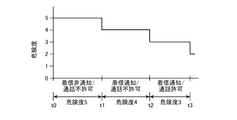
次に、この実施の形態1の処理内容の変化の一例として、ハンズフリー電話において、危険度の変化による処理内容の変化を、図7に示す。
図7に示すように、時間t0〜t1では、危険度が、ハンズフリー通話機器の第2の値(=危険度5)の値であるため、このときにハンズフリー電話の着信があっても、着信は非通知、通話も不許可となる。
Next, as an example of the change in the processing content of the first embodiment, the change in the processing content due to the change in the risk level in the hands-free telephone is shown in FIG.
As shown in FIG. 7, at time t0 to t1, the danger level is the second value (= risk level 5) of the hands-free call device. Incoming calls are not notified and calls are not allowed.
着信が継続したまま、時間t1を超えたところで、危険度が4に変化したとする。図7に示すように、時間t1〜t2では、危険度が、第1の値(=危険度3)より大きく、かつ、第2の値(=危険度5)より小さいため、ハンズフリー電話の処理状態は、通話不許可であるが、着信があった旨を通知する。 Assume that the danger level changes to 4 when the time t1 is exceeded while the incoming call continues. As shown in FIG. 7, since the risk level is greater than the first value (= risk level 3) and less than the second value (= risk level 5) from time t1 to time t2, The processing state is that the call is not permitted, but the fact that there is an incoming call is notified.
そしてさらに、着信が継続したまま、時間t2を超えたところで、危険度が3に変化したとする。図7に示すように、時間t2〜t3では、危険度が、第1の値(=危険度3)以下のため、ハンズフリー電話の処理状態は、通話可能となり、通話音声をスピーカ20から出力させる。
Further, it is assumed that the danger level changes to 3 when the time t2 is exceeded while the incoming call continues. As shown in FIG. 7, at time t2 to t3, the danger level is equal to or less than the first value (= risk level 3), so the hands-free telephone processing state becomes possible and the call voice is output from the
このように、危険度が変化すると、それに対応したハンズフリー電話着信処理を行い、着信が切れるか、通話が終了するまで繰り返す。
以上が、危険度の遷移によるハンズフリー電話着信処理内容の変化の一例である。
In this way, when the degree of danger changes, a hands-free incoming call process corresponding to the change is performed, and the process is repeated until the incoming call is cut off or the call ends.
The above is an example of the change in the contents of the hands-free incoming call process due to the transition of the risk level.
また、ルート案内時とハンズフリー通話時の危険度の閾値となる第1の値・第2の値、および、危険範囲・安全範囲の一例を、図8に示す。
前述の実施の形態1では、図8(a)に示すように、危険度は0から5までのいずれかに設定されているものとし、ナビゲーション装置の第1の値を危険度0、ナビゲーション装置の第2の値を危険度2、ハンズフリー通話機器の第1の値を危険度3、ハンズフリー通話機器の第2の値を危険度5として説明した。
Further, FIG. 8 shows an example of the first value and the second value, and the danger range / safety range, which are threshold values of the danger level at the time of route guidance and a hands-free call.
In the first embodiment described above, as shown in FIG. 8A, it is assumed that the degree of risk is set to any one of 0 to 5, and the first value of the navigation device is set to risk level 0, the navigation device. The second value is described as a
この場合、ルート案内時に安全な状況であると判定される安全範囲は、危険度0のときのみであり、危険度1〜5のときは、ルート案内時に危険な状況であると判定される危険範囲である。また、ハンズフリー通話時に安全な状況であると判定される安全範囲は、危険度0〜3のときであり、危険度4〜5のときは、ハンズフリー通話時に危険な状況であると判定される危険範囲である。 In this case, the safe range that is determined to be a safe situation at the time of route guidance is only when the risk is 0, and the danger that is determined to be a dangerous situation at the time of route guidance when the risk is 1 to 5. It is a range. Further, the safe range that is determined to be a safe situation during a hands-free call is when the danger level is 0 to 3, and when the danger level is 4 to 5, it is determined that the situation is a dangerous situation during a hands-free call. This is a dangerous range.
一般的に、ハンズフリー通話時よりもルート案内時の方が、運転者はより運転に集中しなければいけない状況であると考えられるため、上記のように、ハンズフリー通話機器がナビゲーション装置よりも危険度が高い状況で使用可能であるように、それぞれの報知機器の第1の値および第2の値を設定しておけばよい。そして、制御部9は、ハンズフリー通話機器がナビゲーション装置よりも危険度が高い状況で使用可能であるように、ハンズフリー通話機器の報知態様およびナビゲーション装置の報知態様を決定する。
In general, it is considered that the driver needs to concentrate more on driving during route guidance than on hands-free calling. What is necessary is just to set the 1st value and 2nd value of each alerting | reporting apparatus so that it can be used in a situation with high risk. Then, the
なお、ナビゲーション装置の第1の値および第2の値と、ハンズフリー通話機器の第1の値および第2の値は、第2の値が第1の値よりも大きければ、他の値であってもよい。例えば、図8(b)に示すように、ナビゲーション装置の第1の値を危険度0、ナビゲーション装置の第2の値を危険度2、ハンズフリー通話機器の第1の値を危険度0、ハンズフリー通話機器の第2の値を危険度5としてもよい。
Note that the first value and the second value of the navigation device, and the first value and the second value of the hands-free calling device are other values as long as the second value is larger than the first value. There may be. For example, as shown in FIG. 8 (b), the first value of the navigation device is the risk level 0, the second value of the navigation device is the
以上のように、この実施の形態1によれば、車両周辺情報検知カメラと、センサで取得した車両周辺状況情報と、ドライバ視線検知カメラで取得した運転手の状況やGPSレシーバとCAN情報から取得した車両状況からなる運転状況情報とを組み合わせ、車両周辺状況が危険な場合やその危険な状況を運転者が確認できていない場合におけるルート案内やハンズフリー通話において、安全であると判断できるタイミングで、ルート案内を報知したりハンズフリー通話を許可することができ、危険な状況では、運転操作に注力することができるので、より安全な運転支援を行うことができる。 As described above, according to the first embodiment, the vehicle periphery information detection camera, the vehicle periphery state information acquired by the sensor, the driver state acquired by the driver gaze detection camera, and the GPS receiver and CAN information are acquired. In combination with driving situation information consisting of the vehicle situation, it is possible to determine that it is safe for route guidance and hands-free calls when the situation around the vehicle is dangerous or when the driver has not confirmed the dangerous situation. In addition, it is possible to notify route guidance or permit hands-free calling, and in a dangerous situation, it is possible to focus on driving operation, so that safer driving assistance can be performed.
なお、本願発明はその発明の範囲内において、実施の形態の任意の構成要素の変形、もしくは実施の形態の任意の構成要素の省略が可能である。 In the present invention, any constituent element of the embodiment can be modified or any constituent element of the embodiment can be omitted within the scope of the invention.
1 車両周辺検知カメラ部、2 センサ部、3 ドライバ視線検知カメラ部、4 車両状況通知部、5 周辺状況情報受信部、6 運転状況情報受信部、7 危険度判定部、8 危険度決定テーブル記憶部、9 制御部、10 GPSレシーバ、11 トリガー受信部、12 ルート案内処理部、13 ハンズフリー電話処理部、14 音声出力部、15 表示装置、16 携帯電話、20 スピーカ、100 車載機器制御装置。
DESCRIPTION OF
Claims (13)
前記車両の運転状況の情報を受信する運転状況情報受信部と、
前記周辺状況情報受信部が受信した周辺状況情報と前記運転状況情報受信部が受信した運転状況情報とに基づいて、前記車両の危険度を判定する危険度判定部と、
前記危険度判定部により判定された危険度に基づいて、前記車両の運転者に情報を報知する報知機器の報知態様を変更制御する制御部と、
を備えたことを特徴とする車載機器制御装置。 A surrounding information receiving unit for receiving information on the surroundings of the vehicle;
A driving situation information receiving unit for receiving information on the driving situation of the vehicle;
A risk determination unit that determines a risk level of the vehicle based on the peripheral status information received by the peripheral status information reception unit and the driving status information received by the driving status information reception unit;
Based on the risk determined by the risk determination unit, a control unit for changing and controlling a notification mode of a notification device that notifies the driver of the vehicle,
An in-vehicle device control device comprising:
前記ルート案内処理部または前記ハンズフリー電話処理部からトリガーを受信するトリガー受信部をさらに備え、
前記トリガー受信部が、前記ルート案内処理部から前記トリガーを受信した場合には、案内開始ポイントからルート案内地点の報知が終了するまでの間、前記周辺状況情報受信部および前記運転状況情報受信部はそれぞれ情報を取得し、
前記トリガー受信部が、前記ハンズフリー電話処理部から前記トリガーを受信した場合には、ハンズフリー電話の通話が終了するまでの間、前記周辺状況情報受信部および前記運転状況情報受信部はそれぞれ情報を取得する
ことを特徴とする請求項1記載の車載機器制御装置。 The notification device is a navigation device including a route guidance processing unit that performs route guidance processing to a destination, and a hands-free call device including a hands-free phone processing unit that performs hands-free call processing,
A trigger receiving unit for receiving a trigger from the route guidance processing unit or the hands-free telephone processing unit;
When the trigger receiving unit receives the trigger from the route guidance processing unit, the surrounding situation information receiving unit and the driving situation information receiving unit until the notification of the route guidance point from the guidance start point ends. Each get information,
When the trigger receiving unit receives the trigger from the hands-free phone processing unit, the peripheral status information receiving unit and the driving status information receiving unit are each information until the hands-free phone call is terminated. The vehicle-mounted device control device according to claim 1, wherein:
前記制御部は、前記ハンズフリー通話機器が前記ナビゲーション装置よりも前記危険度が高い状況で使用可能であるように、前記ハンズフリー通話機器の報知態様および前記ナビゲーション装置の報知態様を決定する
ことを特徴とする請求項1記載の車載機器制御装置。 The notification device is a navigation device and a hands-free call device,
The control unit determines a notification mode of the hands-free call device and a notification mode of the navigation device so that the hands-free call device can be used in a situation where the degree of risk is higher than that of the navigation device. The in-vehicle device control device according to claim 1, wherein
前記制御部は、前記危険度が、前記ナビゲーション装置の第1の値以下のとき、前記ナビゲーション装置で音声および表示により前記情報を報知するよう制御する
ことを特徴とする請求項3記載の車載機器制御装置。 When the notification device is a navigation device,
The in-vehicle device according to claim 3, wherein when the degree of risk is equal to or lower than a first value of the navigation device, the control unit controls the navigation device to notify the information by voice and display. Control device.
ことを特徴とする請求項4記載の車載機器制御装置。 When the degree of risk is greater than a first value of the navigation device and smaller than a second value that is greater than the first value, the control unit is configured to use the information only by voice in the navigation device. The vehicle-mounted device control device according to claim 4, wherein control is performed so as to notify the user.
ことを特徴とする請求項5記載の車載機器制御装置。 The control unit according to claim 5, wherein when the degree of risk is equal to or higher than a second value of the navigation device, the control unit controls to suspend notification of route guidance to the destination in the navigation device. In-vehicle device control device.
ことを特徴とする請求項6記載の車載機器制御装置。 The in-vehicle device control device according to claim 6, wherein the control unit controls the route guidance to be output by voice when a distance to the guidance point of the route guidance is equal to or less than a predetermined distance. .
前記制御部は、前記危険度が、前記ハンズフリー通話機器の第1の値以下のとき、前記ハンズフリー通話機器を通話可能に制御する
ことを特徴とする請求項3記載の車載機器制御装置。 When the notification device is a hands-free call device,
The in-vehicle device control device according to claim 3, wherein the control unit controls the hands-free call device so that a call can be made when the degree of risk is equal to or less than a first value of the hands-free call device.
ことを特徴とする請求項8記載の車載機器制御装置。 The control unit receives an incoming call at the hands-free call device when the degree of risk is larger than a first value of the hands-free call device and smaller than a second value larger than the first value. The in-vehicle device control device according to claim 8, wherein the control is performed so as to notify that there is a message and that the call is not permitted.
ことを特徴とする請求項9記載の車載機器制御装置。 10. The control unit according to claim 9, wherein when the degree of risk is equal to or higher than a second value of the hands-free calling device, the control unit performs control so as not to notify even if there is an incoming call at the hands-free calling device. In-vehicle equipment control device.
ことを特徴とする請求項10記載の車載機器制御装置。 11. The control unit according to claim 10, wherein if the incoming call is interrupted when the degree of risk becomes smaller than the second value, the control unit controls to notify that the incoming call has occurred. In-vehicle equipment control device.
前記車両の運転状況を検知するセンサと、
前記車両の周辺状況を検知するセンサから前記周辺状況の情報を受信する周辺状況情報受信部と、
前記車両の運転状況を検知するセンサから前記運転状況の情報を受信する運転状況情報受信部と、
前記周辺状況情報受信部が受信した周辺状況情報と前記運転状況情報受信部が受信した運転状況情報とに基づいて、前記車両の危険度を判定する危険度判定部と、
前記車両の運転者に情報を報知する報知機器と、
前記危険度判定部により判定された危険度に基づいて、前記報知機器の報知態様を変更制御する制御部と、
を備えたことを特徴とする車載機器制御システム。 A sensor for detecting the situation around the vehicle;
A sensor for detecting a driving situation of the vehicle;
A surrounding situation information receiving unit that receives information on the surrounding situation from a sensor that detects the surrounding situation of the vehicle;
A driving situation information receiving unit that receives information of the driving situation from a sensor that detects the driving situation of the vehicle;
A risk determination unit that determines a risk level of the vehicle based on the peripheral status information received by the peripheral status information reception unit and the driving status information received by the driving status information reception unit;
A notification device for reporting information to a driver of the vehicle;
Based on the risk determined by the risk determination unit, a control unit for changing and controlling the notification mode of the notification device;
An in-vehicle device control system comprising:
運転状況情報受信部が、前記車両の運転状況の情報を受信するステップと、
危険度判定部が、前記周辺状況情報受信部が受信した周辺状況情報と前記運転状況情報受信部が受信した運転状況情報とに基づいて、前記車両の危険度を判定するステップと、
制御部が、前記危険度判定部により判定された危険度に基づいて、前記車両の運転者に情報を報知する報知機器の報知態様を変更制御するステップと、
を備えたことを特徴とする車載機器制御方法。 A step of receiving information on the surrounding situation of the vehicle by the surrounding situation information receiving unit;
A driving status information receiving unit receiving information on the driving status of the vehicle;
A step of determining a risk level of the vehicle based on the surrounding situation information received by the surrounding situation information receiving unit and the driving situation information received by the driving situation information receiving unit;
A control unit changing and controlling a notification mode of a notification device that notifies the driver of the vehicle based on the risk determined by the risk determination unit;
An in-vehicle device control method comprising:
Priority Applications (1)
| Application Number | Priority Date | Filing Date | Title |
|---|---|---|---|
| JP2014043004A JP2015169472A (en) | 2014-03-05 | 2014-03-05 | On-vehicle equipment controller, on-vehicle equipment control system, and on-vehicle equipment control method |
Applications Claiming Priority (1)
| Application Number | Priority Date | Filing Date | Title |
|---|---|---|---|
| JP2014043004A JP2015169472A (en) | 2014-03-05 | 2014-03-05 | On-vehicle equipment controller, on-vehicle equipment control system, and on-vehicle equipment control method |
Publications (1)
| Publication Number | Publication Date |
|---|---|
| JP2015169472A true JP2015169472A (en) | 2015-09-28 |
Family
ID=54202341
Family Applications (1)
| Application Number | Title | Priority Date | Filing Date |
|---|---|---|---|
| JP2014043004A Pending JP2015169472A (en) | 2014-03-05 | 2014-03-05 | On-vehicle equipment controller, on-vehicle equipment control system, and on-vehicle equipment control method |
Country Status (1)
| Country | Link |
|---|---|
| JP (1) | JP2015169472A (en) |
Cited By (10)
| Publication number | Priority date | Publication date | Assignee | Title |
|---|---|---|---|---|
| US9979813B2 (en) | 2016-10-04 | 2018-05-22 | Allstate Solutions Private Limited | Mobile device communication access and hands-free device activation |
| US10360636B1 (en) | 2012-08-01 | 2019-07-23 | Allstate Insurance Company | System for capturing passenger and trip data for a taxi vehicle |
| JP2019197565A (en) * | 2019-07-03 | 2019-11-14 | 株式会社東芝 | Wearable terminal, system and method |
| JP2019537806A (en) * | 2016-09-13 | 2019-12-26 | アリティ インターナショナル リミテッド | System and method for detecting movement of a mobile device in a vehicle using accelerometer data |
| US10699347B1 (en) | 2016-02-24 | 2020-06-30 | Allstate Insurance Company | Polynomial risk maps |
| JP2020530671A (en) * | 2017-11-20 | 2020-10-22 | グーグル エルエルシー | Dynamic adaptation of the provision of notification output to reduce user distraction and / or reduce the use of computational resources |
| JPWO2021220812A1 (en) * | 2020-04-27 | 2021-11-04 | ||
| US11295218B2 (en) | 2016-10-17 | 2022-04-05 | Allstate Solutions Private Limited | Partitioning sensor based data to generate driving pattern map |
| US11307042B2 (en) | 2015-09-24 | 2022-04-19 | Allstate Insurance Company | Three-dimensional risk maps |
| US11350242B2 (en) | 2016-09-13 | 2022-05-31 | Arity International Limited | Detecting device movement and/or device usage within a vehicle |
Citations (5)
| Publication number | Priority date | Publication date | Assignee | Title |
|---|---|---|---|---|
| JP2001144850A (en) * | 1999-11-12 | 2001-05-25 | Denso Corp | Vehicle-mounted telephone system and vehicle-side device used in the system |
| JP2008241309A (en) * | 2007-03-26 | 2008-10-09 | Denso Corp | Vehicle service presentation device |
| JP2009159237A (en) * | 2007-12-26 | 2009-07-16 | Denso Corp | In-vehicle hands-free device |
| JP2011237217A (en) * | 2010-05-07 | 2011-11-24 | Clarion Co Ltd | On-vehicle information terminal |
| JP2012194060A (en) * | 2011-03-16 | 2012-10-11 | Denso Corp | Information providing device |
-
2014
- 2014-03-05 JP JP2014043004A patent/JP2015169472A/en active Pending
Patent Citations (5)
| Publication number | Priority date | Publication date | Assignee | Title |
|---|---|---|---|---|
| JP2001144850A (en) * | 1999-11-12 | 2001-05-25 | Denso Corp | Vehicle-mounted telephone system and vehicle-side device used in the system |
| JP2008241309A (en) * | 2007-03-26 | 2008-10-09 | Denso Corp | Vehicle service presentation device |
| JP2009159237A (en) * | 2007-12-26 | 2009-07-16 | Denso Corp | In-vehicle hands-free device |
| JP2011237217A (en) * | 2010-05-07 | 2011-11-24 | Clarion Co Ltd | On-vehicle information terminal |
| JP2012194060A (en) * | 2011-03-16 | 2012-10-11 | Denso Corp | Information providing device |
Cited By (29)
| Publication number | Priority date | Publication date | Assignee | Title |
|---|---|---|---|---|
| US10997669B1 (en) | 2012-08-01 | 2021-05-04 | Allstate Insurance Company | System for capturing passenger and trip data for a vehicle |
| US11501384B2 (en) | 2012-08-01 | 2022-11-15 | Allstate Insurance Company | System for capturing passenger and trip data for a vehicle |
| US10360636B1 (en) | 2012-08-01 | 2019-07-23 | Allstate Insurance Company | System for capturing passenger and trip data for a taxi vehicle |
| US11307042B2 (en) | 2015-09-24 | 2022-04-19 | Allstate Insurance Company | Three-dimensional risk maps |
| US11763391B1 (en) | 2016-02-24 | 2023-09-19 | Allstate Insurance Company | Polynomial risk maps |
| US12154178B2 (en) | 2016-02-24 | 2024-11-26 | Allstate Insurance Company | Polynomial risk maps |
| US11068998B1 (en) | 2016-02-24 | 2021-07-20 | Allstate Insurance Company | Polynomial risk maps |
| US10699347B1 (en) | 2016-02-24 | 2020-06-30 | Allstate Insurance Company | Polynomial risk maps |
| US11350242B2 (en) | 2016-09-13 | 2022-05-31 | Arity International Limited | Detecting device movement and/or device usage within a vehicle |
| JP2019537806A (en) * | 2016-09-13 | 2019-12-26 | アリティ インターナショナル リミテッド | System and method for detecting movement of a mobile device in a vehicle using accelerometer data |
| US12150009B2 (en) | 2016-09-13 | 2024-11-19 | Allstate Insurance Company | Detecting device movement and/or device usage within a vehicle |
| US10863019B2 (en) | 2016-10-04 | 2020-12-08 | Allstate Solutions Private Limited | Mobile device communication access and hands-free device activation |
| US12133275B2 (en) | 2016-10-04 | 2024-10-29 | Allstate Solutions Private Limited | Mobile device communication access and hands-free device activation |
| US9979813B2 (en) | 2016-10-04 | 2018-05-22 | Allstate Solutions Private Limited | Mobile device communication access and hands-free device activation |
| US10257345B2 (en) | 2016-10-04 | 2019-04-09 | Allstate Solutions Private Limited | Mobile device communication access and hands-free device activation |
| US11394820B2 (en) | 2016-10-04 | 2022-07-19 | Allstate Solutions Private Limited | Mobile device communication access and hands-free device activation |
| US12086730B2 (en) | 2016-10-17 | 2024-09-10 | Allstate Solutions Private Limited | Partitioning sensor based data to generate driving pattern map |
| US11669756B2 (en) | 2016-10-17 | 2023-06-06 | Allstate Solutions Private Limited | Partitioning sensor based data to generate driving pattern map |
| US11295218B2 (en) | 2016-10-17 | 2022-04-05 | Allstate Solutions Private Limited | Partitioning sensor based data to generate driving pattern map |
| JP7066753B2 (en) | 2017-11-20 | 2022-05-13 | グーグル エルエルシー | Dynamic adaptation of the provision of notification output to reduce user distraction and / or reduce the use of computational resources |
| US11871219B2 (en) | 2017-11-20 | 2024-01-09 | Google Llc | Dynamically adapting provision of notification output to reduce user distraction and/or mitigate usage of computational resources |
| US11129134B2 (en) | 2017-11-20 | 2021-09-21 | Google Llc | Dynamically adapting provision of notification output to reduce user distraction and/or mitigate usage of computational resources |
| JP2020530671A (en) * | 2017-11-20 | 2020-10-22 | グーグル エルエルシー | Dynamic adaptation of the provision of notification output to reduce user distraction and / or reduce the use of computational resources |
| US12213103B2 (en) | 2017-11-20 | 2025-01-28 | Google Llc | Dynamically adapting provision of notification output to reduce user distraction and/or mitigate usage of computational resources |
| JP2019197565A (en) * | 2019-07-03 | 2019-11-14 | 株式会社東芝 | Wearable terminal, system and method |
| CN115461699A (en) * | 2020-04-27 | 2022-12-09 | 索尼集团公司 | Information processing device, information processing method, output device, output method, program, and notification system |
| WO2021220812A1 (en) * | 2020-04-27 | 2021-11-04 | ソニーグループ株式会社 | Information processing device, information processing method, output device, output method, program, and notification system |
| JPWO2021220812A1 (en) * | 2020-04-27 | 2021-11-04 | ||
| US12556629B2 (en) | 2020-04-27 | 2026-02-17 | Sony Group Corporation | Information processing apparatus, information processing method, outputting apparatus, outputting method, and notification system |
Similar Documents
| Publication | Publication Date | Title |
|---|---|---|
| JP2015169472A (en) | On-vehicle equipment controller, on-vehicle equipment control system, and on-vehicle equipment control method | |
| JP5958303B2 (en) | Text-to-speech device | |
| US11537354B2 (en) | Head-up display system | |
| US9977239B2 (en) | Vehicle information presentation device | |
| US9266473B1 (en) | Remote hands-free backseat driver | |
| US11489954B2 (en) | Vehicular electronic device and operation method thereof | |
| JP2009043003A (en) | Driving assistance device | |
| WO2015114697A1 (en) | Display device, display method, and non-transitory computer-readable medium having display program stored therein | |
| WO2011058822A1 (en) | Vehicle surrounding display device, vehicle surrounding display method | |
| JP2018165098A (en) | Head-up display device | |
| JP2005332297A (en) | Driver will notification device | |
| JP2019113520A (en) | Onboard information display device and used language estimating device | |
| JP6295360B1 (en) | Message display program, message display device, and message display method | |
| JP2007141223A (en) | Information processing apparatus and method, recording medium, and program | |
| JP7432864B2 (en) | Vehicle display control device and vehicle display control method | |
| JP2023021123A (en) | Driving support device, driving situation information acquisition system, driving support method and program | |
| WO2018168531A1 (en) | Head-up display device | |
| JP6230699B2 (en) | Perimeter monitoring device, perimeter monitoring system, and perimeter monitoring method | |
| WO2019123784A1 (en) | Onboard information display device and working language estimation device | |
| JP2008257582A (en) | Driving assistance device | |
| US12536997B2 (en) | Information processing device and information processing method | |
| JP2015210580A (en) | Display system and wearable device | |
| JP2015161565A (en) | Navigation device, navigation method and program | |
| JP2018087852A (en) | Virtual image display device | |
| JP4453579B2 (en) | Car phone system |
Legal Events
| Date | Code | Title | Description |
|---|---|---|---|
| A977 | Report on retrieval |
Free format text: JAPANESE INTERMEDIATE CODE: A971007 Effective date: 20160121 |
|
| A131 | Notification of reasons for refusal |
Free format text: JAPANESE INTERMEDIATE CODE: A131 Effective date: 20160126 |
|
| A521 | Written amendment |
Free format text: JAPANESE INTERMEDIATE CODE: A523 Effective date: 20160317 |
|
| A02 | Decision of refusal |
Free format text: JAPANESE INTERMEDIATE CODE: A02 Effective date: 20160830 |