EP4455255A1 - Geschirrspülmittel sowie dessen verwendung - Google Patents
Geschirrspülmittel sowie dessen verwendung Download PDFInfo
- Publication number
- EP4455255A1 EP4455255A1 EP24000041.4A EP24000041A EP4455255A1 EP 4455255 A1 EP4455255 A1 EP 4455255A1 EP 24000041 A EP24000041 A EP 24000041A EP 4455255 A1 EP4455255 A1 EP 4455255A1
- Authority
- EP
- European Patent Office
- Prior art keywords
- alkyl
- group
- dishwashing detergent
- aryl
- sodium
- Prior art date
- Legal status (The legal status is an assumption and is not a legal conclusion. Google has not performed a legal analysis and makes no representation as to the accuracy of the status listed.)
- Pending
Links
Classifications
-
- C—CHEMISTRY; METALLURGY
- C11—ANIMAL OR VEGETABLE OILS, FATS, FATTY SUBSTANCES OR WAXES; FATTY ACIDS THEREFROM; DETERGENTS; CANDLES
- C11D—DETERGENT COMPOSITIONS; USE OF SINGLE SUBSTANCES AS DETERGENTS; SOAP OR SOAP-MAKING; RESIN SOAPS; RECOVERY OF GLYCEROL
- C11D3/00—Other compounding ingredients of detergent compositions covered in group C11D1/00
- C11D3/39—Organic or inorganic per-compounds
- C11D3/3902—Organic or inorganic per-compounds combined with specific additives
- C11D3/3905—Bleach activators or bleach catalysts
- C11D3/3907—Organic compounds
- C11D3/3917—Nitrogen-containing compounds
- C11D3/392—Heterocyclic compounds, e.g. cyclic imides or lactames
-
- C—CHEMISTRY; METALLURGY
- C11—ANIMAL OR VEGETABLE OILS, FATS, FATTY SUBSTANCES OR WAXES; FATTY ACIDS THEREFROM; DETERGENTS; CANDLES
- C11D—DETERGENT COMPOSITIONS; USE OF SINGLE SUBSTANCES AS DETERGENTS; SOAP OR SOAP-MAKING; RESIN SOAPS; RECOVERY OF GLYCEROL
- C11D3/00—Other compounding ingredients of detergent compositions covered in group C11D1/00
- C11D3/02—Inorganic compounds ; Elemental compounds
- C11D3/12—Water-insoluble compounds
- C11D3/124—Silicon containing, e.g. silica, silex, quartz or glass beads
- C11D3/1246—Silicates, e.g. diatomaceous earth
- C11D3/1253—Layer silicates, e.g. talcum, kaolin, clay, bentonite, smectite, montmorillonite, hectorite or attapulgite
- C11D3/126—Layer silicates, e.g. talcum, kaolin, clay, bentonite, smectite, montmorillonite, hectorite or attapulgite in solid compositions
-
- C—CHEMISTRY; METALLURGY
- C11—ANIMAL OR VEGETABLE OILS, FATS, FATTY SUBSTANCES OR WAXES; FATTY ACIDS THEREFROM; DETERGENTS; CANDLES
- C11D—DETERGENT COMPOSITIONS; USE OF SINGLE SUBSTANCES AS DETERGENTS; SOAP OR SOAP-MAKING; RESIN SOAPS; RECOVERY OF GLYCEROL
- C11D1/00—Detergent compositions based essentially on surface-active compounds; Use of these compounds as a detergent
- C11D1/66—Non-ionic compounds
- C11D1/72—Ethers of polyoxyalkylene glycols
-
- C—CHEMISTRY; METALLURGY
- C11—ANIMAL OR VEGETABLE OILS, FATS, FATTY SUBSTANCES OR WAXES; FATTY ACIDS THEREFROM; DETERGENTS; CANDLES
- C11D—DETERGENT COMPOSITIONS; USE OF SINGLE SUBSTANCES AS DETERGENTS; SOAP OR SOAP-MAKING; RESIN SOAPS; RECOVERY OF GLYCEROL
- C11D1/00—Detergent compositions based essentially on surface-active compounds; Use of these compounds as a detergent
- C11D1/66—Non-ionic compounds
- C11D1/74—Carboxylates or sulfonates esters of polyoxyalkylene glycols
-
- C—CHEMISTRY; METALLURGY
- C11—ANIMAL OR VEGETABLE OILS, FATS, FATTY SUBSTANCES OR WAXES; FATTY ACIDS THEREFROM; DETERGENTS; CANDLES
- C11D—DETERGENT COMPOSITIONS; USE OF SINGLE SUBSTANCES AS DETERGENTS; SOAP OR SOAP-MAKING; RESIN SOAPS; RECOVERY OF GLYCEROL
- C11D17/00—Detergent materials or soaps characterised by their shape or physical properties
- C11D17/0039—Coated compositions or coated components in the compositions, (micro)capsules
-
- C—CHEMISTRY; METALLURGY
- C11—ANIMAL OR VEGETABLE OILS, FATS, FATTY SUBSTANCES OR WAXES; FATTY ACIDS THEREFROM; DETERGENTS; CANDLES
- C11D—DETERGENT COMPOSITIONS; USE OF SINGLE SUBSTANCES AS DETERGENTS; SOAP OR SOAP-MAKING; RESIN SOAPS; RECOVERY OF GLYCEROL
- C11D3/00—Other compounding ingredients of detergent compositions covered in group C11D1/00
- C11D3/0005—Other compounding ingredients characterised by their effect
- C11D3/0047—Other compounding ingredients characterised by their effect pH regulated compositions
-
- C—CHEMISTRY; METALLURGY
- C11—ANIMAL OR VEGETABLE OILS, FATS, FATTY SUBSTANCES OR WAXES; FATTY ACIDS THEREFROM; DETERGENTS; CANDLES
- C11D—DETERGENT COMPOSITIONS; USE OF SINGLE SUBSTANCES AS DETERGENTS; SOAP OR SOAP-MAKING; RESIN SOAPS; RECOVERY OF GLYCEROL
- C11D3/00—Other compounding ingredients of detergent compositions covered in group C11D1/00
- C11D3/02—Inorganic compounds ; Elemental compounds
- C11D3/04—Water-soluble compounds
- C11D3/08—Silicates
-
- C—CHEMISTRY; METALLURGY
- C11—ANIMAL OR VEGETABLE OILS, FATS, FATTY SUBSTANCES OR WAXES; FATTY ACIDS THEREFROM; DETERGENTS; CANDLES
- C11D—DETERGENT COMPOSITIONS; USE OF SINGLE SUBSTANCES AS DETERGENTS; SOAP OR SOAP-MAKING; RESIN SOAPS; RECOVERY OF GLYCEROL
- C11D3/00—Other compounding ingredients of detergent compositions covered in group C11D1/00
- C11D3/02—Inorganic compounds ; Elemental compounds
- C11D3/04—Water-soluble compounds
- C11D3/10—Carbonates ; Bicarbonates
-
- C—CHEMISTRY; METALLURGY
- C11—ANIMAL OR VEGETABLE OILS, FATS, FATTY SUBSTANCES OR WAXES; FATTY ACIDS THEREFROM; DETERGENTS; CANDLES
- C11D—DETERGENT COMPOSITIONS; USE OF SINGLE SUBSTANCES AS DETERGENTS; SOAP OR SOAP-MAKING; RESIN SOAPS; RECOVERY OF GLYCEROL
- C11D3/00—Other compounding ingredients of detergent compositions covered in group C11D1/00
- C11D3/16—Organic compounds
- C11D3/20—Organic compounds containing oxygen
- C11D3/2075—Carboxylic acids-salts thereof
- C11D3/2086—Hydroxy carboxylic acids-salts thereof
-
- C—CHEMISTRY; METALLURGY
- C11—ANIMAL OR VEGETABLE OILS, FATS, FATTY SUBSTANCES OR WAXES; FATTY ACIDS THEREFROM; DETERGENTS; CANDLES
- C11D—DETERGENT COMPOSITIONS; USE OF SINGLE SUBSTANCES AS DETERGENTS; SOAP OR SOAP-MAKING; RESIN SOAPS; RECOVERY OF GLYCEROL
- C11D3/00—Other compounding ingredients of detergent compositions covered in group C11D1/00
- C11D3/16—Organic compounds
- C11D3/20—Organic compounds containing oxygen
- C11D3/22—Carbohydrates or derivatives thereof
- C11D3/222—Natural or synthetic polysaccharides, e.g. cellulose, starch, gum, alginic acid or cyclodextrin
- C11D3/225—Natural or synthetic polysaccharides, e.g. cellulose, starch, gum, alginic acid or cyclodextrin etherified, e.g. CMC
-
- C—CHEMISTRY; METALLURGY
- C11—ANIMAL OR VEGETABLE OILS, FATS, FATTY SUBSTANCES OR WAXES; FATTY ACIDS THEREFROM; DETERGENTS; CANDLES
- C11D—DETERGENT COMPOSITIONS; USE OF SINGLE SUBSTANCES AS DETERGENTS; SOAP OR SOAP-MAKING; RESIN SOAPS; RECOVERY OF GLYCEROL
- C11D3/00—Other compounding ingredients of detergent compositions covered in group C11D1/00
- C11D3/16—Organic compounds
- C11D3/34—Organic compounds containing sulfur
- C11D3/349—Organic compounds containing sulfur additionally containing nitrogen atoms, e.g. nitro, nitroso, amino, imino, nitrilo, nitrile groups containing compounds or their derivatives or thio urea
-
- C—CHEMISTRY; METALLURGY
- C11—ANIMAL OR VEGETABLE OILS, FATS, FATTY SUBSTANCES OR WAXES; FATTY ACIDS THEREFROM; DETERGENTS; CANDLES
- C11D—DETERGENT COMPOSITIONS; USE OF SINGLE SUBSTANCES AS DETERGENTS; SOAP OR SOAP-MAKING; RESIN SOAPS; RECOVERY OF GLYCEROL
- C11D3/00—Other compounding ingredients of detergent compositions covered in group C11D1/00
- C11D3/16—Organic compounds
- C11D3/37—Polymers
- C11D3/3703—Macromolecular compounds obtained otherwise than by reactions only involving carbon-to-carbon unsaturated bonds
- C11D3/3707—Polyethers, e.g. polyalkyleneoxides
-
- C—CHEMISTRY; METALLURGY
- C11—ANIMAL OR VEGETABLE OILS, FATS, FATTY SUBSTANCES OR WAXES; FATTY ACIDS THEREFROM; DETERGENTS; CANDLES
- C11D—DETERGENT COMPOSITIONS; USE OF SINGLE SUBSTANCES AS DETERGENTS; SOAP OR SOAP-MAKING; RESIN SOAPS; RECOVERY OF GLYCEROL
- C11D3/00—Other compounding ingredients of detergent compositions covered in group C11D1/00
- C11D3/16—Organic compounds
- C11D3/37—Polymers
- C11D3/3746—Macromolecular compounds obtained by reactions only involving carbon-to-carbon unsaturated bonds
- C11D3/3757—(Co)polymerised carboxylic acids, -anhydrides, -esters in solid and liquid compositions
-
- C—CHEMISTRY; METALLURGY
- C11—ANIMAL OR VEGETABLE OILS, FATS, FATTY SUBSTANCES OR WAXES; FATTY ACIDS THEREFROM; DETERGENTS; CANDLES
- C11D—DETERGENT COMPOSITIONS; USE OF SINGLE SUBSTANCES AS DETERGENTS; SOAP OR SOAP-MAKING; RESIN SOAPS; RECOVERY OF GLYCEROL
- C11D3/00—Other compounding ingredients of detergent compositions covered in group C11D1/00
- C11D3/16—Organic compounds
- C11D3/37—Polymers
- C11D3/3746—Macromolecular compounds obtained by reactions only involving carbon-to-carbon unsaturated bonds
- C11D3/3757—(Co)polymerised carboxylic acids, -anhydrides, -esters in solid and liquid compositions
- C11D3/3761—(Co)polymerised carboxylic acids, -anhydrides, -esters in solid and liquid compositions in solid compositions
-
- C—CHEMISTRY; METALLURGY
- C11—ANIMAL OR VEGETABLE OILS, FATS, FATTY SUBSTANCES OR WAXES; FATTY ACIDS THEREFROM; DETERGENTS; CANDLES
- C11D—DETERGENT COMPOSITIONS; USE OF SINGLE SUBSTANCES AS DETERGENTS; SOAP OR SOAP-MAKING; RESIN SOAPS; RECOVERY OF GLYCEROL
- C11D3/00—Other compounding ingredients of detergent compositions covered in group C11D1/00
- C11D3/16—Organic compounds
- C11D3/38—Products with no well-defined composition, e.g. natural products
- C11D3/386—Preparations containing enzymes, e.g. protease or amylase
- C11D3/38609—Protease or amylase in solid compositions only
-
- C—CHEMISTRY; METALLURGY
- C11—ANIMAL OR VEGETABLE OILS, FATS, FATTY SUBSTANCES OR WAXES; FATTY ACIDS THEREFROM; DETERGENTS; CANDLES
- C11D—DETERGENT COMPOSITIONS; USE OF SINGLE SUBSTANCES AS DETERGENTS; SOAP OR SOAP-MAKING; RESIN SOAPS; RECOVERY OF GLYCEROL
- C11D3/00—Other compounding ingredients of detergent compositions covered in group C11D1/00
- C11D3/39—Organic or inorganic per-compounds
- C11D3/3902—Organic or inorganic per-compounds combined with specific additives
- C11D3/3905—Bleach activators or bleach catalysts
-
- C—CHEMISTRY; METALLURGY
- C11—ANIMAL OR VEGETABLE OILS, FATS, FATTY SUBSTANCES OR WAXES; FATTY ACIDS THEREFROM; DETERGENTS; CANDLES
- C11D—DETERGENT COMPOSITIONS; USE OF SINGLE SUBSTANCES AS DETERGENTS; SOAP OR SOAP-MAKING; RESIN SOAPS; RECOVERY OF GLYCEROL
- C11D3/00—Other compounding ingredients of detergent compositions covered in group C11D1/00
- C11D3/39—Organic or inorganic per-compounds
- C11D3/3942—Inorganic per-compounds
-
- C—CHEMISTRY; METALLURGY
- C11—ANIMAL OR VEGETABLE OILS, FATS, FATTY SUBSTANCES OR WAXES; FATTY ACIDS THEREFROM; DETERGENTS; CANDLES
- C11D—DETERGENT COMPOSITIONS; USE OF SINGLE SUBSTANCES AS DETERGENTS; SOAP OR SOAP-MAKING; RESIN SOAPS; RECOVERY OF GLYCEROL
- C11D3/00—Other compounding ingredients of detergent compositions covered in group C11D1/00
- C11D3/395—Bleaching agents
- C11D3/3951—Bleaching agents combined with specific additives
-
- C—CHEMISTRY; METALLURGY
- C11—ANIMAL OR VEGETABLE OILS, FATS, FATTY SUBSTANCES OR WAXES; FATTY ACIDS THEREFROM; DETERGENTS; CANDLES
- C11D—DETERGENT COMPOSITIONS; USE OF SINGLE SUBSTANCES AS DETERGENTS; SOAP OR SOAP-MAKING; RESIN SOAPS; RECOVERY OF GLYCEROL
- C11D2111/00—Cleaning compositions characterised by the objects to be cleaned; Cleaning compositions characterised by non-standard cleaning or washing processes
- C11D2111/10—Objects to be cleaned
- C11D2111/14—Hard surfaces
- C11D2111/18—Glass; Plastics
-
- C—CHEMISTRY; METALLURGY
- C11—ANIMAL OR VEGETABLE OILS, FATS, FATTY SUBSTANCES OR WAXES; FATTY ACIDS THEREFROM; DETERGENTS; CANDLES
- C11D—DETERGENT COMPOSITIONS; USE OF SINGLE SUBSTANCES AS DETERGENTS; SOAP OR SOAP-MAKING; RESIN SOAPS; RECOVERY OF GLYCEROL
- C11D3/00—Other compounding ingredients of detergent compositions covered in group C11D1/00
- C11D3/39—Organic or inorganic per-compounds
- C11D3/3902—Organic or inorganic per-compounds combined with specific additives
- C11D3/3905—Bleach activators or bleach catalysts
- C11D3/3907—Organic compounds
- C11D3/3917—Nitrogen-containing compounds
Definitions
- the present invention relates to dishwashing detergents which are particularly suitable for removing hydrophobic red and yellow stains from dishes, as well as the use of these detergents, in particular in machine dishwashing.
- Modern automatic dishwashing detergents must meet a wide range of requirements. They should demonstrate improved cleaning and rinsing performance, even during low-temperature cleaning cycles or in cleaning cycles with reduced water consumption. Particular attention is paid to the drying properties of the automatic dishwashing detergents used. The need for additional manual drying of the cleaned dishes is undesirable; the formation of drops and residues on the treated dishes should be avoided.
- WO 2022/069468 A1 a detergent for removing stains or bad odors from textiles.
- This detergent contains a bleach, a bleach activator, a protease and an oxygen transfer agent such as 3-methyl-1,2-benzisothiazol-1,1-dioxide. The use of this agent for cleaning dishes is not described.
- Cogranulates are known that are used in washing and cleaning agents. These cogranulates are coated with cellulose ether and contain cyclic sulfonimine, bleach activator and cellulose ether as a binding agent. The use in dishwashing detergents is not disclosed.
- Granules are disclosed that can be used in washing and cleaning agents as well as in dishwashing detergents. These granules contain sulfonimines or quaternary iminium salts and acids that are solid at 25°C. The granules are characterized by high storage stability, contain highly active bleaching catalysts and develop a very good bleaching effect even at low temperatures. Examples of use for dishwashing detergents are not included in this document.
- Detergents and cleaning agents and dishwashing detergents differ in their composition. Although a number of components with the same composition can be used in these agents, they differ significantly from one another. For example, only non-ionic surfactants are used in dishwashing agents, whereas detergents generally contain anionic and non-ionic surfactants. Dishwashing detergents also often contain special additives such as glass corrosion inhibitors, silver corrosion inhibitors or foam regulators.
- the aim of the present invention was to provide dishwashing detergents which are ideal for removing red and yellow stains from dishes. In addition to their excellent cleaning performance, these detergents also have an excellent bleaching effect, which means that objects which have already been dyed red or yellow can be freed of color residues.
- dishwashing detergents containing sulfonimines and other selected ingredients show particularly good cleaning performance in removing red and yellow stains from dishes.
- all compounds previously used in dishwashing detergents can be used as builders or structural agents.
- phosphates such as pentasodium triphosphate. Since phosphates contribute to the eutrophication of water bodies, water-soluble organic compounds are now preferably used. These do not replace all the functions of phosphates and are therefore often used together with polycarboxylates, nitriloacetic acid, phosphonates, soda or complexing carboxylic acids such as citric acid salts.
- Preferably used builders contain at least 10% by weight, based on the total amount of builders, of crystalline sodium layer silicate of the formula (la) Na 2 Si x O 2x+1 ⁇ y H 2 O (Ia) where x is a number from 1.9 to 4 and y is a number from 0 to 20,
- Crystalline layered silicates according to formula (la) are described, for example, in the European patent application with the disclosure number EP 0 164 514 A1 described.
- Preferred crystalline layered silicates are those in which x in the general formula mentioned assumes the values 1.9 to 3.5.
- both delta- and beta-disodium disilicates (Na 2 Si 2 O 5 ⁇ y H 2 O) are preferred, whereby beta-disodium disilicate can be obtained, for example, by the process described in WO 91/08171 A1
- Beta-disodium silicates with a molar ratio of SiO 2 /Na 2 O between 1.9 and 3.2 can be obtained according to Japanese patent applications with the disclosure numbers JP 04/238 809 A or JP 04/260 610 A
- practically anhydrous crystalline alkali silicates produced from amorphous silicates of the above general formula (1), in which x is a number from 1.9 to 2.1, can be used.
- the crystalline layered disodium disilicate of the builder a) is composed of varying percentages of the polymorphic phases alpha, beta and delta.
- amorphous components may also be present. Due to the latter, x in commercial products can also be an odd number. 1.9 ⁇ x ⁇ 2.2 is preferred.
- alpha, beta and delta disodium disilicate are known and can be used, for example, in EP 0 164 514 A1 be taken.
- the disodium disilicate is layered crystalline disodium disilicate which consists of at least one of the polymorphic phases of the disodium disilicate and of sodium silicates of a non-layered silicate nature.
- crystalline sodium layer silicates containing 80 to 100% by weight of delta-disodium disilicate.
- crystalline sodium layer silicates with a content of 70 to 100 wt.% beta-disodium disilicate can also be used.
- Particularly preferably used crystalline sodium layer silicates contain 1 to 40 wt.% of alpha-disodium disilicate, 0 to 50 wt.%, in particular 0 to 45 wt.% of beta-disodium disilicate, 50 to 98 wt.% of delta-disodium disilicate and 0 to 40 wt.% of non-layer silicate sodium silicates (amorphous fractions).
- the dishwashing detergents according to the invention contain crystalline sodium layer silicate of the formula (Ia) in granulated form, as well as cogranulates containing crystalline sodium layer silicate and sparingly soluble metal carbonate, as for example in WO2007/101622 A1 described.
- the dishwashing detergents according to the invention contain crystalline sodium disilicates Na 2 Si 2 O 5 ⁇ y H 2 O with y being 0 to 2.
- the dishwashing detergents according to the invention can contain, in addition to crystalline sodium layer silicate according to formula (la), further water-soluble organic and/or inorganic builders.
- Alkali silicates and polymeric alkali phosphates which can be present in the form of their alkaline, neutral or acidic sodium or potassium salts, are particularly suitable as water-soluble inorganic builder materials.
- examples of these are trisodium phosphate, tetrasodium diphosphate, disodium dihydrogen diphosphate, pentasodium triphosphate, so-called sodium hexametaphosphate as well as the corresponding potassium salts or mixtures of sodium and potassium salts.
- the water-soluble organic builder substances include polycarboxylic acids or their salts, in particular citric acid and sugar acids, aminopolycarboxylic acids, in particular methylglycinediacetic acid or its salt (MGDA), glutamediacetic acid or its salt (GLDA), iminodisuccinic acid (IDS) and ethylenediaminedisuccinic acid or its salt (EDDS), nitrilotriacetic acid and ethylenediaminetetraacetic acid and polyaspartic acid.
- Polyphosphonic acids in particular aminotris(methylenephosphonic acid), ethylenediaminetetrakis(methylenephosphonic acid) and 1-hydroxyethane-1,1-diphosphonic acid, can also be used.
- Preferred builders or co-builders are also polycarboxylic acids, in particular the polycarboxylates accessible by oxidation of polysaccharides or dextrins, as in WO 93/16110 A1 , WO 92/18542 A1 or EP 0 232 202 A2 described, as well as polymeric acrylic acids, methacrylic acids, AMPS, maleic acids and copolymers of these, which may also contain small amounts of polymerizable substances without carboxylic acid functionality.
- the average molecular weight of the homopolymers of unsaturated carboxylic acids is generally between 2000 and 200 000, that of the copolymers between 2000 and 200 000, preferably between 50 000 and 120 000, in each case based on the free acid.
- a particularly preferred homopolymer is Sokalan ® PA 30 from BASF.
- a particularly preferred acrylic acid-maleic acid copolymer has an average molecular weight of 50,000 to 100,000.
- Commercially available products include Sokalan ® CP 5 and Sokalan ® CP 10 from BASF.
- copolymers of acrylic acid or methacrylic acid with AMPS vinyl ethers such as vinyl methyl ethers, vinyl esters, ethylene, propylene and styrene in which the proportion of acid is at least 50% by weight.
- vinyl ethers such as vinyl methyl ethers, vinyl esters, ethylene, propylene and styrene in which the proportion of acid is at least 50% by weight.
- Terpolymers containing two unsaturated acids and/or their salts as monomers and vinyl alcohol as the third monomer can also be used as water-soluble organic builders. and/or an esterified vinyl alcohol or a carbohydrate.
- the first acidic monomer or its salt is derived from a monoethylenically unsaturated C 3 -C 8 carboxylic acid, preferably from a C 3 -C 4 monocarboxylic acid, in particular from (meth)acrylic acid, whereby the second acidic monomer or its salt can be a derivative of a C 2 -C 6 dicarboxylic acid, whereby maleic acid and AMPS are particularly preferred, and/or a derivative of an allylsulfonic acid which is substituted in the 2-position with an alkyl or aryl radical.
- Such polymers can be produced in particular by processes which are described in the German patent documents DE 42 21 381 and DE 43 00 772 and generally have a relative molecular weight of between 1000 and 200,000.
- Other preferred copolymers are those described in the German patent applications with the disclosure number DE 43 03 320 A1 and DE 44 17 734 A1 and preferably contain acrolein and acrylic acid/acrylic acid salts or vinyl acetate as mono
- the organic builder substances can be used, in particular for the production of liquid agents, in the form of aqueous solutions, preferably in the form of 30 to 50% by weight aqueous solutions. All of the acids mentioned are generally used in the form of their water-soluble salts, in particular their alkali salts.
- water-soluble builder components include, for example, organic polymers of native or synthetic origin of the polycarboxylate type listed above, which act as co-builders particularly in hard water regions, and naturally occurring hydroxycarboxylic acids such as mono-, dihydroxysuccinic acid, alpha-hydroxypropionic acid and gluconic acid.
- the salts of citric acid especially sodium citrate, both anhydrous trisodium citrate and trisodium citrate dihydrate can be used.
- the dishwashing detergents according to the invention exhibit a pronounced cleaning power when they contain, in addition to crystalline layered silicate of formula (la), Builder selected from methylglycinediacetic acid or its salts, sodium gluconate, IDS, sodium tripolyphosphate (STTP) and/or sodium citrate.
- La crystalline layered silicate of formula (la)
- Builder selected from methylglycinediacetic acid or its salts, sodium gluconate, IDS, sodium tripolyphosphate (STTP) and/or sodium citrate.
- the dishwashing detergents according to the invention contain one or more builders in an amount of 10 to 90% by weight, preferably 15 to 70% by weight, particularly preferably 20 to 60% by weight, and very particularly preferably 30 to 55% by weight, in each case based on the total weight of the dishwashing detergents according to the invention.
- the dishwashing detergents according to the invention contain bleach activators b). These are compounds that release peroxocarboxylic acids under perhydrolysis conditions.
- Suitable bleach activators contain O- and/or N-acyl groups.
- the dishwashing detergents according to the invention preferably contain acylated alkylenediamines, in particular tetraacetylethylenediamine (TAED), acylated glycolurils, in particular tetraacetylglycoluril (TAGU), acylated triazine derivatives - in particular 1,5-diacetyl-2,4-dioxohexahydro-1,3,5-triazine (DADHT), acylated phenylsulfonates, in particular nonanoyl, isononanoyl or lauroyloxybenzenesulfonate (NOBS, ISONOBS or LOBS) or their amido derivatives (e.g.
- TAED tetraacetylethylenediamine
- TAGU acylated glycolurils
- TAGU tetraacetylglycoluril
- DADHT acylated triazine derivatives - in particular
- NACAOBS acylated hydroxycarboxylic acids such as acetylsalicylic acid or nonanoyloxybenzoic acid (NOBA) and decanoyloxybenzoic acid (DOBA), acetyltriethylcitrate, acylated polyhydric alcohols, in particular triacetin, ethylene glycol diacetate and 2,5-diacetoxy-2,5-dihydrofuran as well as acetylated sorbitol and mannitol, and acylated sugar derivatives, in particular pentaacetylglucose (PAG), pentaacetylfructose, tetraacetylxylose and octaacetyllactose as well as acetylated, optionally N-alkylated glucamine and gluconolactone, as well as N-acetylcaprolactam, N-benzoylcaprolactam and
- open-chain or cyclic nitrile quats as well as those from DE-A 44 43 177 known combinations of bleach activators.
- the dishwashing detergents contain acylated alkylenediamines, in particular tetraacetylethylenediamine (TAED), acylated glycolurils, in particular tetraacetylglycoluril (TAGU), acylated triazine derivatives, in particular 1,5-diacetyl-2,4-dioxohexahydro-1,3,5-triazine (DADHT), acylated phenylsulfonates, in particular nonanoyl, isononanoyl or lauroyloxybenzenesulfonate (NOBS, ISONOBS or LOBS) or their amido derivatives (e.g. NACAOBS), acylated hydroxycarboxylic acids such as acetylsalicylic acid or nonanoyloxybenzoic acid (NOBA) and decanoyloxybenzoic acid (DOBA).
- TAED tetraacetylethylenedi
- the dishwashing detergents contain acylated alkylenediamines, in particular tetraacetylethylenediamine (TAED).
- TAED tetraacetylethylenediamine
- the dishwashing detergents according to the invention contain one or more bleach activators in an amount of 0.1 to 20 wt. %, preferably 0.5 to 10 wt. %, particularly preferably 0.5 to 8 wt. %, and very particularly preferably 1 to 6 wt. %, in each case based on the total weight of the dishwashing detergents according to the invention.
- the dishwashing detergents according to the invention contain non-ionic surfactants c).
- alcohol ethoxylates with linear radicals are made from alcohols of native origin with 12 to 18 C atoms, e.g. B.
- the degrees of ethoxylation and propoxylation given above represent statistical averages which may be a whole or a fractional number for a specific product.
- the dishwashing detergents according to the invention can also contain alkyl glycosides of the general formula RO(G) x , in which R is a primary straight-chain or methyl-branched, in particular methyl-branched in the 2-position, aliphatic radical having 8 to 22, preferably 12 to 18 C atoms, and G is a glycose unit having 5 or 6 C atoms, preferably glucose.
- the degree of oligomerization x which indicates the distribution of monoglycosides and oligoglycosides, is any number, which as a quantity to be determined analytically can also assume fractional values, between 1 and 10; x is preferably 1.2 to 1.4.
- the dishwashing detergents according to the invention can also contain polyhydroxy fatty acid amides of the formula (VIII) in which R 1 CO is an aliphatic acyl radical having 6 to 22 carbon atoms, R 2 is hydrogen, an alkyl or hydroxyalkyl radical having 1 to 4 carbon atoms and Z is a linear or branched polyhydroxyalkyl radical having 3 to 10 carbon atoms and 3 to 10 hydroxyl groups.
- the polyhydroxy fatty acid amides are preferably derived from reducing sugars with 5 or 6 carbon atoms, in particular from glucose.
- the group of polyhydroxy fatty acid amides also includes compounds of the formula (IX) in which R 3 is a linear or branched alkyl or alkenyl radical having 7 to 21 carbon atoms, R 4 is a linear, branched or cyclic alkylene radical or an arylene radical having 6 to 8 carbon atoms and R 5 is a linear, branched or cyclic alkyl radical or an aryl radical or an oxyalkyl radical having 1 to 8 carbon atoms, with C 1 -C 4 alkyl or phenyl radicals being preferred, and Z is a linear polyhydroxyalkyl radical whose alkyl chain is substituted by at least two hydroxyl groups, or alkoxylated, preferably ethoxylated or propoxylated derivatives of this radical.
- R 3 is a linear or branched alkyl or alkenyl radical having 7 to 21 carbon atoms
- R 4 is a linear, branched or cyclic alkylene radical or an ary
- Z is preferably obtained by reductive amination of a sugar such as glucose, fructose, maltose, lactose, galactose, mannose or xylose.
- a sugar such as glucose, fructose, maltose, lactose, galactose, mannose or xylose.
- the N-alkoxy- or N-alyloxy-substituted compounds can then be converted into the desired polyhydroxy fatty acid amides, for example by reaction with fatty acid methyl esters in the presence of an alkoxide as a catalyst.
- nonionic surfactants preferably used in the context of the present invention which are used either as the sole nonionic surfactant or in combination with other nonionic surfactants, in particular together with alkoxylated fatty alcohols and/or alkyl glycosides, are alkoxylated, preferably ethoxylated or ethoxylated and propoxylated fatty acid alkyl esters, preferably with 1 to 4 carbon atoms in the alkyl chain, in particular fatty acid methyl esters.
- Nonionic surfactants of the amine oxide type for example N-cocoalkyl-N,N-dimethylamine oxide and N-tallowalkyl-N,N-dihydroxyethylamine oxide, and of the fatty acid alkanolamide type may also be suitable according to the invention.
- the proportion of the one or more nonionic surfactants in the total weight of the dishwashing detergents according to the invention is 0.1 to 20 wt.%, preferably 0.1 to 10 wt.%, particularly preferably 0.5 to 8 wt.%, and very particularly preferably 1 to 6 wt.%.
- the dishwashing detergents according to the invention contain oxygen-containing bleaching agents d).
- Bleaching agents are, on the one hand, oxygen-containing compounds that react with bleach activators to form peroxyacids that bleach much more effectively at low temperatures (e.g. ⁇ 70 °C) than the bleaching agents alone.
- Suitable bleaching agents of this type are hydrogen peroxide and inorganic persalts, preferably percarbonates, perborates, persulfates and persilicates, in particular in the form of alkali metal salts.
- Particularly preferred bleaching agents of this type are hydrogen peroxide, sodium perborate (monohydrate and tetrahydrate) and/or sodium percarbonate, particularly preferably sodium perborate (monohydrate and tetrahydrate) and/or sodium percarbonate.
- the one or more bleaching agents d) are therefore selected from the group consisting of sodium perborate (monohydrate and tetrahydrate) and sodium percarbonate.
- Oxygen-containing bleaching agents are also compounds that work without a bleach activator. Suitable bleaching agents of this type are peracids or their salts.
- peracids or peracid salts are peroxycarboxylic acids and their salts according to the formula where R is an alkyl group, aralkyl group, cycloalkyl group, aryl group or heterocyclic group, preferably a linear or branched, substituted or unsubstituted alkyl group, particularly preferably an alkyl group having 6 to 9 carbon atoms, and X + is a suitable counterion, preferably an H + , potassium or sodium ion. Preference is given to peroxyhexanoic acid, peroxyheptanoic acid, peroxyoctanoic acid, peroxynonanoic acid, peroxydecanoic acid and salts thereof.
- peracids or peracid salts are peroxysulfonic acids and their salts according to the formula wherein R represents an alkyl group, aralkyl group, cycloalkyl group, aryl group or heterocyclic group, preferably a linear or branched, substituted or unsubstituted alkyl group, particularly preferably an alkyl group having 6 to 9 carbon atoms, and X + represents a suitable counterion, preferably H + , a potassium or sodium ion.
- peracids or peracid salts are peroxophthalic acids and their salts, phthalimino peracids and their salts, diperoxycarboxylic acids and their salts or peroxysulfuric acids and their salts.
- the peracids or their salts are particularly preferred, which are selected from the group consisting of Monoperoxyphthalic acid and its salts, N,N-phthaloylaminoperoxycaproic acid (PAP) and its salts, diperazelaic acid and its salts, diperdodecanedioic acid and its salts and monoperoxysulfuric acid and its salts, the salts preferably being selected from the sodium and/or potassium salts.
- PAP N,N-phthaloylaminoperoxycaproic acid
- diperazelaic acid and its salts diperdodecanedioic acid and its salts and monoperoxysulfuric acid and its salts
- the salts preferably being selected from the sodium and/or potassium salts.
- potassium peroxymonosulfate available under the trade name Caroat is particularly preferred.
- the amounts of bleach used are generally chosen so that the solutions of the compositions used as automatic dishwashing detergents contain between 10 ppm and 10% active oxygen, preferably between 50 ppm and 5000 ppm active oxygen, during the washing process.
- the proportion of the one or more oxygen-containing bleaching agents in the total weight of the dishwashing detergents according to the invention is 5 to 40 wt.%, preferably 5 to 30 wt.%, particularly preferably 10 to 25 wt.%, and most preferably 10 to 20 wt.%.
- the dishwashing detergents according to the invention contain pH regulators e). These are required to adjust the application pH of the dishwashing detergents according to the invention to a value between 9 and 11.
- the dishwashing detergents according to the invention preferably contain alkali carbonates, in particular sodium carbonate, alkali hydrogen carbonates, alkali hydroxides, in particular potassium hydroxide and sodium hydroxide, disilicates and amino acids.
- Inorganic acids such as mineral acids, e.g. hydrochloric acid
- organic acids such as saturated or unsaturated mono-, di- and tricarboxylic acids and hydroxycarboxylic acids with one or more hydroxy groups, e.g. citric acid, glycolic acid, lactic acid, maleic acid, formic acid and acetic acid, amidosulfuric acid, C 6 -C 22 fatty acids and anionic sulfonic acids, as well as mixtures thereof, are also used.
- the proportion of the one or more pH regulators e) in the total weight of the dishwashing detergents according to the invention is 0.1 to 80 wt.%, preferably 3 to 70 wt.%, particularly preferably 5 to 60 wt.%, and very particularly preferably 5 to 50 wt.%.
- the dishwashing detergents according to the invention contain sulfonimines f).
- R 1 is hydrogen, alkyl, cycloalkyl, aryl, aralkyl, or heterocyclyl, where the alkyl, cycloalkyl, aryl, aralkyl, or heterocyclyl radicals are unsubstituted or have one to three substituents selected from the group alkyl, alkoxy, aryl, heterocyclyl, amino, carboxyl, carboxylic acid ester, carboxamide, sulfonyl, cyano, hydroxy, or halogen, or where an alkyl group is interrupted by one or more oxygen atoms which are not directly adjacent to one another or by one or more keto groups which are not directly adjacent to one another, R 2 is hydrogen, alkyl, alkoxy, cycloalkyl, aryl, aralkyl, heterocyclyl, nitro, cyano, halogen, carboxyl, carboxylic acid ester or carboxamide, where the alkyl, alkoxy, cycloalkyl,
- Preferably used sulfonimines are compounds of formula (I) in which R 1 is hydrogen, R 2 is unsubstituted phenyl or phenyl substituted in the 4-position by carboxyl, chlorine, cyano, hydroxy or methoxy, and R 3 is unsubstituted phenyl or phenyl substituted in the 4-position by carboxyl, chlorine or nitro.
- Particularly preferred sulfonimines are compounds of formula II wherein R 4 and R 5 are independently unsubstituted phenyl or phenyl substituted in the 4-position with carboxyl, chlorine, cyano, hydroxy or methoxy.
- sulfonimines are compounds of the formula III wherein R 7 is hydrogen, C 1 -C 6 alkyl or phenyl, and R 6 is unsubstituted phenyl or phenyl substituted in the 4-position with carboxyl, chlorine, cyano, hydroxy or methoxy.
- Particularly preferred sulfonimines are compounds of the formula IV wherein R 8 and R 9 are independently hydrogen, C 1 -C 6 alkyl or phenyl.
- R 9 is hydrogen and R 8 is C 1 -C 6 alkyl, in particular methyl or ethyl, or phenyl are very particularly preferred.
- the most preferred sulfonimine of formula IV is 3-methyl-1,2-benzisothiazole-1,1-dioxide.
- sulfonimines are compounds of the formula V wherein R 9 is hydrogen, C 1 -C 6 alkyl or phenyl, especially hydrogen.
- the proportion of the one or more sulfonimines f) in the total weight of the dishwashing detergents according to the invention is 0.1 to 5 wt.%, preferably 0.2 to 5 wt.%, and very particularly preferably 0.5 to 3 wt.%.
- alkyl group can be either branched or unbranched.
- An alkyl group typically contains one to twenty carbon atoms, preferably one to ten carbon atoms.
- alkyl groups are: methyl, ethyl, n-propyl, isopropyl, n-butyl, sec-butyl, tert-butyl, pentyl, n-hexyl, n-heptyl, 2-ethylhexyl, n-octyl, n-nonyl, n-decyl, n-undecyl, n-dodecyl, n-tridecyl, n-tetradecyl, n-pentadecyl, n-hexadecyl, n-heptadecyl, n-octadecyl, n-nonadecy
- Alkyl radicals may optionally be substituted, for example with alkyl, alkoxy, aryl, heterocyclyl, amino, hydroxy, carboxy, carboxylic acid ester, carboxamide, sulfonyl, cyano, hydroxy or halogen.
- Alkyl radicals can optionally be interrupted by one or more divalent oxygen atoms that are not directly adjacent to one another. Examples of this are monovalent radicals derived from polyethylene glycols or polypropylene glycols.
- Alkyl residues can also be interrupted by one or more keto groups that are not directly adjacent to each other.
- An example of this is the acetonyl residue.
- the cycloalkyl group is typically a cyclic group containing five to eight, preferably five, six or seven ring carbon atoms, each of which can be independently substituted. Examples of substituents are listed above in the description of the alkyl groups. Examples of cycloalkyl groups are cyclopentyl or cyclohexyl.
- the aryl group is typically a cyclic aromatic group containing five to fourteen carbon atoms, each of which can be independently substituted. Examples of substituents are listed above in the description of the alkyl groups. Examples of aryl groups are phenyl, biphenyl or anthryl.
- the heterocyclyl group can typically be a cyclic group with four to ten ring carbon atoms and with at least one ring heteroatom, each of which can be independently substituted.
- substituents are listed above in the description of the alkyl groups.
- heteroatoms are oxygen, nitrogen, phosphorus, boron, selenium or sulfur.
- heterocyclyl groups are furyl, thienyl, pyrrolyl or imidazolyl.
- Heterocyclyl groups can be aromatic or non-aromatic.
- the aralkyl group is typically an aryl group, where aryl has already been defined, to which an alkyl group is covalently bonded.
- the aralkyl group can be substituted on the aromatic ring. Examples of substituents are listed above in the description of the alkyl groups.
- An example of an aralkyl group is benzyl.
- one of the substituents in this description is halogen, this is to be understood as a fluorine, chlorine, bromine or iodine atom. Fluorine, chlorine or bromine are preferred, especially chlorine.
- the dishwashing detergents according to the invention contain one or more enzymes selected from proteases, amylases, mannases, lipases, endolases, pectinases, cellulases, pullinases, cutinases or peroxidases.
- proteases are Blaze Evity 150T, Liquanase ® Ultra 2.0 XL, BLAP ® , Opticlean ® , Maxacal ® , Maxapem ® , Esperase ® , Savinase ® , Purafect ® , OxP and/or Duraxym ® .
- amylases are Stainzyme Plus Evity 24T, Stainzyme ® Plus 12L, Termamyl ® , Amylase ® LT, Maxamyl ® , Duramyl ® and/or Purafect ® Ox.
- mannase An example of a mannase is Mannaway 4.0 L.
- lipases examples include Lipex ® 100 L, Lipolase ® , Lipomax ® , Lumafast ® and/or Lipozym ® .
- Endolase ® 5000L An example of an endolase is Endolase ® 5000L.
- pectinases examples include Pectinex 3X L and/or Pectinex Ultra SPL.
- cellulases are Carezyme 1000 L and/or Celluclast 1.5 L.
- the weight proportion of the one or more enzymes in the total weight of the dishwashing detergents according to the invention is preferably from 0.001 to 8 wt.%, particularly preferably from 0.001 to 4.5 wt.% and extremely preferably from 0.01 to 3.5 wt.%.
- the dishwashing detergents according to the invention contain crystalline sodium layer silicate of the formula (Ia) in the form of a compound containing crystalline sodium layer silicate of the formula (Ia) and an acidic component.
- the acidic component is preferably a polycarboxylate, in particular a non-neutralized or only partially neutralized homopolymer and/or copolymer of acrylic acid, AMPS, methacrylic acid, maleic acid, polyaspartic acid, sugar carboxylic acid and/or other monomers.
- the molecular weight of the homopolymers and copolymers is preferably in the range from 1000 to 100,000 g/mol, particularly preferably 2,000 to 50,000 g/mol.
- acrylic acid/maleic acid copolymers with a molecular weight of 4,000 to 50,000 g/mol.
- copolymers of acrylic acid or methacrylic acid with vinyl ethers such as vinyl methyl ether, vinyl ester, ethylene, propylene and styrene.
- the dishwashing detergents according to the invention can contain further components such as electrolytes, silver corrosion inhibitors, foam regulators, compounds for increasing the drying performance of the dishes, compounds for preventing the formation of sieve residues during dishwashing, silicones, disintegrants, dyes and/or fragrances.
- Dishwashing detergents containing compounds to increase the drying performance of dishes and to prevent the formation of sieve residues when washing dishes are known, for example, from EP 3 320 068 B1 known.
- the dishwashing detergents according to the invention can contain phosphate or be phosphate-free.
- the dishwashing detergents according to the invention are phosphate-free.
- oxygen-containing bleaching agents such as persalts
- the dishwashing detergents according to the invention also contain bleach activators b) and sulfonimines as bleach catalysts f).
- Bleach activators and/or bleach catalysts are preferably added to the dishwashing detergents according to the invention in the form of granules. This is done on the one hand to increase the storage stability of these ingredients, but on the other hand also to ensure homogeneous incorporation of tiny amounts of bleach activator and bleach catalyst into the formulations.
- the bleach activators b) and bleach catalysts f) are preferably contained in the dishwashing detergent according to the invention in the form of co-granules.
- the sulfonimine f) is particularly preferably a cyclic sulfonimine.
- the bleach activator b) is particularly preferably tetraacetylethylenediamine and/or decanoyloxybenzoic acid.
- Such co-granules are from the EP 3 874 949 A1 known.
- the co-granulate preferably contains a carboxymethylcellulose as binder iii).
- the co-granulate is coated with methylcellulose.
- the dishwashing detergents according to the invention demonstrate very good cleaning performance when used, particularly in removing red and/or yellow stains on household items, especially on plastic parts.
- the dishwashing detergents according to the invention can be in the form of powdered, granular or tablet-shaped preparations, which can be produced in a conventional manner, for example by mixing, granulating, roller compacting and/or by spray drying.
- the dishwashing detergents according to the invention can also be in the form of liquid or gel-like formulations, which can be prepared in a conventional manner, for example by mixing the individual components.
- individual ingredients or combinations of ingredients can be placed in multi-chamber containers that can be used directly in the dishwasher.
- the dishwashing detergents according to the invention can be used for hand washing, but in particular as machine dishwashing detergents.
- the dishwashing detergents according to the invention can be used in processes for cleaning bathroom or kitchen articles, such as pots, bowls, dishes, glasses, or baby articles.
- the process comprises bringing the dishwashing detergents according to the invention into contact with water and with the items to be cleaned, in particular with kitchen or baby articles, and allowing the aqueous cleaning liquid formed to act on the items to be cleaned.
- the invention also relates to the use of the dishwashing detergents according to the invention for removing red and/or yellow stains from household articles, in particular bathroom or kitchen articles.
- Household articles include those found in private households; but also those used in trade and industry, for example articles used in canteens or restaurants.
- the dishwashing detergents according to the invention are preferably used for removing red and/or yellow stains in industrial processes. This preferably involves cleaning plastic bottles, in particular polyethylene terephthalate bottles, for recycling.
- composition of the dishwashing detergents used is shown in the following table.
- formulation 1 formulation 2 g/wash cycle g/wash cycle sodium citrate 7.2 7.2 sodium carbonate 5.0 5.0 sodium percarbonate 3.0 3.0 Peractive ® AC white 1) 1.0 1.0 Pluriol ® E 1500 2) 0.6 0.6 Pluriol ® E 6000 3) 0.4 0.4 Sokalan ® PA25 Cl 4) 1.0 1.0 Lutensol ® TO 7 5) 0.2 0.2 Protease Blaze Evity 150T 0.3 0.3 Amylase Stainzyme Plus Evity 24T 0.1 0.1 WeylClean ® SKS-6 WB 6) 1.0 1.0 WeylClean ® CC 30 7) - 0.3 1) TAED bleach activator, WeylChem Wiesbaden, Wiesbaden 2) Polyethylene glycol, MW 1500 g/mol, BASF, Ludwigshafen 3) Polyethylene glycol, MW 6000 g/mol,
- the plastic parts used in the test were placed in a standard household
- the ion exchanger installed in the machine at the factory was deactivated and the water, set to a defined total water hardness, was supplied via an external tank.
- ballast dirt was placed in the upper basket for each wash cycle. The test was carried out at 45 °C. Between each wash cycle, the machine was opened for 45 minutes to allow it to cool completely. After 1, 3 and 5 wash cycles, the load items were visually assessed for discoloration using a 4-point scale. In addition, the color shift (dE) of the cutting board was measured using Mach 5+.
- machine loading result of the visual evaluation material type plastic can, transparent 2.0 plastic (PE) cutting board, white 2.0 plastic (PP) funnel, white 1.0 plastic (PP/silicone) baby pacifier 1.5 plastic (PP) baby pacifier lid 2.0
- machine loading result of the visual evaluation material type plastic can, transparent 2.0 plastic (PE) cutting board, white 2.5 plastic (PP) funnel, white 2.0 plastic (PP/silicone) baby pacifier 1.5 plastic (PP) baby pacifier lid 2.0
- Example 3 Measuring the color shift dE of the cutting boards using Mach5+
Landscapes
- Chemical & Material Sciences (AREA)
- Life Sciences & Earth Sciences (AREA)
- Engineering & Computer Science (AREA)
- Chemical Kinetics & Catalysis (AREA)
- Oil, Petroleum & Natural Gas (AREA)
- Wood Science & Technology (AREA)
- Organic Chemistry (AREA)
- Inorganic Chemistry (AREA)
- Health & Medical Sciences (AREA)
- Emergency Medicine (AREA)
- Molecular Biology (AREA)
- Detergent Compositions (AREA)
Abstract
Beschrieben wird ein Geschirrspülmittel enthaltend die Komponentena) 10-90 Gew.-% mindestens eines Buildersb) 0,1-20 Gew.-% mindestens eines Bleichaktivatorsc) 0,1-20 Gew.-% mindestens eines nichtionischen Tensidsd) 5-40 Gew.-% mindestens eines sauerstoffhaltigen Bleichmittelse) 0,1-80 Gew.-% mindestens eines pH-Regulators, undf) 0,1 bis 5 Gew.-% mindestens eines Sulfonimins als Bleichkatalysator,mit der Maßgabe, dass das Geschirspülmittel kein anionisches Tensid enthält und dass sich die Prozentangaben auf die Gesamtmenge des Geschirrspülmittels beziehen.Das Geschirrspülmittel lässt sich insbesondere zum Entfernen von roten und gelben Anschmutzungen auf Geschirr einsetzen.
Description
- Die vorliegende Erfindung betrifft Geschirrspülmittel, die sich besonders zur Entfernung von hydrophoben roten und gelben Anschmutzungen auf Geschirr eignen, sowie die Verwendung dieser Mittel insbesondere beim maschinellen Geschirrspülen.
- An moderne maschinelle Geschirrspülmittel wird eine Vielzahl an Anforderungen gestellt. Sie sollen eine verbesserte Reinigungs- und Klarspülleistung zeigen, auch bei Niedrigtemperatur-Reinigungsgängen bzw. in Reinigungsgängen mit verringertem Wasserverbrauch. Besonderes Augenmerk wird auf die Trocknungseigenschaften der eingesetzten maschinellen Geschirrspülmittel gesetzt. Die Notwendigkeit eines zusätzlichen manuellen Nachtrocknens des gereinigten Geschirrs ist unerwünscht, Tropfenbildung und Rückstände auf dem behandelten Geschirr soll vermieden werden.
- Rote und gelbe Anschmutzungen auf Geschirr, insbesondere auf Plastikteilen, wie Rückstände von Tomaten oder Ketchup sowie von Curry, Kurkuma oder Safran enthaltenden Speisen, haben sich als besonders hartnäckig herausgestellt. In vielen Fällen gelingt es nicht, diese stark färbenden Bestandteile von Plastikteilen zu entfernen; diese weisen nach der Behandlung im Geschirrspüler häufig noch Rückstände auf, die auch durch nachgeschaltete Spülgänge nicht zu entfernen sind.
- Es hat bereits Versuche gegeben, die Entfernung von stark färbenden Verunreinigungen von Plastikgeschirr zu verbessern. So offenbart
GB 2 389 856 A - Stark bleichende Zusatze, wie Sulfonimine, wurden in der Vergangenheit bereits für den Einsatz in Waschmitteln vorgeschlagen. So offenbart die
WO 2022/069468 A1 ein Waschmittel für die Entfernung von Anschmutzungen oder üblen Gerüchen aus Textilien. Dieses Waschmittel enthält ein Bleichmittel, einen Bleichaktivator, eine Protease und ein Sauerstoff-Übertragungsmittel, wie 3-Methyl-1,2-benzisothiazol-1,1-dioxid. Der Einsatz dieses Mittels zur Reinigung von Geschirr wird nicht beschrieben. - Aus der
US 2021/0277333 A1 sind Kogranulate bekannt, die in Wasch- und Reinigungsmitteln eingesetzt werden. Diese Kogranulate sind mit Celluloseether beschichtet und enthalten zyklisches Sulfonimin, Bleichaktivator und Cellulosseether als bindemittel. Der Einsatz in Geschirrspülmitteln wird nicht offenbart. - In
EP 3345989 A1 werden Granulate offenbart, die in Wasch- und Reinigungsmitteln sowie in Geschirrspülmitteln eingesetz werden können. Diese Granulate enthalten Sulfonimine oder quaternäre Iminiumsalze und bei 25°C feste Säuren. Die Granulate zeichnen sich durch eine hohe Lagerstabilität aus, enthalten hochaktive Bleichkatalysatoren und entfalten bereits bei niedrigen Temperaturen eine sehr gute Bleichwirkung. Ausführungsbeispiele für Geschrirspümittel sind in diesem Dokument nicht enthalten. - Wasch- und Renigungsmittel und Geschirrspülmittel unterscheiden sich in ihrer Zusammensetzung. Obgleich in diesen Mitteln eine Reihe von Komponenten mit gleicher Zusammensetzung eingesetzt werden können, so unterscheiden sich diese Mittel doch deutlich voneinander. In Geschirrspülmitteln werden z.B. nur nichtionische Tenside eingesetzt, wohingegen Waschmittel im Allgemeinen anionische und nichtionische Tenside enthalten. Auch enthalten Geschirrspülmittel häufig spezielle Zusätze, wie Glaskorrosionsinhibitoren, Silberkorrosionsinhibitoren oder Schaumregulatoren.
- Aufgabe der vorliegenden Erfindung bestand im Bereitstellen von Geschirrspülmitteln, welche sich hervorragend für das Entfernen von roten und gelben Anschmutzungen auf Geschirr eignen. Neben der ausgezeichneten Reinigungsleistung weisen diese Mittel auch eine hervorragende Bleichwirkung auf, wodurch sind bereits rot oder gelb eingefärbte Gegenstände von Farbrückständen befreien lassen.
- Es wurde jetzt überaschenderweise gefunden, dass Geschirrspülmittel enthaltend Sulfonimine und weitere ausgewählte Inhaltsstoffe eine besonders gute Reinigungsleistung beim Entfernen von roten und gelben Anschmutzungen auf Geschirr zeigen.
- Die vorliegende Erfindung betrifft ein Geschirrspülmittel enthaltend die Komponenten
- a) 10-90 Gew.-% mindestens eines Builders
- b) 0,1-20 Gew.-% mindestens eines Bleichaktivators
- c) 0,1-20 Gew.-% mindestens eines nichtionischen Tensids
- d) 5-40 Gew.-% mindestens eines sauerstoffhaltigen Bleichmittels
- e) 0,1-80 Gew.-% mindestens eines pH-Regulators, und
- f) 0,1 bis 5 Gew.-% mindestens eines Sulfonimins als Bleichkatalysator,
- Als Builder oder auch Gerüststoffe lassen sich erfindungsgemäß sämtliche in Geschirrspülmitteln bislang eingesetzte Verbindungen einsetzen.
- Beispiele für Builder sind Phosphate, wie Pentanatriumtriphosphat. Da Phosphate zur Eutrophierung von Gewässern beitragen, werden heute vorzugsweise wasserlösliche organische Verbindungen verwendet. Diese ersetzen nicht alle Funktionen von Phosphaten und werden daher häufig zusammen mit Polycarboxylaten, Nitriloessigsäure, Phosphonaten, Soda oder komplexierenden Carbonsäuren, wie Salze der Zitronensäure eingesetzt.
- Bevorzugt eingesetzte Builder enthalten mindestens 10 Gew-%, bezogen auf die Gesamtmenge der Builder, an kristallinem Natriumschichtsilikat der Formel (la)
Na2SixO2x+1 · y H2O (Ia)
wobei x eine Zahl von 1.9 bis 4 und y eine Zahl von 0 bis 20 ist, - Kristalline Schichtsilikate gemäß Formel (la), werden beispielsweise in der europäischen Patentanmeldung mit der Offenlegungsnummer
EP 0 164 514 A1 beschrieben. - Bevorzugte kristalline Schichtsilikate sind solche, bei denen x in der genannten allgemeinen Formel die Werte 1,9 bis 3,5 annimmt.
- Insbesondere sind sowohl delta- als auch beta-Dinatriumdisilikate (Na2Si2O5 · y H2O) bevorzugt, wobei beta-Dinatriumdisilikat beispielsweise nach dem Verfahren erhalten werden kann, das in
WO 91/08171 A1 JP 04/238 809 A JP 04/260 610 A - In einer bevorzugten Form setzt sich das kristalline schichtförmige Dinatriumdisilikat des Builders a) aus wechselnden prozentualen Anteilen der polymorphen Phasen alpha, beta und delta zusammen. In kommerziell hergestellten Produkten können auch amorphe Anteile vorhanden sein. Durch letztere kann x in kommerziellen Produkten auch ungeradzahlig sein. Bevorzugt ist 1,9 ≤ x ≥ 2,2.
- Die Definitionen von alpha, beta- und delta-Dinatriumdisilikat sind bekannt und können beispielsweise der
EP 0 164 514 A1 entnommen werden. - Bevorzugt handelt es sich bei dem Dinatriumdisilikat um schichtförmiges kristallines Dinatriumdisilikat, das aus mindestens einer der polymorphen Phasen des Dinatriumdisilikates sowie aus Natriumsilikaten nicht schichtsilikatischer Natur besteht.
- insbesondere bevorzugt werden kristalline Natriumschichtsilikate mit einem Gehalt von 80 bis 100 Gew.-% delta-Dinatriumdisilikat eingesetzt.
- In einer weiteren bevorzugten Variante können auch kristalline Natriumschichtsilikate mit einem Gehalt von 70 bis 100 Gew.-% beta-Dinatriumdisilikat verwendet werden.
- Besonders bevorzugt eingesetzte kristalline Natriumschichtsilikate enthalten 1 bis 40 Gew.-% an alpha-Dinatriumdisilikat, 0 bis 50 Gew. %, insbesondere 0 bis 45 Gew.-% an beta-Dinatriumdisilikat, 50 bis 98 Gew.-% an delta-Dinatriumdisilikat und 0 bis 40 Gew.% an nichtschichtsilikatischen Natriumsilikaten (amorphen Anteilen).
- In einer weiteren bevorzugten Ausführungsform der Erfindung enthalten die erfindungsgemäßen Geschirrspülmittel kristallines Natriumschichtsilikat der Formel (la) in granulierter Form, sowie Cogranulate, enthaltend kristallines Natriumschichtsilikat und schwerlösliches Metallcarbonat, wie beispielsweise in
WO2007/101622 A1 beschrieben. - In einer weiteren bevorzugten Ausführungsform der Erfindung enthalten die erfindungsgemäßen Geschirrspülmittel kristalline Natriumdisilikate Na2Si2O5 · y H2O mit y gleich 0 bis 2.
- Die erfindungsgemäßen Geschirrspülmittel können zusätzlich zu kristallinem Natriumschichtsilikat gemäß Formel (la) weitere wasserlösliche organische und/oder anorganische Builder enthalten.
- Als wasserlösliche anorganische Buildermaterialien kommen insbesondere Alkalisilikate und polymere Alkaliphosphate in Betracht, die in Form ihrer alkalischen, neutralen oder sauren Natrium oder Kaliumsalze vorliegen können. Beispiele hierfür sind Trinatriumphosphat, Tetranatriumdiphosphat, Dinatriumdihydrogendiphosphat, Pentanatriumtriphosphat, sogenanntes Natriumhexametaphosphat sowie die entsprechenden Kaliumsalze bzw. Gemische aus Natrium und Kaliumsalzen.
- Zu den wasserlöslichen organischen Buildersubstanzen gehören Polycarbonsäuren oder deren Salze, insbesondere Zitronensäure und Zuckersäuren, Aminopolycarbonsäuren, insbesondere Methylglycindiessigsäure oder ihrem Salz (MGDA), Glutamindiessigsäure oder ihrem Salz (GLDA), Iminodibernsteinsäure (IDS) und Ethylendiamindibernsteinsäure oder ihrem Salz (EDDS), Nitrilotriessigsäure und Ethylendiamintetraessigsäure sowie Polyasparagin-säure. Polyphosphonsäuren, insbesondere Aminotris(methylenphosphonsäure), Ethylendiamintetrakis(methylenphosphonsäure) und 1 -Hydroxyethan-1 ,1- diphosphon-säure, können ebenfalls eingesetzt werden. Bevorzugte Builder oder Co-Builder sind auch Polycarbonsäuren, insbesondere die durch Oxidation von Polysacchariden beziehungsweise Dextrinen zugänglichen Polycarboxylate, wie in
WO 93/16110 A1 WO 92/18542 A1 EP 0 232 202 A2 beschrieben, sowie polymere Acrylsäuren, Methacrylsäuren, AMPS, Maleinsäuren und Mischpolymere aus diesen, die auch geringe Anteile polymerisierbarer Substanzen ohne Carbonsäurefunktionalität einpolymerisiert enthalten können. Laut Herstellerangaben liegt die mittlere Molmasse der Homo-polymeren ungesättigter Carbonsäuren, ausgedrückt als Mw, im Allgemeinen zwischen 2000 und 200 000, die der Copolymeren zwischen 2000 und 200 000, vorzugsweise zwischen 50 000 bis 120 000, jeweils bezogen auf freie Säure. - Ein besonders bevorzugtes Homopolymer ist Sokalan® PA 30 von der Firma BASF. Ein besonders bevorzugtes Acrylsäure-Maleinsäure-Copolymer weist eine mittlere Molmasse von 50 000 bis 100 000 auf. Handelsübliche Produkte sind zum Beispiel Sokalan® CP 5 und Sokalan® CP 10 der Firma BASF.
- Geeignet sind weiterhin Copolymere der Acrylsäure oder Methacrylsäure mit AMPS, Vinylethern, wie Vinylmethylethern, Vinylester, Ethylen, Propylen und Styrol, in denen der Anteil der Säure mindestens 50 Gew.-% beträgt. Als wasserlösliche organische Buildersubstanzen können auch Terpolymere eingesetzt werden, die als Monomere zwei ungesättigte Säuren und/oder deren Salze sowie als drittes Monomer Vinylalkohol und/oder einem veresterten Vinylalkohol oder ein Kohlenhydrat enthalten. Das erste saure Monomer beziehungsweise dessen Salz leitet sich von einer monoethylenisch ungesättigten C3-C8-Carbonsäure, vorzugsweise von einer C3-C4-Monocarbonsäure, insbesondere von (Meth)- acrylsäure ab, wobei das zweite saure Monomer beziehungsweise dessen Salz ein Derivat einer C2-C6-Dicarbonsäure sein kann, wobei Maleinsäure und AMPS besonders bevorzugt ist, und/oder ein Derivat einer Allylsulfonsäure, die in 2-Stellung mit einem Alkyloder Arylrest substituiert ist. Derartige Polymere lassen sich insbesondere nach Verfahren herstellen, die in den deutschen Patentdokumenten
DE 42 21 381 undDE 43 00 772 beschrieben sind, und weisen im Allgemeinen eine relative Molekülmasse zwischen 1000 und 200 000 auf. Weitere bevorzugte Copolymere sind solche, die in den deutschen Patentanmeldungen mit der OffenlegungsnummerDE 43 03 320 A1 undDE 44 17 734 A1 beschrieben werden und als Monomere vorzugsweise Acrolein und Acrylsäure/Acrylsäuresalze beziehungsweise Vinylacetat aufweisen. - Die organischen Buildersubstanzen können, insbesondere zur Herstellung flüssiger Mittel, in Form wässriger Lösungen, vorzugsweise in Form 30 bis 50 gew.-%iger wässriger Lösungen eingesetzt werden. Alle genannten Säuren werden in der Regel in Form ihrer wasserlöslichen Salze, insbesondere ihre Alkalisalze, eingesetzt.
- Weitere mögliche wasserlösliche Builder-Komponenten sind neben Polyphosphonaten und Phosphonatalkylcarboxylaten zum Beispiel organische Polymere nativen oder synthetischen Ursprungs vom oben aufgeführten Typ der Polycarboxylate, die insbesondere in Hartwasserregionen als Co-Builder wirken, und natürlich vorkommende Hydroxycarbonsäuren wie zum Beispiel Mono-, Dihydroxybernsteinsäure, alpha-Hydroxypropionsäure und Gluconsäure.
- Ebenso können die Salze der Zitronensäure, insbesondere Natriumcitrat, sowohl wasserfreies Trinatriumcitrat, als auch Trinatriumcitratdihydrat eingesetzt werden.
- Die erfindungsgemäßen Geschirrspülmittel zeigen ein ausgeprägtes Reinigungsvermögen, wenn diese neben kristallinem Schichtsilikat der Formel (la) zusätzlich Builder ausgewählt aus Methylglycindiessigsäure oder dessen Salze, Natrium Gluconat, IDS, Natriumtripolyphosphat (STTP) und/ oder Natriumcitrat enthalten.
- Die erfindungsgemäßen Geschirrspülmittel enthalten einen oder mehrere Builder in einer Menge von 10 bis 90 Gew.-%, vorzugsweise 15 bis 70 Gew.-%, besonders bevorzugt 20 bis 60 Gew.-%, und ganz besonders bevorzugt 30 bis 55 Gew.-%, jeweils bezogen auf das Gesamtgewicht der erfindungsgemäßen Geschirrspülmittel.
- Neben Buildern a) enthalten die erfindungsgemäßen Geschirrspülmittel Bleichaktivatoren b). Dabei handelt es sich um Verbindungen, die unter Perhydrolysebedingungen Peroxocarbonsäuren freisetzen.
- Geeignete Bleichaktivatoren enthalten O- und/oder N-Acylgruppen.
- Bevorzugt enthalten die erfindungsgemäßen Geschirrspülmittel acylierte Alkylendiamine, insbesondere Tetraacetylethylendiamin (TAED), acylierte Glykolurile, insbesondere Tetraacetylglykoluril (TAGU), acylierte Triazinderivate- insbesondere 1,5-Diacetyl-2,4-dioxohexahydro-1,3,5-triazin (DADHT), acylierte Phenylsulfonate, insbesondere Nonanoyl-, Isononanoyl- oder Lauroyloxybenzolsulfonat (NOBS, ISONOBS bzw. LOBS) oder deren Amidoderivate (z. B. NACAOBS), acylierte Hydroxycarbonsäuren wie Acetylsalicylsäure oder Nonanoyloxybenzoesäure (NOBA) und Decanoyloxybenzoe-säure (DOBA), Acetyltriethycitrat, acylierte mehrwertige Alkohole, insbesondere Triacetin, Ethylenglykoldiacetat und 2,5-Diacetoxy-2,5-dihydrofuran sowie acetyliertes Sorbit und Mannit, und acylierte Zuckerderivate, insbesondere Pentaacetylglukose (PAG), Pentaacetylfructose, Tetraacetylxylose und Octaacetyllactose sowie acetyliertes, gegebenenfalls N-alkyliertes Glucamin und Gluconolacton, sowie N-Acetylcaprolactam, N-Benzoylcaprolactam und 4-Morpholincarbonitrol.
- Ebenso können in den erfindungsgemäßen Geschirrspülmitteln offenkettige oder cyclische Nitrilquats, sowie die aus
DE-A 44 43 177 bekannten Kombinationen von Bleichaktivatoren enthalten sein. - In einer bevorzugten Ausführungsform der Erfindung enthalten die Geschirrspülmittel acylierte Alkylendiamine, insbesondere Tetraacetylethylendianim (TAED), acylierte Glykolurile, insbesondere Tetraacetylglykoluril (TAGU), acylierte Triazinderivateinsbesondere 1,5-Diacetyl-2,4-dioxohexahydro-1,3,5-triazin (DADHT), acylierte Phenylsulfonate, insbesondere Nonanoyl-, Isononanoyl- oder Lauroyloxybenzolsulfonat (NOBS, ISONOBS bzw. LOBS) oder deren Amidoderivate (z. B. NACAOBS), acylierte Hydroxycarbonsäuren wie Acetylsalicylsäure oder Nonanoyloxybenzoesäure (NOBA) und Decanoyloxybenzoesäure (DOBA).
- In einer besonders bevorzugten Ausführungsform der Erfindung enthalten die Geschirrspülmittel acylierte Alkylendiamine, insbesondere Tetraacetylethylendiamin (TAED).
- Die erfindungsgemäßen Geschirrspülmittel enthalten einen oder mehrere Bleichaktivatoren in einer Menge von 0,1 bis 20 Gew.-%, vorzugsweise 0,5 bis 10 Gew.-%, besonders bevorzugt 0,5 bis 8 Gew.-%, und ganz besonders bevorzugt 1 bis 6 Gew.-%, jeweils bezogen auf das Gesamtgewicht der erfindungsgemäßen Geschirrspülmittel.
- Neben Buildern a) und Bleichaktivatoren b) enthalten die erfindungsgemäßen Geschirrspülmittel nichtionische Tenside c).
- Dazu zählen alkoxylierte, vorteilhaft ethoxylierte und/oder propoxylierte, primäre Alkohole mit vorzugsweise 8 bis 18 C-Atomen und durchschnittlich 1 bis 12 Mol Ethylenoxid (EO) und 2 bis 17 Mol Ethylenoxid (EO)/ Propylenoxid (PO) pro Mol Alkohol, in denen der Alkoholrest linear oder bevorzugt in 2-Stellung methylverzweigt sein kann bzw. lineare und methylverzweigte Reste im Gemisch enthalten kann, so wie sie üblicherweise in Oxoalkoholresten vorliegen. Insbesondere werden Alkoholethoxylate mit linearen Resten aus Alkoholen nativen Ursprungs mit 12 bis 18 C-Atomen, z. B. aus Kokos-, Palm, Talgfett- oder Oleylalkohol, und durchschnittlich 2 bis 8 EO pro Mol Alkohol eingesetzt, besonders bevorzugt C12-C14-Alkohole mit 3 EO oder 4 EO, C9-C11-Alkohole mit 7 EO, C13-C15-Alkohole mit 3 EO, 5 EO, 7 EO oder 8 EO, C12-C18-Alkohole mit 3 EO, 5 EO oder 7 EO und Mischungen aus diesen, wie Mischungen aus C12-C14-Alkohol mit 3 EO und C12-C18-Alkohol mit 7 EO, Laurylalkohol mit 7 EO und 10 PO, Laurylalkohol mit 2 EO und 4 PO, Laurylalkohol mit 4 EO und 5 PO, Laurylalkohol mit 5 EO und 4 PO, Laurylalkohol mit 6 EO und 4 PO, Laurylalkohol mit 8 EO und 4 PO, C10-C12-Alkohol mit 4 EO und 4 PO, Isodecylalkohol mit 2 PO und 12 EO, Isodecylalkohol mit 2 PO und 4 EO, Undecylalkohol mit 8 EO und 2PO, C12-C15-Oxoalkohol mit 2EO und 5PO, C12-C15-Oxoalkohol mit 4EO und 4PO, C12-C15-Oxoalkohol mit 5PO und 2EO, C12-C15-Oxoalkohol mit 6EO und 4PO, C12-C15-Oxoalkohol mit 8EO und 4PO, C6-C12-Alkohol mit 6EO und 8PO.
- Die vorstehend angegebenen Ethoxylierungsgrade und Propoxyklierungsgrade stellen statistische Mittelwerte dar, die für ein spezielles Produkt eine ganze oder eine gebrochene Zahl sein können.
- Die erfindungsgemäßen Geschirrspülmittel können auch Alkylglykoside der allgemeinen Formel RO(G)x enthalten, in der R einen primären geradkettigen oder methylverzweigten, insbesondere in 2-Stellung methylverzweigten, aliphatischen Rest mit 8 bis 22, vorzugsweise 12 bis 18 C-Atomen, bedeutet, und G für eine Glykoseeinheit mit 5 oder 6 C-Atomen steht, vorzugsweise für Glucose. Der Oligomerisierungsgrad x, der die Verteilung von Monoglykosiden und Oligoglykosiden angibt, ist eine beliebige Zahl, die als analytisch zu bestimmende Größe auch gebrochene Werte annehmen kann, zwischen 1 und 10; vorzugsweise liegt x bei 1,2 bis 1,4.
- Ebenfalls können die erfindungsgemäßen Geschirrspülmittel Polyhydroxyfettsäureamide der Formel (VIII) enthalten

- Zur Gruppe der Polyhydroxyfettsäureamide gehören auch Verbindungen der Formel (IX)

- Eine weitere Klasse im Rahmen der vorliegenden Erfindung bevorzugt eingesetzter nichtionischer Tenside, die entweder als alleiniges nichtionisches Tensid oder in Kombination mit anderen nichtionischen Tensiden, insbesondere zusammen mit alkoxylierten Fettalkoholen und/oder Alkylglykosiden, eingesetzt werden, sind alkoxylierte, vorzugsweise ethoxylierte oder ethoxylierte und propoxylierte Fettsäurealkylester, vorzugsweise mit 1 bis 4 Kohlenstoffatomen in der Alkylkette, insbesondere Fettsäuremethylester.
- Auch nichtionische Tenside vom Typ der Aminoxide, beispielsweise N-Kokosalkyl-N,N-dimethylaminoxid und N-Talgalkyl-N,N-dihydroxyethylaminoxid und vom Typ der Fettsäurealkanolamide können erfindungsgemäß geeignet sein.
- Der Anteil des einen oder der mehreren nichtionischen Tenside am Gesamtgewicht der erfindungsgemäßen Geschirrspülmittel beträgt 0,1 bis 20 Gew.-%, bevorzugt 0,1 bis 10 Gew.-%, besondes bevorzugt 0,5 bis 8 Gew.-%, und ganz besonders bevorzugt 1 bis 6 Gew.-%.
- Neben Buildern a), Bleichaktivatoren b) und nichtionischen Tensiden c) enthalten die erfindungsgemäßen Geschirrspülmittel sauerstoffhaltige Bleichmittel d).
- Unter Bleichmitteln sind zum einen sauerstoffhaltige Verbindungen zu verstehen, die mit Bleichaktivatoren reagieren und dabei Peroxysäuren bilden, die bei niedrigen Temperaturen (z.B. < 70 °C) viel effektiver bleichen als die Bleichmittel alleine.
- Als derartige Bleichmittel geeignet sind Wasserstoffperoxid und anorganische Persalze, bevorzugt Percarbonate, Perborate, Persulfate und Persilicate, insbesondere in Form von Alkalimetallsalzen. Besonders bevorzugte derartige Bleichmittel sind Wasserstoffperoxid, Natriumperborat (Monohydrat und Tetrahydrat) und/oder Natriumpercarbonat, insbesondere bevorzugt Natriumperborat (Monohydrat und Tetrahydrat) und/oder Natriumpercarbonat.
- In einer bevorzugten Ausführungsform der Erfindung ist daher das eine oder sind die mehreren Bleichmittel d) ausgewählt aus der Gruppe bestehend aus Natriumperborat (Monohydrat und Tetrahydrat) und Natriumpercarbonat.
- Unter sauerstoffhaltigen Bleichmitteln sind zum anderen Verbindungen zu verstehen, die auch ohne Bleichaktivator wirken. Geeignete derartige Bleichmittel sind Persäuren oder deren Salze.
- Besonders bevorzugte Persäuren oder Persäuresalze sind Peroxycarbonsäuren und deren Salze gemäß der Formel

- Weiterhin besonders bevorzugte Persäuren oder Persäuresalze sind Peroxysulfonsäuren und deren Salze gemäß der Formel

- Weiterhin besonders bevorzugte Persäuren oder Persäuresalze sind Peroxophthalsäuren und deren Salze, Phthaliminopersäuren und deren Salze, Diperoxycarbonsäuren und deren Salze oder Peroxyschwefelsäuren und deren Salze.
- Unter den Bleichmitteln, die ohne Bleichaktivator wirken, sind insbesondere die Persäuren oder deren Salze bevorzugt, die ausgewählt sind aus der Gruppe bestehend aus Monoperoxyphthalsäure und ihren Salzen, N,N-Phthaloylaminoperoxycaproylsäure (PAP) und ihren Salzen, Diperazelainsäure und ihren Salzen, Diperdodecandisäure und ihren Salzen und Monoperoxyschwefelsäure und ihren Salzen, wobei die Salze vorzugsweise aus den Natrium- und/oder Kaliumsalzen ausgewählt sind. Unter Monoperoxyschwefelsäure und ihren Salzen ist insbesondere das Kaliumperoxymonosulfat (erhältlich unter dem Handelsnamen Caroat) bevorzugt.
- Die Einsatzmengen an Bleichmittel werden im Allgemeinen so gewählt, dass in den Lösungen der Zusammensetzungen beim Einsatz als maschinelle Geschirrspülmittel während des Spülvorganges zwischen 10 ppm und 10 % Aktivsauerstoff, vorzugsweise zwischen 50 ppm und 5000 ppm Aktivsauerstoff vorhanden sind.
- Der Anteil des einen oder der mehreren sauerstofhaltigen Bleichmittel am Gesamtgewicht der erfindungsgemäßen Geschirrspülmittel beträgt 5 bis 40 Gew.-%, bevorzugt 5 bis 30 Gew.-%, besondes bevorzugt 10 bis 25 Gew.-%, und ganz besonders bevorzugt 10 bis 20 Gew.-%.
- Neben Buildern a), Bleichaktivatoren b), nichtionischen Tensiden c) und sauerstoffhaltigen Bleichmitteln d) enthalten die erfindungsgemäßen Geschirrspülmittel pH-Regulatoren e). Diese werden benötigt, um den Anwendungs-pH-Wert der erfindungsgemäßen Geschirrspülmittel auf den Wert zwischen 9 und 11 einzustellen. Bevorzugt enthalten die erfindungsgemäßen Geschirrspülmittel Alkalicarbonate, insbesondere Natriumcarbonat, Alkalihydrogencarbonate, Alkalihydroxide, insbesondere Kaliumhydroxid und Natriumhydroxid, Disilikate und Aminosäuren.
- Ebenso kommen anorganische Säuren, beispielsweise die Mineralsäuren, z. B. Salzsäure, und organische Säuren, beispielsweise gesättigte oder ungesättigte Mono-,-Di- sowie-Tricarbonsäuren und-Hydroxycarbonsäuren mit einer oder mehreren Hydroxygruppen, z. B. Zitronensäure, Glykolsäure, Milchsäure, Maleinsäure, Ameisensäure und Essigsäure, Amidoschwefelsäure, C6-C22-Fettsäuren und anionaktive Sulfonsäuren, sowie deren Mischungen zum Einsatz.
- Der Anteil des einen oder der mehreren pH-Regulatoren e) am Gesamtgewicht der erfindungsgemäßen Geschirrspülmittel beträgt 0,1 bis 80 Gew.-%, bevorzugt 3 bis 70 Gew.-%, besondes bevorzugt 5 bis 60 Gew.-%, und ganz besonders bevorzugt 5 bis 50 Gew.-%.
- Neben Buildern a), Bleichaktivatoren b), nichtionischen Tensiden c), sauerstoffhaltigen Bleichmitteln d) und pH-Regulatoren e) enthalten die erfindungsgemäßen Geschirrspülmittel Sulfonimine f).
- Bei den erfindungsgemäß eingesetzten Sulfoniminen handelt es sich um Verbindungen mit ein oder zwei Struktureinheiten =N-SO2- im Molekül.
- Dazu zählen Sulfonimine der Formel I

- Bevorzugt eingesetzte Sulfonimine sind Verbindungen der Formel (I), worin R1 Wasserstoff bedeutet, R2 unsubstituiertes Phenyl oder in 4-Position mit Carboxyl, Chlor, Cyano, Hydroxy oder Methoxy substituiertes Phenyl ist, und R3 unsubstituiertes Phenyl oder in 4-Position mit Carboxyl, Chlor oder Nitro substituiertes Phenyl ist.
- Besonders bevorzugt eingesetzte Sulfonimine sind Verbindungen der Formel II
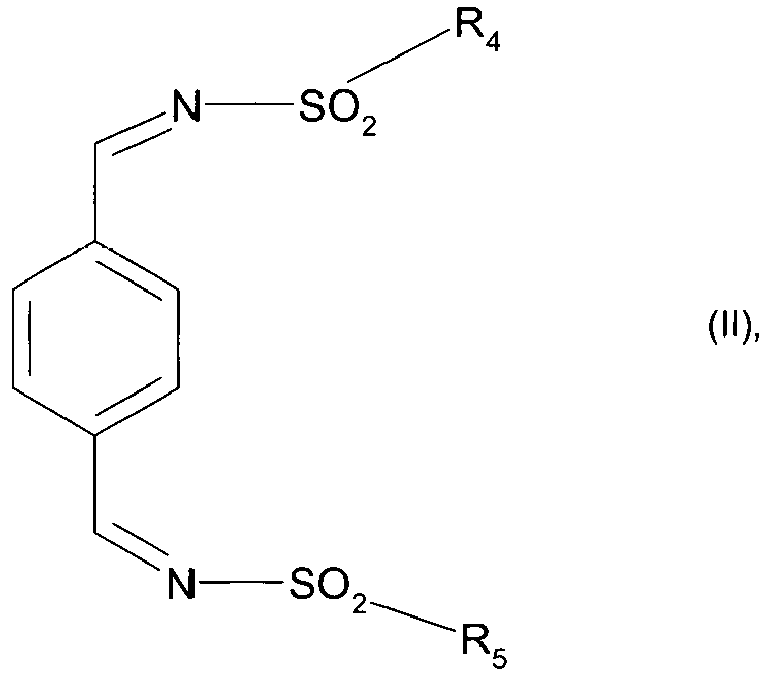
- Weitere besonders bevorzugt eingesetzte Sulfonimine sind Verbindungen der Formel III

- Ganz besonders bevorzugt eingesetzte Sulfonimine sind Verbindungen der Formel IV

- Von den Verbindungen der Formel IV sind solche ganz besonders bevorzugt, worin R9 Wasserstoff ist und R8 C1-C6-Alkyl, insbesondere Methyl oder Ethyl, oder Phenyl ist.
- Äußerst bevorzugtes Sulfonimin der Formel IV ist 3-Methyl-1,2-benzisothiazol-1,1-dioxid.
- Weitere besonders bevorzugt eingesetzte Sulfonimine sind Verbindungen der Formel V

- Der Anteil des einen oder der mehreren Sulfonimine f) am Gesamtgewicht der erfindungsgemäßen Geschirrspülmittel beträgt 0,1 bis 5 Gew.-%, bevorzugt 0,2 bis 5 Gew.-%, und ganz besonders bevorzugt 0,5 bis 3 Gew.-%.
- Bedeutet in dieser Beschreibung einer der Reste Alkyl, so kann die Alkylgruppe sowohl verzweigt als auch unverzweigt sein. Eine Alkylgruppe enthält typischerweise ein bis zu zwanzig Kohlenstoffatome, bevorzugt ein bis zu zehn Kohlenstoffatome. Beispiele für Alkylgruppen sind: Methyl, Ethyl, n-Propyl, Isopropyl, n-Butyl, sec-Butyl, tert.-Butyl, Pentyl, n-Hexyl, n-Heptyl, 2-Ethylhexyl, n-Octyl, n-Nonyl, n-Decyl, n-Undecyl, n-Dodecyl, n-Tridecyl, n-Tetradecyl, n-Pentadecyl, n-Hexadecyl, n-Heptadecyl, n-Octadecyl, n-Nonadecyl oder Eicosyl. Besonders bevorzugt sind Alkylgruppen mit ein bis sechs Kohlenstoffatomen.
- Alkylreste können gegebenenfalls substituiert sein, beispielsweise mit Alkyl, Alkoxy, Aryl, Heterocyclyl, Amino, Hydroxy, Carboxy, Carbonsäureester, Carbonsäureamid, Sulfonyl, Cyano, Hydroxy oder Halogen.
- Alkylreste können gegebenenfalls durch ein oder mehrere, nicht direkt zueinander benachbarte zweiwertige Sauerstoffatome unterbrochen sein. Beispiele dafür sind einwertige Reste abgeleitet von Polyethylenglykolen oder von Polypropylenglykolen.
- Alkylreste können gegebenenfalls auch durch ein oder mehrere, nicht direkt zueinander benachbarte Ketogruppen unterbrochen sein. Ein Beispiel dafür ist der Acetonylrest.
- Bedeutet in dieser Beschreibung einer der Reste Cycloalkyl, so ist die Cycloalkylgruppe typischerweise eine cyclische Gruppe, enthaltend fünf bis acht, vorzugsweise fünf, sechs oder sieben Ringkohlenstoffatome, die jeweils unabhängig voneinander substituiert sein können. Beispiele für Substituenten sind weiter oben bei der Beschreibung der Alkylgruppen aufgeführt. Beispiele für Cycloalkylgruppen sind Cyclopentyl oder Cyclohexyl.
- Bedeutet in dieser Beschreibung einer der Reste Aryl, so ist die Arylgruppe typischerweise eine cyclische aromatische Gruppe, enthaltend fünf bis vierzehn Kohlenstoffatome, die jeweils unabhängig voneinander substituiert sein können. Beispiele für Substituenten sind weiter oben bei der Beschreibung der Alkylgruppen aufgeführt. Beispiele für Arylgruppen sind Phenyl, Biphenyl oder Anthryl.
- Bedeutet in dieser Beschreibung einer der Reste Heterocyclyl, so kann die Heterocyclylgruppe typischerweise eine cyclische Gruppe mit vier bis zehn Ringkohlenstoffatomen und mit mindestens einem Ringheteroatom sein, die jeweils unabhängig voneinander substituiert sein können. Beispiele für Substituenten sind weiter oben bei der Beschreibung der Alkylgruppen aufgezählt. Beispiele für Heteroatome sind Sauerstoff, Stickstoff, Phosphor, Bor, Selen oder Schwefel. Beispiele für Heterocyclylgruppen sind Furyl, Thienyl, Pyrrolyl oder Imidazolyl. Heterocyclylgruppen können aromatisch oder nicht-aromatisch sein.
- Bedeutet in dieser Beschreibung einer der Reste Aralkyl, so ist die Aralkylgruppe typischerweise eine Arylgruppe, wobei Aryl zuvor bereits definiert wurde, an die kovalent eine Alkylgruppe gebunden ist. Die Aralkylgruppe kann am aromatischen Ring substituiert sein. Beispiele für Substituenten sind weiter oben bei der Beschreibung der Alkylgruppen aufgezählt. Ein Beispiel für eine Aralkylgruppe ist Benzyl.
- Bedeutet in dieser Beschreibung einer der Substituenten Halogen, so ist darunter ein Fluor-, Chlor-, Brom- oder lodatom zu verstehen. Bevorzugt sind Fluor, Chlor oder Brom, insbesondere Chlor.
- In einer bevorzugten Ausführungsform enthalten die erfindungsgemäßen Geschirrspülmittel ein oder mehrere Enzyme, ausgewählt aus Proteasen, Amylasen, Mannasen, Lipasen, Endolasen, Pectinasen, Cellulasen, Pullinasen, Cutinasen oder Peroxidasen.
- Beispiele für Proteasen sind Blaze Evity 150T, Liquanase® Ultra 2,0 XL, BLAP®, Opticlean®, Maxacal®, Maxapem®, Esperase®, Savinase®, Purafect®, OxP und/oder Duraxym®.
- Beispiele für Amylasen sind Stainzyme Plus Evity 24T, Stainzyme® Plus 12L, Termamyl®, Amylase® LT, Maxamyl®, Duramyl® und/oder Purafect® Ox.
- Ein Beispiel für eine Mannase ist Mannaway 4,0 L.
- Beispiele für Lipasen sind Lipex® 100 L, Lipolase®, Lipomax®, Lumafast® und/oder Lipozym®.
- Ein Beispiel für eine Endolase ist Endolase® 5000L.
- Beispiele für Pectinasen sind Pectinex 3X L und/oder Pectinex Ultra SPL.
- Beispiele für Cellulasen sind Carezyme 1000 L und/oder Celluclast 1.5 L.
- Der Gewichtsanteil des einen oder der mehreren Enzyme am Gesamtgewicht der erfindungsgemäßen Geschirrspülmittel beträgt vorzugsweise von 0,001 bis 8 Gew.-%, insbesondere bevorzugt von 0,001 bis 4,5 Gew.-% und außerordentlich bevorzugt von 0,01 bis 3,5 Gew.-%.
- In einer weiteren bevorzugten Ausführungsform enthalten die erfindungsgemäßen Geschirrspülmittel kristallines Natriumschichtsilikat der Formel (la) in Form eines Compounds enthaltend kristallines Natriumschichtsilikat der Formel (la) und eine saure Komponente.
- Bevorzugt handelt es sich bei der sauren Komponente um Polycarboxylate, insbesondere um ein nicht oder nur teilweise neutralisiertes Homo- und/oder Copolymer aus Acrylsäure, AMPS, Methacrylsäure, Maleinsäure, Polyasparaginsäure, Zuckercarbonsäure und/oder weiteren Monomeren. Das Molekulargewicht der Homopolymere und der Copolymere liegt bevorzugt im Bereich von 1000 bis 100 000 g/mol, besonders bevorzugt 2 000 bis 50 000 g/mol. Insbesondere bevorzugt sind Acrylsäure/Maleinsäure-Copolymere mit einem Molekulargewicht von 4 000 bis 50 000 g/mol. Bevorzugt sind auch Copolymere von Acrylsäure oder Methacrylsäure mit Vinylethern, wie beispielsweise Vinylmethylether, Vinylester, Ethylen, Propylen and Styrol.
- Handelsübliche Produkte sind z. B. Sokalan TM CP 5 und PA 30 von BASF, Alcosperse TM 175 oder 177 von Alco und Acusol 45 N und Acusol 588G von Dow Chemicals.
- Die erfindungsgemäßen Geschirrspülmittel können weitere Komponenten, wie Elektrolyte, Silberkorrosionsinhibitoren, Schaumregulatoren, Verbindungen zur Erhöhung der Trocknungsleistung des Geschirrs, Verbindungen zur Verhinderung der Bildung von Siebrückständen beim Geschirrspülen, Silikone, Sprengmittel, Farbstoffe und/oder Duftstoffe enthalten.
- Geschirrspülmittel enthaltend Verbindungen Erhöhung der Trocknungsleistung des Geschirrs und zur Verhinderung der Bildung von Siebrückständen beim Geschirrspülen sind beispielsweise aus der
EP 3 320 068 B1 bekannt. - Die erfindungsgemäßen Geschirspülmittel können sowohl Phosphat enthalten als auch phosphatfrei sein.
- In einer bevorzugten Ausführungsform sind die erfindungsgemäßen Geschirrspülmittel phosphatfrei.
- Um eine Bleichwirkung zu erreichen, werden den erfindungsgemäßen Geschirrspülmitteln sauerstoffhaltige Bleichmittel, wie Persalze, zugesetzt. Zur Aktivierung dieser Bleichmittel und zum Erreichen einer zufriedenstellenden Bleichwirkung, insbesodneer bei tieferen Temperaturen, enthalten die erfindungsgemäßen Geschirrspülmittel weiterhin Bleichaktivatoren b) und Sulfonimine als Bleichkatalysatoren f).
- Bleichaktivatoren und/oder Bleichkatalysatoren werden den erfindungsgemäßen Geschirr-spülmitteln vorzugsweise in Form von Granulaten zugesetzt. Dies geschieht zum einen, um die Lagerstabilität dieser Inhaltsstoffe zu erhöhen, zum anderen aber auch, um eine homogene Einarbeitung winziger Mengen an Bleichaktivator und Bleichkatalysator in die Formulierungen zu gewährleisten.
- Bevorzugt sind die Bleichaktivatoren b) und Bleichkatalysatoren f) in der Form Co-Granulaten im erfindungsgemäßen Geschirrspülmittel enthalten.
- Dabei handelt es sich insbesondere um mit Celluloseether beschichtete Co-Granulate enthaltend
- i) ein oder mehrere Sulfonimine f),
- ii) ein oder mehreren Bleichaktivatoren b), und
- iii) Celluloseether als Bindemittel.
- Besonders bevorzugt handelt es sich bei dem Sulfonimin f) um ein cyclisches Sulfonimin.
- Besonders bevorzugt handelt es sich bei dem Bleichaktivator b) um Tetraacetylethylendiamin und/oder Decanoyloxybenzoesäure.
- Derartige Co-Granulate sind aus der
EP 3 874 949 A1 bekannt. - Bevorzugt enthält das Co-Granulat als Bindemittel iii) eine Carboxymethylcellulose.
- Bevorzugt ist das Co-Granulat mit Methylcellulose beschichtet.
- Die erfindungsgemäßen Geschirrspülmittel zeigen beim Einsatz eine sehr gute Reinigungsleistung, inbesondere bei der Entfernung von roten und/oder gelben Anschmutzungen auf Haushaltswaren, vor allem auf Plastikteilen.
- Die erfindungsgemässen Geschirrspülmittel können als pulverförmige, granulare oder tablettenförmige Präparate vorliegen, die in an sich üblicher Weise, beispielsweise durch Mischen, Granulieren, Walzenkompaktieren und/oder durch Sprühtrocknung hergestellt werden können.
- Die erfindungsgemässen Geschirrspülmittel können auch als flüssige oder gelförmige Formulierungen vorliegen, die in an sich üblicher Weise, beispielsweise durch Vermischen der einzelnen Bestandteile hergestellt werden können.
- Darüber hinaus lassen sich einzelne Inhaltsstoffe oder Kombinationen von Inhaltsstoffen in Mehrkammerbehälter einbringen, die direkt zum in der Geschirrspülmaschine eingesetzt werden können.
- Die erfindungsgemäßen Geschirrspülmittel können beim Spülen mit der Hand eingesetzt werden, insbesondere jedoch als maschinelle Geschirrspülmittel.
- Die erfindungsgemäßen Geschirrspülmittel können in Verfahren zum Reinigen von Bad- oder Küchenartikeln, wie Töpfen, Schüsseln, Geschirr, Gläsern, oder Babyartikeln eingesetzt werden. Das Verfahren umfasst das Inkontaktbringen der erfindungsgemäßen Geschirrspülmittel mit Wasser und mit dem zu reinigenden Gut, insbesondere mit Küchen- oder Babyartikeln, und das Einwirken der ausgebildeten wässrigen Reinigungsflüssigkeit auf das zu reinigende Gut.
- Die Erfindung betrifft außerdem die Verwendung der erfindungsgemäßen Geschirrspülmittel zum Entfernen von roten und/oder gelben Anschmutzungen von Haushaltsartikeln, insbesondere von Bad- oder Küchenartikeln. Zu den Haushaltsartikeln zählen solche, die in Privathaushalten vorkommen; aber auch solche, die in Gewerbe und Industrie eingesetzt werden, beispielsweise in Kantinen oder Gaststätten eingesetzte Artikel.
- Die erfindungsgemäßen Geschirrspülmittel werden bevorzugt zum Entfernen von roten und/oder gelben Anschmutzungen in industriellen Prozessen eingesetzt. Dabei handelt es sich vorzugsweise um die Reinigung von Kunststoffflaschen, insbesondere von Polyethylenterepthalatflaschen, für die Rezyklierung.
- Die nachfolgenden Beispiele erläutern die Erfindung ohne sie darauf einzuschränken. Die Zusammensetzung der verwendeten Geschirrspülmittel wird in der folgenden Tabelle gezeigt.
Formulierung 1 Formulierung 2 g/Spülgang g/Spülgang Natriumcitrat 7,2 7,2 Natriumcarbonat 5,0 5,0 Natriumpercarbonat 3,0 3,0 Peractive® AC white1) 1,0 1,0 Pluriol® E 15002) 0,6 0,6 Pluriol® E 60003) 0,4 0,4 Sokalan® PA25 Cl4) 1,0 1,0 Lutensol® TO 75) 0,2 0,2 Protease Blaze Evity 150T 0,3 0,3 Amylase Stainzyme Plus Evity 24T 0,1 0,1 WeylClean® SKS-6 WB6) 1,0 1,0 WeylClean® CC 307) - 0,3 1) TAED Bleichaktivator, WeylChem Wiesbaden, Wiesbaden
2) Polyethylenglykyol, MW 1500 g/mol, BASF,Ludwigshafen
3) Polyethylenglykyol, MW 6000 g/mol, BASF,Ludwigshafen
4) Polyacrylsäure, MW 4000 g/mol, BASF,Ludwigshafen
5) nichtionisches Tensid, ethoxylierter iso-C13-Alkohol, BASF, Ludwigshafen
6) Builder, Natrium-Schichtdisilikat (δ-Na2Si2O5), WeylChem Wiesbaden, Wiesbaden
7) Bleichkatalysator, 3-Methyl-1,2-benzisothiazol-1,1-dioxid, WeylChem Wiesbaden, Wiesbaden - Zu Beginn wurden die im Test eingesetzten Kunststoffteile in eine haushaltsübliche Geschirrspülmaschine eingeräumt. Um die Eingangswasserhärte in der Maschine konstant und reproduzierbar einzustellen, wurde der werkseitig in der Maschine installierte Ionenaustauscher außer Funktion gesetzt und das auf eine definierte Gesamtwasserhärte eingestellte Wasser über einen externen Tank zugeführt.
- Dann erfolgte zunächst eine Vorreinigung der Kunststoffteile. Für die Verfärbung wurde zu Beginn jedes Spülgangs 50 g Färbungssschmutz im oberen Korb eingesetzt. Der Test wurde bei 45 °C durchgeführt. Zwischen jedem Spülgang wurde die Maschine für 45 Minuten zur vollständigen Abkühlung geöffnet.
- Bei der Entfärbung wurden zu jedem Spülgang 50 g Ballastschmutz im oberen Korb eingesetzt. Der Test wurde bei 45 °C durchgeführt. Zwischen jedem Spülgang wurde die Maschine für 45 Minuten zur vollständigen Abkühlung geöffnet. Nach jeweils 1, 3 und 5 Spülzyklen erfolgte eine visuelle Beurteilung der Beladungsteile auf Entfärbungen nach einer 4-Punkte Skala. Zusätzlich wurde die Farbverschiebung (dE) des Schneidebrettes mittels Mach 5+ gemessen.
- Die einzelnen Spülgänge wurden unter den folgenden Bedingungen durchgeführt:
Vorreinigen Maschinentyp: Miele GSL 2 Spülprogramm: 45 °C, 8 min Spülzyklen: 3 Wasserhärte: 21 °dH Produkt: IEC-D Produktdosierung: 20 g/Spülgang in Dosierkammer Testmethode Einfärbung von Kunststoffteilen Testbedingungen Maschinentyp: Miele GSL 2 Spülprogramm: 45 °C, 8 min Spülzyklen: 5 Wasserhärte: 21 °dH Beladungsschmutz: • 50 g Senf • 50 g Ketchup • 1 g Kurkuma • 1 g Sonnenblumenöl Maschinenbeladung • 5 Dosen A/B (PP) • 5 Schneidebretter A/B (PE) • 5 Trichter A/B (PP) • 5 Babysauger A/B (PP/Silikon) • 5 Babysauger Deckel A/B (PP) Testmethode Red Plastic Bleaching Test Maschinentyp: Miele GSL 2 Spülprogramm: 45 °C, 8 min Spülzyklen: 5 Wasserhärte: 21 °dH -
Produkte: Formulierung 1 Formulierung II Produktdosierung: 20 g/Spülgang in Dosierkammer Beladungsschmutz: 50 g/Spülgang, tiefgefroren (Zusammensetzung in Anlehnung an die IKW Arbeitskreis-Methode Nr. 3 vom 27.06.1997) -
- 2 Dosen A/B (PP)
- 2 Schneidebretter A/B (PE)
- 2 Trichter A/B (PP)
- 2 Babysauger A/B (PP/Silikon)
- 2 Babysauger Deckel A/B (PP)
- Visuelle Bewertung nach 1, 3 und 5 Zyklen; Vier-Punkte-Skala
- Note 0: kein Unterschied (zum eingefärbten Ausgangswert)
- Note 1: geringfügiger Unterschied
- Note 2: deutlicher Unterschied
- Note 3: sehr deutlicher Unterschied
- Je größer der in den Tabellen angegebene Punktwert ist, umso besser ist die Reinigungsleistung des Spülmittels.
- Die Ergebnisse der visuellen Beurteilung nach Durchführung von fünf Spülzyklen finden sich in der nachstehenden Tabelle.
Maschinenbeladung Ergebnis der visuellen Auswertung Material Typ Kunststoff (PP) Dose, transparent 2,0 Kunststoff (PE) Schneidebrett, weiß 2,0 Kunststoff (PP) Trichter, weiß 1,0 Kunststoff (PP/Silikon) Babysauger 1,5 Kunststoff (PP) Babysauger Deckel 2,0 - Die Ergebnisse der visuellen Beurteilung nach Durchführung von fünf Spülzyklen finder sich in der nachstehenden Tabelle.
Maschinenbeladung Ergebnis der visuellen Auswertung Material Typ Kunststoff (PP) Dose, transparent 2,0 Kunststoff (PE) Schneidebrett, weiß 2,5 Kunststoff (PP) Trichter, weiß 2,0 Kunststoff (PP/Silikon) Babysauger 1,5 Kunststoff (PP) Babysauger Deckel 2,0 - Die Ergebnisse nach Behandlung mit Formulierung 1 finden sich in der nachstehenden Tabelle.
Ausgangszustand Entfärbung nach 5 Zyklen dL da db L1 a1 b1 L2 a2 b2 L2-L1 a2-a1 b2-b1 85,21 1,99 6,86 85,10 3,17 7,44 -0,11 1,18 0,58 85,74 1,86 5,76 86,25 1,3 5,20 0,51 -0,56 -0,56 85,35 1,88 6,60 86,07 1,36 5,26 0,72 -0,52 -1,34 85,35 1,88 6,60 86,04 1,58 5,63 0,69 -0,30 -0,97 Mittelwert 0,45 -0,05 -0,57 dE (Mittelwert) 0,73 - Die Ergebnisse nach Behandlung mit Formulierung 2 finden sich in der nachstehenden Tabelle.
Ausgangszustand Entfärbung nach 5 Zyklen dL da db L1 a1 b1 L2 a2 b2 L2-L1 a2-a1 b2-b1 85,24 2,37 6,89 86,00 1,77 5,75 0,76 -0,60 -1,14 85,20 2,33 6,68 86,11 1,5 5,19 0,91 -0,83 -1,49 85,42 1,64 6,61 86,05 1,26 5,36 0,63 -0,38 -1,25 85,20 2,33 6,68 85,92 1,81 5,53 0,72 -0,52 -1,15 Mittelwert 0,75 -0,58 -1,26 dE (Mittelwert) 1,58 - Je niedriger die Zahl ist, desto weniger stark ist die Farbänderung.
Claims (15)
- Geschirrspülmittel enthaltend die Komponentena) 10-90 Gew.-% mindestens eines Buildersb) 0,1-20 Gew.-% mindestens eines Bleichaktivatorsc) 0,1-20 Gew.-% mindestens eines nichtionischen Tensidsd) 5-40 Gew.-% mindestens eines sauerstoffhaltigen Bleichmittelse) 0,1-80 Gew.-% mindestens eines pH-Regulators, undf) 0,1 bis 5 Gew.-% mindestens eines Sulfonimins als Bleichkatalysator, mit der Maßgabe, dass das Geschirspülmittel kein anionisches Tensid enthält und dass sich die Prozentangaben auf die Gesamtmenge des Geschirrspülmittels beziehen.
- Geschirrspülmittel nach Anspruch 1, dadurch gekennzeichnet, dass der Builder ausgewählt wird aus der Gruppe bestehend aus kristallinem Natriumschichtsilikat und/oder polymerer Polycarbonsäure, insbesondere einen Compound enthaltend kristallines Natriumschichtsilikat und polymere Polycarbonsäure enthält, und ganz besonders bevorzugt kristallines schichtförmiges Natriumdisilikat / Homopolymer-Compound auf Basis Acrylsäure oder neben dem kristallinen Natriumschichtsilikat zusätzlich Builder ausgewählt aus der Gruppe bestehend aus Methylglycindiessigsäure oder dessen Salzen, Iminodibersteinsäure IDS, Natrium Gluconat, Natriumpolyphosphat und/ oder Natriumcitrat enthält.
- Geschirrspülmittel nach mindestens einem der Ansprüche 1 bis 2, dadurch gekennzeichnet, dass der Bleichaktivator b) ausgewählt wird aus der Gruppe bestehend aus acylierten Alkylendiaminen, insbesondere Tetraacetylethylendiamin (TAED), acylierten Glykolurilen, insbesondere Tetraacetylglykoluril (TAGU), acylierten Triazinderivaten, insbesondere 1,5-Diacetyl-2,4-dioxohexahydro-1,3,5-triazin (DADHT), acylierten Phenylsulfonaten, insbesondere Nonanoyl-, Isononanoyl- oder Lauroyloxybenzolsulfonat (NOBS, ISONOBS oder LOBS) oder deren Amidoderivaten, insbesondere NACAOBS, acylierten Hydroxycarbonsäuren, insbesondere Acetylsalicylsäure oder Nonanoyloxybenzoesäure (NOBA) und Decanoyloxybenzoesäure (DOBA).
- Geschirrspülmittele nach Anspruch 3, dadurch gekennzeichnet, dass der Bleichaktivator ausgewählt wird aus der Gruppe der acylierten Alkylendiamine, insbesondere Tetraacetylethylendiamin (TAED).
- Geschirrspülmittel nach mindestens einem der Ansprüche 1 bis 4, dadurch gekennzeichnet, dass das nichtionische Tensid c) ausgewählt wird aus der Gruppe der alkoxylierten Fettalkohole mit zehn bis zwanzig Kohlenstoffatomen und/oder der alkoxylierten Fettsäuren mit zehn bis zwanzig Kohlenstoffatomen, insbesondere aus der Gruppe der ethoxylierten Fettalkohole mit zehn bis zwanzig Kohlenstoffatomen und/oder der ethoxylierten Fettsäuren mit zehn bis zwanzig Kohlenstoffatomen.
- Geschirrspülmittel nach mindestens einem der Ansprüche 1 bis 5, dadurch gekennzeichnet, dass sauerstoffhaltige Bleichmittel d) ausgewählt wird aus der Gruppe bestehend aus Natriumperborat (Monohydrat und Tetrahydrat) und/oder Natriumpercarbonat.
- Geschirrspülmittel nach mindestens einem der Ansprüche 1 bis 6, dadurch gekennzeichnet, dass der pH-Regulator e) ausgewählt wird aus der Gruppe bestehend aus Alkalicarbonaten, insbesondere Natriumcarbonat, Alkalihydrogencarbonaten, Alkalihydroxiden, insbesondere Kaliumhydroxid und Natriumhydroxid, Natriumacetat, Disilikaten und/oder Aminosäuren.
- Geschirrspülmittel nach mindestens einem der Ansprüche 1 bis 7, dadurch gekennzeichnet, dass der Bleichkatalysator f) ein Sulfonimin der Formel I ist
 worin R1 Wasserstoff, Alkyl, Cycloalkyl, Aryl, Aralkyl, oder Heterocyclyl ist, wobei die Reste Alkyl, Cycloalkyl, Aryl, Aralkyl oder Heterocyclyl unsubstituiert sind oder ein bis drei Substituenten ausgewählt aus der Gruppe Alkyl, Alkoxy, Aryl, Heterocyclyl, Amino, Carboxyl, Carbonsäureester, Carbonsäureamid, Sulfonyl, Cyano, Hydroxy oder Halogen aufweisen, oder worin eine Alkylgruppe durch ein oder mehrere nicht direkt zueinander benachbarte Sauerstoffatome oder durch ein oder mehrere nicht direkt zueinander benachbarte Ketogruppen unterbrochen ist,R2 Wasserstoff, Alkyl, Alkoxy, Cycloalkyl, Aryl, Aralkyl, Heterocyclyl, Nitro, Cyano, Halogen, Carboxyl, Carbonsäureester oder Carbonsäureamid ist, wobei die Reste Alkyl, Cycloalkyl, Aryl, Aralkyl oder Heterocyclyl unsubstituiert sind oder ein bis drei Substituenten ausgewählt aus der Gruppe Alkyl, Alkoxy, Aryl, Heterocyclyl, Amino, Hydroxy, Carboxyl, Carbonsäureester, Carbonsäureamid, Sulfonyl, Cyano oder Halogen aufweisen oder worin die Reste Alkyl, Cycloalkyl, Aryl oder Heterocyclyl mit einem Rest der Formel -R1C=N-SO2-R3 substitutiert sind oder worin eine Alkylgruppe durch ein oder mehrere nicht direkt zueinander benachbarte Sauerstoffatome oder durch ein oder mehrere nicht direkt zueinander benachbarte Ketogruppen unterbrochen ist,R3 Alkyl, Cycloalkyl, Aryl, Aralkyl, Heterocyclyl, Nitro, Cyano oder Halogen ist, wobei die Reste Alkyl, Cycloalkyl, Aryl, Aralkyl oder Heterocyclyl unsubstituiert sind oder ein bis drei Substituenten ausgewählt aus der Gruppe Alkyl, Alkoxy, Aryl, Heterocyclyl, Amino, Carboxyl, Carbonsäureester, Carbonsäureamid, Sulfonyl, Cyano, Hydroxy oder Halogen aufweisen, oder worin eine Alkylgruppe durch ein oder mehrere nicht direkt zueinander benachbarte Sauerstoffatome oder durch ein oder mehrere nicht direkt zueinander benachbarte Ketogruppen unterbrochen ist, oder worinR1 und R2 zusammen mit dem Kohlenstoffatom, mit dem sie verbunden sind, ein cycloaliphatisches, heterocyclisches oder carbocyclisch-aromatisches Ringsystem bilden, das unsubstituiert ist oder ein bis drei Substituenten ausgewählt aus der Gruppe Alkyl, Alkoxy, Aryl, Heterocyclyl, Amino, Carboxyl, Carbonsäureester, Carbonsäureamid, Sulfonyl, Cyano, Hydroxy oder Halogen aufweist, oder worin eine Alkylgruppe durch ein oder mehrere nicht direkt zueinander benachbarte Sauerstoffatome oder durch ein oder mehrere nicht direkt zueinander benachbarte Ketogruppen unterbrochen ist, oder worinR2 und R3 zusammen mit der Gruppe -C=N-SO2-, über welche sie miteinander verbunden sind, ein heterocyclisches Ringsystem bilden, das unsubstituiert ist oder ein bis drei Substituenten ausgewählt aus der Gruppe Alkyl, Alkoxy, Aryl, Heterocyclyl, Amino, Carboxyl, Carbonsäureester, Carbonsäureamid, Sulfonyl, Cyano, Hydroxy oder Halogen aufweist, oder worin eine Alkylgruppe durch ein oder mehrere nicht direkt zueinander benachbarte Sauerstoffatome oder durch ein oder mehrere nicht direkt zueinander benachbarte Ketogruppen unterbrochen ist.
 - Geschirrspülmittel nach Anspruch 8, dadurch gekennzeichnet, dass der Bleichkatalysator f) ein Sulfonimin der Formel IV ist
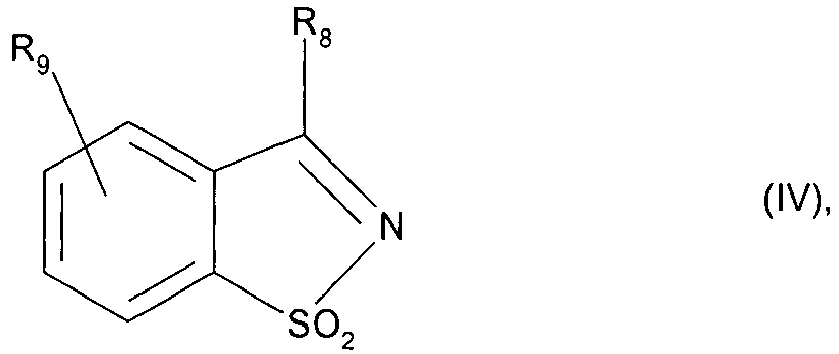
- Geschirrspülmittel nach mindestens einem der Ansprüche 1 bis 9, dadurch gekennzeichnet, dass das Geschirrspülmittel ein oder mehrere Enzyme ausgewählt aus der Gruppe der Proteasen, Amylasen, Mannasen, Lipasen, Endolasen, Pectinasen, Cellulasen, Pullinasen, Cutinasen und/oder Peroxidasen enthält.
- Geschirrspülmittel nach mindestens einem der Ansprüche 1 bis 10, dadurch gekennzeichnet, dass das Geschirrspülmittel als weitere Komponenten Elektrolyte, Silberkorrosionsinhibitoren, Schaumregulatoren, Verbindungen zur Erhöhung der Trocknungsleistung des Geschirrs, Verbindungen zur Verhinderung der Bildung von Siebrückständen beim Geschirrspülen, Silikone, Sprengmittel, Farbstoffe und/oder Duftstoffe enthält.
- Geschirrspülmittel nach mindestens einem der Ansprüche 1 bis 11, dadurch gekennzeichnet, dass die Bleichaktivatoren b) und/oder Bleichkatalysatoren f) dem Geschirrspülmittel in Form von Granulaten zugesetzt sind, insbesondere dass die Bleichaktivatoren b) und Bleichkatalysatoren f) in der Form Co-Granulaten im Geschirrspülmittel enthalten sind.
- Geschirrspülmittel nach Anspruch 12, dadurch gekennzeichnet, dass die Co-Granulate mit Celluloseether, insbesondere mit Methylcellulose, beschichtete Co-Granulate sind, diei) ein oder mehrere Sulfonimine f), insbesondere ein cyclisches Sulfonimin,ii) ein oder mehreren Bleichaktivatoren b), insbesondere Tetraacetylethylendiamin und/oder Decanoyloxybenzoesäure, undiii) Celluloseether, insbesondere Carboxymethylcellulose, als Bindemittel enthalten.
- Verwendung der Geschirrspülmittel nach mindestens einem der Ansprüche 1 bis 13 zum Entfernen von roten und/oder gelben Anschmutzungen von Bad- oder Küchenartikeln oder in industriellen Prozessen.
- Verwendung nach Anspruch 14, dadurch gekennzeichnet, dass es sich bei dem industriellen Prozess um die Reinigung von Kunststoffflaschen, insbesondere von Polyethylenterepthalatflaschen, für die Rezyklierung handelt.
Applications Claiming Priority (1)
| Application Number | Priority Date | Filing Date | Title |
|---|---|---|---|
| DE202023000933.2U DE202023000933U1 (de) | 2023-04-27 | 2023-04-27 | Geschirrspülmittel sowie dessen Verwendung |
Publications (1)
| Publication Number | Publication Date |
|---|---|
| EP4455255A1 true EP4455255A1 (de) | 2024-10-30 |
Family
ID=86499023
Family Applications (1)
| Application Number | Title | Priority Date | Filing Date |
|---|---|---|---|
| EP24000041.4A Pending EP4455255A1 (de) | 2023-04-27 | 2024-03-27 | Geschirrspülmittel sowie dessen verwendung |
Country Status (4)
| Country | Link |
|---|---|
| US (1) | US20240360389A1 (de) |
| EP (1) | EP4455255A1 (de) |
| CN (1) | CN118853304A (de) |
| DE (1) | DE202023000933U1 (de) |
Citations (23)
| Publication number | Priority date | Publication date | Assignee | Title |
|---|---|---|---|---|
| EP0164514A1 (de) | 1984-04-11 | 1985-12-18 | Hoechst Aktiengesellschaft | Verwendung von kristallinen schichtförmigen Natriumsilikaten zur Wasserenthärtung und Verfahren zur Wasserenthärtung |
| EP0232202A2 (de) | 1986-01-30 | 1987-08-12 | Roquette FrÀ¨res | Verfahren zur Oxidierung von Di-, Tri-, Oligo- und Polysacchariden in Polyhydroxycarbonsäuren, dazu verwendeter Katalysator und so hergestellte Produkte |
| WO1991008171A1 (de) | 1989-12-02 | 1991-06-13 | Henkel Kommanditgesellschaft Auf Aktien | Verfahren zur hydrothermalen herstellung von kristallinem natriumdisilikat |
| EP0446982A2 (de) * | 1990-03-16 | 1991-09-18 | Unilever N.V. | Bleichmittelzusammensetzungen für niedrige Temperatur |
| EP0453003A2 (de) * | 1990-03-16 | 1991-10-23 | Unilever N.V. | Bleichmittelkatalysatoren und diese enthaltende Zusammensetzungen |
| JPH04238809A (ja) | 1991-01-10 | 1992-08-26 | Nippon Chem Ind Co Ltd | 結晶性層状珪酸ナトリウムの製造方法 |
| JPH04260610A (ja) | 1991-02-14 | 1992-09-16 | Nippon Chem Ind Co Ltd | 改質ジ珪酸ナトリウムの製造方法 |
| WO1992018542A1 (en) | 1991-04-12 | 1992-10-29 | Novamont S.P.A. | A method of oxidising carbohydrates |
| WO1993016110A1 (de) | 1992-02-11 | 1993-08-19 | Henkel Kommanditgesellschaft Auf Aktien | Verfahren zur herstellung von polycarboxylaten auf polysaccharid-basis |
| DE4221381C1 (de) | 1992-07-02 | 1994-02-10 | Stockhausen Chem Fab Gmbh | Pfropf-Copolymerisate von ungesättigten Monomeren und Zuckern, Verfahren zu ihrer Herstellung und ihre Verwendung |
| DE4300772A1 (de) | 1993-01-14 | 1994-07-21 | Stockhausen Chem Fab Gmbh | Biologisch abbaubare Copolymere und Verfahren zu iherer Herstellung und ihre Verwendung |
| DE4303320A1 (de) | 1993-02-05 | 1994-08-11 | Degussa | Waschmittelzusammensetzung mit verbessertem Schmutztragevermögen, Verfahren zu dessen Herstellung und Verwendung eines geeigneten Polycarboxylats hierfür |
| DE4417734A1 (de) | 1994-05-20 | 1995-11-23 | Degussa | Polycarboxylate |
| DE4443177A1 (de) | 1994-12-05 | 1996-06-13 | Henkel Kgaa | Aktivatormischungen für anorganische Perverbindungen |
| GB2389856A (en) | 2002-06-18 | 2003-12-24 | Reckitt Benckiser Nv | Removal of stains from plastics |
| WO2007101622A1 (de) | 2006-03-08 | 2007-09-13 | Clariant International Ltd | Cogranulate |
| EP1373450B1 (de) * | 2001-02-01 | 2009-05-13 | Basf Se | Reinigerformulierungen zur verhinderung der verfärbung von kunststoffgegenständen |
| US20180187130A1 (en) * | 2016-12-31 | 2018-07-05 | Weylchem Wiesbaden Gmbh | Granulates, Their Use and Washing Agent and Cleaning Agents Containing Same |
| EP3406698A1 (de) * | 2017-05-22 | 2018-11-28 | Henkel AG & Co. KGaA | Bleichendes wasch- oder reinigungsmittel mit oxaziridin-vorläufer |
| EP3320068B1 (de) | 2015-07-09 | 2020-10-07 | Basf Se | Verfahren zur reinigung von geschirr |
| EP3619288B1 (de) * | 2017-05-04 | 2020-10-21 | Unilever N.V. | Reinigungsmittelzusammensetzung |
| EP3874949A1 (de) | 2020-03-06 | 2021-09-08 | WeylChem Performance Products GmbH | Co-granulate, wasch- und reinigungsmittel und deren verwendung |
| WO2022069468A1 (en) | 2020-09-29 | 2022-04-07 | Reckitt Benckiser Vanish B.V. | Composition for the removal of stains and malodour |
-
2023
- 2023-04-27 DE DE202023000933.2U patent/DE202023000933U1/de active Active
-
2024
- 2024-03-27 EP EP24000041.4A patent/EP4455255A1/de active Pending
- 2024-04-04 US US18/626,852 patent/US20240360389A1/en active Pending
- 2024-04-23 CN CN202410487228.1A patent/CN118853304A/zh active Pending
Patent Citations (25)
| Publication number | Priority date | Publication date | Assignee | Title |
|---|---|---|---|---|
| EP0164514A1 (de) | 1984-04-11 | 1985-12-18 | Hoechst Aktiengesellschaft | Verwendung von kristallinen schichtförmigen Natriumsilikaten zur Wasserenthärtung und Verfahren zur Wasserenthärtung |
| EP0232202A2 (de) | 1986-01-30 | 1987-08-12 | Roquette FrÀ¨res | Verfahren zur Oxidierung von Di-, Tri-, Oligo- und Polysacchariden in Polyhydroxycarbonsäuren, dazu verwendeter Katalysator und so hergestellte Produkte |
| WO1991008171A1 (de) | 1989-12-02 | 1991-06-13 | Henkel Kommanditgesellschaft Auf Aktien | Verfahren zur hydrothermalen herstellung von kristallinem natriumdisilikat |
| EP0446982A2 (de) * | 1990-03-16 | 1991-09-18 | Unilever N.V. | Bleichmittelzusammensetzungen für niedrige Temperatur |
| EP0453003A2 (de) * | 1990-03-16 | 1991-10-23 | Unilever N.V. | Bleichmittelkatalysatoren und diese enthaltende Zusammensetzungen |
| JPH04238809A (ja) | 1991-01-10 | 1992-08-26 | Nippon Chem Ind Co Ltd | 結晶性層状珪酸ナトリウムの製造方法 |
| JPH04260610A (ja) | 1991-02-14 | 1992-09-16 | Nippon Chem Ind Co Ltd | 改質ジ珪酸ナトリウムの製造方法 |
| WO1992018542A1 (en) | 1991-04-12 | 1992-10-29 | Novamont S.P.A. | A method of oxidising carbohydrates |
| WO1993016110A1 (de) | 1992-02-11 | 1993-08-19 | Henkel Kommanditgesellschaft Auf Aktien | Verfahren zur herstellung von polycarboxylaten auf polysaccharid-basis |
| DE4221381C1 (de) | 1992-07-02 | 1994-02-10 | Stockhausen Chem Fab Gmbh | Pfropf-Copolymerisate von ungesättigten Monomeren und Zuckern, Verfahren zu ihrer Herstellung und ihre Verwendung |
| DE4300772A1 (de) | 1993-01-14 | 1994-07-21 | Stockhausen Chem Fab Gmbh | Biologisch abbaubare Copolymere und Verfahren zu iherer Herstellung und ihre Verwendung |
| DE4303320A1 (de) | 1993-02-05 | 1994-08-11 | Degussa | Waschmittelzusammensetzung mit verbessertem Schmutztragevermögen, Verfahren zu dessen Herstellung und Verwendung eines geeigneten Polycarboxylats hierfür |
| DE4417734A1 (de) | 1994-05-20 | 1995-11-23 | Degussa | Polycarboxylate |
| DE4443177A1 (de) | 1994-12-05 | 1996-06-13 | Henkel Kgaa | Aktivatormischungen für anorganische Perverbindungen |
| EP1373450B1 (de) * | 2001-02-01 | 2009-05-13 | Basf Se | Reinigerformulierungen zur verhinderung der verfärbung von kunststoffgegenständen |
| GB2389856A (en) | 2002-06-18 | 2003-12-24 | Reckitt Benckiser Nv | Removal of stains from plastics |
| WO2007101622A1 (de) | 2006-03-08 | 2007-09-13 | Clariant International Ltd | Cogranulate |
| EP3320068B1 (de) | 2015-07-09 | 2020-10-07 | Basf Se | Verfahren zur reinigung von geschirr |
| US20180187130A1 (en) * | 2016-12-31 | 2018-07-05 | Weylchem Wiesbaden Gmbh | Granulates, Their Use and Washing Agent and Cleaning Agents Containing Same |
| EP3345989A1 (de) | 2016-12-31 | 2018-07-11 | WeylChem Wiesbaden GmbH | Granulate, deren verwendung und wasch- und reinigungsmittel enthaltend diese |
| EP3619288B1 (de) * | 2017-05-04 | 2020-10-21 | Unilever N.V. | Reinigungsmittelzusammensetzung |
| EP3406698A1 (de) * | 2017-05-22 | 2018-11-28 | Henkel AG & Co. KGaA | Bleichendes wasch- oder reinigungsmittel mit oxaziridin-vorläufer |
| EP3874949A1 (de) | 2020-03-06 | 2021-09-08 | WeylChem Performance Products GmbH | Co-granulate, wasch- und reinigungsmittel und deren verwendung |
| US20210277333A1 (en) | 2020-03-06 | 2021-09-09 | WeylChem Performance Products GmbH | Co-Granules, Detergents and Cleaning Agents and Use Thereof |
| WO2022069468A1 (en) | 2020-09-29 | 2022-04-07 | Reckitt Benckiser Vanish B.V. | Composition for the removal of stains and malodour |
Also Published As
| Publication number | Publication date |
|---|---|
| DE202023000933U1 (de) | 2023-05-08 |
| US20240360389A1 (en) | 2024-10-31 |
| CN118853304A (zh) | 2024-10-29 |
Similar Documents
| Publication | Publication Date | Title |
|---|---|---|
| EP1373450B1 (de) | Reinigerformulierungen zur verhinderung der verfärbung von kunststoffgegenständen | |
| EP1076683B1 (de) | Festes maschinelles geschirrspülmittel mit phosphat und kristallinen schichtförmigen silikaten | |
| EP1791936B1 (de) | Reinigungsformulierungen für die maschinelle geschirrreinigung enthaltend hydrophob modifizierte polycarboxylate | |
| EP2329000B1 (de) | Verwendung von mangan-oxalaten als bleichkatalysatoren | |
| EP3068859B1 (de) | Geschirrspülmittel sowie dessen verwendung | |
| EP1373451B1 (de) | Copolymere zur verhinderung von glaskorrosion | |
| EP2113024B1 (de) | Geschirrreinigungsmittel | |
| EP0944707B1 (de) | Acetonitril-derivate als bleichaktivatoren in reinigungsmitteln | |
| EP3345989A1 (de) | Granulate, deren verwendung und wasch- und reinigungsmittel enthaltend diese | |
| EP2329001B1 (de) | Bleichkatalysatormischungen bestehend aus mangansalzen und oxalsäure oder deren salze | |
| DE60104208T2 (de) | Waschmittelzusammensetzung sowie verfahren zum geschirrspuelen | |
| DE29823426U1 (de) | Detergenzzusammensetzung zum Geschirrspülen | |
| EP2802640B1 (de) | Wasch- und reinigungsmittel enthaltend glycerinester | |
| WO2000050553A1 (de) | Compoundierte acetonitril-derivate als bleichaktivatoren in reinigungsmitteln | |
| EP4455255A1 (de) | Geschirrspülmittel sowie dessen verwendung | |
| EP0872543A2 (de) | Spülmittel mit Korrosionsschutzwirkung | |
| WO2016012080A1 (de) | Wasch- und reinigungsmittel enthaltend manganoxalat, geschirrsp?lverfahren und deren verwendung | |
| DE102012214027A1 (de) | Verwendung von anionischen Tensiden | |
| DE19501645A1 (de) | Silberkorrosionsschutzmittel | |
| BR102024006097A2 (pt) | Detergentes para lavagem de pratos e uso dos mesmos | |
| DE102023213156A1 (de) | Maschinengeschirrspülmittel mit neuartigem Bleichsystem | |
| EP2882836B1 (de) | Maschinelles geschirrspülmittel enthaltend hydrophob modifizierte polysaccharide | |
| DE102008000029A1 (de) | Geschirrreinigungsmittel | |
| EP2733194A1 (de) | Maschinelles Geschirrspülmittel enthaltend Block-Copolymere von Polyalkylenglykolen | |
| DE102012212553A1 (de) | Wasch- oder Reinigungsmittel enthaltend Thiosulfat |
Legal Events
| Date | Code | Title | Description |
|---|---|---|---|
| PUAI | Public reference made under article 153(3) epc to a published international application that has entered the european phase |
Free format text: ORIGINAL CODE: 0009012 |
|
| STAA | Information on the status of an ep patent application or granted ep patent |
Free format text: STATUS: THE APPLICATION HAS BEEN PUBLISHED |
|
| AK | Designated contracting states |
Kind code of ref document: A1 Designated state(s): AL AT BE BG CH CY CZ DE DK EE ES FI FR GB GR HR HU IE IS IT LI LT LU LV MC ME MK MT NL NO PL PT RO RS SE SI SK SM TR |
|
| STAA | Information on the status of an ep patent application or granted ep patent |
Free format text: STATUS: REQUEST FOR EXAMINATION WAS MADE |
|
| 17P | Request for examination filed |
Effective date: 20250430 |