EP1668922B1 - Image display device - Google Patents
Image display device Download PDFInfo
- Publication number
- EP1668922B1 EP1668922B1 EP04769965.7A EP04769965A EP1668922B1 EP 1668922 B1 EP1668922 B1 EP 1668922B1 EP 04769965 A EP04769965 A EP 04769965A EP 1668922 B1 EP1668922 B1 EP 1668922B1
- Authority
- EP
- European Patent Office
- Prior art keywords
- regions
- pixels
- barrier layer
- display device
- light
- Prior art date
- Legal status (The legal status is an assumption and is not a legal conclusion. Google has not performed a legal analysis and makes no representation as to the accuracy of the status listed.)
- Expired - Lifetime
Links
- 230000004888 barrier function Effects 0.000 claims description 33
- 238000000034 method Methods 0.000 claims description 7
- 239000011159 matrix material Substances 0.000 claims description 6
- 230000003287 optical effect Effects 0.000 claims description 5
- 230000010287 polarization Effects 0.000 claims 2
- 239000011521 glass Substances 0.000 description 17
- 230000005540 biological transmission Effects 0.000 description 9
- 239000004973 liquid crystal related substance Substances 0.000 description 6
- 230000009977 dual effect Effects 0.000 description 4
- 239000000758 substrate Substances 0.000 description 4
- 238000000059 patterning Methods 0.000 description 2
- 238000010276 construction Methods 0.000 description 1
- 230000000694 effects Effects 0.000 description 1
- 230000002349 favourable effect Effects 0.000 description 1
- 238000007496 glass forming Methods 0.000 description 1
- 238000006317 isomerization reaction Methods 0.000 description 1
- 239000000463 material Substances 0.000 description 1
- 239000000203 mixture Substances 0.000 description 1
- 239000012299 nitrogen atmosphere Substances 0.000 description 1
- 238000000926 separation method Methods 0.000 description 1
- 230000001360 synchronised effect Effects 0.000 description 1
Images




Classifications
-
- H—ELECTRICITY
- H04—ELECTRIC COMMUNICATION TECHNIQUE
- H04N—PICTORIAL COMMUNICATION, e.g. TELEVISION
- H04N13/00—Stereoscopic video systems; Multi-view video systems; Details thereof
-
- H—ELECTRICITY
- H04—ELECTRIC COMMUNICATION TECHNIQUE
- H04N—PICTORIAL COMMUNICATION, e.g. TELEVISION
- H04N13/00—Stereoscopic video systems; Multi-view video systems; Details thereof
- H04N13/30—Image reproducers
- H04N13/302—Image reproducers for viewing without the aid of special glasses, i.e. using autostereoscopic displays
- H04N13/31—Image reproducers for viewing without the aid of special glasses, i.e. using autostereoscopic displays using parallax barriers
-
- H—ELECTRICITY
- H04—ELECTRIC COMMUNICATION TECHNIQUE
- H04N—PICTORIAL COMMUNICATION, e.g. TELEVISION
- H04N13/00—Stereoscopic video systems; Multi-view video systems; Details thereof
- H04N13/30—Image reproducers
- H04N13/356—Image reproducers having separate monoscopic and stereoscopic modes
Definitions
- the present invention relates to display devices, and in particular, to multi-view display devices, in which each of a plurality of users is able to see a different image to one or more of the other users.
- a display device is capable of providing a different view to the left and the right eye of a user of the display device. This can be achieved by providing a separate image directly to each eye of the user by use of specially constructed goggles.
- a display provides alternating left and right views in a time sequential manner, which views are admitted to a corresponding eye of the viewer by synchronised viewing goggles.
- the present invention relates to classes of display devices where different views of an image can be seen according to the viewing angle relative to a single display panel.
- these will be referred to generally as multi-view display devices.
- these classes of display devices are not limited to three dimensional display devices, and also include devices that display a plurality of images, but do not display stereoscopic images.
- the invention relates particularly to a multi-view display device adapted to display two views. Such a device will be referred to as a dual-view display device.
- One known class of 3D display devices is the liquid crystal display in which the parallax barrier approach is implemented. Such a system is illustrated in figure 1 .
- a display device 100 of the parallax barrier type comprises a back panel 11 that provides a plurality of discrete light sources.
- the back panel 11 may be formed by way of an areal light source 12 (such as a photoluminescent panel) covered with an opaque mask or barrier layer 13 having a plurality of slits 14a to 14d distributed across its surface. Each of the slits 14 then acts as a line source of light.
- a liquid crystal display panel (LCD) 15 comprises a plurality of pixels (e.g. numbered 1 to 10 in figure 1 ) which are separately addressable by electrical signals according to known techniques in order to vary their respective light transmission characteristics.
- the back panel 11 is closely positioned with respect to the LCD panel 15 such that each of the line sources 14 of light corresponds to a group 16 of pixels.
- pixels 1 to 5 shown as group 16 correspond to slit 14a
- pixels 6 to 10 shown as group 16 2 correspond to slit 14b, etc.
- Each pixel of a group 16 of pixels corresponds to one view V of a plurality of possible views (V -2 , V -1 , V 0 , V 1 , V 2 ) of an image such that the respective line source 14a can be viewed through one of the pixels 1 to 5 corresponding to that view.
- the number of pixels in each group 16 determines the number of views of an image present, which is five in the arrangement shown. The larger the number of views, the more realistic the 3D effect becomes and the more oblique viewing angles are provided.
- the 'image' being displayed as the overall image being generated by all pixels in the display panel, which image is made up of a plurality of 'views' as determined by the particular viewing angle.
- multi-view display devices Another application for multi-view display devices is to display a plurality of views in which each view may be unrelated to each other view. Each view may be visible to a different user to each other view.
- Such devices have particular application in the automotive field where it may be desirable, for example, for the driver and a passenger to look at different information presented on the same screen. For example, the driver may view a route-planner, while the passenger views his e-mails, or views a DVD.
- regions in which information from more than one view is visible at the same time i.e., regions of cross talk
- regions of cross talk should be kept to a minimum.
- the viewing zones should, in general, be large. In particular, for automotive applications, it is important for safety reasons, that the driver cannot see information presented to the passenger.
- a known multi-view display device is shown in figure 2 .
- the display device 20 comprises a lenticular screen 22 placed in front of a LCD display 24.
- This device can also be used to create a multi-view 3D display in which information from different sub-pixels is aimed at the left and right eyes of a user, respectively, such that an auto-stereoscopic picture is created.
- a disadvantage of this known device is that it is not possible with the presently available LCD screens that have a glass thickness of 0.5 or 1.1 mm to create large viewing angles. In particular, for dual-view displays, it is necessary to have large viewing angles and small angles between different views. However, the larger the thickness of the glass the smaller the viewing angles. In addition, there is a large region in which there is cross talk only.
- This device 30 comprises an LCD panel 32 and a front barrier 34.
- the device 30 can also be used to create auto-stereoscopic displays. Again this device suffers from small viewing zones 36, 38 and a large amount of cross-talk 40. In addition, this device is not very light efficient since a large amount of light is blocked by the barrier.
- Known multi-view display devices which are used to display a three dimensional stereoscopic image or images, display a plurality of views each of which views has a relatively narrow field view. In addition, there is little or no separation between adjacent views.
- An object of the present invention is to provide a multi-view display device in which each of the views has a relatively large field of view, and there is little or no cross talk between the different views.
- a multi-view display device in which the angle between different views is relatively large, and the angle between adjacent views is relatively small.
- the viewing angle of each of the different views is approximately 90° although smaller viewing angles may also be provided by the present invention.
- the angle between adjacent different views is approximately 10° although smaller or larger angles between adjacent views may also be produced by means of the present invention.
- the present invention is particularly useful for providing a multi-view display device for use in a car, or other vehicle.
- the device When it is intended to use a display device according to the present invention for use in a car, the device preferably produces two views, and is known as a dual view display device.
- each of the first plurality of regions in the barrier layer passes light in the first polarisation state
- each of the second plurality of regions passes light in the second polarisation state
- each of the first plurality of regions in the barrier layer passes light in the second polarisation state, and each of the second plurality of regions passes light in a first polarisation state.
- each group of pixels in a display panel comprises a plurality of spaced apart pixel units.
- the pixel units forming the first group alternate with the pixel units forming the second group.
- each pixel unit comprises a plurality of pixels.
- each pixel unit will comprise two pixels.
- each pixel unit comprises a plurality of pixels
- a plurality of views will be produced by the display device.
- FIG. 4a and 4b there is shown graphically light signals produced by pixels of the device shown in figure 1 .
- the light signals 41-46 are produced from pixels 41 a - 46a.
- the pixels forming the LCD display panel 15 are approximately 300 ⁇ m long, and the black matrix width of the barrier 13 is approximately 25 ⁇ m.
- the thickness of the glass forming the barrier 13 is 700 ⁇ m.
- the position of the different viewing zones is represented as a function of the transmission of the device (i.e., the width of a slit 14 in the barrier 13). It can be seen, particularly from figure 4b that there are small regions 40 where there is no cross talk and large regions 47 where there is cross talk.
- the regions 40 of no cross talk define the width of the viewing zones.
- the largest obtainable viewing zones correspond to a transmission of the front barrier of zero where the viewing zones 40 are nearly 40 degrees. As can be seen particularly from figure 4b , when the transmission is 25% the viewing zones 40 have reduced to approximately 10 degrees, and there is cross talk between adjacent views ranging from-10 to +10 degrees.
- FIG 5 the desired positions of two views in a display device suitable for use in a car are shown. It is desirable that for a dual view display device, a first viewing zone 50 and a second viewing zone 52 are spaced apart from each other by a zone 54 in which there is no information. In this ideal situation, there is no cross talk between viewing zone 50 and viewing zone 52.
- a display device designated generally by the reference numeral 60.
- the display device comprises a LCD panel 62 comprising a two dimensional matrix of pixels 64 mounted on a first glass substrate 66.
- a second glass substrate 68 is mounted above the pixels 64.
- stripes 72, 74 which in this example are vertical stripes, are deposited.
- the stripes 72 have a first polarisation P and the stripes 74 have a second polarisation S.
- S and P refer to linear polarised light with orthogonal polarisation directions.
- S and P could refer to left and right handed circular polarised light respectively.
- each pixel unit comprises a pair of pixels 64.Adjacent pixel units 65, have different polarisations. Pixels 64a forming a first pixel unit 65, have a first polarisation which is the same as the polarisation of the stripes 72, and pixels 64b forming a second pixel unit 65, have a polarisation which is the same of the polarisation of stripes 74.
- the pixels 64 are spaced apart from one another by strips of an opaque material known as a black matrix, or dot.
- ⁇ j arctan w 2 - b 2 - j - 1 ⁇ p for j - ...,0, 1, 4, 5, 8, 9, ...
- a plot of the angles ⁇ j and ⁇ j as a function of the width w of the vertical stripes of S and P polar is shown in figure 7 .
- the area of cross talk 220 is shown as the area of overlap between the two viewing zones.
- the viewing zones 200, 210 are those areas where there is no cross talk.
- a second embodiment is shown in figure 8 and corresponding parts have been given the same reference numerals for ease of reference. This embodiment is similar to the first embodiment presented in figure 6 apart from the position of the vertical stripes 72, 74 of polar on the outer surface of the glass. The P and S polar are interchanged. As shown in figure 8 , this construction results in two views 82, 84 that do not overlap in the middle. The areas of cross talk 86,88 are positioned to the side of each viewing zone 82, 84 remote from the other viewing zone.
- a plot of the angles ⁇ j and ⁇ j as a function of the width w of the vertical stripes of S and P polar is shown in figure 9 .
- the symbol 'x' denotes light from pixel 0 ( figure 8 ) and the symbol '*' denotes light from pixel 1 ( figure 8 ).
- a comparison of the two embodiments shows the following.
- the first embodiment 60 has cross talk between the two views while the second embodiment 80 has cross talk only on the outer side of the views.
- a detailed comparison shows that for a transmission of 0.5 the two views are the same for both embodiments.
- the second embodiment of the invention is the preferred embodiment.
- the two views are asymmetrically positioned on a display screen. For instance if the display is closer to the driver or if it is rotated towards the driver, the views are not symmetrically distributed.
- This can be achieved easily by shifting the vertical stripes 72, 74 of polar a small amount to one direction, as illustrated in figure 10 , which shows a third embodiment of the invention in the form of a display device 1000.
- the vertical stripes 72, 74 are shifted between 0 and 2 times the distance separating adjacent pixels.
- the two viewing zones 1010 and 1020 are asymmetrically positioned, and that cross talk 1030, 1040 occurs on the outer side of each view.
- the embodiments shown in figure 6 , 8 and 10 can be made by applying in-cell optical components in a transmissive LCD.
- the two different polarisation states P and S can be obtained by patterning the in-cell polariser or the in-cell retarder and as a result the polarisation state will be either linear polarised light or circular polarised light.
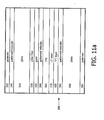
- Figures 11 a to 11c show three different arrangements of a display panel forming part of a display device according to a first aspect of the present invention.
- Figure 11 shows the cross section of such a display 300 suitable for use with left and right handed circular polarised light according to the invention in which the retarder is patterned.
- the top glass plate 310 contains a colour filter 320, a polariser 330 and a patterned retarder 340.
- the bottom glass plate 350 contains a TFT layer 365, a patterned retarder 360 and an external polariser 380.
- the liquid crystal layer 370 between the two glass plates will change the polarisation state of light passing through it.
- the optical mode of the liquid crystal layer can be ECB, TN, STN VAN or IPS.
- a polariser 400 Between the glass plates 310, 350 is a polariser 400 a patterned retarder 390, and an ITO layer 395.
- the retarder 360 and the polariser 380 are combined in such a way that circular polarised light is created.
- the director of the retarder in one pair of pixels should be-45 degrees with respect to the polariser, while in the other pair of pixels, right handed circular polarised light is obtained.
- the in cell patterned retarder 390 on the top glass plate is also oriented 45 degree with respect to the polariser 400 in such a way that, depending on the liquid crystal layer, the polarised light will either be absorbed or transmitted.
- a patterned retarder 340 combined with a polariser 330 is added to the LCD to create the dual-view image.
- the retarder and polariser are combined in such a way to either transmit or absorb the circular polarised light of the transmissive LCD as denoted in figures 6 and 8 .
- Figure 11b illustrates a display panel 302 also for use with left and right handed polarised light.
- the layers are the same as those in the display panel shown in figure 11a , except that polariser 380 is positioned between patterned retarder 360 and glass plate 350.
- Figure 11c shows a display panel 304 for use in creating linearly polarised light.
- the display panel is similar to display panels 300, 302.
- the patterned retarder 360 and polariser 380 have been replaced with a patterned polariser 385.
- polariser 330 and patterned retarder 340 have been replaced with a patterned polariser 305.
- the patterned in-cell retarders in the above described LCD can be made by using photo alignment. First, two exposure steps with polarised UV light, will pattern a photo-alignment layer. On top of this alignment layer a retarder mixture is deposited. Consequently the retarder layer is cross-linked by a UV exposure step in a nitrogen atmosphere.
- a patterned retarder which is a half wave plate on one pair of pixels but has no retardation on the other pair of pixels.
- the two polarisation states S and P will be linear polarised light.
- This patterned retarder can be made with a temperature patterning technique or a isomerisation technique.
Landscapes
- Engineering & Computer Science (AREA)
- Multimedia (AREA)
- Signal Processing (AREA)
- Liquid Crystal (AREA)
- Devices For Indicating Variable Information By Combining Individual Elements (AREA)
- Fittings On The Vehicle Exterior For Carrying Loads, And Devices For Holding Or Mounting Articles (AREA)
- Testing, Inspecting, Measuring Of Stereoscopic Televisions And Televisions (AREA)
Description
- The present invention relates to display devices, and in particular, to multi-view display devices, in which each of a plurality of users is able to see a different image to one or more of the other users.
- The generation of three-dimensional images generally requires that a display device is capable of providing a different view to the left and the right eye of a user of the display device. This can be achieved by providing a separate image directly to each eye of the user by use of specially constructed goggles. In one example, a display provides alternating left and right views in a time sequential manner, which views are admitted to a corresponding eye of the viewer by synchronised viewing goggles.
- In contradistinction, the present invention relates to classes of display devices where different views of an image can be seen according to the viewing angle relative to a single display panel. Hereinafter, these will be referred to generally as multi-view display devices. However, it is to be understood that these classes of display devices are not limited to three dimensional display devices, and also include devices that display a plurality of images, but do not display stereoscopic images.
- The invention relates particularly to a multi-view display device adapted to display two views. Such a device will be referred to as a dual-view display device.
- One known class of 3D display devices is the liquid crystal display in which the parallax barrier approach is implemented. Such a system is illustrated in
figure 1 . - With reference to
figure 1 , adisplay device 100 of the parallax barrier type comprises aback panel 11 that provides a plurality of discrete light sources. As shown, theback panel 11 may be formed by way of an areal light source 12 (such as a photoluminescent panel) covered with an opaque mask orbarrier layer 13 having a plurality ofslits 14a to 14d distributed across its surface. Each of the slits 14 then acts as a line source of light. - A liquid crystal display panel (LCD) 15 comprises a plurality of pixels (e.g. numbered 1 to 10 in
figure 1 ) which are separately addressable by electrical signals according to known techniques in order to vary their respective light transmission characteristics. Theback panel 11 is closely positioned with respect to theLCD panel 15 such that each of the line sources 14 of light corresponds to a group 16 of pixels. For example,pixels 1 to 5 shown as group 16, correspond toslit 14a,pixels 6 to 10 shown as group 162 correspond toslit 14b, etc. - Each pixel of a group 16 of pixels corresponds to one view V of a plurality of possible views (V-2, V-1, V0, V1, V2) of an image such that the
respective line source 14a can be viewed through one of thepixels 1 to 5 corresponding to that view. The number of pixels in each group 16 determines the number of views of an image present, which is five in the arrangement shown. The larger the number of views, the more realistic the 3D effect becomes and the more oblique viewing angles are provided. - Throughout the present specification, we shall refer to the 'image' being displayed as the overall image being generated by all pixels in the display panel, which image is made up of a plurality of 'views' as determined by the particular viewing angle.
- Another application for multi-view display devices is to display a plurality of views in which each view may be unrelated to each other view. Each view may be visible to a different user to each other view. Such devices have particular application in the automotive field where it may be desirable, for example, for the driver and a passenger to look at different information presented on the same screen. For example, the driver may view a route-planner, while the passenger views his e-mails, or views a DVD.
- In such multi-view displays, regions in which information from more than one view is visible at the same time, i.e., regions of cross talk, should be kept to a minimum. In addition, the viewing zones should, in general, be large.
In particular, for automotive applications, it is important for safety reasons, that the driver cannot see information presented to the passenger. - In most devices known so far, a zone exists in between the viewing zones intended for the driver and passenger respectively, in which the information that is intended for both viewers is visible at the same time. In this region there is cross talk. For an automotive application this is undesirable, since a passenger sitting in the middle of a rear bank of seats, for example, will sit precisely in this cross-talk region and perceive confusing information.
- A known multi-view display device is shown in
figure 2 . Thedisplay device 20 comprises alenticular screen 22 placed in front of aLCD display 24. This device can also be used to create a multi-view 3D display in which information from different sub-pixels is aimed at the left and right eyes of a user, respectively, such that an auto-stereoscopic picture is created. A disadvantage of this known device is that it is not possible with the presently available LCD screens that have a glass thickness of 0.5 or 1.1 mm to create large viewing angles. In particular, for dual-view displays, it is necessary to have large viewing angles and small angles between different views. However, the larger the thickness of the glass the smaller the viewing angles. In addition, there is a large region in which there is cross talk only. - It is also known to use a front barrier to create two or more views as shown in
figure 3 . Thisdevice 30 comprises anLCD panel 32 and afront barrier 34. Thedevice 30 can also be used to create auto-stereoscopic displays. Again this device suffers fromsmall viewing zones cross-talk 40. In addition, this device is not very light efficient since a large amount of light is blocked by the barrier. - Known multi-view display devices which are used to display a three dimensional stereoscopic image or images, display a plurality of views each of which views has a relatively narrow field view. In addition, there is little or no separation between adjacent views.
- An object of the present invention is to provide a multi-view display device in which each of the views has a relatively large field of view, and there is little or no cross talk between the different views.
- According to the present invention there is provided a display device and method as defined in the claims.
- By means of the present invention, a multi-view display device is provided in which the angle between different views is relatively large, and the angle between adjacent views is relatively small.
- Preferably, the viewing angle of each of the different views is approximately 90° although smaller viewing angles may also be provided by the present invention.
- Preferably, the angle between adjacent different views is approximately 10° although smaller or larger angles between adjacent views may also be produced by means of the present invention.
- The present invention is particularly useful for providing a multi-view display device for use in a car, or other vehicle.
- When it is intended to use a display device according to the present invention for use in a car, the device preferably produces two views, and is known as a dual view display device.
- In one embodiment of a display device according to the present invention, each of the first plurality of regions in the barrier layer passes light in the first polarisation state, and each of the second plurality of regions passes light in the second polarisation state.
- However, such a device will result in cross-talk between adjacent viewing zones which cross-talk can be distracting, to, for example, a passenger sitting in a rear bank of seats in a car, between a driver and front passenger.
- Preferably, therefore, each of the first plurality of regions in the barrier layer passes light in the second polarisation state, and each of the second plurality of regions passes light in a first polarisation state.
In such an embodiment, there will be little, if any, of cross talk between two adjacent views. Cross talk will occur, in a dual view device, entirely or mainly to a side of each viewing region remote from the other viewing region. - Advantageously, each group of pixels in a display panel comprises a plurality of spaced apart pixel units. Preferably, the pixel units forming the first group alternate with the pixel units forming the second group. Advantageously, each pixel unit comprises a plurality of pixels.
- If the display device according to the present invention is to serve as a dual view device, then each pixel unit will comprise two pixels.
- In a device in which each pixel unit comprises a plurality of pixels, a plurality of views will be produced by the display device.
- The invention will now be further described by way of example only with reference to the accompanying drawings in which:
-
Figure 1 shows a schematic cross sectional view of an existing design of LC device that uses the parallax barrier approach to display three dimensional images; -
Figure 2 shows a schematic cross sectional view of an existing design of LC device that uses a lenticular screen to display three dimensional images; -
Figure 3 is a schematic cross sectional view of a second existing design of LC device that uses a front barrier to display three dimensional images; -
Figure 4a shows graphically the position of different views for a device of the type shown infigure 1 for hypothetical slit width of zero; -
Figure 4b shows graphically how the field of view of each view varies as a function of the width (or transmission) of the slits in the barrier of the device shown infigure 1 ; -
Figure 5 shows schematically the desired position of two views in a display device for use in an automotive application; -
Figure 6 shows a schematic cross sectional view of a first embodiment of the invention showing two viewing zones with an area of cross talk between the viewing zones; -
Figure 7 shows graphically how the viewing angle varies with a transmission for the embodiment shown infigure 6 ; -
Figure 8 shows a second embodiment of the present invention in which there is little or no cross talk between twoviewing zones -
Figure 9 shows how the viewing angles in the embodiment shown infigure 8 varies with transmission; -
Figure 10 is a schematic cross sectional representation of a third embodiment of the invention which is similar to the embodiment shown infigure 8 , but in which vertical stripes of polar in the barrier have been shifted slightly to the right; and -
Figures 11 a ,b andc are schematic representations showing stacks of layers in liquid crystal display panels suitable for forming display devices according to the present invention. - Referring to
figures 4a and4b there is shown graphically light signals produced by pixels of the device shown infigure 1 . The light signals 41-46 are produced frompixels 41 a - 46a. - In
Figure 4b the following symbols denote the light signals 41 to 46. It is to be noted that the symboldoes not correspond to any of the light signals 41-46.
Symbol Light Signal O 41 X 42 + 43 * 44 
45 
46 - The pixels forming the
LCD display panel 15 are approximately 300 µm long, and the black matrix width of thebarrier 13 is approximately 25µm. The thickness of the glass forming thebarrier 13 is 700µm. The position of the different viewing zones is represented as a function of the transmission of the device (i.e., the width of a slit 14 in the barrier 13). It can be seen, particularly fromfigure 4b that there aresmall regions 40 where there is no cross talk andlarge regions 47 where there is cross talk. Theregions 40 of no cross talk define the width of the viewing zones. The largest obtainable viewing zones correspond to a transmission of the front barrier of zero where theviewing zones 40 are nearly 40 degrees. As can be seen particularly fromfigure 4b , when the transmission is 25% theviewing zones 40 have reduced to approximately 10 degrees, and there is cross talk between adjacent views ranging from-10 to +10 degrees. - Referring to
figure 5 , the desired positions of two views in a display device suitable for use in a car are shown. It is desirable that for a dual view display device, afirst viewing zone 50 and asecond viewing zone 52 are spaced apart from each other by azone 54 in which there is no information. In this ideal situation, there is no cross talk betweenviewing zone 50 andviewing zone 52. - Referring now to
figure 6 , a display device according to a first embodiment of the invention designated generally by thereference numeral 60. The display device comprises aLCD panel 62 comprising a two dimensional matrix ofpixels 64 mounted on afirst glass substrate 66. Asecond glass substrate 68 is mounted above thepixels 64. On an outer surface 70 of thesecond glass substrate 68,stripes stripes 72 have a first polarisation P and thestripes 74 have a second polarisation S. In this embodiment S and P refer to linear polarised light with orthogonal polarisation directions. However, in another embodiment, S and P could refer to left and right handed circular polarised light respectively. - The
pixels 64 are, formed intopixel units 65. In this embodiment, each pixel unit comprises a pair of pixels 64.Adjacent pixel units 65, have different polarisations.Pixels 64a forming afirst pixel unit 65, have a first polarisation which is the same as the polarisation of thestripes 72, andpixels 64b forming asecond pixel unit 65, have a polarisation which is the same of the polarisation ofstripes 74. Thepixels 64 are spaced apart from one another by strips of an opaque material known as a black matrix, or dot. - In between the
stripes black matrix 76.
The thickness of the first glass substrate is denoted by d, the width of the black matrix in between thepixels 64 is denoted by b, the width of the polar by w and the size of the pixels by p. The view that corresponds to pixel j starts and ends at the following angles:

At the surface from glass, to air refraction takes place. This refraction results in the angles:

figure 6 the refraction on the glass air surface is not shown).
It can be seen fromfigure 6 , that this embodiment results in twoviewing zones cross talk 220. - A plot of the angles α̃ j and β̃ j as a function of the width w of the vertical stripes of S and P polar is shown in
figure 7 . - Referring to
Figure 7 , the symbol '+' denotes light produced by pixel 1 (figure 6 ), and the symbol "*" denotes light produced by pixel 0 (figure 6 ). - The area of
cross talk 220 is shown as the area of overlap between the two viewing zones. - The
viewing zones
A second embodiment is shown infigure 8 and corresponding parts have been given the same reference numerals for ease of reference. This embodiment is similar to the first embodiment presented infigure 6 apart from the position of thevertical stripes figure 8 , this construction results in twoviews cross talk viewing zone - For the second embodiment the angles can be calculated as follows:


Again at the surface from glass to air refraction takes place. This refraction results in the angles:

where the min and max expression are used to identify total internal refraction. (Infigure 8 the refraction on the glass air surface is not shown). - A plot of the angles α̃ j and β̃ j as a function of the width w of the vertical stripes of S and P polar is shown in
figure 9 . - The symbol 'x' denotes light from pixel 0 (
figure 8 ) and the symbol '*' denotes light from pixel 1 (figure 8 ). - A comparison of the two embodiments shows the following. The
first embodiment 60 has cross talk between the two views while thesecond embodiment 80 has cross talk only on the outer side of the views. A detailed comparison shows that for a transmission of 0.5 the two views are the same for both embodiments. - In conclusion, if it is undesirable to have any cross talk in between the two views, as is the case in automotive applications, the second embodiment of the invention is the preferred embodiment.
- In some automotive applications it is favourable for the two views to be asymmetrically positioned on a display screen. For instance if the display is closer to the driver or if it is rotated towards the driver, the views are not symmetrically distributed. This can be achieved easily by shifting the
vertical stripes figure 10 , which shows a third embodiment of the invention in the form of adisplay device 1000. Typically, thevertical stripes - It can be seen that the two
viewing zones cross talk - The embodiments shown in
figure 6 ,8 and10 can be made by applying in-cell optical components in a transmissive LCD. The two different polarisation states P and S can be obtained by patterning the in-cell polariser or the in-cell retarder and as a result the polarisation state will be either linear polarised light or circular polarised light. -
Figures 11 a to 11c show three different arrangements of a display panel forming part of a display device according to a first aspect of the present invention. -
Figure 11 shows the cross section of such adisplay 300 suitable for use with left and right handed circular polarised light according to the invention in which the retarder is patterned. - The
top glass plate 310 contains acolour filter 320, apolariser 330 and apatterned retarder 340. Thebottom glass plate 350 contains aTFT layer 365, apatterned retarder 360 and anexternal polariser 380. Theliquid crystal layer 370 between the two glass plates will change the polarisation state of light passing through it. The optical mode of the liquid crystal layer can be ECB, TN, STN VAN or IPS. - Between the
glass plates patterned retarder 390, and anITO layer 395. - The
retarder 360 and thepolariser 380 are combined in such a way that circular polarised light is created. This means that theretarder 360 is a quarter wave plate and that the optical axis of theretarder 360 is oriented 45 degree with respect to the transmission axis of thepolariser 380. In order to create two different polarisation states between adjacent pairs of pixels the director of the retarder in one pair of pixels should be-45 degrees with respect to the polariser, while in the other pair of pixels, right handed circular polarised light is obtained. The in cell patternedretarder 390 on the top glass plate is also oriented 45 degree with respect to thepolariser 400 in such a way that, depending on the liquid crystal layer, the polarised light will either be absorbed or transmitted. - On top of the LCD an extra layer of a
patterned retarder 340 combined with apolariser 330 is added to the LCD to create the dual-view image. The retarder and polariser are combined in such a way to either transmit or absorb the circular polarised light of the transmissive LCD as denoted infigures 6 and8 . -
Figure 11b illustrates adisplay panel 302 also for use with left and right handed polarised light. - The layers are the same as those in the display panel shown in
figure 11a , except thatpolariser 380 is positioned betweenpatterned retarder 360 andglass plate 350. -
Figure 11c shows adisplay panel 304 for use in creating linearly polarised light. The display panel is similar to displaypanels retarder 360 andpolariser 380, have been replaced with apatterned polariser 385. Similarly,polariser 330 and patternedretarder 340, have been replaced with apatterned polariser 305. The patterned in-cell retarders in the above described LCD can be made by using photo alignment. First, two exposure steps with polarised UV light, will pattern a photo-alignment layer. On top of this alignment layer a retarder mixture is deposited. Consequently the retarder layer is cross-linked by a UV exposure step in a nitrogen atmosphere. - It is also possible to use a patterned retarder, which is a half wave plate on one pair of pixels but has no retardation on the other pair of pixels. In this case the two polarisation states S and P will be linear polarised light. This patterned retarder can be made with a temperature patterning technique or a isomerisation technique.
Claims (14)
- A multi-view display device (60) comprising:a display panel (62) having a plurality of separately addressable pixels (64) for displaying an image, a first group (64a) of said pixels being configured to provide emergent light in a first polarisation state (P), and a second group (64b) of said pixels being configured to provide emergent light in a second polarisation state (S) different from the first polarisation state, each group of pixels (64a, 64b) comprising a plurality of spaced apart pixel units (65), each pixel unit (65) comprising a plurality of pixels (64) a first pixel in each pixel unit for generating a first view, and a second pixel in each pixel unit for generating a second view, and wherein the pixel units (65) forming the first group (64a) alternate with the pixel units (65) forming the second group (64b);a barrier layer (68) in optical association with the display panel to partially occlude said emergent light, the barrier layer having a first plurality of regions (72) for passing light in one of the first or second polarisation states, and a second plurality of regions (74) for passing light in the other of the first and second polarisation states and a third plurality of regions (76) separating adjacent regions of different polarization state for occluding said emergent light, wherein the regions of said first plurality of regions alternate with the regions of said second plurality of regions;the first (72) and second (74) regions of the barrier layer being respectively registered with the first (64a) and second (64b) groups of pixels so as to provide the first and second views displayed by said display panel.
- A display device according to Claim 1 wherein each of the first plurality of regions (72) in the barrier layer passes light in the first polarisation state, and each of the second (74) plurality of regions in the barrier layer passes light in the second polarisation state.
- A display device according to Claim 1 wherein each of the first plurality of regions (72) in the barrier layer passes light in the second polarisation state, and each of the second plurality of regions (72) in the barrier layer passes light in the first polarisation state.
- A display device according to any one of the preceding claims where each pixel unit (65) comprises two pixels.
- A display device according to any one of the preceding claims wherein each pixel unit comprises three pixels.
- A display device according to any one of the preceding claims wherein adjacent pixels (64) in the display panel are separated from one another.
- A display device according to Claim 6 wherein adjacent pixels (64) are separated from one another by a black matrix (78).
- A display device (60) according to any one of the preceding claims wherein the viewing angle of each different view is approximately 90°.
- A display device (60) according to any one of the preceding claims wherein the angle between adjacent different views is approximately 10°.
- A display device (60) according to any one of the preceding claims wherein the first and second polarisation states are circular.
- A display device (60) according to any one of Claims 1 to 9 wherein the first and second polarisation states are linear.
- A method for displaying different views of an image using a multi-view display device, comprising the steps of:forming an image from a plurality of separately addressable pixels (64) in a display panel (62), the pixels being grouped such that a first group (64a) of the pixels is configured to provide emergent light in a first polarisation state (P), and a second group (64b) of the pixels is configured to provide emergent light in a second polarisation state (S) different form the first polarisation state, each group of pixels (64a, 64b) comprising a plurality of spaced apart pixel units (65), each pixel unit (65) comprising a plurality of pixels (64), a first pixel in each pixel unit for generating a first view, and a second pixel in each pixel unit for generating a second view, and wherein the pixel units (65) forming the first group (64a) alternate with the pixel units (65) forming the second group (64b);partly occluding the emergent light by means of a barrier layer (68) in optical association the display panel, the barrier layer having a first plurality of regions (72) for passing light in one of said first or second polarisation states, a second plurality of regions for passing light in the other of said first or second polarisation states and a third plurality of regions (76) separating adjacent regions of different polarization state for occluding said emergent light, wherein the regions of said first plurality of regions alternate with the regions of said second plurality of regions;the barrier layer (68) being disposed such that the first and second regions of the barrier layer are respectively registered with the first and second groups of pixels.
- A method according to Claim 12 comprising the step of positioning the barrier layer (68) relative to the display panel so that the first plurality of regions in the barrier layer passes light in the first polarisation state, and the second plurality of regions in the barrier layer passes light in the second polarisation state.
- A method according to Claim 12 comprising the step of positioning the barrier layer (68) relative to the display panel so that the first plurality of regions in the barrier layer passes light in the second polarisation state, and the second plurality of regions in the barrier layer passes light in the first polarisation state.
Applications Claiming Priority (3)
| Application Number | Priority Date | Filing Date | Title |
|---|---|---|---|
| GB0322058A GB0322058D0 (en) | 2003-09-20 | 2003-09-20 | A multi-view display based on in-cell polar or retarder |
| GB0328954A GB0328954D0 (en) | 2003-09-20 | 2003-12-12 | Image display device |
| PCT/IB2004/051717 WO2005029873A1 (en) | 2003-09-20 | 2004-09-09 | Image display device |
Publications (2)
| Publication Number | Publication Date |
|---|---|
| EP1668922A1 EP1668922A1 (en) | 2006-06-14 |
| EP1668922B1 true EP1668922B1 (en) | 2014-03-26 |
Family
ID=34379488
Family Applications (1)
| Application Number | Title | Priority Date | Filing Date |
|---|---|---|---|
| EP04769965.7A Expired - Lifetime EP1668922B1 (en) | 2003-09-20 | 2004-09-09 | Image display device |
Country Status (5)
| Country | Link |
|---|---|
| US (1) | US7623090B2 (en) |
| EP (1) | EP1668922B1 (en) |
| JP (1) | JP4558730B2 (en) |
| KR (1) | KR101117582B1 (en) |
| WO (1) | WO2005029873A1 (en) |
Families Citing this family (30)
| Publication number | Priority date | Publication date | Assignee | Title |
|---|---|---|---|---|
| WO2001059509A1 (en) * | 2000-02-07 | 2001-08-16 | Sony Corporation | Display device and design method for display device |
| US7808591B2 (en) * | 2003-09-20 | 2010-10-05 | Koninklijke Philips Electronics, N.V. | Image quality in an image display device |
| JP4504008B2 (en) * | 2003-12-22 | 2010-07-14 | オリンパス株式会社 | Video display device |
| GB2422737A (en) * | 2005-01-26 | 2006-08-02 | Sharp Kk | Multiple-view display and display controller |
| KR101167318B1 (en) * | 2005-08-31 | 2012-07-19 | 엘지디스플레이 주식회사 | stereoscopic image display device |
| JP5301283B2 (en) | 2005-12-13 | 2013-09-25 | コーニンクレッカ フィリップス エレクトロニクス エヌ ヴィ | Display device |
| WO2007111012A1 (en) * | 2006-03-27 | 2007-10-04 | Sharp Kabushiki Kaisha | Liquid crystal display device |
| CN101405642B (en) * | 2006-03-27 | 2010-10-20 | 夏普株式会社 | Liquid crystal display device having a plurality of pixel electrodes |
| FR2912536B1 (en) * | 2007-02-14 | 2009-12-25 | Peugeot Citroen Automobiles Sa | SCREEN FOR DISPLAYING AT LEAST TWO SEPARATE IMAGES FOLLOWING TWO DIFFERENT VISION ANGLES. |
| JP2009014996A (en) * | 2007-07-04 | 2009-01-22 | Seiko Epson Corp | Image display device |
| CN101415126A (en) * | 2007-10-18 | 2009-04-22 | 深圳Tcl新技术有限公司 | Method for generating three-dimensional image effect and digital video apparatus |
| US8339333B2 (en) * | 2008-01-02 | 2012-12-25 | 3M Innovative Properties Company | Methods of reducing perceived image crosstalk in a multiview display |
| JP2010016463A (en) * | 2008-07-01 | 2010-01-21 | Sharp Corp | Image display device |
| US9247286B2 (en) * | 2009-12-31 | 2016-01-26 | Broadcom Corporation | Frame formatting supporting mixed two and three dimensional video data communication |
| US8854531B2 (en) * | 2009-12-31 | 2014-10-07 | Broadcom Corporation | Multiple remote controllers that each simultaneously controls a different visual presentation of a 2D/3D display |
| US8823782B2 (en) * | 2009-12-31 | 2014-09-02 | Broadcom Corporation | Remote control with integrated position, viewer identification and optical and audio test |
| US20110157322A1 (en) * | 2009-12-31 | 2011-06-30 | Broadcom Corporation | Controlling a pixel array to support an adaptable light manipulator |
| CN102193238B (en) * | 2010-03-02 | 2015-09-23 | 群创光电股份有限公司 | Color filter substrate, manufacturing method thereof, and multi-view liquid crystal display device |
| JP5915533B2 (en) * | 2010-10-18 | 2016-05-11 | Jsr株式会社 | Liquid crystal cell, liquid crystal display element, method for producing liquid crystal cell, and photoalignment agent for retardation film |
| CN102809845B (en) * | 2011-05-30 | 2015-04-01 | 乐金显示有限公司 | Stereo image display panel and stereo image display equipment comprising same |
| WO2013039100A1 (en) * | 2011-09-16 | 2013-03-21 | 株式会社ブイ・テクノロジー | Film exposure device |
| JP5884120B2 (en) * | 2011-10-11 | 2016-03-15 | 株式会社ブイ・テクノロジー | Film exposure equipment |
| KR101323465B1 (en) * | 2012-05-22 | 2013-10-29 | 엘지디스플레이 주식회사 | A patterned retarder type display device having black strips |
| CN102929054B (en) * | 2012-11-05 | 2015-03-25 | 京东方科技集团股份有限公司 | Array substrate and driving method of pixels |
| CN104010207B (en) * | 2013-02-27 | 2018-10-12 | 联想(北京)有限公司 | A kind of data processing method, controlled device and control device |
| CN104427367A (en) * | 2013-08-22 | 2015-03-18 | 联想(北京)有限公司 | Method and device for controlling equipment |
| RU2720660C2 (en) | 2015-11-10 | 2020-05-12 | Конинклейке Филипс Н.В. | Display device and a display device control method |
| BR112018009242A8 (en) | 2015-11-10 | 2019-02-26 | Koninklijke Philips Nv | display device and method for controlling a display device |
| DE102016205700A1 (en) * | 2016-04-06 | 2017-10-12 | Bayerische Motoren Werke Aktiengesellschaft | Stereoscopic display device |
| CN107219674B (en) * | 2017-08-01 | 2020-02-14 | 深圳市华星光电技术有限公司 | Display panel and display device |
Family Cites Families (13)
| Publication number | Priority date | Publication date | Assignee | Title |
|---|---|---|---|---|
| JPH0915532A (en) * | 1995-06-29 | 1997-01-17 | Canon Inc | Stereoscopic image display method and stereoscopic image display device using the same |
| EP0829744B1 (en) * | 1996-09-12 | 2005-03-23 | Sharp Kabushiki Kaisha | Parallax barrier and display |
| US6118414A (en) * | 1997-12-02 | 2000-09-12 | Kintz; Gregory J. | Virtual reality system and method |
| US6466185B2 (en) * | 1998-04-20 | 2002-10-15 | Alan Sullivan | Multi-planar volumetric display system and method of operation using psychological vision cues |
| GB2351866A (en) * | 1999-07-07 | 2001-01-10 | Sharp Kk | Stereoscopic display |
| US6703988B1 (en) * | 1999-07-08 | 2004-03-09 | Fergason Patent Properties, Llc | Monitor for showing high-resolution and three-dimensional images and method |
| GB2352573A (en) * | 1999-07-24 | 2001-01-31 | Sharp Kk | Parallax barrier for a autostereoscopic display |
| WO2001059509A1 (en) * | 2000-02-07 | 2001-08-16 | Sony Corporation | Display device and design method for display device |
| KR100389249B1 (en) * | 2000-04-29 | 2003-06-25 | 한국과학기술연구원 | Multi-view image display system |
| JP2002296540A (en) * | 2001-03-29 | 2002-10-09 | Sanyo Electric Co Ltd | Stereoscopic image display device without spectacles |
| JP2003215497A (en) * | 2002-01-24 | 2003-07-30 | Pioneer Electronic Corp | Space image type display |
| JP3969252B2 (en) * | 2002-08-27 | 2007-09-05 | 日本電気株式会社 | Stereoscopic image plane image switching display device and portable terminal device |
| US7411636B2 (en) * | 2004-11-23 | 2008-08-12 | Fergason Patent Properties, Llc | Stereoscopic liquid crystal display (LCD) with polarization method |
-
2004
- 2004-09-09 EP EP04769965.7A patent/EP1668922B1/en not_active Expired - Lifetime
- 2004-09-09 WO PCT/IB2004/051717 patent/WO2005029873A1/en not_active Ceased
- 2004-09-09 KR KR1020067005282A patent/KR101117582B1/en not_active Expired - Lifetime
- 2004-09-09 US US10/571,825 patent/US7623090B2/en active Active
- 2004-09-09 JP JP2006526768A patent/JP4558730B2/en not_active Expired - Fee Related
Also Published As
| Publication number | Publication date |
|---|---|
| JP2007506130A (en) | 2007-03-15 |
| EP1668922A1 (en) | 2006-06-14 |
| WO2005029873A1 (en) | 2005-03-31 |
| US20070085814A1 (en) | 2007-04-19 |
| KR20060083976A (en) | 2006-07-21 |
| JP4558730B2 (en) | 2010-10-06 |
| KR101117582B1 (en) | 2012-02-24 |
| US7623090B2 (en) | 2009-11-24 |
Similar Documents
| Publication | Publication Date | Title |
|---|---|---|
| EP1668922B1 (en) | Image display device | |
| EP2055110B1 (en) | Display device | |
| US8154800B2 (en) | Multiple-view directional display | |
| JP4925702B2 (en) | Stereoscopic video display device for 2D / 3D video compatibility using a polarizing grating screen | |
| KR100840818B1 (en) | Multi View Orientation Display Device | |
| EP1549525B1 (en) | A display system for displaying images within a vehicle | |
| US20080204874A1 (en) | Highly efficient 2d/3d switchable stereoscopic display apparatus | |
| JP2007025683A (en) | display | |
| US20080204872A1 (en) | Autostereoscopic Display Apparatus | |
| KR20060105350A (en) | Stereoscopic image display device for 2D / 3D image compatibility | |
| GB2415850A (en) | Multiple view directional display operable in two orientations. | |
| WO2005054930A1 (en) | Display panel and display device | |
| Woodgate et al. | Key design issues for autostereoscopic 2‐D/3‐D displays | |
| CN100551084C (en) | image display device | |
| US20150160465A1 (en) | Liquid crystal display | |
| US20050057441A1 (en) | Three dimensional stereoscopic image display apparatus | |
| JP2003035885A (en) | 3D image display device | |
| KR100928265B1 (en) | Stereoscopic display | |
| JP2005173303A (en) | Three-dimensional image display device | |
| US7808591B2 (en) | Image quality in an image display device | |
| KR20150004028A (en) | 3 dimensional stereography image displayable device | |
| JP2001091896A (en) | Two-dimensional video/three-dimensional video interchangeable video display device | |
| GB2317295A (en) | Parallax barrier and display |
Legal Events
| Date | Code | Title | Description |
|---|---|---|---|
| PUAI | Public reference made under article 153(3) epc to a published international application that has entered the european phase |
Free format text: ORIGINAL CODE: 0009012 |
|
| 17P | Request for examination filed |
Effective date: 20060420 |
|
| AK | Designated contracting states |
Kind code of ref document: A1 Designated state(s): AT BE BG CH CY CZ DE DK EE ES FI FR GB GR HU IE IT LI LU MC NL PL PT RO SE SI SK TR |
|
| DAX | Request for extension of the european patent (deleted) | ||
| 17Q | First examination report despatched |
Effective date: 20071012 |
|
| RAP1 | Party data changed (applicant data changed or rights of an application transferred) |
Owner name: KONINKLIJKE PHILIPS N.V. |
|
| GRAP | Despatch of communication of intention to grant a patent |
Free format text: ORIGINAL CODE: EPIDOSNIGR1 |
|
| INTG | Intention to grant announced |
Effective date: 20131021 |
|
| GRAS | Grant fee paid |
Free format text: ORIGINAL CODE: EPIDOSNIGR3 |
|
| GRAA | (expected) grant |
Free format text: ORIGINAL CODE: 0009210 |
|
| AK | Designated contracting states |
Kind code of ref document: B1 Designated state(s): AT BE BG CH CY CZ DE DK EE ES FI FR GB GR HU IE IT LI LU MC NL PL PT RO SE SI SK TR |
|
| REG | Reference to a national code |
Ref country code: GB Ref legal event code: FG4D |
|
| REG | Reference to a national code |
Ref country code: CH Ref legal event code: EP |
|
| REG | Reference to a national code |
Ref country code: AT Ref legal event code: REF Ref document number: 659485 Country of ref document: AT Kind code of ref document: T Effective date: 20140415 |
|
| REG | Reference to a national code |
Ref country code: IE Ref legal event code: FG4D |
|
| REG | Reference to a national code |
Ref country code: DE Ref legal event code: R096 Ref document number: 602004044689 Country of ref document: DE Effective date: 20140508 |
|
| REG | Reference to a national code |
Ref country code: AT Ref legal event code: MK05 Ref document number: 659485 Country of ref document: AT Kind code of ref document: T Effective date: 20140326 |
|
| REG | Reference to a national code |
Ref country code: NL Ref legal event code: VDEP Effective date: 20140326 |
|
| PG25 | Lapsed in a contracting state [announced via postgrant information from national office to epo] |
Ref country code: SE Free format text: LAPSE BECAUSE OF FAILURE TO SUBMIT A TRANSLATION OF THE DESCRIPTION OR TO PAY THE FEE WITHIN THE PRESCRIBED TIME-LIMIT Effective date: 20140326 Ref country code: FI Free format text: LAPSE BECAUSE OF FAILURE TO SUBMIT A TRANSLATION OF THE DESCRIPTION OR TO PAY THE FEE WITHIN THE PRESCRIBED TIME-LIMIT Effective date: 20140326 |
|
| PG25 | Lapsed in a contracting state [announced via postgrant information from national office to epo] |
Ref country code: EE Free format text: LAPSE BECAUSE OF FAILURE TO SUBMIT A TRANSLATION OF THE DESCRIPTION OR TO PAY THE FEE WITHIN THE PRESCRIBED TIME-LIMIT Effective date: 20140326 Ref country code: BG Free format text: LAPSE BECAUSE OF FAILURE TO SUBMIT A TRANSLATION OF THE DESCRIPTION OR TO PAY THE FEE WITHIN THE PRESCRIBED TIME-LIMIT Effective date: 20140626 Ref country code: CZ Free format text: LAPSE BECAUSE OF FAILURE TO SUBMIT A TRANSLATION OF THE DESCRIPTION OR TO PAY THE FEE WITHIN THE PRESCRIBED TIME-LIMIT Effective date: 20140326 Ref country code: RO Free format text: LAPSE BECAUSE OF FAILURE TO SUBMIT A TRANSLATION OF THE DESCRIPTION OR TO PAY THE FEE WITHIN THE PRESCRIBED TIME-LIMIT Effective date: 20140326 Ref country code: CY Free format text: LAPSE BECAUSE OF FAILURE TO SUBMIT A TRANSLATION OF THE DESCRIPTION OR TO PAY THE FEE WITHIN THE PRESCRIBED TIME-LIMIT Effective date: 20140326 Ref country code: NL Free format text: LAPSE BECAUSE OF FAILURE TO SUBMIT A TRANSLATION OF THE DESCRIPTION OR TO PAY THE FEE WITHIN THE PRESCRIBED TIME-LIMIT Effective date: 20140326 Ref country code: BE Free format text: LAPSE BECAUSE OF FAILURE TO SUBMIT A TRANSLATION OF THE DESCRIPTION OR TO PAY THE FEE WITHIN THE PRESCRIBED TIME-LIMIT Effective date: 20140326 |
|
| PG25 | Lapsed in a contracting state [announced via postgrant information from national office to epo] |
Ref country code: SK Free format text: LAPSE BECAUSE OF FAILURE TO SUBMIT A TRANSLATION OF THE DESCRIPTION OR TO PAY THE FEE WITHIN THE PRESCRIBED TIME-LIMIT Effective date: 20140326 Ref country code: ES Free format text: LAPSE BECAUSE OF FAILURE TO SUBMIT A TRANSLATION OF THE DESCRIPTION OR TO PAY THE FEE WITHIN THE PRESCRIBED TIME-LIMIT Effective date: 20140326 Ref country code: AT Free format text: LAPSE BECAUSE OF FAILURE TO SUBMIT A TRANSLATION OF THE DESCRIPTION OR TO PAY THE FEE WITHIN THE PRESCRIBED TIME-LIMIT Effective date: 20140326 Ref country code: PL Free format text: LAPSE BECAUSE OF FAILURE TO SUBMIT A TRANSLATION OF THE DESCRIPTION OR TO PAY THE FEE WITHIN THE PRESCRIBED TIME-LIMIT Effective date: 20140326 |
|
| REG | Reference to a national code |
Ref country code: DE Ref legal event code: R097 Ref document number: 602004044689 Country of ref document: DE |
|
| PG25 | Lapsed in a contracting state [announced via postgrant information from national office to epo] |
Ref country code: DK Free format text: LAPSE BECAUSE OF FAILURE TO SUBMIT A TRANSLATION OF THE DESCRIPTION OR TO PAY THE FEE WITHIN THE PRESCRIBED TIME-LIMIT Effective date: 20140326 |
|
| PLBE | No opposition filed within time limit |
Free format text: ORIGINAL CODE: 0009261 |
|
| STAA | Information on the status of an ep patent application or granted ep patent |
Free format text: STATUS: NO OPPOSITION FILED WITHIN TIME LIMIT |
|
| 26N | No opposition filed |
Effective date: 20150106 |
|
| REG | Reference to a national code |
Ref country code: DE Ref legal event code: R097 Ref document number: 602004044689 Country of ref document: DE Effective date: 20150106 |
|
| PG25 | Lapsed in a contracting state [announced via postgrant information from national office to epo] |
Ref country code: LU Free format text: LAPSE BECAUSE OF FAILURE TO SUBMIT A TRANSLATION OF THE DESCRIPTION OR TO PAY THE FEE WITHIN THE PRESCRIBED TIME-LIMIT Effective date: 20140909 Ref country code: MC Free format text: LAPSE BECAUSE OF FAILURE TO SUBMIT A TRANSLATION OF THE DESCRIPTION OR TO PAY THE FEE WITHIN THE PRESCRIBED TIME-LIMIT Effective date: 20140326 |
|
| REG | Reference to a national code |
Ref country code: CH Ref legal event code: PL |
|
| REG | Reference to a national code |
Ref country code: IE Ref legal event code: MM4A |
|
| PG25 | Lapsed in a contracting state [announced via postgrant information from national office to epo] |
Ref country code: SI Free format text: LAPSE BECAUSE OF FAILURE TO SUBMIT A TRANSLATION OF THE DESCRIPTION OR TO PAY THE FEE WITHIN THE PRESCRIBED TIME-LIMIT Effective date: 20140326 Ref country code: CH Free format text: LAPSE BECAUSE OF NON-PAYMENT OF DUE FEES Effective date: 20140930 Ref country code: LI Free format text: LAPSE BECAUSE OF NON-PAYMENT OF DUE FEES Effective date: 20140930 |
|
| PG25 | Lapsed in a contracting state [announced via postgrant information from national office to epo] |
Ref country code: IE Free format text: LAPSE BECAUSE OF NON-PAYMENT OF DUE FEES Effective date: 20140909 |
|
| REG | Reference to a national code |
Ref country code: FR Ref legal event code: PLFP Year of fee payment: 12 |
|
| PG25 | Lapsed in a contracting state [announced via postgrant information from national office to epo] |
Ref country code: PT Free format text: LAPSE BECAUSE OF FAILURE TO SUBMIT A TRANSLATION OF THE DESCRIPTION OR TO PAY THE FEE WITHIN THE PRESCRIBED TIME-LIMIT Effective date: 20140326 Ref country code: GR Free format text: LAPSE BECAUSE OF FAILURE TO SUBMIT A TRANSLATION OF THE DESCRIPTION OR TO PAY THE FEE WITHIN THE PRESCRIBED TIME-LIMIT Effective date: 20140627 |
|
| PG25 | Lapsed in a contracting state [announced via postgrant information from national office to epo] |
Ref country code: HU Free format text: LAPSE BECAUSE OF FAILURE TO SUBMIT A TRANSLATION OF THE DESCRIPTION OR TO PAY THE FEE WITHIN THE PRESCRIBED TIME-LIMIT; INVALID AB INITIO Effective date: 20040909 |
|
| REG | Reference to a national code |
Ref country code: FR Ref legal event code: PLFP Year of fee payment: 13 |
|
| REG | Reference to a national code |
Ref country code: FR Ref legal event code: PLFP Year of fee payment: 14 |
|
| REG | Reference to a national code |
Ref country code: DE Ref legal event code: R079 Ref document number: 602004044689 Country of ref document: DE Free format text: PREVIOUS MAIN CLASS: H04N0013040000 Ipc: H04N0013300000 |
|
| REG | Reference to a national code |
Ref country code: FR Ref legal event code: PLFP Year of fee payment: 15 |
|
| PGFP | Annual fee paid to national office [announced via postgrant information from national office to epo] |
Ref country code: TR Payment date: 20230828 Year of fee payment: 20 Ref country code: IT Payment date: 20230920 Year of fee payment: 20 Ref country code: GB Payment date: 20230926 Year of fee payment: 20 |
|
| PGFP | Annual fee paid to national office [announced via postgrant information from national office to epo] |
Ref country code: FR Payment date: 20230926 Year of fee payment: 20 Ref country code: DE Payment date: 20230928 Year of fee payment: 20 |
|
| REG | Reference to a national code |
Ref country code: DE Ref legal event code: R071 Ref document number: 602004044689 Country of ref document: DE |
|
| REG | Reference to a national code |
Ref country code: GB Ref legal event code: PE20 Expiry date: 20240908 |
|
| PG25 | Lapsed in a contracting state [announced via postgrant information from national office to epo] |
Ref country code: GB Free format text: LAPSE BECAUSE OF EXPIRATION OF PROTECTION Effective date: 20240908 |
|
| PG25 | Lapsed in a contracting state [announced via postgrant information from national office to epo] |
Ref country code: GB Free format text: LAPSE BECAUSE OF EXPIRATION OF PROTECTION Effective date: 20240908 |