EP0836162A2 - Coin hopper weighing system - Google Patents
Coin hopper weighing system Download PDFInfo
- Publication number
- EP0836162A2 EP0836162A2 EP98100070A EP98100070A EP0836162A2 EP 0836162 A2 EP0836162 A2 EP 0836162A2 EP 98100070 A EP98100070 A EP 98100070A EP 98100070 A EP98100070 A EP 98100070A EP 0836162 A2 EP0836162 A2 EP 0836162A2
- Authority
- EP
- European Patent Office
- Prior art keywords
- coin
- coins
- hopper
- weighing
- weighing apparatus
- Prior art date
- Legal status (The legal status is an assumption and is not a legal conclusion. Google has not performed a legal analysis and makes no representation as to the accuracy of the status listed.)
- Granted
Links
Images




Classifications
-
- G—PHYSICS
- G07—CHECKING-DEVICES
- G07F—COIN-FREED OR LIKE APPARATUS
- G07F17/00—Coin-freed apparatus for hiring articles; Coin-freed facilities or services
- G07F17/32—Coin-freed apparatus for hiring articles; Coin-freed facilities or services for games, toys, sports, or amusements
- G07F17/3244—Payment aspects of a gaming system, e.g. payment schemes, setting payout ratio, bonus or consolation prizes
- G07F17/3248—Payment aspects of a gaming system, e.g. payment schemes, setting payout ratio, bonus or consolation prizes involving non-monetary media of fixed value, e.g. casino chips of fixed value
-
- G—PHYSICS
- G01—MEASURING; TESTING
- G01G—WEIGHING
- G01G19/00—Weighing apparatus or methods adapted for special purposes not provided for in the preceding groups
- G01G19/40—Weighing apparatus or methods adapted for special purposes not provided for in the preceding groups with provisions for indicating, recording, or computing price or other quantities dependent on the weight
- G01G19/42—Weighing apparatus or methods adapted for special purposes not provided for in the preceding groups with provisions for indicating, recording, or computing price or other quantities dependent on the weight for counting by weighing
-
- G—PHYSICS
- G01—MEASURING; TESTING
- G01G—WEIGHING
- G01G23/00—Auxiliary devices for weighing apparatus
- G01G23/18—Indicating devices, e.g. for remote indication; Recording devices; Scales, e.g. graduated
- G01G23/36—Indicating the weight by electrical means, e.g. using photoelectric cells
- G01G23/37—Indicating the weight by electrical means, e.g. using photoelectric cells involving digital counting
- G01G23/3728—Indicating the weight by electrical means, e.g. using photoelectric cells involving digital counting with wireless means
-
- G—PHYSICS
- G07—CHECKING-DEVICES
- G07F—COIN-FREED OR LIKE APPARATUS
- G07F17/00—Coin-freed apparatus for hiring articles; Coin-freed facilities or services
- G07F17/32—Coin-freed apparatus for hiring articles; Coin-freed facilities or services for games, toys, sports, or amusements
-
- G—PHYSICS
- G07—CHECKING-DEVICES
- G07F—COIN-FREED OR LIKE APPARATUS
- G07F17/00—Coin-freed apparatus for hiring articles; Coin-freed facilities or services
- G07F17/32—Coin-freed apparatus for hiring articles; Coin-freed facilities or services for games, toys, sports, or amusements
- G07F17/3225—Data transfer within a gaming system, e.g. data sent between gaming machines and users
- G07F17/3232—Data transfer within a gaming system, e.g. data sent between gaming machines and users wherein the operator is informed
- G07F17/3234—Data transfer within a gaming system, e.g. data sent between gaming machines and users wherein the operator is informed about the performance of a gaming system, e.g. revenue, diagnosis of the gaming system
-
- G—PHYSICS
- G07—CHECKING-DEVICES
- G07F—COIN-FREED OR LIKE APPARATUS
- G07F17/00—Coin-freed apparatus for hiring articles; Coin-freed facilities or services
- G07F17/32—Coin-freed apparatus for hiring articles; Coin-freed facilities or services for games, toys, sports, or amusements
- G07F17/3241—Security aspects of a gaming system, e.g. detecting cheating, device integrity, surveillance
-
- G—PHYSICS
- G07—CHECKING-DEVICES
- G07F—COIN-FREED OR LIKE APPARATUS
- G07F9/00—Details other than those peculiar to special kinds or types of apparatus
- G07F9/08—Counting total of coins inserted
Definitions
- the present invention relates primarily to hoppers which are used to collect and distribute coins in gaming, amusement and vending machines. More particularly, the present invention relates to an apparatus and method for determining the number of coins in a hopper by weighing the hopper and using the collected hopper weight information to deter fraud and theft.
- slot machines have been a popular attraction at gambling casinos and other gaming establishments.
- Such slot machines typically have a colorful display of gaming indicia, such as cherries, plums, oranges, sevens, etc. arrayed in rows and columns across the front of the slot machine.
- gaming indicia can be spun into motion for game play by the insertion of a coin into the slot machine and pulling the slot machine handle.
- the inserted coin is collected in a coin reservoir within the slot machine called a "hopper".
- the inserted coin will be retained in the hopper if there is a losing combination of gaming indicia shown or, alternatively, may be returned from the hopper to the slot machine player, perhaps with additional coins, if there is a winning combination of gaming indicia shown.
- slot machine hoppers Periodically, slot machine hoppers must be serviced by casino technicians. For example, the hopper may have too few or too many coins and must have its contents adjusted appropriately. Also, coins might be jammed in parts of the hopper in such a way that the hopper cannot function properly. If so inclined, a dishonest technician can pilfer a few coins each time he services a slot machine. While each individual instance of such pilfering may not represent a significant threat to a casino's bottom line, the cumulative loss over time from such pilfering can be quite large. Casinos have tried to combat this problem by, among other things, assigning two or more technicians to each task requiring a slot machine to be opened. However, this approach leads to additional labor costs and may not even help if each of the assigned technicians is dishonest.
- Coins can be pilfered from slot machines hoppers not only by casino technicians but also by the slot machine players. For example, a player might attach a string to the coin he is inserting into the slot machine so that he can retrieve the coin from the slot machine by simply pulling the string after the coin has been erroneously counted as "received" by the slot machine and game play has begun. Also, the player might try to jam the payout counter after receiving a winning combination so that the slot machine continues to eject coins well in excess of the amount to which the player is entitled.
- the present invention provides apparatuses for weighing coins in a coin hopper.
- the weighing apparatus is constructed integrally with the coin hopper assembly and fits between the coin hopper and its base plate.
- the weighing apparatus is constructed separately from the coin hopper assembly.
- the weighing apparatus includes upper and lower plates which are separated by one or more weighing instruments, such as load cells with strain gauges. In operation, the lower plate of this weighing apparatus is typically placed against the floor of the slot machine and the hopper is then simply placed on top of the weighing apparatus' upper plate.
- the present invention also provides a method of detecting fraud or theft using a suitable coin weighing apparatus.
- the weighing apparatus takes periodic readings of the number of coins residing in the hopper and can communicate those readings.
- the unauthorized removal of coins during an actual or purported technician maintenance procedure can be detected by determining a count of coins by weight when the slot machine door is opened, determining a count of coins by weight once the slot machine door is closed, and using those two counts to determine the change in the number of coins in the hopper at the time of servicing.
- the identity of the person opening the hopper door and the time at which the hopper door is opened and closed can be recorded, along with any detected discrepancy.
- the calculation of any detected discrepancy may take into account an expected change in coin count. An expected change in coin count would exist when a technician is asked to open the machine and either remove or insert coins.
- a similar method can also be used to detect a player's theft of coins from the slot machine.
- the actual number of coins in the hopper can be determined by weight and compared with the expected number of coins in the hopper in order to determine if the player has inappropriately been withholding or taking coins from the slot machine. If any unexpected coin discrepancy is detected by the weighing apparatus of the present invention, it can be communicated to appropriate security personnel in real time through a computer hook-up or alarm or, alternatively, communicated periodically through downloading of stored hopper weight information.
- FIG. 1 is a front view of a slot machine with its door open showing a coin hopper and integrated weighing apparatus of the present invention.
- FIG. 2 is a more detailed side view of the coin hopper shown in FIG. 1 illustrating the cantilevered mounting of the integrated weighing apparatus of the present invention onto the coin hopper.
- FIG. 3 is a perspective view of a preferred form of stand alone weighing apparatus of the present invention.
- FIG. 4 is an exploded perspective view of a preferred form of stand alone weighing apparatus of the present invention incorporating a full upper plate and two small load cells.
- FIG. 5 is a front view of the preferred form of stand alone weighing apparatus shown in FIG. 4 which incorporates a full upper plate and two small load cells.
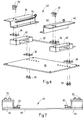
- FIG. 6 is an exploded perspective view of an alternative preferred form of stand alone weighing apparatus of the present invention incorporating an abbreviated upper plate and two large load cells.
- FIG. 7 is a front view of the alternative preferred form of stand alone weighing apparatus shown in FIG. 6 incorporating an abbreviated upper plate and two large cells.
- FIG. 8 is a exploded perspective view of a second alternative preferred form of stand alone weighing apparatus.
- FIG. 9 is a schematic diagram of the accompanying electronics for the weighing apparatuses shown in FIGS. 1-8.
- FIG. 10 is a flowchart of an accounting process for to detect coin hopper theft in a timely manner.
- FIG. 11 is a flowchart of a process for automatically taking periodic measurements to determine a coin count in the hopper.
- FIG. 12 is a flowchart of a process for calibrating a hopper's tare weight and a per coin weight.
- FIG. 13 is a flowchart of a process for obtaining an accurate hopper weight during calibration in the presence of noise and/or vibrations.
- FIG. 14 is a flowchart of a process for obtaining an accurate coin count in the presence of noise and/or vibrations.
- FIG. 1 illustrates a coin hopper assembly 9 in a slot machine 1 which incorporate an integrated form of coin weighing apparatus 12 of the present invention.
- This coin hopper assembly 9 includes a coin hopper 10 , hopper base plate 14 and integrated coin weighing apparatus 12 .
- the hopper door 2 of slot machine 1 is shown in an open position. Nonetheless, during operation, the hopper door 2 would usually be locked shut to prevent theft of coins.
- coin hopper 10 is often placed below a coin insertion slot 3 and above a coin payout tray 4 .
- a player would insert one or more coins into coin insertion slot 3 and those coins would drop into coin hopper 10 .
- the coins would typically pass through a coin handling unit on their way to coin hopper 10 .
- This coin handling unit performs tests (size, weight, angular momentum, etc.) to determine if the coin is real and of the proper denomination.
- the coin handling unit, or other device would provide a signal, such as an electric "coin in” pulse, to a logic board to indicate that a valid coin has been inserted (See, FIG. 9 ).
- coin hopper 10 ejects the correct amount of coins from ejection slot 5 into payout tray 4 .
- the hopper 10 is actually located below the payout tray and an "elevator” or “escalator” mechanism is used to raise the paid out coins higher than the payout tray so that the coins will fall into the payout tray, and thus be accessible to the player.
- a motorized conveyor assembly (not shown) of coin hopper 10 causes coins to be ejected to the payout tray or elevator and that conveyor assembly runs until a "coin out” counter indicates that the correct number of coins have been ejected.
- FIG. 2 provides a close-up view of how the integrated form of coin weighing apparatus 12 of FIG. 1 is mounted in the coin hopper assembly 9 .
- the coin weighing apparatus 12 includes a load cell 13 and strain gauge 18 .
- This coin weighing apparatus 12 is mounted between the coin hopper 10 and hopper base plate 14 .
- the coin weighing apparatus 12 is affixed to the coin hopper 10 by a cantilevered spacer 16 ( a ) and an appropriate fastener 17 .
- the coin weighing apparatus 12 is also affixed to the hopper base plate 14 by a cantilevered spacer 16 ( b ) and an appropriate fastener (not shown).
- coin hopper 10 is totally supported by cantilever spacer 16 ( a ), which is in turn totally supported by coin weighing apparatus 12 , which is turn totally supported by cantilever spacer 16 ( b ) mounted directly to base 14 .
- the weight of the coin hopper 10 and its coins is applied to the load cell 13 of the coin weighing apparatus 12 causing a strain on the load cell 13 which is a function of the weight of the coin hopper 10 and its coins. That strain is measured by a strain gauge 18 and electrically conveyed to a suitable electronic monitoring apparatus (not shown) by the lines of cabling 20 .
- load cell 12 might suitably be a Model 1040 digital load cell or Model 1041 analog load cell manufactured by Tedea Huntleigh of Canoga Park, California.
- the load cell 12 might suitably be a 36-kilogram analog load cell sold by HBM, Inc. of Connecticut with a Cirrus Logic strain gauge sensor.
- HBM, Inc. a 72-kilogram analog load cell sold by HBM, Inc. might be used. Compression, sub-miniature and strip sensor types of load cells may suitably be used with the weighing apparatus of the present invention.
- the coin weighing apparatus 12 shown in FIGS. 1 and 2 is referred to as "integrated" into the coin hopper assembly 9 because it is situated between the coin hopper 10 and hopper base plate 14 .
- installation of this integrated form of coin weighing apparatus 12 typically involves removing the coin hopper assembly 9 from the slot machine 1 and separating the coin hopper 10 from the hopper base plate 14 .
- the coin weighing apparatus 12 can then be integrated into the coin hopper assembly 9 by affixing it to the coin hopper 10 and hopper base plate 14 as shown in FIG. 2 .
- a stand-alone form of coin weighing apparatus 22 can be used, such as that shown in FIGS. 3-5 .
- this stand-alone coin weighing apparatus 22 there is no need to separate the coin hopper 10 from its base plate 14 .
- the entire coin hopper assembly 9 can simply be placed as a unit on top of the stand-alone coin weighing apparatus 22 .
- the stand-alone form of coin weighing apparatus 22 shown in FIG. 3-5 includes an upper plate 24 , a lower plate 26 , two load cells 28 , spacers 36 , 38 , two guide rails 30 and an analog-to-digital converter 34 .
- the upper plate 24 , lower plate 26 and two guide rails 30 can advantageously be made of alloy steel.
- the two load cells 28 and spacers 36 , 38 can advantageously be made of aluminum.
- the two load cells 28 of this stand-alone coin weighing apparatus 22 are mounted between the upper plate 24 and lower plate 26 . To maintain balance, the two load cells 28 are preferably on opposite sides of the coin weighing apparatus 22 and mounted parallel to one another as shown in FIGS. 3-5 . As best shown in FIG.
- the central section 25 of the upper plate 24 is recessed downward so that insertion of the stand-alone coin weighing apparatus 22 into an existing slot machine 1 will raise the height of the coin hopper assembly 9 in that slot machine 1 as little as possible.
- the preferred form of stand-alone coin weighing apparatus 22 is designed to minimize the height profile of the central section 25 upon which the coin hopper assembly 9 will be resting.
- both load cells 28 are affixed at one of their upper edges to the elevated side sections 37 of the upper plate 24 by means of suitable fasteners, such as hex bolts 35 , and spacers 36 . Both load cells 28 are then affixed at their diagonally opposite lower edge to the lower plate 26 also by means of suitable fasteners, such as flat head metal screws 39 , and spacers 38 .
- suitable fasteners such as hex bolts 35 , and spacers 36 .
- Both load cells 28 are then affixed at their diagonally opposite lower edge to the lower plate 26 also by means of suitable fasteners, such as flat head metal screws 39 , and spacers 38 .
- suitable fasteners such as flat head metal screws 39 , and spacers 38 .
- a strain gauge 32 is inserted into the load cells 28 shown in FIGS. 3-5 which is attached by wire cable 20 to a suitable electrical monitoring apparatus ( FIG. 3 ).
- the wire cable 20 is shown to first be connected to an analog-to-digital converter 34 which converts the analog measurements from the strain gauge 32 into digital form.
- a cutout 41 is made in the lower plate 26 to seat the analog-to-digital converter 34 . This cutout 41 is necessary to maintain a gap 40 ( FIG. 5 ) between the upper plate 24 and lower plate 26 by preventing the analog-to-digital converter 34 from being wedged between the two plates 24 , 26 .
- the analog-to-digital converter 34 can be attached to the upper plate 24 through use of suitable fasteners 42 .
- Affixed to the indented central section 25 of the upper plate 24 are two guide rails 30 .
- these guide rails 30 are mounted in parallel from the front to the back of the upper plate 24 so that they face one another.
- These guide rails 30 are used to firmly hold the base plate 14 ( FIG. 1 ) of the coin hopper assembly 9 in its correct position.
- one of the guide rails 30 can be laterally adjustable to accommodate different sizes of hopper base plates 14 .
- This guide rail 30 can be made laterally adjustable by machining a lateral slot or series of holes 27 in the upper plate 24 to allow this guide rail 30 to be affixed with fasteners 31 to the upper plate 24 at a variety of positions.
- FIGS. 6-7 An alternative form of stand-alone coin weighing apparatus 43 is shown in FIGS. 6-7 . Like the previous form of stand-alone coin weighing apparatus 22 , this alternative form of stand-alone coin weighing apparatus 43 includes a lower plate 48 , two load cells 45 , spacers 36 , 38 and two guide rails 30 . The primary difference between this alternative form of stand-alone coin weighing apparatus 43 and the previous stand-alone coin weighing apparatus 22 is the fact that the central section 25 of the upper plate in the previous stand-alone coin weighing apparatus 22 is missing from this alternative version 43 . Instead, the upper plate 46 from this alternative version 43 is formed in two separate pieces.
- the alternative stand-alone embodiment 43 is configured in essentially the same way as the previous stand-alone embodiment 22 .
- the load cells 45 in this alternative embodiment are placed in parallel, at opposite sides of the coin weighing apparatus 43 and affixed at one edge to their respective upper plate sections 46 by suitable fasteners, such as hex bolts 35 , and spacers 36 .
- the load cells 45 are also affixed at diagonally opposite edges to the lower plate 48 by suitable fasteners, such as flat head metal screws 39 , and spacers 38 .
- guide plates 30 are provided on each upper plate piece 46 to accept the hopper base plate 14 ( FIG. 1 ).
- FIG. 8 A second alternative embodiment of a stand-alone coin weighing apparatus 50 is shown in FIG. 8 .
- This second alternative embodiment of stand-alone coin weighing apparatus 50 includes an upper plate 52 , lower plate assembly 54 , a single load cell 56 and guide rails 58 .
- the lower plate assembly 54 in this embodiment includes a lower plate 60 , lower plate assembly sides 62 and lower plate assembly flanges 64 .
- the load cell 56 is both affixed to and interposed between the upper plate 52 and lower plate 60 .
- the load cell 56 is preferably affixed to these two plates 52 , 60 on diagonally opposite load cell edges so as to create a cantilever effect.
- this second alternative stand-alone embodiment 50 differs from the previous stand-alone embodiments 22 , 43 .
- this stand-alone embodiment only one load cell 56 is used.
- use of a single load cell 56 will obviously cost less.
- a single load cell interposed between the central sections of the upper and lower plates as shown in FIG. 8 can also be used with the stand-alone coin weighing apparatus embodiments 22 , 43 shown in FIGS. 3-7 instead of the two load cells 28 , 45 which are shown for those embodiments.
- the guide rails 58 , 30 ( a ) illustrated for this embodiment and in FIG. 3 are turned outward rather than inward.
- This outward facing of the guide rails 58 , 30 ( a ) is designed to accommodate a hopper base plate (not shown) which has its lateral edges curled under.
- the purpose of these outward facing guide rails 58 is both to correctly position the coin hopper assembly as well as to restrict side-to-side and up/down movement of the coin hopper assembly.
- the lower plate assembly 54 in this second alternative embodiment is particularly useful where the hopper 10 cannot be raised in elevation in the slot machine 1 .
- a cutout in the shape of the lower plate 60 (not shown) can be made in the floor 8 ( FIG. 1 ) of the slot machine 1 .
- the lower plate assembly 54 of this embodiment can then be dropped into place through this cutout in the slot machine floor 8 so that the lower plate assembly flanges 64 rest against the slot machine floor 8 along the edges of the cutout.
- the lower plate assembly 54 can then be attached to the slot machine floor 8 by affixing suitable fasteners through flange holes 65 and into the slot machine floor 8 . As such, most, if not all, of the coin weighing apparatus 50 in this application will rest below the slot machine floor 8 and not change the elevation of the hopper 10 in the slot machine 1 .
- the logic board comprises an analogto-digital converter 102 (A/D) coupled to load cell 13 to convert a load signal from an analog signal to a digital load cell sample.
- A/D analogto-digital converter
- the digital load cell sample has a resolution of 20 bits, but other resolution analog-to-digital converters can also be used (e.g., 14 bits or greater).
- an integer corresponding to the digital load cell sample can range from 0 to 16,383.
- A/D 102 provides its output to an input-output (I/O) controller 104 which in turn provides samples, as requested, to a central processing unit (CPU) 106 .
- I/O controller 104 provides samples, as requested, to a central processing unit (CPU) 106 .
- CPU 106 executes programs stored in program memory 108 and uses a variable memory 110 to store data incident to the execution of those programs.
- the programs executed by CPU 106 comprise instructions for following the processes described in FIGS. 10-14 , however CPU 106 might also execute other programs not described herein.
- a CPU with built-in I/O control functions and/or memory might be used, however the description of FIG. 9 still applies to such integrated systems.
- FIG. 9 shows a number of I/O signals being provided to, or by, I/O controller 104 .
- I/O controller 104 For example, "Coin In” and “Coin Out” signals are provided from coin handling devices. These signals can be pulses (one pulse per coin) or can be other signals indicating a count, as are well known in the art.
- I/O controller 104 might also provide motor, sound, reel, lights and display control signals, if CPU 106 or I/O controller 104 are programmed to handle such functions of slot machine 1 .
- I/O controller 104 receives switch signals from a variety of sources, of which a calibration switch 112 , a start switch 114 , a reset switch 116 and a door switch 118 are shown.
- FIG. 9 also shows an internal display 120 .
- a drop box is a standard part of some slot machines and is used to contain the overflow of coins from a hopper.
- a drop box might have been installed below coin hopper 10 .
- a drop box is similar to a hopper, in that it holds a collection of coins, but differs from a hopper in that coins are not ejected from the drop box. If a drop box is used, a hopper may have a sensor, such as a coin weighing apparatus of the present invention, which detects when the hopper is full.
- Drop box load cell 13 ( a ) performs a function similar to the coin hopper load cell 13 insofar as it provides an indication of the weight of a drop box (not shown) and the coins therein.
- This drop box load cell 13 ( a ) may preferably be configured in any of the ways previously described.
- a coin weighing apparatus of the present invention could be used to weigh coin fill bags which are stored in the slot machine to conveniently replenish empty coin hoppers as well as other types of drop containers. Theft or fraud can be detected by such a coin weighing apparatus when the weight of the fill bag changes without good cause.
- I/O controller 104 also reads/writes data from a data pin 124 (see FIG . 1 ).
- data pin 124 is part of a communication system manufactured by Dallas Semiconductor.
- a data wand (not shown) is a hand-held, battery-powered device with an internal computer which communicates with I/O controller 104 through a single signal line and chassis ground connection.
- a data wand can be used in conjunction with data pin 124 to calibrate the coin weighing apparatus 12 , 22 , 43 , 50 .
- FIG. 10 is a flowchart of a process for detecting coin fraud or theft by a service technician. This process is controlled by CPU 106 according to instructions stored in program memory 108 . Each step in FIG. 10 is numbered with a sequential step number, except where noted. The process shown in FIG. 10 begins when hopper door 2 (se e FIG. 1 ) is opened ( S1 ).
- hopper door 2 is secured by an electronic switch, such as a solenoid 126 (see FIG. 1 ), which can only be activated by the technician or employee touching their assigned data wand to data pin 124 .
- CPU 106 records an employee ID communicated from the data wand before activating solenoid 126 to open hopper door 2 .
- hopper door 2 can be opened by an ordinary key and the door opening can be detected by door switch 118 . In either case, a preferred embodiment records the time of opening.
- a coin count (C) is obtained ( S2 ) and the count is stored ( S3 ) as the opening count (OC). If CPU 106 makes continuous, periodic readings, then the opening count (OC) might just be the most recent periodic reading before hopper door 2 was opened and after the last game was played.
- step S4 the door is monitored until it is closed, and another coin count is taken ( S5 ).
- this second coin count is a reading taken after slot machine 1 has stabilized following the closing of the door.
- This coin count, C is stored ( S6 ) as the closing count (CC).
- S7 an expected change count (EC) is determined.
- This expected change count is positive in the case where a technician is sent to a slot machine to add coins to a depleted hopper, is negative where the technician is sent to the slot machine to remove coins, and is zero where the technician is sent to the slot machine simply to perform maintenance.
- the expected change count might not be known at the time the coins are removed, but later determined after the technician turns over the coins removed from the slot machine.
- a deficiency can be easily calculated ( S8 ), by subtracting the closing count (CC) from the opening count (OC) and adding the expected change count (EC). If the resulting deficiency (D) is not equal to zero ( S9 ), then an alarm can be set ( S10 ). Where the slot machine does not automatically determine the identification of the technician or other employee opening the slot machine, the setting of an alarm might result in a flashing light on the slot machine being immediately activated, so that the unauthorized removal of coins can be detected by a floor manager while the thief is still present at the machine.
- the slot machine detects the time of opening and closing as well as the identification of the person opening the machine, thereby allowing the deficiency to be easily traced to a specific employee.
- the slot machine will merely record the time of entry and the deficiency for later comparison to a log kept elsewhere showing which employees had access to which slot machines at which times.
- the alarm is not merely a local alarm in the form of a flashing light on the slot machine or the like, but is an alarm which is recorded by CPU 106 and is communicated to a central security station (not shown). Regardless of whether an alarm is set or not, the flow of the process returns to step S1 , where it remains until the hopper door is again opened.
- While the process shown in FIG. 10 will detect unauthorized removal of coins when a hopper door 2 is open, it does not necessarily detect unauthorized removal of coins when hopper door 2 is closed.
- the latter type of unauthorized coin removal might arise when the dishonest employee or technician modifies the slot machine to eject or reroute coins out of the hopper 10 into other spaces inside slot machine 1 for later retrieval.
- This latter type of closed door removal may also occur when a dishonest player tampers with the coin in or coin out mechanisms of the slot machine.
- This manner of closed door theft can be counteracted by monitoring the rate at which coins fail to reach hopper 10 or fail to be counted as they are ejected by comparing hopper weight to the "coin in” or “coin out” pulses to the I/O controller 104 and CPU 106 ( FIG. 9 ). Similarly, if a dishonest player inserts slugs or other types of counterfeit coins into the slot machine which have a different weight than valid coins, a comparison of the expected weight of valid coins in the coin hopper with the actual weight of counterfeit coins in the coin hopper can be used to detect this type of fraud.
- the slot machine activity is communicated to a central security station for easy monitoring and prompt detection of deficiencies.
- the automatic coin accounting process of FIG . 10 is a process which can be run independently of the coin counting processes shown elsewhere. The use of the present invention to handle other modes of theft or coin accounting should be apparent after reading this present description.
- FIG . 10 shows a process of deficiency detection
- FIG . 11 shows a more general process of taking a reading to calculate coin count C.
- the processes of FIG . 10 and the processes of FIG . 11 run asynchronously, with the process shown in FIG . 11 being a process of periodically taking a reading to update the current coin count while the process shown in FIG . 10 (more specifically steps S2 and S5 ) merely refers to an episodic coin count when the slot machine door 2 is opened or closed.
- the process shown therein begins with an initialization of the variables used ( S21 ).
- the operator is prompted with "START" or a similar prompt, prompting the operator to begin the calibration process.
- the prompt is displayed, in some embodiments, on a computer terminal, while in other embodiments it is displayed on an internal display 120 coupled to I/O 104 (see FIG. 9 ).
- the operator first determines that the hopper and slot machine are stable and the hopper is empty.
- CPU 106 determines whether diagnostics were requested by the operator.
- the operator signals that diagnostics are requested by sending a predetermined signal from a terminal to I/O controller 104 such as through the data pin I/O or by simultaneously pressing calibration button 112 and start button 114 (see FIG. 9 ). If diagnostics are requested, CPU 106 executes those diagnostics ( S23 ) and proceeds to step S24 . Otherwise, if diagnostics are not requested, CPU 106 proceeds directly to step S24 .
- step S24 CPU 106 checks to see if the operator has requested a calibration.
- the operator requests calibration by pressing calibration button 112 . If calibration is requested, the calibration process is executed ( S25 ) to determine a tare weight (TW) and a per coin weight (CW).
- TW tare weight
- CW per coin weight
- CPU 106 proceeds to step S26 , where it determines whether or not the hopper was calibrated. If the hopper was not calibrated, either because calibration was not requested or because the calibration step was not successful due to unreliable readings, CPU 106 returns to step S24 , thus creating a loop that is only exited when the hopper is finally calibrated.
- step S27 a reading of the hopper weight is taken and a coin count is calculated.
- This process is shown in further detail in FIG. 14 .
- a reliable coin count is obtained ( S28 )
- that coin count is displayed, transmitted to a remote storage and/or display device or the coin count is simply stored in variable memory 110 (see FIG. 9 ) for later provision of a coin count value to other processes which use the coin count.
- CPU 106 returns to step S24 .
- CPU 106 executes a periodic loop of taking a reading, calculating a coin count, and providing the coin count to various display or memory devices as needed.
- a latest reliable value for the coin count is retained and is not overwritten by any subsequent unreliable coin counts, thereby providing a reliable coin count value which can be polled at any time by asynchronous processes.
- FIG. 12 shows the calibration process of step S25 in further detail.
- CPU 106 waits ( S41 ) for a calibration signal, either from a remote device or from the operator pressing calibration switch 112 . If the calibration signal is not received within a predetermined time, the calibration process is aborted and an indication that calibration did not complete is given so that readings (se e FIG. 11 ) will not be taken until the calibration process actually successfully completes. If the calibration signal is received, CPU 106 proceeds to obtain the hopper weight ( S43 ), which is described in further detail in FIG. 13 . Prior to receipt of the calibration signal, the hopper should have been emptied by the operator so that a tare weight of the hopper can be obtained.
- CPU 106 delays for a predetermined time to allow for dampening of slot machine vibrations due to calibration switch 112 being pressed. If the hopper weighing process returns an error indicating that a reliable hopper weight cannot be obtained, CPU 106 aborts the calibration process ( S42 ). However, if a reliable hopper weight is obtained, that hopper weight is stored as the new tare weight (TW) value for the hopper ( S44 ).
- TW new tare weight
- a coin weight is calculated ( S48 ) by subtracting the hopper tare weight (TW) from the just measured hopper weight (HW) and dividing the difference by N.
- This new per coin weight (CW) is then stored (S 49 ) in variable memory 110 , preferably compared with a known per coin weight, and, if the measured per coin weight favorably compares with the known per coin weight, the calibration process returns indicating a successful hopper calibration.
- FIG. 13 shows the process of getting a hopper weight, the result being either returning successfully with a hopper weight (HW) or returning an error indicating that the hopper was too unstable for a measurement to have been taken.
- HW hopper weight
- the variables used for temporary storage and loop control are initialized ( S60 ) and a sampled digital value, L, is taken from load cell 13 ( S61 ).
- L a sampled digital value
- FIGS. 10-14 are equally applicable to coin accounting using a drop box, with the main difference being that load cell 13 ( a ) is sampled instead of load cell 13 .
- the sampled value L is stored as a reference reading R ( S62 ), and a main loop is entered.
- the load cell is again sampled ( S63 ) to obtain a new value for L. If the absolute value of the difference between L and the reference reading R is less than a variance limit, V, then the sampled value L is added to an accumulator (HW) and a loop counter (I) is incremented ( S65 ).
- CPU 106 then pauses for a predetermined delay period of T1 milliseconds ( S66) and then loops back to step S63 to take another reading. This continues until a predetermined number C_SAMP, of readings has been taken. Once C_SAMP readings have been taken and accumulated, the value in the accumulator (HW) is divided by C_SAMP ( S68 ), to yield a hopper weight.
- the operator is provided with an indication, such as a display "UNST", to indicate that instability is being detected, thereby giving the operator the opportunity to eliminate the source of instability while a reading is being taken. Assuming a valid hopper weight reading is obtained, this can be used in the calibration process shown in FIG. 12 .
- FIG. 14 shows the process of taking a reading, which results in either a coin count C being returned or an error indication being returned.
- an accumulator (HW) and a loop counter (not shown) are initialized.
- a load cell is sampled to obtain a value L
- CPU 106 delays for T2 milliseconds
- the sampled value L is added to the accumulator (HW).
- N_SAMP samples are taken.
- the hopper weight reading process of FIG. 14 is less interactive and less error-correcting than the hopper-weight reading process of FIG. 12 , since the former generally occurs when the slot machine is not open and an unreliable reading can be discarded without ill effects, whereas the latter process provides tare weight and per coin weights which cannot be as easily discarded.
- a hopper is weighed periodically and that weight is used, combined with an automatically determined per coin weight, to determine a number of coins in the hopper.
- coins are counted as the hopper door is opened and then counted again after the hopper door is closed and this difference is compared to an authorized difference to determine if unauthorized removal of coins from the hopper while the hopper door was open occurred.
- One application of this system includes a centralized slot machine control system, from where a trusted employee can monitor the opening and closing of each slot machine door, as well as a current inventory of the coins in the hopper and/or drop box of each slot machine. The necessary information can be communicated from the slot machines to the centralized slot machine control system through dedicated communication lines running from each slot machine or can be provided by the above described data pin system.
- a weighing apparatus of the present invention can be placed, with a suitable transmitter, at the bottom of all the mail boxes along a certain mail route. When mail is inserted into the mail box, its weight will be sensed by the weighing apparatus of the present invention and transmitted to a suitable receiver in, for example, a mail pickup vehicle.
- the person in charge of picking up mail from various mail box locations would know instantaneously which mail box locations needed to be visited for collection and which mail boxes could be skipped.
- the data pin system described above can be replaced with a hard-wired slot machine communications network connection, wireless links, optical or RF communications links, or the like. Accordingly, the scope of the invention should, therefore, be determined not with reference to the above description, but instead should be determined with reference to the appended claims along with their full scope of equivalents.
Landscapes
- Physics & Mathematics (AREA)
- General Physics & Mathematics (AREA)
- Engineering & Computer Science (AREA)
- Computer Security & Cryptography (AREA)
- General Engineering & Computer Science (AREA)
- Mathematical Physics (AREA)
- Theoretical Computer Science (AREA)
- Computer Networks & Wireless Communication (AREA)
- Slot Machines And Peripheral Devices (AREA)
- Control Of Vending Devices And Auxiliary Devices For Vending Devices (AREA)
Abstract
Description
The programs executed by
FIG. 10 is a flowchart of a process for detecting coin fraud or theft by a service technician. This process is controlled by
Claims (38)
- A weighing apparatus (12) for a coin receptacle (10) in a gaming, amusement or vending machine comprising:an upper plate (24) to support said coin receptacle (10);a lower plate (26);a load cell (28), incorporating a strain gauge (32), interposed between and attached to both said upper plate (24) and said lower (26) plate.
- The weighing apparatus (12) of claim 1 further comprising two guide rails (30) on said upper plate (24) to correctly position said coin receptacle (10).
- The weighing apparatus (12) of claim 1 further including spacers (36, 38) interposed between said load cell (28) and each of said upper plate (24) and said lower plate (26).
- The weighing apparatus (12) of claim 1 wherein said load cell (28) is in the shape of a rectangular prism.
- The weighing apparatus (12) of claim 4 wherein diagonally opposite edges of said load cell (28) are attached to said upper plate (24) and said lower plate (26).
- The weighing apparatus (12) of claim 1 wherein said gaming, amusement or vending machine is a slot machine (1).
- A weighing apparatus (22) comprising:an upper plate (24) having two elevated side sections (37) and a recessed central section (25);a substantially flat lower plate (26); andtwo load cells (28), each of said load cells (28) incorporating a strain gauge (32) and being both interposed between and attached to said lower plate (26) and one of said elevated side sections (37) of said upper plate (24).
- The weighing apparatus (22) of claim 7 further comprising two guide rails (30) on said upper plate (24) to correctly position said coin receptacle (10).
- The weighing apparatus (22) of claim 7 further including spacers (36, 38) interposed between said load cell (28) and each of said upper plate (24) and said lower plate (26).
- The weighing apparatus (22) of claim 7 wherein each of said load cells (28) is in the shape of a rectangular prism.
- The weighing apparatus (22) of claim 10 wherein diagonally opposite edges of each said load cell (28) are attached to an elevated side section (37) of said upper plate (24) and to said lower plate (26).
- The weighing apparatus (22) of claim 7 further comprising an analog-to-digital converter (34) connected to said strain gauge (32).
- A weighing apparatus (43) for a coin hopper assembly (9 in a slot machine (1) comprising:an upper plate (46) having a recessed central section which supports said coin hopper assembly and having two elevated side sections;a substantially flat lower plate (48); andtwo load cells (45), each of said load cells (45) incorporating a strain gauge and being both interposed between and attached to said lower plate (48) and one of said elevated side sections of said upper plate (46).
- The weighing apparatus (43) of claim 13 further comprising two guide rails (30) on said recessed central section of said upper plate (46) to correctly position said coin hopper assembly (9).
- The weighing apparatus (43) of claim 13 further including spacers (36, 38) interposed between said load cell (45) and both an said elevated side section of said upper plate (46) and said lower plate (48).
- An integrated coin hopper and coin weighing apparatus comprising:a coin hopper (10);a coin hopper base plate (14); and,a load cell (13), incorporating a strain gauge (18), interposed between and attached to said coin hopper (10) and said coin hopper base plate (14).
- The weighing apparatus of claim 16 further including spacers (16a, 16b) interposed between said load cell (13) and each of said coin hopper (10) and said coin hopper base plate (14).
- The weighing apparatus of claim 16 wherein said load cell (13) is in the shape of a rectangular prism.
- The weighing apparatus of claim 18 wherein diagonally opposite edges of said load cell (13) are attached to said upper plate and said lower plate.
- The weighing apparatus of claim 16 wherein said integrated coin hopper and coin weighing apparatus resides in an amusement with payout machine.
- A method of coin theft detection in a gaming machine, comprising the steps of:a first weighing step of weighing coins in a coin hopper of said gaming machine using a weighing apparatus which is built into said coin hopper, thereby measuring a first weight;a first calculating step of calculating a number of coins in the coin hopper based on the first weight, resulting in a first count;allowing access to the coins in the coin hopper;a second weighing step of weighing coins in a coin hopper of said gaming machine using a weighing apparatus which is built into said hopper, thereby measuring a second weight;a second calculating step of calculating a number of coins in the coin hopper based on the second weight, resulting in a second count; andsetting an alarm if the second count is less than the first count minus an authorized number of removed coins.
- The method of claim 21, wherein the coins are tokens exchangeable for value.
- The method of claim 21, wherein the first weighing step is performed at a time when the coin hopper is secure within the gaming machine and the second weighing step is performed at a time when the coin hopper is secure within said gaming machine, the method further comprising a step of detecting who has access to the coin hopper during a period in which the coin hopper is not secure between the time the first weighing step is performed and the second weighing step is performed.
- The method of claim 23, wherein access to the coin hopper is limited by use of an electronic key for opening a door of said gaming machine, the method further comprising the step of reading the electronic key and recording an electronic key identifier.
- The method of claim 21, further comprising the steps of:dropping an overflow number of coins from the coin hopper into a drop box when a level of coins at or above a drop threshold is detected in the coin hopper;weighing coins in the drop box, thereby determining a drop box coin weight;calculating a number of coins in the drop box from the drop box coin weight, resulting in a drop box count; andadding the drop box count to the first or second count to determine a total coin count.
- The method of claim 21, wherein the first and second steps of weighing coins are steps of weighing coins of known unit weight.
- The method of claim 21, wherein the first and second steps of weighing coins are steps of weighing coins and the coin hopper.
- The method of claim 21, wherein the steps of weighing coins comprise the substeps of:measuring an acceleration of the coin hopper relative to the gaming machine; andmeasuring a distortion of a cantilever beam which is distorted by the weight of the coin hopper and the coins therein when the acceleration of the coin hopper relative to the gaming machine is essentially zero or is a known acceleration.
- A method of securing a gaming machine from unauthorized removal of coins from a coin hopper in the gaming machine, comprising the steps of:detecting a door being opened;substantially simultaneously with the door being opened, measuring a first number of coins in the coin hopper by weight using a coin weighing apparatus which is built into said coin hopper;detecting the door being closed;measuring a second number of coins in the coin hopper by weight after the closing of the door is detected using a coin weighing apparatus which is built into said coin hopper; anddetermining a difference in coin count by subtracting the first count from the second count and electronically reporting the difference to a theft control system.
- The method of claim 29, further comprising the step of adjusting the difference to account for authorized coin removals.
- The method of claim 29, further comprising a step of setting an alarm when the difference is greater than zero.
- The method of claim 31, wherein the step of setting an alarm is a step of setting a flag in a field of a row of a data table associated with the gaming machine in which the difference is detected.
- A method of coin theft detection in a gaming machine, comprising the steps of:weighing coins in a coin hopper of said gaming machine using a coin weighing apparatus which is built into said coin hopper to determine a baseline weight at the start of a detection period;calculating a baseline coin count from the baseline weight;recording a number of inserted coins;recording a count for each authorized withdrawal of payout;calculating an expected coin count by subtracting the count for each authorized withdrawal or payout from the baseline coin count and adding the number of inserted coins thereto;weighing coins in the hopper at the end of the detection period to determine a final hopper weight using a coin weighing apparatus which is built into said coin hopper;calculating a final coin count from the final hopper weight; and determining a discrepancy amount for the detection period by subtracting thefinal coin count from the expected coin count.
- The method of claim 33, further comprising the step of reporting the discrepancy amount as a coin theft amount.
- A method of coin theft detection in a gaming machine, comprising the steps of:a first weighing step of weighing coins in a coin hopper of said gaming machine using a self-contained weighing apparatus which is separate from said coin hopper, thereby measuring a first weight;a first calculating step of calculating a number of coins in the coin hopper based on the first weight, resulting in a first count;allowing access to the coins in the coin hopper;a second weighing step of weighing coins in a coin hopper of said gaming machine using a self-contained weighing apparatus which is separate from said hopper, thereby measuring a second weight;a second calculating step of calculating a number of coins in the coin hopper based on the second weight, resulting in a second count; andsetting an alarm if the second count is less than the first count minus an authorized number of removed coins.
- A method of detecting coin theft from a fill bag in a gaming, amusement or vending machine, comprising the steps of:a first weighing step of weighing coins in a fill bag in said machine,a first calculating step of calculating a number of coins in said fill bag based on the first weight, resulting in a first count;allowing access to said fill bag;a second weighing step of weighing coins in said fill bag after allowing access, thereby measuring a second weight;a second calculating step of calculating a number of coins in said fill bag based on the second weight, resulting in a second count; andsetting an alarm if the second count is less than the first count minus an authorized number of removed coins.
- A method of detecting insertion of counterfeit coins into a coin hopper of a gaming, amusement or vending machine, comprising the steps of:ascertaining the weight of a valid coin;sensing the number of coins inserted into said machine;weighing the total number of coins collected in said coin hopper of said machine;dividing the weight of coins collected in said coin hopper by the number of coins sensed to determine the average weight of coins in said coin hopper;comparing the average weight of coins in said coin hopper to the weight of a valid coin to ascertain whether counterfeit coins are being inserted into said coin hopper.
- A method of collecting mail from only those mail boxes along a mail route which contain mail, comprising the steps of:placing a weighing apparatus having an electronic transmitter at the bottom of each mail box along a mail route, said transmitter configured to broadcast a signal only when said weighing apparatus detects the presence of mail in its mail box;receiving signals broadcast by said weighing apparatus transmitters to identify the mail boxes which contain mail;collecting mail only from those mail boxes where a weighing apparatus signal is transmitted and received which is indicative of the presence of mail in that box.
Applications Claiming Priority (8)
| Application Number | Priority Date | Filing Date | Title |
|---|---|---|---|
| US41423895A | 1995-03-31 | 1995-03-31 | |
| US414238 | 1995-03-31 | ||
| US531295P | 1995-10-16 | 1995-10-16 | |
| US5312 | 1995-10-16 | ||
| US5312P | 1995-10-16 | ||
| US08/586,513 US5819901A (en) | 1995-03-31 | 1996-01-16 | Coin hopper measurement and control system |
| US586513 | 1996-01-16 | ||
| EP96911417A EP0767898B1 (en) | 1995-03-31 | 1996-03-26 | Gaming or vending machine with time recording of opening |
Related Parent Applications (1)
| Application Number | Title | Priority Date | Filing Date |
|---|---|---|---|
| EP96911417A Division EP0767898B1 (en) | 1995-03-31 | 1996-03-26 | Gaming or vending machine with time recording of opening |
Publications (3)
| Publication Number | Publication Date |
|---|---|
| EP0836162A2 true EP0836162A2 (en) | 1998-04-15 |
| EP0836162A3 EP0836162A3 (en) | 1998-05-06 |
| EP0836162B1 EP0836162B1 (en) | 2001-05-30 |
Family
ID=27443393
Family Applications (2)
| Application Number | Title | Priority Date | Filing Date |
|---|---|---|---|
| EP98105766A Expired - Lifetime EP0856824B1 (en) | 1995-03-31 | 1996-03-26 | Calibrating a gaming machine with a weighing hopper |
| EP98100070A Expired - Lifetime EP0836162B1 (en) | 1995-03-31 | 1996-03-26 | Weighing apparatus in a gaming, amusement, or vending machine |
Family Applications Before (1)
| Application Number | Title | Priority Date | Filing Date |
|---|---|---|---|
| EP98105766A Expired - Lifetime EP0856824B1 (en) | 1995-03-31 | 1996-03-26 | Calibrating a gaming machine with a weighing hopper |
Country Status (3)
| Country | Link |
|---|---|
| EP (2) | EP0856824B1 (en) |
| GR (1) | GR3034681T3 (en) |
| SI (1) | SI0767898T1 (en) |
Cited By (5)
| Publication number | Priority date | Publication date | Assignee | Title |
|---|---|---|---|---|
| WO2005038732A1 (en) * | 2003-10-15 | 2005-04-28 | Tellermate Group Limited | Improvements in cash counting |
| GB2411035A (en) * | 2004-02-12 | 2005-08-17 | Tellermate Group Ltd | Monotoring cash handling in a retail environment |
| CN101310167B (en) * | 2005-12-13 | 2010-12-01 | 川西胜三 | Combination scale and weighing device using combination scale |
| CN105737951A (en) * | 2016-01-29 | 2016-07-06 | 广东欧珀移动通信有限公司 | Terminal weighing method and terminal |
| US11688252B2 (en) | 2016-12-02 | 2023-06-27 | Tellermate Limited | Method of remote reconciliation of data from an intelligent cash holding unit and apparatus for use in such a method |
Families Citing this family (2)
| Publication number | Priority date | Publication date | Assignee | Title |
|---|---|---|---|---|
| US6439996B2 (en) * | 1999-06-22 | 2002-08-27 | Igt | Key for a gaming machine and method of use thereof |
| GB2555489B (en) * | 2016-11-01 | 2018-12-19 | Tellermate Ltd | Cash management system and method of use thereof |
Family Cites Families (10)
| Publication number | Priority date | Publication date | Assignee | Title |
|---|---|---|---|---|
| GB1512399A (en) * | 1975-11-04 | 1978-06-01 | Bell Fruit Mfg Co Ltd | Gaming machines |
| JPS53141072A (en) * | 1977-05-15 | 1978-12-08 | Shinkou Denshi Kk | Method for counting number of parts by way of scale |
| GB2221315A (en) * | 1987-07-09 | 1990-01-31 | Ainsworth Nominees Pty Ltd | Coin freed machines |
| FR2622970B1 (en) * | 1987-11-05 | 1990-06-01 | Esselte Moreau Sa | DOUBLE DIAPASON SHEET FORCE TRANSDUCER, MANUFACTURING METHOD THEREOF, AND APPLICATION THEREOF IN A LOAD CELL |
| DE3902085C2 (en) * | 1989-01-25 | 1998-07-16 | Paul Gauselmann | Device for determining the fill level of a coin stacking container arranged in a coin-operated automatic machine |
| JP2561402B2 (en) * | 1991-04-18 | 1996-12-11 | 株式会社テック | Load cell scale |
| US5232064A (en) * | 1991-11-27 | 1993-08-03 | Intercomp Company | Weighing scale assembly |
| DE4140451A1 (en) * | 1991-12-05 | 1993-06-09 | Bally Wulff Automaten Gmbh, 1000 Berlin, De | Access control to inside of coin operated games machine - has identification card data compared with stored data to control operation of door locks |
| WO1993014842A1 (en) * | 1992-01-28 | 1993-08-05 | Kabushiki Kaisha Ace Denken | Coin circulating type slot machine |
| GB2272383B (en) * | 1992-11-12 | 1995-09-06 | Crompton Leisure Machines Limi | Amusement machine |
-
1996
- 1996-03-26 SI SI9630010T patent/SI0767898T1/en unknown
- 1996-03-26 EP EP98105766A patent/EP0856824B1/en not_active Expired - Lifetime
- 1996-03-26 EP EP98100070A patent/EP0836162B1/en not_active Expired - Lifetime
-
2000
- 2000-10-26 GR GR20000402368T patent/GR3034681T3/en not_active IP Right Cessation
Cited By (8)
| Publication number | Priority date | Publication date | Assignee | Title |
|---|---|---|---|---|
| WO2005038732A1 (en) * | 2003-10-15 | 2005-04-28 | Tellermate Group Limited | Improvements in cash counting |
| GB2411035A (en) * | 2004-02-12 | 2005-08-17 | Tellermate Group Ltd | Monotoring cash handling in a retail environment |
| WO2005081192A1 (en) * | 2004-02-12 | 2005-09-01 | Tellermate Group Limited | Improvements in cash protection |
| GB2426111A (en) * | 2004-02-12 | 2006-11-15 | Tellermate Group Ltd | Improvements in cash protection |
| CN101310167B (en) * | 2005-12-13 | 2010-12-01 | 川西胜三 | Combination scale and weighing device using combination scale |
| CN105737951A (en) * | 2016-01-29 | 2016-07-06 | 广东欧珀移动通信有限公司 | Terminal weighing method and terminal |
| CN105737951B (en) * | 2016-01-29 | 2018-03-27 | 广东欧珀移动通信有限公司 | The method and terminal that a kind of terminal is weighed |
| US11688252B2 (en) | 2016-12-02 | 2023-06-27 | Tellermate Limited | Method of remote reconciliation of data from an intelligent cash holding unit and apparatus for use in such a method |
Also Published As
| Publication number | Publication date |
|---|---|
| EP0856824A3 (en) | 1998-08-26 |
| EP0836162B1 (en) | 2001-05-30 |
| GR3034681T3 (en) | 2001-01-31 |
| EP0856824A2 (en) | 1998-08-05 |
| SI0767898T1 (en) | 1998-10-31 |
| EP0836162A3 (en) | 1998-05-06 |
| EP0856824B1 (en) | 2000-08-30 |
Similar Documents
| Publication | Publication Date | Title |
|---|---|---|
| US6176774B1 (en) | Coin hopper weighing system | |
| US5944162A (en) | Coin hopper measurement and control system | |
| US5954576A (en) | Coin hopper with preventive fill detector and automatic inventorying | |
| US5819901A (en) | Coin hopper measurement and control system | |
| US5531309A (en) | Method and apparatus for detecting fraud or theft in a gaming machine | |
| EP0724242B1 (en) | Improvements in or relating to cash registers | |
| US8597106B2 (en) | Safeguards against cheating and malfunctioning of gaming devices that use forms of cashless wagering | |
| US6328149B1 (en) | Mobile coin collection system | |
| US6213277B1 (en) | Coin operated machine including a coin box having a memory device | |
| WO1998016910A1 (en) | Gaming machine currency apparatus and method therefore | |
| EP0836162A2 (en) | Coin hopper weighing system | |
| US4774841A (en) | Monitoring the level of a stack of coins | |
| GB2559822B (en) | Intelligent cash drawer unit or cash register and methods of operation therefor | |
| AU699348C (en) | Coin hopper measurement and control system | |
| MXPA00003508A (en) | Coin hopper with preventive fill detector | |
| MXPA97008053A (en) | System of measures of hopper of coins and cont | |
| WO2000039541A1 (en) | Weighing apparatus including a planar load cell and method of use thereof | |
| JPH06131532A (en) | Coin counting processor | |
| GB2472042A (en) | Gaming machine with coin monitoring | |
| CA2365627A1 (en) | Coin collection system | |
| JPS6137678B2 (en) | ||
| RU97117937A (en) | COIN RECEIVER MEASUREMENT AND REGULATION SYSTEM | |
| MXPA99001097A (en) |
Legal Events
| Date | Code | Title | Description |
|---|---|---|---|
| PUAI | Public reference made under article 153(3) epc to a published international application that has entered the european phase |
Free format text: ORIGINAL CODE: 0009012 |
|
| PUAL | Search report despatched |
Free format text: ORIGINAL CODE: 0009013 |
|
| AC | Divisional application: reference to earlier application |
Ref document number: 767898 Country of ref document: EP |
|
| AK | Designated contracting states |
Kind code of ref document: A2 Designated state(s): AT BE CH DE DK ES FI FR GB GR IE IT LI LU MC NL PT SE |
|
| AX | Request for extension of the european patent |
Free format text: AL PAYMENT 980113;LT PAYMENT 980113;LV PAYMENT 980113;SI PAYMENT 980113 |
|
| AK | Designated contracting states |
Kind code of ref document: A3 Designated state(s): AT BE CH DE DK ES FI FR GB GR IE IT LI LU MC NL PT SE |
|
| AX | Request for extension of the european patent |
Free format text: AL PAYMENT 980113;LT PAYMENT 980113;LV PAYMENT 980113;SI PAYMENT 980113 |
|
| RIN1 | Information on inventor provided before grant (corrected) |
Inventor name: KARABIN, JUDITH Inventor name: COULTER, GARY L. Inventor name: FILIBERTI, PETER |
|
| 17P | Request for examination filed |
Effective date: 19980529 |
|
| 17Q | First examination report despatched |
Effective date: 19980810 |
|
| RIC1 | Information provided on ipc code assigned before grant |
Free format text: 7G 01G 19/42 A, 7G 07F 9/02 B, 7G 07F 17/32 B, 7G 07F 9/08 B |
|
| RTI1 | Title (correction) |
Free format text: WEIGHING APPARATUS IN A GAMING, AMUSEMENT, OR VENDING MACHINE |
|
| GRAG | Despatch of communication of intention to grant |
Free format text: ORIGINAL CODE: EPIDOS AGRA |
|
| RIC1 | Information provided on ipc code assigned before grant |
Free format text: 7G 01G 19/42 A, 7G 07F 9/02 B, 7G 07F 17/32 B, 7G 07F 9/08 B |
|
| RTI1 | Title (correction) |
Free format text: WEIGHING APPARATUS IN A GAMING, AMUSEMENT, OR VENDING MACHINE |
|
| GRAG | Despatch of communication of intention to grant |
Free format text: ORIGINAL CODE: EPIDOS AGRA |
|
| GRAG | Despatch of communication of intention to grant |
Free format text: ORIGINAL CODE: EPIDOS AGRA |
|
| GRAH | Despatch of communication of intention to grant a patent |
Free format text: ORIGINAL CODE: EPIDOS IGRA |
|
| RAP1 | Party data changed (applicant data changed or rights of an application transferred) |
Owner name: SPINTEKNOLOGY INC. |
|
| GRAH | Despatch of communication of intention to grant a patent |
Free format text: ORIGINAL CODE: EPIDOS IGRA |
|
| GRAA | (expected) grant |
Free format text: ORIGINAL CODE: 0009210 |
|
| AC | Divisional application: reference to earlier application |
Ref document number: 767898 Country of ref document: EP |
|
| AK | Designated contracting states |
Kind code of ref document: B1 Designated state(s): AT BE CH DE DK ES FI FR GB GR IE IT LI LU MC NL PT SE |
|
| AX | Request for extension of the european patent |
Free format text: AL PAYMENT 19980113;LT PAYMENT 19980113;LV PAYMENT 19980113;SI PAYMENT 19980113 |
|
| LTIE | Lt: invalidation of european patent or patent extension | ||
| PG25 | Lapsed in a contracting state [announced via postgrant information from national office to epo] |
Ref country code: NL Free format text: LAPSE BECAUSE OF FAILURE TO SUBMIT A TRANSLATION OF THE DESCRIPTION OR TO PAY THE FEE WITHIN THE PRESCRIBED TIME-LIMIT Effective date: 20010530 Ref country code: LI Free format text: LAPSE BECAUSE OF FAILURE TO SUBMIT A TRANSLATION OF THE DESCRIPTION OR TO PAY THE FEE WITHIN THE PRESCRIBED TIME-LIMIT Effective date: 20010530 Ref country code: IT Free format text: LAPSE BECAUSE OF FAILURE TO SUBMIT A TRANSLATION OF THE DESCRIPTION OR TO PAY THE FEE WITHIN THE PRESCRIBED TIME-LIMIT;WARNING: LAPSES OF ITALIAN PATENTS WITH EFFECTIVE DATE BEFORE 2007 MAY HAVE OCCURRED AT ANY TIME BEFORE 2007. THE CORRECT EFFECTIVE DATE MAY BE DIFFERENT FROM THE ONE RECORDED. Effective date: 20010530 Ref country code: FR Free format text: LAPSE BECAUSE OF FAILURE TO SUBMIT A TRANSLATION OF THE DESCRIPTION OR TO PAY THE FEE WITHIN THE PRESCRIBED TIME-LIMIT Effective date: 20010530 Ref country code: FI Free format text: LAPSE BECAUSE OF FAILURE TO SUBMIT A TRANSLATION OF THE DESCRIPTION OR TO PAY THE FEE WITHIN THE PRESCRIBED TIME-LIMIT Effective date: 20010530 Ref country code: CH Free format text: LAPSE BECAUSE OF FAILURE TO SUBMIT A TRANSLATION OF THE DESCRIPTION OR TO PAY THE FEE WITHIN THE PRESCRIBED TIME-LIMIT Effective date: 20010530 Ref country code: BE Free format text: LAPSE BECAUSE OF FAILURE TO SUBMIT A TRANSLATION OF THE DESCRIPTION OR TO PAY THE FEE WITHIN THE PRESCRIBED TIME-LIMIT Effective date: 20010530 Ref country code: AT Free format text: LAPSE BECAUSE OF FAILURE TO SUBMIT A TRANSLATION OF THE DESCRIPTION OR TO PAY THE FEE WITHIN THE PRESCRIBED TIME-LIMIT Effective date: 20010530 |
|
| REF | Corresponds to: |
Ref document number: 201764 Country of ref document: AT Date of ref document: 20010615 Kind code of ref document: T |
|
| REG | Reference to a national code |
Ref country code: CH Ref legal event code: EP |
|
| REF | Corresponds to: |
Ref document number: 69613126 Country of ref document: DE Date of ref document: 20010705 |
|
| REG | Reference to a national code |
Ref country code: IE Ref legal event code: FG4D |
|
| PG25 | Lapsed in a contracting state [announced via postgrant information from national office to epo] |
Ref country code: SE Free format text: LAPSE BECAUSE OF FAILURE TO SUBMIT A TRANSLATION OF THE DESCRIPTION OR TO PAY THE FEE WITHIN THE PRESCRIBED TIME-LIMIT Effective date: 20010830 Ref country code: PT Free format text: LAPSE BECAUSE OF FAILURE TO SUBMIT A TRANSLATION OF THE DESCRIPTION OR TO PAY THE FEE WITHIN THE PRESCRIBED TIME-LIMIT Effective date: 20010830 Ref country code: DK Free format text: LAPSE BECAUSE OF FAILURE TO SUBMIT A TRANSLATION OF THE DESCRIPTION OR TO PAY THE FEE WITHIN THE PRESCRIBED TIME-LIMIT Effective date: 20010830 |
|
| PG25 | Lapsed in a contracting state [announced via postgrant information from national office to epo] |
Ref country code: GR Free format text: LAPSE BECAUSE OF FAILURE TO SUBMIT A TRANSLATION OF THE DESCRIPTION OR TO PAY THE FEE WITHIN THE PRESCRIBED TIME-LIMIT Effective date: 20010831 Ref country code: DE Free format text: LAPSE BECAUSE OF FAILURE TO SUBMIT A TRANSLATION OF THE DESCRIPTION OR TO PAY THE FEE WITHIN THE PRESCRIBED TIME-LIMIT Effective date: 20010831 |
|
| NLV1 | Nl: lapsed or annulled due to failure to fulfill the requirements of art. 29p and 29m of the patents act | ||
| PG25 | Lapsed in a contracting state [announced via postgrant information from national office to epo] |
Ref country code: ES Free format text: LAPSE BECAUSE OF FAILURE TO SUBMIT A TRANSLATION OF THE DESCRIPTION OR TO PAY THE FEE WITHIN THE PRESCRIBED TIME-LIMIT Effective date: 20011130 |
|
| REG | Reference to a national code |
Ref country code: CH Ref legal event code: PL |
|
| EN | Fr: translation not filed | ||
| REG | Reference to a national code |
Ref country code: GB Ref legal event code: IF02 |
|
| PG25 | Lapsed in a contracting state [announced via postgrant information from national office to epo] |
Ref country code: MC Free format text: LAPSE BECAUSE OF NON-PAYMENT OF DUE FEES Effective date: 20020326 Ref country code: LU Free format text: LAPSE BECAUSE OF NON-PAYMENT OF DUE FEES Effective date: 20020326 Ref country code: IE Free format text: LAPSE BECAUSE OF NON-PAYMENT OF DUE FEES Effective date: 20020326 Ref country code: GB Free format text: LAPSE BECAUSE OF NON-PAYMENT OF DUE FEES Effective date: 20020326 |
|
| PLBE | No opposition filed within time limit |
Free format text: ORIGINAL CODE: 0009261 |
|
| STAA | Information on the status of an ep patent application or granted ep patent |
Free format text: STATUS: NO OPPOSITION FILED WITHIN TIME LIMIT |
|
| 26N | No opposition filed | ||
| GBPC | Gb: european patent ceased through non-payment of renewal fee |
Effective date: 20020326 |
|
| REG | Reference to a national code |
Ref country code: IE Ref legal event code: MM4A |