DE69934472T2 - Determining the position of the optical axis of a camera - Google Patents

Determining the position of the optical axis of a camera Download PDF

Info

Publication number
DE69934472T2
DE69934472T2 DE1999634472 DE69934472T DE69934472T2 DE 69934472 T2 DE69934472 T2 DE 69934472T2 DE 1999634472 DE1999634472 DE 1999634472 DE 69934472 T DE69934472 T DE 69934472T DE 69934472 T2 DE69934472 T2 DE 69934472T2
Authority
DE
Germany
Prior art keywords
coordinate system
mirror
camera
visible
observation
Prior art date
Legal status (The legal status is an assumption and is not a legal conclusion. Google has not performed a legal analysis and makes no representation as to the accuracy of the status listed.)
Expired - Lifetime
Application number
DE1999634472
Other languages
German (de)
Other versions
DE69934472D1 (en
Inventor
Jean-Loup Rapidel
Jean-Thierry Lapreste
Gerard Rives
Michel Dhome
Jean-Marc Lavest
Current Assignee (The listed assignees may be inaccurate. Google has not performed a legal analysis and makes no representation or warranty as to the accuracy of the list.)
FFB
Original Assignee
FFB
Priority date (The priority date is an assumption and is not a legal conclusion. Google has not performed a legal analysis and makes no representation as to the accuracy of the date listed.)
Filing date
Publication date
Application filed by FFB filed Critical FFB
Publication of DE69934472D1 publication Critical patent/DE69934472D1/en
Application granted granted Critical
Publication of DE69934472T2 publication Critical patent/DE69934472T2/en
Anticipated expiration legal-status Critical
Expired - Lifetime legal-status Critical Current

Links

Classifications

    • GPHYSICS
    • G01MEASURING; TESTING
    • G01CMEASURING DISTANCES, LEVELS OR BEARINGS; SURVEYING; NAVIGATION; GYROSCOPIC INSTRUMENTS; PHOTOGRAMMETRY OR VIDEOGRAMMETRY
    • G01C11/00Photogrammetry or videogrammetry, e.g. stereogrammetry; Photographic surveying
    • GPHYSICS
    • G01MEASURING; TESTING
    • G01BMEASURING LENGTH, THICKNESS OR SIMILAR LINEAR DIMENSIONS; MEASURING ANGLES; MEASURING AREAS; MEASURING IRREGULARITIES OF SURFACES OR CONTOURS
    • G01B11/00Measuring arrangements characterised by the use of optical techniques
    • G01B11/26Measuring arrangements characterised by the use of optical techniques for measuring angles or tapers; for testing the alignment of axes
    • G01B11/275Measuring arrangements characterised by the use of optical techniques for measuring angles or tapers; for testing the alignment of axes for testing wheel alignment
    • G01B11/2755Measuring arrangements characterised by the use of optical techniques for measuring angles or tapers; for testing the alignment of axes for testing wheel alignment using photoelectric detection means
    • GPHYSICS
    • G03PHOTOGRAPHY; CINEMATOGRAPHY; ANALOGOUS TECHNIQUES USING WAVES OTHER THAN OPTICAL WAVES; ELECTROGRAPHY; HOLOGRAPHY
    • G03BAPPARATUS OR ARRANGEMENTS FOR TAKING PHOTOGRAPHS OR FOR PROJECTING OR VIEWING THEM; APPARATUS OR ARRANGEMENTS EMPLOYING ANALOGOUS TECHNIQUES USING WAVES OTHER THAN OPTICAL WAVES; ACCESSORIES THEREFOR
    • G03B43/00Testing correct operation of photographic apparatus or parts thereof
    • GPHYSICS
    • G01MEASURING; TESTING
    • G01BMEASURING LENGTH, THICKNESS OR SIMILAR LINEAR DIMENSIONS; MEASURING ANGLES; MEASURING AREAS; MEASURING IRREGULARITIES OF SURFACES OR CONTOURS
    • G01B2210/00Aspects not specifically covered by any group under G01B, e.g. of wheel alignment, caliper-like sensors
    • G01B2210/10Wheel alignment
    • G01B2210/12Method or fixture for calibrating the wheel aligner
    • GPHYSICS
    • G01MEASURING; TESTING
    • G01BMEASURING LENGTH, THICKNESS OR SIMILAR LINEAR DIMENSIONS; MEASURING ANGLES; MEASURING AREAS; MEASURING IRREGULARITIES OF SURFACES OR CONTOURS
    • G01B2210/00Aspects not specifically covered by any group under G01B, e.g. of wheel alignment, caliper-like sensors
    • G01B2210/10Wheel alignment
    • G01B2210/14One or more cameras or other optical devices capable of acquiring a two-dimensional image
    • G01B2210/143One or more cameras on each side of a vehicle in the main embodiment
    • GPHYSICS
    • G01MEASURING; TESTING
    • G01BMEASURING LENGTH, THICKNESS OR SIMILAR LINEAR DIMENSIONS; MEASURING ANGLES; MEASURING AREAS; MEASURING IRREGULARITIES OF SURFACES OR CONTOURS
    • G01B2210/00Aspects not specifically covered by any group under G01B, e.g. of wheel alignment, caliper-like sensors
    • G01B2210/10Wheel alignment
    • G01B2210/30Reference markings, reflector, scale or other passive device
    • GPHYSICS
    • G01MEASURING; TESTING
    • G01BMEASURING LENGTH, THICKNESS OR SIMILAR LINEAR DIMENSIONS; MEASURING ANGLES; MEASURING AREAS; MEASURING IRREGULARITIES OF SURFACES OR CONTOURS
    • G01B2210/00Aspects not specifically covered by any group under G01B, e.g. of wheel alignment, caliper-like sensors
    • G01B2210/10Wheel alignment
    • G01B2210/30Reference markings, reflector, scale or other passive device
    • G01B2210/303Reference markings, reflector, scale or other passive device fixed to the ground or to the measuring station

Landscapes

  • Physics & Mathematics (AREA)
  • General Physics & Mathematics (AREA)
  • Engineering & Computer Science (AREA)
  • Multimedia (AREA)
  • Radar, Positioning & Navigation (AREA)
  • Remote Sensing (AREA)
  • Length Measuring Devices By Optical Means (AREA)

Description

Die vorliegende Erfindung betrifft ein Verfahren und eine Anordnung für die Ermittlung der Position eines Beobachtungskoordinatensystems, das mit einem Bildaufnahmeorgan einer Kamera verbunden ist, in Bezug zu einem sichtbaren Koordinatensystem, das mit der Kamera fest verbunden ist.The The present invention relates to a method and an arrangement for the Determining the position of an observation coordinate system, the connected to an image pickup member of a camera with respect to to a visible coordinate system that is firmly connected to the camera is.

Wenn eine Videokamera in einer Vorrichtung für die Ermittlung der räumlichen Position eines Gegenstandes eingesetzt wird, ist es notwendig, das geometrische Beobachtungs-Koordinatensystem genau zu kennen, das dem Bildaufnahmeorgan der Kamera zugeordnet ist. Tatsächlich ist dieses Beobachtungs-Koordinatensystem wegen den Fertigungstoleranzen der Kamera im Allgemeinen gegenüber dem sichtbaren Koordinatensystem, das dem mechanischen Aufbau der Kamera zugeordnet ist, verschoben.If a video camera in a device for determining the spatial Position of an object is used, it is necessary that Exactly knowing the geometric observation coordinate system associated with the image pickup organ of the camera. Actually this observation coordinate system because of the manufacturing tolerances the camera in general opposite the visible coordinate system corresponding to the mechanical structure of the Camera is assigned, moved.

Zwecks Vermeidung der Positionierungsfehler der Gegenstände ist es notwendig, diese Verschiebung in Betracht zu ziehen und somit die genaue Position des Beobachtungs-Koordinatensystems in Bezug zu dem mit dem Aufbau der Kamera verbundenen sichtbaren Koordinatensystem zu ermitteln oder mit jedem anderen mit dem Aufbau der Kamera verbundenen Koordinatensystem.For the purpose of Avoiding the positioning errors of the items it is necessary to do this To consider displacement and thus the exact position of the observation coordinate system relative to that with the construction determine the visible coordinate system connected to the camera or any other coordinate system associated with the construction of the camera.

Diese Ermittlung ist im Allgemeinen kompliziert.These Discovery is generally complicated.

Die Erfindung hat die Aufgabe, ein einfaches Verfahren für die Ermittlung der Position des Beobachtungs-Koordinatensystems einer Kamera in Bezug zu einem sichtbaren Koordinatensystem anzugeben, das mit dieser Kamera fest verbunden ist.The Invention has the task of a simple method for the determination the position of the observation coordinate system of a camera in Reference to a visible coordinate system to be used with this Camera is firmly connected.

Zu diesem Zweck hat die Erfindung als Gegenstand ein Verfahren zur Bestimmung der Position des Beobachtungs-Koordinatensystems in Bezug zu einem mit dem Aufbau der Kamera verbundenen sichtbaren Koordinatensystems, da durch gekennzeichnet, dass es folgende Schritte aufweist:

  • a) es wird gegenüber der Kamera ein Spiegel aufgestellt, der eine Bezugspunktanordnung mit bekannter geometrischer Konfiguration aufweist, wobei der Spiegel so orientiert ist, dass die Reflexion des sichtbaren Koordinatensystems durch die Kamera beobachtet werden kann,
  • b) ausgehend von der Kamera wird ein Bild des Spiegels erstellt, in dem das reflektierte Bild des sichtbaren Koordinatensystems und die Bezugspunktanordnung erscheinen; und
  • c) es wird die Position des Beobachtungs-Koordinatensystems der Kamera in Bezug zum sichtbaren Koordinatensystem ermittelt, ausgehend von der Auswertung des Bildes, das durch die Reflexion des sichtbaren Koordinatensystems im Spiegel und der Bezugspunktanordnung erhalten wurde.
To this end, the invention has as its subject matter a method for determining the position of the observation coordinate system relative to a visible coordinate system connected to the construction of the camera, characterized in that it comprises the following steps:
  • a) a mirror is placed opposite the camera, having a reference point arrangement of known geometric configuration, the mirror being oriented so that the reflection of the visible coordinate system can be observed by the camera,
  • b) from the camera, an image of the mirror is made, in which the reflected image of the visible coordinate system and the reference point arrangement appear; and
  • c) the position of the observation coordinate system of the camera with respect to the visible coordinate system is determined, based on the evaluation of the image obtained by the reflection of the visible coordinate system in the mirror and the reference point arrangement.

Entsprechend den unterschiedlichen Einsatzmöglichkeiten weist das Verfahren eine oder mehrere der folgenden Merkmale auf:

  • – in Schritt c), um die Position des Beobachtungs-Koordinatensystems in Bezug zu dem sichtbaren Koordinatensystem herzuleiten: c') man bestimmt die Position des Spiegels in Bezug zum Beobachtungs-Koordinatensystem der Kamera, ausgehend von der Auswertung des Bildes der Bezugspunktanordnung; c'') man bestimmt die Position des Bildes, das durch die Reflexion des sichtbaren Koordinatensystems im Spiegel (50) in Bezug zum Beobachtungs-Koordinatensystem der Kamera erhalten wurde; und c'') man bestimmt durch Berechnung die relative Position des Beobachtungs-Koordinatensystems in Bezug zum sichtbaren Koordinatensystem.
Depending on the different possible uses, the method has one or more of the following features:
  • In step c) to derive the position of the observation coordinate system with respect to the visible coordinate system: c ') determining the position of the mirror with respect to the camera's observation coordinate system based on the evaluation of the image of the reference point array; c '') one determines the position of the image, which is determined by the reflection of the visible coordinate system in the mirror ( 50 ) with respect to the observation coordinate system of the camera; and c '') one determines by calculation the relative position of the observation coordinate system with respect to the visible coordinate system.

Die Erfindung betrifft ferner ein Verfahren zur Ermittlung der Position eines Beobachtungs-Koordinatensystems, das dem Bildaufnahmeorgan einer Kamera zugeordnet ist, in Bezug zu einer räumlichen Richtung, definiert durch eine bekannte Gerade, wobei die Kamera mit einem an ihr befestigten sichtbaren Koordinatensystem ausgerüstet ist, dadurch gekennzeichnet, dass:

  • A) man bestimmt die Position des Beobachtungs-Koordinatensystems in Bezug zu dem sichtbaren Koordinatensystem durch ein Verfahren, wie weiter oben definiert;
  • B) man erzeugt zwei Bilder desselben Spiegels, auf denen das sichtbare Koordinatensystem erscheint, in zwei unterschiedlichen Positionen des Spiegels in einem Winkel um die Gerade verschoben;
  • C) man leitet die Position des Beobachtungs-Koordinatensystems in Bezug zu der Gerade her, die dem Schnitt der zwei Ebenen des Spiegels in den zwei unterschiedlichen Positionen entspricht, ausgehend von der Auswertung der durch Reflexion des sichtbaren Koordinatensystems in dem Spiegel erhaltenen Bilder und von der bestimmten Position des Beobachtungs-Koordinatensystems in Bezug zu dem sichtbaren Koordinatensystem.
The invention further relates to a method for determining the position of an observation coordinate system associated with the imaging element of a camera with respect to a spatial direction defined by a known line, the camera being equipped with a visible coordinate system attached thereto characterized in that:
  • A) determining the position of the observation coordinate system with respect to the visible coordinate system by a method as defined above;
  • B) two images of the same mirror, on which the visible coordinate system appears, are shifted in two different positions of the mirror at an angle around the straight line;
  • C) one derives the position of the observation coordinate system in relation to the line corresponding to the intersection of the two planes of the mirror in the two different positions, starting from the evaluation of the images obtained by reflection of the visible coordinate system in the mirror and of the certain position of the observation coordinate system with respect to the visible coordinate system.

Gemäß den bevorzugten Ausführungsformen:

  • – wird der Schritt A) der Bestimmung der Position des Beobachtungs-Koordinatensystems in Bezug zu dem sichtbaren Koordinatensystem ausgeführt, ausgehend von einem der in Schritt B) erzeugten Bilder für die Bestimmung der Position des Beobachtungs-Koordinatensystems in Bezug zu der Geraden; und
  • – der Spiegel wird aufgehängt und erstreckt sich senkrecht unter der Wirkung seines Eigengewichtes und dadurch, dass die zwei unterschiedlichen Positionen des Spiegels, in denen die Bilder erzeugt werden, beide solche Positionen sind, in welchen der Spiegel frei aufgehängt ist und im Winkel zwischen den zwei Positionen in der waagerechten Ebene versetzt ist, wobei die genannte Gerade durch die vertikale Drehachse des Spiegels definiert wird.
According to the preferred embodiments:
  • The step A) of determining the position of the observation coordinate system with respect to the visible coordinate system is carried out starting from one of the images generated in step B) for determining the position of the observation coordinate system with respect to the line; and
  • The mirror is suspended and extends vertically under the effect of its own weight and in that the two different positions of the mirror in which the images are produced are both such positions in which the mirror is freely suspended and at an angle between the two Positions in the horizontal plane is offset, said straight line is defined by the vertical axis of rotation of the mirror.

Die Erfindung betrifft ferner eine Vorrichtung zur Bestimmung der Position eines Beobachtungs-Koordinatensystems, das mit dem Bildaufnahmeorgan einer Kamera verbunden ist, in Bezug zu einem sichtbaren Koordinatensystem, das an dieser Kamera angebracht ist, dadurch gekennzeichnet, dass:

  • a) sie im Blickfeld der Kamera einen Spiegel aufweist, der eine Bezugspunktanordnung mit bekannter geometrischer Konfiguration aufweist, wobei der Spiegel derart orientiert ist, dass die Reflexion des sichtbaren Koordinatensystems in dem Spiegel durch die Kamera beobachtbar ist;
  • b) sie Mittel für die Erzeugung, ausgehend von der Kamera, eines Bildes des Spiegels aufweist, auf dem das Bild des sichtbaren Koordinatensystems und die Bezugspunktanordnung erscheinen; und
  • c) sie Mittel zur Herleitung der Position des Beobachtungs-Koordinatensystems der Kamera in Bezug zu dem sichtbaren Koordinatensystem, ausgehend von der Auswertung des im Spiegel durch Reflexion erhaltenen Bildes des sichtbaren Koordinatensystems und der Bezugspunktanordnung, aufweist.
The invention further relates to a device for determining the position of an observation coordinate system, which is connected to the image recording member of a camera, with respect to a visible coordinate system, which is mounted on this camera, characterized in that:
  • a) it has in the field of view of the camera a mirror having a reference point arrangement of known geometric configuration, wherein the mirror is oriented such that the reflection of the visible coordinate system in the mirror is observable by the camera;
  • b) having means for generating, starting from the camera, an image of the mirror on which the image of the visible coordinate system and the reference point arrangement appear; and
  • c) it has means for deriving the position of the observation coordinate system of the camera with respect to the visible coordinate system, based on the evaluation of the image obtained in the mirror by reflection of the visible coordinate system and the reference point arrangement.

Insbesondere weisen die genannten Mittel zur Herleitung der Position des Beobachtungs-Koordinatensystems in Bezug zu dem sichtbaren Koordinatensystem folgendes auf:

  • c') Mittel zum Bestimmen der Position des Spiegels in Bezug zu dem Beobachtungs-Koordinatensystem der Kamera, ausgehend von der Auswertung des Bildes der Bezugspunktanordnung;
  • c'') Mittel zum Bestimmen der Position des Bildes, das durch Reflexion in dem Spiegel des sichtbaren Koordinatensystems in Bezug zum Beobachtungs-Koordinatensystem der Kamera erhalten worden ist; und
  • c''') Mittel für die Berechnung der relativen Position des Beobachtungs-Koordinatensystems in Bezug zum sichtbaren Koordinatensystem.
In particular, said means for deriving the position of the observation coordinate system with respect to the visible coordinate system comprise:
  • c ') means for determining the position of the mirror with respect to the observation coordinate system of the camera, based on the evaluation of the image of the reference point arrangement;
  • c '') means for determining the position of the image obtained by reflection in the mirror of the visible coordinate system relative to the observation coordinate system of the camera; and
  • c ''') means for calculating the relative position of the observation coordinate system with respect to the visible coordinate system.

Die Erfindung wird besser verstanden durch das Lesen der nachfolgenden Beschreibung, die ausschließlich beispielhaft und mit Beziehung auf die Zeichnungen angegeben wird, wobei:The Invention will be better understood by reading the following Description exclusively by way of example and with reference to the drawings, in which:

1 eine Draufsicht einer optischen Anordnung gemäß der Erfindung ist, welche eingerichtet ist, um die relativen Positionen der vier Räder eines Kraftfahrzeuges zu bestimmen; 1 is a plan view of an optical arrangement according to the invention, which is adapted to determine the relative positions of the four wheels of a motor vehicle;

2A und 2B sind perspektivische Ansichten desselben optischen Referenzsystems der Anordnung der 1, in denen jeweils ein eigenes Beobachtungs-Koordinatensystem des Bildaufnahmeorgans und ein sichtbares Koordinatensystem, das durch eine Bezugspunktanordnung definiert wird, abgebildet sind; 2A and 2 B FIG. 15 are perspective views of the same reference optical system of the arrangement of FIG 1 in each of which a separate observation coordinate system of the image recording element and a visible coordinate system, which is defined by a reference point arrangement, are mapped;

3 ist eine perspektivische Ansicht eines optischen Referenzsystems, das gegenüber einem Spiegel aufgestellt ist, der zwischen zwei Positionen verfahrbar ist, um die Position des Beobachtungs-Koordinatensystems des optischen Systems in Bezug zu seines sichtbaren Koordinatensystems zu bestimmen; und 3 Fig. 11 is a perspective view of a reference optical system positioned opposite a mirror that is movable between two positions to determine the position of the observation coordinate system of the optical system with respect to its visible coordinate system; and

4 ist eine schematische Ansicht, welche die erfindungsgemäße Bestimmung der relativen Positionen der Beobachtungs-Koordinatensysteme der zwei gegenüberliegenden optischen Systeme illustriert; 4 Fig. 12 is a schematic view illustrating the determination according to the invention of the relative positions of the observation coordinate systems of the two opposing optical systems;

Die in 1 dargestellte Anordnung ist dafür vorgesehen, um die relativen Positionen der vier Räder R eines Kraftfahrzeuges 10 optisch zu bestimmen;In the 1 shown arrangement is provided to the relative positions of the four wheels R of a motor vehicle 10 optically determine;

Die Anordnung weist vier optische Systeme 12, 14, 16, 18 auf, die je einem Rad R des Fahrzeuges zugeordnet sind. Jedes davon enthält eine CCD-Videokamera, bezeichnet als 12A, 14A, 16A, 18A. Diese vier Kameras sind an eine zentrale Datenverarbeitungseinheit 20 angeschlossen, gebildet z. B. von einem Rechner, der für die Verarbeitung der empfangenen Bilder eingerichtet ist.The arrangement has four optical systems 12 . 14 . 16 . 18 on, each associated with a wheel R of the vehicle. Each of them contains a CCD video camera, referred to as 12A . 14A . 16A . 18A , These four cameras are connected to a central data processing unit 20 connected, formed z. From a computer set up to process the received images.

Die optischen Systeme 12, 14, 16, 18 sind untereinander rund um das Fahrzeug 10 verfahrbar. Für eine korrekte Funktion der Anordnung sind die optischen Systeme unbeweglich in den vier Ecken eines Vierecks aufgestellt, insbesondere eines Rechtecks, welches das Fahrzeug umschließt.The optical systems 12 . 14 . 16 . 18 are among each other around the vehicle 10 traversable. For correct operation of the arrangement, the optical systems are immovably placed in the four corners of a square, in particular a rectangle enclosing the vehicle.

Das optische System 12 ist in den 2A und 2B perspektivisch dargestellt. Die Videokamera 12A steht auf einem Dreifuß 24, welcher für die Aufstellung auf den Fußboden eingerichtet ist. Zusätzlich ist die Kamera 12A mit einer Zielscheibe 26 fest verbunden, die ein sichtbares Koordinatensystem (O, xyz) definiert, bezeichnet mit A12 und in 2A sichtbar. Die Zielscheibe 26 ist durch mechanische Mittel an dem Aufbau der Kamera und insbesondere in Bezug zu dem Beobachtungs-Koordinatensystem (O', x'y'z') befestigt. Das Beobachtungs-Koordinatensystem C12 ist mit dem Bildaufnahmeorgan 28 der Kamera 12A verbunden und insbesondere mit dessen CCD-Sensor.The optical system 12 is in the 2A and 2 B shown in perspective. The video camera 12A stands on a tripod 24 , which is set up for installation on the floor. In addition, the camera 12A with a target 26 fixed, which defines a visible coordinate system (O, xyz), labeled A12 and in 2A visible, noticeable. The target 26 is fixed by mechanical means to the structure of the camera and in particular with respect to the observation coordinate system (O ', x'y'z'). The observation coordinate system C12 is with the image pickup organ 28 the camera 12A connected and in particular with its CCD sensor.

Das optische System 12 bildet ein optisches Referenzsystem. Desgleichen bildet das optische System 16, aufgestellt in der entgegengesetzten Ecke bezogen auf das Fahrzeug in der Konfiguration in 1, ebenfalls ein optisches Referenzsystem und hat den gleichen Aufbau wie das optische System 12.The optical system 12 forms an optical reference system. Likewise, the optical system forms 16 , placed in the opposite corner relative to the vehicle in the configuration in 1 , also an optical reference system and has the same structure as the optical system 12 ,

Hingegen sind die optischen Systeme 14 und 18 ohne Zielscheiben und weisen jeweils eine einfache Videokamera 14A, 18A auf, die von einem Dreifuß als Stütze getragen wird.On the other hand, the optical systems 14 and 18 without targets and each have a simple video camera 14A . 18A on which is supported by a tripod as a support.

Als Variante haben die optischen Systeme 14 und 18 den gleichen Aufbau wie die optischen Systeme 12 und 16. In diesem Fall sind die vier optischen Systeme optische Referenzsysteme, was redundante Messungen gestattet und folglich eine größere Zuverlässigkeit des Ergebnisses dieser Messungen.As a variant, the optical systems 14 and 18 the same structure as the optical systems 12 and 16 , In this case, the four optical systems are optical reference systems, allowing for redundant measurements and, consequently, greater reliability of the result of these measurements.

Wie in 2A dargestellt, ist die Zielscheibe 26 z. B. aus einer kreisförmigen Scheibe O gebildet, auf deren Umfang zwölf koplanare Punkte 26A verteilt sind. Zusätzlich hat die Zielscheibe 26 einen dreizehnten Punkt 26B, der vor der Hauptebene der Scheibe angeordnet ist, welche die zwölf Punkte 26A beinhaltet.As in 2A pictured is the target 26 z. B. formed from a circular disc O, on the circumference twelve coplanar points 26A are distributed. In addition, the target has 26 a thirteenth point 26B , which is located in front of the main plane of the disc, which are the twelve points 26A includes.

Dieser Punkt individualisiert die Scheibe 26 dem Winkel nach und ermöglicht die Definierung von zwei rechtwinkligen Achsen, Ox und Oy, in der Ebene der Zielscheibe. Die Achse Oy verläuft vorzugsweise rechts am Punkt 26B vorbei.This point individualizes the disc 26 in the angle and allows the definition of two orthogonal axes, Ox and Oy, in the plane of the target. The axis Oy preferably runs right at the point 26B past.

Die Zielscheibe 26 weist eine Hauptsymmetrieachse auf, definiert von den zwölf koplanaren Punkten, die regelmäßig entlang des Umfang der Scheibe verteilt sind. Die Hauptsymmetrieachse bildet eine Achse Oz, die rechtwinklig zu den Achsen Ox, Oy ist.The target 26 has a main axis of symmetry defined by the twelve coplanar points regularly distributed along the circumference of the disk. The main axis of symmetry forms an axis Oz which is perpendicular to the axes Ox, Oy.

Die Achsen Oz, Oy, Oz und der Punkt O definieren das sichtbare Koordinatensystem A12.The Axes Oz, Oy, Oz and the point O define the visible coordinate system A12.

Die Zielscheibe 26 bildet somit eine Bezugspunktanordnung mit bekannter geometrischer Konfiguration, welche das sichtbare Koordinatensystem A12 definiert.The target 26 thus forms a reference point arrangement of known geometric configuration which defines the visible coordinate system A12.

Dieses ist in einer Position befestigt, die gegenüber dem Beobachtungs-Koordinatensystem C12 der Kamera bestimmt werden kann.This is mounted in a position opposite to the observation coordinate system C12 of the camera can be determined.

Wie in 2B dargestellt, hat das Beobachtungs-Koordinatensystem C12 als Mittelpunkt, bezeichnet durch O', den Mittelpunkt des CCD-Sensors der Kamera 12A. Das Beobachtungs-Koordinatensystem wird durch einen Trieder (O'x', O'y', O'z') definiert, wo O'z' die optische Achse der Kamera ist, O'x' eine parallele Achse zu den waagerechten Pixelreihen des CCD-Sensors ist und O'y' eine parallele Achse zu den senkrechten Pixelkolonnen des CCD-Sensors ist.As in 2 B As shown, the observation coordinate system C12 as the center, denoted by O ', has the center of the CCD sensor of the camera 12A , The observation coordinate system is defined by a trihedron (O'x ', O'y', O'z ') where O'z' is the optical axis of the camera, O'x 'is a parallel axis to the horizontal pixel rows of the camera CCD sensor is and O'y 'is a parallel axis to the vertical pixel columns of the CCD sensor.

Die geometrische Konfiguration der Bezugspunktanordnung der Zielscheibe 26 ist in der Datenverarbeitungseinheit 20 gespeichert.The geometric configuration of the reference point arrangement of the target 26 is in the data processing unit 20 saved.

Die Datenverarbeitungseinheit 20 beinhaltet die Mittel für den Einsatz der Algorithmen für die Bestimmung der räumlichen Position eines Gegenstandes. Insbesondere ist sie für die Bestimmung der Position eines Gegenstandes eingerichtet, der eine Bezugspunktanordnung mit einer bekannten geometrischen Konfiguration trägt, wobei diese Konfiguration im Vorhinein in der Einheit 20 gespeichert ist. Diese Position wird ausgehend von dem Bild dieses Gegenstandes bestimmt, das durch eine Kamera, welche an der Datenverarbeitungseinheit angeschlossen ist, aufgenommen worden ist. Die räumliche Position des Gegenstandes wird in Bezug zu dem Beobachtungs-Koordinatensystem C12 der Kamera berechnet. Der eingesetzte Algorithmus ist beliebiger Natur und wird angepasst, und z. B. wie in der Anmeldung WO 94/05969 beschrieben.The data processing unit 20 includes the means for using the algorithms to determine the spatial position of an object. In particular, it is adapted for the determination of the position of an article carrying a datum arrangement having a known geometrical configuration, this configuration being in advance in the unit 20 is stored. This position is determined based on the image of this object taken by a camera connected to the data processing unit. The spatial position of the object is calculated in relation to the camera's observation coordinate system C12. The algorithm used is of any nature and is adapted, and z. As described in the application WO 94/05969.

Im Hinblick auf die Verwendung solcher Algorithmen wird es bevorzugt, im Voraus geeichte Kameras zu verwenden, um die Fehler auszugleichen, die von den Unvollkommenheiten der Kamera und des Sensors, die sie aufweist, herrühren.in the With regard to the use of such algorithms, it is preferred to use pre-calibrated cameras to compensate for the errors those from the imperfections of the camera and the sensor they use resulting.

Zu diesem Zweck werden für jede Kamera deren innere Eigenschaften (Beobachtungs-Koordinatensystem, Brennpunkt, Größe des Bildelements oder der Pixel, Radialverzerrung, Tangentialverzerrung) und äußere Eigenschaften (Verfahr- und Drehmatrixen und die, an dem beobachteten Gegenstand angewendet, ein absolut identisches Bild zu dem von der Kamera beobachteten und von seinen Verzerrungen befreiten Bild darstellen. Es werden somit durch bekannte Verfahren die Korrekturen bestimmt, bevor diese auf die aufgenommenen Bildern angewendet werden, um die korrekte räumliche Position eines Gegenstandes zu ermitteln.To this purpose will be for each camera its internal properties (observation coordinate system, Focus, size of picture element or the pixel, radial distortion, tangential distortion) and external properties (Traversing and rotating matrixes and the, on the observed object applied, an absolutely identical picture to that observed by the camera and depict his distorted image. It will Thus, by known methods, the corrections determined before this applied to the captured images to the correct spatial Position of an object.

Für den Einsatz des Verfahrens gemäß der Erfindung ist es notwendig, für jedes optische Referenzsystem 12, 16, die relativen Positionen des Beobachtungs-Koordinatensystems der Kamera und des durch die Zielscheibe definierten sichtbaren Koordinatensystems zu kennen. In der Folge ist es äußerst kompliziert, sogar unmöglich, bei der Befestigung der Zielscheibe an der Kamera dieses so zu befestigen, dass die zwei Koordinatensysteme C12 und A12 genau übereinstimmen.For the use of the method according to the invention it is necessary for each optical reference system 12 . 16 to know the relative positions of the observation coordinate system of the camera and the visible coordinate system defined by the target. As a result, attaching the target to the camera makes it extremely complicated, even impossible, to fix it so that the two coordinate systems C12 and A12 exactly match.

In 3 wird ein für die Bestimmung der relativen Position der zwei Koordinatensystems C12 und A12 des eigenen optischen Systems 12 verwendetes Verfahren gezeigt. Das für das optische System 16 verwendete Verfahren ist analog.In 3 becomes one for the determination of the relative position of the two coordinate system C12 and A12 of the own optical system 12 used method shown. That for the optical system 16 used method is analog.

Gemäß diesem Verfahren ist das optische System 12 gegenüber der reflektierenden Seite einer Spiegelebene 50 aufgestellt. Dieser Spiegel ist an einem Träger 52 aufgehängt. Die Aufhängungsmittel sind für eine freie Drehbewegung des Spiegels um eine vertikale Achse Δ eingerichtet.According to this method, the optical system 12 opposite the reflective side of a mirror plane 50 established. This mirror is on a support 52 suspended. The suspension means are arranged for a free rotation of the mirror about a vertical axis Δ.

Der Spiegel 50 weist auf seiner reflektierenden Seite eine Bezugspunktanordnung 54A auf, welche in schwarzen Scheiben bestehen, die nach einer bekannten geometrischen Figur aufgeteilt sind, wie z. B. einem Viereck. Eine zusätzliche Referenzmarke 54B ist vor der reflektierenden Seite des Spiegels 50 angeordnet. Die geometrische Konfiguration der Referenzmarken 54A und 54B ist bekannt und in der Datenverarbeitungseinheit 20 gespeichert.The mirror 50 has a reference point arrangement on its reflective side 54A on, which consist in black discs, which are divided according to a known geometric figure, such. B. a square. An additional reference mark 54B is in front of the reflective side of the mirror 50 arranged. The geometric configuration of the reference marks 54A and 54B is known and in the data processing unit 20 saved.

In 3 ist die Normale zu dem Spiegel 50 mit n bezeichnet. Diese Normale ist rechtwinklig zu dem Spiegel und passiert den Mittelpunkt der Figur, welcher durch die Bezugspunktanordnung 54A und 54B abgegrenzt ist. Der Spiegel weist ein eigenes Koordinatensystem (Om, xmymzm) auf, dessen Mittelpunkt Om der Mittelpunkt der Figur ist, die durch die Marken 54A abgegrenzt ist. Die Achse Omzm erstreckt sich entlang der Normalen n. Die Achsen Omxm und Omym erstrecken sich rechtwinklig zueinander in der Ebene des Spiegels 50. Vorteilhafterweise erstreckt sich die Achse Omym parallel zu einer Achse Δ.In 3 is the normal to the mirror 50 denoted by n. This normal is perpendicular to the mirror and passes through the center of the figure, which passes through the reference point arrangement 54A and 54B is delimited. The mirror has its own coordinate system (O m , x m y m z m ), whose center point O m is the center of the figure, represented by the marks 54A is delimited. The axis O m z m extends along the normal n. The axes O m x m and O m y m extend at right angles to each other in the plane of the mirror 50 , Advantageously, the axis O m y m extends parallel to an axis Δ.

Die Zielscheibe 26, welche die Bezugspunktanordnung 26A und 26B trägt, reflektiert sich auf der reflektierenden Oberfläche des Spiegels 50 und bildet auf dem Spiegel ein Bild der Zielscheibe, mit 56 bezeichnet.The target 26 which the reference point arrangement 26A and 26B bears, reflects on the reflecting surface of the mirror 50 and forms on the mirror a picture of the target, with 56 designated.

Somit erhält die Kamera 12A in dem Beobachtungs-Koordinatensystem C12 ein Bild der reflektierenden Seite des Spiegels 50, das einerseits die Bezugspunktanordnung 54A und 54B und anderseits das reflektierte Bild 56 der von dem optischen System getragenen Zielscheibe enthält.Thus, the camera receives 12A in the observation coordinate system C12, an image of the reflecting side of the mirror 50 on the one hand the reference point arrangement 54A and 54B and on the other hand, the reflected image 56 contains the carried by the optical system target.

Da die Kamera 12A an die Datenverarbeitungseinheit 20 angeschlossen ist, bestimmt diese, ausgehend von dem gespeicherten Algorithmus, die Position des Spiegels 50 in Bezug zu dem Beobachtungs-Koordinatensystem C12, ausgehend von dem aufgenommenen Bild der von dem Spiegel getragenen Bezugspunktanordnung 54A und 54B.Because the camera 12A to the data processing unit 20 is connected, this determines, based on the stored algorithm, the position of the mirror 50 in relation to the observation coordinate system C12, based on the captured image of the reference point array carried by the mirror 54A and 54B ,

Gleichfalls bestimmt die Datenverarbeitungseinheit 20, durch Anwendung des gespeicherten Algorithmus, die Position der virtuellen Abbildung der Zielscheibe 26 in Bezug zu dem Beobachtungs-Koordinatensystem C12 der Kamera. Insbesondere bestimmt die Datenverarbeitungseinheit 20 die Position eines virtuellen sichtbaren Koordinatensystems (O'', x''y''z''), das der virtuellen Abbildung der Zielscheibe 26 bezüglich des Beobachtungs-Koordinatensystem (O', x'y'z') der Kamera zugeordnet ist.Likewise, the data processing unit determines 20 by using the stored algorithm, the position of the virtual image of the target 26 in relation to the observation coordinate system C12 of the camera. In particular, the data processing unit determines 20 the position of a virtual visible coordinate system (O '', x''y''z ''), the virtual image of the target 26 with respect to the observation coordinate system (O ', x'y'z') of the camera.

Das sichtbare virtuelle Koordinatensystem (O'', x''y''z'') ist die virtuelle Abbildung des sichtbaren Koordinatensystems (O, xyz), das durch Reflexion im Spiegel 50 erhalten wird.The visible virtual coordinate system (O '', x''y''z '') is the virtual image of the visible coordinate system (O, xyz) by reflection in the mirror 50 is obtained.

Ausgehend von den relativen Positionen des Beobachtungs-Koordinatensystems (O', x'y'z') in Bezug zu dem Koordinatensystem des Spiegels (Om, xmymzm) einerseits und dem virtuellen sichtbaren Koordinatensystem (O'', x''y''z'') in Bezug zu dem Beobachtungs-Koordinatensystem (O', x'y'z') andererseits bestimmt die zentrale Datenverarbeitungseinheit 20 die Position des Beobachtungs-Koordinatensystems (O', x'y'z') der Kamera in Bezug zu dem sichtbaren Koordinatensystem (O, xyz), definiert von der Zielscheibe 26.Starting from the relative positions of the observation coordinate system (O ', x'y'z') with respect to the coordinate system of the mirror (O m , x m y m z m ) on the one hand and the virtual visible coordinate system (O '', x ''y''z'') with respect to the observation coordinate system (O ', x'y'z'), on the other hand, determines the central data processing unit 20 the position of the observation coordinate system (O ', x'y'z') of the Ka mera with respect to the visible coordinate system (O, xyz) defined by the target 26 ,

Zu diesem Zweck geht die Datenverarbeitungseinheit 20 wie folgt vor.For this purpose, the data processing unit goes 20 as follows.

Durch den von der Einheit 20 verwendeten Algorithmus wird die Position des virtuellen Bildes, das mit dem Bild 56 der Zielscheibe übereinstimmt und durch Reflexion im Spiegel 50 erhalten worden ist, durch die Auswertung des durch die Kamera 12A aufgenommenen Bildes bestimmt.By the one of the unit 20 The algorithm used is the position of the virtual image that matches the image 56 matches the target and by reflection in the mirror 50 has been obtained by the evaluation of the camera 12A recorded image determined.

Diese Positionierung ermöglicht die Bestimmung einer Übergangsmatrix M0-v zwischen dem virtuellen Koordinatensystem (O'', x''y''z''), verbunden mit dem virtuellen Bild und dem Beobachtungs-Koordinatensystem (O', x'y'z'). Diese Koordinatensystem-Änderung drückt sich als Matrix folgenderweise aus:

Figure 00110001
wo R eine 3 × 3-Rotationssubmatrix ist
T eine 1 × 3-Translationssubmatrix ist;
(x'', y'', z'') die Koordinaten eines Punktes M in dem sichtbaren virtuellen Koordinatensystem (O'', x''y''z'') sind; und
(x', y', z') die Koordinaten des Punktes M in dem Beobachtungs-Koordinatensystem (O', x'y'z') sind.This positioning makes it possible to determine a transition matrix M 0 -v between the virtual coordinate system (O ", x" y "z") connected to the virtual image and the observation coordinate system (O ', x'y'z '). This coordinate system change is expressed as a matrix as follows:
Figure 00110001
where R is a 3x3 rotation sub-matrix
T is a 1 x 3 translation submatrix;
(x '', y '', z '') are the coordinates of a point M in the visible virtual coordinate system (O '', x''y''z ''); and
(x ', y', z ') are the coordinates of the point M in the observation coordinate system (O', x'y'z ').

Durch einen Algorithmus derselben Art bestimmt die Datenverarbeitungseinheit 20 die Position des Spiegels 50 und insbesondere seines zugeordneten Koordinatensystems (Om, xmymzm) in dem Beobachtungs-Koordinatensystem (O', x'y'z'), das mit der Kamera verbunden ist. Um das auszuführen, wertet die Datenverarbeitungseinheit 20 das durch die Kamera aufgenommene Bild des Spiegels 50 aus und bestimmt die Position des Spiegels 50, ausgehend von der Auswertung der Position der Referenzmarken 54A und 54B, die im Bild erscheinen.By an algorithm of the same kind, the data processing unit determines 20 the position of the mirror 50 and in particular its associated coordinate system (O m , x m y m z m ) in the observation coordinate system (O ', x'y'z') connected to the camera. To do this, evaluate the data processing unit 20 the image of the mirror taken by the camera 50 and determines the position of the mirror 50 , starting from the evaluation of the position of the reference marks 54A and 54B that appear in the picture.

Eine Übergangsmatrix Mm zwischen dem Beobachtungs-Koordinatensystem (O', x'y'z') und dem Koordinatensystem (Om, xmymzm) des Spiegels ist somit bestimmt. Die Koordinaten des gleichen Punktes M in den zwei Koordinatensystemen sind folglich durch die Beziehung

Figure 00120001
verknüpft, wo Rm eine 3 × 3-Rotationssubmatrix ist,
Tm eine 1 × 3-Translationssubmatrix ist; und
(xm, ym, zm) die Koordinaten des Punktes M des Koordinatensystems des Spiegels (Om, xmymzm) sind.A transition matrix M m between the observation coordinate system (O ', x'y'z') and the coordinate system (O m , x m y m z m ) of the mirror is thus determined. The coordinates of the same point M in the two coordinate systems are therefore by the relationship
Figure 00120001
where R m is a 3 × 3 rotation sub-matrix,
T m is a 1 x 3 translation submatrix; and
(x m , y m , z m ) are the coordinates of the point M of the coordinate system of the mirror (O m , x m y m z m ).

Hieraus wird abgeleitet:
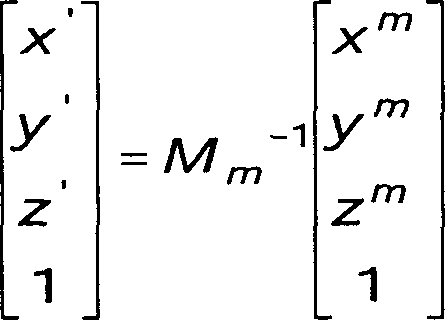
Figure 00130001
worin Mm –1 die Inverse der Matrix Mm ist.From this it is derived:
Figure 00130001
where M m -1 is the inverse of the matrix M m .

Es ist somit möglich, in dem sichtbaren virtuellen Koordinatensystem (O'', x''y''z'') die Koordinaten eines Punktes M als Funktion seiner Koordinaten in dem Koordinatensystem des Spiegels (Om, xmymzm) durch die folgende Matrixbeziehung auszudrücken:

Figure 00130002
It is thus possible, in the visible virtual coordinate system (O '', x''y''z ''), to determine the coordinates of a point M as a function of its coordinates in the coordinate system of the mirror (O m , x m y m z m ) by expressing the following matrix relation:
Figure 00130002

Um die Position eines reellen Punktes M in dem Koordinatensystem des Spiegels (Om, xmymzm) zu bestimmen, wird die Eigenschaft verwendet, nach der das virtuelle Bild eines Punktes mit den Koordinaten (x, y, z) in einem gegebenen Koordinatensystem, wenn sich der Spiegel in der Ebene Ox, Oy erstreckt, die Koordinaten (x, y, –z) hat.In order to determine the position of a real point M in the coordinate system of the mirror (O m , x m y m z m ), the property is used, according to which the virtual image of a point with the coordinates (x, y, z) in a given coordinate system, when the mirror extends in the plane Ox, Oy, the coordinates (x, y, -z) has.

Somit werden die Koordinaten (x'', y'', z'') des virtuellen Bildes im sichtbaren virtuellen Koordinatensystem des Punktes M mit den Koordinaten (x, y, z) in dem sichtbaren Koordinatensystem durch Anwendung der folgenden Diagonalmatrix Sy erhalten:

Figure 00140001
Thus, the coordinates (x '', y '', z '') of the virtual image in the visible virtual coordinate system of the point M having the coordinates (x, y, z) in the visible coordinate system are obtained by using the following diagonal matrix S y :
Figure 00140001

Die Koordinaten (x, y, z) eines Punktes M, ausgedrückt in dem sichtbaren Koordinatensystem (O, xyz), werden als Funktion der Koordinaten (XmymZm) desselben Punktes in dem Koordinatensystem des Spiegels (Om, xmymzm) in der Form

Figure 00140002
ausgedrückt.The coordinates (x, y, z) of a point M expressed in the visible coordinate system (O, xyz) are calculated as a function of the coordinates (X m y m Z m ) of the same point in the coordinate system of the mirror (O m , x m y m z m ) in the form
Figure 00140002
expressed.

M0'= M0-V'·Sz, wobei M0' folglich die Übergangsmatrix des Koordinatensystems des Spiegels (Om, xmymzm) zu dem sichtbaren Koordinatensystem (O, xyz) ist.M 0 '= M 0 -V ' * S z , where M 0 'is thus the transition matrix of the coordinate system of the mirror (O m , x m y m z m ) to the visible coordinate system (O, xyz).

Um die Koordinaten eines Punktes in dem sichtbaren Koordinatensystem (O, xyz), ausgehend von den Koordinaten (x*, y', z') desselben Punktes in dem Be obachtungs-Koordinatensystem (O, x'y'z'), zu bestimmen, wird aus den Beziehungen (1) und (2) die folgende Matrixbeziehung hergeleitet:

Figure 00150001
To determine the coordinates of a point in the visible coordinate system (O, xyz), starting from the coordinates (x *, y ', z') of the same point in the observation coordinate system (O, x'y'z ') , the following matrix relation is derived from relations (1) and (2):
Figure 00150001

Somit ist ersichtlich, dass die zentrale Datenverarbeitungseinheit 20 durch Anwendung dieser Berechnung die Position des der Kamera zugeordneten Beobachtungs-Koordinatensystems C12 bestimmen kann in Bezug zu dem sichtbaren Koordinatensystem 12B, das der Zielscheibe, die einstückig mit dieser Kamera ist, zugeordnet ist.Thus it can be seen that the central data processing unit 20 by using this calculation, can determine the position of the observation coordinate system C12 associated with the camera with respect to the visible coordinate system 12B that is associated with the target that is integral with this camera.

Zusätzlich ist gemäß der Erfindung vorgesehen, dass die Anordnung der optischen Systeme und insbesondere der optischen Referenzsysteme in Bezug auf die Senkrechte des Prüfplatzes des Fahrzeuges positioniert wird.In addition is according to the invention provided that the arrangement of the optical systems and in particular of the optical reference systems in relation to the vertical of the test station of the vehicle is positioned.

Zu diesem Zweck wird ein Bild des Spiegels 50 in einer ersten Position desselben bestimmt, das in 3 mit dicken Linien dargestellt ist. Der Spiegel wird dann in eine zweite Position verfahren, die in 3 mit gestrichelten Linien dargestellt ist. Die Verstellung wird um die Aufhängeachse Δ des Spiegels vorgenommen. Diese Achse Δ entspricht der Senkrechten des Anwendungs-Ortes der Anordnung.For this purpose, a picture of the mirror 50 determined in a first position thereof, the in 3 is shown with thick lines. The mirror is then moved to a second position, which in 3 shown with dashed lines. The adjustment is made around the suspension axis Δ of the mirror. This axis Δ corresponds to the vertical of the application location of the arrangement.

Ausgehend von dem gespeicherten Algorithmus bestimmt die zentrale Datenverarbeitungseinheit 20 für die zwei Positionen des Spiegels die Koordinaten der Ebenen, in welchen sich der Spiegel erstreckt. Die Gerade Δ entspricht dem Schnitt der so bestimmten Ebenen. Die zentrale Datenverarbeitungseinheit 20 bestimmt somit die relative Position des optischen Referenzsystems in Be zug auf eine Familie waagerechter Ebenen, die eine kapitale Bedeutung für den charakteristischen Fall der Fahrzeuggeometrie haben.Based on the stored algorithm determines the central processing unit 20 for the two positions of the mirror, the coordinates of the planes in which the mirror extends. The straight line Δ corresponds to the intersection of the planes thus determined. The central data processing unit 20 thus determines the relative position of the optical reference system with respect to a family of horizontal planes that are of major importance to the characteristic case of vehicle geometry.

In 4 sind schematisch die gegenüberliegenden optischen Systeme 12 und 14 dargestellt, in Abwesenheit des Kraftfahrzeuges 10. Die optischen Systeme 12 und 14 sind wie in 1 einander gegenüber aufgestellt, in einem ausreichenden Abstand, um die Durchfahrt des Fahrzeuges 10 zu gestatten.In 4 are schematically the opposing optical systems 12 and 14 shown in the absence of the motor vehicle 10 , The optical systems 12 and 14 are like in 1 placed opposite each other, at a sufficient distance to the passage of the vehicle 10 to allow.

Um zum Beispiel die relative Position der Vorderräder des Fahrzeuges zu bestimmen, ist es vorteilhaft, die relativen Positionen der Beobachtungs-Koordinatensysteme zu bestimmen, die den optischen Systemen 12 und 14 zugeordnet sind. Diese sind in 6 als C12 und C14 bezeichnet.For example, to determine the relative position of the vehicle's front wheels, it is advantageous to determine the relative positions of the observation coordinate systems that correspond to the optical systems 12 and 14 assigned. These are in 6 designated C12 and C14.

Die Übergangsmatrix zwischen dem Beobachtungs-Koordinatensystem C12 und dem sichtbaren Koordinatensystem A12 ist bekannt, da sie durch das oben erläuterte Verfahren bestimmt wird.The transition matrix between the observation coordinate system C12 and the visible one Coordinate system A12 is known as it is by the method explained above is determined.

Um die relativen Positionen der Beobachtungs-Koordinatensysteme C12 und C14 zu bestimmen, erstellt das optische System 14, gesteuert durch die zentrale Datenverarbeitungseinheit 20, ein Bild der Zielscheibe 26. Dieses Bild wird durch die zentrale Datenverarbeitungseinheit 20 bearbeitet.To determine the relative positions of the observation coordinate systems C12 and C14, the optical system creates 14 controlled by the central data processing unit 20 , a picture of the target 26 , This image is taken by the central data processing unit 20 processed.

Diese bestimmt in Kenntnis der geometrischen Konfiguration der Bezugspunktanordnung der Zielscheibe 26, unter Verwendung des gespeicherten Algorithmus die relative Position der Zielscheibe 26 in Bezug zu dem Beobachtungs-Koordinatensystem C14 des beobachtenden optischen Systems. Sie leitet somit die Position des sichtbaren Koordinatensystems A12, definiert durch die Zielscheibe 26, in Bezug zu dem Beobachtungs-Koordinatensystem C14 her.This determines the knowledge of the geometric configuration of the reference point arrangement of the target 26 , using the stored algorithm, the relative position of the target 26 in relation to the observation coordinate system C14 of the observation optical system. It thus directs the position of the visible coordinate system A12 defined by the target 26 , with respect to the observation coordinate system C14.

In Kenntnis der Übergangsmatrix von dem Beobachtungs-Koordinatensystem C12 zu dem sichtbaren Koordinatensystem A12 und umgekehrt, bestimmt die zentrale Datenverarbeitungseinheit 20 die relativen Positionen der Beobachtungs-Koordinatensysteme C12 und C14.Knowing the transition matrix from the observation coordinate system C12 to the visible coordinate system A12 and vice versa, the central data processing unit determines 20 the relative positions of the observation coordinate systems C12 and C14.

Somit bestimmt die zentrale Datenverarbeitungseinheit 20 die relative Position zwischen den den beiden gegenüberliegenden optischen Systemen 12 und 14 zugeordneten Beobachtungs-Koordinatensystemen.Thus, the central data processing unit determines 20 the relative position between the two opposed optical systems 12 and 14 associated observation coordinate systems.

Desgleichen beobachtet das dem optischen System 12 bezogen zu dem Aufstellungs-Ort des Fahrzeuges 10 entgegengesetzt angeordnete optische System 16 die vom optischen System 12 getragene Zielscheibe 26 in Abwesenheit des Fahrzeuges. In entsprechender Weise bestimmt die zentrale Datenverarbeitungseinheit 20 die Position des Beobachtungs-Koordinatensystems, bezeichnet mit C16, das dem optischen System 16 zugeordnet ist, in Bezug zu dem Beobachtungs-Koordinatensystem C12 des optischen Referenzsystems.Likewise observed the optical system 12 related to the installation location of the vehicle 10 opposite arranged optical system 16 the optical system 12 worn target 26 in the absence of the vehicle. The central data processing unit determines in a corresponding manner 20 the position of the observation coordinate system, denoted C16, that of the optical system 16 with respect to the observation coordinate system C12 of the reference optical system.

Abschließend, da das optische System 16 gleichfalls mit einer festen Zielscheibe ausgerüstet ist, die in Beziehung zu der eingegliederten Kamera in dem optischen System fest eingebaut ist, erlaubt es die Beobachtung von diesen durch das optische System 18 in der zentralen Datenverarbeitungseinheit 20 die Bestimmung der Position des Beobachtungs-Koordinatensystems, bezeichnet mit C18, das dem optischen System 18 zugeordnet ist, in Bezug zu dem Beobachtungs-Koordinatensystem C16 des optischen Referenzsystems 16.In conclusion, because the optical system 16 is also equipped with a fixed target, which is fixedly installed in relation to the incorporated camera in the optical system, it allows the observation of these by the optical system 18 in the central data processing unit 20 the determination of the position of the observation coordinate system, denoted C18, that of the optical system 18 with respect to the observation coordinate system C16 of the reference optical system 16 ,

In der Folge, analog zu dem in 4 beschriebenen Verfahren, gestattet die Kenntnis der relativen Positionen des sichtbaren Koordinatensystems der von dem optischen System 16 getragenen Zielscheibe und des dem optischen System 16 zugeordneten Beobachtungs-Koordinatensystems die Bestimmung der relativen Positionen der Beobachtungs-Koordinatensysteme C16 und C18.In the episode, analogous to that in 4 described method, allows the knowledge of the relative positions of the visible coordinate system of the optical system 16 worn target and the optical system 16 associated with the observation coordinate system, the determination of the relative positions of the observation coordinate systems C16 and C18.

Somit wird, wenn ein optisches System ein Referenzsystem wird, die Anordnung im Ganzen durch Vermessung referenziert.Consequently When an optical system becomes a reference system, the arrangement becomes as a whole referenced by surveying.

Nachdem das Fahrzeug 10 an seinen Platz gebracht wird, können sich die vier optischen Systeme nicht mehr gegenseitig beobachten. Jedoch ist jede der Anordnungen dazu geeignet, ein Bild eines Rades R des Fahrzeuges aufzunehmen.After the vehicle 10 placed in its place, the four optical systems can no longer observe each other. However, each of the assemblies is adapted to receive an image of a wheel R of the vehicle.

Wie in der Anmeldung WO-94/05969 beschrieben, ist jedes Rad mit einem Target oder einem Anbau 60 ausgestattet, der starr und in einer bekannten Weise an dem Rad befestigt ist. Jedes Target weist eine Bezugspunktanordnung auf, die eine bekannte und in der Datenverarbeitungseinheit 20 gespeicherte geometrische Anordnung hat.As described in the application WO-94/05969, each wheel is with a target or an attachment 60 equipped rigidly and fixed to the wheel in a known manner. Each target has a reference point arrangement that is a known and in the data processing unit 20 has stored geometric arrangement.

Bevor man zu der Bestimmung der relativen Position der Targets und folglich der Räder vorgeht, ist es vorteilhaft, den Umfang jedes Targets und dessen Exzentrizität in Betracht zu ziehen, damit die zentrale Datenverarbeitungseinheit 20 diese in den nachfolgenden Berechnungen berücksichtigt. Zu diesem Zweck wertet die Einheit 20, unter Verwendung eines an sich bekannten Verfahrens mehrere Bilder jedes Rades, die in bestimmten unterschiedlichen Positionen aufgenommen worden sind, aus.Before proceeding to the determination of the relative position of the targets and consequently of the wheels, it is advantageous to consider the scope of each target and its eccentricity so that the central processing unit 20 these are taken into account in the following calculations. For this purpose the unit evaluates 20 , using a method known per se, several images of each wheel, which have been taken in certain different positions from.

Ausgehend von der gleichzeitigen Beobachtung jedes Targets 60 von den vier optischen Systemen, bestimmt die zentrale Datenverarbeitungseinheit 20 die relative Position jedes Rades in Bezug zu dem Beobachtungs-Koordinatensystem, das der Kamera zugeordnet ist, was an sich bekannt ist. Tatsächlich, da der Mittelpunkt des Rades bekannt ist und die waagerechten Ebenen bekannt sind, deren Schnitt mit der Ebene der Räder bekannt ist, die Senkrechte des Platzes bekannt ist, ist es leicht, die charakteristischen Winkel und Abstände der Fahrzeuggeometrie zu finden.Starting from the simultaneous observation of each target 60 Of the four optical systems, the central data processing unit determines 20 the relative position of each wheel relative to the observation coordinate system associated with the camera, which is known per se. In fact, since the center of the wheel is known and the horizontal planes are known, whose intersection with the plane of the wheels is known, the vertical of the space is known, it is easy to find the characteristic angles and distances of the vehicle geometry.

In Kenntnis der relativen Positionen der Beobachtungs-Koordinatensysteme der vier optischen Systeme leitet die zentrale Datenverarbeitungseinheit 20 die relativen Positionen der vier Räder des Fahrzeuges her. Es ist ebenfalls möglich, die Geometrie des Fahrzeuges zu bestimmen und die ganzen Einstelloperationen auszuführen, die für die zufriedenstellende Funktion des Fahrzeuges notwendig sind.Knowing the relative positions of the observation coordinate systems of the four optical systems, the central data processing unit derives 20 the relative positions of the four wheels of the vehicle ago. It is also possible to determine the geometry of the vehicle and perform all the adjustment operations necessary for the satisfactory functioning of the vehicle.

Man versteht, dass mit einer solchen Anordnung die Position der vier optischen Systeme für jedes Fahrzeug verändert werden kann. Zusätzlich ist es nicht notwendig, für jeden Messvorgang eine feste Position zwischen den optischen Systemen beizubehalten. Es ist einfacherweise ausreichend, dass die Einheit 20 für jedes Fahrzeug erneut die relativen Positionen der den verschiedenen optischen Systemen zugeordneten Beobachtungs-Koordinatensystemen bestimmt, unter Verwendung des oben erläuterten Verfahrens. Somit hat die Anordnung einen geringen Platzbedarf und kann leicht außerhalb der Anwendungsphase gelagert werden.It is understood that with such an arrangement, the position of the four optical systems can be changed for each vehicle. In addition, it is not necessary to maintain a fixed position between the optical systems for each measuring operation. It is simply enough that the unit 20 for each vehicle again determines the relative positions of the observation coordinate systems associated with the various optical systems, using the method discussed above. Thus, the arrangement has a small footprint and can be easily stored outside the application phase.

Übrigens können die hier beschriebene Anordnung und das Verfahren für eine beliebige Anzahl Kameras verallgemeinert werden, bei denen sich die einen bezüglich den anderen referenzieren. Somit ist es möglich, das Fahrzeug in verschiedenen Stellungen und in verschiedenen Höhen zu vermessen.by the way can the arrangement described here and the method for any Number of cameras are generalized, where the one in terms of refer to the others. Thus, it is possible to differentiate the vehicle Positions and at different heights to measure.

Claims (7)

Verfahren zur Bestimmung der Position eines Beobachtungs-Koordinatensystems (C12), zugeordnet dem Bildaufnahmeorgan (28) einer Kamera (12A), in Bezug zu einem sichtbaren Koordinatensystem (26), das an dieser Kamera befestigt ist, dadurch gekennzeichnet, dass es folgende Schritte aufweist: a) es wird gegenüber der Kamera (12A) ein Spiegel (50) aufgestellt, der eine Bezugspunktanordnung (54) mit bekannter geometrischer Konfiguration aufweist, wobei der Spiegel (50) so orientiert ist, dass die Reflexion des sichtbaren Koordinatensystems (26) in dem Spiegel (50) durch die Kamera (12A) beobachtbar ist, b) durch die Kamera (12A) wird ein Bild des Spiegels (50) erstellt, in dem das reflektierte Bild (56) des sichtbaren Koordinatensystems (26) und die Bezugspunktanordnung (54) erscheinen; und c) es wird die Position des Beobachtungs-Koordinatensystems (C12) der Kamera (12A) in Bezug zu dem sichtbaren Koordinatensystem (26) ermittelt, ausgehend von der Auswertung des Bildes, das durch die Reflexion des sichtbaren Koordinatensystems (26) und der Bezugspunktanordnung (54) im Spiegel (50) erhalten wurde.Method for determining the position of an observation coordinate system (C12) assigned to the image recording element (C12) 28 ) of a camera ( 12A ), relative to a visible coordinate system ( 26 ), which is fastened to this camera, characterized in that it comprises the following steps: a) it is opposite the camera ( 12A ) a mirror ( 50 ) having a reference point arrangement ( 54 ) having a known geometric configuration, wherein the mirror ( 50 ) is oriented so that the reflection of the visible coordinate system ( 26 ) in the mirror ( 50 ) through the camera ( 12A ) is observable, b) through the camera ( 12A ) becomes a picture of the mirror ( 50 ), in which the reflected image ( 56 ) of the visible coordinate system ( 26 ) and the reference point arrangement ( 54 ) appear; and c) the position of the observation coordinate system (C12) of the camera ( 12A ) in relation to the visible coordinate system ( 26 ), based on the evaluation of the image obtained by the reflection of the visible coordinate system ( 26 ) and the reference point arrangement ( 54 ) in the mirror ( 50 ). Verfahren nach Anspruch 1, dadurch gekennzeichnet, dass in Schritt c), um die Position des Beobachtungs-Koordinatensystems (C12) in Bezug zu dem sichtbaren Koordinatensystem (26) zu ermitteln: c') die Position des Spiegels (50) in Bezug zu dem Beobachtungs-Koordinatensystem (C12) der Kamera (12A) bestimmt wird, ausgehend von der Auswertung des Bildes der Bezugspunktanordnung (54); c'') die Position des Bildes (56) bestimmt wird, das durch die Reflexion des sichtbaren Koordinatensystems (26) im Spiegel (50) in Bezug zum Beobachtungs-Koordinatensystem (C12) der Kamera (12A) erhalten wurde; und c''') durch Berechnung die relative Position des Beobachtungs-Koordinatensystems (C12) in Bezug zum sichtbaren Koordinatensystem (26) bestimmt wird.Method according to Claim 1, characterized in that, in step c), the position of the observation coordinate system (C12) in relation to the visible coordinate system ( 26 ): c ') the position of the mirror ( 50 ) with respect to the observation coordinate system (C12) of the camera ( 12A ) is determined, based on the evaluation of the image of the reference point arrangement ( 54 ); c '') the position of the image ( 56 ) determined by the reflection of the visible coordinate system ( 26 ) in the mirror ( 50 ) with respect to the observation coordinate system (C12) of the camera ( 12A ) was received; and c ''') by calculation the relative position of the observation coordinate system (C12) in relation to the visible coordinate system ( 26 ) is determined. Verfahren zur Bestimmung der Position eines Beobachtungs-Koordinatensystems (C12), zugeordnet dem Bildaufnahmeorgan (28) einer Kamera (12A) in Bezug zu einer räumlichen Richtung, definiert durch eine bekannte Geraden (Δ), wobei die Kamera (12A) mit einem an ihr befestigten sichtbaren Koordinatensystem (26) ausgerüstet ist, dadurch gekennzeichnet, dass: A) die Position des Beobachtungs-Koordinatensystems (C12) in Bezug zu dem sichtbaren Koordinatensystem (26) durch ein Verfahren nach einem der vorherigen Ansprüche bestimmt wird; B) zwei Bilder desselben Spiegels (50) erzeugt werden, auf denen das sichtbare Koordinatensystem (26) erscheint, in zwei unterschiedlichen, um einem Winkel um die Gerade (Δ) verschobenen Positionen des Spiegels (50); C) die Position des Beobachtungs-Koordinatensystems (C12) in Bezug zu der Geraden (Δ) ermittelt wird, welche dem Schnitt der zwei Ebenen des Spiegels (50) in den zwei unterschiedlichen Positionen entspricht, ausgehend von der Auswertung der durch Reflexion des sichtbaren Koordinatensystems (26) in dem Spiegel (50) erhaltenen Bilder und von der ermittelten Position des Beobachtungs-Koordinatensystems (C12) in Bezug zu dem sichtbaren Koordinatensystem (26),Method for determining the position of an observation coordinate system (C12) assigned to the image recording element (C12) 28 ) of a camera ( 12A ) with respect to a spatial direction defined by a known line (Δ), the camera ( 12A ) with a visible coordinate system attached to it ( 26 ), characterized in that: A) the position of the observation coordinate system (C12) in relation to the visible coordinate system ( 26 ) is determined by a method according to one of the preceding claims; B) two images of the same mirror ( 50 ) on which the visible coordinate system ( 26 ) appears in two different positions of the mirror displaced by an angle about the straight line (Δ) ( 50 ); C) determining the position of the observation coordinate system (C12) with respect to the line (Δ) which corresponds to the intersection of the two planes of the mirror (C12) 50 ) in the two different positions, starting from the evaluation of the by reflection of the visible coordinate system ( 26 ) in the mirror ( 50 ) and the position of the observation coordinate system (C12) with respect to the visible coordinate system ( 26 ) Verfahren nach Anspruch 3, dadurch gekennzeichnet, dass der Schritt A) der Bestimmung der Position des Beobachtungs-Koordinatensystems (C12) in Bezug zu dem sichtbaren Koordinatensystem (26) ausgehend von einem der im Schritt B) erzeugten Bilder für die Bestimmung der Position des Beobachtungs-Koordinatensystems (C12) in Bezug zu der Geraden (Δ) durchgeführt wird.A method according to claim 3, characterized in that step A) of determining the position of the observation coordinate system (C12) with respect to the visible coordinate system ( 26 ) from one of the images generated in step B) for determining the position of the observation coordinate system (C12) with respect to the line (Δ). Verfahren nach Anspruch 3 oder 4, dadurch gekennzeichnet, dass der Spiegel (50) aufgehängt wird und sich senkrecht unter der Wirkung seines Eigengewichtes erstreckt und dadurch, dass die zwei unterschiedlichen Positionen des Spiegels (50), in denen die Bilder erzeugt werden, beide solche Positionen sind, in denen der Spiegel frei aufgehängt ist und in einem Winkel zwischen den zwei Positionen in der waagerechten Ebene versetzt ist, wobei die genannte Gerade (Δ) durch die vertikale Drehachse des Spiegels (50) definiert wird.Method according to claim 3 or 4, characterized in that the mirror ( 50 ) and extends vertically under the effect of its own weight and in that the two different positions of the mirror ( 50 ) in which the images are generated, are both such positions in which the mirror is freely suspended and offset at an angle between the two positions in the horizontal plane, said straight line (Δ) passing through the vertical axis of rotation of the mirror (Fig. 50 ) is defined. Vorrichtung zur Bestimmung der Position eines Beobachtungs-Koordinatensystems (C12), zugeordnet dem Bildaufnahmeorgan (28) einer Kamera (12A), in Bezug zu einem sichtbaren Koordinatensystem (26), das an dieser Kamera befestigt ist, dadurch gekennzeichnet, dass sie folgendes aufweist: a) einen Spiegel (50) gegenüber der Kamera (12A), der eine Bezugspunktanordnung (54) mit bekannter geometrischer Konfiguration aufweist, wobei der Spiegel (50) derart orientiert ist, dass die Reflexion des sichtbaren Koordinatensystems (26) in dem Spiegel (50) durch die Kamera (12A) beobachtbar ist; b) Mittel für die Erzeugung (20) eines Bildes des Spiegels (50) durch die Kamera (12A), auf dem das Bild (56) des sichtbaren Koordinatensystems (26) und die Bezugspunktanordnung (54) erscheinen; und c) Mittel für die Ermittlung (20) der Position des Beobachtungs-Koordinatensystems (C12) der Kamera (12A) in Bezug zu dem sichtbaren Koordinatensystem (26), ausgehend von der Auswertung des durch die Reflexion im Spiegel (50) erhaltenen Bildes des sichtbaren Koordinatensystems (26) und der Bezugspunktanordnung (54).Device for determining the position of an observation coordinate system (C12), associated with the image recording device ( 28 ) of a camera ( 12A ), relative to a visible coordinate system ( 26 ) attached to this camera, characterized in that it comprises: a) a mirror ( 50 ) opposite the camera ( 12A ), which has a reference point arrangement ( 54 ) having a known geometric configuration, wherein the mirror ( 50 ) is oriented such that the reflection of the visible coordinate system ( 26 ) in the mirror ( 50 ) through the camera ( 12A ) is observable; b) production appropriations ( 20 ) of an image of the mirror ( 50 ) through the camera ( 12A ), on which the picture ( 56 ) of the visible coordinate system ( 26 ) and the reference point arrangement ( 54 ) appear; and (c) funds for the identification ( 20 ) the position of the observation coordinate system (C12) of the camera ( 12A ) in relation to the visible coordinate system ( 26 ), starting from the evaluation of the reflection in the mirror ( 50 ) image of the visible coordinate system ( 26 ) and the reference point arrangement ( 54 ). Vorrichtung nach Anspruch 6, dadurch gekennzeichnet, dass die genannten Mittel für die Ermittlung der Position des Beobachtungs-Koordinatensystems (C12) in Bezug zu dem sichtbaren Koordinatensystem (26) folgendes aufweisen: c') Mittel für die Bestimmung der Position des Spiegels (50) in Bezug zu dem Beobachtungs-Koordinatensystem (C12) der Kamera (12A), ausgehend von der Auswertung des Bildes der Bezugspunktanordnung (54); c'') Mittel für die Bestimmung der Position des Bildes (56), erhalten durch Reflexion des sichtbaren Koordinatensystems in dem Spiegel (50) in Bezug zum Beobachtungs-Koordinatensystem (C12) der Kamera (12A); und c''') Mittel für die Berechnung der relativen Position des Beobachtungs-Koordinatensystems (C12) in Bezug zum sichtbaren Koordinatensystem (26).Apparatus according to claim 6, characterized in that said means for determining the position of the observation coordinate system (C12) in relation to the visible coordinate system ( 26 ) have: c ') means for determining the position of the mirror ( 50 ) with respect to the observation coordinate system (C12) of the camera ( 12A ), starting from the evaluation of the image of the reference point arrangement ( 54 ); c '') means for determining the position of the image ( 56 ) obtained by reflection of the visible coordinate system in the mirror ( 50 ) with respect to the observation coordinate system (C12) of the camera ( 12A ); and c ''') means for calculating the relative position of the observation coordinate system (C12) in relation to the visible coordinate system ( 26 ).
DE1999634472 1998-11-20 1999-11-16 Determining the position of the optical axis of a camera Expired - Lifetime DE69934472T2 (en)

Applications Claiming Priority (2)

Application Number Priority Date Filing Date Title
FR9814660A FR2786267B1 (en) 1998-11-20 1998-11-20 METHOD AND DEVICE FOR DETERMINING THE POSITION OF THE OPTICAL AXIS OF A CAMERA WITH RESPECT TO A VISIBLE MARKING
FR9814660 1998-11-20

Publications (2)

Publication Number Publication Date
DE69934472D1 DE69934472D1 (en) 2007-02-01
DE69934472T2 true DE69934472T2 (en) 2007-09-27

Family

ID=9533014

Family Applications (1)

Application Number Title Priority Date Filing Date
DE1999634472 Expired - Lifetime DE69934472T2 (en) 1998-11-20 1999-11-16 Determining the position of the optical axis of a camera

Country Status (3)

Country Link
EP (1) EP1003013B1 (en)
DE (1) DE69934472T2 (en)
FR (1) FR2786267B1 (en)

Families Citing this family (5)

* Cited by examiner, † Cited by third party
Publication number Priority date Publication date Assignee Title
FR2823842B1 (en) * 2001-04-24 2003-09-05 Romain Granger MEASURING METHOD FOR DETERMINING THE POSITION AND ORIENTATION OF A MOBILE ASSEMBLY, AND DEVICE FOR CARRYING OUT SAID METHOD
ES2335196T3 (en) 2002-02-04 2010-03-23 Corghi S.P.A. DEVICE FOR MEASURING THE CHARACTERISTIC POSITION PARAMETERS OF A VEHICLE.
CN105757422B (en) * 2016-04-07 2018-05-25 福建联迪商用设备有限公司 A kind of positioner and its method for correcting the camera depth of parallelism and distance
DE102016220888A1 (en) 2016-10-24 2018-04-26 Micro-Epsilon Messtechnik Gmbh & Co. Kg Reference plate and method for calibrating and / or checking a deflectometry sensor system
CN114637121B (en) * 2022-03-31 2023-09-01 杭州海康威视数字技术股份有限公司 Positioning device for camera

Family Cites Families (4)

* Cited by examiner, † Cited by third party
Publication number Priority date Publication date Assignee Title
DE3143173C2 (en) * 1981-10-30 1984-04-12 Automation W + R GmbH, 8000 München Measuring arrangement for measuring the angular position of an object to be measured using the reflection method
JPS63136892A (en) * 1986-11-28 1988-06-09 Nec Corp Calibration device for camera coordinate system
US5444481A (en) * 1993-01-15 1995-08-22 Sanyo Machine Works, Ltd. Method of calibrating a CCD camera
JPH0735644A (en) * 1993-07-16 1995-02-07 Fujitsu Ltd Camera calibration equipment

Also Published As

Publication number Publication date
FR2786267B1 (en) 2001-03-30
FR2786267A1 (en) 2000-05-26
EP1003013A1 (en) 2000-05-24
EP1003013B1 (en) 2006-12-20
DE69934472D1 (en) 2007-02-01

Similar Documents

Publication Publication Date Title
DE69937819T2 (en) Optical determination of the relative positions of bodies in a room
DE69826753T2 (en) Optical profile sensor
DE69428686T2 (en) IMAGING DEVICE AND METHOD FOR DETERMINING FOCUS INFORMATION
EP1497613B1 (en) Method and device for determining the spatial co-ordinates of an object
DE69213749T2 (en) METHOD AND DEVICE FOR THE SPOTUAL MEASUREMENT OF SPACE COORDINATES
DE10081029B4 (en) Image editing to prepare a textual analysis
DE10163027B4 (en) Object location determination method and a device using this method
EP2034269B1 (en) Method and device for three-dimensional digitalising of objects
DE4101921B4 (en) Device for dynamic balancing of a motor vehicle wheel consisting of tires and rims
EP1342051B1 (en) Calibration of a measuring sensor on a coordinate measuring machine with a ball, whose center is known
EP2105701B1 (en) Method and device for determining the 3D coordinates of an object
DE60133026T2 (en) ACCURATE ALIGNMENT OF IMAGES IN DIGITAL PICTURE SYSTEMS BY ADJUSTING POINTS IN THE PICTURES
EP2095068B1 (en) Apparatus and method for increasing the measurement accuracy of digital 3d geometry measuring systems
EP2574876B1 (en) Method and device for determining the 3D coordinates of an object
DE102004033114A1 (en) Method for calibrating a distance image sensor
DE4301538A1 (en) Method and arrangement for contactless three-dimensional measurement, in particular for measuring denture models
WO2005075936A1 (en) Method for determining the position of an object in a space
EP0449859B1 (en) Process and device for observing moire patterns on test surfaces by moireing with phase shifts
DE10137241A1 (en) Arrangement, for detecting and measuring objects, optically projects markers onto object, records partial views of object in global coordinate system using information re-detected markers
DE19634254B4 (en) Optical-numerical method for determining the entire surface of a three-dimensional object
EP3642560B1 (en) System, method and marker for the determination of the position of a movable object in space
WO2016146105A1 (en) Method and device for calibrating a camera
DE102008027976A1 (en) Method and device for determining the position of a sensor
DE3102880C2 (en) Method and device for calibrating scanners
DE102011012611A1 (en) Method for contactless measurement of angle at which object is arranged relative to axis of outer reference system, involves placing object in collimated beam path of autocollimator, whose orientation is known in reference system

Legal Events

Date Code Title Description
8364 No opposition during term of opposition