DE102004024583A1 - Translucent or opaque cooking surface consisting of a colorable glass ceramic and its use - Google Patents
Translucent or opaque cooking surface consisting of a colorable glass ceramic and its use Download PDFInfo
- Publication number
- DE102004024583A1 DE102004024583A1 DE102004024583A DE102004024583A DE102004024583A1 DE 102004024583 A1 DE102004024583 A1 DE 102004024583A1 DE 102004024583 A DE102004024583 A DE 102004024583A DE 102004024583 A DE102004024583 A DE 102004024583A DE 102004024583 A1 DE102004024583 A1 DE 102004024583A1
- Authority
- DE
- Germany
- Prior art keywords
- glass
- ceramic
- cooking surface
- glass ceramic
- weight
- Prior art date
- Legal status (The legal status is an assumption and is not a legal conclusion. Google has not performed a legal analysis and makes no representation as to the accuracy of the status listed.)
- Withdrawn
Links
Classifications
-
- C—CHEMISTRY; METALLURGY
- C03—GLASS; MINERAL OR SLAG WOOL
- C03C—CHEMICAL COMPOSITION OF GLASSES, GLAZES OR VITREOUS ENAMELS; SURFACE TREATMENT OF GLASS; SURFACE TREATMENT OF FIBRES OR FILAMENTS MADE FROM GLASS, MINERALS OR SLAGS; JOINING GLASS TO GLASS OR OTHER MATERIALS
- C03C10/00—Devitrified glass ceramics, i.e. glass ceramics having a crystalline phase dispersed in a glassy phase and constituting at least 50% by weight of the total composition
- C03C10/0036—Devitrified glass ceramics, i.e. glass ceramics having a crystalline phase dispersed in a glassy phase and constituting at least 50% by weight of the total composition containing SiO2, Al2O3 and a divalent metal oxide as main constituents
-
- C—CHEMISTRY; METALLURGY
- C03—GLASS; MINERAL OR SLAG WOOL
- C03C—CHEMICAL COMPOSITION OF GLASSES, GLAZES OR VITREOUS ENAMELS; SURFACE TREATMENT OF GLASS; SURFACE TREATMENT OF FIBRES OR FILAMENTS MADE FROM GLASS, MINERALS OR SLAGS; JOINING GLASS TO GLASS OR OTHER MATERIALS
- C03C17/00—Surface treatment of glass, not in the form of fibres or filaments, by coating
- C03C17/02—Surface treatment of glass, not in the form of fibres or filaments, by coating with glass
-
- C—CHEMISTRY; METALLURGY
- C03—GLASS; MINERAL OR SLAG WOOL
- C03C—CHEMICAL COMPOSITION OF GLASSES, GLAZES OR VITREOUS ENAMELS; SURFACE TREATMENT OF GLASS; SURFACE TREATMENT OF FIBRES OR FILAMENTS MADE FROM GLASS, MINERALS OR SLAGS; JOINING GLASS TO GLASS OR OTHER MATERIALS
- C03C2218/00—Methods for coating glass
- C03C2218/30—Aspects of methods for coating glass not covered above
- C03C2218/35—Exuding
Landscapes
- Chemical & Material Sciences (AREA)
- Engineering & Computer Science (AREA)
- Materials Engineering (AREA)
- Chemical Kinetics & Catalysis (AREA)
- General Chemical & Material Sciences (AREA)
- Geochemistry & Mineralogy (AREA)
- Life Sciences & Earth Sciences (AREA)
- Organic Chemistry (AREA)
- Ceramic Engineering (AREA)
- Crystallography & Structural Chemistry (AREA)
- Dispersion Chemistry (AREA)
- Glass Compositions (AREA)
- Cookers (AREA)
Abstract
Transluzente oder opake Kochfläche, bestehend aus einer einfärbbaren Glaskeramik mit einer variabel einstellbaren Lichttransmission im Sichtbaren von unter 15%, einer rissfreien Oberfläche und einer Stoßfestigkeit von größer 18 cm Bruchfallhöhe im Kugelfalltest, einer Temperaturunterschiedsfestigkeit von größer 500 DEG C, einer hohen Kristallinität im Innern der Glaskeramik mit Keatit-Mischkristallen als vorherrschende Kristallphase und mit einem Restglas-Phasenanteil von weniger als 8 Gew.-% und einer gegen chemischen Angriff passivierenden 0,5 bis 2,5 mum dicken glasigen Oberflächenschicht, die weitgehend frei von Hochquarz-Mischkristallen ist, und wobei die Summe der Komponenten Na¶2¶O + K¶2¶O + CaO + SrO + BaO + F + Läutermittel, die sich in der Restglasphase im Innern der Glaskeramik und in der glasigen Oberflächenschicht anreichern, 0,2 bis 1,6 Gew.-% geträgt.Translucent or opaque cooking surface, consisting of a glass-ceramic with a variably adjustable light transmission in the visible of less than 15%, a crack-free surface and a shock resistance greater than 18 cm drop height in the falling ball test, a temperature difference of greater than 500 ° C., a high crystallinity in the interior Glass ceramic with keatite mixed crystals as the predominant crystal phase and with a residual glass phase content of less than 8 wt .-% and a chemical attack passivating 0.5 to 2.5 mum thick glassy surface layer, which is substantially free of high quartz mixed crystals, and wherein the sum of the components Na¶2¶O + K¶2¶O + CaO + SrO + BaO + F + refining agents, which accumulate in the residual glass phase in the interior of the glass ceramic and in the glassy surface layer, 0.2 to 1.6 Wt%.
Description
Die Erfindung hat eine transluzente oder opake Kochfläche bestehend aus einer einfärbbaren Glaskeramik sowie deren Verwendung zum Gegenstand.The Invention has a translucent or opaque cooking surface from a dyeable Glass ceramic as well as their use to the object.
Es ist bekannt, dass sich Gläser aus dem System Li2O-Al2O3-SiO2 in Glaskeramiken mit Hochquarz-Mischkristallen und/oder Keatit-Mischkristallen als Hauptkristallphasen umwandeln lassen. Die Herstellung dieser Glaskeramiken erfolgt in mehreren Stufen. Nach der Schmelze und Heißformgebung wird das Glas üblicherweise bei Temperaturen in der Gegend der Transformationstemperatur (Tg) gekühlt, um thermische Spannungen zu entfernen. Das Material wird dann weiter auf Raumtemperatur gekühlt.It is known that glasses of the system Li 2 O-Al 2 O 3 -SiO 2 can be converted into glass ceramics with high-quartz mixed crystals and / or keatite mixed crystals as main crystal phases. The production of these glass ceramics takes place in several stages. After melt and hot forming, the glass is usually cooled at temperatures in the region of transformation temperature (Tg) to remove thermal stresses. The material is then further cooled to room temperature.
Mit einer zweiten gesteuerten Temperaturbehandlung wird das Ausgangsglas kristallisiert und in einen glaskeramischen Artikel überführt. Diese Keramisierung erfolgt in einem mehrstufigen Temperaturprozess, bei dem zunächst durch Keimbildung bei Temperaturen von 600 – 800 °C Keime, üblicherweise aus TiO2- oder ZrO2/TiO2-Mischkristallen, erzeugt werden. Auch SnO2 kann an der Keimbildung beteiligt sein. Bei der anschließenden Temperaturerhöhung wachsen bei der Kristallisationstemperatur von ca. 700 – 900 °C zunächst Hochquarz-Mischkristalle auf diesen Keimen auf. Aufgrund der geringen Kristallitgrößen von weniger als 100 nm sind die Glaskeramiken mit Hochquarz-Mischkristallen transparent darstellbar. Durch Verringerung der Keimbildnergehalte und höhere Kristallitgrößen lassen sich auch transluzente Glaskeramiken herstellen.With a second controlled temperature treatment, the starting glass is crystallized and transferred to a glass-ceramic article. This ceramization takes place in a multi-stage temperature process, in which nuclei, usually from TiO 2 or ZrO 2 / TiO 2 mixed crystals, are initially produced by nucleation at temperatures of 600-800 ° C. SnO 2 may also be involved in nucleation. In the subsequent increase in temperature grow at the crystallization temperature of about 700 - 900 ° C initially high-quartz mixed crystals on these nuclei. Due to the small crystallite sizes of less than 100 nm, the glass ceramics with high quartz mixed crystals are transparent. By reducing the nucleating agent content and higher crystallite sizes, it is also possible to produce translucent glass ceramics.
Bei weiterer Temperaturerhöhung im Bereich von ca. 850 – 1200 °C wandeln sich die Hochquarz-Mischkristalle weiter in Keatit- Mischkristalle um. Die Temperatur für die strukturelle Phasenänderung ist abhängig von der Zusammensetzung. Die Umwandlung in Keatit-Mischkristalle ist mit einem Kristallwachstum, d.h. zunehmender Kristallitgröße verbunden, wodurch zunehmend Lichtstreuung erfolgt, d.h. die Lichttransmission wird zunehmend verringert. Der glaskeramische Artikel erscheint dadurch zunehmend transluzent und schließlich opak.at further increase in temperature in the range of approx. 850 - 1200 ° C the high quartz mixed crystals continue to transform into keatite mixed crystals. The temperature for the structural phase change depends on from the composition. The transformation into keatite mixed crystals is with crystal growth, i. increasing crystallite size connected, whereby increasingly light scattering occurs, i. the light transmission is being increasingly reduced. The glass-ceramic article appears thus increasingly translucent and finally opaque.
Eine Schlüsseleigenschaft dieser Glaskeramiken aus dem Li2O-Al2O3-SiO2 System ist die Herstellbarkeit von Werkstoffen, die über einen äußert niedrigen Wärmeausdehnungskoeffizienten im Bereich von Raumtemperatur bis 700 °C und darüber von < 1,5 × 10⁻⁶/K verfügen. Mit Glaskeramiken, die Hochquarz-Mischkristalle als Hauptkristallphase enthalten, werden in diesem Temperaturbereich sogar Werkstoffe mit Wärmeausdehnungskoeffizienten von < 0,3 × 10⁻⁶/K, also nahezu Nullausdehnung erhalten. Aufgrund der niedrigen thermischen Ausdehnung besitzen diese Glaskeramiken eine ausgezeichnete Temperaturunterschiedsfestigkeit und Temperaturwechselbeständigkeit.A key property of these glass-ceramics from the Li 2 O-Al 2 O 3 -SiO 2 system is the manufacturability of materials that have a very low coefficient of thermal expansion in the range of room temperature to 700 ° C and above of <1.5 × 10 -6 / K have. With glass ceramics containing high-quartz mixed crystals as the main crystal phase, even materials with thermal expansion coefficients of <0.3 × 10 -6 / K, ie virtually zero expansion, are obtained in this temperature range. Due to the low thermal expansion, these glass ceramics have excellent temperature difference resistance and thermal shock resistance.
Transparente Glaskeramiken mit Hochquarz-Mischkristallen als Hauptkristallphase finden Anwendung z. B. als Brandschutzglas, Kaminsichtscheiben, Reflektoren in digitalen Projektionsgeräten (Beamern) oder Kochgeschirr. Für die Anwendung als Kochfläche ist eine Absenkung der Lichttransmission auf Werte unter 15% erforderlich, um die Durchsicht auf die technischen Aufbauten unter der Kochfläche zu vermeiden und um die helle Strahlung von Strahlungs- oder Halogenheizkörpern auf die gewünschten Werte zu reduzieren. Diese Absenkung der Lichttransmission wird z. B. durch Einfärbung transparenter Glaskeramiken mit Farboxiden sowie durch transluzent oder opak umgewandelte Glaskeramiken erreicht.transparent Glass ceramics with high quartz mixed crystals as the main crystal phase find application z. B. as fire-resistant glass, Kaminsichtscheiben, Reflectors in digital projection equipment (projectors) or cookware. For the Application as a cooking surface a reduction of the light transmission to values below 15% is required, to avoid the inspection of the technical equipment under the cooking surface and to the bright radiation of radiant or halogen radiators the desired To reduce values. This reduction in light transmission is z. B. by coloring transparent glass ceramics with color oxides and translucent or opacified glass ceramics achieved.
Für Kochflächen finden Glaskeramiken mit Hochquarz-Mischkristallen als Hauptkristallphase die breiteste Verwendung. Aufgrund ihres niedri gen Wärmeausdehnungskoeffizienten von < 0,5 × 10⁻⁶/K zwischen Raumtemperatur und 700°C besitzen sie eine hervorragende Temperaturunterschiedsfestigkeit (TUF) von größer als 800 °C, die allen Anforderungen genügt.For cooktops glass ceramics with high quartz mixed crystals as the main crystal phase find the widest use. Due to their low coefficient of thermal expansion of <0.5 × 10 -6 / K between room temperature and 700 ° C they have an excellent temperature difference resistance (TUF) greater than 800 ° C, which meets all requirements.
Die niedrige Wärmeleitfähigkeit der Glaskeramik von etwa 1,5 W/mK gewährleistet, dass die Temperatur neben der Kochzonen wie gewünscht schnell abnimmt und der Rand kalt bleibt. Dies ist aus Gründen der Sicherheit und der Energieeinsparung gewünscht.The low thermal conductivity The glass ceramic of about 1.5 W / mK ensures that the temperature next to the cooking zones as desired decreases rapidly and the edge stays cold. This is for safety reasons and the energy saving desired.
Diese bekannten Kochflächen sind durch Zusatz von färbenden Komponenten auf eine Lichttransmission von etwa 0,5 bis 3% im sichtbaren Wellenlängenbereich eingestellt, um die Durchsicht auf die technischen Aufbauten unter der Kochfläche zu vermeiden und den Blendschutz gegenüber den Strahlungs- oder Halogenheizkörper zu gewährleisten. In fortschrittlichen Kochflächen wird meist V2O5 als Färbemittel verwendet, weil es die besondere Eigenschaft besitzt, im Bereich des sichtbaren Lichtes zu absorbieren und im Bereich der Infrarotstrahlung eine hohe Transmission zu erlauben. Die hohe Transmission im Infraroten ist vorteilhaft, weil die Strahlung direkt auf den Topfboden trifft, dort absorbiert wird und damit ein schnelleres Ankochen erreicht wird. Aber unabhängig davon, ob V2O5 oder andere gebräuchliche Farboxide wie zum Beispiel CoO, NiO oder Fe2O3 eingesetzt werden, erscheint die Kochfläche bei dieser niedrigen Lichttransmission in Aufsicht schwarz. Die verschiedenen Farboxide unterscheiden sich nur in der Farbe der glühenden Heizkörper, wenn sich der Topf nicht auf der Heizzone befindet.These known cooking surfaces are adjusted by the addition of coloring components to a light transmission of about 0.5 to 3% in the visible wavelength range in order to avoid the review of the technical structures under the cooking surface and to ensure the glare protection against the radiant or halogen heaters. In progressive cooktops V 2 O 5 is mostly used as a colorant, because it has the special property to absorb in the visible light and to allow high transmission in the infrared radiation. The high transmission in the infrared is advantageous because The radiation hits the bottom of the pot, where it is absorbed and thus a faster cooking is achieved. But regardless of whether V 2 O 5 or other common color oxides such as CoO, NiO or Fe 2 O 3 are used, the cooking surface appears at this low light transmission in supervision black. The different color oxides differ only in the color of the glowing radiators, when the pot is not on the heating zone.
Die farbliche Gestaltbarkeit ist dadurch sehr eingeschränkt und eine Differenzierung über das Design stark erschwert. Um diesen Mangel abzuhelfen, wird in verschiedenen Schriften der flächige Einsatz von Dekorfarben propagiert. Mit dieser Methode wird jedoch das Kochflä chenmaterial selbst nicht verändert und nur eine teilweise Wirkung erreicht.The color configurability is thereby very limited and a differentiation over the design very difficult. To remedy this shortcoming will be in different writings of the plane Use of decorative paints propagated. However, this method will the Kochflä chenmaterial not changed and achieved only a partial effect.
Kochflächen aus Glaskeramik mit Keatit-Mischkristallen als vorherrschende Kristallphase haben bisher keine breitere Anwendung gefunden, weil mit der Umwandlung von Hochquarz-Mischkristall in die Keatit-Mischkristall-Glaskeramik ein Anstieg des Wärmeausdehnungskoeffizienten verbunden ist. Der Wärmeausdehnungskoeffizient zwischen 20 und 700 °C erhöht sich auf Werte, die meist oberhalb von 1,0 × 10⁻⁶/K liegen. Insbesondere gut schmelzbare und entglasungsfeste Zusammensetzungen verfügen über höhere Wärmeausdehnungskoeffizienten. Damit lässt sich für fortschrittliche Kochflächensysteme, die über Heizkörper hoher Leistung verfügen, keine ausreichende Temperaturunterschiedsfestigkeit erzielen.Cooking surfaces made of glass ceramic with keatite mixed crystals as the predominant crystal phase have hitherto found no broader application because the conversion of high-quartz mixed crystal into the keatite mixed-crystal glass ceramic is associated with an increase in the thermal expansion coefficient. The coefficient of thermal expansion between 20 and 700 ° C increases to values that are mostly above 1.0 × 10 -6 / K. In particular, fusible and devitrification-resistant compositions have higher thermal expansion coefficients. Thus, advanced cooking surface systems that have high power radiators can not achieve sufficient temperature differential resistance.
Die
Temperaturunterschiedsfestigkeit bei der Glaskeramik ist durch folgenden
Zusammenhang gegeben: 
Dabei entspricht ΔT der Temperaturunterschiedsfestigkeit, f einem dimensionslosen Korrekturfaktor (aufgrund der Plattengeometrie und der Temperaturverteilung), μ ist die Poissonzahl, E der E-Modul, α der Wärmeausdehnungskoeffizient und σg ist die Festigkeit, für die der Wert eingesetzt werden muss, der sich im praktischen Gebrauch bedingt durch Oberflächenverletzungen einstellt. Da sich sowohl der Wärmeausdehnungskoeffizient als auch das E-Modul bei der Umwandlung von Hochquarz- in die Keatit-Mischkristall Glaskeramik erhöhen, ist die mangelnde Temperaturunterschiedsfestigkeit ein prinzipieller Nachteil des Materials, der lange Zeit den Einsatz in fortschrittlichen Kochflächensystemen verhinderte.Where ΔT is the temperature difference strength, f is a dimensionless correction factor (due to the plate geometry and the temperature distribution), μ is the Poisson's ratio, E is the modulus of elasticity, α is the coefficient of thermal expansion and σ g is the strength for which the value must be used in practical use conditioned by surface injuries. Since both the thermal expansion coefficient and modulus of elasticity in the conversion of high quartz into the keatite mixed crystal glass-ceramic increase, the lack of temperature difference resistance is a principal disadvantage of the material, which prevented long time use in advanced cooking surface systems.
Die
Aus
der
Aus der WO 99/06334 ist eine transluzente Glaskeramik bekannt, die einen Trübungsgrad von wenigstens 50 %, aufweist. Weiterhin offenbart die WO 99/06334 eine entsprechende transluzente Glaskeramik mit einer Transmission im Sichtbaren von 5 bis 40 %. Die genannten transluzenten Glaskeramiken enthalten dabei entweder Keatit-Mischkristalle als vorherrschende Kristallphase oder ausschließlich Keatit-Mischkristalle als einzige Kristallphase. Es werden keine Hinweise zur Steigerung der Temperaturunterschiedsfestigkeit und der chemischen Beständigkeit gegeben, wie sie für fortschrittliche Kochflächen vorteilhaft sind. Auch Möglichkeiten zur farblichen Gestaltung, um bestimmte Farbtöne zu erreichen, werden nicht beschrieben.Out WO 99/06334 a translucent glass-ceramic is known, the one turbidity of at least 50%. Further, WO 99/06334 discloses a corresponding translucent glass-ceramic with a transmission in the visible from 5 to 40%. The above-mentioned translucent glass-ceramics contain either keatite mixed crystals as predominant crystal phase or exclusively keatite mixed crystals as the only crystal phase. There are no indications to increase the temperature difference resistance and the chemical resistance given as they are for advanced cooking surfaces are advantageous. Also possibilities to the color design to achieve certain shades are not described.
Die
Die
in der Schrift
Es ist Aufgabe der Erfindung, eine Kochfläche bestehend aus einer Glaskeramik bereitzustellen, deren Erscheinungsbild sehr vielfältig ist. Außerdem sind mögliche Verwendungen aufzuzeigen.It Object of the invention, a cooking surface consisting of a glass ceramic whose appearance is very diverse. Furthermore are possible To show uses.
Diese Aufgabe wird durch eine transluzente oder opake Kochfläche gemäß Anspruch 1 sowie deren Verwendung gemäß Anspruch 18 gelöst.These Task is by a translucent or opaque cooking surface according to claim 1 and its use according to claim 18 solved.
Die erfindungsgemäße transluzente oder opake Kochfläche bestehend aus einer einfärbbaren Glaskeramik weist dabei
- – eine variabel einstellbare Lichttransmission im Sichtbaren unter 15%, gemessen bei 4 mm Probendicke,
- – eine rissfreie Oberfläche und eine Stoßfestigkeit von größer 18 cm Bruchfallhöhe im Mittelwert geprüft mit einer 200g schweren Stahlkugel im Kugelfalltest,
- – eine Temperaturunterschiedsfestigkeit von größer 500 °C, vorzugsweise von größer 700 °C,
- – eine hohe Kristallinität im Inneren der Glaskeramik mit Keatit-Mischkristallen als vorherrschender Kristallphase und einem Restglas-Phasenanteil von weniger als 8 Gew%,
- – eine gegen chemischen Angriff passivierende 0,5 bis 2,5 μm dicke glasige Oberflächenschicht weitgehend frei von Hochquarz-Mischkristallen,
- – einen Gehalt an Komponenten, die sich in der Restglasphase im Inneren der Glaskeramik und in der glasigen Oberflächenschicht anreichern von ΣNa2O+K2O+CaO+SrO+BaO+F+Läutermittel von 0,2 bis 1,6 Gew%.
- - a variably adjustable light transmission in the visible under 15%, measured at 4 mm sample thickness,
- - a crack-free surface and a shock resistance of greater than 18 cm breakage height averaged with a 200g heavy steel ball in the ball drop test,
- A temperature difference resistance greater than 500 ° C, preferably greater than 700 ° C,
- A high crystallinity in the interior of the glass ceramic with keatite mixed crystals as the predominant crystal phase and a residual glass phase fraction of less than 8% by weight,
- A 0.5 to 2.5 μm thick glassy surface layer, which is passivated against chemical attack, is largely free of high-quartz mixed crystals,
- A content of components which accumulate in the residual glass phase in the interior of the glass-ceramic and in the glassy surface layer of ΣNa 2 O + K 2 O + CaO + SrO + BaO + F + refining agent of 0.2 to 1.6% by weight.
Aufgrund der Hauptkristallphase aus Keatit-Mischkristallen ist es möglich, gezielt transluzente oder opake Kochflächen in beliebigen Abstufungen bereitzustellen, indem man z. B. die Kristallitgröße entsprechend wählt. Zusätzliche Farbeffekte können beispielsweise durch Zugabe von färbenden Zusätzen erreicht werden. Aufgrund insbesondere der hohen Stoßfestigkeit, der passivierenden Oberflächenglasschicht und der hohen Temperaturunterschiedsfestigkeit ist der Einsatz als Kochfläche unbedenklich.by virtue of the main crystal phase of keatite mixed crystals, it is possible, targeted translucent or opaque cooking surfaces to provide in any gradations by z. B. the crystallite size accordingly chooses. additional Color effects can be achieved for example by adding coloring additives. by virtue of especially the high impact resistance, the passivating surface glass layer and the high temperature difference resistance is the use as Cooktop harmless.
Bei der Herstellung von Kochflächen aus Glaskeramik wird die erforderliche plattenförmige Geometrie erzeugt, indem das Glas bei der Formgebung über eine Ziehdüse aus Edelmetall geführt wird und zwischen zwei Walzen gepresst, abgekühlt und dabei geformt wird. Die Oberwalze ist glatt und erzeugt die spätere Kochflächenoberseite, die Unterwalze ist meist strukturiert und erzeugt auf der Kochflächenunterseite eine genoppte Oberfläche. Die Noppen sind für den Erhalt der Stossfestigkeit vorteilhaft, weil sie die Glasoberfläche vor Beschädigungen durch die weiteren Herstellprozesse, z. B. durch Transportrollen oder Keramisierungsunterlagen schützen. Hinter den Walzen wird das Glasband über Transportrollen in den Kühlofen geführt und entspannt. Am Ende des Kühlbandes werden Glasplatten der gewünschten Geometrie geschnitten. Es findet eine Qualitätsprüfung z. B. auf Oberflächendefekte und Blasen statt. Die Glasplatten werden an den Kanten bearbeitet. Die Platten werden vor der Keramisierung dekoriert, wenn die Dekorfarben bei der Keramisierung mit eingebrannt werden. Sonst werden die Dekorfarben in einer nachfolgenden Temperaturbehandlung eingebrannt.In the production of glass ceramic cooking surfaces, the required plate-shaped geometry is produced by passing the glass through a noble metal die during molding and pressing it between two rolls, cooling it and forming it. The upper roller is smooth and creates the later Kochflächenoberseite, the lower roller is usually structured and created on the Kochflächenunterseite a nubby surface. The nubs are advantageous for maintaining the impact resistance, because they protect the glass surface from damage by the further manufacturing processes, eg. B. protect by transport wheels or Keramisierungsunterlagen. Behind the rollers, the glass ribbon is guided over transport rollers in the cooling furnace and ent stressed. At the end of the cooling belt, glass plates of the desired geometry are cut. It finds a quality check z. B. on surface defects and bubbles instead. The glass plates are processed on the edges. The plates are decorated before the ceramization, when the decorative colors are burned in during the ceramization. Otherwise, the decorative colors are baked in a subsequent temperature treatment.
Die Temperaturunterschiedsfestigkeit ist für Kochflächen eine unverzichtbare Eigenschaft. Je nach Beheizungsart wird das Kochflächenmaterial im Bereich der Kochzonen stark erhitzt. Bei Kochflächen mit Induktionsbeheizung oder Gasbrennern betragen die maximalen Temperaturen bis etwa 500°C. Beim Einsatz von leistungsstarken Halogenheizkörpern oder Strahlungsheizkörpern wird das Material im Bereich der Kochzonen auf höhere Temperaturen erhitzt. Diese Temperaturen sind erwünscht, um ein schnelles Ankochen zu gewährleisten. Zwar regeln Temperaturbegrenzer (Limiter) die Heizkörper bei zu hohen Temperaturen oberhalb ca. 560 °C ab, jedoch kann es bei unsachgemäßem Gebrauch, wie zum Beispiel beim Leerkochen von Töpfen oder bei nur teilweise abgedeckten Kochzonen zu Temperaturen in der Glaskeramikkochfläche bis zu etwa 700 °C kommen. Wegen der Anforderungskombination von heißer Kochzone und kalter Umgebung ergibt sich , dass sich die Kochfläche mit einer Temperaturunterschiedsfestigkeit ab 500 °C insbesondere als Induktionskochfläche eignet, während sie sich ab ca. 700 °C besonders als strahlungsbeheizte Kochfläche eignet.The Temperature differential resistance is an indispensable feature for cooking surfaces. Depending on the type of heating cooking surface material is in the range of Cooking zones strongly heated. For cooking surfaces with induction heating or gas burners are the maximum temperatures up to about 500 ° C. When using powerful halogen radiators or radiant heaters the material is heated to higher temperatures in the area of the cooking zones. These temperatures are desired to ensure a quick boil. Although temperature limiters (limiter) regulate the radiators to high temperatures above approx. 560 ° C, however, if used improperly, as for example when empty cooking pots or when only partially Covered cooking zones to temperatures in the glass ceramic cooking surface until to about 700 ° C come. Because of the requirement combination of hot cooking zone and cold environment results in that the cooking surface with a temperature difference resistance from 500 ° C in particular as induction cooking surface, while she starting at approx. 700 ° C especially suitable as a radiant heated cooking surface.
Mit transluzenten oder opaken Kochflächen, die Keatit-Mischkristalle als vorherrschende Kristallphase enthalten, bieten sich vielfache Möglichkeiten zur farblichen Gestaltung. Durch die größere Kristallitgröße der Keatit-Mischkristalle tritt Lichtstreuung auf. Abhängig von der Kristallitgröße sind Transluzenz bzw. Opazität und damit auch der Weißeindruck variabel einstellbar. Ohne Zusatz von färbenden Komponenten beruht der farbgebende Mechanismus allein auf Lichtstreuung, die Kochfläche erscheint weiß-transluzent oder weiß-opak. Bei Zusatz von färbenden Komponenten wie zum Beispiel V2O5, CoO, NiO wird der Farbeindruck durch eine Kombination von Lichtstreuung und Absorption im Glaskeramikmaterial erzielt. Durch die Wahl der färbenden Komponenten und die Einstellung der Kristallitgröße bei der Umwandlung der Glaskeramik entsteht eine Vielfalt farblicher Gestaltungsmöglichkeiten. Die Kochfläche lässt sich so entsprechend dem gewünschten Gerätedesign optimal in ihrem Farbeindruck anpassen. Besonders vorteilhaft ist, dass sich aus ein und derselben Zusammensetzung, gegebenenfalls mit bestimmtem Zusatz von färbenden Komponenten, durch die Wahl der Umwandlungsbedingungen (Temperatur, Zeit) mehrere verschiedene Farbtöne auf wirtschaftliche Weise erzeugen lassen. Mit zunehmender Umwandlungstemperatur und -zeit entsteht ein stärkerer Weißton der Kochfläche. Dabei werden andere wichtige Eigenschaften, die eine Kochfläche aufweisen sollte, wie zum Beispiel Stoßfestigkeit, Temperaturunterschiedsfestigkeit und chemische Beständigkeit nicht negativ beeinträchtigt.With translucent or opaque cooking surfaces, which contain keatite mixed crystals as the predominant crystal phase, there are many possibilities for color design. Due to the larger crystallite size of the keatite mixed crystals light scattering occurs. Depending on the crystallite size, translucency or opacity and thus also the white impression are variably adjustable. Without the addition of coloring components, the coloring mechanism relies solely on light scattering, the cooking surface appears white-translucent or white-opaque. With the addition of coloring components such as V 2 O 5 , CoO, NiO, the color impression is achieved by a combination of light scattering and absorption in the glass-ceramic material. The choice of the coloring components and the adjustment of the crystallite size in the conversion of the glass ceramic creates a variety of color design options. The cooking surface can be optimally adapted to the desired device design in terms of color. It is particularly advantageous that from one and the same composition, optionally with a certain addition of coloring components, by the choice of the conversion conditions (temperature, time) several different shades can be produced in an economical manner. As the transition temperature and time increase, a stronger whiteness of the cooking surface results. In doing so, other important properties that a cooking surface should have, such as impact resistance, temperature differential resistance and chemical resistance, are not adversely affected.
Die Absenkung der Lichttransmission auf Werte unter 15 % kann durch das Glaskeramik-Substrat allein oder in Kombination mit einer lichtabsorbierenden Beschichtung erreicht werden. Die Beschichtung kann auf der Ober- und der Unterseite der Kochfläche aufgebracht sein.The Reduction of light transmission to values below 15% can be achieved by the glass-ceramic substrate alone or in combination with a light-absorbing Coating can be achieved. The coating can be applied to the top and the underside of the cooking surface be upset.
Der sichere Einsatz der Kochfläche im Gebrauch setzt voraus, dass die Stossfestigkeit den Anforderungen genügt. Simulationsrechnungen einer plattenförmigen Kochfläche aus der transluzenten Glaskeramik mit Finite-Elemente-Methoden zeigen, dass im bestimmungsgemäßen Gebrauch an der Plattenaußenkante, die in der Nähe der Kochzone liegt, tangentiale Zugspannungen entstehen. Bei den erfindungemäßen Kochflächen entsteht an der Plattenaußenkante ein Oberflächenzustand mit Druckspannung, der auch nach Gebrauchsverletzung eine hohe Festigkeit σg hat. Daraus resultiert für die Anwendung als Kochfläche eine ausreichend hohe Temperaturunterschiedsfestigkeit.The safe use of the cooking surface in use requires that the impact strength meet the requirements. Simulation calculations of a plate-shaped cooking surface made of translucent glass-ceramic with finite element methods show that tangential tensile stresses arise in the intended use at the plate outer edge, which lies in the vicinity of the cooking zone. In the cooking surfaces according to the invention, a surface condition with compressive stress is produced on the plate outer edge, which has a high strength σ g even after use. This results in a sufficiently high temperature difference resistance for use as a cooking surface.
Glaskeramiken mit Keatit-Mischkristallen als Hauptkristallphase enthalten eine Restglasphase in ihrem Gefüge. Komponenten, wie Na2O, K2O, CaO, BaO und Läutermittel, die nicht in die Kristalle eingebaut werden, reichern sich in der Restglasphase an. Diese Komponenten sind für die Schmelzbarkeit und die Entglasungsfestigkeit bei der Formgebung vorteilhaft. Es hat sich jedoch gezeigt, dass insbesondere die Temperaturunterschiedsfestigkeit bei zu hohen Restglas-Phasenanteilen leidet. Deswegen ist der Anteil auf Werte von unter ca. 8 %, bevorzugt unter ca. 6 % begrenzt.Glass ceramics with keatite mixed crystals as the main crystal phase contain a residual glass phase in their microstructure. Components such as Na 2 O, K 2 O, CaO, BaO and refining agents, which are not incorporated into the crystals, accumulate in the residual glass phase. These components are advantageous for meltability and devitrification resistance in molding. However, it has been shown that especially the temperature difference resistance suffers from excessively high residual glass phase fractions. Therefore, the proportion is limited to values of less than about 8%, preferably less than about 6%.
Um die Kochfläche aus Glaskeramik vor chemischem Angriff zu schützen, weist sie an der unmittelbaren Oberfläche eine ca. 0,5 bis 2,5 μm dicke glasige Schicht auf. In dieser glasigen Schicht sind die Komponenten, die nicht in die Hochquarz-Mischkristalle eingebaut werden, z. B. die Alkalioxide Na2O, K2O und Erdalkalioxide wie CaO, SrO, BaO sowie das Läutermittel angereichert. Die glasige Oberflächenschicht schützt die lithiumhaltigen Mischkristalle vor dem Angriff durch Säuren oder Laugen und sollte mindestens 0,5 μm dick sein. Größere Dicken als 2,5 μm sind zu vermeiden, weil der höhere Wärmeausdehnungsko effizient der glasigen Schicht dann zu Zugspannungen und Oberflächenrissen führen kann.In order to protect the glass ceramic cooking surface from chemical attack, it has an approximately 0.5 to 2.5 μm thick glassy layer on the immediate surface. In this glassy layer are the components that are not incorporated into the high-quartz mixed crystals, z. B. the alkali oxides Na 2 O, K 2 O and alkaline earth oxides such as CaO, SrO, BaO and the refining enriched. The glassy surface layer protects lithium-containing mixed crystals from attack by acids or alkalis and should be at least 0.5 μm thick. Greater thicknesses than 2.5 μm are to be avoided, because the higher coefficient of thermal expansion of the glass is efficient Then layer can lead to tensile stresses and surface cracks.
Der erfindungsgemäße Gehalt der Komponenten ΣNa2O+K2O+CaO+SrO+BaO+F+Läutermittel von 0,2 bis 1,6 Gew%. stellt sicher, dass sich der gewünschte Restglasanteil in der Glaskeramik sowie die glasige Schicht an der Oberfläche bildet. Höhere Gehalte als 1,6 Gew% sind zu vermeiden, weil sich sonst der thermische Ausdehnungskoeffizient erhöht und die geforderte Temperaturunterschiedsfestigkeit nicht erreicht wird.The content according to the invention of the components ΣNa 2 O + K 2 O + CaO + SrO + BaO + F + refining agent of 0.2 to 1.6% by weight. ensures that the desired residual glass content forms in the glass ceramic as well as the glassy layer on the surface. Higher contents than 1.6% by weight are to be avoided because otherwise the thermal expansion coefficient increases and the required temperature difference resistance is not achieved.
Der beschriebene Schichtaufbau mit einer ca. 0,5 bis 2,5 μm dicken glasigen Oberflächenschicht und den Keatit-Mischkristallen im Inneren der Glaskeramik kann bei der Keramisierung erzeugt werden, indem die Keimbildung von Zr/Ti-haltigen Keimkristallen bei Temperaturen von 650 bis 760 °C, die Kristallisation der Hochquarz-Mischkristallphase bei einer Temperatur von 760 bis 850 °C und die Umwandlung in die Keatit-Mischkristallphase bei Maximaltemperaturen von 1000 bis 1200. °C durchgeführt wird, wobei die Aufheizrate auf die Umwandlungstemperatur größer ist als 10 K/min und die Haltezeit bei Maximaltemperatur weniger als 40 Minuten beträgt.Of the described layer structure with a thickness of about 0.5 to 2.5 microns glassy surface layer and the keatite mixed crystals inside the glass-ceramic can at The ceramization can be generated by the nucleation of Zr / Ti-containing Seed crystals at temperatures of 650 to 760 ° C, the crystallization of the high quartz mixed crystal phase at a temperature of 760 to 850 ° C and the conversion into the Keatit mixed crystal phase is carried out at maximum temperatures of 1000 to 1200. ° C, wherein the heating rate is greater to the transformation temperature than 10 K / min and the holding time at maximum temperature less than 40 minutes.
Das Temperaturmaximum des Herstellprozesses liegt bei Temperaturen von 1000 bis 1200 °C. Hierbei erfolgt die Umwandlung in die erfindungsgemäße transluzente oder opake Kochfläche mit einer Lichttransmission unter 15 %.The Maximum temperature of the manufacturing process is at temperatures of 1000 to 1200 ° C. In this case, the conversion takes place in the translucent according to the invention or opaque cooking surface with a light transmission below 15%.
Die Aufheizraten und die Haltezeit bei Maximaltemperatur werden so gewählt, dass gewünschte Transluzenz und Farbton entstehen.The Heating rates and holding time at maximum temperature are chosen so that desired translucency and color are created.
Bei der Herstellung einer eingefärbten transluzenten Kochfläche wird die Maximaltemperatur bei der Herstellung auf Werte von maximal 1150°C begrenzt. Diese Ausführung der Erfindung erzeugt ein transluzentes Glaskeramikmaterial, das besonders für Strahlungsbeheizung und Leuchtdioden-Anzeigen geeignet ist. Kennzeichnend ist eine Transmission bei 700 nm von mindestens 2 %, gemessen für eine 4 mm dicke Platte. Dadurch ist sichergestellt, dass die Strahlungsheizkörper im Einsatz sichtbar sind. Auch lassen sich Anzeigen mit Leuchtdioden realisieren.at the production of a colored translucent cooking surface the maximum temperature during production is limited to a maximum of 1150 ° C. This execution The invention produces a translucent glass-ceramic material that especially for Radiation heating and light-emitting diode displays is suitable. characteristic is a transmission at 700 nm of at least 2%, measured for a 4 mm thick plate. This ensures that the radiant heaters in Insert are visible. You can also display with LEDs realize.
In opaker Ausführung liegt die Transmission bei 700 nm für eine 4mm dicke Probe unter 2 % und die Lichttransmission beträgt in der Regel weniger als 0,1%.In opaque version the transmission is at 700 nm for a 4mm thick sample under 2% and the light transmission is usually less than 0.1%.
In
einer bevorzugten Ausführungsform
weist die Kochfläche
eine Zusammensetzung auf, enthaltend in Gew.-% bezogen auf die Gesamtzusammensetzung:
Für die Ausbildung des erfindungsgemäßen Gefügeaufbaus der transluzenten oder opaken Glaskeramik-Kochfläche wird vorteilhafterweise von einem Glas mit Li2O, ZnO, Al2O3 und SiO2 in den angegebenen Grenzen ausgegangen. Diese Komponenten sind Bestandteile der Hochquarz- und Keatit-Mischkristalle. Die relativ engen Grenzen sind notwendig, damit sich der gewünschte Gefügeaufbau ausbildet. Der Al2O3-Gehalt sollte > 19,5 Gew.-% betragen, weil sonst das Auftreten unerwünschter oberflächennaher Hochquarz-Mischkristalle begünstigt wird. Der Al2O3-Gehalt beträgt vorteilhafterweise weniger als 23 Gew.%, weil hohe Al2O3-Gehalte bei der Formgebung der Schmelze zu unerwünschter Entglasung von Mulllit führen können. Als weitere Komponenten können MgO mit einem Anteil von 0 – 1,5 Gew.% und P2O5 mit einem Anteil von 0 – 1,0 Gew.% eingebaut werden. Die Zugabe der Alkalien Na2O, K2O sowie der Erdalkalien CaO, SrO, BaO verbessert die Schmelzbarkeit und das Entglasungsverhalten des Glases bei der Herstellung. Die Gehalte sind begrenzt, weil diese Komponenten im wesentlichen in der Restglasphase der Glaskeramik verbleiben und die thermischen Ausdehnung bei zu hohen Gehalten in unerwünschter Weise erhöhen. Die angegeben Mindestsummen der Alkalien bzw. Erdalkalien sind erforderlich, damit sich der erfindungsgemäße Gefügeaufbau mit der glasigen Oberflächenschicht ausbilden kann. Der TiO2-Gehalt beträgt zwischen 1,8 und 3 Gew.-%, der ZrO2-Gehalt beträgt zwischen 0,5 und 2,2 Gew.-%. TiO2 und ZrO2 fungieren als Keimbildner. Bei der Herstellung wird mindestens ein Läutermittel wie z. B. As2O3, Sb2O3, SnO2, CeO2, Sulfat- bzw. Chloridverbindungen, insgesamt bis zu 0,8 Gew% zugesetzt.For the formation of the structure according to the invention of the translucent or opaque glass-ceramic cooking surface is advantageously assumed by a glass with Li 2 O, ZnO, Al 2 O 3 and SiO 2 within the specified limits. These components are components of the high quartz and keatite mixed crystals. The relatively narrow limits are necessary so that the desired structural structure is formed. The Al 2 O 3 content should be> 19.5 wt .-%, because otherwise the occurrence of undesirable near-surface high quartz mixed crystals is favored. The Al 2 O 3 content is advantageously less than 23 wt.%, Because high Al 2 O 3 contents in the shaping of the melt can lead to unwanted devitrification of mullite. As further components MgO can be incorporated with a proportion of 0-1.5% by weight and P 2 O 5 with a proportion of 0-1.0% by weight. The addition of the alkalis Na 2 O, K 2 O and the alkaline earths CaO, SrO, BaO improves the meltability and the devitrification behavior of the glass in the production. The contents are be borders, because these components remain essentially in the residual glass phase of the glass ceramic and increase the thermal expansion at too high levels undesirably. The specified minimum sums of alkalis or alkaline earths are required so that the structure of the invention can form with the glassy surface layer. The TiO 2 content is between 1.8 and 3 wt .-%, the ZrO 2 content is between 0.5 and 2.2 wt .-%. TiO 2 and ZrO 2 act as nucleators. In the preparation of at least one refining agent such. B. As 2 O 3 , Sb 2 O 3 , SnO 2 , CeO 2 , sulfate or chloride compounds, a total of up to 0.8% by weight added.
Der Wassergehalt der Ausgangsgläser liegt, abhängig von der Wahl der Gemengerohstoffe und von den Prozessbedingungen bei der Schmelze, üblicherweise zwischen 0,01 und 0,06 mol/l. Durch die in der Glasindustrie üblichen Gemengerohstoffe wird Fe2O3 als Verunreinigung in Gehalten von ca. 100 – 400 ppm eingebracht.The water content of the starting glasses is usually between 0.01 and 0.06 mol / l, depending on the choice of the batch raw materials and the process conditions in the melt. Due to the common raw materials used in the glass industry, Fe 2 O 3 is introduced as an impurity in contents of about 100-400 ppm.
In
einer besonders bevorzugten Ausgestaltung ist die erfindungsgemäße transluzente
oder opake Glaskeramik-Kochfläche
gekennzeichnet durch eine hohe Kristallinität im Inneren der Glaskeramik
mit einem Restglas-Phasenanteil von weniger als 6% und folgender
Zusammensetzung, enthaltend in Gew% bezogen auf die Gesamtzusammensetzung:
ein Gehalt an Komponenten, die
sich in der Restglasphase im Inneren der Glaskeramik und in der
glasigen Oberflächenschicht
anreichern von Σ Na2O+K2O+CaO+SrO+BaO+F+Läutermittel
von 0,2 bis 1,3 Gew%.In a particularly preferred embodiment, the translucent or opaque glass-ceramic cooking surface according to the invention is characterized by a high crystallinity in the interior of the glass ceramic with a residual glass phase content of less than 6% and the following composition, containing in% by weight based on the total composition:
a content of components which accumulate in the residual glass phase in the interior of the glass-ceramic and in the glassy surface layer of ΣNa 2 O + K 2 O + CaO + SrO + BaO + F + refining agent of 0.2 to 1.3% by weight.
Die für die chemischen Läutermittel Arsen- und/oder Antimonoxid geltende Umweltproblematik trifft, wenn auch in geringerem Maße, auf das Bariumoxid zu. Bariumhaltige Rohstoffe, insbesondere wenn sie was serlöslich sind wie Bariumchlorid und Bariumnitrat, sind toxisch und erfordern besondere Vorsichtsmaßnahmen beim Einsatz. In den erfindungsgemäßen Kochflächen ist es mit Vorteil möglich, auf den Zusatz von BaO bis auf technisch unvermeidbare Spuren zu verzichten.The for the chemical refining agent Arsenic and / or antimony oxide environmental issues applies when also to a lesser extent, to the barium oxide too. Barium-containing raw materials, especially when they are water soluble such as barium chloride and barium nitrate, are toxic and require special precautions when used. In the cooking surfaces according to the invention, it is possible with advantage to dispense with the addition of BaO up to technically unavoidable traces.
Für eine umweltschonende Schmelze und Läuterung beträgt der Gehalt an Läutermitteln wie z. B. As2O3, Sb2O3, SnO2 weniger als 0,6 Gew%. Bevorzugt wird mit weniger als 0,4 Gew% SnO2 ohne Verwendung von As2O3, Sb2O3 geläutert. Bis auf unvermeidbare Spurengehalte ist die Kochfläche damit technisch frei von As2O3 und Sb2O3. Für Anwendungen mit hohen Ansprüchen an die Blasenqualität ist es vorteilhaft die Läuterung des Ausgangsglases bei hohen Temperaturen größer als 1670 °C, bevorzugt größer als 1750 °C durchzuführen. Durch die Hochtemperaturläuterung lässt sich auch der erforderliche Gehalt an Läutermitteln minimieren.For an environmentally friendly melt and refining, the content of refining agents such. B. As 2 O 3 , Sb 2 O 3 , SnO 2 less than 0.6% by weight. Preference is given to purifying with less than 0.4% by weight of SnO 2 without using As 2 O 3 , Sb 2 O 3 . Except for unavoidable trace contents, the cooking surface is technically free of As 2 O 3 and Sb 2 O 3 . For applications with high demands on the bubble quality, it is advantageous to carry out the refining of the starting glass at high temperatures greater than 1670 ° C., preferably greater than 1750 ° C. The high temperature refining also minimizes the required level of refining agents.
Für das Erreichen einer hohen Temperaturunterschiedsfestigkeit hat es sich als günstig erwiesen, wenn die mittlere Korngröße der Keatit-Mischkristalle im Inneren der Glaskeramik 0,1 μm bis 1,0 μm und bevorzugt 0,15 bis 0,6 μm beträgt. Die Obergrenze erklärt sich daraus, dass bei größeren mittleren Korngrößen, also grobem Gefüge, ungünstig hohe Mikrospannungen entstehen. Die mittlere Korngröße sollte nicht weniger als 0,1 μm betragen, weil sonst die Lichtstreuung und die resultierende Transluzenz bzw. Opazität nicht ausreichend sind, um die farbliche Gestaltbarkeit des Materials in Aufsicht auf die Kochfläche zu optimieren. Auch hat sich der Korngrößenbereich von 0,1 bis 1,0 als günstig erwiesen, um hohen Festigkeit bei praxisüblicher Verletzung σg zu erreichen.For the achievement of a high temperature difference resistance, it has proved favorable if the mean grain size of the keatite mixed crystals in the interior of the glass ceramic is 0.1 μm to 1.0 μm and preferably 0.15 to 0.6 μm. The upper limit can be explained by the fact that larger mean grain sizes, ie coarse microstructure, result in unfavorably high micro-stresses. The average grain size should not be less than 0.1 microns, because otherwise the light scattering and the resulting translucence or opacity are not sufficient to optimize the color design of the material in view of the cooking surface. Also, the particle size range of 0.1 to 1.0 has been found to be low in order to achieve high strength at practice injury σ g .
Zum Erreichen einer hohen Temperaturunterschiedsfestigkeit sollte im wesentlichen die Festigkeit nach praxisüblicher Beschädigung σg hoch und der Wärmeausdehnungskoeffizient α klein sein. E-Modul und Pois sonzahl können nur in geringerem Maße durch die Zusammensetzung und die Herstellung beeinflusst werden. So ist es vorteilhaft, wenn die thermische Ausdehnung der Glaskeramik zwischen Raumtemperatur und 700°C kleiner ist als 1,1∙10-6/K, bevorzugt kleiner als 1,0∙10-6/K.In order to achieve a high temperature difference resistance should substantially the strength according to practical damage σ g high and the thermal expansion coefficient α be small. Young's modulus and Pois sonzahl can only be influenced to a lesser extent by the composition and the production. Thus, it is advantageous if the thermal expansion of the glass ceramic between room temperature and 700 ° C is less than 1.1 ∙ 10 -6 / K, preferably less than 1.0 ∙ 10 -6 / K.
Die hydrolytische Beständigkeit der Kochfläche nach DIN ISO 719 entspricht Klasse 1, die Laugenbeständigkeit nach DIN ISO 695 mindestens Klasse 2 und die Säurenbeständigkeit nach DIN 12116 mindestens Klasse 3. Durch ihre guten chemische Beständigkeiten gegen Wasser, Säuren und Laugen können die erfindungsgemäßen Kochflächen auch erhöhte Anforderungen im Gebrauch, zum Beispiel bei Einwirkung von chemisch aggressiven Nahrungsmitteln oder Reinigungsmitteln sowie Verbrennungsgasen bei Gaskochstellen erfüllen. Dies ist z. B. bei Nahrungsmitteln der Fall, wenn diese säurehaltig sind oder wenn sich beim Überkochen von Nahrungsmitteln aggressive Zersetzungsprodukte bilden. Bei Gaskochstellen läuft der Angriff über den Schwefelgehalt der Verbrennungsgase, wenn sich bei Unterschreiten des Taupunktes schwefelige Säure bildet.The hydrolytic resistance the cooking surface according to DIN ISO 719 class 1, the alkali resistance according to DIN ISO 695 at least class 2 and the acid resistance according to DIN 12116 at least class 3. Due to their good chemical resistance to water, acids and Alkalis can the cooking surfaces according to the invention also increased Requirements in use, for example, when exposed to chemical aggressive foods or detergents as well as combustion gases meet with gas cookers. This is z. As is the case with food, if it is acidic or when boiling over Foods form aggressive decomposition products. For gas cookers is it going? Attack over the sulfur content of the combustion gases when falling below the dew point sulphurous acid forms.
Besonders vorteilhaft für die chemische Beständigkeit ist es, wenn sich durch Wahl der Zusammensetzung und der Prozessbedingungen die Dicke der gegen chemischen Angriff passivierenden glasigen Oberflächenschicht bei der Umwandlung der Glaskeramik von der Hochquarzin die Keatit-Mischkristallphase erhöht. Während die Dicke der glasigen Oberflächenschicht üblicherweise bei der Umwandlung von Glaskeramiken abnimmt, wurde bei den genannten bevorzugten Zusammensetzungen überraschend ein gegenläufiges Verhalten gefunden.Especially advantageous for the chemical resistance it is when, by choice of composition and process conditions the thickness of the chemical attack passivating glassy surface layer in the conversion of the glass ceramic from the high quartz, the keatite mixed crystal phase elevated. While the thickness of the glassy surface layer usually in the conversion of glass ceramics decreases, was mentioned in the preferred compositions surprisingly an opposite behavior found.
Vorteilhafterweise ist soll die Infrarot-Transmission bei 4mm Dicke und gemessen bei 1600nm größer als 70%. Dadurch werden hohe Ankochgeschwindigkeiten erreicht. Dies kann man erreichen, indem man den Gehalt an Farboxiden, die im Infraroten absorbieren, wie z. B. CoO, Fe2O3, NiO begrenzt.Advantageously, should the infrared transmission at 4mm thickness and measured at 1600nm greater than 70%. As a result, high heating speeds are achieved. This can be achieved by the content of color oxides that absorb in the infrared, such as. As CoO, Fe 2 O 3 , limited to NiO.
Die erfindungsgemäße eingefärbte transluzente oder opake Kochfläche wird in verschiedenen Farbtönen entsprechend den Erfordernissen und Wünschen des Marktes hergestellt. Wenn ein hoher Weißwert im Lab-System von L* > 83 gewünscht wird, muss bei der Herstellung der Gehalt an Verunreinigungen, hier insbesondere V2O5, MoO3, CoO und NiO, auf äußerst niedrige Werte begrenzt werden. So sollten die Gehalte V2O5 < 10 ppm, MoO3 < 10 ppm, CoO < 10 ppm, NiO < 20 ppm und der Gesamtgehalt färbender Verunreinigungen < 30 ppm betragen.The colored translucent or opaque cooking surface according to the invention is produced in different shades according to the needs and desires of the market. If a high white value is required in the Lab system of L *> 83, the content of impurities, in particular V 2 O 5 , MoO 3 , CoO and NiO must be limited to extremely low values during production. Thus, the contents should be V 2 O 5 <10 ppm, MoO 3 <10 ppm, CoO <10 ppm, NiO <20 ppm and the total content of coloring impurities <30 ppm.
Wenn dagegen bestimmte Einfärbungen des weißen Farbtons gewünscht werden, können übliche färbende Komponenten wie z.B. V-, Cr-, Mn-, Ce-, Fe-, Co-, Cu-, Ni-, Se-, Cl-Verbindungen eingesetzt werden, um bestimmte Farb-Orte im Lab-System zu erreichen. Für das Einstellen eines beigen Farbtons hat sich insbesondere der Zusatz von CeO2, MnO2, Fe2O3 einzeln oder in Kombination als färbende Komponenten im Gesamtgehalt bis zu 0,5 Gew% bewährt. Die bevorzugten Farbkoordinaten gemessen in Auflicht im Lab-System liegen bei L* von 70 bis 87, a* von -5 bis 2 und b* von 0 bis 10. Zur Einstellung eines in Aufsicht blauen Farbtons werden als färbende Hauptkomponenten bevorzugt CoO und/oder NiO eingesetzt mit Σ CoO+NiO von 0,2 bis 1.0 Gew%. Um dem durch den CoO-Zusatz hervorgerufenen Rotstich entgegenzuwirken, können andere Färbemittel, wie z. B. V2O5 oder MoO in geringen Gehalten um 80 ppm zudotiert werden. Der bevorzugte Farbton entspricht im Lab-System Farbkoordinaten L* von 15 bis 45, a* von 0 bis 30 und b* von -50 bis -10. Ein weiterer bevorzugter Farbton ist in Aufsicht dunkelgrau und enthält als färbende Hauptkomponente 300 bis 1500 ppm V2O5. Dieser Farbton hat die Koordinaten L* von 25 bis 45, a* von -3 bis 10 und b* von -15 bis 0. Wenn ein hellgrauer Farbton gewünscht ist, wird als färbende Hauptkomponente 30 bis 300 ppm V2O5 eingesetzt, und im Lab-System werden als bevorzugte Farbkoordinaten L* von 45 bis 65, a* von -3 bis 10 und b* von -15 bis 0 eingestellt.On the other hand, if certain colorations of the white hue are desired, conventional coloring components such as V, Cr, Mn, Ce, Fe, Co, Cu, Ni, Se, Cl compounds can be used to to reach certain color locations in the Lab system. For setting a beige hue, in particular, the addition of CeO 2, MnO 2, Fe 2 O 3 has individually or in combination proved as coloring components in the total content of up to 0.5 wt%. The preferred color coordinates measured in incident light in the Lab system are L * from 70 to 87, a * from -5 to 2 and b * from 0 to 10. In order to set a blue hue in color, preferred coloring components are CoO and / or NiO used with Σ CoO + NiO from 0.2 to 1.0% by weight. To counteract caused by the CoO addition red sting, other colorants, such as. B. V 2 O 5 or MoO be added in small amounts by 80 ppm. The preferred hue in the Lab system is color coordinates L * from 15 to 45, a * from 0 to 30, and b * from -50 to -10. Another preferred shade is dark gray in plan view and contains 300 to 1500 ppm of V 2 O 5 as the main coloring component. This hue has the coordinates L * of 25 to 45, a * of -3 to 10 and b * of -15 to 0. If a light gray hue is desired, 30 to 300 ppm of V 2 O 5 is used as the main coloring component in the Lab system, preferred color coordinates are L * from 45 to 65, a * from -3 to 10, and b * from -15 to 0.
Vorzugsweise findet die erfindungsgemäße Kochfläche Verwendung als ggf. eingefärbte, transluzente oder opake Kochfläche in ebener oder dreidimensional verformter Geometrie in einem Kochsystem mit einer Beheizung durch Strahlungsheizkörper, Halogenstrahler, Gas, Induktion oder direkter Widerstandsbeheizung.Preferably finds the cooking surface according to the invention use as possibly colored, translucent or opaque cooking surface in plane or three-dimensionally deformed geometry in a cooking system with heating by radiant heaters, halogen lamps, gas, Induction or direct resistance heating.
Die vorliegende Erfindung wird mit Hilfe der folgenden Beispiele weiter verdeutlicht.The The present invention will be further understood by the following examples clarified.
Tabelle 1 zeigt die einheitliche Grundzusammensetzung von der bei den Beispielen ausgegangen wurde. Die Zusammensetzung eines Vergleichsglases ist ebenfalls aufgeführt. Durch Zusatz verschiedener färbender Komponenten wurden die Ausgangsgläser gemäß Tabelle 2 hergestellt.table Figure 1 shows the uniform base composition of that in the examples was assumed. The composition of a comparative glass is also listed. By adding different coloring Components, the starting glasses were prepared according to Table 2.
Bei der Schmelze der Beispiele 1 und 2 in Tabelle 2 wurde zum Erreichen guter Blasenqualitäten eine Hochtemperaturläuterung eingesetzt. Die Ausgangsgläser wurden unter Verwendung von in der Glasindustrie üblichen Rohstoffen in einem hochfrequenzbeheizten 4 l-Tiegel aus gesintertem Kieselglas bei Temperaturen um 1750 °C eingeschmolzen und, nachdem das Gemenge vollständig aufgeschmolzen war, bei etwa 1950 °C 1 Stunde geläutert. Vor Ausgießen der Glasschmelze wurde die Temperatur auf etwa 1750 °C abgesenkt. Die Ausgangsgläser der anderen Beispiele wurden bei Temperaturen von ca. 1650 °C erschmolzen und geläutert. Die erhaltenen Gussstücke wurden beginnend ab ca. 680 °C in einem Kühlofen auf Raumtemperatur abgekühlt und in die für die Untersuchungen benötigte Größe unterteilt.In the melt of Examples 1 and 2 in Table 2, to achieve good bubble qualities, a High temperature explanation used. The starting glasses were melted using raw materials commonly used in the glass industry in a high frequency heated 4 liter sintered silica crucible at temperatures around 1750 ° C and, after the batch was completely melted, were refined at about 1950 ° C for 1 hour. Before pouring the molten glass, the temperature was lowered to about 1750 ° C. The starting glasses of the other examples were melted and refined at temperatures of about 1650 ° C. The castings obtained were cooled starting from about 680 ° C in a cooling oven to room temperature and divided into the size required for the investigations.
Die Gläser besitzen aufgrund von Rohstoffverunreinigungen typischerweise Fe2O3-Gehalte von 180 – 260 ppm. Der Wassergehalt beträgt ca. 0,04 mol/l.The glasses typically have Fe 2 O 3 contents of 180-260 ppm due to raw material contamination. The water content is about 0.04 mol / l.
Neben den Glaseigenschaften Transformationstemperatur Tg, Verarbeitungstemperatur VA, Dichte, thermischer Ausdehnungskoeffizient zwischen 20 und 300 °C wurden auch die Peaktemperaturen der Differenzthermoanalyse (DTA) für die Kristallisation der Hochquarz-Mischkristalle und der Keatit-Mischkristalle gemessen.In addition to the glass transition temperature T g , processing temperature V A , density, thermal expansion coefficient between 20 and 300 ° C and the peak temperatures of differential thermal analysis (DTA) for the crystallization of high quartz mixed crystals and keatite mixed crystals were measured.
Die aufgeführten Gläser wurden folgendermaßen keramisiert: Plattenförmige Grünglasgegenstande in den erforderlichen Abmessungen wurden von Raumtemperatur mit einer Heizrate von 25 K/min auf 650°C gebracht und dann mit 14 K/min auf Keimbildungstemperatur 750°C erhitzt. Nach der Keimbildung wurden die Proben mit 8 K/min auf eine Temperatur von 840°C gebracht und dort etwa 35 Minuten für die Kristallisation der Hochquarz-Mischkristalle gehalten. Anschließend wird die Glaskeramik mit ca. 15 K/min auf Maximaltemperatur erhitzt und die Umwandlung in die Keatit-Mischkristall enthaltende Glaskeramik durchgeführt. Es wird mit ca. 15 K/min bis auf 810 °C abgekühlt und dann weiter ungeregelt mit Ofenkennlinie auf Raumtemperatur abgekühlt. Tabelle 3 und 4 zeigen die Umwandlungstemperatur und die Haltezeit sowie die gemessenen Eigenschaften der erhaltenen Glaskeramiken.The listed glasses were as follows ceramized: plate-shaped Green glass objects in the required dimensions were from room temperature with a heating rate of 25 K / min brought to 650 ° C and then with 14 K / min at nucleation temperature 750 ° C heated. After nucleation, the samples were grown at 8 K / min a temperature of 840 ° C and there about 35 minutes for the crystallization of the high quartz mixed crystals held. Subsequently the glass ceramic is heated to maximum temperature at about 15 K / min and the conversion to the keatite mixed crystal-containing glass-ceramic carried out. It is cooled down to 810 ° C at about 15 K / min and then further unregulated cooled with furnace characteristic to room temperature. Table 3 and 4 show the transformation temperature and the holding time as well as the measured Properties of the obtained glass ceramics.
Bei den Transmissionsmessungen in Durchlicht und den Farbmessungen in Remission wurden die Proben beidseitig poliert. Die dadurch geringfügig unter 4mm liegenden Probendicken sind aufgeführt.at the transmission measurements in transmitted light and the color measurements in Remission, the samples were polished on both sides. The thereby slightly under 4mm lying sample thicknesses are listed.
Weißwert und Farbe im Lab-Farbsystem wurden mit einem Messgerät der Firma Datacolor, Bezeichnung Mercury 2000 in Remisson (Auflicht) mit den Lichtarten Normlicht D65 sowie Normlicht C gegen einen schwarzen Hintergrund gemessen.Whiteness and Color in the Lab color system were measured using a measuring device from Datacolor, designation Mercury 2000 in Remisson (reflected light) with the illuminants Normlicht D65 and standard light C measured against a black background.
Die Prüfung der Temperaturunterschiedsfestigkeit an ausgewählten Beispielkochflächen erfolgte in Anlehnung an die für die Anwendung als Kochfläche typische Belastungssituation. Ein für die Prüfung hinlänglich großer Teilausschnitt der zu prüfenden 4 mm dicken Glaskeramikplatte (üblicherweise ein quadratischer Ausschnitt mit den Maßen 250 mm × 250 mm) wird nach gebrauchstypischer Oberflächenschädigung horizontal gelagert. Die Unterseite der Glaskeramikplatte wird mittels eines kreisförmigen, konventionellen Strahlungsheizkörpers, wie er in Kochfeldern üblicherweise eingesetzt wird, beheizt, und die Temperatur erhöht. Auf der Oberseite wird die während des Beheizungsvorgangs allmählich ansteigende Oberflächentemperatur der Glaskeramikplatte gemessen, und zwar an der durch das Beheizungssystem bedingten heißesten Stelle. Der hinsichtlich seiner Temperaturunterschiedsfestigkeit zu prüfende kritische Bereich der Plattenkante hat dabei eine unbeheizte Mindestbreite – gemessen als Mindestabstand zwischen Plattenaußenkante und innerer Begrenzung des seitlichen Isolationsrandes des Strahlungsheizkörpers – entsprechend den kritischsten kochfeldüblichen Heizkörperpositionierungen. Während des Aufheizvorgangs gerät der unbeheizte äußere Bereich unter tangentiale Zugspannungen. Diejenige Temperatur an der oben beschriebenen Messposition, bei der die Glaskeramikplatte unter Wirkung der tangentialen Zugspannungen bricht, wird als Kennwert für die Temperaturunterschiedsfestigkeit herangezogen. Wie aus Tab. 3 ersichtlich werden die Werte zwischen 760 °C bis über 800 °C erreicht.The exam the temperature differential strength was performed on selected example cooking surfaces based on the for the application as a cooking surface typical load situation. A sufficiently large part of the test to be tested 4 mm thick glass ceramic plate (usually a square cutout with the dimensions 250 mm × 250 mm) becomes more typical for use Surface damage horizontal stored. The underside of the glass ceramic plate is by means of a circular, conventional radiant heater, as he usually does in cooking hobs is used, heated, and the temperature increases. On the top is the while the heating process gradually rising surface temperature the glass ceramic plate measured, and that of the heating system conditional hottest Job. The in terms of its temperature difference resistance to be tested critical area of the plate edge has an unheated minimum width - measured as the minimum distance between the outer edge of the panel and the inner boundary the lateral insulation edge of the radiant heater - accordingly the most critical hobbies Radiator positioning. While the heating process the unheated outer area under tangential tensile stresses. The temperature at the top described measuring position in which the glass ceramic plate under Effect of tangential tensile stresses breaks, is used as a characteristic value for the Temperature difference resistance used. As shown in Tab. 3 the values are between 760 ° C reached above 800 ° C.
Die Stoßfestigkeit wurde an ausgewählten Beispielkochflächen durch eine Kugelfallprüfung in Anlehnung an die DIN 52306 ermittelt. Als Messprobe wird ein quadratischer (100 × 100 mm großer) Teilausschnitt der zu prüfenden 4 mm dicken Glaskeramikscheibe in einen Prüfrahmen eingelegt und eine 200g schwere Stahlkugel auf die Mitte der Probe fallen gelassen. Die Fallhöhe wird stufenweise gesteigert, bis der Bruch eintritt. Aufgrund des statistischen Charakters der Stoßfestigkeit wird diese Prüfung an einer Serie von etwa 10 Proben ausgeführt und der Mittelwert der gemessenen Bruchfallhöhen bestimmt. Es wurden Werte zwischen 25 cm und 39 cm ermittelt (Tab. 3).The shock resistance was selected Example cooktops by a falling ball test determined in accordance with DIN 52306. As a test sample is a square (100 × 100 mm big) Part of the to be tested 4 mm thick glass ceramic disc inserted into a test frame and a 200g heavy steel ball dropped on the middle of the sample. The fall height is gradually increased until the break occurs. Due to the The statistical character of the impact resistance will be examined run a series of about 10 samples and the mean of the measured breakage heights certainly. Values between 25 cm and 39 cm were determined (Tab. 3).
Wie aus den Tabellen 3 und 4 ersichtlich, kann der Farbton eines bestimmten Ausgangsglases durch die Dotierung mit färbenden Komponenten und durch die Wahl der Umwandlungsbedingungen, d. h. insbesondere durch Variation der Haltezeit und der Maximaltemperatur, gesteuert werden.As can be seen from Tables 3 and 4, the hue of a particular starting glass by the doping with coloring components and by the choice of the conversion conditions, ie in particular dere by varying the holding time and the maximum temperature, controlled.
Phasengehalte und Kristallitgröße der Keatit-Mischkristalle sowie Nebenphasen wurden mit der Röntgenbeugung bestimmt. Der Keatitphasengehalt beträgt bei der erfindungsgemäßen Kochfläche immer mehr als 91 %. Die mittlere Kristallitgröße schwankt zwischen 150 und 171 nm.phase contents and crystallite size of the keatite mixed crystals and minor phases were determined by X-ray diffraction. Of the Keatitphasengehalt is always at the cooking surface according to the invention more than 91%. The average crystallite size varies between 150 and 171 nm.
Die in Tabelle 3 aufgeführte Li-Verarmungstiefe wurde über das mit der SIMS-Methode gemessene Oberflächen-Tiefenprofil der Li-Konzentration bestimmt und entspricht der Distanz von der Oberfläche bis zu der Tiefe, in der die Li-Konzentration die Hälfte des Volumen (bulk)-Wertes beträgt. Die Li-Verarmungstiefe ist ein Maß für die Dicke der glasigen passivierenden Oberflächenschicht. In der Li-verarmten Oberfläche wird eine erhöhte Konzentration von Na und K beobachtet. Bei den Gläsern 3, 4 und 5 wurde auch die Li-Verarmungstiefe (Dicke der glasigen passivierenden Oberflächenschicht) nach Kristallisation in die Hochquarz-Mischkristall Glaskeramik gemessen. Die Dicke liegt zwischen 400 und 500 nm und damit deutlich unter der Dicke nach Umwandlung in die Keatit-Mischkristall Glaskeramik.The listed in Table 3 Li depletion depth was over determines the surface depth profile of Li concentration measured by the SIMS method and corresponds to the distance from the surface to the depth in which the Li concentration is half of the bulk value. The Li depletion depth is a measure of the thickness of the glassy passivating Surface layer. In the Li-depleted surface will be an increased Concentration of Na and K observed. For the glasses 3, 4 and 5 was also the Li depletion depth (thickness of the glassy passivating Surface layer) after crystallization into the high quartz mixed crystal glass ceramic measured. The thickness is between 400 and 500 nm and thus clearly below the thickness after conversion to the keatite mixed crystal glass-ceramic.
Die gute chemische Beständigkeit der erfindungsgemäßen Glaskeramiken ist in Tabelle 3 ersichtlich. Die Messung an normgerechten Proben mit der ursprünglichen Keramisierungs-Oberfläche ergibt für Säure (DIN 12116), Lauge (DIN ISO 695) und hydrolytische Beständigkeit (DIN ISO 719) Einstufungen nach Klasse 1. Nach Messung wurde die Oberfläche der Proben abpoliert und dadurch die passivierende glasige Oberflächenschicht entfernt. Die erneute Messung der chemischen Beständigkeit ergab insbesondere für den kritischen Säureangriff schlechtere Werte des bulk-Materials.The good chemical resistance the glass ceramics of the invention is shown in Table 3. The measurement of standardized samples with the original one Ceramming surface gives for Acid (DIN 12116), lye (DIN ISO 695) and hydrolytic resistance (DIN ISO 719) class 1 classifications surface the samples are polished and thereby the passivating glassy surface layer away. The re-measurement of chemical resistance revealed in particular for the critical acid attack worse values of the bulk material.
Weitere gemessene Eigenschaften sind der lineare thermische Ausdehnungskoeffizient α20/700, die Dichte und der E-Modul.Other measured properties are the linear thermal expansion coefficient α 20/700 , the density and the modulus of elasticity.
Das Vergleichsglas (Tabelle 1) besitzt einen höheren Gehalt an Komponenten, die sich in der Restglasphase anreichern, von Σ Na2O+K2O+BaO+Läutermittel Sb2O3 = 4,1 Gew%. Der lineare thermische Ausdehnungskoeffizient nach Umwandlung in die Keatit-Mischkristall Glaskeramik (Tabelle 3, Beispiel 3) ist mit 1,3 vergleichsweise hoch und die resultierende niedrige Temperaturunterschiedsfestigkeit von ca. 500 °C macht das Material ungeeignet für Kochflächen mit Strahlungsbeheizung.The comparative glass (Table 1) has a higher content of components which accumulate in the residual glass phase, of ΣNa 2 O + K 2 O + BaO + refining agent Sb 2 O 3 = 4.1% by weight. The coefficient of linear thermal expansion after conversion into the keatite mixed crystal glass ceramic (Table 3, Example 3) is comparatively high at 1.3 and the resulting low temperature difference resistance of approximately 500 ° C makes the material unsuitable for radiant heating cooking surfaces.
Tabelle
1: Erfindungsgemäße Glas-Grundzusammensetzung
und eine Vergleichsglas-Zusammensetzung auf Oxidbasis in Gew% 
Tabelle
2: Zusammensetzungen von erfindungsgemäßen Gläsern ausgehend von der Grundzusammensetzung
und dem Vergleichsglas in Gew % auf Oxidbasis und die gemessenen
Glaseigenschaften 
Tabelle
3: Unwandlungsbedingungen, Farbe und Eigenschaften transluzenter
Keatit-Mischkristall Glaskeramiken 
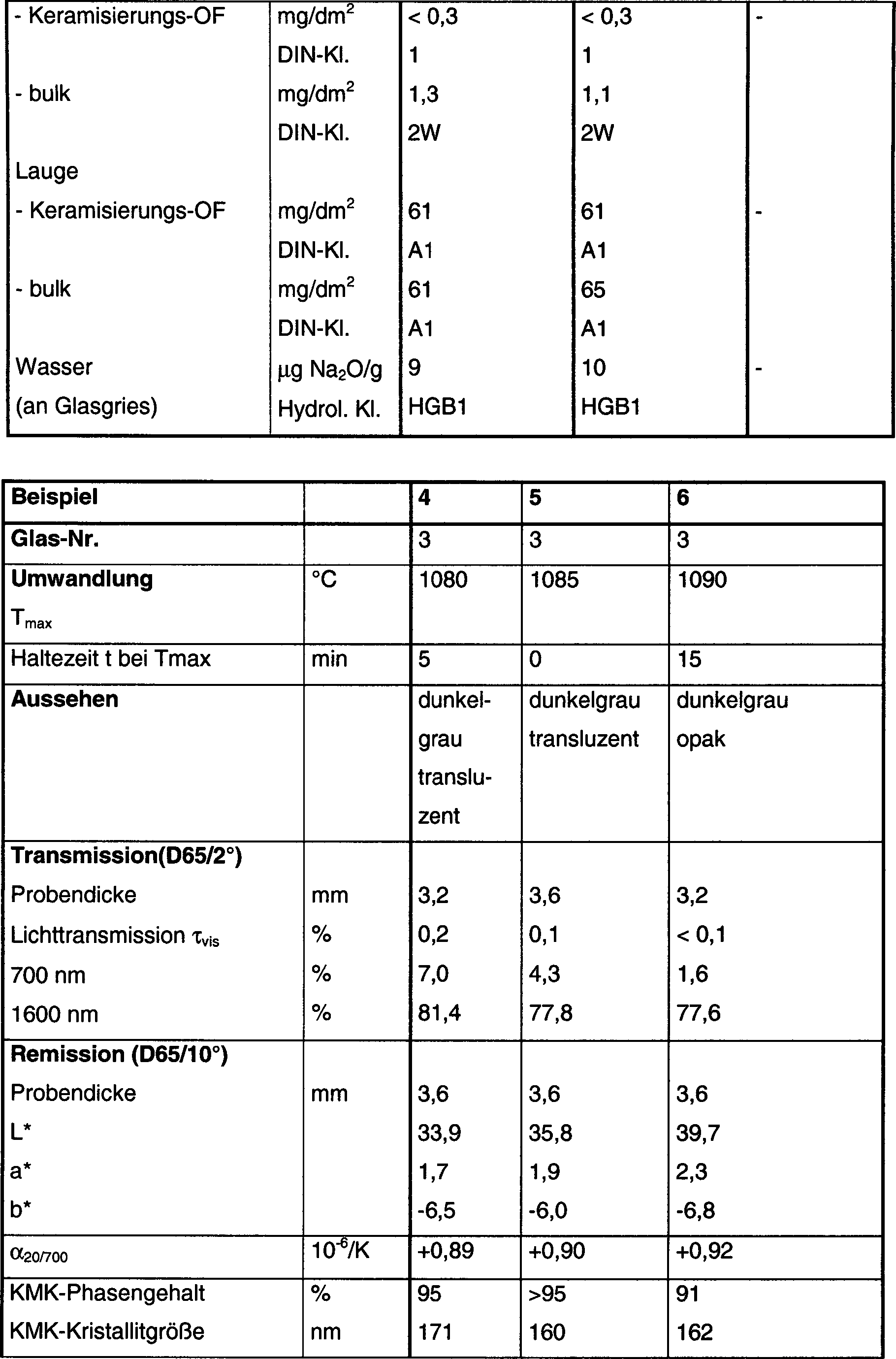


Tabelle
4: Umwandlungsbedingungen und Farbe von eingefärbten transluzenten Keatit-Mischkristall
Glaskeramiken auf der Basis der Grundzusammensetzung dotiert mit
den angegebenen färbenden
Komponenten (Farbmessung:
Remission Normlicht C, 2° Messwinkel) 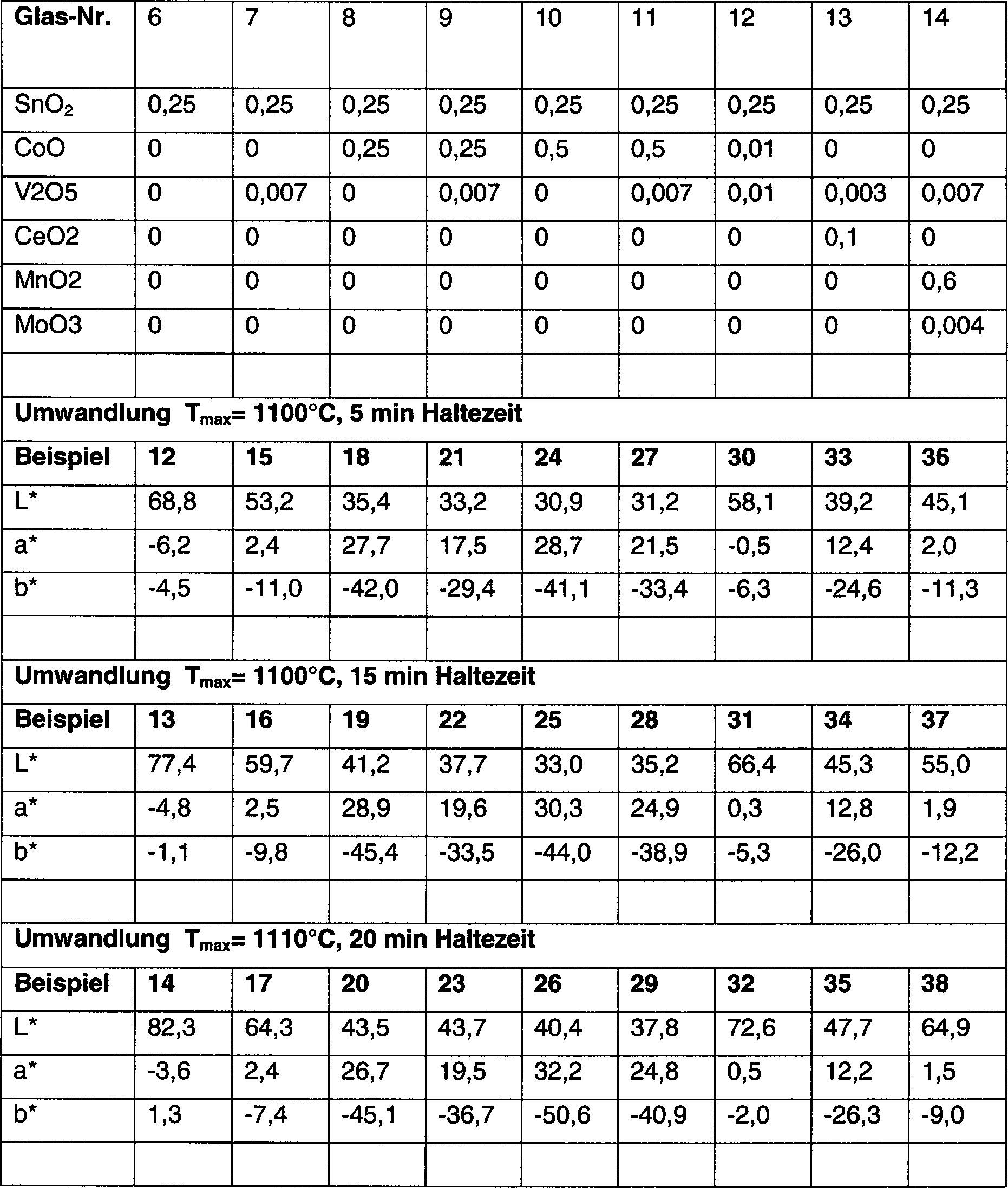
Claims (18)
Priority Applications (5)
| Application Number | Priority Date | Filing Date | Title |
|---|---|---|---|
| DE102004024583A DE102004024583A1 (en) | 2004-05-12 | 2004-05-12 | Translucent or opaque cooking surface consisting of a colorable glass ceramic and its use |
| FR0504331A FR2873684A1 (en) | 2004-05-12 | 2005-04-28 | TRANSLUCENT OR OPAQUE COOKING SURFACE COMPRISING A COLORABLE VITROCERAMIC, AND USE OF SAID SURFACE. |
| US11/124,853 US20050252503A1 (en) | 2004-05-12 | 2005-05-09 | Translucent or opaque colored glass-ceramic article providing a cooking surface and its use |
| JP2005138584A JP2005325018A (en) | 2004-05-12 | 2005-05-11 | Translucent or opaque colored glass ceramic product used as cooking surface and its use |
| CN200510068851.0A CN1696072A (en) | 2004-05-12 | 2005-05-12 | Translucent or opaque colored glass-ceramic article providing a cooking surface and its use |
Applications Claiming Priority (1)
| Application Number | Priority Date | Filing Date | Title |
|---|---|---|---|
| DE102004024583A DE102004024583A1 (en) | 2004-05-12 | 2004-05-12 | Translucent or opaque cooking surface consisting of a colorable glass ceramic and its use |
Publications (1)
| Publication Number | Publication Date |
|---|---|
| DE102004024583A1 true DE102004024583A1 (en) | 2005-12-08 |
Family
ID=35308242
Family Applications (1)
| Application Number | Title | Priority Date | Filing Date |
|---|---|---|---|
| DE102004024583A Withdrawn DE102004024583A1 (en) | 2004-05-12 | 2004-05-12 | Translucent or opaque cooking surface consisting of a colorable glass ceramic and its use |
Country Status (5)
| Country | Link |
|---|---|
| US (1) | US20050252503A1 (en) |
| JP (1) | JP2005325018A (en) |
| CN (1) | CN1696072A (en) |
| DE (1) | DE102004024583A1 (en) |
| FR (1) | FR2873684A1 (en) |
Cited By (9)
| Publication number | Priority date | Publication date | Assignee | Title |
|---|---|---|---|---|
| DE102010023407A1 (en) * | 2010-06-11 | 2011-12-15 | Schott Ag | Glass ceramic article used for substrate for solar cells e.g. thin-film solar cells and photovoltaic cell, contains aluminosilicate glass ceramic including sodium oxide and potassium oxide, and has preset value of water content |
| DE102013108216B3 (en) * | 2013-04-02 | 2014-08-07 | Fraunhofer-Gesellschaft zur Förderung der angewandten Forschung e.V. | Use of magnesium oxide-aluminum oxide silica glass or glass ceramic containing phosphorus and specific transition metal component, for dental application |
| EP3018107A1 (en) * | 2014-11-06 | 2016-05-11 | Schott AG | Highly crystalline lithium aluminium silicate glass ceramic material and use of same |
| DE102014226986A1 (en) | 2014-12-23 | 2016-06-23 | Schott Ag | Glass-ceramic substrate made of a transparent, colored LAS glass-ceramic and process for its production |
| DE102010006232B4 (en) * | 2009-07-20 | 2016-09-15 | Schott Ag | High-performance glass-ceramic and process for producing a high-performance ceramic and their use |
| DE102016211065A1 (en) | 2016-06-21 | 2017-12-21 | Schott Ag | Transparent, preferably colored glass ceramic article with low scattered light content and high strength, as well as processes for its preparation and its use |
| DE102016111438A1 (en) | 2016-06-22 | 2017-12-28 | Schott Ag | Glass ceramic element with intrinsic decoration and process for its production |
| EP2435377B1 (en) | 2009-05-29 | 2021-07-14 | Eurokera S.N.C. | Glass-ceramic plate |
| EP4140964A1 (en) * | 2021-08-25 | 2023-03-01 | Schott Ag | Crystallizable lithium aluminosilicate glass and glass ceramic produced therefrom and method for producing glass ceramic and use of the glass ceramic |
Families Citing this family (37)
| Publication number | Priority date | Publication date | Assignee | Title |
|---|---|---|---|---|
| JP4741282B2 (en) * | 2004-05-12 | 2011-08-03 | ショット アクチエンゲゼルシャフト | Method for producing glass ceramic product |
| FR2902421B1 (en) * | 2005-12-07 | 2008-11-07 | Snc Eurokera Soc En Nom Collec | QUARTZ AND / OR B SPODUMENE GLASS VITROCERAMICS, PRECURSOR GLASSES, ARTICLES THEREOF, VITROCERAMIC VITROCERAMIC PRODUCTS AND ARTICLES THEREOF |
| CN102418947B (en) * | 2006-07-27 | 2014-06-18 | 松下电器产业株式会社 | Heating cooker |
| WO2008053110A2 (en) * | 2006-10-27 | 2008-05-08 | Eurokera S.N.C. | Method for refining a lithium alumino-silicate glass and glass ceramic thus obtained |
| DE102007020246B4 (en) * | 2007-04-24 | 2012-12-27 | Schott Ag | Metallkolloidgestärbte or colorless glass ceramic and in a metallkolloidgefärbte or colorless glass ceramic convertible colorless glass |
| DE102007025893B4 (en) * | 2007-06-01 | 2014-08-21 | Schott Ag | Glass-ceramic armor material and method of making armor with a glass-ceramic component |
| JP5435395B2 (en) * | 2008-02-06 | 2014-03-05 | 日本電気硝子株式会社 | Method for manufacturing glass article |
| DE102008012891A1 (en) * | 2008-03-06 | 2009-09-10 | Schott Ag | Glass-ceramic article comprises a light-scattering inorganic coating, where the coating contains a baked layer of glass ceramic particles, or a baked sol-gel matrix embedded with light-scattering particles, which are e.g. silicon dioxide |
| DE202008017803U1 (en) | 2008-10-07 | 2010-08-12 | Schott Ag | Transparent, colored cooking surface with improved color display capability |
| DE102009013127C5 (en) * | 2009-03-13 | 2024-12-19 | Schott Ag | Transparent, coloured cooking surface and method for displaying an operating state of such a surface |
| JP4815002B2 (en) * | 2009-06-04 | 2011-11-16 | 株式会社オハラ | Crystallized glass substrate for information recording medium and manufacturing method thereof |
| FR2962192B1 (en) * | 2010-06-30 | 2014-02-07 | Eurokera | COOKING DEVICE COMPRISING A GLASS OR VITROCERAMIC PLATE OF THE TYPE HAVING AT LEAST ONE MEANS OF MASKING INTERNAL ELEMENTS COVERED BY THE PLATE |
| DE102010027461B4 (en) * | 2010-07-17 | 2019-08-22 | Schott Ag | Lithium-containing, transparent glass ceramic with low thermal expansion, a largely amorphous, lithium-depleted, predominantly glassy surface zone and high transmission, their preparation and use |
| DE102010032113B9 (en) * | 2010-07-23 | 2017-06-22 | Schott Ag | Transparent or transparent colored lithium aluminum silicate glass-ceramic with adjustable thermal expansion and its use |
| DE102010032112A1 (en) * | 2010-07-23 | 2012-01-26 | Schott Ag | Glass ceramic as cooking surface for induction heating with improved color display capability and heat shielding, method for making such a cooking surface and their use |
| FR2963617B1 (en) * | 2010-08-03 | 2015-06-05 | Eurokera | GLASSES OF LITHIUM ALUMINOSILICATE (PRECURSORS OF VITROCERAMIC); BETA-QUARTZ AND / OR BETA-SPODUMENE VITROCERAMICS; ARTICLES THEREOF VITROCERAMIC; METHODS OF OBTAINING |
| JP5935304B2 (en) * | 2010-12-27 | 2016-06-15 | 日本電気硝子株式会社 | Crystallized glass |
| ES2393511B1 (en) * | 2011-03-30 | 2013-11-08 | Bsh Electrodomésticos España, S.A. | Cooking field plate with a coating applied next to the bottom side |
| DE102011050867A1 (en) * | 2011-06-06 | 2012-12-06 | Schott Ag | High-strength colored. smooth glass ceramic as a cooking surface on both sides |
| WO2013011897A1 (en) * | 2011-07-15 | 2013-01-24 | 旭硝子株式会社 | Crystallized glass housing |
| DE102012105576B4 (en) | 2012-06-26 | 2016-12-15 | Schott Ag | Glass ceramic and process for its production and glass ceramic hob |
| FR3002532B1 (en) | 2013-02-28 | 2015-02-27 | Eurokera | LITHIUM ALUMINOSILICATE TYPE VITROCERAMIC COMPRISING A SOLID BETA-SPODUMENE SOLUTION |
| CN105103352B (en) * | 2013-03-29 | 2018-04-06 | 圣戈本陶瓷及塑料股份有限公司 | Sanbornite base glass-ceramic seal for high temperature application |
| EP3031785B1 (en) * | 2014-12-12 | 2018-10-17 | Schott AG | Method for producing a glass ceramic element having a structured coating |
| FR3040769B1 (en) * | 2015-09-08 | 2018-07-27 | Eurokera | WORK PLAN IN VITROCERAMIC |
| DE102016101036B4 (en) * | 2016-01-21 | 2018-05-30 | Schott Ag | Cooker with a ceramic hob |
| CN105884184B (en) * | 2016-06-22 | 2018-06-12 | 武汉理工大学 | A kind of blast furnace cinder prepares the controlled micro crystallization method of devitrified glass |
| JPWO2019117122A1 (en) * | 2017-12-15 | 2020-10-22 | 日本電気硝子株式会社 | Manufacturing method of LAS-based crystallized glass plate and LAS-based crystallized glass plate |
| DE102018110909A1 (en) * | 2017-12-22 | 2018-06-21 | Schott Ag | Cover plate with neutral color coating |
| DE102018110908A1 (en) | 2017-12-22 | 2018-06-21 | Schott Ag | Transparent, colored lithium aluminum silicate glass ceramic and method for producing and using the glass ceramic |
| DE102018110910A1 (en) | 2017-12-22 | 2018-06-21 | Schott Ag | Furnishings and fittings for kitchens or laboratories with lighting elements |
| DE102018110855A1 (en) * | 2017-12-22 | 2018-06-28 | Schott Ag | Glass-ceramic with reduced lithium content |
| DE202018102533U1 (en) | 2017-12-22 | 2018-06-12 | Schott Ag | Furnishings and equipment for kitchens or laboratories with display devices |
| WO2020086036A2 (en) * | 2018-10-25 | 2020-04-30 | Turkiye Sise Ve Cam Fabrikalari Anonim Sirketi | Application of controlled crystallization method in production of glass ceramic with low thermal expansion coefficient |
| US20220267215A1 (en) * | 2019-08-01 | 2022-08-25 | Kuraray Noritake Dental Inc. | Method for producing zirconia sintered body |
| DE102020202597A1 (en) * | 2020-02-28 | 2021-09-02 | Schott Ag | Cooking surface made from a LAS glass ceramic plate |
| CN111847883A (en) * | 2020-08-31 | 2020-10-30 | 贵州赛义光电科技有限公司 | Fluorescent glass ceramic and preparation method thereof |
Citations (8)
| Publication number | Priority date | Publication date | Assignee | Title |
|---|---|---|---|---|
| US4211820A (en) * | 1979-02-02 | 1980-07-08 | Corning Glass Works | Brown glass-ceramic articles |
| US4218512A (en) * | 1979-01-04 | 1980-08-19 | Ppg Industries, Inc. | Strengthened translucent glass-ceramics and method of making |
| EP0536478A1 (en) * | 1991-10-09 | 1993-04-14 | Corning Incorporated | Variably translucent glassceramic article and method for making |
| WO1999006334A1 (en) * | 1997-08-01 | 1999-02-11 | Eurokera | Glass-ceramic plate and method for making same |
| DE19939787A1 (en) * | 1999-08-21 | 2001-02-22 | Schott Glas | Transparent glass ceramic colored using vanadium oxide additive has a crystal phase made of high quartz content mixed crystals and a specified light transmission |
| DE10017698A1 (en) * | 2000-04-08 | 2001-10-25 | Schott Glas | Easy to clean glass ceramic body |
| EP0437228B2 (en) * | 1990-01-12 | 2002-03-20 | Corning S.A. | Thermally crystallizable glass, glass-ceramic made therefrom, and method of making same |
| EP1170264B1 (en) * | 2000-07-04 | 2003-09-03 | Schott Glas | Translucent glass-ceramic, process for manufacturing a translucent glass-ceramic as well as its application |
Family Cites Families (7)
| Publication number | Priority date | Publication date | Assignee | Title |
|---|---|---|---|---|
| US4011091A (en) * | 1975-08-13 | 1977-03-08 | Owens-Illinois, Inc. | Ceramic materials containing keatite |
| DE4321373C2 (en) * | 1993-06-26 | 1995-12-14 | Schott Glaswerke | Glass ceramic with high transmission in the wavelength range from 2700 to 3300 nm, process for their production and their use |
| DE19857117C2 (en) * | 1998-12-10 | 2001-05-03 | Schott Glas | Glass ceramic cooktop with little dirt |
| US6525300B1 (en) * | 1999-07-30 | 2003-02-25 | Schott Glas | Cooking surface for cooking food having a glass ceramic surface with a glass coating thereon |
| CN1278973C (en) * | 2000-08-24 | 2006-10-11 | 肖特股份有限公司 | Transparent glass ceramics, production method and use thereof |
| DE10110225C2 (en) * | 2001-03-02 | 2003-07-17 | Schott Glas | Glass-ceramic support material, process for its preparation and its use |
| DE10238608A1 (en) * | 2002-08-16 | 2004-03-04 | Schott Glas | Component made of a lithium aluminosilicate glass ceramic |
-
2004
- 2004-05-12 DE DE102004024583A patent/DE102004024583A1/en not_active Withdrawn
-
2005
- 2005-04-28 FR FR0504331A patent/FR2873684A1/en active Pending
- 2005-05-09 US US11/124,853 patent/US20050252503A1/en not_active Abandoned
- 2005-05-11 JP JP2005138584A patent/JP2005325018A/en active Pending
- 2005-05-12 CN CN200510068851.0A patent/CN1696072A/en active Pending
Patent Citations (8)
| Publication number | Priority date | Publication date | Assignee | Title |
|---|---|---|---|---|
| US4218512A (en) * | 1979-01-04 | 1980-08-19 | Ppg Industries, Inc. | Strengthened translucent glass-ceramics and method of making |
| US4211820A (en) * | 1979-02-02 | 1980-07-08 | Corning Glass Works | Brown glass-ceramic articles |
| EP0437228B2 (en) * | 1990-01-12 | 2002-03-20 | Corning S.A. | Thermally crystallizable glass, glass-ceramic made therefrom, and method of making same |
| EP0536478A1 (en) * | 1991-10-09 | 1993-04-14 | Corning Incorporated | Variably translucent glassceramic article and method for making |
| WO1999006334A1 (en) * | 1997-08-01 | 1999-02-11 | Eurokera | Glass-ceramic plate and method for making same |
| DE19939787A1 (en) * | 1999-08-21 | 2001-02-22 | Schott Glas | Transparent glass ceramic colored using vanadium oxide additive has a crystal phase made of high quartz content mixed crystals and a specified light transmission |
| DE10017698A1 (en) * | 2000-04-08 | 2001-10-25 | Schott Glas | Easy to clean glass ceramic body |
| EP1170264B1 (en) * | 2000-07-04 | 2003-09-03 | Schott Glas | Translucent glass-ceramic, process for manufacturing a translucent glass-ceramic as well as its application |
Cited By (19)
| Publication number | Priority date | Publication date | Assignee | Title |
|---|---|---|---|---|
| EP2435377B2 (en) † | 2009-05-29 | 2025-03-26 | Eurokera S.N.C. | Glass-ceramic plate |
| EP2435377B1 (en) | 2009-05-29 | 2021-07-14 | Eurokera S.N.C. | Glass-ceramic plate |
| DE102010006232B4 (en) * | 2009-07-20 | 2016-09-15 | Schott Ag | High-performance glass-ceramic and process for producing a high-performance ceramic and their use |
| DE102010023407B4 (en) * | 2010-06-11 | 2017-02-02 | Schott Ag | Glass ceramic object for the production of photovoltaic elements |
| DE102010023407A1 (en) * | 2010-06-11 | 2011-12-15 | Schott Ag | Glass ceramic article used for substrate for solar cells e.g. thin-film solar cells and photovoltaic cell, contains aluminosilicate glass ceramic including sodium oxide and potassium oxide, and has preset value of water content |
| DE102013108216B3 (en) * | 2013-04-02 | 2014-08-07 | Fraunhofer-Gesellschaft zur Förderung der angewandten Forschung e.V. | Use of magnesium oxide-aluminum oxide silica glass or glass ceramic containing phosphorus and specific transition metal component, for dental application |
| EP3018107A1 (en) * | 2014-11-06 | 2016-05-11 | Schott AG | Highly crystalline lithium aluminium silicate glass ceramic material and use of same |
| DE102014222645A1 (en) * | 2014-11-06 | 2016-05-12 | Schott Ag | Highly crystalline lithium aluminum silicate glass-ceramic and its use |
| US10562808B2 (en) | 2014-11-06 | 2020-02-18 | Schott Ag | Highly crystalline lithium aluminium silicate glass-ceramic and its use |
| DE102014226986B9 (en) * | 2014-12-23 | 2017-01-12 | Schott Ag | Glass-ceramic substrate made of a transparent, colored LAS glass-ceramic and process for its production |
| US10183888B2 (en) | 2014-12-23 | 2019-01-22 | Schott Ag | Glass ceramic substrate made of a transparent, colored LAS glass ceramic and method for producing it |
| DE102014226986B4 (en) * | 2014-12-23 | 2016-11-03 | Schott Ag | Glass-ceramic substrate made of a transparent, colored LAS glass-ceramic and process for its production |
| EP3040318A1 (en) | 2014-12-23 | 2016-07-06 | Schott AG | Glass-ceramic substrate made from a transparent, coloured las glass ceramic and method for producing the same |
| DE102014226986A1 (en) | 2014-12-23 | 2016-06-23 | Schott Ag | Glass-ceramic substrate made of a transparent, colored LAS glass-ceramic and process for its production |
| DE102016211065A1 (en) | 2016-06-21 | 2017-12-21 | Schott Ag | Transparent, preferably colored glass ceramic article with low scattered light content and high strength, as well as processes for its preparation and its use |
| DE102016211065B4 (en) | 2016-06-21 | 2019-09-05 | Schott Ag | Transparent, preferably colored glass ceramic article with low scattered light content and high strength, as well as processes for its preparation and its use |
| DE102016111438A1 (en) | 2016-06-22 | 2017-12-28 | Schott Ag | Glass ceramic element with intrinsic decoration and process for its production |
| EP4140964A1 (en) * | 2021-08-25 | 2023-03-01 | Schott Ag | Crystallizable lithium aluminosilicate glass and glass ceramic produced therefrom and method for producing glass ceramic and use of the glass ceramic |
| DE102021122035A1 (en) | 2021-08-25 | 2023-03-02 | Schott Ag | Crystallizable lithium aluminum silicate glass and glass ceramics produced therefrom, as well as methods for producing the glass ceramics and use of the glass ceramics |
Also Published As
| Publication number | Publication date |
|---|---|
| FR2873684A1 (en) | 2006-02-03 |
| JP2005325018A (en) | 2005-11-24 |
| US20050252503A1 (en) | 2005-11-17 |
| CN1696072A (en) | 2005-11-16 |
Similar Documents
| Publication | Publication Date | Title |
|---|---|---|
| DE102004024583A1 (en) | Translucent or opaque cooking surface consisting of a colorable glass ceramic and its use | |
| EP3728152B1 (en) | Transparent, encapsulated lithium aluminium silicate glass ceramic and method for the production and use of the glass ceramic | |
| EP1170264B1 (en) | Translucent glass-ceramic, process for manufacturing a translucent glass-ceramic as well as its application | |
| EP1837314B1 (en) | Plate of transparent, colourless lithium aluminium slicate glass ceramic with opaque, coloured underside coating | |
| EP2349942B1 (en) | Transparent, dyed cooktop having improved color display capability, and method for producing such a cooktop | |
| EP1837312B1 (en) | Lithium-aluminium-silicate glass with short ceramisation time | |
| EP2817269B9 (en) | Transparent low-colour lithium aluminium silicate glass ceramic and the use thereof | |
| DE202018100558U1 (en) | Colored transparent lithium aluminum silicate glass-ceramic | |
| DE102016208300B3 (en) | Crystallizable lithium aluminum silicate glass and transparent glass ceramic produced therefrom, and also methods for producing the glass and the glass ceramic and use of the glass ceramic | |
| EP2724995A1 (en) | Transparent, coloured cooking surface | |
| EP3747839B1 (en) | Glass ceramic, method for their preparation and their use | |
| EP3872044B1 (en) | Crystallizable lithium aluminosilicate glass and glass ceramic produced therefrom and method for producing glass and glass ceramic and use of the glass ceramic | |
| EP3872042A1 (en) | Cooking surface made of a las glass ceramic plate | |
| EP3932884A1 (en) | Transparent, non-coloured lithium aluminum silicate glass ceramic item with high quarz mixed crystal as the main crystal phase and method for producing the item and use thereof | |
| EP4375248B1 (en) | Lithium aluminium silicate glass ceramic | |
| EP3872043B1 (en) | Crystallizable lithium aluminosilicate glass and glass ceramic produced therefrom and method for producing glass and glass ceramic and use of the glass ceramic | |
| EP4375251A1 (en) | Lithium aluminium silicate glass ceramic | |
| EP4375247B1 (en) | Lithium aluminium silicate glass ceramic | |
| DE102005019247B9 (en) | Process for the production of glass ceramics | |
| EP3450411A1 (en) | Coloured transparent lithium aluminium silicate glass ceramic and use of same | |
| DE202023106962U1 (en) | Lithium aluminum silicate glass ceramic | |
| WO2024110091A1 (en) | Lithium aluminum silicate glass-ceramic | |
| EP4375243A1 (en) | Lithium aluminium silicate glass ceramic | |
| WO2024110093A1 (en) | Lithium aluminum silicate glass-ceramic | |
| DE202022106827U1 (en) | Lithium aluminum silicate glass ceramic |
Legal Events
| Date | Code | Title | Description |
|---|---|---|---|
| OP8 | Request for examination as to paragraph 44 patent law | ||
| 8130 | Withdrawal |