CN114814825B - Vehicle track sensing and state extraction method based on radar and video fusion - Google Patents
Vehicle track sensing and state extraction method based on radar and video fusion Download PDFInfo
- Publication number
- CN114814825B CN114814825B CN202210294772.5A CN202210294772A CN114814825B CN 114814825 B CN114814825 B CN 114814825B CN 202210294772 A CN202210294772 A CN 202210294772A CN 114814825 B CN114814825 B CN 114814825B
- Authority
- CN
- China
- Prior art keywords
- vehicle
- radar
- algorithm
- video
- state
- Prior art date
- Legal status (The legal status is an assumption and is not a legal conclusion. Google has not performed a legal analysis and makes no representation as to the accuracy of the status listed.)
- Active
Links
Images

Classifications
-
- G—PHYSICS
- G01—MEASURING; TESTING
- G01S—RADIO DIRECTION-FINDING; RADIO NAVIGATION; DETERMINING DISTANCE OR VELOCITY BY USE OF RADIO WAVES; LOCATING OR PRESENCE-DETECTING BY USE OF THE REFLECTION OR RERADIATION OF RADIO WAVES; ANALOGOUS ARRANGEMENTS USING OTHER WAVES
- G01S13/00—Systems using the reflection or reradiation of radio waves, e.g. radar systems; Analogous systems using reflection or reradiation of waves whose nature or wavelength is irrelevant or unspecified
- G01S13/86—Combinations of radar systems with non-radar systems, e.g. sonar, direction finder
- G01S13/867—Combination of radar systems with cameras
-
- G—PHYSICS
- G01—MEASURING; TESTING
- G01S—RADIO DIRECTION-FINDING; RADIO NAVIGATION; DETERMINING DISTANCE OR VELOCITY BY USE OF RADIO WAVES; LOCATING OR PRESENCE-DETECTING BY USE OF THE REFLECTION OR RERADIATION OF RADIO WAVES; ANALOGOUS ARRANGEMENTS USING OTHER WAVES
- G01S13/00—Systems using the reflection or reradiation of radio waves, e.g. radar systems; Analogous systems using reflection or reradiation of waves whose nature or wavelength is irrelevant or unspecified
- G01S13/88—Radar or analogous systems specially adapted for specific applications
- G01S13/91—Radar or analogous systems specially adapted for specific applications for traffic control
-
- G—PHYSICS
- G06—COMPUTING OR CALCULATING; COUNTING
- G06F—ELECTRIC DIGITAL DATA PROCESSING
- G06F18/00—Pattern recognition
- G06F18/20—Analysing
- G06F18/24—Classification techniques
-
- G—PHYSICS
- G06—COMPUTING OR CALCULATING; COUNTING
- G06F—ELECTRIC DIGITAL DATA PROCESSING
- G06F18/00—Pattern recognition
- G06F18/20—Analysing
- G06F18/25—Fusion techniques
-
- Y—GENERAL TAGGING OF NEW TECHNOLOGICAL DEVELOPMENTS; GENERAL TAGGING OF CROSS-SECTIONAL TECHNOLOGIES SPANNING OVER SEVERAL SECTIONS OF THE IPC; TECHNICAL SUBJECTS COVERED BY FORMER USPC CROSS-REFERENCE ART COLLECTIONS [XRACs] AND DIGESTS
- Y02—TECHNOLOGIES OR APPLICATIONS FOR MITIGATION OR ADAPTATION AGAINST CLIMATE CHANGE
- Y02T—CLIMATE CHANGE MITIGATION TECHNOLOGIES RELATED TO TRANSPORTATION
- Y02T10/00—Road transport of goods or passengers
- Y02T10/10—Internal combustion engine [ICE] based vehicles
- Y02T10/40—Engine management systems
Landscapes
- Engineering & Computer Science (AREA)
- Radar, Positioning & Navigation (AREA)
- Remote Sensing (AREA)
- Physics & Mathematics (AREA)
- Theoretical Computer Science (AREA)
- General Physics & Mathematics (AREA)
- Data Mining & Analysis (AREA)
- Artificial Intelligence (AREA)
- Life Sciences & Earth Sciences (AREA)
- Bioinformatics & Cheminformatics (AREA)
- Bioinformatics & Computational Biology (AREA)
- Computer Vision & Pattern Recognition (AREA)
- Evolutionary Biology (AREA)
- Evolutionary Computation (AREA)
- General Engineering & Computer Science (AREA)
- Computer Networks & Wireless Communication (AREA)
- Electromagnetism (AREA)
- Traffic Control Systems (AREA)
Abstract
本发明公开了一种基于雷达和视频融合的车辆轨迹感知与状态提取方法,涉及雷达和视频融合技术,用于解决现有技术中缺少对长距离车辆连续轨迹的分析和车辆加减速等其他状态的识别的技术问题;本发明采用多层耦合智能分析算法,融合毫米波雷达和视频数据,提取车辆号牌、位置、速度等特征数据,准确标签车辆号牌及其对应的特征参数,弥补雷达或视频单一方式识别特定车辆和分析车辆长距离连续轨迹和状态方面的不足,提高车辆运行参数的计算精度;通过缩短时间更新间隔,提高车辆运行参数分析的时效性;根据每种车辆运行状态的样本数据,自学习获得状态阈值,再根据实时采集的车辆特征数据,提高车辆运行状态研判精度。

The invention discloses a vehicle trajectory perception and state extraction method based on radar and video fusion, which relates to radar and video fusion technology and is used to solve the lack of analysis of long-distance vehicle continuous trajectory and other states such as vehicle acceleration and deceleration in the prior art The technical problem of identification; the present invention adopts the multi-layer coupling intelligent analysis algorithm, fuses the millimeter-wave radar and video data, extracts the characteristic data such as vehicle license plate, position, speed, accurately labels the vehicle license plate and its corresponding characteristic parameters, and makes up for the radar Or a single method of video to identify specific vehicles and analyze the shortcomings of long-distance continuous trajectory and state of vehicles to improve the calculation accuracy of vehicle operating parameters; by shortening the time update interval, improve the timeliness of vehicle operating parameter analysis; according to the operating status of each vehicle Sample data, self-learning to obtain the state threshold, and then improve the accuracy of vehicle operating state research and judgment based on the real-time collected vehicle characteristic data.
Description
技术领域technical field
本发明属于交通流信息感知领域,涉及雷达和视频融合技术,具体是一种基于雷达和视频融合的车辆轨迹感知与状态提取方法。The invention belongs to the field of traffic flow information perception, relates to radar and video fusion technology, in particular to a vehicle trajectory perception and state extraction method based on radar and video fusion.
背景技术Background technique
城市快速路交织区因车辆合流时行驶速度、轨迹等突然变化,容易产生安全隐患和交通拥堵。因此,需要分析快速路交织区车辆行驶轨迹和状态,识别危险、不规范的驾驶行为和交通堵点位置,有利于优化快速路交通组织,规范快速路交织区车辆的驾驶行为,预防和缓解快速路拥堵,保障交通安全。In the weaving area of urban expressways, due to sudden changes in the speed and trajectory of vehicles when they merge, potential safety hazards and traffic congestion are likely to occur. Therefore, it is necessary to analyze the driving trajectory and status of vehicles in the weaving area of expressways, identify dangerous and irregular driving behaviors, and the location of traffic jams, which is conducive to optimizing the traffic organization of expressways, standardizing the driving behavior of vehicles in weaving areas of expressways, and preventing and alleviating rapid traffic jams. Road congestion, ensure traffic safety.
现有的车辆轨迹感知与状态提取方法主要采用视频或雷达的单一方式分析车辆轨迹:视频图像处理方式通过深度学习算法识别车辆,将车辆打上标签,然后通过视频图像处理算法判别车辆是否变道,对车辆变道行为进行抓拍。雷达探测方式则通过卡尔曼滤波器跟踪车辆的状态,包括位置、速度、加速度等,使用包含噪声的观测值估计和识别车辆的位置,再通过航迹处理算法提取车辆运行的轨迹。The existing vehicle trajectory perception and state extraction methods mainly use a single method of video or radar to analyze vehicle trajectory: the video image processing method identifies the vehicle through a deep learning algorithm, labels the vehicle, and then uses the video image processing algorithm to determine whether the vehicle has changed lanes. Capture the behavior of vehicles changing lanes. The radar detection method uses the Kalman filter to track the state of the vehicle, including position, speed, acceleration, etc., uses observations containing noise to estimate and identify the position of the vehicle, and then extracts the trajectory of the vehicle through the track processing algorithm.
现有车辆轨迹感知与状态提取方法中,采用视频图像处理方式受限于视频检测范围和图像质量,主要对小于75米的近距离车辆变道行为进行分析,缺少对长距离车辆连续轨迹的分析和车辆加减速等其他状态的识别。采用雷达探测方式主要是对车辆的连续轨迹进行分析,缺少车辆标签,无法识别车牌和对特定车辆进行状态和轨迹跟踪。In the existing vehicle trajectory perception and state extraction methods, the video image processing method is limited by the video detection range and image quality. It mainly analyzes the lane-changing behavior of short-distance vehicles less than 75 meters, and lacks the analysis of long-distance vehicle continuous trajectories. And the identification of other states such as vehicle acceleration and deceleration. The radar detection method is mainly to analyze the continuous trajectory of the vehicle, lacking the vehicle label, unable to recognize the license plate and track the state and trajectory of the specific vehicle.
为此,提出一种基于雷达和视频融合的车辆轨迹感知与状态提取方法。To this end, a vehicle trajectory perception and state extraction method based on radar and video fusion is proposed.
发明内容Contents of the invention
本发明旨在至少解决现有技术中存在的技术问题之一。为此,本发明提出一种基于雷达和视频融合的车辆轨迹感知与状态提取方法,解决了现有技术中缺少对长距离车辆连续轨迹的分析和车辆加减速等其他状态的识别的技术问题;本发明采用多层耦合智能分析算法,融合毫米波雷达和视频数据,提取车辆号牌、位置、速度等特征数据,准确标签车辆号牌及其对应的特征参数,弥补雷达或视频单一方式识别特定车辆和分析车辆长距离连续轨迹和状态方面的不足,提高车辆运行参数的计算精度;通过缩短时间更新间隔,提高车辆运行参数分析的时效性;根据每种车辆运行状态的样本集合,自学习获得状态阈值,再根据实时采集的车辆特征数据,提高车辆运行状态研判精度。The present invention aims to solve at least one of the technical problems existing in the prior art. For this reason, the present invention proposes a vehicle trajectory perception and state extraction method based on radar and video fusion, which solves the technical problem of lack of analysis of long-distance vehicle continuous trajectory and identification of other states such as vehicle acceleration and deceleration in the prior art; The invention adopts a multi-layer coupling intelligent analysis algorithm, integrates millimeter-wave radar and video data, extracts characteristic data such as vehicle license plates, positions, and speeds, accurately labels vehicle license plates and their corresponding characteristic parameters, and compensates for the uniqueness of radar or video single-mode identification. Vehicles and analyze the shortcomings of long-distance continuous trajectories and states of vehicles, improve the calculation accuracy of vehicle operating parameters; improve the timeliness of vehicle operating parameter analysis by shortening the time update interval; according to the sample collection of each vehicle operating state, self-learning obtains The status threshold, and then according to the real-time collection of vehicle characteristic data, improve the accuracy of vehicle operating status research and judgment.
为实现上述目的,根据本发明的第一方面的实施例提出一种基于雷达和视频融合的车辆轨迹感知与状态提取方法,包括以下步骤:In order to achieve the above object, according to the embodiment of the first aspect of the present invention, a vehicle trajectory perception and state extraction method based on radar and video fusion is proposed, including the following steps:
选择快速路交织区上游、下游P1-P2米处作为检测点,安装毫米波雷达和视频检测器,获取通过该检测点的每个车辆位置、速度、车型、号牌等作为样本集合,记为:Select the upstream and downstream P1-P2 meters of the expressway weaving area as the detection point, install the millimeter-wave radar and video detector, and obtain the position, speed, model, license plate, etc. of each vehicle passing through the detection point as a sample set, which is recorded as :
Q={x|x=x1,x2......xn};Q={x|x=x1, x2...xn};
其中,x代表每个车辆的位置L、速度V、车型S、号牌ID的样本子集,即x=(l,v,s,id);Wherein, x represents the sample subset of position L, speed V, vehicle type S, license plate ID of each vehicle, that is, x=(l, v, s, id);
设计多层耦合智能分析算法C;Design multi-layer coupling intelligent analysis algorithm C;
采用多层耦合算法融合分析毫米波雷达和视频检测器采集的车辆样本集合,识别车辆特征,感知车辆运行轨迹;Using multi-layer coupling algorithm to fuse and analyze the collection of vehicle samples collected by millimeter-wave radar and video detector, identify vehicle characteristics, and perceive vehicle running track;
设计车辆运行状态研判算法M;Design the vehicle operating state research and judgment algorithm M;
将连续时间标签下采集的的车辆特征数据集Q2输入车辆运行状态研判算法M,计算获得车辆的运行状态,输出车辆变道、加速、减速、停车、逆行等运行状态集合Λ,并存储到车辆运行状态主题数据库。Input the vehicle feature data set Q2 collected under the continuous time label into the vehicle operating state research and judgment algorithm M, calculate and obtain the operating state of the vehicle, and output the operating state set Λ of the vehicle lane change, acceleration, deceleration, parking, retrograde, etc., and store it in the vehicle Running status topic database.
优选的,其中位置L、速度V、车型S、号牌ID分别标记为:Preferably, the position L, speed V, vehicle type S, and license plate ID are respectively marked as:
L={l|l=l1,l2......ln};L={l|l=l1, l2...ln};
V={v|v=v1,v2......vn};V={v|v=v1, v2...vn};
S={s|s=s1,s2......sn};S={s|s=s1, s2...sn};
ID={id|id=id1,id2.......idn};ID={id|id=id1,id2....idn};
l代表一个采集周期内,检测点采集的所有车辆的经纬度坐标;l represents the latitude and longitude coordinates of all vehicles collected by the detection point within a collection period;
v代表一个采集周期内,通过检测点的所有车辆的地点车速,单位km/h;v represents the speed of all vehicles passing through the detection point within a collection period, in km/h;
s代表一个采集周期内,通过检测点的所有车辆的车型;s represents the models of all vehicles passing through the detection point within a collection period;
id代表一个采集周期内,通过检测点的所有车辆的号牌。id represents the number plates of all vehicles passing through the detection point within a collection period.
优选的,设计多层耦合智能分析算法C的过程包括以下:Preferably, the process of designing a multi-layer coupled intelligent analysis algorithm C includes the following:
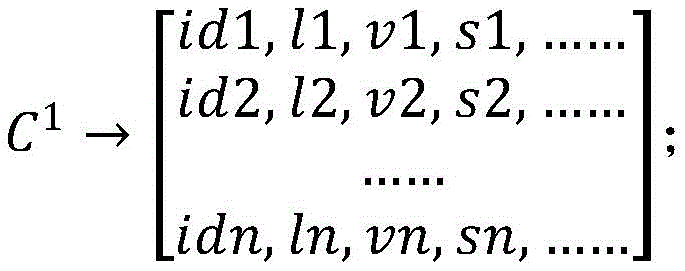
第一层耦合算法记为C1:基于检测器所在路段ID,耦合雷达、视频检测的车辆数据,提取和存储车辆基础特征数据,记为:The first layer of coupling algorithm is denoted as C 1 : based on the ID of the road section where the detector is located, coupled with the vehicle data detected by radar and video, the basic feature data of the vehicle is extracted and stored, denoted as:

第二层耦合算法记为C2:设置时间更新间隔设置为30ms,基于空间经纬度坐标和时间标签,耦合GIS地图和车辆的时空位置数据,提取和存储时空维度下车辆运行特征数据,记为:The second layer coupling algorithm is denoted as C 2 : set the time update interval to 30ms, based on the spatial latitude and longitude coordinates and time labels, couple the GIS map and the vehicle’s spatiotemporal position data, extract and store the vehicle’s operating characteristic data in the spatiotemporal dimension, denoted as:

其中,T代表时间标签。Among them, T represents the time tag.
优选的,采用多层耦合算法融合分析毫米波雷达和视频检测器采集的车辆样本集合,识别车辆特征,感知车辆运行轨迹;过程包括以下步骤:Preferably, a multi-layer coupling algorithm is used to fuse and analyze the vehicle sample collection collected by the millimeter-wave radar and the video detector, identify vehicle characteristics, and perceive vehicle running tracks; the process includes the following steps:
步骤1:将雷达和视频检测的样本集合输入多层耦合智能分析算法C中的第一层耦合算法C1,生成映射数据集Q1;Step 1: Input the sample set of radar and video detection into the first layer coupling algorithm C 1 in the multi-layer coupling intelligent analysis algorithm C to generate the mapping data set Q1;
步骤2:将映射数据集Q1迭代到第二层耦合算法C2中,生成时间标签下的特征数据集Q2。Step 2: Iterate the mapping data set Q1 into the second layer coupling algorithm C2 to generate the feature data set Q2 under the time label.
优选的,设计车辆运行状态研判算法M,具体的步骤如下:Preferably, the vehicle operating state research and judgment algorithm M is designed, and the specific steps are as follows:
步骤1:将车辆运行状态划分为m种类型,每种类型,设置对应类型的阈值λ;Step 1: Divide the vehicle operating state into m types, and set the threshold λ of the corresponding type for each type;
步骤2:取每种类型车辆运行状态的已知样本集合输入深度学习算法模型,训练学习得到每种类型车辆运行状态的对应阈值ψ;Step 2: Take the known sample set of each type of vehicle operating state and input it into the deep learning algorithm model, and train and learn to obtain the corresponding threshold ψ of each type of vehicle operating state;
根据计算的阈值ψ,选取一个最大值阈值ψ2和最小值阈值ψ1,设置阈值范围,构建车辆运行状态研判算法M,记为:According to the calculated threshold ψ, select a maximum threshold ψ2 and a minimum threshold ψ1, set the threshold range, and construct the vehicle operating state research and judgment algorithm M, which is recorded as:
M:ψ1≤ψ<ψ2,ψ∈ΛM: ψ1≤ψ<ψ2, ψ∈Λ
其中,当车辆特征数据满足ψ1≤ψ<ψ2时,判别车辆属于某种运行状态Λ;反之,则不属于车辆运行状态Λ。Among them, when the vehicle characteristic data satisfies ψ1≤ψ<ψ2, it is judged that the vehicle belongs to a certain running state Λ; otherwise, it does not belong to the vehicle running state Λ.
优选的,所述车辆运行状态划分为变道、加速、减速、停车、逆行。Preferably, the vehicle running state is divided into lane change, acceleration, deceleration, parking, and reverse driving.
优选的,将变道车辆的样本集合集Lt={lt|lt=l1t,l2t,......,lnt}带入学习模型M1,计算车辆变道运行状态的阈值;学习模型M1,记为:Preferably, the sample set Lt={lt|lt=l1t, l2t, ..., lnt} of the lane-changing vehicle is brought into the learning model M1 to calculate the threshold value of the vehicle lane-changing operating state; the learning model M1, Recorded as:

同理,可以推算出车辆加速、减速、停车、逆行等各种运行状态的阈值。In the same way, the thresholds of various operating states such as vehicle acceleration, deceleration, parking, and retrograde can be calculated.
与现有技术相比,本发明的有益效果是:Compared with prior art, the beneficial effect of the present invention is:
1、采用多层耦合智能分析算法,融合毫米波雷达和视频数据,提取车辆号牌、位置、速度等特征数据,准确标签车辆号牌及其对应的特征参数,弥补雷达或视频单一方式识别特定车辆和分析车辆长距离连续轨迹和状态方面的不足,提高车辆运行参数的计算精度。同时,通过缩短时间更新间隔,提高车辆运行参数分析的时效性。1. Adopt multi-layer coupling intelligent analysis algorithm, integrate millimeter-wave radar and video data, extract vehicle license plate, location, speed and other characteristic data, accurately label vehicle license plate and its corresponding characteristic parameters, and make up for the specific identification of radar or video single method Vehicle and analyze the shortcomings of long-distance continuous trajectory and state of vehicles, and improve the calculation accuracy of vehicle operating parameters. At the same time, by shortening the time update interval, the timeliness of vehicle operation parameter analysis is improved.
2、采用车辆运行状态研判算法,根据每种车辆运行状态的样本集合,自学习获得状态阈值,确定阈值范围后,再根据实时采集的车辆特征数据,自动判别车辆变道、加速、减速、停车、逆行等运行状态,提高车辆运行状态研判精度。2. Using the vehicle running state research and judgment algorithm, according to the sample set of each type of vehicle running state, the state threshold is obtained by self-learning, and after the threshold range is determined, then according to the real-time collected vehicle characteristic data, it can automatically judge the vehicle lane change, acceleration, deceleration, and parking , retrograde and other operating states, and improve the accuracy of vehicle operating state research and judgment.
附图说明Description of drawings
图1为本发明的流程图。Fig. 1 is a flowchart of the present invention.
具体实施方式Detailed ways
下面将结合实施例对本发明的技术方案进行清楚、完整地描述,显然,所描述的实施例仅仅是本发明一部分实施例,而不是全部的实施例。基于本发明中的实施例,本领域普通技术人员在没有做出创造性劳动前提下所获得的所有其它实施例,都属于本发明保护的范围。The technical solutions of the present invention will be clearly and completely described below in conjunction with the embodiments. Apparently, the described embodiments are only some of the embodiments of the present invention, not all of them. Based on the embodiments of the present invention, all other embodiments obtained by persons of ordinary skill in the art without making creative efforts belong to the protection scope of the present invention.
现有车辆轨迹感知与状态提取方法中,采用视频图像处理方式受限于视频检测范围和图像质量,主要对小于75米的近距离车辆变道行为进行分析,缺少对长距离车辆连续轨迹的分析和车辆加减速等其他状态的识别。采用雷达探测方式主要是对车辆的连续轨迹进行分析,缺少车辆标签,无法识别车牌和对特定车辆进行状态和轨迹跟踪。In the existing vehicle trajectory perception and state extraction methods, the video image processing method is limited by the video detection range and image quality. It mainly analyzes the lane-changing behavior of short-distance vehicles less than 75 meters, and lacks the analysis of long-distance vehicle continuous trajectories. And the identification of other states such as vehicle acceleration and deceleration. The radar detection method is mainly to analyze the continuous trajectory of the vehicle, lacking the vehicle label, unable to recognize the license plate and track the state and trajectory of the specific vehicle.
本发明提供的方法包括:The method provided by the invention comprises:
在快速路交织区安装毫米波雷达检测器和视频检测器,获取每个车辆的位置、速度、车型和图像、号牌数据的样本集合;Install millimeter-wave radar detectors and video detectors in the intersection area of expressways to obtain a sample collection of each vehicle's position, speed, model, image, and license plate data;
设计多层耦合智能分析算法;Design multi-layer coupling intelligent analysis algorithm;
采用多层耦合算法融合分析毫米波雷达和视频检测器采集的车辆样本集合,识别车辆特征,在线感知车辆运行轨迹;Using multi-layer coupling algorithm to fuse and analyze the collection of vehicle samples collected by millimeter-wave radar and video detector, identify vehicle characteristics, and perceive vehicle running trajectory online;
设计车辆运行状态研判算法;Design the vehicle operating state research and judgment algorithm;
采用车辆运行状态研判算法,提取车辆变道、加速、减速、停车、逆行等运行状态信息。Using the vehicle operating state research and judgment algorithm, the operating state information such as vehicle lane change, acceleration, deceleration, parking, and retrograde is extracted.
本方法根据车辆自身特征及其运行数据,在线计算及判别车辆行驶轨迹和运行状态,为交通管理者准确掌握快速路交织区交通运行状态,规范车辆驾驶行为,制定交通组织优化方案提供技术支持。According to the characteristics of the vehicle itself and its operating data, this method calculates and judges the vehicle's trajectory and operating status online, and provides technical support for traffic managers to accurately grasp the traffic operating status of the expressway weaving area, standardize vehicle driving behavior, and formulate traffic organization optimization schemes.
如图1所示,本申请第一方面实施例提供了一种基于雷达和视频融合的车辆轨迹感知与状态提取方法,具体包括以下步骤:As shown in Figure 1, the embodiment of the first aspect of the present application provides a vehicle trajectory perception and state extraction method based on radar and video fusion, which specifically includes the following steps:
选择快速路交织区上游、下游约100-150米处作为检测点,安装毫米波雷达和视频检测器,获取通过该检测点的每个车辆位置、速度、车型、号牌等作为样本集合,记为:Select about 100-150 meters upstream and downstream of the expressway weaving area as the detection point, install millimeter-wave radar and video detectors, obtain the position, speed, model, number plate, etc. of each vehicle passing through the detection point as a sample set, record for:
Q={x|x=x1,x2......xn};Q={x|x=x1, x2...xn};
其中,x代表每个车辆的位置L、速度V、车型S、号牌ID的样本子集,即x=(l,v,s,id);Wherein, x represents the sample subset of position L, speed V, vehicle type S, license plate ID of each vehicle, that is, x=(l, v, s, id);
且其中位置L、速度V、车型S、号牌ID分别标记为:And the position L, speed V, vehicle type S, and license plate ID are respectively marked as:
L={l|l=l1,l2......ln};L={l|l=l1, l2...ln};
V={v|v=v1,v2......vn};V={v|v=v1, v2...vn};
S={s|s=s1,s2......sn};S={s|s=s1, s2...sn};
ID={id|id=id1,id2......idn};ID={id|id=id1,id2...idn};
需要进一步解释说明的是,l代表一个采集周期内,检测点采集的所有车辆的经纬度坐标;What needs to be further explained is that l represents the latitude and longitude coordinates of all vehicles collected by the detection point within a collection period;
v代表一个采集周期内,通过检测点的所有车辆的地点车速,单位km/h;v represents the speed of all vehicles passing through the detection point within a collection period, in km/h;
s代表一个采集周期内,通过检测点的所有车辆的车型;s represents the models of all vehicles passing through the detection point within a collection period;
id代表一个采集周期内,通过检测点的所有车辆的号牌。id represents the number plates of all vehicles passing through the detection point within a collection period.
设计多层耦合智能分析算法C,具体的,设计多层耦合智能分析算法C的过程包括以下:Design a multi-layer coupled intelligent analysis algorithm C, specifically, the process of designing a multi-layer coupled intelligent analysis algorithm C includes the following:
第一层耦合算法记为C1:基于检测器所在路段ID,耦合雷达、视频检测的车辆数据,提取和存储车辆基础特征数据,例如:车辆ID、位置、速度、号牌、车型等,记为:The first layer of coupling algorithm is denoted as C 1 : based on the ID of the road section where the detector is located, coupled with the vehicle data detected by radar and video, extracts and stores the basic characteristic data of the vehicle, such as: vehicle ID, position, speed, license plate, model, etc., record for:

第二层耦合算法记为C2:设置时间更新间隔设置为30ms,基于空间经纬度坐标和时间标签,耦合GIS地图和车辆的时空位置数据,提取和存储时空维度下车辆运行特征数据,例如:每辆车在时空标签下的位置(精度设置为厘米级)、速度、轨迹等,记为:The second-level coupling algorithm is denoted as C 2 : set the time update interval to 30ms, based on the spatial latitude and longitude coordinates and time labels, couple the GIS map and the vehicle’s spatio-temporal position data, extract and store the vehicle’s operating characteristic data in the spatio-temporal dimension, for example: every The position (accuracy is set to centimeter level), speed, trajectory, etc. of the vehicle under the space-time label is recorded as:

其中,T代表时间标签。Among them, T represents the time tag.
采用多层耦合算法融合分析毫米波雷达和视频检测器采集的车辆样本集合,识别车辆特征,感知车辆运行轨迹;Using multi-layer coupling algorithm to fuse and analyze the collection of vehicle samples collected by millimeter-wave radar and video detector, identify vehicle characteristics, and perceive vehicle running track;
步骤1:将雷达和视频检测的样本集合Q={x|x=x1,x2.....xn}输入多层耦合智能分析算法C中的第一层耦合算法C1,生成映射数据集Q1;Step 1: Input the radar and video detection sample set Q={x|x=x1, x2...xn} into the first-layer coupling algorithm C 1 in the multi-layer coupling intelligent analysis algorithm C to generate a mapping data set Q1;
步骤2:将映射数据集Q1迭代到第二层耦合算法C2中,生成时间标签下的特征数据集Q2;Step 2: Iterate the mapping data set Q1 into the second layer coupling algorithm C2 to generate the feature data set Q2 under the time label;
设计车辆运行状态研判算法M,具体的步骤如下:Design the vehicle running state research and judgment algorithm M, the specific steps are as follows:
步骤1:将车辆运行状态划分为变道、加速、减速、停车、逆行等m种类型,每种类型,设置对应类型的阈值λ;Step 1: Divide the vehicle operating status into m types such as lane change, acceleration, deceleration, parking, and retrograde, and set the threshold λ of the corresponding type for each type;
步骤2:取每种类型车辆运行状态的已知样本集合输入深度学习算法模型,训练学习得到每种类型车辆运行状态的对应阈值ψ。Step 2: Take the known sample set of each type of vehicle operating state and input it into the deep learning algorithm model, and train and learn to obtain the corresponding threshold ψ of each type of vehicle operating state.
例如:将变道车辆的样本集合集Lt={lt|lt=l1t,l2t,......,lnt}带入学习模型M1,计算车辆变道运行状态的阈值;学习模型M1,记为:For example: bring the sample collection set Lt={lt|lt=l1t, l2t,...,lnt} of the lane-changing vehicle into the learning model M1, and calculate the threshold value of the vehicle lane-changing operating state; learn the model M1, record for:

同理,可以推算出车辆加速、减速、停车、逆行等各种运行状态的阈值;In the same way, the thresholds of various operating states such as vehicle acceleration, deceleration, parking, and retrograde can be calculated;
步骤3:根据计算的阈值ψ,选取一个最大值阈值ψ2和最小值阈值ψ1,设置阈值范围,构建车辆运行状态研判算法M,记为:Step 3: According to the calculated threshold ψ, select a maximum threshold ψ2 and a minimum threshold ψ1, set the threshold range, and construct the vehicle operating state research and judgment algorithm M, which is recorded as:
M:ψ1≤ψ<ψ2,ψ∈ΛM: ψ1≤ψ<ψ2, ψ∈Λ
其中,当车辆特征数据满足ψ1≤ψ<ψ2时,判别车辆属于某种运行状态Λ;反之,则不属于车辆运行状态Λ。Among them, when the vehicle characteristic data satisfies ψ1≤ψ<ψ2, it is judged that the vehicle belongs to a certain running state Λ; otherwise, it does not belong to the vehicle running state Λ.
将连续时间标签下采集的的车辆特征数据集Q2输入车辆运行状态研判算法M,计算获得车辆的运行状态,输出车辆变道、加速、减速、停车、逆行等运行状态集合Λ,并存储到车辆运行状态主题数据库。Input the vehicle feature data set Q2 collected under the continuous time label into the vehicle operating state research and judgment algorithm M, calculate and obtain the operating state of the vehicle, and output the operating state set Λ of the vehicle lane change, acceleration, deceleration, parking, retrograde, etc., and store it in the vehicle Running status topic database.
上述公式均是去除量纲取其数值计算,公式是由采集大量数据进行软件模拟得到最接近真实情况的一个公式,公式中的预设参数和预设阈值由本领域的技术人员根据实际情况设定或者大量数据模拟获得。The above formulas are calculated by removing the dimension and taking its numerical value. The formula is a formula that is closest to the real situation obtained by collecting a large amount of data for software simulation. The preset parameters and preset thresholds in the formula are set by those skilled in the art according to the actual situation Or obtain a large amount of data simulation.
本发明的工作原理:本发明一种基于雷达和视频融合的车辆轨迹感知与状态提取方法包括在快速路交织区安装毫米波雷达检测器和视频检测器,获取每个车辆的位置、速度、车型和图像、号牌数据的样本集合;设计多层耦合智能分析算法;采用多层耦合算法融合分析毫米波雷达和视频检测器采集的车辆样本集合,识别车辆特征,在线感知车辆运行轨迹;设计车辆运行状态研判算法;采用车辆运行状态研判算法,提取车辆变道、加速、减速、停车、逆行等运行状态信息。本方法根据车辆自身特征及其运行数据,在线计算及判别车辆行驶轨迹和运行状态,为交通管理者准确掌握快速路交织区交通运行状态,规范车辆驾驶行为,制定交通组织优化方案提供技术支持。The working principle of the present invention: a vehicle trajectory perception and state extraction method based on radar and video fusion in the present invention includes installing a millimeter-wave radar detector and a video detector in the interlaced area of the expressway to obtain the position, speed, and vehicle type of each vehicle and image and license plate data sample collection; design multi-layer coupling intelligent analysis algorithm; use multi-layer coupling algorithm to fuse and analyze vehicle sample collection collected by millimeter-wave radar and video detector, identify vehicle characteristics, and perceive vehicle running track online; design vehicle Running state research and judgment algorithm: use the vehicle running state research and judgment algorithm to extract the running state information of the vehicle such as lane change, acceleration, deceleration, parking, and retrograde. According to the characteristics of the vehicle itself and its operating data, this method calculates and judges the vehicle's trajectory and operating status online, and provides technical support for traffic managers to accurately grasp the traffic operating status of the expressway weaving area, standardize vehicle driving behavior, and formulate traffic organization optimization schemes.
以上实施例仅用以说明本发明的技术方法而非限制,尽管参照较佳实施例对本发明进行了详细说明,本领域的普通技术人员应当理解,可以对本发明的技术方法进行修改或等同替换,而不脱离本发明技术方法的精神和范围。The above embodiments are only used to illustrate the technical method of the present invention without limitation. Although the present invention has been described in detail with reference to the preferred embodiments, those of ordinary skill in the art should understand that the technical method of the present invention can be modified or equivalently replaced. Without departing from the spirit and scope of the technical method of the present invention.
Claims (3)


Priority Applications (1)
| Application Number | Priority Date | Filing Date | Title |
|---|---|---|---|
| CN202210294772.5A CN114814825B (en) | 2022-03-23 | 2022-03-23 | Vehicle track sensing and state extraction method based on radar and video fusion |
Applications Claiming Priority (1)
| Application Number | Priority Date | Filing Date | Title |
|---|---|---|---|
| CN202210294772.5A CN114814825B (en) | 2022-03-23 | 2022-03-23 | Vehicle track sensing and state extraction method based on radar and video fusion |
Publications (2)
| Publication Number | Publication Date |
|---|---|
| CN114814825A CN114814825A (en) | 2022-07-29 |
| CN114814825B true CN114814825B (en) | 2023-04-07 |
Family
ID=82531051
Family Applications (1)
| Application Number | Title | Priority Date | Filing Date |
|---|---|---|---|
| CN202210294772.5A Active CN114814825B (en) | 2022-03-23 | 2022-03-23 | Vehicle track sensing and state extraction method based on radar and video fusion |
Country Status (1)
| Country | Link |
|---|---|
| CN (1) | CN114814825B (en) |
Citations (3)
| Publication number | Priority date | Publication date | Assignee | Title |
|---|---|---|---|---|
| CN109948523A (en) * | 2019-03-18 | 2019-06-28 | 中国汽车工程研究院股份有限公司 | A target recognition method based on video and millimeter wave radar data fusion and its application |
| CN110570664A (en) * | 2019-09-23 | 2019-12-13 | 山东科技大学 | An automatic detection system for highway traffic incidents |
| CN114023068A (en) * | 2021-11-09 | 2022-02-08 | 合肥工业大学设计院(集团)有限公司 | Short-time prediction and active control system and method for traffic flow in short-distance interleaved area |
Family Cites Families (7)
| Publication number | Priority date | Publication date | Assignee | Title |
|---|---|---|---|---|
| US7676087B2 (en) * | 2006-09-20 | 2010-03-09 | Delphi Technologies, Inc. | Method for identifying vehicles in electronic images |
| US10082562B1 (en) * | 2018-04-27 | 2018-09-25 | Lyft, Inc. | Simultaneous object detection and data transfer with a vehicle radar |
| CN110208793B (en) * | 2019-04-26 | 2022-03-11 | 纵目科技(上海)股份有限公司 | Auxiliary driving system, method, terminal and medium based on millimeter wave radar |
| CN110542898A (en) * | 2019-06-18 | 2019-12-06 | 同济大学 | System and method for continuous tracking and detection of vehicle behavior based on radar group |
| CN110532896B (en) * | 2019-08-06 | 2022-04-08 | 北京航空航天大学 | Road vehicle detection method based on fusion of road side millimeter wave radar and machine vision |
| CN112946628A (en) * | 2021-02-08 | 2021-06-11 | 江苏中路工程技术研究院有限公司 | Road running state detection method and system based on radar and video fusion |
| CN114200442B (en) * | 2021-12-10 | 2024-04-05 | 合肥工业大学 | Road target detection and association method based on millimeter wave radar and vision |
-
2022
- 2022-03-23 CN CN202210294772.5A patent/CN114814825B/en active Active
Patent Citations (3)
| Publication number | Priority date | Publication date | Assignee | Title |
|---|---|---|---|---|
| CN109948523A (en) * | 2019-03-18 | 2019-06-28 | 中国汽车工程研究院股份有限公司 | A target recognition method based on video and millimeter wave radar data fusion and its application |
| CN110570664A (en) * | 2019-09-23 | 2019-12-13 | 山东科技大学 | An automatic detection system for highway traffic incidents |
| CN114023068A (en) * | 2021-11-09 | 2022-02-08 | 合肥工业大学设计院(集团)有限公司 | Short-time prediction and active control system and method for traffic flow in short-distance interleaved area |
Also Published As
| Publication number | Publication date |
|---|---|
| CN114814825A (en) | 2022-07-29 |
Similar Documents
| Publication | Publication Date | Title |
|---|---|---|
| CN100456335C (en) | Visual evaluation method of urban traffic system status based on traffic flow characteristics and its application | |
| CN105046985B (en) | The traffic control system of major trunk roads system-wide section based on big data | |
| CN110717433A (en) | Deep learning-based traffic violation analysis method and device | |
| CN100468481C (en) | Intelligent Analysis System of Urban Traffic Travel Time | |
| CN110728842A (en) | An abnormal driving warning method based on the reasonable driving range of vehicles at intersections | |
| CN102521983A (en) | Vehicle violation detection system based on high definition video technology and method thereof | |
| CN109859468A (en) | Multilane traffic volume based on YOLOv3 counts and wireless vehicle tracking | |
| CN102024330A (en) | Intelligent traffic signal control system, method and equipment based on high-definition video technology | |
| CN202472943U (en) | Vehicle violation detecting system based on high definition video technology | |
| CN109166312B (en) | Road network data-based automatic violation detection system and method for driving track | |
| CN113112830A (en) | Signal control intersection emptying method and system based on laser radar and track prediction | |
| CN107590999A (en) | A kind of traffic state judging method based on bayonet socket data | |
| CN115352453B (en) | Lane-level congestion avoidance guidance method, system, vehicle and storage medium | |
| CN114267173B (en) | Multi-source data fusion method, device and equipment for expressway spatio-temporal characteristics | |
| CN117782126A (en) | High-precision map-guided autonomous driving path planning and decision-making method | |
| CN102024331A (en) | Intelligent traffic signal control system | |
| CN119169825A (en) | A 5G-based smart city construction traffic intelligent monitoring and control system | |
| CN117494018A (en) | Abnormal behavior monitoring and early warning method based on group data analysis | |
| CN114814825B (en) | Vehicle track sensing and state extraction method based on radar and video fusion | |
| CN117011811A (en) | Method and system for managing illegal stop based on digital vision technology | |
| CN116580551A (en) | Vehicle driving behavior evaluation method, device, equipment and storage medium | |
| CN106504542A (en) | Speed intelligent monitoring method and system | |
| CN113128847A (en) | Entrance ramp real-time risk early warning system and method based on laser radar | |
| CN116740915B (en) | Automatic driving fleet formation method in slow lane of circular curve section of highway | |
| CN114582130B (en) | Expressway multiphase traffic state identification method |
Legal Events
| Date | Code | Title | Description |
|---|---|---|---|
| PB01 | Publication | ||
| PB01 | Publication | ||
| SE01 | Entry into force of request for substantive examination | ||
| SE01 | Entry into force of request for substantive examination | ||
| GR01 | Patent grant | ||
| GR01 | Patent grant |