CN113008223B - Seabed terrain synchronous positioning and mapping method based on particle filtering and mapping optimization - Google Patents

Seabed terrain synchronous positioning and mapping method based on particle filtering and mapping optimization Download PDF

Info

Publication number
CN113008223B
CN113008223B CN202110233287.2A CN202110233287A CN113008223B CN 113008223 B CN113008223 B CN 113008223B CN 202110233287 A CN202110233287 A CN 202110233287A CN 113008223 B CN113008223 B CN 113008223B
Authority
CN
China
Prior art keywords
particle
particles
map
closed
time
Prior art date
Legal status (The legal status is an assumption and is not a legal conclusion. Google has not performed a legal analysis and makes no representation as to the accuracy of the status listed.)
Active
Application number
CN202110233287.2A
Other languages
Chinese (zh)
Other versions
CN113008223A (en
Inventor
李晔
张千一
马腾
丛正
贡雨森
Current Assignee (The listed assignees may be inaccurate. Google has not performed a legal analysis and makes no representation or warranty as to the accuracy of the list.)
Harbin Engineering University
Original Assignee
Harbin Engineering University
Priority date (The priority date is an assumption and is not a legal conclusion. Google has not performed a legal analysis and makes no representation as to the accuracy of the date listed.)
Filing date
Publication date
Application filed by Harbin Engineering University filed Critical Harbin Engineering University
Priority to CN202110233287.2A priority Critical patent/CN113008223B/en
Publication of CN113008223A publication Critical patent/CN113008223A/en
Application granted granted Critical
Publication of CN113008223B publication Critical patent/CN113008223B/en
Active legal-status Critical Current
Anticipated expiration legal-status Critical

Links

Images

Classifications

    • GPHYSICS
    • G01MEASURING; TESTING
    • G01CMEASURING DISTANCES, LEVELS OR BEARINGS; SURVEYING; NAVIGATION; GYROSCOPIC INSTRUMENTS; PHOTOGRAMMETRY OR VIDEOGRAMMETRY
    • G01C21/00Navigation; Navigational instruments not provided for in groups G01C1/00 - G01C19/00
    • G01C21/005Navigation; Navigational instruments not provided for in groups G01C1/00 - G01C19/00 with correlation of navigation data from several sources, e.g. map or contour matching
    • GPHYSICS
    • G01MEASURING; TESTING
    • G01CMEASURING DISTANCES, LEVELS OR BEARINGS; SURVEYING; NAVIGATION; GYROSCOPIC INSTRUMENTS; PHOTOGRAMMETRY OR VIDEOGRAMMETRY
    • G01C21/00Navigation; Navigational instruments not provided for in groups G01C1/00 - G01C19/00
    • G01C21/20Instruments for performing navigational calculations
    • GPHYSICS
    • G01MEASURING; TESTING
    • G01SRADIO DIRECTION-FINDING; RADIO NAVIGATION; DETERMINING DISTANCE OR VELOCITY BY USE OF RADIO WAVES; LOCATING OR PRESENCE-DETECTING BY USE OF THE REFLECTION OR RERADIATION OF RADIO WAVES; ANALOGOUS ARRANGEMENTS USING OTHER WAVES
    • G01S15/00Systems using the reflection or reradiation of acoustic waves, e.g. sonar systems
    • G01S15/88Sonar systems specially adapted for specific applications
    • G01S15/89Sonar systems specially adapted for specific applications for mapping or imaging
    • GPHYSICS
    • G01MEASURING; TESTING
    • G01SRADIO DIRECTION-FINDING; RADIO NAVIGATION; DETERMINING DISTANCE OR VELOCITY BY USE OF RADIO WAVES; LOCATING OR PRESENCE-DETECTING BY USE OF THE REFLECTION OR RERADIATION OF RADIO WAVES; ANALOGOUS ARRANGEMENTS USING OTHER WAVES
    • G01S19/00Satellite radio beacon positioning systems; Determining position, velocity or attitude using signals transmitted by such systems
    • G01S19/38Determining a navigation solution using signals transmitted by a satellite radio beacon positioning system
    • G01S19/39Determining a navigation solution using signals transmitted by a satellite radio beacon positioning system the satellite radio beacon positioning system transmitting time-stamped messages, e.g. GPS [Global Positioning System], GLONASS [Global Orbiting Navigation Satellite System] or GALILEO
    • G01S19/42Determining position
    • G01S19/45Determining position by combining measurements of signals from the satellite radio beacon positioning system with a supplementary measurement
    • GPHYSICS
    • G06COMPUTING OR CALCULATING; COUNTING
    • G06FELECTRIC DIGITAL DATA PROCESSING
    • G06F17/00Digital computing or data processing equipment or methods, specially adapted for specific functions
    • G06F17/10Complex mathematical operations
    • G06F17/15Correlation function computation including computation of convolution operations

Landscapes

  • Engineering & Computer Science (AREA)
  • Radar, Positioning & Navigation (AREA)
  • Remote Sensing (AREA)
  • Physics & Mathematics (AREA)
  • General Physics & Mathematics (AREA)
  • Mathematical Analysis (AREA)
  • Data Mining & Analysis (AREA)
  • Theoretical Computer Science (AREA)
  • Computational Mathematics (AREA)
  • Mathematical Physics (AREA)
  • Computer Networks & Wireless Communication (AREA)
  • Mathematical Optimization (AREA)
  • Pure & Applied Mathematics (AREA)
  • Automation & Control Theory (AREA)
  • Algebra (AREA)
  • Computing Systems (AREA)
  • Databases & Information Systems (AREA)
  • Software Systems (AREA)
  • General Engineering & Computer Science (AREA)
  • Acoustics & Sound (AREA)
  • Measurement Of Velocity Or Position Using Acoustic Or Ultrasonic Waves (AREA)
  • Control Of Position, Course, Altitude, Or Attitude Of Moving Bodies (AREA)

Abstract

本发明属于海底地形同步定位与建图技术领域,具体涉及一种基于粒子滤波与图优化的海底地形同步定位与建图方法。本发明设计了一种使用位姿图结构对粒子自身储存轨迹进行更新,并使用位姿图在每一时刻结束时生成此时刻输出地图的粒子滤波BSLAM算法。本发明只需要在每一时刻输入里程计数据和由多波束声获得的地形测深,在没有先验地形图的情况下实现AUV的同步定位与建图。本发明所提出的图优化混合粒子滤波BSLAM算法相较于基于子地图匹配的粒子滤波BSLAM算法,在大累积误差下仍能实时准确的提供定位与建图结果。

Figure 202110233287

The invention belongs to the technical field of synchronous positioning and mapping of seabed terrain, in particular to a method for synchronous positioning and mapping of seabed terrain based on particle filtering and map optimization. The present invention designs a particle filter BSLAM algorithm that uses the pose graph structure to update the particle's own stored trajectory, and uses the pose graph to generate an output map at the moment at the end of each moment. The invention only needs to input odometer data and topographic sounding obtained by multi-beam sound at each moment, and realizes the synchronous positioning and mapping of AUV without prior topographic map. Compared with the particle filter BSLAM algorithm based on sub-map matching, the graph-optimized hybrid particle filter BSLAM algorithm proposed by the present invention can still provide accurate positioning and mapping results in real time under large accumulated errors.

Figure 202110233287

Description

Seabed terrain synchronous positioning and mapping method based on particle filtering and mapping optimization
Technical Field
The invention belongs to the technical field of synchronous positioning and mapping of submarine topography, and particularly relates to a synchronous positioning and mapping method of submarine topography based on particle filtering and mapping optimization.
Background
Depth sounding information synchronous positioning and mapping (BSLAM) collects submarine topography information by using a multi-beam sonar as a sensor, so that the intelligent underwater robot can independently and accurately position and map for a long time under the condition of not depending on information provided by the outside, and particle filtering is one of important means for realizing the method. However, since particle filtering can only solve the optimal state at the current time, the performance is degraded under the condition of large accumulated error. In addition, since each particle in the particle filter BSLAM based on sub-map matching stores a sub-map, there is a problem in selecting the best map among the particles. The minimum mean square error of a particle storage map repetition region is used as a selection standard in the existing method, but the problems of high calculation complexity, unstable result and large error exist. Because the map output by the BSLAM needs to provide information for other functions (such as path planning), a BSLAM method is needed that can accurately generate a map in real time under large accumulated errors. The invention provides a particle map updating method and an optimal map generating algorithm based on a map optimization theory on the basis of a sub-map matched particle filter BSLAM (binary-coded label mapping), and can realize that an intelligent underwater robot can provide an accurate map building result in real time under the condition of large dead reckoning accumulated error.
At present, there is no correlation method for updating a map by using a graph optimization theory and particle filter BSLAM generated by a final map, and what is similar is that: the publication date is 24/1/2020, publication number is CN110726415A, and the invention is named as a self-adaptive underwater multi-beam synchronous positioning and mapping method, which can be used for accurately positioning and mapping in real time under large accumulated error, but cannot process the condition that particles are clustered after resampling, and the track generated by the mean value of a particle set is not the optimal track, and needs to add a mean value map updating part after resampling, so that the algorithm is complex. In addition, this method has a problem of setting a large number of parameters.
Disclosure of Invention
The invention aims to provide a seabed terrain synchronous positioning and mapping method based on particle filtering and map optimization, which realizes synchronous positioning and mapping of AUV under the condition of no prior terrain map.
The purpose of the invention is realized by the following technical scheme: the method comprises the following steps:
step 1: setting the number of particles N, the closed-loop detection radius R of the particles, and the particle matching sub-map M p Number of test lines N p Particle track sub-map M h Number of measuring lines N h Calculating the total step number T; initializing a set of particles P (1:N) (ii) a For any particle P (n) Internally storing the current state of the particles
Figure BDA0002959029990000011
Particle's own historical track
Figure BDA0002959029990000012
Weight of particle w n Set of closed loops L for particle storage =1/N n (ii) a n is the number of particles; t is a time step;
t 0 time particle set P =1 (1:N) State of (1)
Figure BDA0002959029990000021
And the prior state of the self historical track obtained according to the GPS
Figure BDA0002959029990000022
The setting is carried out in a way that,
Figure BDA0002959029990000023
will t 0 Adding particle set P with the time of =1 and corresponding particle pose (1:N) A closed loop set L of particle stores n
Figure BDA0002959029990000024
Initializing t =2;
and 2, step: obtaining a depth measurement z of the sea floor input at a current time t (t) Odometer update value v (t) And the locus DR of the odometer (t) Updating the set of particles P (1:N) Current state of each particle in
Figure BDA0002959029990000025
Figure BDA0002959029990000026
Wherein ω is the noise of the odometer;
and step 3: computing a set of particles P (1:N) Current state of each particle in the
Figure BDA0002959029990000027
With the particle's own historical track
Figure BDA0002959029990000028
Minimum Euclidean distance r of n (ii) a If r n If < R, then
Figure BDA0002959029990000029
Adding particles P (n) Stored closed-loop set L n Executing step 4 to update the map; otherwise, ignore the map update and observation update and particle P (n) No resampling step is added; wherein M is the total number of closed loops in L;
Figure BDA00029590299900000210
the starting time corresponding to the Mth closed loop;
Figure BDA00029590299900000211
the end time corresponding to the Mth closed loop;
and 4, step 4: with a set of particles P (1:N) Middle particle P (n) Stored closed-loop set L n Middle particle P (n) The historical pose is a variable to be optimized, a pose graph is constructed and solved, and the particle P is updated (n) Track of
Figure BDA00029590299900000212
Then step 5 is executed;
if particle P (n) If the pose graph contains M closed loops, the pose graph contains 2M +1 nodes, M binary closed-loop edges and 2M-1 ternary weak data association edges; wherein the error functions for different types of edges are set to:
a closed-loop edge:
Figure BDA00029590299900000213
weak data association side:
Figure BDA00029590299900000214
wherein m is a particle P (n) Stored closed loop set L n The m-th closed loop; t is t k The time corresponding to the kth node in the pose graph is obtained;
and 5: to the particle set P again (1:N) Performing closed loop detection on each particle, and calculating the current state of the particle
Figure BDA00029590299900000215
With the particle's own historical track
Figure BDA00029590299900000216
Minimum Euclidean distance r of n (ii) a If r n If < R, the minimum Euclidean distance R of the particle is recorded n Corresponding time t r Executing observation updating;
step 5.1: generating a particle-matched sub-map track x p And x is p Corresponding sounding sequence
Figure BDA0002959029990000031
Generating particle-matching submaps M in combination p
Figure BDA0002959029990000032
Step 5.2: generating and particle trajectory sub-map trajectory x h And x is h Corresponding sounding sequence
Figure BDA0002959029990000033
Generating particle trajectory sub-map M in combination h
Figure BDA0002959029990000034
Step 5.3: using an inverse distance weighting algorithm to pair M p Performing interpolation with the interpolation position being M h The position of the middle measuring point, and the obtained depth sounding sequence containing L shared effective measuring points is defined as z p Definition of M h The effective depth-finding sequence of the same position in the sequence is z h Calculating the weight value w of the particle n
Figure BDA0002959029990000035
Wherein,
Figure BDA0002959029990000036
and
Figure BDA0002959029990000037
are each z p And z h The depth measurement value of the first effective measuring point; sigma 2 Is the variance of the sensor;
step 5.4: will be provided with
Figure BDA0002959029990000038
Adding the particle's own history track
Figure BDA0002959029990000039
Step 6: obtaining a total number of particles N to perform an observation update th Calculating the effective particle number N eff (ii) a If it is
Figure BDA00029590299900000313
Resampling all particles which are observed and updated, and executing the step 7; otherwise, directly executing step 7;
Figure BDA00029590299900000311
wherein,
Figure BDA00029590299900000312
the normalized weight of the ith particle is taken as the weight of the ith particle;
and 7: according to the historical track stored by all the particles, every t s One frame is taken as a node to be optimized at each moment, the difference between the corresponding state of each particle stored at the moment and the corresponding moment state of the node to be optimized is taken as an edge, the edge is associated with weak data to form a pose graph, and a track Trj is solved according to the pose graph (1:t) Then let t = t +1 and return to step 2.
The present invention may further comprise:
the resampling method in the step 6 specifically comprises the following steps:
step 6.1: inputting a particle set P after observation update E And E is defined as a set of particles P E The total number of medium particles; the particles are classified into groups P E Normalizing the weight of the medium particles, and defining a resampled particle set
Figure BDA0002959029990000044
Step 6.2: define a value of (0,E) -1 ) Are uniformly distributed betweenThe number Rad of machines; defining the sum of temporary particle weights as W s And initializing it to W s =w e=1 E is P E Medium particle number; initialization ordinal number m =1;
step 6.3: calculation of U = Rad + (m-1). E -1 (ii) a If U > W s Then e = e +1,W is calculated s =W s +w (e) Until U is less than or equal to W s And turning to step 6.4; otherwise, directly switching to the step 6.4;
step 6.4: will P be (e) Adding the number particles into the resampled particle set
Figure BDA0002959029990000041
Let m = m +1;
step 6.5: if m = E +1, the algorithm ends and outputs
Figure BDA0002959029990000042
Otherwise, return to step 6.3.
The specific steps of the step 7 are as follows:
step 7.1: inputting a set of particles P (1:N) Defining a time interval t s Every t, every s One track point Trj is taken at each moment (1+kts) Is a node to be optimized, wherein k is a node ordinal number; defining K as the total number of nodes in the final pose graph;
step 7.2: KN unary edges in the pose graph structure are shared with K-2 weak data association edges, the weak data association edges are defined as the weak data association edges in the pose graph used in the map updating in the step 4, and the unary edges are formed by
Figure BDA0002959029990000043
Calculation of t k At the moment corresponding to the kth node in the pose graph, K is more than 0 and less than K, N and N are respectively the total number of particles and the serial number of the particles, and N is more than 0 and less than or equal to N;
step 7.3: solving the pose graph and outputting an optimal map Trj at the moment (1:t)
The invention has the beneficial effects that:
the invention relates to a BSLAM technology which updates a particle map by using a pose graph on the basis of a sub-map matched particle filter BSLAM and generates an output map by using the pose graph after each moment is finished. The invention designs a particle filtering BSLAM algorithm which updates the self storage track of a particle by using a pose graph structure and generates an output map at each moment by using the pose graph at the end of the moment. According to the invention, only the odometer data and the terrain sounding obtained by multi-beam sound are required to be input at each moment, and the synchronous positioning and mapping of the AUV are realized under the condition of no prior terrain map. Compared with the particle filter BSLAM algorithm based on sub-map matching, the BSLAM algorithm based on map optimization hybrid particle filter provided by the invention can still accurately provide positioning and map building results in real time under large accumulated errors.
Drawings
FIG. 1 is an overall flow diagram of the present invention.
Fig. 2 is a schematic structural diagram of a particle map update pose graph according to the present invention.
FIG. 3 is a block diagram of an observation update process according to the present invention.
Fig. 4 is a schematic structural diagram of a pose graph used by the BSLAM final map generation algorithm.
Detailed Description
The invention is further described below with reference to the accompanying drawings.
The invention discloses a synchronous positioning and mapping method for submarine topography, and mainly relates to a BSLAM technology which updates a particle map by using a pose graph on the basis of a sub-map matched particle filter BSLAM and generates an output map by using the pose graph after each moment is finished.
The method mainly comprises the following steps: firstly, algorithm initialization: 1) Setting the number of particles N, the closed-loop detection radius of the particles R, and the particle matching sub-map (defined as M) p ) Number of lines (defined as N) p ) Particle track sub-map (defined as M) h ) Number of lines (defined as N) h ) And the total step number T of the algorithm. 2) Initializing a set of particles P (1:N) For any particle P (n) (n is the number of particles) storing the current state of the particles therein
Figure BDA0002959029990000051
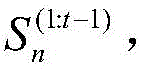
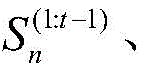
Historical track from t =1 moment to t-1 moment of particle
Figure BDA0002959029990000052
(t is time step), weight of particle w n =1/N, closed loop set of particle stores L. 3) t =1 time, P (1:N) Is initialized to the state at this moment obtained by the GPS, this moment and the corresponding particle pose are added to the set L,
Figure BDA0002959029990000053
t 0 and =1, the procedure proceeds to step two. Secondly, inputting a depth measurement value z of the submarine topography at each time t (t is more than 1) (t) With the odometer update value v (t) And odometer DR (t) Then, to P (1:N) All particles (taking particle n as an example) in (1): 1) And (3) motion updating:
Figure BDA0002959029990000054
where ω is the noise of the odometer. 2) Closed loop detection: computing
Figure BDA0002959029990000055
And
Figure BDA0002959029990000056
if R < R, will
Figure BDA0002959029990000057
A closed-loop set L is added (where M is the total number of closed loops in L,
Figure BDA0002959029990000058
Figure BDA0002959029990000059
the time corresponding to this closed loop). And then updating the particle map, otherwise, ignoring the map updating and the observation updating and not adding the resampling step to the particles n. 3) And (3) updating the map: construct a pose graph from the closed-loop set L, thereby updating thisA trajectory of particle storage. 4) And (3) observation updating: carrying out 2) closed loop detection on the particles again, and recording corresponding time t if R is less than R r . To be provided with
Figure BDA00029590299900000510
Track with odometer
Figure BDA00029590299900000511
Combined with corresponding time of day observations
Figure BDA00029590299900000512
Form M p (ii) a To be provided with
Figure BDA00029590299900000513
Locus of odometer
Figure BDA00029590299900000514
Track combined with corresponding time observation
Figure BDA00029590299900000515
Form M h Using an inverse distance weighting algorithm on M p At M h Interpolating corresponding positions to calculate w n Then will
Figure BDA00029590299900000516
Adding the particle's own history track
Figure BDA00029590299900000517
And (4) transferring to the step two to update the next particle, otherwise, directly transferring to the step two to update the next particle. Thirdly, after all the particles are updated, judging whether resampling is needed or not, if so: and (5) resampling all the particles which are observed and updated, and turning to the step four, otherwise, directly turning to the step four. Fourthly, according to historical tracks stored by all particles, a track Trj output at the moment of constructing a pose graph structure generation algorithm (1:t) And when T is larger than T, finishing the algorithm, otherwise, T = T +1, and turning to the step two.
The invention relates to the field of synchronous positioning and mapping of submarine topography, in particular to a submarine topography synchronous positioning and mapping method based on particle filtering and mapping optimization theory. The invention aims to design a particle filter BSLAM algorithm which updates self-stored tracks of particles by using a position and posture graph structure and generates an algorithm output map at each moment when the position and posture graph structure is used at the end of the moment. The method only needs to input odometer data and terrain sounding obtained by multi-beam sound at each moment, and realizes the synchronous positioning and mapping of the AUV under the condition of no prior terrain map. Compared with the BSLAM algorithm based on particle filter of sub-map matching, the BSLAM algorithm for map optimization and hybrid particle filter provided by the invention can still accurately provide positioning and map building results in real time under large accumulated errors.
The method comprises the following steps: algorithm initialization: 1) Setting the number of particles N, the closed-loop detection radius of the particles R, and the particle matching sub-map (defined as M) p ) Number of lines (defined as N) p ) Particle trajectory sub-map (defined as M) h ) Number of lines (defined as N) h ) And the total step number T of the algorithm. 2) Initializing a set of particles P (1:N) For any particle P (n) (n is the number of particles) storing the current state of the particles therein
Figure BDA0002959029990000061
Historical track of particle self from t =1 to t-1
Figure BDA0002959029990000062
The weight of the particle is set to a default value w n =1/N (t is the time step), closed loop set L of particle stores. 3) t =1 time, P (1:N) State of (1)
Figure BDA0002959029990000063
And the self historical track is initialized to a prior state obtained by the GPS (GPS) t=1 ),
Figure BDA0002959029990000064
t 0 =1, this moment and the corresponding particle pose are added to the set L,
Figure BDA0002959029990000065
turning to the step two;
step two: at each time T (2. Ltoreq. T. Ltoreq.T) a depth measurement z for the sea bottom is input (t) With the odometer update value v (t) And odometer DR (t) Then, to P (1:N) All particles (taking particle n as an example) in (1):
1) And (3) motion updating: updating using odometer model containing noise omega
Figure BDA0002959029990000066
Figure BDA0002959029990000067
2) Closed loop detection: calculating out
Figure BDA0002959029990000068
The minimum Euclidean distance R from the historical track of the particle, if R is less than R, the minimum Euclidean distance R will be
Figure BDA0002959029990000069
Adding a closed loop set L (wherein M is the total number of closed loops in L)
Figure BDA00029590299900000610
The time corresponding to the mth closed loop. And then updating the particle map, otherwise, ignoring map updating and observation updating and not adding a resampling step to the particles n.
3) And (3) updating the map: and (3) constructing a pose graph by taking the historical pose of the particles in the closed-loop set L as variables to be optimized, wherein if M closed loops are contained in the particles, 2M +1 nodes, M binary closed-loop edges and 2M-1 ternary weak data associated edges are arranged in the pose graph. Wherein the error functions for different types of edges are set to:
a closed-loop edge:
Figure BDA00029590299900000611
weak data association side:
Figure BDA0002959029990000071
where m is the mth closed loop in the set L, t k And the time corresponding to the kth node in the pose graph is shown. Solving the pose graph and updating the track stored by the nth particle
Figure BDA0002959029990000072
And then carrying out observation updating.
4) And (3) observation updating: carrying out closed-loop detection on the particles again, and if R is less than R, recording corresponding time t r . To be provided with
Figure BDA0002959029990000073
Locus of odometer
Figure BDA0002959029990000074
Combined with corresponding time of day observations
Figure BDA0002959029990000075
Form M p (ii) a To be provided with
Figure BDA0002959029990000076
Track with odometer
Figure BDA0002959029990000077
Track combined with corresponding time observation
Figure BDA0002959029990000078
Form M h Using an inverse distance weighting algorithm on M p At M h Interpolating corresponding positions and calculating w n . Then, will
Figure BDA0002959029990000079
Adding the particle's own history track
Figure BDA00029590299900000710
Transferring to the second step to update the next particle, otherwise, directly transferring to the second step to update the next particle;
step three: and after all the particles are subjected to the second step at the moment t, judging whether resampling is needed or not. Defining the total number of particles to be observed and updated to be N th Defining the effective particle number:
Figure BDA00029590299900000711
wherein
Figure BDA00029590299900000712
Is the normalized weight of the ith particle. If it is
Figure BDA00029590299900000713
Resampling all particles which are observed and updated, and turning to the fourth step, otherwise, directly turning to the fourth step;
step four: according to the historical track stored by all the particles, every t s One frame is taken as a node to be optimized at each moment, the difference between the corresponding state stored by each particle at the moment and the corresponding state of the node to be optimized at the moment is taken as an edge, the edge is associated with weak data to form a pose graph, and a track Trj is solved according to the pose graph (1:t) . Then t = t +1, and step two is carried out.
In the second step, the observation updating algorithm comprises the following steps:
step 2.1: inputting particles t, t r Time of day state
Figure BDA00029590299900000714
Observation sequence z (1:t) Odometer trajectory DR (1:t) And turning to the step 2.2;
step 2.2: generating a particle matching sub-map track:
Figure BDA00029590299900000715
and x is p Sounding sequence corresponding to the same
Figure BDA00029590299900000716
Generating particle-matching submaps M in combination p (ii) a Likewise, a particle trajectory sub-map trajectory is generated:
Figure BDA00029590299900000717
and x is h Corresponding sounding sequence
Figure BDA0002959029990000081
Generating particle track sub-map M in combination h And turning to the step 2.3;
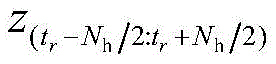
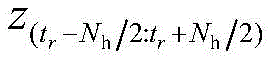
step 2.3: using an inverse distance weighting algorithm to pair M p Performing interpolation with the interpolation position being M h The position of the middle measuring point, and the obtained sounding sequence containing L shared effective measuring points is defined as z p Definition of M h The effective depth-finding sequence of the same position in the sequence is z h . Calculating the weight of the particles:
Figure BDA0002959029990000082
wherein:
Figure BDA0002959029990000083
and with
Figure BDA0002959029990000084
Are each z p And z h The sounding value of the first effective measuring point; sigma 2 Is the variance of the sensor. The algorithm ends.
In the third step, the low variance resampling algorithm comprises the following steps:
step 3.1: inputting a particle set P after observation update E Definition E is P E Total number of particles of (1). Then P is added E And normalizing the weight of the medium particles. Defining a resampled particle set
Figure BDA0002959029990000085
Turning to step 3.2;
step 3.2: define a value of (0,E) -1 ) Random numbers Rad uniformly distributed among the random numbers Rad; defining the sum of temporary particle weights as W s And initializing it to W s =w e=1 Wherein e is P E Medium particle number. Initializing an ordinal number m =1, and turning to step 3.3;
step 3.3: calculated value U = Rad + (m-1). E -1 And turning to the step 3.4;
step 3.4: if U > W s Then e = e +1,W is calculated s =W s +w (e) Until U is less than or equal to W s Step 3.5 is carried out, otherwise step 3.5 is directly carried out;
step 3.5: will P be (e) Adding number particles into resampled particle set
Figure BDA0002959029990000086
m = m +1, and if m = E +1, the algorithm ends and outputs
Figure BDA0002959029990000087
Otherwise, the step 3.3 is carried out.
In the fourth step, the algorithm for generating the BSLAM optimal map comprises the following steps:
step 4.1: input particle set P (1:N) Defining a time interval t s Every t, every s One track point Trj is taken at each moment (1+kts) And (4) the node to be optimized is obtained, wherein k is the node ordinal number. And defining K as the total number of nodes in the final pose graph. Turning to step 4.2;
step 4.2: KN unitary edges in the structure of the pose graph and K-2 weak data association edges, wherein the weak data association edges are defined as the weak data association edges in the pose graph used for map updating in the second step of claim 1, and the unitary edges are defined by
Figure BDA0002959029990000088
K is more than 0 and less than K0 and N is less than or equal to N, wherein t k Corresponding to the kth node in the pose graphAt the time, N and N are the total number of particles and the number of particles, respectively. Turning to step 4.3;
step 4.3: solving the pose graph and outputting the optimal map Trj at the moment (1:t) And the algorithm ends.
The above description is only a preferred embodiment of the present invention and is not intended to limit the present invention, and various modifications and changes may be made by those skilled in the art. Any modification, equivalent replacement, or improvement made within the spirit and principle of the present invention should be included in the protection scope of the present invention.

Claims (3)

1.一种基于粒子滤波与图优化的海底地形同步定位与建图方法,其特征在于,包括以下步骤:1. A seabed terrain synchronous location and mapping method based on particle filter and graph optimization, is characterized in that, comprises the following steps: 步骤1:设定粒子数N、粒子闭环检测半径R、粒子匹配子地图Mp的测线数目Np、粒子轨迹子地图Mh的测线数目Nh、算法总步数T;初始化粒子集P(1:N);对于任一粒子P(n),其内部储存粒子当前状态
Figure FDA0003773331910000011
粒子自身历史轨迹
Figure FDA0003773331910000012
粒子权值wn=1/N、粒子储存的闭环集合Ln;n为粒子序数;t为时间步长;
Step 1: Set the number of particles N, the particle closed-loop detection radius R, the number of survey lines N p of the particle matching submap M p , the number of survey lines N h of the particle trajectory submap M h , and the total number of algorithm steps T; initialize the particle set P (1:N) ; for any particle P (n) , it stores the current state of the particle internally
Figure FDA0003773331910000011
particle history
Figure FDA0003773331910000012
Particle weight w n =1/N, closed-loop set L n stored by particles; n is the number of particles; t is the time step;
t0=1时刻粒子集P(1:N)的状态
Figure FDA0003773331910000013
和自身历史轨迹根据GPS获得的先验状态
Figure FDA0003773331910000014
设定,
Figure FDA0003773331910000015
将t0=1时刻以及对应的粒子位姿加入粒子集P(1:N)中各粒子储存的闭环集合Ln
Figure FDA0003773331910000016
初始化t=2;
The state of particle set P (1:N) at time t 0 =1
Figure FDA0003773331910000013
and the prior state obtained by GPS based on its own historical trajectory
Figure FDA0003773331910000014
set up,
Figure FDA0003773331910000015
Add the time t 0 =1 and the corresponding particle pose to the closed-loop set L n stored by each particle in the particle set P (1:N) ,
Figure FDA0003773331910000016
init_t=2;
步骤2:获取当前t时刻输入的对海底的深度测量值z(t)、里程计更新值v(t)以及里程计的轨迹DR(t),更新粒子集P(1:N)中各粒子的当前状态
Figure FDA0003773331910000017
Step 2: Obtain the depth measurement value z (t) of the seabed input at the current time t, the update value v (t) of the odometer and the track DR (t) of the odometer, and update each particle in the particle set P (1:N) current status of
Figure FDA0003773331910000017
Figure FDA0003773331910000018
其中,ω为里程计的噪声;Among them, ω is the noise of the odometer; 步骤3:计算粒子集P(1:N)中各粒子的当前状态
Figure FDA0003773331910000019
与粒子自身历史轨迹
Figure FDA00037733319100000110
的最小欧氏距离rn;若rn<R,则将
Figure FDA00037733319100000111
加入粒子P(n)储存的闭环集合Ln,执行步骤4进行地图更新;否则,忽略地图更新与观测更新且粒子P(n)不加入重采样步骤;其中,M为Ln中闭环的总数;
Figure FDA00037733319100000112
为第M个闭环所对应的开始时间;
Figure FDA00037733319100000113
为第M个闭环所对应的结束时间;
Step 3: Calculate the current state of each particle in the particle set P (1:N)
Figure FDA0003773331910000019
and the particle's own historical trajectory
Figure FDA00037733319100000110
The minimum Euclidean distance r n ; if r n < R, then the
Figure FDA00037733319100000111
Add the closed-loop set L n stored by the particle P (n) , and perform step 4 to update the map; otherwise, ignore the map update and observation update and the particle P (n) does not join the resampling step; where M is the total number of closed loops in L n ;
Figure FDA00037733319100000112
is the start time corresponding to the Mth closed loop;
Figure FDA00037733319100000113
is the end time corresponding to the Mth closed loop;
步骤4:以粒子集P(1:N)中粒子P(n)储存的闭环集合Ln中粒子P(n)的历史位姿为待优化变量,构建并求解位姿图,更新粒子P(n)的轨迹
Figure FDA00037733319100000114
后执行步骤5;
Step 4: Take the historical pose of particle P (n) in the closed-loop set Ln stored by particle P (n) in particle set P (1:N) as the variable to be optimized, construct and solve the pose graph, and update particle P ( n) trajectory
Figure FDA00037733319100000114
Then execute step 5;
若粒子P(n)中含有M个闭环,则位姿图中有2M+1个节点、M个二元闭环边、2M-1个三元弱数据关联边;其中不同类型边的误差函数设置为:If the particle P (n) contains M closed loops, there are 2M+1 nodes, M binary closed loop edges, and 2M-1 ternary weak data associated edges in the pose graph; the error function settings for different types of edges for: 闭环边:Closed edge:
Figure FDA00037733319100000115
弱数据关联边:Weak data association edge:
Figure FDA0003773331910000021
其中,m为粒子P(n)储存的闭环集合Ln中第m个闭环;tk为位姿图中第k个节点所对应的时间;Among them, m is the m-th closed loop in the closed-loop set L n stored by the particle P (n) ; t k is the time corresponding to the k-th node in the pose graph; 步骤5:重新对粒子集P(1:N)中各粒子进行闭环检测,计算粒子的当前状态
Figure FDA0003773331910000022
与粒子自身历史轨迹
Figure FDA0003773331910000023
的最小欧氏距离rn;若rn<R,则记录该粒子最小欧氏距离rn对应的时刻tr,执行观测更新;
Step 5: Perform closed-loop detection on each particle in the particle set P (1:N) again, and calculate the current state of the particle
Figure FDA0003773331910000022
and the particle's own historical trajectory
Figure FDA0003773331910000023
The minimum Euclidean distance r n of the particle; if r n < R, record the time t r corresponding to the minimum Euclidean distance r n of the particle, and perform observation update;
步骤5.1:生成粒子匹配子地图轨迹xp,并将xp与其对应的测深序列
Figure FDA0003773331910000024
结合生成粒子匹配子地图Mp
Step 5.1: Generate particle matching submap trajectory x p , and associate x p with its corresponding bathymetric sequence
Figure FDA0003773331910000024
Combining to generate particle matching sub-map M p ;
Figure FDA0003773331910000025
步骤5.2:生成和粒子轨迹子地图轨迹xh,并将xh与其对应的测深序列
Figure FDA0003773331910000026
结合生成粒子轨迹子地图Mh
Step 5.2: Generate and particle trajectory submap trajectory x h , and associate x h with its corresponding bathymetric sequence
Figure FDA0003773331910000026
Combining to generate particle trajectory submap M h ;
Figure FDA0003773331910000027
步骤5.3:使用反距离加权算法对Mp进行插值,插值位置为Mh中测点的位置,获得包含L个共有有效测点的测深序列定义为zp,定义Mh中相同位置的有效测深序列为zh,计算粒子权值wnStep 5.3: Use the inverse distance weighting algorithm to interpolate M p , the interpolation position is the position of the measuring point in M h , obtain a bathymetric sequence containing L common effective measuring points, which is defined as z p , and define the effective The sounding sequence is z h , and the particle weight w n is calculated:
Figure FDA0003773331910000028
其中,
Figure FDA0003773331910000029
Figure FDA00037733319100000210
分别为zp与zh的第l个有效测点的测深值;σ2为传感器的方差;
in,
Figure FDA0003773331910000029
and
Figure FDA00037733319100000210
are the sounding values of the lth effective measuring point of z p and z h respectively; σ 2 is the variance of the sensor;
步骤5.4:将
Figure FDA00037733319100000211
加入粒子自身历史轨迹
Figure FDA00037733319100000212
Step 5.4: Put
Figure FDA00037733319100000211
Add the particle's own history track
Figure FDA00037733319100000212
步骤6:获取执行观测更新的粒子总数Nth,计算有效粒子数Neff;若
Figure FDA00037733319100000216
则将所有经过观测更新的粒子进行重采样,执行步骤7;否则,直接执行步骤7;
Step 6: Obtain the total number N th of particles performing observation updates, and calculate the effective number of particles N eff ; if
Figure FDA00037733319100000216
Then resample all the particles that have been updated by observation, and go to step 7; otherwise, go to step 7 directly;
Figure FDA00037733319100000214
其中,
Figure FDA00037733319100000215
为第i个粒子的归一化权值;
in,
Figure FDA00037733319100000215
is the normalized weight of the i-th particle;
步骤7:根据所有粒子储存的历史轨迹,每隔ts个时刻取一帧为待优化节点,以每个粒子在此时刻储存的对应状态与待优化节点对应时刻状态的差为边,并与弱数据关联边构成位姿图,根据位姿图求解出轨迹Trj(1:t),然后令t=t+1,返回步骤2。Step 7: According to the historical trajectories stored by all particles, take a frame at every t s time as the node to be optimized, take the difference between the corresponding state of each particle stored at this time and the state of the node to be optimized at the corresponding time as the edge, and connect with Weak data association edges constitute a pose graph, and the trajectory Trj (1:t) is obtained according to the pose graph, and then t=t+1 is set, and then return to step 2.
2.根据权利要求1所述的一种基于粒子滤波与图优化的海底地形同步定位与建图方法,其特征在于:所述的步骤6中重采样的方法具体为:2. a kind of submarine terrain synchronous positioning and mapping method based on particle filtering and graph optimization according to claim 1, is characterized in that: the method for resampling in the described step 6 is specifically: 步骤6.1:输入经过观测更新之后的粒子集PE,定义E为粒子集PE中粒子总数;将粒子集PE中粒子权值进行归一化,定义重采样后粒子集
Figure FDA0003773331910000031
Step 6.1: Input the particle set P E after the observation update, define E as the total number of particles in the particle set P E ; normalize the particle weights in the particle set P E , and define the resampled particle set
Figure FDA0003773331910000031
步骤6.2:定义一个在(0,E-1)之间均匀分布的随机数Rad;定义临时粒子权值和为Ws,并将其初始化为Ws=we=1,e为PE中粒子序数;初始化序数m=1;Step 6.2: Define a random number Rad uniformly distributed between (0,E -1 ); define the temporary particle weight sum as W s , and initialize it as W s =w e=1 , e is P E Particle number; initialization number m=1; 步骤6.3:计算U=Rad+(m-1)·E-1;若U>Ws,则计算e=e+1,Ws=Ws+we直到U≤Ws,转入步骤6.4;否则,直接转入步骤6.4;Step 6.3: Calculate U=Rad+(m-1)·E -1 ; if U>W s , then calculate e=e+1, W s =W s +w e until U≤W s , go to step 6.4; Otherwise, go directly to step 6.4; 步骤6.4:将第e号粒子加入重采样后粒子集
Figure FDA0003773331910000032
令m=m+1;
Step 6.4: Add particle e to the resampled particle set
Figure FDA0003773331910000032
let m=m+1;
步骤6.5:若m=E+1则算法结束并输出
Figure FDA0003773331910000033
否则,返回步骤6.3。
Step 6.5: If m=E+1, the algorithm ends and outputs
Figure FDA0003773331910000033
Otherwise, return to step 6.3.
3.根据权利要求1或2所述的一种基于粒子滤波与图优化的海底地形同步定位与建图方法,其特征在于:所述的步骤7的具体步骤为:3. A kind of seabed terrain synchronous positioning and mapping method based on particle filter and graph optimization according to claim 1 or 2, characterized in that: the concrete steps of described step 7 are: 步骤7.1:输入粒子集P(1:N),定义时间间隔ts,每隔ts个时刻取一轨迹点
Figure FDA0003773331910000034
为待优化节点,其中k为节点序数;定义K为最终位姿图中节点的总数;
Step 7.1: Input the particle set P (1:N) , define the time interval t s , and take a trajectory point every t s time
Figure FDA0003773331910000034
is the node to be optimized, where k is the node ordinal; define K as the total number of nodes in the final pose graph;
步骤7.2:位姿图结构中共KN个一元边与K-2个弱数据关联边,弱数据关联边与步骤4中地图更新使用的位姿图中的弱数据关联边定义相同,一元边由
Figure FDA0003773331910000035
计算,tk为位姿图中第k个节点所对应的时刻,0<k<K,N与n分别为粒子总数与粒子的序号,0<n<N;
Step 7.2: There are KN unary edges and K-2 weak data-associated edges in the pose graph structure. The weak data-associated edges are defined the same as the weak data-associated edges in the pose graph used for map update in step 4. The unary edges are defined by
Figure FDA0003773331910000035
Calculate, t k is the moment corresponding to the kth node in the pose graph, 0<k<K, N and n are the total number of particles and the serial number of particles, 0<n<N;
步骤7.3:求解位姿图,输出此时刻最优地图Trj(1:t)Step 7.3: Solve the pose graph and output the optimal map Trj (1:t) at this moment.
CN202110233287.2A 2021-03-03 2021-03-03 Seabed terrain synchronous positioning and mapping method based on particle filtering and mapping optimization Active CN113008223B (en)

Priority Applications (1)

Application Number Priority Date Filing Date Title
CN202110233287.2A CN113008223B (en) 2021-03-03 2021-03-03 Seabed terrain synchronous positioning and mapping method based on particle filtering and mapping optimization

Applications Claiming Priority (1)

Application Number Priority Date Filing Date Title
CN202110233287.2A CN113008223B (en) 2021-03-03 2021-03-03 Seabed terrain synchronous positioning and mapping method based on particle filtering and mapping optimization

Publications (2)

Publication Number Publication Date
CN113008223A CN113008223A (en) 2021-06-22
CN113008223B true CN113008223B (en) 2022-10-28

Family

ID=76403220

Family Applications (1)

Application Number Title Priority Date Filing Date
CN202110233287.2A Active CN113008223B (en) 2021-03-03 2021-03-03 Seabed terrain synchronous positioning and mapping method based on particle filtering and mapping optimization

Country Status (1)

Country Link
CN (1) CN113008223B (en)

Families Citing this family (1)

* Cited by examiner, † Cited by third party
Publication number Priority date Publication date Assignee Title
CN114577210B (en) * 2022-02-24 2024-07-09 哈尔滨工程大学 Cross-region detection algorithm based on map information matrix

Citations (7)

* Cited by examiner, † Cited by third party
Publication number Priority date Publication date Assignee Title
WO2015073406A1 (en) * 2013-11-13 2015-05-21 Elwha Llc Dead reckoning system for vehicles
CN107589748A (en) * 2017-08-21 2018-01-16 江苏科技大学 AUV autonomous navigation methods based on UnscentedFastSLAM algorithms
CN108562287A (en) * 2018-01-08 2018-09-21 哈尔滨工程大学 A kind of Terrain-aided Underwater Navigation based on adaptively sampled particle filter
CN109186610A (en) * 2018-10-15 2019-01-11 哈尔滨工程大学 A kind of robust BSLAM method of AUV terrain match navigation
AU2018207854A1 (en) * 2017-01-13 2019-08-01 Carrosserie Hess Ag Method for predicting future driving conditions for a vehicle
CN110320520A (en) * 2019-06-26 2019-10-11 哈尔滨工程大学 A kind of robust rear end figure optimization method depth measurement synchronizing information positioning and build figure
CN110726415A (en) * 2019-10-21 2020-01-24 哈尔滨工程大学 Self-adaptive underwater multi-beam synchronous positioning and mapping method

Family Cites Families (6)

* Cited by examiner, † Cited by third party
Publication number Priority date Publication date Assignee Title
FR2961897B1 (en) * 2010-06-25 2012-07-13 Thales Sa NAVIGATION FILTER FOR A FIELD CORRELATION NAVIGATION SYSTEM
FR2977314B1 (en) * 2011-06-29 2013-07-12 Ixblue NAVIGATION DEVICE AND METHOD INTEGRATING MULTIPLE INERTIAL HYBRID NAVIGATION SYSTEMS
US20130016584A1 (en) * 2011-07-15 2013-01-17 Teledyne Scientific & Imaging Llc Methods and apparatus for obtaining sensor motion and position data from underwater acoustic signals
TWI681179B (en) * 2013-10-16 2020-01-01 巴哈馬商愛克斯崔里斯科技有限公司 Addressability in particle detection and the related method
US11199411B2 (en) * 2017-05-15 2021-12-14 Fujifilm Business Innovation Corp. Systems and methods for utilizing graph based map information as priors for localization using particle filter
CN109887053B (en) * 2019-02-01 2020-10-20 广州小鹏汽车科技有限公司 SLAM map splicing method and system

Patent Citations (7)

* Cited by examiner, † Cited by third party
Publication number Priority date Publication date Assignee Title
WO2015073406A1 (en) * 2013-11-13 2015-05-21 Elwha Llc Dead reckoning system for vehicles
AU2018207854A1 (en) * 2017-01-13 2019-08-01 Carrosserie Hess Ag Method for predicting future driving conditions for a vehicle
CN107589748A (en) * 2017-08-21 2018-01-16 江苏科技大学 AUV autonomous navigation methods based on UnscentedFastSLAM algorithms
CN108562287A (en) * 2018-01-08 2018-09-21 哈尔滨工程大学 A kind of Terrain-aided Underwater Navigation based on adaptively sampled particle filter
CN109186610A (en) * 2018-10-15 2019-01-11 哈尔滨工程大学 A kind of robust BSLAM method of AUV terrain match navigation
CN110320520A (en) * 2019-06-26 2019-10-11 哈尔滨工程大学 A kind of robust rear end figure optimization method depth measurement synchronizing information positioning and build figure
CN110726415A (en) * 2019-10-21 2020-01-24 哈尔滨工程大学 Self-adaptive underwater multi-beam synchronous positioning and mapping method

Non-Patent Citations (8)

* Cited by examiner, † Cited by third party
Title
"A Multibeam-Based SLAM Algorithm for Iceberg Mapping Using AUVs";Norgren等;《IEEE Access》;20181231;第6卷;36318-36337 *
"AUV robust bathymetric simultaneous localization and mapping";Ma, Teng等;《Ocean Engineering》;20181231;第166卷;336-349 *
"AUV水下地形匹配辅助导航技术研究";陈小龙;《中国优秀博硕士学位论文全文数据库(博士)工程科技Ⅱ辑》;20140415(第4期);C036-33 *
"Bathymetric particle filter SLAM using trajectory maps";Stephen Barkby等;《International Journal of Robotics Research》;20121231;第31卷(第12期);1409-1430 *
"SLAM-based underwater adaptive sampling using autonomous vehicles";M. Rahmati等;《Proc. MTS/IEEE OCEANS, Charleston, SC, USA》;20181031;1-7 *
"基于多波束测深的同时定位与建图研究 ";丛正;《万方数据库》;20190105;全文 *
"基于改进粒子滤波的 AUV 海底地形辅助定位方法";韩月,等;《智能系统学报》;20200531;第15卷(第3期);553-559 *
"基于粒子滤波器的 SLAM 的仿真研究";鞠纯纯,等;《系统仿真学报》;20070831;第19卷(第16期);3715-3718转3723 *

Also Published As

Publication number Publication date
CN113008223A (en) 2021-06-22

Similar Documents

Publication Publication Date Title
CN108803321B (en) Autonomous underwater vehicle track tracking control method based on deep reinforcement learning
CN109459040B (en) Multi-AUV co-localization method based on RBF neural network-assisted volumetric Kalman filter
CN109241552B (en) A Motion Planning Method for Underwater Robot Based on Multiple Constraints
Newman On the structure and solution of the simultaneous localisation and map building problem
CN116578102B (en) Obstacle avoidance method and device for autonomous underwater vehicle, computer equipment and storage medium
CN109240091B (en) Underwater robot control method based on reinforcement learning and tracking control method thereof
CN114397899B (en) Bionic robot fish three-dimensional path tracking control method and device
CN113052372A (en) Dynamic AUV tracking path planning method based on deep reinforcement learning
CN110220510B (en) Underwater robot submarine topography matching navigation path planning method considering map accuracy
CN114879657B (en) Model-free full-distributed unmanned ship cooperative time-varying formation control method based on satellite coordinate system
CN114943182A (en) Robot cable shape control method and device based on graph neural network
CN113985870B (en) A path planning method based on meta-reinforcement learning
CN116700300A (en) A Robust Adaptive Consistency Control Method for Multi-AUV Distributed Cluster
CN113008223B (en) Seabed terrain synchronous positioning and mapping method based on particle filtering and mapping optimization
CN115046554B (en) A collaborative positioning method for AUV based on Mahalanobis distance and neural network assistance
CN121018560A (en) Path planning systems and methods
CN120540099A (en) A multi-agent reinforcement learning formation adaptation method integrating graph attention mechanism
CN116147619B (en) A Fuzzy Adaptive Cooperative Navigation Information Fusion Method
CN117742336A (en) Distributed quantitative tracking control method for multi-unmanned ship system under nonlinear condition of leader
CN113642720A (en) A method and system for constructing a bionic situational cognitive model
Sola et al. Evaluation of a deep-reinforcement-learning-based controller for the control of an autonomous underwater vehicle
CN116337074A (en) Precise spatial positioning method of magnetically controlled capsule robot based on ISCSO-LMNN
CN120972904A (en) Multi-agent path planning methods, devices, equipment, and computer storage media
Liu et al. Navigation algorithm based on PSO-BP UKF of autonomous underwater vehicle
CN112732854B (en) Particle filtering BSLAM method

Legal Events

Date Code Title Description
PB01 Publication
PB01 Publication
SE01 Entry into force of request for substantive examination
GR01 Patent grant
GR01 Patent grant
OL01 Intention to license declared