Disclosure of Invention
The application provides a method, a device, computer equipment and a storage medium for determining track similarity, which can solve the problem of low accuracy in determining the track similarity in the related art. The technical scheme is as follows:
in one aspect, a method for determining track similarity is provided, where the method includes:
extracting image features of each target frame in k target frames included in a first track, wherein the k target frames comprise the same target, the k target frames are target frames in each frame of video images in k frames of continuous video images, and k is a positive integer;
clustering the extracted k image features to obtain one or more image feature sets;
according to the number of image features included in each image feature set in the one or more image feature sets, selecting a target image feature set corresponding to the first track from the one or more image feature sets;
and determining the similarity between the first track and other tracks according to the target image feature set corresponding to the first track.
Optionally, the extracting the image feature of each target frame of the k target frames included in the first trajectory includes:
inputting an image in any one target frame in k target frames included in the first track into a neural network model;
and taking the features of the image in the target frame output by the neural network model as the image features of the target frame.
Optionally, k is an integer greater than or equal to 2, and the clustering is performed on the extracted k image features to obtain one or more image feature sets, including:
dividing a first image feature in the k image features into a newly created image feature set, and setting i to 2;
acquiring the similarity between the ith image feature in the k image features and the central feature of each image feature set in the divided image feature sets;
judging whether the similarity between the ith image feature and the central feature of a specified image feature set is greater than or equal to a similarity threshold, wherein the specified image feature set is the image feature set to which the central feature with the maximum similarity between the ith image feature and the specified image feature set belongs;
if the similarity between the ith image feature and the central feature of the specified image feature set is greater than or equal to a similarity threshold, dividing the ith image feature into the specified image feature set; if the similarity between the ith image feature and the central feature of the specified image feature set is smaller than a similarity threshold value, dividing the ith image feature into a newly created image feature set;
and if the i is not equal to the k, making i equal to i +1, and returning to the step of acquiring the similarity between the ith image feature of the k image features and the central feature of each image feature set in the divided image feature set until the i is equal to the k.
Optionally, the selecting, according to the number of image features included in each image feature set in the one or more image feature sets, a target image feature set corresponding to the first trajectory from the one or more image feature sets includes:
for any one of the one or more image feature sets, dividing the number of image features included in the one image feature set by the k to obtain the ratio of the number of the one image feature set;
and when the number proportion of the image feature set is greater than or equal to a proportion threshold value, determining the image feature set as a target image feature set corresponding to the first track.
Optionally, the determining the similarity between the first trajectory and other trajectories according to the target image feature set corresponding to the first trajectory includes:
acquiring a target image feature set corresponding to a second track, wherein the second track is a track different from the first track;
and determining the similarity between the first track and the second track according to the target image feature set corresponding to the first track and the target image feature set corresponding to the second track.
Optionally, the determining, according to the target image feature set corresponding to the first track and the target image feature set corresponding to the second track, a similarity between the first track and the second track includes:
acquiring the similarity between the central feature of each target image feature set in the n target image feature sets corresponding to the first track and the central feature of each target image feature set in the m target image feature sets corresponding to the second track;
and determining the maximum similarity in the acquired n-m similarities as the similarity between the first track and the second track.
In one aspect, an apparatus for determining track similarity is provided, the apparatus comprising:
the extraction module is used for extracting image features of each target frame in k target frames included in the first track, the k target frames include the same target, the k target frames are target frames in each frame of video images in k frames of continuous video images, and k is a positive integer;
the clustering module is used for clustering the extracted k image features to obtain one or more image feature sets;
a selecting module, configured to select, according to the number of image features included in each image feature set of the one or more image feature sets, a target image feature set corresponding to the first trajectory from the one or more image feature sets;
and the determining module is used for determining the similarity between the first track and other tracks according to the target image feature set corresponding to the first track.
Optionally, the extraction module comprises:
an input unit, configured to input, to any one of k target frames included in the first trajectory, an image in the one target frame into a neural network model;
a first determining unit, configured to use a feature of the image within the one target frame output by the neural network model as an image feature of the one target frame.
Optionally, k is an integer greater than or equal to 2, and the clustering module includes:
a first dividing unit, configured to divide a first image feature of the k image features into a newly created image feature set, and let i be 2;
a first obtaining unit, configured to obtain a similarity between an ith image feature of the k image features and a central feature of each image feature set in the divided image feature sets;
the judging unit is used for judging whether the similarity between the ith image feature and the central feature of a specified image feature set is greater than or equal to a similarity threshold value, wherein the specified image feature set is an image feature set to which the central feature with the highest similarity with the ith image feature belongs;
a second dividing unit, configured to divide the ith image feature into the specified image feature set when a similarity between the ith image feature and a central feature of the specified image feature set is greater than or equal to a similarity threshold; when the similarity between the ith image feature and the central feature of the specified image feature set is smaller than a similarity threshold value, dividing the ith image feature into a newly created image feature set;
and the triggering unit is used for enabling i to be i +1 when i is not equal to k, and triggering the first acquisition unit to acquire the similarity between the ith image feature in the k image features and the central feature of each image feature set in the divided image feature set until i is equal to k.
Optionally, the selecting module includes:
a calculating unit, configured to, for any one of the one or more image feature sets, divide the number of image features included in the one image feature set by the k to obtain a ratio of the number of the one image feature set;
and a second determining unit, configured to determine the one image feature set as a target image feature set corresponding to the first trajectory when the number ratio of the one image feature set is greater than or equal to a ratio threshold.
Optionally, the determining module includes:
the second acquisition unit is used for acquiring a target image feature set corresponding to a second track, wherein the second track is a track different from the first track;
and a third determining unit, configured to determine a similarity between the first track and the second track according to the target image feature set corresponding to the first track and the target image feature set corresponding to the second track.
Optionally, the number of the target image feature sets corresponding to the first track is n, the number of the target image features corresponding to the second track is m, n and m are positive integers, and the third determining unit is configured to:
acquiring the similarity between the central feature of each target image feature set in the n target image feature sets corresponding to the first track and the central feature of each target image feature set in the m target image feature sets corresponding to the second track;
and determining the maximum similarity in the acquired n-m similarities as the similarity between the first track and the second track.
In one aspect, a computer device is provided, where the computer device includes a processor, a communication interface, a memory, and a communication bus, where the processor, the communication interface, and the memory complete communication with each other through the communication bus, the memory is used to store a computer program, and the processor is used to execute the program stored in the memory to implement the steps of the method for determining track similarity.
In one aspect, a computer-readable storage medium is provided, in which a computer program is stored, which, when being executed by a processor, carries out the above-mentioned steps of the method for determining trajectory similarity.
In one aspect, a computer program product comprising instructions is provided, which when run on a computer, causes the computer to perform the steps of the above-described method of determining trajectory similarity.
The technical scheme provided by the application can at least bring the following beneficial effects:
after the image features of each target frame in the k target frames included in the first track are extracted, clustering is carried out on the extracted k image features to obtain one or more image feature sets. The one or more sets of image features may fully characterize the appearance of the target in different states. And then, according to the number of image features included in each image feature set in the one or more image feature sets, selecting a target image feature set corresponding to the first track from the one or more image feature sets. Because the target image feature set corresponding to the first track can better represent the appearance of the target contained in the first track, the similarity between the first track and other tracks can be determined according to the target image feature set corresponding to the first track, and therefore the accuracy in determining the track similarity can be improved.
Detailed Description
To make the objects, technical solutions and advantages of the present application more clear, embodiments of the present application will be described in further detail below with reference to the accompanying drawings.
It should be understood that reference to "a plurality" in this application means two or more. In the description of the present application, "/" indicates an OR meaning, for example, A/B may indicate A or B; "and/or" herein is merely an association describing an associated object, and means that there may be three relationships, e.g., a and/or B, which may mean: a exists alone, A and B exist simultaneously, and B exists alone. In addition, for the convenience of clearly describing the technical solutions of the present application, the terms "first", "second", and the like are used to distinguish the same items or similar items having substantially the same functions and actions. Those skilled in the art will appreciate that the terms "first," "second," etc. do not denote any order or quantity, nor do the terms "first," "second," etc. denote any order or importance.
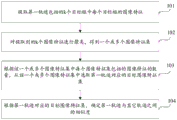
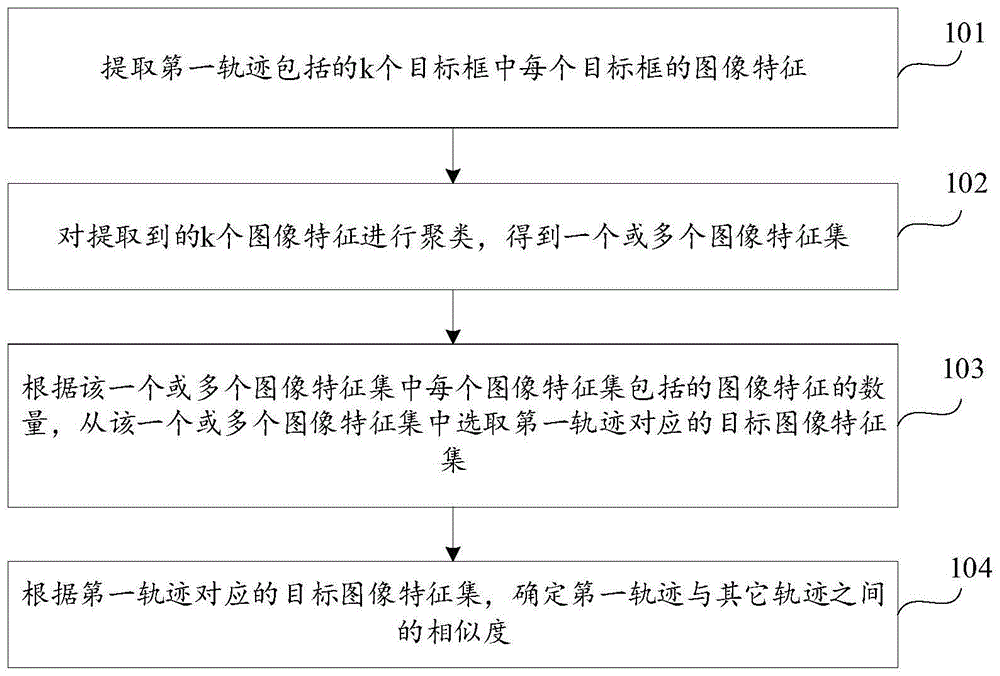
Fig. 1 is a flowchart of a method for determining track similarity according to an embodiment of the present disclosure. Referring to fig. 1, the method includes the following steps.
Step 101: and extracting the image characteristics of each target frame in the k target frames included in the first track.
It should be noted that the first track includes k target frames, where the k target frames include the same target, the k target frames are target frames in each frame of video image in k consecutive frames of video image, and k is a positive integer. For each of the k consecutive video images, the target frame in the one video image is used to indicate the area in the one video image where the target exists. In this case, the first trajectory is the motion trajectory of this object in the k consecutive video images.
In addition, the image feature of the target frame is a feature of an image within the target frame. The image features of the target box are used to characterize the image content within the target box, i.e. to characterize the appearance of the target contained within the target box. The image feature of the target frame in one frame of video image is the image feature of the target contained in the target frame corresponding to the frame of video image. For example, the image feature of the target frame may be a multi-dimensional feature vector.
Specifically, the operation of step 101 may be: for any one target frame in k target frames included in the first track, inputting the image in the one target frame into the neural network model. And taking the image features in the target frame output by the neural network model as the image features of the target frame.
It should be noted that the neural network model is used to extract features of the image. The Neural network model may be set in advance, and for example, the Neural network model may be a CNN (Convolutional Neural Networks) model, which is not limited in the embodiment of the present application.
In addition, after the image in the target frame is input into the neural network model, the neural network model can extract the features of the image and output the extracted features. The feature output by the neural network model can be used as the image feature of the target frame.
Further, before step 101, a video that needs to be tracked may be obtained, and then the first track may be obtained from the video.
It should be noted that the video may be a video shot by a camera in the fields of security monitoring, intelligent transportation, automatic driving, and the like, and of course, the video may also be other videos with a target tracking requirement, which is not limited in the embodiment of the present application.
In addition, the operation of acquiring the first track from the video is similar to the operation of acquiring the motion track of a certain target from a certain video in the related art, and this is not described in detail in this embodiment of the present application.
Step 102: and clustering the extracted k image features to obtain one or more image feature sets.
It should be noted that after the image features of each of the k target frames are extracted, k image features can be obtained. The k image features can then be clustered to obtain one or more image feature sets, each of the one or more image feature sets including at least one image feature. The image features included in the same image feature set are relatively similar, and the image features included in different image feature sets are greatly different.
It should be noted that the target may have different states during the motion process, such as different orientations, different postures, different occlusion conditions, and the like, which may result in differences in the appearance of the target, that is, may result in large changes in the corresponding image features of the target in the k consecutive video images. The k image features extracted from the first track are clustered, so that the image features corresponding to the target in the same state can be divided into the same image feature set, and the image features corresponding to the target in different states can be divided into different image feature sets. Thus, the appearance of the target in different states can be comprehensively characterized by using the one or more image feature sets.
In particular, the k image features may be clustered in a variety of ways to obtain one or more image feature sets. For example, the K image features may be clustered by a K-MEANS clustering algorithm, a mean shift clustering algorithm, a clustering hierarchy clustering algorithm, or other clustering algorithms to obtain one or more image feature sets.
It is to be noted that, when k is 1, when the k image features are clustered, the one image feature can be directly classified into a newly created image feature set, and the one image feature set only includes the one image feature.
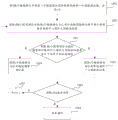
When k is an integer greater than or equal to 2, in one possible implementation, referring to fig. 2, the operation of step 102 may include the following steps 1021-1027:
step 1021: the first of the k image features is divided into a newly created set of image features, and let i equal to 2.
In this case, the first image feature of the k image features is used as the initial image feature included in the newly created image feature set.
Step 1022: and acquiring the similarity between the ith image feature in the k image features and the central feature of each image feature set in the divided image feature sets.
It should be noted that the central feature of an image feature set is used to characterize the overall features of the image feature set. For example, the central feature of an image feature set may be an average feature of all image features comprised in the image feature set.
The operation of obtaining the similarity between the ith image feature and the central feature of each image feature set in the divided image feature set is similar to the operation of obtaining the similarity between two features in the related art, and this is not described in detail in the embodiments of the present application.
For example, for any one of the image feature sets that have been divided, a cosine distance between the ith image feature and the central feature of the image feature set may be calculated, and the calculated cosine distance is determined as a similarity between the ith image feature and the central feature of the image feature set; or, the euclidean distance between the ith image feature and the central feature of the image feature set may be calculated, and a value obtained by subtracting the calculated euclidean distance from 1 is determined as the similarity between the ith image feature and the central feature of the image feature set; of course, the similarity between the ith image feature and the central feature of the image feature set may also be determined in other ways, which is not limited in this embodiment of the present application.
Step 1023: and judging whether the similarity between the ith image feature and the central feature of the specified image feature set is greater than or equal to a similarity threshold value.
It should be noted that the image feature set is specified as an image feature set to which a central feature having the greatest similarity with the ith image feature belongs. For example, the divided image feature set includes an image feature set 1, an image feature set 2 and an image feature set 3, the similarity between the ith image feature and the central feature of the image feature set 1 is 0.7, the similarity between the ith image feature and the central feature of the image feature set 2 is 0.9, and the similarity between the ith image feature and the central feature of the image feature set 3 is 0.5, and then the image feature set is designated as the image feature set 2.
In addition, the similarity threshold may be preset, and the similarity threshold may be set to be larger, for example, the similarity threshold may be 0.9, 0.95, and the like, which is not limited in this embodiment of the application.
When the similarity between the ith image feature and the central feature of the specified image feature set is greater than or equal to the similarity threshold, the following steps 1024, 1026 to 1028 may be continuously performed. When the similarity between the ith image feature and the central feature of the specified image feature set is less than the similarity threshold, steps 1025-1028 may be continued as follows.
Step 1024: and if the similarity between the ith image feature and the central feature of the specified image feature set is greater than or equal to the similarity threshold, dividing the ith image feature into the specified image feature set.
Since the similarity between the ith image feature and the central feature of the specified image feature set is greater than or equal to the similarity threshold, which indicates that the ith image feature is similar to the image features included in the specified image feature set, the ith image feature can be classified into the specified image feature set.
Step 1025: and if the similarity between the ith image feature and the central feature of the specified image feature set is less than the similarity threshold, dividing the ith image feature into a newly created image feature set.
When the similarity between the ith image feature and the central feature of the specified image feature set is smaller than the similarity threshold, it indicates that the difference between the ith image feature and the image features included in the specified image feature set is larger, and at this time, the difference between the ith image feature and the image features included in all the divided image feature sets is larger. Thus, an image feature set can be newly created, and the ith image feature can be used as the initial image feature included in the newly created image feature set.
Step 1026: and judging whether i is equal to k.
Step 1027: if i is not equal to k, let i be i +1, and return to step 1022.
When i is not equal to k, it indicates that the first i image features of the k image features have been classified into an image feature set, and there are k-i image features that have not been classified, so at this time, i may be made to be i +1, and the process returns to step 1022 to perform the classification on the next image feature.
Step 1028: if i is equal to k, the operation ends.
When i is equal to k, it indicates that the k image features have all been classified into the image feature set, so the operation may end at this point.
Step 103: and selecting a target image feature set corresponding to the first track from the one or more image feature sets according to the number of image features included in each image feature set in the one or more image feature sets.
It should be noted that the target image feature set corresponding to the first trajectory is an image feature set that better characterizes the appearance of the target included in the first trajectory among the one or more image feature sets. At least one image feature set can be selected from the one or more image feature sets as a target image feature set corresponding to the first trajectory, that is, the number of the target image feature sets corresponding to the first trajectory can be n, where n is a positive integer.
Specifically, the operation of step 103 may be: for any one image feature set in the one or more image feature sets, dividing the number of image features included in the one image feature set by k to obtain the number ratio of the one image feature set; and when the number proportion of the one image feature set is greater than or equal to the proportion threshold value, determining the one image feature set as a target image feature set corresponding to the first track. Of course, the target image feature set corresponding to the first trajectory may also be selected from the one or more image feature sets in other manners according to the number of image features included in each image feature set in the one or more image feature sets, which is not limited in this embodiment of the present application.
The ratio threshold may be set in advance, for example, the ratio threshold may be 20%, 30%, and the like, which is not limited in this embodiment of the application.
In addition, when the ratio of the number of the one image feature set is greater than or equal to the ratio threshold, it indicates that the ratio of the number of the one image feature set is greater, that is, the one image feature set contains a greater number of image features in the one or more image feature sets than in the other image feature sets. At this time, the image feature set should be able to better characterize the appearance of the target included in the first track, so that the image feature set can be determined as the target image feature set corresponding to the first track.
It is worth mentioning that, in the embodiment of the present application, the image feature set with the larger number of the one or more image feature sets is used as the target image feature set corresponding to the first track, so that a representative image feature can be selected, and the influence of noise can be effectively avoided.
Step 104: and determining the similarity between the first track and other tracks according to the target image feature set corresponding to the first track.
Because the target image feature set corresponding to the first track can better represent the appearance of the target contained in the first track, the similarity between the first track and other tracks can be determined according to the target image feature set corresponding to the first track, and therefore the accuracy in determining the track similarity can be improved.
Specifically, the operation of step 104 may be: acquiring a target image feature set corresponding to the second track; and determining the similarity between the first track and the second track according to the target image feature set corresponding to the first track and the target image feature set corresponding to the second track.
It should be noted that the second track includes at least one target frame, the at least one target frame includes the same target, and the at least one target frame is a target frame in each frame of video image in at least one frame of continuous video image. The second track is a track different from the first track, that is, the second track includes at least one target frame different from the k target frames included in the first track.
In addition, the target image feature set corresponding to the second track can better represent the appearance of the target contained in the second track. The second trajectory may correspond to at least one target image feature set, that is, the number of target image feature sets corresponding to the second trajectory may be m, where m is a positive integer.
Moreover, the operation of obtaining the target image feature set corresponding to the second trajectory is similar to the operation of obtaining the target image feature set corresponding to the first trajectory, and details thereof are not repeated in this embodiment of the application.
It is worth noting that, because the target image feature set corresponding to the first track can better represent the appearance of the target included in the first track, and the target image feature set corresponding to the second track can better represent the appearance of the target included in the second track, the similarity between the first track and the second track is determined according to the target image feature set corresponding to the first track and the target image feature set corresponding to the second track, and the accuracy of determining the track similarity can be greatly improved.
The operation of determining the similarity between the first track and the second track according to the target image feature set corresponding to the first track and the target image feature set corresponding to the second track may be: acquiring the similarity between the central feature of each target image feature set in the n target image feature sets corresponding to the first track and the central feature of each target image feature set in the m target image feature sets corresponding to the second track; and determining the maximum similarity in the acquired n-m similarities as the similarity between the first track and the second track.
It should be noted that the operation of acquiring the similarity between the central feature of each target image feature set in the n target image feature sets corresponding to the first trajectory and the central feature of each target image feature set in the m target image feature sets corresponding to the second trajectory is similar to the operation of acquiring the similarity between two features in the related art, and this is not described in detail in this embodiment of the present application.
For example, for a central feature of any one of n target image feature sets corresponding to the first trajectory and a central feature of any one of m target image feature sets corresponding to the second trajectory, a cosine distance between the central features of the two target image feature sets may be calculated, and the calculated cosine distance is determined as a similarity between the central features of the two target image feature sets; or, the euclidean distance between the central features of the two target image feature sets may be calculated, and a value obtained by subtracting the calculated euclidean distance from 1 is determined as the similarity between the central features of the two target image feature sets; of course, the similarity between the central features of the two target image feature sets may also be determined in other ways, which is not limited in the embodiment of the present application.
It is worth mentioning that in the embodiment of the present application, similarity calculation is performed on n target image feature sets corresponding to the first track and m target image feature sets corresponding to the second track, and the maximum similarity is selected as the similarity between the first track and the second track. The n target image feature sets corresponding to the first track can represent appearances of targets contained in the first track in different states, and the m target image feature sets corresponding to the second track can represent appearances of targets contained in the second track in different states, so that the selected maximum similarity is the similarity when the states of the targets contained in the first track and the states of the targets contained in the second track are closest to each other, and accuracy and robustness in determining the track similarity can be greatly improved.
In the embodiment of the application, after the image features of each target frame in the k target frames included in the first track are extracted, the extracted k image features are clustered to obtain one or more image feature sets. The one or more sets of image features may fully characterize the appearance of the target in different states. And then, according to the number of image features included in each image feature set in the one or more image feature sets, selecting a target image feature set corresponding to the first track from the one or more image feature sets. Because the target image feature set corresponding to the first track can better represent the appearance of the target contained in the first track, the similarity between the first track and other tracks can be determined according to the target image feature set corresponding to the first track, and therefore the accuracy in determining the track similarity can be improved.
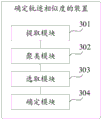
Fig. 3 is a schematic structural diagram of an apparatus for determining track similarity according to an embodiment of the present application. Referring to fig. 3, the apparatus includes: an extraction module 301, a clustering module 302, a selection module 303 and a determination module 304.
An extracting module 301, configured to extract an image feature of each of k target frames included in the first track, where the k target frames include a same target, the k target frames are target frames in each frame of video images in k consecutive video images, and k is a positive integer;
a clustering module 302, configured to cluster the extracted k image features to obtain one or more image feature sets;
a selecting module 303, configured to select, according to the number of image features included in each image feature set in the one or more image feature sets, a target image feature set corresponding to the first trajectory from the one or more image feature sets;
and the determining module 304 is configured to determine similarity between the first track and other tracks according to the target image feature set corresponding to the first track.
Optionally, the extraction module 301 includes:
the input unit is used for inputting the image in one target frame into the neural network model for any one target frame in k target frames included in the first track;
and the first determining unit is used for taking the characteristics of the image in one target frame output by the neural network model as the image characteristics of the target frame.
Optionally, k is an integer greater than or equal to 2, and the clustering module 302 includes:
a first dividing unit, configured to divide a first image feature of the k image features into a newly created image feature set, and let i be 2;
a first acquisition unit, configured to acquire a similarity between an ith image feature of the k image features and a central feature of each image feature set in the divided image feature sets;
the judging unit is used for judging whether the similarity between the ith image feature and the central feature of the specified image feature set is greater than or equal to a similarity threshold value or not, and the specified image feature set is the image feature set to which the central feature with the maximum similarity with the ith image feature belongs;
the second dividing unit is used for dividing the ith image feature into the specified image feature set when the similarity between the ith image feature and the central feature of the specified image feature set is greater than or equal to a similarity threshold value; when the similarity between the ith image feature and the central feature of the designated image feature set is smaller than a similarity threshold value, dividing the ith image feature into a newly created image feature set;
and the triggering unit is used for enabling i to be i +1 when i is not equal to k, and triggering the first acquisition unit to acquire the similarity between the ith image feature of the k image features and the central feature of each image feature set in the divided image feature set until i is equal to k.
Optionally, the selecting module 303 includes:
the computing unit is used for dividing the number of image features included in one image feature set by k to obtain the number ratio of one image feature set for any one image feature set in one or more image feature sets;
and the second determining unit is used for determining one image feature set as a target image feature set corresponding to the first track when the number proportion of the image feature sets is greater than or equal to the proportion threshold.
Optionally, the determining module 304 includes:
the second acquisition unit is used for acquiring a target image characteristic set corresponding to a second track, wherein the second track is a track different from the first track;
and the third determining unit is used for determining the similarity between the first track and the second track according to the target image feature set corresponding to the first track and the target image feature set corresponding to the second track.
Optionally, the number of the target image feature set corresponding to the first track is n, the number of the target image feature set corresponding to the second track is m, both n and m are positive integers, and the third determining unit is configured to:
acquiring the similarity between the central feature of each target image feature set in the n target image feature sets corresponding to the first track and the central feature of each target image feature set in the m target image feature sets corresponding to the second track;
and determining the maximum similarity in the acquired n-m similarities as the similarity between the first track and the second track.
In the embodiment of the application, after the image features of each target frame in the k target frames included in the first track are extracted, the extracted k image features are clustered to obtain one or more image feature sets. The one or more sets of image features may fully characterize the appearance of the target in different states. And then, according to the number of image features included in each image feature set in the one or more image feature sets, selecting a target image feature set corresponding to the first track from the one or more image feature sets. Because the target image feature set corresponding to the first track can better represent the appearance of the target contained in the first track, the similarity between the first track and other tracks can be determined according to the target image feature set corresponding to the first track, and therefore the accuracy in determining the track similarity can be improved.
It should be noted that: in the apparatus for determining track similarity provided in the foregoing embodiment, when determining the track similarity, only the division of the functional modules is used for illustration, and in practical applications, the function distribution may be completed by different functional modules according to needs, that is, the internal structure of the apparatus is divided into different functional modules, so as to complete all or part of the functions described above. In addition, the apparatus for determining track similarity and the method for determining track similarity provided by the embodiments belong to the same concept, and specific implementation processes thereof are detailed in the method embodiments and are not described herein again.
Fig. 4 is a schematic structural diagram of an apparatus for determining track similarity according to an embodiment of the present application. Referring to fig. 4, the apparatus may be a terminal 400, and the terminal 400 may be: a smart phone, a tablet computer, an MP3 player (Moving Picture Experts Group Audio Layer III, motion video Experts compression standard Audio Layer 3), an MP4 player (Moving Picture Experts Group Audio Layer IV, motion video Experts compression standard Audio Layer 4), a notebook computer, or a desktop computer. The terminal 400 may also be referred to by other names such as user equipment, portable terminal, laptop terminal, desktop terminal, etc.
Generally, the terminal 400 includes: a processor 401 and a memory 402.
Processor 401 may include one or more processing cores, such as a 4-core processor, an 8-core processor, or the like. The processor 401 may be implemented in at least one hardware form of a DSP (Digital Signal Processing), an FPGA (Field-Programmable Gate Array), and a PLA (Programmable Logic Array). The processor 401 may also include a main processor and a coprocessor, where the main processor is a processor for Processing data in an awake state, and is also called a Central Processing Unit (CPU); a coprocessor is a low power processor for processing data in a standby state. In some embodiments, the processor 401 may be integrated with a GPU (Graphics Processing Unit), which is responsible for rendering and drawing the content that the display screen needs to display. In some embodiments, the processor 401 may further include an AI (Artificial Intelligence) processor for processing computing operations related to machine learning.
Memory 402 may include one or more computer-readable storage media, which may be non-transitory. Memory 402 may also include high speed random access memory as well as non-volatile memory, such as one or more magnetic disk storage devices, flash memory storage devices. In some embodiments, a non-transitory computer readable storage medium in memory 402 is used to store at least one instruction for execution by processor 401 to implement the method of determining track similarity provided by the embodiments described above.
In some embodiments, the terminal 400 may further optionally include: a peripheral interface 403 and at least one peripheral. The processor 401, memory 402 and peripheral interface 403 may be connected by bus or signal lines. Each peripheral may be connected to the peripheral interface 403 via a bus, signal line, or circuit board. Specifically, the peripheral device includes: at least one of radio frequency circuitry 404, touch screen display 405, camera 406, audio circuitry 407, positioning components 408, and power supply 409.
The peripheral interface 403 may be used to connect at least one peripheral related to I/O (Input/Output) to the processor 401 and the memory 402. In some embodiments, processor 401, memory 402, and peripheral interface 403 are integrated on the same chip or circuit board; in some other embodiments, any one or both of the processor 401, the memory 402, and the peripheral interface 403 may be implemented on separate chips or circuit boards, which are not limited in this application.
The Radio Frequency circuit 404 is used for receiving and transmitting RF (Radio Frequency) signals, also called electromagnetic signals. The radio frequency circuitry 404 communicates with communication networks and other communication devices via electromagnetic signals. The rf circuit 404 converts an electrical signal into an electromagnetic signal to transmit, or converts a received electromagnetic signal into an electrical signal. Optionally, the radio frequency circuit 404 includes: an antenna system, an RF transceiver, one or more amplifiers, a tuner, an oscillator, a digital signal processor, a codec chipset, a subscriber identity module card, etc. The radio frequency circuitry 404 may communicate with other terminals via at least one wireless communication protocol. The wireless communication protocols include, but are not limited to: metropolitan area networks, various generation mobile communication networks (2G, 3G, 4G, and 5G), Wireless local area networks, and/or WiFi (Wireless Fidelity) networks. In some embodiments, the rf circuit 404 may further include NFC (Near Field Communication) related circuits, which are not limited in this application.
The display screen 405 is used to display a UI (User Interface). The UI may include graphics, text, icons, video, and any combination thereof. When the display screen 405 is a touch display screen, the display screen 405 also has the ability to capture touch signals on or over the surface of the display screen 405. The touch signal may be input to the processor 401 as a control signal for processing. At this point, the display screen 405 may also be used to provide virtual buttons and/or a virtual keyboard, also referred to as soft buttons and/or a soft keyboard. In some embodiments, the display screen 405 may be one, disposed on the front panel of the terminal 400; in other embodiments, the display screen 405 may be at least two, respectively disposed on different surfaces of the terminal 400 or in a folded design; in still other embodiments, the display 405 may be a flexible display disposed on a curved surface or a folded surface of the terminal 400. Even further, the display screen 405 may be arranged in a non-rectangular irregular pattern, i.e. a shaped screen. The Display screen 405 may be made of LCD (Liquid Crystal Display), OLED (Organic Light-Emitting Diode), and other materials.
The camera assembly 406 is used to capture images or video. Optionally, camera assembly 406 includes a front camera and a rear camera. Generally, a front camera is disposed at a front panel of the terminal, and a rear camera is disposed at a rear surface of the terminal. In some embodiments, the number of the rear cameras is at least two, and each rear camera is any one of a main camera, a depth-of-field camera, a wide-angle camera and a telephoto camera, so that the main camera and the depth-of-field camera are fused to realize a background blurring function, and the main camera and the wide-angle camera are fused to realize panoramic shooting and VR (Virtual Reality) shooting functions or other fusion shooting functions. In some embodiments, camera assembly 406 may also include a flash. The flash lamp can be a monochrome temperature flash lamp or a bicolor temperature flash lamp. The double-color-temperature flash lamp is a combination of a warm-light flash lamp and a cold-light flash lamp, and can be used for light compensation at different color temperatures.
The audio circuit 407 may include a microphone and a speaker. The microphone is used for collecting sound waves of a user and the environment, converting the sound waves into electric signals, and inputting the electric signals to the processor 401 for processing, or inputting the electric signals to the radio frequency circuit 404 for realizing voice communication. For the purpose of stereo sound collection or noise reduction, a plurality of microphones may be provided at different portions of the terminal 400. The microphone may also be an array microphone or an omni-directional pick-up microphone. The speaker is used to convert electrical signals from the processor 401 or the radio frequency circuit 404 into sound waves. The loudspeaker can be a traditional film loudspeaker or a piezoelectric ceramic loudspeaker. When the speaker is a piezoelectric ceramic speaker, the speaker can be used for purposes such as converting an electric signal into a sound wave audible to a human being, or converting an electric signal into a sound wave inaudible to a human being to measure a distance. In some embodiments, audio circuitry 407 may also include a headphone jack.
The positioning component 408 is used to locate the current geographic position of the terminal 400 for navigation or LBS (Location Based Service). The Positioning component 408 may be a Positioning component based on the GPS (Global Positioning System) of the united states, the beidou System of china, the graves System of russia, or the galileo System of the european union.
The power supply 409 is used to supply power to the various components in the terminal 400. The power source 409 may be alternating current, direct current, disposable or rechargeable. When power source 409 comprises a rechargeable battery, the rechargeable battery may support wired or wireless charging. The rechargeable battery may also be used to support fast charge technology.
In some embodiments, the terminal 400 also includes one or more sensors 410. The one or more sensors 410 include, but are not limited to: acceleration sensor 411, gyro sensor 412, pressure sensor 413, fingerprint sensor 414, optical sensor 415, and proximity sensor 416.
The acceleration sensor 411 may detect the magnitude of acceleration in three coordinate axes of the coordinate system established with the terminal 400. For example, the acceleration sensor 411 may be used to detect components of the gravitational acceleration in three coordinate axes. The processor 401 may control the touch display screen 405 to display the user interface in a landscape view or a portrait view according to the gravitational acceleration signal collected by the acceleration sensor 411. The acceleration sensor 411 may also be used for acquisition of motion data of a game or a user.
The gyro sensor 412 may detect a body direction and a rotation angle of the terminal 400, and the gyro sensor 412 may cooperate with the acceleration sensor 411 to acquire a 3D motion of the terminal 400 by the user. From the data collected by the gyro sensor 412, the processor 401 may implement the following functions: motion sensing (such as changing the UI according to a user's tilting operation), image stabilization at the time of photographing, game control, and inertial navigation.
The pressure sensor 413 may be disposed on a side bezel of the terminal 400 and/or a lower layer of the touch display screen 405. When the pressure sensor 413 is disposed on the side frame of the terminal 400, a user's holding signal to the terminal 400 can be detected, and the processor 401 performs left-right hand recognition or shortcut operation according to the holding signal collected by the pressure sensor 413. When the pressure sensor 413 is disposed at the lower layer of the touch display screen 405, the processor 401 controls the operability control on the UI interface according to the pressure operation of the user on the touch display screen 405. The operability control comprises at least one of a button control, a scroll bar control, an icon control and a menu control.
The fingerprint sensor 414 is used for collecting a fingerprint of the user, and the processor 401 identifies the identity of the user according to the fingerprint collected by the fingerprint sensor 414, or the fingerprint sensor 414 identifies the identity of the user according to the collected fingerprint. Upon recognizing that the user's identity is a trusted identity, processor 401 authorizes the user to perform relevant sensitive operations including unlocking the screen, viewing encrypted information, downloading software, paying, and changing settings, etc. The fingerprint sensor 414 may be disposed on the front, back, or side of the terminal 400. When a physical key or vendor Logo is provided on the terminal 400, the fingerprint sensor 414 may be integrated with the physical key or vendor Logo.
The optical sensor 415 is used to collect the ambient light intensity. In one embodiment, the processor 401 may control the display brightness of the touch display screen 405 based on the ambient light intensity collected by the optical sensor 415. Specifically, when the ambient light intensity is high, the display brightness of the touch display screen 405 is increased; when the ambient light intensity is low, the display brightness of the touch display screen 405 is turned down. In another embodiment, the processor 401 may also dynamically adjust the shooting parameters of the camera assembly 406 according to the ambient light intensity collected by the optical sensor 415.
The proximity sensor 416, also referred to as a distance sensor, is typically disposed on a front panel of the terminal 400. The proximity sensor 416 is used to collect the distance between the user and the front surface of the terminal 400. In one embodiment, when the proximity sensor 416 detects that the distance between the user and the front surface of the terminal 400 gradually decreases, the processor 401 controls the touch display screen 405 to switch from the bright screen state to the dark screen state; when the proximity sensor 416 detects that the distance between the user and the front surface of the terminal 400 gradually becomes larger, the processor 401 controls the touch display screen 405 to switch from the breath screen state to the bright screen state.
Those skilled in the art will appreciate that the configuration shown in fig. 4 is not intended to be limiting of terminal 400 and may include more or fewer components than those shown, or some components may be combined, or a different arrangement of components may be used.
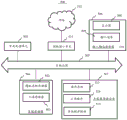
Fig. 5 is a schematic structural diagram of an apparatus for determining track similarity according to an embodiment of the present application. Referring to fig. 5, the apparatus may be a server 500, and the server 500 may be a server in a background server cluster. Specifically, the method comprises the following steps:
the server 500 includes a CPU (Central Processing Unit) 501, a system Memory 504 including a RAM (Random Access Memory) 502 and a ROM (Read-Only Memory) 503, and a system bus 505 connecting the system Memory 504 and the Central Processing Unit 501. The server 500 also includes a basic I/O (Input/Output) system 506, which facilitates the transfer of information between devices within the computer, and a mass storage device 507, which stores an operating system 513, application programs 514, and other program modules 515.
The basic input/output system 506 comprises a display 508 for displaying information and an input device 509, such as a mouse, keyboard, etc., for user input of information. Wherein a display 508 and an input device 509 are connected to the central processing unit 501 through an input/output controller 510 connected to the system bus 505. The basic input/output system 506 may also include an input/output controller 510 for receiving and processing input from a number of other devices, such as a keyboard, mouse, or electronic stylus. Similarly, an input/output controller 510 also provides output to a display screen, a printer, or other type of output device.
The mass storage device 507 is connected to the central processing unit 501 through a mass storage controller (not shown) connected to the system bus 505. The mass storage device 507 and its associated computer-readable media provide non-volatile storage for the server 500. That is, the mass storage device 507 may include a computer-readable medium (not shown) such as a hard disk or CD-ROM (Compact disk Read-Only Memory) drive.
Without loss of generality, computer readable media may comprise computer storage media and communication media. Computer storage media includes volatile and nonvolatile, removable and non-removable media implemented in any method or technology for storage of information such as computer readable instructions, data structures, program modules or other data. Computer storage media includes, but is not limited to, RAM, ROM, EPROM (Electrically Erasable Programmable Read-Only Memory), EEPROM (Electrically Erasable Programmable Read-Only Memory), flash Memory or other solid state Memory technology, and CD-ROM, DVD (Digital Versatile disk) or other optical storage, magnetic cassettes, magnetic tape, magnetic disk storage or other magnetic storage devices. Of course, those skilled in the art will appreciate that computer storage media is not limited to the foregoing. The system memory 504 and mass storage device 507 may be collectively referred to as memory.
According to various embodiments of the present application, server 500 may also operate as a remote computer connected to a network through a network, such as the Internet. That is, the server 500 may be connected to the network 512 through the network interface unit 511 connected to the system bus 505, or may be connected to other types of networks or remote computer systems (not shown) using the network interface unit 511.
The memory further includes one or more programs, and the one or more programs are stored in the memory and configured to be executed by the CPU. The one or more programs include instructions for performing the method of determining trajectory similarity provided by the above embodiments.
In some embodiments, a computer-readable storage medium is also provided, in which a computer program is stored, which when executed by a processor implements the steps of the method for determining trajectory similarity in the above embodiments. For example, the computer readable storage medium may be a ROM, a RAM, a CD-ROM, a magnetic tape, a floppy disk, an optical data storage device, and the like.
It is noted that the computer-readable storage medium referred to herein may be a non-volatile storage medium, in other words, a non-transitory storage medium.
It should be understood that all or part of the steps for implementing the above embodiments may be implemented by software, hardware, firmware or any combination thereof. When implemented in software, may be implemented in whole or in part in the form of a computer program product. The computer program product includes one or more computer instructions. The computer instructions may be stored in the computer-readable storage medium described above.
That is, in some embodiments, there is also provided a computer program product containing instructions which, when run on a computer, cause the computer to perform the steps of the above-described method of determining trajectory similarity.
The above-mentioned embodiments are provided not to limit the present application, and any modification, equivalent replacement, improvement, etc. made within the spirit and principle of the present application should be included in the protection scope of the present application.