Disclosure of Invention
The purpose of the invention is as follows: in order to overcome the defects in the prior art, the invention provides the millimeter wave network rainfall inversion model construction method suitable for the complex scene, which can be suitable for millimeter wave rainfall inversion in different climatic regions and different link conditions, and noise processing steps such as wet antenna influence, clutter removal and the like are not required to be performed in the early stage, so that the reliability of a training data set is improved.
The technical scheme is as follows: in order to solve the technical problem, the invention provides a millimeter wave network rainfall inversion model construction method suitable for complex scenes, which comprises the following specific steps:
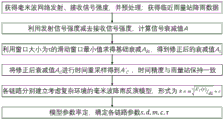
the method comprises the steps of firstly, obtaining signal strength TSL of each link signal transmitting end and signal strength RSL of a receiving end in a millimeter wave network, preprocessing data, interpolating lost signal strength, removing singular values and interpolating to obtain synchronous data of rainfall stations nearby links;
step two, subtracting the signal strength RSL of the receiving end from the signal strength TSL of the transmitting end of each link after preprocessing to obtain a signal attenuation value A;
thirdly, obtaining the attenuation A of the basic signal by using the minimum value of the sliding windowBLAnd subtracting the base signal attenuation A from the signal attenuation value ABLObtaining a corrected attenuation value ACThe size of the sliding window is set to be tau, and for the t time of the ith link, the specific form is as follows:
by calculating correction values for all T moments
Then, a corrected attenuation value A of the ith link is obtained
C;
Fourthly, the attenuation value A after the millimeter wave link data is corrected
CTime resampling is carried out, the time precision is consistent with rainfall data of a rainfall station, and the corrected attenuation value after resampling is recorded as A'
CThe attenuation value for the ith link is
Fifthly, respectively establishing a millimeter wave rainfall inversion model considering a complex scene for each link in the millimeter wave network,
for the ith link, i is a positive integer, and the model concrete form is as follows:
wherein R isiThe rainfall intensity of the ith link; si、di、mi、ci、τiFor the ith link model parameter, si、diDepending on the link frequency, polarization, mi、ciRelated to regional environment, tau is a sliding window parameter; a'CCorrecting the ith link obtained in the fourth step by resampling to obtain a basic attenuation amount; l isiIs the ith link length;
sixthly, for each link, actually measuring an attenuation value A 'according to the history'CAnd constructing a historical data set by historical rainfall data R of the rainfall station in the same period, and determining model parameters s, d, m, c and tau of each link in the fifth step in a parameter calibration mode.
Preferably, in the fourth step, the average value of the modified attenuations in the time step is selected as the modified attenuation value at the end of the time period by resampling the modified attenuation data of the millimeter wave link.
Preferably, in the sixth step, the SCE-UA algorithm is used to calibrate the model parameters, and the objective function is the nash efficiency coefficient NSE.
Has the advantages that: according to the millimeter wave network rainfall inversion model construction method suitable for the complex scene, the influence of regional environment elements on millimeter wave attenuation is considered in the model structure, corresponding inversion models can be provided for different regions and different link attributes, the requirement of millimeter wave rainfall inversion under the complex scene can be met, and the method has stronger applicability compared with other technologies; according to the method, the millimeter wave attenuation data are corrected by using the minimum value of the sliding window, and noise is filtered through local attenuation characteristics, so that compared with other technologies, the data processing steps are simplified, the introduction of errors is avoided, the millimeter wave periodic signal change can be effectively removed, and the reliability of a data set is improved; the sliding window parameters adopted by the millimeter wave attenuation data are determined by adopting a calibration mode, and the requirements of objective facts of different link frequencies, lengths and polarization modes of a millimeter wave network are met.
Detailed Description
The present invention will be further described with reference to the accompanying drawings.
As shown in fig. 1, a millimeter wave network rainfall inversion model construction method suitable for complex scenes includes the following steps,
the method comprises the steps of firstly, obtaining signal intensity TSL of each link signal transmitting end and signal intensity RSL of a receiving end in a millimeter wave network, collecting microwave data once every 10s, preprocessing the data, interpolating lost signal intensity, removing and interpolating singular values, and performing linear interpolation by using data before and after the lost values; acquiring rainfall intensity data of rainfall stations nearby a link in the same period of 15 min;
step two, subtracting the signal strength RSL of the receiving end from the signal strength TSL of the transmitting end of each link after pretreatment to obtain a signal attenuation value A, and obtaining the attenuation value A of the ith linki=TSLi-RSLi;
Thirdly, obtaining the attenuation of the basic signal by using the minimum value of the sliding windowABLAnd subtracting the base signal attenuation A from the signal attenuation value ABLObtaining a corrected attenuation value ACThe size of the sliding window is set to be τ equal to 91, that is, the minimum of 91 data is used as the base attenuation of the 91 th time, and for the t time of the ith link, the specific form is:
by calculating correction values for all T moments
Then, a corrected attenuation value A of the ith link is obtained
C;
Fourthly, the attenuation value A after the millimeter wave link data is correctedCTime resampling is carried out, the time precision is 15min, the corrected attenuation values within 15min are averaged to be used as the corrected attenuation values at the time of the end of the period and are kept consistent with rainfall data of a rainfall station, and the corrected attenuation values after resampling are recorded as A'C;
And fifthly, respectively establishing a millimeter wave rainfall inversion model considering a complex scene for each link in the millimeter wave network, wherein for the ith link, the model concrete form is as follows:
wherein R isiThe rainfall intensity of the ith link; si、di、mi、ci、τiFor the ith link model parameter, si、diDepending on the link frequency, polarization, mi、ciRelated to regional environment, tau is a sliding window parameter; a'CPassing the ith link obtained in the fourth step through a duplicateThe sampled corrected base attenuation; l isiIs the ith link length;
sixthly, for each link, actually measuring an attenuation value A according to the historyCAnd constructing a data set by using the historical rainfall data R of the time scale rainfall station, carrying out rating on the model parameters s, d, m, c and tau of each link by using an SCE-UA algorithm and combining a rating data set, and selecting a Nash efficiency coefficient NSE by using an objective function.
In the invention, through the fourth step, all parameters in the model in the third step are obtained, and in practice, only the resampled corrected attenuation value A 'needs to be utilized'CAnd obtaining the link rainfall intensity data R. When the millimeter wave link is used for rain measurement, due to the fact that the millimeter wave link is located in different climatic regions and different combination modes of link frequency and length, data of all links cannot be calculated completely by using one formula, no matter an inversion model with a physical basis or a machine learning model, differential modeling is not performed according to the millimeter wave network condition in a complex scene, the inversion model provided by the invention not only considers the attribute of the millimeter wave link, but also introduces the influence of environmental elements, and the millimeter wave link has stronger applicability compared with other models. Before the millimeter wave attenuation data is subjected to rainfall inversion, the steps of dry-wet period discrimination, basic attenuation determination, wet antenna influence removal and the like are often required to be carried out, the processing modes of the steps are different, great uncertainty is brought, unreasonable processing often brings great errors, the existing method uses the same processing mode for each link, the requirement of a complex millimeter wave network cannot be met, in addition, obvious periodicity exists in millimeter wave signals, other methods cannot be effectively solved, in the invention, the millimeter wave attenuation data is corrected by using the minimum value of a sliding window, the minimum value of the sliding window is the minimum value in a period of time, for the millimeter wave attenuation variable caused by rainfall, a random process can be considered in a local range, the minimum value of the random process meets the expectation and the variance is 0, and the attenuation caused by non-rainfall environmental factors such as humidity and wet antennas is not a random variable, but rather a local constant, the sliding window minimum may therefore represent attenuation induced by non-rainfall elements, i.e. the minimum already contains wet antenna effects and other non-rainfallCompared with other technologies, the method simplifies the data processing steps, avoids the introduction of errors, can effectively remove millimeter wave periodic signal changes, and improves the reliability of a data set; for different links, because the link frequency, the length and the polarization mode are different, and the window size is also different, the sliding window parameters adopted by the millimeter wave attenuation data in the invention are determined by adopting a calibration parameter mode, thereby meeting the objective fact requirements of different link frequencies, lengths and polarization modes of the millimeter wave network.
As shown in fig. 2, the invention can effectively filter the periodic attenuation of the millimeter wave signal, and the attenuation obtained by the invention after correction has a very high matching degree with the rainfall data of the actual rainfall station.
The above description is only of the preferred embodiments of the present invention, and it should be noted that: it will be apparent to those skilled in the art that various modifications and adaptations can be made without departing from the principles of the invention and these are intended to be within the scope of the invention.