the application is filed in 2019 on 27/6, application number 201910570125.0 and has the priority of 'a method for determining quantitative parameters of a neural network and a related product'.
The application requires the priority of a neural network quantification method, a neural network quantification device and related products, which are filed in 2019, 6, 12 and 201910505239.7.
The application requires the priority of a quantitative parameter adjusting method, a quantitative parameter adjusting device and related products, which are filed in 2019, 6, month and 18, and have the application number of 201910528537.8.
The application requires the priority of a neural network operation method, a neural network operation device and related products, which is filed in 2019, 6, month and 14, application number 201910515355.7.
Detailed Description
The technical solutions in the embodiments of the present disclosure will be described clearly and completely with reference to the accompanying drawings in the embodiments of the present disclosure, and it is obvious that the described embodiments are some, not all embodiments of the present disclosure. All other embodiments, which can be derived by one skilled in the art from the embodiments disclosed herein without making any creative effort, shall fall within the scope of protection of the present disclosure.
It should be understood that the terms "first," "second," "third," and "fourth," etc. in the claims, description, and drawings of the present disclosure are used to distinguish between different objects and are not used to describe a particular order. The terms "comprises" and "comprising," when used in the specification and claims of this disclosure, specify the presence of stated features, integers, steps, operations, elements, and/or components, but do not preclude the presence or addition of one or more other features, integers, steps, operations, elements, components, and/or groups thereof.
It is also to be understood that the terminology used in the description of the disclosure herein is for the purpose of describing particular embodiments only, and is not intended to be limiting of the disclosure. As used in the specification and claims of this disclosure, the singular forms "a", "an" and "the" are intended to include the plural forms as well, unless the context clearly indicates otherwise. It should be further understood that the term "and/or" as used in the specification and claims of this disclosure refers to any and all possible combinations of one or more of the associated listed items and includes such combinations.
As used in this specification and claims, the term "if" may be interpreted contextually as "when", "upon" or "in response to a determination" or "in response to a detection". Similarly, the phrase "if it is determined" or "if a [ described condition or event ] is detected" may be interpreted contextually to mean "upon determining" or "in response to determining" or "upon detecting [ described condition or event ]" or "in response to detecting [ described condition or event ]".
Technical term definition:
floating point number: the IEEE floating point standard expresses a number in the form of V (-1) sign 2 ^ E. Wherein sign is a sign bit, 0 represents a positive number, and 1 represents a negative number; e represents a step code, floating point numbers are weighted, and the weight is the E power (possibly negative power) of 2; mantissa represents a mantissa, mantissa is a binary decimal in the range of 1-2-, or 0-. The representation of floating-point number representations in computers is divided into three fields, which are encoded separately:
(1) a single sign bit s directly encodes the sign s.
(2) A k-bit code field encodes a code, exp.
(3) The fractional field mantissa of n bits, the coded mantissa. But the encoding result depends on whether the level code phases are all 0.
Counting number: the index number generating device is composed of a shared exponent (exponent), a sign bit (sign) and a mantissa (mantissa). Wherein, the shared index is that the index is shared in a real number set needing quantization; sign bits indicate the number of fixed points. The mantissa determines the number of significant digits, i.e., the precision, of the fixed-point number. Taking the 8-bit fixed point number type as an example, the numerical calculation method is as follows:
value=(-1)sign×(mantissa)×2(exponent-127)
binary decimal fraction: any decimal number can be represented by the formula ∑ j 10iAnd (4) showing. For example, the decimal number 12.34, expressed as equation 1: 12.34 ═ 1 × 101+2*100+3*10-1+4*10-2The left side of the decimal point is raised to a positive power of 10 and the right side of the decimal point is raised to a negative power of 10. Similarly, binary decimals can be expressed in such a way that the left side of the decimal point is a positive power of 2, the right side of the decimal point is a negative power of 2, and the decimal fraction 5.75 can be represented by a binary decimal 101.11, which is represented by 5.75 ═ 1 × 22+0*21+1*20+1*2-1+1*2-2。
Overflow-in a fixed-point operator, the number representation has a certain range. During the operation. If the size of the number exceeds the range that the fixed-point number can represent, it is called "overflow".
KL (Kullback-Leibler divergence): also called relative entropy, information divergence, and information gain. The KL divergence is a measure of the asymmetry of the difference between the two probability distributions P and Q. The KL divergence is a measure of the number of extra bits needed to encode the average of samples from P using Q-based coding. Typically, P represents the true distribution of the data, and Q represents the theoretical distribution, the model distribution, or the approximate distribution of P of the data.
Data bit width: how many bits the data is represented.
And (3) quantification: the process of converting the high precision number expressed by 32 bits or 64 bits into the fixed point number occupying less memory space in the past causes certain loss in precision.
The following describes in detail specific embodiments of a method for determining a quantization parameter of a neural network and a related product provided in an embodiment of the present disclosure with reference to the accompanying drawings.
Neural Networks (NN) are mathematical models that mimic the structure and function of biological neural networks, which are computed from a large number of neuronal connections. Therefore, a neural network is a computational model, which is composed of a large number of nodes (or "neurons") connected to each other. Each node represents a particular output function, called an activation function. The connection between every two neurons represents a weighted value, called weight, of the signal passing through the connection, which is equivalent to the memory of the neural network. The output of the neural network varies according to the connection mode between neurons and the difference between the weights and the activation functions. In a neural network, neurons are the basic unit of the neural network. It takes a certain number of inputs and an offset, and multiplies a weight when the signal (value) arrives. A connection is a connection of one neuron to another neuron on another layer or on the same layer, accompanied by weights associated therewith. In addition, the bias is an additional input to the neuron, which is always 1, and has its own connection weight. This ensures that neurons will activate even if all inputs are null (all 0's).
In application, a neural network is not as powerful as a single neuron if it is a linear function, rather than applying a non-linear function to neurons in the neural network. If the output of a neural network is made between 0 and 1, for example, in the case of cat-dog discrimination, an output close to 0 can be considered as a cat and an output close to 1 can be considered as a dog. To accomplish this, an activation function is introduced in the neural network, such as: sigmoid activates the function. With respect to this activation function, it is only necessary to know that its return value is a number between 0 and 1. Thus, the activation function serves to introduce non-linearities into the neural network that narrow the neural network operation to a smaller extent. In practice it is not important how the activation function is expressed, but it is important that a non-linear function is parameterized by some weights, which can be changed.
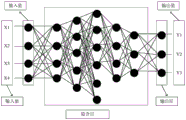
Fig. 1 is a schematic diagram of a neural network structure. In the neural network shown in fig. 1, the neural network includes three layers, i.e., an input layer, a hidden layer, and an output layer, and the hidden layer shown in fig. 1 is 5 layers. Among them, the leftmost layer of the neural network is called an input layer, and neurons of the input layer are called input neurons. The input layer, which is the first layer in the neural network, accepts the required input signals (values) and passes them on to the next layer. It does not generally operate on the input signal (value) and has no associated weights and biases. In the neural network shown in fig. 1, there are 4 input signals x1, x2, x3, x 4.
The hidden layer contains neurons (nodes). In the neural network shown in fig. 1, there are 5 hidden layers. The first hidden layer has 4 neurons (nodes), layer 2 has 5 neurons, layer 3 has 6 neurons, layer 4 has 4 neurons, layer 5 has 3 neurons. Finally, the hidden layer passes the operation values of the neurons to the output layer. The neural network shown in fig. 1 makes full connection between each neuron in 5 hidden layers, that is, each neuron in each hidden layer has connection with each neuron in the next layer. It should be noted that not every hidden layer of the neural network is fully connected.
The rightmost layer of the neural network of fig. 1 is referred to as the output layer, and the neurons of the output layer are referred to as output neurons. The output layer receives the output from the last hidden layer. In the neural network shown in fig. 1, the output layer has 3 neurons, and there are 3 output signals y1, y2, y 3.
In practical application, a large amount of sample data (including input and output) is trained on an initial neural network in advance, and after training is completed, the trained neural network is obtained. The neural network can give a correct output for future real-world inputs.
Before starting to discuss the training of neural networks, a loss function needs to be defined. The loss function is a function that measures the performance of the neural network in performing a particular task. In some embodiments, the loss function may be obtained by: in the process of training a certain neural network, each sample data is transmitted along the neural network to obtain an output value, then the output value is subtracted from an expected value, and then the square is obtained, so that the calculated loss function is the distance between the predicted value and the true value, and the purpose of training the neural network is to reduce the distance or the value of the loss function. In some embodiments, the loss function may be expressed as:
in the above formula, y represents the desired value,
and i is an index of each sample data in the sample data set.
Representing the expected value y and the actual result
And m is the number of sample data in the sample data set, or cat and dog identification is taken as an example. There is a data set consisting of pictures of cat and dog, corresponding to a label of 1 if the picture is dog, and a label of 0 if the picture is cat. The label is the expected value y corresponding to the above formula, and when each sample picture is transmitted to the neural network, the identification result is actually obtained through the neural network. In order to calculate the loss function, it is necessary to traverse each sample picture in the sample data set to obtain an actual result corresponding to each sample picture
The loss function is then calculated as defined above. If the loss function is larger, the neural network is not trained, and the weight needs to be further adjusted.
When training the neural network, the weights are initialized randomly. Obviously, an initialized neural network does not provide a good result. During the training process, a network with high accuracy can be obtained by training, assuming that it starts with a bad neural network.
The training process of the neural network is divided into two stages, wherein the first stage is the forward processing of signals, and the signals pass through the hidden layer from the input layer and finally reach the output layer. The second stage is to reversely propagate the gradient from the output layer to the hidden layer and finally to the input layer, and the weight and the bias of each layer in the neural network are sequentially adjusted according to the gradient.
In the forward processing, input values are input to an input layer of the neural network, and outputs of so-called prediction values are obtained from an output layer of the neural network. When an input value is provided to the input layer of the neural network, it does not perform any operation. In the hidden layer, the second hidden layer obtains the predicted intermediate result value from the first hidden layer, carries out calculation operation and activation operation, and then transmits the obtained predicted intermediate result value to the next hidden layer. The same operation is performed in the following layers, and finally, an output value is obtained in the output layer of the neural network.
After forward processing, an output value called a predicted value is obtained. To calculate the error, the predicted value is compared with the actual output value to obtain a corresponding error value. Back propagation uses the chain rule of differential chemistry, in which the derivative of the error value corresponding to the last layer of weights of the neural network is first calculated. These derivatives are referred to as gradients, which are then used to calculate the gradient of the penultimate layer in the neural network. The process is repeated until the gradient corresponding to each weight in the neural network is obtained. Finally, each weight in the neural network is subtracted by the corresponding gradient, so that the weight is updated once to achieve the purpose of reducing the error value.
For the neural network, fine tuning is to load the trained neural network, the fine tuning process is the same as the training process, and the fine tuning process is divided into two stages, wherein the first stage is to process signals in the forward direction, and the second stage is to propagate gradients in the reverse direction, so that the weights of the trained neural network are updated. Training differs from trimming in that training processes the initialized neural network at random, training the neural network from scratch, and trimming does not.
In the process of training or fine tuning of the neural network, each time the neural network passes through a forward processing of a signal and a back propagation process of a corresponding error, a weight in the neural network is updated once by using a gradient, which is called iteration (iteration). In order to obtain a neural network with an accuracy that is expected, a huge sample data set is needed in the training process. In this case, it is not possible to input the sample data set into the computer at one time. Therefore, in order to solve this problem, the sample data set needs to be divided into a plurality of blocks, each block is transmitted to the computer, and after each block of data set is processed forward, the weight of the neural network is updated correspondingly once. When a complete sample data set passes through the neural network once for forward processing and a corresponding weight update is returned, the process is called a cycle (epoch). In practice, it is not enough to transmit a complete data set once in a neural network, and the complete data set needs to be transmitted multiple times in the same neural network, that is, multiple cycles are needed, and finally, the neural network with the accuracy meeting the expectation is obtained.
In the process of training or fine tuning the neural network, it is generally desirable that the speed is as high as possible and the accuracy is as high as possible. The data of the neural network is represented by a high-precision data format, such as floating point number, so that the related data is in the high-precision data format in the training or fine tuning process, and then the trained neural network is quantized. Taking the example that the quantized objects are the weights of the whole neural network and the quantized weights are all 8bit fixed point numbers, since there are often millions of connections in a neural network, almost all the space is occupied by the weights connected by the neurons. Moreover, the weights are all different floating point numbers. Each layer's weight tends to a normal distribution over a certain interval, e.g., -3.0, 3.0. And storing the maximum value and the minimum value corresponding to the weight of each layer in the neural network, and representing each floating point numerical value by adopting an 8-bit fixed point number. 256 quantization intervals are linearly divided among areas within the range of the maximum value and the minimum value, and each quantization interval is represented by an 8-bit fixed point number. For example: in the (-3.0,3.0) interval, byte 0 represents-3.0 and byte 255 represents 3.0. By analogy, byte 128 represents 0.
For data expressed in a high-precision data format, taking floating point as an example, it is known from computer architecture that a floating point number-based operation expression rule and a fixed point number-based operation expression rule are more complicated in a floating point operation calculation mode and require more logic devices to constitute a floating point arithmetic unit for fixed point operation and floating point operation of the same length. Thus, the floating-point operator is volumetrically larger than the fixed-point operator. Furthermore, floating-point operators require more resources to process, so that the power consumption difference between fixed-point operations and floating-point operations is usually of the order of magnitude. In short, floating-point operators occupy many times more chip area and power consumption than fixed-point operators.
However, floating-point operations have their irreplaceability. First, although fixed-point arithmetic is intuitive, the fixed decimal point position determines the integer part and the fractional part of the fixed number of bits, which is not favorable for expressing a particularly large number or a particularly small number at the same time, and may cause overflow.
In addition, training or tuning using an artificial intelligence processor chip is often preferred over floating point arithmetic, mainly because in supervised learning neural networks, only floating point arithmetic can record and capture small increments during training. Therefore, how to greatly improve the computing capability of the chip for training on the premise of not increasing the area and the power consumption of the artificial intelligence processor chip is a problem which needs to be solved urgently at present.
For those skilled in the art, the fixed-point number represented by the low bit width is used for training, and practical feedback indicates that the fixed-point number represented by the low bit width needs to be used for processing the back propagation gradient, which makes the process of implementing training by using the fixed-point number represented by the low bit width extremely complex. How to replace a floating-point arithmetic unit with a fixed-point arithmetic unit to achieve the rapidity of fixed-point arithmetic, and to satisfy the precision of floating-point arithmetic required by arithmetic while improving the peak computational power of an artificial intelligence processor chip is the technical problem solved by the present specification.
Based on the above description of the technical problem, one characteristic of the neural network is that it is very tolerant to input noise. If one considers recognizing objects in the photograph, the neural network can ignore the dominant noise, focusing attention on important similarities. This functionality means that the neural network can use low precision calculations as a source of noise and still produce accurate predictions in numerical formats that accommodate less information. And if low-precision training or fine adjustment is required, a data representation with universality is required to be found, so that the overflow condition of data can be improved, and the data near 0 in the target interval range can be better represented. Thus, this data indicates that adaptivity is required, which can be adjusted with the process of training or fine tuning.
In addition, most neural network models require a large number of operations and memory accesses. Some neural network accelerators may provide higher computational performance. However, the computing power of the neural network accelerator, which is mainstream at present, far exceeds the bandwidth of the present external memory. The calculation amount and the memory access amount of each layer in the ResNet-18 neural network are taken as examples and explained below.
In the ResNet-18 neural network, the ratio of the amount of computation to the amount of memory access in each layer is different, and thus has different requirements for bandwidth and computational power. Taking an element-wise layer as an example, if the computing power is 1GFLOPS (the number of Floating-point Operations performed Per Second by Giga Floating-point Operations Per Second), the required bandwidth is 12 GB/s. At the same time, for convolutional layers, the bandwidth requirement is only 10MB/s for the same 1GFLOPS computational capability. Although the hardware of the neural network accelerator has been designed optimally to try to balance memory bandwidth and computing power, the optimal performance cannot be achieved. Under the context of caffe, the inventors of the present application further counted the ratio of computational power to memory access for each layer in the entire ResNet-18 neural network, and found that more than 95% of the data traffic is in some layers (including convolutional layers, BatchNorm layers, Scale layers, ReLU layers, and element-by-element layers). However, with the exception of convolutional layers, the computational load in these layers is very small, less than 1% in the overall neural network. Therefore, memory access is currently a serious bottleneck in the implementation of neural networks by artificial intelligence processors.
Operators in a calculation graph mapped by the neural network are realized on a CPU and an artificial intelligence processor through kernel functions, and the calculation graph is a mode of 'off-chip storage → on-chip calculation → off-chip storage', namely input data and output data of the operators in the neural network are stored in global storage, the kernel functions need to read the input data from the global storage to complete calculation, and results are stored back in the global storage. This presents two problems: firstly, the access of each operator to input data and output data cannot be avoided through optimization in the operator; second, each operator requires startup overhead, especially for heterogeneous computing devices other than the CPU. In order to solve the problems, the kernel functions of two or more continuous operators in the computation graph corresponding to the neural network are combined into a new kernel function, so that the computation tasks corresponding to the operators only need one-time scheduling overhead. Thus, a large amount of data transfer from an external memory (DRAM) to an on-chip memory and data transfer from the on-chip memory to the external memory can be eliminated. Through testing, the inventor finds that in the ResNet-18 neural network, if all operators can be fused together, the data transmission can be reduced by 99.6%.
However, it is difficult to fuse all operators in an actual neural network. The reasons include: in practice, there is a mismatch between the size of the on-chip memory and the size of the data processed by the neural network, because the area overhead of the artificial intelligence processor cannot be too large, and accordingly, there is a limit to the area overhead of the on-chip memory of the artificial intelligence processor. Also, the power consumption overhead required for the on-chip memory of the artificial intelligence processor should be within reasonable bounds. These reasons have resulted in certain limitations on the size of data stored on-chip in artificial intelligence processors. Thus, if all operators in the neural network are fused together, the data size of the intermediate data of those fused operators does not match the data size of the actual storage of the on-chip memory. In order to alleviate the contradiction, further analysis shows that intermediate results between the operators are included in the optimization range of the fused kernel function, and the access and storage of partial intermediate results have the possibility of being optimized, and the optimization of the intermediate results is usually based on the data local independence available in the calculation process. Based on this working principle, in an operator, each point in the output data set depends only on one defined region within the input data set. Therefore, the input data and the output data can be separated or split into a plurality of blocks, each block can be calculated independently, and more operators in the calculation graph corresponding to the neural network can be fused together.
Based on the above description, as shown in fig. 2, a flowchart of a method for determining quantization parameters of a neural network is provided for the present application. The quantization parameter determined by the technical scheme shown in fig. 2 is used for performing data representation on data to be quantized, so as to confirm the number of fixed points after quantization. And the quantified fixed point number is used for training, fine tuning or reasoning the neural network. The method comprises the following steps:
step 201): and traversing operators in the calculation graph corresponding to the neural network, and selecting the current operator and the operator to be fused from the calculation graph.
Taking cafe as an example, the neural network includes a plurality of processing layers including, but not limited to, convolutional layers, BatchNorm layers, Scale layers, ReLU layers, Pooling layers (pond layers), element-by-element layers, intra-product layers (lnnerproduct layers), SoftMax layers, and the like.
The layer corresponding to the operator to be fused is called a layer to be fused, the layer corresponding to the current operator is called a current layer, and the layer to be fused is positioned at the downstream of the current layer. However, it is easily understood by those skilled in the art that the operator corresponding layer to be fused may be located upstream of the current operator corresponding layer. Taking the convolutional layer and the BatchNorm layer as an example, if the convolutional layer is the current layer and the BatchNorm layer is the layer to be fused, the BatchNorm layer may be located upstream of the convolutional layer, i.e., the output data of the BatchNorm layer is the input data of the convolutional layer. The BatchNorm layer may also be located downstream of the convolutional layer, i.e., the output data of the convolutional layer is the input data of the BatchNorm layer.
In addition, according to a preferred embodiment of the present application, a first layer of the neural network is selected as a current layer, a next layer immediately adjacent to the current layer is selected as a layer to be fused, and fusion judgment is performed layer by layer.
Step 202): the split size is determined based on an available storage capacity of an on-chip memory of the artificial intelligence processor.
Step 203): and splitting the output data of the operator to be fused into a plurality of data blocks according to the splitting size.
Fig. 13 shows the output data OD2 of the layer to be fused, which is, for example, data of dimension M × N. According to the preset splitting size, the output data OD2 of the layer to be fused is split into M × N output blocks, where M is less than or equal to M, and N is less than or equal to N, i.e., OD2(1,1), OD2(1,2), and up to OD2(M, N). According to a preferred embodiment of the present application, the splitting size is selected such that the output data OD2 of the layer to be fused L2 can be split evenly into m × n parts. However, the present application is not limited thereto, and non-uniform splitting may also be implemented, for example, in fig. 13, the size of the output block in the m-th row and the size of the output block in the n-th column may be smaller than the size of the remaining output blocks, which are all within the protection scope of the present application.
Step 204): and mapping to obtain the corresponding data block size of the input data of the current operator and the size of the data block of the intermediate data between the current operator and the operator to be fused based on the size of the data block of the output data of the operator to be fused.
FIG. 14 illustrates one embodiment of step 204. As shown in fig. 14, in which the current layer L1 and the layer to be fused L2 are shown in a data transformation manner, the layer structure of the entity is not shown. For the current layer L1, the input data is ID1, the current layer L1 performs predetermined transformation processing on the input data ID1 to obtain output data OD1, the output data OD1 is used as input data and is provided to the layer to be fused L2, and the output data OD1 may also be referred to as intermediate data between the current layer L1 and the layer to be fused L2. The layer to be fused L2 performs predetermined transformation processing on the intermediate data OD1 to obtain output data OD 2.
Since the data transformation process performed by each of the current layer L1 and the layer to be fused L2 can be set in advance, the data block of the input data of the layer can be reversely derived from the output block of the output data. For example, in fig. 14, taking the output block OD2(m,1) of the output data as an example, the data block size of the data block OD1(m,1) in the intermediate data OD1 can be derived according to the transform processing performed by the layer to be fused L2, and the data block size of the data block OD1(m,1) can be larger, smaller, or the same as the size of the output block OD2(m,1), which are all within the protection scope of the present application. Similarly, according to the data block size of the data block OD1(m,1) in the intermediate data OD1 and according to the transform process performed by the current layer L1, the size of the data block ID1(m,1) of the input data ID1 of the current layer L1 can be obtained. In other words, the above process is to reversely derive the data block size of the input data required in the current layer and the data block size of the intermediate data according to the output data block size of the layer to be fused.
In fig. 14, it is shown that the layer to be fused L2 is located downstream of the current layer L1 and is closely adjacent to the current layer L1, and the output of the current layer L1 is the input of the layer to be fused L2. The scope of protection of the present application is not limited to this, and there may be more layers between the layer to be fused L2 and the current layer L1. In this case, the above-mentioned teaching of the present application can also be applied to obtain the data block size of the input data and the data block size of the intermediate data required in the current layer by reverse derivation, and of course, in this case, the intermediate data with multiple layers is included in the protection scope of the present application.
As shown in fig. 15, a flow chart of the process for determining the data to be quantized is shown. This is described in detail below with reference to fig. 15.
Step 1: and traversing the operators in the calculation graph corresponding to the neural network, and selecting the current operator and the operator to be fused from the calculation graph.
Step 2: the split size is determined based on an available storage capacity of an on-chip memory of the artificial intelligence processor.
And step 3: and splitting the output data of the operator to be fused into a plurality of data blocks according to the splitting size.
And 4, step 4: and performing memory allocation. In practical applications, the on-chip memory or a specified portion of the on-chip memory that is processed by the artificial intelligence is allocated to the output block, the data block of the input data, and the data block of the intermediate data.
And 5: and judging whether the memory allocation is successful. For example, the sum of the size of the output block (i.e., the split size), the data block size of the input data, and the data block size of the intermediate data may be compared to the storage space of the on-chip memory available for allocation, and if the storage space is not exceeded, the allocation is successful. Meanwhile, data to be quantized is determined; if the memory space is exceeded, the allocation fails and proceeds to step 6.
And 6, judging whether the splitting size can be reduced or not. Those skilled in the art will readily appreciate that the split size may be dynamically varied, for example, at the initial stage of determining whether an operator to be fused is fusible with the current operator, the split size may be set to a larger value. If at this split size the decision is inconclusive, then an attempt may be made to reduce the split size, as shown in step 7. The magnitude of the split size reduction can be set as desired. Of course, those skilled in the art will readily appreciate that the split size cannot be reduced without limitation, and a lower threshold thereof may be set. In step 6, when the splitting size is judged not to reach the lower limit threshold value, the step 7 is carried out, the splitting size is reduced, the step 2 is returned, the output data of the operator to be fused is split into corresponding output blocks again according to the reduced splitting size, and subsequent processing and judgment are carried out; and when the splitting size is judged to reach the lower limit threshold value, judging that the splitting size cannot be further fused until the judgment result shows that the current operator and the operator to be fused are fused together.
Step 205): the data block of the output data of the operator to be fused, the corresponding data block of the input data of the current operator and the data block of the intermediate data between the current operator and the operator to be fused are used as data to be quantized, and a statistical result of each kind of data to be quantized is obtained; wherein, the data to be quantized comprises at least one of the data of neurons, weight, gradient and bias of the neural network.
As described above, in training or tuning a neural network, the neural network includes four types of data per layer, namely neurons, weights, gradients, and offsets. In the reasoning process, each layer of the neural network comprises three kinds of data, namely neurons, weights and bias. These data are all expressed in a high-precision data format, and the floating point number is taken as an example of the high-precision data in the present specification. It should be clear that the floating-point number is only an exemplary part, but not an exhaustive list, and those skilled in the art may generate other modifications or transformations based on the technical solution of the present application, such as: the high-precision data can be fixed point numbers with large representation range and small minimum representation precision and high data bit width, and the technical scheme can be converted into fixed point numbers with low data bit width. But should be within the scope of the present application as long as the achieved functions and technical effects are similar to the present application.
Regardless of the structure of the neural network, in the process of training or fine tuning the neural network, the data to be quantized comprises at least one of the neurons, the weights, the gradients and the biases of the neural network, and in the inference process, the data to be quantized comprises at least one of the neurons, the weights and the biases of the neural network.
The following takes the data to be quantized as two kinds of data, i.e., the neuron and the weight of the target layer in the neural network, as an example, and describes the technical scheme in detail. In this step, the neurons and weights of each layer in the target layer are respectively counted to obtain the maximum value and the minimum value of each kind of data to be quantized, and the maximum value of the absolute value of each kind of data to be quantized can also be obtained. The target layer may be one layer or multiple layers as a layer to be quantized in the neural network. The maximum value of the absolute value of each kind of data to be quantized can be confirmed by the maximum value and the minimum value in each kind of data to be quantized in units of one layer. Or, the absolute value of each kind of data to be quantized may be calculated first, and the maximum value of the absolute value of each kind of data to be quantized is obtained by traversing the result of calculating the absolute value.
In practical application, the reason why the maximum absolute value of each to-be-quantized data is obtained according to the maximum and minimum values in each to-be-quantized data is that, during quantization, the maximum and minimum values corresponding to each layer of to-be-quantized data in a target layer are stored conventionally, and it is not necessary to consume more resources to solve the absolute value of the to-be-quantized data, and the maximum absolute value is obtained directly based on the stored maximum and minimum values corresponding to the to-be-quantized data.
Step 206): determining corresponding quantization parameters by using the statistical result of each type of data to be quantized and the data bit width; and the quantization parameters are used for the artificial intelligence processor to correspondingly quantize the data in the operation process of the neural network.
In this step, the quantization parameter can be classified into the following six cases. In the first case: the quantization parameter is a point position parameter s. In this case, the quantization data to be quantized can be quantized by the following formula (1) to obtain quantized data Ix:
Wherein s is a point position parameter, IxFor quantized n-bit binary representation of data x, FxFor floating point values before data x quantization, round is the rounding operation. It should be noted that, here, the rounding operation is not limited to round, and other rounding operation methods may be adopted, for example: and (3) carrying out rounding operations such as rounding-up, rounding-down, rounding-to-zero and the like to replace round rounding operation in the formula (1). In this case, the maximum value A of the floating-point number is 2 as represented by the number of n-bit fixed-points(2n-1-1), then the number of n-bit fixed points may represent a maximum of 2 in the domain of the data to be quantizeds(2n-1-1), the number of n-bit fixed points can represent the minimum value of-2 in the number domain of the data to be quantizeds(2n-1-1). As can be seen from equation (1), when the quantization parameter corresponding to the first case is used to quantize the data to be quantized, the quantization interval is 2sThe quantization interval is denoted C.
If Z is the maximum absolute value of all floating point numbers in the number domain of the data to be quantized, A needs to contain Z, and Z is larger than Z
Therefore, there is a constraint of the following equation (2):
2s(2n-1-1)≥Z>2s-1(2n-1-1) (2)
therefore, the temperature of the molten metal is controlled,
to obtain
Quantizing the data x according to equation (3) to obtain n-bit binary representation I
xInverse quantization is carried out to obtain inverse quantization data
Wherein the inverse quantization data
And corresponding data before quantization F
xThe data formats of the data are the same and are all floating point values.
In the second case: the quantization parameter is a first scaling factor f1. In this case, the quantization data to be quantized can be quantized by the following formula (4) to obtain quantized data Ix:
Wherein f is1Is a first scaling factor, IxFor quantized n-bit binary representation of data x, FxFor floating point values before data x quantization, round is the rounding operation. It should be noted that not only are thereOther rounding methods can be used, such as: and (4) replacing round rounding operation in the formula (4) by rounding operations such as rounding-up, rounding-down, rounding-to-zero and the like. As can be seen from equation (4), when the quantization parameter corresponding to the second case is used to quantize the data to be quantized, the quantization interval is f1The quantization interval is denoted C.
For the first scaling factor f
1As a matter of fact, there is a case where: the point position parameter s is a fixed known value and does not change any more, set to 2
sT is a fixed value, then the maximum value a of a floating-point number can be represented by an n-bit fixed-point number as (2)
n-1-1) x T. In this case, the maximum value a depends on the data bit width n. Setting Z as the maximum absolute value of all numbers in the number field of the data to be quantized
When Z is (2)
n-1-1)×f
1. The number of n-bit fixed points can represent the maximum value of (2) in the number domain of the data to be quantized
n-1-1)×f
1The n-bit fixed point number can represent the minimum value of- (2) in the number domain of the data to be quantized
n-1-1)×f
1. Also in engineering applications, 2
s×f
2As a whole as the first scaling factor f
1. At this time, it can be regarded that there is no independent point position parameter s. Wherein f is
2Is the second scaling factor. Setting Z as the maximum absolute value of all numbers in the number field of the data to be quantized
When Z is (2)
n-1-1)×f
1. The number of n-bit fixed points can represent the maximum value of (2) in the number domain of the data to be quantized
n-1-1)×f
1The n-bit fixed point number can represent the minimum value of- (2) in the number domain of the data to be quantized
n-1-1)×f
1。
Quantizing the data x according to equation (5) to obtain n-bit binary representation I
xInverse quantization is carried out to obtain inverse quantization data
Wherein the inverse quantization data
And corresponding data before quantization F
xThe data formats of the data are the same and are all floating point values.
In the third case: the quantization parameters are a point position parameter s and a second scaling factor f2. In this case, the quantized data I can be obtained by quantizing the data to be quantized by the following equation (6)x:
Wherein s is a point position parameter, f
2In order to be the second scaling factor,
I
xfor quantized n-bit binary representation of data x, F
xFor floating point values before data x quantization, round is the rounding operation. It should be noted that, here, the rounding operation is not limited to round, and other rounding operation methods may be adopted, for example: and (4) replacing round rounding operation in the formula (6) by rounding operations such as rounding-up, rounding-down, rounding-to-zero and the like. The maximum value A in the field of the data to be quantized which can be represented by the number of n-bit fixed points is 2
s(2
n-1-1). As can be seen from equation (6), when the quantization parameter corresponding to the third case is used to quantize the data to be quantized, the quantization interval is 2
s×f
2The quantization interval is denoted C.
Let Z be the maximum absolute value of all numbers in the number domain of the data to be quantized, and then, according to equation (2):
In time, Z can be expressed without loss according to equation (2). When f is
2When the value is 1, the formula (6) and the formula (1),
the number of n-bit fixed points can represent the maximum value of (2) in the number domain of the data to be quantized
n-1-1)×2
s×f
2The n-bit fixed point number can represent the minimum value of- (2) in the number domain of the data to be quantized
n-1-1)×2
s×f
2。
Quantizing the data x according to equation (7) to obtain an n-bit binary representation I
xInverse quantization is carried out to obtain inverse quantization data
Wherein the inverse quantization data
And corresponding data before quantization F
xThe data formats of the data are the same and are all floating point values.
As shown in fig. 3, the symmetrical fixed point number represents a schematic. The number domain of the data to be quantized shown in fig. 3 is distributed with "0" as the center of symmetry. Z is the maximum absolute value of all floating point numbers in the number domain of the data to be quantized, in FIG. 3, A is the maximum value of the floating point number that can be represented by n-bit fixed point number, and the number of the floating point number A converted into the fixed point number is 2
n-1-1. To avoid overflow, a needs to contain Z. In practice, floating point data in the operation process of the neural network tends toThe normal distribution in a certain interval is determined, but the distribution is not necessarily sufficient to have "0" as the center of symmetry, and in this case, when the distribution is expressed by fixed point numbers, overflow is likely to occur. To improve this, an offset is introduced into the quantization parameter, as shown in fig. 4. In FIG. 4, the number domain of the data to be quantized is not distributed with "0" as the center of symmetry, Z
minIs the minimum value, Z, of all floating point numbers in the number domain of the data to be quantized
maxIs the maximum value of all floating point numbers in the number domain of the data to be quantized. P is Z
min~Z
maxAnd the central point between the data to be quantized and the central point shifts the whole number domain of the data to be quantized, so that the number domain of the data to be quantized after the translation is distributed by taking '0' as a symmetrical center, and the maximum value of the absolute value in the number domain of the data to be quantized after the translation is Z. As can be seen from fig. 4, the offset is the horizontal distance between the "0" point and the "P" point, which is referred to as offset O. Wherein,
based on the above description regarding the offset O, a fourth quantization parameter occurs. In a fourth case: the quantization parameters include a point location parameter and an offset. In this case, the quantization data to be quantized can be quantized by the following equation (8) to obtain quantized data Ix:
Wherein s is a point position parameter, O is an offset,
I
xfor quantized n-bit binary representation of data x, F
xFor floating point values before data x quantization, round is the rounding operation. It should be noted that, here, the rounding operation is not limited to round, and other rounding operation methods may be adopted, for example: and (4) replacing round rounding operation in the formula (8) by rounding operations such as rounding-up, rounding-down, rounding-to-zero and the like. At this time, the n-position is used for positioningThe number of points may represent a maximum value of a floating-point number A of 2
s(2
n-1-1), then the number of n-bit fixed points may represent a maximum of 2 in the domain of the data to be quantized
s(2
n-1The number of n-bit fixed points can represent the minimum value of-2 in the number domain of the data to be quantized
s(2
n-1-1) + O. As can be seen from equation (8), when the quantization parameter corresponding to the fourth case is used to quantize the data to be quantized, the quantization interval is 2
sThe quantization interval is denoted C.
Let Z be the maximum absolute value of all floating point numbers in the number domain of the data to be quantized,
then A needs to contain Z, and Z is greater than
Obtained according to the formula (2)
Further obtain
Quantizing the data x according to equation (9) to obtain an n-bit binary representation I
xInverse quantization is carried out to obtain inverse quantization data
Wherein the inverse quantization data
And corresponding data before quantization F
xThe data formats of the data are the same and are all floating point values.
Based on the above description regarding the offset O, a fifth quantization parameter occurs. In the fifth case: the quantization parameter comprises a first scaling factor f1Deviation from harmonyAnd (4) transferring the quantity O. In this case, the quantized data I can be obtained by quantizing the data to be quantized by the following equation (10)x:
Wherein f is
1Is a first scaling factor, O is an offset, I
xFor quantized n-bit binary representation of data x, F
xFor floating point values before data x quantization, round is the rounding operation. It should be noted that, here, the rounding operation is not limited to round, and other rounding operation methods may be adopted, for example: and (3) carrying out rounding operations such as rounding-up, rounding-down, rounding-to-zero and the like to replace round rounding operation in the formula (10). At this time, there is a case where: the point position parameter s is a fixed known value and does not change any more, set to 2
sT is a fixed value. Then, the maximum value A of the floating-point number can be expressed by the n-bit fixed-point number as (2)
n-1-1) x T. In this case, the maximum value a depends on the data bit width n. Setting Z as the maximum absolute value of all numbers in the number field of the data to be quantized
When Z is (2)
n-1-1)×f
1. The number of n-bit fixed points can represent the maximum value of (2) in the number domain of the data to be quantized
n-1-1)×f
1The n-bit fixed point number can represent the minimum value of- (2) in the number domain of the data to be quantized
n-1-1)×f
1. Also in engineering applications, 2
s×f
2As a whole as the first scaling factor f
1. At this time, it can be regarded that there is no independent point position parameter s. Wherein f is
2Is the second scaling factor. Setting Z as the maximum absolute value of all numbers in the number field of the data to be quantized
When Z is (2)
n-1-1)×f
1. The number of n-bit fixed points representing the data to be quantizedMaximum value in the number domain is (2)
n-1-1)×f
1The number of the + O, n-bit fixed points can represent that the minimum value in the number field of the data to be quantized is- (2)
n-1-1)×f
1+O。
As can be seen from equation (10), when the quantization parameter corresponding to the fifth case is used to quantize the data to be quantized, the quantization interval is f1The quantization interval is denoted C.
N-bit binary representation I after data x quantization according to equation (11)
xInverse quantization is carried out to obtain inverse quantization data
Wherein the inverse quantization data
And corresponding data before quantization F
xThe data formats of the data are the same and are all floating point values.
Based on the above description regarding the offset O, the case of the sixth quantization parameter occurs. In the sixth case: the quantization parameter comprises a point position parameter and a second scaling coefficient f2And an offset O. In this case, the quantized data I can be obtained by quantizing the data to be quantized by the following equation (12)x:
Wherein s is a point position parameter, and the offset O, f
2In order to be the second scaling factor,
I
xfor quantized n-bit binary representation of data x, F
xFor floating point values before data x quantization, round is the rounding operation. It should be noted that the present invention is not limited to roundOther rounding methods may also be used, such as: and (3) carrying out rounding operations such as rounding-up, rounding-down, rounding-to-zero and the like to replace round rounding operation in the formula (12). The maximum value A in the field of the data to be quantized which can be represented by the number of n-bit fixed points is 2
s(2
n-1-1). As can be seen from equation (12), when the quantization parameter corresponding to the sixth case is used to quantize the data to be quantized, the quantization interval is 2
s×f
2The quantization interval is denoted C.
Let Z be the maximum absolute value of all numbers in the number domain of the data to be quantized, and then, according to equation (2):
In time, Z can be expressed without loss according to equation (2). When f is
2When the number is equal to 1, the alloy is put into a container,
the number of n-bit fixed points can represent the maximum value of (2) in the number domain of the data to be quantized
n-1-1)×2
s×f
2The number of the + O, n-bit fixed points can represent that the minimum value in the number field of the data to be quantized is- (2)
n-1-1)×2
s×f
2+O。
N-bit binary representation I after data x quantization according to equation (13)
xInverse quantization is carried out to obtain inverse quantization data
Wherein the inverse quantization data
And corresponding data before quantization F
xHave the same data format and are allA floating point value.
The above description details the determination process of 6 quantization parameters, which is only an example illustration. The kind of quantization parameter may in different embodiments be different from the above description. As can be seen from the formulas (1) to (13), the dot position parameter and the scaling factor are related to the data bit width. Different data bit widths result in different point position parameters and scaling coefficients, thereby affecting quantization accuracy. In the training or fine tuning process, the overall accuracy of the neural network operation is not greatly influenced by using the same data bit width quantization within a certain iteration (iterations) time range. And if a certain number of iterations is exceeded, the requirement on the precision of training or fine tuning cannot be met by using the same data bit width for quantization. This requires the data bit width n to be adjusted as the training or trimming process progresses. Simply, the data bit width n can be set manually. And calling the corresponding data bit width n which is set in advance within different iteration number ranges. However, it has been mentioned above that the process of implementing training using fixed-point numbers in a low bit width representation is exceptionally complex. The adjustment method for artificially setting the data bit width in advance basically does not meet the requirements of practical application.
In the present solution, the quantization error diff is used as a basisbitThe data bit width n is adjusted. In further detail, the quantization error diff is calculatedbitAnd comparing with a threshold value, and acquiring a comparison result. The threshold comprises a first threshold and a second threshold, the first threshold is greater than the second threshold, the comparison result has three conditions, and the first condition is as follows: quantization error diffbitGreater than or equal to the first threshold, in which case the data bit width is increased. The second case is: quantization error diffbitLess than or equal to the second threshold, in which case the data bit width is reduced. The third case is: quantization error diffbitBetween the first threshold and the second threshold, in which case the data bit width remains unchanged. In practical applicationThe first threshold and the second threshold may be empirical values or may be variable hyper-parameters. The conventional optimization methods for the super-parameters are both suitable for the first threshold and the second threshold, and the optimization schemes for the super-parameters are not described herein again.
It should be emphasized that the data bit width may be adjusted according to a fixed bit step size, or according to a difference between a quantization error and an error threshold, the data bit width may be adjusted according to a variable adjustment step size, and finally, according to an actual requirement of the neural network operation process, the data bit width may be adjusted to be longer or shorter. Such as: the data bit width n of the current convolutional layer is 16 according to the quantization error diffbitThe data bit width n is adjusted to 12. That is to say, in practical application, the requirement on precision in the operation process of the neural network can be met by taking the value of the data bit width n as 12 instead of 16, so that the fixed-point operation speed can be greatly increased within the precision allowable range, and the resource utilization rate of the artificial intelligent processor chip is improved.
For quantization error diffbitIn other words, a quantization error is determined from the quantized data and the corresponding data before quantization. In practical application, there are three quantization error determination modes, which are all applicable to the technical scheme. The first mode is as follows: the quantization error is determined according to equation (14) based on the quantization interval, the number of quantized data, and the corresponding data before quantization.
Wherein C is the corresponding quantization interval during quantization, m is the number of quantized data obtained after quantization, FiAnd f, representing the corresponding floating point value to be quantized, wherein i is a subscript of data in the data set to be quantized.
The second mode is as follows: determining a quantization error diff according to equation (15) from the quantized data and corresponding dequantized databit。
Wherein, F
iAnd f, representing the corresponding floating point value to be quantized, wherein i is a subscript of data in the data set to be quantized.
And carrying out inverse quantization on data corresponding to the floating point value.
The third mode is as follows: determining a quantization error diff according to equation (16) from the quantized data and corresponding dequantized databit。
Wherein, F
iAnd f, representing the corresponding floating point value to be quantized, wherein i is a subscript of data in the data set to be quantized.
And carrying out inverse quantization on data corresponding to the floating point value.
It is emphasized that the above-mentioned quantization error diff is obtainedbitThe method of the present invention is only an exemplary case, and is not exhaustive, and those skilled in the art may generate other modifications or transformations based on the technical solutions of the present invention, and all modifications or transformations supporting the determination of the quantization error according to the quantized data and the corresponding data before quantization may be generated on the basis of the technical solutions of the present invention, but the present invention shall fall within the scope of the present invention as long as the implemented functions and the achieved technical effects are similar to the present application.
For data bit width, fig. 5a is one of the graphs of the variation range of the weight data of the neural network in the training process. FIG. 5b is a second graph of the variation range of the weight data of the neural network during the training process. In fig. 5a and 5b, the abscissa represents the number of iterations, and the ordinate represents the maximum value of the logarithmic weights. The weight data variation range curve shown in fig. 5a shows the variation of the weight data corresponding to different iterations in the same period (epoch) of any convolution layer of the neural network. In FIG. 5b, conThe v0 layer corresponds to a weight data variation range curve A, the conv1 layer corresponds to a weight data variation range curve B, the conv2 layer corresponds to a weight data variation range curve C, the conv3 layer corresponds to a weight data variation range curve D, and the conv4 layer corresponds to a weight data variation range curve e. As can be seen from fig. 5a and 5b, in the same period (epoch), the weight change amplitude of each iteration is relatively large in the initial training period. In the middle and later periods of training, the change amplitude of the weight value of each iteration is not too large. Under the condition, in the middle and later periods of training, because the change range of the weight data before and after each iteration is not large, the weight data of the corresponding layer of each generation has similarity in a certain iteration interval, and the data bit width used in the quantization of the corresponding layer in the previous iteration can be adopted in the quantization of the data related to each layer in the training process of the neural network. However, in the initial training stage, since the variation range of the weight data before and after each iteration is relatively large, in order to meet the precision of the floating point operation required for quantization, in each iteration of the initial training stage, the weight data of the corresponding layer of the current generation is quantized by using the data bit width adopted in the quantization of the corresponding layer of the previous iteration, or the weight data of the current layer is quantized based on the data bit width n preset by the current layer, so as to obtain the number of quantized fixed points. Determining a quantization error diff according to the quantized weight data and the corresponding weight data before quantizationbitAccording to the quantization error diffbitAnd adjusting the data bit width n adopted in the quantization of the corresponding layer of the last iteration or the data bit width n preset by the current layer according to the comparison result with the threshold, and applying the adjusted data bit width to the quantization of the weight data of the corresponding layer of the current iteration. Further, in the training or fine tuning process, the weight data between each layer of the neural network are independent and have no similarity. Because the weight data do not have similarity, the neuron data between each layer are independent and have no similarity. Thus, during neural network training or tuning, the data bit width of each layer within each iteration of the neural network is applicable only for the corresponding neural network layer.
Taking the weight data as an example, in the neural network training or fine tuning process, the data bit widths corresponding to the neuron data and the gradient data respectively are also the same, and are not described herein again.
In the neural network reasoning process, weight data between each layer of the neural network are independent and have no similarity. Because the weight data do not have similarity, the neuron data between each layer are independent and have no similarity. Therefore, in the neural network inference process, the data bit width of each layer of the neural network is applied to the corresponding layer. In practical applications, it is very likely that the input neuron data of each layer in the inference process are different or dissimilar, and the input neuron data of each layer in the hidden layer of the neural network is dissimilar because the weight data of each layer of the neural network are independent. When quantizing, the data bit width used by the input neuron data of the previous layer is not suitable for the input neuron data of the current layer. Based on this, in order to meet the precision of floating point operation required by quantization, during inference, the input neuron data of the current layer is quantized by using the data bit width adopted during quantization of the input neuron data of the previous layer, or the input neuron data of the current layer is quantized based on the data bit width n preset by the current layer, so as to obtain the quantized fixed point number. Determining a quantization error diff from the pre-quantized input neuron data and the corresponding quantized input neuron databitAccording to the quantization error diffbitAnd adjusting the data bit width n adopted when the input neuron data of the previous layer is quantized or the data bit width n preset by the current layer according to the comparison result with the threshold, and applying the adjusted data bit width to the quantization of the input neuron data of the current layer. The data bit width corresponding to the weight data is also the same, and is not described herein again.
For the quantization parameter, as can be seen from fig. 5a, in the same period (epoch), the weight change amplitude of each iteration is relatively large in the initial stage of training. In the middle and later periods of training, because the change range of the weight data before and after each iteration is not large, the weight data of the corresponding layer of each iteration has similarity in a certain iteration interval, so that the data of each layer of the current iteration can be delayed by the quantization parameter of the corresponding data of the corresponding layer of the previous iteration during quantization, the quantization parameter is confirmed again in the middle and later periods of training without generation, and the quantization parameter is confirmed only in each layer of each iteration in the initial period of training, so that the precision of floating point operation required by neural network operation can be still met, and the efficiency during quantization is greatly improved. Further, in the training or fine tuning process, the weight data between each layer of the neural network are independent and have no similarity. Because the weight data do not have similarity, the neuron data between each layer are independent and have no similarity. Therefore, in the neural network training or fine tuning process, the quantization parameter of each layer in each iteration of the neural network is applied to the corresponding data to be quantized of the corresponding layer.
Taking the weight data as an example, the quantization parameters corresponding to the neuron data and the gradient data respectively are also the same in the neural network training or fine tuning process, and are not described herein again.
In the neural network reasoning process, weight data between each layer of the neural network are independent and have no similarity. Because the weight data do not have similarity, the neuron data between each layer are independent and have no similarity. Therefore, in the neural network inference process, the quantization parameter of each layer of the neural network is applied to the data to be quantized of the corresponding layer. Such as: the current layer of the neural network is a convolutional layer, and the quantization parameter of the data to be quantized of the current convolutional layer is obtained according to the technical scheme shown in fig. 2 according to the data to be quantized of the convolutional layer, and the quantization parameter can only be applied to the current convolutional layer, but cannot be applied to other layers of the neural network, and is not applicable even if the other layers are convolutional layers.
In summary, the carry-over policy of the data bit width and the quantization parameter is determined based on the similarity between the data, if the data have the similarity, the data bit width and the quantization parameter can be carried over, and if the data do not have the similarity, the data bit width or the quantization parameter needs to be adjusted. The measure of similarity between data is usually measured by KL divergence, and can also be measured by the following equation (17).
absmax (A) about absmax (B) and mean (A) about mean (B) (17)
In some embodiments, if the data a and the data B satisfy the equation (17), it is judged that there is similarity between the data a and the data B.
It should be noted that the methods for confirming the quantization error, the method for adjusting the data bit width, and the delay policy of the quantization parameter described above are only some examples, and are not exhaustive, such as: the method for confirming the quantization error, the method for adjusting the data bit width and the delay strategy of the data bit width and the quantization parameter are all suitable for the fine adjustment process of the neural network. Also, regarding the measure of similarity between data, the above lists KL divergence and the measure of similarity of equation (17), which is only a partial case, but not an exhaustive list, such as: histogram matching, matrix decomposition, feature point-based image similarity algorithm, proximity metric method, and the like. Those skilled in the art can make other modifications or changes based on the technical solutions of the present application while understanding the spirit of the technical solutions of the present application, and the scope of the present application should be determined by the following claims as long as the achieved functions and technical effects are similar to the present application.
In summary, in the middle and later stages of training, because the weight data change amplitude before and after each iteration is not large, the weight data of the corresponding layer of each iteration has similarity in a certain iteration interval, in order to make the technical scheme have better universality in training or fine tuning and meet the requirement of reasonable application of resources of an artificial intelligent processor chip, a strategy is needed to determine the iteration interval, so that the data bit width n of the corresponding layer of each iteration is kept unchanged in the range of the iteration interval, and if the data bit width n exceeds the iteration interval, the data bit width n needs to be changed, and whether to adjust the data bit width n is not needed to be determined instead. Similarly, the quantization parameters are also the same, so that the peak calculation power of the artificial intelligence processor chip is improved, and the precision of floating point operation required by quantization is met.
As shown in fig. 6, is one of the flow charts of the method for determining the target iteration interval. In the technical scheme shown in fig. 6, the target iteration interval includes at least one weight update iteration, and the same data bit width is used in the quantization process within the same target iteration interval. The step of determining the target iteration interval comprises:
step 601): determining a variation trend value of a position parameter corresponding to the data to be quantized in a weight iteration process at a pre-judgment time point; the pre-judging time point is a time point used for judging whether the data bit width needs to be adjusted, and the pre-judging time point corresponds to a time point when the weight updating iteration is completed.
In this step, according to the formula (18), the variation trend value of the point position parameter is determined according to the sliding average value of the point position parameter in the weight iteration process corresponding to the current predetermined time point and the sliding average value of the point position parameter in the weight iteration process corresponding to the previous predetermined time point, or according to the point position parameter in the weight iteration process corresponding to the current predetermined time point and the sliding average value of the point position parameter in the weight iteration process corresponding to the previous predetermined time point. The expression of equation 18 is:
diffupdate1=|M(t)-M(t-1)|=α|s(t)-M(t-1)| (18)
in equation 18, M is a running average of the point position parameter s increasing with training iterations. Wherein M is(t)Obtaining M according to a formula (19) for a sliding average value of a point position parameter s corresponding to the t-th prejudging time point, which increases along with training iteration(t)。s(t)And the point position parameter s is the point position parameter corresponding to the t-th pre-judging time point. M(t-1)Is the sliding average value of the point position parameter s corresponding to the t-1 th pre-judging time point, and alpha is a hyper-parameter. diff (diff)update1Measuring the variation trend of the point position parameter s, wherein the variation of the point position parameter s is reflected in the maximum value Z of data in the current data to be quantizedmaxThe variation of (2). diff (diff)update1The larger the value range, the more drastic the change, the shorter the update frequency is required, i.e. the target iteration interval is smaller.
M(t)←α×s(t-1)+(1-α)×M(t-1) (19)
Step 602): and determining the corresponding target iteration interval according to the change trend value of the point position parameter.
In the present solution, the target iteration interval is determined according to equation (20). For the target iteration interval, the same data bit width is adopted in the quantization process in the same target iteration interval, and the data bit widths adopted in the quantization processes in different target iteration intervals may be the same or different.
In the formula (20), I is a target iteration interval. diff (diff)update1Is the variation trend value of the point position parameter. Beta and gamma are empirical values and can also be variable hyper-parameters. The conventional optimization method of the hyper-parameters is suitable for beta and gamma, and the optimization scheme of the hyper-parameters is not described again.
For the technical scheme, the pre-judging time point comprises a first pre-judging time point, and the first pre-judging time point is determined according to the target iteration interval. Specifically, at the t-th pre-judging time point in the training or fine-tuning process, the data bit width adopted in the quantization of the corresponding layer of the last iteration is utilized to quantize the weight data of the corresponding layer of the current iteration to obtain the quantized fixed point number, and the quantization error diff is determined according to the weight data before quantization and the corresponding weight data before quantizationbit. Will quantize the error diffbitAnd respectively comparing the data bit width with a first threshold and a second threshold, and determining whether to adjust the data bit width adopted in the quantization of the corresponding layer of the last iteration by using the comparison result. If: the tth first pre-judging time point corresponds to the 100 th iteration, and the data bit width used by the 99 th iteration is n1. At iteration 100, according to data bit width n1Confirming quantization error diffbitWill quantize the error diffbitAnd comparing with the first threshold and the second threshold to obtain a comparison result. If the data bit width n is confirmed according to the comparison result1Without changing, the target iteration interval is confirmed to be 8 iterations by using the formula (20), when the 100 th iteration is used as the initial iteration in the current target iteration interval, the 100 th iteration to the 107 th iteration are used as the current target iteration interval, and when the 100 th iteration is used as the initial iteration in the current target iteration intervalAnd the 100 th iteration is used as the last iteration of the last target iteration interval, and then the 101 th iteration to the 108 th iteration are used as the current target iteration interval. When the quantization is carried out in the current target iteration interval, each generation still continues to use the data bit width n used in the last target iteration interval1. In this case, the data bit width used in quantization may be the same between different target iteration intervals. If the 100 th iteration to the 107 th iteration are taken as the current target iteration interval, the 108 th iteration in the next target iteration interval is taken as the t +1 th first prejudgment time point, and if the 101 th iteration to the 108 th iteration are taken as the current target iteration interval, the 108 th iteration in the current target iteration interval is taken as the t +1 th first prejudgment time point. At the t +1 th first prejudging time point, according to the data bit width n1Confirming quantization error diffbitWill quantize the error diffbitAnd comparing with the first threshold and the second threshold to obtain a comparison result. Determining the bit width n of the data according to the comparison result1Needs to be changed to n2And using equation (20) to identify the target iteration interval as 55 iterations. Then the 108 th iteration to the 163 th iteration or the 109 th iteration to the 163 th iteration is taken as a target iteration interval within which the data bit width n is used per generation when quantizing2. In this case, the data bit width used in quantization may be different between different target iteration intervals.
For the technical scheme, whether the first prejudged time point is the initial iteration or the last iteration in the target iteration interval, the formula (18) is adopted to obtain the variation trend value of the point position parameter. If the first predetermined time point at the current time is the initial iteration of the current target iteration interval, then in equation (18), M(t)A sliding average value s of a point position parameter s corresponding to a time point corresponding to an initial iteration of a current target iteration interval, which increases with a training iteration(t)A point position parameter s, M corresponding to a time point corresponding to an initial iteration of a current target iteration interval(t-1)And the point position parameter s corresponding to the starting iteration of the previous target iteration interval and the corresponding time point is a running average value which is increased along with the training iteration. If it is notThe first prejudged time point at the current time is the last iteration of the current target iteration interval, then in equation (18), M(t)A sliding average value, s, of the point position parameter s corresponding to the time point corresponding to the last iteration of the current target iteration interval, which increases with the training iteration(t)A point position parameter s, M corresponding to a time point corresponding to the last iteration of the current target iteration interval(t-1)And the point position parameter s corresponding to the time point corresponding to the last iteration of the last target iteration interval is a running average value which is increased along with the training iteration.
For the technical scheme, on the basis of including the first pre-judging time point, the pre-judging time point can also include a second pre-judging time point. The second predetermined time point is determined according to the data variation amplitude curve. And obtaining the data fluctuation range curve shown in fig. 5a based on the data fluctuation range situation of the big data in the neural network training process.
Taking the weight data as an example, as can be seen from the data variation range curve shown in fig. 5a, the data variation range is very large each time the weight is updated in the iteration interval period from the training start to the T-th iteration. At the current prejudging time point, when quantizing, the current iteration firstly utilizes the data bit width n of the previous iteration1Quantizing, determining corresponding quantization error between the obtained quantization result and corresponding data before quantization, comparing the quantization error with a first threshold and a second threshold respectively, and determining the data bit width n according to the comparison result1Adjusting to obtain data bit width n2. Using data bit width n2And quantizing the weight data to be quantized related to the current iteration. And then determining a target iteration interval according to the formula (20) so as to determine a first pre-judging time point, judging whether to adjust the data bit width and how to adjust the data bit width at the first pre-judging time point, and determining a next target iteration interval according to the formula (20) so as to obtain a next first pre-judging time point. Because the change range of the weight data before and after each iteration is very large in the iteration interval period from the beginning of training to the T-th iteration, the weight data of the corresponding layer of each iteration does not have similarity, and in order to meet the precision problem, the data of each layer of the current iteration is not quantizedThe corresponding quantization parameters of the corresponding layer of the previous iteration can be used, the data bit width can be adjusted instead in the previous T iterations, at the moment, the data bit width used in each iteration in the previous T iterations is different during quantization, and the target iteration interval is 1 iteration. In order to optimize the utilization of the resources of the artificial intelligence processor chip, the target iteration interval of the previous T iterations may be preset in advance according to the rule disclosed by the data variation amplitude curve diagram shown in fig. 5a, that is: and directly presetting the target iteration interval of the previous T iterations according to the data variation amplitude curve without confirming the time point when the weight updating iteration corresponding to each iteration of the previous T iterations is finished as a second pre-judgment time point through a formula (20). Therefore, resources of the artificial intelligent processor chip are utilized more reasonably. The data variation range curve shown in fig. 5a has a small variation range from the T-th iteration, the quantization parameter is re-determined without generation in the middle and later stages of training, and in the T-th iteration or the T + 1-th iteration, the quantization error is determined by using the data before quantization and the data after quantization corresponding to the current iteration, whether the bit width of the data needs to be adjusted and how to adjust the bit width is determined according to the quantization error, and the target iteration interval is determined according to the formula (20). If the confirmed target iteration interval is 55 iterations, it is required to determine whether to adjust the data bit width and how to adjust the data bit width by taking the time point corresponding to the 55 iterations after the T-th iteration or the T + 1-th iteration as a first predetermined time point, and determine the next target iteration interval according to the formula (20), so as to determine the next first predetermined time point until all the generation operations in the same period (epoch) are completed. On the basis, after each period (epoch), the data bit width or the quantization parameter is adaptively adjusted, and finally the quantized data is used to obtain the neural network with the accuracy meeting the expectation.
In particular, if: determining a value of T to be 130 according to the weight data variation amplitude graph shown in fig. 5a (this value does not correspond to fig. 5a, and for convenience of description, it is only assumed that the value of T is 130, and is not limited to a hypothetical value "), then the 130 th iteration in the training process is taken as a second predetermined time point, the current first predetermined time point is the 100 th iteration in the training process, and in the 100 th iteration, the target iteration interval is determined to be 35 iterations through formula (20). And in the target iteration interval, training to the 130 th iteration, reaching a second predetermined time point, determining whether the data bit width needs to be adjusted and how to adjust at the time point corresponding to the 130 th iteration, and determining the target iteration interval according to a formula (20). The target iteration interval determined in this case is 42 iterations. The target iteration interval is determined from the 130 th iteration to the 172 th iteration, the 135 th iteration corresponding to the first predetermined time point determined when the target iteration interval is 35 iterations is within 42 iterations, and whether the data bit width needs to be adjusted and how to adjust the data bit width can be determined according to the formula (20) at the 135 th iteration. The evaluation of whether the data bit width needs to be adjusted and how to adjust can also be directly executed from the 135 th iteration to the 172 th iteration without performing the evaluation prejudgment. In summary, both the evaluation and the prediction at the 135 th iteration are suitable for the present solution.
In summary, a second pre-judging time point is preset in advance according to the data variation amplitude curve, in the initial stage of training or fine tuning, resources of an artificial intelligence processor chip are not needed to be spent to determine a target iteration interval, the data bit width is directly adjusted according to the quantization error at the preset second pre-judging time point, and the data to be quantized related to the current iteration is quantized by using the adjusted data bit width. And in the middle and later stages of training or fine adjustment, obtaining a target iteration interval according to a formula (20), thereby determining corresponding first prejudging time points, and determining whether to adjust the data bit width and how to adjust the data bit width at each first prejudging time point. Therefore, the precision of floating point operation required by neural network operation can be met, the resources of the artificial intelligence processor chip are reasonably utilized, and the efficiency in quantization is greatly improved.
In practice, in order to obtain a more accurate target iteration interval of the data bit width, the change trend value diff of the point position parameter is not only determined according toupdate1The variation trend value diff of the point position parameter can be considered at the same timeupdate1And a trend value diff of data bit widthupdate2. Fig. 7 shows a second flowchart of a method for determining the target iteration interval. The target iteration intervalThe determining step includes:
step 701): at a pre-judgment time point, determining a change trend value of a position parameter corresponding to the data to be quantized in a weight iteration process and a change trend value of data bit width; the pre-judging time point is a time point used for judging whether the data bit width needs to be adjusted, and the pre-judging time point corresponds to a time point when the weight updating iteration is completed.
It should be emphasized that the technical solution shown in fig. 6 for determining the target iteration interval of the data bit width based on the variation trend value of the point position parameter is applicable to the technical solution shown in fig. 7, and is not described herein again.
In this step, a variation trend value of the data bit width is determined using the corresponding quantization error according to equation (21).
In the formula (21), diff is an over-parameterbitIs a quantization error; diff (diff)update2The data bit width is a change trend value. diff (diff)update2Measuring the trend of the change of the data bit width n, diff, used during quantizationupdate2The larger the bit width, the more likely it is that a fixed point needs to be updated, requiring a shorter interval update frequency.
The trend values for the point location parameters referred to in FIG. 7 are still available from equation (18), for M in equation (18)(t)Obtained according to equation (19). diff (diff)update1Measuring the variation trend of the point position parameter s, wherein the variation of the point position parameter s is reflected in the maximum value Z of data in the current data to be quantizedmaxThe variation of (2). diff (diff)update1The larger the value range, the more drastic the change, the shorter the update frequency is required, i.e. the target iteration interval is smaller.
Step 702): and determining the corresponding target iteration interval according to the change trend value of the point position parameter and the change trend value of the data bit width.
In the present solution, a target iteration interval is determined according to equation (22). For the target iteration interval, the same data bit width is adopted in the quantization process in the same target iteration interval, and the data bit widths adopted in the quantization processes in different target iteration intervals may be the same or different.
In equation (22), I is the target iteration interval. Beta and gamma are hyper-parameters. diff (diff)update1Is the variation trend value of the point position parameter. diff (diff)update2The data bit width is a change trend value. Beta and gamma are empirical values and can also be variable hyper-parameters. The conventional optimization method of the hyper-parameters is suitable for beta and gamma, and the optimization scheme of the hyper-parameters is not described again.
For the present solution, diffupdate1The method is used for measuring the change situation of the point position parameter s, but the change of the point position parameter s caused by the change of the data bit width n is neglected. Since this is already in diffupdate2The change of the data bit width n is reflected in the method. If in diffupdate1If the operation is not performed, the target iteration interval I determined according to the formula (22) is inaccurate, which results in excessive first predetermined time points, and during the training or trimming process, it is easy to frequently perform the operation of updating whether the data bit width n is updated or not and how to update, thereby causing the resource of the artificial intelligence processor chip to be not reasonably utilized.
Diff based on the above descriptionupdate1According to M(t)And (4) determining. Suppose that the bit width of the data corresponding to the t-1 th prejudgment time point is n1The corresponding point position parameter is s1The moving average of the point position parameter increasing with training iteration is m1. Using data bit width n1And quantizing the data to be quantized to obtain the number of fixed points after quantization. Determining a quantization error diff from the pre-quantized data and the corresponding quantized databitAccording to the quantization error diffbitComparing with the threshold value to obtain the data bit width n1Is adjusted to n2Data bit widthAdjust | n1-n2The bit width of the data used for the quantization of the t-th prejudged time point is n2. In order to ignore changes in the dot location parameter caused by changes in data bit width, M is determined(t)One of the following two optimization methods may be selected. The first mode is as follows: if the data bit width is increased by | n1-n2I bit, then s(t-1)Value is s1-|n1-n2|,M(t-1)Value of m1-|n1-n2I, will s(t-1)、M(t-1)Substituting into the formula (19) to obtain M(t)I.e. the moving average value of the point position parameter corresponding to the t-th pre-judgment time point, which is increased along with the training iteration. If the data bit width is reduced by | n1-n2I bit, then s(t -1)Value is s1+n1-n2|,M(t-1)Value of m1+|n1-n2I, will s(t-1)、M(t-1)Substituting into the formula (19) to obtain M(t)I.e. the moving average value of the point position parameter corresponding to the t-th pre-judgment time point, which is increased along with the training iteration. The second mode is as follows: regardless of whether the data bit width is increased by | n1-n2Whether | bit is reduced by | n1-n2|,s(t-1)Value is s1,M(t-1)Value of m1A1 is to(t-1)、M(t-1)Substituting into the formula (19) to obtain M(t). Increase in data bit width by n1-n2In | bit, M is(t)Subtract | n1-n2N, reduction in data bit width1-n2In | bit, M is(t)Plus | n1-n2And taking the result as a sliding average value of the point position parameter corresponding to the tth pre-judgment time point, which is increased along with training iteration. The two modes are equivalent, and the change of the point position parameter caused by the change of the data bit width can be ignored, so that a more accurate target iteration interval is obtained, and the resource utilization rate of the artificial intelligent processor chip is improved.
In practical application, the data bit width n and the point position parameter s greatly affect the quantization precisionSecond scaling factor f in the quantization parameter2And the offset O has little influence on the quantization accuracy. For the first scaling factor f1In particular, it has already been mentioned above that, if it is the second case, 2 will be useds×f2As a whole as the first scaling factor f1Since the dot position parameter s has a large influence on the quantization accuracy, the first scaling factor f in this case1The quantization is greatly affected. Therefore, in the present embodiment, it is also very meaningful to determine the target iteration interval of the point position parameter s regardless of whether the data bit width n is changed or not and the point position parameter s is variable, and the idea of the embodiment shown in fig. 6 can be applied to determine the target iteration interval of the point position parameter s. Thus, a method of determining a target iteration interval for the point position parameter s is shown in FIG. 8. The method comprises the following steps:
step 801): determining a variation trend value of a position parameter corresponding to the to-be-quantized data related in the weight iteration process at a pre-judgment time point; the pre-judging time point is a time point used for judging whether the quantization parameter needs to be adjusted, and the pre-judging time point corresponds to a time point when the weight updating iteration is completed.
Step 802): and determining the corresponding target iteration interval according to the change trend value of the point position parameter.
It should be emphasized that the technical solution shown in fig. 6 for determining the target iteration interval of the quantization parameter based on the variation trend value of the point position parameter is applicable to the technical solution shown in fig. 8, and is not described herein again. For the solution shown in fig. 8, the quantization parameter is preferably a point position parameter.
It should be noted that the target iteration interval for determining the data bit width and the target iteration interval for the quantization parameter are only exemplary, but not exhaustive, and those skilled in the art may generate other modifications or transformations based on the technical solution of the present application, such as: the target iteration interval for re-determining the quantization parameter within the target iteration interval for determining the data bit width is also applicable to the solutions shown in fig. 6, 7 and 8. But should be within the scope of the present application as long as the achieved functions and technical effects are similar to the present application.
The technical scheme is utilized to determine the quantization parameter, adjust the data bit width or the quantization parameter according to the quantization error, determine the target iteration interval whether the data bit width or the quantization parameter is adjusted, and adjust the data bit width or the quantization parameter at a proper time point in the operation process of the neural network, so that the proper quantization parameter is used at the proper iteration time point, the speed of the artificial intelligent processor chip for executing the neural network operation to achieve the fixed-point operation is realized, the peak calculation power of the artificial intelligent processor chip is improved, and meanwhile, the precision of the floating point operation required by the operation is met.
It is noted that while for simplicity of explanation, the foregoing method embodiments have been described as a series of acts or combination of acts, it will be appreciated by those skilled in the art that the present disclosure is not limited by the order of acts, as some steps may, in accordance with the present disclosure, occur in other orders and concurrently. Further, those skilled in the art will also appreciate that the embodiments described in the specification are exemplary embodiments and that acts and modules referred to are not necessarily required by the disclosure.
It should be further noted that, although the steps in the flowcharts of fig. 2, 6, 7 and 8 are shown in sequence as indicated by arrows, the steps are not necessarily executed in sequence as indicated by the arrows. The steps are not performed in the exact order shown and described, and may be performed in other orders, unless explicitly stated otherwise. Moreover, at least some of the steps in fig. 2, 6, 7, and 8 may include multiple sub-steps or multiple stages, which are not necessarily performed at the same time, but may be performed at different times, and the order of performing the sub-steps or stages is not necessarily sequential, but may be performed alternately or alternatingly with other steps or at least some of the sub-steps or stages of other steps.
Fig. 9 is a block diagram of a hardware configuration of a quantization parameter determination apparatus of a neural network proposed in the present application. In fig. 9, the quantization parameter determination apparatus 10 of the neural network may include a processor 110 and a memory 120. In the quantization parameter determination device 10 of the neural network of fig. 9, only the constituent elements related to the present embodiment are shown. Thus, it will be apparent to one of ordinary skill in the art that: the quantization parameter determination apparatus 10 of the neural network may further include common constituent elements different from those shown in fig. 10. Such as: a fixed-point arithmetic unit.
The quantization parameter determination device 10 of the neural network may correspond to a computing apparatus having various processing functions, for example, functions for generating a neural network, training or learning a neural network, quantizing a floating-point type neural network into a fixed-point type neural network, or retraining a neural network. For example, the quantization parameter determination apparatus 10 of the neural network may be implemented as various types of devices, such as a Personal Computer (PC), a server device, a mobile device, and the like.
The processor 110 controls all functions of the neural network quantitative parameter determination apparatus 10. For example, the processor 110 controls all functions of the quantization parameter determination apparatus 10 of the neural network by executing a program stored in the memory 120 on the quantization parameter determination apparatus 10 of the neural network. The processor 110 may be implemented by a Central Processing Unit (CPU), a Graphic Processing Unit (GPU), an Application Processor (AP), an artificial intelligence processor chip (IPU), etc. provided in the quantization parameter determination device 10 of the neural network. However, the present disclosure is not limited thereto.
The memory 120 is hardware for storing various data processed in the quantization parameter determination device 10 of the neural network. For example, the memory 120 may store processed data and data to be processed in the quantization parameter determination apparatus 10 of the neural network. The memory 120 may store data sets involved in the operation of the neural network that have been or are to be processed by the processor 110, such as data of an untrained initial neural network, intermediate data of the neural network generated during training, data of a neural network that has completed all training, data of a quantized neural network, and so on. Further, the memory 120 may store an application, a driver, and the like to be driven by the quantization parameter determination device 10 of the neural network. For example: the memory 120 may store various programs related to a training algorithm, a quantization algorithm, etc. of the neural network to be executed by the processor 110. The memory 120 may be a DRAM, but the present disclosure is not limited thereto. The memory 120 may include at least one of volatile memory or nonvolatile memory. Non-volatile memory may include read-only memory (ROM), Programmable ROM (PROM), Electrically Programmable ROM (EPROM), Electrically Erasable Programmable ROM (EEPROM), flash memory, phase change RAM (PRAM), Magnetic RAM (MRAM), Resistive RAM (RRAM), Ferroelectric RAM (FRAM), and the like. Volatile memory may include Dynamic RAM (DRAM), Static RAM (SRAM), Synchronous DRAM (SDRAM), PRAM, MRAM, RRAM, ferroelectric RAM (FeRAM), and the like. In an embodiment, the memory 120 may include at least one of a Hard Disk Drive (HDD), a Solid State Drive (SSD), a high density flash memory (CF), a Secure Digital (SD) card, a Micro-digital (Micro-SD) card, a Mini secure digital (Mini-SD) card, an extreme digital (xD) card, a cache (caches), or a memory stick.
The processor 110 may generate a trained neural network by iteratively training (learning) a given initial neural network. In this state, the parameters of the initial neural network are in a high-precision data representation format, for example, a data representation format with a 32-bit floating point precision, in the sense of ensuring the processing accuracy of the neural network. The parameters may include various types of data input/output to/from the neural network, such as: input/output neurons of the neural network, weights, biases, etc. In contrast to fixed-point operations, a relatively large number of operations and relatively frequent memory accesses are required during floating-point operations. In particular, most of the operations required for neural network processing are known as various convolution operations. Therefore, in mobile devices with relatively low processing performance (such as smart phones, tablets, wearable devices, etc., embedded devices, etc.), the high-precision data computation of the neural network may make the resources of the mobile device underutilized. As a result, in order to drive the neural network operation within the allowable accuracy loss range, the amount of operation in the above-described apparatus is sufficiently reduced, and high-accuracy data involved in the neural network operation can be quantized and converted into fixed-point numbers of low accuracy.
Considering the processing performance of a device, such as a mobile device, an embedded device, etc., in which a neural network is deployed, the quantization parameter determination apparatus 10 of the neural network performs quantization for converting a parameter of the trained neural network into a fixed-point type having a specific number of bits, and the quantization parameter determination apparatus 10 of the neural network transmits a corresponding quantization parameter to the device in which the neural network is deployed, so that a fixed-point operation is performed when an artificial intelligence processor chip performs an operation such as training, fine-tuning, etc. The device deploying the neural network may be an autonomous vehicle, a robot, a smartphone, a tablet device, an Augmented Reality (AR) device, an internet of things (IoT) device, or the like that performs voice recognition, image recognition, or the like by using the neural network, but the disclosure is not limited thereto.
The processor 110 obtains data from the memory 120 during the neural network operation. The data includes at least one of neuron, weight, bias and gradient, the corresponding quantization parameter is determined by using the technical scheme shown in fig. 2, and the target data in the neural network operation process is quantized by using the quantization parameter. And performing neural network operation on the quantized data. The arithmetic operations include, but are not limited to, training, tuning, reasoning.
The processor 110 is based on the quantization error diffbitThe data bit width n is adjusted, and the processor 110 may execute the procedure of the method for the target iteration interval shown in fig. 6, 7 and 8 to determine the target iteration interval for the data bit width or the target iteration interval for the quantization parameter.
In summary, specific functions implemented by the memory 120 and the processor 110 of the quantization parameter determination apparatus for a neural network provided in the embodiments of the present disclosure may be explained in comparison with the foregoing embodiments in the present disclosure, and can achieve technical effects of the foregoing embodiments, and thus, details are not repeated here.
In this embodiment, the processor 110 may be implemented in any suitable manner. For example, the processor 110 may take the form of, for example, a microprocessor or processor and a computer-readable medium that stores computer-readable program code (e.g., software or firmware) executable by the (micro) processor, logic gates, switches, an Application Specific Integrated Circuit (ASIC), a programmable logic controller, an embedded microcontroller, and so forth.
Fig. 10 is a schematic diagram illustrating an application of the quantization parameter determining apparatus for neural network to an artificial intelligence processor chip according to the present invention. Referring to fig. 10, as described above, in the quantization parameter determination apparatus 10 of a neural network such as a PC, a server, or the like, the processor 110 performs a quantization operation to quantize floating point data involved in an operation of the neural network into fixed point numbers, and the fixed point operator on the artificial intelligence processor chip performs training, trimming, or reasoning using the fixed point numbers obtained by the quantization. An artificial intelligence processor chip is dedicated hardware for driving a neural network. Because the artificial intelligence processor chip is realized with relatively low power or performance, the technical scheme is utilized to realize the neural network operation by adopting the fixed point number with low precision, compared with high-precision data, the required memory bandwidth is smaller when the fixed point number with low precision is read, the caches of the artificial intelligence processor chip can be better used, and the access bottleneck is avoided. Meanwhile, when the SIMD instruction is executed on the artificial intelligence processor chip, more calculations are realized in one clock cycle, and the purpose of executing the neural network operation more quickly is achieved.
Furthermore, for the fixed-point operation and the high-precision data operation with the same length, especially for the comparison between the fixed-point operation and the floating-point operation, the calculation mode of the floating-point operation is more complicated, and more logic devices are required to form the floating-point operator. Thus, the floating-point operator is volumetrically larger than the fixed-point operator. Moreover, the floating-point arithmetic unit needs to consume more resources to process, and the power consumption difference between the fixed-point operation and the floating-point operation is usually an order of magnitude.
In conclusion, the technical scheme can replace the floating-point arithmetic unit on the artificial intelligence processor chip with the fixed-point arithmetic unit, so that the power consumption of the artificial intelligence processor chip is lower. This is for mobile devicesThis is particularly important. That is to say, the technical scheme opens one way to a large number of codes which can not run the floating point calculation efficientlyEmbedded typeThe system has a gate, so that the wide application of the Internet of things world becomes possible.
In the present technical solution, the artificial intelligence processor chip may correspond to, for example, a Neural Processing Unit (NPU), a Tensor Processing Unit (TPU), a neural engine, etc., which are dedicated chips for driving a neural network, but the present disclosure is not limited thereto.
In the present technical solution, the artificial intelligence processor chip may be implemented in a separate device independent of the quantization parameter determination apparatus 10 of the neural network, and the quantization parameter determination apparatus 10 of the neural network may also be implemented as a part of the functional module of the artificial intelligence processor chip. The present disclosure is not so limited.
In the technical scheme, an operating system of a general-purpose processor (such as a CPU) generates an instruction based on the technical scheme, the generated instruction is sent to an artificial intelligence processor chip (such as a GPU), and the artificial intelligence processor chip executes instruction operation to realize the determination and quantization process of the quantization parameter of the neural network. In another application, the general processor directly determines the corresponding quantization parameter based on the technical scheme, the general processor directly quantizes the corresponding target data according to the quantization parameter, and the artificial intelligence processor chip executes fixed-point operation by using the quantized data. Furthermore, a general-purpose processor (such as a CPU) and an artificial intelligence processor chip (such as a GPU) are pipelined, an operating system of the general-purpose processor (such as the CPU) generates instructions based on the technical solution, and the artificial intelligence processor chip (such as the GPU) performs a neural network operation while copying target data, so that certain time consumption can be hidden. The present disclosure is not so limited.
In this embodiment, the present application further provides a readable storage medium, on which a computer program is stored, where the computer program is executed to implement the method for determining quantization parameter of neural network described above.
Therefore, in the operation process of the neural network, the quantization parameter is determined by using the technical scheme disclosed by the disclosure during quantization, the quantization parameter is used for quantizing data in the operation process of the neural network by the artificial intelligence processor, high-precision data is converted into low-precision fixed point numbers, and all space sizes of data storage involved in the operation process of the neural network can be reduced. For example: conversion of float32 to fix8 reduced the model parameters by a factor of 4. Because the data storage space is reduced, the neural network is deployed in a smaller space, so that the on-chip memory on the artificial intelligent processor chip can contain more data, the access data of the artificial intelligent processor chip are reduced, and the calculation performance is improved.
Those skilled in the art will also appreciate that, in addition to implementing clients and servers as pure computer readable program code, the same functionality can be implemented by logically programming method steps such that the clients and servers implement logic gates, switches, application specific integrated circuits, programmable logic controllers, embedded microcontrollers and the like. Such clients and servers may thus be considered a hardware component, and the means included therein for performing the various functions may also be considered as structures within the hardware component. Or even means for performing the functions may be regarded as being both a software module for performing the method and a structure within a hardware component.
Fig. 11 is a functional block diagram of a quantization parameter determination apparatus for a neural network according to the present application. The method comprises the following steps:
a statistical result obtaining unit a for obtaining a statistical result of each type of data to be quantized; wherein the data to be quantized comprises at least one of neurons, weights, gradients and biases of the neural network;
the quantization parameter determining unit b is used for determining corresponding quantization parameters by using the statistical result of each type of data to be quantized and the data bit width; and the quantization parameters are used for the artificial intelligence processor to correspondingly quantize the data in the operation process of the neural network.
In this embodiment, optionally, the quantization parameter determination device of the neural network further includes:
and the first quantization unit is used for quantizing the data to be quantized by utilizing the corresponding quantization parameter.
In this embodiment, optionally, the quantization parameter determination device of the neural network further includes:
a second quantization unit for quantizing the target data with the corresponding quantization parameter; wherein, the characteristics of the target data and the characteristics of the data to be quantified have similarity.
In this embodiment, the neural network operation process includes at least one operation of neural network training, neural network reasoning, and neural network tuning.
In this embodiment, the statistical result obtained by the statistical unit is a maximum value and a minimum value in each kind of data to be quantized.
In this embodiment, the statistical result obtained by the statistical unit is the maximum value of the absolute value in each kind of data to be quantized.
In the present embodiment, the statistical unit determines the absolute value maximum value from the maximum value and the minimum value in each kind of data to be quantized.
In this embodiment, the quantization parameter determination unit determines a quantization parameter according to a maximum value and a minimum value in each type of data to be quantized, and the data bit width.
In this embodiment, the quantization parameter determination unit determines a quantization parameter according to the maximum absolute value in each type of data to be quantized and the data bit width.
In this embodiment, the quantization parameter determined by the quantization parameter determination unit is a dot position parameter or a first scaling factor.
In the present embodiment, the quantization parameter determination unit determines the first scaling factor based on the point position parameter and the second scaling factor; and the point position parameter used when the first scaling coefficient is determined is a known fixed value, or the result of multiplying the point position parameter by the corresponding second scaling coefficient is wholly used as the first scaling coefficient for data quantization in the operation process of the neural network.
In this embodiment, the quantization parameter determined by the quantization parameter determination unit includes a dot position parameter and a second scaling factor.
In this embodiment, the quantization parameter determining unit determines the second scaling factor according to the point position parameter, the statistical result, and the data bit width.
In this embodiment, the quantization parameter determined by the quantization parameter determination unit further includes an offset.
In the present embodiment, the quantization parameter determination unit determines the offset amount according to a statistical result of each type of data to be quantized.
In this embodiment, the bit width of the data used by the quantization parameter determination unit is a preset value.
In this embodiment, the quantization parameter determination unit includes an adjustment module and a quantization error determination module; wherein,
the adjusting module is used for adjusting the data bit width according to the corresponding quantization error;
and the quantization error determining module is used for determining the quantization error according to the quantized data and the corresponding data before quantization.
In this embodiment, the adjusting module is specifically configured to:
comparing the quantization error with a threshold value, and adjusting the data bit width according to a comparison result; wherein the threshold value comprises at least one of a first threshold value and a second threshold value.
In this embodiment, the adjusting module includes a first adjusting submodule, where the first adjusting submodule is configured to:
and if the quantization error is larger than or equal to the first threshold, increasing the data bit width.
In this embodiment, the adjusting module includes a second adjusting submodule, where the second adjusting submodule is configured to:
and if the quantization error is less than or equal to the second threshold, reducing the data bit width.
In this embodiment, the adjusting module includes a third adjusting submodule, where the third adjusting submodule is configured to:
the quantization error is between the first threshold and the second threshold, the data bit width remains unchanged.
In this embodiment, the quantization error determination module includes:
the quantization interval determining submodule is used for determining a quantization interval according to the data bit width;
and the first quantization error determining submodule is used for determining quantization errors according to the quantization intervals, the number of the quantized data and the corresponding data before quantization.
In this embodiment, the quantization error determination module includes:
the inverse quantization data determination submodule is used for carrying out inverse quantization on the quantized data to obtain inverse quantization data; the data format of the inverse quantization data is the same as the data format of the corresponding data before quantization;
and the second quantization error determination submodule is used for determining a quantization error according to the quantized data and the corresponding inverse quantization data.
In this embodiment, the data before quantization used by the quantization error determination module is the data to be quantized.
In this embodiment, the data before quantization used by the quantization error determination module is data to be quantized involved in a weight update iteration process within a target iteration interval; and the target iteration interval comprises at least one weight value updating iteration, and the same data bit width is adopted in the quantization process in the same target iteration interval.
In this embodiment, the quantization parameter determination device of the neural network further includes a first target iteration interval determination unit; wherein the first target iteration interval determination unit includes:
the first change trend value determining module is used for determining the change trend value of the point position parameter of the data to be quantized related in the weight updating iteration process at the prejudgment time point; the pre-judging time point is used for judging whether the data bit width needs to be adjusted or not, and the pre-judging time point corresponds to a time point when weight updating iteration is completed;
and the first target iteration interval module is used for determining the corresponding target iteration interval according to the change trend value of the point position parameter.
In this embodiment, the first target iteration interval determining unit includes:
the second change trend value determining module is used for determining a change trend value of a point position parameter of the data to be quantized and a change trend value of the data bit width related in the weight updating iteration process at a pre-judging time point; the pre-judging time point is used for judging whether the data bit width needs to be adjusted or not, and the pre-judging time point corresponds to a time point when weight updating iteration is completed;
and the second target iteration interval module is used for determining the corresponding target iteration interval according to the change trend value of the point position parameter and the change trend value of the data bit width.
In this embodiment, the first target iteration interval determining unit further includes a first pre-judging time point determining unit; wherein,
the first pre-judging time point determining unit is configured to determine the first pre-judging time point according to the target iteration interval.
In this embodiment, the first target iteration interval determining unit further includes a second pre-judging time point determining unit; the second pre-judging time point determining unit is used for determining a second pre-judging time point according to the data variation amplitude curve; the data variation range curve is obtained by counting the data variation range in the weight value updating iteration process.
In this embodiment, the first variation trend value determining module and the second variation trend value determining module both determine the variation trend value of the point location parameter according to the sliding average value of the point location parameter corresponding to the current pre-judging time point and the sliding average value of the point location parameter corresponding to the previous pre-judging time point.
In this embodiment, the first variation trend value determining module and the second variation trend value determining module both determine the variation trend value of the point position parameter according to the point position parameter corresponding to the current pre-judging time point and the sliding average value of the point position parameter corresponding to the previous pre-judging time point.
In this embodiment, the first trend value determining module and the second trend value determining module each include:
a point position parameter determining submodule corresponding to the current pre-judging time point, configured to determine a point position parameter corresponding to the current pre-judging time point according to a point position parameter corresponding to a previous pre-judging time point and an adjustment value of the data bit width;
an adjustment result determining submodule, configured to adjust a sliding average value of the point position parameter corresponding to the previous pre-determined time point according to the adjustment value of the data bit width, so as to obtain an adjustment result;
and the first sliding average determining submodule is used for determining the sliding average of the point position parameters corresponding to the current pre-judging time point according to the point position parameters corresponding to the current pre-judging time point and the adjusting result.
In this embodiment, the first trend value determining module and the second trend value determining module each include:
the intermediate result determining submodule is used for determining an intermediate result of the sliding average value of the point position parameters corresponding to the current pre-judging time point according to the point position parameters corresponding to the previous pre-judging time point and the sliding average value of the point position parameters corresponding to the previous pre-judging time point;
and the second sliding average determining submodule is used for determining the sliding average of the point position parameters corresponding to the current pre-judging time point according to the intermediate result of the sliding average of the point position parameters corresponding to the current pre-judging time point and the adjustment value of the data bit width.
In this embodiment, the second variation trend value determining module determines a variation trend value of the data bit width according to the quantization error.
In this embodiment, the first target iteration interval determining unit further includes:
a quantization error determination module for determining a corresponding quantization error; wherein, the data before quantization corresponding to the quantization error is the data to be quantized involved in the weight value updating iteration process corresponding to the pre-judging time point;
and the data bit width determining module is used for determining the data bit width adopted in the quantization process in the target iteration interval according to the corresponding quantization error.
In this embodiment, the data bit width determining module is specifically configured to:
and comparing the quantization error with a threshold value, adjusting the data bit width adopted in the quantization process in the previous target iteration interval according to the comparison result, and taking the adjustment result as the data bit width adopted in the quantization process in the current target iteration interval.
In this embodiment, the data before quantization used by the quantization error determination module is to-be-quantized data involved in weight update iteration within a target iteration interval; and the target iteration interval comprises at least one weight value updating iteration, and the same quantization parameter is adopted in the quantization process in the same target iteration interval.
In this embodiment, the quantization parameter determination device of the neural network further includes a second target iteration interval determination unit; wherein the second target iteration interval determination unit includes:
the third change trend value determining module is used for determining the change trend value of the point position parameter of the data to be quantized related in the weight updating iteration process at the prejudging time point; the prejudging time point is used for judging whether the quantization parameter needs to be adjusted or not, and the prejudging time point corresponds to a time point when weight updating iteration is completed;
and the third target iteration interval module is used for determining the corresponding target iteration interval according to the change trend value of the point position parameter.
In this embodiment, the quantization parameter determining unit determines the point position parameter according to the statistical result and the data bit width.
It should be understood that the above-described apparatus embodiments are merely exemplary, and that the apparatus of the present disclosure may be implemented in other ways. For example, the division of the units/modules in the above embodiments is only one logical function division, and there may be another division manner in actual implementation. For example, multiple units, modules, or components may be combined, or may be integrated into another system, or some features may be omitted, or not implemented.
The units or modules described as separate parts may or may not be physically separate. A component described as a unit or a module may or may not be a physical unit, and may be located in one apparatus or may be distributed over a plurality of apparatuses. The solution of the embodiments in the present disclosure can be implemented by selecting some or all of the units according to actual needs.
In addition, unless otherwise specified, each functional unit/module in the embodiments of the present disclosure may be integrated into one unit/module, each unit/module may exist alone physically, or two or more units/modules may be integrated together. The integrated units/modules may be implemented in the form of hardware or software program modules.
It should be understood that the above-described apparatus embodiments are merely exemplary, and that the apparatus of the present disclosure may be implemented in other ways. For example, the division of the units/modules in the above embodiments is only one logical function division, and there may be another division manner in actual implementation. For example, multiple units, modules, or components may be combined, or may be integrated into another system, or some features may be omitted, or not implemented.
The units or modules described as separate parts may or may not be physically separate. A component described as a unit or a module may or may not be a physical unit, and may be located in one apparatus or may be distributed over a plurality of apparatuses. The solution of the embodiments in the present disclosure can be implemented by selecting some or all of the units according to actual needs.
In addition, unless otherwise specified, each functional unit/module in the embodiments of the present disclosure may be integrated into one unit/module, each unit/module may exist alone physically, or two or more units/modules may be integrated together. The integrated units/modules may be implemented in the form of hardware or software program modules.
If the integrated unit/module is implemented in hardware, the hardware may be digital circuits, analog circuits, etc. Physical implementations of hardware structures include, but are not limited to, transistors, memristors, and the like. The artificial intelligence processor may be any suitable hardware processor, if not specifically mentioned, such as: CPU, GPU, FPGA, DSP, ASIC, and the like. Unless otherwise specified, the storage unit may be any suitable magnetic or magneto-optical storage medium, such as: resistive Random Access Memory (rram), Dynamic Random Access Memory (dram), Static Random Access Memory (SRAM), enhanced Dynamic Random Access Memory (edram), High-Bandwidth Memory (HBM), hybrid Memory cube (hmc), and the like.
The integrated units/modules, if implemented in the form of software program modules and sold or used as a stand-alone product, may be stored in a computer readable memory. Based on such understanding, the technical solution of the present disclosure may be embodied in the form of a software product, which is stored in a memory and includes several instructions for causing a computer device (which may be a personal computer, a server, or a network device) to execute all or part of the steps of the method according to the embodiments of the present disclosure. And the aforementioned memory comprises: a U-disk, a Read-Only Memory (ROM), a Random Access Memory (RAM), a removable hard disk, a magnetic or optical disk, and other various media capable of storing program codes.
In the technical solution, the present disclosure also discloses an artificial intelligence chip, which includes the above-mentioned neural network quantization parameter determination device.
In the technical scheme, the disclosure also discloses a board card which comprises a storage device, an interface device, a control device and the artificial intelligence chip; wherein, the artificial intelligence chip is respectively connected with the storage device, the control device and the interface device; the storage device is used for storing data; the interface device is used for realizing data transmission between the artificial intelligence chip and external equipment; and the control device is used for monitoring the state of the artificial intelligence chip.
Fig. 12 shows a block diagram of a board according to an embodiment of the present disclosure, and referring to fig. 12, the board may include other kit components besides the chip 389, including but not limited to: memory device 390, interface device 391 and control device 392;
the storage device 390 is connected to the artificial intelligence chip through a bus for storing data. The memory device may include a plurality of groups of memory cells 393. Each group of the storage units is connected with the artificial intelligence chip through a bus. It is understood that each group of the memory cells may be a DDR SDRAM (Double Data Rate SDRAM).
DDR can double the speed of SDRAM without increasing the clock frequency. DDR allows data to be read out on the rising and falling edges of the clock pulse. DDR is twice as fast as standard SDRAM. In one embodiment, the storage device may include 4 sets of the storage unit. Each group of the memory cells may include a plurality of DDR4 particles (chips). In one embodiment, the artificial intelligence chip may include 4 72-bit DDR4 controllers, and 64 bits of the 72-bit DDR4 controller are used for data transmission, and 8 bits are used for ECC check. It can be understood that when DDR4-3200 particles are adopted in each group of memory cells, the theoretical bandwidth of data transmission can reach 25600 MB/s.
In one embodiment, each group of the memory cells includes a plurality of double rate synchronous dynamic random access memories arranged in parallel. DDR can transfer data twice in one clock cycle. And a controller for controlling DDR is arranged in the chip and is used for controlling data transmission and data storage of each memory unit.
The interface device is electrically connected with the artificial intelligence chip. The interface device is used for realizing data transmission between the artificial intelligence chip and external equipment (such as a server or a computer). For example, in one embodiment, the interface device may be a standard PCIE interface. For example, the data to be processed is transmitted to the chip by the server through the standard PCIE interface, so as to implement data transfer. Preferably, when PCIE 3.0X 16 interface transmission is adopted, the theoretical bandwidth can reach 16000 MB/s. In another embodiment, the interface device may also be another interface, and the disclosure does not limit the concrete expression of the other interface, and the interface unit may implement the switching function. In addition, the calculation result of the artificial intelligence chip is still transmitted back to the external device (e.g. server) by the interface device.
The control device is electrically connected with the artificial intelligence chip. The control device is used for monitoring the state of the artificial intelligence chip. Specifically, the artificial intelligence chip and the control device can be electrically connected through an SPI interface. The control device may include a single chip Microcomputer (MCU). As the artificial intelligence chip can comprise a plurality of processing chips, a plurality of processing cores or a plurality of processing circuits, a plurality of loads can be driven. Therefore, the artificial intelligence chip can be in different working states such as multi-load and light load. The control device can realize the regulation and control of the working states of a plurality of processing chips, a plurality of processing circuits and/or a plurality of processing circuits in the artificial intelligence chip.
In one possible implementation, an electronic device is disclosed that includes the artificial intelligence chip described above. The electronic device comprises a data processing device, a robot, a computer, a printer, a scanner, a tablet computer, an intelligent terminal, a mobile phone, a vehicle data recorder, a navigator, a sensor, a camera, a server, a cloud server, a camera, a video camera, a projector, a watch, an earphone, a mobile storage, a wearable device, a vehicle, a household appliance, and/or a medical device.
The vehicle comprises an airplane, a ship and/or a vehicle; the household appliances comprise a television, an air conditioner, a microwave oven, a refrigerator, an electric cooker, a humidifier, a washing machine, an electric lamp, a gas stove and a range hood; the medical equipment comprises a nuclear magnetic resonance apparatus, a B-ultrasonic apparatus and/or an electrocardiograph.
The foregoing may be better understood in light of the following clauses:
A1. a method of quantitative parameter determination for a neural network, the method comprising:
traversing operators in a calculation graph corresponding to the neural network, and selecting a current operator and an operator to be fused from the calculation graph;
determining a split size according to an available storage capacity of an on-chip memory of the artificial intelligence processor;
splitting the output data of the operator to be fused into a plurality of data blocks according to the splitting size;
mapping to obtain the corresponding data block size of the input data of the current operator and the size of the data block of the intermediate data between the current operator and the operator to be fused based on the size of the data block of the output data of the operator to be fused;
the data block of the output data of the operator to be fused, the corresponding data block of the input data of the current operator and the data block of the intermediate data between the current operator and the operator to be fused are used as data to be quantized, and a statistical result of each kind of data to be quantized is obtained; wherein the data to be quantized comprises at least one of neurons, weights, gradients and biases of the neural network;
determining corresponding quantization parameters by using the statistical result of each type of data to be quantized and the data bit width; the quantization parameters are used for the artificial intelligence processor to correspondingly quantize data in the operation process of the neural network; the quantization parameter is a point position parameter.
A2. The method of a1, the method further comprising:
and quantizing the data to be quantized by utilizing the corresponding quantization parameter.
A3. The method of a1 or a2, further comprising:
quantizing the target data by using the corresponding quantization parameter; wherein, the characteristics of the target data and the characteristics of the data to be quantified have similarity.
A4. The method of A1, wherein the neural network operation process comprises at least one operation of neural network training, neural network reasoning and neural network fine tuning.
A5. The method as claimed in A1, wherein the statistical result is the maximum value and the minimum value in each data to be quantized.
A6. The method as claimed in A1, wherein the statistical result is the maximum absolute value of each data to be quantified.
A7. The method of a6, wherein the absolute maximum value is determined according to the maximum value and the minimum value in each data to be quantized.
A8. The method according to a5, wherein the quantization parameter is determined according to the maximum value and the minimum value in each data to be quantized and the data bit width.
A9. The method as claimed in A6 or A7, wherein the quantization parameter is determined according to the maximum value of absolute value in each data to be quantized, the data bit width.
A10. The method according to a1, wherein the data bit width is a preset value.
A11. The method according to a1, wherein the data bit width is adjusted according to the corresponding quantization error; wherein the quantization error is determined according to the quantized data and the corresponding data before quantization.
A12. The method according to a11, wherein the adjusting step of the data bit width includes:
comparing the quantization error with a threshold value, and adjusting the data bit width according to a comparison result; wherein the threshold value comprises at least one of a first threshold value and a second threshold value.
A13. The method of a12, wherein the step of adjusting the data bit width comprises:
and if the quantization error is larger than or equal to the first threshold, increasing the data bit width.
A14. The method of a12, wherein the step of adjusting the data bit width comprises:
and if the quantization error is less than or equal to the second threshold, reducing the data bit width.
A15. The method of a12, wherein the step of adjusting the data bit width comprises:
the quantization error is between the first threshold and the second threshold, the data bit width remains unchanged.
A16. The method according to a11, wherein the quantization error is obtained by:
determining a quantization interval according to the data bit width;
and determining a quantization error according to the quantization interval, the number of the quantized data and the corresponding data before quantization.
A17. The method according to a11, wherein the quantization error is obtained by:
carrying out inverse quantization on the quantized data to obtain inverse quantization data; the data format of the inverse quantization data is the same as the data format of the corresponding data before quantization;
and determining a quantization error according to the quantized data and the corresponding inverse quantization data.
A18. The method of a11, wherein the data before quantization is the data to be quantized.
A19. The method according to a11, wherein the data before quantization is the data to be quantized involved in the weight value updating iteration process in the target iteration interval; and the target iteration interval comprises at least one weight value updating iteration, and the same data bit width is adopted in the quantization process in the same target iteration interval.
A20. The method of a19, the step of determining the target iteration interval comprising:
determining a change trend value of a point position parameter of the data to be quantized related in a weight updating iteration process at a pre-judgment time point; the pre-judging time point is used for judging whether the data bit width needs to be adjusted or not, and the pre-judging time point corresponds to a time point when weight updating iteration is completed;
and determining the corresponding target iteration interval according to the change trend value of the point position parameter.
A21. The method of a19, the step of determining the target iteration interval comprising:
at the pre-judgment time point, determining a change trend value of a point position parameter of the data to be quantized and a change trend value of the data bit width related in the weight updating iteration process; the pre-judging time point is used for judging whether the data bit width needs to be adjusted or not, and the pre-judging time point corresponds to a time point when weight updating iteration is completed;
and determining the corresponding target iteration interval according to the change trend value of the point position parameter and the change trend value of the data bit width.
A22. The method of a20 or a21, wherein the prejudged time point comprises a first prejudged time point; wherein the first prejudging time point is determined according to the target iteration interval.
A23. The method of a22, wherein the prejudged time point further includes a second prejudged time point; wherein the second predetermined time point is determined according to a data variation amplitude curve; the data variation range curve is obtained by counting the data variation range in the weight value updating iteration process.
A24. The method according to any one of the preceding claims a20 to a23, wherein the trend value of the point position parameter is determined according to a moving average of the point position parameter corresponding to the current pre-determined time point and a moving average of the point position parameter corresponding to the previous pre-determined time point.
A25. The method according to any one of the preceding claims a20 to a23, wherein the trend value of the point position parameter is determined according to a sliding average of the point position parameter corresponding to the current predetermined time point and the point position parameter corresponding to the previous predetermined time point.
A26. The method according to a24, wherein the step of determining the moving average of the point position parameter corresponding to the current pre-judging time point comprises:
determining a point position parameter corresponding to the current pre-judging time point according to the point position parameter corresponding to the last pre-judging time point and the adjustment value of the data bit width;
adjusting the sliding average value of the point position parameters corresponding to the previous prejudging time point according to the adjustment value of the data bit width to obtain an adjustment result;
and determining the sliding average value of the point position parameters corresponding to the current pre-judging time point according to the point position parameters corresponding to the current pre-judging time point and the adjustment result.
A27. The method according to a24, wherein the step of determining the moving average of the point position parameter corresponding to the current pre-judging time point comprises:
determining the intermediate result of the sliding average value of the point position parameters corresponding to the current pre-judging time point according to the point position parameters corresponding to the previous pre-judging time point and the sliding average value of the point position parameters corresponding to the previous pre-judging time point;
and determining the sliding average value of the point position parameters corresponding to the current pre-judging time point according to the intermediate result of the sliding average value of the point position parameters corresponding to the current pre-judging time point and the adjustment value of the data bit width.
A28. The method according to a21, wherein the trend value of the data bit width is determined according to the quantization error.
A29. The method according to any one of a20 to a23, wherein the step of determining the data bit width used in the quantization process within the target iteration interval comprises:
determining a corresponding quantization error; wherein, the data before quantization corresponding to the quantization error is the data to be quantized involved in the weight value updating iteration process corresponding to the pre-judging time point;
and determining the data bit width adopted in the quantization process in the target iteration interval according to the corresponding quantization error.
A30. The method of a29, wherein the step of determining the data bit width used in the quantization process within the target iteration interval comprises:
and comparing the quantization error with a threshold value, adjusting the data bit width adopted in the quantization process in the previous target iteration interval according to the comparison result, and taking the adjustment result as the data bit width adopted in the quantization process in the current target iteration interval.
A31. The method according to a11, wherein the data before quantization is the data to be quantized involved in the iteration of weight value updating in the target iteration interval; and the target iteration interval comprises at least one weight value updating iteration, and the same quantization parameter is adopted in the quantization process in the same target iteration interval.
A32. The method of claim 31, the determining the target iteration interval step comprising:
determining a change trend value of a point position parameter of the data to be quantized related in a weight updating iteration process at a pre-judgment time point; the prejudging time point is used for judging whether the quantization parameter needs to be adjusted or not, and the prejudging time point corresponds to a time point when weight updating iteration is completed;
and determining the corresponding target iteration interval according to the change trend value of the point position parameter.
A33. The method according to a1, wherein the dot position parameter is determined according to the statistical result and the data bit width.
A34. The method of a1, the method further comprising:
judging whether to fuse the current operator and the operator to be fused together based on the splitting size, the size of the data block of the input data of the current operator and the size of the data block of the intermediate data between the current operator and the operator to be fused;
and determining the splitting size according to the judgment result.
A35. The method according to a34, wherein the step of determining the splitting size according to the judgment result includes:
the judgment result indicates that the current operator and the operator to be fused cannot be fused together, the current splitting size is adjusted, and the output data of the operator to be fused is split into corresponding data blocks according to the adjusted splitting size;
and mapping to obtain a data block of input data of the corresponding current operator and a data block of intermediate data between the current operator and the operator to be fused based on the data block of the operator to be fused.
A36. The method as claimed in A1, wherein the data flow between the current operator and the operator to be fused is unidirectional.
A37. A quantization parameter determination apparatus for a neural network, comprising a memory and a processor, the memory having stored thereon a computer program operable on the processor, when executing the computer program, implementing the steps of the method of any one of a 1-a 36.
A38. A computer-readable storage medium having stored thereon a computer program which, when executed, carries out the steps of the method of any one of claims a 1-a 36.
Having described embodiments of the present disclosure, the foregoing description is intended to be exemplary, not exhaustive, and not limited to the disclosed embodiments. Many modifications and variations will be apparent to those of ordinary skill in the art without departing from the scope and spirit of the described embodiments. The terminology used herein is chosen in order to best explain the principles of the embodiments, the practical application, or improvements made to the technology in the marketplace, or to enable others of ordinary skill in the art to understand the embodiments disclosed herein.