CN111220955A - Ground clutter suppression method for airborne weather radar based on vertical array covariance matrix eigendecomposition - Google Patents

Ground clutter suppression method for airborne weather radar based on vertical array covariance matrix eigendecomposition Download PDF

Info

Publication number
CN111220955A
CN111220955A CN201911064056.2A CN201911064056A CN111220955A CN 111220955 A CN111220955 A CN 111220955A CN 201911064056 A CN201911064056 A CN 201911064056A CN 111220955 A CN111220955 A CN 111220955A
Authority
CN
China
Prior art keywords
covariance matrix
distance
pulse
meteorological
ground clutter
Prior art date
Legal status (The legal status is an assumption and is not a legal conclusion. Google has not performed a legal analysis and makes no representation as to the accuracy of the status listed.)
Granted
Application number
CN201911064056.2A
Other languages
Chinese (zh)
Other versions
CN111220955B (en
Inventor
吴迪
王宇
朱岱寅
汪玲
毛新华
李勇
Current Assignee (The listed assignees may be inaccurate. Google has not performed a legal analysis and makes no representation or warranty as to the accuracy of the list.)
Nanjing University of Aeronautics and Astronautics
Original Assignee
Nanjing University of Aeronautics and Astronautics
Priority date (The priority date is an assumption and is not a legal conclusion. Google has not performed a legal analysis and makes no representation as to the accuracy of the date listed.)
Filing date
Publication date
Application filed by Nanjing University of Aeronautics and Astronautics filed Critical Nanjing University of Aeronautics and Astronautics
Priority to CN201911064056.2A priority Critical patent/CN111220955B/en
Publication of CN111220955A publication Critical patent/CN111220955A/en
Application granted granted Critical
Publication of CN111220955B publication Critical patent/CN111220955B/en
Active legal-status Critical Current
Anticipated expiration legal-status Critical

Links

Images

Classifications

    • GPHYSICS
    • G01MEASURING; TESTING
    • G01SRADIO DIRECTION-FINDING; RADIO NAVIGATION; DETERMINING DISTANCE OR VELOCITY BY USE OF RADIO WAVES; LOCATING OR PRESENCE-DETECTING BY USE OF THE REFLECTION OR RERADIATION OF RADIO WAVES; ANALOGOUS ARRANGEMENTS USING OTHER WAVES
    • G01S7/00Details of systems according to groups G01S13/00, G01S15/00, G01S17/00
    • G01S7/02Details of systems according to groups G01S13/00, G01S15/00, G01S17/00 of systems according to group G01S13/00
    • G01S7/41Details of systems according to groups G01S13/00, G01S15/00, G01S17/00 of systems according to group G01S13/00 using analysis of echo signal for target characterisation; Target signature; Target cross-section
    • G01S7/414Discriminating targets with respect to background clutter
    • GPHYSICS
    • G01MEASURING; TESTING
    • G01SRADIO DIRECTION-FINDING; RADIO NAVIGATION; DETERMINING DISTANCE OR VELOCITY BY USE OF RADIO WAVES; LOCATING OR PRESENCE-DETECTING BY USE OF THE REFLECTION OR RERADIATION OF RADIO WAVES; ANALOGOUS ARRANGEMENTS USING OTHER WAVES
    • G01S7/00Details of systems according to groups G01S13/00, G01S15/00, G01S17/00
    • G01S7/02Details of systems according to groups G01S13/00, G01S15/00, G01S17/00 of systems according to group G01S13/00
    • G01S7/023Interference mitigation, e.g. reducing or avoiding non-intentional interference with other HF-transmitters, base station transmitters for mobile communication or other radar systems, e.g. using electro-magnetic interference [EMI] reduction techniques
    • GPHYSICS
    • G01MEASURING; TESTING
    • G01SRADIO DIRECTION-FINDING; RADIO NAVIGATION; DETERMINING DISTANCE OR VELOCITY BY USE OF RADIO WAVES; LOCATING OR PRESENCE-DETECTING BY USE OF THE REFLECTION OR RERADIATION OF RADIO WAVES; ANALOGOUS ARRANGEMENTS USING OTHER WAVES
    • G01S7/00Details of systems according to groups G01S13/00, G01S15/00, G01S17/00
    • G01S7/02Details of systems according to groups G01S13/00, G01S15/00, G01S17/00 of systems according to group G01S13/00
    • G01S7/36Means for anti-jamming, e.g. ECCM, i.e. electronic counter-counter measures
    • YGENERAL TAGGING OF NEW TECHNOLOGICAL DEVELOPMENTS; GENERAL TAGGING OF CROSS-SECTIONAL TECHNOLOGIES SPANNING OVER SEVERAL SECTIONS OF THE IPC; TECHNICAL SUBJECTS COVERED BY FORMER USPC CROSS-REFERENCE ART COLLECTIONS [XRACs] AND DIGESTS
    • Y02TECHNOLOGIES OR APPLICATIONS FOR MITIGATION OR ADAPTATION AGAINST CLIMATE CHANGE
    • Y02ATECHNOLOGIES FOR ADAPTATION TO CLIMATE CHANGE
    • Y02A90/00Technologies having an indirect contribution to adaptation to climate change
    • Y02A90/10Information and communication technologies [ICT] supporting adaptation to climate change, e.g. for weather forecasting or climate simulation

Landscapes

  • Engineering & Computer Science (AREA)
  • Computer Networks & Wireless Communication (AREA)
  • Radar, Positioning & Navigation (AREA)
  • Remote Sensing (AREA)
  • Physics & Mathematics (AREA)
  • General Physics & Mathematics (AREA)
  • Radar Systems Or Details Thereof (AREA)

Abstract

本发明公开的一种基于垂直阵列协方差矩阵特征分解的机载气象雷达地杂波抑制方法,采用垂直阵列天线接收数据,并对各路信号进行距离向脉冲压缩处理;根据脉冲压缩后的多通道数据构造各距离‑脉冲单元对应的俯仰维空域快拍信号;利用相邻方位样本估计各距离‑脉冲单元空域快拍信号的俯仰维协方差矩阵;对得到的俯仰维协方差矩阵进行特征分解,提取代表气象分量的第二特征值;逐距离‑脉冲单元处理,提取第二特征值并存储于对应的距离‑脉冲单元中,将其作为最终气象目标输出结果。本发明突破由于载机运动引起的各种影响因素的限制,直接对协方差矩阵进行特征分解实现地杂波抑制,计算量小,实现效率高而且抑制效果好。

Figure 201911064056

The invention discloses a ground clutter suppression method for airborne weather radar based on vertical array covariance matrix eigendecomposition. The vertical array antenna is used to receive data, and each channel signal is subjected to range pulse compression processing; The channel data constructs the elevation-dimensional airspace snapshot signal corresponding to each range-pulse unit; uses the adjacent azimuth samples to estimate the elevation-dimensional covariance matrix of the airspace snapshot signal of each distance-pulse unit; performs eigendecomposition on the obtained elevation-dimension covariance matrix , extract the second eigenvalue representing the meteorological component; process by distance-pulse unit, extract the second eigenvalue and store it in the corresponding distance-pulse unit, and use it as the final meteorological target output result. The invention breaks through the limitation of various influencing factors caused by the movement of the carrier aircraft, directly performs eigendecomposition on the covariance matrix to realize clutter suppression, has small calculation amount, high realization efficiency and good suppression effect.

Figure 201911064056

Description

Airborne weather radar ground clutter suppression method based on vertical array covariance matrix characteristic decomposition
Technical Field
The invention belongs to the technical field of ground clutter suppression of airborne weather radars and the technical field of array signal processing, and particularly relates to a ground clutter suppression method of an airborne weather radar based on vertical array covariance matrix characteristic decomposition.
Background
The airborne weather radar has the functions of weather target detection, weather early warning and the like, and plays an important role in the military and civil fields. Radars specifically used for meteorological target detection were studied and manufactured from the 20 world 40 s for observing meteorological targets and studying meteorological conditions. At present, manufacturers of airborne weather radars mainly have two companies, Collins and Honeywell. The key technologies of the airborne weather radar comprise a turbulence and wind shear detection technology, a ground clutter suppression technology and full airspace weather information detection and evaluation, and the key technologies are research hotspots at home and abroad. When airborne weather radar is operating in the down-view mode, it is inevitably affected by ground clutter. When the radar transmits and receives signals downwards at a certain pitch angle, as shown in fig. 1, the weather clutter and the ground clutter signals exist in the same range gate at the same time in the echo. Because the ground scattered signal power in the radar receiving signal is extremely strong, meteorological clutter signals are completely covered in the echo, so that high-intensity meteorological false alarms appear in display equipment, detection and analysis of various meteorological targets are seriously influenced, and judgment of pilots is extremely easy to influence. In order to obtain complete meteorological target information in the space, the ground clutter component in the echo signal needs to be removed. Therefore, the research on the ground clutter suppression technology is very important.
Currently, the main ground clutter suppression technologies can be classified into the following categories: 1) ground clutter suppression technology based on multi-beam multi-scanning. Determining the scanning range of the main beam to the ground by using a geometric relation according to the flight path of the airplane, continuously adjusting the pitch angle of an antenna to generate echoes at different spatial positions, and then integrating data without clutter interference together to achieve the purpose of suppressing clutter; 2) a ground clutter suppression technique based on frequency domain. According to the model of the meteorological echo and the ground clutter, after Doppler compensation is carried out on the echo, the meteorological target and the ground clutter are distributed on different frequency domains, and a proper null-notch filter is designed according to the characteristic, so that the ground clutter component can be effectively inhibited; 3) clutter suppression technology based on spatial adaptive filtering. Because the meteorological target and the ground object target are at different heights, the airspace cancellation weighting coefficient is accurately estimated according to the echo data generated in the dual-channel mode, the two-channel cancellation is carried out by using the obtained cancellation weighting coefficient, and meteorological components are reserved after cancellation, so that the purpose of ground clutter suppression is achieved. 4) Ground clutter suppression in multi-polarization mode. The polarization scattering characteristic of the target can be utilized to identify non-meteorological signals caused by meteorological and ground-sea clutter, flying bird insects and the like, and the interference of the non-meteorological signals on radar display is reduced, so that the clutter suppression capability is further enhanced. In view of the above, many researchers have conducted intensive research at home and abroad.
In the technical scheme disclosed above, the scheme 1) is easily limited by flight conditions, and the medium-distance clutter suppression effect is not obvious; in the scheme 2), the frequency shift and the broadening of an echo frequency spectrum can be caused by the motion of a carrier, so that the difference between a meteorological target frequency spectrum and a ground clutter frequency spectrum is not very large, and the suppression effect is not obvious relative to a ground radar; in the scheme 3), due to the existence of uncertain factors such as channel amplitude-phase errors, antenna direction pointing errors and the like, the estimated airspace cancellation weighting coefficient is often deviated from an actual value, and the clutter suppression effect is influenced; scheme 4) the original data is difficult to obtain, the polarization information processing generally requires that the clutter polarization degree is high, and the motion of the airborne machine expands the clutter spectrum, thereby adding difficulty to the application of the polarization information in the airborne radar alone. In view of the above problems, how to effectively suppress ground clutter under various complex conditions is still a key problem to be solved in practical processing.
Disclosure of Invention
The invention provides a ground clutter suppression method of an airborne weather radar based on vertical array covariance matrix characteristic decomposition, which aims to solve the problem that ground clutter is difficult to effectively suppress under the influence of multiple factors in the prior art.
In order to achieve the purpose, the invention adopts the technical scheme that:
a ground clutter suppression method of an airborne weather radar based on vertical array covariance matrix characteristic decomposition comprises the following steps:
1) receiving data by adopting a vertical array antenna, and performing range-direction pulse compression processing on each path of signal;
2) constructing pitching dimensional airspace snapshot signals corresponding to each distance-pulse unit according to the multi-channel data after pulse compression;
3) estimating a pitch dimensional covariance matrix of each range-pulse unit airspace snapshot signal by using adjacent azimuth samples;
4) performing characteristic decomposition on the obtained pitch dimensional covariance matrix, and extracting a second characteristic value representing meteorological components;
5) and processing the distance-pulse units one by one, extracting a second characteristic value, storing the second characteristic value in the corresponding distance-pulse unit, and taking the second characteristic value as a final meteorological target output result.
Further, the process of receiving data by using the vertical array antenna in step 1) and performing range-wise pulse compression processing on each path of signal includes: the array elements in the array antenna system are arranged at the same interval in the vertical height, so that the received data of a plurality of channels are generated, and then the distance pulse compression is carried out on the generated echo data.
Further, the process of constructing the pitch-dimensional airspace snapshot signal corresponding to each distance-pulse unit according to the multi-channel data after pulse compression in the step 2) is as follows: and selecting the received data of each array element generated in the corresponding distance-pulse unit according to the pulse-pressed echo data obtained by the airborne weather radar vertical array antenna system, so as to form a corresponding pitching dimensional airspace snapshot signal.
Further, the process of estimating the pitch dimensional covariance matrix of each range-pulse unit airspace snapshot signal by using the adjacent azimuth samples in the step 3) is as follows: for the pitch-dimension airspace snapshot signals constructed by each distance-pulse unit, if the corresponding covariance matrix is estimated, the airspace snapshot signal samples with proper quantity in adjacent directions need to be selected, the autocorrelation matrix corresponding to each sample is calculated, and the pitch-dimension covariance matrix of the distance-pulse unit can be obtained by averaging the autocorrelation matrices.
Further, the characteristic decomposition is performed on the pitch dimensional covariance matrix obtained in step 4), and a process of extracting a second eigenvalue representing the meteorological component is as follows: when the channels are double channels, the pitch dimensional covariance matrix in the step 3) is subjected to characteristic decomposition to obtain two characteristic values, the first characteristic value is extracted for displaying the ground clutter, and the second characteristic value is extracted for displaying the meteorological clutter.
Further, the distance-pulse unit-by-distance-pulse unit processing in the step 5), extracting the second characteristic value and storing the second characteristic value in the corresponding distance-pulse unit, and the process of taking the second characteristic value as the final weather target output result is as follows: and 4) extracting second characteristic values of the meteorological components represented by the distance-pulse units according to the step 4), performing evolution operation on the second characteristic values extracted by all the distance-pulse units to obtain amplitude information of the meteorological target, and displaying the stored data to obtain a final output result of the meteorological target.
Compared with the prior art, the invention has the following beneficial effects:
the method is not influenced by the motion of the carrier and other error factors, and the estimation of the space domain weight cancellation coefficient is not needed. According to the airborne weather radar ground clutter suppression signal processing principle based on array signal processing, a vertical multichannel receiving radar system (or a pitching sum and difference beam antenna radar) is utilized, and as shown in figure 2, ground clutter and weather components in echo signals are separated through a space domain processing method. The method solves the problems that the ground clutter suppression performance is reduced and the like in the traditional method due to factors such as radar scanning limitation, Doppler spectrum broadening, inaccurate estimation of the space domain to the weight coefficient and the like, and is a practical ground clutter suppression method.
Drawings
FIG. 1 is a schematic diagram of a spatial geometry of meteorological radar received data;
FIG. 2 is a schematic diagram of a multi-channel radar reception data space geometry;
FIG. 3 is a flow of a ground clutter suppression process based on vertical array covariance matrix eigendecomposition;
FIG. 4 is a schematic diagram of a pure meteorological target simulated echo;
FIG. 5 is a schematic diagram of mixed echoes of a meteorological target and a surface object target;
FIG. 6(a) is a schematic diagram of the echo data received by the hybrid target and the channel in a simulation experiment;
FIG. 6(b) is a schematic diagram of the difference channel received echo data of the mixed target in the simulation experiment;
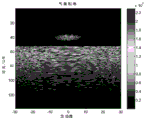
FIG. 7 shows the ground clutter suppression result obtained after the simulation data is processed by this method;
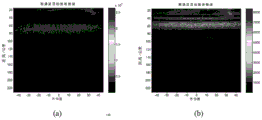
FIG. 8(a) is a schematic representation of a first set of measured echo data received by the sum channel;
FIG. 8(b) is a schematic diagram of a first set of measured echo data received by the difference channel;
FIG. 9 shows the result of ground clutter suppression obtained after the measured data is processed by this method;
FIG. 10(a) is a schematic representation of a second set of measured echo data received by the sum channel;
FIG. 10(b) is a schematic diagram of a second set of measured echo data received by the difference channel;
fig. 11 shows the ground clutter suppression result obtained after the actual measurement data is processed by this method.
Detailed Description
The method for suppressing ground clutter of an airborne weather radar based on vertical array covariance matrix characteristic decomposition according to the present invention is described in detail below with reference to the accompanying drawings and embodiments.
Taking a dual-channel receiving system as an example, the covariance matrix of the estimated airspace snapshot signal is a two-dimensional square matrix, and two eigenvalues can be obtained after the two-dimensional square matrix is subjected to characteristic decomposition. The ground clutter component power in the echo signal is larger than the weather clutter and white noise component. Therefore, when the echo only contains the ground clutter component, the power of the ground clutter component is mainly concentrated in the first characteristic value, so the first characteristic value can approximately represent the ground clutter component in the echo, and the second characteristic value mainly represents the white noise power; and when the echo signal contains the meteorological clutter, the second characteristic value is obviously increased, and the meteorological clutter component power can be approximately represented.
In view of the principle, the invention provides a ground clutter suppression method based on covariance matrix characteristic decomposition. In the actual processing, the method can utilize the double-channel airspace snapshot signal to obtain a corresponding covariance matrix, perform characteristic decomposition on the covariance matrix to obtain two different characteristic values, and respectively store the two characteristic values correspondingly to obtain the corresponding ground clutter and the power component of the meteorological target.
For convenience of discussion, the multi-channel radar is set to a one-shot multi-receiving mode, as shown in fig. 2, the operating wavelength is λ, the number of receiving channels is N, and the receiving channels are uniformly arranged at an interval d. In the recording of echo data, ground clutter and meteorological clutter scattering points exist simultaneously in a certain distance ring, and the pitch angles are thetacAnd thetaw. The processing flow is shown in fig. 3, and the main steps are as follows:
1) receiving data by adopting a vertical array antenna, and performing range-direction pulse compression processing on each path of signal;
the echo signal is pulse-compressed in the frequency domain by using a conventional Matched Filtering (MF) method, and the pulse-compressed echo signal s (τ, t) can be represented as:
Figure BDA0002258718640000041
wherein s (τ, t) represents an echo signal generated by the target at the time t, τ represents fast time sampling, t represents slow time sampling, σ (x, y, z) represents a complex reflection coefficient corresponding to the space coordinate (x, y, z) of the target, g (t) represents a gain generated by an antenna directional diagram at the time t on the target, R (τ) represents the intensity of a transmitted pulse signal corresponding to the fast time sampling time τ, R (t) is the instantaneous distance from a reference channel at the time t to the target, c represents the light speed, j represents an imaginary unit, λ is a working wavelength, e is a natural constant, and π is a circumferential rate.
2) Constructing pitching dimensional airspace snapshot signals corresponding to each distance-pulse unit according to the multi-channel data after pulse compression;
after pulse compression, a spatial domain snapshot signal (N × 1-dimensional column vector) at a certain position represents spatial sampling data of N channels during receiving echoes, and the form of the spatial domain snapshot signal can be expressed as:
χ=αwswcsc+n
wherein χ represents a spatial domain snapshot signal, n represents a white noise component in the snapshot, α is independent of other componentsw、αcRespectively representing the amplitude, s, of meteorological and ground clutterw、scSpace domain guide vectors of weather clutter and ground clutter, respectively, where sw、scCan be expressed as:
Figure BDA0002258718640000051
and
Figure BDA0002258718640000052
wherein N is the number of receiving channels, d is the distance between each receiving channel, and the pitch angles corresponding to the scattering points of the ground clutter and the gas image clutter are respectively thetacAnd thetawThe superscript T denotes the transposition operation.
3) Estimating a pitch dimensional covariance matrix of each range-pulse unit airspace snapshot signal by using adjacent azimuth samples;
the autocorrelation matrix R corresponding to the spatial snapshot signal χ can be expressed as:
Figure BDA0002258718640000053
wherein the superscript H represents the conjugate transpose operation, E {. is the mathematical expectation operation,
Figure BDA0002258718640000054
is white noise power, INIs an N multiplied by N dimensional unit matrix,
Figure BDA0002258718640000055
ground clutter and weather clutter power, respectively.
In a specific implementation, the calculation of the covariance matrix R may not only use one spatial snapshot signal at a corresponding position, but needs to estimate the autocorrelation matrix of the pitch and difference beams of each range-pulse unit by using adjacent samples, that is:
Figure BDA0002258718640000061
wherein,
Figure BDA0002258718640000062
and the covariance matrix obtained by estimation is represented, L represents the snapshot sample number of the data, and L represents the selected sample serial number.
4) Performing characteristic decomposition on the obtained pitch dimensional covariance matrix, and extracting a second characteristic value representing meteorological components;
it follows from step 2 that the autocorrelation matrix R is non-singular, and RHR is available as a positive hermitian square, so the characteristic decomposition of R can be written as:
Figure BDA0002258718640000063
wherein ∑ diag (λ)1,λ2,…,λii+1,…,λN),viIs λiAnd corresponding eigenvectors, wherein U represents an eigenvector matrix formed by all the eigenvectors.
When N is 2, the feature decomposition is performed on R, and it can be obtained:
Figure BDA0002258718640000064
wherein λ is12Respectively representing a first eigenvalue, a second eigenvalue, v, of the matrix1、v2Is the characteristic corresponding to the first characteristic value and the second characteristic valueAnd (5) sign vectors.
5) Processing the distance-pulse units one by one, extracting a second characteristic value, storing the second characteristic value in the corresponding distance-pulse unit, taking the second characteristic value as a final meteorological target output result,
according to the step 4), the ground clutter components and the meteorological components of each distance-pulse unit can be respectively extracted, the characteristic value represents the echo power of the meteorological target, the evolution operation needs to be carried out on the second characteristic values extracted by all the distance-pulse units, the amplitude information of the meteorological target can be obtained, and the amplitude information is displayed to obtain the output result of the meteorological target.
Experiments prove that
The airborne meteorological radar ground clutter suppression method based on the vertical array covariance matrix characteristic decomposition provided by the invention is used for processing simulation and actual measurement data to carry out method verification, and the experimental result fully proves the effectiveness of the method.
A surface feature target and meteorological target model is constructed, and two distributed meteorological targets are generated through simulation at 40 kilometers and 65 kilometers, as shown in figure 4. When the radar main beam touches the ground, part of the meteorological target may be masked due to the high echo intensity of the ground clutter, and the radar echo data generated at this time is as shown in fig. 5. The system parameters of the radar during simulation are as follows: the system bandwidth is 1.25MHz, the Pulse Repetition Frequency (PRF) is 1000Hz, the pulse width is 80us, the wavelength is 0.03 m, the distance gate is 100m, the flying height of the aircraft is 10 km, and the flying speed of the aircraft is 100 m/s. The Doppler frequency shift of a meteorological target generated by simulation is 300Hz, the spectral width is 200Hz, the Doppler frequency shift of ground clutter is 0, and the spectral width is 20 Hz. An analog radar four-channel receiving system. The echo data generated by simulation is processed by the method of the invention, the sum and difference channel original data is shown in figure 6, and the result obtained after processing is shown in figure 7. It can be seen that the ground clutter component is obviously suppressed, and the obtained meteorological component is consistent with the theoretical result, thus illustrating the effectiveness of the method. As can be seen from fig. 7, the ground clutter data contains residual meteorological components, because when the feature decomposition is performed, part of meteorological components are projected into the eigenvector corresponding to the first eigenvalue, the first eigenvalue increases, and the power of the meteorological target is also partially lost when the ground clutter suppression is performed.
And simultaneously, selecting two sets of airborne weather radar multi-channel measured data for verification. The system bandwidth is 1MHz, the Pulse Repetition Interval (PRI) is 2400us, the pulse width is 80us, the sampling frequency is 1.25MHz, the wavelength is 0.0356 m, the flying height of the aircraft is 6 kilometers, and the flying speed of the aircraft is 150 m/s. The first set of sum and difference channel actual measurement data output by the receiving end is shown in fig. 8, the left graph represents sum channel data, and the right graph represents difference channel data. The results obtained after treatment by the method of the invention are shown in FIG. 9. The second set of sum and difference channel measured data output by the receiving end is shown in fig. 10, and the processing result is shown in fig. 11. According to the processing result, the method can obtain a more ideal effect by suppressing the ground clutter, can display the meteorological target submerged by the ground clutter, can suppress the ground clutter more cleanly, achieves the purpose of suppressing the ground clutter and verifies the effectiveness of the method.
The above description is only of the preferred embodiments of the present invention, and it should be noted that: it will be apparent to those skilled in the art that various modifications and adaptations can be made without departing from the principles of the invention and these are intended to be within the scope of the invention.

Claims (6)

1. A method for suppressing ground clutter of an airborne weather radar based on vertical array covariance matrix characteristic decomposition is characterized by comprising the following steps:
1) receiving data by adopting a vertical array antenna, and performing range-direction pulse compression processing on each path of signal;
2) constructing pitching dimensional airspace snapshot signals corresponding to each distance-pulse unit according to the multi-channel data after pulse compression;
3) estimating a pitch dimensional covariance matrix of each range-pulse unit airspace snapshot signal by using adjacent azimuth samples;
4) performing characteristic decomposition on the obtained pitch dimensional covariance matrix, and extracting a second characteristic value representing meteorological components;
5) and processing the distance-pulse units one by one, extracting a second characteristic value, storing the second characteristic value in the corresponding distance-pulse unit, and taking the second characteristic value as a final meteorological target output result.
2. The method for ground clutter suppression of airborne weather radar based on vertical array covariance matrix eigendecomposition of claim 1, wherein: the process of receiving data by using the vertical array antenna in the step 1) and performing range-wise pulse compression processing on each path of signal comprises the following steps: the array elements in the array antenna system are arranged at the same interval in the vertical height, so that the received data of a plurality of channels are generated, and then the distance pulse compression is carried out on the generated echo data.
3. The method for ground clutter suppression of airborne weather radar based on vertical array covariance matrix eigendecomposition of claim 2, wherein: the process of constructing the pitch-dimensional airspace snapshot signal corresponding to each distance-pulse unit according to the multi-channel data after pulse compression in the step 2) is as follows: and selecting the received data of each array element generated in the corresponding distance-pulse unit according to the pulse-pressed echo data obtained by the airborne weather radar vertical array antenna system, so as to form a corresponding pitching dimensional airspace snapshot signal.
4. The method for ground clutter suppression of airborne weather radar based on vertical array covariance matrix eigendecomposition of claim 3, wherein: the process of estimating the pitching covariance matrix of each range-pulse unit airspace snapshot signal by using the adjacent azimuth samples in the step 3) is as follows: for the pitch-dimension airspace snapshot signals constructed by each distance-pulse unit, if the corresponding covariance matrix is estimated, the airspace snapshot signal samples with proper quantity in adjacent directions need to be selected, the autocorrelation matrix corresponding to each sample is calculated, and the pitch-dimension covariance matrix of the distance-pulse unit can be obtained by averaging the autocorrelation matrices.
5. The method for ground clutter suppression of airborne weather radar based on vertical array covariance matrix eigendecomposition of claim 4, wherein: the characteristic decomposition is performed on the pitch dimensional covariance matrix obtained in the step 4), and a process of extracting a second characteristic value representing the meteorological component is as follows: when the channels are double channels, the pitch dimensional covariance matrix in the step 3) is subjected to characteristic decomposition to obtain two characteristic values, the first characteristic value is extracted for displaying the ground clutter, and the second characteristic value is extracted for displaying the meteorological clutter.
6. The method for ground clutter suppression of airborne weather radar based on vertical array covariance matrix eigendecomposition of claim 5, wherein: the distance-pulse unit-by-distance processing in the step 5), extracting the second characteristic value and storing the second characteristic value in the corresponding distance-pulse unit, wherein the process of taking the second characteristic value as the final meteorological target output result comprises the following steps: and 4) extracting second characteristic values of the meteorological components represented by the distance-pulse units according to the step 4), performing evolution operation on the second characteristic values extracted by all the distance-pulse units to obtain amplitude information of the meteorological target, and displaying the stored data to obtain a final output result of the meteorological target.
CN201911064056.2A 2019-11-04 2019-11-04 Airborne weather radar ground clutter suppression method based on vertical array covariance matrix characteristic decomposition Active CN111220955B (en)

Priority Applications (1)

Application Number Priority Date Filing Date Title
CN201911064056.2A CN111220955B (en) 2019-11-04 2019-11-04 Airborne weather radar ground clutter suppression method based on vertical array covariance matrix characteristic decomposition

Applications Claiming Priority (1)

Application Number Priority Date Filing Date Title
CN201911064056.2A CN111220955B (en) 2019-11-04 2019-11-04 Airborne weather radar ground clutter suppression method based on vertical array covariance matrix characteristic decomposition

Publications (2)

Publication Number Publication Date
CN111220955A true CN111220955A (en) 2020-06-02
CN111220955B CN111220955B (en) 2022-10-11

Family

ID=70806329

Family Applications (1)

Application Number Title Priority Date Filing Date
CN201911064056.2A Active CN111220955B (en) 2019-11-04 2019-11-04 Airborne weather radar ground clutter suppression method based on vertical array covariance matrix characteristic decomposition

Country Status (1)

Country Link
CN (1) CN111220955B (en)

Cited By (5)

* Cited by examiner, † Cited by third party
Publication number Priority date Publication date Assignee Title
CN111781603A (en) * 2020-06-09 2020-10-16 南京航空航天大学 An airborne weather radar ground clutter suppression method
CN112379380A (en) * 2020-10-29 2021-02-19 河海大学 Wind power plant clutter suppression method based on mean value method reprocessing truncation matrix completion
CN112630724A (en) * 2020-10-30 2021-04-09 哈尔滨工程大学 High-resolution target azimuth estimation method suitable for UUV platform
CN112698291A (en) * 2020-12-18 2021-04-23 南京航空航天大学 Onboard meteorological radar meteorological target detection method based on CNN
CN114200406A (en) * 2021-11-29 2022-03-18 南京航空航天大学 Airborne weather radar target detection method based on rapid self-adaptive pulse compression

Citations (6)

* Cited by examiner, † Cited by third party
Publication number Priority date Publication date Assignee Title
US20120249361A1 (en) * 2011-04-04 2012-10-04 Zafer Sahinoglu Method for Detecting Targets Using Space-Time Adaptive Processing
CN103018727A (en) * 2011-09-27 2013-04-03 中国科学院电子学研究所 Sample-training-based non-stationary clutter suppression method of vehicle-mounted radar
CN103383449A (en) * 2013-07-14 2013-11-06 西安电子科技大学 ESPRIT algorithm based short-range clutter suppression method for airborne radar
CN103529437A (en) * 2013-10-15 2014-01-22 西安电子科技大学 Method used for captive-balloon-borne phased array radar to distinguish open space targets under multi-target condition
US20150177376A1 (en) * 2012-06-22 2015-06-25 Brookhaven Science Associates Llc Atmospheric radar
CN108020817A (en) * 2017-09-28 2018-05-11 西安电子科技大学 Air-borne Forward-looking battle array radar clutter suppression method based on registration

Patent Citations (6)

* Cited by examiner, † Cited by third party
Publication number Priority date Publication date Assignee Title
US20120249361A1 (en) * 2011-04-04 2012-10-04 Zafer Sahinoglu Method for Detecting Targets Using Space-Time Adaptive Processing
CN103018727A (en) * 2011-09-27 2013-04-03 中国科学院电子学研究所 Sample-training-based non-stationary clutter suppression method of vehicle-mounted radar
US20150177376A1 (en) * 2012-06-22 2015-06-25 Brookhaven Science Associates Llc Atmospheric radar
CN103383449A (en) * 2013-07-14 2013-11-06 西安电子科技大学 ESPRIT algorithm based short-range clutter suppression method for airborne radar
CN103529437A (en) * 2013-10-15 2014-01-22 西安电子科技大学 Method used for captive-balloon-borne phased array radar to distinguish open space targets under multi-target condition
CN108020817A (en) * 2017-09-28 2018-05-11 西安电子科技大学 Air-borne Forward-looking battle array radar clutter suppression method based on registration

Non-Patent Citations (4)

* Cited by examiner, † Cited by third party
Title
I. SIKANETA 等: "Metrics for SAR-GMTI based on eigen-decomposition of the sample covariance matrix", 《2003 PROCEEDINGS OF THE INTERNATIONAL CONFERENCE ON RADAR》 *
I.C. SIKANETA 等: "Eigendecomposition ofthe multi-channel covariance matrix with applications to SAR-GMTI", 《SIGNAL PROCESSING》 *
刘涛 等: "基于特征空间自适应波束形成的近程杂波抑制算法", 《现代雷达》 *
王睿 等: "基于俯仰维信息的天基双基地雷达正交投影STAP算法", 《电光与控制》 *

Cited By (7)

* Cited by examiner, † Cited by third party
Publication number Priority date Publication date Assignee Title
CN111781603A (en) * 2020-06-09 2020-10-16 南京航空航天大学 An airborne weather radar ground clutter suppression method
CN111781603B (en) * 2020-06-09 2023-12-19 南京航空航天大学 A ground clutter suppression method for airborne weather radar
CN112379380A (en) * 2020-10-29 2021-02-19 河海大学 Wind power plant clutter suppression method based on mean value method reprocessing truncation matrix completion
CN112630724A (en) * 2020-10-30 2021-04-09 哈尔滨工程大学 High-resolution target azimuth estimation method suitable for UUV platform
CN112698291A (en) * 2020-12-18 2021-04-23 南京航空航天大学 Onboard meteorological radar meteorological target detection method based on CNN
CN112698291B (en) * 2020-12-18 2023-12-15 南京航空航天大学 A CNN-based airborne weather radar meteorological target detection method
CN114200406A (en) * 2021-11-29 2022-03-18 南京航空航天大学 Airborne weather radar target detection method based on rapid self-adaptive pulse compression

Also Published As

Publication number Publication date
CN111220955B (en) 2022-10-11

Similar Documents

Publication Publication Date Title
CN111220955A (en) Ground clutter suppression method for airborne weather radar based on vertical array covariance matrix eigendecomposition
CN102721947B (en) Efficient three-dimensional space-time adaptive clutter suppression method for airborne digital array radar
CN103529437B (en) Method used for captive-balloon-borne phased array radar to distinguish open space targets under multi-target condition
CN104035095B (en) Based on the low level wind shear velocity estimation method of optimal processor during sky
CN107703490A (en) Range ambiguity clutter suppression method based on FDA MIMO radars
Goodman et al. On clutter rank observed by arbitrary arrays
AU2010310752A1 (en) Resolution enhancement system for networked radars
CN107632291A (en) A kind of method based on the anti-corner reflector interference of polarimetric radar
CN106093870A (en) The SAR GMTI clutter suppression method of hypersonic aircraft descending branch
CN109765529B (en) Millimeter wave radar anti-interference method and system based on digital beam forming
CN106405557A (en) Radar detection method for preventing collision with high-voltage power line by helicopter
CN103176168A (en) Short-range cluster cancellation method for airborne non-side-looking array radar
CN104345301A (en) Non-adaptive clutter pre-filtering space-time two-dimensional cancellation method for airborne MIMO (Multiple-Input-Multiple-Output) radar
CN103267964A (en) A ΣΔ-STAP method for missile-borne seeker radar based on low-rank matrix recovery
CN104345299A (en) Airborne MIMO (Multiple Input Multiple Output) radar space-time self-adaptive processing method based on simplified EC
CN113917424B (en) A ground clutter suppression method for ground-based MIMO radar based on DDMA and blind source separation
CN107748364A (en) Low wind field speed estimation method based on contraction multistage wiener filter
CN1299123C (en) Parameter estimation method for modelling noise Doppler of airborne radar
Deng et al. Blind source separation-based high-speed weak target coherent detection method under strong target bssl covering situation
Shen et al. Efficient adaptive approach for airborne radar short-range clutter suppression
CN106526544B (en) Clutter suppression method for MIMOSAR based on hypersonic platform
CN106054195B (en) The turbulent flow spectrum width method of estimation of optimal processor during based on sky
CN107576962A (en) Low level wind shear velocity estimation method based on iteration self-adapting processing
CN104914421A (en) Low-altitude wind shear wind speed estimating method based on sum-difference beam
CN113359196B (en) Multi-target vital sign detection method based on subspace method and DBF

Legal Events

Date Code Title Description
PB01 Publication
PB01 Publication
SE01 Entry into force of request for substantive examination
GR01 Patent grant
GR01 Patent grant