Disclosure of Invention
The present invention is directed to a tracking filter technique for tracking a target only by using range-doppler measurement, which overcomes at least some of the drawbacks of the prior art described above.
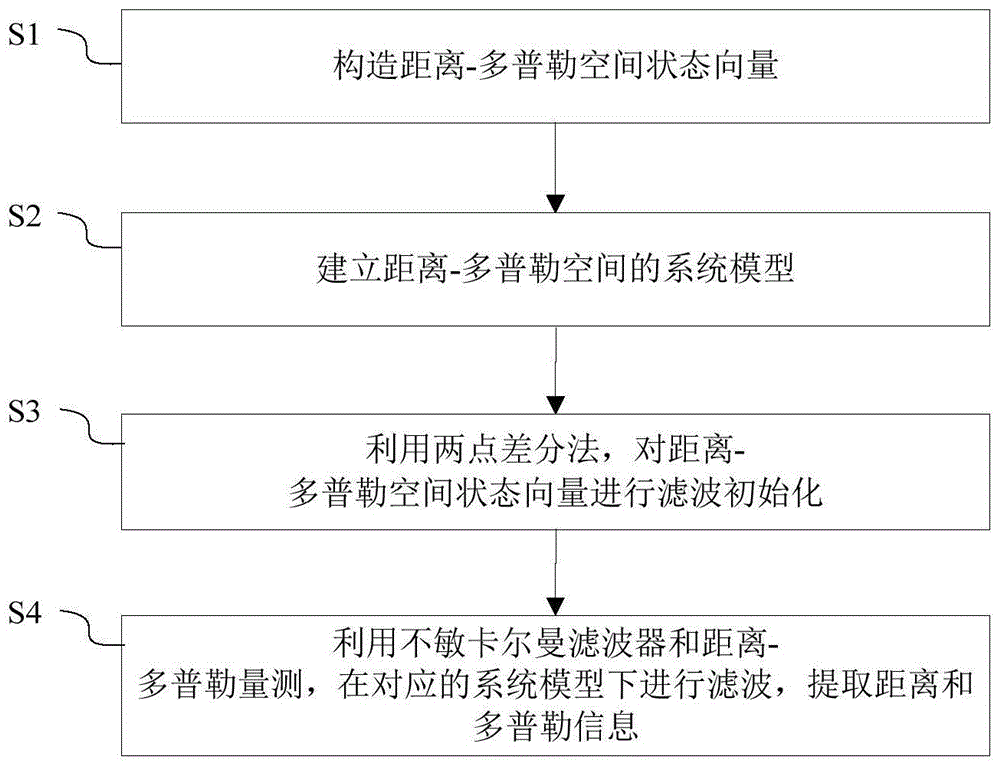
In order to achieve the above object, the present invention provides a tracking filtering method based on range-doppler measurement, which comprises the following steps:
s1, constructing a distance-Doppler space state vector;
s2, establishing a system model of a distance-Doppler space;
s3, performing filtering initialization on the range-Doppler space state vector by using a two-point difference method;
and S4, filtering under a corresponding system model by using an insensitive Kalman filter and distance-Doppler measurement, and extracting distance and Doppler information.
Preferably, in step S1, constructing the range-doppler space state vector further includes:
for CV motion, CT motion, the range-doppler space state vector expression is:
for CA motion, the range-doppler space state vector expression is:
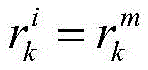
where k denotes the scan cycle number, r
kAnd
respectively represent the distance sum of the objectsThe doppler of the doppler is measured,
and
respectively representing the first, second and third derivatives of converted Doppler, converted Doppler
Preferably, in step S2, the modeling the system of range-doppler space further includes:
for CV motion, the equation of state for range-doppler space is expressed as:
the expression of the measurement equation is as follows:
process noise vkThe variance expression of (a) is:
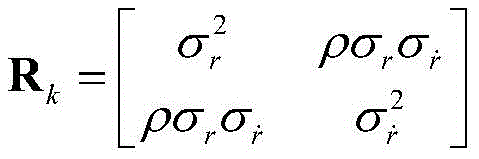
measurement noise wkThe variance expression of (a) is:
for CT motion, the equation of state for range-doppler space is expressed as:
the expression of the measurement equation is as follows:
process noise vkThe variance expression of (a) is:
measurement noise wkThe variance expression of (a) is:
where T represents the radar scan interval, w represents the constant turn rate,
and
respectively representing range and doppler measurements of the target,
and
respectively representing the measurement errors of the range and Doppler measurements of the target, with variance of
And
the correlation coefficient of the variance is p,
means mean zero variance q
2White gaussian noise.
Preferably, in step S2, the modeling the system of range-doppler space further includes:
for CA motion, the equation of state for range-doppler space is expressed as:
the expression of the measurement equation is as follows:
process noise vkThe variance expression of (a) is:
measurement noise wkThe variance expression of (a) is:
wherein T represents a radar scan interval,
and
respectively representing range and doppler measurements of the target,
and
respectively representing the measurement errors of the range and Doppler measurements of the target, with variance of
And
the correlation coefficient of the variance is p,
means mean zero variance q
2White gaussian noise.
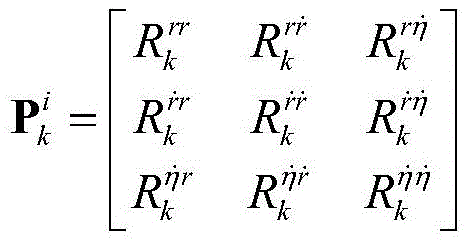
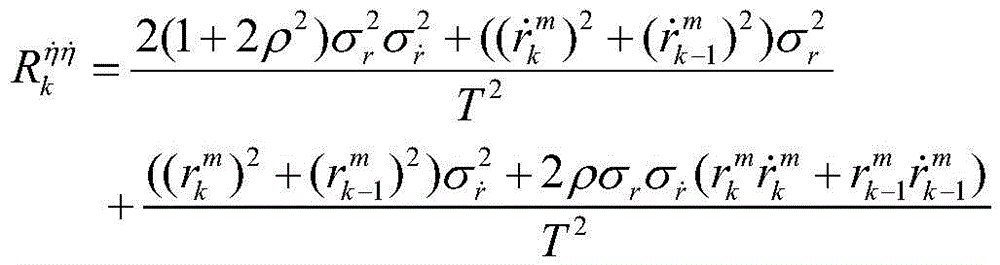
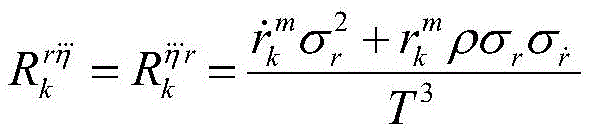
Preferably, in step S3, the initializing filtering the range-doppler space state vector further includes:
for CV motion, CT motion, the distance-doppler space initial state vector is noted as:
the corresponding initial covariance is noted as:
then there is
Preferably, in step S3, the initializing filtering the range-doppler space state vector further includes:
for CA motion, the range-doppler space initial state vector is noted as:
the corresponding initial covariance is noted as:
then there is
Preferably, in step S4, the filtering under the corresponding system model further includes:
initializing the state vector and covariance according to step S3 yields:
for k 2,3,4, …, the following iterations are performed:
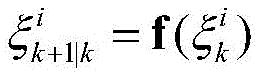
s4-1, calculating 2n by UT transformx+1 δ sample points ξiAnd corresponding weight value WiThe expression includes:
wherein n is
xRepresenting state vectors
Is a number of dimensions of
xA scalar parameter of + λ ≠ 0,
is a matrix (n)
x+λ)P
k|kRow i or column i of root mean square;
s4-2, calculating the state one-step prediction, wherein the expression is as follows:
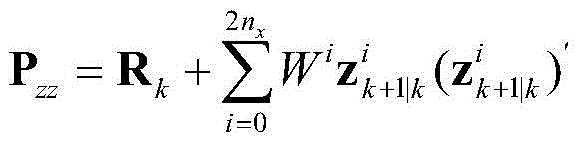
s4-3, calculating the one-step prediction covariance, wherein the expression is as follows:
s4-4, filtering gain is carried out, and the expression is as follows:
Kk+1=Pxz(Pzz)-1
s4-5, updating the state, wherein the expression is as follows:
s4-6, updating the variance, wherein the expression is as follows:
Pk+1|k+1=Pk+1|k-Kk+1Pzz(Kk+1)′。
the invention also provides a tracking filter device based on the distance-Doppler measurement, which comprises:
a vector module for constructing a range-doppler space state vector;
the system module is used for establishing a system model of a distance-Doppler space;
the initialization module is used for carrying out filtering initialization on the range-Doppler space state vector by utilizing a two-point difference method;
and the filtering module is used for filtering under a corresponding system model by using the insensitive Kalman filter and the distance-Doppler measurement to extract distance and Doppler information.
The invention also provides a computer device comprising a memory storing a computer program and a processor implementing the steps of any of the above methods when the processor executes the computer program.
The invention also provides a computer-readable storage medium, on which a computer program is stored, which computer program, when being executed by a processor, carries out the steps of the method of any of the above.
The technical scheme of the invention has the following advantages: the invention constructs the state vector of the distance-Doppler space, establishes a corresponding system model, deduces an initialization method of the state vector in the filtering process by using a two-point difference method, provides a filtering method for extracting distance and Doppler information only based on distance-Doppler measurement, and realizes space target tracking. The tracking filtering method based on the distance-Doppler measurement can establish an accurate state equation of the distance and Doppler evolution along with time under the condition of no angle information, thereby extracting accurate distance and Doppler estimation by only utilizing the distance and Doppler measurement and establishing a foundation for target tracking and other applications in the distance-Doppler space.
Detailed Description
In order to make the objects, technical solutions and advantages of the embodiments of the present invention clearer, the technical solutions in the embodiments of the present invention will be clearly and completely described below with reference to the drawings in the embodiments of the present invention, and it is obvious that the described embodiments are some, but not all, embodiments of the present invention. All other embodiments, which can be obtained by a person skilled in the art without any inventive step based on the embodiments of the present invention, are within the scope of the present invention.
As shown in fig. 1, an embodiment of the present invention provides a tracking filtering method based on range-doppler measurement, including the following steps:
and S1, constructing a distance-Doppler space state vector.
Preferably, constructing the range-doppler space state vector further comprises:
for CV motion (uniform linear motion) and CT motion (constant turning motion), the distance-doppler space state vector expression is:
for CA motion (uniformly accelerated linear motion), the range-doppler space state vector expression is:
where k denotes the scan cycle number, r
kAnd
respectively representing objectsThe range and the doppler are such that,
and
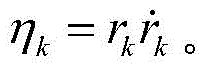
first, second and third derivatives of converted doppler are indicated, respectively, converted doppler being defined as:
and S2, establishing a system model of the range-Doppler space.
Preferably, the modeling of the system of range-doppler space further comprises:
for CV motion, the equation of state for range-doppler space is expressed as:
the expression of the measurement equation is as follows:
process noise vkThe variance expression of (a) is:
measurement noise wkThe variance expression of (a) is:
wherein T represents a radar scan interval,
and
respectively representing range and doppler measurements of the target,
and
respectively representing the measurement errors of the range and Doppler measurements of the target, with variance of
And
the correlation coefficient of the variance is p,
means mean zero variance q
2White gaussian noise.
For CT motion, the equation of state for range-doppler space is expressed as:
the expression of the measurement equation is as follows:
process noise vkThe variance expression of (a) is:
measurement noise wkThe variance expression of (a) is:
where T represents the radar scan interval, w represents the constant turn rate,
and
respectively representing range and doppler measurements of the target,
and
respectively representing the measurement errors of the range and Doppler measurements of the target, with variance of
And
the correlation coefficient of the variance is p,
means mean zero variance q
2White gaussian noise.
For CA motion, the equation of state for range-doppler space is expressed as:
the expression of the measurement equation is as follows:
process noise vkThe variance expression of (a) is:
measurement noise wkThe variance expression of (a) is:
wherein T represents a radar scan interval,
and
respectively representing range and doppler measurements of the target,
and
respectively representing the measurement errors of the range and Doppler measurements of the target, with variance of
And
the correlation coefficient of the variance is p,
means mean zero variance q
2White gaussian noise.
S3, filter initialization is performed on the range-doppler space state vector by the two-point difference method.
Preferably, the initialization of filtering the range-doppler space state vector further comprises:
for CV motion, CT motion, the distance-doppler space initial state vector is noted as:
the corresponding initial covariance is noted as:
then there are:
for CA motion, the range-doppler space initial state vector is noted as:
the corresponding initial covariance is noted as:
then there are:
s4, filtering under a corresponding system model by using an insensitive Kalman filter (UKF) and distance-Doppler measurement, extracting distance and Doppler information, and finally realizing target tracking.
Preferably, the filtering under the corresponding system model further comprises:
initializing the state vector and covariance according to step S3 yields:
for k 2,3,4, …, the following iteration is performed, i.e. for k 2,3,4, … the recursion is performed using the following steps:
s4-1, calculating 2n by UT transformx+1 δ sample points ξiAnd corresponding weight value WiThe expression includes:
wherein n is
xRepresenting state vectors
Is a number of dimensions of
xA scalar parameter of + λ ≠ 0,
is a matrix (n)
x+λ)P
k|kRow i or column i of root mean square;
s4-2, calculating the state one-step prediction, wherein the expression is as follows:
s4-3, calculating the one-step prediction covariance, wherein the expression is as follows:
s4-4, filtering gain is carried out, and the expression is as follows:
Kk+1=Pxz(Pzz)-1
s4-5, updating the state, wherein the expression is as follows:
s4-6, updating the variance, wherein the expression is as follows:
Pk+1|k+1=Pk+1|k-Kk+1Pzz(Kk+1)′。
the invention defines the state vectors of three basic motions (constant velocity linear motion CV, uniform acceleration linear motion CA and constant turning motion CT) in a distance-Doppler space, establishes corresponding motion models, provides a specific method for filter initialization and filtering, fills the blank that no accurate model for tracking only by using distance-Doppler measurement exists in the prior art, and establishes a foundation for target tracking and other applications in the distance-Doppler space.
Preferably, in order to verify the effectiveness of the range-doppler space modeling and the filtering method, the invention also compares the provided method with a posterior clarmero bound (PCRLB) under the model in a simulation mode, and examines the consistency of the method.
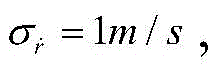
In a particular embodimentIn the embodiment, for CV motion, simulation conditions set that the radar is positioned at the origin of coordinates, the distance and Doppler measurement information of a target are given at a scanning interval of 1s, and the standard deviation of the measurement is respectively sigma
r800m and
the correlation coefficient ρ is 0.9. The target moves in CV, the initial position is (30km ), the initial speed is 10m/s, and the direction is-45 degrees. The standard deviation of the process noise of the CV motion under the Cartesian coordinate system is set to 0.001m/s
2The standard deviation of the process noise of the system model in the range-Doppler space is set as q equal to 0.001m/s
2. The Monte-Carlo simulation results of 100 tracking scans for 1000 Monte Carlo experiments under the above conditions are shown in fig. 2, where fig. 2(a) shows distance RMSE, fig. 2(b) shows doppler RMSE, fig. 2(c) shows third element of state vector RMSE, fig. 2(d) shows mean normalized state error squared, 98% confidence interval (2.82, 3.18). Fig. 2 shows that the filter error of the CV motion model in the range-doppler space converges quickly and is close to PCRLB, the mean normalized state error squared falls within the 98% confidence interval, and the filter consistency is good.
In a specific embodiment, for the CT motion, the simulation case sets the radar to be located at the origin of coordinates, and gives the distance and doppler measurement information of the target at the scanning interval of 1s, and the standard deviation of the measurement is σ
r800m and
the correlation coefficient ρ is 0.9. The target moves in CT with initial position (30km ), initial speed of 10m/s, direction of-45 degrees and constant turning speed of-3 deg/s. The standard deviation of the noise in the process of CT motion in a Cartesian coordinate system is set to 0.001m/s
2The standard deviation of the process noise of the system model in the range-Doppler space is set as q equal to 0.001m/s
2. The Monte-Carlo simulation results from 100 tracking scans performed 1000 Monte Carlo experiments under the above conditions are shown in fig. 3. FIG. 3(a) shows the distance RMSE, FIG. 3(b) shows the Doppler RMSE, FIG. 3(c) shows the third element of the state vector RMSE,fig. 3(d) shows the mean normalized state error squared, 98% confidence interval (2.82, 3.18). Fig. 3 shows that the filtering error of the CT motion model in the range-doppler space converges quickly and is close to PCRLB, the mean normalized state error squared falls within the confidence interval of 98%, and the filtering consistency is good.
In a specific embodiment, for the CA motion, the simulation case sets the radar to be located at the origin of coordinates, and gives the distance and doppler measurement information of the target at the scanning interval of 1s, and the standard deviation of the measurement is σ
r800m and
the correlation coefficient ρ is 0.9. The target moves in CA mode, the initial position is (30km ), the initial speed is 10m/s, the direction is minus 45 degrees, and the acceleration is 1m
2And s. The standard deviation of the noise in the CA process under the Cartesian coordinate system is set to 0.001m/s
2The standard deviation of the process noise of the system model in the range-Doppler space is set to be q 0.001m
2/s
5. The Monte-Carlo simulation results from 100 tracking scans performed 1000 Monte Carlo experiments under the above conditions are shown in fig. 4. Fig. 4(a) shows the distance RMSE, fig. 4(b) shows the doppler RMSE, fig. 4(c) shows the third element RMSE, fig. 4(d) shows the fourth element RMSE, fig. 4(e) shows the fifth element RMSE, fig. 4(f) shows the mean normalized state error squared, 98% confidence interval (4.77, 5.24). Fig. 4 shows that the filtering error of the CA motion model in the range-doppler space converges quickly and is close to PCRLB, the mean normalized state error squared falls within the 98% confidence interval, and the filtering consistency is good.
From the simulation results, the filtering errors of the three basic motion models in the range-doppler space are converged quickly, and are close to the PCRLB, the square of the average normalized state error is within a 98% confidence interval, and the filtering consistency is good.
Further, as shown in fig. 5, the present invention also provides a tracking filtering apparatus based on range-doppler measurement, which includes a vector module 100, a system module 200, an initialization module 300, and a filtering module 400.
Wherein the vector module 100 is configured to construct a range-doppler space state vector. The system module 200 is used to build a system model of the range-doppler space. The initialization module 300 is configured to perform filtering initialization on the range-doppler space state vector by using a two-point difference method. The filtering module 400 is configured to perform filtering under a corresponding system model by using an insensitive kalman filter and range-doppler measurement, and extract range and doppler information.
In particular, in some preferred embodiments of the present invention, there is further provided a computer device, including a memory and a processor, where the memory stores a computer program, and the processor implements the steps of the tracking filtering method based on range-doppler measurement in any one of the above embodiments when executing the computer program.
In other preferred embodiments of the present invention, a computer-readable storage medium is further provided, on which a computer program is stored, and the computer program is executed by a processor to implement the steps of the distance-doppler measurement based tracking filtering method described in any of the above embodiments.
It will be understood by those skilled in the art that all or part of the processes of the methods of the embodiments described above can be implemented by hardware instructions of a computer program, which can be stored in a non-volatile computer-readable storage medium, and when the computer program is executed, the processes of the embodiments of the methods described above can be included, and will not be repeated here.
Finally, it should be noted that: the above examples are only intended to illustrate the technical solution of the present invention, but not to limit it; although the present invention has been described in detail with reference to the foregoing embodiments, it will be understood by those of ordinary skill in the art that: the technical solutions described in the foregoing embodiments may still be modified, or some technical features may be equivalently replaced; and such modifications or substitutions do not depart from the spirit and scope of the corresponding technical solutions of the embodiments of the present invention.