CN110146864B - Comprehensive calibration method and system for weather radar - Google Patents
Comprehensive calibration method and system for weather radar Download PDFInfo
- Publication number
- CN110146864B CN110146864B CN201910599555.5A CN201910599555A CN110146864B CN 110146864 B CN110146864 B CN 110146864B CN 201910599555 A CN201910599555 A CN 201910599555A CN 110146864 B CN110146864 B CN 110146864B
- Authority
- CN
- China
- Prior art keywords
- radar
- signal
- calibration
- target
- amplitude
- Prior art date
- Legal status (The legal status is an assumption and is not a legal conclusion. Google has not performed a legal analysis and makes no representation as to the accuracy of the status listed.)
- Active
Links
- 238000000034 method Methods 0.000 title claims abstract description 32
- 239000002184 metal Substances 0.000 claims abstract description 24
- 229910052751 metal Inorganic materials 0.000 claims abstract description 24
- 238000012545 processing Methods 0.000 claims abstract description 22
- 238000006243 chemical reaction Methods 0.000 claims abstract description 20
- 238000007781 pre-processing Methods 0.000 claims abstract description 9
- 230000010287 polarization Effects 0.000 claims description 119
- 238000004088 simulation Methods 0.000 claims description 116
- 238000005259 measurement Methods 0.000 claims description 68
- 230000010363 phase shift Effects 0.000 claims description 48
- 229910052739 hydrogen Inorganic materials 0.000 claims description 45
- 230000005540 biological transmission Effects 0.000 claims description 40
- 230000028161 membrane depolarization Effects 0.000 claims description 24
- 238000004364 calculation method Methods 0.000 claims description 18
- 238000002310 reflectometry Methods 0.000 claims description 18
- 230000008859 change Effects 0.000 claims description 12
- 230000005571 horizontal transmission Effects 0.000 claims description 11
- 238000001514 detection method Methods 0.000 claims description 10
- 238000001914 filtration Methods 0.000 claims description 9
- 230000011664 signaling Effects 0.000 claims description 5
- 230000003595 spectral effect Effects 0.000 claims description 5
- 230000009977 dual effect Effects 0.000 claims description 2
- 238000002347 injection Methods 0.000 abstract description 3
- 239000007924 injection Substances 0.000 abstract description 3
- 239000000243 solution Substances 0.000 description 7
- 238000010586 diagram Methods 0.000 description 3
- 238000005516 engineering process Methods 0.000 description 2
- 230000004048 modification Effects 0.000 description 2
- 238000012986 modification Methods 0.000 description 2
- 230000008569 process Effects 0.000 description 2
- 238000001228 spectrum Methods 0.000 description 2
- 238000012360 testing method Methods 0.000 description 2
- 230000006872 improvement Effects 0.000 description 1
- 230000005855 radiation Effects 0.000 description 1
- 230000001360 synchronised effect Effects 0.000 description 1
Images


Classifications
-
- G—PHYSICS
- G01—MEASURING; TESTING
- G01S—RADIO DIRECTION-FINDING; RADIO NAVIGATION; DETERMINING DISTANCE OR VELOCITY BY USE OF RADIO WAVES; LOCATING OR PRESENCE-DETECTING BY USE OF THE REFLECTION OR RERADIATION OF RADIO WAVES; ANALOGOUS ARRANGEMENTS USING OTHER WAVES
- G01S7/00—Details of systems according to groups G01S13/00, G01S15/00, G01S17/00
- G01S7/02—Details of systems according to groups G01S13/00, G01S15/00, G01S17/00 of systems according to group G01S13/00
- G01S7/40—Means for monitoring or calibrating
- G01S7/4004—Means for monitoring or calibrating of parts of a radar system
Landscapes
- Engineering & Computer Science (AREA)
- Radar, Positioning & Navigation (AREA)
- Remote Sensing (AREA)
- Computer Networks & Wireless Communication (AREA)
- Physics & Mathematics (AREA)
- General Physics & Mathematics (AREA)
- Radar Systems Or Details Thereof (AREA)
Abstract
The invention relates to a comprehensive calibration method and a comprehensive calibration system for a weather radar, wherein the method comprises the following steps: receiving a radio frequency signal of a weather radar; preprocessing a radio frequency signal; calculating the amplitude of HV components of radar emission signals, HV phase difference, pulse width, antenna rotating speed and beam width according to the radio frequency digital signals; performing down-conversion processing on the radio frequency digital signal according to the state information; carrying out delay, Doppler frequency modulation and amplitude modulation on the digital baseband signal to obtain a digital baseband modulation signal; performing digital-to-analog conversion on the digital baseband modulation signal; carrying out amplitude control on the analog target intermediate frequency signal according to the intensity index; and calibrating the emission power of the simulated target according to the echo intensity of the metal ball. In the technical scheme of the invention, the standard metal ball is used based on an objective calibration principle, which is different from the current subjective calibration based on a simulated target injection mode, the amplitude of the simulated target selected by the subjective calibration belongs to an assumed true value, and the objective calibration of the metal ball has a true value basis.
Description
Technical Field
The invention relates to the field of parameter calibration of weather radars, in particular to a comprehensive calibration method and a comprehensive calibration system of the weather radars.
Background
The weather radar comprehensive calibration instrument can be used for testing radiation parameters of a calibrated radar system, testing reference parameters of the comprehensive calibration instrument, and can also be used for comprehensively calibrating overall measurement parameters of the radar system and the like. The detection of the far-field outer loop comprises parameters such as transmitting power, pulse width, frequency spectrum width, antenna beam width, antenna gain and the like, and the calibration is carried out on the parameters.
Disclosure of Invention
The present invention is directed to solving at least one of the problems of the prior art or the related art.
Therefore, one object of the present invention is to provide a weather radar comprehensive calibration method, which can realize rapid and synchronous measurement of all parameters of a dual-linear polarization doppler weather radar, and improve the timeliness of detection data.
The invention also aims to provide a weather radar comprehensive calibration system, which adopts a unique two-channel full-path transceiving calibration technology, can greatly reduce the error of a two-channel transceiving system of a radar system, and provides effective guarantee for improving the quality of detection data.
In order to achieve the above object, a technical solution of a first aspect of the present invention provides a weather radar comprehensive calibration method, including the following steps:
receiving a radio frequency signal of a weather radar by using a broadband dual-polarization receiving antenna;
preprocessing the radio frequency signal to obtain a radio frequency digital signal and an H, V channel digital signal corresponding to the same radio frequency digital signal;
measuring the state information of the radio frequency signal according to the radio frequency digital signal, and simultaneously calculating the amplitude calibration parameter Ka and the phase difference calibration parameter delta of the weather radar transmitting branch according to the H, V channel digital signalφa;
Wherein, the state information comprises pulse width tau and pulse period T, H channel in-phase component IhaV channel in-phase component IvaH channel quadrature component QhaV channel quadrature component QvaPower, H amplitude AhaV amplitude AvaH phase phihaV phase phivaAnd HV phase difference deltaφa,

Performing down-conversion processing on the radio frequency digital signal according to the state information to obtain a digital baseband signal;
carrying out delay, Doppler frequency modulation and amplitude modulation on the digital baseband signal to obtain a digital baseband modulation signal;
performing digital-to-analog conversion on the digital baseband modulation signal to obtain an analog target intermediate frequency signal;
carrying out amplitude control on the intermediate frequency signal of the simulation target according to the radar echo intensity to obtain a simulation target signal;
obtaining Doppler frequency generated by high-speed rotation of the metal ball;
outputting a simulated target signal, and controlling the frequency of the simulated target signal to be equal to the Doppler frequency to obtain a simulated target output signal;
calculating the power of all simulated target output signals of the distance library in the weather radar range according to the radar echo intensity corresponding to the preset distance library, and calibrating the intensity of all the simulated target output signals;
the expression of the radar echo intensity corresponding to the preset distance library is as follows:

sigma is the projection area of the metal ball, lambda is the radar working wavelength, theta is the radar azimuth beam width, the radar pitch beam width is defined as r, the distance from a calibration point to the radar is defined as c, the speed of light is defined as c, and tau is the radar emission pulse width;
the calculation formula of the power of all simulated target output signals of the distance library in the range of the weather radar is as follows:

Ptfor radar transmission power, GtFor radar antenna gain, AeFor receiving the antenna area, set to be the same as the projected area sigma of the metal ball, and transmit power P by radartAnd radar antenna gain GtThe simulated target power can be calculated;
calculating an analog target power by receiving the amplitude of the radio frequency signal Wherein: l isaIs the receive channel loss;
the radar transmission power can be measured when the radar transmission power Pt is unknown: gain G in radar antennatWhen unknown, the antenna gain can be measured:
the weather radar adopts a circular paraboloid antenna, the azimuth beam width is equal to the pitch beam width, so that: gt=42.5-20logθ;
Calculating antenna gain according to azimuth beam width theta, measuring radar antenna beam width by receiving radar emission signal, and scanning a frame according to radar to obtain maximum value interval time TzMeasuring radar azimuth scanning speed omegaθMeasuring the maximum value of 0.707 times of the corresponding scanning time delta according to the amplitude change of the signals transmitted by the receiving radartAnd calculating the beam width: θ=Δtωθ。
in the technical scheme, the standard metal ball is based on an objective calibration principle, and is different from the current subjective calibration based on a simulated target injection mode, the amplitude of a simulated target selected by the subjective calibration belongs to an assumed true value, and the objective calibration of the metal ball has a true value basis.
In the above technical solution, preferably, the method further includes the following steps: the polarized scanning antenna moves to form a preset angle of 45 degrees with the weather radar;
the method comprises the steps that a weather radar receives a polarization simulation target transmitting signal which is sent by a polarization scanning antenna and is equal to an H, V channel signal of the same simulation target output signal, and calculates an amplitude ratio and a phase difference to obtain a radar receiving channel amplitude calibration coefficient and a phase calibration parameter;
wherein is connected toThe receive channel amplitude calibration coefficients are: δφb=φhb-φvb;
the calibration coefficient of the radar double-offset amplitude ratio is as follows: k ═ Ka*Kb;
The radar phase calibration parameters are as follows:
δφbHV phase difference, phi, of the transmitted signal for the polarization simulation targethbSimulating the H phase, phi of the target transmission signal for said polarizationvbSimulating the V-phase, A, of the target transmission signal for said polarizationhbSimulating H amplitude, A of the signal transmitted for said polarizationvbSimulating the Vamplitude of the target transmission signal for the polarization;
the weather radar carries out amplitude-phase consistency calibration on H, V channel signals of the same simulation target output signal according to the amplitude calibration coefficient and the phase calibration parameter to obtain an amplitude ratio true value;
controlling a polarization scanning antenna to carry out polarization scanning according to a preset interval scanning angle, and sending H, V channel signals of the same analog target output signal after amplitude ratio truth value and phase control to a weather radar;
the method comprises the steps that a weather radar receives an amplitude ratio true value, H, V channel signals of the same simulation target output signal are subjected to nonlinear calibration, and radar polarization measurement parameters of different scanning angles are calibrated;
the HV nonlinear calibration is used for establishing an HV calibration parameter table, carrying out nonlinear calibration on the radar amplitude ratio, generating a series of amplitude calibration parameters by adjusting the polarization scanning angle alpha of the polarization scanning antenna, reading radar amplitude ratio measurement values, calculating a calibration coefficient, establishing an amplitude ratio calibration parameter table, and looking up the table during calibration to obtain the calibration coefficient;
the expression for the amplitude calibration parameters is:
Ava=Z0tgα,Aha=Z0ctgα,Ka=tg2α; the value range of the polarization scanning angle alpha is 5-88 degrees, and the true value of the amplitude ratio is 0.008; presetting an interval scanning angle to be 1 degree; the angle of the terminated polarization scanning is 88 degrees, and the true value of the amplitude ratio is 820; the radar polarization measurement parameters comprise at least one of differential reflectivity factors, two-way differential propagation phase change values, two-way differential propagation phase constants, two-line polarization radar depolarization factors and phase noise;
the polarization scanning is used for amplitude-phase consistency calibration and nonlinear calibration of a radar receiving channel, the phase difference of an output HV signal can be set to be 0-360 degrees by a polarization scanning simulation target signal, the amplitude ratio depends on a polarization scanning angle, an amplitude ratio true value and a phase difference true value are generated, the amplitude-phase consistency calibration of a radar end is carried out, and meanwhile, the radar end differential reflectivity Z is provideddrDifferential phase shift phidpDifferential phase shift constant KdpLinear depolarization factor LdrA parameter true value;
differential reflectivity factor Zdr=10log10(Zhh/Zvv);Zhh=Z0ctgα;Zvv=Z0tgα;
Wherein Z is0As the reference intensity, α is the polarization scan angle;
linear depolarization factor Ldr=10log(Zvh/Zhh);
Wherein the linear depolarization factor is the logarithm of the ratio of vertical reception to horizontal reception, i.e. ZvhThe method comprises the steps of measuring polarization scattering by the signal amplitude of the radar end horizontal transmission and the signal amplitude of the radar receiving channel vertical reception, receiving the radar horizontal polarization transmission signal, setting the scanning angle to be 0 degree, slowly scanning in the range of 0-45 degrees, and carrying out LdrThe truth value is as follows: l isdr0=10log(Zvh0/Zhh0);Zvh0=Z0tgα;Zhh0=Z0ctg α; differential phase shift phidp=φhh-φvv,φhhSetting a parameter, phi, for simulating a target horizontal transmit channel phasevvVertical transmission channel for simulating targetPhase setting parameters, differential phase shift scaling for dual channel feed, phidpThe true value is determined and provided by the analog target phase control word;
differential phase shift constant KdpThe truth value is as follows:
wherein, the distance library r1Differential phase shift phidpr1Distance library r2Differential phase shift phidpr2From a range bin r by a simulation target1Initially, the differential phase shift is stepped by δφIncrease progressively until phidpr2。
In the above technical solution, preferably, the method further includes the following steps:
calibrating the speed measurement precision of the weather radar according to the preset simulated target output speed to obtain a simulated target output speed true value;
wherein, the expression of the speed measurement precision is as follows:
Vifor the i-th speed measurement of the radar, Vi0The speed is a preset simulation target output speed in the ith measurement, and N is the number of measurement samples;
the preset simulated target output speed is realized by setting the Doppler modulation frequency of the simulated target, and the expression of the speed true value is as follows:
wherein: λ is the radar operating wavelength, fdSimulating a target Doppler frequency;
calibrating the speed defuzzification of the weather radar according to the true value of the output speed of the simulation target, and judging whether a wild value is generated;
the repetition frequency of detection pulses of a weather radar is usually 300Hz to 1Khz, the fuzzy performance of the radar deceleration can be calibrated by setting the Doppler frequency to be 0 to +/-15 Khz, the fuzzy speed of the radar corresponding to S wave band is about 18m/S to 30m/S, the fuzzy speed of the radar corresponding to C wave band is about 9m/S to 15m/S, the fuzzy speed of the radar corresponding to X wave band is about 4.5m/S to 7.5m/S, the meteorological target speed range is about 0 to 50m/S, and the true value range of the simulated target speed is about 0 to +/-200 m/S;
generating a mass-sending simulation target signal according to the preset mass-sending target speed distribution;
the expression of the mass-sending simulation target signal is as follows:

ui(t)simulating the target signal amplitude, omega, for the ith path0=2πf0,f0For radar operating frequency, omegadi=2πfdi,fdiIs the ith signal Doppler frequency, and N is the single mass-sending Doppler frequency quantity;
calibrating the spectral width and precision of the weather radar according to the mass-emission simulation target output speed true value corresponding to the target weather radar;
the weather radar obtains a distance parameter corresponding to the output signal of the simulation target according to the preset delay time;
calibrating the distance precision of the weather radar according to the distance parameters;
wherein, the expression of the distance precision is as follows:
rifor the i-th range measurement of the radar, ri0The distance truth value is the distance truth value in the ith measurement, N is the number of measurement samples, and the expression of the distance truth value is as follows:
c is the speed of light, T is the delay time of the simulated target relative to the radar emission signal, the delay time of the simulated target depends on the distance between the erection point and the radar, the true value of the simulated target distance is established on the distance between the erection point and the radar, and the distance r between the erection point and the radar is0Corresponding to radar echo delay time t0Generating a simulation target delay time for the mounting point to be far: t ═ T0+ti,tiDelay time, t, for generating simulation targetsi=0~Tri-t0(ii) a Generating a simulation target delay time within the erection point: t ═ Tri-t0+ti,ti=0~t0The simulation target is generated according to the cross cycle, and the simulation target truth value is as follows: comprehensively generating a full-distance range simulation target;
wherein the preset simulation target speed is-200 m/s- +200 m/s; the delay time is 0-3 ms, and the corresponding distance range is 0-450 km.
In any of the above technical solutions, preferably, the preprocessing includes amplifying, mixing, filtering, and performing analog-to-digital conversion on the radio frequency signal to obtain a radio frequency digital signal and an H, V channel digital signal corresponding to the same radio frequency digital signal.
The technical scheme of the second aspect of the invention provides a weather radar comprehensive calibration system, which comprises: a broadband dual-polarization receiving antenna configured to receive a radio frequency signal of a weather radar;
the signal processing module is used for preprocessing the radio frequency signal to obtain a radio frequency digital signal and an H, V channel digital signal corresponding to the same radio frequency digital signal;
a data processing module which is set for measuring the state information of the radio frequency signal according to the radio frequency digital signal and simultaneously calculating the amplitude calibration parameter Ka and the phase difference calibration parameter delta of the weather radar transmitting branch circuit according to the H, V channel digital signalφa;
Wherein, the state information comprises pulse width tau and pulse period T, H channel in-phase component IhaV channel in-phase component IvaH channel quadrature component QhaV channel quadrature component QvaPower, H amplitude AhaV amplitude AvaH phase phihaV phase phivaAnd HV phaseDifference deltaφa,
 δφa=φha-φva;
The down-conversion processing module is used for performing down-conversion processing on the radio frequency digital signal according to the state information to obtain a digital baseband signal;
the baseband modulation module is used for carrying out delay, Doppler frequency modulation and amplitude modulation on the digital baseband signal to obtain a digital baseband modulation signal;
the analog-to-digital converter is used for performing digital-to-analog conversion on the digital baseband modulation signal to obtain an analog target intermediate frequency signal;
the intermediate frequency processing module is used for carrying out amplitude control on the intermediate frequency signal of the analog target according to the radar echo intensity to obtain an analog target signal;
an acquisition unit configured to acquire a doppler frequency generated by high-speed rotation of the metal ball; the acquisition unit is a receiving end of the weather radar;
the output unit is used for outputting a simulation target signal and controlling the frequency of the simulation target signal to be equal to the Doppler frequency to obtain a simulation target output signal, and the output unit is an output end of the weather radar;
the intensity calibration module is used for calculating the power of all simulated target output signals of the distance library in the range of the weather radar according to the radar echo intensity corresponding to the preset distance library and carrying out intensity calibration on all the simulated target output signals;
the expression of the radar echo intensity corresponding to the preset distance library is as follows:

sigma is the projection area of the metal ball, and lambda is the radarThe operating wavelength, theta, the radar azimuth beam width, the radar pitch beam width is defined as r, the distance from a calibration point to the radar is defined as c, the speed of light is defined as c, and tau is the radar emission pulse width;
the calculation formula of the power of all simulated target output signals of the distance library in the range of the weather radar is as follows:

Ptfor radar transmission power, GtFor radar antenna gain, AeFor receiving the antenna area, set to be the same as the projected area sigma of the metal ball, and transmit power P by radartAnd radar antenna gain GtThe simulated target power can be calculated;
calculating the simulated target power by receiving the amplitude of the radio frequency signal: wherein: la is the receive channel loss;
the radar transmission power can be measured when the radar transmission power Pt is unknown:
gain G in radar antennatWhen unknown, the antenna gain can be measured:
the weather radar adopts a circular paraboloid antenna, the azimuth beam width is equal to the pitch beam width, so that: gt=42.5-20logθ;
Calculating antenna gain according to azimuth beam width theta, measuring radar antenna beam width by receiving radar emission signal, and scanning a frame according to radar to obtain maximum value interval time TzMeasuring radar azimuth scanning speedωθMeasuring the maximum value of 0.707 times of the corresponding scanning time delta according to the amplitude change of the signals transmitted by the receiving radartAnd calculating the beam width: θ=Δtωθ。
in the technical scheme, the standard metal ball is based on an objective calibration principle, and is different from the current subjective calibration based on a simulated target injection mode, the amplitude of a simulated target selected by the subjective calibration belongs to an assumed true value, and the objective calibration of the metal ball has a true value basis.
In the above technical solution, preferably, the method further includes:
the polarization scanning antenna can be moved to form a preset angle with the weather radar;
the amplitude ratio phase difference calculation module is used for receiving a polarization simulation target transmitting signal which is sent by a polarization scanning antenna and is equal to an H, V channel signal of the same simulation target output signal, calculating an amplitude ratio and a phase difference to obtain an amplitude calibration coefficient and a phase calibration parameter of a radar receiving channel, and the amplitude ratio phase difference calculation module is arranged on a weather radar;
wherein, the receiving channel amplitude calibration coefficient is: δφb=φhb-φvb;
the calibration coefficient of the radar double-offset amplitude ratio is as follows: k ═ Ka*Kb;
The radar phase calibration parameters are as follows:
δφbHV phase difference, phi, of the transmitted signal for the polarization simulation targethbSimulating the H phase, phi of the target transmission signal for said polarizationvbSimulating the V-phase, A, of the target transmission signal for said polarizationhbSimulating H amplitude, A of the signal transmitted for said polarizationvbFor simulating said polarizationThe Vamplitude of the target transmit signal;
the amplitude-phase consistency calibration module is arranged for carrying out amplitude-phase consistency calibration on H, V channel signals of the same simulation target output signal according to an amplitude calibration coefficient and a phase calibration parameter to obtain an amplitude ratio true value, and is arranged on the weather radar;
the polarization scanning control module is used for controlling the polarization scanning antenna to carry out polarization scanning according to a preset interval scanning angle and sending H, V channel signals of the same analog target output signal after amplitude ratio true value and phase control to the weather radar;
the nonlinear calibration module is used for receiving an amplitude ratio true value, carrying out nonlinear calibration on H, V channel signals of the same simulation target output signal and calibrating radar polarization measurement parameters of different scanning angles, and is arranged on a weather radar;
the HV nonlinear calibration is used for establishing an HV calibration parameter table, carrying out nonlinear calibration on the radar amplitude ratio, generating a series of amplitude calibration parameters by adjusting the polarization scanning angle alpha of the polarization scanning antenna, reading radar amplitude ratio measurement values, calculating a calibration coefficient, establishing an amplitude ratio calibration parameter table, and looking up the table during calibration to obtain the calibration coefficient;
the expression for the amplitude calibration parameters is:
Ava=Z0tgα,Aha=Z0ctgα,Ka=tg2α; the value range of the polarization scanning angle alpha is 5-88 degrees, and the true value of the amplitude ratio is 0.008; presetting an interval scanning angle to be 1 degree; the angle of the terminated polarization scanning is 88 degrees, and the true value of the amplitude ratio is 820; the radar polarization measurement parameters comprise at least one of differential reflectivity factors, two-way differential propagation phase change values, two-way differential propagation phase constants, two-line polarization radar depolarization factors and phase noise;
the polarization scanning is used for amplitude-phase consistency calibration and nonlinear calibration of radar receiving channels, and analog target signals of the polarization scanning can be setThe phase difference of the output HV signals is 0-360 degrees, the amplitude ratio depends on the polarization scanning angle, an amplitude ratio true value and a phase difference true value are generated, the amplitude-phase consistency calibration of the radar end is carried out, and meanwhile the radar end differential reflectivity Z is provideddrDifferential phase shift phidpDifferential phase shift constant KdpLinear depolarization factor LdrA parameter true value;
differential reflectivity factor Zdr=10log10(Zhh/Zvv);Zhh=Z0ctgα;Zvv=Z0tgα;
Wherein Z is0As the reference intensity, α is the polarization scan angle;
linear depolarization factor Ldr=10log(Zvh/Zhh);
Wherein the linear depolarization factor is the logarithm of the ratio of the horizontal transmission vertical reception to the horizontal reception, i.e. ZvhThe method comprises the steps of measuring polarization scattering by the signal amplitude of the radar end horizontal transmission and the signal amplitude of the radar receiving channel vertical reception, receiving the radar horizontal polarization transmission signal, setting the scanning angle to be 0 degree, slowly scanning in the range of 0-45 degrees, and carrying out LdrThe truth value is as follows: l isdr0=10log(Zvh0/Zhh0);Zvh0=Z0tgα;Zhh0=Z0ctg α; differential phase shift phidp=φhh-φvv,φhhSetting a parameter, phi, for simulating a target horizontal transmit channel phasevvSetting parameters for simulating the phase of the target vertical transmitting channel, and calibrating the differential phase shift to be a dual-channel feed phidpThe true value is determined and provided by the analog target phase control word;
differential phase shift constant KdpThe truth value is as follows:
wherein, the distance library r1Differential phase shift phidpr1Distance library r2Differential phase shift phidpr2From a range bin r by a simulation target1Initially, the differential phase shift is stepped by δφIncrease progressively until phidpr2。
In the above technical solution, preferably, the method further includes:
the speed control module is set to be used for calibrating the speed measurement precision of the weather radar according to the preset simulated target output speed to obtain a simulated target output speed true value;
wherein, the expression of the speed measurement precision is as follows:
Vifor the i-th speed measurement of the radar, Vi0The speed is a preset simulation target output speed in the ith measurement, and N is the number of measurement samples;
the preset simulated target output speed is realized by setting the Doppler modulation frequency of the simulated target, and the expression of the speed true value is as follows:
wherein: λ is the radar operating wavelength, fdSimulating a target Doppler frequency;
wherein: λ is the radar operating wavelength, fdSimulating a target Doppler frequency;
the speed de-ambiguity calibration module is set to calibrate the speed de-ambiguity of the weather radar according to the real value of the output speed of the simulation target and judge whether a wild value is generated;
the repetition frequency of detection pulses of a weather radar is usually 300Hz to 1Khz, the fuzzy performance of the radar deceleration can be calibrated by setting the Doppler frequency to be 0 to +/-15 Khz, the fuzzy speed of the radar corresponding to S wave band is about 18m/S to 30m/S, the fuzzy speed of the radar corresponding to C wave band is about 9m/S to 15m/S, the fuzzy speed of the radar corresponding to X wave band is about 4.5m/S to 7.5m/S, the meteorological target speed range is about 0 to 50m/S, and the true value range of the simulated target speed is about 0 to +/-200 m/S;
the mass-sending module is arranged for generating a mass-sending simulation target signal according to the preset mass-sending target speed distribution;
the expression of the mass-sending simulation target signal is as follows:

ui(t)simulating the target signal amplitude, omega, for the ith path0=2πf0,f0For radar operating frequency, omegadi=2πfdi,fdiIs the ith signal Doppler frequency, and N is the single mass-sending Doppler frequency quantity;
the speed resolution calibration module is set for calibrating the spectral width and precision of the weather radar according to the mass-sending simulation target output speed true value corresponding to the target weather radar;
the distance parameter calculation module is arranged for obtaining a distance parameter corresponding to the output signal of the simulation target according to preset delay time and is arranged on the weather radar;
the distance precision calibration module is used for calibrating the distance precision of the weather radar according to the distance parameters;
wherein, the expression of the distance precision is as follows:
rifor the i-th range measurement of the radar, ri0The distance truth value is the distance truth value in the ith measurement, N is the number of measurement samples, and the expression of the distance truth value is as follows:
c is the speed of light, T is the delay time of the simulated target relative to the radar emission signal, the delay time of the simulated target depends on the distance between the erection point and the radar, the true value of the simulated target distance is established on the distance between the erection point and the radar, and the distance r between the erection point and the radar is0Corresponding to radar echo delay time t0Generating a simulation target delay time for the mounting point to be far: t ═ T0+ti,tiDelay time, t, for generating simulation targetsi=0~Tri-t0(ii) a Generating a simulation target delay time within the erection point: t ═ Tri-t0+ti,ti=0~t0The simulation target is generated according to the cross cycle, and the simulation target truth value is as follows: comprehensively generating a full-distance range simulation target;
wherein the preset simulation target speed is-200 m/s- +200 m/s; the delay time is 0-3 ms, and the corresponding distance range is 0-450 km.
In any of the above technical solutions, preferably, the signal processing module includes an amplifying unit, a mixing unit, a filtering unit, and an analog-to-digital converting unit.
Drawings
The above and/or additional aspects and advantages of the present invention will become apparent and readily appreciated from the following description of the embodiments, taken in conjunction with the accompanying drawings of which:
fig. 1 is a flow chart of a weather radar comprehensive calibration method according to an embodiment of the present invention;
FIG. 2 is a flow chart of a weather radar integrated calibration method according to another embodiment of the present invention;
FIG. 3 is a flow chart of a weather radar integrated calibration method according to still another embodiment of the invention;
FIG. 4 is a block diagram illustrating a comprehensive calibration system for a weather radar according to an embodiment of the present invention;
FIG. 5 is a block diagram of a weather radar integrated calibration system according to another embodiment of the present invention;
fig. 6 shows a block diagram of a weather radar integrated calibration system according to still another embodiment of the present invention.
Detailed Description
In order that the above objects, features and advantages of the present invention can be more clearly understood, a more particular description of the invention will be rendered by reference to the appended drawings. It should be noted that the embodiments and features of the embodiments of the present application may be combined with each other without conflict.
In the following description, numerous specific details are set forth in order to provide a thorough understanding of the present invention, however, the present invention may be practiced in other ways than those specifically described herein, and therefore the scope of the present invention is not limited to the specific embodiments disclosed below.
A weather radar integrated calibration method and system according to some embodiments of the present invention is described below with reference to fig. 1 to 6.
Example 1
As shown in fig. 1, the method for comprehensively calibrating a weather radar according to an embodiment of the present invention includes the following steps:
s1, receiving a radio frequency signal of the weather radar by using a broadband dual-polarization receiving antenna;
s2, preprocessing the radio frequency signal to obtain a radio frequency digital signal and a H, V channel digital signal corresponding to the same radio frequency digital signal;
s3, measuring the state information of the radio frequency signal according to the radio frequency digital signal, and simultaneously calculating the amplitude calibration parameter Ka and the phase difference calibration parameter delta of the weather radar transmitting branch circuit according to the H, V channel digital signalφa;
Wherein, the state information comprises pulse width tau and pulse period T, H channel in-phase component IhaV channel in-phase component IvaH channel quadrature component QhaV channel quadrature component QvaPower, H amplitude AhaV amplitude AvaH phase phihaV phase phivaAnd HV phase difference deltaφa,
 δφa=φha-φva;
S4, performing down-conversion processing on the radio frequency digital signal according to the state information to obtain a digital baseband signal;
s5, carrying out delay, Doppler frequency modulation and amplitude modulation on the digital baseband signal to obtain a digital baseband modulation signal;
s6, performing digital-to-analog conversion on the digital baseband modulation signal to obtain an analog target intermediate frequency signal;
s7, performing amplitude control on the intermediate frequency signal of the simulation target according to the radar echo intensity to obtain a simulation target signal;
s8, obtaining Doppler frequency generated by high-speed rotation of the metal ball;
s9, outputting a simulated target signal, and controlling the frequency of the simulated target signal to be equal to the Doppler frequency to obtain a simulated target output signal;
s10, calculating the power of all simulated target output signals of the distance library in the weather radar range according to the radar echo intensity corresponding to the preset distance library, and carrying out intensity calibration on all the simulated target output signals;
the expression of the radar echo intensity corresponding to the preset distance library is as follows:

sigma is the projection area of the metal ball, lambda is the radar working wavelength, theta is the radar azimuth beam width, the radar pitch beam width is defined as r, the distance from a calibration point to the radar is generally set to be 150 meters or 300 meters, c is the speed of light, and tau is the radar emission pulse width;
the preset distance library refers to a detection distance corresponding to the wavelength of a signal transmitted by the weather radar, namely the time width of the transmitted signal. For example, a duration of 1 microsecond corresponds to a distance of 150 meters from the radar.
The calculation formula of the power of all simulated target output signals of the distance library in the range of the weather radar is as follows:
amplitude calculation by receiving radio frequency signalsSimulating a target power Wherein: l isaIs the receive channel loss;
the radar transmission power can be measured when the radar transmission power Pt is unknown:
gain G in radar antennatWhen unknown, the antenna gain can be measured:
the weather radar adopts a circular paraboloid antenna, the azimuth beam width is equal to the pitch beam width, so that: gt=42.5-20logθ;
Calculating antenna gain according to azimuth beam width theta, measuring radar antenna beam width by receiving radar emission signal, and scanning a frame according to radar to obtain maximum value interval time TzMeasuring radar azimuth scanning speed omegaθMeasuring the maximum value of 0.707 times of the corresponding scanning time delta according to the amplitude change of the signals transmitted by the receiving radartAnd calculating the beam width: θ=Δtωθ。
example 2
As shown in fig. 2, the method for comprehensively calibrating a weather radar according to another embodiment of the present invention further includes, on the basis of embodiment 1, the following steps:
s11, moving the polarized scanning antenna to a preset angle of 45 degrees with the weather radar;
s12, the weather radar receives a polarization simulation target emission signal which is sent by a polarization scanning antenna and is equal to a H, V channel signal of the same simulation target output signal, and calculates an amplitude ratio and a phase difference to obtain an amplitude calibration coefficient and a phase calibration parameter of a radar receiving channel;
whereinThe amplitude calibration coefficient of the receiving channel is as follows: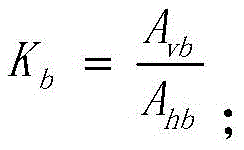 δφb=φhb-φvb;
the calibration coefficient of the radar double-offset amplitude ratio is as follows: k ═ Ka*Kb;
The radar phase calibration parameters are as follows:
δφbHV phase difference, phi, of the transmitted signal for the polarization simulation targethbSimulating the H phase, phi of the target transmission signal for said polarizationvbSimulating the V-phase, A, of the target transmission signal for said polarizationhbSimulating H amplitude, A of the signal transmitted for said polarizationvbSimulating the Vamplitude of the target transmission signal for the polarization;
s13, the weather radar carries out amplitude-phase consistency calibration on the H, V channel signals of the same analog target output signal according to the amplitude calibration coefficient and the phase calibration parameter to obtain an amplitude ratio true value;
s14, controlling the polarized scanning antenna to carry out polarized scanning according to a preset interval scanning angle, and sending a true amplitude ratio value and a H, V channel signal of the same analog target output signal after phase control to a weather radar;
s15, the weather radar receives the true value of the amplitude ratio, nonlinearly calibrates the H, V channel signal of the same simulation target output signal, and calibrates the radar polarization measurement parameters of different scanning angles;
the HV nonlinear calibration is used for establishing an HV calibration parameter table, carrying out nonlinear calibration on the radar amplitude ratio, generating a series of amplitude calibration parameters by adjusting the polarization scanning angle alpha of the polarization scanning antenna, reading radar amplitude ratio measurement values, calculating a calibration coefficient, establishing an amplitude ratio calibration parameter table, and looking up the table during calibration to obtain the calibration coefficient;
the expression for the amplitude calibration parameters is:
Ava=Z0tgα,Aha=Z0ctgα,Ka=tg2α; the value range of the polarization scanning angle alpha is 5-88 degrees, and the true value of the amplitude ratio is 0.008; presetting an interval scanning angle to be 1 degree; the angle of the terminated polarization scanning is 88 degrees, and the true value of the amplitude ratio is 820; the radar polarization measurement parameters comprise at least one of differential reflectivity factors, two-way differential propagation phase change values, two-way differential propagation phase constants, two-line polarization radar depolarization factors and phase noise;
the polarization scanning is used for amplitude-phase consistency calibration and nonlinear calibration of a radar receiving channel, the phase difference of an output HV signal can be set to be 0-360 degrees by a polarization scanning simulation target signal, the amplitude ratio depends on a polarization scanning angle, an amplitude ratio true value and a phase difference true value are generated, the amplitude-phase consistency calibration of a radar end is carried out, and meanwhile, the radar end differential reflectivity Z is provideddrDifferential phase shift phidpDifferential phase shift constant KdpLinear depolarization factor LdrA parameter true value;
differential reflectivity factor Zdr=10log10(Zhh/Zvv);Zhh=Z0ctgα;Zvv=Z0tgα;
Wherein Z is0As the reference intensity, α is the polarization scan angle;
linear depolarization factor Ldr=10log(Zvh/Zhh);
Wherein the linear depolarization factor is the logarithm of the ratio of the horizontal transmission vertical reception to the horizontal reception, i.e. ZvhThe method comprises the steps of measuring polarization scattering by the signal amplitude of the radar end horizontal transmission and the signal amplitude of the radar receiving channel vertical reception, receiving the radar horizontal polarization transmission signal, setting the scanning angle to be 0 degree, slowly scanning in the range of 0-45 degrees, and carrying out LdrThe truth value is as follows: l isdr0=10log(Zvh0/Zhh0);Zvh0=Z0tgα;Zhh0=Z0ctg α; differential phase shift phidp=φhh-φvv,φhhSetting a parameter, phi, for simulating a target horizontal transmit channel phasevvSetting parameters for simulating the phase of the target vertical transmitting channel, and calibrating the differential phase shift to be a dual-channel feed phidpThe true value is determined and provided by the analog target phase control word;
differential phase shift constant KdpThe truth value is as follows:
wherein, the distance library r1Differential phase shift phidpr1Distance library r2Differential phase shift phidpr2From a range bin r by a simulation target1Initially, the differential phase shift is stepped by δφIncrease progressively until phidpr2。
Example 3
As shown in fig. 3, the method for comprehensive calibration of weather radar according to still another embodiment of the present invention further includes, on the basis of embodiment 2, the following steps:
s16, calibrating the speed measurement precision of the weather radar according to the preset simulated target output speed to obtain a simulated target output speed true value;
wherein, the expression of the speed measurement precision is as follows:
Vifor the i-th speed measurement of the radar, Vi0The speed is a preset simulation target output speed in the ith measurement, and N is the number of measurement samples;
the preset simulated target output speed is realized by setting the Doppler modulation frequency of the simulated target, and the expression of the speed true value is as follows:
wherein: λ is the radar operating wavelength, fdSimulating a target Doppler frequency;
s17, calibrating the speed defuzzification of the weather radar according to the true value of the output speed of the simulation target, and judging whether a wild value is generated;
the repetition frequency of detection pulses of a weather radar is usually 300Hz to 1Khz, the fuzzy performance of the radar deceleration can be calibrated by setting the Doppler frequency to be 0 to +/-15 Khz, the fuzzy speed of the radar corresponding to S wave band is about 18m/S to 30m/S, the fuzzy speed of the radar corresponding to C wave band is about 9m/S to 15m/S, the fuzzy speed of the radar corresponding to X wave band is about 4.5m/S to 7.5m/S, the meteorological target speed range is about 0 to 50m/S, and the true value range of the simulated target speed is about 0 to +/-200 m/S;
s18, generating a mass-sending simulation target signal according to the preset mass-sending target speed distribution;
the expression of the mass-sending simulation target signal is as follows:

ui(t)simulating the target signal amplitude, omega, for the ith path0=2πf0,f0For radar operating frequency, omegadi=2πfdi,fdiIs the ith signal Doppler frequency, and N is the single mass-sending Doppler frequency quantity;
s19, calibrating the spectrum width and precision of the weather radar according to the mass-sending simulation target output speed true value corresponding to the target weather radar;
s20, the weather radar obtains the distance parameter of the corresponding analog target output signal according to the preset delay time;
s21, calibrating the distance precision of the weather radar according to the distance parameters;
wherein, the expression of the distance precision is as follows: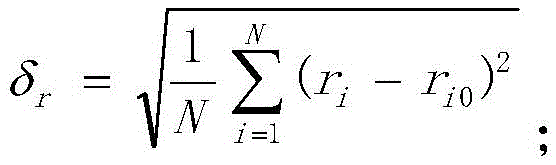
rifor the i-th range measurement of the radar, ri0The distance truth value is the distance truth value in the ith measurement, N is the number of measurement samples, and the expression of the distance truth value is as follows:
c is the speed of light and T isThe delay time of the simulated target relative to the radar emission signal depends on the distance between the erection point and the radar, the true value of the simulated target distance is established on the basis of the distance between the erection point and the radar, and the distance r between the erection point and the radar is0Corresponding to radar echo delay time t0Generating a simulation target delay time for the mounting point to be far: t ═ T0+ti,tiDelay time, t, for generating simulation targetsi=0~Tri-t0(ii) a Generating a simulation target delay time within the erection point: t ═ Tri-t0+ti,ti=0~t0The simulation target is generated according to the cross cycle, and the simulation target truth value is as follows: comprehensively generating a full-distance range simulation target;
wherein the preset simulation target speed is-200 m/s- +200 m/s; the delay time is 0-3 ms, and the corresponding distance range is 0-450 km.
Specifically, the preprocessing includes amplifying, mixing, filtering and analog-to-digital converting the rf signal to obtain an rf digital signal and an H, V channel digital signal corresponding to the same rf digital signal.
As shown in fig. 4, the weather radar integrated calibration system according to an embodiment of the present invention includes:
a broadband dual-polarization receiving antenna 10 arranged to receive a radio frequency signal of a weather radar;
a signal processing module 20 configured to pre-process the radio frequency signal to obtain a radio frequency digital signal and an H, V channel digital signal corresponding to the same radio frequency digital signal;
the data processing module 30 is configured to measure the state information of the rf signal according to the rf digital signal, and calculate the amplitude calibration parameter Ka and the phase difference calibration parameter δ of the weather radar transmitting branch according to the H, V channel digital signalφa;
Wherein, the state information comprises pulse width tau and pulse period T, H channel in-phase component IhaIn phase with the V channelComponent IvaH channel quadrature component QhaV channel quadrature component QvaPower, H amplitude AhaV amplitude AvaH phase phihaV phase phivaAnd HV phase difference deltaφa,
 δφa=φha-φva;
A down-conversion processing module 40 configured to perform down-conversion processing on the radio frequency digital signal according to the state information to obtain a digital baseband signal;
a baseband modulation module 50 configured to perform delay, doppler frequency modulation, and amplitude modulation on the digital baseband signal to obtain a digital baseband modulation signal;
an analog-to-digital converter 60 configured to perform digital-to-analog conversion on the digital baseband modulation signal to obtain an analog target intermediate frequency signal;
an intermediate frequency processing module 70 configured to perform amplitude control on the analog target intermediate frequency signal according to the radar echo intensity to obtain an analog target signal;
an acquisition unit 80 configured to acquire a doppler frequency generated by high-speed rotation of the metal ball; the acquisition unit is a receiving end of the weather radar;
the output unit 90 is configured to output a simulated target signal, and control the frequency of the simulated target signal to be equal to the doppler frequency, so as to obtain a simulated target output signal, and the output unit is an output end of the weather radar;
the intensity calibration module 100 is configured to calculate the power of all analog target output signals of the distance library within the range of the weather radar according to the radar echo intensity corresponding to the preset distance library, and perform intensity calibration on all analog target output signals;
the expression of the radar echo intensity corresponding to the preset distance library is as follows:

sigma is the projection area of the metal ball, lambda is the radar working wavelength, theta is the radar azimuth beam width, the radar pitch beam width is defined as r, the distance from a calibration point to the radar is defined as c, the speed of light is defined as c, and tau is the radar emission pulse width;
the calculation formula of the power of all simulated target output signals of the distance library in the range of the weather radar is as follows:

Ptfor radar transmission power, GtFor radar antenna gain, AeFor receiving the antenna area, set to be the same as the projected area sigma of the metal ball, and transmit power P by radartAnd radar antenna gain GtThe simulated target power can be calculated;
calculating the simulated target power by receiving the amplitude of the radio frequency signal: wherein: l isaIs the receive channel loss;
at radar transmission power PtWhen unknown, the radar transmitting power can be measured:
gain G in radar antennatWhen unknown, the antenna gain can be measured:
the weather radar adopts a circular paraboloid antenna, the azimuth beam width is equal to the pitch beam width, so that: gt=42.5-20logθ;
Calculating antenna gain according to azimuth beam width theta, measuring radar antenna beam width by receiving radar emission signal, and scanning a frame according to radar to obtain maximum value interval time TzMeasuring radar azimuth scanning speed omegaθMeasuring the maximum value of 0.707 times of the corresponding scanning time delta according to the amplitude change of the signals transmitted by the receiving radartAnd calculating the beam width: θ=Δtωθ。
as shown in fig. 5, the weather radar integrated calibration system according to another embodiment of the present invention further includes:
a polarization scanning antenna 110 movable to a preset angle with the weather radar;
the amplitude ratio phase difference calculation module 120 is configured to receive a polarization simulation target emission signal which is sent by a polarization scanning antenna and is equal to an H, V channel signal of the same simulation target output signal, and calculate an amplitude ratio and a phase difference to obtain an amplitude calibration coefficient and a phase calibration parameter of a radar receiving channel, and the amplitude ratio phase difference calculation module is arranged on a weather radar;
wherein, the receiving channel amplitude calibration coefficient is: δφb=φhb-φvb;
the calibration coefficient of the radar double-offset amplitude ratio is as follows: k ═ Ka*Kb;
The radar phase calibration parameters are as follows:
δφbHV phase difference, phi, of the transmitted signal for the polarization simulation targethbSimulating the H phase, phi of the target transmission signal for said polarizationvbSimulating the V-phase, A, of the target transmission signal for said polarizationhbSimulating H amplitude, A of the signal transmitted for said polarizationvbSimulating the Vamplitude of the target transmission signal for the polarization;
the amplitude-phase consistency calibration module 130 is configured to perform amplitude-phase consistency calibration on H, V channel signals of the same simulation target output signal according to the amplitude calibration coefficient and the phase calibration parameter to obtain an amplitude ratio true value, and is arranged on the weather radar;
the polarization scanning control module 140 is configured to control the polarization scanning antenna to perform polarization scanning according to a preset interval scanning angle, and send an H, V channel signal of the same analog target output signal after the amplitude ratio true value and the phase control to the weather radar;
the nonlinear calibration module 150 is configured to receive an amplitude ratio true value, perform nonlinear calibration on H, V channel signals of the same analog target output signal, and calibrate radar polarization measurement parameters of different scanning angles, and is arranged on a weather radar;
the HV nonlinear calibration is used for establishing an HV calibration parameter table, carrying out nonlinear calibration on the radar amplitude ratio, generating a series of amplitude calibration parameters by adjusting the polarization scanning angle alpha of the polarization scanning antenna, reading radar amplitude ratio measurement values, calculating a calibration coefficient, establishing an amplitude ratio calibration parameter table, and looking up the table during calibration to obtain the calibration coefficient;
the expression for the amplitude calibration parameters is:
Ava=Z0tgα,Aha=Z0ctgα,Ka=tg2α; the value range of the polarization scanning angle alpha is 5-88 degrees, and the true value of the amplitude ratio is 0.008; presetting an interval scanning angle to be 1 degree; the angle of the terminated polarization scanning is 88 degrees, and the true value of the amplitude ratio is 820; the radar polarization measurement parameters comprise at least one of differential reflectivity factors, two-way differential propagation phase change values, two-way differential propagation phase constants, two-line polarization radar depolarization factors and phase noise;
polarization scanning for radar receiving channel amplitude-phase consistency calibration and nonlinear calibrationAccurately, the phase difference of the HV signal can be set to be 0-360 degrees according to the polarization scanning simulation target signal, the amplitude ratio depends on the polarization scanning angle, an amplitude ratio true value and a phase difference true value are generated, the amplitude phase consistency calibration of the radar end is carried out, and meanwhile, the radar end differential reflectivity Z is provideddrDifferential phase shift phidpDifferential phase shift constant KdpLinear depolarization factor LdrA parameter true value;
differential reflectivity factor Zdr=10log10(Zhh/Zvv);Zhh=Z0ctgα;Zvv=Z0tgα;
Wherein Z is0As the reference intensity, α is the polarization scan angle;
linear depolarization factor Ldr=10log(Zvh/Zhh);
Wherein the linear depolarization factor is the logarithm of the ratio of the horizontal transmission vertical reception to the horizontal reception, i.e. ZvhThe method comprises the steps of measuring polarization scattering by the signal amplitude of the radar end horizontal transmission and the signal amplitude of the radar receiving channel vertical reception, receiving the radar horizontal polarization transmission signal, setting the scanning angle to be 0 degree, slowly scanning in the range of 0-45 degrees, and carrying out LdrThe truth value is as follows: l isdr0=10log(Zvh0/Zhh0);Zvh0=Z0tgα;Zhh0=Z0ctg α; differential phase shift phidp=φhh-φvv,φhhSetting a parameter, phi, for simulating a target horizontal transmit channel phasevvSetting parameters for simulating the phase of the target vertical transmitting channel, and calibrating the differential phase shift to be a dual-channel feed phidpThe true value is determined and provided by the analog target phase control word;
differential phase shift constant KdpThe truth value is as follows:
wherein, the distance library r1Differential phase shift phidpr1Distance library r2Differential phase shift phidpr2From a range bin r by a simulation target1Initially, the differential phase shift is stepped by δφIncrease progressively until phidpr2。
As shown in fig. 6, the weather radar integrated calibration system according to still another embodiment of the present invention further includes:
the speed control module 160 is configured to calibrate the speed measurement precision of the weather radar according to a preset simulated target output speed, so as to obtain a simulated target output speed true value;
wherein, the expression of the speed measurement precision is as follows:
Vifor the i-th speed measurement of the radar, Vi0The speed is a preset simulation target output speed in the ith measurement, and N is the number of measurement samples;
the preset simulated target output speed is realized by setting the Doppler modulation frequency of the simulated target, and the expression of the speed true value is as follows:
wherein: λ is the radar operating wavelength, fdSimulating a target Doppler frequency;
a speed de-ambiguity calibration module 170 configured to calibrate the speed de-ambiguity of the weather radar according to the simulated target output speed true value and determine whether a wild value is generated;
the repetition frequency of detection pulses of a weather radar is usually 300Hz to 1Khz, the fuzzy performance of the radar deceleration can be calibrated by setting the Doppler frequency to be 0 to +/-15 Khz, the fuzzy speed of the radar corresponding to S wave band is about 18m/S to 30m/S, the fuzzy speed of the radar corresponding to C wave band is about 9m/S to 15m/S, the fuzzy speed of the radar corresponding to X wave band is about 4.5m/S to 7.5m/S, the meteorological target speed range is about 0 to 50m/S, and the true value range of the simulated target speed is about 0 to +/-200 m/S;
a mass-sending module 180 configured to generate a mass-sending simulated target signal according to a preset mass-sending target speed distribution;
the expression of the mass-sending simulation target signal is as follows:

ui(t)simulating the target signal amplitude, omega, for the ith path0=2πf0,f0For radar operating frequency, omegadi=2πfdi,fdiIs the ith signal Doppler frequency, and N is the single mass-sending Doppler frequency quantity;
a speed resolution calibration module 190 configured to calibrate the spectral width and the accuracy of the weather radar according to the group-sending simulation target output speed true value corresponding to the target weather radar;
a distance parameter calculation module 200, configured to obtain a distance parameter corresponding to the simulated target output signal according to a preset delay time, the distance parameter calculation module being disposed on the weather radar;
a distance precision calibration module 210 configured to calibrate the distance precision of the weather radar according to the distance parameter;
wherein, the expression of the distance precision is as follows:
rifor the i-th range measurement of the radar, ri0The distance truth value is the distance truth value in the ith measurement, N is the number of measurement samples, and the expression of the distance truth value is as follows:
c is the speed of light, T is the delay time of the simulated target relative to the radar emission signal, the delay time of the simulated target depends on the distance between the erection point and the radar, the true value of the simulated target distance is established on the distance between the erection point and the radar, and the distance r between the erection point and the radar is0Corresponding to radar echo delay time t0Generating a simulation target delay time for the mounting point to be far: t ═ T0+ti,tiDelay time, t, for generating simulation targetsi=0~Tri-t0(ii) a Generating rackSimulating the target delay time within the set point: t ═ Tri-t0+ti,ti=0~t0The simulation target is generated according to the cross cycle, and the simulation target truth value is as follows: comprehensively generating a full-distance range simulation target;
wherein the preset simulation target speed is-200 m/s- +200 m/s; the delay time is 0-3 ms, and the corresponding distance range is 0-450 km.
Specifically, the signal processing module 20 includes an amplifying unit 21, a mixing unit 22, a filtering unit 23, and an analog-to-digital converting unit 24, where the amplifying unit 21, the mixing unit 22, the filtering unit 23, and the analog-to-digital converting unit 24 are a signal amplifier having a signal amplifying function, a mixer performing a mixing process, a filtering circuit having a filtering function, and an analog-to-digital converter in the prior art, which are conventional technologies and are not described herein again.
The above description is only a preferred embodiment of the present invention and is not intended to limit the present invention, and various modifications and changes may be made by those skilled in the art. Any modification, equivalent replacement, or improvement made within the spirit and principle of the present invention should be included in the protection scope of the present invention.
Claims (8)
1. A weather radar comprehensive calibration method is characterized by comprising the following steps:
receiving a radio frequency signal of the weather radar by using a broadband dual-polarization receiving antenna;
preprocessing the radio frequency signal to obtain a radio frequency digital signal and an H, V channel digital signal corresponding to the same radio frequency digital signal;
measuring the state information of the radio frequency signal according to the radio frequency digital signal, and simultaneously calculating an amplitude calibration parameter Ka and a phase difference calibration parameter delta of a weather radar transmitting branch according to the H, V channel digital signalφa;
Wherein the state information includes a pulse width τ,Pulse period T, H channel in-phase component IhaV channel in-phase component IvaH channel quadrature component QhaV channel quadrature component QvaPower, H amplitude AhaV amplitude AvaH phase phihaV phase phivaAnd HV phase difference deltaφa,
 δφa=φha-φva;
Performing down-conversion processing on the radio frequency digital signal according to the state information to obtain a digital baseband signal;
carrying out delay, Doppler frequency modulation and amplitude modulation on the digital baseband signal to obtain a digital baseband modulation signal;
performing digital-to-analog conversion on the digital baseband modulation signal to obtain an analog target intermediate frequency signal;
carrying out amplitude control on the intermediate frequency signal of the simulation target according to the radar echo intensity to obtain a simulation target signal;
obtaining Doppler frequency generated by high-speed rotation of the metal ball;
outputting the simulated target signal, and controlling the frequency of the simulated target signal to be equal to the Doppler frequency to obtain a simulated target output signal;
calculating the power of all the simulated target output signals of the distance library in the weather radar range according to the radar echo intensity corresponding to a preset distance library, and performing intensity calibration on all the simulated target output signals;
the expression of the radar echo intensity corresponding to the preset distance library is as follows:

sigma is the projection area of the metal ball, lambda is the radar working wavelength, theta is the radar azimuth beam width, the radar pitch beam width is defined as r, the distance from a calibration point to the radar is defined as c, the speed of light is defined as c, and tau is the radar emission pulse width;
the calculation formula of the power of all the simulated target output signals of the distance library in the range of the weather radar is as follows:

Ptfor radar transmission power, GtFor radar antenna gain, AeSetting the area of the receiving antenna to be the same as the projection area sigma of the metal ball, and transmitting power P by the radartAnd radar antenna gain GtThe simulated target power can be calculated;
calculating the simulated target power by receiving the amplitude of the RF signal Wherein: l isaIs the receive channel loss;
at the radar transmission power PtWhen unknown, the radar transmitting power can be measured:
gain G of the radar antennatWhen unknown, the antenna gain can be measured:
the weather radar adopts a circular paraboloid antenna, and the azimuth beam width is equal to the pitch beam width, so that: gt=42.5-20logθ;
According to azimuth beam widthCalculating antenna gain according to degree theta, measuring the beam width of the radar antenna by receiving radar emission signals, and scanning a frame according to the radar to obtain the corresponding maximum value interval time TzMeasuring radar azimuth scanning speed omegaθMeasuring the maximum value of 0.707 times of the corresponding scanning time delta according to the amplitude change of the signals transmitted by the receiving radartAnd calculating the beam width: θ=Δtωθ。
2. the weather radar comprehensive calibration method according to claim 1, further comprising the steps of:
the polarized scanning antenna moves to form a preset angle of 45 degrees with the weather radar;
the weather radar receives a polarization simulation target emission signal which is sent by the polarization scanning antenna and is equal to an H, V channel signal of the same simulation target output signal, and calculates an amplitude ratio and a phase difference to obtain a radar receiving channel amplitude calibration coefficient and a phase calibration parameter;
wherein, the receiving channel amplitude calibration coefficient is: δφb=φhb-φvb;
the calibration coefficient of the radar double-offset amplitude ratio is as follows: k ═ Ka*Kb;
The radar phase calibration parameters are as follows:

the weather radar carries out amplitude-phase consistency calibration on H, V channel signals of the same simulation target output signal according to the amplitude calibration coefficient and the phase calibration parameter to obtain an amplitude ratio true value;
controlling the polarization scanning antenna to carry out polarization scanning according to a preset interval scanning angle, and sending H, V channel signals of the same analog target output signal after the amplitude ratio true value and the phase control to the weather radar;
the weather radar receives the amplitude ratio true value, carries out nonlinear calibration on H, V channel signals of the same simulation target output signal, and calibrates radar polarization measurement parameters of different scanning angles;
the HV nonlinear calibration is used for establishing an HV calibration parameter table, carrying out nonlinear calibration on the radar amplitude ratio, generating a series of amplitude calibration parameters by adjusting the polarization scanning angle alpha of the polarization scanning antenna, reading radar amplitude ratio measurement values, calculating a calibration coefficient, establishing an amplitude ratio calibration parameter table, and looking up the table during calibration to obtain the calibration coefficient;
the expression of the amplitude calibration parameter is as follows:
Ava=Z0tgα,Aha=Z0ctgα,Ka=tg2α; the value range of the polarization scanning angle alpha is 5-88 degrees, and the true value of the amplitude ratio is 0.008; the preset interval scanning angle is 1 degree; the angle of the terminated polarization scanning is 88 degrees, and the true value of the amplitude ratio is 820; the radar polarization measurement parameters comprise at least one of differential reflectivity factors, two-way differential propagation phase change values, two-way differential propagation phase constants, two-line polarization radar depolarization factors and phase noise;
the polarization scanning is used for amplitude-phase consistency calibration and nonlinear calibration of radar receiving channels, and analog target signals of the polarization scanning can be setThe phase difference of the output HV signals is 0-360 degrees, the amplitude ratio depends on the polarization scanning angle, an amplitude ratio true value and a phase difference true value are generated, the amplitude-phase consistency calibration of the radar end is carried out, and meanwhile the radar end differential reflectivity Z is provideddrDifferential phase shift phidpDifferential phase shift constant KdpLinear depolarization factor LdrA parameter true value;
differential reflectivity factor Zdr=10log10(Zhh/Zvv);Zhh=Z0ctgα;Zvv=Z0tgα;
Wherein Z is0As the reference intensity, α is the polarization scan angle;
linear depolarization factor Ldr=10log(Zvh/Zhh);
Wherein the linear depolarization factor is the logarithm of the ratio of the horizontal transmission vertical reception to the horizontal reception, i.e. ZvhThe method comprises the steps of measuring polarization scattering by the signal amplitude of the radar end horizontal transmission and the signal amplitude of the radar receiving channel vertical reception, receiving the radar horizontal polarization transmission signal, setting the scanning angle to be 0 degree, slowly scanning in the range of 0-45 degrees, and carrying out LdrThe truth value is as follows: l isdr0=10log(Zvh0/Zhh0);Zvh0=Z0tgα;Zhh0=Z0ctg α; differential phase shift phidp=φhh-φvv,φhhSimulating the horizontal phase, phi, of the target transmission signal for said polarizationvvCalibrating the vertical phase of the polarization simulation target transmission signal with differential phase shift as a dual channel feed phidpThe true value is determined and provided by the analog target phase control word;
differential phase shift constant KdpThe truth value is as follows:
wherein, the distance library r1Differential phase shift phidpr1Distance library r2Differential phase shift phidpr2From a range bin r by a simulation target1Initially, the differential phase shift is stepped by δφIncrease progressively until phidpr2。
3. The weather radar comprehensive calibration method according to claim 2, further comprising the steps of:
calibrating the speed measurement precision of the weather radar according to a preset simulated target output speed to obtain a simulated target output speed true value;
wherein the expression of the speed measurement accuracy is as follows:
Vifor the i-th speed measurement of the radar, Vi0The preset simulation target output speed at the ith measurement is obtained, and N is the number of measurement samples;
the preset simulated target output speed is realized by setting a simulated target Doppler modulation frequency, and the expression of the speed true value is as follows:
wherein: λ is the radar operating wavelength, fdSimulating a target Doppler frequency;
calibrating the speed defuzzification of the weather radar according to the simulated target output speed true value, and judging whether a wild value is generated;
the repetition frequency of detection pulses of a weather radar is usually 300Hz to 1Khz, the fuzzy performance of the radar deceleration can be calibrated by setting the Doppler frequency to be 0 to +/-15 Khz, the fuzzy speed of the radar corresponding to S wave band is about 18m/S to 30m/S, the fuzzy speed of the radar corresponding to C wave band is about 9m/S to 15m/S, the fuzzy speed of the radar corresponding to X wave band is about 4.5m/S to 7.5m/S, the meteorological target speed range is about 0 to 50m/S, and the true value range of the simulated target speed is about 0 to +/-200 m/S;
generating a mass-sending simulation target signal according to the preset mass-sending target speed distribution;
wherein, the expression of the mass-sending simulation target signal is as follows:

ui(t)simulating the target signal amplitude, omega, for the ith path0=2πf0,f0For radar operating frequency, omegadi=2πfdi,fdiIs the ith signal Doppler frequency, and N is the single mass-sending Doppler frequency quantity;
calibrating the spectral width and precision of the weather radar according to the mass-emission simulation target output speed true value corresponding to the target weather radar;
the weather radar obtains a distance parameter corresponding to the output signal of the simulation target according to preset delay time;
calibrating the distance precision of the weather radar according to the distance parameter;
wherein the expression of the distance precision is as follows:
rifor the i-th range measurement of the radar, ri0The distance truth value is a distance truth value in the ith measurement, N is the number of measurement samples, and the expression of the distance truth value is as follows:
c is the speed of light, T is the delay time of the simulated target relative to the radar emission signal, the delay time of the simulated target depends on the distance between the erection point and the radar, the true value of the simulated target distance is established on the distance between the erection point and the radar, and the distance r between the erection point and the radar is0Corresponding to radar echo delay time t0Generating a simulation target delay time for the mounting point to be far: t ═ T0+ti,tiDelay time, t, for generating simulation targetsi=0~Tri-t0(ii) a Generating a simulation target delay time within the erection point: t ═ Tri-t0+ti,ti=0~t0The simulation target is generated according to the period crossing,the simulation target truth value is as follows: comprehensively generating a full-distance range simulation target;
wherein the preset simulation target speed is-200 m/s- +200 m/s; the delay time is 0-3 ms, and the corresponding distance range is 0-450 km.
4. The weather radar integrated calibration method as claimed in any one of claims 1 to 3, wherein the preprocessing comprises amplifying, mixing, filtering and performing analog-to-digital conversion on the radio frequency signal to obtain the radio frequency digital signal and the H, V channel digital signal corresponding to the same radio frequency digital signal.
5. A weather radar integrated calibration system is characterized by comprising:
a broadband dual-polarization receiving antenna configured to receive radio frequency signals of the weather radar;
the signal processing module is used for preprocessing the radio frequency signal to obtain a radio frequency digital signal and an H, V channel digital signal corresponding to the same radio frequency digital signal;
a data processing module which is set for measuring the state information of the radio frequency signal according to the radio frequency digital signal and simultaneously calculating an amplitude calibration parameter Ka and a phase difference calibration parameter delta of the weather radar transmitting branch according to the H, V channel digital signalφa;
Wherein the state information comprises pulse width tau and pulse period T, H channel in-phase component IhaV channel in-phase component IvaH channel quadrature component QhaV channel quadrature component QvaPower, H amplitude AhaV amplitude AvaH phase phihaV phase phivaAnd HV phase difference deltaφa,
 δφa=φha-φva;
The down-conversion processing module is configured to perform down-conversion processing on the radio frequency digital signal according to the state information to obtain a digital baseband signal;
the baseband modulation module is used for delaying, Doppler frequency modulating and amplitude modulating the digital baseband signal to obtain a digital baseband modulation signal;
the analog-to-digital converter is used for performing digital-to-analog conversion on the digital baseband modulation signal to obtain an analog target intermediate frequency signal;
the intermediate frequency processing module is used for carrying out amplitude control on the analog target intermediate frequency signal according to the radar echo intensity to obtain an analog target signal;
an acquisition unit configured to acquire a doppler frequency generated by high-speed rotation of the metal ball; the acquisition unit is a receiving end of the weather radar;
the output unit is used for outputting the simulated target signal and controlling the frequency of the simulated target signal to be equal to the Doppler frequency to obtain a simulated target output signal, and the output unit is an output end of the weather radar;
the intensity calibration module is used for calculating the power of all the simulated target output signals of the distance library in the weather radar measuring range according to the radar echo intensity corresponding to a preset distance library and carrying out intensity calibration on all the simulated target output signals;
the expression of the radar echo intensity corresponding to the preset distance library is as follows:

sigma is the projection area of the metal ball, lambda is the radar working wavelength, theta is the radar squareThe width of the bit beam is such that, the radar pitch beam width is defined as r, the distance from a calibration point to the radar is defined as c, the speed of light is defined as c, and tau is the radar emission pulse width;
the calculation formula of the power of all the simulated target output signals of the distance library in the range of the weather radar is as follows:

Ptfor radar transmission power, GtFor radar antenna gain, AeSetting the area of the receiving antenna to be the same as the projection area sigma of the metal ball, and transmitting power P by the radartAnd radar antenna gain GtThe simulated target power can be calculated;
calculating the simulated target power by receiving the amplitude of the radio frequency signal: wherein: la is the receive channel loss;
radar transmission power can be measured when the radar transmission power Pt is unknown:
gain G of the radar antennatWhen unknown, the antenna gain can be measured:
the weather radar adopts a circular paraboloid antenna, and the azimuth beam width is equal to the pitch beam width, so that: gt=42.5-20logθ;
Calculating the antenna gain based on the azimuth beam width theta, the radar antenna beam width being measured by receiving radar transmitted signals, based onRadar scanning one frame corresponding maximum value interval time TzMeasuring radar azimuth scanning speed omegaθMeasuring the maximum value of 0.707 times of the corresponding scanning time delta according to the amplitude change of the signals transmitted by the receiving radartAnd calculating the beam width: θ=Δtωθ。
6. the weather radar integrated calibration system of claim 5, further comprising:
the polarization scanning antenna can be moved to form a preset angle with the weather radar;
the amplitude ratio phase difference calculation module is used for receiving a polarization simulation target emission signal which is sent by the polarization scanning antenna and is equal to an H, V channel signal of the same simulation target output signal, calculating an amplitude ratio and a phase difference to obtain an amplitude calibration coefficient and a phase calibration parameter of a radar receiving channel, and the amplitude ratio phase difference calculation module is arranged on the weather radar;
wherein, the receiving channel amplitude calibration coefficient is: δφb=φhb-φvb;
the calibration coefficient of the radar double-offset amplitude ratio is as follows: k ═ Ka*Kb;
The radar phase calibration parameters are as follows:
δφbHV phase difference, phi, of the transmitted signal for the polarization simulation targethbSimulating the H phase, phi of the target transmission signal for said polarizationvbSimulating the V-phase, A, of the target transmission signal for said polarizationhbSimulating H amplitude, A of the signal transmitted for said polarizationvbSimulating the V amplitude of the target transmission signal for said polarization;
The amplitude-phase consistency calibration module is configured to perform amplitude-phase consistency calibration on H, V channel signals of the same analog target output signal according to the amplitude calibration coefficient and the phase calibration parameter to obtain an amplitude ratio true value, and the amplitude-phase consistency calibration module is arranged on the weather radar;
the polarization scanning control module is used for controlling the polarization scanning antenna to carry out polarization scanning according to a preset interval scanning angle and sending H, V channel signals of the same analog target output signal after the amplitude ratio true value and the phase control to the weather radar;
the nonlinear calibration module is arranged for receiving the amplitude ratio true value, carrying out nonlinear calibration on H, V channel signals of the same analog target output signal and calibrating radar polarization measurement parameters of different scanning angles, and is arranged on the weather radar;
the HV nonlinear calibration is used for establishing an HV calibration parameter table, carrying out nonlinear calibration on the radar amplitude ratio, generating a series of amplitude calibration parameters by adjusting the polarization scanning angle alpha of the polarization scanning antenna, reading radar amplitude ratio measurement values, calculating a calibration coefficient, establishing an amplitude ratio calibration parameter table, and looking up the table during calibration to obtain the calibration coefficient;
the expression of the amplitude calibration parameter is as follows:
Ava=Z0tgα,Aha=Z0ctgα,Ka=tg2α; the value range of the polarization scanning angle alpha is 5-88 degrees, and the true value of the amplitude ratio is 0.008; the preset interval scanning angle is 1 degree; the angle of the terminated polarization scanning is 88 degrees, and the true value of the amplitude ratio is 820; the radar polarization measurement parameters comprise at least one of differential reflectivity factors, two-way differential propagation phase change values, two-way differential propagation phase constants, two-line polarization radar depolarization factors and phase noise;
polarization scanning for radar receiving channel amplitudePhase consistency calibration and nonlinear calibration, the phase difference of a polarization scanning simulation target signal can be set to be 0-360 degrees, the amplitude ratio depends on the polarization scanning angle, an amplitude ratio true value and a phase difference true value are generated, and the amplitude and phase consistency calibration of a radar end is carried out while the differential reflectivity Z of the radar end is provideddrDifferential phase shift phidpDifferential phase shift constant KdpLinear depolarization factor LdrA parameter true value;
differential reflectivity factor Zdr=10log10(Zhh/Zvv);Zhh=Z0ctgα;Zvv=Z0tgα;
Wherein Z is0As the reference intensity, α is the polarization scan angle;
linear depolarization factor Ldr=10log(Zvh/Zhh);
Wherein the linear depolarization factor is the logarithm of the ratio of the horizontal transmission vertical reception to the horizontal reception, i.e. ZvhThe method comprises the steps of measuring polarization scattering by the signal amplitude of the radar end horizontal transmission and the signal amplitude of the radar receiving channel vertical reception, receiving the radar horizontal polarization transmission signal, setting the scanning angle to be 0 degree, slowly scanning in the range of 0-45 degrees, and carrying out LdrThe truth value is as follows: l isdr0=10log(Zvh0/Zhh0);Zvh0=Z0tgα;Zhh0=Z0ctg α; differential phase shift phidp=φhh-φvv,φhhSetting a parameter, phi, for simulating a target horizontal transmit channel phasevvSetting parameters for simulating the phase of the target vertical transmitting channel, and calibrating the differential phase shift to be a dual-channel feed phidpThe true value is determined and provided by the analog target phase control word;
differential phase shift constant KdpThe truth value is as follows:
wherein, the distance library r1Differential phase shift phidpr1Distance library r2Differential phase shift phidpr2From a range bin r by a simulation target1Initially, the differential phase shift is stepped by δφIncrease progressively until phidpr2。
7. The weather radar integrated calibration system of claim 6, further comprising:
the speed control module is set to be used for calibrating the speed measurement precision of the weather radar according to a preset simulated target output speed to obtain a simulated target output speed true value;
wherein the expression of the speed measurement accuracy is as follows:
Vifor the i-th speed measurement of the radar, Vi0The preset simulation target output speed at the ith measurement is obtained, and N is the number of measurement samples;
the preset simulated target output speed is realized by setting a simulated target Doppler modulation frequency, and the expression of the speed true value is as follows:
wherein: λ is the radar operating wavelength, fdSimulating a target Doppler frequency;
the speed de-ambiguity calibration module is set to calibrate the speed de-ambiguity of the weather radar according to the simulated target output speed true value and judge whether a wild value is generated;
the repetition frequency of detection pulses of a weather radar is usually 300Hz to 1Khz, the fuzzy performance of the radar deceleration can be calibrated by setting the Doppler frequency to be 0 to +/-15 Khz, the fuzzy speed of the radar corresponding to S wave band is about 18m/S to 30m/S, the fuzzy speed of the radar corresponding to C wave band is about 9m/S to 15m/S, the fuzzy speed of the radar corresponding to X wave band is about 4.5m/S to 7.5m/S, the meteorological target speed range is about 0 to 50m/S, and the true value range of the simulated target speed is about 0 to +/-200 m/S;
the mass-sending module is arranged for generating a mass-sending simulation target signal according to the preset mass-sending target speed distribution;
wherein, the expression of the mass-sending simulation target signal is as follows:

ui(t)simulating the target signal amplitude, omega, for the ith path0=2πf0,f0For radar operating frequency, omegadi=2πfdi,fdiIs the ith signal Doppler frequency, and N is the single mass-sending Doppler frequency quantity;
the speed resolution calibration module is set to be used for calibrating the spectral width and the precision of the weather radar according to the mass-sending simulation target output speed truth value corresponding to the target weather radar;
the distance parameter calculation module is arranged for obtaining a distance parameter corresponding to the output signal of the simulation target according to preset delay time, and the distance parameter calculation module is arranged on the weather radar;
the distance precision calibration module is used for calibrating the distance precision of the weather radar according to the distance parameter;
wherein, the expression of the distance precision is as follows:
rifor the i-th range measurement of the radar, ri0The distance truth value is the distance truth value in the ith measurement, N is the number of measurement samples, and the expression of the distance truth value is as follows:
c is the speed of light, T is the delay time of the simulated target relative to the radar emission signal, the delay time of the simulated target depends on the distance between the erection point and the radar, the true value of the simulated target distance is established on the distance between the erection point and the radar, and the distance r between the erection point and the radar is0Corresponding to radar echo delay time t0Generating aThe erection point simulates the target delay time in the distance: t ═ T0+ti,tiDelay time, t, for generating simulation targetsi=0~Tri-t0(ii) a Generating a simulation target delay time within the erection point: t ═ Tri-t0+ti,ti=0~t0The simulation target is generated according to the cross cycle, and the simulation target truth value is as follows: comprehensively generating a full-distance range simulation target;
wherein the preset simulation target speed is-200 m/s- +200 m/s; the delay time is 0-3 ms, and the corresponding distance range is 0-450 km.
8. The weather radar integrated calibration system of any one of claims 5 to 7, wherein the signal processing module comprises an amplifying unit, a mixing unit, a filtering unit, and an analog-to-digital conversion unit.
Priority Applications (1)
| Application Number | Priority Date | Filing Date | Title |
|---|---|---|---|
| CN201910599555.5A CN110146864B (en) | 2019-07-04 | 2019-07-04 | Comprehensive calibration method and system for weather radar |
Applications Claiming Priority (1)
| Application Number | Priority Date | Filing Date | Title |
|---|---|---|---|
| CN201910599555.5A CN110146864B (en) | 2019-07-04 | 2019-07-04 | Comprehensive calibration method and system for weather radar |
Publications (2)
| Publication Number | Publication Date |
|---|---|
| CN110146864A CN110146864A (en) | 2019-08-20 |
| CN110146864B true CN110146864B (en) | 2021-07-02 |
Family
ID=67596955
Family Applications (1)
| Application Number | Title | Priority Date | Filing Date |
|---|---|---|---|
| CN201910599555.5A Active CN110146864B (en) | 2019-07-04 | 2019-07-04 | Comprehensive calibration method and system for weather radar |
Country Status (1)
| Country | Link |
|---|---|
| CN (1) | CN110146864B (en) |
Families Citing this family (22)
| Publication number | Priority date | Publication date | Assignee | Title |
|---|---|---|---|---|
| CN111239741A (en) * | 2020-01-21 | 2020-06-05 | 航天新气象科技有限公司 | Phased array weather radar polarization control method and phased array weather radar system |
| CN111337891B (en) * | 2020-03-23 | 2023-05-12 | 中国人民解放军陆军炮兵防空兵学院士官学校 | Movable target reconnaissance radar fault diagnosis instrument and diagnosis method |
| CN112014812B (en) * | 2020-09-01 | 2024-07-02 | 航天新气象科技有限公司 | Phased array wind profile radar calibration system and method |
| CN112859023B (en) * | 2021-03-10 | 2023-11-03 | 华云敏视达雷达(北京)有限公司 | Phased array weather radar's calibration system |
| CN113109771B (en) * | 2021-03-18 | 2023-06-06 | 中国气象局气象探测中心 | Calibration device for calibration instrument and true value calibration method for weather radar echo intensity |
| CN114488159A (en) * | 2021-05-11 | 2022-05-13 | 中国气象局气象探测中心 | Spherical dual-polarization phased array weather radar |
| CN113437518B (en) * | 2021-06-29 | 2022-08-05 | 中国西安卫星测控中心 | Scanning capture method based on paraboloid unified measurement and control antenna |
| CN113655455B (en) * | 2021-10-15 | 2022-04-08 | 成都信息工程大学 | A Simulation Method for Echo Signal of Dual Polarization Weather Radar |
| CN219349116U (en) * | 2021-11-19 | 2023-07-14 | 深圳迈睿智能科技有限公司 | Feed circuit with adjustable excitation signal amplitude and microwave chip |
| CN115061105B (en) * | 2022-06-30 | 2023-07-14 | 广东纳睿雷达科技股份有限公司 | Dual-polarization radar rapid calibration method, device and storage medium |
| CN115356696B (en) * | 2022-07-30 | 2023-07-04 | 中国气象局气象探测中心 | Weather radar signal processing system algorithm calibration method and device |
| CN115685106B (en) * | 2022-10-31 | 2026-01-20 | 北京环境特性研究所 | A radar signal delay transmission device and method, a calibration system and method |
| CN116868079B (en) * | 2022-11-10 | 2024-02-27 | 长沙天恒测控技术有限公司 | Zero phase calibration method, computer equipment and storage media |
| CN115469313B (en) * | 2022-11-15 | 2023-03-24 | 成都远望探测技术有限公司 | Wave beam control method for marine shipborne meteorological radar |
| CN116973896A (en) * | 2023-07-25 | 2023-10-31 | 惠州市德赛西威汽车电子股份有限公司 | A radar parameter calibration method and system |
| CN116879857B (en) * | 2023-09-07 | 2023-11-17 | 成都远望科技有限责任公司 | Far-field target and radar central beam alignment method |
| CN118444265B (en) * | 2024-05-11 | 2025-02-07 | 航天新气象科技有限公司 | A fully automatic calibration method for weather radar |
| CN118534466B (en) * | 2024-05-27 | 2024-11-29 | 北京理工大学珠海学院 | Rain radar system and method based on artificial intelligence |
| CN118625263A (en) * | 2024-08-09 | 2024-09-10 | 成都远望科技有限责任公司 | A Doppler weather radar receiving device |
| CN119846577B (en) * | 2025-03-13 | 2025-06-06 | 中国气象局气象探测中心 | A quantitative method for generating simulated target reflectivity factors for weather radar far-field calibration |
| CN120178185B (en) * | 2025-05-21 | 2025-08-05 | 成都远望探测技术有限公司 | Far-field single-distance library reflectivity factor simulation method |
| CN121679507B (en) * | 2026-02-11 | 2026-04-24 | 中国气象局气象探测中心 | Weather radar calibration methods, devices, equipment, and storage media |
Family Cites Families (3)
| Publication number | Priority date | Publication date | Assignee | Title |
|---|---|---|---|---|
| US7528767B2 (en) * | 2007-03-13 | 2009-05-05 | Baron Services, Inc. | Variable ratio power divider for a dual polarization radar system with automatic built-in test equipment and calibration |
| CN104459649A (en) * | 2014-11-26 | 2015-03-25 | 北京无线电测量研究所 | Full-solid millimeter wave cloud radar calibration probe system and method |
| CN106970365B (en) * | 2017-05-12 | 2019-08-02 | 西安华腾微波有限责任公司 | Active calibration facility and scaling method outside a kind of weather radar machine |
-
2019
- 2019-07-04 CN CN201910599555.5A patent/CN110146864B/en active Active
Also Published As
| Publication number | Publication date |
|---|---|
| CN110146864A (en) | 2019-08-20 |
Similar Documents
| Publication | Publication Date | Title |
|---|---|---|
| CN110146864B (en) | Comprehensive calibration method and system for weather radar | |
| CN101923157B (en) | Spaceborne dual-channel angle tracking calibration system and method | |
| US8004458B2 (en) | Means for dual polarization radar with automatic built-in test equipment and calibration | |
| US7592948B2 (en) | System and method for dual polarization radar with automatic built-in test equipment and calibration | |
| Pfeffer et al. | FMCW MIMO radar system for frequency-division multiple TX-beamforming | |
| US7920089B2 (en) | Variable ratio power divider for a dual polarization radar system with automatic built-in test equipment and calibration | |
| CN108983240B (en) | Target signal simulation system and method of anti-collision millimeter-wave radar based on quadrature modulation system | |
| CN113655455B (en) | A Simulation Method for Echo Signal of Dual Polarization Weather Radar | |
| US8325084B2 (en) | System for calibration of dual polarization radar with built-in test couplers | |
| CN112859023B (en) | Phased array weather radar's calibration system | |
| CN110531333B (en) | An Adaptive Compensation Method for Wideband Radar Aperture Transit Effect | |
| CN111090094B (en) | Method and system for measuring dual-beam angle of pulse Doppler radar and storage medium | |
| CN110609276A (en) | A Parabolic Antenna Broadband Monopulse Tracking Radar System | |
| CA2711460C (en) | An improved system and method for dual polarization radar with automatic built-in test equipment and calibration | |
| CN113009436A (en) | Spatial angular position parameter calibration method | |
| CN115575910B (en) | Calibration system, device and calibration method of broadband target array | |
| CN112230209B (en) | Remote double-station RCS measuring device and method | |
| Li et al. | Software-defined calibration for FMCW phased-array radar | |
| CN116502476B (en) | SAR system design method based on nonlinear frequency scanning response | |
| CN112748411A (en) | Close-range target echo simulation method and system for sawtooth radar | |
| CN117849734A (en) | Phase offset calibration method, device, electronic device and storage medium | |
| CN118938159B (en) | A broadband LFM signal array beamforming method and system | |
| Washburn et al. | An on-line adaptive beamforming capability for HF backscatter radar | |
| CN112859021A (en) | Method and system for testing full-link dynamic range and sensitivity of phased array radar | |
| CN120300471A (en) | Phased array antenna subarray calibration and single pulse pointing tracking system and method |
Legal Events
| Date | Code | Title | Description |
|---|---|---|---|
| PB01 | Publication | ||
| PB01 | Publication | ||
| SE01 | Entry into force of request for substantive examination | ||
| SE01 | Entry into force of request for substantive examination | ||
| GR01 | Patent grant | ||
| GR01 | Patent grant |