CN110108392B - Application of multifunctional organogel in sensor - Google Patents
Application of multifunctional organogel in sensor Download PDFInfo
- Publication number
- CN110108392B CN110108392B CN201910276317.0A CN201910276317A CN110108392B CN 110108392 B CN110108392 B CN 110108392B CN 201910276317 A CN201910276317 A CN 201910276317A CN 110108392 B CN110108392 B CN 110108392B
- Authority
- CN
- China
- Prior art keywords
- multifunctional
- organogel
- monomer
- initiator
- sheet
- Prior art date
- Legal status (The legal status is an assumption and is not a legal conclusion. Google has not performed a legal analysis and makes no representation as to the accuracy of the status listed.)
- Active
Links
Images



Classifications
-
- C—CHEMISTRY; METALLURGY
- C08—ORGANIC MACROMOLECULAR COMPOUNDS; THEIR PREPARATION OR CHEMICAL WORKING-UP; COMPOSITIONS BASED THEREON
- C08F—MACROMOLECULAR COMPOUNDS OBTAINED BY REACTIONS ONLY INVOLVING CARBON-TO-CARBON UNSATURATED BONDS
- C08F2/00—Processes of polymerisation
- C08F2/46—Polymerisation initiated by wave energy or particle radiation
- C08F2/48—Polymerisation initiated by wave energy or particle radiation by ultraviolet or visible light
-
- C—CHEMISTRY; METALLURGY
- C08—ORGANIC MACROMOLECULAR COMPOUNDS; THEIR PREPARATION OR CHEMICAL WORKING-UP; COMPOSITIONS BASED THEREON
- C08F—MACROMOLECULAR COMPOUNDS OBTAINED BY REACTIONS ONLY INVOLVING CARBON-TO-CARBON UNSATURATED BONDS
- C08F220/00—Copolymers of compounds having one or more unsaturated aliphatic radicals, each having only one carbon-to-carbon double bond, and only one being terminated by only one carboxyl radical or a salt, anhydride ester, amide, imide or nitrile thereof
- C08F220/02—Monocarboxylic acids having less than ten carbon atoms; Derivatives thereof
- C08F220/10—Esters
- C08F220/26—Esters containing oxygen in addition to the carboxy oxygen
- C08F220/32—Esters containing oxygen in addition to the carboxy oxygen containing epoxy radicals
-
- C—CHEMISTRY; METALLURGY
- C08—ORGANIC MACROMOLECULAR COMPOUNDS; THEIR PREPARATION OR CHEMICAL WORKING-UP; COMPOSITIONS BASED THEREON
- C08F—MACROMOLECULAR COMPOUNDS OBTAINED BY REACTIONS ONLY INVOLVING CARBON-TO-CARBON UNSATURATED BONDS
- C08F290/00—Macromolecular compounds obtained by polymerising monomers on to polymers modified by introduction of aliphatic unsaturated end or side groups
- C08F290/02—Macromolecular compounds obtained by polymerising monomers on to polymers modified by introduction of aliphatic unsaturated end or side groups on to polymers modified by introduction of unsaturated end groups
- C08F290/06—Polymers provided for in subclass C08G
- C08F290/062—Polyethers
-
- G—PHYSICS
- G01—MEASURING; TESTING
- G01L—MEASURING FORCE, STRESS, TORQUE, WORK, MECHANICAL POWER, MECHANICAL EFFICIENCY, OR FLUID PRESSURE
- G01L1/00—Measuring force or stress, in general
- G01L1/14—Measuring force or stress, in general by measuring variations in capacitance or inductance of electrical elements, e.g. by measuring variations of frequency of electrical oscillators
- G01L1/142—Measuring force or stress, in general by measuring variations in capacitance or inductance of electrical elements, e.g. by measuring variations of frequency of electrical oscillators using capacitors
-
- G—PHYSICS
- G01—MEASURING; TESTING
- G01L—MEASURING FORCE, STRESS, TORQUE, WORK, MECHANICAL POWER, MECHANICAL EFFICIENCY, OR FLUID PRESSURE
- G01L1/00—Measuring force or stress, in general
- G01L1/20—Measuring force or stress, in general by measuring variations in ohmic resistance of solid materials or of electrically-conductive fluids; by making use of electrokinetic cells, i.e. liquid-containing cells wherein an electrical potential is produced or varied upon the application of stress
- G01L1/22—Measuring force or stress, in general by measuring variations in ohmic resistance of solid materials or of electrically-conductive fluids; by making use of electrokinetic cells, i.e. liquid-containing cells wherein an electrical potential is produced or varied upon the application of stress using resistance strain gauges
- G01L1/2287—Measuring force or stress, in general by measuring variations in ohmic resistance of solid materials or of electrically-conductive fluids; by making use of electrokinetic cells, i.e. liquid-containing cells wherein an electrical potential is produced or varied upon the application of stress using resistance strain gauges constructional details of the strain gauges
-
- C—CHEMISTRY; METALLURGY
- C08—ORGANIC MACROMOLECULAR COMPOUNDS; THEIR PREPARATION OR CHEMICAL WORKING-UP; COMPOSITIONS BASED THEREON
- C08F—MACROMOLECULAR COMPOUNDS OBTAINED BY REACTIONS ONLY INVOLVING CARBON-TO-CARBON UNSATURATED BONDS
- C08F218/00—Copolymers of compounds having one or more unsaturated aliphatic radicals, each having only one carbon-to-carbon double bond, and at least one being terminated by an acyloxy radical of a saturated carboxylic acid, of carbonic acid or of a haloformic acid
- C08F218/24—Esters of carbonic or haloformic acids, e.g. allyl carbonate
Landscapes
- Chemical & Material Sciences (AREA)
- Health & Medical Sciences (AREA)
- Chemical Kinetics & Catalysis (AREA)
- Medicinal Chemistry (AREA)
- Polymers & Plastics (AREA)
- Organic Chemistry (AREA)
- Physics & Mathematics (AREA)
- General Physics & Mathematics (AREA)
- Engineering & Computer Science (AREA)
- Power Engineering (AREA)
- Polymerisation Methods In General (AREA)
- Macromonomer-Based Addition Polymer (AREA)
Abstract
本发明公开了一种多功能有机凝胶在传感器中的应用,所述多功能有机凝胶的制备原料包括:溶剂、单体、交联剂、电解质盐以及引发剂,所述的溶剂和单体的体积比为1:5~5:1;所述的交联剂与单体的摩尔比为0.05%~10%;引发剂与单体的摩尔比为0.1%~10%,电解质盐在所有原料的混合溶液中的浓度为0.1mol/L~5mol/L。本发明基于多功能凝胶不腐蚀金属,耐温性好的特性,将多功能凝胶用于传感器的制造,不仅能够制造出电阻式传感器,而且能够制造出双电层电容传感器。

The invention discloses an application of a multifunctional organic gel in a sensor. The preparation raw materials of the multifunctional organic gel include: a solvent, a monomer, a cross-linking agent, an electrolyte salt and an initiator. The volume ratio of the body is 1:5 to 5:1; the molar ratio of the crosslinking agent to the monomer is 0.05% to 10%; the molar ratio of the initiator to the monomer is 0.1% to 10%, and the electrolyte salt is in The concentration in the mixed solution of all raw materials is 0.1 mol/L to 5 mol/L. Based on the characteristics of multifunctional gel not corroding metal and good temperature resistance, the invention uses the multifunctional gel for the manufacture of sensors, and can not only manufacture resistive sensors but also electric double layer capacitive sensors.
Description
技术领域technical field
本发明涉及离子导体领域,特别涉及一种多功能有机凝胶在传感器中的应用。The invention relates to the field of ion conductors, in particular to the application of a multifunctional organic gel in sensors.
背景技术Background technique
柔性电子设备在近年来受到全世界的广泛关注并得到了迅速发展,随着人类对柔性可穿戴设备和软机器需求的日益增长,一些独特功能的高性能离子导体渐渐受到人们的青睐。与电子导体不同,离子导体利用离子作为电荷载体来传输信号,实现了很多电子导体难以实现的功能,从而使得各种现代技术成为可能,例如燃料电池,碱性电池,电化学晶体管,传感器等。水凝胶是现阶段研究最广泛的离子导体,具有较好的透明性、柔韧性和导电性,原料易得,价格低廉等特点。但是水的挥发性强,难以耐受高低温,分解电压低,导致水凝胶的使用寿命短。而且水凝胶中的水易与空气中的氧气共同作用形成微电池腐蚀金属,导致其越来越无法满足实际应用需求。因此,制备兼具高透明性、拉伸性、导电性以及环境稳定性的柔性离子导体是目前研究的热点。在众多已有的研究中,美国哈佛大学Vlassak教授在聚丙烯酰胺交联网络中添加一定量CaCl2水溶液制成超耐低温的水凝胶,其凝固点达到-57℃,而且拉伸性和断裂强度无明显衰减。然而这种水凝胶的高温耐受性和其他诸多缺陷仍无法同时解决。Flexible electronic devices have attracted worldwide attention and have developed rapidly in recent years. With the increasing demand for flexible wearable devices and soft machines, some high-performance ionic conductors with unique functions are gradually favored by people. Different from electronic conductors, ionic conductors use ions as charge carriers to transmit signals and achieve many functions that are difficult to achieve with electronic conductors, thus enabling various modern technologies, such as fuel cells, alkaline batteries, electrochemical transistors, sensors, etc. Hydrogels are the most widely studied ion conductors at this stage, with good transparency, flexibility and conductivity, easy availability of raw materials, and low prices. However, water is highly volatile, difficult to withstand high and low temperatures, and has a low decomposition voltage, resulting in a short service life of the hydrogel. Moreover, the water in the hydrogel easily interacts with the oxygen in the air to form a microbattery that corrodes the metal, making it increasingly unable to meet the needs of practical applications. Therefore, the preparation of flexible ionic conductors with high transparency, stretchability, electrical conductivity and environmental stability is a hot research topic. In many existing studies, Professor Vlassak of Harvard University in the United States added a certain amount of CaCl 2 aqueous solution to the polyacrylamide cross-linked network to make an ultra-low temperature resistant hydrogel, the freezing point of which reached -57 ° C, and the stretchability and fracture There is no significant decrease in intensity. However, the high temperature tolerance and many other defects of this hydrogel cannot be solved simultaneously.
直接将单体聚合成柔性弹性体可改善离子导体的性能。由于没有使用溶剂,其力学强度和稳定性得到了显著的提升。另外,使用其他物质代替水作为溶剂,根据溶剂自身性质的不同,可以制备出具有相应特性的凝胶。Directly polymerizing monomers into flexible elastomers can improve the performance of ionic conductors. Since no solvent is used, its mechanical strength and stability are significantly improved. In addition, by using other substances instead of water as the solvent, gels with corresponding properties can be prepared according to the nature of the solvent itself.
综上所述,对凝胶的组成成分的调整,可有效的改善凝胶的使用寿命以及应用范围。目前,已有研究人员制备出无溶剂型的离子导电弹性体,它具有超高的断裂伸长率和透明性。但其电导率较差,很难在电子器件中大规模使用。另一方面,大多数有机溶剂具有难挥发,沸点高,环境稳定性好等优点,在制备凝胶方面具有很大的潜力。但现有的报道中几乎没有使用有机溶剂来改善凝胶性能的研究。所以,现阶段仍然缺乏一种有效的、普适性的方法来制备兼具高透明性、拉伸性、导电性以及环境稳定性的柔性离子导体。To sum up, the adjustment of the composition of the gel can effectively improve the service life and application range of the gel. At present, researchers have prepared solvent-free ion-conducting elastomers with ultra-high elongation at break and transparency. However, its poor conductivity makes it difficult to use it on a large scale in electronic devices. On the other hand, most organic solvents have the advantages of low volatility, high boiling point, and good environmental stability, and have great potential in the preparation of gels. However, there are few studies on the use of organic solvents to improve the gel properties in the existing reports. Therefore, there is still a lack of an effective and universal method to prepare flexible ionic conductors with high transparency, stretchability, electrical conductivity and environmental stability.
若将现有凝胶用于传感器的制备,由于现有的凝胶很难在60℃以上或者0℃以下的极端温度使用,它们在高温下会失水皱缩,低温下会结冰失去柔性。而且,它们的空气稳定性较差,容易失水,使用寿命较短,另外,它们易与空气中的水氧发生反应,进而腐蚀金属,导致器件受损,所以不适宜传感器的制造。If the existing gels are used for the preparation of sensors, because the existing gels are difficult to use at extreme temperatures above 60°C or below 0°C, they will lose water and shrink at high temperatures, and will freeze and lose flexibility at low temperatures . Moreover, they have poor air stability, easy to lose water, and have a short service life. In addition, they are easy to react with water and oxygen in the air, thereby corroding metals and causing device damage, so they are not suitable for the manufacture of sensors.
发明内容SUMMARY OF THE INVENTION
本发明的主要目的在于提供一种多功能有机凝胶在传感器上的应用,以克服上述现有技术存在的缺陷,本发明基于多功能凝胶不腐蚀金属,耐温性好的特性,将多功能凝胶用于传感器的制造,不仅能够制造出电阻式传感器,而且能够制造出双电层电容传感器。The main purpose of the present invention is to provide the application of a multifunctional organogel on a sensor, so as to overcome the above-mentioned defects of the prior art. The functional gel is used for the manufacture of sensors, which can not only manufacture resistive sensors, but also make electric double layer capacitive sensors.
为达到上述目的,本发明采用如下技术方案:To achieve the above object, the present invention adopts the following technical solutions:
一种多功能有机凝胶在传感器中的应用,制备所述多功能有机凝胶的原料包括:溶剂、单体、交联剂、电解质盐以及引发剂,所述的溶剂和单体的体积比为1:5~5:1;所述的交联剂与单体的摩尔比为0.05%~10%;引发剂与单体的摩尔比为0.1%~10%,电解质盐在所有原料的混合溶液中的浓度为0.1mol/L~5mol/L;An application of a multifunctional organogel in a sensor, the raw materials for preparing the multifunctional organogel include: a solvent, a monomer, a cross-linking agent, an electrolyte salt and an initiator, and the volume ratio of the solvent and the monomer is The molar ratio of the crosslinking agent to the monomer is 0.05% to 10%; the molar ratio of the initiator to the monomer is 0.1% to 10%, and the electrolyte salt is mixed with all raw materials. The concentration in the solution is 0.1mol/L~5mol/L;
所述的溶剂为碳酸丙烯酯、碳酸乙烯酯、氟代碳酸乙烯酯、碳酸丁烯酯、磷酸三乙酯和磷酸三丁酯一种或多种的混合;Described solvent is a mixture of one or more of propylene carbonate, ethylene carbonate, fluoroethylene carbonate, butylene carbonate, triethyl phosphate and tributyl phosphate;
所述的单体为N-丙烯酰吗啉、丙烯酸丁酯、丙烯酸乙酯、甲氧基聚乙二醇丙烯酸酯、四氢呋喃丙烯酸酯、丙烯酸羟乙酯和丙烯酸异辛酯中的一种或多种的混合;The monomer is one or more of N-acryloyl morpholine, butyl acrylate, ethyl acrylate, methoxy polyethylene glycol acrylate, tetrahydrofuran acrylate, hydroxyethyl acrylate and isooctyl acrylate. a mixture of species;
所述的交联剂为聚乙二醇二丙烯酸酯或己二醇二丙烯酸酯;Described crosslinking agent is polyethylene glycol diacrylate or hexanediol diacrylate;
所述电解质盐为锂盐、钠盐、钾盐或铵盐。The electrolyte salt is a lithium salt, a sodium salt, a potassium salt or an ammonium salt.
进一步地,所述的传感器为电阻式传感器或双电层电容传感器。Further, the sensor is a resistive sensor or an electric double layer capacitance sensor.
进一步地,所述电阻式传感器制备方法如下:Further, the preparation method of the resistive sensor is as follows:
步骤1:将溶剂和单体均匀混合后,再分别加入交联剂、引发剂及电解质盐,使其充分溶解;Step 1: After uniformly mixing the solvent and the monomer, add the crosslinking agent, the initiator and the electrolyte salt respectively to make it fully dissolved;
步骤2:将步骤1配制好的溶液置于片状模具中,然后在紫外光下照射使其光固化或加热使其热固化,即得到能够作为电阻式传感器的多功能凝胶。Step 2: Place the solution prepared in Step 1 in a sheet-shaped mold, and then irradiate it under ultraviolet light to make it photocurable or heat it to thermally cure, so as to obtain a multifunctional gel that can be used as a resistive sensor.
进一步地,所述双电层电容传感器制备过程如下:Further, the preparation process of the electric double layer capacitance sensor is as follows:
步骤1:将溶剂和单体均匀混合后,再分别加入交联剂、引发剂及电解质盐,使其充分溶解;Step 1: After uniformly mixing the solvent and the monomer, add the crosslinking agent, the initiator and the electrolyte salt respectively to make it fully dissolved;
步骤2:将步骤1配制好的溶液倒入两片碳海绵之间,然后将碳海绵置于加热条件下,使两片碳海绵之间的溶液固化,形成两片充满有机凝胶的碳海绵;Step 2: Pour the solution prepared in step 1 between two carbon sponges, then place the carbon sponge under heating conditions to solidify the solution between the two carbon sponges to form two carbon sponges filled with organogel ;
步骤3:将步骤1配制好的溶液置于片状模具中,然后在紫外光下照射使其光固化或加热使其热固化,即得到片状多功能有机凝胶;Step 3: Place the solution prepared in Step 1 in a sheet-shaped mold, and then irradiate it under ultraviolet light to make it photo-cured or heat it to thermally cure, so as to obtain a sheet-shaped multifunctional organogel;
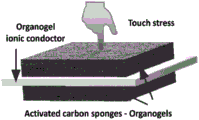
步骤4:将步骤3得到的片状多功能有机凝胶放置在步骤2得到的两片充满有机凝胶的碳海绵之间,即制成双电层电容传感器。Step 4: The sheet-like multifunctional organogel obtained in
进一步地,当采用紫外光照射进行光固化时,所采用紫外光波长为320-400nm,照射功率为30-400W,照射时间为1-120min;Further, when using ultraviolet light irradiation for photocuring, the ultraviolet light wavelength used is 320-400nm, the irradiation power is 30-400W, and the irradiation time is 1-120min;
当采用加热固化时,加热温度为50-100℃,加热时间为2-24h。When heating is used for curing, the heating temperature is 50-100°C, and the heating time is 2-24h.
进一步地,所述的锂盐为双三氟甲基磺酰亚胺锂、三氟甲磺酰-全氟丁基磺酰亚胺锂、三氟甲磺酰-全氟丙基磺酰亚胺锂、双氟磺酰亚胺锂、六氟磷酸锂、四氟硼酸锂、二草酸硼酸锂、草酸二氟硼酸锂、二氟磷酸锂、4,5-二氰基-2-三氟甲基咪唑锂、高氯酸锂或氯化锂;所述钠盐为双三氟甲磺酰亚胺钠、高氯酸钠、双氟磺酰亚胺钠、氯化钠、硝酸钠、氟硅酸钠或邻苯二甲酸钠;所述钾盐为双氟磺酰亚胺钾、氯化钾、硝酸钾或邻苯二甲酸氢钾;所述铵盐为四氟硼酸四乙基铵、氯化铵或硝酸铵。Further, the lithium salt is lithium bistrifluoromethanesulfonimide, trifluoromethanesulfonyl-perfluorobutylsulfonimide lithium, trifluoromethanesulfonyl-perfluoropropylsulfonimide Lithium, Lithium Bisfluorosulfonimide, Lithium Hexafluorophosphate, Lithium Tetrafluoroborate, Lithium Dioxalate Borate, Lithium Oxalate Difluoroborate, Lithium Difluorophosphate, Lithium 4,5-dicyano-2-trifluoromethylimidazolium, Lithium perchlorate or lithium chloride; the sodium salt is sodium bistrifluoromethanesulfonimide, sodium perchlorate, sodium bisfluorosulfonimide, sodium chloride, sodium nitrate, sodium fluorosilicate or ortho Sodium phthalate; the potassium salt is potassium bisfluorosulfonimide, potassium chloride, potassium nitrate or potassium hydrogen phthalate; the ammonium salt is tetraethylammonium tetrafluoroborate, ammonium chloride or ammonium nitrate .
进一步地,所述引发剂为光引发剂或热引发剂。Further, the initiator is a photoinitiator or a thermal initiator.
进一步地,所述的光引发剂为1-羟基环己基苯基甲酮、2-羟基-2-甲基-1-苯基丙酮、2-甲基-2-(4-吗啉基)-1-[4-(甲硫基)苯基]-1-丙酮、2,4,6-三甲基苯甲酰基-二苯基氧化膦、2,4,6-三甲基苯甲酰基苯基膦酸乙酯、2-二甲氨基-2-苄基-1-[4-(4-吗啉基)苯基]-1-丁酮、2-羟基-2-甲基-1-[4-(2-羟基乙氧基)苯基]-1-丙酮、2,4-二羟基二苯甲酮、二芳基碘鎓盐、三芳基碘鎓盐、烷基碘鎓盐或异丙苯茂铁六氟磷酸盐。Further, the photoinitiator is 1-hydroxycyclohexyl phenyl ketone, 2-hydroxy-2-methyl-1-phenylacetone, 2-methyl-2-(4-morpholinyl)- 1-[4-(Methylthio)phenyl]-1-propanone, 2,4,6-trimethylbenzoyl-diphenylphosphine oxide, 2,4,6-trimethylbenzoylbenzene Ethyl phosphonate, 2-dimethylamino-2-benzyl-1-[4-(4-morpholinyl)phenyl]-1-butanone, 2-hydroxy-2-methyl-1-[ 4-(2-Hydroxyethoxy)phenyl]-1-propanone, 2,4-dihydroxybenzophenone, diaryliodonium, triaryliodonium, alkyliodonium or isopropyl Ferrocene hexafluorophosphate.
进一步地,所述的热引发剂为偶氮二异丁腈、过硫酸铵、偶氮二异丁酸二甲酯、偶氮二异丁基脒盐酸盐、过氧化苯甲酰、过氧化二异丙苯、过氧化二碳酸二异丙酯、过氧化二碳酸二环己酯、过氧化甲乙酮或过氧化环己酮。Further, described thermal initiator is azobisisobutyronitrile, ammonium persulfate, dimethyl azobisisobutyrate, azobisisobutylamidine hydrochloride, benzoyl peroxide, peroxide Diisopropylbenzene, diisopropyl peroxydicarbonate, dicyclohexyl peroxydicarbonate, methyl ethyl ketone peroxide or cyclohexanone peroxide.
与现有技术相比,本发明具有以下有益的技术效果:Compared with the prior art, the present invention has the following beneficial technical effects:
首先,溶剂、单体以及导电盐具有很好的相容性,制得的有机凝胶不会分相,所以透明度很高;另外,这些单体所构成的三维网状结构均匀且强度较好,使得有机凝胶具有很好的拉伸性;导电盐在体系中的溶解性很高,而且离子在凝胶的三维网状结构中可以顺利迁移,使得该有机凝胶也具有良好的导电性;所用溶剂在空气中稳定,沸点高,熔点低,这也使得有机凝胶具有很好的稳定性,而且这些有机溶剂对金属没有腐蚀性,难以发生化学反应,使得其分解电压较高,制备的器件有很长的使用寿命。First of all, the solvent, monomer and conductive salt have good compatibility, and the prepared organogel will not separate, so the transparency is very high; in addition, the three-dimensional network structure composed of these monomers is uniform and strong. , so that the organogel has good stretchability; the solubility of the conductive salt in the system is high, and the ions can migrate smoothly in the three-dimensional network structure of the gel, so that the organogel also has good conductivity ; The solvent used is stable in the air, has a high boiling point and a low melting point, which also makes the organic gel have good stability, and these organic solvents are not corrosive to metals and are difficult to undergo chemical reactions, making their decomposition voltage high. devices have a long service life.
由此,本发明的有机凝胶具有以下显著特点:(1)高透明性,对可见光透过率超过93%;(2)良好的拉伸性和回弹性,断裂伸长率达到1219%,拉伸模量低于48.1kPa,无明显应变滞后现象;(3)较好的离子导电性,室温电导率达到7.9×10⁻⁴S/cm;(4)工作电压窗口高,分解电压≥5.0V,支持其在凝胶电解质领域中正常工作;(5)具有很宽的温度耐受范围,在-100℃~100℃的温度区间其各项性能均无明显变化:(6)良好的化学稳定性,不腐蚀金属,可与铜、铝等金属复合制备复杂的器件,因此可以将多功能凝胶用于制造电阻式传感器或双电层电容传感器,该有机凝胶不仅可以应用在力学传感器中,并且经过测试有很高的灵敏度。Therefore, the organogel of the present invention has the following remarkable characteristics: (1) high transparency, the transmittance to visible light exceeds 93%; (2) good stretchability and resilience, elongation at break reaches 1219%, The tensile modulus is lower than 48.1kPa, and there is no obvious strain hysteresis; (3) good ionic conductivity, room temperature conductivity reaches 7.9×10 -4 S/cm; (4) high working voltage window, decomposition voltage ≥ 5.0 V, supports its normal operation in the field of gel electrolytes; (5) has a wide temperature tolerance range, and its properties have no obvious changes in the temperature range of -100 ° C ~ 100 ° C: (6) good chemical It is stable, does not corrode metals, and can be compounded with metals such as copper and aluminum to prepare complex devices. Therefore, the multifunctional gel can be used to manufacture resistive sensors or electric double-layer capacitive sensors. The organic gel can not only be used in mechanical sensors. , and has been tested with high sensitivity.
附图说明Description of drawings
图1为实施例一制得的能够作为电阻式传感器的多功能凝胶的应变系数变化图。FIG. 1 is a graph showing the variation of the strain coefficient of the multifunctional gel that can be used as a resistive sensor prepared in Example 1.
图2为实施例一制得的能够作为电阻式传感器的多功能凝胶拉伸至原长120%再回复五个循环的实时电阻变化。Figure 2 shows the real-time resistance change of the multifunctional gel that can be used as a resistive sensor prepared in Example 1 after stretching to 120% of its original length and then recovering for five cycles.
图3为实施例二多功能凝胶制备的双电层电容传感器示意图。FIG. 3 is a schematic diagram of the electric double layer capacitive sensor prepared by the multifunctional gel of Example 2. FIG.
图4为实施例二多功能凝胶制备的双电层电容传感器在一段时间内反复施加压力,可检测到的电流变化信号。Fig. 4 shows the detectable current change signal of the electric double layer capacitive sensor prepared by the multifunctional gel of Example 2 when pressure is repeatedly applied for a period of time.
具体实施方式Detailed ways
下面对本发明的实施方式做进一步详细描述:Embodiments of the present invention are described in further detail below:
一种多功能有机凝胶在传感器中的应用,所述多功能有机凝胶的制备原料包括:溶剂、单体、交联剂、电解质盐以及引发剂,所述的溶剂和单体的体积比为1:5~5:1;所述的交联剂与单体的摩尔比为0.05%~10%;引发剂与单体的摩尔比为0.1%~10%,电解质盐在所有原料的混合溶液中的浓度为0.1mol/L~5mol/L;所述传感器为电阻式传感器或双电层电容传感器。Application of a multifunctional organogel in a sensor, the preparation raw materials of the multifunctional organogel include: a solvent, a monomer, a cross-linking agent, an electrolyte salt and an initiator, and the volume ratio of the solvent and the monomer is The molar ratio of the crosslinking agent to the monomer is 0.05% to 10%; the molar ratio of the initiator to the monomer is 0.1% to 10%, and the electrolyte salt is mixed with all raw materials. The concentration in the solution is 0.1 mol/L to 5 mol/L; the sensor is a resistive sensor or an electric double layer capacitance sensor.
电阻式传感器制备过程如下:The preparation process of the resistive sensor is as follows:
步骤1:将溶剂和单体均匀混合后,再分别加入交联剂、引发剂及电解质盐,使其充分溶解;Step 1: After uniformly mixing the solvent and the monomer, add the crosslinking agent, the initiator and the electrolyte salt respectively to make it fully dissolved;
步骤2:将步骤1配制好的溶液置于片状模具中,然后在紫外光下照射使其光固化或加热使其热固化,即得到能够作为电阻式传感器的多功能凝胶,当采用紫外光照射进行光固化时,所采用紫外光波长为320-400nm,照射功率为30-400W,照射时间为1-120min;当采用加热固化时,加热温度为50-100℃,加热时间为2-24h。Step 2: Place the solution prepared in step 1 in a sheet mold, and then irradiate it under ultraviolet light to make it photo-cured or heat it to thermally cure, that is, a multifunctional gel that can be used as a resistive sensor is obtained. When light irradiation is used for light curing, the wavelength of ultraviolet light used is 320-400nm, the irradiation power is 30-400W, and the irradiation time is 1-120min; when heating and curing is used, the heating temperature is 50-100 ℃, and the heating time is 2- 24h.
双电层电容传感器制备过程如下:The preparation process of the electric double layer capacitance sensor is as follows:
步骤1:将溶剂和单体均匀混合后,再分别加入交联剂、引发剂及电解质盐,使其充分溶解;Step 1: After uniformly mixing the solvent and the monomer, add the crosslinking agent, the initiator and the electrolyte salt respectively to make it fully dissolved;
步骤2:将步骤1配制好的溶液倒入两片碳海绵之间,然后将碳海绵置于加热条件下,使两片碳海绵之间的溶液固化,形成两片充满有机凝胶的碳海绵;Step 2: Pour the solution prepared in step 1 between two carbon sponges, then place the carbon sponge under heating conditions to solidify the solution between the two carbon sponges to form two carbon sponges filled with organogel ;
步骤3:将步骤1配制好的溶液置于片状模具中,然后在紫外光下照射使其光固化或加热使其热固化,即得到片状多功能有机凝胶;Step 3: Place the solution prepared in Step 1 in a sheet-shaped mold, and then irradiate it under ultraviolet light to make it photo-cured or heat it to thermally cure, so as to obtain a sheet-shaped multifunctional organogel;
步骤4:将步骤3得到的片状多功能有机凝胶放置在步骤2得到的两片充满有机凝胶的碳海绵之间,即制成双电层电容传感器。Step 4: The sheet-like multifunctional organogel obtained in
其中,当采用紫外光照射进行光固化时,所采用紫外光波长为320-400nm,照射功率为30-400W,照射时间为1-120min;当采用加热固化时,加热温度为50-100℃,加热时间为2-24h。Among them, when using ultraviolet light irradiation for photocuring, the wavelength of the ultraviolet light used is 320-400nm, the irradiation power is 30-400W, and the irradiation time is 1-120min; The heating time is 2-24h.
其中,溶剂为碳酸丙烯酯、碳酸乙烯酯、氟代碳酸乙烯酯、碳酸丁烯酯、磷酸三乙酯和磷酸三丁酯中的一种或多种的混合;所述的单体为N-丙烯酰吗啉、丙烯酸丁酯、丙烯酸乙酯、甲氧基聚乙二醇丙烯酸酯、四氢呋喃丙烯酸酯、丙烯酸羟乙酯和丙烯酸异辛酯中的一种或多种的混合;所述的交联剂为聚乙二醇二丙烯酸酯或己二醇二丙烯酸酯;所述电解质盐为锂盐、钠盐、钾盐或铵盐,所述的锂盐为双三氟甲基磺酰亚胺锂、三氟甲磺酰-全氟丁基磺酰亚胺锂、三氟甲磺酰-全氟丙基磺酰亚胺锂、双氟磺酰亚胺锂、六氟磷酸锂、四氟硼酸锂、二草酸硼酸锂、草酸二氟硼酸锂、二氟磷酸锂、4,5-二氰基-2-三氟甲基咪唑锂、高氯酸锂或氯化锂;所述钠盐为双三氟甲磺酰亚胺钠、高氯酸钠、双氟磺酰亚胺钠、氯化钠、硝酸钠、氟硅酸钠或邻苯二甲酸钠;所述钾盐为双氟磺酰亚胺钾、氯化钾、硝酸钾或邻苯二甲酸氢钾;所述铵盐为四氟硼酸四乙基铵、氯化铵或硝酸铵;所述引发剂为光引发剂或热引发剂,所述的光引发剂为1-羟基环己基苯基甲酮、2-羟基-2-甲基-1-苯基丙酮、2-甲基-2-(4-吗啉基)-1-[4-(甲硫基)苯基]-1-丙酮、2,4,6-三甲基苯甲酰基-二苯基氧化膦、2,4,6-三甲基苯甲酰基苯基膦酸乙酯、2-二甲氨基-2-苄基-1-[4-(4-吗啉基)苯基]-1-丁酮、2-羟基-2-甲基-1-[4-(2-羟基乙氧基)苯基]-1-丙酮、2,4-二羟基二苯甲酮、二芳基碘鎓盐、三芳基碘鎓盐、烷基碘鎓盐或异丙苯茂铁六氟磷酸盐;所述的热引发剂为偶氮二异丁腈、过硫酸铵、偶氮二异丁酸二甲酯、偶氮二异丁基脒盐酸盐、过氧化苯甲酰、过氧化二异丙苯、过氧化二碳酸二异丙酯、过氧化二碳酸二环己酯、过氧化甲乙酮或过氧化环己酮。Wherein, the solvent is a mixture of one or more of propylene carbonate, ethylene carbonate, fluoroethylene carbonate, butylene carbonate, triethyl phosphate and tributyl phosphate; the monomer is N- Mixture of one or more of acryloyl morpholine, butyl acrylate, ethyl acrylate, methoxy polyethylene glycol acrylate, tetrahydrofuran acrylate, hydroxyethyl acrylate and isooctyl acrylate; The joint agent is polyethylene glycol diacrylate or hexanediol diacrylate; the electrolyte salt is lithium salt, sodium salt, potassium salt or ammonium salt, and the lithium salt is bis-trifluoromethanesulfonimide Lithium, lithium trifluoromethanesulfonyl-perfluorobutylsulfonimide, lithium trifluoromethanesulfonyl-perfluoropropylsulfonimide, lithium bisfluorosulfonimide, lithium hexafluorophosphate, lithium tetrafluoroborate, lithium Lithium oxalate borate, lithium oxalate difluoroborate, lithium difluorophosphate, lithium 4,5-dicyano-2-trifluoromethylimidazolium, lithium perchlorate or lithium chloride; the sodium salt is bistrifluoromethane Sodium sulfonimide, sodium perchlorate, sodium bisfluorosulfonimide, sodium chloride, sodium nitrate, sodium fluorosilicate or sodium phthalate; the potassium salt is potassium bisfluorosulfonimide, chlorine Potassium chloride, potassium nitrate or potassium hydrogen phthalate; the ammonium salt is tetraethylammonium tetrafluoroborate, ammonium chloride or ammonium nitrate; the initiator is a photoinitiator or a thermal initiator, and the light The initiator is 1-hydroxycyclohexyl phenyl ketone, 2-hydroxy-2-methyl-1-phenylacetone, 2-methyl-2-(4-morpholinyl)-1-[4-(methyl) Thio)phenyl]-1-propanone, 2,4,6-trimethylbenzoyl-diphenylphosphine oxide, 2,4,6-trimethylbenzoylphenylphosphonate ethyl ester, 2 -Dimethylamino-2-benzyl-1-[4-(4-morpholinyl)phenyl]-1-butanone, 2-hydroxy-2-methyl-1-[4-(2-hydroxyethyl) Oxy)phenyl]-1-propanone, 2,4-dihydroxybenzophenone, diaryliodonium, triaryliodonium, alkyliodonium or cumyl ferrocene hexafluorophosphate ; Described thermal initiator is azobisisobutyronitrile, ammonium persulfate, dimethyl azobisisobutyrate, azobisisobutylamidine hydrochloride, benzoyl peroxide, diisobutyl peroxide Propylbenzene, diisopropyl peroxydicarbonate, dicyclohexyl peroxydicarbonate, methyl ethyl ketone peroxide or cyclohexanone peroxide.
下面结合实施例对本发明做进一步详细描述:Below in conjunction with embodiment, the present invention is described in further detail:
实施例1Example 1
本实施例的多功能凝胶的原料包括:15ml的碳酸丙烯酯,5ml的N-丙烯酰吗啉,0.081g的1-羟环己基苯酮,0.024g的聚乙二醇二丙烯酸酯和2.87g双三氟甲基磺酰亚胺锂。The raw materials of the multifunctional gel of this example include: 15ml of propylene carbonate, 5ml of N-acryloylmorpholine, 0.081g of 1-hydroxycyclohexylphenone, 0.024g of polyethylene glycol diacrylate and 2.87 g Lithium bistrifluoromethanesulfonimide.
本实施例包括以下步骤:This embodiment includes the following steps:
第一步:量取15ml的碳酸丙烯酯和5ml的N-丙烯酰吗啉加入50ml烧杯中,再称取0.081g的1-羟环己基苯酮和0.024g的聚乙二醇二丙烯酸酯,最后称取2.87g双三氟甲基磺酰亚胺锂(LiTFSI)加入烧杯,将烧杯中的溶液超声分散20分钟使固体完全溶解。Step 1: Measure 15ml of propylene carbonate and 5ml of N-acryloyl morpholine into a 50ml beaker, then weigh 0.081g of 1-hydroxycyclohexyl phenone and 0.024g of polyethylene glycol diacrylate, Finally, 2.87 g of lithium bistrifluoromethylsulfonimide (LiTFSI) was weighed into the beaker, and the solution in the beaker was ultrasonically dispersed for 20 minutes to completely dissolve the solid.
第二步:将第一步制备的溶液倾倒进透明片状模具中,再将片状模具放置在波长为365nm,功率为400W的紫外灯下照射10分钟使其固化,将固化产物从片状模具中取出,即得到作为电阻式传感器的有机凝胶片。The second step: pour the solution prepared in the first step into a transparent sheet-shaped mold, and then place the sheet-shaped mold under a UV lamp with a wavelength of 365 nm and a power of 400W for 10 minutes to cure it. Take it out from the mold to obtain an organogel sheet as a resistive sensor.
由图1可以看出,在拉伸原长60%以内,应变系数1.98,超过60%后应变系数为2.86,体现了该有机凝胶对拉伸应力非常敏感;由图2可以看出,在拉伸回复过程中,凝胶的电阻呈线性变化,说明该凝胶在此区间应变与电阻成线性关系。It can be seen from Figure 1 that the strain coefficient is 1.98 within 60% of the original length, and the strain coefficient is 2.86 after more than 60%, which shows that the organogel is very sensitive to tensile stress; it can be seen from Figure 2 that in During the stretch recovery process, the resistance of the gel changes linearly, indicating that the gel has a linear relationship between the strain and resistance in this interval.
实施例2Example 2
本实施例的多功能凝胶的原料包括:15ml的碳酸丙烯酯,5ml的N-丙烯酰吗啉,0.081g的1-羟环己基苯酮,0.024g的聚乙二醇二丙烯酸酯和2.87g双三氟甲基磺酰亚胺锂。The raw materials of the multifunctional gel of this example include: 15ml of propylene carbonate, 5ml of N-acryloylmorpholine, 0.081g of 1-hydroxycyclohexylphenone, 0.024g of polyethylene glycol diacrylate and 2.87 g Lithium bistrifluoromethanesulfonimide.
本实施例包括以下步骤:This embodiment includes the following steps:
第一步:量取15ml的碳酸丙烯酯和5ml的N-丙烯酰吗啉加入50ml烧杯中,再称取0.081g的1-羟环己基苯酮和0.024g的聚乙二醇二丙烯酸酯,最后称取2.87g双三氟甲基磺酰亚胺锂(LiTFSI)加入烧杯,将烧杯中的溶液超声分散20分钟使固体完全溶解。Step 1: Measure 15ml of propylene carbonate and 5ml of N-acryloyl morpholine into a 50ml beaker, then weigh 0.081g of 1-hydroxycyclohexyl phenone and 0.024g of polyethylene glycol diacrylate, Finally, 2.87 g of lithium bistrifluoromethylsulfonimide (LiTFSI) was weighed into the beaker, and the solution in the beaker was ultrasonically dispersed for 20 minutes to completely dissolve the solid.
第二步:将第一步配制好的溶液倒入两片碳海绵之间,然后将碳海绵置于加热条件下(加热温度60℃,时间10h),使两片碳海绵之间的溶液固化,形成两片充满有机凝胶的碳海绵;Step 2: Pour the solution prepared in the first step between two carbon sponges, and then place the carbon sponge under heating conditions (
第三步:将第一步制备的溶液倾倒进透明片状模具中,再将片状模具放置在波长为365nm,功率为400W的紫外灯下照射10分钟使其固化,将固化产物从片状模具中取出,得到片状多功能有机凝胶;The third step: pour the solution prepared in the first step into a transparent sheet-shaped mold, and then place the sheet-shaped mold under a UV lamp with a wavelength of 365nm and a power of 400W for 10 minutes to cure it. Take it out from the mold to obtain a sheet-like multifunctional organogel;
第四步:将第三步得到的片状多功能有机凝胶放置在第二步得到的两片充满有机凝胶的碳海绵之间,即制成双电层电容传感器。The fourth step: placing the sheet-like multifunctional organogel obtained in the third step between the two sheets of carbon sponges filled with the organogel obtained in the second step to form an electric double layer capacitive sensor.
由图3和图4可以看出该有机凝胶可以应用在双电层电容传感器中,并且有很高的灵敏度。It can be seen from Figure 3 and Figure 4 that the organogel can be used in electric double layer capacitive sensors and has high sensitivity.
实施例3Example 3
本实施例的多功能凝胶的原料包括:10ml的磷酸三丁酯,10ml的丙烯酸乙酯,0.134g的2-甲基-2-(4-吗啉基)-1-[4-(甲硫基)苯基]-1-丙酮,0.024g的聚乙二醇二丙烯酸酯和2.94g 4,5-二氰基-2-三氟甲基咪唑锂(LiDTI)。The raw materials of the multifunctional gel in this example include: 10 ml of tributyl phosphate, 10 ml of ethyl acrylate, 0.134 g of 2-methyl-2-(4-morpholinyl)-1-[4-(methyl acrylate) thio)phenyl]-1-propanone, 0.024 g of polyethylene glycol diacrylate and 2.94 g of lithium 4,5-dicyano-2-trifluoromethylimidazolium (LiDTI).
本实施例包括以下步骤:This embodiment includes the following steps:
第一步:量取10ml的磷酸三丁酯和10ml的丙烯酸乙酯加入50ml烧杯中,再称取0.134g的2-甲基-2-(4-吗啉基)-1-[4-(甲硫基)苯基]-1-丙酮和0.024g的聚乙二醇二丙烯酸酯,最后称取2.94g 4,5-二氰基-2-三氟甲基咪唑锂(LiDTI)加入烧杯。将烧杯中的溶液超声分散30分钟使固体完全溶解。Step 1: Measure 10ml of tributyl phosphate and 10ml of ethyl acrylate into a 50ml beaker, then weigh 0.134g of 2-methyl-2-(4-morpholinyl)-1-[4-( Methylthio)phenyl]-1-propanone and 0.024 g of polyethylene glycol diacrylate, and finally 2.94 g of lithium 4,5-dicyano-2-trifluoromethylimidazolium (LiDTI) was weighed into the beaker. The solution in the beaker was ultrasonically dispersed for 30 minutes to completely dissolve the solids.
第二步:将第一步制备的溶液倾倒进透明片状模具中,再将片状模具放置在波长为320nm,功率为260W的紫外灯下照射30分钟使其固化,将固化产物从片状模具中取出,即得到作为电阻式传感器的有机凝胶片。Step 2: Pour the solution prepared in the first step into a transparent sheet-shaped mold, and then place the sheet-shaped mold under a UV lamp with a wavelength of 320 nm and a power of 260W for 30 minutes to cure it. Take it out from the mold to obtain an organogel sheet as a resistive sensor.
实施例4Example 4
本实施例的多功能凝胶的原料包括:5ml的磷酸三乙酯,25ml的四氢呋喃丙烯酸酯,0.021g的2,4-二羟基二苯甲酮,0.034g的己二醇二丙烯酸酯和2.128g高氯酸锂。The raw materials of the multifunctional gel of this embodiment include: 5ml of triethyl phosphate, 25ml of tetrahydrofuran acrylate, 0.021g of 2,4-dihydroxybenzophenone, 0.034g of hexanediol diacrylate and 2.128 g g lithium perchlorate.
本实施例包括以下步骤:This embodiment includes the following steps:
第一步:量取5ml的磷酸三乙酯和10ml的四氢呋喃丙烯酸酯加入50ml烧杯中,再称取0.021g的2,4-二羟基二苯甲酮和0.034g的己二醇二丙烯酸酯,最后称取2.128g高氯酸锂加入烧杯。将烧杯中的溶液超声分散30分钟使固体完全溶解。Step 1: Measure 5ml of triethyl phosphate and 10ml of tetrahydrofuran acrylate into a 50ml beaker, then weigh 0.021g of 2,4-dihydroxybenzophenone and 0.034g of hexanediol diacrylate, Finally, weigh 2.128 g of lithium perchlorate into the beaker. The solution in the beaker was ultrasonically dispersed for 30 minutes to completely dissolve the solids.
第二步:将第一步配制好的溶液倒入两片碳海绵之间,然后将碳海绵置于加热条件下(加热温度50℃,时间24h),使两片碳海绵之间的溶液固化,形成两片充满有机凝胶的碳海绵;Step 2: Pour the solution prepared in the first step between two carbon sponges, and then place the carbon sponge under heating conditions (
第三步:将第一步制备的溶液倾倒进透明片状模具中,再将片状模具放置在波长为400nm,功率为100W的紫外灯下照射60分钟使其固化,将固化产物从片状模具中取出,得到片状多功能有机凝胶;The third step: pour the solution prepared in the first step into a transparent sheet-shaped mold, and then place the sheet-shaped mold under a UV lamp with a wavelength of 400nm and a power of 100W for 60 minutes to cure it. Take it out from the mold to obtain a sheet-like multifunctional organogel;
第四步:将第三步得到的片状多功能有机凝胶放置在第二步得到的两片充满有机凝胶的碳海绵之间,即制成双电层电容传感器。The fourth step: placing the sheet-like multifunctional organogel obtained in the third step between the two sheets of carbon sponges filled with the organogel obtained in the second step to form an electric double layer capacitive sensor.
实施例5Example 5
本实施例的多功能凝胶的原料包括:15ml的碳酸乙烯酯,3ml的甲氧基聚乙二醇丙烯酸酯,0.218g的2-羟基-2-甲基-1-苯基丙酮,0.242g的聚乙二醇二丙烯酸酯和9.35g双氟磺酰亚胺锂(LiFSI)。The raw materials of the multifunctional gel of this embodiment include: 15ml of ethylene carbonate, 3ml of methoxy polyethylene glycol acrylate, 0.218g of 2-hydroxy-2-methyl-1-phenylacetone, 0.242g of polyethylene glycol diacrylate and 9.35 g of lithium bisfluorosulfonimide (LiFSI).
本实施例包括以下步骤:This embodiment includes the following steps:
第一步:量取15ml的碳酸乙烯酯和3ml的甲氧基聚乙二醇丙烯酸酯加入50ml烧杯中,再称取0.218g的2-羟基-2-甲基-1-苯基丙酮和0.242g的聚乙二醇二丙烯酸酯,最后称取9.35g双氟磺酰亚胺锂(LiFSI)加入烧杯。将烧杯中的溶液超声分散30分钟使固体完全溶解。Step 1: Measure 15ml of ethylene carbonate and 3ml of methoxy polyethylene glycol acrylate into a 50ml beaker, then weigh 0.218g of 2-hydroxy-2-methyl-1-phenylacetone and 0.242 g of 2-hydroxy-2-methyl-1-phenylacetone g of polyethylene glycol diacrylate, and finally weigh 9.35 g of lithium bisfluorosulfonimide (LiFSI) into the beaker. The solution in the beaker was ultrasonically dispersed for 30 minutes to completely dissolve the solids.
第二步:将第一步制备的溶液倾倒进透明片状模具中,再将片状模具放置在波长为365nm,功率为30W的紫外灯下照射120分钟使其固化,将固化产物从片状模具中取出,即得到作为电阻式传感器的有机凝胶片。The second step: pour the solution prepared in the first step into a transparent sheet-shaped mold, and then place the sheet-shaped mold under a UV lamp with a wavelength of 365nm and a power of 30W for 120 minutes to cure it. Take it out from the mold to obtain an organogel sheet as a resistive sensor.
实施例6Example 6
本实施例的多功能凝胶的原料包括:10ml的碳酸丁烯酯,10ml的丙烯酸丁酯,0.065g的偶氮二异丁腈,0.121g的聚乙二醇二丙烯酸酯和0.848g氯化锂。The raw materials of the multifunctional gel of this embodiment include: 10ml of butylene carbonate, 10ml of butyl acrylate, 0.065g of azobisisobutyronitrile, 0.121g of polyethylene glycol diacrylate and 0.848g of chlorinated lithium.
本实施例包括以下步骤:This embodiment includes the following steps:
第一步:量取10ml的碳酸丁烯酯和10ml的丙烯酸丁酯加入50ml烧杯中,再称取0.065g的偶氮二异丁腈和0.121g的聚乙二醇二丙烯酸酯,最后称取0.848g氯化锂加入烧杯。将烧杯中的溶液超声分散10分钟使固体完全溶解。Step 1: Measure 10ml of butylene carbonate and 10ml of butyl acrylate into a 50ml beaker, then weigh 0.065g of azobisisobutyronitrile and 0.121g of polyethylene glycol diacrylate, and finally weigh 0.848 g of lithium chloride was added to the beaker. The solution in the beaker was ultrasonically dispersed for 10 minutes to completely dissolve the solids.
第二步:将第一步配制好的溶液倒入两片碳海绵之间,然后将碳海绵置于加热条件下(加热温度100℃,时间2h),使两片碳海绵之间的溶液固化,形成两片充满有机凝胶的碳海绵;Step 2: Pour the solution prepared in the first step between two carbon sponges, and then place the carbon sponge under heating conditions (
第三步:将第一步制备的溶液倾倒进片状模具中,再将片状模具放置在60℃烘箱中10小时使其固化,待降至室温,将固化产物从片状模具中取出,得到片状多功能有机凝胶;The third step: pour the solution prepared in the first step into the sheet-shaped mold, and then place the sheet-shaped mold in a 60°C oven for 10 hours to cure it. A sheet-like multifunctional organogel is obtained;
第四步:将第三步得到的片状多功能有机凝胶放置在第二步得到的两片充满有机凝胶的碳海绵之间,即制成双电层电容传感器。The fourth step: placing the sheet-like multifunctional organogel obtained in the third step between the two sheets of carbon sponges filled with the organogel obtained in the second step to form an electric double layer capacitive sensor.
实施例7Example 7
本实施例的多功能凝胶的原料包括:10ml的氟代碳酸乙烯酯,10ml的丙烯酸羟乙酯,0.325g的偶氮二异丁腈,0.121g的聚乙二醇二丙烯酸酯和1.578g四氟硼酸锂(LiBF4)。The raw materials of the multifunctional gel of this example include: 10ml of fluoroethylene carbonate, 10ml of hydroxyethyl acrylate, 0.325g of azobisisobutyronitrile, 0.121g of polyethylene glycol diacrylate and 1.578g Lithium tetrafluoroborate (LiBF 4 ).
本实施例包括以下步骤:This embodiment includes the following steps:
第一步:量取10ml的氟代碳酸乙烯酯和10ml的丙烯酸羟乙酯加入50ml烧杯中,再称取0.325g的偶氮二异丁腈和0.121g的聚乙二醇二丙烯酸酯,最后称取1.578g四氟硼酸锂(LiBF4)加入烧杯。将烧杯中的溶液超声分散10分钟使固体完全溶解。Step 1: Measure 10ml of fluoroethylene carbonate and 10ml of hydroxyethyl acrylate into a 50ml beaker, then weigh 0.325g of azobisisobutyronitrile and 0.121g of polyethylene glycol diacrylate, and finally 1.578 g of lithium tetrafluoroborate (LiBF 4 ) was weighed into the beaker. The solution in the beaker was ultrasonically dispersed for 10 minutes to completely dissolve the solids.
第二步:将第一步制备的溶液倾倒进片状模具中,再将片状模具放置在50℃烘箱中24小时使其固化,待降至室温,将固化产物从片状模具中取出,即得到作为电阻式传感器的有机凝胶片。The second step: pour the solution prepared in the first step into the sheet-shaped mold, and then place the sheet-shaped mold in a 50 °C oven for 24 hours to cure it. That is, an organogel sheet as a resistive sensor is obtained.
实施例8Example 8
本实施例的多功能凝胶的原料包括:10ml的碳酸丙烯酯,10ml的丙烯酸异辛酯,0.124g的过氧化苯甲酰,0.121g的聚乙二醇二丙烯酸酯和1.934g高氯化钾(KClO4)。The raw materials of the multifunctional gel of this embodiment include: 10ml of propylene carbonate, 10ml of isooctyl acrylate, 0.124g of benzoyl peroxide, 0.121g of polyethylene glycol diacrylate and 1.934g of high chloride Potassium (KClO 4 ).
本实施例包括以下步骤:This embodiment includes the following steps:
第一步:量取10ml的碳酸丙烯酯和10ml的丙烯酸异辛酯加入50ml烧杯中,再称取0.124g的过氧化苯甲酰和0.121g的聚乙二醇二丙烯酸酯,最后称取1.934g高氯化钾加入烧杯。将烧杯中的溶液超声分散30分钟使固体完全溶解。Step 1: Measure 10ml of propylene carbonate and 10ml of isooctyl acrylate into a 50ml beaker, then weigh 0.124g of benzoyl peroxide and 0.121g of polyethylene glycol diacrylate, and finally weigh 1.934 Add g high potassium chloride to the beaker. The solution in the beaker was ultrasonically dispersed for 30 minutes to completely dissolve the solids.
第二步:将第一步配制好的溶液倒入两片碳海绵之间,然后将碳海绵置于加热条件下(加热温度100℃,时间2h),使两片碳海绵之间的溶液固化,形成两片充满有机凝胶的碳海绵;Step 2: Pour the solution prepared in the first step between two carbon sponges, and then place the carbon sponge under heating conditions (
第三步:将第一步制备的溶液倾倒进片状模具中,再将片状模具放置在100℃烘箱中2小时使其固化,待降至室温,将固化产物从片状模具中取出,得到片状多功能有机凝胶;The third step: pour the solution prepared in the first step into the sheet-shaped mold, and then place the sheet-shaped mold in a 100 ℃ oven for 2 hours to cure it. A sheet-like multifunctional organogel is obtained;
第四步:将第三步得到的片状多功能有机凝胶放置在第二步得到的两片充满有机凝胶的碳海绵之间,即制成双电层电容传感器。The fourth step: placing the sheet-like multifunctional organogel obtained in the third step between the two sheets of carbon sponges filled with the organogel obtained in the second step to form an electric double layer capacitive sensor.
实施例9Example 9
本实施例的多功能凝胶的原料包括:5ml的碳酸丙烯酯,5ml的磷酸三乙酯,5ml的丙烯酸异辛酯,5ml的四氢呋喃丙烯酸酯,0.168g的过氧化二碳酸二异丙酯,0.121g的聚乙二醇二丙烯酸酯和2.286g高氯酸钠(NaClO4)。The raw materials of the multifunctional gel of this embodiment include: 5ml of propylene carbonate, 5ml of triethyl phosphate, 5ml of isooctyl acrylate, 5ml of tetrahydrofuran acrylate, 0.168g of diisopropyl peroxydicarbonate, 0.121 g of polyethylene glycol diacrylate and 2.286 g of sodium perchlorate (NaClO 4 ).
本实施例包括以下步骤:This embodiment includes the following steps:
第一步:量取5ml的碳酸丙烯酯,5ml的磷酸三乙酯,5ml的丙烯酸异辛酯和5ml的四氢呋喃丙烯酸酯加入50ml烧杯中,再称取0.168g的过氧化二碳酸二异丙酯和0.121g的聚乙二醇二丙烯酸酯,最后称取2.286g高氯酸钠(NaClO4)加入烧杯。将烧杯中的溶液超声分散30分钟使固体完全溶解。Step 1: Measure 5ml of propylene carbonate, 5ml of triethyl phosphate, 5ml of isooctyl acrylate and 5ml of tetrahydrofuran acrylate into a 50ml beaker, then weigh 0.168g of diisopropyl peroxydicarbonate and 0.121 g of polyethylene glycol diacrylate, and finally weigh 2.286 g of sodium perchlorate (NaClO 4 ) into the beaker. The solution in the beaker was ultrasonically dispersed for 30 minutes to completely dissolve the solids.
第二步:将第一步制备的溶液倾倒进片状模具中,再将片状模具放置在100℃烘箱中2小时使其固化,待降至室温,将固化产物从片状模具中取出,即得到作为电阻式传感器的有机凝胶片。The second step: pour the solution prepared in the first step into the sheet-shaped mold, and then place the sheet-shaped mold in a 100 ℃ oven for 2 hours to cure it. That is, an organogel sheet as a resistive sensor is obtained.
本实施例中的钠盐还可以为双三氟甲磺酰亚胺钠NaTFSI、双氟磺酰亚胺钠NaFSI、氯化钠NaCl、硝酸钠NaNO3、氟硅酸钠Na2SiF6或邻苯二甲酸钠C8H5NaO4。The sodium salt in this embodiment can also be sodium bis-trifluoromethanesulfonimide NaTFSI, sodium bis-fluorosulfonimide NaFSI, sodium chloride NaCl, sodium nitrate NaNO 3 , sodium fluorosilicate Na 2 SiF 6 or adjacent Sodium Phthalate C 8 H 5 NaO 4 .
实施例10Example 10
本实施例的多功能凝胶的原料包括:5ml的碳酸乙烯酯,5ml的磷酸三丁酯,5ml的甲氧基聚乙二醇丙烯酸酯,5ml的丙烯酸异辛酯,0.168g的过氧化二碳酸二异丙酯,0.121g的聚乙二醇二丙烯酸酯和1.387g四氟硼酸四乙基铵盐TEA-BF4。The raw materials of the multifunctional gel of this embodiment include: 5ml of ethylene carbonate, 5ml of tributyl phosphate, 5ml of methoxy polyethylene glycol acrylate, 5ml of isooctyl acrylate, 0.168g of dioxygen peroxide Diisopropyl carbonate, 0.121 g of polyethylene glycol diacrylate and 1.387 g of tetraethylammonium tetrafluoroborate TEA - BF4.
本实施例包括以下步骤:This embodiment includes the following steps:
第一步:量取5ml的碳酸丙烯酯,5ml的碳酸乙烯酯,5ml的磷酸三丁酯,5ml的甲氧基聚乙二醇丙烯酸酯和5ml的丙烯酸异辛酯加入50ml烧杯中,再称取0.168g的过氧化二碳酸二异丙酯和0.121g的聚乙二醇二丙烯酸酯,最后称取1.387g四氟硼酸四乙基铵盐TEA-BF4加入烧杯。将烧杯中的溶液超声分散30分钟使固体完全溶解。Step 1: Measure 5ml of propylene carbonate, 5ml of ethylene carbonate, 5ml of tributyl phosphate, 5ml of methoxy polyethylene glycol acrylate and 5ml of isooctyl acrylate into a 50ml beaker, and weigh again. Take 0.168 g of diisopropyl peroxydicarbonate and 0.121 g of polyethylene glycol diacrylate, and finally weigh 1.387 g of tetraethylammonium tetrafluoroborate TEA-BF 4 into the beaker. The solution in the beaker was ultrasonically dispersed for 30 minutes to completely dissolve the solids.
第二步:将第一步配制好的溶液倒入两片碳海绵之间,然后将碳海绵置于加热条件下(加热温度80℃,时间4h),使两片碳海绵之间的溶液固化,形成两片充满有机凝胶的碳海绵;Step 2: Pour the solution prepared in the first step between two carbon sponges, and then place the carbon sponge under heating conditions (
第三步:将第一步制备的溶液倾倒进片状模具中,再将片状模具放置在80℃烘箱中4小时使其固化,待降至室温,将固化产物从片状模具中取出,得到片状多功能有机凝胶;The third step: pour the solution prepared in the first step into the sheet-shaped mold, and then place the sheet-shaped mold in an oven at 80 °C for 4 hours to cure it. A sheet-like multifunctional organogel is obtained;
第四步:将第三步得到的片状多功能有机凝胶放置在第二步得到的两片充满有机凝胶的碳海绵之间,即制成双电层电容传感器。The fourth step: placing the sheet-like multifunctional organogel obtained in the third step between the two sheets of carbon sponges filled with the organogel obtained in the second step to form an electric double layer capacitive sensor.
本实施例中的铵盐还可以为氯化铵NH4Cl或硝酸铵NH4NO3。The ammonium salt in this embodiment can also be ammonium chloride NH 4 Cl or ammonium nitrate NH 4 NO 3 .
Claims (8)
Priority Applications (1)
| Application Number | Priority Date | Filing Date | Title |
|---|---|---|---|
| CN201910276317.0A CN110108392B (en) | 2019-04-08 | 2019-04-08 | Application of multifunctional organogel in sensor |
Applications Claiming Priority (1)
| Application Number | Priority Date | Filing Date | Title |
|---|---|---|---|
| CN201910276317.0A CN110108392B (en) | 2019-04-08 | 2019-04-08 | Application of multifunctional organogel in sensor |
Publications (2)
| Publication Number | Publication Date |
|---|---|
| CN110108392A CN110108392A (en) | 2019-08-09 |
| CN110108392B true CN110108392B (en) | 2020-10-27 |
Family
ID=67485311
Family Applications (1)
| Application Number | Title | Priority Date | Filing Date |
|---|---|---|---|
| CN201910276317.0A Active CN110108392B (en) | 2019-04-08 | 2019-04-08 | Application of multifunctional organogel in sensor |
Country Status (1)
| Country | Link |
|---|---|
| CN (1) | CN110108392B (en) |
Families Citing this family (7)
| Publication number | Priority date | Publication date | Assignee | Title |
|---|---|---|---|---|
| CN110183583B (en) * | 2019-04-30 | 2021-03-30 | 北京航天试验技术研究所 | Preparation method of colloidal electrolyte for hydrazine gas detection |
| CN110579296B (en) * | 2019-09-30 | 2020-08-04 | 西安交通大学 | Double electric layer capacitance type flexible pressure sensor with enhanced inclined structure and manufacturing method thereof |
| CN112834086B (en) * | 2020-12-31 | 2022-02-15 | 华中科技大学 | Ultra-sensitive capacitive flexible pressure sensor and preparation method thereof |
| CN117387801A (en) * | 2021-12-27 | 2024-01-12 | 钛深科技(深圳)有限公司 | Transparent ionization pressure sensor and preparation method thereof |
| CN116284566B (en) * | 2022-09-09 | 2025-02-14 | 南方科技大学 | A photocurable slurry, organic hydrogel and preparation method thereof for highly elastic wearable strain sensor |
| CN117430832B (en) * | 2023-12-19 | 2024-03-05 | 北京科技大学 | A multilayer potassium ion gel electrolyte and its preparation method |
| CN118899525B (en) * | 2024-07-11 | 2025-12-30 | 固态离子能源科技(武汉)有限公司 | A quasi-solid polymer electrolyte, its preparation method and application |
Citations (2)
| Publication number | Priority date | Publication date | Assignee | Title |
|---|---|---|---|---|
| CN108332889A (en) * | 2017-01-20 | 2018-07-27 | 中国科学院物理研究所 | A kind of aeroge pressure sensor |
| CN109485877A (en) * | 2018-11-29 | 2019-03-19 | 中南大学 | A kind of high-strength tenacity organic hydrogels of high-low temperature resistant and preparation method thereof |
Family Cites Families (3)
| Publication number | Priority date | Publication date | Assignee | Title |
|---|---|---|---|---|
| JP2010143802A (en) * | 2008-12-19 | 2010-07-01 | Toda Kogyo Corp | Silicon oxide gel film, transparent conductive film and substrate in which transparent conductive film is laid and method for producing those |
| CN108341965A (en) * | 2017-01-25 | 2018-07-31 | 翁秋梅 | A kind of crosslinking dynamic aggregation object and its application |
| CN109056122B (en) * | 2018-07-04 | 2021-09-24 | 吉林农业大学 | A method for preparing nanofibrous aerogel materials with three-dimensional structure by electrospinning |
-
2019
- 2019-04-08 CN CN201910276317.0A patent/CN110108392B/en active Active
Patent Citations (2)
| Publication number | Priority date | Publication date | Assignee | Title |
|---|---|---|---|---|
| CN108332889A (en) * | 2017-01-20 | 2018-07-27 | 中国科学院物理研究所 | A kind of aeroge pressure sensor |
| CN109485877A (en) * | 2018-11-29 | 2019-03-19 | 中南大学 | A kind of high-strength tenacity organic hydrogels of high-low temperature resistant and preparation method thereof |
Also Published As
| Publication number | Publication date |
|---|---|
| CN110108392A (en) | 2019-08-09 |
Similar Documents
| Publication | Publication Date | Title |
|---|---|---|
| CN110108392B (en) | Application of multifunctional organogel in sensor | |
| CN110105502B (en) | Multifunctional organogel and preparation method thereof | |
| CN110071324B (en) | Application of a multifunctional organogel in lithium-ion batteries | |
| CN110111922B (en) | Application of multifunctional organogel as conductive medium | |
| Zhang et al. | Kinetics‐boosted effect enabled by zwitterionic hydrogel electrolyte for highly reversible zinc anode in zinc‐ion hybrid micro‐supercapacitors | |
| Hu et al. | A highly stretchable, self-healing, recyclable and interfacial adhesion gel: Preparation, characterization and applications | |
| Jin et al. | A graphene oxide-mediated polyelectrolyte with high ion-conductivity for highly stretchable and self-healing all-solid-state supercapacitors | |
| Zhang et al. | Stretchable, transparent, and thermally stable triboelectric nanogenerators based on solvent‐free ion‐conducting elastomer electrodes | |
| Liu et al. | Highly compressible and superior low temperature tolerant supercapacitors based on dual chemically crosslinked PVA hydrogel electrolytes | |
| Bu et al. | Design of highly stretchable deep eutectic solvent‐based ionic gel electrolyte with high ionic conductivity by the addition of zwitterion ion dissociators for flexible supercapacitor | |
| CN111333872B (en) | Preparation method of anti-freezing organic-hydrogel with reversible adhesion and self-healing performance | |
| CN105161315A (en) | Hydrogel electrolyte thin film, and preparation method and application therefor | |
| CN112185712A (en) | Imidazole polyion liquid gel electrolyte and preparation method thereof | |
| CN113113238B (en) | Supramolecular ionic liquid gel electrolyte and preparation method and application thereof | |
| JP5246854B2 (en) | Organic inorganic composite gel | |
| CN114350094B (en) | Temperature-sensitive thermoelectric hydrogel and preparation method and application thereof | |
| CN110767470B (en) | A kind of supercapacitor based on antifreeze hydrogel electrolyte and preparation method thereof | |
| Wu et al. | Study on fabricating transparent, stretchable, and self-healing ionic conductive elastomers from biomass molecules through solvent-free synthesis | |
| CN113701924B (en) | Porous solid-state ionic gel electrode and preparation method and application thereof | |
| Li et al. | A highly adhesive and mechanically robust eutectogel electrolyte for constructing stable integrated stretchable supercapacitors | |
| WO2002096983A1 (en) | Fluoropolymer ion-exchange membrane | |
| Wang et al. | Polyoxometalate-based flexible conductive materials with superionic conductivity | |
| CN1159366C (en) | Preparation method of polyaniline-polyacrylic acid hydrogel | |
| CN110571480A (en) | Preparation method of high-strength high-tensile alkaline solid polymer electrolyte | |
| KR100726887B1 (en) | Solid polymer electrolyte comprising a porous matrix and lithium polymer secondary battery containing the solid polymer electrolyte |
Legal Events
| Date | Code | Title | Description |
|---|---|---|---|
| PB01 | Publication | ||
| PB01 | Publication | ||
| SE01 | Entry into force of request for substantive examination | ||
| SE01 | Entry into force of request for substantive examination | ||
| GR01 | Patent grant | ||
| GR01 | Patent grant |