CN110083455B - Graph calculation processing method, graph calculation processing device, graph calculation processing medium and electronic equipment - Google Patents
Graph calculation processing method, graph calculation processing device, graph calculation processing medium and electronic equipment Download PDFInfo
- Publication number
- CN110083455B CN110083455B CN201910376824.1A CN201910376824A CN110083455B CN 110083455 B CN110083455 B CN 110083455B CN 201910376824 A CN201910376824 A CN 201910376824A CN 110083455 B CN110083455 B CN 110083455B
- Authority
- CN
- China
- Prior art keywords
- graph
- computation
- task
- computing
- request
- Prior art date
- Legal status (The legal status is an assumption and is not a legal conclusion. Google has not performed a legal analysis and makes no representation as to the accuracy of the status listed.)
- Active
Links
Images



Classifications
-
- G—PHYSICS
- G06—COMPUTING OR CALCULATING; COUNTING
- G06F—ELECTRIC DIGITAL DATA PROCESSING
- G06F16/00—Information retrieval; Database structures therefor; File system structures therefor
- G06F16/20—Information retrieval; Database structures therefor; File system structures therefor of structured data, e.g. relational data
- G06F16/24—Querying
- G06F16/245—Query processing
- G06F16/2458—Special types of queries, e.g. statistical queries, fuzzy queries or distributed queries
- G06F16/2465—Query processing support for facilitating data mining operations in structured databases
-
- G—PHYSICS
- G06—COMPUTING OR CALCULATING; COUNTING
- G06F—ELECTRIC DIGITAL DATA PROCESSING
- G06F16/00—Information retrieval; Database structures therefor; File system structures therefor
- G06F16/20—Information retrieval; Database structures therefor; File system structures therefor of structured data, e.g. relational data
- G06F16/24—Querying
- G06F16/248—Presentation of query results
-
- G—PHYSICS
- G06—COMPUTING OR CALCULATING; COUNTING
- G06F—ELECTRIC DIGITAL DATA PROCESSING
- G06F9/00—Arrangements for program control, e.g. control units
- G06F9/06—Arrangements for program control, e.g. control units using stored programs, i.e. using an internal store of processing equipment to receive or retain programs
- G06F9/46—Multiprogramming arrangements
- G06F9/50—Allocation of resources, e.g. of the central processing unit [CPU]
- G06F9/5083—Techniques for rebalancing the load in a distributed system
Landscapes
- Engineering & Computer Science (AREA)
- Theoretical Computer Science (AREA)
- Physics & Mathematics (AREA)
- General Engineering & Computer Science (AREA)
- Software Systems (AREA)
- General Physics & Mathematics (AREA)
- Databases & Information Systems (AREA)
- Computational Linguistics (AREA)
- Data Mining & Analysis (AREA)
- Mathematical Physics (AREA)
- Probability & Statistics with Applications (AREA)
- Fuzzy Systems (AREA)
- Information Retrieval, Db Structures And Fs Structures Therefor (AREA)
Abstract
The embodiment of the invention provides a graph calculation processing method, a graph calculation processing device, a computer readable medium and electronic equipment, and relates to the technical field of data processing. The graph calculation processing method comprises the following steps: determining a graph computation instance according to the graph computation request, wherein the graph computation instance comprises a plurality of micro services deployed in a container, and the micro services comprise computation resources required for executing graph computation; and executing the graph computing task corresponding to the graph computing request based on the computing resources corresponding to the graph computing instance, and determining an execution result. The technical scheme of the embodiment of the invention can improve the stability of the graph computing system.
Description
Technical Field
The present invention relates to the field of data processing technologies, and in particular, to a graph calculation processing method, a graph calculation processing apparatus, a computer readable medium, and an electronic device.
Background
With the development of big data and artificial intelligence technology, data becomes especially important. Data generated by interaction among different individuals is represented in a graph form, and large-scale graph data are accumulated in the fields of communication, internet, e-commerce, social networks, internet of things and the like.
The graph is composed of nodes and edges, and the data having the graph structure is graph data. Graph calculation is a technique for processing graph data, and can be classified into a graph database technique based on online transaction processing (OLTP) and a graph analysis technique based on online analytical processing (OLAP), according to a data processing method. In recent years, deep learning-based graph deep learning frameworks, such as DGL published by amazon and Euler published by alisba, have emerged as extensions and developments in traditional OLAP-based graph analysis techniques.
Graph computation technologies, such as graph databases and graph computation frameworks, whether distributed or single-node solutions, are built on physical machines, and satisfy user demands through services deployed on the physical machines, and multiple users share and use the same service. The health of a physical machine node can directly affect the availability of computing resources and the availability of services. Although the above problems can be alleviated to some extent by a distributed storage system, a single node failure can still lead to a situation in which the entire computational task is compromised. Therefore, how to guarantee the stability of the service becomes an urgent problem to be solved.
It is noted that the information disclosed in the above background section is only for enhancement of understanding of the background of the invention and therefore it may contain information that does not form the prior art that is already known to a person of ordinary skill in the art.
Disclosure of Invention
Embodiments of the present invention provide a graph calculation processing method, a graph calculation processing apparatus, a computer readable medium, and an electronic device, so as to overcome the problem of unstable graph calculation service at least to some extent.
Additional features and advantages of the invention will be set forth in the detailed description which follows, or may be learned by practice of the invention.
According to a first aspect of the embodiments of the present invention, there is provided a graph computation processing method, which may include: determining a graph computation instance according to the graph computation request, wherein the graph computation instance comprises a plurality of micro services deployed in a container, and the micro services comprise computation resources required for executing graph computation; and executing the graph computing task corresponding to the graph computing request based on the computing resources corresponding to the graph computing instance, and determining an execution result.
In an exemplary embodiment, the determining a graph computation instance according to a graph computation request may include: determining a first computing resource through the graph computation request; determining a graph computation instance corresponding to the graph computation request based on the first computation resource.
In an exemplary embodiment, before executing the graph computation task corresponding to the graph computation request based on the computation resource corresponding to the graph computation instance, the method may further include: if the first computing resource is detected not to match a second computing resource required by the graph computing task, the first computing resource is increased.
In an exemplary embodiment, based on the computing resource corresponding to the graph computing instance, the graph computing task corresponding to the graph computing request is executed, and after determining the execution result, the method may further include: and if the graph computation task is detected to be finished, releasing the first computation resource.
In an exemplary embodiment, the determining a graph computation instance according to a graph computation request may include: a graph computation request of a user is received through a message forwarder to determine a graph computation instance of the user.
In an exemplary embodiment, before executing the graph computation task corresponding to the graph computation request based on the computation resource corresponding to the graph computation instance, the method may further include: when a task creating request forwarded by the message forwarder is received, determining a graph calculation task according to the type of the task creating request; generating the graph computation task based on the graph computation instance.
In an exemplary embodiment, the generating the graph computation task based on the graph computation instance may include: determining a corresponding cloud interface according to the type of the task creation request; determining the graph computation task through the cloud interface.
In an exemplary embodiment, the determining the graph computation task through the cloud interface may include: if the type of the task creation request is data import, determining a data model corresponding to a data import task through a first interface so as to obtain graph data of the graph calculation example according to the data model; if the type of the task creation request is graph query, determining graph data corresponding to the graph query task through a second interface so as to determine an execution result of the graph query task based on the graph data; and if the type of the task creation request is graph analysis, determining an execution code of the graph analysis task through a third interface.
In an exemplary embodiment, based on the computing resource corresponding to the graph computing instance, the graph computing task corresponding to the graph computing instance is executed, and after determining the execution result, the method may further include: and displaying the execution result through a visual interface for a user to view.
In an exemplary embodiment, based on the computing resource corresponding to the graph computing instance, the graph computing task corresponding to the graph computing instance is executed, and after the execution result is determined, the method may further include: and returning the execution result to the client corresponding to the user through the message forwarder.
According to a second aspect of the embodiments of the present invention, there is provided a graph calculation processing apparatus including: an example determining unit, configured to determine a graph computation example according to a graph computation request, where the graph computation example includes multiple microservices deployed in a container, and the microservices include computation resources required for executing graph computation; and the task execution unit is used for executing the graph calculation task corresponding to the graph calculation request based on the calculation resources corresponding to the graph calculation example and determining an execution result.
According to a third aspect of embodiments of the present invention, there is provided a computer-readable medium on which a computer program is stored, the program, when executed by a processor, implementing the graph computation processing method according to the first aspect of the embodiments described above.
According to a fourth aspect of embodiments of the present invention, there is provided an electronic apparatus, including: one or more processors; a storage device, configured to store one or more programs, which when executed by the one or more processors, cause the one or more processors to implement the graph computation processing method according to the first aspect of the embodiments.
The technical scheme provided by the embodiment of the invention has the following beneficial effects:
in the technical solutions provided by some embodiments of the present invention, on one hand, the micro-service for graph computation constructed based on a container can ensure high availability of the service, and avoid unavailability of the service due to a single node failure, thereby improving disaster tolerance capability of the service. On the other hand, the graph computation example is determined according to the graph computation request, and the corresponding graph computation example can be allocated to each graph computation request, so that each user can have a single graph computation example, and the examples between the users cannot influence each other, thereby avoiding the problem of insufficient resources caused by resource contention and improving the stability of the service. On the other hand, a user does not need to manually deploy a service to build a cluster and configure a corresponding example, so that the operation can be simplified, the professional requirements on manpower resources are reduced, and the popularization and the research and the development of the graph computing technology are facilitated.
It is to be understood that both the foregoing general description and the following detailed description are exemplary and explanatory only and are not restrictive of the invention, as claimed.
Drawings
The accompanying drawings, which are incorporated in and constitute a part of this specification, illustrate embodiments consistent with the invention and together with the description, serve to explain the principles of the invention. It is obvious that the drawings in the following description are only some embodiments of the invention, and that for a person skilled in the art, other drawings can be derived from them without inventive effort. In the drawings:
FIG. 1 schematically illustrates a first flowchart of a graph computation processing method according to an embodiment of the present invention;
FIG. 2 schematically illustrates a second flowchart of a graph computation processing method according to an embodiment of the invention;
FIG. 3 schematically shows an interaction diagram of a graph computation processing method according to an embodiment of the invention;
FIG. 4 schematically illustrates a third flowchart of a graph computation processing method according to an embodiment of the invention;
FIG. 5 schematically illustrates a fourth flowchart of a graph computation processing method according to an embodiment of the invention;
FIG. 6 schematically illustrates a fifth flowchart of a graph computation processing method according to an embodiment of the invention;
FIG. 7 schematically illustrates a block diagram of a graph computation processing means according to an embodiment of the present invention;
FIG. 8 schematically illustrates a computer-readable storage medium for implementing a graph computation processing method of an embodiment of the present invention;
fig. 9 shows a schematic structural diagram of an electronic device suitable for implementing the graph computation processing method according to the embodiment of the present invention.
Detailed Description
Example embodiments will now be described more fully with reference to the accompanying drawings. Example embodiments may, however, be embodied in many different forms and should not be construed as limited to the examples set forth herein; rather, these embodiments are provided so that this disclosure will be thorough and complete, and will fully convey the concept of example embodiments to those skilled in the art.
Furthermore, the described features, structures, or characteristics may be combined in any suitable manner in one or more embodiments. In the following description, numerous specific details are provided to provide a thorough understanding of embodiments of the invention. One skilled in the relevant art will recognize, however, that the invention may be practiced without one or more of the specific details, or with other methods, components, devices, steps, and so forth. In other instances, well-known methods, devices, implementations or operations have not been shown or described in detail to avoid obscuring aspects of the invention.
The block diagrams shown in the figures are functional entities only and do not necessarily correspond to physically separate entities. I.e. these functional entities may be implemented in the form of software, or in one or more hardware modules or integrated circuits, or in different networks and/or processor means and/or microcontroller means.
The flow charts shown in the drawings are merely illustrative and do not necessarily include all of the contents and operations/steps, nor do they necessarily have to be performed in the order described. For example, some operations/steps may be decomposed, and some operations/steps may be combined or partially combined, so that the actual execution sequence may be changed according to the actual situation.
In recent years, more and more researches are being made on how to extract relevant information from massive data and obtain new information from the relevant data, and therefore, the graph computing technology is receiving more and more attention. The graph computing technology can be used in the fields of social contact, fraud/anomaly analysis, operation and maintenance, recommendation and the like, for example, in a game scene, a player community in a game can be found by using the graph computing technology, and abnormal transaction behaviors (such as wool pulling behaviors) in the game can also be detected by using the graph computing technology, so that the game experience of the player is improved.
Applications of graph computation techniques may include graph databases and graph computation frameworks. Where graph databases (e.g., Neo4J graph database) are primarily used to satisfy OLTP query services, graph computing frameworks (e.g., GraphX) are primarily used to satisfy OLAP computing services. Graph databases can satisfy data import, query, and computation services of different users through instances (often Java processes) deployed on single point physical machines. The graph computation framework can read data from a distributed storage system (such as HDFS, HBase, and the like) to a memory, then distribute computation tasks to different computation nodes (often different physical machines) to perform distributed computation, and finally output results to the distributed storage system.
Different from general web services, the web services are more based on the addition, deletion, modification and check of databases, the required computing resources are small, and the general web back end can simultaneously meet the condition that a plurality of users access simultaneously. However, whether deploying graph computation services on a single-node physical machine or in a distributed system, multiple users share the same service. Graph computation services are compute intensive services. Multiple users share the same computing resource, which often results in resource contention, resource shortage, and even service unavailability due to too high concurrency.
Based on this, the present embodiment first proposes a graph calculation processing method. As shown in fig. 1, the graph calculation processing method may include steps S110 and S120.
The execution subject of the graph computation processing method provided in this embodiment may be a device having a computation processing function, such as a server, a cloud server, a virtual host, and the like. Specifically, the method comprises the following steps:
step S110, determining a graph computation example according to the graph computation request, wherein the graph computation example comprises a plurality of micro services deployed in a container, and the micro services comprise computation resources required by graph computation;
and step S120, executing the graph calculation task corresponding to the graph calculation request based on the calculation resources corresponding to the graph calculation example, and determining an execution result.
According to the graph computation processing method provided by the exemplary embodiment, on one hand, the micro-service constructed based on the container and aiming at the graph computation can ensure the high availability of the service, and avoid the unavailability of the service due to the single node failure, thereby improving the disaster tolerance capability of the service. On the other hand, determining the graph computation example according to the graph computation request can ensure that one graph computation example is allocated to each graph computation request, so that each user can have a single graph computation example, and the examples between the users cannot influence each other, thereby avoiding the problem of insufficient resources caused by resource contention and improving the stability of the service. On the other hand, a user does not need to manually deploy a service to build a cluster and configure a corresponding example, so that the operation can be simplified, the professional requirements on manpower resources are reduced, and the popularization and the research and the development of a graph computing technology are facilitated.
Next, specific embodiments of each step of the graph calculation processing method proposed in this embodiment will be described in more detail with reference to fig. 1 to 6.
As shown in fig. 1, in step S110, a graph computation instance may be determined according to the graph computation request, wherein the graph computation instance may include a plurality of micro-services deployed in a container, and the micro-services may contain computation resources required for performing graph computation.
In an exemplary embodiment, graph computation may be on data processing techniques for graph data, such as graph data storage, data analysis, and the like; which can be used to mine potential behaviors and connections between data. The application fields of graph computing are very wide, for example, social network analysis, biological information network analysis, semantic analysis, natural language processing, abnormal transaction detection, and the like.
Graph data may refer to data having a graph structure. Because the graph can represent the interactive relationship among different individuals, large-scale graph data is accumulated in various fields such as communication, internet, electronic commerce, social networks and the like. A graph is highly heterogeneous data, a very important data structure, consisting of a set of vertices and a set of edges, which can also be called relationships, between vertices. The graph can be divided into a directed graph and an undirected graph according to whether the edges are directed; the weighted graph and the non-weighted graph can be divided according to whether the weighted graph is weighted or not; in addition, other categories, such as a cyclic graph, an acyclic graph, and the like, may be provided, and the exemplary embodiment does not particularly limit the graph data.
Microservice is a system architecture in which a single application is developed as a suite of small services. Each application may run in its own process, without interaction, and may communicate using lightweight mechanisms (such as HTTP-based APIs). These services may be written in different programming languages and employ different data storage technologies.
The graph computation service can be divided into a plurality of small-sized services, namely micro services, and the micro services of the graph computation can be deployed through the container, so that a micro service cluster of the graph computation is obtained. For example, a graph computation service may include a plurality of microservices, such as a graph store service, a graph query service, and the like. For example, the graph computation is divided into a plurality of function modules, each function module serves as an independent application program, and then each application program can be packaged into a Docker mirror image, so that a container cluster of the graph computation is obtained, and each application program can be run by starting a corresponding container. Computing resources may include resources or environments, such as operating systems, database systems, memory, CPUs, etc., upon which application programs run. The microservices for each graph computation may be deployed on one container, or on multiple containers. Moreover, containers can be managed through container arrangement technology (such as Kubernets), when one container fails and is unavailable, Kubernets can automatically restart the other same container, and users cannot perceive that the container fails, so that the disaster tolerance of services can be enhanced. In an example embodiment, a user may initiate a graph computation request through a client interface, and a server may initialize a graph computation instance according to the graph computation request after receiving the graph computation request. The graph calculation request can include requirements of a user on calculation resources, for example, the user can select different graph data scales in an interface, and after the user selects the graph data scales, graph calculation examples of the user are determined according to the graph data scales selected by the user. Alternatively, the graph computation request may include the graph computation tasks to be executed, for example, a user may select a different graph computation task (e.g., graph data import, data query, etc.) in the interface, and after the user selects the different graph computation task, a graph computation instance is created according to the computation resources required by the corresponding graph computation task. In addition, the basic services required for executing graph computation can be packaged into one or more containers, and after receiving a user request, a graph computation instance is built based on the containers, i.e., computation resources contained in the containers are allocated to the graph computation request.
The graph computation instance may include a plurality of microservices, each microservice may include the computational resources required for graph computation, and thus the graph computation instance may correspond to the computational resources required for graph computation. Upon receiving a graph computation request, the determined graph computation instance may be an allocation of computing resources for performing a graph computation task. The computing resources are packaged into the container to serve as a graph computing example to be distributed to a graph computing request, after a user or a client initiates the graph computing request, each user or client can independently correspond to one graph computing example, namely each user has the computing resources of the user, and the computing resources among the users cannot be contended, so that the scheduling balance of the computing resources is realized, and the stability of the service is improved.
FIG. 3 schematically illustrates the component architecture of a graph compute instance, i.e., the services or resources that the graph compute instance contains. Alternatively, as shown in FIG. 3, a graph computation instance may include an agent program, a graph database, a graph computation framework, a monitoring program, a storage space.
The agent program may be a program responsible for interacting with the message forwarder, such as an agent program or the like. The proxy service may receive a request for obtaining an execution result sent by the message forwarder and return the execution result of the graph computation task to the message forwarder.
The graph database module may be responsible for importing graph data, data query, and some data analysis tasks. Different tasks can be completed according to different database systems, such as Neo4J, which mainly aims at the scene of online transaction processing (OLTP), and can meet the graph query service of users, and a part of graph databases can also perform certain connection analysis processing (OLAP) tasks, such as PageRank, Louvain community discovery algorithm, and the like.
The graph computation framework is a service mainly providing graph computation in the graph computation example, and can comprise various data processing frameworks such as PowerGraph, Apache Spark GraphX, Apache Giraph systems and the like based on a BSP model and a Google Pregel model based on BSP evolution; a framework based on graph embedding and graph neural networks may also be included; the environment on which the framework is operated can also be included, for example, when a user needs to use Spark graph x to perform offline graph computation and graph analysis tasks, the user can write business code through code editing software (such as jupitter Notebook), and then configure and submit the graph computation tasks through configuration options. It should be noted that, because the graph computation instance runs in the large-scale container cluster, when the Spark graph x executes a graph computation task, the graph computation instance corresponding to the user may serve as a main driver (driver) of a Spark program, the main driver may automatically establish a temporary executor (executor) in the cluster, the temporary executor runs a code in a distributed manner, and an execution result may be output to a storage resource of the graph computation instance of the user. After the Spark graph calculation task is completed, the temporary executor can be destroyed, and the user graph calculation instance (driver) can send the execution result state and the related log information to the message forwarder through the proxy service, so that the client side can acquire the execution result and the log information.
Each type of graph computation framework runs in an independent micro-service in a graph computation instance and is used as an independent docker container, or a plurality of docker containers are combined together, and the dockers are arranged together to form the micro-service and provide corresponding computation services.
The monitoring program may be used to monitor the real-time status of the user's graph computation instance, such as resource usage. Because the graph computation instance runs in a separate, isolated container environment, the deployment monitor can send the state of the graph computation instance to the message forwarder through the proxy service in a timely manner.
The storage space may store storage data of a code file and a graph database, and may also store input/output data of a graph calculation framework. The storage space may include storage resources on a physical server, such as disks and the like. When the user graph calculation example is idle, the graph calculation example of the user can be released temporarily, and the data cannot be lost due to the fact that the corresponding data file is stored on the storage resource when the container is started and stopped, so that the safety of user data can be guaranteed.
Therefore, different graph computing resources can be unified through the graph computing example, and the graph computing resources are the same view and the same thing for the back end, regardless of the graph database, the traditional graph computing framework or the graph computing framework based on deep learning. Different resources can be allocated for different types of graph calculation tasks, so that the burden of adapting to different graph calculation frameworks by a user can be reduced to the greatest extent, and the working efficiency and experience of the user are improved.
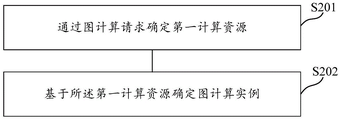
Optionally, determining the graph computation example according to the graph computation request may further include step S201 and step S202, as shown in fig. 2.
In step S201, a first computing resource is determined by the graph computation request. The graph computation request may include resources required for the graph computation task to be performed, such as the scale of graph data. For example, a plurality of buttons representing different scale levels may be provided on the front-end interface, and the user selects a scale level of the graph data by clicking one of the buttons, and then issues a graph calculation request by clicking the determination button.
In step S202, a graph computation instance corresponding to the graph computation request is determined based on the first computation resource. After the required first resource is determined, the micro-service containing the first resource is packaged into a container and allocated to the graph calculation request to serve as a graph calculation example corresponding to the graph calculation request. The first resource may include an application program that implements a graph computation function, and may also include a storage space, e.g., 100MB, 500MB, etc. The first resource may also include other resources, such as a database management system, etc.
Since multiple clients may initiate multiple graph computation instances, the exemplary embodiment may further include a message forwarder, configured to decouple the server from the clients, and perform message delivery between the server and the clients. The server may receive a graph computation request of the client through the message forwarder, and the client may determine its corresponding graph computation instance through the message forwarder, as shown in fig. 3.
The message forwarder may include an application program capable of implementing a message forwarding function. In detail, a Broker component may receive a graph computation request of a user, and after receiving the graph computation request, the Broker may forward the request to a server, and further allocate computation resources for the user on the server, so as to obtain a graph computation example of the user. Different users can apply for different graph computation instances, so that the client and the corresponding graph computation instance can be mapped on the message forwarder, for example, the client and the corresponding client are mapped by using an IP address and a port number, and the like, so that after the message forwarder receives a request of a certain client again, the request can be forwarded to the correct graph computation instance.
In addition, the message forwarder may be implemented in other ways, such as by a virtual server on which agent software (e.g., Apache ActiveMQ, Apache Kafka, etc.) is deployed.
Optionally, the user may initiate a graph calculation request through the client interface, after receiving the request, the message forwarder may check the request to determine whether the request is legal, and if the request is legal, the message forwarder may send the graph calculation request to the server, so as to apply for the graph calculation example of the user at the server, and send the graph calculation example to the client, so as to prompt the user that the graph creation is successful.
In step S120, the graph computation task corresponding to the graph computation request may be executed by using the computation resource corresponding to the graph computation instance, and the execution result may be determined.
Graph computation tasks may refer to tasks that process graph data, such as data import tasks, data query tasks, data modification tasks, and so forth. The computing resources corresponding to the user may perform the graph computation task. In detail, when a user needs to execute a graph calculation task, a request may be initiated to the server, and the request may also be received by the message forwarder, so as to create the graph calculation task of the user in the corresponding graph calculation instance. Therefore, the present exemplary embodiment may further include step S401 and step S402, as shown in fig. 4.
In step S401, when receiving the task creation request forwarded by the message forwarder, the server determines a graph computation task according to the type of the task creation request. After determining the graph computation instance from the graph computation request in step S110, the user may also initiate a task creation request to determine the graph computation task. The task creation request may include identification information of a client corresponding to the user, or identification information of the user, such as an identification code ID; identification information of the graph computation instance corresponding to the user, such as an IP address, a port number, etc., may also be included. The type of graph computation task may be determined according to the type of task creation request in order to create a corresponding graph computation task. For example, the task creation request may include a tag that may identify the corresponding type; or, the user can select the type of the created task by clicking a button in the front-end page, and after the user clicks, a task creation request of the type can be sent to the server. The types of task creation requests may include data import, data query, data modification, etc., and may also include other types, such as data storage tasks, data analysis tasks, etc. In step S402, a graph computation task is generated based on the graph computation instance. After the type of the graph computation task is determined, the graph computation task of the corresponding type is generated in the graph computation example corresponding to the user. In detail, after receiving a task creation request sent by a client, a message forwarder may connect a graph computation instance corresponding to the client, and after connecting the graph computation instance, the message forwarder sends the task creation request to a server where the graph computation instance is located, thereby generating a graph computation task of a corresponding type in the graph computation instance.
Generally, only a user with professional knowledge can configure and use the graph computing system, the user needs to deploy an operating system, a service related to graph computation, and the like on a computing resource after configuring the computing resource and configuring various parameters such as memory, storage, a CPU and the like required by the configuration, and a large amount of time is needed for the user to learn before using the graph computing system. In order to reduce the requirement of the graph computing system on the specialty of human resources, the graph computing system may further include a cloud platform, and a user may obtain a graph computing instance of the user through the cloud platform, that is, obtain computing resources, without manual configuration, thereby reducing the difficulty of operation and facilitating popularization and research and development. Optionally, the generating of the graph computation task based on the graph computation instance may further include step S501 and step S502, as shown in fig. 5.
In step S501, a corresponding cloud interface is determined according to the type of the task creation request. A user can log in the cloud platform, a task creating request is initiated through a platform interface, and then different cloud interfaces can be skipped to according to different types of task creating requests. For example, a user can enter a home page of a cloud platform by logging in, then click a "create graph calculation example" button on the home page to initiate a graph calculation request, after a server successfully creates a graph calculation example of the user, the user is prompted on the home page that the example creation is successful, and the graph calculation example of the user can be added on the home page. After clicking an entry graph calculation example page, if clicking a "data import" control, jumping to a cloud page corresponding to a data import type, and configuring graph data to be imported on the page, such as definition of a data schema, uploading of a data file, and the like.
In step S502, a graph calculation task is determined through the cloud interface. The configuration of the graph calculation task of the user, such as the name of the task, the code file of the task and the like, can be obtained through the cloud interface. For example, a target graph which needs to be queried by a user can be determined through a cloud interface corresponding to the data query task, and then after the graph calculation example is connected to the target graph, the user can call a code editor through the cloud interface to edit a query code.
Optionally, if the type of the task creation request is data import, determining a data model corresponding to the data import task through the first interface, so as to obtain graph data of the graph calculation example according to the data model. Wherein, a data model may refer to a definition of a graph in graph data. The data model may include user definitions of points, edges, etc. of the graph, and may also include other definitions, such as definitions of point attributes, definitions of point indices, definitions of edge attributes, definitions of edge indices, etc. In addition, the data model can also be determined by data import, for example, data files which meet the format requirement and are stored in a local disk or a distributed system are imported, so that the data model is determined according to the imported data files. And if the type of the task creation request is graph query, determining graph data corresponding to the graph query task through a second interface so as to determine an execution result of the graph query task based on the graph data. The graph data corresponding to the graph query task may refer to a target graph that the user needs to query. And if the type of the task creation request is graph analysis, determining an execution code of the graph analysis task through a third interface.
That is to say, the graph calculation tasks may be classified, each type of task may correspond to one interface, and different graph calculation tasks may be configured through different interfaces. In alternative embodiments, the graph computation task may also be divided into a graph storage task and a graph analysis task. The interface corresponding to the graph storage task can define a data model, or import the existing data into the graph computation instance of the user. The interface corresponding to the graph analysis task can write self-defined codes (python, java and the like) to perform offline graph analysis; alternatively, the query statement may be written in a query language for a graph (e.g., Gremlin, OpenCypher, SPARQL, etc.).
After the graph computation task is determined, the graph computation task can be started to be executed through a task starting command, so that an execution result is obtained. The execution result can be sent to the corresponding client through the message forwarder. And displaying the execution result through a visual interface at the client for the user to check. In detail, if the user executes the data import task, that is, the user may import the local data or the data in the other distributed storage systems into the graph calculation example to serve as the graph data of the graph calculation example, and further may view the imported graph data, such as a file directory and the like, and a point-edge topological structure relationship of the graph on a visualization interface. The visual interface may also include other interactive effects, for example, the user may change the display effect of the graph by dragging, moving, zooming in and out, and the like.
In an exemplary embodiment, since a first computing resource required by a graph computation request can be determined according to the request, and a corresponding graph computation instance needs to run depending on the first computing resource, during the graph computation task execution process, if it is detected that the first computing resource does not match a second computing resource required by the graph computation task, the first computing resource can be increased. Resources may be dynamically added to a user's graph computation instance by the container orchestration tool. In addition, after all graph calculation tasks in the graph calculation example of the user are executed, the data of the graph calculation example can be stored, and then the first calculation resource allocated to the graph calculation example of the user is released for other users to use. By the method, elastic expansion and contraction of computing resources can be realized, so that the condition that the service is unavailable due to the problems of resource contention and scheduling imbalance is effectively relieved, and the stability of the service can be improved.
Optionally, when the execution result is returned to the client corresponding to the user through the message forwarder, different processing may be performed on the execution result according to whether the task is a synchronous task or an asynchronous task. Specifically, if the computation task is a synchronization task, the user wants to obtain a returned execution result immediately, and the message forwarder can return the execution result to the client in time after the graph computation task is completed; if the graph computation task is an asynchronous task, the task usually needs a period of time to get the execution result, in which case the message forwarder may return a unique identifier (id) of the task to the client, and the user may obtain the execution result of the asynchronous task by refreshing the client. When a user refreshes a client, the client sends a request for obtaining an execution result to a message forwarder, the request can comprise a task id, the message forwarder queries a corresponding graph calculation example according to the task id after receiving the request, if the task is executed, the execution result of the task is obtained, and the execution result is returned to the client.
FIG. 6 schematically illustrates a flow of a user processing a graph computation task using a cloud graph computation platform. As shown in fig. 6, step S601 to step S607 may be further included in the exemplary embodiment. In step S601, the user may log in to the cloud image computing platform through the identity information, and after the identity information is verified, the user logs in successfully. In step S602, it may be determined whether the user is first logged in. Whether the user logs in for the first time can be determined by judging whether the graph calculation example of the user exists in the storage space, and if the graph calculation example of the user does not exist in the storage space, the user can be determined to log in for the first time. In step S602, if the user is the first login cloud graph computing platform, step S603 is executed; if the user does not log in the cloud graph computing platform for the first time, step S604 is executed. In step S603, a graph calculation example of the user is determined, that is, graph calculation example initialization is performed. In step S604, the identification information of the user is determined according to the identity information of the user, so as to obtain the graph calculation example of the user according to the identification information of the user. Next, in step S605, the user initiates a task creation request, and determines different types of graph calculation tasks according to the user' S request. In step S606, a graph calculation task is started, and an execution result is acquired. In step S607, it is determined whether the computation resource occupied by the graph computation instance of the user needs to be released, if all the graph computation tasks in the graph computation instance of the user are executed, it may be determined to release the computation resource, and if the graph computation instance of the user further includes a graph computation task that is not executed, the computation resource is not released, and the next graph computation task is executed.
Embodiments of the apparatus of the present invention are described below, which can be used to perform the graph computation processing method of the present invention described above. As shown in fig. 7, the graph data processing apparatus 700 may include an instance determination unit 710 and a task execution unit 720. Specifically, the method comprises the following steps:
an instance determining unit 710, configured to determine a graph computation instance according to a graph computation request, where the graph computation instance includes a plurality of micro services deployed in a container, where the micro services include computation resources required to perform graph computation; and a task execution unit 720, configured to execute the graph computation task corresponding to the graph computation request based on the computation resource corresponding to the graph computation instance, and determine an execution result.
Alternatively, the instance determining unit 710 may include a computing resource determining unit for determining the first computing resource through the graph computation request; and an instance determination subunit operable to determine a graph computation instance based on the first computation resource.
Optionally, the graph data processing apparatus 700 may further include a resource increasing unit, configured to increase the first computing resource if it is detected that the first computing resource does not match the second computing resource required by the graph computation task.
Optionally, the graph data processing apparatus 700 may further include a resource releasing unit, configured to release the first computing resource if it is detected that the graph computing task is finished executing.
Optionally, the instance determining unit 710 may be further configured to: a graph computation request of a user is received through a message forwarder to determine a graph computation instance of the user.
Optionally, the graph data processing apparatus 700 may further include a type determining unit, configured to determine a graph computation task according to a type of the task creation request when receiving the task creation request forwarded by the message forwarder; and a task generation unit operable to generate the graph computation task based on the graph computation instance.
Optionally, the example determining unit 710 may further include an interface determining unit, configured to determine a corresponding cloud interface according to the type of the task creation request; and a task determination unit, which may be configured to determine the graph computation task through the cloud interface.
Optionally, the task determination unit may be configured to: if the type of the task creation request is data import, determining a data model corresponding to a data import task through a first interface so as to obtain graph data of the graph calculation example according to the data model; if the type of the task creation request is graph query, determining graph data corresponding to the graph query task through a second interface so as to determine an execution result of the graph query task based on the graph data; and if the type of the task creation request is graph analysis, determining an execution code of the graph analysis task through a third interface.
Optionally, the graph data processing apparatus 700 may further include a visualization processing unit, configured to display the execution result through a visualization interface for a user to view.
Optionally, the graph data processing apparatus 700 may further include a message forwarding unit, configured to return the execution result to the client corresponding to the user through the message forwarder.
For details that are not disclosed in the embodiments of the apparatus of the present invention, reference is made to the embodiments of the graph calculation processing method of the present invention described above for details that are not disclosed in the embodiments of the apparatus of the present invention.
Moreover, although the steps of the methods of the present disclosure are depicted in the drawings in a particular order, this does not require or imply that the steps must be performed in this particular order, or that all of the depicted steps must be performed, to achieve desirable results. Additionally or alternatively, certain steps may be omitted, multiple steps combined into one step execution, and/or one step broken into multiple step executions, etc.
Through the above description of the embodiments, those skilled in the art will readily understand that the exemplary embodiments described herein may be implemented by software, or by software in combination with necessary hardware. Therefore, the technical solution according to the embodiments of the present disclosure may be embodied in the form of a software product, which may be stored in a non-volatile storage medium (which may be a CD-ROM, a usb disk, a removable hard disk, etc.) or on a network, and includes several instructions to enable a computing device (which may be a personal computer, a server, a mobile terminal, or a network device, etc.) to execute the graph calculation processing method according to the embodiments of the present disclosure.
As will be appreciated by one skilled in the art, aspects of the present disclosure may be embodied as a system, method or program product. Accordingly, various aspects of the present disclosure may be embodied in the form of: an entirely hardware embodiment, an entirely software embodiment (including firmware, microcode, etc.), or an embodiment combining hardware and software aspects that may all generally be referred to herein as a "circuit," module "or" system.
In an exemplary embodiment of the present disclosure, there is also provided a computer-readable storage medium having stored thereon a program product capable of implementing the above-described method of the present specification. In some possible embodiments, various aspects of the disclosure may also be implemented in the form of a program product comprising program code for causing a terminal device to perform the steps according to various exemplary embodiments of the disclosure described in the "exemplary methods" section above of this specification, when the program product is run on the terminal device.
Referring to fig. 8, a program product 800 for implementing the above method according to an embodiment of the present disclosure is described, which may employ a portable compact disc read only memory (CD-ROM) and include program code, and may be run on a terminal device, such as a personal computer. However, the program product of the present disclosure is not limited thereto, and in this document, a readable storage medium may be any tangible medium that can contain, or store a program for use by or in connection with an instruction execution system, apparatus, or device.
The program product may employ any combination of one or more readable media. The readable medium may be a readable signal medium or a readable storage medium. A readable storage medium may be, for example, but not limited to, an electronic, magnetic, optical, electromagnetic, infrared, or semiconductor system, apparatus, or device, or any combination of the foregoing. More specific examples (a non-exhaustive list) of the readable storage medium include: an electrical connection having one or more wires, a portable disk, a hard disk, a Random Access Memory (RAM), a read-only memory (ROM), an erasable programmable read-only memory (EPROM or flash memory), an optical fiber, a portable compact disc read-only memory (CD-ROM), an optical storage device, a magnetic storage device, or any suitable combination of the foregoing.
A computer readable signal medium may include a propagated data signal with readable program code embodied therein, for example, in baseband or as part of a carrier wave. Such a propagated data signal may take many forms, including, but not limited to, electro-magnetic, optical, or any suitable combination thereof. A readable signal medium may also be any readable medium that is not a readable storage medium and that can communicate, propagate, or transport a program for use by or in connection with an instruction execution system, apparatus, or device.
Program code embodied on a readable medium may be transmitted using any appropriate medium, including but not limited to wireless, wireline, optical fiber cable, RF, etc., or any suitable combination of the foregoing.
Program code for carrying out operations of the present disclosure may be written in any combination of one or more programming languages, including an object oriented programming language such as Java, C + + or the like and conventional procedural programming languages, such as the "C" programming language or similar programming languages. The program code may execute entirely on the user's computing device, partly on the user's device, as a stand-alone software package, partly on the user's computing device and partly on a remote computing device, or entirely on the remote computing device or server. In the case of a remote computing device, the remote computing device may be connected to the user computing device through any kind of network, including a Local Area Network (LAN) or a Wide Area Network (WAN), or may be connected to an external computing device (e.g., through the internet using an internet service provider).
In an exemplary embodiment of the present disclosure, an electronic device capable of implementing the above method is also provided.
An electronic device 900 according to this embodiment of the disclosure is described below with reference to fig. 9. The electronic device 900 shown in fig. 9 is only an example and should not bring any limitations to the functionality or scope of use of the embodiments of the present disclosure.
As shown in fig. 9, the electronic device 900 is embodied in the form of a general purpose computing device. Components of electronic device 900 may include, but are not limited to: the at least one processing unit 910, the at least one memory unit 920, and the bus 930 that couples the various system components including the memory unit 920 and the processing unit 910.
Wherein the storage unit stores program code that is executable by the processing unit 910 to cause the processing unit 910 to perform steps according to various exemplary embodiments of the present disclosure described in the above section "exemplary method" of the present specification. For example, the processing unit 910 may execute the following steps as shown in fig. 1: step S110, determining a graph computation example according to the graph computation request, wherein the graph computation example comprises a plurality of micro services deployed in a container, and the micro services comprise computation resources required by graph computation; step S120, based on the computing resource corresponding to the graph computing instance, executing the graph computing task corresponding to the graph computing request, and determining an execution result.
The storage unit 920 may include a readable medium in the form of a volatile storage unit, such as a random access memory unit (RAM)9201 and/or a cache memory unit 9202, and may further include a read only memory unit (ROM) 9203.
The electronic device 900 may also communicate with one or more external devices 1000 (e.g., keyboard, pointing device, bluetooth device, etc.), with one or more devices that enable a user to interact with the electronic device 900, and/or with any devices (e.g., router, modem, etc.) that enable the electronic device 900 to communicate with one or more other computing devices. Such communication may occur via input/output (I/O) interface 950. Also, the electronic device 900 may communicate with one or more networks (e.g., a Local Area Network (LAN), a Wide Area Network (WAN), and/or a public network such as the Internet) via the network adapter 960. As shown, the network adapter 960 communicates with the other modules of the electronic device 900 via the bus 930. It should be appreciated that although not shown, other hardware and/or software modules may be used in conjunction with the electronic device 900, including but not limited to: microcode, device drivers, redundant processing units, external disk drive arrays, RAID systems, tape drives, and data backup storage systems, to name a few.
Through the above description of the embodiments, those skilled in the art will readily understand that the exemplary embodiments described herein may be implemented by software, or by software in combination with necessary hardware. Therefore, the technical solution according to the embodiments of the present disclosure may be embodied in the form of a software product, which may be stored in a non-volatile storage medium (which may be a CD-ROM, a usb disk, a removable hard disk, etc.) or on a network, and includes several instructions to enable a computing device (which may be a personal computer, a server, a terminal device, or a network device, etc.) to execute the method according to the embodiments of the present disclosure.
Furthermore, the above-described figures are merely schematic illustrations of processes included in methods according to exemplary embodiments of the present disclosure, and are not intended to be limiting. It will be readily understood that the processes shown in the above figures are not intended to indicate or limit the chronological order of the processes. In addition, it is also readily understood that these processes may be performed synchronously or asynchronously, e.g., in multiple modules.
Other embodiments of the disclosure will be apparent to those skilled in the art from consideration of the specification and practice of the disclosure disclosed herein. This application is intended to cover any variations, uses, or adaptations of the disclosure following, in general, the principles of the disclosure and including such departures from the present disclosure as come within known or customary practice in the art to which the disclosure pertains. It is intended that the specification and examples be considered as exemplary only, with a true scope and spirit of the disclosure being indicated by the following claims.
Claims (11)
1. A graph computation processing method, comprising:
determining a first computing resource through a graph computing request, and determining a graph computing instance corresponding to the graph computing request based on the first computing resource, wherein the graph computing instance comprises a plurality of micro services deployed in a container, and the micro services comprise first computing resources required for executing graph computation;
receiving a task creating request, and generating a graph computing task of a corresponding type in the graph computing instance according to the type of the task creating request;
upon detecting that the first computing resource does not match a second computing resource required by the graph computation task, increasing the first computing resource;
executing the graph computing task based on a first computing resource corresponding to the graph computing instance, and determining an execution result;
and after all graph calculation tasks in the graph calculation example are executed, storing the data of the graph calculation example and releasing the first calculation resource.
2. The graph computation processing method according to claim 1, wherein, based on the first computation resource corresponding to the graph computation instance, the graph computation task corresponding to the graph computation request is executed, and after determining an execution result, the method further comprises:
and if the graph computation task is detected to be finished, releasing the first computation resource.
3. The graph computation processing method according to claim 1, wherein the determining a first computation resource through the graph computation request and determining a graph computation instance corresponding to the graph computation request based on the first computation resource includes:
a graph computation request of a user is received through a message forwarder to determine a graph computation instance of the user.
4. The graph computation processing method according to claim 3, wherein the receiving a task creation request and generating a graph computation task of a corresponding type in the graph computation instance according to a type of the task creation request includes:
when a task creating request forwarded by the message forwarder is received, determining a graph calculation task type according to the type of the task creating request;
generating a graph computation task having the graph computation task type in the graph computation instance.
5. The graph computation processing method according to claim 4, wherein the generating, in the graph computation instance, the graph computation task having the graph computation task type includes:
determining a corresponding cloud interface according to the type of the task creation request;
determining the graph computation task having the graph computation task type through the cloud interface.
6. The graph computation processing method according to claim 5, wherein the determining the graph computation task through the cloud interface includes:
if the type of the task creation request is data import, determining a data model corresponding to a data import task through a first interface so as to obtain graph data of the graph calculation example according to the data model;
if the type of the task creation request is graph query, determining graph data corresponding to the graph query task through a second interface so as to determine an execution result of the graph query task based on the graph data;
and if the type of the task creation request is graph analysis, determining an execution code of the graph analysis task through a third interface.
7. The graph computation processing method according to claim 1, wherein, based on the first computation resource corresponding to the graph computation instance, the graph computation task corresponding to the graph computation instance is executed, and after determining the execution result, the method further includes:
and displaying the execution result through a visual interface for a user to view.
8. The graph computation processing method according to claim 3, wherein the executing a graph computation task corresponding to the graph computation instance based on the first computation resource corresponding to the graph computation instance and after determining an execution result further comprises:
and returning the execution result to the client corresponding to the user through the message forwarder.
9. A graph computation processing apparatus, comprising:
an example determining unit, configured to determine a first computing resource through a graph computation request, and determine a graph computation example corresponding to the graph computation request based on the first computing resource, where the graph computation example includes a plurality of micro services deployed in a container, and the micro services include computing resources required to perform graph computation;
the resource increasing unit is used for receiving a task creating request, generating a graph computing task of a corresponding type in the graph computing instance according to the type of the task creating request, and increasing the first computing resource when detecting that the first computing resource is not matched with a second computing resource required by the graph computing task;
the task execution unit is used for executing the graph calculation task corresponding to the graph calculation request based on the first calculation resource corresponding to the graph calculation example and determining an execution result; and after all graph calculation tasks in the graph calculation example are executed, storing the data of the graph calculation example and releasing the first calculation resource.
10. A computer-readable medium on which a computer program is stored, the program realizing the graph calculation processing method according to any one of claims 1 to 8 when executed by a processor.
11. An electronic device, comprising:
one or more processors;
storage means for storing one or more programs that, when executed by the one or more processors, cause the one or more processors to implement the graph computation processing method according to any one of claims 1 to 8.
Priority Applications (1)
| Application Number | Priority Date | Filing Date | Title |
|---|---|---|---|
| CN201910376824.1A CN110083455B (en) | 2019-05-07 | 2019-05-07 | Graph calculation processing method, graph calculation processing device, graph calculation processing medium and electronic equipment |
Applications Claiming Priority (1)
| Application Number | Priority Date | Filing Date | Title |
|---|---|---|---|
| CN201910376824.1A CN110083455B (en) | 2019-05-07 | 2019-05-07 | Graph calculation processing method, graph calculation processing device, graph calculation processing medium and electronic equipment |
Publications (2)
| Publication Number | Publication Date |
|---|---|
| CN110083455A CN110083455A (en) | 2019-08-02 |
| CN110083455B true CN110083455B (en) | 2022-07-12 |
Family
ID=67418991
Family Applications (1)
| Application Number | Title | Priority Date | Filing Date |
|---|---|---|---|
| CN201910376824.1A Active CN110083455B (en) | 2019-05-07 | 2019-05-07 | Graph calculation processing method, graph calculation processing device, graph calculation processing medium and electronic equipment |
Country Status (1)
| Country | Link |
|---|---|
| CN (1) | CN110083455B (en) |
Families Citing this family (10)
| Publication number | Priority date | Publication date | Assignee | Title |
|---|---|---|---|---|
| CN110489986B (en) * | 2019-08-22 | 2021-03-23 | 网易(杭州)网络有限公司 | Response method and system of graph data function and electronic equipment |
| CN110677461A (en) * | 2019-09-06 | 2020-01-10 | 上海交通大学 | Graph calculation method based on key value pair storage |
| CN111124607A (en) * | 2019-12-16 | 2020-05-08 | 上海大学 | FPGA virtualization deployment to achieve high-speed and secure server cluster management method |
| CN111159270A (en) * | 2019-12-31 | 2020-05-15 | 杭州依图医疗技术有限公司 | A method, system, computing device and storage medium for scheduling Zeppelin tasks |
| CN111367643B (en) * | 2020-03-09 | 2024-07-09 | 北京易华录信息技术股份有限公司 | Algorithm scheduling system, method and device |
| CN112256695B (en) * | 2020-09-18 | 2023-07-28 | 银联商务股份有限公司 | Visualized graph calculation method and system, storage medium and electronic device |
| WO2022133725A1 (en) * | 2020-12-22 | 2022-06-30 | Orange | Improved distributed training of graph-embedding neural networks |
| CN114722073B (en) * | 2022-04-06 | 2023-03-14 | 杭州悦数科技有限公司 | Method and device for converting circular graph into graph database query language |
| CN116304218B (en) * | 2023-05-24 | 2023-08-11 | 杭州悦数科技有限公司 | An implementation method and system for integrating multi-domain platforms based on graph databases |
| CN116560877B (en) * | 2023-07-05 | 2023-09-22 | 北京枫清科技有限公司 | Real-time graph calculation method and device, electronic equipment and storage medium |
Citations (7)
| Publication number | Priority date | Publication date | Assignee | Title |
|---|---|---|---|---|
| CN106227611A (en) * | 2016-07-26 | 2016-12-14 | 北京北森云计算股份有限公司 | The dynamic micro services call method of a kind of multilingual cloud compiling and device |
| CN107273867A (en) * | 2017-06-27 | 2017-10-20 | 航天星图科技(北京)有限公司 | Empty day Remote Sensing Data Processing all-in-one |
| CN107463434A (en) * | 2017-08-11 | 2017-12-12 | 恒丰银行股份有限公司 | Distributed task processing method and device |
| CN107589992A (en) * | 2017-08-02 | 2018-01-16 | 北京大学(天津滨海)新代信息技术研究院 | A kind of containerization application load dispatching method based on swarm intelligence |
| CN108647083A (en) * | 2018-04-28 | 2018-10-12 | 北京京东金融科技控股有限公司 | Task executing method, device, system, electronic equipment and computer-readable medium |
| US10198250B1 (en) * | 2018-01-04 | 2019-02-05 | Accenture Global Solutions Limited | Partitioning based migration of systems to container and microservice based platforms |
| CN109376009A (en) * | 2018-09-26 | 2019-02-22 | 郑州云海信息技术有限公司 | A method and device for sharing resources |
Family Cites Families (6)
| Publication number | Priority date | Publication date | Assignee | Title |
|---|---|---|---|---|
| US9317410B2 (en) * | 2013-03-15 | 2016-04-19 | International Business Machines Corporation | Testing functional correctness and idempotence of software automation scripts |
| CN105959138B (en) * | 2016-04-29 | 2019-05-17 | 深圳大数点科技有限公司 | The system and method for micro services Dynamical Deployment based on cloud computing |
| CN106789339B (en) * | 2017-01-19 | 2020-08-25 | 北京仿真中心 | Distributed cloud simulation method and system based on lightweight virtualization framework |
| US10540191B2 (en) * | 2017-03-21 | 2020-01-21 | Veritas Technologies Llc | Systems and methods for using dynamic templates to create application containers |
| CN108737168B (en) * | 2018-05-08 | 2021-03-16 | 深圳大学 | A container-based microservice architecture application automatic construction method |
| CN109634657A (en) * | 2018-12-14 | 2019-04-16 | 武汉烽火信息集成技术有限公司 | A kind of micro services are packaged dispositions method and system |
-
2019
- 2019-05-07 CN CN201910376824.1A patent/CN110083455B/en active Active
Patent Citations (7)
| Publication number | Priority date | Publication date | Assignee | Title |
|---|---|---|---|---|
| CN106227611A (en) * | 2016-07-26 | 2016-12-14 | 北京北森云计算股份有限公司 | The dynamic micro services call method of a kind of multilingual cloud compiling and device |
| CN107273867A (en) * | 2017-06-27 | 2017-10-20 | 航天星图科技(北京)有限公司 | Empty day Remote Sensing Data Processing all-in-one |
| CN107589992A (en) * | 2017-08-02 | 2018-01-16 | 北京大学(天津滨海)新代信息技术研究院 | A kind of containerization application load dispatching method based on swarm intelligence |
| CN107463434A (en) * | 2017-08-11 | 2017-12-12 | 恒丰银行股份有限公司 | Distributed task processing method and device |
| US10198250B1 (en) * | 2018-01-04 | 2019-02-05 | Accenture Global Solutions Limited | Partitioning based migration of systems to container and microservice based platforms |
| CN108647083A (en) * | 2018-04-28 | 2018-10-12 | 北京京东金融科技控股有限公司 | Task executing method, device, system, electronic equipment and computer-readable medium |
| CN109376009A (en) * | 2018-09-26 | 2019-02-22 | 郑州云海信息技术有限公司 | A method and device for sharing resources |
Non-Patent Citations (3)
| Title |
|---|
| "Application deployment using Microservice and Docker containers: Framework and optimization";Xili Wan;《Journal of Network and Computer Applications》;20181001;第119卷;第97-109页 * |
| "云环境下支持弹性伸缩的容器化工作流框架";刘彪;《计算机工程》;20190331;第45卷(第3期);第7-13页 * |
| "关于微服务和容器";启迪云;《https://zhuanlan.zhihu.com/p/43357441》;20180830;第1-9页 * |
Also Published As
| Publication number | Publication date |
|---|---|
| CN110083455A (en) | 2019-08-02 |
Similar Documents
| Publication | Publication Date | Title |
|---|---|---|
| CN110083455B (en) | Graph calculation processing method, graph calculation processing device, graph calculation processing medium and electronic equipment | |
| US10360087B2 (en) | Web API recommendations based on usage in cloud-provided runtimes | |
| JP6871943B2 (en) | Preformed instructions for mobile cloud services | |
| US20160085738A1 (en) | Cloud-Based Parallel Computation Using Actor Modules | |
| US12101232B2 (en) | Dynamic graphing for managing an IT operation system | |
| US10574724B2 (en) | Automatic discovery of management nodes and generation of CLI using HA module | |
| CN112313627B (en) | Mapping mechanism for events to serverless function workflow instances | |
| CN112825525B (en) | Method and apparatus for processing transactions | |
| EP4055797B1 (en) | Web application component migration to a cloud computing system | |
| US11321090B2 (en) | Serializing and/or deserializing programs with serializable state | |
| US20120078809A1 (en) | Integrating sub-processes in business process modeling notation processes | |
| CN111427665A (en) | A quantum application cloud platform and processing method for quantum computing tasks | |
| US20180150365A1 (en) | Disaster Recover of Managed Systems | |
| CN112256406A (en) | Operation flow platformization scheduling method | |
| CN112491940A (en) | Request forwarding method and device of proxy server, storage medium and electronic equipment | |
| CN104270443B (en) | A kind of cloud computing system and method for being capable of dynamic analysis Web applications | |
| US12541393B2 (en) | Dynamic pod priority inference utilizing service mesh telemetry data | |
| CN117850771A (en) | Business application development platform, method and storage medium for web service | |
| CN115757587A (en) | Heterogeneous data source integration method and device, electronic equipment and storage medium | |
| CN111681093A (en) | A method, apparatus and electronic device for displaying resource pages | |
| CN116954843A (en) | Node scheduling method, node scheduling device, electronic equipment and computer program product | |
| CN117724803B (en) | Cloud service deployment methods, devices and platforms | |
| US20180107723A1 (en) | Content oriented analysis of dumps | |
| CN113742104A (en) | AI-based RPA (resilient packet Access) body-separating function generation method and device | |
| CN116932147A (en) | Streaming job processing method and device, electronic equipment and medium |
Legal Events
| Date | Code | Title | Description |
|---|---|---|---|
| PB01 | Publication | ||
| PB01 | Publication | ||
| SE01 | Entry into force of request for substantive examination | ||
| SE01 | Entry into force of request for substantive examination | ||
| GR01 | Patent grant | ||
| GR01 | Patent grant |